Home Archive by category Sections (Page 2)

Sections

Community Spotlight Special Coverage

Community Spotlight

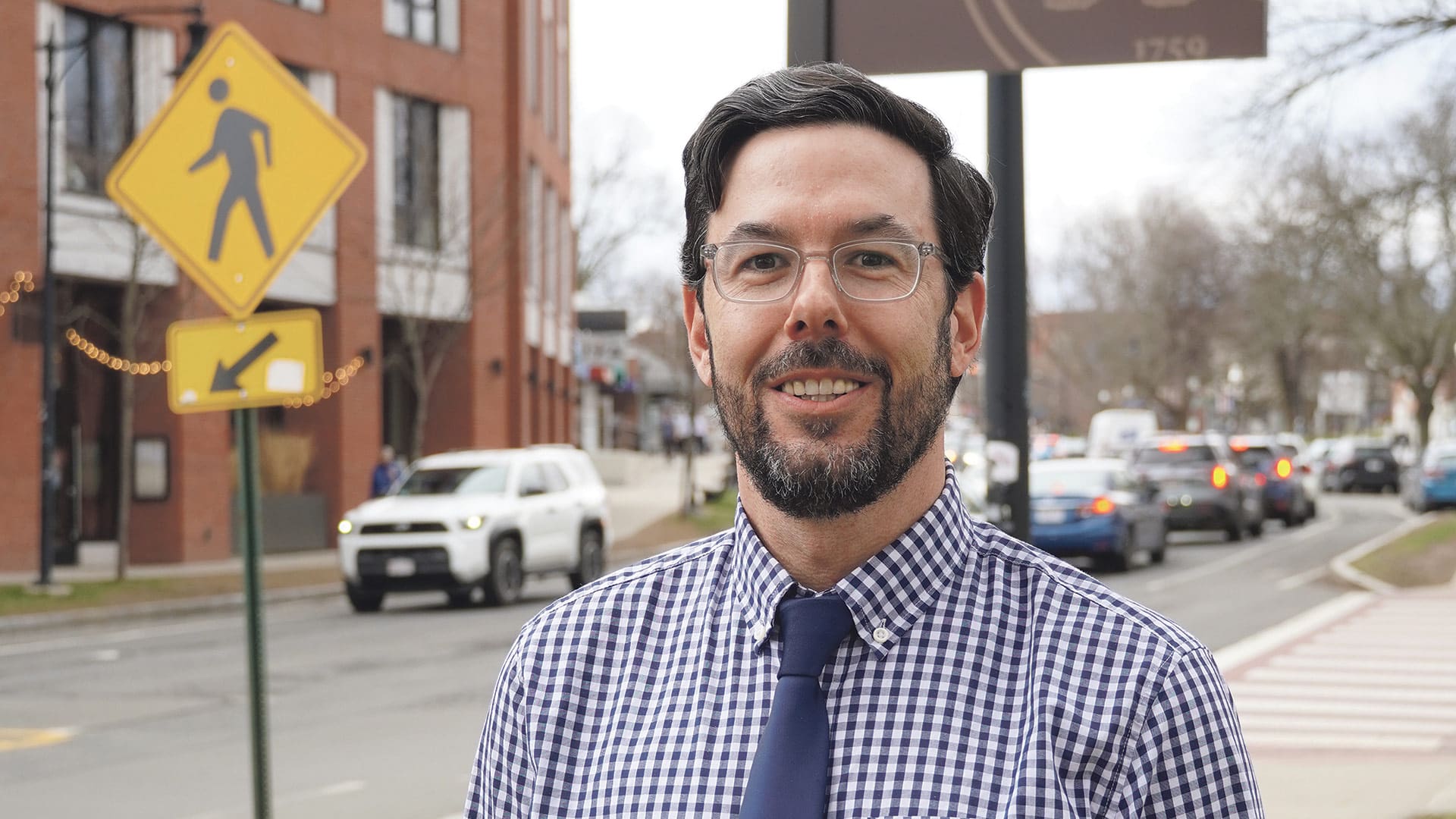
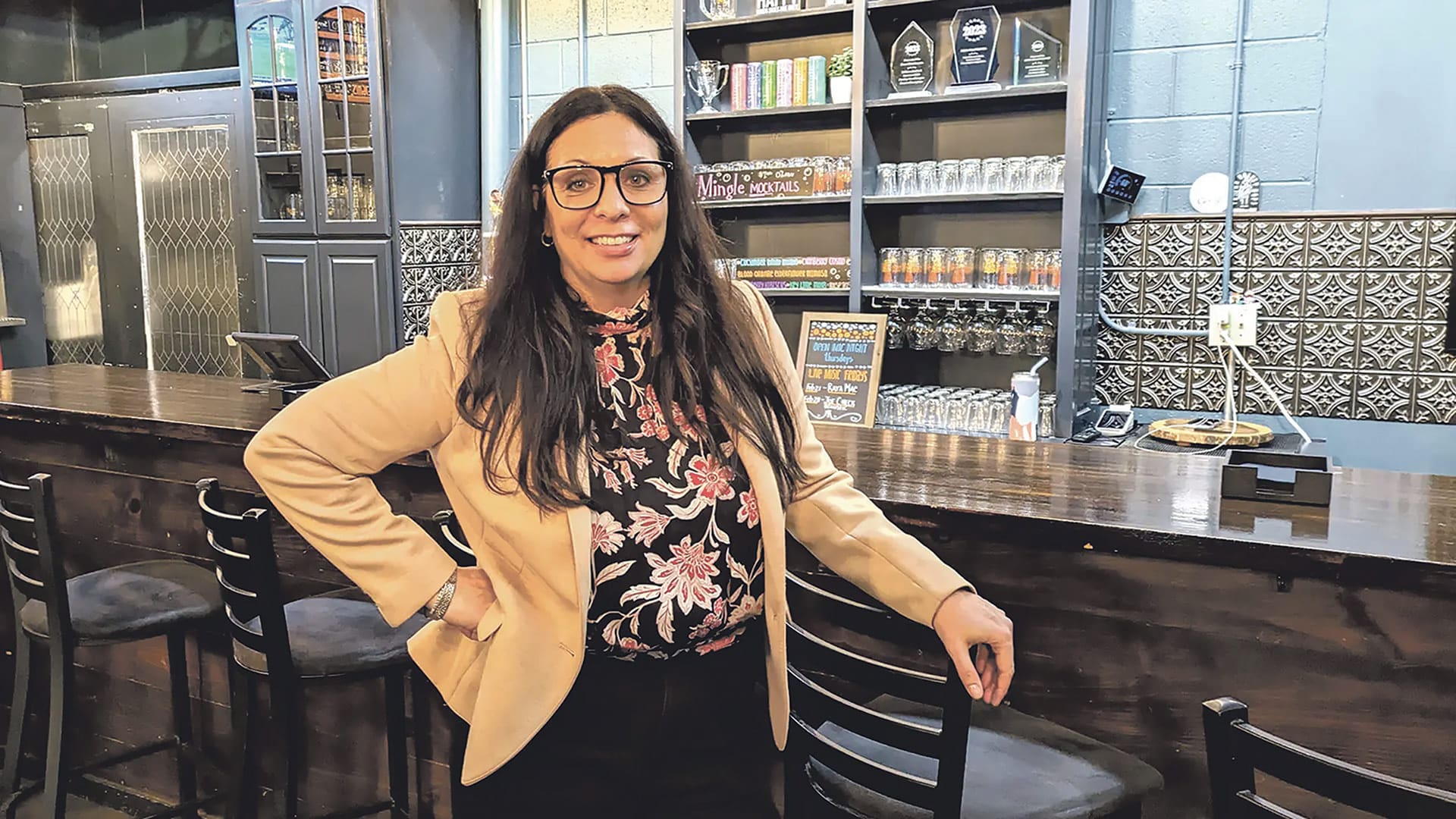
Jeff Bagg says Amherst is well-stocked with assets as it goes about competing with other area communities for the dollars spent by visitors.

Jeff Bagg says Amherst is well-stocked with assets as it goes about competing with other area communities for the dollars spent by visitors.

Jeff Bagg says he’s come full circle. Sort of.

He graduated from UMass Amherst back in 2002 and then worked for the town of Amherst as senior planner from 2008 to 2016. But now, after gaining different types of experience in various settings, he’s back in Town Hall, serving as director of Planning & Economic Development, a melding of two roles.

He started in December and has spent the past four months getting reacquainted with a community that is in a seemingly constant state of motion, but with challenges and opportunities that have been present for decades.

“I knew a lot about the town of Amherst, but it had been 10 years since I last worked there, so there was a learning curve,” said Bagg, who is involved in several initiatives at present, from a project to set new design standards for the downtown to a study of the East Amherst area with an eye toward creating core commercial development opportunities, to the collection of data to be used in creation of the town’s first economic development plan in several years.

“What we have available is pre-pandemic, and there have been really big shifts in the way people spend their money,” he said of that last initiative. “Knowing that businesses need a strong customer base and foot traffic, we really need to figure out ways to bring more residents out and visitors in, and the data drives a lot of that.”

“Knowing that businesses need a strong customer base and foot traffic, we really need to figure out ways to bring more residents out and visitors in, and the data drives a lot of that.”

These are just some of the many converging storylines in Amherst, a community that those we spoke with said is a college town, but so much more. Others include:

• Amherst Area Chamber of Commerce, which continues to grow membership and become ever more diverse — Executive Director Jacob Robinson said the chamber added 57 new members in 2025, roughly double the number welcomed in 2023 and the years prior — and build new events into the schedule, including a revitalized business expo;

• A Business Improvement District (BID) that is working with the chamber and individual businesses to make the community a true destination year round;

• The ongoing success story that is the Drake, a downtown live-performance venue that is planning 200 nights of performances for 2026 involving 500 artists from both the 413 and around the globe and more than 33,000 audience members, many of whom will support other hospitality-related businesses before and after those shows;

• The ongoing saga of Hampshire College, which has been fighting for survival in recent years amid declining enrollment and continuing fiscal hardship. That fight took a new twist recently when the New England Commission of Higher Education announced late last month that it will require the school to show cause in June as to why it shouldn’t be placed on probation or have its accreditation withdrawn over concerns the college may no longer be meeting the organization’s institutional resources standard; and

• Continued evolution of the community’s downtown, including several new businesses, the owners of which told BusinessWest there is a rhythm to the downtown, one dictated by the calendar, which takes some getting used to (much more on this later).

For this latest installment of its Community Spotlight series, we take an in-depth look at one of the more intriguing communities in the region — one marked by learning of all types.


Developing Story

Bagg brings a diverse résumé to his new position in Amherst. Indeed, after his stint as senior planner there, he served as project manager for the Central Massachusetts Regional Planning Commission before beginning what would become a six-year stint as director of Planning and Economic Development in Easthampton and then serving as senior planner for the BSC Group in Worcester.

He described his new role as a “good fit” and an opportunity to return to the public sector — in a community where change is a constant.

“I’ve been working in many different communities in Massachusetts, and more and more towns have increased their efforts to attract visitors; it’s an intense competition for people’s time and limited disposable income.”

Like others we spoke with, he said Amherst has both a number of assets and … let’s call them liabilities.

In that first category, he started with the obvious, the three colleges that provide the community with its distinct flavor — Amherst College, UMass Amherst, and Hampshire College — but also its many cultural attractions, ranging from the Emily Dickinson Museum and the Eric Carle Museum to the Drake and Amherst Cinema, which make it more than your typical college down.

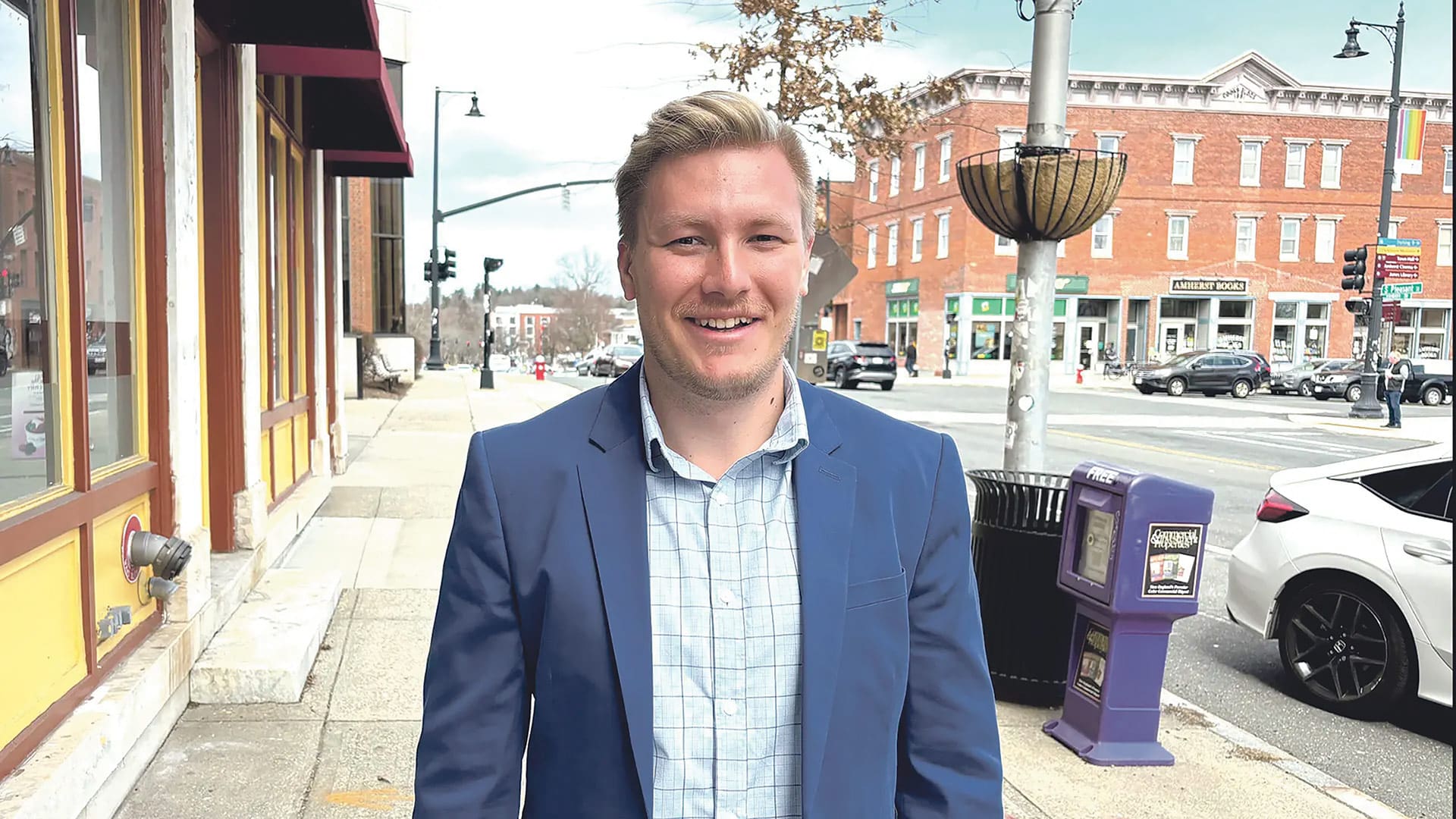
John Page says downtown Amherst is in a seemingly constant state of change and is always welcoming new businesses.

John Page says downtown Amherst is in a seemingly constant state of change and is always welcoming new businesses.

On the downside, this can be a difficult town to do business in, and Bagg acknowledged this with a comment intended to be diplomatic.

“We have a very engaged community, but there is some lack of agreement on where new growth should happen. Amherst struggles with its vision for the future and an identity that we can get most people to agree to,” he said, adding that town officials are making it a priority to make it easier to do business in town, such as with the hiring of a permit administrator to facilitate the process of setting up shop there.

Which brings him back to the economic development plan, and the collection of data that will help drive it.

“What we don’t have a good handle on is where people are spending their money — we don’t know where residents are spending their money, we don’t know where visitors spend their money when they come here, and how all that relates to demographics — population changes, the age of people coming and going, those are factors for what’s going to drive new businesses in Amherst, and we don’t really have a handle on that.

“I’ve been working in many different communities in Massachusetts, and more and more towns have increased their efforts to attract visitors; it’s an intense competition for people’s time and limited disposable income,” he went on, adding that this competition is one of myriad factors that will go into the development of an economic development plan over the next year or so.

Overall, the community is well-suited to succeed in this competition to attract visitors, said John Page, executive director of the Amherst BID, adding that there is already plenty to do in town — such as the recent Fire and Ice Winter Festival, which drew more than 2,000 people — and plans to provide more good reasons to make the trip.

That list includes the Amherst Literary Walk on April 11, a day of literary events throughout the downtown, including readings, workshops, literary trivia, and more, said Page, adding that one of the BID’s broad goals is to get people out and have them experience Amherst.

Another is to help bring new businesses to town and create an environment that will enable them to succeed year-round. Like others we spoke with, Page said Amherst has some unique assets, but especially the colleges and the people who go there to learn and to work.

“We have to keep showing up for these businesses that give this place its identity. These are not just storefronts — they create jobs, they build relationships, and they shape the character of the community.”

“There is this youthfulness,” he said, speaking to the environment created by the melding of the higher learning institutions and the omnipresent arts and culture. “You’ve got bands, you have artists of all ages, and a college town both because of the students and the faculty. There’s this appreciation for arts and culture — we have a lot of museums and a lot of live music going on, and that goes hand-in-hand with a college community, and that helps us out even when the students aren’t here because that reputation is great in the summer, when we want to invite other people to join us from across Massachusetts, across New England, and across the world.”

Robinson agreed, noting that the chamber is committed to promoting and supporting the downtown, but other ‘villages’ in the community as well, such as the Mill District in North Amherst and the South Amherst section of town.

“We have to keep showing up for these businesses that give this place its identity,” he said, summing up the chamber’s mission. “These are not just storefronts — they create jobs, they build relationships, and they shape the character of the community.”


What’s in Store

As she spoke with BusinessWest, Becky Guyer was gearing up for Easter, but also a very busy three-month stretch that includes Mother’s Day, college and high school graduations, some weddings, and other events that require flowers.

She can speak from experience about what this time means for her Floral Affairs shop in downtown Greenfield. But the one she opened last July on North Pleasant Street in Amherst … not so much.

Indeed, Guyer said she is still experiencing a learning curve when it comes to doing business in downtown Amherst. She was invited to look at the North Pleasant location, long a flower shop, at the behest of the building’s owner, who thought she might be interested in opening a second location there.

Amherst at a Glance

Year Incorporated: 1759
Population: 39,263
Area: 27.7 square miles
County: Hampshire
Residential Tax Rate: $16.91
Commercial Tax Rate: $16.91
Median Household Income: $48,059
Median Family Income: $96,005
Type of Government: Town Council, Town Manager
Largest Employers: UMass Amherst; Amherst College; Hampshire College
* Latest information available

After some due diligence, she determined that she was.

“I thought that this could be a good opportunity — this is a college town, there are some venues in town, some that we already do weddings with, as well as UMass events and Amherst College events,” she said, adding that the location was also across the street from a funeral home, which, in the floral world, is a real benefit.

“There were a lot of positives,” she went on, adding that the storefront, which had to be completely gutted, wasn’t one of them. But she moved forward with confidence, has found the move worthwhile, and has high praise for the chamber and the BID. But there has been a learning curve as she adapts to life in a college town.

“When the college kids leave … it was the worst Christmas I’ve ever seen in my life — so much so that it’s made us completely restructure our game plan,” she told BusinessWest. “I don’t necessarily have a designer in Amherst — it’s meant for convenience; all orders get run out of Greenfield, and we’ve made this location more of a convenience store.”

Overall, the downtown Amherst location is a work in progress, she said, adding that she is learning the cadence, if you will, of this college town, and the nuances of the calendar. Christmas was a letdown, and she’s not sure what to expect this summer, but she is optimistic about the upcoming few months and what they could bring, and the location itself.

“The walk-up traffic is fantastic — there’s a young, growing community there that comes in quite a bit,” she said. “There are a lot of $10, $15, and $20 sales, which is great.”

Andrea Marion is also getting used to the rhythm of Amherst’s downtown. She moved the Closet from a location in the Mill District to a storefront (a former restaurant) on Main Street last fall. She enjoyed the Mill District atmosphere but said there is more foot traffic in the downtown, and that suits her operation.

She described her business as a “curated resale boutique,” and herself as a “fashion concierge.”

“I hand-pick every piece that comes into the store — I don’t do consignment, generally, and I try to make sure I have something for everyone … I sell for all genders and all sizes,” said Marion, a nonprofit manager before she went into business for herself, adding that, while many items would be described as high-end (Fendi, Givenchy, and Prada handbags, for example), she has items at all price points.

Like Guyer, Marion said it takes some time to get used to the patterns of the downtown, especially when it comes to the students’ schedules, but overall, she says the area is becoming ever more vibrant and remains a good place to do business.

“There’s a lot of energy and activity,” she said, adding that she is accessible to more people now, which has broadened the customer base and made it more diverse, especially age-wise. “Amherst’s downtown has so much potential, and I’m really happy to be here.”

Features

Staying on Course

Runners get set at the starting line at the 2025 event.

Runners get set at the starting line at the 2025 event.
Photo by Keith Toffling Photography


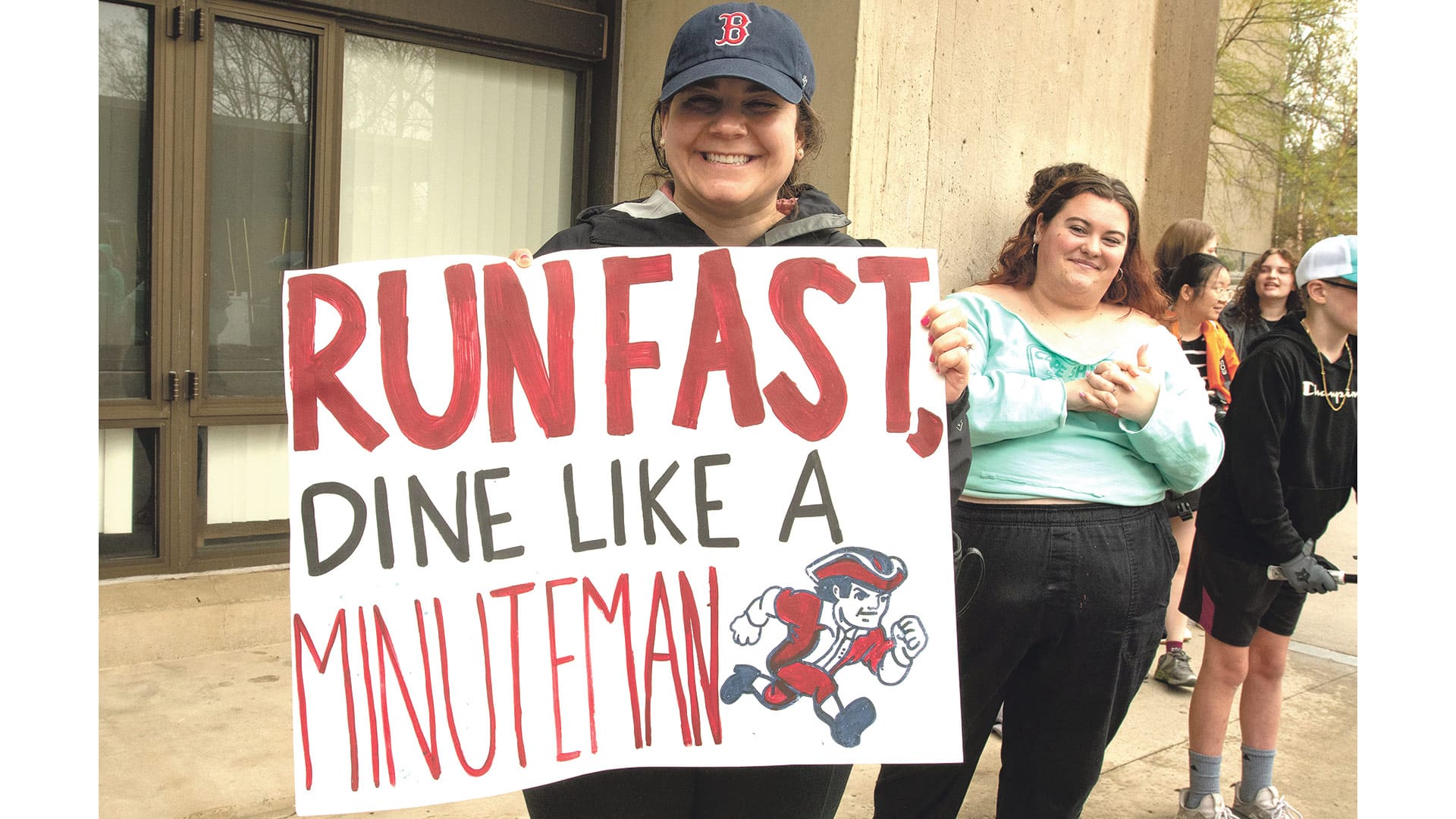
Brandy Sullivan says the 15th iteration of the UMass 5K Dash & Dine is reason for celebration — but so were the other 14, because of the impact they’ve had.

Specifically, over the years, UMass Amherst has raised more than $50,000 for the Amherst Survival Center thanks to donors, runners, and walkers. UMass Dining, which puts on the annual event, donates 100% of all proceeds to the center.

“UMass Dining started this event 15 years ago in an effort to address food insecurity in our region,” said Sullivan, meal plan manager for UMass Dining, quickly tying the effort to one of the university’s values. “We work toward limiting food waste through sustainable practices here at UMass, and we’ve been proud to partner with the Amherst Survival Center as an extension of our work on campus. We work with Dean’s Office as well to promote food security here.”

The event — this year’s race is slated for Saturday, April 25 — features not just a competitive 5K beginning at 11 a.m., but Fun Run for kids age 8 and younger beginning at 10 a.m.

“It’s a great event. We have between 1,500 and 2,000 runners. When I started chairing this event, there were maybe 300. So it’s really grown,” Sullivan told BusinessWest.

“The students love it,” she added. “It’s a great outreach for them to give back to. For some of our students, this is the first 5K they’ve ever run, and it is a USA Track & Field certified 5K. We use Yankee Timing, which is also a USA Track & Field certified timing company. So you actually get a bib, and you get your real time, and people take it seriously.”

That said, “it’s a pretty easy race. I’m a runner, so I guess I can say that, but it definitely is a nice, safe race,” she noted. “It’s all on campus — we work with the UMass PD and the Amherst PD, who both support keeping the road safe for that little bit of time that we need.”

It’s also personally gratifying, she said, to see it all come together — and to see the impact the event has on the community through the work of the Amherst Survival Center.

Brandy Sullivan

Brandy Sullivan

“It’s a great event. We have between 1,500 and 2,000 runners. When I started chairing this event, there were maybe 300. So it’s really grown.”

And that work is plentiful. Since 1976, the center has promoted the health and well-being of residents of Franklin and Hampshire counties with a wide variety of programs designed to help people meet their basic needs.

The Amherst Survival Center, located at 138 Sunderland Road, serves more than 10,000 people each year. Its services, all of which are free, include a food pantry, daily community meals, fresh food distribution, services such as showers and lockers for those experiencing homelessness, information and referrals, as well as a variety of other support services.

Additionally, the center’s resource center hosts representatives from other area service organizations, making it a one-stop-shop for accessing resources. All of this is provided in a community center environment, with activities ranging from live music to sewing workshops to office hours with elected officials. All are welcome, and there are no eligibility or requirements to stop by.


Food for Thought

But ‘Dash’ is just one part of the equation. The ‘Dine’ is something most participants look forward to as well, as they’re invited to one of the university’s award-winning dining commons for a meal following the race.

And ‘award-winning’ is an understatement. UMass Amherst has been named Best Campus Food in the U.S. by the Princeton Review nine straight years — and counting. That achievement, according to the publication, underscores the department’s commitment to culinary excellence, sustainability, and experiential dining that features globally inspired, culturally driven menus.

UMass students encourage runners along the 5K route.

UMass students encourage runners along the 5K route.
Photo by Keith Toffling Photography

The Princeton Review’s most recent rankings were based on surveys of 170,000 students at 391 colleges and universities across the nation. UMass Dining is not only the largest collegiate dining program in the U.S., but its top ranking for almost a decade reflects an innovative approach to campus dining and a commitment to locally sourced cuisine from the campus’s five permaculture gardens and more than 100 local farmers and vendors.

“So you run the race and then you get to eat at one of our campus dining locations,” Sullivan said. “That’s a great perk. I run a lot of races, and that’s not usually the case — you don’t get that really great meal afterwards. So it’s a way for us to share our number-one campus dining.”

But more importantly, she said, it’s a chance to share the importance of the Amherst Survival Center, and nonprofits like it.

“Food security is important, and it’s close to home. We have a food pantry on campus that partners with Amherst Survival Center as well; it’s a clothing closet as well,” Sullivan explained. “That has been a great partnership, I think, because their core values mirror what the UMass community wants to share with our students and instill in our students through UMass dining — just having nutritional options.

“But it’s also great fun. This is an energizing position to have when we all work together. After all the work that goes on behind the scenes, having it all come together — and hopefully not be raining sideways or snowing — is very exciting,” she went on. “We’re always trying to make it a better event, but I love the excitement this brings to the UMass community; it has been kind of a passion for me.”

Sullivan said the UMass 5K Dash & Dine grows every year — weather permitting.

“We’re always trying to make it a better event, but I love the excitement this brings to the UMass community; it has been kind of a passion for me.”

“Inclement weather is always kind of scary,” she said, recognizing that some people register on race day — and might be reluctant if the weather is poor. But the year-over-year growth has been consistent. “It’s pretty competitive. We have local track teams, high school students, and we promote it with them; we’re able to share what we’re doing here on campus, as well as what’s happening at the Amherst Survival Center.”


The Details

As noted earlier, the 15th annual UMass 5K Dash & Dine takes place on Saturday, April 25 at 11 a.m., with the Fun Run starting an hour earlier. Registration is available online at runumass.com or at any of the dining commons and retail locations on the UMass campus. The cost is $15 for students of UMass Amherst or any of the Five Colleges, $25 for UMass faculty and staff, and $30 for the general public. Online registration ends at midnight on April 23, but walk-up registration is available on race day.

Community Spotlight

Community Spotlight

James Przypek says the chamber is excited that the east-west rail project in Palmer is gaining momentum.

James Przypek says the chamber is excited that the east-west rail project in Palmer is gaining momentum.

It’s called the TWIST program, an acronym that stands for Technical Work Instruction and Skills Training, and leaders at Sanderson MacLeod Inc. are excited to see it continue to grow.

The program blends hands-on engineering, mentorship, and real-world experience, giving local high school students the opportunity to learn directly from experienced industry professionals in an authentic manufacturing environment while developing practical skills needed for careers in advanced manufacturing.

Essentially, TWIST helps both Sanderson MacLeod — a 68-year-old manufacturer of twisted wire brushes — and young people, by helping preserve valuable manufacturing expertise while developing the next generation of local talent.

During the 2025-26 academic year, TWIST supported a co-op partnership at Sanderson MacLeod’s 137,000-square-foot manufacturing facility. Three students from Pathfinder Regional Vocational Technical High School worked through the summer, fall, winter, and spring sessions alongside Sanderson MacLeod’s team, gaining hands-on experience across multiple areas of the operation. They worked with engineering, maintenance, operations, quality assurance, logistics, and operations system integration teams, contributing to manufacturing engineering projects, equipment refurbishment, and process improvement initiatives throughout the plant.

The idea, company CEO Mark Borsari said, is to “harness their natural interest and take that next step and give them insight they wouldn’t normally get just from high school. So it includes financial training and leadership training; they meet with local CEOs and learn from self-made people what it takes to be a CEO. We take them through job interview skills and technical work with our engineers so they can see that this work can be fun.”

“I used to joke, ‘Palmer: you drive through us.’ But now, we want it to be ‘Palmer: you come here for a reason.’ Because there are things to do in town.”

The TWIST program is about developing the next generation of manufacturing talent in Palmer, he noted; as long-time process experts retire, programs like this create a path for that knowledge to be passed on to the next generation, while giving students the opportunity to bring their own fresh ideas to American manufacturing.

“It doesn’t have to be monotonous if you’re doing work that you love doing,” Borsari said.
“When you’re 17 or 18, you may have tremendous talent, but you don’t think of the value in it. A kid may be having fun putting together a 3D printer in his garage — well, you know, there are companies that would like to bring on that kind of ability. So we’re connecting the pieces a little bit.

“We have a unique opportunity to be producing here in Palmer,” he added. “This gives us a way to empower other people, and if they later come work for us, great. If not, you’re giving three or four kids a really unique perspective they can use to be successful somewhere else. If we’re making three to four impacts a year, over a period of years, that’s a pretty good reinvestment back into the community.”

Speaking of Pathfinder, surging enrollment has the school planning to open a second campus in Belchertown, while it has also launched a number of adult education and enrichment programs. Meanwhile, other Palmer-based organizations are doing their part for workforce developnent; River East School to Career helps high-school students connect with local businesses through internships and other programs, and Top Floor Learning helps adults earn their GED.

Mark Borsari

Mark Borsari

“So many jobs have gone overseas, but here we are in Massachusetts, selling brushes, a proud American manufacturer. So we’ve done something right.”

They’re all examples of how connections are being made locally to bolster a Palmer economy that already boasts a variety of strong sectors, from manufacturing to hospitality to healthcare — Baystate Wing Hospital alone employs more than 700 people. Meanwhile, a planned rail station project, as a future stop along the state’s planned east-west route, promises even more benefits.


Plenty to Build On

There are other signs of progress and vibrancy in town, from projects to convert two former schoolhouses (in Thorndike and Three Rivers) into residential apartments to the new Liberty Plaza strip mall on Route 32 near the turnpike exit, which now boasts Starbucks, Chipotle, Jersey Mike’s, and further investment opportunities.

Those are all promising developments that add to an already-robust business landscape in town, said James Przypek, CEO of the Quaboag Hills Chamber of Commerce, which comprises 15 communities and 200 member businesses, 40% of them located in Palmer.

“When you think of Palmer, you think of Wing, our largest employer, which is not just a hospital — they have a rehab, a big ob/gyn department, about 40 physicians, 165 registered nurses … they’re certainly one of the backbones of the community.”

But he also thinks of manufacturing, from Sanderson MacLeod to Palmer Foundry, Palmer Paving (now owned by Peckham Industries of New York) to Adaptive Solutions, which makes medical devices.

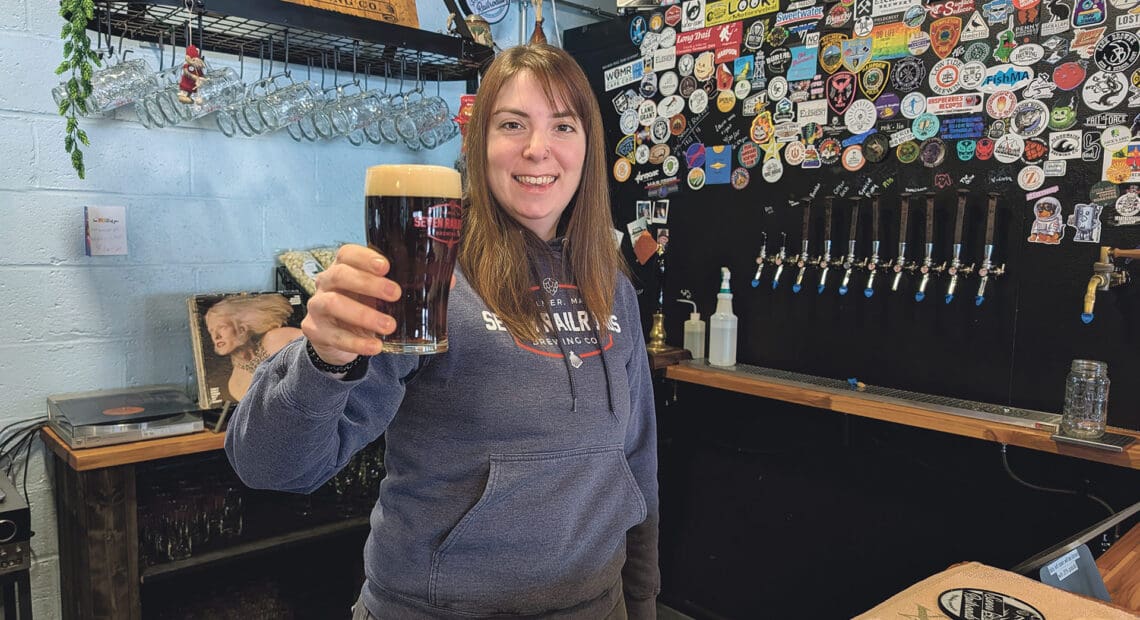
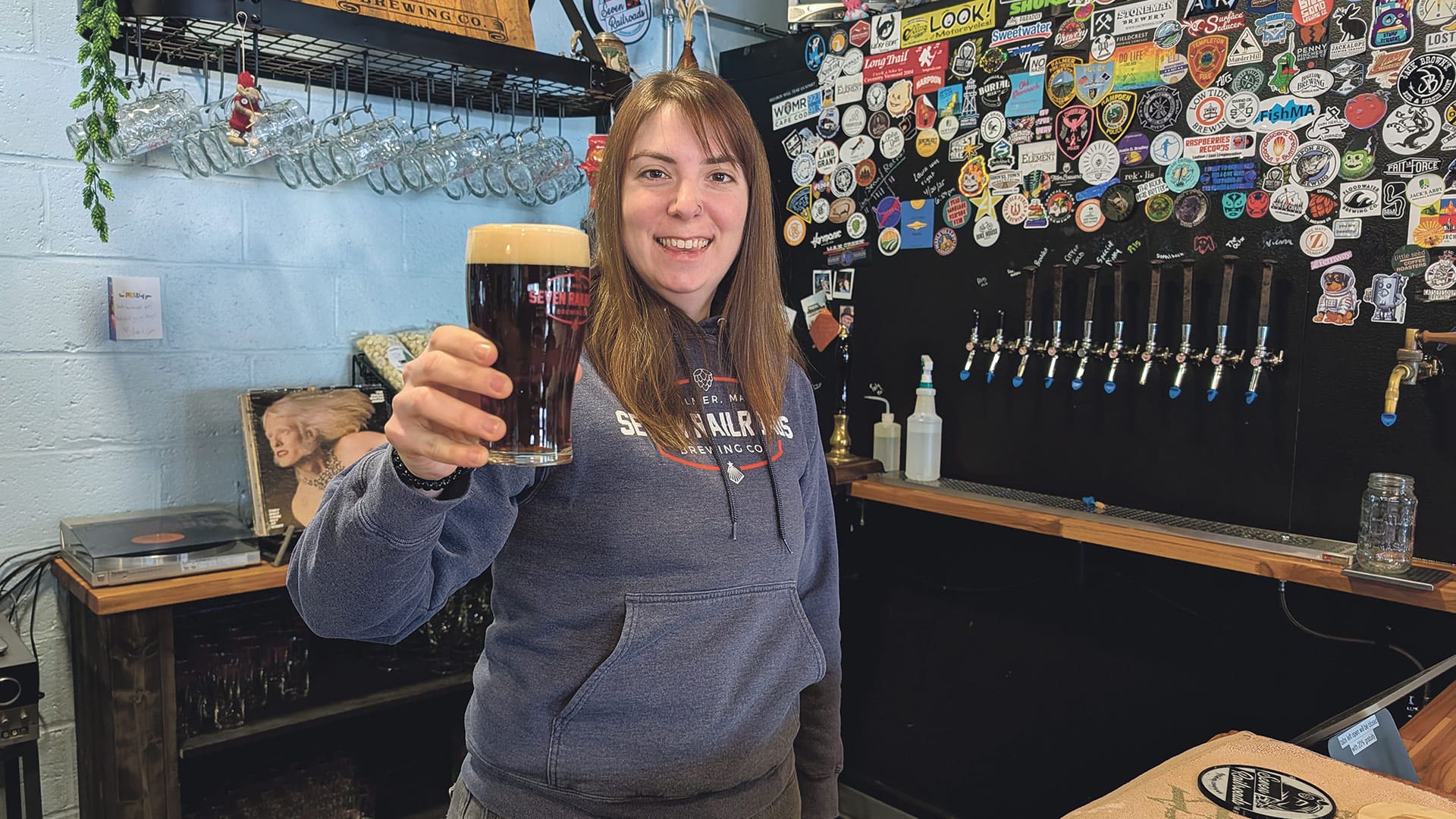
On the retail and hospitality side, Figlio, an Italian restaurant on Main Street, is opening another location; 527 Candle Co. has opened downtown; and Seven Railroads Brewing Co. is thriving on Route 20.

“Palmer’s a neat little town. There’s a steampunk museum in town, there’s a pinball league in town … we’re all trying to do things to make it more of a place that people want to come to, rather than just like, ‘Palmer, what’s that?’” said Rachel Rosenbloom, co-owner of Seven Railroads. “I used to joke, ‘Palmer: you drive through us.’ But now, we want it to be ‘Palmer: you come here for a reason.’ Because there are things to do in town.”

As for the future train station, the state is moving forward with its chosen site, an open field at 1099 South Main St., south of Palmer Yard, land owned by Sanderson MacLeod adjacent to its plant. It will be several years before the facility is up and trains are stopping there, but residents and businesses alike are intrigued with the possibilities, even though not everyone is happy with the location; many wanted it closer to downtown.

A rail stop can benefit existing businesses in the broad hospitality sector and foster new ventures as well, and advocates say rail service will make Palmer’s location, already attractive because of its turnpike exit and close proximity to the state’s second- and third-largest cities, even more appealing to the development community.

“We’re very excited about the rail project,” Przypek said. “The chamber is in favor of having a railroad site, and we almost don’t care where it is, but where they proposed it makes sense, from our standpoint.”

As for that pike exit, where a casino was proposed some years ago, that site is still open and available, Przypek said.

“Last year, we worked with town officials in Palmer to identify a number of commercial buildings where land is available for sale or lease,” he noted. “Every quarter, we update that and post it to our website to give folks who want to invest in Palmer a glimpse at the properties that might be available. We’ve done that with other towns as well, but Palmer certainly is the most active. I guess the message is that Palmer is open for business.”


Manufacturing Progress

Sanderson MacLeod, which currenly employs about 115 people, recently entered into a partnership with GutterBrush of Rhode Island, and is bringing all its work into Palmer, Borsari said. “We’ve found ways to become business partners with certain people and make both companies more successful for the community.

“It’s an opportunity to keep growing and bringing people in instead of cutting back,” he went on, adding that automation at the plant is also helping the company become more modern and offer more advanced, higher-wage positions as well. And those connections it’s making with local students is just another way to grow the future in Palmer.

“If we or other manufacturing companies want to survive with a new generation coming up, we have to find ways to make it a cool place to work. It can’t be that drippy, oily concept that people have in their heads when they think of manufacturing. What can we do to give people purpose in what we’re making together?

“It’s really critical,” he added. “So many jobs have gone overseas, but here we are in Massachusetts, selling brushes, a proud American manufacturer. So we’ve done something right.”

Sports & Leisure

Steady Course

Ed Twohig Jr.

Ed Twohig Jr. says the game — and business — of golf are in relatively good health, although for many, it has become a nine-hole proposition.


Ed Twohig Jr. has been in and around the game of golf for more than 60 years now.

So he speaks from experience when he says that, while he’s seen the game healthier, it is, at the moment, in a comparatively good place.

By that, he meant people are getting into the game and, by and large, staying with it, despite its cost, degree of difficulty, and demands on time. Therefore, he said, the business of golf is relatively good, with courses faring well, but also related ventures, everything from the growing number of simulation facilities to retail outlets to the remaining practice and learning facilities, such as the Western Mass Family Golf Center in Hadley, where he provides lessons to a diverse mix of students, from middle schoolers to those pushing 80.

“Over the past few years, I’ve taught a lot of college and high school kids, both men and women, who want to get into the game.”

“Overall, the game is very, very healthy,” said Twohig, who grew up around the game as his father, Ed Sr., served as the pro at Amherst Golf Club, and Ed Jr. would later serve as the pro at the Orchards Golf Club and Springfield Country Club. “Over the past few years, I’ve taught a lot of college and high school kids, both men and women, who want to get into the game.”

Jesse Menachem, executive director and CEO of the Massachusetts Golf Assoc., agrees on the general state of the game and the business of golf. He said maybe the best measure of health and vitality of the game — the number of rounds played at courses across the Commonwealth — has continued to rise since a COVID-triggered surge in 2000, but there are other barometers as well.

“Rounds played, golfer engagement, wait lists at many of the private clubs, tee times that are still in high demand … these are all indicators that the health of the game is strong,” he told BusinessWest, adding that, while the total number of rounds is up only a few percentage points, the upward trend continues.

One of the best examples of the strong health of the game is the stunning turnaround at the Ledges Golf Club in South Hadley, which this year will mark its 25th anniversary. Once a losing proposition for the town and its taxpayers and an example of overreach when golf was booming in the late ’90s, it is now turning a profit and putting these proceeds back into the course, with effective results.

Mike Fontaine says the Ledges continued its growth trajectory in 2025 and is eyeing more of the same for the season ahead.

Mike Fontaine says the Ledges continued its growth trajectory in 2025 and is eyeing more of the same for the season ahead.

“We had another fantastic year in 2025 — we probably made $1.7 million, more than covering operating expenses for the town,” General Manager Michael Fontaine said. “And our goal is to do it again.”

Elaborating, he said ookings of outings is ahead of the solid pace set last year, and the course can afford to pick and choose which events it wants to host, another departure from the rough times years ago.

Still, there are challenges for those in the business, especially those who own and manage its courses, including a winter that has been unlike anything the region has seen in some time.

Indeed, despite some closures in recent years — Southwick Country Club, Hickory Ridge Golf Club in Amherst, and Elmcrest Country Club in East Longmeadow, for example — there is still considerable competition at a time of rising costs for everything from fertilizer to labor to gasoline for the carts.

“Rounds played, golfer engagement, wait lists at many of the private clubs, tee times that are still in high demand … these are all indicators that the health of the game is strong.”

Fontaine said he’s been getting some calls and visits from those managing other courses in the area essentially asking how the Ledges is doing all this. He said there’s no real secret, other than to provide a good product and essentially count revenue, not rounds — and price the product appropriately.

Elaborating, he said he believes many courses keep their prices lower than they should — probably a nod to all the competition in the area — and could go higher and still be competitive, not just with courses in this area, but in other markets as well.


Winter of Their Discontent

As he talked with BusinessWest by phone on March 13, Ted Perez Jr., the long-time pro at East Mountain Country Club in Westfield, paused on a few occasions to take calls to the pro shop. They pretty much told the story of a winter the likes of which the region hasn’t seen in maybe a decade or more.

“Yes … we’re open,” he told one caller, who then moved on to finding out just how playable the course was. “I just talked to a guy who made the turn … he said it’s … not bad out there.”

Not many courses in Massachusetts were open that day, but most of them were getting calls about when they would be, said Fontaine, who fielded a few himself. Like others we spoke to, he said this long, harsh winter should create substantial amounts of pent-up demand, which will help override what will likely be a later-than-usual start, probably the first or second week of April.

“That’s what we’re hoping for; it’s been a long, brutal winter,” he said, adding that some of the calls he’s getting are from people in the eastern part of the state, including the Cape, where courses can generally open earlier. But not this year.

Overall, he said the Ledges logs a good number of rounds involving people outside this area code, including the Hartford and Worcester areas, where golf is somewhat more expensive.

“We draw from everywhere — Albany, Worcester, Boston … our biggest is probably Connecticut, and I think it’s mostly because we’re a little cheaper,” he said, adding that the course’s rate of $75 with a cart on weekend mornings (the price drops later in the day) is better than what can be found in those other markets.

He’s not sure what impact rising gas prices might have on all this, but for now, golfers are willing to travel to save a few bucks — if the product and experience are good.

“I don’t think they figure the gas bill into the equation — it’s just grab your three buddies, get in the car, and go have a good round of golf in South Hadley, have a burger, and head home,” he said, adding that this equation could work for others as well if they maintain the quality of the product and market it effectively.

Overall, many courses did well in 2025, said Menachem, adding that they were helped by generally good weather — there was a stretch where it rained at least one weekend day for 10 straight weeks in the spring — as well the opportunity to open early and stay open into December.

They won’t have that luxury this year, he went on, adding that, despite considerable melting in early March, snow still covered many tracks. Meanwhile, the large amounts of snow will leave courses wet and in need of time to dry out, firm up, and clean up.

But he expects this late start to be overcome by pent-up demand.

“Given the climate of golf and the demand we’ve seen and continue to see, players are going to be ready and willing,” he said. “It might be a shock to the system for these courses to get prepared on short notice, but once they open, they should do well.”

Meanwhile, other aspects of the golf business are reporting growth as well, especially the simulation facilities, which provide a hedge against New England winter weather and provide opportunities to practice year-round.

“Anecdotally, it seems like more facilities are opening by the week,” he said, adding that there have been several new additions in and around Boston, including facilities that are focused on food and beverage as much as they are on golf. “And it’s serving as a nice complement — keeping clubs in people’s hands throughout the year.”


Going for the Green

It was the spring of 1983 when Perez took over the pro shop register from his father, Ted Perez Sr., who essentially designed and built East Mountain Country Club himself in 1963. With 43 years under his belt, he’s seen all kinds of winters — or ‘non-winters,’ as he calls what the region has seen more of in recent years — and he’s seen the game ebb and flow as well.

He remembers the halcyon days in the late ’90s and early 2000s after Tiger Woods arrived on the scene, when East Mountain was averaging roughly 50,000 rounds a year. He also remembers 2008 and the years that followed, when the course averaged about half that number, and the overall outlook was quite bleak.

“These days, it’s nowhere near 50,000 rounds, but it’s much better than it was,” he said, adding that it was during those down times that East Mountain started diversifying, if you will, using its banquet facilities for everything from comedy nights to bands to pro wrestling matches to bring in revenue and help pay the bills.

“We get 150 people in here for the wrestling — they have some food and some drink and watch some wrestling,” he said, adding that there is another such event scheduled for later this spring.

The venue is still used for a variety of revenue-producing purposes, he said, but, overall, golf is doing better than it was, and the outlook remains bright.

Twohig agreed, but noted that, despite healthy interest in the game, challenges such as its cost and time demands remain. So he’s seeing some fundamental changes.

“I believe that, for the majority of players, it’s going to be a nine-hole sport because of the time element,” he explained. “If you look at the clubs and the leagues … it’s all nine holes. People get their golf in, but they’re not spending their whole day there; there are too many options in the world now.”

Meanwhile, golf doesn’t have to mean nine or 18 holes on a course, he said, adding that many now enjoy practicing or playing courses on a simulator or simply hitting balls at the few remaining driving ranges in the area.

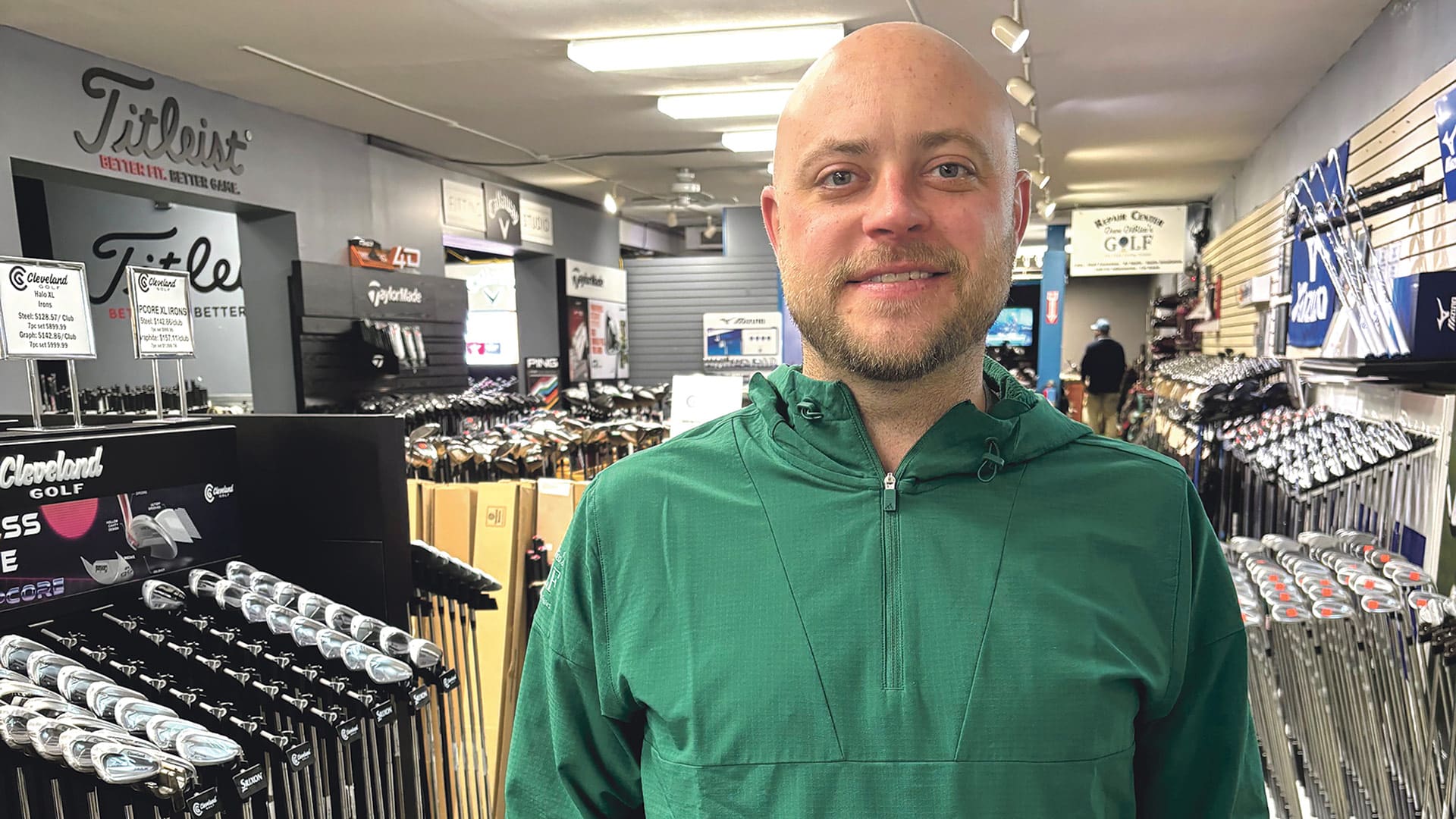
Drew Michael says golf has maintained the momentum generated during the pandemic, drawing new players of all ages.

Drew Michael says golf has maintained the momentum generated during the pandemic, drawing new players of all ages.

Drew Michael, store manager at Dave DiRico’s Golf in West Springfield, which features several simulators, agreed, adding that the surge in interest in the game since COVID is reflected in many aspects of his business.

That includes equipment sales, he said, adding that, in some respects, technology has helped make the game easier for many, and the winter and early spring months are generally the time to check out what’s new, whether it’s clubs, balls, shoes, or training aids.

And, like Twohig and others we spoke with, he said the sport — and the many businesses related to it — are maintaining the momentum gained during COVID.

“We’re seeing a lot of younger players, 25 to 35, and we’re seeing an uptick in women playing as well — those are the two fastest-growing categories,” he said. “It’s not quite like the book during COVID, but there’s still a lot of momentum with golf retail.”

He attributes this to the game gaining more exposure through everything from YouTube to TGL (Tomorrow’s Golf League), a high-tech, indoor, team golf competition that has succeeded in capturing the attention of many younger fans.

“You don’t have to tune in to CBS on a Sunday afternoon to watch a golf tournament,” Michael said. “YouTube is really big, TGL is gaining viewers, and you can watch any way you want — on your phone, computer, TV … all this is creating a wider audience.”

And it’s translating into more people getting into the game — and, in many cases, staying with it. Challenges remain, but golf seems to be a good place regionally, and on a steady course.

Accounting and Tax Planning

Defensive Measures

By Chris Wisneski

In 2026, businesses and nonprofit organizations are increasingly at risk of cyberattacks that can lead to very costly breaches.

Even a single incident can have severe consequences. In fact, the average cost of a data breach can exceed $4 million. For small and medium organizations, responding to a security breach usually costs more than $100,000.

Cyber insurance companies are raising their minimum coverage requirements. Many now scan customer networks for vulnerabilities and require controls like multi-factor authentication (MFA) and security awareness training to qualify for a policy.

The good news is that you can take steps to lower your cyber insurance costs and get more value from your policy. Here’s how you can lower your cyber insurance rates before you start shopping for coverage.

Chris Wisneski

Chris Wisneski

“Even a single incident can have severe consequences. In fact, the average cost of a data breach can exceed $4 million. For small and medium organizations, responding to a security breach usually costs more than $100,000.”


1. Multi-factor Authentication

A very effective way to lower cyber insurance costs is to use multi-factor authentication on all email and high-access accounts. MFA adds another layer of security by asking users to confirm their identity. MFA improves security by asking for two or more types of identity checks: something you know, like a password; something you have, like a token; or something you are, like a fingerprint.


2. Password Managers

Using a password manager is another good way to lower cyber insurance costs. Password managers create strong, unique passwords for every account and keep them safe in an encrypted vault. Since most people have many passwords to remember, password managers also make daily work easier and help prevent frustration from forgotten logins.


3. Train Your Employees

Studies show that more than 90% of security breaches happen because of human error. That’s why security awareness training is so important for reducing risk. Security awareness training teaches employees how to spot phishing emails, make strong passwords, and protect sensitive information. When your employees protect data well, your organization is less risky to insurers. By 2026, security awareness training is a required best practice and should be part of your main security controls.


4. Software Updates

It’s essential to keep your software up to date. Updates often include security patches that protect your systems from new threats. Make sure you have an automated patch management system that covers your operating systems, third-party apps, and network devices like firewalls. Cybercriminals often go after organizations that don’t keep their systems updated.


5. Cybersecurity Tools

Investing in cybersecurity tools is another critical step. These tools may include firewalls, antivirus software, application whitelisting, intrusion detection and prevention systems, and, increasingly, managed detection and response solutions. A cybersecurity professional can help you choose the right mix of tools for your organization’s needs.


6. Incident Response Plan

An incident response plan is a key part of any security program. It explains what your organization will do if there’s a cyberattack or data breach. Having a written plan helps limit damage and lowers the overall impact and cost of an incident.


7. Continuity Planning and Image-based Backup Solutions

Business continuity and disaster recovery plans are important parts of a strong security program. They help you recover systems and data quickly after a breach or disruption. Modern backup plans should use image-based backups, which save full system images for faster and more complete recovery. Use both local and cloud backups for the best protection.


8. Monitor Your Systems

Monitoring your systems helps you spot threats, vulnerabilities, and outages as they happen. Check logs and activity often to catch unusual behavior early. Active monitoring can stop small problems from turning into expensive security incidents and can mean the difference between a quick fix and major financial or legal trouble.


9. Be Proactive

Taking action early is one of the best ways to lower your cyber insurance premium and avoid surprise costs. When you lower your risk now, you can get lower premiums and are less likely to have future claims that raise your rates. This approach saves you money on both premiums and deductibles. Lowering your cyber insurance premium might seem hard at first, but it’s easier than you think. Taking these steps before you shop for coverage can make a big difference.


10. Get a Cybersecurity Risk Assessment

A risk assessment can help you understand your risks, strengthen your defenses, and better prepare for today’s cyber insurance requirements. And cyber carriers are now asking when you had your last one.


Chris Wisneski is IT Security and Assurance Services manager at Whittlesey. The Whittlesey technology team is made up of experienced cybersecurity professionals who work with organizations to assess risk landscapes and identify potential vulnerabilities, helping raise awareness before costly cyber incidents occur. Visit landing.wadvising.com/cybersecurity-health-check to learn more or to start a conversation.

Accounting and Tax Planning

Knowledge Is Power

By Liberty Bank

Tax season is here, and it requires us to be extra vigilant. Identity theft campaigns are common at this time of year.

Cyber criminals and fraudsters often rely on social engineering techniques to trick innocent victims into giving them personal information. This information can be provided directly or through a fake website for the IRS, or a fake website for tax returns.

At Liberty Bank, we want to provide you with information that will help you better recognize identify theft campaigns and ultimately avoid them.

“It helps when you know what to look for,” said Craig Bernier, Liberty Bank’s chief Information Security officer. “Vigilance and knowledge are important when it comes to avoiding scams. Before sharing your personal information with anyone, be sure to verify their legitimacy and do your research.”

Craig Bernier

Craig Bernier

“It helps when you know what to look for. Vigilance and knowledge are important when it comes to avoiding scams. Before sharing your personal information with anyone, be sure to verify their legitimacy and do your research.”

What to Know for 2026

Changes to tax filing programs and the discontinuation of a free government-run filing system can be confusing. Some taxpayers are uncertain what is legitimate, and scammers are taking advantage by creating “new filing options” and “tax program and eligibility updates.”

Scammers often use messages that advertise fake refunds or feature account alert messages that claim something is wrong. They rely on the pressures of tax season and are trying to create anxiety by making you believe that something is wrong with your tax return.

Some scammers promote fraudulent tax assistance by presenting themselves as legitimate government-backed or low-cost help.

Scammers use all available methods, such as phone calls, texts, emails, and social media posts to dupe taxpayers.


Tips to Avoid Scams

• Look for phrases such as “new rules” and “urgent account issue.” These phrases are designed to induce panic and quick responses.

• Take your time when evaluating any messages regarding your taxes and verify a message’s authenticity through a trusted third party.

• Do not click on any links, reply to any messages, or call any numbers included in suspicious communications. Instead, go directly to irs.gov for guidance.

• Remember, the IRS will never email you, text you, or contact you via social media. It will also never pressure you to do something immediately.

• It’s important to note that scam messages and emails may look real and may even have an IRS-style logo and ‘case’ number. Aspects of an email may look legitimate at first glance, but the email may ultimately be fake.

For more information about fraud protection and prevention, visit www.liberty-bank.com/personal/fraud-protection-prevention.

Features Special Coverage

Getting a Bounce

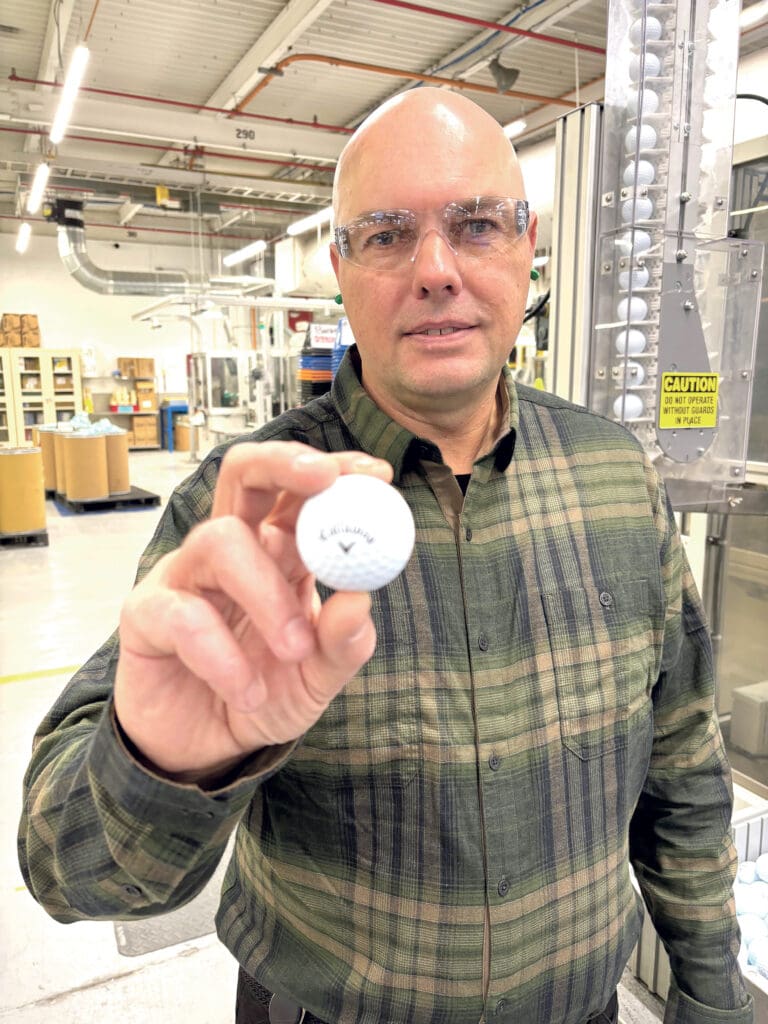
Algis Norkevicius says Callaway is the world’s second-largest golf ball manufacturer, and has its sights set on number one.

Algis Norkevicius says Callaway is the world’s second-largest golf ball manufacturer


Algis Norkevicius says it’s difficult to effectively quantify and qualify the overall impact from all those close-up shots of Callaway golf balls during television broadcasts as the professional golf tournaments wind to their climax on Sunday afternoons.

But he knows it certainly helps when ‘Callaway players’ such Akshay Bhatia storm from behind and win the Arnold Palmer Invitational, as he did earlier this month, or when Xander Schauffle is in contention at the Players Championship — and also at the Arnold Palmer Invitational. Or when Sam Burns is near the top of the leaderboard at the AT&T Pebble Beach Pro-Am.

“It’s great exposure for our products, and it’s fun to watch and follow these players,” said Norkevicius, senior director of Global Golf Ball Manufacturing for Callaway, which has facilities in different corners of the globe, but makes most of its balls in a sprawling facility on Meadow Street in Chicopee that was once home to Spalding.

He said these strong performances from those Callaway players comprise just one of many factors contributing to the company’s rise to number two among golf ball manufacturers, behind Acushnet, maker of Titleist, and on a path to steady growth — in sales, and in the number of balls produced at the Chicopee facility.

Another factor is the continued strong health of the game, which enjoyed a surge during COVID and has, by and large, been able to maintain that momentum since.

“Rounds of play and golf ball sales are directly correlated; statistics show that the average person uses around three golf balls a round,” Norkevicius said. “As rounds of play increase, so do golf ball sales. Last year, the National Golf Foundation released its annual report — golf grew again by 1% over the previous year, which was a record year.”

Then there are new products, such as the company’s recently introduced second generation of the Chrome Tour line, balls that tout greater speed, more consistency, and tighter dispersion, and are expected to be popular with players at all levels.

“We’ve grown our workforce, and we’ve increased our technical staff — all in pursuit of making a better golf ball.”

Norkevicius calls what’s going on at Callaway a “transformation,” one marked by everything from new products and the growing popularity of those products to new efficiencies in the manufacturing processes and, overall, more than $130 million in capital investments inside the facility.

“We took a look at each process and upgraded the equipment,” he said. “It started with our mixing line, and then core molding and injection molding; our printing equipment has been upgraded; and the last thing we’re upgrading is our packaging line, and we’re in the middle of that now.

“We’ve grown our workforce, and we’ve increased our technical staff — all in pursuit of making a better golf ball,” he noted, adding that recent results have shown that these substantial investments are certainly paying off.

Looking forward, he said the company is looking to continually grow its market share — the new Chrome Tour products are certainly expected to help improve those numbers — and eventually become the number-one golf ball maker in the world.

To get there, the company will look to make ever-greater use of technology, including artificial intelligence (AI) to not only produce a better golf gall, but achieve the most important quality in the manufacturing of these products: consistency.

The growing popularity of golf is a boon to manufacturers, as the average player uses about three balls per round.

The growing popularity of golf is a boon to manufacturers, as the average player uses about three balls per round.

For this issue, BusinessWest talked at length with Norkevicius about the golf ball business, the manufacturing of those products, and how Callaway continues on a strong growth trajectory.


Positive Spin

Norkevicius has been involved with golf ball manufacturing for nearly 30 years now. He started at Acushnet, which is both a company and a town in Bristol County where the golf balls are made.

He came to Callaway in 2019 to lead worldwide golf ball manufacturing operations, meaning the facility in Chicopee, but also other plants in Thailand, Taiwan, and Vietnam that produce mostly value and range products. He’ll visit those facilities once a quarter, on average, spending the bulk of his time in Chicopee.

“That knowledge base in how to make a golf ball is one of the key assets we have here.”

Over his time at Callaway, the company’s share of the overall golf ball market has risen from roughly 14% to 22% (Achusnet remains on top, with nearly 50% of the market). He attributes this to products that have captured the attention of players at all levels, such as those within what’s now known as the ‘Chrome family’ — the Chrome Tour, Chrome Tour X, Chrome Tour Triple Diamond, and Chrome Soft — but also other offerings, such as the popular Supersoft, Superfast, and Warbird.

Many of these balls are made in Chicopee, including the Chrome Tour products, as well as the Supersoft and the ERC Soft, he said, adding that the facility will churn out 5 million dozen golf balls a year, or 25,000 dozen a day, with three shifts operating five days a week (there are roughly 450 employees), with overtime on weekends during busy seasons — like this one.

Indeed, the months leading up the start of the golf season in the Sun Belt (March) and then the rest of the country (early- to mid-April) are among the busiest times for the Chicopee facility.

“There’s a seasonality to the business,” Norkevicius explained. “Typically, the summer months are one of the slowest times, and then it will ramp up in September and October in advance of the holidays, and then plateau — and then, around Memorial Day, it starts to get a little lighter.”

Overall, 2025 was another sold year for both the company and the Chicopee plant, he told BusinessWest, adding that the game continues to grow a percentage point or two a year in terms of the number of rounds played; as noted, this translates directly into more balls being used.

“We’ve created what I’d call a quantum data universe; on any given day, we’ll take 150 million data points from our processes, equipment, and our testing, and we load this data into the cloud. And from there, our engineers will use AI to help predict outcomes or potentially get ahead of failures before they occur.”

And this growth pattern is expected to continue in 2026, especially as the company releases the next generation of its Chrome Tour products, first introduced in 2024.

“We changed the ball so significantly that we separated Chrome Tour from Chrome Soft,” he explained. “That marked a leap in technology and performance. And over the past two years, we’ve continually refined the golf ball, working with R&D on some material changes as construction changes to optimize it even more, adding more speed and more distance, and then we were able to decrease our dispersion along the fairway; the ball lands in a tighter spot compared with previous models.”

The Chicopee plant started producing the new Chrome Soft balls last summer, he went on, adding that production has ramped up as the new season draws closer.


Drive to Improve

As he gave BusinessWest a tour of the Chicopee plant, Norkevicius said its best asset is its workforce, which boasts many team members who have been making golf balls for decades — some for a half-century.

“That knowledge base in how to make a golf ball is one of the key assets we have here,” he said, adding that the company has been working to blend this experience with new technology and improved processes to take golf ball manufacturing to the proverbial next level.

This includes the use of AI, which Norkevicius called one of the plant’s more significant advancements over the past several years.

“We’ve created what I’d call a quantum data universe; on any given day, we’ll take 150 million data points from our processes, equipment, and our testing, and we load this data into the cloud,” he explained. “And from there, our engineers will use AI to help predict outcomes or potentially get ahead of failures before they occur.

“They can monitor our processes, and as soon as there’s an indication that a process may be going out of control, they will alert a technician or engineer, and they can address that before we make a bad product,” he went on, adding that, with golf balls, the most important quality — even above distance, which is still important — is consistency.

“With every golf ball you use, you want it to perform the same … and we want to ensure that each ball goes the same distance, has the same dispersion, same flight, same spin,” he said. “And to do that, it’s difficult. Making golf balls is hard, and if we can understand and control all these parameters, we can make it a little easier.”

Elaborating, he said there is much that goes into the making of a golf ball, from its core to its cover; from rubber chemistry to injection molding, and maintaining quality through the many stages of the complex process is as difficult as it is essential.

“It’s not an easy process — it’s very challenging, especially to make things consistent,” Norkevicius told BusinessWest. “We need to have those controls in place, we need to have the knowledge of our processes, and we need to have those tools to help us identify when those processes go out of control — or start to go out of control.”

AI also helps the R&D teams create better products, he added.

“They can create virtual models based on what’s going on here, and then come up with an even better model for the next generation,” he explained. “They can basically do this analysis and future trials, utilizing AI to do that — they can then predict outcomes. Things that would take weeks to do, to test and compile … we can do that in minutes today.”

With this focus on quality and the use of technology to not only make better products but produce them more efficiently and more consistently, Norkevicius believes Callaway is well-positioned to not only continue on its strong growth trajectory, but achieve that ambitious goal of rising to the top among golf ball manufacturers.

“With the investments we’ve made here and the continued improvements to our products and processes, we know we have the foundation in place to increase our market share,” he said, adding that Callaway shares a goal common with golfers of all handicap levels — continuous improvement.

Accounting and Tax Planning Special Coverage

A Gen Z Perspective

By Samantha Calvao

The accounting profession is undergoing a generational and technological transformation. As seasoned professionals retire and new talent steps in, members of Gen Z (those born between the late 1990s and the early 2010s) are beginning to leave their mark.

For this group, career advancement is not defined solely by promotions or years of service. Instead, it’s about building adaptable skills, seeking meaningful work, and maintaining flexibility in a profession that’s shifting faster than ever before.


Starting a Career in a Changing Industry

Gen Z’s first years in accounting look different from those of earlier generations. Many individuals now start early in their careers by gaining experience through internship programs, where they develop a deeper understanding of the accounting industry by actively engaging with seasoned professionals and learning from their real-world experiences.

The days of starting with stacks of paper and hours of manual reconciliations are largely gone. Modern accounting systems, automation tools, and cloud platforms handle much of the repetitive work that once defined entry-level roles. This change means new graduate hires often jump directly into analysis, client communication, and strategic discussions — responsibilities that previously took years to reach.

Because of this early exposure and industry evolution, many young professionals are shaping careers that are more fluid than linear. They are open to moving between public and private practice, trying out specialized areas like forensic investigations or sustainability reporting.

In addition to moving between private and public, young professionals are open to being cross-trained in multiple industries and services. This diverse approach to career development provides opportunities for growth from multiple perspectives, positioning career advancement as a menu of options rather than a rigid path.

Samantha Calvao

Samantha Calvao

“Many Gen Z professionals seek roles where they can make a meaningful impact, whether by contributing to sustainability initiatives, participating in socially responsible projects, or aligning with companies that demonstrate strong ethical standards.”

Workplace culture plays a central role in these decisions. While salary still plays a factor, Gen Z places high value on flexible schedules, hybrid work arrangements, and leaders who prioritize a balance between well-being and workload. The young accountants anticipate regular feedback instead of waiting for annual reviews. They look for mentors who will provide guidance not only on technical work, but also on professional development and career planning.

Learning, Connection, and Purpose

For Gen Z, professional development is an ongoing process. Beyond the mandatory continuing professional education hours, they actively pursue training in areas such as data visualization, financial modeling, and cybersecurity. Many are drawn to learning methods that fit into busy schedules, consisting of short online modules, peer-led workshops, or interactive webinars. They appreciate employers who support a variety of educational formats creating the diverse web of opportunities in a career.

Networking has also evolved for this generation. While in-person industry events remain valuable, digital spaces have expanded their reach. Platforms like LinkedIn, virtual conferences, and even niche online communities allow Gen Z accountants to connect with peers, mentors, and potential employers around the globe. These connections often lead to opportunities that traditional local networking might not uncover.

Firms support young professionals by having business development groups, allowing them to take initiative in creating relationships among themselves and further in the business community. Business development groups not only expand young professionals’ networks, but also help them build essential soft skills such as communication, leadership, and relationship management, all vital for long-term career growth.

Purpose-driven work is another key motivator. Many Gen Z professionals seek roles where they can make a meaningful impact, whether by contributing to sustainability initiatives, participating in socially responsible projects, or aligning with companies that demonstrate strong ethical standards.

In short, firms should encourage young professionals to be actively involved with internal business development groups, niche-driven work, or being deeply rooted in ways to give back to the community.


The Road Ahead

As Gen Z gains experience and advances within the profession, their influence is likely to accelerate ongoing changes in accounting. Their desire for adaptability, meaningful engagement, and skill diversity aligns closely with the industry’s shift toward technology-driven advisory services.

They also understand that technical expertise alone won’t guarantee long-term success. Many are actively seeking opportunities to strengthen soft skills like leadership, collaboration, and clear communication abilities that enhance client relationships and open doors to management roles. By blending strong interpersonal skills with technical knowledge, they are positioning themselves for a wide range of career options, including roles that didn’t exist a decade ago.

In the years ahead, Gen Z will continue to build the profession, pushing for workplaces that balance tradition with innovation and value both the numbers and the people behind them. For these emerging professionals, accounting isn’t just about maintaining the books — it’s about creating a career that reflects their values, skills, and vision for the future.


Samantha Calvao, MBA is a senior associate at the Holyoke-based accounting firm Meyers Brothers Kalicka, P.C.


Architecture Special Coverage

Music to Their Ears

A rendering from Kuhn Riddle Architects & Designers of the planned exterior of Old Town Hall in Easthampton.

A rendering from Kuhn Riddle Architects & Designers of the planned exterior of Old Town Hall in Easthampton.


For Andrew Bagge, the ongoing CitySpace project in Easthampton is a meaningful endeavor in more than one way.

“Two of the greatest assets in Western Mass. are beautiful old buildings and community-minded nonprofits. Pairing the two is really a win-win situation,” said Bagge, senior architect with Kuhn Riddle Architects & Designers in Amherst, which began collaborating on the project in 2016. “Over those 10 years, we’ve been working closely with CitySpace to help them realize their vision for the entire project, including the entry addition and second-floor performance space.”

And recently, the project received a massive boost from the federal government: $3.5 million in congressionally directed spending to support the ongoing restoration of Easthampton’s historic Old Town Hall, a significant boost to the long-term effort to transform the landmark into a fully accessible, multi-level center for arts, culture, and community life.

Specifically, the funding will advance the next phase of work to restore the building’s second floor as a 350-seat performing arts venue.

“The restoration and development of Easthampton’s Old Town Hall serves as a shining example of what is possible when a community has a vision,” said U.S. Sen. Edward Markey, whose office — and that of U.S. Sen. Elizabeth Warren — worked with CitySpace and local partners to further advance the project. “CitySpace, local leaders, and the Easthampton community have breathed new life into this historic structure, transforming a stranded municipal asset into an anchor of the local economy and a nexus for community initiatives.”

Easthampton Mayor Salem Derby added that “this $3.5 million federal investment is a powerful vote of confidence in Easthampton’s vision for Old Town Hall and in the extraordinary work of CitySpace to bring that vision to life.”


Two Decades in the Making

For more than a century, Old Town Hall housed municipal offices, and while its second floor served as a public performance and gathering space, it has been unusable for more than two decades.

The nonprofit known as CitySpace began managing the first floor of Old Town Hall as a multi-genre arts and community center in 2006, one that now welcomes more than 15,000 visitors annually. In 2019, the organization secured a 40-year lease from the city of Easthampton to fully manage Old Town Hall and restore the second floor, a project its leaders say has been shaped by regional community input and the needs of the performing arts community.

“Two of the greatest assets in Western Mass. are beautiful old buildings and community-minded nonprofits. Pairing the two is really a win-win situation.”

Since Burns Maxey joined the CitySpace board in 2011 — she became board president in 2015 — she and her all-volunteer team have worked to create a flexible arts and community space in Old Town Hall, which was built in 1869 and housed the town’s municipal offices until 2003. They have helped secure Community Preservation Act funds, multiple foundation grants, and historic tax credits, as well as operating a capital campaign in an effort to raise about $8.5 million for the project.

Phase one of the project involved renovation of the first floor, including the creation of a small, 80-seat rental performance space called the Blue Room. In conjunction with that, Maxey established a program called Pay It Forward to allow low-income artists the resources, space, and support to create or collaborate on a project, or have a residency to complete a project prior to public performance. The first floor also includes a number of art spaces.

Phase two of the project, which has already seen the HVAC system upgraded and modernized, will introduce a new accessible entryway, an elevator serving every floor, and the repair and display of a historic stained-glass window on the building’s street-facing entryway.

Michael Tautznik, the former long-time mayor of Easthampton who now serves as board treasurer for CitySpace, told BusinessWest that “the intention back in 2018 was to try to do this in one shot, but as we saw inflation and as COVID come in, we decided that it just wasn’t feasible. So we’ve broken that project down into three phases.

“We’ve got a great local contractor, Keiter Corporation, that’s doing the work, and we’ve had help from a couple of state grants, the city of Easthampton, and some very generous donors. And we’ve got that project underway; it’ll be finished this summer. And then we’re going to move into the final design and hopefully execution of the final phase, which is to create that venue on the second floor. That’ll be for entertainment, but it will also be a place for public gathering and just a way to celebrate that building’s history.”

The new federal funding will advance that third phase — easily the most expensive part of the project — which centers on the restoration of the second floor, creating a 350-seat performing arts venue in the space that once served as the building’s historic meeting hall, including restoring the ceiling and floors, adding restrooms, installing new electrical and fire safety systems, and investing in state-of-the-art theatrical and lighting equipment.

“The addition is a contemporary steel and glass structure, creating a light and transparent distinction between new and old. The materials, lighting, and finishes complement the existing building and establish an inviting presence on Main Street.”

Tautznik said the project reflects Easthampton’s growing identity as a hub for arts and culture — a priority for many regions, he added, and one he has seen the city embrace through reuse of its copious mill space.

“Easthampton is a community that has become aware of its purpose in the arts. The idea that arts are just for entertainment, I think, is past. We look at the arts as an economic engine. Our mill space is pretty inexpensive, so it attracts tenants that maybe can’t afford to be in downtown Springfield or class A space. So, from the perspective of reutilizing older mill buildings, you become an attraction. And bringing people into the community brings traffic to your downtown, which supports local businesses.”

As for the future performance space upstairs at Old Town Hall, he said it meets a regional need. “It’s a size that isn’t readily available in the region. There are lots of smaller venues, 200 seats and under, and there are some big venues — well, big for this region. But there’s not a lot in the 300- to 500-seat range.

Mike Tautznik

Mike Tautznik

“The idea that arts are just for entertainment, I think, is past. We look at the arts as an economic engine.”

“We think that there’s a real opportunity to try to tap into some of the artists that move through the Northeast,” he added. “It’s also the kind of space that an up-and-coming artist might be able to fill. And that’s important when you have a show, when you’re doing a performance — you want a full house. Bringing a 300-person performance to an 800-seat venue is sometimes disheartening for the artist.”


Realizing the Vision

For Bagge, the project is a chance to positively impact what is arguably the most iconic building in Easthampton.

“The primary goal of the addition is to provide an accessible way for the public to enjoy the entire building, particularly the second floor,” he said, adding that a “nuanced challenge” for Kuhn Riddle was to minimize the project’s impact on the building’s historic form while also showcasing CitySpace as a vibrant hub for the arts — in other words, respecting both old and new.

“The addition is a contemporary steel and glass structure, creating a light and transparent distinction between new and old,” he noted. “The materials, lighting, and finishes complement the existing building and establish an inviting presence on Main Street.”

Another hurdle was achieving all of this within the limited space adjacent to the building, which remains a challenge during construction.

“We’re asking a lot of a small elevator addition, but collaborating with a forward-thinking client has made it all possible. We’re applying the same strategies moving forward with the second floor performance space design, which will be the main event.”

Bagge said Kuhn Riddle has worked on countless adaptive reuse projects to help organizations like CitySpace find their home in an existing building.

“When we lose historic buildings, we collectively lose a piece of our cultural heritage, which plays a vital role in the unique character of the Valley,” he told BusinessWest. “I’m hopeful that our building codes will adapt to recognize the carbon impact of removing and replacing an existing building. The embodied energy in these buildings should be treated as an asset. It has been incredibly gratifying working on the Old Town Hall and collaborating with a client who understands the value in historic buildings.”

As for Tautznik, who has been both working and volunteering in Easthampton for more than 50 years, “I see this personally as an investment in my community, as a way to provide an anchor for that part of downtown,” Tautznik said. “The building is a place I remember as a child. Then when I first served as a selectman, it was in that building. And when I first became mayor, it was in that building.

“The fabric of the community is really what its citizens make it,” he added. “I hope to be a thread in the weaving of that fabric. And I think CitySpace is a big panel in that fabric. And the benefits are going to far outweigh the costs, which are the immediate challenge. It’s going to be exciting.”

Special Coverage Where Are They Now?

Where Are They Now?


Samalid Hogan

Samalid Hogan as a 40 Under Forty honoree in 2013 (below), and today.

Samalid Hogan in 2013

Samalid Hogan in 2013


Samalid Hogan likes to say she practices what she preaches.

By that, she means she applies what she tells her small business consulting clients — as well as those she assists as director of Business Support Services for the Boston Impact Initiative — to her own entrepreneurial ventures, including her latest one, Greylock Management Consulting, for which she has some ambitious expansion plans we’ll get to in a bit.

“I tell people the most important things are to know what your business is really good at, and keep an eye on the market, the industry, so that you know where things are going in the future, so you can be prepared to pivot and change your business model,” she said, adding that she does just that with Greylock, a growing venture that provides a wide portfolio of services that will soon get wider.

Hogan also likes to say she speaks the language of small business owners — because she’s been there (and is there), so she can relate to what they’re going through. She can speak from experience about what has gone right and, just as importantly, the mistakes she’s made and seen others make.

Hogan’s résumé is complete with a number of stops involving work with small businesses, many other aspects of economic development, and work on both a community- and region-wide basis. And while assisting entrepreneurs at many of these stops, she has always been entrepreneurial herself.

Indeed, her first professional stop was chief of staff for state Rep. Cheryl Coakley-Rivera in 2003. Later, she served as an economic development and policy analyst for the Pioneer Valley Planning Commission.

She was working as senior project manager and brownfields coordinator for the city of Springfield when she was selected as a member of BusinessWest’s 40 Under Forty class of 2013, and she was serving as regional director of the Massachusetts Small Business Development Center when she won the coveted Alumni Achievement Award — given each year to a 40 Under Forty alum who has most notably built on their success — in 2017.

Along the way, there have been entrepreneurial ventures of her own, such as CoWork Springfield and different consulting ventures, culminating with Greylock, which she launched in 2021.

There have been several other awards along the way as well, everything from the Women Trailblazers and Trendsetters Award from the Latino Chamber of Commerce to the Harold Grinspoon Foundation’s Entrepreneurial Spirit Award; from the Gateway Cities Innovation Award to her latest honor, the ALX 100 Award for Latino Leaders in Massachusetts.

“I don’t like telling people what to do. I want to help them discover their path, but also learn from others’ mistakes, so they don’t make those same mistakes, which can be costly.”

The various words in those award titles — ‘leader,’ ‘innovation,’ ‘trailblazer,’ and others — speak to how Hogan has dedicated her career to not only inspiring entrepreneurship and assisting small businesses, but also being involved in the community on many different levels.

And while the honors are nice, she says a greater reward has been her involvement, at various levels, with some intriguing entrepreneurial success stories — in this region and beyond. These include Las Kangris Restaurant & Bar in Springfield, for which she helped secure a $50,000 BizMPower grant from MassDevelopment; GJC Signs & Digital Signs; and Rozki Rides, a transportation service in Springfield.

For this latest installment of its Where Are They Now? series, BusinessWest checks in with Hogan, who is always getting down to business — and helping others do the same.


Reaching Higher

As for Greylock Consulting, that name was chosen as a nod to the state’s highest mountain and how she can help her clients achieve similar altitude, if you will, with their ventures.

“We want to take small business to new heights,” she said, adding that, as a consultant, and in her work with the Boston Impact Initiative, she acts as a guide of sorts, but one that lets the business owner choose the path. She acts to help keep that path clear of crippling setbacks.

“I don’t like telling people what to do. I want to help them discover their path, but also learn from others’ mistakes, so they don’t make those same mistakes, which can be costly,” she told BusinessWest. “It’s a great advantage, and I think I speak with a lot of credibility with the entrepreneurs. They’ll say, ‘she knows, she understands, she knows this is a 24/7 thing.’ As a business owner, you’re never off the clock. You might go on vacation, but you’re still thinking about it.

“I understand the frustration and the hard work it takes to run a successful business and the ups and downs that come along the way,” she went on. “Whether you’re dealing with people or cash flow issues, or your industry is changing, such as with AI, there’s always juggling.”

Helping business owners keep the many balls they’re juggling in the air has become a career for Hogan. In her current capacity with the Boston Impact Initiative, she provides strategic advisory and technical assistance to early-stage and growth-stage businesses, helping entrepreneurs strengthen business models, financial stability, and community impact.

In that role, she’s been involved in several key initiatives, including the securing of $532,000 in state Small Business Technical Assistance funding to launch and operate Accelerate Your Impact, the agency’s pre-investment business coaching program, as well as co-designing the GreenEdge Accelerator, a statewide program supporting 23 women and minority-owned businesses in the clean energy and climate sectors.

At Greylock Consulting, she is part of a small team that provides an array of services, including business development, operations development, financial models and business plans, applications for funding, technical assistance, marketing, and more.

That team, and that list of services, are both set to grow, Hogan said, adding that she is responding to recognized need in the marketplace with expansion plans.

“We’re going to be offering business support services in addition to the coaching that we do; this will include bookkeeping, human resources, payroll, marketing, and website development, as well as AI tools,” she said, noting that these additions will be launched in April.

“I understand the frustration and the hard work it takes to run a successful business and the ups and downs that come along the way.”

She’s been contemplating this expansion effort for some time now, noting that it was inspired in part by a study on barriers confronting minority contractors in Western Mass. as they bid for contracts. It revealed that, while these contractors were good at their various trades, they needed help with various aspects of running their businesses, such as back office help.

So Greylock is responding to this need in an aggressive but measured way, another example of practicing what she preaches to her small business consulting clients.

“I said, ‘we need something here in Western Mass. that can provide all those services under one umbrella,” she said, sounding like a true small business owner when she added, “I’m excited about all this, and I think it’s going to be great, but I’m also a little nervous. It’s a lot of moving pieces, and I’m bringing on three additional people.”


Stepping Out

As she moves forward with plans to expand her business, Hogan is also getting more involved in the community, another aspect of being in business that has always been very important to her.

Indeed, she is currently a trustee at Springfield Technical Community College, a board member at Tech Foundry and the Springfield Regional Chamber of Commerce, a member of the Governor’s Latino Advisory Committee, and vice president of the Rotary Club of Springfield.

“Slowly, I’ve been able to support more community more,” she said, citing, as just one example, becoming a sponsor of the Service Above Self luncheon put on by the Rotary Club and the Basketball Hall of Fame. “To me, it’s very rewarding to be able to make those investments in our community.”

All this sounds fitting for someone who has not only a 40 Under Forty plaque on her desk, but an Alumni Achievement award as well — and continues to build on all of it.

Community Spotlight

Community Spotlight

Eric Nakajima says he wants to take full advantage of Holyoke’s many assets, including mill space, a business-friendly government, and green energy.

Eric Nakajima says he wants to take full advantage of Holyoke’s many assets, including mill space, a business-friendly government, and green energy.


Eric Nakajima recalls that, while earning his master’s degree in city planning from the University of California, Berkeley 25 years ago, one of first assignments in one class was to essentially explain why he was there.

“I said that I wanted to learn how to help communities like Holyoke,” he said, adding that he got to know the city soon after his family moved to Amherst from New Jersey when he was 7 and was later struck by how much the community was impacted by the loss of its manufacturing base. “I named Holyoke all the way out in California; I wanted to understand better how you work with the city, work with the community, work with the markets, work with the business environment you’re in to create jobs and good placemaking.”

And 25 years later, that’s essentially his job description as the new director of Holyoke’s Office of Planning & Economic Development, succeeding Aaron Vega, who is now serving as president and CEO of the Western Massachusetts Economic Development Council.

He arrives in City Hall with a diverse résumé, including roles with the Deval Patrick administration on Beacon Hill, and at an intriguing time for the community, one of progress on several fronts, including housing, downtown revitalization, entrepreneurship, and job creation, but also some setbacks, especially when it comes to what was shaping up to be one of the city’s better economic development stories. That would be Sublime Systems, which had plans to build a plant on Water Street and produce low-carbon cement — plans now on hold after the loss of a large federal grant.

“I named Holyoke all the way out in California; I wanted to understand better how you work with the city, work with the community, work with the markets, work with the business environment you’re in to create jobs and good placemaking.”

When asked about whether those plans might eventually materialize, Holyoke Mayor Joshua Garcia shook his head slowly for emphasis and said, “it certainly doesn’t look like this is going to happen.”

But while Sublime likely won’t be part of the picture in Holyoke, there are plenty of bright spots in the Paper City, including:

• New housing projects in various stages of development, from 700 recently completed units at the former Farr Alpaca mill (and more in phase 2 of that development) to 84 units planned for Open Square, to several smaller projects in and around the downtown area. Add them all up and they make a real dent in the city’s huge need for housing and bring promise to spur new businesses to support those residents;

• A chamber of commerce that is moving on from controversy involving its former president, Jordan Hart, who was terminated just over a year ago and is the subject of a criminal complaint alleging financial misappropriation. Interim Director Lisa Totz said the agency is adding members as well as events to the schedule and, in general, looking for new ways to bring value to its members;

• A utility, Holyoke Gas & Electric, that continues to be a force in economic development by offering clean, comparatively lower cost energy that is bringing attention to the city from different types of businesses, including data centers, which are looking at several possible sites, including the property on Water Street that was due to become Sublime’s new home (more on that later);

• A cannabis sector, spawned by that lower-cost energy and hundreds of thousands of square feet of vacant mill space, that is “holding its own,” said the mayor, despite turbulence in that sector;

• Plans to redo and simplify the city’s zoning and permitting processes to facilitate new business development;

• A massive retail center, the Holyoke Mall at Ingleside, that continues to adjust to changes in the marketplace with a mix of tenants that is shifting increasingly toward the entertainment side of the spectrum, with a massive pickleball facility being the latest addition and a huge Dick’s House of Sport, an immersive facility complete with batting cages, golf simulators, and rock climbing walls, set to open in the spring of 2028;

• A new initiative called Greater Ingleside 2050 that will bring together stakeholders in that area of the city and create a roadmap for what it could look like in the milestone year; and

• Long-term projects such as revitalization of the Victory Theater and a planned sports complex, which, if they become reality, could greatly contribute to the vitality and quality of life in this community of nearly 40,000.

For this latest installment of its Community Spotlight series, BusinessWest takes an in-depth look at the many converging storylines in Holyoke, starting with its new economic development director.


Background — Check

Nakajima said that, while he knew a lot about Holyoke before taking the economic development job, there has still been a learning curve, and on many levels.

“I’ve worked with a lot of city halls, but I’ve never worked in a city hall,” he told BusinessWest. “So understanding and navigating city hall has been a challenge itself. I haven’t found it hard, but if you haven’t done it before, there are a set of processes to learn; it’s similar, but distinct from what you have at the state level.”

As noted earlier, he has plenty of experience at the state level, especially during the tenure of former Gov. Deval Patrick.
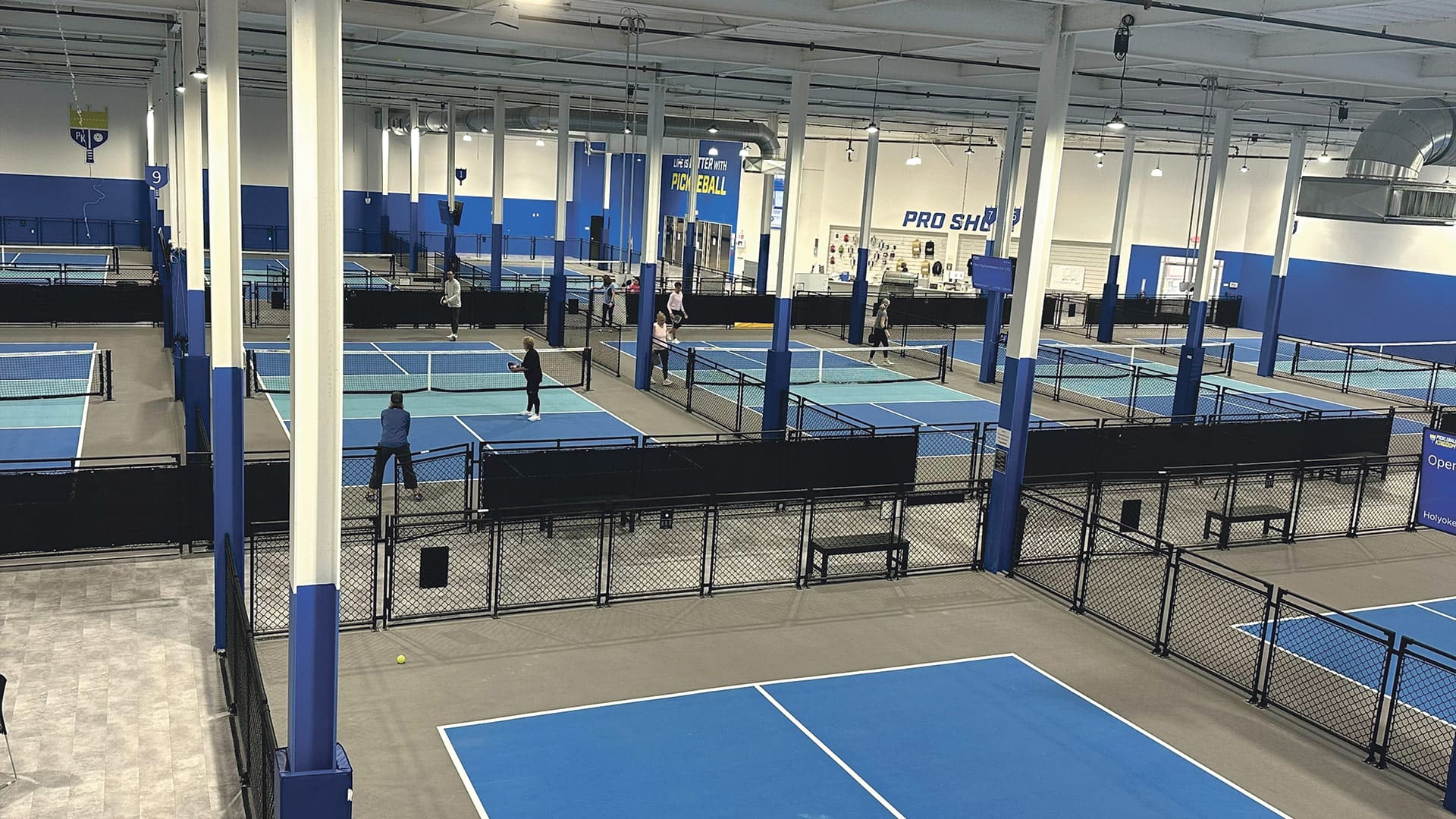
Pickleball Kingdom opened its doors and its courts just a few months ago at Holyoke Mall.

Pickleball Kingdom opened its doors and its courts just a few months ago at Holyoke Mall.

Indeed, he served the Patrick administration first as senior innovation advisor within the Executive Office of Housing and Economic Development, starting in 2010, and then as assistant secretary for Innovation Policy in that office from 2012 to 2015. During that time, he became involved in several initiatives involving Holyoke, including as project lead for all aspects of developing the Massachusetts Green High Performance Computing Center (MGHPCC).

Before and after his work in the State House, Nakajima has been involved with economic development, especially with Gateway cities, such as Holyoke, on many levels and with many different agencies.

His résumé includes a stint as senior research manager for the Economic Policy Research Unit at the UMass Donahue Institute; a short stint as director of the Massachusetts Broadband Institute, a division of the Massachusetts Technology Collaborative; work as a consultant in economic development policy and planning; and, most recently, as a director of Government Relations for the Massachusetts Teachers Assoc.

“My work with the city then, on behalf of the state, made me fall in love with Holyoke and really believe in the potential of this city.”

This body of work has made him more familiar with Holyoke and the challenges and opportunities it faces, he said, adding that, in addition to his work on the high-performance computing center, he’s been involved with several area Paper City initiatives, from the Lyman Terrace housing project to the introduction of rail service to the redevelopment of the Cubit Building, now home to several market-rate housing units as well as the HCC MGM Culinary Arts Institute.

He said he was drawn to the job in Holyoke’s Office of Planning & Economic Development for the same reasons he listed back at Berkeley, as well as his previous experiences with the city and a desire to build on the momentum that’s been created there in recent years.

“My work with the city then, on behalf of the state, made me fall in love with Holyoke and really believe in the potential of this city,” he said. “I really admire the people that I’ve worked with, many of whom are still around today. It’s what attracted me to come here.”

He said there are several priorities moving forward, including efforts to encourage more housing development, work to redevelop the many vacant or underutilized properties on and around High Street in the downtown area (housing is certainly one of the possible uses), and continued encouragement of entrepreneurship.

As for ongoing work to revamp and simplify zoning and special permit processes, Nakajima said this work isn’t sexy, but it can and will certainly help with economic development efforts.

“This is going to make City Hall easier to deal with, and it will advertise the fact that we are open for business in ways that we’ve always said we were, but now it’s going to feel like it when people come here and knock on the door and work through the process,” he said. “It’s a very big deal.”

As for housing, Garcia said the city will work to encourage not only more development, but housing across a broad spectrum, including market-rate units, such as those planned for Open Square, which could serve to keep people in Holyoke.

Holyoke Mall is evolving, with entertainment-related facilities now accounting for roughly 30% of its space, compared with 10% just a decade ago.

Holyoke Mall is evolving, with entertainment-related facilities now accounting for roughly 30% of its space, compared with 10% just a decade ago.

“Holyoke has traditionally done very well with making sure we looked out for our most vulnerable populations, but we never really thought about what happens when people’s circumstances improve,” he explained. “Currently, we have a system where you start here, you get on your feet, and once you do well, you leave. We’re still going to support affordable, workhouse housing, because that’s important, but we want to introduce market-rate housing much more aggressively into that portfolio.”


Getting Down to Business

Nakajima said he also plans to take full advantage of the city’s many assets moving forward. These include that aforementioned mill space, which can be converted for many different uses; a city government bent on being business-friendly; and green — and comparatively cheap — energy.

That last item on the list has certainly helped with economic development efforts, especially in recent years, as companies continue to seek green energy alternatives, said Jim Lavelle, general manager of HG&E, adding that this asset certainly caught the attention of cannabis growers.

And, more recently, it has drawn attention from developers looking to build data centers, he said, adding that the city has the land — including the site Sublime had targeted — and the capacity to attract such facilities.

Still, there is concern about the high energy and water usage of AI data centers and also about large amounts of real estate being absorbed for comparatively few jobs, said Lavelle, noting that a proposal was introduced recently to amend the city’s zoning ordinance to effectively ban data centers in the city.

The proposal was under discussion of the ordinance committee and continued until later this spring, he noted, adding that, while there are concerns about such facilities, privately operated data centers do bring some jobs and needed tax revenue.

“Some of the inquiries we’re fielding are for facilities in the 50- to 60-megawatt realm,” he said, adding that, for perspective, the MGHPCC is a 5-megawatt facility.

The HG&E could handle one or even a few of these larger facilities through expansion of its substations, said Lavelle, adding quickly that one 60-megawatt data center would nearly double its current peak summertime load of 75 megawatts.

Holyoke at a Glance

Year Incorporated: 1786
Population: 38,238
Area: 22.8 square miles
County: Hampden
Residential Tax Rate: $17.43
Commercial Tax Rate: $38.15
Median Household Income: $37,954
Median Family Income: $46,940
Type of Government: Mayor, City Council
Largest Employers: Holyoke Medical Center, Holyoke Community College, ISO New England Inc., PeoplesBank, Universal Plastics, Marox Corp.
* Latest information available

And while the city looks to build on its business base, its chamber of commerce continues work to rebuild its image and its core of services and move on from the recent controversy, while remaining in its long-time home on High Street.

“We’re being resilient and adaptive,” said Totz, a business consultant by trade who was working in the Holyoke chamber office providing support to small businesses and, because of her familiarity with the office and its members, stepped into the interim director role.

She used the massive conference room table that used to dominate the chamber’s offices — recently gifted to City Hall — as a symbolic example of all this.

“Now, I have eight tables that I can configure into a classroom, a giant table, a seminar space; I can tuck them away in the corner and actually have an open room … we can now do things that were impossible to do with that giant table in there.”

Resilient and adaptive will be the watchwords moving forward, Totz went on, as the chamber continues to rebuild, add members, and bring value to those members through traditional programming, such as its recent St. Patrick’s Day breakfast at the Log Cabin, and new initiatives, such as those now possible in its remodeled office.

“I want people to see that we’re forward-thinking, we’re supportive, we’re looking back at the history with respect and lessons learned, but we’re trying to bridge from where we’ve been to where we can be,” she told BusinessWest, adding that this work is ongoing.


What’s in Store?

When asked to speculate on the course of retail in the years to come, Lynn Gray, general manager of the Holyoke Mall, said she couldn’t project too far into the future, and for good reason. Indeed, the scene is changing rapidly — and constantly — as recent additions to the mix attest.

“I certainly didn’t have pickleball on my bingo card two years ago,” she said with a laugh, adding that Pickleball Kingdom, which opened its doors and its courts just a few months ago, now occupies roughly 50,000 square feet at the mall that was most recently home to Bob’s Discount Furniture and is already drawing members at a steady clip.

Its emergence is a sign of the times and the movement toward entertainment-related facilities — which now account for roughly 30% of the space in the mall, compared with 10% just a decade ago — as well as the pace of the change and difficulty with pinpointing just what will come next, said Gray, adding that the present tense is keeping her busy enough.

That includes buildout for the new Dick’s House of Sport, a facility that blends retail and entertainment, putting it in a category all its own, one Gray called “experiential retail.” This is a massive undertaking — as that two-and-a-half-year timeline indicates — that will include essentially lopping roughly 50,000 feet off the old Sears building at the mall to fit the retailer’s needs and creating an elaborate new entrance.

“We’re really excited about this development,” she said, adding that, when it opens its doors, the new Dick’s should become a huge draw, one that, like Pickleball Kingdom, will bring in people to help support retail businesses and a changing mix of restaurants, and attract more of both — especially the latter.

“We’re working with a few local and regional restaurateurs to bring their flavors to our shopping center, and with the news of Pickleball Kingdom being open and how it’s bringing in additional foot traffic, and with the news of Dick’s House of Sport, I believe we’ll be able to attract some new dining options for our shoppers,” Gray said.

Meanwhile, she is encouraged by statistics showing that the younger generations prefer in-store retail as opposed to online shopping, which bodes well for the retail side of the spectrum, which “remains our life’s blood,” she said.

While the mall continues to evolve, so does the larger Ingleside area, which extends in both directions from the mall, south to the West Springfield line and north along Whiting Farms Road. The area has seen change and new additions in recent years especially, and Greater Ingleside 2050 will focus on creating a long-term vision for the area and a blueprint for making that vision reality.

Garcia noted that, while the mall dominates the area, there are many smaller players that add to the overall vibrancy, and there is opportunity for additional, complementary development.

“We’ve been so focused on downtown, and for good reasons,” he added, “but we want to put our heads together and make sure we don’t neglect another important part of town that has had, and continues to have, potential for growth in the commercial, economic development space.”


Breweries & Wineries

Brews, Tunes, and Dogs

Rachel Rosenbloom says plenty of regulars come to Seven Railroads Brewing Co. for the beer, the fun, and the community connections.

Rachel Rosenbloom says plenty of regulars come to Seven Railroads Brewing Co. for the beer, the fun, and the community connections.

When Rachel Rosenbloom and Michael Bedrosian thought about what customers might enjoy in a brewery, they considered the sorts of things they liked — from music to dogs to good old-fashioned conversation.

“We wanted there to be something else to do besides just going somewhere and drinking or having a meal — something fun to do,” Rosenbloom said of the environment at Seven Railroads Brewing Co., which the married couple opened two years ago in Palmer. “My biggest goal here was to make it comfortable, like a community, like you were coming and hanging out at my house — just something to help connect a lot of the people that live in the area that wouldn’t necessarily meet each other.

“I have a lot of regulars, and they’ve all become friends, and they do things together now. It’s been really cool to see that from the other side, seeing all the connections that have been made,” she went on. “It happens all the time. It’ll be someone’s first time here; they’ll sit at the bar, and they’ll strike up a conversation with one of my regulars that sits next to them. And they’ll end up being here for a couple hours, and they’ll be talking to everybody in a big group: ‘oh, a new guy — let’s make him feel welcome.’”

Then there’s the music scene at Seven Railroads, which includes live music every weekend and an open mic night every Thursday that has become very popular, thanks partly to a small cadre of musicians who show up to give brave singers something more than a pre-recorded backing track.

“There’s a drummer that comes every week, and he’ll drum for anybody. There’s a bassist that comes in every week, and he’ll play bass for anybody. And there’s a guitarist that comes most weeks, and he’ll join in and back people up,” Rosenbloom said. “When somebody wants to come sing, they’ll tell them what song they want to sing, and most of the time, they’ll either know it, or they can figure it out.

“We wanted there to be something else to do besides just going somewhere and drinking or having a meal — something fun to do.”

“Everybody’s really happy and welcoming,” she went on. “It was every other week last year, and after the last one at the end of the year, I announced that I was making it every week this year, and the whole room started applauding, so they were all very happy about that.”

For vinyl enthusiasts, Rosenbloom also hosts a record sale event every other month, with four or five vendors setting up shop while she plays (and sells) music from her own collection. “I have the whole list printed out so people can look through and choose something, or just listen to what I have. My collection is over 900, so they’ll never hear the same album twice.”

In other events, the brewery also hosts yoga — led by Ashley Bousquet of Beyond Yoga & Wellness, who specializes in Yin yoga and Vinyasa flow — the first Sunday of every month, as well as other fun wellness events, like Pilates and yoga with goats or puppies or pigs and bunnies. “They’re just wandering around being cute while people are doing yoga,” Rosenbloom said.

Which brings us to the dogs.

“We’re actually known as one of the most dog-friendly breweries in the area,” she noted. “I have a lot of regular dogs. A lot of people come in, and I know their dog’s name, but not their name.”

The owner of two beagles — one of them a rescue — she hosts fundraisers for Happy Life Beagle Rescue on their birthdays, and this past December, patrons could get their dog’s picture taken with the Grinch in exchange for a donation to the rescue. “For two hours solid, dogs were rolling in from all over.”

A truly dog-friendly establishment, Seven Railroads has a wall full of photos of patrons’ best friends.

A truly dog-friendly establishment, Seven Railroads has a wall full of photos of patrons’ best friends.

In addition, she sells dog biscuits made by Tori’s Pet Services in Southwick. “She takes my spent grain from when I’m done brewing, and she makes dog treats out of it. I sell those here in the tavern, and I go through about a hundred a month.”

It’s just another way Seven Railroads emphasizes community and connection.

“You can see I don’t have a big-screen TV or anything else like that,” she said. “It’s all about sitting down and having a conversation with the person sitting next to you. And it’s just comfortable. You come in here, and it’s just like you’re hanging out at my house.”


A Taste for Brewing

Rosenbloom and Bedrosian’s journey into the brewing business began when he was in the Air National Guard.

“At one point, he was sent to Alaska, and there was a beer that he was drinking over there that he really liked. And when he came back here, they didn’t distribute in the continental U.S., and he was like, ‘why don’t we just try making it? Like, this seems like something fun that we could do,’” she recalled. “So we ordered a kit online and made a five-gallon batch in our one-bedroom apartment on the kitchen stovetop. That was the first beer we ever brewed.”

That was about 15 years ago, Rosenbloom said, “and it kind of sparked something. We really enjoyed the process and just decided to keep doing it and upgrading our equipment along the way and getting more into it.”

When they moved to a house with more space, they were able to make more beer, and started entering home brew competitions (one of which they won, while earning honorable mentions in others).

“We started saying, half-jokingly, ‘maybe one day we’ll open our own brewery,’” she went on, and a few things happened to push them in that direction. She was working for a print marketing group, but took a job with Atlantic Beverage Distributors, a beer, wine, and liquor distributor.

“That got me into the industry, and it was a lot of fun. I enjoyed that job a lot. I got to learn about that part of the industry — the sales part. From there, we just kept entering competitions and meeting more people in the industry. I got to know a lot of the local restaurants and bars and package stores because of that.”

From there, she got a job offer around 2018 to become an assistant brewer with Fort Hill Brewery in Easthampton. That’s where she learned about all the work that goes into brewing, production, selling, and packaging — to the point where she and Bedrosian were ready to set out on their own, opening Seven Railroads in early 2024.

“We’re actually known as one of the most dog-friendly breweries in the area. I have a lot of regular dogs. A lot of people come in, and I know their dog’s name, but not their name.”

They specialize in German lagers and English beers, but also offer IPAs — including their flagship IPA, called Old Exit 8, after the former name of nearby Mass Pike exit 63 — stouts, ales, and more.

“We also have British cask ale. Those are naturally carbonated in a cask or firkin, and you have to pump it out with a beer engine. A lot of people get really excited when they see that we have that.”

She also noted that she and Bedrosian doesn’t get too exotic with flavorings. “It’s kind of a pullback from the way that the industry was going,” she explained. “I get a lot of people that are glad my beer isn’t really gimmicky. I like to say I make beer-flavored beer.”

Seven Railroads distributes to three local package stores and a number of area restaurants, but focuses most of its business on the taproom on Park Street in Palmer. And while the brewery doesn’t prepare food, it sells locally made snacks, brings in food trucks when the weather warms up, and has a partnership with a charcuterie business that shows up for open mic nights and weekend music events.

“Most of my focus is on the beer and the atmosphere,” Rosenbloom said. “It’s been great providing a place for people to come hang out and meet other people in the community. Like I said, the biggest positive for me has been all the friendships that I’ve seen formed from that. There are certain people that will walk in, and the bar will be full of regulars, and they go, ‘Norm!’ That happens a lot here, and it’s awesome.”


Home Sweet Home

Breweries everywhere are dealing with a time of contraction in the industry (see the stories on pages 14 and 20 for more on that), but Rosenbloom is happy with the growth and success of Seven Railroads, which she partly attributes to the lack of other breweries in town.

“It helps that there wasn’t anything here. There are a lot of local restaurants and bars, but a brewery is a different sort of atmosphere than a bar. I feel like people go to a brewery with a group of friends to hang out and do stuff, versus going to a bar. It’s a good spot to go on a date or for a night out with your friends.

And for underage patrons, “I sell non-alcoholic beers and sodas here, and they’ll come here when there’s music playing, and it’s a fun night out. Lots of kids come to the yoga, for the animals, or the record sales. Those bring a lot of people in as well.”

In short, Rosenbloom’s dream of a gathering space that feels like home has been well-received in Palmer.

“We’re pretty thrilled — the community has accepted us wholeheartedly. Everyone’s so happy we’re here. The regulars are happy we’re here. It’s still kind of surreal sometimes to look at that. Like, I’ll be in here when the taproom’s full, and I look around and see everybody having a good time, and it’s still like, ‘is this actually happening?’ Because we talked about it for so long, and then we actually managed to pull it off, and it worked.”

Breweries & Wineries

Beer, Family … and Staying Open

By Tanzi Cannon-Eckerle

Tanzi Cannon-Eckerle at the brewery she owns with her husband, Joe Eckerle.

Tanzi Cannon-Eckerle at the brewery she owns with her husband, Joe Eckerle.

I’m Tanzi. Joe is my husband and head brewer. I’m a labor and employment business attorney; he’s a COO and manufacturing engineer. I’m the creative one. He is the executor, the efficiency expert.

About 10 years ago, we added a brewery to our marriage — because we are busy bees and serial entrepreneurs, always full of ideas and wanting something new to do. The marriage is still on tap (more than 21 years now), and so is the beer — and it is good.

We built the brewery with friends, sweat equity, and the simple desire to achieve. You have heard that before, of course. I worked in restaurants and bars from age 15 through college and until our daughter was born, so I know the industry — then went to law school (nothing says ‘new baby energy’ like casebooks and cold coffee).

A year later, I bought Joe a home-brew kit for Father’s Day. As an engineer by training and farmer by birth, I thought he needed something to tinker with. He fell in love, got kicked out of the kitchen and relegated to the backyard, and after a beer trip to Munich, years of tasting, and a Siebel class, friends started taking a second sip and saying, “wait… you made this?” At the same time, I was thinking we have too many beers on tap at the house. That’s when the universe cleared its throat: so, are we doing this, or what?

So, with rave reviews, ‘why not’ thoughts, and a garage full of equipment, we talked a few friends into opening a brewery. We called it Brew Practitioners, because brewing — like law or medicine — isn’t something you master so much as something you practice. The goal was never to be the loudest — just to make beer we’d proudly pour for anyone who walked in.

Our menu philosophy is classic, clean, and simple — right down to naming beers like a box of crayons: White (blonde), Yellow (IPA), Mellow Yellow (NEIPA), Orange (pale), Brown, Black (stout), and Red (West Coast amber). If you want a hazy triple pastry marshmallow whatever, you might be in the wrong building.

Then there’s Pink — that’s mine. It took a year of tweaking and occasional dramatic quitting. People teased, “you can’t make a beer that tastes like a wine cooler!” First, never tell me I can’t. Second: hold my beer. When Pink launched, people traveled from all over New England to get it; the first time I ran out, I was worried about a riot. It’s still surreal — like accidentally starting a small, polite cult.

We also have Green, our practice beer — experiments the patrons decide what works or not. Some notable misses include my jalapeño beer (tasted like pickles) and the lavender beer (“shampoo,” apparently). For the record, Joe has not made any ‘nots.’ Anyway, when it works — when someone takes a sip and does that involuntary “oh wow” — it’s a reminder that brewing is a business and a way of making something that ends up in someone else’s memory.

“What’s the best part? I can give you the practical answers: the process, the recipes, the thrill of fermentation doing exactly what it’s supposed to do. Joe will tell you about systems and consistency, that sweet smell of wort, and the quiet morning alone time in the brewery. But the truth is: it’s the people.”

The brewery became our family’s rhythm. Our daughter was basically raised there. She played her first live music set at the brewery. I don’t care how tough you think you are — watching your kid play in a room full of people rooting for her will wreck you in the best way. Our son moved to Massachusetts, worked at the brewery early on, and — 10 years later — is still here with a wife and daughter.


Up for the Challenge

What’s the best part? I can give you the practical answers: the process, the recipes, the thrill of fermentation doing exactly what it’s supposed to do. Joe will tell you about systems and consistency, that sweet smell of wort, and the quiet morning alone time in the brewery.

But the truth is: it’s the people. Regulars who feel like friends and who will absolutely show up to meet your new baby pig (Olive — yes, she’s cute), visitors who act like they’ve been coming for years, and employees who become family in a very Hotel California way — you can check out any time you like, but you can never leave. (We say this affectionately, while still texting former staff about life updates and occasionally roping them into “one more shift.”)

Our team members have embraced our customer service, beer quality first mission and our side quests (brew buses and brewery libraries), and bought into our “it’s just beer” motto — our version of “don’t worry; be happy!” We always wanted more than a beer business — we built a community living room. And when times were tough, like through the pandemic, our community was there to help us with the next chapter.

When Northampton shut us down during COVID, we packed up, made fast decisions, and moved to East Longmeadow — exhausting and surreal. We brought the birdcage chandeliers, hand-painted the harlequin floor (Joe says he’s happy our marriage survived that), and poured the concrete that supports the patio we call the Beertanical Gardens — yes, the one from Joe’s “Beer of the Week” skits. It turned out lovely — the community welcomed us with open arms and full pints and thoughts of sugarplums, which has been great for a while.

But then things changed, as they do. What worked in year two or five doesn’t automatically work in year 10 (going on 11). We must always watch the dials, and the new math is real — more competition and fewer people drinking beer at all.

People are watching calories, budgets, phone screens, and kids’ schedules — just not the bottom of a pint glass the way they used to (good for their sleep numbers, not good for my budget numbers). Some weekends still roar; other nights are quiet enough to make you want to ask the chairs if they’re OK. Common sense tells us this is not sustainable. A decade ago, opening a brewery was the event; now you have to create events (more costs) and be interesting on a Wednesday.

Meanwhile, costs keep rising: malt and hops, CO2, cans, chemicals, utilities, insurance, repairs, labor — surprise expenses that arrive like uninvited relatives. Breweries are equipment-heavy manufacturing businesses with hospitality hours — so we get hit from both sides. Fermenters still need cleaning and maintenance when traffic is down, and a bad weather month can ruin the budget. Add licensing, record keeping, safety, compliance (said with love, from your resident business attorney), and the margins get fragile fast. Plus, we want to pay people fairly (they deserve it), but a taproom can’t run on love and good vibes.

If you’re thinking, “just raise prices,” I hear you — and I wish it were that simple. But pint prices have a ceiling, and we’ve always tried to keep Brew Practitioners accessible.

On the upside, we’re not out of ideas. We can tighten operations (less SKU creep, smarter brewing so cash isn’t stuck in tanks), match hours and staffing to real traffic, protect margins while keeping the beer classic and clean, and maintain old standbys (trivia, open mic, themed releases). Partnerships help, too — food trucks, local restaurants, and local vendor pop-ups. But if we build it, will they come?

We also have to get serious about tracking numbers (traffic, labor efficiency, margins), get ruthless about waste, review costs, and push vendor terms where we can. We’re exploring private events, pickleball courts, classic car nights, using the patio like the asset it is, with more planned Beertanical Garden days and community and movie nights. But, again, if we build it, will they come?

“Underneath this is the big question: are we optimizing for survival, growth, or a graceful landing? Those are three different plans. And part of being practitioners is knowing when a case is worth taking — and when it’s wiser to settle.”

The thing is: between Joe’s COO/manufacturing engineer brain and my business attorney brain, we’re not allergic to reality. We understand process, cash flow, risk, compliance, and what happens when you ignore small problems until they get expensive. You can run tight operations and still get clipped by uncontrollables: a slow season, a cost spike, bad weather, or a cultural shift that makes the whole beer category feel like it has to reintroduce itself.


Looking Down the Road

Underneath this is the big question: are we optimizing for survival, growth, or a graceful landing? Those are three different plans. And part of being practitioners is knowing when a case is worth taking — and when it’s wiser to settle.

We have grandkids in three different states, and time is suddenly our most expensive input. I also have my beloved law firm — General Counsel by Cannon, PLLC — that’s grown quickly and requires my full attention. There’s only so much bandwidth for day jobs, night jobs, weekend jobs, and the kind of ownership that lives in your head even when you’re not there.

Which brings me to this: maybe this expedition is ending. That sentence actually hurt my heart to write. Brew Practitioners shaped our last decade, introduced us to most of our friends, and held more ordinary and extraordinary moments than I can list. But love, nostalgia, and great beer don’t automatically fix industry headwinds.

What if we hop aboard the love boat and leave this brew joint behind? We will be sad — but, like Brad Pitt in Legends of the Fall, “it will be a good death.” Our brewery practice has been the rare kind of success you can’t spreadsheet: building something from scratch, raising kids in the rhythm of real work, hiring people we still call family, and becoming a place where birthdays, breakups, engagements, open mic nights, and random cornhole tournaments happened under one roof. Lately, ‘practice’ has also meant practicing realism—looking at the numbers, the market, our energy, and what we want next.

Anyway, it’s just beer.

For the record: if we ever step back, I’m walking away with my Pink Beer trade secret tucked safely in my pocket — because a girl deserves options, and I’ve learned never to underestimate the power of a well-timed, wildly pink comeback. Barbie did it.

For now, though, the taps are still working. So come by — belly up, grab a pint, say hello. We are still here, and so is Olive. What’s next is somewhat up to you. If we build it, will you come?


Tanzi Cannon-Eckerle and Joe Eckerle are the owner-operators of Brew Practitioners, located at 45 Baldwin St., East Longmeadow.

Women in Businesss

Women in the Workplace


McKinsey & Company and leanin.org recently released the 11th annual Women in the Workplace report, the largest and most comprehensive study on the state of women in corporate America and Canada.

This year, only half of companies are prioritizing women’s career advancement, part of a several-year trend in declining commitment to gender diversity. And for the first time, women are less interested than men in being promoted.

These are addressable issues, the report notes. When women receive the same career support that men do — sponsorship, manager support, and access to stretch opportunities — this gap in ambition to advance falls away. Yet, women at both ends of the pipeline are still held back by less sponsorship and manager advocacy.

Among the findings:

• Only half of companies are prioritizing women’s career advancement, with two-thirds saying diversity is a high priority.

• 54% of companies this year say women’s career advancement is a high priority — and 46% of companies say the same about advancing women of color.

• 21% of companies are giving little or no priority to advancing women — and this number rises to 29% for women of color. This marks a sharp decline in commitment compared to previous years. In 2019, 87% of companies reported gender diversity was a high priority.

• 67% of companies say they place a high priority on diversity — and 84% say the same about inclusion. For reference, in 2021, 90% of companies said that they placed a high priority on diversity and inclusion.

While most companies are maintaining or increasing career development efforts for all employees, some are scaling back staffing and resources dedicated to diversity and inclusion and programs that support women’s career advancement: 25% of companies have reduced remote/hybrid work options, 13% scaled back offering flexible work hours, 13% cut back on career development programs with content for women, and 13% scaled back formal sponsorship programs.

“This year, only half of companies are prioritizing women’s career advancement, part of a several-year trend in declining commitment to gender diversity. And for the first time, women are less interested than men in being promoted.”

For the first time, an ambition gap has emerged — women overall are less interested in being promoted than men. Women and men show equal commitment to their careers and similar motivation to do their best work, yet 80% of women say they want to be promoted to the next level, compared to 86% of men.

This year, the ambition gap is most pronounced at the entry and senior leader levels: 69% of entry-level women want a promotion versus 80% of entry-level men, and 84% of senior-level women want to be promoted versus 92% of senior-level men.

Compared to senior-level men, senior-level women see a steeper path to the top. Senior-level women who don’t want to advance are more likely than men at the same level to say they’ve been passed over for a promotion (women, 18%; men, 12%) and don’t see a realistic path to the top (women, 11%; men, 3%) — factors that may make their next career step seem even further out of reach.


An Opportunity Gap

Women early in their careers are far less likely than men to be people managers: only one-third of all entry-level people managers are women. As a result, far more entry-level men are on a path that can lead to promotion.

When entry-level women have the same opportunity to serve as people managers as men at their level, they are equally as likely to want to be promoted.

Career support is alson strongly linked to a desire to advance. When entry- and senior-level women and men have sponsors and receive similar levels of support from managers and more senior colleagues, they are equally enthusiastic about getting promoted to the next level.

For some, personal obligations can make it harder to aspire to the next level. Almost 25% of entry- and senior-level women who don’t want a promotion say that personal obligations make it hard to take on additional work, compared to just 15% of men at these levels.

Comparisons to findings from previous years that show women do significantly more housework. In 2024, women with partners were more than three times as likely as men with partners to be responsible for all or most housework.

“Four in 10 entry-level women have not received a promotion, stretch assignment, or opportunity to participate in leadership or career training in the past two years, compared to three in 10 entry-level men.”

Entry-level women are also starting their careers with less support and fewer opportunities. Compared to entry-level men, they are less likely to have a sponsor or to get promoted. In fact, four in 10 entry-level women have not received a promotion, stretch assignment, or opportunity to participate in leadership or career training in the past two years, compared to three in 10 entry-level men. Entry-level women are also less likely to feel they can push back or take risks, and less likely to feel comfortable disagreeing with others.

Entry-level women also receive less encouragement to use AI, and feel less positive about it. Only 21% receive manager support to use AI tools, compared to 33% of men at the same level. And this support matters: employees who are not encouraged to use AI are less optimistic about its impact. As a result, only 37% of entry-level women believe AI will improve their career prospects, compared to 60% of employees overall.


Workplace Fairness and Inclusion

Across the board, employees value bias-free processes, respectful workplaces, and varied perspectives. Around nine in 10 men and women at all career levels agree with the following statements: hiring and promotion processes should be free from bias and favoritism; when employees feel respected and valued, they are motivated to do their best work; and a variety of perspectives leads to better decision making and outcomes.

Yet, early and mid-career women are less likely to believe opportunities are fair: fewer women than men agree that the best opportunities go to the most deserving employees and that all employees receive the support they need to succeed and similar opportunities to advance.

More women in senior leadership are concerned that their gender will hold them back: 29% see their gender as a barrier to getting ahead versus 19% of senior-level men.

Finally, in the past year, employees faced especially high job insecurity and burnout. Many employees report feeling frequently burned out: 42% of women overall versus 41% of men.

Burnout is worse for senior-level women, and Black women are feeling it most. Roughly half of employees — across all levels — have seriously considered leaving their organizations in the past year.

The complete report, including solutions that organizations can implement to make meaningful progress toward gender equality, is available at womenintheworkplace.com.

Wealth Management

A Change Underway

By Jeffrey Liguori


Human behavior is to become less cautious as markets trend higher. That tendency is fraught with risk, especially as the complexion of the market changes, as it has in the past six months. There is a reason why “past performance is not an indicator of future results” is the most commonly used disclosure in the investment industry.

A shift in market leadership seems to be underway as investor focus branches out from the ‘Magnificent Seven.’ Within this group of primarily technology stocks that helped drive gains in the S&P 500, only Google and Nvidia outperformed the broader market last year, rising 66% and 39%, respectively. Shares of Amazon, Apple, Meta, and Microsoft all lagged, with Amazon the weakest performer, gaining about 5% in 2025.

Sectors that have trailed the market for several years, including healthcare, energy, and financials, may now be emerging as new leaders, potentially overtaking large-cap technology. It is a good time to dig for quality bargains with well-managed cash flow and strong balance sheets.


In Small Cap Doses

In the final quarter of 2025, small cap stocks staged a notable advance. From January through the third week of November, the Russell 2000, an index tracking smaller companies, gained just 4.5%, significantly lagging the S&P 500’s 12.3% return. At that point forward, however, small caps began to outperform the broader market by a wide margin.

That strength continued into the first month of 2026, with the Russell 2000 once again significantly outperforming the S&P 500. While this is still a relatively short time frame, the pattern shares similarities with the late 1990s and the subsequent tech boom and bust. Following the bursting of the internet bubble, small cap stocks experienced a substantial run, rising 66% from January 2000 through December 2007, while the market, represented by the S&P 500, returned just 4.4% over the same period.

Jeffrey Liguori

Jeffrey Liguori

“Sectors that have trailed the market for several years, including healthcare, energy, and financials, may now be emerging as new leaders, potentially overtaking large-cap technology.”

Opportunistic Large Cap Plays

As the market enters a phase in which leadership may broaden, there may be opportunities in high-quality companies that have struggled recently, not because their businesses are broken, but because expectations got ahead of reality. When sentiment resets faster than fundamentals, that can be a signal to lean in.

Fiserv Inc. is a classic example of a strong franchise that the market temporarily lost patience with. The company provides mission-critical technology to financial institutions, everything from loan processing and digital banking to payments and commerce. These systems are deeply embedded, which creates high switching costs and very sticky customer relationships.

Last year, the stock was hit hard after an earnings miss and a meaningful reduction in forward guidance in the third quarter. That single event triggered a roughly 45% drop in the share price on top of an already weak year for the stock.

The valuation changed dramatically, while the long-term business outlook didn’t. At around $60 per share, investors are paying a very modest multiple for a company that continues to grow revenue in the mid-single digits and generates substantial free cash flow. As execution improves and confidence returns, the stock could trade back toward $90-$100, which would simply bring it in line with its historical valuation, not an aggressive assumption.

Another company in the opportunistic category is Netflix Inc., which remains the global leader in streaming. Subscriber growth has been steady and substantial from about 220 million five years ago to roughly 325 million today.

The stock has been under pressure amid concerns about strategic expansion in buying Warner Bros. and the potential cost of acquiring premium film and television assets. Large media deals have a mixed history, so it’s understandable that investors are cautious.

“As the market enters a phase in which leadership may broaden, there may be opportunities in high-quality companies that have struggled recently, not because their businesses are broken, but because expectations got ahead of reality. When sentiment resets faster than fundamentals, that can be a signal to lean in.”

Netflix has consistently shown an ability to adapt. The company has reinvented itself multiple times. Management has navigated industry disruption since the company’s founding in 1997.

The current uncertainty creates an opportunity to own a category-defining platform with global scale, strong execution, and strategic optionality at a more reasonable valuation than we’ve seen in recent years.


Identifying Upside Amid All-time Highs

A company like Oshkosh Corp., which has performed well recently, may still be undervalued by the market. The company designs and manufactures specialty vehicles for defense, emergency response, and commercial uses, markets with high barriers to entry and long product cycles.

There are two major growth drivers here — first, sustained U.S. defense spending; and second, increased infrastructure and data center buildout, which drives demand for specialized vehicles and equipment.

Valuation is a big part of the appeal here. Oshkosh trades at a significant discount to large industrial peers like Caterpillar and Deere. While they’re not direct competitors, the comparison highlights how inexpensively OSK is valued relative to its fundamentals.

The company has a long operating history, disciplined capital allocation, and a strong commitment to shareholders, including a dividend that has grown 50% over the past five years. Even after recently reaching an all-time high, the stock likely still has meaningful upside.

I am not suggesting that today’s environment represents a technology bubble. However, evidence suggests that a meaningful rotation into areas of the market that investors have overlooked in recent years is unfolding. It is time for small pivots to avoid chasing momentum when the increased volatility can cause crowded trades to unwind fast. A sustained reversal of the technology trend could have important implications for multi-year portfolio returns.


Jeffrey Liguori is executive vice president and senior portfolio manager at Bradley Foster & Sargent Inc.


Wealth Management

Why Wait?

By Patricia M. Matty, AIF


For decades, inheritance was a term associated with the end of a life — a final transfer of assets triggered by a legal will. However, as we move through 2026, a profound shift is occurring. The Great Wealth Transfer, globally, is no longer just a future projection; it is a living phenomenon.

Today’s benefactors are increasingly choosing to give while living, driven by a mix of record-high tax exemptions, economic volatility, and a desire to see their legacy in action.


The 2026 Tax Landscape: A ‘Use It or Lose It’ Mentality

The primary driver behind the current heightened awareness is the federal tax environment. Under recent legislative updates, 2026 has introduced historically high exemption limits that have caught the attention of every major wealth manager.

• Lifetime exemptions: As of Jan. 1, 2026, the federal estate and gift tax lifetime exemption has climbed to $15 million per individual (and $30 million for married couples).

• Annual exclusions: The annual gift tax exclusion stays at $19,000 per recipient, allowing individuals to chip away at their taxable estate without even touching their lifetime limit.

• Future uncertainty: While these levels are currently permanent under the One Big Beautiful Bill Act of 2025, there is a lingering ‘use it or lose it’ sentiment. Families are rushing to lock in these high exemptions before potential future shifts in the political or economic climate.

Patricia M. Matty

Patricia M. Matty

“Today’s benefactors are increasingly choosing to give while living, driven by a mix of record-high tax exemptions, economic volatility, and a desire to see their legacy in action.”

The Shift to Living Legacies

Beyond the math of tax brackets, there is a growing psychological trend toward early inheritance. Rather than waiting for a death to trigger a windfall, parents and grandparents are gifting assets now to help the next generation navigate a challenging economic landscape.

• The ‘cushion’ effect: With housing prices and education costs at all-time highs, early gifts are being used to fund first-home down payments, superfund 529 education plans, seed-fund new business ventures, or fund Roth IRAs for children who have earned income and qualify for contributions.

• Test run: Many families are using early gifting as a test run. By transferring smaller portions of wealth now, they can see how the next generation manages assets and provide mentorship before the full transfer occurs.

• Emotional satisfaction: There is an undeniable joy in seeing a grandchild graduate debt-free or a child start a successful company because of a timely gift or helping your children with home cost, so they don’t struggle with so much debt.


Strategic Gifting Beyond Cash

The modern awareness of gifting has evolved beyond simple bank transfers. Sophisticated strategies are now common practice. Some ways families are taking advantage of wealth transfers include:

• Making direct medical or tuition payments, which don’t count against the $19,000 annual limits;

• Charitable gifting of appreciated stock now, shifting the appreciated stock from the donor’s estate;

• Utilizing irrevocable trusts to transfer wealth out of one’s estate while being able to control the distributions to heirs; and

• Creating donor-advised funds, also known as DAFs, which provide a way to involve the next generation in philanthropic gifting, making gifts that transfer wealth out of one’s estate.


Navigating the Conversation

Despite the financial benefits, not all families address this form of wealth transfer. Some people are aware of the benefits, but a significant portion still avoids the wealth talk. Key considerations for a successful transfer include:

• Transparency: Openly discussing the intent of a gift can prevent sibling rivalry and mismanagement.

• Financial modeling: Before gifting, donors are encouraged to perform rigorous financial modeling to ensure they don’t compromise their own retirement or medical needs.


Bottom Line

Estate planning is moving from a legal chore to a family mission to transfer wealth. It’s about what you can build together while you are alive.

The heightened awareness of gifting in 2026 is creating a massive generational transfer of wealth, favorable tax laws, and a cultural shift towards active living philanthropy and building family wealth.

The information included here is intended for educational purposes only. This information should not be considered tax or legal advice. You should discuss your goals and circumstances with a qualified tax planner before making any decisions.


Patricia Matty leverages her 25 years of financial industry experience as director of Business Development to foster firm growth and advisor success at St. Germain Investment Management. Her career combines expertise in financial planning, business management, and relationship development. She holds a bachelor’s degree in business management from Westfield State College, an associate degree from Holyoke Community College, and the Accredited Investment Fiduciary designation.

Breweries & Wineries Special Coverage

Good Times in Season

Four Phantoms Brewing Co. owner Drew Phillips.

Four Phantoms Brewing Co. owner Drew Phillips.


When it comes to brewing, Drew Phillips enjoys something a little off the beaten path.

“I love offbeat styles, things that don’t get a lot of love, especially with IPAs being so popular in taprooms,” he said before talking about the ciders and meads he produces at Four Phantoms Brewing Co. in Greenfield. “Cider is one of the only sectors in bev-alc that is actually growing right now, whereas craft beer is shrinking in a period of closures and consolidations. And the sector hasn’t even started to figure out what it means to be an American meadery, really.”

But there’s some cider history in the region; in fact, West County Cidery in Shelburne is the founding post-Prohibition American cidery, he noted.

“We are what’s called a single-source cidery. All of our cider is made with fruit from Pine Hill Orchard in Colrain. So we get to highlight the great character of their fruit and really just celebrate Western Mass. apples.”

“Being in Franklin County and farm country, we’ve got access to a ton of local apple orchards, peach orchards, and all kinds of stuff around here. So we wanted to take the mindset that, when we can use local, we will.”

Meanwhile, Phillips plans his beer offerings seasonally. “We don’t really have what you would call a flagship beer, so our taps are constantly rotating. There are certain styles that people like, and that I like brewing, that we’ll bring back every now and then, but it’s not like we’re always going to have something on tap. We’ll always have something new depending on what season you visit in.”

Some have developed enough of a following to be mainstays, like an Irish stout called Cork by Candlelight and an English nut brown ale. “We try to keep those on just because we can consistently sell them over the entire year; they don’t really need to rotate out,” he explained.

“But in terms of spring and summer coming up, we’re going to dip into lagers and Belgian styles and get into those easy-drinking styles for when it’s hot outside, those really approachable classic pub styles.”

All artwork on the brewery’s cans is created by local artists.

All artwork on the brewery’s cans is created by local artists.

But he’s also got a doppelbock on tap now, which is made from black birch in Cummington — specifically, a property owner with a lot of black birch stands on his land.

“Every winter, there’s usually a storm that comes in that knocks down a bunch of the trees. So we can go in there with a chainsaw, and the wood gets used in the mash. And then, depending on how I’m feeling about it, sometimes I’ll hang a sack of it in the fermenter as well.

“That’s our overall approach to beer,” he added. “We try not to lean completely into what everybody else is doing.”


Fruits of His Labor

Phillips has been brewing for a long time, starting out with volunteer work for breweries before brewing professionally starting in 2012. Four Phantoms began its life as a contract brewery in 2019.

“At the time, I was making cider for Artifact Cider Project in Florence as their lead cider maker and running Four Phantoms as a contract brand on the side. But we always knew we wanted to do bricks and mortar,” he recalled.

“It was that personal engagement, I think, that was very attractive about craft beer and made it grow so quickly, which we are losing quite a bit of.”

The pandemic interfered with the timeline but was also good for cider sales at a time when bars were locked down and the beer business was shaky. “We took that windfall and bootstrapped up the brand to be able to open this place. We got a loan from Greenfield Savings Bank and then opened on Halloween in 2021.”

The name Four Phantoms is a way to metaphotically evoke the passing of the four seasons, he explained.

Four Phantoms opened its physical location in Greenfield in 2021.

Four Phantoms opened its physical location in Greenfield in 2021.

“Brewing has always been, at least in American craft beer, very seasonal. So we wanted to highlight that. Being in Franklin County and farm country, we’ve got access to a ton of local apple orchards, peach orchards, and all kinds of stuff around here. So we wanted to take the mindset that, when we can use local, we will — and then, just celebrate what we love about the passing seasons.”

In addition, “we wanted it to be an old-school pub style — we really wanted people to feel like this was an extension of their living room,” Phillips told BusinessWest. “Coming out of the pandemic, I felt there was going to be a slow transition to going back to bars after lockdown, especially in Massachusetts, which had one of the more aggressive policies in terms of COVID and bars shutting down.

“So we wanted it to feel like a family environment — we really wanted to drill down and make sure our neighbors felt comfortable here. And so far, that strategy has been great,” he went on, adding that about 100 patrons have a taproom membership, getting discounted access to events and other perks, and most live within a few blocks of Four Phantoms’ Wells Street address.

As for those events, game nights have become hugely popular, with 50 to 60 people reliably showing up for Dungeons & Dragons on Monday nights, and Magic: the Gathering and other games bringing in crowds as well.

“Even if you’re not interested in craft beer or you’re not a drinker, we’re trying to make this space comfortable for everyone.”

“We also have fundraisers for community organizations, and a lot of people who attend those have never been here before, but end up becoming regulars, which is awesome,” Phillips said, noting that Four Phantoms has used trivia and bingo nights to fundraise for nonprofits ranging from local survival centers to the Immigrant Justice Coalition.

Meawhile, Four Phantoms hosts some music shows, and meetup groups are welcome to use the space as well. The brewery also supports local artists by soliciting them to illustrate its cans and featuring their work on its website.

“I’m just trying to support fundamental organizations in our community and functioning the way that I observed while traveling through Ireland — the pub is like a cornerstone of the community,” Phillips went on. “So that’s what we set out to do, and so far, I feel like it’s been successful.”

That’s despite the industry encountering some rough sailing in recent years, with people drinking less in general — and the pandemic itself may be one reason, as many people may have turned to alcohol during the dark days of isolation and are re-evaluating their relationship with it now, Phillips noted. But that doesn’t mean they can’t come out for a good time.

“We have a pretty extensive menu of non-alcoholic beverages. Our mocktails are really nice beverages. And we have locally made root beers and ginger sodas and stuff like that. We try to make it feel special instead of ‘well, you’re getting whatever we had lying around.’ I’ve noticed, in some bars I’ve gone into, that non-alcoholic beverages can be an afterthought. We try to be a little more thoughtful about it.”

Another downward trend is simply that the youngest generation of drinking age just isn’t patronizing bars and taprooms as previous generations did.

“Craft beer exploded when I started in 2012; we had just come off the financial recession that started in 2008, but we still enjoyed periods of exponential growth during that time. People took it very seriously and were very enthusiastic, but that has definitely cooled off quite a bit.”

One effect of all that is consolidation in the brewing industry, with large companies buying up craft brewers that once thrived in a smaller space, but have since struggled.

“When I was coming up, I saw people putting things they cared so deeply about into their brand identity. And when you get acquired by Anheuser-Busch, it’s sort of hard to believe in that ethos anymore,” Phillips said. “It was that personal engagement, I think, that was very attractive about craft beer and made it grow so quickly, which we are losing quite a bit of.”

In addition, “it makes the sector as a whole a lot less interesting when there’s less variety in terms of styles.”


Supporting an Ecosystem

Four Phantoms is doing its part to bring variety through its products — and community-minded values and personal connection through its events. Phillips distributes his beers, ciders, and meads in some local package stores and restaurants, but he’s most proud of the culture he’s built at the brewery and taproom.

“I feel really grateful, especially at this turbulent time in the craft, to have a reliable community of people who support us and are enthusiastic about the product, but also enthusiastic about coming to the space to see people they know. A lot of our regulars became friends by hanging out here.”

That includes furry friends in this decidedly dog-friendly destination. “It’s cool to me to see a dog that was brought in as a 14-week-old puppy now grown up and still sitting in the same barstool that its owner put it in when it was a little pup.

“Even if you’re not interested in craft beer or you’re not a drinker, we’re trying to make this space comfortable for everyone,” Phillips went on. “And sometimes, I think folks on the outside don’t understand that this doesn’t exist in a vacuum. We’re supporting other local businesses. That’s where we get our local root beer from. We’re supporting local orchards by making cider with their apples exclusively. We’re not just existing in a sort of island. Other shops depend on us patronizing them as much as we depend on our customers patronizing us.”

That’s why he’s committed to being mindful of those community connections and encouraging others to do the same.

“You never know, when one of those businesses closes, how many others are going to follow it. So if you really appreciate your local businesses, and there’s stuff in your community that you’re into and you appreciate the work that they do, try to get in there and show them love,” he went on. “Try to get in there regularly — because we need it right now.”

Special Coverage Women in Businesss

Orchestrating Change

Heather Caisse-Roberts

Heather Caisse-Roberts

Heather Caisse-Roberts never gets tired of seeing people enjoy the symphony.

“I think one of the most gratifying things for me has been watching individuals’ perception of the symphony change,” she told BusinessWest. “I’ve been able to see young children go into Symphony Hall for the first time and think they’re in a castle; they’re truly taken out of the world that they’re living in. And I have seen 80-year-olds walk into Symphony Hall for the hundredth time and still get their breath taken away.

“I don’t think you get that anywhere else,” said Caisse-Roberts, who was named president and CEO of Springfield Symphony Orchestra (SSO) last summer. “Like I’ve said a million times over, music is so powerful. It is so innately important to me. So, to be able to put it back into the world is something that I feel honored to do. This is a dream job for me. Every day, I wake up and am excited to come here. It’s a beautiful thing. I’m really lucky.”

Caisse-Roberts came on board in 2022 as previous President and CEO Paul Lambert’s first hire; he retired from that role this past October. Over those post-pandemic years, she has held a series of senior leadership roles, from development and grants associate to chief development and operations officer to, most recently, chief operations officer.

“I’ve been able to see young children go into Symphony Hall for the first time and think they’re in a castle; they’re truly taken out of the world that they’re living in. And I have seen 80-year-olds walk into Symphony Hall for the hundredth time and still get their breath taken away.”

Across Lambert’s tenure, during which time two labor agreements with musicians were completed, Caisse-Roberts played a key role in driving the strategic growth and sustainability of the organization, overseeing the areas of development and grants, sponsorships, box office, office administration, and marketing.

“Paul was brought on board right after COVID — actually, it was still here, and had started to come back to life a little bit again. We were in the middle of the negotiations with musicians,” said Caisse-Roberts, whose jobs before the SSO included a decade at American International College and a short stint at New England Public Media (more on those later).

“Paul came here because he had such a love and passion for this. We had worked together briefly at NEPM, and when I was at AIC, I had worked with him at the Basketball Hall of Fame for events. He was like, ‘any chance you’d want to come and maybe help write a grant or two or do a little fundraising?’”

She was certainly interested. “I love music. I mean, I love it. I am not blessed with the talent to play an instrument. But if I can’t do that, at least I’m able to put it back into the world on some level. But so I said yes.”

Symphony Hall in downtown Springfield hosts about nine SSO concerts each season.

Symphony Hall in downtown Springfield hosts about nine SSO concerts each season.

A part-time role became a full-time one, and Lambert — a long-time veteran of the Hall of Fame who had come on board to provide the SSO with some stability and leadership at a critical time — eventually started talking with her about a succession plan. And Caisse-Roberts was enthusiastic about the opportunity, bringing to her new role an expansive vision.

“The symphony is important for a million reasons: economically, artistically, culturally. It’s an outlet for people. Music has so many proven benefits on top of what it can bring into the city. So we’re just trying to educate people about that,” she told BusinessWest, adding that one goal is to help people understand that a symphony concert is for everyone.

“One of the goals I have is to make our symphony in Springfield the most accessible symphony in New England over the next five years. Because music changes people, and it changes communities.”

“I think there’s been a long-standing assumption about what the symphony is and what you have to be to go to the symphony. You look back, and it was always black tie and top hat and very fancy. One of the goals I have is to make our symphony in Springfield the most accessible symphony in New England over the next five years. Because music changes people, and it changes communities.”


Changing with the Times

One major undertaking in Caisse-Roberts’s early tenure is an ongoing search for a music director, a position the SSO hasn’t filled since Kevin Rhodes served in that role from 2001 to 2021.

The next music director — finalists will conduct one concert each during the 2026-27 season, and a director will be chosen in 2027 — will serve as the SSO’s principal conductor while driving the artistic vision of the SSO, and also participating in the organization’s long-standing education programs and building bridges with schools, universities, and cultural organizations with the aim of growing audiences and inspiring the next generation, among other roles.

That vision, Caisse-Roberts said, will continue to honor traditional symphonic music while embracing innovation in the concert programming as well.

“There is a lot of new music out there. There are a lot of new composers. There are also really beautiful, updated ways to play traditional pieces,” she explained, citing, as one example, a concert in January that incorporated Motown and the Philly Sound.

“So, not a typical classical concert, right? But we had a full house, and no one was on their phone. People were up and dancing. We had an actual love train going through the aisles at Symphony Hall. There were little kids singing, people ballroom dancing together. It was one of those moments where I took a step back and was like, ‘wow. This is what the world needs.’ So we have to keep figuring out how to do that.”

A typical show — the SSO schedules about nine of them at Symphony Hall each season — will offer both traditional compositions and pieces by modern composers, and Caisse-Roberts admits that not all long-time concertgoers appreciate that expansive vision equally.

“Change is scary. I get feedback constantly in both directions. I get feedback from our very traditional patrons that they are just appalled that a screen came down and we had a video experience along with the music, for example. And then I hear from a family who had their two kids in the house, and were like, ‘this was the most incredible way to introduce our children to symphonic music.’

“It’s not about ‘classical’ or ‘pops’ — it’s just a way to introduce them to this type of music. It’s about access,” she reiterated. “We don’t live in 1955 anymore. If we think we do, we’re not going to survive.”

Also key to the survival of symphonies in general is cultivating the next generation — of both patrons and musicians. That’s why the SSO maintains a youth orchestra program, in which 115 young people currently participate in three groups of varying skill levels.

“I would love to keep seeing that grow — this commitment to putting art back into the world is something that we need to cherish and expand upon hugely,” she said. “They should be the musicians that are playing on our stage in the next 10, 15, 20 years.”

In addition to each group rehearsing throughout the year and performing their own concerts, young musicians were also able to perform side by side with the SSO at Symphony Hall during its season opener last fall.

“That was the coolest thing ever. I cry a lot because I’m an emotional human, but seeing the two generations next to each other was incredible.”

Caisse-Roberts noted that kids don’t get the music education they used to in school, and they’re growing up in a much more fragmented media landscape, with fewer shared experiences.

Heather Caisse-Roberts says the symphony’s importance to Greater Springfield is both cultural and economic.

Heather Caisse-Roberts says the symphony’s importance to Greater Springfield is both cultural and economic.

“They’re not being introduced to music the way we all once were, the way our traditional concertgoers once were. Sitting and listening to a symphony was something you did with your family. Now, you can listen to whatever you want, whenever you want, by yourself on your phone. So we have to teach people that this is an experience and teach them about these different types of music.”

She also touted community partnerships, such as with the MGM HCC Culinary Arts Institute, whose culinary students cater SSO events, as well as the nonprofits whose work is boosted at the start of shows. But another type of partnership is essential to the symphony’s very survival — the businesses, organizations, and individuals who financially support the SSO’s work.

“Ticket sales don’t even touch the costs of a concert. That’s such a common misconception in the arts world in general,” Caisse-Roberts said. “So the community support is so important, whether that’s corporate, individual, foundation, all of the above. Every little bit of support helps us — sharing a post on Facebook so more people might buy tickets, or coming to a concert and bringing someone who’s never been to one, or buying an ad for our program, or maybe backing one of our concerts.

“So many cities have lost their symphonies. The fact that Springfield has one is something that people cannot take for granted — because when it’s gone, it’s gone. It won’t be back.”

“I mean, we have so much that we’re doing,” she went on. “We have a large group of youth students that are on scholarship because they are unable to pay, and they would never be able to experience this if we couldn’t provide support. So we’re very grateful.”


Impactful Work

That said, Caisse-Roberts noted, “we’re going to be heavily focused on sustainability over the next three years, which means we will probably be out asking for support. So many cities have lost their symphonies. The fact that Springfield has one is something that people cannot take for granted — because when it’s gone, it’s gone. It won’t be back.”

And that would be a blow not just culturally, but economically.

“We’re trying to get people to understand that it’s more than just the Brahms or the Mendelssohn. It’s the experience, it’s community, and it’s helping support our city,” she said. “Every time somebody comes downtown, they’re eating at a restaurant, staying at a hotel, parking in a parking garage, stopping at the casino. We’re not blind to any of that. We are trying to build up this really strong partnership base in Springfield because, if we don’t do this together, none of us succeed. I feel very strongly about that.”

Caisse-Roberts is no stranger to fundraising and development. As noted earlier, prior to the SSO, she worked at American International College for about a decade, first in alumni relations and events, and later as executive director of Institutional Advancement. Her stewardship work with alumni yielded significant growth in alumni engagement and landed one of the largest-ever single donations to the college. She also worked closely in supporting the grant director to secure Title III funding and develop scholarship funds to help AIC students continue their education.

More recently, she was senior director of Development at New England Public Media, where she focused on overseeing the nonprofit organization’s fundraising efforts, including grants, on-air fundraising campaigns, and planned and major giving programs. She also served as development director for the Young@Heart Chorus, reflecting her passion for music and its power to connect communities.

All this work represented a shift in what she wanted from her career. After teaching elementary school in Vermont early on, then working overseas for a while, she moved back to Western Mass. hungry to work for hyper-local, community-based organizations that make an impact in Western Mass. She certainly realized that ambition at AIC and NEPM, and is still passionate about it — and about the power of music in general — today at the SSO.

“I hope people will continue to get to know us more because we can’t exist without the world around us supporting us,” she said. “It’s only way we can succeed.”

Special Coverage Women in Businesss

A Defining Shift Is Happening Right Here in Western Mass.

By Patricia Grenier, CFP


Something significant is happening in the world of wealth — and it’s not just on Wall Street, but across Western Mass.

Women are increasingly becoming the primary decision makers when it comes to managing, inheriting, and building wealth. This isn’t a trend that’s coming someday. It’s already here.

Research from McKinsey & Co. shows that women currently control roughly one-third of U.S. household financial assets, and that percentage is expected to grow significantly over the next decade. Boston Consulting Group projects that, by 2030, women could control nearly $30 trillion in investable assets in the U.S.

Those are national numbers. But I see the local impact every day in my practice.

Patricia Grenier“When women understand their cash flow, tax exposure, estate structure, and retirement projections, something shifts. Anxiety decreases. Engagement increases. Leadership emerges.”
Women at the Center of the Great Wealth Transfer

Over the next two decades, trillions of dollars will move from one generation to the next. Women will be central to that transition.

According to the Centers for Disease Control and Prevention, women live nearly six years longer than men on average. In practical terms, that means many women will eventually manage household wealth independently — often after decades of sharing financial decisions with a spouse.

I frequently meet women who were very involved in family life and major decisions, yet were not always leading the investment conversations. Then life changes — a retirement, a health event, or the loss of a spouse — and suddenly they are responsible for everything.

The issue is not capability. The issue is preparation.


Longevity, Caregiving, and Real-life Planning

Women’s financial lives are often more complex than traditional models assume. Research from the Pew Research Center confirms that women are still more likely to take time away from the workforce for caregiving — whether for children, aging parents, or both. That affects lifetime earnings, retirement contributions, and Social Security benefits.

Layer on longer life expectancy, rising healthcare costs, and market volatility, and the need for proactive planning becomes clear.

In my office, conversations with women rarely start with, “what’s the rate of return?” They start with:

“Will I be OK if something happens?”

“How do I protect my children?”

“How do we prepare our kids to handle money responsibly?”

“What happens if one of us needs long-term care?”

Those are deeply personal questions. They reflect values — especially around family.


Wealth as a Tool for Family Stability

In Western Mass., family businesses, multi-generational homes, and strong community ties are common. Wealth here is rarely just about accumulation. It’s about stability.

I see women thinking not only about retirement, but about funding grandchildren’s education; supporting adult children responsibly; caring for aging parents; or leaving a legacy to a church, charity, or local nonprofit. This perspective changes the planning process. It shifts the focus from short-term performance to long-term sustainability.

According to the U.S. Small Business Administration, women own approximately 42% of businesses in Massachusetts. Many of those owners are also mothers, daughters, and caregivers. Their financial lives are interconnected — business planning, personal planning, estate planning, and tax strategy all overlap. A siloed approach simply doesn’t work.


Confidence Comes from Education

One of the most consistent themes I encounter is this: highly accomplished women who are incredibly capable in their careers still question their investment knowledge.

Studies have shown that women often report lower confidence in investing, even when their long-term results are equal to or better than men’s. That gap is not about intelligence or ability. It’s about access, education, and being invited fully into the conversation.

My role as a financial advisor is not just to manage portfolios. It is to educate, to simplify, and to ensure my clients understand why we are making certain decisions.

When women understand their cash flow, tax exposure, estate structure, and retirement projections, something shifts. Anxiety decreases. Engagement increases. Leadership emerges.


An Opportunity for Our Business Community

For the broader Springfield-area business community — attorneys, CPAs, bankers, and advisors — this is a moment of opportunity.

Women are not just inheriting wealth. They are building it. They are selling businesses. They are serving on boards. They are leading nonprofits. And, increasingly, they are directing where capital flows.

Firms that recognize the importance of collaborative planning, financial literacy, and long-term family governance will thrive in this environment. Firms that continue to treat women as secondary participants in financial conversations will fall behind.


From Participation to Leadership

Over the years, I have had the privilege of sitting across the table from widows finding their footing, business owners preparing to exit, mothers determined to raise financially responsible children, and daughters stepping into leadership of family assets for the first time. In every one of those conversations, what stands out is not just the numbers — it is the strength, the thoughtfulness, and the deep commitment to family.

As a financial advisor serving families here in Western Mass., I believe our responsibility goes beyond managing money. It is about helping women feel informed, confident, and prepared for whatever life brings. When women are fully engaged in their financial lives, the impact extends far beyond a portfolio — it strengthens families, businesses, and our broader community.

The shift in women and wealth is already underway. And from where I sit, it is one of the most important and promising developments in our local economic landscape.


Patricia Grenier is a financial advisor and founder of Grenier Financial Advisors, serving individuals, families, and business owners throughout Western Mass. She specializes in comprehensive financial planning, retirement strategy, and multi-generational wealth planning, with a focus on helping clients make informed and confident financial decisions. Securities and advisory services offered through LPL Financial, a registered investment advisor and member FINRA/SIPC. Content in this material is for general information only and not intended to provide specific advice or recommendations for any individual.

Commercial Real Estate Special Coverage

Driving Forces

Peter Kearing, left, and Harley Andrew in the new home of Springfield Tyre Track and Auto Service.

Peter Kearing, left, and Harley Andrew in the new home of Springfield Tyre Track and Auto Service.


Harley Andrew remembers feeling down, emotionally, and then up, as in way up.

He remembers packing up some things one day and then, seemingly just a few days later, unpacking them and returning them to their place in a Springfield auto shop where he had worked for decades.

“We went from being dead to being in business again,” he said. “There was a huge swing of emotions.”

This swing is perhaps the best way to sum up a unique … let’s call it real estate transaction, one that has allowed a thriving business to remain in an area of the city that has long been neglected.

That business, Springfield Tire and Auto Service Inc., was located on a parcel that was acquired by a team looking to build a new Springfield courthouse in the area just south of the North End, a parcel dominated by the former, long-vacant W.F. Young factory. And with that acquisition, Peter Kearing, owner of the auto service center — and several others across the region — was told to vacate.

“We went from being dead to being in business again. There was a huge swing of emotions.”

He was doing just that when Jeb Balise, leader of the development team that acquired the property, presented Kearing with an opportunity to move one block north, into the Tyre Track Automotive Center, a staple in the region that was started by Andrew’s father, Tim, and that was closing amid the land grab accompanying the state’s pursuit of a new site for a courthouse.

Kearing seized on that opportunity, and Andrew seized on an opportunity to join Kearing in a business that brings the names of both ventures together — Springfield Tyre Track and Auto Service.

In that way, two businesses have been melded into one, where there might not have been any, and Balise has demonstrated his commitment to that area, north and east of downtown, whether his group’s plan is ultimately chosen for the courthouse or not.

“Pete was prepared to close down his business, but then, it was like, ‘why?’ And we said, ‘OK, let’s do it,’” said Balise, comparing, on some levels, his work in this section of downtown with initiatives in the South End, where Balise has a huge presence that includes several dealerships, a collision center, a laundromat, and, most recently, the purchase and gifting of a building near Square One’s new facility on William Street for agency operations.

“We don’t know what the plans are long-term for that property,” he said of 175 State St., noting that the courthouse project may change the trajectory of that site. “But the bottom line is, whatever it is, my outlook is no different from what we did in the South End. Pete will not be deserted by me; we’ll figure this out, and that’s what’s so fulfilling to me — figuring out the win-wins.”

The two ventures have essentially merged and are now doing business at 175 Dwight St.

The two ventures have essentially merged and are now doing business at 175 Dwight St.

As for Kearing, he’s thinking short-term and also potentially long-term, noting that, in the larger scheme of things, the 175 Chestnut St. location isn’t an ideal site for an auto services business given recent changes in the business community — there are fewer people working downtown — and the higher cost of doing business in an urban setting, “but being in the footprint of where Jeb Balise wants to build a courthouse is ideal.”

For this issue and its focus on commercial real estate, BusinessWest looks at how this deal came together, and what it means for that section of downtown moving forward.


Court of Opinion

Our story begins with Kearing, a serial entrepreneur who, as noted earlier, would eventually own several auto service centers across the region.

He started as an employee of the business at 435 Dwight St. in 1980, and would eventually run it as a company-owned Gooodyear store, thus beginning a 45-year relationship with that neighborhood and the eclectic clientele of the store, which included area residents, but also large numbers of downtown employees taking advantage of its location for tuneups, tire rotations, inspections, and more.

“The neighborhood was pretty rough back then, and there were a lot more people working downtown,” he recalled. “And in 1980, on a hot day, all you could smell was W.F. Young; Absorbine Jr. permeated the senses of the city in 90 degrees.”

Eventually, he would go on to acquire the property from his landlord and continue that relationship with the neighborhood.

And it was a desire to continue serving that area that led him to discussions with Balise about strategies for keeping that business in operation — not at 435 Dwight St., but at 175 Chestnut St., home to Tyre Track, which, like the Goodyear facility, had become an institution of sorts in that region, serving generations of area residents and downtown workers.

Balise acquired that property last fall for $1 million amid widespread speculation — and property acquisition — regarding sites for a new courthouse.

“Having the number of people who would work in a courthouse right next door to you would be awesome. Jeb’s vision is to build a whole neighborhood there, but he doesn’t want to get too far ahead of himself.”

His original intention was to convert 175 Chestnut St. into a central service center for advanced driver assistance systems, said Kearing, adding that such a facility was planned to centralize the service on such equipment for the Balise company’s many dealerships across the 413.

But his discussions with Kearing concerning that section of downtown, and his desire to continue serving a customer base he had built up over nearly a half-century, prompted Balise to change those plans.

“I went to him and said, ‘you’re taking 10 bays away here [Goodyear] and six bays away there [Tyre Track] … that’s a big hit on the neighborhood,” Kearing recalled. “He thought about it and said, ‘you’re right,’ and he gave me a very sweet deal to operate out of this place.

“People still shop for automotive service in a tighter radius than they do for tires or shop for cars; they want to operate within a few miles of where they live or work,” he went on, adding that, while there are fewer people working five days a week, or at all, downtown, there is still a solid customer base for the ‘new’ business.

Meanwhile, auto service centers are, by and large, being priced out of urban centers like downtown Springfield, he continued, adding that the taxes and rents are both high, and, often, the numbers don’t pencil out.

They do in this case, Kearing said, adding that the picture will be exponentially brighter if the Balise site is chosen for the new courthouse.

“Having the number of people who would work in a courthouse right next door to you would be awesome. Jeb’s vision is to build a whole neighborhood there, but he doesn’t want to get too far ahead of himself.”


Bottom Line

Balise concurred with that assessment, noting that, while Kearing may not be looking past his 18-month lease on the property, he is.

“I think there is a great opportunity long-term — we just have to figure it out,” Balise said, adding that that this section of the city wants and needs this business to continue operating in that neighborhood.

The parties involved have figured out how to transform two ventures into one and keep it in business, so they’re confident they can figure on the next chapter in this intriguing story as well.

Banking and Financial Services

Doubling Down


Community Bank hosted a ribbon cutting at its new Boston Road branch in January.

Community Bank hosted a ribbon cutting at its new Boston Road branch in January.


For Community Bank, N.A., Springfield was originally a remote outpost. But now, the institution is increasing its footprint in the City of Homes.

“We really are excited about Springfield as a market,” said Matt Plasse, regional president for New England. “I think it looks pretty similar to a lot of the markets where we operate — like, in upstate New York, I think of Syracuse or Rochester or Binghamton, markets where we really do well. There’s no single industry that dominates any one of those markets. It’s pretty diverse, small to mid-sized, family-owned businesses.

“And that’s what we do,” he added. “We’re a relationship bank. We don’t get too specialized in any one area. And at the end of the day, in order to be a community bank — which is part of our name, but it’s at the heart of what we do — you’ve got to have people in the market. So that’s why we are expanding in Springfield, and investing in that community.”

When Community Bank, whose strongest roots are in New York and Pennsylvania, acquired Merchants Bank in 2017, it gained a large network of branches in Vermont … and one in Massachusetts, in downtown Springfield’s Tower Square, which had been NUVO Bank before hanging the Merchants banner for a short time.

Located far from any other Community location, it would have been a prime candidate to be shed altogether, but instead, not only did it become a strong-performing branch, but its success has led, almost a decade later, to a second Springfield branch, which opened on Boston Road in late January.

Matt Plasse

Matt Plasse

“At the end of the day, in order to be a community bank — which is part of our name, but it’s at the heart of what we do — you’ve got to have people in the market. So that’s why we are expanding in Springfield, and investing in that community.”

“It’s not a small investment. We’re excited about this area,” Plasse said. “Boston Road is on the upswing. There’s a lot of investment going on in that side of the city, and we’ve already got great people in Springfield. And now, we’re putting more people on the ground.”

Like the first Springfield branch, Plasse said, the Boston Road office offers the usual range of banking services, from checking and savings accounts to lending, both personal — mortgages, home equity loans, auto loans, and the like — and business loans, from real estate to traditional commercial and industrial borrowers.

“We do have to be somewhat generalists and meet every customer where they’re at, so we have to offer everything,” Plasse said.

The Tower Square location has proven to be a strong performing branch over the past eight years, he added, which paved the way for the expanded footprint.

“That team has proven itself, and we like the market in general; it looks very similar to other places where we thrive. So it just reached a point where we said, ‘OK, we want to invest in Springfield.’ It’s a great opportunity for us.”


What’s in a Branch?

Most community banks have found over the past two decades that online banking did not make physical branches obsolete.

“That’s really how we deliver our model: having people in the markets, in our communities, establishing relationships. Customers can’t do everything online, so they’re coming to us to help their families or their businesses,” Plasse explained.

Even for routine transactions, “there’s still certainly a bunch of folks that just love to come in; maybe it’s part of their day. They’re very loyal customers, and we establish relationships with them,” he added.

“But certainly over my career, I’ve seen a shift. It used to be a very transactional role — high volume, you have people lined up out the door, you’re just trying to help everybody get their transactions completed. Now that role — and this is why we train our folks differently now — is more consultative. You’re asking them questions about why they’re there, what they’re looking for, how we can help them, and we have a lot more services to offer that can be super helpful.”

“That’s really how we deliver our model: having people in the markets, in our communities, establishing relationships. Customers can’t do everything online, so they’re coming to us to help their families or their businesses.”

Community Bank, in fact, offers what Plasse characterized as a four-legged stool when it comes to financial products, including its banking services, a wealth management group, an insurance entity, and retirement and benefits administration products.

“We position ourselves as a diversified financial services company. We see that as our differentiator from other banks in terms of our business model. And those entities really run on their own as fully scaled businesses, and they contribute an outsized portion of our revenue,” he went on.

“So, compared to our peers, we’re number one by far in terms of our revenue mix, the revenue that comes from non-bank fee income. But the only way to cross-sell those is to interact with your customers and consult with them and deliver those other options to them every day. So that’s the synergy we’re trying to get, and to have branches on the ground is the way to do that.”

At the same time, the bank intends to get involved in — and give back to — the local nonprofit landscape.

“It’s in our name, and it’s what we do every day, but as an institution, we give about $4 million a year to the community by way of donations and sponsorships, that sort of thing. Last year, we supported about 2,200 different organizations.”

The bank does so with a regional model, Plasse added, noting that the existing Springfield branch contributed about $61,000 to 22 different organizations last year, while team members volunteered more than 200 hours in the community.

“I’m the regional president for New England, which, for us, includes Vermont, New Hampshire, and Massachusetts. And we have separate committees within each region to identify what the community needs are. We don’t want to have a blanket approach. I’m part of that committee, and we decide where to put our dollars into the community along with members from each one of those states. So we have people representing Massachusetts on that committee and advocating for local nonprofits in the Springfield area, and then we have other folks from New Hampshire and Vermont as well.”

As part of the recent ribbon cutting event on Boston Road, Community Bank donated $5,000 to the Springfield Symphony Orchestra and also committed $25 per loan or deposit opened at that location to Rick’s Place, which supports grieving young people and their families.

“And it’s not only dollars — it’s volunteering, too,” Plasse added. “In New England alone, it was 2,700 hours last year, and bank-wide, it was 17,800 hours of community service from our teams. Everyone is really encouraged to live and breathe the bank. We put our orange on — we kind of stand out. We look like a bunch of hunters out there, but it’s pretty fun when everyone gets together.”


Focus on the Future

Plasse said Community Bank has its eye on further growth, both organically and, when opportunities arise, with new locations.

“The big headline the other day was about the Webster and Santander merger. So we we expect we’ll see some opportunities out of that; when there’s a merger, sometimes divestitures of locations can come up,” he explained.

In any case, “we’re not done in Springfield. I don’t know what the next expansion might look like, whether it’s a de novo branch like we did on Boston Road or something else. But ideally, you have a hub and the spokes of the branch network, with the hub being downtown and several spokes around it.”

While regional expansion in Western Mass. is certainly possible, he added, the focus now is building in and around Springfield.

“We are certainly opportunistic if we feel like it’s the right time to strike. Our CEO is not afraid to do that, and we’re actively looking at similar things in New Hampshire and other places,” Plasse explained. “But in in terms of market share in Western Mass., the branch up and running downtown obviously has done very well, and we will attempt to replicate that on Boston Road.

“We’re very excited about our customers in Springfield. They may not root for the same football team as our friends in upstate New York, but they they look and feel the same, and they appreciate our core values of integrity, excellence, teamwork, and humility,” he said, while putting emphasis on the last one.

“I’ve worked at other institutions where I didn’t necessarily feel like that was evident, but humility is huge; there are no egos at this bank. We had an entire executive team came to show up in Springfield, which hopefully tells the community how important it is. The CEO was there, the CFO was there, head of HR was there, and all the CEOs of the business lines were there — the four legs of the stool. They’re all zero-ego, totally approachable people, which has been really encouraging. And I think once people come in and interact with us in the branch, they feel that.”

Home Improvement

Home Team

Window World of Western Massachusetts team members

Clockwise from left: Window World of Western Massachusetts team members Grace Drost, Nick Drost, Lanéa Bushey, Anna Drost, and Tim Drost.


Growing a company from within is a philosophy Tim Drost has lived out for a long time. So is the value of a family business.

That much was evident as Drost, CEO of Window World of Western Massachusetts, sat down recently to talk with BusinessWest at his Belchertown headquarters alongside four key members of his team: wife Anna Drost, son Nick Drost, daughter Grace Drost, and Lanéa Bushey, the daughter of Tim’s former business partner.

“I grew up in the business; I had a lot of family in the home improvement and construction business — everybody was in that space,” he said, explaining that he and Bob Bushey worked for many years at a large home improvement company.

“We had a crew of guys that we worked with, and we developed installation standards across the country and Canada for them,” he noted, before Bob left in 2010 to launch Window World of Western Massachusetts. “Then, as Lanéa’s dad was getting older, looking toward retirement, I came on in 2018 — I took my whole install team with me — and continued to grow this company.”

Grow is an understatement. From about $2 million eight years ago, the enterprise now records between $40 million and $50 million in annual sales through what are actually four companies under one umbrella — Window World of Western Massachusetts, Go Green Home Performance, Hometown Exteriors, and the Kitchen & Bath Co. — with more expansion planned in the near future.

Those moves have come about in different ways. The Kitchen & Bath Co. arose from the acqusition of the Kitchen Squad, a company that had been in business for 40 years.

“We had a great relationship with them, and their father was looking to retire. So we brought their team here. And we just built a new, almost 70,000-square-foot warehouse down the street. We renovated that whole property.”

One of the buildings on that site is a fabrication shop, the equipment for which was purchased from a millwork and fabrication company that had gone out of business. “So we put those two together and expanded that service in-house, and the kitchen business has been phenomenal for us,” Drost said.

“We want to be having an intelligent conversation with our customers when they’re replacing things, to not just look at fixing the thing that’s broken, but also improving the spaces where they live.”

Go Green, on the other hand — which specializes in insulation and the performance of a building’s envelope — was built from the ground up.

“We brought in some experienced guys that we’d been working with for years and years at a local company, brought their team in, and developed that,” he said. “You need to be looking at the building, not just from a carpentry standpoint, but also from a building performance. Obviously, with all the ice dams and things like that, people really can see it this year. But we want to be having an intelligent conversation with our customers when they’re replacing things, to not just look at fixing the thing that’s broken, but also improving the spaces where they live.”

All these companies — and Window World is also looking to purchase another local company in the HVAC and solar realm — essentially work together to give clients, which include builders, developers, and homeowners alike — a one-stop shop for anything they may need.

“I understand the service portion of the business and how companies need to evolve to meet customers’ needs today,” Drost added. “Also, I realized that there’s a massive gap in the way that home improvement businesses are managing the field today, compared to years ago, with a lot of the work being done by subcontractors and poor-quality labor. You don’t have an unbelievable labor pool today like you did when I was a kid, 30, 40 years ago, where people were passionate about being in the trades.

“I mean, if you look at the roofing business today, probably 90% of it is done by subcontractors or inferior labor. That’s a weakness in the marketplace, and it’s become accepted because everybody’s doing it,” Drost went on. “So we’re very focused on developing labor.”

He said he works closely with manufacturers in developing in-house apprenticeship programs.

“Then we break it down by trade. So window guys just do windows, door guys just do doors. We feel it’s been the rocket fuel of our growth — because it’s not normal to deal with subcontractors and unskilled labor. Customers want things done right,” he said. “So as we bring these other trades in to the family business, we can offer a complete service for the customer, and take the complexity out of doing home improvement. We’re very focused on that, and we will continue to be.”


From the Ground Up

Window World’s leadership, however, often wear many hats, Lanéa Bushey said.

“We have our hands in everything. But primarily, what I’m focused on is working directly with our customers, talking about energy efficiency, making sure their installation is perfect,” she explained. “I go to customer homes and do assessments; I love to work directly with our customer base and be able to be in the field, seeing what’s going on.

“And we all are heavily involved in our marketing and making sure that all of our businesses align and present a clear representation of who we are,” she added.

Grace Drost said she handles more of the back end in the office, speaking with customers at the start of the process and ensuring that the process goes smoothly on projects.

“With both Grace and Lanéa, we think that the brick and mortar is a massive piece,” Tim said of the company’s showrooms in Belchertown, Westfield, and one soon to open in Adams. “A lot of times, planning for home improvement is done on people’s kitchen tables, and you can’t get a real feel for what that actual building material is. With our showrooms, you can actually touch and feel and see those pieces installed. It helps customers make educated decisions.”

“Our family’s been in the trades for generations, so we’re passionate about that, and the apprentice program has been fuel for our growth for sure. People love working for a company that’s passionate about what they do.”

Nick Drost, meanwhile, is more focused on installations and spends most of his time in the field handling everything from the design phase and assembling a material list to seeing the job through to completion.

“I’m at pretty much every job, or at least I try to be. And if not me, one of our other project managers is,” he explained. “We decide how we’re going to handle a job, and we make sure that we’re there with the customer at the beginning, throughout the job, and at the end — that there’s always someone there for the customer to talk to and make sure that they have the exact experience that we promised them at the sale.”

That requires plenty of continuing education and staying up to date with changing codes and new technology, meaning training at the company goes far beyond its apprenticeship programs.

“We need to be able to look at the whole building envelope and the science behind it and understand the effects of what we’re doing on the house,” Nick said. “We’re doing training for energy and to understand even things like HVAC systems, things we don’t install ourselves, so we can understand what’s going on in the building, why is this happening, how we can help the customer on every front, not just saying, ‘OK, we can put this window in, and that’s the only thing we’re worried about.’ We want to help the customer in every aspect of it.”

Meanwhile, Anna Drost runs the kitchen business and also focuses on internal processes to ensure a better experience for customers, as well as technology initiatives, worker safety, and training.

The emphasis on apprenticeship and training programs helps ensure that this company — now 120 employees strong — can continue to grow from within, at a time when recruitment and retention are challenges across all building trades.

“There’s zero turnover,” Tim said. “Our family’s been in the trades for generations, so we’re passionate about that, and the apprentice program has been fuel for our growth for sure. People love working for a company that’s passionate about what they do.”

Nick agreed. “One reason why I feel like our retention is so good is, at the end of the day, people want to work somewhere they can grow and get better and have something new to learn, and continue evolving,” he said, adding that manufacturers often come out to participate in trainings on codes, technology, and the like, and the company partners with Milwaukee to make sure teams are using the latest tools.

And the passion of the workforce gets relayed to customers through constant communication, Tim added. “There’s not different companies converging on one project. It’s our employees. We have the same messaging, the same communication, and everybody’s on the same page.

“That’s why most of us live in the field — because that’s where our business is. We’re not a sales organization; we’re an installation organization. So how we communicate and how we develop our teams is part of that communication piece for our customers.”


View to the Future

Another priority at Window World of Western Massachusetts is constant growth from within, Tim explained.

“I’ve been working with some of our project managers for 30-plus years, but everybody in this company has started in the field,” he told BusinessWest. “The apprentices are working with skilled guys who have been there and worked their way up. All our foremen started off at the bottom and were very focused on constant education. We work both locally, where we see opportunities to develop our guys, and then with national programs to bring all those pieces in.”

And, as noted earlier, Drost and his team aren’t done evolving.

“We think building performance and that envelope piece are huge for our customers, and that is the future, whether it’s in remodeling or home building. So we’ll continue to add pieces,” he said.

“We really want to be a great service for our customers,” he added. “And the great thing for me is, even though I’m an old guy, the next generation is already in the business. So I think the businesses are in good hands, and our customers are in good hands.”

Home Improvement

Air Time

Scott Cernak says customers have long valued air quality, but the pandemic escalated that interest.

Scott Cernak says customers have long valued air quality, but the pandemic escalated that interest.

Scott Cernak recalls that, during the pandemic, the HVAC company he had just started was doing a lot of work with indoor air quality.

“But it certainly wasn’t a phase,” he said. “I’d say the pandemic probably escalated it a lot faster than it would naturally have. But people valued indoor air quality even before the pandemic — I just think we were paying more attention to it during the pandemic.”

It’s just one way the HVAC field continually morphs — for example, a recent shift toward heat pumps for people who value renewable energy — but essentially has always come down to keeping people as warm or cool as they’d like, and breathing easier, in more than one sense.

Cernak’s first interest in vocational school was plumbing, and he eventually got into HVAC as well. He started working for M.J. Moran Inc. as an intern at age 16 and turned his stay there into a career; he later spun his own company off that firm, opening Western Mass Heating, Cooling & Plumbing in 2020.

“The business has grown a lot — we were 24, 25 employees, and we’re up to 55 now,” he said. “And the revenue has more than tripled since the first year.”

He started the business in Haydenville but grew out of that location and opened a new building in Deerfield. “I always knew I wanted to grow the business. Maybe it was a little faster than expected because demand is high,” Cernak explained, noting that he’s made investments not only in new technology, but in training people who share his growth mindset in a field where there’s plenty of opportunity.

“The business has grown a lot — we were 24, 25 employees, and we’re up to 55 now. And the revenue has more than tripled since the first year.”

Sam Pomeroy, president of Climates by Pomeroy, with locations in Colrain and Deerfield, was also introduced to the HVAC industry in a vocational school setting.

“I was the youngest in a big family, and my brothers and sisters had gone to trade school also, and they were doing pretty well in life. At school, they send you through all the different disciplines, and HVAC was really interesting. Thirty-nine years later, it continues to be interesting.”

Pomeroy worked for a series of other companies before setting out on his own 12 years ago with a venture called Cornerstone Mechanical. He soon changed it to Climates by Pomeroy as a way to honor his father’s name, and said he takes pride in finding low-emission, high-efficiency solutions to customers’ comfort needs — and in sharing his passion for this work with others.

“The trade needs workers, and there are good jobs,” he said. “ Everyone that works here has got a good job, and they’re getting paid good money. And it’s a very specific job — robots won’t be doing our job anytime soon.”

As for still being enthusiastic about the work four decades in, “I guess I’m just wired that way, and I think a lot of us are wired this way,” he told BusinessWest. “And part of what keeps it so interesting is that it’s new all the time. It’s definitely not boring. I’ll work on a farm, on some refrigeration equipment for potatoes, and then go work at a bicycle shop; you see behind the scenes of lots of different businesses, so it’s forever fascinating.”


Heating Up

Pomeroy said his company’s work is typically split 60-40 between commercial and residential, though which comprises 60% can go back and forth. And he’s seen plenty of changes on the residential side, from the rise of mini-splits to much more efficient heating systems.

“When I was a kid, every house was a cookie-cutter, 100,000 BTUs. Now, the construction is so tight, we’re putting 25,000 BTUs in a house to heat it. It’s amazing to me,” he said. “When you change out a furnace in your house, it’s probably going to be smaller because, at some point, you’ve updated the windows, you’ve put a new roof on with another layer of insulation, and now you really have to think about what you’re doing. You can’t just compare apples to apples. If you are, you’re probably making a mistake.”

Sam Pomeroy

Sam Pomeroy says he enjoys fixing things for customers, and it feels good to be a “hero” in their time of need.

While the volume of work leans slightly to the commercial side these days, Pomeroy isn’t taking new residential customers right now because he wants to keep service response times quick. “There’s only a certain amount of us, and if I can’t get to your house tonight, that’s not so good for my business brand.”

Cernak’s business at Western Mass Heating, Cooling & Plumbing is currently about half direct-to-consumer residential service repairs, installations, and replacing existing heating, cooling, and plumbing systems; then about 30% residential new construction and renovations, and 20% small commercial customers.

He attributes his company’s growth and talent retention with finding the right people with a growth mindset, noting that skills can be trained, but the right mindset — one that buys in to the company’s ideals, learns from mistakes, and is hungry to grow — is particularly valuable.

“I also surround myself with a lot of the right people — not only employees, but also colleagues and peers throughout the construction and service industries, as well as the right partners: our bank, insurance company, accounting firm, financial advisor. When you surround yourself with enough of the right people, I think it becomes contagious.”

Tim Drost, CEO of Window World of Western Massachusetts (see story on page 23), is looking to add an HVAC service to his small group of ancillary companies, recognizing its importance as part of home design today, whether building or renovating.

“Ultimately they all go together” he said. “If you have a heating and cooling guy having one conversation, and the window and siding guy having a different conversation, and the framer having a different conversation, the customer might get good information, but if we’re all at the table in the morning, we can collaborate together.”


Cool Career

Cernak called recruiting and retention a challenge, but also an opportunity to grow the field.

“It’s not an unlimited pool to pull from, that’s for sure. But we’ve had success doing training programs. We’ve made a good investment in virtual learning and vendor training and then our own in-house trainings. I built a classroom in this new building, where we can do a lot of in-house training.

“It’s an investment we made three to four years ago in younger, talented apprentices,” he added. “They have now become leads, and we’re now hiring more apprentices and helpers, and we hope that they’ll eventually become leads as well. It’s really starting to pay off.”

That said, “anyone who’s patient will be successful in finding good people to work. You’ve got to pay well and provide good benefits, but it’s also about training and making people feel part of something bigger.”

“When somebody calls, they’re without heat, they’re desperate, and they’re grateful. When we go there and fix their heating system when it’s zero degrees, or they have no hot water and you replace the water heater — that’s very satisfying.”

But there’s another aspect of this career he feels is attractive to people who work in it.

“When somebody calls, they’re without heat, they’re desperate, and they’re grateful. When we go there and fix their heating system when it’s zero degrees, or they have no hot water and you replace the water heater — that’s very satisfying.

Pomeroy agreed. “I joke all the time that a lot of the people that are in this industry have hero syndrome. It feels so good to be like, ‘I fixed that,’ and the people are like, ‘yay!’

“I’ve left houses where it was five below zero, and I got the heat going. I was off this past weekend, and a little place I take care of, their walk-in freezer died, and I went down there and fixed it on my day off, and they were super psyched because everything important is in the walk-in freezer at the little store.

“So those kind of things really nourish me. You feel like you’re a hero, and it feels good,” he went on. “That’s one of the gifts of the job — a pat on the back for a job well done. So many jobs don’t have that; it’s just on to the next pile of papers. So it’s a rewarding career.”

New construction projects have their own type of gratification, Cernak said.

“It’s neat going into a new building, seeing it from the ground up, and you put the plumbing and the HVAC underground, and a few months later, when all the finishes are in, you know you put everything in the walls to make that house work and make the occupants comfortable and able to enjoy the modern amenities we have here in America. That’s pretty satisfying for people.”

And then there’s the bottom line view, which is another plus, Cernak added. “It’s actually a pretty high-paying industry with high demand and almost nobody with student debt because we pay for training, and so do many many companies in our industry. So you can make six figures and have no student debt.”

All that and being a hero too? For many HVAC technicians, that’s truly a breath of fresh air.

Healthcare News

‘Eat Real Food’

When U.S. Health and Human Services Secretary Robert F. Kennedy Jr. and U.S. Agriculture Secretary Brooke Rollins released the federal government’s “Dietary Guidelines for Americans, 2025-2030” earlier this year, they hailed the document as the most significant reset of federal nutrition policy in decades, boiling down the report with three words: “eat real food.”

The shift is important, they say, as nearly 90% of healthcare spending goes toward treating chronic disease, much of it linked to diet and lifestyle. More than 70% of American adults are overweight or obese, and nearly one in three adolescents has prediabetes.

“These guidelines return us to the basics,” Kennedy said. “American households must prioritize whole, nutrient-dense foods — protein, dairy, vegetables, fruits, healthy fats, and whole grains — and dramatically reduce highly processed foods.”

Added Rollins, “at long last, we are realigning our food system to support American farmers, ranchers, and companies that grow and produce real food. Farmers and ranchers are at the forefront of the solution, and that means more protein, dairy, vegetables, fruits, healthy fats, and whole grains on American dinner tables.”

Dr. Bobby Mukkamala

Dr. Bobby Mukkamala

“Today, the AMA is making significant commitments to improve clinical competency, deliver educational resources for physicians, and work with Congress to enact meaningful, lasting nutrition change that can improve lives. The AMA is focused on helping physicians translate this science into everyday care and helping patients improve their overall health.”

The new Dietary Guidelines for Americans (DGA), available at realfood.gov, emphasize the following recommendations:

• Prioritize protein at every meal;

• Consume full-fat dairy with no added sugars;

• Eat vegetables and fruits throughout the day, focusing on whole forms;

• Incorporate healthy fats from whole foods such as meats, seafood, eggs, nuts, seeds, olives, and avocados;

• Focus on whole grains, while sharply reducing refined carbohydrates;

• Limit highly processed foods, added sugars, and artificial additives;

• Eat the right amount of food based on age, sex, size, and activity level;

• Choose water and unsweetened beverages to support hydration; and

• Limit alcohol consumption for better overall health.

The guidelines also provide tailored recommendations for infants and children, adolescents, pregnant and lactating women, older adults, individuals with chronic disease, and vegetarians and vegans, ensuring nutritional adequacy across every stage of life.


Measured Praise

Major medical groups largely hailed the report, albeit with some pushback on the new protein emphasis.

“The American Medical Assoc. (AMA) applauds the administration’s new dietary guidelines for spotlighting the highly processed foods, sugar-sweetened beverages, and excess sodium that fuel heart disease, diabetes, obesity, and other chronic illnesses. The guidelines affirm that food is medicine and offer clear direction patients and physicians can use to improve health,” said Dr. Bobby Mukkamala, AMA president.

“Today, the AMA is making significant commitments to improve clinical competency, deliver educational resources for physicians, and work with Congress to enact meaningful, lasting nutrition change that can improve lives. The AMA is focused on helping physicians translate this science into everyday care and helping patients improve their overall health.”

The AMA also announced plans to launch a curated collection of nutrition education resources and continuing medical education; convene a series of roundtables with physicians, nutrition experts, and public health leaders to strengthen nutrition education and clinical competency; and work with Congress to incentivize nutrient-dense foods, expand food labeling efforts, define ultra-processed foods, and increase investment in nutrition research.

The American Heart Assoc. (AHA) also welcomed the report, particularly noting the emphasis on increasing intake of vegetables, fruits, and whole grains while limiting consumption of added sugars, refined grains, highly processed foods, saturated fats, and sugary drinks, all of which align closely with its own long-standing dietary guidance.

“In general, protein intake among Americans is adequate. Maybe some older adults have marginal intake, but the tone of the new DGA sounded like we have widespread inadequate protein intake.”

At the same time, “we see an important opportunity to educate consumers about the scientific basis for certain recommendations,” the AHA noted. “For example, we are concerned that recommendations regarding salt seasoning and red meat consumption could inadvertently lead consumers to exceed recommended limits for sodium and saturated fats, which are primary drivers of cardiovascular disease. While the guidelines highlight whole-fat dairy, the Heart Association encourages consumption of low-fat and fat-free dairy products, which can be beneficial to heart health.

“Protein is an essential component of a healthy diet, and we urge more scientific research on both the appropriate amount of protein consumption and the best protein sources for optimal health,” the AHA went on. “Pending that research, we encourage consumers to prioritize plant-based proteins, seafood, and lean meats and to limit high-fat animal products including red meat, butter, lard, and tallow, which are linked to increased cardiovascular risk.”


More Protein Concerns

The Harvard T.H. Chan School of Public Health released an interview with three of its faculty members who served on the report’s advisory committee: Teresa Fung, adjunct professor of Nutrition; Edward Giovannucci, professor of Nutrition and Epidemiology; and Deirdre Tobias, assistant professor of Nutrition.

“With some key exceptions, I was appreciative that the quantitative recommendations outlined in the new DGA are actually quite consistent with previous DGAs, carrying forward the recommended servings for the foundational food groups of fruits, vegetables, whole grains, dairy, and oils,” Tobias noted. “Long-standing limits for saturated fat (less than 10% of calories) and sodium were kept the same. The new DGAs also continue to emphasize whole foods.

“However, the biggest deviation from the science is a new prioritization of animal sources within the protein food group, instead of a plant-forward pattern,” she added, echoing the AHA’s concern. “Other critical deviations from science include the recommendation for full-fat dairy. Although vegetable oils were not forbidden, they were notably absent from being listed among healthy oils, despite being primary sources of essential unsaturated fatty acids.”

Fung agreed that the emphasis on animal protein, especially red meats, stood out. “In general, protein intake among Americans is adequate. Maybe some older adults have marginal intake, but the tone of the new DGA sounded like we have widespread inadequate protein intake.”

Still, Giovannucci added, “there are some positive aspects of the guidelines, such as the call to ‘avoid highly processed packaged, prepared, ready-to-eat, or other foods that are salty or sweet’ and avoid sugar-sweetened beverages. The guidelines are hard on added sugar, especially for children. Prioritizing fiber-rich whole grains and reducing refined grains is appropriate. These are good starting points.”

Fung noted that clinicians, nutritionists, and others use the federal guidelines to teach healthy eating, and a a number of federal nutrition programs also follow its standards, including the National School Lunch Program and Women, Infants, and Children. Changes in the new DGA may affect the food and nutrient requirements of these programs.

Banking and Financial Services Special Coverage

Time of Transition

Peter Albero, left, takes the reins from Tom Meshako on April 1.

Peter Albero, left, takes the reins from Tom Meshako on April 1.


As Tom Meshako remembers it, by the time he was done interviewing Peter Albero, he was convinced the latter was not only his best candidate to become CFO and treasurer at Greenfield Savings Bank, but also a possible successor when he moved into retirement in a few years.

“I thought we had a lot of similarities — we felt the same way coming from a public institution; we came here for the same reason, the right reason,” said Meshako, noting that, like Albero, he came to GSB to be in a mutual bank setting and in a position to give back to the community it was serving.

Albero, who came to GSB from Salisbury Bank in Connecticut after it was acquired by NBT Bank, added that, “as a community bank, we didn’t do a lot for the community, because we had to pay dividends to shareholders. “I wanted to work at an institution where we could give back to the community instead of giving to shareholders.”

Meshako’s initial thoughts back in the summer of 2023 turned out to be prescient, as Albero prevailed in nationwide search last year for a successor to Meshako, who will retire to Florida in the spring.

Albero, who will take the helm on April 1, does so at an intriguing time in the bank’s history — although he says the banking industry is “always interesting.”

Indeed, the institution is expected to reach $1.5 billion in assets in the first quarter of 2026, an important milestone and another threshold as GSB continues its quest for an all-important commodity in the banking industry — size.

“I wanted to work at an institution where we could give back to the community instead of giving to shareholders.”

“Scale matters, and our goal is to continue to grow our loan book without increasing our head count and become more efficient,” said Albero, noting that much of the bank’s growth has come on the commercial lending side.

Meanwhile, the bank will cut two significant ribbons in the coming weeks. One will be at the renovated Leavitt-Hovey House next door to the bank’s headquarters on Main Street in Greenfield, and the other will be at its latest branch, a key piece in a massive redevelopment project at the site of the former Tasty Top in Easthampton.

The former is a nearly $7 million initiative that will transform the landmark, built in 1797 and home of the city’s public library between 1909 and 2023, into a home for the bank’s trust and wealth management, residential lending, and cash management teams.

GSB’s ‘southern headquarters’ in Easthampton is slated to open within the next several weeks.

GSB’s ‘southern headquarters’ in Easthampton is slated to open within the next several weeks.

The latter is a $7 million investment that marks the bank’s latest and boldest effort to “move south and east,” as Albero put it, meaning into Hampden and Worcester counties, and beyond the bank’s historic base in Franklin and Hampshire counties.

And as the bank continues this expansion east and south, the ‘community’ it serves has become much larger, noted both Albero and Meshako, adding that GSB has responded accordingly, increasing its charitable giving from $300,000 when Meshako started at the bank a decade ago to $1.2 million last year, with that number expected to move higher as the bank continues to grow.

“Tom and I both agree that, if the bank does better, the communities can do better,” Albero said. “When you move into a community, you have to support that community and its nonprofits.”

For this issue and its focus on banking and financial services, BusinessWest talked with Albero and Meshako about the transition in leadership at GSB and what’s in the broad business plan for this 157-year-old institution.


Purposeful Journey

Albero spent the bulk of his career in a setting far removed from rural Greenfield — New York City.

He spent 26 years in senior roles in the financial controller group at Morgan Stanley and also worked as a risk advisory consultant at PricewaterhouseCoopers. Desiring a change from the Big Apple, he joined Salisbury Bank & Trust in Connecticut as CFO.

He did that for six years before Salisbury was acquired by NBT Bank in 2023, prompting him to seek another significant career change, this time in the mutual bank setting.

“Tom and I both agree that, if the bank does better, the communities can do better.”

“Salisbury Bank was a community bank, but it was public,” he noted. “We found that it was very hard to grow as a public bank, trying to compete with much larger institutions, when you’re focused on growth and earnings quarter over quarter.”

While Albero was chosen as GSB’s new CFO in early in 2023, he stayed with Salisbury until the merger with NBT had been finalized before coming to Greenfield, a wait Meshako was willing to endure.

“I waited nine months for Peter to finish that transaction because I knew he was the person I wanted,” he recalled. “We seemed to be on the same page, and I kind of knew he was the person that would be taking my position when I retired; I knew he’d make a great candidate.”

As he takes the helm, Albero will be focused on keeping the bank on a strong growth trajectory, a pattern that has emerged “organically and safely,” and continued in 2025, with roughly 6% growth.

“Sometimes, when you try to grow your portfolio, you’ll do a little higher risk rating, but we didn’t — we stayed with high-quality customers while also moving more south,” Meshako said, adding that the move to open a branch in Easthampton is the latest and boldest manifestation of this strategy.

The renovated Leavitt-Hovey House will become home to the bank’s trust and wealth management business, residential lending, and cash management teams.

The renovated Leavitt-Hovey House will become home to the bank’s trust and wealth management business, residential lending, and cash management teams.

Actually, this will not be just a branch, Albero said, referring to it instead as the bank’s “southern headquarters.”

Indeed, the facility, due to open its doors later this month or early in April, will include a commercial lender, a wealth management and trust services representative, and a residential lender, as well as the branch, he noted, adding that it will serve as a staging point, if you will, for continued growth in Hampden County, in all facets of banking, but especially commercial lending.

Indeed, where once the bank’s commercial portfolio had 50% to 60% or more of its originations in Franklin County, that number is now less than 25%, a nod to both slow growth in the Greenfield area and the bank’s pursuit of business east and south of its traditional base.

“We have a lot of borrowers in the Springfield market, and they refer other borrowers to the bank because of our ability to get the deals closed,” Albero said. “And we have some other borrowers more toward Worcester, and they refer more borrowers to our commercial team for the same reason.”

Meanwhile, with assets now approaching $1.5 billion, GSB has expanded its sweet spot when it comes to commercial loans, its niche now being the $3 million to $7 million range, where it was once $1 million to $3 million.

“That’s another way that you can grow, not just doing more loans, but larger loans as well,” Meshako said, adding that this higher ceiling creates many more opportunities to do business across the region.


Points of Interest

When asked about plans for further expansion beyond Easthampton and when and where that might take place, Albero said there was nothing on the drawing board yet.

Indeed, the bank is focused on its two large investments — the Easthampton facility and the renovated Leavitt-Hovey House — and assimilating those into the corporate portfolio.

“We have a lot of borrowers in the Springfield market, and they refer other borrowers to the bank because of our ability to get the deals closed.”

“Our plan is to make sure that Easthampton becomes profitable very quickly,” he noted. “We’ll continue to evaluate the markets, but we’re not going to jump in immediately. We have a lot to digest from a cost perspective.”

Renovation of the Leavitt-Hovey House represents a different kind of investment in the community — not a check to a nonprofit, but the restoration and reuse of a city treasure, Meshako said.

“If we didn’t buy it, I think it would have sat in the state that it was in and continue to deteriorate,” he said. “This is something we did to help the city of Greenfield and create some tax revenue. We needed additional space, and we were looking for some place to build or possibly buy, and we thought that renovating the Leavitt-Hovey House would help this whole corner of downtown.

“We’re bringing it back to its original luster,” he went on, referring to the color scheme from the 1950s, when the home was placed on the National Register of Historic Places, adding that the facility is slated to open late this month or early in April.

Peter Albero says GSB’s overall growth strategy involves moving “south and east.”

Peter Albero says GSB’s overall growth strategy involves moving “south and east.”

As for Easthampton, the leaders at GSB saw that community as the logical spot for its southern expansion. That city is similar to Greenfield in many ways — a former manufacturing hub that is reinventing itself as a center for the arts and hospitality, especially in renovated mills — but it also neighbors thriving Northampton, a city where the bank already has a presence.

“There’s been quite a resurgence in Easthampton,” Meshako said. “That whole mill district just took off, and it has helped the whole downtown. The city continues to prosper, and we decided that this is where we wanted, and needed, to be.”

As for the former Tasty Top site itself, plans call for a Starbucks, a steak restaurant, housing, and other developments that should bring foot traffic — and additional business — to the bank.

Continued growth is important to GSB, as it is to all banks, said Albero, as the cost of doing business continues to rise on many fronts, and institutions seek economies of scale.

“Technology costs continue to rise, and it’s difficult, also, to attract employees, particularly where we are in Western Massachusetts, so you ending up paying higher salaries to attract individuals,” he explained. “We find that’s it’s challenging. Every time you continue to grow, you can’t just continue to add head count; you must become more efficient, but the technology costs to do that are very expensive.”

And while the bank plans to continue to grow organically and safely, as Meshako mentioned, it will explore options for acquisitions as well.

“We will consider M&A transactions, but we will be the acquirer,” he told BusinessWest. “But our focus over the next three years is on efficiency, increasing our earnings, and boosting our capital so we have a long runway for organic growth. And while we’re doing that, we’ll keep an eye on the M&A market; if the opportunity is there, we’ll take advantage of it.

“We’ll keep our options open,” he went on, adding that this might be considered the overall game plan moving forward for an institution that it is in a time of transition — in many different ways.

Home Improvement Special Coverage

Getting Down to Business

The leadership team at Ace Chimney Sweeps, Kelly Kapinos and her sons, from left, Kelly, Matty, and Joey.

The leadership team at Ace Chimney Sweeps, Kelly Kapinos and her sons, from left, Kelly, Matty, and Joey.


Kelly Kapinos says it started with one of those cereal box records that were prevalent in the ’60s and ’70s.

Her husband, Jay, was looking at a trade magazine in a doctor’s office after an on-the-job injury, she explained, when he came across an item for chimney sweeping.

“It talked about how you could be your own boss, help people stay safe, meet a lot of people, and not have to work in a cubicle,” she recalled, adding that he sent away for the record, which started with “Chim Chim Cher-ee” from Mary Poppins.

“It talked about the advantages of being a chimney sweep, like being outside in the nice weather. It didn’t talk about how cold it gets, or how hot it can be on roofs, or how dangerous it can be,” Kapinos recalled with a laugh, adding that, after some deeper due diligence on this business, they bought in and hung out their shingle. Sort of.

They kept their full-time jobs and started cleaning chimneys on weekends before it became a full-time pursuit called Ace Chimney Sweeps. And 40 years later, Kelly and her three sons, Matt, Jamie, and Joe, are still at it (Jay went on to get his class A license and now moves heavy construction equipment), as one of the very few locally owned chimney sweep companies still doing business in the 413 and just beyond.

And this is one of the points they stress to visitors to their booth at the Original Western Mass Home & Garden Show, which will stage its 71st edition at the Big E on March 26-29.

The company has become a regular at the show over the past several years, said Kapinos, adding that it uses those four days to help fill an already-crammed schedule for the coming seasons, but also just to get the word out and build some brand recognition.

“For the first time in a long time, people want to sign up to get work scheduled. In past years, they’ve been so busy … they came to the show because they didn’t want to lose their spot and they wanted to keep their name out there, but they really weren’t trying to sell work. This year, there’s a different mindset.”

These are the main motivations for vendors at the show, many of which have been appearing for decades, said Andy Crane, president of the Home Builders & Remodelers Assoc. of Western Mass., which produces the show.

The showcase provides a great opportunity for businesses to do some brand building and, quite often, put some business on the books, said Crane, adding that, with the economy slowing in some respects, many vendors are more focused on looking for work than they have been in recent years, when they were booked solid heading into the show.

“A lot of businesses are really busy, but there are many businesses that would like to see more booked jobs to feel good,” he explained.

Meanwhile, for visitors, the show presents an opportunity to get a break from winter (especially this year), see what’s new, and perhaps find someone to handle the next project on their to-do list.

For BusinessWest, its annual show preview provides a chance to tell the stories behind some of the vendors — like Dimauro Carpet & Tile. The East Longmeadow-based company, now celebrating 30 years in business, will be making its first appearance at the show, and Jeff Beturne, project manager for the company, is expecting … well, he’s not really sure what to expect.

“I’m excited about what it might bring — we’re really not sure,” he said, adding that members of the company’s leadership team are putting together a game plan for the show, including deals to be offered to customers.

Overall, they will be looking to introduce themselves to the region and “get our personality out there,” he went on, adding that the company will stress its longevity and the fact that it is locally and family-owned.

Andy Crane

Andy Crane says the Home & Garden Show provides vendors with an opportunity to be visible — and also put some business on the books.

For Earthlight Technologies, an energy solutions company based in Ellington, Conn., and with offices locally in Northampton, the goals are similar, said Andrew Bessette, content manager.

“The trade show is a good way for us to get more visibility and get direct lines to our customers,” he noted, adding that, while the company gains several jobs directly from the show, it also builds name recognition and tries to separate itself from competition that is not as focused on quality and customer service (more on this later).

For this issue and its focus on home improvement, BusinessWest previews the Home & Garden Show and talks with several area businesses about why these four days at the Big E are time very well-spent.


Home Work

This is the slow season for chimney sweeps.

It starts in January and goes until about the end of winter, said Kapinos, adding that this general quiet allows the company to make the significant investment in time required of home show vendors.

“We start revving up for spring cleanings, and then we’re out straight again until next January,” she explained, adding that the show, while time-consuming, is a solid investment for Ace when it comes to getting its name out and making acquaintances.

“The show keeps us in front of people that have been coming to us for years,” she said. “They stop by the booth to say ‘hi’ and put my face with my voice on the phone, and also meet the guys because they’re at the show with me.”

This business of putting faces with voices and ‘meeting the guys’ might be the unofficial mission of the home show, said Crane, who said organizers are on track for another sellout when it comes to vendor space.

Crane noted that, in the wake of COVID, a time when people spent more time at home — and also when many had more disposable income — most contractors and home improvement companies had all the work they can handle. Some didn’t want to come to the home show and tell those visiting their booth that they couldn’t put them on the schedule for several months at least.

Most contractors are still busy, he said, but there is now more need to get in front of people and, hopefully, fill the calendar with work.

“For the first time in a long time, people want to sign up to get work scheduled,” he said. “In past years, they’ve been so busy … they came to the show because they didn’t want to lose their spot and they wanted to keep their name out there, but they really weren’t trying to sell work. This year, there’s a different mindset.”

Like many home improvement companies, Dimauro received a significant boost from COVID, said Beturne, noting that the company’s portfolio leans heavily (about 80%) toward commercial and municipal work, and there was a lot to be found in 2020 and 2021.

“Municipalities had an influx of money, and it was just sitting there,” he explained, adding that the company gained a significant amount of work taking out carpeting and putting in hard surfaces.

“This past year was the first quiet year after all of that,” he went on, adding that there was less work to be had on the municipal side and more competition for what did emerge, and it was also slower on the residential side amid inflation, tariffs, and general uncertainty. The company is looking at home show participation as one strategy for putting more work on the books for 2026 and beyond.

“We want to be aggressive; we want to put our best foot forward in terms of getting people to knock out the room they’ve been holding out on,” he explained. “If they’re renovating a room, a home office, bedroom, you name it, then we want to be able to provide products at excellent prices.

“It’s about making sales, but it’s also about getting our name out there,” Beturne added. “It will be good to remind people that we’re here and that we’re willing to travel to handle a project.”

For Earthlight Technologies, there are several motivating factors when it comes to trade show participation, and the company takes part in several, Bessette noted.

It does so to educate the public on its many products and services, he said, listing EV charging stations, energy efficiency, and other energy solutions. But it’s best known for commercial and residential solar, which remains a popular option, despite the end of the 30% federal solar tax credit on Dec. 31 with the signing of the One Big Beautiful Bill Act.

“The value proposition doesn’t really go away because there’s no tax credit,” he explained. “The sky is not falling; solar is still going to be a very viable option for a long-term return on investment.”

There is a good amount of work on the books for 2026, he noted, adding that the show will hopefully generate more, while also helping the company tell its story and differentiate itself from what is still a crowded field of competitors.

“The trade show is a really good way for us to stand out, specifically when customers can talk to our sales reps,” Bessette said. “Unfortunately, our industry doesn’t have the best reputation. In any industry, there are bad actors or people that might promise more than they can actually deliver. You have that in any industry, but it’s fairly prominent in the solar industry. When you talk to our sales reps and the people at our company, that’s a differentiating factor — we take really good care of our customers.”


Bottom Line

Each company has its own message to get across, said Crane, adding that the Home & Garden Show has been connecting contractors with the public — and existing and potential customers — for seven decades now.

This tradition will continue later this month, with a four-day show at which vendors and visitors can get down to business, in every sense of that phrase.

Healthcare News Special Coverage

Creating a Movement

Britt McGrath opened the Hadley studio of My Health Matters Fitness in late 2023.

Britt McGrath opened the Hadley studio of My Health Matters Fitness in late 2023.


In her bio on the website of My Health Matters Fitness, Britt McGrath makes it clear what she thinks of ‘diet culture.’

“I have been on a decades-long journey of learning to look at my body for everything it is, rather than everything it is not. And through years of certifications, training, and actual hands-on work, I’ve found my purpose. I’ve found my worth again,” she wrote. “And that is to help other people who have had similar histories as mine give diet culture and all of its toxic friends a huge middle finger — to finally start living our lives in ways that do not revolve around how our bodies look, but rather everything else life has to offer.”

Now in her sixth year of helping a growing roster of clients make fitness and wellness work for them, she believes in that philosophy even more.

In short, too many people have been let down by a fitness and diet industry that puts too much emphasis on weight numbers and body shape, and have grown up in a society that overly focuses on the way they look, and places all the value on that, McGrath told BusinessWest during a broad conversation at her Hadley fitness studio.

“For as long as I can remember, I always fixated on my body. I was an athlete for many years, and I felt strong, but once I stopped playing, that’s when my eating disorders started happening because I didn’t know how to control my body anymore,” she said. “And over the years, as I started healing my own body image, I started making more connections with other people speaking out and letting me know they’ve also experienced that.”

“Over the years, as I started healing my own body image, I started making more connections with other people speaking out and letting me know they’ve also experienced that.”

My Health Matters contains many trappings of a traditional gym — weights, circuit training, boxing, group classes, personal training, and much more — but with a few key differences, from a lack of mirrors to a deliberate de-emphasis on number of pounds lost. Instead, fitness plans are individualized to each member’s needs, goals, and body type, with an emphasis on improving quality of life rather than chasing specific numbers.

“We’ve created a community of people who have been wanting something like this, to be able to escape a lot of what they’re exposed to in other places or by their own families and friends — whoever is telling them, ‘you have to look a certain way, or else you’re unhealthy,’” McGrath explained.

My Health Matters features a host of different exercise modalities, plus group classes and personal training.

My Health Matters features a host of different exercise modalities, plus group classes and personal training.

“A lot of folks are coming in and saying, ‘thank God there’s a place where I can just be me. I can say no to a movement that I don’t want to do. I can flip off the trainer if I want to. I can leave halfway through class if I feel like that’s what I needed.’ And I think the bodily autonomy of it, being able to make those choices without shame or guilt, is really important for us here.”

It’s an idea she’s become passionate about, and which drove her to create a safe space that’s welcoming to all body types — and women and men of all ages and backgrounds who want to express themselves and find their own path to wellness.

“I think it’s important to go against the grain a little bit,” McGrath said. “How many centers are talking about, ‘lose the weight,’ ‘burn this off,’ ‘eat this.’ There’s constantly another diet, another thing that’s coming up. But if all these diets were supposed to work, then why haven’t they worked? It’s because they’re not supposed to work, and they’re damaging to our bodies, and they’re damaging to our mental health. And they make us feel like failures if nothing happens.

“And also, why do we have to lose the weight? Why do feel like we have to hate our bodies if they don’t fit into a little box that society has deemed as appropriate this year? And that changes every year. I just felt like this needed to change,” she went on. “We have many amazing companies in our area, and a lot of personal trainers that I started getting to know as I was developing this space, who are practicing these things, but only in bits and pieces.”


Body Talk

McGrath didn’t always intend to work in this field; she has a background in environmental studies. But in many ways, fitness was always at the back of her mind.

“I was an athlete growing up; soccer was my baby. I ended up playing lacrosse for a few years, but soccer was always at the forefront.”

She picked up soccer at age 9 because a close friend was playing, and she wound up competing in a municipal league in Belchertown, then Belchertown High School, and was scouted by colleges — but a knee surgery early in her college career shut everything down. She did wind up coaching soccer at the high school level, which she enjoyed.

“Playing sports always felt really at home for me and made me feel connected to my body — but then, also disconnected, because I didn’t know how to feed it and how to take care of it when I wasn’t being an athlete.”

Britt McGrath says she wants to be the kind of positive fitness example to people that she wishes she had growing up.

Britt McGrath says she wants to be the kind of positive fitness example to people that she wishes she had growing up.

Seeking to get back in touch with what she enjoyed about movement, McGrath started working as a spin instructor at Energia Fitness in Hadley, now known as 50/50 Fitness/Nutrition. Later, she became a high school physical education teacher and a personal trainer, before launching her own business in 2020 that started with remote classes and home visits, before she hung out a shingle on Route 9 in October 2023.

“What I love is teaching folks, helping people see that there’s always potential, there’s always a possibility of finding a way that feels good in your body rather than feeling like you’re stuck. You should never feel stuck,” she said. “There should always be another option that someone can provide you so you’re like, ‘wow, look how cool my body is doing these things.’ That’s what I want to teach people — I want people to experience how good it can feel to be like, ‘my body is cool,’ rather than, ‘what’s wrong with me all the time?’

“We don’t need that, especially with everything going on these days,” she went on. “The last thing we need is feeling bad about ourselves continuously. So fitness is an opportunity to be able to connect with our bodies and with other like-minded folks and be like, ‘yeah, let’s do this.’”

Having struggled with body image and eating disorders in her past, McGrath is convinced that, had she encountered a role model with a body-positive take on fitness, her experiences might have been very different — and she wants to be that kind of positive influence for her club members today.

“I wanted this to be inclusive — different bodies, different identities, different lived experiences. We wanted to have a lot of variety for folks to be able to choose what works best for their bodies,” she explained. “So we have a mix of some higher-engaging classes like spin classes and boxing and strength classes. And then we wanted classes that have a sweet balance of making sure that you’re not just like beating your body into submission to feel like your value based on that — so we have mat pilates, yoga, we’ve even had meditation in the past. Bar classes are also nice because they work the smaller muscle groups and help keep your joints supported in those ways that you might not in the larger muscle groups.”

“I hear so many stories from our clients about the crap they’ve dealt with. Then they connect with other community members and are like, ‘my God, that happened to you too.’ And then they become closer.”

Aubrey Endress gets to the heart of choosing the right activities in a recent post about ‘joyful movement’ on the My Health Matters Fitness blog.

“Whether you’re walking with a friend, dancing solo to your favorite song in the kitchen, or finding your center in a yoga class, finding joyful movement establishes a level of trust within ourselves. You are taking the time to really listen to your body and respect it by choosing movement that supports what you need in the moment. No guilt, no shame, no punishment — just connection with what your body truly will benefit from.”

McGrath loves seeing members, many of whom have been scared off by other gyms and who have struggled with body image, find their connection — and a new passion for movement.

“I hear so many stories from our clients about the crap they’ve dealt with. Then they connect with other community members and are like, ‘my God, that happened to you too.’ And then they become closer,” she told BusinessWest. “I think it’s so needed. To be able to make those connections with like-minded folks is really important for a lot of us. And it’s really beautiful to see.”


Down to Business

McGrath reiterated more than once that opening a physical location and bringing on employees — she has 14 of them now — has been challenging and scary, but also deeply gratifying.

“I was terrified to do it — still am, sometimes. At the beginning, I really was trying to figure out what was best for my mental health and how to mix the balance of work and my personal life. With the pandemic, my mental health got pretty bad, and that gave me some perspective of what I was looking to do.

“Then a lot of my clients were starting to express that they wanted to lift heavier weights and be able to go somewhere and do that. That was at a time where a lot of us were saying, ‘OK, maybe we can start going out in public more.’”

She has partnered with other like-minded businesses, like Happy Valley Nutrition, a group of dietitians who, led by founder Amanda Mittman, also promote an anti-diet, weight-inclusive view of fitness and wellness.

“I love connecting with people and making people feel strong and validated in their experiences and their bodies,” McGrath said. “A lot of times, we go through the world thinking that everyone either hates our bodies or sees things about our bodies that aren’t there, and we develop bad body image or eating disorders.

“A lot of people have specifically sought us out because they’re like, ‘you’re different. This is cool.’ This is something they’ve actually been wanting to do, but might not have had the means yet. Or they’re looking for something that can heal their own trauma with movement. I say all the time that I needed this growing up so I could have healed my relationship with my body and my mind. And a lot of people working for us have specifically come here to help people with that.”

Clearly, McGrath has figured out that relationship for herself, and is passionate about helping others get there as well.

“I think this is the first job I’ve had where my cup is filled after I leave, rather than being completely depleted,” she said. “I feel very grateful. I mean, owning a business is no joke. That can be draining. The people are not.”

Community Spotlight Special Coverage

Community Spotlight

Marion Hayden says she’s always had a “love for color, design, and merchandising,” and all three come together in her new venture, Home on Main.

Marion Hayden says she’s always had a “love for color, design, and merchandising,” and all three come together in her new venture, Home on Main.


When it comes to the arts, hospitality, history, and architecture, Sara Goodberlet says, Lenox has an extremely strong brand.

It’s been built over time and is fortified by institutional landmarks such as Tanglewood, Shakespeare & Company, the Mount (Edith Wharton’s home), Ventfort Hall (home to the Gilded Age Museum), spas, inns, restaurants, retail shops, nature trails, and much more.

And as the relatively new director of the Lenox Chamber of Commerce, she said one of her primary directives is to protect, nurture, and enhance that brand.

“I want to keep building Lenox as a brand, as a destination,” she said. “It’s a strong brand, but I want to freshen it up a little bit. We’re in a unique position … we have some older, mature, historical roots, but then we also have this fresher, modern vitality that’s also in the mix.”

Elaborating, Goodberlet said one of her goals is to educate and inform the public about not only the pillars of Lenox’s strong arts and hospitality sector — like Tanglewood, which has two Paul Simon concerts featured in a packed 2026 schedule, or Shakespeare & Company, which also a full slate of shows starting in June — but the many small businesses and nonprofits that help make this brand as strong as it is, and the people behind them.

People like Molly Lyon-Joseph, who owns two restaurants in town — Frankie’s, an Italian-American eatery, and Pizzeria Boema — and is set to open a third, Bea’s House, in a historic property, the former Café Lucia on Church Street.

“I want to keep building Lenox as a brand, as a destination. It’s a strong brand, but I want to freshen it up a little bit. We’re in a unique position … we have some older, mature, historical roots, but then we also have this fresher, modern vitality that’s also in the mix.”

Or Scott Shortt, a former financial services veteran turned serial entrepreneur whose latest venture is a unique event space, called the Belvedere, carved out of a former retail space in downtown Lenox.

Or Marion Hayden, a long-time employee at the former Annie Selke store in downtown Lenox, who, after the store closed, decided to keep that destination alive with a venture she calls Home on Main.

Individually and collectively, these businesses (much more on them later) contribute to the vibrancy that defines Lenox for at least three seasons each year — winter is considerably slower and a challenge for many businesses — and also to a highly supportive environment.

“I wouldn’t choose to do business anywhere else — I love the Lenox community. I feel like everyone supports each other; there’s collaboration on many levels,” said Lyon-Johnson, adding that the many hospitality businesses benefit from Tanglewood, especially, but all the major draws, and they support those institutions in kind.

Added Goodberlet, “I’ve never been in a business climate where there’s so much being created. It’s such a treat to help support them, bring people together, and market our area and continue to give it the personality it has.”

For this latest installment of its Community Spotlight series, BusinessWest takes an in-depth look at Lenox and how its brand is stronger than ever.


The Play’s the Thing

Jaclyn Stevenson, director of Marketing & Communications for Shakespeare & Company, described 2026 as an important year for the live theater venue, for many reasons.

For starters, it will be a time to remember Tina Packer, the company’s co-founder and founding artistic director, who passed away on Jan. 9. There will be a celebration of life on May 31 at the Shakespeare & Company campus, said Stevenson, adding that Packer remains an inspiration to all those at the company, and in her honor, the Tina Packer Legacy Fund has been established to support the future of the institution and the work she founded.

Meanwhile, 2026 will mark a financial milestone — this will be the first time since its founding in 1978 that the nonprofit theater is completely debt-free, having paid off the remaining $1.7 million of the $4 million mortgage on its campus, thanks to contributions from its board of trustees and a combination of successful property transactions, community support, and a strong box office season, Beverly Hyman, chair of the board of trustees, described this financial development as a turning point for the institution.

The Arthur S. Waldstein Amphitheatre, seen here during last season’s production of Romeo and Juliet, is one of three outdoor theaters at Shakespeare & Company.

The Arthur S. Waldstein Amphitheatre, seen here during last season’s production of Romeo and Juliet, is one of three outdoor theaters at Shakespeare & Company.

“We have some long-term board members who have been around the block a few times in terms of financial ups and downs, and even they see this as a turn into all new territory,” she said. “We now have the opportunity to expand education programs — including our nationally recognized Shakespeare in the Courts program — and to focus on our Center for Actor Training, which requires highly skilled faculty.”

There are other developments as well, said Stevenson, noting that Shakespeare & Company, named by Newsweek as one of the top outdoor theater companies in the country, is now the new home to six sculptures created by noted philanthropist Harold Grinspoon. Each more than 30 feet high, the sculptures create a new attraction on the property that visitors can enjoy year-round.

Then there’s the 2026 schedule, which includes a limited run of Midsummer Dreamers, a two-person interpretation of Shakespeare’s A Midsummer Night’s Dream; Matthew Barber’s Fireflies; and a production of Twelfth Night.

Goodberlet said that, while large institutions such as Tanglewood, Shakespeare & Company, and the Mount are in many ways the foundation of Lenox’s arts and hospitality base, this sector has many moving parts, with the emphasis on moving.

“You always put together a plan, you make assumptions, and you work through the details and consider a lot of scenarios and how things will work. But it’s all theory until you actually start putting it into practice.”

Indeed, while there are some constants, there is always change and new additions to the landscape, all of which contribute to the overall Lenox vibe.

These pieces include Lyon-Joseph’s restaurants, which, in addition to fine dining, provide jobs to people of all ages, but especially young people. She said she’s diligent about providing not just a paycheck, but learning experiences on many levels.

Indeed, she recently took her leadership team to the Gramercy Tavern in New York City’s Flatiron District to get a first-hand look at how that landmark establishment provides customer service, and to learn from what patrons experience.

“The Gramercy Tavern is known for their hospitality,” she said, “and I wanted my team to see what it’s like on the other side of that, so they can take it home and have that amazing experience.”

As for Lyon-Joseph’s latest endeavor, it involves renovating an 1853 landmark, as well as opening another restaurant, in this case one focused on contemporary new American cuisine.

“I love old antiques, and I’ve spent the past year and a half collecting things that are going to be placed in the restaurant,” she explained, listing, among other things, a telephone from the early 20th century that will carry a sign that says ‘Call Mom.’

“We’re a very serious restaurant in terms of our menu and our wine list, but our approach is very whimsical; we don’t take ourselves too seriously,” she told BusinessWest, adding that she’s expecting to open later this month.


Designs on Growth

Hayden brings a diverse background to her new role as shop owner and entrepreneur.

Indeed, she worked in publishing for many years, and later as an assistant to Doug Trumbull, Academy Award-winning film director and visual effects producer, before studying interior design at the New York School of Interior Design and then working for local designers.

She became the on-site manager of the Anne Selke store on Main Street in Lenox, named after the interior designer who created, and later sold, the Pine Cone Hill and Dash & Albert brands of home décor.

When the store that was created to showcase those brands closed in October 2024, Hayden sensed the disappointment among customers and those in the community and decided to take an entrepreneurial plunge and open a similar outlet at that location, taking her career in a different and rewarding direction.

Lenox at a Glance

Year Incorporated: 1767
Population: 5,095
Area: 21.7 square miles
County: Berkshire
Residential Tax Rate: $9.85
Commercial Tax Rate: $14.37
Median Household Income: $85,581
Median Family Income: $111,413
Type of Government: Select Board, Open Town Meeting
Largest Employers: Canyon Ranch, Boston Symphony Orchestra, Kimball Farms
* Latest information available

“I have always had a love for color, design, and merchandising,” she told BusinessWest. “Opening Home on Main gave me the opportunity to stretch those creative inspirations and knowledge. I can merge this creative side with my administrative skills — because a retail business heavily relies on both when you are the sole owner.”

Home on Main opened in January 2025 and recorded a solid first year thanks to a a wide range of brands, including Pine Cone Hill and Dash & Albert, and products ranging from rugs — there’s a ‘rug library’ that affords individuals the opportunity to take out samples and see how they look in their homes — to candles, diffusers, and pillows.

Hayden said she attracts a broad base of customers that include local residents, those with second homes in and around Lenox, and those vising the community and taking in all it has to offer.

“Once Tanglewood opens, the population swells — it’s a big draw,” she explained, adding that, like other businesses in town, she struggles during ‘shoulder season,’ but understands the year-long pattern of business and plans accordingly.

Shortt, as noted earlier, worked in finance for many years before moving to Lenox in 2010, when he purchased an inn and spent seven years renovating it and then operating it before selling it in 2022.

He then put his focus on renovating the former retail space at 21 Housatonic St. into something he said was lacking in Lenox, a versatile event space that could host everything from weddings to company retreats to nonprofit events.

Opened just over a year ago after an extensive, two-year renovation that included construction of a commercial kitchen, the Belvedere has become a popular alternative for all types of gatherings.

“We’ve done birthday parties, weddings, rehearsal parties, corporate meetings, product launches, baby showers, bridal showers, a little bit of everything,” Shortt said, adding that the facility’s first year was solid, and the business now has a firm foundation on which to build.

“We got our legs under us, and we had a large number of various events,” he noted. “The thing that was great was … you always put together a plan, you make assumptions, and you work through the details and consider a lot of scenarios and how things will work. But it’s all theory until you actually start putting it into practice and have all those different types of events to make sure it comes together.

“And it did — we’ve proven it out in various scenarios and ways, and we’re very pleased,” he went on, adding that, for year two, the goal is to continue adding events, especially meetings and other corporate uses.

“Those typically happen outside the summer season and usually happen in the middle of the week,” Shortt explained. “So those events are additive — they don’t take away from weekend social events.”

The Belvedere is just one of dozens of businesses contributing to the Lenox ‘brand,’ one that has stood the test of time and continues to grow, evolve, and make this community a truly unique destination.

Law

Culture Shock

By Tanzi Cannon-Eckerle, Esq.


By now, most New England employers have heard the rumblings: the Equal Employment Opportunity Commission (EEOC) is taking a dramatically tougher stance on workplace practices it views as ‘DEI-motivated discrimination.’ What began as a political undercurrent in 2025 has become a fullscale regulatory pivot in 2026, and companies across Massachusetts, Connecticut, and Rhode Island are realizing that the DEI landscape they have operated in for a decade has shifted beneath their feet.

The message from Washington is blunt. EEOC Chair Andrea Lucas has made clear that any employment decision — hiring, promotion, training, or even internal programming — that factors in race, sex, or similar protected characteristics may trigger scrutiny in 2026. The agency is actively reviewing organizations with DEI policies, affinity groups, or diversity-focused hiring or marketing initiatives, signaling a broad and aggressive enforcement posture.

Tanzi Cannon-Eckerle

Tanzi Cannon-Eckerle

“Any employment decision that factors in race, sex, national origin, or other protected characteristics — even with the best of intentions — may now trigger scrutiny.”

That means any employment decision that factors in race, sex, national origin, or other protected characteristics — even with the best of intentions — may now trigger scrutiny. Hiring pipelines, mentorship programs, employee resource groups (ERGs), and even internal messaging are being examined through a new, far more conservative lens.

For New England employers who have long prided themselves on inclusive cultures and progressive workforce strategies, the shift is more than a compliance headache. It is a strategic reckoning.

And increasingly, companies are turning to an unexpected ally to navigate it: fractional general counsel.


A New Enforcement Era Arrives

The EEOC’s 2026 enforcement strategy is rooted in a strict interpretation of Title VII, one that treats DEI initiatives as potential sources of ‘reverse discrimination.’ The agency is signaling heightened attention to:

• Hiring or promotion practices referencing demographic goals;

• Diversity-focused recruiting pipelines;

• ERGs organized around protected characteristics;

• Training or leadership programs aimed at specific demographic groups;

• Public DEI commitments that imply preferential treatment; and

• Workplace policies tied to national origin, religion, or COVID19 vaccination.

According to reporting, the agency is even reviewing companies’ websites and public statements to identify DEI-related language. In other words, if it is on your website, it is fair game.

This is particularly relevant in New England, where employers — from Boston’s tech corridor to Springfield’s manufacturing base to Providence’s healthcare systems — have spent years building DEI programs as part of their brand identity. Many now find themselves asking the same question: what does compliance look like in 2026?


The New England Challenge: Values vs. Liability

New England companies tend to be values-driven. They care about fairness, community, and workplace culture. They have invested in DEI not because it was trendy, but because it aligned with who they are.

But the EEOC’s new posture means that even well-intentioned programs can create legal exposure. A mentorship program for women in leadership? Risky. A hiring initiative aimed at increasing representation? Risky. An ERG for employees of color? Risky unless structured carefully.

The challenge is not abandoning inclusion — it’s modernizing it. And that’s where fractional general counsel has stepped into the spotlight.


Why Fractional General Counsel Is Suddenly in Demand

Most midsized companies in New England don’t have a fulltime general counsel. They rely on outside firms for litigation and occasional advice, but they don’t have someone embedded enough to understand their culture, operations, and risk profile.

Fractional general counsel (GC) fills that gap. It’s a model that gives companies ongoing, strategic legal support, without the cost of a full-time executive. And in a regulatory environment that is shifting monthly, that combination of expertise and affordability is proving invaluable.

Fractional GCs are helping companies:

• Audit DEI-adjacent programs;

• Redesign policies and training;

• Reframe initiatives around neutral, business-driven goals;

• Strengthen documentation and decision making;

• Respond to EEOC inquiries;

• Coordinate with outside litigators when needed; and

• Keep leadership informed as the legal landscape evolves.

In short, they are giving companies a way to stay compliant without abandoning the values that define them.


What Fractional General Counsel Actually Does in This Moment

The role goes far beyond reviewing handbooks. In the context of the EEOC’s 2026 crackdown, fractional GCs are functioning as strategic advisors, risk managers, and operational partners. Their roles include:

Conducting DEI Risk Audits. Fractional GCs review everything from hiring practices to ERGs to training modules. They identify where language, structure, or intent may now be interpreted as discriminatory. This includes subtle issues — like job postings that reference ‘diverse candidates’ — that once signaled inclusion but now raise red flags.

Rebuilding Programs Around Legally Defensible Principles. Instead of demographic targets, companies are shifting toward skills-based leadership development, equal-access mentorship programs, workplace civility and respect initiatives, and culture building open to all employees. The goal is to preserve the spirit of inclusion while eliminating legal exposure.

Training Leadership and HR. Managers and HR teams are often the ones making decisions that later get scrutinized. Fractional GCs provide practical training on objective hiring criteria, documentation standards, avoiding demographic preferences, handling complaints, and responding to employee concerns. This reduces risk and increases consistency.

Strengthening Documentation. Documentation is everything. Fractional GCs help companies standardize interview processes, build defensible evaluation frameworks, ensure that promotion and discipline decisions are job-related, and create clear, consistent records. This protects against both traditional and reverse discrimination claims.

Managing EEOC Inquiries. When the EEOC (and their state counterparts MCAD, CHRO, and RICHR) come calling, companies need a steady hand. Fractional GCs coordinate responses, manage communication, gather documents, work with outside litigators if necessary, and keep the business’s perspective front and center. This prevents the operational disruption that often accompanies regulatory investigations.

Providing Ongoing Monitoring. The 2026 enforcement shift is not a one-time event. Fractional GCs stay on top of new guidance, court decisions, agency priorities, and state-level developments.


The New England Advantage: Culture Without the Liability

New England companies do not need to abandon inclusion. They simply need to express it in ways that comply with the evolving legal landscape.

The employers who will thrive in this 2026 anti-DEI environment are those who maintain strong workplace cultures, avoid demographic preferences, focus on equal access and opportunity, build legally defensible programs, and stay ahead of regulatory shifts.


Attorney Tanzi Cannon-Eckerle is principal and chief legal officer at General Counsel by Cannon, PLLC. Based in Western Mass. and serving companies across the region, the firm focuses on labor and employment law, business law, and fractional general counsel services. With deep experience advising organizations on DEI-related compliance, regulatory risk, and workforce strategy, General Counsel by Cannon helps businesses modernize their policies, strengthen their culture, and stay ahead of the EEOC’s evolving enforcement priorities, without the cost of a full-time legal department; www.gcbycannon.com; [email protected]

Law

A Liquor License Lesson

By Joshua M. Goldstein, Esq.


Operating a restaurant, bar, event hall, or other business that utilizes a liquor license is hard enough without accidentally tripping over a clause in your lease that turns into a legal disaster. The Massachusetts Supreme Judicial Court’s recent decision in Nicosia, et al. v. Burn LLC, et al. (2025) is a good reminder that, when it comes to liquor licenses, contract terms still matter, and creative financing can come with some very sobering consequences.


How This All Started

This case arose out of a fairly common commercial setup and straightforward set of facts. N&M Trust VII (Nicosia) leased a commercial property in downtown Boston to Burn, LLC (Burn). As part of the lease agreement, Nicosia sold its liquor license associated with the property to Burn for the sum of one dollar. The lease terms included an ‘anti-pledge’ provision, which prohibited Burn from pledging the liquor license as collateral for a loan, and provided that any pledge in violation of such provision constituted a default under the lease. In addition, at the end of the lease term, Burn was required to transfer the liquor license back to Nicosia for one dollar.

Joshua M. Goldstein

Joshua M. Goldstein

“Pledging a liquor license as collateral may seem like an easy solution when money is tight, but if doing so violates your lease terms, it can lead to lease termination, an awkward conversation with your landlord, and very expensive consequences.”

Before the lease term expired or otherwise terminated, Burn pledged the liquor license to its principal, Brian Lesser, as collateral for a loan to Burn in the amount of $445,000. When Nicosia discovered this, it declared Burn in default of the lease, terminated the lease, and demanded the return of the license.

Nicosia initiated the lawsuit, and Burn challenged its claims, arguing that the lease’s anti-pledge provision is unenforceable as it violated public policy and Massachusetts General Laws c. 138 § 23, the statute which governs and expressly permits the pledge of liquor licenses.


The Court’s Holding

The court disagreed with Burn’s argument and upheld the anti-pledge provision as enforceable. The court reasoned that the clause did not violate public policy concerns as financing agreements among commercial sophisticated parties do not generally raise public policy concerns.

Further, the court distinguished this case from its decision in Beacon Hill Civic Assoc. v. Ristorante Toscano Inc. (1996), where it found that a private agreement not to apply for a liquor license was unenforceable because it thwarted public participation. In the case of Nicosia, et al. v. Burn LLC, et al., the anti-pledge provision does not interfere with public participation but rather is only a limitation on the licensee’s ability to use the liquor license as collateral to secure financing. No loopholes. No judicial sympathy for “but we needed financing.”


Why This Matters to Business Owners

Liquor licenses are often viewed as valuable assets, and they can be to a business. However, Nicosia makes it clear that their value can be tightly controlled by contract. Here are the key takeaways:

• A Liquor License is Not Always ‘Your’ Asset. Even if a license is technically in your business’s name, contractual restrictions can dramatically limit what you can do with it. If your lease says “no pledging,” that means no pledging no matter whether the lender is a bank, a private investor, or your own business partner.

• Courts Will Enforce Anti-pledge Provisions. This decision confirms that Massachusetts courts will uphold contractual limits on liquor licenses so long as they don’t limit a prospective licensee’s ability to participate in the licensing process or conflict with statute. Public policy is not a magic eraser for inconvenient lease terms.

• Financing Shortcuts Can Trigger Long-term Pain. Pledging a liquor license as collateral may seem like an easy solution when money is tight, but if doing so violates your lease terms, it can lead to lease termination, an awkward conversation with your landlord, and very expensive consequences.


Practical Advice for Local Restaurant and Bar Owners

If you currently operate, or plan to operate, a business that utilizes a liquor license, this case offers some practical lessons:

• Read the Entire Lease (Yes, Even That Section). Anti-pledge clauses are easy to overlook, especially when they’re buried in lengthy lease sections or among boilerplate provisions. But as this case shows, it is very important to read the entire lease, whether you have an existing lease or are considering entering into a new lease. Further, it is important to review the lease to ensure that any anti-pledge provisions apply to real property or personal property other than a liquor license.

• Coordinate Legal Advice Before Financing. Before pledging any business asset as collateral, make sure it doesn’t conflict with your lease or other applicable agreements. A quick legal review can be a lot less costly than litigating or defending a default of a lease.

• Assume Enforcement, Not Flexibility. Courts generally assume that sophisticated parties mean what they sign and expect to be bound by the same. It is very important not to rely on hoping a judge will ‘balance the equities’ later.


Final Pour

Nicosia is not flashy, but it’s important. For local business owners, the lesson is straightforward: treat your lease like required reading, and don’t assume that creative financing will survive creative lawyering on the other side.

If you’re ever tempted to pledge a liquor license as collateral without reviewing your lease first, just remember: the hangover from that decision can far outlast the term of the loan.


Attorney Joshua M. Goldstein is an associate with Bacon Wilson, P.C. whose practice areas include banking and finance and business and corporate law, with additional specialties including liquor licensing and other licensing matters. He is administered to practice law in the state of Massachusetts and is an active member of the Hampden County Bar Assoc.

Features Special Coverage

‘A Place, an Idea, an Inspiration’

Tim and Andrea Monson, owners of Monsoon Roastery.

Tim and Andrea Monson, owners of Monsoon Roastery.


Technically, it’s a collection of old industrial buildings on Albany Street in Springfield in the shadow of the huge oil storage tanks that provide its name.

But Gasoline Alley is so much more, say the people doing business there now.

They describe it as a community, an incubator of sorts, a sustainable business collective, a place for events, and … well, did we mention community?

“It’s an amazing place,” said Andrea Monson, co-owner, with her husband, Tim, of Monsoon Roastery, one of several businesses now part of what’s called the Urban Food Brood, also described as an avant-garde culinary haven.

It was created, with the help of a MassDevelopment grant, by the Monsons; Teri Skinner, owner of Nosh Café and Restaurant; and Jack Wysocki, owner of Urban Artisan Farm — entrepreneurs who knew each other and were already partners of sorts.

The vision was to build a pandemic-proof business, a place for “community, collaboration, and culinary innovation,” said Monson, adding that, in recent years, like-minded individuals have joined the venture as tenants within the collaborative. These include the owners of Rumspringa Books, Corsella Butcheria, Forest Doe Botanicals, Journeys Lemonade, and Happy Man Freeze Dried, which, as name suggests, specializes in all things freeze dried, from smoothies to dog treats.

Monson described the assembled businesses as family, with each member taking on the many challenges of operating a business individually, but also collectively.

“It’s a family, and with any family, there’s conflict and resolution,” she explained. “We don’t give up on each other.”

“We each have our little part that we do that creates that magic that we have here.”

Skinner agreed. “It’s definitely an interesting community, and the best thing about it is the support that you have from your fellow partners or entrepreneurs that are working here,” she said. “Everyone in this place is a business owner, and that alleviates some of that pressure from being the sole business owner who has to do everything. We each have our little part that we do that creates that magic that we have here.”

The Urban Food Brood is a huge part of the broad picture at Gasoline Alley, but there is a diverse list of other tenants as well, including Chris Marion Photography, Street LXL Mixed Media Arts, FJR Towing, and many others.

Collectively, they are continuing a long tradition of entrepreneurship, innovation, and collaboration at this location.

Indeed, since 1990, more than 1,000 jobs have been created through more than 100 alumni companies, including Al’s Beverage Co., Marty’s Soda Mix, the Salon at Gasoline Alley, Mad Gab’s, the ReStore, and many others, said Joe Sibilia, founder and creator of Gasoline Alley, which he describes as “a place, an idea, an inspiration,” and so much more than a mailing address.

“Culturally, it’s a campus and culture that embraces the arts,” said Chris Marion, who started taking pictures as a side hustle years ago and eventually made it his career, and Gasoline Alley his home — a studio out of space that was formally a club for motorcycle police. “It’s a fun place to be. We all have our own businesses, but in a lot of ways, it’s like family.”

Joe Sibilia describes Gasoline Alley as an ever-evolving community of entrepreneurs.

Joe Sibilia describes Gasoline Alley as an ever-evolving community of entrepreneurs.

Behind the ventures that now call Gasoline Alley and the Urban Food Brood home are entrepreneurs who are, as Skinner noted, learning from one another and often leaning on one another as they try to grow their ventures.

“What’s nice about being here is that, as a small business owner, I have the ability and opportunity to talk it over with other small business owners,” said James Brooks, owner of Happy Man Freeze Dried. “We’re always helping each other out; it’s a great environment to be in.”

For this issue, BusinessWest takes an in-depth look at a truly unique spot on the local business scene, a community of business owners who all contribute to the magic being created there.


Coming Together

Sibilia doesn’t really like to talk about himself or his various roles at Gasoline Alley.

He would rather put the focus on the businesses and the programs there — and that’s essentially what he’s done from the beginning. When pressed, he said he’s a landlord, yes, but he’s also a facilitator of sorts and a mentor to many, passing on advice to entrepreneurs and sometimes advising them that it might be best if they found something else to do.

He said Gasoline Alley has had a long history of not only incubating businesses and hosting them — sometimes for a dozen years or more — but also for supporting local police (there remains on site a stable where police horses are fed) and providing job training and life skills to young people.

“We had, for many, many years, young men between the ages of 15 and 20 who hadn’t graduated from high school, never held a job, some of them homeless or living with extended family, may or may not have been convicted of a crime, on a six-week job training program here — basically triage for the local thugs,” he said, adding that the program ran until COVID. “That was very rewarding.”

Kate Forest (left) and Missy Doe are co-owners of Forest Doe Botanicals

Kate Forest (left) and Missy Doe are co-owners of Forest Doe Botanicals, one of the many diverse and interconnected businesses at Gasoline Alley.

Sibilia is proud of Gasoline Alley’s strong track record for helping businesses get off the ground and get to the next level. The list of alumni also includes several other soda companies, the Springfield Journal, Todd Lemieux Design, Artifact Cider, and even state Rep. Athan (Soco) Catjakis. The list goes on and on, everything from a skincare salon and car detailing shop to photography and yoga studios and a car wash.

They’ve all called that relatively hidden slice of Springfield home. And now, it’s time for the current generation — an equally eclectic mix of businesses that live by one of Gasoline Alley’s credos, “to give value to that which has been abandoned” — to thrive.

“In nature, and in humanity, there is no waste,” said Sibilia, adding that another credo is for the businesses there to create a “learning community,” which is another tradition that continues today.

He referenced almost all the current tenants on a tour during which he emphasized everything from the diversity of the businesses to the many, often unlikely, success stories, such as FJR Towing, to the manner in which the businesses support one another and create a community.

Ventures like Forest Doe Botanicals. Founded by Kate Forest and her wife, Missy Doe, the venture specializes in a broad range of eco-friendly gifts, including plant-based body care — soaps, salves, face and beard oils, relaxation roll-ons, and body oils handcrafted with organic, vegan ingredients.

“Our mission is around self-care and planet care,” Forest explained. “We’re helping people be a little more eco-conscious about the products they put on their bodies, the products that they use that go off their bodies and down the drain and into our bodies of water and affect our marine life and go into our air and effect our breathing.”

“What’s nice about being here is that, as a small business owner, I have the ability and opportunity to talk it over with other small business owners. We’re always helping each other out; it’s a great environment to be in.”

The two started three years ago in Doe’s kitchen, dabbling in oils and shea butter, and eventually expanded into soaps and took their act on their road, transforming a 2016 Ford van into a home on wheels. On their travels, they met a soap maker, and “it snowballed from there.”

Like many, they frequented Gasoline Alley and the eateries in the Urban Food Brood — Nosh catered their wedding roughly 18 months ago — before making it their own business home.

“We walked into this space, and Teri [Skinner] said, ‘they’re bringing vendors in here,’” Forest recalled, referring to a space created when a wall was knocked down within the 5,000-square-foot complex that was home to the Urban Food Brood. “We asked if they would consider letting us come in with our production space and our retail space. Teri said, ‘let’s talk to Joe,’ and we signed a lease a week and a half later; it was pretty quick.”

The two set up shop last April, becoming the first tenants in the marketplace. Their large suite includes a production area and the retail space, and it was expanded into recently vacated space for an eco-conscious gift shop.

“It’s such a great community to be involved in,” Forest said of Gasoline Alley. “As we grow together, we become more like a family — it’s great to be a part of this.”


Food for Thought

Those sentiments were echoed by others we spoke with, especially in the Urban Food Brood — open Friday through Sunday — where things are generally humming.

Even within this small space, there are some intriguing stories about entrepreneurs finding a home — and finding their stride.

Like Brooks, an operating room nurse by trade who once made jerky but found it wasn’t a good business model, and who is perhaps better known as the ‘freeze dried guy.’

During the pandemic, he did some scrolling, came across the freeze drying process, and eventually decided he could create a business that would fit in nicely with the overall mindset at Gasoline Alley.

“It’s very much what Joe Sibilia wanted — there’s no waste at all, and the health benefits are off the charts,” he said as he showed off his space and his equipment.

Brooks noted that he freeze dries just about everything, from fruit to meats; from candy to those smoothies and dog treats. He was making some of the latter when he spoke with BusinessWest.

“It’s all chicken,” he said of the treats. “There’s no additives; there’s no preservatives. This machine will freeze the chicken livers to like 20 below zero, and over a period of time, it starts to heat back up … this vacuum pump turns on, and the water from the chicken collects on the cylinder on the inside. It takes out 96% of the water and holds 96% of the nutrients, so it’s shelf-stable.”

The smoothies are a recent addition to the stable, he said, adding that he makes them in a blender and then pours the mix into a mold, creating small squares that are put into a freezer and then the freeze drier, creating snacks that have become a best seller, with flavors such as mango, pineapple, banana, and more.

Brooks is a tenant, but he has also helped Sibilia build out some of the spaces at Gasoline Alley. And as he noted earlier, the businesses support one another in many different ways.

Skinner agreed, noting that she decided to expand into Gasoline Alley with a second location after a space became available — and some prompting from the Monsons and Wysocki. And while there were some logistical challenges and build-out issues, “now, it’s awesome.”

Skinner said that, while the businesses started the process of creating the intriguing overall environment at Gasoline Alley and its Urban Food Brood, the customer base that has emerged has certainly contributed to that ‘magic’ she described earlier.

“We have a really diverse base of customers,” she said, noting that, while the Urban Food Brood is open only three days a week, those days are busy, and the location has become a real destination for people living across the 413.

Andrea Monson agreed, noting that she and Tim explored Gasoline Alley at Wysocki’s advice — the two ventures crossed paths at a winter farmer’s market.

“Tim actually went first and, unbeknownst to me, signed a lease,” she recalled. “And then we both went to check out the space and meet Joe.”

They opened in 2019 and survived the pandemic through a delivery service and then a walk-up window on the Gasoline Alley property. “People would come in the rain and the snow; they’d order at one window and walk around and pick up at the other window.”

Through the MassDevelopment grant, they and their other partners embarked on what would be a three-year journey to create the Urban Food Brood, which, with its condensed schedule — a broad effort to address changing spending habits as the economy slowed — has become a bustling destination those three days of the week.

“On Saturday, it’s packed — there’s a line out the door,” she said, adding that the businesses take full advantage of a location just off several major highways. “We get a lot of people passing through, but we also have a large number of regulars.”

They come for the traditional offerings, but also special events like farm-to-fork table dinners on Thursday nights, where Skinner handles the food, Andrea Monson mixes drinks, and other businesses in the complex chip in as well.

“People come, and they spend three hours with us for a six-course meal,” she said, adding that Gasoline Alley has become a gathering spot for businesses and patrons alike, continuing a unique tradition at a place that is most certainly also an inspiration.

Law Special Coverage

ICE at the Door

By Marylou Fabbo, Esq.


In 2026, employers across the U.S. are expected to continue to face intensified and broadened immigration enforcement efforts. Executive actions, regulatory shifts, agency‑level mandates, and recent events reflect aggressive enforcement within and outside of the work environment.

ICE (Immigration and Customs Enforcement) has become a household word. Restrictions on enforcement in certain areas, such as schools, hospitals, and places of worship, have been lifted. Unannounced visits to the workplace, expanded audits, and coordination between ICE and other enforcement agencies has strengthened.

In 2025, certain cities, states, and industries were affected more than others when it came to the Trump administration’s efforts to enforce immigration policies. The focus was on agriculture and farming, food processing, construction, healthcare workers, and cleaning and maintenance services because they often employ immigrant workers.

In 2026, efforts have been expanded, and are expected to continue to expand, to employers in all businesses of all types, sizes, locations, and number of employees. All employers, regardless of industry, size, or location, must be prepared for ICE visits to the workplace as well as other potential enforcement actions, such as unanticipated Form I-9 audits conducted by the U.S. Department of Labor.

Marylou Fabbo

Marylou Fabbo

“All employers, regardless of industry, size, or location, must be prepared for ICE visits to the workplace as well as other potential enforcement actions, such as unanticipated Form I-9 audits conducted by the U.S. Department of Labor.”

Importantly, employers must also be prepared for conflicts that may arise when employees or ICE agents engage in actions that may have unintended and serious consequences, such as personal injury.


ICE Visits to the Workplace

Immigration agents may go to a workplace to conduct a Form I-9 audit, a raid, or to detain specific people. ICE doesn’t always ring the bell before entering. ICE can enter the public areas of a business, such as the reception area, without permission. Still, ICE does not have the unrestrained authority to stop, question, or arrest someone, even if they are in a public area.

Rather, for access to the private areas of a business, ICE needs either company permission or a judicial warrant. A judicial warrant is from a court and is signed by a judge. Although some agents may present an administrative warrant, that type of warrant is insufficient. An administrative warrant usually says “Department of Homeland Security” or is from an immigration court, and it does not give ICE the right to enter private areas of your business without your permission.

Having a judicial warrant only gives ICE authority to enter the areas identified on the warrant to be searched. Be wary, however. While it is illegal for ICE to enter any private area without a judicial warrant, there have been many reports of ICE failing to adhere to legal standards when entering the workplace, and employees permitting ICE agents to do more than they would otherwise legally permitted to do. Such actions give rise to one of the newer concerns being discussed among employers: whether the deadly results of community enforcement actions having turned violent spread to the workplace.


Access to Employees

Attempts to arrest an employee may also lead to physical altercations between ICE agents, the employee at issue, or other employees protecting the employee who is being sought or employees who wish to aid ICE’s efforts.

The desire to assist ICE often derives from U.S. citizens’ concerns about losing employment opportunities to undocumented workers, regardless of whether an employer intentionally employs individuals who are not authorized to live and/or work in the U.S. There is a misconception that all employers who are employing an employee who does not have authorization to work or be present in the U.S. knowingly do so.

For Form I-9 purposes, employers are not required to be document review experts. If the document reasonably appears to be genuine and related to the employee, it is sufficient. Therefore, some employers are shocked when ICE arrives with a judicial warrant to arrest someone who has been a hardworking, long-term employee and who presented what appeared to be genuine Form I-9 supporting documentation.

If a judicial warrant is presented, employers must comply. If ICE has an administrative warrant identifying an employee, the employer does not have bring the agent to the employee or even have to let the agent know if the employee is working that day. That is, if ICE enters the employer’s property at all, it has become more common for immigration officials to stop employees before they pull into the employer’s parking lot. Employers must consider whether they want to have a plan in place if such a circumstance arises.


Employers’ Right to Legal Advice

Human resource personnel, the company president, and all other employees can ask to speak to a specific attorney or ask the immigration officer for a list of pro bono lawyers before speaking to immigration authorities or answering any questions. It’s not certain, however, that the request will be granted.

Still, no one is required to speak at all. No one must state where they were born or whether they are in the U.S. legally, sign anything, or group according to country of origin. Employees do not have to show identification or other papers to ICE agents. However, if someone does not cooperate, it is not out of the realm of possibility that ICE would claim that the person is ‘impeding’ their efforts and arrest them. Employers should communicate to employees their position on ICE cooperation even whether or not ICE’s actions appear to be legally supported.


Difficult Choices

Employers who violate immigration-related employment laws or lawful enforcement actions can be subject to fines, large penalties, the inability to work on government contracts, and even criminal liabilities. But in today’s immigration landscape, there’s been much contention that even lawful activities can be penalized. An even greater concern is increasing violence.

If an ICE agent demands action that you believe to be illegal, what do you do? Efforts to assert an individual’s rights in the face of an improper action may lead to unexpected — and even dangerous — situations. Most employers do not know what their employees will do who take offense to ICE’s action, whether right or wrong, and also lack action plans when circumstances begin to present a risk of harm to one more people involved.

Regardless of the position employers take on Minnesota’s enforcement-related deaths, they must recognize that similar situations could occur in their workplaces and should consider having a plan in place to address them.


Attorney Marylou Fabbo is a senior partner at Skoler Abbott and heads the firm’s immigration team. She has successfully represented the firm’s clients in state and federal courts, as well as the Equal Employment Opportunity Commission, Massachusetts Commission Against Discrimination, Connecticut Commission on Human Rights and Opportunities, and other forums.

Insurance Special Coverage

Protecting the Future

Lisa Johnson admits an insurance career can be challenging — and a constant learning experience.

“Even our veterans will tell you, nobody knows everything about insurance. They’re learning something new every week — from each other and from formal education,” said Johnson, chief operating officer of Encharter Insurance in Amherst. “We make sure we have people taking classes every year. We incentivize learning; it improves our businvess.”

And that goes double for new employees; even after landing a job, she said, it takes about a year of training to fully ramp up on personal lines, and three years on the commercial side.

“It’s a complicated business. As an agency owner, you have to be willing to put in the time and the energy to make sure people are getting the training they need,” Johnson told BusinessWest. “Sometimes people underestimate the learning curve, and it’s tough to stick with it and get licensed and have a career. You’re dealing with a lot of regulations, it can be a very technical business, and it can be very overwhelming.”

That may not sound like the most appealing pitch, but there are rewards on the other side, she said.

“We have a career that’s not stagnant; you’re always learning new things, learning to manage obstacles, and that should be presented as an opportunity. It’s enrichment for your career. It’s furthering your personal value. This career offers exceptional long-term benefits, a lot of stability. It’s recession-proof, with a lot of variable and transferable skills like customer service and sales. I always tell people, a great salesperson will never starve.”

That said, according to a recent article in Insurance Journal, the Bureau of Labor Statistics projects that the industry will face approximately 21,500 job vacancies each year over the next decade, and “this growing talent shortage is compounded by a rise in the severity of claims and by the industrialization of plaintiff litigation. As veteran employees leave the workforce, the industry loses invaluable expertise. That creates a ripple effect of challenges for claims-management organizations.”

Lisa Johnson

Lisa Johnson

“It’s a complicated business. As an agency owner, you have to be willing to put in the time and the energy to make sure people are getting the training they need.”

And that leaves growing agencies with a real challenge. John Dowd Jr., president and CEO of the Dowd Agencies in Holyoke, said recruiting may be more of a problem in the 413 than elsewhere.

“It has been a challenge for a long time to attract more people into this industry. I don’t think that’s unique to Western Mass., but compared to Eastern Mass. or more metropolitan areas, we just have fewer candidates that are drawn to the industry.”

Still, “I think it’s a great industry,” Dowd said. “We have many people come here to work with us, and most stay. Some don’t because they either don’t like it or they move to a different area, whatever the case may be.”

Recruiting the right people, those who will stick for the long term, has become so important, in fact, that the firm has, for the first time, hired a talent recruiter, as opposed to running ads in newspapers or working through headhunters.

“We’ve done those things for years, trying to attract people, both young people interested in the industry and seasoned people who have been in the industry for a period of time,” Dowd said. “Obviously, it’s easier to hire an experienced person to step in with minimal training and be effective at their job. But those people are not that easy to find. So a lot of times, we’ll say, ‘let’s recruit young people and train them and teach them our way.’ That way, they’re more likely to assimilate into our company’s culture.

“It is a great business, with a lot of different things you can do, depending on what your skills and interests are, and what your long-term ambitions are,” Dowd added, noting that the new recruiter will help build a pipeline of young talent. “We have multiple locations in multiple states. We’re going to have people retiring, people moving out of the area, and we have to fill those positions. We’re excited about this new role because we really think it’s going to help us fill positions and find better-qualified people — either experienced or inexperienced with lots of upside.”

Because of the training involved in hiring younger people, Johnson said, “it’s a huge savings if you can grab one of the seasoned people in our area, but I think it’s kind of a small group of people rotating from one agency to another.”

John Dowd

John Dowd

“Colleges typically don’t direct course curriculum to the insurance industry, and people don’t get introduced to it in high school or college unless they’re looking for that. And even then, it’s difficult to find courses specific to the insurance industry.”

So the industry absolutely needs an influx of young talent — and insurance careers can be appealing to them in a number of ways, she added.

“I do think it’s been a challenge in today’s labor market to find the right people. We’re competing with banks and other roles that appear more modern to younger candidates,” she said. “But it’s definitely an industry that is going to supply young people with a lot of upward mobility, particularly because they’ll bring their technical knowledge that some of the folks retiring don’t have.”


School’s Out

Part of the problem, Dowd said, is educational. “Colleges typically don’t direct course curriculum to the insurance industry, and people don’t get introduced to it in high school or college unless they’re looking for that. And even then, it’s difficult to find courses specific to the insurance industry.”

Considering that landscape, Sam Hanmer, president and CEO of Rush Insurance Group in Chicopee, said it’s valuable to work with community colleges and high schools to recruit through internships and generally expose students to opportunities in insurance.

“We have plenty of work, and they’re paid internships, so we hope we can get some young people to stick around,” he told BusinessWest. “We’ve even reached out to local high schools as well, creating opportunities for them. We want them to come work after school, do some data entry work, that kind of thing. We’re talking to guidance counselors about the potential for them to send over kids who are looking for after-school jobs.”

Sam Hanmer

Sam Hanmer

“Depending on what side of the fence you want to be on, there’s also a lot of financial work, payables, receivables, billing, all of that. And as an agency, we also need IT support. So there are a lot of different areas.”

The problem, as noted earlier, is that only a handful of colleges in the country actually offer coursework in insurance.

Hanmer noted that the Isenberg School of Management at UMass Amherst has put together an insurance club — one more oriented toward the carrier side of the business, not the agency side, but it’s a start toward exposing more young people to career opportunities.

“These are good jobs; they’re actually very-well-paying jobs relative to Western Mass. It’s really about educating people, getting them interested in trying this career path,” he added. “And the interns, we’re paying $22 an hour to keep them engaged. Minimum wage is not going to keep them engaged.”

Dowd, obviously, had an unusual level of exposure to insurance, as his family has been in the business for 128 years, and the business now includes the fifth generation of company leaders.

“I had plenty of introduction to the industry, and I always had an eye on it because it was a family thing. I watched my father and uncle over the years, and I went to work right out of college for an insurance company in New Jersey as an underwriter.”

That said, “I knew being an underwriter wasn’t something I wanted to do for the rest of my life, so I came back and joined the agency as a salesman. I knew that was the area I wanted to focus on. I liked interacting with people, helping them sort through the complexities of the insurance business and insurance policies.”

That movement speaks to one of the draws of an insurance career, Hanmer said.

“Insurance is a lot of contract law, and you get to learn a lot of insurance policy,” he said. “But, depending on what side of the fence you want to be on, there’s also a lot of financial work, payables, receivables, billing, all of that. And as an agency, we also need IT support. So there are a lot of different areas. Someone could come in and hang around and say, ‘hey, there’s an area I want to potentially continue my career path on.’”

Dowd agreed. “What I say to them is, ‘look, there are a lot of different things you can do in this business. You can be in customer service as an account manager, or be on the claims end of things, or be on the accounting end of things, or be in sales, or start as a receptionist and work your way up,’” he explained. “We’ve had some of our best people start as receptionists and work their way up to senior account manager positions or claims directors; it’s really about how ambitious you are, and we nurture them along the way.”

In fact, three current employees in leadership roles started as receptionists, he noted. “They’re thriving, and they’re happy, and we’re happy with them.”

Of all those roles, salespeople may be the hardest to find, Dowd said. “Or, I should say, good salespeople. Everyone thinks they can sell until they find out how hard it is. But it’s easier if you like people, if you’re ready to work hard, and if you’re patient, knowing you have to work your way through and gain experience and gain the confidence of clients. That takes time.

“You have to have perseverance and dedication to the process, becoming a student of the business, to be an effective service professional and service customers far and wide,” he went on. “If you are of that personality and have that dedication, you can thrive in our business.”

Johnson also has senior employees who started as receptionists, so she can testify to the opportunities for advancement.

For most young recruits, she noted, “whether they’ve just come out of high school or they have a PhD, we’re still training them from square one. Typically, our agency is looking for people with experience, but it’s not that we don’t take people without experience — we have done quite a bit of that.”

Youth Movement

Hanmer told BusinessWest that the insurance business may not be flashy enough for teenagers considering career paths, and they’re more likely to gravitate toward more technology-oriented fields.

“Insurance is not tech-heavy, although it’s evolving,” he noted. “So I don’t think insurance is exciting enough for them, and it’s too bad because it’s a great business. When I find a young person and I can bend their ear for a minute, I encourage opportunities to be in the insurance world.”

The Insurance Journal article argues for better efforts at understanding the workplace needs of younger generations, which include remote work, modern tools and technology, a collaborative environment, and clearly outlined core corporate values.

Johnson said Encharter has cultivated an environment that not only values constant learning, but the importance of relationships.

“It’s a person-to-person business, and that’s how you build relationships. I can’t overestimate how important that is,” she explained. “Also, if they think they’re valued and what they do matters, it’s a much more rewarding career — and that’s something we build on with that team environment.”

Dowd said agency leaders check in with new hires 90 days after onboarding process, “to find out not only how they’re doing, but how we’re doing. Are we living up to the promises we made, to the commitments we made, to provide training and support so you can thrive in your new position?

“It’s a great business because you meet all kinds of new people and learn about businesses of all types, inside and out, and the clients become your friends. Oftentimes, you can have decades of relationships with these people who really become your friends,” he added.

“I say to every one of them, ‘we want you to retire here.’ We’re proud when we can see somebody employed and happy. I always say, ‘we can’t do it without you. And together, we can survive and thrive in a competitive industry.’”

Community Spotlight Special Coverage

Community Spotlight

Victoria Tubbs and Vytautas Sukys have big plans for Magic Wings Butterfly Conservatory.

Victoria Tubbs and Vytautas Sukys have big plans for Magic Wings Butterfly Conservatory.

Victoria Tubbs says her first visit to Magic Wings Butterfly Conservatory in Deerfield was certainly a memorable one.

Indeed, as she and her brother, Vytautas Sukys, offered a tour of the business they now own and manage, she pointed to the bridge over the small koi pond in the conservatory and said, “I was proposed to right there 16 years ago.”

As she and Sukys stopped for a photo on that very spot, with one of the 4,000 or so butterflies inhabiting the place at any given time fluttering in the background, they said their broad goal is to create special memories for others while taking this business — now celebrating 25 years as one of the pillars of Franklin County’s tourism scene — in new and different directions.

These include a greater focus on events and creating more experiences for the thousands who come here every year, everything from glassblowing to classes on various subjects, blending nature with art and education.

Magic Wings, as noted, is one of the major draws in Deerfield. Others include Yankee Candle, Tree House Brewing Co., Historic Deerfield, and the Rock Fossil and Dinosaur Shop, all of these on or accessible from Routes 5 & 10.

Magic Wings Butterfly Conservatory

Magic Wings Butterfly Conservatory

Together, they contribute to an outsized role in the local tourism sector, its workforce opportunities, and overall regional identity for a town of just over 5,000 people.

“I like to say Deerfield consistently punches above its weight,” said Jessye Deane, executive director of the Franklin County Chamber of Commerce & Regional Tourism Council. “Deerfield works as a front door and a backbone in a lot of ways. It’s where a lot of visitors first experience Franklin County, and it’s also home to businesses that quietly operate on a regional and national scale, and it’s great that they found their home here.”

Elaborating, she said easy access off I-91 and multiple attractions combine to make Deerfield a destination for people looking for fun and education across a broad spectrum, whether it’s candles, beer, butterflies, or 18th century history — lots of it.

The last item on that list can be found at Historic Deerfield, an outdoor museum that interprets the history and culture of early New England. And, like other venues celebrating that time in the nation’s history, it is gearing up for the country’s 250th birthday with several new exhibits.

These include “Picturing the Revolution,” an exhibit that explores the diverse ways in which 18th-century individuals ‘pictured’ or understood the revolution as it unfolded, with maps, drawings, ceramics, and even satirical cartoons; “Dressing the Revolution: Fashion and Politics 1760-1789,” a display that includes more than 20 garments, accessories, textiles, and prints that illuminate the role of clothing at the time of the Revolution; and “A Town Divided: Deerfield in the Age of the Revolution,” an exhibit that explores how this rural Massachusetts community responded to the upheaval of the late 1760s through the 1780s.

They will all open April 18, said Amanda Lange, director of the Curatorial Department and curator of Historic Interiors for Historic Deerfield, adding that these and other programs will shed light on a time being brought into focus by the 250th celebrations — as well as some current events — and also bring more people to the museum and Deerfield.

“It’s an increasingly interesting time to be re-examining the birth, or origins, of the United States of America and the foundational documents,” Lange said, “as well as what was going on here, especially in Western Massachusetts, at that time.”

Amanda Lange

Amanda Lange

“It’s an increasingly interesting time to be re-examining the birth, or origins, of the United States of America and the foundational documents, as well as what was going on here, especially in Western Massachusetts, at that time.”

Overall, it promises to be an intriguing year for Deerfield, with new owners at Magic Wings, new programs at Historic Deerfield, more concerts at Tree House, and the many other draws. For this latest installment of its Community Spotlight series, BusinessWest looks at how Deerfield lives up its billing as a both a front door to Franklin County and the backbone of the region’s tourist economy.


Taking Flight

Tubbs told BusinessWest that she’s held leadership positions at several businesses, including a stint as wedding and event coordinator for the former Yankee Pedlar in Holyoke, but never owned one until now.

“I’ve always made money for other people,” she said, adding that all this changed, and she started working for herself, when she saw a notice on the internet that Magic Wings was for sale. “I thought, ‘that’s nice,’ and I closed my computer, but my brain would not let it go.”

Thus began a lengthy process of due diligence, learning a business that would be foreign to just about everyone, and talking her brother, an aerospace engineer by trade, into coming out for a look, and then eventually to come along for the ride.

“I knew there was a lot of stuff I didn’t know about — heating and cooling, for example — that I needed his help with,” she explained. “I do know weddings, I do know events, and I knew that this place was awesome.”

Sukys, who was working for GM in Michigan when his sister first started the exploratory process, said it was a slow, gradual course by which the two decided not only that they wanted to buy the business, but that they could make it a success.

“From the get-go, we were excited about it, but it was over time that we came to realize that we could make Magic Wings happen and also thrive,” he explained. “Then, it was like a full-out commitment, and I moved out here entirely; I got a lot of hands-on experience just being here.”

“From the get-go, we were excited about it, but it was over time that we came to realize that we could make Magic Wings happen and also thrive.”

All of the above took about two years, and in mid-January, they began a new era in this venerable business, officially taking over for another sister-and-brother team, Kathy Siore and George Miller.

The business plan calls for everything from updating the heating system and making it more efficient — a temperature of 70 to 75 degrees must be maintained for the butterflies — and also making the conservatory even more of a destination, especially for events. Several weddings are staged there each year — ceremonies and receptions alike — and Tubbs wants to do more of them, as well as birthday parties and other gatherings.

Meanwhile, there are plans to add a glass-blowing studio, reopen the café at the facility and broaden its menu, incorporate more local art in the gift shop, and offer classes in everything from painting butterflies to preserving butterfly wings they find in nature.

This is a year-round business, Tubbs noted, and January is actually a popular time to visit, both to beat back cabin fever and enjoy a few minutes without needing a winter coat.

“It’s the best way to get to the tropics without going very far,” Sukys said, adding that people come just to get a break from winter and smell the flowers in the conservatory.

Magic Wings and its new owners comprise one of many intriguing business stories in Deerfield, said Deane, noting that, while tourism is the dominant force, the town’s economy is quite diverse, featuring a solid mix of hospitality ventures, retail, manufacturing, education, agriculture, and service businesses.

This image is one of many that will be on display as part of the “Picturing the Revolution” exhibit to open on April 18 at Historic Deerfield.

This image is one of many that will be on display as part of the “Picturing the Revolution” exhibit to open on April 18 at Historic Deerfield.

It also boasts both legacy businesses and institutions, such as Deerfield Academy, Historic Deerfield, and Yankee Candle, and relative newcomers, such as Marty’s Local, a regional food distribution company founded in 2015 that connects more than 100 local farms and food producers with restaurants, schools, grocers, and institutions across New England and New York.

“That’s the best part about Deerfield — it’s not one product or one sector; it’s really an ecosystem,” she noted. “There’s agriculture, tourism, manufacturing, and culture, and they’re all intersecting in Deerfield in a visible way.


Stitch in Time

As she talked about the new exhibits soon to open at Historic Deerfield, Lange noted that she’s sensing growing interest, not just in that round-number anniversary celebration to climax on July 4, but in the period being celebrated.

The Ken Burns documentary The American Revolution has certainly helped fuel such interest, she said, as have the many commemorations in area communities of the Henry Knox Trail, the route of Col. Knox’s famous ‘noble train of artillery’ from Fort Ticonderoga in New York to the army camp outside Boston, a trek that ended in January 1776.

Knox and his men didn’t pass through Deerfield, Lange said, but there was plenty of other history written in this community, as a trip to the museum will reveal.

And the new exhibits to start in April will shed more light on the period and the people who lived through it, she said, adding that the museum has been planning for the 250th for some time now, especially with regard to assembling items for display, both from its own collection and other sources.

The “Picturing the Revolution” exhibit, for example, will include some battle plans for an engagement in 1780, showing the arrangement of the regiments and troops of the Continental Army.

“It didn’t happen because they were betrayed by Benedict Arnold,” she explained, adding that the plans were scrapped, and the forces were instead deployed to reinforce the fort at West Point.

The battle plan is among the dozens of items that will be on display at the museum across three exhibits. The “Dressing the Revolution” exhibit will focus on fashion, but also the manufacturing of items here and the profound shift — after the imposition of onerous taxes on British-made goods — toward non-importation. The “Town Divided” exhibit, meanwhile, will present multiple perspectives on how Deerfield residents embraced, rejected, or questioned Revolutionary ideals, said Lange, adding that the community was evenly split, more so than other area towns, between Loyalists and Whigs.

Other programming includes three one-act plays set in Deerfield during July 1774, on the eve of the Revolution, as well as a recreation of a tea party staged by Loyalists in defiance of non-consumption agreements. Historic Deerfield expects these various exhibits and programs to draw more people to the museum than would be considered typical.

Meanwhile, at Tree House, the brewery will continue to be a major draw, when it comes to both beer and music.

“Tree House has always been a destination, and not much has changed in that regard in the past decade,” co-founder Nate Lanier said. “We draw from all over — we’ve had visitors from more than 50 countries in the past year alone.”

Music has become a big part of the scene, he added. “Music has always been part of the Tree House experience. It goes all the way back to a record player in our original red barn in Brimfield. We started our concert series in Charlton with a small show, developed relationships with artists and promoters, and grew from there. Today, we’re hosting nationally touring acts; it’s been a natural evolution.

“Last year, concerts accounted for roughly 10% of our foot traffic in Deerfield,” he went on. “The concert-going crowd is significantly more diverse than our regular customers, which is great for us and for the region. Concerts are a challenging business, as we’ve learned the hard way, but they’re a significant economic driver: they generate regional lodging, food, and transportation spending, along with foot traffic to other businesses in the area. We’re proud of the role we play in making Deerfield a unique destination.”

And the backbone of the region’s tourism economy.

Manufacturing

On the Cutting Edge

By Brick Marketing


It’s true that manufacturing has been driven by precision and innovation, so any way you can gain the advantage over a competitor is always welcomed. This means it is important for manufacturers to embrace innovation themselves, to better create innovations for customers.

Artificial intelligence (AI) has become an important part of this. It has moved well beyond experimentation and is now in the mainstream, and it’s time for manufacturers to embrace it. It is also helpful to think of AI search as a new opportunity to connect with the audience.

Why? Because it plays a clear role in how manufacturing companies are evaluated, especially when you’re deciding which companies or partners to trust. It has become a signal of credibility, readiness, and professionalism.

Here are some ways AI search helps strengthen business growth for manufacturers.


AI Search Signals Modern Capability and Industry Relevance

Manufacturers and their customers now operate in an AI-driven information environment. Search engines, recommendation systems, personalization tools, and automated support have set new expectations for speed and relevance. When a manufacturer’s marketing feels generic or outdated, it often suggests the systems supporting it haven’t kept pace.

A manufacturing company that actively uses AI signals that it understands the business environment. AI-powered research, audience analysis, and content optimization allow marketing strategies to align more closely with how people search, browse, and make decisions today. When AI is integrated thoughtfully into a manufacturing company’s marketing approach, it communicates that the brand or agency isn’t relying on outdated tactics, but building for how customer behavior is right now.


Clear Information Builds Confidence Through AI Search

Trust doesn’t come simply from claiming to use AI, and in manufacturing, trust is built on clarity. It comes from being clear about how it’s used. Buyers are likely cautious of vague promises or black-box solutions that sound impressive but offer little insight into process or accountability.

AI search prioritizes companies that clearly explain what they do, how they do it, and why it matters. Manufacturers that publish structured, accurate, and informative content send a strong signal that they understand modern discovery behaviors. This positions them as current, capable, and relevant within their industry.

As AI becomes more prominent, manufacturers that align their content with these systems are better-positioned to be trusted.

AI Search Supports More Relevant Buyer Experiences

Relevance is one of the strongest drivers of trust. AI allows marketing efforts to be more precise, timely, and personalized across channels. Content can better match search intent. Ads can adapt to performance signals in real time. Reporting can surface insights that matter to your actual business goals rather than vanity metrics. This is how manufacturers can generate leads — by leveraging AI and the insights that are generated from it.

It’s all about formulating digital marketing campaigns that feel intuitive and aligned to a manufacturing-oriented audience. This helps your audience feel understood and valued, which over time will encourage business growth. Over time, consistent relevance reinforces the sense that the brand behind the experience knows what it’s doing and is paying attention.

Strong AI Visibility Shortens the Sales Cycle

Manufacturing companies dream of shortened sales cycles, and this could be possible by leveraging AI. You need a digital marketing strategy that leverages AI that also aligns with business goals. This means adapting as consumer behaviors change.

AI-forward manufacturers tend to appear more scalable, resilient, and prepared for what’s next. They show that they are investing in systems that support growth, insight, and adaptability, rather than reacting to change after it happens. That forward-thinking mindset reduces risk and increases confidence in the partnership. This is something that the audience values.


Bottom Line

At its core, AI as a brand trust signal is all about being keeping manufacturing companies at the forefront of innovation. When AI is used thoughtfully and communicated clearly, it signals competence, transparency, and long-term thinking. It can also help improve business growth and generate more leads.


Brick Marketing, a Boston-based digital marketing agency, drives digital marketing strategy and implementation that solves complex challenges, achieving business, sales, and marketing goals by offering a combination of expert digital marketing services, training, and consulting solutions.

Healthcare News

Love Starts with You

By Karen Rossacci


When Valentine’s Day arrives each February, chocolates, dinner reservations, and flowers naturally come to mind — especially flowers, as Valentine’s Day is the biggest day of the year for floral sales in the U.S., with Americans spending nearly $3 billion on blooms alone. These gestures are often how we show love to others. But what if, this year, Valentine’s Day became just as much about showing care and compassion for yourself as it is about celebrating someone else?

Self-love is not a trendy buzzword — it’s a foundational element of mental and emotional wellness. This February, MiraVista Behavioral Health Center is using the holiday to remind people that loving yourself deeply and intentionally is as important as any romantic relationship. Rather than seeing Valentine’s Day only as an outward-facing celebration of partners, MiraVista encourages the community to pause, reflect, and honor the relationship we have with ourselves.

At its core, self-love means giving yourself the same compassion, patience, and care that you freely give others. It means acknowledging your worth not because someone else validated it, but because you recognize it. Mental wellness experts agree that this inner kindness fuels resilience, supports emotional balance, and strengthens our ability to connect with others. For example, practices like mindful self-compassion are shown to diminish harsh self-judgment and support emotional well-being.

For many, this Valentine’s Day is an invitation to shift perspective. Instead of focusing solely on outward expressions of love, we can look inward and intentionally choose to nurture our own mental and emotional needs. After all, how we treat ourselves sets the tone for all other relationships in our lives.

Karen Rossacci

Karen Rossacci

“At its core, self-love means giving yourself the same compassion, patience, and care that you freely give others. It means acknowledging your worth not because someone else validated it, but because you recognize it.”

As chief Nursing officer at MiraVista and TaraVista Behavioral Health Centers, I know well the connection between self-care and overall wellness — and I have seen firsthand how self-attunement can be transformative.

Self-love isn’t selfish. It’s a vital part of staying mentally well. When we honor our own needs — our thoughts, emotions, boundaries, and health — we cultivate strength and clarity that radiate outward into every part of our lives.

It’s important to note that self-love doesn’t mean perfection or constant happiness. Rather, it’s about acceptance — recognizing that you are worthy of care even on your hardest days. True self-love begins with listening. Listen to your body when it needs rest, your mind when it needs calm, and your heart when it needs reassurance. Those are not signs of weakness — those are signs that you are human and deserving of care.

So just how does one practice self-love this Valentine’s Day? Here are a few tips grounded in mental wellness principles.


1. Start with Kind Self-talk

Instead of focusing on flaws or failures, rehearse affirmations that acknowledge your strengths. For example: “I am worthy of peace and joy.” This shifts internal dialogue from criticism to compassion. Reinforce all those characteristics that make you you — and what it is you love about yourself.


2. Prioritize Your Well-being

Schedule time for activities that restore and nurture you — whether that’s a walk outside, journaling, meditating, or simply sitting quietly with a warm cup of tea or cocoa. Making time for these things isn’t indulgence — it’s self-respect.


3. Set Healthy Boundaries

Self-love means protecting your energy. Saying ‘no’ to extra obligations when you’re overwhelmed is not rude — it’s necessary. Respecting your limits helps prevent burnout and preserves your emotional reserves.


4. Connect Authentically

Reach out to friends, family, or a community that supports you — but do so in ways that feel nourishing. Genuine connection matters, but it should uplift, not drain, your spirit.


5. Celebrate Small Wins

Maybe today you woke up on time. Maybe you reached out for help. These small actions are worthy of acknowledgment. Self-love happens in the everyday as much as in the big moments.


Bottom Line

Caring for yourself is not a one-day event, but an ongoing practice. Loving yourself is like tending a garden — it needs steady attention, patience, and trust that what you’re doing feeds growth. Some days will bloom beautifully — and some days will not. And that’s OK. Love remains.

So, as this Valentine’s Day approaches, encourage yourself to see the holiday as an opportunity not just to give love, but to receive it from within. Whether you celebrate with others or spend a quiet evening on your own, the most enduring love you can nurture is the one you give yourself. Sometimes, the best person to spend time with is you.


Karyn Rossacci is chief Nursing officer at MiraVista Behavioral Health Center in Holyoke and TaraVista Behavioral Health Center in Devens.

Healthcare News

Behind the Paw

Dr. Jackie Fix shares a moment with a kitten during an exam.

Dr. Jackie Fix shares a moment with a kitten during an exam.


Second Chance Animal Services, a nationally recognized nonprofit improving the lives of pets through veterinary care, adoption, and community programs, recently announced the launch of Behind the Paw, an immersive experience designed to introduce qualified job applicants to careers in mission-driven animal welfare.

Behind the Paw offers applicants the rare opportunity to spend a few hours or a full day alongside Second Chance staff in departments including veterinary services, shelter and animal care, reception, development, and more. Participants observe real-world operations and learn how each role contributes to Second Chance’s mission of helping pets stay healthy, stay in their homes, and find new beginnings.

“As one of the fastest-growing nonprofit animal welfare organizations in Massachusetts, Second Chance is always looking for compassionate, dedicated people who want to make a difference,” said Sheryl Blancato, CEO of Second Chance Animal Services. “Behind the Paw gives qualified applicants the chance to see firsthand what mission-driven work looks like and how every team member plays a vital role in saving and improving pet lives.”

Second Chance helps more than 64,000 pets each year through affordable veterinary care, community programs, adoption services, and shelter support. As demand for its services continues to increase, the organization is expanding programs and developing innovative community initiatives, creating a continual need for skilled, values-aligned professionals.

Behind the Paw is specifically designed for individuals who are qualified to work in roles such as veterinarian, veterinary technician/assistant, animal care technician, veterinary reception, and development/fundraising.

“Behind the Paw gives qualified applicants the chance to see firsthand what mission-driven work looks like and how every team member plays a vital role in saving and improving pet lives.”

Qualified participants may explore opportunities for both current openings and roles that may become available in the future. When no current openings exist, applicants may be added to Second Chance’s talent priority list, ensuring they are among the first considered for new or upcoming positions as the organization continues to grow.

Behind the Paw is for qualified job applicants only; students enrolled in veterinary, vet tech, animal science, or related programs can apply to Second Chance’s dedicated intern/externship program instead, which is tailored to meet academic and hands-on training requirements.

“Second Chance is not just a workplace, it’s a mission,” Blancato said. “Every person who joins our team helps us keep pets with the families who love them and expand access to affordable veterinary care across Massachusetts. Behind the Paw helps prospective team members experience that purpose before they apply.”

Those interested in exploring this program should visit www.secondchanceanimals.org/behind-the-paw.

Construction Special Coverage

Building Momentum

Dave Fontaine inside the new East Longmeadow High School, now under construction.

Dave Fontaine inside the new East Longmeadow High School, now under construction.


Bill Laplante says it wasn’t that long ago when a whole-house renovation with a price tag of $400,000, $500,000, or more was extremely rare.

Now, it’s commonplace,” said Laplante, owner of East Longmeadow-based Laplante Construction, which specializes in high-end homes, remodeling, and some light commercial work. “People are staying where they are and just putting the money into the house.”

Still, somewhat high interest rates have something to do with this surge in large-scale remodeling, he said, adding that many people bought their current homes at roughly 3% and are now looking at something just north of 6% (and it’s been higher the past few years) if they want to buy something new. So, in many respects, it makes sense to invest in the current home and stay in it, he went on.

This thinking helps explain why 2025 was one of the best the company has recorded, said Laplante, and also why 2026 is lining up to be another very solid year. “It was probably the largest-volume year in our history. We had a very, very, very good year — we had a lot of projects.”

“There were a lot of questions early last year regarding interest rates and whether they would go down or go up. I think people are feeling a little more comfortable with what they’re seeing recently.”

Bob Provost, co-owner of Greenfield-based general contractor Mowry & Schmidt, agreed, noting that 2025 was a good year for the company, with a diverse mix of projects, including the new hockey rink at Northfield Mount Hermon School and renovation of the former Greenfield Public Library into part of what could now be called the Greenfield Savings Bank campus in the heart of the city’s downtown.

“This past year was a very good for us, and it’s looking very promising for 2026 as well for both commercial work as well as residential,” he told BusinessWest. “There were a lot of questions early last year regarding interest rates and whether they would go down or go up. I think people are feeling a little more comfortable with what they’re seeing recently, and mortgage rates are lower than they have been. All this bodes well for builders.”

Mark Sullivan, president of Northampton-based D.A. Sullivan & Sons, which specializes in commercial and institutional work, agreed. He said the firm handled a lot of work for colleges during the summer break — he calls them ‘summer slams’ — as well as municipal projects in Chicopee and other communities, and has a good amount of similar work on the books for 2026.

There are some issues and headwinds confronting builders — finding enough help remains difficult, scheduling becomes more of a challenge as the volume of work increases, and Dave Fontaine Jr., president of Fontaine Brothers Construction in Springfield, noted that a slowdown in private sector work in the eastern part of the state is creating more competition for public projects, such as a new middle school in East Bridgewater that the firm bid on.

Bill Laplante says a good number of whole house renovations contributed to a record year for his company.Staff Photo

Bill Laplante says a good number of whole house renovations contributed to a record year for his company.
Staff Photo

“Because the firms that generally focus on private work in Eastern Mass. are slow, we’re seeing a lot more competition for work throughout the rest of the state,” he explained. “We just interviewed for the project in East Bridgewater; generally, there would be anywhere between three and four other firms competing, but on that project, I think there were a total of nine firms that submitted bids.”

Still, for the most part, these are good times for construction firms, which are taking full advantage of somewhat greater stability on the national and global fronts (as of mid-January, anyway) and accompanying confidence among business owners and residents alike to move forward with projects.

“We just interviewed for the project in East Bridgewater; generally, there would be anywhere between three and four other firms competing, but on that project, I think there were a total of nine firms that submitted bids.”

Meanwhile, there is a solid amount of public work taking place and on the drawing board, which is good news for firms that specialize in that kind of work, including Fontaine.

Indeed, the firm is moving toward the conclusion of one major school project locally (East Longmeadow High School), in the middle stages of another (Agawam High School), and getting ready to start a third (the new Longmeadow Middle School). And there are projects in other corners of the state as well.

And if all goes well, the company will have to balance all that with construction of a new courthouse in Springfield, one that will likely have a price tag approaching or exceeding $500 million — Fontaine is one of the lead players in a proposal (one of 11 now being considered by the state’s Division of Capital Asset Management and Maintenance) to build a 15-story courthouse roughly across State Street from the current facility.

When asked if the firm could handle all that, Fontaine laughed and said, “I hope that’s a question we have to answer; we’ll manage somehow.”

Renovation of the former Greenfield Public Library into part of the Greenfield Savings Bank campus is one of many projects in the Mowry & Schmidt portfolio.

Renovation of the former Greenfield Public Library into part of the Greenfield Savings Bank campus is one of many projects in the Mowry & Schmidt portfolio.

Right now, most construction firms are managing quite well, and while all those we spoke with cautioned that the scene (globally and nationally) could change quickly, the outlook for 2026 is generally positive.


Going Up

Laplante told BusinessWest that, while there was a solid mix of work in 2025, with residential and light commercial contributing to that solid bottom-line performance, it was the high-end renovations that stood out and gave the year some definition.

As he noted, there were more of them, and they signify a trend that likely has some staying power until interest rates come down significantly.

And when he talks about whole house renovations, he means whole house.

“They want a new kitchen, they want new appliances, they want all the bathrooms done over, they want to change out the windows, the siding … everything,” he said, adding that, depending on the size of the house — and most of these are quite large — the final price tag can exceed $400,000, $500,000, or even $600,000.

This new home in Longmeadow is one of many built by Laplante Construction in 2025.

This new home in Longmeadow is one of many built by Laplante Construction in 2025.

As noted, Laplante’s firm did several of those in 2025, most in Longmeadow, East Longmeadow, and Wilbraham. In addition to these renovations, the firm built roughly a dozen high-end new homes — in Western Mass. and also on the Cape, where the company opened a satellite office a few years ago to better serve customers looking to build there or renovate existing homes.

There were also several commercial projects of various sizes and in different stages of completion, including a dental office in East Longmeadow, a warehouse building for Revitalize CDC in Springfield, and another warehouse for GoGraphix in East Longmeadow.

Commercial work comprises just 20% of the firm’s book of business, but it’s an important part of the portfolio, he noted, adding that the company has more from that sector on the books for 2026, including a 24,000-square-foot memory care facility expected to break ground in the spring.

Meanwhile, there is a steady diet of more residential work, especially those high-end renovations, slated for 2026, said Laplante, adding quickly that, as the volume of such work increases, getting on the schedule becomes more of a challenge.

“We have a dozen new home starts, the memory care facility, and more renovation work in the pipeline, to the point where we’re having to push out when it comes to scheduling them,” he explained. “One of the tough things is that we can’t start a major renovation in a month now … we’re having to space them out and schedule them well ahead of time and make sure we get everything ordered and ready to go.

“Overall, we have work on the books for 2026 that should make it as good if not better than 2025,” he went on. “We have a lot in the pipeline.”

Sullivan echoed those sentiments. He said 2025 was a solid year, joking that the firm took on maybe a few more summer slams than it should have, but it fit them all in.

“You can’t start until the students are out, and you have to finish before they get back,” he said, adding that firm handled work at Smith, Mount Holyoke, UMass Amherst, and other schools. “Everything gets squeezed in the middle, so you’re behind before you start, so those are always anxious projects, but they’re interesting.”

In addition, the firm had several anchor projects, as he called them, including renovation of the former public library in Chicopee into meeting space and ongoing renovations to City Hall there (see related story, page 13), as well as a library addition in Fitchburg, work at the Eaglebrook School in Deerfield, projects at UMass Amherst, and other initiatives.

He said colleges and municipalities have the resources and confidence to move ahead with projects after a few sluggish years following COVID.

And for 2026, the company already has a good amount of work on the books.

“We entered the year with probably 60% of our targeted year, which is where we want to be, and we have a few potential projects queued up,” he said. “They haven’t been finalized, but they’re trending in that direction, and if they happen, we’ll be over our annual volume goal.”


Firm Foundation

Provost offered similar sentiments, noting that, while the outlook is mostly positive, things can change quickly — and profoundly — and this is why diversity is so important for builders, including his firm.

“Being in this area, being in Western Mass., and especially Franklin County, for us, there’s always been a need to stay diverse,” he noted. “You never know where the market’s leaning, so we stay busy in both residential and commercial.”

The latter comprises 65% to 70% of the portfolio, he went on, adding that recent projects in that realm include the ice hockey arena at Northfield Mount Hermon, a $12 million undertaking that will be ready for the 2026-27 season, as well as the historic renovation of the former Greenfield Public Library, a project nearing its completion.

On the residential side, Mowry & Schmidt handles both new construction and renovation, with many extensive projects in that latter category.

“We do a lot of bathroom, kitchen, and addition remodels; we’ve got one going now that involves a sunroom addition, new mudroom entry, and full kitchen addition — basically a whole house renovation,” Provost said, echoing Laplantewhen he noted that more people are staying put and investing in their current home rather than trying to find another one, especially as prices increase and interest rates remain somewhat high.

And there is plenty potentially coming onto the books in 2026, he continued, adding that the firm is bidding on a number of projects — with many customers leaning toward the design-build model, with one firm handling both under a single contract.

By and large, there is confidence within the private sector, on both the commercial and residential sides of the ledger, to move ahead with projects.

“There was a stretch over the past six to eight months where people were a little uneasy,” Laplante said. “But I think they’re starting to relax and say, ‘the world isn’t such a bad place,’ and move forward and don’t worry about everything.”

Fontaine agreed, but said there is still a good amount of volatility to contend with, and the broad construction sector is especially vulnerable to such forces. “I think we’re seeing a market slowdown in the private sector, particularly in Eastern Mass.”

This slowdown began more than a year ago, by most accounts, he went on, adding that it has been fueled by still-high interest rates and uncertainly about if, when, and by how much they will fall, but also by tariffs and price increases on certain products.

Still, Fontaine is busy, with those school projects, in this market and elsewhere; other public sector work, such as an extensive renovation and expansion of Jones Library in Amherst (a project delayed by cost escalation and redesigns) and a public safety complex in Easton; as well as private sector work such as the $70 million initiative to expand and modernize Fairview Hospital in Great Barrington.

The firm generally handles a dozen or so projects at a time, he said, adding that it’s always working to keep a steady flow of work in the pipeline and balance out the projects that are being wrapped up with new initiatives.

And that’s the case with projects like East Longmeadow winding down (it will be ready for the new school year), and others, like Fairview Hospital and Jones Library, just getting started. And bidding never stops for new projects, such as the new middle school in East Bridgewater, Fontaine said, adding that it can be — and often is — several years between when a project first comes on the radar and when a shovel is put in the ground.

The firm is awaiting word on that project, as well as the courthouse — no word on when that verdict will be handed down — while also keeping a vigilant eye out for new opportunities.

By most accounts, there will be a good supply of them in the near future as confidence builds — and individuals, businesses, and municipalities look to build.

Healthcare News Special Coverage

True to Life

Daniel O’Neill, Patient Simulation Information coordinator at the SIMS Medical Center at STCC.

Daniel O’Neill, Patient Simulation Information coordinator at the SIMS Medical Center at STCC.

When healthcare program students in Springfield Technical Community College (STCC) step into a patient room at the SIMS Medical Center, they’re entering a high-tech learning environment designed to mirror the real world of healthcare.

Daniel O’Neill, Patient Simulation Information coordinator at the SIMS Medical Center, helps make those experiences possible.

“I’m one of two simulation coordinators,” said O’Neill, referring to himself and his colleague, Daniel Taibbi. “Together, we oversee a team of 15 employees who essentially build small movie sets so that students can practice high-fidelity healthcare simulations in a risk-free environment.”

The SIMS Medical Center hosts about 16,000 simulated experiences each year for students enrolled in 26 degree and certificate programs. O’Neill and his team ensure each scenario runs smoothly and meets national accreditation standards.

Accreditation by the Society for Simulation in Healthcare is no small point of pride. Last year, SIMS Medical Center earned this designation, making it one of only a few simulation centers in Massachusetts to reach that level of recognition, which is considered the gold standard in healthcare simulation and serves as a benchmark for excellence in patient simulation.

“These patients can blink, breathe, cry, respond to pain, and more. With the exception of walking out of the bed, they can do everything a human patient can.”

The center’s fleet of approximately 120 high-fidelity robotic patients allows students to practice their clinical skills in a realistic but safe setting.

“These patients can blink, breathe, cry, respond to pain, and more,” O’Neill said. “With the exception of walking out of the bed, they can do everything a human patient can.”


Virtual Reality

Simulation offers a powerful advantage in healthcare education. Studies show students retain up to 80% of knowledge gained through simulated experiences. STCC graduates also complete their clinical onboarding more quickly than peers from other institutions, O’Neill said, because they arrive with extensive hands-on practice.

Faculty play a key role in the process. Professors define learning objectives, and the SIMS team brings those objectives to life. “It’s a deep partnership,” he said. “We make sure what we’re setting up aligns with their vision for student learning.”

O’Neill spends a growing portion of his time in training and development meetings with faculty, helping them understand and use emerging technologies to enhance student learning.

Since 2020, STCC has expanded its innovation lab, introducing virtual reality to multiple health programs. Students can step into immersive scenarios or even view care from a patient’s perspective.

“AI lets us create more realistic and dynamic encounters that reflect cultural, religious, and social diversity. It prepares students to care for people who aren’t just like themselves.”

One simulation left a lasting impact on a 6-foot-5 student who experienced what it was like to lie in a hospital bed with a tall doctor standing over him. “He took the headset off and said, ‘I never realized how intimidating that feels,’” O’Neill recalled. “From that moment on, he started sitting down when talking to patients. That’s empathy building — and it’s just as important as any clinical skill.”

The SIMS Medical Center is also embracing artificial intelligence (AI), which allows for more authentic patient interactions. “AI lets us create more realistic and dynamic encounters that reflect cultural, religious, and social diversity,” O’Neill said. “It prepares students to care for people who aren’t just like themselves.”

In recognition of his contributions, O’Neill received the 2025 Individual Contributor Award/Star Award, an annual honor presented to an employee who demonstrates outstanding dedication and signature contributions to the college community.

STCC President John Cook praised O’Neill’s impact on the SIMS Medical Center and on students preparing for healthcare careers.

“What a unique skill set,” he said. “Dan, we are so grateful for all that you contribute to a very high-profile asset for the college. Our SIMS Medical Center, with the talent of Dan along with staff and faculty colleagues, provides a national model for future-now healthcare in higher education.”


Patient Approach

O’Neill’s path to STCC wasn’t traditional. He previously worked in restaurant management, at Apple as an educator, in event production, and even as a photographer for Lego. He joined STCC nearly nine years ago, first as a part-time simulation operator.

“I’ve always loved building teams and improving systems,” he said. “This role lets me do that while helping students prepare for meaningful careers.”

Prospective students experienced STCC’s SIMS Medical Center during a recent Career Exploration Night, where live simulations showcased the technology and immersive learning opportunities available.

“It’s the best night of the year to see what happens here,” O’Neill said. “Our goal is to give students the skills and confidence they need before they ever step into a hospital.”

Community Spotlight Special Coverage

Community Spotlight

The vacant Cabotville Industrial Park poses a huge challenge for Chicopee officials.

The vacant Cabotville Industrial Park poses a huge challenge for Chicopee officials.
Staff Photo

John Vieau says he remembers the event vividly.

It was the fall of 2019. Vieau, a Chicopee city councilor at the time, was running for mayor, and he and many others were on hand for an event, a showcase of sorts, at the Silverbrook Mills Building, formerly Cabotville Industrial Park. Its owners had created two demonstration apartment units, and the event was essentially a party in anticipation of the 600 more to follow.

“We were all excited. I remember those beautiful demos — one-bedroom and an efficiency unit — high ceilings, beautiful views, granite counters, washer-dryer stacks. They were talking about renting the efficiencies for under $1,000 a month,” said Vieau, who would go on to win the election. “I realized the impact that would have on our renaissance that we were trying to create downtown; it would create foot traffic and bring residents who would be interested in goods and services downtown.”

To say things haven’t gone according to that script would be a huge understatement.

Indeed, the pandemic hit soon thereafter, and the plans for the huge, 700,000-square-foot mill, where those two demo units remain, have gone unfulfilled. The ensuing years have been marked by frustration, inaction, repeated scalingcback of plans, a court-ordered eviction of remaining commercial tenants in 2022 due to the property being deemed unsafe, the city being forced to step in pay for needed security measures, and more frustration and inaction, with the current owner “going dark,” the mayor said.

The matter reached a tipping point of sorts recently, when the city began the long, arduous process of taking the property for non-payment of taxes — something it really doesn’t want to do.

Instead, it would prefer to see the property redeemed — either by the current owner, 4 Perkins LLC, a subsidiary of Silverbrook Properties, or another entity — out of tax foreclosure, and then sold to a developer with experience with large mill conversions, said City Planner Lee Pouliot, adding that this remains a possibility, and it represents the best-case scenario at this point.

“We were all excited. I remember those beautiful demos — one-bedroom and an efficiency unit — high ceilings, beautiful views, granite counters, washer-dryer stacks. They were talking about renting the efficiencies for under $1,000 a month.”

“It has to be an entity that has knowledge of doing a conversion from the ground up and has a reputation particularly with public funders — because there will need to be public investment in this to make it happen,” said Pouliot, noting that the price tag for redeveloping the property could exceed $200 million. “Every public program that we could make it eligible for is in place; we just need the right partner now and a developer who can pursue them.”

Historic Chicopee City Hall is undergoing an ongoing, $30 million renovation.Staff Photo

Historic Chicopee City Hall is undergoing an ongoing, $30 million renovation.
Staff Photo

While the Cabotville mill remains a source of frustration, especially as the region and state are in the midst of a housing crisis, there are plenty of positive developments in the second-largest city in Western Mass. These include:

• The start of work to convert one of the remaining parcels within the former Facemate complex into 105 units of workforce housing, with two more phases of that project to come — redevelopment of a brick warehouse and an indoor sports complex;

• The selection of a preferred developer for the redevelopment of the four remaining buildings in the Uniroyal complex, bringing light to the end of a tunnel the city has been in for nearly 45 years as it sought reuse of the property;

• Ongoing work to renovate City Hall, a complex undertaking that involves revamping spaces while city government operates, a game of musical chairs that has reached its second phase;

• The recent opening of the Hub, community space created from redevelopment of the city’s former public library, next door to City Hall;

• Advancement of plans to build replace Berry Elementary School with a new, $124 million facility to be built on the grounds of Szetela Early Childhood Center;

• Plans to move the School Department out of temporary facilities (its former home was closed due to poor air quality) and into the Westfield Bank Loan Center, formerly Williamson’s clothing store, in the heart of downtown, bringing about 80 employees, and more vibrancy, to that area;

• Renovations to Szot Park and Sara Jane Sherman Park;

• A chamber of commerce that is enjoying growth in membership, new initiatives, and the return of its popular tabletop expo (more on that later); and

• Plans to hire the city’s first Economic Development director in several years. The mayor said he has been handling most of those responsibilities in the interim, but the City Council voted to fund that office again.

For this latest installment of its Community Spotlight series, BusinessWest looks at the many converging storylines in Chicopee and the many forms of progress in the community.


Milling About

As they talked about the Cabotville complex, both Vieau and Pouliot stressed that they don’t want this to become “another Uniroyal.”

By that, they meant property the city was forced to take for tax title and then essentially find someone to develop it — a long, difficult, and expensive process that has been playing out for many years now.

Instead, as noted earlier, the city would much prefer that 4 Perkins secure another buyer, one that can take the stalled project forward. And this is where much of the frustration comes in, said the mayor, adding that such a prospective buyer came forward a few months ago.

“He went through the permitting process, but it all came apart at the end; he said his agreement with the owner didn’t work out. He was frustrated and upset,” Vieau said. “In the meantime, entities have been calling and saying they’re interested; it’s a wonderful shell and has so much potential, and it’s really a key to the success of our downtown.

Indeed, several hundred units in that complex would bring people and vibrancy to the downtown area, bolstering existing businesses and probably inspiring new ones, he went on, adding that this is what the city was anticipating at that party back in the fall of 2019.

Chicopee at a Glance

Year Incorporated: 1848
Population: 55,560
Area: 23.9 square miles
County: Hampden
Residential Tax Rate: $15.24
Commercial Tax Rate: $32.60
Median Household Income: $35,672
Median Family Income: $44,136
Type of Government: Mayor; City Council
Largest Employers: Westover Air Reserve Base; J. Polep Distribution Services; Callaway Golf Ball Operations; Dielectrics; MicroTek
* Latest information available

That anticipation has been replaced by large question marks, and time is becoming increasingly a factor as the property sits idle.

“Structurally, the building is in fine shape for being vacant,” Pouliot said. “The concern that we have, and it was similar with Uniroyal, is that the longer buildings sit vacant, the more and faster they deteriorate. So, while it is in good shape, it’s the right time to get a developer experienced with mill conversions to pursue it.”

And the mayor is hopeful that the recent publicity about the city beginning the lengthy process of taking the property will bring more potential buyers to the table or spur the current owner to take some action. Recouping lost years of taxes, liens, and the money the city has spent on security, sprinkler system repairs, and other work is a priority, he noted, but the bigger priority is transforming that dormant property into a catalyst for vibrancy and more redevelopment downtown.

While that process enters its next phase, one clouded by uncertainty, the four-decade-long saga at Uniroyal is entering another phase as well.

Indeed, a preferred developer, Wisconsin-based J. Jeffers & Co., has been chosen and it is in very early-stage work to reimagine the four remaining buildings in the complex — the office building, a small retail building, and two large production facilities.

The company has a deep portfolio of mill conversions and related projects, including conversion of the Milwaukee Grain Exchange into event space and conversion of the former Milwaukee Journal Sentinel building into 141 market-rate apartments, and Pouliot said it is looking at a $300 million investment in the Uniroyal buildings, redeveloping them into roughly 600 residential units (a mix of market-rate and workforce) and some commercial space.

The city was recently awarded a $450,000 MassWorks grant to look into infrastructure improvements in the Chicopee Falls area to support such a project, Pouliot said, adding that, when needed work is identified, the city will apply for additional grants from MassWorks to pay for them. Meanwhile, J. Jeffers will put its financial stack together from an array of sources, and conversion work will take place over the next several years.


Opportunities Knock

While the city continues work on those fronts, it can celebrate the completion of another project that took years to conceive and bring to fruition — conversion of the former library into the Hub.

The ceremonial ribbon was cut last fall, and the space started hosting programs in November. These include a series of business development courses, led by Samalid Hogan, CEO of Greylock Management Consulting, as well as several one-offs, said Pouliot, adding that the city will soon launch a webpage on the facility highlighting its use policies, with the goal of filling out the spring schedule.

The library project is part of a larger effort to renovate, modernize, and reactivate historic city properties, including City Hall, built in 1871, which sits next door.

The work there is ongoing, with the recent completion of what Pouliot calls “phase 2, sequence 1,” which involved renovation of the City Clerk, Facilities, and Registrar of Voters spaces. Next will come sequence 2, the Human Resources and Retirement Office spaces, due to be completed later this month.

“I like to say that we’re retrofitting and maxing out every square foot of this building, and being a mayor in a building that’s been under construction since I took office — it’s been a challenge,” said Vieau, who talked with BusinessWest in a temporary office carved out of a portion of what had been City Council chambers. He will move to a new office on the third floor (near the Law Department and the renovated auditorium, which now hosts council meetings) later this year, although he joked that he likes his current space and would prefer to just stay there.

The mayor’s historic office is now a conference room, with its waiting space now part of a larger office for the city clerk.

There will be more shuffling to come in a project that will be completed in 2028 — because the work is being undertaken as city government continues its work — and a total cost of nearly $30 million.

While change comes to City Hall, the old library, and hopefully (eventually) Cabotville, it is also coming to the Chicopee Chamber of Commerce, said Melissa Breor, its executive director, noting that the agency is adapting to the changing wants and needs of its members.

For example, the traditional chamber breakfast has been replaced on the schedule with monthly coffee hours at member businesses. These gatherings take less time to plan and execute, she explained, and they provide additional opportunities for members to network and showcase their businesses.

“We’ve adjusted the style of event to suit the schedules of our members,” she said, adding that the chamber runs at least two events a month — a coffee hour, an after-hours function, or one of its signature events — to give members opportunities to network.

Meanwhile, the chamber is turning back the clock in some respects and bringing back a tabletop business expo, slated for April at the Castle of Knights.

A slimmed-down version of the program staged years ago, which included several different chambers, hasn’t been undertaken since before the pandemic, but this edition will feature Chicopee chamber members (and non-members), said Breor, adding that it’s being brought back at their request.

“Our current members have been asking for something like this,” she said, adding that it’s been so long since a tabletop event has been staged that newer businesses may not be familiar with the format. Thus, the chamber will be doing some Zoom orientation meetings to help participants make the most of their opportunities there.