Home Archive by category Sections (Page 42)

Sections

Women in Businesss

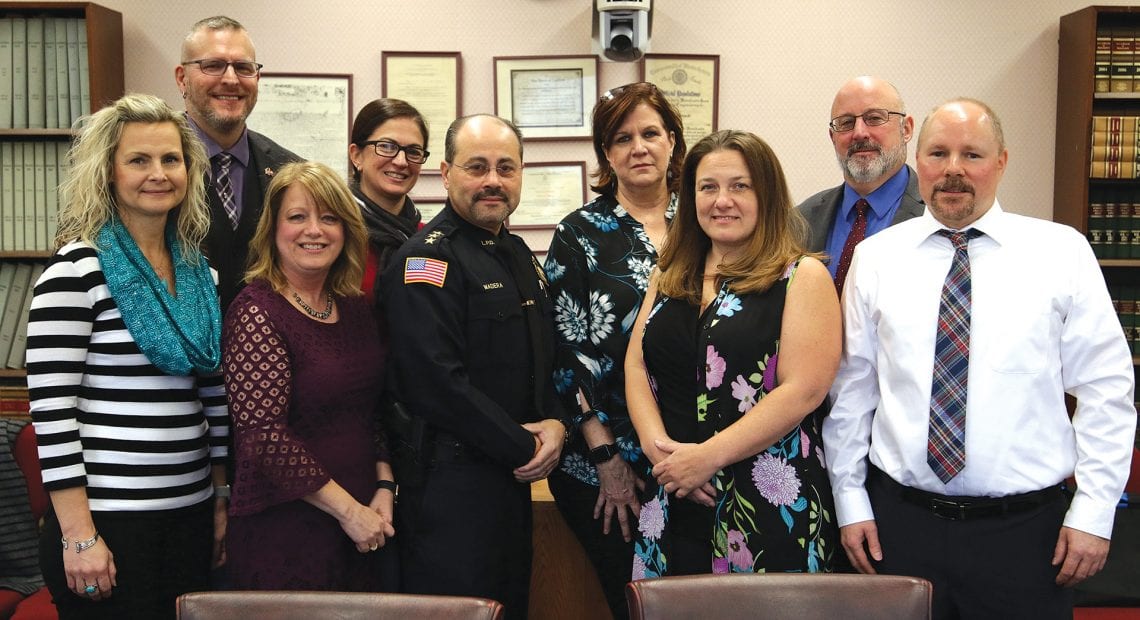
Scenes from the Dec. 5 Event

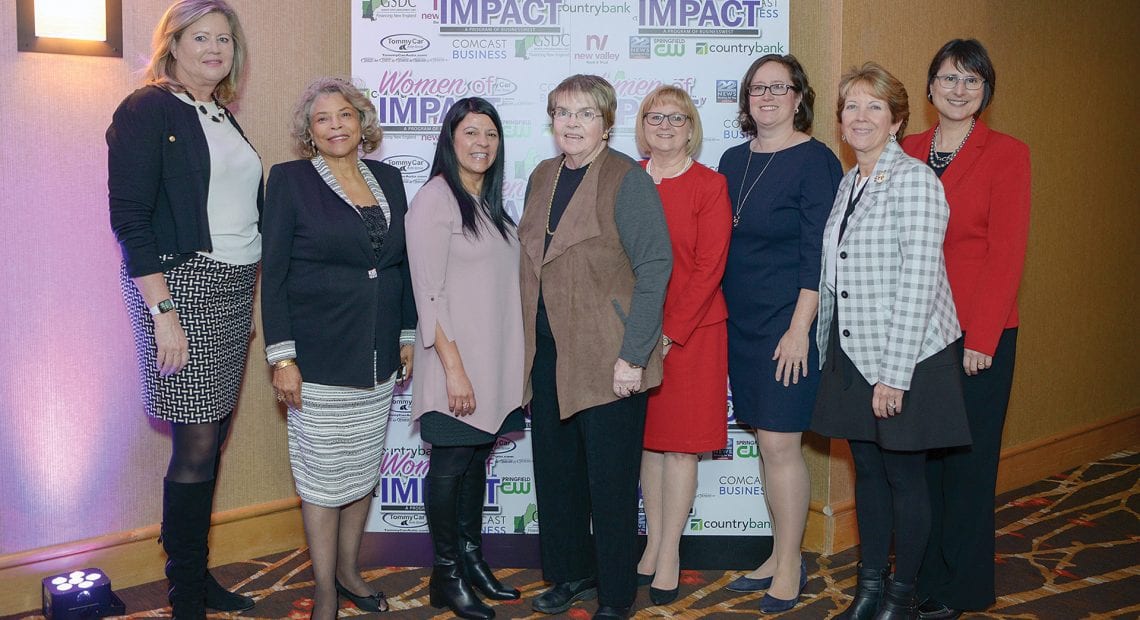
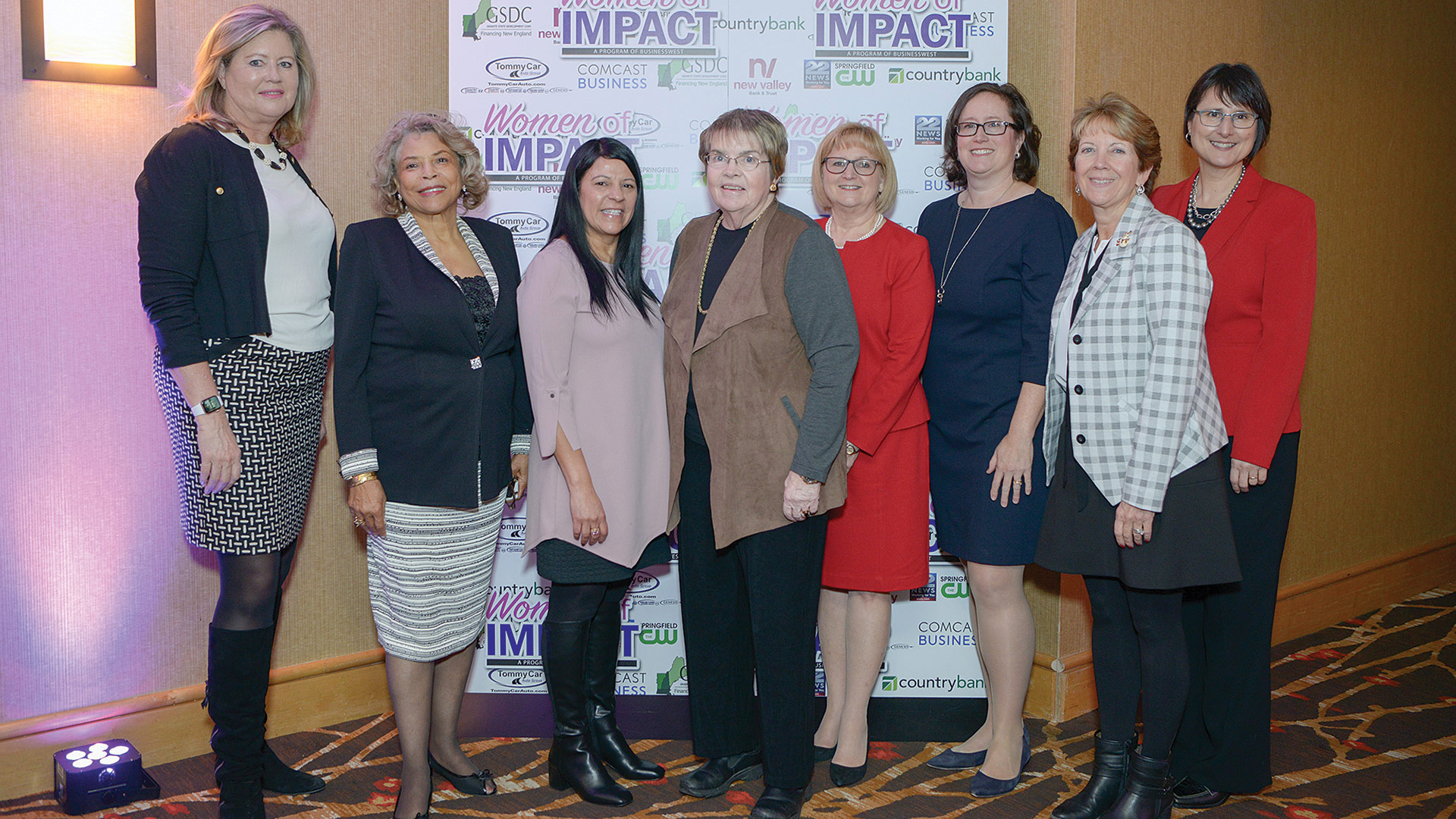
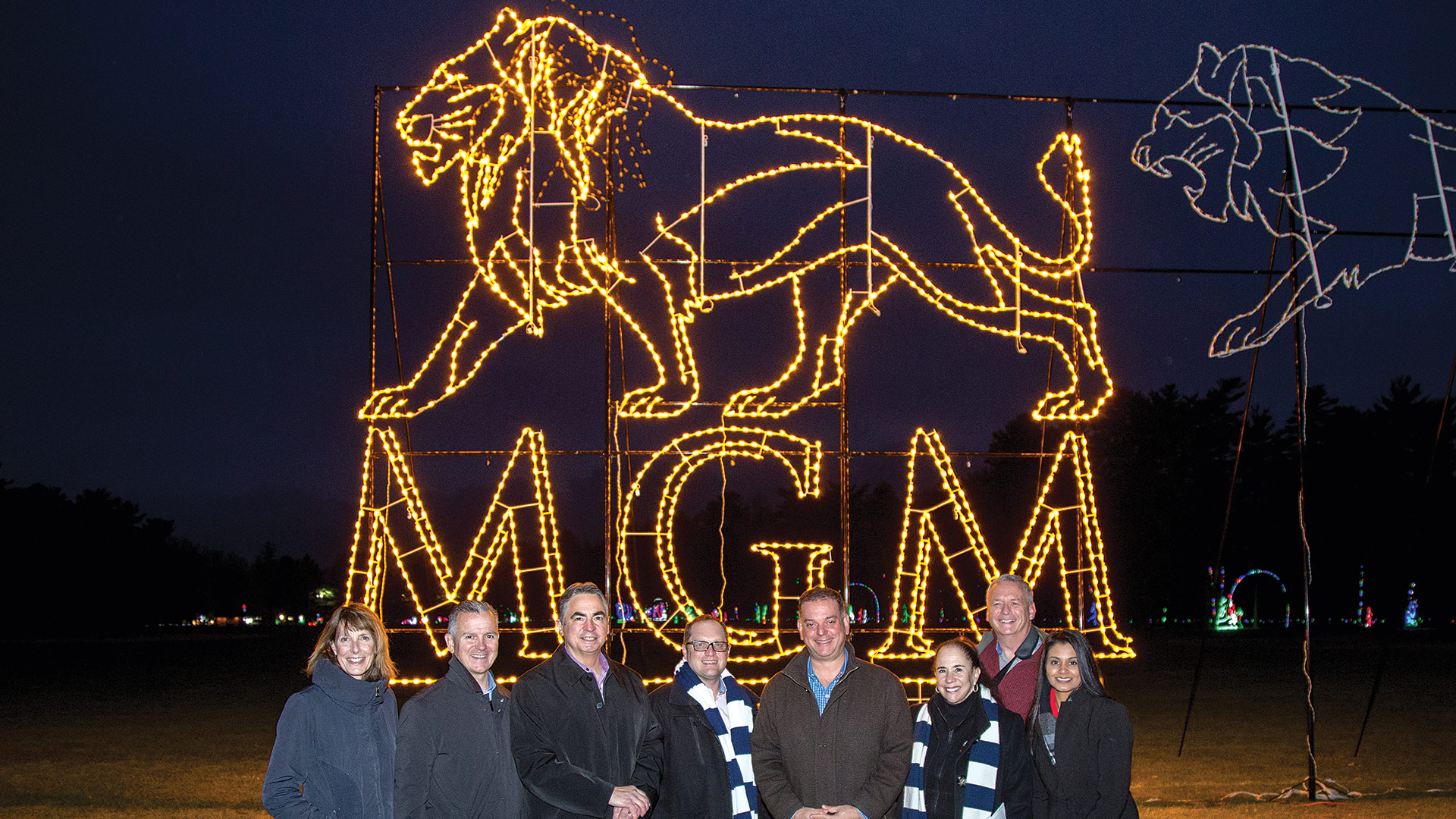
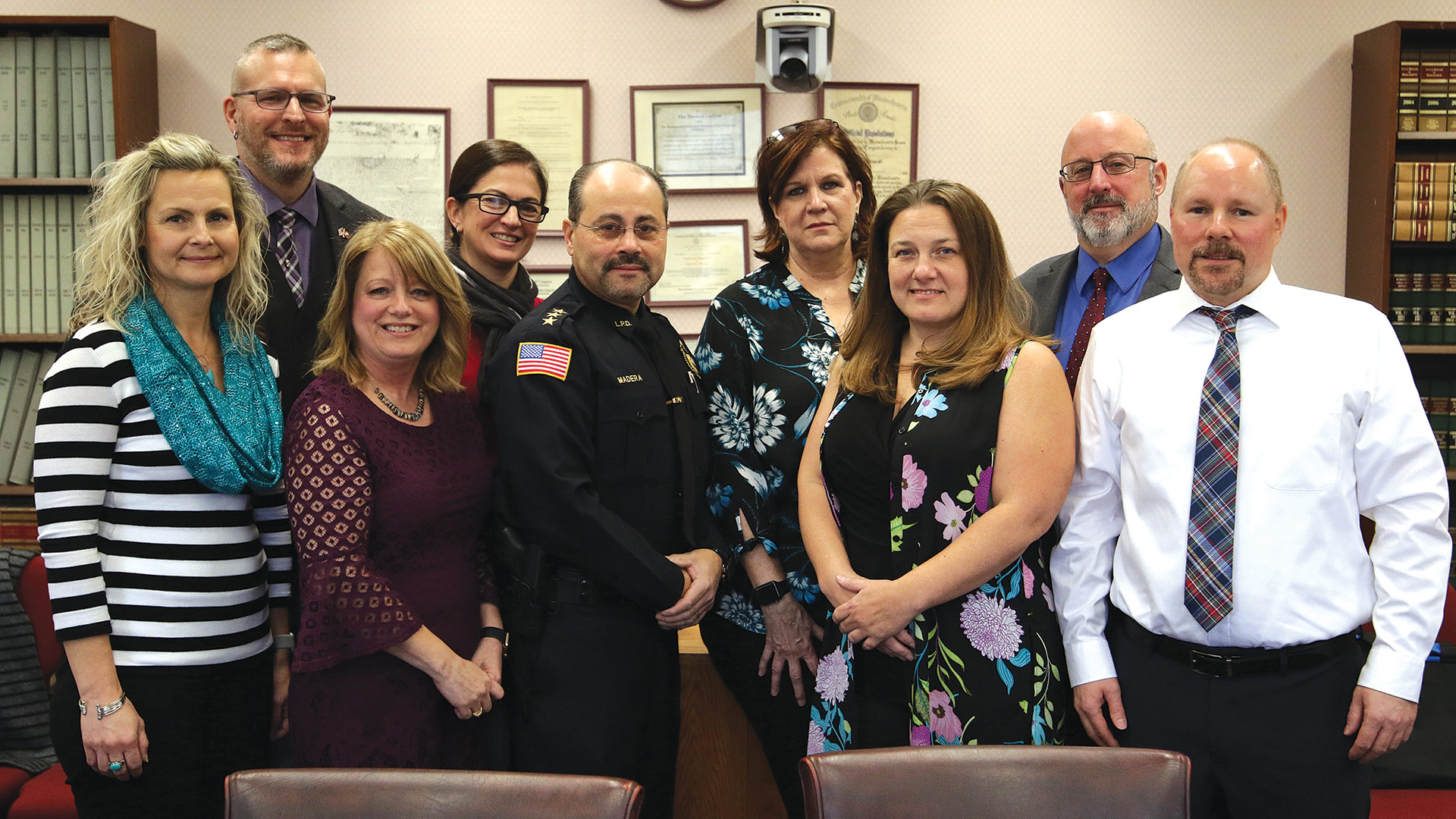
More than 450 people turned out at the Sheraton Springfield on Dec. 5 for BusinessWest’s second annual Women of Impact luncheon. Eight women were honored for their achievements in business and in giving back to the community. The keynote speaker was Lisa Tanzer, president of Life is Good. This year’s honorees are (pictured, left to right):

• Katherine Putnam, managing director of Golden Seeds;

• Carol Moore Cutting, president, CEO, and general manager of Cutting Edge Broadcasting;

• Lydia Martinez-Alvarez, assistant superintendent of Springfield Public Schools;

• Mary Hurley, Massachusets Governor’s Councilor;

• Ellen Freyman, partner at Shatz, Schwartz & Fentin;

• Tricia Canavan, president of United Personnel;

• Jean Deliso, principal with Deliso Financial Services; and

• Suzanne Parker, executive director of Girls Inc. of the Valley.

The Women of Impact program was sponsored by TommyCar Auto Group and Country Bank (presenting sponsors), Comcast Business and Granite State Development (supporting sponsors), New Valley Bank & Trust (speaker sponsor), and WWLP 22 News/CW Springfield (exclusive media sponsor).

Commercial Real Estate

A Tale of Two Cities

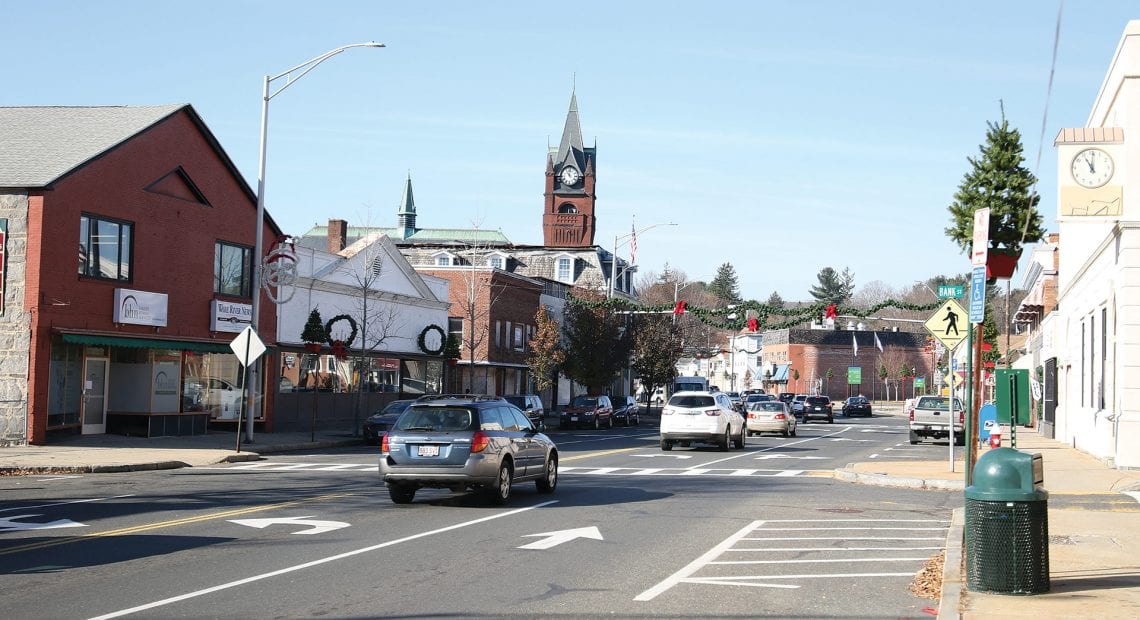
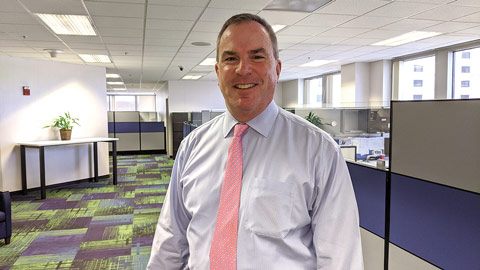
Evan Plotkin says congestion and sky-high rents in Boston demand creative solutions. One of them could be incentivizing companies to move west, into Springfield’s downtown.

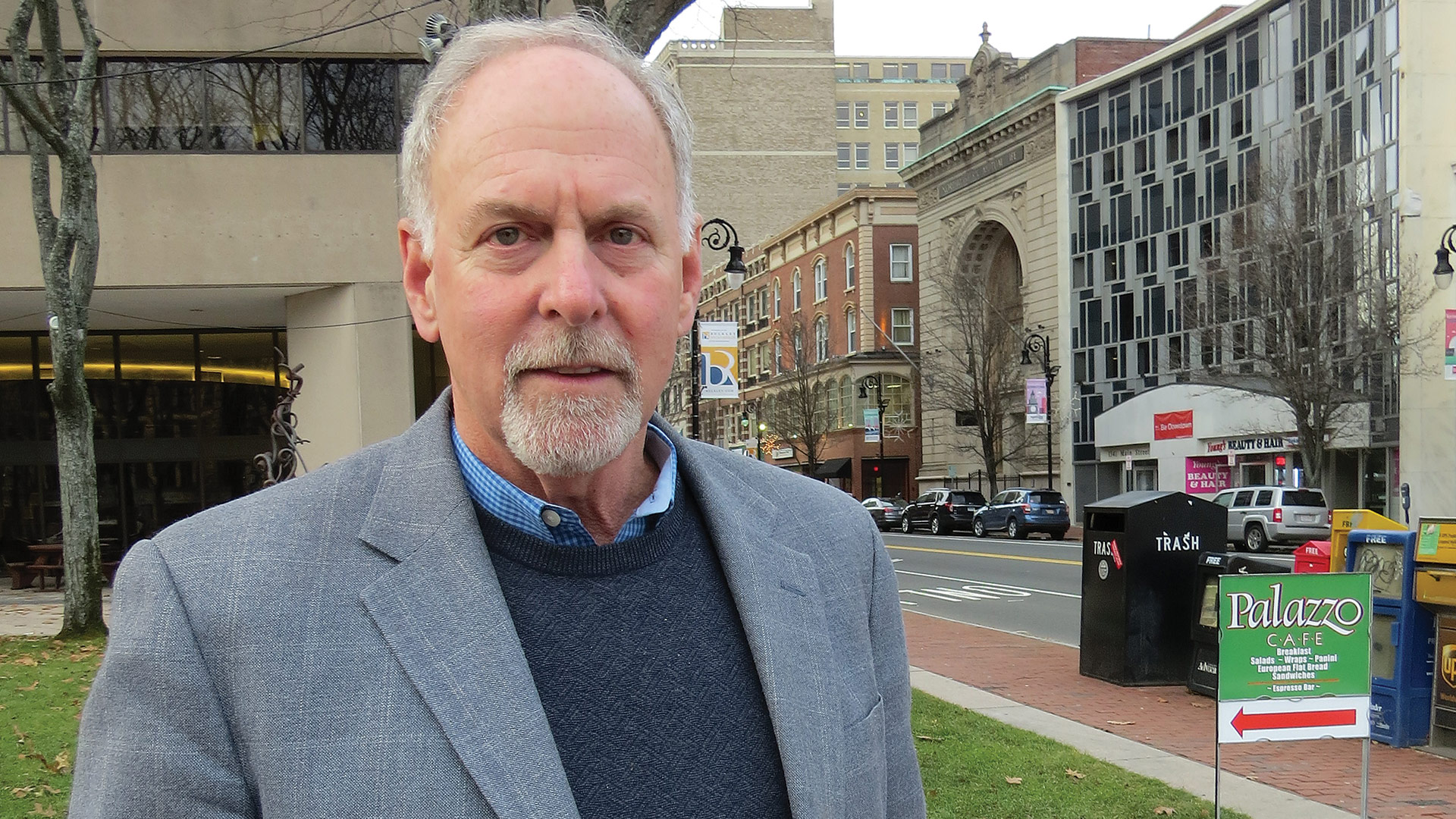
Evan Plotkin was talking about how “something has to give.”

With that one phrase, he was talking about the commercial real-estate markets in the central business districts of Boston and Springfield.

In the Hub, said Plotkin, president of NAI Plotkin, rents are sky-high and continue to climb — to more than $100 per square foot in some locations and to roughly $63 per square foot on average, with more space being built to accommodate soaring demand. Meanwhile, traffic, congestion, and problems with mass transit are strangling businesses, he said, to the point where meetings can’t start until 10 a.m. and overall productivity is impacted.

Meanwhile, in Springfield, rents are low — less than one-third the average in Boston — and they are flat, as in consistently flat. “They really haven’t gone up at all in maybe 25 years,” said Plotkin, who noted that there are several reasons for this, but especially the fact that there is, by his estimate, roughly 600,000 square feet of vacant class A space in Springfield’s downtown.

Exacerbating this relative stagnancy in the City of Homes has been new and seemingly unneeded inventory coming on the market — especially the 60,000 square feet at Union Station and the redeveloped property known as 1550 Main — and movement among a growing number of businesses to reduce their physical footprint by enabling (or in some cases requiring) employees to work from home.

This is where the ‘something has to give’ part comes in, said Plotkin, in a very candid interview with BusinessWest, noting that things need to change in both cities. And both would seemingly benefit if just some of the state offices now based in the Hub, as well as many different types of private businesses, would change their mailing address from Boston to Springfield when their leases expire.

“There’s 70% rent inflation in Boston, so when these businesses’ leases expire, they’re looking at incredibly high turnover rent,” said Plotkin, who co-owns a portion of the office tower known as 1350 Main St. He noted that class A rents in Boston have climbed $12 to $15 per square foot over the past few years. Meanwhile, in Springfield, property owners are charging $15 to $20 per square foot of class A space.

“It’s outrageous what’s going on in Boston — and everyone can do the math,” he said. “If state agencies don’t have to be in Boston, they can be decentralized and relocated to office space in Springfield or perhaps Worcester. They’re looking for creative solutions for Boston, and this could be one of them.”

Besides these opinions, all Plotkin really has at this point are those numbers he mentioned earlier (as well as some other statistics) and what appears to be that sound theory — that businesses and state agencies that don’t really need to be in Boston could and should be incentivized to seek other locations, including the 413 and especially downtown Springfield.

He has meetings planned with other downtown property owners as well as Rick Sullivan, present of the Economic Development Council of Western Mass., to discuss what can and perhaps should be done to at least raise awareness of what Springfield has to offer and perhaps create some migration west.

Plotkin said he understands there are reasons why state agencies and businesses want to be in Boston — especially because they know there’s a skilled workforce there — and he understands that moving about 90 miles west on the Turnpike is expensive and presents some risks, especially when it comes to workforce issues.

But he says the numbers speak for themselves, and if those paying sky-high rents in Boston could come to understand the numbers in this market, they could become inspired to relocate.

And if high-speed rail between Boston and Springfield becomes a reality, then people could, in theory, live in the Boston area and work in businesses and agencies relocated to the 413 — a decidedly differently spin on how that service might change the business landscape in the Bay State.

That’s a very large number of ‘ifs,’ and Plotkin acknowledges this as well. But as he said at the top, and repeatedly, something has to give in both cities.

Space Exploration

As he talked with BusinessWest, Plotkin continually leafed through the pages on a white legal pad he brought with him.

They contain various notes he’s collected over the past weeks and months on the Boston real-estate market and the overall business climate in New England’s largest city.

There are some statistics he’s collected — such as those regarding average rents in the Hub, the amount of new space under construction (2.5 million square feet was the number he had), and the current vacancy rate in the city — an historically low 6%, according to the New York-based real-estate giant Cushman & Wakefield.

But there were also some general thoughts, observations, and notations from various publications and other sources.

Among them was a quote from the Massachusetts Biotechnology Council citing a survey which revealed that 60% of the life-science employees working in Boston would “change their job tomorrow” if they could get a better commute. There was also something he read in another publication (he couldn’t remember which one), noting that many Boston-area residents had simply given up on mass transit because it was so unreliable and were instead driving to work and getting there mid-morning.

“In one report I read, business owners in Boston said they had to add staff to make up for transit delays,” he said, putting a verbal exclamation point behind that comment. “Think about how disruptive that is to your business. We don’t understand that here — there’s no such thing as traffic in Springfield.”

Summing up all he’s read and heard about Boston and possible solutions to its congestion problems — everything from incentivizing employers to let workers telecommute to taxing motorists for using certain roads at certain hours — he said the situation is fast becoming untenable for many living and trying to do business there.

“You have inefficiency, spiraling upward costs, shortages of affordable housing, transportation problems, congestion, and sky-high cost of living there,” he said. “Businesses locate in Boston because they can attract that workforce, which makes sense, but if that workforce can’t afford to live there and can’t deal with the congestion, then what’s the point of being in Boston?”

Which brings him back to Springfield and its downtown. And for this subject, Plotkin didn’t need a legal pad.

He’s been working in, and selling and leasing commercial real estate in, downtown Springfield for more than 40 years. He knows what’s changed and, perhaps more importantly, what hasn’t, especially when it comes to demand for space in the central business district, and what would be called net gains.

Indeed, Plotkin said that what the region has mostly experienced — there have been some notable exceptions, to be sure — is companies moving from one downtown office building to another.

In this zero-sum real-estate game, one building owner loses a tenant, and another gains one — but the city and its downtown don’t gain much at all, he said.

“There’s been negative absorption in the downtown for many years now, and I don’t see anything really changing,” he told BusinessWest. “I’m seeing people moving from one block to another, one office building to another, but not many new businesses moving in. Meanwhile, everyone’s vying for the same tenants, which drives the rental rates down even lower than they have been historically; it’s a tenant’s market here.”

It’s anything but that in Boston, which has seen a surge of new businesses moving in — everything from tech startups to giant corporations, like GE. The real-estate market is exploding, and traffic woes and mass-transit headaches have been consistent front-page news. All this calls for creative thinking — as in very creative — and perhaps looking west, said Plotkin, who did some simple math to get his point across.

“Using the example of a 20,000-square-foot tenant paying $63 per square foot in Boston … if the same tenant came to Springfield and paid $18 per square foot, we’re talking about millions of dollars,” he explained, adding that these numbers should strike a chord, especially when it comes to businesses and agencies that don’t have to be in Boston.

Many of those who think they do need to be in Boston are focused on workforce issues, he went on, adding that he believes the Greater Springfield area can, in fact, meet the workforce requirements of many companies.

And over the past several years, the city has become more vibrant with the addition of MGM Springfield, said Plotkin, adding that there are certainly other selling points, like a high quality of life and a cost of living that those residing in and around Boston might find difficult to comprehend.

Bottom Line

As he talked with BusinessWest, Plotkin all but acknowledged that getting businesses and agencies to trade Boston for Springfield will be difficult, for all the reasons stated above.

But the situation in the Hub could be reaching a tipping point when it comes to affordability, traffic, congestion, and quality of life.

And these converging factors might, that’s might, finally convince some decision makers to seek a very creative alternative.

George O’Brien can be reached at [email protected]

Community Spotlight

Community Spotlight

Mayor Thomas Bernard says North Adams has been investing in economic development, public safety, education, and a host of other areas.

Seven priorities, 43 goals, 95 policies, and 355 actions.

This tall list makes up the master plan for the city of North Adams. The Vision 2030 Plan was launched in 2011, and just this year, Mayor Thomas Bernard and cohorts revisited the plan to check up on the progress made to date.

“We had a really good session in October where we got some interesting suggestions for setting priority areas around marketing and promotion to move the needle on some of the economic developments,” he said.

In addition to the information session in October, Bernard says another will be held in early 2020 in which the town will tackle three things: review what has been accomplished so far, identify things that five years ago may have seemed urgent but are not as pressing now, and identify issues that have changed in the last five years.

The plan’s seven priorities — economic renewal, investment in aging infrastructure, creation of a thriving and connected community, intergenerational thinking, fiscal efficiency, historic preservation, and food access — are all currently being reviewed, and Bernard says these undertakings make for an exciting time in the city.

“There are some really great developments happening in a lot of different areas,” he told BusinessWest. “There’s a good chance to work in collaboration with a lot of people.”

Some of the more prominent developments include a project to build a much-needed new elementary school, updating zoning for the town, investing in public safety, and several projects that cater to younger children.

Bernard knows that, in order to be successful with new projects, the city must still take care of the older, foundational matters, and says North Adams has done a great job keeping track of both.

“We want to double down on the things we’ve already done, both this cultural development that’s happening, but also doing the foundational work to ensure that we can be successful so that we’re championing the big developments, we’re celebrating the jobs that are coming in, but we’re also making sure that the quality of life in neighborhoods is strong and solid,” he said.

“There are some really great developments happening in a lot of different areas. There’s a good chance to work in collaboration with a lot of people.”

Indeed, he says the overall feedback from the community has been extraordinarily positive, and mentioned one feeling in the city in particular: optimism.

Youthful Approach

That optimism, said Bernard, now going into his second term as mayor of North Adams, comes amid an increasing number of investments in economic development, public safety, and other key areas.

But you can’t move forward without looking back, so one big goal is investing in the youth and education sector, which includes the renovation of a very old elementary-school building.

Just a few weeks ago, Bernard and Superintendent of Schools Barbara Malkas visited the Massachusetts School Building Authority and were invited into eligibility for consideration of the reconstruction of Greylock Elementary School — a building that is 70 years old.

North Adams at a glance

Year Incorporated: 1878
Population: 13,708
Area: 20.6 square miles
County: Berkshire
Residential Tax Rate: $18.62
Commercial Tax Rate: $40.67
Median Household Income: $35,020
Family Household Income: $57,522
Type of government: Mayor; City Council
Largest Employers: Crane & Co.; North Adams Regional Hospital; BFAIR Inc.
* Latest information available

“If we’re able to be successful in the feasibility phase, then we’re invited to proceed forward, and we can put the funding plan together,” said Bernard. “It really will set the course for elementary education in the city for the next 50 years.”

Other investments for the youth population in the city include a splash park and a skate park. While Bernard acknowledged North Adams is an aging community and its leaders are always thinking about what it means to be age-friendly, he sees a lot of energy and — here’s that word again — optimism when it comes to investing in the younger population.

“What this splash park and the other main investment, which was a skate park, has done is create community engagement, excitement, energy, vibrancy, and a sense of optimism that comes from things that are youth-focused,” he said.

On the economic-development side, Dave Moresi, a local developer, recently embarked on a mill project that celebrated its grand opening this past June. Bernard said Moresi bought the mill in mid-2017, and it already has more than 50 businesses inside, including a financial-services office, a mental-health clinician, a coffee roaster, a gym, a hair salon, and much more.

“I think this speaks to a couple things,” said Bernard. “It speaks to the quality of work that Dave and his team do, but it also speaks to this moment that we’re in, bringing it back full circle to this energy, excitement, and potential.”

Moresi also purchased a school building the city no longer uses and is turning it into residential apartments.

Adding to that excitement are two enabling projects that have occurred over the past year. Bernard said bringing life into the downtown area continues to be a challenge, so a parking study was done to look at what assets and needs are necessary if the city were to attract additional housing and development. North Adams also updated its zoning map to reflect current conditions — a process that hadn’t been tackled since the late ’50s to early ’60s.

With all this activity going on, the city has also been investing in public safety. Just this year, Lt. Jason Wood was appointed as the new police chief for North Adams. In addition, the city added its first hybrid vehicle to the city fleet and is working on adding a hybrid cruise, which would make it the first city in Western Mass. to do so.

Forward Momentum

While North Adams still faces economic and socioeconomic challenges, like all cities do, the mayor feels optimistic that the community is on the path for success.

“We continue to be in an exciting time for North Adams, and I think more and more people are picking up on it, whether that’s visitors who are coming here or whether it’s longtime residents who are seeing some of these developments and being really excited about it,” Bernard said. “We have a lot of work to do to make sure we stay on an even keel.”

Kayla Ebner can be reached at [email protected]

Women in Businesss

Wellness in Season

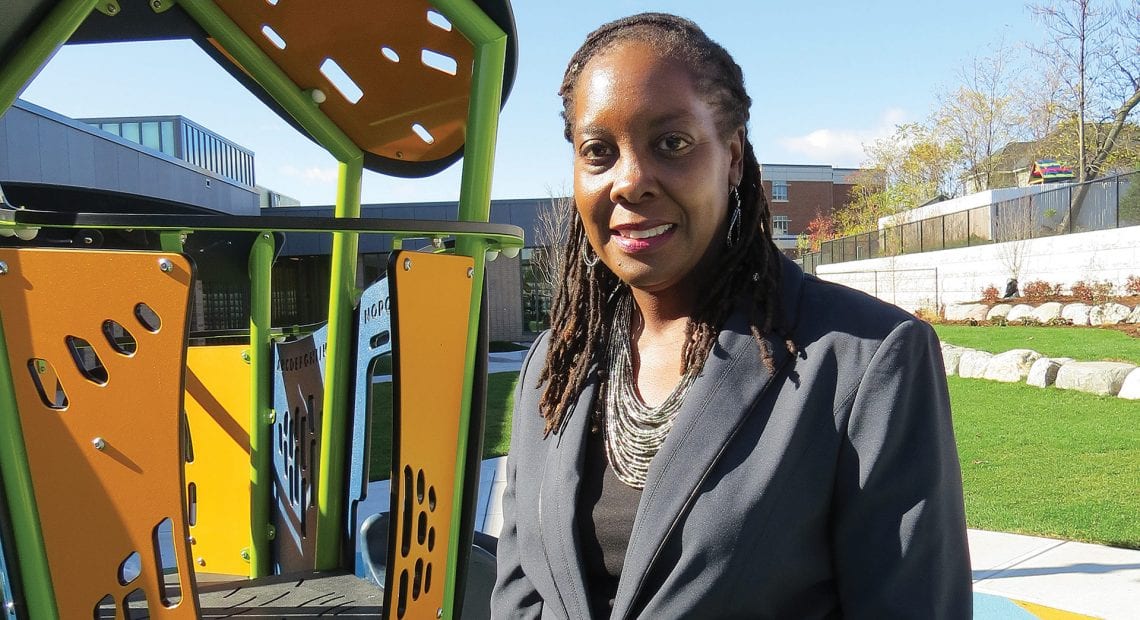
Denise Pelletier was inspired by her own experience with the benefits of salt therapy to help others find similar success.

Denise Pelletier was gifted a trip to a salt cave for her birthday — not your average way to celebrate another trip around the sun.

But Pelletier has bartonellosis, a chronic Lyme disease co-infection that can produce symptoms like fever, fatigue, headaches, and bone pain. When her sister heard about salt therapy and the benefits it can bring, she took Pelletier to a salt cave, thinking it might help with some of the pain she was suffering from.

In the process known as halotherapy, pure, drug-free, pharmaceutical-grade salt is heated and ground into microparticles by a machine called a halogenerator and dispersed in a room or salt bed.

The results of her first salt-therapy session, Pelletier said, included relief from allergies and asthma, among other things.

“I realized that, when I do salt therapy, I don’t need to use my inhaler twice a day, and I don’t need to take my allergy medicine every day,” she said, adding that, if she doesn’t get in at least one or two salt sessions a week, she finds herself needing to use more medication. “For me, it made such a huge difference.”

Although she originally had no intention to start a business, she felt she needed to share the benefits of halotherapy with other people who may be going through a similar thing.

“I’m one of those people that, when something works so wonderfully for me, I want to help other people,” she said. “I thought, ‘how can I bring this to other people?’”

The answer was opening Enisde’s Salt Therapy Halotherapy Spa on Main Street in Palmer.

Science hasn’t quite caught up with the halotherapy trend yet, at least in the U.S., and concrete evidence of the benefits are oftentimes conflicting. But salt therapy has been around for centuries and is more popular in Europe, used as a natural and holistic method for health and wellness.

For Pelletier, the results were fantastic — which is why she’s sharing the benefits of the holistic regimen with others.

Go with the Flow

When thinking about her main goals for her new business, Pelletier had one thing in particular on her mind: keeping a positive and relaxed energy throughout the entire space.

But it took a lot of work to get there, as months were spent gutting the entire building with help from family to make it the business she dreamed of.

“The feel is very important to me, which is why we put so much into the décor,” she said, adding that salt walls and salt floors, while they do not necessarily contribute to the health benefits, add a lot to the relaxation part of the experience. “There’s a lot of people that feel a whole shift in energy when they come in.”

According to Pelletier’s website, salt is negatively charged, which means it naturally attracts positively charged particles and cancels out harmful electromagnetic vibrations in the environment and in people’s bodies. In many cases, this feeling is compared to visiting a waterfall or spending a day at the beach.

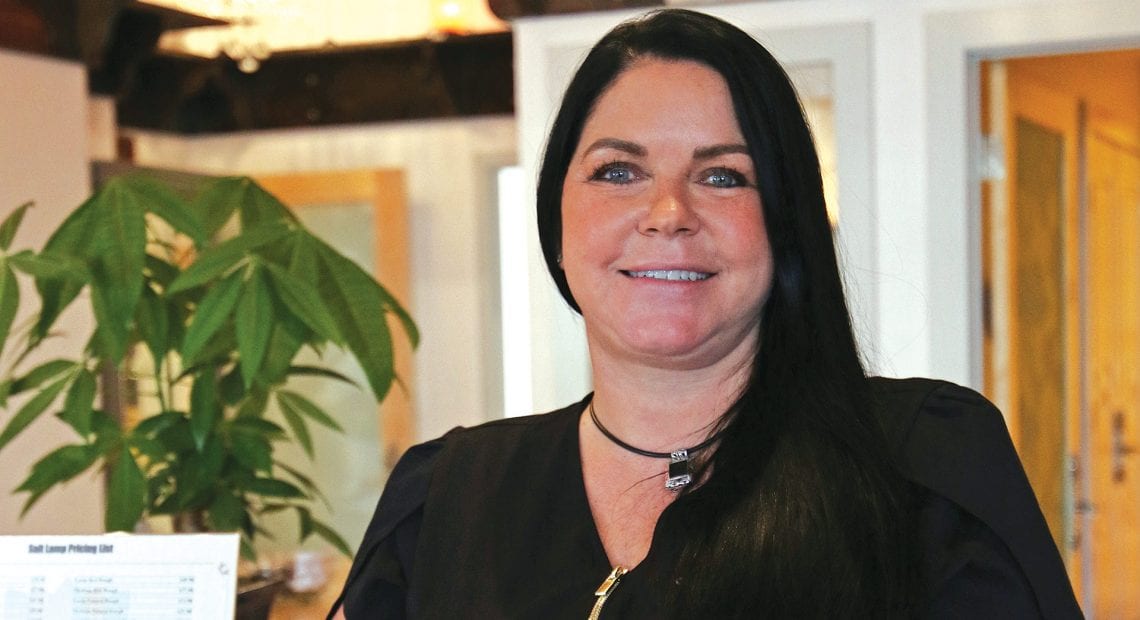
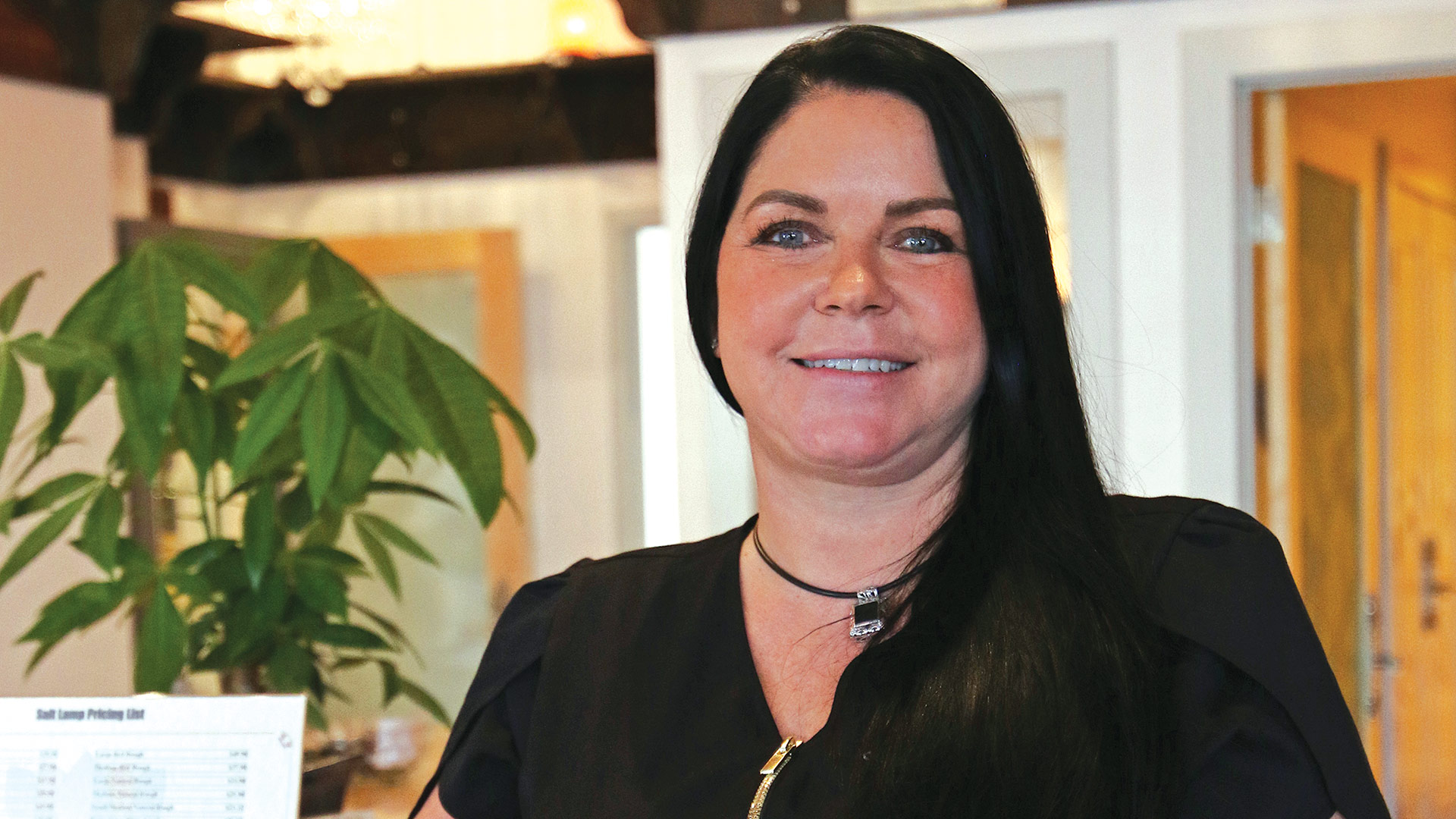
Denise Pelletier says she put much thought and effort into the décor and and feel of her establishment, and people “feel a whole shift in energy when they come in.”

And while she by no means recommends eliminating prescribed medicine while practicing halotherapy, she says using it along with salt therapy may help people cut back on the medication they are taking.

“Whether you have breathing issues or skin issues, it’s just something that’s so good to do for yourself, even if you decide to do it once or twice a month,” she said. “It really is that feeling of well-being because it’s actually doing something for you.”

There are five rooms in Enisde’s Halotherapy focused on this well-being feeling — the Dawn Room, which provides the full salt-cave experience with a room-wide salt floor; the Willow Room, with moon pods to sit on that deliver a full-body, weightless sensation; the Bosai Room, featuring a large salt sandbox floor on half of the room and wood floors on the other half; and the Zen Room and Namaste Room, which include state-of-the-art salt-therapy beds for those who want a more private experience.

Salt therapy is more popular in Europe, but is starting to gain traction in the U.S.

Halotherapy rooms are 45-minute sessions for $40, and salt-bed rooms are 20-minute sessions for $20. The salt beds, Pelletier said, were a must-have because the concentrated salt air in the enclosed space is beneficial to those seeking relief, and at a quicker pace.

Give Salt a Chance

Pelletier says the benefits, especially during this time of year, are far greater than what most people would expect.

“It definitely helps you stay healthier in the wintertime, with the flus and the bugs going around,” she noted. “If you are overcoming something, this is wonderful for you because the salt removes toxins from your lungs, it reduces swelling in your lungs and sinuses, and it detoxes your skin.”

While this method of relaxation hasn’t quite caught on in too many places yet, Pelletier hopes people will give halotherapy a try and see the benefits for themselves.

“It’s nice to have something that’s positive and about wellness,” she said. “My hope is that people will want to start taking better care of themselves and making it a priority.”

Kayla Ebner can be reached at [email protected]

Business of Aging

A Warm Handoff

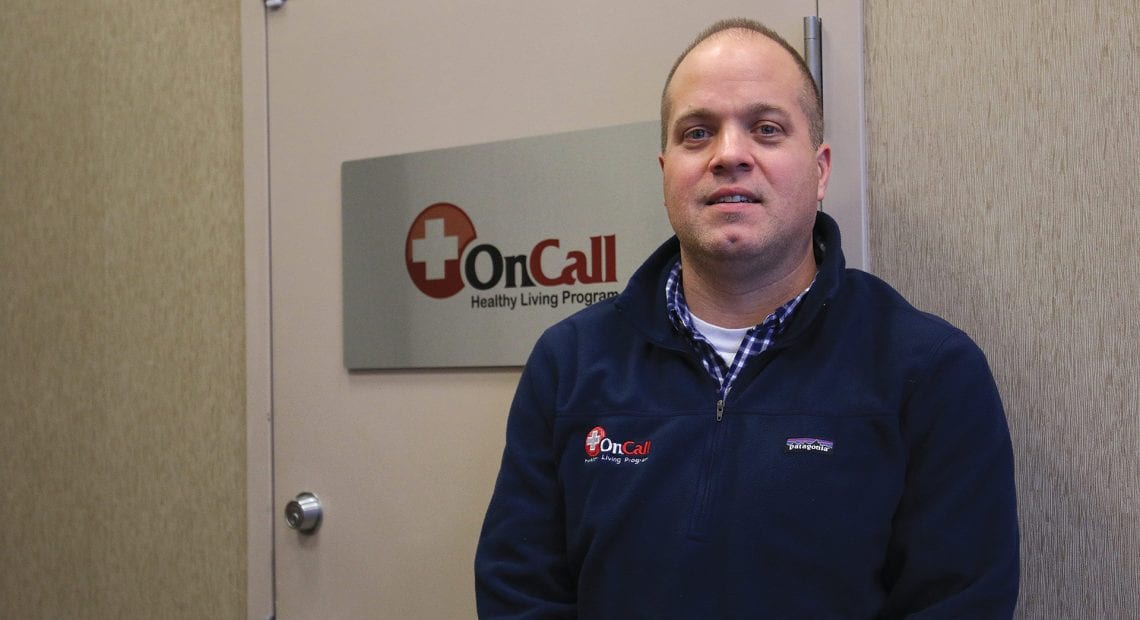
Jim Carroll says one of the most rewarding parts of his job is seeing people turn their lives around.

Addiction knows no boundaries.

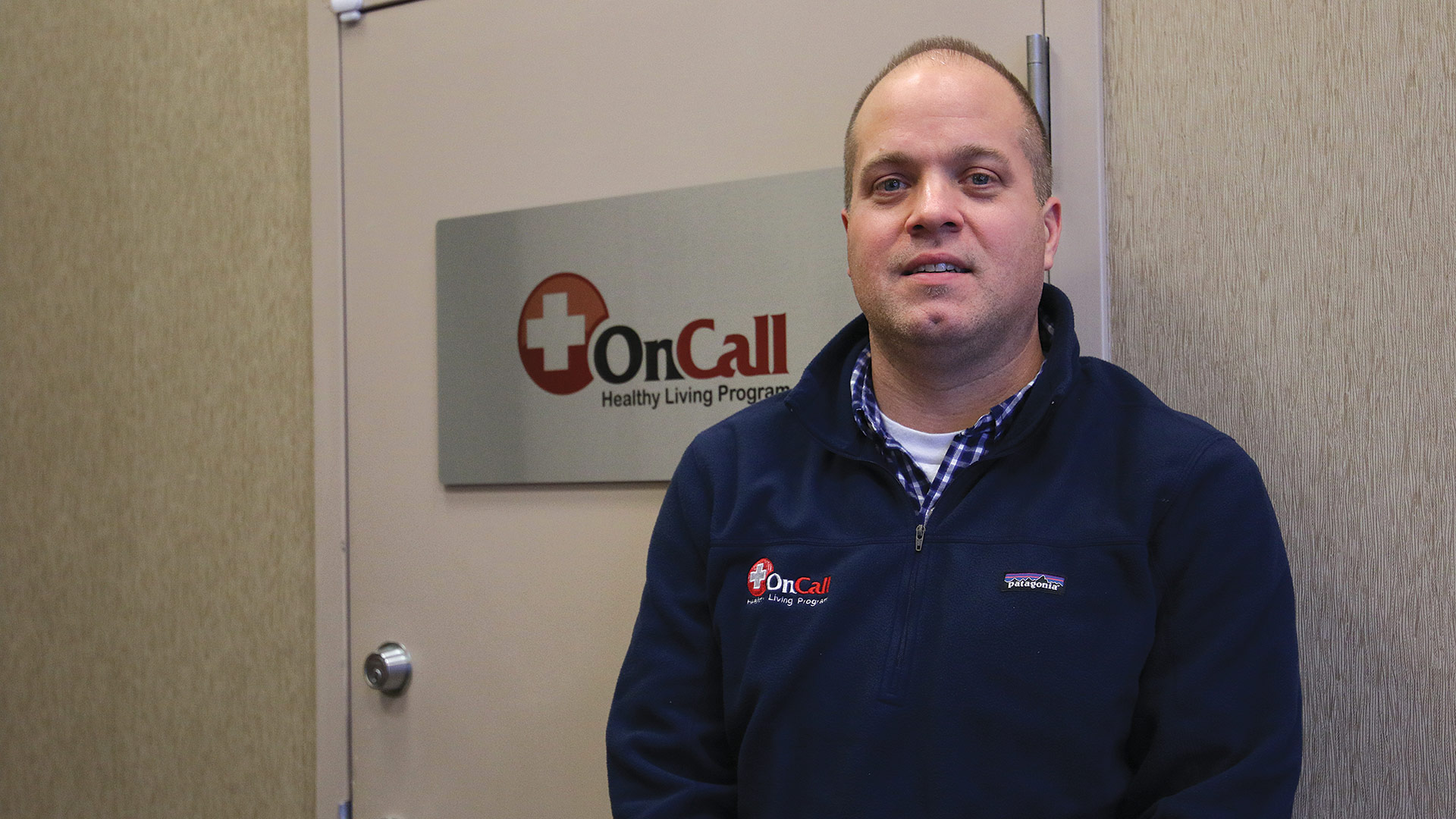
This is the main message Jim Carroll, medical director at OnCall Healthy Living Program, tries to instill in everyone he comes in contact with.

By this, he means addiction can affect people in all walks of life, and is not specific to one group of individuals like the stereotype may depict.

“What many people don’t realize is, addiction is in your neighborhood, in your workplace,” he said. “It doesn’t have any boundaries.”

This is what he and other staff members at OnCall keep in mind at all times when treating patients who are recovering from a substance-abuse disorder. What first started as a mixed-treatment facility with urgent care and addiction switched over to strictly addiction services in early 2018.

The facility pulls patients all the way from the Berkshires to Worcester, and Carroll says between 550 to 600 patients visit the main office in Northampton and a satellite office in Indian Orchard.

Carroll began at OnCall in 2008 as an attending doctor before moving up to medical director in 2013, but has been on staff in the Emergency Department at Mercy Medical Center for 13 years, giving him plenty of experience with addition services and showing him how much need exists for this kind of care.

“It became clear over several years that we wanted our focus to be on the addiction side of things,” he said. “Being in the Emergency Department, we were always very well aware of the opioid crisis and what it was doing to each individual and society as a whole, so we wanted to be a part of the solution.”

And there certainly is a need.

“We’re all about getting people on the path to becoming a better version of themselves.”

The opioid epidemic in Massachusetts has skyrocketed over the last decade. The Massachusetts Department of Public Health reported 1,091 confirmed opioid-related overdose deaths in the state during the first nine months of 2019, with an additional 332 to 407 deaths expected by year’s end.

This makes the services OnCall provides even more imperative. In recent years, OnCall has been putting a new two-part model to the test to make its services even more effective, working toward trying to bring the number of opioid-related deaths much closer to zero.

Beyond the Medicine

Carroll said the mission for every medical provider and behavioral-health professional at OnCall is to help patients recover and lead healthy lives, providing a comfortable environment free of judgment.

“We’re all about getting people on the path to becoming a better version of themselves,” he explained. “The more people we have in treatment, the less people we have at risk for death from overdose that we see in the Emergency Department on an almost daily basis.”

In order to accomplish its goal of helping people get on a healthier and safer path, OnCall uses a two-part model and what it calls ‘a warm handoff’ to get patients back on track. This includes the use of medication along with therapy and other supportive services to help address issues related to alcohol and opioid dependence.

“I really couldn’t say that one would be okay without the other, which is why we utilize both,” said Carroll, adding that frequency of visits for therapy and medication checkups vary based on how patients are doing.

He added that one of the hardest parts is getting people to take that first step through the door. “One of our biggest challenges is getting people in for the first follow-up visit. When we actually get people to show up, they usually have a positive experience, and then they’re off and running on their recovery.”

He also noted that, according to the limited studies OnCall has conducted, somewhere between 70% and 90% of people who have an opioid-use disorder are not in treatment — yet another reason for the facility to eliminate its urgent-care services and move to addiction services full-time.

“We know a lot of people need help, and with a rise of more and more urgent cares, that became less of a need,” he said.

Another big challenge is the stigma surrounding addiction and treatment, and Carroll said people sometimes worry about how they are going to be treated. This has prompted OnCall to focus on cultivating a comfortable environment for patients from the time they walk in the door to the moment they walk out.

“One of the things we’ve been very cognisant of is what kind of environment we present for patients who present to our clinic,” he told BusinessWest. “Our philosophy and our feeling here is that, once someone actually presents here, they should feel very comfortable being here.”

Rewarding Challenge

“A no-judgment zone” is another way Carroll describes OnCall.

Unfortunately, stigma still does get in the way of people seeking treatment, and labels are often assigned to people who have substance-abuse disorders. He stressed that it’s important for people to realize addiction is a disease — one that can happen to anyone.

“Addiction doesn’t have any special predilection toward any race, gender, age, or profession,” he said. “When people actually understand the disease process and understand that addiction is a brain disease and that it’s not a moral failing, they’ll understand that this isn’t someone trying to proactively ruin their lives or the lives of the people around them.”

He drove this point home by asking a perspective-shifting question: “if someone had type-2 diabetes, would you hold that against them?”

Despite the various challenges that come with the job, for Carroll, the rewards are innumerable.

“Seeing the turnarounds that happen in people’s lives is amazing,” he said. “We see people at some of their lowest moments, and when we can be part of the support team that turns things around for them and you see people get their self-esteem back, their jobs back, their families back, that’s very gratifying as a provider. Seeing people literally turn their lives around in front of you is one of the most rewarding things of my professional career.”

And although the 600 patients OnCall currently serves might seem like a huge number, Carroll says the practice has the capacity for double that amount, and encouraged anyone who is suffering from a substance-abuse disorder, or knows someone who is, to seek help immediately.

“The busier we are, the more people we’re helping, and that’s a good feeling,” he said. “Until we aren’t seeing any overdoses anymore, we just keep moving forward and trying to be part of the solution.”

Kayla Ebner can be reached at [email protected]

Environment and Engineering

Taking the Industry Lead

As part of its commitment to environmental sustainability, Eversource Energy announced an industry-leading goal to be carbon-neutral by 2030. The energy company plans to achieve this aggressive goal through a series of targeted steps across its operations to reduce carbon emissions while also continuing to support regional economic growth and maintaining safe and reliable service for its approximately 4 million customers.

While the goal to be carbon-neutral is limited to the energy company’s own corporate emissions across all departments and operations, Eversource will continue to work with state leaders to reduce emissions from energy supply for customers in accordance with state and regional regulatory requirements. 

“As New England’s largest utility, we are proud to partner with our states and communities to achieve regional clean-energy and carbon-reduction goals,” said Eversource Chairman, President, and CEO Jim Judge. “Today, we are going one step further by setting a goal for our own operations to help demonstrate that carbon neutrality is achievable.”

With its goal set for 2030, Eversource would become the first investor-owned utility in the nation to be carbon-neutral. In order to achieve this, the energy company will take a series of targeted steps across corporate operations, gas distribution, and electric transmission and distribution. These include reducing energy use by improving the efficiency of its 69 facilities and reducing fleet emissions of its 5,200 vehicles, continuing to enhance the electric transmission and distribution system to reduce line losses, reducing sulfur hexafluoride (a potent greenhouse gas) in gas-insulated electric switchgear, and replacing remaining bare steel and cast-iron natural-gas distribution main lines to improve safety and help prevent methane leaks.

“The business community has an important role to play as we pursue clean-energy and carbon-reduction goals, as environmental sustainability and economic development go hand in hand,” said Dan Moon, president and executive director of the Environmental Business Council of New England. “As one of the nation’s leading energy companies, it’s encouraging that Eversource is proactively setting its own goals and demonstrating its commitment to a cleaner-energy future.”

Eversource has already significantly reduced its own carbon emissions through a series of steps, including the divestiture of all its remaining fossil-generation facilities in 2018. The company is also helping the region in achieving carbon-reduction targets that have been set by state and regional requirements with its clean-energy initiatives, such as the offshore wind partnership with Ørsted, award-winning energy-efficiency programs, solar development, innovative battery-storage projects, and electric-vehicle-charging infrastructure.

“We are excited to set an ambitious goal with our own corporate operations to lead by example,” Judge added. “Today’s news reinforces our position at the forefront of environmental sustainability and builds on our efforts to help our customers and communities reduce their carbon footprint.”

Cover Story Giving Guide Special Publications

Regional Philanthropic Opportunities

View the PDF flipbook

While philanthropy is a year-round activity, the holidays are a time when many of us think about those who are most in need, and how, in general, they can help make Western Mass. a better community for all who call this region home.

To help individuals, groups, and businesses make effective decisions when it comes to philanthropy, BusinessWest and the Healthcare News present the annual Giving Guide. Open the PDF flipbook to view profiles of several area nonprofit organizations, a sampling of this region’s thousands of nonprofits.

These profiles are intended to educate readers about what these groups are doing, and also to inspire them to provide the critical support (which comes in many different forms) that these organizations and so many others desperately need. Indeed, these profiles list not only giving opportunities — everything from online donations to corporate sponsorships — but also volunteer opportunities.

And it is through volunteering, as much as with a cash donation, that individuals can help a nonprofit carry out its important mission within our community.

BusinessWest and HCN launched the Giving Guide in 2011 to essentially harness this region’s incredibly strong track record of philanthropy and support the organizations dedicated to helping those in need.

The publication is designed to inform, but also to encourage individuals and organizations to find new and imaginative ways to give back. We are confident that it will succeed with both of these assignments.

George O’Brien, Editor
John Gormally, Publisher
Kate Campiti, Associate Publisher


Presented by:


Features

Feeling ‘the Magic’

Cesar Ruiz Jr. knew he was stating the obvious, but he wanted to make a point.

“This business is certainly not for the faint of heart,” he told BusinessWest, referring to the home-care industry and the fact that, by his count, there are close to 300 licensed companies in that sector within a 15-mile radius of the center of East Longmeadow, where he now operates his own venture, Golden Years.

He decided to join that very crowded field, when others might be put off by those numbers, for a number of reasons, but two in particular — a unique and highly successful model of care that Ruiz refers to simply as ‘the magic,’ and some real inspiration from three people who were very important to him — his parents and his grandmother.

As for the model, or the magic, it is a deep mix of services and programs, and three that are somewhat unique — music therapy, a ‘laughter program,’ and aromatherapy (more on all those later). As for those inspirations from his family … they were the real catalysts for Ruiz, who spent most of his career in the banking industry, to switch career gears in a profound way.

“We don’t look at ourselves as competitors — that’s a word that we don’t use here. We’re creators — we create our niche. And we do that by telling our story and emphasizing our services.”

His grandmother needed home care in Florida more than 15 years ago, and Ruiz recalls not only how poor that care was (family members generally provided the care for her), but how he resolved to create something better.

“We were asking the question — why isn’t there quality care?” he recalled. “And through that process, we began thinking that there has to be a better way.”

But the timing and other circumstances just weren’t right to launch a business.

It was after he relocated to this area — and the death of his father in late 2016 — that Ruiz found the needed inspiration to push on with providing that ‘better way’ on a commercial level and thus break into the ultra-competitive home-care industry.

As for his mother, well, she is the barometer for the hiring of all caregivers.

“My mom is the gold standard,” he explained. “Every person on our team needs to have the heart for caring that my mom has always demonstrated.”

And to say he has already made a mark in this sector would be a huge understatement.

Indeed, after starting slow — he can remember the phone in his office simply not ringing for several months while he was slowly building up relationships — he has been adding clients, and employees, at a torrid pace.

Indeed, by mid-October, when he sat down with BusinessWest, Ruiz said the company had roughly 350 clients and 374 caregivers, with both numbers expected to climb steadily in the months and years to come. That’s because Ruiz and partners Lisa and Vincent Santaniello are moving forward with plans to expand Golden Years into the Worcester and Boston markets as well as Connecticut. And after that, the plan would be expand nationally.

“We’re happy with our growth in this market, but we’re expanding to the east and to the south,” Ruiz explained, adding quickly that these are crowded markets as well when it comes to entrepreneurs looking to capitalize on an aging population, but a population that also wants to retain its independence — and thus remain in the home — as long as possible.

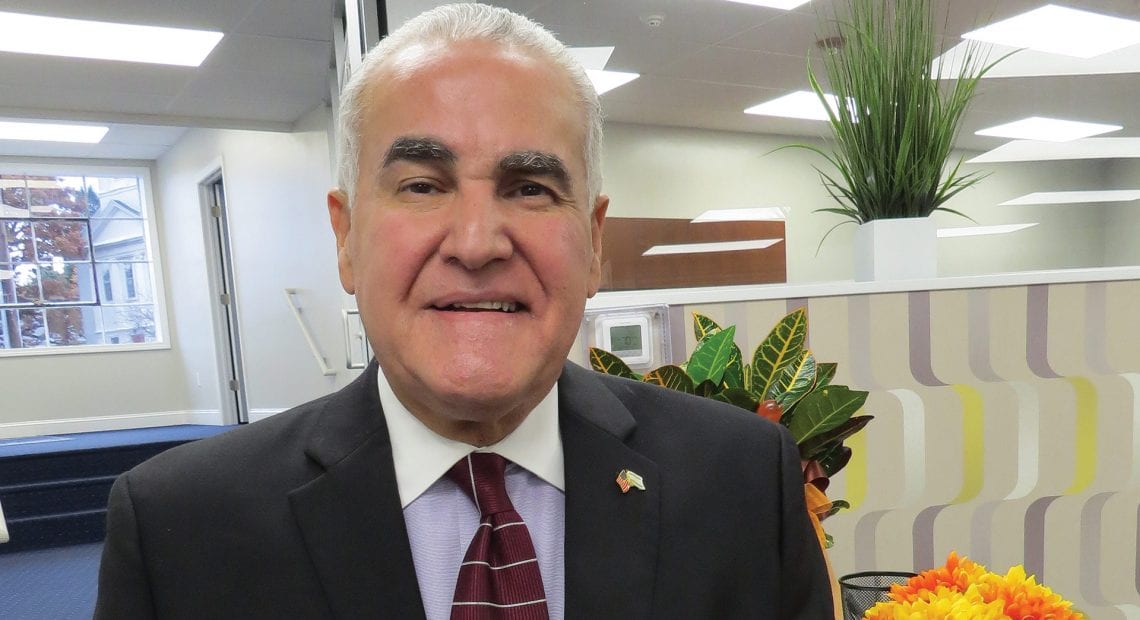
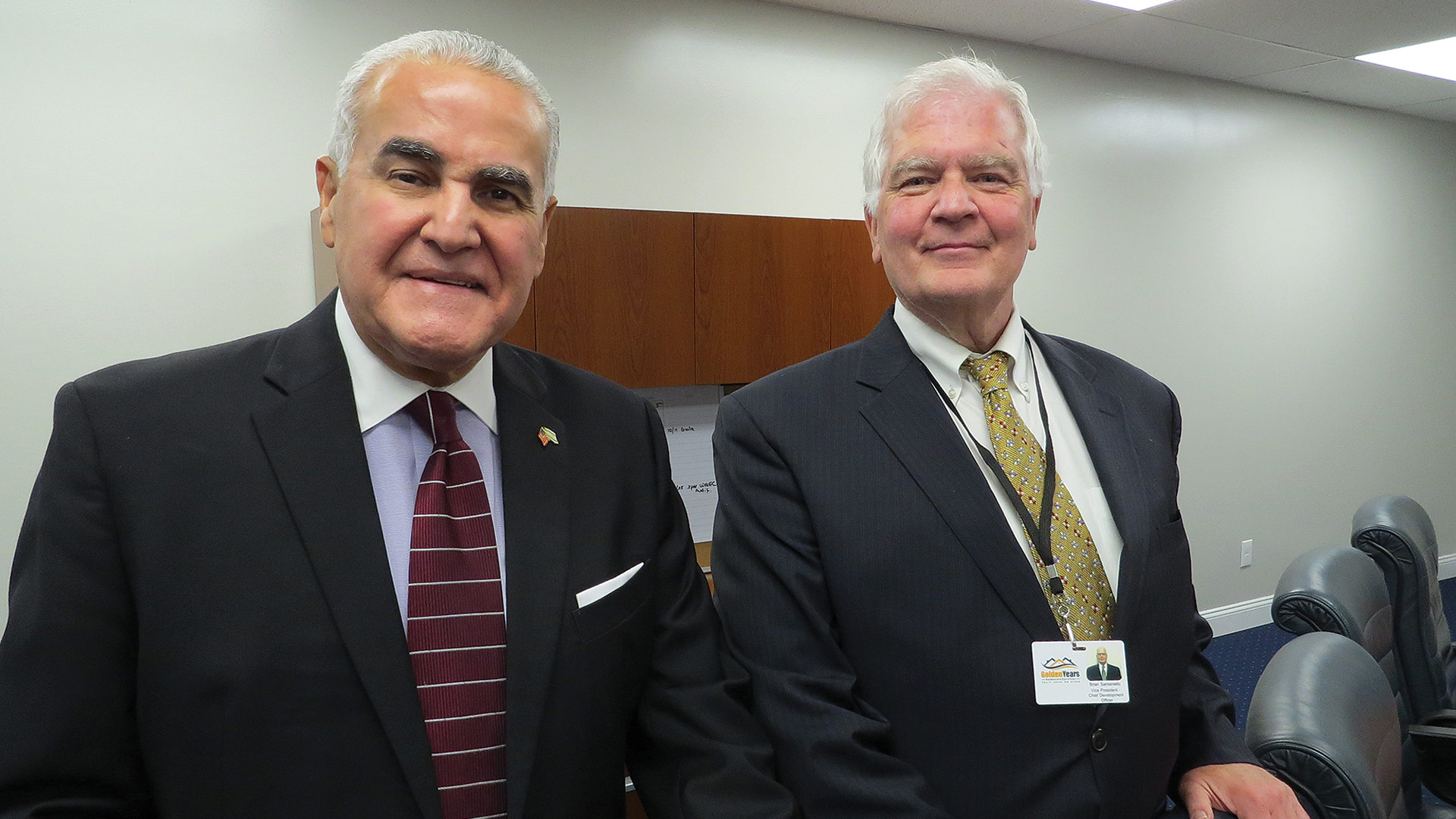
Cesar Ruiz, seen here with Brian Santaniello, director of Development for Golden Years, says the company is expanding its footprint to the east and the south, and will soon be looking to move into other states as well.

“The Boston area is quite saturated,” he acknowledged. “But we don’t look at ourselves as competitors — that’s a word that we don’t use here. We’re creators — we create our niche. And we do that by telling our story and emphasizing our services.”

While expanding geographically, the company is also broadening its base of services and diversifying. It recently launched Golden Years Staffing, which, as that name suggests, specializes in providing health professionals, and especially nurses, to area healthcare providers, and will soon launch Golden Years Adult Daycare.

At the moment, the company is changing the face of the center of East Longmeadow — the company has moved into the oldest commercial space in the town (once a general store of sorts) and adjacent property and has given it a dramatic facelift — while certainly shaking up the home-care industry at the same time.

For this issue, BusinessWest talked at length with Ruiz about Golden Years and where he wants to take this intriguing venture in the years to come.

At Home with the Idea

Turning the clock back to late 2016, when his father died and when he subsequently resolved to push ahead with a home-care venture, Ruiz said his research ultimately determined, as noted earlier, that this region was crowded with competition.

But when he drilled deeper into the numbers, he discovered that a large number of the players were small in size, “mom-and-pop” operations, as he called them, that were caring for perhaps a handful of clients, and some franchises “happy to have their 50 or 60 clients.” There were several larger operations, but he saw an opportunity to provide something different.

“We wanted to develop something very unique, something very large, that would have our signature stamp on it,” he explained, referring again to ‘the magic’ and its unique offerings.

“That’s what sets us apart — that’s what my mother came up with when she was caring for my grandmother,” he explained, adding that a similar approach was taken in the care of his father.

“When we were taking care of my father, we wanted laughter in the house every day,” he went on. “We wanted music in the house very day, and we wanted incense in the house every day. That’s my mom’s recipe.”

Elaborating, he offered more details on what would be the most unique of the three programs — laughter.

“That’s the most challenging for us, because we have to take people out of their comfort zones,” he explained. “The mind doesn’t make a distinction between a real laugh and a fake laugh — it still goes through that chemical change in your mind.”

The program — he doesn’t use the word ‘therapy’ in this case — involves exercises that do get people out of their comfort zones and get them laughing for real, an important ingredient in overall quality of life, he went on.

But there are several ingredients in this success formula, said Ruiz, adding that others include strong relationship-building efforts with area healthcare providers and senior-services organizations — strong sources for referrals — and a high level of quality that inspires him to eschew that word ‘competitor’ and instead use ‘creator.’

Golden Years has transformed the historic and formerly underutilized property in the center of East Longmeadow.

“We have a lot of hands in terms of the overall operations,” he explained. “We don’t just place a client with a caregiver and visit them once every quarter or once every six months; we visit them every month.

“We have supervisors that oversee that care,” he went on. “They’re responsible for the caregivers, they’re responsible for the client, and every month we have one of our staff people visiting the client to make sure they’re getting the delivery of their healthcare plan. That takes personnel, it takes time, and it takes extra expense, but we’re happy to do that because it ensures quality of service and care.”

This mindset also extends to the training of the caregivers, said Ruiz, adding that they are eventually evaluated on their ability to incorporate those three basic tenets — laughter, music, and aromatherapy — into the client’s care.

“We really want them to be engaged with our clients,” he told BusinessWest. “We encourage it, we demand it … we just don’t want to be transactional; we really want these caregivers to make a difference in overall quality of care.”

As for that relationship-building ability, Ruiz said he and his team started honing it in early 2017, just as the doors to the business opened, when the company visited as many senior centers, rehabilitation facilities, and other related facilities as possible to get its message across.

The visit that really got the ball rolling was one to Greater Springfield Senior Services, he recalled, adding that Golden Years was one of two companies invited to make a presentation to GSSS staff, including nurses, case managers, directors, and supervisors.

“We had a captive audience of about 85 people,” he recalled, adding this session took place in September 2017. “Up to that point, we had zero clients; we had just been planting seeds, planting seeds, and planting more seeds.

“After that presentation … three days later, the phone began to ring,” he went on. “And it hasn’t stopped since.”

Evidence for this can be found in the center in East Longmeadow, where the company has transformed a once-tired retail center that has seen a number of uses over the years, most recently as home to the Ski Haus. That signage is coming down, to be replaced with ‘Golden Years,’ two words that may be seen in many more places in the months and years to come.

“We plan to be multiple states — Connecticut is just the beginning of that,” he said, adding that franchising the company’s model is a distinct possibility. “We have a lot of growing still to do; we’ve only scratched the surface.”

Bottom Line

For now, the focus is on continuing with those relationship-building efforts, getting the message out, and building upon the very solid foundation that has been created over the past three years.

As noted at the very top, Ruiz knew the homecare field was already crowded when he decided to enter it. He wasn’t fazed by that reality and certainly not faint of heart.

That’s because he knew he had a good model and an even better mindset — one where he looked at every client and potential client as his own parents when it came to the level of care he wanted to provide.

That’s why he doesn’t see his surging company as a competitor — but, rather, as a creator.

George O’Brien can be reached at [email protected]

Banking and Financial Services

Past Is Prologue

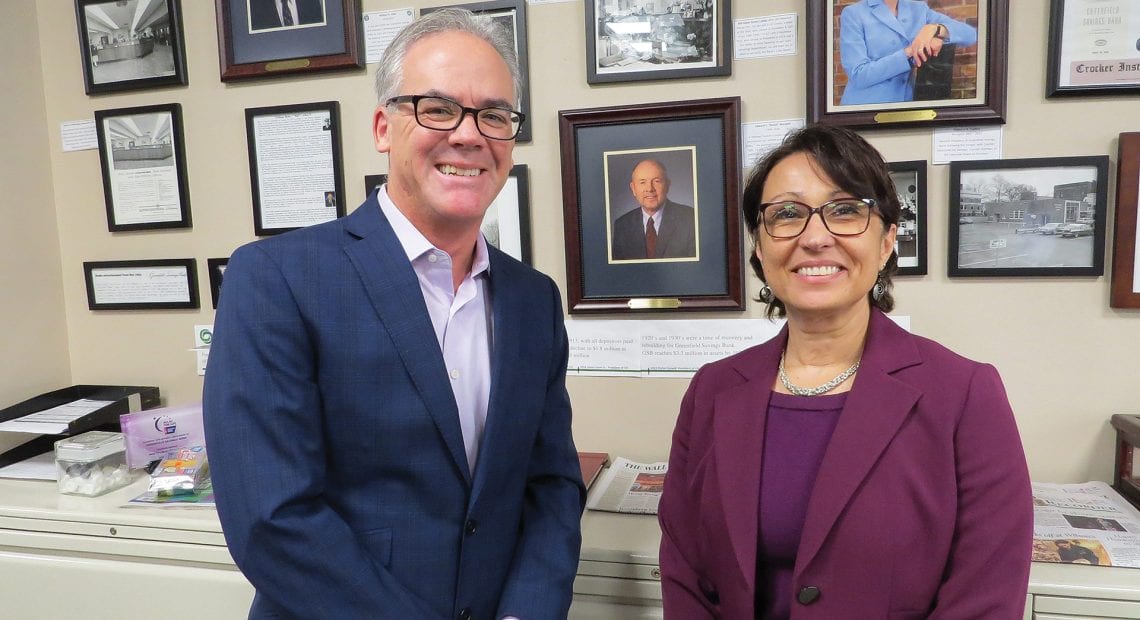
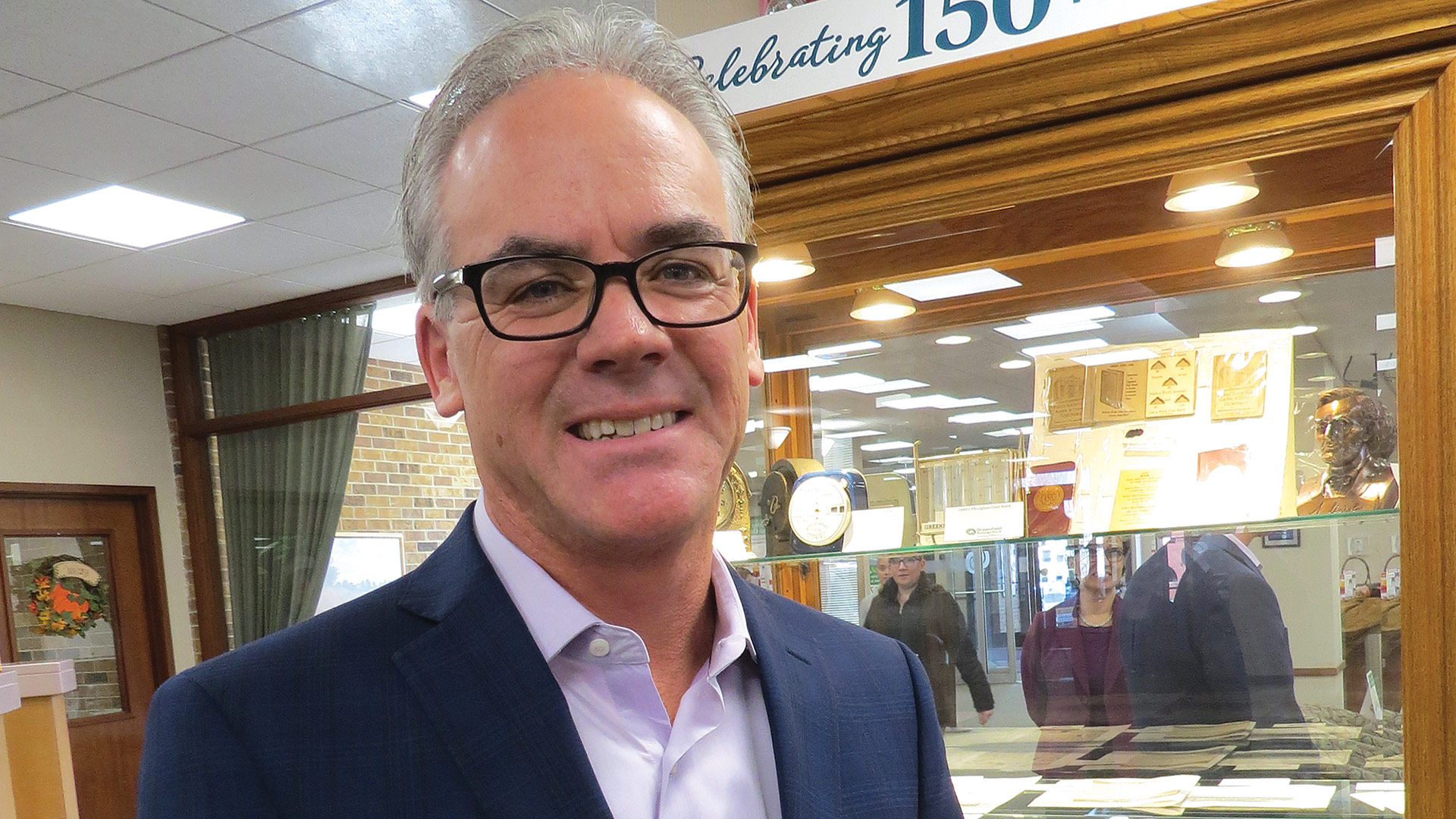
President and CEO John Howland stands by a display commemorating GSB’s first 150 years. I

Greenfield Savings Bank has marked its sesquicentennial in a number of ways this year — from a party with cupcakes in the spring to presenting elm trees to a number of area communities it serves in the summer, to displaying its proud history, something it’s done pretty much all year long. Overall, though, it has celebrated by doing what it has done since it was founded in 1869 — serving as a rock-solid corporate citizen. And a vital partner to its many types of customers.

John Howland jokingly refers to it as his “high-school history project.”

He was referring to the large display of photographs and other materials that trace the 150-year progression of Greenfield Savings Bank. And it’s quite an exhibition.

Indeed, across two walls just off the main lobby and outside the main conference room hang a number of photos, postcards, and framed advertisements and documents that collectively tell the story of an institution that has changed considerably since Ulysses S. Grant roamed the White House — but also hasn’t changed in many ways, as we’ll see.

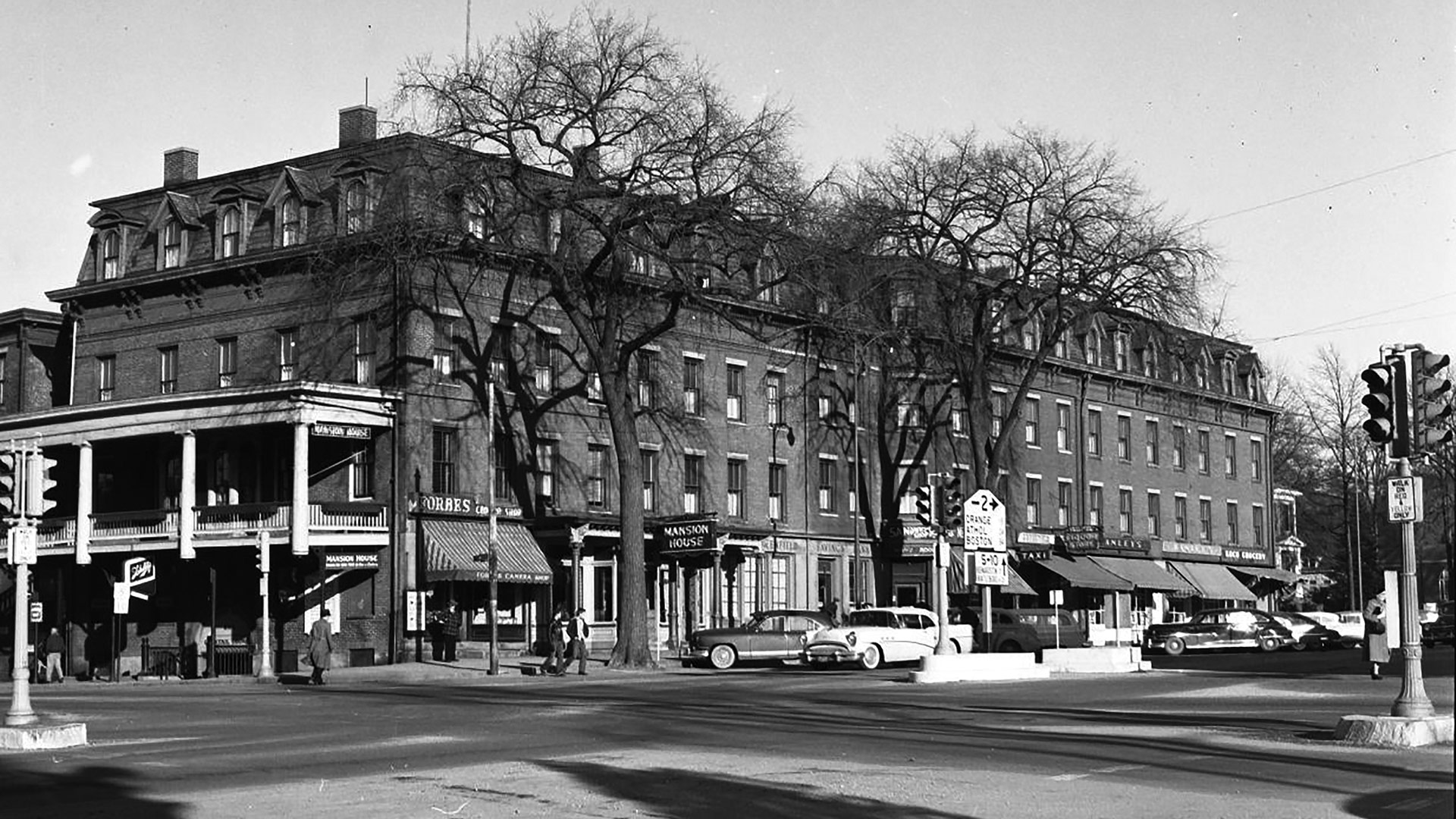
There are photos of bank lobbies from several different decades, a host of board presidents, groups of employees, Howland himself, who became GSB president in 2015, and many images of the old Mansion House Hotel.

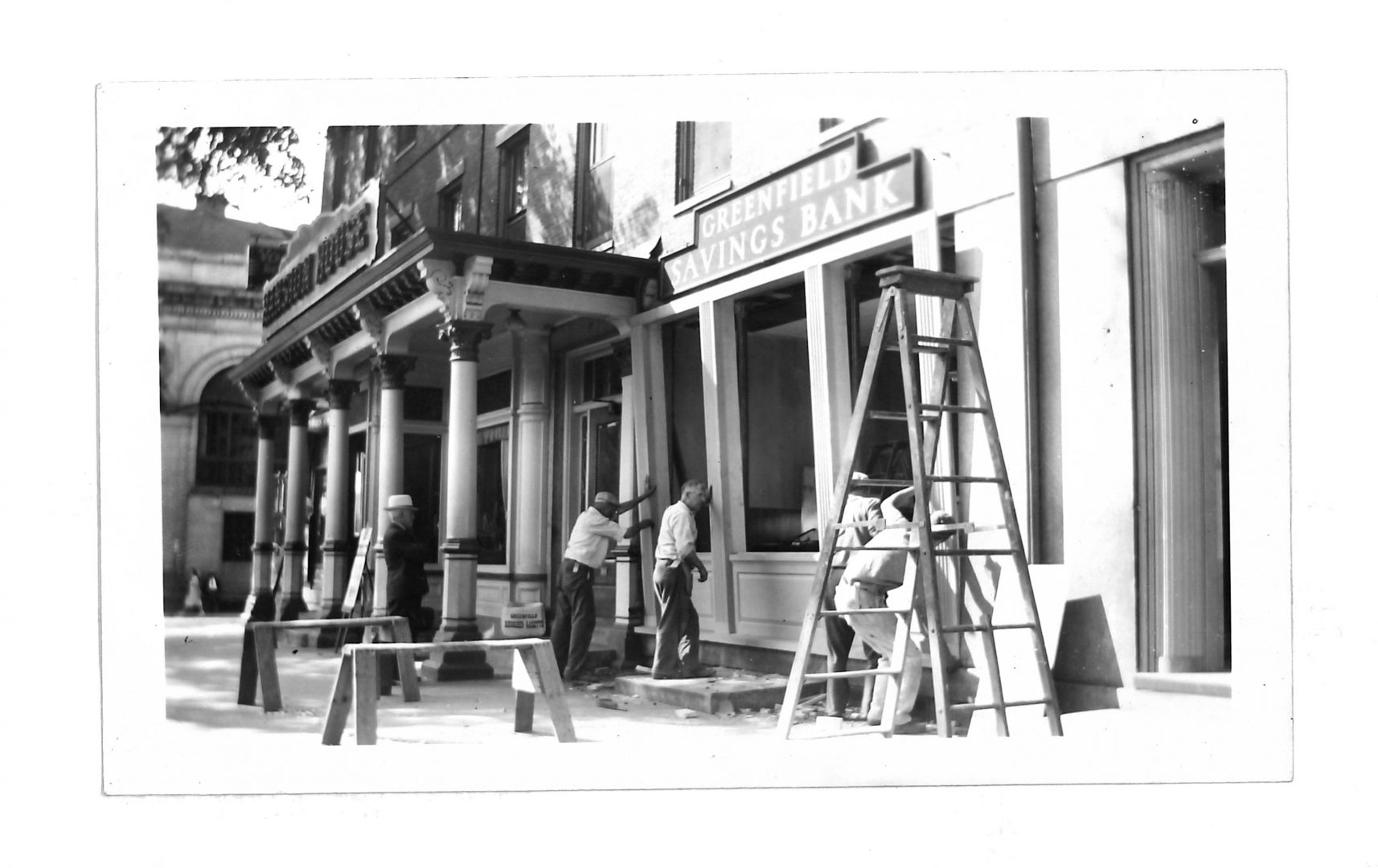
The bank was relocated within the hotel property roughly a decade after its launch — it was one of several ground-floor retail sites — and was still there when the Mansion House was destroyed in a massive fire in January 1959 (there are pictures of that historic moment as well). The bank built its new headquarters roughly where the front lobby of the hotel once stood.

The historic Mansion House Hotel and GSB’s location within that property.

“So we’ve basically operated in the same location since 1880, and that’s very significant to me,” said Howland, adding that this history project is important, for customers and employees alike, because there has been much to commemorate during what has been a year-long celebration, punctuated by a large party in the spring.

Starting with the name over the door. It was Greenfield Savings Bank all those years ago, said Howland, and it still is. This despite the fact that many banks, as they have expanded beyond their original home and added branches in other counties and sometimes another state, have dropped the city or town from their name, opting for something more global and seemingly less defining. Meanwhile, almost every other institution that had ‘Savings’ in its name has dropped that, too, on the theory that it’s anachronistic and doesn’t convey the full line of services.

GSB has done none of that.

“Why would you want to change a name you’ve had for 150 years?” he asked before answering the question himself. “The idea that we’re somehow different because we’ve changed our name and don’t have ‘Savings’ in it anymore is disingenuous to me.”

But the bank is celebrating more than continuity — although that’s certainly important. There has been growth and expansion into other areas, including Northampton, Amherst, and, most recently, the community in between them, Hadley. There has also been a commitment to remain at the forefront of technology, said Denise Coyne, executive vice president and COO (and 41-year employee of the bank), and as evidence, she pointed proudly to the new interactive teller machines, or ITMs, in the drive-through lane, an initiative GSB calls Teller Connect. Customers can speak with a teller based in Turners Falls who can handle a wide range of transactions from that location.

The bank is also celebrating its work within the community, a commitment that manifests itself in a number of ways and on many different levels, including multi-faceted support of Monte’s March, the trek undertaken by radio station WHMP DJ Monte Belmonte to raise money for the Food Bank of Western Massachusetts (Howland himself was to be part of the second leg of the march, from Northampton to Greenfield).

Denise Coyne shows off one of the Teller Connect machines at GSB’s main branch in Greenfield.

But it also includes donating 30 elm trees in communities where the bank has a presence to replace just a few those lost to Dutch elm disease decades ago (these gifts, part of the 150th celebration, are resistant to the disease), and creating a foundation to support an ongoing project whereby students learning each of the trades at Franklin County Technical School collaborate to build a house from scratch (more on those initiatives later).

Mostly, though, the bank is celebrating what Howland called its “infinite horizon.” By that, he meant that this institution isn’t going anywhere, and it can act, and operate, accordingly.

“My job is to hand the keys over to someone else and have the company be better than it was when I got here,” he explained. “At the prior two organizations I worked for, and at many other banks, basically the mission was to figure out how to maximize the value for the shareholders in the shortest period of time and sell the organization; to that extent, our business plan is different than that of most other banks.”

For this issue’s focus on banking and financial services, BusinessWest talked at length with Howland and Coyne about GSB’s first 150 years and what will come next for this venerable institution.

Staying on Track

Hanging on a wall inside the conference room is a framed poster hyping the 20th Century Limited — the historic express passenger train on the New York Central Railroad that traveled between New York and Chicago — and its faster time for completing that run: 16 hours.

This might seem like an odd item to find in a bank headquarters building, but Howland offered an explanation that speaks volumes about how this institution celebrates its past but is by no means stuck in it.

“I put that poster up to remind us that we constantly have to be reinventing ourselves, constantly have to be figuring out how to do it better and faster,” Howland explained. “The poster represents the race between the New York Central Railroad and the Pennsylvania Railroad to attract customers to this high-profile route. When one company dropped their time, the other matched or exceeded it. They conceived idea after idea to improve service, cut down travel time, and maintain schedules. Banking today is just like that — we are all providing the same products. That’s why we continue to provide our customers with exceptional service, the most up-to-date technology, and offer competitive rates.”

And throughout its long history, the bank certainly has operated with that mindset.

Students at Franklin County Technical School work on the framing for a house they constructed in Erving through a program financed by a foundation created by GSB.

Indeed, while the name over the door hasn’t changed and the street address of the main branch has changed by just a few digits, the bank has evolved with the times and advancing technology, all while remaining a hugely important corporate citizen in a region that never had many and has seen those ranks decline over the past several decades.

Coyne, the bank’s longest-serving employee, has certainly seen this blend of change and continuity in her time.

She recalls doing most tasks by hand when she started as a teller at the Turners Falls branch (the only branch at the time) in 1978, and, in fact, she helped lead the institution into the computer age and a succession of improvements, including Teller Connect.

“The technology is so great that we can extend our hours — from 7 a.m. to 7 p.m., Monday through Friday, you can talk with a teller,” she noted, adding that there are extended hours on Saturday as well. “It’s no different than if you go to a drive-up and talk with someone who’s in the building; we can do almost everything you could if you came into the lobby.”

Over the past four decades, Coyne, who has held a number of titles over the years and handled pretty much every assignment other than commercial lending, has seen the bank greatly expand its footprint, first into other communities within Franklin County, then into neighboring Hampshire County.

There are now five branches in Franklin County — in Greenfield, Conway, Shelburne Falls, South Deerfield, and Turners Falls — and the same number in Hampshire County — two in Amherst, two in Northampton, and the latest addition, the branch on Route 9 in Hadley.

That addition to the portfolio wasn’t exactly planned, said Howland, noting that it came about by circumstance — the closing of a credit union — and was viewed as an opportunity to more conveniently serve customers in that area.

Looking ahead, Howland doesn’t see much, if any, additional expansion. But he does see continuous work to improve customer service, take full advantage of ever-improving technology, and, overall, take full advantage of the infinite horizon he mentioned.

“That’s the biggest challenge we face — the non-bank competitors coming in picking off pieces of our business. It’s kind of like Walmart being able to do an MRI for you; it’s large companies picking and choosing where they can make something work.”

And all those qualities will be needed, he said, because, while the pace of consolidation within the banking industry has slowed somewhat, especially in this region, other threats have emerged, especially from what he called “non-bank competition.”

By that, he referred to Apple, Google, Alibaba, PayPal, and a host of other major companies that are chipping away at traditional bank business by creating services of their own in realms ranging from lending to payments to credit cards.

“That’s the biggest challenge we face — the non-bank competitors coming in picking off pieces of our business,” he explained. “It’s kind of like Walmart being able to do an MRI for you; it’s large companies picking and choosing where they can make something work.

“And then we, as an organization, have to provide everything for everyone,” he went on. “And sometimes it can become expensive to provide some products. It’s just capitalism — it’s not a bad thing, necessarily, but it’s a challenge for us as an organization to maintain as much as we maintain and be able to provide an array of services for our customers.”

Saving Graces

To counteract these powerful forces, GSB has to focus on what differentiates it from those non-bank competitors and the larger regional banks so prevalent in this market, said Howland.

These differentiators include both a personalized brand of service and a deep portfolio of services, including a trust department, something most area banks no longer have, he went on.

As just one example, he cited the example of a customer entangled in a fraud situation.

“Unfortunately, the bank on the other side is a huge organization that really doesn’t care — they will not help at all, they won’t talk with us, they won’t do anything,” he noted. “I think the way we differentiate ourselves is the personalized service and the fact that our customers know they can count on us — they know they can call someone who cares and is going to do something about their problem.”

Beyond the brand and scope of services, another differentiator is the bank’s long history of involvement in the community and a commitment to continue that tradition, said Howland.

“As an organization, we’re very proud of our position in the community,” he told BusinessWest. “We’re dedicated to being the best corporate citizen we can be, and we’re involved in our community in many, many different ways.

“Obviously, we’re important in terms of the local economy, but it’s not just the economy that we focus on, it’s just the financial aspect of what we do,” he went on. “It’s striving to improve the conditions in our communities as best we can. We’re one of the larger philanthropic organizations in terms of straight dollar donations, but on top of that, our employees are involved in all kinds of stuff at all kinds of levels.”

And by ‘stuff,’ Howland meant much more than time and energy donated to the boards of dozens of nonprofits — although that’s a big part of it. There’s also volunteerism and the many forms it takes, he said, adding that the bank prides itself on backing up such efforts with dollars and other types of support.

“If an employee comes to me and says, ‘I think this is really important, and I have dedicated myself to volunteering time for it,’ more likely than not, we’ll make a fairly significant financial contribution to that charity on behalf of that employee.”

Overall, the bank is keenly aware of its role and its responsibilities within the largely rural areas it serves, particularly in Franklin County, he went on, adding that it is often asked to step up and, when possible, pitch in. Such was the case with the initiative involving Franklin County Tech and a proposal to have its students build houses.

The bank’s response was to go beyond writing a check and instead do something for the long term.

“I got a phone call from the tech school asking if we would make a donation to this program to build a house,” Howland recalled, adding that the bank eventually created the Franklin Technical School Building Society Inc., a foundation with its own board of directors that essentially finances the home-building project and is replenished when the house is sold.

“They earned a lot of money on the first house, and the second house will hopefully be sold in the spring of 2020, and another house will be started after that,” he went on. “The point of it is to create something that becomes self-sustaining, and ultimately, we hope this grows to the point where it can be a benefactor for other programs at the tech school.”

Long-term thinking was also the motivation for the bank’s decision two years ago to create the Greenfield Savings Bank Foundation. Funded with profits from the bank, it’s an initiative in keeping with GSB’s long-term horizon, said Howland.

“We funded it with $200,000, and our expectation is to continue funding it at some amount per year,” he explained. “My vision, and it will not be in the time that I’m president of the organization, is that, at some point, this foundation will be as large as, if not larger than, the bank, and I think we have the opportunity to do that.

“I’m most proud of where we are as a corporate citizen in our community, and my feelings are a reflection of our board of directors,” he added. “Our board is incredibly committed to making us the best business we can be in Franklin County and Hampshire County.”

Time Passages

There’s some additional 150th memorabilia in the main lobby of GSB’s headquarters.

On one wall, the very first passbook sits in a frame. And a glass display case in the center of the room holds everything from a photocopy of the first mortgage document (a loan issued in 1869 to one Jeremiah Eagan for a building on School Street) to news photos of the Mansion House fire, to a box of fountain pen nibs, a symbol of how things were done more than a half-century ago.

This collection speaks to the two qualities that are really being celebrated with this sesquicentennial — needed change and continuity.

There are plenty of other pieces of evidence outside the bank, from the house built by the technical-school students in Erving to elm trees growing in Look Park in Northampton, Montague center, and a host of other locations, to those branches in Hampshire County.

Together, they speak of a 150-year-old success story — and of many chapters still to come.

George O’Brien can be reached at [email protected]

Travel and Tourism

Coming Attractions

Mid-January is typically the slowest time for the region’s tourism sector. The holidays are over, and college graduations, summer, and the Big E are months away. But this January, and especially Martin Luther King Jr. weekend, will be different. Much different. Two massive happenings — the Red Sox Winter Weekend and the HoopHall Classic — will occur simultaneously, presenting an intriguing and hopefully lucrative mix of challenge and opportunity.

Mary Kay Wydra calls it the “perfect storm.” And she really hopes there isn’t an actual storm over those few days.

With those sentiments, Wydra, president of the Greater Springfield Convention & Visitors Bureau, spoke for a good number of people when it comes to what is shaping up to be a memorable and perhaps historic weekend for this region next month.

So did John Doleva, executive director of the Naismith Memorial Basketball Hall of Fame, when he said, “this is what we’ve all dreamed about — weekends that were so busy that we’d be bursting at the seams.”

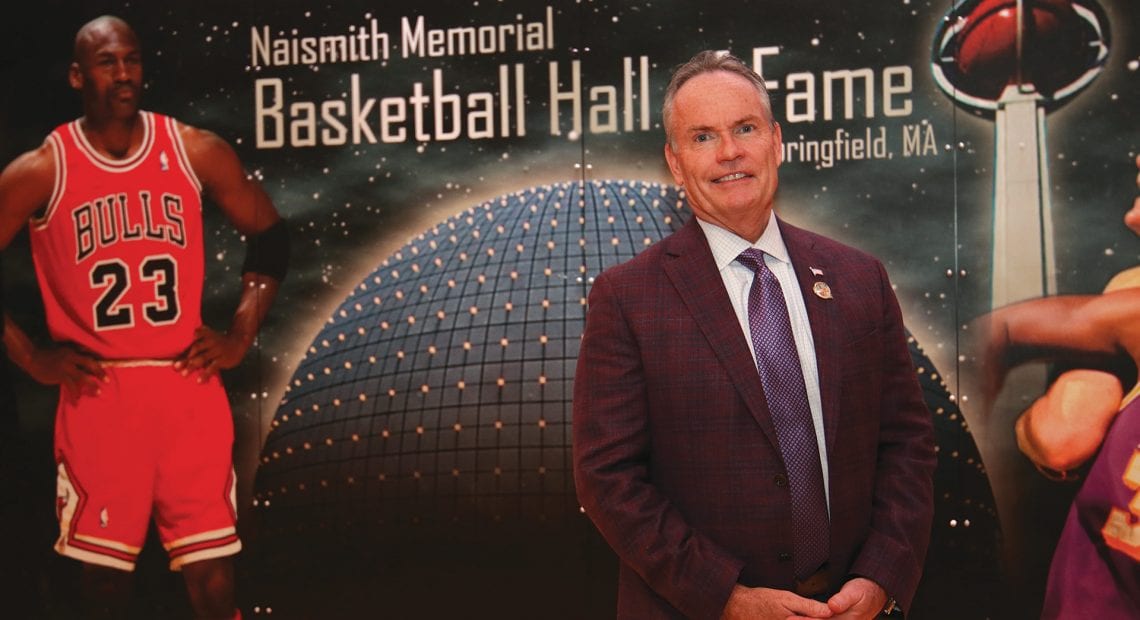
John Doleva says the upcoming weekend in January is the kind of multi-event development the city should welcome, despite the logistical challenges.

They were both talking about Jan. 16-20. Those are the dates for the 2020 Spalding HoopHall Classic, presented by EastBay. And in the middle of that, on Jan. 17-18, the Boston Red Sox will stage their Winter Weekend at MGM Springfield and the MassMutual Center. The annual fan fest, launched in 2015, had been staged at Foxwoods Resort and Casino in Connecticut, but moves to Springfield for 2020 thanks to a multi-faceted partnership agreement forged between the Red Sox and MGM back in the early spring.

While hard projections are difficult to come by, it’s estimated that, between the two events, more than 20,000 people could come to Springfield over those four days, with a good number of them — again, just how many isn’t known yet — staying a night or several nights.

“Every restaurant in downtown will be packed, and every hotel in the downtown will be packed. This will be one of the biggest parties the city has hosted in some time.”

This is that ‘bursting at the seams’ part.

Indeed, the two events occurring simultaneously will certainly test this region’s hospitality infrastructure and especially its inventory of hotel rooms — so much so that Doleva was candid and to the point when he told BusinessWest, “We’re thankful that we booked the hotel rooms first, because we wouldn’t want to be shut out.”

The Hall was able to do so because this is the 18th HoopHall Classic staged over Martin Luther King Jr. weekend, if you will, meaning that there is an organizational machine in place for this event. That’s not the case with the Red Sox Winter Weekend, which, as noted, is new to Springfield.

Mike Mathis, president and COO of MGM Springfield, says Red Sox Winter Weekend will provide a unique opportunity to showcase the city and the casino.

Logistics for the event are being handled by both the Red Sox and the event’s official host, MGM Springfield. Mike Mathis, president and COO of the resort casino, said planning efforts are proceeding and accelerating as the event date approaches.

And what is emerging sounds like a dream weekend for ardent Red Sox fans — is there any other kind? — and area restaurant and hotel owners alike, especially with both events happening simultaneously.

“Every restaurant in downtown will be packed, and every hotel in the downtown will be packed,” he told BusinessWest. “This will be one of the biggest parties the city has hosted in some time.”

Like Doleva and Wydra, Mathis projects that this will be a very important weekend for the city, the region, the casino, the Hall, and countless hotels, restaurants, and other hospitality-related businesses. It will be a weekend to showcase the city and also what it can do when it comes to large events like these.

In short, it will be a real test, but also a very welcome test, especially since it comes at the very slowest of times for the region’s hospitality sector, said Wydra, adding that there are benefits on many levels.

“We’re experiencing compression — the downtown fills up, and it spills over into other communities,” she explained, referring not only to hotel rooms but related hospitality-related businesses as well. “We want to make sure, when people come for both of these events, that they see other things and we at least whet their appetite and try to get them back as a leisure visitor for another time.”

For this issue and its focus on travel and tourism, BusinessWest takes an in-depth look at all that’s happening in mid-January and what it means for the region.

Staying Power

These certainly won’t be the first large-scale events to come to the Greater Springfield area.

Indeed, the region has played host to everything from enshrinement ceremonies at the Hall to the Women’s U.S. Open golf tournament back in 2004 (the Orchards in South Hadley was the venue); from the American Hockey League All-Star Classic roughly a year ago to a number of large conventions staged at the MassMutual Center, the Big E, or both.

And on an annual or semi-annual basis, it hosts EASTEC, the massive manufacturing trade show, as well as the Big E, which brings in more than 100,000 people on some of its weekend days, and college graduation ceremonies that are crammed into a few weekends in May, with the MassMutual Center often hosting a few such ceremonies a day.

All those gatherings have presented tests — and opportunities — for the region’s hospitality sector.

But the challenge coming in January may surpass all those in the past, in terms of everything from the sheer number of overnight guests to the logistics involved — for example, Main Street and a portion of State Street in Springfield will be shut down for roughly 48 hours to accommodate the Winter Weekend festivities.

But while that long weelend will test planners and hoteliers alike, all those involved with both events see as a tremendous opportunity to put Springfield and the region on the map and into the limelight.

That’s because there will be a good deal of media coverage — ESPN is coming to broadcast HoopHall Classic games, as it has for many years now, and NESN and radio giant WEEI are coming to provide blanket coverage of Red Sox Winter Weekend — as well as visitors who haven’t been to Springfield recently, if at all, especially Red Sox fans from the far corners of New England and beyond.

“We’ve seen the demographics from prior years, and we know that a large part of that population is coming from outside the region,” said Mathis, using ‘region’ to refer to Western Mass. “This is a great chance to expose new customers to the property and the downtown.”

Let’s break here to review just what’s on tap for those four days in January, starting with Winter Weekend.

This will be an intense two days of meet-and-greets, a town meeting with Red Sox brass holding court, autograph signings, a kids’ zone, and much more.

Fans of the team will get to see, meet, get an autograph from, and perhaps snap a picture with players from the present and past, well as executives (including recently hired Chaim Bloom, the team’s chief baseball officer), coaches, network broadcasters, and even the well-known mascots, Wally the Green Monster and Tessie. (Fans can even buy a package that includes breakfast or lunch with the mascots.)

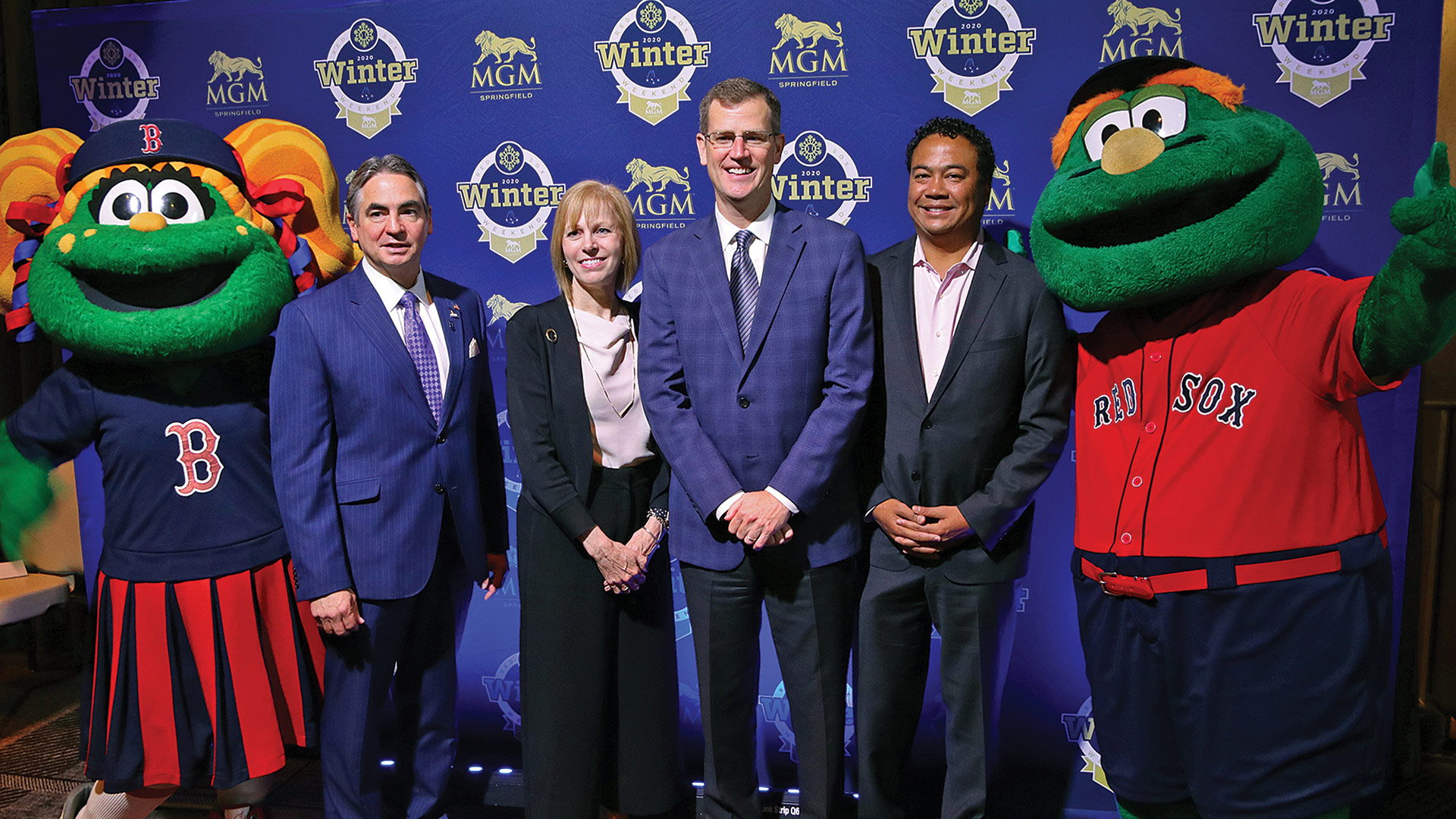
At a recent press conference to announce Red Sox Winter Weekend festivities, Red Sox mascots Tessie (left) and Wally pose with, from left, Springfield Mayor Domenic Sarno; Cathy Judd-Stein, chairwoman of the Massachusetts Gaming Commission; Sam Kennedy, president of the Boston Red Sox; and Mike Mathis, president and COO of MGM Springfield.

Players set to appear will cover every decade since the ’60s, a list including Jim Lonborg, Luis Tiant, Fred Lynn, Dennis Eckersley, David Ortiz, Pedro Martinez, Mookie Betts, Xander Bogaerts, and dozens more.

There will be events in MGM’s ballrooms and at the MassMutual Center (word has it that every square foot of the facility has been booked), and tents will connect the two venues, enabling patrons to move freely from one to the other, said Mathis.

As for the HoopHall Classic, it will bring its own brand of star power to the region, Doleva said.

He noted that a number of top college coaches, including John Calipari (Kentucky), Mike Krzyzewski (Duke), and Patrick Ewing (Georgetown) will likely be on hand to scout many of the top young players from across the country. And that talent includes some famous last names — ‘Bronny’ James, son of NBA superstar Lebron James, and Zaire Wade, son of former NBA superstar Dwayne Wade, will play for the same team from California.

“Teams travel in from all around the country,” Doleva noted. “On Sunday and Monday, we have the top-ranked teams in the country; the top 10 or 15 prospects going D1 [Division 1] will be playing on the various teams. We have multiple TV events on Sunday and Monday, so if you can’t buy a ticket to Blake Arena at Springfield College, you can watch it on ESPN or ESPN2.”

Having a Ball

That’s what’s on tap. As for what it all means … those we spoke with said the simultaneous events could well set a new bar when it comes to bringing visitors, vibrancy, spending dollars, and, yes, challenges for the region’s hospitality sector.

Doleva noted that he expects the Hall’s event to consume 1,100 to 1,200 hotel-room nights when one factors in players, their parents, the college coaches coming to watch and recruit, and members of the media. And, as he noted, he’s happy he reserved hotel rooms early and managed to get large blocks of rooms in and around downtown Springfield and close to the Hall of Fame, where many of the HoopHall Classic events will take place.

Overall, though, hotels across the region will benefit, said Alicia Szenda, director of Sales for the GSCB.

“Patrons coming in for both events will be in Chicopee, Holyoke, and West Springfield properties, and into Connecticut as well,” she told BusinessWest. “I can’t remember a time when we’ve had two events of this magnitude happening at the same time; these are large fan bases that are coming to the area.”

Mathis told BusinessWest that the Red Sox players will be staying at MGM Springfield —most of the facility’s rooms have been reserved for weekend event — but he expects that attendees, media members, and others will be finding accommodations across the area, creating a sizable trickle-down effect.

Meanwhile, the twin events, and especially Winter Weekend, will present a huge opportunity to introduce the resort casino to new audiences, said Mathis, with the goal of making a very strong first impression and bringing them back for return visits.

“We always feel that, if we can get a new customer on the property to give us a trial, we have a very good chance of getting that customer back and start building loyalty,” he explained, adding, again, that the resort casino will be just one of many winners that long weekend.

“This goes well beyond the property and the city — the impact will be region-wide,” he went on, referring specifically to the Winter Weekend but the sum of the two events as well. “Springfield is hosting two major events on the same weekend; the compression and the energy that comes from that is testament to what we’re doing down here, that we’re starting to get double-booked on weekends.”

Doleva echoed those thoughts, and noted that there could be a good amount of crossover from the events.

“I think that many of the folks coming from out of town for our event might enjoy the Red Sox gathering,” he said. “And those here for the Red Sox will hopefully realize that they’re three minutes away from the Basketball Hall of Fame and come over and check it out. This is the perfect storm of good things.”

And, as noted earlier, this storm comes when it’s needed most for the tourism sector — the dead of winter.

Last year, the region and its hospitality sector got a boost from the AHL All-Star Classic, said Wydra, adding that, this January, there will be a much larger shot of adrenaline.

“We’re creating a reason to come here in the winter — and that’s always been a struggle not only for us, but for any New England city,” she noted, adding that perhaps the best news is that this will be the first of hopefully many Winter Weekends in Springfield, and the same goes for the HoopHall Classic.

Booked Solid

While almost all his time and energy are focused on the 2020 HoopHall Classic, Doleva has allowed himself to think a little about the 2021 edition as well.

It may well be staged at the same time as the Red Sox Winter Weekend again, which means there may be a more intense competition, if that’s what it is, for hotel rooms in the city.

“Next year, I’m hoping we all work together so everything happens in a cost-effective way,” he noted. “But, like I said, this is what we all hoped for and dreamed for — that the city would be on fire with tourism and events and people coming from out of town.

“We’ll find a way to coexist and celebrate the assets that we have in Springfield, and blow it out that weekend — and hopefully a number of other weekends as well,” he went on.

And with that, he once again spoke for a great number of people concerning a weekend destined to be a hot time — during the coldest month of the year.

George O’Brien can be reached at [email protected]

Construction

Beneath the Surface

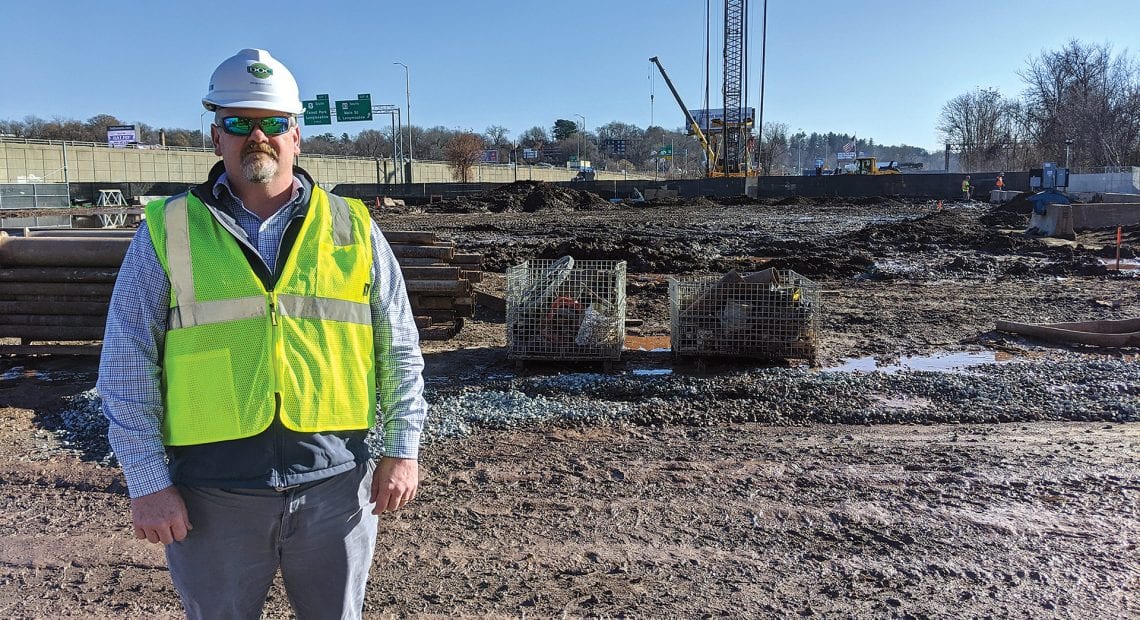
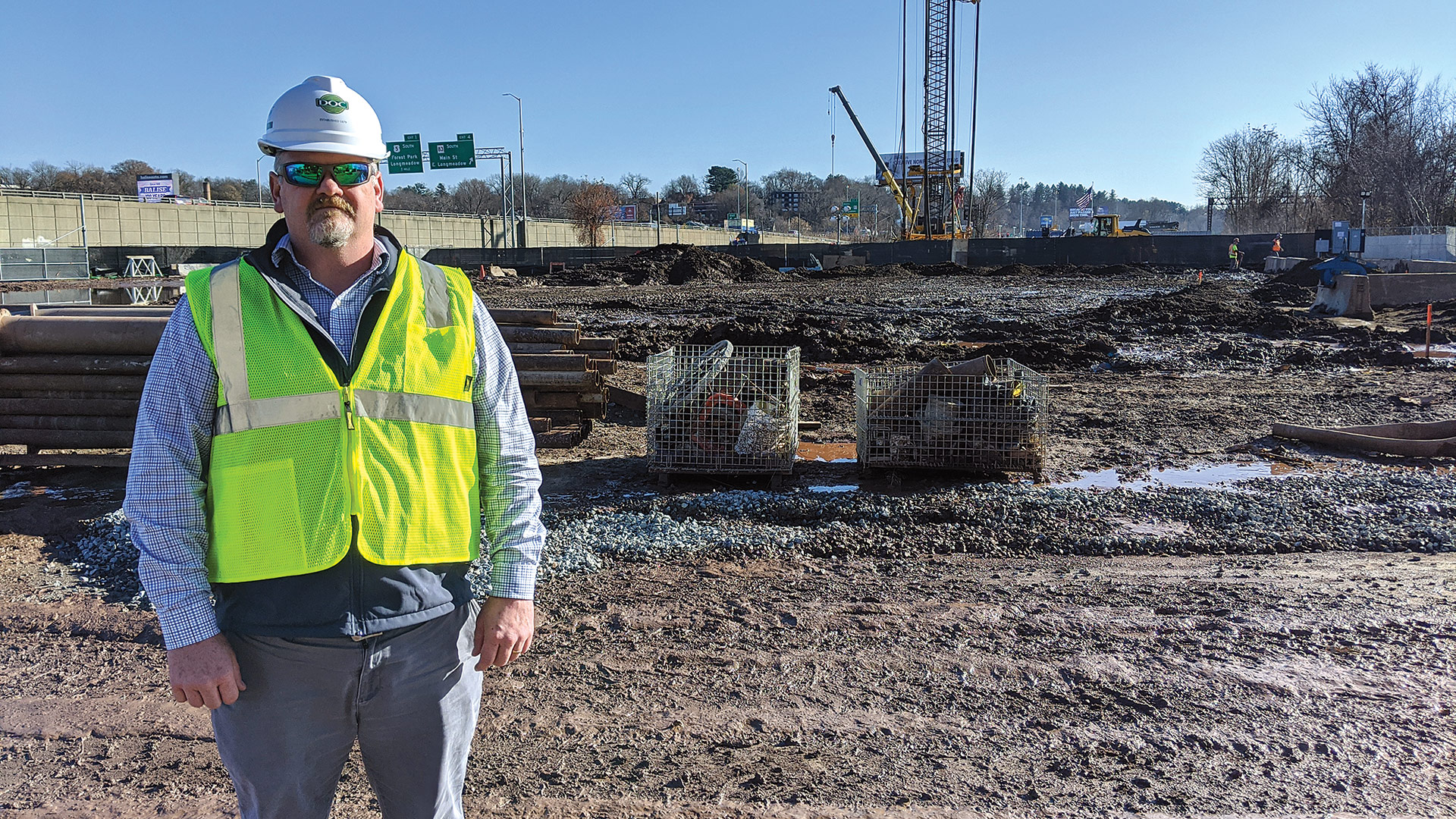
Jeff Weinman stands on the former York Street Jail site, where a new, state-of-the-art pump station is being built.

The wastewater pump station at Springfield’s riverfront has done its job for more than 80 years, but it’s nearing the end of its useful life and lacks the capacity to keep up with the region’s growth — which threatens the cleanliness of the Connecticut River itself. That’s why the Springfield Water & Commission has launched a $115 million project to build a new station and three new pipelines across the river — a project that comes with some intriguing challenges and equally innovative solutions, including something called microtunneling.

When the wastewater pump station on York Street in Springfield was built 81 years ago, the city’s infrastructure was much different — and so were its sewage-treatment needs.

“The existing pump station is pretty old, though it’s still functional,” said Jeff Weinman, senior project manager Daniel O’Connell’s Sons (DOC), the contractor overseeing the construction of a new, much larger pump station at the site. “The capacity is the issue. As the city has expanded over the years, it’s kind of at its capacity right now, so they need to create additional pumping capacity there. In order to that, they needed to build a bigger pump station with bigger pumps, bigger piping, bigger everything.”

The $115 million project will serve 70% of the region’s population by conveying wastewater from Springfield, Ludlow, Wilbraham, and East Longmeadow across the Connecticut River to the Springfield Regional Wastewater Treatment Facility on Bondi’s Island. A new, higher-capacity wastewater pump station will be constructed, as well as three new wastewater-conveyance pipes across the Connecticut River.

The project is a cornerstone of the Springfield Water & Sewer Commission’s efforts to comprehensively plan projects that will meet multiple pressing needs such as combined sewer overflow reduction, climate resiliency, system redundancy, and infrastructure renewal. Construction is expected to last well into 2022.

“It’s part of a capital investment on the part of the commission to both increase their infrastructure and enhance water quality in the Connecticut River,” Weinman told BusinessWest. “It can reduce the potential for severe storms to impact water quality in the Connecticut River by having storm runoff or having the city’s sewer system overflow.”

A rendering shows the future pump station’s footprint both above and well below the ground.

The innovative project, expected to create about 150 construction jobs over the next three years, is designed to address four key issues, including:

• Infrastructure renewal (the new, modern station will replace an aging station nearing the end of its useful life and accommodating future growth in the region);

• Environmental protection (increased pumping capacity will prevent an additional 100 million gallons of combined sewer overflows from entering the Connecticut River in a typical year);

• System redundancy (three new pipes under the Connecticut River will add redundancy and improve service reliability for customers in Springfield, Ludlow, East Longmeadow, and Wilbraham); and

• Climate resiliency (flood-control protection will be increased by repurposing the old pump station).

The project is a culmination of years of planning — specifically through the commission’s Integrated Wastewater Plan (IWP). Adopted in 2014, the IWP was one of the first such plans in the country to integrate project planning for regulatory compliance — specifically, projects that fulfill an unfunded federal mandate to eliminate combined sewer overflows — and for renewal of aging infrastructure.

A Question of Capacity

The new station is being built on the former site of the York Street Jail and will connect to the Springfield Regional Wastewater Treatment Facility on Bondi’s Island through three new, 1,200-foot river crossing pipes. The additional pipes will supplement the two 80- and 50-year-old pipes under the river now, allowing for more regular maintenance and alternatives during emergencies.

“It can reduce the potential for severe storms to impact water quality in the Connecticut River by having storm runoff or having the city’s sewer system overflow.”

A $100 million low-interest loan from the Massachusetts Clean Water Trust State Revolving Fund (SRF) is the source of funding for the majority of the project. The SRF is administered by the Massachusetts Department of Environmental Protection with funding from the federal Environmental Protection Agency and from repayment of past loans.

The project also utilizes an innovative form of construction called ‘construction manager at risk’ (CMAR). Rather than designing a project and then sending it to bid for construction, CMAR incorporates the construction manager earlier in the process to help identify risks that may arise in the construction phase due to design. This garners more price certainty and minimizes project delays due to unforeseen circumstances.

“The delivery method is a little different,” Weinman said. “We did a technical proposal for the job, and based on that we were awarded the contract, then we worked with the design team during the final stages of development of construction documents, providing budgeting support and working with design team as they finalized documents and tailored them to the approach to the work that we thought best.”

The current, 81-year-old pump station is much smaller — and can thus handle much less wastewater — than the one coming online in 2022.

One of the interesting challenges of the project is where it’s sited, shoehorned between West Columbus Avenue and the flood-control wall and the infrastructure on York Street, including the main interceptor pipe for the city of Springfield.

“The pump station needs to be deep enough to work with the existing elevations of the infrastructure and also be able to have the capacity to handle the flow that it needs to handle,” Weinman said. “The bottom elevation of the pump station is 50 feet below existing grade. The site is so small, you have to go pretty much straight down with excavation to build the pump station.”

So, in a move uncommon in Western Mass., DOC will use a slurry wall for supportive excavation. “It’s a type of system usually used in downtown Boston and urban settings where you don’t have a lot of real estate. A concrete wall is built in the ground without using formwork,” he explained. “It’s kind of a unique process — the first time I’ve been involved with a project that employs that system.”

Another challenge involves running the new pipelines under the Amtrak tracks, Weinman noted. “So they’re going to be microtunneling under the tracks. We did a smaller supportive excavation for the launch pit for the microtunneling. That’ll be going on hopefully next summer — boring a hole beneath the flood wall and the railroad tracks out to the other side of the tracks down toward the river.”

Next summer will also see the start of the underwater pipe installation. That phase of the project should take about 12 months, as will DOC’s infrastructure upgrades at Bondi’s Island to expand the capacity of the sewage intake there. The construction of the pump station itself is the most involved part of the project; a groundbreaking took place in the spring, and it should be complete in May 2022.

Water Works

The river-spanning pipe installation — which DOC will subcontract to a firm that specializes in such work — is a relatively straightforward job, but the process of completing the work has become more difficult in terms of the regulatory aspects, Weinman told BusinessWest.

“There’s a lot more awareness now of the potential environmental impacts, so the planning of it becomes a lot more intensive. You work with regulators, MassDEP, the Army Corps of Engineers, and other regulatory agencies involved, making sure you’re tailoring your work in a way that complies with all the regulations and minimizes the impact,” he explained. “It’s an arduous process, and I understand why it’s there.”

Still, the entire project itself will have a major environmental benefit, and that’s keeping the Connecticut River cleaner while better meeting the region’s growing wastewater needs.

“The York Street Pump Station and Connecticut River Crossing Project is a sign of the commission’s smart and future-oriented approach to stewarding the region’s water and wastewater infrastructure,” Commission Executive Director Josh Schimmel said at the spring groundbreaking. “These types of projects may not always be the most glamourous, but they are critical to maintaining public health, service reliability, and environmental protection in the region for the 21st century. We are proud to initiate this project that will maximize ratepayer dollars by meeting multiple needs.”

To Weinman and his team at DOC, it’s another rewarding challenge, particularly in terms of innovative methods like the slurry wall and the trenchless tunneling under the railroad tracks, that promises to lead to a positive outcome.

“That’s the nature of construction,” he said. “There are so many different systems out there, and every job has different challenges and different solutions.”

Joseph Bednar can be reached at [email protected]

Community Spotlight

Community Spotlight

From left, Rebekah DeCourcey, Stuart Beckley, Tracy Opalinski, and Anna Marques.

‘Somewhere worth seeing.’

This is the tagline that’s been attached to a visioning, branding, wayfinding, and business-development plan for the town of Ware, an ambitious document that has elements ranging from a community vision to a branding strategy to new signage that will direct locals and visitors alike to various civic, cultural, and recreational destinations within the community.

As for that vision, it states that this community in eastern Hampden County is “one where we meet at unique shops and businesses in our revitalized downtown, where a growing, diverse economy is being cultivated, where we respect the land and enjoy unrivaled outdoor recreation opportunities, and where our government and its partners work together to provide efficient and up-to-date services for all of our citizens.”

For town officials, said Selectman Tracy Opalinski, the tasks at hand are to make sure that these are not just taglines and words on a page, but instead constitute reality in this community of nearly 10,000 people — and to communicate this to people within and outside the town. And she and others believe some real progress is being made in this regard.

“Ware is really a center of commerce for a large region, and people come to Ware not just to go to Walmart, but also for their banking, their healthcare, their education. We are a regional hub to a rural area.”

She said there are many projects underway to help people realize how much Ware has to offer, and town officials are working hard to set the town up for a bright future.

“Ware is really a center of commerce for a large region, and people come to Ware not just to go to Walmart,” said Opalinski, referencing perhaps the town’s main drawing card, “but also for their banking, their healthcare, their education. We are a regional hub to a rural area.”

Stuart Beckley, town manager; Anna Marques, building inspector and zoning enforcement officer; and Rebekah DeCourcey, director of Planning and Community Development, all sat with BusinessWest recently and shared the many ongoing projects to help Ware accomplish its ambitious goals, and also several that have already been implemented.

Main Street is one area of town in which Ware officials are looking to create more vibrancy.

These activities include everything from restoring outdoor trails to bringing in new businesses to support a still-struggling Main Street — and officials say they are already seeing results, in the form of some new stores, healthcare-related businesses, arts-focused ventures, and the growing presence of Holyoke Community College.

“There has been a lot of growth on Main Street,” said Beckley. “It used to be rare that there was night parking and night traffic, and now, because of the arts and the restaurants, there has been more activity.”

With Ware being a distance — and roughly equidistant — from Worcester and Springfield, Beckley and others say said they recognize the importance of making services available in the town, and they believe Ware is well on its way to becoming more than just a drive-through community.

“I see the passion, and I see the forward momentum,” said DeCourcey. “I used to take Route 9 when I was out in the Amherst area. I feel like, 10 or 15 years ago, Ware wasn’t a place that I was going to stop for anything, I was just going to drive through. And now, all the storefronts that have been empty for 10 years are filling up.”

For this, the latest installment of its Community Spotlight series, BusinessWest looks at just how Ware is living up to its new tagline and becoming ‘somewhere worth seeing.’

Building a Brand

The 2015 vision plan for Ware, completed by Arnett Muldrow & Associates with funding from the Edward and Barbara Urban Foundation, recognized growing social issues in town related to low-income housing, lack of transportation, crime, drug use, and an aging population, and noted the general area along Main Street was declining, with continued disinvestment and vacancy.

Town officials recognized the importance of acting quickly and pointedly, and rallied to bring new businesses and projects to town to counter these forces and create a more vibrant community.

There is an ongoing effort to restore Main Street, with new arts-related stores opening, including Clayworks and ArtWorks Gallery by Workshop13, a nonprofit cultural arts and learning center in town. Also on Main Street, E2E, a Holyoke Community College satellite facility for ‘education to employment,’ opened in 2018, and offers services like college enrollment, job training and certificates, jobs lists, and English and math tutoring.

“For HCC to come here was really important to the town, and as it continues to grow, they’ve made a connection with our Ware public schools,” said Beckley. “The town is now offering EMT courses, certified nursing, and is about to start a criminal justice course.”

In addition, expansions have been completed at several businesses, including the Dollar Store and Cluett’s Appliance.

Ware at a Glance

Year Incorporated: 1775
Population: 9,872
Area: 40.0 square miles
County: Hampshire
Residential Tax Rate: $20.21
Commercial Tax Rate: $20.21
Median Household Income: $36,875
Median Family Income: $45,505
Type of government: Open Town Meeting
Largest Employers: Baystate Mary Lane Outpatient Center; Kanzaki Specialty Papers Inc.; Quabbin Wire & Cable Co. Inc.; Walmart
*Latest information available

Within the healthcare sector, to support the growing elder population in Ware, Baystate Mary Lane Outpatient Center expanded its Cancer Care unit, added a new Healogics Wound and Hyperbaric Care unit, and added a new imaging center with 3D breast imaging, all in 2019.

Town officials say one of the main factors that has contributed to this growth and momentum during this time has been the commitment and dedication of business owners and residents alike.

“The business owners here are very committed,” said Marques. “They’re always asking how they can help in a way that goes above and beyond.”

Opalinski added that Ware, for various reasons, doesn’t have a great history of sharing information, and noted that town officials are working hard to open lines of communication both between town residents and department heads and also between the department heads themselves.

“We’ve broken that barrier over the past few years, and we’re really starting to reach out,” she said. “Ware is comprised of really caring people, and I feel that all these different people and entities are talking to each other and collaborating together — regionally, too, and I think that regional outreach is helping other communities grow. It’s connecting us to different entities we’ve never connected to before.”

As for future projects, there is no shortage of activity. Right down the street from Mary Lane, Cedarbrook Village, a $25 million, 119-bed senior center, is being constructed and is set to open in the summer of 2020. In keeping with new medical developments, a $1 million cancer pharmacy is slated to open in 2020.

Also on tap to open in the next year or so is B’Leaf Wellness Center, a local mother-and-daughter-owned cannabis company.

All Hands on Deck

These new developments are all part of an effort to be more business-friendly and attract more people to a community that town officials say has a lot more to offer than people realize. And they are already seeing the benefits of their efforts.

“The housing market in Ware is extraordinarily high right now,” said Beckley. “Single-family houses are selling really well. We’re approaching 100 units sold in a year, which, for Ware, is an amazing amount. The values are going up.”

He and other town officials know that this is the beginning of a long road for Ware and are prepared to continue working toward a brighter future for the tight-knit community.

With a collection of new developments happening, it’s safe to say Ware is a town on the rise, and one to keep on the radar.

“Ware has something good going on,” Marques said. “I think people are recognizing that and looking to move here.”

Kayla Ebner can be reached at [email protected]

Banking and Financial Services

Local Approach

Jeff Sullivan says customers use branches in different ways than they used to, but that physical presence is still important.

Every morning, Jeff Sullivan signs new-account letters for the most recent depositors at New Valley Bank. “We like to send a thank-you note to people for opening an account,” he told BusinessWest.

But that task also allows Sullivan, the bank’s president and CEO, to gauge how New Valley is doing, at least by that one metric. “Week by week, the volume goes up. Every morning when I come in, there’s a stack of letters that kind of tells me how the day went yesterday. Sometimes it’s just a couple, sometimes eight or 10.”

The story those piles tell is of a bank — the first new Springfield-based bank to open in 11 years — that is indeed growing, and not just in deposits, but in commercial lending, the niche on which its founders want to focus considerable energy.

“In general, things are going well,” Sullivan said, noting that, at the end of the second quarter, just a month after opening, New Valley reported $34 million in assets. That number rose to $45 million at the end of September, is over $55 million now, and is expected to top $60 million by the end of the year. “So we’re starting to grow.”

While the last bank launched in Springfield, NUVO Bank (since acquired by Community Bank), focused on a mostly digital banking model, New Valley will have slightly more of a brick-and-mortar foundation, Sullivan explained. It currently has two branches — its headquarters on the ninth floor of Monarch Place in downtown Springfield, and a stand-alone branch on Wilbraham Road in Sixteen Acres. A third branch will follow in the second half of 2020, although the location hasn’t been determined.

“We’re a hybrid model, and people use branches in different ways now,” he said. “One of our customers, who opened his accounts here and doesn’t have a lot of need to go to a branch, went into a branch to have them help him figure out the online stuff. He wanted to download the mobile app and get everything enrolled and get bill pay set up, so our staff spent an hour with this gentleman, helping him set it up so he doesn’t have to come to the branch. But he was glad to know it was there so he could go and get some assistance when he needed it.”

On the commercial side, the bank will focus on smaller loans and quick turnaround times, said Sullivan, adding that the merger culture in recent years has created opportunities to serve small to medium-sized businesses in a high-touch way they don’t necessarily experience at large institutions.

“There’s definitely a big learning curve, of trying to educate the broader public about who we are and what we’re trying to do,” he noted. “We do have kind of a captive audience in the 300 shareholders who have invested in us. They know our story. As we convert those shareholders into customers, we want them to have a good experience because they’re very important to us. Then, if we provide good first impressions, they’ll become a sales force for the bank; they’ll tell their friends and business networking groups that we’re doing a good job.”

That’s the challenge for any new bank — to answer the question, ‘why this bank?’ when so many other institutions dot what many have called an overbanked landscape in Western Mass. But Sullivan hopes New Valley’s combination of local, quick-response lending and a retail model built on strong personal service will resonate with people looking for a change.

“We’ve looked at our shareholders and some people we’ve done business with before as our first wave of customers. And they’ve been patient with us because, as a new bank, not everything goes completely smoothly,” he added. “Our branch took a little bit longer than we thought to get open — it opened in September, and it’s doing great.”

New Valley is also in the final stages of testing and rolling out online account opening and other technology by the end of the year, as well as an online lending platform where people can apply for commercial loans up to $250,000 and get an answer quickly. “That’ll be up by the end of the first quarter of next year. We’re working hard on all those things while we’re trying to grow the balance sheet at the same time.”

Successful Connections

The founders of the bank — including Sullivan; Chairman Frank Fitzgerald; Jim Garvey, president of St. James Check Cashing; and Dennis Murphy of Ventry Associates — set several goals early on, first being a high level of engagement with customers, which Sullivan said has been missing at many banks. Second, they hope the bank will build off the recent successes in Springfield and connect the small-business community to that success.

Sullivan, who has spent more than 30 years working in and around the region’s banking community, most recently as chief operating officer for United Bank, told BusinessWest he’s come to understand that, just because there are branches on almost every corner in some cities and towns, that doesn’t mean the region’s population — and especially certain segments of it — are adequately served.

“We’ve got to make sure we make good first impressions with people. Our calling card’s going to be that we’re small, we’re nimble, we’re local, we can turn stuff around quickly. So we just have to live up to that, do a good job of it, and then the word will spread.”

In fact, research continues to show that the volume of business at check-cashing establishments has remained fairly stable — and comparatively high — in this region, despite considerable improvement in the economy over the past decade. Sullivan estimates there are some 20,000 households in Hampden County alone that use a bank sparingly, if at all.

“A lot of people are not well-served on the retail side. They need financial education, low-fee and no-fee accounts, and also a lot of financial-literacy tools,” he said.

“Several companies we’ve talked to say, ‘that profile is my employee base. I’ve got a lot of hourly employees, high-school kids getting their first job with us, people who are coming out of the military, or out of jail,’” he went on. “The employer is saying, ‘if I can cut down on the turnover, if I can make these people more stable, they’re going to be better employees, and that’s better for my business.’ They’re interested in working through their HR departments to make these kinds of accounts and tools available to people. It’s a win-win — lower turnover making for better employees, but they also recognize the challenges people are going through.”

But he also came back repeatedly to the commercial-lending focus New Valley wants to become known for during a time when many banks have been involved in mergers and acquisitions, and longtime community banks have grown significantly and put more emphasis on very large loans.

“As we come to the end of this long expansion cycle we’ve been in for 10 years and we’re seeing a lot of consolidation in the marketplace, banks and credit unions are readjusting their portfolios a little bit. We’re coming to the marketplace and saying, ‘hey, we’re turning stuff around quickly, and it doesn’t take us as long as it takes some of the other banks to go through the process.’ So I think delivering on quick decision making, local decision making, and just rapid service is what defines us at this point.”

One unexpected development has been strong demand for residential mortgages, which was not a big part of the initial business plan, Sullivan said. It’s just one way a new bank has to adjust to market demands — one of many challenges during that first year.

“By making sure all of our systems are in place, working with our regulators to make sure that we’re growing the right way, that our procedures and policies are right for the size of our bank, we’re building a good foundation for the future,” he told BusinessWest. “I’m champing at the bit to scale up and unveil some of these new products and new technologies we’re thinking about.”

To serve the public, he added, “you have to meet them where they want to meet you. Increasingly today, that’s having a good app, having some good social media, being able to reach people through online marketing.”

Spreading the Word

New Valley’s business plan calls opening one more branch in the second half of 2020. Sullivan knows it will be one of many local stories in an industry constantly defined by change.

“A lot of branches are available right now in Greater Springfield and Northern Connecticut. By this time next year, new banks will be coming into the marketplace, and we’ll see some expansion; I think some of the Hampshire County banks will push down, and some banks out of New York are making a lot of noise that they’re coming into Connecticut. So the landscape will continue to change.”

It’s been an exciting first six months, he added, and he and his team intend to keep up the momentum.

“We’ve got to make sure we make good first impressions with people. Our calling card’s going to be that we’re small, we’re nimble, we’re local, we can turn stuff around quickly. So we just have to live up to that, do a good job of it, and then the word will spread.”

Joseph Bednar can be reached at [email protected]

Travel and Tourism

Shining Example

The MGM lion is the latest addition to the portfolio of displays at Bright Nights.

Judy Matt had been tracking the results daily, almost hourly, and then … she couldn’t any longer.

So, she’ll have to wait, like everyone else, to see how Bright Nights at Forest Park fares in this year’s USA Today competition to determine the top 10 holiday lighting shows in the country.

When she was last able to check the tabulations before the magazine stopped running a count — presumably to build suspense for the Dec. 13 announcement regarding this and some other contests — Matt noted that Bright Nights was running fourth, behind such vaunted displays as the Legendary Lights of Clifton Mill in Ohio, the Bentleyville Tour of Lights in Duluth, Minn., and Christmas Town USA in McAdenville, N.C.

“We were doing very well in the polling, and I think that certainly says something about Bright Nights, how far we’ve come, and how it can help put Springfield on the map,” said Matt, president of Spirit of Springfield, which manages the display. “We’re now certainly among the top displays in the country.”

But regardless of how it fares in the final vote, Bright Nights, now marking its 25th year, will always having something more to celebrate — the manner in which it has become a holiday tradition in this region, now already touching a number of generations of area residents and visitors alike.

“When we started out, we certainly weren’t thinking about winning any awards or anything like that,” said Patrick Sullivan, executive director of Parks, Buildings, and Recreation Management in Springfield and one of the architects of Bright Nights, while acknowledging that he has voted online every day in the USA Today competition, as the rules allow. “We just wanted to create a lighting display, something for families to enjoy during the holidays.”

To say that those involved have succeeded in that mission would be a huge understatement. Bright Nights has become one of the leading tourist attractions in the region, visited by more than 300,000 people and some 30,000 cars and buses annually. Those visitors come from around the corner, across the region, and well outside it, as license-plate-tracking efforts show.

Judy Matt says Bright Nights has become a cherished holiday tradition in the region, one made possible by a collaborative effort involving a number of players.

But while Bright Nights is a success story as a lighting display — as its showing in the USA Today poll shows — it is also a shining example (figuratively and quite literally) of the power of collaboration, said Matt. She noted that launching Bright Lights, keeping the lights on for 25 years, and continually expanding and improving the portfolio of displays (a leaping MGM lion is the latest addition) have been possible because of a powerful partnership between the city, Spirit of Springfield, the business community, and the public, which continually supports it each year.

“It takes a lot of people working together to make this happen,” she explained. “All the contributions are important, and we need every one of them to make this work.”

While Bright Nights is certainly a success story, Matt said, keeping the lights on is certainly a challenge. Margins are slim, and a few days lost due to bad weather (many of the other displays on the USA Today list are in warm climes) can be a disaster in terms of the bottom line.

“In many ways, we make it look easy,” she said of the Bright Nights operation. “It’s certainly not easy; it’s a tremendous challenge, and it takes a great amount of support, on many levels, to make this possible.”

Watt’s Happening

By now, most people know the story of how Bright Nights came to be. And if not, it’s retold in a commemorative 25th anniversary book that is, for the most part, a collection of cherished memories offered by residents from across the region.

In most ways, the saga begins with a brochure from a North Carolina-based outfit called Carpenter Decorating, a company that designed and built holiday lighting displays, that found its way onto Sullivan’s desk.

But actually, we need to go back several more decades, to a time when Sullivan can recall visiting Forest Park during the holidays and seeing wooden displays on the baseball field, a nativity scene in the zoo, and bells hung on wires over the main road. Those simple displays created lifelong memories, and the brochure from Carpenter Decorating spurred thoughts of creating something similar for different generations of area residents.

“In many ways, we make it look easy. It’s certainly not easy; it’s a tremendous challenge, and it takes a great amount of support, on many levels, to make this possible.”

Fast-forwarding quite a bit, the brochure was shown to Matt and others. Someone from Carpenter Decorating came to Springfield, toured the park, and eventually created a plan, if you will, to fill a small portion of the park with relatively simple displays of Santas throwing snowballs and playing baseball.

Matt, Sullivan, and others were thinking bigger. Much bigger. They were thinking of creating displays that would be regional in nature and pay tribute to Dr. Seuss and the characters he made famous; incorporate some of the games created by Milton Bradley (now Hasbro), a company founded in the city and by then located in East Longmeadow; and honor other figures from the city’s history. Meanwhile, their plan would make far more extensive use of Forest Park, designed by Frederic Law Olmstead, who also designed Central Park in New York.

“I had just become parks superintendent maybe 18 months prior,” Sullivan recalled. “And I felt strongly that the parks could be an asset to the Springfield community; I wanted to ensure that our parks complemented not only the neighborhood community, but also the business community by bringing people to the area.”

But that much bigger dream came with a huge price tag and a long list of logistical concerns. And that’s a big part of this story — overcoming all of these hurdles, and in roughly six months’ time.

Such efforts created a number of Bright Nights heroes, if you will.

They include the late Peter Picknelly, then chairman of Peter Pan Bus Lines, who signed the note for the Bright Nights financing. In what has become a bit of Springfield lore and legend, he is said to have told a Spirit of Springfield board of directors wary about taking on such a gamble, “if you don’t want to take the risk, I will.”

But there were other hurdles as well — everything from bringing electricity to a park that had power in only a few areas to piecing the massive displays together (more legend has it that the boxes carrying the displays started arriving with no instructions inside). And, of course, the biggest challenge was raising the money needed to turn the lights on.

And this is where the business community has come to the forefront. Indeed, a number of area companies have stepped up as sponsors and consistent supporters of Bright Nights and Spirit of Springfield, including MassMutual, Baystate Health, MGM, Peter Pan, and many others.

The Springfield Thunderbirds display is one of the latest additions to Bright Nights, which is celebrating 25 years of creating memories.

And the business community continues to provide a strong foundation of support, said Matt, adding that this was clearly on display at the annual Bright Nights Ball, an event that celebrated the first 25 years and all those who made them possible.

“Without the business community, Bright Nights wouldn’t happen,” she noted, adding that support on many levels is needed to keep Bright Nights in the black.

“There are a lot of expenses that go with this — insurance, the crew from the city that sets up the displays and takes them down, police details, park rental, payroll for nearly 60, marketing, and more,” she explained, adding that it costs more than $1 million to stage the lighting display each year. “And all of our [Spirit of Springfield] operating income comes from Bright Nights. So if we don’t have a good Bright Nights, it follows us all year.

“That’s why every day is so crucial,” she went on. “And that’s why we’re so grateful when we get sponsors and when we get the state to give us some funding because we need all of that; if we lost a few weekends due to bad weather, we’d be in trouble.”

As the ambitious initiative marks 25 years, there is much to celebrate, said both Matt and Sullivan, who noted that, while it has become one of the nation’s top lighting displays, for Springfield and the region, it has become much more.

It is a popular tourist attraction, they said, and also a revenue generator for Spirit of Springfield. But it has also become a point of pride for the city and now one of many factors contributing to the city becoming a real destination.

“It’s a labor of love because of what the event does for our community,” said Sullivan. “When we started this, there wasn’t a lot of good happening for the city, and this became a bright spot. Now, it’s one of many bright spots — we have the Museums, MGM, and many other attractions.

“When we started, there wasn’t much going on in Springfield,” he went on. “I really believe Bright Nights was a catalyst for some of the other successes we’ve had.”

Shedding Light

Those involved with Bright Nights don’t have to wait for the results from the USA Today competition to come in to know this lighting display has already made a name for itself — and for Springfield.

Indeed, it has already been ranked — along with the Radio City Music Hall Rockettes show, the Rose Bowl, and others — among the top-10 ‘Holiday Happenings,’ according to People magazine.

And beyond cracking those top-10 and best-of lists, they know that Bright Nights has accomplished something far more important.

It has become a tradition, one that continues to grow in size, stature, and relevance.

And that’s certainly worth celebrating as a region marks this milestone year.

George O’Brien can be reached at [email protected]

Construction

Training Ground

Jeff Napolitano says he hears from contractors weekly that they need more skilled workers to grow.

Every week, Jeff Napolitano hears from contractors, and the message is always the same: We need more help.

“Contractors are always looking for skilled labor,” said Napolitano, project director of Community Works, an innovative arm of the Worker Education Program at UMass Amherst funded by the Massachusetts Department of Transportation.

“With the building trades, you have an older, whiter, maler workforce that has been retiring because, really, the biggest push for the trades ended in the ’70s,” he explained. “Back then, the mantra was, ‘after you graduate high school, you go to college.’ Going into the trades has been less and less common. But we’re finding now that, whether it’s electricians to wire things or laborers to work on job sites or carpenters to construct things, there’s a need for skilled trades. That’s where our programs come in.”

Community Works is an adult pre-apprenticeship program for the construction trades and the transportation and highway industry, with a specific focus on women, people of color, and veterans, although people of all demographics may participate.

A six‐week course offered in Springfield and Holyoke to prepare qualified applicants for an apprenticeship in the building and transportation industry, Community Works uses classroom and hands‐on learning experiences to equip participants with the skills needed to be accepted into a state‐registered apprenticeship program or transportation-industry employment, from which they can build a career. Participants also receive case-management and placement services to help achieve their career goals.

Even though he works on a university campus, Napolitano admitted the program is, from a financial perspective, much different than the college pathway.

“There’s almost no debt that you really have to rack up,” he told BusinessWest from his office at UMass Amherst. “We call it the inverse four-year degree because apprenticeship programs generally take three to five years on average. And unlike going to college, where you need to take out a bundle of money in order to go, you get paid while you train, while you’re working, while you’re waiting to become a full plumber or full electrician or whatever. So people don’t have to take any debt; in fact, they get paid, with benefits, to train to become a journey-level tradesperson. That’s a lot better deal than college.”

The training — delivered by instructors experienced in the trades as well as guest presenters who have expertise in their field — replicates an actual work experience to increase the likelihood of successful placement into apprenticeship. Classes run Monday through Friday, from 7 a.m. to 3:30 p.m., to mirror a typical construction workday.

“We’re a workforce-development program on steroids, Napolitano said. “A lot of programs have a very narrow niche — afternoon training for a week to do one particular technique in one part of the industry. Our program is six weeks, five days a week, eight hours a day.

“We call it the inverse four-year degree because apprenticeship programs generally take three to five years on average. And unlike going to college, where you need to take out a bundle of money in order to go, you get paid while you train, while you’re working, while you’re waiting to become a full plumber or full electrician or whatever.”

“So our program is way more intensive, and people graduate with OSHA 10 certification, first-aid/CPR certification, highway flagger certification, and other certifications that are, by themselves, extremely valuable,” he went on. “Over those six weeks, it isn’t just classroom training, things like blueprint reading and construction math, but also a lot of hands-on training.”

For instance, last year, 14 participants spent a day at a Habitat for Humanity site in Holyoke and insulated the whole house, he noted. “Folks also spend a whole week at the official carpenters’ apprenticeship training facility in Millbury, learning, as other carpenter apprentices learn, how to hang drywall and do flooring and that sort of thing. So they get exposed to a wide range of tools and equipment and techniques.”

And not just in carpentry, as they also visit electricians, sheet-metal workers, and others who can provide hands-on training experience.

“Instead of this being a program that just narrowly focuses on ‘you need to manufacture these widgets, and this is how you do it,’ we actually train folks in a wide variety of things. We bring in the folks from the ironworkers, the plumbers, the glaziers, the operating engineers, the elevator constructors, to basically explain these specific trades and what’s involved in getting into them. We have a very broad focus, and despite having that larger focus, it’s still a very intensive program in terms of amount of time and detail and exposure to the work.”

Immediate Success

Community Works began in 2009 as Springfield Works, a 20-member employer/union partnership to address a gap in the regional workforce-development system: too many Springfield residents were in need of additional skills training for entry into apprenticeship programs. Within a year, the program had the highest job-placement rate in the state among pre-apprenticeship graduates.

The program was rebranded in 2013 with an expansion into Holyoke, and continues to target underserved populations in the construction and transportation trades, including women, people of color, and veterans.

“Our focus is on closing the demographic gaps. These industries are heavily male, heavily white,” Napolitano said, noting that some public-works projects mandate 5% or higher percentages of women on the job.

Beyond that, Community Works applicants must be at least 18 years old; have a high-school degree or equivalent; be authorized to work in the U.S.; pass a drug test; pass a physical test, consisting of a ladder climb and other tasks; be a proficient (if not perfect) English speaker; and have a valid driver’s license and a registered, working vehicle.

“You don’t need to have any experience,” he said. “It can definitely be a plus, but you don’t need any. I’ve had people who weren’t even familiar with a measuring tape go on to construction careers. We presume that folks don’t have that experience. At the end of the class, everyone’s in roughly the same place, ready to go.”

After the six-week course (the next one runs from Feb. 24 to April 3) comes the apprenticeship placement phase, and that’s where Napolitano comes in.

“When they graduate, I help them figure out where they want to apply, what jobs they want to do,” he said. “Our partners commit to taking a look at people. After MGM was finalized, there was a dip in the labor market, but it’s coming back now. Contractors are calling me in a weekly basis looking for graduates to be put to work.”

The goal is to place graduates into apprenticeships in the building trades or into careers in the transportation industry, and sometimes both, he explained. The skills required for most trades take years to learn and are usually developed through apprenticeships, which combine classroom instruction and paid on-the-job training under the supervision of an experienced tradesperson. The sponsoring apprenticeship program pays the costs of apprenticeship training, and, upon successful completion of the apprenticeship, the participant is credentialed as a journey-level tradesperson.

In fact, all the training is free, starting with the six-week Community Works course, Napolitano added, and people receiving unemployment benefits are not required to search for a job during the program to maintain those benefits. Furthermore, all participants — there are between 20 and 25 slots in each annual class — also receive a basic set of tools and equipment.

It’s the kind of opportunity that has some college graduates rethinking that degree.

“Apprentice program directors are seeing more and more people with college degrees, who have a lot of debt and can’t get a good enough job with just a college degree,” he noted. “I had a couple of people with master’s degrees in my program last year. So it’s pretty remarkable.”

Do Your Job

After listing the requirements to apply for Community Works — things like English proficiency and the ability to drive — Napolitano remembered the most important one.

“The thing that’s required the most is the enthusiasm and initiative to want to get into the construction industry,” he told BusinessWest. “It’s a physical job, and it requires some hustle. That’s really what we’re looking for in people.”

That’s why participants are bounced from the program for multiple absences and tardies. “We’ve been told that 95% of the industry is showing up on time. The other 5% is having a good attitude and being willing to learn something.”

After all, the construction and transportation industries, in dire need of new blood to replace an aging workforce, are certainly willing to teach a few things.

“It’s definitely an issue, particularly for the larger companies that are trying to expand their base of work,” he said. “They need an expanding group of workers who can do the job.”

Joseph Bednar can be reached at [email protected]

Construction

Hot Opportunity

From left, Gloryvee Diaz, internship coordinator at STCC; Elliot Levy, senior director of Workforce Development; and Barbara Washburn, interim dean of the School of STEM, stand in front of the asphalt lab with industry partners.

Springfield Technical Community College (STCC) plans to open a mobile lab on campus to meet a demand in the construction industry for trained asphalt technicians and inspectors.

Students will train in the mobile lab as they pursue certification as hot-mix asphalt plant technicians and hot-mix asphalt paving inspectors. The jet-black lab, which resembles a boxcar without wheels, is located next to a civil engineering technology classroom on the STCC campus.

The college plans to offer courses in 2020. The program is designed for students without prior asphalt training.

STCC will be the only community college in the state with asphalt certification training, said Jim Reger, executive director of the Massachusetts Aggregate and Asphalt Paving Assoc. (MAAPA), which provided funding for the mobile lab. The training is made possible through collaborative efforts with the Massachusetts Department of Transportation (MassDOT), MAAPA, and the NorthEast Transportation Technician Certification Program (NETTCP).

“There is a tremendous need for asphalt technicians,” Reger said. MAAPA represents owners and operators of hot-mix batching plants and quarries in Massachusetts.

Reger explained that new specifications from MassDOT will require more licensed technicians and inspectors who will be in demand for jobs working in the field or at asphalt-production facilities.

Janet Callahan, president of Palmer Paving Inc., initiated the idea of an Asphalt Academy while serving as chairwoman of MAAPA. She echoes Reger’s sentiments that the industry needs trained technicians and inspectors. Asphalt training has been available only in Eastern Mass.

“We really wanted to establish something for people in the western or central part of the state. This is critical for our industry,” Callahan said. “There are not enough inspectors in the market right now. As a business owner, I know how difficult it is to fill these positions.”

Students who enroll in the program will be able to choose between two courses, which will be taught by NETTCP instructors: hot-mix asphalt plant technician certification, which is for individuals responsible for the sampling and testing of hot-mix asphalt at a production facility, or hot-mix asphalt paving inspector, which is for those responsible for inspecting, sampling, and testing hot mix in the field.

Also in development is a 420-hour asphalt pre-apprenticeship program designed to introduce people to the asphalt industry. The program would align with MAAPA’s 2,000-hour asphalt apprenticeship program and would offer advanced certification.

For more information about the program, including prerequisites needed to enroll, visit www.stcc.edu/wdc/asphalt-academy or contact the Workforce Development Center at (413) 755-4225 or [email protected].

Employment

Chop of Their Game

Members of Tru by Hilton’s ‘Team Awesome’ celebrate tying for the win in the cooking competition.

Eighteen employees from four different area hotels competed last month in a friendly, Chopped-style culinary competition at the HCC MGM Culinary Arts Institute designed to enhance their professional development.

The participants, all management-level employees from the BK Investment Hotel Group, took part in a new one-day, four-hour program called “Team Building Through Culinary,” offered by Training and Workforce Options (TWO), a collaboration between Springfield Technical Community College and Holyoke Community College.

From the program’s customizable menu of options, the company chose “Sliced,” a culinary training exercise modeled after Chopped, one of the Food Network’s popular competitive-cooking shows. The training was led by chef and HCC Culinary Arts Instructor Tracy Carter, whose professional experience includes working at the Food Network, where she prepared the ingredient baskets for Chopped.

“The cooking sessions at the HCC MGM Culinary Arts Institute are designed to help employees who work closely together improve their communication, collaboration, and problem-solving skills, while enhancing team cohesiveness and highlighting individual talents.”

“The cooking sessions at the HCC MGM Culinary Arts Institute are designed to help employees who work closely together improve their communication, collaboration, and problem-solving skills, while enhancing team cohesiveness and highlighting individual talents,” said Tracye Whitfield, TWO’s director of Business Development. “TWO’s mission is to provide area companies customizable training progams for their employees’ professional growth.”

The Oct. 17 program included management teams from four of the BK group’s properties — Hampton Inn by Hilton, Residence Inn by Marriott, and Tru by Hilton, all in Chicopee, and Holiday Inn Express in Brattleboro, Vt. — who learned cooking techniques while competing against each other in one of the culinary institute’s teaching kitchens.

Under the direction of Carter, each of the four teams worked together to create a meal using a basket of pre-selected, mandatory ingredients, which in this case included chicken, brussels sprouts, mozzarella cheese, and guava paste, along with other items they could find in the kitchen’s pantries and refrigerators.

After the cooking was done, the participants sat down together to dine, sample each other’s creations, and vote for the team whose food they liked best. Two teams tied for the win: Hampton Inn by Hilton, wearing blue aprons and self-proclaimed “Team Awesome,” and Tru by Hilton, wearing yellow.

“We had a lot of fun,” said Sandra Reed Hofstetter, BK’s regional director of Operations. “Many thanks to Chef Tracy and the TWO team for the warm welcome and attention to detail.”

Autos

’Tis the Season

Peter and Michelle Wirth, co-owners of Mercedes-Benz of Springfield, stand in a showroom that is expected to see a heavy volume of shoppers looking to take advantage of end-of-year sales.

The names of the programs have become ingrained in consumers’ consciousness — December to Remember, Winter Sales Event, Wish List Sales Event, and many others — and the TV commercials are seemingly endless. But the year-end auto-sales initiatives have several goals, and have become a present for dealers and consumers alike.

The commercials started appearing during the football games and the Jeopardy! Tournament of Champions, among other places, a few weeks ago.

You’ve seen them … the ones where mom or dad, or perhaps their college-age daughter, looks out the window on a snowy Christmas morning to find a new car in the driveway with a big red bow on the roof or the hood.

The commercials, and there are a lot of them now with a host of themes, are part of what has become a very important — and generally very joyous — time for car makers, car dealers, and, yes, consumers: the holiday, end-of-year sales.

These campaigns all have names now — there’s the Toyota-thon, the Lexus December to Remember, the Mercedes-Benz Winter Event, the Lincoln Wish List Sales Event, and many others. And while it was once mostly a luxury-brand initiative, it’s now generally across the board.

“You have all this inventory being built based on how many vehicles the industry analysts believe are going to be purchased that year. Well, if they forecasted ’19 to be up, and it’s flat, right away you have probably more inventory than you need; this is going to be a great holiday for consumers.”

As for those commercials, while farfetched to some, they are, well, spot on in some respects.

Indeed, a growing number of consumers will ask for that red bow, and, yes, they do like to have it on the car as it sits parked in the driveway or garage on the holiday morning, said Ben Sullivan, chief operating officer for Balise Motor Sales.

“It happens more than most people might think,” he told BusinessWest, adding that, while some dealers will make timely and perhaps dramatic deliveries — even on Christmas Eve — most buyers will get the car (and the bow) a few days before and stash them somewhere.

And there should be more cars with ribbons on them in driveways this year, figuratively if not literally, said Robinson and others we spoke with, because this year’s holiday season is shaping up to be a big one for consumers.

That’s because, overall, auto sales in 2019 have been flat, which is still good considering how strong they’ve been for the past few years. But they were projected to be a few percentage points higher than last year.

Roughly 3% to be more precise, Sullivan went on, adding that 3% of 17 million (the approximate number of cars sold in each of the past few years) is a big number.

“You have all this inventory being built based on how many vehicles the industry analysts believe are going to be purchased that year,” he explained. “Well, if they forecasted ’19 to be up, and it’s flat, right away you have probably more inventory than you need; this is going to be a great holiday for consumers.”

But that’s only one of the reasons why this could end up being an extraordinary holiday sales period, said those we talked with, adding that, in addition to the traditional tax breaks for commercial vehicles — especially the first-year bonus depreciation deduction — a number of other factors are quite favorable.

Ben Sullivan says the holidays sales event help clear lots of cars in advance of the new model-year arrivals, while also helping manufacturers meet their goals for a given year.

These include gas prices — a little higher than earlier in the year, but still relatively low — as well as interest rates (low but projected to climb in 2020) and consumer confidence, which is still rather high as recession fears have eased in recent weeks.

But even in what would be considered more typical years, the holiday-season sale has become an effective vehicle for clearing lots of cars before the new models roll in, and also for introducing a brand to people who might otherwise overlook it.

That’s the case with Mercedes, which has been working hard in recent years to convince car buyers that its models (or some of them, anyway) are within their reach.

Peter Wirth, co-owner of Mercedes-Benz of Springfield, said the dealership, which draws from a large geographic area that includes Southern Vermont, Southern New Hampshire, Eastern New York, and Northern Connecticut, has been active in trying to introduce itself to consumers seeking a lower price range. And the year-end event has been one of many drawing cards.

Joe Clark, general manager of Steve Lewis Subaru in Hadley, said that car maker’s holiday sales event has a different name and different twist. The former is Share the Love, which partially explains the latter, which involves contributions to charities, which adds another ‘win’ to what was already a win-win-win scenario.

Subaru donates $250 for each car sold to a charity of the buyer’s choice, said Clark, adding that there are national and local options, and Steve Lewis matches with $50.

“In 2019, it took until July before all the ’18s had been sold off. In the meantime, all the manufacturers are making ’19s, and here we are coming into the end of the year; you want to start as clean as you can with the next model year.”

“Over the past few years, we’ve been able to raise more than $50,000,” he said, adding that, while Subaru doesn’t offer the same kinds of incentives as other makers — he says it doesn’t need to because the cars are priced appropriately — the charitable donations act as an incentive to bring consumers to the showrooms at the end of the year.

For this issue and its focus on transportation, BusinessWest talked with area dealers about these year-end sales and how they’ve become a different type of holiday tradition.

Opportunities Present Themselves

Tracing the history of the holiday sales push, Sullivan, who works for a company with more than a dozen brands in its portfolio, said that, traditionally, November and December were not big months for dealers, emphasizing the past tense.

Weather played a part in this, he said, as well as the fact that people are, by and large, focusing their time, attention, and spending dollars on the holidays and not a new car.

To spark some life into end-of-year sales activity, manufacturers, as a group, began to offer some of their best incentives at that time of the year, with the goal of hitting sales targets set roughly 12 months earlier.

Now, the deals, the incentives, and, yes, those red ribbons have become a tradition, and savvy buyers set their watches by it.

So much so that October has become a somewhat lackluster month for many dealers.

It wasn’t for Mercedes, which stages an annual certified pre-owned sale that month, said Wirth, adding that the Springfield dealership had a great October and was challenged to keep a good inventory of used cars on the lot.

But that’s another story.

This one is about the holiday sales events, which have, overall, done what they were designed to do — clear inventory and help manufacturers and dealers hit their numbers.

Joe Clark says Subaru’s ‘Share the Love’ year-end event provides consumers with still another reason to shop that brand at the end of the year.

And this year, the sales will be needed to do both, said Sullivan, noting, again, that sales have been flat and there are a lot of 2019s still on the lots that manufacturers would prefer to see gone by year’s end or at least early next year.

“In 2019, it took until July before all the ’18s had been sold off,” he went on, adding that some 2019 models, like the Toyota Tacoma, are still being built. “In the meantime, all the manufacturers are making ’19s, and here we are coming into the end of the year; you want to start as clean as you can with the next model year.

“So this year, in particular, will be interesting because it took so long to get the ’18s sold off, and now we have ’19s that we have to sell off,” he continued. “I expect that the manufacturers are going to do even more in this holiday season than they would typically in order to alleviate that stock level.”

Wirth said Mercedes has two major seasonal pushes — its summer sales program, designed to help dealers clear out inventory before the new model year arrives, and the year-end initiative, which helps meet annual sales goals.

The latter, the Winter Sales Event, is among the oldest in the business, Wirth noted, adding that Mercedes throws not only large amounts of marketing dollars at the program, but some attractive incentives as well.

“And we latch onto these programs on a dealership level because it’s not just marketing,” he told BusinessWest. “The deals are actually really good; if you’re in the market for a new car, November and December is a really good time to buy.”

Elaborating, he said that, while the incentives might not change on some of the models — and Mercedes has quite a few of them — for those months, the deals will become better for models where there is significant inventory and an opportunity to make a dent in it.

And unlike the deals presented by many manufacturers, those at Mercedes involve the latest models, in this case 2020s, as opposed to the 2019s on most lots.

Wirth told BusinessWest there isn’t a deep body of work when it comes to this dealership and the year-end sales events; after all, it opened just a few weeks before the holidays in 2017. But already some trends have emerged.

One involves commercial vehicles, and, yes, Mercedes sells a good number of them. Its vans, the mid-sized Metris and full-size Sprinter, can compete with other makes on price, and they have the Mercedes star on the grill, said Wirth, adding that some of the SUVs also qualify for what’s known as the Chapter 179 tax deduction.

“The accountants talk to their clients and say, ‘hey, you need to do something,’” he noted, adding that, while he can’t remember whether November or December was the top month for van sales last year, the other came in just behind.

Another trend involves the last few months of the year becoming some of the busiest of the year, something that has pretty much always been the case for luxury imports. In fact, the week between Christmas and New Year’s might be the busiest of the entire year, although the week before the holiday is also quite busy, said Wirth, adding that the perception that the very best time of year to buy a car is toward the end of December may well have something to do with this.

But he said the dealership strives to make it a good experience regardless of the month or the date.

Overall, the year-end tax breaks on commercial vehicles have long made November and December strong months for those types of transactions, said Sullivan, adding that, over the past several years, the holiday sales events have broadened the scope of activity to pretty much all brands and all types of vehicles. They’ve made October a somewhat lonely month for dealers, but November and December a time of excitement and, well, anticipation as they wait to see what the incentives will be.

“It’s much like a Christmas present for dealers — we have to wait to open it up when they say ‘the event is now on, and here are the consumer incentives you’ll be able to offer,’” he explained, adding that the numbers are generally known by the middle of November.

And while dealers and consumers are on the receiving end of presents, Subaru’s annual holiday event puts another group in that category — regional and national nonprofits.

“It’s not about car sales or how much you can save on a car,” said Clark. “It’s about Subaru doing what’s right and raising a bunch of money for some great charities.”

Like all the other programs, though, it provides consumers with a reason — or some additional reasons — to shop at the end of the year, he went on, adding that, over the years, the Steve Lewis dealership has supported groups and agencies ranging from area schools to the Dakin animal shelter. This year, the beneficiary will be Cooley Dickinson Hospital’s Cooley Cares for Kids program.

While there are some inventory-clearing motivations for the holiday-sales event, generally Subaru doesn’t have excess-inventory issues, he noted, and, in fact, keeping a supply on the lot is the main challenge.

That’s a Wrap

As he talked while walking through the Lexus dealership on Riverdale Street, Sullivan gestured to the ornate red ribbons atop each of the models on the floor.

He said they’re supplied by a local maker, and generally start appearing on car roofs a few weeks before Thanksgiving. He didn’t say whether this year’s order was larger than normal, but he certainly implied that more ribbons — again, figuratively if not literally — will be needed this year.

That’s because, as he said, this is shaping up to be a joyous a holiday for consumers — one right out of one of those commercials.

George O’Brien can be reached at [email protected]

Accounting and Tax Planning

Complicating Matters

By Kristina Drzal Houghton, CPA, MST

Year-end tax planning in 2019 remains as complicated as ever. Notably, we are still coping with the massive changes included in the biggest tax law in decades — the Tax Cuts and Jobs Act (TCJA) of 2017 — and pinpointing the optimal strategies. This monumental tax legislation includes myriad provisions affecting a wide range of individual and business taxpayers.

Among other key changes for individuals, the TCJA reduced tax rates, suspended personal exemptions, increased the standard deduction, and revamped the rules for itemized deductions. Generally, the provisions affecting individuals went into effect in 2018, but are scheduled to “sunset” after 2025. This provides a limited window of opportunity in some cases.
Kristina Drzal Houghton

Kristina Drzal Houghton

The impact on businesses was just as significant. For starters, the TCJA imposed a flat 21% tax rate on corporations, doubled the maximum Section 179 ‘expensing’ allowance, limited business interest deductions, and repealed write-offs for entertainment expenses. Unlike the changes for individuals, most of these provisions are permanent, but could be revised if Congress acts again.

For your convenience, this article is divided into two sections: individual tax planning and business tax planning. Be aware that the concepts discussed in this article are intended to provide only a general overview of year-end tax planning. It is recommended that you review your personal situation with a tax professional.

INDIVIDUAL TAX PLANNING

Age-old Planning

Postpone income until 2020 and accelerate deductions into 2019 if doing so will enable you to claim larger deductions, credits, and other tax breaks for 2019 that are phased out over varying levels of adjusted gross income (AGI). These include deductible IRA contributions, child tax credits, higher-education tax credits, and deductions for student-loan interest. Postponing income also is desirable for those taxpayers who anticipate being in a lower tax bracket next year due to changed financial circumstances. In some cases, however, it may pay to actually accelerate income into 2019. For example, that may be the case where a person will have a more favorable filing status this year than next (e.g., head of household versus individual filing status), or expects to be in a higher tax bracket next year.

“Generally, the provisions affecting individuals went into effect in 2018, but are scheduled to ‘sunset’ after 2025. This provides a limited window of opportunity in some cases.”

If you believe a Roth IRA is better than a traditional IRA, consider converting traditional-IRA money invested in beaten-down stocks (or mutual funds) into a Roth IRA in 2019 if eligible to do so. Keep in mind, however, that such a conversion will increase your AGI for 2019, and possibly reduce tax breaks geared to AGI (or modified AGI).

It may be advantageous to try to arrange with your employer to defer, until early 2020, a bonus that may be coming your way. This could cut as well as defer your tax.

Capital-gain Planning

Long-term capital gain from sales of assets held for more than one year is taxed at 0%, 15%, or 20%, depending on the taxpayer’s taxable income. The 0% rate generally applies to the excess of long-term capital gain over any short-term capital loss to the extent that it, when added to regular taxable income, is not more than the maximum zero-rate amount (e.g., $78,750 for a married couple).

YEAR-END ACTION: If the 0% rate applies to long-term capital gains you took earlier this year. For example, if you are a joint filer who made a profit of $5,000 on the sale of stock bought in 2009, and other taxable income for 2019 is $70,000, then before year-end, try not to sell assets yielding a capital loss because the first $5,000 of such losses won’t yield a benefit this year. And if you hold long-term appreciated-in-value assets, consider selling enough of them to generate long-term capital gains sheltered by the 0% rate.

Itemized Deductions

Among the most prominent tax changes for individuals, the TCJA essentially doubled the standard deduction while modifying the itemized-deduction rules for 2018 through 2025. For 2019, the inflation-indexed standard deduction is $12,200 for single filers and $24,400 for joint filers.

YEAR-END ACTION: With the assistance of your professional tax advisor, figure out if you will be claiming the standard deduction or itemizing deductions in 2019. The results of this analysis will likely dictate your tax planning approach at the end of the year.

Some or all of these TCJA provisions on itemized deductions may affect the outcome:

• The deduction for state and local taxes (SALT) is limited to $10,000 annually. This includes any combination of SALT payments for (1) property taxes and (2) income or sales taxes.

• The deduction for mortgage interest expenses is modified, but you can still write off interest on ‘acquisition debt’ within generous limits.

• The deduction for casualty and theft losses is eliminated (except for disaster-area losses).

• The deduction for miscellaneous expenses is eliminated, but certain reimbursements made by employers may be tax-free to employees.

• The threshold for deducting medical and dental expenses, which was temporarily lowered to 7.5% of adjusted gross income (AGI), reverts to 10% of AGI, beginning in 2019.

TIP: Depending on your situation, you may want to accelerate deductible expenses into the current year to offset your 2019 tax liability. However, if you do not expect to itemize deductions in 2019, you might as well postpone these expenses to 2020 or beyond.

Charitable Donations

Generally, itemizers can deduct amounts donated to qualified charitable organizations, as long as substantiation requirements are met. The TCJA increased the annual deduction limit for monetary contributions from 50% of AGI to 60% for 2018 through 2025. Any excess is carried over for up to five years.

If you are age 70½ or older by the end of 2019, have traditional IRAs, and particularly if you can’t itemize your deductions, consider making 2019 charitable donations via qualified charitable distributions from your IRAs. Such distributions are made directly to charities from your IRAs, and the amount of the contribution is neither included in your gross income nor deductible on Schedule A, Form 1040. But the amount of the qualified charitable distribution reduces the amount of your required minimum distribution, which can result in tax savings.

YEAR-END ACTION: Absent extenuating circumstances, try to ‘bunch’ charitable donations in the year they will do you the most tax good. For instance, if you will be itemizing in 2019, boost your gift giving at the end of the year. Conversely, if you are claiming the standard deduction this year, you may decide to postpone contributions to 2020.

For donations of appreciated capital-gain property that you have owned longer than one year, such as stock, you can generally deduct an amount equal to the property’s fair market value (FMV). Otherwise, the deduction is typically limited to your initial cost. Also, other special rules may apply to gifts of property. Notably, the annual deduction for property donations generally cannot exceed 30% of AGI.

If you intend to donate securities to a charity, you might choose securities you have held longer than one year that have appreciated substantially in value. Conversely, it usually is preferable to keep securities you have owned less than a year.

TIP: If you donate to a charity by credit card late in the year — for example, if you are making an online contribution — you can write off the donation on your 2019 return, even if you do not actually pay the credit-card charge until 2020.

Alternative Minimum Tax

Briefly stated, the alternative minimum tax (AMT) is a complex calculation made parallel to your regular tax calculation. It features several technical adjustments, inclusion of ‘tax preference items,’ and subtraction of an exemption amount (subject to a phase-out based on your income). After comparing AMT liability to regular tax liability, you effectively pay the higher of the two.

YEAR-END ACTION: Have your AMT status assessed. Depending on the results, you may then shift certain income items to 2020 to reduce AMT liability for 2019. For instance, you might postpone the exercise of incentive stock options (ISOs) that count as tax preference items.

Thanks to the TCJA, the AMT is now affecting fewer taxpayers. Notably, the TCJA substantially increased the AMT exemption amounts (and the thresholds for the phase-out), unlike the minor annual ‘patches’ authorized by Congress in the recent past.

TIP: The two AMT rates for single and joint filers for 2019 are 26% on AMT income up to $194,800 ($97,400 if married and filing separately) and 28% on AMT income above this threshold. Note that the top AMT rate is still lower than the top ordinary income-tax rate of 37%.

Education Tax Breaks

The tax law provides tax benefits to parents of children in college, within certain limits. These tax breaks, including a choice involving two higher-education credits, have been preserved by the TCJA.

YEAR-END ACTION: If you pay qualified expenses for next semester by the end of the year, the costs will be eligible for a credit in 2019, even though the semester does not begin until 2020.

Typically, you must choose between the American Opportunity Tax Credit (AOTC) and the Lifetime Learning Credit (LLC). The maximum AOTC of $2,500 is available for qualified expenses of each student, while the maximum $2,000 LLC is claimed on a per-family basis. Thus, the AOTC is usually preferable. Both credits are phased out based on modified adjusted gross income.

The TCJA also allows you to use Section 529 plan funds to pay for up to $10,000 of K-12 tuition expenses tax-free. Previously, qualified expenses only covered post-secondary schools.

TIP: If your student may be graduating in 2020, you may want to hold off and pay the spring 2020 tuition in early January 2020. The student can usually use this credit to offset their own 2020 tax liability even if the parent’s income exceeds the thresholds.

Estimated Tax Payments

The IRS requires you to pay federal income tax through any combination of quarterly installments and tax withholding. Otherwise, it may impose an ‘estimated tax’ penalty.

YEAR-END ACTION: No estimated tax penalty is assessed if you meet one of these three ‘safe-harbor’ exceptions under the tax law. These exceptions consider the timing of quarterly estimates as well as your withholdings. You should review your payments with a tax professional prior to year-end.

BUSINESS TAX PLANNING

Depreciation-related Deductions

Under the TCJA, a business may benefit from a combination of three depreciation-based tax breaks: (1) the Section 179 deduction, (2) ‘bonus’ depreciation, and (3) regular depreciation.

YEAR-END ACTION: Acquire property and make sure it is placed in service before the end of the year. Typically, a small business can then write off most, if not all, of the cost in 2019.

1. Section 179 deductions: This tax-code section allows you to ‘expense’ (i.e., currently deduct) the cost of qualified property placed in service during the year. The maximum annual deduction is phased out on a dollar-for-dollar basis above a specified threshold.

The maximum Section 179 allowance has been raised gradually over the last decade, but the TCJA gave it a massive boost. In 2017, the deduction limit was $510,000, and the phase-out threshold was $2.03 million. Those figures rose to $1 million and $2.5 million in 2018, and $1.02 million and $2.55 million in 2019.

However, note that the Section 179 deduction cannot exceed the taxable income from all your business activities this year. This could limit your deduction for 2019.

2. Bonus depreciation: The TCJA doubled the previous 50% first-year bonus depreciation deduction to 100% for property placed in service after Sept. 27, 2017. It also expanded the definition of qualified property to include used, not just new, property.

Note that the TCJA gradually phases out bonus depreciation after 2022. This tax break is scheduled to disappear completely after 2026.

3. Regular depreciation: Finally, if there is any remaining acquisition cost, the balance may be deducted over time under the Modified Accelerated Cost Recovery System (MACRS).

TIP: A MACRS depreciation deduction may be reduced if the cost of business assets placed in service during the last quarter of 2019 (Oct. 1 through Dec. 31) exceeds 40% of the cost of all assets placed in service during the year (not counting real estate). Additionally, many states, including Massachusetts and Connecticut, do not recognize bonus depreciation. This should be included in your planning considerations.

Travel Expenses

Although the TCJA repealed the deduction for entertainment expenses beginning in 2018, you can still deduct expenses for travel and meal expenses while you are away from home on business and in other limited situations. The primary purpose of the expense must meet strict business-related rules.

If you travel by car, you may be able to deduct your actual expenses, including a depreciation allowance, or opt for the standard mileage deduction. The standard mileage rate for 2019 is 58 cents per business mile (plus tolls and parking fees). Annual depreciation deductions for ‘luxury cars’ are limited, but the TCJA generally enhanced those deductions for vehicles placed in service in 2018 and thereafter.

TIP: The IRS recently issued a ruling that explains when food and beverage costs are deductible when those costs are stated separately from entertainment on invoices or receipts.

QBI Deductions

The TCJA authorized a deduction of up to 20% of the ‘qualified business income’ (QBI) earned by a qualified taxpayer. This deduction may be claimed by owners of pass-through entities — partnerships, S corporations, and limited liability companies (LLCs) — as well as sole proprietors.

YEAR-END ACTION: The QBI deduction is reduced for some taxpayers based on the amount of their income. Depending on your situation, you may accelerate or defer income at the end of the year, according to the figures.

First, however, it must be determined if you are in a ‘specified service trade or business’ (SSTB). This includes most personal-service providers. Then three key rules apply:

1. If you are a single filer with income in 2019 below $160,725 or a joint filer below $321,400, you are entitled to the full 20% deduction.

2. If you are a single filer with income in 2019 above $210,700 or a joint filer above $421,400, your deduction is completely eliminated if you are in an SSTB. For non-SSTB taxpayers, the deduction is reduced, possibly down to zero.

3. If your income falls between the thresholds stated above, your QBI deduction is reduced, regardless of whether you are in an SSTB or not.

TIP: Other rules and limits may apply, including new guidelines for real-estate activities. Consult with your tax advisor for more details about your situation.

Business Repairs

While expenses for business repairs are currently deductible, the cost of improvements to business property must be written off over time. The IRS recently issued regulations that clarify the distinctions between repairs and improvements.

YEAR-END ACTION: When appropriate, complete minor repairs before the end of the year. The deductions can offset taxable business income in 2019.

Estimated Tax Payments

A corporation (other than a large corporation) that anticipates a small net operating loss for 2019 (and substantial net income in 2020) may find it worthwhile to accelerate just enough of its 2020 income (or to defer just enough of its 2019 deductions) to create a small amount of net income for 2019.

YEAR-END ACTION: This will permit the corporation to base its 2020 estimated tax installments on the relatively small amount of income shown on its 2019 return, rather than having to pay estimated taxes based on 100% of its much larger 2020 taxable income.

Bottom Line

These are just some of the year-end steps that can be taken to save taxes. As previously mentioned, be aware that the concepts discussed in this article are intended to provide only a general overview of year-end tax planning. It is recommended that you review your personal situation with a tax professional.

Kristina Drzal-Houghton, CPA, MST is the partner in charge of Taxation at Holyoke-based Meyers Brothers Kalicka, P.C.; (413) 536-8510.

Law

Breaking Up Is Hard to Do

By Amelia J. Holstrom

On Nov. 3, 2019, news broke that the McDonald’s board of directors voted to terminate CEO Steve Easterbrook for having a consensual relationship with an employee.

Early reports indicate that, after a three-week internal investigation, McDonald’s board found the relationship to be inappropriate and in violation of its policies, including its standards of business conduct, which prohibits employees with “a direct or indirect reporting relationship” from “dating or having a sexual relationship.” McDonald’s makes clear in its policy that “it is not appropriate to show favoritism or make business decisions based on emotions or friendships rather than on the best interests of the company.”

Amelia J. Holstrom, Esq.

Amelia J. Holstrom, Esq.

McDonald’s is not the first large corporation to find itself in this type of predicament. Companies like Boeing, in 2005, and Best Buy, in 2012, have parted ways with chief executives based on alleged relationships with employees. The decision to remove an employee at any level involves consideration, but to remove an employee at the top of the ladder should be no different.

You may be asking, can companies do that? Can they fire someone for a consensual relationship? Yes, they can — and so can you.

Love Hurts

It isn’t any secret that people spend most of their waking hours at work. Not surprisingly, office romances sometimes bloom. What better place to meet your soulmate, right?

From the employer’s point of view, dating in the workplace can spell trouble. Office romances create many problems. Because employers cannot prevent their employees from developing emotions, it is important to address workplace romances well in advance of any potential problems.

Workplace dating is a recipe for disaster in more ways than one. In addition to decreasing morale and productivity, when true love goes sour, employees often cannot work with each other anymore, or worse, workplace romances can ultimately lead to sexual harassment and/or discrimination and retaliation claims.

“The decision to remove an employee at any level involves consideration, but to remove an employee at the top of the ladder should be no different.”

Assume, for example, that a superior and subordinate have been dating for some time. Their romance fizzles, and things end. What if the subordinate now claims to have felt pressured into the relationship? A supervisor’s relationship with a subordinate is most damaging to the company because of the legal consequences.

In Massachusetts, when a supervisor engages in harassment of a subordinate, even if there is no direct reporting relationship, a business is automatically liable for that harassment.

I Would Do Anything for Love, but I Won’t Let Supervisors Date Subordinates

How should you combat workplace romances? Employers can adopt policies on personal relationships in the workplace that specifically prohibit supervisors and managers from engaging in any romantic relationships with employees at the company, including direct and indirect subordinates.

If you choose to adopt such a policy, it should state that such relationships raise ethical and fairness issues and problems with favoritism and morale, and that they will not be tolerated. Employers should also spell out what will happen if such a relationship is discovered.

Some employers confront the couple, indicate that, if they wish to continue the relationship, one must resign, and let the employees decide who will resign. Other employers confront the employees and terminate the employment of one or both of them effective immediately. It depends on the stance your business wants to take.

Love Rules

What if you don’t want to prohibit such relationships at your workplace? Another approach used by some employers is to have employees in a relationship enter into a ‘love contract.’

Such a document essentially memorializes, in writing, the consensual nature of the employees’ relationship. Be careful here, though. Love contracts are not prospective, as they will not limit the company’s liability for future sexual harassment and/or discrimination and retaliation claims. They may only be helpful to demonstrate that there was a consensual relationship between the employees before and at the time the employees signed the contract.

You Oughta Know

All employers can learn a valuable lesson from the situation involving McDonald’s. Each employer should consider how it wants to handle workplace romances before one becomes an issue for its business. Having a plan or policy in place could save you a lot of heartaches … I mean, headaches.

(The author wishes to thank Neil Sedaka, Nazareth, Meat Loaf, Don Henley, and Alanis Morissette for their wise lyrics about love.)

Amelia J. Holstrom is a partner with Skoler, Abbott & Presser, P.C., one of the largest law firms in New England exclusively practicing labor and employment law. Holstrom specializes in employment litigation, including defending employers against claims of discrimination, retaliation, harassment, and wrongful termination, as well as wage-and-hour lawsuits. She also frequently provides counsel to management on taking proactive steps to reduce the risk of legal liability; (413) 737-4753; [email protected]

Workforce Development

More Than Clothes

Maria Pelletier found confidence — and a job — with the help of Dress for Success.

Applying for jobs can be a daunting task, especially if one does not have the right tools or preparation to nail the interview. Dress for Success, an international not-for-profit organization, is working toward helping low- to middle-income women achieve economic independence by boosting confidence and providing valuable skills, a network of support, and the right suit to get the job done — literally.

When Maria Pelletier lost her job in August 2017 — the first time she had ever been fired in her life — she felt like she hit rock bottom.

“It was the last thing I was expecting,” she said. “It really set me back and made me question who I am and what I’m able to do.”

Pelletier began collecting unemployment, and although she was applying for jobs, she wasn’t getting hired, and she couldn’t figure out why.

“I was just doubting myself,” she said. “I kept thinking, ‘why are they not hiring me? What is going on?’”

“We’re finding out where they want to work, how we can get them in the door, and what’s their path to move up the ladder and have career success, because ultimately, our goal is to help women gain economic independence.”

Fortunately, she stumbled upon a program called Dress for Success Western Massachusetts, which she says gave her the confidence she needed to get back on track. When asked about her journey through the program, Pelletier had three short words: “where to begin?”

The most important thing Dress for Success did for her was get her confidence back up. Pelletier applied and went through the Foot in the Door program, a course that helps women enter the workforce. She was able to get a job part-time at the Post Office while going to classes for the program.

Then, in April 2018, she got a full-time job as lead Client Service specialist at Baystate Medical Center, and has been working there ever since. In that role, she answers phone calls coming into the hospital, and hopes to continue to learn more about her department and grow into new responsibilities.

“The interview skills and the classes we were taught reinforced on my skills I already had,” she said. “It was just bringing it back out to the forefront and saying, ‘yes, you can do this.’”

Sense of Sisterhood

That, said Executive Director Margaret Tantillo, is exactly what Dress for Success is about — giving women the confidence they need to get into the workforce, whether it is their first time or they need a little help to get back out there.

While the name entails part of the organization’s mission, to supply women with clothing for a job interview — or a few days of outfits once a job is secured — from the Dress for Success boutique at the Eastfield Mall, this is only part of the mission. “The suit is the vehicle, or just one aspect of what we’re able to do,” Tantillo said.

She told BusinessWest there are two workforce-development programs, and a third on the way, designed to help women become financially independent and confident in themselves.

Foot in the Door, launched in 2016 to help underemployed and unemployed women enter the workforce, is a collaboration between Springfield Technical Community College and Holyoke Community College instructors, who provide training on the interpersonal skills that are necessary for any workplace.

Margaret Tantillo says Dress for Success offers women a community of support — a sisterhood of sorts.

Within three months of graduating from this program, 70% of women, on average, are either in school and/or working, Tantillo explained. Program directors also make sure to prioritize putting women in jobs that are the right fit for them.

“We really work with our participants to find out what their interest is and what their skillset is,” said Tantillo. “We’re finding out where they want to work, how we can get them in the door, and what’s their path to move up the ladder and have career success, because ultimately, our goal is to help women gain economic independence.”

Having a good relationship with employers and referring agencies in the region is a big part of this, and Tantillo said practice interviews are available for women who finish the program successfully so they can receive feedback before going into the real interview. Some even get jobs right from the practice round.

On a more personal level, Dress for Success offers the Margaret Fitzgerald one-on-one mentorship program for women who are looking for jobs or recently entered the workforce. Each participant is paired with a professional woman in the community to work with on an individual basis.

“They are able to form a relationship so they can guide and support women in terms of whatever their unique, individual need is,” said Tantillo, adding that the program recently received an anonymous donation of $25,000. “The women who have come through that have had some really good results.”

She added that having a role model is a big part of women finding success in the programs, as many of them have not been fortunate enough to have role models in their lives.

The name of the program comes from a female mentor herself. Margaret Fitzgerald was a secretary and the only woman in the Physics department at Mount Holyoke College in the 1970s. She was called “mom” by many of the women enrolled in that program and acted as a mentor, advocate, and friend to the students. The female leaders in this program hope to do the same thing for their participants.

The newest program, The Professional Women’s Group, is set to launch in January 2020 with help from Eversource. It will focus on promoting employment retention and career advancement by providing valuable information, tools, and resources while creating a safe environment for participants to network with other professionals.

“They have a real sense of responsibility because what they do doesn’t just impact them, it impacts the next person we refer to that employer. It’s interesting to see how people respond when they feel like they’re part of something bigger.”

This group of women will be recruited from other programs and aims to help them especially in the first six months of a job, which are critical in terms of how people perform.

“The unemployment rate is lower, so there are more people in jobs that need the instruction and guidance about how to retain a job,” Tantillo said.

This new program, she explained, is intended to supplement the ones already in place at Dress for Success, and is framed around five pillars: workplace etiquette, work/life balance, financial health, health and wellness, and leadership and civic responsibility.

“We provide them with a community of support,” she noted. “We’ve had women talk about how they feel like this is a sisterhood and that they’ve never felt so supported before in their lives.”

Opening New Doors

Confidence. Community. Sisterhood.

These key words mentioned above several times are what Dress for Success instills in women utilizing its programs. And these women want to succeed not only for themselves, but for each other.

“The flip side is, now, when they’re in a job, they have a real sense of responsibility because what they do doesn’t just impact them, it impacts the next person we refer to that employer,” Tantillo said. “It’s interesting to see how people respond when they feel like they’re part of something bigger.”

For Pelletier, she gained not only a community of support, but a second chance.

“I was at rock bottom, and I said, ‘OK, let me try this. Let me see where it goes from there,’” she said. “They can either kick me to the curb or they can say, ‘hey, come on in.’ And luckily, they said, ‘come on in.’”

Kayla Ebner can be reached at [email protected]

Community Spotlight

Community Spotlight

Some of the municipal leaders who spoke with BusinessWest about economic development and progress in Ludlow.

For more than a decade now, the Ludlow Mills project, a 20-year initiative that is changing the face of that historic complex and bringing jobs, new businesses, and new places to live to this community, has been the dominant talking point when it comes to the subject of economic development here.

But municipal officials are quick to point out that it’s just one of many intriguing stories unfolding in this town of around 21,000 people, the sum of which adds up to an intriguing, very positive chapter in the history of this community across the Chicopee River from Indian Orchard.

Indeed, there are a number of both municipal and private-sector commercial projects in various stages of development that are keeping town officials busy, and providing ample evidence that this is a community on the rise — in many different respects.

On the municipal side of the equation, construction of a new elementary school, approved by town voters in the spring of 2018, is underway. The facility, to be called Harris Brook Elementary School, will essentially combine the Chapin Street and Veterans Park elementary schools, two aging structures, under one far more efficient roof. It is being constructed on the playing fields adjacent to the current Chapin school.

“It’s always a balancing act. You want to give the students the world, but there’s only so much we can do within the constraints of our budget.”

Meanwhile, construction will soon begin on a new senior center that will replace a facility deemed generally unsafe and largely inadequate for the town’s growing senior population.

“We’re in the basement of a 115-year-old building that used to be a high school and junior high school,” said Jodi Zepke, director of the Council on Aging, adding that the long corridors in the structure are difficult for seniors to navigate. “We’ve done a lot with what we have, but it’s time for a new building.”

The town is also implementing a new communication system, a central hub for police, fire, and EMT services, and has embarked on an extensive renovation of Center Street, the main business thoroughfare, a project in the planning stages since 2008 and deemed long-overdue, said Town Administrator Ellie Villano.

“This is a MassDOT state construction,” she said, explaining that the Commonwealth is paying for the changes to the road. “It widens Center Street and adds a center turn, bike lanes, and new sidewalks.”

All this will make Center Street more presentable and easy to navigate for visitors to two new fast-food restaurants that will take shape there in the coming months — a Wendy’s and a KFC.

These various developments present a combination of benefits and challenges — benefits such as tax dollars and additional vibrancy from the new businesses, and challenges when it comes to paying for all those municipal projects. But the former should definitely help with the latter, said Derek DeBarge, chairman of the Board of Selectmen.

“One of the challenges is that a number of these big projects have all happened at the same time,” added Todd Gazda, superintendent of Ludlow schools. “We’re having to essentially prioritize all of these things, which are all important projects.”

For the latest in its long-running Community Spotlight series, BusinessWest talked with a number of town officials about the many forms of progress taking place and what they mean for the community moving forward.

From the Ground Up

“Revenue, revenue, revenue.”

That’s the word DeBarge repeated several times when asked about the motivating factors behind all the recent municipal projects.

“My concern is obviously trying to do better with our taxes,” he said, adding that a growing senior population, many of whom are living on a single income, is also at the top of the list. “As this revenue is coming in, with the solar, the KFC … it’s all tax-based revenue for us. And the more revenue that comes in, the better we can do for our departments, and that means the better we can do for our tax base, and that’s better for our constituents and for everyone.”

Elaborating, he said that, while town officials have worked hard to secure grants for these municipal projects — and they have received quite a few — the town must bear a good percentage of the cost of each project, which presents a stern budget challenge.

Ludlow at a glance

Year Incorporated: 1774
Population: 21,103
Area: 28.2 square miles
County: Hampden
Residential Tax Rate: $19.82
Commercial Tax Rate: $19.82
Median Household Income: $53,244
Median Family Income: $67,797
Type of government: Town Council, Representative Town Meeting
Largest Employers: Hampden County House of Correction; Encompass Rehabilitation Hospital; Massachusetts Air National Guard; Kleeberg Sheet Metal Inc.
*Latest information available

Education, and the need to modernize facilities, is just one example of this.

Gazda said the town has been doing a lot of work on the schools recently to improve the quality of educational services provided to students, and one of the top priorities has been to do it in a cost-effective and fiscally responsible manner.

“It’s always a balancing act,” he said. “You want to give the students the world, but there’s only so much we can do within the constraints of our budget.”

Gazda noted that maintenance costs on both Chapin and Veterans Park elementary schools, both built around 60 years ago, had become exorbitant. So a decision was made to put forth a proposal to the Massachusetts School Building Authority.

“We’re currently under budget and ahead of schedule,” he said of the $60 million project, adding that the new facility is slated to open in the fall of 2021 with an estimated student enrollment of 620 to 640 students.

About 10 minutes down the road on the corner of State Street and First Avenue, the new, 18,000-square-foot senior center is under construction and due to open in roughly a year.

Like the new school, its construction has been prompted by the need to replace aging facilities and provide the community with a center that is state-of-the-art.

“It’s no secret that there’s more people over 60 than under 20, and that population of seniors is only going to continue to grow,” said Zepke. “We just took a hard look at the numbers, and we can barely accommodate what we have now.”

As for the new communications system, Ludlow Police Chief Paul Madera says this will make communication between all town entities and the central hub much easier, using radio rather than having to pick up a phone.

“All of our communication systems are in need of refurbishing, so the most prudent and fiscal approach was to combine them all together,” he said, adding that this project, with a price tag of more than $4 million, includes the implementation of a public-safety dispatch which combines police, fire, and EMS services into one center.

While these initiatives proceed, the town is undertaking a host of initiatives aimed at improving quality of life and making this a better community in which to live, work, and conduct business.

Ludlow CARES is one such effort. A community-run organization, it was launched with the goal of educating children and their parents on drug and alcohol abuse in response to the opioid epidemic. Now, DeBarge says it has spread to become much more than that, and has inspired other towns and cities to adopt similar programs.

“It has gotten huge to a point where it has gotten other communities involved with their own towns in a similar way,” he said.

Another organization, the Michael J. Dias Foundation, serves as a resource and a home for recovering addicts.

All these initiatives, DeBarge, Madera, and other town officials agreed, reflect upon the tight-knit community that Ludlow has become.

It Takes a Village

As nine town officials sat around the table informing BusinessWest about everything going on in Ludlow, they spoke with one voice about how, through teamwork at City Hall and other settings, pressing challenges are being undertaken, and economic development — in all its various forms — is taking place.

“Our staffs are doing a tremendous job,” Madera said. “They’re wearing multiple hats doing multiple jobs. There’s always room for improvement, but the fact is, they have to be given credit because they’re the boots on the ground.”

And they are making considerable progress in ensuring that this community with a proud past has a secure future.

Kayla Ebner can be reached at [email protected]

Road Game

Coming of Age

Editor’s Note: This is the second installment of a new series for BusinessWest — car reviews of a sort. These are first-person looks, and some commentary, about some of the vehicles — and issues — that are, let’s say, in the news.

The author found driving the Stinger to be, well, an adventure.

When last we left our heroes — yes, I’m a huge Rocky & Bullwinkle fan and still have a ‘WhatsamataU?’ T-shirt (oldest thing I own) — we were talking about how no one’s driving cars anymore and SUVs now rule the earth.

While that’s an exaggeration (and Bullwinkle loved to exaggerate), it’s not far from the truth. SUVs are the big sellers, and cars are taking, well, a back seat.

These days, people need a good reason to drive a sedan, or several of them. Which is a nice way to segue to the Kia Stinger, the coolest, baddest sedan you’ve probably never heard of. Truth is, you’ve probably seen one and gone ‘what the heck is that?’ You could answer your own question if you, or the car in question, happened to be moving slowly enough to see the word ‘Stinger’ or the Kia logo. Or you were at a red light. It’s probably the latter, because the Stinger doesn’t move slowly. But we’ll get to that later.

Let’s get back to that ‘never heard of’ part. There are reasons for that.

First off, they don’t make many Stingers — it’s a specialty car of sorts and certainly not a big seller. Secondly, it’s made by Kia, which, although it’s made some serious strides in recent years, is still … Kia, a relative newcomer known mostly for making solid, economical cars with lots of value.

And that’s being kind. The company had a reputation, just like Hyundai did 20 to 25 years ago and Honda and Nissan (yes, I know, it was Datsun back then) did 40 to 45 years ago for making practical but uninspiring — and, yes, cheap, cars. Those brands grew up, and Kia has as well.

“It’s a wonderful vehicle — we’ve received a lot of positive response for it; most of the time, when we get them in, they sell out within 48 hours.”

The Stinger provides all the evidence you need, but there’s plenty more, said Mike Spanilo, general manager of Balise Kia in West Springfield, adding that the new Telluride, an in-demand, mid-sized SUV, is certainly making people rethink what ‘Kia’ means.

“It’s a wonderful vehicle — we’ve received a lot of positive response for it; most of the time, when we get them in, they sell out within 48 hours,” he said, adding that Kia now has a deep lineup of cars and SUVs that attract area buyers in all age groups.

Spanilo, who has been with Balise for more than 20 years now and sold GM and Chrysler products most recently, said he came to Kia with some preconceived notions that he soon realized were quite dated.

“My perspective on this, coming from two American-made brands, is that I was pleasantly surprised at what I found when I got here — because I had never driven a Kia before I got here,” he said. “If you’ve gotta sell ’em, you’ve gotta like ’em, and that has not been a difficult thing for me to transition to; this brand has definitely come a long way.”

Looking Sharp

All this brings us to the Stinger, and also … Jose Perozo, a sales associate at Balise Kia, whose story sounds a little like that of Victor Kiam. Sort of.

You remember him — probably. Maybe not. He’s the guy who owned Remington shavers and, later, the New England Patriots — thankfully, not for very long; one of his teams went 1-15. Anyway, the line he used in his commercials for Remington was, “I liked the shaver so much, I bought the company.”

The Stinger blends concept-car looks with performance and value.

Perozo bought a Kia a few years back and liked them so much he went to work selling them. And while selling them, he absolutely fell in love with the Stinger. So much so, he bought one.

Coincidentally, he was bringing his home just a few hours before he took this writer along for a ride — not in his car, but the other Stinger on the lot.

To say that he could barely control his excitement would be an understatement. Every time he accelerated, and every time he thought he saw a Camaro, Mustang, or Charger driver looking over in what he perceived to be envy, you could see some discernable pride in ownership.

And that speaks quite loudly and effectively not only for this model, but the whole Kia lineup.

You don’t have to put the Kerwood Derby on your head (best Bullwinkle plotline ever; Google it) to know that Riverdale Street isn’t a good stretch for test-driving a car. There’s a ton of traffic, red lights that stay red for an hour or two, and long stretches where you have to go in the direction opposite from the one you want to in to get where you want to go.

Fortunately, a U-turn and a few of those lights later, you’re on that stretch of Route 5 that includes the North End, Memorial, and South End bridges, where the Stinger can begin to show what it can do. And after a quick trip over the last of those bridges and onto I-91, you can really get the idea.

The Stinger GT2 we drove ($51,000 fully loaded; top of the line) has a twin-turbo V-6 that delivers 360 horses and goes from zero to 60 in about 4.7 seconds. Drivers can choose a number of ‘modes’ for travel, or the car can pick one itself. These include ‘economy,’ ‘comfort,’ ‘smart,’ and ‘sport.’ The last of those options is obviously the most fun.

As Perozo punched the accelerator while in sport mode, the Stinger showed off its considerable straight-line speed, which is just one of its many positive traits. Others include the exterior design — it has concept-car looks — decent amounts of handling and comfort, optional all-wheel drive, and the requisite bells and whistles in the infotainment category — Apple CarPlay and Adroid Auto are standard.

While the Stinger has many of the safety features available on luxury brands — and even some non-luxury brands — today, it doesn’t go overboard, if you know what I mean.

And the trunk even passes the golf-club test, which, as we all know, is what the experts look for when scoring a vehicle. Forget those JD Power awards — can you get the golf clubs in the trunk?

And there’s something else. While the Stinger has many of the safety features available on luxury brands — and even some non-luxury brands — today, it doesn’t go overboard, if you know what I mean.

(Warning: old-man rant coming!) If you don’t know what I mean, cars that will alert you when to brake or if there’s a vehicle in your blind spot are fine, for the most part. Cars that flash the speed limit for the road you’re on and then make it blink on and off when going above it, and cars that not only alert you if you’re drafting from the center of your lane but yank you back to center, well … I have people yelling at me and telling I’m doing something wrong all day long; I don’t need the car to do that, too.

The Stinger doesn’t do any of that. What it does is almost defy categorization. It’s a luxury car, but not like most. It’s a performance vehicle, but not like most. It’s a muscle car (well, sort of, but not really) that’s not like most. And it can compete with cars in all those categories. It isn’t inexpensive — the entry-level, four-cylinder model is priced at $34,000 — but that’s far less than most of the luxury brands it competes against, and there is considerably more value.

Kia has indeed come of age, and the Stinger is just one of the models that makes this clear.

Speed Thrills

You’re wondering about that Kerwood Derby thing, aren’t you? See, there was this guy on Candid Camera (yes, from the early ’60s, I know), a co-host of sorts named Durwood Kirby who was bland and, quite frankly, dumber than a bag of hammers. The makers of Rocky & Bullwinkle spoofed the name in an episode all about a derby that had magical powers and could make its wearer the smartest person in the world. Guess you had to see it.

If you did, you’re getting old; you need to feel younger. Test driving a Stinger will certainly help.

As for this series of car reviews, in the true spirit of Rocky & Bullwinkle, tune in next time, when ‘O’Brien Vettes a Chevy,’ or ‘O’Brien takes on all Challengers.’

George O’Brien can be reached at [email protected]

Travel and Tourism

Taking Flight

When the Connecticut Airport Authority (CAA) launched nonstop flights on Frontier Airlines from Bradley International Airport to Miami on Nov. 14, it marked yet another success in the airport’s goal of expanding destinations for customers, particularly budget, non-stop flights.

“We are excited to launch Frontier Airlines’ non-stop to Miami from Bradley International Airport,” said Kevin Dillon, executive director of the CAA.  “Frontier Airlines’ low-cost model is a key addition to our route structure. We are pleased to offer our passengers this additional travel option along with the high level of customer service that Frontier offers to its customers.”

The non-stop service will operate seasonally starting through April 2020 on Tuesdays, Thursdays, and Sundays, aboard an A320 Neo aircraft. The outbound flight departs from Bradley at 8 p.m. and arrives at Miami International Airport at 11:23 p.m. The inbound flight leaves Miami at 3:55 p.m. and arrives at Bradley at 7:04 p.m. 

Frontier Airlines also operates non-stop flights from Bradley to Denver, Orlando, and Raleigh-Durham. Non-stop flights to Orlando operate year-round, and the non-stop flights to Denver and Raleigh-Durham operate seasonally.

“We’re happy to expand our service at Bradley International Airport with non-stop flights to Miami,” said Daniel Shurz, senior vice president of Commercial for Frontier Airlines. “These new flights are an affordable and convenient option for travel to South Florida to explore the unique dining, sunny beaches, and endless activities. We appreciate the support of the community and look forward to continuing our outstanding partnership with the airport where we now offer four non-stop destinations.”

When the CAA took over operations at Bradley in 2013, it was handling roughly 5.5 million passengers a year. Now, that figure is more than 6.6 million.

Recent years have seen Bradley launch low-cost, non-stop service to Pittsburgh on Via Airlines, and to St. Louis on Southwest Airlines. Meanwhile, internationally, the daily Aer Lingus flight to Dublin introduced in 2016 has becoming increasingly popular with business and leisure flyers, and last year the airline committed to another four years at Bradley.

Passenger Experience

These developments, among others, have contributed to six straight years of passenger growth since the CAA began managing the airport in Windsor Locks in 2013. When the CAA took over operations at Bradley in 2013, it was handling roughly 5.5 million passengers a year. Now, that figure is more than 6.6 million.

And it’s not just flight expansion, but improvement in amenities as well. Bradley has added new eateries in recent years, such as Phillips Seafood and Two Roads Brewery. It also saw the opening earlier this month of Natalie’s Candy Jar, a self-serve candy store with more than 400 different sweet treats, beverages, and candy-related gift items.

“Natalie’s Candy Jar is a popular brand with a national footprint, making it a key addition to Bradley’s customer experience,” Dillon said. “The store’s unique and fun atmosphere, coupled with the high quality of candy, sugar-free treats, and gifts, will be well-received by travelers of all ages.”

Meanwhile, Travelers Aid International has begun serving Bradley’s passengers with a guest-service volunteer program. Travelers Aid currently operates similar guest-service volunteer programs at four other airports: New York JFK, Newark Liberty, Washington Dulles, and Washington Reagan.

These service-focused improvements have all helped Bradley International Airport earn a spot in the prestigious ranking of five best airports in the U.S. by Condé Nast Traveler three years in a row.

Dillon hopes readers keep the accolades coming for Bradley’s planned, $210 million ground transportation center, which recently broke ground for construction. When it’s open, passengers will be able to fly into Bradley and connect to the transportation center via a walkway from the terminal. All the rental-car companies serving Bradley will be located there, as well as 830 spaces of public parking.

The transportation facility will also serve as a transit hub for the various bus services into and out of Bradley, as a connecting point to the rail line that now connects New Haven with Springfield.

—Joseph Bednar

Autos

Moving into the Fast Lane

Mike Howard, assistant manager of ATG Westfield, stands by one of the many trucks for sale at the facility on Southampton Road.

John Paulik summed things up by saying that “something had to give.”

That’s how he described some conflicting forces within the truck sales and service industry in the Northeast, specifically an ongoing pattern of consolidation among many of the players, as well as a desire for some of these players to stay independent.

Again, something had to give. And it did.

While in most respects it looks like a merger, he called it a “joint venture,” the coming together roughly a year ago of Tri State Truck Center of Shrewsbury and McDevitt Trucks, which owned the Patriot Freightliner dealership on Southampton Road in Westfield — along with three other dealerships in New Hampshire and one in Vermont — to create Advantage Truck Group, or ATG.

This larger entity, a comprehensive dealer network, is now the largest Daimler Trucks North America (DTNA) dealer network in New England, said Paulik, its senior vice president and general manager, and it uses this size and geographic reach to, well, its advantage as it specializes in sales, service, and support of DTNA’s Western Star and Freightliner branded trucks.

“Merging all these locations under one roof just made a good deal of sense on a number of levels — central management is a great advantage,” he said, noting that there are economies of scale to be gained and other benefits from the sheer size and scope of the operation. “Another advantage is that we’re not competing against one another anymore.”

Paulik said ATG’s customer base is broad and diverse, meaning it includes large fleets, small owner-operators in myriad businesses, and just about everything in between, including municipal vehicles, ambulances, and utility trucks. For entities of all sizes, keeping trucks on the road is the obvious goal, and ATG supports them in this quest in a number of ways.

For example, it has the largest parts network in New England, supported by a fleet of 25 parts-delivery vans that provide daily service to customers. There’s also an on-site maintenance program and on-call access 24/7/365 to emergency roadside assistance.

But while the business keeps rolling — that’s an industry term — and the merger, or joint venture, is working as those who orchestrated it had hoped it would, there are a number of challenges to continued growth, said Paulik, especially the recruitment of a skilled workforce.

“These small businesses can’t afford to have their vehicles down — that’s their livelihood. When their truck is down, we help get it back on the road again.”

And by workforce, he means much more than diesel technicians, although that’s a big part of it. Indeed, the challenge extends to every facet of the business.

“The biggest story for us is finding employees — not only technicians but parts people, warehouse workers, and those in truck sales,” he explained. “It’s all down the line.”

As a result, ATG works with local schools and the state’s workforce system to bring attention to the many attractive career opportunities within the trucking and transportation industry.

“We’re working to help young people interested in the trades and all aspects of this industry,” Paulik went on. “Yes, there is a huge problem with hiring technicians, but a dealership is more than just technicians; a dealership has many job titles.”

Backing up a bit — something else they do in this industry — Paulik said there were a number of forces that brought Tri State Truck Center and McDevitt Trucks together. Primarily, though, it was the size, strength, and flexibility that such a union can provide that made it attractive.

“DTNA has been promoting dealer consolidation for some time — it’s looking for regional rather than individual dealers,” he explained, adding that there were several reasons why such consolidation was somewhat slow to develop in New England — primarily because several of the locations were family owned, well-established in their respective markets, and wanted to stay independent.

But given the current climate, it simply made sense to bring the two companies and their various locations under one central ownership.

“This was the right time to do this — to create a regional truck dealership group,” he told BusinessWest. “This gives the customers a higher level of support, and it aligns the two dealers.”

Thus, the ATG name is now over the door of the sprawling Westfield facility, as well as those in Shrewsbury, Seabrook, N.H., and Westminster, Vt. Affiliated McDevitt dealers in both Lancaster and Manchester, N.H. are also part of the ATG dealer network.

The Westfield location, which, like the others, is well-situated off major arteries (in this case the Mass Pike, Route 20, and Routes 10/202), sells more than 100 trucks on average each year, and will service more than 700 vehicles of all sizes, from 18-wheelers to municipal vehicles, such as DPW and trash trucks.

ATG’s commitment to providing the highest standard of service for its customers is rooted in its dedication to Elite Support, said Paulik, referring to a collaborative initiative between Daimler Trucks North America and its dealers to improve the customer experience at Freightliner and Western Star dealerships. Elite Support certification involves a rigorous continuous-improvement process that covers all areas of customer service, overall quality of workmanship, rapid diagnosis, turnaround times, robust parts availability, and exceptional customer amenities. Both the ATG-Shrewsbury and ATG-Westfield locations are Elite Support-certified, he noted, and the company is taking the necessary steps to achieve certification at its other Freightliner and Western Star dealer locations.

ATG is adding resources and expanding other customer-support initiatives across its dealer network, he went on, including a “warranty on wheels” program for Freightliner and Western Star vehicles that enables warranty work to be performed by ATG technicians on site at customer locations, and service vans in each state that provide on-call access 24/7 to emergency roadside assistance for a wide range of vehicle brands. Meanwhile, dedicated service and support staff at each dealership have access to information systems that have been integrated across all ATG locations to give customers real-time visibility of parts inventory and service and repair status.

These are just some of the advantages that come with this joint venture, said Paulik, adding that the customers, which, again, come in all sizes, are the real beneficiaries.

Elaborating, he said that, while ATG handles a number of large fleets, including those for Stop & Shop, Burke Oil, and Regency Transport, among many others, the majority of its customers are smaller, locally based businesses that rely on their trucks to keep products moving and revenue coming in.

“We focus on local businesses, and we treat smaller businesses like large ones,” he told BusinessWest. “These small businesses can’t afford to have their vehicles down — that’s their livelihood. When their truck is down, we help get it back on the road again.”

Looking down that road, Paulik said the creation of ATG will continue to bring benefits for the dealers in the group as well as the customers they serve.

As he said at the top, something had to give, and what has emerged from this joint venture is a dealership group well-positioned to stay in the fast lane for years, and decades, to come.

— George O’Brien

Law

Cannabis, Marijuana, and Hemp

By Chris St. Martin and Sarah Morgan

Late last month, the U.S. Department of Agriculture published regulations on domestic hemp production. However, there remains significant confusion surrounding the legality of cannabis, marijuana, and hemp.

Chris St. Martin

Sarah Morgan

This confusion comes from state and federal governments’ shifting approaches to regulating these industries. It is even more difficult to understand the legal framework surrounding retail sales, which include hemp and CBD products, as well as marijuana products sold by state-licensed dispensaries. In this article, we hope to provide some clarity regarding what the laws say about cannabis and how they are being enforced.

What Is Cannabis?

Cannabis is a plant genus, or family, composed of three species: Cannabis sativa, Cannabis indica, and Cannabis ruderalis. The species have physical variations between them that allow them to grow in different environments, flower at different periods during the growth cycle, and contain different chemical properties (see discussion on cannabinoids below) that produce different sensations when ingested.

Strains (think, ‘flavors’) produced from the Cannabis sativa species tend to incite feelings of euphoria, boost energy and creativity, and lead to a more head-focused high. Cannabis indica, alternatively, primarily affects the body, and is often helpful in reducing muscle aches and pains and inducing sleep. For these reasons, strains cultivated from indica plants tend to be more useful for medicinal purposes.

“THC, or tetrahydrocannabinol, is the cannabinoid responsible primarily for producing the psychoactive effect, or the ‘high,’ commonly associated with ingesting cannabis.”

Cannabis ruderalis is somewhat between sativa and indica, and has lower yields, but can often be cross-bred with other species to create medicinal strains. The stems of this species can also be used to make clothing and textiles.

The flowering buds of the cannabis plant produce a resin that contains cannabinoids, which are unique chemical compounds found only in cannabis and interact with different receptors in the user’s central nervous system to produce the effects described above.

The ratio of the cannabinoids in a particular strain depends on the genetics of the plant from which it is derived — in other words, how the plant has been bred by selectively combining sativa and indica plants to emphasize particular cannabinoids over others and create a unique strain with individualized characteristics.

More than 100 cannabinoids have been identified, most notably THC and CBD.

THC, or tetrahydrocannabinol, is the cannabinoid responsible primarily for producing the psychoactive effect, or the ‘high,’ commonly associated with ingesting cannabis. Although THC is most notable for its psychoactive properties, it has also been purported to have medical benefits on the user and can be used to treat a variety of conditions, including seizures, inflammation, pain, nausea, depression, and anxiety.

CBD, or cannabidiol, has anti-anxiety effects on the user and is utilized primarily for its purported medicinal benefits. It does not produce psychoactive effects (in fact, it may lessen the psychoactive effects of THC), and, for this reason, although CBD and THC have similar medicinal benefits, some people may choose to ingest only CBD to avoid feeling the ‘high’ brought about by THC.

CBD can be extracted from the resin of the cannabis plant and can be processed into essential oils, tinctures, and other non-smokable forms. CBD can even be added to body-care products and applied topically.

Marijuana or Hemp?

The term ‘marijuana’ is generally used to identify cannabis that is cultivated for its intoxicating effect on a user. Marijuana was made effectively illegal under federal law with the passage of the Marijuana Tax Act of 1937.

The Legislature later classified, and criminalized, marijuana as a Schedule 1 narcotic under the Controlled Substance Act of 1970, during the nascent ‘war on drugs’ declared by President Nixon. Classification as Schedule 1 — alongside heroin, LSD, and ecstasy — means that marijuana is deemed to have no currently accepted medical use and a high potential of abuse.

Public sentiment has recently begun to reject this classification of marijuana and the total federal prohibition. Although, at this writing, marijuana remains illegal at the federal level, 11 states, including Massachusetts, and the District of Columbia, have passed laws legalizing marijuana for recreational use, and 23 others have legalized the use of medical marijuana. Since 2016 in Massachusetts, individuals age 21 or older may possess up to an ounce or more on their person and up to 10 ounces in their homes without violating Massachusetts law.

The Cannabis Control Commission (CCC), the agency tasked with regulating the state’s marijuana industry, provides further information regarding the Massachusetts law on its website.

Cannabis that is selectively bred for non-intoxicating properties is considered ‘hemp.’ Industrial hemp is one of the oldest cultivated crops in the world and is useful in formulating textiles, rope, paper, plastics, insulation, oil, and body-care products. Because of this selective breeding, hemp plants contain only trace amounts of THC, but their CBD levels are unchanged.

“State and federal legal developments have created a confusing CBD marketplace. Stores everywhere are selling CBD products intended for human consumption and making health claims about such products. However, both types of sales are illegal, according to state and federal agencies.”

Hemp is cultivated to enhance its distinctively versatile qualities, such as longer, more fibrous stalks and shorter leaves, rather than for the leaves and flower buds for which marijuana plants are cultivated. Because of this, hemp cannot be consumed as an intoxicant. Nevertheless, the Controlled Substances Act did not distinguish between marijuana and hemp (since both are technically cannabis) in classifying marijuana as a Schedule I substance; therefore, hemp was swept up in the heyday of the war on drugs and made illegal.

Changing Legal Framework

Under the Farm Bill of 2018, the U.S. Congress, for the first time, legalized the production and sale of hemp at the federal level, eliminating its status as a Schedule I narcotic. The Farm Bill and regulations define hemp as cannabis containing not more than 0.3% THC. Cannabis plants containing any quantity of THC above that amount are classified as marijuana, and remain illegal under federal law. In late October, the USDA published interim regulations on hemp production, which means they are subject to change after a public comment period but were effective immediately.

These regulations also set forth licensing requirements, procedures for testing THC levels and disposal of non-compliant plants, and rules governing other aspects of the industry.

The FDA has taken a more cautious approach, citing concerns about whether CBD is safe to consume in food and supplements. In an April 2019 statement, the agency sought to clarify its position on hemp products. The statement indicated that enforcement resources are directed toward illegal sales of CBD products that claim to prevent, diagnose, treat, or cure serious diseases, such as cancer.

However, it also stated that it is unlawful to introduce CBD-containing food into interstate commerce or to market CBD products as dietary supplements.

This means that effectively all CBD food products, including those derived from legally grown hemp, are unlawful, according to the FDA. The only hemp products that can be legally added to foods are hulled hemp seed, hemp-seed protein powder, and hemp-seed oil, because the seed of the hemp plant contains neither CBD nor THC.

The FDA has undertaken to develop CBD regulations, but despite repeated urging from the USDA and members of Congress, the former FDA commissioner indicated that that the rule-making process around CBD food products would be more complex than conventional products and could take years.

Massachusetts legalized hemp production as a component of the same 2016 law that legalized recreational cannabis. However, after the change of law at the federal level, both the state Department of Agricultural Resources and Department of Public Health issued policy statements on the same day imposing strict rules on hemp products. These two statements echo the FDA’s prohibitions on adding CBD to food products and making health claims about CBD.

What Can We Buy and Sell?

These state and federal legal developments have created a confusing CBD marketplace. Stores everywhere are selling CBD products intended for human consumption and making health claims about such products. However, both types of sales are illegal, according to state and federal agencies. Consumers, retailers, growers, and other stakeholders are looking for information about what is legal, what is not, and why there is so much ambiguity.

CBD derived from marijuana remains illegal under federal law. However, the U.S. attorney in Massachusetts has indicated he will not direct his office’s resources to federally prosecute cannabis companies that are permitted under state law, a move that has allowed the cannabis industry in Massachusetts to flourish. Under this state’s regulatory regime, marijuana products containing CBD, as well as THC, can be bought and sold at cannabis dispensaries that are licensed by the CCC.

Retailers in Massachusetts sell cannabis flower, edibles, concentrates, and other forms of marijuana containing both THC and CBD. CCC regulations do not classify edible marijuana products as food, allowing dispensaries to sell CBD-infused edibles without contravening the state Department of Public Health’s policy.

In contrast, despite the federal and state legality of producing hemp, some of the most popular hemp-derived CBD products — food and supplements — cannot be sold under either state or federal law. Nevertheless, the CBD industry may avoid total extinction, since CBD can be added to topical lotions and other cosmetics without defying the laws.

Non-food CBD products, however, represent a small percentage of the potential uses of CBD, and the loss of a valuable opportunity for introducing additional, more profitable products containing CBD into the marketplace adds further demand for the FDA to promulgate its promised CBD rules. Furthermore, hemp can be legally sold for rope, clothing, building material, and other non-ingestible uses, but hemp farmers have stated that Massachusetts currently lacks the manufacturing infrastructure necessary to process the plant for these purposes.

Chris St. Martin and Sarah Morgan are both litigation associates at Bulkley Richardson; (413) 781-2820.

Law

A New Type of Relief

By Rebecca Mercieri Rivaux, Esq.

Rebecca Mercieri Rivaux

Small-business owners will soon have a more affordable option to reorganize their companies. In February 2020, the Small Business Reorganization Act (SBRA) will go into effect, providing a new type of relief to small-business debtors.

The SBRA creates a new subchapter within Chapter 11 of the U.S. Bankruptcy Code. While Chapter 11 bankruptcy generally provides for business reorganization (usually involving a corporation or partnership), it can be an unappealing option for many small-business debtors, due to complex procedural requirements and high legal and administrative costs. The SBRA will expedite reorganization for small-business debtors by streamlining the burdensome requirements of Chapter 11 bankruptcy.

The SBRA is, in fact, very comparable to a Chapter 13 bankruptcy, the kind used by individuals. Just as with Chapter 13 filings for individuals, an SBRA debtor can expect to have a trustee appointed by the bankruptcy court. The court-appointed trustee will aid the small business in developing a reorganization plan, but is not likely to be involved in any operational aspects of the business. This essentially allows the debtor to remain in possession and control of their own business during the bankruptcy process. The trustee is responsible for disbursing payments to creditors under the reorganization plan.

In order to take advantage of the new SBRA, a debtor must first qualify as a small business. To qualify, the debtor must be a person or entity engaged in a commercial or business activity. If such a business has secured and unsecured debt totaling less than $2,725,625, the business may propose a reorganization plan under the SBRA — so long as they use net income to repay creditors.

This is in keeping with the general practices of Chapter 11, where a debtor usually proposes a plan of reorganization to keep its business in existence and pay creditors over time.

SBRA debtors must produce a copy of the business’ most recent balance sheet, a statement of operations, a cash-flow statement, and a federal income — or file a sworn statement that such documents do not exist.

The SBRA allows the small-business debtor to repay its creditors within a payment plan of three to five years, as the bankruptcy court determines. The SBRA also allows small-business debtors a greater opportunity to retain their ownership interests in their business, even when claims have not been repaid in full (in contrast with a typical Chapter 11 bankruptcy, where a shareholder cannot retain equity in the business unless creditors are paid in full).

To qualify, the debtor must be a person or entity engaged in a commercial or business activity. If such a business has secured and unsecured debt totaling less than $2,725,625, the business may propose a reorganization plan under the SBRA — so long as they use net income to repay creditors.

Another significant benefit to the SBRA is a specialized restructuring strategy offered to individual debtors. An individual who qualifies as a small-business debtor can modify the mortgage on his or her principal residence, provided that the mortgage loan was not used to acquire the real property, but was used primarily in connection with the debtor’s business — such as an individual who is borrowing against the equity in their home for the purpose of supporting their business. This individual small-business debtor would then be able to reduce the loan to the value of the secured claim, propose a lower interest rate, or extend the maturity date of the loan. Once the small-business debtor has completed all payments to creditors, a discharge is granted.  

Under the SBRA, the only excluded activity for the small business debtor is operating “single-asset real estate,” a term that describes a debtor who receives substantially all of its gross income from the operation of a single real property.

Despite this restriction, for many small business debtors, the SBRA will offer relief and a realistic means to reorganize and restructure their businesses under the Bankruptcy Code.

Rebecca Mercieri Rivaux is an associate with Bacon Wilson, P.C., and a member of the firm’s bankruptcy and business/corporate practice groups; [email protected]

Workforce Development

Life’s Work

Fern Selesnick says ageism does exist in the work world, but sometimes people also fall prey to harmful self-stereotypes.

Fern Selesnick says older job seekers have clear advantages over younger applicants — most notably, a lifetime of experience.

“You can say, ‘I have experience in this field, and I pretty much know what’s coming around the bend and can solve problems, and nothing can throw me,’” she told attendees of a recent workshop for mature workers at the MassHire Springfield Career Center.

“The people out there who are younger than you cannot say that,” she went on. “And the only reason you can say you know the problems that come up and you know how to solve them and you are unflappable is your age. That translates to an employer saying, ‘this person is going to save me time, money, and headaches. I won’t have to work so hard.’”

It’s a message she’s shared many times with clients of Fern Selesnick Consulting in Hatfield, which specializes in career decisions and job-search skills like interviewing and résumé writing for clients ranging from students to, yes, mature workers and career changers.

But she’s also realistic about the attitudes older job seekers will face during their search, and noted that ‘old’ means different things in different fields. For example, professional athletes are considered old by their 30s, airline pilots by their 50s, and Supreme Court justices not until their 80s. But anyone, in any field, can encounter ageism.

“The interesting thing about ageism is that it’s the only form of discrimination that people can practice on others when they’re young and become a victim of when they’re old. It’s a very weird ‘ism’ in that way.”

“It can also vary by industry,” she said. “In the United States today, there is ageism, and there is age discrimination — not across the board, but it is a strong enough force to be aware of.

“The interesting thing about ageism is that it’s the only form of discrimination that people can practice on others when they’re young and become a victim of when they’re old. It’s a very weird ‘ism’ in that way,” she added. “But there are laws that protect mature workers.”

Among these is the 1967 Age Discrimination in Employment Act, which protects workers and job applicants above age 40 from discrimination based on age. States have incorporated their own laws — but none of these guarantees that older job seekers won’t run into outdated attitudes, whether blatant or subtle, Selesnick said.

“But there are also opportunities,” she went on, noting that it’s important for mature workers to understand their worth, while doing what they can to boost their skills and readiness for a new job or career change. “It’s critically important to not believe the myths about ageism. Those myths impact finances and health, as well as quality of life.”

Why Not Retire?

There are many reasons why someone chooses to remain in the job market past traditional retirement age. Finances are a major factor: 40% of Americans, including a large swath of older workers, have amassed retirement savings of less than $10,000.

But older workers bring plenty of adaptability to the table, Selesnick added, as they seek to extend their working years. Many are self-employed; in fact, according to the AARP, more than half of all new businesses are started by people over age 50. Meanwhile, people over age 75 have the highest rate of self-employment of any age group.

Being one’s own boss, of course, means not losing a job to age discrimination. But it can also mean long hours, and it’s risky — half of small businesses fail in the first five years. She recommended accessing resources like the Senior Corps of Retired Executives and the UMass Small Business Development Center for free advising on self-employment matters.

For those seeking to work well into retirement, whether for themselves or a boss, she listed a number of essential tasks, including learning how Social Security works, updating one’s résumé, researching occupational requirements, and even taking care of one’s health and managing chronic conditions. She was quick to add, however, that even people dealing with chronic illness can bring much to a job, from intelligence and wisdom to interpersonal skills and a keen sense of humor.

“Remember, a person is not their illness, even though it can be traumatic when a person is diagnosed with a chronic illness,” she added. “It’s important to remember that’s not all of who a person is, and a person can still have tremendous functioning with a chronic illness.”

Selesnick encouraged workshop attendees to avoid ‘internalized ageism,’ which are self-stereotypes often developed at a young age, and instead focus on positive qualities of aging, such as good judgment and impulse control developed over a lifetime.

“It’s important to consider what’s been gained rather than what’s been lost,” she said. “A lot of things my friends would do in their 20s, they would never do now. Which is not to say something negative about youth, because I don’t want to reverse age discriminate. But the judgment and ability to evaluate situations is something that develops with age. And that’s just the tip of the iceberg.”

And it’s something employers value, she added. But more important is the ability to do the job, and it when it comes to changing careers, people need to consider what kind of retraining that might entail — a certificate that can be earned in a few months, perhaps online, or a full degree program they may not have the time or money to pursue.

“So, if you’re going to need to be retrained, is it a retraining you can take on? Or do you have transferrable skills, so you can just switch gears?”

Sometimes all it takes is an upgrade in technology skills, and MassHire Springfield is one of many agencies offering classes in computer use and specific programs. She said one positive stereotype of Baby Boomers is their work ethic, and that often manifests as a willingness to learn new technology if it’s needed for work.

But it’s equally important, she added, to be enthusiastic and confident with that technology, because those who seem hesitant or reluctant may be screened out by recruiters without a second thought.

Selesnick also went over the basics of résumé preparation with workshop attendees, noting that applicant-tracking software will filter out applications without certain keywords before they ever make it to an HR manager’s desk. In effect, applicants are writing a résumé for two audiences — the software and an actual human being.

OK, Boomer (No, Really, It’s OK)

From there, hopefully, it’s on to the interview, which allows applicants to showcase their skills, confidence, and, yes, wisdom and good judgment collected through the years.

But it also helps to know someone, which is why Selesnick encouraged her audience to network as much as possible. “Research has shown that, if an employer receives a tip from someone they trust about a potential candidate, they’re going to trust that more than the résumé.”

Still, if the playing field is even — and it sometimes isn’t, because ageism is still a fact of life — an interview should provide an opportunity to connect on a personal level and to prove that age is no liability.

“Remember, when you’re walking into that interview, that’s your ace in the hole,” she concluded. “Your age is not your downfall — it’s your plus.”

Joseph Bednar can be reached at [email protected]

Workforce Development

Meeting the Need

Dawn Creighton says she’s excited about finding solutions to area employers’ needs.

During her decade-long tenure as regional director for Associated Industries of Massachusetts (AIM), Dawn Creighton’s role was basically to support member businesses in the 413.

“I went out and met with member companies, with their executive directors, and they would tell me what their biggest business challenges are, and I would try to find them a solution,” she told BusinessWest. “Sure enough, every single one of them said, ‘Dawn, if you could get me the bodies, I could double my workforce.’ No matter what the industry was, I’d meet with the HR person, and she’d say, ‘oh my God, Dawn, help me find somebody.’”

In those years, she formed connections between companies and resources like the region’s colleges and universities, but she wanted to be more than a connector.

And now she is. In her new position, as chief Workforce Development officer for Greenfield Community College (GCC), she can actually help build the programs that create that worker pipeline — and she’s excited about the possibilities.

“This opportunity became available, and I was like, ‘wait — I actually get to do something about this.’ It’s really exciting.”

Creighton, who works at GCC’s Downtown Center at 270 Main St. in Greenfield, had been on the job only three weeks when she sat down with BusinessWest to share that excitement, although she described her job in vague terms for a reason: at the moment, she’s mostly listening — and learning.

“What’s the purpose of higher education if we’re not building the student for the workforce they’re entering? We get it, and want to be able to do that.”

“My first 30 days have been really meeting with the employees at GCC and what they’re doing in the community. Then I’m spending the next 30 days meeting with the employers in the community, finding out what their needs are to make sure we’re building the programs they need. Then the next 30 days will be spent with our community partners, finding out how we can build programs together,” she explained.

“Once all that comes together, we’ll be figuring out what we’re already doing and doing well, and building new programs,” she went on. “What does that look like? Do we need to add more technology training? What are the needs of the community?”

Creighton is no stranger to GCC — she’s a 2005 graduate of the college who began her career as an employment specialist at MassLive before becoming AIM’s regional director for Western Mass. in 2009. During her tenure at AIM, she served thousands of employer members, uniting them around issues ranging from healthcare and employment law to sustainability, budgeting, and hiring.

In doing so, she developed an understanding of the diverse needs of employers across the region, including manufacturing, but she is also invested in furthering innovation and bolstering the creative economy. Thus, she’s in a good position to help GCC integrate the liberal arts and technical education it offers, said college President Yves Salomon-Fernandez.

“As an alumna, we are especially proud of Dawn’s professional achievements and are delighted that she wants to serve her alma mater and community this way,” Salomon-Fernandez said. “She rose to the top in the search process. There is much anticipation for her to lead us to new heights.”

Growth Potential

Among her responsibilities, Creighton oversees the college’s non-credit programs, from manufacturing to personal enrichment — “you’d be amazed how many people are interested in taking ukulele lessons and salsa dancing and tango.”

But when it comes to crafting programs that better train students for fertile career opportunities — thus helping companies grow — “there’s always more potential, and that’s why I’m here,” she said.

“Many, many moons ago, the impression [of community colleges] from the business world was, ‘here’s our student, take it.’ Now the business community has a chance to be the model for the student,” she went on. “What’s the purpose of higher education if we’re not building the student for the workforce they’re entering? We get it, and want to be able to do that.”

The college is currently crafting a strategic plan, seeking input from the community and companies of all types and sizes, to better hone and respond to those workforce needs, she explained. “It’s an exciting time, and the vision for what people want to see from the community college is huge. We’re reaching out to people and asking for their time to help us build the product they need — the student.

“They’re so excited to have their voice heard,” she added. “They’re calling me and telling me what they need, and they want to be a part of it — ‘how can I help?’ It’s this contagious vibe of getting involved. I’ve had people say, ‘if you build this program or do this training, I’ll even send some of my people in to talk about it in a real-world context. I’ll even do apprenticeships; I’ll do internships.’ They’re not interested in a handoff; they want to be hands-on.”

The goal, Creighton noted, is to get those ‘bodies’ in positions of need — actually, not just any bodies, but well-trained individuals — and help companies grow, at the same time establishing Western Mass. as a strong job market, attracting still more talent, which helps companies grow more, and it becomes a snowball effect.

“Every industry has a shortage of people,” she said, but specifically people with essential life skills — what some call soft skills, though she doesn’t like that term. “It sounds fluffy — but it’s real.”

For example, many employees and job seekers simply don’t understand the need to be punctual, or to stay off their smartphone during work hours, or that a 9-to-5 job means actually working 9 to 5. “To some people, it’s common sense; to others, it’s not. It’s just not an environment they’ve been in.”

And while Millennials have gotten a bad rap, this soft-skills gap spans the generations, Creighton said. In fact, in many ways, Millennials are a positive force, forcing companies to rethink old ways of doing business.

“With all this new leadership in the community, it’s just a fun, exciting buzz and vibe in Franklin County.”

She recalled participating on a panel with a banker who told her about a job he had early in his career. He was so savvy with technology, he’d get a day’s work done in five hours, but his boss wouldn’t give him additional duties, as not to show up his co-workers, so once his day’s work was complete, he’d sit at his desk, buried in his phone.

“Everyone looks at him like he’s this slacker,” she said. “He ended up leaving — no surprise there. And how many other people are leaving because they’re underutilized?”

The bottom line is that companies and their employees can learn from each other to help each other succeed, she explained — and that’s another way organizations can grow.

New Blood

As the former board president of Dress for Success, Creighton also built Foot in the Door, a workforce-readiness program dedicated to helping women develop critical skills for entering and re-entering the workforce. So she’s no stranger to these issues.

And she’s energized by all the new blood in regional leadership. For example, Salomon-Fernandez has been on the job just a year, and so has Diana Szynal, executive director of the Franklin County Chamber of Commerce.

“With all this new leadership in the community, it’s just a fun, exciting buzz and vibe in Franklin County,” Creighton said. “Everyone’s saying, ‘let’s try it this way,’ and nobody’s saying, ‘no, we did that before.’ And we’re working collaboratively together.”

While touring manufacturers and other businesses to determine what they need to grow, she added, it’s important to understand that many tools and programs are already in place. “We just need to package them differently. I’m excited when I hear the things people want and realize we’re already doing it and we could just do it in a more robust way.”

Finally, Creighton wants to celebrate the region’s economic successes while striving to add to them — and make sure GCC has a key role in doing so.

“So many people talk about how many people leave the region. OK, people leave — we get that,” she said. “But let’s focus on how many people stay, and what their economic impact is on our community. That’s where our focus should be.”

Joseph Bednar can be reached at [email protected]

Veterans in Business

Soldier Stories

As the nation honors those who have served on Veterans Day, BusinessWest does the same with a special section on veterans in business. It includes an in-depth look at why some companies make the hiring of veterans a priority, and why others should follow suit. But we’ll start with several profiles of individuals who have made the transition from military service to business management, and how they’re taking lessons from their years of service into the workplace.


Corey Murphy, President, First American Insurance

Retired Marine Corps Major Stresses Teamwork, Accountability


Dorothy Ostrowski, President, Adams & Ruxton Construction

Her Afghanistan Tour Brought Many Lessons for Life, Business


Andrew Anderlonis, President, Rediker Software

His Time in the Navy Provided an Education on Many Levels


Education

Breaking Down Stereotypes

A mom of two young children, Alysha Putnam strives to be a mentor for women of all ages in the PVWIS.

Science, technology, engineering, and math (STEM) jobs have historically been labeled careers for men. Those stereotypes, along with unfair treatment of women in STEM, have dissuaded many from beginning or furthering such careers. Luckily, women in STEM are becoming less of an exception, and thanks to the hard work and dedication of many colleges and organizations, women now have more resources than ever to follow their STEM dreams.

Wearing many hats is a common theme for women in STEM (science, technology, engineering, and mathematics) fields.

Parent, teacher, student, and scientist are only a few that Alysha Putnam can name off the top of her head.

When speaking about her journey, she recalls it was a bumpy road, and says several female mentors helped her become the successful woman she is today.

“It was because of various key people — particularly women, actually — who believed in me despite the life challenges that I was going through, that I was able to be successful despite all the chaos,” she said.

One of these women was her master’s adviser, Paulette Peckol, who, as Putnam recalls, was very accepting of the fact that she had two young children and was flexible with her schedule.

Now, as a teaching and research assistant at UMass Amherst in the organismic and evolutionary biology Ph.D. program, she teaches classes while pursuing her research-focused doctoral degree. Throughout this journey through education, Putnam said, she has developed a strong passion for giving back in the same way she was supported.

Unfortunately, women in STEM, including moms like Putnam, have historically faced backlash, oftentimes driving them away from pursuing a career in these fields or even discouraging them from continuing to climb the ladder once they are established. But Putnam and other women in Western Mass. are using their own personal experiences to try to improve the lives of other women who are hoping to make it in these fields.

That’s why Putnam wears yet another hat: co-founder of Pioneer Valley Women in STEM (PVWIS). She and fellow co-founders Melissa Paciulli, Beth McGinnis-Cavanaugh, and Michelle Rame dedicate much of their time to being a support system and connector to women either already in STEM fields or pursuing such a career. Putnam is an alumna of Holyoke Community College (HCC), Paciulli serves as the director of the STEM Starter Academy at HCC, and Rame is an HCC graduate and current engineering student at Western New England University.

One of their biggest goals is to squash many of the stereotypes that surround both women in STEM, at community colleges specifically. 

“Stereotypes in STEM as a whole exist,” Paciulli said. “I think it’s important to really recognize that all people belong in STEM — people of all abilities and all races and all sexual orientations. We at PVWIS really believe in inclusivity, and through the community colleges we can provide access to a wide, diverse population for STEM, and we can really tackle that issue of diversity in STEM through our work within the region and within the community colleges.”

And they are not the only women in the area making it their goal to help women pursue and excel in these fields.

Gina Semprebon, founding director for the Center for Excellence in Women in STEM (CEWS) at Bay Path University, notes that her own experiences inspired her to start this program to help women pursuing STEM careers.

“I had a really hard time trying to break into the STEM field when I did,” she said. “It was so clear, even as a student for my graduate work, that there was bias. The males were breezing through, and the few women that were in there were not getting the help or support they needed, or were actually being thwarted.”

Fortunately, programs like PVWIS and CEWS are providing access to resources and educational opportunities for these women to follow their passion and climb the STEM ladder.

Turning Experience Into Expertise

When Susanna Swanker walked into the first day of her college internship, the women’s restroom had to be cleaned out for her because it was being used for storage.

Susanne Swanker

At S.I. Group (formerly Schenectady International), she was a chemist working on a pilot project. Aside from the secretary (whom Swanker bonded with very well), she was the only woman in her area. She remembers going to work in a hardhat and jeans while her other friends in accounting or social-services positions were getting dressed in business professional attire.

“It’s a different field, so you have to be willing to do those things,” she said. “I think sometimes maybe that’s a little off-putting or it’s not so attractive for people. But if you love the work, and I think that’s maybe where the challenge is, you get past that.”

Now dean of the School of Business, Arts, and Sciences at American International College, she is working toward refining STEM programs at the university to better fit students’ interests.

Being the only woman in a STEM room is not limited to the workplace. McGinnis-Cavanaugh said it is not unusual for her to be the only woman in the room while she is teaching engineering courses at Springfield Technical Community College.

While the percentage of female faculty in STEM programs at STCC is healthy, she said, the female student population is not so great.

Melissa Paciulli says the events hosted by the PVWIS are intended to make connections and build relationships among fellow STEM women.

Being a woman who went to community college and experienced many of the same struggles her students now face is one of the main reasons why she co-founded PVWIS and continues to teach at STCC.

“I see myself in my students,” she said. “I don’t care what anybody says — community colleges still have that stigma attached to them. ‘Oh, you go to a community college, you couldn’t get into a real college,’ that type of thing. That really bothers me because I went to a community college, so that resonates with me in a big way.”

These stigmas, she said, are an issue of equity in the community-college world, and the everyday issues women in STEM often face come back to one word: access.

Beth McGinnis-Cavanaugh

“There should be no difference between the opportunities that men and women have,” McGinnis-Cavanaugh argued. “We kept coming around to the same thing, that our students needed access. That was the word that we kept coming back to. We were trying to think of ways that we could expose them to professional women, to professional situations and professional networks.”

Bay Path’s Leadership Exploration Analysis Development program has similar goals. This 100% online initiative under the CEWS umbrella provides a certificate to early- to mid-career women in STEM fields, giving them the leadership skills they need to advance in their career.

Michele Heyward, founder of PositiveHire and CEO of Heyward Business Consulting, acts as an industry expert for the program, and says this certificate provides women with the tools they need to continue to move up the ladder in their career.


From left: Gina Semprebon, Michele Heyward, and Caron Hobin.

“Men are generally promoted based on potential, while women and people of color are promoted based on the proof that they know what they’re doing,” she said. “It is truly essential to have programs like this that are in place, active and engaging for students who are generally going to go out into a workplace where they may be the only one.”

Caron Hobin, vice president of Bay Path, partnered with Semprebon on CEWS and says stereotypes and stigmas faced by women in STEM made it a no-brainer to kick-start the program in 2013.

“I was moved by the statistics that would scream loud and clear that women were just not advancing at the same level as men,” she said. “You’re surrounded by really sharp women, and you look around and say, ‘why is this?’”

Toward a More Equal Future

The statistics speak for themselves.

According to Million Women Mentors, 75% of STEM workers are male. In addition, only three out of 12 women who graduate with a bachelor’s degree in a STEM field still work in a STEM career 10 years after graduation.

That is why programs and organizations like CEWS and PVWIS exist, and these stigmas are slowly being squashed.

“We see ourselves as being the connecting point of all these different women across the Valley and bringing them together to support each other, to share knowledge, to encourage, to uplift, to make connections, to empower,” Putnam said. “As we interact with our community-college students here in Western Mass., we are seeing incredible women of all ages coming through the community-college system who are very capable and smart and just need the support and encouragement to say, ‘yes, you can do it.’”

Kayla Ebner can be reached at [email protected]

Architecture

Living with the Land

Environmentally friendly ideas are nothing new in the architecture and design world, but advances have come at a rapid pace — not just in how green a project can be, but how effectively the long-term cost savings justify the upfront expense. Clients want to do the right thing, design professionals say, but they’re much more willing if they can see an economic justification. Increasingly, they’re able to achieve both goals.

Sometimes design decisions bring unexpected benefits, Rachel Loeffler says.

Take a project her firm, Berkshire Design Group, designed for East Meadow School in Granby.

“Cost was a big factor, so we looked at using a meadow feed mix instead of traditional bluegrass, which saves the school 100 gallons of gasoline in mowing, as well as the labor,” said Loeffler, a principal and landscape architect with the firm.

“But then, what happened was, some birds moved in almost instantly, including some orioles.”

Orioles, by the way, are among the hundreds of bird species most at risk from climate change and destruction of meadow lands due to development, so creating a healthy habitat for them is significant, she said. “Sometimes, delightful surprises happen.”

When Northampton-based Berkshire Design Group, one of the region’s leading firms in the realm of sustainable design, opened its doors in 1984, its founders might have been equally surprised to see how common green ideas would become a few decades later.

“Back then, we were experimenting with stormwater standards, alternatives that then became state standards,” Loeffler said. “That creative approach is something that was part of us from the beginning.”

C&H Architects, headquartered in Amherst, can track a similar trajectory, emphasizing green and sustainable architecture since its launch in 1989.

“Nobody was trying to do that 30 years ago — it wasn’t even part of the lexicon,” said Thomas Hartman, partner and principal architect. “Over the years, it’s really been interesting to see how what might have been an odd-duck type of client become the norm.”

In those early years, he said, forward-thinking clients would seek out C&H specifically for this expertise, while today, green design isn’t surprising at all. “It’s gone from the occasional project to where, if this isn’t part of the conversation, you’re not really practicing in the mainstream anymore.”

In fact, he noted, the American Institute of Architects (AIA) has basically shifted its organizational philosophy to suggest that, if a project isn’t environmentally conscious, if it’s not sustainable, then it’s just not good design.

“Climate change requires a holistic approach, addressing the interdependencies among people, buildings, infrastructure, and the environment,” AIA President William Bates said recently. “Our training allows us to look for solutions and ways to mitigate climate change comprehensively and creatively, which we do every day.”

At their most basic level, Hartman explained, buildings protect individuals from the elements and provide texture to people’s lives. Buildings, however, are also one of the largest contributors to global warming, accounting for nearly 40% of all greenhouse-gas emissions worldwide — a statistic expected to double by 2050. In an effort to mitigate these impacts, there has been a steady increase in sustainable architecture — the design of buildings that work in harmony with the environment.

Installing a meadow instead of grass at East Meadow School in Granby reduces gasoline use and provides a habitat for endangered birds.

C&H Architects has been at the forefront of this effort for three decades. For example, it designed the fifth-ever certified Living Building Challenge project in the world (and the first in New England) for Smith College’s MacLeish Field Station, the most rigorous performance standard for buildings available.

“It’s the most difficult standard — net-zero water, net-zero energy, avoiding certain materials and chemicals,” he said, noting that net zero means producing as much of that resource as one takes from the environment.

The firm has followed similar standards with other commercial and academic projects, and has designed more than 10 homes that boast net-zero energy, the most recent of which won the top honor at AIA Rhode Island in 2018, and includes a solar array that powers both the house and the car of its occupants.

That’s an especially cutting-edge standard, Hartman said, but it may become mainstream as well in the coming years, just as many sustainable practices in building and landscape design have become the norm, not the exception.

Holistic Approach

Loeffler said there are two ways to craft a sustainable philosophy for a project. One is to simply create a checklist of energy-saving or environmentally conscious features.

The other way of thinking actually takes cues from ecological thinking and the way all organisms are interrelated. On the simplest level, she cited the example of humans and trees — plants give off oxygen, while we breathe it in and give off carbon dioxide.

“There’s an understanding that each entity has a need for resources to consume, and has a waste product,” she said. “What sustainable thinking allows us to do is look at a project and look at ways to tie resources and waste together in a project or adjacent use somewhere else.”

Tom Hartman takes meter readings at a mill renovation in Lawrence — part of his goal to make sure energy-saving projects are performing as they are designed to.

One example is a dog park she recently worked on, during which time she approached a company that specializes in taking dog waste and turning it into energy. “Farms are taking waste from grocery stores, and any sort of organic waste products, and generating electricity. These are waste products that are being taken out of the waste stream instead of being shifted to a landfill somewhere.”

Hartman said architects, including those at his firm, are also starting to think about reductions in embodied carbon, which are the emissions associated with building construction, including extracting, transporting, and manufacturing materials.

“What that means is that we’ll be making low-carbon buildings, so we’re not adding to the carbon issue,” he said, adding quickly that this, like all new initiatives, comes with a learning curve. “In the evolution of our practice over 30 years, as soon as we get competent in one thing, we’re going to the next thing.”

Clients in the education sector have been particularly receptive to innovative ideas around sustainability, he noted, but those projects often come with time barriers.

“When you’re doing academic work, doing renovations on an existing building, they’re occupied, so you may have just a couple of weeks to do your job and have a limited budget, so how do you address environmental design and sustainable design on these types of projects?” he asked. “It comes down to the materials you’re choosing and what opportunities are available. For example, if you’re renovating a dormitory, you may only have 12 weeks, so you probably won’t renovate the exterior envelope of the building.”

“Nobody was trying to do that 30 years ago — it wasn’t even part of the lexicon. Over the years, it’s really been interesting to see how what might have been an odd-duck type of client become the norm.”

But all projects must consider their long-term impact on users, said Leon Drachmann, a principal at Payette Associates in Boston, who recently talked about sustainability on the U.S. Green Building Council website.

“The green-building initiative will have a deeper impact by expanding its scope — by shifting its focus to areas outside of building design, such as real-estate economics, zoning regulations and land use, while concentrating on the human experience and societal well-being,” he noted, adding that “sustainability should be considered not as an independent, separate process, but as an integral part of design itself.”

Dollars and Sense

One impact that can never be overlooked is the financial one, Hartman said. After all, while clients want to do the right thing, they’re still focused on the bottom line.

“I’ve never met a client where, if we could provide the economic case for doing good in sustainable design, they wouldn’t do it,” he told BusinessWest. “It’s rarer to find a client who will do the feel-good of sustainable design if it doesn’t pass the economic test.”

So part of his service to clients is actually visiting the site after completion, monitoring elements like energy use, waste production, and the overall costs to make sure the promised efficiencies have come to fruition.

“It has been really important for us to do that,” he said. “Most of the time, we want to maintain a relationship with the client in the future anyway. We will ask for energy bills. We’ve never met a client who doesn’t want us to follow up. That’s probably the most important thing for the profession — to make sure it all works, and if it doesn’t work, figure out why. Otherwise, you’re just waving your arms.”

Loeffler noted that clients that have a long-term vision are much easier to convince of the benefits of green design.

“If an organization’s economic-benefit analysis focuses on a one-year plan, they’re going to make a decision based on that — and there’s certainly nothing wrong with that,” she said. “But if their vision centers around a 20- or 50-year plan, they might be inclined to make different decisions.

“In a homeowner’s situation, with solar panels, there are upfront costs in that initial year. Over a certain amount of time, you’ll recoup those costs, but if you’re only looking at one year, you’re not going to budget for solar panels. If you’re looking at the long term, the cost makes more sense.”

The tipping point for much sustainable design and technology will come when those costs approach those of traditional methods across the board — and many in the industry say those days are getting closer. “When green materials become cheaper to acquire than previous materials, we project there will be a huge increase in the desire for this type of technology,” Loeffler said.

Until then, “we try not to push the issue too hard. We engage every client in the discussion, but they have different comfort levels. At the end of the day, we’re there to meet their needs and goals, and we work with them.”

Hartman is happy he works in a state which saw the value of renewable-energy credits and green standards well before most other states did.

“Massachusetts has been progressive, and they did those things so we wouldn’t be so reliant on fossil fuels from other countries,” he said. “It’s really exciting nowadays.”

Joseph Bednar can be reached at [email protected]

Features

‘Passion and Purpose’

Lisa Tanzer says it took her a while to find work she was truly passionate about. But it was well worth the wait and the effort.

“It took me a long while to get here, but I learned along the way that I need to be working every day on something I’m excited about and passionate about,” she said. “You need to do what you love every day and find a way to put passion into what you do.”

This, in a nutshell, is the message Tanzer, president of Life Is Good — a lifestyle brand that now generates more than $100 million in annual revenue and also operates the Life Is Good Kids Foundation — intends to leave with attendees at BusinessWest’s second annual Women of Impact luncheon on Thursday, Dec. 5 at the Sheraton Springfield.

In a phone interview, Tanzer told BusinessWest that Life Is Good provides her passion and purpose not merely because of what it sells or how much it sells, but because of how it spreads the “power of optimism,” as she put it.

Elaborating, she said ‘Life Is Good,’ the slogan placed on a T-shirt along with a smiling face by brothers Bert and John Jacobs as a last-ditch effort to stay in business, has received a great reaction from the public.

“People from all sorts of demographics started resonating with the brand,” she explained. “In the early days, they started to get letters from people who were wearing ‘Life Is Good’ who were facing terrible adversity — illness or loss of a loved one.

“They connected with the positive message of Life Is Good and realized there was more depth to the brand than ‘hey, life is good, enjoy the beach, enjoy the outdoors,’” she went on. “People really needed optimism in their lives and started to understand the power of optimism. So the company became more mission-driven.”

Tanzer’s keynote address will be one of many highlights at the second annual Women of Impact Luncheon, which will honor eight women who are making an impact in different ways. They are:

• Tricia Canavan, president, United Personnel Services;

• Carol Moore Cutting, president, CEO, and general manager, Cutting Edge Broadcasting;

• Jean Deliso, principal, Deliso Financial Services;

• Ellen Freyman, partner, Shatz, Schwartz & Fentin;

• Mary Hurley, Massachusetts Governor’s Councilor;

• Lydia Martinez-Alvarez, assistant superintendent, Springfield Public Schools;

• Suzanne Parker, executive director, Girls Inc. of the Valley; and

• Katherine Putnam, managing director, Golden Seeds.

Tanzer, who speaks to a wide variety of audiences on many topics each year, will bring a broad range of corporate experience to the podium at the Women of Impact event. Indeed, she has more than 25 years of consumer brand experience, working for powerhouse brands such as Hasbro, Staples, Gillette, and PricewaterhouseCoopers.

Fast Facts

What: The Second Annual Women of Impact Gala
When: Dec. 5, 11 a.m. to 1:45 p.m.
Where: Sheraton Springfield, One Monarch Place
Keynote Speaker: Lisa Tanzer, president of Life Is Good
Tickets: $65 (tables of 10 available)
For More Information: Visit HERE or call (413) 781-8600, ext. 100.

Starting very early in her career, though, she started working with nonprofits, especially one founded by a high-school classmate called Project Joy, which helped homeless children find purpose and connection through play.

The talk Tanzer will give at the Women of Impact Luncheon concerns how she determined long ago that she wanted to blend work in the corporate world with “making people happy and providing joy in people’s lives.” And while it was a rather circuitous route and there was a good deal of serendipity along the way, she found all of what she was looking for at Life Is Good.

To hear the full story, you’ll need to be at the Sheraton on Dec. 5. And you should be there to salute the eight outstanding honorees who make up the Women of Impact class of 2019.

The Women of Impact program is sponsored by Country Bank and TommyCar Auto Group (presenting sponsors), Comcast Business and Granite State Developing (supporting sponsors), New Valley Bank & Trust (speaker sponsor), and WWLP 22 News/CW Springfield (media sponsor).

For more information, or to order tickets, call (413) 781-8600, or go HERE.

Holiday Gift Guide

The Gift of Stepping Out

Picking out the right gift for a loved one, partner, friend, or child can be a stressful experience. There are many different factors to consider, and there’s always the worry they won’t like what you pick out. Luckily, Western Mass. has a wide variety of places that offer great experiences you can all share together. Whether it be a go-karting adventure, having dinner at a great local restaurant, or visiting an art museum, there are plenty of experience-based options out there for you and a loved one to share. Save yourself the stress of buying material things this year, and try out one of these experiences for the holidays.


For Adventurers and Adrenaline Seekers


Berkshire East Mountain Resort

66 Thunder Mountain Road, Charlemont, MA

(413) 339-6617; www.berkshireeast.com

This resort is Southern New England’s year-round outdoor destination. With everything from whitewater rafting to skiing and snowboarding — and the resort’s signature mountain coaster — there are plenty of options for all types of adventure seekers. Whether you want to celebrate the holidays now or save it for a warm, summer day, a trip to the mountains is the perfect getaway.


Nomad’s Adventure Quest

100 Bidwell Road, South Windsor, CT

(860) 290-1177; www.nomadsadventurequest.com

With more than 65,000 square feet of space, there is something for people of all ages at Nomad’s. The facility has laser tag, glow-in-the-dark black-light mini golf, thunderbowl bowling, a climbing wall, more than 80 arcade and redemption games, two full-size basketball courts, a billiard room, conference and banquet rooms with overhead projection screens, a full bar, a full service café, and more. There is no admission price to enter; activities are individually priced. 


Pioneer Valley Indoor Karting

10 West St., West Hatfield, MA

(413) 446-7845; www.pioneervalleykarting.com

Conveniently located just over the Northampton town line right off I-91 exit 21, Pioneer Valley Indoor Karting is perfect for the adventurous family that loves a good adrenaline rush. The facility opens daily at 11 a.m. for ‘arrive and drive’ high-speed gas go-karting. All pricing is per person, and the facility offers high-speed junior karts specifically designed for junior racers ages 8 to 13 who are taller than 48 inches and weigh less than 180 pounds. 


Springfield Thunderbirds

MassMutual Center, 1277 Main St., Springfield, MA

(413) 787-6600; www.springfieldthunderbirds.com

If you’re a sports lover, this is the event for you. The Springfield Thunderbirds are the American Hockey League’s minor-league affiliate of the Florida Panthers, now playing their fourth season in Springfield. The Thunderbirds play their home games at the MassMutual Center. Tickets start at $10 depending on seating and game night.

For History and Art Lovers


Clark Art Institute

225 South St., Williamstown, MA

(413) 458-2303; www.clarkart.edu

The intimate scale and the wide variety of the galleries at the Clark makes for the perfect family trip, no matter what age a person may be. This institution also offers special programs and events throughout the year that are catered to families specifically, such as gallery talks, art making, and related entertainment. 


Eric Carle Museum of Picture Book Art

125 West Bay Road, Amherst, MA

(413) 559-6300; www.carlemuseum.org

The Eric Carle Museum is a nonprofit organization seeking to inspire a love of art and reading through picture books. The Carle houses more than 11,000 objects, including thousands of permanent-collection illustrations, three art galleries, an art studio, a theater, educational programs for families, and more.


Connecticut Science Center

250 Columbus Blvd., Hartford, CT

(860) 724-3623; www.ctsciencecenter.org

Only a half-hour from Springfield, the Connecticut Science Center boasts more than 165 hands-on exhibits in 10 galleries and live science demos daily. There is a state-of-the-art 3D digital theater, four educational labs, and daily programs and events. General admission for members is free, youth (ages 3-17) tickets are $16.95, adults (ages 18-64) are $23.95, and seniors (65+) are $21.95.


Norman Rockwell Museum

9 Glendale Road, Stockbridge, MA

(413) 298-4100;

www.nrm.org

The Norman Rockwell Museum houses the world’s largest and most significant collection of Rockwell art. It presents, preserves, and studies the art of illustration and is a world resource for reflection, involvement, and discovery inspired by Norman Rockwell and the power of visual images to shape and reflect society. The museum is open seven days a week, year-round. Admission for members and youth ages 18 and under are free, adult tickets are $20, seniors (65+) are $18, veterans are $17, and college students with an ID are $10.


Shaker Village

1843 West Housatonic St., Pittsfield, MA

(413) 443-0188; www.hancockshakervillage.org

Shake Village boasts 20 authentic Shaker buildings, rich collections of Shaker furniture and artifacts in rotating exhibits, a full schedule of activities and workshops, a mile-long hiking trail and hundreds of acres of additional land with a variety of trails for all skill levels, picnic areas, a store and café, and a working farm with extensive gardens and heritage-breed livestock. Admission for adults is $20; seniors and active/retired military are $18; youth (ages 13-17) are $8; children 12 and under are free. From Nov. 16 through Dec. 22, the village is open weekends only. It is closed for the season Dec. 23 through April 10 and reopens for the spring season April 11.


Springfield Symphony Orchestra

1441 Main St., Suite 121, Springfield, MA

(413) 733-0636; www.springfieldsymphony.org

The SSO is the largest Massachusetts symphony outside of Boston, featuring more than 80 musicians from the New England region of the U.S. and Canada, and holding many performances each season. A Holiday Celebration concert on Dec. 7 will feature guests conductor Nick Palmer, the SSO Chorus directed by Nikki Stoia, the Young@Heart Chorus directed by Bob Cilman, cantor Elise Barber, and soprano Jamie-Rose Guarrine. Tickets are available online starting at $25.


Yankee Candle Village

25 Greenfield Road, South Deerfield, MA

(877) 636-7707; www.yankeecandle.com/south-deerfield-village

This is more than just a candle store. The Yankee Candle Village provides everything from make-your-own-candles to irresistible food, and has plenty of options for the kids and the parents to enjoy — as well as a year-round Bavarian Christmas village.


For the Foodies


Capri Pizza Shop

18 Cabot St., Holyoke MA

(413) 532-3460;

www.capripizzashop.com

Capri has been in the family since 1966 and is now owned and run by Fiore Santaniello and managed by his two sons, Salvatore and Gennaro. Though Capri’s look has changed over the years, it has maintained the quality of its food, even earning the People’s Choice Award from Best of Mass Pizza.


Esselon Café

99 Russell St., Hadley, MA

(413) 585-1515; www.esselon.com

Esselon is an award-winning café featuring fresh roasted coffee, rare and exotic teas, and a full menu. Centrally located between Amherst and Northampton on Route 9 on the Common in Hadley, this café offers outdoor dining during the spring, summer, and fall months and a casual atmosphere indoors.


La Fogata

770 Tyler St., Pittsfield, MA

(413) 443-6969; www.lafogatarestaurante.com

La Fogata (Spanish for ‘the bonfire’) offers traditional Colombian cuisine. Owner Miguel Gomez moved to Pittsfield from Colombia in 1993 and realized there were no Latino restaurants in the area, so he decided to open his own. Items on the menu include everything from carne asada to pechuga apanada.


Johnny’s Tavern

30 Boltwood Walk, Amherst

(413) 230-3818;

www.johnnystavernamherst.com

Johnny’s Tavern is a contemporary American restaurant nestled in the heart of the community of Amherst, priding itself on using organic produce, sustainable seafood, and hormone-free meat and poultry whenever possible. Items on the menu range from pizza to a pulled duck sandwich.


Munich Haus

13 Center St., Chicopee, MA

(413) 594-8788; www.munichhaus.com

The Munich Haus gives customers a taste of Germany, no passport required. A family-owned restaurant that opened in 2004, this restaurant prides itself on its authenticity, right down to the food, beer, and décor. The comfortable, laid-back atmosphere paired with popular menu items like its wide array of schnitzels and a plentiful selection of beer and wine make the Munich Haus a place where anyone can find something to enjoy.


Nick’s Nest

1597 Northampton St., Holyoke

(413) 532-5229;

www.nicksnestholyoke.com

This is the perfect place to go for those who want to spend quality time over some great food on a low budget. Founded in 1921 by Nick Malfas, Nick’s Nest started as a roadside popcorn cart. Now serving much more than popcorn, it continues to be a hot spot, featuring hot dogs, homemade potato and macaroni salad, ice cream, and much more.


For the Adults


Abandoned Building Brewery

142 Pleasant St., Easthampton

(413) 282-7062; www.abandonedbuildingbrewery.com

This brewery began in March 2013 when owner Matt Tarlecki transformed this abandoned mill building into what now stands as Abandoned Building Brewery, complete with a walk-in cooler, a 15-barrel brewhouse, two 30-barrel fermenters, and one 30-barrel bright tank. Its ales include a combination of year-round, seasonal, and collaboration beers.


MGM Springfield Topgolf Swing Suite

One MGM Way, Springfield

(413) 273-5000;

www.mgmspringfield.com

Located outside on the Plaza next to Indian Motorcycle, Topgolf Swing Suite is a perfect option for couples or a group of friends looking to have fun and enhance golfing skills. The experience offers a comfortable lounge to hang out in while enjoying food and drinks.


Northampton Brewery

11 Brewster Court, Northampton

(413) 584-9903;

www.northamptonbrewery.com

The Northampton Brewery brews fine ales and lagers, served with outstanding food and a friendly staff. The brewery is conveniently located in downtown Northampton and is an ideal place to go for a delicious meal and a couple beers in front of the fireplace on a chilly winter evening. The destination has been around for 35 years and continues to be one of the area’s most popular breweries.


The Quarters

8 Railroad St., Hadley, MA

(413) 429-4263;

www.hadleyquarters.com

The Quarters, located just off Route 9 and directly on the Norwottock Rail Trail, is a destination for those seeking a place to enjoy some creative food, excellent drinks, and a selection of more than 20 vintage arcade games — perfect for a group outing or a date night.

Kayla Ebner can be reached at [email protected]

Community Spotlight

Community Spotlight

Jeff Smith and Sue Bunnell say one of the biggest projects going on in Wilbraham is a renovation of Route 20.

Revival by its very definition suggests an improvement in the condition or strength of something. It means giving new life to what already exists, an upgrade of sorts.

This is what elected officials in Wilbraham plan to do in several places around town, for a number of reasons.

One of the most valuable assets the town of Wilbraham has to offer both residents and visitors is the array of businesses and attractions on Route 20, and Jeff Smith says that artery is getting a serious upgrade.

“We have a lot of real estate that could be developed,” said Smith, chairman of the Planning Board. “We’ve got a lot of opportunities for businesses to locate here.”

And some already have.

What was known as the Wilbraham Light Shop many years ago was closed up until recently, and friends of the previous owner are reopening it as a new and improved light shop, something that came as a bit of a shock to Smith and other town employees, seeing as it was vacant for about 20 years, but good news for the town nonetheless.

Sue Bunnell, who chairs the Board of Selectmen, added that Wilbraham boasts an excellent track record when it comes to bringing businesses into town.

“Wilbraham has a good reputation of being business-friendly and among the easier places to get a business up and running,” she said.

Part of this is due to zoning flexibility, Smith said. “We have boards and committees that are willing to not only work within the existing zoning laws, but present new zoning laws to the town to ratify so that new businesses can locate here.”

This has happened recently, when Iron Duke Brewing was looking to move from Ludlow Mills to Wilbraham. Zoning laws were changed, and Iron Duke is now one of two breweries in town.

Still, there is work to be done. And at this point, the Route 20 renovation plan is at 25% completion, which marks the start of public hearings.

“We’ve seen preliminary drawings,” said Bunnell. “Those will be made available to the public, and they will be going from the Friendly’s corporate location to the Palmer line with that redo of the highway.”

What was once meant to include solely road work has become a much more involved process, and town officials recognize the need for all the work being done to make this project happen.

“It started off as what we thought was a repaving, but it really seems like it’s expanding now to more of a redesign,” said Planning Director John Pearsall.

Wilbraham’s town officials hope this redesign, coupled with a progressing marketing strategy and few other things on the agenda, will continue to make it a place people want to live and spend their money.

Driving Momentum

Like Pearsall said, what was supposed to be a fairly simple project has now turned into a plan to revive Route 20. This includes making adjustments to some of the problematic intersections, widening driving lanes, adding sidewalks and bike lanes, and more.

Wilbraham at a Glance

Year Incorporated: 1763
Population: 14,868
Area: 22.4 square miles
County: Hampden
Residential Tax Rate: $21.80
Commercial Tax Rate: $21.80
Median Household Income: $65,014
Median Family Income: $73,825
Type of government: Board of Selectmen, Open Town Meeting
Largest Employers: Baystate Wing Wilbraham Medical Center; Friendly Ice Cream Corp.; Big Y; Home Depot; Wilbraham & Monson Academy
*Latest information available

Most importantly, town officials hope to capitalize on the space and buildings available along the road, and are already taking some options into consideration, including mixed-use developments.

Actually, while the term ‘mixed use’ has been thrown around a lot for Route 20, Pearsall said, a better phrase would be ‘multiple use.’

Recently, Delaney’s Market opened in a building that was redeveloped into a multiple-use project. In addition, a proposal for a Taylor Rental property that has been vacant for a while is under review. Also in the works for that property, a Connecticut developer recently filed an application to create another multiple-use development on those grounds.

“I think pedestrian access to a lot of these businesses is going to increase because they’re talking about running proper sidewalks up both sides of Route 20,” Smith said. “It will be a huge help to the existing businesses and future ones.”

The bigger picture of Boston Road is that it was, at one time, all exclusively zoned for commercial activity. But over the years, the town has been trying to introduce residential uses there, including the Woodcrest Condominiums and a new active-adult community that’s being developed off Boston Road.

Route 20 isn’t the only part of town that will be utilizing mixed-use communities. Smith noted that they also hope to revive the town center.

“In our town center, there are a few buildings that are slated for demolition, and we’re working on redevelopment of the site,” he said. “We recently decided at a town meeting at the beginning of this year to allow a mixed-use development on this site.”

For this specific development, the term ‘mixed use’ is appropriate. According to Smith, there will be retail and commercial establishments on the first floor and living quarters on the second floor. This, he said, is part of a bigger picture concerning town redevelopment being worked on behind the scenes.

Another development in the works is part of a ‘community compact’ to identify and explore the potential for expanding municipal fiber along Boston Road to determine how that might impact business opportunities.

“Our expectation is to identify someone to explore how delivering fiber along the Boston Road corridor could create opportunities for businesses,” said Bunnell.

Using Entry Point, a company that has worked with other municipalities to develop and build out their own fiber networks, Wilbraham hopes to give businesses along the Route 20 corridor this opportunity.

Smith is also a business owner of New England Promotional Marketing alongside his wife, Amy, and has been a guinea pig of sorts for the fiber network.

“It was critical for our business; it’s a great system,” he said. “If you’re choked down by your internet, it just becomes slow and difficult to do, and it can really put a damper on your business. Opening up to that fiber-optic pipeline was huge for us, and we want to provide that opportunity all the way down Route 20.”

Welcome Mat

With quite a few items on the to-do list, it’s safe to assume there will be no shortage of excitement in Wilbraham in the coming months and years.

“There are a lot of older buildings that have been kind of run down for a long time, and they’re being turned around,” said Smith. “There are a lot of properties that have been dormant or underutilized, and there’s a big push to rehabilitate these and find new uses or, in some cases, existing uses.”

As for any new businesses looking to make Wilbraham their new home, they can sleep well knowing this is a top priority in Town Hall, Bunnell said. “I think the goal is to make Wilbraham even more attractive and accessible to businesses that are looking to come into town.”

Kayla Ebner can be reached at [email protected]

Features

Another Step Forward?

By Jodi K. Miller, Esq.

Jodi K. Miller, Esq

Massachusetts has been a leader in healthcare system reform.

In 2006, Massachusetts passed a first-in-the-nation, comprehensive healthcare-reform law that sought to achieve near-universal coverage for all individuals in the Commonwealth. The 2006 reforms became a model for the federal Patient Protection and Affordable Care Act passed in 2010. In 2012, after making significant gains in healthcare coverage, Massachusetts enacted additional reforms, with a key aim of controlling healthcare costs.

Among other things, the 2012 reforms set statewide benchmarks to limit the growth of healthcare costs and created a new agency, the Health Policy Commission, which is responsible for monitoring increases in healthcare spending and market activity.

Last month, seeking to further overhaul the healthcare-delivery system in Massachusetts and build upon past reforms, Gov. Charlie Baker introduced new healthcare-reform legislation, titled “An Act to Improve Health Care by Investing in Value.” The legislation seeks to tackle challenges in the current healthcare system by improving access and care delivery, further containing costs, and protecting consumers from high out-of-pocket costs.

As a former healthcare executive and former Massachusetts secretary of Health and Human Services, Gov. Baker has a particular interest in healthcare. According to the governor, his “legislation supports holistic approaches to care, provides consumers and employers with affordable care options, promotes behavioral-health parity, and ensures everyone has access to the services they need.”

Preventive Measure

The governor’s proposal prioritizes investment in primary care and behavioral-health services with the goal of keeping patients healthier and avoiding more expensive services, like emergency-department visits. Specifically, the legislation requires that providers and insurers increase spending on primary care and behavioral-health services by 30%, while at the same time staying within spending-growth limits required by the 2012 healthcare-reform law. The new legislation introduces new penalties for failure to stay within those limits.

As a means to increase access to primary care, the legislation reforms the requirements for mid-level practitioners, such as nurse practitioners. States like California that have expanded the scope of practice for nurse practitioners have seen an increase in the use of, and access to, primary-care services. The new legislation would allow nurse practitioners and psychiatric nurse mental-health specialists to prescribe medications without a supervising physician.

“The governor’s proposal prioritizes investment in primary care and behavioral-health services with the goal of keeping patients healthier and avoiding more expensive services, like emergency-department visits.”

Similarly, the bill creates a mid-level dental-provider position to provide basic dental services, and expands the scope of practice for optometrists and podiatrists. To address the shortage of nurses in Massachusetts, the legislation makes it easier for nurses to move to the Commonwealth by allowing nurses licensed in another state to practice in Massachusetts without having to obtain a new license.

The bill also seeks to expand access to, and coverage of, mental and behavioral-health services through various measures, including provisions to encourage behavioral-health providers to accept insurance and to develop and grow the number of providers. The legislation establishes a Board of Registration of Recovery Coaches — a recommendation of the Recovery Coach Commission formed as part of the opioid legislation enacted in Massachusetts last year — which will credential recovery coaches who provide addiction-recovery services.

The legislation includes new consumer protections to manage healthcare spending and reduce consumers’ out-of-pocket costs. For example, it seeks to curb the practice of ‘surprise billing’ that consumers receive for emergency and unplanned services from out-of-network providers by establishing a default, out-of-network rate for such services. The bill also imposes limits on when a hospital can charge a fee for services delivered at an outpatient or satellite site and prohibits such fees for certain types of evaluative and diagnostic services.

The legislation also seeks to contain healthcare costs by addressing the high costs of prescription drugs. In addition to requiring pharmacists to inform consumers about the lowest cost options for the drugs they purchase, the legislation creates a review process for certain high-cost drugs and imposes financial penalties on manufacturers for increases in drug prices that exceed certain set percentages. Drug manufacturers also would be required to participate in annual cost-trend hearings before the Health Policy Commission.

Relatedly, the legislation imposes new oversight authority over pharmacy benefit managers, companies that negotiate contracts with drug manufacturers and manage pharmacy benefits and payments for health plans. Pharmacy benefit managers would be required to be certified with the Mass. Division of Insurance and report financial data to the Massachusetts Center for Health Information and Analysis.

In addition to cost controls, the legislation includes provisions aimed at improving access to appropriate, coordinated healthcare, including access to urgent-care centers and telemedicine services. According to a 2018 analysis by the Massachusetts Health Policy Commission, there has been a sharp increase in the use of urgent-care centers, where services are less expensive than those provided at hospital emergency departments.

The governor’s proposal seeks to improve access to, and to eliminate confusion regarding, urgent-care centers. For example, the names of clinics operating as urgent-care centers would have to include the term ‘urgent care’ or otherwise suggest that urgent-care services are provided. The bill also requires urgent-care centers to be licensed by the state Department of Public Health, and, as requirements of licensure, such centers must accept MassHealth (the Massachusetts Medicaid program), provide behavioral-health services, and meet standards for coordinating with patients’ primary-care providers.

The legislation also seeks to expand access to care by improving and increasing the use of telemedicine (healthcare services provided via telecommunication services such as videoconferencing). Telemedicine can be a cost-effective form of care, and it eliminates the requirement of travel, which can be significant for individuals living in rural areas. In an attempt to increase the use of telemedicine in the Commonwealth, the legislation creates a regulatory framework for such services and requires insurance-coverage parity for such services (i.e., if there is coverage for the services if provided in person, there must be coverage if the services are provided via telemedicine).

The legislation seeks to support community health centers and hospitals by investing in the Health Safety Net Trust Fund, which pays hospitals and community health centers for services provided to low-income residents who are uninsured or underinsured. The governor’s proposed investment – $15 million – constitutes less than 5% of the total amount paid out by that trust fund to hospitals and community health centers in 2018. The legislation also provides for additional funding to the Community Hospital and Health Center Investment Trust Fund through the penalties that the legislation imposes on drug manufacturers and providers for failing to meet cost-containment requirements.

Along with efforts to control healthcare spending, the legislation also seeks to control the price of insurance premiums, particularly those paid by small and mid-size employers and their employees. An October 2019 report from the Massachusetts Center for Health Information and Analysis found that premiums and cost-sharing obligations for private-sector employees in Massachusetts are continuing to increase at a faster rate than wages and inflation. Among other things, the legislation includes provisions which are designed to give small employers (50 employees or fewer) greater access to health-plan options.

Finally, on Oct. 18, the same day he filed his healthcare-reform bill, Gov. Baker issued an executive order to create a commission to study the combined individual and small-employer group health-insurance market. This unique market — known in Massachusetts as the ‘merged market’ — was established in 2007 with “the intention of increasing and stabilizing its risk pool to provide greater access to affordable health-insurance coverage,” according to the governor’s executive order.

The commission is tasked with analyzing the merged market in light of the legislative reforms and changes to the healthcare market that have occurred over the past 12 years and reporting recommendations to the governor by April 30, 2020, with the objective of “ensuring that all residents have access to affordable health-insurance coverage.”

Bottom Line

Gov. Baker’s proposed reforms are just that — proposals. Lawmakers at the State House are working on their own healthcare-reform legislation, including bills supporting a Medicare-for-all, single-payer system. What will follow are negotiations among legislators and the Baker administration, with the goal of passing comprehensive healthcare-reform legislation in Massachusetts before the Legislature’s formal session ends on July 31, 2020.

Jodi K. Miller, Esq. is a partner at Bulkley, Richardson and Gelinas, LLP, in Springfield, where she represents clients in commercial and other civil-litigation and regulatory matters, with a focus on health law.

Education

Center of Attention

Nikki Burnett, seen here in one of the Educare center’s outdoor play areas, says the facility is a showcase of what early education should be — and what all young children deserve.

Nikki Burnett says Springfield’s Old Hill neighborhood and those surrounding it certainly need the gleaming new $14 million Educare facility constructed next door to the Elias Brookings Elementary School on Walnut Street.

More to the point, though, she told BusinessWest, they deserve this facility, which can only be described with that phrase state-of-the-art when it comes to everything from its programs to its play areas to its bathrooms.

“Mason Square, Old Hill, McKnight, Bay, all those neighborhoods … they’re so rich in history, so they’re rich in great success stories that have come out of here and are still coming out of here,” said Burnett, the recently named executive director of the 27,000-square-foot facility, who should know; she grew up there herself. “People like Ruth Carter, who just won an Oscar for the costume design in the movie Black Panther — she’s from Springfield.

“We have to celebrate those things, and we have to model those things for our children so they can see that they have greatness in them,” she went on. “One of the very important things about Educare is that it aligns potential with opportunity. I believe all children are born with immense potential, but many do not have the same opportunity to realize that, so Educare will give them that push — it will help readjust their trajectory.”

That’s why this area of the city, traditionally among the poorest neighborhoods in the state, deserves this Educare facility, just the 24th of its kind in the country and the only one in Massachusetts, she continued, adding quickly that this building, and the Educare model itself, were designed to show decision makers and society in general what all young children deserve and what has to be done so that they can all enjoy a similar experience.

Mary Walachy, executive director of the Irene E. and George A. Davis Foundation, which spearheaded efforts to bring the Educare facility to fruition, agreed.

“The message being sent here is that it costs money to do this work well,” she said. “It costs money to fund quality at the level that children in this community and others deserve, and we can’t expect outcomes that we want from children if the investment is not there at the front end.”

Considering those comments, Educare is certainly much more than a building, and those who visit it — and many will in the weeks and months to come — will come to understand that.

Indeed, the facility set to open later this year, supported by the Buffett Early Childhood Fund and to be operated in partnership with Holyoke Chicopee Springfield Head Start, is, for lack of a better term, a standard — or the new standard when it comes to early-childhood education.

And it is, as Burnett and Walachy noted, a model — hopefully to be emulated — that incorporates everything science says young children need to flourish. This includes data utilization, high-quality teaching practices (three teachers to a classroom instead of the traditional two), embedded professional development, and intensive family engagement.

All this and more will come together at the much-anticipated facility, which will provide 141 children up to age 5 (already enrolled at a Head Start facility in that neighborhood) and their families with a full-day, full-year program that Burnett projects will be a place to learn — and not just for the young children enrolled there.

The Educare facility in Springfield is just one of 24 in the country and the only one in Massachusetts.

“Educare is going to be a demonstration site; we’re going to be able to bring in students of education, social work, counseling and therapy, and other areas from across the state and have them observe and learn our model,” she explained. “We understand that 141 children is not every child; however, what we learn here, we’re going to be able to send out — others can do what we’re doing. And on a policy level, it’s my hope that legislators can see the success of this and realize that, when they’re making out the budget, it needs to be funded so everyone can enjoy Educare quality.

“Educare is not going to be on every corner,” she went on. “But that doesn’t mean that the quality of Educare cannot be beneficial to all children.”

For this issue and its focus on education, BusinessWest toured the Educare facility and talked with Burnett and others about what this unique early-education center means for Springfield and especially those young people who walk through its doors.

New School of Thought

Janis Santos, the longtime director of Holyoke Chicopee Springfield Head Start, recalled that, when she toured the Educare facility recently as construction was winding down, she became quite emotional.

“I have to be honest, I started crying,” said Santos, honored roughly a year ago by BusinessWest as one of its Women of Impact for 2018. “One of the construction-crew members said, ‘why are you crying?’ and I said, ‘because I’m so happy.’

“Educare is going to be a demonstration site; we’re going to be able to bring in students of education, social work, counseling and therapy, and other areas from across the state and have them observe and learn our model.”

“This is a dream come true,” she went on, adding that the facility provides dramatic evidence of how far early-childhood education has come during her career — it was considered babysitting when she got her start — and how important it is to the overall development of young people.

Tears of joy have been a common emotional response among those who have toured the site, especially those involved in this initiative from the beginning, but there have been others as well. Indeed, Burnett told BusinessWest, when the staff members assigned to the Educare center visited the well-appointed teachers’ room, many of them started clapping.

These reactions provide ample evidence that the six-year journey to get the facility built and the doors open was certainly time and energy incredibly well-spent.

By now, most are familiar with the story of how an Educare facility — again, one of only 24 in the country — came to be in Springfield. It’s a story laced with serendipity and good fortune at a number of turns.

It begins back in 2014 when an early-childhood center on Katherine Street in Springfield closed down abruptly, leaving more than 100 children without classroom seats, said Walachy, adding that the Davis Foundation began looking at other options for early education in that building.

One of them was Educare, she went on, adding that officials with the Buffett Foundation and other agencies involved, as well as architects, came and looked at the property. They quickly determined that it was not up to the high standards for Educare centers.

“Their model is ‘make it a state-of-the-art, unbelievable building to send a strong message that this is what all kids deserve,’” said Walachy, adding that, after those inspections and being informed that a new facility would have to be built at a cost of more than $12 million, the Educare concept was essentially put on the shelf.

And it stayed there for the better part of two years until an anonymous donor from outside the Bay State who wanted to fund an Educare facility came into the picture.

“This individual pledged to pay for at least half the cost of building an Educare somewhere in the country, and she was willing to do it here in Springfield,” she said, adding that the donor has written checks totaling more than $9 million for both the construction and operation of the facility.

With this commitment, those involved went about raising the balance of the needed funds — the Davis Foundation and another donor committed $2 million each, and state grants as well as New Market Tax Credits were secured, bringing the total raised to more than $20 million — and then clearing what became another significant hurdle, finding a site on which to build.

Indeed, the Educare model is for these facilities to be built adjacent to elementary schools, and in Springfield, that proved a challenging mandate. But the tornado that ravaged the city, and especially the Old Hill area, in 2011, forcing the construction of a new Brookings School, actually provided an answer.

Indeed, land adjacent to the new school owned by Springfield College was heavily damaged by the tornado, making redevelopment a difficult proposition. Thus, the college became an important partner in the project by donating the needed land.

But while it’s been a long, hard fight to get this far, the journey is far from over, said both Burnett and Walachy, noting that another $500,000 must be raised to fund an endowment that will help cover operating expenses at the school.

And raising that money is just one of many responsibilities within Burnett’s lengthy job description, a list that also includes everything from becoming an expert on the Educare model to attending regular meetings of Educare facility directors — there’s one in New Orleans later this year, for example.

At the moment, one of the duties assuming much of her time is acting as a tour guide. She even joked that she hasn’t mastered the art of walking backward while talking with tour participants, but she’s working on it. To date, tours have been given to city officials, funders and potential funders, hired staff members, like those aforementioned teachers, and, yes, members of the media.

BusinessWest took its own tour, one that featured a number of stops, because items pointed out are certainly not typical of those found in traditional early-education centers.

“I literally cannot wait to see the children in there — that will be a special moment.”

Starting with what Burnett and others called the “outside-in” of the building’s design, which, as that phrase indicates, works to bring the outside environment into the school to provide continuity and the sense that the school is part of the larger world. Thus, green, grass-like carpeting was put down in the entranceways, and green carpet prevails pretty much throughout the facility. Meanwhile, the brick façade on the exterior is continued inside the building.

Throughout the building, there are generous amounts of light and state-of-the-art facilities throughout, from the well-equipped play areas inside and out to the two sinks in each of the classrooms — one for food preparation, the other for hand washing — to the restrooms designed especially for small people.

In addition, each classroom is equipped with small viewing areas with one-way mirrors so that so-called ‘master teachers’ and others can see and evaluate what’s happening.

In all, there are 12 classrooms, seven for infants and toddlers and five for preschool. As noted earlier, they will be places of learning, and not just for the students.

Model of Excellence

Returning to that emotional tour of the Educare facility she took a few weeks ago, Santos said that, as joyous and uplifting as it was, she’s looking forward to the next one even more.

“I literally cannot wait to see the children in there — that will be a special moment,” she told BusinessWest, putting almost a half-century of work in early childhood behind those words.

She can’t wait because students will be learning and playing in a facility that really was only a dream a few years ago — a dream that came true.

It’s a facility that those students truly need, but as Burnett and all the others we spoke said, it’s one they deserve — one that all students deserve.

George O’Brien can be reached at [email protected]

Veterans in Business

Retired Marine Corps Major Stresses Teamwork, Accountability

Corey Murphy, third from left, with several First American Insurance employees during a Toys for Tots campaign the company helped launch.

Corey Murphy knew he was no longer on active duty with the Marine Corps when he walked into his first staff meeting at his family’s business — Chicopee-based First American Insurance — with the accent on when he walked in.

Indeed, that meeting was scheduled for 8 a.m., and from his years as a Marine officer, Murphy translated this to mean that he should arrive no later than 10 minutes before the hour.

“You never, ever walk into a meeting if the boss is already there; you just don’t do that,” he told BusinessWest, referring to life in the Marine Corps. “So I show up at 10 of 8, because … if you’re on time, you’re late. I’m looking at my watch, and I’m the only one sitting there. I look at my watch again at 8, and I’m still the only one sitting there, and I’m thinking to myself, ‘what’s going on here?’ I couldn’t comprehend the idea of having an 8 o’clock meeting and have it not start by 8 o’clock.”

This wasn’t a serious wake-up call, but simply a reminder that life in the business world is not exactly like life in the Corps. He would get other lessons to this effect, he went on, adding that he once asked someone to get him something by the ‘close of business.’

“Two of the biggest similarities between the military and the business world are teamwork and accountability.”

“The military interpretation of that is that is ‘when you’re done, then you can close your business day,’” he explained. “As opposed to ‘it’s 5 o’clock, and I’m going home.’ They didn’t get it done by 5 and went home, and I said, ‘wait, I said close of business.’”

So there was certainly a period of what Murphy called “transition and adjustment” from life in the military to work at the office on Front Street. But, overall, many of the tenets, if you will, of life in the service do carry over to the workplace, often creating a more focused, more efficient, more sustainable workplace, he said, listing everything from an emphasis on teamwork to the need to keep up with — and take full advantage of — ever-improving technology, to stepping up when the need arises.

But there are other, perhaps even more important takeaways (if that’s the right term) from the military, he said, citing both the company’s philosophy of continuous education and training, and its commitment to the community.

There is a heavy emphasis on the former in the military and especially the Marine Corps, he noted, adding that there is now a similar degree of importance attached to it at First American.

“This is something I have tried to instill with everyone; training is very critical,” he said, adding that an even heavier emphasis on community involvement — one existed already at this company— stems from his experiences with the Marines is such places as Okinawa, the Philippines, and Korea.

“Coming home, I realized we have resources that we can use to try to make a difference, and so we try to help where we can,” he said, mentioning, as just one example, the company’s visit to a nearby elementary school on Halloween to distribute candy to the students.

Overall, Murphy spent 20 years with the Marines, on active duty and with the reserves, and retired as a major. He said joining the Corps was something he “always wanted to do,” although he couldn’t pinpoint a reason for this. He said his uncle served in the Marines during Vietnam and took part in the prolonged siege of Khe Sanh, but doubts whether that was a motivating factor in his decision.

Murphy went into the Marine Corps Officer Candidate School at Quantico, Va. while attending Virginia Military Academy, and, after gaining his commission, was stationed in Hawaii and, later, Korea and Okinawa.

In the fall of 1998, he finished his four-year tour of duty and joined the family business. He would eventually buy it from his father in 2014.

After only six months of being home, he joined the Reserves, and would continue to serve — he did take a break at one point to earn his MBA — for another 16 years, before retiring in 2016. The last five years were spent with Marine Forces Pacific, leaving First American for stretches lasting several weeks on average to take part in exercises across that vast theater.

To be able to take part in such assignments, Murphy said he knew he needed a capable team behind him, one he knew he could trust to carry on without him — although, with technology, he was able to keep in touch.

And this is one of the many aspects of military service that has carried over to the workplace, he said, noting that teamwork and doing what’s necessary are some of the guiding philosophies at First American.

“Two of the biggest similarities between the military and the business world are teamwork and accountability,” he said, adding that they are necessary in both settings, and he has worked to instill these attributes in his team of nearly 20 employees. “If someone’s out sick or if we’re down a person or things get busy, there’s an expectation that people are going to pitch in and do whatever they need to do.”

Overall, Murphy said what he’s brought back from the Marine Corps is a philosophy of “adapt and overcome,” which is a big reason for the success the company has enjoyed.

“You adapt to the situation, and you overcome,” he explained, adding that this what happens in the Marines. “You go in with aplan, but the enemy has a plan, too. So you have to adapt to the situation you’re presented with and come up with a new plan.”

Murphy said he’s adjusted well to the business world and how it differs from the military, right down to what time people are expected at meetings and what ‘close of day’ means in this setting.

But the two worlds are actually more similar than they are different, he added, and those basic tenets of teamwork and accountability are the cornerstones on which success is built.

George O’Brien can be reached at [email protected]