A chart of audio-visual and mutli-media companies
Click here to download the PDF chart



Click here to download the PDF chart


Ray Berry Jr., seen here at a display of White Lion at Table & Vine, says his company’s mission is to build a great brand and help revitalize a great city.
Summing up the now-defunct agency’s mission, Berry said it was created to help entrepreneurs understand the risks of a business venture and overcome their fear of accepting those risks, assist them with forging business plans, and guide them with the task of developing the connections and relationships needed to succeed.
“I think it’s important for any entrepreneur to map and frame out their ideas, utilize the networks that are in the community, and not be afraid to take advice along the way,” said Berry, who served the MSDC as deputy director. “There are individuals out there who have a tremendous amount of proven experience in establishing companies and moving them forward. If you have a vision or dream, and once you get through that fear of risk and get over that hurdle, you utilize the resources available and push your dream forward.”
Today, Berry is definitely practicing what he preached 15 years ago as he pushes his own dream forward.
It’s called White Lion Brewing Co., a venture he launched just a few months ago — after nearly four years of planning — with some working capital, an imaginative brand, an intriguing mission statement, and that aforementioned willingness to accept risk.
And in that short time, he has enjoyed what could only be called a roaring start while making White Lion “Springfield’s beer,” even though it’s not brewed here — yet.
As it states on the bottom of the six-pack container that features many of the city’s landmarks, “Springfield is our home. We share the city’s pride in its legacy of innovation and ingenuity. We intend to serve as a catalyst for Springfield’s renaissance. One that celebrates diversity and urban vibrancy. We have a dual mission: Build a great brand. Revitalize a GREAT CITY.”
The first component of that mission is still a work in progress, but Berry believes important strides have been made. The second? Well, he intends to be a big part of the renaissance he sees coming for Springfield by bringing the brewing operation to the city, and with it, jobs and a renewed sense of pride that in some ways is already evident.
“The city of Springfield does not have a product that folks can rally around, and it was important to me to create one,” said Berry, who by day is vice president of Administration and Finance for United Way of Pioneer Valley. “We want to be a game changer, a difference maker, part of the community fabric, part of the legacy that moves the city of Springfield forward.”
As for the brand … the white lion, a color mutation of the African lion, found in South Africa and zoos around the world but mostly in Europe, has nothing to do with Springfield. Or everything to do with it, if you listen to Berry.
“Folklore will state that it’s an extension beyond race, color, creed, or gender,” he explained, noting Springfield’s diverse population. “It doesn’t matter who you are, what economic status you come from, a white lion is a symbol of good in all mankind. It goes on to say that, if you’re in the presence of a white lion, you will be sanctified with infinite prosperity.”
Already, a strong connection is being forged between the city and the brand.
Indeed, when Gov.-elect Charlie Baker paid a visit to Springfield the day after the Nov. 4 election, Mayor Domenic Sarno had a six-pack of White Lion pale ale waiting for him as a gift.
That highly visible bit of marketing and public relations is only one way in which White Lion’s fast start has manifested itself. The company’s two products — there’s also a cream ale, with more on the way in 2015 — are now in more than 120 locations (liquor stores, bars, and restaurants) in Western Mass. and just beyond, and Berry has ambitious plans to grow those numbers and make his brand a household name.
For this issue, BusinessWest looks at his multi-phase strategy for making White Lion both a player in the craft-beer universe and a major player in Springfield’s future.
Mane Attraction
As he talked with BusinessWest after posing for some photos beside a rack of his products at Table & Vine in West Springfield, Berry used the opportunity to provide an education in the craft-beer industry and quantify and qualify its explosive growth.
“There are nearly two full aisles of craft beers here now, and new ones arrive regularly — there are more than 2,000 craft-beer establishments across the country,” he said while walking through one of them, pointing out a seemingly endless array of imaginative names — Smuttynose, Dogfish Head, Otter Creek, and Magic Hat, among others — and colorful packages. Some of these brands are local in origin, such as Berkshire Brewing in South Deerfield, Paper City in Holyoke, Fort Hill in Easthampton, and Iron Duke in Ludlow, while others are regional powerhouses like Samuel Adams and Harpoon.
 Entering such a crowded field would seem like a risk not worth accepting, but Berry thinks otherwise, and he started coloring in his entrepreneurial canvas roughly four years ago.
He did so after analyzing the market and noting one important point — there was no craft-beer product attached to Springfield, a city with a history of brewing operations, most of which didn’t outlast Prohibition; those that survived didn’t live long after it was repealed.
“The concept goes back at least four years; that’s how long I’ve been having general conversations with friends in the Valley around craft beer, their growing popularity, and the fact that there wasn’t a local product here in Springfield,” he explained. “But, like any entrepreneur with an idea, sometimes they come and go, so this idea came and went, I would sit on it, time would pass, and I would revisit it. I did that off and on for a three-year period.”
What eventually enabled him to break that cycle was research into the various options of getting a craft beer off the ground, including a contract-brewing business model, but also a growing sense that one of the ways he could have an impact in the region, and especially Springfield, was through entrepreneurship.
“I would sit with friends, especially after college, over the past 15 to 20 years and brainstorm about what we could do to make a difference, beyond what we were already doing with our volunteer work and our 9-to-5 jobs,” he told BusinessWest. “And it always gravitated back toward an entrepreneurial spirit.
“What I tell folks now is that we always had great ideas, but there was hesitation because we knew there was always risk associated with taking that step from idea to reality,” he went on. “And I think that probably held us back for some time, but it got to the point where we felt that now was the time to make a difference and be part of that ongoing change in the region.”
He used that collective ‘we’ to refer to those friends he conversed with and various team members he’s recruited since moving White Lion off the drawing board. These include brewmaster Mike Yates, who oversees the brewing of White Lion at Mercury Brewing in Ipswich; distributors Williams Distributing (Hampden and Hampshire counties), Quality Beverage (Central Mass.), and Girardi Distributors (Franklin and Berkshire counties); and warehousing partner R.M. Sullivan Co. in Westfield.
Berry told BusinessWest that success in the highly competitive craft-beer industry comes with being creative, not only with what goes inside the bottle (although that’s obviously important), but also with the name on the bottle, the packaging, the marketing and public-relations work, even the tap the bartender pulls to fill a glass with your product.
And he believes he’s effectively expressing his creativity, especially with the brand White Lion.
“We wanted to think outside the box,” he said, “and cause the consumer to, at a minimum, pause and ask the questions, ‘why that name? Where’d the name come from?”
People are now asking those questions across Western and Central Mass., said Berry, adding that the next pushes will be into the eastern part of the Bay State and Northern Conn.
Coming to a Head
Creating a brand, hiring a brewmaster, outsourcing brewing operations, and forging relationships with a warehouse operator and distributors are just some of the many components of what Berry called phase 1 of his entrepreneurial venture.
Others include launching a website, use of various social-media vehicles to gain visibility, and creation of imagery and packaging that can compete with all those offerings seen in the aisles at Table & Vine, assignments being handled by the Springfield-based companies DIF Design and TSM Design, respectively. There’s also the tasks of building a portfolio of locations that will offer White Lion products and getting the word out about those products.
With the former, Berry has forged relationships with a number of liquor stores and bars, and also with several restaurants in and around the city, including the recently reopened Fort, Max’s and Max Burger, Nadim’s, Plan B Burger, and others. And there have ben discussions with MGM about making the products available in the $800 million casino to be built in the South End.
Meanwhile, the products have gained exposure through a number of events and public-relations efforts, including Baker’s visit to the mayor’s office, but especially a launch event on Oct. 21 at the Lyman & Merrie Wood Museum of Springfield History that drew more than 300 people. Berry has also been telling the story to area Rotary clubs, chambers of commerce, and other groups.
But there is other work to be done as well, he said, and much of it echoes the advice and services provided to entrepreneurs by Mason Square Development Corp., he said, adding that many of these assignments fall into the categories of relationship building and tapping into resources that can help a venture grow.

Ray Berry Jr. says he has a product — and a name — that will stand out in the crowded craft-beer market.
There are substantial cash awards for ventures that fare well in what amounts to a four-month learning experience, mentoring exercise, and competition, noted Berry, but the bigger reward is the ability to tap into the knowledge and resourcefulness of those leading the accelerator program.
“Teams such as White Lion are going to be in front of a multitude of individuals who are there to provide advice for startups,” he said. “It’s going to be a great opportunity for all these companies.”
As another example, he cited a relationship forged with AIC to bring two or three interns each year into the White Lion operation, giving the company access to young talent and potential future employees, while providing those students with real-world experience with a growing enterprise.
“This partnership will enable three seniors majoring in marketing to get hands-on experience and be part of this new startup,” Berry explained, “all while having the principles they learned in school applied to real-life scenarios.”
As for phase 2 of this operation, that entails bringing the brewing operation, as well as other components of the company, under one roof in Springfield, preferably in or near the central business district, and then taking the brand into new markets in the Northeast and eventually beyond.
Berry said he’s engaged in discussions with city officials with the goal of identifying 8,000 to 10,000 square feet of manufacturing space to house brewing equipment, a bottling line, and possibly a canning line. His planned timeline is to have such a facility in operation by late 2016, but there will be challenges to meeting it, especially the need to raise the estimated $1 million to $1.5 million he’ll need to create his operations facility through what he expects will be a mix of debt and equity financing.
Berry is hoping that his ongoing efforts to create exposure, as well as participation in VVM’s accelerator program, will open the eyes of not only beer drinkers, but potential investors as well.
In the meantime, he intends to foster controlled growth and carefully manage the company’s progression.
“We’re a very, very young company, and we have to be very careful not to overextend ourselves,” he explained. “Everything will be well thought out prior to making any major decisions. Every step has been well planned, and our placement has been right on target. The future of White Lion will follow suit.”
Ale’s Well That Ends Well
Looking forward, Berry said there are many directions his venture might take.
He noted, for example, that, as the craft beer industry continues to take market share from industry giants such as Miller and Anheuser Bush, those larger players are responding by acquiring some of those much-smaller rivals in deals that feature large numbers of zeroes.
Such a fate might await White Lion, he said, adding quickly that, for now, he’s simply focused on building exposure for his product, expanding its footprint, verifying its sustainability, and making real progress with phase 2.
The company has indeed enjoyed a roaring start, but Berry knows that this is in all ways a marathon and not a sprint — and he’s in it for the long haul.
George O’Brien can be reached at [email protected]
Mass. Department of Environmental Protection (MassDEP) leaders recently joined local, state, and federal officials to celebrate the 25th anniversary of the Springfield Municipal Recycling Facility (MRF). The Springfield MRF is owned by MassDEP, operated by Waste Management Inc., and counts 75 Western Mass. communities as members.
Over the past quarter-century, member towns have recycled and diverted more than 1 million tons of material, saved more than $62 million in avoided trash-disposal costs, and received approximately $14.5 million in revenue from the Springfield MRF due to the sale of the recycled materials on the open market.
“The success of the Springfield MRF was made possible by the state and community partners working in tandem to create a successful, scalable resource for thousands of residents,” said MassDEP Commissioner David Cash. “The MRF is the perfect combination of environmental protection through waste diversion and economic growth through the sale of valuable materials.”
The 25th-anniversary celebration was held at the Delaney House in Holyoke, and guests included state Rep. Stephen Kulik and Greg Superneau, chair of the Springfield MRF advisory board.
“All of us in Western Massachusetts can be proud that, for 25 years, we have led the way with effective municipal recycling programs in the Commonwealth,” Kulik said. “The revenues that come back to cities and towns from the MRF have saved local taxpayers millions of dollars, and we are reusing materials that used to be buried in landfills. Our recycling success has created jobs, saved money, and created a cleaner and healthier environment.”
Added Superneau, “this anniversary stands as a testament to the spirit of cooperation from all of our MRF community members.”
In the fall of 1989, MassDEP provided the bricks and mortar to build the Springfield MRF. By the end of 1989, the first cities and towns in Western Mass. delivered their newspaper, glass, steel, and aluminum cans for processing. Since 1995, the MRF has consistently turned a profit that continues to pay municipalities a reliable revenue source from the sale of their recyclables.
“I am proud of the partnership we have had with MassDEP and our communities over the years,” said Chris Lucarelle, area recycling operations director for Waste Management. “We have not only played the role of an operator, but have had the opportunity to be an innovator as well. Through the advisory board, we will continue to work with the members to advance our capabilities with the common goal of recycling more and wasting less. We look forward to continuing our partnership for years to come.”
The communities are represented by municipal delegates on the advisory board, which acts as a liaison between the MRF and its member communities and works to increase the quality and quantity of recyclables coming into the facility. Over the years, the board has provided communities with recycling bins, mini-grant funding, educational materials, and long-term planning for regional recycling.
“Simply put, the completion of the Springfield MRF in 1989 was one of my signature accomplishments as mayor of Springfield,” U.S. Rep. Richard Neal noted in written remarks delivered to the anniversary celebration. “Twenty-five years later, I am still proud that the inaugural recycling center in Massachusetts was built in the City of Firsts. Now serving 75 communities in the region, the facility reinforced our legacy of innovation, and helped clean and protect the environment in the process. With this bold initiative a quarter of a century ago, we put ourselves on the forefront of the clean-energy movement.”

From left, Jeremy Casey, Justin Roberts, and Nico Santaniello, three members of the board of mentors working to get Suit Up Springfield off the ground.
But he added quickly that many still do command a certain bit of respect for their choice of attire, and derive some all-important confidence from it as well. Meanwhile, there are many instances — especially the job interview — where formal wear remains a must, even for those who don’t have any in their closets.
And this is why Roberts, Development officer at American International College, partnered with several other young professionals across the region to create an organization called Suit Up Springfield.
As the name implies, this nonprofit’s mission is to put suits — and also ties, shirts, dress socks, and shoes, if necessary — in the hands of those who need them, similar to the way Dress for Success provides office-appropriate clothing, as well as mentoring and other forms of support for women looking to advance.
Indeed, like that organization, Suit Up Springfield, now barely two months old, plans to do much more than help men look the part and dress professionally. It will show them how to tie the ties they pick off the rack and how and when to button a suit, for starters, said Roberts, who is partial to bowties himself, and then it will drive home the point that simply wearing the right clothes isn’t enough to get a job — or succeed with one’s goals for life and work.
“The suit is a starting place,” said Roberts, adding that the agency, through its so-called ‘board of mentors,’ also plans to provide everything from interviewing tips to various levels of mentoring to advice on how to give back to the community and encouragement to do so.
“When you walk into a room wearing a suit, you gain the respect of the people in that room,” said Jeremy Casey, vice president of the board and a vice president with First Niagara Bank. “But to succeed, you need much more than the suit.”
At present, Suit Up Springfield has neither a location from which to carry out its mission nor a firm set of procedures on how to collect and dispense clothing — the board is working diligently on both assignments. But what it does have is momentum, and lots of it.
Ever since Roberts began finalizing his concept and announcing the group’s intentions through a host of social-media vehicles, the response — from within the city but also well outside it — has been nothing short of phenomenal, and also inspirational, giving those involved more hard evidence that they are meeting a recognized need.
This response has manifested itself in everything from pledges to donate clothing to requests about how and in what ways to volunteer support, to inquiries from groups and individuals about how to get similar programs off the ground in other cities.
“We put up a Facebook page, and within hours we had hundreds of likes,” said Casey. “And we had all these people reaching out, saying, ‘how can we help? We want to donate suits; we want to donate shirts,’ until it grew virally out of control, to the point where we have more than 500 e-mails in a queue right now saying, ‘we have multiple suits we want to donate.’
“The most incredible aspect of this month-and-a-half-long journey has been the number of people who have come out and said they want to help,” he went on. “I know from working on a lot of boards that many nonprofits solicit for help. We’re not soliciting for help, but more people are saying, ‘how can we get involved?’ which is extremely refreshing and shows the vibrance of this community and the need for this organization.”
Roberts agreed, and said his inbox and voice mail have been flooded with inquiries from individuals in other communities looking to emulate the model they’re creating or applaud the group’s efforts.
“I’ve been approached by people in Boston and Providence about this,” he said. “Within the first week of starting this, I got a call from every politician in Western Mass. as well some of the most powerful CEOs in the region. The response has been incredible.”
For this issue, BusinessWest takes an in-depth look at this fledgling nonprofit and how it intends to carry out its unique but all-important mission.
Knot Withstanding
Retracing the steps that led to the creation of Suit Up Springfield, Casey said the original idea tossed around by some of those involved was to meet a recognized need for formalwear by taking referred individuals to thrift shops and other outlets and purchasing items for them.
 But organizers quickly determined that the emerging nonprofit could — and should — be much more, with a system for collecting and dispensing thousands of items, and a mission that went beyond simply outfitting those who might need a 42-long and matching tie for a job interview or to move their career forward.
Early on in the discussions, Casey noted, it became clear that a mentoring component should be part of the equation.
“The suit is a catalyst to get them in the door,” he told BusinessWest. “If they get a suit from us, they have to go through our mentorship program, which teaches about civic engagement, professionalism, giving back to the community, and the things that happen to the community when you do those things.”
The Dress for Success program, which now has 125 affiliates in the U.S., Australia, Canada, New Zealand, the Netherlands, the United Kingdom, and other countries, serves as an attractive model to emulate, said Casey, adding that research revealed a lack of comparable agencies devoted to meeting the needs of men — as well as a desire to create some, as those e-mails suggested.
But while offering advice and inspiration to those in other cities looking to borrow this concept, Suit Up Springfield’s immediate goals are to create an infrastructure and start to collect the 1,200 to 1,500 suits that Casey believes have already been pledged, formally and informally.
Moving forward, Suit Up Springfield intends to move quickly to set up a storefront in or near downtown Springfield — the goal is the end of this year — and also finalize procedures for building an inventory of donated attire and then dispensing it, create a network for fielding referrals, and even forge a partnership with a dry cleaner, said Roberts, adding that the overarching goal is to create a sustainable model.
A changing commercial real-estate climate — one of many byproducts of the official start of the casino era in Springfield — has complicated the search for a location, but organizers remain confident they can find something, well, suitable, and in good order.
“If we were doing this a year ago, it would have been a lot easier, but the casino vote has certainly changed things,” said Casey, adding that, while downtown real estate is becoming an increasingly hot commodity, organizers are confident they can secure the space and visibility they require.
As for a process for accepting donations, organizers said they will look to create options — from individuals dropping off new or almost-new items at the agency’s eventual location (probably on a designated day or days each month) to area companies and nonprofits staging what Roberts called “suit drives” at their locations.
And organizers believe there will be plenty of clothing to collect.
They say they’ve already heard (mostly via e-mail) from college presidents, company CEOs, and a host of professionals, from lawyers to bankers to accountants, saying they are ready and willing to donate items from their closets.
Niko Santaniello, treasurer of the board and a financial adviser with Northwestern Mutual, said there are a number of factors — from changing styles to the more informal nature of business dress, to the growing ranks of retiring Baby Boomers who have far less need for suits and ties — that will help keep the racks filled in the years to come.
But the biggest factor, he told BusinessWest, is a desire to help the fledgling organization carry out its multi-faceted mission, meaning elements such as mentoring and helping individuals get involved in the community — and stay involved.
“One of the things we’ve discussed as a board is how to keep individuals we serve involved in the community,” he said, “whether it’s from volunteering at our storefront, joining the Young Professional Society, volunteering with a nonprofit, mentoring others, or showing guys how to tie a tie. We want them to stay involved.”
Casey agreed, and predicted that, if the organization develops as planned, its mission will benefit not only the individuals it serves, but the business community and the region as a whole.
“What business wouldn’t want someone else to do free training for a new employee?” he asked rhetorically. “Individuals are getting trained on civic engagement, which is something that 99% of organizations are passionate about, and also on professionalism, which is something that every business teaches right now, because they want to make sure their customers, or end users, are satisfied with the product or service they’re providing.”
A Natural Fit
As they talked with BusinessWest, Roberts, Casey, and Santaniello paused at one point to reference their brightly colored and wildly patterned Happy Socks, the Swedish product that has become a must-have accessory for young professionals.
They did so to illustrate how styles change and how important it can be to have the right look — whatever it is and for however long it remains in vogue.
Some things don’t change, though, they added quickly, noting that a suit always makes a statement, and sometimes it can help open a door.
Suit Up Springfield was created to not only help an individual find an open door, but give them the confidence to walk through it.
In the process of doing so, its organizers believe it will succeed with that mission of building opportunities.
For more information on the agency, visit www.suitupspringfield.com.
George O’Brien can be reached at [email protected]

From left, Kayce Warren, Carolyn Shores Ness, and Paul Olszewski are working to revitalize Deerfield’s Center Village District.
“In the past, our downtown businesses have missed out on the opportunity to benefit from the potential associated with Yankee Candle,” said Deerfield interim Town Administrator Kayce Warren. “So we’re working to make the center into a place that people will want to visit — a place where they can shop, eat in our restaurants, buy produce from local farm stands, and just enjoy.”
The idea is not new, and town officials and community-based groups began focusing on sustaining the economic viability of the town decades ago.
But last March, a study called the South Deerfield Complete Streets and Livability Plan was completed, outlining a revitalization plan for the future. The 116-page document is part of the Franklin Council Regional Government’s Plan for Sustainable Development and contains measures that will bring South Deerfield into the 21st century and transform its downtown into a thriving, walkable destination. It encompasses economic development, land use, and transportation, and details topics ranging from driving routes and parking to bike paths, new sidewalks, and an enhanced streetscape design.
However, the plan is married to two other initiatives. The first involves a joint effort between the Planning Board and the Deerfield Economic Development Industrial Corp. (DEDIC), which owns and manages Deerfield Industrial Park. The board requested help from DEDIC several months ago to change the zoning within the park to allow for commercial development, because it is currently zoned strictly for industrial use. It’s considered a critical component in helping Deerfield move forward, since manufacturing has declined and DEDIC has had to turn away interested commercial developers and businesses in recent years.
“The industrial park is only about a mile from downtown, and if more businesses move here and the streetscape plan is implemented, it would not only generate an increase in tax dollars, but would also bring more employees to town who could shop, eat, and do business in the village,” Warren said. “An influx of new businesses would support both our public and private sectors.”
The third initiative is focused on sustaining the agricultural history of the town by enacting measures to help local farms prosper, as well as preserving the farmland that plays a major role in Deerfield’s bucolic landscape and economy. Efforts have been spearheaded by the nonprofit organization Community Involved with Sustaining Agriculture, or CISA.
“We recognized in the ’70s that agriculture was an important economic generator. Our soil is in the top 5% in the world, especially along the Connecticut River, so the potential for production is huge,” said Carolyn Ness Shores, a member of the Board of Selectmen and Board of Health. “We have struggled to maintain a balance for many years, but there has been a resurgence of interest in our downtown, and the goal of the streetscape plan is to revitalize this center and connect it to Yankee Candle and our industrial park, which will make it more attractive to businesses and residents.”
Need for Change
Today, the village center contains two banks, an antique store, an art gallery, several restaurants and farm stands, a few retail shops, a gas station, some small businesses, and the offices for CISA and state Rep. Stephen Kulik.
But it has been apparent for quite some time that the formerly thriving downtown has not been headed in a sustainable direction.
“When we applied for a grant for the streetscape plan, we knew we had to figure out how to attract people and give them a reason to be downtown. I was on the Planning Board for more than 20 years, and it has been a long-term vision,” Shores Ness said, adding that it’s important to consider Deerfield’s economic history to realize the value of the three-pronged plan.
Paul Olszewski agrees. “Things started to slide in the ’70s when large companies closed or were sold,” said DEDIC’s chairman of the board, citing Deerfield Plastics and Oxford Pickle Co. as examples.
Things came to a head in that arena in 1977, when Millers Falls Tools, which is owned by Ingersoll Rand, threatened to move out of the area and take 700 to 800 jobs with it. When that occurred, a group of business people and residents in Deerfield took action, and, led by John Ciesla, DEDIC was formed as an emergency response.
“A group of folks worked night and day to build Deerfield Industrial Park along with a new building on the property, and tax incentives and other measures were used as a carrot on a stick to get Millers Falls Tools to relocate from Greenfield to the building,” Olszewski said. The plan worked, and the tool company became the anchor business in the new park, which was zoned for manufacturing and industrial development.
A few years later, the nonprofit Deerfield Land Trust was formed by a small group of concerned citizens with the goal of preserving agricultural land. It was a grassroots effort, and Shores Ness said meetings were held at her kitchen table.
“At the time, the balance between agriculture, industry, and residential was about 30/30/30. But since then, the town has struggled to maintain that balance,” she told BusinessWest. “However, we’ve managed to keep a uniform tax rate that is conservative and stable, which helps to make Deerfield attractive.”
Years ago, long before it became a household name, CISA took a proactive stance on the agricultural front and began encouraging people to “buy local” and “grow local.”
“We have fought hard to get equity in the farm bill,” Shores Ness said, adding that $32 million in federal funds is distributed in Massachusetts each year, and Deerfield gets a large proportion of the money. “But it’s a constant struggle for farmers to sustain their businesses. It would be very easy for them turn their land into building lots, but if that happens, the top 5% of the best soil in the world will be lost forever.”
Hope for the Future
Olszewski said the town’s geographic location is ideal for businesses, because it sits directly off Interstate 91, is close to the Five Colleges system and a half-hour from the Mass Turnpike, and is expected to benefit from the planned resumption of rail service via Amtrak’s Vermonter passenger train. But, despite all that, other efforts have been needed and initiated to promote economic development.
In 2009, the town purchased the former Oxford Pickle Co. property and leveled the 15-acre site. It was zoned for all types of business, and currently the town is negotiating with New England Natural Bakers, which wants to build on a portion of the property.
Warren said the hope is that other businesses will follow, because the site is adjacent to the downtown area.
Olszewski said DEDIC is also working with the Planning Board to change the zoning in the industrial park to include commercial development, and will present the plan to residents at the April 2015 town meeting.
He said two pivotal events occurred that led DEDIC to become active again, as the board hadn’t done much for years.
“Last year, Disston Tools closed their plant in the industrial park; they were the anchor tenant and were leasing the building that Millers Falls Tools had been in before them,” said Olszewski. “Then John Ciesla died. He was DEDIC’s original chairman and spearheaded the effort to purchase land in 1977 to create the industrial park.”
The terms of the board members had expired, and the selectmen made new appointments during the summer. And since Olszewski took over as chairman, he has spent a lot of time in Boston working with the Department of Housing and Urban Development, and has requested funding to pay for technical assistance to update the new zoning plan that will be presented to residents in April.
If this occurs, he said, it will open doors in the industrial park.
For example, there is a building set on five acres that could be used as an incubator for small businesses or offices. “People could be very creative with the space. But time is of the essence, as the building has been empty for several years, and we want to see something done with it while it is still in good shape and we can still market it,” Olszewski went on, adding that, if the zoning plan is approved, DEDIC could also help market the remainder of the Oxford Pickle site.
However, implementation of the streetscape plan will be required to keep the three sectors of the community balanced and interconnected, which includes filling empty storefronts as well as attracting entrepreneurs to purchase or lease land preserved for farming, which can be found within a half-mile of downtown.
“The new streetscape plan will provide connectivity, and if agriculture and economic development keep pace, it will keep the downtown viable,” Warren told BusinessWest, adding that local produce is used by the restaurants in town and sold in its farm stands.
Olszewski added that niche farming is becoming fruitful, as evidenced by the success of Berkshire Brewing Co. in South Deerfield, which has negotiated with MGM to carry its ales and lagers in the casino slated for downtown Springfield.
But in order for everything to gel, funding is needed to implement the streetscape plan. It was a complex endeavor to create it, and included incorporating suggestions from residents culled from numerous focus groups and meetings.
However, the final version contains many bullet points, which include improving the street markings and adding parking areas; making the center look more like a village through the establishment of green spaces, trees, and other beautification measures; designing bicycle lanes; establishing pedestrian plazas; introducing a farmer’s market with high-end foods and a bakery; exploring the use of the pickle factory as an incubator for UMass Amherst; and creating a new intersection and a more unified identify.
“But we need money to do all of these things, and it’s very competitive to get federal funding for streetscape projects,” Shores Ness said.
However, the selectmen voted to make obtaining federal funding for the streetscape a priority earlier this month, and the town is working with the Franklin Regional Council of Governments on that goal.
Optimistic Outlook
The potential of the combined initiatives has amped up town officials’ enthusiasm about the future.
“What’s exciting is that everyone is working together to make our center village vital again,” Shores Ness said. “It’s been a long process and a slog for a lot of people in town, but we think we have all of the pieces in place, and we are getting to the point where we can overcome the last hurdle and move into the 21st century.
“We have a vision for Deerfield, and we plan to make our downtown a walkable, sociable place where people feel safe and where businesses want to settle, due to our unique, viable mix of sectors,” she went on. “There will be connectivity between the synergy of Yankee Candle, the industrial park, and our center village district.”
And when that happens, the balance the town once knew will finally be restored.
Year Incorporated: 1677
Population: 5,125 (2010)
Area: square miles: 33.44 square miles
County: Franklin
Residential Tax Rate: $13.71
Commercial Tax Rate: $13.71
Median Household Income: $66,970 (2012)
Family Household Income: $86,165 (2012)
Type of government: Town Meeting; Board of Selectmen
Largest Employers: Yankee Candle Co.; Pelican Products; Deerfield Academy
* Latest information available

By KRISTINA DRZAL HOUGHTON, CPA, MST

Kristina Drzal-Houghton
Since D.C. lawmakers are unlikely to pass, extend, or modify tax provisions anytime soon, tax planning may seem pointless. But, actually, careful planning is wise regardless of the situation and even more important during uncertain times.
Even though the federal tax laws haven’t changed much from last year, your circumstances may have changed. And some rules that expired on Dec. 31, 2013 may yet be restored, even retroactively, to Jan. 1, 2014. It could be the perfect time for you to get a fresh perspective.
To make sure you’re taking all the appropriate steps to minimize your individual and business taxes, you should anticipate possible changes with the informed guidance of your tax professional.
Tax Strategies for Individuals
Before you can make wise planning decisions about your individual taxes, you need to be aware of your current tax situation.
Can you control when you receive income, or at least determine when deductible expenses are paid? If you can control timing, you have a valuable planning tool that can enable you to reduce your taxable income and tax liability.
Maximize your tax strategies by forecasting income-tax positions for 2014 and, to the extent possible, subsequent years. Evaluate not only the amount of your income but also the types of income you anticipate generating, your marginal tax bracket, net investment income, wages and self-employment earnings, and capital gains and losses.
Before deciding to accelerate or defer income and prepay or delay deductible expenses, you need to gauge the possible effect of the alternative minimum tax (AMT) on these tax-planning strategies. Having a number of miscellaneous itemized deductions, personal exemptions, medical expenses, and state and local taxes can trigger AMT.
The opportunity to take advantage of income timing exists particularly for taxpayers who are:
• In a different tax bracket in 2014 than in 2015;
• Subject to the AMT in one year but not the other;
• Subject to the 3.8% net investment income (NII) tax in one year but not the other; or
• Subject to the additional 0.9% Medicare tax on earned income in one year but not the other.
The 3.8% NII tax and the 0.9% Medicare tax apply when your modified adjusted gross income exceeds threshold amounts. Net investment income includes dividends, rents, interest, passive activity income, capital gains, annuities, and royalties. Passive pass-through income is subject to the NII tax.
The NII tax does not apply to non-passive income, such as:
• Self-employment income;
• Income from an active trade or business;
• Portions of the gain on the sale of an active interest in a partnership or S corporation with investment assets; and
• IRA or qualified plan distributions.
Remember that the additional 0.9% Medicare payroll tax applies to earnings of self-employed individuals and wages in excess of the thresholds in the table above.
After analyzing your specific tax situation, if you anticipate that your income will be higher in 2015, you might benefit from accelerating income into 2014 and possibly postponing deductions, keeping the AMT threat in mind.
On the other hand, if you think you may be in a lower tax bracket in 2015, look for ways to defer some of your 2014 income. For example, you could delay into 2015:
• Collecting rents;
• Receiving payments for services;
• Accepting a year-end bonus; and
• Collecting business debts.
Also, if you itemize deductions, consider prepaying some of your 2015 tax-deductible expenses in 2014. The following expenses are commonly prepaid as part of year-end tax planning:
• Charitable contributions. You may take a tax deduction for cash contributions to qualified charities of up to 50% of adjusted gross income (AGI). When contemplating charitable contributions, consider contributing appreciated securities that you have held for more than one year. Usually, you will receive a charitable deduction for the full value of the securities, while avoiding the capital-gains tax that would be incurred upon sale of the securities.
• State and local income taxes. You may prepay any state and local income taxes normally due on Jan. 15, 2015 if you do not expect to be subject to the AMT in 2014.
• Real-estate taxes. You can prepay in 2014 any real-estate tax due early in 2015. But you should keep in mind how the AMT could affect both years when preparing to pay real-estate taxes on your residence or other personal real estate. However, real-estate tax on rental property is deductible and can be safely prepaid even if you are subject to the AMT.
• Mortgage interest. Your ability to deduct prepaid interest has limits. But, to the extent your January mortgage payment reflects interest accrued as of Dec. 31, 2014, a payment before year end will secure the interest deduction in 2014.
• Miscellaneous itemized deductions. These include unreimbursed employee business expenses, tax-return preparation fees, investment expenses, and certain other miscellaneous itemized deductions that together are in excess of 2% of AGI.
The amount of itemized deductions you can claim on your 2014 tax return is reduced by 3% of the amount by which your AGI exceeds the thresholds, which began as low as $152,000. However, deductions for medical expenses, investment interest, casualty and theft losses, and gambling losses are not subject to the limitation. Taxpayers cannot lose more than 80% of the itemized deductions subject to the phaseout.
Know Your Tax Rates, Exemptions, and Phaseouts
A personal exemption is usually available for you, your spouse if you are married and file a joint return, and each dependent (a qualifying child or qualifying relative who meets certain tests). The personal exemption for 2014 is $3,950.
But the total personal exemptions to which you are entitled will be phased out, or reduced, by 2% of the amount that your AGI exceeds the threshold for your filing status. The threshold amounts for the personal-exemption phaseout are the same as for itemized deductions.
Even when federal income-tax rates are the same for you in both years, accelerating deductible expenses into 2014 and/or deferring income into 2015 or later years can provide a longer period to benefit from money that you will eventually pay in taxes.
Beware the Alternative Minimum Tax Trap
As mentioned previously, determining whether you are subject to the alternative minimum tax in any given year figures prominently in tax planning.
Every year the IRS ties, or indexes, to inflation the AMT exemption and related thresholds based on filing status. If it’s apparent that you will be subject to the AMT in 2014, you should consider deferring certain tax payments that are not deductible for AMT purposes until 2015. For example, you may defer your 2014 state and local income taxes and real-estate taxes, except taxes on rental property, which are not subject to the AMT. Also consider deferring into 2015 your miscellaneous itemized deductions, such as investment expenses and employee business expenses.
However, if the AMT will not apply to your taxes in 2014, but could apply in 2015, you may want to prepay some of these expenses to lock in a 2015 tax benefit. Just be careful that your prepayment does not make you subject to AMT in 2014.
If you do not expect to be subject to the AMT in either year, the age-old strategy of deduction ‘bunching’ could apply. If this is expected to be a high year for miscellaneous itemized deductions, consider accelerating next year’s expenses into this year.
Or, if this is a low year for these deductions, try to defer these expenses for the rest of the year into next year. This method helps you maximize the likelihood that these deductions will result in a tax benefit.
Exploit Long-term Capital Gains
While avoiding or deferring tax may be your primary goal, to the extent there is income to report, the income of choice is long-term capital gain thanks to the favorable tax rate available. Short-term capital gain is taxed at your ordinary income tax rate.
If you hold a capital asset for more than one year before selling it, your capital gain is long-term. For most taxpayers, long-term capital gain is taxed at rates no higher than 15%. But taxpayers in the 10% to 15% ordinary income-tax bracket have a long-term capital-gain tax rate of 0%.
Taxpayers whose income exceeds the thresholds set for the relatively new 39.6% ordinary tax rate are subject to a 20% rate on capital gain.
If the long-term capital-gain rates of 0%, 15%, or 20% are not complicated enough, keep in mind that special rates of 25% can apply to certain real estate, and 28% to certain collectibles. Also, gains on the sale of certain C corporations held for more than five years can qualify for a 0% rate. Talk to your tax adviser before you assume the long-term capital gains rate that would apply.
Remember that you can use capital losses, including worthless securities and bad debts, to offset capital gains. If you lose more than you gain during the year, you can offset ordinary income by up to $3,000 of your losses. Then you can carry forward any excess losses into the next tax year.
However, you should be careful not to violate the ‘wash sale’ rule by buying an asset nearly identical to the one you sold at a loss within 30 days before or after the sale. Otherwise, the wash-sale rule will prevent you from claiming the loss immediately. While wash-sale losses are deferred, wash-sale gains are fully taxable. It’s important to discuss the meaning of nearly, or ‘substantially,’ identical assets with your tax adviser.
Contribute to a Retirement Plan
You may be able to reduce your taxes by contributing to a retirement plan. If your employer sponsors a retirement plan, such as a 401(k), 403(b), or SIMPLE plan, your contributions avoid current taxation, as will any investment earnings until you begin receiving distributions from the plan. Some plans allow you to make after-tax Roth contributions, which will not reduce your current income, but you will generally have no tax to pay when those amounts, plus any associated earnings, are withdrawn in future years.
You and your spouse must have earned income to contribute to either a traditional or Roth IRA. Only taxpayers with modified AGI below certain thresholds are permitted to contribute to a Roth IRA. If a workplace retirement plan covers you or your spouse, modified AGI also controls your ability to deduct your contribution to a traditional IRA.
If you would like to contribute to a Roth IRA, but your income exceeds the threshold, consider contributing to a traditional IRA for 2014, and convert the IRA to a Roth IRA in 2015. Be sure to inquire about the tax consequences of the conversion, especially if you have funds in other traditional IRAs.
In addition to the SIMPLE IRA, self-employed individuals can have a simplified employee pension (SEP) plan. They may contribute as much as 25% of their net earnings from self-employment, not including contributions to themselves. The contribution limit is $52,000 in 2014. The self-employed may set up a SEP plan as late as the due date, including extensions, of their 2014 income tax return.
An individual, or solo, 401(k) is another option for the self-employed. For 2014, a self-employed individual, as an employee, may defer up to $17,500 ($23,000 for age 50 or older) of annual compensation. Acting as the employer, the individual may contribute 25% of net profits, excluding the deferred $17,500, up to a maximum contribution of $52,000.
Withholding and Estimated Tax Payments
If you expect to be subject to an underpayment penalty for failure to pay your 2014 tax liability on a timely basis, consider increasing your withholding between now and the end of the year to reduce or eliminate the penalty. Increasing your final estimated tax deposit due Jan. 15, 2015 may reduce the amount of the penalty but is unlikely to eliminate it entirely.
Withholding, even if done on the last day of the tax year, is deemed withheld ratably throughout the tax year. Underpayment penalties can be avoided when total withholdings and estimated tax payments exceed the 2013 tax liability or, in the case of higher-income taxpayers, 110% of 2013 tax.
Tax Strategies for Business Owners
The main tax issue to keep in mind if you’re a business owner is that a number of tax provisions, such as 50% bonus depreciation, expired at the end of 2013. In addition, the Section 179 deduction has been limited significantly.
Congress may pass legislation to renew or modify these tax breaks — perhaps retroactively. Of course, you can’t count on that possibility, so if you have used these provisions to reduce your taxes in the past, it might be advisable to adjust your withholding and estimated tax payments for 2014.
Special 50% Bonus Depreciation
Through 2013, businesses could use the special bonus depreciation to deduct up to 50% of the cost of such assets as new equipment, computer software, and other qualifying property placed into service by year end. The 50% bonus depreciation did not apply to used equipment. Unless Congress acts, it will not be available at all in 2014.
Section 179 Deduction
Under Section 179 of the IRS Tax Code, businesses could expense the full cost of new and used equipment, including technology, in the year of purchase instead of over a number of years. They still can. However, the amount they can expense has dropped from an upper limit of $500,000 in 2013 to $25,000 in 2014 — a sizable difference. If your company has nearly reached the $25,000 expensing limit, you may want to postpone further purchases until 2015.
The 2014 limit on equipment purchases qualifying for Section 179 treatment is $200,000. After a business reaches the maximum amount, the available tax deduction phases out on a dollar-for-dollar basis. In other words, once a business buys $225,000 of equipment, the deduction is reduced to zero. You should monitor your company’s total purchases to prevent the phaseout.
Repair Regulations
The IRS and the U.S. Treasury have issued final tangible property regulations (TPRs) that become mandatory for tax year 2014. These TPRs will likely require most businesses to file additional tax returns and supporting statements and/or include in their returns certain annual elections. Those new, additional returns are referred to as IRS Form 3115, Change in Accounting Method.
If you have multiple trades or businesses, more than one building, or leasehold improvements, whether or not these are contained in separate legal entities, such as LLCs, or disregarded entities, we may have to prepare numerous, separate Form 3115s, as well as make numerous TPR annual elections. Since the changes required by the TPR are so widespread, starting on the various analysis prior to year end is highly suggested.
While the preparation of the IRS form 3115 will be done, in the majority of cases, by this 2014 tax-return filing, certain new annual elections related to the TPRs are anticipated to be required and/or chosen for every income-tax filing subsequent to your adoption of the new TPRs.
You should discuss with your tax adviser the TPR elections choices. While they will certainly advise you on the alternatives or choices that are available for you regarding these TPR annual method elections, please remember the final choices are yours to make. The three common annual method TPR elections are the following:
• The de minimis safe harbor for writeoff of property acquisitions and non-incidental material and supplies costing less than your book writeoff policy, such as items costing less than a certain dollar amount (for example, less than $500 per item);
• If applicable, the safe harbor for small taxpayers, where you can elect not to capitalize improvements or repairs on eligible building property (i.e., your buildings with depreciable basis less than $1 million per building; and
• The partial asset disposition elections under §1.168(i)-8(d)(2). This election is made annually to enable you to apply this section to a disposition of a portion of a prior asset that you have replaced with a subsequent improvement. An example of the application of this method is where you replace a roof on one of your buildings, and you are then able to write off the remaining depreciable basis of the prior roof. You’d make this election to avoid a situation where you will depreciate two roofs at the same time, instead of recording a loss on the disposition of the original roof.
In addition to filing these changes in accounting methods, and the making of the annual TPR elections outlined above, your internal processes that may have to be modified include:
• Accounting for ‘non-incidental’ material and supplies; and
• Establishment of a capitalization writeoff policy dictating a certain writeoff amount (e.g., “our policy is that we are going to expense all purchases under $500”). If you do not, you may be limited to a $200 per item write-off policy, including the creation of an internal writing of what actions, expenditures, or items would require capitalization (such as improvements, acquisitions, restorations, betterments, adaptions, etc.), as opposed to expenditures that would be categorized as repair and maintenance expenses.
If you do not currently have a written and communicated capitalization policy, we advise you that, in order to take advantage of the annual de minimis writeoff safe harbor described above, you must create and execute that writing and communication before Jan. 1, 2015, if you desire to employ the writeoff policy in next year’s tax returns, since the policy needs to be adopted prior to the beginning of the effected tax year. Also, review your depreciation schedules to see what assets on that list may qualify for writeoff in the 2014 tax year.
In preforming the analysis for these changes, you may find that, in applying the TPRs, your business can benefit from an additional deduction in 2014.
Conclusion
As the 2014 tax season approaches, taxpayers have a lot of questions. Will expired tax provisions be reinstated? If so, will they apply retroactively to the beginning of the year? Will they be altered? Will new tax laws make it through the legislative process?
Most importantly, how will these decisions affect your taxes?
These are legitimate concerns. Unfortunately, no one can predict the future. But we can suggest that you and your tax professionals should diligently watch the tax landscape for pending legislation that could have an impact on your taxes. Your safest course of action in the midst of uncertainty is to remain in close communication with your tax adviser for the latest guidance.
Kristina Drzal Houghton, CPA, MST is a partner with the Holyoke-based accounting firm Meyers Brothers Kalicka, and director of the firm’s Taxation Division; [email protected]

 Richard Freeland says the numbers don’t lie. If anything, they’re conservative, which should be cause for alarm or — preferably, in his view — decisive action.
He was referring to projections contained the latest Vision Project report released recently by the Mass. Department of Higher Education. Titled “Degrees of Urgency: Why Massachusetts Needs More College Graduates Now,” the report uses rhetoric, but mostly numbers to explain that thesis.
Starting with 72%. That’s the percentage of Massachusetts jobs that will require some college education by 2020, said Freeland, the state’s commissioner of Higher Education. That number is the highest in the country, he added, and a reflection of the high-tech jobs that are now dominating the state’s economy.
But there’s also 55,000 to 65,000 — that’s the projected shortfall in the number of college graduates the state will experience by 2030, according to the report. Then there are 6:1 and 17:1, the current ratios of job openings to recent bachelor’s degree recipients in the fields of healthcare and information technology, respectively. And finally, there’s -9%. That’s the projected drop in Massachusetts high-school students graduating annually between 2009 and 2020.
Add all these numbers up, figuratively, and the state is facing what Freeland calls a “perfect storm,” one that could seriously threaten or slow its high-tech economy.
“The Massachusetts workforce has become heavily dependent on the graduates of public higher education,” he said. “And unless we raise the level of our game, we’re not going to have the workforce we need.”
This is a message that should resonate with incoming Gov. Charlie Baker and the Legislature, he said, adding that the state’s ability to compete with leading technology states such as California, New York, and New Jersey will be imperiled unless steps are taken.

Richard Freeland
None of the above constitutes rocket science, and these steps have been the basic goals spelled out in the Higher Education Department’s Vision Project, said Bill Messner, president of Holyoke Community College, who said the problem outlined in the report and the solutions to it appear relatively simple. In reality, though, they are not.
“We have to get more people into college, and we have to get more people through college — it’s as simple as that,” he said, adding quickly that changing demographics across the state and especially in the Pioneer Valley (more on them later), current funding levels for the state’s public institutions, and those projections of falling numbers of high-school graduates will make these stern challenges.
What will help, said Freeland, is a broader commitment from the Legislature to fund public higher education at a level well above the current one, which is, in every sense of the word, average, in terms of national statistics.
“Massachusetts still ranks very much in the middle of the pack among the states in terms of per-student investment in public higher education,” he said while explaining his department’s call for an additional $475 million over five years that would be spread out over the state’s community colleges, state universities, and the many campuses of the University of Massachusetts. “We still haven’t made a commitment to investing in genuine excellence in public higher ed, and that’s the point of this report; Massachusetts can’t get by with an average system of public higher education and an average level of investment.”
Such a boost will make the state’s public schools more affordable and, thus, more attractive to those challenged by the cost of higher education, he said, and also to the comparatively high number of high-school graduates who feel compelled to leave the Bay State to attend college.
Overall, recent funding increases for public higher education have essentially restored what was lost in the fiscally trying years following the Great Recession, Freeland said, adding that a greater investment is needed to build on recent momentum and enable the public colleges to meet the additional burden they’ve been asked to absorb.
For this issue and its focus on education, BuinessWest takes an in-depth look at the “Degrees of Urgency” report and the suggested steps for possibly clearing the skies.
Course of Action
Messner told BusinessWest that the gathering storm outlined in the report is already much in evidence at HCC, in the form of recent enrollment figures.
In 2009, the year after the Great Recession began, there were 7,400 students enrolled, he noted. By 2011, the number was down to 7,100. In 2013, it was 6,700 (down more than 5%), and in 2014, it was 6,600. And another 1% to 2% drop is projected for 2015.

Bill Messner says falling high-school populations, coupled with demographic changes, have impacted enrollment at Holyoke Community College.
“Whatever bubble was moving through has come and gone,” he said of the high-school population. “Meanwhile, the demographic mix in our region is changing, and that’s no surprise — we’re seeing it at HCC, and other people are seeing it as well.
“We have more first-generation, low-income students coming to us, and that reflects the population as a whole,” he went on. “We have fewer college-educated students moving into the area, and more non-college-educated people moving in, which results in more first-generation college students.
“The other way of saying that,” he continued, “is that the only growth population in Western Massachusetts tends to be immigrants, and the large majority of these immigrants do not have a college education, and they’re not coming from cultures where a college education is necessarily the priority it is here in the United States.”
But while enrollment is down, the number of graduates has not changed appreciably, Messner went on, noting that, in 2011, the high-water mark, there were 1,128. In 2013, there were 958, and in 2014, there were 1,105, a nearly 15% increase. These numbers clearly show that the college is becoming more successful in moving those students who do enroll through to graduation.
And these real-time developments add some exclamation points to the “Degrees of Urgency” report and those three steps outlined to put more students into the pipeline, see them through to the other end, and make them part of a qualified workforce, said Messner, adding that, while the report talks mostly about conditions projected for down the road, many of the anticipated changes in numbers are already taking place.
“Community colleges are pretty good canaries in the coal mine, so to speak,” he said. “If you look at our enrollment — and our enrollment is no different than any other community college — it peaked in 2008 and has been on a steady decline since then, and there’s little to indicate that this will change.”
Messner noted that, while there has been progress in closing achievement gaps and improving graduation rates, as his statistics show and the report states, there is considerable work to be done.
Completing His Thoughts
Freeland agreed, and returned to what the “Degrees of Urgency” report calls the “Big Three” strategies to increase the number of students graduating with degrees or certificates.
He said declining high-school enrollment is a reality the state will have to live with, and, given those numbers, there must be a commitment to improving completion rates in general, attracting more students from underserved populations to the public colleges and universities, and closing achievement gaps.
Included in that ‘underserved populations’ category are adult students (those ages 25-65 who have some college credits but not a degree), military veterans, and high-school graduates heading to out-of-state colleges.
Massachusetts has more individuals in that third category than most states (it ranks 29th in that category), said Freeland, listing as possible causes everything from the small size of the Commonwealth — “if you want to get away, as many students do, you almost have to leave the state” — to a lack of awareness, or appreciation, when it comes to the public higher education system here.
“Public higher education in Massachusetts has never enjoyed a strong reputation,” he explained. “You have students leaving Massachusetts to attend public colleges and universities in other states. Staying in state and going to one of the public schools doesn’t have a lot of cache among high-school students, although UMass Amherst may be beginning to acquire that.”
Changing this equation won’t happen quickly or easily, he went on, adding that the quality of education being provided and its cost are two big factors that could be addressed through a greater investment in public higher education in this state.
As for those adult students, they most aspire to jobs that require a college degree or certificate, but they are not yet ready for college-level work, said Freeland, adding that, in addition to the challenge of getting them enrolled or re-enrolled, these individuals must also confront competing job and family pressures.
Thus, they embody two components of the report’s three-pronged strategy — getting into college and then getting through it.
As the report states, there have been some improvements in graduation rates, such as those logged at HCC, but additional efforts, encompassing everything from mentoring to making more enrollees ‘college-ready,’ will be needed.
“We have been working very hard on what we call ‘student success,’ which is shorthand for retaining and graduating more students, and we’re not peculiar in that — everyone’s working on that,” said Messner, adding that this hard work, coupled with more emphasis on attaining a degree, rather than taking certain courses and attaining a certain number of credits for transfer, is at least partially responsible for that rise.
But there are still many challenges ahead, most of them manifesting themselves in those lower enrollment figures he relayed.
As he talked about ways to stem that tide, he focused on one of the big problems — poor high-school graduation rates in many area cities, especially Springfield and Holyoke — while relaying some comments he made at a recent United Way meeting on that subject (see related story on page 27).
“I told people, ‘this is not a problem for the Springfield School Department or the Holyoke School Department — anyone who hires people from the local workforce is going to be impacted by this,’” he recalled. “If we don’t increase our high-school graduation rates, we’re going to see a dramatic decline in the number of college graduates, and that doesn’t bode well for our economy.”
The Bottom Line
Looking ahead about six months, Messner said the final tally for the number of graduates at next spring’s commencement ceremony will be very telling. And right now, he’s not at all sure what to expect.
“If it’s up or even close to the number we had for last spring, it will be a really good sign that something positive is going on,” he said, adding quickly that, whatever the number is, stern challenges remain for those looking to put more students in the pipeline — and hire them if and when they graduate.
Freeland concurred, and noted that all those numbers in the Vision Project report add up to an ominous forecast — one for a perfect storm.
It probably won’t miss this region, he noted, and, in fact, it will hit harder than most others. But with appropriate steps, the state can weather it.
George O’Brien can be reached at [email protected]
By Nicholas Yanouzas
Your property manager is awarding significant contracts to related parties.
He or she has changed the name of the payee on a check after the payee has been reported to owners.
Questionable leasing relationships have been developed by your property manager.
These are just some of the insights property owners might see if they were a fly on the wall of property managers who look out for their own best interests, instead of the owner’s.
Real-estate owners commonly hire property managers to run the day-to-day operations of an investment property with an implied trust that their manager will act ethically. A trusted property manager duly performs his or her tasks, and the owner earns the expected return on the investment. Conversely, a less scrupulous property manager takes advantage of a trustworthy owner who does not closely scrutinize transactions of their investments.
MGM Springfield’s plans to launch construction on an $800 million casino project in the spring of 2015 may just provide the confidence needed to inspire new investments in the Springfield area by out-of-town owners gaining interest in a market that is not overpriced compared to Boston and New York. Reviewing the financial operations of a property — the operational review — is often a missed opportunity by owners making real-estate investments. This checks-and-balance process gives owners the power to conduct a periodic review of the activities and transactions conducted by its property manager, details that might get overlooked in the rush of monthly and quarterly closings.
On a recent financial-operations review for a property owner in the Baltimore area, our team exposed various unexpected findings to a rather surprised owner. The owner learned that, upon review of some legal invoices, the property was being sued by the former cleaning company, which cited that the contract with the property was inappropriately terminated. On the same property, the spouse of the property manager owned a construction company that was providing in excess of $500,000 in services to the property without going out to bid and having their invoices paid within 24 hours of submission.
An operational review not only provides exposure to selected transactions, it affords the discretion of a third party to represent the owner when meeting with senior management of the property-management company. This separation allows for a candid and sometimes uncomfortable discussion about the current financial processes and procedures in place. Standardized processes and procedures would be introduced at this meeting, as needed, to provide positive business results for owners, while designing a best-practice model for property managers to implement.
While meeting with a national property-management firm regarding an apartment complex in Boston, it was determined that their process for reviewing tenant applications included a liberal policy on the credit worthiness of prospective tenants. Although this policy was beneficial to improving occupancy, the manager found that they were spending a lot of time and money on collections and evictions. The final recommendation of the operational review allowed the manager to develop a customized policy that protected the interests of the owner, while securing long-term tenants. Now the manager has additional time and resources to devote to the quality of the property, instead of chasing tenants down for rent.
Whether the real-estate investment is new or established, most owners prefer not to pay additional fees for property-management services, beyond the basic contractual terms. Operational reviews can assist owners in drilling down to see how their investment is being managed and what fees to property management are necessary or not. Knowing how assets are being managed, and what all the costs are, allows an owner to make better decisions and ask appropriate questions when selecting a property-management firm.
The ideal outcome for both owner and property manager is to have trust and transparency when issues arise and need to be communicated and resolved. And if that doesn’t happen naturally, then there’s always the operational review to intervene.
Nicholas Yanouzas is an audit partner and head of real estate at accounting and consulting firm Whittlesey & Hadley, P.C., with offices in Holyoke and Hartford, Conn.
By KATHLEEN MITCHELL
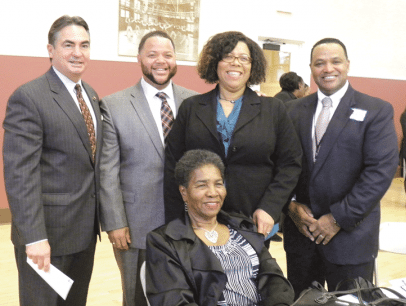
Michael Smith (second from left) introduces Springfield Mayor Dominic Sarno (left) to his parents and grandmother, who helped him succeed in school.
“Businesses often think that lowering the high-school dropout rate is a job for schools, nonprofit organizations, and the government. But they need to pay attention to what is happening if they expect the country to have an educated workforce,” said the Springfield native during a keynote speech at the GradNation Summit 2014 luncheon held last month at Springfield College for community and business leaders. “They may be writing checks or hosting grant competitions, but it is not enough. They need to establish apprenticeship programs, bring high-school students into their companies, and send their employees into the schools.”
Smith was recently appointed a special assistant to President Obama and is senior director of Cabinet Affairs for the presidential My Brother’s Keeper initiative, which addresses opportunity gaps faced by boys and young men of color that prevent them from reaching their full potential.
He traveled to the Bay State from Washington, D.C. to attend the day-long GradNation event, at which summit leaders shared best practices aimed at keeping inner-city students interested in their own education, with a focus on the relationship between success in middle school and the path to graduation.
Springfield was one of 100 cities across the nation selected by America’s Promise Alliance to hold a GradNation conference, with the goal of boosting the high-school graduation rate to 90% by 2020. And the United Way of Pioneer Valley convened the event as part of its Stay in School initiative launched last year in partnership with Springfield’s public schools.
“Middle school is a time when kids often get off track; adolescence can be really challenging, and we can’t wait until high school to make sure students are achieving at grade level. We need to get them in the pipeline early,” Smith said, adding that an overwhelming number of dropouts are “kids of color.”
He told BusinessWest that he grew up in the Hill McKnight area of Springfield. “It was a rough neighborhood with drugs, crime, violence … you name it,” he said. “I had many opportunities to fall off the path, but thanks to my parents, my grandmother, and the Boys & Girls Club, which provided me with opportunities to volunteer as well as my first job, I became a success.
“But I think about the kids I went there with who are not standing in a similar position today,” he went on. “A lot of them dropped out of school or had children early, and way too many dreams were deferred.”
However, there are strategies that can make a difference, and Smith said peer mentoring is an effective tool in middle school. But he quickly dispelled the belief that focusing solely on improving academics is the most important strategy in reducing the dropout rate.
“It takes far more than academics for a child to be successful,” he said, citing the Harlem Children’s Zone as a program that works. “They use innovative educational programs to help children, but they feed them breakfast first. You have to look at all of the roadblocks, and we need to disrupt the way we have been doing things because it is not working.
“Good enough is not good enough; we invest far too much money in things that don’t bear fruit, and governments and nonprofits can’t save children,” he went on, adding that, while nonprofits spend $300 billion each year, the dropout rate remains high.
“So, it’s clear that we need to form new partnerships, invest in innovation, and set the same goals if we want to attain a 90% graduation rate,” he told the audience.
Working Together
Springfield Mayor Dominic Sarno told those assembled that a number of success stories have come out of Springfield, adding quickly that considerable work remains.
“We need to push the needle if we are going to knock down poverty. The number-one priority is education, followed by jobs, and you get jobs through education,” he said, acknowledging that middle school is a difficult time for young people.
“If we are going to make any real improvements in the dropout rate, the entire community needs to be behind it,” the mayor went on. “We have a moral imperative to improve urban schools, but it will require bold and difficult measures to get dramatic outcomes.”
Springfield College President Mary Beth Cooper was among a bevy of speakers who outlined their efforts to help Springfield schools, and said the college has tutors in preschools who focus on early literacy skills of at-risk children.
“Our Springfield College School Turnaround Initiative also places 48 Americorps members in Level 4 schools. In 2013-14, they implemented targeted interventions to improve attendance, academic achievement, and the behavioral-social-emotional health of the students,” she said, adding that, as a result, 55% showed an increase in academic engagement.
Dora Robinson, president and CEO of United Way of Pioneer Valley, stressed the fact that GradNation was not simply an event. “It’s a call to action, and we really need a lot of support,” she said. “If we invest time and effort on the front end, more young people will graduate and move into the workforce. We have made some inroads in moving the needle, but until we are willing to stand up and support young people, we shouldn’t point fingers.”
In addition to speakers, the event included both youth and community panels, and the participants took note of what it will take to formulate an action plan to inspire middle-school students to do well in class. Measures that were outlined include engaging parents and young people, establishing safe places for students to go, providing them with individual mentors and social and emotional supports, and putting early-warning response systems in place that will alert educators when a student is at risk of dropping out.
“If anyone can do this, Springfield can,” Smith said. “But in order to reach a 90% graduation rate, we have to interrupt the status quo. People keep doing the same things over and over, while millions of kids fall through the cracks. Everyone needs to lock their arms together with a common goal.”
Moving Forward
Although 80% of students across the nation graduate from high school today, jut over half (54.9% last year) of Springfield high-school students earn their diploma.
Progress has been made, but Henry Thomas III, president of the Urban League, said the future of the region and the local economy depends on students not only graduating, but obtaining the credentials they need to get a job after high school. “The whole community needs to put education front and center.”
The information gleaned from the GradNation Summit will be distilled into a three-year community action plan to support Springfield’s middle-school students that will be submitted to America’s Promise Alliance by early January.
“This summit is the beginning, but nothing we do in school matters if a child is not eating, or drugs are being sold in violence outside their windows,” Smith said, as he spoke about a program in Washington, D.C. that matches children with paid mentors who do everything from getting them help for depression to providing assistance to parents looking for a job.
“But we also need investments, mentors, and slots for apprenticeships and internships so young people can gain practical experience,” he went on. “We need to come together to figure out our workforce needs in the next few years and make sure we are investing time and money to fill these jobs instead of having to look elsewhere.”
By KEVIN FLANDERS
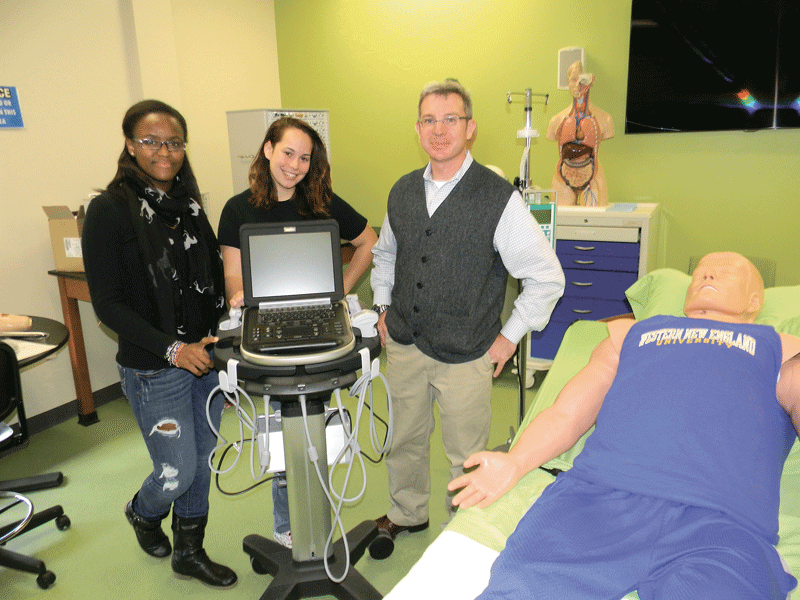
Dr. Robert Gettens, right, with students Hadiatou Barry (left) and Dena Navarroli, check out lab equipment in the Biomedical Engineering department at WNEU.
It’s a philosophy, acting Department Chair Dr. Robert Gettens and BME students agree, that prepares them well to be leaders in a variety of careers. Many recent WNEU graduates have become specialized medical attorneys. Others have gravitated toward research. One particularly accomplished alumnus, Ryan Turner, is on his way to becoming a brain surgeon. But, regardless of what path graduates choose, they all share an ability to comprehensively analyze and enhance technology, a trait that is imbued in each student while studying at WNEU.
“Rather than teach students what the functions are of particular medical devices, we focus on the fundamentals of engineering so they will be able to go out and design new products,” said Gettens, an associate professor who will remain the acting department chair until Dr. Judy Cezeaux returns from her sabbatical.
Named by U.S. News to its “Best in Undergraduate Engineering” list, WNEU’s Biomedical Engineering department has seen a marked increase in enrollment over the past five years. What was once a fledgling department with fewer than 10 graduates per year has become a paragon of biomedical pedagogy that sends about 20 students each year into the field. With five professors — each boasting impressive credentials to go along with a Ph.D. — the department has inspired students from throughout the nation to pack their cold-weather gear in preparation of continuing their studies in Western Mass.
“The numbers have skyrocketed,” said Gettens, who praised his students for their commitment and relentless pursuit of knowledge. “The students are always so engaged and dedicated to learning.”
Training Future Inventors
Take a moment to reflect on how far medical devices and the technologies that allow for their creation have come in the last 10, 20, and 50 years, enabling millions of individuals to have hope that wouldn’t have existed in the past. Now project those same time frames into the future, and the possibilities for expansion and invention seem unimaginable.
But for BME professors and students, future technologies are not only imaginable but viable. Every invention starts somewhere, and perhaps the incipient traces of tomorrow’s next breakthrough are currently confined to the notebook of a student in Western Mass. It’s not that much of a stretch, considering that 10 BME students at WNEU have been listed as inventors on patents since 2010. Moreover, almost 22% of graduating seniors since 2001 have received regional or national awards for their senior design projects. Engineering careers are no longer dominated by men, either, as more than 40% of WNEU’s BME students are women.
“What we teach here is engineering, which is all about designing,” Gettens told BusinessWest. “By the time they graduate, our students know how to design medical devices.”
The BME department also collaborates with several area hospitals to ensure that students are provided with the best opportunities possible. Among its partners are Baystate Medical Center, Mercy Medical Center, and Shriners Hospital for Children, as well as other local organizations and hospitals that utilize and advance medical technology. Additionally, a few seniors are currently teamed up with hospitals or companies to develop new devices that could potentially transcend the way patients are cared for.
In short, at WNEU, the future truly does lie in the here and now.
And the BME department hasn’t grown exclusively from an enrollment perspective. Following a two-phase, $12.8 million renovation and expansion project at Sleith Hall that concluded in September, students and staff are benefiting daily from two brand-new laboratories. The bioinstrumentation lab is dedicated mostly to the electronic components of engineering, including electrocardiography, bioamplifier design, ultrasound, signal-processing systems, and pulse oximetry. The second lab, meanwhile, serves as a simulated hospital room, complete with a dummy patient decked out in WNEU apparel who occupies the hospital bed. In this lab, students get to see the latest technologies in action and record their effectiveness in a medical setting. That way, when it comes time for these innovations to serve actual patients in hospitals, they will function at the highest levels possible.
In addition to their work inside the labs, WNEU students also have an opportunity each year to take part in a global health and technology course that includes a trip to Guatemala to learn about healthcare in a foreign environment. The BME department, which also includes professors Dr. Anthony English, Dr. Michael Rust, and Dr. Brent Ulrey, know a thing or two about travel, as they’ve earned degrees from several universities and conducted research throughout the nation.
What’s Next?
For thousands of graduating college seniors each year, a degree doesn’t necessarily translate into a job. In some cases, it’s a matter of too many graduates and limited positions to be filled within that field, while in others the problem is rooted in choice of major. But for those emerging from the BME program at WNEU, it’s not a question of whether they will find a job, but which position they’ll choose.
Sometimes opportunities abound to the extent that graduates must first determine what field they’ll choose, then begin the process of applying for positions.
“Many of our graduates work for companies that make medical devices, and others are working for the government,” said Gettens, who earned his Ph.D. in biomedical engineering from Syracuse University and also served as an engineering officer in the U.S. Army. “They can also go to graduate school to do more research, or they can go to medical school. It depends on what interests them.”
Nationally, 20% of all BME students go on to medical school, according to WNEU’s statistics. But since the university offers a unique, six-year engineering/law program, many of its students have selected the two-for-one degree and backed up their knowledge of medical technology with legal education, a decision that opens many doors.
For WNEU seniors Hadiatou Barry and Dena Navarroli, it will soon be time to say goodbye to William H. Sleith Hall and begin their careers. Armed with advanced training that will serve them well in any field, it will surely be a bittersweet departure.
“I love it here — the professors are really down to earth; you have your fun moments and your serious moments,” said Barry, who is originally from New York City. “It’s the best of both worlds.”
Navarroli, who came to WNEU from Gilbert, Ariz., added, “I was really scared moving all the way from Arizona, but the professors have really supported me. They’ve been great, and they provide so many opportunities here that you can’t find anywhere else.”
For their senior design projects, Barry is researching quantum dot nanocarrier systems for targeted drug delivery, while Navarroli is working with a clinical sponsor on an innovative breast-cancer-surgery device. Both students have excelled in the BME program, and Barry is taking advantage of the rigorous six-year engineering/law opportunity. When she graduates, she’ll be able to choose between patent law and medical litigation if she selects a legal career, both of which are branches of law that require extensive knowledge of medical technology.
“It’s definitely been challenging, but this was my top choice, and it’s been a great experience,” she said.
Both Barry and Navarroli have bright futures ahead of them, as employment of biomedical engineers is expected to increase by nearly 30% by 2022, according to the U.S. Bureau of Labor Statistics. In recent years, WNEU seniors have gone on to work for such major healthcare companies and institutions as Active Medical Devices, Covidien, St. Louis University, Cornell University, Respironics Novametrix LLC, and Microtest Laboratories Inc., among others.
Rewarding Field
Interests and specialties aside, WNEU’s BME students and professors were drawn together by a common passion — helping people in need.
Though many biomedical-engineering students throughout the nation may never operate on a single patient in their careers, the technologies they develop help doctors and nurses save countless lives. From advanced imaging systems to pioneering point-of-care devices, BME students situate themselves on the cutting edge of technology by studying thousands of applications and mechanisms during their college years. They also dedicate several hours each week to reviewing case studies and staying current on the latest research and literature pertaining to the constantly evolving field.
And the research is hardly limited to the students. With busy teaching schedules, professors sometimes struggle to find enough time to complete multiple research projects each semester.
“The faculty members have done a lot of research lately in micro- and nano-devices,” said Gettens, whose department recently received a $500,000 grant from Massachusetts Life Sciences. “Because the professors usually do 12 credit hours of teaching [per semester], trying to find time for research can definitely be a challenge.”
Gettens said the grant will allow for the purchase of equipment that facilitates micro- and nano-fabrication for medical devices. To outsiders, these words might as well be written in a different language, but for those immersed in the innovative, collaborative culture of biomedical engineering, the more complex the application, the more enthralling the endeavor.
And that explains why the program — and the job opportunities it creates — are both on the rise.
By KEVIN FLANDERS

Houle Construction President Tim Pelletier, left, and Vice President Bob Langevin, with a ‘baffle box’ used to keep air free of dangerous particulates.
But Ludlow-based Houle hasn’t been daunted by change, instead employing innovation and reinvention to succeed in a challenging business where plenty of other enterprises have failed.
Leading the way have been President Timothy Pelletier and Vice President Robert Langevin Jr., with more than 40 years combined at the company.
“We are healthcare-contractor-certified and have a tremendous amount of experience working in hospitals,” Pelletier said. “Our staff is up to date on all of the latest infection-control procedures.”
That’s critical in an age when construction at medical facilities has been far more closely scrutinized and regulated than in past decades. With the emergence, over the past 15 years, of new policies and protocols governing every project — from emergency departments to patient rooms — contractors must be certified before they can even consider working inside a hospital. Houle, boasting a staff of around 30 employees, is one of a few commercial builders in the area with experience in all aspects of healthcare construction.
Simply put, Pelletier said, his staff knows how to get the job done in situations where planning and execution are crucial. Hospitals are among the most challenging construction venues, partly because they can’t be shut down for weeks or months at a time to facilitate site work. As such, every member of the construction team must be adept at working seamlessly in an active medical environment, with minimal disruption to patients and staff.
For instance, “when you’re renovating an emergency department, you have to create a construction environment within the existing environment. The ER isn’t going to close so you can work,” he explained. And with hospital patients often resting in close proximity to where the work is being completed, he added, every procedure must be completed with an emphasis on safety and efficiency.
History in Healthcare
Operating in the beginning out of founder Raymond Houle’s garage in South Hadley, Houle Construction has evolved and grown to become one of the region’s noted contractors, particularly in the realm of medical facilities. The company’s clients have included Cooley Dickinson Hospital, Baystate Medical Center, Baystate Wing Hospital, Holyoke Medical Center, Mercy Medical Center, the Sisters of Providence Health System, and Genesis Health Ventures, among others.
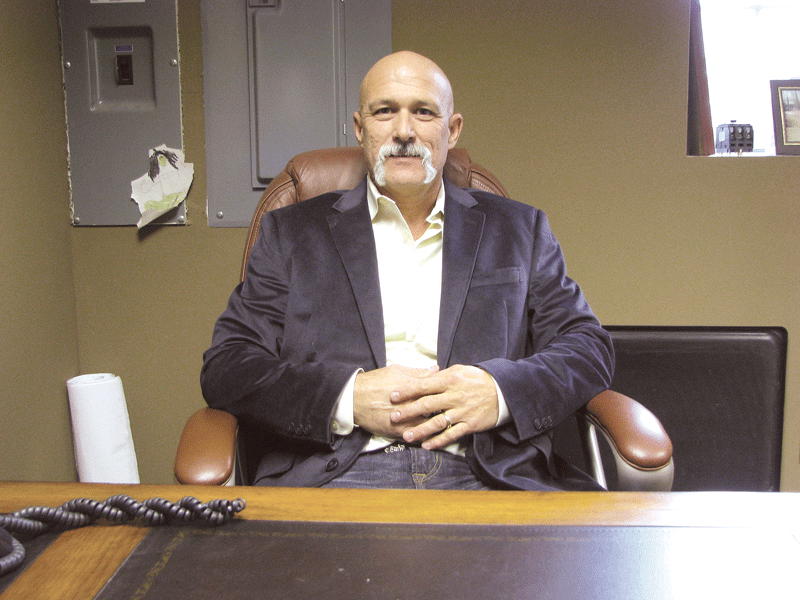
Tim Pelletier says working on medical facilities means completing projects efficiently while keeping patients safe.
“We were told to figure it out and come up with a solution,” Pelletier said, recounting a situation about eight years ago when hospital infection-control departments began to implement new asbestos-abatement regulations in windowless areas of facilities.
In response to the changes, the staff invented what is now known in the industry as a ‘baffle box’ — a device used to diffuse torrents of air generated by negative air machines during asbestos-removal projects. Now made of plexiglass, the first such devices made by Houle were constructed of plywood and helped to safely exhaust dust and particles.
Not long after the creation of baffle boxes, Pelletier and Langevin recalled, hospitals were requiring the use of similar devices, and the competition was mimicking Houle’s design. Today the staff continues to search for new strategies to maximize safety and efficiency on the job site, well aware that they can’t afford to be complacent in a rapidly changing, increasingly policed industry.
The reasons for tighter controls are numerous. First, patient privacy laws have been tightened under the Health Insurance Portability and Accountability Act (HIPAA). As for the renewed emphasis on infection control, there’s good reason for that. In 1999, the Institute of Medicine dropped a bombshell of a report called “To Err Is Human — to Delay Is Deadly,” claiming that up to 98,000 people were dying needlessly each year because of preventable medical harm, including hospital-acquired infections.
Since that time, hospitals have aggressively ramped up their infection-control protocols, and contractors that want a piece of the lucrative medical-facility construction niche have done the same. In fact, the New England Regional Council of Carpenters has created a training program for members who perform work in a clinical environment. The curriculum covers everything from controlling airborne contaminants to mold remediation to routing materials and personnel around patients and staff.

Bob Langevin says Ray Houle, the company’s founder, was a believer in figuring things out for himself, a trait he passed on to the current leadership.
Demonstrating the breadth of the firm’s work, he cited renovations to the fourth and fifth floors at Mercy Medical Center as one of the company’s largest recent projects, as well as a $10 million project for Specialized Technology Resources in Enfield, Conn., that converted a mushroom plant to a solar manufacturing facility. Houle also led a recent laboratory renovation at the John W. Lederle Graduate Research Center on the campus of UMass Amherst.
Drawing on Experience
Pelletier and Langevin ascribe their company’s sustained success to not only the staff’s commitment and hard work, but also the experience of each member. From the management team to those leading work in the field, Langevin said, everyone is on the same page and works collaboratively during each project.
“The core of the staff has been here for a minimum of 10 years. We all work really well together,” he noted.
Neither Pelletier nor Langevin went to college, instead receiving education in construction from hundreds of projects over the years. Starting off as carpenters, they slowly progressed through the ranks — every jobsite their classroom, every supervisor a de facto professor in a different subject.
“There is no replacement for being out in the trenches and doing it yourself,” Pelletier said. “We have a tight group here — it’s like a family environment.”
Both men learned much of what they know from Raymond Houle himself, who has now been retired for 15 years after handing the reigns to Pelletier.
“He worked his way up through the trade just like us and eventually started his own business,” said Langevin, who works closely with owners, project managers, and architects on a daily basis — all skills he learned from Houle and others. “He really wanted you to get out there and figure things out for yourself, but he was always there if you had a problem.”
He and Pelletier agree that taking time to appreciate all aspects of the job is integral, especially the lighter moments. In a business that often abounds with stress — particularly when deadlines near — the staff does its best to keep the atmosphere loose and upbeat. “I think it’s important to keep a good sense of humor,” Langevin said.
It’s far more important, of course, to ensure that each project stays on time and within its budget, which is often made even more difficult by tight parameters. For hospital leaders, the goal is to get work done as quickly as possible to reduce disruptions to staff and patients, although speed and attention to detail can be a tricky blend unless a company has many years of experience balancing those needs.
Sometimes, Pelletier told BusinessWest, meeting a condensed deadline can feel like achieving the impossible, even for veterans who have been in the industry for decades. But those who dedicate their careers to the industry learn to embrace the innate challenges of deadlines.
“It’s rewarding,” Pelletier said of finishing ahead of a difficult deadline, especially for jobs in medical settings. “Everyone has to work together, from the hospital staff to all of the contractors involved. It’s always a team effort, and we try to keep everything coordinated so it gels like it’s supposed to.”
Pelletier said business has taken a slight dip this year for Houle, with an array of smaller projects dominating the 2014 schedule. The staff has high hopes for a solid 2015, though. Overall, the local industry has been trending in a positive direction, and with such recent announcements as Holyoke Medical Center renovating its Emergency Department to include a behavioral-health component, contractors working in the medical niche hope construction opportunities will be available at area hospitals in 2015.
Then it’s up to Pelletier and his staff to decide which projects they will pursue.
“Things have been really busy over the last five years,” he noted. “It’s tailed off a little, but the drop hasn’t been significant, just a little downturn this year. I am optimistic that things will pick up. It all depends on what our customers are doing.”
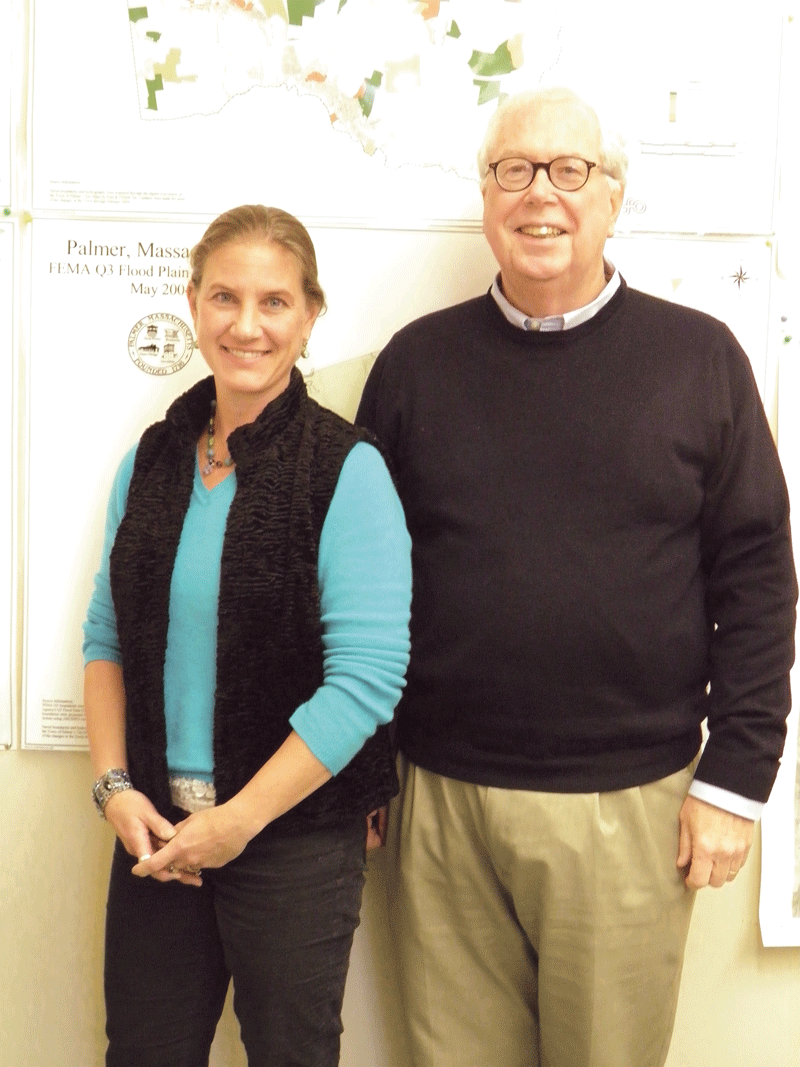
Linda Leduc and Charles Blanchard say it’s important to implement strategies to raise Palmer’s profile and reputation as a business-friendly town.
“We hear it all the time,” the town manager said, adding that this is an erroneous conclusion, and a new video, titled Industry Alive in Palmer: An Inside Look at Local Businesses, has been created to dispel that notion.
It was shown for the first time on Oct. 14 during a Town Council meeting and showcases eight of the town’s successful manufacturing companies. They range in size from large to very small, but many have been operating for generations inside former mills and locations such as the Maple Tree Industrial Center, a 48-acre site on Route 20 with access to rail that abuts the Massachusetts Turnpike.
“There are people doing things behind walls here better than anywhere else in the world; it’s just interesting that it’s happening in Palmer,” said Mark Borsari, president of Sanderson MacLeod Inc., a company featured in the video that makes twisted wire brushes.
Darcy Fortune agrees. “I’m a fifth-generation Palmer resident, and before I did the interviews for this video, I did not realize how many factories, foundries, commercial distribution facilities, and industrial parks we have here in town,” said the co-creator of the production. “Although Palmer is known as the Town of Seven Railroads, it should actually be called the Hub for Industrial Activity.
“People work hard here every day behind the scenes to produce products that are distributed all over the world,” she went on. “These establishments are participating in the American dream, and they deserve recognition, along with the smaller mom-and-pop businesses that prosper here. Palmer is an ideal place to live, work, and operate a business.”
Getting that message across was the unofficial motivation behind the video, which shows that there is definitely life in this community after a high-stakes attempt to bring a casino to a site off Turnpike exit 8 — an endeavor that went on for several years — came to an abrupt end 13 months ago when town voters voted against the plan.
And while the casino dominated talk in the town, officials there didn’t wait for the matter to be decided before moving forward with a number of economic-development-related initiatives. These include everything from a tax-increment-financing (TIF) zone to establishment of so-called priority-development sites, a status that requires officials to issue permits for new businesses in those sites within 180 days, to the creation of the new position of economic development director. Linda Leduc, who had been serving as the town’s planner, now has that new title as well, and she’s moving ahead with a number of strategic initiatives ro raise Palmer’s profile and bring more businesses to the community.
“We have a variety of strategies and resources that can help businesses that want to move here,” she noted. “They include our priority-development- zoned properties, which have an expedited permitting process, as well as our single tax rate. We just want people to know that Palmer is a business-friendly town.”
Making Strides
Leduc said she plans to use the video as a marketing tool at economic-development conferences and other appropriate settings. She told BusinessWest that she and Blanchard came up with the idea for the production after she became economic-development director last year, and they began to tour local businesses with Lenny Weake, president of the Quaboag Hills Chamber of Commerce.
“We wanted to see what types of businesses were in town, make sure the town was meeting their needs, and find out what they needed to help them grow and prosper,” Leduc said, adding that the visits generated a wealth of information and insight.
Blanchard said they visited 16 companies. “Along the way, we met a lot of owners, learned about their businesses, and became excited about what was going on in Palmer. Many had developed a strong niche in the marketplace, and their prosperity has been a well-kept secret,” he told BusinessWest, citing examples that included a foundry, a precision metal company, a construction firm, and a major tree service.
After the trio completed their visits, Blanchard approached M-Pact TV General Manager Bruce Henriques with the idea of creating a video that would focus on companies involved with manufacturing and distribution. M-Pact is the town’s public-access station and airs in Palmer and Monson on channels 7 and 12.
Henriques said he would be happy to do the work at no charge. “I had been self-employed most of my life when I took this job 15 years ago, and I wanted to give the station a more commercial feel and do more for the business community, so it was an ideal fit,” he explained. “I know some of the business owners who are profiled in the video, and they have gone through some tough times over the years. I felt they deserved a break; they supply jobs and are doing some great things people aren’t even aware of.”
Leduc concurred. “We wanted people to understand the types of businesses we have here and why they are successful, and the video speaks loudly about why a business would want to be located in Palmer.”
Since its completion, the video has been shown frequently on the public-access channels and has also been posted on the town’s website, YouTube, and Facebook. Companies featured in the production include Palmer Foundry, Mustang Motorcycle Seats, Rathbone Precision Metals Inc., Sanderson MacLeod, Maple Leaf Distribution Services Inc., Palmer Paving Corp., Northern Tree Service, Northern Construction Service LLC, Architectural Millwork Specialists, and BL Tees Inc.
Beyond simply telling Palmer’s story, though, town officials are also taking steps to incentivize businesses to move there.
Within the TIF zone, for example, a new business that opens there can negotiate an agreement with the town to pay taxes on a graduated rate for a period of no less than five and no more than 20 years. The state also offers incentives connected with the agreement, and Leduc said Palmer Corp. and, more recently, Detector Technology Inc. have taken advantage of the program.
“Palmer Corp. moved into warehouse space and made $1 million in improvements,” she noted, “while Detector Technology acquired a second building and changed warehouse space into manufacturing space.”
Right Place, Right Time
Blanchard believes there is plenty of opportunity to build a business in Palmer’s four villages, including space in a mill in Thorndike that is only partially occupied. He also believes the town is an ideal location for businesses due to its location.
“Palmer has access to a number of major highways,” he said, adding that, in addition to the turnpike, Routes 20, 32, 181, and 67 run through town. “Plus, there are a number of freight lines that go into Palmer Industrial Park, and there is an off-loading rail-line facility at Maple Street Industrial Park on Route 20.”
Blanchard cited Sherwood Industries, which is not showcased in the video, as a prime example of how Palmer’s access to rail is beneficial to businesses.
“They bring lumber products here by rail from the Northwest, then distribute them all over the Northeast and into the Carolinas,” he said. “And last year, they received an industrial rail access grant to extend rail service onto their property to allow more products to be brought in and distributed.
“There was also another grant issued to expand rail service in our industrial park,” he went on, adding that many local businesses not featured in the video are doing well, such as American Dry Ice, which distributes carbon dioxide and dry ice to various firms, including hospitals and restaurants.
Leduc agrees there is plenty of room for new businesses. “Palmer Technology Center and Maple Tree Industrial Park have unfilled space, and there are some empty storefronts available in Depot Village,” she said.
The town also has five priority-development sites, and in 2009, the community received a $15,000 grant to conduct a study to determine what was needed in terms of water and traffic control to put the sites to “their highest and best use,” said Leduc. These sites include:
• Olson Farm, 30 acres of open land zoned for mixed business along Route 20;
• The Holbrook site, a downtown parcel of less than a half-acre on the corner of Route 20 and Bridge Street;
• Chamber Road Industrial Park, a site containing two parcels of shovel-ready land totaling 10.7 acres;
• Thorndike Energy, an old mill complex located off Church Street on five acres with the potential for 90,000 square feet of renovated building space; and
• The area formerly slated for the casino, 152 acres across from the turnpike exit controlled by Northeast Realty.
Moving Pictures
Leduc, Blanchard, Fortune, Henriques, and other people who helped create the video hope it will inspire new businesses to consider moving to these sites or other available properties in Palmer. However, Blanchard said the production has already had an impact within the town.
“It opened new lines of communication between town officials and existing businesses, which we hope will continue whenever an issue comes up and they need support,” he told BusinessWest.
Meanwhile, the screening before the Town Council probably inspired a vote to make the town more business-friendly, or at least not less so.
“They were scheduled to vote on the tax-classification rate that night,” said Blanchard. “Although we have historically maintained a single tax rate, the council was considering changing it because of rising costs. But the video made them recognize the value of maintaining the single tax rate, and they voted to continue it to help the businesses in Palmer.”
It is the hope of those involved that the video, not to mention the many other initiatives undertaken by town officials, will yield more success stories to relate in the years and decades to come.
Year Incorporated: 1775
Population: 12,140 (2010)
Area: 32 square miles
County: Hampden
Residential Tax Rate: Palmer, $19.36; Three Rivers, $20.06; Bondsville, $19.97; Thorndike, $20.25
Commercial Tax Rate: Palmer, $19.36; Three Rivers, $20.06; Bondsville, $19.97; Thorndike, $20.25
Median Household Income: $50,050
Family Household Income: $58,110
Type of government: Town Council
Largest Employers: Baystate Wing Hospital; Sanderson MacLeod Inc.; Camp Ramah; Big Y
* Latest information available
The construction industry, both nationally and in Massachusetts, seems to be emerging from several years of sluggish growth, as unemployment in the field has fallen to an eight-year low across the U.S.
Specifically, construction companies added 12,000 jobs nationally in October, pushing the sector’s unemployment rate to 6.4%, the lowest mark since 2006, according to Associated General Contractors of America.
“For the past several months, the construction industry has added jobs at double the all-industry rate of 1.9%,” said Ken Simonson, the association’s chief economist. “Construction wages, which were already higher than the private-sector average, rose 2.6% in the last year — the fastest rate since early 2010 — as contractors ramped up their search for qualified workers. There were fewer unemployed, experienced construction workers [in October] than at any time in the past eight years.”
The trend is occurring fairly uniformly across America, with 28 states adding construction jobs between September and October, and 37 adding jobs over the past 12 months, in both cases including Massachusetts.
Indeed, over the past 12 months, the Commonwealth has added 2,400 construction jobs, a 2.0% increase that ranks 29th among all U.S. states. However, the Bay State added 1,300 jobs between September and October alone, a 1.1% increase that ranked 13th in the U.S. That performance coincides with a quarterly report from the Mass. Assoc. of Commercial & Institutional Builders that casts a cautiously positive eye on the landscape, while lamenting the rising costs of materials and labor.
“In the near term, higher costs of production don’t help contractors repair their recession-weakened bottom lines,” the report states. “However, these components are also signs of a growing economy as manufacturers see higher utilization rates and unemployment drops closer to full employment levels, thus pushing wages up.”
Back to Work
Nationally, construction employees worked an average of 39.2 hours per week, tying the highest mark in almost nine years. “Together,” Simonson said, “these indicators — high weekly hours, low unemployment, and accelerating wage gains — point to an industry that may be on the verge of acute difficulty filling key positions.”
Association officials said the construction-employment gains, along with rising wages and weekly hours, are consistent with survey results showing more firms having a hard time finding enough qualified workers to fill available positions. Construction employment totaled 6,095,000 in October, the highest total since May 2009, with a 12-month gain of 231,000 jobs, or 3.9%, Simonson said.
Over the past year, Florida added the most construction jobs of any state (38,900 jobs, or 10.2%), trailed closely by Texas (38,500 jobs, 6.2%), California (34,300 jobs, 5.3%), Illinois (14,800 jobs, 7.8%), and Utah (11,000 jobs, 14.9%). Meanwhile, Texas, Florida, Utah, Colorado, and Idaho posted the highest one-month jumps between September and October.
Stephen Sandherr, CEO of Associated General Contractors of America, noted that job growth remains inconsistent in some states because many firms are struggling to cope with growing worker shortages, new regulatory burdens, and flat, or declining, public-sector investments in infrastructure and construction. “Many firms are having a hard time expanding their payrolls as wages rise, costs grow, and market demand varies greatly from one segment to the next.”
Added Simonson, “these year-over-year and one-month changes show that construction is doing well in most of the country. Yet, the list of states that have added construction jobs varies from month to month, showing that the industry’s recovery remains vulnerable to worker shortages and unfavorable governmental actions.”
The latter is also a worry for the Mass. Assoc. of Commercial & Institutional Builders, which notes that the federal government continues to stall on a comprehensive highway bill, while private investors follow the government’s lead and sit on their hands.
“The good news is that, in general, we are now at a point in the recovery where we can focus more on thriving than surviving,” the group notes, “but thriving in the new economic climate will require not just being the strongest or biggest, but also the most adept at dealing with economic climate change.” n
By MICHAEL KLEIN, PsyD
While we often think of family-run enterprises as corner mom-and-pop shops, more than one-third of the S&P 500 are family-owned. Companies as significant as media giant Comcast are family-owned. Mars, the food manufacturer, is also family-owned. Ford Motor Co. still retains family leadership, and, of course, there’s always Walmart, owned and operated by the Walton family.
As many family-business consultants will affirm, family-owned companies can be incredibly complex. Due to the overlap of roles between owners, employees, board members, and family, there is frequently a lack of clarity surrounding fundamental business facets and processes, including job responsibilities, performance expectations, individual development and advancement, as well as compensation policies, among many others.


Michael Klein
The more mature (i.e., older) a family business is, the more likely that lessons have been learned from generation to generation. However, no matter how old a family business may be, complexity is always present. Unfortunately, the individual family member often loses out due to the greater issues of family and business. Many, if not most, family-business consultants focus their attention on maintaining engagement and involvement, maximizing the business while understanding the family dynamics. Few are focused on what is in the best interest of an individual.
Family-business processes, systems, strategies, and planning are all critical issues if the business is to survive and thrive. A focus on individual interests, growth, satisfaction, and development comes only after larger issues are addressed. Sadly, the individual family member can become an afterthought.
Consider the prevalence of this theme of family-business expectations for employment versus individual talents, desires, and dreams. Many recent children’s movies are centered fundamentally around the individual’s conflict with family legacy, tradition, and power. As just one example, Brave’s Merida is pressured to follow in her mother’s footsteps (and the family business) as a properly behaved queen despite her desire for very ‘unqueenly’ activities and passions.
Back in the real world, however, decisions about family-business employment are far more complicated and have more than one side to the story.
Three Perspectives
In my research, as well as experience with family-business clients, the following three perspectives are exceedingly common but rarely discussed openly, thoroughly, or objectively:
• As an active member of the family business: “Is this the best path for me going forward?”
• As a current family-business owner or parent: “What is the role of the family business in the future of my children?”
• As a next-generation member: “Should I join the family business?”
With each of these perspectives comes the underlying question, is this the best fit between person and career/job? The answer doesn’t fall out of the sky, but requires patience, tolerance for ambiguity, and a willingness to change direction when needed.
Quick decisions should be avoided at all costs. The following is a sample of some of the questions each constituency should start asking, followed by some important things to remember.
Questions for active family-business members include:
• How satisfying is my current role?
• Do I have options to change my role?
• Which family relationships are most important to me?
Keep in mind, nobody can decide your path for you. There are always pros and cons to any decision or change. You owe it to yourself and your family to either fully engage or disengage from the business sooner or later.
Questions for owners/parents include:
• What would make me most satisfied for my children?
• What skills, talents, or interests do they have that might fit well in the family business?
• Am I considering other options for my children?
Keep in mind, your own feelings about the business may be very different from your son or daughter. If your child decides not to join initially, they might be interested when they are older. In the meantime, be as objective as you can about your child’s personality, skills, interests, and motivations.
Questions for next-generation family members include:
• What excites me about the family business?
• What traits or skills do I have that will contribute to the business?
• Is there something I would be giving up if I joined?
Try as best you can to separate the idea of being a member of your family from working in the family business. Focus on understanding and developing your skills, not making a lifelong commitment to one path or another. You probably won’t have all the answers about what you may want from work until you have worked for a while.
Go with the Flow
Regardless of what the genetic lottery hands us at birth, our personal and professional experiences should result in new insights into who we are and what we are capable of. As our work lives progress, we should be able to develop new skills and abilities, as well as perhaps discover interests and passions we didn’t know we possessed. Ultimately, our jobs and other professional experiences should guide us toward finding out where our true strengths and talents lie.
For some, the family business provides an unmatched arena for this type of professional development. Unfortunately, for far too many, the family business stands directly in the way of this — and, as a result, it stands in the way of healthy adult development.
Family businesses are wonderful career and professional opportunities for many family members. While it is not a secret that the primary beneficiaries of arranged marriages are the families, we do not as easily admit this is often the case in family-business employment.
Family businesses can be wonderful opportunities for professional and personal growth, satisfaction, and success. But they should never be the only option. n
Michael Klein, PsyD, is a business consultant and author of Trapped in the Family Business: A Practical Guide for Uncovering and Managing This Hidden Dilemma. He holds a doctoral degree in professional and applied psychology, and supports family businesses and their advisors by providing assistance in the hiring, management, and development of leaders, managers, and employees. He has more than 20 years of experience working in multiple industries, including manufacturing, insurance, healthcare, construction, financial services, education, pharmaceuticals, real estate, and entertainment; mkinsights.com;trappedinthefamilybusiness.com
Click here to download the PDF chart
By PETER VICKERY, Esq.
What should you do if an employee ‘likes’ a Facebook post that accuses you of dishonesty? The answer may surprise you.

Peter Vickery
Let’s start with the federal decisions. Section 7 of the National Labor Relations Act (NLRA) protects employees who are engaged in “concerted activity for the purpose of collective bargaining or other mutual aid or protection.” It applies to unionized and non-unionized workplaces alike, so long as the business falls under the jurisdiction of the NLRB.
In the last four years, the NLRB has issued three reports on the extent to which the act protects employees’ online statements, and earlier this year it decided two cases that between them answer some questions about how far employers can go in protecting their businesses from the damaging effects of employees’ social-media activities. The first case involves Facebook’s ‘like’ button.
What’s Not to Like?
Can a series of public, profanity-laced Facebook comments accusing the employer of incompetence and dishonesty constitute protected concerted activity? Yes, says the NLRB. What about clicking ‘like’ to show you approve of a comment-forming part of the discussion? Is that a protected Section 7 right? Yes, it can be.
Ralph DelBuono and Tommy Dadonna own Triple Play Sports Bar and Grille in Watertown, Conn. They produced an employee handbook that contained a policy about online conduct. The policy warned employees that they would be subject to disciplinary actions for engaging in “inappropriate [online] discussions about the company, management, and/or co-workers.”
In early 2011, Triple Play’s owners learned that some of their employees were worried that they might owe more in state taxes than anticipated, so DelBuono and Dadonna decided to call a staff meeting. A week or so before the scheduled staff meeting, a Facebook discussion took place, initiated by a former Triple Play employee, Jamie LaFrance. That online conversation led to a decision from the NLRB, Three D, LLC d/b/a Triple Play Sports Bar and Grille (Aug. 22, 2014).
By way of status update on Facebook, LaFrance alleged that Triple Play’s owners “can’t even do the paperwork correctly” and that, as a result, she owed taxes to the state. She concluded her status update with a profanity. A Triple Play customer posted a comment, which also included a profanity.
One current Triple Play employee, a cook named Vincent Spinella, then ‘liked’ LaFrance’s status update. LaFrance posted an additional statement about DelBuono, saying “he’s such a shady little man. He prolly [sic] pocketed it all from all our paychecks.” At that point Jillian Sanzone, a current Triple Play server and bartender, joined the conversation, stating “I owe too. Such an a—hole.” Two other Triple Play employees participated in the discussion as well.
The employers learned about the Facebook discussion and discharged Sanzone. After asking Spinella why he had ‘liked’ the status update, and concluding that he approved of the disparaging comments, they discharged him, too. Sanzone and Spinella took the matter to the NLRB.
An administrative-law judge decided that the Facebook discussion, including Spinella’s ‘like,’ was concerted activity and that the discharge of Sanzone and Spinella was unlawful. Triple Play appealed to the board, without success. Although the outcome was the same (the employer lost), the board differed from the judge as to which standard to apply in determining whether the comments forfeited protection under the act. In other words, the board agreed with the judge that the comments did not lose protection, but disagreed as to why.
Triple Play’s owners said the Facebook posts were disparaging and defamatory. But the board disagreed, deciding that the comments “did not even mention the respondent’s products or services, much less disparage them.” And although an employer has the right to protect its reputation, Sanzone’s and Spinella’s comments were “not so disloyal” as to lose the protection of the NLRA. Because they were posted on an individual’s Facebook page, the board held that the comments were not directed to the general public, but were more like a workplace conversation that “could potentially be overheard by a patron.”
So the first aspect of the case that employers should bear in mind is that Facebook discussions among non-unionized employees relating to work can constitute concerted activity, thereby bringing those employees’ statements within the protection of the NLRA.
Second, the NLRB does not consider Facebook discussions that flow from a status update to be directed at the general public. Would the situation be different if the discussion had started on a Facebook page with a link to a blog and then continued on the blog’s moderated thread? Perhaps. But for now, business owners need to remember that discussion on an individual’s Facebook page is not directed at the public in the eyes of the NLRB.
The third point concerns the reach of a ‘like’ on Facebook. The administrative-law judge had taken Spinella’s ‘like’ as approving of the discussion in its entirety, but the board concluded that it only meant he approved of the initial status update (i.e., “they can’t even do the [tax] paperwork correctly”). Had he been so inclined, Spinella could have ‘liked’ the additional disparaging comments separately, but he did not. When reviewing a contentious Facebook discussion, employers should bear this distinction in mind.
The final reason this case matters has to do with social-media policies. Unlike the administrative-law judge, the board found that the Internet/blogging policy’s language about “inappropriate discussions” was unlawful because it would tend to “chill employees in the exercise of their Section 7 rights.” The policy’s language was too broad, and the board ordered the owners to revise or rescind it.
The takeaway for employers? General statements that discourage inappropriate discussions are definitely out of favor with the NLRB, so your online/social-media policies might be in need of some changes.
Beacon of Hope
The second NLRB decision, Richmond District Neighborhood Center, 361 NLRB No. 74 (Oct. 28, 2014) displays a little more balance. The board ruled that the Facebook posts at issue did constitute concerted activity under Section 7, but were not entitled to protection. So the employer was allowed to withdraw its offer to rehire the posts’ authors.
The employer was a nonprofit in the business of providing after-school activities via the Beacon Teen Center at George Washington High School in San Francisco. The case concerned two of the center’s employees: Ian Callaghan, an activity leader, and Kenya Moore, a program leader. They seem to have been unhappy in their work and, judging by their plans for the coming school year, were intent on spreading the unhappiness around.
On Aug. 2, 2012, Callaghan expressed his dissatisfaction with the program being “happy-friendly-middle school campy,” and said he would “have parties all year” at the center, encourage the students to “graffiti up the walls,” and, more generally, “f— it up.” Moore’s comments were of a similar timbre: “F— em. Field trips all the time to wherever the f— we want,” and “when they start [losing] kids I ain’t helpin.” She also indicated that, in the year ahead, she would take the students to “clubs” and that her work attendance would be less than exemplary: “I ain’t never go[ing to] be there,” she stated (in all caps).
After seeing a screenshot of the discussion, the employer rescinded its offer to rehire the pair. So Callaghan and Moore filed a complaint with the NLRB, where the administrative judge, referring to the Facebook exchange, found that “these two employees were engaged in concerted activity when voicing their disagreement with management’s running of the teen center.”
If Callaghan and Moore had resumed their positions as activity leader and program leader, it seems fairly likely that the Beacon Teen Center would have been anything but “happy-friendly-middle school campy,” as Callaghan put it. So it is worth pausing at this point to reflect that, in the eyes of the judge, when two employees of a publicly funded after-school program, charged with the care of teenaged high-school students, expressed their intention to hold parties at the center, put graffiti on the walls, take the students away from the center on “field trips” (including trips to clubs of some kind) without informing anyone, and simply fail to show up for work, they were engaged in Section 7 concerted activity.
Fortunately for the employer — and for the students and their parents — although he deemed the discussion to be concerted activity, the judge also found that it was of such a character that the employer was allowed to consider the employees unfit for further service. He dismissed the case. The General Counsel of the NLRB, on the side of the employees, appealed to the full board, arguing that the Facebook posts “could not reasonably be understood as seriously proposing insubordinate conduct.” The board disagreed with the General Counsel and upheld the administrative judge’s finding that the posts had lost the act’s protection.
The final outcome of the Beacon Teen Center case may give employers some degree of hope for future NLRB decisions regarding potentially damaging social-network commentary. It serves as a reminder that there is, indeed, a line between protected concerted activity and concerted activity that is so egregious that it forfeits protection. Even if it does not demarcate that line clearly, at minimum, the case suggests that, if employees indicate on Facebook that they are going to jeopardize (a) child safety and welfare, and (b) program funding, it might just be permissible to discharge them.
On the other hand, it is important to bear in mind two points. First, even a discourse like the one authored by Callaghan and Moore can amount to concerted activity. Second, even after trial, the General Counsel of the NLRB took the position that the participants in that discussion (replete as it was with plans to render the teen center a chaotic danger zone) were not really proposing insubordinate activity.
State-level Development
In addition to noting the federal decisions, employers should keep an eye on a state-level proposal that might reappear when the Legislature assembles next January. If reintroduced and enacted, state Rep. Cheryl Coakley-Rivera’s bill from the last session, titled an “Act Relative to Social Network Privacy and Employment,” would add to the growing list of thou-shalt-nots. If the bill becomes law, employers would not be allowed to require that job applicants and current employees add the employer to their list of social-media contacts or grant the employer access to their networks.
One apparent concession to the rights and needs of business owners is the bill’s proviso that employers would not be prohibited from obtaining information about an applicant or employee that is “in the public domain.” That looks reassuring. But ‘public domain’ is a term with a precise legal meaning, and it applies to creative works whose copyright has expired. It is not a synonym for ‘publicly available.’ An applicant’s blog may be visible for all the world to see, but that does not strip it of copyright protection and put it in the public domain.
If this bill becomes law in its present form, a judge construing the exemption could conclude that the Legislature intended to allow employers to obtain only information that is in the public domain (i.e., not subject to copyright) and to prohibit employers from obtaining information that is not in the public domain (i.e., information subject to copyright). But most of the information an employer would be interested in reading is subject to copyright. This presents a serious problem.
Imagine an applicant’s blog that consists of screeds about various Massachusetts businesses and their customers. Unless the job applicant takes a conscious decision to dedicate the blog to the public domain, the applicant owns the copyright. Is the publicly accessible blog in the public domain? No. Because copyright attaches at the moment the author creates the work and lasts for the life of the author plus 70 years, there would be precious little online information that an employer could look at without falling foul of the statute.
If the “Act Relative to Social Network Privacy and Employment” is re-filed, it will merit serious attention from the Massachusetts business community.
Peter Vickery practices law in Amherst; (413) 549-9933; www.petervickery.com
By Terri Judycki, CPA, MST
As year-end approaches, most charities see an increase in donations as a result of donors’ year-end tax planning. Many donors do not realize that they need to do more than write out a check to secure the charitable contribution deduction.

Terri Judycki, CPA, MST
Of course, donors must be able to substantiate their gifts to charities — dates and amounts. For this purpose, a bank record or acknowledgement from the charity is sufficient. However, if the amount of the gift is $250 or more, the donor must have a written acknowledgement from the charity that includes either a description and estimate of any goods or services the charity provided in return for the contribution or a statement that no goods or services were provided in return for the contribution.
There are exceptions for insubstantial or token items as well as for certain membership benefits. The donor must have this written acknowledgment prior to filing his or her income tax return claiming the deduction or by the due date of the return, if the tax return is filed late. The donor’s requirement to obtain written substantiation for gifts in excess of $250 also applies to out-of-pocket expenses incurred on behalf of a charity.
While the $250 written acknowledgement is a requirement imposed on the donor, the charity has a requirement to disclose in connection with any part-gift/part-purchase with a price exceeding $75. For example, if tickets to a golf tournament or gala exceed $75, tax law imposes a requirement on the charity to disclose the amount that the patron may deduct as a charitable contribution. The acknowledgement must include a statement that only the amount in excess of the fair market value of the goods or services provided by the charity is deductible and must provide an estimate of the value of those goods or services, which may be very different than the cost to the organization.
The acknowledgment must be made in a manner that will be noticed. The penalty for noncompliance is $10 per contribution up to $5,000 for a single fundraiser.
With respect to non-cash gifts, additional requirements are imposed on the donor and the charity. Donors are required to obtain qualified appraisals for non-cash gifts (other than publicly traded securities) in excess of certain thresholds. For property with a claimed value of more than $5,000, the donor must attach to his or her income tax return an appraisal summary on Form 8283, signed by both the appraiser and the charity.
If the charity sells or otherwise disposes of donated property with a claimed value of more than $5,000 within three years of the donation, the charity is required to file Form 8282 reporting the sale. Every time a charity is asked to sign a Form 8283, it should consider the potential Form 8282 filing requirement if the asset is disposed of within 3 years. Form 8282 is due on or before the 125th day after the disposition, and a copy must be sent to the donor. Penalties for failure to comply may apply.
There are even further rules and requirements that apply to contributions of qualified intellectual property, art valued at $20,000 or more, other non-cash property valued over $500,000, certain qualified conservation easements, and contributions to a college or university that entitle the donor to purchase tickets to athletic events.
In response to perceived abuse, there are now specific rules that apply to donations of used cars, boats, and airplanes after Dec. 31, 2004. While there are many exceptions and modifications, in general if the vehicle is sold for more than $500, the charity must file Form 1098-C. The donor must receive a copy within 30 days of the date of sale, and it must be filed with the IRS by Feb. 28 of the following year. Again, penalties may apply. Note that Form 1098-C is in addition to, not in lieu of, Form 8282 discussed above.
Many charities hold raffles as a fundraiser or in connection with another fundraiser. Raffles are a form of lottery, and only certain charities may hold raffles under Massachusetts law. The charity is required to obtain a permit from the local town hall before the raffle and to pay a tax to the Massachusetts State Lottery Commission within 10 days after the raffle. There are additional Massachusetts requirements for tickets with a sale price of $10 or more or if the prize is worth more than $10,000. The purchase of a raffle ticket is never deductible as a charitable contribution, and the charity should be cautious not to imply that the purchase price may be deducted. There are income-tax-reporting and withholding rules that may apply to the winnings if the value of the prize is $600 or more.
Massachusetts requires income tax withholding when the value is $600 or more. For federal purposes, if the prize is valued at $600 and is at least 300 times the amount of the wager (for example, a $1 raffle ticket with a $600 or greater prize), reporting is required on Form W-2G, but federal withholding is not required until the value of the prize exceeds $5,000. For noncash prizes, the winner must remit the withholding tax to the charity. If, instead, the charity pays the withholding tax on behalf of the winner, it must include the tax remitted on behalf of the winner in the value of the prize.
Raffle tickets with non-cash prizes of $600 or more should contain language to the effect that the winner may be required to pay state or federal income taxes to avoid any hard feelings. A charity that fails to withhold income taxes when required can be liable for the tax. There are somewhat similar rules that apply to charities conducting other types of gaming activities.
Don’t let your charitable contributions fall into the “no good deed goes unpunished” category from a tax perspective. Now is the time to gather your acknowledgment letters and signatures on Form 8283, if required. If you’re in doubt regarding the requirements in a specific situation, consult your tax adviser.
Terri Judycki, CPA, MST, is senior tax manager with the certified public accounting firm Meyers Brothers Kalicka, P.C. in Holyoke; (413) 536-8510.

Joyce Thielen says a significant shortage of nurses nationwide is on the horizon, with some specialties, like OR nursing, expected to be in particular demand.
At issue is the so-called nursing shortage, which made headlines 15 years ago but has receded somewhat since then, yet is expected to percolate again as Baby Boomer nurses finally move into retirement.
“I think, because of the age of our workforce right now, a shortage is going to happen,” said Joyce Thielen, associate dean of the Elms College School of Nursing, adding that many were ready to retire several years ago, but postponed that step when the economy went south in 2008.
“But as the market improves, as the economy improves, more people will start to retire. That’s the current thinking, anyway,” she noted. “There are specialties where that is particularly true. One example is the OR; many of the nurses in the operating rooms in area hospitals have been here for many years, and they’re predicting a shortage of them coming up.”
Nancy Craig-Williams, assistant dean of Nursing at Greenfield Community College, also sees plenty of opportunity, noting that all her school’s recent graduates who have passed the National Council Licensure Examination have received job offers in fairly short order.
However, “the opportunities may be changing from what people stereotypically think of as nursing,” she told BusinessWest. “Some students come in and expect to see the ER all the time, or they come into the nursing program and say, ‘I want to work in the hospital; can you guarantee me that?’ Well, no — we educate you to become a nurse and use the knowledge and skills you learn in school at a facility that needs those skills. Sometimes their ideas change once they’re in school.”
Some graduates, she said, don’t find themselves working immediately in their preferred environment, or working as many hours as they’d like, while about 20% of GCC’s nursing graduates move on from the two-year program and enroll in bachelor’s-degree programs elsewhere, reflecting a trend toward higher education for nurses in general.
“For them, this is a stepping stone as opposed to an end point,” Craig-Williams noted. “I think it has become more apparent to our associate-degree students that a bachelor’s degree will get them into positions, like acute care, that they want to go on to. Some of our graduates do go right to acute care, though, because they’ve been working at the facility or an opportunity presents itself.”
The Institute of Medicine (IOM), among other groups, has been calling for a better-educated nursing workforce, Thielen noted, especially at a time when a shortage of primary-care physicians is becoming more acute and nurses are being called upon to do more.
“Overall, we’re seeing a trend where associate-degree programs are highly encouraging their graduates to get their bachelor’s degree right away, and those with bachelor’s degrees are thinking about graduate schools,” she said, noting that fields like physical therapy, occupational therapy, and pharmacy are starting to require doctoral degrees for certain jobs, and nursing may not be far behind, especially at a time when the accountable-care model of care requires healthcare providers from various disciplines to work more collaboratively. “In order to be equal around the disciplinary table, nurses need to be better educated; it’s all about better patient outcomes.”
Still, she said, these trends shouldn’t scare prospective nurses from a field that’s sure to pose plenty of career opportunity over the next decade and beyond, at every education level. “It’s still a real phenomenon. It’s looking up. The last few years have been brigher, and opportunities continue to improve.”
Driving Demand
Healthcare economist Peter McMenamin told American Nurse Today recently that a combination of factors, from the aging of the nursing workforce to implementation of the Affordable Care Act, is driving rising demand for new nurses.
“Nursing is a good job,” he said. “Work satisfaction is high. If you look at the employment in U.S. hospitals for the last decade, month after month, there’s only a single month where employment went down. Hospitals have been continuing to hire during the recession.”
He cited U.S. Labor Department projections that 712,000 new jobs for registered nurses would be created between 2010 and 2020. “Everyone is expecting there are going to be more jobs. We’re hoping that there will be enough nurses to fill all of those jobs.”
The problem is that nursing schools are actually turning away applicants en masse, with capacity issues stemming partly from a long-standing lack of nursing professors.
From 2012 to 2013, for example, enrollment in bachelor’s-degree nursing programs increased by 2.6%, the slowest increase in five years. Meanwhile, nursing programs turned away 53,819 applicants in 2013.

Nancy Craig-Williams says the nursing profession provides a variety of opportunities and practice environments for graduates at every level of education.
“One of the trends is, we’re seeing hospitals offering residencies — they’re waiting for the right graduates to become licensed, and they’re offering residency programs that allows for a very intense orientation and helps with their entry into the practice,” Thielen explained. “And, again, we’re seeing a lot of graduates going to graduate programs earlier than ever. We’ve seen a lot of that because of IOM’s recommendation that nurses become a better-educated workforce. And the need for nurse practitioners is increasing because we have a decreasing number of primary-care providers. These are all trends.”
Craig-Williams agreed. “There’s a huge call for nurse practitioners right now. We do have students graduate from our program and transition to nurse-practitioner programs. In some cases, if they have other education or background, there are a lot of opportunities.”
Thielen also noted that a graduate’s chance of getting the job they want might depend on how willing they are to relocate.
“Our graduates are getting jobs, and they’re getting them right away if they go beyond New England,” she said. “We’ve had students go to North Carolina and other states — there are many more opportunities if you’re able to move out of the area. People staying in the area are taking a little more time; they may start out with part-time positions that grow into full-time positions or evolve into something else.”
According to the BLS, Texas, Florida, Washington, and Virginia ranked highest in job postings for nurses in the first quarter of 2014, while other states that showed significant growth over the last year include Georgia, Minnesota, and New Mexico.
“I believe that most of our national organizations, including the departments of Education and Labor, are saying we’re still looking at a nursing shortage,” Craig-Williams said. “Maybe it’s not as pronounced here in the Northeast, but it certainly is apparent in other areas of the country.”
Golden Years
Demographics — specifically, what’s commonly referred to as the aging of America — creates demand for nurses in two ways: by creating a wave of retiring older nurses, and by keeping people alive longer and needing more nursing care.
In fact, according to the American Medical Assoc. (AMA), adults 65 years and older represent the fastest-growing segment in American society, and this group is expected to surpass 40 million, or 13% of the nation’s population, in the next decade. America’s adult mortality rate, for men and women combined, ranks only 49th in the world.
At the same time, the AMA notes, chronic diseases account for 75% of American healthcare dollars spent, while more than half of Americans have some sort of chronic disease, like diabetes, heart disease, or cancer. Meanwhile, obesity has reached epidemic levels, with more than 72 million Americans, including 12.5 million American children, classified as obese.
The result is an American healthcare system approaching a state of dire need for many types of healthcare providers, nurses foremost among them — in all sorts of care settings, not just hospitals.
“Many of our students are getting positions in step-down, subacute units, long-term care, rehabilitation services. Some are working in the community, doing visiting-nurse or home-care placements. There are a few working in acute care,” Craig-Williams said, adding that a number of GCC graduates work at the Brattleboro Retreat, a behavioral-health facility just over the Vermont line, due to an ongoing relationship between the center and the nursing program. “Every year we do a rotation there.”
Overall, she told BusinessWest, nursing provides an abundance of opportunity for young people considering careers.
“We’re a small school, and we don’t graduate a large population of students, but our graduates are excellent candidates,” she said, adding that many are adult learners with bachelor’s or master’s degrees in other fields who considered nursing as a career later in life.
Whatever the case, she added, it’s becoming an increasingly good idea for many nurses to attain as much education as possible. “The research is pretty clear — a bachelor’s in nursing is going to increase your possibility of working where you want.”
Wherever that is, it’s important to remember that the greatest career benefit of nursing may be the ability to do something meaningful each day to help other people, Vicki Good, president of the American Assoc. of Critical Care Nurses, recently told nursezone.com.
“It may sound cliché, but we need to keep our eye on the ball, which is our patients and their families,” she said. “It’s so easy to become overwhelmed and distracted by the inevitability of change that we forget on whose behalf we do what we do.”
Joseph Bednar can be reached at [email protected]

Ken Williamson believes people are gaining confidence in the economy and are less afraid to spend than they were in the past.
Eastfield Mall Marketing Manager Nicole Sweeney said retailers are catering to what she calls a “creeping” trend in which people begin buying gifts long before the holiday-shopping season officially kicks off on Black Friday.
“People are already shopping. They aren’t waiting until weeks before Christmas to buy gifts. They are stretching out their spending, and national retailers have definitely taken note; they put trim-the-tree and holiday-related items on the shelves before Halloween even arrived,” Sweeney told BusinessWest, adding that popular gifts include perfume sets and newly released video games and music.
Furthermore, many people started their annual shopping spree when the iPhone 6 hit the shelves in September.
Lisa Wray concurred that the season has begun. “Quite a few stores are already decorated for Christmas, and shoppers have been asking about our holiday return policy,” the marketing manager for Holyoke Mall reported during the first week of November.
Although they don’t sell electronics, Williamson’s Clothier in Chicopee also had a fair number of shoppers in September buying gifts and requesting holiday gift wrap. “We get customers who want something special,” owner Ken Williamson said. “People come here to look for items they wouldn’t find elsewhere, and many want to get an early start.”
In fact, a Google consumer study conducted this summer showed that 29% of people planned to start their shopping in July, although most do wait until December.
Wilson’s Department Store in Greenfield is another independent retailer in sync with the growing trend. “We kicked off the holiday season during the last week of October with our ‘Fabulous Harvest Sale,’” said Vice President Pamara Beauregard. “We opened our Trim A Tree Shop, put holiday paper in our gift-wrapping department, and have racks stacked to the ceiling with extra merchandise. We also expanded our hours, and many people are already taking advantage of them.”
However, the majority of shoppers do wait until Black Friday to begin their shopping, and this year Eastfield Mall will open at midnight for the first time in its history.
“Black Friday is always a huge day, and we are approaching it very aggressively. We know customers are out shopping, and we have to open to be competitive,” Sweeney said, adding that the first 250 people to enter the mall will receive free coupons, gift cards, concert tickets, and more. “Black Friday is something people plan for, and groups wait in line together for stores to open.”
Setting Sale
Online shopping has forced retailers to engage in very competitive pricing, and local spokespeople agree that shoppers are waiting for sales, spending judiciously, and, in many cases, purchasing practical items they know will be used.
“Although things aren’t as tight as they were a few years ago, people are still cautious about spending. They remember what it was like when the price of oil and gas was really high. They also know what they want and are being very careful with their money,” Beauregard said. “They’re purchasing gifts that tend to be practical and will help recipients stay warm, such as sweaters, down comforters, or cozy flannel nightgowns. People want to give, but also want to be sure the gifts will be helpful.”
Kate Gourde has taken note of the trend, and the shopkeeper from Cooper’s Gifts and Curtains in Agawam said she’s made some changes in the type of merchandise the store carries, replacing tabletop and decorative items with jewelry, fashion accessories, and clothing. “People want practical gifts that not only have a fashion flair, but will help to keep them warm,” she said, adding that the shop began wrapping holiday gifts in September.
However, Sweeney stressed that sales and competitive pricing are critical, especially at Eastfield Mall.
Nicole Sweeney says holiday shopping at the Eastfield Mall began in September after the iPhone 6 was released.
However, Williamson believes there has been a change in the economic climate and thinks shoppers are less afraid to spend than they were in the past. “I have gotten the feeling for the first time this year that people are finally a little more confident,” he said.
His sentiment is backed up by research. A National Retail Federation survey released last month says the average holiday shopper will spend about 5% more this year, or $804 compared to the $767 spent in 2013, while a report from the International Council of Shopping Centers predicts shoppers will spend 4.1% more than they did last year. Still, other studies forecast only a 2.5% to 3% increase.
Williamson thinks 5% is overly optimistic and said he will be happy if his store does the same amount of business as it did last year. “It exceeded my expectations and was what I was hoping for,” he told BusinessWest. “And although I would gladly settle for a 5% increase, it’s quite a big number.”
Sweeney agreed, and added that many factors play into the equation.
“Last year the outlook was good until the government shut down, which caused a hangover of fear during the holidays,” she said. “Many local shoppers were affected, especially since Westover Air Reserve Base is so close to the mall. And shopping can also be affected by the weather. So if I knew we would end up with a 3% increase in sales, I would be dancing right now.”
Gourde agrees. “We feel 5% is really optimistic, but would love to think it could happen,” she said. “Last year sales were down in December due to a major snowstorm, so many people stayed home and ordered online, which meant the brick-and-mortar stores took a big hit. Just a little mood snow would be fine, but I hope we don’t have any major snowstorms in December again. And the economy is still challenging, so we are hoping we will have a solid year, rather than a stellar year.”
Positive Projections
Holyoke Mall has undergone significant change since last year. Renovations include new tile on every floor, new seating areas and rest rooms, a newly opened Michael Kors store, and a renovation of Victoria’s Secret, which Wray says all adds up to a better shopping environment for guests.
She believes it will bode well for the holiday season, and added that a lot of stores are offering online ordering with in-store pickup, or allowing people to reserve items online and pick them up in the mall. “If they pay for them here, it adds to our sales,” she said, “so we are optimistic we will have a solid gain over last year.”
Beauregard agreed. “We would be really happy if the numbers are even with what we did last year when we exceeded our expectations, and based on what we have seen so far, we don’t see any reason that things shouldn’t be just as good,” she said. “But it doesn’t happen every year, and if we do even better than last year, we will be ecstatic.”
Leisurely shopping is a pastime many people enjoy, but when it comes to finding gifts to suit the people on your holiday list, the venture can become stressful.
So, as we immerse ourselves in the spirit of the season, BusinessWest offers some ideas sure to please the most discriminating gift recipients. Even better, they can be found at local establishments, which means a purchase helps to support the Western Mass. economy.
We have listed a few ideas, beginning with the name of the business, followed by an item they sell and, in some cases, information about different options, styles, or choices.
 Silverscape Designs
One King St.
Northampton, MA 01060
(413) 584-3324
www.silverscapedesigns.com
Wind Swept Tree by Randy Adams, $145-$225
Colleen Kellogg of Silverscape Designs says a Wind Swept Tree sculpture by Randy Adams is the perfect gift for the person who is difficult to buy for. “It’s a conversation piece and an item people will be proud to display in their homes,” she said, adding that the individually handmade trees start out as wire on a spool and are very popular.
Pioneer Valley Balloons
130 Cross Path Road
Northampton, MA 01060
(413) 218-7823
www.pioneervalleyballoons.org
Christmas Special, $200 per person
The sky is literally the limit when you give someone a gift certificate for a hot-air balloon ride, and it’s something that is guaranteed to create memories that will last a lifetime. Choose from a sunrise or sunset excursion on a balloon manned by owner and chief pilot Lisa Fusco. This unique offering is sure to surprise and delight an individual, couple, or family.
Elements Hot Tub Spa
373 Main St.
Amherst, MA 01002
(413) 256-8827
www.elementshotubspa.com
Hot Tub for Two, 60 minutes, $60
Relaxation Massage, 60 minutes, $75
Today’s workplace can be stressful, and if you are searching for a gift for someone who really needs to unwind and enjoy themselves, consider a gift certificate to Elements Hot Tub Spa. The recipient will be rejuvenated after a half-hour or hour in their choice of state-of-the-art hot-tub rooms, saunas, and/or a steam room. And if water therapy isn’t high on their list, a Swedish massage, deep-tissue massage, sugar scrub, herbal wrap, hot-stone massage, or Ayurvedic body-work session may fit the bill. Gift certificates come in different denominations, but are a definite treat for the mind, body, and spirit.
Ski Butternut
380 State Road
Great Barrington, MA 01230
(413) 528-2000
www.skibutternut.com
Lift Ticket, $25; Learn to Ski Package, $75
New England winters can be long and dreary until one discovers the joy of cruising down a ski slope surrounded by snow-covered trees. If you are shopping for someone who works out or loves the outdoors, a gift certificate to Ski Butternut may open the doors to a new passion. If the person is already hooked on downhill sports, a lift ticket will also be a gift they are sure to appreciate
 Black Birch Vineyard
155 Glendale Road
Southampton, MA 01073
(413) 527-0164
www.blackbirchvineyard.com
Vineyard Tour and Wine Tasting with Signature Glass, $10
Gift Basket (wine, two glasses, and a tasting certificate for two),
$45 for white wine; $50 for red wine
Iced Dessert Wine (with two glasses), $45
Anyone who enjoys wine will appreciate a bottle of the award-winning, hand-crafted red or white wine made by hand at Black Birch Vineyard. Prices start at $16 for a bottle, although there’s also nothing like an outing to the vineyard for a wine tasting. Other choices choose a gift basket or a special iced dessert wine made from grapes that are pressed while they are frozen.
Sonny’s Place
349 Main St.
Somers, CT 06071
www.sonnysplace.com
Go Kart, $8 ($4 for a passenger)
Rock Wall Climb, $5
Soaring Eagle Zipline, $7
Bounce House, $5 for 30 minutes
Need a gift for a child, teen, adult, or entire family that loves to have fun? A gift certificate to Sonny’s Place may be your answer, as the recreation center offers an arcade, batting cage, karting, rock wall, bounce house, Soaring Eagle Zipline, and much, much more, including food and a bar. Adults don’t need to be accompanied by a child to enjoy a one-day getaway here. The prices are reasonable, and when Christmas Day is over, there will be an exciting, fun-filled experience to look forward to.
 Hannoush Jewelers
Holyoke Mall, 50 Holyoke St.
Holyoke, MA 01040
(413) 536-7353
www.hannoush.com
River of Love Locket, $285
Abe Hannoush recommends that anyone looking for a “perfect expression of love” consider the River of Love locket by artist Petra Azar. A row of diamonds is embedded across the heart, and the magnetic clasp in the center of the piece eliminates the need to struggle putting it on. The locket is part of a line created exclusively for Hannoush Jewelers by Azar, with prices ranging from $99 to $400.
 Springfield Museums
1 Edwards St.
Springfield, MA 01103
(413) 263-6800
www.springfieldmuseums.org
Day Trip to Sterling and Francine Art Institute, $85 or $72 for members (includes admission, tour, lunch, bus transportation, and gratuities)
Matt Longhi says the gift store at Springfield Museums has so many unique items that people could find something there for everyone on their list. In addition to high-end jewelry and handmade gifts for adults, there are interactive toys and games for children, a wide range of books for the young set and adults alike, memorabilia from Indian Motocycles, and all sorts of things related to Dr. Seuss.
The museums also offer classes in painting and drawing, family genealogy, and eclectic offerings like Polish and Ukrainian egg decoration and “Drawing in Pubs,” with basic drawing instruction provided while sipping a pint.
Springfield Symphony Orchestra
1350 Main St.
Springfield, MA 01103
(413) 737-2291
www.springfieldsymphony.org
Jeans and Classic Pop Series concert, $31-$66
Tickets to a Jeans and Classic Pop Series concert are sure to please anyone on your list who loves this genre of music. Hits that chronicle the history of Michael Jackson will be performed Feb. 7. There’s also a concert titled “Blood, Sweat, Tears, Earth, Wind, Fire … and a Little Chicago!” on March 8, and either offering will have recipients rockin’ in their seats as they forget the world around them and get into the groove.
Steaming Tender Restaurant
28 Depot St.
Palmer, MA 01069
(413) 283-2744
www.steamingtender.com
The holidays are a sentimental time, and a gift certificate from the Steaming Tender Restaurant will provide people on your gift list with a nostalgic experience. Prices range from $11 to $23 for a meal served in this historic public train station built in 1884. It has been restored to museum quality and is filled with antiques, original artifacts, and railroad memorabilia. There is a Conductor’s Lounge where people can enjoy signature cocktails such as the Locomotion or Steaming Tender’s own Railroad Brew Ale. Diners can also enjoy a view of passing trains on the railroad that goes past this remarkable eatery.
 Table and Vine
1119 Riverdale St.
West Springfield, MA 01089
(800) 474-2449
www.tableandvine.com
V-One Vodka, $25
This hand-crafted vodka was created by Hadley native and entrepreneur Paul Kozub, who launched the product in 2005. It is sure to please people with the most sophisticated palates and can be enjoyed by itself or in an endless number of cocktails. Manufactured in Poland, it is the only vodka made from 100% spelt wheat (an ancient variety first grown in Europe), and was feted with the World Spirit Competition Double Gold Medal in 2010.
Children’s Learning World
1029 North Road
Westfield, MA 01085
(413) 538-9800
www.childrens-learning-world.com
Fast Track – Ready, Aim, Score!, $20
Wooden Project Workbench $100
Cheryl Thivierge says children age 5 and older who love action games will have tons of fun playing a board game for two players called Fast Track – Ready, Aim, Score! The goal is be the first to spin 10 disks across the board with the help of an elastic cord.
Another gift that will amuse children ages 3 and older for hours is a Wooden Project Workbench. It comes with a complete set of wooden tools and pre-cut pieces to build a helicopter, racecar, motorcycle, dune buggy, airplane, and robot. A project book is also included.
 Platterpus Records
28 Cottage St.
Easthampton, MA 01027
(413) 203-5305
Vinyl Records, $6-$8
Dave Witthaus from Platterpus says vinyl records make a great gift for people who appreciate high-quality sound. “Vinyl is making a comeback because it’s the best sound recording you can buy,” said, adding that many stores have also started selling turntables to respond to this renewed interest.
Platterpus has about 10,000 albums in stock, and although jazz, rock ‘n’ roll and rhythm and blues tend to be the most popular genres, shoppers are sure to find some tunes to spin that will please anyone of any age.
Now that you’re armed with plenty of local ideas, happy holiday shopping from BusinessWest!

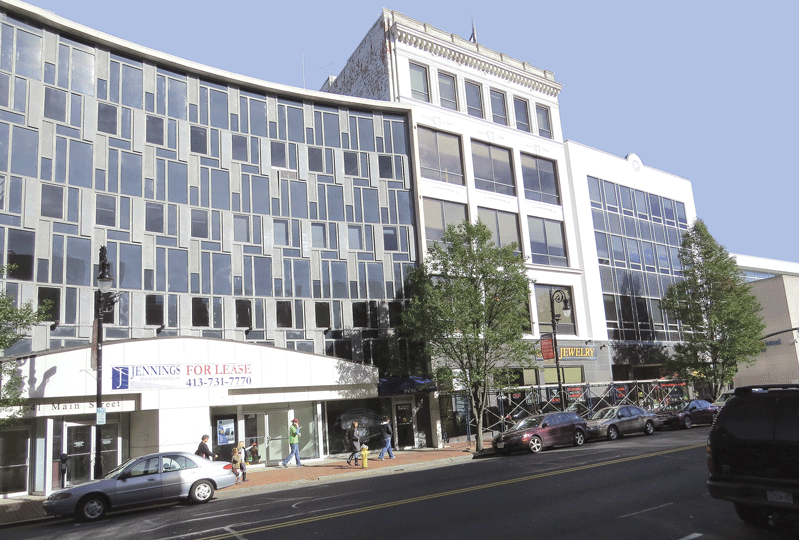
The buildings along Main Street between Harrison Avenue and Falcons Way are among those expected to draw interest from businesses to be displaced by the casino.
That’s how he chose to describe the relative — and unexpected — quiet on the morning of Nov. 5, maybe a dozen or so hours after it became clear that ballot Question 3 was going to be defeated and that the casino era had officially begun in Springfield.
“But then on Thursday, the floodgates opened,” said Jennings, president of Springfield-based Jennings Real Estate, in reference to the volume of phone calls to his office, most of them from business owners who will be displaced by the $800 million gaming complex to be built by MGM Resorts International in the city’s South End.
And he expects the calls to keep coming in the weeks and months to come as the dust only begins to start settling from this momentous development, one that has the potential to lift the local real-estate market from the general doldrums that have characterized it for the more than a decade now.
“My expectation is that we will be busy, and the whole trickle-down from this will be fantastic,” he told BusinessWest. “It will involve not only the real-estate brokers, but the lawyers, the phone companies, the contractors, the rug companies, the movers, and many others.
“The trickle-down will be significant and exciting,” he went on. “For the first time in I don’t how long, the landlords in Springfield who have slugged it out for the past 15 years will finally see some rent appreciation.”
While he was somewhat more reserved in his tone, Doug Macmillan, president of Macmillan & Son Inc., said essentially the same thing as he speculated on what will certainly be an intriguing time for the downtown real-estate market.
“I don’t think we’ve ever seen anything quite like this — it’s a dynamic change,” said Macmillan, who came into the business started by his father just as the real-estate bust of the late ’80s was gaining steam and has seen a number of economic cycles since. “This is certainly going to be interesting.”
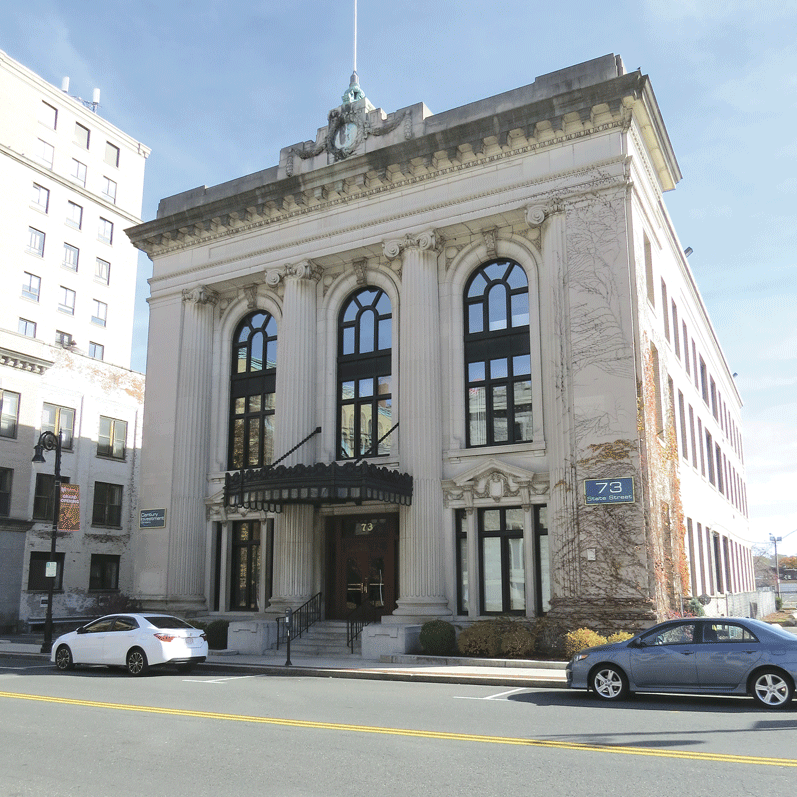
The stately building at 73 State St., part of which will be used for the casino’s hotel, is among those whose tenants must find new homes.
Indeed, while many tenants in buildings along State, Main, and other streets in or near the South End will have to be moved to make way for the casino and MGM’s operations, there are others who will want to be near that $800 million complex — or away from it, as the case may be. Meanwhile, Macmillan has started getting calls from some parties concerned about the casino and I-91 reconstruction projects happening simultaneously, and the possible negative impact on their business.
“We’ve seen a fair amount of people who are actively contingency planning for how all this construction for the casino and the viaduct might impact their business downtown,” he said. “They’re wondering if customers are going to be able to get to them and if employees are going to be able to get to work. They’re thinking about whether they should set up a satellite office or do something different. It’s created a lot of … not pandemonium, but certainly uncertainty.”
MGM is offering incentives to businesses to be displaced by its complex — $3 per square foot for those who stay in Springfield and $4 per square foot for those who remain in the central business district.
And while the downtown market has tightened up somewhat in recent years, with new businesses and organizations ranging from MassLive to Bay Path University moving in, there is still plenty of space available in many different categories.
One full floor and many smaller spaces are available in 1350 Main St., also known as One Financial Plaza, said Bill Low, a broker with NAI Plotkin, which is leasing agent for the top 12 floors in that building. There is also some space in both Tower Square and Monarch Place, Macmillan noted. Meanwhile, considerable square footage is available in Harrison Place and other buildings along Main Street between Harrison Avenue and Falcons Way, noted Jennings, who is handling those properties for owner Glenn Edwards.
Jennings said he’s already had a few soon-to-be-displaced business owners sign on the dotted line, and he expects several more in the months to come as the project moves forward.
“Our goal is to be 100% occupied,” he said of the properties along Main Street. “That’s ambitious, but we’re optimistic.”
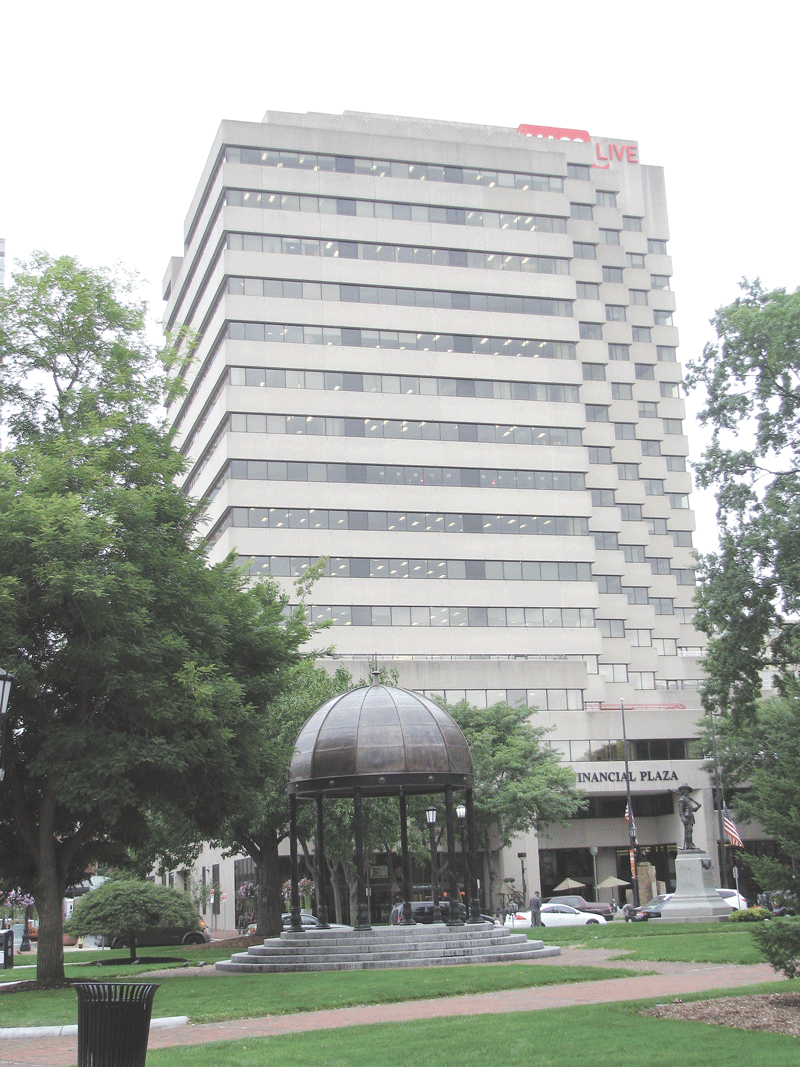
One Financial Plaza, a.k.a. 1350 Main St., is another property expected to draw interest from displaced businesses, including many law firms.
New Lease on Life
MacMillan told BusinessWest that he didn’t care to speculate on how many businesses will be displaced by the casino and MGM’s day-to-day operations and how much square footage is represented by those pending relocations. “I really have no idea, and if I guessed, I’m sure I’d be way off.”
Jennings said he’s heard some numbers, such as 250,000 square feet, in reference to the amount of real estate involved — meaning property to be demolished or made part of the casino complex.
Whatever the figure is, it adds up to an unprecedented opportunity for area landlords and brokers to fill space that in some cases has been vacant for more than a decade.
And, in many ways, movement to seize that opportunity began months ago.
Indeed, Edwards has invested a significant amount of money in capital improvements to the properties along Main Street in anticipation of the casino moving forward, said Jennings, adding that his firm has been proactive with regard to marketing the space, opting not to wait until after the vote on Question 3.
“We put together a strategic list of properties that we have both for sale and lease in Springfield,” he explained, “and knocked on doors.”
And there are many to knock on within the 14.5-acre area in which the casino will be built, he said, noting that there are many lawyers and other professionals in both 95 State St. and 73 Main St. — located just a block or two from the Hampden County Hall of Justice — which will both become part of the casino complex.
Meanwhile, there are several retail operations along Main Street and other service businesses within the casino site that will have to be relocated.
Some will move out of that area and perhaps out of the city, but Jennings and Macmillan believe many will opt to stay downtown.
And some of these business owners are being proactive themselves when it comes to finding a new address, opting not to wait until the votes were counted on Nov. 4 to consider some options.
“The day after the election, my phone did ring a little louder and a little longer than it normally does,” said Macmillan. “But a lot of these people have been forward-thinking enough to understand that they need to be proactive about this, because they’re only going to have X amount of time to find a new home.
“We’ve been working with some groups for more than a year now,” he continued, “because they’ve recognized this eventuality and wanted early on to identify where they thought they might like to be.”
However, some waited until after the vote, said Low, and now they’re making up for lost time.
“There were some people who didn’t bother calling — they just showed up at 1350 Main St. and asked to see space,” he told BusinessWest, adding that a few businesses have made verbal commitments to take space there. “You hardly ever see anything like that.”
He noted that the building is attractive to the law firms and solo practitioners that will be displaced by the casino because of its proximity to the courthouse and the flexible nature of the available space.
Jennings said he’s brokered some deals for smaller spaces, 2,000 square feet and under, and also a few in the 2,000-to-4,000-square-foot range. And since Question 3 was defeated, the volume of inquiries has increased exponentially.
They come during a time that Macmillan described as a “resurgence of interest in downtown,” a period during which UMass Amherst has opened a center in Tower Square; Bay Path, MassLive, and Thing5 have moved into 1350 Main St.; New England Public Radio has relocated into the Fuller Block; and Accountable Care Associates has taken a full floor in Monarch Place; just to name a few developments.
“There’s been a renewed interest in downtown that is unrelated to the casino,” he explained. “We’ve been extremely busy leasing an awful lot of downtown office space for the past two years. Some of them are new tenants, some of them expanding; there’s been a lot of activity, and we’ve done a number of deals.”
The “shuffling of the deck,” as he called it, that will result from the casino projectg — and is, in many respects, already underway, will further tighten and stabilize the market, and likely push lease rates higher.
“With all this interest we’ve seen in downtown before the casino, the downtown market has tightened up; there’s still a fair amount of space, but there’s not the same amount that there was two years ago,” Macmillan said, speculating that perhaps 80% of the Class A space and 70% of the Class B space downtown was occupied.
Jennings said the surge of interest is already impacting rates in some of the properties he’s representing. At Harrison Place, he noted, space that was quoted at $11 or $12 per square foot is now being quoted at $17, and there have been similar increases at other properties along Main Street.
Low said the asking prices at 1350 Main St. may soon be rising, adding that those who wait to begin the process of finding a new home will likely pay more for that square footage.
Building Momentum
As he talked about the recent history of the downtown commercial real-estate market, Macmillan said there have been a number of “fits and starts” over the past few decades, small gains that have been slowed or reversed by economic declines in the early ’90s, just after 9/11, and the Great Recession.
The dawn of the casino era presents the opportunity for something far more substantial and lasting, he said, although the overall impact of this massive development is still difficult to predict.
What is known is that this situation presents a rare opportunity, one that all those involved are committed to take full advantage of.
George O’Brien can be reached at [email protected]


A panoramic view of the section of Springfield’s South End that will be transformed into MGM’s $800 million casino complex.
That’s how long MGM Resorts International has to complete construction on its $800 million casino complex in Springfield’s South End, according to the host-community agreement inked early this year.
That means August 2017, if you haven’t already done the math.
Kevin Kennedy, Springfield’s chief development officer, said the city (or MGM) might eventually erect one of those digital displays that counts down the months, days, hours, minutes, and seconds until something starts, as cities hosting the Olympics have done. But even without such a device, everyone involved will know that the clock is ticking — and that time, as that old saying goes, is money.
That’s why MGM didn’t put this project aside during the four months between when it was announced that a measure to repeal the state’s gaming law would appear on the election ballot and when it was soundly defeated, said Mike Mathis, president of MGM Springfield.
“There was a mandate from our chairman, Jim Murren, and our president, Bill Hornbuckle, an attitude that ‘we’re going to win this on Nov. 4, so let’s keep the intensity up so we don’t lose that time,’” said Mathis, adding that work pressed on with everything from final design to workforce-development issues to the overall timetable for what will easily be the largest construction project in this region’s history.
In some ways, this initiative will look like one of those 1960s-style urban-renewal projects, said those we spoke with, noting that several buildings, many of them damaged by the June 2011 tornado, will be torn down within the 14.5-acre site, and a number of businesses will be relocated to make way for the casino project. But it will also be different in many respects.
Indeed, this will be a private project, one that won’t bulldoze an area, but rather preserve many buildings within it, including historic 101 State St. — the original home of MassMutual — as well as First Spiritual Church and the façade of distinctive 73 State St. And instead of taking taxpaying properties off the rolls, as many of those massive urban-renewal projects did, this one will raise the amount of taxes generated within those 16 acres from $634,000 at present to $17.6 million when the casino opens its doors.
Mathis, who has been involved with several MGM casino initiatives, in this country and abroad, said the Springfield project presents some distinctive challenges — and opportunities — with its urban setting, its location in a state that has no experience with gaming at this level, and its so-called inside-out design.
“They’re all unique, but this is particularly unique, because of the integration with the existing downtown environment; this is not a greenfield project,” he explained. “There’s no template in our portfolio for a project like this, but that said, we’ve built in challenging environments at major scale, so this is certainly within our wheelhouse.”
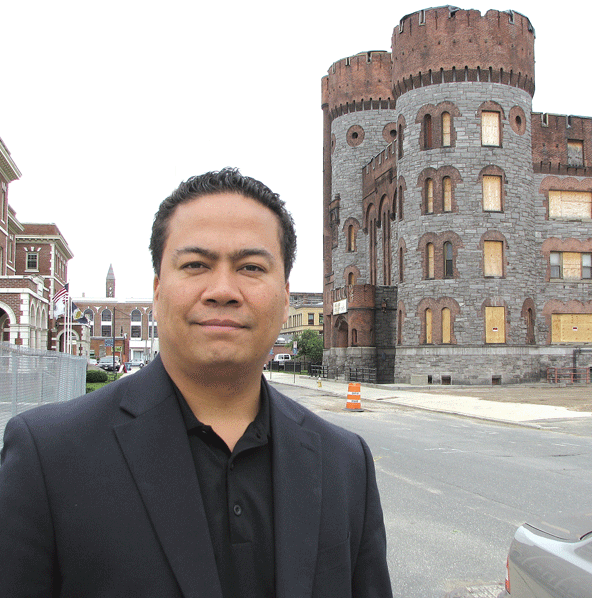
Mike Mathis says MGM’s Springfield casino complex is unique in many respects, and thus it presents a number of challenges.
Next will come the hotel tower, which will incorporate the façade of 73 State St. into its design, as well as other components on what Mathis called “parallel tracks.” These include retail areas, a projected 50 units of market-rate housing near the casino site, and other facilities. Many of those components will be preceded by demolition of existing structures, including the school, the Western Mass. Correctional Alcohol Center on Howard Street, and a retail complex on Main Street, among others, and the relocation of roughly 20 businesses.
Meeting that 33-month mandate will be challenging on many levels, especially if the planned I-91 viaduct reconstruction project takes place at the same time, as expected. But all parties involved — MGM, the city, and the state — have no shortage of incentives to meet that timetable.
For this issue, BusinessWest talked with Mathis, Kennedy, and others about what the next 33 months might be like. The words heard most often were ‘challenging’ and ‘exciting.’
The Suspense Is Building
Kennedy, who has played a role in several development projects — from the new federal courthouse to significant improvements to State Street to Union Station — in his current role and also as aide to U.S. Rep. Richard Neal, said the casino will be like those initiatives in some ways, but there are important differences that might actually make the MGM complex a smoother, easier undertaking.
“The scale is obviously much different than anything we’ve ever done here in Springfield before — there haven’t been any $800 million projects,” he told BusinessWest. “However, the nature of the projects and how a project gets done … they’re all pretty similar in terms of permitting, demolition, and all the things that will happen here.
“But in terms of complications, while this is the largest economic-development project we’ve undertaken, the complexity of it, from a government standpoint, is actually less than either the U.S. courthouse and State Street,” he went on. “On the courthouse, not only did we have to make deals with property owners, tear down a portion of Technical High School, and move the Alexander House, but this was a three-tiered governmental project — there was federal, state, and local involvement, and everyone has their regulatory issues. And when you’re redoing 3.2 miles of State Street, we were two years in the planning process alone.”
But the casino project will undoubtedly have its challenges, said Kennedy, adding that one matter of particular concern is infrastructure and, more specifically, old and deteriorating water and sewer lines in that part of the city.
“When we had our negotiations with MGM, we talked to them extensively about these infrastructure issues, and they are very much on board for this because they can’t afford to have a water or sewer problem,” Kennedy noted. “And we don’t want them to have a breakdown, either, because some of our funds are attached to their ability to do business.”
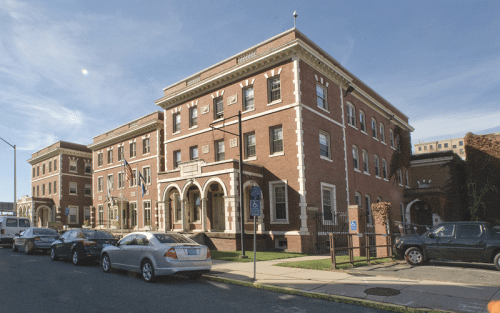
The Western Mass. Correctional Alcohol Center on Howard Street will be one of the buildings demolished to make way for the casino.
“We’ll start to scope out what the issues are, how we’re going to do this, and who needs to be assembled on either side of the table in order to coordinate this and deliver the project by August 2017,” he explained.
Mathis acknowledged that building an urban casino — and building one in a heavily regulated state like Massachusetts — will be a different experience for himself and MGM, but lessons learned during other projects will serve the company well.
“We’ve built City Center, an 18 million-square-foot project in Las Vegas, one of the largest private developments at that time in the entire country, so we know how to do sophisticated construction in tough environments,” he said. “So we’re confident we can hit our time period. But it takes a lot of work, it takes a lot of preparation, and our group recognizes that.”
Meanwhile, all the principal parties involved — MGM, the city, and the state — have plenty of motivation to help this project proceed on schedule.
“The great thing is that the state is our partner on this, as is the city,” said Mathis. “We all have the common goal to get this facility up and start generating revenue and putting people to work.”
Overall, he said he hopes to harness the considerable energy present at a gathering at the Basketball Hall of Fame on election night to move the casino project from the drawing board to reality.
“The energy in the room was palpable — everyone wanted to be a part of this,” he told BusinessWest, adding that this level of support and enthusiasm should help the company navigate the many kinds of challenges that will present themselves over the next 1,000 days or so.
Placing Their Chips
Indeed, while the transformation of the site in the South End will be the focus of most of the region’s attention over the next three years, there are many other matters to address to ensure a successful opening in the summer or fall of 2017, said Mathis, adding that MGM and its many types of partners in this region are already working on some of them.
Relocation of businesses to be displaced by the casino complex is one such matter, said Mathis, noting that uncertainty in the wake of the referendum vote has delayed this process somewhat and has now generated a new sense of urgency (see related story, page 43).
“One of the things that we negotiated with the city was to provide incentives — we’ll pay the moving costs for tenants if they relocate in the downtown Springfield area,” he explained. “For those who take us up on that offer, we’ll be happy to subsidize that move and keep the energy downtown. We’re already talking with other commercial property owners about space that they can make available that we can provide a pre-agreed group rate to and make this transition as easy as possible.”
Meanwhile, MGM is preparing to close on roughly $35 million worth of real estate it has acquired in the South End for the project, he went on, adding that designs for the project, while not final, are close, and at this moment they do not require any additional acquisitions.
As designs are completed, the company will also go about hiring a general contractor for the massive project, he went on, adding that there are a number of developments happening simultaneously.
“We’re excited about our preparedness to move forward with the project with our different contractors and suppliers,” he said, adding that workforce development is another focal point moving forward. And there are challenges in this regard, Mathis told BusinessWest, because gaming is new to the Bay State, and thus there is no trained workforce in place, as there would be in Las Vegas, Atlantic City, or Macau.
“There is a significant amount of training that needs to take place in a market like this that doesn’t have casinos or gaming,” he said, adding that MGM is working with a host of parties, including the area community colleges and regional employment boards, to identify and then train a workforce.
Another partner is the American Red Cross and its Boots to Business program. As part of that initiative, several area veterans will go to Las Vegas to be trained on table games. After eight months of training and honing their skills, they will return to this region and train others who have been identified as good candidates for those positions.
Other priorities for MGM and various partners are to develop a comprehensive marketing strategy for MGM Springfield — one that focuses on the Bay State as well as surrounding states with competing casinos — and work to sell Springfield (and its new casino) as a destination for meetings and conventions.
“A casino is one of the things that meeting planners look for, but they also look for the things that come with a casino, like four-star hotel rooms, which this market doesn’t have. They look for high-end restaurants and diverse entertainment experiences,” he said, adding that MGM’s complex will make this region that much more attractive to those booking conventions.
“We’re one of the largest convention-space operators in the world — our Mandalay Bay events center is the fifth-largest convention facility in the country — so we know as much about conventions as we do about gaming,” Mathis went on, adding that MGM has a huge database of current and potential clients, including some groups that are too small to consider Las Vegas, but would find Springfield a good fit.
Mary Kay Wydra, director of the Greater Springfield Convention & Visitors Bureau, said that, with the defeat of ballot Question 3, Springfield and the region as a whole can now market themselves as the future home of a gaming complex, a considerable addition to the current list of amenities.
“If we can capture a fraction of their [MGM’s] national and international database and get the regional groups that those entities represent, those will be obvious targets as the building opens and the casino comes online,” she told BusinessWest. “They’re already familiar with MGM — they know what that brand stands for — and they know its quality and what they’re going to get. We’re excited about starting our work with them in that matter.”
Not Hedging Their Bets
That excitement, coupled with large doses of anticipation, should make the next 33 months an intriguing time for the region, one that will test the imagination — and sometimes the patience — of all those involved.
“It would not be wise to think that we’re not going to have some challenges as we go through this,” Kennedy told BusinessWest. “There will be some bumps in the road. We have a partnership with MGM, and any partnership will have some tension built into it. There will be some issues as we move through this process.”
But as all those we spoke with noted, there is more than enough incentive to get through those issues and clear those bumps.
August 2017 will no doubt arrive quickly, and the countdown has already begun.
George O’Brien can be reached at [email protected]
Although the downturn in the economy in 2008-09 caused building to come to an abrupt standstill in most cities and towns across Western Mass., Southampton was an exception.
“Building never came to a halt here, and new housing continues to go up,” said Ed Cauley, vice chair of the Board of Selectmen.
“Right now, there are four new subdivisions with 35 lots in various stages of development, plus a half-dozen single lots where new homes are being built; there is a lot of growth going on,” he continued, adding that the new homes are priced between $400,000 and $500,000.
Heather Budrewicz says 24 building permits for new homes have been issued this year in Southampton.
In fact, Selectman David McDougall calls home ownership in Southampton “the dream,” explaining that, as people become successful, they want to build a home in the country on an expansive lot.
“But if you work in Springfield or the surrounding cities, your options are limited,” he said. “You can buy land in Montgomery or Huntington, but they are farther out and require longer commutes. Southampton is one of the last areas that is convenient to I-91 and has reasonably priced land that people can build a dream on.”
Cauley also cites Southampton’s location and adundance of land as attributes that have led to the town’s popularity, but said the school system, large amount of open space, and opportunities for recreation also attract homeowners, who often move to the town from Holyoke and Westfield.
“Route 10 runs through Southampton, and we’re close to I-91 and exits 3 and 4 off the Massachusetts Turnpike; we’re a bedroom community, but are close to Northampton and Easthampton, which have a lot to offer in the way of arts and restaurants,” Cauley said, explaining that residents are able to enjoy living in a rural atmosphere but also benefit from nearby shopping and entertainment venues.
“Southampton is a beautiful place. It’s picturesque, people are friendly, we have a great school system, the taxes are reasonable, and we provide good services,” he went on.
The town was once an agricultural community, and although there are still two working dairy farms, several equestrian operations, and a number of small farms, former farmland has become a prime focus for developers, and because there is so much of it, Cauley said the majority of lots in new subdivisions are at least an acre in size.
“Plus, we have 14 conservation areas that contain 600 acres. They range from 9 to 200 acres and are under the jurisdiction of the Conservation Commission,” Budrewicz said. “We also have three parks, including Labrie Field, which contains 19.4 acres and is a multi-field athletic complex that is so new, we are still waiting for the grass to reseed itself so the soccer fields can be fully utilized.”
Growing Pains
However, rapid growth in Southampton has led to significant financial problems as voters have repeatedly turned down proposals to increase taxes.
In July, a Proposition 2½ override was rejected by voters. Town officials were hoping to raise $1 million to avoid budget cuts, and said if the override was passed, $200,000 would have gone into two dwindling stabilization accounts and $40,000 would have gone into a fund to pay future employee benefits.
But it didn’t happen, and there have been repercussions, which include a change in the student/teacher ratio at Norris Elementary School. “It’s a very small school, and for many years the ratio of students to teachers was 17/1, which is what you find at many private schools,” Budrewicz said. “But this year, we had to change, and it is now 24/1.”
Town officials say they may also have to close the library, and although Cauley says the town’s police officers, firefighters, and other service providers are doing an excellent job, the growth in population indicates a need for more feet on the street.
“We’re a small town that is growing faster than other communities, and we would like to be able to do more, but we have been forced to tighten our belts,” he said.
McDougall said there has been significant controversy surrounding the budget, but what new residents often don’t realize is that the town spends $1.19 in services for every dollar it takes in, with 60% of the annual budget allocated for educational expenses.
The shortfall and differing opinions in the community led the selectmen to request a review of their budget process this summer by the Department of Revenue’s Division of Local Services. The results were released last month, and state inspectors said the town is in a “vulnerable financial condition,” and noted that voters have failed to pass every Proposition 2½ override proposal on the ballot since 1991, although 39 override questions have been put before them during that time period, ranging from $1,500 to the recently requested $1 million.
In addition, a recent report from the Pioneer Valley Planning Commission shows the number of housing units in Southampton grew by 47% between 1990 and 2010, and the population increased by 93% between 1970 and 2012.
And therein lies the problem, said McDougall.
“Proposition 2½ was passed in the early ’80s when the town’s population was between 1,500 and 1,900 people. At that time, the town was a small farming community, but since then it has become a bedroom community of about 6,000 people, and the budget has not kept pace with the growing cost of services,” he noted, explaining that the town is losing money on new homes.
“When new roads go in, they have to be plowed, which requires trucks and manpower. The police need to patrol these roads, but the police force has shrunk in size in the last decade due to a lack of funds. We only have one full-time firefighter, our chief, with the rest working part-time or on-call. People complain that we are slow to plow the roads, but we just don’t have the resources,” he went on. “Our Finance Committee has been advocating for an override to Proposition 2½ for six years to reset the financial equation, so it’s not a new problem, but one that has slowly grown. No one wants to pay more taxes, but we have gone from having $670,000 in our stabilization fund in 2007 to $90,000 today in two accounts, and although some people say we are mismanaging the money, it’s hard to do when you don’t have any.”
The Department of Revenue also noted the difficulty of balancing the town’s budget due to the shortfall, but recommended a number of changes, which the selectmen have begun to implement.
Moving Forward
However, town officials don’t expect the growth to stop or even slow down, and Cauley says the town is a great place to live because there is a lot to do, including activities staged by the school and a wide variety of sports teams for children.
Recreation includes fishing on the Manhan River, along with an endless number of hiking trails. “We’re in the foothills of Pomeroy Mountain, and hikers who go to the top can see UMass Amherst on one side and Mount Tom on the other side,” Cauley said, adding that other enjoyable venues include concerts at Conant Park held throughout the summer and fall, as well as the annual Celebrate Southampton event that evolved from the former Old Homes Day.
“One-third of the area that makes up Hampton Ponds is in Southampton, and we also have a Memorial Day parade with ceremonies that a large number of people march in,” Cauley told BusinessWest.
Residents also enjoy the Manhan Rail Trail, which starts on Coleman Road and continues through Easthampton into Northampton. In fact, it is so popular that a new greenway project is underway that would connect to the trail and extend in the opposite direction toward Westfield.
Charlie McDonald, chairman of the Conservation Commission, said a group called The Friends of Greenway has kept the idea moving forward over the past few years. The initiative involves purchasing 4.25 miles of old railroad track owned by Pioneer Valley Railroad and transforming it into a bike path.
Two years ago, after the section of rail corridor was appraised at $340,000, the Conservation Commission applied for and received a state Local Acquisition for Natural Diversity Grant. It will pay for 80% of the land, and the town will be responsible for the remaining 20%, which will come from Community Preservation Act funds.
“In November of 2012, 80% of the residents at a town meeting voted in favor of purchasing the track,” McDonald said, adding that the Mass. Department of Transportation has been supportive, and the town is currently in negotiations with the railroad to purchase the property.
After that occurs, officials will find a company to remove the rails in exchange for keeping and selling them. “The final step will be to develop a design for a permanent, paved trail,” McDonald said.
He believes the project will enhance quality of life in town and may lead to economic growth, because it will bring new people into Southampton. “This is a residential community, and many people like to bike and take their children with them. So the new trail will make it safer and give people a great place to exercise, as well as connecting the town to a variety of cities through a network of trails, he explained.”
Continuing Process
In short, although Southampton is primarily a residential town, it has a balanced slate of offerings. “We don’t have a lot of restaurants and businesses, but we have enough,” Cauley said.
McDougall agreed. “People move here to escape the noise and crowds in nearby cities,” he said.
Still, both say it is a mixed blessing, due to the budget situation. “People want a simple answer, but it’s a complicated issue, and it will take earnest, open discussions to solve it,” McDougall said. “But it’s not a new problem, and the dream of owning a country home with a long driveway in Southampton will continue.”
Year Incorporated: 1753
Population: 5,792 (2010)
Area: 29.1 square miles
County: Hampden
Residential Tax Rate: $15.20
Commercial Tax Rate: $15.20
Median Household Income: $61,831
Family Household Income: $64,960
Type of government: Town Meeting; Board of Selectmen
Largest Employers: Town of Southampton/Norris Elementary School, Big Y
* Latest information available
By ANN LATHAM
“We need more accountability!”
This is a familiar cry. Executives, managers, and employees alike, all frustrated by delays and incomplete work, are demanding greater accountability.
What exactly do they want? They want clear goals, follow-up, answers, and consequences. They crave order and predictability so everything can go more smoothly. If necessary, heads must roll.
It is easy to see why. The norm in most companies includes many dropped balls, missed deadlines, crossed signals, and inadequate responses to requests and problems. The frustration and demand for greater accountability are totally understandable.
If management would just tighten everything up and take control, results would be easier to achieve for all. Right? Wrong.
The solution isn’t accountability. There are far too many situations where accountability practices fail.
When the work is unfamiliar and unpredictable, strict accountability, with its black-and-white goals and black-and-white follow-up, only highlights repeated failures as employees hit one obstacle after another. Accountability doesn’t make the goals, which are merely guesses in new situations, more reasonable. It doesn’t eliminate unanticipated problems. It doesn’t magically reveal to employees what they don’t know. And it doesn’t instantly create new skills. But it does generate feelings of disappointment, stress, anger, insecurity, and injustice. It does encourage employees to invest time and energy in developing excuses at the expense of achieving results.
When the goals require contributions from many employees, strict accountability doesn’t magically reduce dependencies and create autonomy. It doesn’t increase the impact of any one employee’s tiny piece of the puzzle. It doesn’t make less-skilled employees more capable, or less-committed employees more determined. But it does pit employees against each other. It encourages us-versus-them thinking and finger pointing. And it leaves employees feeling powerless, frustrated, and overwhelmed.
And when the work lands in the hands of employees who just aren’t highly effective, strict accountability sets them up for failure, not success. It doesn’t hand these employees self-mastery, critical thinking, interpersonal skills, patience, persistence, confidence, courage, discipline, or great communication skills. It doesn’t suddenly make them superstars. But it does leave many well-intentioned, hardworking employees at the mercy of the many obstacles common to humans and complex organizations.
These are just a few examples where accountability fails. Tighten accountability for employees in these situations, and you create losers, not winners.
The Power of Commitment
Now, if all your employees are either highly effective or have highly predictable days, great autonomy, and goals over which they have total control, then accountability practices will work great for you. But when you think about it, those employees probably deliver even without much emphasis on accountability.
No, accountability is not the answer. Commitment is.
Committed employees keep on plugging, surpass goals, constantly look ahead, and give no thought to excuses for missing the mark. They help each other and don’t point fingers. They are open to honest feedback because they don’t feel threatened. They see themselves as important players, not pawns in a game where raises, bonuses, promotions, and jobs are on the line.
Committed managers help employees identify and overcome obstacles. They team up to solve problems and don’t feel the need to hold feet to the fire. They build confidence and reduce stress. And they build the commitment of their employees.
When employees and managers are truly committed, they get the job done. Somehow. Collectively. It might not be pretty, but it works. They band together. They are inventive. They are excited and determined. Often, it doesn’t even really matter who was supposed to be accountable. They succeed because of their commitment, not because of accountability practices.
When it comes to getting results, nothing is as powerful as commitment.
To generate commitment, managers must partner with their employees. They must be true partners — partners who win and lose together. Partners who are obviously on the same team.
How do partnering managers behave? They:
• Treat employees as equals, needed for mutual success, not subordinates;
• Encourage employees to take ownership of their own success, on the job and in life;
• Listen, ask, answer, and offer — and resist the temptation to do more until asked;
• Provide honest feedback so employees know where they stand, know how they can improve, and develop self-awareness and self-management; and
• View the employment relationship as a win-win deal, which is created and ended with mutual respect, professionalism, and no shame.
When managers tap into the natural accountability of partnerships, which prevents either party from letting the other down, everybody wins.
Ann Latham is the president of Uncommon Clarity Inc. She has done projects in 28 industries, and her clients include for-profit organizations, such as Hitachi, and nonprofit organizations, such as public television and Smith College. Her words of advice have appeared in 85 media sources, including Bloomberg BusinessWeek, Forbes, MasterCard.com, MSNBC.com, and the New York Times. Her writing can also be found at Ann’s Clarity App, bit.ly/anns-clarity-app, and at uncommonclarity.com.
By JEFFREY TRAPINI and HUNTER KEIL

Jeffery Trapani

Hunter Keil
Here what employers need to know about this measure and how it will impact their business.
What the Law Requires
The law applies to all employers, regardless of size. If the employer has 11 or more employees, then the sick time must be paid, and if the employer has fewer than 11 employees, it may be unpaid.
Regardless of the size of the employer, the law has the same requirement for accrual. Employers must provide a minimum of one hour of sick time for every 30 hours worked by an employee, up to a maximum of 40 hours of sick time per year. The law applies to both full-time and part-time employees, although obviously part-time employees will not accrue sick time as quickly as full-time employees. Employees who are exempt from overtime requirements are presumed to work 40 hours per week for the purposes of accrual, unless their normal work week is fewer than 40 hours, in which case it will accrue based on their normal work week.
Employees are allowed to carry up to 40 hours of sick time accrued in one calendar year over to the next calendar year, but employers are not required to allow employees to use more than 40 hours of sick time in one year. For that reason, this carry-over provision affects when an employee can take his or her sick time, but not the total amount of time that can be taken in a year.
Sick time may be used by employees for a number of reasons. In addition to caring for an employee’s own health, it can be used for caring for the employee’s child, spouse, parent, or parent of a spouse. Sick time can be used for both unforeseen illnesses and for routine medical appointments. If the use of earned sick time is foreseeable, the employee is required to make a good-faith effort to provide notice to the employer. Finally, sick time can be used to address the psychological, physical, or legal effects of domestic violence.
Employees will begin accruing sick time under this law on July 1, 2015 or on the date of their hire, whichever is sooner. Although employees begin accruing sick time upon hire, there is a 90-day waiting period for use of the sick time. Therefore, employees cannot use accrued sick time until they have been employed for 90 days or more by the employer, but they begin accruing it immediately.
The law does not require accrued sick time to be paid to an employee upon termination or resignation. Employers should be careful, however, if they have a paid-time-off (PTO) policy that grants employees a certain amount of paid time off that can be used as either vacation or sick time. The law does not require an employer to provide paid sick time in addition to PTO, provided that the PTO policy meets the minimum criteria of the law.
The Massachuetts Wage Act, however, requires employers to pay employees for all of their accrued vacation time upon termination or resignation. If an employer does not differentiate between vacation time and sick time, then it arguably must pay all accrued PTO at the time of the employee’s departure. If a policy is unclear, the courts may construe it against the employer, so it would be wise for an employer to make sure it is clear on this point.
The Law Is a Floor
The new law, which will be codified as Chapter 149, §§ 148C, 148D, acts as a floor below which employers may not drop, but nothing in the law forbids employers from granting more benefits to employees than the law requires. If an employer’s existing policy grants more generous sick-time benefits to its employees than the law requires, the employer does not need to modify its policy in reaction to this law. However, employers should be cautious in assuming that their policy is in compliance with the law, and it would be prudent to seek advice.
While an employer’s sick-time policy may be generous, it may still have details that are not in compliance with this law. For example, an employer may grant more than 40 hours of sick time per year, but if it does not allow up to 40 hours per year to be rolled over to the next calendar year, it may not be in compliance. Likewise, if an employer does not provide benefits, including sick time, to part-time employees, it will not be in compliance with the law regardless of how generous its sick-time policy may be for full-time employees.
Potential Liability for Employers
Both individual employees and the Massachusetts attorney general have the right to enforce the provisions of the law. Like other statutes relating to employment discrimination and wages, employers may be sued for interfering with or denying an employee from using earned sick leave, or for retaliating against employees for asserting their rights to sick leave or for supporting the rights of another employee. If the employer is found to have engaged in such conduct, it can be liable for any lost wages or other damages resulting from the adverse employment action. Further, it also appears that an employer’s decision maker may also be liable to the employee.
Employers should take special note of the retaliation provision of the statute. Where damages are awarded, they must be automatically tripled, and the employee may also recover attorney fees and costs. The mandatory tripling of damages and the availability of attorney fees for a successful plaintiff pose the possibility of surprisingly large awards, creating an incentive for attorneys to represent employees in these cases. It would be wise for employers to be meticulous in ensuring that their sick-time policies comply with the law, and that their policies are uniformly followed.
Attorney General Regulations
The law requires the attorney general to promulgate regulations on a number of the provisions in this law. These regulations will clarify ambiguities, and employers will have to make sure that they are in compliance with these as well. Employers should be aware that further modifications to their policies may be necessary when this occurs.
Jeffrey Trapani and Hunter Keil are attorneys with Springfield-based Robinson Donovan, specializing in employment law and litigation; (413) 732-2301.

 In assessing the many ways banking in Massachusetts has changed, Dan Forte summons two numbers: 338 and 175.
The first, said Forte, president of the Mass. Bankers Assoc., is the number of banks with offices in the Bay State in 1990. The second number is the same tally at the end of 2013.
“That’s a 48% drop, which, annualized, is a 2% drop per year,” Forte said. “There have been some periods where the consolidation was slower, while in some periods, it has been a little faster. We’re coming out of an economic trough, albeit slowly, and as the economy gets stronger, you’ll see mergers pick up over the next few years.”
Indeed, after a few relatively — but never totally — quiet years on the bank-merger front, 2014 has brought a rush of movement, most recently Berkshire Bank bringing Hampden Bank under its banner (see sidebar, page 19).
“It’s a combination of things,” Forte said, noting that the region’s most recent big moves — Berkshire’s in-market acquisition of Hampden, the interstate ‘merger of equals’ between United Bank and Rockville Bank a year ago, and Connecticut-based Farmington Bank’s plan to expand into Massachusetts — are very different from each other.
“The community banks are going to remain strong, but, like every other industry, there’s going to be a lot of change, and this is part of the change,” he said. “It’s really nothing new.”
Or, as Brian Corridan put it, “we have a lot of very good banks here in Western Massachusetts. But the world is changing, and the checker game in banking has become a chess game.”
Corridan, a local expert on the financial-services industry and president of Corridan & Co. in Chicopee, emphasized that not only are mergers and consolidations par for the course these days, they’re not the biggest story.
Berkshire Bank leaders are discussing whether to retain, consolidate, or close Hampden Bank branches that overlap Berkshire branch footprints — including Hampden’s headquarters in downtown Springfield.
“Look around — people have accounts at Citizens, TD Bank, and Santander. We’re not just talking about regional banks anymore, but foreign banks. They see the value of retail banking in our area,” Corridan said. “And it’s just the tip of the iceberg; there’s a lot of consolidation to come as banks look for economies of scale.”
That’s one of the reasons offered by Sean Gray, Berkshire Bank’s executive vice president of retail sales, in explaining why his institution is “doubling down on Springfield,” where Hampden Bank is headquartered, and where Berkshire already has a significant presence.
“Ultimately, there are economies of scale that come with larger size,” he said. “We believe we have to be big enough to do all the things larger institutions can do, but we feel we need to keep our roots in local decision making, and stay active in foundations and volunteerism and all the things you want a community bank to do at the end of the day.”
When it comes to making moves on this massive chessboard, how does a bank become more efficient, more profitable, and offer expanded services and a broader range of loans, while also maintaining the community involvement and high-touch environment long valued by retail customers in Western Mass.? For this issue’s focus on banking and financial services, BusinessWest examines how creating this balance has become, for banks large and small, the name of the game.
In the Red Tape
Ironically, much of the recent movement among banks to grow larger, quickly, has come as a result of new regulations in the wake of the 2008 financial collapse — a crisis in which the largest banks shouldered much more blame than smaller community banks.
“Since Obama came to town, it’s been a regulatory jungle, and the departments within individual banks experiencing the highest growth rate are the compliance departments,” Corridan said. “In response to more complicated regulations, the federal government is demanding more reports, and that rocks your bottom line. If you have to put $400,000 to $500,000 into your compliance department, that may upset the balance of whether you had a profitable balance or you’re in the red.”
Forte agreed, citing the way ‘call reports’ — the condition reports banks issue to regulators at the end of each quarter — have become much more onerous.
“The costs of doing business are clearly increasing,” he told BusinessWest. “As of 2012, there were 1,995 items in a call report. In 1990, there were 569 items. And the regulations coming out of Dodd-Frank are going to increase them even further; they’re looking now at increasing the number of reporting requirements by 63 elements. Every item takes time and costs money, and the risk of not completing these forms correctly is significant.”
Therefore, he said, banks aren’t just expanding their brand when they merge; they’re spreading these regulatory costs over a larger footprint.
For William Crawford IV, CEO of Rockville Bank, the decision to merge United with Rockville was about investing smartly in an aggressive growth plan.
“Getting to $5 billion in assets, getting to that scale, was very important,” he said. “We’re seeing a lot of small banks seek out strategic partners, much as we saw with Hampden, simply because the economics of being a very small community bank — say, under $1 billion — is very difficult when you look at the interest-rate environment out there. It makes it very difficult to lend money, and, unfortunately, we may be in this environment for an extended period of time.”
Still, he emphasized the importance of maintaining community ties, particularly in the realm of long-established charitable and volunteer efforts.
“Both companies, United and Rockville, have significant foundations that will continue to invest here as we always have,” he said. “And because of our increased size and scale, we have more resources to do those things. So, from a community perspective, two companies coming together is definitely a plus.”
While customers might occasionally feel disoriented by changes in bank ownership, Forte noted that banks have been contracting nationally at a 3% annualized rate, putting Massachusetts behind the U.S. pace. Some of that has to do with the fact that 70% of the banks in Massachusetts are mutual banks, which are limited in how they can merge.
“It requires the right alignment of planets — the board, management, succession timing, etc.,” he said. “Clearly, the trend from this year is a little faster than three years ago, which is not surprising, given all that’s been going on economically.”
The loosening of state laws across the U.S. governing interstate banking, starting around 30 years ago, created a much more nurturing environment for mergers, leading to the remarkable contraction in Massachusetts-based banks since 1990, Forte said.
“State lines are fairly arbitrary; you’re looking more at economies. That’s why interstate banking is so critical; it gave banks large and small the ability to expand geographically, regardless of state boundaries.”
Cache and Carry
Forte emphasized, however, the vigilance with which merging banks protect their reputation as local institutions.
“Community banks are a vibrant sector of the economy, and they help their local communities,” he said. “Their biggest strength is being high-touch. If they can maintain the high-touch aspect and be quick followers of technology and keep costs down going forward, they will continue to confound the pundits who have long predicted their demise.
“I believe there will continue to be a strong community-bank sector of the industry, and we’re not going to become like Canada, with six large banks and 100 credit unions that serve as the local banks,” he added. “We have vibrant community banks here in Massachusetts.”
That said, Corridan noted, “we’re down two publicly traded banks in the Pioneer Valley — Chicopee and Westfield. Look back 25 years, when we had BankBoston, Shawmut, Bank of New England, Baybank … we had smaller banks, and dozens of them.”
With their gradual fade, he predicted that the next 10 to 15 years will see a rapid ascent in credit-union membership. “If you want to bank locally, you’ll see credit unions get stronger, because they’re going to be the local banking entity.”
Springfield resident Morriss Partee, creator of EverythingCU.com, an online source for credit-union information and advocacy, hopes that’s the case, but admitted progress toward that goal has been gradual at best.
“Consolidation in banking has been going on for a very, very long time, and people always say the credit unions stand to benefit from that, and they certainly have to some extent,” Partee said. “At the same time, it’s surprising that they haven’t benefited even more than they have.
“The option of banking locally is just not that important to a lot of people,” he continued. “Of course, it’s important, but a lot of people don’t think deeply about their bank relationship. They say, ‘OK, I have checking; I have a big bank with lots of ATMs around; I can be functional in society.’”
Partee says there’s still plenty of untapped potential for credit unions, but they have to convince people it’s easy to switch over. EverythingCU.com has long offered a ‘switch kit’ to make that task easier and, in recent years, help people do it online. “People hear about credit unions from their friends or see representatives at a trade show and say, ‘OK, your credit union sounds great, but it’s not worth the hassle of moving.’”
Partee, who has been a vocal opponent of a Springfield casino, puts large national and international banks in the same category — businesses, he says, that want to benefit from Springfield but who, at the topmost levels, don’t care about detrimental effects on the community because they don’t live here.
“When lending decisions are made locally, that’s going to help the local community,” he said. “There are still local community banks that are staying local, and a lot of people feel just as passionately about their local community bank as they do about their credit union. With the largest banks — the internationals, especially — it seems like doing business with them is not necessarily helping the local economy; they’re not as responsive to entrepreneurs or people who don’t fit into neat little boxes they can check off in their system.”
Pittsfield-based Berkshire Bank, for its part, has been careful to characterize its acquisition of Hampden as a way of doubling its commitment to Greater Springfield, not uprooting a locally headquartered bank with a 162-year presence.
“We are keeping local leadership and local decision making right here,” Gray said, noting that Hampden Bank President Glenn Welch will remain the combined bank’s regional president for the Pioneer Valley. “We are the largest bank headquartered in Western Mass., and when we look at our overall investment in the region, Springfield has to be a part of that. We are very committed to Glenn and his leadership and his commitment to this region.”
Checking the Landscape
Partly because of the economies of scale produced by the merger, Gray said the combined institution would grow more quickly than the two would have separately. The fate of individual branches, some of which now have overlapping footprints, is still being discussed, though Berkshire is determined, he added, to keep as many current Hampden employees in place as possible.
That brings up a common concern in the industry — overbranching. Strikingly, while the number of banks in the Bay State has been cut in half over the past 25 years, the number of total branches has risen by 12%. “You’ve got a lot more branching,” Forte said, “as well as more services that provide easier access to customers, like remote deposit capture, online banking, and mobile banking.”
Considering these trends, and the fact that real-estate is the second-highest cost for banks after personnel, one would expect banks to start closing branches, rather than open more, he noted. But that hasn’t happened yet.
“New England is overbanked in terms of the number of branches per household,” Crawford said. “And it’s higher than it needs to be. Look at the transaction levels, and look at how frequently people conduct business inside a branch, versus using a mobile device for bill pay, or even a call center. The reality is, there are probably too many bank branches right now, and that structure can’t be supported by the way customers do their banking these days.”
Perhaps that’s the next phase of what has become an intriguing and unpredictable game.
“Think of how much change banks have gone through, and imagine what they will look like in three years, seven years, or 10 years,” Crawford told BusinessWest. “We need to have leadership that can figure out what’s working and work with vendors to get there — and do it in a way that’s attractive to customers and cost-competitive with much larger players. That’s the challenge.”
Berkshire Hills Bancorp’s recent acquisition of Hampden Bancorp — bringing Hampden Bank under the Berkshire Bank banner — means that, for the first time in generations, no bank will be headquartered in Springfield. But Berkshire leaders say customers and the community will both benefit from the merger.
“This in-market partnership will create a strong platform for serving our combined customers, while producing attractive returns for both our existing shareholders and the new shareholders from Hampden joining us in this transaction,” said Michael Daly, president and CEO of Pittsfield-based Berkshire Bank. “This merger complements our expansion initiatives in Central Massachusetts and Hartford, a combined market area that is the second-largest in New England.”
Berkshire Hills Bancorp and Hampden Bancorp have signed a definitive merger agreement under which Berkshire will acquire Hampden and its subsidiary, Hampden Bank, in an all-stock transaction valued at approximately $109 million. Berkshire’s total assets will increase to $7.1 billion, including the $706 million in acquired Hampden assets.
Sean Gray, Berkshire’s executive vice president of retail banking, said the move “deepens our investment and commitment to the marketplace. We’re already in Springfield and the surrounding communities, so this gives us better economies of scale in that marketplace, which allows is to do more, and we’re excited about that opportunity.”
The in-market merger is expected to create efficiencies, strategic growth, and market-share benefits for the consolidated operations of the two banks in the Springfield area. Hampden operates 10 branches in the Greater Springfield area and reported $508 million in net loans and $490 million in deposits as of Sept. 30, 2014. Berkshire operates 11 branches with $627 million in deposits in the same market area.
“We will move into the top-five position in deposit market share,” Daly said, “and plan to use this opportunity to further capitalize on our strong product set and culture of customer engagement.”
Gray echoed the concept of culture. “I think we started with like values. We believe that a community bank has a responsibility to the community, and I think Hampden Bank thinks about it the same way. There’s a mutual respect there,” he said, adding that “our CEO has a great relationship with their CEO, and they both felt that the time was right.”
He also noted that Berkshire, like Hampden, has a culture of community involvement through donations — $269,852 since 2013 — and employee volunteerism.
Glenn Welch, president and CEO of Hampden Bank — who will become Berkshire’s regional president for the Pioneer Valley — said he is “delighted to be joining the Berkshire franchise. Our two banks share rich histories, consistent core values, and a strong commitment to customers and communities. I’m proud of our 162 years of serving customers in our markets and believe the combination created by our two companies will benefit our clients, communities, and shareholders.”
Under the terms of the merger agreement, each outstanding share of Hampden common stock will be exchanged for 0.81 shares of Berkshire Hills common stock. The merger is valued at $20.53 per share of Hampden common stock based on the $25.35 average closing price of Berkshire’s stock for the five-day period ending Nov. 3, 2014. The $20.53 per-share value represents 133% of Hampden’s $15.49 tangible book value per share and a 6.0% premium to core deposits based on financial information as of Sept. 30, 2014.
Gray conceded that the merger could lead to closings where Berkshire and Hampden have an overlapping branch presence, but nothing has been decided yet.
“Right now, we’re in the evaluation process,” he said. As for employees, “obviously, there will be some redundancy in jobs. But Hampden has 126 employees, and Berkshire right now has 102 openings. Will each of those employees map directly to these openings? We don’t know yet, but we do have a track record here.”
Specifically, he referred to Berkshire’s acquisition of Legacy Bancorp in 2010. “We were able to retain a good majority of those jobs. We put a lot of emphasis on that part of the evaluation process.”
Meanwhile, “from a customer perspective, they will have more branches,” Gray said. “We’ll be looking at what makes sense moving forward, but at the end of the day, the customers of this region will have enhanced services and more total branches.”
Joseph Bednar can be reached at [email protected]
By KEVIN FLANDERS
In her 30 years with PVCU, Anabela Pereira Grenier has seen assets rise from $2 million to $52 million.
Celebrating her 30th year with the institution, President and CEO Anabela Pereira Grenier has witnessed most of this growth just during her tenure. Since she started with PVCU, the credit union has increased its assets from $2 million to $52 million, in addition to expanding from 900 members to 7,500. It wasn’t always easy — especially during the recent recession — but PVCU has weathered the storm, she said, and emerged even stronger.
“We are the oldest operating postal credit union in the nation,” Pereira Grenier said of PVCU, which began as an institution exclusively for postal workers nearly a century ago. “It took a while, but once membership grew, we really took off.”
In 2008, right after the financial-industry collapse, PVCU officials decided to reach out to major Western Mass. employer groups in an attempt to stabilize business through a turbulent period. The decision not only provided an infusion of short-term momentum, but ultimately helped the member-owned credit union steer a course toward sustained success.
Baystate Health added PVCU as its credit union in 2008, followed by Westover Air Reserve Base. Later, Westfield’s Savage Arms and other prominent employers came on board, and the credit union now serves several other large companies and organizations, as well as federal employees in Springfield.
“We have increased our staff by more than 50% to keep up with the demand of the programs we offer,” said Trecia Marchand, vice president of marketing and business development. “Everyone is excited about the growth we have experienced. People know they can trust us when they see that these large employers have entrusted us with their most valuable assets — their employees.”
Creating Solutions
For Pereira Grenier and her team, the impetus behind every decision is member satisfaction. She said her staff understands the constraints of a challenging economy and strives to make it as easy as possible for members to navigate their finances, which has led to the creation of several innovative approaches.
For example, the CU on the Go Mobile Branch Solution was launched to enable members to use PVCU’s financial services at their workplaces. The project has been successful, she said, especially for people whose schedules don’t allow them to visit the credit union during normal business hours.
“When people see that their credit union is there to help them and provide services, they really appreciate it,” added Marchand, who has been with PVCU for eight years. “Employers don’t have to pay to offer this employee benefit. We bring the services to them — it’s a win-win situation for everyone.”
To ensure that members understand their options, PVCU has also developed a training system that elevates loan officers to certified financial life coaches. The certification process takes about one year, during which time loan officers learn how to familiarize members with financial practices and explain complex procedures in coherent, easily understandable presentations.
A session between a member and a financial life coach, Pereira Grenier said, is usually a one-on-one meeting tailored toward the member’s individual needs. From teaching people about their credit scores to analyzing how their budgets can be improved, the goal of every life coach is to help people save money and gain knowledge.
Additionally, the credit union offers financial-literacy courses for larger audiences, usually a few times yearly. PVCU is also amenable to visiting employers upon request for large group presentations.
“We are very dedicated to financial literacy,” Pereira Grenier told BusinessWest, “and have invested a lot of time and money into training our financial life coaches.”
Solid Services
In a competitive industry, Pereira Grenier said, PVCU has tried to set itself apart through consistent, ever-expanding member services. For individuals looking to improve their homes’ energy efficiency, PVCU has partnered with the Mass Save Heat Loan program to offer 0% loans. And for members who step through the doors with a loan application, it’s possible for them to come out with a check in a half-hour or less.
To accomplish that goal, the PVCU staff processes everything in-house, with no outsourcing or external complications, improving efficiency and keeping members coming back for additional programs.
“When others are trying to take money away from people, we are offering services that put money back into their pockets,” Marchand said, noting that the credit union’s investor-rewards checking program pays eight times more than the national average for interest-bearing accounts of its kind.
Moreover, the credit union pays money on debit transactions and also provides members an opportunity to donate their cash-back rewards to charity. The institution has partnered with Baystate Health Foundation, the Children’s Study Home, and the Soldiers Home in Holyoke as charitable partners for this program. For members interested in participating, they can choose which charity they will benefit with their rewards. In addition, PVCU is engaged in a number of other charitable and community-outreach efforts, including an annual essay contest for seventh- and eighth-graders and college scholarships for high-school seniors.
PVCU also offers online banking, express banking, mobile banking, online information about financial coaching, and myriad other services and programs. It’s all about keeping up with technology and utilizing it in advantageous ways, Pereira Grenier says.
Speaking of technology, the credit union’s marketing team continues to employ everything from social media to radio ads to promote PVCU’s services. The staff also works closely with human-resources departments of member companies to keep their employees apprised of upcoming events and opportunities. Whether someone is buying a used car, applying for a student loan, purchasing a home, or simply trying to learn how best to manage money, the staff is always available to help members create a plan to achieve sustainable financial security.
Total Team Effort
Originally chartered to “promote thrift among its members and to make loans to its members for provident purposes,” PVCU previously operated on Dwight and Main streets in Springfield before eventually shifting to its main office to 246 Brookdale Dr. in 1991. But continued staff growth has necessitated major restructuring and rearranging within the building, which the leadership team agrees is a great problem to have, especially at a time when many businesses have needed to make cuts to services.
Pereira Grenier remembers how spacious the main office was back in 1991, when PVCU had only a handful of employees working in the building. But with major staff increases over the last 20 years, the building has undergone a makeover to ensure that the office remains comfortable and welcoming to both employees and members. The basement, once used solely for record retention, now houses offices for the HR, marketing, and operations departments, as well as the credit union’s call center. Loan officers and service representatives, meanwhile, occupy the main floor for ease of member accessibility.
“We feel it is important to have our loan officers right there on the main floor where they are easy for members to reach,” Marchand said. The credit union strives for a similar environment at its other locations: at Baystate Medical Center and at 1883 Main St. in Springfield; at Westover Air Reserve Base in Chicopee; and at Savage Arms in Westfield. PVCU also operates a number of ATM locations in Springfield, Chicopee, and Holyoke.
“In the three years I have been here, the morale is at an all-time high,” said Human Resources Coordinator Jennie McPherson. “We have gone from a transaction culture to a consultative culture, and everyone is excited about what we are doing for our members. We all work well together as a team, and it’s a very inclusive environment. When we do off-site team-building exercises, staff members are happy to attend.”
McPherson and Marchand agree that PVCU’s success starts from the top, with the leadership Pereira Grenier has provided for three decades, and especially since taking over as president and CEO in 1998. They say employees have been inspired by how hard she works and her commitment to achieving success.
“She is a leader who really believes in what she’s doing every day, and the team comes together because of that,” Marchand said.
Guided by an 11-member board of directors that sets policy, governed by its members, and led by a dedicated staff, she added, PVCU is poised to continue its success into 2015. Invested in far more than its bottom line, Pereira Grenier and her team understand that, in this business, everything starts and finishes with member satisfaction.
Today, technology allows us the opportunity to work from just about anywhere. One benefit is the ability to work from home. This has brought the home-office deduction into play for some taxpayers — or so they think. Taxpayers assume that, since they work from home, they will qualify for the deduction. This may not be the case, as we will see in this article.
Sean Wandrei
A principal place of business is a location that a taxpayer uses for the administrative or management activities of the taxpayer’s trade or business if there is no other fixed location where the taxpayer conducts substantial administrative or management activities.
‘Exclusively used on a regular basis’ can be a difficult hurdle to overcome. A taxpayer must use the space exclusively for business all the time and not just during business hours. This means that the kids cannot go into the ‘office’ to watch TV or do their homework. It also means that the business owner who does his or her billing on the kitchen table does not have a space that is exclusively used in business.
The most likely scenario is that a self-employed business owner has an office in his or her home that they use for business. The billing, scheduling, administrative work, etc. is done in this room since the taxpayer has no other location to do these types of activities. The office is not used by anyone else in the household during off hours.
A note on employees: if you are an employee who works from home and has a home office, you can take the deduction as long as you are working from home for the convenience of the employer. Most employees work from home for their own convenience.
If it has been determined that there is a home office, what expenses are deductible, and how is the deduction calculated? Relevant expenses are categorized as direct and indirect. Direct expenses benefit the office portion of the home directly (e.g. painting the office) and are deducted in full. Indirect expenses are incurred while maintaining and operating the home. Indirect expenses must be allocated since they benefit both the home and the home office. The allocation is based on floor space of the office compared to that of the home in total to arrive at a business percentage. The indirect costs are multiplied by the home-office percentage to arrive at the total indirect cost.
The allowable home-office deduction cannot exceed the gross income from the business less all other business expenses attributable to the activity. Home-office expenses of a self-employed individual are trade or business expenses, and are deductible for adjusted gross income. Any disallowed home-office expenses are carried forward and used in future years, subject to the same limitations.
In January 2013, the IRS released guidelines that allow a taxpayer an optional ‘safe-harbor’ method to calculate the deduction. This optional method has been available since 2013. If the taxpayer elects this method, he or she can deduct $5 per square foot of office space in the home, up to a maximum of 300 square feet. The maximum amount of home-office deduction using the safe harbor is $1,500. The requirements discussed above must be met to deduct the safe-harbor amount. If the taxpayer is using the safe-harbor method, he or she cannot deduct the actual cost as well.
If the safe-harbor method is elected, no depreciation is allowed in that year. Taxpayers who itemize deductions can still deduct all costs that are normally deductible as an itemized deduction if the safe-harbor method is used. If you elect the safe-harbor method one year, you can switch the actual cost in the next year. There is no limitation on switching between methods year-to-year.
As you can see, potential exists to save some tax dollars if you use a portion of your home for business.
Sean Wandrei is a lecturer in taxation at the Isenberg School of Management at UMass Amherst. He also practices at a local CPA firm; [email protected]
Dan Moen understands that the closing of Hampden County Physician Associates (HCPA) is a big story in the region, but it’s just a part of a much larger story going forward.
“Physicians are concerned their reimbursement has been reduced by payers over a period of time, and their overhead, the cost of keeping up with all the administrative complexities, is also going up,” said Moen, president and CEO of the Sisters of Providence Health System (SPHS).
In short, he added, “I think physicians, to some degree, are feeling squeezed — not to say there aren’t some very successful physician groups out there, but in general, physicians are feeling they need to be part of a bigger entity, one that might have the resources to help them bridge that gap.”
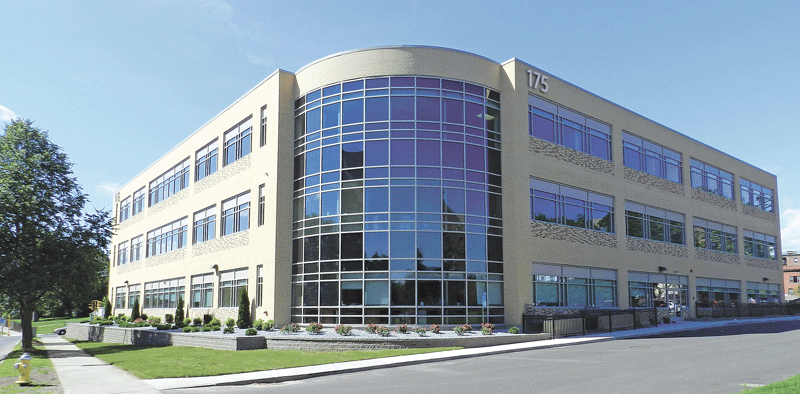
The new building that houses several SPHS services, including physicians formerly affiliated with HCPA.
“We had a long, positive working relationship with Hampden County,” Moen said of the now-disbanded physician network. “When we heard from them that they were concerned about their future, we said, ‘this is too important to this community to let it just go away.’”
Thus, a month-long effort commenced to bring the doctors, plus two physician assistants and six nurse practitioners, into the SPHS-owned Mercy Medical Group, headquartered on the Mercy Medical Center campus in Springfield. Three business days after the bankruptcy proceedings forced all HCPA offices to close, the four practices that joined Mercy were back online in the same locations, in Springfield, East Longmeadow, Ludlow, and Feeding Hills.

Dan Moen, president and CEO of the Sisters of Providence Health System
Similar negotiations ensued throughout October at Noble Hospital, which decided to take two HCPA practices into the Noble Medical Group. Two physicians who practiced in Westfield have moved to the Noble campus in the city, while five based in Southwick, along with a physician assistant and a nurse practitioner, will remain in their existing office.
“The decision was made for us,” said Noble President and CEO Ronald Bryant, speaking not literally, but in terms of the importance of physician access in his community. “Hampden County Physician Associates, by their dissolving, left a void in our market for primary-care physicians. Southwick and Westfield were already in our market, so not only was picking them up the right thing to do for our community and our patients, but it’s also the right thing for the physicians and staff, who will remain in the community for their patients.”
Other pieces on the board shifted as well. The Southampton Road office in Westfield, abandoned by the doctors who moved to Noble, was taken over by Mercy and will reopen in the spring, offering specialties including wound care, cardiology, hyperbaric therapy, and vascular medicine.
Meanwhile, allergists who had been part of Hampden County Physician Associates established their own practice, Allergy and Immunology Associates of New England, on the campus of Baystate Medical Center in Springfield. HCPA doctors who had practiced in nursing homes have also launched their own practice, Pioneer Continuing Care Providers. Finally, pediatrician and internal-medicine specialist Dr. Naomi Rosenberg has started her own practice.
Dr. Scott Wolf, senior vice president of Medical Affairs and chief medical officer at Mercy, said SPHS acquired the assets and equipment of the four practices as part of negotiations with HCPA. “Our primary goal from the outset was making sure nothing would change for patients, their relationships with their physicians would remain intact, and physicians would eventually welcome new patients into these practices.”
Bigger Pond
In its initial bankruptcy petition on Sept. 29, HCPA claimed it had lost doctors and was unable to recruit replacements. At the time, the physician group claimed $3.3 million in assets and $5.4 million in liabilities, while gross income across its network of practices had fallen from $39 million in 2013 to $25 million through the first nine months of 2014.
“There’s still a huge shortage of primary-care physicians in the area; we know that,” Moen told BusinessWest. “We’re seeing a lot of this happening these days across the country, where physicians are aligning themselves more closely with hospitals and health systems.”
The reasons have much to do with economies of scale and access to a fuller range of resources, he continued.
“Instead of working on their own, this gives them a bigger entity to work with. For example, we’ve got an IT team here at Sisters of Providence. That’s an automatic savings; they probably had to spend some dollars with an outside vendor and consultant, while we can do it inside.

Ronald Bryant said Westfield’s need for primary-care doctors practically made Noble Hospital’s decision to take seven former HCPA doctors into its network.
Wolf agreed that physicians will enhance their current practices by being part of a medical system. “They can coordinate care and leverage the infrastructure we have as a comprehensive health system, which will help us achieve the goal of overall population health, and will keep patients in their primary-care environment, where care should be delivered.”
He noted that a hospital with Mercy’s community demographics should average about 50,000 emergency-room visits per year, but the hospital actually averages about 80,000, partly due to a shortage of primary care. It’s also important for physicians to be more closely aligned with hospitals in this era of accountable care, a model that requires close coordination among hospitals, doctors, and other medical professionals.
“We’re moving away from fee-for-service,” Moen said. “People are starting to move toward risk-based contracts, flat-rate contacts, where the incentive is going to be for physicians and hospitals and other providers, like home care, to work even more closely together and be available to move patients along a continuum of care in the best possible fashion — to keep people well and out in the community. So it makes sense for physiciants to be more involved with hospitals in this care.”
Back to Work
Though most of the HCPA practices continued operations within a few days of the Oct. 31 shutdown, the group’s West Springfield office was shuttered, and doctors who worked there transferred to Mercy or the Feeding Hills practice. Meanwhile, the group’s urgent-care center in East Longmeadow was closed for the time being, its fate currently undecided.
Overall, though, Moen praised the transition that brought 19 new doctors into the Mercy Medical Group with minimal shutdown.
“We knew we’d keep this going,” he said. “It’s a great group of physicians and practitioners, and we never thought we wouldn’t make this move in some form or fashion.
“It’s just too disruptive for patients not to have their appointments,” he continued. “Simple thing like prescription renewals are so important. People booked these appointments months ago; it’s not like there are lots of openings in the schedule going forward. So we didn’t want more than a day or two of those schedules being interrupted. This is a talented group, in spite of the financial challenges, and we’re happy to have all of them get back to work doing what they love to do, which is taking care of patients.”
There were practical considerations for Mercy, too. “We knew we couldn’t afford to have this big gap in service for patients. We didn’t want them to look elsewhere for care. So this has been a success, from my point of view.”
Both SPHS and Noble stressed that patients would experience no insurance changes in the ownership transition. In fact, Wolf said, in some instances coverage will be expanded because of services provided under the Sisters of Providence umbrella.
Meanwhile, the system has been busy contacting some 60,000 patients to let them know how to find and contact their providers, and has set up a ‘coordinated care center’ telephone line to help patients navigate the changes. “This will be a transparent and seamless transition for patients as they maintain access to their physicians and other providers,” Moen said.
Wolf agreed. “All appointments are going off as scheduled, all practice sites up and running, our waiting rooms busy, and the physicians are busy seeing patients.”
Bryant reported an equally smooth transition of care, and said his biggest concern was making sure residents of Westfield, Southwick, and the environs were able to continue accessing the services they need.
“From our standpoint, the more important thing is that we’re here to provide care for the community,” he said. “These doctors were already located here in our market, so it’s a natural transition to join the hospital. There was minimal downtime and minimal glitches in the transition. They’re seeing a full schedule of patients.”
Eyes on the Future
Wolf noted that the 19 physicians who joined Mercy Medical Group already practiced at Mercy Medical Center, so their practices were never impacted that much. But their affiliation with the medical group helps Mercy build a foundation of primary care — a larger footprint, so to speak — and boosts its profile in recruiting efforts.
“This truly gives us an opportunity to recruit additional primary-care physicians in an area where they’re so desperately needed,” he said. “I think, with the reputation of the Sisters of Providence and Mercy Medical Center, it gives physicians comfort to be part of a bigger system and have access to the resources of that larger system.”
Moen agreed. “This gives us a base to recruit additional physicians. Having an established group, one that has a relationship with a strong hospital — that’s the kind of opportunity primary-care physicians are looking for, and we hope to be able to alleviate the primary-care shortage for the community.”
Doubling its primary-care pool from seven to 14 certainly won’t hurt Noble’s efforts, Bryant said, but “we did a pretty good job recruiting to begin with. What this allows us to do is enhance patient services. It makes it easier for them when they access our healthcare system; we’re able to provide a continuity of care, from primary care to specialist to the hospital, that might not have been present before. So I think it enhances the customer experience more than anything.”
In other words, the doctor is still in.
Joseph Bednar can be reached at [email protected]

Spiros Hatiras says Holyoke Medical Center isn’t changing what it is and what it does — it’s just doing a better job of communicating it.
He goes on to note that he was a five-pack-a-day smoker and had long battled chronic obstructive pulmonary disease (COPD). His life changed, he implied, when a hospitalist at Holyoke Medical Center intervened.
“She just said, ‘you can fix this.’ You just felt like someone cared,” Morris said into the camera. “If it wasn’t for Holyoke Medical Center, I wouldn’t be going on tour with the Stones this fall.”
And with that 30-second message, now airing on several area television stations, Morris became part of an ambitious new marketing campaign launched by HMC this fall. This spot, like all the others, ends with another voice saying, “Holyoke Medical Center: experience the new standard in patient care.”
It’s not exactly a new standard, in the sense that the staff at HMC has always been caring and compassionate, said Spiros Hatiras, the system’s president and CEO. But it is new in the sense that many from this region, including some living in Holyoke and adjacent communities, are not familiar with the hospital.
This simple fact convinced Hatiras, who took the helm at the medical center 14 months ago, and others at HMC that they had to become more aggressive, and pointed, in their branding efforts.
“We’re not necessarily changing who we are — we’re just doing a better job of communicating it,” said Hatiras, who prefers the phrase ‘brand definition’ to ‘rebranding’ to describe what the system has undertaken. “The basic elements are still here — we are a solid, quality provider, and we’re a hospital of a size that is conducive to personalized care because it’s not very big and intimidating and confusing; we’re located in a great area, and we’re easily accessible. And at the same time, we’re big enough to have the services that most people would need.”
Elaborating, Hatiras said the basic goal of the campaign is to drive home the point that, in most cases, people in the Greater Holyoke area don’t have to drive past HMC on their way to Springfield, or anywhere else, to get the kind of quality care they want and need.
“There’s absolutely no reason, in my mind, why a resident of Holyoke, Chicopee, South Hadley, or Easthampton needs to go far away to another provider to receive the kind of care they can get here,” he explained. “Ultimately, what this campaign is aiming to do is let people know of the things we do and do well and what they can expect here, and keep people in the community.”
The marketing campaign includes a new logo (see page 29), television spots such as Morris’s, print ads (many of them in Spanish), billboards, banners within the hospital, and a revamped website. It’s all part of a multi-faceted initiative to raise HMC’s profile and increase volume, which also includes $2 million in upgrades to the Emergency Department and a new strategic plan.
 Overall, the system’s efforts are focused on putting out a new, stronger message, and then making sure it can back up those words ‘new standard in patient care,’ said Hatiras.
As for that logo, Hatiras told BusinessWest that it says different things to different people. To him, it speaks of both the region — through the use of the colors blue and green, representing water (Holyoke’s canals and the Connecticut River) and nearby mountains, respectively — and also a new beginning through its use of yellow.
“It’s a like a dawn, a new beginning, a bright day — that kind of feel,” he said. “That’s what we wanted to communicate.”
For this issue, BusinessWest takes an indepth look at this new beginning and the many forces that will shape it.
Ad Infinitum
“I’ve always looked at my patients, and cared for my patients, with the thought that that could be my mother, or that could be my grandmother, and I’ve always treated them as if they were mine, and I’ve treated them as I would want my family to be treated. I love being a nurse.”
That’s another of the 30-second spots airing on area television stations. It stars Lorimar Crus, a registered nurse who has been at HMC for three years. The sentiments she expresses reflect those of the system as a whole, said Hatiras, and sum up nicely both the message that is being sent through these various marketing vehicles, and the current focus of the system.
“While we’re not reinventing ourselves, I will say that we’re enhancing what we do and we’re focusing more on the experience that people have here,” he explained. “On the quality side, we do very well; we’re rated very highly. So what we’re really focusing on are those other qualities of the patient experience, or what people sometimes call the ‘softer skills’ — are we treating people with respect? Are we treating them with compassion? Are we treating people with empathy? Do we really care for people when they come in on a deeper human level?”
Hatiras said the work to revamp the system’s marketing efforts began almost immediately after he arrived last summer, because it was apparent that something needed to be done.
“We started talking about rebranding right away — at least started to think about how we needed to do significantly better in terms of communicating who we are, what we do, and what we do best,” he told BusinessWest, adding that these initiatives are being undertaken simultaneously with efforts to enhance (that’s a word Hatiras would use repeatedly) a culture of caring and compassion.
He said a market survey revealed that HMC’s primary problem wasn’t that people had a negative opinion of it, but that they didn’t have much of an opinion at all. Meanwhile, there was confusion, or ignorance, about the system.
“There were gaps in what people knew about us and about what we did; we still get confused with Holyoke Health Center, and frankly, there were people who didn’t know if we delivered babies here,” he went on, adding that the base of knowledge was broader in Holyoke, but much less so in surrounding communities such as Chicopee and South Hadley.
Hatiras believes HMC’s prior marketing efforts fell short for many reasons. For starters, there wasn’t enough of them, he said, adding that there was a also a lack of cohesion among messages sent by the medical center and its affiliates, River Valley Counseling Center, Holyoke VNA & Hospice Life Care, and Western Mass. Physician Associates, with each entity having its own logo, type style, and marketing strategy.
“No one could ever put it all together — no one really quite understood that the VNA was part of our system and River Valley was part of our system,” said Hatiras. “If your ads don’t all have a certain feel and look, they don’t resonate … if there’s nothing that ties it all together with the whole, it doesn’t make an impact.”
Part of the new branding initiative is broader outreach, especially to the Hispanic community, said Hatiras, adding that ads in Spanish are only a part of this effort.
For example, HMC was the lead sponsor of Holyoke’s annual Puerto Rican Parade in July. The hospital did not have much involvement with the event previously, he noted, and, ironically, Baystate Health was lead sponsor in recent years.
Care Package
But more aggressive marketing and greater outreach are only part of the equation, said Hatiras, returning to that phrase ‘softer skills’ and a recognized need to raise HMC’s game still higher.
“Even these have been core qualities of Holyoke Medical Center,” he said, referring to compassion, respect, and empathy. “What we’re doing now is putting a very significant internal focus on enhancing these qualities and making sure that we develop them further.”
The medical center is working with Pensacola, Fla.-based Studer Group, which, according to its website, “works to bring structure and focus to healthcare organizations through the creation of cultures in which people hold themselves accountable and help set them up to be able to execute quickly.”
HMC has ben working with the company for nearly a year now, and will continue to do so for at least three years, said Hatiras, adding that it takes time to make the kinds of fundamental changes the system is undertaking.
And there are several points of focus within this initiative, said Hatiras, listing everything from private rooms for all patients to revamped food service to valet parking for visitors. A common theme is to provide patients with a greater sense of control over their care.
“We started with some simple things, such as patient amenities,” he explained, “so that when people come here they feel safe, they feel they get treated the right way, and it’s a comfortable environment for them and their families.
“We’re converting all our rooms into private rooms so that there’s space for the family to visit and privacy, and we’ve revamped our food service so that people have choices in what they’re going to eat,” he went on. “When they get admitted, people have very little control over things, in general, and giving them the ability to have control is very important.”
Beyond these initiatives, HMC is also focusing on how the team administering care relates to patients and families.
“Studies have shown that, if physicians take the time to pull up a chair and sit next to the patient at eye level and communicate with them at that level, the interaction is much more meaningful, they get better information out of the patient, and the patient feels they’ll be listened to and understood a lot better than if someone stands at the foot of their bed,” he told BusinessWest. “By giving them that feeling of empathy, compassion, and respect, they heal better and faster.
“It’s just hard science — healing takes good medicine, and it takes good care,” he went on. “But it also takes that human touch, the compassion, the feeling of reducing the patient’s anxiety and making them feel safe.”
One priority for HMC is improving the environment in its Emergency Department, Hatiras noted, adding that the hospital was recently awarded $3.9 million by the Mass. Health Policy Commission to undertake renovations to the ER, and will launch a capital campaign to raise the balance of the projected $6-7 million project.
“The physical environment is very limiting and uninviting,” he said of the current emergency room. “It was built for 15,000, maybe 18,000 visits a year, and we’re doing 45,000.”
Brand Definition
Once the rebranding effort and other initiatives have gained traction, Hatiras said, HMC will conduct another market survey to see if attitudes, and overall awareness of the system and its services, have changed.
He suspects that they will change, and that verification will come in the numbers involving inpatient volume and, overall, the number of people driving elsewhere to receive care.
“The proof is in the pudding,” he said, adding that, while inpatient volume is down across the state, Holyoke’s rate of decline has been greater than in other areas. Reversing this outmigration, as he called it, will require a system-wide focus on not merely branding, but enhancing the patient experience.
And that’s what the system means by a ‘new standard in patient care.’
George O’Brien can be reached at [email protected]


The fourth annual Western Mass. Business Expo, produced by BusinessWest and again presented by Comcast Business, was staged Oct. 29 at the MassMutual Center in downtown Springfield. More than 2,000 attendees passed through the doors, and they had the opportunity to visit more than 150 exhibitor booths, stroll the new Retail Marketplace, take in more than a dozen educational seminars, and watch several presentations on the Show Floor Theater, ranging from a discourse on overcoming one’s fear of public speaking to an update on the next-generation space telescope. The day’s programming started with a keynote address from Gov. Deval Patrick at the ACCGS kickoff breakfast. Later, Patricia Diaz Dennis, retired senior vice president for AT&T, presidential appointee to the Federal Communications Commission, and member of the MassMutual board of directors, was the keynote speaker at the luncheon program presented by the Professional Women’s Chamber. The day was capped off with a pitch contest by Valley Venture Mentors and the popular Expo Social. Below is a photographic look back at the Expo. Watch the video here.

All names left to right:
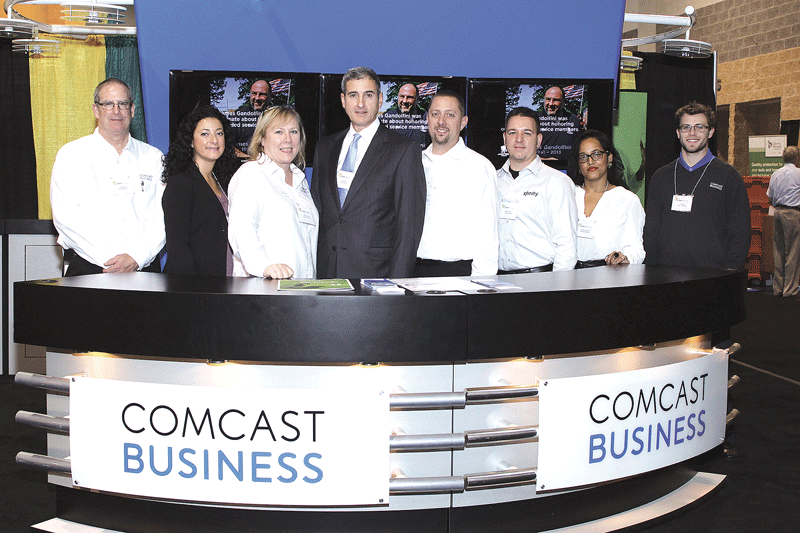 Tim Paige, Stephanie Dumont, Laurie Deyette, Paul Salvos, Matt Strong, Robert Cortes, Charlene Johnson, and Kyle Wills from presenting sponsor Comcast Business;
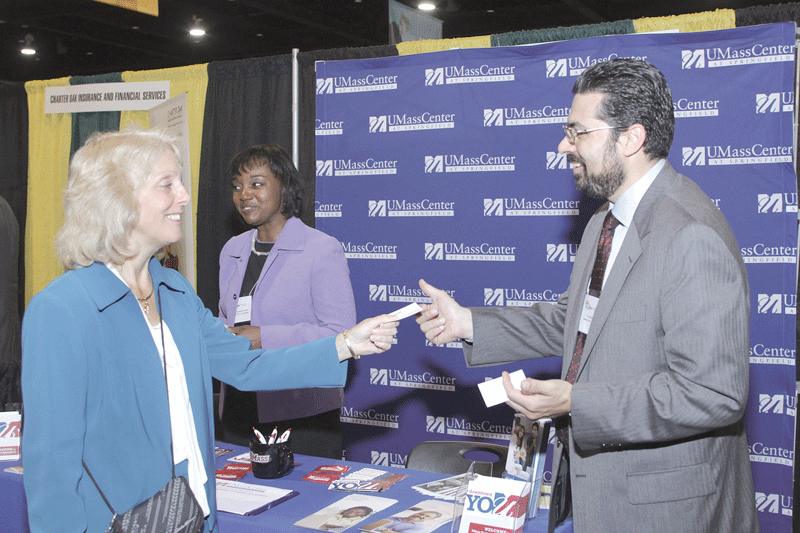
Dolly Werenski of Hampden Bank and Jamina Scippio-McFadden and Dr. William Davila of UMass Springfield;

the Expo Retail Marketplace;

Rachel Elliott from Baystate Children’s Hospital photographs Laurie Deyette from Comcast Business with Mr. Potato Head;
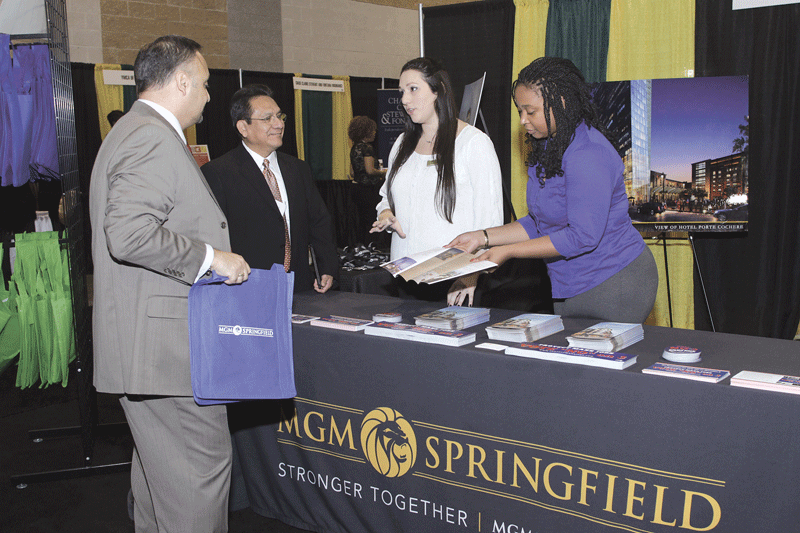
Amanda Gagnon and Anita Bird from MGM Springfield greet visitors to the company’s booth;

Tia Allen, Sharon Marshall, and Tim Steffen of Northwestern Mutual chat with Ryan Bouvier of Pioneer Valley Indoor Karting and Wilder Gulmi-Landy and Justin Roberts of American International College.

Barbara Perry of Envision Marketing, Dawn Creighton of Associated Industries of Massachusetts, and Kristi Reale of Meyers Brothers Kalicka, P.C.;

Jennifer Meunier and Judith Miller of the Isenberg School of Management at UMass Amherst with Mychal Connolly of Stinky Cakes;

Trecia Marchand of Pioneer Valley Federal Credit Union chats with Andrea Hill-Cataldo, Jill Tower, and Peggy Popp of Johnson & Hill Staffing Services;

Glenda DeBarge and Eric Harlow of Health New England share a moment with Alysia Cosby from the YMCA of Greater Springfield;

Alfonso Santaniello of Creative Strategy Agency with Ed Nunez, Meaghan Parker, and Bill Russo-Appel from Freedom Credit Union;
Kenneth Anderson from HazCommpliance, LLC and Joanne Gruszkos from MassMutual Financial Group.
The Expo featured a wide range of seminars and special presentations on the Show Floor Theater, as well as lively breakfast and lunch programs that gave attendees plenty to see, learn, and do.
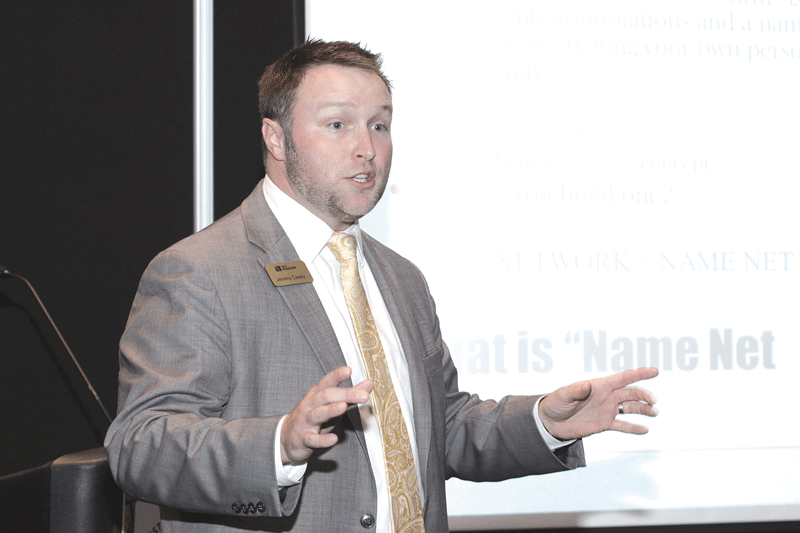
Jeremy Casey, vice president of Small Business Banking at First Niagara, presents a seminar “The Path to Building Name Net Worth.”

From left: Gov. Deval Patrick, the breakfast keynoter, with BusinessWest Publisher John Gormally and his son, Hunter;

Peter Rosskothen, co-owner and president of the Log Cabin Banquet & Meeting House, gives his Show Floor Theater presentation titled “The Entrepreneurial Process”;

Carla Cosenzi, president of TommyCar Auto Group, presents the seminar “How to Delegate and Empower Your Management to Drive Employee Success”;
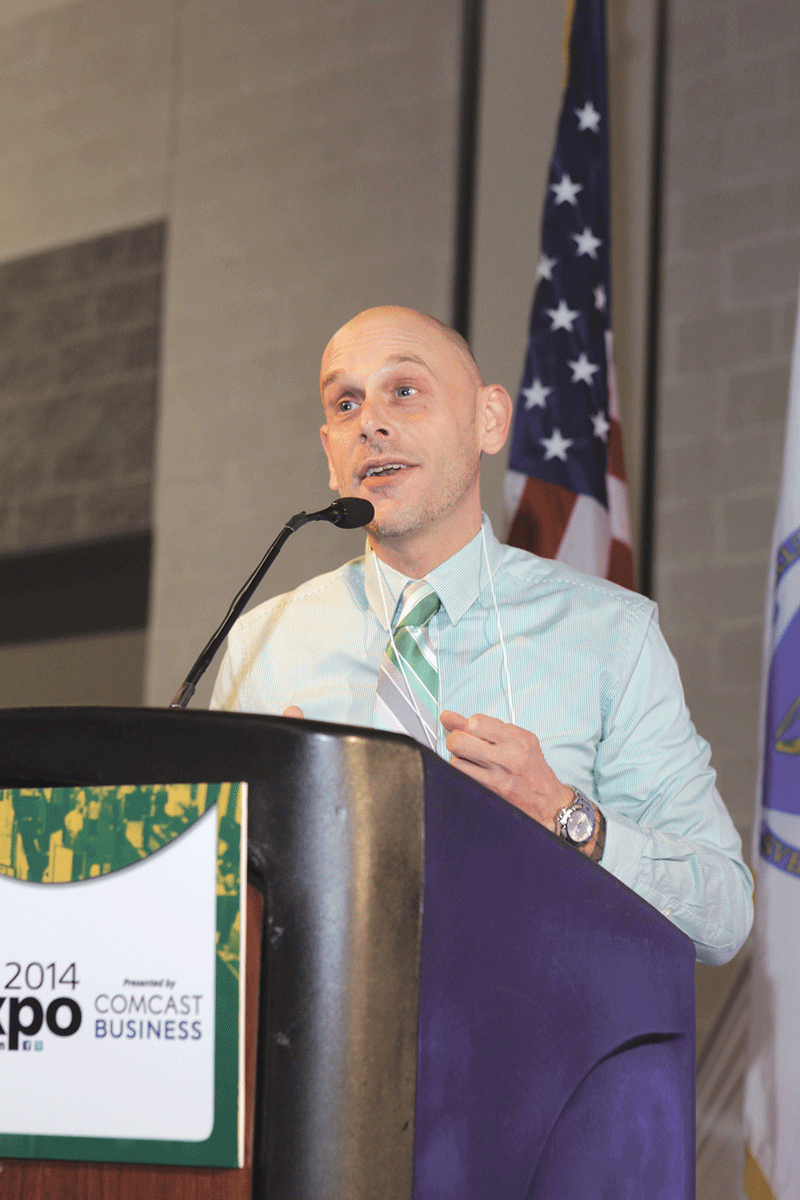
Thom Fox, business advisor, philanthropist, and host of The Engine on NewsRadio 560 WHYN, gives his Show Floor Theater presentation titled “Nope, No Way, Never! How to Overcome Your Fear of Public Speaking.”

Isa Deloge, area director of Best Buddies Massachusetts, presents a seminar titled “What Does Your Billboard Say”;

Dana Barrows, JD, CLU, ChFC, AEP with Northwestern Mutual, presents his talk titled “Essential Strategies for Business Owners in the Current Environment”;

Meghan Rothschild, co-founder and director of PR and marketing for chikmedia, presents a seminar titled “Public Relations 101: How to Get Your Message Heard”;

Delcie Bean, founder of Paragus Strategic IT, presents a seminar titled “Win-Win Thinking”;
Patricia Diaz Dennis, retired senior vice president for AT&T, presidential appointee to the Federal Communications Commission, and member of the MassMutual board of directors, presents the keynote address at the luncheon program presented by the Professional Women’s Chamber.

Brian Comber, NASA thermal engineer, gives his Show Floor Theater presentation titled “NASA Is Alive: Building the Next-generation Space Telescope.”
Kirk Smith, president and CEO of the YMCA of Greater Springfield, gives his Show Floor Theater presentation titled “Righteous Leadership.”
Valley Venture Mentors and BusinessWest invited VVM alumni and members of the current class to apply for a spot in the second annual Pitch Contest and Demo Day. The participating startups — Artifact Cider Project, Caswell Communications, CloudContacts, Nudger, and Piddx — made two-minute pitches to a panel of judges who offered immediate feedback.
VVM Executive Director Paul Silva speaks at the event;
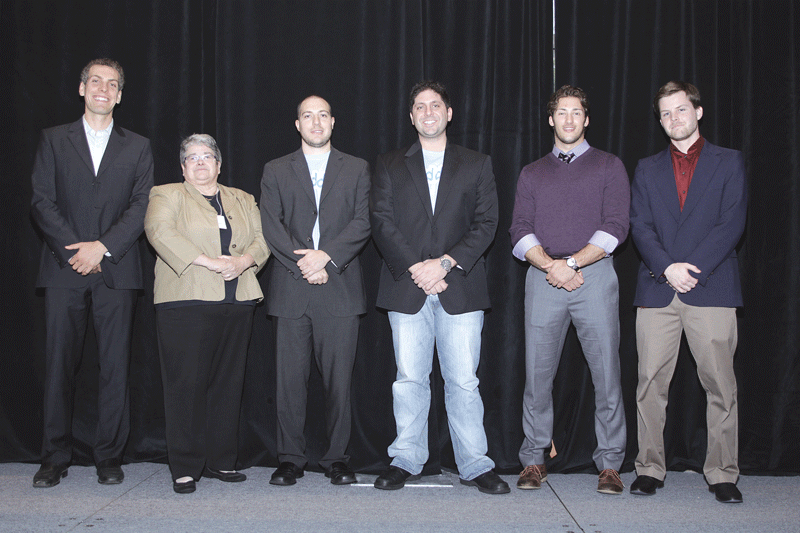
contestants (left to right) Jake Mazar, Jan Caswell, Ian Ricci, Spiro Marangoudakis, Mike Mullen, and Brian Lobdell;

Pitch Contest winner Jake Mazar, developer of Artifact Cider Project.
Plenty of folks stuck around for the annual Expo Social (all names left to right):

Sarah Calabrese and Darcy Fortune of ABC 40 / Fox 6 with Mike Sarage of Valley Venture Mentors;
Evan Plotkin of NAI Plotkin, Justin Roberts of American International College, Alfonso Santaniello of Creative Strategy Agency, Jeremy Casey of First Niagara, Peter Ellis of DIF Design, and Tim Steffen of Northwestern Mutual;

Mike Mullen chats with Dianne Doherty of the UMass Small Business Development Center;
Amanda Gagnon and Kelley Tucky of MGM Springfield, Seth Stratton of Fitzgerald Attorneys at Law, and Ed Marin and Mark Stolarczyk of MGM Springfield;
Harry Georgiades and Bob McNamara of McNamara Waste Services with Chris Thompson of the Springfield Falcons.


Peter Reinhart says the mission at the IALS is to accelerate life-science research and advance collaboration with industry.
And it’s an unofficial component of his job description to change that.
Reinhart, a veteran biopharmaceutical executive and researcher, was recently named founding director of the institute, which was created in 2013 with $150 million in capital funding from the Massachusetts Life Sciences Center (MLSC) and additional contributions from the university. Its mission is to accelerate life-science research and advance collaboration with industry to effectively shorten the gap between scientific innovation and technological advancement.
And Reinhart, a native of Australia whose résumé includes a number of intriguing stops, most of them in the sector now known as ‘large pharma,’ is excited about this latest career opportunity and bullish about its prospects for carrying out that assignment.
“This is really intriguing to me; professionally, this is really what I want to do — take innovative ideas and turn them into meaningful products, things that people can use,” he said, adding that the ultimate goal is to create a pipeline of leading-edge products at various stages of development.
The IALS will do this through the creation of three translational centers:
• The Center for Models to Medicine, which identifies and validates new therapeutic pathways and clinical development candidates, focused on areas of expertise such as protein homeostatis;
• The Center for Bioactive Delivery, which seeks to discover a new paradigm for the discovery of optimized delivery vehicles for drugs and nutriceutical compounds; and
• The Center for Personalized Health Monitoring, which is developing nanotechnology and large-dataset management to improve healthcare through low-cost, wearable, wireless sensors that analyze patient data continuously in real time.
Reinhart comes to the university from Alzehon, a Lexington, Mass. company where he most recently was the head of corporate development and new products for the firm, which is focused on brain health, memory, and aging and development of treatments for Alzheimer’s disease and other neurodegenerative disorders. Prior to that, he was chief scientific officer and then president at Proteostasis Therapeutics, and head of neurodegeneration at Wyeth/Pfizer. He has also been an adjunct associate professor of Neuroscience at the Duke University Medical Center for the past decade and was a tenured professor at the center for nearly 13 years prior to that.
He told BusinessWest that he became interested in leading the IALS because he considered it a logical next step in a career that has blended academia, cutting-edge industrial-biomedical research, development of startup companies, and work with major pharmaceutical corporations.
“Having spent significant time in large pharma, biotechnology companies, as well as academia allows me to understand the strengths and needs of each of these organizations,” he said. “This experience will be useful both in advancing alliances across the UMass campuses to combine assets and capabilities and in utilizing such assets to develop industry partnerships.”
For this issue, BusinessWest talked at length with Reinhart about the IALS, its ambitious goals, and how he intends to meet them.
Down to a Science
As he discussed the circumstances that brought him to the Amherst campus and, more specifically, its new Life Sciences Laboratories, Reinhart referenced one of a series of talks (this one was in Boston) he gave while he was at Pfizer.
“These talks were about how to combine the best aspects of academic innovation with the ability of industry to take an idea and turn it into a product on a timeline and on a budget,” he told BusinessWest. “While I was at Boston, someone from UMass contacted me and said, ‘I heard you give this talk … and we’re about to start something fairly similar in this space; it’s called the Institute for Applied Life Sciences, and the vision really is to have a more product-focused, outward-looking directionality to some of the basic research we’re doing, with the idea that this would become a number of translational programs that could partner with industry, which would lead to creation of a local infrastructure surrounding UMass.’
“And I thought ‘this is amazing — this is exactly what I pitched to the CEO at Pfizer,’” he recalled. “The difference is, I pitched it with the idea that we could run this within large pharma and reach out to academia. And what UMass was doing is exactly the same concept, but they were running it from within academia and reaching out to industry. And I could easily see that you could run this concept from either side.”
Fast-forward through several rounds of interviews and visits to the campus with his wife, who soon became sold on the university and Amherst in general, and Reinhart is now one of the point people in the Commonwealth’s ambitious, $1 billion initiative to become even more of a national and global leader in the life sciences.
He started on Oct. 1 and is still in the process of fitting out his office (his printer arrived he day he talked with BusinessWest), hiring staff, and meeting with representatives of many constituencies who will be involved with the center.
As he talked about its prospects moving forward, Reinhart said he thought all the ingredients were in place to translate that concept he discussed while giving those talks for Pfizer into reality.
Listing these ingredients, he mentioned everything from the faculty at UMass, which he said had the willingness (generally not common in academia) to embrace something new and fundamentally different, to the infrastructure at UMass, meaning both the physical facilities and the leadership team, to a firm vision for what those involved want to accomplish.
And when he looked at how those ingredients might come together, he decided that this was an opportunity he couldn’t pass up.
Elaborating, he said the IALS represents a unique concept within the broad life-sciences universe, something that he’s excited about bringing to fruition.
“On paper, there are other institutes that call themselves translational,” he explained. “But translational is a word that has many different meanings depending on who’s using it. And in the way I see translational — where you’re combining the best of academic innovation and industry know-how, I don’t think there’s another facility like this.”
Not Lost in Translation
Reinhart said some of his initial projects at the IALS include creation of a strategic plan for the facility — there exists a broad concept, but he wants something more detailed and comprehensive — as well as development of both an operational structure and an operational philosophy.
Overall, he wants to take the team approach that is so common, and successful, in industry and incorporate it on the academic and research sides, where it is far less prevalent.
“Industrial science, by definition, is a team sport, because once industry engages on a project, there are more than 50 people working on it, and the way you get real progress in a short period of time is to have people with different expertises coming together and working together,” he explained. “This is something that I want to achieve in the institute; it wouldn’t be individual programs run by single PIs (principal investigators) that advance a concept, but rather groups of people coming together that have related, but not overlapping, areas of expertise working together on a project to advance it toward commercialization and toward commercial partnerships.
“What I’m really trying to do is have multiple different laboratories and, frankly, even other sites, such as UMass Medical Center, participate in specific projects,” he went on.
Elaborating, he said he envisions the institute working in a way similar to a large technology company or large pharmaceutical corporation, with a number of initiatives ongoing at the same time, with the goal of creating that aforementioned pipeline of innovative products.
“Some of these are closer to commercialization, and others are further away,” he said. “We have some that are much closer to commercialization today — exactly how close is still to be determined — and, of course, we have others that are more embryonic and earlier-stage. But the concept is to develop a pipeline, the leading edge of which should start creating products and partnerships with academic entities in a three- to five-year time frame.”
Referencing the Center for Personalized Health Monitoring specifically, Reinhart said there are several products in or approaching the prototype phase, and some may be ready for potential development in a few years, giving the institute an opportunity to play a lead role in a rapidly emerging sector within the life-sciences industry.
“The world is realizing that wearable devices and electronic monitoring is a real growth area,” he explained. “Right now, it’s either at the stage of small entrepreneurial companies or, occasionally, large enterprises such as Google, which is becoming more and more interested in areas like that; they’re pushing the envelope in this area.
“There are not very many, if any, academic centers that are trying to combine the innovation coming out of individual research labs with an ability to translate that into a device or monitoring equipment or a compound that can be advanced into the clinic,” he went on. “Bringing these concepts together within an academic setting is something quite novel.”
And if this novel facility can become successful at providing a steady flow of products through that pipeline, then Rinehart shouldn’t have any trouble making IALS an acronym known across the region, and perhaps around the world.
George O’Brien can be reached at [email protected]

 A few hundred new jobs in Springfield is always cause for celebration. But city leaders are thinking much bigger than that.
For instance, David Cruise recalled his first meetings with representatives of CNR Changchun Railway Vehicles, the Chinese-based rail-car manufacturer that announced a $565 million deal last month to build at least 284 new subway cars for the MBTA, and to base its operations at the former Westinghouse site in Springfield.
“We were very excited about the opportunity to have CNR Changchun here in the area — it’s a very unique opportunity to bring sustaining wages and career opportunities to people of all ages,” said Cruise, president and CEO of the Regional Employment Board of Hampden County (REB). “We believe they’re very, very committed — not only to fulfilling this contract with the MBTA, but using that contract to expand their business in other parts of the country, while keeping their corporate offices and manufacturing facility here in Springfield.”
Kevin Kennedy, Springfield’s chief development officer, said he and Mayor Domenic Sarno have the same idea.
“In our discussions, what really intrigued the mayor and me the most is that they immediately said to us, ‘we want to make this our American manufacturing headquarters,’” Kennedy told BusinessWest. “Their goals went well beyond the MBTA contract, and it says to us that they plan to have prolonged growth, sustained growth, both from a jobs point of view and and from an ecomomic-development point of view … from every point of view we could think of.”
In other words, the world’s largest rail-car maker setting up shop in Springfield could represent far more than the expected initial 100 to 125 construction jobs and 225 to 250 jobs at the plant.

David Cruise says he was impressed with CNR Changchun’s commitment to growing in Springfield.
Sarno agreed. “The impression I get from them is, this is really going to blossom for them,” he said. “Increased jobs are going to come from this — good-paying jobs, hundreds of jobs — and will solidify and strengthen the tax base. But I think this is something even bigger. This will be their North American hub; they’re already looking at secondary projects in the Springfield area.”
In other words, CNR Changchun’s decision to set up shop in Springfield, catalyzed by the MBTA’s decision to award the company the contract to manufacture almost 300 new cars, could lead to many more economic benefits down the road — or the track, as the case may be.
Mass Appeal
The saga that eventually brought CNR Changchun to Springfield began late last year, when the MBTA first announced the project.
“We’re always looking for different opportunities, and when we came across the MBTA advertising for the bid, we contacted them and got the list of bidders who had taken out bid specs, and we contacted all of them to talk about Springfield, how Springfield would be very receptive to them coming here,” Kennedy said. “As it turned out, potential bidders had already looked at Springfield. We ended up with two that already had half a stake down in the ground here, and we met with both over a period of months.”
Those companies were CNR Changchun — which bought the former Westinghouse site from Pinnacle Entertainment — and Hyundai Rotem, which aimed to build a plant on Progress Avenue. Both companies met extensively with city officials and learned about potential workforce-training initiatives involving Springfield Technical Community College, Holyoke Community College, Western New England University, and Roger L. Putnam Vocational Technical Academy, as well as the region’s two one-stop career centers, CareerPoint and Future Works, and entities like the REB and the Economic Development Council.
“One of my first questions for the CNR folks, when they indicated they had taken an option on the property from Pinnacle, was ‘why Springfield?’” Kennedy said. “They said to me, ‘you’ve got a great workforce, a great location, great transportation system. We think this would be a really good place for workforce development and for our employees to work.’”
The city’s appeal would only be heightened, he added, by the MGM Springfield resort casino to be built in the South End if a ballot measure aimed at barring casinos in Massachusetts is defeated this Tuesday. “A number of Millennials are interested in quality-of-life issues, and we’re not talking about gambling; we’re talking about entertainment.”
Meanwhile, the entire Page Boulevard corridor around the Westinghouse site could see a bump in quality of life, Sarno added.
“The restaurants in that area are ecstatic. Now we’re going to get spinoff businesses — people are going to want to eat, get their hair cut, need this, need that,” the mayor said. “We also have great housing stock there. Someone may say, ‘hey, I work here; if I buy a house in the area, I can walk to work.’ There’s tremendous potential there for the long haul.”
Cruise also used that term ‘long haul’ when describing his interactions with CNR Changchun over the past several months.
“We would have been pleased with whomever was selected if they were coming into the area, but we’re particularly pleased by this selection,” he said. “In the discussions we were part of, it was pretty evident to us that this company was committed to being in the area for the long haul — that the MBTA contract to provide rail cars in Boston was critical to them, but they were going to use this as a platform for additional business around the country.”
In addition, “our impression was that they were committed to making certain that local residents were hired for their production and assembly positions, and that was really important to us,” Cruise said. “Their reputation as the largest builder of railway cars in the world certainly wasn’t lost on us. I was impressed by a number of things they had to say. This could be very, very significant.”
Sarno said the company appreciated the way the city seamlessly brought together players from the business, political, and workforce-development realms to craft a vision of what the city and its environs could offer.
“They really liked the red carpet we rolled out for them here in Springfield,” the mayor said. “CNR Changchun is very good with grassroots, with reaching out, and had meetings with Putnam, WNEU, workforce-development people, the media, vendors, the employment base. They really wanted to touch every base they could here in Springfield, and we helped facilitate that.”
Added state Sen. Gale Candaras, at the recent press conference where Gov. Deval Ptrick announced the MBTA deal, “their level of engagement with people here was amazing. Right from the beginning, they wanted to be here; they were committed to this site.”
Engine for Growth
Like Kennedy, the mayor said the city’s greatest appeal to CNR Changchun — which will do business here under the name CNR MA — is its worker pool and, more importantly, the infrastructure already being built to train it for what are expected to be well-paying precision-manufacturing jobs.
For the REB’s part, Cruise explained, it will take a three-pronged approach. It will coordinate with the CareerPoint and Future Works career centers, the Department of Veterans Services, and area vocational high schools to identify existing candidates for jobs; help develop training programs at Putnam, STCC, and WNEU to increase that pool; and work closely with labor unions whose members have the required skills associated with rail-car assembly, as well as the REB’s network of advanced-manufacturing firms to connect CNR MA with area companies that can manufacture required parts and components.
“When trying to build a workforce of this size, you have to have educational outreach programs to make certain the community as a whole is aware of the positions that will be available — primarily production opportunities, but I suspect some in the corporate office in Springfield as well,” Cruise told BusinessWest.
“It’s critical that companies assist CNR in their efforts to get the workforce,” he continued, “but also make certain, as the workforce is selected, that we have an infrastructure in place to continue to provide skills to their incumbent workforce. In my opinion, this area has the educational infrastructure to be able to respond to workforce needs, which is not something you find in too many areas. I suspect one of the reasons CNR chose Springfield as a location for their facility was that they saw the resources available here, and I think that was important to them.”
CNR MA expects to break ground on its new, $60 million plant sometime in 2015, just as planned worker-training programs begin to gear up. The initial project to build 152 Orange Line cars and 132 Red Line cars — replacing vehicles that have been in use for between 35 and 45 years — is set to continue until a planned delivery date of 2021, but by then, the company is hopeful that an expanded workforce will be busy with other projects well into the future.
“This is huge,” Cruise said, “not only for the whole issue of job creation, but also for some of the smaller companies, sheet-metal companies, and the labor unions here in the area, who can be suppliers and partners in this work.
“We think it will have a ripple effect on other companies,” he continued. “Whenever you bring a manufacturing facility of this magnitude in the area, there will be some spinoff for some of the smaller companies that provide goods and services to them. That’s critical.”
Richard Davey, secretary and CEO of the Mass. Department of Transportation, recognized the importance of this project to the people of Springfield.
“The governor has talked about transportation not being about just trains and buses, but lifting communities, about jobs and economic development,” he said.
Added Patrick, “they’ve been thoroughly vetted; they’ve constructed these kinds of cars all over the world, and they’re very well-respected. One condition of this deal is that they do the assembly and manufacturing here in Western Mass., and they have chosen to do that right here in East Springfield.”
Springfield Bound
Sarno suspects that most people didn’t consider his city a front-runner, yet, after CNR Changchun officials visited about 50 sites along the Northeast corridor, it settled on Springfield.
“Even though the region’s manufacturing base has eroded since the old days, dating back to the ’70s, it’s still a hotbed for precision machining,” he told BusinessWest. “And they liked what they saw here. They liked the supports from the city and state, they liked the workforce development we have here, our farm system, and they really loved the property.”
The mayor also believes the rise of a new industry in Springfield could be a catalyst to attract other manufacturing firms of all types. “I think it’s the best advertisement to come to Springfield.”
Kennedy said a manufacturer of this size and reputation locating in Western Mass. is unheard of these days, but in a way, it fits in perfectly with the other positive changes happening in Springfield, from MGM Springfield and Union Station to the area colleges procuring a presence downtown and the development of an innovation district plan.
“All these pieces of the puzzle are coming together — it’s happening,” he said. “There’s certainly enthusiasm happening in the business community, recognizing what’s happening here. What we need now is to translate this into a real marketing effort for Springfield, so the general public can see it.”
And other businesses, of course.
“We really are at a pivotal moment in the city’s history,” Sarno said, citing not just potential new jobs, but planned improvements in public safety and education. “We’re moving in the right direction, though obviously we always want to do more.
“I’m bullish on Springfield,” he concluded, “and I think people are starting to be bullish on Springfield as well.” Including, in CNR Changchun, one more large firm that’s betting big on the City of Homes.
Joseph Bednar can be reached at [email protected]

 It started a quarter-century ago.
The program was smaller — it was known as the Fabulous 50 back then — and was conceived as a fund-raising event for what is now the Affiliated Chambers of Commerce of Greater Springfield (ACCGS), and also as an opportunity to celebrate the top-performing companies that characterized the region’s diverse economy.
Along the way, it has become a fall tradition, and the phrase ‘Super 60 company’ has become a bragging right for businesses large and small, said ACCGS President Jeff Ciuffreda, as he referenced the class of 2014.
It will be celebrated on Nov. 14 at Chez Josef in Agawam, which has traditionally been sold out for the Super 60 luncheon, and should be this year as well.
And, as in the previous 24 years, the Super 60 lists are characterized by diversity — in a number of forms (see snapshots below). First, geographically. Nearly 20 cities and towns in Western Mass. are represented by the companies in the Total Revenue and Revenue Growth categories, including both the larger cities, such as Springfield, Holyoke, and Westfield, but also the smaller towns, such as Ware, Belchertown, and Southwick.
There’s also diversity in terms of the industrial sectors represented on those lists. There are winners from the financial-services sector, retail, manufacturing, education, healthcare, technology, service, distribution, construction, and the region’s large nonprofit realm. And there’s diversity in terms of size, with some of the region’s largest employers on the Total Revenue list, and some of its smaller rising stars on the Revenue Growth compilation.
Add it all up, and this year’s winners provide ample reason for optimism as the region continues to battle its way back from the prolonged recession that began in 2007.
“Small business is the backbone of our region,” said Ciuffreda, “and the success of this year’s winners is a clear indication that our regional economy is strong.”
This strength is reflected in the numbers posted by this year’s winners. The average revenue of the companies in the Total Revenue category exceeded $35 million, with combined revenue of more than $1 billion. Meanwhile, one-third of the companies in the Revenue Growth category posted growth in excess of 50%, with the average growth of all honorees in that category at more than 49%.
Topping the Total Revenue category is West Springfield-based Balise Motor Sales, which now boasts more than 20 facilities (new- and used-car dealerships, collision-repair shops, and car washes) in Massachusetts and Rhode Island. Placing second is the Stavros Center for Independent Living, with NUVO Bank & Trust Co. placing third.
In the Revenue Growth category, Springfield-based City Enterprise Inc., a woman-owned commercial and residential builder, finished on top, followed by Troy Industries Inc. and Chemex Corp.
Also, 16 companies qualified for both categories. They include the Dennis Group, Gandara Mental Health, Joseph Freedman Co., Maybury Associates, M.J. Moran, Northeast Treaters, NUVO Bank & Trust Co., PC Enterprises (Entre Computer), Pioneer Valley Concrete Services, Premier Source Credit Union, Tighe & Bond, Troy Industries, Universal Plastics Corp., and Whalley Computer Associates. Each was placed in the category where it finished highest.
The winners will be saluted at the annual luncheon, which this year will feature Friendly Ice Cream President and CEO John Maguire as keynote speaker.
Maguire is credited with engineering a strong turnaround at the company, which began with a single shop in Springfield in 1935, grew into a regional powerhouse, but struggled through the ’90s and the first part of this century, eventually filing for bankruptcy.
The celebration luncheon is presented by Health New England and sponsored by Hampden Bank, Zasco Productions, and WWLP-TV22.
Reservations for the luncheon are required and can be made online at www.myonlinechamber.com or by e-mailing Sarah Mazzaferro at [email protected]. Tickets are $50 for ACCGS members, $70 for non-members. The deadline for reservations is Nov. 7.
What: The Super 60 Luncheon
When: Nov. 14, 11:30 to 1:30 p.m.
Where: Chez Josef, Agawam
Keynote Speaker: John Maguire, president and CEO, Friendly’s
For more Information: Visit www.myonlinechamber.com
TOTAL REVENUE1. Balise Motor Sales 2. Stavros Center for Independent Living 3. Nuvo Bank & Trust Co. * The Assoc. for Community Living City Tire Company Inc. Commercial Distributing Co. Inc. The Dennis Group, LLC * Environmental Compliance Services Inc. Gandara Mental Health Inc. * Joseph Freedman Co. Inc. * Kittredge Equipment Co. Inc. Marcotte Ford Sales Maybury Associates Inc.* Northeast Treaters Inc./Chemical Wood Treaters * Quabbin Wire & Cable Co. Inc. Sarat Ford Lincoln Specialty Bolt & Screw Inc. Spectrum Analytical Inc. Springfield College Tighe & Bond Inc. * United Personnel Services Inc. University Products Inc. WestMass ElderCare Inc. Whalley Computer Associates Inc. * YMCA of Greater Springfield * Indicates company qualifed in both categories |
REVENUE GROWTH1. City Enterprise Inc. 2. Troy Industries Inc. * 3. Chemex Corp. American Pest Solutions Inc. Boys & Girls Club Family Center Inc. CanAm Fibers Convergent Solutions Inc. Dietz & Co. Architects Inc. FIT Solutions, LLC The Gaudreau Group GMH Fence Company Inc. Haluch Water Contracting Inc. Hampden County Career Center / CareerPoint Holyoke Community College Foundation Inc. Innovative Business Systems Inc. Janice Yanni, DDS M.J. Moran Inc. *
Netlogix Inc. Northeast Security Solutions Inc. O’Connell Professional Nurse Service Inc. Paragus Strategic IT PC Enterprises / Entre Computer * Pioneer Valley Concrete Service Inc. * Premier Source Credit Union * Topato Corp. Universal Plastics Corp. * V&F Auto Inc. Valley Home Improvement Inc. Westside Enterprises Inc. * Indicates company qualifed in both categories |