
Home Posts tagged Education (Page 12)
Cover Story

A World of Imagination

seusinterior

By Kathleen Mellen

It’s called the Amazing World of Dr. Seuss, and that pretty much says it all. One of Springfield’s favorite sons, the good doctor actually created dozens of amazing worlds through his timeless books. The museum that opened on June 3 pays tribute to many of them, but also to the city that inspired Theodor Geisel to dream, create, and delight generations of children and adults.


There’s so much to tell, and so much to see,
Put your thinking cap on and let yourself be.
Amazed by the world of the good Dr. Seuss,
Keep your eyelids up, and your brainy cells loose.

From murals to statues to wordplay and more,
There are things to delight, and stories galore.
His table, his Emmys, and his bright pencils, too,
Are there to peruse in displays just for you.

It’s all on view now, in a museum, brand-new,
For kids of all ages, and, yes, parents, too.
It’s right here in Springfield, a real downtown treat,
And to think you can see it on old Edwards Street!

Eight years ago, the president of Springfield Museums, Kay Simpson, had the germ of an idea: Why not create a permanent, indoor display featuring the work of the wildly popular Dr. Seuss, author of 44 children’s books that have sold hundreds of millions of copies, and have been translated into more than 20 languages?

After all, the Museums already unveiled an outdoor exhibit in 2002, the Dr. Seuss National Memorial Sculpture Garden, to honor the Springfield native, whose real name was Theodor Seuss Geisel. The sculptures — created by Seuss’ stepdaughter, Lark Grey Dimond-Cates — proved to be so popular, Simpson said, that they helped put the Museums on the map; all of a sudden, there were cars in the parking lot from states across the U.S.

“That was really exciting,” she recalled. “It increased our visitation and changed the demographics. It made us a national attraction.”

As popular as the sculpture garden proved to be, however, 80% of the visitors surveyed indicated they’d like to see an indoor exhibit as well, Simpson said. And she agreed.

Kay Simpson

Kay Simpson says the Dr. Seuss sculpture garden raised the profile of the Springfield Museums nationally, and a full museum dedicated to all things Geisel was the next logical step.

“We began our thinking about creating a museum based on the response we got from the sculpture garden,” Simpson told BusinessWest just days before the June 3 opening of the Amazing World of Dr. Seuss, as workers put the finishing touches on the museum — painting walls, waxing floors, and mounting displays. “People loved the sculptures, but everyone wanted an indoor museum experience.”

So, after eight years of planning, refurbishing the former Connecticut Valley Historical Museum (its holdings were moved to the Lyman and Merrie Wood Museum of Springfield History, also part of the Springfield Museums), fund-raising to the tune of nearly $7 million, and collaborating with Dr. Seuss Enterprises, artists, educators, and members of the Seuss family, the Amazing World of Dr. Seuss opened this month as a three-story, permanent homage to one of Springfield’s icons.

The museum was funded through contributions from area investors, including MassMutual, the Community Foundation of Western Massachusetts, and the Irene E. and George A. Davis Foundation, as well as through a capital campaign. To date, the museum has raised $6.5 million of its $7 million goal. It was designed by artist John Simpson, Kay’s husband, who teaches art at the Commonwealth Honors College at UMass Amherst.

The first floor uses colorful, three-dimensional displays with interactive components to explore Geisel’s childhood in Springfield, as well as the characters and stories that sprang from his imagination.

Dr. Seuss’ most famous characters

Museum planners envisioned an educational experience populated with Dr. Seuss’ most famous characters.

The second floor features the collections of Geisel’s stepdaughters, Leagrey Dimond and Lake Grey Dimond-Cates, and Ted Owens, Geisel’s grandnephew, and is curated by the family members under the guidance of Springfield Museums Vice President Heather Haskell, and curatorial staff.

On the lower level is “Cat’s Corner,” a Dr. Seuss-themed educational space for ongoing art and literacy activities, overseen by a full-time Seuss educator.

In short, the world’s only museum dedicated to the life and work of Dr. Seuss is packed with wonders to discover.

Oh, the places he’d go! At life he was winning.
His birthplace in Springfield was just the beginning.
There were points to be scored. There were games to be won.
And now he’s our fair city’s favorite son.

Theodor Seuss Geisel was born in 1904 on Howard Street in Springfield’s South End, the grandson of Theodor Geisel, a German immigrant who owned Springfield Brewing Co., and his wife, Christine, and George and Margaretha Seuss, also immigrants from Germany, who ran a bakery on Howard Street, where Ted’s mother, Henrietta, worked.

Ted’s father, Theodor Robert Geisel, was the superintendent of Forest Park, including the zoo, and when Ted was 2, the family moved to a three-story house at 74 Fairfield St. in the Forest Park neighborhood; he lived there until 1921, when he left to attend Dartmouth College.

“We were interested, from the beginning, in really telling the Springfield story. Ted Geisel grew up in this city, spent his boyhood here. That was something Springfield could be proud of.”

The young Geisel visited the zoo often, sometimes bringing along a sketchbook in which to draw fantastical versions of the animals he saw there (his sister Marnie teased her brother because his animal drawings had “mismatched features and were curiously exaggerated,” according to the museum’s website), some of which might well have inspired the illustrations in his 1950 book If I Ran the Zoo.

“We were interested, from the beginning, in really telling the Springfield story,” Simpson said. “Ted Geisel grew up in this city, spent his boyhood here. That was something Springfield could be proud of.”

Indeed, many of the exhibits refer to what Simpson calls “the Springfield Cycle” — books that were inspired by the sights and sounds of the city. Geisel’s first children’s book, And to Think That I Saw It on Mulberry Street (1937), is based on a real street in Springfield: beer trucks used to barrel along it on their way to his grandfather’s brewery. The heavily traveled road was part of Ted’s stomping grounds, Simpson said, and might have inspired the young dreamer to imagine the likes of a “gold and blue chariot … rumbling like thunder down Mulberry Street.”

Geisel was also inspired by some of the more dramatic buildings in Springfield, like the Howard Street Armory, which resembles a castle, and the Barney Mausoleum in Forest Park, replete with its sphinxes and winding staircases, both of which show up in fantastical form in books like The 500 Hats of Bartholomew Cubbins (1938).

“He said that growing up in Springfield had an imprint on him and his creative imagination,” Simpson said.  “He drew his impressions from growing up in a city with a lot of industrial buildings, and Victorian and post-Victorian monuments.”

If the sun starts to shine, or rain’s on the way,
The brand-new museum’s a good place to play.
It’s great to be there. You will like it a lot,
If the outside is cold, or exceedingly hot.

With its vibrant primary colors and murals depicting scenes from And to Think That I Saw It on Mulberry Street and The Cat in the Hat, the entryway sets the stage for this museum about all things Seuss. There to greet visitors just inside the front door is a life-size policeman from Mulberry Street, uniformed in bright blue, sitting astride his motorcycle, perhaps modeled on Springfield’s own Indian brand. Emblazoned on his cap are the words “Police 304, Springfield, Massachusetts.”

Kids are invited to crawl aboard. In fact, every Seussian structure in the museum, like the seven-humped Wump of Gump from 1960’s One Fish, Two Fish, Red Fish, Blue Fish, for example, was fabricated by Symmetry International Inc. in Rhode Island, using a special foam that has been treated for strength and resilience, and is virtually indestructible. “Kids can touch them all,” said museum spokeswoman Karen Fisk. “We can just wash them at the end of the day.”

Other first-floor exhibits include Young Ted in Springfield, which features a replica of the author’s childhood home, where visitors can use a touchscreen to “draw” on the bedroom wall, as Ted famously did as a child. In the Seuss Bakery, tiny visitors can pretend to bake their own pies; at McElligot’s Pool, inspired by the 1947 book by that name, they can play a digital fishing game; and in the Moose Juice and Goose Juice Factory, with its whimsical piping and artisan glasswork, they’ll explore gears and gadgets. In a replica of the Forest Park Zoo, children are invited to construct their own fantastical creatures using Lego blocks, as Seuss’ characters from the fictional McGrew Zoo peek at them from the windows.

The sculptures inside the museum

The sculptures inside the museum are crafted from a virtually indestructible foam substance, so kids can feel free to handle and climb on them.

Also on the first floor is Readingville, devoted to developing reading skills through rhyming, the alphabet, and story games.

“We really tie the museum to literacy,” Simpson said. “Readingville is an homage to all those books he wrote that were about getting kids excited to read. Starting with The Cat in the Hat, he’s using limited vocabulary, rhymes. He’s connecting letters and words with illustrations in a way that helps kids to understand the association between pictures and the words and letters. He’s making reading fun; that’s really what it’s all about.”

From the inception, Simpson said, the museum has worked closely on the content and design of the reading-related exhibits with the Davis Foundation, whose “Read! Reading Success by 4th Grade” initiative promotes literacy in schools in Hampden County, as well as with reading specialists from Springfield schools and experts from Square One, which provides early-childhood education and support services in Springfield and Holyoke.

“We feel that’s especially important for the city of Springfield, where children have a demonstrated challenge with reading,” she said. “We want to help kids overcome that struggle and to become proficient readers, because it’s so important for them in terms of their own achievement, and for the future of Springfield.”

Related exhibits include the museum’s ABC Wall, an interactive, larger-than-life version of Dr. Seuss’s ABC (1963); when children touch a letter, they will hear its phonetic sound, and related artwork from the book will appear on the wall. In Green Eggs and Ham WordPlay, children enter the railroad cave from Green Eggs and Ham (1960) to find word-game stations, based on the rhyming vocabulary of the story. (Think: “I do not like them in a house. I do not like them with a mouse. I do not like them here or there. I do not like them anywhere.”)

Treasures await on the second floor as well, where memorabilia, gifted to the museum by Geisel’s stepdaughters and grandnephew, are on display, including items that have never been displayed publicly, like the quirky, illustrated notes Geisel wrote to his stepdaughters, whom he nicknamed Snunny and La Groo.

Visitors can imagine the beloved author at work in his studio, recreated here with his drawing table and chair, and the red rotary telephone he used to talk daily to his publisher, Random House, in New York City.

“We even have colored pencils he actually used,” Simpson said. “When I walk in here, it sends a shiver down my spine.”

Next door, guests will see living-room furniture from Geisel’s home in La Jolla, California, where he lived for many years until his death in 1991. Displayed alongside a collection of his books and fanciful hats are his two Emmy Awards (for Halloween Is Grinch Night in 1978 and The Grinch Grinches the Cat in the Hat in 1982) — just a couple of the many honors bestowed upon him, including a Pulitzer Prize in 1984 for his lifetime contribution to children’s literature.

Don’t sit in the house and do nothing at all.
It’s open in winter, spring, summer, and fall.
So pack up the kids if it’s rainy or sunny.
To the museum you’ll go, for fun that is funny!

Springfield’s leaders welcomed the opening of the Amazing World of Dr. Seuss with much fanfare. On May 30, Mayor Domenic Sarno read a proclamation on the steps of City Hall, declaring it Dr. Seuss Week, and the museum’s opening was heralded with a parade, called Cavalcade of Conveyances, down Mulberry Street.

Now open to the public, the museum is part of the seven-acre Springfield Museums complex at 21 Edwards St. in Springfield, which also includes the George Walter Vincent Smith Art Museum, the Springfield Science Museum, the Michele and Donald D’Amour Museum of Fine Arts, the Lyman and Merrie Wood Museum of Springfield History, and the Dr. Seuss National Memorial Sculpture Garden. One admission offers visitors access to all the sites. The cost is $25 for adults, $16.50 for students and seniors, $13 for ages 3 to 17, and free for children under 3.

“As a museum, we want to celebrate the artistic and literary achievements of Theodor Geisel, but we really want people to come and have a great time,” Simpson said. “It’s a joy to share all of this with our visitors.”

Opinion

Opinion

By Associated Industries of Massachusetts

With summer approaching, employers should again turn their attention to managing work in the summer heat.

Although Massachusetts has guidelines on what it means to be too cold in the workplace, it does not define what is too hot. Employers are left to their own common sense and experience to determine what to do during the dog days.

According to the National Weather Service, heat is the number-one weather-related killer of people in the U.S. More people die per year from heat-related illness than from tornadoes, hurricanes, floods, and lightning combined. Heat waves occur across the U.S., but are often predicted in advance. Staying abreast of this information from the National Weather Service will allow you the opportunity to plan for the impact within your organization.

If you have a workplace that is open to the weather, such as a loading dock, a warehouse, a construction site, an outdoor deck or patio for food service, or even an outdoor exercise area or some other non-air-conditioned site, you need to watch for heat disorders.

Heat disorders generally come from the inability of the body to remove heat by sweating, or from too much sweating. When heat gain exceeds what the body can deal with, or when the body cannot compensate for fluids and salt lost through perspiration, the body’s inner core temperature begins to rise, and heat-related illness may develop.

Heat stroke is the most serious form of heat-related illness. It happens when the body becomes unable to regulate its core temperature. Sweating stops, and the body can no longer rid itself of excess heat. Signs include confusion; loss of consciousness; hot, dry skin; and seizures. Heat stroke is a medical emergency that may result in death. Call 911 immediately.

If heat stroke happens, the following steps may save a life: place the worker in a shady, cool area; loosen clothing; remove outer clothing; fan air on the worker; place cold packs in the armpits; wet the worker with cool water; apply ice packs, cool compresses, or ice if available; provide fluids (preferably water) as soon as possible; and stay with the worker until help arrives.

Other heat-related conditions that can affect workers include heat exhaustion, heat cramps, and heat rash.

No matter the situation, encourage your employees to adopt some of the following health tips to manage the heat. Education, planning, and reacting to the conditions will assure safety during the hot events of summer.

Allow your employees to slow down. If possible, limit strenuous activities to the coolest time of the day, perhaps first thing in the morning or when the sun is not directly on your work site. Consider extending break periods or adding a break period to ease the heat risk during certain days.

• Dress appropriately for summer. Lightweight, light-colored clothing reflects heat and sunlight, and helps your body maintain normal temperatures.

Encourage employees to drink plenty of water or other non-alcohol fluids even if they may not feel thirsty — their body needs water to keep cool. Consider purchasing bottles of water and sports drinks for the team to ensure hydration.

Allow employees to spend as much time as possible in air-conditioned places. If the workplace doesn’t allow for AC, consider fans to keep the air circulating, and encourage employees to work in the shade if possible.

Remind your employees that diet matters. The heavier the meal, the more a body works to digest it and the greater the water loss, causing a greater risk of heat problems.

Finally, make sure your employees watch out for one another. If they recognize a co-worker suffering with the heat, depending on the symptoms, urge them call 911, their supervisor, or human resources to get help.

Law Sections

Winning Attitude

Raipher Pellegrino

Raipher Pellegrino

Its marketing materials are emblazoned with the phrase ‘for the win.’ But at Raipher, P.C. — the law firm Raipher Pellegrino founded in 1994 and put on the map with a series of high-profile victories — the end result is only part of a successful case. Just as important, Pellegrino notes, is helping clients, who are often suffering through the worst crisis of their lives, navigate the legal system and get back to some semblance of normalcy. That, in itself, he says, is also a win.

Raipher Pellegrino may be best-known for winning a handful of high-profile court cases. There was his defense in 2002 of a man accused of breaking into a UMass dorm room with attempt to rape, arguing — successfully — that the defendant was sleepwalking. Then, as a plaintiff’s attorney, he secured a $6 million settlement for the family of a woman killed when a Big Dig tunnel collapsed on her car in 2006.

Such cases may not represent the day-to-day work of Pellegrino and his team of attorneys at Raipher, P.C. in Springfield, but they did help raise his profile, which is why he works on cases for clients nationally.

“It’s a matter of being able to prove results year in and year out, on complex, oftentimes high-profile cases, which can be more difficult to handle because you’re worried about not just the legal aspect, but the public-relations aspect of the case,” Pellegrino told BusinessWest.

Perhaps most recognized as a personal-injury firm, Raipher also focuses on criminal defense, family law, and general business law, from commercial transactions to business litigation and everything in between. Pellegrino also has a special interest in charter schools, a model he supports, and has represented them in matters ranging from financing to litigation.

When he launched his firm in 1994, “the original concept was personal injury and criminal litigation, but not so much on the transactional side. We’ve evolved since then,” he said, noting that the firm currently boasts 12 attorneys.

In any case, success isn’t measured only in decisions and settlements, he explained, but in meeting the myriad needs of clients who are often dealing with life-changing situations.

“When someone is in a circumstance where they need a lawyer, it’s a moment of anxiety. Our goal here is that they should feel less anxious after they contact us,” said Sean O’Connor, who joined the firm 18 months ago in a management capacity, overseeing the case loads of each attorney and handling marketing and other non-legal aspects of the business, in an effort to modernize the practice.

SEE: List of Law Firms

“We go up against some of the largest forms in the U.S. and the world, with over 1,000 attorneys,” Pellegrino added. “They’ll attempt to bury you with process, putting five or six lawyers on the case and sending documents 24/7. The modernization of the practice on the intellectual side and also in workflow is important; it allows us to take on large firms from right here in Western Mass.”

For this issue’s focus on law, BusinessWest sat down for a candid chat with Pellegrino and O’Connor about how they take on those challenges — and why the process of resolving each case is as important as the end result.

Sean O’Connor

Sean O’Connor says much of the firm’s business comes from client referrals, which he considers “a real compliment to an attorney.”

Sweet Relief

Personal injury is a broad field in itself, encompassing car accidents, product liability, medical malpractice, slip-and-fall injuries, and workplace injuries, just to name a few. Pellegrino cited a recent, complex case with multiple defendants, in which the plaintiff was killed in a manufacturing plant.

“We brought suit against the company that designed the machine and the employer, and we were able to settle that for several million dollars despite having serious legal obstacles which could have precluded an award to the plaintiff,” Pellegrino said, including a state workers’ compensation statute that throws up barriers to suing employers. “We were able to navigate around those issues and resolve that case.”

The defendant was a Boston-based company, and his sole heir lived in Puerto Rico, but despite the presence of many large personal-injury firms in the Boston area, the plaintiff sought out Raipher, an example of the firm’s reputation for handling difficult cases — work that begins with the first meeting with the client.

“We don’t try to sell the firm; we try to educate people. We believe education is the building block of what we do,” he explained, likening it to a different kind of major life event. “If you’re going in for surgery and have no concept what the surgery is about, what the process is, it can be frightening to go through it because of the fear of the unknown. Well, nobody prepares for an accident; you don’t wake up and say, ‘I might have an accident today.’ But if you have a law firm in mind, and you know they’ve been through it time and time again, and they can walk you through the process, it takes some of the fear away.”

The firm uses the motto ‘for the win,’ but Raipher Pellegrino emphasizes that the process of finding relief, restitution, or justice is as important as the end result.

The firm uses the motto ‘for the win,’ but Raipher Pellegrino emphasizes that the process of finding relief, restitution, or justice is as important as the end result.

And monetary restitution isn’t the sole goal, he added. “We also want to let them get on with their lives. They may be out of work, have loss of income, physical pain; that’s what they should be focused on, getting better and back to life as quickly as they can. We routinely tell clients, ‘let us do our job and make your life easier.’ And if we can make the process more understandable, that’s part of our job — not just getting a monetary settlement.”

Pellegrino said his firm has built its client base organically. “We have generational clients, we’ve been referred by clients’ family and friends, and we’ve had referrals from attorneys, not just in Western Mass., but around the country. I’ve had jurors hire me.”

That makes sense, he added, since jurors have a front-row seat to how an attorney works. If one is impressed and, down the road, has a need for a lawyer, they’ll remember what they saw in court. “That feels good, when people appreciate you and want to hire you. We take pride in our work and in delivering a good product.”

Added O’Connor, “the greatest complement we get here is client referrals. Raipher has clients he’s known for 20 years who still refer people to us. That’s a real compliment to an attorney, to have the confidence of past and current clients.”

To earn that confidence, Pellegrino said, his team is dedicated to staying educated on all facets of the law they handle. “A doctor doesn’t stop reading about new surgeries. We’re constantly adapting to changes in the law, whether regulatory or statutory.”

When asked whether the regulatory landscape has become more burdensome over the past decade or so, he said many lawyers would say yes. “And that certainly requires a broader spectrum of knowledge to litigate a claim.”

But some changes have been beneficial for attorneys, he added. For instance, only recently have lawyers in Massachusetts been allowed to ask potential jurors specific questions during the voir dire process, allowing them to dig into biases — whether conscious or subconscious — and establish their best opportunity to ensure a level playing field. In addition, lawyers can now demand a specific award amount at trial, which can make it easier to demonstrate the value of an injury, loss, and suffering to a jury.

And jurors take these matters seriously, Pellegrino said, noting that, while people often feel hesitant when summoned to jury duty, once they’re empaneled, they tend to embrace their responsibility. In fact, he noted, jurors are often frustrated they can’t get more information, though there are good reasons behind the rules for which pieces of evidence can be entered into the record and which can’t.

He recalled one criminal-defense case that fell apart for the prosecution during cross-examination and was quickly settled. “The jury waited for me outside the court to talk to me; they wanted to ask about more underlying facts of the case. It shows how they’re engaged, and they take it seriously.”

For the Win

Pellegrino certainly takes his work seriously, even though personal-injury law often suffers from negative perceptions in society.

“The only way our society knows how to compensate someone for a civil loss is monetarily,” he said. “One of the best mediators in the country likes to ask, ‘if I could give you your leg back or offer you $100 million, which would you take?’ Inevitably, the person says, ‘I’d want my leg back.’ So it’s clear no amount of money can adequately compensate for your leg.”

I tell everyone, ‘don’t go into the practice of law for money. It serves society in many ways, and if you put your heart and soul into it, it’s one of the most gratifying professions you can have.”

As a result, he went on, it can be difficult to put the value of a death, injury, or physical loss in financial terms. “It’s constantly evolving, and so many factors go into it. In every case, those factors change. There are different ways to value it and monetize it. It’s not simply, someone gets in an accident and makes a demand, and you give them that money. It’s far more complex.”

O’Connor said he often finds himself explaining this concept at dinner parties. “People often don’t want to bring a lawsuit because there’s a stigma. But there is literally no other way to compensate you for someone else’s wrong. It’s not your stigma. Someone else’s negligence caused you harm. So the stigma is unfortunate.”

But Pellegrino sees the value of his work in the lives of his clients, and doesn’t worry about public perception.

“I tell everyone, ‘don’t go into the practice of law for money,’” he told BusinessWest. “It serves society in many ways, and if you put your heart and soul into it, it’s one of the most gratifying professions you can have.”

The emotions cut deep in both wins and losses, he added. In the Big Dig case, he recalled being happy for the plaintiff, who wouldn’t get his wife back, but could at least move on with his life having received some compensation and an assurance that it wouldn’t happen to someone else.

Then, in a criminal-defense case, “you can lose the case, and the client is going away to be incarcerated for 10 years, and they’re thanking you and hugging you and telling you how appreciative they are of your effort,” he said. “That’s an odd feeling. But at the end of the day, you’re not going to win every case, but if you put your heart and soul into it, the client knows that. They know you can’t guarantee an outcome.”

O’Connor agreed, adding, “you feel like you disappointed them, even though they’re clearly expressing gratitude. Clients can tell whether you’re phoning it in or doing the best you can for them.”

Still, every lawyer wants to win — which is why Raipher, P.C. uses the phrase ‘for the win’ in its marketing materials.

“I tell people, ‘you almost have to hate losing more than you like winning,’” Pellegrino said. “And if I lose, I’ve got to know that I did everything I could for the client.”

Joseph Bednar can be reached at [email protected]

Daily News

SPRINGFIELD — On Thursday, June 15, the Horace Smith Fund will hold its 118th corporators’ meeting and scholarship awards ceremony at the Carriage House at Storrowton Tavern in West Springfield for recipients, their parents and school counselors, and corporators.

Wayne Webster, chair of the board of trustees, announced that there will be 18 scholarship recipients and three fellowship recipients this year. “Providing that students maintain at least a B average in college, each scholarship provides a total of $10,000 over four years, and each fellowship provides $12,000 over three years. Therefore, the Horace Smith Fund is happy to be able to grant a total award of $216,000 to area students this year.”

The Horace Smith Fund was established in 1899 by its namesake philanthropist, said Teresa Regina, chair of the scholarship committee. “He and Daniel Wesson were the founders of Smith & Wesson, located in Springfield. Mr. Smith’s will provided that the residual of his estate, after several bequests to relatives and institutions, was to be used for public purposes at the discretion of his executors. They decided that it should be used to help deserving students finance their education.”

The scholarships and fellowships are named for Walter S. Barr, a West Springfield businessman, whose widow left the bulk of the family estate to the Horace Smith Fund in 1950. Recipients must be residents of Hampden County. The keynote speaker at the ceremony will be Ryan Migeed of Springfield, a 2015 graduate of American University and past recipient of the Walter S. Barr Scholarship.

This year’s scholarship recipients include Thomas Hendrickson, Agawam High School; Aqsa Maham and Willard McKinstry, Chicopee Comprehensive High School; Xavier Farrell, High School of Science & Technology; Jordan Kei-Rahn, Longmeadow High School; Ashley Gurney, Minnechaug Regional High School; Timothy Canning, Palmer High School; Richard Nguyen, Roger L. Putnam Vocational-Technical Academy; Padraig Smith, Saint Mary High School; David Giang, Kiara Mickens, and Brendan Truong, Springfield Central High School; Ilona Znackharchuk, Westfield High School; Lindsay Gearty, West Springfield High School; Ngan Tran, Springfield Central High School, Bay Path University; Parris Porter, SABIS, Hampshire College; Amelia Vega, Holyoke High School, UMass Amherst; and Kevin Pelletier, Chicopee Comprehensive High School, Westfield State University.

The three fellowship recipients are graduates of the following high schools and colleges: Melanie Gomes, Chicopee High School, Brandeis University; John-Marc Austin, Austin Family Homeschool, Elms College; and Alexander Smith, Minnechaug Regional High School, UMass Amherst.

Students were selected on a variety of criteria, including their test scores, class rank, extracurricular activities, and a personal, written account of why the student feels deserving of financial assistance. Applications for next year’s awards will be available September 15 at www.horacesmithfund.org or by calling (413) 739-4222.

Daily News

LONGMEADOW — The American Women’s College at Bay Path University celebrated the first graduating class of the RN-to-BSN program this spring, with 22 nurses completing their bachelor’s degrees.

The RN-to-BSN Completer Program allows for licensed, registered nurses with an associate or diploma degree to return to college to complete a bachelor’s degree in nursing. Bay Path’s program is fully online, allowing students to enroll and participate from across the country, and the accelerated format means that, for most students, the degree can be achieved in 18 months.

“We started the program as a result of a national challenge for 80% of nurses to be BSN-prepared by 2020. We went into our local hospitals, Baystate Health and Mercy Medical Center, and formed partnerships with this shared goal in mind,” said Debbie Hatzipetro, now-retired senior director of Health Services Administration and Nursing Programs. “I am so proud of the nurses in our first cohort. The nurses worked very hard in pursuing their degree. Not only did they work hard with their studies, but they also participated in providing ongoing feedback on the courses to help enhance the quality of the program. Many of them have received promotions at work since completing their degree, and some are now considering pursuing higher education. It has been an honor to be surrounded by these dedicated, hard-working women, and for me, this is a great note to retire on.”

The nurses were also honored with a pinning ceremony in late May. This tradition is, for many, more exciting than commencement itself, as it is considered a rite of passage in the nursing field. Pinning ceremonies date back to the 1860s, when Florence Nightingale was honored for her compassionate care of injured soldiers during the Crimean War. Embodying the selfless spirit characteristic of nurses, Nightingale recognized the dedication and efforts of her hardest-working nursing graduates, presenting them each with a medal of excellence. In the U.S., it became common practice by 1916 that all nursing graduates were honored during a ceremony with the presentation of a pin symbolizing their educational accomplishments.

“It was a pleasure to celebrate the success of our class of 2017 graduates from the RN-to-BSN program at Bay Path’s first pinning ceremony,” said Marjorie Bessette, director of the Nursing program. “These women not only work full-time, but they have full-time lives outside of work and college. Yet they completed the rigorous, accelerated program with high honors. I couldn’t be more proud to be part of their experience.”

Daily News

SPRINGFIELD — Pioneer Valley Credit Union was recognized with the 2017 America Saves Designation of Savings Excellence for its efforts during America Saves Week/Military Saves Week to encourage members to save money. The award is presented each year to financial institutions that succeed in encouraging people to open and add to wealth-building accounts.

“This was our most competitive year so far, with institutions engaging in creative ways and offering savings incentives,” said Allie Vered, America Saves director. “A lot of people don’t believe they can find the money to save. But saving is not an amount; it’s an activity. Convincing consumers to pay themselves first, to hang on to dollars instead of spending, and to take a pledge to achieve a goal go a long way towards helping them develop savings habits. We recognize Pioneer Valley Credit Union for their efforts to educate and inspire.”

Just two in five American households report making good or excellent savings progress. America Saves Week is an annual opportunity for people to assess their savings status and make a plan to start or increase their savings and for organizations like banks or credit unions to support good savings behavior. America Saves Week is coordinated each year by America Saves and the American Savings Education Council.

“Our involvement with the America Saves initiative has helped us to focus on and promote the benefits of savings,” said Anabela Grenier, Pioneer Valley Credit Union president and CEO. “We have been committed to empowering our members in making sound financial decisions. We are proud to offer products that actually make it an achievable goal for our members to save.”

Daily News

LONGMEADOW — Most people dream of the day they can retire, envisioning hammocks and travel, maybe volunteering and spending more time with family and friends. Achieving this dream is much more likely for those who plan and prepare for their financial future. And yet, according to an Ipsos/USA Today survey of 1,250 adults aged 45-65 conducted in January, only 59% say they’re very or somewhat prepared for retirement.

JGS Lifecare will host a retirement-planning seminar, “Securing Your Retirement,” on Wednesday, June 7, from 6 to 7 p.m. at Ruth’s House, 780 Converse St., Longmeadow.

David Fedor, president of Fedor Financial Group in West Springfield, will discuss how to transform Social Security into a winning retirement strategy. Fedor is a certified financial planner and chartered retirement-planning counselor, and an active member of the Estate Planning Council of Hampden County since 2008. In addition, he joined the Western Mass. Eldercare Professional Assoc. in 2013 to stay current with issues facing the elderly.

“At JGS Lifecare, we provide for more than just the physical needs of our clients and residents,” President and CEO Martin Baicker said. “We offer programs and services designed to improve their overall well-being. Our JGS LifeEd Community Education Program allows us to offer educational seminars that benefit not only our clients, but our community as well.”

As part of the JGS LifeEd Community Education Program, this event is free and open to the public. Registration is requested by calling Mary-Anne Schelb at (413) 567-6212, ext. 3105.

Daily News

HOLYOKE — Holyoke Community College President Christina Royal has been appointed to the board of directors of the Massachusetts Technology Collaborative, a nonprofit public agency that seeks to advance economic development through technological innovation, particularly in key industries such as healthcare, life sciences, information technology, nanotechnology, broadband deployment, and marine sciences.

“Through its major divisions — the Innovation Institute, the Massachusetts eHealth Institute, and the Massachusetts Broadband Institute —Mass Tech brings together leaders from industry, government, and higher education to advance technology-based solutions that strengthen regional economies, improve the healthcare system, expand broadband access, and stimulate economic growth throughout the Commonwealth,” according to the Mass Tech website, www.masstech.org.

Royal has a strong background in information technology, both in higher education and in the private sector. She was formerly the executive director of Distance Learning and assistant vice president of eLearning and Innovation at Cuyahoga Community College, and the director of Technology-Assisted Learning at Marist College. Before she made the switch to higher education, she worked as a project manager in research and development at CompUSA, and as the director of curriculum at the Beacon Institute for Learning.

Royal’s term on the Mass Tech board runs until Nov. 20, 2020. She was sworn in on June 1.

Cover Story Features

Hire Expectations

employeesartfinal

The job market in the region has tightened considerably in recent years, approaching, if not reaching, that state known as full employment. In this environment, employers are finding it increasingly difficult to find good help — at least among the ranks of the unemployed — and many are responding to the situation proactively and creatively.

It was almost 17 years ago, but Kevin Lynn can still remember the sense of urgency in the employer’s voice and the impassioned plea for help — any kind of help.

“He just said, ‘get me someone with a beating heart,’” said Lynn, then (and still) director of FutureWorks, the one-stop career center based in Springfield. “That was his lone qualification; he was desperate, to be sure.”

That was in 2000, just before the recession prompted by the bursting of the tech bubble, he told BusinessWest, when the nation, and this region, were pretty much at full employment and companies were struggling mightily to find talented help.

Things are not quite that bad (for employers) or that good (for job seekers) at this moment in time, he added quickly, before offering a very intriguing, if not menacing, qualifier.

“If the economy keeps going the way it’s going, could we be there in a year? Maybe,” he said.

For now, Lynn, like others, would say merely that the job market is as tight as it’s been in a while, maybe since 2000, and certainly since the height of the last recession in 2009.

Kevin Lynn says the tightening of the job market has put many employers in a situation where they need to ‘grow their own’ talent.

Kevin Lynn says the tightening of the job market has put many employers in a situation where they need to ‘grow their own’ talent.

At that time, he noted, there was a very large pool of talented, skilled people looking for work. Now, the pool is seriously depleted, comprised mostly of people with fewer skills, both technical and ‘people,’ and less experience than employers would prefer.

This is the main byproduct of  ‘full employment.’ That’s a term used by economists and others, and it has a definition — actually several of them. The one that prevails goes something like this: ‘a state of the economy in which all eligible people who want to work can find employment at prevailing wages.’

Most economists believe full employment occurs when the unemployment rate is at or just above 4%, which, according to the latest figures, just happens to be the rate nationwide.

But from a practical standpoint, and for the purposes of this discussion, parties are more interested in what full employment, or something close to that, means figuratively, not literally.

For employers, it means challenges — everything from finding and retaining qualified help to rising wages, said Meredith Wise, executive director of the Employers Assoc. of the NorthEast.

“Employers are beginning to get frustrated with the lack of quality out there, the lack of skills out there,” said Wise, adding that this situation will, in all likelihood (meaning unless there is a dramatic downturn in the economy) become more exacerbated when MGM Springfield begins hiring people in large numbers. That should start happening about a year from now, and there should be quite an impact on the local employment picture (much more on this later).

Nearly full employment also means that many employers are becoming more creative when it comes to such matters as searching for help and developing employees’ skill sets once they arrive, Wise went on, which, overall, is a good thing.

“Employers are looking at the situation and saying, ‘well, if the regular methods for getting employees aren’t working — if I can’t just go out to the employed market — what else can I do?’” she explained. “We’re seeing employers that are trying to get more involved with the schools, trying to get more involved with interns, and other steps. Employers are sensing that, if the regular methods aren’t working, instead of just throwing their hands up and trying to steal people from others, they’re looking at what else they can do.”


Meredith Wise

Meredith Wise

Employers are telling me that the people who are walking through their doors don’t have the skills that they’re looking for.”


Lynn agreed, noting that, in many cases, employers are adopting what he called a ‘grow your own’ philosophy, whereby, instead of holding out for individuals who have the requisite skills upon arrival, they’re opting for taking rawer talent, if you will, and developing it.

He cited the staffing company Snapchef, which recently opened a location in downtown Springfield, as one that embraces a model others will likely have to follow.

“They provide a five-week training course for people who want to get into the food-service business,” he explained. “Individuals learn all the basics, and Snapchef gets people into a job; this is probably the model that more employers are going to have to embrace.”

As for the region as a whole, full or nearly full employment means working harder with those who are still in the labor pool — including some who might have given up on their efforts to re-enter the workforce and are now giving it another go — to help them attain and retain work, said Dave Cruise, executive director of the Regional Employment Board of Hampden County.

“We’re working hard with those individuals looking to re-enter the market to address barriers that might have prohibited them from getting back in,” he said. “And as we do that, we’re focused not only on identifying candidates for employers, but also on the issue of retention, and dealing with issues now, as opposed to when someone is five or six weeks on a job.”

Work Orders

Lynn calls it the ‘recruiting corner.’

That’s an area at the FutureWorks complex — a table near the main entrance, actually — where area employers will, as that name, suggests, do actual one-on-one recruiting with those who come to the agency for help attaining employment.

At the height of the recession, and in the years after it, for that matter, the recruiting corner wasn’t used much because most companies weren’t hiring, and if they were, job hopefuls were coming to them.

The situation is much different now, obviously, Lynn went on.

“We’re seeing increased demand among employers who want to come and sit there during times of high foot traffic and get some face time in front of potential employees,” he said, adding that the economy is, for the most part, solid, and many companies across a host of economic sectors, are hiring — or at least thinking about it.

Dave Cruise

Dave Cruise says many of those who remain unemployed face one or more barriers to re-entering the workforce.

And what they’re finding as they go about hiring is that the pool of talent is shallow, that most of the individuals they would prefer to hire are already gainfully employed, and that they’re going to have to work harder and be more creative in their efforts to find and retain talent.

The resulting challenges for employers manifest themselves in many ways, from the recruiting corner to the strong interest shown in a job expo to be staged early next month at the Basketball Hall of Fame.

“We recently opened registration,” said Lynn. “And as soon as we put that out, we got three or four companies to sign up.”

Locally, as noted, the employment situation is not as tight, or robust, as it is nationally, or certainly in the eastern part of this state.

Larry Martin, director of Employer Services & Engagement with the Regional Employment Board of Hampden County, said the unemployment rate in Hampden County is just over 5%, compared to roughly 3.6% for the Commonwealth. In Springfield, meanwhile, still one of the poorest communities in the state, unemployment is at roughly 6.8%.

Both that number and the 5% for the county represent significant improvement over just a few years ago, said Martin, noting that unemployment in Springfield was well above 10% at the height of the recession.

As for the current situation and what it all means, those we talked with started by assessing the constituency that remains unemployed. This is where Cruise made repeated use of that word ‘barriers,’ adding that most all of those out of work and looking for work (some are not) generally face at least one, and perhaps several.

Wise agreed, and summoned that well-worn phrase ‘skills gap’ to describe what employers generally see or perceive from the current workforce, meaning those who are presently unemployed.

“Employers are telling me that the people who are walking through their doors don’t have the skills that they’re looking for,” she explained. “Sometimes this is in manufacturing, when people are looking for someone specific, like machine operators or maintenance people, or other roles. But other times, it’s just the general market — people walking through the doors for receptionist positions or accounting clerk, positions where you don’t need a lot of technical skills, but you need the customer-service skills and people with good work histories.

“A lot of the people who currently make up that 4% are people whose work history is maybe not that great,” she went on. “They may have moved around a lot, or they may have been out of the workforce for a while, so therefore employers are hesitant to bring them back in.”

Work in Progress

Some of those who remain unemployed are older individuals (a term usually used to describe those over 55, although the age varies), who were downsized during the recession and have often struggled to re-enter the workforce or given up altogether.

The tightening of the job market has given some of these older workers the impetus to get back in the hunt for work, said Martin, noting that some face a steep climb because their skills are outdated.

“There were a lot of older individuals who may have been in a particular industry and didn’t have the updated skills, and got discouraged,” he explained.

Wise agreed, but opined that she believes some employers are making a mistake by overlooking or perhaps underestimating some older workers and, more specifically, their desire to return to the workforce at a salary (and rung on the ladder) lower than where they were when they left.

“Employers look at some of those older workers and look at what they had been making and also at what their job responsibilities may have been,” she noted. “And they’re hesitant to bring them into their workforce now, because they’re concerned that the individual may not be satisfied — this person may have been in a managerial position or a position with some responsibility, and is now looking for a lower-level position.

“I think employers are doing themselves a bit of a disservice, because they’re bypassing those people,” she went on. “A lot of those older workers that have been in a position of responsibility … they’re done with that; they don’t want those responsibilities anymore. They want to keep working, and they’re ready to take that step back and do the 9-to-5. And many employers are overlooking those people.”

Others among the unemployed have different barriers, including everything from language to basic skills to transportation, said Cruise, adding that one of the REB’s main focal points at this juncture is working to remove some of those barriers — not just to gaining a job, but to succeeding in one and staying in it.

Elaborating, he said many individuals come to the REB looking for employment, but before they are ready to attain it, they need one or more of the other services provided by the agency — training, education, and various forms of support.

“What we’re finding is that fewer and fewer of the people coming to us are ready, based on our assessment of them, for that top bucket — employment,” he explained. “They may come in looking for employment, but we’re finding that in many cases they need training, and prior to that, they need education, such as basic mathematical skills.”

They also need some of those softer ‘people’ skills, he added, adding that the workforce of today is different from the ones years ago in that teamwork and the ability to work in tandem with others, as well as the ability to perform many different tasks, are far more important.

“It’s no longer a situation where you park your car, punch in, and go to your workstation and stay there, in isolation, until your lunch break,” he explained. “That doesn’t exist anymore, and for a lot of people trying to re-enter the workforce, it’s a matter of educating them to a different work culture and the necessity of them working in team-type situations and having the skills to move from task to task.”

Rolling the Dice

As the pool of unemployed workers shrinks and become less qualified, several forces come into play, said Wise, adding that employers must be focused not only on attaining new help, but retaining existing help.

Indeed, in such cycles, competition for those with skills and good work habits naturally intensifies as the advantage clearly shifts from employees to workers, she went on, adding that this dynamic is reflected in rising wages and benefits.

They’re not going up dramatically in this region, but they are rising, she said, noting that, while most companies weren’t giving any raises at all during the recession and the year or two after it (in fact, wage cuts were common) and then giving increases of only a percentage point or two, most are giving raises averaging 2.5% to 3%.

“That’s been pretty consistent for the past few years,” Wise said. “And in many industries, it’s closer to 2.8% or 3% than 2% or 2.5%.”

These wage hikes reflect the heightened competition for good help, said Lynn, adding, again, that in this environment, most people who are seeking employment and have desired skills are already gainfully employed.

“If you talk about people who have solid work histories and skill sets … if companies want what we’ll call a ‘fully formed’ employee, they’re pretty much looking at stealing from other employers,” he told BusinessWest. “Those who are still looking for work are facing barriers to employment, and in general, we have to train that group up to a point where they’re attractive to an employer.”

This brings him back to that notion of companies having to ‘grow their own,’ as he put it, and get someone in the door and do more training, rather than hope to find someone who already has all the requisite skills.

“I think we’re at a point where companies need to reconsider how they bring people in,” he explained. “We’re coming into a period where companies who are successful at attracting people are going to have to do more training; they’re going to have to look at people and say, ‘this person has the raw material — they may not have everything, but they have the ability to learn, and we’re going to have to grow our own.”

This situation should become more exacerbated within the next 12 to 15 months as MGM Springfield, scheduled to open in the fall of 2018, begins to assemble a workforce projected to number 3,000, said Lynn.

He said several sectors, especially financial services (bank tellers and others), food service, and the broad hospitality industry are certainly vulnerable to losing valuable employees to the casino.

And if the current trends with regard to the job market continue, backfilling those individuals lost to MGM could prove quite challenging.

“The backfill is the most crucial thing — how are we going to deal with those vacancies?” he asked. “Banks have something to worry about, based on what we’ve seen when other casinos have opened — tellers have left for those jobs because of the flexibility; you can give someone an off shift. And anything involving food and restaurants — because they’re having trouble finding people now.

“If you add another major player into the mix, and their wages are more than competitive, that will be problematic for employers,” he said, adding that their woes could be further compounded by another casino slated to open in Northern Conn.

Wise agreed, and noted that, while the casino’s opening is more than a year away, it certainly isn’t too early for employers to start thinking about what might happen and reacting in a proactive manner. Some are doing just that, she went on, but others, caught up in today, tomorrow, next week, and maybe next month, aren’t able or willing to focus on the fall of 2018 just yet.

“There are still organizations thinking, ‘I need to get through this month,’ or ‘I need to get through this year, and the casino’s not coming for another year,’” she told BusinessWest. “They’re thinking they’ll worry about that down the road, and that may be short-sighted.”

Bottom Line

Lynn said that, to the best of his knowledge, no one has called FutureWorks recently putting in an order for someone possessing only a beating heart.

The market has, indeed, tightened, but conditions are not yet approximating those of 2000 and the years that followed.

But as the steady use of the recruiting corner and the early registration for that job expo clearly show, employers are facing challenges, and they’re responding, in many cases, with creativity and maybe a mild dose of desperation.

No one really knows what will happen in the months to come, but it appears likely that conditions will only worsen — for employers, anyway — before they improve.

George O’Brien can be reached at [email protected]

Education Sections

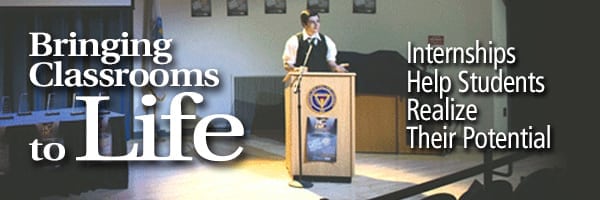
Bringing Classrooms to Life

By Alta J. Stark

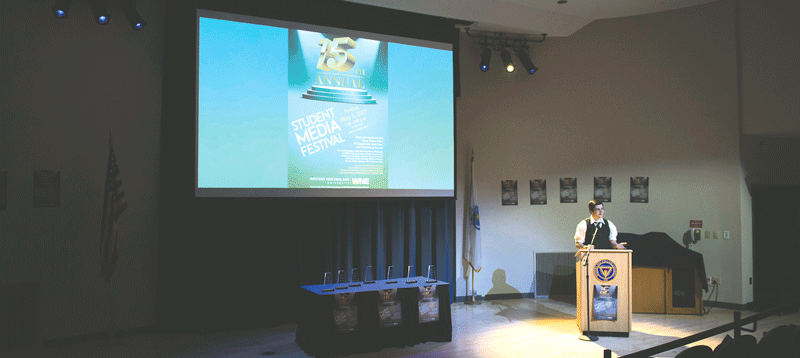
Steven O’Brien emceed Western New England University

Steven O’Brien emceed Western New England University’s Student Media Festival, part of his spring internship as chair of the festival.

Today’s college graduates understand it takes much more than book learning to compete in the job market; employers are looking for real-world experience. Students gain that experience through internships in their field, but they gain more than that. BusinessWest spoke with a few from this year’s graduating class who said their internships gave them confidence, inspiration, connections, and, in one case, a whole new career focus.

As thousands of new graduates from the region’s colleges and universities prepare to start their careers in a competitive labor market, the range of their majors is as varied as their diverse backgrounds and talents. But they’re finding it often takes more than a degree to prepare for the work world.

Increasingly, who gets the plum jobs comes down to the work experience students accrue well before they graduate.

“As students transition out of the university into the real world, employers are looking for students with experience,” said Andrea St. James, director of the Career Development Center at Western New England University. “College internships are now a major component in providing students with on-the-job skill sets they need to succeed. We encourage students to get that experience early and often.”

All colleges boast active career centers that help cultivate meaningful and practical experiences for students, but a unique consortium of career-center professionals is bringing it all together in the Pioneer Valley. Comprised of career directors from American International College, Bay Path University, Elms College, Holyoke Community College, Springfield College, Springfield Technical Community College, Western New England University, and Westfield State University, College Career Centers of Western Mass (CCCWM) provides companies and organizations a central venue in which to connect with a pool of potential interns and entry-level candidates located in Western Mass.

“We meet monthly to learn from each other. We want to help students not only build their résumés, but help direct where they may want to take their education when they leave,” said St. James.

CCCWM cross-posts job and internship opportunities, participates in career fairs throughout the year, and educates and empowers students through special events and focus groups, she added. “It’s a great resource to add to the specialized career preparation that’s available to students in their schools’ career centers. We encourage students to start exploring opportunities in their first year because an effective combination of education and career programs is a valuable complement to the academic experience.”

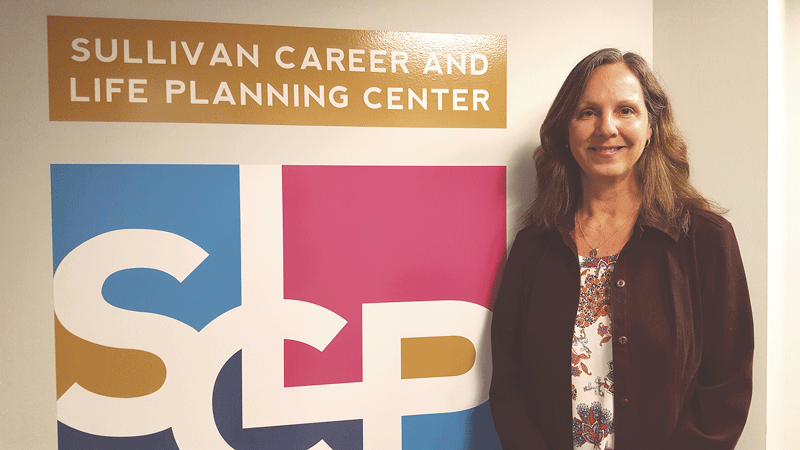
Laurie Cirillo

Laurie Cirillo says her department at Bay Path empowers women to take charge of their own career path.

In addition, career counselors help internship-seeking students make and maintain connections with friends, peers, professors, and alumni who may be helpful in their search. To hear the students tell it, those efforts are paying off.

The Right Channels

As a communications major at Western New England University, Steven O’Brien is learning how to tell stories creatively and effectively. He’s an incoming senior who’s spent the past three years studying mass media, television, radio, online media, and media production. This past spring, he jumped at the chance to turn his academic learning into real-life, hands-on experience.

“Ask anybody who has anything remotely to do with finding a job after college — anybody from the career development center, any of my professors — and they’ll tell you internships are critical because more and more employers, even for entry-level positions, are looking for people who have experience in the field,” he said.

O’Brien chaired WNEU’s 15th annual Student Media Festival, which celebrates student-produced music videos, news reports, newspaper articles, radio programming, commercials, public-service announcements, and digital photography.

“The Media Festival is a huge part of the spring semester for everyone who enters WNE. My focus was to make this the best it could be and do my job well because a lot of people were counting on me to do that,” he said.


SEE: List of Colleges in Western Mass.


He worked closely with Professor Brenda Garton-Sjoberg, who told BusinessWest that internships place students in the driver’s seat to navigate through career options, as well as providing outstanding networking opportunities.

“They allow students to experience a job through academic credit to determine if that’s the best path for their future down the road,” she explained. “I believe internships are essential for anyone, especially students interested in careers in communications.”

Simply put, O’Brien added, “being in the internship environment forces you to either sink or swim. It puts you in a position that, if you don’t have these skills, you have to find them quickly. If you’re not familiar with something, you need to know about it, and you need to learn about it.”


We encourage students to start exploring opportunities in their first year because an effective combination of education and career programs is a valuable complement to the academic experience.”


What O’Brien liked best about the internship was wearing many hats. “It was really a multi-faceted internship that went beyond the norm. It dealt with myriad skills and disciplines from public speaking and PR to marketing, media production, event planning, social-media marketing, and e-mail marketing. To get a taste of each of those, I think, was incredible.”

St. James agreed. “It’s the soft skills that he’s building that all employers value; yes, it’s the networking, the résumé building, but knowing how to manage personalities, the critical thinking, the teamwork, the motivation, communication, the small talk that has to occur to bring this people together — that’s really invaluable.”

O’Brien aced the internship in more ways than his grade. He also networked himself into a paid summer internship with the festival’s media sponsor, Cloud 9 Marketing Group, a fairly new startup founded by a recent WNE graduate.

“I worked with him throughout the entire process, and got to know him,” he said. “After the festival, I e-mailed him to ask if he was looking for interns this summer. We met, and now it looks like I’ll have an internship this summer that grew from my spring internship.”

Gaining Empowerment

Alison Hudson has been performing since she was 3 years old. She says she’s always known she wanted a career that would include her love of the creative arts and her passion for psychology. She graduated from Bay Path University in May, majoring in forensic psychology, with a minor in performing arts. In the fall, she’s going to Lesley University to seek a master’s degree in mental health counseling with a focus on drama therapy.

Hudson said her senior-year internship was critical because it showed her she was on the right path for her future. Specifically, she interned as a residential assistant at Berkshire Hills Music Academy, a live-in community for young adults with developmental disabilities, who gain communication skills through music therapy.

“The students are really wonderful,” she said. “They welcome you into their lives, and it’s very rewarding.”

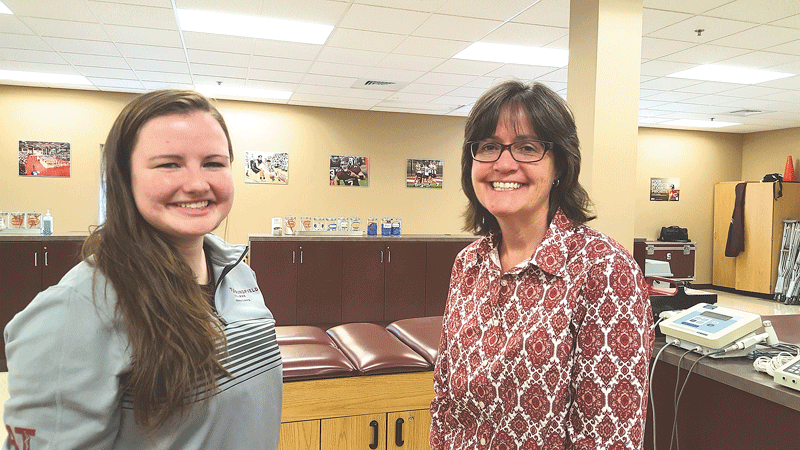
Tori Bouchard, certified trainer and 2017 Springfield College graduate (left), with Sue Guyer, chair of Exercise Science and Sport Studies at the college.

Tori Bouchard, certified trainer and 2017 Springfield College graduate (left), with Sue Guyer, chair of Exercise Science and Sport Studies at the college.

Prior to her internship, Hudson wanted to work with veterans and rehabilitated criminals, but her work at the academy pointed her in a different direction. “This internship gave me the confidence to take on the challenge of grad school and follow a career path of working with people using performing arts as therapy,” she said.

In fact, helping students build confidence helps them graduate, move on to graduate school, and get a job, said Laurie Cirillo, assistant dean of Student Success at Bay Path’s Sullivan Career & Life Planning Center. “We’re trying to empower women to be in power over their own destiny.”

To help students grow and develop self-reliance, Bay Path has adopted a unique take on the internship experience, which has become a hallmark of the university. “We don’t place our students; they work with a career coach to match themselves,” Cirillo said. “We provide a solid support system and strategies for success, but we’ve found multiple benefits to having students open the doors to the next steps of their lives and careers.”

When Delmarina Lopez entered Bay Path as a freshman, she didn’t think she could do that. The young Latina woman with a love for the public sector recalls that she was ready to transfer out.

“College was a rude awakening for me, academically, culturally, and financially, but President [Carol] Leary wasn’t going to let me go. I received amazing support, guidance, and mentoring. I stayed, and I do not regret it.”

Lopez, who’d already achieved success in her young life as the first high-school-age, community-based intern for former Gov. Deval Patrick, became more active on campus, serving as Leary’s presidential ambassador, as well as president of the Student Government Assoc. She started as a criminal justice major, then switched to legal studies after interning with attorney Elizabeth Rodriguez-Ross of Springfield.

“I knew her as one of a handful of Latina leaders in our community. It was good to work with someone who looked like me and has a similar background,” Lopez said. “She taught me the importance of mentoring and bringing someone up with you, not just focusing on yourself. I learned that law isn’t about competition; it’s about justice.”

Lopez applied to multiple law schools across the country and was accepted at 12; she chose to stay close to home, entering Western New England University Law School this fall on a full scholarship.

Cirillo says helping build a woman’s self-efficacy is one of the most rewarding parts of her job. “Many students come here with a lot of self-doubt, but by the end of their college experience, they’re able to stand back and see what they’ve achieved, and what lies ahead as they realize their potential.”

Trainers in Training

Springfield College is well-known for its athletic programs. “We’re preparing students for careers in the fitness and health industry, providing them with classroom and hands-on training from day one,” said Sue Guyer, chair of the school’s Exercise Science and Sport Studies program. “Undergrads and grads work with varying populations, from top-level athletes to still-developing high-school athletes and the elderly, and they’re influencing their lives for the better.”

Tori Bouchard completed six internships during her studies to become a certified athletic trainer. It’s a program requirement to complete a clinical rotation each semester, starting sophomore year.

“Through these rotations, we’re able to connect to patients, coaches, other athletic trainers, and other healthcare professionals, and athletic directors. We’re able to grow as athletic trainers,” Bouchard said. “We’re able to see and meet all sorts of different people. No case is the same. No patient is the same patient. So you take the theories you’re learning in the classroom, and you apply them to the setting, and not everything is always textbook. Nothing is ever textbook, actually. So, sometimes you’re learning one thing, but you realize  — under supervision of the preceptor — ‘oh, this isn’t necessarily going to work for this case, but I also know about this technique.’”

Guyer said it’s impossible to measure the true value of the experiential learning. “It’s invaluable to have the opportunity to mentor into the profession,” she told BusinessWest, noting that the rotations can also have a positive impact at understaffed schools, which may have large populations of student athletes, but just one athletic trainer on staff.

“If Springfield College sends two interns to that high school, they’ve added two qualified people to help maintain the health and well-being of students,” she went on. “What we’ve learned is, if a student is able to see, feel, experience, treat, and rehabilitate athletes, that it really brings the classroom to life.”

Bouchard agreed. “The connections with people are unbelievable,” she said.
“You learn so much just by talking to other people, learning what they’ve learned, and you grow as a person.”

Bouchard has passed her certification exam and is presently looking for a paid internship before heading back to graduate school. “I think I still have more to learn in the clinic,” she said. “I think you’re always learning something new, and I want to learn who I really am when I’m working on my own team without another athletic trainer.”

That is, after all, what the college experience is really about — young people learning who they are, what they can do, and how to realize their potential.

Education Sections

Down to a Science Center

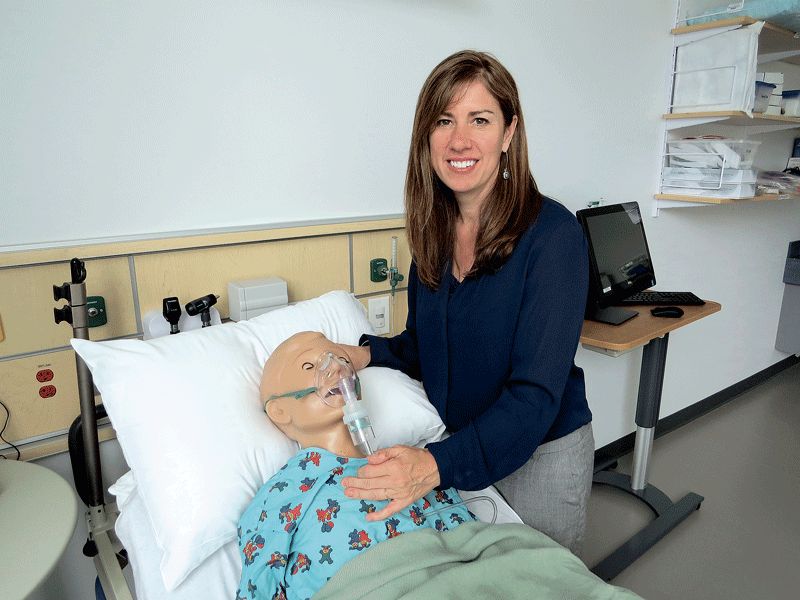
Marcia Scanlon says the numerous simulators in the new Science and Innovation Center provide unique, hands-on learning experiences.

Marcia Scanlon says the numerous simulators in the new Science and Innovation Center provide unique, hands-on learning experiences.

John McDonald hit the pause button ever so briefly in his conversation with BusinessWest and went to the window.

He then scanned the parking lot for his pick-up truck, found it, and gestured toward it. “There … that was our other lab space — my truck,” said McDonald, an assistant professor in the Environmental Science Department at Westfield State University. “Occasionally, we’d have field labs, such as animal necropsies, and we’d have to do those on the back of the truck, parked next to Route 20. We had zero functional lab space.”

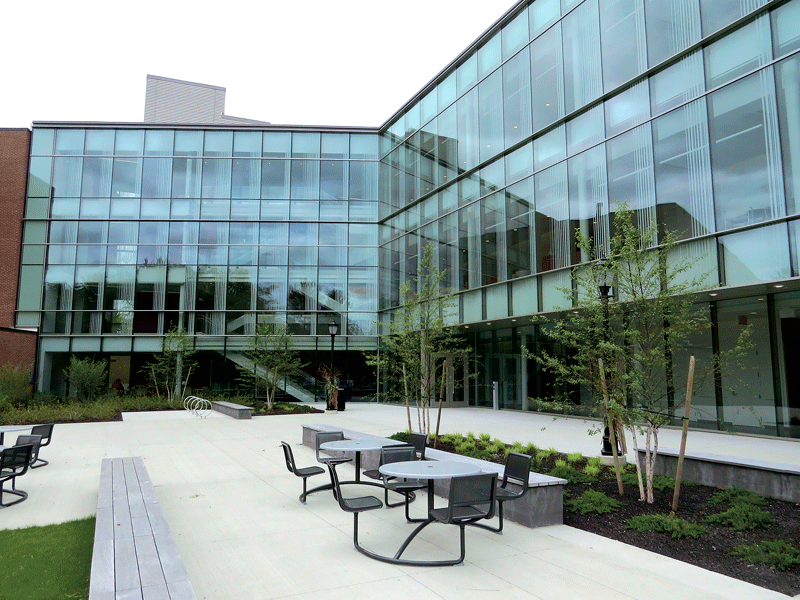
The window he pointed from is one of many in the spacious classroom/lab area dedicated to Environmental Science at the Dr. Nettie Maria Stevens Science and Innovation Center at WSU, which opened last fall and was officially dedicated earlier this month.

The space represents everything this department didn’t have before — especially ample room and modern facilities such as a wet lab complete with drains in the floor. And while this department represents perhaps the most dramatic ‘before-and-after,’ ‘night-and-day’ scenario when it comes to the new building, there are many such stories to be told here.

Like the one the Department of Nursing and Allied Health can tell.

Marcia Scanlon, chair of that department, said that, prior to the opening of the new center, the Nursing Department made do with some classroom space on campus and, for hands-on skills work, a room with three hospital beds and two simulators in what amounted to rented space at Baystate Noble Hospital, about a mile from the campus.

Now, Nursing has a spacious suite of facilities in the 54,000-square-foot facility, including three simulation rooms, an eight-bed health-assessment room, an eight-bed nursing-skills lab, two control rooms, four high-fidelity mannequins, and 12 additional low- and mid-fidelity mannequins representing adults, children, infants, and newborns.

All this represents quite an upgrade, not just in space and convenience (students no longer have to make their way to Baystate Noble), but in overall learning opportunities, said Scanlon.

“By having all this on campus in this center, that gives students better access,” Scanlon explained. “It gives them better visibility, better access, and more opportunities to come for extra help if they need it.”

Jennifer Hanselman, professor and chair of the Biology Department, and Christopher Masi, chair of the Department of Physical and Chemical Sciences, told somewhat similar stories.

The 54,000-square-foot Dr. Nettie Maria Stevens Science and Innovation Center.

The 54,000-square-foot Dr. Nettie Maria Stevens Science and Innovation Center.

They, like Scanlon and McDonald, said a tremendous amount of research and input gathering, including visits to many other health and science centers in this region, were undertaken before the architects and construction crews went to work.

“We affiliated very closely with Springfield Technical Community College, which is a renowned simulation center for its Nursing and Allied Health,” said Scanlon, as she discussed just one example of this process. “We went and toured there to look at their technology and their equipment, and how they integrate it  — how often do they bring students to use it, and how do they use it? We made several trips there, and they actually came here, put hard hats on, and walked through our space to give us advice.”

Those exercises have yielded a facility that takes WSU to a new, much higher level in terms of its facilities, learning opportunities, and ability to recruit top students.

For this issue and its focus on education, BusinessWest went inside the new science center to get a feel for what it means to those departments now housed there, and the university itself.

Grade Expectations

As WSU cut the ribbon on the new center on May 5, a good amount of time was spent explaining just who Dr. Nettie Maria Stevens was. And such a discourse was needed, because most in attendance — not to mention the students now doing work in the facility — don’t know the story.

And they should.

Stevens completed four years of coursework at what was known then as the Westfield Normal School in only two years. In 1905, she published a series of papers in which she demonstrated that the sex of an offspring is determined by the chromosomes it inherits from its parents. Her discovery had an immeasurable impact on science and society; however, despite the significance of her work, Stevens’ notoriety went unheralded even as her male colleagues received recognition.

It is fitting, then, that the school named the center after her, said speakers at the ribbon cutting, especially in light of the role the facility will play in advancing a statewide strategy in promoting STEM (science, technology, engineering, and math) careers, especially with women.

At WSU, women comprise 51% of the student population, said a spokesperson for the university, and within the school’s STEM majors, there has been 69% growth in male majors and an impressive 109% increase in female majors over the past 10 years. (Nationally, only 29% of the science and engineering workforce is female.)

The new science and innovation center should only help improve upon those numbers, said the educators who spoke with BusinessWest, noting that the facility features state-of-the-art facilities and interactive classrooms, with an emphasis on collaborative learning.

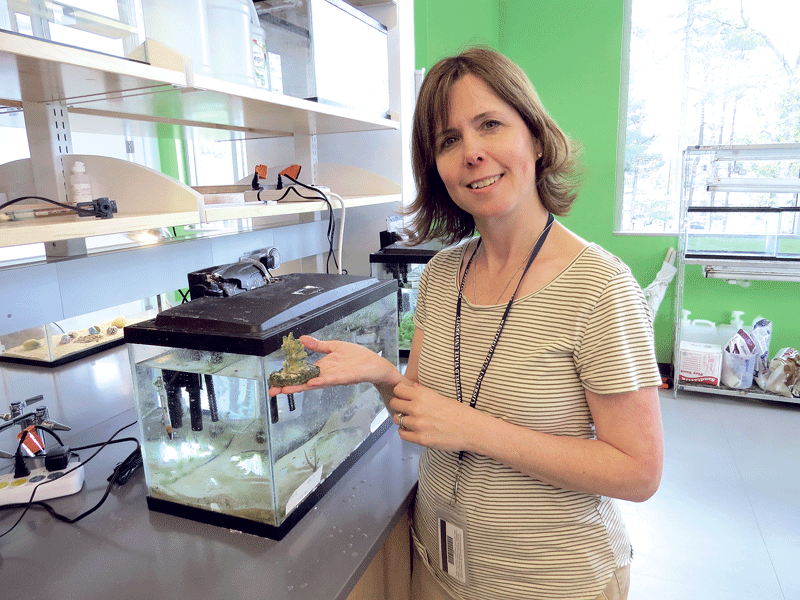
Jennifer Hanselman says the new biology facilities in the Science and Innovation Center provide educators with better opportunities to work with students and develop their skills.

Jennifer Hanselman says the new biology facilities in the Science and Innovation Center provide educators with better opportunities to work with students and develop their skills.

Translation: the Environmental Science Department has come a very long way from the back of John McDonald’s pickup truck. And the same can be said for the other departments that now call the center home.

Elaborating, McDonald said his department had a small classroom in Wilson Hall, where most science programs were housed, some counter space and cabinets, and “a hood that didn’t work and a walk-in freezer that didn’t work, and no workspace other than a collecting hallway to another classroom that was about 10 feet long.

“It was pretty meager,” he went on, adding that environmental science is a relatively new major, one that now has considerable space in which to grow.

“Getting this room, and the adjacent workroom and storeroom with a working walk-in freezer, has been a huge boon to what we’re able to do with our students,” he said of the large space now occupied by his department. “The space doubles as a teaching classroom, but we can get it as dirty as we want with soil samples, water samples, or wildlife samples.”

Meanwhile, the Nursing Department has undergone a similarly dramatic transformation through its new facilities.

Indeed, as she offered a tour of the suite, Scanlon showed off a host of amenities that were just not available to students at Baystate Noble.

These include the wide array of simulators, representing everything from newborns to a pregnant women to a senior citizen, complete with a hearing aid. These simulators can take the role of either gender — “they all come with wigs and interchangeable parts; I can make them ‘Bob,’ and I can make them ‘Dorothy,’” said Scanlon — and present students with myriad medical conditions and problems, from high blood pressure to a skin rash to heart palpitations.

There were also the control rooms guiding work with those simulators (at Noble, an educator would work from behind a curtain), as well as a ‘medication-simulation room,’ which, as that name suggests, allows students practice with retrieving and dispensing medication.

And then, there are the large, eight-bed health-assessment room and nursing-skills lab. Designed to replicate conditions in a hospital, where nurses would obviously be caring for multiple patients at a time, these facilities provide learning opportunities simply not available at Noble.

“I think this is the beginning of something big,” she said while describing what the new facility means in terms of education opportunities, using a phrase that everyone we spoke with would echo. “We’re just trying to learn the technology and see how to implement it. But in the future, this will be transforming; we’ll have inter-professional education, and we’ll be able to do things using this technology that we weren’t able to do before. And it will provide a higher degree of safety because we have the actual equipment the hospitals have.”

Masi used similar language as he talked about the facilities dedicated to the Department of Physical and Chemical Sciences, noting, as others did, that the Science and Innovation Center represents a significant upgrade.

“Our new facilities provide us with a safer space to work in,” he explained. “We can now deal with more students at a given time, and we can work with them in a safer environment.”

Elaborating, he said there were 144 students enrolled in the General Chemistry classes in the new facility and roughly 80 in Organic Chemistry, both sizable increases.

“By moving from one building to the next, we can get more students in, which is important, because other majors are requiring Organic Chemistry,” he explained, adding that, beyond sheer capacity, the new space creates a more collaborative learning environment. “We’re excited to have the space and to be able to get to some of the things we’ve been slowly working on in the past.”

Hanselman, meanwhile, said the new space brings similar improvements and new opportunities for the Biology Department, which currently has roughly 230 students enrolled in that major.

“The modernized lab facilities offer us the opportunity to certainly work and prepare our students more effectively,” she explained. “We have a goal of working with our students in the scientific process; we emphasize research experience, and we planned this space accordingly.”

As examples, she pointed to two dedicated labs and a tissue-culture facility.

“Those lab spaces are never scheduled for classes; they’re used only for student research,” she explained. “This is giving us a chance to really work with students and develop their skills.

“These labs are designed in a way to promote inquiry-based instruction for those 100- and 200-level lab courses,” she went on, adding that they provide an environment conducive to problem solving and critical thinking.

Class Acts

As noted earlier, Scanlon was speaking for everyone when she said the first year of activity at the new Science and Innovation Center was merely the beginning of something big.

Something much bigger than McDonald’s pickup truck. Something that, as many of those we spoke with said, will be transforming.

Something to which Dr. Nettie Maria Stevens would be proud to lend her name.

George O’Brien can be reached at [email protected]

Construction Sections

Blueprint for Growth

From left, the principals at Caolo & Bieniek Associates, James Hanifan, Bert Gardner, Curtis Edgin, and John MacMillan.

From left, the principals at Caolo & Bieniek Associates, James Hanifan, Bert Gardner, Curtis Edgin, and John MacMillan.

“More horsepower.”

That’s the phrase summoned by Curtis Edgin when he was asked to identify the primary advantage gained through the union of two architecture firms, Caolo & Bieniek Associates (CBA), which he serves as a principal, and Reinhardt Associates, a long-time competitor.

He would go on at length in his answer and use a number of different words and phrases, but the term ‘horsepower’ probably summed it up best.

He used it to describe everything the union brings to the table: experience, client bases, contacts within both the public and private sectors, and simple know-how — about this business, this market, and much more.

It’s a case of simple addition by … addition, said Edgin, noting that this new, larger firm has a bigger engine, if you will, one capable of fueling additional growth.

And by engine, he meant people in particular.

“In a service business, and especially architecture, it’s about the people; it’s not about tables and chairs and computers,” he explained. “Your main resource is the intelligence you bring to the table; architecture is about designs, but it’s really about relationships.”

John MacMillan, formerly president at Reinhardt Associates and now a partner with Caolo & Bieniek, agreed. With a larger team, he noted, the firm brings more experience to the forefront, especially in several specialty areas shared by CBA and Reinhardt, including schools, public-safety complexes, senior centers, and others.

“The competition is getting tougher, and you have to be able to show people more of what you can do,” he explained, touching on a theme he would return to often as he spoke with BusinessWest. “This union certainly strengthens the résumé; we can show 30 or 40 examples of past projects.”

Both MacMillan and Edgin agreed that, because of these shared specialities, talents, and especially relationships forged through decades of work with common institutions, cities, and towns, the union of the companies made sense on a number of levels.

“John and Reinhardt have a good, established client base, and CBA has a good, established client base,” Edgin explained. “And we thought that joining together those assets would be beneficial as we continue to serve those past clients and also pursue future clients.”

For this issue and its focus on construction, BusinessWest takes an in-depth look at the union of the two firms and what this additional horsepower means in terms of growth potential.

Progress — by Design

The walls of an architecture firm’s lobby — and this case, the conference room as well — usually tell a story.

It’s told through photographs and renderings of projects that have made it from the drawing board to reality — and the firm’s portfolio as well.

The walls within Caolo & Bieniek’s offices in Chicopee relate such a story, with images of schools, public-safety complexes, senior centers, bank branches, municipal offices, libraries, and more.

Actually, the walls and the images tell two stories — well, sort of. Caolo & Bieniek’s deep portfolio and wide diversity of projects mirror the body of work assembled by Reinhardt Associates.

The new Easthampton High School

The new Easthampton High School is one of many education-sector projects in the Caolo & Bieniek portfolio.

Indeed, both firms focused on both private and public-sector work, and especially the latter. In fact, they competed against each other for probably hundreds of individual projects for the better part of 60 years. (Caolo & Bieniek was founded in 1955, and the Reinhardt firm in 1957.)

These common specialties were among the most common-sense reasons for the firms coming together in what the principals prefer to call a “strategic alliance.”

Talks began sometime last fall, and they culminated in an agreement earlier this year that saw MacMillan and another architect join the Caolo & Bieniek firm.

As noted, the union gives the firm more horsepower at a time when it is certainly needed. Indeed, while the economy is relatively strong and work somewhat plentiful — in both the public and private sectors — competition for that work is as keen as ever.

And it’s coming from all points on the compass, especially the east, said MacMillan, where a number of Boston-area firms are becoming more aggressive in their pursuit of work in the 413 area code.

“We’re getting more competition from the east, including some of the larger firms, which have set up satellite offices in this area,” he explained. “And everyone is looking for specialists these days, so it’s harder to be a general practitioner.”

Overall, the firm intends to use its additional horsepower and existing strengths and contacts to generate more growth, said Edgin.

One of these strengths is simple diversity, a trait that helps keep operations afloat when one segment of the industry falls off, as school construction did years ago when the state cut back on funding. But it also helps when times are better and there are a number of projects to bid on.

And the company’s portfolio — not to mention those walls in the lobby and conference room — reveal that it has undertaken everything from restoration work on the clock tower of the Old Chapel at UMass Amherst to the new transit center in downtown Westfield; from a host of police and fire stations to school projects across the region and well outside it.

Roughly 75% of the joined firms’ portfolios fall in the public-sector realm, said Edgin, adding that schools are a big component of this work, and projects run the gamut from preschool to colleges and universities.

umasspolicefacility

Among the many projects in the Caolo & Bieniek portfolio are the new UMass Police facility, top, and the new Arrha Credit Union branch in West Springfield.

Among the many projects in the Caolo & Bieniek portfolio are the new UMass Police facility, top, and the new Arrha Credit Union branch in West Springfield.

The firms have collectively done a considerable amount of work for UMass Amherst, for example — the new police headquarters there is another example — and Westfield State University, where projects include a residence hall, classroom spaces, and the Eli Campus Center.

Public-safety complexes have become another strong niche, said MacMillan, noting that experience with such structures certainly helps in the highly competitive bidding process, and it has helped the firm amass nearly a dozen such projects over the years.

And he believes the combined experience of the firms helped CBA as it won the contract to build a new public-safety complex for the town of Westhampton.

Other specialties include libraries and senior centers, he went on, adding, again, that the firms have been very similar in the composition of their portfolios, although Reinhardt would often venture out of the 413 area code — it did a lot of work on both the North and South Shores of the Bay State — while CBA stayed closer to home.

The union of the companies also allows CBA to be more responsive because it can bring more resources to bear, said Edgin, adding that this is another important trait within a market that has become, in a word, more demanding.

“People want things faster, they wants things to be less expensive — they want it all,” he said. “By joining together, we can be responsive to clients.”

Building Momentum

Architects use numbers and images in their work, but, as Edgin noted, this is a relationship-driven business, where people make all the difference.

But ‘horsepower’ is a term that works, well, because it has a number of definitions, in this case the ability to offer valuable resources and experiences in efforts to serve the client.

And through this union of two former competitors, a larger firm can bring considerably more horsepower to bear.

George O’Brien can be reached at [email protected]

Briefcase Departments

Massachusetts Adds 3,900 Jobs in April

BOSTON — The state’s total unemployment rate increased to 3.9% in April from the March rate of 3.6%, the Executive Office of Labor and Workforce Development announced. The preliminary job estimates from the Bureau of Labor Statistics indicate Massachusetts added 3,900 jobs in April. Over-the-month job gains occurred in professional, scientific, and business services; education and health services; trade, transportation, and utilities; other services; information; and manufacturing. From April 2016 to April 2017, BLS estimates Massachusetts added 58,600 jobs. The April state unemployment rate remains lower than the national rate of 4.4% reported by the Bureau of Labor Statistics. “Through the first four months of 2017, Massachusetts has added over 20,000 jobs, with much of those gains coming from key sectors of the economy like professional, business, and scientific services,” Labor and Workforce Development Secretary Ronald Walker II said. “These job gains, coupled with large increases to the labor force and a low unemployment rate, are signs of a strong economy in the Commonwealth. Our workforce agencies remain focused on closing the skills gap and ensuring that those newly entering the job market have the training necessary to access employment opportunities.” The labor force increased by 33,000 from 3,661,200 in March, as 21,200 more residents were employed and 11,800 more residents were unemployed over the month. Over the year, the state’s seasonally adjusted unemployment rate dropped one-tenth of a percentage point from 4.0% in April 2016. There were 300 more unemployed persons over the year compared to April 2016. The state’s labor-force participation rate — the total number of residents 16 or older who worked or were unemployed and actively sought work in the last four weeks — increased six-tenths of a percentage point to 66.5% over the month. The labor-force participation rate over the year has increased 1.5% compared to April 2016. The largest private-sector percentage job gains over the year were in professional, scientific, and business services; construction; financial activities; education; and health services.

Cultural District Seeks Pop-up Gallery Proposals

SPRINGFIELD — The Springfield Central Cultural District (SCCD) has issued a call to artists for a unique opportunity in downtown Springfield. The Cultural District is searching for artists to host a solo show in their Art Stop pop-up gallery program and sell their work in one of three locations downtown – New England Public Radio (NEPR), UMass Springfield, and 1550 Main. The RFP asks for proposals from artists of all mediums to show their work from July to October. Requirements to what the art should look like are fairly laid-back, to best enable creative expression. All art will be available for sale during the display period, with 100% of proceeds going directly back to the creator. A stipend of $200 will also be awarded to the chosen artists. The Art Stop venues include a small community meeting space at NEPR which has been used for its youth arts program, MediaLab, and yoga classes; the highly visible first-floor lobby of 1550 Main, trafficked by hundreds of people daily; and the sunny and recently renovated main entryway of the UMass Center at Springfield. The SCCD hopes artists will draw inspiration from these differing spaces. “Art Stop has now become a flagship program of the Cultural District,” said director Morgan Drewniany. “We began this in October of last year and continued the effort in April, expanding to include Tower Square. Visitors love the unique blend of art, music, and community at the openings, and artists love being able to connect directly with their audience, as well as have a platform to sell their work downtown.” A joint reception will be held between the three locations in mid-summer, with gallery openings, street art, and performances between the locations to encourage walking, and light food and drinks, all provided by the SCCD and the artist hosts. The Springfield Central Cultural District encompasses an area of the metro center of Springfield and is membership-based, involving many of the downtown arts institutions. Its mission is to create and sustain a vibrant cultural environment in Springfield. The RFP and more program details can be found at springfieldculture.org/artistresources. Any questions can be forwarded to Drewniany at [email protected] or (413) 454-1195.

Plainridge Study Suggests Casino Projects Can Lower Unemployment

HADLEY — The UMass Donahue Institute released a compilation of results from two years of new employee questionnaires at Plainridge Park Casino. This report is the latest in a series of studies focused on the economic impacts of the gaming industry in the Commonwealth. Representatives from the UMass Donahue Institute presented its findings to the Massachusetts Gaming Commission (MGC) during a public meeting on May 10. The findings reveal several important characteristics of new hires at Plainridge Park Casino and the emergent casino workforce in Massachusetts:

• 50.1% of new hires worked part-time or were unemployed before obtaining their job at Plainridge Park Casino;

• Major reasons for seeking employment included career advancement, improved pay, and improved benefits;

• 40.1% of new hires said they needed work due to being unemployed, part-time, or underemployed. 86.2% had no gaming experience prior to their jobs at Plainridge Park Casino;

• 96.5% of new hires did not transfer from other Penn National Gaming locations, and 92.8% did not move to take their jobs at the casino. Of those who moved, one-quarter originated from cities or towns within Massachusetts; and

• Nearly three-quarters of respondents come to their job without pre-employment training for their position.

The vast majority of survey respondents are people who are new to the gaming industry and are now being hired for gaming and non-gaming positions at Plainridge Park Casino, including its food-court vendors. Very few workers (only 7%) moved to take their job at Plainridge Park Casino, and those who did were mostly from Massachusetts and Rhode Island. This suggests that most new employees live close enough to commute to their positions at Plainridge Park Casino. “As we have pointed out repeatedly, the Legislature made broad-based economic development a key focus of the Gaming Act, with a particular focus on local employment for those underemployed and unemployed,” said MGC Chairman Steve Crosby. “This report, thus far, demonstrates that legislative intent is being achieved. We are also pleased to see the implementation of the legislative mandate to objectively and rigorously assess the economic and social impacts of gaming. This report represents one of the many important research topics fulfilling that objective.” Added Rachel Volberg, principal investigator of the Social and Economic Impacts of Gambling in Massachusetts (SEIGMA) group, “one of the most important positive impacts of expanded gambling is increased employment. However, in assessing the overall impacts of expanded gambling, it is important to understand whether employment gains at the casino result in the loss of employment in other sectors of the economy and in surrounding communities. This report establishes a basis for making this determination going forward and will help us understand the role of casinos in increasing economic activity, and overall employment, in Massachusetts.”

Manufacturing Partnership Graduates 100th Student

TURNERS FALLS — On Friday, May 19, 14 advanced-manufacturing trainees will receive certificates of completion and start down the pathway toward precision-machining careers in Pioneer Valley manufacturing companies. The current cohort of students in the Advanced Manufacturing Pipeline – Computer Numerical Control (AMP-CNC) training program hail from across Franklin and Hampshire counties, including Belchertown, Colrain, Easthampton, Greenfield, Montague, Northfield, South Hadley, and Shelburne. Among these trainees will be the 100th graduate of a successful job-training partnership that began four years ago to address a shortage of skilled machinists in the Valley’s precision-manufacturing industry. The event will be held at 4 p.m. at the Franklin County Technical School. AMP-CNC is a non-credit, 15-week, 300-hour, hands-on training program offered by Greenfield Community College (GCC) in partnership with the Franklin Hampshire Regional Employment Board (FHREB), the Franklin Hampshire Career Centers, Franklin County Technical School (FCTS), and area machining companies. The program has been offered at no cost to qualifying participants thanks to funding provided by federal and state grants and employer contributions. The AMP-CNC program is taught by experienced instructors in a state-of-the-art machine shop at Franklin County Technical School. The shop is outfitted with Haas CNC mill and lathe machines funded by employer contributions and matching state funding. The program uses the FCTS machine shop in the evenings after the high-school day concludes, thereby maximizing training use of the equipment. The previous seven cohorts have averaged a 93% graduation rate and an 84% job-placement rate. Students participating in the program complete testing, a four-week Foundational Manufacturing precursor program, and online Tooling U assignments. Coaching and job-placement support are provided to help students demonstrate readiness and pursue careers in precision machining by completing résumés, cover letters, and work-search plans. Trainees recently completed their résumés and cover letters to participate in a recent CNC job fair before graduation. Employers present included Bete Fog Nozzle, Hassay-Savage, G.S. Precision, Mayhew Tool Co., Poplar Hill Machine, Quabbin Inc., and VSS Inc., all employer partners of the program. Those interested in applying can sign up to attend one of the monthly information and application sessions by registering online at www.gcc.mass.edu/manufacturing or by calling the Franklin Hampshire Career Center at (413) 774-4361. The next information session will take place on Monday, June 12 at 3 p.m. at the GCC Downtown Center, 270 Main St., Greenfield. For more information about the AMP-CNC training program, contact Andrew Baker at FHREB, (413) 774-4361, ext. 375, or [email protected], or April Estis-Clark at GCC, (413) 774-1602 or [email protected].

Departments People on the Move
Jacqueline Charron

Jacqueline Charron

The Professional Women’s Chamber (PWC) announced that Jacqueline Charron, chief risk officer and senior vice president of Operations and Information Technology for PeoplesBank in Holyoke, has been named the PWC 2017 Woman of the Year. The Woman of the Year award is presented to a woman in the Western Mass. area who exemplifies outstanding leadership, professional accomplishment, and service to the community. This award has been given annually since 1954. Liz Rappaport, secretary of the PWC board committee, said the selection committee was thoroughly impressed with Charron’s work-life balance, as evidenced by her pursuit of education while managing her career and being the mother of four children. “The PWC recently had a work-life balance panel at a luncheon, and we loved how, through her application, Jackie personified work-life balance,” Rappaport said. Charron earned a bachelor’s degree in economics at Mount Holyoke College while working as a teller at PeoplesBank. She went on to receive an MBA from the Isenberg School of Management at UMass Amherst. She has done post-graduate work at Babson College (Mass. Bankers Assoc. School of Financial Studies), Villanova University (master certificate in Lean Six Sigma), and the Dartmouth College Tuck School of Business Leadership Program. After 32 years, Jackie continues to build a successful career at PeoplesBank, where today she leads a team of 40 associates in deposit operations, information technology, electronic banking, and risk and compliance. She has served at the leadership level of many community and business organizations, including the Food Bank of Western Massachusetts, Girls Inc., the South Hadley and Greater Holyoke chambers of commerce, and United Way of Pioneer Valley. She also enjoys volunteering at the Holyoke St. Patrick’s Day Road Race and at activities and fund-raisers that support her children’s academic and athletic interests. She can be found working the concession stand at a high-school girls’ soccer game or attending a gala for the Fine Arts Center or Bright Nights. A celebration in Charron’s honor will be held on Thursday, June 1 at 5:30 p.m. at the Carriage House, Storrowton Tavern, 1305 Memorial Ave., West Springfield. Reservations may be made online at www.springfieldregionalchamber.com or by contacting Jessica Hill at [email protected].

•••••

Jim Ayres

Jim Ayres

United Way of Pioneer Valley (UWPV) announced that its board of directors has appointed Jim Ayres the organization’s next president and CEO, effective June 12. Ayres, who currently serves as the CEO of the United Way Hampshire County, will succeed Dora Robinson, UWPV’s most recent president and CEO and current president emeritus. Ayres comes to UWPV from United Way of Hampshire County (UWHC), where he has served as CEO and executive director since 2011. During his tenure there, he expanded the donor base and increased both funding diversity and overall revenue at a time when many United Ways nationally had experienced shrinkage. Prior to joining UWHC, he served for 12 years as the executive director of the Center for New Americans, an education and resource center for immigrants, refugees, and other limited-English speakers in Western Mass. With roots in the Springfield public schools, where he worked as a parent community and involvement coordinator, he has extensive experience working with school systems, local and state governments, community coalitions, workforce boards, and other nonprofit organizations to develop programming and policy. He is the incoming board president of the Massachusetts Nonprofit Network and an adjunct professor of Nonprofit Administration and Philanthropy at Bay Path University. He holds master’s degrees from the Fletcher School of Law and Diplomacy at Tufts University and the Isenberg School of Management at UMass Amherst. UWPV will celebrate Ayres’s arrival at the organization’s 95th-anniversary celebration on Wednesday, May 31 at the Barney Carriage House at Forest Park.

•••••

Mark Foster

Mark Foster

Jay Seyler

Jay Seyler

Shana Hebdrikse

Shana Hebdrikse

Jessica Menard

Jessica Menard

PeoplesBank announced the appointment of Mark Foster to vice president, operational risk manager; Jay Seyler to vice president, business banking officer; Shana Hendrikse to business banking officer; and Jessica Menard to commercial credit officer. Foster brings more than a decade of financial and audit experience, and holds a bachelor’s degree from the University of Connecticut. He is an RSA Archer-certified administrator and was named a 2015 RSA Archer Innovation Award winner. Seyler possesses more than 30 years of banking and financial experience, and holds a bachelor’s degree from Bryant University and an MBA from Western New England University. Hendrikse brings more than a decade of banking and financial experience, and holds a master’s degree from Colorado State University and a bachelor’s degree from Saint Leo University. She has completed training through the New England School of Financial Studies at Babson and holds a certificate in financial studies. Menard possesses close to a decade of banking and commercial-loan experience, and holds a bachelor’s degree from Bay Path University. She has completed training through the Risk Management Assoc., the Massachusetts Bankers Assoc., and the Center for Financial Training.

•••••

Hyman Darling

Hyman Darling

Bacon Wilson, P.C. announced that attorney Hyman Darling recently took the oath of office as the incoming president of the National Academy of Elder Law Attorneys (NAELA). He was sworn in as president at NAELA’s annual conference along with other incoming members of the executive committee, and will officially assume his duties as NAELA president on June 1. In addition to accepting the office of the presidency, Darling was also honored as a NAELA fellow for 2017. The fellow designation is the highest honor bestowed by NAELA, and is granted to members who have careers in elder law and who have made exceptional contributions to the field. Election as a NAELA fellow signifies an attorney recognized by his peers as a model for others, and an exceptional lawyer and leader. The most significant component in the selection process is commitment and contributions to NAELA through committee participation, programs, and leadership. Upon accepting the fellow award and the presidency, Darling proceeded to address his NAELA colleagues, thanking them for record-high conference attendance and laying out his plans for the coming year. Much to the delight of the audience, his remarks were delivered entirely in rhyming verse. Darling is a partner at Bacon Wilson, where he has practiced since 1981. He concentrates in the areas of trusts, estates, taxes, estate planning, probate, guardianships, special needs, and elder law. Prior to joining Bacon Wilson, he served as a trust officer. He has been a frequent presenter for both the Massachusetts Bar Assoc. and Massachusetts Continuing Legal Education. He has also spoken for NAELA at several conferences, both local and national. He is an adjunct faculty member at both Western New England University School of Law and Bay Path University. Darling serves on many local planned-giving committees, and is a frequent lecturer for professional and civic groups in the Pioneer Valley. He is a member of the Special Needs Alliance, and is also a former president of the Hampden County Estate Planning Council.

•••••

Kevin Maltby

Kevin Maltby

Bacon Wilson, P.C. also announced that attorney Kevin Maltby is a recipient of 2017’s Excellence in the Law Pro Bono Award from Massachusetts Lawyers Weekly. He was recognized for his pro bono efforts in connection with the Springfield District Court’s Lawyer for a Day program. With the support of the Hampden County Bar Assoc., Maltby led the 2012 effort to establish the weekly program, and he is currently working on significant expansion of pro bono services offered by the Hampden County Legal Clinic. He was inspired to initiate the Lawyer for a Day program after taking note of numerous people trying to represent themselves in court, often unsuccessfully, due to their unfamiliarity with the law and court procedures. In addition to the District Court Lawyer for a Day program, Maltby contributes his time to numerous other pro bono programs, including the Massachusetts Bar Assoc. Dial-a-Lawyer program, and the Hampden County Bar Assoc. Lawyer on the Line program. He is the current president of the Hampden County Bar Assoc., where he also serves on the pro bono committee. He is a member of the Massachusetts Supreme Judicial Court’s standing advisory committee on professionalism, and is an adjunct professor at Bay Path University, where he teaches advanced litigation.

•••••

Thomas Walbridge

Thomas Walbridge

Community Health Programs has named Thomas Walbridge its new chief financial officer. He will oversee the health network’s budget, financial operations, and planning. Walbridge has served as chief financial officer and vice president for the Kinsley Group Inc. and as CFO for the Pioneer Valley Transit Authority; he was also director of finance and human resources at Six Flags New England. His early professional career was spent in the banking sector in Pittsfield. He holds a business degree from Babson College and an MBA from Western New England University. CHP finished its 2016 fiscal year with an operating surplus of nearly $700,000, on revenues of $14 million. During that year, CHP increased its patient and client numbers from 16,000 to more than 22,000, with the addition of two new practices in North Adams and other new-patient outreach. During 2016, employment at CHP grew from 140 to 175 and continues to expand. Walbridge is also the founder and operator of LuckBridge Sports LLC, a company that creates affordable, inclusive team-building opportunities for youth and coaches in the developmental and advanced instruction of baseball and basketball. He volunteers in his community with youth sports programs, the American Red Cross, the March of Dimes, the Agawam Chamber of Commerce and the Agawam Rotary.

•••••

Christopher Scott

Christopher Scott

Springfield Technical Community College (STCC) announced the hiring of Christopher Scott as the dean of the School of Health & Patient Simulation. Scott had been the interim dean since the retirement of Michael Foss in 2016. His previous positions at STCC include assistant dean for the School of Health & Patient Simulation and director of Clinical Education and SIMS Medical Center. Scott will lead a school that offers the most competitive programs at STCC and is home to the Northeast’s largest patient-simulation training facility. The SIMS Medical Center at STCC provides a clinical setting to train students as well as healthcare providers. Scott played a key role in expanding the facility when he was hired as director in 2010. At the time, the center included 18 patient simulators and five rooms and provided 3,000 simulation experiences each year. Today, there are 52 simulators and 12 rooms, or simulation areas, and more than 20,000 simulation experiences. As dean, he is responsible for the overall leadership of the school as well as for the daily and long-term operation of all the credit and non-credit health programs. About 800 students are enrolled in credit and non-credit programs. The school includes more than 100 full-time and part-time faculty and staff. Scott sees his mission as helping to meet the community’s health care needs and ensuring access to the degree and certificate programs, which include cosmetology, dental assistant, dental hygiene, diagnostic medical imaging, interdisciplinary health studies, medical assistant, medical laboratory technician, nursing, rehabilitation therapies, respiratory care, and surgical technology. Scott, who holds a master’s degree in health education and curriculum development from Springfield College, is currently is completing his doctorate of education in higher education administration from Northeastern University in Boston. A certified healthcare-simulation educator, Scott earned his bachelor’s degree in emergency medical services management from Springfield College.

•••••

Bruce Marzotto

Bruce Marzotto

Lee Bank announced that Bruce Marzotto, senior vice president of Commercial Lending, has been named a Community Bank Hero by the Warren Group and Banker & Tradesman. Community Bank Heroes is an annual award that honors the achievements, commitment, and dedication of financial professionals who go above and beyond for their institution and community. Award recipients are nominated by their peers and selected by Banker & Tradesman’s editorial board; this year’s 13 winners hail from community banks throughout Massachusetts. Marzotto has been with Lee Bank for 10 years and has worked in banking in Berkshire County for 40 years. After receiving his associate’s degree at Berkshire Community College, he continued his education through banking courses with the American Institute of Banking as well as the New England School of Banking at Williams College. As former treasurer of the Southern Berkshire Chamber of Commerce, Great Barrington Little League, and Boy Scouts of America Troop 23, he is continuing his community involvement as a trustee of the newly organized Great Barrington Municipal Affordable House Trust. The Community Bank Heroes awards will be distributed at a dinner event on Tuesday, May 23 at the Hyatt Regency Boston hotel. Recipients will be featured in the May 22 issue of Banker & Tradesman. To see a full list of the Community Bank Heroes and for more information about the awards dinner, visit www.thewarrengroupevents.com/communitybankheroes.

•••••

Sharon Dufour, chief financial officer for Luso Federal Credit Union, and Kimberly Anderson, Community Relations representative for Luso, were recognized on National Financial Educators Day for their hard work and dedication to promoting financial-literacy education in Ludlow, Hampden, and Wilbraham. Nominated by Junior Achievement of Western Massachusetts, Dufour and Anderson, supported by Luso Federal Credit Union and a grant from the Joseph and Anna C. Dias Family Foundation, help bring financial-literacy education to thousands of youth in the three communities. Every child in Ludlow schools and St. John the Baptist School, kindergarten through grade 8, participates in a JA program each year, as well as all the students at Thornton Burgess Middle School in Hampden and Wilbraham Middle School. Dufour and Anderson not only secure the funding for the programs, but recruit and train nearly 100 volunteers to deliver the programs. Dufour and Anderson also teach multiple JA programs each year.

Agenda Departments

White Lion Wednesdays

Through Aug. 27: White Lion Wednesdays returned to Springfield on May 17 and will run through Aug. 27, presented by Berkshire Bank in partnership with the Springfield Business Improvement District (BID) and Springfield’s White Lion Brewing Co. Touted as one of last summer’s “Best Pop-up Beer Gardens” by Food & Wine magazine, Raymond Berry, president of White Lion, said this season will be even better. “White Lion is ecstatic to kick off this year’s beer garden series in May. Last year’s series had great attendance and obtained national recognition; we will look to capitalize on its success, and we are honored to be part of a collection of creative programs in the heart of downtown Springfield,” he said. “During the series, brewer Mike Yates will introduce a new beer commemorating the grand opening of Springfield’s Union Station. The honorary selection follows last year’s releases, which celebrated the Eastern States 100th anniversary, and the history of Springfield brewing in partnership with the Springfield Museums.” Again, the Springfield Business Improvement District will host White Lion Wednesdays, rotating between three locations from 4 to 8 p.m.: One Financial Plaza at 1350 Main St., Tower Square Park at 1477 Main St., and the Shops at Marketplace at the rear of 1341 Main St. More details on White Lion Wednesdays, including locations and dates, can be found at springfielddowntown.com/white-lion-wednesdays.

‘An Afternoon with Tom Ahern’

June 1: Berkshire Taconic Community Foundation invites regional nonprofit staff to attend “An Afternoon with Tom Ahern,” a two-part workshop from 1 to 4 p.m. at Jane Iredale Cosmetics, 50 Church St., Great Barrington. Back by popular demand, Ahern will present two back-to-back workshops: “The Big (little) Diff: Writing for Online Readers,” a discussion of best practices in writing for web, e-mail, and social-media platforms; and “Writing a Powerful Case for Support,” which will review effective fund-raising methods. The New York Times calls Ahern “one of the country’s most sought-after creators of fund-raising messages.” This event is part of Berkshire Taconic’s popular annual Seminars in Nonprofit Excellence series. Tickets are $40 per person, and light food and beverages will be provided. To register, visit www.berkshiretaconic.org/ahern.

Discussions about Race

June 2-3, 9-10: Cooley Dickinson Health Care, the United Way of Hampshire County, and the Jandon Center for Community Engagement at Smith College are addressing the issue of racism, as well as race-related incidents that continue to occur both locally and nationally, by offering a series of community dialogues on race in Northampton and Amherst. Community members who live or work in Hampshire County are invited to attend either of the sessions. The two-part dialogue will be offered Friday, June 2 from 6 to 8 p.m. and Saturday, June 3 from 10 a.m. to 4 p.m. at the Jandon Center for Community Engagement at Smith College, Wright Hall, 5 Chapin Dr., Northampton. A second two-part session will be offered Friday, June 9 from 6 to 8 p.m. and Saturday, June 10 from 10 a.m. to 4 p.m. at the Amherst Survival Center, 138 Sunderland Road, Amherst. Event organizers say they aim to move toward solutions rather than continue to express or analyze the problem; to reach beyond the usual boundaries, offering opportunities for new, unexpected partnerships; and to unite divided communities through a respectful, informed sharing of local racial history and its consequences for different people in today’s society. The community dialogue is free, and lunch will be provided. Attendance is limited to 30 people, and participants must attend both Friday and Saturday. When registering, people will be asked their name, the organization they represent, if any, and their race/ethnicity. Organizers are asking about race/ethnicity as they have a goal of 50% participation from people of color. To register, call (888) 554-4234 by Tuesday, May 30. You will receive confirmation on whether you have been selected to attend a session.

WGBY Asparagus Festival

June 3: The WGBY Asparagus Festival returns to the Hadley Town Common from 10 a.m. to 6 p.m. to once again celebrate the region’s legacy of agriculture and community. The family-friendly, outdoor event features more than 90 local food, crafts, and agricultural vendors at a Farmers’ & Makers’ Market. In addition, there will be entertainment displays, kids’ games, and a live visit from PBS Kids character Curious George. A large “Rooted in the Valley” stage will feature popular performers. Family entertainer Tyler Conroy will start off the day, followed by bands Western Den and Parsonsfield, which were selected by Northampton-based Signature Sounds. Western Den blends “compelling lush harmonies with ambient textures,” and Parsonsfield “trades instruments, shares microphones, and sings in tight multi-part harmonies,” according to each of the bands’ websites. More than a dozen Pioneer Valley culinary artisans, local brewers, and regional food vendors will offer a wide variety of snacks and meals. Taste original dishes from Mi Tierra, Esselon Café, or Spoleto. Visit the Wheelhouse Farm, UMass Dining, or Hadley Fry King food trucks. Or, go on the sweeter side and sample asparagus-flavored ice cream from Flayvours of Cook Farm, maple treats from the North Hadley Sugar Shack, or a specialty from the Florence Pie Bar. Other food vendors include North Hadley Congregational Church, Harmony Springs, and Dean’s Beans. In addition, a large craft-beer tent will provide tasting opportunities from popular local breweries (craft beer tasting tickets available at wgby.org/beer). The WGBY Asparagus Festival is open to the public and free with a recommended donation of $5 per person. It will be held rain or shine. Donations directly benefit public television and education efforts in the Western New England region. The event is sponsored by the Dennis Group, Greenfield Savings Bank, Whole Foods Hadley, and Alternative Recycling Systems. Media sponsors include the Daily Hampshire Gazette, MassLive, and Yankee magazine.

Girls on the Run 5K Celebration

June 4: Girls on the Run of Western MA will host its 5K celebration at Springfield College. The run will begin at 10:30 a.m., but festivities, including a group warm-up and talk by Springfield College President Mary-Beth Cooper, will begin at 10 a.m. Early arrival is suggested. There will also be food trucks and face painting. Girls on the Run is a physical, activity-based, positive youth-development program that uses fun running games and dynamic discussions to teach life skills to girls in grades 3-8. During the 10-week program, girls participate in lessons that foster confidence, build peer connections, and encourage community service while they prepare for an end-of-season, celebratory 5K event. Participation in the 5K event is open to the public. Girls on the Run drew 500 girls and 160 volunteer coaches to the program this season, more than 1,200 participants are expected at the 5K event. Last season’s event brought together more than 1,000 program participants, families, friends, and community members. The event will begin on the track and do two loops around the campus. The cost is $20 for adults and $12 for children, and includes an event shirt. To register, visit www.girlsontherunwesternma.org, or register on site the day of the event beginning at 8:30 a.m.

‘Meeting Your Mission Through Integrated Communications Strategies’

June 9: Bay Path University, partnering with the Human Service Forum, will host a free conference and workshop, “Hot Topics: Meeting Your Mission Through Integrated Communications Strategies,” for area nonprofit management and leadership. The session is being presented by Bay Path’s MS in Nonprofit Management and Philanthropy and MS in Strategic Fundraising programs and will begin at 7:30 a.m. at the Blake Student Center, where Amy Sample Ward, CEO of the Oregon-based Nonprofit Technology Network (NTEN), will present to attendees. The morning session and presentation by Ward will be followed by a hands-on workshop at Wright Hall that will provide building blocks for area nonprofit professionals. The program, “Community-Driven Communications,” will outline community-driven communication strategies, including the use of social media, and provide templates and plans attendees can complete and implement with their organizations. According to Sylvia de Haas-Phillips, director and assistant professor of the MS in Nonprofit Management and Philanthropy and MS in Strategic Fundraising programs, the event will help nonprofits more effectively use digital, social, and mobile technologies in engaging supporters and in collaborating with other community organizations. Full participation in the breakfast presentation and afternoon workshop earns CFRE points towards certification or recertification. Those interested can register at bit.ly/2q4hHmv. Ward is a speaker and author; her latest book is Social Change Anytime Everywhere: How to Implement Online Multichannel Strategies to Spark Advocacy, Raise Money, and Engage Your Community. In addition to serving as CEO of NTEN, she educates and supports nonprofit organizations nationwide in using integrated communications strategies to create meaningful engagement.

40 Under Forty

June 22: The 11th annual 40 Under Forty award program, staged by BusinessWest, will be held at the Log Cabin Banquet & Meeting House in Holyoke, honoring 40 of the region’s rising stars under 40 years old. An independent panel of judges has chosen the winners, and their stories are told in the April 17 issue and at BusinessWest.com. The event is sponsored by Northwestern Mutual (presenting sponsor), PeoplesBank (presenting sponsor), Moriarty & Primack, Health New England, the Gaudreau Group, the Isenberg School of Management at UMass Amherst, Six-Point Creative Works, Renew.Calm, Baystate Health, and the Young Professional Society of Greater Springfield. Tickets cost $75. A limited number of standing-room-only tickets are available, but are expected to sell out quickly. To purchase tickets, call (413) 781-8600.

BFAIR Walk for Independence

June 24: Berkshire Family & Individual Resources (BFAIR) announced its second annual Walk for Independence. Last year, the inaugural walk along the Ashuwillticook Rail Trail saw participation of nearly 100 walkers of all ability levels, with this year already set to exceed that number. A stroll to Cheshire and back (with or any distance in between), the walk will be a fund-raising event in which BFAIR participants, community members, and sponsors can get involved in through sponsored walking, lunch, bucket raffles, and entertainment. Starting and finishing at the Adams Visitors Center, the walk is a day of fun and helps BFAIR share its mission to enrich the lives of people of all ages and abilities by providing positive life experiences and advocacy through distinctive, individualized, quality services. As a local nonprofit, BFAIR relies on public funds to provide critically needed residential, vocational, habilitative, and clinical services for adults, adolescents, and children with developmental disabilities, autism, and acquired brain injury, as well as home-care services for the elderly. The registration fee for the walk is $25 for adults and $12.50 for children 10 and younger. Registration includes a picnic lunch and ball-cap giveaway. Interested walkers can register online at thedriven.net/bfairwalk, by calling (413) 664-9382 ext. 40, e-mailing [email protected], or visiting www.bfair.org. In addition to registering, walkers may seek individual sponsors by asking family and friends to support their walk. Donations are accepted via thedriven.net/bfairwalk, or donation envelopes can be provided for walkers. Corporate sponsorships are available for the trail, mile, bronze, silver, and gold levels, ranging from $100 to $2,500, respectively. Interested businesses should contact Jennifer Civello at [email protected] for more information. Current gold-level walk sponsors include Greylock Federal Credit Union, MountainOne, and the Print Shop Williamstown.

Nomination Deadline for Healthcare Heroes

June 29: Healthcare Heroes, an exciting recognition program involving the Western Mass. healthcare sector, was launched this spring by HCN and BusinessWest. Sponsored by American International College, Bay Path University, Elms College, and Renew.Calm, with additional sponsorships available, the program was created to shed a bright light on the outstanding work being done across the broad spectrum of health and wellness services, and the institutions and individuals providing that care. Nominations are now being sought — and will be accepted until June 29 — in the following categories: Patient/Resident/Client Care Provider; Innovation in Health/Wellness; Community Health; Emerging Leader; Collaboration in Health/Wellness; Health/Wellness Administration/Administrator; and Lifetime Achievement. The nominations will be scored by a panel of judges to be announced in the coming weeks. The winners will be chosen in July and profiled in the September issue of HCN. The guidelines to consider when nominating individuals, groups, or institutions in these various categories are available at healthcarenews.com and businesswest.com/healthcare-heroes.

Brightside Golf Classic

July 24: More than 200 golfers are expected to participate in the 37th annual Brightside Golf Classic at Springfield Country Club in West Springfield. “This event raises funds to continue Brightside’s mission to support our community’s most vulnerable children and their families,” said Allison Gearing-Kalill, vice president of Fund Development for Mercy Medical Center and its affiliated services. Two tee times are available. Breakfast and registration for the morning session begins at 7 a.m. with a shotgun start at 8 a.m. Lunch and registration for the second session will begin at 11:30 a.m. with a 12:30 p.m. shotgun start. The evening reception will be held immediately following the tournament from 5 to 8 p.m. Prices include green fees, golf cart, breakfast or lunch, a gift and swag bag, and reception featuring cocktails, food stations, auction, networking, and live entertainment. On-course food and beverages will be provided by event sponsors throughout the day. Golfers will also be eligible for a chance to win prizes and participate in raffles during the day. For more information on sponsorships, donations, and attending the event, contact Gearing-Kalill at (413) 748-9986 or [email protected]. Information is also available at www.mercycares.com/brightside-golf-classic.

Departments Picture This

Email ‘Picture This’ photos with a caption and contact information to [email protected]
A photo essay of recent business events in Western Massachusetts / May 30, 2017

Special Delivery

picthisspecial2picthisspecial1
The Post Office Food Drive for the Northampton Survival Center took place on May 13. Postal trucks delivered more than 24,000 pounds of food, with hundreds of volunteers working in two-hour shifts to unload, sort, weigh, and box up the donations. Top: volunteers Cher Willems, Debin Bruce, Elaine Findley, Tyler Lacombe-Bart, Liz Bedell, and Talia O’Shea sort boxes, cans, and glass. Bottom: volunteers Jake Greenburg, Lucas Steblea, and Reed Shimmelfing help a postal worker unload the truck.

All You Need Is Love

picthisallyouneed
Mercy Medical Center’s first annual Caritas Gala raised $358,316 to expand and enhance Mercy Behavioral Health Care’s opioid-treatment and addiction-recovery programs, including a new inpatient step-down treatment program for post-detox services. Themed “All You Need Is Love,” the inaugural gala was held at the MassMutual Center in March. John Sjoberg and Brenda Garton-Sjoberg served as honorary chairpersons of the event. Sjoberg serves as chairman of the board for Mercy and as vice chairman of the board for Trinity Health – New England. Garton-Sjoberg has served as honorary chairperson of Mercy Gift of Light. Pictured, from left: Alice Kennedy, director of Special Gifts, Fund Development, Mercy Medical Center; Dr. Mohamed Hamdani, committee member, Opioid Project; Sr. Mary Caritas; Dr. Robert Roose, vice president, Mercy Behavioral Health Care; Allison Gearing-Kalill, vice president, Fund Development, Mercy Medical Center; Sjoberg; Garton-Sjoberg; Dean Whalen, chair, Opioid Project; and Daniel Keenan, regional vice president, Advocacy and Government Relations, Trinity Health – New England.

Unified Against Bullying

picthisunited1picthisunited2
More than 650 people gathered at the Log Cabin in Holyoke on May 16 to celebrate diversity through fashion at a fund-raiser for Unify Against Bullying. Students of all shapes, sizes, styles, ethnicity, sexual orientation, and physical ability from 30 different schools in Massachusetts and Connecticut strutted their stuff at the nonprofit’s third annual Fashion Show, presented by Robert Charles Photography of East Longmeadow. Greta Salóme (top), Icelandic performer, joined the students on stage for a moving performance which portrayed an example of dealing with bullying and what it takes to rise above it. During the skit, she performed her song, “Hear Them Calling,” which she sang in the finals of Eurovision in 2016. Bottom: a runway model performs in a skit about bullying.
Photos by Robert Charles Photography

Earning and Learning

picthisearning
Sharon Dufour, chief financial officer for Luso Federal Credit Union, and Kimberly Anderson, Community Relations representative for Luso, were recognized on National Financial Educators Day for their hard work and dedication to promoting financial-literacy education in Ludlow, Hampden, and Wilbraham. Nominated by Junior Achievement of Western Massachusetts (JAWM), Dufour and Anderson, supported by Luso Federal Credit Union and a grant from the Joseph and Anna C. Dias Family Foundation, help bring financial-literacy education to thousands of youth in the three communities. Every child in Ludlow schools and St. John the Baptist School, kindergarten through grade 8, participates in a JA program each year, as well as all the students at Thornton Burgess Middle School in Hampden and Wilbraham Middle School. Dufour and Anderson not only secure the funding for the programs, but recruit and train nearly 100 volunteers to deliver them. Dufour and Anderson also teach multiple JA programs each year. Pictured, from left: JAWM Development Director Megan Beliveau; Dufour; Anderson; and JAWM Program Manager Abigail Ames.

Daily News

SPRINGFIELD — U.S. Secretary of Commerce Wilbur Ross presented Western New England University (WNEU) with the President’s “E” Award for Exports at a ceremony in Washington, D.C., on May 22. The President’s “E” Award is the highest recognition any U.S. entity can receive for making a significant contribution to the expansion of U.S. exports.

“Western New England University has demonstrated a sustained commitment to export expansion,” said Ross in his congratulatory letter to the university announcing its selection. “The ‘E’ Awards committee was very impressed with Western New England University’s use of trade missions and education fairs to increase recruitment of international students. The institution’s work within the education community to help other colleges and universities develop their international student recruitment programs was also particularly notable. Western New England University’s achievements have undoubtedly contributed to national export-expansion efforts that support the U.S. economy and create American jobs.”

Western New England University currently has nearly 4,000 students enrolled, from 40 U.S. states and territories and 30 other countries.

“Ten years ago, our international population at the university was very small, and we would only enroll about 10 new students a year,” said Michelle Kowalsky, director of International Admissions. “Looking to become a more international learning community, in 2016 we brought in 60 new international students, and our overall population has grown to about 5% of the total student population. Getting here required a lot persistence and perseverance, and we are truly honored to be receiving the President’s ‘E’ Award.”

In total, Secretary Ross honored 32 U.S. companies and organizations from across the country with the President’s “E” Award for their role in strengthening the U.S. economy by sharing American ingenuity outside of U.S. borders.

Daily News

SPRINGFIELD — Maria Mitchell, a Springfield Technical Community College graduate of the newly accredited Health Information Technology program, is the first person from STCC to receive the MaHIMA Student Achievement award.

The Massachusetts Health Information Management Assoc. (MaHIMA) offers the award to an outstanding student from any accredited health-information technology or health-information management program. STCC’s program received accreditation in December, making a graduate of the program eligible for the first time this year.

Walter Houlihan, senior director for Health Information Management and Clinical Documentation at Baystate Health and past president of MaHIMA, presented Mitchell with the award on May 16.

Tracey McKethan, department chair and professor of Health Information Technology, said Mitchell was an excellent student who served as a good role model for others in the program. “She was always available to mentor students.”

Mitchell said she was honored by the recognition, adding that “it was because of all the hard work of the faculty in gaining accreditation that I was even eligible for this award.”

Mitchell received a certificate of achievement and one-year membership to the national American Health Information Management Assoc. (AHIMA), free full-day registration for MaHIMA’s fall and winter meetings, and free MaHIMA webinars for one year.

Mitchell is seeking a position as a health-information technician or coding specialist and hopes to eventually return to school and earn her bachelor’s degree.

Graduates of STCC’s Health Information Technology program receive associate degrees. The program prepares students for certification and practice as registered health-information technicians, who typically work with patient medical records at healthcare facilities. Technicians focus in areas beyond coding, including data analytics, compliance, and more.

The associate degree program at STCC is accredited by the Commission on Accreditation for Health Informatics and Information Management Education.

Daily News

HOLYOKE — The Holyoke Rotary Club is giving back to the community with a donation to purchase computer tablets for the Holyoke Boys & Girls Club. The tablets will be used to enhance literacy programming at the Boys & Girls Club’s satellite units, operated within the public housing communities of Toepfert Apartments, Churchill Homes, and Beaudoin Village. Holyoke Boys & Girls Club staff will implement a variety of fun, educational activities designed to promote language and literacy skills.

“Recognizing that technology is a strong motivator with our youth, the tablets will help to create a literacy- and technology-rich environment at each of our satelitte sites,” said Holyoke Boys & Girls Club Executive Director Eileen Cavanaugh. “We are grateful to the Holyoke Rotary for supporting the club and helping us to make sure that our programs involve technology-rich experiences that are engaging, fun, and educational.”

A focus of the Holyoke Rotary Club is education and literacy, and over the years it has supported that focus with various projects throughout the Holyoke community, including the Holyoke Summer Reading Program, the Family Literacy Backpack Project, and the Golloe Root Dictionary Project.

Daily News

BOSTON — The state’s total unemployment rate increased to 3.9% in April from the March rate of 3.6%, the Executive Office of Labor and Workforce Development announced.

The preliminary job estimates from the Bureau of Labor Statistics indicate Massachusetts added 3,900 jobs in April. Over-the-month job gains occurred in professional, scientific, and business services; education and health services; trade, transportation, and utilities; other services; information; and manufacturing.

From April 2016 to April 2017, BLS estimates Massachusetts added 58,600 jobs. The April state unemployment rate remains lower than the national rate of 4.4% reported by the Bureau of Labor Statistics.

“Through the first four months of 2017, Massachusetts has added over 20,000 jobs, with much of those gains coming from key sectors of the economy like professional, business, and scientific services,” Labor and Workforce Development Secretary Ronald Walker II said. “These job gains, coupled with large increases to the labor force and a low unemployment rate, are signs of a strong economy in the Commonwealth. Our workforce agencies remain focused on closing the skills gap and ensuring that those newly entering the job market have the training necessary to access employment opportunities.”

The labor force increased by 33,000 from 3,661,200 in March, as 21,200 more residents were employed and 11,800 more residents were unemployed over the month.

Over the year, the state’s seasonally adjusted unemployment rate dropped one-tenth of a percentage point from 4.0% in April 2016. There were 300 more unemployed persons over the year compared to April 2016.

The state’s labor-force participation rate — the total number of residents 16 or older who worked or were unemployed and actively sought work in the last four weeks — increased six-tenths of a percentage point to 66.5% over the month. The labor-force participation rate over the year has increased 1.5% compared to April 2016.

The largest private-sector percentage job gains over the year were in professional, scientific, and business services; construction; financial activities; education; and health services.

Daily News

SPRINGFIELD — Dakin Humane Society is looking for assistance from animal lovers to collect much-needed items to prepare Nick’s Nursery for its upcoming June-through-October season.

Nick’s Nursery is New England’s only kitten intensive-care unit and was opened at Dakin’s Springfield adoption and education center in June 2014 to help sick and/or orphaned kittens become well enough to take their place on the adoption floor. The spring, summer, and fall months bring a sharp spike in the kitten population in New England, as warmer weather generates more breeding cycles for cats.

“Last year Nick’s Nursery treated 247 kittens, a number that has grown each year it’s been in operation,” said Carmine DiCenso, Dakin’s executive director. “Supplies of all types are needed to handle this year’s round of patients, including kitten food, electrolyte liquids, nursing kits, heating pads, and more. We’ve created an orphan baby wish list on Amazon that details what ill or orphaned kittens need, and people who want to help these kittens survive and thrive can order items directly online, or shop local and bring them to either our Springfield or Leverett adoption centers.”

The wish list (amzn.to/2pLO5KB) notes quantities needed for each item, as well as a tally of how many have been received via Amazon. The most-needed items include kitten food and nursing kits.

“We’re in a race to build up our supplies,” said DiCenso. “We have already started taking in kittens, and the numbers will increase greatly in June, so we’re asking the public to help us by donating these supplies in time for Memorial Day, which is May 29. Last year we thought we’d be done by about October, but there were kittens in Nick’s Nursery as late as November.”

Features

Program Recognizes Excellence, Innovation, Service to Region

healthcareheroeslogo021517-pingThe time for talk is over; the time for action is now.

That’s action in the form of nominations for Healthcare Heroes, an exciting recognition program involving the Western Mass. healthcare sector, launched this spring by BusinessWest and HCN.

Presented by American International College with supporting sponsors Bay Path University, Elms College, and Renew.Calm, with additional sponsorships available, the program was created to shed a bright light on the outstanding work being done across the broad spectrum of health and wellness services, and the institutions and individuals providing that care, said Kate Campiti, associate publisher of BusinessWest and HCN.
Nominations are now being sought — and they will be accepted until June 29 — in the following categories:

Categories

(Click on each category to go to it’s nomination form)

The nominations will be scored by a panel of judges to be announced in the coming weeks. The winners will be chosen in July and will be profiled in the Sept. 4 issue of BusinessWest as well as the Sept. issue of HCN.
What follows are the guidelines to consider when nominating individuals, groups, or institutions for these various categories. All this information and applications will be available at businesswest.com/healthcare-heroes/healthcare-heroes-nomination-information-criteria/.
As you consider the award categories, please keep in mind the following guidelines in preparing your nomination:
Criteria: The criteria for the award and how the nominee fits the criteria for the chosen category;
Accomplishments: What are the nominee’s specific accomplishments, and how were they achieved;
Impact: What measurable impact the nominee has had on the population served in the health and wellness community;
Uniqueness: Is there anything else that makes the nominee exceptional or unique? Provide any other information that will aid in the judges’ consideration of the nomination; and
Eligibilty: Nominees must work in either Hampden, Hampshire, Franklin, or Berkshire county, and organization nominees (which may be for-profit or not-for-profit) must have offices in Hampden, Hampshire, Franklin, or Berkshire county; nominations may be self-nominated or nominated by another person; and nominees cannot be a member of the judges’ panel or a member of a judge’s immediate family.

Award Category Descriptions

(Click on each category to go to it’s nomination form)

Patient/Resident/Client Care Provider

Who is eligible: Company or organization which has shown leadership and excellent service over a sustained period of time by providing quality care, and is considered exemplary by patients and peers.

Judging Criteria: The judges will be looking for evidence of high quality care and continuous improvement. Successful submissions should also demonstrate an area of going above and beyond in terms of training, new programs, best practices, and staff/service user engagement.

Innovation in Health/Wellness

Who is eligible: A company, organization, individual, or group of individuals responsible for development of a new procedure, treatment, program or service that can save lives or improve quality of life. The award may be given for either new innovations or for the refining of existing procedures, treatments, programs or services.

Judging Criteria: The innovation should be expansive in scope so that it now, or could in the future, affect many people’s lives. The application should provide information on the size of the target population and the potential dollar value of the market.

Community Health

Who is eligible: Company, organization, individual, or group of individuals responsible for promoting healthy living, bringing attention to a health/wellness issue, or solving a problem through community outreach.

Judging Criteria: Impact on the community, fulfilling a need otherwise not met in the community.

Examples but are not limited to: Community education efforts, donation of facility resources for community use, outreach to at-risk youth, volunteer service projects, events and activities designed to address local community needs.

Emerging Leader

Who is eligible: Individual, early in their career, who is making a significant impact in the health/wellness industry, exemplifying true leadership, and acting as a role model for others.

Judging Criteria: The judges will be looking for an individual who is rising through the ranks and establishing themselves as future leaders in the health/wellness industry. The winner of this award will be someone who outshines their peers in many ways and helps their organization surpass the competition.

Collaboration in Health/Wellness

Who is eligible: Two or more entities which demonstrate creative and effective collaborations for the purpose of addressing significant health and wellness needs or common problems and standards in community.

Judging Criteria: The judges will be looking for evidence of excellence in strategic collaborations promoting cooperation, sharing of resources and expertise and mutual support with a focus on outcomes, value and initiatives. Effective elimination of organizational silos and promotion of more holistic approaches to care and service.

Health/Wellness Administration/Administrator

Who is eligible: Individual, or group of individuals, whose performance, care and leadership is considered exemplary by patients and peers.

Judging Criteria: Increased efficiency in the delivery of services, increased employee morale, improved profitability.

Lifetime Achievement

Who is eligible: Individual who has dedicated their career to improving the quality and delivery of healthcare in the Western Mass. community. This person should have at least 20 years in the health/wellness field.

Judging Criteria: A lifetime career in the health care field, making an impact through care, either by the number of people affected or the scope of his/her contributions, dedication to his/her field.

Submitting multiple nominations does not enhance your chances of winning.

Banking and Financial Services Sections

Beyond the Numbers

Managing Principal Julie Quink, left, and Principal Deborah Penzias

Managing Principal Julie Quink, left, and Principal Deborah Penzias

The two youngest partners at Burkhart Pizzanelli say they’ve learned well from the accounting firm’s founders, who have long cultivated a relationship-driven culture that builds not only business, but, more importantly, trust. It’s a model they hope to build upon in the coming decades, with the goal of helping clients navigate the many facets of growing a successful enterprise.

To those outside the accounting industry, it may seem like a dry, numbers-driven game.

But that’s not the case at West Springfield-based Burkhart Pizzanelli, said Managing Principal Julie Quink, noting that each of those numbers tells a story, and it’s a story she and her team want to hear and understand.

“We’re very relationship-driven in terms of our clients, and also with our team — we’re a very close-knit team; that’s how we function,” Quink said. “We don’t want to be one-and-done, where we prepare your tax return and don’t hear from you until next year. We want to reach out often to see how things are going. We want to hear when positive things are happening.”

That leads to new business opportunities, said Partner Deborah Penzias, but also a deepening of trust between Burkhart Pizzanelli and its clients that often results in decades-long business relationships.

“We stress the relationship aspect of it; that’s really important to us,” Quink added. “Our topmost priority here is quality, and building relationships is second.”

The company dates back to 1986, when Richard Burkhart and Salvatore Pizzanelli, still partners with the company today, went into business together as an accounting, tax, and consulting firm. A third partner, Thomas Pratt, joined them soon after, and the three steadily grew the firm. Penzias came on board in 1998, followed by Quink in 2011, and today, the five partners are among 18 total employees, performing services in a variety of areas.

“We provide your traditional tax and accounting services, and we also do a lot of things other firms don’t do,” Quink said. “We have a forensic accounting practice, we have our own bookkeeping group in house, and we have access to a third-party administrator on site who can help with defined-contribution plans and plan design.”


We don’t want to be one-and-done, where we prepare your tax return and don’t hear from you until next year. We want to reach out often to see how things are going. We want to hear when positive things are happening.”


The firm specializes in a number of industry groups, including healthcare, construction, affordable housing, auto dealers, manufacturing, nonprofits, professional services, real estate, restaurants, and wholesale and distribution. “It’s a good mix,” Quink said.

In all those areas, she and Penzias stressed that the company’s culture is one of collaboration, honesty, mutual respect, and trust, and that means forging relationships with all the members of a client’s financial-advisory team, which may include an attorney, an investment adviser, a bank, and an insurance agent. “We’re all part of the financial team advising the business,” Penzias noted.

Whether dealing with a small-business client with $100,000 in revenues or a $100 million entity, that philosophy stays the same, Quink added.

“We like to function as a team. If we find something is not in our bailiwick to deal with, we refer it out. We feel that we should be advising on our core competencies, and if something is outside that realm, we’ll refer it to one of the others on the team. There’s a lot of crossover with legal counsel in terms of estate planning, divorce situations, and business planning. That’s why it’s important for us to work as a team.”

Current Events

It’s equally important to stay on the cutting edge of the accounting and business-advisory world, which Burkhart Pizzanelli does in two critical ways.

“We recently rolled out to the team what our financial picture looks like, where we spend our money,” Quink said. “If you look at it as a pie graph, clearly the biggest piece is our human capital, our people. But the next-biggest buckets where we spend our resources are education and technology.”

“The industry has changed so much since I started in business, when we were preparing tax returns by hand with pen and paper,” Penzias said by way of explaining the commitment to current technology. “That has evolved over the years. Now, we replace our computers on a three-year cycle, whether they need it or not. We’re constantly adding new programs, new tools, so we can delegate the calculation tasks to computers and focus on what’s really important to a business.”

Julie Quink

Julie Quink says she sees Burkhart Pizzanelli as a critical part of a client’s financial team.

Quink added that clients are encouraged to use as much technology as possible, both because it creates an electronic trail, and to make their operations as convenient as possible for them. “We’re conscious of the security piece of it, and we’re very secure,” she added.

Burkhart Pizzanelli also invests substantial resources into continuing education, far beyond the minimum requirements of licensing authorities, the partners explained. This includes industry-specific and technical training in the areas in which they operate and want to expand.

Most team members require at least 80 hours of education every two years to retain their certifications, which they usually split into 40 hours each year. But those industry-specific certifications require additional education and may push them well past 60 hours annually.

“The firm pays for this education and makes sure they’re current with what’s happening in different industries, and that we have appropriate knowledge to work in these areas,” said Quink, who became a certified fraud examiner last year. “We should have a working knowledge of any business we’re serving.”

She reiterated that continuing education isn’t just beneficial, but an integral part of the business. “There are certain educational criteria we need to meet. Some folks here have their insurance licenses and are able to help underwrite policies. On the tax side, we need specialized tax knowledge; most of our people here can do tax returns, so the majority of our people get tax training every year to make sure they’re up on their education. We don’t ever want to be in a situation where we’re serving industries we don’t have expertise in.”

Penzias agreed. “We would refer away before doing something we couldn’t handle,” she said, noting that expertise combined with candor helps build trust with clients. “The best referral sources are happy customers.”

The company’s culture is producing happy employees, too, Quink said, noting that more than half of them have been with the firm more than 10 years.

Community Ties

That kind of retention bolsters a relationship-oriented culture that also manifests itself in the community. Many Burkhart Pizzanelli employees volunteer with local organizations in various capacities, including board membership, advising, and other forms of service.

“One thing we stress here is community service,” Quink said. “We encourage the team and provide time during the day or evening to attend events or be involved. We feel like we make a difference in the West Springfield area — both with clients and in our community. We feel it’s important to be a good community partner.”

“We want to give back,” Penzias added, “and we encourage that in our team.”

Meanwhile, the firm continues to expand its reach in professional areas as well. Take Quink’s certification as a forensic accountant, which allows her to work with legal counsel — sometimes on the plaintiff side, sometimes the defense — to help build a case in matters ranging from divorce to business disputes.

“What we don’t do is come up with an opinion on innocence or guilt — just a pattern of facts to help with the case,” she explained. “It’s not just hard numbers; you see what causes people to do things, what motivates them, and it’s often not pleasant for clients because there’s a level of trust that’s been violated, or it may be a marital situation where one spouse is hiding assets from the other. It’s a little more interesting than just doing a tax return.”

The company continues to expand its traditional services as well, now boasting 10 CPAs but also strengthening client relationships on matters from transactional needs to succession planning.

SEE: List of Banks in Western Mass.

“Tom has one client who’s been with him more than 40 years,” Quink said. “They may not need the same level of service anymore, but they stay because of the relationship aspect. They feel comfortable that we’re giving them the best advice for their situation. Clients look to us for advice, and we provide that. If we’re not able to help them with some particular aspect, we refer them to one of the trusted people we deal with.”

As the youngest partners, and the ones who will eventually be fully in charge, Quink and Penzias want that culture to spur the next 30 years of growth at Burkhart Pizzanelli. As a professor at Elms College, Quink has access to a pipeline of talent she can observe and evaluate in the early stages; four of the firm’s employees are Elms graduates.

Counting on Them

In such a diverse business, they added, everything comes back to those relationships they touted multiple times — those real people, with real issues, behind the numbers.

“We’ve seen companies start from seedlings and grow and watch the next generation take over,” Penzias said. “I’ve worked with the parents, and then the kids take over, and we have to foster those relationships as well. It is very gratifying to see our clients succeed.”

But even when they struggle, Burkhart & Pizzanelli has a place — perhaps an even more important one, Quink said.

“When clients aren’t doing so well, I think we shine there,” she said. “We can provide a lot of insight, alternatives, and strategies. At some point in each business’ life cycle, they’ve had some struggles. Most of our clients are closely held, family-run, not publicly traded companies. Family businesses have their own dynamic — and we understand the dynamics of a family business.”

Being there for all aspects of a clients’ business also creates a personal bond as well, Quink said, recalling a client who lost his spouse, and one of the very first calls he made was to Burkhart. “We have so much impact on people’s lives; it’s impressive,” she said. “But, likewise, so is the impact our clients have on our lives.

“As we evolve as a firm, Debbie and I are the future owners; ultimately, she and I will own the firm,” she went on. “With that happening, we are also grooming the next wave. We’re always forward thinking; we’re finding our replacements, too. We’ll be here awhile, but it takes awhile to build referral networks and understand how the business works and really gain experience in the industry. We’re grooming our next leadership team.”

That grooming and training goes far beyond the technical aspects of the accounting industry, Penzias said, but extends to soft skills and relationship building, which are as much art as science, but are critical to continuing the culture first cultivated by the firm’s original partners.

“Trust is important, and relationships are important,” Quink said — much more important, in fact, than the dry numbers on a computer screen.

Joseph Bednar can be reached at [email protected]

Company Notebook Departments

J. Polep Acquires Assets of Garber Bros. Inc.

CHICOPEE — J. Polep Distribution Services announced its recent acquisition of certain assets, including inventory, from Garber Bros. Inc., other than accounts receivable or its facilities in Stoughton. J. Polep is now New England’s largest family-owned convenience-store distributor, servicing over 6,000 customers weekly. To balance the continued leveraged growth, J. Polep was able to retain a majority of Garber’s sales force. J. Polep is excited about the opportunities this acquisition gives its employees and customers. Heavy concentration will be on the development and growth of customers’ in-store sales and improving their margin dollars. With the newly acquired assets, J. Polep will present newly obtained value-added services and food service programs to its customers. One of the new food-service offerings acquired from Garber Bros. is the popular branded coffee program, Beantown Coffee. J. Polep holds the exclusive rights to Beantown Coffee, allowing customers to have a coffee shop within their convenience stores featuring specialty roasted Beantown blend and flavored coffees, cappuccinos, iced coffee, and beans. Beantown Coffee is being added to the already extensive hot beverage category at J. Polep, which includes Keurig Green Mountain, Baronet, and New England Coffee. These assets and operation synergies will give J. Polep a stronger presence within the convenience-store industry throughout the Northeast and will further strengthen its business.

CHD Introduces Summer Program for Youth on Autism Spectrum

CHICOPEE — For typical youth in their high-school years, summer vacation provides a break from academic and social pressures. But for youth with autism spectrum disorder (ASD), this break in their normal school-year routine can lead to substantial regression. For summer 2017, the Center for Human Development (CHD) is providing an Extended School Year (ESY) Autism Coaching Program in support of select school districts in Hampden and Hampshire counties. The program, developed by Jennifer Bogin, coordinator of Autism Initiatives for CHD, is designed specifically for a higher-functioning population of youth with ASD. The program was designed for a specific population:

• Diagnosis or presumed diagnosis of ASD/asperger’s, non-verbal learning disability, social communication disorder, or any other disability that leads to social/emotional challenges;

• Co-occurring behavioral-health challenges (depression, anxiety disorder, OCD, ADHD);

• Age 16 to 22;

• Average IQ (either mild or no intellectual disability); and

• Skills deficit in relationship skills, communication, adaptive/life skills, employment/pre-employment, self-regulation, time management, community participation, and self-advocacy.

CHD’s ESY Autism Coaching Program runs from 8:30 a.m. to noon on Mondays, Tuesdays, Wednesdays, and Thursdays from July 5 to Aug. 10. The program is located at Chicopee Comprehensive High School, 617 Montgomery St., Chicopee. The co-location with the other Chicopee Public Schools Extended School Year programs on site will allow students possible vocational or volunteer placements as well as access to full culinary-arts facilities. “CHD conducted a needs assessment from September 2016 to February 2017 and found there was a wide service gap in ESY programming for a higher-functioning population,” said Bogin. “While it’s not designed as a summer-camp experience, CHD’s ESY Autism Coaching Program does allow youth and families living with autism to participate in a fun, social learning program designed for their needs. It helps keep youth engaged academically and involved socially so their summer isn’t spent alone or glued to a video game. Some ESY programs exclude youth based on the need for a mental-health component, but CHD has built this program with that in mind.” ESY program participant will gain new and transferrable skills, such as time management, grooming and self-care, budgeting, using transportation, as well as soft skills, such as making small talk, taking a break, and making plans with a peer. “Some social-skills programs focus on the hard skills and lack intentional work on soft skills, but this program is combining both,” said Bogin. “Community inclusion is the goal, and independence, socialization, and transition readiness to adulthood are the objectives.” One intended outcome of the program is building a regional cohort of youth who share similar interests. “Naturally developing communities are based more on interest than geography,” Bogin explained. “So instead of forcing socialization based on a specific school district, we’re attracting youth from all over the region, and providing an engaging, supportive environment where similar interests will be whatever develops organically.” A typical program day starts with a brief small-group check-in and review of the daily schedule. Students are then brought to one of three different community sites to work on the skills targeted in their individualized education program and ESY plan. Following community time, students are transported back to the program site for a professionally facilitated lunchtime social-skills group followed by a half-hour of unstructured (though supported) generalization and recreation time. Students spend the final hour of their day in a small group facilitated by a clinician to focus on interpersonal relationships, dressing for success and grooming, self-regulation and cognitive behavior therapy, time and money management, or self-advocacy. A new topic is chosen each week and is repeated three times per week to allow students an opportunity to practice what they are learning in the group and report on how they are able to generalize skills. School-district and private-pay options are available. Space is limited. For more information, visit www.chd.org and search ‘autism’ or e-mail Bogin at [email protected].

Dowd Insurance Collects Cell Phones to Battle Domestic Violence

HOLYOKE — The Dowd Insurance Agencies announced the launch of a cell-phone-collection drive to benefit the National Coalition Against Domestic Violence (NCADV). The organization, founded in 1978, works to end violence in the lives of women and men through education and advocacy efforts. The donated cell phones will be refurbished and sold or recycled, with a portion of proceeds benefiting the organization and its programs. Collection boxes will be placed at the reception desk of each Dowd branch location throughout the month of May. According to NCADV, every minute, as many as 20 people are physically abused by an intimate partner in the U.S.; during one year, this equates to more than 10 million victims. “With such staggering figures, we felt compelled to make a difference,” said Jon Lumbra, Dowd’s chief financial officer. Seeing multiple benefits to the drive — funding domestic-violence programs and, additionally, environmental benefits to reusing and recycling the electronics — it was unanimously agreed the cause was a noble one, and efforts to accelerate the program began. “We are honored to have the platform to raise awareness and funds for such a worthy cause,” Lumbra noted. Cellular Recycler, NCADV’s recycling partner, has received responsible-recycling certification, the highest designation from the Environmental Protection Agency and confirmation that donated materials are recycled safely and reliably. “There is no need to clean or wipe information from the cell phone you wish to donate,” Lumbra explained. “All donated electronics are either refurbished and resold or recycled for parts. If refurbished, all of the item’s software is replaced, which completely wipes all stored information on the device. If the item is recycled, it is crushed down during the process, making data retrieval impossible.” To date, an estimated 3 million cell phones have been kept out of waste sites due to the efforts of NCADV and cellular recyclers. Items donated fund programming that empowers domestic-violence victims, connects survivors to helpful and potentially life-saving resources, impacts legislation aimed at ending domestic violence, and gives support to organizations across the U.S. working to stop violence in the home. Those interested in donating a cell phone to the drive may do so through the month of May by visiting a Dowd location in Holyoke, Southampton, Hadley, Indian Orchard, or Ludlow.

Spirit Takes Flight from Bradley Airport to Orlando, Myrtle Beach

WINDSOR LOCKS, Conn. — Spirit Airlines’ inaugural flights from Bradley International Airport to Orlando, Fla. and Myrtle Beach, S.C. launched on April 27. “We are thrilled to deliver this non-stop service to two of the country’s most popular summer destinations,” said Mark Kopczak, vice president of Network Planning for Spirit Airlines. “These news flights, with new service to Fort Lauderdale starting in June, give Hartford even more ultra-low-cost options for summer travel.” Spirit Airlines is currently Bradley Airport’s only ultra-low-cost airline. This airline business model, which is increasing in popularity among economy travelers and the college-student population, offers introductory service to a variety of destinations for competitive fares. “Spirit Airlines is a strong addition to Bradley’s growing menu of direct flights,” Connecticut Airport Authority (CAA) Chairman Charles Gray said. “A continued mission of the Connecticut Airport Authority is for Bradley’s travelers to love the journey through the airport and beyond. One way of doing that is by continuing to diversify Bradley’s flight options, which is why we’re very pleased to be welcoming Spirit to the Bradley family.” All of Spirit’s operations at Bradley Airport will utilize either a 145-seat Airbus A319 or a 182-seat Airbus A320 aircraft. The Orlando route is offered daily, year-round, and the Myrtle Beach non-stop is a seasonal service offered four days per week. Spirit will commence non-stop service to Fort Lauderdale on June 15. “The key to successful route development is a loyal customer base,” CAA Executive Director Kevin Dillon said. “The Myrtle Beach service has been frequently requested by our travelers, and the additional frequencies between Bradley, Orlando, and Fort Lauderdale will provide travelers with more options. It is our hope that these additions to our route structure will continue to encourage our travelers to come home to Bradley and choose our local airport over other airports.”

AIC Adopts Quality Matters

SPRINGFIELD — American International College (AIC) is committed to ensuring that its online courses and programs employ best practices based on the existing research literature. Course-development goals are focused on ensuring the highest levels of student learning, interaction, and engagement. To meet these goals, AIC has become a Quality Matters (QM) member. QM is a faculty-centered peer-review process designed to certify the quality of online courses. The QM Rubric and course-review process were developed from a grant provided by the Fund for the Improvement of Postsecondary Education. QM has received national recognition for its peer-based approach to quality assurance and continuous improvement in distance learning and has more than 1,000 subscribers in North American and around the world. The QM Rubric is research-based and promotes best practice-based quality standards. Alignment, a central concept of the QM Rubric, requires that critical course components — learning objectives, assessment and measurement, instructional materials, learner interaction, and engagement and course technology — work together to ensure that students achieve desired learning outcomes.

Puffer’s Salon & Day Spa Raises Funds to Support Boston Children’s Hospital

WESTFIELD — Salons throughout the U.S. will be participating in HAIRraising, a fund-raising event benefiting Boston Children’s Hospital’s Heart Center. Puffer’s Salon and Day Spa has joined this initiative with a month-long celebration including raffles, featured items, and promotions. Throughout the month of May, 100% of the proceeds from all children’s haircuts will go to Boston Children’s Hospital. Founded in 2010 by longtime business partners John Frieda and Gail Federici, HAIRraising brings together the salon and hair communities to help support the life-saving care and breakthrough cures, treatments, and innovations at Boston Children’s Hospital. “We’re so grateful to the salon community for their ongoing support of Boston Children’s Hospital,” said Frieda. “We’re consistently overwhelmed and amazed by the level of commitment this effort receives from salon owners and stylists.” Added Federici, “support for Boston Children’s Hospital is critical. We need everyone to understand the huge global impact that this hospital has, not only for children, but for adults as well. Together with this event, we can help save countless lives.” Judy Puffer, owner of Puffer’s Salon & Day Spa, said she is “thrilled to participate in HAIRraising this year to support Boston Children’s Hospital. It’s exciting to be a part of something that unifies our community and can make such a huge difference in the lives of sick children.” In the past seven years, salons have raised more than $1 million for Boston Children’s Hospital through HAIRraising and the generosity of the salon community. This year’s event is expected to raise more than $300,000 for the hospital.

Pioneer Valley Credit Union Awards Scholarships

SPRINGFIELD — Pioneer Valley Credit Union (PVCU) announced the recipients of its 2017 College Scholarship Awards. Each year, Pioneer Valley Credit Union selects four deserving students to receive a $1,000 scholarship to help with college expenses. Since the inception of the program in 2000, PVCU has awarded nearly $65,000 to local young adults continuing their education. The Pioneer Valley Credit Union 2017 College Scholarship recipients are a group of young adults who have proven themselves in the classroom, on the athletic fields, and in various activities and clubs. Dorilyn Castillo of Chicopee High School received the Maurice O’Shea Scholarship. Kaitlyn Feyre of Westfield High School received the Richard Borden Memorial Scholarship. Daniel Sexton of the Springfield Renaissance School received the Ignatius Collura Scholarship. Kamran Noori Shirazi of Springfield Central High School received the Ted Klekotka Memorial Scholarship. The 2017 recipients were honored at the credit union’s 94th annual meeting.

Departments People on the Move
John Cook

John Cook

Springfield Technical Community College (STCC) entered a new chapter in its 50-year history last month with the inauguration of John Cook as its sixth college president. The installation ceremony at STCC’s Scibelli Hall Gymnasium featured a mixture of pageantry, tradition, and celebration. The event opened with a processional led by the STCC Ceremonial Brass Ensemble, followed by the Bearer of the Mace and more grandeur befitting such formal occasions. After the presentation of the presidential medallion, Cook spoke about the college’s rich history, while looking ahead to the future. “Springfield Technical Community College carries an incredible legacy, and it is an absolute privilege to champion who we are becoming in this, our 50th year, and during a time of renaissance and innovation all around,” he said. Christopher Johnson, chair of the STCC board of trustees, praised the new president for his efforts since taking the helm. “The board of trustees is delighted with its selection of Dr. John Cook as STCC’s president. It has been a pleasure working with Dr. Cook during this academic year as we strive to continue to improve the lives of our students. Dr. Cook has done a great job in his inaugural year to keep STCC moving forward as the Commonwealth’s only ‘technical’ community college,” Johnson said. Brian Tuohey is president of the Collins Companies, sponsor of the inauguration. He also is a longtime member of the STCC Foundation board of directors and its past president. He noted, “I have been very impressed with Dr. Cook’s commitment to and involvement with the STCC Foundation and our new board. His enthusiastic leadership and direction have been key components in re-energizing this very important asset, both for our college and our students.” Cook’s induction office falls during the 50th anniversary of the founding of STCC. He succeeded Ira Rubenzahl, who guided the college for 12 years. Cook took over the reins to become the sixth president of STCC on Aug. 1, 2016. Before the inauguration ceremony, the STCC Foundation hosted a VIP luncheon that included business community partners, community stakeholders, and representatives from other education institutions.

•••••

Shannon Asselin

Shannon Asselin

David Ferraro Jr.

David Ferraro Jr.

Melissa Hall

Melissa Hall

Private Financial Design, LLC (PFD) recently announced the promotions of Shannon Asselin and David Ferraro Jr., and welcomed Melissa Hall to the company. Asselin was promoted to executive administrator. She began her career with PFD in 2014 as a client services assistant, bringing more than 14 years of experience in customer service, which included head teller for a local bank. Over the past two years, she has advanced her skills in the financial-services industry with further training and education. She has been honored for excellence in her work with PFD’s broker dealer and clients. She will oversee the administrative operations and client services for PFD while taking on more corporate responsibilities. Ferraro has been promoted to financial advisor. He has been working as an administrator since July 2016 so he could learn the procedures and compliance needs for his clients. His affiliation with PFD began when he interned in 2010, and he was a part-time administrator for several years while attending college. Ferraro graduated summa cum laude with a bachelor’s degree in business administration from Bryant University, where he studied financial services and economics. He leveraged his education to win the National Financial Plan Competition sponsored by the International Assoc. of Registered Financial Consultants. While attending Bryant, he served as chairman of the Macroeconomic Committee of the Archway Investment Fund. In this role, he developed the investment strategy for this $1 million endowment fund. His work at PFD will be focused on financial and estate planning, investment management, and retirement plans. He is currently pursuing the education and training requirements to become a certified financial planner. Hall has joined the team at PFD as a registered administrator. She has more than five years of experience in the financial-services industry, starting first with a mutual insurance company and later working with an independent certified financial planner for several years. She is currently FINRA Series 6 licensed and will be actively working toward other licensures in the near future. Beyond financial services, Hall has many years of customer-care experience, including many years of volunteer work at her church and on the foreign mission field. She will be helping to develop best business practices, as well as designing new processes to enhance customer service. Private Financial Design offers comprehensive financial planning for both personal and business needs, including fee-based investment-advisory services, retirement plans, and other wealth-management services.

•••••

Berkshire Bank announced the promotion of Mark Pedrotti to Vice President, Marketing Officer. Pedrotti began his career with Berkshire Bank as a college intern from Johnson & Wales University in 2006. He was offered permanent employment in 2008 as eMarketing and website administrator and has continued to learn and grow within the marketing department, taking on new titles and increasing challenges as the years have progressed. “Mark is a key member of Berkshire Bank’s marketing team, and this promotion reflects his dedication to his position,” said Elizabeth Mach, senior vice presient, marketing officer. “We are proud of his accomplishments and look forward to his continued growth in the future.” Pedrotti continues to cultivate his career by acquiring new knowledge and challenging himself in and out of the office each day. In his new role, he will manage the strategic initiatives of Berkshire Bank’s digital properties, in addition to assisting with the overall integrity of marketing assets. Outside of the bank’s marketing department, Pedrotti is also engaged with his community. He is an active participant of the Berkshire International Film Festival, and has been since its inception. Passionate about film and the Berkshire region, he does his best to merge the two, spending much of his time immersed in the outdoor community, always with a camera in hand.

•••••

Jessica Collins, Executive Director of Partners for a Healthier Community, has been appointed to Gov. Charlie Baker’s Special Commission on Behavioral Health Promotion and Upstream Prevention. The commission is tasked with investigating “evidence-based practices, programs, and systems to prevent behavioral-health disorders and promote behavioral health across the Commonwealth. The Commission is comprised of an interdisciplinary group of leaders in behavioral health, prevention, public health, addiction, mental health, criminal justice, health policy, epidemiology, and environmental health. The Commission is zeroing in on three overarching questions: what’s working in behavioral-health promotion and upstream prevention? How can we better fund what’s working? And what can we achieve if we fund what works? More information can be found at promoteprevent.com/mission.

Agenda Departments

‘Home Care and Financing Strategies’

May 16: Monson Savings Bank will host a complimentary workshop titled “Home Care and Financing Strategies: A Workshop for Families and Caregivers,” featuring Paul Hillsburg, president and owner of Amada Senior Care of Western & Central Massachusetts, and Nancy Simms, sales vice president, Long Term Care for Highland Capital Brokerage. Finding the right senior care for you or a loved one can be overwhelming and time-consuming. This event is designed to help people learn and understand what options there are for care and how to pay for it. Hillsburg and Simms both have extensive backgrounds in long-term healthcare and understand how daunting the process can be. This workshop will be held from 5:30 to 7 p.m. at Monson Savings Bank Corporate, 107 Main St., Monson. It is free and open to the public. Refreshments will be served. “So many people are concerned about senior care these days,” said Steve Lowell, president of Monson Savings Bank. “The options are confusing, and people want to know how they can help their loved ones live as independently as possible. We want people to know that the event is open to the public, not just our customers.” Seating is limited. Those interested may call Anna Calvanese at (413) 267-1221 or e-mail [email protected] to RSVP.

Run for River Valley

May 20: River Valley Counseling Center (RVCC), an affiliate of Holyoke Medical Center and member of Valley Health Systems, will hold its sixth annual Run for River Valley fund-raiser on Saturday, May 20. Funds raised will support RVCC in providing critical behavioral-health and other supportive services to individuals, families, and groups throughout the Pioneer Valley. “Research shows that exercise improves mental health by reducing anxiety, depression, and negative mood and by improving self-esteem and cognitive function. This event helps raise funds for our programs, but it also promotes the importance of exercise and wellness for everyone in our community,” said Angela Lozano Callahan, RVCC’s Marketing and Development specialist. The 5K run and 1.5-mile walk will take place at Ashley Reservoir in Holyoke. Registration starts at 8 a.m. at Elks Lodge 902, 250 Whitney Ave., and the race begins at 9:30 a.m. An awards ceremony will be held at the Elks Lodge following the race. The registration fee is $25 ($10 for children 12 and under). Adults who pre-register will save $5, and the first 100 registrants will receive a free race T-shirt. To register online, visit accuspec-racing.com or download a registration form at rvcc-inc.org. The deadline for mail-in registration is Saturday, May 13, with online registration accepted until Wednesday, May 17. Sponsors of the 2017 Run for River Valley include PeoplesBank, Palmer Paving Corp., Holyoke Gas and Electric, Hamel’s Catering, Laurel Pure, and Gallagher Real Estate. For additional information, visit www.rvcc-inc.org or contact Angela Callahan at (413) 841-3546 or [email protected].

‘An Afternoon with Tom Ahern’

June 1: Berkshire Taconic Community Foundation invites regional nonprofit staff to attend “An Afternoon with Tom Ahern,” a two-part workshop from 1 to 4 p.m. at Jane Iredale Cosmetics, 50 Church St., Great Barrington. Back by popular demand, Ahern will present two back-to-back workshops: “The Big (little) Diff: Writing for Online Readers,” a discussion of best practices in writing for web, e-mail, and social-media platforms; and “Writing a Powerful Case for Support,” which will review effective fund-raising methods. The New York Times calls Ahern “one of the country’s most sought-after creators of fund-raising messages.” This event is part of Berkshire Taconic’s popular annual Seminars in Nonprofit Excellence series. Tickets are $40 per person, and light food and beverages will be provided. To register, visit www.berkshiretaconic.org/ahern.

Discussions about Race

June 2-3, 9-10: Cooley Dickinson Health Care, the United Way of Hampshire County, and the Jandon Center for Community Engagement at Smith College are addressing the issue of racism, as well as race-related incidents that continue to occur both locally and nationally, by offering a series of community dialogues on race in Northampton and Amherst. Community members who live or work in Hampshire County are invited to attend either of the sessions. The two-part dialogue will be offered Friday, June 2 from 6 to 8 p.m. and Saturday, June 3 from 10 a.m. to 4 p.m. at the Jandon Center for Community Engagement at Smith College, Wright Hall, 5 Chapin Dr., Northampton. A second two-part session will be offered Friday, June 9 from 6 to 8 p.m. and Saturday, June 10 from 10 a.m. to 4 p.m. at the Amherst Survival Center, 138 Sunderland Road, Amherst. Event organizers say they aim to move toward solutions rather than continue to express or analyze the problem; to reach beyond the usual boundaries, offering opportunities for new, unexpected partnerships; and to unite divided communities through a respectful, informed sharing of local racial history and its consequences for different people in today’s society. The community dialogue is free, and lunch will be provided. Attendance is limited to 30 people, and participants must attend both Friday and Saturday. When registering, people will be asked their name, the organization they represent, if any, and their race/ethnicity. Organizers are asking about race/ethnicity as they have a goal of 50% participation from people of color. To register, call (888) 554-4234 by Tuesday, May 30. You will receive confirmation on whether you have been selected to attend a session.

WGBY Asparagus Festival

June 3: The WGBY Asparagus Festival returns to the Hadley Town Common from 10 a.m. to 6 p.m. to once again celebrate the region’s legacy of agriculture and community. The family-friendly, outdoor event features more than 90 local food, crafts, and agricultural vendors at a Farmers’ & Makers’ Market. In addition, there will be entertainment displays, kids’ games, and a live visit from PBS Kids character Curious George. A large “Rooted in the Valley” stage will feature popular performers. Family entertainer Tyler Conroy will start off the day, followed by bands Western Den and Parsonsfield, which were selected by Northampton-based Signature Sounds. Western Den blends “compelling lush harmonies with ambient textures,” and Parsonsfield “trades instruments, shares microphones, and sings in tight multi-part harmonies,” according to each of the bands’ websites. “As a public television station, our WGBY Asparagus Festival is so rewarding to us because it not only raises funds for local educational programs and services, but also helps fulfill our mission of connecting Western New England,” said Lynn Page, WGBY’s interim general manager. “Seeing so many community partners and so many neighbors from around the region, you really leave the event feeling good, feeling like you’re a part of the community.” Attendees will leave the event feeling well-fed, too. More than a dozen Pioneer Valley culinary artisans, local brewers, and regional food vendors will offer a wide variety of snacks and meals. Taste original dishes from Mi Tierra, Esselon Café, or Spoleto. Visit the Wheelhouse Farm, UMass Dining, or Hadley Fry King food trucks. Or, go on the sweeter side and sample asparagus-flavored ice cream from Flayvours of Cook Farm, maple treats from the North Hadley Sugar Shack, or a specialty from the Florence Pie Bar. Other food vendors include North Hadley Congregational Church, Harmony Springs, and Dean’s Beans. In addition, a large craft-beer tent will provide tasting opportunities from popular local breweries (craft beer tasting tickets available at wgby.org/beer). The WGBY Asparagus Festival is open to the public and free with a recommended donation of $5 per person. It will be held rain or shine. Donations directly benefit public television and education efforts in the Western New England region. The event is sponsored by the Dennis Group, Greenfield Savings Bank, Whole Foods Hadley, and Alternative Recycling Systems. Media sponsors include the Daily Hampshire Gazette, MassLive, and Yankee magazine.

40 Under Forty

June 22: The 11th annual 40 Under Forty award program, staged by BusinessWest, will be held at the Log Cabin Banquet & Meeting House in Holyoke, honoring 40 of the region’s rising stars under 40 years old. An independent panel of judges has chosen the winners, and their stories are told in the April 17 issue and at businesswest.com. The event is sponsored by Northwestern Mutual (presenting sponsor), PeoplesBank (presenting sponsor), Baystate Health, Moriarty & Primack, Health New England, the Gaudreau Group, the Isenberg School of Management at UMass Amherst, Six-Point Creative Works, Renew.Calm, and the Young Professional Society of Greater Springfield. Tickets cost $75. A limited number of tables are available, and some individual and standing-room-only tickets are also available, but are expected to sell out quickly. To purchase tickets, call (413) 781-8600.

BFAIR Walk for Independence

June 24: Berkshire Family & Individual Resources (BFAIR) announced its second annual Walk for Independence. Last year, the inaugural walk along the Ashuwillticook Rail Trail saw participation of nearly 100 walkers of all ability levels, with this year already set to exceed that number. A stroll to Cheshire and back (with or any distance in between), the walk will be a fund-raising event in which BFAIR participants, community members, and sponsors can get involved in through sponsored walking, lunch, bucket raffles, and entertainment. Starting and finishing at the Adams Visitors Center, the walk is a day of fun and helps BFAIR share its mission to enrich the lives of people of all ages and abilities by providing positive life experiences and advocacy through distinctive, individualized, quality services. As a local nonprofit, BFAIR relies on public funds to provide critically needed residential, vocational, habilitative, and clinical services for adults, adolescents, and children with developmental disabilities, autism, and acquired brain injury, as well as home-care services for the elderly. The registration fee for the walk is $25 for adults and $12.50 for children 10 and younger. Registration includes a picnic lunch and ball-cap giveaway. Interested walkers can register online at thedriven.net/bfairwalk, by calling (413) 664-9382 ext. 40, e-mailing [email protected], or visiting www.bfair.org. In addition to registering, walkers may seek individual sponsors by asking family and friends to support their walk. Donations are accepted via thedriven.net/bfairwalk, or donation envelopes can be provided for walkers. Corporate sponsorships are available for the trail, mile, bronze, silver, and gold levels, ranging from $100 to $2,500, respectively. Interested businesses should contact Jennifer Civello at [email protected] for more information. Current gold-level walk sponsors include Greylock Federal Credit Union, MountainOne, and the Print Shop Williamstown.

Nomination Deadline for Healthcare Heroes

June 29: Healthcare Heroes, an exciting recognition program involving the Western Mass. healthcare sector, was launched this spring by BusinessWest and HCN. Sponsored by American International College, Bay Path University, Elms College, and Renew.Calm, with additional sponsorships available, the program was created to shed a bright light on the outstanding work being done across the broad spectrum of health and wellness services, and the institutions and individuals providing that care. Nominations are now being sought — and will be accepted until June 29 — in the following categories: Patient/Resident/Client Care Provider; Innovation in Health/Wellness; Community Health; Emerging Leader; Collaboration in Health/Wellness; Health/Wellness Administration/Administrator; and Lifetime Achievement. The nominations will be scored by a panel of judges to be announced in the coming weeks. The winners will be chosen in July and profiled in the Sept. 4 issue of BusinessWest as well as the Sept. issue of HCN. The guidelines to consider when nominating individuals, groups, or institutions in these various categories are available HERE.

Daily News

LEE — Lee Bank announced that Bruce Marzotto, senior vice president of Commercial Lending, has been named a Community Bank Hero by the Warren Group and Banker & Tradesman. Community Bank Heroes is an annual award that honors the achievements, commitment, and dedication of financial professionals who go above and beyond for their institution and community.

Award recipients are nominated by their peers and selected by Banker & Tradesman’s editorial board; this year’s 13 winners hail from community banks throughout Massachusetts.

Marzotto has been with Lee Bank for 10 years and has worked in banking in Berkshire County for 40 years. After receiving his associate’s degree at Berkshire Community College, he continued his education through banking courses with the American Institute of Banking as well as the New England School of Banking at Williams College. As former treasurer of the Southern Berkshire Chamber of Commerce, Great Barrington Little League, and Boy Scouts of America Troop 23, he is continuing his community involvement as a trustee of the newly organized Great Barrington Municipal Affordable House Trust.

“It is a great honor to receive any award that has the word ‘community’ associated with it, and in this case it’s Lee Bank’s commitment to our community that makes this award even more special,” Marzotto said.

The Community Bank Heroes awards will be distributed at a dinner event on Tuesday, May 23 at the Hyatt Regency Boston hotel. Recipients will be featured in the May 22 issue of Banker & Tradesman. To see a full list of the Community Bank Heroes and for more information about the awards dinner, visit www.thewarrengroupevents.com/communitybankheroes.

Daily News

SPRINGFIELD — Bacon Wilson, P.C. announced that attorney Hyman Darling recently took the oath of office as the incoming president of the National Academy of Elder Law Attorneys (NAELA). He was sworn in as president at NAELA’s annual conference along with other incoming members of the executive committee, and will officially assume his duties as NAELA president on June 1.

In addition to accepting the office of the presidency, Darling was also honored as a NAELA fellow for 2017. The fellow designation is the highest honor bestowed by NAELA, and is granted to members who have careers in elder law and who have made exceptional contributions to the field. Election as a NAELA fellow signifies an attorney recognized by his peers as a model for others, and an exceptional lawyer and leader. The most significant component in the selection process is commitment and contributions to NAELA through committee participation, programs, and leadership.

Upon accepting the fellow award and the presidency, Darling proceeded to address his NAELA colleagues, thanking them for record-high conference attendance and laying out his plans for the coming year. Much to the delight of the audience, his remarks were delivered entirely in rhyming verse.

Darling is a partner at Bacon Wilson, where he has practiced since 1981. He concentrates in the areas of trusts, estates, taxes, estate planning, probate, guardianships, special needs, and elder law. Prior to joining Bacon Wilson, he served as a trust officer. He has been a frequent presenter for both the Massachusetts Bar Assoc. and Massachusetts Continuing Legal Education. He has also spoken for NAELA at several conferences, both local and national. He is an adjunct faculty member at both Western New England University School of Law and Bay Path University.

Darling serves on many local planned-giving committees, and is a frequent lecturer for professional and civic groups in the Pioneer Valley. He is a member of the Special Needs Alliance, and is also a former president of the Hampden County Estate Planning Council.

Daily News

SPRINGFIELD — United Way of Pioneer Valley (UWPV) announced that its board of directors has appointed Jim Ayres the organization’s next president and CEO, effective June 12. Ayres, who currently serves as the CEO of the United Way Hampshire County, will succeed Dora Robinson, UWPV’s most recent president and CEO and current president emeritus.

“After a comprehensive search, the board is thrilled to have found a strong leader with a proven track record to lead this organization that is such an integral part of the Pioneer Valley,” said Ben Markens, United Way Pioneer Valley board chair. “The board of directors was impressed with Jim’s extensive nonprofit experience, leadership skills, and collaborative approach to problem solving. As we approach our 95th anniversary, it’s only fitting that we’ve found a leader with both enthusiasm for the United Way mission and the skills to position us to provide essential services to the community for many years to come.”

Ayres comes to UWPV from United Way of Hampshire County (UWHC), where he has served as CEO and executive director since 2011. During his tenure there, he expanded the donor base and increased both funding diversity and overall revenue at a time when many United Ways nationally had experienced shrinkage.

Prior to joining UWHC, he served for 12 years as the executive director of the Center for New Americans, an education and resource center for immigrants, refugees, and other limited-English speakers in Western Mass. With roots in the Springfield public schools, where he worked as a parent community and involvement coordinator, he has extensive experience working with school systems, local and state governments, community coalitions, workforce boards, and other nonprofit organizations to develop programming and policy. He is the incoming board president of the Massachusetts Nonprofit Network and an adjunct professor of Nonprofit Administration and Philanthropy at Bay Path University. He holds master’s degrees from the Fletcher School of Law and Diplomacy at Tufts University and the Isenberg School of Management at UMass Amherst.

“I am excited for the opportunity to partner with the United Way Pioneer Valley’s steadfast board of directors, dedicated staff, and vital community partners to extend the organization’s impact in the communities we serve,” said Ayres. “It’s an honor to be entrusted with the organization’s leadership as we continue to fight for the health, education, and financial stability of people across the Pioneer Valley.”

Robinson added that Ayres “is an exceptional leader and very well-respected United Way professional who has elevated the respect, trust, and engagement of stakeholders with United Ways across our region. I’m absolutely thrilled with the board’s decision to hire Jim.”

UWPV will celebrate Ayres’s arrival at the organization’s 95th-anniversary celebration on Wednesday, May 31 at the Barney Carriage House at Forest Park.

Daily News

SPRINGFIELD — Springfield Technical Community College (STCC) announced the hiring of Christopher Scott as the dean of the School of Health & Patient Simulation.

Scott had been the interim dean since the retirement of Michael Foss in 2016. His previous positions at STCC include assistant dean for the School of Health & Patient Simulation and director of Clinical Education and SIMS Medical Center.

“Chris Scott is the perfect choice. He has demonstrated that he will uphold the standards of excellence for our programs that have made our graduates so sought-after by employers, while making sure STCC remains on the forefront of innovative healthcare education,” said Dr. Arlene Rodriguez, vice president of Academic Affairs at STCC. “He’s truly a visionary leader.”

Scott will lead a school that offers the most competitive programs at STCC and is home to the Northeast’s largest patient-simulation training facility. The SIMS Medical Center at STCC provides a clinical setting to train students as well as healthcare providers.

Scott played a key role in expanding the facility when he was hired as director in 2010. At the time, the center included 18 patient simulators and five rooms and provided 3,000 simulation experiences each year. Today, there are 52 simulators and 12 rooms, or simulation areas, and more than 20,000 simulation experiences.

As dean, he is responsible for the overall leadership of the school as well as for the daily and long-term operation of all the credit and non-credit health programs. About 800 students are enrolled in credit and non-credit programs. The school includes more than 100 full-time and part-time faculty and staff.

Scott sees his mission as helping to meet the community’s health care needs and ensuring access to the degree and certificate programs, which include cosmetology, dental assistant, dental hygiene, diagnostic medical imaging, interdisciplinary health studies, medical assistant, medical laboratory technician, nursing, rehabilitation therapies, respiratory care, and surgical technology.

“We want to make sure that our community understands what health programs are offered at STCC, and we want to ensure that we set our community up for success to enroll and graduate from our health programs,” Scott said. “We’re really about community engagement.”

Scott, who holds a master’s degree in health education and curriculum development from Springfield College, is currently is completing his doctorate of education in higher education administration from Northeastern University in Boston. A certified healthcare-simulation educator, Scott earned his bachelor’s degree in emergency medical services management from Springfield College.

Daily News

LUDLOW — Sharon Dufour, chief financial officer for Luso Federal Credit Union, and Kimberly Anderson, Community Relations representative for Luso, were recognized on National Financial Educators Day for their hard work and dedication to promoting financial-literacy education in Ludlow, Hampden, and Wilbraham.

Nominated by Junior Achievement of Western Massachusetts, Dufour and Anderson, supported by Luso Federal Credit Union and a grant from the Joseph and Anna C. Dias Family Foundation, help bring financial-literacy education to thousands of youth in the three communities.

Every child in Ludlow schools and St. John the Baptist School, kindergarten through grade 8, participates in a JA program each year, as well as all the students at Thornton Burgess Middle School in Hampden and Wilbraham Middle School. Dufour and Anderson not only secure the funding for the programs, but recruit and train nearly 100 volunteers to deliver the programs. Dufour and Anderson also teach multiple JA programs each year.

“It is important to help our youth develop the skills they will need to manage their personal finances as well as develop work-readiness skills,” Dufour said. “The Junior Achievement program offers an easy-to-follow, age-appropriate curriculum to teach these skills while allowing the volunteer to enrich the program with practical applications from the volunteer’s experience. Working with the students and teachers is a pleasure. I enjoy every minute in the classroom helping the students learn and watching them as they grow more confident in their knowledge and gain new skills each year.”

Added Anderson, “I first became involved in the Junior Achievement program four years ago, and, to be honest, at that point the program was just part of my job. However, as I began to work with the materials and became involved in the classroom, JA is no longer just a job. I look forward to spending time in the classrooms with the students and teacher each year. I encourage everyone to volunteer and become involved in this very important literacy program. The only requirement you need is a desire to spend time with students, as all materials for the program, including volunteer training, are provided.”

Jennifer Connolly, president of Junior Achievement of Western Massachusetts noted that “it is an honor to be able to work with Sharon Dufour and Kimberly Anderson and Luso Federal Credit Union. They both have amazing passion and an enduring drive to make sure that our young people are able to make sound financial decisions in the future. Junior Achievement is proud to be able to support their financial education efforts.”

Daily News

SPRINGFIELD — The Professional Women’s Chamber (PWC) announced that Jacqueline Charron, chief risk officer and senior vice president of Operations and Information Technology for PeoplesBank in Holyoke, has been named the PWC 2017 Woman of the Year.

The Woman of the Year award is presented to a woman in the Western Mass. area who exemplifies outstanding leadership, professional accomplishment, and service to the community. This award has been given annually since 1954.

Liz Rappaport, secretary of the PWC board committee, said the selection committee was thoroughly impressed with Charron’s work-life balance, as evidenced by her pursuit of education while managing her career and being the mother of four children.

“The PWC recently had a work-life balance panel at a luncheon, and we loved how, through her application, Jackie personified work-life balance,” Rappaport said.

Charron earned a bachelor’s degree in economics at Mount Holyoke College while working as a teller at PeoplesBank. She went on to receive an MBA from the Isenberg School of Management at UMass Amherst. She has done post-graduate work at Babson College (Mass. Bankers Assoc. School of Financial Studies), Villanova University (master certificate in Lean Six Sigma), and the Dartmouth College Tuck School of Business Leadership Program.

After 32 years, Jackie continues to build a successful career at PeoplesBank, where today she leads a team of 40 associates in deposit operations, information technology, electronic banking, and risk and compliance.

She has served at the leadership level of many community and business organizations, including the Food Bank of Western Massachusetts, Girls Inc., the South Hadley and Greater Holyoke chambers of commerce, and United Way of Pioneer Valley. She also enjoys volunteering at the Holyoke St. Patrick’s Day Road Race and at activities and fund-raisers that support her children’s academic and athletic interests. She can be found working the concession stand at a high-school girls’ soccer game or attending a gala for the Fine Arts Center or Bright Nights.

“We are so fortunate to have Jackie on the Food Bank board of directors and next in line to serve as board president,” said Andrew Morehouse, executive director of the Food Bank of Western Massachusetts. “Simply put, Jackie is committed to our mission. She takes her role very seriously and comes to meetings prepared, having reviewed all agenda materials, and, yes, ready with a boatload of penetrating questions.”

A celebration in Charron’s honor will be held on Thursday, June 1 at 5:30 p.m. at the Carriage House, Storrowton Tavern, 1305 Memorial Ave., West Springfield. Reservations may be made online at www.springfieldregionalchamber.com or by contacting Jessica Hill at [email protected].

“I am extremely honored to have been named Woman of the Year by the PWC,” Charron said. “This award is meaningful to me because it recognizes so many of the things I value and enjoy in my life — family, friends, community, career, and personal accomplishments. I credit my success in managing work life integration to my mother, Priscilla (Brooks) Charron, who taught me that kindness, respect, hard work, and helping others are key cornerstones to strength, ambition, and achievements in the business world and in personal life. When I think of this award, I don’t believe it is based upon just what I have accomplished alone. Instead, I think of what we have accomplished. By working together with my family, friends, co-workers at PeoplesBank, and fellow board members through the years, we have been able to reach our goals, while enjoying the experience and the journey together.”

Daily News

SPRINGFIELD — Pioneer Valley Credit Union (PVCU) announced the recipients of its 2017 College Scholarship Awards. Each year, Pioneer Valley Credit Union selects four deserving students to receive a $1,000 scholarship to help with college expenses. Since the inception of the program in 2000, PVCU has awarded nearly $65,000 to local young adults continuing their education.

The Pioneer Valley Credit Union 2017 College Scholarship recipients are a group of young adults who have proven themselves in the classroom, on the athletic fields, and in various activities and clubs. Dorilyn Castillo of Chicopee High School received the Maurice O’Shea Scholarship. Kaitlyn Feyre of Westfield High School received the Richard Borden Memorial Scholarship. Daniel Sexton of the Springfield Renaissance School received the Ignatius Collura Scholarship. Kamran Noori Shirazi of Springfield Central High School received the Ted Klekotka Memorial Scholarship.

The 2017 recipients were honored at the credit union’s 94th annual meeting. The scholarships are named in honor of board of directors members who have dedicated their time and service to Pioneer Valley Credit Union and to the credit union movement.

Daily News

CHICOPEE — For typical youth in their high-school years, summer vacation provides a break from academic and social pressures. But for youth with autism spectrum disorder (ASD), this break in their normal school-year routine can lead to substantial regression.

For summer 2017, the Center for Human Development (CHD) is providing an Extended School Year (ESY) Autism Coaching Program in support of select school districts in Hampden and Hampshire counties. The program, developed by Jennifer Bogin, coordinator of Autism Initiatives for CHD, is designed specifically for a higher-functioning population of youth with ASD. The program was designed for a specific population:

• Diagnosis or presumed diagnosis of ASD/asperger’s, non-verbal learning disability, social communication disorder, or any other disability that leads to social/emotional challenges;

• Co-occurring behavioral-health challenges (depression, anxiety disorder, OCD, ADHD);

• Age 16 to 22;

• Average IQ (either mild or no intellectual disability); and

• Skills deficit in relationship skills, communication, adaptive/life skills, employment/pre-employment, self-regulation, time management, community participation, and self-advocacy.

CHD’s ESY Autism Coaching Program runs from 8:30 a.m. to noon on Mondays, Tuesdays, Wednesdays, and Thursdays from July 5 to Aug. 10. The program is located at Chicopee Comprehensive High School, 617 Montgomery St., Chicopee. The co-location with the other Chicopee Public Schools Extended School Year programs on site will allow students possible vocational or volunteer placements as well as access to full culinary-arts facilities.

“CHD conducted a needs assessment from September 2016 to February 2017 and found there was a wide service gap in ESY programming for a higher-functioning population,” said Bogin. “While it’s not designed as a summer-camp experience, CHD’s ESY Autism Coaching Program does allow youth and families living with autism to participate in a fun, social learning program designed for their needs. It helps keep youth engaged academically and involved socially so their summer isn’t spent alone or glued to a video game. Some ESY programs exclude youth based on the need for a mental-health component, but CHD has built this program with that in mind.”

ESY program participant will gain new and transferrable skills, such as time management, grooming and self-care, budgeting, using transportation, as well as soft skills, such as making small talk, taking a break, and making plans with a peer. “Some social-skills programs focus on the hard skills and lack intentional work on soft skills, but this program is combining both,” said Bogin. “Community inclusion is the goal, and independence, socialization, and transition readiness to adulthood are the objectives.”

One intended outcome of the program is building a regional cohort of youth who share similar interests. “Naturally developing communities are based more on interest than geography,” Bogin explained. “So instead of forcing socialization based on a specific school district, we’re attracting youth from all over the region, and providing an engaging, supportive environment where similar interests will be whatever develops organically.”

A typical program day starts with a brief small-group check-in and review of the daily schedule. Students are then brought to one of three different community sites to work on the skills targeted in their individualized education program and ESY plan. Following community time, students are transported back to the program site for a professionally facilitated lunchtime social-skills group followed by a half-hour of unstructured (though supported) generalization and recreation time.

Students spend the final hour of their day in a small group facilitated by a clinician to focus on interpersonal relationships, dressing for success and grooming, self-regulation and cognitive behavior therapy, time and money management, or self-advocacy. A new topic is chosen each week and is repeated three times per week to allow students an opportunity to practice what they are learning in the group and report on how they are able to generalize skills.

School-district and private-pay options are available. Space is limited. For more information, visit www.chd.org and search ‘autism’ or e-mail Bogin at [email protected].

Daily News

SPRINGFIELD — The WGBY Asparagus Festival returns to the Hadley Town Common on Saturday, June 3 from 10 a.m. to 6 p.m. to once again celebrate the region’s legacy of agriculture and community.

The family-friendly, outdoor event features more than 90 local food, crafts, and agricultural vendors at a Farmers’ & Makers’ Market. In addition, there will be entertainment displays, kids’ games, and a live visit from PBS Kids character Curious George.

A large “Rooted in the Valley” stage will feature popular performers. Family entertainer Tyler Conroy will start off the day, followed by bands Western Den and Parsonsfield, which were selected by Northampton-based Signature Sounds. Western Den blends “compelling lush harmonies with ambient textures,” and Parsonsfield “trades instruments, shares microphones, and sings in tight multi-part harmonies,” according to each of the bands’ websites.

“As a public television station, our WGBY Asparagus Festival is so rewarding to us because it not only raises funds for local educational programs and services, but also helps fulfill our mission of connecting Western New England,” said Lynn Page, WGBY’s interim general manager. “Seeing so many community partners and so many neighbors from around the region, you really leave the event feeling good, feeling like you’re a part of the community.”

Attendees will leave the event feeling well-fed, too. More than a dozen Pioneer Valley culinary artisans, local brewers, and regional food vendors will offer a wide variety of snacks and meals. Taste original dishes from Mi Tierra, Esselon Café, or Spoleto. Visit the Wheelhouse Farm, UMass Dining, or Hadley Fry King food trucks. Or, go on the sweeter side and sample asparagus-flavored ice cream from Flayvours of Cook Farm, maple treats from the North Hadley Sugar Shack, or a specialty from the Florence Pie Bar. Other food vendors include North Hadley Congregational Church, Harmony Springs, and Dean’s Beans. In addition, a large craft-beer tent will provide tasting opportunities from popular local breweries (craft beer tasting tickets available at wgby.org/beer).

The WGBY Asparagus Festival is open to the public and free with a recommended donation of $5 per person. It will be held rain or shine. Donations directly benefit public television and education efforts in the Western New England region. The event is sponsored by the Dennis Group, Greenfield Savings Bank, Whole Foods Hadley, and Alternative Recycling Systems. Media sponsors include the Daily Hampshire Gazette, MassLive, and Yankee magazine.

Features

Real-world Education

Valley Venture Mentors co-founder Paul Silva

Valley Venture Mentors co-founder Paul Silva

Valley Venture Mentors has long cultivated entrepreneurship in the Pioneer Valley through programs like its signature Accelerator, which provides education and support for aspiring business owners to hone their ideas. VVM’s Collegiate Accelerator, set to begin in June, is a different beast, focusing on a younger group with startup ideas and tossing them into a more demanding, time-intensive experience than the traditional Accelerator. But they do have something in common with their older peers: they don’t know anything. Yet.

Paul Silva recalls how Valley Venture Mentors was born out of entrepreneurship classes he and his fellow co-founders, Scott Foster and Jay Leonard, were teaching at UMass. But the vast majority of participants in VVM’s programs have been past their college years.

“But the student demand was there all along,” Silva said. “College students needed this.”

Which is why the Springfield-based nonprofit — which aims to build, support, and maintain an entrepreneurial renaissance in Western Mass. — launched a Collegiate Accelerator program this summer for college students and recent graduates. Twenty startups have been chosen to participate in the eight-week program, which was funded by multiple sources, including an anonymous donor who made a significant contribution.

“The donors agreed with us: ‘hey, we have great kids in our schools, or great kids are born here and go somewhere else to school. What they need is a great reason to stay,’” Silva told BusinessWest. “We want to show them that, if they want to create a startup, this is the place you can do it, and there’s no better time in their lives.”

There are some important differences between VVM’s traditional Accelerator and the collegiate version. While the adults in the former program dedicate one long weekend a month, the college students are essentially working a 40-hour schedule for eight weeks, with 20 hours per week spent in the classroom and another 20 in the field, meeting potential customers and honing their idea into a workable business plan. The accelerator will run weekdays from mid-June through August, and participants will receive a $2,000 stipend.

“We can run the program over the summer and not conflict with their studies,” Silva said. “Local kids can participate over the summer, and kids who come here for school can stay here over the summer. So we’re keeping all these great kids here; we give them our intensive program, and we get those great minds to stay local.”

We’re giving them an internship at their own startup, and they’re getting paid. We’re taking eight weeks of their summer, leaving time at the beginning and end, and we make it intense.”

Silva noted that participants will learn how to pitch their startup and how to raise capital, and will benefit from successful entrepreneurs and business leaders who will serve as speakers and mentors.

It is in some ways the best job of their lives so far, he added. “We’re giving them an internship at their own startup, and they’re getting paid. We’re taking eight weeks of their summer, leaving time at the beginning and end, and we make it intense. It’s a full-time job.”

VVM worked with a variety of partners, from the Grinspoon Charitable Foundation to area colleges, to publicize the Collegiate Accelerator and attract applications. Being chosen for one of the 20 slots was a two-part process. In the first, the applicants judged each other’s ideas blindly — no name, age, gender, or race information was attached. From that peer review, a number of startups were chosen to attend a screening party where they made their elevator pitch before at least 10 different VVM members, who grilled them about their ideas.

It’s an intense process, Silva said, but superior to coming before, say, a three-member panel and needing unanimous approval. With that model, if someone has an idea involving video games and one of three judges simply hates video games, it’s over. With 10 or more judges, there’s more leeway for those biases to be filtered out. And applicants who were not chosen were given plenty of practical feedback that might make them more likely to be chosen next summer.

Knowing Nothing

For those taking the plunge this June, the first lesson is a mantra that has been used often at Valley Venture Mentors.

“The foundation of our program is, you don’t know anything, and neither does your business partner,” Silva said. “All you have is a good idea.”

That idea requires testing through actual field work, he said. “Maybe I want to make video games for blind people. And it turns out that blind people are mostly older and don’t give a darn about video games, but they do miss socializing. So now I’ve learned more about them, and about social isolation.”

Perhaps that leads to a different idea for a video-game company, or a completely different type of company focusing on the needs of blind people. Those crossroads pop up all the time for young entrepreneurs, he explained. In fact, Silva said most entrepreneurs at the idea stage are 90% wrong, and the idea is to discover where they’re 10% right, and build on that.

VVM’s overarching goal is to catalyze the entrepreneurial renaissance in the Pioneer Valley.

VVM’s overarching goal is to catalyze the entrepreneurial renaissance in the Pioneer Valley.

A few of the 20 participants in the Collegiate Accelerator have actually received money in exchange for products, but most have not gotten that far, nor should that be expected at this stage of the game, Silva said.

“I tell them a startup is not a job where you make money; it’s where you figure out how to make money. A business is a job where you make money. The goal is to grow your startup into a business. If people are already giving you money, that’s a great signal, but it’s not the goal.”

The students participating in the 2017 Collegiate Accelerator include:

• Boman Container Homes, Springfield Technical Community College (STCC): offers a variety of customizable container homes, offices, and cabins for sale, ranging from economic to luxurious;

• Bystand, Hampshire College: connects certified bystanders, who rarely use their skills, with people nearby who are in need of immediate medical assistance;

• CognitEyes, UMass Amherst: makes affordable, comfortable, eye-tracking glasses, helping identify diseases, assess fatigue, and understand consumer behavior;

• DetraPel, Babson College: a super-hydrophobic liquid repellent that repels any liquid from almost any surface;

• El Cherufe Chile Paste, Greenfield Community College: offers a unique hot flavor profile to lovers of all things spicy in a versatile paste form;

• In Case Audio, UMass Amherst: installs speaker systems into vintage suitcases to create a stylish yet portable speaker and amp;

• Love Jones Renaissance Café & Lounge, STCC: a cozy, sophisticated lounge and café that provides customers with an ambiance that fosters individual and group creativity and networking;

• Lymph + Honey, Hampshire College: provides access to healthful, wholesome, and sustainable natural hair- and body-care products;

• Mitho MoMo, Mount Holyoke College: brings authentic Nepalese foods back to their people in the U.S. at affordable prices with the convenience of a microwave;

• Peace of Mind Home Inventory, STCC: personal asset inventory for insurance and estate planning;

• Redflowers, Smith College: promotes, empowers, and engages black identities and black women;

• Salad Express, Elms College: an inexpensive healthy fast-food experience;

• Shesabelle Chandeliears, Smith College: adds versatility and variety to modern jewelry owners’ earring selection;

• Socialopolis, UMass Amherst: a virtual and augmented reality software and hardware development firm;

• STEAMporio, STCC: STEAM education marketplace with a focus on the maker and DIY communities;

• Studio 26, Holyoke Community College: an inspiring network that strengthens the community and encourages growth and self-expression through the arts;

• The Schwa Company, Smith College: provides on-demand, real-life translators through an app 24/7, eliminating language barriers;

• The Travel Unicorn, Mount Holyoke College: an LGBTQ+ travel guide dedicated to sharing stories of love and travel, connecting LGBTQ+ travelers to safe and fun travel destinations;

• Vidvision, Babson College: offers a suite of interactive lead-generation tools to help SMBs drive ROI on their video content; and

• Zirui Collective, Mount Holyoke College: a beauty tech company that builds a compact, modular, customizable makeup kit that is space-efficient and travel-friendly.

Catalyzing the Valley

When asked what the end goal of the Collegiate Accelerator should be, Silva said it’s similar to VVM’s overarching goal of catalyzing the entrepreneurial renaissance in the Valley.

“One of the most underutilized assets in the Valley is our college students,” he said. “We know from personal experience, and from the experience of others around the country, that if you shower young entrepreneurs with love and support, they’ll be more likely to find success, to remember you, and to stay here. Not everyone is going to stay, of course, and not everyone should stay; if what you’re doing is perfect for Silicon Valley, then you should go to Silicon Valley. But this is a great region for all kinds of startups.”

Besides, he added, startups that leave the area often become ambassadors of sorts, or allies, of the Pioneer Valley. One team from London that took part in a VVM Accelerator has since helped three other teams expand their business in the United Kingdom.

“We are dedicated to helping entrepreneurs launch and thrive. Students are one of the most high-potential populations our region has, and with a bit more help, they could really have an impact here,” Silva said. “We can’t wait to learn about their ventures and help them take the next steps to launch.”

Joseph Bednar can be reached at [email protected]

Sections Women in Businesss

Laying the Groundwork

The Women’s Fund of Western Massachusetts recently announced a slate of initial appointments to the steering committee of the Partnership for Young Women’s Progress (YWP), its multi-sector partnership aimed at driving economic prosperity for young women in Springfield.

In February, the MassMutual Foundation and the office of state Treasurer Deb Goldberg announced their participation as lead corporate and government partners, respectively, for the project. The MassMutual Foundation awarded $150,000 to the Women’s Fund to support the launch of the partnership, while Goldberg’s office will offer its Women’s Economic Empowerment series, share state-agency-generated research and data, and participate in final recommendations.

“The YWP initiative is a new, innovative way to showcase the talent and leadership skills of young women in the city of Springfield. We are excited to be a part of this initiative and look forward to working with the young women selected for the program,” said Sarah Williams, vice president of Global Capital Risk at MassMutual, and one of the steering committee members chosen in April.

The YWP aims to elevate the leadership of local young women (ages 12 to 24) and design a lasting blueprint for investing in the Springfield community that addresses the needs, programming, best practices, policies, and research that will build the pathways to economic prosperity for themselves, their families, and their community.

The pilot is made up of two core groups, the Young Women’s Leaders Advisory Council (YAC) and the steering committee. The YAC will consist of up to 20 young women (again, ages 12 to 24) who will be selected by a competitive, city-wide nomination process that opened last month.

The steering committee is comprised of cross-sector leaders from the education, government, business, philanthropy, and nonprofit sectors (see list below). The committee’s purpose is to provide thought leadership, as well as leadership development and mentorship opportunities, for the young women on the YAC. They will also help facilitate community outreach, help attract additional resources to the project, and assist with sequencing final recommendations.

“What we know from available data is that young people, and particularly young women, are leaving our region for perceived lack of economic opportunity,” said Layla Taylor, board chair of the Women’s Fund. “While these statistics are troubling, we are excited about the opportunity to work closely with city leaders to make this project transformative for our community, and as a model for peer cities across the country.”

The three-year YWP challenges partners to:

• Create leadership and high-level decision making opportunities for young women, and reward their efforts as part of the YAC;

• Encourage the participants to become peer educators by launching philanthropy clubs or hosting workshops at their school;

• Analyze available data, examine current investments, and identify where partners can make a lasting impact;

• Create a public document with young women’s economic growth and empowerment recommendations;

• Engage message research conducted by a leading national firm to help shape strategic communications, which will be aimed at creating a positive shift from the current negative cultural narratives regarding young women; and

• Generate and fund a phased action plan for the region that will include re-granting partnerships.

“What a wonderful opportunity this initiative offers for young women in our community,” said Lydia Martinez-Alvarez, assistant superintendent of Springfield Public Schools and a member of the steering committee. “I am extremely proud and excited to be part of an initiative that will make a real difference in the lives of our young women. The guidance and mentorship they will receive is beyond measure, and we will be keeping our eyes on these young women and expecting great things from them in their future.”

Besides Williams and Martinez-Alvarez, other members of the steering committee include Ann Burke, vice president, Western Mass. Economic Development Council; Michael Clark, senior advisor and director of Strategic Engagement, office of state Sen. Eric Lesser; Dawn Creighton, Western Mass. regional director, Associated Industries of Massachusetts; Ernesto Cruz, legislative aide to state Rep. José Tosado; Dawn Forbes DiStefano, chief finance and grants officer, Square One; Pattie Hallberg, CEO, Girl Scouts of Central & Western Massachusetts; Denise Hurst, Springfield School Committee member; Justin Hurst, Springfield City Council member; Ronn Johnson, President and CEO, MLK Family Services; Rachel Parent, vice president, MassMutual, and chief of staff, MassMutual U.S. Business; Suzanne Parker, executive director, Girls Inc. Holyoke; Marian Sullivan, communications director, office of Springfield Mayor Domenic Sarno; and Samantha Washburn-Baronie, deputy director, Office of Economic Empowerment, office of the state treasurer.

“As a husband and father of two daughters, I recognize the importance of young women being able to have equal opportunities to succeed and contribute to their communities,” Tosado said.

Added Sarno, “this is all about empowerment access and pathways to secure better educational, social, and economic-development opportunities for the women of our community.”

Goldberg noted, when the YWP program was launched, that public-private partnerships like this one are crucial in creating opportunities to empower young women across the state.

“We truly value this partnership that leverages available resources in an innovative and collaborative way,” added Ali Mathias, MassMutual’s director of Charitable Giving and vice president of the MassMutual Foundation. “This program will not only expand the economic opportunity for young women, but also economic development in the city of Springfield.”

Even as it transitions from the leadership of former president Elizabeth Barajas-Román, who stepped down in March, the Women’s Fund has been busy with new initiatives. It recently announced a partnership with Bay Path University aimed at driving women’s leadership and educational access by providing college credits as part of the Women’s Fund’s Leadership Institute for Political and Public Impact (LIPPI) program.

Through that partnership, which aims to educate women for leadership roles, LIPPI will give participants access to Bay Path’s online classroom tools, including virtual sessions with instructors. LIPPI participants will also be able to earn three undergraduate or graduate credits from Bay Path or, upon approval, credits that can be transferable to a college or university of their choice. To date, more than 250 women have graduated from the LIPPI program.

Nonprofit Management Sections

Strong Foundation

By Kathleen Mellen

eureka-2The reach of Girls Inc. of Holyoke — which operates programs for elementary-school-aged girls as well as teenagers — is striking, serving more than 1,750 girls each year through programs, peer education, and community outreach on a budget of $1.3 million. But other numbers are more impressive, such as statistics showing that Girls Inc. participants are more likely than their peers to get good grades, attend college, and find learning fun and valuable. What it all adds up to is a priceless foundation for success.

You could call it a lunch break on wheels.

Every Monday through Friday during the school year, Dianette Marrero uses her lunch hour to drive her daughters, Jasminn, 7, and Tatianna, 10, from their hometown of Chicopee to 52 Nick Cosmos Way in Holyoke, where the girls attend a licensed after-school program for ages 5 to 12, sponsored by Girls Inc. of Holyoke. And when her workday is done, Marrero returns to pick her daughters up.

Marrero says she doesn’t mind the drive in the least. She’s been sold on the nonprofit organization that educates and empowers girls from underserved communities ever since her daughters started attending its girls-only after-school program nearly two years ago. Through the program’s breadth of activities — including an in-depth literacy program, educational field trips, outdoor activities, and experiential, hands-on learning opportunities — she says her daughters are learning to be confident and motivated young women.

“Girls Inc. allows the girls to be confident with their peers,” Marrero told BusinessWest. “We’re a girls-only family, so this has been great for my daughters.”

Stella Cabrera, 16, has had a similarly positive experience: she has participated in nearly every program offered by Girls Inc. of Holyoke since joining up in the fifth grade. She first heard about the organization from a friend, and pleaded with her mother to let her attend.

The Girls Inc. Eureka! program is a STEM-based approach to education

The Girls Inc. Eureka! program is a STEM-based approach to education that places girls in labs and classrooms at UMass Amherst for intensive training.

“I was getting bullied by boys at school, and I wanted to try something new,” Cabrera said in an interview at the Girls Inc. administrative office and teen center at 6 Open Way in Holyoke. “It was really exciting because I’d never been in a place where it was just girls.”

Since then, she’s become more confident, and she credits Girls Inc. with the transformation.

“When I started out, I was a really shy person; I didn’t talk to many people,” she said. “Now I make friends with everybody. I don’t judge people. I’ve learned to accept people for who they are.”

Testimonials like these are music to Suzanne Parker’s ears.

“It’s our mission to inspire girls,” said Parker, the organization’s executive director. “The work that we’re doing, helping them to be successful, is really important.”

Girls Inc. of Holyoke, formerly the Holyoke Girls Club, operates programs for elementary-school-aged girls, as well as Holyoke’s only teen center just for girls. Serving more than 1,750 girls each year through programs, peer education, and community outreach, the organization aims to equip girls to navigate gender, economic, and social barriers, and grow up to be healthy, educated, and independent. It is one of more than 90 Girls Inc. affiliates of a network across the U.S. and Canada that serves more than 138,000 girls, ages 5 to 18.

“The programs we provide are developed to meet the very specific needs of girls,” Parker said. “Having the research and the support of the national organization really helps us with that.”

Why Girls Only?

Girls live in a society with different expectations about success for boys and girls, Parker said, and Girls Inc. aims to close that gap. By teaching personal-development and communications skills, conflict resolution and problem solving, and how to make healthy choices relating to their bodies and relationships, it aims to “inspire girls to be strong, smart, and bold by offering life-changing experiences and real solutions to the unique issues girls face,” according to its website.

“We work to build up their confidence, making sure they have self-esteem, but first and foremost, we make sure they’re exposed to opportunities that they wouldn’t otherwise have,” Parker said. “All of those things are best done, we feel, in a girl-only environment, where they feel safe. They know they have a sisterhood here.”

From left, Girls Inc. of Holyoke participants Brandy Wilson and Stella Cabrera with Executive Director Suzanne Parker.

From left, Girls Inc. of Holyoke participants Brandy Wilson and Stella Cabrera with Executive Director Suzanne Parker.

The organization’s hallmarks are its mentoring programs, the girls-only environment, and its research-based, hands-on approach to learning. It also advocates for legislation and policies to increase opportunities for all girls.

The staff includes 11 full-time and four part-time professionals year-round, as well as an additional eight to 10 staff members who work in the full-day summer programs. In addition, more than 100 community members volunteer with the organization in a number of ways.

Nearly 70% of those who attend programs at Girls Inc. of Holyoke live in households earning $30,000 a year or less; one in 10 lives below the $10,000 line. The majority of members are Latina, Parker noted. While most live in Holyoke, some come from Chicopee, like Jasminn and Tatianna, and others live in Longmeadow, Wilbraham, South Hadley, Westfield, and West Springfield.

The organization’s newest strategic plan includes initiatives to broaden the organization’s reach, with in-school programs now being developed in Holyoke’s Peck Middle School, as well as Alfred G. Zanetti Montessori Magnet School and M. Marcus Kiley Middle School, both in Springfield.

In April, the organization was one of 17 Girls Inc. affiliates to receive a three-year grant award of $100,000 from the S.D. Bechtel Jr. Foundation to expand strategically to serve more girls growing up in low-income communities.

“Girls Inc. of Holyoke has a strong track record of making a measurable difference in the lives of girls,” said Judy Vredenburgh, president and CEO of Girls Inc. “As a well-run, sound organization, they are poised for expansion and growth, preparing more girls for responsible and confident adulthood, economic independence, and personal fulfillment.”

The programming reflects those initiatives, and its successes are measurable. For example, according to a national survey, one in six girls will not finish high school; by contrast, three-quarters of high-school girls who attend Girls Inc. programs report earning As and Bs on report cards, and 85% say they plan to attend college.

Finding Their Voice

Still, Parker said, girls who do well in math and science can pay a price socially at school, where they are often teased, even bullied, by other students. “We hear it from girls all the time. Bullying continues to be a major issue with girls across the country. And when you’re in school and you’re facing that, it’s hard to be successful.”

Girls Inc. addresses these gender-specific problems — and, more importantly, crafts solutions — in its girls-only environment.

“In order to be successful, girls have to have confidence, and they have to understand they have a voice and that they have the tools needed to be successful in that co-educational world we all live in,” she told BusinessWest. “There’s a need to provide a space for girls where they can come together, where they can take risks, try things they wouldn’t otherwise try.”

To that end, the organization fashions programs that promote academic success for girls in fields previously thought to be the domain of males. Chief among them is the Eureka! program, a STEM-based approach to education for eighth- through 12th-graders, which places girls in labs and classrooms at UMass Amherst for intensive training in science, technology, engineering, and math.

More than 100 girls are currently involved in Eureka!, attending the program for four weeks in the summer and on one Saturday a month during the school year, where they work with UMass professors who volunteer their time to offer hands-on experiences in fields like nanoscience, robotics, DNA research, and forensic science. In addition, the students are active daily in physical fitness and sports training, healthy living, and financial literacy.

Data shows that girls participating in Eureka! stay engaged in math and science throughout high school; many go on to higher education, often becoming the first in their family to attend a college or university, Parker noted. According to a recent survey, the percentage of girls participating in the program who identify themselves as “smart” increased by 13%, girls who think math is fun and interesting increased by 10%; and girls who feel comfortable in science class increased by more than 20%.

“Exposing girls to STEM skills and proficiencies is absolutely critical,” she went on. “While they might not all go into traditional STEM careers, the types of skills they’re learning, and the exposure they’re having, is absolutely critical. I believe that to the core.”

In the same survey, more girls also reported a positive body image, and nearly 90% of Eureka! girls see school as an opportunity “to learn as much as I can.” It also showed that the percentage of girls planning to go to a four-year college increased more than 10%.

Cabrera, now a high-school junior, and one of the original Eureka! scholars, wants to be a math teacher, and plans to attend college after she graduates from high school.

“I’ll be the first grandchild [in my family] to graduate and plan to go to college,” she said, adding that the program has significantly bolstered her confidence. “I really thrive, and I’ve gotten so much support for being strong. It’s a really inspiring program, and it really does help girls to understand their power and their impact on the world, and the amount of strength they have in themselves that they probably haven’t tapped yet.”

Avenues of Support

Girls Inc. of Holyoke’s annual budget is about $1.3 million, with between 55% and 60% of funding coming from the state. As a licensed after-school provider, it receives some funding from the state Department of Early Care. The teen center also receives support from the state Department of Public Health to run programs in pregnancy prevention and youth violence prevention. Specifically, the organization’s Healthy Relationships module helps girls learn to “identify, establish, and cultivate healthy relationships through assertiveness and negotiation skills,” and Project Bold works to “ensure that girls have the skills, knowledge, and support to be safe and reduce their risk of experiencing violence.”

But, Parker says, those funds don’t begin to cover the cost of providing a high-quality experience. For the past 10 years, the organization has held a Spirit of Girls breakfast, its signature fund-raising event; this year, on April 4 at the Log Cabin in Holyoke, a record crowd of about 450 people donated more than $140,000.

The organization also relies on foundation grants, as well as corporate and private donors. Indeed, Parker says there’s been a significant uptick in recent years in support from individuals. For example, participation in the three-year-old Champion for Girls initiative, through which individuals donate $1,000 or more, has risen from 15 annual donors to close to 100.

The organization also launched a program this year for ‘corporate champions,’ which is also seeing growing success, Parker said, with recent donations from CheckWriters Payroll, MassMutual, and PeoplesBank.

“Companies are definitely seeing the value of partnering with Girls Inc.,” she added. “We have to work hard; we’re always looking for people who are interested in investing in our work. We can’t do it alone.”

That work continues to enrich the lives of its members, from the STEM education of Eureka! to myriad teen-center programs offered on a drop-in basis, including art, creative writing, spoken-word expression, computer coding, and entrepreneurship, among others, as well as myriad field trips, classes, and workshops.

The success-based programming is not just reserved for the older girls. Last year, for example, a group of younger students, including Jasminn and Tatianna, developed a business model for a lemonade stand and put it into practice; the girls tested their lemonade recipe, did a market survey, and created a business plan to determine how much were they would charge for the lemonade. Then they launched their business in a real-life setting, setting up their stand at Celebrate Holyoke. Finally, the girls deposited the proceeds into a bank account and, together, decided how they would spend it.

That program, like others at Girls Inc. of Holyoke, builds a knowledge base that is useful in the real world, while building self-confidence, said Brandy Wilson, director of middle- and high-school programs.

“It’s all about exploring their options. So many times, girls who come in from what we consider an underserved community don’t know what their options are,” she explained. “We’re giving the girls experiences that make that lightbulb go off — that makes them realize, ‘I can do this.’”

Nonprofit Management Sections

Growing Opportunities

Peter Gagliardi

Peter Gagliardi says Way Finders’ mission comes down to helping people solve problems, not just getting them into homes.

When the Housing Allowance Project opened its doors in 1973, the idea of providing people with assistance to pay their rent was a novel concept.

“Giving people a housing allowance was a radical concept, but poor people were concentrated in projects and high-rises that had become real problems, especially in large cities,” said Peter Gagliardi, president and chief executive officer of Way Finders in Springfield and Holyoke. “Many were poorly built and filled with children who had no place to play other than the hallways and elevators, so the idea was to stop building projects where the poor were all housed in one place, and give people choices about where they could live.“

HAPHousing, which changed its name to Way Finders on March 31, was one of 10 sites across the country selected to host a three-year experimental federal pilot program to provide this rental assistance. The project led to the creation of Section 8 housing, a federal program that provides vouchers to low-income families, the elderly, and people with disabilities to help them afford decent, safe places to live in the private market.

When the pilot program morphed into Section 8, HAPHousing was tasked by the state to administer it in Hampden and Hampshire counties. But today, that is only a small part of the scope of its work, which has extended into many arenas.

The organization holds periodic strategic planning sessions, and in 2014 it became clear that its name and narrative did not convey the agency’s purpose and may have led potential clients to believe they couldn’t find the help they needed from their staff.

“Our old name didn’t provide a sense of the magnitude of our work,” Gagliardi said, noting that, although the Section 8 housing program still exists, 28,600 people in Hampden and Hampshire counties and more than 100,000 people across the state are on waiting lists. Since new vouchers are not being issued given today’s turnover rate, the statewide wait equates to 166 years.

“People need better options than vouchers that don’t exist,” he continued, explaining that the agency’s clients have needs ranging from finding jobs to getting an education, improving their credit scores, and other measures that open up opportunities for a better life.

“Getting people into homes is important, but having a roof that is affordable over your head is just the beginning,” Gagliardi noted, as he spoke about difficulties homeless families face and the multi-faceted approach Way Finders takes to connect clients to appropriate resources.

The organization’s history has been marked by many twists and turns as it responded to crises caused by changes in the economy, so choosing an appropriate new name was important to everyone who worked there.

HAP hired TSM Design in Springfield to facilitate the effort. The name Way Finders resulted from a collaborative brainstorming effort by staff members dedicated to ensuring their moniker reflected their mission, coupled with the creativity of TSM Design, which was responsible for suggesting names that matched the passion and commitment of the staff. Every employee participated in a survey that asked them about the most important part of their job, and a committee of 12 was eventually formed to represent the findings and share the thinking of the staff as a whole.

“Our mission came down to finding a way to help people solve problems. It begins by finding them a decent place to live, but we wanted to let the public know that we offer a wide range of programs through collaborations with partners that include finding jobs for people who don’t know where to start,” Gagliardi said, noting that, in the past three and a half years, the agency has helped place 480 people into jobs as an alternative to those non-existent housing vouchers he talked about.

Indeed, the new name is fitting because clients literally need help finding their way to a better life.

“We started out with a staff of about 20, and this year we have 250 employees who are very mindful of our philosophy,” Gagliardi said. “When they go home at the end of a day, they know that someone has a better home or opportunity in life than they did when they arrived.”

Over the past four decades, the organization has grown from an experimental housing-assistance program to an agency that provides rental assistance, housing-support services for homeless families as well as prevention, education about home ownership, foreclosure counseling, real-estate development, property and asset management, and community building and engagement in neighborhoods to improve health and safety.

For this issue and its focus on nonprofits, BusinessWest looks at the storied history of Way Finders and how the agency stepped in to help people and improve the community through the many changes in the economy.

Critical Response

When the Housing Allowance Program morphed into the Section 8 housing program, the state Department of Housing and Community Development hired eight regional agencies to administer it, including HAPHousing.

“For the first time, people in every town and city in the state had an opportunity to live where they wanted,” Gagliardi noted.

During the early ’80s, HAP added a program for first-time homebuyers that included information about how families could strengthen their credit so they would be eligible for bank loans. Some were purchasing multi-family houses, so they also needed to learn how to become a good landlord, and HAP published a manual that contained all of this and more, which has undergone multiple revisions and is sold on Amazon.

By the mid-’80s, homelessness had become a glaring problem, and HAPHousing opened Prospect House in Springfield, which was the first family shelter in Massachusetts funded by the state.

“We started out with nine families and a manager,” Gagliardi said, noting that the shelter is still operating and the program has served thousands of people.

In the ’90s, when the U.S. entered a recession, HAP took action again and focused its efforts on distressed properties on Byers Street in Springfield. Its work led to the creation of the Armory Quadrangle Civic Assoc., which still exists and plays an active role in the neighborhood.

HAPHousing continued to acquire properties and create affordable housing as the years went on, and eventually became involved in the Old Hill neighborhood after a Springfield College study showed it was home to 4,500 people and 150 vacant lots and boarded-up buildings.

“About 10% of the residential properties were blighted, and we worked with the neighborhood, the city, Springfield College, and our housing partners, Springfield Neighborhood Housing Services and Habitat for Humanity, to renovate properties that could be saved and replace housing that couldn’t be repaired. We also filled in some of the vacant lots with new homes,” said Gagliardi, adding that the collaboration between Springfield College, HAPHousing, and Habitat resulted in 50 new or renovated homes.

After the recent recession hit in 2008, HAP again took the lead in helping homeless families. It created a new partnership with the Center for Human Development and New England Farm Workers Council in anticipation of the state’s new HomeBASE program, and when the tornado hit in 2011, representatives from all three groups were able to work with the city and others to help more than 400 displaced families.

“These groups had never joined forces before, and the way everyone worked together was unprecedented. By the time FEMA showed up, we were already getting people into housing,” Gagliardi noted.

After that was accomplished, HAPHousing began implementation of the state’s new HomeBASE program, which offers an alternative to living in a shelter for families at serious risk of becoming homeless. It provides them with time-limited assistance that allows them to find long-term accommodations and get help from stabilization services, which is paid for buy the state.

But this avenue wasn’t new to HAP, because it had pioneered a program in the ’80s that worked with landlords and tenants to negotiate settlements to prevent homelessness. It had attorneys on staff and was able to resolve many situations that would otherwise have resulted in eviction.

Programs to prevent homelessness continue to be offered, although they have changed over the years. Gagliardi said many clients have lost jobs and fallen behind in their rent, missed work due to illness, or been part of a family breakup that led them to get behind in their rent. “These situations can easily spiral out of control if they are not addressed,” he told BusinessWest.

The current program, known as RAFT (Residential Assistance for Families in Transition), serves 600 to 700 families a year at an average cost of $2,500, which is a small investment compared to the $3,000 a month it costs the state to house a family in a shelter, especially since the average length of stay is six months.

But HAP has always stepped in when it was needed, and in 2008, it played a significant role in the formation of the Western Mass. Foreclosure Prevention Center.

“The number of people losing their homes was staggering, and we helped families through a partnership with the attorney general’s office that saved their homes or allowed them to make a graceful exit without completely ruining their credit,” Gagliardi said.

He noted that the agency has assisted thousands of property owners over the past eight years, and although the worst of the crisis has passed, over the past year, it helped 85 homeowners. “Thirty-five managed to preserve their homes, 25 were successful loan modifications, eight were able to bring their mortgage current, and two refinanced into more sustainable mortgages,” he continued, adding that another 43 were referred to legal assistance, and only two lost their homes.

Over the years, HAP also became involved in developing affordable housing and managing rental properties. Today, it has its own management company that oversees 700 units in towns and cities including Amherst, Hadley, Southwick, Southampton, Easthampton, Northampton, Charlton, Ware, Wales, Springfield, and Holyoke. It has also built and renovated properties, and has 10 projects underway, including construction of a $19.9 million, four-story, mixed-use building on Pleasant Street in Northampton that will have 2,600 square feet of retail space on its first floor and 27 studio apartments and 43 one-bedroom units in its upper stories.

“We also played a leadership role in creating the Western Mass. Nonprofit Housing Developers Group 20 years ago, and partnered with Nueva Esperanza in Holyoke and another organization to restore a number of four-story apartment buildings in South Holyoke,” Gagliardi said, as he recounted decades of work in Hampden and Hampshire counties.

Growing Enterprise

The mission of Way Finders continues to expand, and Gagliardi said its new name belongs to the next generation of leaders.

“We found that the best way to create affordable housing and revitalize a neighborhood is to collaborate, and in several situations organizations have become our affiliates,” he noted, explaining that news of the name change was accompanied by an announcement that Way Finders is forming strategic partnerships with Common Capital Inc. of Holyoke and MBL Housing and Development LLC of Amherst that will allow the parties to develop and finance projects that will benefit area residents, businesses, and communities.

Common Capital provides small loans to help businesses, while MBL Housing consults with developers interested in building affordable housing. That group was in danger of closing because the owner wanted to retire, but Way Finders found a way to allow it to stay in business.

“We know that no organization can do everything, but we have played a leadership role, and collaboration has always been important to us,” Gagliardi said. “Stable housing is a starting point, not an end point, and we have seen many former voucher holders move into new homes.”

So, although the sign in front of its Springfield office reads “Way Finders Housing Center,” the hope is that this rebranding will attract people in a variety of situations who need help finding a path to a better life.

Sections Technology

Virtual Breakthrough

Dr. Glen Brooks

Dr. Glen Brooks demonstrates how patients can adjust specifications on a screen before viewing themselves with virtual-reality goggles.

Dr. Glen Brooks, who runs a cosmetic-surgery practice in Longmeadow, says he was initially “awed” by a virtual-reality device that allows breast-surgery patients, using 3D goggles, to view their own post-surgery bodies — before the actual surgery — in a virtual-reality space. He says Crixalix, as the technology is known, has helped ease patients’ anxieties, while assuring him they’re getting exactly what they want.

Dr. Glen Brooks understands that preparing for cosmetic surgery can be an anxious time, especially for women unsure of what the end result will look like. Take breast augmentation, for example.

“The biggest fear of the patient is that she’s going too big. But the biggest fear of the doctor is that I have to reoperate because she’s gone too small,” Brooks said, explaining that, while the fear of choosing too large an implant is a common concern, the patient typically discovers she had nothing to worry about.

Still, he added, “I don’t want to do a revision, and the patient wants to get it right the first time. A revision costs someone money, takes time, and has risks. If we can avoid a revision, that’s an excellent outcome.”

If only there were a way for a woman to see the end result, on her own body, before the surgery.

Now there is.

Five months ago, Brooks, who owns Aesthetic Plastic & Reconstructive Surgery, P.C. in Longmeadow, started using Crisalix, a virtual-reality technology developed in Switzerland that allows patients, using 3D goggles, to view their own bodies — not just on a screen, but in a virtual space, as if they were looking down at themselves — exactly how they will look after the breast surgery.

“I was really awed when I watched a demonstration,” Brooks said of his first exposure to the device. “What it allows us to do is create a 3D image of someone’s chest. Then, we can image every single breast manufacturer, any size, any shape implant, and using 3D goggles, the patient can view herself from all angles.”

The result, he said, is a true ‘a-ha moment.’

“The first time they look down and see they have cleavage, they’re like, ‘oh my God.’ It’s an a-ha moment because they’re seeing themselves; it’s a real view of what they look like, not like in a mirror.”

Indeed, Crisalix markets itself as a way for doctors and patients to answer the common question, ‘how might I look after the procedure?’ The goal is to increase patient satisfaction and decrease anxiety, both during the consultation and post surgery.

brooksscreen1art

Crisalix markets itself as a leader in web-based, three-dimensional, virtual-reality simulations for plastic surgery and aesthetic procedures. The company is a spin-off from the Swiss Federal Institute of Technology, a fast-growing life-science cluster, and the Institute of Surgical Technology and Biomechanics at the University of Bern.

“It gives the patient a chance to see herself,” Brooks said, “and know precisely what she’s going to look like afterward.”

First Steps

But first, the patient sees herself on a screen. Brooks scans her chest and uploads the image to a tablet, where he can help the woman decide on which implant manufacturer to use and which volume and shape to use. They can test out myriad options on the screen, rotating the image to see the change from multiple perspectives.

When both doctor and patient are comfortable with a particular option, the patient dons goggles and enters a 3D, virtual-reality world where she can view herself with the new breast size and shape, and either approve the specifications or go back to the tablet for something else.

Brooks told BusinessWest that breast augmentation, reduction, and reconstruction — Crisalix is effective on all three — are more science than art, a matter of delivering precisely what the patient is asking for. What the VR technology does is help the patient clearly communicate that decision.

“The patient predetermines beforehand what volume they want to have — ‘this is what I am, and this is what I want to be,’” he noted. “It’s a very different type of technological advance because so much of the surgery is objective, but showing patients their size in advance in this way is more powerful than a verbal discussion.

“Most of the other technological advances in this field tend to be things like lasers and non-surgical devices to either remove fat or tighten skin,” he went on. “This is more on the side of patient awareness of outcomes than the actual outcome. It’s the first device that helps on the awareness side so well. There are other imaging systems out there, but this is the first true VR system, and it’s so simple to use.”
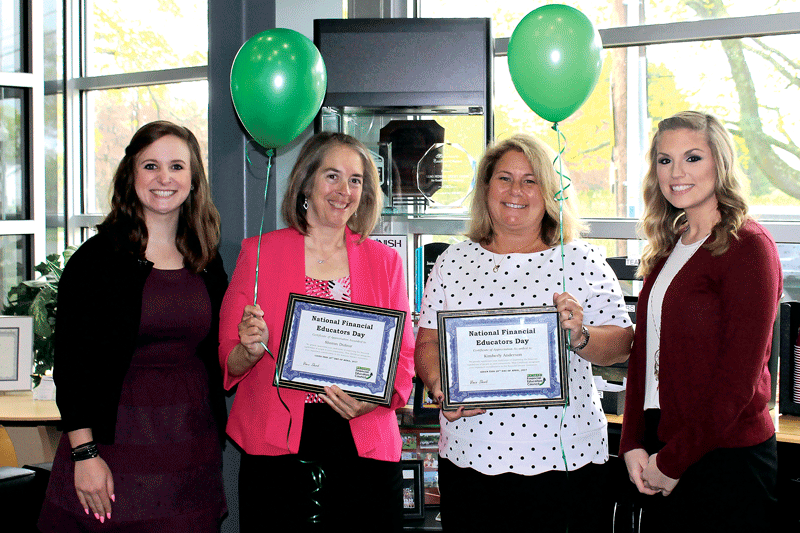
The reasons women ask for augmentations varies greatly, Brooks said, but there are a few common categories: early-20-somethings whose breasts are mismatched in size; women in their late 30s or early 40s who want a “mommy makeover,” feeling they’ve lose some volume and gained some sag after having kids; and women of any age who feel more attractive or confident with a different look, to name a few.

“This gives them a really great education in what I need to correct,” he said, adding that the technology is just as effective with reconstructions, typically after mastectomies with cancer patients, in that it can formulate a completely symmetrical look to the patient’s specifications.

According to data from the American Cancer Society, breast cancer is the most common cancer among U.S. women after skin cancer, representing nearly one in three cases. Furthermore, the ACS notes, seven out of 10 women diagnosed with breast cancer who are candidates for breast reconstruction are not aware of their options. As a result, fewer than one in five American women who undergo a mastectomy go on to have breast reconstruction.

“Many women are able to get an immediate breast reconstruction performed at the same time as the mastectomy, but that option depends on what treatment is necessary after surgery,” Brooks said. “Patients with breast cancer have numerous options to help them restore a breast to near-normal shape, appearance, and size following mastectomy or lumpectomy.”

Seeing the Future

Crisalix is only the latest option to reach that goal, and Brooks said patients have been pleasantly surprised at what the virtual images tell them. The technology to convert 2D images to 3D virtual reality is currently being used on five continents.

Dr. Glen Brooks says he was “awed” the first time he used the Crisalix technology.

Dr. Glen Brooks says he was “awed” the first time he used the Crisalix technology.

“Months ago, they asked whether I would re-up next year for the software license, and I said ‘absolutely,’” he told BusinessWest. “It makes what I do so much more precise, putting together the right outcome by showing exactly what we’ll provide to patient. It’s absolutely a home run.”

And it’s far from the only potential use of VR in the surgical world. The Wall Street Journal recently reported on others, such as GE’s early-stage testing of technology that will allow a doctor wearing a Rift headset to take a virtual tour of a patient’s brain and perhaps determine how surgery might affect various parts of it, and pediatric surgeons at Stanford University Medical Center who have used a virtual-reality platform from EchoPixel, a California startup, to plan surgeries on newborns missing pulmonary arteries. Another promising use of VR may be in medical training, as universities that can’t afford to store cadavers for education may be able to rely on virtual reality instead.

Even in cosmetic surgery, Crisalix isn’t limited to breast surgeries; the company also touts its use for eyelids, faces, and other body parts, though Brooks says the impact on patients’ expectations isn’t as dramatic.

“For breast surgeries, it’s absolutely fantastic,” he said. “It’s a great feeling, seeing the change for themselves.”

Joseph Bednar can be reached at [email protected]