Home Posts tagged Entrepreneurship (Page 6)
Daily News

SPRINGFIELD — Shriners Hospitals for Children will be among the honorees at the Affiliated Chambers of Commerce of Greater Springfield’s (ACCGS) Business@Breakfast on Wednesday, Feb. 4 from 7:15 to 9 a.m. at Crestview Country Club, 281 Shoemaker Lane, Agawam.

Shriners Hospital for Children will be honored for its 90th anniversary. The hospital provides medical care to children with orthopaedic, neuromusculoskeletal, cleft-lip, and palate disorders and diseases. As well, GZA GeoEnvironmental Inc., a professional-services consulting firm focused on geotechnical, environmental, water, ecological, and construction-management services, will be saluted for its 50th anniversary, and FIT Solutions, a leader in IT staffing, will be honored for its 10th anniversary.

The breakfast will feature Dr. Steve Sobel, humorist and motivational speaker. Sobel will present “You’re a Piece of Work! Celebrate Joy, Passion, and Influence.” Sobels’s presentation will use humor to illuminate life’s possibilities and provide attendees with the tools needed to help them bring their ‘A’ game to their companies and customers.

Sobel, a speaker, educator, success coach, and trainer throughout the U.S. and Canada, blends humor with targeted and inspirational messages to companies, businesses, athletic teams, and professional groups. He is a former award-winning school principal and continues to teach part-time at the college level, including many courses on entrepreneurship and visionary leadership.

Reservations are $20 in advance for ACCGS members in advance ($25 at the door) and $30 for general admission. Reservations are suggested and can be made online at www.myonlinechamber.com.

Features
HitPoint Studios Brings Gaming Innovation to Downtown Springfield

The white rabbit in Fablewood

The white rabbit in Fablewood, a social game played on Facebook, is a fan favorite, says Paul Hake.


Aaron St. John says there are “three legs of the stool” that make a region fertile ground for businesses — and entire industries — to take root: access to talent, quality of life, and access to capital.

Until recently, he said, the perception among high-tech firms was that the Pioneer Valley had the first two in spades, but would always be trounced by the likes of Cambridge, New York, and Silicon Valley when it came to capital.

That perception is changing, he told BusinessWest, and HitPoint Studios is exhibit A.

The video-game-development company that he and Paul Hake started in 2008 has grown exponentially from its humble beginnings and now employs about 35 people. Based first in Greenfield, then Hatfield, and most recently in Amherst, the firm relocated to downtown Springfield last week, thanks to a commitment of $1.25 million by area investors to keep HitPoint local at a time when Boston and California were calling.

“Our entire round of funding is from the Valley,” St. John said. “We’ve had access to talent and good quality of life in this region — it’s a good place to live. But access to capital has been a challenge for this area. So I think it’s really encouraging that we didn’t need any outside funds.”

These investments in HitPoint’s future — about 40% of it from MassMutual’s Springfield Venture Fund and the rest from members of River Valley Investors — is a sign that the Valley’s reputation in this regard might be changing. The Venture Fund requires recipients to base their operations in Springfield, but regardless, St. John believes the city’s downtown is a natural spot for HitPoint to grow.

Aaron St. John

Aaron St. John says Springfield’s location, amenities, and rising profile make it an ideal place to grow HitPoint.

“Seeing all the entrepreneurship taking place in Springfield is very encouraging in a business where we rely on being innovative and finding creative solutions,” he said. “Being engaged by a city in that way, we got the feeling of an open door, of Springfield rolling out the red carpet, and asking, ‘what can we do?’ We felt this would be a good place for HitPoint.”

As they packed up boxes for the big move to the City of Homes, St. John and Hake talked with BusinessWest about what the move means for their company — and for the gaming industry in general.

Roads Taken

HitPoint’s founders traveled different roads to their eventual partnership. St. John’s older brother was an executive at Microsoft who introduced him to some of the big names in the game industry, and by age 16, he could see that making games — something he was passionate about — could be a viable career.

While still a teenager, on summer break from Earlham College in Indiana, St. John found himself interning for Monolith, a then-fledgling game company which is now one of the biggest online game portals. The company solicited game ideas from its people and got more than 100 back; of the three ideas deemed best, two were submitted by St. John. He was quickly hired on full-time.

That experience led to the development of Sanity: Aiken’s Artifact, which was brought to market by Fox Interactive. Later, St. John returned to his native Bay State to finish his degree at UMass Amherst; he launched his own design company, Golden Goose Games, soon after.

Hake, on the other hand, didn’t grow up playing video games; in fact, he wasn’t allowed to play console games at home. But he got hooked on computers after his father brought home an IBM PS2 and started teaching him how to program. Soon after, the family got another computer and a few PC games, and he played them all the time.

At UMass, he got more into gaming — not just playing them, but making them, using his programming background and the classes he was taking to build his skills in that arena. When the results of one assigment — he created a scrolling game with flying and shooting features — was particularly well-received, he decided this was what he wanted to do with his life.

So, after college, Hake landed a contract position with the Tiger Electronics division of Hasbro Toys. Eventually, he gained enough experience and contacts developing games that he was able to launch his own company, Paul Hake Productions, in 2004.

Having both attended UMass for a spell, the pair worked together casually from time to time and decided to go into business together in 2008. They began with eight employees — four from each company — but soon saw their enterprise take off.

HitPoint has long specialized in four lines of business: branded entertainment, which are games designed for companies’ Websites; casual games, which are also typically work-for-hire projects; social games, typically played through Facebook; and independent games, which the company designs and distributes on its own — a niche St. John and Hake have been working to expand.

Not that partnering with other companies hasn’t been lucrative.

“We were a first-party partner with Microsoft, one of two they chose to work with. We were developing their strategic titles for launch of Windows 8; we did about 12 titles for Microsoft, all featured in the App store, all top-grossing and top-ranked,” St. John said. “Then, just this past year, we worked on a product with Dreamworks to promote How to Train Your Dragon 2, a map-based explorer game, where you fly a dragon over a real, updating GPS map.”

In addition, HitPoint boasts several social games on Facebook — including Fablewood, Seaside Hideaway, and Jane Austen Unbound — with another set to release soon.

Facebook games and many mobile games are free to play, but are often monetized with ‘punch points’ in the game where there’s a significant time investment to get to the next level — and an option to get past those punch points faster by paying. The biggest hits of the genre can be extraordinarily lucrative. And with most people now playing games on their phones, mobile platforms represent an area of the gaming market that’s only expected to continue its surge in popularity.

Nuts and Bolts

Designing and developing each game is a painstaking process involving programmers, gameplay designers, graphic artists, sound specialists, and others. To coordinate them, St. John and Hake adhere to a software-development process known in the industry as ‘scrum,’ in which phases of a project are broken into short ‘sprints’ with specific goals. It’s the reason HitPoint can keep upwards of 15 projects in the air at one time.

Each must undergo a process of risk assessment and profit projection before being greenlit, which involves determining what’s achievable in the amount of time available and whether a project complements the company’s strategic goals — goals that will now turn heavily to independent projects, starting with a new product set to launch in the second quarter of 2015; they’re hush-hush on the details right now.

“We want to be focused around our own titles,” St. John said. “We work with other companies — we’re continuing our relationship with American Family Insurance, with one of the biggest insurance-based games, and we have relationships with some of the larger companies in the industry, like EA and a large Japanese company. But most of our effort is spent on games we’re launching and maintaining ourselves, where we own the game and the infrastructure.”

They’ll be entering this new phase in downtown Springfield — One Financial Plaza, to be exact — during a time of bustling activity in the neighborhood, with class A tenancy rates up in the towers; investments by a host of companies as well as UMass, Bay Path University, and Cambridge College; and, of course, the $800 million MGM Springfield casino set to open in 2017.

It definitely represents a more jarring change than HitPoint’s last move, from a retrofitted barn in Hadley to digs on University Drive in Amherst.

For that last move, “we mostly wanted to get out of the barn,” Hake said with a laugh. “It was getting a little old and crowded, and during the past few years, we’d been building up our own properties, including the suite of games on Facebook that we own and a couple of games on mobile as well.”

Then, starting early last year, he continued, “we discussed raising capital to continue our independent growth, and as part of that, we’re making this move to Springfield.”

St. John said there’s no reason why Springfield can’t be an attractive spot for companies such as his. “There’s easy access to [Bradley] airport, and we have several people that live close to Boston, who have much easier access to the office. I’m excited about all that. With the new-product innovation we have planned, we expect to grow quite a bit out of Springfield over the next two or three years.”

St. John has always been loath to look beyond Western Mass. as HitPoint’s headquarters, saying the the region’s colleges provide a solid pipeline of talent.

“We’ve gotten a lot of mileage out of being in Western Massachusetts,” he told BusinessWest. “Frankly, the game industry is pretty competitive, especially the competition for talent. We don’t have a warehouse, we don’t even have physical goods that we sell; the value of this company is in the people who work here. And the kinds of people we have to attract find the Valley a phenomenal place to live.”

He recognizes that being among the biggest players on the regional game-development block gives HitPoint, access to some of the top talent graduating from the region’s colleges and universities, but he also believes that, should the Valley become a hub for game developers as he believes it can, there will be plenty of talent to go around, because out-of-staters will be drawn by the quality of life. “We’ve found people who want to live here, people willing to move from California, New York, Texas.”

Downtown Dreams

The question, though, is can Western Mass. realistically become that video-game hub?

“That’s certainly my hope,” St. John said. “We’re hoping we can engage other entrepreneurs in area schools to look at the gaming industry, start game companies, and make their own games.”

He said HitPoint has been active with area colleges, and hosted two ‘game jams’ last year, at which students, with the help of faculty and HitPoint staffers, designed games for 24 hours straight.

“We saw a lot of talent and actually hired some people from those events; we’ve seen a few of them start their own projects on Kickstarter, things like that,” he noted. “It’s our hope — assuming we’ll be a successful presence in the area — that we’ll see a change in the perception students have about this area.

“That was certainly my perspective,” St. John continued. “I grew up in Amherst, and all I wanted to do was play games. We want to change people’s perceptions locally, but also change the industry perception, so people say, ‘why not Western Mass.?’”


Joseph Bednar can be reached at [email protected]

Opinion
Five Reasons to Be Optimistic About 2015

As the curtain comes down on 2014, a memorable year in many respects and one that produced large doses of momentum across the region, there are many reasons for optimism when it comes to the year ahead.

No one can truly predict what will happen regionally, nationally, or internationally in the months to come, but most signs are pointing to new levels of properity and vibrancy for the region. Here are five reasons for the business community to welcome the new year with its head up.

• An Improving Economy. Granted, not all businesses or business sectors saw bottom-line improvements in 2014, but many did, and both hard and anecdotal evidence reveals that something approaching real recovery may finally visit this region after steering clear of it since the Great Recession officially ended in 2009.

Indeed, jobless rates have improved, the housing market is slowly inching its way back up, and business confidence, as measured by Associated Industries of Mass. and other groups, has been steadily rising.

Even gasoline prices are cooperating in a big way. While they scare investors because of their potential to stifle the all-important energy industry, cheaper gas and oil are boons for consumers and business owners alike, and they amount to a huge stimulus package that puts money into the economy.

• The Casino. It will be at least two and a half years before anyone pushes the buttons on a slot machine, doubles down at the blackjack table, or brings a convention to the hotel being built by MGM. But one can already sense that the $800 million facility soon to rise in the South End is generating not only excitement, but opportunity.

Downtown Springfield’s commercial real-estate market is finally picking up steam; the long-suffering construction sector will soon have some long-term, lucrative work; and the tourism sector is aglow with expectation about what the casino will mean for the convention business. Meanwhile, the casino’s promise is spurring action on some long-delayed projects like the Court Square revitalization.

• Subway Cars. As we’ve written before, the announcement that Changchun Railway Co. will be building subway cars at the former Westinghouse site in East Springfield is positive news on several levels. It will bring jobs, and the kinds of well-paying jobs that everyone wants, but it has also brought a sense of accomplishment, a feeling that, yes, things like this can really happen here. And sometimes, developments like this one can give a region and its economic-development leaders a huge boost of confidence.

• A Surging University of Massachusetts. President Robert Caret announced recently that he will be leaving the university to take the helm at the University of Maryland. While that’s a setback in some ways — Caret brought strong direction to the school — UMass has in many ways reached a critical turning point when it comes to being the economic engine the state and this region always hoped it would be, and there seems little chance of it falling back.

While many of the recent developments at the school have involved Springfield, the impact is truly region-wide, with projects ranging from the High Performance Computing Center in Holyoke to the recently announced plans to establish a National Aeronautics Research, Development, and Training Center at Westover Air Reserve Base in Chicopee, with UMass Amherst as the lead institution. Expect more of the same in the months and years to come.

• A Focus on Entrepreneurship. This may well be the most compelling reason for optimism in the region, because this area will need much more than a casino to recover. It will need thousands of new jobs and opportunities to retain the young people who grew up here or attended college here. And the recent focus on fostering entrepreneurship — best exemplified by Valley Venture Mentors, its new accelerator program, and MassMutual’s Springfield Venture Fund — has the potential to provide both.

Springfield is not going to turn into Boston or Cambridge overnight, or even in a decade, most likely, but it will become a hub of entrepreneurial activity, and thus it can become home to dozens and perhaps hundreds of new startup companies.

For all these reasons and many more, 2015 is worthy of the growing sense of optimism this region is experiencing.

Agenda Departments

Business@Breakfast
Jan. 7: The entrepreneurial spirit of the region will take center stage at the Affiliated Chambers of Commerce of Greater Springfield’s Business@Breakfast on Jan. 7, from 7:15 a.m. to 9 a.m. at Ludlow Country Club, One Tony Lema Dr., Ludlow. Paul Silva, executive director of Valley Venture Mentors (VVM), will discuss “Putting the PIONEER Back in Pioneer Valley.” He will be joined by Natasha Clark, founder of LionessMagazine.com, a Western Mass.-based, all-digital magazine for the female entrepreneur. VVM is a nonprofit based in Springfield that provides key support to the entrepreneurial ecosystem through its mentorship and accelerator programs. Silva is the manager of the River Valley Investors angel-investor network and co-founder of the Valley Venture Mentors entrepreneurship-mentoring program and All in Play, a company creating software that helps the blind socialize with their fully sighted friends and families as equals. He is the former president of the co-working space and incubator Click Workspace. The breakfast will also honor Dr. Mark Keroack on his new role as CEO of Baystate Health, and recognize Andrew Associates on its 30th anniversary in business. Reservations are $20 for ACCGS members in advance ($25 for members at the door) and $30 for general admission. Reservations are suggested and can be made online at www.myonlinechamber.com.

WNEU Mini-Law School
Feb. 10 to March 10: Western New England University School of Law will open its doors to the community with a five-week program focused on demystifying the law. Starting on Feb. 10, the Mini-Law School will be held on Tuesday evenings from 6 to 8 p.m. at the Blake Law Center, Room D, 1215 Wilbraham Road, Springfield. “Individuals interested in becoming better-informed and engaging in stimulating dialogue will find this program rewarding,” said Pat Newcombe, associate dean for Library and Information Resources. “No legal knowledge is necessary, just a curious mind.” Mini-Law School offers non-lawyers an understanding of legal topics that impact their everyday lives. Each class is taught by School of Law faculty and moderated by the Hon. Kenneth Neiman, magistrate judge, U.S. District Court, District of Massachusetts. Blending theory and practice, the classes will focus on family law, health law, constitutional law, and environmental law. The sessions include:
• Feb. 10: “Welcome to Mini-Law School: An Inside View of Law School and the Courts,” presented by Neiman and School of Law Dean Eric Gouvin;
• Feb. 17: “Family Law: What Defines a Family?” presented by 
Professor of Law Jennifer Levi and Neiman;
• Feb. 24: “Health Law: End-of-Life Choices,” presented by 
Professor of Law Barbara Noah and Neiman;
• March 3: “Constitutional Law: Real Law or Just Another Kind of Politics?” presented by Professor of Law Bruce Miller and Neiman; and
• March 10: “Environmental Law: Legal Solutions to Pollution Challenges,” presented by 
Professor of Law Julie Steiner and Neiman.
“After five weeks, you won’t be a lawyer,” said Western New England University Associate Dean for Academic Affairs Beth Cohen, “but you will be able to better understand laws that have an effect on your life, and, unlike traditional law school, there are no tests or homework.” Tuition is $35 for all five sessions, or $10 for each individual session. The program is free of charge for any high-school, college, or graduate student with a valid student ID. To register by phone or for more information, call Newcombe at (413) 782-1616. Registration will continue through Jan. 19. Learn more at www.law.wne.edu/minilaw.

Difference Makers

March 19: The sixth annual Difference Makers award program, staged by BusinessWest, will be held at the Log Cabin Banquet & Meeting House. Details on the event will be published in upcoming issues of the magazine. Difference Makers is a program, launched in 2009, that recognizes groups and individuals that are, as the name suggests, making a difference in this region. The magazine’s editor and publishers are currently reviewing nominations, and this year’s class will be profiled in the Feb. 9 issue.

Origami-inspired Art Exhibit
Through April 26: “Origami Interpretations,” an exhibit of 25 vibrant paintings, sculptures, and prints by New York artist Gloria Garfinkel, will be on view at the George Walter Vincent Smith Art Museum through April 26. The works, produced in the late 20th century, feature bold color, energetic patterns, and abstract compositions inspired by Japanese designs and origami forms. The artist, whose work combines complex geometry and painterly invention, is particularly fascinated by the kimono, the traditional dress of Japan, and the obi, the wide sash that is worn as a belt with it. She appreciates the “beauty and tenacity” expressed through the garments and notes that Japanese women continually recycle and layer fabrics to create unique looks and patterns. Garfinkel is also inspired by the color-field artists of the mid-20th century who explored different optical effects by manipulating their canvases. Garfinkel carefully arranges her forms in very specific ways to create a uniquely approachable and participatory aesthetic experience. The exhibition features pieces from Garfinkel’s series “Gingko Kimono,” collaged etchings from the late 1980s; paintings inspired by the obi; etchings from the “Kiku” (chrysanthemum) series; Kado woodcut prints; Hanabi maquettes; and aluminum flip paintings.

40 Under Forty
June 18: The ninth annual 40 Under Forty award program, staged by BusinessWest, will be held at the Log Cabin Banquet & Meeting House. Details on the event, which honors the region’s most accomplished and civic-minded professionals under age 40, will be published in upcoming issues. Nominations are now open for the class of 2015, and are due by the end of the day (5 p.m.) on Feb. 6. The nomination form can be found at HERE, in this issue, and in upcoming issues.

Features
White Lion Brewing Is Making a Name for Itself

Ray Berry Jr.,

Ray Berry Jr., seen here at a display of White Lion at Table & Vine, says his company’s mission is to build a great brand and help revitalize a great city.

Not long after graduating from American International College with a degree in finance, Ray Berry Jr. went to work for a nonprofit agency called Mason Square Development Corp., which, as the name suggests, was dedicated to helping small-business ventures off the ground in that low-income Springfield neighborhood.

Summing up the now-defunct agency’s mission, Berry said it was created to help entrepreneurs understand the risks of a business venture and overcome their fear of accepting those risks, assist them with forging business plans, and guide them with the task of developing the connections and relationships needed to succeed.

“I think it’s important for any entrepreneur to map and frame out their ideas, utilize the networks that are in the community, and not be afraid to take advice along the way,” said Berry, who served the MSDC as deputy director. “There are individuals out there who have a tremendous amount of proven experience in establishing companies and moving them forward. If you have a vision or dream, and once you get through that fear of risk and get over that hurdle, you utilize the resources available and push your dream forward.”

Today, Berry is definitely practicing what he preached 15 years ago as he pushes his own dream forward.

It’s called White Lion Brewing Co., a venture he launched just a few months ago — after nearly four years of planning — with some working capital, an imaginative brand, an intriguing mission statement, and that aforementioned willingness to accept risk.

And in that short time, he has enjoyed what could only be called a roaring start while making White Lion “Springfield’s beer,” even though it’s not brewed here — yet.

As it states on the bottom of the six-pack container that features many of the city’s landmarks, “Springfield is our home. We share the city’s pride in its legacy of innovation and ingenuity. We intend to serve as a catalyst for Springfield’s renaissance. One that celebrates diversity and urban vibrancy. We have a dual mission: Build a great brand. Revitalize a GREAT CITY.”

The first component of that mission is still a work in progress, but Berry believes important strides have been made. The second? Well, he intends to be a big part of the renaissance he sees coming for Springfield by bringing the brewing operation to the city, and with it, jobs and a renewed sense of pride that in some ways is already evident.

“The city of Springfield does not have a product that folks can rally around, and it was important to me to create one,” said Berry, who by day is vice president of Administration and Finance for United Way of Pioneer Valley. “We want to be a game changer, a difference maker, part of the community fabric, part of the legacy that moves the city of Springfield forward.”

As for the brand … the white lion, a color mutation of the African lion, found in South Africa and zoos around the world but mostly in Europe, has nothing to do with Springfield. Or everything to do with it, if you listen to Berry.

“Folklore will state that it’s an extension beyond race, color, creed, or gender,” he explained, noting Springfield’s diverse population. “It doesn’t matter who you are, what economic status you come from, a white lion is a symbol of good in all mankind. It goes on to say that, if you’re in the presence of a white lion, you will be sanctified with infinite prosperity.”

Already, a strong connection is being forged between the city and the brand.

Indeed, when Gov.-elect Charlie Baker paid a visit to Springfield the day after the Nov. 4 election, Mayor Domenic Sarno had a six-pack of White Lion pale ale waiting for him as a gift.

That highly visible bit of marketing and public relations is only one way in which White Lion’s fast start has manifested itself. The company’s two products — there’s also a cream ale, with more on the way in 2015 — are now in more than 120 locations (liquor stores, bars, and restaurants) in Western Mass. and just beyond, and Berry has ambitious plans to grow those numbers and make his brand a household name.

For this issue, BusinessWest looks at his multi-phase strategy for making White Lion both a player in the craft-beer universe and a major player in Springfield’s future.

Mane Attraction

As he talked with BusinessWest after posing for some photos beside a rack of his products at Table & Vine in West Springfield, Berry used the opportunity to provide an education in the craft-beer industry and quantify and qualify its explosive growth.

“There are nearly two full aisles of craft beers here now, and new ones arrive regularly — there are more than 2,000 craft-beer establishments across the country,” he said while walking through one of them, pointing out a seemingly endless array of imaginative names — Smuttynose, Dogfish Head, Otter Creek, and Magic Hat, among others — and colorful packages. Some of these brands are local in origin, such as Berkshire Brewing in South Deerfield, Paper City in Holyoke, Fort Hill in Easthampton, and Iron Duke in Ludlow, while others are regional powerhouses like Samuel Adams and Harpoon.

WhiteLionBoxArtEntering such a crowded field would seem like a risk not worth accepting, but Berry thinks otherwise, and he started coloring in his entrepreneurial canvas roughly four years ago.

He did so after analyzing the market and noting one important point — there was no craft-beer product attached to Springfield, a city with a history of brewing operations, most of which didn’t outlast Prohibition; those that survived didn’t live long after it was repealed.

“The concept goes back at least four years; that’s how long I’ve been having general conversations with friends in the Valley around craft beer, their growing popularity, and the fact that there wasn’t a local product here in Springfield,” he explained. “But, like any entrepreneur with an idea, sometimes they come and go, so this idea came and went, I would sit on it, time would pass, and I would revisit it. I did that off and on for a three-year period.”

What eventually enabled him to break that cycle was research into the various options of getting a craft beer off the ground, including a contract-brewing business model, but also a growing sense that one of the ways he could have an impact in the region, and especially Springfield, was through entrepreneurship.

“I would sit with friends, especially after college, over the past 15 to 20 years and brainstorm about what we could do to make a difference, beyond what we were already doing with our volunteer work and our 9-to-5 jobs,” he told BusinessWest. “And it always gravitated back toward an entrepreneurial spirit.

“What I tell folks now is that we always had great ideas, but there was hesitation because we knew there was always risk associated with taking that step from idea to reality,” he went on. “And I think that probably held us back for some time, but it got to the point where we felt that now was the time to make a difference and be part of that ongoing change in the region.”

He used that collective ‘we’ to refer to those friends he conversed with and various team members he’s recruited since moving White Lion off the drawing board. These include brewmaster Mike Yates, who oversees the brewing of White Lion at Mercury Brewing in Ipswich; distributors Williams Distributing (Hampden and Hampshire counties), Quality Beverage (Central Mass.), and Girardi Distributors (Franklin and Berkshire counties); and warehousing partner R.M. Sullivan Co. in Westfield.

Berry told BusinessWest that success in the highly competitive craft-beer industry comes with being creative, not only with what goes inside the bottle (although that’s obviously important), but also with the name on the bottle, the packaging, the marketing and public-relations work, even the tap the bartender pulls to fill a glass with your product.

And he believes he’s effectively expressing his creativity, especially with the brand White Lion.

“We wanted to think outside the box,” he said, “and cause the consumer to, at a minimum, pause and ask the questions, ‘why that name? Where’d the name come from?”

People are now asking those questions across Western and Central Mass., said Berry, adding that the next pushes will be into the eastern part of the Bay State and Northern Conn.

Coming to a Head

Creating a brand, hiring a brewmaster, outsourcing brewing operations, and forging relationships with a warehouse operator and distributors are just some of the many components of what Berry called phase 1 of his entrepreneurial venture.

Others include launching a website, use of various social-media vehicles to gain visibility, and creation of imagery and packaging that can compete with all those offerings seen in the aisles at Table & Vine, assignments being handled by the Springfield-based companies DIF Design and TSM Design, respectively. There’s also the tasks of building a portfolio of locations that will offer White Lion products and getting the word out about those products.

With the former, Berry has forged relationships with a number of liquor stores and bars, and also with several restaurants in and around the city, including the recently reopened Fort, Max’s and Max Burger, Nadim’s, Plan B Burger, and others. And there have ben discussions with MGM about making the products available in the $800 million casino to be built in the South End.

Meanwhile, the products have gained exposure through a number of events and public-relations efforts, including Baker’s visit to the mayor’s office, but especially a launch event on Oct. 21 at the Lyman & Merrie Wood Museum of Springfield History that drew more than 300 people. Berry has also been telling the story to area Rotary clubs, chambers of commerce, and other groups.
But there is other work to be done as well, he said, and much of it echoes the advice and services provided to entrepreneurs by Mason Square Development Corp., he said, adding that many of these assignments fall into the categories of relationship building and tapping into resources that can help a venture grow.

Ray Berry Jr. says he has a product — and a name — that will stand out in the crowded craft-beer market.

Ray Berry Jr. says he has a product — and a name — that will stand out in the crowded craft-beer market.

As one example, he cited White Lion’s success in becoming one of the 30 ventures chosen to comprise the first cohort of the accelerator program created by Valley Venture Mentors and funded through a grant from MassMutual.

There are substantial cash awards for ventures that fare well in what amounts to a four-month learning experience, mentoring exercise, and competition, noted Berry, but the bigger reward is the ability to tap into the knowledge and resourcefulness of those leading the accelerator program.

“Teams such as White Lion are going to be in front of a multitude of individuals who are there to provide advice for startups,” he said. “It’s going to be a great opportunity for all these companies.”

As another example, he cited a relationship forged with AIC to bring two or three interns each year into the White Lion operation, giving the company access to young talent and potential future employees, while providing those students with real-world experience with a growing enterprise.

“This partnership will enable three seniors majoring in marketing to get hands-on experience and be part of this new startup,” Berry explained, “all while having the principles they learned in school applied to real-life scenarios.”

As for phase 2 of this operation, that entails bringing the brewing operation, as well as other components of the company, under one roof in Springfield, preferably in or near the central business district, and then taking the brand into new markets in the Northeast and eventually beyond.

Berry said he’s engaged in discussions with city officials with the goal of identifying 8,000 to 10,000 square feet of manufacturing space to house brewing equipment, a bottling line, and possibly a canning line. His planned timeline is to have such a facility in operation by late 2016, but there will be challenges to meeting it, especially the need to raise the estimated $1 million to $1.5 million he’ll need to create his operations facility through what he expects will be a mix of debt and equity financing.

Berry is hoping that his ongoing efforts to create exposure, as well as participation in VVM’s accelerator program, will open the eyes of not only beer drinkers, but potential investors as well.

In the meantime, he intends to foster controlled growth and carefully manage the company’s progression.

“We’re a very, very young company, and we have to be very careful not to overextend ourselves,” he explained. “Everything will be well thought out prior to making any major decisions. Every step has been well planned, and our placement has been right on target. The future of White Lion will follow suit.”

Ale’s Well That Ends Well

Looking forward, Berry said there are many directions his venture might take.

He noted, for example, that, as the craft beer industry continues to take market share from industry giants such as Miller and Anheuser Bush, those larger players are responding by acquiring some of those much-smaller rivals in deals that feature large numbers of zeroes.

Such a fate might await White Lion, he said, adding quickly that, for now, he’s simply focused on building exposure for his product, expanding its footprint, verifying its sustainability, and making real progress with phase 2.

The company has indeed enjoyed a roaring start, but Berry knows that this is in all ways a marathon and not a sprint — and he’s in it for the long haul.


George O’Brien can be reached at [email protected]

Agenda Departments

Affiliated Chambers’ Business@Breakfast
Jan. 7: The entrepreneurial spirit of the region will take center stage at the Affiliated Chambers of Commerce of Greater Springfield’s Business@Breakfast on Jan. 7, from 7:15 a.m. to 9 a.m. at Ludlow Country Club, One Tony Lema Dr., Ludlow. Paul Silva, executive director of Valley Venture Mentors (VVM), will discuss “Putting the PIONEER Back in Pioneer Valley.” He will be joined by Natasha Clark, founder of LionessMagazine.com, a Western Mass.-based, all-digital magazine for the female entrepreneur. VVM is a nonprofit based in Springfield that provides key support to the entrepreneurial ecosystem through its mentorship and accelerator programs. Silva is the manager of the River Valley Investors angel-investor network and co-founder of the Valley Venture Mentors entrepreneurship-mentoring program and All in Play, a company creating software that helps the blind socialize with their fully sighted friends and families as equals. He is the former president of the co-working space and incubator Click Workspace. The breakfast will also honor Dr. Mark Keroack on his new role as CEO of Baystate Health, and recognize Andrew Associates on its 30th anniversary in business. Reservations are $20 for ACCGS members in advance ($25 for members at the door) and $30 for general admission. Reservations are suggested and can be made online at www.myonlinechamber.com.

WNEU Mini-Law School
Feb. 10 to March 10: Western New England University School of Law will open its doors to the community with a five-week program focused on demystifying the law. Starting on Feb. 10, the Mini-Law School will be held on Tuesday evenings from 6 to 8 p.m. at the Blake Law Center, Room D, 1215 Wilbraham Road, Springfield. “Individuals interested in becoming better-informed and engaging in stimulating dialogue will find this program rewarding,” said Pat Newcombe, associate dean for Library and Information Resources. “No legal knowledge is necessary, just a curious mind.” Mini-Law School offers non-lawyers an understanding of legal topics that impact their lives. Each class is taught by School of Law faculty and moderated by the Hon. Kenneth Neiman, magistrate judge, U.S. District Court, District of Massachusetts. Blending theory and practice, classes will focus on family law, health law, constitutional law, and environmental law. They include:
• Feb. 10: “Welcome to Mini-Law School: An Inside View of Law School and the Courts,” presented by Neiman and School of Law Dean Eric Gouvin;
• Feb. 17: “Family Law: What Defines a Family?” presented by 
Professor of Law Jennifer Levi and Neiman;
• Feb. 24: “Health Law: End-of-Life Choices,” presented by 
Professor of Law Barbara Noah and Neiman;
• March 3: “Constitutional Law: Real Law or Just Another Kind of Politics?” presented by Professor of Law Bruce Miller and Neiman; and
• March 10: “Environmental Law: Legal Solutions to Pollution Challenges,” presented by 
Professor of Law Julie Steiner and Neiman.
“After five weeks, you won’t be a lawyer,” said Western New England University Associate Dean for Academic Affairs Beth Cohen, “but you will be able to better understand laws that have an effect on your life, and, unlike traditional law school, there are no tests or homework.” Tuition is $35 for all five sessions, or $10 for each individual session. The program is free of charge for any high-school, college, or graduate student with a valid student ID. To register by phone or for more information, call Newcombe at (413) 782-1616. Registration will continue through Jan. 19. Learn more at www.law.wne.edu/minilaw.

Difference Makers
March 19:
The sixth annual Difference Makers award program, staged by BusinessWest, will be held at the Log Cabin Banquet & Meeting House. Details on the event will be published in upcoming issues of the magazine. Difference Makers is a program, launched in 2009, that recognizes groups and individuals that are, as the name suggests, making a difference in this region. The magazine’s editor and publishers are currently reviewing nominations, and this year’s class will be profiled in the Feb. 9 issue.

Origami-inspired Art Exhibit
Through April 26: “Origami Interpretations,” an exhibit of 25 vibrant paintings, sculptures, and prints by New York artist Gloria Garfinkel, will be on view at the George Walter Vincent Smith Art Museum through April 26. The works, produced in the late 20th century, feature bold color, energetic patterns, and abstract compositions inspired by Japanese designs and origami forms. The exhibit will also serve to complement the extensive collection of Japanese decorative art from the 18th and 19th centuries on view on the second floor of the museum, and masterpieces of Japanese arms and armor in the gallery at the south end of the building.

Daily News

SPRINGFIELD — The entrepreneurial spirit of the region will take center stage at the Affiliated Chambers of Commerce of Greater Springfield’s Business@Breakfast on Jan. 7, from 7:15 a.m. to 9 a.m. at Ludlow Country Club, One Tony Lema Dr., Ludlow.

Paul Silva, executive director of Valley Venture Mentors (VVM), will discuss “Putting the PIONEER Back in Pioneer Valley.” He will be joined by Natasha Clark, founder of LionessMagazine.com, a Western Mass.-based, all-digital magazine for the female entrepreneur.

VVM is a nonprofit based in Springfield that provides key support to the entrepreneurial ecosystem through its mentorship and accelerator programs. Silva is the manager of the River Valley Investors angel-investor network and co-founder of the Valley Venture Mentors entrepreneurship-mentoring program and All in Play, a company creating software that helps the blind socialize with their fully sighted friends and families as equals. He is the former president of the co-working space and incubator Click Workspace.

The breakfast will also honor Dr. Mark Keroack on his new role as CEO of Baystate Health, and recognize Andrew Associates on its 30th anniversary in business. Reservations are $20 for ACCGS members in advance ($25 for members at the door) and $30 for general admission. Reservations are suggested and can be made online at www.myonlinechamber.com.

Opinion
New EDC Leader Faces Stern Challenges

In a way, Richard Sullivan is assuming leadership of the Economic Development Council (EDC) of Western Mass. at an ideal time.

Indeed, there are many signs of progress in this region, and the outlook is generally quite positive.

A Chinese company is making Springfield its North American headquarters, and it will soon begin producing subway cars at the old Westinghouse site. Meanwhile, in the city’s downtown, there is a burgeoning undercurrent of entrepreneurship and innovation that could eventually lead to hundreds, if not thousands, of new jobs and put this region on the map as a place to start or build a company. And then, there’s that $800 million casino that will soon start to take shape in Springfield’s South End.

Beyond the city’s borders, a host of promising developments are taking place. Holyoke is building its own innovation district, and the Paper City is increasingly seen as a destination for entrepreneurs because of its abundance of affordable real estate and improving quality of life. Meanwhile, Westfield’s long-moribund downtown is coming back to life, East Longmeadow is booming and becoming a preferred residential and commercial mailing address, and the Northampton-Hadley-Amherst corridor continues to thrive.

There are other success stories unfolding, and together they would seem to put Sullivan, former mayor of Westfield and currently Gov. Deval Patrick’s chief of staff, in the right job at the right time.

But there are some obvious challenges ahead, and many fall outside of what many see as the standard definition of economic development — filling industrial parks with new employers.

Let’s start with workforce issues. If this region is to thrive and attract new businesess, it will need a strong workforce in place, and there are emerging trends that will make this a difficult assignment. As the story on page 24 explains, analysts project a large and potentially harmful shortfall in the number college-educated people in the years to come, and Western Mass. could be one of the harder-hit areas.

Meanwhile, the demographics of this region are changing in a profound way. The minority population will soon comprise the majority, and for many in this constituency, there are roadblocks in the way of becoming part of a highly trained workforce.

One of the challenges for not only area colleges and universities, but also economic-development leaders, is to find ways to get more area young people through high school, into college, and then through college with a degree. If this doesn’t happen, the region’s economic growth will be stunted.

As for the casino, yes, it will bring jobs, change the landscape in downtown Springfield, and make this region a much more attractive site for meetings and conventions. But it will also pose challenges — to individual businesses in the hospitality industry, and to communities such as Northampton, which are popular destinations for tourists. It is incumbent upon the EDC and other business-related groups to develop ways to integrate the casino into the business community and not have it dominate the picture.

Other challenges include the ongoing consolidation of many sectors, especially financial services, which could cost this region jobs and career opportunities, as well as the need to develop new jobs in such fields as the biosciences and clean energy, because manufacturing and a casino will not be enough.

While doing all that, the EDC must also do a much better job of making this region’s business community aware of its mission, how it fulfills it, and why area business leaders must continue to support this agency.

Back in the spring, we encouraged Sullivan to pursue this position because we thought he had the various qualities — everything from intelligence to imagination to strong leadership — needed to get the job done.

He now has the job, and we believe he’ll do well with it. That’s because he won’t shrink from those challenges, but instead address them head-on.

He’ll have to do that, because the continued vitality of the region is at stake.

Departments Picture This

Send photos with a caption and contact information to: ‘Picture This’ c/o BusinessWest Magazine, 1441 Main Street, Springfield, MA 01103 or to [email protected]

Entrepreneurship Conference

JVP_4762image002image001image004

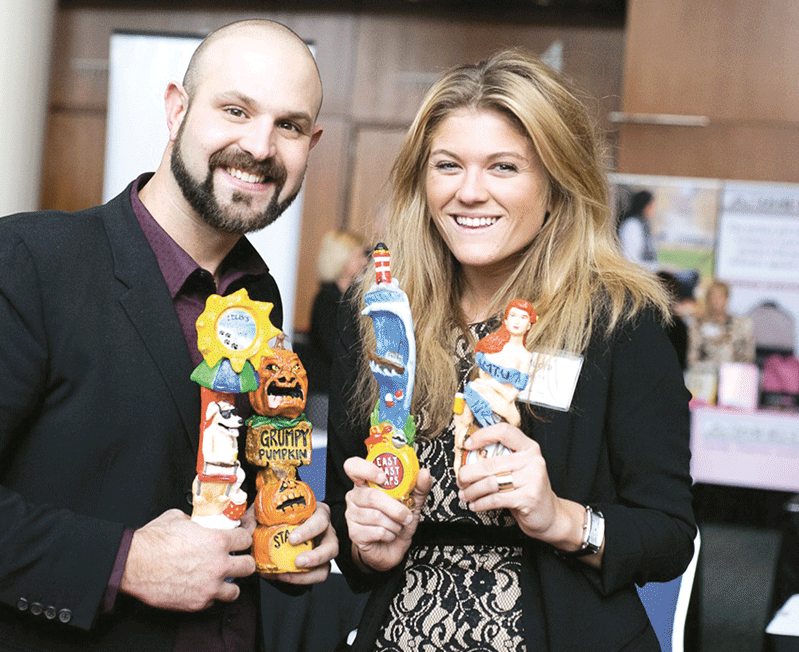
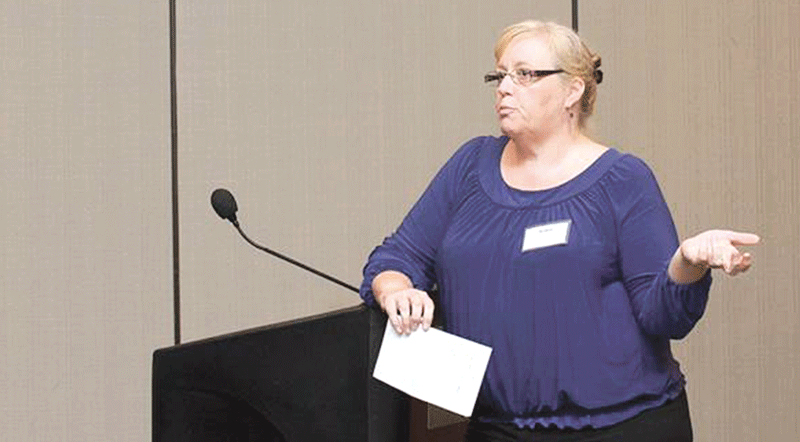
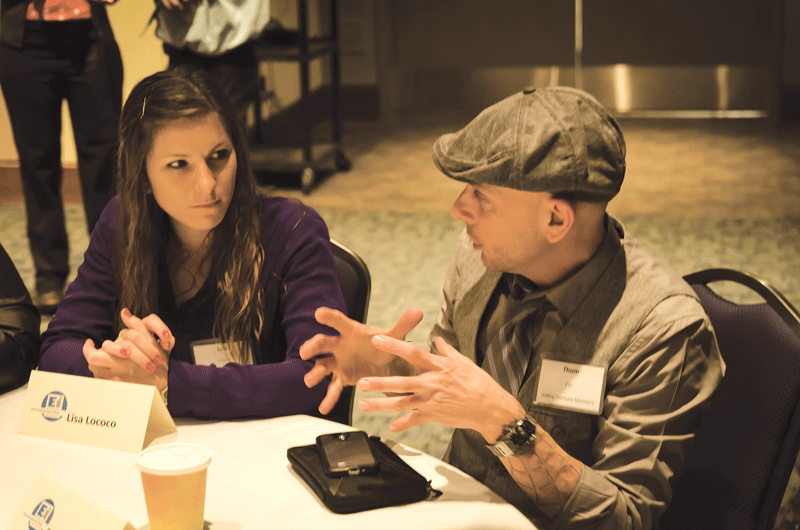
The 10th annual Grinspoon, Garvey & Young Entrepreneurship Conference was staged Nov. 7 at the MassMutual Center in Springfield. More than 650 people representing 14 area colleges and more than 55 local businesses and organizations took in a full day of programming, including hands-on workshops, entrepreneur exhibits, a Shark Tank competition, and keynote speaker Parker Holcomb, founder of All College Storage Inc. and Research Habits Digital. Organized by the Harold Grinspoon Charitable Foundation, the Entrepreneurship Conference is held annually to inspire, motivate, and support college students to turn their ideas into small businesses. Students began the day collaborating on teams representing several colleges and universities for the “Change-It-Up” competition. They identified contemporary problems they see emerging on their campuses and aimed to create solutions based on rapidly changing technology and the expectations of students. From top to bottom: Audra Quintin (a Grinspoon Entrepreneurial Spirit Award alumna) and Blake Bryan, co-founders of East Coast Taps; Greg Lewis of Nudger presents the story of building his business as part of the Grinspoon Entrepreneurial Spirit Award panel; a student presents her business concept to the Shark Tank judges; Patrick Burr, principal with Feat Socks and Promo Lacrosse, and a Grinspoon Entrepreneurial Spirit Award winner, was one of 32 exhibitors at the conference.

March of Dimes Awards

Glenn-Markenson-AwardNancy-Mirkin-Award


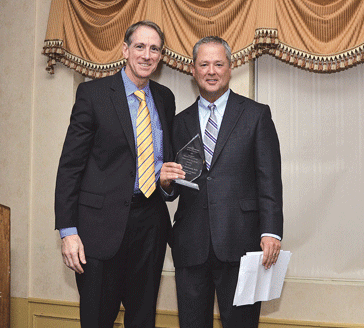
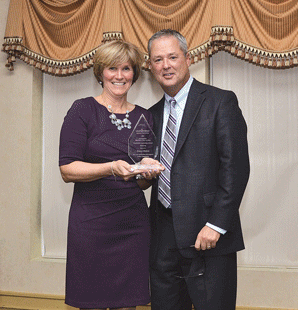
The annual March of Dimes Signature Chefs Auction was held at the Log Cabin in Holyoke on Oct. 23. The event featured the presentation of several awards to people who have served the organization in various ways. At left, Dr. Glenn Markenson of Baystate Medical Center, left, receives the March of Dimes Citizen of the year Award from Western Mass. March of Dimes Board Chairman Ken Albano, an attorney with Bacon Wilson, P.C. Above, Nancy Mirkin, a vice president and commercial loan officer with Florence Savings Bank, receives the March of Dimes Charitable Leadership Award from Albano.

Halloween Costume Walk

photo-3
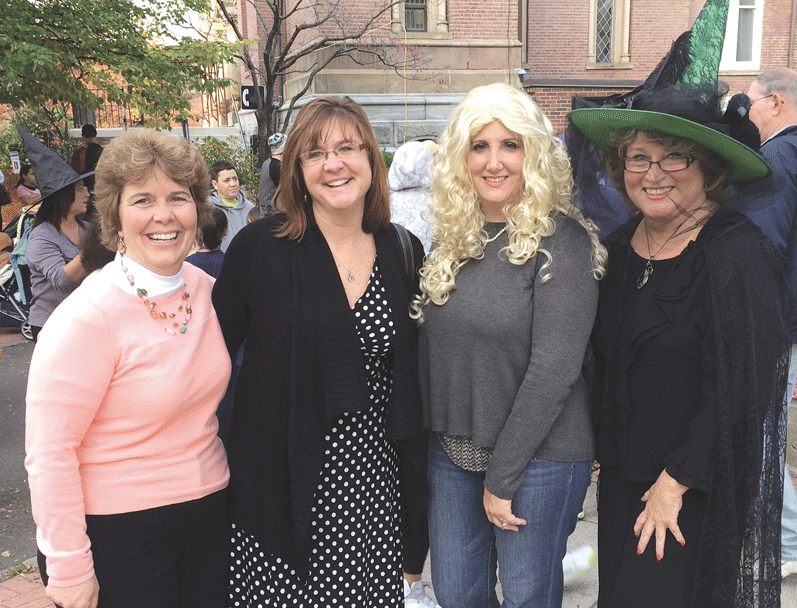
The Chicopee Pumpkin Patch Party & Halloween Costume Walk was staged on Oct. 28. The well-attended event featured something for people of all ages. Here, from left, are Mauren Buxton, city Treasurer Marie Laflamme, Chief executive officer of Sunshine Village Gina Golash Kos, and Carol Campbell, President of Chicopee Industrial Contractors.

Cover Story
New Owners Change the Face of a Landmark

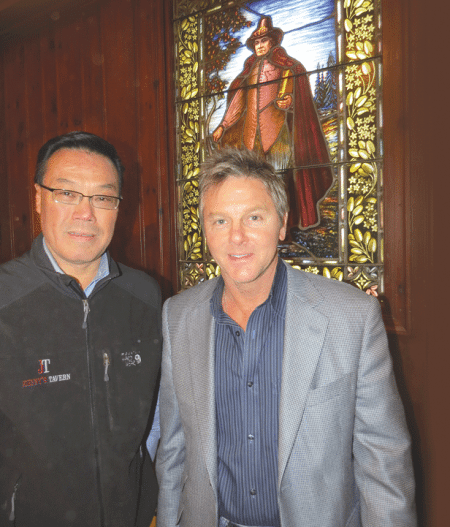
Andy Yee, left, and Peter Picknelly

Andy Yee, left, and Peter Picknelly, two of the partners resurrecting the Student Prince.

Andy Yee remembers hearing his phone ring, recognizing the number as Peter Picknelly’s … and then grabbing a chair.

That’s because he had a pretty good idea why the chairman and CEO of Peter Pan Bus Lines was calling, and therefore he also knew that this was unlikely to be a short conversation.

He was right.

By the time it was over, the two business executives and serial entrepreneurs hadn’t actually finalized a deal to become partners in a plan to reopen and revitalize the Student Prince restaurant (a/k/a the Fort) in downtown Springfield, whose owners, the Scherff family, had announced their intention to close and hopefully sell the establishment. But they were well on their way.

It would take only a few more meetings to seal a deal that would eventually involve some other players as well, said Yee, a principal with the Bean Group, which operates three establishments in the area, most notably the Hu Ke Lau in Chicopee. And this was because all those involved recognized the importance — to them personally, but also to the region — of bringing back a restaurant that they described not with that noun, but instead with a host of others, including landmark, institution, icon, and ‘home.’

“The Fort is just a part of Springfield’s DNA,” said Picknelly, finding yet another phrase to describe the property at 8 Fort St. “I’ve been going there since I could walk, and now I bring my kids, and I want them to be able to continue going there.”

He now owns 50% of the business, with the other half split between Yee and Kevin and Michael Vann, the father-and-son principals of the business consulting group the Vann Group, who became involved early on in the process of sizing up if and how the Fort’s fortunes could be reversed — and by whom.

In interviews with the media just after it was announced that he would lead a team to acquire the Student Prince and reopen it, Picknelly used the word “tweak” early and often to describe what needed to be done with regard to everything from the décor to the menu.

But as Yee and Picknelly looked more closely at matters, they decided that tweaking wasn’t going to be nearly enough.

The partners are planning a major overhaul, but one they insist will not change the character of the establishment, but merely make it more appealing to a wider and deeper audience, especially the younger generations.

“We’re enhancing the charm of the Fort,” he said, adding that the beer-stein collection will remain — and be expanded — while other qualities of the landmark, such as the carolers during the holiday season, will be preserved. “Our design team says we’re bringing back old Germany, we’re bringing back old Boston, we’re bringing back old New York. The wonderful work that that the Scherff family did for eight decades will only be enhanced and improved upon.”

Student Prince

An artist’s rendering of the layout of the bar area at the new Student Prince.

The partners are putting in a new kitchen, tearing down the wall between the two bars that existed previously and installing a new one, and putting in new furniture, among other steps. But mostly, they say they’re opening things up and “connecting people” in ways the old configuration couldn’t.

As they discussed what’s happened since they got started with the project in late summer, both Yee and Picknelly said it’s been a labor of love for them, one that has revealed to all those involved just how revered the Student Prince was and how no one wanted to see talk of it restricted to the past tense.

They told BusinessWest that constituencies ranging from Springfield city officials to beer distributors to individuals they passed in the aisle at the supermarket have praised their efforts and said, in essence, ‘what can we do to help?’

“I was at an event recently, and I got surrounded by people saying, ‘thank you for saving the Student Prince,’” said Yee. “It’s been great hearing those kinds of comments — the message of us saving this brand is huge, not just in Hampden County, but Hampshire County as well.”

Picknelly agreed. “There’s an enormous sense of pride in bringing this iconic restaurant back. As I told my wife, it’s the right thing to do.”

For this issue and its focus on entrepreneurship, BusinessWest talked with those involved with revitalizing the Student Prince about their efforts and the passion that drives them.

Art of the Deal

As he searched for ways to explain the importance of the Student Prince to his family — and the region as a whole, for that matter — Picknelly decided that he could best tackle that assignment by recalling a question — and especially the answer to it — that he put to his father, Peter L. Picknelly, on his 70th birthday, just a few years before he passed away.

“I asked him, ‘what are some of the most memorable things in your life?’” he recalled. “And one of the first things he mentioned was getting off the train after the Korean War and walking down Main Street toward the bus terminal, which was on Bridge Street back then. He came up to Fort Street, looked down, and saw Ruppert [Rupprecht Scherff] standing there. And he said, ‘I knew I was home.’

“I don’t know why he took the train instead of the bus,” he went on with a laugh, adding that he still gets emotional when he tells that story, which he has often over the past five months, since Scherff’s son, Rudy, told him his family — including his brother, Peter, and sister, Barbara Meunier — were looking to sell and asked whether he knew someone who might be interested in taking over.

Scherff made similar calls to others who had been friends and long-time customers, including Steven Roberts — president and CEO of F.L. Roberts and, like all the others involved in this project, a long-time patron of the Fort — who would help set in motion a chain of events that would bring a new ownership team together.

“I always saw the Fort as a symbol of Springfield,” said Roberts, who recalls going to restaurant shows with both Rudy Scherff and his father, Ruppert. “There were businesspeople that I had relationships with who came to Springfield once a year at least, to go the Fort restaurant — they loved it.

“I saw the possible disappearance of the Fort as an arrow in the heart of Springfield and its sex appeal, and I could not imagine that happening,” he went on. “I had to do something to help Rudy out of his dilemma.”

Roberts said his primary contribution was suggesting people that Scherff might turn to for assistance, and one of the first names he gave him was Kevin Vann, a consultant to many in the restaurant sector who described himself as a “first responder” in this rescue effort.

“Steve knows us and knows our history with hospitality and restaurants as far as consulting and business advice, and asked if I would take a peek under the hood,” Vann told BusinessWest, adding that he talked at length with Scherff about the situation at the Fort and gained a full appreciation of the financial situation.

Vann didn’t get into any specifics or provide any numbers, but summed things up this way: “Rudy sensed it was time for the Fort to get some help.”

So Vann and others set about getting him some.

With Picknelly ready to step in, the search commenced for a restaurant-sector veteran with whom he could partner to orchestrate the turnaround effort. One of Vann’s first calls was to the Yee family to gauge its interest in expanding its hospitality-sector influence into downtown Springfield.

“The Vanns had been counsel to the Yee family for many, many years,” he noted. “We looked around and wondered who we could bring in that knows how to operate restaurants, plural, successfully, and I thought of them immediately. Before you know it, we were all sitting at the table; it was kind of meant to be.”

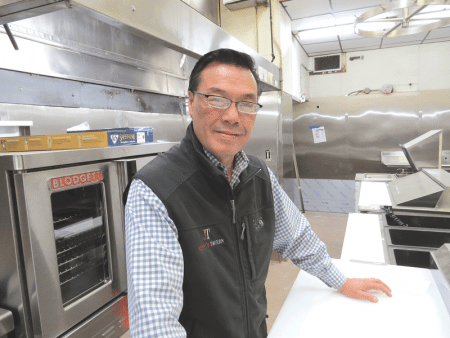
Andy Yee stands in the new kitchen at the Fort

Andy Yee stands in the new kitchen at the Fort, one of many steps taken to revitalize the Springfield landmark.

The Yee family brought more than a half-century of restaurant experience to that table. It was Andy’s father, Johnny, who started the Hu Ke Lau on Memorial Drive in Chicopee in 1965. He would eventually go on to operate several restaurants around the country before selling them off one by one.

Andy Yee and his siblings, Anita, Edison, and Nick, as well as several of their children, now operate three establishments — the Hu Ke Lau, Johnny’s Tavern in Amherst, and Johnny’s Bar & Grill in South Hadley (the latter two named after Johnny Yee, who passed away in 2003).

In all three establishments, the family has learned how to cater to the needs of various audiences, including the younger generations, said Yee, adding that this is a skill set that will be needed at the Fort.

Landmark Decisions

When asked about what he thought happened to the Fort over the past several years, Picknelly chose his words carefully, not wanting to be critical of the family that kept the landmark open all those years.

He said, in essence, that the establishment had not kept up with the times and was not doing all it could to appeal to younger audiences. “They were not as agile as they needed to be,” he explained.

Bringing much more agility — and responsiveness to the wants and needs of younger constituencies — is the unofficial mission for the new leadership team, and Picknelly and Yee said they will carry out that assignment in a number of ways.

Indeed, as they talked about their plans moving forward and a slated reopening on the night before Thanksgiving, Picknelly and Yee noted that there is considerable work to be done at the Student Prince — starting with replacing the hundreds of items that grew legs between the time Rudy Scherff announced his intention to shutter the restaurant and when the doors actually closed.

“People took beer mugs, they took silverware, they took plates — at least a third of their plates are gone; people were putting them in their pocketbooks,” said Picknelly, referring to long-time patrons who wanted to bring a piece (or several pieces) of the Fort home with them when they left for what some felt might be the last time. “They were coming out with plastic utensils toward the end because they had no silverware left.”

Turning serious, the two said the task they’ve undertaken is to maintain the restaurant’s character, or “what made the Fort the Fort,” said Yee, while also modernizing it, creating that aforementioned connectivity, and making the landmark a preferred venue for the younger generations who have not supported it to the extent their parents and grandparents did.

Inside, the partners are giving the Fort a new, more open, more contemporary look, while still maintaining the old-world charm that patrons coveted.

Steps include a new kitchen, the revamped bar area, improved traffic flow for patrons and staff alike, new woodwork and chandeliers, and a much larger ladies room, something Picknelly mentioned as a real priority.

Meanwhile, there will be some changes to the menu as well.

“German food is very heavy,” said Yee, adding that many people, especially the younger generations, prefer lighter fare, and the new Fort will respond accordingly.

The key to long-term success — the partners, and most observers, are expecting a very strong start and holiday season — is getting the younger professionals to make the Fort one of their destinations, said Yee.

“We want to make sure that young professionals are frequent fliers at the Student Prince,” he told BusinessWest. “This has always been a venue for conducting business — personally, I’ve made a number of deals at those tables — and now we want this to be a place where these emerging young professionals can do business.

“We want them to come and see for themselves, and we’re going to be accommodating to their palates,” he went on. “They have certain likes that we’re attuned to and that we’ll provide.”

Fare Game

As they relayed memories of visits to the Fort decades ago, both Yee and Picknelly recalled the restaurant’s legendary glassware known as a boot — because that’s what it was shaped like.

A boot held nearly 30 ounces of beer, said Yee, adding that is now illegal to dispense brew in such quantities.

However, the partners say they will likely introduce a smaller, street-legal version of the glass, something that will honor the traditions and the charm of the landmark, but also work in this different era.

In a way, that’s what’s happening with every aspect of this turnaround effort, from the design of the bar to the items on the menu.

If it all meshes as Yee, Picknelly, and the other partners believe, then this critical part of Springfield’s DNA will have a chance to write much more history and create many more memories.


George O’Brien can be reached at [email protected]

Commercial Real Estate Sections
New Headquarters Facility Promotes Fun, Professionalism

Paragus Strategic IT founder Delcie Bean

Paragus Strategic IT founder Delcie Bean in ‘Beantown.’

Sherwin Williams calls it “outrageous green.”

That’s the exceedingly bright, neon-like shade that has come to define the company now known as Paragus Strategic IT since it changed its name from Valley ComputerWorks and embarked on an aggressive branding initiative several years ago.

And there’s a lot of it at this technology-solutions company’s new headquarters facility on Route 9 in Hadley, which was unveiled at an elaborate launch last week. There’s also a somewhat softer, muted version seen on some interior walls, carpeting, and other places, as well as a host of other exotic colors, including shades of orange, blue, and purple.

But the colors only begin to explain why this 8,200-square-foot facility is now among the most unique — and destined to be emulated — workspaces in the region.

There are also the small meeting rooms (there are no private offices at Paragus, so employees need spaces in which to gather and talk privately), including one with an image of founder Delcie Bean called Beantown, another called the Bat Cave (yes, there are images of bats on the wall), and still another called the Bullpen, with a Fenway Park backdrop.

Then there’s the game room, now outfitted with a ping-pong table, with a pinball machine on the way; a huge kitchen (called the Hatch) complete with a pub with several beers and wines on tap; an outdoor patio equipped with grills; a locker room complete with a shower for those who want to work out during the day; a large classroom for training dubbed Paragus University, and inspirational quotes from noted entrepreneurs and business consultants — such as Peter Drucker’s “the way to predict the future is to invent it” — hanging on the walls.

And don’t forget the weathervane on the roof. It’s a large representation of the company’s logo — an infant lifting a barbell, complete with a stainless-steel diaper — and it’s equipped with a large spotlight so it can be seen day or night.

Paragus University

Paragus University, like all areas in the new headquarters facility, reflects the company’s vibe — and prominently features the color green.

All these components and many more reflect what Bean, one of the region’s most celebrated entrepreneurs, called the “Paragus vibe,” which he described as a mix of fun and professionalism.

“That’s what our brand has become — these externally facing, very professional individuals who behind the scenes are a ton of fun and very relaxed,” he explained. “So we tried to create a space in a building that emulated that vibe.”

And he put very strong emphasis on that word ‘we.’ Indeed, this new workspace came about through a team effort, one involving a number of players, including employees at all levels.

Usually, things don’t go well when they are handled by committee, especially one with a number of subcommittees, but in this case, they did, said Bean, who told BusinessWest that several small groups of employees were given assignments ranging from the furniture to the pub to the décor in the conference room, or the war room, as it’s called. An interior designer was also hired, and there were many design contributions (including the weathervane) from the marketing firm Darby O’Brien Advertising, which orchestrated the Paragus branding efforts.

Roughly two years after they started, and with ideas inspired by companies ranging from Microsoft to the online shoe retailer Zappos, the new Paragus workspace is ready for prime time, and Bean believes it will succeed in its primary missions — to create a workplace that’s comfortable, inspires innovation, and helps the company with the critical assignment of attracting and retaining talent.

“Having a really cool space helps us recruit the really best employees, and that’s something that’s very important to us,” he said. “And it will help us retain them once we’ve got them.”

Gainer O’Brien, creative director at Darby O’Brien Advertising, also used that word ‘vibe,’ mixing it in with ‘culture,’ ‘brand,’ and ‘mentality’ to describe what the new facility was designed to capture — and amplify.

“We were trying to customize every inch of the place with the company culture and brand,” he said. “And we’ve done that, right down to the weathervane.”

For this issue and its focus on commercial real estate, BusinessWest toured the new Paragus space and talked with some of those who shaped it to gain some perspective on the many ways it reflects what this company has become — and where it might go.

Space Exploration

On a shelf in the front lobby of Paragus’s new facility sits the many plaques the company has earned by making Inc. magazine’s recent lists of the country’s fastest-growing companies.

They effectively, and succinctly explain why this expansion was necessary, but Bean offered some details. He told BusinessWest that the company, which he started as a one-person operation when he was 13, eventually settled in an old Colonial on Route 9 in Hadley. As it grew, it expanded into the Colonial next door, he explained, adding that his venture soon outgrew that combined space as well.

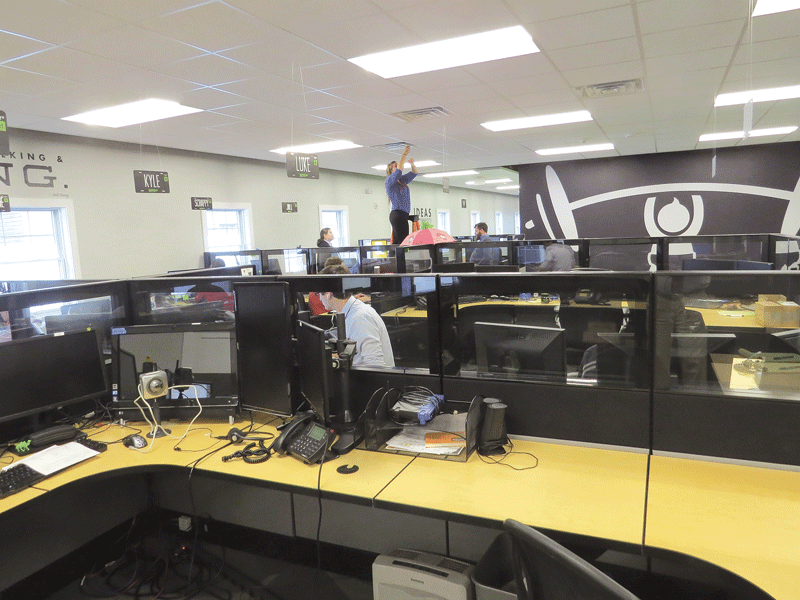
An employee hangs license plates

An employee hangs license plates identifying cubicle occupants by their first names — one of several design features borrowed from Zappos.

As the search for a site on which to create a larger facility commenced, the company moved into temporary quarters in Harrison Place in downtown Springfield, making the black-and-green-painted Paragus Mini Coopers common sites on the streets of the City of Homes.

Bean said the company considered a number of locations in and around Hadley for its new headquarters, and nearly closed on a site in Northampton before eventually opting for a site behind the county courthouse on Route 9. The existing structure there, which most recently had served as a school, was in poor condition and needed to be razed, he noted.

While that search was taking place, Bean and company employees began to visit other workplaces to gain perspective, insight, and ideas. Among the facilities toured were Microsoft’s NERD (New England Research and Development) Center in Cambridge; the Harvard Innovation Lab, or iLab, as it’s called; the Cambridge Innovation Center; and Zappos’ headquarters in what was once City Hall in Las Vegas.

From those visits, and especially the Zappos tour, participants absorbed ideas such as the inspirational quotes on the walls and the use of license plates to identify the occupants of cubicles (the registration sticker in the corner indicates what year he or she started with the company), said Bean.

But the broad goal was to create something unique, he added, something that “said Paragus” and reflected the company’s culture.

“We wanted something of our own that’s kind of a combination of what we saw at other companies,” he explained. “We definitely love our brand and our culture and the vibe that we’ve created, and we’ve never had a building that emulated that vibe because we’ve always been fitting into something that already existed. We had the opportunity to build it the way we wanted from scratch.”

From the beginning, there has been plenty of input from employees, because that is a big part of the company’s culture, said its founder.

“I’m a huge believer in getting staff buy-in at every level, so we formed what we called the New Building Committee and picked out the different assignments and created subcommitees,” he explained. “Every other week, we’d get together, and the subcommittees would report. It sounds very bureaucratic, but it was quite effective because the subcommittees were very focused on specific topics, and it was things that were going to affect them and things they were very interested in.”

Building Excitement

What all those subcommittees and others involved in this undertaking produced is space that, as Bean suggested, effectively mixes fun with professionalism, form with function.

Indeed, just around the corner from the game room is a wall that will soon host a huge screen that will enable the staff to monitor the servers at its dozens of clients and instantly spot trouble.

“If any glitch happens, immediately you’ll see the whole screen change and highlight what network is down,” he explained. “And we can drill down and see exactly what the problem is; we monitor about 126 clients and about 270 servers, and this will let us monitor them on one big screen.”

The weathervane

The weathervane with the company’s logo was perhaps the only opportunity for Paragus to fully express itself with the building’s exterior.

As for that game room/kitchen complex, O’Brien said it will soon be outfitted with a sign that reads, “once you enter this space, you can’t even think about work,” or words to that effect, a message that, like all other components in the facility, reflects the company’s culture, or the “Paragus mentality.”

Matt Dubard, art director for Darby O’Brien Advertising, agreed, and said the facility’s design captures and perpetuates a spirit of innovation and entrepreneurship.

“This company has a startup feel,” he said. “It’s not a startup — it’s been around in various forms since Delcie was 13, and a lot of the people have been working with each other for a long time. But it definitely feels like a startup; it has that excitement about it, and we wanted to capture all that in how it was designed.”

O’Brien used the word “youthful” to describe the company, its culture, and what needed to be conveyed in the various elements of the new facility.

“There’s a lot of youth, a lot of energy,” he explained. “And that energy definitely comes across in the design.”

As for the weathervane, well, it was perhaps the best, and only, chance for the company to express itself through the property’s exterior, said O’Brien, noting that it lies in an historic-overlay district that is heavily regulated when it comes to design. But there are no regulations that anyone knows about regarding weathervanes.

“There might be some soon after people see that one,” he said with a laugh. “I’d be curious to see what the town of Hadley feels about it. It’s not a weathervane; it’s a piece of art.”

The same might be said of the new facility as a whole, and Bean acknowledged that the company will likely be fielding some requests for visits to see the space. And while he expects to be leading some tours himself, he will let others at the company share that responsibility — and privilege.

“I’ll certainly do a fair share of them myself, but I believe there’s huge value in having the staff leading those tours,” he said. “This really is their building, built for them and, in many cases, by them.”

Workplace in Progress

One framed picture not up on the wall when BusinessWest visited Paragus (Bean’s not sure what he’ll do with it) depicts the downtown Springfield skyline maybe seven to 10 years from now, when the company is expected to have outgrown the new space on Route 9.

It shows a gleaming steel skyscraper, perhaps 40 stories high, with the Paragus name on the side — in huge ‘outrageous green’ lettering, of course.

This imagery was a gift from the O’Brien agency to indicate one possible future for Paragus and other small businesses that may be started by some of its employees in the years to come, said Bean, who’s not sure whether it represents anything approaching what might be reality.

What he does know is that the current home represents a big step forward for his venture — and a true reflection of its vibe.

George O’Brien can be reached at [email protected]

Daily News

SPRINGFIELD — The Initiative for a Competitive Inner City (ICIC) and Fortune announced that Paragus Strategic IT was selected for the 2014 Inner City 100, a list of the fastest-growing inner-city businesses in the U.S.

This year, for the first time in the list’s 16-year history, the Inner City 100 consists of 10 fast-growing businesses from 10 industry categories: construction, manufacturing, professional services, food and beverage, retail, media and communications, software and information technology, transportation and logistics, healthcare and biotechnology, and arts, entertainment, and recreation. Applicants ranked according to revenue growth against their industry peers, as well as overall. Paragus Strategic IT ranked sixth in the software and information-technology category, and 35th overall on the list of 100.

The Inner City 100 program recognizes successful inner-city businesses and their CEOs as role models for entrepreneurship, innovative business practices, and job creation in America’s urban communities. Paragus Strategic IT, an outsourced IT-solutions business and a nonprofit that trains high-school students in IT, reported 2013 revenues of $3.54 million and a gross growth rate of 328% from 2009 to 2013. The full list of winners can be viewed at fortune.com.

The rankings for each company were announced at the Inner City 100 Awards on Oct. 16 in Boston. Preceding the awards celebration, winners attended a two-day small-business symposium designed exclusively for urban firms featuring business-management case studies presented by Harvard Business School professors, and peer-to-peer learning sessions led by CEOs of fast-growing firms.

The 2014 Inner City 100 winners represent a wide span of geography, hailing from 53 cities and 23 states. The winners grew at an average compound annual growth rate of 39% and an average gross growth rate of 336% between 2009 and 2013. Collectively, the top 100 inner-city businesses employ 8,276 people and created 5,119 new jobs between 2009 and 2013. Not only are the winners powerful job creators in their communities, they also help develop their employees — 73% provide business-skills training, and 69% provide professional-development training to all full-time employees.

“It’s important to recognize businesses like Paragus Strategic IT that are truly driving economic growth and job creation in America’s urban cores,” said Matt Camp, president of ICIC. “We believe that inner cities hold unique competitive advantages for business, and the success of these firms underscores that market opportunity.”

Daily News

LONGMEADOW — Brenna Berman, Chicago Department of Innovation and Technology (DoIT) commissioner and chief information officer, will present on the “Data-Driven City” at Bay Path University’s Innovative Thinking & Entrepreneurship Lecture on Friday, Oct. 17 in the Blake Student Commons. A networking continental breakfast will begin at 7:30 a.m., followed by the lecture at 8:15 a.m.

The lecture is the 11th in a series that addresses the concepts of innovation and creativity, with specific emphasis on leadership and results. In this lecture, titled “The Data-Driven City: How Urban Analytics Is Shaping the Way We Understand Cities Today and Design Cities Tomorrow,” Berman will focus on her leadership in Chicago’s SmartData project, which is putting the city at the forefront of government innovation.

Berman will provide examples from both a global and local perspective of how data provides a precise lens to make cities more responsive to the changing needs of residents, businesses, and visitors. She will also discuss the emerging trends that are driving academics, researchers, and city leaders to focus on solving intractable urban challenges, and the role data analytics plays in defining, and ultimately solving, those problems.

Over the past year at DoIT, Berman has focused on transforming the DoIT team to align with the mayor’s commitment to an open and data-driven government, building Chicago’s open-data program into one of the largest in the country, as well as implementing the WindyGrid spatial analytics platform into every level of government. Berman built a career promoting government innovation during her 10 years at IBM, where she worked closely with government agencies and countries across the world to leverage technology and analytics to improve the services they provide to their residents.

Those interested in attending the lecture can register at www.baypath.edu/ceo. There is no cost to attend, and live streaming will be available. The event is sponsored by the Bay Path University Advisory Council, the MS in Communications and Information Management, and the MBA in Entrepreneurial Thinking and Innovative Practices.

Past speakers of the Innovative Thinking and Entrepreneurship Lecture series have included Tom Stemberg, Founder of Staples Inc.; Robert Kraft, owner of the New England Patriots; and Sue Morelli, CEO and president of Au Bon Pain.

Features
From the Governor to an Update on NASA, the Expo Will Have It All

The final countdown is underway for the fourth annual Western Mass. Business Expo, a day-long event that will feature everything from one of Gov. Deval Patrick’s last appearances in the region to an update on NASA’s next-generation space telescope.

The Expo, organized by BusinessWest and again presented by Comcast Business, will take place Oct. 29 at the MassMutual Center in downtown Springfield. As has been the case the past three years, this will be the place for business owners and managers to be.

WMBExpoComcastDateThat’s because there will be something for everyone, from lively breakfast and lunch programs to nearly a dozen informative seminars; from intriguing special presentations on the Show Floor Theater to the day-capping Expo Social, one of the region’s best networking events, this year sponsored by MGM Springfield and Northwestern Mutual.

“Since BusinessWest became involved with the Expo in 2011, the goal has been to create an environment where this region’s business community could be informed, entertained, and inspired, while at the same time gaining invaluable exposure before an audience of decision makers,” said Kate Campiti, the publication’s associate publisher. “This year, we’ve once again accomplished that goal.”

Indeed, in addition to more than 150 exhibitors, the Expo will feature a host of intriguing and informative programs, starting with the breakfast hosted by the Affiliated Chambers of Commerce of Greater Springfield.

It will feature outgoing two-term Gov. Patrick, who is expected to talk about his administration’s many accomplishments over the past eight years, while also providing an outlook on this region’s future.

The Expo’s luncheon, presented by the Professional Women’s Chamber of Commerce, will feature keynoter Patricia Diaz Dennis, a member of MassMutual’s board of directors, a former senior vice president for AT&T, and former presidential appointee.

The Expo will also feature a number of special presentations on its Show Floor Theater. These include a morning talk by Peter Rosskothen, owner of the Log Cabin and Delaney House and a serial entrepreneur, called “The Entrepreneurial Process.” This will be a highly interactive program centered around the process of turning a dream into reality.

Speaking of dreams, one of the afternoon programs on the Show Floor Theater is titled “NASA Is Alive: Testing the Next-generation Space Telescope.” It will feature Brian Comber, an engineer with NASA who will discuss his work in the ongoing development of the James Webb Space Telescope and its potential to unlock the secrets of the universe.

Expo organizers are also planning a forum featuring candidates for governor of the Commonwealth, although they are still awaiting commitments for those hopefuls.

In addition, there will be more than a dozen informational seminars. These will cover three broad areas: Professional Development, Entrepreneurship, and Sales and Marketing, and feature titles ranging from “The Path to Building Name Net Worth” to “Unleashing Peak Sales Performance” to “What Does Your Billboard Say?”

Expo Social sponsor MGM Springfield, which plans to build an $800 million resort casino in the city’s South End, will also present two seminars, titled “Doing Business with MGM Springfield” and “MGM Resorts International: Dedicated to Community and Diversity.”

The Expo will wrap up with the encore to last year’s well-received and highly inspirational Pitch Contest — featuring area startup ventures and organized by Valley Venture Mentors — as well as the Expo Social.

Other sponsors include silver sponsors DIF Design, Health New England, Johnson & Hill Staffing, and MassMutual Financial, and education sponsor the Isenberg School of Management at UMass Amherst.

BusinessWest will present its comprehensive guide to the Expo in its Oct. 20 issue. For more information, to register, or to purchase a booth, call (413) 781-8600 or visit www.wmbexpo.com.

Employment Sections
It Appears That These Contracts May Be Here to Stay

By PETER VICKERY, Esq.

Peter Vickery

Peter Vickery

There have been no TV specials, live re-enactments, or commemorative stamps, but the fact is, this year marks the 600th anniversary of Dyer’s Case, the first recorded legal decision about a non-compete agreement.

It did not go well for the employer, John Dyer. He was asking the court to enforce the agreement against his former apprentice, a young man who (in exchange for Dyer forgiving a loan) had promised to refrain from setting up his own shop for six months after the end of the apprenticeship. Not only did the judge rule for the young apprentice, he added that Dyer himself ought to go to prison for trying to stifle competition.

While Massachusetts Gov. Deval Patrick has no plans to jail employers who draft them, he would nevertheless like to make non-competes a thing of the past.

Six centuries after Dyer’s Case, the goal of non-competes remains the same: to help employers protect their businesses by temporarily preventing ex-employees from aiding, or becoming, the local competition. As in 47 other states, these contracts are legal in Massachusetts (with a few exceptions for particular professions, discussed below) so long as they are reasonable in terms of time and territory. Patrick wants to change that, but so far the Legislature has refused to go along. At the end of the last session — after legislators passed his economic-growth bill, minus the section that would have banned non-competes and rewritten the trade-secrets law — the governor said he would try again. What is at stake, and how would victory for the governor affect businesses in Massachusetts? Read on.

What Are Non-compete Agreements?

Non-competes have survived because creating intellectual property is like training an apprentice: it takes time and money. In business, our motive for investing such resources is profit, and most of us would not invest if other people could simply walk off with our profits.

Patent, copyright, and trademark law harness the profit motive by protecting most — but not all — forms of intellectual property. Trade-secrets law helps plug the gaps. Even after revealing a trade secret to an employee, an employer can retain some of the secret’s value via contracts, such as agreements not to disclose and not to compete.

If an employee with access to your trade secrets (e.g. customer data, expansion plans, and marketing strategy) quits and walks straight into a job with your nearest rival, you have reason to worry. Mindful of this possibility, some employers use non-disclosure agreements to prevent their trade secrets from falling into the hands of the competition. By signing non-disclosure agreements, your employees promise not to divulge confidential information to their new employer.

But how can you, the former employer, looking across the street at your ex-employees happily chatting away with your nemesis, be absolutely sure that they are abiding by this commitment and not using your information against you? As a practical matter, you cannot, at least not without resorting to electronic surveillance, which would likely generate many more difficulties — big ones, involving lawyers and judges — than it would solve. This is why non-competes are helpful.

Compliance with a non-compete agreement is easier to verify than compliance with a non-disclosure agreement. Although you may not be able to find out what your ex-employees are saying, you will find it comparatively easy to find out where they are working. So, to borrow a theological term, the purpose of the non-compete is to ensure that your employees avoid the occasion of sin, i.e. circumstances that entice or incite wrongdoing on their part.

Waiting for the harm to occur and then suing for damages would make little sense. After all, the most effective way to protect commercially valuable confidential information is to stop the harm from happening in the first place. Therefore, the typical non-compete allows the employer to ask a judge for an injunction prohibiting ex-employees from going to work for the local competitors or setting up a rival enterprise of their own.

But non-competes cannot go as far as some employers might wish. To imagine an extreme example, if the law allowed permanent, worldwide non-competes, ex-employees would be unable to pursue their livelihoods or start new businesses, commerce would stagnate, and the consumer would suffer. So to balance the employer’s interests against those of both the employee and society as a whole, the Massachusetts courts have gradually narrowed the purpose, geographic reach, and duration of non-competes.

This is how the Supreme Judicial Court has summed up the law: “a covenant not to compete is enforceable only if it is necessary to protect a legitimate business interest, reasonably limited in time and space, and consonant with the public interest.” In addition, the court will not enforce an agreement if, after signing it, the employee’s job undergoes substantial changes.

Each case is different, and the reasonableness of time and territory will depend on the particular facts, as will what sort of job changes are substantial, but one universal principle applies: if the agreement’s purpose is merely to prevent ordinary competition, the court will not enforce it.

There are at least five hurdles an employer has to jump over before a court will enforce a non-compete:

• The agreement must protect a legitimate business interest, e.g. trade secrets and good will;
• It must be reasonable in duration, e.g. up to two years;
• It must be reasonable in geographic scope, which depends on the extent of the employer’s business. The court might uphold a worldwide ban for a genuinely worldwide enterprise, but not for a business whose market extends only 50 miles from its store;
• The competition must be direct, i.e. for the same customers; and
• If the employee’s compensation or responsibilities change, the employee must sign a new agreement.

There is one more hurdle regarding current employees. If an employee is already working for the employer at the time she signs the agreement, the employer will have to provide her with separate consideration, meaning a benefit that is something more than the job itself, such as extra money. Otherwise, the non-compete is unenforceable.

As well as these significant hurdles, Massachusetts law prohibits non-competes for certain professions, namely physicians, nurses, broadcasters, licensed social workers, and attorneys. And the courts are inclined to relax the terms of non-competes that try to restrict the employment of financial advisors and brokers.

Even with all those caveats and provisos, non-competes make obvious sense for established companies. And therein lies the tradeoff dilemma for policymakers. A rule that protects existing businesses is also a barrier to entry, standing in the way of newcomers. If policymakers want to protect current jobs-makers, the environment will be less welcoming to insurgents. Conversely, if they want to create an ideal climate for startups, they will almost certainly hurt existing businesses and the people they employ.

The Case for Banning Non-competes

Patrick would like Massachusetts to follow California, where non-competes are illegal. Much of the lobbying has come from groups that believe the switch would encourage more innovation, making Massachusetts more like Silicon Valley.

Non-competes came into the crosshairs in the 1990s when academics started to blame them for discouraging startups. In 1994, AnnaLee Saxenian, a graduate of Williams College, Harvard, and MIT, credited Silicon Valley’s “culture of mobility” with enabling the rapid transfer of knowledge, and compared it unfavorably with the “buttoned-down” culture of Route 128 in the Boston area. Five years later, Ronald Gilson, a law professor at Stanford Law School, published an article that pointed to non-competes as the explanation for the success of Silicon Valley compared with Route 128. Gilson said that it was the presence of non-competes in Massachusetts and their absence in California that lay at the root of the different cultures.

Several scholars have buttressed this idea, claiming that non-competes impede entrepreneurship and job growth. For example, Matt Marx and Lee Fleming, the authors of Non-compete Agreements: Barriers to Entry… and Exit? (2012), found evidence of a “brain drain,” with talent moving from states that enforce non-competes to states that do not.

Patrick’s proposal is based on this notion. Specifically, he wants the Legislature to repeal Sections 42 and 42A of General Laws Chapter 93 (which allow damages and injunctions for the unlawful taking of trade secrets) and create a new Chapter 93K, a Massachusetts version of the Uniform Trade Secrets Act (UTSA). In a nutshell, the thinking behind the governor’s proposal is that ditching non-competes and adopting UTSA will help make Massachusetts more like California, increasing our allure for new, innovative, hi-tech enterprises.

Who Wants to Keep Non-competes?

Established, larger businesses tend to oppose the governor’s plan. Some report that confidential-information theft is common, not rare, and that abolishing non-competes would make it harder to deter the practice. More fundamentally, these employers sense that the bill threatens existing jobs without guaranteeing new ones. The promised gains are merely possible and general, whereas the losses are highly likely and specific.

Even some people who believe that non-competes impede startups recommend caution. For example, Marx and Fleming agree that non-competes “are responsible for a general exodus of talent [and] are driving away some of the best and brightest.” But they also point out the absence of some important data, and warn that there is still no “definitive answer regarding whether non-compete enforcement is a net positive or negative.” Clearly, when weighing the merits of a far-reaching policy proposal such as banning non-competes and signing up to UTSA, legislators need to bear in mind what we do not know.

But they should also look at what we do know, starting with two simple facts. First, 46 states have adopted UTSA in some form. The exceptions are Massachusetts, New Jersey, New York, and Texas. Second, 47 states enforce non-competes, and those that do not are California, Montana, and North Dakota.

So we know that (1) most states have a version of UTSA on their statute books and (2) most states enforce non-competes. This makes it difficult to determine how big a factor non-competes and UTSA are in encouraging innovative startups. Complicating matters further, in recent years several states have modified their non-compete rules. Idaho and Louisiana made it easier to enforce them, Oregon and New York made it harder, and Georgia moved closer to the Massachusetts approach. But, keeping these analytical challenges in mind, we can learn something valuable by looking at recent economic indicators and league tables of innovation and competitiveness.

One useful indicator is the unemployment rate. Looking at the states where non-competes are illegal, North Dakota’s rate is 2.8%, Montana’s is 4.7%, and California’s is 7.4%. Our unemployment rate in Massachusetts is 5.6%, higher than North Dakota’s and Montana’s but lower than California’s. The most likely explanation for the lower unemployment rates in Montana and North Dakota is not the absence of non-competes but the presence of a booming energy sector. And the fact that the unemployment rate is higher in California than in Massachusetts suggests that banning non-competes would not, in and of itself, boost our overall job growth.

Most of the states with UTSA — which are most of the states in the U.S. — have higher unemployment than Massachusetts. Of course, so do New Jersey and New York (non-UTSA states), which indicates that UTSA is not a determinative factor either way.

League tables of competitiveness and innovation tell a similar story. The Beacon Hill Institute’s 2013 State Competitiveness Index ranked Massachusetts top of the league, with Texas in ninth place and New York 26th.  California came in 29th and New Jersey 41st. As for the two states (other than California) where non-competes are illegal, the index gave second place to North Dakota and 36th place to Montana. Non-competes do not seem to be outcom-determinative, at least according to the way the Beacon Hill Institute measures competitiveness.

The University of Nebraska-Lincoln’s 2013 State Entrepreneurship Index ranks North Dakota first and California second, which would seem to support the contention that states without non-competes are more entrepreneurial than those with them, until you notice that, only two years before, California placed 11th, which was the ranking Massachusetts received in 2012, while New York held third place throughout. Between 2011 and 2013, the legal status of non-competes remained stable in California, Massachusetts, and New York, so any claim that this index proves non-competes stifle entrepreneurship falls flat.

Another index reinforces the lack of a connection, namely the 2014 State New Economy Index from the Information Technology and Innovation Foundation, which factors innovation capacity into its calculation of economic dynamism. On the one hand, California (where non-competes are illegal) ranks third, ahead of New York and New Jersey (where they are allowed). But, as for the two states other than California where non-competes are illegal, the index ranks North Dakota 36th and Montana 39th. The state winning first place? Massachusetts. Again, the presence or absence of non-competes fails to predict a state’s standing in the innovation rankings.

In summary, the UTSA states include many with high unemployment and low innovation, which suggests that UTSA is not a key ingredient to prosperity. Similarly, the states that enforce non-competes include some that lead the nation in terms of innovation, and some that bring up the rear. What we do know is that, so far, no one has been able to offer clear and convincing proof that banning non-competes and enacting a version of UTSA would lead to greater innovation and more jobs.

The Future of Non-competes

If Patrick or his successor should decide to rejoin the battle, legislators would have to consider the costs to present employers as well as the putative benefits to employers yet to come.

They might also consider some innovations of their own, such as expanding the motley list of vocations where non-competes are forbidden — currently physicians, nurses, broadcasters, social workers, and lawyers. Even though those professions cannot be subject to non-competes, they seem to thrive regardless. For example, nobody is complaining about a lack of lawyers in Massachusetts (or anywhere else).

On the other hand, the amorphous nature of the tech sector makes it difficult to draw lines around. The Legislature learned this lesson last year when it imposed, and then repealed, a tax on “computer-system design services.” Trying to define the kinds of high-tech jobs that would qualify for new exemptions from non-competes could become a legislative drafter’s nightmare.

Unless and until proponents can offer persuasive evidence that banning non-competes would create more jobs than it would destroy, this particular species of contract looks set to celebrate its 601st birthday — and maybe many more.

Peter Vickery practices law in Amherst; (413) 549-9933; www.petervickery.com

Construction Sections
Brian Gibbons Transitions from Military to Successful Building Career

By KEVIN FLANDERS

Brian Gibbons

Brian Gibbons is gratified that his growing construction company does plenty of work that benefits fellow veterans.

Brian Gibbons is not your typical entrepreneur, nor did he follow the conventional routes to becoming a business owner. But success, his staff has learned, isn’t contingent upon adhering to a specific formula. It’s all about being creative and making the most of every opportunity.

Gibbons, president of Springfield-based Brican Inc., opened his construction business in 2007 after a 24-year career as a Seabee engineer in the U.S. Navy Reserve. Utilizing the Service-disabled Veteran-owned Business Program of the U.S. Small Business Administration (SBA), he was able to get his business off the ground at a time when the economic climate was about to become much more challenging. Looking back now, he knows he couldn’t have done it without assistance from the program instituted by the SBA in 2003 to help veteran-owned businesses succeed.

“In my case, it [the SBA program] did exactly what it is intended to do,” said Gibbons, who joined the Navy Reserve following his freshman year in college. “I never would have been a business owner without that program.”

Seven years later, Brican is thriving at the corner of State and Dwight streets, specializing in commercial, industrial, and institutional building systems. Its staff of just over 20 is expected to grow, and its project list continues to expand each year. Well-versed in federal contracts, the majority of the company’s projects have been completed for the U.S. Department of Veterans Affairs (VA), with the average job coming in between $2 million and $5 million.

“We have had projects throughout the East, from Ohio up to Maine,” Gibbons said. “We are always checking on different opportunities and bidding them.”

Veterans Helping Veterans

Gibbons, who took an early interest in construction as a teenager cleaning up job sites for his neighbor during high-school summer vacations, never imagined what doors the Navy Reserve would open for him. The experiences accrued during his nearly quarter-century tenure have helped him long after his transition back to civilian life, and he is always eager to take on projects that assist others who served their nation.

As a veteran-owned business, Gibbons isn’t surprised that the VA is Brican’s best client, as the agency routinely sets aside projects to be bid exclusively by small firms led by vets. But for Gibbons, construction for the VA is about far more than erecting structures — it’s about making a difference in the lives of those who served. As such, Gibbons says his most rewarding project to date was the construction of a building for the Northampton VA Medical Center’s acute psychiatric ward. Completed in 2013, the prototype project set new standards for the construction of such facilities, specifically those designed to prevent suicide and injury, with specialists from throughout the nation traveling to Northampton to offer input.

“In the past, they often used many of the techniques you see in prisons, but lately they have realized that the people in these facilities are sick, not prisoners,” Gibbons said. “We approached the job very empathetically. The goal was to help the VA come up with ideas to minimize the dangers to patients and staff. As a veteran, it’s always rewarding to work on projects that help other veterans.”

Brican has also immersed itself in the energy side of construction over the last few years, recently taking on several boiler-plant safety projects. Ground was broken on one such job last month, a combined heat and power plant at a VA-owned facility in Newington, Conn, which Gibbons expects to be finished by the end of next year.

New Growth

While statistics are always valuable, a quick glimpse at the whiteboard in Brican’s conference room sufficiently indicates the direction of the business. Filled from end to end with project information, the board keeps Gibbons’s bustling staff constantly updated on what needs to be done. And they certainly prefer to be busy, especially in an industry that has seen its share of challenges statewide in recent years.

But no matter how one looks at it — project totals, staff size, buildings acquired — Brican is a rapidly expanding company, its reputation building along with its structures. Whenever a project is erased from the whiteboard upon completion, another one quickly replaces it.

Gibbons hopes that his staff, which currently includes about 20 people, will grow to nearly 30 as more work comes in from the private end of the construction spectrum. “Our largest job so far was just under $16 million, and we are definitely looking to increase our work on the private side,” he added.

General contractors go only as far as their staffs take them, though, which is yet another reason for Brican’s success. Gibbons said each of his project managers handles up to three projects at a time — including Gibbons himself, who has focused on everything from management to estimating. He wears many hats as the owner of a small business, but he has also been impressed by his employees’ ability to multitask and split time between multiple projects.

In particular, Gibbons praised engineer Mike Belanger, who brings more than 20 years of experience to Brican, as well as project manager Todd Spooner and his 30-year career in the industry.

But along with more projects comes a need for more employees who can handle an array of assignments, a need Gibbons recognizes. “As we continue to grow, we will probably hire another project manager who can assist with estimating.”

Of course, as a military veteran who takes pride in his years of service and how they helped prepare him for life as a small-business owner, Gibbons is always on the lookout for veterans searching for work. His staff already includes a few vets, and he enjoys providing them with opportunities following their service. As veterans conclude their service in the Middle East, SBA officials have attempted to open as many avenues as possible for job creation and entrepreneurship. One such avenue is the Service-disabled Veteran-owned Business Program that Gibbons qualified for, and now he’s completing the cycle by hiring veterans.

“I try to give as much preference as possible to veterans,” he told BusinessWest. “I am always looking for good people to work here.”

Next-door Options

Brican is also expanding from an acquisition perspective. In March, Gibbons purchased the building adjacent to his State Street office at a tax title auction. He is keeping his options open for the purpose of the 1890s-era building, but he mentioned several possibilities, including using it for additional office space.

“We have done a lot of work to clean it up; it was a real mess before,” he said. “I think it would make a great office for a contractor, and I would love to see it rehabbed. There are a lot of opportunities we are considering right now for the building.”

Gibbons said he likely won’t make a final decision on the building until he learns whether or not the nearby MGM casino project will proceed, a development that would create jobs and drive up demand for rental spaces throughout Springfield and neighboring towns. If the right opportunity were to present itself, a rental or lease situation might prove to be the most beneficial purpose for the building, but no decisions have been made yet.

In addition to the State Street acquisition, Gibbons has a full plate, with 18 active projects and expected staff increases. It’s all part of leading a small business on the rise, a business built by a veteran whose employees and clients are also veterans. But while Brican specializes in federal contracts and institutional construction, what sets it apart from other businesses, he said, is its ability to handle private construction as well.

“We have a great staff,” he said. “Everyone comes from a different background in terms of experiences and education levels, and we work well together as a team.”

Opinion

In Pursuit of an Innovation District

Kevin Hively, one of the authors of a redevelopment plan for the area impacted by the natural-gas explosion in 2012 — and the streets surrounding the so-called ‘blast zone’ — hit the nail on the head while explaining why this plan is ambitious and why it will be quite challenging to convert into reality.

“We want to create an innovation district with a lot of energy and momentum taking place,” he told those assembled at a press conference earlier this month staged near where the blast took place. “But the fact of the matter is, innovation districts are driven by talent, and talent is driven by job opportunities and quality of life.”

Right now, Springfield can’t say it offers either one. And that’s why there’s not much talent here around which to create an innovation district.

But there is promise for both, and that is the city’s ongoing mission — to convert that promise into something tangible, something that will attract talent.

Backing up a bit, the report, called “The Worthington Street District Plan,” lays out not only what the city can do with the multi-block area in its central business district, but also the stern challenges that lie in the way.

Indeed, as Hively pointed out at the press event, probably every city in the country would like to create a thriving innovation district, but certainly not all of them can. To replicate, even on a much smaller scale, what has been accomplished in Cambridge, Silicon Valley, and North Carolina’s Research Triangle will take some luck, a good deal of patience, and, well, some innovation.

And the city is not exactly starting from a position of strength. While this area of the city has some assets, most of them — like Apremont Triangle, Stearns Square, the existing entertainment district, and Union Station — are not going to attract that aforementioned talent, at least not in their current form.

But there is some momentum in a few key areas — promoting entrepreneurship, opening up avenues to capital, and promoting innovation. This momentum is best exemplified in initiatives like Valley Venture Mentors, which encourages entrepreneurship and helps fledgling businesses get off the ground; the Baystate Innovation Center, described as a mix between an incubator and an accelerator now taking shape in downtown Springfield; and Tech Foundry, which is billed as a training ground for those who might enter the technology field.

And there are other positive developments, such as the new UMass Center at Springfield in Tower Square and the potential for a casino in the South End.

But as Hively pointed out, talent is driven by job opportunities and quality of life. Springfield can’t match Cambridge, Boston, or San Francisco, or even Providence or Lowell at this time.

It must do something about both crime and the perception of crime, foster the development of more restaurants, shops, and cultural attractions, and, above all else, help create attractive places for people to live.

At the moment, there is a distinct lack of people who have a desire to live, work, or start a business downtown, and this is the equation that simply must change.

How? That’s the $64,000 question. Most observers say you can’t just build housing and then hope eateries, clubs, and shops will follow. Likewise, you can’t — or shouldn’t — open those businesses until you are sure there is a critical mass of people with disposable income to support them.

Is an innovation district possible? Of course it is. Is it doable in Springfield? Perhaps, but, then again, most every city has tried or is trying to create one, and success has been hard to come by.

One thing is for sure. There is little, if any, time to waste, and the city will have to be energetic and imaginative if it is going to attract the talent needed to make an innovation district thrive.

Daily News

NORTHAMPTON — A local entrepreneur who also offers business coaching will offer a free workshop geared toward the small-business owner or freelancer who wants to learn how to take his or her business to the next level.

Terra Missildine, the owner of Beloved Earth, a cleaning company dedicated to eco-friendly products and practices, will offer “Taking It to the Next Level: Leveraging Your Personality Type in Business” on Monday, Aug. 25 from 6 to 8 p.m. in the Watson Room of Forbes Library, 20 West St., Northampton. The workshop will focus on discussing archetypes like the hero, warrior, lover, and magician to help entrepreneurs and business owners learn about branding and attracting ideal clients. It will feature a talk about how using the authentic and universal imagery of archetypes helps put confidence behind a company’s message as well as filter its audience to make it almost irresistible to ideal clients.

Missildine is working toward a bachelor’s degree in sustainable entrepreneurship through the University Without Walls at UMass Amherst. She is a successful entrepreneur and creative-business coach who loves helping other passionate small-business owners build and refine their businesses or projects. She is active in the local sustainability movement and has organized an annual Beloved Earth Day in the region.

While the workshop is free, seats are limited, so participants should e-mail [email protected] to reserve a spot. For more information, contact Missildine at (413) 949-3509.

Features
Annual Show Will Put the Spotlight on Entrepreneurship

WMBExpoComcastDateOrganizers of the Western Mass. Business Expo, slated for Oct. 29 at the MassMutual Center, are finalizing elements of the show, which will certainly have an entrepreneurial flair to it.

Indeed, the highly successful pitch contest, which made its debut at the 2013 Expo, will be staged again this year. Organized by Valley Venture Mentors (VVM), the contest, as the name suggests, features entrepreneurs with developing ventures pitching their ideas to a panel of judges — with $3,000 in prize money on the line.

This year’s contest will likely feature fewer presenting ventures — perhaps five as opposed to the 10 last year — which should allow for more give and take between those presenting the pitches and those who will judge them, said VVM President Scott Foster, adding that this will likely produce what he called a “Shark Tank effect — only nicer.”

Meanwhile, this year’s slate of educational seminars will include a track on entrepreneurship. The roster is still being finalized, but it will feature some of the region’s rising stars offering insight into what it takes to succeed in business today.

Delcie Bean, founder and president of Paragus Strategic IT, one of the fastest-growing technology companies in the country, will be among those presenting interactive programs designed to inform and inspire those in attendance.

“Through initiatives like VVM, this region is putting a great deal of emphasis on entrepreneurship and growing organically by spurring the creation and growth of new small businesses,” said BusinessWest Associate Publisher Kate Campiti. “For the 2014 show, Expo organizers wanted to add momentum to these efforts by showcasing new business ventures through the pitch contest and relaying success stories written by some of the region’s noted entrepreneurs.

“These are people who have taken risks, beaten the long odds on making it in today’s highly competitive global economy, and have much to share with Expo attendees,” she went on. “These will be compelling stories that will hopefully inspire others to reach high.”

As the entrepreneurship track comes together, so do other elements of the show, which is expected to draw more than 150 exhibitors and 2,500 attendees, said Campiti. The other seminar tracks are professional development and sales and marketing, and those programs are being finalized as well, she said, as are the Show Floor Theater presentations.

The Women’s Professional Chamber of Commerce has announced that Patricia Diaz Dennis, retired senior vice president and assistant general counsel for AT&T and commissioner of the Federal Communications Commission during the Reagan administration, has been confirmed as the luncheon speaker.

Dennis, a member of the board of directors at MassMutual, is a highly sought-after speaker, whose broad résumé also includes service on the National Labor Relations Board, a stint as assistant secretary of State for human rights and humanitarian affairs, a three-year term as chair of the Girl Scouts of America, and a lengthy stint on the Texas State University System Board of Regents.

At AT&T, from which she retired in 2008, she was responsible for corporate litigation, procurement, corporate real estate, environmental corporate compliance, IT, and trademark and copyright legal matters. Before joining AT&T in 1995, Dennis was special counsel to Sullivan & Cromwell for communications matters in the international law firm’s Washington, D.C. office. From 1989 to 1991, she was a partner and head of the communications section of the Jones, Day, Reavis & Pogue law firm.

One of the highlights of previous shows has been the day-ending Expo Social, said Campiti, adding that it has become one of the best networking opportunities of the year. This year’s social, to be sponsored by MGM Springfield and Northwestern Mutual, will be no exception.

Other sponsors include Presenting Sponsor Comcast Business; Silver Sponsors DIF Design, Health New England, and Johnson & Hill Staffing Services; and Education Sponsor the Isenberg School of Management at UMass Amherst.

For more information on the event, visit www.businesswest.com or www.wmbexpo.com. n

Cover Story
When It Comes to Business, Dave Ratner Has Some Pet Peeves

COVERart0714bWhen Dave Ratner speaks to small-business owners — something he does often — he will inevitably touch on some of the highlights from his intriguing, 40-year career selling soda and pet food, during which he has made his first name and face into a nationally known brand.

And there are many such highlights, from his success in retail (he now has seven Dave’s Soda & Pet City stores in Western Mass. and Northern Conn.) to his triumphs in wholesaling, specifically the introduction and then rapid expansion of his lines of dog and cat food, to his highly regarded marketing initiatives.

But Ratner says he spends much more of his time at the podium talking about what hasn’t gone right with his various business endeavors. Like the store he opened on Allen and Cooley streets in Springfield, which closed roughly a year after it opened in 1995 because of what he called “miscalculations” and bad timing. Then there was an ill-fated e-commerce venture, a four-year experiment that failed because, in essence, he entered a game without fully understanding how it’s played.

“This was the first all-natural pet-food e-commerce site in the country,” he explained, referring to an acquisition he made in 2010. “I said to myself, ‘how hard can this be?’ Well, the e-commerce business is much different than the retail business, and I’m not an expert in e-commerce. I didn’t have anyone on my team who knew the e-commerce business, and we got killed.”

It is by relating these failures and others and the reasons behind them that Ratner believes he can most effectively get across his points about how to succeed in business, something he’s becoming noted for as much as his stores, products, and TV spots.

Indeed, he speaks to various trade groups — he recently addressed the Billiard Hall Owners Assoc., for example — and business organizations on a fairly regular basis. The audience and subject matter varies, but he’s often addressing retailers, and a common theme is advising little guys on how to beat the big guys.

Meanwhile, some of his more recent blog posts — such as “Good Boss or Good Leader? Business Owners Should Learn the Difference Between the Two and How to Be Both,” “Your Attitude Goes a Long Way in Business: Changing Your Mindset Can Mean a Positive Impact for Your Store,” “Not So Fast: Before Pulling a Product off the Shelf, Think About the Total Picture,” and “The Learning Never Stops: Going to Trade Shows and Conventions Can Help Retailers Move Their Business Forward” — are clearly aimed at that constituency.

Overall, Ratner told BusinessWest that there are many mistakes that entrepreneurs will make — everything from not having enough money when they launch a venture to letting their ego get in the way of smart decisions, to not having what he called a “damage-control policy” in place.

“People go into business with their hearts, not their heads,” he noted. “The reason that big companies have boards of directors is so they can question what management is doing and be a devil’s advocate. So if a successful company needs one, and you’re an entrepreneur, you certainly need one.”

Elaborating, he said business owners and managers generally tend to forget about “Mr. Murphy,” the individual whose name is attached to a law — the one about how everything that can go wrong will. And this will invariably lead to trouble, especially when it comes to money and cash flow.

“I don’t care what you’re doing — if you don’t have enough money, don’t do it, and whatever money you think you need, multiply it by at least two,” he explained, “because the minute you start your business, Mr. Murphy is going to move in next door to you.”

For this issue and its focus on entrepreneurship, BusinessWest talked at length with Ratner about his career in business, but also about how he’s devoting a good deal of his time and energy to advising others on how to use their head and not their heart and thus avoid making the critical mistakes that often mean the difference between success and failure.

Poignant Paws

Dave Ratner takes a moment to meet and photograph a regular

Dave Ratner takes a moment to meet and photograph a regular and her dogs, one of the many ways he tries to make an emotional connection to customers.

It’s probably safe to say that few people living and doing business in this region don’t know Ratner’s story.

It’s pretty much common knowledge that he flunked out of Babson College between his sophomore and junior years, only to later return and get his degree, and, not long after graduating, borrowed $5,000 from his father to open a Soda City store on Route 9 in Hadley. That’s the name his father, Harold, gave to a venture he started in 1972 after his career as a distributor for Clicquot Club soda came to an abrupt end when the company decided to sell direct to retailers. Ratner made it clear that, while his father provided some seed money, this was a separate enterprise he could call his own.

“He said to me, ‘if you want to do this, I’ll loan you $5,000, and you can go and find a location and open up your business,’” Ratner recalled. “He said, ‘yours is yours, mine is mine; I’m here for guidance, but this way, you’ll learn how to run a business really quickly.’ And he was definitely right about that.”

It’s also well-known that, roughly a year or so after starting that venture, he bought a puppy, an acquisition that took him to the pet-food aisle at the supermarket, where he learned there was much more to sell there than in the carbonated-beverages aisle, a realization that started him down the road to selling two totally different product categories out of the same building.

The past 37 years or so have been spent expanding the enterprise in several directions, making Dave’s a household name — in this market, but also others — and, for the most part, anyway, practicing what he preaches when it comes to running a successful business and beating those aforementioned big guys.

“And unless you’re Wal-Mart, you’re the little guy,” he said with a laugh, adding that the most important thing for any business owner who falls in that latter category is to “connect with the customer emotionally.”

“When I talk with entrepreneurs and business people, I explain to them that we’re not here to have a transactional relationship with customers, but an emotional relationship with them so we can try to bond with them,” he explained. “Business is business — you have to offer what the customer wants or needs at the correct price, you have to be easy to do business with, and you have to build a relationship with them. And you have to build trust; people don’t want to hang out with or do business with someone they don’t trust.”

Ratner’s been doing all that throughout his career, with his stores, his marketing (it’s his voice you hear in the radio ads), and a weekly television show called simply Dave’s Pet Show, which has been running on Fox for more than two decades, as well as a hands-on attitude in his stores.

For example, on the day he spoke with BusinessWest at his flagship store in Agawam, Ratner could be seen helping customers unload their huge bags of dog food into their cars and taking photos of the canines that his regulars bring into the store with them when doing their shopping.

And he’s taken this emotional relationship to an even higher level with his lines of pet food, which he started introducing nearly 20 years ago and wholesaling five years ago. It’s the entrepreneurial gambit that appears to have the most potential — it’s generating close to the same amount of revenue as his retail operation, and he believes it will soon surpass it — and the one he’s easily most proud of.

His products are now being sold in 40 states and by more than 3,000 independent retailers, he said, adding that beyond those numbers is the great sense of satisfaction that comes with knowing what they mean.

“Dave’s Pet Food is just the coolest thing in the world,” he told BusinessWest. “People who have never met me and have no clue who I am trust me with the health of the creature they love more than anything in the world. How does it get any better than that?”

Talking the Talk

While perhaps not as satisfying as his pet food, Ratner’s seminars, lectures, blogs, and other vehicles for sharing knowledge and lessons with small-business owners remain a big part of who he is.

He told BusinessWest that he’s learned a great deal from his own experiences and also from mentors ranging from his father to Al White, founder of A.O. White, who hired him for a few summers when he was in high school, to Ken Abrams, president of the FoodMart chain of supermarkets that once operated in the region. And he enjoys sharing these lessons, as well as myriad others he’s learned through relationships forged from his membership in the Young Presidents Organization as well as his work with the National Retailers Federation.

There are many such lessons he said, starting with making sure you have enough money when you launch a business and understanding that Murphy’s Law will apply to your venture. Entrepreneurs must also create a reason for people to do business with them “unless they’re inventing something revolutionary,” he went on.

And they need to have that devil’s advocate there, not only to ask the hard questions, but to make sure that they’re answered sufficiently.

Ratner said he’s had to learn some of these lessons himself the hard way.

Indeed, he said he didn’t have enough money to keep the Allen and Cooley location open during a year when he said everything went wrong for retailers, and especially those selling pet food.

“That was the year of Nintendo, America Online, and snowstorms,” he noted, adding that the poor weather kept people from making non-essential trips, and they would get their pet supplies at the supermarket instead. “Everyone started going online, and the pet business declined; kids weren’t into fish and birds anymore.”

Dave’s new pet food

Dave’s new pet food label also features his German shepherd, Trudie.

Using hindsight, he said that, if he had more money at his disposal, he probably could have weathered the storms, literally and figuratively, and outlasted Mr. Murphy. He acknowledged that a devil’s advocate couldn’t have helped him when it came to meteorology or calculating the impact of Nintendo on hamster sales, but in general, they can help entrepreneurs anticipate and navigate various forms of whitewater.

And they can help them understand their limitations and avoid costly missteps, such as Ratner’s foray into e-commerce.

“On the Internet, it’s all about ‘who’s got the best price; who’s got the best deal?’” he explained, adding that distribution is also a huge factor and one that ultimately kept him from effectively competing with Amazon and other huge sites.

Knowing one’s limitations is an important quality for business owners, he stressed, as is the related ability to keep one’s ego in check.

“The smartest, best business people in the world are those who hire the best people, those who can do the things they can’t,” he explained. “I have the best controller in the world — he’s phenomenal; I flunked accounting.

“Another thing that gets entrepreneurs in trouble is ego — there’s no place for ego in business,” he went on. “People have to listen, watch, learn, and never believe they know everything, because they don’t.

“You have to be a sponge,” he continued. “You need to go look and see what your competitors are doing right and copy that, see what they’re doing wrong and make sure you don’t do that.”

But perhaps the most important trait a successful business must possess, he said, is the ability to take a vision and make it permeate a company. To get that point across, he relayed a conversation he had with Mindy Grossman, CEO of Home Shopping Network, that took place as HSN mulled adding Dave’s pet-food products to the list of items it sold.

“I asked her how she competed with QVC, because QVC is twice as big as she is, and she said, ‘QVC is very transactional, and we try to develop an emotional relationship with our customers,’” he explained, noting that, not coincidentally, she used the same language he has employed for decades.

“She said, ‘this was the vision that I brought to the company — that’s it’s all about the customer, storytelling, and developing a relationship with that customer,’” he went on. “CEOs say a lot of stuff, so the next morning, I asked everyone I met, the buyers and everyone else, what it was like working at Home Shopping Network, and they, to a T, repeated exactly what Mindy said. So if you run a business, you have to let everyone know that ‘this is my vision’ and everyone in that company has to buy into it, and if you have people who don’t buy in, you have to get rid of them.”

Tale End

When asked if had — or still has — any plans to perhaps take his chain of stores to a regional or even national stage, Ratner offered a hearty laugh and then some deep introspection.

“You know, I’m just a classic small-town businessman — there’s guys like me in every town,” he said. “I don’t have the brains to go and become a national company; I don’t have the skill set.

“The coolest thing in the world now, though, is that I get to hang out with people who are doing that,” he went on, referring to both YPO and the National Retail Federation. “I like to tell my friends that these guys see stuff that I don’t know exists.”

Perhaps, but there’s no debating that Ratner has scripted an intriguing entrepreneurial success story, and is still writing new chapters. In the meantime, he’s also making a name for himself helping others become successful small-town businessmen and women.


George O’Brien can be reached at [email protected]

Entrepreneurship Sections
MassMutual Invests in Springfield’s Entrepreneurial Future

Nick Fyntrilakis

Nick Fyntrilakis says economic growth in Western Mass. is more likely to spring from a culture of startups than by attracting large employers.

Nick Fyntrilakis says economic growth in Western Mass. is more likely to spring from a culture of startups than by attracting large employers.
[/caption]It’s not inconceivable, said Nick Fyntrilakis, for a company to set down roots in Springfield and advertise for 300 or 400 jobs. It’s just not likely.

“When you look around here, the idea of getting one company to show up with 300 jobs, that’s an old notion,” Fyntrilakis, vice president of Community Responsibility at MassMutual, told BusinessWest. “That’s gone, at least somewhat, the way of the dinosaur, although I hope it’s not totally gone.”

Rather, he said, “the economy is being driven by small businesses, grass-roots growth, and entrepreneurialism — not 300 people at one firm, but maybe 30 10-person firms.”

But even if that is the new paradigm in Western Mass., communities can’t sit around waiting for those companies to spring up, he added, which is why MassMutual, the region’s largest employer, is investing $6.5 million into efforts to inspire the next generation of entrepreneurial success stories.

MassMutual is pouring $5 million of that money into the creation of the Springfield Venture Fund, attempting to cultivate high-potential startups in Springfield. Over the next five years, the fund will invest in startups with business operations currently located in or willing to relocate to Springfield. Target companies will have a defined product or service, be no more than three years old, and boast strong management teams, well-defined and scalable business plans, and high growth potential.

In addition, MassMutual will invest more than $1.5 million over the next three years in a startup accelerator managed by Valley Venture Mentors (VVM), an entrepreneur-mentoring network based in Springfield. The first class of the accelerator will feature 30 startups to be selected through a competitive application process later this summer. DevelopSpringfield, a nonprofit dedicated to revitalizing the city, has been tasked with building out the physical location for the accelerator in the Tower Square building downtown.

“We’re building off a mentorship program that we’ve been running now for three and a half years,” said Scott Foster, an attorney with Bulkley Richardson and president of VVM. More than 45 startups have gone through that program, and more than 350 established entrepreneurs, business owners, and professionals have volunteered as mentors at its monthly meetings.

“We had 25 people at the first meeting, and 150 at the most recent one,” he added, noting that the gathering began in a conference room at his law firm but soon had to relocate to the Tower Square food court. “We’ve really built a great community of mentors and people supporting entrepreneurship. The accelerator is just a natural extension of what we’re already doing.”

For this issue’s focus on entrepreneurship, BusinessWest talks to Fyntrilakis and Foster about why MassMutual’s investment makes sense in the long term, and why they believe the Springfield Venture Fund and the VVM accelerator will generate some needed energy and forward momentum in the City of Homes.

Driving Growth

MassMutual’s decision to invest $6.5 million in efforts to nurture entrepreneurship didn’t come about overnight, Fyntrilakis said, but after many conversations with Valley Venture Mentors, River Valley Investors, and other regional organizations dedicated to giving startups the resources they need to succeed.

“I was really excited to learn how much they had achieved, really organically,” he said of VVM. “They started in some vacant office space and grew this thing into a successful operation in which more than 150 people show up once a month, either to participate themselves or be a mentor — or sometimes just listen in and learn.”

Impressed, MassMutual provided a small grant to VVM, but didn’t stop there. “We started having more robust conversations over time, and I started to learn more and more about the entrepreneurial community that exists in this region, and other folks, like River Valley Investors, who are out there making investments in companies,” Fyntrilakis said.

“One thing that struck me is that you could dictate geography based on angel investments,” he added. “You could drive growth to a particular region based on the capital being there. That was exciting.”

With that in mind, the Springfield Venture Fund will target companies that will either locate or relocate in Springfield, he said. “We want them to plant roots here. It’s about being in the city of Springfield.”

Although the nuts and bolts of distributing $5 million over several years is still being worked out, Fyntrilakis said MassMutual doesn’t envision a traditional application process, but a more organic effort to connect with, and receive referrals from, the existing entrepreneurial community, which includes entities like VVM as well as large, for-profit companies.

“As for criteria, the startup has to have some infrastructure in place, a proven product or service, and a scalable market. This is that initial seed capital that can really get them off the ground and up to the next level,” he explained, adding that, if the fund is successful, MassMutual might have conversations down the road about continuing and increasing the investment.

Scott Foster

Scott Foster joins other entrepreneurship and economic-development leaders during Gov. Deval Patrick’s visit to the new accelerator space.

Meanwhile, the accelerator will accept applications from mid-August through September. The 30 accepted startups will be notified in November, and will operate from January through April in a co-working space being developed at the former Mad Maggies pool hall in Tower Square.

At the end of the four months, VVM will award $200,000 to the six startups that have shown the greatest success, judged according to how well they met their goals — and how ambitious those goals were to begin with. “There’s a degree-of-difficulty factor,” Foster said. Several startups will be invited to continue using the accelerator space rent-free for the rest of 2015.

He noted that the accelerator draws plenty of inspiration from MassChallenge, an annual, Boston-based startup competition and accelerator program. “There had been a discussion among business people here to have some kind of business-plan competition, some kind of program to help out new businesses in this area. Once MassChallenge started having success, people saw the economic impact on Massachusetts.

“We’re unabashedly copying what MassChallenge has done,” he added. “We’ve even reached out to MassChallenge, they’re very excited about what we’re doing.”

Foster stressed that the accelerator program will be “industry-agnostic” when considering applicants.

“We know there are strengths in this area; precision manufacturing, healthcare, and financial services are fairly strong,” he said. “But we don’t want to pre-emptively discourage anyone from applying. Teams that come through our mentorship program really run the gamut, from food-based companies to tech firms to Internet companies moving to a more bricks-and-mortar type of service. We’ve seen a wide variety of companies on the mentorship side, and we expect similar variety in the accelerator.”

Meanwhile, nonprofits are just as eligible to apply as for-profit enterprises.

“MassChallenge emphasizes diversity of ideas, diversity of talent, diversity of perspectives,” he noted. “It just adds to the strength and creative ideas there. If you only hang out with people who act like you, think like you, and agree with you, it can be a recipe for disaster.”

Buzz Words

The give-and-take cultivated in a vibrant accelerator creates a buzz that shouldn’t be underestimated, Foster said.

“It creates an energy. People want to be in the space, or want to be involved as mentors,” he said, noting that he expects participants to reflect a similar demographic mix as VVM’s mentorship program, which attracts entrepreneurs from their 20s to their 50s.

And mentors don’t have to be industry-specific, he added. “They have private-sector experience with things all startups need — how to make connections with customers, how to deal with employee issues, how to divide up equity with partners … these are common themes across all businesses.”

No matter how big or small, Fyntrilakis said.

“This really is where job growth is coming from; growth in the economy is coming from the entrepreneurial sector and small-business sector; it’s not coming from the old-line companies adding thousands of employees. Even beyond this region, it’s mostly smaller firms.

“We wanted to capitalize on that, so we’re helping them with capital, helping them with mentoring,” he continued. “Our hope is that, in the next five years, we’ll create at least 100 jobs as a result of this capital being available. In addition to that, we want to support Valley Venture Mentors in their work.”

Foster said MassMutual’s major investment is further validation of what the organization and others like it have been doing. “It reminds people of the importance and reward of supporting entrepreneurs. They’re seeing VVM as a very positive force in this area, something they want to support.

“It also gives us a much bigger megaphone to announce our support of entrepreneurs here in the Pioneer Valley as a whole, and to encourage more and more people to explore their dreams and ideas, see if they can launch them and grow them. It’s pretty darn exciting.”

Smiling, Fyntrilakis laid out a vision of teams of entrepreneurs clustered downtown, working all hours of the night, drinking coffee, and creating something new — and perhaps providing a lift to further economic development in Springfield’s center.

“I think the accelerator can be an epicenter, stimulating other activities, like a chicken-and-egg thing, whether it’s restaurants or retail shops,” he said. “Hopefully we get enough chickens and eggs.”

Joseph Bednar can be reached at  [email protected]

Daily News

At the Western Mass. Developers Conference last Thursday, MassMutual President, CEO, and Chairman Roger Crandall announced that the corporation will be investing $6.5 million in initiatives to assist fledgling businesses in Springfield. This is a major step forward in the ongoing efforts to promote entrepreneurship and job creation in Springfield, and a commitment that could create considerable momentum in a city that needs some.

The company announced that it will create a $5 million Springfield Venture Fund (SVF) to invest in high-potential startups in Springfield, and also commit $1.5 million over the next three years to support the creation of a startup accelerator by Valley Venture Mentors (VVM), an entrepreneur-mentoring network in Springfield which will manage the program, and DevelopSpringfield, a nonprofit organization dedicated to driving development in Springfield, which will build out a physical location for the accelerator.

The VVM Accelerator, modeled after MassChallenge, will provide startups with the space, training, connections, and opportunities they need to succeed, while creating a pool of potentially investable candidates for SVF and other seed funds. Startups accepted into the accelerator will be competing for more than $200,000 in grants to be awarded at the end of the four-month program.

These two initiatives will help provide entrepreneurs with what they need most — access to capital, and access to the support that is usually necessary to help good ideas become sound, profitable business ventures.

To be realistic, these investments probably won’t start paying dividends, in terms of large numbers of jobs, for several years, if not decades, but they are important economic-development initiatives for a city that has been historically entrepreneurial, but not in recent memory.

Indeed, the City of Homes, also known as the City of Firsts (everything from the ice skate to the monkey wrench to the parking meter was developed here), hasn’t added to that list in some time. MassMutual’s significant investments may change that equation.

More importantly, though, they will help stimulate development of what has become the most valuable commodity in any city, region, state, or country: jobs. And we’ve said on myriad occasions and in many ways, this city can’t count on recruiting major employers, such as a casino, to create the jobs that are needed. There must be organic growth, such as the developments in the 19th and early 20th centuries that made Springfield a vibrant manufacturing center and a place where people wanted to live, work, and operate a business.

MassMutual, inarguably Springfield’s leading corporate citizen, should be lauded for recognizing the importance of new-business creation, and for making the sizable investments needed to create a much-needed spark in the city.

Company Notebook Departments

ECS Acquires Assets of Pangean-CMD
AGAWAM — Environmental Compliance Services Inc. (ECS) announced the completion of the acquisition of the corporate assets and human talent of Pangean-CMD Associates Inc. (PCMD) of Woodstock, Ga. This acquisition, the largest in ECS’s 32-year history, will drive its evolution by expanding the market areas the company serves into Georgia, Tennessee, Alabama, Illinois, Indiana, Missouri, Colorado, and Utah. In addition, it will also expand the existing company capabilities in the Carolinas, Florida, and Ohio. “This acquisition now means that ECS has a national presence that combines senior think-tank engineering with self-performed field services throughout the petroleum, building-sciences, and due-diligence market sectors,” said Mark Hellstein, ECS founder and CEO. “With the addition of the passionate team from Pangean-CMD, we are better-positioned to service the upstream petroleum market.” Kevin Sheehan, ECS COO, added that “this acquisition will also provide professional growth and opportunity to employees as well as an effective tool to recruit new, talented staff.” ECS is now one of the only firms in the petroleum market that offers environmental services, compliance services, remediation, and cost recovery with in-house staff on a national basis. This strategic acquisition enables ECS to simplify the compliance and remediation process for petroleum customers while reducing their costs, essentially becoming a one-stop shop for clients. The expanded staff will also allow for boots-on-the-ground support for ECS’s existing web-based compliance-management programs. “The success of Pangean-CMD has evolved solely from our passion, our commitment to our customers, and our reputation for good, solid work,” said Darren Moore, president of Pangean-CMD. “Combining our assets will allow us to build relationships, share knowledge, and draw on the collective expertise of our co-workers to do what we have always done best: provide the best customer service and work environment possible.” Established in 1982 and headquartered in Agawam, ECS has grown to more than 20 office locations nationwide.

Lioness Magazine Aims to Raise $10K in 60 Days
SPRINGFIELD — Lioness magazine is looking to raise $10,000 in seed funding on indiegogo.com, a popular crowd-funding website. “Mainstream entrepreneur magazines are geared toward men, from their style to their content. Their publishers admit that more than 60% of their readers are males. Even though female entrepreneurship is rapidly on the rise and even though in 2013 female-owned companies generated more than $1.3 trillion, there was still no mainstream magazine for these women, until now,” explained Lioness founder Natasha Clark. Lioness launched in August 2011 and since then has been read by more than 3,000 people worldwide. Seventy-nine percent of the readers are women between the ages of 25 and 45. With the launch of the new lionessmagazine.com, the news site is able to provide daily content in addition their regular monthly magazine. “Western Mass. is a great place to live and do business, and my hope is to grow Lioness and keep it headquartered right here,” Clark said. From June 2 to Aug. 1, she is shooting to raise $10,000 in seed money to keep the magazine afloat through 2014. She has primarily been funding the company herself. Working as a program manager at the nonprofit Springfield School Volunteers, Clark — one of BusinessWest’s 40 Under Forty honorees in 2010 — works on the all-female staff to bring volunteers into the school district as mentors, academic tutors, and participants in the popular Read Aloud program. When the campaign closes, Clark will transition to running the startup full-time. She thought crowd funding would be an ideal way to raise funds and educate the public about Lioness’ mission at the same time. “I love that platforms such as Indiegogo and Kickstarter give entrepreneurs like me a fighting chance to raise some capital to get our startups to the next level,” she said. “I just want to do something really awesome for women entrepreneurs around the globe, and I want to be able to do it in my hometown.” To learn more about Lioness and its Indiegogo campaign, visit igg.me/at/lionessmagazine.

Kathleen Doe Launches Creative Design Venture
NORTHAMPTON
— Kathleen Doe has announced the launch of Kathleen Doe Creative Design, putting more than a decade of industry experience to work in founding her own business. The Northampton-based venture specializes in print and package design, marketing communication, and brand development, providing a complete range of creative services from concept to execution. Previously, Doe was the senior graphic designer and studio director at Stevens 470 in Westfield. She graduated from Rensselaer Polytechnic Institute with a B.S. in the school’s renowned Electronic Media, Arts and Communication program. She is a member of the Greater Northampton Chamber of Commerce, the Northampton Area Young Professionals, and is on the Board of Directors of the Irish Cultural Center at Elms College.

Leadership Pioneer Valley Graduates Class of 2014
NORTHAMPTON — The 2014 class of Leadership Pioneer Valley (LPV) graduated on June 5 in ceremonies at the Smith College Conference Center. Prior to getting their certificates, the 35 participants in the 10-month program presented their accomplishments from working in six teams on issues facing the region. Each project was submitted by a local nonprofit or past LPV team. Three of the projects were continuations from prior years, and the nonprofit partners included Peace Jam of New England, STCC’s Latino Success Project, and the Food Bank of Western Massachusetts. Project topics included increasing access to higher education, attracting and retaining young professionals, publicizing regional history, engaging young people in leadership, and connecting local colleges and universities to the regional food bank. Each team offered expertise and energy to make a difference on community challenges from throughout the region. Each team project afforded experiential-learning opportunities and the chance to further community trusteeship while making a real impact in the region. Teams also had to collaborate with their partners to reach their own goals and meet the expectations of the nonprofit partners. Each participant participated in day-long monthly sessions from October until May, featuring seminar-style leadership-development sessions and hands-on field experiences in communities throughout the Pioneer Valley. Through the program, they refined their leadership skills, gained connections, and developed a greater commitment to community trusteeship and cultural competency. The culturally diverse class of 35 men and women represent nonprofit, private, educational, and public organizations throughout Hampden, Hampshire, and Franklin counties. The 2014 graduates are: Sherill Acevedo, Baystate Medical Practices; Jasmine Amegan, Westfield State University; Kerri Bohonowicz, Community Health Center of Franklin County; Amy Britt, Tapestry Health; Ronda Carter, Health New England; Christina Casiello, MassMutual; Jenny Catuogno, Gaudreau Insurance; Tammy-Lynn Chace, Amherst Area Chamber of Commerce; Eliza Crescintini, Children’s Study Home; Geoffrey Croteau, MassMutual Charter Oak Insurance & Financial Services; Nasheika Durham, YMCA of Greater Springfield; Andrew Fletcher, Holyoke Community College; Kelsey Flynn, MassMutual; Valerie Francis, Health New England; Meghan Godorov, Mount Holyoke College; Cynthia Gonzalez, Greenfield Cooperative Bank; Richard Griffin, City of Springfield’s Economic Development Department; Rachel Jones, Springfield Technical Community College; Kevin Jourdain, Sisters of Providence Health System; Diane LeBeau, Westfield State University; Yamilette Madho, Big Y Foods Inc.; Matthew Kullberg, WGBY; Rosemarie Marks-Paige, Health New England; Josiah Neiderbach, Pioneer Valley Planning Commission; Lizzy Ortiz, City of Springfield’s Office of Housing; Beena Pandit, MassMutual; Lee Pouliot, City of Chicopee; Jennifer Sanchez, Springfield Technical Community College; Isabel Serrazina, Springfield Housing Authority; Nicole Skelly, United Bank; Kyle Sullivan, John M. Glover Insurance; Colin Tansey, Specialty Bolt & Screw; Todd Weir, First Churches of Northampton; Christopher Whelan, Florence Savings Bank; and Jonencia Wood, Baystate Health.

ESB Teams Up with Pioneer Valley Habitat for Easthampton Build
EASTHAMPTON — Matthew Sosik, president and CEO of Easthampton Savings Bank, announced that the bank has become a keystone sponsor for the first Pioneer Valley Habitat for Humanity home in Easthampton. The bank contributed $10,000 to the East Street Habitat home. The money will go toward the costs of planning, construction, volunteer recruitment, and training. A 15-volunteer committee is already in place to plan the building of the East Street Home. “This particular build is significant because we are building two homes at once, and it is our first Women Build Initiative, which is a project designed to proactively welcome women leadership and women volunteers,” said Peter Jessop, interim executive director of the Pioneer Valley Habitat for Humanity. “Three of our steering committee members are from Easthampton Savings Bank, so ESB is providing more than just financial support — they are also providing leadership and volunteer capacity. This is the true spirit of the Habitat model, and we hope ESB’s commitment will inspire others to get involved.” Added Sosik, “the Pioneer Valley Habitat for Humanity is about building communities. Being a sponsor gives us the unique opportunity to become involved in a family’s journey towards home ownership in our community. Plus, the Women Build Initiative is a great way to empower women to get involved in the construction of a home and help a family who wouldn’t be able to build a home otherwise.” Easthampton Savings Bank has supported Pioneer Valley Habitat for Humanity since 2004 with contributions totaling over $31,000, while ESB employees sit on the organization’s board of directors, finance committee, and the Women Build steering committee.

Wellness Center Becomes Accredited Program for Diabetes Education
SPRINGFIELD — The Western New England University and Big Y Foods Inc. Consultation and Wellness Center was recently named an accredited diabetes-education program by the American Assoc. of Diabetes Educators (AADE). This accomplishment represents yet another step in the implementation of the ‘pharmacist as educator’ philosophy that is central to the vision of the university’s College of Pharmacy. Diabetes education is a collaborative process through which people with or at risk for diabetes gain the knowledge and skills needed to modify behavior and successfully self-manage the disease and its related conditions. These are provided by diabetes educators. “Trends show that diabetes education is moving out of the hospital and into the community, so AADE’s accreditation program was created, in part, to encourage diabetes education where the patient is seeking care,” said Leslie Kolb, program director for the AADE’s Diabetes Education Accreditation Program. “The Western New England University and Big Y Foods Inc. Consultation and Wellness Center is exactly the type of program we envisioned when we set up our accreditation program in 2009.” Kam Capoccia, associate professor and director of the Consultation and Wellness Center at 300 Cooley St. in Springfield, noted that it is one of 13 AADE-accredited programs in the Commonwealth. “This is a pharmacist-run diabetes center, and we are proud and honored to serve the community.” Added Nicole D’Amour Schneider, senior manager of Pharmacy Operations for Big Y, “the Western New England University and Big Y Foods Inc. Consultation and Wellness Center has been providing our community with excellent, patient-centered care and disease-state-management education for nearly four years. Our congratulations go out to our partners at the Western New England University College of Pharmacy for achieving this impressive accomplishment.”

Q Restaurant Opens on State Street in Springfield
SPRINGFIELD — Mayor Dominic Sarno joined other public officials and neighborhood business leaders on June 2 for a ribbon cutting to mark the grand opening of the Q Restaurant, the latest example of renewed reinvestment and revitalization along the State Street corridor. Advertised as serving “real southern barbecue,” the restaurant opened for lunch on May 19 and started serving lunch and dinner on May 26. The restaurant is open from 11 a.m. to 10 p.m., Monday through Saturday. “This is another example of the city’s continuing ability to attract new investment that revitalizes neighborhoods,” said Sarno. “Not too long ago, this building was seized by the city. Now, it is back on the tax rolls, it is looking better than ever, and I’m hoping it will be an asset to the neighborhood for years to come.” Located at 890 State St., the property was purchased from the city in 2013 by Craig and Chris Spagnoli, a father-and-son team that had previously worked with the city on revitalizing foreclosed properties in the Forest Park neighborhood. The Spagnolis have invested more than $500,000 in starting the restaurant and are also planning to rehabilitate the upper floors into 15 units of rental housing. “My son Chris’s wife, Sarah, is from the South, and since we’ve been working in Springfield, we’ve always talked about how we thought a good southern barbecue restaurant would go over well,” said Craig Spagnoli. “We’re hoping Q will be a popular place for the neighborhood, for the colleges nearby, and for commuters wanting to pick up takeout on their way home.” The restaurant is located in Mason Square on the edge of the campus of American International College and a few blocks from Springfield College. It is across the street from the former Indian Motorcycle factory, and the restaurant boasts several Indian models as a tribute to the neighborhood’s manufacturing legacy.

Daily News

WASHINGTON — The U.S. Small Business Administration (SBA) will host an entrepreneurship training course for veterans in 12 U.S. cities beginning July 11. Each two-day “Boots to Business: Reboot” event will be led by representatives from SBA’s resource partners and industry experts from Syracuse University’s Institute for Veterans and Military Families (IVMF). The two-day “Introduction to Entrepreneurship” class will teach veterans the fundamentals of business ownership. Participants will learn how to evaluate business concepts, as well as effective strategies for developing a business plan. The program will come to Boston Aug. 5 and 6. “We have a special obligation to serve those who served us so well: our veterans,” said SBA Administrator Maria Contreras Sweet. “Our armed forces have a track record of producing outstanding leaders. Veterans own nearly 1 in 10 businesses that generate more than $1 trillion in sales a year. SBA’s Boots to Business program has been very popular with our troops and cost-effective, so we’ve decided to adapt the Boots to Business curriculum for veterans. This summer, in 12 cities across America, we will be hosting a series of events for veterans who’ve already made the transition to civilian life.” “Boots to Business: Reboot”’ will adapt the curriculum from SBA’s Boots to Business: From Service to Startup program. A training track within the Department of Defense’s Transition, Goals, Plans, Success (Transition GPS) program, Boots to Business is a three-step program developed to introduce transitioning service members to small-business ownership. In addition to connecting with local resource networks, participants also have an opportunity to take advantage of the counseling and training offered by SBA’s resource partner network, which includes Veteran Business Outreach Centers, Women’s Business Centers, Small Business Development Centers, and SCORE. The Boots to Business program is supported through SBA’s partnership with Syracuse University’s IVMF.

Daily News

SPRINGFIELDLioness magazine is looking to raise $10,000 in seed funding on indiegogo.com, a popular crowd-funding website. “Mainstream entrepreneur magazines are geared toward men, from their style to their content. Their publishers admit that more than 60% of their readers are males. Even though female entrepreneurship is rapidly on the rise and even though in 2013 female-owned companies generated more than $1.3 trillion, there was still no mainstream magazine for these women, until now,” explained Lioness founder Natasha Clark. Lioness launched in August 2011 and since then has been read by more than 3,000 people worldwide. Seventy-nine percent of the readers are women between the ages of 25 and 45. With the launch of the new lionessmagazine.com, the news site is able to provide daily content in addition their regular monthly magazine. “Western Mass. is a great place to live and do business, and my hope is to grow Lioness and keep it headquartered right here,” Clark said. From June 2 to Aug. 1, she is shooting to raise $10,000 in seed money to keep the magazine afloat through 2014. She has primarily been funding the company herself. Working as a program manager at the nonprofit Springfield School Volunteers, Clark works on the all-female staff to bring volunteers into the school district as mentors, academic tutors, and participants in the popular Read Aloud program. When the campaign closes, Clark will transition to running the startup full-time. She thought crowd funding would be an ideal way to raise funds and educate the public about Lioness’ mission at the same time. “I love that platforms such as Indiegogo and Kickstarter give entrepreneurs like me a fighting chance to raise some capital to get our startups to the next level,” she said. “I just want to do something really awesome for women entrepreneurs around the globe, and I want to be able to do it in my hometown. To learn more about Lioness and its Indiegogo campaign, visit igg.me/at/lionessmagazine.

Briefcase Departments

Improvements Begin to Camp STAR Angelina
SPRINGFIELD  — State Energy and Environmental Affairs (EEA) Secretary Richard K. Sullivan Jr. was on hand recently for a groundbreaking ceremony for improvements to Camp STAR Angelina in Springfield’s Forest Park. “The Patrick Administration is committed to creating open space and parks across the Commonwealth because recreational opportunities improve the lives of both residents and visitors,” Sullivan said. “We are especially thrilled to help make Camp STAR Angelina the first universally designed day camp in Western Mass.” The Patrick Administration provided $1.23 million to help fund the construction of a zero-depth entry pool and accessible bath house, a universal outdoor amphitheater, and an accessible trail to Porter Lake. The pool is expected to open in time for campers to use it this summer, and the amphitheater and trail are expected to be completed this fall. The city of Springfield is contributing $600,000 toward the project. These upgraded facilities will also be made available to the public for a wide range of programs and events, such as picnics, family reunions, swimming, school field trips, and outdoor theater. Camp STAR Angelina, situated in the 700-acre Forest Park, serves youth and young adults with and without disabilities, medical concerns, and hearing and visual impairments. “All of our residents, especially the youth of Springfield, deserve the opportunity to participate in outdoor recreation regardless of physical ability,” Springfield Mayor Domenic Sarno said. “Camp STAR Angelina will become the home of therapeutic recreation for the city.” Springfield is one of seven cities across Massachusetts receiving funding through EEA’s Signature Urban Parks program. Through this program, the Patrick administration seeks to revitalize urban communities by opening up or upgrading green spaces for outdoor recreation and improving access to natural resources like waterways and historic neighborhood landmarks. “This is a great investment in the Springfield community,” said state Sen. James Welch. “These improvements to Camp STAR Angelina will create a terrific resource for our residents.”

Five Area Finalists Chosen for Nonprofit Excellence Awards
WESTERN MASS. — The Massachusetts Nonprofit Network (MNN) recently announced that five nonprofits and nonprofit professionals in the Pioneer Valley and Berkshires have been selected as finalists for the 2014 Nonprofit Excellence Awards. They include the Berkshire Youth Development Project , which serves youth and young adults in Berkshire County; Jay Breines, CEO of the Holyoke Health Center, which provides low-cost medical care; Nonotuck Resources Associates Inc. in Florence, which improves service access and delivery to people with developmental and intellectual disabilities; Donovan Arthen, executive director of PeaceJam New England in Northampton, which matches Nobel Peace Prize laureates with youth in a mentorship program centering on service learning and taking action for positive change; and the Western Massachusetts Network to End Homelessness, which serves homeless and at-risk individuals and families across the region. The Excellence Awards will be presented at MNN’s celebration of Nonprofit Awareness Day, a statewide holiday on June 9 that highlights the work of the nonprofit sector and raises awareness of causes throughout Massachusetts. “Nonprofit Awareness Day was created to recognize the impact and importance of the more than 33,000 nonprofits and almost a half-million nonprofit employees that provide invaluable services and are the cornerstones of our communities,” said Rick Jakious, CEO of the Massachusetts Nonprofit Network. “The Excellence Award finalists truly exemplify the most innovative, creative, and effective work being done throughout the Commonwealth.”

State Gets Reprieve from ACA Compliance
WASHINGTON, D.C. — Federal officials have granted Massachusetts an additional year to transition to full compliance with the Affordable Care Act, giving state health insurers until 2017 to replace their criteria for setting small-business premium rates with federal criteria. It was the latest federal move to delay implementation of the health law aimed at expanding health insurance nationally. Under pressure from small-business owners who feared federal criteria used to determine rates would increase their insurance premiums, state officials had asked Obama administration officials for more time and flexibility in adapting the national standards. Federal officials agreed last year to give Massachusetts a three-year timetable. Patrick, in a statement, thanked the White House “for affording us this flexibility that will help our small businesses more smoothly transition into compliance with the Affordable Care Act.”

Non-residential Building Inches Down in March
BOSTON — Non-residential construction spending inched down in March, making it the third consecutive month in which spending declined. Non-residential construction spending fell 0.1% on a monthly basis in March but has risen 4.4% on a yearly basis, according to a May 1 release by the U.S. Census Bureau. Spending for the month totaled $568.5 billion on a seasonally adjusted, annualized basis. Anirban Basu, chief economist for Associated Builders and Contractors, said the report isn’t too worrisome. “The factors that have produced recent economic and construction slowdowns appear to be temporary for the most part and not a sign of emerging economic turbulence. Given recent reports of increased private-sector hiring, construction activity should pick up meaningfully during the second quarter.” Overall, seven of 16 non-residential construction subsectors posted increases in spending in March: highways and streets, lodging, office, transportation, water supply, manufacturing, and religious. Nine categories saw declines in March: communications, education, commercial, public safety, sewage and waste disposal, amusement and recreation, healthcare, conservation and development, and power.

State Recognizes Programs for Energy and Environmental Education
BOSTON — The state office of Energy and Environmental Affairs (EEA) recently honored 27 programs — 22 schools and five nonprofits — at the 20th annual Secretary’s Awards for Excellence in Energy and Environmental Education. “We are proud to recognize the students, teachers, and nonprofits raising awareness about energy and environmental issues affecting Massachusetts and the planet,” said EEA Secretary Richard K. Sullivan Jr. “The ideas, research, and knowledge being recognized today show the forward thinking of our youth and how ready they are for the challenges ahead.” Winners competed for $5,000 in awards, funded by the Massachusetts Environmental Trust with the intention to fund further environmental education initiatives at the schools. EEA solicited nominations in early 2014. Two of the honorees were from Western Mass: the Eco Club at Minnechaug Regional High School in Wilbraham (students in grades 9-12), and the Korpita Kids Green Team at Williamsburg Elementary School (grade 2 students and teacher Johanna Korpita).

STCC Student Wins Elevator-pitch Contest
SPRINGFIELD — Anthony Grandoit, a Springfield Technical Community College student took first place at a recent elevator-pitch competition, part of the annual awards ceremony and banquet for the Harold Grinspoon Charitable Foundation’s Entrepreneurship Initiative. Before a crowd of more than 450, Grandoit pitched the “Baby Keurig,” which he called a “faster, cleaner, convenient way to keep your baby fed.” Mike Mullen, a student at UMass Amherst, took second place for his business concept Kloudbook, a mobile app to keep track of contact information. Finally, Scott Abdow, a student at Greenfield Community College, took third place with Game On!, an event-based entertainment center for card and board gamers. Representatives from six area banks — Berkshire Bank, Country Bank for Savings, First Niagara Bank, PeoplesBank, United Bank, and Westfield Bank — once again sponsored the elevator-pitch competition and served as judges at the April 30 event at the Log Cabin Banquet and Meeting House in Holyoke. An elevator pitch is an overview of an idea for a new business. The name reflects the fact that a pitch can be delivered in the time span of an elevator ride, roughly 90 seconds. The term is used when an entrepreneur pitches an idea to a venture capitalist to receive funding. The live event featured 15 students representing each of the 14 participating local colleges: American International College, Amherst College, Bay Path College, Elms College, Greenfield Community College, Hampshire College, Holyoke Community College, Mount Holyoke College, Smith College, Springfield College, Springfield Technical Community College, UMass Amherst, Western New England University, and Westfield State University. The first-, second-, and third-place winners received $1,000, $750, and $500 respectively. Each student received $100 for participating.

40 Under 40 The Class of 2014
Business Insurance Broker, John M. Glover Agency, age 28

Kyle-Sullivan-01Kyle Sullivan’s photo shoot for 40 Under Forty includes a random assortment of props — or perhaps not so random, in the way they reflect his many priorities.

The blue stuffed bear signifies his son, expected in July. The silver clock was an award for being named ‘most valuable participant’ at the Hartford School of Insurance last year while receiving his commercial lines specialist designation. And the coffee mug is from his close friend Terra Missildine, owner of Beloved Earth, an environmentally friendly cleaning company he helped navigate the insurance landscape.

But Sullivan doesn’t like to think of himself as a salesman. “I’m someone who builds relationships with clients,” he said. “I provide business insurance, and I work with people who buy homes, rental properties, auto — any insurance besides health and life.”

He focuses mainly on commercial lines, however, and he’s working toward his certification as a construction risk insurance specialist. “That gives me more specific knowledge to work with contractors, which is something I like to do. I hit it off with them; our personalities just mesh.”

Sullivan is a third-generation member of this family business, which was started by his grandfather. But growing up, he wasn’t sure whether he wanted to follow the family path. Instead, he had a passion for entrepreneurship.

But his current role gives him a satisfying foothold in that world. “I like to learn about people’s businesses, and there aren’t many fields where you can learn about businesses in depth the way I do,” he said. “I need to understand a business to a great extent to make sure I have the right coverage for what they’ve built. I like to think, ‘they’ve put the last 10 years of their lives into this business. If they lost it all, do they have the right coverage to continue to be in business?’”

Sullivan helps people in other ways as well, through civic involvement that includes Western Mass. Junior Achievement, the Holyoke Blue Sox board, the Young Professional Society of Greater Springfield, and Leadership Pioneer Valley — all with a focus on building the region’s economic future.

“We’re doing anything we can do,” he said, “to better to the Pioneer Valley and build leadership skills and connect people in the Valley who are emerging leaders.”

— Joseph Bednar

40 Under 40 The Class of 2014
Owner and Performance Coach, Continuum Performance Center, age 32

Geoff-Sullivan-01Geoff Sullivan is all about performance. It’s in his title and his company’s name, after all. But it took a few career stops before he set his eyes on his most challenging goal — entrepreneurship.

After studying exercise science at UMass Amherst, and a stint in the Corporate Wellness division of Yankee Candle, he became a fitness director for Healthtrax. At the time, Healthtrax was partnering with Altheus, an innovative business model for personal coaching. “I loved what they brought to the table,” he said.

In fact, he assisted in implementing the Altheus model in 12 Healthtrax facilities in seven states, growing fitness-related revenues by more than 600% in the process. He also created and implemented what’s known as the Small Group Coaching model in 15 facilities.

Eventually, he felt like he could bring his skills and knowledge to his own enterprise, so he left Healthtrax and opened Continuum Performance Center in East Longmeadow in 2011. It proved to be a smart decision, as the business has quadrupled in size since then.

“We are very, I don’t want to use the word ‘prideful,’ but if we are attaching our name to a fitness program, we’re going to give the best we have; we’ll give extra time, do something that wasn’t agreed upon, to reach our goals,” he said. “Our success comes quite literally from the fact that we put the program first, and people achieving the results they want.”

His business also pours energy into the Season of Giving, an annual effort around the holidays that raises money for organizations like Toys for Tots, the Western Massachusetts Food Bank, the Red Cross, and Habitat for Humanity. Sullivan gives of his time, too, such as working with his employees on a Habitat house build and visiting regions affected by Hurricane Sandy to assist with cleanup efforts.

That’s gratifying, Sullivan said, but so is his everyday work, because it changes lives.

“Each time someone achieves something they always wanted to but didn’t think they could, you see the pure elation on their face,” he said. “You were an integral part of that — you mapped it out for them — but they were the ones who accepted the challenge and put in the work and accomplished their goal.”


— Joseph Bednar

40 Under 40 The Class of 2014
President, Click Workspace; Manager, River Valley Investors; Co-founder, Valley Venture Mentors, age 37

Paul-Silva-01It was a gift from his mother.

That might be motivation enough for Paul Silva to wear the bright yellow ‘rubber duckie’ tie that takes a small but increasingly significant role within his wardrobe. But he has other reasons — or at least one big one.

“Whenever my students are having a graduation ceremony or they’re presenting at a competition, I’ll wear this tie, and I usually have a rubber duckie with me, and I squeeze the duck,” he said. “It’s meant to relieve students’ stress; if the guy in front is wearing a rubber duck tie, how bad can it be?”

Silva has had to pull the tie from the closet more often in recent years, as his responsibilities, and business cards, within the broad realm of entrepreneurship and venture capital multiply. Currently, he is the president of the incubator and co-working space in Northampton known as Click Workspace. He calls it “an office without a boss.” He’s also manager of the River Valley Investors (RVI) angel-investor network and co-founder of the Valley Venture Mentors (VVM) entrepreneurship-mentoring program. He also advises the UMass Amherst Entrepreneurship Initiative and the Smith College Draper Business Plan Competition. Last fall, wearing his now-famous tie, he was emcee for the inaugural pitch contest at the Western Mass. Business Expo.

And while this father of two young girls carries a rubber duck with him to a host of events, Silva is quite serious about what he does, and he summons words and phrases from his college work in computational physics, such as ‘critical mass,’ to describe how the region has made strides to inspire entrepreneurship and then keep young business owners in Western Mass.

Summing things up with more humor, though, he said some have called him the “romantic comedy of entrepreneurship.”

“I’m at the colleges, I’m at the intro, where boy meets girl, someone has an idea and meets a business partner, and they start to explore it,” he explained. “They go to VVM to revamp their idea, and then they go to RVI, and if it all works out, they get investors, they get married. Then the hard work starts, and I’m not involved anymore.”

Until he reaches into the closet for the tie again.

— George O’Brien

40 Under 40 The Class of 2014
Principal, Corbin & Tapases, P.C.; Entrepreneur, age 31

Tony-Surretle-01Anthony Surrette has always juggled multiple roles with seeming ease. But maintaining balance in life is important to him, and he believes three factors pave the road to success. “If you’re passionate about what you do, have a solid work ethic, and put your family first, you can be successful,” he said.

The certified public attorney and certified fraud examiner, who has attained the title of principal at Corbin & Tapases, P.C., also owns real estate, is co-owner of 16 Acres Coin-Op Laundry, as well as the Nerdy Spoon in Springfield, and is a dedicated family man.

He loves people, enjoys working with start-up companies, takes pride in his ability to explain things in a simple or highly technical matter, and has an entrepreneurial spirit himself.

“I love working with new clients who are passionate about their interests,” he said. “You can seize their energy.”

During college, Surrette discovered that accounting and business were a good fit for his talents and personality. “Business is in my DNA. But the force that drives me is my family. It’s always been family first,” he reiterated.

After his 3-year-old daughter Andrea was born, Surrette became involved with the nonprofit group known as Angels Take Flight, which provides essential items, including luggage, to foster children moving from home to home. Surrette used his business expertise to establish the agency as a 501(c)3 organization, and served as vice president and treasurer.

Surrette recently became a member of the Young Professional Society of Greater Springfield, and is involved with several organizations focused on business, entrepreneurship, and accounting. In addition, he mentors young people — he’s currently working with an accounting major at Western New England University who works for Corbin & Tapases — and has worked as a business consultant to help companies expand.

Surrette and his fiancée, Nicole, are expecting their second child, and it’s important to him to give his family every opportunity possible, especially since his own father died when he was 10.

“I care about what I am doing and don’t see myself as limited,” he said. “My family has always been very supportive, and I just want to give back.”

— Kathleen Mitchell

Opinion
Coworking Spaces Can Be Idea Factories

For many years now, we’ve been preaching the virtues of inspiring and facilitating entrepreneurship as a sound economic-development strategy, one that is often overlooked by many.

Indeed, that phrase ‘economic development’ is usually associated with filling industrial parks or convincing foreign automakers to build a 1 million-square-foot factory in one’s community. And that’s one way to go about it, granted a very difficult way.

The more old-fashioned way is to encourage the creation of startups and then finding ways to help them grow — and stay — in one’s region. It takes longer, but the results are often more sustainable. This is why we have encouraged groups and initiatives such as Valley Venture Mentors (VVM) in their efforts to help get businesses off to the ground and then get to that next level.

And also why we’re quite impressed with what’s going on at 20 Hampton Ave., Suite 150 in Northampton.

This is the address of Click Workspace (see story on page 12), a unique facility that its founders and current president Paul Silva, also involved with VVM, say specializes in “collisions.”

These are meetings of the minds that often turn into business opportunities in the form of collaborations, assistance that might help an idea come to fruition or a business take a critical next step, or startups that could eventually employ dozens of people.

Click Workspace has seen all of the above, and repeatedly. Maybe the best example of such a collision involves Randall Smith and Chris Landry. The former is a digital strategist and founder of a company called PowerLabs. The latter is the founder of Landry Communications, a branding venture that helps organizations get their stories out. The two met at Work Clickspace and quickly determined that their skills were complementary. They wound up responding as a team to a request for proposals from Boston-based Chorus Foundation and won a sizable contract from the agency.

There are countless other examples of how these collisions work, and they provide ample evidence of the fact that the region needs to find ways to create more of them.

Those involved with ‘Click,’ as it’s called, are interested in taking the concept to other area cities and towns, and we hope they are successful in doing so.

They need some ingredients to fall into place for that to happen, though, including a critical mass of entrepreneurs and creative professionals and affordable commercial real estate, something they somehow managed to find in Northampton, despite the long odds against doing so.

Their next target should be downtown Springfield, and there is already movement to establish a facility there. It’s a common-sense step, because there is considerable activity involving entrepreneurship in the city’s central business district — VVM meets there regularly — and there could be much more in the years to come with UMass having an active presence and initiatives underway to create a larger, more vibrant creative economy there.

What’s needed is a space where the minds can meet and collisions can happen.

There is already much happening when it comes to economic development in Springfield, from the planned $800 million casino complex in the South End to the long-awaited revitalization of Union Station to UMass Amherst’s planned satellite center. These should all create more vibrancy and more interest in the City of Homes, but what’s needed is more focus on inspiring entreprenership and spurring new small businesses.

A coworking facility that can replicate some of those collisions happening at 20 Hampton Ave. in Northampton would be a great place to start. n

Entrepreneurship Sections
Click Workspace Puts Members on Collision Courses
Randall Smith, left, and Chris Landry

Randall Smith, left, and Chris Landry connected at Click Workspace and are now collaborating on a project.

‘Collisions.’

That’s the term Paul Silva absolutely wore out as he talked about what happens when entrepreneurs — or ‘crazy people,’ as he calls them — as well as creative types, such as writers, editors, musicians, and website designers, get together in close quarters.

“There are collisions — and lots of them,” said Silva, adding quickly that these developments take many forms, such as individuals collaborating on an idea that becomes a business concept. Or an entrepreneur finding an angel investor that can provide the capital to get an idea off the ground. Or a writer making the acquaintance of a social-media expert who has some suggestions on how she can better communicate with her readers.

All these scenarios and countless others have played out at a unique facility in Northampton called Click Workspace, or simply ‘Click,’ as most members call it. It is one of the more recent manifestations of a trend toward coworking, a style of work that involves a shared environment, said Silva, the nonprofit facility’s president, noting that it was inspired by much larger projects such as the Cambridge Innovation Center and the Innovation Pavilion in Colorado, which was founded by serial entrepreneur Ali Usman, who would later help start Click.

The basic concept behind coworking is simple. Create a work space where people can share a table or an office, provide fast Internet service, charge modest fees or rent, create a critical mass of those crazy people and creative professionals (who are also entrepreneurs), and wait — and not for long — for collisions to happen.

Like the one involving Randall Smith and Chris Landry.

Paul Silva

Paul Silva says collisions are at the heart of the mission at Click.

Smith is a digital strategist and founder of a venture called PowerLabs, which helps organizations use the Internet to recruit supporters and raise money by integrating data-driven digital strategies into their work. Landry is the founder of Landry Communications, a branding company that works with businesses, foundations, and non-government agencies to get their stories out.

The two came to Click Workspace primarily because they often found it better, for various reasons, than working at home, although they do that, too. The two started talking, then collaborating, and eventually wound up responding as a team to a request for proposals issued by the Chorus Foundation in Boston, which has a stated mission to end the extraction, export, and use of fossil fuels in the U.S.

“I got this RFP and instantly thought, ‘I need Randall on this job,’” said Landry. “Here’s a guy I probably wouldn’t have met if we hadn’t been working here; he’s the perfect person, and he helped us land the contract.”

Smith had similar observations.

“This wouldn’t have happened if I wasn’t here,” he said of the Chorus work, which included a recent trip to Kentucky, where the foundation was presenting funds to several groups. “The biggest projects I’ve landed have been a direct result of my being here at Click.”

In addition to fostering collisions, the facility has also been the birthplace of several startups, most notably one called Fiksu, which specializes in cohesive mobile app marketing. Micah Adler, its president and founder, was one of the first members of the facility, said Silva, adding that he now employs dozens of people.

The obvious goal is to help foster more startups and generate many more collisions, said Silva, adding that the plan is for Click Workspace to expand. When, how, and where it will do this are the key questions still to be answered.

Expansion into larger quarters in Northampton is a possibility, but this will be difficult because of the high price of real estate there (the facility is currently getting an attractive deal on 1,000 square feet on Hampton Avenue), said Silva, adding that the more likely scenario is creation of additional offices in other area cities and towns.

Amherst is one possibility, but lease rates are quite high there as well, he went on, noting that downtown Springfield holds vast potential as a site, and exploratory talks with some building owners and managers are underway.

For this issue and its focus on entrepreneurship, BusinessWest examines the shared-workspace concept, the early success recorded at Click, and the prospects for expanding that operation to other communities.

Getting a Read

Middle School: My Brother Is a Big, Fat Liar. That’s the title of the latest work, in a genre known as young-adult fiction, to which Lisa Papademetriou, one of the co-founders of Click, has attached her name.

The tome, the third in the acclaimed Middle School series of books, was co-written with James Patterson, but she has many titles she authored herself, including Sixth Grade Glommers, Norks, and Me, The Wizard, The Witch, and Two Girls from Jersey, and How to Be a Girly Girl in 10 Days.

She said these are humorous books aimed at an audience she calls ‘tweens,’ those ages 8 to 12, and that she conceived some of her ideas and did a good bit of the writing at Click.

“I come here for two reasons,” she said, noting that she’s at the facility four days most weeks. “First, it’s good to interact with human beings — writing can be a very isolating profession. But also, I come to ask people about the best ways to use social media and to build a customer base, and also to focus on the business aspect of my writing.”

Indeed, when asked about collisions, a word used by just about everyone at Click, Papademetriou put her hands together and then pulled them apart abruptly with verbal commentary consisting of the one word: “boom.” It was a gesture aimed at indicating the magnitude of these developments.

“I’ve had several very productive collisions here,” she noted. “In fact, I was just raving to my husband that I had one just last week that was so helpful in terms of using Facebook and interacting with fans in a way that’s meaningful to them.”

These are the kinds of synergistic developments that the founders had in mind when they conceptualized Click Workspace in late 2011.

Silva, who was not involved with the organization then but knows the history, recalled it this way: three serial entrepreneurs, Papademetriou, Usman, and Rocco Falcone, were looking for space in which to conduct their operations and develop new ones, and turned their focus to Northampton.

“The smart thing to do would have been to find an office somewhere and split it three ways and be done with it,” said Silva, who is known to spice his commentary with humor. “But they’re entrepreneurs, so they’re not smart. We do crazy things. What they said was, ‘what we really would like is to be around crazy people; there’s this coworking thing that really hasn’t come to this area — let’s try that.’”

Usman, whose latest venture, Credit Market Intelligence, provides software engineering to Fortune 100 companies, noted that the trend toward coworking space began five or six years ago, and when he would visit New York or Boston, he would visit such facilities.

“I would say to myself, ‘wow, this is great,’” he recalled. “I spent a lot of time convincing people that they should start one, and when I realized I wasn’t being very persuasive, I just banded together with some other people and started Click Workspace.”

Like others, he said the facility allows him to be around, and work with, talented people across a number of sectors and specialties. It’s an environment and constituency that can inspire ideas and fuel growth for a business.

“As an entrepreneur, I need access to talent, so it’s very good for business,” he explained. “If I need social-media help, Randall is there; if I need some technical help, I have a number of people I can turn to; if I need anything about entrepreneurship, Paul is there … it’s a lot of fun.”

Click occupies roughly 1,000 square feet and includes a main room with several tables that can host perhaps 12 to 15 in what is called ‘open space,’ with those seats priced at $175 per month. There are also three small offices with two or three desks that run for $350 per month.

The facility also includes a few conference rooms that are shared by members, as well as a copier, a kitchen, and nearby classroom space.

“It has everything you’d find in an office but a boss,” said Silva with a laugh.

Time and Space

Young-adult fiction writer Lisa Papademetriou

Young-adult fiction writer Lisa Papademetriou is one of Click’s founders and one of its strongest advocates.

Overall, this atmosphere has proven very conducive to collisions — and the opportunities and jobs that they generate.

While each story told by the members is different, there are many similar threads, such as the factors that inspired them to come to Click in the first place.

Landry, who had worked in the nonprofit realm for 20 years before going into business for himself, seemed to speak for everyone when he said simply, “I got tired of working at home — it’s too easy to get distracted, and I wanted people to bounce ideas off.

“That’s what I found here — smart people, people I could just grab and say, ‘what do you think of this?’” he went on. “It’s fun, it’s smart people, it’s thinkers — it gives me what I need. I don’t always come here; some days, if I’m editing video, it’s easier to sit at my dining-room table, or if I need a break I’ll go sit at a coffee shop. But it’s great to have this as my home base. It makes me more productive.”

John Galvin, who’s been coming to Click for more than two years now, feels pretty much the same way.

A magazine writer by trade — he’s written pieces for the New York Times, National Geographic, and Wired — he left that field nearly a decade ago and started a company called One Day University, which he called the “ultimate day of college.”

“We’d bring in professors from across the country to give their best one-hour lecture to an audience of mainly adults ages 50 to 75 who were thrilled with the idea of learning from the best minds in the country without having to take a test or pay $50,000 a year,” he said, adding that he sold the business in 2009 and soon thereafter started the Strategic Media Group.

He works with a host of organizations to create engaging content for their audiences, a concept known as content marketing. And he’s hired a number of individuals working at Click to handle graphic design, promotional materials such as signage, proofreading, and more.

“I travel a fair amount, but when I’m in town, I’ll be in here working — it’s a great environment,” he explained. “It has all the benefits of an office without all the office politics.”
Ali Usman

Ali Usman, another of Click’s founders, says it’s patterned after initiatives in Cambridge, Denver, and other cities.

Looking forward, both Silva and Usman said coworking space is a concept with staying power, and they will look to expand it in Western Mass.

While Northampton has a large number of people who fit the coworking profile, the concept doesn’t easily lend itself to expensive commercial real estate, at least in this region. The Cambridge Innovation Center, which hosts more than 600 companies, now occupies 207,000 square feet in Kendall Square, and recently announced plans to open a major outpost in Boston’s Financial District with enough space for about 300 startups.

“I tried to expand in Northampton first,” said Silva, “and I had some very pleasant interactions with landlords, but the market rates are such that it’s not feasible; they’ve got too many people from New York coming here who are really happy to pay New York prices for Northampton real estate.”

So, at the moment, most of the focus of expansion talks centers on downtown Springfield, said Silva, as that’s where many young entrepreneurs are coming together — Valley Venture Mentors meets monthly in Tower Square, for example, and Paragus IT founder Delcie Bean has relocated that company temporarily into Harrison Place — and the real estate is, in theory, anyway, more attainable and affordable.

But a facility like Click represents a challenge, as well as sizable risk for a landlord, said Silva, adding that he usually has to offer an education in the potential benefits, which are sometimes difficult to envision.

“I say to landlords, ‘you have small fish come to you all the time, and it’s not worth your time to deal with them, but you know that if someone feeds the small fish, they may grow up to be big fish — you just don’t want to be in that business,’” he explained. “‘So give me some space, and send all the small fish to me; we’ll feed them and care for them and nurture them. Some of them are going to die, but some of them are going to grow up to be big fish, and they’re not going to fit in our tank.’”

Despite some inherent challenges to getting them off the ground, Usman said, coworking facilities represent the future of incubation and efforts to foster entrepreneurship.

“I really believe coworking spaces will be in every large town — New York probably has 60 coworking spaces, if not more, and almost every major city has them,” he noted. “And many of the startups now are through coworking space — they don’t get their own office space, but they just go to a coworking facility.

“If you want to promote entrepreneurial activity, you have to have coworking space,” he went on. “Greenfield should have a facility. Westfield should have one.This is the wave of the future.”

When Something Clicks

Smith and Landry don’t know how long they’ll be working for the Chorus Foundation, or how much the contract will eventually be worth to them.

What they do know is that it’s highly unlikely that their partnership, and this assignment, would have come about had they not both been working at Click.

Theirs was a highly effective collision, one that Silva and others hold up as a model for what can, and often does, happen when creative minds and crazy people share a table, a copier, a conference room, and an office without a boss.

The goal now is simply to create more of them.

George O’Brien can be reached at [email protected]

Cover Story
Yasir Osman Has Taken a Long, Twisting Ride to Entrepreneurship

COVER-0214bWhen Yasir Osman arrived in New York from his homeland of Sudan in 1989, he had $100 in his pocket and very limited knowledge of English.

“I knew ‘yes,’ ‘no,’ and had a good smile,” he said in a still-thick accent. “That was essentially it.”

Actually, he brought a few other things with him, although it would take several years before some would emerge. One was a basic understanding of business he gained while doing the books for his father, the owner of a butcher shop in Sudan’s capital city of Khartoum, starting at age 6. Another was an entrepreneurial spirit he believes he acquired from his time spent in that shop, watching his father work for himself, enjoy it, and take great pride in it.

And then, there were the business values that he would also take from his father, especially transparency and honesty, terms he would use early and often as he talked about how he runs what has become a multi-faceted operation.

Indeed, he has put all of the above to extremely good use as he’s made the shift from employee to business owner — and in a big way.

Osman, who would relocate to Springfield a few years after arriving in Brooklyn — only a few months after meeting his future wife, who grew up in the City of Homes — has taken an intriguing ride from being an attendant in a parking garage on East Court Street to working his way up with that enterprise to regional manager, to starting his own company, Executive Parking. That venture now manages more than a dozen garages and surface lots and hundreds of metered spaces for the parking authorities in Springfield and Holyoke. Osman also owns taxi operations that operate in both communities, and serves as a chaplain for the state Department of Corrections.

And he makes it abundantly clear that this entrepreneurial ride, which began just over five years ago, is really just getting started.

He wants to make Executive Parking more of a regional force, perhaps expanding it into Hartford, New Haven, and other New England cities, and then, perhaps, becoming a national player.

“There’s really no limit to where we can go from here,” he said, adding that he believes he has the know-how, the lean business model (more on that later), and the entrepreneurial drive to take this venture well beyond Springfield and the Northeast.

The Columbus Center Garage in downtown Springfield

The Columbus Center Garage in downtown Springfield is one of many facilities now managed by Executive Parking and its president, Yasir Osman.

But while casting a wide net in terms of hopes and aspirations, Osman is keeping a hard focus on his home of Springfield. In addition to basing two of his businesses here, he lives just a few blocks from downtown in the Hill-McKnight neighborhood, and is becoming increasingly vested in — and involved in — a city he believes is awash in potential and bound for better days.

“I love it here — I love being in Springfield,” he said. “I’ve been in the city for 22 years, and I’ve seen many ups and downs. But I’ve seen a lot of progress, and I think the city is heading in the right direction, especially with the economy; Springfield will see a lot happen in the next year or so.”

By that, he was referring to the casino slated to be built in the South End — a development that certainly has the potential to impact both of his business enterprises — but also other developments in and around downtown.

And as he looks ahead to a brighter future for the city, and himself, he has become one of the faces of a new breed of entrepreneur — minority business owners who are creating jobs as well as momentum in a city still trying to reinvent itself.

For this issue, BusinessWest talked at length with an individual who is still mastering English, but has become an entrepreneurial success story in any language.

His Lot in Life
As he wrapped up his talk with BusinessWest, and the conversation turned to the weather, as it often does in this winter that seemingly won’t end, Osman clicked on his phone to check the conditions in Khartoum, something he does regularly enough to have his device programmed to do so.

“It’s 72 degrees and sunny there,” he said with a nod of his head and a smile on his face, adding that he keeps tabs on much more than the forecast for the city he left 25 years ago. He still has family in Sudan, including his mother, whom he visited recently. In fact, his gray hair was mostly black from the dye job that his mother insists that he get before returning to what is still, in many respects, home.

By the late ’80s, though, it was a home that Osman knew he had to leave — and soon.

“The economy was very bad, and I was one of 10 children,” he said. “I saw my family struggling, I saw my father struggling, so I decided that something needed to be done.”

Osman Yasir

Osman Yasir says he has the team, and the experience, to take his parking venture regional and then national.

Picking up and leaving for the U.S. — something a growing number of people in that East African country were doing, or thinking about doing — was not an easy proposition, nor one without a good deal of risk. But it was certainly preferable to staying put.

Osman scraped together enough money to get a plane ticket to New York, and soon, with the help of a fellow countryman he connected with, was introduced to the city’s subway system. He would ride the train to Queens each day and actively pursue work, especially in realms where one could get by with just a little English — or very little, in his case — such as construction and security.

And while securing a succession of jobs, Osman was also working to gain a foothold with the English language. He took a few classes on the subject in New York, but has picked things up mostly from interacting with others — a broad constituency that has included everyone from his wife and children to customers in various parking garages.

“In my language [Sudanese], we move from right to left,” he explained. “In English, we move from left to right. That’s the hardest thing about learning the language; you have to think it in your mind before you speak it.”

He eventually saved enough money to buy a car, and was getting by in the Big Apple, when, through the intervention of another Sudanese native — a woman who was asked by Osman’s mother to help him find a wife — he met Asilla Eubanks. Five months later, they were married, and soon thereafter, the dateline for this story shifted to Springfield.

After relocating here, Osman soon took a job as a parking attendant at a small lot on East Court Street, working for a Hartford-based outfit called Professional Parking. He would stay with that firm for more than 15 years, serving in roles ranging from maintenance person to location manager; supervisor to city manager, meaning he oversaw all the lots and garages in Springfield.

The last title he had was regional manager, he noted, but in 2008 he was laid off from that post, a development that ultimately kick-started the next chapter of his career — as an entrepreneur.

The Space Race

He started by buying, at auction, a closed gas station with an accompanying convenience store on Allen Street in Springfield, and immediately began applying lessons in business not only from his youth and his father’s butcher shop, but also from the classroom, specifically the one at Cambridge College, where he earned a master’s degree in business management.

With a loan from NUVO Bank, he put the gas station back in operation and soon launched a taxi service and ran it out of a trailer on the Allen Street property. He now operates Ace Taxi, with eight cars, in Springfield, and Metro Taxi, with five vehicles, in Holyoke.

But the business he knew best was parking, and toward the end of 2008 he created Executive Parking.

“I just thought it was common sense to get into the business I understood most — and that’s parking,” he told BusinessWest, adding that his venture got a huge boost roughly a year ago, when it captured the contract to service the garages, surface lots, and metered spaces controlled by the Springfield Parking Authority (SPA) after submitting a bid $2.5 million lower than the company that previously had that assignment — Republic Parking.

When asked how he was able to submit such a number — and then convince the parking authority that service would actually improve — Osman laughed.

“Like I said, I know how to do parking,” he told BusinessWest. “Plus, I’m the owner of the company and the general manager of the company. I work … we don’t have a lot of overhead, like those other companies do.”

He’s also been applying those aforementioned lessons he learned while watching, and working for, his father all those years ago.

“You need transparency and to be honest in everything that you do — that’s what he taught me,” he explained, noting that his father passed away in 2007. “Communication is also important — communication with the people in the city, with your employees, with the managers, and with the public.

“Also, dedication — when you do something, give it 200%, not 100%,” he went on. “That’s another thing I learned from watching my father.”

Looking ahead, Osman is focused on what he called smart, controlled growth.

His first priority has been to bring stability to the lots and garages operated by the SPA, something he believes he’s done.

“We’ve stabilized the operation in Springfield — right now, things are going smooth,” he went on. “In the last year, since we’ve taken over the operation, we haven’t had even one complaint.

“Our plan is to take this operation to the next level and make it more customer-friendly, actually,” he went on. “We have training for our employees every three months, we talk to them about being more customer-friendly, and we talk to them about being sensitive to customers’ needs; we’re drilling into their heads the need to put customers first, and we’re getting results.”

The next challenge will be to expand regionally and, in essence, replicate the success registered in Springfield and Holyoke. And he believes there are opportunities to do so within New England.

“There are many possibilities with neighboring cities, such as Hartford, New Haven, Stamford — wherever we can help stabilize operations and make money for the city, we’ll be there,” he said. “We can do for them what we did in Springfield, where our low-cost, efficient operations enabled the Springfield Parking Authority to give $300,000 a year to the Springfield Police Department to put more officers downtown.”

Venturing Forth

Osman said he’s not sure how far he can take Executive Parking. But he is sure that, wherever this venture goes, Springfield will still be the base of the operation — and, more importantly, his home.

The Hill-McKnight neighborhood is nearly half the globe and worlds apart from the still-struggling country he left 25 years ago, but the same business principles that worked there are creating results — and opportunities — here.

In short, Osman has done quite a bit with that $100, those two words of English he knew, and those all-important lessons from his father.

And, as he said, the ride is really just getting started.

George O’Brien can be reached at [email protected]

Sales and Marketing Sections
Partners at chikmedia Say Marketing Shouldn’t Be Stressful

Meghan Rothschild, left, and Emily Gaylord

Meghan Rothschild, left, and Emily Gaylord, partners at chikmedia.

Meghan Rothschild was taken aback by how Bob Lowry, owner of Bueno y Sano, described her new marketing firm’s work: “zany things that make lasting impressions on people.”

“I said, ‘wow … that’s the best endorsement I’ve ever heard of our company since we started,’” said Rothschild, who partnered with Emily Gaylord to launch their business, chikmedia, about six months ago.

Perhaps some agencies would recoil from a word like ‘zany,’ but Rothschild and Gaylord embrace it.

“When we started, we made this silly video dancing in a frozen-yogurt shop, and we posted the thing on Facebook,” Gaylord said. “We figured, if we’re going to do this, if we’re going to be successful, we’re going to be ourselves from day one. Our clients know, from the first meeting, that this is who Meghan and Emily are — and that it’s going to be fun. That’s a huge part of our business. Being effective is the other part.”

Rothschild has been in marketing for eight years, first as marketing and promotions manager at Six Flags, then development and marketing manager at the Food Bank of Western Massachusetts, and, later, as director of marketing and communications at Wilbraham and Monson Academy (WMA). She and Gaylord worked together at those last two stops and found they hit it off in more ways than one.

Meghan Rothschild

Meghan Rothschild says chikmedia caters to women-run businesses, but serves plenty of male clients as well.

“We were constantly doing outside favors for folks — writing press releases, designing logos,” Rothschild said. “One day, I said, kiddingly, ‘we should start a company and start charging for this.’ She said, ‘OK, I’ll start today.’ She got a website up and running, we launched a Facebook page, and the rest is history.”

Said Gaylord, “we were both doing freelance work on the side. She was doing freelance marketing, and I was doing freelance design, and we thought, why not go into business together? It would be more productive, more lucrative, and, frankly, more fun, because we get a kick out of working together. About 48 hours later, chikmedia was born. I made a logo that day.”

With about two dozen clients, including Bueno y Sano, UMass Dining, Papa John’s, ArchitectureEL, Energia Fitness, SkinCatering, and Lioness magazine, to name just a few, “we got really busy very quickly, and we didn’t anticipate how successful it would be in such a short period of time,” Rothschild said. “We were just overwhelmed with how many people started reaching out to us and wanted our services.”

Gaylord said their strong relationship has contributed to their quick start. “I think a lot of businesses fail when friends start a business together. We’re different; we became friends because we work so well together. We’ve always had the same kind of vision, the same tastes. Honestly, it’s just been a very good, very positive relationship.”

By the end of 2013, Rothschild added, “we decided we either have to pull back and stop accepting new clients, or make this thing bigger. We decided there’s so much potential with the company, we had to pursue it.”

Girl Power

Rothschild said the company’s name reflects that vision. “We decided on chikmedia because we wanted to focus on women-run businesses and organizations, although we cater to both men and women.”

“The goal was to be a female-focused business,” Gaylord added. “We have plenty of male clients, but female entrepreneurs are becoming a force to be reckoned with, and we believe in that; we want to see more women in charge, and the only way that will happen is if women start taking leadership roles. But we have a wide variety of clients.”

That women-focused niche, Rothschild said, is attractive to both men and women. “Men feel a little special when we’re taking them on, and women know we get it; we get who they’re trying to market to. They know that women hold the purse strings in households. They’re the ones dictating the weekend plans, managing the books, dealing with finances — they’re making the decisions.”

Rothschild handles the PR and marketing end of the business, while Gaylord is the creative force, handling design work. “She’s a genius — it’s amazing what she comes up with,” Rothschild said.

Emily Gaylord

Emily Gaylord says chikmedia’s wide umbrella of services, including marketing, PR, and design, appeals to its clients.

“We worked together for years,” she added. “She was my intern at the Food Bank, and I recruited her at WMA. We work so well together — similar in some ways, but polar opposites in the way we do work. I’m more nuts and bolts — ‘here’s the deadline; let’s meet it.’ She’s more creative — ‘here’s what I envision for the client.’ We work incredibly well together because we complement each other.”

Part of chikmedia’s appeal, Gaylord said, is the broad umbrella of its services. “Some companies just do marketing, or just PR, or just design. We do it all. That way, everything is cohesive; everything matches. The message is the same.”

And if a client has design or marketing elements in place that are working, she added, chikmedia won’t try to toss those aside. “If the client likes red and black, we’re not going to introduce teal. But we look at the message and make sure the message is consistent. We’re not trying to change who you are; we’re trying to show you off — and it’s something we do very well.”

The firm offers flexibility for clients who hire it for only one element, Rothschild said. “A lot of our clients want us for public relations; they want us to be their publicist — that’s one of the most popular options.”

She particularly enjoys this side of the business, noting that she has built a large network of media contacts from her time at Six Flags and, more recently, as a spokesperson for the Melanoma Foundation; she’s a 10-year survivor of skin cancer and a passionate advocate for sun safety and against tanning beds.

“My favorite part is pitching people in a way that works for the source you’re pitching to. That’s the most fun — finding ways to both help the media source, which needs content, and help the client. To find synergy, you need to make this easy for the media; they’re being pulled in 15 different directions.”

“You’re paying for our reputation in this field,” Rothschild continued. “If a reporter gets 80 to 100 press releases a day, Joe Shmoe is going to get lost in the mix. But we send you something, you at least look at it. We genuinely care about our partners, both the media and the client, and we want everyone to be happy. That’s important to us. No one ever looks at us and goes, ‘oh, not these people again.’ They know it’s going to be something fun, something cool, that will get their attention.”

To reach the media and the buying public, she added, “there isn’t just one template. We have to determine, who’s talking about this product? Who are the decision makers buying this product? Who’s got a stake in this game? That’s how we develop campaigns for women. It’s acknowledging they’re the power in their households and finding fun ways to get them interested in our clients’ products.”

Not Laying an Egg

Gaylord is still somewhat surprised by chikmedia’s first six months of growth. “I’ve studied entrepreneurship in college, and there are so many failed businesses,” she said. “Not only are we not losing a ton of money, but we’re making money, and that’s kind of shocking.

“Part of that, I think, is that people were waiting for it,” she added. “Meghan and I both grew up in this community, so we have some very strong roots here. As soon as we started the business, a lot of people seemed to be waiting for us to take that step — ‘of course, if I’m going to hire somebody, it’s gonna be you guys!’ We owe everything to the clients who took a chance on us right off the bat.

“So far, we’ve had very positive results,” Gaylord continued. “At first, it was a lot of networking, people introducing us to other people. Lately, we’ve been getting more calls out of the blue. It’s really exciting.”

The partners have expanded chikmedia’s reach beyond Western Mass., with clients in the Boston and Hartford areas, and plan to break into the Providence market, too. That sounds ambitious, Rothschild said, but much of it is based simply on treating people right.

“I always try to leave a lasting impression on people, try to be cordial and accommodating. A lot of customer service is being pleasant and responsive and quick to get back to clients. These are people who only want their business to succeed, and need you to help them.

“We’re definitely taking it slowly,” she added. “But you reach this point of critical mass where you have to bring someone on board. We just hired an intern, and we have a new business-development individual. But we’re getting at least one new client a week, and there’s no way we’ll be able to sustain that without bringing more people on board.”

Gaylord said she tries not to think too far ahead, but it’s hard not to be excited.

“I don’t have kids right now; this is my baby, what I spend my time and resources on. I’m like any new parent who wants to see their child thrive and succeed. OK, maybe I’m taking that metaphor too far,” she said with a laugh.

“We see a real future in it,” she added, “but we’re thinking practically. We’re not thinking that, in 30 years, we’ll be the hippest company on the planet — which will probably be true — but just making sure our clients right now are cared for. That’s why we’ve been so successful in six months. We’re thinking from a practical place first.”

Well, practical and fun.

“One of the things that sets us apart is that we want you to have fun,” Gaylord said. “Working with us is a positive experience, and when people take that step and say, ‘I’m not a marketer; I want to invest in some marketing,’ we want them to have a good time with it. We’re silly, but in the most amazing way possible.”

Rothschild agreed. “We’re extremely passionate about what we do,” she said. “We have a lot of fun doing it and make sure our clients have a lot of fun doing it. If we’re just another stressor in their day, we’re not doing it right.”

Joseph Bednar can be reached at [email protected]
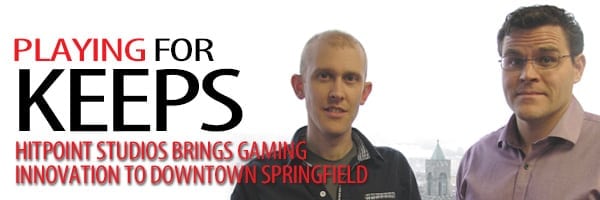
Sections Women in Businesss
SBA Stakes Out Strategies to Help Women-owned Businesses Grow

By KAREN GORDON MILLS
Today, women-owned businesses are the fastest-growing segment of new businesses in our economy.
In fact, an analysis by American Express suggests that the number of women-owned businesses has risen by 200,000 over the past year alone, which is equivalent to just under 550 new women-owned firms created each day.
Regardless of how you slice the data, we know that this trend is growing and that women are over-indexing in entrepreneurship.
As administrator of the U.S. Small Business Administration (SBA), I’ve traveled all around the country meeting with small-business owners and entrepreneurs. I see how their businesses are transforming their industries and rebuilding their communities following the economic downturn.
These are businesses like UEC Electronics in South Carolina. Rebecca Ufkes, an engineer and the company’s president, is laser-focused on growing her successful electronics manufacturing business. She is supplying products to major manufacturers, such as Boeing, Cummins Engine Co, as well as the U.S. Marines and Air Force. And she is creating good American manufacturing jobs in the process.
UEC employs 194 workers, an increase of 49% since August 2011. And Rebecca is part of a growing American supply chain of innovative small businesses that is driving large, multi-national manufacturers to bring more production back to the U.S.
However, today, many women-owned entrepreneurs face what we call the ‘missing middle.’
For example, take my home state of Maine. According to the most recent census data, men owned 54% of businesses in Maine, and women owned 26% of businesses in the state (the remainder were co-owned). However, when you look at the receipts of these businesses, women-owned businesses lagged behind, capturing only 7% of receipts, compared to 78% of receipts earned by male-owned firms. A similar trend is occurring in states across the country.
Clearly, women-owned firms are growing greater in numbers, but challenges persist in scaling their operations and garnering market share.
At the SBA, we have the proven tools needed to bridge that missing middle, and to ensure that all entrepreneurs have the tools they need to grow their businesses, reach new markets, and realize their full potential. These include:
• Access to capital. According to the Urban Institute, SBA loans are three to five times more likely to go to women- and minority-owned businesses than conventional loans. And since President Obama took office, SBA has supported more than $12 billion in lending through more than 35,000 SBA loans to women-owned businesses.
• Contracting. At the SBA, one of our priorities is making sure that more qualified women-, veteran-, and minority-owned small businesses have access to government and commercial supply-chain opportunities. That’s why we put into place the Women’s Contracting Rule, which means that, for the first time, federal agencies can set aside contracting opportunities for women-owned small businesses in more than 300 industries where women are underrepresented. Congress gave SBA this authority in 2000, but it was never implemented. Under President Obama’s leadership, we have made it a priority — and have gotten it done. And recently, we expanded the limits to ensure that women-owned businesses are eligible for larger government contracts.
• Counseling. Our Office of Women’s Business Ownership oversees a national network of 106 Women’s Business Centers (WBCs) that support women who want to start or grow their business. We’re connecting with more women every day, and, in FY 2012 alone, we counseled and trained more than 136,000 women entrepreneurs.
We are committed to helping women entrepreneurs because we know how much potential they have to contribute to America’s economic growth. n

Karen Gordon Mills is a former administrator of the U.S. Small Business Administration. This article first appeared on the SBA’s community blog;
www.sba.gov

Opinion
Some Things We’d Like to See in 2014

It’s time to say goodbye to 2013.
It was an interesting year in many respects — especially with regard to the casino-gambling picture, which changed in ways that probably couldn’t have been imagined just one year ago when there were four projects still in the running for the Western Mass. license — but one that was not very remarkable from a business standpoint.
Indeed, with the exception of a soaring stock market, which had climbed nearly 25% for the year at press time, this was a year of relative stagnancy, in terms of everything from employment to the overall economy, although there were signs of life toward the end of the year (more on that in a bit).
So, without further ado, it’s time to look ahead and identify some of the things we’d like to see happen in 2014. If all or even most of them come to fruition, it could be quite a year.
• Game On. Let’s start with the casino. As the voters in West Springfield, Palmer, East Boston, and other communities voted thumbs down to casino plans for their communities — dramatically changing and diminishing the competition for coveted licenses as they did so — many began to question whether this state really wants or needs such facilities.
Pollsters would tell you that the numbers show that the majority of state residents still support casinos, but don’t want one in their community. Springfield, in fact, was one of the few communities that said yes, and we hope that cranes start to appear in the city’s South End by the end of next year and that MGM Springfield becomes reality a few years later.
As we’ve said many times, a casino will not, by itself, change the city’s fortunes. But it can become part of the process of bringing new vitality, new jobs, and a new attitude about Springfield. Let’s hope it happens.
• It’s About Time. For close to half a decade now, people have been saying, “this could be the year the economy finally breaks out of its funk.” Well, people are saying it again, and this time, there’s more reason to believe them. Indeed, there are some actual signs — falling unemployment and a rise in state GDP among them — that indicate better times ahead.
We hope those reading these tea leaves are on the money — literally and figuratively — because there hasn’t been much of a recovery in this region, and businesses that have fought through this time deserve some sustained momentum and a year when the books become truly good reading.
• Class Act. Several months ago, the talk about whether UMass would create a downtown Springfield ‘satellite facility’ (the school eschews the word ‘campus’) officially shifted to when it would. School officials announced that UMass Springfield would soon start to take shape on the second floor of Tower Square. As the new year begins, we hope that this news alone starts to create momentum in a downtown that sorely needs a spark, and that, as 2014 unfolds, the construction work and then the facility itself will become a catalyst for more retail development and other forms of progress in the city’s central business district.
• Getting Things Started. Lastly, we hope to see work in 2014 in the broad realm of promoting entrepreneurship and getting new ventures off the ground or to that proverbial next level. There are several programs in place that are addressing this challenge — from Valley Venture Mentors to the Grinspoon Foundation’s Entrepreneurship Initiative to the Business Growth Center at the Technology Park at STCC (see story on age 45)— and this work needs to continue and expand in 2014 and the years to follow.
As we’ve said on many occasions, while it is still possible that a major employer will decide to make Western Mass. home and thus create hundreds or perhaps thousands of new jobs, the more likely scenario is that growth in this region will come organically, through new startups that mature and eventually add to their payrolls.
There are many challenges facing this region, but perhaps the biggest is creating more fuel for the economy. Programs that encourage entrepreneurship and help young businesses grow are a vital part of that equation.

Events

Editor’s Note: Again this year, five individuals have been chosen to score the nominations submitted for the 40 Under Forty Class of 2014. In keeping with past practice, BusinessWest has chosen two former winners to be part of this panel — in this case, members of the classes of 2011 and 2013. In addition, BusinessWest has sought out individuals with experience in business and entrepreneurship. This year’s judges are:

Jim Barrett

Jim Barrett

• Jim Barrett, CPA/PFS, MST is the managing partner of Meyers Brothers Kalicka, P.C., the largest regionally based public-accounting firm in Western Mass. He is a certified public accountant licensed in Massachusetts and Connecticut, and holds a personal financial specialist credential. In the taxation practice, he works with privately held commercial companies, partnerships, and individuals. In addition to tax compliance, his engagement experience includes consulting on accounting periods and methods, review of corporate tax provisions, computation of corporate earnings and profits, and mergers and acquisitions. In the financial-planning and wealth-management services practice, Barrett assists clients in integrating and managing issues concerning life and wealth. These issues include pre- and post-retirement planning, estate- and gift-tax planning, income-tax planning, investment planning, education planning, insurance planning, and charitable giving.
Barrett joined the firm in 2002. Prior to that, he was a senior tax manager for KPMG, LLP. He is a member of the AICPA and the MSCPA, and serves as treasurer of the Massachusetts Chamber of Commerce. He also serves as the treasurer of the Young Presidents Organization of Western New England.

Shonda Pettiford

Shonda Pettiford

• Shonda Pettiford, assistant director of Communications for Commonwealth Honors College, a program for academically talented students at UMass Amherst. A member of the 40 Under Forty class of 2013, Pettiford builds the brand of the Honors College through strategic communications, marketing, social media, website development, and event publicity. Before entering that role, she helped direct community-service learning at the university.
For more than 12 years, Pettiford has been involved with the Women’s Fund of Western Mass. She has channeled her passion for advancing social justice for women into myriad volunteer roles within the organization, from co-chairing the grant-making committee to participating on the development, governance, and executive committees, to serving as president of the board of directors.


Peter Rosskothen

Peter Rosskothen

• Peter Rosskothen, co-owner and president of the Log Cabin & Delaney House. A veteran of the hospitality industry, Rosskothen has also been a serial entrepreneur, and a former BusinessWest Top Entrepreneur. After working as restaurant manager at the Holiday Inn in Holyoke, food and beverage manager at Twin Hills Country Club, and director of food services at Classic Foods in Greenfield, he became owner and president of three Boston Chicken locations in Western Mass. and manager of 65 across the Northeast. Later, he was a partner in a venture to convert the former Log Cabin restaurant into a banquet and meeting facility, and, several years later, acquired the Delaney House restaurant. His most recent venture has been the opening of two Mt. Joe coffee shops.
Rosskothen has been involved with the Holyoke Chamber of Commerce, the Holyoke Rotary Club, the Greater Springfield Convention & Visitors Bureau, the Holyoke Health Center, the Economic Development Council of Western Mass., the Volleyball Hall of Fame, and other organizations.

Meghan Rothschild

Meghan Rothschild

• Meghan Rothschild, co-owner of the marketing and public relations firm chikmedia. A member of the 40 Under Forty class of 2011, she and chikmedia partner Emily Gaylord put an emphasis on female-run organizations and women business owners, and offer full design, strategic marketing planning, and creative PR. Current clients include SkinCatering and Papa John’s Pizza.
For the past seven years, Rothschild has worked closely with the Melanoma Foundation of New England as a board member and spokesperson. She is a 10-year melanoma survivor who started her own awareness organization, Surviving Skin, seven years ago. She advocates for skin health through interviews with media across the New England region and by appearing as a speaker at various engagements across the state. She also acts as host of Skin Talk, a local talk show focused on melanoma awareness and skin care. She was recently the keynote speaker at the Melanoma Foundation’s Shades of Hope event in Boston.

Jim Sheils

Jim Sheils

• Jim Sheils, partner at the Springfield-based law firm Shatz, Schwartz and Fentin, P.C., where he concentrates his practice in commercial finance, representing banks and private lenders in the Pioneer Valley and the Berkshires. He also represents clients in the acquisition or sale of businesses. Currently the town moderator of East Longmeadow, he has also served on a number of charitable and civic boards, including the Dunbar Community Center, the Mass. Moderators Assoc., Goodwill Industries of the Pioneer Valley, and the St. Vincent de Paul Society.
Sheils has also been a member of the Mass. Advisory Council for the U.S. Small Business Administration, a director of the Smaller Business Assoc. of New England (SBANE), and a member of the Commercial Law League of America. He was the first program director at WICN Radio, Worcester’s NPR radio station. Sheils is a graduate of the College of the Holy Cross, where he received the Presidential Service Award, and Boston College Law School.

Sections Technology
Jeremiah Beaudry Colors in a Successful Story of Entrepreneurship

By MICHAEL REARDON

Jeremiah Beaudry

Jeremiah Beaudry took his youthful passion for computer repair and turned it into a successful business.

By the time Jeremiah Beaudry was 10 years old, he was building computers.
By the time he was 14, he was running his uncle’s computer repair shop, and by the time he turned 15, he had started his own computer business.
Call him a prodigy. Call him a wunderkind. The bottom line is, the owner of Bloo Solutions in Chicopee knew exactly what he wanted to do in life, and was very good at it from a young age.
“My uncle, Len Beaudry, had his own computer shop in Leominster called Computer HMO,” Beaudry told BusinessWest. “He would drop off broken computers at our house, and my Dad would put them in the basement, and I would go down there and play with them. They were like Lego sets to me.”
When he was 13, Beaudry worked summers repairing computers in his uncle’s shop. The next summer, he ran the business while Len was away. Beaudry mostly taught himself about computers, as he scoured the Internet for instructional videos and any other resources he could find.
“I broke things constantly,” he said. “I’d spend days figuring out what I did wrong. I learned by getting my hands on it and why I did what I did.”
At 15, he opened his business, initially called CBOS Computers, out of his basement at home.
“It was a silly name; it stood for Can’t Beat Our Service,” Beaudry said with a chuckle.
Beaudry, now 30, recently sat in his small computer shop on Grattan Street in Chicopee, surrounded by computers in various stages of assembly and repair, to talk about his business and his formula for success. He was relaxed in blue jeans and a T-shirt, and takes a genuine interest in other people, asking a visitor how he got started in his business.
The choice of the name Bloo Solutions, with the unconventional spelling of the word ‘blue,’ was simple. Beaudry loves the color and designed many websites using different variations of blue. When he went to register the domain name, he found another company called Blue Solutions existed, so he simply changed the spelling.
The venture has carved out a niche as a resource for small businesses throughout the region seeking information-technology solutions. Beaudry provides a wide range of services, including website design, repairs and troubleshooting, virus removal, network and security setup, and more.
He has also offered advice to clients on the right computer or entertainment center to buy, and even on how best to market their products or services.
“What I like most is solving problems for people,” Beaudry explained. “I like to know I’m doing something to make a positive difference in somebody’s business.”

Web of Intrigue
A native of South Hadley, Beaudry graduated from South Hadley High School in 2001. Before earning that diploma, though, he was earning a salary with his own business, one focused mostly on repairing computers owned by clients of his father, an independent financial manager.
“I learned a lot … they were patient with me,” he said, adding that having a father who worked for himself had a big influence on him. “Having flexibility is more important than having stability sometimes.”
In the beginning, Beaudry would make cold calls to area business owners trying to  grow his client roster. In 1999, he scored his first big website-design job when he was hired by Tekoa Country Club in Westfield.
“I got a $4,000 contract to do their website,” he said. “It was unbelievable to me. Since then, I’ve never advertised. Business has been all word of mouth. It’s grown organically.”
Beaudry took a break from the business to attend Bentley College in Waltham. While at school, he worked at a local Radio Shack, which he hated. Indeed, that experience only reinforced his resolve to work for himself and enjoy both the freedom and responsibilities that come with being an entrepreneur.
“I was working someone else’s schedule,” Beaudry said of his time at Radio Shack. “It was the same thing every day. I wasn’t helping anyone; I was just selling things. I probably lasted there only four to six months.”
Bentley College didn’t take either. Beaudry found a client in Hingham, a retail store called Beauty and Main, that was expanding and needed help with updating its computer system to accommodate the move.
“They expanded from one to eight stores, and my job was to install software in all of their stores all over New England,” Beaudry said. “They were 80% of my revenue. I had a couple of people working for me at the time, helping with that project.”
That’s when Beaudry decided to leave Bentley behind and move back to South Hadley. He worked out of his house for 10 years before getting married and starting a family. Beaudry, his wife Chelsea, and son Daxton, who was born in June, live just over a mile away from his shop.
“Having a home office did the trick for a long time,” he said. “But then you start a family, and the office becomes the baby’s room. Plus, I needed a place to meet clients or where they could drop off their computers.”
Bloo Solutions has been at the Grattan Street location for about three and a half years. Beaudry has one employee, his South Hadley High School friend, Joshua Charland, an IT consultant, and more than 100 clients, about 25 of them steady.
“We try to be a one-stop shop,” Beaudry explained. “We target small businesses. We can be their outsourced IT department; they can come to us with all of their questions.”
Chicopee attorney Robert Lefebvre of Gelinas & Lefebvre has been a client of Bloo Solutions for about 10 years, from the time he met Beaudry through a marketing group. At the time, his four-attorney office needed help replacing equipment and updating its system. Since then, Beaudry has been like the office’s own IT department.
“Jeremiah has provided many services for us,” Lefebvre said. “He’s been phenomenal in helping our practice.”
The services provided by Bloo Solutions to Lefebvre’s law firm have evolved over the years to everything from designing the website to updating equipment; from installing backup systems to online marketing, and more.
“Jeremiah is indispensible,” Lefebvre said. “I’ve referred him to many different clients and businesses, and they’ve gotten the same great results that we have. For what he does, you usually have to hire a larger company that would cost you much more money. He provides a unique service to small companies.”
According to Lefebvre, what really impressed him about Beaudry was his commitment to getting to know how the law firm was run so he could better determine exactly the kind of services it would need.
“He’s reliable,” Lefebvre said. “He would research what other, similar firms are doing on issues involving security, and he would come back with recommendations so he could adequately structure our systems.”
Another Chicopee client, A. Crane Construction, retains Bloo Solutions for several IT projects, including the redesign of the company’s website, social-media marketing, IT solutions, and other work.
“Jeremiah is extremely detail-oriented,” said A.J. Crane, owner of the company. “He’s very serious about his business, which is not a common trait among many young business people. He treats his business like we treat ours. He’s very personable, very respectful.”
If Beaudry doesn’t have the answer, he has other experts he can recommend to do the job, he noted. And he is willing to refer his clients to someone who can help with a problem that is out of his area of expertise.
“He always finds the solution for us, even if it doesn’t make money for him,” Crane said.

Technically Speaking
Beaudry told BusinessWest that he’s diligent about keeping up with the ever-changing high-tech landscape. Computer viruses and other destructive bugs are getting more sophisticated and stealthy, and that keeps him busy educating his clients and installing or updating preventative solutions.
“One of the biggest things we do is to make sure clients’ network and security protocol are consistent so viruses won’t infect their computers,” he said. “It’s important to put protections in place so that, if a virus gets into your system, you won’t have much downtime. Downtime costs money, so we try to minimize it so you’re up and running in hours, not days. Nothing is more vital than having backups to your computer system.”
By providing such solutions, Beaudry has kept his clients from feeling blue — or, in this case, bloo, which has become the color of success.

Departments Picture This

Send photos with a caption and contact information to:  ‘Picture This’ c/o BusinessWest Magazine, 1441 Main Street, Springfield, MA 01103 or to [email protected]

Ignite, Dream, Embrace
GrinspoonStuGrinspoon


The 9th Annual Grinspoon, Garvey & Young Entrepreneurship Conference, with the slogan “Ignite the Dream, Embrace the Journey,” was staged Nov. 1 at the MassMutual Center. The day-long conference featured 500 faculty and students from 14 colleges and universities across the Pioneer Valley and included teamwork and breakout sessions that took a closer look at how one goes about starting, growing, and ultimately succeeding in an entrepreneurial venture, securing funding and support for a business, and product development. At left, Thom Fox, right, with Valley Venture Mentors and BrunoFox Group, speaks with
Lisa Lococo, also of Valley Venture Mentors and American Eagle Cycles Inc. At right, Harold Grinspoon (left), founder of the Harold Grinspoon Foundation, and former Grinspoon Award winner Mike Deschamps, from Cell Assist.

Valley Talent
YPSpanelBusinessWest Editor, George O’Brien recently moderated a special Young Professionals of Greater Springfield (YPS) CEO Luncheon co-produced by YPS and Northampton Area Young Professionals. The event, held at Slainte! Restaurant in Holyoke featured local young entrepreneurs, and those that support them, as they discussed what steps the Pioneer Valley needs to take to foster entrepreneurship and cultivate talent. O’Brien, far left, is pictured with panelists (from left), Scott Foster, partner with Bulkley Richardson and co-founder of Valley Venture Mentors; Kara Martin Snyder, owner/chief coach, Vital Corps, Holistic Living for the Modern World; Delcie Bean IV, president, Paragus IT and Valley Technology Outreach; and Justin Pelis, owner, North Country Landscapes & Garden Center.

Community Profile Features
Wilbraham Embraces Vision of the Future

Amy Scott

Amy Scott says businesses in Wilbraham try to support each other whenever possible.

Amy Scott, principal of Wild Apple Design Group in Wilbraham, was heading out to look for a new car on the day BusinessWest spoke with her about the general business climate in that community.
The Hampden resident acknowledged that, like other Western Mass. residents, she has plenty of options when it comes to where to shop for a new ride, but she entered the search firmly committed to making sure it started and ended on nearby Boston Road.
“It’s part of the loyalty factor,” said Scott, who used that term to cover not only her buying habits but her willingness to serve the community in a number of roles. It’s an attitude that emerged not long after she took a gamble and leased more expensive space in Post Office Park in Wilbraham when she was searching for a new home for her venture two years ago.
She accepted that risk hoping that her services would appeal to the more than 50 businesses in the park and the hundreds of others in the community and just beyond it in Springfield — and the gamble has been rewarded. And she’s made it her policy to repay the loyalty shown to her.
“I feel like every time I have an opportunity to make a purchase, I look around at my neighbors, and they seem to be doing the same,” she explained. “It shows good faith on everybody’s part.”
Good faith is needed in this community that suffers, in many respects, when it comes to that old axiom about commercial real estate: location, location, location.
Indeed, Wilbraham is not exactly easy to get to from most anywhere in Western Mass. So, in recent years, those involved in town government and its business community have been actively involved in providing reasons for people to withstand the many traffic lights and stopsigns they encounter when trying to get here.
Post Office Park is part of that equation, but so are ongoing efforts, waged by the Boston Road Business Assoc. (BRBA), to make that thoroughfare a true destination for those looking for everything from a car to a major appliance to a good meal.
Scott has recently helped the group revamp its Best of Boston Road awards, which now has thousands of Wilbraham and Springfield residents voting for their favorite retailer, insurance company, dentist, restaurant, and more.
But while civic and business leaders work to help convince consumers that Wilbraham is a good place to do business, they’re also focused on quality of life for those who have chosen to live there — and also those who will join them in the decades to come.
The town christened its new, $65 million Minnechaug Regional High School just over a year ago, and also opened a new fire station, thanks to some imaginative financing. The next priorities, said Robert Boilard, vice president of Boilard Lumber and a selectman, are a new police station and senior center.
They are likely to be key components in a new vision, or comprehensive plan, for the town taking shape through the work of the recently formed Vision Task Force.
Working under the slogan “honoring the past, understanding the present, and imagining the future,” the group began work in early 2012 and gave its final report a few weeks ago, said its chairman, Charles Phillips, a long-time resident. “The Vision Task Force expected a largely positive response and received it,” he noted. “We were surprised, however, at some of the creative ideas that were expressed for improvement.”
For this, the latest installment of its Community Profile series, BusinessWest will look at some of those ideas, and also some of the ongoing — and generally successful — efforts to help people in this region, and sometimes from well beyond it, find Wilbraham.

School of Thought

“Tweedy” and “New Englandy.”
Those are two adjectives concocted by Rodney LaBrecque, head of school at Wilbraham Monson Academy, to describe the institution and help explain why it currently boasts students from 34 countries and several U.S. states, and is at full enrollment.
Those terms (the former is actually in the dictionary, while the latter is not) help paint a picture of the 209-year-old campus, one that is obviously appealing. “It’s certainly a selling point,” said LaBrecque, adding that this quaintness is only one reason for the institution’s success and current growth pattern; the diversity of its programs and the school’s emergence as a leader in such fields as entrepreneurship and business studies are more pertinent factors.
And they (or at least ‘New Englandy’) can also be used to describe Wilbraham itself, which was incorporated in 1763 and, like many neighboring communities, was largely agricultural until quite recently.
Robert Boilard

Robert Boilard says the Vision Task Force has helped define future goals for the town.

The town was once famous for its apple and peach orchards and several farms — including Pheasant Farm, Rice’s Fruit Farm, and Bennett’s Turkey Farm — that are no longer operating. In fact, the Wilbraham Peach Festival, a popular fall tradition for a quarter-century, was discontinued in 2010.
In its place, the Wilbraham Nature and Cultural Center (WNCC) — steward of Fountain Park, located off Tinkham Road, where the peach festival was held — has re-energized a summer music series on Thursday nights, which has drawn great reviews and strong attendance for regional bands such as The Kings, Trailer Trash, and The Frank Manzi Band.
This evolution, from peaches to rock music, mirrors other transformations in the town, from agricultural center to one of the region’s more popular bedroom communities, and from a business community that could only be described as sleepy to one that is growing — and diversifying.
Indeed, the tenant list at Post Office Park, which has seen explosive growth over the past decade, includes everything from marketing firms to the Scantic Valley YMCA; from medical facilities to law offices.
The park has helped make Wilbraham the business mailing address for many entrepreneurs who previously had little reason to give the community a look, and it is fueling the potential for more commercial development, albeit controlled, as civic leaders cope with some of the growing pains that come with the population surge recorded in recent decades.
The new high school is a manifestation of this growth, said Boilard, as is the need for a new police station and senior center — and the new vision plan itself, which was commissioned with the knowledge that the community needed to anticipate its future and properly prepare for it.
The Vision Task Force, with which Scott was involved through her work with the BRBA, completed phase one of the initiative, called the “Community Vision,” which laid the groundwork for the next step, creation of a comprensive plan, which will be the road map for the community, said Phillips.
The key priorities identified by respondents, he said, include the need to work harder alongside the business community, continue to insist on excellent education, preserve the feel and beauty of the community, place added emphasis on individual recreation, offer reasonably priced housing with excellent town services, and improve service on sidewalks and bikeways.
And while contemplating the future, the town is coping with the present, which in recent years has meant everything from the Great Recession to the tornadoes that caused extensive damage within the community in June 2011 to the ongoing budget challenges faced by all cities and towns and exacerbated by the state’s own fiscal turmoil.
Effective teamwork in Town Hall has been the most important ingredient in meeting these challenges head on, said Boilard.
“Our department heads are phenomenal, and no matter what our political affiliation, we’ve always been on the same page fiscally,” he said. “When you have a team that is running for that common goal, it makes the end result easier to get to, and we all work as slim as we can to get the job done.”

The Bottom Line
‘Getting the job done’ is a phrase used by a number of people in a many different contexts in this community.
For town officials, it means creating that roadmap for the future while dealing with current challenges. For LaBrecque, it means continuing to build WMA’s brand around the world while also strengthening an already-solid town-gown relationship. And for Scott and others in business community, it means growing their own ventures while working, collectively, to convince the world that Wilbraham really isn’t that far away.
“I love that I’m doing business with my neighbors and they’re doing business with me,” she said. “It’s a pretty healthy place to be.”

Elizabeth Taras can be reached at [email protected]