Home Posts tagged Entrepreneurship (Page 5)
Daily News

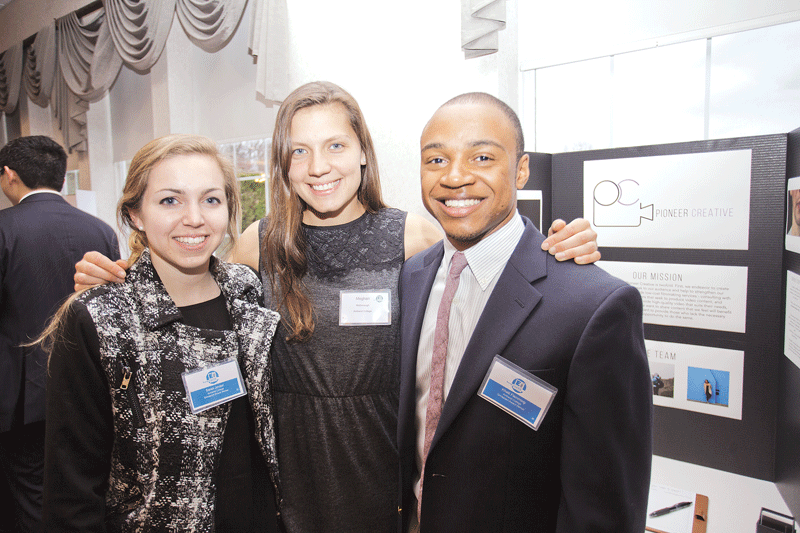
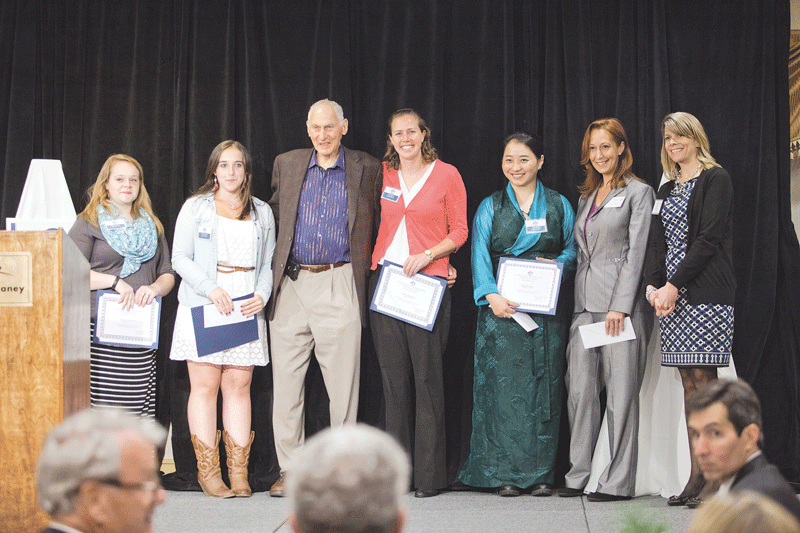
SPRINGFIELD — The 11th annual Grinspoon, Garvey & Young Entrepreneurship Conference will be held Friday, Nov. 6 from 8:15 a.m. to 2 p.m. at the MassMutual Center in Springfield. More than 500 students and faculty representing 14 area colleges are expected to attend the event, which includes hands-on workshops, entrepreneur exhibits, a keynote speaker, and networking.

Organized by the Harold Grinspoon Charitable Foundation and the 14 colleges, the Entrepreneurship Conference is held annually to inspire, motivate, and support college students in turning their ideas into businesses. The event will feature 25 exhibitors, including former Grinspoon student awardees who started their businesses while in college.

Students will begin the day collaborating on teams for the “Team Challenge: Campus Tech Solutions” competition beginning at 9:10 a.m.

Afterward, students may select from five breakout sessions, including “The Shark Tank,” “Pitch Camp,” “The Lightning Round: Idea Jam and Speed Networking,” “Social Entrepreneurshi: People, Planet, Profits,” and “Epic Stories from Grinspoon Award Winners.” In each of these sessions, students will learn directly from successful entrepreneurs, business leaders, entrepreneurship faculty, and each other.

The keynote speaker this year is Jess Lauren, founder of Olive Natural Beauty and winner of the 2015 Valley Venture Mentors Accelerator Awards.

Gold sponsors for the conference are the UMass Amherst Isenberg MBA Program and the Harold Grinspoon Charitable Foundation. The silver sponsor is Bueno Y Sano, and bronze sponsors include Northwestern Mutual, AAA of the Pioneer Valley, and the Springfield Venture Fund.

Participating colleges include American International College, Amherst College, Bay Path University, Elms College, Greenfield Community College, Hampshire College, Holyoke Community College, Mount Holyoke College, Smith College, Springfield College, Springfield Technical Community College, UMass Amherst, Western New England University, and Westfield State University.

For more information, contact Cari Carpenter, director of the Entrepreneurship Initiative, at [email protected] or (413) 335-3535.

Daily News

On Wednesday, Nov. 4, Comcast Business will present the fifth annual Western Mass. Business Expo at the MassMutual Center in downtown Springfield, produced by BusinessWest and the Healthcare News.

The day-long event is crammed with programming designed to promote awareness of the depth and breadth of the region’s economy and help business owners and managers better navigate the myriad challenges they face.

The day will get off to an entertaining start with the Springfield Regional Chamber’s October breakfast and keynote speaker Dan Kenary, CEO and co-founder of Harpoon Brewery, who will engage in a “casual conversation” with BusinessWest Editor George O’Brien. Later, at the luncheon hosted by the Professional Women’s Chamber, Alison Lands, senior manager in Deloitte’s Strategy & Operations practice, will present a program based on a report she co-authored and edited titled “Advanced to Advantageous: The Case for New England’s Manufacturing Revolution.” She will discuss the challenges facing this resilient, innovative sector, particularly a persistent skills gap and a lack of brand awareness, and how they present real opportunities for workforce development in New England.

Throughout the day, there will be informative seminars across four tracks: Sales & Marketing, Workforce Development, Hottest Trends, and Entrepreneurship. Also slated are robotics and machine-tooling demonstrations, a Technology Corridor, a Business Support Center, the ever-popular Pitch Contest staged by Valley Venture Mentors, the day-capping Expo Social (always a great networking opportunity), and much more.

Sponsors include Comcast Business, presenting sponsor; Health New England, Johnson & Hill Staffing Services, MGM Springfield, and Wild Apple Design, director-level sponsors; the Isenberg School of Business at UMass Amherst, education sponsor; 94.7 WMAS, media sponsor; Peerless Precision, Smith & Wesson, the NTMS, and the Larry A. Maier Memorial Educational Fund, robotics and manufacturing sponsors; and Meyers Brothers Kalicka, entrepreneur sponsor. For more information, call (413) 781-8600, ext. 100, or visit www.businesswest.com.

Environment and Engineering Sections

What Goes Around …

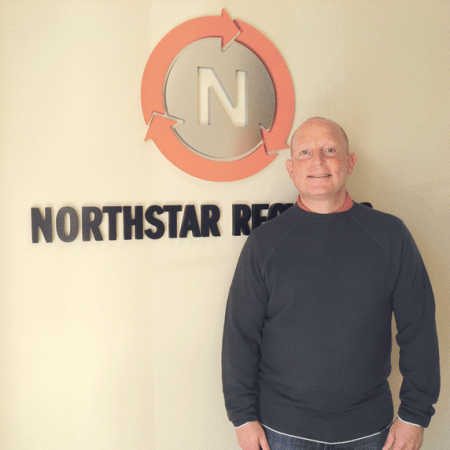
Noah (left) and Seth Goodman

Noah (left) and Seth Goodman left their family’s paper recycling business to establish Northstar Recycling and fill a void in the marketplace.

Noah Goodman scrolls through photos on his smartphone, searching for a picture of a whiteboard.

It was taken before he and his brother, Seth, opened Northstar Recycling, and showcases the first step they took in establishing their company: Creating a set of core values.

The list includes, “We Do First Things First”; “We Count on Each Other for Help”; “We Do Our Personal Best Today”; “We Do the Next Right Thing”; and “We are Impeccable With Our Word.” But the final item, which is underlined and was written in capital letters, reads “WE HAVE FUN!”

It’s a principle they both subscribe to, and although making sure employees have a good time at work is hardly a priority for many business owners, these partners attribute their accelerated growth and success to the combination of these core values and the atmosphere they have carefully crafted in their East Longmeadow facility.

They say it has helped them attract graduates from prestigious schools such as Princeton — they actually have five Ivy Leaguers on the payroll — as well as employees from large urban centers such as New York City, who joined their firm because they want to work in a place where their well-being is a primary consideration.

In fact, that premise recently earned the company accolades when Fortune magazine ranked Northstar Recycling as one of the top places for women to work in the U.S.

Teresa Chamberlain graduated from Lehigh University last year with a degree in environmental engineering and environmental studies and moved from Ohio to work at Northstar. Her story, and remarks, are typical.

“It’s a relaxing, professional environment,” said the client development executor, who takes a proactive stance in her job. “I’m not micromanaged and because the responsibility to get my work done is my own, I am empowered to do things well.”

The Goodmans told BusinessWest that Northstar is filling a need in the marketplace, and has experienced phenomenal growth. “Four years ago, we had 11 employees. Today, we have 34,” Noah said. “We’ve grown so quickly that we are doubling our space in January and taking over the entire 8,000 square foot building we are in.”

The interior of their space also reflects attention to detail. The entranceway is dominated by a soothing, 9-foot waterfall with Northstar’s logo imprinted on the rock surface beneath the flowing water. The ceilings are lofty and a hallway with an arched faux metallic-patterned silver ceiling leads to spacious offices and a break room, which is kept well stocked with free food and snacks.

There is a picnic area outside with a barbeque grill and patio tables with umbrellas; they are installing a horseshoe pit; employees are treated to a meal each week at the local Coughlin’s Place restaurant, can bring their dogs to work, and get free haircuts, courtesy of their employer, at Ace Barber Shop in the building.

And of course, they have their own composter. “We are a zero- waste-to-landfill office,” said Noah, explaining that Northstar’s purpose is to create recycling programs for national manufacturing firms and other businesses, and materials they deal with include cardboard, plastic, metal, wood, and organics.

“We partner with companies and manage their recycling, because they typically have environmental goals they have to achieve by a certain date and time,” Seth noted.

Noah explained that the company’s clients can’t find outlets for their raw materials, so Northstar does that for them in a way that creates a revenue stream, an important goal in addition to achieving sustainability and their environmental goals.

It’s an arena Northstar not only excels in, but one in which it is pushing the boundaries of what can be accomplished (more about that later). It also makes sure the recycling takes place as close to the manufacturing firm as possible.


Click HERE for a listing of area environmental services companies


“We’re always looking to reduce the distance where materials are recycled; a lot of things today are being sent to China and India in overseas containers,” Noah explained. “Recycled paper is the largest item exported out of the U.S. by volume.”

As a result, they work hard to find local recyclers wherever their client has a facility. “We make it as easy for the manufacturer as possible,” Seth said. “We coordinate everything, including the containers they use and the trucks and trailers that transport materials.”

Solid Foundation

The Goodman brothers are fifth-generation entrepreneurs. “Our great, great grandfather was a peddler in Western Mass., and he and our great grandfather had a scrap metal recycling company on Ferry Street in Springfield,” Seth explained.

Their father and uncle joined the business in the ’60s, but changed its focus and turned it into a private paper-recycling firm. “It grew to be one of the largest paper recyclers in New England, and we both worked in the business for 20 years,” Noah said, adding that these experiences helped them develop strong work ethics and they “did every job there that anyone could do.”

Seth Goodman

Seth Goodman says Northstar has employees whose only job is to continuously improve recycling programs at clients’ manufacturing plants.

However, five years ago the brothers developed a different vision, and made the decision to branch off on their own. “We felt there was a real need to help companies reduce what they were putting into landfills and increase what they were recycling,” Seth recalled.

Noah told BusinessWest they realized that U.S. companies had begun to take sustainability seriously and knew that large Fortune 500 firms didn’t have the expertise to meet stringent standards, which require them to reduce their carbon footprint as well as the amount of material they put into the trash.

They said the U.S. produces more than 50 millions tons of waste every year (more than any other country in the world), and more than half of it is dumped into landfills, contaminating water supplies and polluting the air with dangerous amounts of methane gas, which is 23 times more potent than carbon dioxide.

This factual information, coupled with their shared values and relationship — “we’re best friends and very much in tune with each other; we communicate openly and honestly and defer to whoever is the most passionate about something, which means there is harmony at the top,” Noah said, — led them to launch Northstar Recycling in 2011 with 11 employees.

Their core belief was simple: Waste has value, and it is damaging to the planet and financially irresponsible to send reusable resources to a landfill. And from that their mission statement was born — to help businesses recycle more and send less to landfills.

“We felt we had the experience and know-how to help companies and saw a huge future in it,” Noah said.

But before they started, they spent time designing the culture of their future workplace.

“We wanted to create a workplace where people felt emotionally safe; where they could speak up openly and have their opinion heard and considered,” Seth said. “We also wanted our employees to have fun and care enough to really want to help us succeed.”

The brothers each have three young children, and because spending time with them is a priority, they felt it was only fair to provide employees with the same luxury.

“So, if someone has to leave work for a family issue, the first thing we ask is: ‘Is everything OK?’ and the next is ‘What can we do to support you?’” Seth said.

“Every decision we make day-to-day is in line with our core values — they are what and who we are as human beings,” he went on. “It’s also what drives our business and our culture, which are the foundations for our success. We have a great strategy and execute really well, but we couldn’t do it without our values; the people who work for us really want to see us succeed because of the environment we’ve created.”

In addition to those in East Longmeadow, the company has three employees in New York, two in Philadelphia, and one in Cincinnati.

However, everyone is brought to East Longmeadow on a quarterly basis, and after working together, they enjoy a fun-filled evening activity.

“We’ve staged a scavenger hunt in Springfield; a square dance with a professional caller and country western band; a team-building event; and a painting party,” Seth recalled. “And every year, everyone goes on a two-to four-day trip. Last year we saw Broadway shows. We have also gone to Mohawk Mountain (in Connecticut) to go horseback riding, and our sales marketing team (which goes on different trips) has gone to a dude ranch in Montana, skied in Jacksonville, Wyoming, gone white water rafting in West Virginia, and visited South Beach in Miami.”

Noah said the perks are important. “We want our employees to be happy, because if they are happy and healthy, they are more productive. So although we do have hourly weeks, we aren’t clock watchers,” he noted. “And everything that has happened in the last four years has exceeded our expectations.”

New Solutions

Seth said that when Northstar goes into a company for the first time, it conducts an initial assessment, which includes looking at areas where trash is generated.

“We typically find they are throwing away material that is recyclable,” he said.

At that point they assign two teams to work with the client. One of their primary roles is to find outlets for material that is being discarded, but could be diverted. Items often include stretch film, plastic strapping, and cardboard, which is frequently not all recaptured, even if attempts have been made to recycle it.

A Northstar team also creates a set of internal standard operating procedures for the client, because in many instances even if the company has established these measures, they are not efficient or inclusive enough.

“We have people whose sole job is to work at manufacturing sites to continuously improve their recycling programs,” Seth said.

The Goodmans are proud that their business has a positive impact on the environment and say the potential for growth is unlimited.

“There is a lot of opportunity because many companies have set goals to be more environmentally proactive. In fact, one of the nation’s largest fast food chains told all their suppliers if they want to continue to do business with them, their manufacturing facilities have to be ‘zero waste to landfill’ by a certain date,” Seth told BusinessWest. “Our business is being driven by large consumer-product companies throughout the country.”

Clients are visited on a frequent basis, and in addition, the home team constantly looks for new, innovative ways to recycle items traditionally considered non-recyclable. Success stories include selling textile scraps to a company that is using them to make bow-and-arrow targets.

“We also work with a large pet food manufacturer who used to send all its wet scraps to a landfill; now they go to a composter,” Seth said, noting that Northstar’s employees think creatively or out of the box.

“We research everything scrap items could possibly be used for, and are creating markets where there weren’t markets before,” he went on. “For example, we have a client that produces the film used to package coffee; it’s made of three layers of plastic and one layer of metal, and the scraps were going into the trash. But we found a company that turns them into a reusable packaging product.”

Noah said it’s a plus when consumer product firms can state in advertisements and literature that they are a sustainable company and all their manufacturers are zero waste to landfill.

“Northstar becomes a resource for these major corporations, and in many cases they refer their vendors to us; if they are having trouble meeting their goals, we can help,” he noted. “They realize they can devote a lot of time, energy and resources to the issue or bring their problem to us as we have a proven track record of getting the job done.”

Moving Forward

The Goodmans are proud of their company and what they have accomplished.

“When we began, we realized there were not enough nimble companies to help national corporations reach their goals,” Noah said. “There was a void in the market and we bet our financial livelihood on the belief that we could fill it, which we have done.”

They are also happy to continue their family tradition of entrepreneurship.

“Our company is located in East Longmeadow and our family has been in the area for five generations, so we’re proud to be able to help revitalize the business community in Western Mass. and are really excited to be bringing new jobs to the area,” Seth said. “But it all goes back to our core values.”

Features

In the 1960s, Ron Littlefield says, no one needed GPS to find Tennessee’s fourth-largest city.

“You could tell when you were getting close to Chattanooga because you could smell Chattanooga; it stunk,” said the former mayor, who served from 2005 to 2013. “It was an old foundry city. And when you had stormy weather, you had inversions, because we have mountains and valleys, and it would trap the smoke, and you would literally be eating smoke when you walked outside.”

City leaders were mortified when, in October 1969, Walter Cronkite came across a recent EPA study, sat down behind the news desk, looked into the camera, and declared Chattanooga “the dirtiest city in America.”

“It was so bad that people had to change their shirts in the middle of the day,” said John Bridger, executive director of the Chattanooga-Hamilton County Regional Planning Agency. “They were tough times — but tough times create opportunities.”

In truth, Bridger continued, many residents put up with the pollution because the manufacturing sector was chugging along, but Cronkite’s report jarred them out of complacency. “If not for those challenges, I don’t think we would have changed, because we were comfortable. We were the dynamo of Dixie — why change what we were doing if we were making money? But that report created an impetus for change; it brought a new perspective.”

Still, Chattanooga was no overnight turnaround. Even after efforts to clean up the waterway and better connect the riverfront with the downtown area, a downturn in the region’s manufacturing base led to mass flight from the city, which lost more than 10% of its population during the 1980s. But, as current Mayor Andy Berke points out, it was the only American city with that level of population loss during the ’80s to actually gain residents in the 1990s.

“It took a long time — a lot of people over a great period of time — to make it happen,” he said. “And it started with real investment in the core of our city.”

Today, Chattanooga is a growing city (population just over 173,000, about 20,000 more than Springfield) riding a wave of entrepreneurship and high-tech innovation, and touting itself as the Gig City after building a broadband network (known as ‘the Gig’) able to connect every home and business to the Internet at 1 gigabit per second, or 50 to 100 times faster than the average U.S. Internet connection.

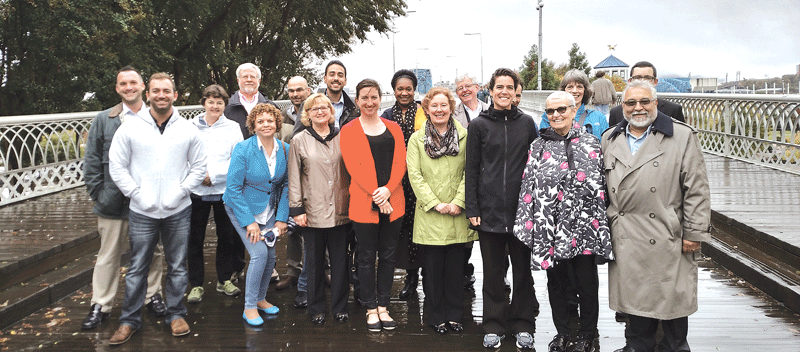
As part of the City2City Pioneer Valley program, 30 economic-development, nonprofit, and community leaders from Greater Springfield visited Chattanooga late last month to hear the story of how a stinking foundry city transformed itself into a beacon of innovation.

Walnut Street Bridge

Many of the attendees at the foot of the Walnut Street Bridge, a pedestrian span over the Tennessee River that’s a hallmark of an extensive riverfront makeover.

In doing so, they learned that this community on Georgia’s northwestern border is no utopia; it still faces serious education, workforce-development, and racial-gentrification issues, to name a few. But it’s also proving to be an example of how public, business, and nonprofit interests can work in concert to produce and then fund real solutions.

“There seems to be one goal with all these organizations we’ve met. They’re all doing their own things, but they’re all on the same page and have the same goal, and that’s to help all these spinning wheels move the city forward,” said Alfonso Santaniello, president of the Creative Strategy Agency in Springfield, who values his company’s downtown presence and wanted to visit a growing city with a similar emphasis on building up its central business district.

“Springfield needs to find a way to get everyone on the same page and push forward from there,” he went on. “That’s one of our biggest issues; everyone is doing great things, but why are we not doing them together?”

Chattanooga’s striking collaboration culture (more on that later) is one reason why the Gig City label is, in fact, not the top storyline there, but a way to draw national notice to everything else that’s going on.

“The technology is great,” said Enoch Elwell, founder of Co.Starters, a Chattanooga-based entrepreneuship program that has expanded nationally, including into Holyoke earlier this year. “But its biggest impact is as a rallying cry for our community, something that brings us together and draws the world’s attention.”

The City2City contingent from Massachusetts was certainly listening.

Cleaning Up Their Act

Littlefield recalls a time when Chattanooga manufacturers treated the Tennessee River like a sewer, dumping garbage directly into the waterway. “But in the ’70s, we cleaned up our water, and we began to clean up our act.”

From an ecological perspective, it actually helped when the foundries started to close, but it posed economic issues, he went on, which were partially remedied by attracting industries from the north, like textiles and automaking, with the promise of cheaper labor. But that wasn’t a sustainable strategy, and a steady population drain ensued.

“When you lose jobs, you also lose hope, and when you lose hope, you lose your children,” he said. “They grow up and get an education and go somewhere else. We began to say, ‘we have to change this community in ways we’ve never changed it before. We’ve got to change our attitude, our way of thinking.’”

The first step was the creation of the Tennessee Riverpark Master Plan to transform the riverfront and downtown area, but only after many hours meeting with residents — many of whom had felt disenfranchised — and incorporating their concerns into the process. As Littlefield recalled, one woman told him, “this is the first time, when I said something, that someone wrote it down in my own words.”

Municipal leaders also visited other cities (notably a 1981 trek to Indianapolis) to find ideas and inspiration. These information-gathering efforts led to the creation in 1986 of River City Co., a nonprofit tasked with implementing the master plan, a 20-year blueprint for the riverfront and downtown, initially capitalized with $12 million from local foundations and financial institutions.

“We did visioning before visioning was cool, and we found that it actually works,” Littlefield said. “So we set about to create quality of life, and that started with the river.”

Bridgett Massengill, executive director of Thrive 2055 — a more recent coalition of economic leaders tasked with creating economic opportunity in a tri-state, 16-county region surrounding Chattanooga’s Hamilton County — detailed how four area foundations took the first step to fund River City Co., and called it typical of the way the city has operated in the past 30 years.

“I have been blown away by the collaboration in this region, the way we come together, roll up our sleeves, and make it happen,” she said. “There was a will that we were going to proceed with or without federal dollars.”

That caught the attention of Katie Allan Zobel, president and CEO of the Community Foundation of Western Massachusetts.

“The success in Chattanooga has grown from public-private partnerships,” she told BusinessWest. “They keep saying how foundations have played a role in these partnerships, and it seems to me that’s something Springfield and surrounding regions should be exploring with more focus.”

She first thought, upon hearing of the role of the region’s foundations, that they must be larger and better-capitalized than those in Western Mass., but was surprised to find that wasn’t the case. “We can always do more together, and Chattanooga has been proving that for the last 25 years.”

The tax structure in Tennessee — property and sales taxes but no income tax — is a challenge for economic development, officials note. That’s why the public-private partnerships that have sprung up to support development are so noteworthy, said Beth Jones, executive director of the Southeast Tennessee Development District. “Typically, we don’t start with how much money an initiative will cost. We ask, ‘is this a good idea?’ and then we bring people together to raise the money.”

That’s part of the so-called “Chattanooga way” cited by many of the people who met with the City2City contingent. Kim White, president and CEO of River City Co., said the term essentially refers to the way leaders “get a diverse group of people together and really plan.”

Landing a Gig

The city’s successes included a complete overhaul of the riverfront, including the privately funded Tennessee Aquarium, the nation’s largest freshwater aquarium, and the pedestrian-only Walnut Street Bridge; as well as an innovation district downtown aimed at attracting both high-tech giants like Amazon (which has a presence in the city) as well as a raft of intriguing startups.

Despite the successes of the Tennessee Riverpark Master Plan, the planning process had never focused specifically on entrepreneurship or technology until the city’s power company, EPB, tapped into federal stimulus money in 2009 to launch the Gig, said Ken Hays, president and CEO of the city’s Enterprise Center and Innovation District, which followed in the wake of the massive fiber project.

Since then, an accelerator program for startups has graduated 67 companies that have raised $3.1 in combined capital. In 2012, a nonprofit called CoLab launched GigTank, an annual, 14-week summer entrepreneurship program; 40 participating companies have raised $4.37 million in capital to date. CoLab’s “Will This Float?” startup pitch competition, launched five years ago, has attracted 47 participants, and the five winners all continue to grow, with $5.5 million in capital raised to date. Then there’s Tech Goes Home, a computer-education program aimed at everyone from preschoolers to the elderly.

Chattanooga has plenty of traditional industry, of course, none more prominent than Volkswagen, which employs about 2,400 people at its only North American plant and is planning an expansion — even amidst controversy over its diesel engine — that will bring production of a new SUV to Chattanooga and boost its workforce by another 2,000, including 200 in research and development, a first for the area. Other giants, like Coca-Cola and Little Debbie, dot the landscape as well.

Laura Masulis, left, transformative development fellow at MassDevelopment

Laura Masulis, left, transformative development fellow at MassDevelopment, and Scott Foster, right, chairman of Valley Venture Mentors, speak with Will Joseph and Enoch Elwell of Co.Starters, a national, Chattanooga-based entrepreneurship initiative that launched in Holyoke this year.

But economic-development leaders are focused on the Innovation District and the cultivation of small businesses that may one day grow to be the next Coca-Cola or Amazon. Efforts to do so range from Startup in a Day, a commitment to streamlining business permitting on a 24/7 basis, to the Growing Small Business program, a financial incentive offered to companies with fewer than 100 employees that hire at least five workers in a 12-month period.

“If we can subsidize their next hire and keep them afloat for another couple of months, that’s what we want to do, and it’s been pretty successful,” said Nick Wilkinson, the city’s deputy administrator of Economic & Community Development.

With the type of 21st-century businesses attracted by the Gig, however, comes the need for a culture change, or at least a greater focus on the quality-of-life issues that matter to a young, hip, tech-savvy worker base, Bridger said. In addition, the population has shifted from one dominated by two-parent families with children in 1970 to one with mostly single-income households, and that affects the type of housing — smaller and closer to workplaces — that needs to be built in the city.

“Place matters,” he said, noting that IT workers aren’t tied to their workplaces like people in more traditional industries. “So, if you want to compete economically, they’re thinking place first, jobs second. Ultimately, it’s not just about transportation, it’s not just about economic development, it’s not just about the natural environment — it’s about how all those things work together to create place.”

That’s where quality-of-life improvements like the revamped riverfront and growing arts and recreation initiatives come in. The city is obviously doing something right, with $4 billion in business investment since 2008. Now leaders are trying to keep the momentum going by developing more housing in the city — an expected 160,000 new units by 2055, in fact — and touting the success of amenities like the free downtown shuttle (cheekily known as the Choo Choo) and an extensive network of bike lanes, all to support a Millennial population that doesn’t necessarily want to rely on automobiles.

The task isn’t easy when 97% of the downtown workforce drives in from the outside, and only 1.2% of downtown zoning is mixed-use. Regional passenger rail service may be 20 years away or more simply because the surrounding counties don’t have the population density of, say, Western Mass. to support it.

“Our focus is on how to create that housing density that makes us a more 24/7 city,” White explained, noting that the next two years will see the addition of 1,500 apartments downtown, more than doubling the current number, in addition to 500 more hotel rooms and 1,300 more student units to support the 12,000-student University of Tennessee Chattanooga, which skirts the downtown area. “If you come back in three years, this will be a completely different city.”

Barriers to Progress

Some of those changes are more pressing than others. The City2City tour came in the shadow of a recent, searing report by Ken Chilton, a Public Administration professor at Tennessee State University, on the city’s ongoing racial gentrification and the challenges minorities face overcoming poverty, violence, and poor health.

The 23-page report, The Unfinished Agenda, examines how investment and development in certain downtown neighborhoods has come at the expense of low-income African-American families that used to live there but have been forced out by rising costs.

For example, in 1990, the downtown white population was 2,402, while the black population was 3,720. In 2013, those numbers were reversed, with 4,880 whites and 2,358 blacks living downtown. In effect, African-Americans are increasingly being pushed into poorer neighborhoods and schools mired in violence and chaos and not seeing the type of investment that characterizes the downtown and riverfront, Chilton writes.

Because some of these neighborhoods have more adult high-school dropouts than college graduates, many are forced to rely on low-paying jobs instead of the white-collar jobs that have defined the downtown renewal. As a result, 36% of blacks in Chattanooga live in poverty, compared with 14.5% of whites. In the 11 lowest-income neighborhoods in Chattanooga, where the population is 73% African-American, the average poverty rate is 63.5%. Bridger told the City2City contingent that, while the city’s unemployment rate is 5.5%, it’s about double that in the black population.

James McKissic, director of Chattanooga’s Office of Multicultural Affairs, agreed that gentrification is a problem, noting that certain neighborhoods have indeed become unaffordable for lower-income residents. But he added that several housing developments are in the works over the next few years, targeted at different income levels, in desireable neighborhoods. “We don’t want to be the next San Francisco or Austin; we want people from various income levels to live together.”

Still, he added, the heart of the issue is poverty — and the need for initiatives that will improve education and provide economic opportunity for people of all races and income levels.

However, public education — which is operated on the county level — hasn’t made enough strides to satisfy Chattanooga officials, a situation detailed in a 2013 Ochs Center for Metropolitan Studies report, again written by Chilton, affirming that the system’s poor, majority-black schools lag far behind schools in more prosperous — usually whiter — neighborhoods.

To compound matters, Tennessee finishes 49th in the nation in per-pupil education spending, according to the U.S. Census Bureau, but Hamilton County spending fell between 2007 and 2012, even compared to the state as a whole. Adjusted for inflation, the county spent about $321 less per pupil in 2012 than in 2007. In those years, the Hamilton County Board of Education cut about $44 million to balance budgets in the face of rising costs in health care, utilities, and salaries. “There’s a disconnect between the school system, the state Board of Education, and the real world,” Berke said.

Added Bridger, “public education is not where it needs to be, and it’s becoming a job-recruitment problem.” He noted that the rural counties surrounding Chattanooga fare even worse when it comes to graduation rates. “We’re not getting enough qualified employees to work in the jobs.”

After all, the city’s manufacturing base hasn’t disappeared; it’s just that many of today’s manufacturing jobs are high-skill, high-paying positions. Much like the situation in the Pioneer Valley, plenty of openings exist, but the Hamilton County region grapples with a skills gap between what employers require and the level of education that job seekers bring to the table. Unfortunately, Jones noted, applied-technology classes at local community colleges struggle with empty seats and a lack of interest in manufacturing as a career.

“We’ve basically taught people throughout the South and throughout the country that manufacturing is dirty, it’s not cool, it’s a sweatshop, it doesn’t pay well, the whole nine yards. I still hear that from our young people,” Jones said. “We’ve got to do a better job educating our young people that there are good jobs out there, and you can get them with certain certifications and certain degrees, and you can make more a whole lot more money than I’ve been making all my life with a four-year degree.”

Ruth Thompson, communications and outreach manager for Thrive 2055, agreed, stressing the importance of education. One notable initiative, called Tennessee Promise, pays for two years of community college, in an effort to narrow the skills gap.

“The majority of the country has about 8% of their economy driven by manufacturing. If you hear us talking a lot about advanced manufacturing, it’s because, in our region, it’s 22%. We still have a very, very heavy manufacturing base,” she said. “But previously, a 16-year-old from Trenton, Georgia could drop out of school, go work in a hosiery mill, and have a good job the rest of his life. We know that’s no longer the case. So as we work on changing the culture, we’re working in partnership with the community colleges and four-year universities to change that mindset that you don’t have to go to school.”

However, “we have other problems on top of the skills gap,” Jones added, noting that substance abuse — in another parallel to Massachusetts — keeps many people out of the workforce, while Tennessee (unlike the Bay State) ranks near the bottom of the 50 states in health metrics such as obesity and type 2 diabetes.

“We’re starting to have that culture change; people are starting to realize that education and health are both economic issues,” she said. “Before, people kept them in their separate silos. And as a state, we didn’t value education, but we’ve started moving in that regard.”

On the Plus Side

The city’s current mayor, however, chose to highlight some positive statistics, noting that property crime is down 22%, and violent crime down 5%, since last year, though well-known pockets of crime tend to skew perception. “It’s frustrating for us that people don’t feel safe.”

Berke also noted that, despite Chattanooga’s position along two major interstates, which makes it an attractive corridor for drug trafficking, the city is no worse off than others of its size. “We have drug crimes, and we have drug-related violence, of course, but nothing you’d say is unsual for similar cities.”

Meanwhile, “Thrive 2055 is trying to change the culture, helping us manage the changes that are happening to our region,” Thompson said, noting that the project is built on the pillars of economic development, natural treasures, transportation, and education and workforce.

All are important in their own way, she added; the region is, after all, a biodiversity hotspot, with the highest concentration of different freshwater fish species in the world — but also one of the top 10 shipping corridors in the U.S., leading to ‘pinch points’ of daily congestion along Interstates 24 and 75. Juggling such disparate resources and challenges is a major part of the Thrive effort.

As for the Gig, it hit a goal of 40,000 subscribers — the mark needed to achieve profitability — two years after its launch, and now boasts 75,000. It’s now the centerpiece of the city’s marketing efforts — signs at the Chattanooga’s airport greet visitors with the message ‘Welcome to Gig City’ — but, as Elwell noted, is only one part of the story.

“Some people have taken it for granted; they’ve forgotten how hard it was,” said Charles Wood, vice president for Economic Development for the Chattanooga Area Chamber of Commerce, referring to the entire 45 years of changes since Walter Cronkite’s paradigm-shifting report. “As a chamber, how do we make sure we don’t get complacent?”

Scott Foster thinks the city’s culture of collaboration will guard against exactly that.

“The emphasis from the private sector, the nonprofit sector, and the the public sector is on collaboration,” said Foster, an attorney at Springfield-based Bulkley Richardson and chairman of Valley Venture Mentors. “Sometimes the city takes an interest in something and the foundations come and support it, while other times, the private-sector guys say, ‘this is important, so we’re starting it, and we’ll see if anyone wants to join in with us.’

“That’s great,” he went on, “because you’ve got these three legs of the stool, and all three keep saying, ‘I’m going to experiment with this, and if it works, I know you guys will come along.’ There’s a trust there, and an openness to trying new things. It doesn’t matter whose idea it was; it matters that it’s a good idea, and if it’s a good idea, in Chattanooga, they’re all behind it.”

That’s an example, Foster went on, that public officials, businesses, nonprofits, and foundations can learn from in Greater Springfield and the Pioneer Valley, where much good work is happening, but not always in concert.

“If somebody’s got a good idea, let’s celebrate it and support it, not tear it down, not say, ‘well, it doesn’t quite work,’ or ‘it conflicts with what another group is doing.’ OK, fine — they can do it too. There’s no such thing as too much entrepreneurship or too much economic development. When we get to that point, then we’ll figure out that problem. But we’re not at that point.”

Looking Forward

Littlefield recalled how, when Volkswagen had to choose between Chattanooga and another city to locate its U.S. plant, the competing financial incentives were largely a wash. “But they told us, ‘We came here for the intangibles, because, at a certain point, the intangibles become tangible. And you can’t put a price on that.’”

The greatest benefit Chattanooga has seen during its impressive recovery, the former mayor continued, has been a new, prouder, more confident attitude.

“After we visited Indianapolis, someone said, ‘wouldn’t it be great if, someday, people came to Chattanooga to see how we did it? And now, here you are — and you’re one of many. We don’t claim any special knowledge, any magic — just people coming together saying, ‘we all live here, and we’re going to make sure this is a city where our children will want to raise their children.”

Joseph Bednar can be reached at [email protected]

Daily News

LONGMEADOW — Bay Path University’s 12th Annual Innovative Thinking and Entrepreneurship Lecture will feature Delcie Bean, Founder and CEO of Paragus Strategic IT.

Bean, a serial tech entrepreneur, will speak to the lens of innovation and also discuss the role it has played in his successes and failures during his presentation, “Innovation: The Great Differentiator,” on Thursday, Oct. 29 at 7:30 a.m. on the university’s Longmeadow campus.

Having started his first company at age 8 and a nonprofit at the age of 13, Bean is a born entrepreneur who thrives on coming up with ideas, building businesses, and having fun in the process. His mission is to use business and technological innovation as a positive force to impact the lives of clients, employees, colleagues, and the community as a whole. A frequent speaker at local and regional events on technology and entrepreneurship, Bean was named BusinessWest’s Top Entrepreneur for 2014, and received the Continued Excellence Award at BusinessWest’s 2015 40 Under 40 Gala.

Inc. magazine has acknowledged Paragus as one of the 5,000 fastest-growing privately held companies in America four years in a row. In 2013, CRN Global ranked Paragus the 30th-fastest-growing IT company in the U.S. In 2014, the company was awarded the coveted Employer’s Choice Award by the Employers Assoc. of the NorthEast and the Massachusetts Chamber of Commerce.

“Innovation: The Great Differentiator” is sponsored by the Bay Path University Advisory Council and the School of Science and Management. This event is free and open to the public, but registration is strongly recommended. To register, visit www.baypath.edu.

Events Features WMBExpo

Wednesday, November 4, 2015
MassMutual Center, Springfield

WMBExpo 2015 LOGOWMBExpoSponsors2015

Since it was launched in 1984, BusinessWest, known back then as the Western Mass. Business Journal, has been on a mission — not only to hold up a mirror to the region’s business community, but to serve it through editorial content and programming that’s informative, thought-provoking, and often entertaining.

The process of fulfilling that mission has changed with the times, and involved new avenues for communicating with, and engaging, the business community of Western Massachusetts. Examples of this evolution include everything from doubling the magazine’s frequency from monthly to bimonthly to launching a separate publication, the Healthcare News, devoted entirely to that sector; from putting content online to launching recognition programs, including 40 Under Forty and Difference Makers.

The latest step in this evolutionary process came in 2011, when BusinessWest determined that, despite ample evidence to the contrary, the era of the large-scale, business-to-business trade show wasn’t over.

Rather, we decided it was time to enter a new era — one where the show would become bigger, broader, and even more focused on providing value for exhibitors and attendees alike. Thus, BusinessWest created the Western Mass. Business Expo, and has spent the past four years refining and enhancing a quality product.

The fifth edition of the show reflects these efforts. The day-long event is crammed with programming designed to promote awareness of the depth and breadth of the region’s economy and help business owners and managers better navigate the myriad challenges they face.

The day will get off to an entertaining start with the Springfield Regional Chamber’s October breakfast and keynote speaker Dan Kenary, CEO and co-founder of Harpoon Brewery, who will engage in a “casual conversation” with BusinessWest Editor George O’Brien.

Later, at the luncheon hosted by the Professional Women’s Chamber, Alison Lands, senior manager in Deloitte’s Strategy & Operations practice, will present a program based on a report she co-authored and edited titled “Advanced to Advantageous: The Case for New England’s Manufacturing Revolution.” She will discuss the challenges facing this resilient, innovative sector, particularly a persistent skills gap and a lack of brand awareness, and how they present real opportunities for workforce development in New England. If you’re invested in manufacturing, you’ll want a seat at this event.

Throughout the day, there will be informative seminars across four tracks: Sales & Marketing, Workforce Development, Hottest Trends, and Entrepreneurship. Also slated are robotics and machine-tooling demonstrations, a Technology Corridor, a Business Support Center, the ever-popular Pitch Contest staged by Valley Venture Mentors, the day-capping Expo Social (always a great networking opportunity), and much more.

This show was created for you, the hardworking people who shape the region’s business community. We hope you will join us for what will be a memorable day.

George O’Brien, Editor
John Gormally, Publisher
Kate Campiti, Associate Publisher

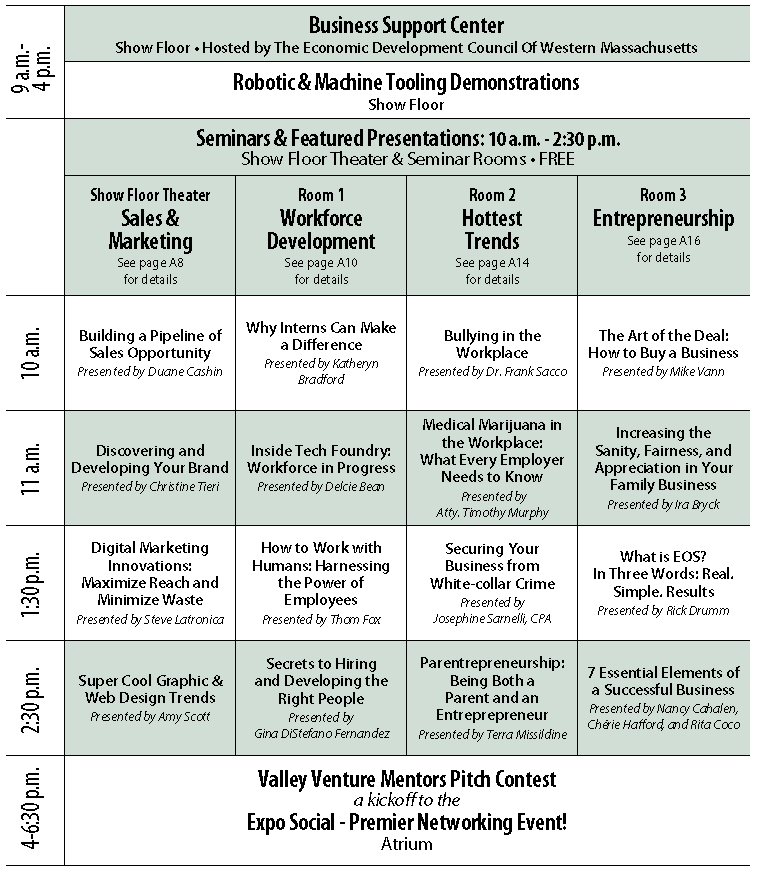
WMBExpo Schedule

WMBExpoSchedule2015

Cover Story

Building a Better Mop

Dan Koval

Dan Koval

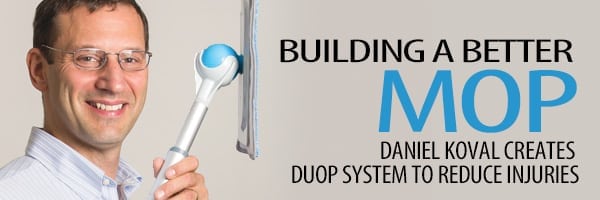
Dan Koval found inspiration for his latest entrepreneurial venture while sitting in a hotel room, watching a cleaning attendant struggle with back pain. A conversation with that woman led to a question: what solutions exist to reduce such chronic pain — and the employer costs related to worker injury and lost time? Finding none, Koval — the latest subject of BusinessWest’s ongoing series of articles about the region’s growing wave of entrepreneurs — decided to come up with one of his own.

Four years ago, Daniel Koval was working in a London hotel room when the cleaning attendant arrived. Although most people leave while the job is being done, he stayed and continued to work.

“But I could tell that the woman’s back was hurting from the way she was moving,” Koval recalled, adding that it led to a conversation he found profoundly intriguing.

“She told me she had just returned to work after taking nine months off for a back injury incurred on the job,” he said. “When I pushed, she told me the hotel group had paid $40,000 for her surgery, the insurance company had offered her more against further claims, and all of her colleagues had either been injured on the job or were out with similar work-related injuries.”

Koval had spent the majority of his career in product development, and the room attendant’s story presented a challenge he couldn’t forget. “I realized everyone was losing — the woman would suffer back pain the rest of her life, and, in addition to costing the company money, they lost a good employee for nine months. There are other costs associated with hiring a replacement, so, I thought, ‘why not try to crack this?’”

At the time, the serial entrepreneur was running another business, so the idea was relegated to the back burner. But it simmered until it got his full attention and he took steps to determine the scope of the problem.

Koval had a team of product designers and ergonomists visit hotels in London and in the U.S., where they met with union representatives and discussed the incidence of job-related injuries. “We quickly found it was a global problem,” he said.

“Room attendants are the coal miners of the hospitality industry. Their work is taxing and physically demanding; they have to kneel, bend, and put their wrist in positions that can cause carpal-tunnel problems, and they do this eight hours a day, five or six days a week. It can affect their knees, shoulders, wrists, and back,” he explained. “One study found that 91% of room attendants experience pain at work, and 66% take pain medication just to be able to go to work.”

The Duop system

The Duop system employs a ball-and-socket mechanism that allows the mop to pivot 360 degrees.

The next step — which eventually led Koval to leave Europe, move back to the U.S., and start a new business called Worksafe Technology Inc., whose first product is a mop system designed to solve the problem — was to have experts shadow room attendants. However, they also looked at other industries and found that window washers and people who cleaned hospitals, restaurants, office buildings, and homes that provide temporary or long-term care had similar issues with their necks and shoulders.

“We looked at the tools they were using, studied what was wrong, and decided to focus on creating a new mop. Traditional mops are designed to clean floors, but there was no tool that could clean the back of tub walls, baseboards, windows, and mirrors — in other words, both vertical and horizontal surfaces,” Koval told BusinessWest as he demonstrated repetitive body positions required to clean these surfaces in a small space, which include kneeling, squatting, and balling up a rag and repeatedly rubbing it with a bent wrist to clean a mirror. “The problem with traditional mops was the hinge, and they all used the same system.”

At that point, the concept for the Duop system was born.

What’s a Duop?

The name comes from the idea of having a ‘dual mop,’ as the head of the product can be removed and used by hand, which leads to better ergonomic, hygiene, and cleaning results, Koval said.

However, the Duop took time to develop, and many adjustments were made based on feedback culled from London hotel-room attendants who tested a variety of prototypes. Changes were incorporated that included the size of the handle grip and the ability to move it easily from room to room, which Koval said is important, as many upscale hotels are doing away with unsightly cleaning carts, instead having room attendants carry the supplies they need.

“It took five to seven rounds before we got something that worked. But we kept fine-tuning the product with advice from our ergonomists,” he noted.

Today, the mop has been perfected. It employs a telescopic pole that can be adjusted and locked into a three- to five-foot length, depending on the job that needs to be done. “Most mop handles are four feet, but having one that is five feet allows the person to stand up much straighter. Plus, it can be extended to clean the ceiling,” Koval told BusinessWest.

However, the revolutionary part of the tool is found at the end of the pole. It contains a unique ball-and-socket mechanism that can pivot 360 degrees when the ball on the head is snapped into the socket, which allows it to be used for a variety of tasks, such as cleaning shower walls and ceilings or dusting baseboards.

The heads come in three sizes, and a variety of microfiber cloths — one designed for dusting, another for scrubbing, and a third for general mopping — can be attached to them with Velcro, although one type of head allows a cloth to be folded into its edges, then flipped over and reused.

“The room attendants’ biggest considerations were speed and quality of cleaning. What we gave them had to allow them to clean faster and better because they are under such pressure to meet their quotas,” Koval said.

Those goals have been realized, he went on. “Using the wide face to clean a mirror instead of a crumpled cloth allows the job to be done five times faster and is more hygienic, as the microfiber picks up microscopic particles.”

Koval and his associates were surprised by the response to the prototypes. “They told us they wanted to keep them and use them at home. It made us realize the Duop is not just a commercial product, but something that can help the consumer clean easier and faster.”

Dan Koval says the Duop mop

Dan Koval says the Duop mop is the first of what he hopes are many products his company develops to help reduce injuries and promote workplace wellness.

In 2012, Koval created a company known as Worksafe Technology Inc. to market the Duop System. Its goal is to eliminate causes of frequent and recurring workplace injuries by combining expertise in product design, development, and technology.

“We are just rolling the Duop out on the market,” he said, explaining that it took so long partly because he worked on it only part-time. “Our patent was filed about a year ago and is still pending, but we brought the mop to commercial trade shows for professional cleaners, industry shows for housekeepers, and the Chicago Housewares Show, and the response has been amazing.”

Large, professional cleaning organizations have expressed interest, and at the consumer show, companies ranging from QVC to Bed Bath & Beyond and Amazon shared their enthusiasm. “There was also interest by international companies, and we are negotiating an agreement with partners in Japan, Taiwan, Holland, Germany, and the U.S.,” Koval said. “The product was just launched in the past month, and so far, we have sales of more than $100,000 pending.”

The cost of the mop will range from $25 to $40, and getting to that figure was critical, as Koval said ergonomic products are often priced too high to compete with standard products. “But our goal is to help as many people as we can.”

The mops will be marketed to the general public via Worksafe Technology’s website in about two months. “We have developed e-commerce packaging, but still have to develop consumer packaging, and that requires being able to explain what the mop does in about three seconds,” he noted. “But I’m very excited about this. It’s rare to come up with something so simple that has the potential to help so many people.”

All-encompassing Experience

Koval began his career with a degree in marketing. “But I always wanted to be in product development. It excites me,” he said. Although he grew up in Western Mass., after graduating from college he was hired by GE, who sent him to London, then Hungary. He worked in sales and international business development, then as a product manager for GE Lighting.

After earning an MBA from INSEAD in France and working as a consultant, he knew it was time to branch out on his own, and he established a gift company called Heads Up Design that manufactured cuckoo clocks featuring farm animals. He sold that business to a German company, but continued to develop items that ranged from clocks to candles. “We made about 30 different products,” he said.

Koval was living in Budapest when he began conducting the research required to create the Duop mop. When he moved back to the U.S. in 2012, his gift business became secondary, as he felt the potential for the Duop was unlimited and the need for it was greater here than in Europe.

“The U.S. doesn’t have socialized medicine, so our initial belief was the cost of an injured employee was higher to insurance companies and businesses here. But we are finding there is a huge demand for the mop in Europe. It turns out that it’s not only the cost of healthcare, it’s about the cost of losing a good employee, which makes it universal,” he told BusinessWest. “And consumers want anything that will help them clean faster and better. The drudgery of cleaning is the same everywhere in the world.”

Although Koval returned to Western Mass. to establish Worksafe Technology, he thought he would have to relocate again to a larger city like Boston to stay competitive. But he is happy to report he and his family will be able to remain in the Berkshires, thanks to his involvement with Valley Venture Mentors (VVM), an entrepreneurship-mentoring program based in Springfield.

“I had moved to Europe in 1989 and spent almost my entire career there, so I didn’t have any business contacts here,” Koval said. “But I heard that VVM was organizing a bus trip to Boston, and after I met some of the members and got involved, I realized there was an entrepreneurial ecosystem right here in Western Mass.” He added that VVM has been extremely helpful, and co-founder Paul Silva introduced him to the company that will become his partner in the U.S. market.

The Duop system is Worksafe Technology’s first product, but the company will continue to seek ways to reduce injuries in the workplace. “Now that we know what to look for and how to design these products, we will to try to solve other healthcare-related problems,” Koval continued.

No Pain, but Gain

The inspiration for the Duop system came from watching a woman work despite obvious discomfort. But Koval said the pain the mop can prevent is both literal and figurative.

As to the figurative, well, that enters the picture in terms of healthcare expenses and the cost of replacing and training new employees, even if it’s on a temporary basis. “In 2010, workers’ compensation programs cost employers $71.3 billion, and the cost of an average injury is estimated at over $20,000, so the benefits of eliminating them is immense,” Koval said.

But the reward for preventing pain — the ability to work in an occupation known for repetitive stress injuries without fear of incurring one — is priceless, and affects the physical, mental, emotional, and financial realms.

And he has already seen the effects. “I got a big hug when I gave one woman our mop. She had been a housekeeper for 20 years and was so happy with it,” he recalled. “Another said, ‘it’s too late for me because I already have an injury. But this could really help young people from getting hurt on the job.’”

Which is exactly what Koval anticipates the Duop will do.

“It’s great from a design aesthetic,” he said, “but I hope it will bring a smile to people’s faces who work in the cleaning industry, and also cause businesses to smile for a different reason — no more painful costs.”

Features

Making It Happen

The final countdown is underway.

Indeed, the fifth annual Western Mass. Business Expo is now a month away, and the final details are falling into place. The show, which will showcase more than 150 area businesses and feature more than eight hours of programs that will be informative, educational, and inspirational, will bring together popular elements from Expos past, and introduce some new ones.

“Since we started the show in 2011, one of the slogans we’ve used to promote it has been, ‘why would you be anywhere else?,’” said Kate Campiti, BusinessWest’s associate publisher and sales manager. “And that’s especially true this year. On November fourth, the MassMutual Center is the only place you’d want to be.”

WMBExpo 2015 LOGOIf you were anywhere else, you’d miss what promises to be an enlightening and entertaining start to the day at the Springfield Regional Chamber’s October breakfast. It will feature Dan Kenary, CEO and co-founder of Harpoon Brewery, in a “casual conversation” with BusinessWest Editor George O’Brien. Kenary will also take questions from the audience.

If you were elsewhere, you would miss a timely and thought-provoking talk by Alison Lands, senior manager in Deloitte’s Strategy & Operations practice. She served as a co-author and editor of the New England Council and Deloitte’s recently published report, “Advanced to Advantageous: The Case for New England’s Manufacturing Revolution,” which will form the basis of her talk at a lunch hosted by the Professional Women’s Chamber.

If you were anywhere else, you couldn’t take in any of the 16 educational seminars scheduled on four tracks: Sales & Marketing, Workforce Development, Entrepreneurship, and ‘Hottest Trends.’ The 45-minute talks, scheduled throughout the day, include “Building a Pipeline of Sales Opportunity,” “Inside Tech Foundry: Workforce in Progress,” “Bullying in the Workplace,” “How to Work with Humans: Harnessing the Power of Employees,” “Securing Your Business from White-collar Crime,” “7 Essential Elements of a Successful Business,” and much more.

And if you happened to be elsewhere, you’d miss a number of special features and programs; the return of last year’s highly successful Retail Corridor; the ever-popular Pitch Contest staged by Valley Venture Mentors; a Healthcare Corridor; a robotics demonstration by students at regional schools, including Pathfinder Regional High School; a Technology Corridor; the day-capping Expo Social (one of the best networking events of the year); and much more.

Comprehensive details of the show and a map of the show floor will be presented in a special Expo Preview to appear in the Oct. 19 issue of BusinessWest, and also in a special Show Guide to be inserted into the Nov. 2 issue of the magazine and distributed at the Expo itself.

The Expo will again be presented by Comcast Business, which has been the show’s lead sponsor since BusinessWest began producing it in 2011. Director-level sponsors are Health New England, Johnson & Hill Staffing Services, MGM Springfield, and Wild Apple Design Group. The Isenberg School of Management at UMass Amherst is the education sponsor, and 94.7 WMAS is the media sponsor.

Fast Facts

What: The Western Mass. Business Expo
When: Nov. 4
Where: The MassMutual Center, Springfield
Events and Activities: Breakfast hosted by the Springfield Regional Chamber, featuring Dan Kenary, CEO and co-founder of Boston-based Harpoon Brewery; lunch hosted by the Professional Women’s Chamber; Show Floor Theater presentations; informational seminars; Pitch Contest; matchmaking opportunities; robotics displays; Business Support Center hosted by the Economic Develoment Council of Western Massachusetts; and more.
Exhibitor Information: 10’ x 10’ booths from $750.
For More Information: Call (413) 781-8600, or go to www.wmbexpo.com

Features

Learning Opportunities

WMBExpo 2015 LOGO

At its core, the Western Mass. Business Expo is, as the name suggests, a business-to-business showcase, an event that turns a bright spotlight on companies large and small and across sectors of the economy.

But there has always been a strong educational component to the annual fall event, said Kate Campiti, associate publisher of BusinessWest, which has produced the show since 2011. And the 2015 edition of the Expo, set for Nov. 4 at the MassMutual Center in downtown Springfield, will be no exception.

In fact, she said, it will set a new standard when it comes to programs and events designed to help business owners and managers better understand and navigate the complexities of doing business today.

Indeed, seminar topics will run the gamut from medical marijuana in the workplace to preventing white-collar crime; from creating sales opportunities to brand development; from bullying in the workplace (and how to prevent it) to a new term not yet officially in the dictionary: ‘parentrepreneurship.’

In addition to 16 seminars across four tracks, there will be other opportunities to learn, said Campiti, listing everything from breakfast and luncheon keynote speakers and their messages on both business and life, to a special program on robotics featuring area high-school students, to the so-called, and appropriately named, ‘Business Resource Hub.’

This special corridor of the Expo show floor will be occupied by a host of agencies with varying missions but a common purpose — helping area businesses thrive.

“The Business Resource Hub will be a true resource,” said Campiti. “It has never been tougher to be in business and stay in business, and those trying to run often have questions — about everything from how to secure financing to how to navigate the new sick-leave law — but often don’t know where to look to find answers. The Business Resource Hub will help them make important contacts with a host of state and local business-assistance agencies.”

The specific seminar schedule is still to be finalized, said Campiti, but the tracks have been selected — Sales & Marketing, Workforce Development, Entrepreneurship, and Hottest Trends — as have many of the topics for discussion. A brief look at some of the working titles of the seminars gives a hint of the wealth of information to be disseminated. They include:

• “Parentrepreneurship: Being Both a Parent and an Entrepreneur”;
• “Building a Pipeline of Sales Opportunity”;
• “Why Interns Can Make a Difference for Your Company”;
• “Securing Your Business from White-collar Crime”;
• “How to Work with Humans: Harnessing the Power of Employees”;
• “Increasing the Sanity, Fairness, and Appreciation in Your Family Business”; and
• “Secrets to Hiring and Developing the Right People.”

Meanwhile, other components of the show include a return of last year’s highly successful Retail Corridor, the ever-popular pitch contest staged by Valley Venture Mentors, a Healthcare Corridor, a Technology Corridor, the day-capping Expo Social (one of the best networking events of the year), and much more.

The Expo will again be presented by Comcast Business, which has been the show’s lead sponsor since BusinessWest began producing it in 2011. Director-level sponsors are Health New England, Johnson & Hill Staffing Services, MGM Springfield, and Wild Apple Design. The Isenberg School of Management at UMass Amherst is education sponsor, and Elms College is the information-center sponsor. Details on the Expo can be found by visiting www.wmbexpo.com.


Fast Facts

What: The Western Mass. Business Expo
When: Nov. 4
Where: MassMutual Center, Springfield
Events and Activities: Breakfast hosted by the Springfield Regional Chamber of Commerce, featuring Dan Kenary, CEO and co-founder of Boston-based Harpoon Brewery; lunch hosted by the Professional Women’s Chamber; Show Floor Theater presentations; informational seminars; Pitch Contest, matchmaking opportunities, robotics displays, the Business Resource Hub, and more.
Exhibitor Information: Booth sizes and rates are: 20×20 showcase unfurnished: $2,250; 20×20 showcase furnished: $2,400; 10×20 double unfurnished: $1,250; 10×20 double furnished: $1,350; 10×10 corner unfurnished: $850; 10×10 corner furnished: $925; 10×10 standard unfurnished: $750; 10×10 standard furnished: $825.
For More Information: Call (413) 781-8600, or visit www.wmbexpo.com.

Cover Story

By Any Measure

Bill Bither, co-founder of MachineMetrics

Bill Bither, co-founder of Machine Metrics, on the shop floor at Valley Steel Stamp in Greenfield.

Western Massachusetts has a rich history of entrepreneurship that dates back more than 300 years. Springfield, but also the entire region surrounding it, has been home to a number of innovations — and also companies that manufactured those products. Now, a new and very strong wave of entrepreneurial energy is sweeping across the region, and it is taking many forms, especially a slew of startups and next-stage companies trying to develop the proverbial next big thing. Over the next several months, BusinessWest will profile some of these emerging companies to provide its readership with deep insight into some of many positive developments taking shape here. We start with a Northampton-based venture that has brought to the market a software system that measures manufacturing productivity. The president of a Greenfield-based company now using it was direct in his assessment: “It’s a game-changer.”

They call it “being in the green.”

And that short, simple phrase has become a huge part of the lexicon at Valley Steel Stamp (VSS) in Greenfield — and with good reason.

To explain why, Rico Traversa, the company’s operating manager and a manufacturing engineer, took BusinessWest to the so-called war room, what those at this rapidly growing precision manufacturer of parts for the aerospace industry, major arms makers, and other customer groups call the operations center, located just off the shop floor.

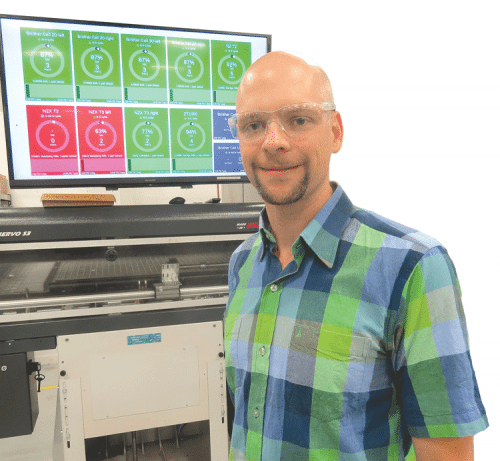
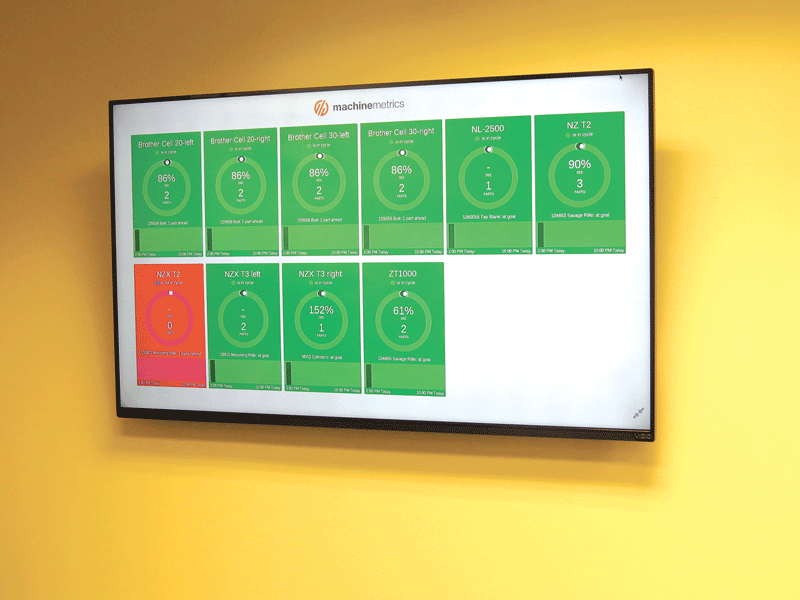
There, on one wall, are two large, digital display boards, or dashboards, as they’re called, an integral part of a performance-monitoring system created and installed by Northampton-based MachineMetrics. One dashboard shows 11 circular graphs, or rings, that essentially chart the execution of each machine tied into the system and each production shift — in real time.

It is 2:05 p.m., so the second shift has just started, and therefore all but one of the rings are green, meaning the machines are operating at or above the desired performance levels. One is orange, which means it is operating slightly below that level. If one should happen to turn red, it means what that color usually means — trouble.

But because of the dashboards and other elements of this system, that trouble can be identified, and dealt with, much sooner and more effectively than previously possible, said Steve Capshaw, president of VSS, who spoke about Machine Metrics with an enthusiasm that was clearly evident.

“This is an absolute game changer for us,” he said, adding quickly that it could also be considered one for the precision-manufacturing industry as well, a sector that has for years been starving not only for big data, but, more importantly, a way to effectively digest it.

Capshaw said the MachineMetrics system has yielded a roughly 20% increase in efficiency since it was implemented about a year ago, a huge number in this industry. When asked to qualify and quantify what that meant, he said this improvement will not only accelerate the company’s already-ambitious growth projections — Capshaw said VSS has tripled in size, from $3 million to $10 million over the past five years, and expects to reach $20 million in another five years — but enable it to navigate this industry’s most pressing, and perplexing, problem, a deep talent shortage, far more effectively.

“If you can put out 20% more parts per year, that directly lands on your bottom line,” he explained. “MachineMetrics will allow us to negate roughly $2 million in capital expenditures in the next five years as we double the size of the business. If you’re less efficient, you have to buy more machines.”

This simple arithmetic means that Bill Bither, Eric Fogg, and others involved with MachineMetrics seemingly have the right product at absolutely the right time.

Eric Fogg

Eric Fogg says the MachineMetrics system analyzes performance in real time and sends alerts to clients when production falls behind.

A trio of partners — Bither, Fogg, and Jacob Lauzier — came together on the concept roughly two years ago in an effort to capitalize on emerging technology that has essentially created a language that allows shop operators to read how their machines are functioning. And they have brought that concept to a critical stage in its development.

Indeed, with successful stories being scripted at VSS and a handful of other clients, the company is poised to greatly expand its customer base and geographic reach. Fogg, whose business card declares that he is vice president and “chief evangelist” of this venture, was readying for a trip to Colorado when he spoke with BusinessWest, and was expecting to advance and perhaps close a significant deal.

Bither said the company recently closed on a round of venture-capital funding that exceeded $1 million. That infusion will be used to help scale up the venture and “prove out the sales model,” thus broadening the company’s customer portfolio to manufacturers of all sizes.

“Right now, it’s about product development and making sure we have the capability of selling this to many types of manufacturers that have different types of needs,” he said, adding that, while the company has shown it can serve a relatively small shop like VSS, it must shape the model to accommodate corporations with billions in sales and thousands of machines.

Parts of the Whole

As he talked about the MachineMetrics product, Capshaw noted that the precision-machining industry generally runs at least five years behind other sectors when it comes to advances in IT and, especially, the interpretation of big data.

That’s primarily because the equipment being used on shop floors today is quite complex, and IT is generally applied to those machines long after they are up and running.

“We can generate and consolidate vast sums of data,” he explained. “That’s great, unless you can’t do anything with it, which is where this industry was until only a few years ago.”

What was needed, he went on, was a standard language by which the controls of machine tools could export common information for which applications could be written.

The machine-tool industry eventually came together to create that language, called MTConnect, said Capshaw, adding that what has followed could best be described as attempts to harness that language. Overall, advances have come slowly and marginally — until MachineMetrics.

“Five years ago, we went to the International Machine Tool Show in Chicago, a huge show that comes every two years, and looked at machine-monitoring software,” he explained. “There was basically one company there that did it; they didn’t use the MTConnect standard, and the system was clunky. It’s like, if you were looking for a computer today, you knew what you wanted, you went to a store, and all they had was a Commodore 64 or Apple IIe.

“So we decided to wait a few years,” he said, adding that the next Machine Tool Show featured perhaps 20 vendors with monitoring software, with most of the products still lacking in one or more ways.

Machine Metrics wasn’t one of those companies, because it hadn’t yet been incorporated, but the seeds were being sown for a system that could potentially change the landscape.

The principals would bring to the table experience in entrepreneurship, software development, problem solving, and precision machining. Indeed, by that time, both Bither and Fogg could already be considered serial entrepreneurs.

Bither, a member of BusinessWest’s first 40 Under 40 class in 2007, founded the enterprise software company Atalasoft, which he later sold to Kofax, now Lexmark. Prior to that entrepreneurial episode, he worked in aerospace engineering — he was a design engineer at Hamilton Sundstrand for several years — and knew Capshaw from his work in that field.

Fogg, meanwhile, began his career in a machine shop in his hometown of Brattleboro, Vt. He started out packing boxes and washing parts, and eventually worked his way up to programmer.

He later started his own machine shop, Greentech Engineering, in Holyoke, which, as that name suggests, specialized in the engineering and prototyping of green-technology products, including mounts for solar panels and prototype wind turbines.

To make ends meet, he took on some aerospace work at night, he said, adding that the recession that started in 2008 put a rather large dent in both aspects of his business, prompting a shift into consulting work that focused on his strengths in precision manufacturing and ‘green’ product development.

Fogg said he met Bither at a Valley Venture Mentors meeting soon after he sold Altalasoft, and the two began looking at challenges they could undertake together. Their knowledge of the precision-machining field made them keenly aware that there would be a huge opportunity awaiting those who could develop software that could effectively monitor and record the performance of machines and people, and they set out to create it.

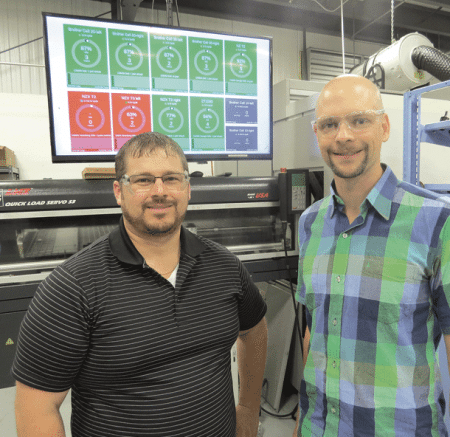
Rico Traversa, operating manager at Valley Steel Stamp (left), and MachineMetrics co-founder Bill Bither

Rico Traversa, operating manager at Valley Steel Stamp (left), and MachineMetrics co-founder Bill Bither stand near one of the dashboards on the VSS shop floor.

Soon after founding MachineMetrics, they brought on a third partner, Jacob Lauzier, the company’s chief technology officer, who brings to that post a background as a user-interface designer and web-application developer.

Together, they brought MachineMetrics to the market using VSS as a pilot company — one that has seen results far exceed expectations.

Form and Function

As he discussed what the MachineMetrics product means to manufacturers, Fogg related what sounded like a not-so-hypothetical situation involving that machine shop he worked for years ago.

“My boss would come down and say, ‘I need to ship 300 of these parts, and we’re already a week late,’” he recalled. “I would say, ‘well, there’s only 60 of them complete.’ He would get angry and say, ‘what went wrong?’

“The thing about manufacturing, and probably a lot of other industries, is that I could have given him the top 10 reasons why that job was behind, and it wouldn’t have constituted 5% about why it was actually behind,” Fogg went on. “There’s so much stuff that can happen, so many discrete things that can go on, that there’s really no way you can sit down with your boss and explain why a job is behind. So I would come up with some cop-out answers like ‘we’re having some trouble with second shift’ or ‘maybe there’s trouble with materials,’ and he would nod his head and go upstairs to call a soon-to-be-angry customer and eat crow.”

Machine Metrics was designed to make such discussions a thing of the past, said Fogg, adding that the software can not only pinpoint what what wrong, when, and where, but it can alert supervisors to potential problems before they happen and keep shop owners from having to make phone calls like the one mentioned above.

“There are thousands of pieces of data that can be pulled from any discrete machine tool every minute, and all that data has value,” Fogg explained. “That data can tell you about loads on tools or about problems with any part of the manufacturing process.”

Effective retrieval and analysis of that data has enabled VSS to improve what’s known as OEE (overall equipment effectiveness) from around 70% to roughly 90%.

While visiting the war room at VSS, Bither explained just how the software works.

“Each ring represents a shift,” he explained while motioning toward the dashboard. “As the ring fills in, that’s indicative of how many parts are created; when the ring is completely closed, the goal is met for the shift. There’s a white dot that moves around the ring, and it’s essentially a rabbit that you’re chasing. If you’re ahead of the white dot or on it, it’s green; if you’re behind, then it’s orange or red.”

The system tracks performance in real time, said Traversa, adding that this represents a vast improvement over the conditions that existed before the software was installed.

The MachineMetrics system

The MachineMetrics system has made the phrase ‘being in the green’ — as most all of the machines at the company are at this moment in time — part of the lexicon at VSS.

“You get text alerts and e-mail alerts as soon as a machine starts falling behind,” he explained. “In real time, we know that production is going down and we can try to solve it; we’re not waiting until 6 a.m. the next day to find out that a machine shut down at 8 the night before. You see it, you get alerted, and there’s no operator input — you’re not waiting for them to call you or e-mail you; it does it on its own.”

Making Progress

Capshaw, who spoke with BusinessWest by phone while vacationing on the Cape, said the system allows him to see what’s happening at the shop on a host of devices. He noted that productivity at VSS has increased 10% not from really doing anything with the data specifically, but simply from having it and making sure employees know they have it.

Employees simply have to look up at the dashboards on the shop floor to track how the machines they’re assigned to are performing, he went on, adding that no one wants to see the color red appear, and everyone wants to stay firmly in the green.

Roughly another 10% improvement has come from going back over data, identifying issues, streamlining production, and improving maintenance, he went on.

“We look at how efficient we are shift by shift and product by product, and see where we need to improve,” he explained. “The result is that we can more finely tune our training programs for employees, which is typically the reason for downtime, or improve our maintenance system so we have more uptime on our machines.”

Thus, benefits come in a number of forms, he said, listing everything from enhanced productivity to improved morale, especially among third-shifters, who seemingly toiled in anonymity.

“We had employees come up to us after we put up the boards,” said Capshaw. “They worked third shift, and they said to us that, if they did a great job, they never got a pat on the back. But they said having this is like getting a pat on the back — they work to get back in the green, and we see that, and we e-mail them and congratulate them.”

Perhaps the biggest benefit, though, is some reduction in stress when it comes to the nagging issue of finding enough talent as a result of that improved efficiency.

“Instead of having to recruit and hire 40 employees, we’ll have to hire 30,” he said. “We’ll still have to hire a lot of people, but it will relieve that bottleneck, which allows us to expand quicker.”

Moving forward, the obvious goal for the principals at MachineMetrics is to scale up their venture, and the recent infusion of capital will be used for the many aspects of that assignment.

Fogg said one of the company’s major challenges, not unlike the one confronting its customers, is finding talent.

“We have a lot of customers who are interested in this product, but one of the difficulties is integrating it into the machines,” he explained. “That’s something I know how to do, but it’s very difficult to find people who know machine integration; we’re actively trying to hire people like that, but we can’t even find them, let alone give them offers for jobs.”

Overall, the potential for growth is immense, said Bither, adding that the market for performance-monitoring software in the precision-manufacturing sector will reach into the billions of dollars.

Just how big that number will get, he doesn’t know, but he does know Machine Metrics should be well-positioned to seize considerable market share.

“There are a few competitors, but this is fairly new technology, so there isn’t one company that’s out there dominating,” he explained, adding that a company in Germany and another based in Silicon Valley are gaining some traction in the industry, while others are struggling in their attempts to do so.

“Production-monitoring technology is still in its early stage,” he went on. “But there is a lot of opportunity, because these companies are recognizing that measuring data is critical to staying competitive; they have to be efficient to win these deals.”

It’s Not Easy Being Green

Throughout business history, company owners have made it their mission to both keep out of the red and be in the black. For precision manufacturers, there is now a third mantra — ‘being in the green.’

As mentioned earlier, this is now an informal mission statement and both a spoken and unspoken rallying cry at Valley Steel Stamp.

Just how prevalent that phraseology becomes in this industry remains to be seen, but from all accounts, MachineMetrics seems poised to turn out some solid growth patterns of its own.

And it also appears destined to be part of the wave of entrepreneurial energy sweeping over the region.


George O’Brien can be reached at [email protected]

Opinion

Editorial

Since BusinessWest began publishing in 1984 as the Western Mass. Business Journal, it has shined a bright spotlight on both entrepreneurs and entrepreneurship.

The former, of course, refers to people — adventurous, forward-thinking, ambitious people who have taken ideas and converted them into successful businesses. Over the years, the magazine has devoted thousands of words and front-page photos to entrepreneurs who have shaped the local business landscape, from Peter Picknelly to Delcie Bean — with hundreds in between.

The latter, meanwhile, refers to the ongoing work to encourage people to become entrepreneurs and then assist and mentor them as they bring ideas to the marketplace, a centerpiece of regional efforts in the broad realm of entrepreneurship.

In short, we’ve celebrated entrepreneurs — BusinessWest even created an annual award to recognize the region’s ‘top entrepreneur,’ and Bean was the latest to receive that honor — and we’ve encouraged and recognized efforts to create more stories like his. Indeed, the magazine recognized Valley Venture Mentors as one of its Difference Makers for 2015 for its efforts to foster entrepreneurship and help business owners reach that critical ‘next stage’ — whatever it might be.

With this issue, BusinessWest takes its focus on entrepreneurs and entrepreneurship to a different, even higher level, with a new series of profiles that will collectively capture a new wave of entrepreneurial energy sweeping across the region.

Over the next year, we’ll relate some very intriguing stories about people young and old, with concepts ranging from software to hard cider; wedding dresses to pet-security devices, and how they are working to caress these products and services into thriving businesses.

As we’ve mentioned before and in many different ways, this enprepreneurial energy and the forces behind it constitute a far bigger story than the casino soon to take shape in Springfield’s South End, and a far bigger story than the subway-car-manufacturing facility soon to build on the other end of the city.

For while the casino will create a few thousand jobs and provide a spark for the convention and tourism business, and while the new manufacturing plant will come with hundreds of those proverbial good jobs and good wages, the stories of entrepreneurship unfolding across the entire region hold the key to a stronger, more sustainable economy for Western Mass.

We begin our series with a story on Northampton-based Machine Metrics (see story, page 6). This is an emerging company started by serial entreprepreneurs Bill Bither and Eric Fogg that has created a potentially game-changing software product that enables precision manufacturers to track the performance of each machine and each production shift.

This is a very specific, but also potentially lucrative, niche — but so are most of the others we’ll be profiling in the months to come.

The principals at Machine Metrics are in the process of scaling up their venture and will be aided in those efforts with a recent round of venture-capital funding. They exude optimism as they talk about the size of the market they’re penetrating and their ability to grab a huge share of that market.

It’s impossible to say where this venture will be in five years or even five months, but in many respects, it seems like the sky is the limit.

Getting to this point has taken imagination, hard work, and determination, and much more of each will be required to navigate the many challenges that lie ahead.

It is the same for the dozens of other risk takers trying to build on this region’s lengthy and distinguished history of entrepreneurship. That’s what makes these stories so compelling.

And that’s why we’re proud to be telling them.

Sections Women in Businesss

Creating a Sounding Board

Cathy Crosky

Cathy Crosky says women owners benefit from having a sounding board comprised of peers navigating similar issues and challenges.

Attorney Paula Almgren says she knows she’s a much better, much smarter businessperson now than she was before she joined a group called WomenUpFront about 18 months ago.

She credits the Pittsfield-based organization, which launched three years ago and is composed of fellow small business owners, with everything from helping her take basic, common-sense steps, such as creating a website for her practice, to developing an appetite for risk taking, including a book she’s planning to write on one of her specialties — navigating community-based care.

“I’ve taken a lot of actions I might not have taken, or would have taken longer to implement, if I wasn’t part of this group,” she said, citing the website as just one example. “And you become accountable to the group; if you say you’re going to do it, you have to do it.”

And yet, Almgren literally can’t wait until she can stop attending the monthly meetings of this group.

Indeed, there is a ceiling regarding annual revenues for membership in this intriguing group — $1 million — and Almgren, who started her practice in 1996, intends to break her way through it sometime soon.

When she does, she’ll be able to ‘graduate’ to a group called the Women Presidents Organization (WPO), which has pretty much the same basic mission statement and MO as WomenUpFront, but is obviously for those with larger ventures and often different challenges.

Transitioning to membership in WPO is the unofficial, usually unannounced ambition of WomenUpFront members, said Cathy Crosky, an executive coach and organizational transformation consultant with Charter Oak consulting group in Williamstown who conceptualized and now leads both organizations.

Paula Almgren

Paula Almgren

She told BusinessWest there are many stories like Almgren’s still being written in Berkshire County. They involve women who have found a comfort zone — not to mention myriad learning opportunities — in a group of roughly a dozen that she described early and often as a “sounding board.”

It is now Crosky’s ambition to replicate the success of the Pittsfield group in Hampden County. She noted that statistics clearly show that more women are choosing entrepreneurship as a career path, and the Greater Springfield area is certainly no exception to this rule.

Like the Pittsfield WomenUpFront group, the one planned for Hampden County will be limited to first-stage companies — it is not intended for startups, said Crosky, adding that it is focused on business, not networking, although there is certainly some of the latter as well.

“The idea behind the group is to help women to get beyond the day-to-day challenges and look at the business more purposefully and more strategically,” she said, adding that, to help meet that goal, she has brought in experts on subjects ranging from employment law to time management to address members. “It’s a deep dive into business issues and challenges, and it’s a learning group.”

For this issue and its focus on women in business, we take an in-depth look at the success achieved by WomenUpFront in Pittsfield, and how Crosky plans to make this concept more of a regional phenomenon.

Getting Down to Business

Unlike most members of the Pittsfield WomenUpFront group, Pam Sandler’s immediate goals do not include graduation to WPO.

That may eventually happen, she said, but at present, she’s comfortable with the revenue patterns being generated by the Stockbridge-based architecture firm she launched more than 30 years ago that bears her name and specializes in both residential and commercial work.

Pam Sandler

Pam Sandler says women have to juggle their lives differently than men do, which leads to unique challenges balancing business and other obligations.

“I was different than other women in the group — I really didn’t want to grow my business; I thought I was stretched as far as I could be stretched,” she said, adding that, generally speaking and economic downturns aside (they traditionally hit this sector very hard), she can generate as much work as she wants and needs to handle. “I was, and still am, far more interested in working smarter — I was getting pretty burned out.”

And, like Almgren, she believes she’s already made significant progress with that goal. As evidence, she cited the fact that she’s not burning as much midnight oil, and not because she has fewer projects on the books.

“I don’t work as many hours as I used to because I don’t have to — I’m working smarter,” she told BusinessWest. “I have less stress, and I’m more focused on the big picture — and I owe much of that to my once-a-month fix.”

That fix, as she called it, WomenUpFront, was in many ways inspired by WPO, said Crosky, adding that she was approached by several women who knew they could benefit from such a group, but didn’t fit the revenue criterion.

Like WPO, the new group was designed to be a forum where common issues and problems can be discussed confidentially, she went on, adding that members soon discover that, whatever challenge they’re facing, they’re certainly not unique, or alone, in that fight.

“The demands of running a business are increasingly more challenging,” Crosky told BusinessWest. “The roundtable provides an opportunity for women to share some of these challenges they have that are similar and offer support, best practices, and ideas — and learn from each other.”

Almgren concurred. “I find that there’s a lot of problem solving in the group — every time I go, I learn something new,” she told BusinessWest. “It’s really helpful as a business owner to be able to talk about what’s working and not working with your business and share ideas with other women business owners.”

Crosky noted that, while some business groups have certainly enjoyed success with a mixed-gender format, the women-only structure of this group appeals to many because of the commonality of issues and a generally shared outlook on business and how to manage.

“Many women report feeling much more comfortable in a women-only group because women lead differently than men and the challenges that women face in the marketplace are different,” she explained. “There’s also the challenge of balancing work and their personal lives, because they do have primary responsibility for children and aging parents, despite the changes in role definition.”

Sandler agreed.

“I find that women have to juggle their lives differently than men do,” she said. “I have three children, and I have to organize their lives and my work at the same time, which has been a real challenge.”

Crosky announced her intentions to form a Pioneer Valley chapter of WomenUpFront in the spring, with the support of the Business Growth Center and PeoplesBank, which have offered to provide meeting space and other forms of assistance.

She’s been working since then to recruit the eight to 10 women entrepreneurs she needs to launch. She knows they’re out there, but she also knows that most individuals who can use help are also those who find it most difficult to commit the time required to be an active participant in such a group.

If she can get a few minutes with a prospective member, she advises them it’s necessary to make the time.

Meeting of the Minds

Crosky said there is no firm timetable for starting the Pioneer Valley chapter of WomenUpFront.

The task of making women aware of the organization and its benefits and convincing them to commit the requisite time and energy is ongoing.

Overall, she believes expanding the concept across the Valley will help individual business owners meet their goals, but also benefit the region in its quest to encourage entreprebeurship and create jobs.

“Not everyone wants to grow beyond $1 million, but everyone wants to be more efficient and stabilize their business,” she said. “And that’s what we’re here for.”

For more information on WomenUpFront, call (413) 822-1263.


George O’Brien can be reached at [email protected]

Daily News

HOLYOKE — Teenagers in Western Mass. now have another educational option. LightHouse Personalized Education for Teens opens its doors on Tuesday, Sept. 8 with an initial cohort of 30 students.

“We serve the most interesting teens in Hampden County — teens who have vision and goals for their futures, and are inspired to learn outside the box and spend their energies on projects they find engaging and meaningful,” said Co-director Catherine Gobron.

LightHouse is holding several open houses in September, including Friday, Sept. 4, 3-4 p.m.; and Thursday, Sept. 10, 3-4 p.m. See the whole list at lighthouseteens.org/open-houses.

Gobron was Program Director for North Star: Self-Directed Learning for Teens in Hadley for more than a decade, and has now opened LightHouse, an independent affiliate program to North Star, with Co-director Josiah Litant, who left his position as senior associate dean of Students at Hampshire College to launch LightHouse with Gobron.

“This last year has been a whirlwind, but it’s all come together,” said Litant. “Our brand-new facility in the STEAM building of Holyoke’s Innovation District is gorgeous, and we are especially excited about our Maker Space and Music Studio. It’s been very exciting to begin to get to know our new students. Our incoming teens and families understand that learning is something you do, and they are excited to start now.”

LightHouse is open to teens ages 13 to 18, focusing on optional pathways of entrepreneurship, arts, tech, and college prep.
To learn more, visit lighthouseteens.org.

Entrepreneurship Sections

Covering the Basics

Gary Stone, left, and Jim White, right, are seen here with Central High School Principal Tad Tokarz

Gary Stone, left, and Jim White, right, are seen here with Central High School Principal Tad Tokarz in the school’s cafeteria, one of many rooms they’ve wrapped.

Jim White says it was about 18 months ago — or just after BusinessWest published a story on the Business Growth Center, to be precise — when he and partner Gary Stone decided they needed some help and would seek it out.

When asked to be more specific, he said Go Graphix, the specialty graphics company the two had started more than a decade earlier, while doing fairly well, certainly wasn’t where they wanted it to be by that juncture. And the root of the problem, he went on, was that they couldn’t, by themselves, draw a road map to get there — or even pinpoint what there was or should be.

So they turned to the Business Growth Center (BGC), housed, sort of, in the Technology Park at Springfield Technical Community College, and its director, Marla Michael, for some assistance. Michel assembled an advisory panel that met with White and Stone early and often, providing assistance on several levels.

Invited to sum it all up, White said the group, comprised of business veterans across several sectors, implored them to focus — on what they did well, what separated them from their various forms of competition, and where the growth potential was.

In this case, said White, that meant the company’s niche in specialty wrapping, of not only vehicles but also school and business hallways, windows, cafeterias, floors, and a host of other surfaces. The industry term is ‘architectural graphics,’ he said, and while there are many companies that can simply install such products, there weren’t many, at the time, that could partner with clients to create a vision and then make it reality.

“Our customers are looking for the whole package,” White explained. “And these are the areas for which the advisory team said, ‘no one’s there right now; go after it; this is one; make your name there; go for it; be the first.’”

To make a somewhat long story short, the company has followed that advice and, in the process of doing so, seen a roughly 50% rise in revenues over the past year.

The story scripted by Go Graphix is one that Mike Vann and Paul Stelzer want to replicate as they continue to write what would be considered the next chapter for the Business Growth Center.

Michel, a loaned executive from UMass Amherst, has left the center as she returns to the university as a full-time administrator, focusing on the school’s many initiatives in and around Springfield. But Stelzer, a principal with Appleton Corp., which manages the Tech Park, and Vann, a member of the BGC’s advisory board and principal with the business-consulting firm the Vann Group, want to continue the work Michel was orchestrating with many of the region’s smaller businesses.

Mike Vann

Mike Vann, left, says there are many companies in the region can be benefit from the services of the Business Growth Center, which helped the principals of Go Graphix sharpen their business focus.

Vann said there are many companies at or near the same stage as Go Graphix — with the owners deciding where they want to be and how to get there — and also many more that are facing the thorny issues of succession, or soon will be. And they can benefit from the center, which is more of a service provider than a physical location, although it is technically that as well — the Scibelli Enterprise Center, named after the retired STCC president who conceptualized it.

He added that the BGC’s advisory and mentorship programs will likely dovetail nicely with initiatives carried out by Valley Venture Mentors, which focuses mostly on startups and other groups that are part of what’s being increasingly referred to as an entrepreneurial ecosystem.

Stelzer agreed, noting that, while many pieces still to fall into place for what might be called the new Business Growth Center — everything from funding to a board of directors to a timetable for officially getting started — the picture is coming into focus.

“The Business Growth Center is a program of the Technology Park,” he explained, “and we very much want to continue that program as part of our board’s mission to not simply lease space, but encourage and mentor entrepreneurs and assist small businesses.”

For this issue and its focus on entrepreneurship, BusinessWest looks at the early planning initiatives for this new BGC, and how the organization could become a key element in that aforementioned ecosystem.

The Writing’s on the Wall

Rather than talk about what they do — and, as mentioned, are now firmly focused on — White and Stone decided to show BusinessWest instead.

For that exercise, they decided that a tour of Springfield’s Central High School was in order. There, upon being joined by principal Tad Tokarz, they showed off a number of specific projects undertaken at that sprawling facility.

These include the circular logo incorporated onto the floor at the main entrance — complete with the golden eagle that is the school’s image and nickname — the auditorium and walls outside it, covered over with images depicting the arts; the cafeteria, where one wall features what Tokarz calls the “roadmap to graduation” that the school’s students follow; and the music room, where several walls and doors are covered with genre-specific images.

On the way out, the partners pointed to the bare, wooden press box above the stands at the football stadium, which will soon be done over with similar ‘golden eagle’ imagery.

Go Graphix has done similar work at a number of schools, colleges (Bay Path University is among its many good customers), and businesses across the region and beyond, and orders continue to pour in, said White, adding that this is part of an intriguing niche with considerable growth potential.

Fully exploiting this niche became the simple mission imparted on the partners by a team of mentors through the BGC’s Growth Advisory Program. And along with the words of wisdom came an accompanying — and much needed — dose of accountability, he went on.

“Being held responsible has made a tremendous difference,” White told BusinessWest. “We’re following the plan they helped us put together, and we’re really serious about it.”

There are many companies across the region that could benefit from similar assistance, said Vann, who works with companies of all sizes and across many sectors as a business consultant. And because this need exists, those involved with the BGC want to serve the region by meeting it.

Elaborating, he said the center, which will serve both tenants at the SEC and non-tenants, will be focused on two primary issues — scalability and what he called ‘survivability,’ meaning succession, in whatever form it may take.

There is considerable call for both, he went on, adding that, while entrepreneurs are obviously good at what they do, meaning their specific product or service, they often lack experience when it comes to managing a business and strategically planning for its future. Meanwhile, they also lack the time and capital required to address issues ranging from marketing to mergers and acquisitions.

Go Graphix project at Central High School

Go Graphix project at Central High School

“The company may be successful and have money, but it may not necessarily have the resources in its budget to be able to do these things fully and in the right way,” he explained, adding that the advisory-panel model is designed specifically to fill these voids.

Stelzer agreed, and summoned an often-used phrase to describe what the BGC is ultimately designed to do.

“We want to help people work on their business, not in their business,” he explained, adding that many companies that that have passed the startup phase and are looking to get to the next level (or at least determine what that should be) are certainly challenged in their efforts to do that.


 Click here to download a PDF chart of Area Resources for Entrepreneurs


Such was the case with White and Stone in the spring of 2014, when they approached Michel with a request for some assistance.

It came in the form of an advisory panel that not only asked hard questions, but made it clear to the principals that they would not be provided with the answers — they would have to come up those themselves.

“We would come together every six weeks and talk about very specific goals and tasks,” White explained. “We looked at the numbers, how we utilized our resources, staffing — where we’re staffed and how we’re staffed — and other matters.

“And after they really got to know us and understand our business, they helped us put together a strategic plan,” he went on. “We’re experiencing growth, accelerated growth, and much of that, we think, came about because we were able to work on our business.”

Elaborating, he said the advisory panel effectively inspired the partners to abandon, or move on from, a loose strategy of trying to be all things to all forms of customers and instead put the focus firmly on the areas that are most profitable and have the highest ceiling, growth-wise.

“They spent a lot of time helping us determine where the focus should be — where our drive is, what our passion is, and where we actually have good profit,” White noted. “That has helped us get out of certain areas and really double down on those areas that we want to get into — where there’s an opportunity in the marketplace, and where there’s profitability.”

That’s a Wrap

Referencing that entrepreneurial ecosystem once again, Vann and Stelzer said many groups, such as VVM, are designed to focus on businesses that are in what would be considered their youth.

The Business Growth Center — meaning, again, the organization, not merely the physical structure — is concerned with what amount to business “teenagers,” they went on, acknowledging that, as anyone who has lived through those years can testify, they are fraught with challenges.

The answers don’t come easy, as White and Stone can attest, but with support and that aforementioned measure of accountability, businesses can navigate those difficult years.

And that’s why Stelzer, Vann, and others involved with the Business Growth Center have determined that it must continue its work.

George O’Brien can be reached at [email protected]

Daily News

SPRINGFIELD — The Affiliated Chambers of Commerce of Greater Springfield announced today that Dan Kenary, CEO and co-founder of Boston-based Harpoon Brewery, will be the keynote speaker at the chamber’s November breakfast, the lead-off event for the fifth annual Western Mass. Business Expo, produced by BusinessWest and presented by Comcast Business on Nov. 4.

Dan Kenary

Dan Kenary

Kenary and partners Rich Doyle and George Ligeti launched Harpoon in 1986, and over the ensuing three decades have transformed it into one of the region’s most successful breweries and one of the state’s more intriguing entreprereneurial ventures.

The ACCGS breakfast has been the official kick-off event for the Expo since it was launched in 2011, and Kenary continues a pattern of keynote talks focused on entrepreneurship and the state’s diverse business community.

The format for Kenary’s talk will be a departure for the norm, however. This will be a broad Q&A, with questions directed from BusinessWest Editor George O’Brien and then members of the audience. Topics to be broached will include the Harpoon story, the microbrewery industry, entreprebeurship, and doing business in Massachusetts.

To register for the breakfast, visit www.myonlinechamber.com. Tickets are $30 per person in advance or $35 at the door.

The breakfast will lead into a full day of events and activities at the Expo, which will feature more than 150 exhibitors, special Show Floor Theater presentations, informative seminars, a pitch contest hosted by Valley Venture Mentors, the day-capping Expo Social, and much more. For information on the Expo, visit www.wmbexpo.com.

Opinion

City2City Pioneer Valley Editorial August 10, 2015

The City2City program, an initiative that has taken city business and nonprofit leaders and elected officials to a number of cities experiencing economic progress — in many different forms — has a new name and new focus.

Well, sort of. The name is somewhat new. Actually, it’s been expanded to ‘City2City Pioneer Valley.’ And that name hints broadly on the new focus that isn’t really new. Indeed, while these visits have always included individuals from across the region, it has been perceived as, well, a Springfield thing.

Before, during, and after the initial visits to Winston-Salem and Greensboro, N.C., Grand Rapids, Mich., and Allentown and Bethlehem, Pa. (the latter being home to a casino), the overarching question was, ‘what can Springfield learn from this community?’

Those trips, organized with support from the Federal Reserve Bank of Boston, were technically regional in nature, but Springfield tended to dominate the conversation. It will likely do so again, when City2City Pioneer Valley, now being overseen by the Pioneer Valley Planning Commission and supported by several area businesses and foundations, travels to Chattanooga, Tenn. on Oct. 26-28.

But there will be plenty that communities of all sizes can take away from this visit, and we strongly encourage planning officials, municipal leaders, bank officials, and economic-development administrators to be part of the travel party.

That’s because, while there has been progress recorded in many area cities and towns — in realms ranging from infrastructure to entrepreneurship; from the arts to education — there is considerable room for improvement. And while there is plenty of talent and many good ideas to be found in the Valley, it never hurts to see how others are tacking issues common to cities across the country.

During past trips, participants have seen how Greensboro took full advantage of a new minor-league baseball stadium; how Grand Rapids has revitalized its riverfront and created thousands of new jobs in education and healthcare; how Bethlehem has not only opened a new casino, but found many other uses for the massive steel mill that gave the city its identity.

But they’ve also seen how individual neighborhoods have been revitalized, how Grand Rapids has addressed the complex issue of racism, and how each community has prospered through strong leadership and effective public-private partnerships.

Some of the lessons are being directly applied — perhaps the most notable being the Healing Racism Institute of Pioneer Valley, which grew from the Grand Rapids experience — but area communities have benefited indirectly from seeing not only that other cities have overcome extreme challenges, but how.

Thus we encourage participation in this year’s trip, especially when it comes to the region’s younger leaders — those who have chosen to launch or continue a career in this region and will likely play a big part in shaping its future course.

Many of these young leaders have been exposed to great learning experiences through participation with such groups as the young professionals’ societies and organizations such as Leadership Pioneer Valley. City2City can and will broaden their horizons in many different ways.

Continuing and expanding the City2City initiative can only help this region, and area communities and business leaders should take full advantage of this unique opportunity.

Opinion
IT Talent Crunch Echoes a Bigger Problem

Delcie Bean IV was one of the panelists at a forum on entrepreneurship hosted recently by the Mass. Small Business Development Center Network. He devoted most all of his roughly five minutes of mic time to what he called a “crisis” intruding upon his industry — the IT sector.

It involves a distinct and disturbing shortage of talent, noted Bean, founder and president of Paragus Strategic IT, who used mostly the future tense to talk about the matter, but hinted strongly that the problem is, in many respects, already here.

He and his colleagues in the IT sphere dissect the matter in greater detail for a story in this issue of BusinessWest (page 36). They talk about how the talent crunch is real and stifling growth opportunities; about how this development seems to make little sense, because there are jobs with good wages available and few individuals seemingly willing to position themselves to take advantage; about how they plunder good workers from each other, often with higher wages as the requisite carrot, a tactic with short-term benefits but long-term consequences; and about how they’re not sure when, or even if, the situation will improve appreciably.

They were all talking about IT, but in many respects, they were speaking about the economy as a whole. Indeed, you could easily substitute software designers and computer-related business owners with manufacturers, nursing-home operators, and even players in the hospitality industry, and the conversation would be essentially the same.

The question remains: where will the workers come from?

As they talked about the matter, those in the IT sector speculated that some might be scared away by the seemingly complex nature of the work in that realm and the notion that they’re not smart enough to thrive in it, when the opposite is generally true.

Joel Mollison, president of Northeast IT in West Springfield, hinted strongly at this when he said, “the tech field can be a bit overwhelming if you’re not absolutely sure that’s where you want to be.”

Others noted how the so-called Millennials tend to follow their passions, not just a paycheck, and wonder out loud how to get people passionate about a career still described with terms such as ‘Geek Squad.’

The answer comes with creating some passion, or something approaching it, and here again, we’re not just talking about IT. This also holds for the manufacturing sector, which suffers not only from lingering misperceptions about what this field is like, but the real fear that jobs in that sector will be sent offshore or to a lower-cost state.

Creating passion for designing software or troubleshooting IT problems will not be easy, but this is the direction our society and our economy are heading in, and talented individuals will be needed to keep things humming.

What’s needed are more programs that will encourage young people — and when we say young, we mean elementary-school age — that such careers are attractive, potentially lucrative, and attainable. At the same time, we need to emphasize quality-of-life issues here in Western Mass., and thus convince those who do have the requisite aptitude for this work that they don’t have to leave the area to launch a career.

Bean went so far as to express the hope that a television show, CSI: Cyber, might fuel interest in this sector in the same way that The Big Bang Theory has for physics.

We hope his optimism is warranted, but industry leaders know it will take more than TV shows to ensure that not only the IT field, but all sectors of the economy will have enough of that most precious commodity moving forward: talent.

That’s because the crisis is already here.

Opinion
Don’t Underestimate Driving Spirit

By JERRY CIANCIOLO

You may have heard that Millennials aren’t starting businesses at the rate of previous generations.

According to the Kauffman Foundation, a nonprofit devoted to studying entrepreneurship, startup rates among Americans age 20 to 34 peaked at 35% in 1996 and has since declined to 23%.

Why?

Forget the pundits and their talk of the Great Recession’s effect, monopolistic corporations, student debt, and slowing population growth. It’s much simpler than that.

Raised by helicopter parents, Millennials just can’t shake the habit of listening to advice. And as an entrepreneur myself, I know how critical it is to ignore so-called experts.

Within two weeks of hanging our shingle, my partner and I submitted to a class project for a local college. A business professor and eight students visited to grill us for 90 minutes. A month later, the retinue returned.

“Let me be candid,” said the professor. “Your business has little chance of succeeding.” Kathy and I flinched.

“We’ve run the numbers, researched the market, factored in your resources and level of experience, and, well . . . ” He looked down and shook his head, delivering the coup de grace non-verbally.

His advice, in so many words? “Update your résumés — today, if possible.”

Almost three decades later, I look back on that afternoon and marvel that my now-wife and I succeeded. The odds were certainly stacked against us.

On our side of the ledger were resolve, resiliency, and a longing for independence. On reality’s side were revenue projections, capital outlays, return on investment, and market share. We were anorexics on the mat with a Japanese sumo.

Yet our business thrives to this day. By any measure, we won the match. But how? If the professor and his students returned and asked how we proved them wrong, what would we say? Simply this — the weaknesses you identified proved to be our camouflaged strengths. For example:

• We were blind to the odds. I remember leasing a postage meter in our first month. The company rep recommended a three-year contract. I suggested five, hoping to shave the fee. She demurred: “businesses like yours, well, let’s stay with three.”
• We didn’t know much about business. I didn’t have financial expertise, nor did Kathy. You wouldn’t find even one economics course on our transcripts. But we possessed what Mark Twain described as the two things you need in life to succeed: ignorance and confidence. The former we had in spades. As for our lack of business savvy, we wore it like a chip on our shoulders.
• We had little patience with systems. At a meeting with a volunteer from SCORE — a group providing free business counseling — I did my best to suppress a yawn as the retired exec plotted a series of steps we needed to take before opening the doors. He also wanted to know whether we had a mission statement. I kept tapping my foot; Kathy withheld her sighs. Paperwork was make-believe to us. It wasn’t going to determine whether we succeeded. Our wits would have to do that.
• We weren’t strategic. Our business goal was basic — survival. Improvise or die was our clarion call. We couldn’t afford to procrastinate, so we ran with whatever seemed sensible at the moment. No one at Wharton would call our carpe diem approach strategic.
• We didn’t delegate. In the early days, there was no alternative. If the computer froze, one of us dug out the manual to thaw it. If a mailing had to go out, we were the clerical staff. But even as profits grew, and hiring was an option, we continued our labor-intensive ways. Granted, we didn’t always put our skills to the best use, but running lean kept margins high and overhead low.

Of course, my wife and I have grown wiser over the years. We wouldn’t advise would-be entrepreneurs to follow our model. But, then, we wouldn’t advise them to follow any model except one that feels right.

That’s why we politely listened to the professor and then went about our business. We encourage Millennials to do the same.

The professor understood business. But entrepreneurs and their driving spirit? Not so much.


Jerry Cianciolo is chief editor at Emerson & Church, Publishers, the company he and his wife, Kathleen Brennan, founded in 1986.

Agenda Departments

Workshop on Retirement Planning, Social Security
June 16: Monson Savings Bank is holding a complimentary workshop titled “Social Security: The Choice of a Lifetime.” It will be presented by Kevin Flynn, regional vice president of Nationwide Financial, and an expert on retirement planning and helping people to understand Social Security and how to optimize their benefits. The event is designed to give people a comprehensive understanding of the rules and details regarding when and how to file for Social Security. It will be held from 5 to 6:30 p.m. at the Hampden Senior Center at 104 Allen St. in Hampden. The free event is open to the public. “This workshop is back by popular demand,” said Steven Lowell, president of Monson Savings Bank. “Knowing when and how to file for Social Security can have a big impact on retirement income. We have offered this workshop before, and those who attended were very appreciative of the information.” Those interested in attending should call Anna Driscoll at (413) 267-1221 or e-mail [email protected]. Seating is limited. Refreshments will be served.

EANE Workshop
June 17: The Employers Assoc. of the NorthEast in Agawam will host a workshop, “Six Secrets for Promoting Products and Services with Confidence,” from 8:30 a.m. to 4:30 p.m. This program, presented by Lyn Murphy, will provide participants with proven strategies and practical tools to feel more comfortable and ultimately become more effective at suggestive selling. It is targeted toward business owners, consultants, lawyers, accountants, architects, and customer-service representatives whose positions include sales goals. Attendees will learn how to enhance their personal presence and build rapport with current and potential clients, discover tools to avoid feeling pushy or rejected when promoting products and services, use tools to identify and adapt to prospects with different communication and behavioral styles, and learn strategies to positively influence sales outcomes. The $285 fee includes the electronic DiSC Sales Assessment. To register, visit www.eane.org/six-secrets-for-promoting-products-and-services-with-confidence.

ERC5 Annual Meeting
June 17: The East of the River Five Town Chamber of Commerce will hold its annual meeting from 11:30 a.m. to 1:30 p.m. at Blake Commons Dining Hall, Bay Path University, Longmeadow. The keynote speaker will be talk-show host and bestselling author Howie Carr, discussing politics, crime, and entertainment. A member of the Radio Hall of Fame, Carr’s evening drive show can heard on more than 20 stations throughout New England. He is also a columnist for the Boston Herald and a contributor to Breitbart.com. Carr’s bestselling books include The Brothers Bulger and Hitman. Crime boss Whitey Bulger was so infuriated by Carr’s groundbreaking reporting that he once put out a murder contract on Carr, a story detailed on 60 Minutes. At his 2013 trial on murder and racketeering charges, Bulger tried to have Carr banned from the courtroom by calling him as a defense witness. Now imprisoned for life in Arizona, the crime czar still says his greatest regret was not murdering Carr when he had the chance. Bulger’s story will be featured in the upcoming film Black Mass, starring Johnny Depp. To register, visit www.erc5.com or contact Amanda Brodkin at the chamber. The cost is $45 for chamber members, $55 for non-members.

Clinical Notes Concert

June 18: Baystate Franklin Medical Center’s Clinical Notes, a hospital-based women’s a cappella chorus, will perform a free summer concert, “Good Ole — and New — a Cappella,” from 5:30 to 6:30 p.m. in the hospital’s Conference Rooms B and C. Under the direction of Kathryn Aubrey-McAvoy, the group will perform a variety of selections, including classical, jazz, traditional, and rock. Individual members of the group will be featured as soloists. Hospital staff, patients, visitors, and the public are invited to attend. Guests should feel free to come and stay for the whole concert or for a short time, as time allows. Clinical Notes was formed in 2003 by Phyllis Stone and Annginette Anderson, who shared a love of a cappella singing. Though members have come and gone over the 12 years, most of the singers have been in the group since its inception. The group performs two formal concerts yearly (during the holidays and at the beginning of summer), and sings at various hospital-related functions, such as the annual Valentine’s Day Chocolate Festival, Nurses’ Week, and other celebrations. They have also performed during the Relay for Life Sacred Gathering, the Hospice of Franklin County Tree Lighting, and the United Way A Cappella Festival. For more information, contact Stone at (413) 773-2573 or [email protected].

40 Under Forty
June 18: The ninth annual 40 Under Forty award program, staged by BusinessWest, will be held at the Log Cabin Banquet & Meeting House the evening of June 18. The event honors the region’s most accomplished and civic-minded professionals under age 40, and this year’s class was profiled in the April 20 issue. This year’s winners represent virtually every sector of the economy — from financial services to manufacturing; retail to healthcare; technology to nonprofit management; education to law. They also show the seemingly innumerable ways people can give back to the community. This year’s event will feature a new award — the Continued Excellence Award, presented to the previous honoree who has most impressively built upon their track record of excellence (see nominees HERE). Always one of the most anticipated events and best networking opportunities on the calendar, the gala, which is sold out, will feature lavish food stations, entertainment, and the introduction of this year’s class. The 40 Under Forty program and gala are sponsored this year by Northwestern Mutual (presenting sponsor), Paragus Strategic IT (presenting sponsor), Fathers & Sons, the Isenberg School of Management at UMass Amherst, Moriarty & Primack, and United Bank.

Leadership Conference
June 19: Springfield Technical Community College (STCC) School of Business & Information Technologies will host a free Leadership Conference from 8 a.m. to 2 p.m. at the Scibelli Hall (Building 2) Theater at STCC. This one-day event will feature a variety of guest speakers, including Rebecca Corbin, president and CEO of the National Assoc. of Community Colleges for Entrepreneurship; Alden Davis; Robert Hensley, president of Robert Hensley & Associates, LLC; Nicole Murdoch, small-business owner; Gail Ward Olmsted, STCC professor and department chair in the School of Business and Information Technology; Rob Parslow, Accounting director at American Express; Ira Rubenzahl, STCC President; Diane Sabato, STCC professor of Business Administration; Kirk Smith, president and CEO of the YMCA of Greater Springfield; and Paul Thornton, STCC professor of Business Administration. The event will include interactive group discussions and opportunities for networking. Lunch will be provided. For more information or to register, call (413) 755-4008 or e-mail [email protected].

ACCGS Panel on Health-plan Changes
June 23: The Affiliated Chambers of Commerce of Greater Springfield (ACCGS), in collaboration with the Greater Chicopee, Easthampton, Holyoke, and Westfield chambers of commerce, will present a panel discussion on health-plan changes associated with the Affordable Care Act (ACA) from 3 to 4 p.m. at the UMass Center at Springfield, 1500 Main St., Springfield. Sponsored by the Regional Employment Board of Hampden County, Massachusetts Assoc. of Health Plans (MAHP) President and CEO Lora Pellegrino and Senior Vice President Eric Linzer will present “The State of the Massachusetts Marketplace.” Despite the Commonwealth’s 2006 Health Care Reform Law serving as the model for the ACA, according to MAHP, Massachusetts faces significant challenges five years after its passage. Massachusetts employers, particularly small and mid-size companies, will need to confront significant changes to the marketplace, which, MAHP says, will have a substantial impact on health-care costs, including the expansion of the small-group market to include companies with up to 100 employers and the elimination of the state’s rating factors. Pellegrino and Linzer will discuss the current state of the health-plan market, what the ACA changes mean for employers, how employees can address the impact of the ACA changes, how mandated benefits and other changes at the state level may exacerbate the challenges employers face, and what employers can do to get involved. The cost is $10 for members of the participating chambers and $15 for general admission. To register, visit one of the chambers online or e-mail Kara Cavanaugh at [email protected].

Berkshire Region MITS Summer Institute
July 6-10: Berkshire Museum will host the Berkshire Region Museum Institute for Teaching Science (MITS) summer session for middle- and high-school teachers. This year’s theme is “Going with the Flow: Using Inquiry Methods to Teach Watershed Science.” The Berkshire Museum is the lead educational partner for MITS in the Berkshires. The program is presented with instructing partners Housatonic Valley Assoc., Flying Cloud Institute, and American Rivers. This exciting professional-development program will focus on the ecology and history of local rivers and watersheds. Participants will learn from experts about what is affecting water quality in the rivers that flow through area communities and how scientists effectively measure watershed health using principles of ecology, engineering, and robotics. The week-long institute includes outside exploration of local rivers and time indoors at the museum for hands-on, inquiry-based projects. Institute participants will build and use a SeaPerch underwater remotely operated vehicle (ROV) and then take it back to their classrooms. The SeaPerch ROV is used to take videos of underwater ecosystems and collect water samples. SeaPerch curriculum serves as an introduction to basics in engineering, ship and submarine design, and an exploration of ways that engineers have been able to explore places that are too dangerous or unreachable for humans to visit. The educators will explore a variety of methods to test water quality. They also will build miniature urban landscapes to prototype methods for remediating runoff in an exploration of low-impact-development solutions to non-point source pollution. Participants will learn from experts about the science and politics of dam removal that have been affecting New England rivers, and they will hear the story of PCB pollution and removal in the Housatonic River watershed and examine issues surrounding urban and agricultural runoff into rivers and aquifers. Throughout the course, participating educators will try out, develop, and implement inquiry-based approaches and project ideas for use in the classroom that amplify the concepts covered in the course and that will encourage students to become critical, inquisitive thinkers. Throughout the institute, the educators will be working with proven methods of assessing student learning. Educators who complete the institute earn professional development points and/or graduate credits from either Massachusetts College of Liberal Arts or Cambridge College, based on a teacher’s chosen level of participation. All activities will be linked to Massachusetts Common Core state standards and STEM (science, technology, engineering, math) initiatives. All teachers from grades 5 to 12 are welcome to attend. Online registration for the institute is available at www.mits.org. There will be an orientation on June 20 before the July 6-10 session. The deadline to guarantee a spot is June 1; late sign-ups will be accepted based on space availability. The registration fee, which includes the cost of the SeaPerch kit, is $400 for individual participants and $375 for two or more participants from same school district. Meghan Bone, Berkshire Museum’s School and Teacher Program specialist, can answer questions about the program; she can be reached at (413) 443-7171, ext. 332, or [email protected].

Valley Fest
Aug. 29: White Lion Brewing Co. announced that it will host its inaugural beer festival, called Valley Fest, at Court Square in downtown Springfield. MGM Springfield will be the presenting sponsor. The festival is poised to be White Lion’s signature annual event, introducing the young brand to craft-beer enthusiasts throughout New England and beyond. White Lion Brewing Co., the city of Springfield’s only brewery, launched in October 2014. Founder Ray Berry and brewmaster Mike Yates have released three selections under the White Lion brand and have been busy promoting their efforts in venues all over Massachusetts and other New England states. “Valley Fest will have the best of the best local, regional, and national beer and hard cider brands,” Berry said. “Even in our inaugural year, Valley Fest will be the largest one-day beer festival in Western Massachusetts. We expect to draw up to 2,000 enthusiasts from throughout New England. We are very excited to showcase the fourth-largest city in New England and all of its amenities.” Berry anticipates that more than 50 breweries and many local food vendors will converge on Court Square for two sessions. Enthusiasts will have an opportunity to sample more than 100 varieties of beer and hard cider alongside pairing selections by local chefs. A number of sponsors have already committed to the event, including MassMutual Financial Group, the Young Professional Society of Greater Springfield, the Dennis Group, Springfield Sheraton Monarch Place, Paragus Strategic IT, Williams Distributing, and the Springfield Business Improvement District (BID). “We are honored to sponsor Valley Fest and look forward to it being an annual event that shares in the facilitation of growth within the downtown community,” said Chris Russell, executive director of the Springfield BID. Visit www.valleybrewfest.com for event details, ongoing updates, and sponsorship opportunities. A portion of Valley Fest proceeds will support several local charities.

Western Mass. Business Expo
Nov. 4: Comcast Business will present the fifth annual Western Mass. Business Expo at the MassMutual Center in downtown Springfield, produced by BusinessWest and the Healthcare News in partnership with Go Graphix and Rider Productions. The business-to-business show will feature more than 100 booths, seminars and Show Floor Theater presentations, breakfast and lunch programs, and a day-capping Expo Social. Details about tevents, programs, and featured speakers will be printed in future issues of BusinessWest. Sponsors include MGM Springfield, presidential and Expo Social sponsor; the Isenberg School of Business at UMass Amherst, education sponsor; Johnson & Hill and Health New England, director level sponsors; and 94.7 WMAS, media sponsor. Additional sponsorship opportunities are available. Exhibitor spaces are also available; booth prices start at $750. For more information on sponsorships or booth purchase, call (413) 781-8600, ext. 100.

Cover Story Entrepreneurship Sections
VVM Accelerator Participants Continue the Quest for Traction

Jessica Lauren with some of her Olive Natural Beauty products.

Jessica Lauren with some of her Olive Natural Beauty products.

Traction.

Webster has many definitions for that noun, including ‘the adhesive friction of a body on the surface on which it moves’ — and that’s why it’s used frequently, and often with accompanying adjectives, by companies selling tires.

That’s also, although more loosely, why it’s part of the lexicon among those who launch new businesses — and, perhaps more importantly, those who sometimes help finance them.

Indeed, traction is a precious and often hard-to-calculate commodity in business. It is an inexact measure of how effectively a product or service is gaining acceptance, credibility, and, yes, sales.

So, in many ways, the first annual Accelerator Awards, staged recently by Valley Venture Mentors, represented a highly competitive contest of traction — which of the 30 companies in the first cohort of VVM’s Accelerator Program had it, and which ones could gain a lot more of it if they had some more capital to work with.

If the numbers written on the ceremonial checks handed out at the awards ceremony on April 30 are any indication — and most involved would say they are — then Jessica Lauren has certainly achieved some traction with Olive Natural Beauty Inc.

This is a venture that boasts a growing line of products that, as the name suggests, uses olive oil as its base ingredient, but separates itself from others that do the same by the all-natural quality of every item on the ingredient list.

Lauren won a check for $35,000, the largest amount handed out that night by a panel of judges, each of whom had, in essence, $20,000 to apportion and were free to dispense it any way they chose. Lauren intends to stretch those dollars about as far as humanly possible, allocating them for everything from more aggressive marketing programs to building inventory to taking on a strategic partner, as she seeks to take her company to the proverbial next stage.

“It costs money to run a business, and anything would really help push us to the next level,” she said, adding quickly that the amount on her check constitutes far more than ‘anything.’ “This is going to be huge for us.”

For this issue and its focus on entrepreneurship, BusinessWest talked at length with Lauren and others from that first cohort who successfully communicated a level of traction for their businesses to both their peers and those aforementioned judges.

Dave Waymouth, for example, took home a $32,500 check to advance his veture, PetSimpl, which markets a device — one he believes is a vast improvement over anything currently available — that can help pet owners keep track of their furry loved ones.

Lightspeed Manufacturing in Haverhill is now producing the so-called Pip, named after Waymouth’s terrier mix, which in many ways inspired this business (more on that story later).

Waymouth is taking orders, and he expects his product to officially hit the market this summer and be in several outlets in time for the holidays.

Meanwhile, Jake Mazar and his partner, Soham Bhatt, hit their highly competitive market with Artifact Cider roughly a year ago. They now have their product in 40 liquor stores and eight bars along the I-91 corridor, and intend to use the $20,000 they won to help pay for a part-time salesperson to increase their cider’s reach and strengthen its brand.

The accelerator project’s first cohort has 27 more stories like these. They are all different, but there are many common denominators, especially that quest for traction.

Getting a Grip

‘I love you guys, but … no way.’

That’s one of the qualitative assessments used in conjunction with actual numbers (1-9) on the score sheets employed by so-called ‘herds’ within that first accelerator cohort as the entrepreneurs judged their peers and fellow competitors in one of the early phases of the process that decided who received checks on April and how big they were.

Dave Waymouth

Dave Waymouth says his ‘Pip’ device, which helps pet owners find lost loved ones, is a vast improvement over what currently exists on the market.

That phrase obviously pertained to someone who would score a ‘1’ or ‘2,’ and thus it wasn’t used often, if at all, said Paul Silva, executive director of VVM, as he noted that the 30 companies chosen to be in that first cohort were clearly among the more promising startup ventures in this region — and well beyond, as things turned out.

Other assessments, used far more often, included ‘weak story and not enough customer validation,’ ‘somewhat agree/you got me onto the right side of the fence,’ ‘believable story but not enough customer validation,’ and ‘a rare unicorn of perfection,’ which would constitute a ‘9.’

The unicorn has become the unofficial symbol of VVM, and it was on display prominently at the awards ceremony. It represents an ambitious goal, something rare, but also (at least in the VVM universe) something real.

Finding a unicorn is the unstated mission of all the entrepreneurs involved with the accelerator program, said Silva, noting that these individuals went through a rugged period of learning and assessment designed to provide tough love, mentoring, and, for several ventures, very-much-needed cold, hard cash.

Those aforementioned herds were comprised of five entrepreneurs each, and the herds did not judge those in their own group, said Silva, adding that they gathered scores to six questions (statements, actually) — ranging from ‘the company has proven, in-depth understanding of their customers and the customers’ pains’ to ‘the company has a proven revenue model, logical pricing, and has an accurate handle on all applicable costs; they know what can kill them!’ — to effectively narrow the field to 12 finalists.

This smaller field was then assessed by the group of 14 judges, who are also investors, who heard 10-minute presentations from the finalists and then could follow up with more questions and input during a trade-show period before the awards presentation.

Lauren obviously impressed those judges, with both what she’s accomplished to date and the potential to soar much higher.

Like the others we spoke with, Lauren said her venture was born through a mix of necessity and both experience with other products on the market and frustration with them.

“Growing up in an Italian family, olive oil was an important part of our lifestyle in terms of being healthy and taking care of yourself and your skin,” she explained. “And when I went to college, I went to work for an apothecary, and that experience really opened my eyes to the cosmetics industry in the U.S., because there are literally no regulations — there are tons of ingredients that go into cosmetic products that are not regulated or tested or approved by the FDA or any other organization.”

What evolved over time, then, was a business focused on the many beneficial properties of olive oil and featuring the transparency and natural ingredients missing from most products made in the U.S.

She started with a lab in her kitchen, testing various products and providing them to friends and relatives, who started asking for more. And, as she said herself, “the rest is history.”

Explaining in more detail, she said olive oil has become, in many respects, a gourmet product. She is riding that wave, certainly, but in a unique way.

Her products have achieved traction in a number of ways, she said, noting that she’s sold more than 400,000 units to date (like a true entrepreneur, she got more precise, offering the number 404,000). The products are sold through 30 retailers in the U.S. and Canada, and Lauren is in serious negotiations with a major chain she opted not to name that will greatly improve that number if all goes well.

Perhaps most importantly, she’s getting some solid reviews, which are crucial because of the sheer volume of competition.

For example, Michelle Phan, founder of the website ipsy.com, which helps consumers wade through the myriad products on the market through reviews and recommendations, tried some of Lauren’s lip balm and discussed it glowingly in one of her online videos.

As part of that PR and marketing push toward which Lauren wants to direct some of her winnings, she’s striving to win some exposure in People, Good Housekeeping, and other publications with a strong focus on health and beauty and that feature companies making such products.

If all goes as planned — and she expects it will — sales volume, currently around $250,000, should eclipse $1 million in 2016.

A Breed Apart

Waymouth said Pip, his terrier mix, went missing early one evening a few years ago. As anyone who’s been through such an ordeal would understand, this was quite a traumatic experience.

“We live near busy roads, and he sees every car as something with a friend in it,” he explained, adding that, fortunately, the dog was found just a few hours later.

But the experience left Waymouth frustrated by the pet-protection products available on the market — and determined to build the proverbial better mousetrap. He calls it a “LoJack for your pet,” a reference to the vehicle-tracking system designed to help police recover stolen vehicles.

“I’m a big tech guy, so I assumed there were GPS trackers that did this,” he said of his thought process after Pip — now the company’s ‘spokesdog’ and the face of the venture, pictured on the business cards and website — was found safe. “But when I looked, everything was too big for him, or it had horrible battery life.”

At the time, he was enrolled in the MBA program at the Isenberg School of Management at UMass Amherst, and decided to enter a business-pitch competition and make his case for a more effective product. He finished third in that contest and then went through several more rounds where he flushed out the business model and came up with a way to make the product smaller and with longer battery life.

He eventually prevailed in the extended competition, winning a total of $30,000 to build a prototype. He was then accepted into MassChallenge, which helped create connections to Verizon and other strategic partners and make the concept reality.

The Pip uses mostly the same cutting-edge technology found in a smartphone to send a text message to the pet owner when the animal in question leaves a so-called ‘safe zone’ — the owner’s home and area around it, as well as a several-foot-wide area around the pet while it’s being taken for a walk, for example. With the press of a button, the owner gets turn-by-turn directions to locate the animal. When the pet is in that safe zone, the device stays in a low-power mode, Waymouth explained, thus greatly extending battery life.

The first manufacturing run will be for 1,000 of the devices, he said, adding that many orders came in through a Kickstarter campaign, and others continue to trickle in through the website. That will be followed by a run of 5,000 and perhaps another of that size if demand warrants.

The Pip will soon be available on Amazon, and Waymouth is expecting that it will become an in-demand item for the upcoming holiday season. The current sticker price is $99, with a $5 month charge for the cellular connection, or $199 for the ‘unlimited option.’ Over time, and as the technology improves, he expects those price points to come down.

While getting ready for the Christmas season, Waymouth is also in hard pursuit of capital for the venture, and is finding many interested parties.

“I’ve gotten more interest than I can really deal with, which is a great problem to have,” he explained, noting that negotiations continue on a first round of financing he expects will approach or exceed $500,000.

One of those interested parties is the Springfield Venture Fund, he said, adding that its participation will require him to move his headquarters from Northampton to Springfield (that’s one of the conditions of the fund, backed by MassMutual). Either way, the company fully expects to stay within the 413 area code.

“We’re planning on staying in this region,” he said. “We want to be a Western Mass. success story.”

Core Business

Those same sentiments were echoed by Mazar, who said his aptly named product is fast gaining that all-important traction in this area.

Elaborating, he gave a rather loose definition of an ‘artifact’ as something created by man, and from another era, that’s been discovered or rediscovered. Hard cider, he went on, was a popular and potent potable in New England a few centuries ago, primarily because the soil here was more suitable for growing apples than it was for cultivating the hops needed for beer.

Dave Mazar says Artifact Cider

Dave Mazar says Artifact Cider is establishing itself within the fastest-growing segment of the alcoholic-beverage market.

And cider remained popular until Prohibition, when many of the apple trees planted more than 100 years earlier were cut down, and in the time it took to grow new ones, many Americans had switched allegiance to beer, he said, continuing the history lesson. But over the past five years or so, hard cider has made a comeback, with a number of products occupying package-store shelves.

The Artifact Cider Project, as it’s formally known, is part of the wave, said Mazar, but the product differentiates itself in what is now the fastest-growing segment of the liquor market by the way it’s made — with local apples and unique blends.

The story begins, sort of, several years ago, when Mazar was diagnosed with celiac disease, an autoimmune disease of the small intestine caused by a reaction to gluten, which is found in wheat and similar crops, including hops.

“I couldn’t have beer, so, prompted by that diagnosis, I discovered cider,” he said, adding that this interest was shared by Bhatt, a friend since middle school whose aptitude in science, engineering, and culinary arts has effectively complemented Mazar’s background in business — he was a consultant for several years — and, most recently, farming.

“Local agriculture is my passion in life, so Artifact is a combination of our respective professional backgrounds,” he noted, adding that the venture was launched on a virtual shoestring in 2013, and the first cider was introduced in June 2014.

Today, the company has three brands, or blends: ‘New World,’ the first product; ‘Wild Thing,’ described as a “supremely tart, sessionable” cider; and ‘Colrain,’ named after the Franklin County town where the apples used to make it grow.

They come in kegs and 22-ounce bottles, or “bombers,” said Mazar, adding that the obvious goal moving forward is to sell more of them, and the $20,000 won through the accelerator program will certainly help with that assignment.

“One of the things we want to do with the money we received through Valley Venture Mentors is hire a part-time salesperson to help build the brand,” he explained. “We’re mostly focused on our existing accounts; we’re not trying to grow too quickly.

“Eventually, we’d like to get our cider into Eastern Mass. and Boston, but we’re really focused on the Pioneer Valley as our home base,” Mazar went on. “We want to be successful here before we expand too broadly.”

Two marketing interns, one from Smith College, the other from Mount Holyoke, will be working for the company this summer, he noted, adding that they’ll be handling, among other things, cider tastings and other events to introduce or reintroduce people to cider and the Artifact label.

Money Talks

Speaking for all those who took home ceremonial checks from VVM, Mazar said the money comes at an important time and provides needed fuel as the company looks to grow its brand.

“We’re a small company, so getting capital at this stage is going to change things quite a bit for us,” he noted. “We really bootstrapped this company — we started it with our own personal finances, and we’ve done everything on the cheap. We’ve made the money we started with go quite a long way.”

Such is life for the startup business owner looking to take an idea from drawing board to reality — and gain that precious commodity called traction.

The companies in this first cohort all have some of it. The challenge — and the mission — is to earn more.


George O’Brien can be reached at [email protected]

Opinion
Pipeline Proposal Makes Economic Sense

When asked to study how a shortage of natural-gas capacity in Massachusetts will affect future power needs, Synapse Energy Economics didn’t mince words.
Specifically, Cambridge-based Synapse reported, even if all technologically and economically feasible alternative-energy resources — including the introduction of Canadian hydroelectric power — are deployed within the next five years, the state will be short by up to 800 million cubic feet of natural gas on a typical cold winter day in 2020, and up to 900 million cubic feet short by 2030. As a result, winter electricity prices — already higher in Massachusetts than in most regions — would spike dramatically during periods of peak demand.
Then-Gov. Deval Patrick commissioned the Department of Energy Resources to conduct the study last summer after meeting with opponents of the Northeast Energy Direct pipeline project, by which energy giant Kinder Morgan would extend natural-gas pipelines from the Midwest into the Northeast, cutting a route across Northern Massachusetts. That proposal has activated a loose (and often organized) cadre of conservationists, alternative-energy advocates, and potentially affected land owners and effectively kept the project at bay (see story, page 6).
Their concerns are legitimate; properties would be disturbed by a pipeline, and their owners left to grapple with right-of-way issues. And there is value in moving toward more renewable energy to reduce reliance on fossil fuels.
But if the Synapse report is accurate, the state still needs more natural gas — a relatively clean, abundant fuel, at least compared to some others, and one that has kept energy prices low for residents and businesses in regions that use it widely. The Kinder Morgan pipeline could do the same, with the capacity, the company claims, to deliver 2.2 billion cubic feet of natural gas per day to New England markets and beyond. That would be a relief to New Englanders, who pay, on average, 10 times more for natural gas right now than customers in the Mid-Atlantic states.
But another issue is in play, one that also pits Massachusetts against other regions of the country — this time, in a competition for companies looking to locate in a business-friendly climate.
Economic-development leaders in Western Mass. say this region has become at least more friendly in recent years, touting its affordability, quality of life, cultural amenities, and supply of brainpower from its myriad colleges and universities. As the economic downturn of the past decade moves even further into the rear-view mirror, and an undercurrent of entrepreneurship has the business community excited (see related story, page 20), there is a palpable feeling that Western Mass. is set to surge.
And much of that could be undone if businesses looking to relocate, or small firms based here that need to grow, realize they can’t access the affordable natural gas so plentiful in other areas of the country. In short, a capacity crisis that has already shut off service to new energy customers in many communities could seriously throttle overall economic growth.
That’s why the position taken by the Western Mass. Economic Development Council — which doesn’t back a specific pipeline project, but claims the state needs to approve one, the sooner the better — makes sense.
Economic vibrancy often requires some tradeoffs, and if Massachusetts wants to continue to grow and prosper, more solar and wind energy, by themselves, are not going to get the job done.

Entrepreneurship Sections
Katie Stebbins Brings Unique Perspective to State Leadership Position

Katie Stebbins

Katie Stebbins says she brings the perspective of an entrepreneur to her state leadership position.

When Katie Stebbins talks with those involved in efforts across the state to create and expand what are coming to be known as ‘entrepreneurial ecosystems,’ she speaks with a good deal of perspective — and experience.
Indeed, the Commonwealth’s recently named assistant secretary for Technology, Innovation & Entrepreneurship, within the Executive Office of Housing & Economic Development, was intricately involved with one such effort as project manager for the Holyoke Innovation District. Meanwhile, she often worked to promote the interests of small-business owners, both individually and collectively, during her 10 years of service to the city of Springfield in planning and economic development.
But Stebbins says she can do more than speak the language of individuals working to inspire and cultivate innovation and entrepreneurship. She’s also lived the life of an entrepreneur trying to get a concept off the ground, and she counts that as perhaps the most valuable experience she takes to her new post every day.
“I have a deep, deep core appreciation for what it takes to be an entrepreneur and just how hard it is,” said Stebbins, who cashed in her municipal retirement account when she turned 40 four years ago to launch Your Friend in Springfield Consulting, a private economic-development and project-management consulting firm that later won the Holyoke contract. “And I think that’s something that’s really helping me in this job — a lot. If I hadn’t had the opportunity to be an entrepreneur, I don’t think I’d be as successful a bureaucrat as I can potentially be right now.”
In her new role with the state, Stebbins is tasked with assisting those providing services and various forms of support to those taking the same kind of leap she did. She works directly with those involved in such endeavors as co-working spaces, incubators, and accelerators, and also with those in higher education, to facilitate technology transfers and encourage and nurture entrepreneurship.
Summing it all up, she said the broad goal involves taking the explosion in innovation and entrepreneurship (much of it technology-related) that has altered the landscape in Boston and Cambridge in dramatic fashion, and essentially making it a statewide phenomenon.
Fulfilling that extensive job description has taken her to communities she’s had to look up on the map, and to initiatives that provide ample evidence that there is entrepreneurial energy on a potentially unprecedented level — and it is evident in virtually every corner of the state.
Over just the past few weeks or so, for example, Stebbins has been in Amesbury on the North Shore to visit that community’s innovation center and meet with the leader of an Israeli company interested in locating in Massachusetts; in Beverly to meet with administrators of something called the North Shore Innoventures Center, a clean-tech and life-sciences incubator space; in Waltham for a visit to the Verizon Innovation Center, which encourages new technologies to help people connect wirelessly; in Boston to meet with 10 leaders of that city’s startup ecosystem; and in Springfield to deliver one of the keynote addresses at Valley Venture Mentors’ first annual Accelerator Awards program (see story, page 20).
She said she came away from each stop smarter than when she arrived, inspired by what she’d seen and heard, and more determined to create more success stories.
For this issue and its focus on entrepreneurship, BusinessWest talked at length with Stebbins about her leadership position, the wave of innovation and entrepreneurship now washing over the Commonwealth, and her efforts to enable more communities and individuals to ride that wave.

State of Things
‘Tech, Trep, Inno.’
It doesn’t say that on Stebbins’ new business card, the one with the state seal in the upper left corner. But that’s the phrase some of her colleagues have started using to sum up what is printed there.
That’s bureaucratic shorthand for ‘technology, entrepreneurship, and innovation,’ and it doesn’t even cover everything in the job description, she said, adding the broad realm known as the ‘creative economy’ also falls under her jurisdiction — and all that definitely wouldn’t fit on the card.
Stebbins said she’s the first administrator to take on that long title — her predecessor, Eric Nakajima, was assistant secretary for Innovation Policy and was not heavily involved with startup ventures — and there is reason for all those additional words.
Indeed, she broadened the job description herself, with the blessing of her new boss, Jay Ashe, secretary of Housing & Economic Development, to reflect her talents and experience.
As she talked about her job description, she returned to that unofficial mission of replicating what’s happened in Boston, Cambridge, and Waltham throughout the state.
In many respects, that work is already well underway, with Springfield evolving into a perfect example of this movement through the work of Valley Venture Mentors and related organizations and facilities, such as TechSpring, devoted to promoting entrepreneurship and mentoring small-business owners. Holyoke is another success story, she went on, adding that there are many others that have mostly been flying under the radar.
“What I found in Holyoke is that innovation is happening everywhere, and entrepreneurship is happening everywhere,” she said. “And innovators and the entrepreneurs are using technology to advance themselves everywhere; part of my job involves developing ways we [the state] can be supportive to these lesser-known ecosystems and help them grow.
“We can tell a better story as a whole state if we know about more of these stories, and not just about what’s happening in the Boston ecosystem,” she went on. “The Boston story is amazing, and it’s one being watched around the world. But to make it a statewide story is even more powerful.”
As mentioned earlier, Stebbins brings a diverse résumé to the job now listed on the top line of that document; over the years, she’s been featured in BusinessWest for involvement in endeavors ranging from revitalization of Main Street in Springfield’s Indian Orchard neighborhood to amateur roller derby (she’s since retired from that sport).
She hasn’t retired from economic-development consulting work, necessarily, but has put it aside to seize an opportunity she said she simply couldn’t pass up — one she considers entrepreneurial in a somewhat non-traditional way, but in keeping with her character.
“I’m disposed to being an entrepreneur — even when I worked for city government, I was always the one inventing the new program or applying for the next grant or thinking up the next idea,” she explained. “So, for me, this is another experience; it’s jumping off another ledge into the unknown. And that’s OK — I don’t have a risk aversion to those kinds of chances.”
She met Ashe, the man who invited her to take this latest leap, while they were both involved with the Working Cities Challenge initiative launched by the Federal Reserve Bank of Boston — Stebbins with Holyoke, and Ashe with Chelsea, which he was serving as city manager.
They both led successful efforts to win grants through the program — Stebbins secured $250,000 for the SPARK (Stimulating Potential, Assessing Resource Knowledge) initiative — and, through those experiences, came away impressed with each other’s leadership abilities.
“Jay Ashe, to me, had always been this incredible politician and great city manager whom I just wanted to know more about,” she explained. “The opportunity to learn from him and be mentored by him was a big part of the reason why I couldn’t turn down this opportunity.”

Making It Happen
Stebbins told BusinessWest that there are many aspects to her new leadership position, one she describes as fast-paced.
In many respects, she noted, she acts as a liaison between the state and the business community, keeping the lines of communication between the often-disparate entities open and functioning properly.
“I work to make sure that the private sector feels supported and listened to, and that the government is well-informed of the challenges,” she explained. “Those are two really big worlds, and we don’t necessarily have efficient communication structures between the two.
“Before I got there, Boston had been working really hard on making that happen,” she went on, “and I’m fortunate to continue these efforts.”
As she mentioned, this work is providing her with lessons on state geography and quickly familiarizing her with the Commonwealth’s main transportation arteries, including Routes 495, 95, 2, and 128. More importantly, though, it is introducing her to more of those stories involving entrepreneurial ecosystems and the challenges they face moving forward.
Stebbins said considerable progress has been made in efforts to replicate the success of Boston and Cambridge in other cities and regions within the state, but there is a steep learning curve with such ecosystems, and many of those involved are still getting an education.
“Many mayors and local leaders are still catching up to what a startup economy looks like, what it needs, and how it can be supported,” she noted. “It’s a new model of economic development, and it has a high failure rate. But in that high failure rate, it has enormous amounts of creativity and entrepreneurship that you support, because what we find is that the businesses that might not succeed go right back at it and start something else. So you’re cultivating the person, and not necessarily the business.”
Springfield is moving toward the head of the class with respect to this learning curve, Stebbins told BusinessWest, and its recent successes with building an entrepreneurial infrastructure are being noticed — and recounted — in the State House and elsewhere in Boston.
“Springfield’s moving at a good pace — it’s growing this startup economy at a pace that’s sustainable,” she noted. “It’s building slowly, and it’s scaling at a sustainable rate, which any entrepreneur would do with their own business. When you look around the state, it’s definitely a bright spot.”
But there are many such bright spots, she added quickly, noting that Holyoke is making great strides, as are Worcester, Lowell, Lawrence, New Bedford, Fall River, and others.
Each community is different, but there are many common denominators, said Stebbins, who referred to what she called the ‘continuum,’ the journey a venture — or a group of them — takes from startup stage to being a mature company, and the need to support businesses at each step.
“You have lots of points in between these spaces that need to be supported,” she explained, “so I’m constantly looking for ways we, the state, can support these various stages of the continuum, and make sure that continuum is supported across the state.”

Work in Progress
Stebbins, whose husband is a member of the Mass. Gaming Commission, said she now commutes with him to the Hub a few days each week. Other times, she’ll go in herself, often on a 5:30 a.m. Peter Pan bus.
Through all that traveling, she has a new appreciation for just how long the Mass Pike is.
And while it is not her official job description, she said her role is to shorten the distance to Boston — not literally, and not in terms of highway miles, but in terms of the path to emulating that city’s historic success with stimulating innovation and entrepreneurship.
This job, as she said, is a bit of an entrepreneurial leap, but one that, given her background, she’s certainly not afraid to take.

George O’Brien can be reached at [email protected]

Features
Panel will decide for the Continued Excellence Award winner

Carol Campbell

Carol Campbell

Eric Gouvin

Eric Gouvin

Kirk Smith

Kirk Smith

With nominations now being accepted for BusinessWest’s Contined Excellence Award, three judges — Carol Campbell, Eric Gouvin, and Kirk Smith — have been chosen to study the entries and determine an inaugural winner.

The new award, sponsored by Northwestern Mutual, is an offshoot of BusinessWest’s 40 Under Forty program, which recognizes young professionals for their career accomplishments and civic involvement. The Continued Excellence Award will be presented annually to one former 40 Under Forty honoree who, in the eyes of the judges, has most impressively continued and built upon the track record of accomplishment that earned them 40 Under Forty status.

The award will be presented at this year’s 40 Under Forty Gala on June 18 at the Log Cabin Banquet & Meeting House. All 40 Under Forty winners from 2007 through 2014 are eligible. Nomination forms are available at businesswest.com and due by 5 p.m. on May 22.

For each application, the judges have been asked to consider how the candidate has built upon his or her success in business or service to a nonprofit; built upon his or her record of service within the community; become even more of a leader in Western Mass.; contributed to efforts to make this region an attractive place to live, work, and do business; and inspired others through his or her work.

The judges will first narrow the field of nominees to five candidates, who will be informed that they are finalists for the coveted honor — an accomplishment in itself. They will then choose a winner, the identity of whom will not be known to anyone but the judges until the night of the event.

The judges are:

Carol Campbell, the founder, president, and CEO of Chicopee Industrial Contractors Inc. (CIC), an industrial contracting company established in 1992, specializing in providing quality services in plant relocation, machinery installations and riggers, millwrighting, and industrial construction.

Campbell serves on the boards of Associated Industries of Massachusetts, the Greater Chicopee Chamber of Commerce, Health New England, Westmass Area Development Corp., and the Women’s Fund of Western Massachusetts. In 2014, she was honored as Woman of the Year by the Professional Women’s Chamber, and in 2002, CIC was honored by the Greater Chicopee Chamber of Commerce as Business of the Year. She was a judge of BusinessWest’s 40 Under Forty Class of 2009.

Eric Gouvin, dean of the Western New England University School of Law. A faculty member since 1991, he teaches in the areas of corporate and commercial law. He has published numerous law-review articles, has taught and presented papers around the world, and is a co-author of the treatises Blumberg on Corporate Groups and The Law of Corporate Groups: Jurisdiction, Practice and Procedure.

Gouvin is the founder of both the law school’s Small Business Clinic and the university’s Center for Innovation & Entrepreneurship. He has been involved in the Entrepreneurship Ecosystem Committee of the Economic Development Council of Western Massachusetts. He sits on the advisory board of the Entrepreneurial Initiative of the Harold Grinspoon Charitable Foundation and on the Kauffman Foundation’s eLaw website editorial board. He served as a judge of BusinessWest’s 40 Under Forty Class of 2011.

Kirk Smith, president and CEO of the YMCA of Greater Springfield. Smith grew up in a single-parent home with seven siblings in the largest ghetto in Cincinnati, a community that was crime-, drug-, and alcohol-infested. To stay out of trouble, he played sports at the Boy’s Club. Today, he helps other young people stay out of trouble and achieve success.

In addition to his role at the YMCA, Smith is an ordained minister and motivational speaker. He has been featured on several national and local television shows and in news publications and magazines discussing YMCA work in urban communities and professional staff development. He served as a judge of BusinessWest’s 40 Under Forty Class of 2012.

Restaurants Sections
Center Square Grill’s Partners Celebrate an Eventful First Year

Michael Sakey, left, and Bill Collins

Michael Sakey, left, and Bill Collins say the lively tap room turns regulars into friends.

Michael Sakey said restaurants often conduct a soft open with family and friends to work the kinks out before opening the doors to the public.

In the case of Center Square Grill, the East Longmeadow eatery he and business partner Bill Collins launched last spring, the soft opening got a little out of hand. Of the 600 or so people they invited, only 250 said they would come — but 450 showed up.

“By 8 o’clock, we were out of vegetables; then we ran out of proteins,” Sakey said.

Yet, they were enthused by the response to the food that was served — and they’re still excited a year later.

“Sometimes I have to pinch myself,” Collins said. “It’s been a great ride. We’re psyched with our numbers, and the reviews have been great — four and a half stars on Yelp.”

The pair partially credits their success to their chemistry in the kitchen and business, forged over a 15-year friendship, during which they worked for Claudio Guerra, the serial restaurateur behind Spoleto and a broad array of other establishments.

“Not only have we been great friends for a decade, but in business, we both bring different things to the table,” Collins said, recalling how a chance conversation over glasses of wine about 18 months ago turned into a plan to launch their own enterprise. “When we started talking about doing this, it just snowballed.”

Their success in getting off the ground startled them, but also gave them confidence, he added. “We raised the money to buy the place in two and a half weeks. Once we got a ‘yes’ from one investor, we were more comfortable in the next meeting, and the next. By the last meeting, we were like, ‘are you kidding me? Why wouldn’t you invest in our business?”

Opening the doors was a leap into the unknown, but entrepreneurship has suited them so far.

“When we were first talking about a concept we liked,” Collins said, “we thought, ‘wouldn’t it be great if we opened this place, and it didn’t go out of business? That would be really cool. Then, once we got a little more secure, we started to think we’d actually make it. It’s been a ride, going from being salaried employees, getting a paycheck every week, to making sure everyone else gets their paycheck every week.”

For its annual Restaurant Guide, BusinessWest sat down with Sakey and Collins to talk about wine, local produce, restaurant reviews, and the mentor they both credit with giving them the confidence to succeed on their own.

Career Moves

“I always joke that I was an accidental restaurateur,” said Sakey, adding that he studied theater in college. Even then, though, he was a restaurant veteran, having worked at pizza, sub, and coffee shops from age 14. In early 2000, he took a job with Guerra, who was opening Spoleto Express at the time.

“I went in thinking, ‘it’s just going to be for now, until I figure out what’s next.’ Over the next 12 years, it spiraled into spearheading the catering division, helping open many restaurants for Claudio, and becoming really good friends with Bill.”

He was also starting to sense a connection between food and his other passion. “Restaurants can be theatrical,” he said. “It’s kind of like throwing a party every night. If you can make them all happy, that’s something really unique, not like any other industry I can think of.”

Collins knew at a younger age where his career was headed. “I’m an un-accidental restaurateur,” he said. “I joke that I wish being a doctor ran in my family, but, no, my family owned restaurants and hotels in New York.”

He started working in those businesses from a young age and rose through the ranks. “I was the youngest restaurant manager ever hired by Applebee’s,” he told BusinessWest. “The head of HR met with me, tapped me on the shoulder, and said, ‘please don’t tell anyone you’re under 21; I might lose my job.’”

Local art

Local art — fitting for the fare served up at Center Square Grill — livens up the restaurant’s interior.

Collins met Guerra in 1999, when he was 19. While holding down his managerial job at Applebee’s, he worked as a waiter at Spoleto, just to get his foot in the door in a company he had long admired. He eventually became director of operations. “I wound up opening six concepts with him — and we closed some concepts, too. I got to see the good, the bad, and the ugly. He’s been my mentor in the business.”

Sakey recalls how one location Guerra owned morphed from a fine-dining restaurant to something with a pub feel, then to what is now his flagship Spoleto location. “To have three different concepts in one location and still come out on top … it really does take a unique individual to weather the storms of this industry and know when to change and admit to himself that, even though he liked a concept, it wasn’t working as a business.”

As for Center Square Grill, the partners have broken away from the Italian fare Guerra specializes in. “We call ourselves a creative American grill, but we pull from South America, classic French cooking, New Orleans, Jamaica — we even had some Asian dishes,” Sakey said. “We try to do many things well.”

Collins noted that there are about a dozen Italian restaurants in a 10-mile radius, and families tend to go to their favorite. So he and Sakey wanted to bring more variety to the table.

“My favorite thing about the menu is, if you want to come in and get a cheeseburger and an IPA, you can do that,” Sakey said. “If you want to take your wife out and have oysters and a filet topped with crab Oscar, you can do that, too. The menu runs the gamut, and the atmosphere does, too.”

Indeed, the restaurant features a few different dining areas, from a formal dining room to a small room for private events to a lively bar area. “The tap room is where we meet the regulars; they’re actually friends now,” Sakey said, recalling how one regular and her mother were sitting at the bar, talking about making homemade ravioli, and he joked that they should bring him a couple. “The next day, they brought in two platters — one for each of us — and said, ‘dinner’s on us tonight.’”

Guerra himself has visited the restaurant on several occasions, and the partners said he has been supportive of their new venture. “He taught me the culinary side,” Sakey said. “I made my first roux working with him — ‘no, you’re browning it too much, you want that nutty smell’ — but he also taught me front of house. For a guy in chef whites to be just as good in front, that’s incredible.”

Collins agreed. “The guy doesn’t miss a detail in front of house. He burned a lot of that into us.”

The employees have picked up on that sense of pride, Sakey added. “I can’t speak more highly about the staff. Front of the house, back of the house — they take such ownership of what they’re doing. It’s unique and amazing.”

On the Menu

Collins said that Center Square Grill has stayed true to its original core of steak, seafood, and pasta, but the menu offers many iterations on dishes in those categories, and others.

“We’ve tried to change the menu seasonally,” he added. “Most restaurants, out of the gate, don’t change the menu often, but we wanted to change with the season, and use local produce when it’s available, local meat when it’s available. We bought a whole lamb from a farm recently and used every single piece of it.”

Changing the menu also keeps people coming back to try new things, he added. But the regulars do have their favorites, including a crispy duck confit with house-made tomato jam, butternut squash risotto, and seasonal vegetables; seared Maine diver scallops over asparagus risotto and finished with a lemon thyme beurre blanc; Jamaican jerk chicken thighs marinated in a Caribbean rub and served over dirty rice with black bean corn salsa and chiptle aioli; and a slow-braised lamb shank with creamy polenta and seasonal veggies, finished with a twice-reduced port wine demi-glace.

Collins has been on a mission to create lamb converts with the latter dish, arguing that people who say they don’t like lamb are thinking of their grandmother’s gamy-tasting lamb topped with mint jelly. So he created a lamb-based amuse-bouche to give reluctant diners a taste. “I’ve converted every single one of them. I have people who said ‘I don’t like lamb’ ordering the lamb shank.”

Sakey takes particular pride in the restaurant’s impressive — and affordable — array of wine, beer, and cocktails.

“I think our wine program is one of the things that makes us unique. Bill and I know what wine costs, and when we go out and see a bottle of wine being sold for five times the cost, it’s hard to take the leap,” he told BusinessWest, noting that some restaurants mark up the price three or four times what he does. “We want people to be able to try more than the house wine and not worry about getting taken.”

Added Collins, “it’s a matter of inventory — do I want to sell wine, or do I really want to sell wine? It’s no benefit for me to sit on one case of wine for years.”

the restaurant’s outdoor patio

Warmer weather means ideal conditions to enjoy a meal or drinks on the restaurant’s outdoor patio.

To make sure the food keeps bringing people back, the restaurant recent hired Andrew Brow as head chef. “He was chef at a French bistro in North Carolina, but had moved up here to be closer to his family,” Collins said.

Brow took a job as director of operations for Rachael’s Smoked Fish, a division of J. Polep in Chicopee. But his passion for the chef’s life eventually took over. “We wanted him to come in one or two nights, to keep his hand in it, and eventually he left Rachael’s and came here full-time. We’re fortunate — he’s been in the food business all his life.”

Collins characterized himself and Sakey as foodies, noting that they visit other restaurants regularly, keeping abreast of what’s happening in their industry. That passion for food, however, is balanced by what they call a refreshing lack of ego. “It’s collaborative; if Mike has the better idea for a dish, it goes on the menu. If I have a better idea, or if Andrew has a better idea, that goes on the menu.

“I’d be lying if I said there wasn’t a little ego, but it’s ego about getting the best product on the menu,” he went on. “It’s a full-on collaboration. It’s a great process, and it keeps us all energetic about finding new ideas. You don’t want to be the one guy at the table without an idea.”

Star Struck

It has been, by any measure, a strong first year at Center Square Grill. “I don’t think we’re just lucky,” Collins said. “It’s taken a lot of hard work. But we’re fortunate in the way the outcome has turned out.”

As for that four-and-a-half-star Yelp rating, Sakey likes it just where it is, noting that it’s a reminder that he, Collins, and Brow can always aim just a bit higher. “Nothing’s ever perfect,” he said, “but we can be really good.”

Collins disagrees, saying he wants that extra half-star.

“The drive for five fuels my passion for food,” he said, saying it’s a constant obsession. One day, he was telling a friend about a conversation he had with his fiancée, Julia, while lying in bed, telling her about an idea for a new dish.

“Someone overheard me talking about that, and they said, ‘that’s your pillow talk?’ But I’m always thinking about what I’m going to do next, what’s going to be on the table the next day.”

Joseph Bednar can be reached at [email protected]

Departments Picture This

Send photos with a caption and contact information to: ‘Picture This’ c/o BusinessWest Magazine, 1441 Main Street, Springfield, MA 01103 or to [email protected]

Entrepreneurial Spirit

Grinspoon Spirit 1Grinspoon Spirit 2Grinspoon Spirit 3Grinspoon Spirit 4Grinspoon Spirit 5From top to bottom: Laura Whiteley, a Holyoke Community College student, took first place at the elevator-pitch competition at the annual awards ceremony and banquet for the Harold Grinspoon Charitable Foundation’s Entrepreneurship Initiative, held at the Log Cabin in Holyoke. She pitched the Scorpion, a small wallet with the ability to protect itself with thumbprint recognition and tracking capabilities. The evening also honored 75 area college students for launching businesses or well-developed business concepts, such as UMass Amherst student Erun Fernando with U-Pro Test Prep, and Amherst College students Sarah Jordan, Meghan McDonough, and Khalil Flemming with Pioneer Creative Filmmaking; Grinspoon (third from left) recognizes the work of Bay Path University student entrepreneurs and their adviser; Lauren Way (second from right), with Entrepreneurial Spirit Awards; Aaron St. John, CEO of HitPoint Studios, delivered the night’s keynote address.

Daily News

SPRINGFIELD — Springfield Technical Community College (STCC) School of Business & Information Technologies will host a free Leadership Conference on Friday, June 19 from 8 a.m. to 2 p.m. at the Scibelli Hall (Building 2) Theater at STCC.

This one-day event will feature a variety of guest speakers, including Rebecca Corbin, president and CEO of the National Assoc. of Community Colleges for Entrepreneurship; Alden Davis; Robert Hensley, president of Robert Hensley & Associates, LLC; Nicole Murdoch, small-business owner; Gail Ward Olmsted, STCC professor and department chair in the School of Business and Information Technology; Rob Parslow, Accounting director at American Express; Ira Rubenzahl, STCC President; Diane Sabato, STCC professor of Business Administration; Kirk Smith, president and CEO of the YMCA of Greater Springfield; and Paul Thornton, STCC professor of Business Administration.

The event will include interactive group discussions and opportunities for networking. Lunch will be provided. For more information or to register, call (413) 755-4008 or e-mail [email protected].

Features
Common Capital Program Helps Individuals Fuel Small Businesses

Common CapitalBeverly Weeks spent close to two decades as a librarian at West Springfield High School, so she understands the importance of researching matters thoroughly.

And that’s exactly what the now-retired Weeks did several months ago when she decided to reel in one of her investments, which she determined was too heavily focused on fossil fuels, and redirect that money toward something far more sustainable — and rewarding.

That research took her to Common Capital’s Community First Fund, which pools investments from people like Weeks and loans them to individuals trying to get a business off the ground or to that proverbial next level.

And that’s where her search ended.

“I was looking around for alternatives — I was searching for investments that would go back into my community, and this struck me as a good one,” she told BusinessWest. “I liked the fact that I would be making a loan that then makes it possible for a venture to get on its feet or add a new aspect or product to its business.

Claudine Baj

Claudine Baj says loans channeled to her through Common Capital have helped her expand her kitchen and bring in needed help.

“And I like the fact that it’s a loan, so the money keeps circulating,” she went on, adding that, as part of that extensive research she conducted, she read how Common Capital, formerly the Western Mass. Enterprise Fund, assisted some of those businesses crippled by the fire in a Hadley strip mall in the fall of 2013. “It’s rewarding to lend a helping hand — or a helping dollar, as the case may be.”

Such sentiments are exactly what administrators at Common Capital had in mind a few years ago when they decided to become part of what is now a national trend toward creating community loan pools to assist fledgling businesses.

Chris Sikes, Common Capital’s CEO, said this movement, if it can be called that, can be traced to New Hampshire, and it has quickly spread to many other areas of the country.

That’s because the concept is fairly simple, and — to the growing number of people who, like Weeks, desire investments that that can in some way be categorized as ‘sustainable’ — it’s also quite appealing.

Here’s how it works locally: the Community First Fund will accept donations of any size from $500 to $50,000 (the old floor was $1,000, but it was lowered to enable more people to participate). The loan term is three years with a 2% annual rate of return (better than most currently advertised CD rates certainly), with interest paid to participants semi-annually. Common Capital’s initial goal was to raise $500,000, but that has been passed — approximately $600,000 has ben amassed to date — and the new target is $1 million.

Contributions are pooled and placed in Common Capital’s general fund, where they are loaned to a diverse and growing roster of entrepreneurs who need some capital to make an important step forward, whatever that might be.

People like Claudine Gaj.

She started the Magic Spoon, a catering business, in 1998, and, over the ensuing years, has recorded steady if unspectacular growth. By early last year, she had come to a point most entrepreneurs reach, where she really wanted and needed to bring in help.

Jerry Zalucki, seen here with his wife, Suzanne

Jerry Zalucki, seen here with his wife, Suzanne, says that, when banks wouldn’t listen to his plans for his fledgling business, Common Capital would.

First, though, she needed to expand her facilities and add equipment, and to do that, she needed capital. She has found it through two loans facilitated by Common Capital and channeled through the Samuel Adams Brewing the American Dream loan program, launched by the Boston-based company’s founder, Jim Koch.

“I went to a Brewing the American Dream event, a meet-and-greet, and I got to meet Jim Koch,” Gaj recalled. “He said, ‘where do you want to be?’ And I said, ‘I really want to hire someone who has skills so I can get out of the kitchen, do more marketing, and be the boss, not the business.’

“He said, ‘what’s stopping you?’ and said, ‘I need to remodel my kitchen,’” she went on, adding that the second loan ($8,500) came through in January. She has, in fact, hired someone, and is “getting there” when it comes to bringing in more business.

Baj is, in many respects, the type of small-business owner that Common Capital assists, said Sikes, adding that the unofficial mission behind the Community First Program is to put more companies like Magic Spoon in the portfolio.

Thus, the program represents the quintessential win, win, win scenario. Donors win because they enter into totally safe investments (loans are secured by Common Capital) with a decent rate of return while spurring economic development and job creation in the region; loan recipients win because they secure financing they probably couldn’t receive from traditional sources; and the region wins because the fund is fueling a recognized surge in entrepreneurial activity.

For this issue, BusinessWest takes an in-depth look at the Community First Fund and the many different ways it can measure success.


The Ride Stuff

Jerry Zalucki was searching for the right words. It’s not that he didn’t know what to say — he certainly did. He just didn’t know how, at least without offending a large group of business professionals.

He was trying to describe the commercial-lending environment in early 2011, just a few years after the Great Recession, and, more specifically, what it was like to be on the other side of the table from those doing the lending — or not.

“Let’s just say … well, let’s just say … it wasn’t a good time to be out there for looking for a loan,” he told BusinessWest, adding that it was his misfortune to be seeking some capital at that time for a venture called Auto Custom Leathers, an offshoot of a larger enterprise that had been sold.

It specialized in after-market leather and vinyl auto interiors — its current marketing slogan is ‘cover your ride with our hides’ — and Zalucki was able to use his own money to get the business into what he would approximate as first, maybe second gear.

“We had about 1,000 patterns, and I had the know-how, the knowledge, and the market idea, and thought I could make a go of it,” he recalled. “I had a little bit of money and did what I needed to do to get it going — but I knew it wasn’t enough.”

Indeed, to gain any real speed, Zalucki knew he needed capital, but the banks weren’t bashful about saying no, without even really hearing him out, at least in Zalucki’s estimation.

“You know when someone looks like they’re listening, but you know they’re not really listening … that’s how I felt. I had an idea, I did the numbers, I crunched everything, but no one cared,” he recalled, adding that a friend put him in touch with Sam Ortiz, director of Lending at Common Capital, who not only listened, but asked a number of questions.

Fast-forwarding a little, Common Capital was able to award Zalucki a $100,000 loan and a $50,000 line of credit. He used that capital to buy some equipment and expand the venture. His workforce went from eight to 15, and to accommodate the new growth created by that expansion, Common Capital awarded him a second package totaling $225,000.

“If it wasn’t for them, there’s no way I would have continued, and no way all this would have happened,” said Zalucki, adding that, while he’s not exactly in the driver’s seat, figuratively speaking, he certainly has his business on the right road.

In essence, Common Capital was created to help people like Zalucki and ventures like Auto Custom Leathers, said Sikes, adding that the Community First Fund, which accurately reflects the agency’s mission statement, was launched so the institution could assist more ventures like this one.

“Our goal as a nonprofit and as a community lender is to create economic opportunity,” he explained. “And central to that is creating a local, sustainable economy, and one of our main strategies for doing that is getting the community involved in its own economy.

“We have the ‘buy local’ movement, and we have the ‘invest locally’ movement as well,” he went on. “The Community First Fund provides an opportunity for people to invest locally and see their loans go into local businesses, create jobs, generate more local goods and services, and provide area residents and businesses more opportunities to buy local goods and services. We see this as a multiplier effect.”

In many respects, the timing for the launch of the program could not have been better. Indeed, several forces are coming together to make the Community First Fund a vehicle for economic development — and an attractive investment.

First, Baby Boomers — and also the generations behind them — are coming into money, record amounts of it, noted Sikes, quoting statistics showing that the Boomers stand to inherit something north of $30 trillion through what’s known as the ‘great wealth transfer.’ Meanwhile, many Boomers have done pretty well themselves, he went on, adding that many are seeking not only places to put their money, but places that meet a growing sense of environmental and societal sustainability — and responsibility.

At the same time, there is a great deal of entrepreneurial energy in the region, said Sikes, citing the efforts of groups such as Valley Venture Mentors and others to encourage entrepreneurship and mentor small-business owners. Also, with the arrival of MGM Springfield, there may be opportunities to do business with the casino giant for those with the wherewithal to take advantage of them.

Inevitably, most small-business owners will need capital, he continued, and some will need to turn to what would be considered non-traditional sources to get it.


Generating Interest

Chris Sikes, CEO of Common Capital

Chris Sikes, CEO of Common Capital, says the Community First Fund enables individuals to get involved with the local economy.

Helping to provide such funding is rewarding for Community First Fund participants on a number of levels, said Sikes.

“For the investor, it’s a chance to really feel and know that, financially, they’re investing in the community,” he said. “And that has a psychological, social, and even emotional impact on people, so they’re more concerned about the community.”

Elaborating, he said that, in the larger scheme of things, $500,000 or $1 million is not a large amount of money. But when one is talking about small (often very small) businesses, such an amount can go a long way and make a huge impact in the life of an enterprise.

“What we’re doing at Common Capital is really exciting, and we’re going to need a lot more local capital moving forward,” he explained. “Public monies are going to be diminishing, and the private investments are going to be more and more important.”

Those sentiments, or words to that effect in literature introducing and explaining the Community First Fund, resonated with Marty Wohl.

A Northampton-based dentist, he was, like Weeks, searching for investments that would do more than earn a respectable return. And he was motivated by the opportunity to get involved in a meaningful way.

“This program piqued my interest because, living in a community for a long time, you support different activities, causes, and charities,” he explained. “And this seemed a little like providing a fishing pole instead of a fish. It just made sense to provide funds that can be returned, but also make a difference.

“In a sense, it’s like a municipal bond, but obviously without any collateral or security or insurance,” he went on, adding that he became a participant nearly two years ago. “But being so local, it’s very effective for community building. And there’s a recognizable need for this, and that’s satisfying as well.”

Sikes said Wohl is typical of many donors to the fund in that he’s a professional from the Northampton-Amherst area (the northern portion of the region seems to be embracing this concept more than the Springfield area to the south), has a strong sense of community, and was looking for a sound, safe, and sustainable investment.

Moving forward, Common Capital’s goals are to grow the fund through wider participation, eventually improve the rate of return to make it more attractive, and perhaps give investors more control over where funds are directed — such as to a specific region or economic sector, Sikes told BusinessWest.

To reach more potential participants, Common Capital will more aggressively market the concept; to date, it has relied on word of mouth and information on its own website, common-capital.org. And one of the most effective ways to market the fund is simply to tell the stories of business owners who have been supported by loans from the agency.

“We want to get people excited about this, because it’s helping us do some great things in the community,” he explained. “We want to grow this fund and give it a broader impact across the region.”

Wohl’s first commitment to the Community First Fund will run its course in roughly a year. He’s already thinking about re-upping — he considers that a strong possibility — and might opt for a larger investment.

“I’ll decide that when the time comes,” he said. “Right now, I see no reason not to participate again.”

Weeks offered similar sentiments.

“I think this is something I may do again,” she told BusinessWest. “I didn’t give a whole lot the first time, but it was enough to make a difference, I hope, and I like that part about this.”


Bottom Line

Like everyone else who has secured a business loan, Baj now has some dueling emotions.

She’s elated that she received the money and is excited about what it means for her and her venture. At the same time, she’s naturally a little apprehensive about paying it back and taking the step forward needed to generate that revenue.

“We’re going to do some additional marketing and do whatever else we need to do to get where we want to be,” she said. “I’m not a grow-by-leaps-and-bounds person; it’s through small, steady steps — that’s how I want to run my business, because I never want to be too far ahead of what I can really handle. This is an exciting time for us.”

The Community First Fund was created to place more people in such a state, said Sikes, adding that he believes the program will continue to grow, gain momentum, and help write more entrepreneurial success stories.

That’s because, as he said, there are multiple winners in this scenario, including people like Weeks, who want to lend a helping hand — and a helping dollar.


George O’Brien can be reached at [email protected]

Opinion
Now This Is a Sound Investment

We’re not at all sure how the nonprofit agency Common Capital intends to market its Community First Fund moving forward — to date, it has relied mostly on word of mouth — but we’re sure it could do a whole lot worse than letting Beverly Weeks become a designated spokesperson.

Indeed, the retired West Springfield High School librarian hits all the right notes and makes a truly compelling case as she discusses why she became involved with this endeavor (see story, page 6).

Weeks had become dismayed that one of her many investments was heavily involved with fossil fuels. She was looking for a different, more sustainable, and, well, more rewarding place to park some of her hard-earned money. After a lengthy search on the Internet, she found the Community First Fund.

Launched in late 2012, it invites area residents to invest in area small businesses — the startups and next-stage companies that often turn to Common Capital for help because they usually don’t qualify for traditional bank financing.

Weeks liked the terms of the loans — three years with 2% interest paid semiannually (much better than going CD rates and comparable to the return on a 10-year T-bill) — and really liked the fact that she would be helping a small-business owner, or perhaps two or three, get the money to move their enterprise forward.

“It’s rewarding to lend a helping hand — or a helping dollar, as the case may be,” she told BusinessWest.

Like we said, she would make a good pitchperson.

Not that Common Capital really needs one. We hope that this fund will essentially sell itself. The concept makes sense, and the timing is absolutely perfect.

The loan program is essentially risk-free (the loans are secured by Common Capital, which now has more than $3 million in net equity on its balance sheet), and it comes at a time when Baby Boomers are both coming into money — and looking for something to do with it — and approaching retirement.

And it also comes during a period of perhaps unprecedented entrepreneurial energy in the Western Mass. region.

Indeed, at all of the area’s many colleges, there is renewed emphasis on promoting and facilitating entrepreneurship. Meanwhile, groups and institutions ranging from Valley Venture Mentors to the Grinspoon Foundation to MassMutual are encouraging entrepreneurship and assisting companies with getting off the ground or to the next stage.

Eventually, such companies will need capital — to hire their first employee, or their second; to introduce a new product; to expand into a new market; to buy needed new equipment; or perhaps all of the above.

Common Capital has been there to assist such companies through a number of financing programs, and the Community First initiative will simply allow it to do more, because it will have more money to lend.

At the risk of sounding like one of those disclaimers at the end of an informational piece written by a certified financial planner, BusinessWest does not offer investment advice, nor does it recommend specific investments (there are experts who can do that).

But participation in the Community First Fund makes sense on a number of levels — from the relative safety of the investment to the return to the manner in which it will help fuel the entrepreneurship movement (OK, let’s call it that) taking place in this region.

What’s that word the experts use to describe such investments? That’s right, sound. That’s what this program is.

Just ask Beverly Weeks.

Construction Sections
Safco Foam Insulation Helps Homeowners Fill In the Gaps

Stuart Fearn (center, with certified sprayers Todd Kinney, left, and Tyler Jenson)

Stuart Fearn (center, with certified sprayers Todd Kinney, left, and Tyler Jenson) says customers see spray-foam insulation as an investment that pays off in lower heating and cooling bills.

Stuart Fearn was a mechanical engineer by trade, but when the plant where he worked closed 12 years ago, he decided to switch gears and try his hand at entrepreneurship, figuring the sky was the limit.

Well, the roof, anyway.

“I looked at a bunch of different fields I might get into, and I came across spray-foam insulation,” he told BusinessWest. “I had never heard of it before, and I looked into it and studied it for months. I talked to people in the industry — suppliers and contractors from other areas, all over the United States — and I found out this was the real deal. So I decided to start my own business.”

He launched his Hampden-based company, Safco Foam Insulation, in 2003, touting the product’s ability to seal buildings more tightly than with fiberglass insulation, thereby reducing customers’ costs for heating and cooling. The timing, as it turned out, was ideal because of what was happening with energy prices at the time.

“When I started, those prices had started to rise. So my first five or six years in business, I saw 30% growth every year. Now I have multiple trucks and full-time crews, certified sprayers who have been working with me for more than eight years. All we do is spray-foam insulation.”

The upside for customers, Fearn noted, is the quality of the product. “The only downside is that it costs more money — initially.”

However, he said, “we did a cost analysis, and the average payback time is three years. It’s a no-brainer; it’s money in the bank. I ask people, ‘what else are you going to spend money on in your house that’s going to pay for itself? Nothing.’”

About 75% of Safco’s business comes through building and remodeling contractors — with about a 50-50 split between commercial and residential jobs — and the rest of the Fearn’s clients are homeowners.

“I’ve insulated hospitals; last year, we did a brand-new hotel,” he said. “We did the Pine Point Library renovation on Boston Road in Springfield. And we’ve done five or six jobs for Kringle Candle, which is a super-green company.”

Fearn recently sat down with BusinessWest to explain how spray foam is creating more energy-efficient new homes — and perhaps extending the lives of some older ones.

Expansion Mode

Spray-foam insulation, he explained, is sprayed onto any open surface or studded wall after electrical and plumbing services are in place. In seconds, the product expands to 100 times its initial liquid volume, permanently adhering to the surfaces of the surrounding building materials and sealing all gaps. The foam takes less than one minute to cure, and can be covered with sheetrock boards within a few minutes.

Icynene, the specific spray-foam brand Safco uses, is ‘hydrophobic,’ drying quickly after contact with water and losing none of its insulating properties. But it’s also breathable, so any moisture in the building’s concrete or lumber escapes through the foam, thus eliminating any risk of mildew or mold.

“It’s a solid, so it controls air movement, and condensation is eliminated,” he explained. “When that happens, it prevents rot, mold, mildew, all kinds of bad things. And the building life is a lot longer.”

For those reasons and others, “it’s becoming more and more popular, not only here in Western Mass., but all over the country,” Fearn said. “In Eastern Mass., around the Boston area, inside of 495, spray-foam insulation is the rule right now. It has the majority of the market share in certain pockets of the country.”

He noted that, across the country, insulation sales overall went up 6% last year, reflecting an uptick in construction following several lean or middling years. “But Icynene sales and market share went up double that,” he said. “The spray-foam business is growing throughout the country, along with awareness of the product.”

That awareness is being driven partly by popular home-improvement shows on the HGTV and DIY networks, he said. “About 50 people at the Home and Garden Show told me they saw this on Holmes on Homes, which uses it almost every week. They’ve used spray foam on This Old House. It’s becoming mainstream, and building codes are now encouraging it.”

When Fearn launched his enterprise, there were spray-foam insulators in Pittsfield and Charlton, but the field has since become far more crowded as the product becomes more popular with contractors and homeowners.

“We’re in a good place right now, but it is a very competitive environment. That means everyone has to be cost-competitive — and I haven’t raised my prices in probably seven or eight years,” he told BusinessWest. “At the same time, we’ve invested in the best equipment so my guys can work more efficiently, so we don’t have to raise prices.”

That’s the same kind of long-term cost analysis that consumers and contractors bring to the spray-foam decision, he noted, understanding that the initial cost up front is eventually surpassed by lower heating and cooling costs.


Keeping Cool

The proof, to Fearn, is in satisfied clients, noting that his company has completed more than 2,000 jobs. He ran into many of them at the recent Western Mass. Home & Garden Show at the Eastern States Exposition, and counted at least 24 fellow vendors through which his company had obtained work.

Indeed, spray foam saw an explosion in popularity over the past decade; in 2008, it represented about 3% of all new-home insulation but rose to 11% in 2012, riding a tide of stricter home-energy codes, according to a report by Home Innovation Research Labs.

But that figure fell back to 8% in 2013, and it may have to do with cost, the report noted. “Home builders are economizing across multiple product categories, using fewer and less expensive materials. This was seen in porches, decks, windows, flooring, and other product categories.” Meanwhile, with spray foam more common in higher-end homes, the market shift toward multi-family homes, currently accounting for one-third of all new home starts, might be keeping spray-foam sales down.

Still, Fearn continues to make inroads with the product, recounting a customer he saw at the show, a homeowner from Enfield. “He said, ‘thank you, thank you … you insulated my Cape, and it’s unbelievable; it’s super warm up there. I don’t even run the heat on the second floor anymore; I just heat it from the first floor, and the second floor stays warm, within two degrees of the first floor.’

“He was ecstatic,” Fearn went on, “but I said, ‘if you think you’re happy now, wait until the summer.’ Customers notice an even greater improvement in the summer, especially in a two-story house. Because of the foam insulation against the roof, it stops heat from coming in in the first place.

“Most people in our neck of the woods, when they think about insulation, they think of the terrible winter that just ended, and everyone thinks about heating,” he added. “But when are all the electrical brownouts? In the summer.”

Simply put, he argued, a product like spray-foam insulation reduces dependence on air conditioning, which reduces the load on the entire electrical grid. “The peak load on the grid comes during the summer. If we want to lower electrical demand in the summer, most of it comes in the form of AC. If we could minimize that, it would go a long way toward helping out our entire electrical infrastructure.”

Fearn noted that homes don’t have to be small or aesthetically dull to save on energy.

“These buildings insulated with foam are super-efficient, and they’re going to be affordable to keep around,” he said. “There are large, Victorian houses in Forest Park and Hill-McKnight in Springfield, and they’re beautiful. But if there’s a little more price increase in energy, those may be extinct because people just cannot afford to live in them and heat them.

“A large portion of the existing housing stock that is like that,” he went on. “That’s very worrisome to me. But it’s also market possibility for me.”


Joseph Bednar can be reached at [email protected]

Agenda Departments

CPE Forum
April 21 to June 2: The Continuing Professional Education Forum, held at the Westfield Athenaeum, has announced its seven-week spring series. All programs are three hours in length and start at 3 p.m. on the following Tuesdays:
• April 21: “The Dollars and Cents of Divorce,” Attorney Julie Dialessi-Lafley, Bacon Wilson;
• April 28: “Social Security Questions Answered,” Tim Flynn, Edward Jones;
• May 5: “Dealing with IRS Collection Division,” Attorney Eric Green, Green & Sklarz;
• May 12: “Income T’s: Today, Tomorrow, and Taxes,” Garry Heiney, Income & Wealth Advisors;
• May 19: “Why Are We Afraid to Invest?” Michael Callahan, Retirement Plan Advisory Services;
• May 26: “Exchange-traded Funds in Retirement Planning,” Michael Callahan, Retirement Advisory Plan Services; and
• June 2: “Massachusetts Employment-law Update,” Attorney Karina Schrengohost, Royal LLP.
The CPE Forum was established in 1980 by Josephine Sarnelli, CPA. She continues to volunteer her services in organizing 40 hours of educational programming each year. “The CPE Forum’s mission is to provide high-quality educational programs at a low cost to business professionals, including certified public accountants, enrolled agents, and others seeking continuing professional educational credits for licensing purposes,” she said. “It is also open to the general community.” The cost of attending the entire series is $50, which provides 21 hours of continuing professional education (CPE) credits. “Besides being an incredible value, the CPE Forum offers a place for business professionals to meet, exchange ideas, and network,” Sarnelli added. All sessions are held at Lang Auditorium at the Westfield Athenaeum, 6 Elm St., Westfield. Payment is due at the time of attending. For more information, visit www.cpeforum.org or call (413) 746-9067.

Elevator-pitch Contest
April 22: Six local community banks will sponsor a live elevator-pitch competition at the 12th annual awards banquet for the Harold Grinspoon Charitable Foundation’s Entrepreneurship Initiative. Representatives from each institution — Berkshire Bank, Country Bank for Savings, First Niagara Bank, PeoplesBank, United Bank, and Westfield Bank — will also serve as judges at the annual event at the Log Cabin in Holyoke. An elevator pitch is an overview of an idea for a new business. The name reflects the fact that an elevator pitch can be delivered in the time span of an elevator ride. The term is used when an entrepreneur pitches an idea to a venture capitalist to receive funding. The competition will feature a student representative from each of the participating local colleges: American International College, Amherst College, Bay Path University, Elms College, Greenfield Community College, Hampshire College, Holyoke Community College, Mount Holyoke College, Smith College, Springfield College, Springfield Technical Community College, UMass Amherst, Western New England University, and Westfield State University. The judges will pick the top three students, who will receive cash awards, with the winner receiving $1,000. Other features of the banquet include keynote speaker Aaron St. John, co-founder and CEO of Springfield-based HitPoint; entrepreneur and awardee exhibits featuring 76 student entrepreneurs from area colleges; and recognition of the Grinspoon, Garvey & Young Alumni Award winner, Bill Goldfarb of Lefty’s Brewery. For more information about the Harold Grinspoon Charitable Foundation, visit hgf.org or contact Cari Carpenter at (413) 335-3535 or [email protected].

Springfield Restaurant Week
April 23 to May 2: The Springfield City Council’s young professionals subcommittee, partnered with the Springfield Business Improvement District (BID), will serve up mouth-watering meals during Springfield Restaurant Week 2015. Many downtown and riverfront restaurants are featured in this event, including Chef Wayne’s Big Mamou, Currents (Marriott), Champions (Marriott), Luxe Burger Bar, Nadim’s Mediterranean, Panjabi Tadka, PICKS/MVP (Sheraton), Plan B Burger, the Fort/Student Prince, Theodore’s, Pizzeria Uno, Adolfo’s, McCaffrey’s Public House, Blackjack Steakhouse, and Shakago. Each restaurant will offer a special two- or three-course dinner menu for a set price of $20.15 per person. Further details and menus will be posted on springfielddowntown.com/dinespringfield. Event sponsors include Baystate Health, Williams Distributing, White Lion Brewing Co., Garten, LLC Landscaping and Services, Farmington Bank, MassLive, and Inspired Marketing Inc.

Breast Cancer Survivors’ Day 
April 25: Adrianne Haslet-Davis, a professional ballroom dancer who lost her lower left leg in the 2013 Boston Marathon bombing, will be the keynote speaker at the 18th annual Rays of Hope Breast Cancer Survivors’ Day from 8 a.m. to 2 p.m. at the MassMutual Center. “I refuse to be called a victim. I am not defined by what happened in my life. I am a survivor, defined by how I live my life,” said Haslet-Davis. The former corporate manager recently returned to the dance floor after having to relearn her craft. Through her appearances on CNN, Dancing with the Stars, The View, and other television shows — as well as at personal appearances before corporate and private audiences both large and small — she hopes her emotional honesty has served as an example to others looking to overcome adversity in their lives. Haslet-Davis has been honored with the 2013 Med Star Gala Victory Award and was recognized along with first responders from the bombing scene at the 2013 Schwartz Center Gala in Boston. She has also been honored with an On Cue Tribute Award and was named one of Cosmo’s Most Powerful Women of 2013. A CNN documentary detailing her first year after the marathon bombing, The Survivor Diaries, with Anderson Cooper, was recently nominated for an Emmy Award. In addition to the keynote address by Haslet-Davis, participants will be able to select from two workshops on a number of topics, including “Breast Reconstruction,” “Hormone Therapy and Sexuality after Breast Cancer,” “Tai Chi – Regain 8 Years of Youth,” Safe and Effective Skin Care Products after Treatment,” “Why Laughter is the Best Medicine,” and others. There will also be two sessions offered in Spanish only: “Yoga en Movimiento” and “Cómo Enfrentar los Efectos Psicológicos y Emocionales del Cancer.” This year’s event will again include an art display from the Rays of Hope-sponsored Art from the Heart program facilitated by Pat Hayes. Participants will also be able to choose from two interactive stations during the day. In “Paint Social Art!” a local artist will guide painters — no experience necessary — in creating their own mini-painting which they can display at home. At the “Creative Card Bar,” women from Life’s Memories and More will assist participants in a do-it-yourself card-making session. There will also be networking opportunities throughout the day and the chance to visit with several exhibitors selling a variety of breast-related products and more. A continental breakfast and buffet luncheon will be served. Registration is required. The cost is $35 per person, with the remaining expenses underwritten by Rays of Hope. Parking will be validated for the Civic Center Parking Garage only. For those unable to afford the fee, a limited number of scholarships are available for breast-cancer survivors by calling Sandra Hubbard at the Rays of Hope Outreach Office at (413) 794-9556. For more information on the 18th annual Breast Cancer Survivors’ Day, or to request a registration form, call (413) 794-9556. For more information on Rays of Hope, visit www.baystatehealth.org/raysofhope.

Family Craft Day
April 25: Forastiere Family Funeral & Cremation, which has served the Greater Springfield community since 1905, announced its first ever Family Craft Day, to be held from 9 a.m. to noon at Captain Charles Leonard House on Main Street in Agawam. “This is the time of year when we are celebrating Mother’s Day and Father’s Day. As part of our commitment to our community, we wanted to offer families a fun and creative way to mark those holidays, regardless of whether or not they have lost a loved one,” said Frank Forastiere, president and funeral director of Forastiere Family Funeral & Cremation. All are invited to create gifts for Mother’s and Father’s Day, for teachers and grandparents, as a remembrance of a lost loved one, or as a simple thank you. The Family Craft Day is free and open to the public. Refreshments will be served. To reserve a spot, call (413) 525-2800. For information about Forastiere Family Funeral & Cremation, visit forastiere.com.

Military Ball & Gala
April 25: The Pioneer Valley USO announced that the fifth annual Military Ball & Gala Honoring Our Troops will begin at 5:30 p.m. at the Log Cabin in Holyoke. Presenting sponsors include Steve Lewis Subaru and 1812 Auto Body, and the Purple Heart sponsor is Bay Path University. Music will be provided by the Bronx Wanderers. Tickets are available by calling the USO office in Chicopee at (413) 557-3290. The Military Ball & Gala is the largest fund-raising effort of the year and funds many of the Pioneer Valley USO’s programs and services. It was designed in keeping with the long-standing traditions of formal military balls while allowing the public to attend and participate in a gala evening. Military formal and business dress is required. The Pioneer Valley USO serves the needs of active military and their families through the individual efforts of the volunteers, board of directors, and the public.

VVM Awards Ceremony
April 30: Valley Venture Mentors (VVM) will host its inaugural Accelerator Awards event at the MassMutual Center in Springfield. The event will honor recent graduates of its new Accelerator Program, which is currently grooming 29 startup teams from across the Pioneer Valley for success by imparting meaningful business knowledge, structure, and tools. During the awards ceremony, the organization will award grants of up to $50,000 each to startup teams selected as finalists. The event runs from 5 to 8:30 p.m. and will include a lively networking reception as well as a dinner and awards program, featuring startup teams and an address by John Harthorne, founder and CEO of MassChallenge. This year’s Accelerator Program is funded by MassMutual, the Community Foundation of Western Massachusetts, Irene E. & George A. Davis Foundation, the Commonwealth of Massachusetts, and the Massachusetts Technology Collaborative, with the mission to support an entrepreneurial renaissance in Springfield and the Pioneer Valley. During the four-month Accelerator Program, each team is assigned to a peer-supported group, introduced to VVM advisors, and provided free co-working space in downtown Springfield. The teams engage in investment-readiness boot camps with hands-on training, expert-led lectures, peer collaboration, advisor meetings, and practice judging rounds. Teams also participate in VVM’s ongoing weekly workshops that cover strategy, innovation, marketing, sales, team building/dynamics, best practices, fund-raising, and introductions to term-sheet and valuation processes. The positive, rigorous training program is structured around the Lean LaunchPad curriculum, which emphasizes achieving the highest possible investment-readiness level and overcoming the three main causes of startup death: failing to achieve product-market fit, premature scaling, and team-member dynamics.

Not Just Business as Usual
April 30: The Springfield Technical Community College (STCC) Foundation’s Not Just Business as Usual (NJBAU) event is one of the premiere networking events for business leaders in Western Mass. This annual celebration, in its sixth year, is a celebration of innovative thinking which gives participants the opportunity to learn from business experts while raising significant funding for the STCC WORKS scholarship program. The event will be held at the Naismith Memorial Basketball Hall of Fame. A cocktail and networking reception will be held from 5:30 to 7 p.m., with dinner and the keynote speaker, Google Engineering Director Steve Vinter, to follow from 7 to 8:30 p.m. Vinter has overseen the growth of Google’s Cambridge site from 15 software engineers in 2007 to more than 900 today. He is responsible for developing digital-publishing products such as Google eBooks, Google Play Newsstand, and Play for Education, and has over 20 years of industry experience working in the Boston area, focusing on building products and services for hundreds of millions of users of mobile and cloud computing. He also is the co-founder of MassCAN, a partnership of organizations which collaborate to inspire and educate students in Massachusetts to learn computing and prepare them to lead and innovate the future economy, which will be driven by computer technology. This year, NJBAU will feature interactive workstations featuring the STCC Mobile SIM and Engineering program. Tickets and sponsorship opportunities are now available. Tickets are $100 each, and sponsorships begin at $1,500. For additional information or to become a sponsor, contact Christina Tuohey, STCC director of Annual Giving and Alumni Relations, at (413) 755-4475 or [email protected]. To purchase tickets online, visit www.stcc.edu/njbau.

EASTEC
May 12-14: With manufacturing a driving force of economic growth in the Northeast, as well as across the U.S., more than 12,000 business owners, engineers, designers, production managers, and purchasing executives will gather at EASTEC, the East Coast’s premier manufacturing event. Produced by SME, the biennial event takes place at the Eastern States Exposition in West Springfield and features more than 650 exhibitors and three days of complimentary educational sessions. In its 34th year, the event showcases the latest manufacturing technologies from additive manufacturing/3D printing to waterjet cutting, and provides access to industry experts sharing insights on how to foster innovation, increase productivity, and improve profits. This year, attendees will also get to see more than 300 new products being highlighted at the show. Attendees will have the opportunity to connect with resources, research and purchase the latest technologies, and discover ways to improve productivity and increase profits. Meanwhile, the complimentary educational sessions will address trending topics such as automation innovations and Lean creativity, along with other major advancements in manufacturing. New features in 2015 will include keynote presentations from Carl Palme, applications product manager, Rethink Robotics; and Jason Prater, vice president of Development, Plex Systems. To learn more about EASTEC, view full conference and exhibit details, or register, visit easteconline.com.

40 Under Forty
June 18: The ninth annual 40 Under Forty award program, staged by BusinessWest, will be held at the Log Cabin Banquet & Meeting House. The event honors the region’s most accomplished and civic-minded professionals under age 40, whose stories are told in this issue. Tickets to the event cost $65, and tables of 10 are still available. Order by calling (413) 781-8600, ext. 100, or by visiting HERE. Sponsors include Northwestern Mutual (presenting sponsor), Fathers & Sons, the Isenberg School of Mamagement at UMass Amherst, Moriarty & Primack, Paragus Strategic IT, and United Bank.

Western Mass. Business Expo
Nov. 4: Comcast Business will present the fifth annual Western Mass. Business Expo at the MassMutual Center in downtown Springfield, produced by BusinessWest and the Healthcare News in partnership with Go Graphix and Rider Productions. The business-to-business show will feature more than 100 booths, seminars and Show Floor Theater presentations, breakfast and lunch programs, and a day-capping Expo Social and the return of the Valley Venture Mentors Pitch Contest. Details about specific events, programs, and featured speakers will be printed in future issues of BusinessWest. Current sponsors include MGM Springfield, Expo Social sponsor; the Isenberg School of Business at UMass Amherst, education sponsor; DIF Design, silver sponsor; and 94.7 WMAS, media sponsor. Additional sponsorship opportunities are available. Exhibitor spaces are also available, with booth prices starting at $750. For more information on sponsorships or booth purchase, call (413) 781-8600, ext. 100.

40 Under 40 The Class of 2015
Municipal Services Coordinator, Pioneer Valley Planning Commission; Age 29

Joshua Garcia

Joshua Garcia

A quick look at Joshua Garcia’s résumé reveals a deep commitment to the community — and especially his hometown of Holyoke.

Indeed, he has served on the city’s School Committee — a role he reluctantly relinquished after moving out of his ward to accommodate a growing family — and currently serves as board chairman for Nueva Esperanza, an agency devoted to promoting entrepreneurship and spurring economic development in the city. Over six years, he served in a number of capacities for the Holyoke Housing Authority, and he has officially announced his plans to run for city treasurer this fall.

But while Holyoke is his passion, the region is, well, his new job — at least in a manner of speaking.

Since June 2013, Garcia has been serving the Pioneer Valley Planning Commission as municipal services coordinator. In that role, it is his responsibility to coordinate collaborative partnerships between the PVPC’s 43 member communities and provide project-management expertise. He’s also tasked with providing technical assistance to local governments to facilitate what he called “cross-jurisdictional shared municipal opportunities” with the goal of reducing costs and improving service efficiencies.

“My role is to get municipalities to cross-collaborate in order to share resources,” he explained. “When it comes to specific municipal functions of local government, be it inspectional services or public health … instead of communities focusing on trying to provide these themselves, we encourage them to work with a nearby municipality and share resources.”

As examples, he cited a scenario where two communities, each paying a part-time inspector, could collaborate and together hire one full-time employee, and another where smaller towns could share a full-time public-health nurse. In both cases, the participating communities would save money.

And such creative steps will become necessary in the years to come, he told BusinessWest, because municipal budgets are getting increasingly tighter. “It’s about trying to bring regional solutions to local issues.”

While concentrating on the region, Garcia is also firmly focused on family. His twins are now 3 years old, and his wife, Stefany, has battled back from a bout with lupus that nearly claimed her life.

“They worked a miracle there,” he said of the doctors and nurses that treated Stefany. “And all of this has shifted my priorities; I’ve been focused on family and creating a bright future for them.”

He’s doing the same for Holyoke — and the region.

— George O’Brien

Photo by Denise Smith Photography

Daily News

HOLYOKE — Six local community banks will sponsor a live elevator-pitch competition at the 12th annual awards banquet for the Harold Grinspoon Charitable Foundation’s Entrepreneurship Initiative. Representatives from each institution — Berkshire Bank, Country Bank for Savings, First Niagara Bank, PeoplesBank, United Bank, and Westfield Bank — will also serve as judges at the annual event planned for April 22 at the Log Cabin in Holyoke.

An elevator pitch is an overview of an idea for a new business. The name reflects the fact that an elevator pitch can be delivered in the time span of an elevator ride. The term is used when an entrepreneur pitches an idea to a venture capitalist to receive funding.

The competition will feature a student representative from each of the participating local colleges: American International College, Amherst College, Bay Path University, Elms College, Greenfield Community College, Hampshire College, Holyoke Community College, Mount Holyoke College, Smith College, Springfield College, Springfield Technical Community College, UMass Amherst, Western New England University, and Westfield State University. The judges will pick the top three students, who will receive cash awards, with the winner receiving $1,000.

Other features of the banquet include keynote speaker Aaron St. John, co-founder and CEO of Springfield-based HitPoint; entrepreneur and awardee exhibits featuring 76 student entrepreneurs from area colleges; and recognition of the Grinspoon, Garvey & Young Alumni Award winner, Bill Goldfarb of Lefty’s Brewery.

For more information about the Harold Grinspoon Charitable Foundation, visit hgf.org or contact Cari Carpenter at (413) 335-3535 or [email protected].

Entrepreneurship Sections
Grinspoon Foundation Inspires Students’ Entrepreneurial Dreams

Bill Goldfarb and his wife, Melissa

Bill Goldfarb and his wife, Melissa, display products from Lefty’s Brewery at a Grinspoon conference.

Five years ago, Bill Goldfarb was a college student with an interest in making beer.

“I was going to Greenfield Community College, taking business classes,” Goldfarb said. “While I was there, a professor recommended I apply for a Grinspoon Foundation award, so we put together a presentation, and I was picked for a grant. That was the first funding I received for my company, and that helped me get my first set of brewing equipment. That was huge.”

These days, as Lefty’s Brewery celebrates its fifth anniversary, the Bernardston-based enterprise boasts 10 employees and about 250 clients — and can trace its success back to that one initial award from the Harold Grinspoon Charitable Foundation, the arm of the Harold Grinspoon Foundation that supports entrepreneurship efforts among young adults.

But the value of that $1,000 award went well beyond a dollar figure, he added.

“Obviously, the financial part was extremely helpful,” he told BusinessWest, “but just the encouragement from my professors, and the encouragement through the Grinspoon Foundation for student entrepreneurs, helped me lay the groundwork for a lot of business planning, as well as giving me the incentive that this was something I could do. It was my incentive to get the ball rolling.”

And roll it has. Lefty’s Brewery crafted 128 barrels in its first year; it’s on track for 2,000 barrels this year. “I’d say that’s decent growth, to say the least,” Goldfarb said. “Things are moving right along for us.”

His is not an isolated story.

Indeed, since launching his entrepreneurship programs in 2003, Grinspoon and his staff have supported more than 525 college students with more than $500,000 in grants, through a series of tiered programs aimed at different stages of the startup process.

“Harold’s vision is for college students to understand that entrepreneurship is not only a viable option, but also a prestigious one,” said Cari Carpenter, director of entrepreneurship initiatives at the Grinspoon Charitable Foundation.

“Over the past 12 years, we have engaged all 14 colleges in the Valley in an endeavor to collaborate to really support students exploring those career options,” she added. “I really think the fact that we have this intercollegiate collaboration, where each college has a faculty-member liaison on campus, and they encourage students to participate in our high-profile events, encourages business creation in the Pioneer Valley.”

Cari Carpenter

Cari Carpenter says the foundation encourages students to see entrepreneurship as a viable, even prestigious, career option.

For this issue’s focus on entrepreneurship, BusinessWest explores the many ways in which the Grinspoon Foundation and its programs are encouraging young men and women to turn their ideas and passions into viable businesses and gratifying careers — and, at the same time, give a boost to an emerging, and important, sector of the region’s economy.

From Idea to Reality

The foundation actually offers four types of awards each year, each aimed at a different stage of the startup experience: elevator-pitch awards for compelling ideas, concept awards for startups in the pre-revenue stage, Entrepreneurial Spirit awards for companies that have begun to generate revenue, and alumni awards for later-stage successes.

The foundation’s annual spring banquet — this year slated for April 22 at the Log Cabin in Holyoke, with keynote speaker Aaron St. John, co-founder of HitPoint Studios — attracts about 600 attendees, including budding entrepreneurs from all 14 colleges and universities. The event features the presentation of the Spirit awards and the elevator-pitch competition, which is financially supported by local banks and judged by commercial bankers.

Meanwhile, an annual fall event, typically drawing about 500 people, is positioned more as an educational program, with speakers and breakout sessions giving students an opportunity to learn more about entrepreneurship. “In many cases,” Carpenter said, “it’s their first professional conference.”

Parker Burr was one beneficiary of a Spirit Award, earning $1,000 last spring after being nominated by a professor at UMass Amherst. Combined with $200 he had won in a class competition, Burr put the funds toward his first piece of equipment — a hot-iron press — for a sock-making enterprise he calls Feat Socks.

“Feat Socks are printed by hand right here in Amherst,” he explained. “I’m basically trying to create a sock for every shoe; we don’t want to sell you a running sock, a dress sock, a business sock … we want your sock to go with any shoe. Our patterns and designs are a little more unique than the next company because we’re not printing hundreds of the same sock. These are handmade in Western Mass.”

Like Goldfarb, he said the Grinspoon award was critical to simply getting production rolling. “I’m still using the equipment I bought to print today. That’s what really got me going.”

Carpenter cited, as another example, Marcie Muehlke, who won an award several years ago that helped her launch Celia Grace, an Amherst-based company that sells fair-trade wedding dresses.

“She got married and couldn’t find anything in the parameters of fair-trade wedding gowns,” Carpenter explained, adding that Muehlke began working with seamstresses in Cambodia and India whose shops abide by safe working conditions, pay a living wage, and prohibit child labor. “Again, she called her award a vote of confidence that allowed her to get started.”

Many of the startups that benefit from Grinspoon’s programs were similarly born from a passion or an interest — everything from supporting overseas labor standards, as Muehlke does, to installing custom beer taps in bars, restaurants, and ‘man caves,’ as Audra Quintin decided to do as an MBA student at Bay Path University. Today, Wilbraham-based East Coast Taps continues to expand right along with the ever-growing craft-beer market.

“When I asked her how the Spirit Award helped her,” Carpenter recalled, “she said, ‘this really was one of the first votes of confidence in our idea. It allowed me to purchase some materials and make the first prototype and buy some marketing materials and really start to expand.’”

She returned to the concept of a ‘vote of confidence’ several times while talking with BusinessWest. “I think that’s a huge aspect of this. And when we do these high-profile events, and when students at the early stage of business see other students at the early stage, it’s very contagious to be part of all that energy.”

Reason to Believe

Lauren Way agreed.

“It’s not only money, but support,” said Way, director of the master’s program in Higher Education Administration at Bay Path University, who also advises students in Grinspoon entrepreneurship initiatives. “That money says people believe in you, and that alone has an emotional underpinning — ‘yes, this is real, what you’re doing is real, and we support it and applaud it, and we’ll give you money to advance it.’”

That’s a critical part of the foundation’s entrepreneurship initiatives, Carpenter said. “Mr. Grinspoon wants to reward them, not only with financial awards, but with public recognition.”

Not all ideas will be successful, of course, and some young entrepreneurs don’t find a winner with long-term potential until their third or fourth different attempt, she noted. And not every startup has designs on explosive growth.

“Lots of students have done less-scalable types of businesses — custom greeting cards, woodworking, we’ve had students start landscaping businesses … it just runs the gamut. When we go to events, we see the breadth of their ideas.”

Way said the Grinspoon programs have helped to cultivate a culture of entrepreneurship on campuses and collaboration among them.

Parker Burr

Parker Burr shows off some of the hand-printed offerings of Feat Socks.

“It’s a catalyst for the schools to work together in ways they otherwise wouldn’t work together and share best practices,” she told BusinessWest. “It’s also a catalyst for schools to make more of an impact on the community than they could do individually. Finally, it brings students together at these events in large numbers, where they get to know each other’s work as well as compete with each other.”

Way noted that grant applicants aren’t just young 20-somethings, but many are older adults with past business experience or startups well past the initial stages. She recalled one whose business was on track to make $1 million in its first year. “The [award] money doesn’t matter to her. But she really wanted that award.”

The reasons for such enthusiasm are varied. “Winning means you can put the recognition on your website and in press releases. You can call yourself an award-winning business. It’s huge. So, I feel like the foundation helps us reach students at both ends of the spectrum.”

At a time when local economic-development leaders are emphasizing the importance of entrepreneurship to the region’s vitality, Carpenter said, the collaborations being encouraged by these initatives is especially valuable.

“We feel like a critical part of this ecosystem. We are very closely tied into other initiatives and programs in the region,” she noted, making a point of crediting Valley Venture Mentors for its accelerator program, offering incubator support to burgeoning startups.

“College students have very developed mentoring programs, but once they graduate, once their businesses get to a certain stage, there isn’t a lot for them,” she went on. “[VVM] has created this mentoring program, and we have been a feeder with some of our awardees going into their mentoring programs, into their accelerator. They’ve been very supportive.”

VVM has also opened its doors to college students to work internships with companies in its accelerator — a win-win for the students to gain business experience, and the startups to gain low-cost assistance in taking their enterprises to the next level, Carpenter added. “We have a very nice relationship with them; they’re so supportive, and what they’re doing is so important.”

Dance Fever

Carpenter told BusinessWest how Grinspoon, after the spring banquet a few years ago, told her to add a dance competition. He wasn’t joking.

“So we give $100 awards for the 10 best dancers,” she said. “He was thinking, there’s so much positive energy at this event, and it dissipates when people walk out the door. So he wanted to capture that fun and energy. It’s really fun; the students love it.”

The exuberance of the spring event finds a counterpart in the nitty-gritty of the fall seminar, Way said, and together, they inspire and educate potential entrepreneurs — two ways of encouraging the next generation of business successes. “They come together with students from other schools, and say, ‘wow, this is a viable career path for me.’”


Joseph Bednar can be reached at [email protected]

Class of 2015 Difference Makers
This Agency’s Mission Is to Launch an ‘Entrepreneurial Renaissance’

VVM

From left, VVM Executive Director Paul Silva with board members Scott Foster and Jay Leonard.
Photo by Denise Smith Photography

Scott Foster says the genesis of Valley Venture Mentors sounds like one of those old jokes.

“A lawyer and a physicist go into a bar,” he deadpanned, adding that, in this particular case, he was, and still is, the lawyer. The physicist was Paul Silva, although he isn’t in that line of work and never really was.

The bar in question was in Amherst, and what the two protagonists, meeting for the first time after taking in an entrepreneurship event at UMass, started talking about over a cold beer was the need to create a mentoring program for entrepreneurs that went beyond the existing initiatives, such as those created by the Grinspoon Foundation, focused on college students.

Foster called it a “finishing school” for those with entrepreneurial spirit and an idea in some stage of development.

It would take four years to open this finishing school, but the partners prevailed. They called it Valley Venture Mentors and gave it a bold mission statement — “to launch an entrepreneurial renaissance in the region.” It staged its first monthly meeting in early 2011, bringing together mostly young entrepreneurs, many of them still in or just out of college, and mentors ready to help with advice on how to take an idea to the next level, whatever that might be.

To say those were humble beginnings, and that VVM has come a long way in four short years, would be an understatement. The first sessions were staged in the spacious, donated conference room of the Springfield-based law firm Bulkley Richardson, for which Foster is a partner. Most meetings drew 25 to 30 people. The organization had roughly $25,000 to work with, said Silva, now its executive director, and had no paid staff.

mentoring is a big part of the equation at VVM

As the agency’s name would suggest, mentoring is a big part of the equation at VVM as it goes about helping entrepreneurs get started and get to the next level.

Today, the meetings are held in the Food Court at Tower Square because attendance has grown to 150 or more, and that’s the only spot big enough to seat that many. Thanks to donations from MassMutual (see related story, page A10), the state, and other sources, VVM now has $5 million with which to administer a number of programs, including those monthly meetings, pitch camps, a pitch contest that has become a pivotal component of BusinessWest’s annual Western Mass. Business Expo, co-working space initiatives, and a new accelerator program, based on the MassChallenge model, that will bring 30 emerging companies together for four months of intensive learning, sharing, and competing for no less than $225,000 in prizes. There are now several paid staff members and a host of interns from area colleges working for VVM.

That profound growth shows how far VVM has come, but it doesn’t explain why this organization, still very much in the start-up phase like the companies it works with, has been designated a Difference Maker.

What does explain it is commentary from those who are in various ways part of the VVM phenomenon, or impacted by it. Using different words and phrases, these individuals make it clear that VVM is making a difference by creating what many call “collisions” involving people with ideas, valuable insight in business, and capital to make these ideas reality, and, in the process, create that aforementioned entrepreneurial renaissance and spark a revival in Springfield’s long-struggling central business district.

“The economic development of Springfield is a six-legged stool, and VVM is definitely one of those legs,” said Delcie Bean, founder and president of Paragus Strategic IT, BusinessWest’s Top Entrepreneur for 2014, a frequent mentor at VVM meetings, and a key player in efforts to revitalize downtown. “We need a place for very early-stage companies to go, be supported and mentored, and pushed and accelerated to get off the ground. If we’re going to have a successful city that’s going to rebound, that’s one of the critical elements.”

Evan Plotkin, a commercial real-estate broker, co-owner of 1350 Main St. in downtown Springfield, and a force behind many efforts to revitalize the central business district and grow the cultural economy in the city, agreed, and said VVM is generating momentum by bringing like-minded entrepreneurs and innovators together, creating what he called “entrepreneurial energy.”

“Creating these collision spaces and creating opportunities for interaction allows for ideas to take root, develop, and expand,” he noted. “VVM not only provides a forum for that kind of brainstorming and thinking, but it also contributes by finding ways to help those ideas become successful businesses.”

Getting the Idea

Both Silva and Foster used the phrase ‘turning point’ to describe what 2014 became for VVM and those who administer it.

This was a year when the agency grew exponentially — in terms of funding, programming, facilities, publicity, and, perhaps most importantly, respect from the many constituencies monitoring its progress or impacted by its widening reach, including then-Gov. Deval Patrick’s administration and the region’s only Fortune 100 company.

That upshift in momentum started roughly a year ago, when the Mass. Technology Collaborative announced that it was awarding VVM a $150,000 grant to fund its various endeavors, a development that gave the organization some exposure — and some validation that it was becoming an important economic-development initiative.

VVM helps entrepreneurs

Among other things, VVM helps entrepreneurs master the art and science of the pitch.

“That was essentially the collaborative’s stamp of approval for what we were doing,” said Foster, adding that VVM was the only entity west of Route 495 that prevailed in competition for funding. “We were invited to multiple meetings across the state, we were introduced to others as an innovative program that was really doing cutting-edge mentoring — and that’s when we realized that we were doing something special.”

More validation would soon come from the governor himself, who met with VVM administrators in the spring, during one of his many visits to Springfield.

“He essentially said, ‘I think we need to do more for you guys — you’re doing some pretty interesting things, and we can help with some capital,’” said Foster, adding that he backed up those words with a $2 million commitment to the agency.

More money would come VVM’s way in the form of a $1.6 million donation from MassMutual (the company also created the $5 million Springfield Venture Fund, designed to encourage companies to locate or relocate within Springfield), and awards from the Irene E. and George A. Davis Foundation and the Community Foundation.

With some of that money, VVM created physical space within Tower Square, first with a co-working space and then with a facility for its accelerator program, and made plans to become a major tenant in the Springfield Innovation Center on Bridge Street, an undertaking led by DevelopSpringfield, with construction set to begin soon.

What all that additional funding, operating space, and programming does is give VVM exponentially more resources to do what it was created to do. As they elaborated on that, Silva and Foster went back to the beginning, that first monthly session, because, while the setting has changed, the rooms are bigger, and the budget involves two more zeroes, the mission, as well as the basic strategy for meeting it, remains the same.

“We had 24 people at that first meeting, and Paul and I were two of them,” Foster recalled. “We had four entrepreneurs, so that means there were 18 others — 18 mentors. We didn’t really know quite what we were doing, but we knew we wanted the entrepreneurs to pitch, and we wanted the mentors to give them feedback, and we didn’t want it to be chaos.

“Early on, we decided we wanted this kind of a breakout idea,” he went on. “We wanted people to go and talk to whomever they wanted to talk to, and we wanted to have enough structure so it was meaningful, but not so much structure that it stifled creativity and the natural chaos of meeting other people and having those chance interactions.”

That word ‘interactions’ probably best describes what VVM is all about, said Foster, adding that they come in many shapes and sizes, and all of them could be very impactful.

Entrepreneurs can interact with seasoned business owners, he explained, or with individuals who have expertise in their chosen industry, or with other entrepreneurs dealing with many of the same issues and challenges they are, and, in what would likely be the best of scenarios, they could interact with an individual or venture fund willing to invest in their concept.

Parker Holcomb, who created what was known then as Five College Storage (it is now All College Storage, an indication of how it has grown geographically) while attending Amherst College, credits VVM with helping him “move the needle” with his venture, which places students’ belongings in storage between semesters and delivers them when school is back in session.

“VVM was my first professional network — it was my first opportunity to interact with people, ask questions, and figure out ways to leverage those peoples’ experiences,” he explained, adding that he credits VVM with helping him expand his company to 23 schools in five states.

He said it has also enabled him to sharpen his presentation skills, an important consideration for any small business that has to continually pitch its product or services, and develop accountability, something that’s often difficult in a one-man show.

“The practice I gained in presenting over the past several years could not have been more valuable,” he explained, adding that he has put those skills to work in everything from business-plan competitions to product demo days. “When you’re making a pitch to them, they say, ‘present the problem, present the potential market, present your solution, explain why your solution is defensible, talk about your team and what your advantages are.’ Practicing all that in front of a critical yet supporting group is extremely valuable.”

Moving Experiences

But while VVM’s basic mission hasn’t changed since that first meeting back in 2011, it has been broadened somewhat and certainly facilitated by many of those aforementioned developments in 2014.

Indeed, as part of that goal of creating an entrepreneurial ecosystem, VVM is focused on not only fostering entrepreneurship and mentoring business owners, but making it easier — and more desirable — for ventures to take root in Western Mass. and remain here.

And both the accelerator program and the Springfield Venture Fund should assist in these efforts, said Foster.

The new accelerator facility at Tower Square

The new accelerator facility at Tower Square opened its doors in January.

The accelerator, for example, will give 30 companies the opportunity to vie for at least $225,000 in prizes that will come without strings, he explained, adding that the money is essentially a carrot. The real prize in this exercise, the reason why VVM and its funders want companies to engage in it, is to take part in those interactions, take advantage of the support being offered, and realize the many potential advantages to basing a business in the 413 area code.

And Silva, a serial entrepreneur of sorts who has launched several small businesses, used his own experiences to get his point across.

“I’m not from Western Mass. — I came here for school, and I was very likely to leave, like all of my friends who took off and constantly tell me how much warmer it is where they are,” he told BusinessWest. “The reason I stayed was because the embryonic version of this entrepreneurial ecosystem was here in the Valley, and it loved me and gave me help to start my first company, so that’s why I stayed.

“So, if we can provide that kind of incredible, intense support and relationships, then we can impact these baby companies that don’t have roots yet,” he went on. “They can set down roots wherever someone will give them fertile ground. So we’re going to bring them in, we dangle the carrot to get them here, but the real value is that they see all this amazing stuff, they’re given opportunities to engage, and the ones that are a great fit are going to put down roots here.”

Those supporting the accelerator program through funding were asked to make a three-year commitment, and they did, said Foster, adding that it will likely take some time for VVM’s leaders, like startup business owners themselves, to “figure out what’s wrong, fix it, and do it better the next time.”

The first 30 companies in the program, based on the hugely successful MassChallenge model, which awards roughly $2 million in prize money, got down to business in mid-January. Among them is a venture called MachineMetrics, the latest endeavor launched by serial entrepreneur Bill Bither.

Using patented software, the company automatically collects and analyzes data from CNC machines, sending out notifications when production falls behind. It also provides a real-time dashboard that allows operators and managers to keep tabs on production at all times.

The product differentiates itself from others on the market by enabling managers to identify problems quickly and fix them, said Bither, who met a manufacturer who agreed to let his shop become a beta-testing site for the software at a VVM meeting. He told BusinessWest that he was drawn to become one of the 120 applicants for the first accelerator session because of the prize money — and the training and mentoring that can help him, well, accelerate his pace of growth.

“I think our company can benefit from the structure, and from the experience of the mentors,” he said. “But the cash grants are nice, and we hope to be one of the teams that wins one.”

As for the Springfield Venture Fund, it made its impact felt for the first time late last year, when it provided a large portion of the $1.25 million commitment from area investors that prompted video-game maker HitPoint Studios to relocate from Amherst to downtown Springfield. More such developments are expected in the months and years to come.

Looking at the larger picture, at the ecosystem created by the various entrepreneurship programs, Jay Leonard — an economic researcher for MassMutual subsidiary Babson Capital, a board member for VVM, and one of its mentors — said it has the potential to change the landscape in Springfield’s downtown. In some ways, he notes, it already is.

“We’ve had more than 150 people at our last five monthly meetings, which is pretty amazing for a Wednesday night in Springfield,” he said. “At any given time, we have 10 teams involved in our mentorship program, 30 teams associated with the accelerator … add this all up, and it brings an amount of positive energy to downtown Springfield.

“The accelerator becomes part of building out this entrepreneurial ecosystem, and it’s one of the notions that MassMutual and our other sponsors have bought into — the notion that entrepreneurship really can change Springfield,” Leonard went on. “Supporting this ecosystem means there will be more young people here; it means there will be more young people doing value-added activities and positive economic input. It provides us the ability, as a community, to grow without seeking outside support.”

Bottom Line

No one involved with VVM or any other element of the region’s entrepreneurial ecosystem expects Springfield or the Pioneer Valley to become another Cambridge or Silicon Valley, probably the nation’s two most popular addresses for startup companies.

But they do expect this area to increase the number of young entrepreneurs ready and willing to call it home, and perhaps dramatically.

For that to happen, entrepreneurship must be fostered, entrepreneurs need to be mentored, and incentives must be created for companies to take root here, as Silva did years ago. VVM is already doing all that, and it has laid track that will enable it to do so on a much larger scale in the years to come.

That’s why a fledgling agency, started only a few years ago when a lawyer and a physicist walked into a bar, is already a Difference Maker.


George O’Brien can be reached at [email protected]

Daily News

AMHERST — The Amherst Area Chamber of Commerce announced a donation of $3,517 to Amherst Regional High School’s Business Education Program. This money was raised at the annual Chamber Golf Tournament held in July 2014 through donations from local businesses.

The chamber also announced the expansion of its successful ARHS scholarship program in collaboration with Cooley Dickinson Health Care. For the past 11 years, Cooley Dickinson and the chamber have funded two $1,000 scholarships to deserving ARHS seniors who plan to study business at UMass Amherst. This year, the scholarship program will be expanded to include ARHS seniors who will pursue a healthcare-related degree at UMass.

“We are thrilled to receive this significant donation from the chamber, which directly supports and positively impacts many ARHS students who are interested in business and entrepreneurship,” said Kimberly Stender, director of Community Partnerships and Volunteers for Amherst-Pelham Regional Public Schools.

Agenda Departments

ACCGS Lunch ‘n’ Learn
Jan. 28: The November election has passed, and the voters have spoken, approving ballot question #4 approving of mandated sick leave, making Massachusetts only the third state in the nation to guarantee paid sick days for workers. Timothy Murphy, Esq., partner with Skoler, Abbott & Presser, P.C. and leading expert on the subject for the Affiliated Chambers of Commerce of Greater Springfield (ACCGS) Legislative Steering Committee, will explore the impact of the law at the ACCGS Lunch ‘n’ Learn from 11:30 a.m. to 1 p.m. in the Dodge Room of the Flynn Campus Union at Springfield College, 263 Alden St., Springfield. Murphy will discuss what the law entails for both large and small businesses, how the law will impact companies already providing sick leave or those that provide personal time off incorporating sick leave, which workers are eligible and which are not, what it means for a company and its workforce, and the subtle nuances of the law. Murphy joined Skoler, Abbott & Presser in 2001 after serving as general counsel to an area labor union. He represents and advises both union and non-union employers in a wide range of labor and employment matters. He regularly represents employers in matters before state and administrative agencies and courts. His work includes assisting employers to remain union-free, defending unfair labor practices, negotiating collective-bargaining agreements, and handling grievance arbitrations. Murphy is on the executive committee of the Springfield Chamber of Commerce and, is the former chair of the ACCGS Legislative Steering Committee, and is the go-to resource for the ACCGS on the issue of mandated sick leave. Reservations for the January Lunch ‘n’ Learn are $25 for members, $35 for general admission.  Registration includes lunch and one-on-one discussions with Murphy. Reservations may be made online at www.myonlinechamber.com or by e-mailing Sarah Mazzaferro at [email protected].
 
ACCGS Breakfast
Feb. 4:
Shriners Hospitals for Children will be among the honorees at the Affiliated Chambers of Commerce of Greater Springfield’s (ACCGS) Business@Breakfast on Wednesday, Feb. 4 from 7:15 to 9 a.m. at Crestview Country Club, 281 Shoemaker Lane, Agawam. Shriners Hospital for Children will be honored for its 90th anniversary. The hospital provides medical care to children with orthopaedic, neuromusculoskeletal, cleft-lip, and palate disorders and diseases. As well, GZA GeoEnvironmental Inc., a professional-services consulting firm focused on geotechnical, environmental, water, ecological, and construction-management services, will be saluted for its 50th anniversary, and FIT Solutions, a leader in IT staffing, will be honored for its 10th anniversary. The breakfast will feature Dr. Steve Sobel, humorist and motivational speaker. Sobel will present “You’re a Piece of Work! Celebrate Joy, Passion, and Influence.” Sobels’s presentation will use humor to illuminate life’s possibilities and provide attendees with the tools needed to help them bring their ‘A’ game to their companies and customers. Sobel, a speaker, educator, success coach, and trainer throughout the U.S. and Canada, blends humor with targeted and inspirational messages to companies, businesses, athletic teams, and professional groups. He is a former award-winning school principal and continues to teach part-time at the college level, including many courses on entrepreneurship and visionary leadership. Reservations are $20 in advance for ACCGS members in advance ($25 at the door) and $30 for general admission. Reservations can be made online at www.myonlinechamber.com.

Chicopee Chamber CEO Luncheon
Feb. 11: The Greater Chicopee Chamber of Commerce will present its first CEO luncheon of 2015 from 11:45 a.m. to 1 p.m. at the Collegian Court Restaurant, 16 Park St., Chicopee. The speaker will be Elizabeth Barajas-Román, CEO of the Women’s Fund of Western Mass. Barajas-Román has been a leader in progressive movements, including advocating at the national level for the health and rights of immigrant women and their families. Most recently, she was a manager at the Pew Charitable Trusts, where she directed a portfolio of partners that campaigned for state and federal policy change to improve government performance on issues that impact children’s health. Barajas-Román brings a background in impactful philanthropy, data-driven strategy design, fund-raising through philanthropic partnerships, creating coalitions, and mobilizing partners. Previously, she served as the director of Policy at the National Latina Institute for Reproductive Health and directed the organization’s Washington, D.C. office. Barajas-Román was frequently invited to be a voice in national-policy discussions at the White House and on Capitol Hill. She is a graduate of Oberlin College and received her master’s degree in international policy from Harvard University. To register for the luncheon, visit ‘Upcoming Events’ on the chamber’s website, www.chicopeechamber.org. The cost is $25 for chamber members and $30 for non-members.

‘Pink in the Rink’
Feb. 21: Noble Hospital is the major sponsor the Springfield Falcons’ “Pink in the Rink” event against the Portland Pirates. This annual event helps to raise funds for and awareness of breast cancer. Falcons players wear special pink jerseys that will be autographed and auctioned off after the event. Visit www.ebay.com/usr/springfieldfalcons to bid on the pink jerseys after the game. In addition to the hockey game, breast-cancer survivors will be honored, there will be giveaways and raffles, and Noble Hospital will provide an information booth. Members of a support group, the Pink WAY, will also attend. Noble Hospital’s Center for Comprehensive Breast Health, under the direction of Dr. Steven Schonholz, provides a wide range of options and services in a single location. Pink bracelets will be available for donations at the Noble table; funds raised will go towards Noble’s breast-cancer awareness programs and to help local patients going through treatments. Area residents can support Noble Hospital by purchasing tickets to the game at give.noblehospital.org/pinkintherink. For more information, contact the hospital’s Community Development Office at [email protected] or (413) 568-2811, ext. 5520.

West of the River Chamber Legislative Breakfast
Feb. 25: The West of the River Chamber of Commerce announced that it will stage its Legislative Breakfast, an event that brings members and non-members together for a morning of breakfast and legislative updates, from 7 to 9 a.m. at the Storrowton Tavern Carriage House in West Springfield. Attendees will have the opportunity to connect with local business people over breakfast, and later will enjoy an informational session presented by a panel of legislators including state Sens. Donald Humason and James Welch, state Rep. Michael Finn, Agawam Mayor Mayor Richard Cohen, and West Springfield Mayor Edward Sullivan. Political consultant Anthony Cignoli will emcee the event and offer economic updates. Sponsors for the event are Health New England, OMG, the Insurance Center of New England, Ormsby Insurance, and Spherion. The cost is $25 for members, $30 for non-members. For more information, call the chamber office at (413) 426-3880.

PAWSCARS Fund-raiser
Feb. 28: Dakin Humane Society will present a fund-raising event at the MassMutual Center in Springfield that will affectionately spoof Hollywood, the Oscars, and red-carpet fashion. Dubbed “The PAWSCARS & Red Carpet Fashion Parade,” the show will be emceed by Ashley Kohl and Seth Stutman, hosts of Mass Appeal on WWLP-22News. Beginning with a VIP Reception at 6 p.m. and a plated dinner at 7 p.m., the evening will also include a red-carpet fashion parade featuring local people of prominence, accompanied by rescue dogs (among them former Dakin dogs, now adopted). Short videos of animals recreating iconic moments in cinematic history, created by members of the public, will also be screened during the evening. “We’re looking forward to presenting a one-of-a-kind event with the PAWSCARS,” said Dakin Executive Director Leslie Harris. “We’re blending fashion, fun, and film with a healthy dose of humor for an unforgettable night. Plus, as our major fund-raising event of the year, it will be a terrific opportunity for our supporters to come together and enjoy themselves while providing much-needed aid for the many animals in our care.” With a targeted audience of 500, The PAWSCARS is Dakin’s most ambitious fund-raising event in its 45-year history. Tickets for the event are available at www.dakinhumane.org for $125 per person (dinner and show) or $50 (show only). Corporate sponsors for the PAWSCARS include Baystate Health, Piepul’s Camera Center, Clinical & Support Options, United Personnel, C.A.R. Data Management and Program Evaluation Services, Hampden Bank, and Robinson Donovan. Visit www.dakinhumane.org for more information about the event.

Difference Makers
March 19: The sixth annual Difference Makers award program, staged by BusinessWest, will be held at the Log Cabin Banquet & Meeting House. Details on the event will be published in upcoming issues of the magazine. Difference Makers is a program, launched in 2009, that recognizes groups and individuals that are, as the name suggests, making a difference in this region. The class of 2015 will be unveiled and profiled in the upcoming Feb. 9 issue. Tickets on sale for $60 each. Table of 10 available. Call (413) 781-8600.

40 Under Forty
June 18: The ninth annual 40 Under Forty award program, staged by BusinessWest, will be held at the Log Cabin Banquet & Meeting House. Details on the event, which honors the region’s most accomplished and civic-minded professionals under age 40, will be published in upcoming issues. Nominations are now open for the class of 2015, and are due by the end of the day (5 p.m.) on Feb. 6. The nomination form can be found at HERE.

Daily News

SPRINGFIELD — Western New England University School of Law and the Center for Innovation and Entrepreneurship will present a cutting-edge program highlighting current legal issues in privacy, data security, and cybersecurity law on Tuesday, Feb. 3, from 4 to 7 p.m. in the Blake Law Center, 1215 Wilbraham Road, Springfield. The program is free and open to the public. Light refreshments will be provided.

The panel will explore current and evolving legal, insurance, and regulatory trends affecting this rapidly changing and growing area of law. The speakers will identify emerging issues to prepare for in 2015 and beyond, and will discuss legal concerns that keep them awake at night.

For law students and practitioners who are not yet involved in this area of law, the speakers will also share how they came to practice in this field, and offer suggestions on how to gain experience and pursue a career in privacy, data security, and cybersecurity. As part of this discussion, the panel will note available training and certification programs at the International Assoc. of Privacy Professionals to increase one’s profile and build knowledge.

The presenters include Kathleen Porter, partner, Robinson & Cole LLP, CIPP/US (program chair); Elena Gervin, vice president, Claim Legal and Specialized Services, Travelers; Andrew Levchuk, counsel, Bulkley, Richardson and Gelinas, CISSP; and Richard Reynolds, privacy counsel, Boston Scientific Corp., CIPP/US.

Opinion
A Role Model on Many Levels

Two decades ago, BusinessWest launched a new recognition initiative. We called it our ‘Top Entrepreneur’ award. (We would have called it ‘Entrepreneur of the Year,’ but that phrase was, and still is, copyrighted.)

And besides, most of the people we’ve honored over the years weren’t recognized for accomplishments in a given year, but instead for what they’ve done over a lifetime — or at least to that point in their career.

We started this award to honor those who are continuing what would have to be a called a tradition of entrepreneurship, not only in Springfield, but across the region. It’s a tradition started by people like Milton Bradley, gunmakers Horace Smith and Daniel B. Wesson, Everett Barney, inventor of the clip-on ice skate, and many others, and continued by people like Peter Rosskothen, co-creator of the Log Cabin Banquet & Meeting House (honored by BusinessWest in 1997) and the extended Sandri family in Greenfield (honored just last year for the expansion and diversification of their energy business).

In the process of telling these stories, what has become clear is that the winners, while entrepreneurial at heart, are committed to much more than making money. Each one has been passionate about giving back, and in a number of ways.

This year’s honoree, Delcie Bean, is no exception. He’s being honored, in large part, for his exploits with Paragus Strategic IT, a company that can essentially trace it roots to when Bean was 14 years old (that was just 14 years ago, by the way), and is now a fixture on Inc. magazine’s list of the fastest-growing technology companies in the country.

But his story goes much deeper, and it should serve as an inspiration to all business leaders in this region — and well beyond.

Indeed, Bean made it clear in his wide-ranging interview with BusinessWest (see page 14) that, while he’s passionate about growing his companies and taking them to the next level, that energy also applies to his desire to play a large role in the revitalization of Springfield and the region as a whole.

He’s off to a very solid start, not only through the creation of Tech Foundry, a unique educational facility designed to address the Valley’s nagging skills-gap problem, but also through his involvement with Valley Venture Mentors and other groups and initiatives focused on creating what’s been called an entrepreneurial ecosystem in the region.

As part of these efforts, Bean mentors young entrepreneurs, both formally and informally, and helps individuals (especially young people) determine if they have the many skills and attributes needed to be a successful entrepreneur.

As he mentioned to BusinessWest, Bean has a number of mentors himself, or business leaders who inspire him. Chief among them is Zappos founder Tony Hsieh, who is committed not only to continually growing his company, but also to playing a direct part in efforts to revitalize sections of Las Vegas, which was devastated by the Great Recession and its aftermath.

“It’s rare that somebody with that much money, where there’s so little that he’s going to gain from this personally, is so passionate about a city and its revitalization,” Bean said of Hsieh.

Rare indeed, but this is the philosophy that also drives this year’s Top Entrepreneur.

Who knows where and to what levels his business exploits will take him in the years and decades to come? As he mentioned, to continue growing at its current and profound rate, Paragus will certainly need to expand its footprint well beyond Western Mass.

What seems apparent, though, is that, when it comes to returning this region to its status as a center of entrepreneurship, innovation, good jobs, and vibrancy, Bean is in it for the long haul.

And the Valley will certainly benefit as a result.

Cover Story Sections Top Entrepreneur
Paragus Founder Reflects on Life in the Very Fast Lane

DelcieEntrepreneur2014DPartYou know you’re getting somewhere in life when your first name is all anyone really needs to make an identification.

That was the case with people named Elvis, Ringo, and Tiger (OK, his real name is Eldrick). And, to a lesser extent, it’s working for the 29-year-old that BusinessWest has chosen to be its Top Entrepreneur for 2014 — Delcie Bean.

Or just ‘Delcie,’ because that’s all that’s generally required when he becomes the subject of conversation. That’s true in part because, well, let’s face it, there are not many Delcies out there. But it’s also because Bean, in just a few years, has become a dominant force in the business community — and also with regional initiatives in the broad realm of economic development, education, and even office design.

By now, most everyone knows the story of how he first started selling things, like Creepy Crawlers and Ozark Lollipops, to classmates in the second grade, and started his own computer-repair company at age 14, when he was too young to drive but had no shortage of clients willing to pick him up and drive him to their home or business.

Most also know that he shaped what was named Valley Computer Works and later renamed Paragus Strategic IT (after asparagus — well, sort of) into one of the fastest-growing IT firms in the country, a fixture on Inc. magazine’s lists of the nation’s fastest-growing private companies, now boasting $4.25 million in annual sales.

They also know that he was the driving force behind Tech Foundry, a nonprofit, launched last year and still in the midst of a one-year pilot program, with the goal of training unemployed and high-school-age individuals and matching them with the precise needs of area companies. It’s an undertaking that’s drawn the praise of local and state officials alike for addressing one of the business community’s most perplexing, and persistent, problems — the dreaded skills gap.

Some might also know that Bean is a principal with a second business venture. Called Waterdog, it’s what he called a “tech-distribution company,” which partners with companies that make technology products and helps them find markets for those products. The enterprise, based in downtown Springfield, is closing on a $500,000 angel-investment round involving the Springfield Venture Fund and River Valley Investors, and is expected to add another 10 employees over the next year.

But less is known about what drives Bean and fuels his many passions. During a wide-ranging, quite enlightening interview, it became abundantly clear that Bean is very serious about:

• Entrepreneurship and fostering more of it;
• Careful and precise allocation of what has become a precious commodity — his time;
• A business philosophy that goes way, way beyond simply making money;
• Work-life balance;
• Getting unplugged much more than most could imagine given his success, his line of work, and the age we live in; and
• Playing a very significant role in the revitalization of Springfield and this region as a whole.

In short, his answers to BusinessWest’s many questions were quite revealing, and what emerged from this Q&A was a sentiment that Bean wants to be, and in many respects already is, a leader on several fronts, but especially when it comes to the growth and maturation of this region as a center for innovation, entrepreneurship, and jobs, something it was a century or more ago — and that he believes it can and will be again.

“If I can serve any benefit to inspiring others to get stuff done and to get motivated, then to me, that’s what’s ultimately worth it,” he said. “We have to continue to prove to people that you can do stuff, and that these things are possible. And I think the more people that have that positive spirit and get in the right perspective … that’s what’s going to change the Valley and bring us back to the glory days. Springfield was one of the biggest cities in the Northeast at one point, and there’s no reason why we can’t return to those days, just in a different way.”

In Good Company

As he settled back into one of the comfortable chairs in the conference room at Paragus’ recently opened, ‘outrageous green’-dominated headquarters in Hadley, Bean started the conversation by relating an exercise he recently undertook with some colleagues.

“We started talking about all the things that happened just in 2014,” he explained. “Within about 12 hours, I’d thrown up this website called springfield99.com where we started listing all the things that happened just in Springfield and just in 2014. And it’s amazing just how many things happened in this one year alone, some of which I was part of, some of which I would have loved to have been part of, but all of which I’m just proud to say are going on in the Valley.”

Delcie Bean

Delcie Bean says that a vibrant Springfield “is something I really want to play a role in.”

When asked for a list, he mentioned everything from the formal launching of Tech Foundry to the success enjoyed by Valley Venture Mentors; from TechSpring, the initiative launched by Baystate Health to foster entrepreneurship within the healthcare spectrum to the innovation center being built downtown; from Barbara Walters speaking at Bay Path University’s annual leadership conference to an American Pickers episode taped in the city that involved old Indian motorcycles.

“We got to item 45, and then we remembered that MGM got approval to open a casino,” he went on. “It was so cool to see that there was so much going on that isn’t necessarily in the shadow of the casino; it’s not a footnote to the casino — the casino is just part of this movement that’s going on.”

Before elaborating on the many aspects of that movement, BusinessWest first asked Bean about his various business ventures and what’s likely to happen next.

We started with Paragus, the IT-solutions company that now boasts more than 40 employees. The coming year shapes up to be an intriguing one, with Bean initiating an employee stock-ownership program (ESOP), and the Paragus team eyeing a host of avenues for expansion — in a variety of forms.

BusinessWest: Talk about the ESOP. It’s a big step, and there are risks involved. Why take this step now, and what does it mean for Paragus for the short and long term?

Bean: “In a lot of ways, this transition to an ESOP is a gamble on my part. I’m betting that the company will grow even faster and net even bigger returns in the hands of the employees than it would have if I had continued to remain as 100% owner.

“The employees will own 51% of the company, and I’ll own 49%, and the hope is that, by being owners and thinking and behaving differently, they will drive better results. It has to not only happen, but it has to happen at a multiple big enough to offset the growth I would have gained on my own if I had retained 100% of the shares.”

BusinessWest: How are you preparing your employees for what will be a dramatic shift in their role — and also in their outlook about the company and where it can go?

Bean: “We’ve spent that past 18 months preparing employees for that transition, because it is a big change. I led a class recently called ‘What Does it Mean to be an Owner?’ and we went through the process together of defining what are the characteristics of a truly great owner. I then challenged them to identify one characteristic that they had room to improve upon, and work with me one on one to develop an action plan for how they could make progress on improving on that characteristic.”

BusinessWest: Talk about your own role moving forward. Will it change, and if so, how?

Bean: “One of my goals and objectives is to create businesses that are not dependent upon me. Another way that I define success is getting people to be self-reliant, or empowered, or in a position where they’re not dependent on me. Every day, Paragus is less and less dependent on me personally, and that’s a huge mark of success.

“It means that we have a strong leadership team, it means that we have empowered employees, it means that we have good systems and processes. It means we have a healthy business. It’s great seeding companies and getting them started, but then empowering and finding just the right people, the right mix, and the right plan so they can grow and thrive and succeed on their own.”

BusinessWest: What is your long-term vision for the company, and how does the ESOP affect that? Is this a company that you envision someday being sold to a much larger entity?

Bean: “I decided a few years ago that Paragus was never going to be that company — it was never going to be the company that we grew to sell externally, and the ESOP is putting a nail in that coffin. By making an ESOP, we’re very publically saying, ‘this is a company that’s going to remain here in the Valley, owned by the Valley, and here to support and contribute to the Valley.’

“But that doesn’t mean that they don’t have big, aspirational goals. They want to look at some acquisitions, they want to open up some other offices, they want to expand into some other markets. They want to make this company big, and they want to be the ones who own it and do it. We don’t want to grow it to sell it.”


BusinessWest: Can Paragus meet all those lofty goals you mentioned by remaining a Western Mass. company, or just a Western Mass. company? There are some competitive disadvantages to being in this region, and it can’t be easy to recruit top talent to this region. Will Paragus still be a fixture here in five, 10, or 20 years?

Bean: “I think Paragus can always be here and will always be here. But if Paragus wants to continue to grow at 30% a year, as it has for the past five years, at some point, and probably not too far from now, they’re going to have to expand their market, and that might mean opening up a Paragus in another market. But that won’t mean leaving Western Mass.

“I can’t imagine a future where Paragus abandons Western Mass., but I can imagine a future in which we have a branch anywhere from Denver, Colorado to Hartford, Connecticut. In fact, there has been a lot of talk, probably just because people love the area, about Denver — it’s a really cool city going through some exciting times, and a place where the Paragus team members can see themselves having a lot of fun. There’s been nothing serious, but there has been some talk about how maybe, someday, that would be a cool place to put some new roots.”

Bean says the employee stock-ownership program

Bean says the employee stock-ownership program he’s initiating should enable the company to grow even faster and net bigger returns than if he remained sole owner.

The Future Is Now

BusinessWest: Let’s switch gears and talk about your participation in economic-development-related initiatives and your thoughts on Springfield and the region as a whole. If we were doing this interview 10 or 15 or 20 years from now, what would you like to have said you’d accomplished beyond success with your businesses?


Bean: “Right now, I have become so excited about the prospect of a revitalized, rejuvenated Springfield that I’d like to be able to say that, not only has Springfield accomplished that, but some actions that I took part in contributed.

“What that looks like is so hard to define, but I think it’s one of those things where you know it when you see it, whether it’s the energy or the excitement or the pure quantity of people on the street. But a vibrant Springfield is something I really want to play a role in.”


BusinessWest: You sound quite upbeat about the Valley’s prospects. What is the basis of that optimism?

Bean: “Things are coming together in many ways, especially in Springfield. Through Valley Venture Mentors, the innovation center, the accelerator program, and other initiatives, we’re creating entrepreneurial energy, and the possibilities are very exciting.”


BusinessWest: Beyond Tech Foundry and its mission of helping to create a large, talented workforce, what are some of the other ways you’ve become involved in economic-development efforts?


Bean: “I sit on two EDC [Economic Development Council of Western Mass.] boards, the Entrepre-neurship Committee and the Homefield Advantage Committee, and I really enjoy that work. I also get involved in other ways, such as mentoring entrepreneurs.”


BusinessWest: Mentoring entrepreneurs? Do you do a lot of that?

Bean: “I do, either through a program like Valley Venture Mentors or separately on the side. I also take phone calls … I don’t know how I got signed up for this, but people will come to me and say, ‘hey, I’m thinking of moving to the Springfield area, and someone gave me your name as somebody I should talk to before I move there.’ I’ll give them an idea about jobs and positions and what I think the economic landscape looks like and how awesome and exciting it is to be here right now. Maybe once a week I’ll get a call like that, and it’s great to know that, once a week, someone’s thinking about moving back here.”


BusinessWest: Many economic-development leaders are bullish about improved rail service between Vermont and Southern Connecticut. Do you believe such service can change the equation in this region, and if so, how?

Bean: “The Tofu Curtain drives me crazy, and I’m hopeful that maybe Northampton, Holyoke, and Springfield start working better together. Maybe the ease of getting from one place to another because we don’t have to deal with the car … maybe it makes the communities more connected and work more synergistically.

“That’s my most aspirational hope for this train; we call it ‘the Valley,’ but it’s really two very distinct sections, and you could argue there’s three because of Franklin County. Look at Holyoke and Springfield — it is amazing how little those two cities work together, and they’re so much alike; they’re both Gateway cities within a stone’s throw of each other with similar problems and similar challenges, and they’re not working collaboratively as they should be, and I’m hoping one stop on the rail line changes all that.

“I’d love to see the Valley function as one neighborhood, and if you look at Silicon Valley and so many other parts of the country, they’re the same size as our valley, but we’re so much more insular. And people complain that it takes 20 minutes to get from Northampton to Springfield. Look at Boston — it takes 20 minutes to get anywhere, and they’re doing just fine.

“That’s my hope, that maybe this rail service gives us one less excuse to not do business with each other, or have lunch together, or have meetings together and not fight about whether it’s in Northampton or Springfield.”

BusinessWest: What about the casino? This is not exactly innovation, but it is economic development and jobs. Will this be a positive force in the city and the region?

Bean: “I have very positive feelings about the casino’s impact and what it’s going to do for the city, but I think’s it’s important that it doesn’t define us — and it doesn’t sound like it is. It sounds like we’re defining ourselves.”

Time and Space

BusinessWest: Considering the many types of demands on your time, you have probably become adept at how that resource is allocated. Talk about how you distribute the hours in your day and find time for everything you want to do.

Bean: “It’s definitely challenging. There are a lot of things competing for my time, and I’m one of those people who has a hard time saying no to things I’m passionate about or that I think are good and worthy. But there are plenty of things I do say no to; for example, I’m not an advocate for long meetings where there’s no clear purpose and the dialogue isn’t going to result in any clear action items. I’ve been to more than a few of those, and I’ve learned my lesson; those meetings do have a purpose, just not a purpose that I’m able to contribute much to, so I’ve learned that they’re not a good investment of my time.”


BusinessWest: Talk about those occasions, and those causes, for which saying ‘no’ is not an option.

Bean: “There are three different buckets that I put my time into right now, and maybe one sub-bucket. For starters, there’s Paragus and Waterdog; I work from 6:30 a.m. to 6:30 p.m. most days, and in that 12-hour span, Paragus gets six of those hours, and Waterdog probably gets two of those hours. But what’s nice is that still leaves me with four hours a day, and that’s where I would put my outside interests or economic-development interests, or giving back, or however you want to classify that.

“A big piece of that goes to Tech Foundry, but that still leaves plenty left over to be a speaker at various events, to attend different meetings, to mentor entrepreneurs, to go to city planning meetings, and a lot of other things.”

BusinessWest: Time management is a critical assignment for all business leaders. Talk some more about your approach to it and how you get the most out of each hour in the day.

Bean: “I have a very, very full calendar — every minute is booked between 6:30 a.m. and 6:30 p.m., and two nights a week I work late, and that usually means I have some event I need to attend. That’s where I’m really selective; there are so many great events in the Valley to go to at night, and I only pick two a week. And if I’m going to do a late night, I’ll try to do two or three things that night.

“I live an hour and 15 minutes away in New Hampshire, and a few years ago I hired a driver, so I use my commute time to do all my e-mail so that during the day I don’t even look at my computer — I just go from meeting to meeting as my phone instructs me to, and then I have two hours at the beginning and end of each day to catch up on e-mails, get proposals, or correspond with people.

“Hiring a driver was an economic decision. I ran the math and looked at how productive I could be with an extra two hours a day and what it cost to pay someone for those four hours, and decided it made perfect sense. This gives me a guaranteed two or two and a half hours a day when no one can walk into my office, call me on the phone … it’s just a guaranteed two hours of e-mail and going over proposals.”

Investments in the Valley

BusinessWest: You must get a lot of requests to serve on boards and take part in economic-development-related initiatives. How do you decide where to put your time and energy?

Bean: “We get a lot of those requests, and they all go to Margie, my assistant. She’s gotten to know really well what I’m passionate about, what I’m interested in, and what I’m not, so she will vet them, send me to ones that she thinks are worth me at least looking at, and then I’ll figure out what the commitment is going to be.

“For example, I’ve been very good about not getting on the boards of nonprofits, only because there are so many of them, it would be hard to choose, and I have my own nonprofits for which I’m president of the board, and I don’t want to distract from those energies. But there was an opportunity that came along where an organization is going to be forming a charter school in Springfield, and that organization, Up Academy, has a track record that’s just mind-blowing. It will take over an existing Springfield middle school, serve the same students and use the same money, but run it privately.

“I started hearing about that, and I started researching the track record and learning more about that organization, including the work they did in Lawrence, the work they did in Boston. It was so impressive that I did agree to join their founding board because I feel that education in Springfield has got to be a priority, and what it needs right now are some new, fresh perspectives, some new minds, and some new thoughts. So this was one where I broke my own rule and got involved.”

BusinessWest: You also get a number of requests to speak to different groups and offer keynote addresses at events. First, do you like public speaking — is it something you’ve become good at? And, second, how do you decide which speaking requests to accept?

Bean: “Speaking is always something I’ve enjoyed, and it’s always something I thought came naturally to me. I don’t know; I’ve never sat in the audience, so I don’t know how I come off. But it’s never something that’s made me nervous or uncomfortable.

“And what I really like about public speaking is having the opportunity to use that platform to energize an entire group of people at one time around a thought, an idea, an interest, an excitement level, and really get people to leave that room thinking differently and feeling differently. If I accomplished that, then I’m thrilled.”

BusinessWest: What have been some of your recent assignments, and did you feel you’ve been able to energize the room, as you mentioned?

Bean: “One of the most exciting ones I got to do recently was the Grinspoon Foundation entrepreneurship dinner, where they asked me to be the keynote speaker. What I liked about it was that here were 300 to 400 college kids who had a demonstrated interest in entrepreneurship, and were asking themselves those questions in their heads: ‘can I do this? Is this right for me? How would I even get started? Am I really cut out for this?’ And being able to share my story with those kids and talk to them about my experiences and my perspective on the situation and give them the confidence and encouragement to go off and do it … I certainly left that night feeling energized and excited.

“At least when compared to when I spoke at the Massachusetts Developers Conference. That was certainly fun and exciting, but I don’t think I changed a lot of hearts and minds that day. It will be the same when I speak at a Federal Reserve Bank event in Boston in January. That will certainly be fun, and it will be a great audience, but I don’t think I’ll change a lot of hearts and minds. Hopefully I will, because that’s when I really enjoy it — when I get a bunch of people really excited.”

Managing Expectations

BusinessWest: Let’s talk about your management style, your thoughts on running a business, and your opinions on what makes a true business leader. And maybe the logical place to start is by asking if you’ve had any mentors or any business owners you’ve borrowed from or tried to emulate.


Bean: “I personally like to draw on the best of everybody, so I have a handful of mentors, and there are things about them that I emulate and maybe things about them I’m not so keen on. I try to pull the best characteristics from everyone I know. But if there was one person I had to point to … I really like what [Zappos founder] Tony Hsieh has done, not just with that company, but his philosophy, his mindset, his personality.

“He’s someone who’s really gotten the economic-development bug and is trying to rebuild the entire city of Las Vegas, which was worse off than the city of Springfield was, and turn it into a vibrant, functioning city again. And that’s inspirational, because it’s rare that somebody with that much money, where there’s so little that he’s going to gain from this personally, is so passionate about a city and its revitalization. To see him dedicate his time and energy to that project definitely gives me encouragement to know that’s there’s nothing wrong with not spending all of your time trying to make money.”

BusinessWest: Can you elaborate on that thought, because making money is what has driven most entrepreneurs throughout history.

Bean: “There are some people who go from one enterprise to the next one to the next one, and it’s always about ‘how big can I make the coffers?’ There’s nothing wrong with that — that’s capitalism — but there’s a lot of room for also making sure you understand what makes you happy, what you enjoy, and for me, that’s seeing things happen. And if I can make things happen, even if those things don’t directly correlate back to some financial interest of mine, I get joy from the act of seeing them happen.

“Seeing Tech Foundry launch … maybe it helps Paragus someday with workforce — maybe. But there are many things I could do that are a lot less expensive and a lot less time-consuming, but seeing it happen, seeing those kids show up, seeing the impact on the community, that, to me, totally justifies the time, the money, and everything else.”


BusinessWest: Who else inspires you, enough for you to want to emulate them?

Bean: “There are so many people, it’s hard to narrow it down. I’m certainly inspired by (long pause) even Bill Gates to a certain extent. It’s a tough one — he’s very controversial; there are a lot of things you can say about him. But I’ll say I’m inspired by the fact that, despite all the money he’s made, he’s dedicated so much of his time to giving it away — but not just by writing big, fat checks.

“He’s trying to figure out how to make a meaningful impact on the world, whether it’s through the malaria work they’re doing or … he’s got a project where he’s trying to use spent nuclear rods to create clean electricity. It’s so much easier for him to write a check, but for him, as it is for me — not that I’m comparing myself to Bill Gates — he’s taking his time, his energy, and his passion and using it for more than creating wealth for himself.”


BusinessWest: Anyone in this region who has been a mentor or a source of inspiration?

Bean: “There have been many. The Davis Brothers [John and Steve, former third-generation owners of American Saw, now Lenox] are a good example. Those are guys who don’t have to be here; they can be doing a lot of other things, but they’ve chosen to spend their time, money, and energy impacting the community that they’re in, and in ways that are really inspirational.

“They could be doing financial investing in areas that are probably going to net them better returns, but they’re committed to everything from for-profit investment to not-for-profit investment, but also giving their time. The fact that Steve Davis is chair of the Entrepreneurship Committee, and John Davis has his Springfield Business Leaders for Education, another group I decided to join, shows they’re dedicating more than their time; they’re here every day, they’re giving their money, their effort, and they don’t have to be. And that’s inspiring. Watching them almost makes me feel obligated; if they’re doing it, how could I not do it?”

BusinessWest: You’re 29 years old, but you’ve been the boss your entire life. Most people have the opportunity to learn and grow by watching and drawing out those on the higher rungs on the ladder. You’ve never really had that opportunity; do you feel that maybe you missed out on some learning opportunities?

Bean: “That’s a good question. ‘No’ is the short answer. I had never been taught that who you learn from are the people above you in your own organization, because I’d never been in an organization big enough to do that. I was naive in the sense that I didn’t know that’s how it’s supposed to work.

“So I learned from everybody. I learned from my clients, from my vendors, from my banker, my lawyer, my accountant — I wouldn’t just let them do stuff for me, I’d make them explain it to me; I’d look over my accountant’s shoulder while he’s doing my tax returns and my books, asking him mind-numbingly boring questions, because I really wanted to know, and I needed to see the big picture.
“I learn from my staff, I learn from community leaders, and I read a lot. I’ve learned a lot from the books I’ve read; I can’t understate the amount of knowledge I’ve accumulated from reading some phenomenal business books.”

Hanging in the Balance

BusinessWest: We’ve talked about business, economic development, mentoring, community service … what do you do when you’re not doing any of that?

Bean: “When I’m really not working, I love just being with my family. We moved to New Hampshire because I love the outdoors and I love being in a rural environment. I’ve got two young kids — a 3-year-old and an 18-month-old — and I love just being out with my wife and kids.
Delcie Bean, seen here with his wife, Julia

Delcie Bean, seen here with his wife, Julia, and sons Delcie Bean V (Jack), left, and James, says he values work-life balance and has a strict no-work policy on weekends.

“We live on 16 acres that abut 16,000 acres of state land, and so we just love going on hikes in the woods — endless trails where you can never walk the same path twice. I love that stuff. I love just being at home with my family, just taking it really easy and relaxed.

“One of the reasons I moved up there is I spend so much time around people all day long, so it’s really nice being up somewhere where the only thing you can hear are the birds and the trees; it’s so quiet and peaceful up there.”

BusinessWest: Can you really just put aside the various kinds of work you have like that?

Bean: “I don’t really have much choice. It’s also very unplugged up there — we barely have Internet; I have a crappy DSL connection. Even if I wanted to work. it would be miserable.”

BusinessWest: Somehow, you don’t seem like the type who could be unplugged for very long.

Bean: “You’d be surprised. I work almost a 12-hour day, but then when I do get home, especially on the weekends, I have a very strict no-work policy. That time is for me and for my family. It takes a lot of energy to do what I do, and I need to kind of recharge and regroup, and part of that is being unplugged and not being ‘on.’

“When my wife and I go on vacation, we go to these really, really secluded destinations where we don’t do anything — we’re just vegetables where we just spend time with each other and there’s no other people.”

BusinessWest: Where do you go?

Bean: “My favorite place … there’s this villa in Jamaica on the other side of the island from where everyone else goes, in a tiny little fishing village. We rent it out, and the only people there are a cook, a maid, and a pool guy; those are the only three people you see the entire time you’re there. They make all your meals for you, and you live in this beautiful house with your own private beach and your own swimming pool. You can completely just unplug and relax; there’s no Internet, no TV. I just read and read and read, and enjoy disconnecting.”

BusinessWest: Where else do you go?

Bean: “I make a clear distinction between vacationing and traveling. We try to commit to a system where every other trip we travel — we’ll go to some city and walk around, like we just got back from Quebec City this past summer — and the alternating trip is what I call vacationing, where we don’t do anything.”

BusinessWest: Do you think you have a proper balance between life and work?

Bean: “I do, and that’s because I work hard at it. I decided to hire a driver around the time I had my first kid. It allowed me to get home an hour earlier because I wasn’t staying at work that extra hour doing my e-mail. So, except for those two nights I work late, those other three I make it home in time to put the kids to bed, and that’s important to me.

“And two days a month I go into work late so I can drive my kid to school. I really enjoy it, and it means a lot to him. Finding a balance was tough, and I’m very fortunate that my wife is able to stay home with the kids; that has helped a lot. And my no-work-weekend policy makes a huge difference, because those two days are 100% about being with the kids and the family.

“And that also speaks to my point earlier about how one of my objectives is to create businesses that are not dependent upon me. That gives me the flexibility to go to that Little League game when my kids get a little older, or that school play, and not feel like the whole world revolves around me being at my desk. I don’t want people so dependent on me I’m handcuffed.”

He Gets IT

To say that Bean has been successful in remaining un-handcuffed would be a huge understatement.

By carefully managing time, empowering people, and putting effective systems in place, he’s found the hours, the energy, the will, and the freedom to be a force in the Pioneer Valley on a number of levels.

And at 29, and with a firm commitment to remain at the forefront of efforts to both grow his businesses and be a part of the efforts to revitalize the region economically, he’s certain to be a force for years and decades to come.

Stay tuned.

Previous Top Entrepreneurs

2013: Tim Van Epps, president and CEO of Sandri LLC
2012: Rick Crews and Jim Brennan, franchisees of Doctors Express
2011: Heriberto Flores, director of the New England Farm Workers’ Council and Partners for Community
2010: Bob Bolduc, founder and CEO of Pride
2009: Holyoke Gas & Electric
2008: Arlene Kelly and Kim Sanborn, founders of Human Resource Solutions and Convergent Solutions Inc.
2007: John Maybury, president of Maybury Material Handling
2006: Rocco, Jim, and Jayson Falcone, principals of Rocky’s Hardware Stores and Falcone Retail Properties
2005: James (Jeb) Balise, president of Balise Motor Sales
2004: Craig Melin, then-president and CEO of Cooley Dickinson Hospital
2003: Tony Dolphin, president of Springboard Technologies
2002: Timm Tobin, then-president of Tobin Systems Inc.
2001: Dan Kelley, then-president of Equal Access Partners
2000: Jim Ross, Doug Brown, and Richard DiGeronimo, then-principals of Concourse Communications
1999: Andrew Scibelli, then-president of Springfield Technical Community College
1998: Eric Suher, president of E.S. Sports
1997: Peter Rosskothen and Larry Perreault, then-co-owners of the Log Cabin Banquet and Meeting House
1996: David Epstein, president and co-founder of JavaNet and the JavaNet Café

George O’Brien can be reached at [email protected]

Departments Picture This

Send photos with a caption and contact information to: ‘Picture This’ c/o BusinessWest Magazine, 1441 Main Street, Springfield, MA 01103 or to [email protected]
Head-Start-Team-PhotoSpecial Delivery
PV Financial Group teamed up with Hasbro to provide the children of Parkside Early Learning Center, a division of Holyoke Chicopee Springfield Head Start, a holiday to remember. The Advising team delivered toys to Parkside’s three classrooms of children ages 3 to 5, including 27 girls and 21 boys. PV Financial Group has been working with the organization for more than a decade. Pictured, from left, are Chuck Myers, Peter Leonczyk, Lou Curto, Carole Bolduc, Ed Sokolowski, and Joe Leonczyk of PV Financial Group with the children from Parkside Early Learning Center.

GCAiPionierGarageNot a Foreign Concept
Recently, a group of 11 students from the Student Assoc. for Entrepreneurship at Karlsruhe Institute of Technology in Germany visited Springfield-based Garvey Communication Associates Inc. (GCAi) for some tips on digital marketing for startups.  The students were on an innovation tour of the Northeast which GCAi helped facilitate, which included several stops in New York City and Boston as well as the VentureWell in Amherst and GCAi in Springfield. Attorney Scott Foster, founder of Valley Venture Mentors, also presented to the group, describing his organization’s support of both startups and innovation. John Garvey, president of GCAi, later hosted the group for dinner at the Munich Haus in Chicopee. Pictured with the students are, from left, Mary Fallon, media director at GCAi; Jamie Duncan, accounts analyst at GCAi; and Garvey.