Home Posts tagged Insurance (Page 26)
Court Dockets Departments

The following is a compilation of recent lawsuits involving area businesses and organizations. These are strictly allegations that have yet to be proven in a court of law. Readers are advised to contact the parties listed, or the court, for more information concerning the individual claims.

CHICOPEE DISTRICT COURT
Desiree K. Gibbons v. Zheng’s Garden, LLC
Allegation: Negligence in property maintenance causing slip and fall: $9,337.60
Filed: 2/14/12

FRANKLIN SUPERIOR COURT
Kathleen Hunter v. The Bank of Canton
Allegation: Unfair and deceptive trade practices regarding foreclosure on home: $269,000
Filed: 3/23/12

HAMPDEN SUPERIOR COURT
Meadow Village, LLC v. City of Westfield
Allegation: Eminent-domain damage assessment: $35,000
Filed: 4/2/12

Northgate Medical, P.C. v. PSS World Medical Inc. f/k/a Physician Sales & Services Inc. and James Milewski
Allegation: Defendants converted business property belonging to plaintiff: $33,519.16
Filed: 3/15/12

TD Bank, N.A. v. NSS Contracting Inc. and Michael Scyocurka
Allegation: Breach of contract and failure to pay: $26,071.71
Filed: 3/8/12

Varandas & Sons Contracting Inc. v. Geeleher Enterprises Inc. and Fidelity and Deposit Co. of Maryland
Allegation: Non-payment of labor and materials provided: $187,406.10
Filed: 3/13/12

Vulcraft of New York Inc. v. H.B.H. Steel Inc. d/b/a Metro West Steel
Allegation: Non-payment of goods sold and delivered: $179,082
Filed: 4/2/12

HOLYOKE DISTRICT COURT
Tanya and Matthew Rogalski v. Gary Rome Hyundai Inc.
Allegation: The defendant failed to make the proper and required disclosures regarding the sale of an automobile: $22,907.89
Filed: 1/10/12

PALMER DISTRICT COURT
Citibank N.A. v. Luzi’s Autobody Inc.
Allegation: Non-payment on business-loan account: $24,796.13
Filed: 3/23/12

SPRINGFIELD DISTRICT COURT
Abide Inc. v. J.L.B. Enterprises and James L. Bent
Allegation: Balance remaining for asbestos-removal services provided: $5,740.49
Filed: 3/2/12

Dashaunna Porter v. Car Credit 1st
Allegation: Defendant sold the plaintiff a defective vehicle: $12,259.73
Filed: 3/9/12

Liberty Insurance Co. v. Xambioa Painting and Cleaning and Ivone Regina Freitas
Allegation: Non-payment on two workers’ compensation policies: $8,965.64
Filed: 3/8/12

Law Sections
Know Your Options When Incorporating Your Small Business

Michael Gove

Michael Gove

The majority of companies begin as modest businesses owned by a sole proprietor or partnership, and often it is not until the company has grown do owners consider incorporating the venture. Whether small or large, all businesses can benefit from incorporating, but the most basic reason for considering a change in the business structure boils down to managing potential risk.
Incorporation is the act of forming a new legal entity (business structure) that provides certain business, tax, and legal advantages to its owners. The separate legal entity can own property, pay taxes, sign binding contracts, and, most importantly, protect its principals from many types of liability.
When deciding to incorporate, the following advantages should be considered:
• Limitation of Liability: The main advantage to creating a business entity is the limitation of liability faced by principals of the business. If a business is run as a sole proprietorship, the business owner assumes all liability, but when the business is a separate legal entity, an individual principal’s or investor’s liability is limited to the amount he has invested. In contrast, as a sole proprietor, your personal assets can be seized to pay the debts of the business.
• Raising Money Can Be Easier: Business entities can borrow or incur debt and can sell shares, which can make it easier to obtain capital for your business to develop.
• Deductible Expenses: Business entities may be subject to advantageous rules for business expenses.
• Protection of Trade Names: While not conclusive, the registration of your business-entity name with the secretary of state will provide additional protection against another business with an identical or similar name.
• Additional Credibility: A business entity may have more credibility with potential clients.
• Continuation of the Business: A business entity may continue to exist even beyond the death of a principal.
There are a variety of business entities that a business owner may use, and each provides specific legal and tax advantages and disadvantages. These include:
• Sole Proprietor: A sole proprietorship describes a simple business structure that is owned by an individual. Many smaller businesses operate as sole proprietorships; however, as mentioned above, one of the major disadvantages of this structure is that the owner is personally responsible for all legal and financial liabilities. A business-related lawsuit or IRS tax audit can place the owner’s personal assets at risk of seizure. Further, all business income is taxed as personal earned income by the owner. Though an owner may choose to use a trade name (also known as a d/b/a), there is no legal separation of the owner from the business.
• General Partnership: A general partnership allows two or more parties to share in the liability and profits of a company. Those parties can be comprised of corporations, individuals, other partnerships, trusts, or any combination thereof. Advantages of a general partnership include its ease of establishment and its ability to use the financial and managerial strengths of all partners. The disadvantages of a general partnership include the unlimited liability faced by the partners for the legal and financial liabilities of the business; that liability caused or incurred by one partner leaves all partners vulnerable to seizure of business and sometimes personal assets; and that one partner is able to commit the partnership to obligations without approval from the other partners.
• Limited Partnership: The limited partnership (LP) business structure creates a separate legal entity that involves one or more general partners and one or more limited partners. The limited partners typically invest capital in the business and are limited in their liability proportional to the amount of capital they invest. The general partner controls the operation of the partnership and is personally liable for its obligations and debts. (A corporation is often placed in the general-partner position in order to absorb the liability.)
A majority vote of the voting partners, unless specified otherwise by a written agreement, can change who serves as general partner. When a limited partner is sued personally and a judgment is issued, that limited partner’s interest in the limited-partnership entity is protected from seizure, as are any assets held by the limited partnership. Because of this protection, the limited partnership can be effective in shielding assets from creditors.
• Limited-liability Partnership: A limited-liability partnership (LLP) is most often employed in professional practices such as law, accounting, and architecture. This type of separate legal entity allows for liability protection for all general partners, as well as management rights. In most cases, the limited-liability partnership provides for the same limited liability found in a corporation. For tax purposes, the limited-iability partnership is a flow-through entity like a partnership.
• Limited-liability Company: The limited-liability company (LLC) combines the limited-liability benefits of a corporation and the tax benefits of a sole proprietorship (though one can choose to have the LLC taxed as a corporation). In an LLC, the owners are referred to as members. When the LLC is sued, its status as a separate legal entity can protect the individual members from liability. When the members are sued personally, the LLC and its assets are protected from being seized by creditors of the members. Because of these benefits, a limited-liability company is a popular choice of business entity for a wide variety of objectives.
• Corporation: Depending on a number of factors, a corporation can choose to file taxes either as a C corporation (where taxes are paid by the corporation) or as an S corporation (where income is passed through to the owners and is taxed on them individually). A corporation can choose to be an S corporation if it has fewer than 100 shareholders and all shareholders are U.S. residents. As a C corporation, there is no limit on the number of shareholders; additionally, C corporations can deduct employee medical expenses and insurance costs.
Once you have created a business entity, you will also need to request a federal employee identification number (FEIN) from the IRS. With a FEIN, your business will be able to open a bank account. Maintaining the company’s bank account separate from other business or personal accounts is crucial to avoiding a determination that funds have been ‘co-mingled.’ Updates with the secretary of state will be required at least annually, and more often if changes are made. Depending on the type of work being conducted, additional licenses or certificates may be required from the state or municipality where your business operates.
Remember, your business is ever-growing and changing. It is always a good idea to seek the assistance of a responsible tax professional and a qualified business attorney who can offer practical answers to your questions.

Michael S. Gove is an associate with Springfield-based Cooley, Shrair, P.C.; (413) 735-8037; [email protected]

Law Sections
Bulkley Richardson Stakes Out New Ground

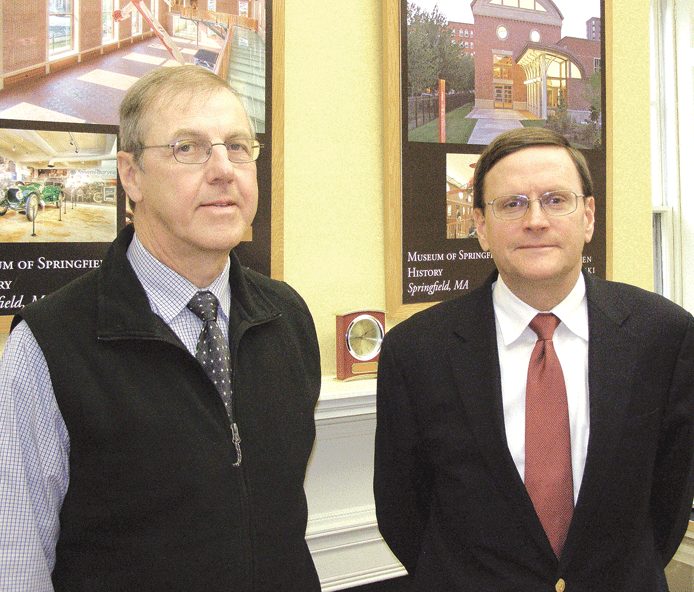
John Pucci, left, and Andrew Levchuk

John Pucci, left, and Andrew Levchuk bring expertise to Bulkley Richardson in some key, growing niches of law.

John Pucci has amassed a considerable record in white-collar crime. No, not that kind of record.
Specifically, he prosecuted criminal cases for the government as chief of the U.S. Attorney’s Office in Springfield before moving into private practice as a partner at Fierst, Pucci & Kane in Northampton.
For Bulkley, Richardson and Gelinas, the Springfield-based law firm that brought him on board as a partner earlier this year, his experience on both sides of white-collar-crime and other specialties make him a valuable asset. As part of his role, he’ll handle federal tax-evasion cases, public-corruption claims, and cases involving companies and individuals under pharmaceutical investigation — but, this time, fighting for the defense.
“It’s an enormous advantage for a practitioner in the white-collar crime arena to have worked inside government, because you really get a feel for how and why cases are prosecuted, where the fault lines are in terms of evaluating the case, and how the bureaucracy works — and doesn’t work,” Pucci said.
“Dealing internally with the IRS and FBI is a bit of an art form which takes years to learn,” he added. “When you come to the defense side, you have an ingrained sense of how the government is evaluating the same documents you’re looking at for a client.”
Pucci’s not the only new attorney at Bulkley Richardson. He actually hired Andrew Levchuk at the U.S. Attorney’s Office 20 years ago, “and we find ourselves back here, together, in 2012 by virtue of a collection of circumstances that were surely unforeseeable when I hired him,” Pucci told BusinessWest.
Levchuk, who also joined the firm earlier this year, most recently worked for the U.S. Department of Justice, serving as deputy chief of the Human Rights and Special Prosecutions Section of the Criminal Division.
“I had spent part of my time in Washington as senior counsel at the computer crime and intellectual property section, and we worked on computer issues like data theft and data privacy, and also worked with international groups focused on those issues,” he told BusinessWest.
“That’s now a big issue here in Massachusetts and across the country,” he added. “Massachusetts has very strict data-privacy and data-protection regulations that apply not only to large institutions, but medium-sized businesses as well. In addition, these are very important concerns for health care clients.”
Pucci — who also brought to Bulkley Richardson his associate at Fierst, Pucci & Kane, Lizette Richards — is happy to be reunited with Levchuk. “By chance, we had a discussion, and Andy was interested in coming here.” Pucci said. “I told him he’d be a great addition, and at my suggestion, he came down to talk to the folks here, and here we are.”

Ahead of the Curve
Here they are, indeed — along with a diverse assemblage of fellow attorneys. As a law firm that traces its roots back to the 1920s and has grown to a roster of 45 lawyers with a wide diversity of specialties, Bulkley Richardson doesn’t want to stand pat, instead always considering what the current trends are in law, and trying to meet them, said Sandy Dibble, chair of the firm’s executive committee.
“Our size is incidental to what we are and what we can do,” he said, noting that it’s actually a relatively small firm when compared to some metropolitan and international firms.
The company expanded into Boston 10 years ago, an office that has thrived while focusing largely on representation of financial institutions. No one, Dibble said, could foresee the scope of the crisis that engulfed the financial-services industry in 2008.
“That turmoil has produced lots of litigation for banks. We represent mutual funds and most major banks. We rarely do foreclosures, but we do defend banks and other financial institutions when they’re sued,” he explained. “Banks like Sovereign, Bank of America, Citizens, JPMorgan Chase are big clients, and we do work for them in multiple states in New England through the Boston office. We have good lawyers out there, and it has been very successful.”
Bulkley Richardson has also seen plenty of growth in its health care specialty, particularly at a time when local and national health-insurance reform, and generally increasing compliance demands, require skilled legal aid.
“That’s a hugely active field from a legal perspective, with a tremendous amount of new legislation at the state and federal level, lots of new regulation, lots of new regulatory activity among the clients we represent,” Dibble said — among them Baystate Health and several other hospitals in Western Mass.
“We’re certainly not the only law firm representing these clients, but we do work with them in various areas of expertise,” he continued. “We do a lot of work involving government and how to structure organizations, how to manage them so they have a high level of compliance and ethical behavior. We also interact with the government agencies that supervise health care institutions.”
Among its other strengths, Dibble said, the firm handles plenty of litigation work and boasts a strong business and corporate practice, ranging from the purchase and sale of businesses and real estate to representing nonprofits and foundations in all facets of their operations; from drafting contracts for construction projects to that aforementioned advisory role for health care institutions.
Those efforts included handling financing for Baystate Medical Center’s $296 million expansion project. “That was a pretty challenging undertaking because we were putting it together right at the time the economy was collapsing,” he said. “So we were happy to be able to get that accomplished.”
The firm also represents many individual clients, including business owners and public figures; Bill and Camille Cosby are among the firm’s valued longtime clients, Dibble said.
Not every specialty thrives at any given time, he noted — for example, commercial real estate work has experienced an overall decline in the past few years. “Diversity is helpful to a firm, which is why we’ve made some significant additions, bringing in some additional resources in areas we weren’t as strong in.”

Keeping Secrets
Among those is corporate data security, one of Levchuk’s strong suits.
“Five years ago,” he said, “the big data-security issues involved large computer networks and hacking into banks of health care institutions, and by people seeking to obtain personal information which they could then use to steal identities, credit-card numbers, and so on.
“Now,” he continued, “that has evolved into data theft from a variety of other devices. We all walk around with handheld computers; that’s what smartphones are. Think about the data a smartphone contains. And from an employer’s perspective, think about the data that employees send and receive on smartphones, and you can see how security is now a major issue. Breaches can lead to serious civil liability — and occasionally criminal liability — so it’s important that companies have the right policies in place and get up to speed on these issues.”
For his part, Pucci said he’s built up a strong résumé of complex civil and complex criminal cases, but, having gotten to know Dibble and others at Bulkley Richardson, “I was desiring to make a change and get into a larger environment, a richer environment. I had a discussion that led to my decision to come here. There had not been a white-collar practice here for at least a decade, maybe never.
“This firm is an ideal place for us to settle into because it’s got a lot of rich history,” Pucci continued, as Levchuk nodded agreement. “It’s been here 80 years, which means it’s got a solidity to it and a sense of permanence. It’s got a lot of depth in its resources; just from among the lawyers who walk the hallways, you can get an answer to almost any question in any area, which is helpful.
“And on the service side,” he added, “we employ people who don’t exist in a smaller firm without our resources, and that allows you to lawyer instead of having to manage. Back in my old firm, as co-managing partner, I spent a lot of time managing issues and day-to-day problems, not practicing law. This is a great environment to practice law.”
That distinction is important, he said, for clients who, in many cases, are facing one of the more difficult situations in their life.
“It’s very important that we as lawyers keep in mind that our clients have a problem, and we should try to be problem-solvers,” Pucci said. “And the problem-solving process, working through the legal system, is a complex matter. Here, all our essential focus is on being a lawyer.”
But Dibble was quick to add that the firm’s attorneys are dedicated to helping people outside of work, too.
“We have a lot of people on the boards of dozens of organizations, people who volunteer their time, and we as a firm contribute financially to a lot of organizations,” he said. “That’s important to our culture. We want our people to recognize that we’re all part of a community — especially in a smaller city like this. That’s not to say that people in big cities don’t take part, but in a place like this, there aren’t so many people available to help out that you can skip it.”

Building a Case
With the Great Recession hopefully fading, Dibble said, Bulkley Richardson is hoping to build on a very strong 2011 — which followed a slightly-off 2010 — as it continues to diversify and grow.
“It’s a very competitive market out there; there are some very good firms in Western Mass. and some very good lawyers,” he said. “But the competition is not just local; there’s also a lot of competition from Boston and New York firms, national and international firms, who would like to do some of the work we do.”
And have been doing for more than 80 years.

Joseph Bednar can be reached at [email protected]

DBA Certificates Departments

The following Business Certificates and Trade Names were issued or renewed during the month of March 2012.

AGAWAM

ELS / Spectrum Alliance
11 Almgren Dr.
Spectrum Analytical Inc.

HD Systems Integration Inc.
419 Springfield St.
Jayson LaCasse

JMS Mechanical
140 Autumn St.
Stephen Brown

Rosefundraising
22 Vernon St.
Dean Molta

Sandlin Consulting
90 Granger Dr.
Rosemary Sandlin

AMHERST

Miss Leticia Music
41 Blue Hills Road
Leticia Davies

Potwine Neighborhood Farm
216 Potwine Lane
Jesse Selman

Shortbord Marketing Group
65 Salem St.
James Frey

Wags n’ Wiggles
28 The Hollow
Meghan Waldron

CHICOPEE

Automotive Dealer Personnel
5 Nutmeg Circle
David Robison

Berzenski Flooring & Sanding
649 Prospect St.
Randy Berzenski

CL Construction
11 Falcon Circle
Chet Lokey Jr.

Defy Gravity
12 Center St.
Raul Roman

Liberty Tax Service
749 Memorial Dr.
Kristin Kicza

Master Designs
47 Lester St.
Nancy Hebert

The Pet House
1889 Memorial Dr.
Kelly Rouleau

West Street Market
108 West St.
Margarita Plagakis

EASTHAMPTON

Ambient Owl
17 Treehouse Circle
Terri O’Toole

BPM
15 Howard Ave.
Eric Peloquin

C.J. Auto Detailing
1 Loomis Way
Christopher Lebron

Fine Art Handling & Consulting
116 Pleasant St.
Daniel Farrell

Harper’s Ferry Software
69 Garfield Ave.
Peter Wagner

The Conscious Learner
32 Briggs St.
Mark Vecchio

The Zengineer
378 Main St.
Bucky Sparkle

HADLEY

East Coast Fragrance
367 Russell St.
Nashir Uddin

HOLYOKE

All Star Fashion
123 High St.
Javier Rosa

Clean Slate Centers
384 High St.
Ram Gopta

Friendly Variety Store
1373 Dwight St.
Olga Lopez

Mt. Tom Groom Shop
320 Easthampton Road
Linda Henderson

Mt. Tom Veterinary Services Inc.
320 Easthampton Road
Linda Henderson

Western Mass Pediatrics
18 Hospital Dr.
Hank J. Porter

NORTHAMPTON

B & B Ventures LLC
141 Damon Road
Bonnie Cueman

Bacon Wilson
31 Trumbull Road
Steven Krevalin

Foley Investigations
947 Burts Pit Road
Deborah Foley

Glamazon
5 East St.
Cassie MacColl

Krantz Wellness
92 Main St.
Stefanie Krantz

Murre Creative
30 North Maple St.
Maureen Scanlon

Northampton Reiki
16 Center St.
Primary Care Foundation Inc.

Paradise City Painting
57 Upland Road
Thomas Quinn

Starr’s Pizzeria & Restaurant
59 Main St.
Alexander Carballo-Diaz

Strong & Healthy Smiles
40 Main St.
Suzanne R. Keller

PALMER

Russo’s Lakeside Steak & Seafood
702 River St.
Todd Russo

Salon Trendz Etc.
1110 Park St.
Melissa Brodeur

Sun at Palmer
1426 Main St.
David A. Rome

SPRINGFIELD

Joslad & Associates
83 Superior Ave.
Joseph Aimua

Kickmass Lacrosse Club
1537 Main St.
Daniel L. McCreary

Law Office of Anthony J. Canata
244 Bridge St.
Anthony J. Canata

Lee’s Sports
47 Pearl St.
Dorothy Lee

Luxe Burger Bar
1200 Hall of Fame Blvd.
John Elkhay

M.G. Home Improvement
41 Devens St.
Marcin Gadziala

Mail Mall
53 Lester St.
Morning Santiago

Mar Music Group
42 Dewey St.
Emanuel Diaz

Masters At Custom
128 Hampden St.
Jermaine Jason

Maxim Lingerie Showroom
333 East Columbus Ave.
Quitman Boyce

Melissa’s Place
1555 Wilbraham Road
Melissa Chesbro

Millennium Nails Salon
1655 Boston Road
Kim Dang

Mundo Mobile
1104 Main St.
Rafael A. Dominguez

Northeastern Sheet Metal
75 Market Place
Thomas J. Messenger

Nuworld Entertainment
100 Whittier St.
Sam W. Bradley

Orchard Auto Sales
1307 Worcester St.
Richard Francis

P.J.B. Home Improvement
67 Lang St.
Paul J. Babiec

Papale & Bouvier Eye Center
1515 Allen St.
Center for Eye

Perfectly Polished Nail
181 Chestnut St.
Nia Francella

Plan B Springfield
1000 West Columbus Blvd.
Shawn M. Skehan

Progresso Auto Repair
1142 State St.
Jacinto Mendonga

Prospect Variety
51 Prospect St.
Martin E. Severino

Quick Stop Food Mart
889 Carew St.
Amtul S. Khoula

Reboot Electronics
1228 Main St.
Emmanuel Pena

Rockmore Painters
60 Oregon St.
Hugh O’Connor

Santana Flooring
268 Evergreen Road
Gabriel Antonio

Santiago Towing
546 Chestnut St.
Jose Santiago

Sissy’s Accessories
20 Maple St.
Sheryl A. Chase

Springfield Nails
682 Belmont Ave.
Thu H. Nguyen

Stepforward Production
71 Gates Ave.
Kevin A. Young

Stephanie Beth Photography
301 Plumtree Road
Stephanie B. Brown

Templo San Lazaro
718 Main St.
Zulma Mestres

The Boulevard Grill
668 Page Blvd.
Stephen A. Amato

Throneroom Enterprises
116 Florence St.
Steven R. Williams

WEST SPRINGFIELD

Baghdad Bakery
464 Main St.
Dheyaa Habeeb

Delto Affordable Construction
33 Birnie Ave.
Vladimir Garygun

DMS Enterprises
7 Upper Church St.
Dawn M. Spiegler

Gengras Motors Inc.
1712 Riverdale St.
Clayton Gengras

Jodoin Home Improvement II
22 Willard Ave.
Darrin T. Jodoin

John R. Sweeney Insurance Agency
56 Union St.
John R. Sweeney

Johnnie’s Distribution
23 Worthen St.
Johnnie Young

Mike Enterprizes
142 Nelson St.
Michael S. Blanchard

Niquette Studios
51 Ashley St.
Leslie Niquette

Ray Sweeney Insurance Agency
293 Elm St.
Ray Sweeney Agency

Riverdale Gold Exchange
1353 Riverdale St.
Norman A. Hannoush

Skin Spa Aesthetics
698 Westfield St.
Leah M. Hurlbut

Vlad’s Transportation
820 Union St.
Volodymyr Zhukovsky

Western Mass Hypnosis Center
201 Westfield St.
Thaddeus J. Muszynski

Health Care Sections
Unique Partnership Strives to Reduce Rehospitalizations

Dr. Cynthia Jacelon

Dr. Cynthia Jacelon says rehospitalization is a problem these days because hospitals are under increasing pressure to discharge patients quickly.

Avoidable rehospitalization, when a patient returns to acute care within 30 days of having been released, has always been an issue facing those professionals on the front lines of quality patient care.
Dr. Cynthia Jacelon is the director of the UMass Amherst School of Nursing’s Ph.D. program, as well as the scholar-in-residence at Jewish Geriatric Services in Longmeadow. Her particular field of research in health care centers on dignity of care in older adults. She told BusinessWest that the issue of rehospitalization has received renewed scrutiny in recent years due to federal health care reform.
Specifically, it is the Patient Protection and Affordable Care Act, which has numerous provisions. But one which hits the bottom line is a change in insurance reimbursements for patients who have been subject to what is called ‘avoidable readmission.’
“Rehospitalization has become a problem, in part, because hospitals are squeezed to discharge people at the moment they are ready,” Jacelon said. “Every time a hospital discharges someone at the first second that they are able to be in a different care setting, they are taking a risk that they misjudged that second. If they judge the moment correctly, they get paid for the hospital stay, and it’s all good. But if they misjudge the second, they now face financial penalties.”
However, a partnership comprised of employers, education providers, workforce-development leaders, and philanthropists, which has been in existence since 2006, is in the beginning stages of a program designed to target that concern. Among the many partners in the Healthcare Workforce Partnership of Western Mass. is the Regional Employment Board of Hampden County, where Kelly Aiken is the director of Healthcare Initiatives. She said this partnership is “invested in the future of nursing.”
As she explained, “the whole premise of the project itself is that partners have come together to solve a problem that no one organization can solve on their own. Care transitions are such a critical component of achieving all the industry’s goals around improving access, increasing quality, and reducing costs.”
Since September of last year, the program known as the Care Transitions Education Project (CTEP) has been in the first of three stages in three years to develop what those involved say is a means to directly address the issue of rehospitalization, from both a financial perspective and also that of providing the best in patient care.
And while one primary goal is to reduce financial strain due to rehospitalization, and both Jacelon and Aiken stressed that this is indeed an outcome, they said the implications for health care are nothing short of groundbreaking.
“Yes, it is a strategy to reduce readmission rates,” Aiken said. “But the genesis of our partnership has been about collaboration. It has been a perfect match for trying to advance the type of collaboration that is required amongst these settings, in education and in health care.”

Team Work
Aiken said the CTEP program would never have happened “if the broader partnership of the Healthcare Workforce Partnership of Western Mass. were not in existence.” That group is comprised of three groups:
In health care, the players are Baystate Health, Berkshire Healthcare Systems, Cooley Dickinson Hospital, Commonwealth Care Alliance, Genesis Healthcare/Heritage Hall, Holyoke Health Center, Holyoke Medical Center, Jewish Geriatric Services, Noble Hospital, Holyoke VNA & Hospice Lifecare, Sisters of Providence Health System, Mass Senior Care Assoc., Home Care Alliance of Mass., Mass. Coalition for the Prevention of Medical Errors, and VNA and Hospice of Cooley Dickinson.

Kelly Aiken

Kelly Aiken says effective care transitions are a critical part of the health care industry’s efforts to improve access, increase quality, and reduce costs.

In education, the stakeholders are American International College, Elms College, UMass Amherst, Westfield State University, and Greenfield, Holyoke, and Springfield Technical community colleges.
Finally, the workforce-development group includes the Regional Employment Board of Hampden County and its programs.
The HWPWM has many broad initiatives under its banner, Aiken said, but one of crucial importance is the CTEP. According to the State Action on Avoidable Rehospitalizations Initiative, avoidable readmission rates for patients returning into acute care are as high as 28% of all hospitalizations.
Of course, that rate has long been addressed by a health care industry seeking to offer the best in care to its clients, but the insurance reform puts readmission into high relief.
“Readmissions have long been an issue,” Aiken explained, “but never one that has been tied to reimbursement rates. Now, what is coming down the line … if a patient is going from one setting to another, and it is deemed avoidable, there are going to be changes to the reimbursement rates for Medicaid and Medicare patients. That insurance will no longer reimburse facilities if there is an avoidable readmission that takes place within 30 days of discharge.”
The CTEP timeline approaches its goals in three parts. Currently, the project is in phase one — creation of curriculum for nursing students and incumbent professionals. Subsequent stages are pilot projects to put that information into the field, and the final stage of the process is to disseminate the curriculum, findings, and information statewide. Aiken explained the steps.
“Right now, we’re developing the curriculum which will be packaged as training for our target audience — staff nurses, nurse managers, and nursing students — those health care professionals who are the point of care,” she explained.
“You take that big-picture environment where health care reform is changing,” she continued, “and then you take it down further to an individual organizational level where they understand they are not going to be reimbursed if they don’t change their process and improve their care. And then you take it down even to the unit level, where you say, ‘my workforce needs to understand how to improve care transitions so that ultimately the quality of patient care improves, and I’m going to be reimbursed in an adequate manner for the services that I’ve provided.’”
The second phase of CTEP involves pilot testing and evaluation of the curriculum, rigorously evaluated. “We will be determining if the curriculum itself can help us achieve the learning objectives that we’ve set forth,” Aiken said.
The third phase is about dissemination statewide. Aiken said the lead grantee for CTEP is the Mass. Senior Care Foundation, which is associated with the Mass. Senior Care Assoc., the trade association for long-term-care facilities.
“The fact of the matter is that we’re operating here regionally because of our history of collaboration,” she explained. “But we are working directly with a state-level organization because we believe that what we can develop here has implications across the state.”

Collaborative Effort
The curriculum is designed not for the purpose of reinvention of nursing standards, but rather to offer a new perspective on collaboration between acute and long-term care.
Jacelon said this is nothing short of revolutionary.
“Across agencies, from acute care and long-term care, there can be a lack of what I will call respect,” she said. “For instance, it’s easy for me, as a nursing-home nurse, to say, ‘well, that acute-care nurse didn’t do their job because this patient came here clearly not ready to be discharged from the hospital.’ And it’s easy for the acute-care nurse to say, ‘they were OK when they left here, so the nursing-home nurse must not have known what they were doing.’
“So one of the goals of this CTEP curriculum is to build teams of nurses across settings,” she continued, “so the nursing-home nurse can say, ‘oh my goodness, something bad must have happened on the way here, because I know Joan at the hospital would not have sent me this patient in this condition.’ And for the hospital nurse to be able to say, ‘I know those people at the nursing home do a really good job, so it’s not their care that caused this person to come back; it’s something about the patient’s condition.’”
Summing up that hypothetical scenario, she added, “if we can build that respect, then you have much better communication across the changes of settings. And once you have better communication, then you have better transfers.”

Dollars and Sense
The financial incentives behind CTEP lie first and foremost with the acute-care facilities. But Jacelon and Aiken stressed that dollars and cents are important considerations for their organizations as well. Both stressed that readmission is first and foremost a problem under the purview of quality patient care, but there are fiscal ramifications for their organizations.
“The business point comes in for us because that acute-care facility is highly invested in not having their patients come back within 30 days,” Jacelon said, “and they’re going to be shopping, if you will, for the most effective post-acute-care setting for that patient.
“If the Jewish Nursing Home’s re-hospitalization rate is less than 10%, which I’m pleased to say ours is,” she added, “and the XYZ nursing home elsewhere is 25%, where are you going to send your patients? Therein lies the incentive for us; it makes us more desirable.”
Aiken said that, from the very start of the CTEP’s existence, the REB has seen this program as a means to address new-worker and incumbent-worker training and education needs.
“One, we have staff that our employers say are not prepared to face the future of health care,” she said, “and to help them in the success of their evolving business model. So in that way, it’s an incumbent-worker training need.
“From a new-worker perspective,” she continued, “we want to make sure that we are educating our new nurses so that they are prepared to take the jobs in the region that are here. And frankly, in the work that we had been doing before, we identified that new graduates weren’t interested in taking jobs outside the hospital setting. And in some cases, the employers weren’t prepared to take new graduates.
“There’s been this model for years that your first job is in the hospital, then you get some training, and then you can go into different care settings,” she added. “Well, it’s not necessarily the way it’s going to work in the future. Fewer and fewer jobs are going to be in the hospitals, so nurses have to be prepared and willing and excited to take the jobs that are going to exist in all these other care settings.”

Goal Standard
Because CTEP is funded through a Partners Investing in Nursing’s Future (PIN) grant, a collaborative effort of the Robert Wood Johnson Foundation and the Northwest Health Foundation, both Aiken and Jacelon are eager to see the regional impact of this curriculum and its outcomes. When asked about the national implications of CTEP, Aiken smiled.
“We would love to say that we can ultimately head in that direction, but I think that we start small and see where we can go,” she explained. “But PIN is involved in 37 states. That’s an incredible network that is in the future on our stage for dissemination.
“There is a great expectations of where we could go,” she added, “but first we have to get it right. And we feel that Western Mass. is a good place to test the waters.”
As an educator who has been actively building curricula for years, Jacelon said this is a fundamental building block in how nursing will be taught. “CTEP will be part of the curriculum of nursing school,” she explained, “and it’s designed for practicing nurses and for student nurses. It’s going to fill a hole in the curriculum, in that, to date, not a lot has been taught about these issues.”
Time will tell how CTEP will help to reduce rehospitalization rates, but like their other partner organizations, Aiken and Jacelon are both proud and confident in the partnership designing the curriculum and its subsequent programs.
“But it’s very hard to say whether a project like this will globally reduce rehospitalization,” Jacelon added. “Although, if the rates in the area decline over the next three years, it’s going to be because someone has done some intervention. That is our goal.”

Features
Berkshire Chamber Is Focused on Partnerships

The principals of 1Berkshire

The principals of 1Berkshire are promoting the initiative as “a one-stop shop” for economic development, according to Michael Supranowicz, second from right.


The present-day Berkshire Chamber of Commerce is the result of a merger, in 2000, of the then-so-called Chamber of Commerce of the Berkshires and the Northern Berkshire Chamber of Commerce. The result is what current president and CEO Michael Supranowicz called “the absolute force for business advocacy in this county.”
Elaborating, he told BusinessWest, “we realized that it was getting harder to keep these separated organizations doing the same thing in their own spheres of influence. But it was pretty easy for both boards to see the opportunities possible in creating one large chamber, one that could address all the business issues of the greater good in Berkshire County.”
According to the BCC mission, the chamber “will lead and advance economic development and support the civic and social welfare of Berkshire County through the advocacy and support of our members and the Berkshire community.” And through some upcoming partnerships that are just weeks away from becoming a reality, the road to meeting that mission will be easier to navigate.
One such initiative, called 1Berkshire, is just a few weeks away for its official launch. The newly branded “one-stop shop,” as Supranowicz called it, will be comprised of the BCC, the Berkshire Visitor’s Bureau, the Berkshire Economic Development Corp., and the Berkshire Creative Economy Council.
“Out here in Berkshire County, we look at ourselves as an island,” he explained. “We stand alone. There isn’t great highway access, there are still many communities absent a good access point for Internet, and we’re losing a congressman. It sometimes feels like we have to fight for everything we have here in this county, but we’ve been lucky enough to keep our interests well-contained with our organizations.
“However, because of the singularity of our physical location,” he added, “we’ve had to rely on our own ingenuity to get things done. We gave it the name 1Berkshire because we want to be unique.”
The program is just one of many strategic initiatives through which the chamber carries out its multifaceted mission. Ashley Sulock, director of Communications and Marketing for the BCC, pointed BusinessWest toward another — the chamber’s comprehensive Web site, one that functions on a variety of levels. The site contains tools for current and prospective businesses, as well as site selectors, all with the intent of growing existing businesses and recruiting new ones.
“With all of the online components,” she explained, “this chamber is really a foundation upon which you can build your business.”
For this issue and its Getting Down to Business series, BusinessWest looks at the many ways in which the BCC backs up those words.

Economic Agenda
While the current incarnation of the BCC is only approaching adolescence, the chambers that precede it date back to the 19th century. A primary reason for the merger was, in Supranowicz’s words, “The union of the two largest and most advocacy-driven chambers in Berkshire County.”
The business sector of the county is unique, both he and Sulock noted, with one big reason being its challenging location.
“Approximately 80% to 85% of our membership represent a small business profile,” Sulock said. “Berkshire County has in the neighborhood of 4,700 businesses in total, and about 4,200 of those employ 19 or fewer people.
“We have a constituency that requires very specific programming,” she added, “and we try to support that with everything from educational workshops to professional-development opportunities to advertising opportunities for the small-business community to showcase their products and services. That’s one of our primary functions, to connect these members to the community at large.”
Supranowicz said his chamber’s advocacy has multiple strategies. Legislation and a political presence comprise one technique.
“If there’s a cumbersome business regulation that we can do away with, to allow the business community to be more productive, or to have something cost less for the purposes of their bottom line, then we’ll address that,” he explained. “We speak on behalf of the business community about split tax rates,we work hard on energy costs, and we’ve been a qualified intervener at some Department of Energy hearings regarding the construction of solar arrays; we’re working with other chambers across the state with regard to alleviating the pressures of health insurance.”
But a key tool in the BCC’s toolbox is its Web site, which both administrators noted. In addition to the customary business directory found on most similar sites, the BCC’s comprehensive site contains much more. There’s a cost-of-living index calculator and several tools for site selectors — those contracted individuals who seek regional information for business clients looking for new markets.
“On the Web site, we compare ourselves to about 360 other communities throughout the nation,” Supranowicz said. “And where that leads to economic development is when our larger companies are looking to recruit. They have a base of comparable costs of living when they’re looking to bring those potential employees here. They know how much they would need to pay them in order for that person to afford the same type of living that they could have somewhere else, or wherever else they’re located.”
The Berkshire Business Real Estate Locator is another of those tools, and Supranowicz explained how it worked. “What we did is utilize the International Economic Development Council’s basic set of comparable statistics,” he explained, “to create a section on the Web site dedicated to promoting the commercial land and buildings in Berkshire County. And tied into that, we have the minimum set of demographic information that site selectors look to, when they’re comparing one region over another.”
These online tools are also helpful for the current business community, he said, and are an asset in the chamber’s legislative advocacy. “They provide economic modeling help,” he said. “We can plug an event in, and we can determine what the direct and indirect benefits are for that event. For instance, we had an auto dealer who was looking to build a second location in Pittsfield, and was applying for a TIF package. The chamber was able to tell the city council that, if he built that building, and if he put X amount of people to work, it would mean X amount more jobs in Pittsfield could be spun off of that.”

One for All
1Berkshire had its origins not long after the BCC’s own merger. In 2006, the chamber initiated the Berkshire Strategy Project, focused on the prioritized issues facing the region, and a concern with how to make the county’s economy stronger.
Concurrently, the other three partnerships all had similarly tracked projects and missions. In 2009, a “meeting of the minds” formed a steering committee, and the individual efforts were rebranded as 1Berkshire. “Ultimately, this will satisfy most of the economic-development needs in Berkshire County,” Supranowicz said.
The organization will be located in Pittsfield’s former Central Fire Station on Allen Street, which was donated by Berkshire Bank. The project will launch in a few weeks, he noted, adding that, with the new structure and new organization, opportunities for business service, and educational resources, 1Berkshire will be a model for economic collaboration across a spectrum of agencies.
“Whether a visitor comes in,” he explained, “or maybe they’re a business prospect, or a current business owner looking for some help, there’s one number to call or one building to come to, and everyone will receive the assistance of all these organizations that help to create prosperity in Berkshire County.
“We’re looked at by other parts of the state when they want an example of collaboration and how to do it right,” he added.
As a lifelong resident of Berkshire County, Sulock said she was thrilled to be part of both the BCC and its expanding partnership. “Even though our focus is on business and our membership,” she said, “there is a major benefit to the social welfare of the county, and the civic development of the community at large.
“By uniting under one roof with these other organizations,” she added, “that speaks to our contemporary perspective on how to do business, and how we want to shape the business community in the Berkshires.”

Chamber Corners Departments

AFFILIATED CHAMBERS
OF COMMERCE OF GREATER SPRINGFIELD
www.myonlinechamber.com
(413) 787-1555

• April 3: Springfield Chamber of Commerce Executive Directors meeting, noon to 1:30 p.m., EDC Conference Room, Springfield.
• April 4: ACCGS Business @ Breakfast, at the MassMutual Learning & Conference Center, Memorial Drive, Chicopee. Doors open at 7:15 a.m. Cost: $20 for members, $30 for non-members.
• April 11: ACCGS After 5, 5-7 p.m., hosted by Get Set Marketing, 207 Worthington St., Springfield. Cost: $10 for members, $20 for non-members.
• April 13: ACCGS Legislative Steering Committee, 8-9 a.m., at the TD Bank Conference Center, Springfield.
• April 18: ERC Board of Directors meeting, 8- 9 a.m., at the Gardens of Wilbraham, Community Room, 2 Lodge Lane, Wilbraham.
• April 18: ACCGS Ambassadors Meeting, 4-5 p.m., EDC Conference Room, Springfield.
• April 19: ACCGS Executive Committee meeting, noon to 1 p.m., in the TD Bank Conference Room, Chamber Offices.
• April 25: Annual Beacon Hill Summit. Save the date for the ACCGS’ yearly State House visit. Details to follow soon.

AMHERST AREA CHAMBER OF COMMERCE
www.amherstarea.com
(413) 253-0700

• March 28: Margarita Madness, 5-7 p.m., at the Eric Carle Museum of Picture Book Art. The public is invited. Cost: $25 per person, $40 per couple; chamber members are $20 per person. A margarita-tasting event will be featured;  sample 12 margaritas and vote for your favorites. Sponsored by MassLive.com, the Valley Advocate, Greenfield Savings Bank, Applewood at Amherst, Copycat Amherst, Encharter Insurance LLC, Hope & Feathers Framing, Johnny’s Tavern, Judie’s Restaurant, 30 Boltwood, Lit, the Pub, UMass Fine Arts Center, Your Promotional Consultant/NEPM, and more.
• April 11: Chamber breakfast, 7:15-9 a.m., at the Lord Jeffery Inn. Cost: $15 for non-members, $12 for members.
• April 17: Chamber Brown Bag: “Networking Secrets from an Ex-Wallflower,” 12:30-2 p.m., in the Jones Library large meeting room. Guest speaker: Val Nelson.
• April 25: Chamber After 5, 5- 7 p.m., event location to be announced. Cost: $10 for non-members, $5 for members.

CHICOPEE CHAMBER OF COMMERCE
www.chicopeechamber.org
(413) 594-2101

• April 1: April Salute Breakfast, 7:15- 9 a.m., at the Kittredge Center at Holyoke Community College. Cost: $19 for members, $26 for non-members.
• April 12: Business Executive Roundtables, 8:30-10:30 a.m. The CEO Roundtables program will match up to 15 business leaders from non-competitive companies based on company size and expectations. It is not an industry group. Participants come from companies in various fields to confidently share their unique perspectives, experience, business challenges, and lessons learned during regular monthly meetings that offer intellectual discussion and debate. Cost: $75 for members, $100 for non-members.
• April 25: April Business After Hours, 5-7 p.m., at the Hampton Inn in Chicopee. Cost: $5 for members, $15 for non-members.

GREATER HOLYOKE CHAMBER OF COMMERCE
www.holycham.com
(413) 534-3376

• April 24: HCC non-credit course. Special chamber rate. Call the chamber for more information.

GREATER NORTHAMPTON CHAMBER OF COMMERCE
www.explorenorthampton.com
(413) 584-1900

• April 4: Arrive @5, 5-7 p.m., hosted by RK Miles, 24 West St., West Hatfield.  Arrive when you can, stay as long as you can; a casual mix and mingle with colleagues and friends. Sponsored by Keiter Builders. Cost: $10 for members, $15 for non-members. For more information about the event or to RSVP, call the chamber at (413) 584-1900, or e-mail [email protected].

PROFESSIONAL WOMEN’S CHAMBER
www.professionalwomenschamber.com
(413) 755-1310

• April 3: Professional Women’s Chamber New Member Welcome Reception, 6-8 p.m., at the 350 Grill, Worthington St., Springfield. Free hors d’oeuvres; cash bar.
• April 11: Professional Women’s Chamber Roundtable, “Health and Wellness,” 11 a.m.-1 p.m., hosted by Max’s Tavern, MassMutual Room, Springfield. Cost: $25 for members, $35 for non-members.
• April 26: The Professional Women’s Chamber “Chocolate Affair,” 6- 9 p.m., at Chez Josef, Tivoli Room, Agawam. Featuring chocolate desserts, cordials, and shopping at vendor booths. Cost: $25 in advance, $40 at the door.
GREATER WESTFIELD CHAMBER OF COMMERCE
www.westfieldbiz.org
(413) 568-1618

• March 28: WestNet Plus One!, 5-7 p.m., hosted by PeoplesBank, 281 East Main St., Westfield. Network with fellow chamber members and meet new members and businesses in the area. Guest speaker: Patrick Berry, President of the Westfield News. Cost: $10 for chamber members, $15 cash for non-members. Don’t forget your business cards. To register, call Carrie Dearing at (413) 568-1618 or e-mail [email protected].
• March 31: 2012 Spring Southwick Economic Development Commission (EDC) Home & Business Show, 10 a.m.-3 p.m., at Town Hall, 454 College Highway, Southwick. This tabletop exhibit of Southwick businesses is free to the public, and the EDC will be collecting non-perishable food items for the local Food Pantry. Several free seminars will be held. Please visit www.southwickma.info for more information.

YOUNG PROFESSIONAL SOCIETY OF
GREATER SPRINGFIELD
www.springfieldyps.com

• April 19: April Third Thursday, 5-7 p.m., hosted by Adolfo’s Ristorante, 254 Worthington St., Springfield.

Columns Sections
Insurance Payments for Your Autistic Child

Dennis G. Egan

Dennis G. Egan


Having a child with autism creates many challenges, not the least of which is the potential financial impact on your family. Until recently, many families were burdened with a mountain of bills when attempting to have their child diagnosed with and treated for disorders within the autism spectrum. But, thanks to a new Massachusetts law, that is changing.
In August 2010, ARICA (an Act Relative to Insurance Coverage for Autism) was signed into law by Gov. Deval Patrick; it became effective on Jan. 1, 2011. This law requires health-insurance companies in Massachusetts to provide coverage with respect to the diagnosis and treatment of autism-spectrum disorders, regardless of the age of the individual afflicted by the disorder.
Despite what many believe, or at least have questioned, ARICA has no impact on the special-education services provided by school districts, as required under the Individuals with Disabilities Act and Massachusetts law.
Melissa R. Gillis

Melissa R. Gillis

To clarify, ARICA requires that health insurers provide payment for supplemental services, in addition to services provided by school districts, pursuant to a student’s individualized education plan (IEP). Services covered by ARICA include, but are not limited to, medication, counseling, psychiatric care, psychological care, physical therapy, speech therapy, and occupational therapy.
This law includes several significant factors that are noteworthy:
• Reimbursement cannot be sought for services provided by a school district in furtherance of a child’s IEP;
• School districts are prohibited from requiring that services otherwise provided under the child’s IEP be sought via private health insurance coverage; and
• Potential coverage under ARICA cannot be considered by a child’s IEP team when developing the child’s IEP.
There are, however, several exceptions to coverage under ARICA. For example, self-funded plans that fall under the auspices of ERISA are not required to provide insurance coverage. In addition, individuals who receive health care coverage under MassHealth or CommonHealth are not eligible for the coverage provided by ARICA. In addition, insurers may opt out of required participation if applicable costs to the insurance exceed 1% of its otherwise current costs.
As with any new legislation, the implementation of ARICA has progressed, and will evolve, in fits and starts as interested parties educate themselves and others with respect to the practical application of the law.
For example, health-insurance companies that fall under the requirements of ARICA may require a copy of the child’s IEP prior to making coverage decisions. As such, it is very important that the parents of a child covered by ARICA proactively inform the school district that all requests for their child’s IEP be directed to themselves as the parent of guardian. Remember that Massachusetts law prevents school districts from disseminating information relative to a child’s IEP to a private health-insurance provider without the parent or guardian’s informed, prior written consent.
As with any change, especially one of this magnitude, the key to successful transition is communication. You should contact your child’s school district to ensure that it is aware of the provisions of ARICA, as well as its effect on the services that the district provides. This discussion should include such issues as what policies the district has in place to ensure that your child’s confidential information is not shared with insurers without your written consent, as well as a review of the district’s continuing education of staff and administrators relative to ARICA. Parents may also request literature from the school district in order to ensure that the district has written procedures in place to ensure proper application of ARICA.
With your child’s best interests in mind, it is important to reach out to his doctors and therapists to discuss this new law and the impact that it has on services provided, both pursuant to your child’s IEP and privately. It is important that any services provided to your child by a doctor or therapist be properly coded when billed to avoid confusion, which can ultimately lead to additional costs and/or delays.
Communication with your health-insurance company is crucial — first, to confirm that the provisions of ARICA apply to your health insurer, and, second, to ensure that covered services are provided and billed appropriately. In addition, any questions with respect to co-pays and out-of- pocket expenses are best addressed prior to receipt of services.
Informing your insurer proactively that your child receives services that fall within the scope of ARICA, and requesting written information with respect to its compliance with ARICA, will reduce the likelihood that billing questions and issues arise. As with any issue, proper documentation of any and all services provided will assist in resolving any potential issues in a timely manner.
Luckily, a number of quality resources are available for those who have questions related to ARICA. The Commonwealth of Massachusetts Division of Insurance has published guidance with respect to ARICA, and many autism advocacy and support groups have held and continue to hold informational workshops.
If you need legal assistance when wading through the waters of autism-disorder diagnosis and treatment payments, make sure you consult with a qualified special-education attorney. n

Melissa R. Gillis, Esq. is an attorney with Bacon Wilson, P.C. in the special-education, domestic, and real-estate departments; (413) 781-0560; baconwilson.com/attorneys/gillis. Dennis G. Egan Jr., Esq. is an attorney with Bacon Wilson, P.C., concentrating in special education, business, and corporate law; (413) 781-0560; baconwilson.com/attorneys/egan

Court Dockets Departments

The following is a compilation of recent lawsuits involving area businesses and organizations. These are strictly allegations that have yet to be proven in a court of law. Readers are advised to contact the parties listed, or the court, for more information concerning the individual claims.

GREENFIELD DISTRICT COURT
Marcone Appliance Parts Co. v. Applianceman and James H. Mercier
Allegation: Non-payment of goods sold and delivered: $16,203.20
Filed: 12/15/11

HAMPDEN SUPERIOR COURT
Alexander Sierra v. Progressive Direct Insurance Co.
Allegation: Unfair and deceptive trade practices: $2 million
Filed: 12/29/11

Baystate Health Inc. v. Veritech Corp.
Allegation: Defendant breached agreements to market jointly developed multi-media instructional programs: $25,000+
Filed: 1/11/12

Cowles and Cowles, LLC v. R. Levesque Associates and Terrence R. Reynolds, P.E.
Allegation: Breach of contract: $300,000
Filed: 1/4/12

Donna J. Dowdall v. City of Holyoke, Alex Morse, and Adam Pudelko
Allegation: Breach of contract: $100,000
Filed: 1/9/12

Tyde Richards v. Steven Graziano, Media Realty, and Patient EDU, LLC
Allegation: Non-payment of a promissory note: $34,936
Filed: 1/20/12

Vanessa Cestero v. Century 21 Mortgage Inc. and PHH Mortgage Corp.
Allegation: Defendant failed to implement contracted loan modifications: $25,000+
Filed: 1/20/12

Weston McLain v. Springfield Towing and Robert Jones
Allegation: Breach of contract: $5,220
Filed: 1/9/12

PALMER DISTRICT COURT
Custom Security Inc. v. Akcess Biometric Corp.
Allegation: Plaintiff seeks reimbursement for monies that were prepaid to the defendant for services that were not provided: $16,102.32
Filed: 1/27/12

SPRINGFIELD DISTRICT COURT
Accu-Tech Corp. v. RF Communications Services Inc.
Allegation: Non-payment of goods sold and delivered: $11,213.97
Filed: 1/10/12

Liberty Mutual Insurance Co. v. Impact Carpentry Inc.
Allegation: Non-payment of a workers’ compensation policy: $20,554.05
Filed: 1/19/12

MVA Center for Rehabilitation v. Travelers of MA
Allegation: Denial of payment for necessary and reasonable medical bills: $5,391.83
Filed: 1/19/12

Paul’s Crane Service, LLC v. Statewide Mechanical Contracting Inc.
Allegation: Non-payment of services rendered and breach of contract: $5,204.88
Filed: 1/10/12

United Rentals Inc. v. Synergyone Solutions Inc. f/k/a/ Aircare Environmental Services Inc.
Allegation: Non-payment of materials, equipment, and services provided: $14,446.51
Filed: 1/9/12

Western Mass. Electric Co. v. Beloff Billiards Inc.
Allegation: Non-payment of utility services: $3,586.43
Filed: 1/9/12

Columns Sections
When Companies Want to Know What’s Really Going On

You have likely seen the CBS television show Undercover Boss, where the chief executive officer and/or family owner of a large corporation goes undercover in their own company.
They pose as a new employee or trainee and spend one day with each of three or four different employees. Of course, the employees don’t know the $10-per-hour trainee is the CEO of the company, so they dish out personal stories, share complaints about the company, and even share ways they shortcut the company. The boss comes away from the experience suitably charmed by some, but almost always flabbergasted by what is really going on in their company day to day.
Doing an undercover assessment is a great idea, and can really improve your company whether you do it yourself or hire someone. But I can tell you from experience that what you see on television is only part of the story. Our firm has been providing this service for years to companies under 200 employees where everyone knows the boss. We go undercover as an employee, trainee, temp, or whatever the owner is comfortable with, and real life is a little different.
Like all good TV, things get edited. In the case of prime-time TV, all the boring stuff and dead time gets cut, and so does some really good stuff. In the real world, doing an undercover assessment is a little like surveillance. Actually, it’s a lot like surveillance. You watch and listen to a whole lot of nothing for what seems like forever, and then, suddenly, you witness something big.
As an undercover employee, you train with co-workers, hang out at the water cooler, go to meetings, and start to make friends. You typically learn a few things right away that help the company. But for the most part, it can stay pretty benign for weeks or even months. The reason varies, depending on the size of the company. For smaller companies, people are more cautious of what they say and do ‘outside the family’ and can maintain formality for quite some time. Small companies just tend to be too tightly knit for anyone to give dirt to a stranger right away or let them see the family’s dysfunction.
Three to six months is a magic time frame when people start to get tired of faking who they really are day to day. The bigger the company, the more likely there exist employees who feel removed enough that they never fake formality and always act and speak freely, but in a bigger company, you have to find them.
So now you know that real-life undercover assessments can be significantly longer and much duller than on television. But in real-life assessments, we also see some very serious issues that might be too much for television or too embarrassing for the CEO to publicly share. Of course, for our clients, it stays between the boss and the consultant.
Over the years, we have learned about various seedy activities performed by employees. We have seen employees engage in immoral behavior while requiring subordinates to watch guard. We have seen the most respected member of a management team threaten and assault the employees of an entire department as part of their natural management style. We have seen groups of employees in one department band together to undermine another department. We have seen employees purposely provide poor service to customers they didn’t like and brag with a sense of accomplishment after chasing them away. Extreme? Yes, but more common than you think.
On the less dramatic, but just as damaging, side are the bookkeepers who really don’t know how to keep the books, employees who get angry about the boss’s new car and retaliate by lowering their productivity, and the snoops who go through the boss’s desk and computer when alone and then brag about it. The part that should surprise and shock you the most is that the overwhelming majority of these examples involve the longest-term and most-trusted employees.
Why the long-term employees and not the new employees? The new ones can certainly pull some doozies, but they can’t get away with such nonsense for long. They haven’t been there long enough to have the support and/or fear of the other employees. They do something wrong, and the current employees sell them out.
Finding and correcting the issues above can have a huge impact on your organization. It can help avoid lawsuits, improve morale, and make the whole company more productive. But we find many issues that are far less dramatic, yet equally important, like inefficiencies, safety issues, and potential breaches in data security.
We always find improvement opportunities that increase the bottom line, and that is the true value of the undercover assignment, whether it’s real life or television.

Eric Egeland is the president of Capacity Consulting Inc., which provides strategic consulting for multiple industries, including insurance, real estate, education, energy, and Internet. He has personally created 10 successful startups, including seven insurance groups, and has consulted on hundreds of projects, closures, startups, plans, assessments, turnarounds, and reorganizations; [email protected]

Columns Sections
Six Tax Tips to Enhance Your Growth Strategy

If you’re a business owner, then you know how challenging it is to maintain your profitability in these tough economic times, let alone grow your business. Therefore, it’s critical to ensure you have the right resources, team, and business partners who not only support you, but also truly understand your business … from all angles.
Every business owner should have an accountant whom they can rely on to support their business’ challenges and provide timely and appropriate advice. Your accountants should be more than just advisers whom you speak with during tax season. They should serve as your business partners, helping you with financial and operational strategies and supporting your objectives for profitability.
Business owners should communicate with their accountants throughout the year to ensure they are taking advantage of all eligible government subsidies, basically tax breaks, that are relevant to the company. These are designed to support investments in capital assets as well as every organization’s most valued resource: its people. The following tips are designed to help decrease risk and improve profitability.

1. Review all expenditures made in 2011 to see if they qualify for the business-property-expensing option. The generous dollar ceilings that applied until Dec. 31, 2011 for both Sec. 179 and 100% bonus depreciation expensing allowed many businesses to deduct most, if not all, of their outlays for machinery and equipment.

2. Next, review your eligibility for the following credits:
• Employee retention tax credit of $1,000 for each eligible new employee whom you have retained for at least 52 consecutive weeks;
• Small-employer health-insurance credit of 35% of your non-elective contributions to your employees’ health insurance; and
• Research and development tax credits, including certain costs incurred in the creation of a Web site.  This can be a very lucrative tax credit, which is often overlooked in businesses, especially in industries not commonly affiliated with research and development.

3. Did you take advantage of alternative fuel and energy credits? There are a variety of options, and it’s important to speak directly with your accountants to confirm if you qualify for any of these credits.

4. It’s important to substantiate and retain documentation for all of your deductible business expenses, particularly meals, entertainment, and automobile mileage. The IRS is auditing small businesses with a particular focus on disproportionate meals and entertainment as well as automobile expenses. Review your expense-tracking system with your accountant for compliance with these requirements.

5. Meet with your accountant to review the status and classification of all independent contractors. Some might need to be classified as employees and receive W-2 forms rather than 1099s.

6. Evaluate your options with an existing retirement plan or consider setting one up beginning in 2012 to maximize your benefits and theirs.

During every growth stage in a company, it’s extremely important to manage your liquidity. Therefore, this is the perfect time to establish a budget for 2012 to accurately forecast the funds needed to run your business. Cash flow is the lifeblood of every organization, so ensure that yours is healthy.

Robert F. Gorton is a shareholder and CPA at Waldron Rand. He has more than 20 years of experience providing assurance, tax compliance, and business-advisory services to privately held companies in varying industries. He works closely with each client’s management team to implement short- and long-term business, financial, and tax plans to ensure success. He is skilled in the area of mergers and acquisitions and has counseled many clients on due diligence, negotiations, and integration activities. He is certified in financial forensics and has significant experience in litigation, accounting and auditing, and investigative analysis; [email protected]

Features
Women Lag Behind Men in Attaining Leadership Roles and Financial Parity
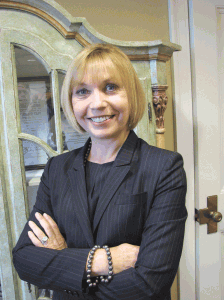
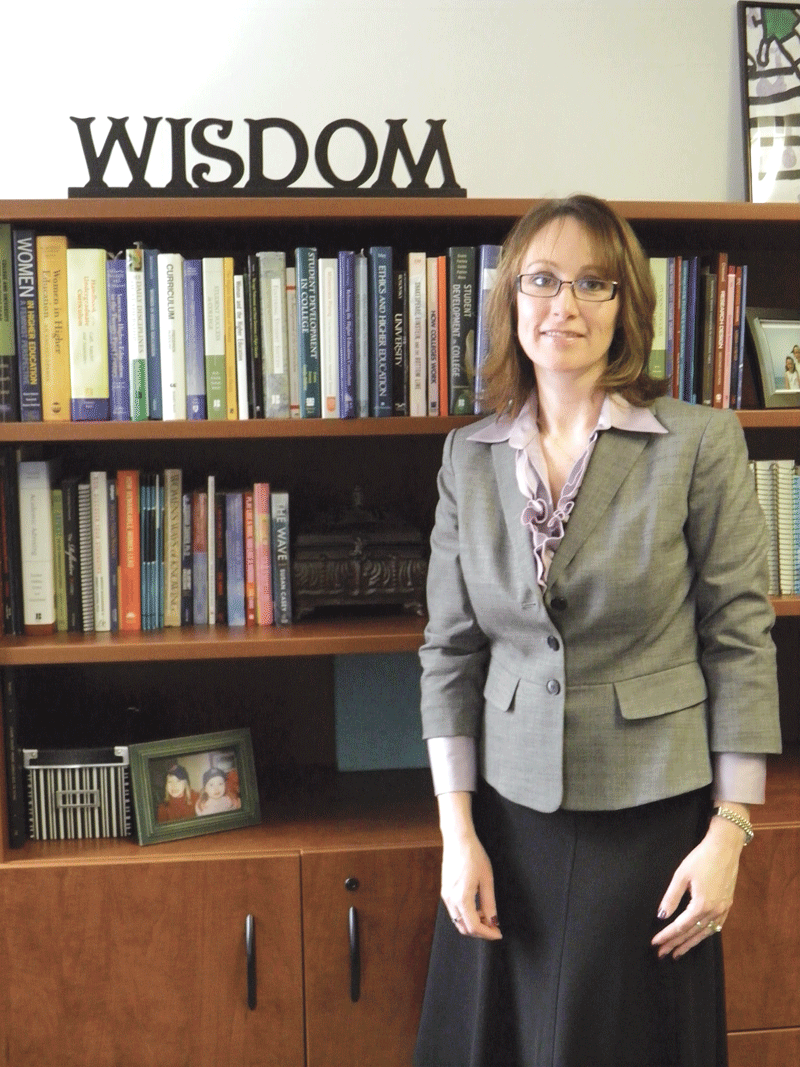
Elaine Sarsynski

Elaine Sarsynski says women believe meritocracy exists, and they will be recognized for their efforts without having to call attention to themselves. But she thinks this is a false perception.

It’s been decades since female Baby Boomers took to the workplace demanding equal wages for equal work. And although women have indeed come a long way, gross inequities still exist in terms of the status they have achieved in economic and leadership realms.
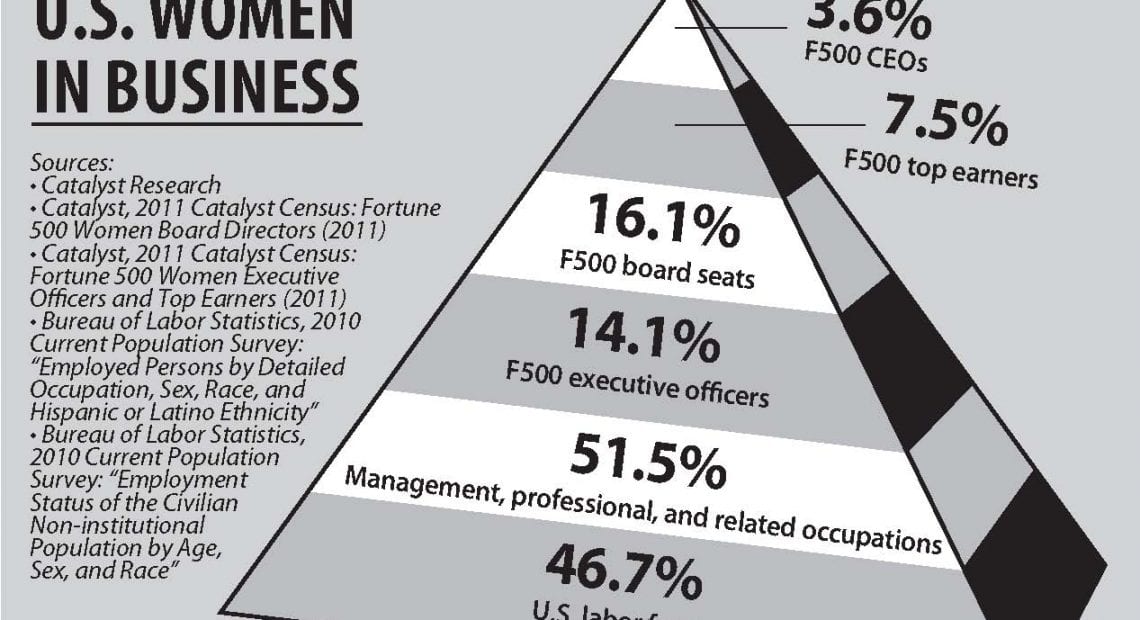
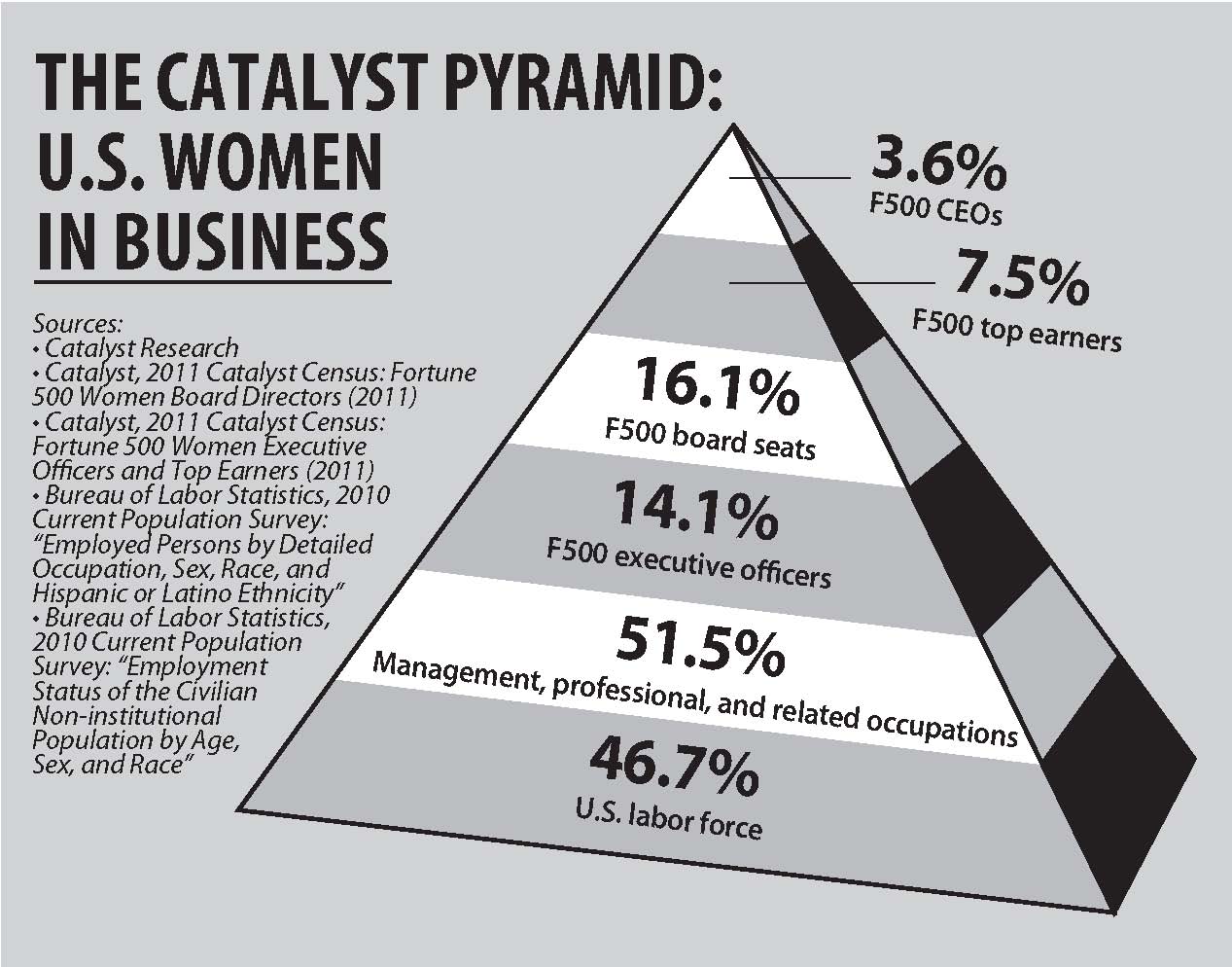
“There is still a stark difference between the earning potential of women and men,” said Elaine Sarsynski, executive vice president for MassMutual’s Retirement Services Division and CEO of MassMutual International. “Even though women make up almost 50% of the workforce today and hold almost 52% of managerial positions in professional occupations, as you start to go up the pyramid, the real issues begin. Today, there are 17 female CEOs in Fortune 500 companies, which is only 3.6%. And when you include Fortune 1000 companies, you are still looking at only 35 female CEOs.”
Other statistics mirror this lack of parity. In 2010, females who worked full-time made 77 cents for every dollar earned by men, according to the Institute for Women’s Policy Research. The inequity often starts from the time they are hired, and a difference of $3,000 in starting salaries between a man and woman is significant.
“It translates into hundreds of thousands of dollars when you factor in retirement, promotions, and bonuses,” said Kristine Barnett, assistant dean of the College of Arts and Sciences and director of the WELL (Women as Empowered Learners and Leaders) campus theme program at Bay Path College in Longmeadow.
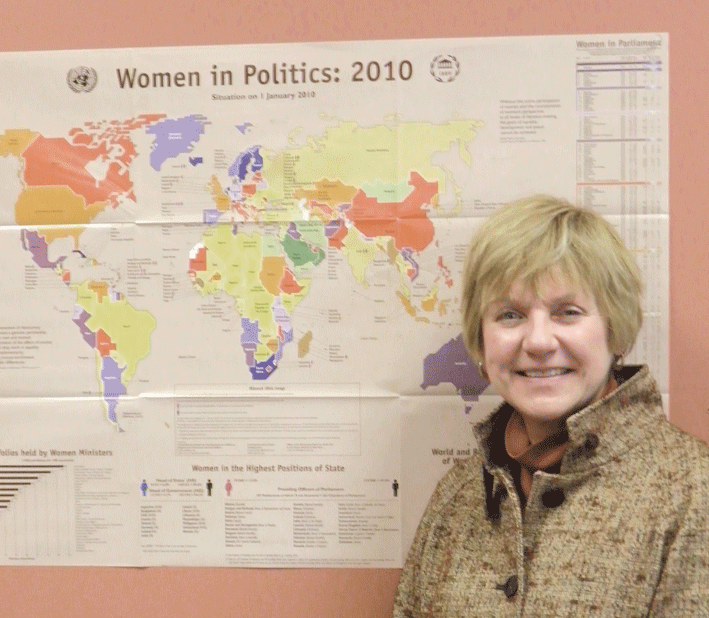
Women also haven’t fared well in the political arena. A recent United Nations report shows the U.S. ranks 75th among the world’s countries in terms of the percentage of women in political office. “We are behind Indonesia, Bosnia, and the Dominican Republic,” said Carla Oleska, CEO of the Women’s Fund in Easthampton, adding that Sweden, South Africa, Cuba, and Iceland are in the forefront.
Kate Kane

Kate Kane says that advancing to the top levels of many businesses requires a certain amount of personal sacrifice.

Meanwhile, Kate Kane, managing director of Northwestern Mutual Life Insurance in Springfield, says the world of finance is also male-dominated. “I don’t see many women running financial-service field operations,” she told BusinessWest. “I think roadblocks still exist due to the reality of what it takes to be at the top level in any corporation or sales organization; if you want to be in a C suite, there is a certain amount of personal sacrifice that goes with it. The expectation is that you will give your life to your career.”
Many women are not willing or able to do this, but those who do seek such positions face real roadblocks on the path to success. Experts say the reasons are complex and range from ongoing gender conditioning to embedded corporate patriarchal systems, along with myriad other issues, including women’s denial that inequality still exists.
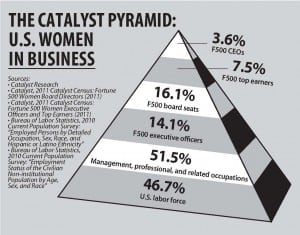
But the combination of these factors means that a woman’s best efforts may not result in success. A recent survey conducted by Catalyst Inc. shows that, when women did all of the things they were told would help them get ahead and used the same tactics as men, they still advanced less rapidly and profoundly than their male counterparts and had slower increases in pay growth.
However, initiatives to help women succeed are beginning to gain force, such as Vision 2020, which has 102 delegates from the across the nation who have united with the goal of advancing women’s equality by the year 2020. Measures they have adopted include raising awareness, developing shared leadership, and creating opportunities for success for future generations.
“Women want to become executive leaders and have the talent, capability, and wisdom to do so, but ultimately the system forces them to make decisions that do not complement their lives; if you want to become a partner in a law firm, do you spend 70 hours a week at work and put off having children?” Oleska said, citing a host of situations women face that include dealing with aging parents, as this responsibility frequently falls on them.
“There is a lot at stake when women consider whether they will pursue a position in executive leadership. The expectations for a CEO do not allow for a healthy work/life balance, and some women don’t want to be out seven nights a week,” she continued. “But as we continue to build a critical mass of women executives, we will see some of these systems change.”

Work in Progress?
Gender differences are inherent in every workplace, and even though some things are real and others are a matter of perception, they create problems for women trying to climb the corporate ladder.
Sarsynski believes part of the reason so few women achieve the coveted C office is because decisions in succession management are often made by male-dominated boards of directors, which, she says, tend to be biased against women. “But women-owned businesses employ 35% more people than all Fortune 500 companies combined, and 40% of all U.S. businesses are owned by women,” she continued, “so the idea that women don’t make good managers just doesn’t hold up.”
Kristine Barnett

Kristine Barnett says women are more uncomfortable than men when it comes to promoting and negotiating for themselves in the workplace.

Still, Barnett says standards for men and women are very different.
“Men are promoted on potential, while women are promoted only after they have demonstrated competence and results,” she opined. “So men come to the workforce with a different attitude; they feel very capable and don’t have to prove themselves the way women do.”
Experts tell women who want to attain high-ranking positions to find mentors and executive sponsors who can help them advance their careers. “They also need to have clear conversations with their managers about how they can achieve additional competencies, and be very vocal about where they want to go in their careers,” Sarsynski said. “It’s important for a woman to find her voice. There is absolutely no doubt in my mind that women are every bit as competent as men and are often superior leaders, but they need to become more focused and communicate during critical conversations with decision makers.”
Effort and initiative are additional factors in success, and ambitious women need to become knowledgeable about every nuance of the business line they are interested in, she went on. And it’s also critical for them to take risks in groups, where their knowledge can stand out. In fact, learning effective communication skills and putting them to use during presentations and discussions is an essential component in moving up the corporate ladder.
Sarsynski says women think meritocracy exists, and they will be recognized for their efforts without having to call attention to themselves. But, she argued, this is a false perception, adding that women need to learn to promote themselves and their accomplishments in the way men have done for generations. But this isn’t easy, because touting their success runs counter to the socialization process.
“Women tend to embrace teamwork,” she noted. “They want to make sure the members of their team receive recognition, and tend to be quieter about self-promotion. They also tend to take the blame if there is a problem with a project, whereas men tend to self-promote and leverage the power of their relationships.”
Barnett agrees. “Women are socialized to be more compliant and sensitive to the feelings of others; they are taught not to boast, as it is seen as unattractive, whereas men are socialized to compete in healthy ways and be direct about what they need,” she said, adding that, since women don’t negotiate well for themselves, if a woman and man with the same credentials compete for the same job, the man is likely to negotiate a higher salary.
“Men are more comfortable negotiating; they are socialized to know their self-worth and believe in it, where women are socialized into minimizing their self-worth and not leading with it,” Barnett continued. “A woman will be happy just to be offered the job, while a man will say, ‘I am worth more.’ And companies know the game.”

Carla Oleska

Carla Oleska says workplace paradigms often make it difficult for women to achieve their career goals.

Expectations are also tempered because women with children are realistic about the number of hours they can devote solely to work, said Oleska, noting that Oprah Winfrey is one of many high-profile women who made the decision not to have children because it would interfere with her career.
Kane agrees, and says the added responsibility can compete with success at work. “The biggest problem is that, 90% of the time, women still are the primary caretakers of children, and if they are sick or if the women have older relatives or parents who need help, that also falls on them.”
In the past, women have made attempts to change the perception of the game, but found it didn’t work well. One attempt came during the 1980s, when many women broke through what was known as the glass ceiling by emulating a man’s style. In addition to adopting more assertive behavior, their dress code was dominated by business suits with large shoulder pads that Barnett said were meant to mirror a man’s physique.
“They thought it would make them more successful,” she said. “But there was a backlash, as men realized that emulating their style didn’t change anything; they had a figurehead, not someone who was going to change the culture.”

New Ideas
Kane says women in executive positions today face myriad issues in regard to change in their workplace.
“I’m always aware of the fact that I am one of the few who has gotten to the level I have attained. There is a sense of pride, but I also think about whether I should be crusading for wholesale change,” she said, adding it can be problematic because those who change a culture risk doing away with elements that work well. “But you do want to embrace new perspectives, thought processes, and talents that could make it even better. It is an incredibly nuanced and difficult issue.”
Oleska has a small staff, and says the Women’s Fund makes it a priority to model how work and motherhood can coexist by allowing employees to work from home if their children have snow days or are sick. “We try to take the system here and make it work for women’s lives, not against them. Some companies have made wonderful strides and are family-friendly. And when that happens, ultimately, everyone benefits,” she said.
Northwestern Mutual is putting together a corporate-led department that will deal with issues of inclusion as well as diversity. But change doesn’t happen overnight. “There is a lot of talk about flex time, but I have very few clients who have that in their workplace; the majority must report to their office, and their productivity is measured by how much time they spend there,” said Kane.
Sarsynksi is proud of MassMutual’s approach to diversity and gender issues, and says information gleaned from a number of diverse employee-resource groups has led to better business decisions. Flex time and the ability to work at home is determined by individual managers, and the company has a physician, day-care facility, and hairdresser on site to help make things easier for employees.
Still, early conditioning prompts women who are allowed flex time or given the opportunity to work at home to feel they must explain their actions, said Barnett. “It is a sensitive issue because women do believe they have to justify their decisions.”
Kane said business leaders need to consider whether their workplace and culture are inclusive enough to make women feel comfortable so they will remain in their positions. “It’s the crux of the problem. If you fill positions with high-quality people because you want to solve demographic issues but don’t change anything else, it won’t work due to cultural norms, especially in sales, where employees must be competitive and aggressive to succeed,” she explained.
MassMutual is taking the lead by launching a Women’s Leadership Forum next month that will focus on retention, development, and advancement of women in leadership.
Retention is especially important, since many women make the decision to leave their jobs and start their own businesses so they lead more balanced lives.
“More and more women are choosing the entrepreneurial route. If you own your own business, you can choose your hours and are not judged,” Kane said, adding that managers often assess work performance in terms of hours spent at the office even though people are still tethered to their jobs via technology 24 hours a day.

Hope Prevails
One of the reasons momentum has slowed in terms of economic parity is that most people are unaware or would rather not face the fact that inequity still exists. “People think there has been progress, so they believe the issue doesn’t need to be on the front burner,” Barnett said, adding that many young women also adhere to this belief.
Still, she believes America is headed in the right direction. “Women who reach CEO levels have power and are changing cultures, which filters down and benefits everyone,” she said. “The issues will never go away, but I would be happy to see them diminish. And I think the progress women have made is tremendous. But they will have to take responsibility to keep the momentum going, and awareness is key.”


Banking and Financial Services Sections
Many Homeowners Facing Foreclosure Won’t Be Helped by This Deal

Thomas J. Fox

Thomas J. Fox

From the beginning of 2007 until early 2012, approximately 4 million families lost their homes to foreclosure. While the wave of foreclosures was unsettling, the stories that emerged in 2010 about the process being riddled with sloppy recordkeeping were far more disturbing.
These issues came to light because of the practice known as ‘robo-signing,’ through which families lost their homes based on forged or unreviewed documents. After a year of investigations and negotiations, state attorneys general and the federal government announced a $26 billion settlement with five of the biggest mortgage lenders over improprieties ranging from robo-signing to failing to negotiate in good faith with homeowners. Those lenders include Bank of America, JPMorgan Chase, Wells Fargo, Citigroup, and Ally Financial. How did we get here, and what does this settlement offer? Let’s take a look.
Over the past decade, home ownership exploded across the U.S. Banks and other lenders spent billions of dollars to develop a seamless operation that took new mortgages, bundled them into securities, and sold them as investments. While I’m not going to get into the depth of shenanigans involved in this approach, suffice it to say things did not work out as the lenders and investors anticipated. When borrowers began to default, banks found themselves in a game of catch-up, and they failed to devote enough manpower to deal with the magnitude of the crisis. The institutions’ inability to keep up with homeowners’ requests for workout agreements forced them to cut corners.
When lenders began robo-signing foreclosures, they landed in the crosshairs of just about every consumer advocate and lawmaker. Instead of the required review of documents, lenders had automated the process, and inadvertently begun foreclosing on homeowners who were not in default, or owed no money.
That’s the background; now let’s review the settlement. The terms require the five lenders to contribute at least $10 billion for reducing the principal on loans for borrowers who are either delinquent or at imminent risk of default and are underwater — meaning they owe more on their mortgages than their homes are worth. At least $3 billion is earmarked for refinancing loans for borrowers current on their mortgages and underwater. Up to $7 billion will go toward other kinds of assistance, including forbearance of principal for unemployed borrowers, anti-blight programs, and short sales.
One of the more controversial portions of the settlement is the $1.5 billion set aside for cash payments to borrowers whose homes were sold or taken in foreclosure between Jan. 1, 2008 and Dec. 31, 2011; officials estimate that as many as 750,000 borrowers could receive checks for $1,500 to $2,000, which barely covers the costs of title insurance or moving.
The settlement also calls for $3.5 billion to be used to repay public funds lost as a result of servicers’ misconduct and to fund housing counselors, legal aid, and other public programs determined by the attorneys general. However, many states are already considering those funds to fill budget shortfalls or help with other problems, such as prolonged unemployment. An additional $1 billion will be paid by Bank of America to resolve a separate federal investigation related to alleged wrongful conduct involving inflated appraisals of Federal Housing Administration-insured mortgages.  Half of that $1 billion will be used to fund a loan-modification program for Countrywide borrowers who are underwater on their mortgages.
Federal and state officials promoted the settlement as a significant step in holding the banks accountable for abusive and illegal foreclosure paperwork practices, and one that will provide relief to homeowners. However, despite the billions secured to help homeowners, the aid will help a relatively small portion of the millions of borrowers who are delinquent and facing foreclosure, especially since mortgages owned by the government’s housing-finance agencies, Fannie Mae and Freddie Mac, will not be covered under the deal. That excludes about half the nation’s mortgages.
The door is still open for further actions against the banking industry. Prosecutors and regulators still have the right to investigate other elements that contributed to the housing bubble, like the assembly of risky mortgages into securities that were sold to investors and later soured, as well as insurance and tax fraud.
How will this all play out? Only time will tell.

Thomas J. Fox is the community outreach director at Cambridge Credit Counseling, an Agawam-based professional housing and debt-counseling agency. He is an AFCPE-accredited credit counselor and an NCHEC-certified housing counselor; (413) 241-2362; [email protected]; twitter.com/thomasjfox

Banking and Financial Services Sections
Know the Rules to Avoid Costly Workers’ Compensation Risks

By DAVID MOTOSKY, CRM

David Matosky

David Matosky

There is no doubt that the cost to employers of providing workers’ compensation insurance benefits for their employees can be a significant budget line item. Just as significant can be the potential cost to employers when they hire non-employees within the usual course and scope of their business operations who might be uninsured for workers’ compensation, without even knowing it.
Whether an employer hires casual labor to help complete a specific project, contracts with a subcontractor to provide specific services to the employer, or hires an independent contractor to perform direct work for or on behalf of the employer, workers’ compensation laws are pretty clear. In the vast majority of cases, an employer will be held responsible for workers’ compensation benefits payable to uninsured ‘contractors.’ But there is an easy way for employers, regardless of their business or industry, to practice sound risk management and avoid the potential of having their loss experience and workers’ compensation insurance costs negatively impacted by workers who aren’t on their direct payroll.
Requiring a current and valid certificate of insurance evidencing proof of workers’ compensation insurance from anyone who does work for you is a simple and practical way to reduce your potential exposure in this area.
In Massachusetts, it is presumed that any person performing services for another is an employee unless the employer can meet the following three-part test:
• One, the individual is free from control and direction in connection with the performance of the service, both under his contract for the performance of service and in fact;
• Two, the service is performed outside the usual course of business of the employer; and
• Three, the individual is customarily engaged in an independently established trade, occupation, profession, or business of the same nature as that involved in the service performed. An employer’s failure to demonstrate all of the above sufficiently establishes an employer/employee relationship under the law.
Let’s first get a clear understanding of the two basic components that directly impact an employer’s workers’ compensation expenses: the direct insurance premium cost to the employer, and the employer’s loss experience. In theory, there is a direct correlation between the two. To the extent that loss experience is favorable, the premium cost will be low. Conversely, to the extent that loss experience is poor, the premium cost will be high.
There are three premium-bearing components that directly impact an employer’s workers’ compensation insurance premium cost: annual payroll, manual-class-code rates, and the employer’s experience-modification factor (and its companion ARAP surcharge, if applicable).
The annual payroll amount is initially estimated by an employer prior to the inception date of the policy, and is subject to audit at the end of the policy term. Payroll includes salary, wages, two-thirds of overtime expenses, casual and temporary labor costs, and payments made to subcontractors that are uninsured for their own workers’ compensation exposures. There is a direct correlation between payroll and premium — the higher the payroll, the higher the premium; the lower the payroll, the lower the premium.
The manual-class-code rates are set and established by the Mass. Workers’ Compensation Rating and Inspection Bureau, and subject to approval by the Mass. Division of Insurance. There are hundreds of class codes, each assigned to a specific classification, that recognizes the predominant work functions of an employee. At the inception of each policy term, the manual class-code rates are applied to the annual payroll amount per classification of employees, per $100 of payroll, to calculate the manual premium. At expiration of each policy term, the insurance company will perform an audit of the payroll to determine the actual classification and payroll exposures during the policy term.
The insurer will charge additional premium if payroll was underreported, or refund premium if payroll was overestimated, subject to any class-code minimum premium. There is a direct correlation between the manual-class-code rates and premium — the higher the rates, the higher the premium; the lower the rates, the lower the premium.
Insurance companies can file for approval of rate deviations from the established manual rates. In what is referred to as the voluntary insurance market, deviated rates are readily available and plentiful. Policies written through the Mass. Workers’ Compensation Assigned Risk Pool (MWCARP), the market of last resort in the state, are written with only the manual rates applied, without the potential for savings of deviated rates, or premium discounts, for that matter. In general, employers with favorable loss experience have many options available in the voluntary market, whereas employers with poor loss experience or high hazard operations end up in the pool.
An experience-modification factor, and any companion ARAP surcharge, is calculated on an annual basis by the Mass. Workers’ Compensation Rating and Inspection Bureau (WCRIB) for each employer, prior to the inception of each policy term. The experience-modification factor is applied to manual premium to calculate standard premium. Any applicable ARAP surcharge is then applied to the standard premium to calculate the additional surcharge. Those employers that operate in multiple states in addition to Massachusetts have their calculations performed by the National Council on Compensation Insurance (NCCI), using the same basic formula. For smaller employers that aren’t eligible for experience rating, a merit-rating calculation is performed by the WCRIB. Merit rating acts in a similar fashion to experience rating.
In very basic terms, an experience-modification factor, and any companion ARAP surcharge, rewards an employer that has favorable loss experience by applying a credit to their premium, and penalizes an employer which has negative loss experience by applying a debit to their premium. There is a direct correlation between the experience-modification factor and premium — the higher the experience-modification factor, the higher the premium; the lower the experience-modification factor, the lower the premium.
An experience-modification factor of 1.0 is neutral, with no credit or debit applied. An experience modification factor of 1.1 applies a debit of 10% to premium. An experience modification factor of 0.9 applies a credit of 10% to premium.
Prior to Oct. 23, 2002, sole proprietors and partners of legal partnerships were unable to cover themselves as employees under a worker’s compensation policy that they purchased. The change to M.G.L. Chapter 152 allowed a sole proprietor or partner to elect coverage; otherwise they would not be covered under the policy for any work-related injury. If coverage election is made, the minimum payroll for premium computation purposes for each respective employee is set by the state on an annual basis, based upon the state’s average weekly wage (AWW). Currently, this minimum payroll amount for policies effective Oct. 1, 2011 and after is $41,300, even if the actual payroll is less.
At the same time, the change to M.G.L. 152 made it possible for certain corporate officers and directors to exempt themselves from coverage by applying to the Mass. Department of Industrial Accidents (DIA) for approval. If approved by the DIA, the payroll of the respective officer or director would not be included for premium-computation purposes. The officer or director must own at least 25% of the issued and outstanding corporate stock. If the corporation has no employees, other than those officers that have exercised their right of exemption, the corporation is not required to carry workers’ compensation insurance. If the corporation has other employees, or subsequently hires an employee, they must secure coverage in compliance with M.G.L. Chapter 152.
Any newly formed corporations are encouraged to consider the right of exemption and file Form 153 with the DIA for approval in a timely manner. Otherwise you run the risk of being issued a stop-work order (SWO) by the DIA. Over the past several years, the DIA has been aggressively investigating employers to ensure the existence of valid insurance in compliance with the law, issuing SWOs and assessing fines for noncompliance.
In January 2004, the DIA clarified that legal partnerships include LLCs and LLPs, and therefore the members of an LLC and the partners of an LLP may also elect to carry workers’ compensation insurance coverage for themselves. As is the case with sole proprietors, if coverage election is not made, there will be no coverage under the policy for any work-related injury.
Certificates of insurance evidencing workers’ compensation that are issued to sole proprietors and legal partnerships should list on them whether or not the sole proprietor or partners have elected coverage or not. If the certificate of insurance you are provided is silent as to the election of coverage, you are encouraged to contact the insurance agent or insurance company that has issued the certificate for clarification.
A word of caution when it comes to certificates of insurance and your reliance upon them — they may not be worth the paper they are printed on. They only provide a snapshot of the insurance coverage in force at the instant ‘print file’ was hit. Since that time, the policy could have been cancelled for misrepresentation or non-payment of premium.
The bottom line is that every employer should require, track, and maintain on file certificates of insurance from any person or employer that they enter into contracts with. Otherwise, a potential work-related injury to an uninsured employee will negatively impact your loss experience, increase your experience modification factor, and certainly increase your workers’ compensation insurance cost for years to come.
If you ever have any questions or concerns regarding the validity of a certificate of insurance, or how hiring a subcontractor or independent contractor might impact your own workers’ compensation insurance policy and its cost, your best bet is to rely upon the advice of your local independent insurance agent.

David Matosky is operations director for First American Insurance Agency in Chicopee, and has earned the designation of certified risk manager;
[email protected]

Chamber Corners Departments

Affiliated Chambers of Commerce of Greater Springfield
www.myonlinechamber.com
(413) 787-1555

• March 14: ACCGS After 5, 5-7 p.m.
• March 14: Professional Women’s Chamber Up the Ladder: The Healthcare Business, 11:30 a.m.-1 p.m., MassMutual Room at the Basketball Hall of Fame, Springfield. Guest Speaker will be Susan Toner, vice president of Development, Baystate Health. Cost is $25 for members, $35 for non-members. Hosted by Max’s Tavern.
• March 21: ERC Board of Directors meeting, 8-9 a.m.,  the Gardens of Wilbraham Community Room, 2 Lodge Lane, Wilbraham.

Amherst Area
Chamber of Commerce
www.amherstarea.com
413-253-0700

• March 14: Chamber Breakfast, 7:15-9 a.m., at the the Courtyard by Marriott. Craig Melin, president and CEO of Cooley Dickinson Hospital, will will be the featured speaker. Sponsored by Cooley Dickinson Hospital and VNA & Hospice of Northampton. Cost is $5 for members, $10 for non-members.
• March 28: Margarita Madness, 5-7 p.m., at the Eric Carle Museum of Picture Book Art. The public is invited to this margarita-tasting event; guests can sample 12 margaritas and vote for their favorites. The cost is $25 per person, $40 per couple. Chamber members, $20 per person. Sponsored by MassLive.com, the Valley Advocate, Greenfield Savings Bank, Applewood at Amherst, Copycat Amherst, Encharter Insurance LLC, Hope & Feathers Framing, Johnny’s Tavern, Judie’s Restaurant, 30 Boltwood, Lit, the Pub, UMass Fine Arts Center, Your Promotional Consultant/NEPM, and more.

Chicopee Chamber of Commerce
www.chicopeechamber.org
(413) 594-2101

• March 21: March Salute Breakfast,  7:15-9 a.m. at the MassMutual Learning & Conference Center, 350 Memorial Dr., Chicopee. Tickets are $19 for members and $26 for non-members. Sign up online at www.chicopeechamber.org
• March 21: Table Top Expo & Business Networking Event, 4:30-7 p.m. at the Log Cabin Banquet & Meeting House, 500 Easthampton Road in Holyoke. Presented by the Chicopee, Greater Holyoke, Greater Easthampton, and Greater Northampton chambers of commerce. More than 175 exhibitors and 600 visitors are expected. Tickets are $5 pre-registered, $10 at the door. Sign up online at www.chicopeechamber.org

Franklin County
Chamber of Commerce
www.franklincc.org
(413) 773-5463

• March 23: Monthly Chamber Breakfast Series, 7:30-9 a.m., Greenfield Grille, Federal St., Greenfield. Theme: “Art and Business in Partnership: Fostering Our Local Economy.” The keynote speaker will be Peter Kageyama, authority on community development. Presenters: Meri Jenkins, Mass. Cultural Council; Matthew Glassman, Double Edge Theater; Dee Schneidman, New England Foundation for the Arts; and Erica Wheeler, Soulful Landscape Program. Tickets: $12 for members, $15 for non-members. Sponsored by Greenfield Savings Bank. This is followed by the Creative Economy Summit 3 in downtown Greenfield, March 23 and 24. Theme is “Art and Business in Partnership.” Admission is $35. Features practical workshops for two days, and many noted speakers and presenters; www.creativeeconomysummit.com

Greater Easthampton
Chamber of Commerce
www.easthamptonchamber.org
(413) 527-9414

• March 16: St. Patrick’s Day Luncheon, noon-2 p.m., at the Clarion Hotel & Conference Center, One Atwood Dr., Northampton. Honored guest: Molly Bialecki, Distinguished Young Woman of Greater Easthampton. Sponsored by Easthampton Learning Foundation and Finck & Perras Insurance Agency. Tickets are $21.95 for members, $23.95 for non-members.
• March 21: 18th annual Table Top Exposition & Business Networking Event, 4:30-7 p.m, at the Log Cabin Banquet & Meeting House, 500 Easthampton Road, Holyoke. Presented by the Greater Easthampton, Chicopee, Greater Holyoke, and Greater Northampton chambers of commerce. Exhibitor table fee: $100 (must be a member). Contact participating chambers for more info. Attendee-only tickets: $5 in advance, $10 at the door.

Greater Holyoke
Chamber of Commerce
www.holycham.com
(413) 534-3376

• March 15: St. Patrick’s Salute Breakfast, 7:30 a.m., at the Log Cabin Banquet & Meeting House. Cost: $20.
• March 19: Checkpoint Legislative Luncheon, 11:30 a.m., at the Log Cabin Banquet & Meeting House. Presented by Chicopee, Greater Holyoke, and Greater Westfield chambers of Commerce. Keynote speaker will be U.S. Sen. Scott Brown. Sponsored by Charter Oak Insurance and Financial Services Co.; Associated Industries of Massachusetts; Sullivan, Hayes & Quinn, LLC; Columbia Gas of Massachusetts; Mestek Inc.; GZA Proactive by Design; and Westfield Bank. Cost: $35 for members of presenting chambers, $45 for non-members.
• March 21: Table Top Expo, 4:30-7 p.m. (March 28 snow date), at the Log Cabin Banquet & Meeting House. Presented by the Greater Holyoke, Chicopee, Greater Easthampton, and Greater Northampton chambers of commerce. Annual event with up to 180 exhibitors and 700 attendees. Tables (members of presenting chambers only) are $100. Attendee cost: $5 in advance, $10 at the door. For a list of sponsors, check the BusinessWest ad.

Greater Northampton
Chamber of Commerce
www.explorenorthampton.com
(413) 584-1900

• March 21: 18th Annual Table Top Exposition & Business Networking Event, 4:30-7 p.m., at the the Log Cabin Banquet and Meeting House, 500 Easthampton Road, Holyoke. Tickets are $5 in advance, $10 at the door.

Greater Westfield
Chamber of Commerce
www.westfieldbiz.org
(413) 568-1618

• March 16: Annual St. Patrick Day’s Breakfast, 7:15-9 a.m. at Westfield State University, 577 Western Ave., Westfield. Guest speaker will be George O’Brien, editor of BusinessWest Magazine. Entertainment by some of the Dan Kane Singers. Cost: $25 for chamber members, $30 for non-members. To reserve tickets, contact Carrie Dearing at (413) 568-1618 or [email protected]
• March 19: CheckPoint 2012 Annual Legislative Luncheon at the Log Cabin Banquet & Meeting House, 500 Easthampton Road, Holyoke. Keynote speaker is U.S. Sen. Scott Brown. A collaboration between the Greater Westfield, Chicopee, and Greater Holyoke chambers of commerce. Cost: $35 for chamber members, $45 for non-members. To reserve tickets, contact Carrie Dearing at (413) 568-1618 or [email protected]
• March 28: WestNet Plus One!, 5- 7 p.m. Come and network with fellow chamber members and meet new members and businesses in the area. Guest speaker will be Patrick Berry, president of the Westfield News. Hosted by PeoplesBank, 281 East Main St., Westfield.  Cost: $10 for chamber members, $15 cash for non-members. Don’t forget your business cards! To register, contact Carrie Dearing at (413) 568-1618 or [email protected]
• March 31: 2012 Spring Southwick Economic Development Commission (EDC) Home & Business Show, 10 a.m.-3 p.m. at Southwick Town Hall, 454 College Highway. This tabletop exhibit of Southwick businesses is free to the public, and the EDC will be collecting non-perishable food items for the local food pantry. Several free seminars will be held. Visit www.southwickma.info for more information.

Young Professional Society of Greater Springfield
www.springfieldyps.com

• March 15: March Third Thursday Networking/Social Event, 5-7 p.m.,
the Still Bar & Grill,  858 Suffield St., Agawam. This event is, as always, free for YPS members and $10 for non-members, and will include food and a cash bar.

Chamber Corners Departments

Affiliated Chambers of Commerce of Greater Springfield
www.myonlinechamber.com
(413) 787-1555

• March 6: Springfield Chamber of Commerce Board of Directors’ meeting, noon to 1 p.m., TD Bank Conference Center, Springfield.
• March 7: ACCGS Business @ Breakfast, Springfield Marriott. Doors open at 7:15 a.m. Cost is $20 for members, $30 for non-members.
• March 8: ACCGS Board of Directors meeting, 8- 9 a.m., TD Bank Conference Center, Springfield.
• March 9: ACCGS Legislative Steering Committee, 8-9 a.m., TD Bank Conference Center, Springfield.
• March 14: ACCGS After 5, 5-7 p.m.
• March 14: Professional Women’s Chamber Up the Ladder: The Healthcare Business, 11:30 a.m.-1 p.m., MassMutual Room at the Basketball Hall of Fame, Springfield. Guest Speaker will be Susan Toner, vice president of Development, Baystate Health. Cost is $25 for members, $35 for non-members. Hosted by Max’s Tavern.
• March 21: ERC Board of Directors meeting, 8-9 a.m.,  the Gardens of Wilbraham Community Room, 2 Lodge Lane, Wilbraham.

Amherst Area
Chamber of Commerce
www.amherstarea.com
413-253-0700

• March 14: Chamber Breakfast, 7:15-9 a.m., at the the Courtyard by Marriott. Craig Melin, president and CEO of Cooley Dickinson Hospital, will will be the featured speaker. Sponsored by Cooley Dickinson Hospital and VNA & Hospice of Northampton. Cost is $5 for members, $10 for non-members.
• March 28: Margarita Madness, 5-7 p.m., at the Eric Carle Museum of Picture Book Art. The public is invited to this margarita-tasting event; guests can sample 12 margaritas and vote for their favorites. The cost is $25 per person, $40 per couple. Chamber members, $20 per person. Sponsored by MassLive.com, the Valley Advocate, Greenfield Savings Bank, Applewood at Amherst, Copycat Amherst, Encharter Insurance LLC, Hope & Feathers Framing, Johnny’s Tavern, Judie’s Restaurant, 30 Boltwood, Lit, the Pub, UMass Fine Arts Center, Your Promotional Consultant/NEPM, and more.

Chicopee Chamber of Commerce
www.chicopeechamber.org
(413) 594-2101

• March 2: Shining Stars Banquet, 6:30-10 p.m., Castle of Knights, 1599 Memorial Dr., in Chicopee. Recognizing the Business of the Year — MicroTek Inc.; Citizen of the Year — Vern Campbell of Chicopee Visiting Nurse Assoc.; and Chamber Volunteer of the Year — Ron Proulx of Dave’s Truck Repair Inc. Tickets are $60 each. Sign up online at www.chicopeechamber.org
• March 21: March Salute Breakfast,  7:15-9 a.m. at the MassMutual Learning & Conference Center, 350 Memorial Dr., Chicopee. Tickets are $19 for members and $26 for non-members. Sign up online at www.chicopeechamber.org
• March 21: Table Top Expo & Business Networking Event, 4:30-7 p.m. at the Log Cabin Banquet & Meeting House, 500 Easthampton Road in Holyoke. Presented by the Chicopee, Greater Holyoke, Greater Easthampton, and Greater Northampton chambers of commerce. More than 175 exhibitors and 600 visitors are expected. Tickets are $5 pre-registered, $10 at the door. Sign up online at www.chicopeechamber.org

Franklin County
Chamber of Commerce
www.franklincc.org
(413) 773-5463

• March 23: Monthly Chamber Breakfast Series, 7:30-9 a.m., Greenfield Grille, Federal St., Greenfield. Theme: “Art and Business in Partnership: Fostering Our Local Economy.” The keynote speaker will be Peter Kageyama, authority on community development. Presenters: Meri Jenkins, Mass. Cultural Council; Matthew Glassman, Double Edge Theater; Dee Schneidman, New England Foundation for the Arts; and Erica Wheeler, Soulful Landscape Program. Tickets: $12 for members, $15 for non-members. Sponsored by Greenfield Savings Bank. This is followed by the Creative Economy Summit 3 in downtown Greenfield, March 23 and 24. Theme is “Art and Business in Partnership.” Admission is $35. Features practical workshops for two days, and many noted speakers and presenters; www.creativeeconomysummit.com
Greater Easthampton
Chamber of Commerce
www.easthamptonchamber.org
(413) 527-9414

• March 8: Networking by Business Card Exchange, 5-7 p.m., at Harley-Davidson of Southampton, 17 College Highway, Southampton. Sponsored by Puffer Printing and Copy Center. Door prizes, hors d’ouevres, host beer and wine. Tickets: $5 for members, $15 for future members.
• March 16: St. Patrick’s Day Luncheon, noon-2 p.m., at the Clarion Hotel & Conference Center, One Atwood Dr., Northampton. Honored guest: Molly Bialecki, Distinguished Young Woman of Greater Easthampton. Sponsored by Easthampton Learning Foundation and Finck & Perras Insurance Agency. Tickets are $21.95 for members, $23.95 for non-members.
• March 21: 18th annual Table Top Exposition & Business Networking Event, 4:30-7 p.m, at the Log Cabin Banquet & Meeting House, 500 Easthampton Road, Holyoke. Presented by the Greater Easthampton, Chicopee, Greater Holyoke, and Greater Northampton chambers of commerce. Exhibitor table fee: $100 (must be a member). Contact participating chambers for more info. Attendee-only tickets: $5 in advance, $10 at the door.

Greater Holyoke
Chamber of Commerce
www.holycham.com
(413) 534-3376

• March 1: Leadership Holyoke opening session, 8 a.m. Hosted by Holyoke Community College.
• March 15: St. Patrick’s Salute Breakfast, 7:30 a.m., at the Log Cabin Banquet & Meeting House. Cost: $20.
• March 19: Checkpoint Legislative Luncheon, 11:30 a.m., at the Log Cabin Banquet & Meeting House. Presented by Chicopee, Greater Holyoke, and Greater Westfield chambers of Commerce. Keynote speaker will be U.S. Sen. Scott Brown. Sponsored by Charter Oak Insurance and Financial Services Co.; Associated Industries of Massachusetts; Sullivan, Hayes & Quinn, LLC; Columbia Gas of Massachusetts; Mestek Inc.; GZA Proactive by Design; and Westfield Bank. Cost: $35 for members of presenting chambers, $45 for non-members.
• March 21: Table Top Expo, 4:30-7 p.m. (March 28 snow date), at the Log Cabin Banquet & Meeting House. Presented by the Greater Holyoke, Chicopee, Greater Easthampton, and Greater Northampton chambers of commerce. Annual event with up to 180 exhibitors and 700 attendees. Tables (members of presenting chambers only) are $100. Attendee cost: $5 in advance, $10 at the door. For a list of sponsors, check the BusinessWest ad.

Greater Northampton
Chamber of Commerce
www.explorenorthampton.com
(413) 584-1900

• March 7: March Arrive @5, 5-7p.m., at the Montessori School of Northampton, 51 Bates St,, Northampton; $10 for members. Casual mix and mingle with colleagues and friends. Sponsored by King Auto Body.
• March 9: Annual Meeting, noon-2 p.m., at the Clarion Hotel & Conference Center, 1 Atwood Dr., Northampton.
• March 21: 18th Annual Table Top Exposition & Business Networking Event, 4:30-7 p.m., at the the Log Cabin Banquet and Meeting House, 500 Easthampton Road, Holyoke. Tickets are $5 in advance, $10 at the door.

Northampton Area
Young Professional Society
www.thenayp.com
(413) 584-1900

• March 8: NAYP Monthly Networking Event, 5-8 p.m., at Spare Time Family Fun Center, 525 Pleasant St., Northampton. Free for members, $5 for guests.

Greater Westfield
Chamber of Commerce
www.westfieldbiz.org
(413) 568-1618

• March 5: Mayor’s Coffee Hour, 8-9 a.m. Meet Mayor Dan Knapik and learn about what’s happening in Westfield. Open to the public. Hosted by Tighe & Bond, 53 Southampton Road, Westfield. To register, contact Carrie Dearing at (413) 568-1618 or [email protected]
• March 16: Annual St. Patrick Day’s Breakfast, 7:15-9 a.m. at Westfield State University, 577 Western Ave., Westfield. Guest speaker will be George O’Brien, editor of BusinessWest Magazine. Entertainment by some of the Dan Kane Singers. Cost: $25 for chamber members, $30 for non-members. To reserve tickets, contact Carrie Dearing at (413) 568-1618 or [email protected]
• March 19: CheckPoint 2012 Annual Legislative Luncheon at the Log Cabin Banquet & Meeting House, 500 Easthampton Road, Holyoke. Keynote speaker is U.S. Sen. Scott Brown. A collaboration between the Greater Westfield, Chicopee, and Greater Holyoke chambers of commerce. Cost: $35 for chamber members, $45 for non-members. To reserve tickets, contact Carrie Dearing at (413) 568-1618 or [email protected]
• March 28: WestNet Plus One!, 5- 7 p.m. Come and network with fellow chamber members and meet new members and businesses in the area. Guest speaker will be Patrick Berry, president of the Westfield News. Hosted by PeoplesBank, 281 East Main St., Westfield.  Cost: $10 for chamber members, $15 cash for non-members. Don’t forget your business cards! To register, contact Carrie Dearing at (413) 568-1618 or [email protected]
• March 31: 2012 Spring Southwick Economic Development Commission (EDC) Home & Business Show, 10 a.m.-3 p.m. at Southwick Town Hall, 454 College Highway. This tabletop exhibit of Southwick businesses is free to the public, and the EDC will be collecting non-perishable food items for the local food pantry. Several free seminars will be held. Visit www.southwickma.info for more information.

Young Professional Society of Greater Springfield
www.springfieldyps.com

• March 10: 2nd Annual “Young Professionals Cup” Dodgeball Tournament, 10 a.m.-7 p.m.,  Springfield College. The YPS is partnering up with Springfield College to bring the Pioneer Valley the most epic dodge ball tournament of this decade. The battle for the Young Professionals Cup will consist of 48 coed, eight-person teams. The tournament will be a points-based, round-robin format, with each team playing a minimum of three games.
• March 15: March Third Thursday Networking/Social Event, 5-7 p.m.,
the Still Bar & Grill,  858 Suffield St., Agawam. This event is, as always, free for YPS members and $10 for non-members, and will include food and a cash bar.

Court Dockets Departments

The following is a compilation of recent lawsuits involving area businesses and organizations. These are strictly allegations that have yet to be proven in a court of law. Readers are advised to contact the parties listed, or the court, for more information concerning the individual claims.

CHICOPEE DISTRICT COURT
Jerry Cruz v. Shirin Jewelers and Yousef Al-Ryati
Allegation: Breach of contract to sell jewelry: $16,000
Filed: 11/3/11

Platinum Choice Staffing Inc. v. Wellman Healthcare d/b/a Palmer Healthcare Center
Allegation: Breach of contract for services rendered: $3,690.37
Filed: 11/15/11

HAMPDEN SUPERIOR COURT
Ann C. Gatti v. National Union Fire Insurance Co. of Pittsburgh
Allegation: Breach of contract for failure to pay death benefit: $42,000
Filed: 12/28/11

Jesse Bennefield v. Applied Proactive Technologies Inc.
Allegation: Employment discrimination: $25,000+
Filed: 12/29/11

Northeast Solite Corp. v. Connecticut Valley Block Co. Inc.
Allegation: Breach of contract and failure to pay outstanding invoices for concrete aggregate product: $111,464.90
Filed: 12/28/11

Patricia E. St. Armand, William F. Julian, and Maureen T. Julian v. Willie Ross School for the Deaf Inc., et al
Allegation: Property damage and personal injury: $304,200
Filed: 12/28/11

HAMPSHIRE SUPERIOR COURT
Alpine Landscape Co. Inc. v. Spillane’s Nursery and Landscape Co. Inc. and Nauset Construction Corp.
Allegation: Breach of contract for landscape construction services: $39,959.37
Filed: 1/12/12

Boulanger’s Plumbing and Heating Inc. v. Aecon Inc.
Allegation: Non-payment of goods and services provided: $30,747.26
Filed: 12/15/11

Ronald S. Meck v. UMass Five College Federal Credit Union
Allegation: Violation of consumer-protection laws: $85,203
Filed: 12/22/11

HOLYOKE DISTRICT COURT
Clara DeJesus v. Stop & Shop Supermarket, LLC and Coca-Cola Enterprises Inc.
Allegation: Negligence in property maintenance causing slip and fall: $3,127.69
Filed: 10/28/11

NORTHAMPTON DISTRICT COURT
M&S Electric Inc. v. Sackrey Construction Co., LLC
Allegation: Non-payment of labor and materials: $17,000
Filed: 11/7/11

Preferred Mutual Insurance Co. as subrogee of Allen and Judith Davis v. Amherst Maintenance Co.
Allegation: Plaintiff seeks to recover monies paid under the property-damage portion of an insurance contract: $10,952.12
Filed: 11/14/11

PALMER DISTRICT COURT
B.A.C. Sales Inc. v. Turnpike Acres and George Dupuis
Allegation: Non-payment of goods sold and delivered: $16,658.64
Filed: 12/12/11

Norman J. Buehler v. Complete Restoration Solutions Inc. and Joe Gillette
Allegation: Breach of contract: $19,164.79
Filed: 11/25/11

SPRINGFIELD DISTRICT COURT
ABC Supply Co. Inc. v. Agass Systems and Donald Mitchell
Allegation: Non-payment of goods sold and delivered: $6,735.32
Filed: 12/28/11

Dewayne and Mary Lou Devos v. Bob the Roofer and Robert Kelley
Allegation: Failure to perform work as required in contract: $9,682.00
Filed: 12/15/11

Sturdy Home Improvements Inc. v. Brook Valley Investments Inc. and David Reynoso
Allegation: Breach of contract and fraud: $18,685
Filed: 12/28/11

Departments People on the Move

Barbara Benoit has been appointed Director of Graduate Enrollment, Management and Services at Assumption College in Worcester. She is responsible for recruiting and screening prospective students for Assumption’s graduate programs in business, counseling psychology, rehabilitation counseling, school counseling, and special education.
•••••
JC Schnabl has been named the Assistant Vice Chancellor for Alumni Relations at UMass Amherst and Executive Director of the UMass Amherst Alumni Assoc.
•••••
Associated Industries of Massachusetts announced the following:
• Kristen Lepore has joined the organization as Vice President of Government Affairs. She will manage efforts in the areas of health care cost control and health insurance for employers; and
• Brad MacDougall has been promoted from Associate Vice President of Government Affairs to Vice President. He will assume responsibility for the agency’s work on taxation issues.
•••••
Edward Garbacik, Vice President of FSB Financial Group at Florence Savings Bank, has completed his CFP certification requirements that are required by the Certified Financial Planner Board of Standards. Individuals seeking certified financial planner certification are required to complete coursework and exams covering the seven major financial planning areas — general principles of financial planning, insurance planning and risk management, employee-benefits planning, investment planning, income-tax planning, retirement planning, and estate planning. CFP certificants must also agree to meet ongoing continuing-education requirements and uphold the CFP Board’s Code of Ethics and Professional Responsibility, Rules of Conduct, and Financial Planning Practice Standards.
•••••
Greenfield Savings Bank announced the following:
• Christopher Caouette has been promoted to Vice President and Commercial Credit Officer; and
• Jean Dobias has been promoted to Assistant Vice President and Trust Officer.
•••••
Amanda Moyer has been named Director of Account Services at Market Mentors in West Springfield.
•••••
Joseph Knapik has joined the corporate office of Environmental Compliance Services in Agawam as Director of Training and Facilities Services. He will play a key role in developing the firm’s underground storage tank operator training program. He will also be spearheading additional product launches, primarily in the training field, and will develop and expand the firm’s suite of health and safety training course offerings. Additionally, he will direct the implementation of educational, informational, and service products for the regulated business community.
•••••
The law firm Bulkley Richardson announced the addition of four attorneys to the firm’s Litigation/Alternative Dispute Resolution Department. John P. Pucci, Andrew Levchuk and J. Lizette Richards will represent clients in all types of civil and criminal litigation, in responding to government investigations, and in conducting corporate internal investigations. They will practice from the firm’s Springfield and Boston offices. Jamie L. Kessler will handle financial services litigation from the firm’s Boston office.

John P. Pucci

John P. Pucci

• Pucci, a partner, of Northampton, is one of Massachusetts’ top civil and criminal trial lawyers, with particular experience in the areas of white-collar criminal defense and state and federal regulatory agency matters. He is the former chief of the U.S. Attorney’s Office in Springfield, and has been a Fellow in the American College of Trial Lawyers since 2002. In his career, Pucci has been named to The Best Lawyers in America, and Boston Magazine’s Massachusetts Super Lawyers and Top 100 Lawyers in Massachusetts. He was most recently a Partner at Fierst, Pucci & Kane in Northampton.
Andrew Levchuk

Andrew Levchuk

• Levchuk, Counsel, brings high-level national experience in corporate compliance and integrity as well as experience in data privacy and Internet security to Bulkley Richardson. He served as senior trial attorney in both the DOJ Criminal Division’s Public Integrity Section and its Computer Crime and Intellectual Property Section. In 2006-2007, he chaired the U.S. delegation to the G8 Subgroup on High-Tech Crime.  He has tried cases across the country and has argued 30 appellate cases in the U.S. Courts of Appeals. Most recently, he served as Deputy Chief of the Human Rights and Special Prosecutions Section of the Criminal Division of the U.S. Department of Justice. At Bulkley Richardson, he will handle complex civil and criminal litigation and responses to government investigations, as well as advise clients in matters of data security and corporate compliance.
J. Lizette Richards

J. Lizette Richards

• Richards, an Associate, joins the firm with significant civil and criminal litigation experience in areas such as mail and wire fraud, tax fraud, and healthcare fraud. In the past, she worked as a New Hampshire public defender, and, during the past seven years, she was an associate at Fierst, Pucci & Kane in Northampton.
Jamie L. Kessler

Jamie L. Kessler

• Kessler, an Associate, previously served for two years as a law clerk and paralegal at Bulkley Richardson.

Construction Sections
Baystate Project Lifted a Troubled Construction Sector

BaystateDPartLate in 2008, just as the economy began to slide into the Great Recession, officials at Baystate Health were having second thoughts about moving forward with their planned $250 million Hospital of the Future expansion. They eventually decided to press on, much to the relief of hundreds of workers in the construction trades — most of them local — who found the project a lifeline at a time when opportunities were scarce.

When the economy fell off a cliff late in 2008, the construction industry was already suffering — and the region’s largest health system had a big decision to make.
The issue before Baystate Health was whether to move forward with a $250 million expansion and renovation project dubbed the Hospital of the Future. Project executive Stanley Hunter said there was real anxiety about breaking ground when the economy was on such shaky ground.

Stephen Hunter

Stephen Hunter says more than two-thirds of construction jobs on the Hospital of the Future went to people who live in Springfield or the surrounding region.

“We were at the point in 2008 when we were set to start construction, and that was the time — in September and October — when the economy took a real dive, and we really thought it through, as a campus, whether we should continue the project or not,” Hunter told BusinessWest.
“We went back to reassess the finances and the long-term medical impact, and through the course of a four-month evaluation, in early 2009, we decided to stay with the project,” he went on. “We held off on going to financing and making a final decision until the board decided to move forward with it, but that was a big decision, and it has really proven to be a huge benefit for the community that we went forward.”
The first beneficiaries — long before patients will reap the benefits of a new, state-of-the-art Heart and Vascular Center and, later this year, a new Emergency Department — were the builders and tradesmen — and women — who have reaped the benefits of steady work for almost three years, at a time when their industry really needed the jobs.
“As the project came along, a lot of the construction industry — union and non-union — was at an all-time high in unemployment,” said Fiore Grassetti, business agent and industry analyst with the Ironworkers Local Union No. 7. “This came at the perfect time for the building trades.”
That’s clear from a look at the numbers.
“Obviously, the crews there were different at various times, but we consistently had 250 to 300 construction workers on the site for more than two years,” Hunter said. “That’s a huge amount of jobs, and what we’ve been able to do is focus on using as much of the local workforce as possible.”

Hire Ground
That was certainly important for Grassetti.
“We wanted to protect our labor agreement with the hospital and guarantee that local workers were put on this project, as well as responsible contractors, meaning companies with health insurance and pension plans, and who actually train with apprenticeship programs,” he said. “The hospital really went out of its way to make sure the reps were contacted and local workers got the jobs.”
To break it down, Hunter tracked four categories of workers who labored on the project: those based in Springfield, those from outside the city but within the Pioneer Valley region, females, and minorities. Two-thirds of all workers over the course of the project to date have hailed from the city or surrounding region — “well beyond the expectations we had at the beginning of the project,” he said — while women and minorities comprised 15% of the workforce.
“That was something we were very pleased with, seeing those jobs stay local,” Hunter added. “We worked with local trade organizations to set that as a priority at the very outset of the project. And they were responsive to that; they wanted to help us, to really emphasize that as an important part of this project.”
Baystate also tracked the businesses it hired to work on the Hospital of the Future, and 40% of them are headquartered locally, while 55% of employers fall into one of the four aforementioned categories (Springfield-based, regional, female, minority).
“It’s been interesting; some guys — and women — worked on the job the whole three and a half years, like the company that did the site work and landscaping, Northeast Contractors out of Ludlow,” Hunter said. “They were here in the beginning, doing excavation, and are still here now doing landscaping.”
Meanwhile, Adams and Ruxton of West Springfield was brought on for casework, millwork, and general carpentry for the project. “They’re a small company that we’ve used before this project on smaller jobs, and when this larger job came up, they were able to help out with part of it.”
Baystate also hired Harry Grodsky & Co. for HVAC work. “Grodsky did mechanical systems and plumbing systems; they’re a pretty common name here, a Springfield company,” Hunter said. “They’ve been a great partner on this job, but also on many jobs.”
The new building is 640,000 square feet in size, which Baystate is fitting out in phases. Just under half the building will house the Heart and Vascular Program, which comprises an ICU floor for the most serious patients, two regular inpatient floors, space for outpatient procedures, and a spacious operating suite with cutting-edge technology and large monitors looming above the surgical tables.
Later this year, Baystate will unveil a much larger, state-of-the-art Emergency Department in the new building, replacing a current ER that was designed to handle much less traffic than it does. Other floors have been left unfinished as shell space so that the hospital can meet future needs that may not be apparent right now — hence, the Hospital of the Future moniker.

Kid Stuff
Hunter said many workers take pride in helping to build a facility they might have visited in the past, or might need in the future.
“This is the hospital they’d go to if there was an issue with their health or their family’s health,” he said. “To have worked here for that amount of time, they’re very proud of that.”
For many of the ironworkers, the project got personal when they started working under the watchful eye of patients and staff at Baystate’s Children’s Hospital. The kids would watch the workers, who in turn started communicating with hospital staff.
“The steward was talking to the nurse and heard a Wii game got broken or stolen from the hospital, so the guys took up a collection to replace the game,” Grassetti said. “it just snowballed from there.”
Indeed, not only did the workers supply a new Wii, but they added a new Xbox for older pediatric patients, several other donations of presents, and about $1,000 from their pockets to purchase whatever else the kids might want. Later, workers discovered that the chidren’s play area was outdated, “so we hit other contractors up, other unions, and some side organizations I worked with, and we collected about $10,000 to help fix up the children’s room.”
“From there,” Grassetti added, “it snowballed even more.”
He was referring to the beams.
Those started with a sign, one of many the children had set to making for the ironworkers. It read, “hello down there from the kids up here.”
The kids started using the signs to introduce themselves, and the workers started spray-painting their patients’ names on the steel beams they sent up into the grid — similar to the well-documented beam-painting effort at the Dana Farber Cancer Institute during one of its expansions several years ago.
“Every day, we’d get a couple new names and put them on the beams, and fly the beams up,” he recalled. “It was all about putting smiles on kids’ faces. Something as simple as a name on a beam could do that.”
The effort even extended to the topping-off ceremony, which incorporated a white beam decorated with the kids’ painted handprints, as well as a pillowcase fashioned into an American flag, teddy bears, and other items.
“It was pretty exciting to be part of that project, to work with the nurses and see the smiles on the kids’ faces,” Grassetti said. “We don’t get a lot of those opportunities, to give back to the community quite like that.”
Hunter appreciates those gestures. “They made some major donations to the Children’s Hospital and made several collections for gifts around Christmas. It was a really positive experience.”
Still, it all comes back to having the opportunity to work at a time when so many in the construction industry are still struggling.
“We had high unemployment in our industry, across the building trades,” Grassetti said, “and this put a lot of our members back to work, in many cases just as their unemployment benefits were running out. Baystate really did the right thing by working with us and with all the building trades and giving us the opportunity to work with them. We formed a good relationship.”

Joseph Bednar can be reached at [email protected]

Architecture Sections
Recent Projects Embody Firm’s Commitment to ‘Preserve, Adapt, Renew’

Stephen Jablonski (right) and Brian DeVriese.

Stephen Jablonski (right) and Brian DeVriese.

Architects Stephen Jablonski and Brian DeVriese have crafted an impressive legacy of projects involving schools, libraries, museums, parks, and a host of other structures. But rarely have they been tested by the time constraints they faced last summer when Springfield College tapped them for repairs of three tornado-damaged residence halls. The resulting success story is a lesson in teamwork, setting goals, and adapting to change.

When Stephen Jablonski and Brian DeVriese arrived at Springfield College on June 2, the morning after a devastating tornado ripped through the city, they were shocked by the extent of the damage on campus.
But they had no time to lose.
Due to a relationship that stretches back a decade and includes the award-winning Stitzer YMCA Center, college officials quickly tapped Jablonski DeVriese Architects to work with Erland Construction of East Windsor, Conn. to repair three hard-hit residence halls — International, Reed, and Massasoit — as well as a damaged power house.
There was one big question, however: could the job be done in a mere 10 weeks, or would students expecting to live in those dorms need to find other lodging for the start of the fall semester?
“We worked very carefully with the Springfield Building Department because we didn’t want anyone saying we were going too fast,” Jablonski said, looking back on a hectic summer that, indeed, saw all three dorms ready for students by mid-August.
“The Building Department worked excellently with us,” he recalled. “They could easily have said, ‘are you kidding? The whole city was hit by a tornado; we’re not going to approve anything for six months, but we’ll take it under advisement.’ They were there on site the first day.
“As far as we know, International Hall was the tallest building completely damaged in Springfield,” Jablonski added. “We’re not aware of another taller one in the direct path of the tornado, and it was completely repaired in two months.”
Jablonski and DeVriese sat down with BusinessWest recently to explain how that came to pass, and how the project fits into the philosophy of a firm committed to preserving the past while adapting to the often-harsh winds of circumstance.

Plan of Attack
The first step, of course, was turning that initial shock into a well-defined strategy.
“We had to do damage assessment of the dormitories,” DeVriese said. “We went through every room in every dorm and itemized all the damage. In all three, we had a list of every room and all the categories of damage that we could use as a starting point, helping the contractor develop an estimate for what it was going to take to repair the damage.”
Erland personnel secured broken window openings with temporary closures. But a big thunderstorm rolled through less than a week after the tornado and damaged most of those quick fixes. Meanwhile, Jablonski said, “we had to ask, ‘can we salvage these buildings at all?’ We had an intuition that they were definitely salvageable.”
DeVriese, who recently forged a business partnership with Jablonski, noted that the tornado had blown many of the windows out of the building, ripped solid-core doors off the hinges, and damaged much of the furniture. “Light fixtures were hanging down from the ceilings, and there was a tremendous amount of water inside the building. That was mainly International Hall; there was some of that damage in Massasoit and Reed, but to a lesser degree.”
Once they decided the structures, even International, were salvageable, the architects and contractors had a significant challenge: to complete the work in time to house returning students.
Even as cleanup crews were just starting to remove fallen trees, Jablonski said, meetings were quickly convened involving college officials, insurance carriers and agents, and the architects and builders, during which all parties agreed to cost estimates and orders of new doors, windows, furniture, exterior metal panels, and other materials.
Jablonski credited the college’s insurance carriers for acting quickly — though they did have a financial incentive to do so.
“We said to the insurance company, ‘do you want to approve this list right now and get this stuff ordered, or run the risk of students going to the Sheraton to live off-campus?’” — an insured expense no one wanted to trigger, he said. “Even though they brought in their own experts, we shared a lot of our analysis with them, and that was the success of it. We hit the target and did not have any delayed openings at all.”
After seeing several architectural renderings, the college decided to go beyond simple repairs by replacing the original exterior of the building with higher-quality, better-insulated panels than what had existed before, Jablonski said.
“Most people feel it looks a lot better now than it did, no question,” he added. “The windows are much more high-quality, and we put in much better insulation; there was no insulation behind the enamel, so we put in a nice air barrier. It used to get a lot of wind-driven leaks.”
R&R Windows of Easthampton provided the aluminum replacement windows and new aluminum panels, while the new doors came from Hardware Specialties of West Springfield, Collins Electric of Chicopee made electrical repairs, and Harry Grodsky Co. of Springfield repaired damage to the HVAC system.
“One thing I’ve been impressed with about Erland — they don’t just order windows and start installing them,” Jablonski said. “They put one in, test it for water penetration, for air leakage; actually an engineering company comes to look at it and blast it with moisture and high wind pressure. And if it doesn’t pass, they have a meeting with everyone about what they did wrong, and keep doing different configurations until they pass the test.”
As new windows, doors, and exterior panels were installed, floor tiles were replaced in only a portion of rooms in order to stay on schedule (floors in other rooms were repaired, cleaned, and waxed). And 10 weeks and $5 million after the twister ripped through, little evidence remained of anything other than a summer remodeling job.

Study in Teamwork

YMCA Center at Springfield College

The design of the Stitzer YMCA Center at Springfield College has earned multiple awards for Jablonski DeVriese Architects.

Last June, DeVriese, who had a company in Shelburne Falls, joined Stephen Jablonski Architects as a partner. “Brian and I worked together for 10 years; he was a consultant with me on projects,” Jablonski said. “But we decided it would be a stronger company to have a partnership, so we formed a corporation.”
“My experience has been mainly restoration and renovation types of projects,” DeVriese said, “and quite a number of municipal projects, which requires familiarity with public bidding laws. So I think that, combined, we cover pretty much the whole gamut, public and private.”
With the name change came a new discussion of where the firm should focus its energies.
“As a young architect, I was trained to design everything, and I guess I believe in that,” Jablonski said. “But when we formed a corporation, we took the opportunity to really look at what our strengths are. And it seems like almost all the projects both Brian and I worked on individually, even going back to being employed by other architects, were renovations and restorations. So we came up with the motto, ‘preserve, adapt, renew.’ I think that has a real selling power in New England because there’s so much that needs preservation, adaptation, and renewal.”
The next natural question, he said, was what types of customers they should focus on.
“We’re identified really strongly with three or four sectors,” he explained, including higher education; municipal and government work, which includes schools, libraries, park buildings, and museums; and historical buildings of all kinds, which can cut across many sectors.
The firm also does some residential work, “but in Western New England, we’ve found it’s very difficult to be successful in residential projects; there aren’t enough multi-million-dollar houses going up — certainly, in this economy, there are zero.”
The firm’s various areas of focus give it a diversity that can withstand economic trends, Jablonski explained.
“The nature of municipal work tends to be ebbing and flowing, and recently there’s been a serious ebb, and we don’t know when it’s going to start flowing again,” he said. “The great thing about higher education is, they’re fueled by tuitions and alumni donations and endowments. They’re not independent of the economy, but they’re often able to do things the other sectors can’t.”
The partners like to talk about ‘adaptive reuse’ when describing projects, and the firm’s design of the Museum of Springfield History at the Quadrangle is a good example. “It was an old Verizon office building,” Jablonski said. “Springfield Museums, because of its location, wanted to acquire it, but how could they use this as a museum? They didn’t want an office building.
“When people talk about sustainability and sound design, we feel that one of the best ways to embody that is to take resources that are already there — the bricks were already there, the wood, the windows, everything was there, but it didn’t have a current use. A lot of it is imagination, when something is transformed into another thing, but making sure it’s up to date with modern building codes.”
That museum project led to Springfield College hiring the firm for its complete renovation of Judd Gymnasia, renamed the Stitzer YMCA Center. For that design, Jablonski DeVries Architects received the Paul E. Tsongas Award from Preservation Massachusetts, as well as the Springfield Preservation Trust Award for Restoration/Stewardship.
The project had a museum component, Jablonski said, and the wife of college President Richard Flynn is a trustee at Springfield Museums. “She was aware of our work at the history museum, and really liked it, and said, ‘why not give these guys a try?’”
When that call came again last summer, under much more trying circumstances, ‘preserve, adapt, renew’ was more than a motto — it’s why students at International, Reed, and Massasoit halls didn’t have to find a new home.

Joseph Bednar can be reached at [email protected]

Departments Incorporations
The following business incorporations were recorded in Hampden, Hampshire, and Franklin counties and are the latest available. They are listed by community.

AMHERST

Polymer Standards Service-USA Inc., 160 Old Farm Road, Suite 1, Amherst, MA 01002. John McConville, same. Importing and selling chromotology products.

EAST OTIS

Well of Salvation Ministries Inc., 146 Ridge Ave., East Otis, MA 01029. James Wackerbarth, same. To drill water wells and provide safe and clean drinking water.

HOLYOKE

National Deaf Basketball Organization Inc., 7 Green Willow Dr., Holyoke, MA 01040. Donnie Schwebke, 9630 West Coldspring Road, Greenfield, WI 53228. Organization designed to provide eligible players an opportunity to develop their basketball skills and play basketball competitively.

Standen & Gallagher Insurance Agency Inc., 1763 Northampton St., Holyoke, MA 01040. Paul Gallagher, 1763 Northampton St., Holyoke, MA 01040. Insurance Agency.

LEE

Skyline Ridge Homeowners Association Inc., 10 Park Place, Lee, MA 01238. Sean McGlone, 49 Turtlecove Lane, Huntington, NY 11743. Managing the affairs of Skyline Ridge subdivision in the Town of Becket, MA.

LEEDS

Soldier On Development & Management Company Inc., 421 North Main St., Building 6, Leeds, MA 01053. Taylor Caswell, same. Development of housing for veterans, consultation and management of developments.

LONGMEADOW

Locivi Corp., 138 Longmeadow St., Longmeadow, MA 01106. John Kole, same. Development and sales of mobile-orientated platforms.

MIDDLEFIELD

RWB Farms Inc., 92 Skyline Trail, Middlefield, MA 01243. Laurence Kenneth Shorter, same. To provide shelter and care for homeless and unwanted animals.

NORTHAMPTON

West Street Properties Inc., 82 Coles Meadow Road, Northampton, MA 01060. Patricia Giangregorio, same. Residential property rentals.

PALMER

Yanming Inc., 16 Cedar Hill St., Palmer, MA 01069. Michael Yan, same. Restaurant.

PITTSFIELD

Omvistech Inc., 20 Meadow Ridge Dr., Pittsfield, MA 01201. Srinivas Lingutla, same. Software products and services, online services, and information-technology products.

SPRINGFIELD

Maahi Petrolium Corp., 491 Allen St., Springfield, MA 01118. Rakeshkumar Vyas, 8 Bulhill Road, Pittsfield, MA 01201.

R.B.C. Foundation Inc., C/O Sabrena Brantley, 40 Delmore St., Springfield, MA 01109. James Jiles, 504 Fort Pleasant Ave., Springfield, MA 01108. Provides youth services and athletic opportunities to at risk youth in the Western Mass. area.

Rana Supplies Inc., 337 East Columbus Ave., Springfield, MA 01105. Harbhajan Singh. 191 Elm St., East Longmeadow, MA 01028. Whole supplier for convenience stores.

S.A.E. Records Inc., 61 Keith St., Springfield, MA 01108. Denroy Morgan, same. Corporation is involved in all aspects of the music industry.

Seabrooks Inc., 47 Overlook Dr., Springfield, MA 01118. Christopher Seabrooks, same. Marketing services.

Shaili Love Inc., 500 Page Blvd., Springfield, MA 01104. Suresh Patel, 176 Rolling Green, Amherst, MA 01002. Convenience store.

St. Sauveur Associates Inc., 72 Sterling St., Springfield, MA 01107-1339. Michael James McMann, same. Manufacturers sales agency.

T3KDAD Inc., 692 Carew St., Springfield, MA 01104. Zachary Lamour, same. Software application development with sales.

The Corporation for Epiphany Development Corporation, 339 State St., Springfield, MA 01105. Timothy Baymon, 57 Thompson St.  Springfield, MA 01109. Establish ventures for other corporate entities.

Vann Group Resources Inc., 819 Worcester St., Springfield, MA 01151. Michael Vann, 149 Pitroff St., South Hadley, MA 01075. Employee staffing and management services.

WEST SPRINGFIELD

Vision Source West Inc., 180 Westfield St., West Springfield, MA 01089. Brian Wadman, 100 Meadow Lane, Greenfield, MA 01301. Optical services.

WESTFIELD

Perfect Climate Inc., 649 Montgomery Road, Westfield, MA 01085. David Gourley, same. HVAC and mechanical systems.

Vellano Servistar Inc., 199 Servistar industrial Way, Unit One, Westfield, MA 01085. Joseph Vellano, 7 Hemlock St., Latham, NY 12110. Municipal water, sewer, and drainline supply house.

Departments People on the Move

Edward J. Garbacik

Edward J. Garbacik

Edward J. Garbacik, Vice President of FSB Financial Group at  Florence Savings Bank, has completed his CFP certification requirements from the Certified Financial Planner Board of Standard. Certification encompasses seven major financial planning areas — general principles of financial planning, insurance planning and risk management, employee-benefits planning, investment planning, income-tax planning, retirement planning, and estate planning. Individuals must also agree to meet ongoing continuing-education requirements and to uphold the CFP Board’s Code of Ethics and Professional Responsibility, Rules of Conduct, and Financial Planning Practice Standards.
•••••
Tina M. Bennett has been named President of Conservation Services Group in Westborough. She runs the company’s day-to-day operations and oversees the executive committee. She also serves as an ex-officio member of the board of directors.
•••••
Cathy Jocelyn

Cathy Jocelyn

Cathy Jocelyn has been promoted to Assistant Vice President/Marketing Manager at Westfield Bank. In this new role, Jocelyn is responsible for day-to-day marketing, promotion, and public relations, along with coordinating community outreach and the Future Fund.
•••••
Michael B. Ginsberg has joined Accenture as a Partner in the life-insurance industry practice. He will work in Accenture’s Hartford office and serve several large insurance customers in Massachusetts and Connecticut in a client-account leadership role.
•••••
David J. Ericson, Physician Assistant, joined Cooley Dickinson Hospital’s Medical Staff and Pioneer Valley Ear, Nose and Throat Surgeons. Ericson treats adults and children for a variety of ear, nose, and throat disorders, including allergy and sinus problems, hearing and balance disorders, and voice and swallowing problems.
•••••
Warren R. LaBerge has been promoted to Manager of Amherst Tire.
•••••
Robert Dellatorre has been named Senior Relationship Manager in the New England Middle Market Banking Group for First Niagara. Dellatorre will manage the bank’s relationships with middle-market companies located in Connecticut, Rhode Island, and Massachusetts.
•••••
Tracey Burke has joined Park Square Realty in its Westfield office as a Sales Associate.
•••••
Janelle Holmboe was recently named Dean of Admissions at American International College in Springfield. Most recently, Holmboe served as Associate Director of Graduate Admissions in Forest Grove, Ore.
•••••
William Dowding has been named Director of Marketing at A.W. Hasting & Co. in Enfield. The firm is a distributor of Marvin Windows and Doors.
•••••
Atlantic Fasteners announced the following:
• Tony Orvis has joined its industrial fastener division; and
• Bruce Bonzey has been named Director of Quality.
•••••
InteliCoat has announced the following:
• Dave Burgos has joined the firm as inside Sales Representative. He is responsible for supporting and growing the firm’s digital-imaging business with key distributor partners.
• Candice Bakke has joined the firm as National Telesales Representative. She is tasked with raising brand awareness for the Magic, Magiclée, and Museo product lines, as well as increasing and improving customer contact and support.
•••••
Julie M. Quink

Julie M. Quink

Burkhart, Pizzanelli, P.C. announced that Julie M. Quink, CPA, has recently joined the firm. Her experience is in the accounting and auditing and forensic and fraud consulting areas of public accounting.  Her past experience includes 16 years with J.M. O’Brien and Co., P.C. in Springfield, and three years with KPMG Peat Marwick, LLP in Springfield prior to its office relocation. She received her bachelor’s degree in Accounting and Business Management from Elms College.  Her professional affiliations include membership in the American Institute of Certified Public Accountants, the Mass. Society of Certified Public Accountants, and the Assoc. of Certified Fraud Examiners.
•••••
Reliable Temps announced that Erin Corriveau has joined the firm as Marketing Manager. She will be responsible for overseeing daily marketing and public relations duties for the three Massachusetts Reliable temps locations: Agawam, Easthampton, and Greenfield.
•••••
Lynda Zukowski, manager of Radiology and Imaging at Baystate Franklin Medical Center, has received the credential of Certified Radiology Administrator (CRA) through the Radiology Administration Certification Commission.

Court Dockets Departments
The following is a compilation of recent lawsuits involving area businesses and organizations. These are strictly allegations that have yet to be proven in a court of law. Readers are advised to contact the parties listed, or the court, for more information concerning the individual claims.

CHICOPEE DISTRICT COURT
DHL Global Forwarding v. Diecast Connections Co. Inc.
Allegation: Non-payment of goods sold and delivered: $5,251.11
Filed: 12/9/11

Viking SupplyNet v. Statewide Mechanical Contracting Inc.
Allegation: Non-payment of goods sold and delivered: $5,059.04
Filed: 1/4/12

HAMPDEN SUPERIOR COURT
A.J.’s Pro Shop v. AMF Bowling Center Inc.
Allegation: Damages resulting from violation of lease agreement: $25,000+
Filed: 12/6/11

David A. Faita v. East Springfield Transportation Inc.
Allegation: Minority stockholder suit seeking equitable relief: $25,000+
Filed: 12/13/11

Iglesia Koinonia Inc. v. Primera Iglesia Cristiana Misionera, et al
Allegation: Fraudulent sale of property: $300,000
Filed: 12/16/11

Reynolds & Reynolds Co. v. Medeiros Williams Inc.
Allegation: Balance remaining on previous judgment: $32,140.88
Filed: 12/14/11

T.D. Bank, N.A. v. Advanced Corp. f/k/a Advanced Petroleum Installation Inc.
Allegation: Default on promissory notes: $159,080.89
Filed: 12/20/11

HAMPSHIRE SUPERIOR COURT
De Lage Landen Financial Services Inc. v. Value Discount Inc. and Abdul Chaudry
Allegation: Breach of lease agreements: $168,699.90
Filed: 12/5/11

Margaret Mercier and Marian Kennedy v. S.E. Sulenski Roofing and Siding Co. Inc.
Allegation: Breach of contract, negligent misrepresentation, and failure to perform remodeling services: $408,789.54
Filed: 12/19/11

Mary Bartoli v. Rolling Green Apartments
Allegation: Negligence in property causing slip and fall: $143,891.45
Filed: 12/14/11

HOLYOKE DISTRICT COURT
James C. McCann, D.C. v. Travelers of MA
Allegation: Claim for unpaid PIP benefits: $1,352.50
Filed: 10/26/11

NORTHAMPTON DISTRICT COURT
Waste Management New England Environmental Transport Inc. v. Northampton Nursing and Rehabilitation Center, LLV
Allegation: Breach of commercial service agreement and non-payment of waste-disposal services: $7,082.23
Filed: 12/2/11

PALMER DISTRICT COURT
Anna Maria Ribas-Dias and Joe Dias v. Adam Quenneville Roofing and Siding Inc.
Allegation: Breach of contract and misrepresentation relating to the installation of a new roof: $7,000
Filed: 11/22/11

Lonnie Desmariais v. Curtis Factory Plus Inc.
Allegation: Negligence and breach of contract: $5,141.39
Filed: 12/7/11

SPRINGFIELD DISTRICT COURT
Liberty Mutual Insurance Co. v. Maillett Development
Allegation: Balance remaining on workers’ compensation insurance policy: $10,212.98
Filed: 12/12/11

Liberty Mutual Insurance Co. v. Peter Amorello Construction and Demolition Inc.
Allegation: Balance remaining on workers’ compensation insurance policy: $7,229.19
Filed: 12/12/11

R.S.M.S., LLC v. T.K.O. Insurance Agency Inc.
Allegation: Collection of remaining balance on commercial rent: $1,250
Filed: 12/16/11

WESTFIELD DISTRICT COURT
Mark Lund v. Reed’s Flooring and Mark Reed
Allegation: Breach of contract for shower installation and misrepresentation: $7,419.30
Filed: 11/14/11

Columns Sections
Understanding the Issues Surrounding Commercial-vehicle Insurance

Corey Murphy

Corey Murphy

Company vehicles are vital assets. They are an integral part of our daily business practice. For many, the expense of keeping these vehicles on the road is a significant cost center for their company. They are also a major insurance liability issue that requires your attention if the matter is to be managed effectively.
A helpful tool for managing your company’s commercial-vehicle insurance program begins with a clear understanding of how insurance underwriters calculate your commercial insurance premium. A better understanding of this process puts you in a better position to lower insurance costs and also gain the confidence that your policy correctly reflects proper protection for your commercial-vehicle liability exposure.
The International Assoc. of Industrial Accident Boards & Commissions reports that commercial vehicles traveling on highways, as a group, are a significant risk of serious injury to employees. They are also associated with some of the most costly workers’ compensation claims. Insurance data confirms that traffic accidents are the source of a large portion of the total number of serious cases involving employee disabilities and fatalities. Within this commercial-vehicle risk group are truck drivers, salespeople, messengers, and collectors.
When pricing business automobile-insurance policies, underwriters generally rely on several considerations. They want to know what do you drive, where you drive, and how well your drivers perform. How you answer these questions has a significant impact upon your commercial-vehicle insurance cost. So it is important to fully consider how you respond to each criterion.
The question of what you drive considers the physical characteristics of the vehicle. It also extends to how you use the vehicle and what or who is carried in or on the vehicle. A vehicles is first classified by its gross weight, which is usually assigned by the manufacturer. This weight assessment indicates the weight of the vehicle when empty, plus the maximum load it is capable of carrying. Vehicles used to transport people are classified by their seating capacity, not vehicle weight. Generally speaking, the higher the gross weight — or, for passenger vehicles, the higher the seating capacity — the more it costs to insure the vehicle.
There are several standard classes of vehicles in the world of underwriting. The classes include private-passenger types, service vehicles, retail, and commercial. Again, the group that best suits your vehicles will determine their insurance ranking. A car that is driven by a salesperson to sell and service clients is considered a private-passenger type. If a vehicle is used to transport tools, equipment, or supplies to and from a job site, it fits into the service-vehicle category. An auto used to pick up or deliver property to individual homes or businesses is an example of the retail class. Vehicles used to transport goods or people are classified as commercial usage. This latter group can be further subdivided depending on the cargo they carry.
Where you most often drive is another consideration taken into account. Underwriters often define this by the ‘operating radius’ your vehicles typically drive within. Most often this is measured from a vehicle’s principal place of garaging. A local radius is considered 50 miles or less, an intermediate radius is 51 to 200 miles, and 200 or more miles is considered a long-distance classification. Interestingly, private-passenger vehicles typically have no radius restrictions assigned to them.
The exception to all of this is if your vehicle is most active in a particular geographic area outside its home-based location. For example, a vehicle that is principally garaged in Chicopee but chiefly operates in the Boston area may be assigned by the underwriter to the much-higher-rated Boston territory.
Depending upon your company’s driving record, you may earn a credit. If the driving record proves better than your industry’s norm, you may qualify for a credit. Conversely, if your driving experience exceeds the norm, your premium will be debited. Typically a business with five or more vehicles is subject to this experience rating. A formula taking into account similar-type businesses or industry standards is applied to measure your performance.
It is important to obtain a copy of the rating to ensure that it is accurate. Review this carefully with your agent to identify potential errors. Inaccurate calculations can cost your business plenty.
Finally, whom you select as your drivers significantly impacts your premium. Business owners must pay close attention to their driver selection. A driver-qualification program is a great and simple tool to manage who is allowed to operate your vehicles. Make certain your drivers remain eligible to operate your vehicles and have clean driving records. It is a great way to avoid driving up your insurance costs.

Corey Murphy is a certified insurance counselor and president of First American Insurance Agency in Chicopee; (413) 592-8118; [email protected]

Court Dockets Departments

The following is a compilation of recent lawsuits involving area businesses and organizations. These are strictly allegations that have yet to be proven in a court of law. Readers are advised to contact the parties listed, or the court, for more information concerning the individual claims.

FRANKLIN SUPERIOR COURT
Jason Brooks v. Charter Oak Fire Insurance Co.
Allegation: Failure to amounts due under insurance contract: $66,000
Filed: 11/8/11

GREENFIELD DISTRICT COURT
Capital One Bank v. Ace Cab Two
Allegation: Non-payment for goods charged on credit account: $7,513.49
Filed: 11/10/11

HAMPDEN SUPERIOR COURT
James Afflitto v. Shuttle X Transportation, LLC
Allegation: Breach of employment contract: $25,000+
Filed: 11/10/11

Liberty Mutual Insurance Co. v. Brian Michalyzk Excavation & Trucking
Allegation: Non-payment of workers’ compensation policy: $83,233.58
Filed: 11/21/11

New Penn Motor Express v. Insulation Machine Corp.
Allegation: Non-payment of shipping services: $94,090.41
Filed: 11/29/11

Plastic Resource Inc. v. Igor Poltavets, Bergen Industries Inc. and James P. McKay
Allegation: Breach of contract and conversion of equipment: $133,810.50
Filed: 12/6/11

Richard and Doreen Weisner v. Bertera Chrysler Jeep Inc.
Allegation: Misrepresentation and deceit in the sale of a vehicle: $25,000
Filed: 11/21/11

PALMER DISTRICT COURT
Stephen Plifka v. Liberty Mutual Insurance Co.
Allegation: Claim for non-payment of benefits: $5,000
Filed: 11/30/11

SPRINGFIELD DISTRICT COURT
ABC Supply Co. Inc. v. Nick’s Affordable Home Improvement Inc.
Allegation: Breach of contract: $8,605.88
Filed: 11/21/11

Alphasite v. Dunbar Community Center Inc.
Allegation: Breach of contract and non-payment of services: $7,267.50
Filed: 12/9/11

Christopher R. Brunell v. Jump & Bounce Inc. and Brenda G. Chouinard
Allegation: Breach of contract and failure to pay on promissory note: $20,000
Filed: 11/22/11

United Rentals Inc. v. Defelice Corp.
Allegation: Non-payment of materials, equipment, and services on a construction project: $23,826.52
Filed: 12/6/11

WESTFIELD DISTRICT COURT
Airflyte Inc. v. Waltzing Matilda, LLC
Allegation: Remaining balance due for FAA inspection and repairs to a Cessna aircraft: $70,934.19
Filed: 12/9/11

Ford Motor Credit Co., LLC v. Eg Partners, LLC
Allegation: Non-payment on retail installment sales agreement: $2,943.79
Filed: 11/9/11

Restaurants Sections
Success at Fitzwilly’s Comes from a Carefully Crafted Atmosphere

Fred Gohr

Fred Gohr says Fitzwilly’s was an immediate success in the 1970s, and it has remained popular despite much stiffer competition in Northampton today.

When Roger Kirwood purchased Mike’s Tavern in 1974, the seedy bar near the railroad tracks was going out of business.
“It was an awful place,” he said. “And there was nothing happening in Northampton at the time. But I always had a burning desire to own a casual restaurant, and the city had caught my eye.”
Today, the eatery he named Fitzwilly’s (after the 1967 movie starring Dick Van Dyke) has not only stood the test of time, but has become a destination in its own right that continues to draw patrons of all ages who appreciate the comfortable, eclectic atmosphere, the good but inexpensive food, and the jovial staff. Many have worked there for more than 30 years and carried on the tone set by Kirwood, who was nicknamed ‘Captain Fun’ by his employees.
The pub-style décor that has charmed patrons for decades was carefully staged. Kirwood visited antique shops and purchased items he believed would become conversation pieces, along with a number of enormous, shining brass planters. He kept the tavern’s original bar, exposed the brick walls, and established a uniform for waitresses that consisted of form-fitting Danskin tops and full-length wraparound skirts.
He also had art pieces made for his restaurant, including a funky submarine emblazoned as the ‘U.S.S. Fitzwilly’ that hangs from the ceiling and was once a gas tank in an old airplane.
“He had a great eye for those sorts of things and a real talent for decorating,” said Fred Gohr, who was hired by Kirwood in 1978 to run the kitchen and today owns Fitzwilly’s with three partners.
But Kirwood takes no credit, and said the funky atmosphere wasn’t an original idea. “T.G.I. Friday’s was just starting up in New York City, and it was an overwhelming success. So I copied everything they did,” he explained. “I put junk and interesting stuff on the walls, created an inexpensive menu, and hired a neat staff. And the place was a raging success from the time it opened. There was nothing like it in town. It was jammed, and everyone in it was laughing all the time.”
Staff members were happy because they were making money, the patrons loved the silly names and odd combinations of foods on the menu, and the fun-filled, friendly ambiance proved to be contagious.
Kirwood said word of mouth spread quickly, and he soon had patrons driving from as far away as New Haven. Many skiers stopped on their way to the northern states, and the college crowd and their parents also loved the establishment. In fact, Fitzwilly’s brought a new crowd of people to Northampton, which encouraged other young entrepreneurs to open clothing stores and boutiques.
“Many people credit Fitzwilly’s and Roger Kirwood with the beginning of the turnaround in downtown Northampton,” Gohr said. “Fitzwilly’s was opened as an exercise in comfort and informality that, coupled with good food and drink, would make a lot of people happy. It worked, and continues to make people happy today.”

Learning Curve
Kirwood may have gotten the idea for the décor from the T.G.I. Friday chain, but his belief system played a major role in the mood of his new restaurant.
“When I bought the place, I had the idea that no one liked to go out and eat formally. It’s expensive, and you’d better know which fork to use, which impinges on the comfort zone,” he said. “I wanted to create a place that had no rules — just quality, good food, and personality. And everyone I hired was very friendly.”
Fitzwilly’s was not his first venture in the restaurant business. In 1967, at age 25, the former insurance salesman bought a building on Memorial Drive in West Springfield and created a restaurant that he named the Red Gertrude. “At the time, the Red Garter was a popular chain across the country, and I had a banjo fascination,” he said.
His budget was very limited, so he created tables from sawhorses and sheets of plywood and promoted the banjo music. The concept worked well for a while, but when Gertrude’s popularity began to wane, he changed the name to Sweet Charity’s and hired a different rock ‘n’ roll band each week. “But eventually that bombed,” he said.
His next venture was Fitzwilly’s, and he did his best to ensure that customers received outstanding service. There were also special trademarks, such as napkins sewn from kettlecloth that became so popular that patrons took them when they left to use as headbands or scarves.
Kirwood also relied on colorful and unusual marketing, such a full page newspaper ad he ran with just one word — “Delicious” — on the entire page, and included nothing else but his logo in small print at the bottom.
The rules for staff were simple — all of the brass railings had to be shined every morning, and anyone who answered the phone had to identify themselves by name. “The real charm came from the people I hired,” he said, adding that bartender Jeff Spooner was among them and still has a very strong following.
As time went on, Kirwood opened other Fitzwilly’s sites in a New Haven firehouse and in Bridgeport and Danbury, Conn. He also purchased the entire building the Northampton eatery was housed in and expanded the establishment, adding two more dining areas, a second bar, and a loft.

Attention to Detail
When Gohr took over, he changed little about Fitzwilly’s, although he continued to scour antique shops for unusual pieces. “Art is important in this town. We are proud to say that Northampton was voted the best small arts town in America a few years back,” he said.
“It’s also like a family here. We have customers we see many, many times each week. We don’t try to pretend to be a fancy, upscale restaurant. But people can be assured that, when they come here, they will get excellent food, quality and service. “
The back bar has been nicknamed ‘Spooner’s Bar,’ due to the beloved barkeep, who has developed a large following on Friday and Saturday nights. “This has really become a local gathering place,” Gohr said, adding that patrons start out as college students, get married, bring their families there, and also use the restaurant for business lunches.
“We are one of the few places in town that serves lunch with table service where people can get waited on,” Gohr said. “But lunch has always been one of our fortes. The majority of our lunch patrons are here on business.”
Gohr has watched Northampton change since he began his career there decades ago. “I remember when Fitzwilly’s was very busy in the late ’70s. At that time, Northampton didn’t have the shops and art scene it has today,” he said. “We relied on the locals and college students and staff, and although they are still a large part of our clientele, folks from out of town have become a big part of our customer base today.”
Although the number of excellent restaurants in Northampton has grown and the scene has changed dramatically, it hasn’t affected Fitzwilly’s.
“We do a lot to make sure we maintain consistent service,” said Gohr. “And I can’t say enough about how the longevity and success of this restaurant has been fueled by the staff.”
People have their favorite nooks, but a focus that has been maintained is the ample space between tables, designed to afford diners a good deal of privacy.
“It’s another reason we are successful,” Gohr said. “We could probably squeeze in at least another 40 seats, but it would take away from the comfort of the dining experience. And we understand and respect the fact that business folks need privacy.”
The most popular spot is the loft, which holds two tables. It’s known as ‘the roost,’ and it’s regarded as the best seat in the house, giving patrons a birds-eye view of the entire restaurant. But no matter where people sit, the experience is the same. “It’s fun here,” Gohr said.

Bottom Line
The atmosphere in the building originally built as a Masonic temple remains informal, and the chairs at Fitzwilly’s still don’t match. But generations of people have found a home there and have formed relationships with its longstanding employees.
“There really is something on the menu for every occasion,” said Gohr. “You can have a beer and share an appetizer or sit at a table and have a great filet mignon or the finest seafood available; we also have burgers and reubens and serve food until midnight. Folks know that, when other restaurants are closed, you can still get a bite at Fitzwilly’s.”
In short, it has never lost its style. “It’s the kind of place that is just a lot of fun,” Kirwood said. “It has stayed consistent since I opened it years ago. And that’s the whole story.”

Law Sections
Minimize and Manage Your Risk with Written Contracts

Michael Gove

Michael Gove

Written contracts. Too often, they are an overly formal, wordy, inconvenient intrusion into the tenuous relationship between a business and its customer, and they can be seen as making it more difficult for a business to function. But, much like how paying years of homeowners’ insurance makes sense if you have a house fire, using written contracts makes sense if you have a dispute.
A written contract is simply a documented agreement between two or more parties for the performance or lack of performance of some action. Written contracts will also usually include promises (covenants), representations, and warranties. Contracts can capture the details of all types of business transactions, from simple consumer purchases to billion-dollar corporate transactions. In transactions like real-estate or automotive purchases, parties can use written agreements to make, accept, or decline offers.
Written contracts can appear in many forms, from 100-page formal documents to the front and back of an invoice, or an acknowledgment of a proposal. When a contract is well-drafted, it will spell out the entire arrangement between the parties, keeping each party informed and tied to the terms of the agreement. For convenience, many businesses have standard contracts used with all their customers and clients. These are then tailored to specific jobs by filling in blank spaces or providing attachments. Some common elements of written contracts include the following:
• Scope of Work to be Performed. The most common aspect of a written contract is a description of the services or work that will be provided or performed. This will often include language regarding the duration of the contract, the materials or methods to be used, and the autonomy granted to those completing the work.
• Payment for the Work Performed. The other most common element of a written contract is a clause calling for some form of payment or benefit to the person or business providing the service. While often described in terms of money, payment can be made in many ways, including by providing services in return, undertaking other obligations, or making promises to take some future act. In fact, if an agreement does not have some benefit to both parties, it lacks ‘consideration’ and will be unenforceable.
• Warranties. These constitute a way for a party  to  guarantee its product or services and limit its liability. By drafting warranties so that they are specifically and narrowly tailored, or so that express exceptions to warranties are clearly and conspicuously stated, a business can effectively put its customers on notice as to their rights if the product or service is unsatisfactory.
• Remedies. Written contracts can be very helpful when the other party breaches its obligations.  Oftentimes there is language regarding remedies which the non-breaching party will be entitled to if there is a breach. While common and statutory law may contain remedies for specific situations, a written contract can spell out or include other remedies, including the forfeiture of deposits made, the applicability of legal proceedings, or alternative ways in which the breaching party can meet its obligations.
• Costs and Termination. By shifting the burden to customers, language regarding the ability of the business to charge interest on unpaid bills, or to include costs and fees related to the collection of past-due accounts, can help keep billing delinquencies in check. Written contracts will also contain provisions by which the parties can terminate the contract, though not always without penalty.
When developing a written contract, you should use clear language and define any terms which may be vague or subject to dispute. While it may lead to longer documents, you should also try to cover as many situations as are likely to arise.
Statutes and regulations specific to an industry may require additional terms or provisions in your written contract. For instance, contracts for home-improvement services must contain language regarding a homeowner’s right to cancel the contract within a certain period of time.  Because of this, you should always have an attorney draft or review any written contract you intend to use in your business. Additionally, when presented with a contract to sign, you should consider having an attorney review it to ensure it is legally binding, that the terms do not violate any statutes, and that the individuals signing for the other party are authorized to do so.
The thought of using or executing a written contract can be intimidating, but their ability to define the terms of an agreement allows a party to undertake their obligations with confidence that the other party will fulfill theirs.

Michael Gove is an associate with Cooley, Shrair P.C. focusing his practice on assisting clients in the areas of corporate/business, banking, and bankruptcy law; (413) 735-8037; [email protected]
Click here to find Cooley, Shrair P.C. on Facebook and LinkedIn

Features
Report Touts Economic Impact of Region’s Nonprofit Organizations

Linda Williams (left, with Kathleen Dowd and Elizabeth Sullivan)

Linda Williams (left, with Kathleen Dowd and Elizabeth Sullivan) says HSHS agencies touch every life in some way.

Many different voices speaking as one.
That’s the goal of the Human Service Forum (HSF), a Western Mass. organization that provides a public platform for a wide variety of human-service nonprofits.
That catch-all term covers literally dozens of different types of agencies, providing services ranging from health care to early education; substance-abuse treatment to homeless shelters; youth recreation to career services.
But when people think of the good work done by these agencies, they often don’t consider the economic impact they have on the region, through job opportunities, local spending, and taxes. Kathleen Dowd, director of the HSF, thinks that should change.
“We felt the need to get our voice out there and talk about how we contribute as businesses, and about the impact we have as employers,” Dowd said. That’s why the Forum commissioned the Pioneer Valley Planning Commission (PVPC) to research those influences.
The report that emerged from that study, “The Economic Impact of Human, Social, and Health Service Organizations in the Pioneer Valley,” may have a cumbersome name, but its findings cut right to the point, and make the case that human-, social-, and health-services (HSHS) agencies do more than help people — they dramatically lift the region’s entire economy.
The numbers are striking. In 2009, HSHS organizations in the Pioneer Valley employed one out of every five workers in the region, paid $1.6 billion in wages, posted revenues of close to $4 billion, and recorded expenditures also around $4 billion.
Those numbers have risen sharply over the past decade. The total number of HSHS nonprofits in the region increased by 18% between 2000 and 2009, and annual per-capita expenditures of those organizations rose from just under $2,000 to more than $2,700 over the same period — and more than twice that total in Hampden County (see chart on page 11).
The sector is also growing more quickly in the Pioneer Valley than statewide. HSHS organizations in the region increased spending by 46% from 2000 to 2009, compared to 40% for all of Massachusetts. Those spending levels have a significant impact on area communities, as nonprofits typically spend more than 75% of their dollars locally.
“We’re part of the fabric of the whole community, and you really can’t separate us,” said Linda Williams, executive director of the Springfield-based Mental Health Assoc. (MHA), a Forum member. “People say our workers touch just about every life in Western Mass. — but I would maintain that we touch every life.”

Spreading the Word
Williams stressed that the PVPC report is not an end in itself.
“This isn’t a one-time deal where we just throw out a study,” she said. “This is a campaign of eduation from those of us providing these services. It’s a multi-year effort, and we need to continue the momentum.”
Part of that effort is a campaign to educate the public and get them talking about the importance of HSHS nonprofits — and, in time, increase support, financial and otherwise, for their services. To that end, the HSF tasked Paul Robbins, president of Wilbraham-based Paul Robbins Associates, to cultivate marketing opportunities.
“We brought Paul in to help us really distill all this data that the Planning Commission was so good at finding,” Williams said. “Some of it tends to be a bit dry, but we wanted to make sure we had the talking points, the bullet points we could articulate, not just to the general community, but legislators and people we do business with.”
One of those opportunities is the Forum’s annual legislative reception, scheduled for Jan. 20 at the Knights of Columbus in Chicopee.
“We’ll actually see legislators sitting at the table with constituents from various organizations,” she said. “It puts our work in perspective for them. We’re voters, and we use this time to get in front of our legislators.”
The reception, like the PVPC report, is a way to distill many different voices in the HSHS world into one clear message, Williams added.
“Even though we call ourselves human-service agencies and organizations, we’re very different, and for us to speak with a common voice is very important. This [reception] is a vehicle I’m passionate about. Whether it’s mental health or disabilities, elderly services, or education, it’s important for us to have a common voice.”
NonprofitHealthServExpendBW0112bAnd the economic value of those nonprofits is the message that needs to emerge, Dowd said.
“Many of our member organizations and businesses focus on their mission and get a little tunnel vision,” she told BusinessWest. “Over the next couple of years, we’ll produce a speakers’ bureau to educate the business community and local chambers, with this big-picture idea that we’re contributors and businesses as well as having a social profit.”
She added that the report is intended to stress the contributions of non-health-related agencies that sometimes get lost when people think of Western Mass. as a strong region for ‘eds and meds.’ “It’s known widely that health care businesses have a very strong workforce, but I think that’s lesser-known about human- and social-services organizations.
“We’re contributors; we have a vital workforce,” Dowd added. “We do professional development and provide career pathways for our peers.”
Nonprofits boast “some of the most creative business people I’ve ever met,” Robbins added. “They have to be creative and inventive in how they raise money and manage their resources.”
Although the human aspect of their work is critical, Dowd said, “at the same time, not-for-profit does not mean we do not run a financially sound business. We do — and we’re a large, vital force in terms of workforce and economic impact, in terms of multipliers like real estate, insurance products we purchase, taxes we pay. We do that every single day.”
She said she prefers the term not-for-profit, rather than nonprofit, when describing HSHS work, because the latter can give the impression that agencies aren’t trying to bring in dollars. The most effective organizations, she said, keep the funds rolling in, even during a recession, but they pump that money back into the organization, rather than lining the pockets of a CEO or stockholders.
“It’s not either-or,” Dowd said of the difference between for-profit businesses and not-for-profit agencies. “It’s not about pointing fingers, them against us. It’s not about making a profit, but what we do with that profit. We provide services as a business, and we have to operate with sound business principles while providing a mission. We’re not nonprofit; we’re not for profit. That’s a capital ‘for’ in the middle.”

Growth Pattern

Molly Goren-Watts

Molly Goren-Watts says the PVPC report gives the region’s nonprofits the type of marketing tool they have too-often lacked.

Even before the current awareness campaign, HSHS agencies had been proliferating throughout Hampden, Hampshire, and Franklin counties, with most of that expansion occurring in Springfield, Northampton, Holyoke, Amherst, and Greenfield. The 18% growth over the past decade can be explained in a number of ways, Forum members said.
“I would say Western Mass. is a region that focuses on community,” said Elizabeth Sullivan, special projects coordinator for the Mental Health Assoc. “With the closures of Belchertown State School, Northampton State Hospital, and, in the very near future, Monson Developmental Center, we’ve needed to establish human-services organizations to address those needs.”
The aging of the population is also a factor, she added; people are living longer today than in past decades, but often with a more acute need for health and social services.
In addition, Williams said, there’s less of a stigma these days attached to seeking the kind of support HSHS agencies offer. “People are more open to it, whether they’re looking to get help for a husband or wife, an elder, a child, or someone with a disability. That’s come through years of education, communication, and community service.”
Even with the success not-for-profits have had with growing their services and hiring more workers, communication still suffers at times, which is why the PVPC report is so important, said Molly Goren-Watts, principal planner/manager of the commission’s Regional Information and Policy Center.
“It seems that one of the major limits of nonprofits is that you have funding coming from a specific source or for a specific service,” she said. “It’s allocated for you to provide a specific service, and there’s usually not extra money built into the budget for marketing.”
Williams said it will take a cooperative effort to change that.
“It’s so good for the Human Service Forum to bring us all together under this umbrella and bring a common voice and make the message of our contributions heard,” she said. “It’s hard to do that with one voice when we’re all going in different directions. The Human Service Forum has been around for 25 years now, and it’s able to provide that support for all our organizations that we couldn’t achieve separately.”
Sullivan agreed. “This provides us with a forum to discuss what we have in common with the businesses in the community,” she said. “We have not really engaged in that discussion, so that dialogue begins now.”

Joseph Bednar can be reached at [email protected]

Features
Nominations for the 40 Under Forty Class of 2012 Are Due Feb. 17

When BusinessWest launched its 40 Under Forty program in 2007, it did so with the expectation that the honor would soon become coveted and that the program would cast a bright light on the young talent in the four counties of Western Mass. To say that all this has happened would be a huge understatement. The program continues to grow in terms of both relevance and popularity, as evidenced by a new high-water mark for nominations in 2011 and record attendance at the June gala. And now, it’s time to nominate the class of 2012.

Eric Gouvin said being one of the judges for last year’s crop of 40 Under Forty nominees was a more difficult task than he thought it would be. But he said the experience was also enlightening — and encouraging, when he thinks about the future of the Western Mass. business community.
“It was hard,” said Gouvin, professor of Law and director of the Law and Business Center for Advancing Entrepreneurship at Western New England University. “There are a lot of talented people who participate, and to try to narrow that down to 40 was challenging. But I found it to be a real shot in the arm, for sure, to reassure me that we’re not running out of talented, smart people.”
Indeed, in its fifth incarnation, last winter’s nomination process brought forth a record number of applicants, demonstrating that, if anything, the program is only gaining steam.
“There’s so much enthusiasm,” said Pam Thornton, business development coordinator at United Personnel in Springfield, and current president of the Young Professional Society of Greater Springfield (YPS), which has consistently mined its membership for 40 Under Forty honorees on an annual basis.
“If you think about it, the program has created a kind of precedent already, which is amazing,” she continued. “People really look forward to the opportunity to get their name out there, to get an opportunity to get in front of people, and that’s just an awesome thing for our group, and for our age group.”
Now entering its sixth year with a call for nominations, BusinessWest’s 40 Under Forty has captured the respect of the region’s business community and continues to demonstrate that Western Mass. is home to a creative, motivated, and successful group of young business leaders, entrepreneurs, and innovators — people who are redefining what it means to build successful businesses and serve their communities with whatever spare time they have left over.
There are clear benefits in recognizing local professionals under age 40, said Kate Campiti, BusinessWest’s associate publisher. But initially, there were some concerns as to whether a strong-enough crop could emerge year after year. Clearly, that worry has long been put to rest.
“I’m amazed at the number of strong nominations we’re getting every year,” Campiti said. “It really speaks to the depth of the young talent here in the region.”

Click here for a nomination form!

Shine a Light
The 40 Under Forty program was launched in 2007 as a way to spotlight the accomplishments of younger professionals throughout Western Mass. — not only their on-the-job achievements, but their often-extensive volunteer work with organizations that benefit their communities.
Over the years, the program has highlighted individuals from an impressive range of businesses and industries, including education, law, finance, media, medicine, creative arts, nonprofits, government, retail, restaurants, green business, and many others. And last year presented a first — a 16-year-old high-school student (Stephen Freyman) was among the winners.
In addition, a healthy number of honorees each year hail from the ranks of entrepreneurs, developing their own business plans and building companies that in turn create jobs.
Judges score nominees on a combination of their accomplishments (be they in business, government, or the nonprofit realm), leadership qualities, and work within the community.
The effort has also helped boost the image of groups like YPS and Northampton Area Young Professionals, which share a common goal with 40 Under Forty — specifically, demonstrating the economic and cultural vibrancy of this region and generating enthusiasm among talented professionals to set down roots in Western Mass.
“I would absolutely say that it’s raised our profile, without a doubt,” Thornton said, noting that YPS typically brings a strong contingent to the annual June gala. “Everyone looks forward to it, and it’s such a great event.”
One theme that past winners have touched upon repeatedly is the networking benefits generated by being chosen to the 40 Under Forty.
“The experience of being an honoree brought together 40 great business people with collegial networking and partnerships that wouldn’t have been made otherwise,” said Beth Vettori, executive director of Rockridge Retirement Community in Northampton, one of the 2011 honorees.
“Between the friendships formed and the business opportunities, the 40 Under Forty really provided a bridge to some successful affiliations,” she added. “These people I’ve been able to network with — they’re very charismatic, very intelligent, and it’s just great to see that the youth in this area really have depth.”
Vettori said those connections have given her a viable resource — plenty of new colleagues with strong business acumen.
“You’re able to have conversations that give you greater insight into your own business,” she said. “The networking has allowed me a greater understanding of my own operation. It’s helpful to get different perspectives, different ideas; other people may work in different fields, but it’s still business, and it allows you to expand your own thinking.”
As with the past five installments of 40 Under Forty, this year’s winners — chosen by a panel of judges comprised of area business leaders and previous honorees — will be profiled in a spring issue of BusinessWest (always a must-read issue) and toasted at the annual gala reception, which drew a record crowd last June, providing further evidence of the 40 Under Forty’s momentum.

Healthy Crop
Gouvin said the growing popularity of the program is due in part to the sheer impressiveness of the honorees.
“Lots of these folks are professionally accomplished and very engaged in our community; they’re giving back, too,” he told BusinessWest. “That’s very encouraging. We want to make this city the best it can be, but we all have to contribute, not just in our jobs, but in our free time, too. I really do feel like they’re making it better.”
The nomination form can be found on page 20 of this issue. It will be reprinted in upcoming issues as well, and may also be printed from businesswest.com. The deadline for entries is Feb. 17.
Thornton sees the 40 Under Forty, and the role of YPS in it, as a collaborative effort.
“It’s people doing great work together, and I feel like the YPS organization helps to feed the program,” she said. “It’s a way for our people to celebrate what they’ve done, who they are, and how they’ve gotten where they are. And it’s something we should continue if we want to keep the momentum going.”


Past Honorees

Class of 2007
William Bither III — Atalasoft
Kimberlynn Cartelli — Fathers & Sons
Amy Caruso — MassMutual Financial Group
Denise Cogman — Springfield School Volunteers
Richard Corder — Cooley Dickinson Hospital
Katherine Pacella Costello — Egan, Flanagan & Cohen, P.C.
A. Rima Dael — Berkshire Bank Foundation of Pioneer Valley
Nino Del Padre — Del Padre Visual Productions
Antonio Dos Santos — Robinson Donovan, P.C.
Jake Giessman — Academy Hill School
Jillian Gould — Eastfield Mall
Michael Gove — Lyon & Fitzpatrick, LLP
Dena Hall — United Bank
James Harrington — Our Town Variety & Liquors
Christy Hedgpeth — Spalding Sports
Francis Hoey III — Tighe & Bond
Amy Jamrog — The Jamrog Group, Northwestern Mutual
Cinda Jones — Cowls Land & Lumber Co.
Paul Kozub — V-1 Vodka
Bob Lowry — Bueno y Sano
G.E. Patrick Leary — Moriarty & Primack, P.C.
Todd Lever — Noble Hospital
Audrey Manring — The Women’s Times
Daniel Morrill — Wolf & Company
Joseph Pacella — Egan, Flanagan & Cohen, P.C.
Arlene Rodriquez — Springfield Technical Community College
Craig Swimm — WMAS 94.7
Sarah Tanner — United Way of Pioneer Valley
Mark Tanner — Bacon Wilson, P.C.
Michelle Theroux — Child & Family Services of Pioneer Valley Inc.
Tad Tokarz — Western MA Sports Journal
Dan Touhey — Spalding Sports
Sarah Leete Tsitso — Fred Astaire Dance
Michael Vann — The Vann Group
Ryan Voiland — Red Fire Farm
Erica Walch — Speak Easy Accent Modification
Catherine West — Meyers Brothers Kalicka, P.C.
Michael Zaskey — Zasco Productions, LLC
Edward Zemba — Robert Charles Photography
Carin Zinter — The Princeton Review

Class of 2008
Michelle Abdow — Market Mentors
Matthew Andrews — Best Buddies of Western Mass.
Rob Anthony — WMAS
Shane Bajnoci — Cowls Land & Lumber Co.
Steve Bandarra — Atlas TC
Dr. Jonathan Bayuk — Hampden County Physician Associates
Delcie Bean IV — Valley Computer Works
Brendan Ciecko — Ten Minute Media
Todd Cieplinski — Universal Mind Inc.
William Collins — Spoleto Restaurant Group
Michael Corduff — Log Cabin Banquet and Meeting House
Amy Davis — New City Scenic & Display
Dave DelVecchio — Innovative Business Systems Inc.
Tyler Fairbank — EOS Ventures
Timothy Farrell — F.W. Farrell Insurance
Jeffrey Fialky — Bacon Wilson, P.C.
Dennis Francis — America’s Box Choice
Kelly Galanis — Westfield State College
Jennifer Glockner — Winstanley Associates
Andrea Hill-Cataldo — Johnson & Hill Staffing Services
Steven Huntley — Valley Opportunity Council
Alexander Jarrett — Pedal People Cooperative
Kevin Jourdain — City of Holyoke
Craig Kaylor — Hampden Bank / Hampden Bancorp Inc.
Stanley Kowalski III — FloDesign Inc.
Marco Liquori — NetLogix Inc.
Azell Murphy Cavaan — City of Springfield
Michael Presnal — The Federal Restaurant
Melissa Shea — Sullivan, Hayes & Quinn
Sheryl Shinn — Hampden Bank
Ja’Net Smith — Center for Human Development
Diana Sorrentini-Velez — Cooley, Shrair, P.C.
Meghan Sullivan — Sullivan, Hayes & Quinn
Michael Sweet — Doherty Wallace Pillsbury & Murphy
Heidi Thomson — Girls Inc.
Hector Toledo — Hampden Bank
William Trudeau Jr. — Insurance Center of New England
David Vermette — MassMutual Financial Services
Lauren Way — Bay Path College
Paul Yacovone — Brain Powered Concepts
Class of 2009
Marco Alvan — Team Link Brazilian Jiu Jitsu
Gina Barry — Bacon Wilson, P.C.
Maggie Bergin — The Art of Politics
Daniel Bessette — Get Set Marketing
Brandon Braxton — NewAlliance Bank
Dena Calvanese — Gray House
Edward Cassell — Park Square Realty
Karen Chadwell — Doherty, Wallace, Pillsbury and Murphy, P.C.
Kate Ciriello — MassMutual Financial Group
Kamari Collins — Springfield Technical Community College
Mychal Connolly Sr. — Stinky Cakes
Todd Demers — Family Wireless
Kate Glynn — A Child’s Garden and Impish
Andrew Jensen — Jx2 Productions, LLC
Kathy LeMay — Raising Change
Ned Leutz — Webber & Grinnell Insurance Agency
Scott MacKenzie — MacKenzie Vault Inc.
Tony Maroulis — Amherst Area Chamber of Commerce
Seth Mias — Seth Mias Catering
Marjory Moore — Chicopee Public Schools
Corey Murphy — First American Insurance Agency Inc.
Mark Hugo Nasjleti — Go Voice for Choice
Joshua Pendrick — Royal Touch Painting
Christopher Prouty — Studio99Creative
Adam Quenneville — Adam Quenneville Roofing
Michael Ravosa — Morgan Stanley
Kristi Reale — Meyers Brothers Kalicka, P.C.
Amy Royal — Royal & Klimczuk, LLC
Michelle Sade — United Personnel
Scott Sadowsky — Williams Distributing Corp.
Gregory Schmidt — Doherty, Wallace, Pillsbury & Murphy, P.C.
Gretchen Siegchrist — Media Shower Productions
Erik Skar — MassMutual Financial Services
Paul Stallman — Alias Solutions
Renee Stolar — J. Stolar Insurance Co.
Tara Tetreault — Jackson and Connor
Chris Thompson — Springfield Falcons Hockey Team
Karl Tur — Ink & Toner Solutions, LLC
Michael Weber — Minuteman Press
Brenda Wishart — Aspen Square Management

Class of 2010
Nancy Bazanchuk — Disability Resource Program, Center for Human Development
Raymond Berry — United Way of Pioneer Valley
David Beturne — Big Brothers Big Sisters of Hampden County
Maegan Brooks — The Law Office of Maegan Brooks
Karen Buell — PeoplesBank
Shanna Burke — Nonotuck Resource Associates
Damon Cartelli — Fathers & Sons
Brady Chianciola — PeoplesBank
Natasha Clark — Springfield School Volunteers
Julie Cowan — TD Bank
Karen Curran — Thomson Financial Management Inc.
Adam Epstein — Dielectrics Inc.
Mary Fallon — Garvey Communication Associates
Daniel Finn — Pioneer Valley Local First
Owen Freeman-Daniels — Foley-Connelly Financial Partners and Foley Insurance Group
Lorenzo Gaines — ACCESS Springfield Promise Program
Thomas Galanis — Westfield State College
Anthony Gleason II — Roger Sitterly & Son, Inc. and Gleason Landscaping
Allen Harris — Berkshire Money Management Inc.
Meghan Hibner — Westfield Bank
Amanda Huston — Junior Achievement of Western Mass. Inc.
Kimberly Klimczuk — Royal, LLP
James Krupienski — Meyers Brothers Kalicka, P.C.
David Kutcher — Confluent Forms, LLC
James Leahy — City of Holyoke and Alcon Laboratories
Kristin Leutz — Community Foundation of Western Mass.
Meghan Lynch — Six-Point Creative Works
Susan Mielnikowski — Cooley, Shrair, P.C.
Jill Monson — Adam Quenneville Roofing & Siding Inc. and Inspired Marketing & Promotions
Kevin Perrier — Five Star Building Corp.
Lindsay Porter — Big Y Foods
Brandon Reed — Fitness Together
Boris Revsin — CampusLIVE Inc.
Aaron Vega — Vega Yoga & Movement Arts
Ian Vukovich — Florence Savings Bank
Thomas Walsh — City of Springfield
Sean Wandrei — Meyers Brothers Kalicka, P.C.
Byron White — Pazzo Ristorante
Chester Wojcik — Design Construction Group
Peter Zurlino — Atlantico Designs and Springfield Public Schools

Class of 2011
Kelly Albrecht — left-click Corp.
Gianna Allentuck — Springfield Public Schools
Briony Angus — Tighe & Bond
Delania Barbee — ACCESS Springfield Promise Program
Monica Borgatti — Pioneer Valley Habitat for Humanity
Nancy Buffone — University of Massachusetts
Michelle Cayo — Country Bank
Nicole Contois — Springfield Housing Authority
Christin Deremian — Human Resources Unlimited/Pyramid Project
Peter Ellis — DIF Design
Scott Foster — Bulkley, Richardson and Gelinas, LLP
Stephen Freyman — Longmeadow High School
Benjamin Garvey — Insurance Center of New England
Mathew Geffin — Webber and Grinnell
Nick Gelfand — NRG Real Estate Inc.
Mark Germain — Gomes, DaCruz and Tracy, P.C.
Elizabeth Gosselin — Commonwealth Packaging
Kathryn Grandonico — Lincoln Real Estate
Jaimye Hebert — Monson Savings Bank
Sean Hemingway — Center for Human Development
Kelly Koch — Bulkley, Richardson and Gelinas, LLP
Jason Mark — Gravity Switch
Joan Maylor — Stop and Shop Supermarkets
Todd McGee — MassMutual Financial Group
Donald Mitchell — Western Mass. Development Collaborative
David Pakman — Vivid Edge Media Group/The David Pakman Show
Timothy Plante — City of Springfield/Springfield Public Schools
MauricePowe — The Law Offices of Brooks and Powe
Jeremy Procon — Interstate Towing Inc.
Kristen Pueschel — PeoplesBank
Meghan Rothschild — SurvivingSkin.org
Jennifer Schimmel — Greater Springfield Habitat for Humanity
Amy Scott — Wild Apple Design Group
Alexander Simon — LogicTrail, LLC
Lauren Tabin — PeoplesBank
Lisa Totz — ITT Power Solutions
Jeffrey Trant — Human Resources Unlimited
Timothy Van Epps — Sandri Companies
Michael Vedovelli — Mass. Office of Business Development
Beth Vettori — Rockridge Retirement Community

Joseph Bednar can be reached at [email protected]

Chamber Corners Departments

ACCGS
www.myonlinechamber.com
(413) 787-1555

• Jan. 4: Business@Breakfast, 7:15-9 a.m. at the Sherato• Springfield. The monthly breakfast pays tribute to individuals, businesses, and organizations for major contributions to civic and economic growth and for actions that reflect honor o• the region. The chamber breakfast gives your company exposure to business owners, upper management, and salespeople. Each month, September through June, the event is hosted at a different locatio• throughout the ACCGS community. To reserve tickets, contact Cecile Larose at (413) 787-1555 or [email protected]

• Jan. 4: After 5, 5-7 p.m. Network, build relationships, and forge strategic partnerships. The ACCGS After 5, held the second Wednesday of certai• months September through June, offers business professionals from diverse industries a• opportunity to exchange business leads while socializing i• a casual atmosphere. For more information, contact Cecile Larose at (413) 787-1555 or [email protected]

Amherst Area
Chamber of Commerce
www.amherstarea.com
(413) 253-0700

• Jan. 11: Amherst Area Chamber Breakfast & Annual Meeting, 7:15-9 a.m., at the Courtyard by Marriott. Tickets: $12 for members, $15 for non-members.

• Jan. 25: Amherst Area Chamber After 5, 5-7 p.m. Cost: $5 for members; $10 for non-members. The new chamber Web site will debut.

Frankli• County
Chamber of Commerce
www.franklincc.org
(413) 773-5463

• Jan. 17: Business After Hours, 5-7 p.m. at the Farm Table at Kringle Candle, Bernardston. Tickets: $5 for members, $8 for non-members.

• Jan. 27: Breakfast Series, 7:30-9 a.m. at the Greenfield Corporate Center. Program TBA. Co-sponsored by F/H Career Center. Tickets: $12 for members, $15 for non-members.

Greater Easthampto•
Chamber of Commerce
www.easthamptonchamber.org
(413) 527-9414

• Jan. 26: Chamber Annual Meeting & Awards Dinner, 5 p.m. at Southampto• Country Club. Annual awards presentatio• for business, business person, and nonprofit members of the year. Also, a review of a successful, 2011, and a celebratio• of member milestones. Cost: $30 per person, inclusive. For more information, visit [email protected]

Greater Holyoke
Chamber of Commerce
www.holycham.com
(413) 534-3376

• Jan. 11: 2011 Winners Circle, 5-7 p.m., at the Yankee Pedlar, 1866 Northampto• St., Holyoke. Sponsored by Dowd Insurance Agency; Holyoke Community College; Holyoke Medical Center; PeoplesBank; Resnic, Beauregard, Waite & Driscoll; and Universal Plastics. Cost: $25. Call the chamber at (413) 534-3376.

• Jan. 18: Chamber After Hours, 5-7 p.m., at Mrs. Mitchell’s Kitchen, 514 Westfield Road, Holyoke. Sponsored by Holyoke Credit Union. Cost: $10 for members, $15 cash for non-members.

Greater Northampto•
Chamber of Commerce
www.explorenorthampton.com
(413) 584-1900

• Jan. 4: January Arrive@5, 5-7 p.m., at Verizo• Wireless/Wireless Zone, 162 North King St., Northampton. Sponsored by Normandeau Communications Inc. Cost: $10 for members. Arrive@5 is a casual mix and mingle with your colleagues and friends.

Northampto• Area Young Professional Society
www.thenayp.com
(413) 584-1900

• Jan. 12: NAYP Monthly Networking Event, 5-7 p.m., at the World War II Club, 50 Conz St., Northampton. Cost: free for members, $5 for guests.

Professional Women’s Chamber
www.professionalwomenschamber.com
(413) 755-1310

• Jan. 18: Professional Women’s Chamber Business Expo, 11:30 a.m.-1:30 p.m., at Max’s Taver• at the Basketball Hall of Fame. Accepting reservations for the 14th Annual Tabletop Expo. Last year’s successful expo was a sellout. Sig• up today to showcase your company’s products and services or to attend the event. Display price includes a draped table and lunch for one. General admissio• tickets include specialty sandwiches, fruit, chips, and dessert.  For more information, contact Lyn• Johnso• at (413) 787-1555 or [email protected]

Greater Westfield
Chamber of Commerce
www.westfieldbiz.org
(413) 568-1618

• Jan. 9: Mayor’s Coffee Hour, 8-9 a.m., at Dunkin’ Donuts, 625 East Mai• St., Westfield. Cost: free.

• Jan. 18: WestNet networking event, 5-7 p.m., at Tucker’s Restaurant, 625 College Highway, Southwick. Opportunity to meet other local businesses and chamber members. Cash bar and free hors’doeuvres. Tickets: $10 for chamber members, $15 for non-members. Your first WestNet is always free.

Chamber Corners Departments

ACCGS
www.myonlinechamber.com
(413) 787-1555

Jan. 4: Business@Breakfast, 7:15-9 a.m. at the Sheraton Springfield. The monthly breakfast pays tribute to individuals, businesses, and organizations for major contributions to civic and economic growth and for actions that reflect honor on the region. The chamber breakfast gives your company exposure to business owners, upper management, and salespeople. Each month, September through June, the event is hosted at a different location throughout the ACCGS community. To reserve tickets, contact Cecile Larose at (413) 787-1555 or [email protected]

Jan. 4: After 5, 5-7 p.m. Network, build relationships, and forge strategic partnerships. The ACCGS After 5, held the second Wednesday of certain months September through June, offers business professionals from diverse industries an opportunity to exchange business leads while socializing in a casual atmosphere. For more information, contact Cecile Larose at (413) 787-1555 or [email protected]

Amherst Area Chamber of Commerce
www.amherstarea.com
(413) 253-0700

Jan. 11: Amherst Area Chamber Breakfast & Annual Meeting, 7:15-9 a.m., at the Courtyard by Marriott. Tickets: $12 for members, $15 for non-members.

Jan. 25: Amherst Area Chamber After 5, 5-7 p.m. Cost: $5 for members; $10 for non-members. The new chamber Web site will debut.

Franklin County Chamber of Commerce
www.franklincc.org
(413) 773-5463

Jan. 17: Business After Hours, 5-7 p.m. at the Farm Table at Kringle Candle, Bernardston. Tickets: $5 for members, $8 for non-members.

Jan. 27: Breakfast Series, 7:30-9 a.m. at the Greenfield Corporate Center. Program TBA. Co-sponsored by F/H Career Center. Tickets: $12 for members, $15 for non-members.

Greater Easthampton Chamber of Commerce
www.easthamptonchamber.org
(413) 527-9414

Jan. 26: Chamber Annual Meeting & Awards Dinner, 5 p.m. at Southampton Country Club. Annual awards presentation for business, business person, and nonprofit members of the year. Also, a review of a successful, 2011, and a celebration of member milestones. Cost: $30 per person, inclusive. For more information, visit [email protected]

Greater Holyoke Chamber of Commerce
www.holycham.com
(413) 534-3376

Jan. 11: 2011 Winners Circle, 5-7 p.m., at the Yankee Pedlar, 1866 Northampton St., Holyoke. Sponsored by Dowd Insurance Agency; Holyoke Community College; Holyoke Medical Center; PeoplesBank; Resnic, Beauregard, Waite & Driscoll; and Universal Plastics. Cost: $25. Call the chamber at (413) 534-3376.

Jan. 18: Chamber After Hours, 5-7 p.m., at Mrs. Mitchell’s Kitchen, 514 Westfield Road, Holyoke. Sponsored by Holyoke Credit Union. Cost: $10 for members, $15 cash for non-members.

Greater Northampton Chamber of Commerce
www.explorenorthampton.com
(413) 584-1900

Jan. 4: January Arrive@5, 5-7 p.m., at Verizon Wireless/Wireless Zone, 162 North King St., Northampton. Sponsored by Normandeau Communications Inc. Cost: $10 for members. Arrive@5 is a casual mix and mingle with your colleagues and friends.

Northampton Area Young Professional Society
www.thenayp.com
(413) 584-1900

Jan. 12: NAYP Monthly Networking Event, 5-7 p.m., at the World War II Club, 50 Conz St., Northampton. Cost: free for members, $5 for guests.

Professional Women’s Chamber
www.professionalwomenschamber.com
(413) 755-1310

Jan. 18: Professional Women’s Chamber Business Expo, 11:30 a.m.-1:30 p.m., at Max’s Tavern at the Basketball Hall of Fame. Accepting reservations for the 14th Annual Tabletop Expo. Last year’s successful expo was a sellout. Sign up today to showcase your company’s products and services or to attend the event. Display price includes a draped table and lunch for one. General admission tickets include specialty sandwiches, fruit, chips, and dessert.  For more information, contact Lynn Johnson at (413) 787-1555 or [email protected]

Greater Westfield Chamber of Commerce
www.westfieldbiz.org
(413) 568-1618

Jan. 9: Mayor’s Coffee Hour, 8-9 a.m., at Dunkin’ Donuts, 625 East Main St., Westfield. Cost: free.

Jan. 18: WestNet networking event, 5-7 p.m., at Tucker’s Restaurant, 625 College Highway, Southwick. Opportunity to meet other local businesses and chamber members. Cash bar and free hors’doeuvres. Tickets: $10 for chamber members, $15 for non-members. Your first WestNet is always free.

Departments People on the Move

Meghan Lynch

Meghan Lynch

Meghan Lynch has been appointed President and CEO of Six-Point Creative Works in Springfield. In her new role, Lynch is responsible for business and client development, while continuing to manage day-to-day agency operations for the advertising and brand-development agency.
•••••
Kimberly A. Camp has joined Capuano Care as Marketing Liaison. She will direct the agency’s communication with the medical community.
•••••
Melissa Nelson has been named Project Manager for Medvest LLC, the local franchise holder for Doctors Express Urgent Care Centers in Massachusetts, Maine, New Hampshire, and Vermont. In her role, she is responsible for supporting the development and management of Doctors Express Urgent Care Centers.
•••••
James D. Chadwell

James D. Chadwell

Crear & Chadwell, P.C. announced that shareholder James D. Chadwell, Esq. has been selected as a 2011 Massachusetts Super Lawyer. He is the only Western Mass. defense attorney to have been chosen as a Super Lawyer based on his professional achievements in workers’ compensation, as well as a high level of peer recognition. Chadwell focuses 100% of his practice on representing insurers, self-insurers, and employers in their workers’ compensation requests. The objective of the Super Lawyers selection process is to create a credible, comprehensive, and diverse listing of outstanding attorneys that can be used as a resource to assist attorneys and sophisticated consumers in the search for legal counsel. In the Massachusetts Super Lawyers selection process, ballots are sent by Law & Politics to over 31,000 Massachusetts attorneys, each of whom must have been in practice for five years or more. Independent research is then conducted on each of the nominees, followed by a panel-review process. Only the top 5% of attorneys in each state are identified by Super Lawyers. Chadwell is well-known throughout Massachusetts as an expert workers’ compensation attorney, and was selected by Super Lawyers in 2005 as a Rising Star. He is a member of both the Hampden County and Massachusetts bar associations. Chadwell has been a member of, or very active in, local community and charitable organizations, including the Affiliated Chambers of Commerce of Greater Springfield, the Springfield Technical Community College Board of Trustees, the Western Mass. March of Dimes Golf Tournament, and the Alzheimer’s Assoc.
•••••
Amy B. Royal, Esq. has been elected Vice Chairperson of the Board of Directors for the United Way of Hampshire County. She is Senior Partner at Royal LLP, a management-side labor and employment law firm in Northampton.
•••••
Gwen Orzel has joined King & Cushman Inc. of Northampton as a Personal Lines Insurance Representative. She is a licensed broker with a certified insurance service representative designation.
•••••
Attorney Gregory S. Bombard has joined the law firm of Bulkley, Richardson and Gelinas as an Associate in its litigation and alternative dispute resolution department. His practice focuses on representing financial institutions in mortgage-related litigation and on general commercial and business litigation. The firm has offices in Springfield, Boston, and Amherst.
•••••
Environmental Compliance Services of Agawam announced the following:
• Mark C. Hellstein has been named President and CEO. Hellstein, the company’s founder, also serves as the chairman of the Board of Directors;
• Kevin C. Sheehan has been designated Corporate Operating Officer. He has been with the firm since 1989 and is a member of the board of directors. He also oversees the health and safety operations;
• Michael L. Fiorini has been named Senior Vice President, Business Development. He has been with the firm since 1989 and will continue to serve as treasurer and a member of the board of directors;
• Daniel W. Felten has been appointed Senior Vice President, Technology. Felten has been with the firm since 1999 and is a member of the board of directors. He is also responsible for the information-technology operations;
• Jon P. Berntsen has been designated Senior Vice President and Regional Manager. He has been with the firm since 2000 and will be responsible for the management of the company’s offices in Tampa and Jacksonville, Fla.; Charlotte, N.C.; and Columbus, Ohio. He is also a member of the board of directors;
• Douglas M. McVey will continue to serve as Chief Financial Officer and Trustee but will now oversee the firm’s human resources department in addition to accounting. He joined the firm in 1999 and is a member of the board of directors; and
• William J. Alpine Jr. will continue to serve as Director of Cost Recovery and Internal Counsel but will now oversee real estate and facilities for the firm. He joined the company in 2005 and also serves as a member of the board of directors.
•••••
Linda S. Syniec, CPA of Holyoke, has joined the accounting firm of Sullivan, Poulin & Payne, P.C. of West Springfield (sppcpa.com). She has more than 25 years of public accounting experience. Her expertise is in providing tax services to clients in most every industry group including closely held private companies and high net worth individuals. Syniec graduated from Western New England University with a Bachelor of Science degree in Accounting. She is a member of the American Institute of Certified Public Accountants and the Massachusetts Society of Certified Public Accountants.
•••••
Frederick L. Sullivan, founding Partner at Sullivan, Hayes & Quinn, has been named to the 2011 Irish Legal 100. The Irish Legal 100 is a network of distinguished and accomplished men and women of Irish descent in the legal profession.
•••••
Thompson & Thompson, of Springfield, has announced the following:
• Robert F. Hennessy has joined the firm as an Associate Attorney.
• Amos Nissenbaum has been promoted to Senior Paralegal.
•••••
Andrea Stalf has been named President and Chief Executive Officer of the Hartford Symphony Orchestra.
•••••
Claire Kenna has joined Park Square Realty in its Westfield office as a Sales Associate.

Court Dockets Departments
The following is a compilation of recent lawsuits involving area businesses and organizations. These are strictly allegations that have yet to be proven in a court of law. Readers are advised to contact the parties listed, or the court, for more information concerning the individual claims.

HAMPDEN SUPERIOR COURT
Atlas Property Management Inc. v. Global Strategic Investment Corp.
Allegation: Non-payment of fees for services provided: $114,450.42
Filed: 9/20/11

Francisco Ramirez Jr. v. Matuszko Trucking Inc.
Allegation: Unlawful misclassification as independent contractor and unjust enrichment: $100,000
Filed: 9/15/11

Holyoke Economic Development Corp. v. Specialty Loose Leaf Inc.
Allegation: Default of commercial note: $145,134.17
Filed: 9/16/11

Lawrence and Debra Baker v. Vertex Air Quality Services
Allegation: Property damages following mold exposure to entire home: $1,028,000
Filed: 9/21/11

Peoples United Bank v. Harleysville Worcester Insurance Co.
Allegation: Breach of insurance contract and negligence: $500,000
Filed: 10/25/11

TD Bank, N.A. v. Parthenon Inc. and Pananas Grill and Bar Inc.
Allegation: Breach of personal guaranty agreements relating to note and mortgage: $832,161.07
Filed: 9/21/11

Tyler Fisher v. Pursuit Marketing Inc. and Nick’s Sport Shop Inc.
Allegation: Product liability involving a paintball gun causing personal injury: $31,103.50
Filed: 9/21/11

HAMPSHIRE SUPERIOR COURT
Carol Guenther v. Spoleto Inc. d/b/a Pizzeria Paradiso
Allegation: Chop Chop salad contained whole pits, and plaintiff sustained dental injury after biting into one: $12,258
Filed: 10/24/11

Marilyn Burns, administratrix of the estate of Henry Burns Jr. v. Daniel Paknia, D.P.M. and Decaro Total Foot Care Center
Allegation: Failure to properly treat medical condition causing death: $25,000+
Filed: 9/30/11

HOLYOKE DISTRICT COURT
Sarah Supernaw v. Travelers of MA
Allegation: Claim for unpaid benefits: $1,352
Filed: 9/26/11

NORTHAMPTON DISTRICT COURT
Caravan Canopy International Inc. v. Valley Marketing Inc.
Allegation: Non-payment of goods sold and delivered: $14,426.84
Filed: 9/11/11

Mario International Corp. v. Precision Metal Goods
Allegation: Non-payment of goods sold and delivered: $12,699.60
Filed: 9/28/11

Paciorek Electric Inc. v. LIT
Allegation: Non-payment of services and materials provided: $16,138.61
Filed: 10/6/11

SPRINGFIELD DISTRICT COURT
Hale Trailer Brake and Wheel Inc. v. Moosehead Harvesting Inc.
Allegation: Breach of lease agreement and unjust enrichment: $12,260.25
Filed: 10/25/11

MGA Cast Stone Inc. v. JRE Masonry and Restoration Inc. and Titeflex Corp.
Allegation: Breach of contract and enforcement of mechanics lien: $10,837.50
Filed: 10/25/11

WESTFIELD DISTRICT COURT
Ford Motor Credit Co., LLC v. EG Partners, LLC
Allegation: Default on retail installment sale agreement: $2,943.79
Filed: 11/2/11

Health Care Sections
Mercy’s Expanded, Renovated ER Is a Statistical Success

Dr. Louis Durkin

Dr. Louis Durkin says Mercy’s updated ER successfully addresses issues of flow and flexibility, improving the department’s overall performance.

‘Flow’ and ‘flexibility.’
There were and are many goals and ambitions behind the $1.3 million expansion and renovation of Mercy Medical Center’s Emergency Department, but those two words pretty much tell the story, said Dr. Louis Durkin.
He’s the medical director for the Department of Emergency Medicine at Mercy, and while he didn’t actually design the ER improvements, he worked hand-in-hand with the architect to blueprint a facility designed to enable the department to move patients in and out more quickly (the ‘flow’ part of the equation), due in large part to space that can be used for many different purposes and to treat patients with various levels of emergencies (there’s the flexibility).
Ready for business starting early this fall, the expanded and renovated ER is already yielding improvement in some of many barometers used to track performance in the ER, said Durkin, citing both the “door-to-provider” measure — the medical center is now averaging under 30 minutes, the industry benchmark — and the stat known as “door to door,” which is now under four hours, another industry standard.
“For fast-track patients, it’s usually under 90 minutes,” he said, referring to those with less-serious issues. “But for our total population, which includes the patients that are admitted to the hospital with large workups, there is now a turn-around of under four hours, which is pretty good.”
Meanwhile, there’s also been improvement in another measure, the so-called “left without treatment” measure,” which, as the name suggests, denotes people who have left the ER for one reason or another — the wait was too long or the simply changed their mind, for example. At Mercy, that number has come down from 6% to 2% over the past several months.
The renovated ER passed a significant test during the recent late-October snowstorm, said Durkin, noting that resulting power outages taxed the facility and its personnel because many patients couldn’t be discharged to homes without power. And it will get another test in the flu season due to start later this month.
But he is confident the facility will bear up to those challenges because of the detail that went into the design, and also because of that level of flexibility, which enables the ER team to continually tweak and improve the facility and its operations.
Durkin told BusinessWest that the enhancements to the ER have been in the planning stages for more than two years now, and were made necessary by escalating numbers that were not an aberration but a trend expected to continue for many years.
Elaborating, he said that ER volume, which was averaging just over 70,000 several years ago, has been escalating steadily, peaking at 79,000 in 2009, and averaging more than 75,000 the past few years. The reasons for upward movement of the needle are many, he explained, citing two important trends — a significant rise in the number of people who have health care insurance (thanks to reform measures in the Bay State) coupled with stagnancy in the number of primary care physicians — as primary drivers.
“You have more people with insurance, but you have the same number of primary care physicians,” he said, adding that the bottom-line result is more visits to all ERs, and especially Mercy’s, one of the busiest in the state.
In response to the trend and its impact on some of the statistics referenced earlier, Mercy blueprinted a project that would increase the number of ER beds from 32 to 43, said Durkin, adding that this would yield significant improvement in another industry barometer for emergency departments. This would be the one using an official target of one bed for every 1,200 patient visits per year.
Mercy was well above 2,000 per bed before the expansion, and is now much closer to the industry goal, Durkin continued, adding that it is not only the number of beds that is improving overall statistical performance, but also that aforementioned flexibility in how they can be used.
To illustrate, Durkin provided a quick tour of the new ER, which is the result of a project that involved expansion, consolidation, renovation, and modernization. There are now five color-coded pods, or areas designated for specific types of patients. These include the so-called fast-track, or less-serious cases; acute cases (those more serious); and those involving patients with behavioral-health or substance-abuse issues.
Before, the ER had just one bed designated for behavioral-health-related cases, he said, adding that capacity for such cases has quadrupled, and even those expanded facilities are usually at or near capacity.
While each pod has a specific use, there is a large amount of flexibility that is part and parcel to emergency-room operations, and the new ER provides more of that commodity.
“The ideal flexibility comes when any patient can be seen in any bed, as opposed to having specialized beds and specialized rooms,” he explained. “We still need to have those, in that we have acute-resuscitation pods, but for the most part, we have more flexibility; if we start getting a higher number of more-acute patients, we can treat them in the fast-track area, and vice-versa.
“Soon, we’ll be able to treat almost any patient anywhere in the department no matter how acute they are,” he continued, “and that’s important, because most bottlenecks occur when you have specific rooms that you can only use for suture, for example. The ratio of acute to not-so-acute patients changes from day to day and hour to hour, so you have to be ready and make sure you can evenly distribute the workload.”

George O’Brien can be reached at [email protected]

Company Notebook Departments

Easthampton Savings Bank Surpasses $936M in Assets
EASTHAMPTON — At the end of the third quarter, Easthampton Savings Bank had total assets of $936 million, according to William S. Hogan, Jr., president and CEO. Assets were up more than $86 million from a year ago, an increase of 10%. Also, over the past year, total loans increased 8% or almost $49 million, an increase of almost $18 million over the last quarter. Total loans now stand at $635 million. Hogan noted that the bank’s deposit growth was more than $87 million or 13% from a year ago. Deposits were up almost $11 million for the quarter. Total deposits now stand at $755 million. “This past quarter has been another successful one,” said Hogan in a statement. “We achieve this level of success with exceptional employees and support from all of the communities we call home.” Hogan added that bank officials look forward to completing the year on an “up note” with strong performance.

Big Y Foods Opens
Store in Lee
LEE — Big Y Foods opened a 45,900-square-foot World Class Market at 10 Pleasant St. on Nov. 3, at the site of the former truck stop Diesel Dan’s. The new Big Y reflects today’s modern supermarket standards along with an in-store pharmacy, prepared meals section and eat-in cafe, according to store director Steve Gigliotti. Additionally, there is 5,000 square feet of retail space that is available for a future tenant. Cocca Development of Boardman, Ohio, served as general contractor for the expansion in conjunction with several local subcontractors for the completion of the $15 million development. Gigliotti and his team has hired approximately 150 employees to operate the store. The hours of operation will be 7 a.m. to 10 p.m. daily. Big Y’s pharmacy will accept most major insurance plans and will be managed by Darice Taxter, R.Ph., along with John Graham, R.Ph. Wellness services include flu shots, total cholesterol and blood pressure, glucose and body fat and osteo with blood pressure. Pharmacy hours are 9 a.m. to 7 p.m. weekdays, 9 a.m. to 5 p.m. on Saturdays, and 9 a.m. to 1 p.m. on Sundays. As part of Big Y’s grand opening celebration, the four schools in Lee each received $500 as part of the company’s longstanding commitment to education.

MassMutual Plans $1.33B Dividend Payout for Policyholders
SPRINGFIELD — Massachusetts Mutual Life Insurance Company (MassMutual) recently announced it has approved payment of an estimated $1.33 billion in dividends to eligible participating policyholders in 2012, an increase of $105.5 million over the prior year, representing an 8.6% increase. The annual dividend, which MassMutual has paid to policyholders consistently since the 1860s, is one of the key benefits of purchasing a participating policy from a mutual company that is operated for the benefit of its policyholders, according to Roger Crandall, chairman, president and CEO, MassMutual. “The value of doing business with a mutual company has never been more abundantly clear, and MassMutual is proud to deliver on that enduring value by continuing our legacy of strong dividend payouts,” said Crandall in a statement. “Our increased dividend payout in 2012 demonstrates our longstanding commitment to mutuality, financial strength, and those who matter most to us, our policyholders.” The total dividends for 2012, approved by MassMutual’s Board of Directors, include a dividend interest rate of 7.0% on all eligible participating life insurance policies. This announcement comes at a time when MassMutual maintains among the highest financial strength ratings in its industry and is reporting record levels of surplus ($11.2 billion as of Sept. 30) and total adjusted capital ($13.4 billion as of Sept. 30), which are key indicators of the company’s overall financial strength, added Crandall.

Carrazza Financial Merges with St. Germain Investment Management
SPRINGFIELD — Michael R. Matty, CFA, CFP president, of St. Germain Investment Management announced the merger of his company with Frank Carrazza Financial Planning. Frank A. Carrazza Jr. assumes the position of director of Financial Planning for the firm. He will oversee the financial planning services of St. Germain while continuing his responsibilities of managing client assets and providing financial and insurance planning advice to individuals and small business owners. Carrazza brings a broad range of knowledge and experience in areas of investments, income and capital preservation.  Since 1976, he has been an independent professional since leaving a senior position at IBM in Boston. As a financial advisor, he offered securities through Commonwealth Financial Network, a broker/dealer and member of FINRA and SIPC. He has served as president of the Estate Planning Council of Hampden County as well as president of the Western Mass Chapter of Financial Service Professionals. Because of his expertise in financial planning, business succession planning, insurance and estate planning, Carrazza holds the following certifications: certified financial planner [CFP], chartered life underwriter [CLU], chartered financial consultant [ChFCA], accredited investment fiduciary [AIF] and registered investment advisor [RIA]. St. Germain is a privately held company specializing in investment management for individuals and institutions. Founded in 1924, St. Germain services national and international clients from two offices, one in Springfield,  the other in Hartford.

UMass Amherst Police Have New Station
AMHERST — The UMass Amherst Police Department recently conducted a ribbon-cutting ceremony for its new building at 585 East Pleasant St. At the ceremony, speakers included Robert C. Holub, UMass Amherst chancellor, Henry Thomas III, UMass trustee from Springfield, who represented the UMass Board of Trustees and the UMass Building Authority, and Johnny C. Whitehead, UMass Amherst police chief. During the festivities, the department opened the building for tours and had specialty units, including the police horses and motorcycle officers, available. The $12.5 million facility is located at the intersection with Tillson Farm Road, across from the Amherst Fire Department’s North Fire Station. The department began full-time use of the new building in April. The building, designed by the firm Caolo & Bieniek Associates, is also the first new construction on campus to meet leadership in energy and environmental design (LEED) certification standards. Whitehead noted in a statement that the new station provides the department with all of the tools that a highly professional police force needs.

Departments Picture This

Send photos with a caption and contact information to:  ‘Picture This’ c/o BusinessWest Magazine, 1441 Main Street, Springfield, MA 01103 or to [email protected]

CHD Turns 40

The Center for Human Development celebrated 40 years of service to the community at its recent annual meeting, staged at the Storrowton Tavern and Carriage House. The event featured keynote speaker Bob Fazzi, managing partner of Fazzi Associates and CHD co-founder and former presudent, as well as presentation of the Rick Moriarty Volunteer of the Year Awards. The winners were Doris Chrzanowski, Nancy Evans, and Janice Morin. Clockwise, from above, three of CHD’s founders (from left), Fazzi, Bill Seretta, and Art Bertrand share a moment with CHD President/CEO Jim Goodwin; standing (left to right) are: Jeff Sattler, president, Nuvo Bank; Heidi Delisle, vice president, AW Hastings; Mat Geffin, Webber & Grinnell Insurance. Seated (left to right) are: Hannah Butler, Human Resources director at Lenox Saw; Amy Royal, principal of Royal LLP; Carol Fitzgerald, vice president of CHD; and Amy Roberts, vice president of Kollmorgen; standing (left to right) are: Terry Regina, board member, CHD; Jim Goodwin; Mike Williams, vice president with Chicopee Savings Bank CHD and board member; Bill Seretta; and Michael Weekes, president, Mass. Providers Council. Seated (left to right) are: Art Bertrand; Jay Primack, principal, Moriarty & Primack and chairman of the CHD Board of Directors; Bob Fazzi; and Diana Buckley, principal, Buckley Consulting and wife of Bob Fazzi; Seated (left to right) are: Doris Chrzanowski; her husband, Tom Chrzanowski; Nancy Bazanchuk, CHD; Michelle Theroux, vice president of CHD; and Ron Ancrum, executive director of the Community Foundation of Western Mass. Standing (left to right) are: Denise Dukette, vice president of New England Bank and CHD board member; Evan Plotkin, NAI Plotkin and CHD board member; and Karen Cabana, CHD.

Features

In August, BusinessWest presented its 2011-2012 Resource Guide. What follows are needed additions and corrections to the charts that appeared in that issue:

Addition to Accounting Firms:
Pignatare & Sagan, LLC
1098 Elm St., West Springfield, MA 01089
(413) 746-9465; www.pignatareandsagan.com
Number of CPAs: 4
Number of Partners: 2
Total Staff: 18
Offices: 2
Managing Partner: Charles Sagan
Specialties: Certified public accountants; enrolled agents; tax planning and tax-return preparation; personal and business consulting; personal financial planning; retirement planning; business purchase, sale, and financing; financial-statement preparation; computerized accounting and bookkeeping; incorporating a business

Addition to Audio-Visual/Multimedia:
New York Sound and Motion
181 Doty Circle, West Springfield, MA 01089
(413) 734-3456; Fax: (413) 734-3457
www.nysmtv.com
Services: Full-service video production company; all forms of digital and audio media; specializes in high-definition production as well as post-production in two AVID suites; provides solutions to nonprofits, educational organizations, small-business owners, and others
Contact: Edward Brown III

Addition to Banquet Facilities:
Marriott Courtyard Hadley Amherst
423 Russell St., Hadley, MA 01035
(413) 362-8405; Fax: (413) 256-5422
www.marriott.com
Capacity: 200
Contact: Sean Welch
Services: Offers 2,880 square feet of meeting space; can accommodate meetings from two to 200 people; full catering capabilities on property

Change to Computer Network/IT Services:
Squad 16
16A Pasco Dr., East Windsor, CT 06088
(860) 758-7250; www.squad16.com

Additions to Financial Services/Brokerage Firms:
First Niagara Private Client Services
225 Park Avenue, 4th Floor, West Springfield, MA 01089
(413) 747-1465; www.fnfg.com
Licensed Brokers in Western Mass.: 4
Branch Manager: Michelle Hagan
Services: Full-service wealth, investment, and fiduciary services

New England Financial Group, LLC
17 North Main St., West Hartford, CT 06107
(860) 521-2250; Fax: (860) 521-2214; www.nefghartford.com
Licensed Brokers in Western Mass.: 15
Branch Manager: James Marlor Jr.
Services: Family protection; wealth accumulation and distribution strategies; business-continuation planning; tax-qualified retirement plans; employee benefit plans; executive benefit plans

Change to Financial Services/Brokerage Firms:
Charter Oak Insurance & Financial Services Co.
Licensed Brokers in Western Mass.: 80
Services: Personal and life insurance; employee benefits; investments

Change to Insurance Agencies:
Berkshire Insurance Group
66 West St., Pittsfield, MA 01201
(Local offices in Dalton, Greenfield, Great Barrington, Longmeadow, Pittsfield, Shelburne Falls, South Deerfield, Stockbridge, and Westfield)
(866) 636-0244; Fax: (413) 447-1977
www.berkshireinsurancegroup.com
Full-time Agents: 70
Full-time Employees: 80
Offices (Locally):  10
Type of Insurance:  Commercial, Personal, Life, Employee Benefits
Top Local Officers: James Herrick, Vice President, Personal Lines; Steven Cronin, Vice President, Commercial Lines

Change to Largest Employers and Largest Manufacturers:
Lenox Industrial Tools
Top Local Officer: Rich Wuerthele

Addition to Largest Manufacturers:
MicroTek Inc.
36 Justin Dr., Chicopee, MA 01022
(413) 593-1025
www.microtek-cables.com
Total Employees: 120
Top Local Officer: Anne Paradis
Business: Custom cable assemblies and wire harnesses; control panels and boxes

Health Care Sections
The Employment Outlook Remains Strong in Health Care

In many respects, the phrase ‘jobless recovery’ still applies to the landscape in Western Mass. But one key sector where that term doesn’t fit, or at least to the same degree, is health care. Indeed, shortages exist in many specialities, and hiring remains steady across the field. This situation presents opportunities for job seekers and career changers, but many positions require degress and completion of challenging programs.

In the midst of a still-sluggish economy that, overall, is adding jobs at a frustratingly slow pace, Cathy Dow-Royer paints a significantly rosier picture.
“We’re seeing an increase in the number of students coming through,” said Dow-Royer, director of the Occupational Therapy program at American International College. “A lot of students are interested in medical fields like occupational therapy, and they’re seeing no problems getting jobs at all.”
Overall employment trends are packed with good news for the health care sector. According to the U.S. Bureau of Labor Statistics, about 26% of all new jobs created by the nation’s economy between 2008 and 2018 will be in health care and social assistance — a broad category encompassing hospitals, nursing and residential-care facilities, and individual and family social services.
Those fields overall are expected to expand by about 24% over that 10-year period — an increase of about 4 million jobs — driven largely by an aging population and longer life expectancy in the U.S.
David Miller, dean of the School of Health Sciences and Rehabilitation Studies at Springfield College, cited data from the same report as he talked optimistically about this sector and its future. He noted that, for specialties represented in his institution’s roster of programs, the numbers are often even better — 39% for physician assistants, 37% for athletic trainers, 30% for physical therapists, 26% for occupational therapists, 21% for substance-abuse counselors, 19% for rehabilitation counselors, and 19% for speech and language pathologists.
As a result — at least in Springfield College’s case — young people mulling career options are increasingly giving health care serious consideration. “Enrollment in our [health] programs a few years ago was in the 500s, then the 600s, then the 700s, and now the 800s, so we’ve had steady, incremental growth,” Miller said.
“One of the reasons for that,” he continued, “is that prospective students and their families see that there are very good opportunities for employment on the other end — and that is, in fact, the case for 100% of our graduates, or very near that.”
Many of these programs require some clinical rotations or other field work, which exposes students and employers to each other, often greasing the tracks to a full-time job, he added. “Once they’re there, and they like the job and the employer likes them, our students are often offered employment in that setting. It’s a great opportunity for employers to work with our students and supervise them during their training.”

Cathy Dow-Royer

Cathy Dow-Royer says most graduates from programs at American International College have little trouble finding jobs in their chosen fields.

Dow-Royer added that internships in occupational therapy are usually a significant step toward employment. “Ninety-nine percent of graduates end up getting hired at field work sites; they go into internships and usually get hired by one of those.”
These employment success stories are being echoed across the region, in a wide variety of medical disciplines. But in many cases, job seekers must complete much more education and training than in the past, and need to be more flexible about where they want to work. But in most cases, the end result — a steady, good-paying job — is more than worth the effort and expense.

Outside the Office
According to Dow-Royer, one reason her department’s graduates are experiencing a solid hiring outlook is because occupational therapy has expanded its reach into so many areas of health care.
“Hospital outpatient rehabilitation is one area of practice, as well as prevention and chronic care management,” she said, which can include care at home, at skilled-nursing facilities, and elsewhere. “We’re working in primary care, with intensive care units, we’ll always be involved in mental health, and then there are extremity programs — working with doctors doing surgery on hands and arms, and getting people back to work again.”
Miller agreed. “To some extent, this is not necessarily hospital-based,” he said. “Some of the robustness is due to a shift away from bricks and mortar, from acute-care hospitals, into community-based settings. Home care, for instance, is projecting a 46% increase.
“There are rich opportunities — I don’t mean fiscally rich, but robust opportunities — in geriatrics,” he continued, citing the ever-advancing age of the Baby Boom generation, many of whom are living longer with chronic medical conditions than ever before. “Many of us are crossing that threshold into our 60s. People are living longer and want to be active and well and continue to work.”

Lynn Ostrowski, director of Health Programs and Community Relations at Health New England

Lynn Ostrowski, director of Health Programs and Community Relations at Health New England, says health insurance is just one of many fields experiencing job growth.

Another rapidly changing field is health insurance; that industry has spawned a need for more workers with specialized skills, said Lynn Ostrowski, director of Health Programs and Community Relations at Health New England.
“Even in this economy, we have been measurably growing,” she said. “It’s been slow but steady growth, and as we have entered new lines of business and marketed a variety of products, we’re looking for a trained workforce to come in and do these jobs. It’s getting more and more specialized. Medicaid product requirements are very different from Medicare products, and so on.”
That means looking for employees with a variety of skill sets, Ostrowski explained. For instance, “we have this brand-new role today — it’s a Medciaid community outreach leader, and we have a huge need for people who are bilingual. It was very difficult for us to fill this position. It took us almost six months to find someone with some knowledge of medicine with communication skills, who could work with members, someone we could teach the plan to and have them hit the ground running.”
At a recent seminar in Springfield on health-insurance reform (see story, page 32), state Rep. Michael Finn, D-West Springfield, said lawmakers recognize a shifting of jobs across the health care landscape, and have created a workforce-development fund that helps people working in struggling health care fields to transfer into areas with healthier employment rates.
In addition, he noted the state’s chronic shortage of primary-care physicians, exacerbated by pay disparities with other specialties and the five-year-old mandate that every citizen must carry insurance, creating access issues at doctors’ offices. In response, the state is exploring options such as loan-forgiveness programs and regional-disparity payments to try to broaden the pool of medical students entering primary care.

Back to School
While opportunities in many fields are expanding, however, education requirements are increasing as well. Occupational therapy, for example, is now typically a master’s-level program, while incoming physical therapists almost universally need a doctorate today. Even careers that once required just an associate’s degree now demand a four-year track of study.
Ostrowski’s “other hat,” as she called it, is coordinator of the Health Services Administration degree program at Elms College. “I teach mostly students who have an associate’s degree in some form — it may be occupational therapy assistant, nursing assistant, physical therapy assistant, dental hygienist — but most of these jobs we’re talking about need a bachelor’s degree just to be looked at.”
However, through a partnership between Elms and Holyoke Community College, these students can complete their bachelor’s degrees in less than two years through a Saturday program, making the track ideal for students who need to work or support a family while moving toward greater career opportunity.
“The tuition is the HCC tuition structure, but they get the degree from Elms College, so it’s a great opportunity for people to come into the health care field who have only an associate’s degree, but need to get their bachelor’s degree quickly.”
“From skilled-nursing facilities to the managed-care environment to teaching hospitals to rehab facilities, there are just so many different places where people can work,” Ostroski said. “The goal of the program is to give people experience across the entire industry so they can get an idea of what role they want to have, and then prepare them to take on that role. As soon as they get that bachelor’s degree, their salary goes up significantly.”
But it’s more than salary, Miller said. For those willing to make the necessary commitment to education, the result is usually a job that’s both well-paying and personally gratifying.
“There are wonderful opportunities — good jobs with good benefits — and if you look at job satisfaction, these are people who like some control over their day, respect, and work that makes a meaningful difference in someone’s life,” he said. “These are really positive things.”

Joseph Bednar can be reached at  [email protected]