Home Posts tagged Technology (Page 13)
Daily News

AGAWAM — The newly renovated Agawam Cinemas has announced that
its grand opening ribbon cutting ceremony will be held on Nov. 6, the
same day the cinema will open with two first-run movies, The Peanuts
Movie and Spectre.

“We have something very special arranged for our ribbon cutting
ceremony,” said cinema owner Kimberly Wheeler, noting that
through several months of detective work, she was able to locate relatives
of Vic Baker to perform the honorary ribbon cutting. Baker was the man
credited with building and owning the Agawam location’s original Jerry
Lewis Cinema, and without him the cinema would not exist.

“When I first contacted his daughter, who now lives in California, she was
elated to hear we were rejuvenating her father’s legacy and is looking
forward to cutting our ribbon at the ceremony,” said Wheeler.

Patrons interested in looking up movie times can now find that information
on the Internet via the cinema’s new website: AgawamCinemas.Org. The
website was created by students in the UMass Amherst Business
Technology Program. “Working with those four students was such a
unique experience. I’m so thankful to have had their creativity and brilliant
young enthusiasm poured into our project,” said Wheeler.

The ribbon-cutting ceremony that will take place before Nov. 6’s first
show times at 1:00pm in front of the cinema located at 866 Suffield St. in
Agawam.

Wheeler also mentioned that the cinema has recently secured the rights to
showcase the upcoming box office hit Star Wars: The Force Awakens and
expects to begin online ticket pre sales within the next week.

Daily News

SPRINGFIELD — Dr. Heidi Ellis and Dr. Stoney Jackson of the Computer Science and Technology Department at Western New England University recently received a grant of $389,569 from the National Science Foundation program titled OpenPath — Improving Student Pathways to Computing Professions via Humanitarian Free and Open Source Software.
This funding is part of a nearly $1 million collaborative grant initiative with Nassau Community College in New York and Drexel University in Pennsylvania.
The OpenPath program will improve undergraduate computing education by developing a shared pathway through the computing curriculum. It will encourage input and feedback from students and faculty to address key challenges of computing education, by using proactive online learning in small groups with an authentic and exciting framework.
The pathway will consist of course materials and activities that require the students to utilize Humanitarian Free and Open Source Software (HFOSS), throughout their entire undergraduate education. This intention and collaborative effort builds on collaborative relationships with the Red Hat University Outreach team, the GNOME Accessibility team, and the OpenHatch project, all of which promote and support the use of educational open-source software.
“OpenPath will connect students directly with many Humanitarian Free and Open Source Software professionals from around the globe,” remarked Ellis. “These professionals have already developed an effective academic-industry collaboration that many students do not have the opportunity to experience. OpenPath will help close that gap.”
As it unfolds, OpenPath will help build a globally competitive workforce by exposing students to a unique community of international developers, and allow them to experience computing as a social activity with societal benefits. By giving students opportunities to positively impact society, OpenPath can also engage and motivate traditionally underrepresented minorities and women to pursue careers in computing.”

Daily News

LONGMEADOW — Bay Path University’s 12th Annual Innovative Thinking and Entrepreneurship Lecture will feature Delcie Bean, Founder and CEO of Paragus Strategic IT.

Bean, a serial tech entrepreneur, will speak to the lens of innovation and also discuss the role it has played in his successes and failures during his presentation, “Innovation: The Great Differentiator,” on Thursday, Oct. 29 at 7:30 a.m. on the university’s Longmeadow campus.

Having started his first company at age 8 and a nonprofit at the age of 13, Bean is a born entrepreneur who thrives on coming up with ideas, building businesses, and having fun in the process. His mission is to use business and technological innovation as a positive force to impact the lives of clients, employees, colleagues, and the community as a whole. A frequent speaker at local and regional events on technology and entrepreneurship, Bean was named BusinessWest’s Top Entrepreneur for 2014, and received the Continued Excellence Award at BusinessWest’s 2015 40 Under 40 Gala.

Inc. magazine has acknowledged Paragus as one of the 5,000 fastest-growing privately held companies in America four years in a row. In 2013, CRN Global ranked Paragus the 30th-fastest-growing IT company in the U.S. In 2014, the company was awarded the coveted Employer’s Choice Award by the Employers Assoc. of the NorthEast and the Massachusetts Chamber of Commerce.

“Innovation: The Great Differentiator” is sponsored by the Bay Path University Advisory Council and the School of Science and Management. This event is free and open to the public, but registration is strongly recommended. To register, visit www.baypath.edu.

Events Features WMBExpo

Wednesday, November 4, 2015
MassMutual Center, Springfield

WMBExpo 2015 LOGOWMBExpoSponsors2015

Since it was launched in 1984, BusinessWest, known back then as the Western Mass. Business Journal, has been on a mission — not only to hold up a mirror to the region’s business community, but to serve it through editorial content and programming that’s informative, thought-provoking, and often entertaining.

The process of fulfilling that mission has changed with the times, and involved new avenues for communicating with, and engaging, the business community of Western Massachusetts. Examples of this evolution include everything from doubling the magazine’s frequency from monthly to bimonthly to launching a separate publication, the Healthcare News, devoted entirely to that sector; from putting content online to launching recognition programs, including 40 Under Forty and Difference Makers.

The latest step in this evolutionary process came in 2011, when BusinessWest determined that, despite ample evidence to the contrary, the era of the large-scale, business-to-business trade show wasn’t over.

Rather, we decided it was time to enter a new era — one where the show would become bigger, broader, and even more focused on providing value for exhibitors and attendees alike. Thus, BusinessWest created the Western Mass. Business Expo, and has spent the past four years refining and enhancing a quality product.

The fifth edition of the show reflects these efforts. The day-long event is crammed with programming designed to promote awareness of the depth and breadth of the region’s economy and help business owners and managers better navigate the myriad challenges they face.

The day will get off to an entertaining start with the Springfield Regional Chamber’s October breakfast and keynote speaker Dan Kenary, CEO and co-founder of Harpoon Brewery, who will engage in a “casual conversation” with BusinessWest Editor George O’Brien.

Later, at the luncheon hosted by the Professional Women’s Chamber, Alison Lands, senior manager in Deloitte’s Strategy & Operations practice, will present a program based on a report she co-authored and edited titled “Advanced to Advantageous: The Case for New England’s Manufacturing Revolution.” She will discuss the challenges facing this resilient, innovative sector, particularly a persistent skills gap and a lack of brand awareness, and how they present real opportunities for workforce development in New England. If you’re invested in manufacturing, you’ll want a seat at this event.

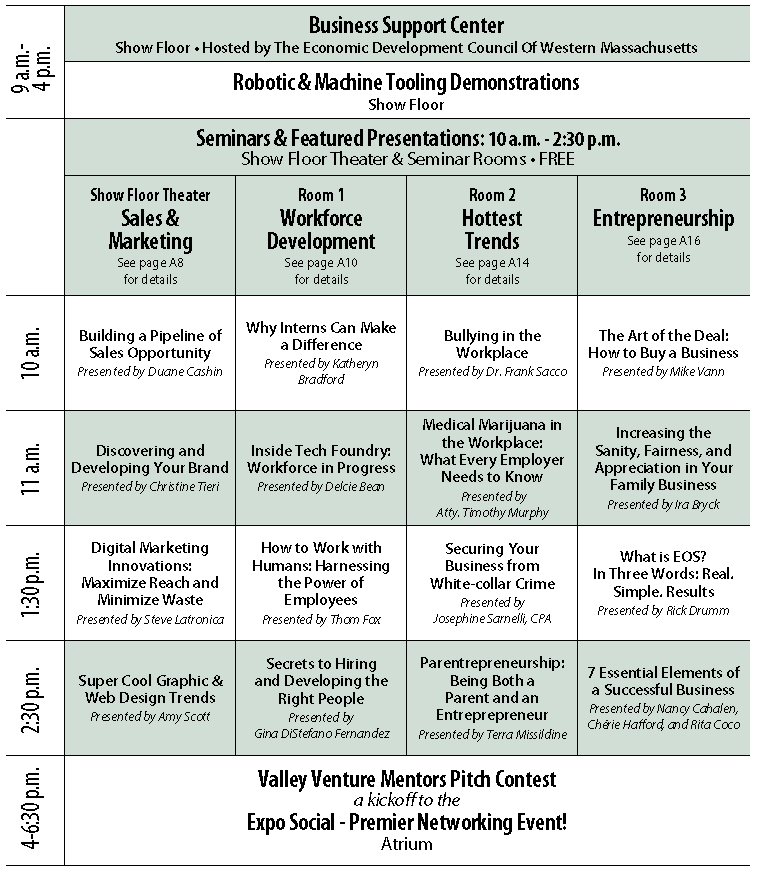
Throughout the day, there will be informative seminars across four tracks: Sales & Marketing, Workforce Development, Hottest Trends, and Entrepreneurship. Also slated are robotics and machine-tooling demonstrations, a Technology Corridor, a Business Support Center, the ever-popular Pitch Contest staged by Valley Venture Mentors, the day-capping Expo Social (always a great networking opportunity), and much more.

This show was created for you, the hardworking people who shape the region’s business community. We hope you will join us for what will be a memorable day.

George O’Brien, Editor
John Gormally, Publisher
Kate Campiti, Associate Publisher

WMBExpo Schedule

WMBExpoSchedule2015

Company Notebook Departments

ESB to Partner with Hometown Bank

EASTHAMPTON — Easthampton Savings Bank, the wholly-owned subsidiary of ESB Bancorp Inc., and Hometown Bank, the wholly-owned subsidiary of Hometown Community Bancorp Inc., jointly announced they will form a strategic partnership through the merger of their holding companies. After this transaction is completed, the combined mutual holding company will have more than $1.7 billion in assets and more than $180 million in equity capital, with a branch network of 23 offices located throughout Central and Western Mass. and Northeast Conn. ESB and Hometown will merge mutual holding companies, but will continue to run their banks independently and autonomously. The announcement follows ESB’s 2015 acquisition of Citizens National Bank in Putnam, Conn.

Center for EcoTechnology Hosts Blue Jean Ball

SPRINGFIELD — More than 50 contractors, builders, and green specialists filled EcoBuilding Bargains in Springfield on Oct. 2 for the first-ever Blue Jean Ball. The event, which featured food, beer, a raffle, and live entertainment, was created to thank partners who have helped the Center for EcoTechnology build a greener community. “We wanted to have a space to genuinely thank all of our partners who help us save energy and reduce waste,” said Green Building Sales Manager Susan Ash. “It’s because of them that we are able to have such an impact on this community.” The Center for EcoTechnology offers a host of services to new-construction contractors who want to build green. Services include HERS ratings, LEED certification and LEED AP services, passive-house certification, code testing, infrared scanning, Energy Star certification, energy-performance design consultation, modular-plant Energy Star certification, and more. Details can be found at www.cetonline.org.

Green Earth Computers Relocates, Expands

NORTHAMPTON — Kiernan Gulick-Sherrill, owner of Green Earth Computers, recently announced that the business is expanding by two technicians and moving from Amherst to Northampton in order to better serve clients in a much larger office space. The move to 20A Crafts Ave. will provide a more central location for many customers and make it easier for Green Earth staff to schedule on-site visits with clients across the Valley, Gulick-Sherrill said. The location is also more spacious, allowing for additional retail space for refurbished laptops, cables, and accessories. Green Earth has also welcomed two new technicians to the team in response to the growing demand. Greg Schwartz has previous experience at a variety of tech companies, including TechCavalry and College Pro Computers, where he worked alongside Gulick-Sherrill. Daniel Cottle is a Hampshire College graduate with more than 10 years of experience in computer and small-electronics repair. He previously worked in the Hampshire College Information Technology Department. Green Earth Computers was created in 2009 and offers on-site and drop-off computer repair services as well as remote assistance. The business promotes sustainability and offers computer-recycling services. It also specializes in repair and replacement of computer screens and charge ports, as well as batteries. For more information, call (413) 282-8324 or visit www.greenearthpc.us.

NUVO Shareholders OK Merchants Merger

SPRINGFIELD — The shareholders of NUVO Bank & Trust Co. overwhelmingly voted to approve the merger agreement between NUVO and Merchants Bancshares Inc., the parent company of Merchants Bank, and the related bank-merger agreement between NUVO and Merchants Bank pursuant to which Merchants Bank will acquire NUVO. The shareholders of NUVO approved the merger agreement by the affirmative vote of the holders of 84.5% of the outstanding shares of NUVO. Of the shares voted, approximately 97.6% of the shares were voted in favor of approval of the transaction. Consummation of the merger, which is subject to regulatory approval and the satisfaction of the other conditions of the merger agreement, is expected to occur on or about Nov. 30.

Farmington Bank Opens First Branch in Region

WEST SPRINGFIELD — Farmington Bank opened its first branch office in Western Mass., located at 85 Elm St. in West Springfield. “Farmington Bank’s new office in West Springfield will offer a complete line of consumer and commercial banking products,” said John Patrick Jr., chairman, president, and CEO of Farmington Bank. “In addition, we look forward to partnering with the Western Massachusetts community through the philanthropic activities of the Farmington Bank Community Foundation and the volunteer efforts of our Farmington Bank employees.” The West Springfield facility is the new home of Farmington Bank’s Commercial Services office, led by Michael Moriarty, senior vice president, commercial team leader, and regional executive, and its Western Mass. Mortgage Sales department, led by Brian Risler, assistant vice president and mortgage sales manager. Farmington Bank’s West Springfield office will be managed by Nikki Gleason, assistant vice president and branch manager. Gleason is a 15-year local banking professional, and comes to Farmington Bank from Hampden Bank, where she served as branch manager of its West Springfield branch. Gleason studied at Springfield Technical Community College and is a graduate of the New England School for Financial Studies.

Departments People on the Move
Lisa Pack

Lisa Pack

Holyoke Medical Center (HMC) announced that Lisa Pack has been named Nurse of the Year by the March of Dimes Massachusetts Chapter in the category of Labor and Delivery. This is the third consecutive year a Holyoke Medical Center nurse has received this elite distinction. “Lisa is highly deserving of this prestigious recognition,” said Spiros Hatiras, president and CEO of HMC and Valley Health Systems Inc. “Holyoke Medical Center prides itself on its exemplary team of professionals such as Lisa, who demonstrate consummate skill and deep compassion in providing critical nursing care.” Added Pack, “I am humbled to be recognized by the March of Dimes to be chosen for this award. I feel blessed to be a member of the Birthing Center staff, where I have now worked for 22 years since it opened. It is a job I love and where we work as a team to support and empower women to have the birth they desire. I am also deeply committed to MotherWoman and postpartum depression, for which I facilitate a weekly support group at Midwifery Care of Holyoke.” Pack will be honored at a reception in the Holyoke Medical Center lobby on Monday, Oct. 26 at 2 p.m.

•••••

Berkshire Hills Bancorp Inc. announced the promotion of Richard Marotta to president of Berkshire Bank and Sean Gray to chief operating officer of the bank. Marotta will be responsible for all aspects of administration, risk, and infrastructure, including people and systems, compliance, and credit. He has been serving Berkshire as executive vice president, chief risk and administrative officer since 2013. Gray will be responsible for the operating teams of the bank, including retail, commercial, small business, home lending, wealth management, and insurance. He has been serving Berkshire as executive vice president, retail banking since 2010. “Richard and Sean are results-driven, high-integrity leaders that have been integral to the growth of this company, and this promotion reflects their contributions. As we continue to execute on our strategic vision, their leadership and ability is increasingly important to our success,” said Michael Daly, CEO of the bank and the company. Additionally, the bank promoted three executives — George Bacigalupo, Josephine Iannelli, and Linda Johnston — to senior executive vice president, while promoting eight others to the executive team, broadening the responsibilities of these leaders and creating a more effective operating structure. They are Michael Carroll, executive vice president, chief risk and credit officer; James Curran, executive vice president, regional commercial leader, Central Mass. and Connecticut; Mark Foster, executive vice president, regional commercial leader, Eastern Mass. and ABL; Tami Gunsch, executive vice president, retail banking; Scott Houghtaling, executive vice president, regional commercial leader, New York; Allison O’Rourke, executive vice president, investor relations and financial institution banking; Deborah Stephenson, executive vice president, compliance and regulatory; and Gary Urkevich, executive vice president, IT and project management.

•••••

Miranda Rowe

Miranda Rowe

United Personnel announced the promotion of staff member Miranda Rowe. Formerly an administrative coordinator in United Personnel’s main office in Springfield, Rowe has been promoted to a recruiter. In her new role, she will be assisting United’s Light Industrial and Professional divisions in sourcing and interviewing candidates. She will also oversee community-outreach activities including off-site recruitment, attending job fairs, and working with training programs to place graduates.

•••••

St. Germain Investment Management announced the hiring of Richard Bleser as vice president and portfolio manager, and Thaddeus Welch as portfolio manager. Bleser manages investment portfolios, assists with trading, and performs analytical duties on both the fixed-income and equity sides. He brings experience and knowledge in fund analysis and portfolio management. He was previously the chief investment officer at Berkshire Bank in Pittsfield. While
at Meridian Capital Partners Inc., he was responsible for macroeconomic, S&P 500, and hedge-fund analysis. Prior to Meridian, Bleser was an equity analyst with Paradigm Capital Management Inc., where he generated long- and short-investment ideas in the small-cap specialty retail, leisure, and technology-distribution sectors. He began his career as a client analyst with Ayco Co., a Goldman Sachs Company. Active within the community, he has been involved with nonprofits and is also a trustee for the Berkshire Housing [401(k)] Plan. He holds bachelor’s degrees in economics and business administration from the State University of New York at Albany. Welch is responsible for managing trading activities and performing fundamental economic and sector research to assist in investment strategy development. He comes to the firm from Berkshire Bank in Pittsfield, where he managed portfolios in addition to providing analysis and research on market, corporate, and economic activities. Prior to Berkshire Bank, Welch was an assistant portfolio manager and a member of the investment committee at Spinnaker Trust in Portland, Maine. He received his bachelor’s degree in economics from Bowdoin College. He has completed all three levels of the CFA (Chartered Financial Analyst) program.

•••••

Beetle Press, a public-relations and communications firm in Easthampton, recently welcomed Ruby Dillon to the team to serve as an editorial assistant. Dillon earned a bachelor’s degree in public relations this year from Champlain College in Vermont. While in college, she served as a PR intern for a mission-driven nonprofit that provides respite for cancer patients by giving them a therapeutic sail on Lake Champlain. Through this experience, Dillon realized her passion for standing behind a cause and has since worked to promote various nonprofits. Janice Beetle, principal of Beetle Press, said Dillon is a key Beetle Press partner, handling the development of press releases and overseeing internal writing and web projects as well.

•••••

Leesa Wallace

Leesa Wallace

Kevin Matheny

Kevin Matheny

The Employers Assoc. of the NorthEast announced that Leesa Wallace has joined EANE as its new director of Learning & Development, and Kevin Matheny will serve as the new controller. Wallace will spearhead the EANE learning and development offerings, designing and customizing a diverse array of more than 500 substantive training programs each year. She replaces Susan Miller, who served in the role of director of Learning & Development for more than 18 years. Wallace is a learning strategist, guiding individuals, teams, and organizations to help them identify their most critical needs and create solutions that have real impact. She helps strengthen the capacity of individual contributors, creates clarity and collaboration on teams, and teaches leaders how to engage and tap into the potential of their people. Matheny has more than 15 years of progressive management experience across a broad range of business functions and industry segments including manufacturing, property management, financial services, and not-for-profit. He guides EANE with a combination of talent, technical knowledge, and business acumen in all reporting, operations, internal controls, and compliance areas. He replaces Paul Correia, who will assume full-time responsibility for membership as the new director of Member Relations. With a focus on maximizing revenues via budgeting and other strategic initiatives, Matheny, a certified public accountant, is known for his ability to manage costs through improved efficiencies and the elimination of redundancies. He has increased profitability by seeking out lower-cost solutions, implementing stricter purchasing protocols, and reducing overhead costs.

•••••

Springfield Technical Community College (STCC) recently named Beth McGinnis-Cavanaugh the recipient of the Anthony M. Scibelli Endowed Chair and Gary Masciadrelli and Paul Thornton recipients of the Joseph J. Deliso Sr. Endowed Chairs. Each year, STCC faculty are nominated for an endowed chair by their colleagues and then invited to apply. Applications are reviewed by an award-selection committee composed of faculty and staff. Winners are then selected by the STCC Foundation executive committee. The awards include a $3,000 grant given to each recipient, half of which is applied to professional development for the recipient and half of which is given to the recipient’s academic department. The Anthony M. Scibelli Endowed Chair was established in 1992 to recognize and foster faculty excellence. McGinnis-Cavanaugh, professor of Physics and Civil Engineering, will donate her funds to STCC’s chapter of the Society of Women Engineers (SWE) to fund service projects and cover event costs. She is the faculty advisor to the chapter, which she created last year. Established in 1993 by the family of industrialist Joseph J. Deliso Sr., the Deliso Endowed Chair is awarded annually by the STCC Foundation in recognition of excellence in teaching. Masciadrelli, a professor and department chair in Mechanical Engineering Technology, will use the award funds to update software in his department to an industry standard product called PC-DMIS for coordinate-measuring machines. Thornton, professor and tri-chair of Business Administration, said award funds will be used to purchase a new printer and flip charts for his department as well as a set of multi-walkers which will be used in team-building exercises with his students.

•••••

Dani Klein Williams, owner and lead photographer at Dani Fine Photography, was approached earlier this year by Amherst Media Publications about creating a book, set to be released in early 2016, focusing on the art and business of boudoir photography. Covering an array of topics in keeping with this theme, the book will comprise practical business advice as well as the step-by-step photographic techniques used by a successful professional photographer. For updates and more information on the progress of this project, follow the studio on Instagram and Facebook.

•••••

The Gilded Lily Florist, a Sixteen Acres business for more than 30 years, announced a new owner, Brian Grisel. A Springfield resident, Grisel began working in a flower shop during his teens and is currently a floral designer with more than three decades of experience. Previous clients include Katherine Hepburn, Andy Williams, Oprah Winfrey and Gayle King, Barbara Bush, Conan O’Brien, Mikhail Baryshnikov and Rudolph Nureyev, Lee Radziwill (sister of Jacqueline Kennedy Onassis), the Baroness Philippine de Rothschild, Princess Maria Trubetskaya, Princess Irina Bagration, Countess Sophia Cheremteff, the Baroness Carmen Thyssen-Bornemisza, as well as several previous governors of Connecticut and local politicians and corporate heads.

Daily News

SPRINGFIELD — Advanced manufacturing in New England and the skills gap will be discussed as part of a national report produced by Deloitte Consulting, LLP and the New England Council at the Professional Women’s Chamber (PWC) Headline Luncheon at the Western Mass. Business Expo on Wednesday, Nov. 4, from 11:30 a.m. to 1 p.m. at the MassMutual Center.

Alison Lands, senior manager for Deloitte Consulting’s Strategy and Operations practice and co-author and editor of “Advanced to Advantageous: The Case for New England’s Manufacturing Revolution,” will present highlights of the report as well as the strength of this backbone industry and the skills-gap challenges facing it.

According to the report, the industry sector has evolved to encompass aerospace and defense, medical devices and biotechnology, complex electronics, precision machining and optics. Despite the difficulties of the recession, advanced manufacturing has proven to be a resilient sector of the economy and is poised for a revolution.

However, it faces numerous challenges. It no longer relies on unskilled labor but rather requires a workforce skilled in technology, innovation and information. In addition to a generation of workers facing retirement, there exists a dearth of skilled workers qualified to work in manufacturing as well as an underskilled labor pool to fill available job vacancies within the industry. In addition, the report notes, the industry “suffers from a lack of brand awareness that keeps talent at arm’s length from meaningful employment opportunities.”

Lands will discuss the evolution of the industry, the challenges associated with such a skills gap, and the opportunities that New England can capitalize on to serve as accelerators for growth.

With a background in economics and more than 15 years of experience in public administration and professional services, Lands partners with leaders of state, local, and regional agencies to achieve results in the areas of health and human services, economic and workforce development, disaster recovery and resiliency, and transportation.

She holds a master’s degree in public and economic policy with a concentration in urban policy from the London School of Economics, a master’s degree in public administration with a concentration in urban policy from Columbia University’s School of International and Public Affairs, and a bachelor’s degree from Trinity University.

Prior to joining Deloitte Consulting, she served as the senior economic-development specialist for the city of San Antonio, Texas.

James Brett, president and CEO of the New England Council, will join Lands for the presentation, made possible by the office of U.S. Rep. Richard Neal.

Advance registration for the luncheon is suggested, the cost is $40 per person. While this luncheon is included in the PWC Headline Luncheon Season Pass, season pass holders are required to pre-register. Registrations may be made online at www.professionalwomenschamber.com or by e-mailing [email protected].

Daily News

CHICOPEE — The College of Our Lady of the Elms has received a research grant of $31,700 from the National Science Foundation (NSF) that will provide for international and domestic travel, field work, and collaboration with colleges across the U.S.

The funding will allow Nina Theis, associate professor of Biology at Elms College, to travel to Peru with two undergraduates to study tropical cucumber species in the field, as well as peacock flies — a type of true fruit fly that feeds on these cucumbers — and wasps that feed on the flies. It also will allow Elms students to attend national and regional conferences, as well as a workshop in Georgia. “This is an exciting time to be a science major at Elms,” Theis said.

The Elms project is part of a larger collaborative study of biological diversity, evolution, and speciation — the evolutionary process of species origination — in the tropics. The NSF funding for the entire project totals nearly $2 million, representing one of only 10 grant packages awarded by the foundation’s Dimensions of Biodiversity program this year. Marty Condon of Cornell College in Iowa is leading the research team, which includes participants from Elms College, the University of Iowa, the University of Georgia, and North Carolina State University.

Theis’ piece of the project focuses on her specific area of expertise; she studies fragrance in flowers and the effect of fragrance on insect attraction. Her component of this project will focus on the cucumber odors that attract the herbivorous peacock flies as well as the wasps.

In previous work, Theis has studied the fragrance in, and pollinator and herbivore attraction to, a variety of plants in the cucumber family. “We’re going to analyze the fragrances of the flowers and see if we can find out how these insects are attracted,” she said. Then she and her team will determine whether fragrance is a driver in host detection and specificity, or why specific flies and wasps are attracted to specific parts of the flower.

The field work will mean traveling to Peru, which is a valuable opportunity for Elms students. “Research is a great experience for any student,” Theis said. “It requires a lot of diligence and a lot of independence, and in order to get into graduate school these days, you have to have research experience.”

In addition to the field work, the grant includes funding for Theis to hire students to analyze the fragrance data over the summer. Two Elms students will also be invited to attend a bioinformatics workshop at the University of Georgia. Bioinformatics involves the techniques and software that analyze and interpret large biological data sets; the workshop will train these students in the latest methods, and that training will give them valuable experience in a fast-growing field of study. The students also will have the opportunity to attend scientific meetings and conferences.

Theis also is the director of the ElmSTEMs program, supported by a separate NSF grant of $620,620. ElmSTEMs awards scholarships to full-time Elms students majoring in fields such as biology, computer information technology, chemistry, or mathematics. The first group of ElmSTEM scholars started at Elms College this fall, and applications are being accepted for fall 2016.

“We have this STEM grant — it’s an educational grant: scholarships, money for students to get experience in STEM — and it’s really great synergism to have the STEM grant and the research grant at the same time,” Theis said. “Two of the things our STEM grant promises are that there will be scholarships and that our students will get research experience. And now we have the money to give our students paid jobs doing research on campus and a very high-quality tropical research experience.”

Autos Sections

Full Speed Ahead

AutoSalesARTdpAs the calendar cruises into October, area auto dealers report that they are well on their way to a banner year. A combination of factors — from a need to replace aging cars to lower gas prices to an improved economy — are fueling solid sales across virtually all classes of vehicles. And as the final quarter commences, dealers are keeping their foot on the gas when it comes to programs and incentives to drive more purchases and leases.

Jay Dillon called it the “perfect storm.”

But instead of a maelstrom of events leading to a disastrous outcome, the co-owner and dealer operator for Dillon Chevrolet in Greenfield was referring to a strong and rising gale that is driving new-car sales in the region and across the country.

Local dealers say their numbers have exceeded January forecasts by industry leaders, who predicted an increase of 3% and a rise in sales for the sixth year in a row, which would translate to 17 million new vehicles, a figure that hasn’t been seen since 2005.

And even though many people stayed inside last winter due to the bitter cold and record snowfalls, pent-up demand resulted in what Dillon called an “amazing” spring.

“Every day when we opened our doors, there were people waiting to come in,” he told BusinessWest.

Other major dealerships also reported healthy spring and summer sales, and as to that storm, well, it resulted from a convergence of conditions related to the economic climate. People held onto their cars during the downturn in the economy, so the average auto on the road today is 10 or 11 years old, which means its useful life is coming to an end. Meanwhile, gas prices have dropped significantly, while consumer confidence has risen and manufacturers have become aggressive in their competitive quest to attract buyers, offering incentives that range from cash back to 0% interest on many makes and models. In addition, buyers are enticed by advances in safety, design, and technology.

“People have been able to keep their cars longer because they are much more reliable than they were in the past,” said Bill Peffer, president and chief operating officer at Balise Motor Sales. “Quality has become a commodity, but eventually they have to be traded in, and everyone in the industry has benefit1ed from this factor. Buyers also have more choices than ever before.

“The biggest segment of growth is in crossovers; they have great fuel economy and the capability of a truck, but are more compact,” he went on. “Manufacturers continue to build new products that give people compelling reasons to purchase a vehicle, and overall, our sales have exceeded our expectations; they are equal to or greater than those in the general market.”

TommyCar Auto Group is also doing well. “Our sales are up over last year by quite a bit in every store, especially Hyundai,” said President Carla Cosenzi, adding that small crossover vehicles such as the Nissan Rogue and Hyundai Tucson have become big sellers, and she expects sales to remain high through the end of the year.

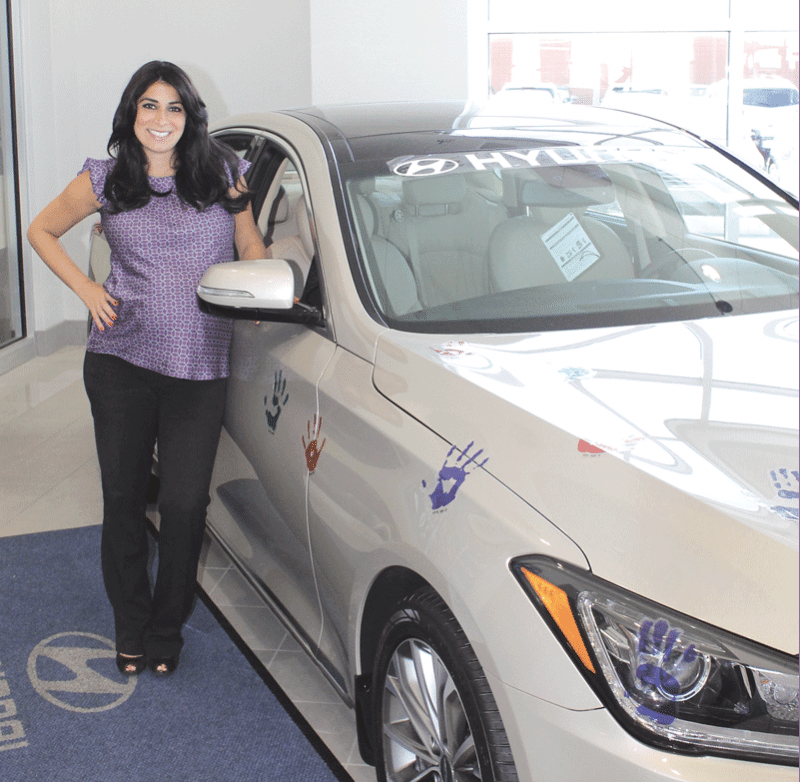
Carla Cosenzi

Carla Cosenzi says TommyCar Auto Group is planning major promotions to ensure that solid sales continue throughout the fall.

“Although we expected an increase, we kept our projections conservative, but we have definitely outsold what we anticipated, and are looking forward to a really strong end of the month in September, October, and November,” she said. “A lot of people are beginning to think about the weather. As we head toward winter, they want to make sure they are in a safe, reliable car, and we will have great offers that should make a difference in our year-end sales. We have two major promotions that will start in October and run until January. We have revamped our strategy and are excited to roll it out.”

However, local dealers differ in their tactics to attract buyers and retain customers, so for this edition and its focus on auto sales, BusinessWest explores the strategies that help fuel sales.

Tried and True Methods

Cosenzi said TommyCar’s three dealerships each gave away a brand-new car in recent weeks — a Volkswagen Passat, a Hyundai Accent, and a Nissan Versa.

Advertising for the promotional event kicked off at the beginning of the summer, which increased volume during the busiest time of year. “It drove a lot of traffic,” she said, adding that many people who entered the drawing decided to test-drive a vehicle, and the 0% financing offered by Hyundai and Nissan on leases propelled sales higher.

It’s not the first time TommyCar has given away new automobiles; in the past it staged a jingle contest and a TV-commercial contest, and the winners drove home new vehicles. But it never had a contest people could enter simply by showing up and dropping an entry form in a bucket.

“Our customers couldn’t believe it, and three happy people went home with new cars. Two had shopped us before, one was waiting to buy until she saw if she had won, and the other had recently purchased a car from us,” said Cosenzi, adding that “a really aggressive plan for the coming months should make 2015 the strongest and best year we have had in some time.”

The deals are sweetened across the board right now, however, thanks to the ‘summer selldown’ events taking place at every dealership. The 2016 models are rolling in, and spokespeople say manufacturers are offering special incentives to clear out the 2015 editions.

“It’s a time of year when people can get a really great price on a new vehicle,” said Dillon.

Peffer agreed. “Although new models are launched throughout the year, manufacturers typically offer aggressive incentives in the fall before the majority of new vehicles arrive, so we create a market,” he explained. “We’re motivated to sell all of our 2015 models before Jan. 1, when they automatically become a year older.”

Again, one of the factors in that perfect storm Jay Dillon referred to plays heavily into the stream of buyers seeking a good deal: the age of the average vehicle on the road, which is around 10 years. “Many people are facing the situation of having to repair or replace their vehicle due to its mechanical issues and high mileage. The entire industry is benefiting from this; it’s a wave we’re riding right now,” Dillon said.

Tom Dillon, co-owner and general manager of Dillon Chevrolet, said many people bring their older car into his dealership for service, and when they find out what it needs in terms of repairs, they are driven to purchase a new one. In the majority of cases, that purchase is at Dillon Chevrolet.

“We’re big on retention and people return to us because they have gotten good service. My father opened this business in 1962 and always said, ‘the sweet taste of a good deal is quickly soured by bad service,” he said, explaining why exceptional service has always been one of the dealership’s priorities.

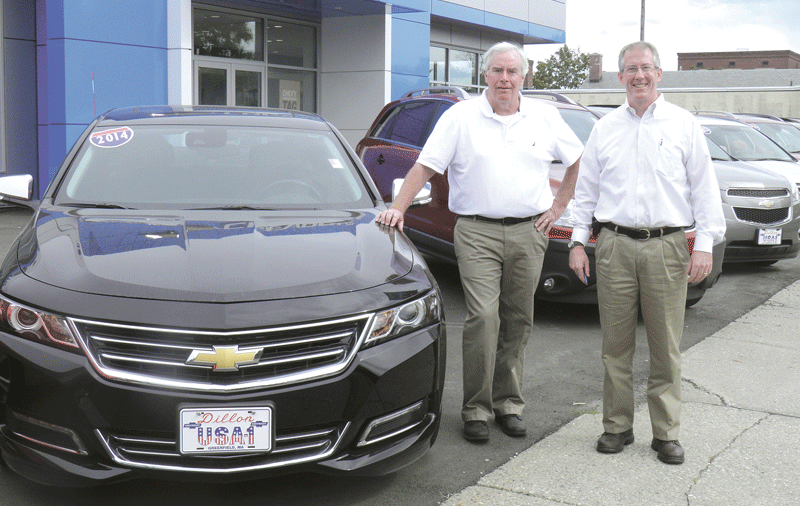
Tom and Jay Dillon

Tom and Jay Dillon say most 2015 Chevy products are equipped with 4G LTE wi-fi hotspots, which make them particularly attractive to young buyers.

“Three-quarters of our sales are repeat customers. We’re hands-on owners who are here every day, and if someone has an urgent problem, we accommodate them immediately. We are a small town and are selling to our friends and neighbors,” Jay Dillon noted, adding that they discount vehicles beyond manufacturer’s rebates, and most customers spend less than an hour completing a sale.

It’s that same loyalty that Balise relies on to spur sales.

“We offer state-of-the-art facilities and low prices,” Peffer said. “We’re a large dealer group, and we’re consistent with our advertising, which is based on our great selection, facilities, and the fact that we treat our customers right. We generate trust and do an excellent job of staying connected to our customer base.

“Our focus is on retention, so our strategy is to develop a long-term relationship with our customers. And we have so many brands that we can offer a solution to anyone’s driving,” he continued, remarking that, although sales at all of the company’s dealerships are growing at a fairly consistent rate, Balise Subaru in Rhode Island is doing exceptionally well. “But we want people to think of Balise first, before they think of any type of vehicle.”

Attractive Options

Special promotions, such as the free cars TommyCar Auto Group gave away a few weeks ago, increased the number of visitors to the group’s dealerships. “We welcome people into our showrooms, and after they see the amenities we offer and meet our staff, they often buy a car,” Cosenzi said.

But other things attract buyers as well, and Tom Dillon says General Motors’ 2016 products will be game changers for the industry and his family dealership.

Bill Peffer

Bill Peffer says sales have been robust at Balise Auto Sales, and he expects the upward trend to continue into 2016.

“The all new Chevy Malibu is a big player in the mid-size segment; it’s a hybrid with a turbo engine that gets 47 miles per gallon. And the 2016 Chevy Cruze has been redesigned; it gets 42 miles per gallon, is safer, more efficent, and has 10 airbags,” he told BusinessWest. “There is also a new Camaro coming out that is lighter and has more horsepower and better handling. And every GM car will have 4G LTE.

“GM is the only one with 4G in all their new products, and we’re seeing more and more young people in our brand because of the technology — it gives us a competitive edge,” he continued, adding that manufacturers constantly make changes, but complete redesigns of a multitude of vehicles like this take place only every eight or nine years. “The Equinox will also be all-new, and demand will be high.”

Peffer agrees that technological advances are effective lures. “The new-car experience is exciting because of rapid changes in products, style, technology, and performance,” he said. “More and more cars are equipped with parking assist and lane departure, which started in Lexus. It allows the vehicle to sense if another automobile is in the blind spot, and warns the driver with a beep or a light. Back-up cameras, which offer a 360-degree, bird’s-eye view of what is in every direction, didn’t exist a few years ago, and some are in entry-level products, including most, if not all, Hondas. There are also cars with wi-fi hotspots that allow passengers to connect to the Internet in real time. Competitiveness in the industry has led to more choices for consumers than ever before.”

Leasing is another sales avenue on the rise because these vehicles are under factory warranty, payments are low, and regular maintenance is the only out-of-pocket expense.

“People see advertisements for payments on a brand-new car that are less than they are paying for an older vehicle, which entices them to visit the dealership,” Cosenzi said, adding that the value of trade-ins get worked into the deals.

Racing Ahead

New auto sales plummeted in 2008 due to the downturn in the economy and the fact that gas prices reached $4.25 a gallon. Those factors affected all dealers as well as a multitude of other industries, but fast-forward to 2015, and it’s an entirely different market.

“Our sales were up by 20% in the first six months of this year, and we have already approached our 2007 numbers,” said Tom Dillon. “We’re expecting that 2015 should be the biggest year ever for the entire auto industry.”

Peffer expects sales at Balise’s 13 dealerships to continue to be robust through the end of the calendar year and into 2016, due to manufacturer’s promotions and the aforementioned economy-related conditions that are inspiring people to get behind the wheel of a new car.

“For anyone considering buying a new vehicle,” he concluded, “it’s a great time to buy.”

Autos Sections

Measures of Control

Brian Farnsworth

Brian Farnsworth says all-wheel drive is appealing because drivers don’t have to think about turning it on and off.

Though casual car shoppers may speak of four-wheel drive and all-wheel drive as if they’re interchangeable, that’s far from the truth, Damon Cartelli says. Which system is preferable comes down to how that vehicle will be used.

“Any time you have an option that adds security — that allows people to drive to their destination with a little more security than in a traditional front-wheel-drive vehicle — people want that,” said Cartelli, president of the local Fathers & Sons chain of auto dealerships.

But while four-wheel drive dominated the market for a long time, all-wheel drive has long been recognized as the superior option for driving in inclement weather — including those snowy and icy days of a typical Massachusetts winter.

“With four-wheel drive,” Cartelli said, “each tire receives 25% of the vehicle’s power at all times. So, while a rear-wheel drive car gets 50% in each of the two rear wheels, with four-wheel drive, the power is broken down evenly between right front, right rear, left front, and left rear.

“The difference with all-wheel drive is, the system has the capability of transferring power to the wheels that are gripping, based on sensors detecting which wheels have lost traction,” he continued. “The result is better traction in wet or inclement weather — or any weather, for that matter.”

Cartelli said Audi was a pioneer of all-wheel drive back in the 1980s with its Quattro system, which helped it dominate rally racing for a decade. “Audi was eventually banned from this race circuit because the Quattro system gave them an unfair advantage against rear-wheel-drive cars.”

Today, he noted, all-wheel drive is a selling point in a wide range of cars for drivers who want stability in any weather condition.

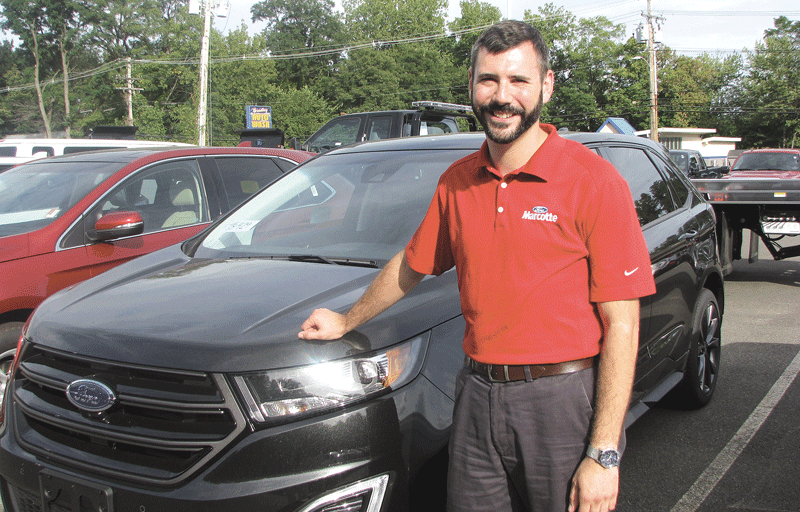
“If you’re not buying a truck, you’re looking for classic all-wheel drive, and you don’t have to worry about anything. You get in and do your thing,” added Brian Farnsworth, a sales consultant with Marcotte Ford in Holyoke, which features four-wheel drive in Ford trucks and larger SUVs, like the Expedition, but all-wheel drive in cars and smaller SUVs.

“The main thing with all-wheel drive is, there’s no user input. You don’t have to select it; it’s always monitoring road conditions and what you’re doing, whether that’s steering, braking, or accelerating,” Farnsworth noted.

The latest all-wheel-drive systems use high-tech software and wheel sensors to detect wheel slippage more quickly than ever before, then react by activating traction control to reduce that slippage while rerouting engine torque to the wheel with the best grip on the road — as opposed to the evenly divided torque of four-wheel drive.

“It may sense when you’re taking a corner too quickly and transfer power to the wheels that are getting the grip,” Farnsworth said. “In that scenario — in any scenario, whether it’s hitting ice, sand, whatever — it senses spin in milliseconds, sometimes correcting it so that it doesn’t happen in the first place. Same thing when you take an off ramp too quickly, things like that.”

It also automatically reverts to two-wheel drive when cruising on the highway to improve fuel economy, he added.

“Four-wheel drive is a lot more heavy-duty, more work-oriented, for things like towing a boat out of the water, towing up a grade, things like that,” he went on. “It can’t be used on dry pavement, so if you take that off ramp too quickly, it doesn’t help you.”

Pros and Cons

In short, dealers say, the choice often comes down to how much off-roading a driver expects to do.

Four-wheel drive, they note, provides added traction when needed and is generally less expensive than all-wheel drive because it’s based on simpler technology. And, of course, it’s the preferred system for difficult terrain.

However, it doesn’t provide extra traction and better handling in everyday driving situations — but drivers often believe it does, leading some to take more chances on the road. The driver also has to actively turn four-wheel drive on and remember to turn it off afterward to prevent draining fuel economy.

On the other hand, all-wheel drive increases grip and control under any condition and works all the time. While it can’t match the levels of traction in low-speed off-roading that traditional four-wheel-drive systems provide, all-wheel drive does pose some clear advantages, notes Peter Braun at digitaltrends.com.

“In the sort of winter road conditions that most drivers experience, it’s nice to have a drivetrain, like a modern AWD system, that responds instantly without the driver having to toggle any switches,” he writes. “In addition, most vehicles featuring AWD tend to have better weight distribution, which also aids in traction.”

For many drivers, he added, particularly those down south who rarely experience wintry driving conditions, basic front- or rear-wheel drive is fine. Still, many drivers value the added level of comfort and peace of mind an all-wheel-drive system provides.

Farnsworth said Ford, like other car makers, has incorporated a number of different all-wheel-drive systems that shift power around in different ways, but one thing they all have in common is the ability to operate without any user input or thought, and then switch back off under normal conditions. “It’s always on when you need it most, but always trying to save you gas when you don’t.”

That does not, however, free drivers from basic common sense when operating in wintry weather, like speeding down hills during snowstorms.

“Some people think they’re invincible. They think if they’re going down a hill and hit ice, they’ll be fine because of their four-wheel or all-wheel drive,” he explained. “But it only helps you get going. It doesn’t help you stop.”

It’s also no substitute for tires that have proper tread, Farnsworth added. “It really all comes down to this: no matter what kind of drive train you have, your tires are the most important thing. The fanciest all-wheel drive in the world is not going to help you if your tires are bad. It’s just simple common sense. It’s constantly monitoring slippage, but if nothing’s getting a grip, if the tires aren’t catching, you’re not going anywhere.”

That’s a common refrain in the industry, even among those who sing the praises of all-wheel and four-wheel drive.

“You can’t put a price on safety, but shelling out [for all-wheel drive] isn’t a get-out-of-a-ditch-free card either,” writes Ben Bowers at gearpatrol.com. “No matter what you wind up picking, our advice is to study up on good winter driving skills, focus on regular maintenance, and work on improving your decision making behind the wheel first. After all, at the end of the day, it’s the man behind the machine, not the other way around.”

Peace of Mind

Even today’s front-wheel-drive vehicles handle well in wet or snowy weather as long as they’re fitted with the proper seasonal tires and the driver is careful, Cartelli said. But for people who don’t have the option of staying home from work during those New England snowstorms — doctors and nurses, for example — all-wheel drive brings an added layer of comfort. “If you have to be somewhere no matter what, all-wheel drive with the right tires will get you there.”

No matter how they use their vehicles, Farnsworth added, purchasing drive-train options beyond front- or rear-wheel drive is an investment worth making, if only for the peace of mind.

“All the new SUVs drive much like cars; the all-wheel-drive systems are not as bulky, so they don’t drive like a truck,” he said, adding that many drivers come to take the systems for granted — until it’s time to buy a new vehicle. “When they come in, it’s the first thing out of their mouth: ‘I need that all-wheel drive.’ It makes them feel safer; it’s definitely a security blanket for them.”

Joseph Bednar can be reached at [email protected]

Sections Technology

Capturing Attention

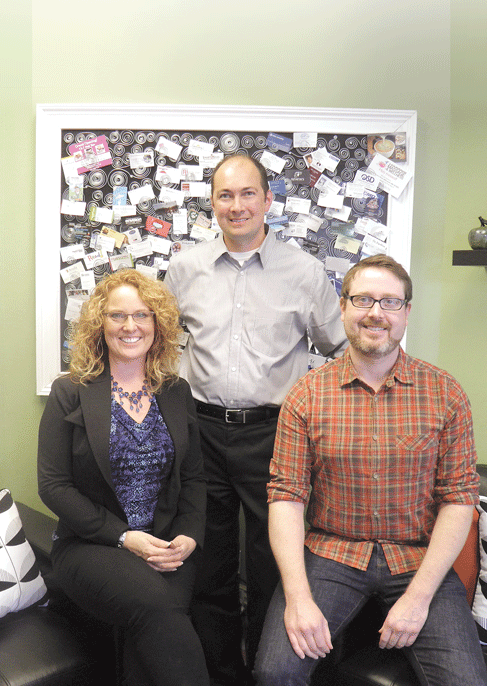
Amy Scott, Eric Belliveau, and Rory Hurlburt

Amy Scott, Eric Belliveau, and Rory Hurlburt offer a next-generation model of marketing, expressed in their tagline, “Marketing Agency, Evolved.”

Amy Scott and her team at Wild Apple Design Group say technical expertise is a must when designing websites that engage customers, but so is an element of “surprise and delight.” The goal, she insists, is to create relationships with clients that are transformational, not transactional — and fun to boot.

The little critters are called Worry Eaters.

Their names are Betti, Bill, Flamm, Polli, Enno, Saggo and Schnulli, and more than 2.5 million of the plush characters, with zippered mouths that allegedly ‘eat’ a child’s worries when they are written down and fed to them, have already been sold in Europe.

“Let us carry your worries so you don’t have to,” they shout on their newly developed website, which includes a video in which a worry eater banishes a little girl’s fear that a monster is lurking under her bed.

The website launched earlier this summer, and purchases can be made on an e-commerce shopping cart, thanks to Wild Apple Design Group in Wilbraham, which was hired earlier this year to introduce the toy to the North American market by the Haywire Group, a Springfield-based game designer and manufacturer.

The result is not only endearing, it earned the company marketing awards from the Advertising Club of Western Massachusetts. Wild Apple was recently feted as a Silver winner for consumer-product website design in the Summit Creative Award competition for its work on the Worry Eaters microsite, and received a Summit Creative Bronze for website redesign for its work for Kino West Media, a cinematic videography company in Palmer. In addition, that website redesign earned Wild Apple a Silver Creative Award.

Overall, the firm is known for its unusual creativity, and founder Amy Scott says that, although clients don’t expect it, there is always an element of “surprise and delight” in their finished product.

“Our major goal is to create a relationship with our clients that is transformational, rather than transactional,” said the director of project management and business development. “We want to listen to them, learn about their goals, then surprise and delight them by exceeding their expectations.”

This stems from work done by Rory Hurlburt, Scott’s brother and the company’s creative lead, art developer, and senior designer.

“Clients usually have no idea that we will do something fun,” Hurlburt said. “But we’re a modern marketing agency, and these things make someone want to watch a video or talk about what they have seen.”

However, the lure of an attractive site has to be backed by technical expertise, and that’s where Eric Belliveau enters the picture.

“There are many considerations and elements that go into a website and digital marketing; for example, it requires science, analytics, and technology to get someone to add something to an e-commerce shopping cart, then complete the sale,” said Wild Apple’s director of operations, technology, and Internet marketing, who explained that Worry Eaters are sold at a number of retailers, and creating the e-store was an important piece of the development process.

“It had to be responsive, which means it was built so the different characters could be viewed on smartphones,” he told BusinessWest. “But this all takes place behind the scenes, and the user is completely unaware that the intersection of more than one technology is required.”
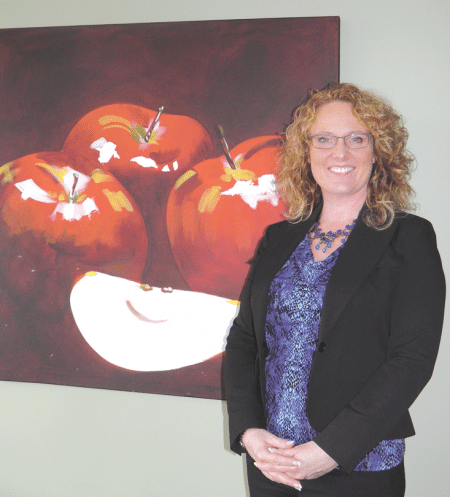
Amy Scott

Amy Scott says her company was one of the first in the area to design responsive websites, which work on multiple platforms.

A new site for LEAP Bookkeeping in West Springfield and Greenfield was just launched, and although it contains all the pertinent and necessary information potential clients need to know, there are also unexpected — nee, delightful — surprises: Bakers showing off rising dough, a panting dog, two people raising their fists and giving each other a high five, and a woman wearing a cape with the LEAP logo on it, who is standing on the edge of a building that overlooks a city skyline, which seems to suggest she could easily leap into those buildings to help them solve their bookkeeping problems.

Hurlburt says creating such a finished product is neither quick nor easy, and it requires not only technical acumen, but a complete understanding of the clients and their needs.

“I live, eat, and breathe the project I’m working on at any moment in time,” he noted. “I want to understand as many facets of the business or organization as I can, and also seek to learn who the client is, and how that personality can shine through the company or organization.

“But technology is behind everything we do; we’re experts at leveraging it and provide outstanding designs with a ‘wow’ factor,” he went on, adding that data is brought together into a visual design that represents the brand they are working on.

Scott said that’s important. “Almost every company has a website. But they often have an unfulfilled dream to convey their business digitally in a way that draws more prospects and tells their story.”

Talent Merger

Scott says she cut her teeth in marketing during a stint in the garment-manufacturing industry.

“I was the buyer, not the provider, but always felt there was so much room for improvement in leveraging the multitude of services required to drive successful marketing campaigns,” she said. “I was driven to create them.”

That drive compelled her to embark on a career change, and in time, her vision, energy, and success in graphic-design artistry inspired her to open Wild Apple Design in 2000, focusing on print marketing.

However, Scott occasionally collaborated with Belliveau. He began working in the field of web development in 2000, shortly after the dot-com crash, and eventually opened his own web-design and development company, which included consulting services.

Scott also called on her brother for help with a number of projects. Hurlburt was working as a freelancer and started his career with the idea of pursuing comic-book illustration, but soon found he enjoyed layout and design. “I spent 15 years designing for everything from web to print, which taught me that being well-equipped with information and strategy increases the value and viability of any well-designed art,” he said.

Although the trio had worked together on an occasional basis, their collaboration morphed into something much larger in 2009, after it became clear that the combination of their honed talents and expertise made them a unique team.

At the time, ABC decided to film an episode of the popular show Extreme Makeover: Home Edition in Suffield, Conn.  Scott was hired to do the publicity, and after being told she needed to create a website, she contacted Hurlburt. Coincidentally, Belliveau got in touch with her and asked her to create a logo, explaining that he had a few clients serving as vendors for Extreme Makeover.

The trio ended up working together for ABC, and after overcoming a multitude of challenges, they decided to do another project together.

Eric Belliveau

Eric Belliveau says it requires science, analytics, and technology to get someone to add something to an e-commerce shopping cart, then complete the sale.

That happened in 2011 after Scott was awarded a contract by Rockville Bank to build a website for the institution. Although the project turned out to be larger than they expected, their success resulted in a major decision to work together on a permanent basis under Scott’s umbrella.

She rented space in Post Office Park in Wilbraham and was joined by Hurlburt and Belliveau, who left his business, then religiously began evaluating every available technology.

Today, he focuses on digital marketing and the complex mechanics involved with setting up and maintaining websites. Meanwhile, Hurlburt is responsible for the creative-design work, and Scott focuses on marketing.

It’s all come together nicely, but when they first joined forces, their new, combined venture was a gamble.

“We felt we could do better and more business together, but it was an investment that involved blood, sweat, and tears; when we moved into this building, we were not sure if it would pay off,” Hurlburt said. “At the time, our goal was simply to survive.”

Fast-forward to 2015, and the company has not only survived, it is thriving. Rows of awards line the walls, and a year ago, Wild Apple created the tagline “Marketing Agency — Evolved,” which is indicative not only of its success and the wide range of services it offers, but the risks it has taken, which includes a foray into the world of responsive websites.

“We were one of the first to adopt the technology. When mobile traffic started to increase, it only involved an avenue or two and was an innovative area,” Belliveau recalled, explaining that, four years ago, sites were built either for desktops or mobile devices and typically didn’t function for both.

“But today, it’s becoming standard; all sites need to be responsive and function on tablets, smartphones, desktop computers, Kindles, and tablets,” he said, noting that the smartphone is usually the first point of contact.

“Roughly 40% of a website’s traffic will be on a mobile or handheld device; it’s also the place where most people access their e-mail,” Belliveau continued, adding that responsive websites need to be tactile, which means they can be manipulated by swiping or touching the screen, then clicking on an option.

The firm’s entry into this arena resulted in a world of experience, and today Wild Apple is able to deal with the entire ecosystem of marketing, which can include a responsive website; e-mail; social media; print, TV, and radio advertising; and a logo, branding, and identity design.

Detailed Process

When the firm gets a new client, Scott conducts an in-depth interview to unearth its specific goals, needs, and vision for its products and services.

Once she has gathered all the information she needs, Hurlburt puts pencil to paper and begins sketching, and typically comes up with three or four ideas.
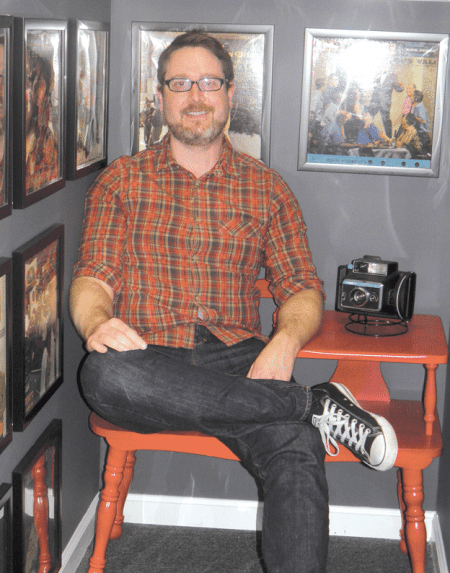
Rory Hurlburt

Rory Hurlburt takes pride in the creativity he brings to websites developed by Wild Apple Design Group.

“What he creates has to align with the client’s goals, have a ‘cool’ factor, and yield results, which means grabbing someone’s attention,” Scott explained. “First impressions are important, as the general rule is that you have between eight and 10 seconds to get someone’s attention.”

Since about 35% of their clients are schools, creating surprise and delight can mean showcasing their colors, mascot, or “whatever their pride and joy is, in a unique way,” Scott continued.

For example, she discovered that the mascot for Cross Schools in South Carolina was a stingray, but they weren’t using an image of one. So Hurlburt took that information and created a happy little sea creature which has been imprinted on the students’ uniforms as well as the school’s signs, website, and marketing materials.

However, Belliveau’s expertise is also critical to the development process. “I’m in the forefront of emerging technologies such as responsive mobile website design and deploying the next generation in content-management systems,” he said. “I keep the team up to speed with the latest and greatest technologies so they can articulate what’s new or, in some cases, what’s changed in the ever-evolving landscape of web-based software.”

This work is ongoing for many clients as well as those who come to Wild Apple for an initial visit. “They want our critical eye on their brand. It’s about how it will hold up in a mobile environment, which involves more than aesthetics,” Hurlburt said. “And that’s what makes us different: we have design, marketing, and technology well in hand.”

Thanks to that winning combination, the company’s clients are unlikely to need to unzip the mouth of a Worry Eater and feed it to banish their marketing fears.


DBA Certificates Departments

The following Business Certificates and Trade Names were issued or renewed during the month of September 2015.

CHICOPEE

ABM Transmission & Engine Technology
1090 Chicopee St.
Mark MacDonald

Jayda Party Rental
106 Meeting House Road
Leslie O. Torres

GREENFIELD

D’Angelo Grilled Sandwiches
68 Mohawk Trail
Lanod Corporation

Designs by Carleigh
94 Main St.
Carleigh Niedzwiedz

Dollar Express
10 Colrain Road
Andrea Jaffe

Franklin Chiropractic Center
77 Mohawk Trail
Jeffrey Denny

Patty’s Cleaning Service
15 Frederick St.
Parry Stratton-Poulin

Stobierski & Connor
377 Main St.
Pamela Stobierski

HOLYOKE

90’s Nails
50 Holyoke St.
Hung Huynh

Amed Ed’s Restaurant
8 North Bridge St.
Antonio DiBendetto

C Britton Foundry
85 Sargeant St.
Christopher Britton

Fresh Ink Tattoo
138 High St.
Enrique Guerra

Holyoke Mini Market
657 High St.
Daniel Santiago

La Favorita Mini Market
156 High St.
John Almonte

ModaPlu Lola
254 Maple St.
Alice Gonzalez

Rayzor Sharp Images
118 Maple St.
Raymond Rodriguez

Solstice Marketing Concepts
50 Holyoke St.
Jan Michel

Subway
330 Main St.
Daisy Florek

PALMER

DSDS Shop
1152 Main St.
Oleg Loginov

Pervez Transports
81 Springfield St.
Rehman Chaudhary

War Collectibles Inc.
1426 Main St.
Randy Schofield

Your Comfort Zone
2094 Main St.
Jeffrey Drolet

SPRINGFIELD

16 Acres Barbershop
1194 Parker St.
Khalil Chehimi

AD Family Cleaning Services
174 Prospect St.
Alberto Dominguez

Adam Beshara Inc.
479 Breckwood Blvd.
Adam Beshara

Alberto Marte
895 Carew St.
Alberto Marte

Alex & Millie Security
48 Massasoit St.
Alexander Santiago

Alex D. Cleaning
109 Arbe Ave.
Alexander Dominguez

Caylan’s Lawn Care
38 Bartlett St.
Edward L. Wallace

Cocoa Cleaning
109 Arbe Ave.
Esteban Dominguez

Egnardo Inc.
344 Orange St.
Rafael Cruz

Four Seasons Buffet
1714 Boston Road
Liyu Qui

H & F Services Corporation
50 Maynard St.
Lucas Hernandez

HSD Corporation
314 Bay St.
AamirWani

Instant Tattoo, LLC
141 Main St.
Edward Zuzgo

J & D Polishing
33 Mohawk Dr.
Dennis Nelson

JP Heating
131 Penrose St.
Juan L. Pagan

Jones Fun House
128 Tallyho Dr.
Helena Davis

Law Office of Christopher B. Myhrum
1500 Main St.
Christopher B. Myhrum

Liberty Mini Mart
739 Liberty St.
Jose N. Aponte

Life Choices Enterprise
145 Ambrose St.
Richard Mills

Los Gigantes De la Plena
1655 Main St.
Freddy Rivera

MagnetiqMuziq
12 Ladd St.
Benjamin Blake

Maxi Drug Inc.
126 Island Pond Road
Michael Podgurski

Miss Glamour
304 Allen Park Road
Ras Morgan

WEST SPRINGFIELD

Debrons Salon
242 Westfield St.
Deborah Lynn

Macadvocate
1267 Riverdale St.
Robert Fuller

Manchester Home Improvement
209 Rogers Ave.
Barry Manchester

Royal Nails
935 Riverdale St.
Hoang Vo

Daily News

SPRINGFIELD — The United Way of Pioneer Valley Women’s Leadership Council (WLC) will host its second annual Wine and Beer Tasting and Silent Auction on Wednesday, Oct. 7 from 5:30 to 8 p.m. at the TD Bank Center in Springfield. The event will raise money to support WLC membership; financial literacy; and science, technology, engineering, and math (STEM) initiatives for middle-school girls.

“When women in the WLC connect around an idea to improve lives, anything is possible,” said Kathryn Dube, senior vice president of TD Bank and event co-chair.

Wednesday’s event will bring together local wine and beer distributors and restaurants offering a variety of food and beverage options that attendees can enjoy while browsing a selection of auction items donated by local companies. Sponsors for the event include African American Point of View, Berkshire Bank, BusinessWest, Comcast, Health New England, the Markens Group, Springfield Technical Community College, TD Bank, and WEIB Smooth Jazz.

For more information about the Women’s Leadership Council, visit www.facebook.com/wlcpv.

Daily News

SPRINGFIELD — St. Germain Investment Management announced the hiring of Richard Bleser as vice president and portfolio manager, and Thaddeus Welch as portfolio manager.

Bleser manages investment portfolios, assists with trading, and performs analytical duties on both the fixed-income and equity sides. He brings experience and knowledge in fund analysis and portfolio management. He was previously the chief investment officer at Berkshire Bank in Pittsfield. While
at Meridian Capital Partners Inc., he was responsible for macroeconomic, S&P 500, and hedge-fund analysis.

Prior to Meridian, Bleser was an equity analyst with Paradigm Capital Management Inc., where he generated long- and short-investment ideas in the small-cap specialty retail, leisure, and technology-distribution sectors. He began his career as a client analyst with Ayco Co., a Goldman Sachs Company.

Active within the community, he has been involved with nonprofits and is also a trustee for the Berkshire Housing [401(k)] Plan. He holds bachelor’s degrees in economics and business administration from the State University of New York at Albany.

Welch is responsible for managing trading activities and performing fundamental economic and sector research to assist in investment strategy development. He comes to the firm from Berkshire Bank in Pittsfield, where he managed portfolios in addition to providing analysis and research on market, corporate, and economic activities.

Prior to Berkshire Bank, Welch was an assistant portfolio manager and a member of the investment committee at Spinnaker Trust in Portland, Maine. He received his bachelor’s degree in economics from Bowdoin College. He has completed all three levels of the CFA (Chartered Financial Analyst) program.

Daily News

SPRINGFIELD — Springfield Technical Community College (STCC) recently named Beth McGinnis-Cavanaugh the recipient of the Anthony M. Scibelli Endowed Chair and Gary Masciadrelli and Paul Thornton recipients of the Joseph J. Deliso Sr. Endowed Chairs.

Each year, STCC faculty are nominated for an endowed chair by their colleagues and then invited to apply. Applications are reviewed by an award-selection committee composed of faculty and staff. Winners are then selected by the STCC Foundation executive committee. The awards include a $3,000 grant given to each recipient, half of which is applied to professional development for the recipient and half of which is given to the recipient’s academic department.

The Anthony M. Scibelli Endowed Chair was established in 1992 to recognize and foster faculty excellence. McGinnis-Cavanaugh, professor of Physics and Civil Engineering, will donate her funds to STCC’s chapter of the Society of Women Engineers (SWE) to fund service projects and cover event costs. She is the faculty advisor to the chapter, which she created last year.

“I was honored to receive the award and be in such great company,” said McGinnis-Cavanaugh. “We are only one of a few community colleges in the country to have a Society for Women Engineers chapter. I believe the addition of a SWE chapter at STCC is very important in providing professional resources for female students majoring in engineering, engineering technologies, and related STEM fields.”

Established in 1993 by the family of industrialist Joseph J. Deliso Sr., the Deliso Endowed Chair is awarded annually by the STCC Foundation in recognition of excellence in teaching.

Masciadrelli, a professor and department chair in Mechanical Engineering Technology, will use the award funds to update software in his department to an industry standard product called PC-DMIS for coordinate-measuring machines.

“It is truly an honor receiving the Deliso Endowed Chair this year,” said Masciadrelli. “It is particularly satisfying when I reflect on the growth the Mechanical Engineering Technology department has experienced over these last few years. As I begin my 29th year, this award is the exclamation mark on the exciting and fascinating career I have enjoyed at STCC.”
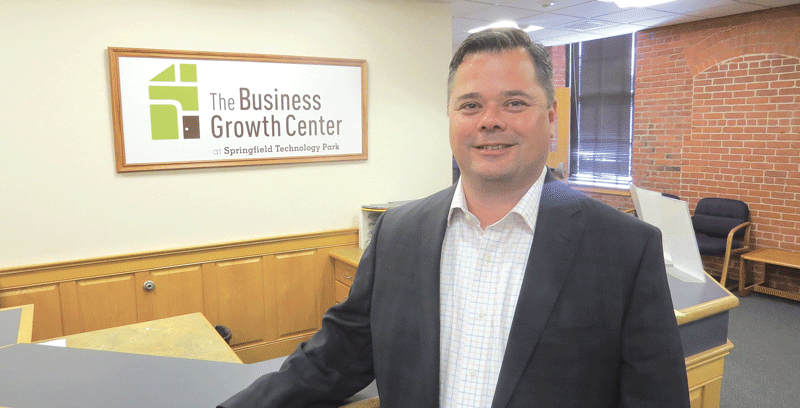
Thornton, professor and tri-chair of Business Administration, said award funds will be used to purchase a new printer and flip charts for his department as well as a set of multi-walkers which will be used in team-building exercises with his students.

“It’s a great honor and big responsibility to help students transform their lives,” he said. “Teaching is the most challenging, and rewarding, career there is. I’m thrilled to be a recipient of the Joseph J. Deliso Endowed Chair this year.”

Daily News

NORTHAMPTON — Kiernan Gulick-Sherrill, owner of Green Earth Computers, recently announced that the business is expanding by two technicians and moving from Amherst to Northampton in order to better serve clients in a much larger office space.

The move to 20A Crafts Ave. will provide a more central location for many customers and make it easier for Green Earth staff to schedule on-site visits with clients across the Valley, Gulick-Sherrill said. The location is also more spacious, allowing for additional retail space for refurbished laptops, cables, and accessories.

Green Earth has also welcomed two new technicians to the team in response to the growing demand. Greg Schwartz and Daniel Cottle are set to join the company at a grand-opening reception on Friday, Oct. 9 from 5 to 9 p.m. The grand opening, which is open to the public, will feature the first of many Green Earth gallery exhibits, this one by photographer Jonathan Sherrill, Gulick-Sherrill’s father, and will be a part of Arts Night Out. An artist’s reception will be held from 3 to 5 p.m.

Schwartz has previous experience at a variety of tech companies, including TechCavalry and College Pro Computers, where he worked alongside Gulick-Sherrill.

Cottle is a Hampshire College graduate with more than 10 years of experience in computer and small-electronics repair. He previously worked in the Hampshire College Information Technology Department.

Green Earth Computers was created in 2009 and offers on-site and drop-off computer repair services as well as remote assistance. The business promotes sustainability and offers computer-recycling services. It also specializes in repair and replacement of computer screens and charge ports, as well as batteries.

For more information, call (413) 282-8324 or visit www.greenearthpc.us.

Daily News

EASTHAMPTON — Easthampton Savings Bank, the wholly-owned subsidiary of ESB Bancorp Inc., and Hometown Bank, the wholly-owned subsidiary of Hometown Community Bancorp Inc., jointly announced they will form a strategic partnership through the merger of their holding companies.

After this transaction is completed, the combined mutual holding company will have more than $1.7 billion in assets and more than $180 million in equity capital, with a branch network of 23 offices located throughout Central and Western Mass. and Northeast Conn.

ESB and Hometown will merge mutual holding companies, but will continue to run their banks independently and autonomously. The announcement follows ESB’s 2015 acquisition of Citizens National Bank in Putnam, Conn.

“We are very pleased to partner with a company that is as strong and successful as we are,” said Michael Hewitt, president and CEO of Hometown Bank. “This is truly about two successful banking entities joining forces in a partnership to better serve our communities. This transaction gives us the size and scale to be competitive and successful for many years to come and expands our market presence.”

Added Matthew Sosik, president and CEO of Easthampton Savings Bank, “we are extremely excited to announce this strategic partnership with an organization with which we share a lot of familiarity and that, like us, has been a top financial performer for so many years.

“Our business models and cultures are very similar,” he added. “Both banks have strong boards and management teams and have long, successful track records. We are going to leverage those strengths by operating our two banks separately underneath the combined mutual holding company, while taking advantage of efficiencies and economies of scale at the holding-company level. We are all very confident that this multi-bank, holding-company model represents the best future for our two banks, as well as for other like-minded community banks in New England that may be attracted to our partnership over time.”

Hewitt noted that “the dynamics of community banking have changed dramatically over the years. Operating costs are under constant pressure, and net interest margins have narrowed, so now more than ever, size truly does matter. For both banks, this transaction creates critical mass, even stronger finances, and a plan to better serve all of our communities for many years to come.”
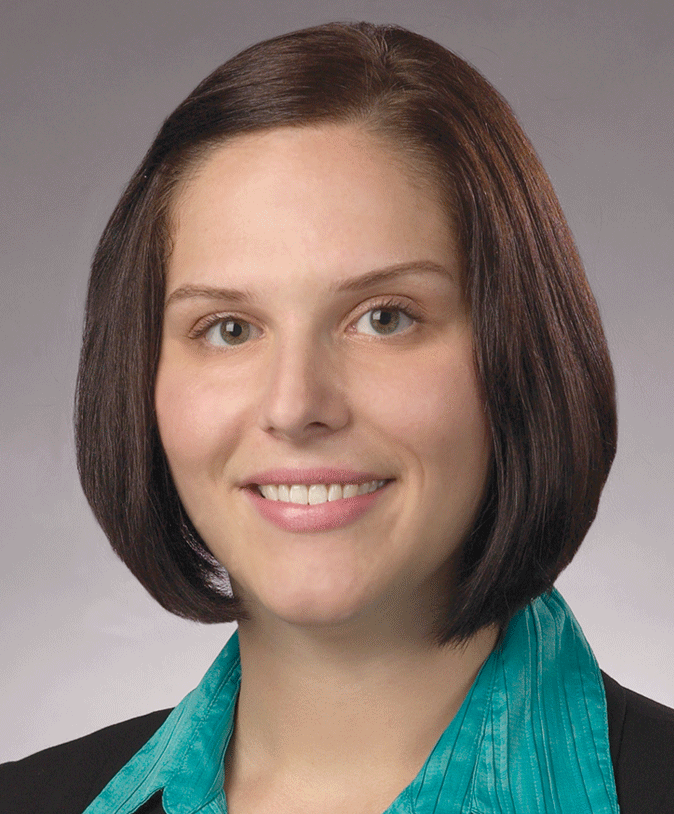
As a result of this transaction, Hometown Community Bancorp will merge into ESB Bancorp, and Sosik will serve as the merged company’s CEO, while Hewitt will serve as its president. Both Sosik and Hewitt will continue as CEOs of their respective banks. The merged parent holding company is also planning to change its name to Hometown Financial Group to better reflect its strategic positioning as a multi-bank holding company.


“While we are going to change our holding company name, customers should expect no changes, name or otherwise, at either Hometown Bank or Easthampton Savings Bank,” Sosik said. “To the contrary, our customers will continue to see the same great service and level of community commitment that they have come to expect over the years. In fact, as part of this transaction, ESB is funding a $1 million contribution to start a charitable foundation for the communities served by Hometown Bank.”

Both banks operate on identical technology platforms, so there will be no customer disruption, Hewitt added. “This will be entirely seamless to the customers of both banks.”

The boards of directors of both banks have unanimously approved this transaction. The merger is subject to a vote by both bank’s corporators, as well as receipt of customary regulatory approvals. The merger is expected to be completed in the first quarter of 2016.

Daily News

GREENFIELD — In celebration of Manufacturing Day 2015, Greenfield Community College (GCC) will open its doors on Thursday, Oct. 1 between 5 and 7 p.m. to students, parents, and others interested to learn more about manufacturing practices, free training programs, and the outstanding opportunities a career in manufacturing can provide.

Manufacturing Day is an annual national event at the local level supported by area manufacturers as they host students, teachers, parents, job seekers, and other community members at open houses, plant tours, and presentations designed to showcase modern manufacturing technology and careers. The goal is to expand the community’s knowledge of manufacturing and improve the public perception of manufacturing career opportunities.

“GCC is responding to the growing demand for highly skilled professionals in the manufacturing sector who can design, program, and operate technology,” said GCC President Bob Pura. “According to the Fabricators & Manufacturers Association, the average age of a manufacturing employee is now 56, and by the year 2020 they project an unprecedented shortage of skilled manufacturing workers who will need to be replaced.”

The event will be held in the Core Lobby of GCC, One College Dr., Greenfield. Activities will include an opportunity to meet and greet area manufacturing companies and learn about what they make, as well as explore GCC’s training programs. Attendees can join a scavenger hunt, enter to win prizes,and enjoy refreshments.

Immediately following Manufacturing Day, attendees are invited to join GCC’s Pioneer Valley Institute presentation by Journeyman machinist Jim Terapane, who is also president of the Museum of Our Industrial Heritage. His presentation, titled “North from the Springfield Armory II: Local Industrial DNA,” will discuss the industrial lineage of the machine-tool industry of the Pioneer Valley and goes back to the manufacturing of arms at the Springfield Armory, which was a springboard to machine-tool industries stretching up the Connecticut River to Windsor, Vt. The event, which is free and open to the public, will run 7 to 9 p.m. in the Sloan Theater.

Those interested in applying for the free training programs should also attend the information and application session on Monday, Oct. 19. For details, visit www.gcc.mass.edu/manufacturing or contact Jeremiah Riordon at (413) 775-1611 or [email protected].

Daily News

HARTFORD, Conn. — Regional accounting firm Whittlesey & Hadley, P.C. announced the following promotions to senior audit associate: Timothy Bessette, Nicholas Deets, Patrick Kelly, Caitlin Main, Alex McCabe, James Mercadante, Steve Norris, Andrew Pires, Michael Ray, and Kyle Rounseville. In addition, Rachel Hahn has been promoted to senior tax associate.

In the firm’s wholly owned subsidiary, the Technology Group, LLC, Hadas Davis was promoted to senior network engineer, and Kenneth Blain was promoted to network engineer.

“I am pleased to see our team’s dedication to accounting and technology excellence,” said Drew Andrews, the frm’s managing partner. “These promotions are the result of our clients’ continued satisfaction in all that we do for them.”

Features

Learning Opportunities

WMBExpo 2015 LOGO

At its core, the Western Mass. Business Expo is, as the name suggests, a business-to-business showcase, an event that turns a bright spotlight on companies large and small and across sectors of the economy.

But there has always been a strong educational component to the annual fall event, said Kate Campiti, associate publisher of BusinessWest, which has produced the show since 2011. And the 2015 edition of the Expo, set for Nov. 4 at the MassMutual Center in downtown Springfield, will be no exception.

In fact, she said, it will set a new standard when it comes to programs and events designed to help business owners and managers better understand and navigate the complexities of doing business today.

Indeed, seminar topics will run the gamut from medical marijuana in the workplace to preventing white-collar crime; from creating sales opportunities to brand development; from bullying in the workplace (and how to prevent it) to a new term not yet officially in the dictionary: ‘parentrepreneurship.’

In addition to 16 seminars across four tracks, there will be other opportunities to learn, said Campiti, listing everything from breakfast and luncheon keynote speakers and their messages on both business and life, to a special program on robotics featuring area high-school students, to the so-called, and appropriately named, ‘Business Resource Hub.’

This special corridor of the Expo show floor will be occupied by a host of agencies with varying missions but a common purpose — helping area businesses thrive.

“The Business Resource Hub will be a true resource,” said Campiti. “It has never been tougher to be in business and stay in business, and those trying to run often have questions — about everything from how to secure financing to how to navigate the new sick-leave law — but often don’t know where to look to find answers. The Business Resource Hub will help them make important contacts with a host of state and local business-assistance agencies.”

The specific seminar schedule is still to be finalized, said Campiti, but the tracks have been selected — Sales & Marketing, Workforce Development, Entrepreneurship, and Hottest Trends — as have many of the topics for discussion. A brief look at some of the working titles of the seminars gives a hint of the wealth of information to be disseminated. They include:

• “Parentrepreneurship: Being Both a Parent and an Entrepreneur”;
• “Building a Pipeline of Sales Opportunity”;
• “Why Interns Can Make a Difference for Your Company”;
• “Securing Your Business from White-collar Crime”;
• “How to Work with Humans: Harnessing the Power of Employees”;
• “Increasing the Sanity, Fairness, and Appreciation in Your Family Business”; and
• “Secrets to Hiring and Developing the Right People.”

Meanwhile, other components of the show include a return of last year’s highly successful Retail Corridor, the ever-popular pitch contest staged by Valley Venture Mentors, a Healthcare Corridor, a Technology Corridor, the day-capping Expo Social (one of the best networking events of the year), and much more.

The Expo will again be presented by Comcast Business, which has been the show’s lead sponsor since BusinessWest began producing it in 2011. Director-level sponsors are Health New England, Johnson & Hill Staffing Services, MGM Springfield, and Wild Apple Design. The Isenberg School of Management at UMass Amherst is education sponsor, and Elms College is the information-center sponsor. Details on the Expo can be found by visiting www.wmbexpo.com.


Fast Facts

What: The Western Mass. Business Expo
When: Nov. 4
Where: MassMutual Center, Springfield
Events and Activities: Breakfast hosted by the Springfield Regional Chamber of Commerce, featuring Dan Kenary, CEO and co-founder of Boston-based Harpoon Brewery; lunch hosted by the Professional Women’s Chamber; Show Floor Theater presentations; informational seminars; Pitch Contest, matchmaking opportunities, robotics displays, the Business Resource Hub, and more.
Exhibitor Information: Booth sizes and rates are: 20×20 showcase unfurnished: $2,250; 20×20 showcase furnished: $2,400; 10×20 double unfurnished: $1,250; 10×20 double furnished: $1,350; 10×10 corner unfurnished: $850; 10×10 corner furnished: $925; 10×10 standard unfurnished: $750; 10×10 standard furnished: $825.
For More Information: Call (413) 781-8600, or visit www.wmbexpo.com.

Opinion

Editorial

Stephen Zrike admitted he had a limited base of knowledge about Holyoke before he arrived in July as the state-appointed receiver for the city’s beleaguered school system with the challenging assignment of orchestrating a turnaround.

Most of what he did know was gleaned from relatives of his wife, who grew up in the city, attended its schools, and achieved success in their careers. The basic messages that they conveyed consisted of enormous pride in their city — something people born and raised in the city are well-known for — as well as dismay over the current state of affairs and general uncertainty about what went wrong and how to fix the problems.

This enormous pride helps explain why Holyoke strongly resisted a state takeover of its schools. Only two other cities had suffered such a fate — Chelsea and Lawrence — and it’s certainly not something a community wants on its résumé, for a number of reasons.

But, as we wrote several months ago, this takeover will likely ultimately become a very positive development for this manufacturing center that is now, like many of the other so-called gateway cities, struggling to find a new identity.

That’s because it takes many factors coming together to restore a once-proud city to prominence, and an effective school system is at the very top of that list.

Other factors are important as well. These include a willingness to live and start a business in that community, getting a hold on crime and making residents feel safe, new job opportunities, and that intangible known as hope.

But before you can have most, if not all, of the above, you need quality schools that are graduating workforce-ready individuals.

Holyoke is making progress on many fronts. For example, it was recently included on Popular Mechanics’ list of the “14 Best Startup Cities in America,” an acknowledgement that it has, for lack of a better word, a solid infrastructure for new businesses, meaning available and affordable real estate, comparatively low taxes, and officials in City Hall who are cooperative.

The city is also building its economy through the arts, technology, and green business, with two of those realms coming together in the Massachusetts Green High Performance Computing Center.

And some pride is being restored as well, with more business owners and homeowners looking Holyoke’s way, instead of the other way, or any other way.

But the city won’t achieve a full and effective recovery if its schools continue to lag, with some of the lowest, if not the lowest, rates for high-school graduation and third-grade reading proficiency in the Commonwealth.

Unless or until Holyoke’s schools improve those rates, it will be difficult to attract new families and new businesses, and therefore it will be an extreme challenge to script the kind of turnaround that Chelsea, Lowell, and other cities have achieved.

In his interview with BusinessWest, Zrike said orchestrating a turnaround of Holyoke’s schools will not happen quickly or easily. Achieving that feat that will require time, dedication, creativity, and the full power of a receiver to slice through bureaucracy and politics and therefore accelerate the process.

He says it will only happen through leadership — not just from his office, but in every one of Holyoke’s 11 school buildings. And he’s right about that.

We sincerely hope that leadership can be found, because a sound school system is one of the big pieces of the puzzle missing in Holyoke, and until improvement is achieved, the turnaround picture will not be complete.

Departments Incorporations

The following business incorporations were recorded in Hampden, Hampshire, and Franklin counties and are the latest available. They are listed by community.

AGAWAM

Louis Pallotta Paving Co. Inc., 15 Keating Lane, Agawam, MA 01001.Vincent Pallotta, 66 Alexander Place, Westfield, MA 01085. Asphalt paving services to the general public.

Malkoon Motor Sales Inc., 825 Springfield St., Agawam, MA 01001. Paul E. Malkoon, 80 Hillside Road, Southwick, MA 01077. Sale of motor vehicles.

EASTHAMPTON

PFM Enterprises Inc., 193 Northampton St., Easthampton, MA 01027. Thomas L. Warren, 188 Kings Highway, Westhampton, MA 01027. Manufacturing.

WWC Inc., 4B Liberty Street, East Hampton, MA 01027. Shelley Wilton, same. Chiropractic services.

EAST LONGMEADOW

Fertility Laboratory Consultants Inc., 15 Channing Road, East Longmeadow, MA 01028. Tayyab Rahil, same. General healthcare consulting.

Orloff Corporation, 95 Edmund St., East Longmeadow, MA 01028. Andre A. Orlov, same. Plumbing and heating contractor.

Robertson Trucking Inc., 154 Smith Ave, East Longmeadow, MA 01028. Charles A Robertson, same. Transport.

PITTSFIELD

Shamrock Dog Grooming Inc., 10 Lyman St., Suite 10, Pittsfield, MA 01201. Thomas M. Phillips, 10 Bonny Lane, Peru, MA 01235. Dog Grooming and Day Care.

The Danny Boy Adoption Fund Corp., 16 Mountainview Dr., Pittsfield, MA 01201. Nancy O’Malley, 35 Forrest St., Winthrop MA, 02152. Helping senior dogs and cats.

NORTHAMPTON

Sunergix Inc., 109 High St., Florence, MA 01062. Ali Usman, 20 Hampton Ave., Suite 150, Northampton, MA 01060. Business consulting services.

The Light House Center Inc., 45 Main St., Florence, MA 01062. Joseph Worpek, same. To initiate and administer programs exclusively for charitable, educational, scientific, and literary purposes.

SPRINGFIELD

Holistic Industries Inc., C/O Gary Fialky 33 State St., Springfield, MA 01103. Jonathan Genderson, 300 Massachusetts Ave, NE, Washington, DC 20002. Corporation organized for any civic, educational, charitable, benevolent, or religious purpose.

Romeo and Sons Milk Inc., 95 Hall St., Springfield, MA 01008. Pasquale A. Romeo Jr., same. The sale and delivery of dairy products.

Sangy Inc., 119 Boston Road, Springfield, MA 01109. Mazhar Iqbal, 35 Stocker Street, Springfield, MA 01109. Convenience store with gas station.

WEST SPRINGFIELD

Semia Education Technology Inc., 289 Woodmont Street, West Springfield, MA 01089. Eugene Zhang, same. Market and sales of robotics education products.

Daily News

SPRINGFIELD — The Advertising Club of Western Massachusetts announced five recipients of the Order of William Pynchon Awards for 2015 — the 100th anniversary of the awards, which were first presented in 1915.

This year’s honorees include Gary Bernice, band director at Springfield High School of Science and Technology; entrepreneur and philanthropist Harold Grinspoon; Sue Ellen Panitch, who has volunteered with dozens of organizations; and Ronn and Donna Johnson, who founded the Brianna Fund for Children with Physical Disabilities.

The Pynchon Awards honor members of the community who have distinguished themselves through their service. The Advertising Club will fete this year’s honorees on Nov. 19 at the Springfield Museums. Tickets cost $65, and more information is available at www.adclubwm.org.

Daily News

BOSTON — The state’s Executive Office of Labor and Workforce Development was awarded a $2.9 million federal grant to expand apprenticeship opportunities in high-growth industries in Massachusetts.

The American Apprenticeship Grant, awarded by the U.S. Department of Labor, will enable the state to help 300 residents gain apprenticeship training in industries with a growing demand for new employees, such as healthcare, technology, and advanced manufacturing.

The funds will support the Massachusetts Apprenticeship Initiative (MAI) to increase the number of apprenticeship and pre-apprenticeship opportunities in those industries. There are more than 7,500 registered apprentices in the state in 2015.

“As many employers in Massachusetts struggle to find the skilled labor to fill available jobs, this grant will enable training for individuals in high-demand industries and provide more job opportunities for the people of the Commonwealth,” Gov. Charlie Baker said.

The U.S. Department of Labor awarded $175 million in American Apprenticeship Grants to 46 awardees across the nation to expand apprenticeships in high-growth industries. The Executive Office of Labor and Workforce Development will use the grant to build upon apprenticeship opportunities and address the skills gap for underserved residents.

“Our team worked incredibly hard to be awarded one of these highly competitive grants,” said Labor and Workforce Development Secretary Ronald Walker, II, who chairs the Workforce Skills Cabinet. “These funds will help us in our mission to meet employers’ demands for highly skilled workers so they can continue to grow their businesses. Businesses cannot grow if they cannot find enough skilled workers.”

Created by the governor through an executive order, the Workforce Skills Cabinet’s goal is to align education, economic- and workforce-development programs, and policies to increase opportunities for training and employment for residents while helping businesses meet their growth needs.

Opinion

Editorial

It is September, and by now, thousands of college students have returned to campuses across the region.

Thus, this is a good time to re-emphasize the importance of higher education to this region and its economy. The colleges and universities that call Western Mass. home generate thousands of jobs, purchase products and services from a number of locally based companies, and spur research that can be generated into companies that employ area residents.

But these schools provide another important resource for this region — the students themselves.

They also purchase goods and services, and therefore make an important contribution to the economy, but they play a potentially larger role by taking internships, co-ops, and part-time jobs with companies large and small across the four counties. In doing so, they provide skills, energy, ideas, and the perspective of a generation that will soon dominate the workforce and the consuming public.

It is important for area businesses to take full advantage of this resource — in a careful and thoughtful manner.

Indeed, interns and part-term employees can make valuable contributions to a company — while also positioning themselves for full-time employment later — if they are brought into situations that could be described with the phrase ‘win-win.’

And we encourage both area schools and the business community as a whole to generate more of these situations by creating opportunities for students and employers to meet one another.

Doing so will only benefit all the parties in this equation. But, as we said, it needs to be done properly.

Companies create problems for themselves when they look upon interns as a solution to workforce problems, budget concerns, or both. Too many companies have looked at pressing problems and loaded calendars and responded with the well-worn phrase, ‘let’s get some interns.’

These young people can’t, and should not, be expected to do the work of seasoned employees. Nor should they be thrust into situations where the demands exceed their skill levels.

But, as we said, when interns are placed in proper positions — ones where they contribute and learn — they can be invaluable assets and become future members of a workforce.

Young people can bring energy to a staff, but they can also bring a fresh perspective. Baby Boomers and those who came just behind them can’t look at the world from the perspective of a 21-year-old, but a college junior or senior can, and that kind of insight can be critical, especially in an age when rapidly advancing technology is changing the way people communicate, shop, get their news, market their companies, and gain the public’s attention.

Today’s young people are in many ways driving this change, and they understand it at least as well as those of us born decades before them.

Area colleges are back in session. That’s good for this region in a number of ways. One of the most important is the sum of the contributions students can make to area businesses, nonprofits, and governmental agencies.

This is a tremendous resource, one that should be recognized and capitalized upon.

Sections Women in Businesss

The Art and Science of ‘Finding Out’

Julie Pokela

Julie Pokela

Much has changed since Julie Pokela and partner Nancy Mihevc decided to go into business doing market research nearly 40 years ago. One thing that hasn’t changed is the simple mission for the company now known as Market Street Research: finding answers for clients who need information to understand their audience and grow their business.

Julie Pokela says it was already shaping up to be a busy summer for Market Street Research (MSR), the firm she helped lay the groundwork for nearly 40 years ago. And then, some additional work start pouring in.

Funneled by the Wallace Foundation, started by the founders of Readers Digest, as part of an ongoing initiative concerning the arts, these projects involve several noted institutions — the Seattle Opera, the Pacific Northwest Ballet, and the New York-based Alvin Ailey American Dance Theater — that want some insight into how to grow their audiences.

A major focal point of these analyses will be the Millennial generation, members of which now statistically outnumber the Baby Boomers, said Pokela, and remain a point of fascination — and mystery — for businesses across all sectors.

“People are trying to figure out how to tap into this generation,” she said, adding that these arts-related projects will utilize focus groups and a host of other methodologies to gain some insight.

When asked to speculate on what these studies may reveal about the Millennials and their attitudes about the arts, Pokela thought for a second and said, “I don’t know … we’re going to find out.”

‘Finding out’ has been the simple two-word answer to the question of what this company does since Pokela and partner Nancy Mihevc joined together in a venture called the Research Group in 1978 (more on the company’s history later). They’ve been finding answers for clients ranging from political candidates to regional and national banks; from private colleges to major medical systems; from retail chains to nonprofit agencies.

The specific questions to which they’ve sought to find answers have varied, but the common denominator has essentially been market share and the universal goal of improving it.

Today, achieving that goal involves successfully marketing to and then serving several generations, each with distinct attitudes and preferences, said Pokela, adding that the Millennials are proving to be particularly challenging for many sectors.

“Banks are really interested in this subject,” she noted. “And we do a lot of work with independent schools and colleges to help them figure how they’re positioned among the students and parents looking at colleges — and how to grow their enrollment.”

Over the years, the size and composition of MSR’s client base has changed, said Pokela, noting that, in the ’80s, the company did considerable work with banks, and later put a heavy focus on healthcare, specifically hospitals and medical systems that wanted insight into what the public thought of the services they were providing.

While the company still serves both those sectors, its overall strength has been diversity, said Pokela, adding that this trait has enabled it to survive the many economic downturns over the past four decades.

The business itself has also evolved. Years ago, MSR employed those who would do the actual data collection for the research projects. Now, those services are outsourced, noted Pokela, adding that, while laying off dozens of employees constituted the most painful moment of her career, the resulting entity is smaller and more manageable, and enables her to spend the vast majority of her time doing what she likes most — research and interpreting what it means.

For this issue and its focus on women in business, BusinessWest talked at length with Pokela about her company, the intriguing world of research, and the art and science of ‘finding out.’

Answering the Call

Tracing the history of her company, Pokela said the intriguing story began when she was pursuing her doctorate in communication at UMass Amherst, studying under, among others, Mihevc, who taught political communication.

One of Mihevc’s other students at the time became involved with Ed McColgan’s campaign to unseat Congressman Silvio Conte, and she asked Mihevc to conduct some research for the candidate.

She agreed, and asked Pokela if she wanted to assist with the polling, which she did.

Those efforts didn’t succeed in getting McColgan elected — he triumphed in the Democratic primary, but was buried by Conte in November — but they did get the attention of other candidates, who recruited the two for similar polling.

“Eventually, a business person with one of the campaigns asked if we could do some market research for his company,” said Pokela, “and from there, an advertising agency asked if we could do marketing research for their clients.

“We got to the point where Nancy was coming up for tenure, and I was looking at finishing my Ph.D., and had to decide — do we want to start a company or continue with our expected lives of being academics?” she went on. “We decided that it wouldn’t hurt anything to start a company, so we did.”

Given a boost by some work they did for the Center for Human Development in Springfield, which received a grant to conduct a telephone survey on community attitudes toward foster parenting, the pair enjoyed success early on, working mostly on political campaigns and projects for ad agencies.

The recession of the early ’80s nearly took them out, though, said Pokela, adding that she and Mihevc turned to the Mass. Small Business Development Center and then-Director Merwin Tober for some assistance on how to position the company for growth and sustainability.

Tober came up with the idea of generating a recurring form of income — or several of them — rather than being solely what amounted to a job shop. And from that suggestion, the two partners eventually conceptualized something they would call the “Quarterly Bank Survey.”

As that name suggests, the initiative surveyed area residents on a quarterly basis about their banking habits and preferences, said Pokela, adding that most all area banks bought the reports.

“It ended up being a great product and a solid source of regular, predictable income — we did it for maybe 10 years,” she said, adding that this effective niche was substantially weakened by a wave of consolidation that swept over the industry in the late ’80s and other consequences of a deep and prolonged recession that took a severe toll on the financial-services sector.

But, while bolstering its portfolio with banks, the company — which became known as Market Street Research in 1986 after Pokela and Mihevc parted ways and the former joined forces with Elizabeth Denny — was doing the same with the healthcare industry.

Julie Pokela says there are businesses

Julie Pokela says there are businesses across many sectors that want to know what the Millennials are thinking — and how they’re spending.

That remains the primary source of business today, accounting for roughly 70% of annual revenues, said Pokela, adding that now, as then, the industry relies on a steady flow of data concerning its services and how they are perceived.

The company started with a hospital survey similar to the one produced for banks, she said, adding that, by the late ’80s, most healthcare providers were ratcheting up their marketing efforts in response to changes within the industry, especially a shift from inpatient to outpatient care and the resulting increase in bed capacity.

“Length of stay was greatly reduced, and as a result, hospitals had all this excess capacity for inpatient beds,” Pokela explained. “So they started looking at the edges of their markets and saying, ‘where can we pick up more patients in areas that we haven’t traditionally looked at?’ So hospitals learned how to compete very quickly.”

Surveying the Landscape

This phenomenon has generated a steady source of revenue for the company ever since, she went on, noting that MSR has a number of prominent hospitals in its portfolio, including Mass General, NYU Langone Medical Center, the Cleveland Clinic, Dartmouth Hitchcock, and many others.

Most are steady, repeat customers that require in-depth marketing studies at least every two years, and often on a more frequent basis.

The nature of the work varies, but much of it comes down to two key issues in this sector and most all others — awareness and image.

“If you look at the process by which someone makes a decision to use any kind of organization, it starts with awareness — people are more likely to use an organization they’re aware of,” she explained. “So we track what their awareness levels are, and ask people, ‘when you think about hospitals in your area, which ones come to mind?’”

Overall, the company tailors its questions and surveys to meet the specific needs of clients and business sectors, and the ability to help companies in a host of industries has driven solid growth over the years and enabled MSR to weather the economic downturns in recent years.

The firm has clients in healthcare, financial services, the nonprofit arena, governmental agencies, retail, technology, manufacturing, and, especially this summer, the arts, which Pokela has identified as a potential source of growth for MSR.

In higher education, for example, the company has worked with a number of institutions, including Bryn Mawr College, Mount Holyoke College, Smith College, Western New England University, and UMass Amherst, with research focused on a number of areas, including:

• Satisfaction of faculty, staff, and students with the services the school provides;
• Effectiveness of communications, including marketing and promotional materials; and
• Satisfaction of alumni or alumnae regarding services for alumni and communication with their alma mater.

The company also works with private elementary and secondary schools and also public school systems and school boards, in matters ranging from attracting and retaining high-caliber students to communicating information and specific strengths to the community.

In retail, meanwhile, the company has provided services for national chains, mom-and-pop stores, and entities that fall in between. It helps those clients with everything from assessing awareness (there’s that word again) to customer satisfaction, site-location selection, market feasibility of new products, and more.

Increasingly, those in each sector want to know what the members of each generation are thinking and what they’re looking for in terms of products and services.

She joked that those in healthcare are not yet fascinated by the wants and needs of the Millennial generation — “young people don’t get sick” — but just about everyone else is, including those arts institutions that have recently become clients.

“They want to know how to get the next generation interested in the arts,” she explained. “They want to know how to get them interested not only in going to see these groups, but also interested in becoming subscribers and then eventually donors.

“At the focus groups I’ve been going to with people in their 20s and 30s who are going to the arts — they’re very passionate about it,” she went on. “That’s very exciting to see. The question is how to translate the passion exhibited by the people who are going, to the people who are not going.”

As for the answers to that question … the reports commissioned for those arts institutions should be completed by this fall, she went on, adding that there may be some answers there.

Poll Position

Looking ahead, Pokela said the company’s primary goal is to continue to log steady, manageable growth.

She believes it can continue to do so because, overall, it scores well in those areas for which it gauges results for its many customers — awareness, quality of service, and image. And, especially, because it continues to raise and clear the bar in that one realm for which it was formed, a service that has become both an art and science: finding out.

George O’Brien can be reached at [email protected]

Banking and Financial Services Sections

A More Cooperative Merger

CEO Michael Tucker

Greenfield Cooperative Bank President and CEO Michael Tucker

For the CEO of Greenfield Cooperative Bank, the recent merger with Northampton Cooperative Bank — joining two institutions with a combined 236 years of history — made sense on a number of levels, from their similar cultures to the prospect of greater lending clout, to different but compatible branch footprints that eliminated the need for layoffs. The goal, he said, was to make the merger as seamless for customers as possible, while putting a broader range of services within their reach.

For 36 years in the banking industry, Michael Tucker has weathered plenty of changes, so the recent merger of Greenfield Cooperative Bank — where he has served as president and CEO since 2002 — and Northampton Cooperative Bank was far from a first.

“I’ve been through four of these, and I’ve been on both sides,” he said, referring to being the larger or smaller bank in mergers and acquisitions. “My first one was 30 years ago, when the old Nonotuck Savings Bank merged with SIS. They made sure Nonotuck looked like SIS on day one, and they lost half their customers within a year.”

It’s a lesson he hasn’t forgotten, which is why customers at the two recently merged co-op banks — announced 15 months ago and made official on April 1 — were met with a much more seamless transition. “Here, our goal was to make it transparent for customers. We aren’t closing offices or laying anyone off.”

The overall entity — which now boasts about $525 million in deposits, more than $60 million in capital, 10 branches, and 98 employees — is officially called Greenfield Cooperative Bank, taking the name of the larger institution.

But, while the six Franklin County branches that have been operating under the Greenfield name — two in Greenfield and one each in Northfield, Sunderland, Shelburne Falls, and Turners Falls — will continue to do so, the four Hampshire County branches, two each in Northampton and Amherst, will continue to operate under the Northampton Cooperative Bank name their customers are used to, as a division of Greenfield Co-op.


Click HERE to download a PDF listing of Banks in Western Mass.


“We committed to using the Northampton Co-op name in Hampshire County, for existing branches and any that might open in the future,” Tucker said, noting that no physical expansion plans are on the drawing board yet, as bank leaders want to first make sure the current branches are running smoothly.

“Why give up all that history, all that goodwill, for either brand?” he continued, noting that Greenfield Co-op dates back to 1905, and Northampton Co-op to 1889. “Early on, people said, ‘let’s come up with a new name for the combined bank.’ I’ve seen that done elsewhere, and people just ask, ‘now, what bank was that?’”

William Stapleton, formerly president and CEO of Northampton Co-op, now serves as CEO of Greenfield Bancorp, MHC, and chairman of the combined bank, with Tucker remaining as president of the holding company and president and CEO of the combined bank. Both of them cited expanded customer access, improved economies of scale, and more efficient operations as reasons for the deal.

“A $100 million bank would have trouble surviving today, because of the expenses,” Tucker said, referring specifically to increased regulatory and compliance costs for banks in today’s environment. “My commitment when I came here was to stay mutual and make sure I handed this bank off to the next generation healthier than when I found it. I think this merger helps us to ensure that. Now we spread those expenses over a bigger base.”

Check Mates

That’s not to say Greenfield Cooperative wasn’t already growing, having increased its deposits by an average of 5% to 6% annually in Tucker’s 13-year tenure, effectively doubling that figure from $175 million to $350 million.

“When we looked at where we might grow next, we were looking at Hampshire County,” he told BusinessWest, adding, however, that a merger with a similar organization made more sense than building more Greenfield Co-op branches there. As it turned out, he found a sympathetic ear in Stapleton.

“We had a lot in common with Northampton Cooperative Bank,” Tucker went on. “Bill and I had been talking off and on for a number of years. That happens a lot in the industry.”

With the approval of each bank’s 11-member board, the merger underwent the normal regulatory processes and became official on April 1, just over five months ago. As for the directors, the banks simply merged them into one 22-member board, which will be whittled down through impending retirements to something more manageable. Board meetings are typically held in Deerfield, between the bank’s two namesake cities.

“There will always be a few bumps, but it’s been pretty smooth,” Tucker said of the merger, noting that the two institutions already used the same Connecticut-based financial-technology service, COCC, and there was no duplication of account numbers, allowing Northampton Co-op customers to keep their checks and debit cards. Those customers also have access to new financial services and low-cost Mass Save energy loans through Greenfield Co-op, as well as programs like IDSafeChoice, an identify-theft protection service Greenfield partnered with a decade ago.

Meanwhile, the merged institution is finding efficiencies and cost savings in pending retirements. “I had three senior officers scheduled to retire this year. After our merger, I only had to replace one; for the other two, we used people in Northampton.”

Greenfield Co-op

Greenfield Co-op has been headquartered in the same location since the 1940s, while both it and Northampton Co-op boast histories spanning well over a century.

At the same time, Tucker said, “a lot of our customers are happy they can do business in the Northampton-Amherst neck of the woods. We’ve added commercial-lending capabilities down there; they really didn’t do commercial loans, but we hired two new lenders to service the area, and stationed one of our investment-services guys, from Florence, in Northampton.”

Moving from $39 million in capital to more than $60 million after the merge also allows Greenfield Co-op to offer larger loans, including SBA loans. “Our lending house limit was 10% of capital, so that goes from $3.9 million up to $6 million. Sometimes customers outgrow you; it’s nice keeping pace with our customers.”

Employees have already taken advantage of new career opportunities as well, with some already moving to branches closer to where they live. “It gives a broader career path for some people,” Tucker said. “I think that will continue as we grow.”

Career Moves

Tucker spent 20 years at SIS before moving to Easthampton Savings Bank in 1999 as senior operating officer and in-house counsel, spending three and a half years there before Greenfield came calling.

A lawyer by trade, he never planned on advancing that far in the banking world when he started out as an SIS teller in 1979 while attending law school at night. “I was planning to be there four years, then go on to my own practice, but the CEO of SIS back then was a lawyer who had started doing real-estate closings back in the ’50s. He encouraged me, and I ended up staying; by the late ’80s, I got my master’s in banking law.”

The dual expertise served him well as he rose to higher positions, and he has never lost his passion for learning more about his industry — especially at a time when online and mobile banking platforms have changed the way banks interact with their customers.

“There will always be a place for brick-and-mortar customers who want to be able to talk to a person,” he said. “That’s the local edge; otherwise, you might as well bank with Capital One out of Ohio. But, at the same time, some customers never come into the bank. I remember when teller lines were out the door to cash Social Security checks, but that’s all direct deposit now. There are still lines, but it’s to socialize and update their passbook and see the tellers, who are also their friends. You don’t have to come into the bank anymore, so branches are smaller now.”

Although he foresees working about seven more years before retirement, the rapid changes in banking — both regulatory and technological — help drive Tucker’s involvement with organizations like the Mass. Bankers Assoc., which he chaired until last year, and the Federal Reserve Bank in Boston, where he currently serves on the board of directors. “Part of that, for me, is continuing to learn, staying active in the industry. And it’s an industry, I think, where we do a lot of good for people — and it’s fun.”

He says he’s acutely aware of the roles community banks play in the business fabric of Western Mass., from philanthropy and civic involvement to loan support for families and businesses.

“We are lucky to have this many healthy community banks in the region,” he told BusinessWest. “It’s competition for us, with literally a branch on every corner. But if I’m a local customer, and I think of the dollars contributed, the volunteerism … that’s something irreplaceable, it really is.”

For example, the bank recently donated money to both Baystate Franklin Medical Center in Greenfield and Cooley Dickinson Hospital in Northampton, gifts that, Tucker noted, aren’t totally altruistic, in the sense that healthy individuals comprise healthy, vibrant, attractive communities. “We want people to buy homes here, start businesses, send their kids to school — all the things that make a community a community.”

Sounding Board

As Greenfield Cooperative Bank seeks to grow in its expanded footprint, Tucker continues to seek input from customers on how to improve their experience.

“My door is open, unless I’m in a meeting, and customers come in all day and make comments, good and bad, but mostly good,” he said, adding that he regularly visits each branch to chat with staff and customers. “If this was Bank of America, it would be physically impossible for the CEO to do that.”

He recognizes that not every interaction with a bank is positive — the rare foreclosure being one example. “But we don’t want to own homes; we want to keep people in their homes. We help finance homes, finance businesses, help pay for college or a new car or home improvements, help people plan for retirement or plan for their kids’ college — all pretty fun things.

“We get to interact with people on a lot of positive things,” Tucker concluded. “That’s part of the reason I fell in love with the industry. I didn’t think I’d like it as much as I do.”

Joseph Bednar can be reached at [email protected]

Company Notebook Departments

CPA Firms Whittlesey & Hadley and Weinstein & Anastasio Join Forces

HARTFORD, Conn. — Whittlesey & Hadley, P.C., a regional CPA firm headquartered in Hartford, Conn., announced that Weinstein & Anastasio, P.C., a regional CPA firm located in Hamden, Conn., will join the firm effective Sept. 1. Weinstein & Anastasio provides a broad range of accounting, audit, tax and business-consulting services to closely held businesses in a variety of industries, as well as to high-net-worth individuals throughout New England and New York. This merger represents Whittlesey & Hadley’s growth plan to expand services, diversify geographically, and continue to grow in size, services, and staff. The combined three offices will employ 155 people, including 21 partners located in Hartford and Hamden, Conn., and locally in Holyoke. Weinstein & Anastasio, with roots back to 1927, will continue to serve clients and function in key leadership roles in Southern Conn. communities from its Hamden office, while acquiring the Whittlesey & Hadley brand. Founded in 1961, Whittlesey & Hadley provides accounting, audit, tax, technology, and business-consulting services to clients primarily throughout the Northeast, with access to a worldwide network of resources through PKF North America. For more than 50 years, the firm has served closely held businesses, including manufacturing, construction, distribution, real estate, financial, healthcare, government, and technology industries, as well as the nonprofit sector, the firm’s largest niche focus.

Valley Vodka Celebrates 10 Years in Business

HADLEY — Valley Vodka Inc. the owner of luxury brand V-One Vodka, will celebrate the 10-year anniversary of its first sale on Sept. 1. “Over the past 10 years, V-One sales have consistently grown, with 2014 being the company’s best financial year,” said founder Paul Kozub, adding that, this year, Valley Vodka is poised to significantly improve on last year’s performance. Since its inception, V-One Vodka has won numerous international awards, said Kozub, including nine medals at the World Spirit Competition, including its highest honor, the unanimous Double Gold. V-One Vodka has also expanded its distribution from just 50 locations in the first year to now well over 1,400, in both Massachusetts and Connecticut. For the first time, this year, he noted, V-One will enter the European vodka market with sales in both Denmark and Poland. V-One has successfully launched four successful flavors over the past few years, including its two most recent, V-One Triple Berry and V-One Grapefruit. The company is also in discussions with several companies about expanding its distribution in 2016 to additional New England states with eventual distribution to all 50 states.

HMC to Open Satellite Location for PT Services

HOLYOKE — Holyoke Medical Center will open a satellite location for physical-therapy and rehabilitation services at Healthtrax Fitness & Wellness, 155 Ashley Ave., West Springfield, on Monday, Aug. 31. The location is part of HMC’s newly named Centers of Rehabilitation Excellence (CORE). The satellite location is part of HMC’s ongoing commitment to physical therapy and rehabilitation services, which includes a full renovation and expansion of its in-house physical and occupational therapy and pulmonary and cardiac rehabilitation services. The West Springfield CORE location reflects a key strategic priority of HMC in offering community-based services at locations throughout the Pioneer Valley. Noted Marina Lebo, executive director at Healthtrax, “the Healthtrax Fitness Center offers a wide variety of fitness options for the Holyoke Medical Center and CORE patients as they progress in their health goals and recovery. We have amenities for all ages and fitness levels, including a new functional-fitness training area, personal and group training programs, over 60 motivating group classes weekly, from gentle yoga to cycling, and more.”

Amherst Copy & Designworks Acquires Ferguson Signs

AMHERST — Amherst Copy and Designworks (ACDW) announced that it has acquired Ferguson Signs of Hadley.
Sean Cleary, owner of Amherst Copy & Designworks, said the addition of Ferguson Signs — which will now be known as Ferguson Signworks, a division of Amherst Copy & Designworks — enables his company to better serve customer needs. AC&DW can now offer all manner of banners and signs — from business, yard, parking, and directional signs to wall treatments, floor decals, magnetic signs, stickers, and vehicle lettering — as well as specialty items such as printing on granite, ceiling tiles, cell phones, and more. Additionally, Duncan Ferguson will continue to manage Ferguson Signworks, bringing his more than 30 years of sign expertise to the new shop. Cleary purchased the former CopyCat Print Shop in Amherst approximately four years ago. In March 2014, he changed the name to Amherst Copy & Designworks.

Departments Incorporations

The following business incorporations were recorded in Hampden, Hampshire, and Franklin counties and are the latest available. They are listed by community.

AGAWAM

AK Installation Inc., 33 Perry Lane, Agawam, MA 01001. Svetlana Kaletin, same. Construction contractor.

I & D Home Solution Inc., 322 Meadow Street Unit 4, Agawam, MA 01001. Ion Drocioc, same. Buying and selling residential properties. 

AMHERST

Jolipay Corporation, 43 Belchertown Road, Amherst, MA 01002. Amir Mikhchi, 18 Fox Glove Lane, Amherst, MA 01002. Financial Services.

BRIMFIELD

Division Six Installers Inc., 100 East Brimfield Holland Road, Brimfield, MA 01010. Sally Anne Bodley, same. Installation of finish carpentry.

CHICOPEE

C & P Research Inc., 701 Pendleton Ave, Chicopee, MA 01020. Mary A. Gifford, same. Abstracting, title research, and notary services.

Hadi2015 Inc., 7 Beverley Street, Chicopee, MA 01013. Irfan Kashif, 24 Michael Dr., South Hadley, MA 01075. Operation of convenience stores.

P.M. Food Center Inc., 15 Stedman St., Chicopee, MA 01013. Ogui E. Pena-Melo, same. Grocery retailer.

EASTHAMPTON

Cider House Inc., 28 Northampton St., Easthampton, MA 01027. Lennie Appelquist, same. Media. 

GRANBY

Valley General Contractors Inc., 7 Deer Brook Dr., Granby, MA 01033. Daniel J. Fernandes, 6 Deer Brook, Granby, MA 01033. Real Estate Development, Management.

GREENFIELD

Franklin and North Quabbin Children’s Advocacy Center Inc., 56 Wisdom Way, Greenfield, MA 01301. William Benson, 56 Grinnell Street, Greenfield, MA 01301. End child abuse and provide victims with safety and healing.

HAMPDEN

Reliable Rides Inc., 484 Main St., Suite K, Hampden, MA 01036. Gizenia R. Sedergren, same. Used car dealership.

HOLYOKE

Region XXI of the National Junior College Athletic Association, Inc., 303 Homestead Ave., Holyoke, MA 01040. John Jackson, 160 Park Street, Wrentham, MA 02093. To promote and foster two-year college athletics on a regional level.

LONGMEADOW

Geetu Shokeen, DMD, P.C., 441 Pinewood Dr., Longmeadow, MA 01106. Geetu Skokeen DMD, same. Practice of dentistry.

Healthcare Information Management Inc., 46 Exeter Ave., Longmeadow, MA 01106. Kevin Welch, same. Technology: Healthcare advising and information. 

Company Notebook Departments

Paragus IT Acquires Applied Software Technologies

HADLEY — Paragus IT has continued its pattern of active growth with its first acquisition: West Springfield-based Applied Software Technologies. Prior to the acquisition, AST provided IT services to businesses in the region and beyond for more than 20 years. “We are very happy to welcome the staff and clients of Applied Software Technologies into the Paragus family,” said Paragus CEO Delcie Bean. “They are a great company, and we’re excited that we will be able to give their clients the opportunity to maintain their relationships with the people they know while also having access to the resources we are able to offer as the largest IT provider in Western Massachusetts.” The acquisition of AST is the latest in a strong trend of growth for Paragus. Since Bean founded the company at age 13, Paragus has grown from a one-man operation to a regional leader in business computer service, consulting, and information-technology support. Inc. Magazine has ranked Paragus as one of the fastest-growing privately held companies in the U.S. for four years running. With a 650% growth rate over seven years, Paragus is the second-fastest-growing outsourced IT firm in New England. “We have every intention of acquiring more businesses as we continue to expand our market and services, but it has to be the right deal,” Bean noted. “What matters to us is that the customers, both our current ones and the ones being acquired, are always benefited by the transaction. We refuse to compromise on quality and service. Second-best just isn’t good enough.”

Dave’s Soda and Pet City Highlighted by National Retail Federation

AGAWAM — The National Retail Federation’s ‘Retail Across America’ team recently stopped by Dave’s Soda and Pet City in Agawam to film for NRF’s Retail Across America campaign. They talked with Dave Ratner, who has been involved with the organization for many years, about his work advocating for Massachusetts retail stores on Capitol Hill. According to the NRF, Bay State retailers support 920,000 jobs, and retail contributes nearly $58 billion to the state’s economy. A film crew spoke with Dave’s employees about their jobs — their favorite part of their job, what their typical day involves, etc. The footage will be used to put together a glimpse into surprising jobs in retail. Retail Across America is part of the NRF’s award-winning “This is Retail” campaign, which brings together retailers, universities, and students with state retail associates, legislators, and opinion leaders. The NRF launched the program to highlight life-long careers, how retailers strengthen communities, and the critical role that retail plays in driving innovation. Dave’s Soda and Pet City is one of two businesses chosen to represent Western Mass. retailers on NRF’s road trip through four New England states. Dave’s Soda and Pet City is a mini-chain of seven superstores with more than 100 employees.

TommyCar Auto Group Donates Used Vehicle for Fire-rescue Training

NORTHAMPTON — Country Hyundai and Northampton Volkswagen recently provided a used vehicle to the Northampton Fire Department for rescue training. Firefighters spend countless hours training and honing their skills to ensure they are prepared for any emergency. The vehicle will be put to work in upcoming training exercises in which firefighters will utilize their extrication equipment on the vehicles, also known as the Hurst Tool or the Jaws of Life. “Ensuring firefighters have the latest training is critical to the safety of this community,” said Carla Cosenzi, president of Country Hyundai and Northampton Volkswagen, two dealerships in the TommyCar Auto Group chain. “We’re proud to be able to help in such a meaningful way, knowing so many people will ultimately benefit.” Added Bill Schuetze, captain and training officer for the Northampton Fire Department, “we really want to thank Country Hyundai and Northampton Volkswagen for the generous contribution. We will get a lot of use out of this car to train our firefighters on rescue efforts.” Country Hyundai and Northampton Volkswagen hope to have an ongoing relationship with the Northampton Fire Department and be able to offer more vehicles in the future.

Monson Savings Bank Announces New ‘Back to Banking’ Program

MONSON — As part of its ongoing efforts to improve financial literacy and capability, Monson Savings Bank (MSB) has introduced Fresh Start Checking accounts. These accounts are designed for people who might not otherwise be able to open a bank account based on their prior banking history. At the same time, MSB understands that life happens, and there are times when maintaining financial soundness may be difficult. Through the use of the Fresh Start Checking account, the “Back to Banking” program is designed to educate customers on money management, how to maintain accounts in good standing, and work toward paying off any unpaid account balances at other banks. As part of the program, free education materials are provided to customers through the National Endowment for Financial Education. The education modules include “Money Management — Control your Cash Flow,” “Borrowing — Use, Don’t Abuse,” “Earning Power — More Than a Paycheck,” Investing — Money Working for You,” “Financial Services — Care for Your Cash,” and “Insurance — Protect What You Have.” Another benefit of this program is a pay-as-you-bank option, which is designed to help customers pay down prior financial debts. With a companion savings account, funds can be set up to automatically transfer from checking to savings on a weekly, biweekly, or monthly basis. According to President and CEO Steve Lowell, “at Monson Savings Bank, we have become increasingly concerned about financial literacy and the fact that many people lack the money-management knowledge and skills they need to ensure long-term stability for themselves. Our new “Back to Banking” program is another way in which we help individuals within our communities become more financially secure.”

GZA GeoEnvironmental Awards Grant to Gardening the Community

SPRINGFIELD — GZA GeoEnvironmental Inc., a leading environmental and geotechnical engineering consulting firm, has awarded a $2,500 Shareholder’s Grant to Gardening the Community (GTC) in Springfield, based on an application from Anja Ryan Duffy, a professional landscape architect in the Springfield office of GZA. GZA bestows four roughly $2,500 grants each year to organizations whose specific programs would best benefit from the award. The Shareholder’s Grant program was established to support employee volunteerism and charity work in the firm’s communities and throughout the world. Duffy proposed Gardening the Community as a recipient of the GZA Shareholder’s Grant to assist in the development of the organization’s new Walnut Street site, a project for which she has volunteered her landscape-architecture services. Gardening the Community is a food-justice organization engaged in youth development, urban agriculture, and sustainable living to build healthy and equitable communities. In her grant application, Duffy said the Walnut Street project location is a 0.6-acre abandoned lot which “for decades has been an eyesore and served as an illegal dumping ground.” GTC purchased the site in July 2014 with the vision of transforming it into a “vibrant, green space which would also help feed the neighborhood and provide service and leadership opportunities for local youth.” The GZA Shareholder’s Grant will help fund the placement of fencing and perimeter plantings along the Walnut Street site. Duffy has been with GZA for nearly eight years. Her areas of specialization include site design, planting design, low-impact development, and graphics. A graduate of UMass Amherst with a bachelor’s degree in landscape architecture, she is an avid gardener and started a community garden in her former apartment complex.

Kingdom Master Jewelers Opens in Holyoke

HOLYOKE — Kingdom Master Jewelers, is a family-run business operated by Gabriel Serrano and Idoel Ortiz Jr., opened its doors today at 2020 Northampton St. in Holyoke. Previously a Hadley-based business since 2012, Serrano and Ortiz have become specialists in buying precious metals such as gold, diamonds, and silver, and have more tham 25 years of experience in custom-making one-of-a-kind pieces of jewelry. Kingdom Master Jewelers formally ran jewelry gallery repair shops for Kay, Hannoush, Jared, and many other jewelers in the area.

Departments People on the Move

Douglas Bowen

Douglas Bowen

Thomas Senecal

Thomas Senecal

The PeoplesBank board of directors announced that bank President and CEO Douglas Bowen will retire in July 2016, to be succeeded by Thomas Senecal, currently Executive Vice President and Chief Operating Officer. The board’s leadership-succession plan calls for Senecal to become president at the bank’s annual meeting in February 2016. Bowen will become chairman and CEO at that time. Senecal will be named president and CEO in July 2016 upon Bowen’s retirement. During this transition period, Bowen will remain active in his position and the bank’s management and strategy implementation. Bowen joined PeoplesBank in August 1975 as a teller in the management-development program. He has since worked in almost every department at the bank. In 1986, he started the Commercial Lending department and, in 2002, was named executive vice president and chief lending officer. He was named president and CEO in 2007 and, since that time, has led the bank to its current position in the market, with more than $2 billion in assets and a substantial track record of innovation, community support, environmental sustainability, and employee engagement. Under Bowen’s tenure, PeoplesBank opened six branches, three of which are LEED-certified; has financed more than $80 million in sustainable-energy projects; and has been named a “Top Place to Work” by the Boston Globe three years in a row. The bank was also named a “Top Charitable Contributor” by the Boston Business Journal seven years in a row. The American Bankers Assoc. gave PeoplesBank a Community Commitment Award for its environmental-sustainability efforts in 2013. The Boston Globe also named Bowen a “Globe 100 Innovator” in 2011. In 2009, BusinessWest named Bowen one of its first Difference Makers. Meanwhile, Senecal possesses more than 25 years of progressive financial experience. In his current position, he has managed all accounting, financial reporting, and treasury and facility operations. He has overseen asset growth of the bank from $460 million to $2 billion in 2015. In addition to Senecal’s responsibility for the Finance department, as the COO, he will oversee the Retail, Operations, Internal Control, and Risk Oversight functions. Early next year, he will also be responsible for the Commercial and Consumer Lending, Cash Management, and Human Resources functions. Senecal holds a bachelor’s degree in business administration from UMass Amherst. He also attended the Tuck Executive Program at Dartmouth College. He is a certified public accountant and a U.S. Coast Guard veteran. He currently serves on the boards of directors of Holyoke Community College, where he is chair of the investment committee; Loomis Communities Inc.; and the Hampshire Regional Chamber of Commerce. He also serves on the advisory council of the Isenberg School of Management at UMass Amherst, and is a member of the Federal Home Loan Bank – Boston advisory panel. “Under his leadership, I am confident that our customers, our staff, and our future are in very capable hands,” said Bowen, making a statement on behalf of the bank’s board of directors. “Tom and I believe in our bank’s mutual charter. We will remain a mutual bank going forward — committed to helping our customers achieve financial success and to serving the community. It is our mutual charter that powers our values. It is also the structure that allows us to invest in innovation, to contribute to nonprofit and civic causes, to support environmental sustainability, and, perhaps most important of all, to help our associates grow and succeed. Our mutual charter has served us well for 130 years, and it is the key to our future as well.”
•••••

Carla DiLoreto

Carla DiLoreto

Greg Musante

Greg Musante

Christopher Fager

Christopher Fager

Sean Millane

Sean Millane

Jeffrey Lomma

Jeffrey Lomma

James Hagan, president and CEO of Westfield Bank, announced several recent changes to the bank’s retail and commercial banking staffs:
• Carla DiLoreto has joined the bank as Manager of the Enfield, Conn. office. DiLoreto has nearly 10 years of retail banking experience. Prior to joining Westfield Bank, she was Banking Center manager of the Somers, Conn. office of Webster Bank. While serving there, she was inducted in the Somers Women’s Club, where she helped raise money for its scholarship and charitable-giving programs;
• Greg Musante has been hired as Assistant Branch Manager and Business Specialist in the Holyoke office. Musante has 15 years of banking experience in commercial and mortgage lending. Most recently, he was mortgage bank officer at Webster Bank and also held the positions of cash management analyst and business specialist at Bank of America. A graduate of Greenfield Community College and Plymouth State College, he is an active member of several area chambers of commerce;
• Christopher Fager has joined the bank as Assistant Vice President, Commercial Loan Officer. Fager joins Westfield Bank following a successful six-year career at Citizens Bank, where he served as both branch manager and business banking officer. In his new role, he will be responsible for developing and managing commercial banking relationships. A graduate of UMass Dartmouth, he is active in local chambers of commerce;
• Sean Millane, previously Manager of the bank’s Enfield office, has been promoted to Commercial Loan Officer. Millane has 15 years of banking experience and joined Westfield Bank in 2014 as manager of the Enfield branch. Previously, he was branch manager and business development officer of the Ellington and East Windsor, Conn. offices of Rockville/United Bank. In addition to his professional accomplishments, he is president of the East Windsor (Conn.) Chamber of Commerce and treasurer of the North Central Connecticut PTSD Foundation; and
• Jeffrey Lomma, previously Assistant Manager and Business Specialist in the Enfield office, has been promoted to Branch Manager of the Tower Square office in Springfield. Lomma joined Westfield Bank in 2007. Prior to being named branch manager of the Tower Square office, he served as assistant manager and business specialist at the bank’s Enfield branch. A graduate of Western New England University, he is active in the community, serving as treasurer of the North Central Connecticut Chamber of Commerce and board member for both the Springfield Performing Arts Development Corp. (Symphony Hall and CityStage) and the Springfield Hockey Heritage Society.
“I am pleased to announce these exciting changes to our retail and commercial banking staffs,” Hagan said. “At Westfield Bank, we are committed to delivering the best possible banking experience for our retail and commercial customers in Western Massachusetts and Northern Connecticut. In addition to their proven accomplishments, Carla, Greg, Chris, Sean, and Jeff truly epitomize what better banking’s all about.”
•••••
Square One recently announced the addition of two senior-level individuals to its leadership team:
Kristine Allard

Kristine Allard

• Joining the organization as Vice President of Development is Kristine Allard. She will oversee the nearly $10 million organization’s fund raising, communications, and program development. She comes to Square One from the YMCA of Greater Springfield, where she led the fund-development and communications team, as well as family-center operations. In addition to fund raising, grant writing, and special-event planning, she has an extensive background in marketing and media relations. Allard is active on a number of community boards and committees, including Leadership Pioneer Valley and the Baystate Academy Charter School. “We are very pleased to welcome Kris to Square One,” said Joan Kagan, president and CEO. “She brings a wealth of knowledge, experience, and talent to our organization. Her enthusiasm, positive energy, and team spirit are contagious, making her a great addition to our team. Kris is a true asset to Square One, and we are fortunate that she has joined us.”
Frank Tate III

Frank Tate III

• Also joining the Square One team is Frank Tate III. As Food Service Director, Tate will develop menus and oversee daily food preparation for the organization’s 400 preschool and after-school program participants, assuring compliance with government regulations and Square One’s commitment to encouraging a healthy lifestyle. Tate comes to Square One following senior-level positions at YSET Academy in Springfield and the Early Childhood Centers of Greater Springfield. “We know that proper nutrition is a critical part of every child’s ability to succeed academically, physically, emotionally, and socially,” said Kagan. “Frank’s extensive experience and expertise make him a perfect fit to help fulfill our mission. Not only does he bring knowledge, creativity, and a diversity of nutritious food to our kitchen, but also a cheerful disposition that our staff and families have come to embrace.”
•••••
Moriarty & Primack, P.C. announced several promotions and additions to the firm. The new hires include Dahimeli Mercado, Associate; Jonathan Normand, Associate; and Laurie Bonano, Associate. Meanwhile, Timothy Provost has been promoted to Manager, and Daniel Duncan has been promoted to Senior Associate.
•••••
Springfield Falcons President Sarah Pompea recently announced five front-office staff promotions:
• Chris Thompson has been promoted to Senior Vice President. Thompson will continue to oversee the team’s corporate sales with an expanded focus on driving ticket sales. In his new role, he will be working closely with Pompea in the day-to-day operations of the organization;
• Cortney Hersom has been promoted to Vice President. Hersom is currently responsible for all Falcons financials and human resources. In addition, she will take a stronger lead in the daily operations of the office;
• Andy Zilch has been promoted to Manager of Communications/Broadcasting. Zilch, the Falcons’ play-by-play broadcaster, also has responsibilities in ticket and corporate sales. He will oversee the team’s communications and community-relations efforts and act as the primary media contact for the Falcons;
• Marija Ward has been promoted to Manager of Ticket Operations. Ward oversees all aspects of the organization’s ticket operations and serves as the box-office liaison. She has been tasked with streamlining the ticket department, increasing efficiency, and enhancing the fan experience; and
• Luke Pawlak has been promoted to Manager of Game Operations/Creative Services. Pawlak spearheads all creative aspects for the organization and will also be able to utilize new technology this season to enhance the fan experience. He has cultivated a positive leadership role with the team’s game-night staff.
•••••
Erika Kaftan

Erika Kaftan

Erika Kaftan has been appointed assistant Director of Educational Services at the Willie Ross School for the Deaf. She succeeds Linda Carfora, who is retiring after more than 20 years at Willie Ross. Kaftan will oversee the Mass. Comprehensive Assessment System Alternate Assessment (MCAS-Alt) portfolios and the School-to- Work program. She also will assist in supervising and evaluating staff, hiring new staff, and reviewing and approving quarterly progress reports. Prior to joining Willie Ross last month, Kaftan was the individualized education plan (IEP) coordinator at the EDCO Program for the Deaf and Hard of Hearing in Newton. She also worked as a teacher for the deaf at the high-school level at EDCO. Kaftan began her career as a paraprofessional and substitute teacher for elementary-school students at a charter school in California. She received her bachelor’s degree in liberal arts from California State University, Northridge, with a focus in American Sign Language, and went on to earn two master of education degrees, from Boston University in deaf education and from Endicott College in organizational management. The Willie Ross School for the Deaf provides a comprehensive educational program stressing academic excellence that focuses on the development of students’ intellectual, social, and emotional growth from the early childhood level through high school. Willie Ross serves students at its main campus in Longmeadow and at its partnership campus located in the East Longmeadow public schools. Mainstreaming opportunities are provided at the partnership campus.
•••••

Burkhart Pizzanelli announced the promotion of Julie Quink to Managing Principal. Quink has more than 20 years serving clients in the public accounting industry along with several years in private industry. She received a bachelor’s degree in accounting from Elms College and recently returned to her alma mater as an adjunct professor in the MBA program. She is a member of the American Institute of Certified Public Accountants, the Mass. Society of Certified Public Accountants, and the Assoc. of Certified Fraud Examiners. She also serves on the Pathfinder Regional Vocational Technical High School Committee, the finance committee for the East Quabbin Land Trust, and the board of directors for the Quaboag Hills Chamber of Commerce. In addition to her firm management responsibilities, Quink will continue to actively serve clients, primarily in the accounting and auditing area and as a specialist in forensic accounting. She succeeds Richard Burkhart, who is a co-founder of the firm and has served as managing principal from its inception in 1986. Burkhart will continue to provide his clients with service and expertise as a principal of the firm, sharing his 40 years of experience in public accounting.
•••••
HUB International New England, a division of HUB International Limited, a leading global insurance-brokerage, risk-advisory, and employee-benefits firm, announced that Cynthia Squires has joined HUB International New England as manager of Select Business for small to medium-sized business accounts in the Commercial Lines department. Squires will be responsible for the day-to-day management and servicing of small-business accounts, providing oversight and direction to commercial-lines staff, leading quality-control and product-analysis processes, managing departmental retention and acquiring new-business goals, keeping abreast of the latest industry changes and trends, while providing the highest level of service standards and value to clients. She will be based in the East Longmeadow office. Most recently, Cynthia served as a Commercial Lines account executive for Goss & McLain Insurance Agency, where she had worked for almost 30 years. She started her career in the Personal Lines department as a customer-service representative, then worked her way up the ranks to Personal Lines manager and Marketing manager. She then switched over to the Commercial Lines department, where she worked for five years on small and medium-sized accounts. “HUB International New England is dedicated to building a team of experts with local market specialization and industry experience,” said Timm Marini, president of HUB International New England, formerly FieldEddy. “Cynthia brings a wealth of insurance knowledge with her, which will synergize well with our Commercial Lines team. Her extensive knowledge of the insurance industry and leadership skills will provide our clients with value-added solutions and innovative products that are specific to this market.”

Opinion

There are many ways to measure the success of a college or university, everything from those rankings in USA Today — although we’ve always considered them very unscientific — to the number of Nobel Prize winners on the faculty; from enrollment figures to championships earned on the gridiron or basketball court.

And then, there are ways that are far more difficult to measure, such as a school’s ability to graduate students who are ‘workforce-ready,’ in whatever manner that phrase is put to use. And, in some ways, that’s the most important yardstick.

But the state’s university system is gaining significant ground in an area that is all-too-often overlooked, even though it shouldn’t be. And that’s the realm of innovation, as measured by the number of patents a school is awarded, the amount of licensing income earned, and the size of the research portfolio.

According to recent statistics released by the university, UMass moving up the ranks nationally and internationally in those categories, and while the net results from such movement may be hard to see with the naked eye, the Commonwealth certainly stands to benefit in the years and decades to come.

Among the highlights of the recent report:

• The five-campus university system was awarded a record 65 patents in FY 2015, which ended June 30;
• The school ranked 40th nationally and 53rd worldwide among universities awarded U.S. patents in calendar year 2014;
• UMass earned $34 million in licensing income from commercialization of its patented faculty investions in 2015, a $3 million increase from FY ’14, and the ninth consecutive year that licensing income topped $30 million;
• FY ’14 licensing income of $31 million placed UMass 14th in the nation among all universities;
• The UMass system now ranks in the top 40 nationally in research expenditures and is one of three universities in Massachusetts with research portfolios in excess of $600 million, along with Harvard and MIT; and
• UMass has earned more than $350 million from technology transfer over the past 20 years.

What do all these numbers and rankings mean? Using a little PR speak, the university’s recently named president, Marty Meehan, said, “the quest to create and transmit knowledge is at the core of our mission as a research university — and research and innovation also plays a critical role for our state and will determine our fortunes as we compete in the global economy.”

Roughly translated, this means that, in addition to educating students and readying them for the workforce, an institution such as UMass must also serve as an economic engine. It does so in several ways, from the thousands of people it employs to participation in what amount to economic-development initiatives, such as the creation of the UMass Center at Springfield, which opened a year ago.

But perhaps the most important way is through innovation that can spark new businesses, new economic clusters, and all-important jobs. It’s nearly impossible to say what 65 patents, $34 million in licensing income, and a $600 million research portfolio translates into when it comes to jobs and economic development. But suffice it to say that it means progress, and the university seems committed to creating more of it.

In short, the UMass system is certainly heating up as an economic engine, and it appears poised to deliver plenty of horsepower.

Opinion

By ANN BERWICK

Attorney General Maura Healey deserves praise for her plan to study the region’s electricity supply — including the need for expanding natural-gas pipeline capacity. In the context of electricity costs, reliability, and climate change, such an inquiry is hugely important for several reasons.

The biggest issue is this: adding natural-gas pipeline capacity may not control energy costs in Massachusetts. The Baker administration and many people in the energy sector are taking it as an article of faith that the region needs to be able to bring in more gas by pipeline. In the face of high prices and limited pipeline capacity, it would be logical to conclude that increasing supply would cause prices to fall. It might also be wrong.

Yes, electricity prices — tied largely to the cost of natural gas — did rise sharply last winter. But that wasn’t because of the especially harsh weather. Instead, it was chiefly due to the anticipation of high natural-gas prices and shortages that never materialized. The anticipation drove up the cost of natural gas, which had to be secured before the winter started. Concerns prior to the winter also prompted the region’s electric-grid operator to require electricity generators to take steps to mitigate the squeeze on natural-gas supplies — a wise maneuver, but one that also added cost.

Another indication that the ‘more gas means lower prices’ logic may not hold comes from the experience of Pennsylvania during the winter of 2014. Natural-gas prices spiked, even though Pennsylvania is in the heart of the Marcellus region — home to the largest supplies of natural gas in the Eastern U.S. If Pennsylvania isn’t immune to gas-price volatility, it’s worth asking whether New England can get better results by increasing supply.

Also, we are still pretty much flying blind about how much natural gas we might need. Gas proponents will say the need for more natural gas has already been studied to death. But the studies to date do not provide adequate guidance. For instance, the Black & Veatch study — done under the auspices of the New England States Committee on Electricity (NESCOE) — largely favors more natural gas, but also concludes that, if increased energy efficiency limits growth in the demand, no additional gas will be needed. Moreover, the energy landscape is remarkably fluid, and the study is now almost two years old. (Disclosure: I was president of NESCOE when the study was done.) And there is obviously no study that takes into account the final version of the clean-energy plan President Obama unveiled earlier this month.

In its waning days, the Patrick administration also undertook a study of the need for more natural gas. A report by the consulting firm Synapse Energy Economics concluded that more gas is needed, but the study has been criticized for a variety of seriously limiting assumptions.

Even if we build new natural-gas pipeline capacity, it won’t be a benign solution to the region’s energy challenges. It would exacerbate our dependence on a single fuel with a history of price volatility, bias our future energy use towards a fossil fuel that is far from clean, and increase our reliance on a fuel that depends on fracking.

The belief that added gas pipelines are the best solution to steep energy costs comes at least in part from an attitude engendered by an outmoded regulatory regime. For example, under current regulations, utilities make more money by building infrastructure than by encouraging conservation and energy efficiency. So, of course, they argue for infrastructure.

Notwithstanding all of these uncertainties about the costs and consequences of increasing natural-gas pipeline capacity, the region certainly faces significant energy challenges, including the closing of several large power plants. We may, indeed, need additional capacity. But we don’t know for sure, and we don’t know how much.

The attorney general’s study should address some key questions. How much can we limit energy demand over coming decades? How much energy can we expect from renewables like wind and solar power, buttressed by evolving energy-storage technology? How will Obama’s clean-energy plan affect the region’s fuel mix? What do these conclusions tell us about the need for additional natural gas?

Let’s not saddle electric customers with billions of dollars in infrastructure bills — or burden all of us with the consequences of more fossil fuels — until we know what the energy road map looks like.

Ann Berwick was Massachusetts’ undersecretary for energy and later headed the Department of Public Utilities during the Patrick administration.

Entrepreneurship Sections

Covering the Basics

Gary Stone, left, and Jim White, right, are seen here with Central High School Principal Tad Tokarz

Gary Stone, left, and Jim White, right, are seen here with Central High School Principal Tad Tokarz in the school’s cafeteria, one of many rooms they’ve wrapped.

Jim White says it was about 18 months ago — or just after BusinessWest published a story on the Business Growth Center, to be precise — when he and partner Gary Stone decided they needed some help and would seek it out.

When asked to be more specific, he said Go Graphix, the specialty graphics company the two had started more than a decade earlier, while doing fairly well, certainly wasn’t where they wanted it to be by that juncture. And the root of the problem, he went on, was that they couldn’t, by themselves, draw a road map to get there — or even pinpoint what there was or should be.

So they turned to the Business Growth Center (BGC), housed, sort of, in the Technology Park at Springfield Technical Community College, and its director, Marla Michael, for some assistance. Michel assembled an advisory panel that met with White and Stone early and often, providing assistance on several levels.

Invited to sum it all up, White said the group, comprised of business veterans across several sectors, implored them to focus — on what they did well, what separated them from their various forms of competition, and where the growth potential was.

In this case, said White, that meant the company’s niche in specialty wrapping, of not only vehicles but also school and business hallways, windows, cafeterias, floors, and a host of other surfaces. The industry term is ‘architectural graphics,’ he said, and while there are many companies that can simply install such products, there weren’t many, at the time, that could partner with clients to create a vision and then make it reality.

“Our customers are looking for the whole package,” White explained. “And these are the areas for which the advisory team said, ‘no one’s there right now; go after it; this is one; make your name there; go for it; be the first.’”

To make a somewhat long story short, the company has followed that advice and, in the process of doing so, seen a roughly 50% rise in revenues over the past year.

The story scripted by Go Graphix is one that Mike Vann and Paul Stelzer want to replicate as they continue to write what would be considered the next chapter for the Business Growth Center.

Michel, a loaned executive from UMass Amherst, has left the center as she returns to the university as a full-time administrator, focusing on the school’s many initiatives in and around Springfield. But Stelzer, a principal with Appleton Corp., which manages the Tech Park, and Vann, a member of the BGC’s advisory board and principal with the business-consulting firm the Vann Group, want to continue the work Michel was orchestrating with many of the region’s smaller businesses.

Mike Vann

Mike Vann, left, says there are many companies in the region can be benefit from the services of the Business Growth Center, which helped the principals of Go Graphix sharpen their business focus.

Vann said there are many companies at or near the same stage as Go Graphix — with the owners deciding where they want to be and how to get there — and also many more that are facing the thorny issues of succession, or soon will be. And they can benefit from the center, which is more of a service provider than a physical location, although it is technically that as well — the Scibelli Enterprise Center, named after the retired STCC president who conceptualized it.

He added that the BGC’s advisory and mentorship programs will likely dovetail nicely with initiatives carried out by Valley Venture Mentors, which focuses mostly on startups and other groups that are part of what’s being increasingly referred to as an entrepreneurial ecosystem.

Stelzer agreed, noting that, while many pieces still to fall into place for what might be called the new Business Growth Center — everything from funding to a board of directors to a timetable for officially getting started — the picture is coming into focus.

“The Business Growth Center is a program of the Technology Park,” he explained, “and we very much want to continue that program as part of our board’s mission to not simply lease space, but encourage and mentor entrepreneurs and assist small businesses.”

For this issue and its focus on entrepreneurship, BusinessWest looks at the early planning initiatives for this new BGC, and how the organization could become a key element in that aforementioned ecosystem.

The Writing’s on the Wall

Rather than talk about what they do — and, as mentioned, are now firmly focused on — White and Stone decided to show BusinessWest instead.

For that exercise, they decided that a tour of Springfield’s Central High School was in order. There, upon being joined by principal Tad Tokarz, they showed off a number of specific projects undertaken at that sprawling facility.

These include the circular logo incorporated onto the floor at the main entrance — complete with the golden eagle that is the school’s image and nickname — the auditorium and walls outside it, covered over with images depicting the arts; the cafeteria, where one wall features what Tokarz calls the “roadmap to graduation” that the school’s students follow; and the music room, where several walls and doors are covered with genre-specific images.

On the way out, the partners pointed to the bare, wooden press box above the stands at the football stadium, which will soon be done over with similar ‘golden eagle’ imagery.

Go Graphix has done similar work at a number of schools, colleges (Bay Path University is among its many good customers), and businesses across the region and beyond, and orders continue to pour in, said White, adding that this is part of an intriguing niche with considerable growth potential.

Fully exploiting this niche became the simple mission imparted on the partners by a team of mentors through the BGC’s Growth Advisory Program. And along with the words of wisdom came an accompanying — and much needed — dose of accountability, he went on.

“Being held responsible has made a tremendous difference,” White told BusinessWest. “We’re following the plan they helped us put together, and we’re really serious about it.”

There are many companies across the region that could benefit from similar assistance, said Vann, who works with companies of all sizes and across many sectors as a business consultant. And because this need exists, those involved with the BGC want to serve the region by meeting it.

Elaborating, he said the center, which will serve both tenants at the SEC and non-tenants, will be focused on two primary issues — scalability and what he called ‘survivability,’ meaning succession, in whatever form it may take.

There is considerable call for both, he went on, adding that, while entrepreneurs are obviously good at what they do, meaning their specific product or service, they often lack experience when it comes to managing a business and strategically planning for its future. Meanwhile, they also lack the time and capital required to address issues ranging from marketing to mergers and acquisitions.

Go Graphix project at Central High School

Go Graphix project at Central High School

“The company may be successful and have money, but it may not necessarily have the resources in its budget to be able to do these things fully and in the right way,” he explained, adding that the advisory-panel model is designed specifically to fill these voids.

Stelzer agreed, and summoned an often-used phrase to describe what the BGC is ultimately designed to do.

“We want to help people work on their business, not in their business,” he explained, adding that many companies that that have passed the startup phase and are looking to get to the next level (or at least determine what that should be) are certainly challenged in their efforts to do that.


 Click here to download a PDF chart of Area Resources for Entrepreneurs


Such was the case with White and Stone in the spring of 2014, when they approached Michel with a request for some assistance.

It came in the form of an advisory panel that not only asked hard questions, but made it clear to the principals that they would not be provided with the answers — they would have to come up those themselves.

“We would come together every six weeks and talk about very specific goals and tasks,” White explained. “We looked at the numbers, how we utilized our resources, staffing — where we’re staffed and how we’re staffed — and other matters.

“And after they really got to know us and understand our business, they helped us put together a strategic plan,” he went on. “We’re experiencing growth, accelerated growth, and much of that, we think, came about because we were able to work on our business.”

Elaborating, he said the advisory panel effectively inspired the partners to abandon, or move on from, a loose strategy of trying to be all things to all forms of customers and instead put the focus firmly on the areas that are most profitable and have the highest ceiling, growth-wise.

“They spent a lot of time helping us determine where the focus should be — where our drive is, what our passion is, and where we actually have good profit,” White noted. “That has helped us get out of certain areas and really double down on those areas that we want to get into — where there’s an opportunity in the marketplace, and where there’s profitability.”

That’s a Wrap

Referencing that entrepreneurial ecosystem once again, Vann and Stelzer said many groups, such as VVM, are designed to focus on businesses that are in what would be considered their youth.

The Business Growth Center — meaning, again, the organization, not merely the physical structure — is concerned with what amount to business “teenagers,” they went on, acknowledging that, as anyone who has lived through those years can testify, they are fraught with challenges.

The answers don’t come easy, as White and Stone can attest, but with support and that aforementioned measure of accountability, businesses can navigate those difficult years.

And that’s why Stelzer, Vann, and others involved with the Business Growth Center have determined that it must continue its work.

George O’Brien can be reached at [email protected]

Daily News

HARTFORD, Conn. — Whittlesey & Hadley, P.C., a regional CPA firm headquartered in Hartford, Conn., announced that Weinstein & Anastasio, P.C., a regional CPA firm located in Hamden, Conn., will join the firm effective Sept. 1. Weinstein & Anastasio provides a broad range of accounting, audit, tax and business-consulting services to closely held businesses in a variety of industries, as well as to high-net-worth individuals throughout New England and New York.

This merger represents Whittlesey & Hadley’s growth plan to expand services, diversify geographically, and continue to grow in size, services, and staff. The combined three offices will employ 155 people, including 21 partners located in Hartford and Hamden, Conn., and locally in Holyoke.

“We look forward to combining the exceptional strength and expertise of the Weinstein & Anastasio team of professionals and their history of quality service with our mutually superior team members who have served multiple generations of families and businesses alike,” said Drew Andrews, managing partner of Whittlesey & Hadley. “The joining of our teams will allow us to demonstrate to our clients that, while we continue to grow, we are committed to retaining our valued reputation as having the expertise of a national firm but the responsiveness of a local firm.”

Roger Sciascia, managing partner of Weinstein & Anastasio, added, “we are excited to join Whittlesey & Hadley, a firm we have known for many years, and with whom we have partnered, through our PKF North America affiliation. Our firms share a common philosophy when it comes to the delivery of client service and a common vision toward future success and growth in the New England and New York marketplaces. Through this combination, we will integrate our technical resources and accomplishments, which will allow for continued delivery of exceptional service to our clients.”

Weinstein & Anastasio, with roots back to 1927, will continue to serve clients and function in key leadership roles in Southern Conn. communities from its Hamden office, while acquiring the Whittlesey & Hadley brand.

Founded in 1961, Whittlesey & Hadley provides accounting, audit, tax, technology, and business-consulting services to clients primarily throughout the Northeast, with access to a worldwide network of resources through PKF North America. For more than 50 years, the firm has served closely held businesses, including manufacturing, construction, distribution, real estate, financial, healthcare, government, and technology industries, as well as the nonprofit sector, the firm’s largest niche focus.

“We are committed to an aggressive plan to grow our firm and to add to the depth of our team throughout the Northeast while continuing the value of high-quality client service, a tradition that distinguishes us from our competitors,” said Andrews.

Daily News

LONGMEADOW — Bay Path University was awarded a $10,000 presidential grant for a study with the four other private institutions of the Cooperating Colleges of Greater Springfield on investigating collaborative purchasing to reduce expenses. The grant was received from the Davis Educational Foundation established by Stanton and Elisabeth Davis after Stanton’s retirement as chairman of Shaw’s Supermarkets Inc.

“The work conducted could have positive implications for other small institutions also wishing to lower administrative costs and make undergraduate education more affordable for American students,” said Dr. Carol Leary, Bay Path president.

The grant affords Bay Path University, American International College, Elms College, Springfield College, and Western New England University the opportunity to hire an independent consultant to evaluate consortium collaboration and better efficiencies, explore the combined purchasing power of the institutions and estimate potential cost savings, and determine human-resource needs to achieve successful joint purchasing practices. The assessment will span costs associated with energy and technology to sports equipment and uniforms, among many others.

Law Sections

They’re Just as Important as More Traditional Forms of Property

By ANGELA P. STAFFORD, Esq.

Angelina P. Stafford

Angelina P. Stafford

When taking inventory of property, most people focus on the tangible, material items they own, such as their house, car, clothing, jewelry, and photographs. Property, however, is not limited solely to these types of possessions.

As people have become more reliant on technology, more aspects of their personal lives are being shared online. For example, it is just as easy to post vacation photos to Facebook as it is to print copies, and to ‘tweet’ the latest personal updates rather than calling family and friends. Likewise, it is more convenient to finish Christmas shopping on Amazon, instead of braving the local mall during the busy holiday season.

All of this electronic information makes up a person’s ‘digital assets,’ and, just like material belongings, people accumulate various digital assets during their lives. Digital assets include, for example, blog posts; social-media accounts (like Facebook, Twitter, LinkedIn, and Tumblr); e-mail accounts; photos, videos, and communications shared or stored electronically; and financial accounts (such as PayPal and Amazon).

End of the Road

It is simple enough to share and store information electronically, but accessing these digital assets after incapacity or death becomes much more difficult. Although the personal representative of an estate is charged with collecting and administering a deceased person’s assets, at this time Massachusetts laws do not give the personal representative power to access a decedent’s online accounts. In fact, only a handful of states have enacted statutes authorizing fiduciaries to access a decedent’s electronic information and to terminate online accounts.

In many cases — in part because fiduciaries lack authority to access digital assets — the service-provider agreement (which the user agreed to when creating the account or sharing the information) controls who is authorized to access online accounts and, ultimately, what happens to them. For a variety of reasons, including privacy laws, some service-provider agreements are stringent and provide only for the termination of the account upon verification of the user’s death.

Yahoo!, for example, will remove a deceased user’s account after receiving verification of death, but explicitly refuses to provide access to the accounts. Because access to the user’s accounts are not allowed, it would be difficult to retrieve and save information, including photographs, video, letters, or other posts, which will eventually be deleted when the account is removed by the service provider.

On the other hand, some service providers have developed mechanisms that enable a deceased user’s family to keep the account active or to retrieve information from the user’s online accounts. In 2013, Google began to offer a solution called the ‘inactive account manager,’ which allows a user to elect what will happen to their data once the account has been inactive for a designated period of time, by either having all data deleted or sending it to a nominated individual.

Most recently, in February 2015, Facebook added a new feature that allows users to designate a ‘legacy contact’ who can manage the user’s account after they pass away. Once notified that the user has died, Facebook will memorialize the account, and the legacy contact will be able to post on the timeline, respond to new friend requests, and update the user’s profile photo. Like Google’s inactive account manager, Facebook users may even give the legacy contact permission to download an archive of the photos and posts they shared on Facebook.

The inability to access digital assets may result in a significant loss — particularly when these assets, had they existed in physical form, could have been collected by the fiduciary and easily distributed to family and friends. Unless someone is able to access these accounts directly, and until Massachusetts establishes a law that gives fiduciaries the power to access and manage digital assets, the disposition of digital assets is based primarily on the service-provider agreement.

Steps to Take Now

I suggest that you prepare a detailed inventory of your digital assets that includes website and online account information, user names and passwords, access information, and instructions specifying how the account should be handled after your death or incapacity. You should also review the terms and conditions applicable to each website with which you have an account or maintain digital assets.

Most importantly, contact an attorney who is aware of the nuances of digital assets and is able to advise you of your options to assist you with your estate-planning needs.

Angelina P. Stafford is an attorney with the Springfield-based firm Doherty Wallace, Pillsbury and Murphy, P.C., and her practice encompasses all areas of business law and taxation. She specializes in estate planning, estate administration, and probate litigation; (413) 584-1500.

Daily News

SPRINGFIELD — Springfield Falcons President Sarah Pompea recently announced five front-office staff promotions.

The organization has promoted Chris Thompson to senior vice president, Cortney Hersom to vice president, Andy Zilch to manager of Communications/Broadcasting, Marija Ward to manager of Ticket Operations, and Luke Pawlak to manager of Game Operations/Creative Services.

Thompson will continue to oversee the team’s corporate sales with an expanded focus on driving ticket sales. In his new role, he will be working closely with Pompea in the day-to-day operations of the organization.

Hersom is currently responsible for all Falcons financials and human resources. In addition, she will take a stronger lead in the daily operations of the office.

Zilch, the Falcons’ play-by-play broadcaster, also has responsibilities in ticket and corporate sales. He will oversee the team’s communications and community-relations efforts and act as the primary media contact for the Falcons.

Ward oversees all aspects of the organization’s ticket operations and serves as the box-office liaison. She has been tasked with streamlining the ticket department, increasing efficiency, and enhancing the fan experience.

Pawlak spearheads all creative aspects for the organization and will also be able to utilize new technology this season to enhance the fan experience. He has cultivated a positive leadership role with the team’s game-night staff.

Daily News

HADLEY — Paragus IT has continued its pattern of active growth with its first acquisition: West Springfield-based Applied Software Technologies. Prior to the acquisition, AST provided IT services to businesses in the region and beyond for more than 20 years.

“We are very happy to welcome the staff and clients of Applied Software Technologies into the Paragus family,” says Paragus CEO Delcie Bean. “They are a great company, and we’re excited that we will be able to give their clients the opportunity to maintain their relationships with the people they know while also having access to the resources we are able to offer as the largest IT provider in Western Massachusetts.”

The acquisition of AST is the latest in a strong trend of growth for Paragus. Since CEO Delcie Bean founded the company at age 13, Paragus has grown from a one-man operation to a regional leader in business computer service, consulting, and information-technology support.

Inc. Magazine has ranked Paragus as one of the fastest-growing privately held companies in the U.S. for four years running. With a 650% growth rate over seven years, Paragus is the second-fastest-growing outsourced IT firm in New England.

“We have every intention of acquiring more businesses as we continue to expand our market and services, but it has to be the right deal,” Bean said. “What matters to us is that the customers, both our current ones and the ones being acquired, are always benefited by the transaction. We refuse to compromise on quality and service. Second-best just isn’t good enough.”

Daily News

WATERTOWN — Twenty-one companies from across the state, including three from Western Mass., have been selected as finalists for the 2015 Team Massachusetts Economic Impact Awards, awarded annually by MassEcon.

These finalists, representing companies from Boston to the Berkshires, will present one-minute elevator pitches describing their growth in the Bay State to a panel of judges and business leaders on Wednesday, Sept. 16 at Nutter McLennen & Fish LLP in Boston. Katie Stebbins, assistant secretary for Technology and Innovation at the Executive Office of Housing & Economic Development, will be the featured guest at the event.

The awards celebrate companies that have made an outstanding contribution to the Massachusetts economy. The winners from each of the five regions will be announced in October and recognized at an awards luncheon on Nov. 24 in Boston. The west region finalists include Berkshire Sterile Manufacturing in Lee, Kennametal in Greenfield, and Mohawk Fine Papers in South Hadley.

The finalist companies range in size and are drawn from different industries, including manufacturing, life sciences, hospitality, technology, and food and beverage. MassEcon selected the finalists based on their job growth, facility expansion, and investment since Jan. 1, 2014, as well as other criteria, including community involvement. Together, this year’s 21 finalists have added more than 1,600 jobs to the Commonwealth, invested more than $403 million, and expanded their facilities by nearly 2 million square feet since the start of 2014.

“We are delighted to recognize the businesses in Massachusetts that contribute so much to our state’s success, said Susan Houston, executive director of MassEcon. “The diverse set of industries and regions represented by this impressive group of companies demonstrates the overall strength of our Commonwealth.”