Home Posts tagged Technology (Page 14)
Daily News

SPRINGFIELD — The Springfield Museums have announced the schedule for the final two weeks of its annual Summer Spectacular Family Series, which runs through Aug. 14.

Every Monday through Friday, families visiting the Quadrangle will find a schedule packed with hands-on art and science activities, live reptile demonstrations, and family entertainment for all ages. All programs and performances are free with admission unless otherwise noted. The 2015 premier sponsor is MassMutual; the Summer Spectacular is underwritten by the Berkshire Bank Foundation and the Charles H. Hall Foundation.

On Friday, Aug. 7, the museums will offer free general admission to all visitors as part of the Highland Street Foundation’s Free Fun Friday program. This year, 70 museums and cultural institutions across Massachusetts will participate in the program. Since its inception in 2009, Free Fun Friday has drawn more than 800,000 visitors to venues throughout the Commonwealth, with more than 165,000 people taking part last year alone. The free admission on Aug. 7 does not include planetarium tickets or special exhibit fees, and the museums are not able to accommodate groups on Free Fun Fridays.

The centerpiece of the six-week series is the array of top-tier family performers from around the Northeast, appearing in the Davis Auditorium every Wednesday through Friday at 11 a.m. This year’s slate includes a mini-residency by the Puppet People, who will perform every Thursday during the Spectacular, as well as shows by family favorites like the Nields and a host of others. A full schedule of performers is posted at www.springfieldmuseums.org. Featured performers during the final two weeks of the Spectacular include:

• Wednesday, Aug. 5: Jeff Danger Science Ranger performs “The Physical Science Show”;

• Thursday, Aug. 6: The Puppet People perform “The Legend of Sleepy Hollow”;

• Friday, Aug. 7: Keith Johnson presents “Bubbleology: The Secret World of Bubbles” (two shows, 11:30 a.m. and 1:30 p.m.);

• Wednesday, Aug. 12: “Folk Rock Family Music” by the Nields;

• Thursday, Aug. 13: The Puppet People perform “The Elephant Child”; and

• Friday, Aug. 14: Magician Steve Lechner presents “The Cabinet of Scientific Curiosities.”

Fun and educational presentations are offered every week during the Spectacular, starting with live animal demonstrations by Forest Park’s Zoo on the Go program from 1 to 2 p.m. every Monday. More live animal programs featuring reptiles from the Springfield Science Museum’s Solutia Live Animal Center take place on Wednesdays and Fridays from noon to 3 p.m.

Young visitors to the Science Museum during the Family Series can enjoy science, math, and technology activities every Monday through Friday at the Curiosity Corner, presented in conjunction with the exhibit “Curious George: Let’s Get Curious!” (additional fee applies). Fans of Curious George can meet the mischievous monkey on Tuesdays from 11 a.m. to 1 p.m. (check Welcome Center for location).

The six-week Spectacular also features activity and dress-up stations available daily from noon to 4 p.m. in the Hasbro Games Art Discovery Center at the George Walter Vincent Smith Art Museum, and a hands-on History Cart with artifacts from years past at the Wood Museum of Springfield History on Thursdays from noon to 2 p.m. There are also daily planetarium shows (additional fee required) and impromptu science demonstrations by the Roving Scientist at the museum’s Family Science Adventures Mondays through Fridays from 11 a.m. to 2 p.m.

General admission is free for members and Springfield residents with proof of address, and covers admission to all four Springfield Museums and most Summer Spectacular activities. General admission is $18 for adults, $12 for seniors and college students, $9.50 for children 3-17, and free for children under 3 and museum members. For more information, call (413) 263-6800, ext. 322.

Daily News

HOLYOKE — The Holyoke Community College campus will be swarming with police activity Aug. 7, as law enforcement personnel provide demonstrations of their work for HCC’s Criminal Justice Academy, concluding two months of summer programming for area youth.

The Criminal Justice Academy Field day will cap a one-week intensive program designed to introduce area middle-schoolers to crime scene investigation and forensic science.

Field Day will include demonstrations from the ATF (Alcohol, Tobacco and Firearms) bomb squad, the Chicopee police K-9 unit, and, weather permitting, a Massachusetts State Police helicopter.

Retired Granby Police Chief Lou Barry, HCC Class of 1973, runs the CJ academy, with assistance from HCC staff and other local police personnel.

In addition to the CJ Academy, HCC’s Summer Youth programming continues this week (July 27-31) with Youth Soccer, Lego Robotics, Youth Fencing, and Baking and next week (Aug. 3-7) with Science, Math and Technology for Girls, American Sign Language and Deaf Culture, and Beginning Web Design.

Education Sections

An architect’s rendering of the planned Pope Francis High School.

An architect’s rendering of the planned Pope Francis High School.

Many of the decisions hanging over Cathedral High School — and Catholic education in this region — since the tornado ripped through Springfield in 2011 have been answered. The diocese will rebuild, it will merge Cathedral with Holyoke Catholic, it will name the new high school after Pope Francis, and it will build the new facility for a population of roughly 500 students. But much work remains, principally the task of generating momentum for Catholic education at all levels, and creating a system that is truly sustainable.

Paul Gagliarducci says it’s likely ground won’t be broken for the new Pope Francis High School — the institution resulting from the merger of Springfield Cathedral and Holyoke Catholic High Schools — until September 2016.

While the location for the school (the site of the old Cathedral, destroyed by the 2011 tornado) has been chosen — after months of weighing various options — as has the name and nickname (Cardinals), and a working architect’s rendering of the facility has been circulated, much work remains to be done before a shovel can be put on the ground, he noted.

Indeed, administrators must decide how many classrooms to include, the nature and size of those facilities, and myriad other specifics before architects can begin, let alone finalize, designs, said Gagliarducci.

And from the big picture perspective, administrators involved in this endeavor have much more to do than construct a new school, he went on. They are also building enthusiasm — and a student body — for this facility, while also ensuring its long-term sustainability.

And all this is reflected in the unofficial title Gagliarducci, former school superintendent for the Minnechaug region and Somers, Conn., and long-time education consultant, now carries with regard to this endeavor.

That would be ‘interim executive director of the Pope Francis High School project,’ an assignment of indeterminate length — “I’m here as long as it takes to get the job done” — that will involve everything from coordinating the merger of the two schools to building the new facility, to designing a new governing structure for the diocese, all at a time when there are huge question marks hanging over the institution of Catholic education in this region and around the country.

Those question marks are reflected in statistics kept by the National Catholic Educational Assoc. (NCEA), based in Arlington, Va. They show that enrollment is not only down considerably from the peak years for Catholic education in the early ’60s, when there were 5.2 million students enrolled in 13,000 schools across the nation, but that the decline is an ongoing phenomenon, with no apparent bottom in sight.
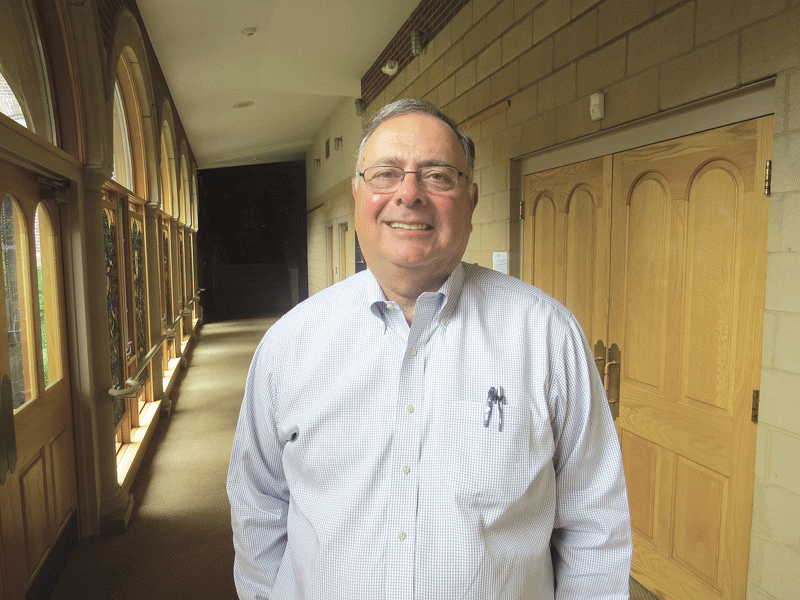
Paul Gagliarducci

Paul Gagliarducci says the unofficial goal for Pope Francis High School is to make it one of the few Catholic facilities that has a waiting list for students wishing to enroll.

Indeed, total Catholic enrollment was 2.42 million for the 2004-’05 school year, less than half what it was 40 years earlier; 2.12 million for ’09-’10; and 1.94 million for ’14-’15, a roughly 20% falloff over a decade. The rate of decline was even more severe for pre-school and K-8. Enrollment for that constituency was 1.8 million for ’04-’05, 1.52 million for ’09-’10, and 1.38 million for ’14-’15, a nearly 25% drop.

There are many reasons for this decline, said Sr. Dale McDonald, PBVM, Ph.D., director of Public Policy and Education Research for the NCEA, who cited everything from the recession that came near the middle of this statistical period, to a sharp drop in the number of priests and nuns who once taught in Catholic schools, to the financial woes facing a number of dioceses across the country.

Overall, though, sharply falling enrollment comes down to a continuing decline in the number of people both willing and able to pay the tuition ($9,000 on average nationwide at the high school level, and $3,800 at the elementary school level) for a Catholic education.

Over the past decade, decline in enrollment has averaged between 1.8% and 2.5% per year, and 21% of the schools have closed, McDonald went on, and there is little, if anything, to indicate that this trend will slow, let alone stop.

“Unless we have some serious interventions, enrollment will continue to decline and schools will continue to close,” she said, adding that by interventions, she meant actions that would enable more families to afford those tuition figures mentioned earlier.

Cathedral and Holyoke Catholic have certainly not been immune to these trends. At Cathedral, for example, enrollment was at or near 3,000 in the early ’70s, and stood at merely 400 when the tornado tore across Springfield on June 1, 2011.

The current trends and uncertainly concerning the future certainly played a factor in the lengthy discussion about whether to rebuild Cathedral, where, and how — and also in the preliminary design of the school and projected capacity — roughly 500 students.

That’s about 115 more than the combined enrollment of the two high schools at present, said Gagliarducci, adding that this number reflects both realism and confidence moving forward.

“Looking at the group of freshmen coming in, the class of 2019, has just over 100 students, and that’s a pretty good number,” he said, adding that this is the combined enrollment for both schools, “If we can maintain that 100 to 125 students, and I think we can, we’ll have our 400-500 students and something we can build on.” Such confidence, he went on, stems from everything from the impact of a new facility on those weighing their education options, to efforts to emphasize the value and benefits of a Catholic education.

But making the school accessible to families of all income levels will be crucial, and for this issue and its focus on education, BusinessWest looks at that challenge and how it might be met.

Setting a Course

As he talked about his assignment, the Pope Francis High School project, moving forward, Gagliarducci said that while it doesn’t say as much on any formal or informal job description, his mission is to make the new facility one of those Catholic high schools that actually has a waiting list for enrollment.

Doing so will accomplish many things, he went on, listing everything from fiscal flexibility to greater prestige to long-term sustainability.
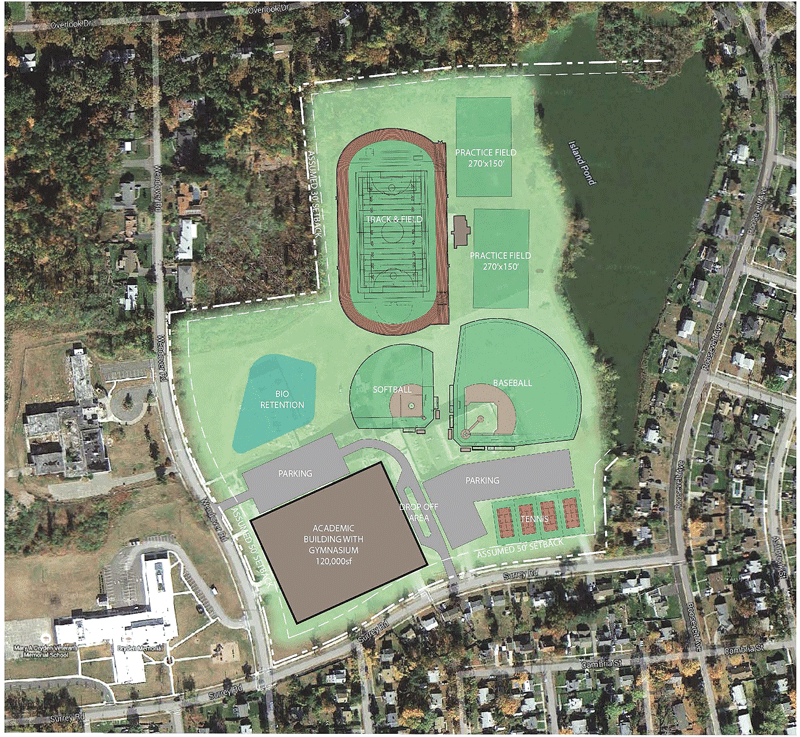
plan for the property on Surrey Road

While designs for the new school are still being finalized, the plan for the property on Surrey Road is coming into focus.

“Right now, people know we want them,” he said, referring to the current, and aggressive, recruiting efforts. “But if we can get to a point where we get 175 to apply and we only take the top 100 to 125, that’s going to bring some competition, and that’s going to be good for us; that’s what our hope is.”

Such an eventuality would have seemed impossible a few years ago, especially after Cathedral was relocated into a shuttered elementary school in Wilbraham months after the tornado — and this scenario still seems like a real stretch of the imagination to many.

But Gagliarducci and others involved with this endeavor believe such a fate is possible, if the school can focus on those two parts of the enrollment equation mentioned earlier, and put more people in those categories of individuals willing and able to pursue a Catholic education for their children.

Essentially, it will come down to the laws of supply and demand, and reversing the picture that has defined the scene both regionally and nationally for years — where demand doesn’t come close to approaching supply.

And that assignment will come down to a host of factors, said Tom Brodnicki, senior partner with Partners in Mission, a consulting firm specializing in Catholic education that has been hired by the diocese to help coordinate the merger of the high schools and raise money for the endowment fund.

He listed listing everything from building a market for Catholic education to growing the endowment so more students can attend; from broadening enrollment among certain demographic groups, such as the Hispanic population (more on that later), to convincing area parents that the sticker price for Pope Francis is a relative bargain; from building what he and others called a “culture of philanthropy” in the region, to convincing parents of the need to start saving early for a Catholic education for their children.

All of those action items would fall into that category of ‘interventions,’ as described by McDonald. The question is whether they will be enough to stem the current tide.

Indeed, creating a waiting list for Pope Francis will certainly be a challenge, said those we spoke with, noting that while there are, in fact, schools where demand exceeds supply (often where the supply has been reduced through a merger), there are many more that are closing their doors or merging with others, as has happened with the Springfield diocese.

Statistics from the NCEA show that while 27 new Catholic schools opened over this past school year, 88 consolidated or closed. And those numbers have become the trend over the past few decades, said McDonald, adding that the rate of closure and consolidation has actually slowed considerably because there are simply fewer schools left to take such steps.

And while the economy and even demographic trends have had something to do with these developments — the decline of many cities in the Rust Belt/Bible Belt has resulted in falling Catholic school enrollments in that traditional stronghold — tuition, the inability to meet it, and the fiscal difficulties that ensue, are the primary reasons.

“As tuition moves higher, fewer people are able to afford it,” McDonald noted. “But schools facing lower enrollment still have expenditures, or operating costs, and many of these costs are fixed or increasing dramatically, such as health insurance for teachers and staff.”

Per-pupil costs generally far exceed tuition and are met through fund-raising efforts by the diocese in question, she went on, adding that there is help available to families facing those tuitions costs ranging from scholarships to tax credits made available in many states.

But the burden is proving too steep for many, especially those families with several children in school at the same time, McDonald noted, adding that, overall, there is little prospect for improvement.

“Without programs that will provide help for families, it’s not a happy forecast in many respects,” she said, “when it comes to the ability of parents to continue to pay the tuition that’s required to have a quality education.”

One of the serious, and ongoing, challenges for those in Catholic education is attracting members of the Hispanic population, said Patricia Weitzel-O’Neill, president of the Barbara and Patrick Roche Center for Catholic Education at Boston College.

Hispanic populations are growing in most urban centers, including Springfield and Holyoke, and, overall, Hispanics comprise roughly 60% of the nation’s Catholic-school-age children (those ages 3 to 18), but only 2.3% of those children are enrolled in Catholic schools.

“This is the crux of the problem in Catholic education today,” she told BusinessWest, adding that there are several reasons behind that statistic, including the fact that many Hispanic parents did not attend Catholic schools, and doing so is not a “part of their culture.” But the inability to meet tuition costs is also a huge factor.

“One of the issues facing Catholic education today is the inability to recognize the need to diversify what we’re doing, to be much more welcoming, and to be more open to introducing and welcoming the second culture and the second language,” she said, adding that there is movement nationally to address the problem.

Crosses to Bear

It was in this environment that the Springfield diocese was forced to make critical decisions after Cathedral was essentially destroyed by the tornado.

And it took all of four years to make most of those decisions, including whether to rebuild, under what circumstances (eventually via a merger with Holyoke Catholic), where to build, and how big to build.

After surveying the landscape and analyzing the data, officials decided to build a 120,000-square-foot school that can handle a population of 500 students. That is a small fraction of the total number of Catholic high school students in this region from a typical year decades ago — and a figure smaller than many alums of those schools think is possible — but it is quite realistic, said Gagliarducci.

“Some people think we should be doing much better — some of the critics said earlier that this area should be able to support four high schools,” he said. “Dream on … that’s just not going to happen.”

But Gagliarducci stressed that the facility can, and hopefully will, be expanded to accommodate more students in the future.

Facilities such as the auditorium, gymnasium, and cafeteria are being designed for closer to 700 students, he went on, adding that they cannot be expanded later, and thus must be built accordingly. But additional classrooms and facilities can be added later.
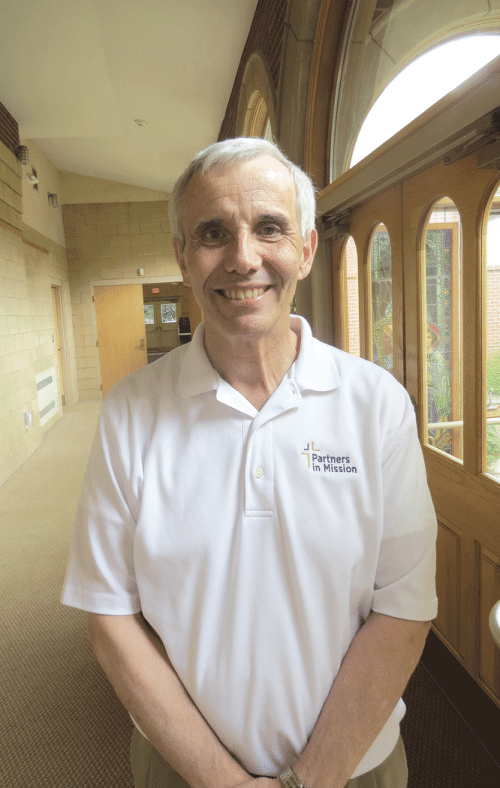
Tom Brodnicki

Tom Brodnicki says that one challenge for the diocese is to convince parents that their tuitions costs are a sound investment.

When asked how the diocese intends to arrive at the point where Pope Francis will need to be expanded, Gagliarducci and Brodnicki went back to the laws of supply and demand.

By building a first-class facility — not only a new building, but one outfitted with the latest technology and offering attractive programs of study — they hope to build demand. And it will take more than a new structure, because several area communities, including Longmeadow, West Springfield, Wilbraham (Minnechaug), and Chicopee (two facilities) have opened new state-of-the-art high schools in the past decade.

“The key is to develop a program that parents can get excited about,” Gagliarducci explained. “But ultimately, if I’m deciding as a parent to send my child to Pope Francis High School, I’m doing so because I believe in a strong religious education for my kids, so that has to be the paramount thing that’s going to attract people.

“But then you have to follow that up with a rich academic program,” he went on, “one where, at the end of four years, students are getting into the college of their choice; that’s very important.”

By growing an endowment, meanwhile, they intend to increase accessibility. Also, with economies of scale gained through the merger, they expect Pope Francis to be an efficient operation, one better suited to manage through the time it will take to build the endowment and grow enrollment.

“We believe that with the new facility and some of the excitement that it builds — along with this endowment fund, which will help with the affordability factor for some families — that a school with a projected enrollment of 500 is within reason,” said Brodnicki. “The real key is the level of academic excellence that’s provided, and convincing people that they are making a valuable investment in their children’s future.”

Elaborating, Brodnicki and Gagliarducci said Catholic education has not gone out of favor — it has simply become a less-appealing option for many families due to its cost.

The initial goal for the endowment, set by Bishop Timothy McDonnell, who retired last year, was $10 million. But Gagliarducci and Brodnicki want to set the bar higher to broaden accessibility and therefore meet demand.

Approximately one third of the 200 students now attending Cathedral receive a substantial amount of financial assistance to attend, said Brodnicki, adding that a large endowment and other forms of philanthropy will enable more low-income families to attend the school.

But to achieve sustainability, the new school must be able to attract students across all income levels, said Gagliarducci, adding that the goal is to continue the current breakdown — where roughly one third of the students pay full tuition, another third get some support, and the rest get substantial assistance — only with a larger student population.

Building Momentum

Surveying the national Catholic education scene, Brodnicki, who has had a front row seat to the changing landscape and has worked in a number of major metropolitan areas, said most cities are experiencing declines consistent with the statistics quoted by McDonald.

The Boston area is a notable exception, he added quickly, noting that most Catholic schools there are thriving, in part because the economy is more robust, but more so because of strong philanthropic support from wealthy individuals, many of whom are graduates of those schools and now serve on their boards of trustees.

“A few things happened in Boston,” said Brodnicki. “First, the economy took off; second, there is incredible wealth and a strong tradition of philanthropy. There are a number of Catholic individuals who have come together and made a firm commitment to Catholic education, especially the inner-city schools.”

The Western Mass. Catholic community can’t expect to approach that level of support, he went on, but it can — and, in essence, must — build a stronger base of philanthropic generosity if it hopes to create a sustainable Catholic education system.

And he said Cathedral, and to a lesser extent Holyoke Catholic, has a large alumni base, with many individuals in a position to provide support. The diocese must be more aggressive in reaching out to alums and making its case for support, he went on.

“Cathedral has a reputation for having many well-known graduates who have achieved wealth,” Brodnicki explained. “We’re going to go and visit those folks and lay out the case for support.”

While building a stronger base of support through its endowment and other forms of philanthropy, the Springfield diocese must also more aggressively promote Catholic education and convince current young parents, as well as those that will follow them, that it is a viable option and worthwhile investment.

Part of this equation involves making Catholic education more of a K-12 phenomenon, said those we spoke with, who again cited the more-rapid rate of enrollment decline at the elementary school level.

Springfield is a good example of that trend; not long ago there were five Catholic elementary schools in the city, but by the time the tornado touched down, they had been merged into one — St. Michael’s Academy.

Meanwhile, the diocese, as it goes about selling the new high school, must also sell a Catholic education, and this one in particular, as an investment, rather than as an expense that must somehow be met.

“People often view that $9,000 as tuition, not necessarily as an investment, Brodnicki explained. “We have to show someone who’s looking at spending $40,000 on their child’s education that, on average, graduates of Cathedral and Holyoke Catholic are receiving scholarship opportunities that average in the $80,000 to $90,000 range; people have essentially doubled their money in four years. Give me a stock that will do that, and I’m all over it.”

Grade Expectations

How well Gagliarducci, Brodnicki, and the diocese fare with the many aspects of the Pope Francis High School project remains to be seen. With some elements of the equation, such as the endowment, real progress may not be realized for years.

One thing that all agree on, though, is that given the many changes and challenges confronting those in Catholic education today, this will certainly be a stern test.

Ultimately, though, they believe this is a test they can, and will, pass.

George O’Brien can be reached at [email protected]

Education Sections

Life Lessons

Vincent Maniaci

Vincent Maniaci says AIC has a three-pronged plan for growth that includes programs to help students become prepared to enter the workforce.

American International College President Vincent Maniaci has been studying the booklet for weeks.

It contains quick snapshots of each member of the incoming freshmen class. His goal is to commit them all to memory so he can greet every student by name when classes begin this fall. Although it’s a small measure, Maniaci believes it’s important for him to make students feel special, especially since 44% of the student population is aiming to become first-generation college graduates.

“We try to get to know our students on a personal basis, and first- generation students always struggle more than those who come from an affluent background and have parents who have gone to college,” Maniaci explained, adding that understanding a student’s history helps staff give advice that is pertinent to each individual’s situation and aspirations.

Susanne Swanker agrees, and told BusinessWest that AIC has been successful in developing a sense of community between staff and students.

“It’s uncommon to walk anywhere on campus without having people greet you,” said the school’s acting chief academic officer and dean of the School of Business, Arts and Sciences. “It doesn’t matter whether you know them or not; it’s part of a culture in which everyone is supported and encouraged to do their best.”

That culture has been carefully cultivated by Maniaci and stems from his personal experience. Indeed, his path to success differs greatly from most people in his position, and he said it has made him aware of the importance of providing students with exposure and access to college, as well as what it takes to keep them there.

“I come from a blue collar background and had no plans to attend college; it was very alien to me,” he said, adding that no one in his family had a college degree and the only reason he enrolled at City College of San Francisco, a community college, was because he and a friend wanted to continue playing football after they graduated from high school.

So he signed up for courses, but didn’t attend a single class and had no plans to do so until he injured his knee during the third game of the season. At that point, Maniaci realized that the only way he could continue interacting with other team members was to show up for class.

“I’ve always been competitive, and once I started I did well,” he said, as he outlined the rest of his educational career.

But he will never forget his first day on campus.

“Adjusting to the environment is especially difficult for students from socio-economic backgrounds where college attendance is not a given,” he said, explaining how intimidated he felt when other students began quoting famous people he had never heard of.

Today he believes that mixing students from different backgrounds adds depth to the curriculum and helps prepare them for the world of work.

“The diversity that results from a population with mixed backgrounds is one of our strengths; we’re very student-centric and believe a college education is more than academic and intellectual growth,” he noted. “It includes personal, spiritual and professional development entwined with emotional intelligence, which takes place both inside and outside of the classroom. We all see things through a different prism based on the environment we come from, so being culturally diverse leads to deeper discussions.”

Course of Action

AIC has a strategic plan for growth that is focused on three areas, said Maniaci.

“Our first goal is to build the demand curve — we need to give parents and students a better reason to come here, give them a reason to borrow money or pay out of pocket for schooling; education is expensive, and they need to know what the return on their investment will be,” he explained, adding that students and their families need to understand that in addition to the fact that college graduates earn $1 million more over their lifetime than non-graduates, valuable lessons result from dealing with social, interpersonal, or political issues on campus.

The second pillar of the plan is to increase capacity, an initiative that runs the gamut, from the quality of the dining experience to student safety and course offerings, while the third component is to identify new programs that would benefit students.

“The world is changing so quickly that it’s important to identify future trends as we develop new programming,” Maniaci said.

Susanne Swanker says AIC’s new master’s program in Resort and Casino Management will help individuals take full advantage of opportunities in that industry.

Susanne Swanker says AIC’s new master’s program in Resort and Casino Management will help individuals take full advantage of opportunities in that industry.

Initiatives have been established to meet these goals, and for the past two years Dean of Students Brian O’Shaughnessy has worked closely with his staff to make sure that what is taught in the classroom correlates to students’ outside activities, something he said employers are looking for.

To that end, AIC also has a new four-year career-development program. Students in the federal work-study program, which comprise the majority of the population, apply for positions on campus during their first semester by working with career development staff members who help them to create a preliminary resume and teach them interviewing skills. Students receive assistance in applying for campus positions suited to their interests or major.

“In the past, students walked into different departments and asked if there were any job openings,” O’Shaughnessy said, adding that they are also bridging classroom connections by inviting underclassmen to attend sessions in their residence halls on topics such as using social media as a tool to market themselves, while upperclassmen are offered classroom presentations specific to their field of study.

The way housing is assigned has also changed, and the assumption that seniors are entitled to better options is not the rule of thumb. Every freshman on campus lives in a residence hall with a roommate and shares experiences and common spaces, including bathrooms.

“If they develop a sense of community and pride in their residence hall and feel safe and secure, it reduces the likelihood of damage or student-on-student crime,” O’Shaughnessy told BusinessWest, adding that for some students, feeling pride in the place they live in is a new concept.

During their sophomore or junior year, students can move into a suite which gives them more space. “A bathroom might be shared by four people instead of 30,” O’Shaughnessy said. “And seniors are eligible for full kitchens which provide them with opportunities to shop and maintain a household.”

Each student is also assigned a professional academic advisor who works with them during their freshman and sophomore years. They are experts in the college’s shared general-education requirements, which is helpful because many aren’t sure about what they want to major in. Swanker said they transition to a faculty advisor in their field of study during their junior year, a model adopted in 2013 that helps them focus on specifics that will help them find employment.

She added that the support they receive is especially important to first-generation college students who are highly motivated but often under a great deal of pressure if their family has invested everything they have into their education.

There is also a Center for Student Engagement and Leadership Develop-ment linked to clubs and organizations on campus.

“I tell all incoming freshmen that what they are learning is not specific to textbooks,” said O’Shaughnessy. “They’re learning how to think critically and solve problems whether they are a member of a club, dealing with an issue with their roommate, or in a leadership role on campus. We also stress that the skills they learn here can be applied to careers that haven’t even been invented yet.”

And since AIC works to respond to student’s individual needs, a number of new programs have been added to its Center for Academic Success. Today, they include the ACE (AIC Core Education) Program, a federally-funded initiative for first-generation college students as well as those with limited financial means. Services range from personal mentoring to academic support, career counseling, disability referral services, financial aid assistance, graduate school preparation, and specialized workshops and activities.

AIC also has a Supportive Learning Services program, which operates under the umbrella of its Curtis Blake Learning Services. It’s a fee-based program that provides students with one-on-one tutorial assistance to help with goal-setting, note-taking, time management, study skills, test taking, written expression, and self-advocacy.

Keeping Pace With the Times

Over the past few years, AIC has developed a number of new majors, and last November, officials finalized a decision to create a master’s degree program in Resort and Casino Management. Although it had been talked about when casino legislation was passed in 2011, Swanker said the school waited until voters cast ballots last November that ensured casinos would become a reality.

“The program will start this fall, and include courses in business specific to resort and casino management,” she said. “We’ve worked with executives at MGM to review the curriculum and make sure we’re covering topics that are relevant. We see career possibilities for graduates locally and in the region.”

Meanwhile, seven students were awarded a bachelor of science degree in Public Health for the first time during the commencement ceremonies in May.

“It’s a new, four-year program. We started it two years ago, but had some transfer students move into the major,” Swanker explained, adding that graduates have a wealth of opportunities in the growing healthcare field.

Another new offering is a graduate Family Nurse Practitioner degree. “We launched the program last fall; it’s very exciting because it’s an area of tremendous growth relevant to the direction in which healthcare professions are moving,” she continued.

AIC’s doctorate in Physical Therapy program also continues to thrive, and enrollment in its master’s program in Occupational Therapy is growing, thanks to its excellent reputation and the increase in students interested in health services.

Swanker said people employed in that field typically take part in team meetings that address specifics to a patient, so to prepare them for that aspect of a job, AIC began holding day-long workshops two years ago to mirror what they will experience when they begin their clinical rotations.

There are also new undergraduate majors, and last year a Visual and Digital Arts degree was offered for the first time. “It allows students with an artistic bent to combine their interest with technology,” Swanker said. “It was something that was missing because we didn’t have a major for people interested in the arts.”

Some students in the program are minoring in business or taking a double major in both fields, which will be beneficial if they want to run a small theater or an art gallery.

“The beauty of this degree is that it can be tailored to a student’s interests, because it includes writing, directing, acting and costume design. It has increased our enrollment and we have students coming here just for this major,” Swanker said.

Another new offering is a minor in Fraud and Financial Crime, which includes courses in criminal justice and accounting. “Students can take an exam when they complete the course and become certified in the field, which increases their chances for employment,” Swanker said.

Forging Ahead

Ground was broken in May on an $8 million renovation to the dining commons. The new, state-of-the-art space will include a wide variety of seating options as well as food choices and services, including customized preparation, an open concept kitchen with a Mongolian grill, a wood-fired pizza oven, and more.

“The dining commons is an important student and academic hub on campus,” Maniaci told BusinessWest. “The new facility will give students a more comfortable and modern place to come together and was designed to serve their needs and expectations.”

It’s part of a larger effort to create a campus that caters to the needs of students today, and will enhance the new programs that are helping students succeed and integrate lessons they learn inside and outside of the classroom.

“We’re teaching them that everything they do here can play a role in their future career, which ranges from how they present themselves to how they speak or how they conduct themselves as a member or leader of an organization on campus,” O’Shaughnessy explained in summation.

The changes have all been positive, and Maniaci is optimistic about the future. This sentiment is backed by facts: The Chronicle of Higher Education named AIC as one of the fastest-growing colleges from 2002-2012, due to a growth rate of 127%, which more than doubled their enrollment in ten years.

And the upward trajectory is expected to continue, thanks to the welcoming culture and the efforts to create new programs and majors that meet the changing needs of students today.

“I expect to make as much progress in the next 10 years as we’ve made in the last decade,” Maniaci said.

Departments Picture This

Send photos with a caption and contact information to: ‘Picture This’ c/o BusinessWest Magazine, 1441 Main Street, Springfield, MA 01103 or to [email protected]

Capital Contributions

Balise Donation GroupCancer-Center Steelworkers Donor GroupTransforming Cancer Care — the Capital Campaign for the Sister Caritas Cancer Center — gained some additional momentum recently with two donations — one of $500,000 from Balise Motor Sales, and $5,000 from the International Assoc. of Iron Workers Local 7. The cancer center is in the midst of a $15 million expansion that will bring all cancer services together in one location and meet increasing demand for outpatient cancer services. At top (from left), Philip Glynn, MD, director of Oncology, Mercy Medical Center; Mohamed P. Hamdani, MD, chair of the Cancer Center Capital Campaign; Jeb Balise, CEO of Balise Motor Sales; Mike Balise, Vice President of Balise Motor Sales; and Daniel P. Moen, President and CEO, SPHS. Bottom, Moen thanks Fiore Grassetti (second from right) for the local’s donation. Also pictured are Diane Dukette, vice president of Fund Development for the SPHS, and Daniel Keenan, senior vice president of Government and Community Service.

Celebrating Community Day

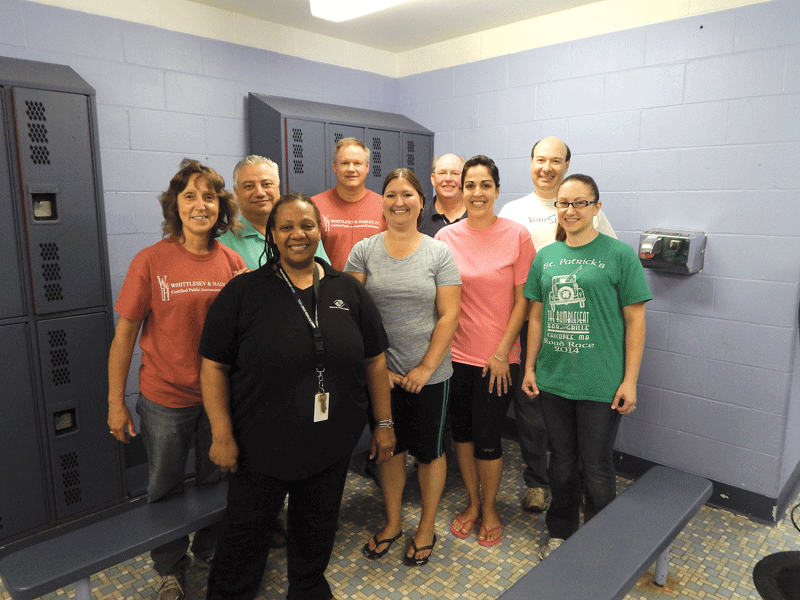
Whittlesey&HadleyThe accounting firm Whittlesey & Hadley, P.C., hosted its 7th annual Community Day on July 10. This year, employees of the firm and its subsidiary, The Technology Group LLC, reached out in the Greater Hartford area and Springfield, and devoted their time and talents to community-based organizations primarily focused on providing academic, behavioral, and human services to the disabled and families and children. Here, employees are seen at the Boys & Girls Club Family Center on Acorn Street in Springfield, where they painted the boys and girls locker rooms. Seen here are: (front row, from left), Linda Wosko, O’Rita Swan, executive director of the Boys & Girls Club, Amy Richards, Danielle Dupont, and Lisa Zunis. (Second row, from left): Drew Andrews, managing partner of Whittlesey & Hadley, Michael Flaherty, Tim Gaines, and Peter Kravetz.

Coming to Springfield

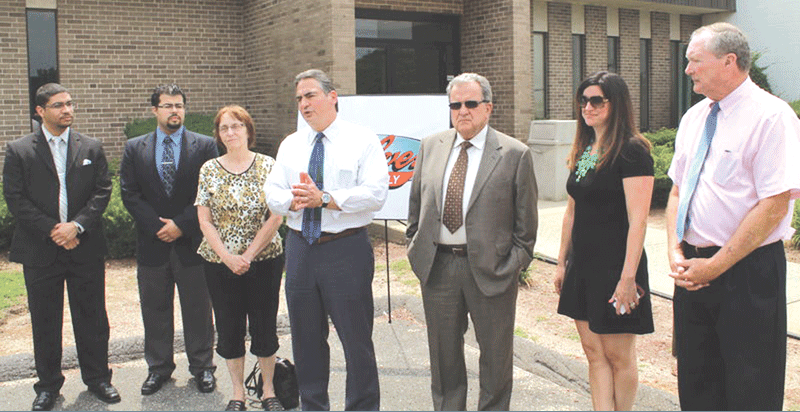
df861e3d99The City of Springfield and Falvey Linen Supply Inc. recently announced a plan for the Rhode Island company to open a new Springfield facility at 100 Brookdale Dr. in the East Springfield neighborhood, with an expected investment of $7 million and the creation of more than 100 new jobs. Falvey Linen Supply is based in Cranston, R.I., with facilities in the Hartford area as well as Eastern Massachusetts. The family owned and operated company was founded in 1929.  Seen here at a press conference to announce the expansion are, from left, Springfield City Councilor Orlando Ramos; Ernesto Cruz, aide to State Rep. Jose Tosado; Kathy Brown, East Springfield Neighborhood Council; Mayor Domenic J. Sarno; James O’Hara, president of Falvey Linen; Kait O’Hara, manager of Falvey Linen; and Kevin Kennedy, Springfield’s chief development officer.

Raymond James Open House

Ribbon CuttingOn July 16, Raymond James staged an open house for clients and local dignitaries at its offices in Tower Square in downtown Springfield. Speakers included Tash Elwyn, president of Raymond James & Associates (RJA) Private Client Group, Jay Minkarah, president and CEO of DevelopSpringfield, and Vincent Petrangelo, Raymond James’ Springfield branch manager. Here, from left, Elwyn, Petrangelo, and Minkarah cut the ceremonial ribbon.

Scholarship Winners

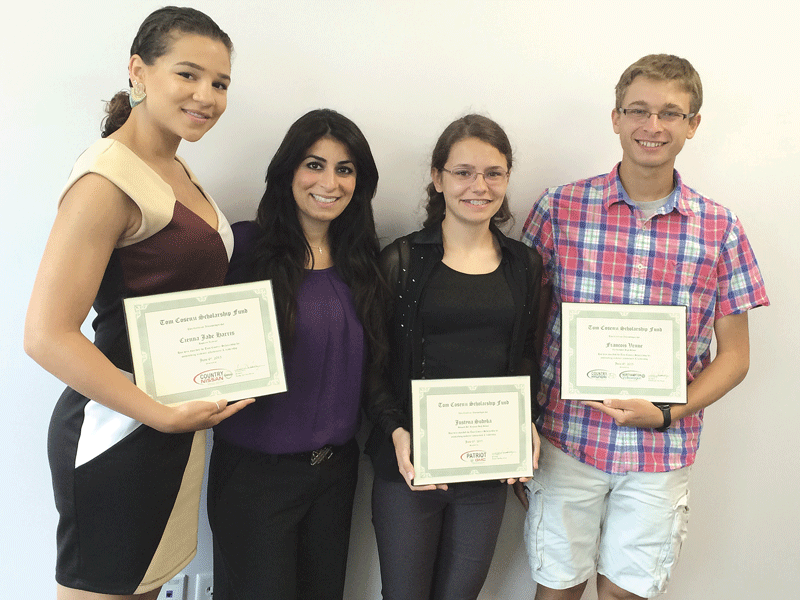
CosenziThe Tom Cosenzi Scholarship recently announced the three students that each received the $1,000 scholarship for demonstrating excellence in the classroom. The winners of the award, established in memory of Thomas E. Cosenzi, are (from left, as seen with Thomas Cosenzi’s daughter, Carla): Cienna Harris, a senior at Hopkins Academy who will be attending Salve Regina University; Justyna Sudyka, a senior at Shepard Hill Regional High School, who will attend the University of Connecticut; and Francois Venne, a senior at Northampton high School, who will attend Holy Cross.

Daily News

AGAWAM — Environmental Compliance Services Inc. (ECS) announced that Stuart Kirshner has joined the firm as health and safety manager.

Kirshner has more than 18 years of experience in the environmental and safety sectors. His key skills include environmental health and safety (EHS) management program development, implementation, and administration. He applies compliance-enforcement policies through motivation, training, and process control, and his collaborative leadership style promotes team building, engagement, and a compliance culture.

In his capacity as ECS’ health and safety manager, Kirshner is responsible for occupational safety and health for 25 office locations in 11 states, as well as enhancement of the firm’s safety culture through motivation and engagement of the workforce. His initial tasks include collaborating with the firm’s Information Technology department to redevelop the existing environmental health and safety program into a computer-based management system. He is also integrating EHS processes into the business-process-management system.

Kirshner holds a bachelor’s degree in environmental management, as well as an undergraduate certificate for project management. He is a certified hazardous materials manager and a combat life saver certified by the U.S. Army.

Daily News

MCLEAN, Va. — U.S. manufacturing technology orders totaled $336.98 million in May, according to the Assoc. for Manufacturing Technology (AMT). This total, as reported by companies participating in the U.S. Manufacturing Technology Orders (USMTO) program, was down 13.2% from April’s $388.43 million and down 6.2% when compared with the total of $359.28 million reported for May 2014.

With a year-to-date total of $1,798.34 million, 2015 was down 7.9% when compared with 2014. These numbers and all data in the report are based on the totals of actual data reported by companies participating in the USMTO program.

“In large part, the decline in manufacturing technology orders is due to smaller manufacturers feeling a sense of economic uncertainty and therefore hesitant to make any kind of capital investment,” said AMT President Douglas Woods. “In addition, the energy industry has curbed its spending, accounting for about half of the year-to-date decline in orders, and aerospace did not perform as well as expected in the first quarter. We expect the downturn to ease thanks to strong performance in the automotive and medical industries, with industrial production and a stronger PMI also indicating resilience in manufacturing.”

The USMTO report, compiled by the trade association representing the production and distribution of manufacturing technology, provides regional and national U.S. orders data of domestic and imported machine tools and related equipment. Analysis of manufacturing technology orders provides a reliable leading economic indicator as manufacturing industries invest in capital metal-working equipment to increase capacity and improve productivity.

Banking and Financial Services Sections
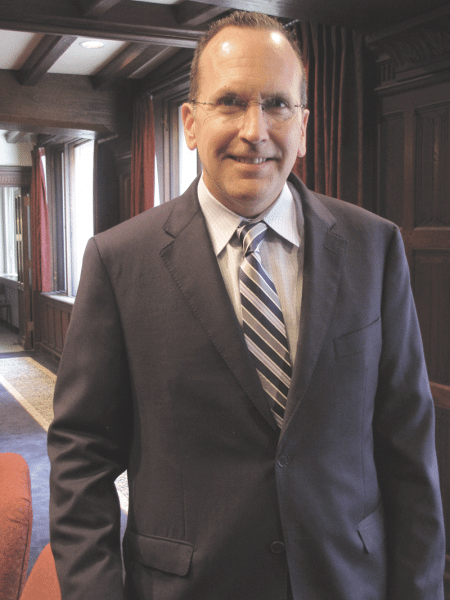
David Hobert Brings Local Focus to People’s United Bank
David Hobert

David Hobert says the bank can’t be all things to all people, but adds value in insurance, wealth management, and other products.

David Hobert has deep roots in Western Mass. and a broad palette of banking experience. His new role allows him to put both to good use.

“I started as a teller for Westbank on Main Street in Holyoke in 1983,” he said, recounting the start of a career that took him to some of the region’s largest institutions over the past 30 years — currently as regional president of People’s United Bank, a position he accepted in February.

“I wanted to come back to my roots a little bit,” the long-time Longmeadow resident told BusinessWest, noting that his previous role was as executive director for Santander Bank’s global-banking business. “I missed the connection to the community, and the travel was quite extensive, and I felt I was ready to get off the airplane and get back in the car for the short drive to Springfield.”

In fact, from 2009 through last year, Hobert focused on Fortune 100 telecommunications, media, and technology companies for Santander. “I spent more than five years building that business, but one of the things I really missed was my roots and working in the community. But I stayed in touch with some of the local leaders in banking, seeking an opportunity to eventually manage a regional bank. Then this opportunity came up in January, and here I am.”

In that role, Hobert replaces the recently retired Tim Crimmins, who launched the Bank of Western Massachusetts in 1987 — just before the onset of a crippling recession — and grew it into a regional commercial-lending power, one that was acquired by Chittenden Bank in 1995 and then again by People’s United Bank in 2008. Today, it’s part of a $36 billion institution with more than 400 branches in Massachusetts, Connecticut, New York, Vermont, New Hampshire, and Maine.

That’s regional clout the old Bank of Western Massachusetts couldn’t match, but Hobert’s challenge is marrying that lending power with a strong community focus.

“I’m managing the commercial-banking business, working closely with our retail business to grow our market share, and working with the community through our foundation and sponsorships,” he said by way of explaining his day-to-day job. “The main thing, really, is just making sure that our clients, many of whom we’ve had for a long time, continue to get the best service and are offered the best product variety possible.”

For this issue’s focus on banking and financial services, BusinessWest sat down with Hobert in his downtown Springfield office to talk about how he plans to do that, and why he’s bullish on the future of the region he has long called home.

The Road Home

After five years in a number of roles at Westbank in the 1980s, Hobert moved to Citytrust Bank in Bridgeport, Conn., managing its workout business for Hartford, New Haven, Norwalk, and Stamford for three years. Then, in 1991, the graduate of Western New England College had the opportunity to move back to this region when he was hired by BayBank in a similar role.

He eventually started handling new loan business for BayBank and Bank of Boston; when those institutions merged, he was appointed team leader in Springfield and, when Sovereign Bank later bought the vested assets of Bank of Boston and Fleet Bank, Hobert became head of corporate banking for the Western Mass. region, before moving on to Santander in 2009 and, eventually, to his new role at People’s United.

He assumes regional leadership with a bank that reported a 12% earnings increase in its first quarter of 2015 compared to a year ago. “We’ve reported five consecutive years of operating-earnings growth — and in a very difficult time, when we’re coming out of a recession,” he said. “So that, in and of itself, is evidence that the business model continues to work, and work well.”

The bank’s client base is business banking and middle-market companies, most of which borrow anywhere from $100,000 to $10 million, although a few clients are larger. But Hobert stressed that the bank has always kept the lending window open to small businesses, a philosophy shared by Crimmins when he launched his enterprise in 1987 with partner Frank Fitzgerald, and by Chittenden Bank, which later purchased it.

“If you look back through the history of Chittenden, when the bank started in Bridgeport, they served middle-class people, while other banks were serving middle-market commercial customers,” Hobert explained. “So, from day one, right through the Chittenden acquisition and to date, our main business has been small business, middle-market business, and the consumer.”

To that end, customer service has always been paramount, he said. “Obviously, it’s a competitive market from a pricing standpoint; that’s no secret — and I believe the market is overbanked. So the way you maintain and grow your client base is by having consistent, excellent service and offering added-value products.”

Those include treasury management and the People’s United Insurance Co., which offers property, casualty, and workers’ compensation products.

“And then we have a strong wealth-management division with a long, proven track record, that focuses on both individual and institutional investment management. That’s an area where we’ve had some recent success and growth. Our wealth management, I think, is as good an offering as any bank in our footprint.

“Again,” Hobert said, “it all comes back to the people and the product. We don’t want to be all things to all people, but where we can add value, that’s where we want to focus our time, playing an advisory role for our clients.”

Street Level

It would be easy for a large bank to lose its focus on individual communities, but Hobert said People’s United’s CEO, Jack Barnes, emphasizes a street-level focus from the top down.

“The values we want to bring are, we want to offer empathy and expertise to our customers, we want to be a good corporate citizen in the community, and we want to understand the knowhow and growth potential of our employees,” Hobert said. “If we do those three things right, we can continue what was started 170-plus years ago in Bridgeport. Those are principles the bank has operated by for some time, and I believe they’re simple to follow, and, if you do them well, clients will stay with you.”

That community focus extends to the bank’s commitment to philanthropy, he went on. “Community development, youth development, and affordable housing are the three areas we focus on through our community foundation; then, separate from that are all the sponsorships we support. We provided more than $700,000 in support last year through a combination of the community foundation and sponsorships in Western Massachusetts, and we’ll continue to do that.”

In fact, the bank strives to support nonprofits in its business dealings as well. “I’d say that, in Massachusetts, we’re definitely one of the leaders in terms of nonprofit lending, which includes all the colleges and healthcare,” Hobert said. “They’re a large part of the community — important assets in the community — and they have the same needs as a for-profit business when it comes to capital.”

The fact that business borrowing is on the upswing among both for-profit and nonprofit companies is encouraging to Hobert, who credits factors like the flat organizational structure favored by Barnes and the bank’s geographically focused regional lending teams with growing and retaining business. And while People’s United has expanded through acquisition in the past, Hobert sees plenty of opportunities to grow within the bank’s current footprint — however overbanked it may be.

“Right now, we’re focused on organic growth,” he said, “but if the right acquisition surfaces in our targeted markets, we would consider that.”

For now, he’s happy to be the regional face of People’s United, especially at a time when the region is showing signs of economic life.

“Locally, I’m positive about what’s going on in our region,” Hobert said, noting developments such as Changchun Railway Vehicles’ investment in the city and vacancy rates in the downtown towers as low as they’ve been in years. “I think the biggest impediments companies face right now if the workforce. The demand is there for our local customers, but we need to work through our workforce-development programs to develop the skill sets in the region to fill these positions. But overall, I am upbeat on where things are going.”

As Tim Crimmins used to say, the lending window is open.

Joseph Bednar can be reached at [email protected]

Sections Technology
IT Industry Confronts a Perplexing Shortage of Workers

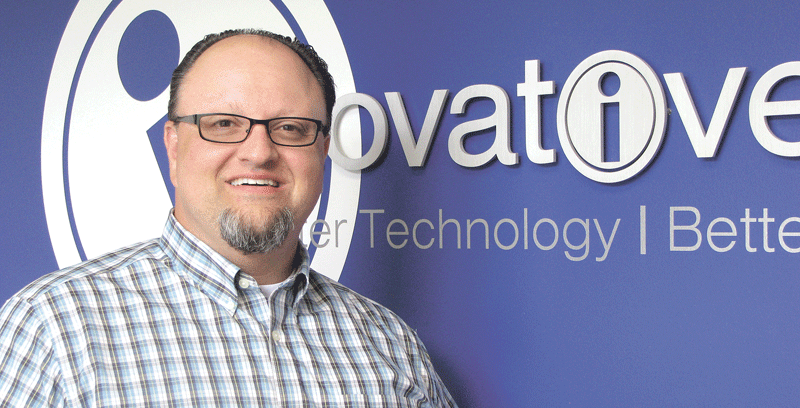
Dave DelVecchio

Dave DelVecchio says technical skill is important in a prospective employee, but so is a willingness and desire to learn new things.


Around the turn of the millennium, when dot-com startups were riding high, computer science was an attractive career option for college students choosing majors. Ironically, however, although technology has become even more pervasive in daily life over the past 15 years, the number of people entering the IT field has plummeted, slowing growth at high-tech companies that would be expanding faster if they could only find the talent. The key, industry leaders say, is working together to reignite interest in what remains a well-paying, in-demand, often exciting field.

As a mechanical-engineering major in college, Joel Mollison didn’t expect to one day own a successful computer-services business. But then he taught himself computer repair, which — along with his growing distaste for his chosen major — led him to change direction, and eventually launch what’s now known as Northeast IT in West Springfield.

That means he’s always looking for people like him, who at some point discover a love for computers and information technology and are skilled at it. But finding those people has not been easy.

“Technology encompasses such a vast range of jobs,” he told BusinessWest. “Programmers and coders are a completely separate thing from people who do what we do, providing managed services, managing people’s networks … and that’s totally different from, say, web design.”

By all accounts, opportunities in those fields and many others in the IT realm are only growing. Yet, at the same time, the number of young people graduating from college with the necessary skills to succeed in IT is falling.

Indeed, according to Code.org, a national nonprofit dedicated to expanding participation in computer science, by 2020, the U.S. will have 1.4 million computing jobs available, but only 400,000 computer-science graduates available to fill them.

That’s a reflection of two colliding trends, the organization notes. As computers increasingly run virtually every facet of our lives, fewer college students are choosing to major in computer science. Specifically, 60% of all jobs in the broad realm of math and science have a computing element, but only 2.4% of all college students majoring in a math or science field are choosing computer science.

“We’ve absolutely been dealing with this for the last five years, and the problem will only get worse before it gets better. In general, we need a lot more folks than there are out there,” Mollison said. “There are a lot of different facets to IT, and each requires its own unique skill set, although there is some overlap. To be a professional in any of these sectors, you need to possess a vast range of knowledge.”

Dave DelVecchio, president of Innovative Business Systems in Easthampton, has experienced the same struggle.

“The pool of qualified talent is not deep enough to provide the exact mix of talent we need,” he said. “Typically, we somebody to come to the table and demonstrate they have the ability to learn — someone with good, broad-based knowledge to draw from, but also a desire and willingness to learn new things.”

Delcie Bean IV, president of Paragus Strategic IT in Hadley, understands the scope of the national problem, but also how it affects his firm, one of the country’s fastest-growing IT companies, on a daily basis.

“Being a top-paying career and the second-fastest-growing career, it’s absolutely the right career to be in, but fewer people are graduating today than 10 years ago; interest is actually shrinking,” he said. “And when we talk about where women and people of color fit in, it’s abysmal.”

He cited statistics from Code.org noting that women, who claim 57% of all bachelor’s degrees, earn just 12% of all computer-science degrees. Meanwhile, at the high-school level, 3.6 million students take the advanced-placement computer-science exam, but only 3,000 of those seats are occupied by African-American and Hispanic students.

Combined, all these numbers tell Bean there’s plenty of untapped potential to draw students of all demographics into an IT field that desperately needs them.

“Paragus, at any given time, has four to eight open positions,” he noted. “Every open position represents an opportunity lost, because every employee has ROI and generates profit. If a position isn’t filled, that’s profit we’re not capturing.”

The net effect is that a company that has been growing at 25% to 30% per year could be growing at 45% to 50% if the talent gap wasn’t an issue and Paragus could hire whenever it wanted to.

For this issue and its focus on technology, BusinessWest examines some of the reasons behind a drought of IT workers that could become critical in the next decade — and what both public- and private-sector entities are doing about it.

Digital World

It’s ironic, Mollison said, that the more people rely on high-tech devices to run their lives, fewer young people are interested in computer science as a career.

“Everything runs on computers now,” he noted. “Because of that, there’s a wide array of services, a wide array of products out there. Career opportunities are growing exponentially, and there are not enough people out there with the experience to fill those gaps.”

Thinking back to his college days 15 years ago, Mollison recalled there were a lot of people entering the IT field drawn by the promise of making a lot of money in an exciting, fast-growing field. It’s a different time, though, and Millennials are known for following their passions, not necessarily just a paycheck.

“If you don’t have a true passion for IT, if you’re not exposed to it at a young age, and if the desire isn’t there to begin with, I think a lot of people may be overwhelmed by the time they reach high school and college, and are figuring out what they want to do with the rest of their lives,” he said. “The tech field can be a bit overwhelming if you’re not absolutely sure that’s where you want to be.”

With the goal of increasing exposure to computer science at an early age, Bean serves on the advisory board of the Massachusetts Computing Attainment Network, or MassCAN, which has developed a set of standards, now being considered by the state Board of Elementary and Secondary Education, for making computer science part of the K-12 curriculum.

Joel Mollison

Joel Mollison says young people often don’t grasp the sheer breadth of career opportunities available in IT.

“We really thought about what kindergartners should learn, what eighth-graders should know, what high-school graduates in the Commonwealth should be able to do in computer science,” he explained. “It’s as much a way of thinking as anything else. We’re not just talking about specific technology skills; what’s needed is critical thinking, troubleshooting, problem resolution, abstraction — traits that are of value in whatever industry you go into. If someone is an amazing critical thinker, I can teach them IT.”

The standards would likely be recommendations to start, Bean said, “but if they were to make it mandatory, it would put Massachusetts ahead of the curve in graduating some of the best talent from the K-12 system. And we’re already known for our higher-education system.”

Training young people in computer science is something Bean takes seriously, which is why he launched Tech Foundry last year. The Springfield-based nonprofit, which trains promising students to enter well-paying IT jobs right out of high school, recently graduated its first class of 24 participants.

DelVecchio sees, in the promise of Tech Foundry, echoes of Javanet back in the mid-’90s. A locally based Internet service provider, that company was later acquired by RCN, a large, regional player, which created large numbers of entry-level positions in its call center and support services, providing opportunities to work in the IT field when interest in such careers was peaking.

Then, “when RCN decided to move its call center to Pennsylvania, all those folks scattered to the wind — but many of them ended up pursuing a career in IT,” DelVecchio said. “We’ve got four people who have RCN on their résumé.”

In fact, he went on, many local IT companies were seeded with those former RCN workers, who have moved up to management-level positions. A decade or so down the road, DelVecchio hopes a vibrant IT industry in the Valley will be similarly peppered with Tech Foundry graduates. “You might not see the impact this year, but it will benefit the region 15 years from now.”

Bean certainly hopes his brainchild has such an impact, because it’s not just small computer firms that crave IT talent, but some of the region’s largest employers.

“It’s a huge problem with a national impact. Look at MassMutual. Look at Baystate. If they don’t have good tech employees, that’s a problem for them — and a problem for everyone.” Many companies, he added, have experimented with outsourced or even offshore IT services, but find that in-house talent is more efficient and produces better return on investment.

But the talent lag has everyone struggling to meet those needs.

“All we’re doing is shifting people from one company to the next,” Bean said. “There’s a lot of poaching going on — giving someone a raise to be your employee. We all have to do a little bit of that to survive, because the talent pool isn’t wide enough. But it’s not good for the region.”

High-tech, High-touch

When Bean and others talk about IT skills, however, they’re not thinking only about the inner workings of computer hardware and software, but also about ‘soft skills’ — in particular, communication skills — so critical to today’s IT world.

“That’s one of the really big challenges facing a lot of companies like ours,” Mollison said. “We have a lot of people who have to face the public, and you can have great technical people, but if they’re unable to communicate, if they don’t have those soft skills, they’re not as great an employee as they could be; it’s difficult to send them out into the world.”

Some of this reflects one particular type of person who embraces technology early in life, he added.

“A lot of folks are introverted and love computers — it’s a way for people to escape into another world; that’s how they get into it,” he explained. “But as they grow in that facet, and become technically mature, they can lose those soft skills, not being a part of day-to-day life.

“Personally,” he added, “I’ve seen some people who have been sheltered, not been outgoing, who have been turned around. But they need to be exposed to a group of tech people who are more outgoing, who can help break them out of their shell and be more personable, so they can work in a job where they deal with people on a regular basis.”

It doesn’t help, DelVecchio said, that too many IT graduates of the region’s highly regarded colleges and universities take their skills to the Boston area or out of state completely. This talent drain is one of the top-priority issues of the Hampshire County Regional Chamber, of which he’s a founding member.

“This region has vast assets we bring to the table,” he told BusinessWest. “We hear stories of people who moved away for job opportunities, then moved back because this is a place they want to raise a family. We need to be louder about the fact that they don’t have to move away; they can start a career, they can thrive here, and raise a family in the Pioneer Valley. That’s true not just for IT careers, but for many industries.”

Bean hopes the network of entities actively working on the IT talent problem — from state departments to regional workforce-development agencies; from community colleges to initiatives like Tech Foundry — will start to make a dent by not only cultivating young people’s interest in IT, but helping them attain both computer expertise and the soft skills necessary to work with a public that, again, is becoming ever-more reliant on technology.

“I think it’s about exposure,” he concluded. “Typically, people choose their career path based on what they’re exposed to in school — and computer science has really dropped off the radar.”

He noted that CSI: Cyber, the latest iteration of CBS’ popular criminal-forensics TV franchise, is one media entity showing an attractive and exciting side to IT work.

“I’m interested to see its impact; I think that will do more for computer science than anything else. Four years ago, there was a huge increase in students wanting to be physicists, and they traced it back to The Big Bang Theory. I think we underestimate how much exposure pop culture has to do with career paths.”

Meanwhile, his work — and that of others — to promote the computer-science industry locally continues.

“If we can get people more exposure to IT jobs, how exciting this field is, how much it pays, how fast it’s growing,” Bean said, “we can really start to move the needle.”


Joseph Bednar can be reached at [email protected]

Sections Technology
Effective Planning Can Turn an Obstacle into an Opportunity

By GREG PELLERIN

Greg Pellerin

Greg Pellerin

“The budget evolved from a management tool into an obstacle to management.”

Former U.S. Secretary of Defense Frank Carlucci was talking about government spending when he made this comment, but he may as well have been referring to those days leading up to the start of a new business budget year. It’s that time when executives go scrambling to either spend what’s going to be lost or, more than likely, find more money to fund an important project.

There is no shortage of priorities for most IT departments. Strategic initiatives, the need for infrastructure upgrades, and software-licensing mandates are a constant challenge. Yet, hiring freezes and the redirection of funding within an organization often make implementation difficult. In my opinion, the answer to those once-a-year budget woes can often be found in four areas: prioritization, funding, implementation, and monetization.


Prioritization

It seems simple, but you’d be surprised by how many times the cart is put before the horse.

Virtualizing desktops and networks is a major investment with a cost-saving upside, but unless a company has clearly defined its ‘bring-your-own-device’ policy, a VDI plan shouldn’t even be considered.

Moving the data center to accommodate growth? Carefully and objectively reviewing hyper-convergence and public cloud potential is critical, because the best time to implement any or part of this solution is during a data-center migration/upgrade.

Perhaps it’s time to get rid of that old PBX phone system and institute a truly unified communications approach. By their very nature, VoIP solutions are software-based and are meant to evolve as business priorities change. A new, unified communications platform with the latest videoconferencing, instant messaging, and speech-enablement capabilities may be overkill and a real budget buster (you can always add capabilities later on).

Prioritizing actual versus perceived needs is the better course of action.


Funding

Critical IT investments can often be made by simply finding creative ways to reduce or redeploy existing budgets. A telecom-expense-management audit (often funded by the savings it incurs) takes a look at existing wireline and wireless contracts and often reveals thousands of dollars, if not tens of thousands, in unnecessary broadband spending. One of our clients was being charged $10,000 a month for a high-speed connection to an office they had closed years before!

Sometimes you can save big time by simply getting your suppliers to pay. Companies like Microsoft set aside millions of dollars each year to supplement new technology assessments and investments. All you have to do is ask.

Implementation

Oftentimes, the high cost of implementing IT solutions can be borne by outsourcing or staff augmentation.

Can’t handle incremental project workload with existing staff? New technology requiring specific expertise, and spikes in workload as a result of short-term projects, can be handled less expensively — and, in many cases, more efficiently — by temporary personnel.

You don’t need to outsource the entire project, but management may be the most logical place to start. A project manager can attend and lead facilities and departmental meetings, coordinate and manage critical milestones, and, most importantly, train your staff to take over the role once he or she is gone.

By focusing internal resources on core business functions, training time is reduced without adding permanent overhead.


Monetization

Everyone want to make money off of their investments, yet IT departments often find this difficult to accomplish.

Do you have an internal engineering-services department that handles maintenance and repairs to critical technologies? Does your data center have excess capacity?  These are just two areas where organizations can find monetization opportunities, but unfortunately, they are two areas that often fail miserably.

Before launching any effort to monetize internal resources, be sure that senior management establishes priority protocols that allow those resources to respond to external client needs with the same level of urgency as internal requests. This will ensure the success of most monetization efforts and a way to fund other IT initiatives without breaking the budget.

The budget process has become a necessary evil in today’s competitive business  climate. Creative planning approaches can turn it from an obstacle into an opportunity.


Greg Pellerin is a 15-year veteran of the telecommunications and IT industries and a co-founder of VertitechIT, one of the fastest-growing business and healthcare IT networking and consulting firms in the country; (413) 268-1605; [email protected].

Daily News

GREENFIELD — Mayor William Martin presented the city’s Municipal Broadband Plan on July 8 during a Massachusetts Municipal Light Plant symposium hosted by the Berkman Center for Internet & Society at Harvard University Law School.

More than 80 municipal and state officials representing over a dozen cities and towns in the Commonwealth were in attendance. Fernando Fleury, IT manager for the city of Greenfield, and Daniel Kelley, the mayor’s technology advisor and principal of Kelley Management Group Inc., also joined the mayor on the panel.

Martin’s presentation centered on the city’s quest for further independence as demonstrated in Greenfield’s electrical aggregation program, among other initiatives. The mayor also unveiled the unique features of the city’s Municipal Broadband Plan, which includes 1Gbps fiber and wireless broadband for all residents, businesses, and government agencies that call Greenfield home.

Many of the symposium attendees expressed interest in the mayor’s Municipal Broadband Plan because of its approach to supporting the requirements of fiber-reliant, high-demand businesses along with the mobile broadband requirements of today’s society. Most attendees represented communities pursuing municipal broadband or preparing plans to do so.

A disjointed process, unclear state policies, and regulatory governance questions dominated the Q & A portions that immediately followed each community presentation. Community representatives were asked to contribute to the takeaways from the day-long dialogue to the Berkman Center’s final report.

40 Under 40 The Class of 2015
The Class of 2015 Has Its Day in the Sun

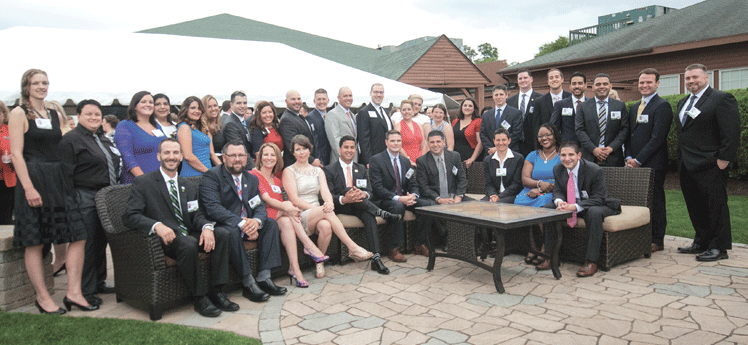
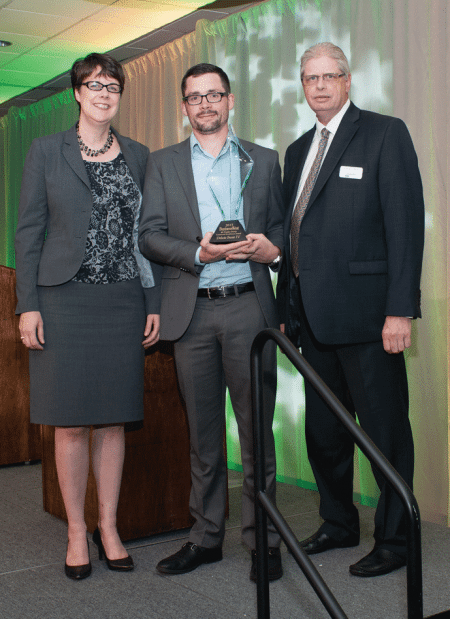
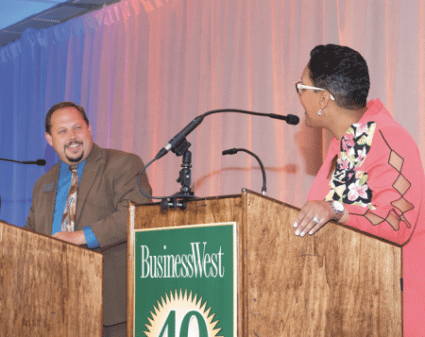
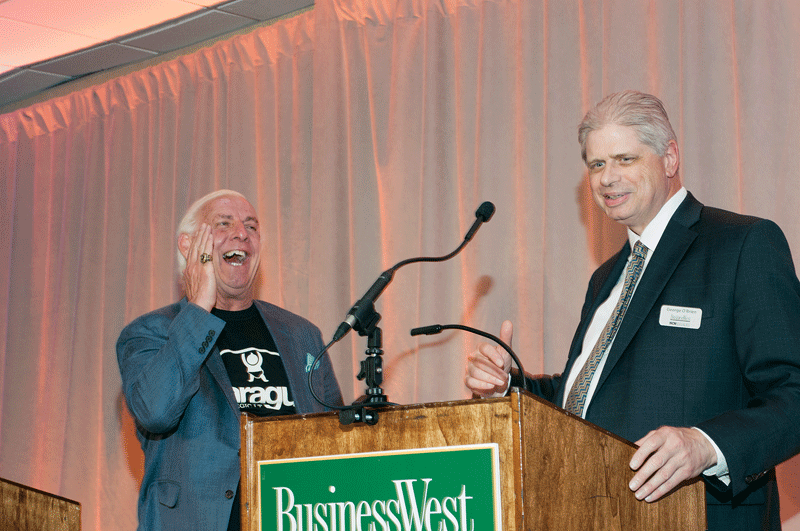
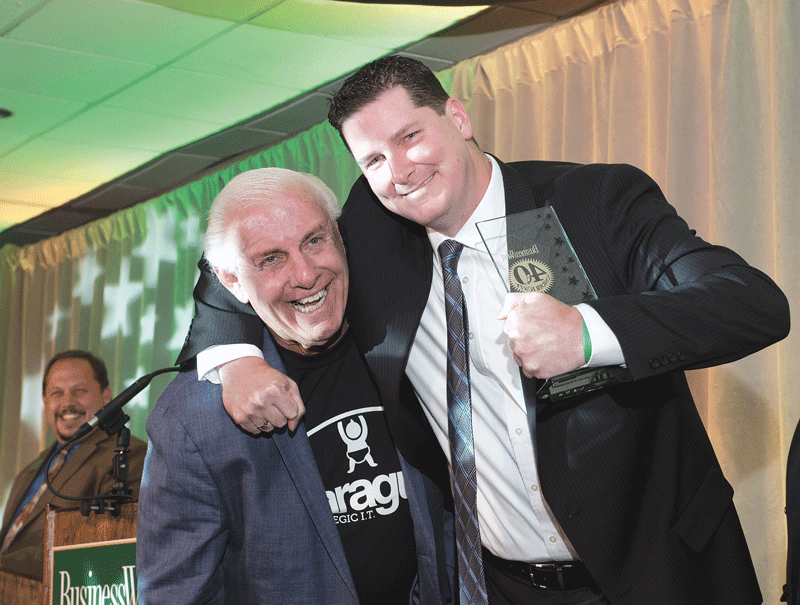
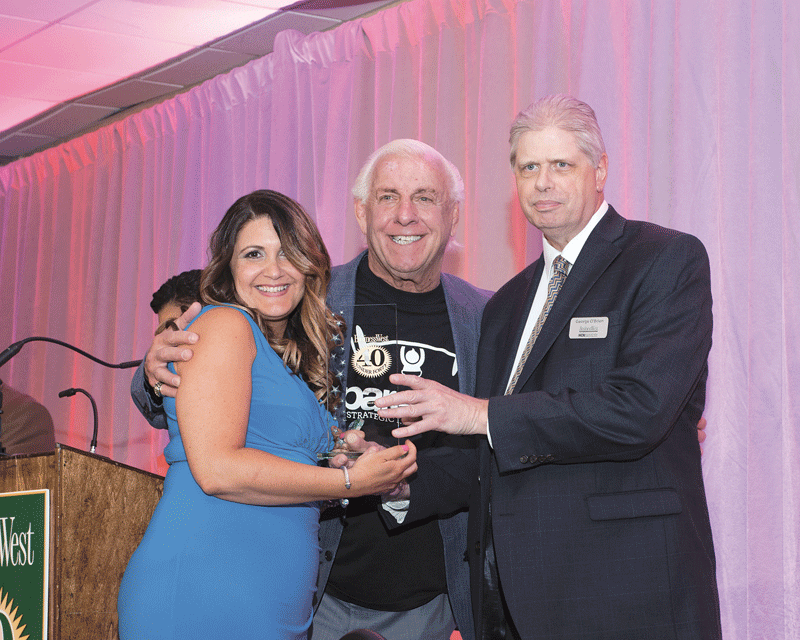
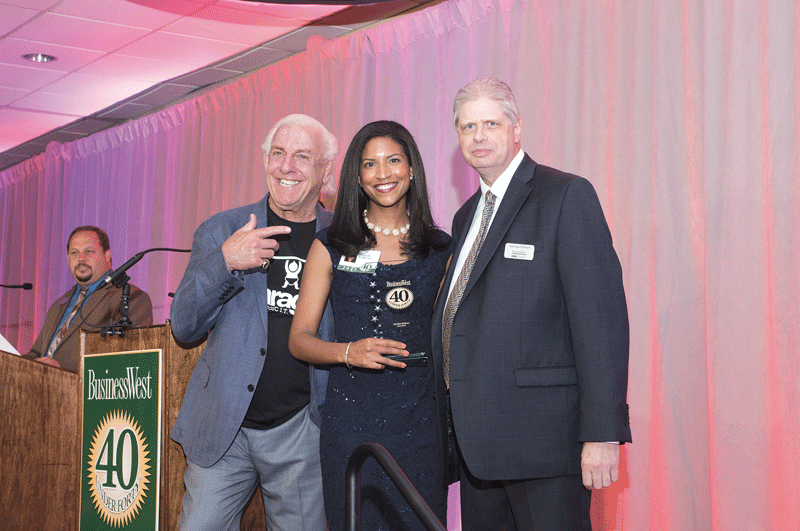
40 Under Forty 2015DSC_0499The ninth annual 40 Under Forty class of 2015 celebrated their big night on June 18 with style, class, and Flair — as in wrestling legend Ric Flair, a guest of presenting sponsor Paragus Strategic IT, who delivered brief, heartfelt words to this year’s assembly of high achievers, and a standing-room-only crowd of supporters, at the Log Cabin in Holyoke. Paragus was in the spotlight in another way, as CEO Delcie Bean (40 Under Forty class of 2008) won BusinessWest’s inaugural Continued Excellence Award (see photo at right), sponsored by Northwestern Mutual and presented by Kate Kane, managing director of its Springfield office, and BusinessWest Editor George O’Brien. But the night belonged to members of the class of 2015, who proved, yet again, that this region has no shortage of young professionals who are making an impact in business and in the community. Below, we present some scenes from a memorable, exuberant evening.
Photos by Denise Smith Photography [email protected]


Presenting Sponsors:

NorthwesternMutual900pxParagus200x130px


Sponsors:

Fathers&Sonns200x130pxIsenberg200x130pxHNElogo200x130pxMoriartyPrimack200x130pxUnitedBank200x130px


Partner:

YPS200x130px


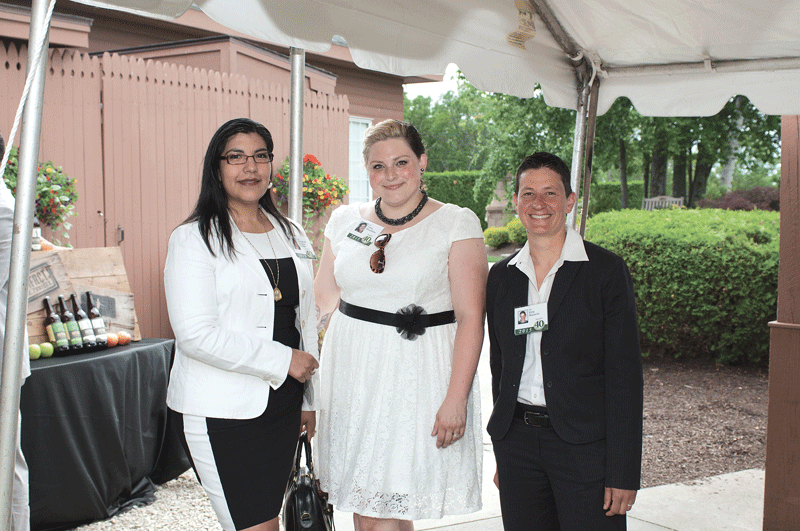
Elizabeth Barajas-Roman, CEO, Women’s Fund of Massachusetts; Terra Missildine; owner and operations manager, Beloved Earth Co.; and Erin Buzuvis

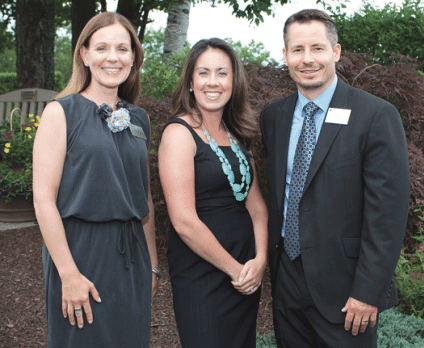
From left: class of 2015 honorees Elizabeth Barajas-Roman, CEO, Women’s Fund of Massachusetts; Terra Missildine; owner and operations manager, Beloved Earth Co.; and Erin Buzuvis, professor of Law and director of the Center for Gender & Sexuality Studies, Western New England University School of Law.


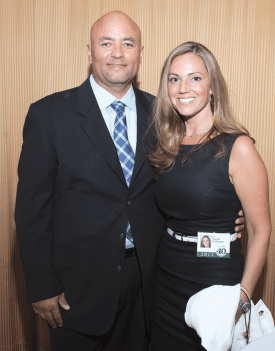
Jennifer Levesque, operations manager, R. Levesque Associates; with her husband, Robert Levesque

From left: Jennifer Levesque, operations manager, R. Levesque Associates; with her husband, Robert Levesque (class of 2015), president, R. Levesque Associates; and Christopher Novelli (class of 2015), architect, Studio One Inc.


From left: class of 2015 honorees Dr. Anthony Sarage, pediatric surgeon

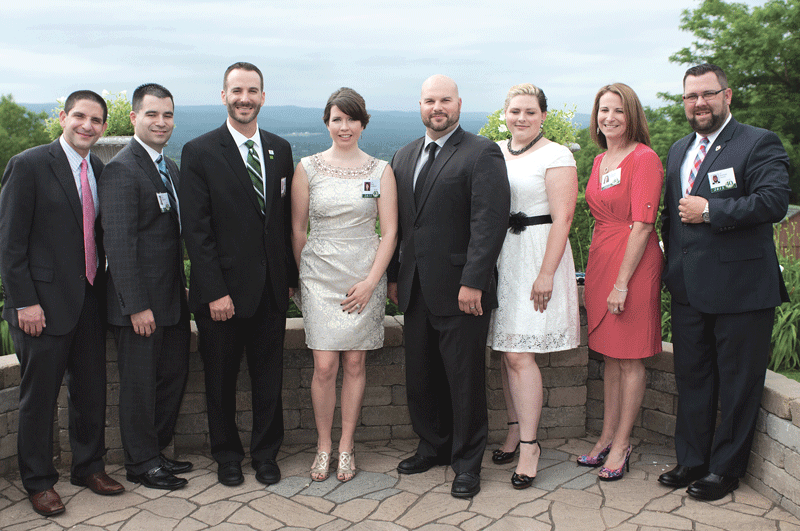
From left: class of 2015 honorees Dr. Anthony Sarage, pediatric surgeon, Western Massachusetts Podiatric Associates; Jim Angelos, owner and executive director, InspireWorks Enrichment Inc.; Gregg Desmarais, vice president and store manager, TD Bank; Kate Lockhart, development director, Big Brothers Big Sisters of Hampden County; A.J. Crane, co-owner and partner, A. Crane Construction; Terra Missildine; owner and operations manager, Beloved Earth Co.; Jennifer Gallant, chief financial officer, Polish National Credit Union; and Patrick Davis, operations manager, CRD Metalworks, LLC.


Joel Mollison (class of 2015), president, Northeast IT Systems

Joel Mollison (class of 2015), president, Northeast IT Systems; with his fiancée, Christine Gryknkiewicz, respiratory therapist, Cooley Dickinson Hospital.


: Marcelia Muehlke (class of 2015), owner, Celia Grace Wedding Dresses

From left: Marcelia Muehlke (class of 2015), owner, Celia Grace Wedding Dresses; and Sarah Shube, owner, Creative Art Therapies.

Isenberg School of Management at UMass Amherst, a 40 Under Forty sponsor

From the Isenberg School of Management at UMass Amherst, a 40 Under Forty sponsor, from left: Jennifer Meunier, director of Business Development; Trista Hevey, director of Alumni Corporate Relations; and Kyle Bate, academic advisor.

Sarah Williams (class of 2015), vice president of Global Risk Management, MassMutual Financial Group; with her husband, Richard Williams

Sarah Williams (class of 2015), vice president of Global Risk Management, MassMutual Financial Group; with her husband, Richard Williams, investigator, Investigators LLC.


Tim Steffen, director of recruitment; Nico Sananiello, financial advisor; Kate Kane

From Northwestern Mutual, presenting sponsor of 40 Under Forty, from left: Tim Steffen, director of recruitment; Nico Sananiello, financial advisor; Kate Kane, managing director; Rob Walker, financial representative; and Taylor Hassa, financial representative.

From Paragus Strategic IT,

From Paragus Strategic IT, presenting sponsor of 40 Under Forty, from left: Lisa Lococo, office manager; Delcie Bean IV, CEO; Dave DeRicco, account representative; Anthony Schiappa, account representative; Tyler Lucas, COO; Sarah Powers, financial administration; and Margie LaMotte, executive assistant to the CEO.

From Fathers and Sons

From Fathers and Sons, a 40 Under Forty sponsor, from left: Bill Visneau, sales associate; Marissa Monti, business manager; Shera Rosarario, sales associate; Steven Langieri, sales manager; and Jon Schulz, sales associate.


From Moriarty & Primack, P.C.

From Moriarty & Primack, P.C., a 40 Under Forty sponsor, from left: Tax Director Bob Supernaut; Tax Associate Shelley Sheridan; Audit Associate Jessica Peet; Tax Associates Laurie Bonan and Chris Walker; Manager Rebecca Connelly, Tax Manager Tim Prozost; and Partner Doug Theobold.

Kate Campiti, associate publisher, BusinessWest, welcomes the more than 650 attendees of the ninth annual 40 Under Forty gala.

Kate Campiti, associate publisher, BusinessWest, welcomes the more than 650 attendees of the ninth annual 40 Under Forty gala.

Joseph Bednar, senior writer, BusinessWest; and Denise Hurst

Joseph Bednar, senior writer, BusinessWest; and Denise Hurst (class of 2014), quality improvement manager and human rights coordinator, Department of Mental Health, and vice chair, Springfield School Committee, get ready to welcome this year’s 40 Under Forty honorees to the stage.

Health New England, a 40 Under Forty sponsor, from left: Steven Webster, director of marketing and digital strategy; Jessica Dupont

From Health New England, a 40 Under Forty sponsor, from left: Steven Webster, director of marketing and digital strategy; Jessica Dupont, risk adjustment manager; Robert Ravenscroft, clinical healthcare analyst; Nicole Santaniello, content management specialist; Sandi Bascove, marketing operations manager; Elaine Mann, marketing content strategy manager; Yvonne Diaz, account executive, existing business; and Patrick McColley, UX/CX architect manager.


George O’Brien, editor, BusinessWest, shares a laugh with wrestling legend

George O’Brien, editor, BusinessWest, shares a laugh with wrestling legend ‘Nature Boy’ Ric Flair, a special guest of 40 Under Forty presenting sponsor Paragus Strategic IT.


George O’Brien and Ric Flair shared the privilege of presenting awards to the class of 2015, including, clockwise from top right, Eric DevineDSC_0545
Danielle Williams, attorney, Fierst, Kane & Bloomberg LLP.

George O’Brien and Ric Flair shared the privilege of presenting awards to the class of 2015, including, from top to bottom, Eric Devine, Information Technology Services officer, Country Bank for Savings; Jessica Fraga, continuous improvement consultant, MassMutual Financial Group; and Danielle Williams, attorney, Fierst, Kane & Bloomberg LLP.


Photo gallery from the June 18, 2015 BusinessWest 40 Under Forty Class of 2015 Gala


For reprints contact: Denise Smith Photography / www.denisesmithphotography.com / [email protected]

Employment Sections
Carpet-cleaning Venture Advances HRU’s Mission

Zerorez’s Luis Cerrano (center) demonstrates the company’s equipment

Zerorez’s Luis Cerrano (center) demonstrates the company’s equipment for Sue Mastroianni, board member of the Gray House in Springfield, and HRU president Don Kozera.

When Human Resources Unlimited (HRU) decided that its core mission — training and placing people with disabilities in meaningful jobs — would benefit from partnering with a national franchise, carpet cleaning didn’t seem like the most exciting option.

“We looked around the country and found there were few not-for-profits owning franchises, and then we set up specific criteria around what we hope to achieve, how much revenue we need, how much risk we’re willing to accept, and what the tradeoff is between profits and mission,” said Don Kozera, HRU’s long-time president.

The agency wound up looking at 600 chains, then took a harder look at 60 of them, before narrowing its search to three that fit the organization’s criteria. One of those was Zerorez, a carpet-surface cleaning company based in Salt Lake City with a national presence — except in New England.

“What attracted us was its patented ‘green’ approach to cleaning,” he said of Zerorez’s innovative use of what it calls “empowered water” (more on that later). “And if you can innovate in carpet cleaning, you can probably innovate the world. It’s also a technology-based company. With this phone in my hand, I know where all the vehicles are, if their machines are on, how much we booked today, where those leads came from … I know exactly what’s going on.”

But there was some hesitancy based on the perceived lack of a ‘wow’ factor. “People said, ‘really? Carpet cleaning? Don’t we want to do something more exciting?’ But the more we investigated it, the more we talked to franchises across the country and sat down with the owners and looked at their technology, looked at the environmentally friendly detergents being used, that there was a social cause, it made sense.”

So HRU opened its first Zerorez franchise in Holyoke in March, with more likely to follow. “We have a bigger strategy,” Kozera said. “We have the rights to the Hartford and Boston markets. We didn’t do this to own one franchise; we did it as a strategy of revenue generation and job development. It’s solely owned by HRU, but it might not be solely owned in the future; it depends on how much capital we need for expansion plans.”

None of this, of course, answers the question of why Human Resources Unlimited, which trains and places clients in some 120 area businesses and has started and closed myriad businesses of its own to achieve the same goals, embraced the franchise model. Simply put, Kozera said, it’s because HRU eventually wants to do some franchising of its own.

Active Intent

It starts with a program HRU created called Move to Work.

“It’s a platform designed to help people who have been out of the workforce — chronically unemployed people, not just people with disabilities. It’s a unique approach that uses physical health, emotional health, and financial health to create a healthy, productive worker.”

The concept is explained by the program’s original title, the admittedly clunkier Changing Habits and Transforming Lives. It takes principles not typically applied to job training, including exercise and physical fitness, and meshes them with conventional job training and the ‘soft skills’ — communication skills, personal work habits, etc. — so in demand by companies.

“With most people who are chronically unemployed, the data will show they’re physically not healthy, emotionally not healthy,” Kozera said. “Of course, being unemployed for a long time can lead to bad habits and losing self-esteem.”

Move to Work, he went on, “was originally to better our services. If people exercise for 20 to 40 minutes at 60% to 80% of their maximum heart rate, their ability to learn and retain information is greatly increased for up to four hours. That’s a scientific fact. So every one of our sessions starts with that.

“But, really, the foundation is our soft-skills training program,” Kozera explained. “Employers in this area are saying, ‘we cannot find qualified workers — at any level.’ The Federal Reserve did a report on Springfield five years ago that really outlined those issues. Companies said, ‘what do we need? People who come to work on time, with a good social skill set. We’ll train them on what we do technically. But we need those types of people.’”

So Move to Work was developed as an eight- or 16-week course to build those skills while incorporating the benefits of exercise for greater mental focus. Recently, HRU applied the program at Tech Foundry, a nonprofit that trains high-school students for information-technology jobs.

Having demonstrated its value, Human Resources Unlimited would like to turn Move to Work into a national model. And that’s something the agency has never before attempted.

“Our goal is to bring this new model into the marketplace as both an innovative program and something that can earn money,” Kozera told BusinessWest. “But it’s not easy to do. How can we raise enough revenue to support the expansion of that model?”

The answer was another question. “It’s taking a self-replicating model to the marketplace, and who does that? Franchises. They take a brand and replicate the brand. Through this confluence of activities, we said, ‘well, if we’re going to learn more about the replication and expansion of a brand into a national model, where else to learn from than franchises?’ So we started looking around, saying, ‘maybe we can start a franchise and look at owning franchises as a way to support ourselves and learn how to be a franchisor of Move to Work.’”

Workplace Legacy

A company like Zerorez is certainly new terrain for HRU. But doing things a little differently has long been the agency’s bread and butter.

Realizing that many employers didn’t believe people with developmental disabilities could work in complicated job environments, Human Resources Unlimited — then knwn as the Carval Workshop — was created in 1970 to be the vocational training center for Belchertown State School residents and provide employment opportunities for residents of the facility.

Zerorez

Zerorez recently donated its services to clean high-traffic areas of the Gray House to demonstrate its work and help another mission-driven organization.

It has expanded and evolved over the years, now offering a broad range of services, from assistance for individuals moving from public assistance to the workplace to a ‘day habilitation’ program called Pyramid for people with developmental disabilities; from commercial endeavors, of which Zerorez is the latest, to a series of so-called ‘clubhouses’ that provide members with a supportive environment where they can get specialized assistance with vocational skills and transition into good jobs at area companies, as well as increasing their participation in the community.

Kozera, who joined the organization in 1980 as fiscal director before moving into the president’s chair, said Zerorez is a good match for HRU because of it’s mission-driven approach to cleaning.

“Zerorez uses technology that was borrowed from the oil-cleanup industry,” he explained. What the national company calls ‘empowered water’ is actually electrolyzed and oxidized to create an environmentally friendly cleaning solution.

Traditional steam cleaning, the company notes, uses heated water mixed with soaps, detergents, and toxic chemicals that are injected into the carpet under pressure, which soak the carpets, pads and backing. Even though some of the soap, dirt, and water are removed, a considerable portion of this mixture remains embedded in the carpet. As the carpet dries, the detergent attaches to the carpet fibers and acts as a magnet for dirt and other substances. Empowered water, on the other hand, is applied to carpet fibers by a patented high-pressure spray system that loosens embedded dirt and removes it.

Zerorez cleans rugs, tiles, wood floors, furniture, counters … basically anything that people walk on, sit on, or work on, Kozera said. The primary market is residential, although it has commercial clients as well.

“We haven’t burst on the market,” he added, noting that the Holyoke franchise, which boasts three trucks and four employees to start, had 37 clients in May and is on track for 50 in June. But in the long run, Zerorez’s established structure and recognized name will help the local office succeed and, importantly, grow its roster of employees and fleet of trucks.

“What has a higher rate of success in business, Joe’s Burger Shop or McDonald’s? With a franchise, there’s a system, a proven model, there’s support. Other franchisees are amazing about sharing everything they know. They help each other. I don’t know how many networks are like that. They tell us what’s successful, what’s not successful. It’s a nice family created by the franchisors.”

Kozera said franchisors wanted HRU to commit to more than one market, adding that, overall, franchised businesses are more often sold to corporations than individuals these days. “You can’t buy just one; you have to buy three, so you have to have $2 million just to enter the market.”

At the same time, national networks have become more willing to sell franchises to nonprofits, while nonprofit boards, which tend to be conservative in their risk taking, like the security of partnering with a known commodity.

Furthermore, “Zerorez has a 90% retention rate in an industry that probably has a 10% retention rate,” Kozera said. “The other appealing part of this is that every customer has to rate us … and if they don’t rate us at least 9 out of 10, we fail.” The idea, he added, is to leverage great customer service into customers for life, one floor at a time.

Destination Unknown

Kozera knows that nothing is a given in any industry. “Any time you open a business,” he said, “the reality is, you don’t know what’s going to happen.”

But if it succeeds, the Holyoke Zerorez office — the first of what might be several across the region — will benefit HRU in three ways, by generating revenue, providing an education in franchising the agency can apply to Move to Work, and, of course, providing jobs for clients.

“It has a call center, and we place a lot of people in call centers at multiple locations; that’s a skill base many of our members have, and they’ve been very successful at that job,” he said, adding quickly, “we’re not creating jobs that don’t exist. We have one technician for one van; we’re not going to put two people there just to create a job.”

As for Human Resources Unlimited in general — which recently moved to a larger headquarters in Springfield — a (slowly) strengthening economy is ramping up demand for qualified workers at all kinds of companies, which can only benefit clients.

“We want to use these franchise concepts throughout the whole business, not just Zerorez,” Kozera said, referring mainly to the key factors of consistency and trust that drive consumers to known brands.

“We want to apply that to everything we do. We don’t have a whole lot of experience in business to business. But the sales process and the marketing process are things that will help us organizationally because human services — in particular placement organizations — don’t invest a lot in marketing and sales. We invest a lot in human capital; we just don’t measure it well.”

HRU’s first franchise business could help change that, while creating cross-learning opportunities across the organization that, hopefully, help more individuals find work.

And that, more than anything, is what makes carpet cleaning exciting.

Joseph Bednar can be reached at [email protected]

Departments People on the Move

Delcie Bean IV

Delcie Bean IV

Serial entrepreneur Delcie Bean IV took home BusinessWest’s inaugural Continued Excellence Award at the ninth annual 40 Under Forty gala on June 18. It was yet another honor for the owner of Paragus Strategic IT, who was named BusinessWest’s Top Entrepreneur for 2014. For the Continued Excellence Award, which will be awarded annually to a former 40 Under Forty honoree who has continued to expand his or her business accomplishments and community impact, Bean was among about 40 individuals nominated by their peers and judged by an independent panel. “Nothing I have done has not been without the help of at least 100 other people,” Bean said to more than 650 attendees of the 40 Under Forty event at the Log Cabin in Holyoke. He cited, as one example, the 24 high-school students who graduated this week from Tech Foundry, a nonprofit he started to provide IT workforce training and job skills to young people. A member of the 40 Under Forty Class of 2008 when he was just 21, Bean has since seen Paragus grow 450% and earn status as one of Inc. magazine’s fastest-growing companies on several occasions, and recently earn the Top Employer of Choice Award from the Employers Assoc. of the NorthEast. He’s also started a second business venture, Waterdog Technologies, a technology-distribution company. Meanwhile, within the community, he has been active with Valley Venture Mentors, River Valley Investors, and DevelopSpringfield; is a board member for Up Academy Springfield; and serves as a board member for the Mass. Department of Elementary & Secondary Education’s Digital Literacy and Computer Science Standards Panel. In his short acceptance speech last night, Bean put the focus not on himself, but on the promise of the Pioneer Valley. “I’m just one of many people who helped me get to where I am,” he said. “I’m so incredibly grateful to be here, to be part of the Valley. And you know what? I think there’s so much more we can do. I really, really think this Valley has a huge story ahead of it. I’m excited to be a part of that, and I hope you guys will join me. And, with that challenge, let’s see what’s next.” The other four finalists for the Continued Excellence Award were Kamari Collins (40 Under Forty class of 2009), dean of Academic Advising and Student Success at Springfield Technical Community College; Jeff Fialky (class of 2008), partner at Bacon Wilson, P.C.; Cinda Jones (class of 2007), president of Cowls Lumber Co.; and Kristin Leutz (class of 2010), vice president of Philanthropic Services for the Community Foundation of Western Mass. The judges for the inaugural award were Carol Campbell, president of Chicopee Industrial Contractors; Eric Gouvin, dean of the Western New England School of Law; and Kirk Smith, former director of the YMCA of Greater Springfield.

•••••

Sue Drumm

Sue Drumm

Sue Drumm, a real-estate agent with Coldwell Banker Residential Brokerage in Longmeadow, has been named the 2015 Realtor of the Year by the Realtor Assoc. of Pioneer Valley (RAPV). The announcement was made during the association’s annual awards banquet on June 11. As the highest honor given to a member, the Realtor of the Year award is bestowed upon the one person who has shown outstanding service and devotion to the 1,650-member organization during the past 17 months in the areas of Realtor activity, community service, and business activity. A Realtor since 2009, Drumm serves on the association’s board of directors, grievance committee, community service committee, and centennial president’s advisory group. She is a co-presenter at the bi-monthly new-member orientation promoting involvement and explaining the benefits of membership. In 2014 she was a member of the strategic planning committee and affiliate of the year committee. She is a longtime member of the association’s community service committee and an active participant in numerous projects, including a book and blanket drive for Shriners Hospital for Children in Springfield, and shopping, wrapping, and delivering gifts to area homeless shelters during the holidays. She is involved in the association’s charitable fund-raising efforts as a member of the Benefit Golf Tournament subcommittee, Comedy Night subcommittee, and Fantasy Auction subcommittee. Drumm has been a Girl Scout troop leader in Agawam for six years and assists with its annual food drives.
•••••
Springfield College Sport Management and Recreation Department Chair Kevin McAllister was recently elected president of the board of directors for U.S.A. Nordic Sport (USANS). The appointment to president follows McAllister’s role in leading a transition committee that assisted with the merging of the U.S.A. Ski Jumping and Nordic Combined. Under McAllister’s leadership, a new set of bylaws was transcribed for USANS, and a new mission statement was drafted. The mission of USANS is to encourage, promote, and develop the Nordic disciplines of ski jumping and Nordic combined in the U.S.; assist U.S. athletes in achieving sustained competitive excellence in Olympic, World Championship, and other international competitions in the disciplines; and to promote the highest standards of sportsmanship, fair play, and goodwill between individuals of all nations through competition in the discipline sports. “This opportunity to serve as president of the board of directors for USANS is a great honor, and I am excited to have the opportunity to work with so many talented people both with U.S.A. Ski Jumping and Nordic Combined,” said McAllister, who has been a Springfield College faculty member since 2003. In his role with USANS, McAllister has the opportunity to work with Springfield College alumna Signe Jordet, U.S.A. Ski Jumping director of Sport Development since 2012. Jordet earned a master’s degree in sport management and recreation from the college in 2010, and she was instrumental in recruiting McAllister’s leadership for U.S.A. Ski Jumping and Nordic Sport. “We are always willing to assist and work with graduates from our Sport Management program at Springfield College,” said McAllister. “We are very proud of Signe and the work she has done in her role with U.S.A. Ski Jumping. There was an opportunity for me to get involved and assist in some leadership areas, and I am looking forward to the challenge. This experience will also provide some great examples in the classroom when teaching our current sport-management students.”
•••••
Two Baystate Medical Center physicians were honored recently by the Massachusetts College of Emergency Physicians (MACEP) for advancing excellence in emergency care. Dr. Sunny Mani Shukla received the Emergency Medicine Fellow of the Year award, and Dr. Lauren Westafer received the Emergency Medicine Resident of the Year award, during MACEP’s recent annual meeting. The Emergency Medicine Resident and Fellow of the Year awards recognize an outstanding emergency-medicine resident and emergency-medicine fellow in Massachusetts, whose combination of clinical promise, leadership, ability to think outside the box, and commitment to patients and emergency medicine separate them from others. Westafer earned her doctor of osteopathic medicine and master of public health degrees from Nova Southeastern University College of Osteopathic Medicine in Fort Lauderdale, Fla. Blogging on emergency medicine even before her residency, today she co-hosts an educational podcast and frequently tweets and blogs about important and interesting articles, keeping her colleagues up to date on the latest in emergency medicine. Westafer regularly takes on additional tasks as part of her residency, including providing statistical mini-lectures to colleagues. An adjunct assistant professor at Western New England University College of Pharmacy, she lectures pharmacy students preparing to enter the field of medicine. She has also been recognized as a Knowledge to Action Fellow by the Emergency Medicine Residents’ Assoc. (EMRA) and the New York Academy of Medicine. “Dr. Westafer is an incredibly talented physician with the potential to contribute greatly to academic emergency medicine. Her ability to review the current literature and distill it into an easily digestible format is incredibly valuable and will make her a strong contributor in the future,” said Dr. Niels Rathlev, chair of the Department of Emergency Medicine at Baystate. Shukla, who received his medical degree from Manipal University in Karnataka, India, completed a residency in emergency medicine at Baystate. He participated in MACEP’s Leadership & Advocacy Fellowship Program in 2014, and recently designed the Baystate Emergency Department’s Administrative Fellowship. He was also selected by the EMRA as one of 10 residents nationwide to receive an EDDA scholarship, which provides financial assistance to resident leaders to attend the Emergency Department Directors Academy, designed to help them develop leadership skills that will advance their careers, their local emergency departments, and the specialty of emergency medicine. Shukla, who provides emergency care at Baystate Franklin Medical Center in Greenfield, was also the second-place winner in the Emergency Medicine Physicians’ emp.com third annual Video Challenge, allowing residents to show off their residency program in a creative way. As secretary/newsletter editor for the American College of Emergency Physicians’ Emergency Medicine Practice Management and Health Policy Section, he also uses his talents to mentor residents in writing scholarly articles. “Dr. Shukla has tremendous potential as a future leader in healthcare,” Rathlev said. “He has a particular interest in administrative matters and is currently obtaining his MBA at UMass Amherst. He is an active contributor to important patient-care and safety initiatives at Baystate Health.”
•••••
Candace Pereira

Candace Pereira

Susan Mastroianni

Susan Mastroianni

At its recent board meeting, the Gray House elected two new officers to a one year term: Candace Pereira, treasurer, and Susan Mastroianni, secretary. Pereira has more than 10 years of banking experience. She is a commercial-portfolio loan officer for Farmington Bank in West Springfield.
Mastroianni has more than 25 years of experience in the advertising field. She is director of Media Services and partner in FitzGerald & Mastroianni Advertising Inc. in Springfield. Michael Walsh and David Chase remain as president and vice president, respectively. Walsh is an adjunct instructor in Political Science at Westfield State University and a consultant and legal advisor at MIRA Associates. Chase has more than 20 years of banking experience and is vice president of Member Business Services at Freedom Credit Union in Springfield. The Gray House is a small, neighborhood human-service agency located at 22 Sheldon St. in the North End of Springfield. Its mission is to help neighbors facing hardships to meet their immediate and transitional needs by providing food, clothing, and educational services in a safe, positive environment.
•••••
Dr. Paul Donovan, a long-time practicing physician in North Adams, has written and published the first of a three-part series on the history of North Adams Regional Hospital (NARH). The hospital closed in March 2014 after filing for bankruptcy. Part one of the series covers the years 1882 to 1910. In 1882, a catastrophic train accident galvanized a small group of North Adams residents to initiate the concept of a hospital, which was built with private donations and opened in March 1885. Part one concludes with a major reorganization in 1909-10 due to financial difficulties. Part two will cover the years 1910 to 1955, and part three will cover 1955 to 2014. They are expected to be published in 2016 and 2017, respectively. Donovan is an emergency-medicine and sports-medicine specialist practicing in North Adams and Bennington, Vt. He was a member of the NARH medical staff for 25 years and served as medical staff president from 2008 to 2010, and as director of the NARH Emergency Department. The book can be purchased on www.blurb.com and will be available at local bookstores starting in July.
•••••
Citizens Bank announced the appointment of Quincy Miller, president of Citizens’ business-banking division, as its new Massachusetts state president. He succeeds Jerry Sargent, who will focus full-time on leading Citizens’ middle-market commercial business after serving as state president for five years. Sargent’s responsibilities will continue to include overall leadership for state presidents across the Citizens footprint. As state president, Miller will lead Citizens’ engagement with civic, business, and community leaders across the state. He will retain responsibility for Citizens’ company-wide business-banking efforts, which serve companies with annual revenue of up to $25 million. A member of Citizens Bank’s executive leadership group, Miller serves as a member of the Citizens Bank Charitable Foundation board of directors. He also currently serves as board chair for the Urban League of Eastern Massachusetts. Miller is a graduate of Lafayette College, where he earned a bachelor’s degree in economics and business. Prior to joining Citizens in 2006, he spent nine years at M&T Bank in New York City and in Harrisburg, Pa. He has received 40 Under 40 recognition from the Boston Business Journal, Crain’s Cleveland Business, and the Central Penn Business Journal.

Daily News

AMHERST — The Five College Schools Partnership is celebrating its 30th anniversary by organizing two national institutes, one exploring Native Americans of the region and the other focused on the value of global children’s picture books as teaching tools. Both institutes are aimed at helping K-12 teachers develop tools to make them more effective in the classroom.

Native Americans of New England, funded by the National Endowment for the Humanities (NEH), will bring K-12 educators from around the country to UMass Amherst in July. These 25 NEH summer scholars will explore the history of indigenous peoples of the region through site visits, primary source analysis, and presentations by native and non-native lecturers.

Field trips to the Wôpanâak Language Reclamation Project, Plimoth Plantation, the Mashantucket Pequot Museum and Research Center, and the Mohegan Nation will help expand their knowledge of current research on Native American history and communities as well as their understanding of what that research means for teaching native history in K-12 classrooms.

The summer scholars will develop materials to incorporate Native American studies into their classroom curricula. These materials will be available for other educators through the Five College website. Native Americans of New England is one of 25 NEH seminars and institutes offered for college and university teachers this summer. The 544 NEH summer scholars who participate will teach more than 68,000 students the coming year.

In the second institute, titled Summer Institute for Educators, pre-K through third-grade teachers and librarians will meet in the Eric Carle Museum of Picture Book Art in Amherst to explore diversity and representation in international children’s literature and create resources to integrate global picture books and related materials into their teaching.

The lesson plans and materials these teachers develop during the institute in July will become the first components of a website that uses global picture books as entry points for deepening children’s understanding of the world and of themselves. The website will be piloted in the fall and will be launched through an international webinar next spring.

According to Five College Schools Partnership Director Marla Solomon, this summer’s institutes are in keeping with the professional-development opportunities her office has offered K-12 educators since its inception in 1985.

“The Five College Schools Partnership has worked for 30 years with a consistent mission: to strengthen education from kindergarten to college by supporting communication and sharing resources among K-12 schools and the colleges,” she said. “Our programs are powerful because they build on the mutual interests of college and K-12 faculty members to improve their own teaching and the quality of student learning throughout the educational system. Teachers and faculty members work collaboratively in specific areas of their expertise, often, as in the case of these two projects, developing resources that can be shared broadly and used by many other teachers. Increasingly, we can use technology to help with that kind of dissemination.”

Daily News

BERLIN, Conn. — Comcast Cable announced that Sandy Weicher has been appointed vice president of Customer Care for the company’s Western New England Region, which includes Western Mass., Connecticut, New York, Vermont, and Western New Hampshire.

“Sandy’s passion for both the employee and customer experience are undeniable,” said Mary McLaughlin, senior vice president of Comcast’s Western New England Region. “Her dedication and leadership will help us in continuing to create a culture focused on providing superb service.”

In this role, Weicher will be responsible for delivering a positive experience for Comcast customers across the region and will oversee day-to-day management of the company’s regional call centers located in Enfield, Conn., and South Burlington, Vt.

Weicher will work closely with her team to implement the company’s recently announced multi-year strategy to transform the customer experience and create a culture focused on exceeding customers’ expectations at all levels of the company. The plan centers on looking at every decision through a customer lens and making measureable changes and improvements across the company.

The core elements of the strategic plan include major investments in technology and training to give employees the tools they need to deliver excellent service, simplifying billing and creating better policies to provide greater consistency and transparency to customers, the renovation of stores, continued hiring of frontline employees to serve Comcast’s customers, and the development of new technologies that will enable customers to interact with the company how and when they want.

“I am very excited to work with this team, and I look forward to delivering an enhanced level of service to the customers in our Western New England Region,” said Weicher.

Weicher has more than 25 years of experience in the telecommunications industry and has worked at Comcast for over a decade. She comes to the Western New England Region after serving as vice president of care for the company’s Freedom Region, which includes Philadelphia and its surrounding suburbs, New Jersey, and Northern Delaware. Prior to that, she worked as area vice president for the Greater Chicago Region’s north area, where she was responsible for the network operations, repair, installation, and technical operations teams providing video, high-speed Internet, and voice services to the area’s customers.

A graduate of Chicago’s DePaul University with a bachelor’s degree in telecommunications, Weicher is a member of Women in Cable Telecommunications (WICT) and received the Greater Chicago Chapter’s Breaking the Mold Award and Mentoring Award. She is also a graduate of WICT’s Betsy Magness Leadership Institute and Comcast’s Field Executive Boot Camp. Additionally, she previously served as president of the Indiana Cable Television Assoc., held a board member position with the Chicago Urban League, and was a fellow in Leadership Philadelphia, a nonprofit community-service organization.

Daily News

Delcie Bean IV

Delcie Bean IV

HOLYOKE — Serial entrepreneur Delcie Bean IV took home BusinessWest’s inaugural Continued Excellence Award at last night’s ninth annual 40 Under Forty gala.

It was yet another honor for the owner of Paragus Strategic IT, who was named BusinessWest’s Top Entrepreneur for 2014. For the Continued Excellence Award, which will be awarded annually to a former 40 Under Forty honoree who has continued to expand his or her business accomplishments and community impact, Bean was among about 40 individuals nominated by their peers and judged by an independent panel.

“Nothing I have done has not been without the help of at least 100 other people,” Bean said to more than 650 attendees of the 40 Under Forty event at the Log Cabin in Holyoke. He cited, as one example, the 24 high-school students who graduated this week from Tech Foundry, a nonprofit he started to provide IT workforce training and job skills to young people.

A member of the 40 Under Forty Class of 2008 when he was just 21, Bean has since seen Paragus grow 450% and earn status as one of Inc. magazine’s fastest-growing companies on several occasions, and recently earn the Top Employer of Choice Award from the Employers Assoc. of the NorthEast. He’s also started a second business venture, Waterdog Technologies, a technology-distribution company.

Meanwhile, within the community, he has been active with Valley Venture Mentors, River Valley Investors, and DevelopSpringfield; is a board member for Up Academy Springfield; and serves as a board member for the Mass. Department of Elementary & Secondary Education’s Digital Literacy and Computer Science Standards Panel.

In his short acceptance speech last night, Bean put the focus not on himself, but on the promise of the Pioneer Valley.

“I’m just one of many people who helped me get to where I am,” he said. “I’m so incredibly grateful to be here, to be part of the Valley. And you know what? I think there’s so much more we can do. I really, really think this Valley has a huge story ahead of it. I’m excited to be a part of that, and I hope you guys will join me. And, with that challenge, let’s see what’s next.”

The other four finalists for the Continued Excellence Award were Kamari Collins (40 Under Forty class of 2009), dean of Academic Advising and Student Success at Springfield Technical Community College; Jeff Fialky (class of 2008), partner at Bacon Wilson, P.C.; Cinda Jones (class of 2007), president of Cowls Lumber Co.; and Kristin Leutz (class of 2010), vice president of Philanthropic Services for the Community Foundation of Western Mass.

The judges for the inaugural award were Carol Campbell, president of Chicopee Industrial Contractors; Eric Gouvin, dean of the Western New England School of Law; and Kirk Smith, former director of the YMCA of Greater Springfield.

Daily News

BEDFORD — Anika Therapeutics Inc. a leader in products for tissue protection, healing, and repair based on hyaluronic-acid technology, announced an agreement with the Institute for Applied Life Sciences at UMass Amherst to collaborate on research to develop a therapy for rheumatoid arthritis (RA).

Rheumatoid arthritis is a chronic inflammatory disorder which manifests itself in multiple joints of the body. The inflammatory process primarily affects the lining of the joints (synovial membrane), but can also affect other organs. The inflamed synovium leads to erosion of cartilage and bone, which can lead to joint deformity. RA imposes enormous physical and economic burdens on affected individuals, as well as society at large. As the population in the U.S. continues to age, the Centers for Disease Control estimates that 67 million individuals will be diagnosed with RA by the year 2030.

The purpose of this research collaboration is to develop a novel modality for the treatment of RA. If successful, it is expected to yield a candidate that will move toward clinical development in 2017.

“We are very excited to partner with a world-renowned research institution and the many outstanding scientists at UMass Amherst to develop a localized delivery treatment for rheumatoid arthritis that addresses a large, unmet need,” said Dr. Charles Sherwood, president and CEO of Anika Therapeutics. “With this partnership, we plan to further advance Anika’s mission to deliver innovative therapies that address the full continuum of patient care, with a focus in the area of orthopedics.”

Added Dr. Peter Reinhart, director of the Institute for Applied Life Sciences at UMass Amherst, “we are extremely enthusiastic to have our research teams partnering with Anika as we aim to address treatments for RA. This is exactly the type of win-win collaboration IALS is seeking to develop in its quest to rapidly commercialize UMass life-science discoveries into products that improve human health.”

Mike Malone, vice chancellor for Research and Engagement at UMass Amherst, noted that “this partnership combines Professor Sankaran Thayumanavan’s [Chemistry] expertise in nanotechnology with Professor Lisa Minter’s [Veterinary & Animal Sciences] mechanistic understanding of aberrant immune responses and with Anika’s proven knowledge of hyaluronic-acid chemistry and its clinical application to treat joint pain. Developing university-industry alliances is one of the key strategic elements of this translational institute that advances the broad life-science research mission on this campus. In this alliance with Anika, we are committed to bringing novel therapeutic solutions to patients.”

Daily News

SPRINGFIELD — Tech Foundry presented a graduation ceremony last night for its inaugural class of 24 future IT leaders.

Founded by Paragus IT CEO Delcie Bean, Tech Foundry is a nonprofit education and job-placement program for high-school students looking to work in the world of information technology. Tech Foundry educates ambitious local students in order to create a homegrown workforce for the many area businesses looking for tech professionals. Upon completing the program and graduating high school, the goal is to place students in an entry-level IT job in the $30,000-$40,000 range.

The graduation ceremony was highlighted by the unveiling of an entire wall dedicated to the signatures of Tech Foundry students as well as a video highlighting the successes and vision of Tech Foundry. Speakers included Springfield Mayor Dominic Sarno, Western Massachusetts Economic Development Council President Rick Sullivan, and Assistant Secretary of Housing and Economic Development Katie Stebbins.

“This group of students is testimony to the success of Tech Foundry in training workers to immediately fill IT jobs in the region,” Bean said. “We are creating the IT hub of Western New England right here in Springfield, and this graduating class is just a hint of the caliber of the IT workforce that this region will showcase in the years ahead.”

Autos Sections
Truck Sales Accelerate Due to Several Driving Forces

Jeff Sarat

Jeff Sarat says businesses that held onto their trucks during the recession are now upgrading their fleets.

Jeff Sarat predicts Sarat Ford Lincoln in Agawam will sell more trucks in 2015 than in any year since it opened in 1929.

That’s a bold statement, but he’s more than prepared to make it.

“Normally our busiest time of the year is October to December because companies make year-end purchases. It drops off to nothing from January to March, but this year there was no lull; we slowed a little, but sales are so high, we have doubled our inventory of super-duty trucks,” said the general sales manager, noting that a high percentage of buyers are businesses that put money into maintenance during the recession rather than replacing their fleets. But the combination of reduced gas prices and an upswing in the economy has changed that trend, and business owners and managers are finally trading in vehicles and buying new ones.

But they’re not the only ones creating this historic run on trucks.

Bill Peffer says most people want to own the largest and most expensive vehicle they can afford, and in today’s world, that translates to a truck.

“I can’t think of a better time in the past 10 years to buy one,” said the president and COO of Balise Motor Sales, as he listed interest rates, incentives, and lease options. “The industry has certainly returned to the level of pre-recession sales, the market is robust because the economy is getting healthier, interest rates are low, there is easy access to credit, and the option of leasing at an affordable cost have combined to drive truck sales.

“Passenger cars have limitations,” he added. “And part of the fabric of America is to utilize a vehicle in a way that fits your lifestyle.”

National reports show truck sales began climbing about two years ago and quickly gained traction. Manufacturers have introduced new models that are fuel-efficient, quiet, comfortable, and have room for a family, yet offer the versatility and utility that a truck with a towing package can provide.

“Trucks have come a long way, and the new ones ride like a Rolls-Royce — some models will even parallel-park themselves with a push of a button,” Sarat said, adding that industry forecasts predict more than 16 million new vehicles will be sold this year, and a significant percentage will be trucks.

Brett Starbard, sales manager for Metro Chrysler Dodge Jeep Ram in Chicopee, said the new, redesigned Ram 1500 was named Motor Trend’s Truck of the Year in 2014, and better technology and design have fueled demand.

Bill Peffer

Bill Peffer says the rise in truck sales has led to a highly competitive market, which translates into good deals for buyers.

“Our truck sales have gone up by 50% since we started carrying Chrysler Rams a few years ago,” he noted. “We’re seeing an increase in people who want a truck, but don’t necessarily need one. Gas prices are down, and people live on a budget; if they are spending $50 less a month on fuel, they can afford $50 more on a new car payment.”

Ed O’Grady, sales manager for Central Chevrolet in West Springfield, said 60% of the dealership’s new truck business can be attributed to the fact that they are a bargain. Used trucks are retaining their value, and the manufacturer is offering $3,600 discounts that, in the past, were available only to employees who worked for suppliers, such as US Tsubaki in Holyoke, which sells timing chains. “Another $6,250 in incentives and rebates brings the savings on new trucks to $10,000,” he noted.

In addition, the cost of leasing has come down. “We have 2015 Silverado double cabs with four-wheel drive that are leasing for as low as $259 a month,” O’Grady said. “Leasing protects the consumer from depreciation; if the value goes down in three years, they can drop the vehicle off without taking a loss. But if a person does choose to purchase a truck, they can get a better price on a new one than on a two-year-old model due to all of the incentives.”

Starbard says Metro leases the majority of its new trucks. “Our average MSRP is $40,000 to $45,000, so the payments on a five-year loan would be $600 to $700 monthly. A lease is about half of that because the residual [remaining value] when the lease ends is as high as 60 to 70%, which means the person who leases only has to pay 30% over the term. Plus, there is no cost for maintenance,” he explained, noting that trucks have retained their value as sales were slow throughout the recession, so there are fewer used trucks on dealer’s lots, which leads to higher demand.

Body of Evidence

Although most businesses kept their trucks when gas prices reached $4 in the summer of 2008, Sarat said, many of his customers who didn’t need them took them off the road and purchased vehicles that get good gas mileage, such as a Ford Focus, which averages 40 miles per gallon.

However, other dealers report that many people took real losses by trading in their trucks for fuel-efficient cars. “People were very concerned with operating costs and some made irrational decisions as they traded in trucks for something that was far more fuel-efficient,” Peffer said.

Ed O’Grady

Ed O’Grady says it often costs less to lease a new truck than to purchase a used one.

Starbard recalls contractors who begged him to take their truck on a trade-in. “It wasn’t a smart thing to do, and they took huge losses, but if they had a job 100 miles away and were getting 10 miles a gallon, they were spending more on gas than they were making,” he told BusinessWest. “Gas prices are cyclical, like stocks, and I advised people not to sell when prices got high, but many of my customers didn’t feel they had an alternative when gas went over $4 a gallon.”

O’Grady said the government’s Cash for Clunkers program helped fuel trade-ins, and the prospect of getting an additional $4,500 for a vehicle that got poor gas mileage motivated many people to get rid of their trucks between 2008 and 2010.

“But now that fuel prices have dropped, they want their trucks back, and they are buying models that are more fuel-efficient than ever before,” he said, adding that the new Silverado with a V-8 engine gets 18 miles per gallon around town and 21 to 22 miles on the highway.

Sarat concurred. “There is definitely a pent-up demand, and as the economy continues to get better and businesses expand, we expect them to add more trucks,” he said, citing the example of a man who bought a van last year and added another this year as his business is flourishing.

Manufacturers such as Ford are also doing whatever they can to motivate prospective buyers, which includes offering 0% financing or rebates of up to $4,000 for certain vehicles. And although leasing is popular at some dealerships, Sarat said the majority of his customers purchase new trucks.

“They tend to retain their value so well that sometimes people find they can get a new truck for about the same price as a used one,” he noted. “People hold onto their trucks, so it becomes an issue of supply versus demand. Since vehicles get more expensive every year, it makes it easier to sell a new truck when you can offer really good money for a trade-in.”

Trucks have become all-around vehicles, and people today want trucks with four doors and ample interior cabin space to accommodate a family.

“Ten or 15 years ago, most trucks had regular cabs, but you don’t see many of those today; they make up less than 5% of my inventory,” Starbard said. “Today, a gentleman who owned an SUV can replace it with a pickup with full-size doors; plus, the RAM can be purchased now with a six-cylinder diesel engine that is much better in terms of fuel economy.”

Another factor that attracts people to trucks is the fact that they can customized with accessories that range from running boards to side steps, different types of wheels, exhaust systems, bed covers, and cover liners. “The average truck buyer spends $1,000 to $2,000 in accessories after the purchase,” Starbard said.

New Models

Although there are five main competitors in the truck market, which Peffer lists as Ford, Chevy, Ram, Toyota, and Nissan, new products are coming on the market because manufacturers seek to attract new buyers and retain customers looking to upgrade.

“They don’t want to lose market share, so they have become very competitive, which is good for the consumer,” Peffer said. “For some buyers, a truck is a tool of their trade, but for a growing segment, it’s a want more than a need, and luxury features such as leather seats and navigation systems appeal to a wider audience.”

Ford recently introduced a new Econoline cargo van with a choice of three engine options. “You could never stand up in them before, but now they come in two lengths and three heights, and you can stand in the medium and large models,” Sarat said. “They are a phenomenal addition and have been very popular. We have been selling several every week, and demand is starting to pick up, so we are taking in as much inventory as we can get.”

Ford also introduced an all-aluminum F-150 this year that is fuel-efficient, Chevy brought a new Silverado model to market last year, and Nissan will introduce a new Titan in the next few months.

Chevrolet stopped producing small trucks in 2012, but demand is skyrocketing for its new 2015 Colorado, which gets 27 miles per gallon on the highway and was named Motor Trend’s 2015 Truck of the Year.

“It comes with a four- or six-cylinder engine, but can tow 7,000 pounds, and every dealership across the country is taking orders,” said O’Grady. “They sell the day they arrive.”

He noted that the trend is moving from trucks with clamshell doors to four doors, and Chevrolet’s offerings convince buyers to purchase new trucks. They include a five-year, 100,000-mile power-train warranty with two years of free maintenance; wi-fi Internet connectivity that comes in every 2015 Silverado; and Remote Link, a smartphone app that allows people to lock and unlock doors remotely, view tire pressures, and send directions to their truck with their phone, which are announced via OnStar navigation.

“Sales have been on the rise for the last few years, and we believe the numbers are sustainable,” O’Grady went on, explaining that GM used to stockpile vehicles to keep people working, but have stopped that practice and now fill orders.

Still, many dealers say leasing is the best deal available, due to the fact that trucks hold their value. “More vehicles are leased in New England than in any other part of the country,” Peffer said. “There are a lot of advantages, and manufacturers recognize it as an opportunity to grow or maintain market share.”


Revving Up

Sarat Ford’s truck sales continue to grow, and several years ago it expanded its service department to help its commercial truck customers.

“We added six new bays, and as we continue to sell more big trucks, we continue to need more room,” Sarat said. “This year our sales are up by 10% over last year, and the truck business is pushing the increases.”

O’Grady has been in the auto industry for 23 years and says this is “an exciting time for truck sales.” He pointed to a study conducted by Chevy last year with focus groups representing all ages and income brackets. Participants were shown two photos taken in the same location; the only difference was one had a man in front of a truck, and the other had him standing in front of a car. The groups rated the guy in front of the truck as more handsome, rugged, dependable, resourceful, and someone they would want to date their daughter.

Whether that image plays into the increase in sales is unknown, but Peffer says stiff competition makes it a great time to buy a truck.

“We are seeing an acceleration of people trading in all types of vehicles,” he noted. “There is a propensity to shift to a truck, and there have never been more product offerings and choices in the market.”

Building Permits Departments

The following building permits were issued during the month of May 2015.

AMHERST

Open Field Foundation Inc.
593 South Pleasant St.
$93,000 — Add bathroom and utility room to existing office

Saremi, LLP
256 North Pleasant St.
$2,000 — Replacement windows

W D Cowles Inc.
29 Cottage St.
$76,000 — Strip existing roof and install new shingles

GREENFIELD

Green River School
62 Meridian St.
$1,005,890 — Replace roof and windows

Northeast Sustainable Energy Associate
50 Miles St.
$78,000 — Interior renovations

Roman Catholic Bishop of Springfield
133 Main St.
$14,000 — New fire alarm system

Roman Catholic Bishop of Springfield
133 Main St.
$317,000 – Renovation of the upper church

Stoneleigh School
574 Bernardston Road
$477,000 — Exterior and interior repairs

Syfeld Greenfield Associates
259 Mohawk Trail
$32,000 — Renovate existing space

LUDLOW

American Tower Corporation
31 Ravenwood Dr.
$9,000 — Cell-tower alterations

PALMER

Baystate Wing Hospital
40-42 Wright St.
$4,000 — Interior renovations

Gaston Lafleur
80 Stimson St.
$15,000 — Install three newer technology cell antennas

Richard Crowley
West Ware Road
$200,000 — Construct new pre-engineered bath room and shower building

SOUTH HADLEY

Stephen H. Doyle
654 New Ludlow Road
$10,000 — Interior renovations for offices

William E. Chapdelaine
130-138 College St.
$10,000 — Install non-bearing walls and build office

SPRINGFIELD

Springfield Redevelopment Authority
55 Frank B. Murray St.
$34,294,847 — Construction of a new bus depot

F.L. Roberts Company
235 Albany St.
$14,500 — Renovate two existing offices

WESTFIELD

City of Westfield
45 Noble St.
$159,000 — Fire sprinkler system in new senior center

Rock Steady Real Estate
815 North St.
$15,000 — Renovations for new offices

WEST SPRINGFIELD

Bertera Fiat
657 Riverdale St.
$33,000 — Add new wall for sound reduction

Bankruptcies Departments

The following bankruptcy petitions were recently filed in U.S. Bankruptcy Court. Readers should confirm all information with the court.

Alfama, Cynthia A.
a/k/a Hall, Cynthia A.
1 Ernest St.
Webster, MA 01570
Chapter: 13
Filing Date: 05/01/15

Amburn, James A.
165 Pecks Road
Pittsfield, MA 01201
Chapter: 7
Filing Date: 05/10/15

Baker, Adam E.
71 Third St.
Pittsfield, MA 01201
Chapter: 7
Filing Date: 05/06/15

Bouffard, Roger S.
51 Osborne Terrace
Springfield, MA 01104
Chapter: 13
Filing Date: 05/05/15

Cochrane, William C.
Cochrane, Lucy Ann
48 Fremont St.
Springfield, MA 01105
Chapter: 7
Filing Date: 05/05/15

Crane, Karin S.
a/k/a Obegenski, Karin
24 Paul Revere Dr.
Feeding Hills, MA 01030
Chapter: 7
Filing Date: 04/30/15

Davidson, Jayrold Cruz
Perez-Cruz, Bernice
66 Orchard St.
Springfield, MA 01107
Chapter: 7
Filing Date: 05/07/15

Denis, Todd P.
76 Loudville Road
Easthampton, MA 01027
Chapter: 7
Filing Date: 05/07/15

Folten, Kenneth
57 Pine St.
Warren, MA 01083
Chapter: 13
Filing Date: 05/05/15

Fuentes, Mildred
a/k/a Reyes, Mildred
69 Lyman St.
Holyoke, MA 01040
Chapter: 13
Filing Date: 05/13/15

Gaughan, Kevin
18 Day Ave.
Westfield, MA 01085
Chapter: 13
Filing Date: 05/06/15

Gonzalez, Yaritza K.
30 Jardine St
Springfield, MA 01107
Chapter: 7
Filing Date: 05/04/15

Hanibal Technology, LLC
830 Silver St.
Agawam, MA 01001
Chapter: 11
Filing Date: 04/30/15

Heidel, Frances A.
166 Sunset St.
Pittsfield, MA 01201
Chapter: 13
Filing Date: 05/14/15

Hersey, Daniel Allen
Hersey, Amy Jean
157 Maxwell Road
Monson, MA 01057
Chapter: 7
Filing Date: 05/04/15

Kerr, James W.
27 Cambridge Ave.
Pittsfield, MA 01201
Chapter: 13
Filing Date: 05/06/15

Labato, Paul N.
187 West St., Apt. 1
West Hatfield, MA 01088
Chapter: 7
Filing Date: 05/08/15

Lamb, Selina P.
P.O. Box 1644
Stockbridge, MA 01262
Chapter: 7
Filing Date: 05/08/15

Lozinski, Christopher J.
Konieczny, Susan Marie
a/k/a Clark-Konieczny, Susan M.
47 Amostown Road
West Springfield, MA 01089
Chapter: 7
Filing Date: 05/06/15

Mena, Carmen
691 Carew St.
Springfield, MA 01104
Chapter: 13
Filing Date: 05/07/15

Millers Falls Gun Shack
Burek, Michael Patrick
29A East Main St.
Millers Falls, MA 01349
Chapter: 7
Filing Date: 05/11/15

Moorhouse, Michael P.
Moorhouse, Michele L.
9 Otis Ave
Ware, MA 01082
Chapter: 7
Filing Date: 05/01/15

Mortimer, Thomas P.
26 Richelieu St.
Chicopee, MA 01020
Chapter: 7
Filing Date: 05/14/15

Paquette, Leon O.
104 Johnson Road, Unit 408
Chicopee, MA 01022
Chapter: 7
Filing Date: 05/10/15

Parker, Meagan A.
a/k/a Borden, Meagan A.
P.O. Box 4
Adams, MA 01220
Chapter: 7
Filing Date: 04/30/15

Pellerin, Carol A.
69 Goss Hill Road
Huntington, MA 01050
Chapter: 7
Filing Date: 05/11/15

Polk, Antonio V.
Polk, Kathy M.
a/k/a Wilson, Kathy
195 Arnold Ave.
Springfield, MA 01119
Chapter: 7
Filing Date: 04/30/15

Ranzoni, Candace A.
207 Houghton St.
North Adams, MA 01247
Chapter: 7
Filing Date: 04/30/15

Rodriguez, Paul
PO Box 354
Orange, MA 01364
Chapter: 7
Filing Date: 05/07/15

Rupprecht, William J.
92 Cummings Ave.
Pittsfield, MA 01201
Chapter: 7
Filing Date: 05/12/15

Spectrum Analytical Inc.
830 Silver St.
Agawam, MA 01001
Chapter: 11
Filing Date: 04/30/15

St. Denis, Lisa M.
16 Knollwood Dr.
East Longmeadow, MA 01028
Chapter: 7
Filing Date: 05/04/15

Warren, Allen
Warren, Lois
15 Cityview Road
Westfield, MA 01085
Chapter: 7
Filing Date: 05/10/15

Warren, Thomas J.
80 Morris Dr.
North Adams, MA 01247
Chapter: 7
Filing Date: 05/12/15

Wilson, Wayne A.
78 Sparrow Dr.
Springfield, MA 01119
Chapter: 7
Filing Date: 05/05/15

Wood, Sheila G.
49 Taylor Ave.
Westfield, MA 01085
Chapter: 13
Filing Date: 04/30/15

Wright, Charles D.
1307 North St.
Pittsfield, MA 01201
Chapter: 7
Filing Date: 05/0

Departments Picture This

Send photos with a caption and contact information to: ‘Picture This’ c/o BusinessWest Magazine, 1441 Main Street, Springfield, MA 01103 or to [email protected]

LTL-2LinkToLibraries

Exciting Chapters

The nonprofit group Link to Libraries (LTL) continues to expand its presence in the region and write new chapters in its success story. Above, students at Bowie School in Chicopee and librarian Joyce Hogan thank LTL for a literacy and technology grant the agency awarded to the school. It will be used to purchase library programs and headphones for the students at the school. Meanwhile, on June 4, LTL celebrated its end of year with a volunteer ice-cream social and make-your-own-sundae party. More than two dozen volunteers turned out to enjoy a sweet evening of social fun. Included were volunteers from Westfield, West Springfield, Longmeadow, Wilbraham, Monson, Springfield, Hampden, and Holyoke.

UTCA-Image-BUTCA-Image-A

UTCA Celebrates Milestone

Unemployment Tax Control Associates Inc. (UTCA), a national unemployment-insurance service provider based in Springfield, with offices in Boston and Houston, recently celebrated a quarter-century in operation with an Anniversary and Client Appreciation Party on May 27. The event, held at One Financial Plaza in Springfield, included a distinguished guest list comprised of clients, business owners, presidents, and CEOs of several local and national companies. At right, Suzanne Murphy (left), founder and CEO of UTCA, celebrates with her first client, Barbara Pilarcik, executive director of the Assoc. for Community Living in Springfield.

PB-Chicopee-Comp.-High-SchoolPB-Chicopee-High-School

Common Cents

PeoplesBank sent two Chicopee High School teams to Boston recently to compete in Common Cents, a program hosted by the Mass. Banking Assoc. (MBA). The bank supported participating students from Chicopee High School and Chicopee Comprehensive High School at the statewide competition last fall at the State House. At top, the Chicopee Comprehensive High School team is seen with, from left, Mary Paleologopoulos, teacher at Chicopee Comp; Jermaine Wiggins, former New England Patriots player; Jeffrey Fuhrer, executive vice president, Federal Reserve Bank of Boston; Ashlee Feldman, radio personality, JAM’N 94.5; Karen Volpe, branch manager, PeoplesBank Fairview office; Latoyia Edwards, anchor, NECN; and Donna Wiley, regional manager, PeoplesBank. Below, the Chicopee High School Team with, from left, Wiggins; Shavon Diaz, teacher, Chicopee High School; Fuhrer; Feldman; Edwards; Volpe; and Wiley.

PictureThisMercy

Transforming Care

Mercy Medical Center announced that ProShred Security and Convergent Solutions Inc. (CSI) have joined together to pledge a gift of $25,000 to Transforming Cancer Care — the Capital Campaign for the Sister Caritas Cancer Center. The campaign was launched to support the $15 million expansion of the Sister Caritas Cancer Center at Mercy Medical Center. These funds will be used to consolidate all cancer services into a single, unified space and meet the increased demand for outpatient cancer services. The $25,000 contribution reflects a joint gift from two Wilbraham-based companies: ProShred Security, owned and operated by Joseph Kelly and Barry Sanborn, and Convergent Solutions Inc., owned and operated by their wives, Arlene Kelly and Kim Sanborn. Both couples are longtime supporters of the Sisters of Providence Health System (SPHS) and Brightside for Families and Children. From left, Daniel Moen, president and CEO, SPHS; Barry and Kim Sanborn; Joseph and Arlene Kelly; and Diane Dukette, vice president of Fund Development, SPHS.

Features
AIM Action Plan Strives to Make the Commonwealth More Competitive

AIM coverChris Geehern says he didn’t contrive the phrase (or this particular application of it) — attribution belongs to a Baystate business owner requesting anonymity — but he certainly puts it to work liberally as he talks about the Commonwealth’s innumerable business regulations and the manner in which they are enforced.

“He called it the ‘bad-waiter syndrome,’” Geehern, executive vice president for the Associated Industries of Massachusetts (AIM), said of the individual in question. “He said doing business in Massachusetts is like going to a restaurant where you really like the food, the atmosphere is terrific, and the dessert and drinks are just what you wanted. But the whole experience gets ruined because the waiter is rude and doesn’t really care about whether you like the place or not.

“What we’ve heard repeatedly from employers is that it’s less about the regulations themselves,” he continued, “and much more about the way they are interpreted and enforced — which drives companies crazy.”

Bringing attention to this bad-waiter syndrome and actually doing something about it are two of the many stated goals in a document titled “Blueprint for the Next Century,” the drafting of which is one of several ways — and perhaps the most meaningful — AIM has chosen to mark its 100th anniversary this year.

Composed following extensive polling of the organization’s 4,500-odd members, the blueprint identifies four major public-policy issues, or areas of concern, that members say must be addressed if the state is to remain competitive in an increasingly global economy.

In addition to the need to establish what the report’s authors call a “world-class state regulatory system … that meets the highest standards of efficiency, predictability, transparency, and responsiveness,” these are:

• “Workforce,” meaning a system for educating and training workers and providing them with the skills necessary for companies to succeed;
• “A uniformly strong business climate.” Roughly translated, this involves taking the stunning success enjoyed by the Greater Boston region and expanding it to the rest of the Commonwealth, while also providing opportunity to all business sectors; and
• “Health insurance and energy costs” and the need to lower them to make the state more competitive.

AIM President and CEO Rick Lord, seen here with Gov. Charlie Baker

AIM President and CEO Rick Lord, seen here with Gov. Charlie Baker, says workforce issues are by far the number-one concern among the state’s employers.

None of these areas of concern would in any way be considered news, especially to anyone doing business in Western Mass., said AIM President Rick Lord, and collectively they will defy quick or easy resolution.

“None of these have easy solutions,” he noted. “But we hope to have a second release of this blueprint at the end of this year that will include recommendations that will hopefully move us forward.”

To illustrate these concerns, or challenges, and the threats they pose to the future of the state’s economy, AIM presents the example of a Western Mass. company, Northampton-based MachineMetrics.

Led by Eric Fogg, Bill Bither, and Jacob Lauzier, the venture has created a cloud software solution that improves the productivity of manufacturing facilities by collecting, analyzing, and visualizing data from machines, parts, and people. In many ways, its future is dependent on the health of the state’s manufacturing sector, its ability to attract and retain qualified help, and its proficiency with navigating the state’s costly and highly regulated business environment.

“MachineMetrics is the kind of company that may ultimately determine the ability of Masachusetts to build upon an economy that in many ways remains a paradox — an international center of technology, innovation, medical research, financial services, and higher learning near Greater Boston, but a more traditional, amorphous economy just outside of Route 128,” write the report’s authors. “Fogg, Bither, Lauzier, and innovators like them hold the unique promise of joining the ‘eds and meds’ economy of the 617 area code with existing industries struggling to create jobs for residents in the rest of the state.

“It is a promise that will be played out against a vibrant and unforgiving global economy in which investment, resources, jobs, people, and capital flow at blinding speed to the most competitive environments,” they go on. “States, regions, and nations no longer have the luxury of taking their job bases for granted — failure to nurture the business climate not only impedes the growth of existing companies, but also leads to a silent and corrosive flow of job expansions to other locations that provide employers with the best opportunities for success.”

For this issue, BusinessWest takes an indepth look at “Blueprint for the Next Century” and the challenges and opportunities it identifies for the Bay State moving forward.

History Lessons

Lord said AIM traces its roots to 1915, perhaps the apex of the state’s manufacturing sector, when 27 manufacturers came together in the belief that their interests would be better served by a statewide organization charged with advocating on their behalf.

“They felt they needed an organization that would be their voice in the State House,” said Lord, adding that several of those original 27 members were from the western part of the state, and four — Crane Paper in Dalton, Package Machinery in Holyoke, Hampden Papers in Holyoke, and GE, which had several locations, including a huge complex in Pittsfield — are still paying dues a century later.

AIM remained an association of manufacturers until 1989, when membership was opened to all business sectors and the entity became an employers’ association. Today, there are more than 4,500 members, with roughly 30% of them in the manufacturing sector.

AIM will mark its first 100 years of service in a number of ways. The celebration began, unofficially, with the organization’s annual meeting in May, and will climax with a huge gala slated for Nov. 16 (close to the actual anniversary date) at the Boston Convention Center.

Between now and then, there were will be ceremonies in different regions of the state, staged to mark the centennial but also to honor companies and individuals that have made major contributions to the state’s business community and the cities and towns in which they are based.

One such ceremony will take place in Springfield, in the Lyman & Merrie Wood Museum of Springfield History, on June 15. The honorees will be MassMutual, Yankee Candle founder and Kringle Candle co-founder Michael Kittredge, and the Hampden County Sheriff’s Department’s vocational training program.

Meanwhile, in Dalton, on June 11, AIM honored Onyx Specialty Papers, Berkshire Health Systems, and SABIC Innovative Plastics.

But the most significant aspect of the centennial celebration is “Blueprint for the Next Century,” which attempts to not only identify the challenges facing business owners of all sizes, but also take on the much more difficult task of pinpointing potential solutions.

And this brings Lord and Geehern back to MachineMetrics, which, as they said, embodies both the promise of the future and the considerable obstacles to achieving that promise.

To put things in perspective, the report’s authors presented MachineMetrics’ case and asked a number of poignant questions that apply to most ventures doing business in the Bay State or looking to do so:

• Will the advanced-manufacturing companies to which they want to sell their idea survive in the relentlessly high-cost, high-regulation environment in Massachusetts?
• Will MachineMetrics find the skilled, educated, and motivated people it needs to grow and to develop new iterations of the company’s software?
• Will young companies located in Western Mass. and other areas outside the Cambridge/Boston innovation beltway develop the critical mass needed to extend opportunity throughout the state?
• Will the MachineMetrics platform make manufacturers so efficient that they will be able to increase business without creating new jobs?
• Will government regulators encourage the growth of companies like MachineMetrics, or will they set up bureaucratic impediments like the one that recently convinced a neighboring software company in Amherst to move to Texas?
• Finally, will the government research money that built Massachusetts into a world-class center of higher education, medical science, biotechnology, and defense technology continue to flow or slow to a trickle?

How the state — meaning its business leaders and especially its elected leaders — answer these and other questions will go a long way to determining how the next century, or at least the next few decades, will unfold, Lord said.

Help Wanted

There is probably no issue where the answers are more important than the broad issue of workforce, he went on, adding that virtually every business sector, and every individual business, will be challenged in the years to come with the task of attracting and retaining individuals with the skills needed for that business to succeed.

“This was by far the number-one concern among Massachusetts employers,” said Lord. “We heard it in all geographic areas of the state, from Boston to Western Mass., and we heard it in all industries — particularly, and quite loudly, in manufacturing.

“That’s because the age of the workforce is high — 50% of the sector’s workforce will retire in the next 10 years,” he went on. “So they’re facing a crisis in filling jobs that will become available.”

But the reality is that the word ‘crisis’ is not restricted to that industry, he told BusinessWest, adding that solutions to it lie mostly in the ability of the business community and the state’s education system — meaning preschool to college — to work together to ensure that businesses will have qualified workers.

Specific recommendations include, among other things, taking better advantage of the opportunities provided by the Workforce Innovation and Opportunity Act of 2014; elevating the role of vocational education; renewed emphasis on the fundamentals, such as math, science, and communications skills; and expanding performance-based funding for the state’s community colleges and public four-year institutions.

Beyond workforce issues, though, there are other issues challenging business sectors and individual ventures, said Lord and Geehern, adding that one of the most critical is the matter of creating a uniformly competitive structure across all industries, geographic regions, and populations.

Elaborating, Lord said that what the state has done in recent years amounts to picking winners and losers. And this phrase applies to both geography and business sectors.

“We’ve heard from a lot of companies that they believe we need to promote economic opportunity uniformly across the state,” he explained. “The Greater Boston area survived the recent economic downturn pretty well, but other areas of the state suffered more significantly, so economic opportunity is unevenly spread throughout Massachusetts. In addition, over time, the state has adopted policies or incentives that favor certain industries over others. The sense is that economic opportunity ought to be more evenly distributed.”

Geehern agreed, noting that state government, in general, has a tendency to chase whatever the ‘sexy’ industry might be at the moment. In the ’80s, it was personal computers, and at the start of this century, it was Internet-based ventures, he went on, adding that, in recent years, it’s been biotech, a focus punctuated by former Gov. Deval Patrick’s commitment of $1 billion to that sector, an expenditure that primarily benefits the eastern part of the state.

“What we’re trying to say with this [blueprint] is that you can’t just chase after the cool industry, whatever that might be at the moment,” he continued. “You have to think about what industries match up with the skills that are available in Massachusetts and do your best to encourage business growth throughout — meaning throughout all industries and throughout all regions.”

As with the workforce initiative, however, stating the problem and finding solutions to it are two completely different things, they acknowledged.

The blueprint recommends a number of steps, but especially increased focus on the state’s so-called gateway cities, older manufacturing centers, including several in Western Mass., such as Springfield, Holyoke, Pittsfield, and Westfield.

“A lot of this inequity exists in our older, urban areas,” said Lord. “There has been some focus on the gateway cities, but I think there’s more that can be done there; I think the Baker administration will try to do some creative things.”

By Any Measure

Another major issue for the state moving forward is both the number of regulations on the books and the manner in which they are enforced, said Geehern, who drew upon the example of that aforementioned software company in Amherst — the one compelled to relocate to Texas — to get his point across.

“During their first few years in operation, companies usually lose money, and this one was no exception,” he explained. “And the Department of Revenue required them to file their return electronically. That’s fine, but the DOR would not let this company use any of the typical, commercially available online platforms to submit those returns.

“Instead, they had to go out and buy this specialized piece of software that I believe cost about $2,500,” he went on. “Things like this prompted this company — which was a medical software company run by an M.D., so it’s exactly the kind of company that’s in the wheelhouse of Western Mass. — to move to Texas. And when the founder sells in five or 10 years for lots and lots of money, all those capital gains are going to Texas, rather than Massachusetts, not to mention all those jobs.”

Such stories are hardly isolated incidents, said Geehern and Lord, adding that they are a key element in the prevalence of that bad-waiter syndrome described earlier.

“There’s a sense that Massachusetts is just a tough place to do business because of the multitude of government regulations that impact companies in all sorts of ways,” said Lord, adding that, by AIM’s count, there are roughly 2,200 of these regulations, and they are often not reviewed in anything approaching a systematic fashion.

Which is why business leaders were encouraged by the Baker administration’s imposition of a 90-day moratorium on new regulations (since extended) as well as a comprehensive review of all existing regulations announced in April.

“All agencies are in the process of looking at the regulations that their agency has promulgated, and they have to justify whether they should be kept, amended, or repealed,” said Lord. “And we’re soliciting input from our members to help in this process.”

The desired result, he said, are regulations and enforcement policies that protect society, but don’t punish businesses.

But while companies must cope with a highly regulated environment, they must also deal with high costs, especially when it comes to energy and health insurance, said Lord, adding that, as with the other public-policy initiatives, these do not constitute a recent phenomenon.

But they are becoming more of a factor, he said, adding that the Commonwealth now boasts (if that’s the right term) the second-highest per-capita healthcare costs in the nation (15% higher than the national average) and the third-highest electric rates.

“And these put us at a competitive disadvantage to lower-cost places, both in the United States and around the world,” said Lord, adding that relief from these costs will not come easily.

Steps toward progress outlined in the report include, for healthcare, everything from maintaining the current definition of ‘full-time employee’ — the state’s benchmark is 35 hours, while federal reforms put the number at 30 — to repealing the medical-device tax under federal health reform.

As for energy costs, the report recommends steps such as new pipelines to transport natural gas into the Commonwealth and reorganization of the Mass. Department of Public Utilities.

Getting a Tip

Ridding Massachusetts of the ‘bad-waiter syndrome’ is not an assignment for the faint of heart. Such perceptions about the Commonwealth and its general attitude toward business have existed for most all of the time AIM has been in existence.

Real progress is the goal, and AIM is striving to achieve some by not only stating the problems, but eventually providing a road map for finding improvement.

And if that destination can be reached, then this century-old organization will really have something to celebrate.

George O’Brien can be reached at [email protected]

Features
Continued Excellence Award Finalists Are Announced

40under40continuousExcellenceAwardOnlineThe judges have cast their ballots, and their scores have determined the five finalists for BusinessWest’s first Continued Excellence Award, or CEA.

And, as with the 40 Under Forty competition that inspired this new recognition program, the defining element for the list of finalists is diversity.

Indeed, those with the highest scores among nearly 40 nominees for the CEA include a serial entrepreneur, an attorney, one of the forces behind the region’s hugely successful Valley Gives program, the current president of one of the state’s oldest family-run businesses, and an administrator in the region’s large and prestigious higher-education sector.

“We created the Continued Excellence Award to recognize 40 Under Forty honorees who have done anything but rest on their laurels,” said BusinessWest Associate Publisher Kate Campiti. “We wanted to single out for recognition those who have built upon their strong records of service in business, within the community, and as regional leaders. And these five finalists have certainly done that.”

The winner of the inaugural CEA will be announced at this year’s 40 Under Forty Gala, slated for June 18 at the Log Cabin Banquet & Meeting House.

The finalists, as determined by scores submitted by three judges — Carol Campbell, president of Chicopee Industrial Contractors; Eric Gouvin, dean of the Western New England School of Law; and Kirk Smith, former director of the YMCA of Greater Springfield — are:


Delcie Bean IV

Delcie Bean IV

Delcie Bean IV

A member of the 40 Under Forty Class of 2008 at age 21, Bean is the founder of Valley Computer Works, now known as Paragus Strategic IT. Since that time, he’s gone on to be named BusinessWest’s Top Entrepreneur for 2014, seen Paragus grow 450% and earn status as one of Inc. magazine’s fastest-growing companies on several occasions, and recently have his company earn the Top Employer of Choice Award from the Employers Assoc. of the NorthEast. He’s also started a second business venture, Waterdog Technologies, a technology-distribution company.

Meanwhile, within the community, Bean started the nonprofit Tech Foundry, an organization that provides training and workplace skills to high-school students. He’s also been active with Valley Venture Mentors, River Valley Investors, and DevelopSpringfield; is a board member for Up Academy Springfield; and serves as a board member for the Mass. Department of Elementary & Secondary Education’s Digital Literacy and Computer Science Standards Panel.

Kamari Collins

Kamari Collins

Kamari Collins

When nominated for the 40 Under Forty Class of 2009, Collins was an academic counselor at Springfield Technical Community College and an individual devoted to helping young people get on the right path — and stay on it. Over the ensuing years, he’s built upon his professional résumé and become involved in many different programs aimed at providing guidance and mentorship.

Collins was promoted to director of Academic Advising at STCC in 2012, and in 2014, he was named dean of Academic Advising and Student Success, and currently leads a staff of more than 25 professionals.

Within the community, he lends his time, energy, and imagination to several organizations, including the Children’s Study Home, the Urban League of Springfield Inc., the Community Foundation Education Committee, the Pioneer Valley AHEC/Reach Advisory Board, and the Lower Pioneer Valley Career and Technical Education Center’s Building and Property Maintenance Advisory Board.


Jeff Fialky

 Jeff Fialky


Jeff Fialky

Another member of the 40 Under Forty Class of 2008, Fialky has added a number of lines to the résumé that helped him earn that distinction.

For starters, in 2012, he was named a partner at the Springfield-based law firm Bacon Wilson, which he joined as an associate, and is active in leadership capacities with the firm. But he has also become a leader within the Greater Springfield business community.

Former president of the Young Professional Society of Greater Spring-field, Fialky currently serves as chair of the Springfield Chamber of Commerce, and is also on the board of trustees of the Springfield Museums. In his capacity with the chamber, he has spent the past several years working with city officials and groups such as Valley Venture Mentors to foster economic development in the city and advance a 10-year economic strategic plan for Springfield.

Cinda Jones

Cinda Jones

Cinda Jones

When she placed among the highest scorers in BusinessWest’s inaugural 40 Under Forty competition in 2007, Cinda Jones was noted mostly as the ninth-generation president of Cowls Lumber Co. (one of the oldest family-owned businesses in the nation) and as president of the Amherst Area Chamber of Commerce. Over the past eight years, she has built upon that résumé in many ways.

Indeed, she has expanded the Cowls business in several directions, but primarily through an initiative to convert the company’s sawmill into a multi-purpose arts and entertainment facility called the Mill District. One multi-use building, the Trolley Barn, hosts the Lift Salon and Bread & Butter Café, along with several residential units, and additional development is planned on the sprawling site.

While entrepreneurial, Jones is also a staunch protector of the environment. In 2011, for example, she brokered and closed the state’s largest-ever private conservation project, the Paul C. Jones Working Forest, a 3,486-acre conservation restriction in Leverett and Shutesbury named for her recently deceased father.

Kristin Leutz

Kristin Leutz

Kristin Leutz

A member of the 40 Under Forty Class of 2010, Leutz has added to an impressive list of business accomplishments and initiatives within the community over the past five years.

As vice president of Philanthropic Services for the Community Foundation, she played a leading role in efforts to bring Valley Gives from a concept on a drawing board to a hugely successful three-year pilot program that raised more than $5 million for hundreds of nonprofits across Western Mass.

Within the community, meanwhile, Leutz, who has started several businesses, has become a mentor to other entrepreneurs, donating time and energy to Valley Venture Mentors and contributing to the launch of its Accelerator program.

She has also been involved with a number of nonprofit groups, including the Women’s Fund of Western Mass., and often meets with nonprofit leaders, volunteers, and staff to coach them, especially with regard to fund-raising and organizational development.

Sections Women in Businesss
Fast-growing, Women-led Company Aims to Clarify Health Information

Stacy Robison, left, and Xanthi Scrimgeour

Stacy Robison, left, and Xanthi Scrimgeour saw a need for clearer health information, and turned that need into a fast-growing, multi-faceted business.

There’s a gap, Stacy Robison says, between the ability of the public to understand the copious amounts of health data they encounter, and how effectively that information is communicated.

But six years after she and Xanthi Scrimgeour launched CommunicateHealth in Northampton, that gap is narrowing — as quickly as their company is growing.

“We both come out of traditional public-health backgrounds,” Robison said of Scrimgeour, her partner in both life and business. “Xanthi was doing some health-education work for one of the bureaus for the state Department of Public Health. I did a lot of work at the federal level. I was doing some policy work around health literacy, looking at how people understand health information.”

On both levels, she said, “public health is historically underfunded. They don’t traditionally get cool design, creativity, technology.”

At the same time, data showed that people were increasingly struggling with health information at a time when society in general is shifting the burden, more than ever before, onto individuals to manage their health and seek relevant information.

“The other part of the equation is how poorly designed and poorly written information in public healthcare can be — it was a huge gap,” she told BusinessWest. “So that was really the vision for the company: let’s fill this gap. There was clearly a business case for this.”

So, in 2009, the two left their jobs and launched a startup business from their attic, with the goal of developing and rewriting health-information documents in a way that would be clear and engaging for all readers. By 2011, CommunicateHealth, as they called it, was approaching $1 million in revenue annually; it ended 2014 with just over $6 million. Meanwhile, a three-person operation six years ago now boasts a staff of 36 in Northampton and a second office in Rockville, Md. The Women Presidents’ Organization recently ranked the enterprise 44th on its list of fastest-growing women-owned companies.

That rapid success might surprise Robison and Scrimgeour, but only to a point. After all, they knew the vast health-information industry had a need for professionals who could clean up and redesign often-confusing communications.

“We consider ourselves a mission-based company,” Robison said. “We asked ourselves, ‘can we do this? Can we bring some creativity and new technology to a field that hasn’t had a chance to benefit from it? That’s really the mission — what can we do to make people’s lives better by simplifying the complexity of the public-health system? And, obviously, it was a good business model. We’ve done really well.”

Plain Speaking

Robison has been rewriting poorly presented health information since her previous career working with federal public-health agencies, and that was initially the bread and butter of CommunicateHealth. But as the startup has grown, it has also expanded its scope of services, moving from a subcontracting role to that of a prime contractor.

“We started doing content — focusing on how we can write this information more clearly. Since then, ‘plain language’ has become a buzzword in the federal arena. So we would do that and hand it off to a designer, and it was out of our our hands. But then we’d see it and say, ‘this is horrible.’ You can simplify the language, but if you put it in a 10-point Times New Roman font crammed onto a page with no pictures, you haven’t succeeded.”

So she and Scrimgeour introduced a design element into the firm, starting with one graphic designer and boasting four today, and will typically handle both content and design. Meanwhile, web-based health information was becoming more prominent — moving “beyond the brochure,” as Robison put it.

“It became more apparent that, if we’re going to do this well, we need to know how to make this interactive and work with technology, so we brought web developers onto the team,” she went on. “As we brought more and more resources in house, the business model expanded and became more full-service.”

With any project, Robison said, the team starts with determining who the audience is and how best to deliver the material, whether it’s pandemic information from the Centers for Disease Control and Prevention or childhood-obesity messages from the American Academy of Pediatrics, to name two past clients. And the process of determining the direction of a project is one that sets CommunicateHealth apart.

“One thing that makes us really different is our testing process. We involve the end users of our materials in the development process,” she said, using the example of a health-information app to explain. “Before we design a new app, we’ll go out and interview focus groups, ask what features people like, how they feel about this type of information. Once we get a prototype, we put it back in front of people. ‘Are we right on track? Would you use an app like this?’ Then we test it again, and ask, ‘did we accomplish what we wanted to accomplish?’ That process creates better products, but it also really connects us with people who will use them.”

Government agencies comprise about 70% of CommunicateHealth’s client base, with private entities, from large health plans to small health-information startups, making up the rest.

“We run a huge gamut,” Robison said. “One project right now is for parents of young children who may be worried their kids have some kind of motor delay or developmental delay. We’re looking to create information for parents that’s supportive but not overwhelming, and also really accurate.”

Part of that project involves creating web-based GIF animations to demonstrate what it means when a toddler has a wobbly gait or some other movement impairment. “Parents reading this online can see this is what it looks like. We’re testing it with parents, all in hope of delivering a tool that’s supportive and easy and clear — nothing that’s too complex.”

The company will also be handling some communications around upcoming dietary guidelines for Americans, which are updated every five years. “We’ll be supporting that work, so we’re doing a lot of work right now with surveys, focus groups, and background work,” Robison said of the federal-level project.

The ‘Show Me’ app developed by Communi-cateHealth

The ‘Show Me’ app developed by Communi-cateHealth helps people with hearing or language barriers ‘talk’ to first responders.

Meanwhile, on the state level, she and Scrimgeour took on a project for the Mass. Department of Public Health, developing an app for individuals with communication challenges, from deafness to language barriers, to use to ‘talk’ to first responders in emergencies.

“That’s our favorite kind of project, because it was a blank slate — there was nothing like it,” Robison said. “So it allowed us to do our process, talk to people, figure out what’s going to work. We ended up with a simple app, all icon-based. That was a fun project.”

Give and Take

Robison, in fact, kept coming back to that back-and-forth dialogue with end users and its importance to every project, whether it’s taking an agency’s jargon-filled content and simplifying it for public consumption or creating something brand new, as in the case of the emergency app.

She also gets plenty of input from editorial boards and educational review boards, who help ensure accuracy and consistent messaging, but even then, research gathered from the public can sway content. “They’ll inevitably push back on everything, but we can show them the user testing — that we put [the original material] in front of people, and they didn’t understand it. We say, ‘you have a choice — and if you’re going to communicate, this is how you do it.’”

To private companies like health plans, clear communication can affect the bottom line as well, she added.

“Large health plans sometimes bring us on to improve communication with their members. We’ll take a look at a handful of their communications — transactional letters about co-payments, welcome guides, enrollment materials — and work with them to create a voice that’s more appropriate for consumers. We’ll test it to find out what’s working and what’s not.”

Overall, Robison said, it’s rewarding to be a business owner with such a wide array of projects, so no one gets stuck in a rut. “We’re a mission-based company. The people who come to work here, come to work because of the mission. They ultimately care about the end product; they want to deliver high-quality products.”

At the same time, she and Scrimgeour have also experimented with work-life arrangements inspired by Silicon Valley that fosters employee growth, autonomy, and satisfaction, including an unlimited time-off policy. Also, Friday afternoons are mandatory “creative time,” where everyone gathers to brainstorm ideas and sometimes help fellow employees stuck at a critical point in a project.

“It has been interesting for us to find those models,” Robison said. “How can we engage people and do things differently, treat our employees differently? There are a lot of traditional business models, but not a lot of people shaking it up.”

CommunicateHealth has risen to prominence at a time when healthcare in general is being shaken up by shifts in how care is delivered and paid for — and when consumers are increasingly anxious about the issues they’re dealing with, and just want some clear answers.

At the same time, Robison and Scrimgeour have become active supporters of the National Women’s Chamber of Commerce in its efforts to increase the share of federal contracts awarded to women-owned businesses. The goal? Five percent of the tens of billions of dollars available. “So, yeah,” Robison said, “we haven’t evened out that playing field yet.”

Still, the continued growth of CommunicateHealth serves as an inspiring example of two women who turned a passion into a business plan, which then became a local success story with a national reach.

“If you’d asked me years ago if I’d be a business owner, I’d have said never in a million years,” Robison said. “But it’s really nice for us to be this mission-based company and do well, which ultimately means we can do well for our employees and be a provider of jobs and training and good things like that. There are not a lot of models for this in public health, so to be able to do this is really gratifying.”

Joseph Bednar can be reached at [email protected]

Daily News

SPRINGFIELD — The judges have cast their ballots, and their scores have determined the five finalists for BusinessWest’s first Continued Excellence Award, or CEA. And, as with the 40 Under Forty competition that inspired this new recognition program, the defining element for the list of finalists is diversity.

Indeed, those with the highest scores among the nearly 40 nominees for the CEA include a serial entrepreneur, an attorney, one of the forces behind the region’s hugely successful Valley Gives program, the current president of one of the state’s oldest family-run businesses, and an administrator in the region’s large and prestigious higher-education sector.

“We created the Continued Excellence Award to recognize 40 Under Forty honorees who have done anything but rest on their laurels,” said BusinessWest Associate Publisher Kate Campiti. “We wanted to single out for recognition those who have built upon their strong records of service in business, within the community, and as regional leaders. And these five finalists have certainly done that.”

The winner of the inaugural CEA will be announced at this year’s 40 Under Forty Gala, slated for June 18 at the Log Cabin Banquet & Meeting House.

The finalists, as determined by scores submitted by three judges — Carol Campbell, president of Chicopee Industrial Contractors; Eric Gouvin, dean of the Western New England School of Law; and Kirk Smith, former director of the YMCA of Greater Springfield — are:

DelcieSidewalk-copyDelcie Bean

A member of the 40 Under Forty Class of 2008 at age 21, Bean is the founder of Valley Computer Works, now known as Paragus Strategic IT. Since that time, he’s gone on to be named BusinessWest’s Top Entrepreneur for 2014, seen Paragus grow 450% and earn status as one of Inc. magazine’s fastest-growing companies on several occasions, and recently have his company earn the Top Employer of Choice Award from the Employers Assoc. of the NorthEast. He’s also started a second business venture, Waterdog Technologies, a technology-distribution company.

Meanwhile, within the community, Bean started the nonprofit Tech Foundry, an organization that provides training and workplace skills to high-school students. He’s also been active with Valley Venture Mentors, River Valley Investors, and DevelopSpringfield; is a board member for Up Academy Springfield; and serves as a board member for the Mass. Department of Elementary & Secondary Education’s Digital Literacy and Computer Science Standards Panel.

Kamari-Collins-copyKamari Collins

When nominated for the 40 Under Forty Class of 2009, Collins was an academic counselor at Springfield Technical Community College and an individual devoted to helping young people get on the right path — and stay on it. Over the ensuing years, he’s built upon his professional résumé and become involved in many different programs aimed at providing guidance and mentorship.

Collins was promoted to director of Academic Advising at STCC in 2012, and in 2014, he was named dean of Academic Advising and Student Success, and currently leads a staff of more than 25 professionals.

Within the community, he lends his time, energy, and imagination to several organizations, including the Children’s Study Home, the Urban League of Springfield Inc., the Community Foundation Education Committee, the Pioneer Valley AHEC/Reach Advisory Board, and the Lower Pioneer Valley Career and Technical Education Center’s Building and Property Maintenance Advisory Board.

Fialky-copyJeff Fialky

Another member of the 40 Under Forty Class of 2008, Fialky has added a number of lines to the résumé that helped him earn that distinction.

For starters, in 2012, he was named a partner at the Springfield-based law firm Bacon Wilson, which he joined as an associate, and is active in leadership capacities with the firm. But he has also become a leader within the Greater Springfield business community.

Former president of the Young Professional Society of Greater Springfield, Fialky currently serves as chair of the Springfield Chamber of Commerce, and is also on the board of trustees of the Springfield Museums. In his capacity with the chamber, he has spent the past several years working with city officials and various agencies to foster economic development in the city and advance a 10-year economic strategic plan for Springfield.

CindaJones-copyCinda Jones

When she placed among the highest scorers in BusinessWest’s inaugural 40 Under Forty competition in 2007, Cinda Jones was noted mostly as the ninth-generation president of Cowls Lumber Co. (one of the oldest family-owned businesses in the nation) and as president of the Amherst Area Chamber of Commerce. Over the past eight years, she has built upon that résumé in many ways.

Indeed, she has expanded the Cowls business in several directions, but primarily through an initiative to convert the company’s sawmill into a multi-purpose arts and entertainment facility called the Mill District. One multi-use building, the Trolley Barn, hosts the Lift Salon and Bread & Butter Café, along with several residential units, and additional development is planned on the sprawling site.

While entrepreneurial, Jones is also a staunch protector of the environment. In 2011, for example, she brokered and closed the state’s largest-ever private conservation project, the Paul C. Jones Working Forest, a 3,486-acre conservation restriction in Leverett and Shutesbury named for her recently deceased father.

KristinLeutz2Kristin Leutz

A member of the 40 Under Forty Class of 2010, Leutz has added to an impressive list of business accomplishments and initiatives within the community over the past five years. As vice president of Philanthropic Services for the Community Foundation, she played a leading role in efforts to bring Valley Gives from a concept on a drawing board to a hugely successful three-year pilot program that raised more than $5 million for hundreds of nonprofits across Western Mass.

Within the community, meanwhile, Leutz, who has started several businesses, has become a mentor to other entrepreneurs, donating time and energy to Valley Venture Mentors and contributing to the launch of its Accelerator program.

She has also been involved with a number of nonprofit groups, including the Women’s Fund of Western Mass., and often meets with nonprofit leaders, volunteers, and staff to coach them, especially with regard to fund-raising and organizational development.

Daily News

SPRINGFIELD — Baystate Health is announcing a reduction in its workforce in response to current fiscal challenges and changes in the provision of healthcare.

This week, 24 Baystate employees received notifications that their employment in their current positions will end in 30 days, and 17 employees are seeing their hours reduced. An additional 45 open positions at Baystate Health are being eliminated, effective immediately.

Driving the decision to eliminate these positions is a current budget shortfall of about $22 million across Baystate Health. The shortfall represents the difference between Baystate Health’s budget for the year — the financial performance required to enable the organization to reinvest in its services, facilities, and technology in the coming year — and current projections for its yearly financial results.

All the affected positions are Springfield-based, mainly at Baystate Medical Center. No bedside nurses or physicians are losing their employment. The jobs include management positions.

“We take any decision to end any person’s employment very seriously, and we regret the necessity of it,” said Nancy Shendell-Falik, chief operating officer of Baystate Medical Center. “We will do everything possible to help those affected find new opportunities, either within or outside Baystate Health.” Affected employees will receive severance pay and extension of benefits in accordance with their tenure of service, as well as job-placement assistance.

These actions are part of a multi-faceted effort to reduce costs and return the system to its budgeted operating margin, including work underway in supply chain, process improvement, energy efficiency, and other areas. Every dollar of positive margin at the end of a fiscal year is reinvested into Baystate’s facilities, technology, programs, and services. Improvements such as the renovation of operating rooms at Baystate Franklin Medical Center and construction of the MassMutual Wing and Davis Family Heart & Vascular Center at Baystate Medical Center, as well new clinical technologies and equipment and the development of new clinical programs, are funded primarily by that margin.

“Like many healthcare providers, we are facing a need to adjust our human, material, and financial resources to adapt to the rapidly changing healthcare environment,” said Shendell-Falik. “Difficult decisions such as these make it possible for us to continue to invest in the services we’re able to provide our patients, whether it’s a new program, a new or renovated facility, surgical supplies, or a CT scanner.”

Baystate Medical Center is one of the largest providers of Medicaid services in Massachusetts, and provided more than $112 million in unreimbursed care in 2014. “We are committed to providing these services in line with our charitable mission; unfortunately, the reimbursements we receive for providing Medicaid services are well short of our costs, typically between 70 and 80 cents on the dollar,” said Shendell-Falik.

Daily News

BOSTON — Describing faculty research and scholarship as work that “distinguishes us as a university and is essential to our quest for a better and richer future,” UMass President Robert Caret announced the awarding of $1.17 million in grants to faculty members.

The awards will fund work ranging from a project that will see faculty members engage with industry partners in the development of a big-data research center in Amherst, to a project aimed at bringing local history to life for Lawrence school children.

Caret made the announcement as the board of trustees’ committee on academic and student affairs held its quarterly meeting in Boston. The grants are being made available via two programs established to spur research, scholarship, and outreach throughout the UMass system.

The President’s Science and Technology Initiative Fund this year is awarding $914,000 to support nine promising research projects. Including this year’s awards, this fund, created in 2004, has provided $11 million in funding for nearly 90 projects that have helped to accelerate research on all five UMass campuses. The UMass presidential funding has helped to attract more than $245 million in federal and private funding.

“Faculty research not only expands the boundaries of human understanding and supports the state’s innovation economy, it also enriches the academic experience of students who learn from professors undertaking cutting-edge work in their fields,” Caret said.

The President’s Creative Economy Initiatives Fund this year provides nearly $260,000 for nine projects aimed at enhancing the quality of life in communities across the Commonwealth. Including this year’s awards, the fund has, since 2007, distributed more than $2 million for 82 projects and has contributed to historical preservation, artisan cooperatives, music, theater, and many other projects.

“The defining characteristic of a research university is an engaged faculty that is constantly immersed in exploration, not only for its own sake, but also to make a difference in people’s lives,” said Marcellette Williams, senior vice president for Academic Affairs, Student Affairs, and International Relations. “These projects demonstrate the breadth of activity that occurs on the campuses of the UMass system and are indicative of the impact our faculty members have on the Commonwealth and the world.”

Trustee Alyce Lee, chair of the Committee on Academic and Student Affairs, said both programs support the trustees’ strategic priority of strengthening the university’s research enterprise and “contribute to the economic and social well-being of the Commonwealth.”

Community Spotlight Features
Three Rivers Looks to Get on the Right TRACK

Dave Golden was proudly showing off artwork created by Palmer public-school students in a room in the North Brookfield Savings Bank in Three Rivers.

The exhibit has been on display only several weeks, but it has already sparked interest, and other artists have approached Golden, the branch manager, to ask if they could exhibit their own work there. He says the art show is part of a collaborative effort to transform Three Rivers into a thriving center for the arts.

“I’ve partnered with organizations that are working together to bring arts to the village; we want to beautify Main Street and fill empty commercial spaces,” Golden said, adding that he is talking with a property owner about having a mural painted on a wall across the street from the bank.

Members of On the Right TRACK

Members of On the Right TRACK say the popularity of the Palmer Historical Cultural Center indicates that a creative-arts economy could help revitalize Three Rivers.

There are myriad examples of this movement and the momentum it is creating, including Palmer Historical and Cultural Center Inc., or PHCC, which stages performances in Harmony Hall that include concerts by international and national musicians; plays by local theater groups; lectures; and a variety of workshops.

Collectively, they show the potential of the creative arts as a revitalization tool. The PHCC, for example, is just a few steps from the bank and a number of vacant storefronts that could be made available to artists on the half-mile stretch of Main Street.

But a lot more will be needed to realize the vision, and the timing is critical.

“Main Street has fallen victim to the economic downturn, and modern shopping habits have made it difficult for small businesses in the village to survive,” said Alice Davey, director of Palmer’s Community Development Department. “We realize that if action is not taken immediately to reverse this trend, the commercial area of Three Rivers will be lost forever.”

Town Manager Charlie Blanchard concurs. “Three Rivers was once a thriving community, but that has changed over the years,” he said, explaining that the village came into existence when manufacturing plants were built on the riverbanks in the 1800s and early 1900s. 

These facilities led to the establishment of a bustling economy, and Main Street businesses cropped up and flourished around the factories until they began to downsize and eventually close. They included the Otis Factory building that was built in 1872 and operated until 1936, and the massive Tambrands plant that was built in 1872 and closed in 1997.

“But until that time, hundreds of employees went to local restaurants for lunch and shopped at the hardware store, grocery store, furniture store, and clothing store,” said Davey. “They patronized the local bank and had their hair done at the local barbershop or hairdresser.”

That ended when Tambrands left the area. “The customer base shrank, and slowly, one by one, businesses closed,” Davey told BusinessWest, adding that people began frequenting big-box stores and using the Internet to shop.

Today, the former Tambrands factory has become the Palmer Technology Center, and although it houses about 20 small businesses, Davey said they don’t come close to employing the hundreds of residents who once worked in the building.

In addition, 41% of the existing storefronts on Main Street are vacant, and the businesses that remain are struggling. “Some Main Street building owners are finding it impossible to find commercial tenants, so they have resorted to converting spaces into residential units in order to have sufficient income to cover their expenses,” she told BusinessWest, adding that fewer people go downtown, and last October, an anchor restaurant closed, due in part to its customers’ concerns for personal safety after dark caused by poor lighting in the area.

But officials hope that is about to change via a consortium called On the Right TRACK (the acronym stands for Three Rivers Arts Community Knowledge). Partners include the bank, Palmer officials, the PHCC, the Three Rivers Chamber of Commerce, the Palmer Redevelopment Authority, and the Quaboag Valley Community Development Corp.

Individual Efforts

These organizations had known for a long time that something was needed to revitalize Three Rivers, and efforts to that end began in earnest when the Quaboag Valley Community Development Corp., a nonprofit that assists businesses with training and other resources, held a number of public hearings to get input from residents as to whether they believed building upon the cultural and creative economy would attract visitors.

“There is a long history of pride in the cultural resources of Three Rivers that dates back many years,” said Executive Director Sheila Cuddy.

Daniel Slowick of the Palmer Redevelopment Authority agreed, and explained that the village contains many families of Polish and French descent who came to Three Rivers to work in the mills. “One of the hallmarks of the Polish culture was the establishment of Pulaski Park, which draws Polish fans from all over the country who come here every weekend from May to September to hear the bands,” he said, adding that the cultural heritage of the French and Polish has been kept alive.

Dave Golden

Dave Golden shows off some of the student artwork on display at North Brookfield Savings Bank.

Three Rivers’ first major arts venture was established in May 2012, when the PHCC purchased a former church building for $1 with the intent of preserving its historic character and using it as a place to stage performances that would appeal to a diverse group of people.

“We began holding programs in the fall of 2012, and since then we have rented out the space to outside groups, such as Monson Arts Council, who staged a play here,” said PHCC President Robert Haveles.

The nonprofit has been highly successful, and Haveles said it is sought out by national and international performers and has built an e-mail notification list of more than 1,100 people in the two and a half years since it opened.

Other agencies had also been working on revitalization efforts, and in January 2014, the Three Rivers Chamber of Commerce begun putting together a business program that will be launched this year.

“We will provide three months of free rent to new or relocating businesses that will be matched by the building owners. The new businesses will also be provided with a laundry list of professional services donated by members of the chamber, including printing, graphic design, and legal and accounting help,” said chamber spokesperson Renee Niedziela. So far, four landlords have agreed to participate, and the chamber hopes to sponsor two businesses this year.

At about the same time, the Palmer Redevelopment Authority made arrangements with Maple Tree Industrial Center to provide small businesses with free rent for a year, supplemented by a five-week business-planning course offered by the Quaboag Valley Community Development Corp.

But it took nine months before the two groups became aware they were developing similar programs independently.

“That all changed a few months ago,” Slowick said.

When Davey found out about the different efforts taking place, she applied for assistance from the Massachusetts Downtown Initiative, and received funding that will be used to conduct a market study.

Then, when the Mass. Cultural Council announced it was taking applications for the Adams Arts Program, which supports projects that revitalize communities through the creation of jobs in creative industries and engagement in cultural activities, Davey and Cuddy got together and decided it was an ideal opportunity for Three Rivers because of the success of PHCC and the fact that other communities have been successful in using the arts as an economic driver.

A partnership was formed among the Quaboag Valley Community Development Corp., the PHCC, the Three Rivers Chamber of Commerce, and the Palmer Redevelopment Authority, which led to the On the Right TRACK project.

It was submitted last month as part of the application for the Adams grant, and if the town receives the money, it will be used to establish a website and pay for marketing and other costs related to the project.

But interest has already been piqued, and attendance was high at public meetings held in April. “People are genuinely excited about using the arts as a revitalization tool,” Davey said.

Moving Forward

Niedziela says it’s amazing to have so many groups working together on a project that holds unlimited potential.

Slowick concurred, and added that the Palmer Redevelopment Authority has the ability to apply for grants from the Dept. of Housing and Community Development that could include money for an enhanced streetscape, which would complement the park that is within walking distance of Main Street. “Each group involved in this brings something different to the table, and the consortium is pulling it all together to make it happen,” he said.

Indeed, enthusiasm is running high.

“We’re really excited about bringing cultural opportunities to residents and visitors,” Cuddy said, explaining that her organization plans to work with landlords to help them view their properties in a new way.

Which will definitely help this effort to put Three Rivers on the right track.

Palmer at a glance

Year Incorporated: 1775
Population: 12,140 (2010)
Area: 32 square miles
County: Hampden
Tax Rate, residential and commercial: Palmer, $20.63; Three Rivers, $21.35; Bondsville, $21.44; Thorndike, $21.61
Median Household Income: $50,050
Family Household Income: $58,110
Type of government: Town Council
Largest Employers: Baystate Wing Hospital; Camp Ramah of New England; Big Y World Class Markets

* Latest information available

Departments People on the Move

Elizabeth Cardona

Elizabeth Cardona

Bay Path University announced the appointment of Elizabeth Cardona as executive director for Multicultural Affairs, International Student Life, and assistant to the provost for Diversity and Inclusion. Cardona, the former senior director and civic engagement advisor to then-Gov. Deval Patrick, comes to Bay Path with extensive experience in state government, education, and nonprofit program management. In her position, Cardona will provide institutional leadership to support the needs of first-generation and underrepresented minority students by offering academic assistance, mentoring, coaching, and leadership programs to promote multi-cultural awareness, diversity, and inclusion in accordance to the mission of Bay Path University. In addition, she will work with international students to provide ongoing assistance with social and cross-cultural activities to support their immersion and academic experience. Bilingual in Spanish, Cardona also has a working knowledge of Arabic. “I am thrilled to join Bay Path University’s community to facilitate understanding of multi-culturalism, diversity, equity, and inclusion in an affirming space where students, faculty, staff, and leadership engage collaboratively to enhance academic and social development,” Cardona said. A graduate of the Women’s Pipeline for Change, an initiative that supports women of color as they enter leadership roles and public life, her expertise also includes serving on state Treasurer-elect Deb Goldberg’s transition team, as an advisory board member for the Women’s Fund of Western Massachusetts Leadership Institute for Political and Public Impact, and as a founding board member for the CHICA Project, a Massachusetts statewide Latina youth leadership, mentoring, and coaching program. Cardona holds an MPA and a certificate in conflict resolution from the Maxwell School of Citizenship and Public Affairs at Syracuse University, and a bachelor’s degree in American studies with a concentration in social issues from Springfield College.
•••••
Dress for Success Western Massachusetts announced that Dawn Creighton, Western Mass. regional director for the Associated Industries of Massachusetts, has been named board president. Dress for Success is a not-for-profit organization promoting the economic independence of disadvantaged women by providing professional attire, a network of support, and the career-development tools to help women thrive in work and in life. “As president of Dress for Success, strengthening our community with strong women will be my priority,” said Creighton. “Dress for Success isn’t just about the suit. It’s about the women that fill the suits. I am eager to work with partnering agencies and community leaders to ensure the women of Pioneer Valley have the tools they need to be successful in the workforce.” In addition to her role with AIM, Creighton serves on multiple committees and boards, including the Human Resource Management Assoc. of Western New England, Junior Achievement of Western Massachusetts, Internhere.com, the Hartford-Springfield Economic Partnership, United Way of Pioneer Valley, the Affiliated Chambers of Commerce of Greater Springfield, and the World Affairs Council. Also named to the board are Jennifer Brown, Jonencia Wood, and Natallia Furjan-Collins. Brown has more than 16 years of experience within the staffing industry and currently is assistant vice president of operations for United Personnel, supervising candidate recruitment, client relations, staffing support, and quality assurance. Prior to joining United Personnel, she was the managing director at Staffing Now. She is a member of the Human Resource Management Assoc. and the human resource roundtable with the Employers Assoc. of the NorthEast. Wood is senior director of programs for the alumnae association of Mount Holyoke College and has more than 10 years of experience focusing on the professional development and advancement of underrepresented individuals. Prior to joining Mount Holyoke, she served as a diversity specialist for Baystate Health and community action and communications coordinator for the Youth Empowerment Adolescent Health Network. Furjan-Collins is the human resources leader for MassLive. She brings with her an innovative and modern approach to employee relations in the digital environment. Prior to joining MassLive, her career spanned several years in human-resource management in her native Canada, including speaking publicly on topics such as workplace harassment and bullying. She is currently a community business partner in the sophomore business cohort program at Western New England University.
•••••
Dodie Carpentier

Dodie Carpentier

Monson Savings Bank (MSB) announced the promotion of Dodie Carpentier to assistant vice president of Human Resources. Carpentier joined MSB in 2006 as assistant branch manager and was promoted to branch manager in 2008. In 2012, she assumed a dual role as branch manager and education coordinator. With her growing interest in training and HR, she obtained certification in Supervision in Banking and Human Resources Management from the Center for Financial Training. In 2014, she was named human resources officer after an extensive search to replace her predecessor, who had retired. “There is nothing more important than our employee culture,” said Steve Lowell, president of Monson Savings Bank. “We work very hard to make sure our folks are knowledgeable and caring and that we work together as a team to make our customers’ lives easier and improve their financial future. Having a dedicated and strong leader in HR is an absolute must, and I’m very pleased to promote Dodie to assistant vice president.” Carpentier is a board member of River East School to Career and serves on the steering committee for Rays of Hope.
•••••
Calvin Hill

Calvin Hill

Calvin Hill has been named vice president for Inclusion and Community Engagement at Springfield College, following a national search. With more than 20 years of experience as a faculty member in higher education, Hill most recently served as the university diversity and inclusion officer for the University of St. Thomas in St. Paul, Minn. Previously, he developed strong ties to higher education in Massachusetts working as assistant to the president and director of the Office of Diversity, Inclusion, and Equal Opportunity at Worcester State University; serving as associate provost and chief diversity officer for MGH Institute of Health Professions in Boston; and prospering as assistant dean and director of diversity programs at Worcester Polytechnic Institute. Hill’s experience has included a commitment to providing equal access to educational opportunities for underrepresented populations, and to lead institutional compliance efforts around the ADA, Title VI, Title VII, VOWA, the Campus SaVE Act, and Title IX. “I am pleased to announce that Calvin will be joining the leadership team at Springfield College,” said Springfield College President Mary-Beth Cooper. “Springfield College recognizes that a diverse and inclusive campus community where different perspectives are recognized and celebrated is an integral part of educating students in the 21st century. In addition, we are proud of our collaborative partnerships with many community organizations, and we are committed to being a strong advocate for greater Springfield. Calvin’s experience in both academic and professional settings will enhance the college’s goals and vision in these areas moving forward.” Reporting directly to the president, Hill will work closely with a broad range of students, faculty, staff, and community constitutes to develop Springfield College as a model for diversity and inclusion in higher education. Striving to connect the college’s intellectual and cultural resources to area communities, his leadership will support the recruitment and retention of a diverse student population. In addition, he will monitor, document, and facilitate the college’s integrated governmental and community relations and serve as a liaison to local, state, and federal government agencies. “I am thrilled to join the Springfield College community in the position of vice president for inclusion and community engagement,” said Hill. “From what I have seen and heard, Springfield College is a special place, and I look forward to working with its dedicated faculty, staff, students, and community partners to not only shape, but to also gain a better understanding of the world around us.” Hill has a doctor of philosophy degree in political science from Howard University, a master’s degree in student personnel administration from Emporia State University, and a bachelor’s degree in history and political science from Bethany College.
•••••
Local law firm Shatz, Schwartz and Fentin, P.C. recently announced that attorneys Michele Feinstein, L. Alexandra Hogan, Carol Cioe Klyman, and Ann Weber have been selected to the Super Lawyers Top Women Attorneys in Massachusetts list. Klyman and Weber have also been selected to the 2014 Top 50 Women list. Super Lawyers is a rating service of outstanding lawyers from more than 70 practice areas who have attained a high degree of peer recognition and professional achievement. The selection process includes independent research, peer nominations, and peer evaluations. Super Lawyers magazine features the list and profiles of selected attorneys and is distributed to attorneys in the state or region and the ABA-accredited law school libraries. Super Lawyers is also published as a special section in leading city and regional magazines across the country, including the April 2015 edition of Boston magazine. “Beginning your search for legal counsel is no small feat; knowing where to start, researching attorneys, and finally selecting one you feel comfortable with can be overwhelming tasks,” said Super Lawyers Director of Research Julie Gleason. “All of the women lawyers in this special section have been named to a 2014 Massachusetts Super Lawyers or Rising Stars list. In creating our lists, Super Lawyers performs the type of due diligence that a highly motivated and informed consumer would undertake if he or she had the time, energy, and resources.”
•••••
Zachary Piper

Zachary Piper

Northeast IT Systems Inc. announced the hiring of Zachary Piper as a desktop specialist. Piper has a degree in computer engineering technology from Manchester Community College, where he served as head technician for the college’s volunteer Computer Repair and Share Club. In 2011, he constructed a computer lab for a Boy Scout camp in Connecticut, where he had served as a camp counselor. “The IT field brings unique challenges every day, and I find them to be intriguing. From a very young age, computers have fascinated me. I was able to build my first PC at age 11,” said Piper, adding that his favorite aspects of his job are helping customers, solving strange problems, and learning new things. “It has been great having Zac as a part of our team,” said owner Joel Mollison. “He works hard, and I can always count on him to help with any problem a customer faces.”

Daily News

BOSTON — The Baker-Polito administration announced the launch of a new, $10 million initiative aimed at making Massachusetts a national leader in energy storage.

The Energy Storage Initiative (ESI) includes a $10 million commitment from the Department of Energy Resources (DOER) and a two-part study from DOER and the Massachusetts Clean Energy Center (MassCEC) to analyze opportunities to support Commonwealth storage companies, as well as develop policy options to encourage energy-storage deployment.

“The Commonwealth’s plans for energy storage will allow the state to move toward establishing a mature, local market for these technologies that will, in turn, benefit ratepayers and the local economy,” said Gov. Charlie Baker. “Massachusetts has an exciting opportunity to provide a comprehensive approach to support a growing energy-storage industry with this initiative’s analysis, policy, and program development.”

Added EEA Secretary Matthew Beaton, “Massachusetts is nationally recognized for energy efficiency and clean-energy job growth. This Energy Storage Initiative will ensure the Commonwealth continues to be on the forefront of advancing innovative clean technology. Through this initial $10 million announcement and the subsequent studies, Massachusetts is primed to leverage the expertise of the storage industry to reduce barriers to project implementation, ultimately advancing a crucial component of modernizing our electric grid.”

Massachusetts’ $10 billion clean-energy industry already supports a promising energy-storage cluster, said MassCEC CEO Alicia Barton. “By launching the Energy Storage Initiative and fostering this sector at home, Massachusetts will position itself to grab a disproportionate share of the economic opportunities arising out of the fast-growing global markets for storage technology.”

The worldwide market for grid-scale energy storage alone is estimated to reach $114 billion by 2017, according to an analysis by Lux Research. Common methods of energy storage include batteries, flywheels, compressed-air energy storage, pumped storage, hydrogen storage, and thermal-energy storage.

The two-part study will start by analyzing the industry landscape, economic development, and market opportunities for energy storage, while also examining potential policies and programs that could be implemented to better support energy-storage deployment in Massachusetts. The second part of the study will provide policy and regulatory recommendations along with cost-benefit analysis for state policymakers.

In parallel, DOER will leverage $10 million in Alternative Compliance Payments (ACPs) to establish and support the Commonwealth’s energy-storage market. DOER will work to identify and evaluate the appropriate value of the services energy storage can provide to ratepayers and the grid through a market signals assessment, while funding demonstration projects from the utility to residential scales.

DOER will work with MassCEC and key market players, in state and across the country, to assist in the development of innovative projects in the Commonwealth. Through this initiative, Energy and Environmental Affairs will hold several forums to engage experts and industry in storage-policy opportunities in the coming months.

“Massachusetts continues to play a leading role in creating solutions for a more flexible and resilient grid,” said Matt Roberts, executive director of the Energy Storage Assoc. “These investments in studying the positive impact that energy storage will have and funding new projects will undoubtedly spur continued advancement in the industry.”

Daily News

PITTSFIELD — When it opens on Monday, June 1, the 45-room Hotel on North will add nearly 3,000 square feet of meeting and banquet space for corporate and executive groups to Pittsfield.

Located in a pair of buildings that date from the 1880s and are listed on the National Register of Historic places, Hotel on North exudes character with distinctive design elements formed by the architectural bones of the buildings, such as tin ceilings, exposed brick walls, and wood columns. With an eclectic mix of furnishing and decor, much from the workshops of local artisans and craftspeople, as well as catering from the restaurant and bar Eat and Drink on North, the hotel offers groups a rich blend of Berkshire roots and contemporary style to foster innovation and productivity. The property is outfitted with state-of-the-art technology so meeting attendees can stay connected.

“Hotel on North has an authentic, vibrant spirit with creative touches throughout the property,” said Lindsey Struck, general manager. “Unlike anything else in Pittsfield, the property offers groups an out-of-the-box solution to motivate meeting attendees in fresh new ways that incorporate the surrounding Berkshires.”

For more information or to book, contact (413) 358-4741. Additional details about the property can be found at www.hotelonnorth.com, www.facebook.com/hotelonnorth, or www.instagram.com/hotelonnorth.

Daily News

SPRINGFIELD — The Affiliated Chambers of Commerce of Greater Springfield (ACCGS) has named Kate Kane, managing director of Northwestern Mutual’s Springfield office, as its 2015 Richard J. Moriarty Citizen of the Year. The award is given annually to honor the memory of Moriarty, a long-time active participant in the ACCGS and individual who gave of his time, talent, and personal and professional resources to the local community.

“Kate reminds me of Rick in so many ways,” said Patrick Leary, chair of the ACCGS’ award nominating committee and partner at Moriarty & Primack, P.C. “Just like Rick, Kate is very involved in so many community organizations not because it is something that is expected of her, but because she believes it is the right thing to do, and, like Rick, much of her involvement is done quietly without seeking accolades or recognition. I think Rick would be very pleased with Kate as our Citizen of the Year.”

A graduate of Vassar College, Kane was planning to pursue a career in teaching when she took a position at Northwestern Mutual in its Worcester office. Inspired by the financial-services company, Kane rose through the ranks, building her expertise in leadership, recruiting, and guiding clients. Starting as director of Operations in Springfield, she has served in numerous capacities, including director of Development and field director, before rising to her current position as head of the Springfield group.

Kane shares that leadership experience through countless volunteer hours for a variety of civic and community organizations. She spearheaded the agency’s fund-raiser for Alex’s Lemonade Stand to fight against childhood cancer. She serves as the treasurer for the Springfield Museums Assoc. board of trustees, a long-time board member and past president of the Women’s Fund of Western Massachusetts, a member of Business Leaders for Education, and current chair of the Sisters of Providence Health System board of directors.

She is also a founding board member and past president of Dress for Success, co-writing the original business plan for the Western Mass. chapter, the first one in the Commonwealth, and served as the first female president of the Managing Director Assoc. She is a former board member for the Professional Women’s Chamber and the Friends of the Homeless, and served as the ACCGS’ representative on the Springfield gaming application review task force.

She has been honored as Western Mass Women magazine’s Professional Woman of the Year in 2012, the Professional Women’s Chamber Woman of the Year in 2011, and was named a Difference Maker by BusinessWest in 2009.

Kane will be honored at the ACCGS Business@Breakfast on Wednesday, June 3 from 7:15 to 9 a.m. in the Flynn Campus Union at Springfield College, 263 Alden St., Springfield. In addition to Kane’s honors, the breakfast will feature “A Chamber Year in Review” celebrating the ACCGS’ successes over the past year and will feature guest speaker Katie Stebbins, the state’s assistant secretary of Technology Innovation and Entrpreneurship.

Reservations for the breakfast are $20 for members in advance, $25 for members at the door, and $30 for general admission. Reservations may be made online at www.myonlinechamber.com or by e-mailing Sarah Mazzaferro at [email protected].

Daily News

SPRINGFIELD — As part of the National Day of Civic Hacking, more than 100 people with a variety of computer-technology skills are expected to participate in the Hack for Western Mass. (H4WMA) being held at the UMass Center at Springfield on June 6 and 7.

This ‘hackathon’ will connect these ‘techies’ with more than a dozen nonprofit organizations from throughout the Pioneer Valley to create web­based solutions to help them have greater impact on their communities. Participants are being actively sought; the website www.hackforwesternmass.org is available for information, registration, and sponsorship opportunities.

“Civic hackers are a generous breed,” said H4WMA co­organizer Steven Brewer, director of the Biology Computer Resource Center at UMass Amherst, noting that the hackthon is entering its third year. “The first was held at UMass Amherst in 2013. Last year’s was held in Holyoke. This year, we wanted it in Springfield.”

A hackathon is a gathering of people — many with computer-technology skills but also project managers, scribes, presentation preparers, designers, and social-media mavens — who come together to code collaboratively in a short period of time, usually a weekend, to create IT­based solutions to local problems. More than three dozen local nonprofits have benefited or will benefit from this annual day of local civic hacking.

“It’s a great opportunity to apply local talent to local challenges,” said Bram Moreinis, another H4WMA co­organizer, who ran Tech Scouts in Greenfield last summer.

The organizers, who also include Elyssa Serrilli, a lead mentor for the Full Moon Girls program of the Vermont Wilderness School, and Cristos Lianides­Chin, a FileMaker developer at inRESONANCE in Northampton, have been meeting for months to get ready for this weekend. “It takes a lot of planning to pull this together — recruit project managers, nonprofits, sponsors, and participants; do all the outreach; and set up all the technology” noted Serrilli.

Added Lianides-Chin, “there are many details to keep track of and people to engage to bring it to fruition. We’ve been meeting weekly in person and almost daily online for months. Online collaboration tools have come a long way.”

Participating nonprofits include United Way of Pioneer Valley, Square One, Suit Up Springfield, Springfield Parking Authority, Gardening the Community, DIAL/SELF, Lyme Disease Resource Center, LightHouse Personalized Education for Teens, Permaculture Practitioners in the Northeast, Smith College, Full Moon Girls, and Pioneer Valley Local First.

“This hackathon is such a novel way of helping our regional nonprofit organizations,” said LaTonia Naylor, manager of community impact at United Way of Pioneer Valley. “We’re thrilled on two levels. We’ve submitted a challenge that will help us with engaging the volunteers that give their time to many area nonprofits, and many area nonprofits will benefit from the solutions that emerge.”

The organizers also want to engage youth in information technology and offer a youth hackathon running in parallel to the main event.

Sponsors of the event to date include UMass Amherst’s Center for Public Policy and Administration, Atalasoft, Communicate Health, App­o­Mat, FIT Solutions, Last Call Media, Mad POW, inRESONANCE, AmherstMedia.org, the UMass Center at Springfield, and the Springfield Parking Authority.

For more information and to register or sponsor, visit hackforwesternmass.org or contact Cristos Lianides­Chin at [email protected].

Entrepreneurship Sections
Katie Stebbins Brings Unique Perspective to State Leadership Position

Katie Stebbins

Katie Stebbins says she brings the perspective of an entrepreneur to her state leadership position.

When Katie Stebbins talks with those involved in efforts across the state to create and expand what are coming to be known as ‘entrepreneurial ecosystems,’ she speaks with a good deal of perspective — and experience.
Indeed, the Commonwealth’s recently named assistant secretary for Technology, Innovation & Entrepreneurship, within the Executive Office of Housing & Economic Development, was intricately involved with one such effort as project manager for the Holyoke Innovation District. Meanwhile, she often worked to promote the interests of small-business owners, both individually and collectively, during her 10 years of service to the city of Springfield in planning and economic development.
But Stebbins says she can do more than speak the language of individuals working to inspire and cultivate innovation and entrepreneurship. She’s also lived the life of an entrepreneur trying to get a concept off the ground, and she counts that as perhaps the most valuable experience she takes to her new post every day.
“I have a deep, deep core appreciation for what it takes to be an entrepreneur and just how hard it is,” said Stebbins, who cashed in her municipal retirement account when she turned 40 four years ago to launch Your Friend in Springfield Consulting, a private economic-development and project-management consulting firm that later won the Holyoke contract. “And I think that’s something that’s really helping me in this job — a lot. If I hadn’t had the opportunity to be an entrepreneur, I don’t think I’d be as successful a bureaucrat as I can potentially be right now.”
In her new role with the state, Stebbins is tasked with assisting those providing services and various forms of support to those taking the same kind of leap she did. She works directly with those involved in such endeavors as co-working spaces, incubators, and accelerators, and also with those in higher education, to facilitate technology transfers and encourage and nurture entrepreneurship.
Summing it all up, she said the broad goal involves taking the explosion in innovation and entrepreneurship (much of it technology-related) that has altered the landscape in Boston and Cambridge in dramatic fashion, and essentially making it a statewide phenomenon.
Fulfilling that extensive job description has taken her to communities she’s had to look up on the map, and to initiatives that provide ample evidence that there is entrepreneurial energy on a potentially unprecedented level — and it is evident in virtually every corner of the state.
Over just the past few weeks or so, for example, Stebbins has been in Amesbury on the North Shore to visit that community’s innovation center and meet with the leader of an Israeli company interested in locating in Massachusetts; in Beverly to meet with administrators of something called the North Shore Innoventures Center, a clean-tech and life-sciences incubator space; in Waltham for a visit to the Verizon Innovation Center, which encourages new technologies to help people connect wirelessly; in Boston to meet with 10 leaders of that city’s startup ecosystem; and in Springfield to deliver one of the keynote addresses at Valley Venture Mentors’ first annual Accelerator Awards program (see story, page 20).
She said she came away from each stop smarter than when she arrived, inspired by what she’d seen and heard, and more determined to create more success stories.
For this issue and its focus on entrepreneurship, BusinessWest talked at length with Stebbins about her leadership position, the wave of innovation and entrepreneurship now washing over the Commonwealth, and her efforts to enable more communities and individuals to ride that wave.

State of Things
‘Tech, Trep, Inno.’
It doesn’t say that on Stebbins’ new business card, the one with the state seal in the upper left corner. But that’s the phrase some of her colleagues have started using to sum up what is printed there.
That’s bureaucratic shorthand for ‘technology, entrepreneurship, and innovation,’ and it doesn’t even cover everything in the job description, she said, adding the broad realm known as the ‘creative economy’ also falls under her jurisdiction — and all that definitely wouldn’t fit on the card.
Stebbins said she’s the first administrator to take on that long title — her predecessor, Eric Nakajima, was assistant secretary for Innovation Policy and was not heavily involved with startup ventures — and there is reason for all those additional words.
Indeed, she broadened the job description herself, with the blessing of her new boss, Jay Ashe, secretary of Housing & Economic Development, to reflect her talents and experience.
As she talked about her job description, she returned to that unofficial mission of replicating what’s happened in Boston, Cambridge, and Waltham throughout the state.
In many respects, that work is already well underway, with Springfield evolving into a perfect example of this movement through the work of Valley Venture Mentors and related organizations and facilities, such as TechSpring, devoted to promoting entrepreneurship and mentoring small-business owners. Holyoke is another success story, she went on, adding that there are many others that have mostly been flying under the radar.
“What I found in Holyoke is that innovation is happening everywhere, and entrepreneurship is happening everywhere,” she said. “And innovators and the entrepreneurs are using technology to advance themselves everywhere; part of my job involves developing ways we [the state] can be supportive to these lesser-known ecosystems and help them grow.
“We can tell a better story as a whole state if we know about more of these stories, and not just about what’s happening in the Boston ecosystem,” she went on. “The Boston story is amazing, and it’s one being watched around the world. But to make it a statewide story is even more powerful.”
As mentioned earlier, Stebbins brings a diverse résumé to the job now listed on the top line of that document; over the years, she’s been featured in BusinessWest for involvement in endeavors ranging from revitalization of Main Street in Springfield’s Indian Orchard neighborhood to amateur roller derby (she’s since retired from that sport).
She hasn’t retired from economic-development consulting work, necessarily, but has put it aside to seize an opportunity she said she simply couldn’t pass up — one she considers entrepreneurial in a somewhat non-traditional way, but in keeping with her character.
“I’m disposed to being an entrepreneur — even when I worked for city government, I was always the one inventing the new program or applying for the next grant or thinking up the next idea,” she explained. “So, for me, this is another experience; it’s jumping off another ledge into the unknown. And that’s OK — I don’t have a risk aversion to those kinds of chances.”
She met Ashe, the man who invited her to take this latest leap, while they were both involved with the Working Cities Challenge initiative launched by the Federal Reserve Bank of Boston — Stebbins with Holyoke, and Ashe with Chelsea, which he was serving as city manager.
They both led successful efforts to win grants through the program — Stebbins secured $250,000 for the SPARK (Stimulating Potential, Assessing Resource Knowledge) initiative — and, through those experiences, came away impressed with each other’s leadership abilities.
“Jay Ashe, to me, had always been this incredible politician and great city manager whom I just wanted to know more about,” she explained. “The opportunity to learn from him and be mentored by him was a big part of the reason why I couldn’t turn down this opportunity.”

Making It Happen
Stebbins told BusinessWest that there are many aspects to her new leadership position, one she describes as fast-paced.
In many respects, she noted, she acts as a liaison between the state and the business community, keeping the lines of communication between the often-disparate entities open and functioning properly.
“I work to make sure that the private sector feels supported and listened to, and that the government is well-informed of the challenges,” she explained. “Those are two really big worlds, and we don’t necessarily have efficient communication structures between the two.
“Before I got there, Boston had been working really hard on making that happen,” she went on, “and I’m fortunate to continue these efforts.”
As she mentioned, this work is providing her with lessons on state geography and quickly familiarizing her with the Commonwealth’s main transportation arteries, including Routes 495, 95, 2, and 128. More importantly, though, it is introducing her to more of those stories involving entrepreneurial ecosystems and the challenges they face moving forward.
Stebbins said considerable progress has been made in efforts to replicate the success of Boston and Cambridge in other cities and regions within the state, but there is a steep learning curve with such ecosystems, and many of those involved are still getting an education.
“Many mayors and local leaders are still catching up to what a startup economy looks like, what it needs, and how it can be supported,” she noted. “It’s a new model of economic development, and it has a high failure rate. But in that high failure rate, it has enormous amounts of creativity and entrepreneurship that you support, because what we find is that the businesses that might not succeed go right back at it and start something else. So you’re cultivating the person, and not necessarily the business.”
Springfield is moving toward the head of the class with respect to this learning curve, Stebbins told BusinessWest, and its recent successes with building an entrepreneurial infrastructure are being noticed — and recounted — in the State House and elsewhere in Boston.
“Springfield’s moving at a good pace — it’s growing this startup economy at a pace that’s sustainable,” she noted. “It’s building slowly, and it’s scaling at a sustainable rate, which any entrepreneur would do with their own business. When you look around the state, it’s definitely a bright spot.”
But there are many such bright spots, she added quickly, noting that Holyoke is making great strides, as are Worcester, Lowell, Lawrence, New Bedford, Fall River, and others.
Each community is different, but there are many common denominators, said Stebbins, who referred to what she called the ‘continuum,’ the journey a venture — or a group of them — takes from startup stage to being a mature company, and the need to support businesses at each step.
“You have lots of points in between these spaces that need to be supported,” she explained, “so I’m constantly looking for ways we, the state, can support these various stages of the continuum, and make sure that continuum is supported across the state.”

Work in Progress
Stebbins, whose husband is a member of the Mass. Gaming Commission, said she now commutes with him to the Hub a few days each week. Other times, she’ll go in herself, often on a 5:30 a.m. Peter Pan bus.
Through all that traveling, she has a new appreciation for just how long the Mass Pike is.
And while it is not her official job description, she said her role is to shorten the distance to Boston — not literally, and not in terms of highway miles, but in terms of the path to emulating that city’s historic success with stimulating innovation and entrepreneurship.
This job, as she said, is a bit of an entrepreneurial leap, but one that, given her background, she’s certainly not afraid to take.

George O’Brien can be reached at [email protected]

Education Sections
Springfield College Enhances Its Image with New Logo, Branding

SpringfieldCollegeMasterLogo0515Springfield College’s basic role hasn’t changed since the institution was established in 1885.
“Our mission has always been to educate young people in mind, body, and spirit for leadership in service to others,” said Stephen Roulier, the school’s executive director of Marketing and Communications, adding that this includes engaging in community service while enrolled at the school.
Indeed, the percentage of students who volunteer time and energy to a wide variety of local and national nonprofit organizations is a hallmark of the college that sets it apart from its competitors.
“Market research that was done by the branding and marketing agency Ologie a year ago showed that this is the tie that binds us,” Roulier told BusinessWest. The research, conducted in conjunction with the college, included roundtables, online surveys, and phone interviews with faculty, staff members, students, graduates, prospective students and their parents, and local business partners.
That research helped officials at the school conclude that this ‘tie’ is not effectively communicated in the college’s marketing and branding efforts, a shortcoming that might have historically hindered efforts to attract students with similar mindsets.
The school’s official seal has doubled as a logo and been used on everything from stationary to paychecks to promotional materials. But components on it, such as the lamp of knowledge, are used by other schools.
In addition, many people view Springfield College primarily as a place to get a sports-related education, due to its renowned reputation in that area, which means that many students interested in fields such as business or psychology may not consider it.
The combination of these factors led Roulier, who previously helped Western New England College rebrand itself as it became a university, to approach President Mary-Beth Cooper with the idea of creating an official logo and consistent branding message.
“I told her we needed to put out the right message so we could become more recognizable and broaden our recruitment reach,” he recalled. She was in agreement, and the work that has been done to develop new branding included the recent study by Ologie.
Since that time, a new logo has been created — a simple inverted triangle, without the words and outer circle that are part of the seal. “We retained the image as it speaks to balance in mind, spirit, and body,” Roulier said.
For this issue and its focus on education, BusinessWest takes an in-depth look at this rebranding effort and what it might mean for this venerable institution.

Altruism in Action
The college’s new branding will focus in part on the volunteer work done by students, who learn to live balanced lives long before they graduate.
“We want each department to showcase their strengths, but also align them with our greater mission,” Roulier said. “We’re all about teamwork, which is very important to the Springfield College student or graduate.”
He told BusinessWest that a large number of students participate in the college’s Humanics in Action Day, held each year during the fall semester. Classes are cancelled, and students sign up to volunteer at a wide variety of nonprofits. “It’s not mandatory, but close to 100% participate,” Roulier said, “and it’s a great experience for everyone because they work alongside staff members and coaches.”
Last year, noted Shannon Langone, program director for Americorps, students and staff worked on more than 100 projects during the day, which included reading to schoolchildren, removing graffiti from buildings, and cleaning the yards of more than 60 elderly residents as well as a number of vacant lots.
“What’s great about this is that the students are working with the community and its diverse population, and by utilizing their skills, they are much more prepared to go out in the world, get a job, and contribute to their neighborhood,” Langone said.

Steve Roulier

Steve Roulier says the new logo and unified branding message reflect Springfield College’s mission.

Last year, 49% of freshmen in undeclared majors chose to register for “First Year Seminar,” a one-credit, half-semester course in which they learn about the importance of community service while they decide what their focus of study will be. During the class, they visit a nonprofit with their professor, gain knowledge about it, and then engage in a service project.
Spring break is another time when students are given the opportunity to work with charitable groups such as Habitat for Humanity or the college’s Americorps program. “Some return year after year,” Roulier said. In addition, many academic departments incorporate experiential learning into the curriculum beginning in freshman year.
Langone said Springfield College boasts more than 3,000 students who perform some type of community service every year, which accounts for more than 97,000 hours of unpaid time. Another 400,000 hours are donated through unpaid internships and field hours.
As strong as this track record is, and as much as it is synonymous with the school, it is not accurately reflected in the college’s look and marketing efforts.
“There is a misconception about Springfield College. Some people believe if you are not interested in sports, you would not fit in here socially or academically. We are well-known for our physical education programs, but our struggle has been to let prospective students and parents know that we offer a wide variety of majors,” Roulier said, adding that, in addition to its main campus, the school has nine satellite campuses across the country. In the past, they offered only majors in human services, but beginning July 1, the program offerings will be expanded.
Meanwhile, he noted that past marketing efforts have used mixed messaging to promote the college.
“Some recruiters have touted Springfield as the birthplace of basketball or used that as a tagline,” Roulier said, citing an example. “But the study showed that students and staff members who come here really care about humanity, which identifies more about who we are than the majors we offer. I was really amazed when I took this job to find that students really live the mission; they not only know it, but live and breathe it.”
Roulier believes the school’s new look will convey that message and is hopeful that it will resonate in the same way that other corporate images do.
“Some people claim they smell french fries when they see the Golden Arches,” he explained, “and the Apple symbol is associated with high-quality technology.”

Brand New
Roulier expects it will take a year to create a consistent, unified branding message, which includes redesigning the college website to reflect it.
“But it will help admissions counselors recruit new students. In the past, they used different methods to promote the college, but now, everyone will be on the same page, although different departments will take different approaches,” he told BusinessWest.
Overall, the process of rebranding the school appropriately has been an eye-opening process. “We needed to discover what really makes our institution unique,” he noted.
The school’s leaders have done exactly that, and their hope is to become known, as Roulier said, as “a college community that cares deeply about its humanics philosophy: the importance of mind, body, and spirit and service to others.”

Architecture Sections
HAI Architecture Expands Well Beyond Healthcare Niche

Rick Katsanos and Don Hafner

Rick Katsanos and Don Hafner have parlayed strong relationships with regional institutions and municipalities into a diverse roster of projects.


When Rick Katsanos and Don Hafner met as freshmen at Penn State in the early ’80s, they couldn’t have foreseen someday co-owning an architecture firm two states away.
As it turned out, however, they were among a knot of architecture students who gravitated north after graduation to find work. Katsanos, a Wilbraham native, was hired in 1986 by Ed Jendry, who had launched Architects Inc. in Northampton in 1976. Two years later, Hafner, who had been working in Vermont, joined him at the firm.
Five years later, they launched a successful partnership at the helm of that company, now known as HAI Architecture.
“In 1993, Ed wanted to slow down, so Don and I bought the business from him. He still works for us, half days — which means he works 12 hours a day instead of 24,” Katsanos said with a laugh. “But the transition was fantastic.”
A few years before that, Jendry had spun off a sister company, Healthcare Architects Inc., to pursue work in the regional healthcare market — a decision that proved lucrative; the company has designed dozens of modern, high-tech spaces for hospitals, health systems, and physician practices across Southern New England.
“Ed basically found that was a good market,” Katsanos said. “Doing work for healthcare institutions provided a very solid workload. People knew we were capable in that area — they didn’t have to look far for somebody with that expertise.”
Hafner said he and Katsanos have enjoyed the challenges of that niche. “We’ve always been involved in those projects, which tend to be equipment-intensive. Rick and I are fairly engineering-minded, and we value the idea of being able to coordinate those disciplines.
“Some of the projects have been really fascinating,” he continued. “When we worked on our first linear accelerator, the gravel had to come from a single quarry in Canada. We found out a lot of unique stuff about medical technology. That was a really cool aspect of our jobs.”
Several years ago, however, the partners felt that the effort of maintaining two corporations outweighted the benefits, so they merged them into one company, called HAI Architecture. Architects Inc. disbanded, Katsanos explained, and Healthcare Architects — which survives for now, due to some outstanding federal contracts — will eventually go away as well.
The problem, he explained, was that the firm had become too well-known in the healthcare world. “People were asking, do you do other stuff? What had been an opportunity was now a problem.”
For this issue’s focus on architecture, Katsanos and Hafner sat down with BusinessWest to talk about their firm’s wide array of work, and how the architecture field continues to evolve in ways that present both new challenges and greater opportunities.

Regional Focus
The name change reflected the company’s broad palette of work, from civic and commercial projects to residential design and historic preservation. Because the company is so well-entrenched in the healthcare realm, Katsanos said, it continues to thrive there based on its reputation.
“We are always doing medical offices, up and down the Valley,” he told BusinessWest, adding that it’s heartening when large health systems tap local talent for their projects instead of larger, Boston-based firms. “We appreciate when Western Mass. businesses use Western Mass. companies. Our people live here and spend money here, and that helps keep the economy local and vibrant.”
But HAI has delved more heavily into the commercial market, he added, citing the new Florence Saving Bank branch in Hadley and the Palmer headquarters of Northern Construction as significant recent projects.
“We did restoration for First Churches of Northampton here,” Hafner added, with other area jobs ranging from the Dakin Humane Society animal shelter in Leverett to renovations to Forbes Library in Northampton; from the new Deerfield fire station to an adaptive reuse project in Florence that turned an 1860s sewing-machine factory into a medical office complex.
HAI has also been increasing its workload at area colleges, particularly Springfield Technical Community College. “Higher education has become a new sector for us,” Katsanos said, “which is natural, since we live in the Five College area.”
‘Green’ building has long been a buzzword in architecture and construction, but Katsanos said sustainable design — with an emphasis on ecological impact and energy efficiency — has become so ingrained in the region that it will eventually be taken for granted.
“The Massachusetts energy code became more stringent, and baseline building standards have become better,” he said. “But Don and I always talked to clients when about sustainable building. Our position is that good design should automatically be sustainable and green. We looked at the building codes and said, maybe we could go a little further, with the materials we put in building. That’s our approach — there should be no such thing as an unsustainable building.”

The new Florence Bank branch in Hadley

The new Florence Bank branch in Hadley is among HAI Architecture’s recent success stories.

Hafner agreed. “Codes have driven the industry this way. We’re seeing this whole cachet of ‘green’ being incorporated into all of architecture. And that’s what our philosophy has been about all the time.”
Katsanos said clients are willing to pay for such amenities. For example, “Florence Bank was very pleased, and we’re happy when the clients are happy. It looks wonderful; they made some smart decisions and didn’t just try to go for the cheapest solution. Being a financial institution, they know what money is worth, and they spent it wisely. That was a good group of people to work with.”
Hafner agreed, and said he and Katsanos have tried to build relationships — and repeat business — with clients they like working with. “We want to establish these relationships, so that people trust us and know we can meet their expectations.”
Those expectations, Katsanos said, are becoming more challenging to meet.
“We’re doing projects on tighter time frame,” he said, partly due to technological advances such as building information modeling, or BIM, by which architects and clients manage and share designs and project information in three dimensions and real time. Having come up in the industry in the era of two-dimensional drawings, they’re nostalgic about the craft of architecture, but have embraced the future — and the shorter schedules clients demand as a result.
“People are so accustomed to seeing the end product right away, they don’t always understand the process,” Hafner said, adding that, in the past, “we were taking a three-dimensional object and reducing it to two dimensions, then handing it to someone else to create in three dimensions. That’s an odd process. With building information modeling, we’re doing away with that, and allowing everyone to think three-dimensionally. That should be the wave of the future.”

Back to Basics
At the same time, Hafner said, HAI is strongly rooted in the traditions of garnering business through relationships and reputation, which is why the firm has not done a great deal of advertising in the past. “Our clients have always been happy with the work we’ve done, so they’ve called us back. For a long period of time, we didn’t have to worry about marketing.”
“We’ve run under the radar a lot,” Katsanos added.
However, Hafner went on, “we have started to elevate our marketing efforts. With the recent downturn we’ve seen in the economy, a lot of larger firms from Boston have started doing what we call downfeeding. Where we controlled a segment in the range of $200,000 to a couple million dollars, a lot of the larger firms in the state are coming over this way and moving down into that segment.”
What’s not changing is the collaborative way the HAI team works on projects, he added.
“We let everyone take part in everything, from design through construction administration,” Hafner said. “When we’re working on something, we start in the beginning at the table, and everyone gets a say in what things might look like. It doesn’t always translate to the project, but it lets everyone work together, and they develop a healthy respect for each other.”
Katsanos agreed. “We work with a good team,” he told BusinessWest, “and we work very collaboratively in this office. It’s not a trickle-down design process.
“A lot of us have been here a long time, but we always try to bring in someone new — either a summer intern or a staff person — because, what they lack in experience, they more than make up for in a fresh perspective,” he went on. “They don’t know not to ask dumb questions, and questions sometimes show that you’re on the wrong path. If you do the same thing over and over again, you can become complacent. It’s good to have someone asking, ‘why do that?’ It makes you constantly analyze what you’re doing.”
Which is — appropriately, for this firm — a healthy way of doing business.

Joseph Bednar can be reached at [email protected]

Health Care Sections
BFMC’s Bradley Embraces a Demanding New Challenge

Steve Bradley

Steve Bradley says it’s his goal to place Baystate Franklin Medical Center in the top 10% of community hospitals nationwide.


Steve Bradley’s commute to what might still be considered his new job — he’s been at it about nine months now — is roughly the same, time and distance-wise, as the one to his old position.

But the destinations, not to mention the job descriptions, are worlds apart.

Indeed, from his home in Pelham he used to travel south and slightly west to Springfield, population 160,000, and the administrative offices of Baystate Health, one of the state’s largest health systems, which he served as vice president for Government, Community & Public Relations. Now, he travels north and west, to Greenfield (population roughly 18,000), and Baystate Franklin Medical Center (BFMC), part of the Baystate system and one of the state’s smallest hospitals with only 90 licensed beds. There, his name badge reads ‘president.’

“It’s a huge change,” said Bradley. “I went from one of the largest urban centers in the state to the most rural area in the Commonwealth; all of Franklin County only has about 80,000 people.”

But when one gets past the differences in population, demographics, and compass points, the challenges inherent with both jobs — and both healthcare providers — are quite similar, Bradley told BusinessWest.

“These areas are very different, except in a few very important regards,” he explained, starting with the overriding common denominator. “Poverty drives everything challenging in Springfield and in Hampden County, and poverty drives everything challenging in Franklin County.

“The poverty looks different, though,” he went on. “In Franklin County, it’s rural poverty, so a lot of it is hidden; this is the poorest county in Massachusetts.”

Meanwhile, the issues that create such poverty are similar as well, said Bradley, adding that educational attainment is an issue in both regions, limiting access to many technology-driven jobs, and, at the same time, many of the manufacturing jobs that would be described as low-skilled or moderate-skilled, have left both areas, leaving fewer alternatives.

But Franklin County has some additional and unique challenges, he went on, adding that the biggest are its remoteness and small population. Public transportation exists but it is quite limited, he said, and this impacts many aspects of everyday life, including healthcare.

Meanwhile, the rural nature of the county makes recruiting and retaining doctors — already a stern test statewide because of the high cost of doing business here — an especially daunting task for BFMC.

Improving access to healthcare, improving the overall quality of the services available at BFMC and its community health centers, and putting the hospital back in the black after years of operating in the red (something that was accomplished last year for the first time in many years), constitute Bradley’s unofficial mission since he succeeded Chuck Gijanto last July — and he credits his predecessor with creating considerable momentum in each area.

The official mission, or goal, is to move the medical center into the top 10% of community hospitals nationwide within five years.

This will occur through the addition of new facilities, such as the 50,000-square-foot surgical center now taking shape on the BFMC campus, said Bradley, who set that goal the day he arrived and knows he now has four years and three months to realize it, and also through new initiatives, such as ongoing efforts to integrate programs at BFMC with those at Baystate Medical Center and other facilities in the system (more on those later).

But mostly, it will come through what he considers a somewhat new attitude, or a renewed and heightened commitment to the people of Franklin County — and all areas served by community hospitals within the system — on the part of Baystate Health and its president and CEO, Dr. Mark Keroack.

“Baystate Health and our new CEO are making it clear that for the first time in a very long time, community hospitals are as important to Baystate Health as any other entity,” he explained. “And he’s backed up those words with resources, not only financial resources, but clinical resources as well. As a result, we’re living our mission in a more authentic way.

“Our mission for years has been to improve the health of the people of our communities every day with quality and compassion, but I don’t think you could really say that this is the way the people of Franklin County felt that Baystate Health was behaving,” he went on. “But under this leadership team, we’re talking the talk and walking the walk.”

For this issue, BusinessWest talked at length with Bradley about this intriguing change in his career path and also about his ambitious plans for this rural hospital.

Working in the Background

While Franklin County represents a new mailing address for Bradley, it’s a region he’s already quite familiar with, through his work at Baystate Health as well as career stops before that.

Indeed, Bradley spent more than four years as chief of staff for state Sen. Stanley Rosenberg, currently president of that body.

While his district includes Hampshire County’s major population centers, especially Northampton and Amherst, it also covers most of eastern Franklin County, including Greenfield and Deerfield.

“Franklin County was a big part of his district, and we were up here quite often,” he said. “I got to know a lot of people, and became familiar with the individual communities and their issues.”

Those years with Rosenberg were wedged between two decidedly different stints within the broad spectrum of healthcare.

Prior to that assignment, Bradley served as the first director of the Western Mass. region of the State Department of Mental Retardation. In that role, he established the department’s first Regional Competency and Diversity Initiative, helped lead the closing of the region’s only institution for people with developmental disabilities, and created a nationally recognized community-based system of services and programs for those individuals.

Baystate Franklin Medical Center

An architect’s rendering of the 50,000-square-foot surgery center now under construction at Baystate Franklin Medical Center.

At Baystate, Bradley saw his role expand and evolve over 15 years. He started as vice president for Government Relations, and eventually added community relations and public relations to his job description.

Over the years, he was involved in a number of high-profile initiatives both within the system and in the community.

Regarding the former, he led the team that gained state approval for Baystate Medical Center’s Hospital of the Future; he helped write the application for the what turned out to be the second-largest determination-of-need (DON) grant in the state’s history. He also helped lead efforts to get Baystate Medical Center added to the state Medicaid waiver.

As for the latter, he was involved with everything from Springfield Technical Community College (he was chairman of its Board of Trustees) to DevelopSpringfield, which he also served as a trustee.

But perhaps the work he’s most proud of has come with making Baystate a major player in an initiative called the Undoing Racism Organizing Collective, which he serves as a member of its steering committee.

Launched by Irene E. and George A. Davis Foundation President John Davis, UROC, as it’s called, stages two-day workshops and other initiatives to meet its mission to ‘organize, communicate, and provide resources to undo racism in our families, communities, and institutions.’

“It has a very narrow focus, which is to provide two days of high-quality education centered around understanding the effects of institutionalized white privilege on communities of color,” Bradley explained, adding that Baystate set aside $200,000 from its community benefits budget to help fund the work, which he considers critical to the region’s future.

“There’s a direct link between 400 years of institutionalized racism and economic status,” he went on, adding that since he arrived at Baystate he’s been working in various ways to stem this tide and its many effects on the health of individuals and a community, and the Davis initiative provided a way to take these efforts to a higher plane.

“Our goal is to help people who are not of color to understand what the differences are in day-to-day living,” he told BusinessWest. “White people don’t ever think about walking into a store and being followed, or being turned down for an apartment, or being stopped while they’re driving just because the police officer thinks he can stop you — and they need to think about these things.”

Bradley told BusinessWest that he greatly enjoyed the sum of all the parts that went into his job, and wasn’t exactly looking for another career challenge, especially the one he eventually accepted, when Gijanto approached him about succeeding him.

“I like to joke with my friends and associates that becoming president of a community hospital was not high on my professional bucket list,” he explained. “I loved the job I was doing, I’d been doing it for 14 years; but I will say that you can’t do the same job forever.

“I was asked by Chuck Gijanto to seriously consider the position; I was surprised and really honored, but I hadn’t given it any consideration,” he went on, adding that other administrators at Baystate encouraged him to apply. “Twenty-seven interviews later — well, I interviewed with 27 people, let’s put it that way — here I am.”

The Job at Hand

‘Here’ is a place far removed from Springfield and other Hampden County population centers in many ways.

Indeed, Franklin County is a mostly agricultural region, where the communities are very small, population-wise, with many of them home to fewer than 1,000 residents. BFMC is the only hospital in the county, and there is only one college — Greenfield Community College — as well. And there are only three major employers: GCC, BFMC, and Yankee Candle.

Since formally arriving in Franklin County, Bradley said he’s come to understand even more about the individuals who live and work there.

“This is a very individualistic county — people here don’t like to be told what to do,” he said, adding that he was speaking in generalities, obviously. “It’s also a very self-sustaining community; this county has taken the lead in addressing the opiod-addiction crisis, for example.

“That came out of grass-roots, community organizing, a very tight network of community leaders, political leaders, social service leaders, religious leaders, and healthcare leaders who identified the problem long before anyone else did,” he went on. “And rather than fighting over who was going to lead this effort, they came together in a coalition that has been extremely effective.”

Bradley is already getting involved with the Franklin County community. Indeed, he’s a member of the chamber’s board of directors, and he’s annual campaign co-chair for the United Way of Franklin County.

But most of his time and energy is focused on the medical center and meeting that lofty goal he set upon his arrival. And there are obvious challenges to meeting it, he said, listing everything from the remoteness of the county to the difficulty BFMC faces in recruiting and retaining doctors and other healthcare professionals.

“I think there’s two buses that run between Springfield and Greenfield each day,” he noted. “I’ve talked to many people who’ve said that if they have to go to Springfield for care, they have to take the whole day off from work — they take a bus in the morning, and they take a bus back late in the afternoon. They don’t want to take the whole day off, their boss doesn’t want them to take the whole day off, and they can’t afford to take off the whole day. But they must.”

So in many respects, the evolving strategy is to bring healthcare to the people of Franklin County, rather than bring them to the care, and to improve the facilities on the BFMC campus so area residents won’t be tempted to drive past it to pursue care elsewhere, Bradley explained.

“We’re brining a lot of care up from Springfield and having it delivered inside Baystate Franklin Medical Center,” he said, adding that there are many facets to the broad strategy being deployed.

A Cut Above

One of them has involved improvements to the emergency department, which actually led to a situation where there was a shortage of beds to accommodate those who required admission, a problem resolved by reopening a nursing unit that had been mothballed for eight years, when volume at BFMC had plummeted.

“It was mothballed because there just wasn’t the demand, and the hospital was losing between $2 million and $4 million annually, year after year,” Bradley explained, adding that the surge in emergency room volume was in some ways a good news, bad news situation.

Another step forward is the new surgery center, or the “surgery modernization project,” as it is also known, said Bradley, adding that the new facility rising on the campus is sorely needed to replace facilities that are half a century old and in most all ways antiquated.

“Our operating rooms are 48 years old,” he explained, “and when you’re out there nationally and internationally trying to recruit surgeons and skilled operating room nurses and technicians, and competing against brand new facilities such as the ones at Baystate Medical Center or Cooley Dickinson Hospital, that makes it much harder to compete.”

The new center will feature five operating rooms that are two or three times larger than the ones they’re replacing. Construction is due to be completed in the summer of 2016, and the facility should be operating by December of that year.

In addition to building new facilities, BFMC is also moving forward aggressively with plans to integrate its services with those at Baystate Medical Center and other providers within the system, a step that will improve quality, add needed depth and flexibility, and enable more people to receive care close to home.

“Down the road 40 miles, we have one of the top academic medical centers in the United States,” he said, referring to BMC. “And in the parent company, Baystate Health, we have one of the top 15 health systems in America. Plus, we have one of the top-rated heart and vascular programs in the state in Springfield.

“When you have that kind of expertise 40 miles away, and you’re part of that system, you need to take full advantage of that,” he went on. “What we’re doing is fully integrating all of our clinical service lines with Baystate Medical Center.”

At present, roughly 95% of surgical services are integrated, he continued, adding that rather than being an independent operation, as it has been historically, BFMC’s surgical services are now essentially part of a larger Baystate Health team, with day-to-day operations led by Baystate’s chairman of surgery, with shared governance.

“This will create what amounts to a seamless surgical program,” Bradley explained. “And what that does is get more surgeons who are specialists to actually come up and provide surgery here, rather than forcing the patients to go to Springfield. And the new surgery center will make it even more desireable for folks to come here, because we’ll have a state-of-the-art facility.”

Other clinical service lines will follow, said Bradley, adding that this work in progress will yield a facility far more capable of adequately serving the people of Franklin County than the one operating the past several years.

Bottom Line

And one that he expects will be in that top 10% of community hospitals nationwide.

“That’s our only goal here,” he said of that benchmark. “I think it’s going to take us the better part of the next four years to get there, because every other hospital is getting better too.

“But we’re going to a be a great community hospital,” he went on, “and there’ll be no reason for anyone to have to leave Franklin County to receive high-quality care.”

Becoming the administrator charged with backing up that statement isn’t a career move that Bradley could have envisioned 18 months ago. But it’s a challenge he’s willing accepted.

Indeed, he believes he’s certainly in the right place at the right time.

George O’Brien can be reached at [email protected]
Architecture Sections
Dietz & Co. Marks a Milestone with Some Imaginative Initiatives

Dietz & Co. Architects owner Kerry Dietz

Dietz & Co. Architects owner Kerry Dietz in the lobby at the UMass Center at Springfield, which the firm designed.

Kerry Dietz says talk about what to do for the 30th anniversary of the architectural firm that bears her name started last fall, four or five months before the actual anniversary date.

There were discussions about some sort of party, she told BusinessWest, meaning one of those affairs with a deep invitation list including a wide range of clients, elected officials, and area business and economic-development leaders.

But those talks never got very far.

“You can have a party and get a caterer, and everyone can sit around and drink some chardonnay and eat some cheese; that would be cool,” she told BusinessWest. “And I love seeing all those people we’ve worked with over the past 30 years — it’s actually a lot of fun. But this just seems like a different place and time, and those kinds of parties…”

She never actually finished that sentence, but she didn’t have to. She’d already conveyed the message that the employees of Dietz & Co. Architects Inc. had decided to do something much more meaningful — and lasting — to mark a milestone that eludes many in this business, where one’s fortunes are tied inexorably to the peaks and valleys of the economy, and especially the latter.

Actually, they decided to do several things — starting with some much-needed work on the home of an 85-year-old resident on King Street in Springfield’s Old Hill neighborhood. As part of Revitalize Community Development Corp.’s annual Green-N-Fit Neighborhood Rebuild late last month, Dietz employees did some painting, cleaned out the yard, and repaired the decking on his porch, among other projects.

In June, employees will host a cookout for residents of the Soldiers Home in Holyoke and make a $5,000 donation for medical equipment. And later this year, they’ll fund $25,000 worth of needs identified by Springfield public-school teachers through the education-crowdfunding website donorschoose.org. That’s the same initiative to which comedian Stephen Colbert, in partnership with Share Fair Nation and Scansource, recently pledged $800,000 to fund every request made by South Carolina public-school teachers.

“We want to honor initiative … we’re about ideas; that’s what we do here,” said Dietz as she encouraged teachers to log on and submit a project. “We try and be a step ahead, and so we want teachers to be thinking about what kids need to know and what they need to do in order to learn.”

Finding the time to do all this will be a way of saying ‘thank you’ to the community, said Dietz, but it will also be an extreme challenge.

That’s because her team is quite busy right now as the company continues to recover and build its portfolio in the wake of the latest of many economic downturns Dietz has weathered over the past three decades.

“The recession hit us very hard, and it took a couple of years to pull out of that,” she told BusinessWest. “We had our best year ever last year, as in ever, ever, ever — off the charts ever — and I think this year looks to be similar based on our projections.”

Indeed, the list of ongoing and recently completed projects includes everything from the UMass Center in Springfield, which opened last fall, to the new, 21,500-square-foot senior center now under construction in Westfield and slated to open in September; from upgrades to several buildings on the campus of Worcester State University to the zero-net-energy affordable senior housing project in Williamstown known as Highland Woods; from a comprehensive building assessment of the historic Chicopee City Hall and its annex and planned restoration of its second floor to renovation of the Juniper Elementary School on the Westfield State University campus into the new home of the school’s Fine & Performing Arts Program.

As she discussed these and other projects, Dietz said the company has built a solid reputation over the past 30 years for work in a number of realms, in both the public and private sectors, and for meeting client needs — for ‘green’ design elements, more efficient workspaces, and everything in between.

Given its age and the depth of its portfolio, Dietz summoned the term ‘venerable’ to describe what the firm, now the largest in the region, has become, and it’s an adjective she and her staff wear proudly.

“We’re really busy, and I think part of the reason for that is we’ve been around for a long time, and all that experience comes into play,” she said. “People value that.”

For this issue and its focus on architecture, BusinessWest looks at how Dietz & Co. has drafted a blueprint for business success, as well as a working schematic for how to give back to the community.

Learning Curves

As she talked about her 30 years as a business owner and nearly four decades as an architect, Dietz said those in this field earn a good deal of their money — and hang most of those pictures of their work that dominate their lobbies and conference rooms — when times are good.

But it is the ability to slog through those times when things are far from good that often defines one’s career — and determines its ultimate path.

An architect’s rendering of Parson’s Village

An architect’s rendering of Parson’s Village, a zero-net-energy affordable-housing complex in Easthampton, and one of many projects in the Dietz portfolio.

To get her point across, she ventured back to the weeks and months just after 9/11. This was neither the longest nor deepest of the downturns she’s weathered — the one in the early and mid-’90s wins that first honor, and the Great Recession earns the latter — but it was perhaps the most frightening and career-threatening.

“I have never seen things dry up as quickly as they dried up,” she recalled. “Things just disappeared. People got scared; I’ve never seen fear like that.

“I remember meeting with my banker at one point,” she went on, “and basically saying, ‘here are the keys [to the business] — do you want them?’ Fortunately, he didn’t take me up on my bluff.”

Indeed, the company managed to weather that terrible storm and add several more pictures to the conference-room walls. The key to doing so was that aforementioned diversity as well as the diligence and sheer talent of the staff, she said, noting that the firm now boasts 20 employees and 10 architects.

That kind of success might have been difficult for Dietz to envision when she first decided to go into business for herself.

She started down that path after earning a master’s degree in architecture at the University of Michigan. Soon after graduating in 1977, she joined Architects Inc. in Northampton (see related story, page 31) and later became part of the team at Studio One in Springfield.

In addition to her architectural talents, though, she possessed an entrepreneurial spirit, and decided in late 1984 that it was time to put her own name on the letterhead and over the door.

“It seemed like the next logical thing to do,” she said with a touch of understatement in her voice. “It sounds like a rational decision, but it wasn’t, necessarily, nor was it a well-thought-out decision. I didn’t go read a book to see how you start a business, let alone an architecture business. I learned by doing.”

Fortunately, this was a time when things were good. The real-estate boom of the ’80s had just begun, and there was considerable work to be had.

“We rode the historic-tax-credit boom that ended when Reagan’s tax plans made it less lucrative,” she explained, adding that the firm enjoyed solid growth through the end of the decade, when the real-estate boom went bust and the well of projects dried up, offering a challenging, but nonetheless valuable, learning experience.

“I had no concept that things like that could happen,” she said of what turned out to be a lengthy downturn. “What did I know? We got through it somehow.”

There have been several ups and downs since as the company has amassed a huge portfolio of projects in sectors ranging from public housing to education to healthcare, said Dietz, adding that one thing she’s been able to learn by doing is how to read the economic tea leaves, try to anticipate the next downturn, and prepare for it to the extent possible.

“This is a very volatile business, and one of the things you have to have are some planning tools and some prediction tools in place, which I’ve developed over the years that allow me to look out a year and say, ‘oh, look, there’s no work in six months, what am I going to do?’” she explained. “So, every month, I’m doing an analysis of the future on both an accrual and a cash basis.”

Westfield’s new senior center

Westfield’s new senior center is one of two such facilities currently in the Dietz portfolio.

Looking ahead, she sees reason to be concerned about global instabilities and other factors such as national fiscal policies, but she believes the current period of modest growth and solid consumer and business confidence will continue for the foreseeable future.

Growth — by Design

This forecast is reflected, to a large degree, in the number of proposals for new projects being drafted by Ashley Soloman, the firm’s marketing coordinator, who puts the number at several a week on average.

It is also reflected in the current and recent projects list, which reveals not only the firm’s diversity and work across both the private and public sectors (especially the latter), but also current trends in building design and construction.

Indeed, several projects on that list involve new construction or renovation aimed at making the structures in question energy-efficient — or much more so.

One such project involves renovation of 209 units of elderly housing in the Boston suburb of Brighton that Dietz called “an energy monstrosity.”

“We’re looking at ways we can tighten this building up — strategies we can devise for decreasing energy use,” she explained. “Its claim to fame, if you can call it that, is that it’s one of the largest consumers of energy in MassHousing’s portfolio, on a cost-per-unit basis, and we’re hoping to reduce their status.”

Meanwhile, already under construction is a 40-unit, net-zero-energy affordable-housing project in Easthampton called Parsons Village, she went on, and the foundations were just poured for that aforementioned net-zero-energy elderly-housing project in Williamstown.

“Both of these are really exciting projects,” she told BusinessWest, because we sort of pushed the envelope, if you will, on envelope design, insulation levels, and looking at really sealing the buildings using good building-science technology.” Meanwhile, Chicopee City Hall is another intriguing project, said Dietz, adding that there will be a historic-renovation study to examine not only the exterior of the building, built in 1871, but also the feasibility of converting the long-unused meeting space on the top floor into a new chamber for the Board of Aldermen.

That study will also involve the historic stained-glass window in that room, which has been damaged amid deterioration of the ceiling.

Other work in the portfolio includes a series of projects at Worcester State University, said Dietz, adding that many of the buildings on the campus are now 30 or 40 years old and in need of maintenance and renovations aimed at greater energy-efficiency.

And while the company is being imaginative and cutting-edge in the field, it is doing the same, she believes, with its work within the community.

The company has had a long track record for giving back, said Dietz, and years ago, it decided to establish a donor-advised fund with the Community Foundation to help ensure that it could continue to be active, even during those downturns.

“We already had a fairly robust program for charitable giving,” she noted, “but this allows us to be even more … interesting and have a little more money to play with.”

An architect’s rendering of Highland Woods

An architect’s rendering of Highland Woods, a zero-net-energy senior-housing project in Williamstown, and one of many ‘green’ projects the Dietz firm has designed.

The company was to mark its 30th year — and celebrate its best year ever — by pumping $30,000 back into the community, she went on, adding that this number has since risen to $35,000. And the entire staff has provided input into how best to apportion those funds.

The projects eventually chosen reflect the company’s values, and in each case they also involve another of its strengths — teamwork, said Tina Gloster, the firm’s operations manager, noting that 25 employees and family members were involved on King Street, a large crew will be needed for the picnic at the Soldiers Home, and many individuals will be involved in deciding which school projects to support if requests exceed the available funds.

And they anticipate that there will be many to choose from.

The site donorschoose.org enables teachers in a given community to post a specific request, said Gloster, meaning materials or an activity that they cannot afford. Individuals and groups can go on the site and choose initiatives they want to support.

“Between August 1 and September 25, we’re making a big push to get Springfield public-school teachers to log onto this site and put their projects there,” she added. “And then we’re going to pick projects to fund in their entirety.”

There will likely be more projects than can be funded with $25,000, she went on, adding the company is encouraging other businesses and the community at large to get involved with the initiative, either in Springfield or other area communities.

“Rather than send us a plant and say, ‘happy 30th,’ we want people to fund a project,” said Dietz. “That’s a much more interesting way to help us celebrate.”

Drawing Inspiration

The actual 30th anniversary for Dietz & Co. came in February. As mentioned earlier, there was no party for clients, politicians, and friends.

More to the point, there wasn’t even anything small in-house for employees.

“We just couldn’t get our act together,” said Dietz with a laugh, adding that, roughly translated, this means everyone was simply too busy.

As in too busy with all those projects in the portfolio, and too busy with those initiatives within the community and the planning involved in making them happen. These are the things the company has managed to make time for, said Dietz, adding that the sum of these various parts constitutes a great way to mark a milestone and celebrate being “venerable.”


George O’Brien can be reached at [email protected]