Home Posts tagged Technology (Page 8)
Daily News

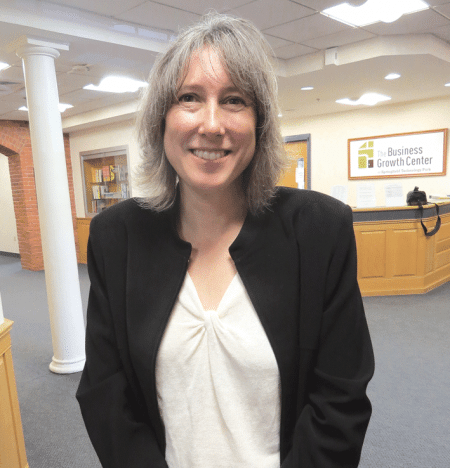
SPRINGFIELD — FIT Staffing, an information-technology staffing and recruiting company based in Springfield and Enfield, Conn., announced that Emily Doucette has joined the team as a technical recruiter.

Doucette has extensive recruiting and HR experience in the information-technology and aerospace-engineering industries. At FIT, she is responsible for sourcing and screening technical talent for Massachusetts and Connecticut clients. She has a bachelor’s degree in business management and an MBA from Springfield College. She is also a member of the adjunct faculty at Springfield College and teaches business management to undergraduate students.

Community Spotlight Features

Community Spotlight

Denise Menard and Robyn Macdonald

Denise Menard and Robyn Macdonald say the gas station and convenience store under construction at 227 Shaker Road will give people in the southern portion of town access to needed services.

East Longmeadow has grown and flourished in recent years thanks to its excellent schools, pastoral landscape, and thriving Industrial Garden District, where manicured lawns and flower gardens belie the scope of commercial and manufacturing companies that do business there.

However, last year, the town’s bucolic character was upset by repeated controversy that was ignited and fueled by reports of corruption. “The town went through a year of turmoil, and some businesses were hesitant to move here due to the negative publicity,” said Robyn Macdonald, the town’s Planning, Zoning Board, and Conservation director.

She added that these issues were essentially put to rest in April when residents voted overwhelmingly in favor of a new charter that replaced the town meeting and three-member Board of Selectmen with a town manager and Town Council that features seven elected members.

Its first official meeting was staged July 1, and a few weeks later, former East Windsor, Conn. First Selectman Denise Menard was hired as interim town manager.

“The charter expanded the town’s leadership, and work has already been done to preserve the good things that exist here, while promoting healthy living and balanced growth,” Macdonald said.

To that end, plans are in place to establish East Longmeadow’s first human resources department. In addition, several new positions have been added that include a director of finance; a director of Planning and Community Development; and a full-time health director. Aimee Petrosky was recently hired to fill that role and is working with the newly appointed three-member Board of Health.

She told BusinessWest that the town held its first flu clinic last month, which was highly successful and will be repeated next year. In the meantime, the board plans to seek funding to vaccinate uninsured residents, and the next event will include the shingles vaccine.

Other changes include a new sharps-disposal program that offers disposal units to residents at an affordable price because they can be cost-prohibitive; new regulations that make it illegal to smoke any type of tobacco, including e-cigarettes and vapor cigarettes, within 50 feet of a public building; a fine policy for restaurateurs who fail to comply with health regulations; and new rules that require companies that serve or produce food to install traps to prevent grease from entering sewers and affecting business operations or private residences.

“The Health Department also recently purchased an electronic inspection system that will post the outcomes of health inspections online,” Petrosky said, noting that food-safety training sessions were held for the School Department, the Council on Aging, and at churches that requested it to insure that the most vulnerable populations are protected.

Menard applauds these changes because they add to the town’s offerings, and notes that, when a permanent town manager is named, it will be important for the person to promote intelligent economic development and take a proactive stance in attracting new businesses.

“There is room for growth in the underutilized areas of our industrial and commercial sections of town,” she said.

Macdonald agrees, and says there are a few dormant parcels they hope to fill in the future, including the long-vacant Package Machinery site. “East Longmeadow has always welcomed new businesses, but we try to maintain a good balance between residential and business growth,” she noted.

For this, the latest installment of its Community Spotlight series, BusinessWest looks at projects on the drawing board as well as developments underway that will help East Longmeadow retain its small-town character while offering new venues that will boost the tax base and provide services for people who live and work in the town.

Major Projects

Officials are happy that several sites in town that have been vacant for more than a decade are being redeveloped.

For example, L.E. Belcher broke ground three months ago on a 6,500-square-foot convenience store with five gas pumps, 10 pumping stations, three outdoor tables, and 28 parking spaces on a lot at 227 Shaker Road that was empty for many years.

The company has secured a license to sell wine and beer, and worked closely with the Planning Board to ensure the new business is a good fit for the town. Ownership has installed flashing pedestrian safety lights to facilitate safety on the Chestnut Street side of the Redstone Rail Trail that runs behind the property, and contributed to a mitigation fund that will assist the Department of Public Works with roadway and traffic improvements in the Shaker Road and Chestnut Street corridor.

“It’s a busy intersection, and their gift of $25,000 to the DPW was a great gesture from a new business,” Menard said.

Macdonald concurred. “L.E. Belcher is a community-minded company, and the facility they are building will provide the industrial area with a service that doesn’t exist in that part of town. There is nothing like it from there until Route I-90 in Enfield, and it is expected to bring in people from Connecticut, while reducing congestion at the rotary,” she said, adding that the new convenience store and gas station are expected to open in mid- or late January.

A new restaurant called Green/Wich is also under construction at 16 Maple St. on the rotary. The eatery’s plans were recently approved, and the owner has also secured a beer and wine license.

“It’s a great addition to our center, and we’re happy to have a building that sat empty for many years put to use by a business that will help people attain a healthy lifestyle. It will offer high-end wraps and salads with indoor seating,” Menard said.

Macdonald told BusinessWest that Green/Wich had to do a major renovation of the building that included asbestos abatement, and has worked closely with the town to ensure the restaurant meets all safety requirements when it opens in about a month.

Several businesses in the town are experiencing rapid growth, including Go Graphix, which relocated from a shopping plaza on North Main Street to a 5,000-square-foot space on Benton Drive in the industrial park several years ago.

“The organization takes a concept through design, production, and installation. Their focus is on individual brands and messaging, and they incorporate big-picture objectives while paying close attention to the smallest details,” Macdonald said. “They have done so well, they are planning a 2,584-square-foot addition to their existing building. “

That project is still in the planning stages, but in September the Planning Board approved construction of an 18,000-square-foot medical office building on 250 North Main St.

The new, two-story structure will be constructed by Associated Builders for Baystate Dental Group and will have 90 parking spaces. The dental office will occupy the first floor, and the second floor will be rented as medical or office space.

Two other significant projects were also recently proposed. The first is an expansion: Excel Dryer wants to put an addition onto its existing building at 357 Chestnut St. that will include 1,300 square feet of warehouse space and 3,700 square feet of office space.

“This is a family-owned and -operated company that revolutionized the industry and set a new standard for performance, reliability, and customer satisfaction,” Macdonald said. “They have continued to grow, and the addition will enhance their ability to move forward in the future.”

The second project is much more complex, as it involves the towns of East Longmeadow and Longmeadow.

Macdonald said the planning boards in both towns have been working with Michael Crowley of Michael Crowley Associates and Middle Franklin Development, Robert Levesque of R. Levesque Associates Inc., David Dunlop of David Dunlop Associates, and Fuss & O’Neill to create a medical complex that will add to East Longmeadow Skilled Nursing Center at 305 Maple St., cross town lines, and provide benefits to both communities.

Crowley presented plans for the project in June. It includes four structures on a 20-acre site: a 50,000-square-foot medical office building in Longmeadow that would be occupied by Baystate Health; a two-story, 25,000-square-foot conventional office building in East Longmeadow; and an assisted-living facility and an expansion of the existing skilled-nursing facility that would be run by Berkshire Health in the town.

“The complex will feature state-of-the-art technology and have every safety system installed possible, including fire alarms, an emergency generator, and rooftop units with individual room controls,” Macdonald said, explaining that the two towns have commissioned a traffic study to mitigate any problems that could result from the project because it will affect some of their busiest intersections, namely Benton Drive and Chestnut Street in East Longmeadow, the Converse Street area in Longmeadow, and that town’s intersection at Dwight Road, Williams Street, and Maple Street.

Work in Progress

The Department of Public Works has an ongoing project that involves installing new sidewalks in East Longmeadow’s center and around the schools to make pedestrian travel safe and help make the town more desirable.

Historically, that hasn’t been a problem.

“Businesses are thriving in East Longmeadow and want to stay here,” Macdonald said, explaining that, although the town doesn’t have its own utility companies, manufacturers in the Industrial Garden District including Sullivan Paper Co., Tiger Press, and the recently sold Lenox Newell Rubbermaid have installed solar panels on their roofs, and panels have also been approved for the Reminder building in the commercial district.

“We still have plenty of room for new companies, and the opportunities here are great. The town welcomes large and small businesses, and our Industrial Garden District is a beautiful area which is easy to get to from I-91,” she noted.

Indeed, the negative publicity has come to an end, the town is moving forward, and the future looks bright for residents and businesses alike.

East Longmeadow at a glance

Year Incorporated: 1894
Population: 15,720 (2010)
Area: 13.0 square miles
County: Hampden
Residential Tax Rate: $21.12
Commercial Tax Rate: $21.12
Median Household Income: $78,835
Median Family Income: $99,707
Type of Government: Town Council; Town Manager
Largest Employers: Cartamundi; Redstone Rehab and Nursing Center; Lenox Newell Rubbermaid
* Latest information available

Education Sections

Closing the Gap

Arlene Rodriguez

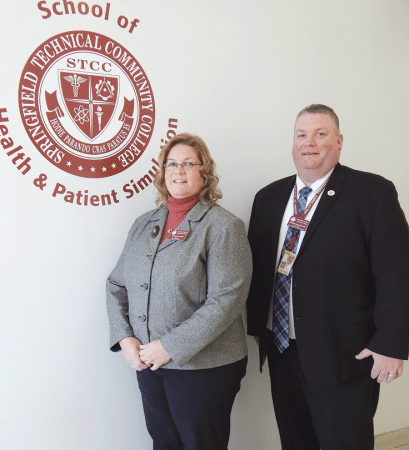
Arlene Rodriguez says the $3.4 million federal grant that STCC received will help Hispanic and low-income students obtain degrees in science, technology, engineering, and math.

Arlene Rodriguez says people who apply for a grant of any type need to have a compelling story about why the money is important.

The vice president of Academic Affairs at Springfield Technical Community College (STCC) knows developing the story is something that takes time, energy, dedication, and great attention to detail, which are all elements that were incorporated into a recent grant application the college submitted to the U.S. Department of Education.

The year of work that went into its preparation was well worth it, however, as the story met with unparallelled success: STCC was recently awarded one of the largest awards in its history: a five-year, $3.4 million grant for the program called the Hispanic and Low-income Transformed Education in STEM (HiLITES) Project.

It’s aimed at helping students attain degrees in STEM (science, technology, engineering, and math) classes and programs, and although STCC is the only community college in Massachusetts to win this award, Rodriguez says it’s appropriate due to the school’s demographics. To be eligible to receive the grant, a college must be designated as a Hispanic-Serving Institution, which is attained when at least 25% of the total student population is Hispanic.

STCC’s Hispanic population is 27.6%; it has been designated a Hispanic-Serving Institution since 2013; and 56% of its students receive federal Pell grants, which are limited to students with financial need.

“This grant was very competitive, and it took all I had not to jump up and down when I heard that we were given exactly what we asked for,” Rodriguez said. “It will give us an opportunity to make significant changes proposed by faculty and students who identified obstacles to success in STEM courses during interviews that took place before we applied for the grant. People were very honest about what stopped them from continuing in these programs, and faculty talked about where they see students struggle and what we need to change,” she continued. “It was a collaborative effort that was student-oriented; we are determined to make changes to improve students’ lives, and one of our goals is to increase the number of students in STEM disciplines.”

Indeed, it’s critical for local students as well as the economy; a report commissioned by Raytheon says a workforce prepared to tackle science is needed to drive future growth and innovation, and 67% of manufacturers are experiencing a shortage of qualified employees.

In addition, the U.S. Bureau of Labor estimates that 8,654,000 STEM-related jobs will exist in 2018, not including self-employed STEM individuals, and although the national average wage is $42,979, those with a STEM degree earn about $78,000.

STCC has more than a dozen STEM programs that range from architectural and building technology to computer-aided drafting, CNC operations, electrical engineering technology, and HVAC (heating, ventilation, and air conditioning), and many are not found in other community colleges across the state. But right now, only 14% of its Hispanic students and 11% of its low-income students enroll in STEM courses, and those who do need support to be successful.

This grant was very competitive, and it took all I had not to jump up and down when I heard that we were given exactly what we asked for.”

“There is a disconnect between Hispanic students and students with Pell grants when it comes to jobs that are available, and we want to bridge that gap,” said Rodriguez. “Our end goal is to prepare students for positions that are going unfilled, and this grant will allow us to provide them with the support they need to make a better life for themselves and provide for their families.”

She noted that the majority of Hispanic and low-income students enter college needing help in math and have lower rates of retention and graduation. “Students who are Hispanic and low-income perform worse on all three measures than students who are only Hispanic or low-income,” she told BusinessWest.

STCC President John Cook agreed. “We’re open-eyed about student needs, and this grant will help us address complex challenges. We look forward to building diversity across our unique array of STEM programs, and this is a chance to both expand initiatives while also trying new and creative approaches,” he said.

Multi-faceted Program

The grant money will be used to provide a wide spectrum of programs and services over a five-year period that will kick off in the spring. One of the new initiatives will introduce students in middle and high schools to STEM careers they may not know about in fields that include precision manufacturing, information technology, and HVAC, as there are job vacancies in these areas that pay well.

STCC’s plan is to bring the students to campus, introduce them to the faculty, show them the machines they will work on if they enter these programs, and educate them about careers associated with STEM degrees and the type of work they would perform on a daily basis.

“A student may not know these courses are available, or think they couldn’t succeed in them because they require a lot of math. But we have fantastic teachers who are able to teach these subjects in creative ways that make it easy to learn, and our faculty wants to make sure that our students succeed,” Rodriguez said, noting that, in some cases, students with an associate’s degree can earn $50,000 to $60,000 after graduation, and many have job offers before they matriculate.

There is also a plan to work with local high schools and expand the dual-enrollment system that allows students to go to the STCC campus and take courses before they receive their high-school diploma, as well as to expand programs with four-year colleges and improve the transfer rate by creating a seamless transition.

Assessments are conducted of a student’s math and English skills when they enter STCC, which is important because Rodriguez says many students are not ready for college-level math and need to take a series of courses to get them up to speed, which is a national problem at the majority of community colleges.

“The average age of our students is 26, and taking extra courses can be frustrating; they may have families or part-time jobs, so there is a sense of urgency to graduate,” she said, adding that many have GEDs, and even those who did well in high school may need to regain math skills after spending years away from the classroom.

“The grant will allow STCC to provide these students with enough support to take math and science courses without prolonging the time it takes them to graduate,” she continued, explaining that this may mean redesigning some STEM courses, offering additional tutoring, and providing more professional-development opportunities for instructors.

Students who are part-time and have not yet selected a major will also be exposed to STEM courses and careers through demonstrations, guest lectures, and other avenues.

In addition, two STEM advisers will be hired to conduct outreach and help students interested in STEM careers transition into the progams, and a STEM Center will be created as a centralized location for presentations, group study, tutoring, and faculty work. Rodriguez noted that the STEM Center will likely be located in space that will be vacated when the new Learning Commons is completed in 2018.

Change Agent

A 2013 report by the Commonwealth that addressed the skills gap says pipelines are powerful tools because they address both sides of the issue by giving people in the workforce the skills they need while responding to the changing nature of what employers are seeking from their workers.

The grant will help to strengthen the local pipeline, and since STCC graduates live locally, are committed to the community, and usually stay in the area, the grant is a win-win situation, Rodriguez said.

“Community colleges are the front lines of workforce education, and we can respond to employers’ needs in a way that four-year schools may not be able to,” she noted. “The essence of this institution has remained unchanged for the past 50 years, and it has helped to produce leaders in business, government, and education in various professions that benefit the community. Our college continues to be an engine of economic opportunity and development for the region.”

Indeed, it’s an ongoing story, and this chapter should have a happy ending as students are given the support they need to enter careers that pay well and local employers see an increase in qualified candidates to fill jobs, which will allow their companies to grow and thrive in a changing economy.

Holiday Gift Guide Sections

Perfect Presents

giftgivingartThe holiday season will soon be upon us, and choosing a gift for a business professional or customer that will make their life easier or provide a bright spot in their day can be a daunting, but ultimately satisfying, task.

Some want to keep pace with the latest technology, others appreciate anything that can provide them with comfort or add pleasure to their work day, while still others appreciate whimsy or a gift they can enjoy themselves or with others when their day is done.

BusinessWest has done its best to make your shopping easier by presenting ideas in a variety of price ranges sure to please a co-worker, frequent flyer, or anyone who spends a good deal of their life in the office. Some items can be found locally and support small businesses, while others are carried at a range of stores.

If none of these seems quite right, a gift certificate to an area store, restaurant, or theater venue is sure to be appreciated. And, last but not least, consider a gift to a charitable organization you know the person cares about and supports.

Prosperity Candle

Candles can make a scent-sational gift, and a small group of socially responsible female entrepreneurs at Prosperity Candle in Easthampton has a wide range of offerings designed to brighten things for everyone on your list.

Their candles are handmade to order with soy-blend wax, essential oils, and natural cotton and wood wicks, and can be purchased individually or in a gift box that contains local products.

Try Pioneer Valley Gift Box #1 with maple syrup from Florence and a candle scented with a blend of tobacco leaves, aged cedar, and a touch of spice ($34 at www.prosperitycandle.com).

Fitbit 2 Heart Rate and Fitness Band

fitbit-charge-2Many people make an annual New Year’s resolution to exercise more, and a Fitbit 2 Heart Rate and Fitness Band may be the ideal gift to help goal-oriented professionals meet with success.

The device contains a multitude of features that range from call, text, and calendar notifications to “Reminders to Move” that encourage wearers to take 250 steps every hour, and tracks steps taken, distance, calories burned, floors climbed, active minutes of exercise, and hourly activity, as well as how long and how well you sleep. The battery lasts up to five days without being recharged. Starts at $149.

Tre Olive Gift Box

tre1Anyone who likes to cook or enjoys a good salad will appreciate a gift of extra-virgin olive oil grown by members of the Falvo family in the Calabria region of Southern Italy. Tre Olive in East Longmeadow has individual bottles starting at $9.99, balsamic vinegars and spreads, beautiful gift boxed tins starting at $19.99, and olive-oil soaps flavored with lemongrass, fig, and other intriguing combinations.

There is also the ultimate gift: adopt an olive tree for a year, receive a photo of it, and look forward to the spring when its olives are pressed and you or your gift recipient will be sent some of the freshest oil imaginable. At www.treolive.com.

Nokia Treasure Tag

People who travel frequently often fear losing their laptop, luggage, and other necessary items. But this little tag with a standard watch battery life of six months can prevent that: it connects to smartphones that use Bluetooth 4, and if the traveler forgets an item, the tag beams. In addition, it allows you to search for missing items. Cost: $30.

Tea Guys

Many business professionals drink coffee throughout the day, but if you introduce them to award-winning tea brewed in small batches, they may thank you for years to come.

Tea Guys in Whately offers every type of tea imaginable with highly unusual blends and flavors such as chocolate raspberry and candied lemon. A box, gift package, or gift certificate is sure to soothe. At www.teaguys.com.

Natico Decision Maker and Paperweight

natico-decsion-makerBusiness involves daily decisions, but sometimes it’s not clear what to do. In these cases, it’s simple to alleviate stress — or just have a moment of fun — by pressing the button in the middle of the Natico decision maker and paperweight.

A solution will appear when it is done spinning, and your reaction may help determine what course to take. The paperweight can also serve as a conversation piece when someone enters your office. Cost: $17.50.

Herman Miller Aeron Desk Chair

aeron-chair_1Comfort is priceless, and spending hours behind a desk can lead to chronic back pain, but Herman Miller offers an almost foolproof solution with its classic Aeron desk chair.

The most well-known ergonomic office chair on the market incorporates the latest research around the science of sitting; fabric and foam are replaced with a breathable, woven suspension membrane, and ergonomic engineering allows the person’s weight to be distributed evenly to eliminate pressure points and heat buildup.

The chair reclines, and its PostureFit feature provides support at the base of the spine, where it is needed. Models start at $679 at Lexington Group Inc. in West Springfield.

Share Coffee Roasters

share-coffeeThere’s nothing to brighten up a day like getting a gift at work, and coffee lovers will be thrilled to find a delivery of freshly roasted gourmet coffee sent to them weekly by Share Coffee Roasters in Hadley. The first bag is free, and after that, weekly packages are sent for the length of time you choose and come in 6-, 12-, or 18-ounce packages.

The coffee is roasted and shipped the same day and is similar to fine wine, as it contains a medley of tastes. For example, Guatemalean Los Dos Socios has hints of dark chocolate, juicy citrus fruits, and praline. Prices start at $13 at www.sharecoffeeroasters.com.

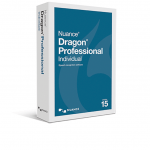
Dragon Professional Individual, v15

dragon-professionalIf you know a small-business owner or executive who doesn’t have a secretary or complains frequently about carpal-tunnel pain, Dragon Professional Individual v15 voice-recognition software may usher in tidings of great joy. It can transcribe dictation or an audio interview three times faster than typing, and the person never needs to use their hands. In addition, simple voice commands can be used to edit documents or change formatting with up to 98% accuracy. Cost: $300.

Frigo Gourmet Foods Gift Basket

frigosbasket2016Food is always a welcome gift, and a gift basket from Frigo Gourmet Foods in Springfield can be shared at the office, taken to a party, or enjoyed at home. They come in a wide array of prices and styles, but their Old World Italian gift basket is sure to be a hit, with its irresistible mix of seasonal products such as panettone, amarettini cookies, biscotti, torreones, asiago, fontina, parmesan, provolone, salami, pepperoni, and casaling or sopressata meats. Cost: $125 at www.frigofoods.com.

Bose QuietComfort 35 Headphones

bose-headphonesHave a frequent flyer on your list? Someone who has trouble concentrating in a noisy workplace, or whose performance soars when listening to music their co-workers might not appreciate? Bose QuietComfort 35 headphones might suit their needs as they combine Bluetooth connectivity with the latest in noise-canceling technology, take a mere 15 minutes to charge, and have an unmatched battery life of 20 hours with a free app that makes switching between devices easy. Cost: $349.

Black Birch Vineyard

This family-owned Southampton vineyard offers award-winning wines created by hand in small, individually numbered batches. Choose from reisling, chardonnay, epic white, pinot noir, cabernet blanc, and more at $16 and up, or a beautiful gift basket that contains a bottle of wine, two glasses, and a wine-tasting gift certificate for two. Basket: $45 at www.blackbirchvineyards.com.

Clear Bubble Paperweight

paperweightThis clear bubble paperweight by the Museum Store at Wheaton Arts is handmade, so the color and size may vary if you purchase more than one, but it’s an unusual gift that is practical, decorative, and comes with a story card. Cost: $34 at www.wheatonarts.org.

Laurel Mountain Basket Co. Inc.

laurel-mountain-gift-basketThis Easthampton company creates unique gourmet gift baskets and believes that giving a gift basket “shouldn’t make you a basket case.”

Each basket is made when the order is placed, so give them a call at (413) 527-1243 to talk about their kosher, gluten-free, and specialty New England gift baskets overflowing with products that can be designed to suit every budget and palate. Visit www.laurelmtbasket.com.

Wireless Weather Station

People who love to know what it’s doing outside will delight in a desktop wireless weather station. Many models are available and range in price from about $50 to more than $500.

The AcuRite 01036 Pro Weather Station with PC Connect, 5-in-1 Weather Sensor, and My AcuRite Remote Monitoring App has great ratings; accurately measures the temperature, humidity, wind speed, wind direction, and rain; and allows you to set up programmable weather alarms as well as e-mail and text alerts to notify you when conditions change or your presets are reached. Cost: $125.

Entrepreneurship Sections

What’s the Big Idea?


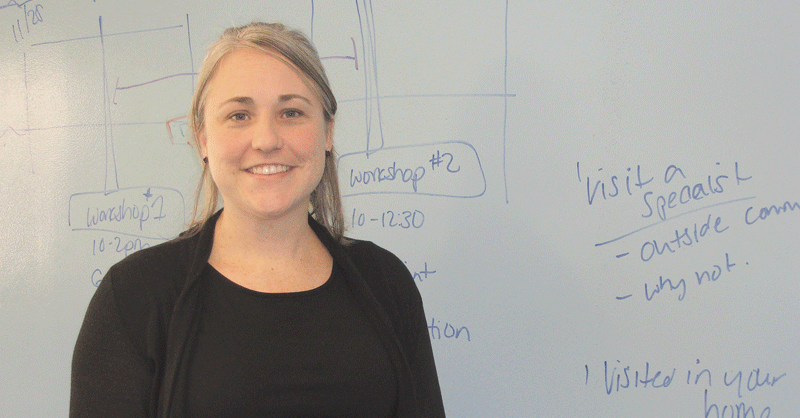
Jill McCormick says TechSpring focuses on technology that’s practical, usable, and can be applied now to help Baystate Health succeed.

Jill McCormick says TechSpring focuses on technology that’s practical, usable, and can be applied now to help Baystate Health succeed.

When TechSpring opened two years ago in downtown Springfield, its leaders knew they were flying blind, at least at first. That’s how uncharted this territory was. But the concept — connecting technology companies, large and small, with the region’s largest health system to solve pressing problems — proved a compelling one, and today, TechSpring has numerous success stories to tell. It’s a conversation, they say, that needs to continue.

Eric Harry says genomics is one of those “sexy” areas of healthcare, and scientists are certainly engaged in exciting work to learn how genes influence disease.

“But we know for a fact,” he went on, “that zip code is a greater determiner of health outcomes than your genes. And we have a lot of high-risk patients at Baystate. There’s a lot of poverty here, a lot of patients at risk because of their zip code.”

Harry, community manager at TechSpring, Baystate Health’s technology innovation center in downtown Springfield, was talking with BusinessWest about a far different discipline than genomics: data analytics. When TechSpring opened two years ago, one of its partners, Dell, went to work in this area, trying to identify which patients are most at risk of becoming “high utilizers” of healthcare — or are, in other words, one major event from becoming very sick.

“What was their medical record like before they got sick, and who has those indicators now?” asked Jill McCormick, manager of the innovation center, adding that such studies are critical to the growing field of population health, which is critical at a time when hospitals must move away from the old, inefficient fee-for-service model into a value-based care model that seeks to keep people out of the hospital altogether.

“Our population will benefit if we make these changes,” she added — and analytics will be an important piece of the puzzle.

TechSpring, which opened two years ago in Springfield’s emerging downtown innovation district, matches private enterprises with partners and expertise from across the Baystate Health system to take on some of healthcare’s most difficult challenges. The goal is to create new technology solutions and products that could be used to improve health outcomes.

It’s a startup within a large health system, so you just have to start trying stuff. What works? What’s scalable? What can you do in that space?”

TechSpring owes its existence in large part to a $5.5 million grant from the Massachusetts Life Sciences Center, an investment agency charged with implementing then-Gov. Deval Patrick’s 10-year, $1 billion Life Sciences Initiative that supports life-sciences innovation, research, development, and commercialization.

TechSpring offers partners flexible space to work and the ability to collaborate directly with providers from Baystate Health on their projects, assessing the needs to be met in today’s healthcare environment, and testing potential responses to those needs.

“We work closely with Baystate Health to identify problem areas, or where they are investing in problems that need to be fixed,” McCormick said. “For example, where do they see population health going?”

Eric Harry

Eric Harry says TechSpring partners first learn what Baystate’s needs are and then develop technology-based solutions.

One possibility is working with organizations like Partners for a Healthier Community on how to incorporate data on poverty and housing issues into patients’ health records, so a doctor recognizes that the housing situation is contributing to the person’s health status.

The idea, she added, is to arm providers with the data they need to empower patients to take more control of their own lives. The fact that TechSpring is located in a demographically diverse region is one of its strengths.

“Springfield is geographically interesting, between New York and Boston,” she said. “It has a great mix of rural and urban, and it has interesting economic challenges, that made this the ideal proving ground for technology solutions that represent what the U.S. market looks like, versus your Cadillac medicine or high-tech areas.”

Actually, McCormick added, TechSpring leaders tend to shy away from the word ‘high tech,’ focusing on how technology can solve problems in areas like population health, rather than on what’s new and hot in technology itself.

“It’s really about what is practical and usable and can be applied now in helping the health system succeed,” she explained, “by addressing the needs of the population and helping patients achieve better health outcomes.”

Free Falling

When TechSpring opened in late 2014, it had already lined up a number of partners — companies that were proven and experienced in the industry, including IBM, Premier Inc., Cerner Corp., Dell, Medecision, and Mainline Information Systems. But the goals were still ambiguous.

“It’s a startup,” McCormick said. “It’s a startup within a large health system, so you just have to start trying stuff. What works? What’s scalable? What can you do in that space?

“What does it mean to change the industry?” she went on. “What does it mean to drive positive change? What are you working on, what is Baystate working on, and how do we bring you together to actually do something, and do it in a way that’s designed for learning and proving, rather than sales and acquisition?”

Harry compared the experience to jumping out of a plane for the first time, but McCormick amended the analogy. “Actually,” she said, “we’re building the plane while we’re flying it.”

Whatever the comparison, Harry said, TechSpring was a risky venture because nothing like it had been attempted in the region, and it demanded a total buy-in from Baystate and its partners to succeed.

There have been 22 such partners so far, including a handful of large companies, about five tiny startups, and a dozen or so companies in the middle, size-wise.

For example, a company called Praxify is working to help doctors balance efficiency and patient satisfaction in the era of electronic health records, or EHRs. “Oftentimes, documentation gets in the way of direct patient care,” McCormick said.

Other projects have involved remote patient monitoring — and how to get recorded outcomes into medical records so providers can make care decisions between patient visits — and advanced clinical decision support, or ACDS, which aims to turn medicine into more science than art by establishing, through hard data, the right course of action in various clinical situations.

Originally, potential partners were bringing ideas to Baystate, and the health system was trying to fit their ideas into its framework. That has changed, however, into what Harry called a “marketplace.”

“Now we’re going into Baystate and talking to providers and figuring out where the problems are, really defining those problems, and then we go out and look for innovators, telling them, ‘here are the problems we’ve defined. Can you solve them?’ We’re creating a match-making process. We have a list of problems, well-defined, already sourced, and innovators submit a statement of interest to solve those problems, as opposed to saying, ‘hey, I have this solution. Can I work with you at Baystate?’”

The partners, interestingly, are not being paid for their work; in fact, they pay to access Baystate’s resources and human capital through TechSpring. But if they get to a point where a solution works, they have a direct line to become a successful vendor at Baystate and beyond.

“They’re developing a true solution, solving a real problem, and if they can do that here, they can do it anywhere,” Harry said.

That setup works well for large partners with significant financial resources, but perhaps isn’t as ideal for early-stage startups, so TechSpring is working to develop a model to improve access to companies that can’t afford to pay up front.

Boston-based CarePort Health, one of TechSpring’s initial partners, specializes in helping providers optimize post-acute outcomes and costs by guiding patients across the care continuum and tracking their recovery in real time. “They earned a commercial customer relationship with Baystate and had broad market success from there,” McCormick said, adding that the company was recently purchased by Allscripts, a major EHR vendor.

“When you finish working with TechSpring,” McCormick said, “it should either put you in a position to receive additional funding or propel your solution toward broad market success.”

Happy Employees

Meanwhile, a TechSpring partner called Imprivata works on the security side of healthcare, developing products like a badge that employees swipe at their computers to enter any program they have access to, instead of having to remember passwords for each one. Another current project is a biometric palm-vein reader. Each scan is recorded in a database, and physicians can then swipe anyone entering the ER and immediately pull up their medical records.

“We have a nice pipeline with Imprivata; they’re already popular and well-received in the hospital, and we get to work on what’s next for them,” McCormick ssaid. “They look for intersections between convenience and patient security. When I bring these solutions to the health system, they’re psyched because they know Imprivata is going to make their lives easier.”

Such solutions, however, begin with conversations — between providers and TechSpring partners, and between the tech companies themselves — and that’s another area where the innovation center excels, Harry said. “We’re really driving ecosystem thinking within healthcare.”

To that end, TechSpring also offers co-working, office, and event space in flexible month-to-month memberships for anybody working at the intersection of technology and healthcare. Meanwhile, a monthly networking event called Tap into TechSpring features networking and content-rich speaker programs, so various stakeholders get a sense of what everyone is working on, and sometimes new collaborations form.

“I’d say a lot of people in the healthcare sector are cynical about this type of thinking. ‘Show me the money’ is their way of thinking,” Harry said. “We’re helping people understand there probably is money, and a way that everyone can benefit, but until we get together, that can’t happen.”

Added McCormick, “it’s not that we’re just dreaming about what the future of healthcare could be. We’re actually executing against what we think the future of healthcare can be.”

At the end of the day, Harry said, TechSpring is about solving health problems — at a time of great shifts in the way care is delivered — and, ultimately, changing lives.

“Can everyone win?” McCormick asked. “We think so. Our bet is they can. And we’re taking all these opportunities to prove that everyone can win — especially patients.”

Joseph Bednar can be reached at [email protected]

Sections Technology

Something for Everyone

Smartphones rule the world — or, at least, their users’ lives — but they wouldn’t be of much use without apps. And those apps are legion, appealing to individuals’ desire to manage everything from finances to fitness, to continually learn new things and find new ways to have fun. Here’s a roundup of some of the most popular and well-reviewed apps available today.

Say you want to more effectively manage your finances. Or get in shape. Or brush up on your math skills. Or just relax and have a good time.

As the old iPhone commercials used to say, there’s an app for that. Many, many more than one, actually. And they’re usually free, and available on both the iOS and Android platforms.

For this year’s roundup of what’s hot in technology, BusinessWest checks in on what the tech press is saying about some of the most popular smartphone apps.

Financial App-raisals

personal-capitalFor starters, smartphones have put a world of personal finance in people’s hands. For example, Personal Capital offers simple charts and graphs of the user’s income, spending, and investment performance so they can easily monitor their finances.

“Track your investments by account, asset class, or individual security, see how your portfolio compares to major indices, and find the exact percentage of each asset class that’s in your portfolio,” Investopedia explains. “A 401(k) fee analyzer and mutual-fund fee calculator show if you’re paying too much in fees. The Investment Checkup feature analyzes your portfolio and shows how much you stand to gain with a few changes.”

mintBusiness Insider reports that Intuit’s Mint gives users a real-time look into all their finances, from bank accounts and credit cards to student loans and 401(k) accounts. “It automatically tracks your spending, categorizes it, and alerts you when/if you approach your budget limit. You can even ask for custom savings tips within the app,” the publication notes. “Everything is shown in simple, intuitive graphs and charts, making it one of the most popular personal-finance apps in the world.”

goodbudgetMeanwhile, Business Insider also recommends GoodBudget, an app that brings the envelope-budgeting method into the smartphone. Users create ‘envelopes’ for each of their budget categories, such as groceries, transportation, and shopping, and pre-determine how much they want to allocate in each envelope. They can then record and track how much they’re spending from each envelope. “It may not be as sophisticated as some of the other apps, but Goodbudget offers a simple way to stick to your budget and keep your spending really disciplined.”

prosper-dailyWhat about financial security? Investopedia recommends Prosper Daily, a personal-finance security service that tracks spending and protects credit cards from fraud and errors. Users can quickly view balances and recurring charges across all their credit and debit cards.

“Prosper Daily creates an alert if a suspicious charge is posted to your account, allows you to report the charge and/or contact the merchant, and will help you get your money back from fraudulent, erroneous, or unfair charges,” the publication notes. “Data-breach alerts let you know when a data breach has occurred at a place where you’ve shopped.”

Healthy App-roach

What if physical wellness tops one’s priority list. No fear — there are countless apps for that, too, teaching users how to shop, all the facts on what they’re eating, how to exercise, and how to stay committed to better habits.

myfitnesspalOne of the most popular nutrition apps is MyFitnessPal, which offers a wealth of tools for tracking what and how much the user eats, and how many calories they burn through activity, explains PC Magazine. “Of all the calorie counters I’ve used, MyFitnessPal is by far the easiest one to manage, and it comes with the largest database of foods and drinks. With the MyFitnessPal app, you can fastidiously watch what you eat 24/7, no matter where you are.”

The app’s database of more than 6 million foods makes it easy to track a diet, or the lack of one, added the online magazine Greatist. “Whether you’re trying to lose weight or put on muscle, the app helps determine the best things to eat and meet your goals.”

nike-training-clubBut nutrition is only part of the story when it comes to fitness — exercise is the other key discipline. But where to start? One possibility is the Nike+ Training Club, which takes the concept to the next level, offering more than 100 workouts to choose from. Users can also opt for a customized, full-body, four-week plan. “A trainer leads you through the routines, plus you get instructional video clips of the moves,” notes Fitness magazine. “Don’t like burpees? The updated app lets you swap drills you hate for ones you love.”

strava-running-and-cycling-gpsFor those who prefer being outdoors to get in shape, Strava Running and Cycling GPS monitors running or cycling routes via GPS, notes Digital Trends. “It also gamifies your cardio workout and pairs with leaderboards, achievements, and challenges, bringing a competitive spirit to your routine.”

jefitFor a more comprehensive training assistant, Men’s Fitness recommends Jefit, which creates personalized workout routines by tracking and analyzing the user’s workout progress and diligently recording weight, reps, and time.

“Its data-heavy approach will appeal to stat nerds and workout obsessives alike. Jefit also packs the most robust library of exercises and maneuvers,” the magazine notes, including how-to videos with more than 1,300 exercises making up scores of workouts. The free version is limited, with some bare-bones workout routines and basic activity logs, while paid options are ad-free and unlock more features.

App-lied Learning

khan-academyCountless popular apps focus on education and learning for all ages. For kids, the Children’s MD blog recommends Khan Academy, which collaborates with the U.S. Department of Education and myriad public and private educational institutions to provide a free, world-class education for anyone.

“It’s incredibly easy to use, there are no ads, and it’s appropriate for any school-aged child that knows how to read,” the blog reports, noting that Khan Academy started as a math-learning site but has expanded to many other subjects, from art history to economics. “My kids will spend hours looking at computer-science projects that other kids have shared and incorporating ideas into their own programs. The Khan platform combines educational videos with practice problems and project assignments.”

photomathMeanwhile, Photomath focuses on, well, math, and does it well, Digital Trends reports. “For high-school students who just need a bit more guidance on how to isolate ‘x’ in their algebra homework, Photomath is essentially your math buddy that can instantly solve and explain every answer. Simply snap a photo of the question (you can also write or type), and the app will break down the solution into separate steps with helpful play-by-play, so that you can apply the same principles to the rest of your homework.”

duolingoFor language learning, Children’s MD recommends Duolingo, which provides interactive foreign-language education in 15 languages so far. It’s appropriate for both kids and adults, and one independent study found that a person with no knowledge of Spanish would need about 34 hours with Duolingo to cover the material in the first college semester of Spanish classes.

“It’s simple, user-friendly, and never boring,” the blog notes. “Install the app on your phone and get your language lessons done while you are on the elevator or waiting in line.”

nasa-appLearning means expanding one’s horizons, of course, and where better to do that than the NASA App, which aggregates a wide range of NASA content. “Space enthusiasts and curious minds will love how it packs a wealth of news stories, features, images, video, and information about the space agency’s activities into this one mobile app,” PC Magazine reports.

App-ealing Entertainment

spotifyLet’s face it, though — smartphone users want apps that are just plain fun as well. For music enthusiasts, it’s hard to go wrong with Spotify. Wired notes that users can access a huge catalog of music for a small monthly fee, creating their own playlists or enjoying the app’s curated stations.

Seven years after its debut, Mashable adds, “Spotify has tons of competition in the online streaming space, but the app continues to be one of the best ways to listen to music and podcasts on demand and on the go.”

espn-score-centerSports fans might dig ESPN Score Center, which allows users to check game progress from more sports than most other apps, PC Magazine reports, including baseball, basketball, football, soccer, ice hockey, cricket, rugby, and more.

big-ovenFor those whose idea of fun is improving their cooking skills, plenty of apps do the job. Digital Trends recommends two. Big Oven features more than 250,000 recipes, and provides grocery lists based on them, lets users add your own, and import recipes from friends. “If you like (or want to like) to cook, start with Big Oven.”

yummlyBut the publication also raves about Yummly, which offers access to thousands of unique recipes. “On top of recipe and grocery-list functionality, Yummly takes user preferences into account to provide recipe recommendations, for when you just can’t decide what to eat.”

action-movie-fxFinally, if the kitchen doesn’t provide enough action and adventure, Mashable recommends downloading Action Movie, the brainchild of Star Wars and Star Trek director J.J. Abrams. The app allows anyone with an iPhone introduce movie-level special effects to their short videos.

“Not only is it incredibly easy to use and completely addictive, it’s a huge crowd pleaser,” the site notes. “Filming a Thanksgiving dinner where a virtual car can unexpectedly crash across the dinner table is guaranteed to inspire roaring laughter. Action Movie is free, but smartly uses in-app purchases to sell you additional effects, all as good as the originals. It’s the rare app that has few competitors and has maintained a high level of quality.”

Joseph Bednar can be reached at [email protected]

Sections Technology

Won’t Get Fooled Again?

The trouble with a phishing scam, Brendan Monahan says, is that only one person in an organization has to fall for it to put information at risk.

Or, in Baystate Health’s case, five.

“There is constantly a threat to businesses — including ours; we’re no different — from outside phishing attacks,” said Monahan, manager of Public Affairs, in the wake of a phishing attack in August that exposed the personal data of thousands of patients. “They’re often internationally based and geared toward handing over the keys to the kingdom to a hacker who, from what we understand from most experts, is looking for some financial gain out of it.”

That doesn’t seem to have occurred in this case, Baystate officials say, but the incident, which was made public late last month, is serious enough to trigger a re-examination of the system’s security protocols — and to serve as a warning to other employers in the region, both large and small.

Specifially, on Aug. 22, Baystate learned that a phishing e-mail had been sent to numerous Baystate employees that, if opened, allowed hackers to access those employees’ e-mail accounts.

Phishing is an electronic attempt to obtain sensitive information, such as passwords and credit-card information, by masquerading as a trustworthy source. Phishing e-mails may contain links to a site infected with malware, or directly load a program onto a computer that makes it contents accessible to the scammer. The Baystate scam e-mail was designed to look exactly like an internal memo to employees.

eric brown

eric brown

The best defense is to have a written information-security policy in place. Part of that is training in security awareness for employees. That way, employees can’t say, ‘I didn’t know,’ or ‘I don’t understand.’ That’s where the data risk is. It’s not from the outside; it’s from the inside, with mistakes, careless errors made by employees.”

Baystate’s investigation determined that five employees responded to the phishing e-mail, allowing the hackers to gain access to those employees’ e-mail accounts. Some of the e-mails in those accounts included patient information, including names and dates of birth, diagnoses and treatments received, medical record numbers, and, in some instances, health-insurance identification numbers. However, the e-mails did not contain Social Security numbers, credit-card numbers, or other financial information commonly used by scammers and identity thieves to enrich themselves.

“The [phishing] e-mail contained information that would be described as mimicking or mocking an internal Baystate Health HR memo. Five employees clicked on that e-mail, that immediately compromised their Outlook e-mail accounts into the hands of the perpetrator,” Monahan told BusinessWest. “Our computer research firm found exactly what was in the e-mails and what could have been looked at.”

The fact that no financial data was compromised may be small comfort for affected patients, that fact may mean the scammers have no real use for the information, and left it alone when they discovered they couldn’t profit. But that remains to be seen.

“In this case, there was no financial gain to be had from the patient information,” Monahan said. “That’s why we don’t know whether they went through the documents, but they could have.”

Still, he added, “while we have no evidence that any patient information has been taken or misused, we want to assure our patients that we take this incident very seriously.”

Next Steps

Upon discovering the breach, Baystate immediately took steps to secure the e-mail accounts and began an investigation, and also reported the incident to law enforcement.

But finding out what happened and trying to identify the perpetrators is only one step in the process of responding to the incident, Monahan said. Topping that list is ensuring — or at least trying to ensure — that such an incident won’t be repeated, and that begins with employee education and training regarding phishing e-mails and other scams.

“That was already going on beforehand, and I would say it’s being ramped up,” he explained, noting that employees can click a button at the top of any e-mail if they suspect it comes from a suspicious source, and someone from Baystate’s IT staff will come and determine if it’s dangerous or not. “We try and help them, to train them not to click on a suspicious e-mail, what a phishing attack looks like, and how to recognize it when it comes about.”

Frank Vincentelli

frank vincentelli

Unfortunately, they’re always a step ahead, and for those of us in the security industry, to prevent their success, we have to figure out what they’re doing. But if you present a soft, open belly, they’re going to dive right in.”


Frank Vincentelli, chief technology officer at Integrated IT Solutions in Westfield, and Eric Brown, the company’s vice president of Security Services, recently spoke about data security in the business world at the Western Mass. Business Expo, and discussed at length the critical role each employee plays in keeping a company safe.

“The best defense is to have a written information-security policy in place,” Brown said. “Part of that is training in security awareness for employees. That way, employees can’t say, ‘I didn’t know,’ or ‘I don’t understand.’ That’s where the data risk is. It’s not from the outside; it’s from the inside, with mistakes, careless errors made by employees.”

Vincentelli noted that a computer without access to the Internet or e-mail is generally safe, but not particularly useful, so businesses must strike a balance between safety and usability. “The very fact that you have access to these resources is giving the attackers a way into your system and your information.”

The entire security chain, in other words, is only as strong as its weakest link.

“Each individual user is an active part in the overall security strategy of the company,” he went on. “I’m sure all of us can think of a person in we work with who’s not necessarily technologically sophisticated, a person who usually gets a virus or is hit with CryptoLocker three or four times a year. That person is the best level of protection your organization has.”

Training every employee then, is critical, but companies must still maintain a robust firewall infrastructure, complete with early-detection capabilities to identify breaches when they occur. Still, Vincentelli said, “the most important component is the individual user.”

On Guard

Phishing scams are, unfortunately, more common in the healthcare realm than some might suspect. In recent years alone, according to data-risk consulting firm IDT911, a server operating under contract for DeKalb Health Medical Group in Indiana experienced a cyberattack that compromised more than 1,300 patient-information records; Baylor Regional Medical Center in Texas was hacked after doctors responded to phishing e-mails, exposing the patient information contained in their inboxes, including names, addresses, dates of birth, and even Social Security numbers; and Franciscan Health System in Washington was hacked in a phishing scheme that affected potentially 12,000 patients.

Norton, the developer of Internet security software, recommends several steps to avoid becoming the victim of phishing at work, including being wary of e-mails asking for confidential information; watching out for generic-looking requests for information, as fraudulent phishing e-mails are usually not personalized; and avoiding using links in an e-mail to connect to a website, instead opening a new browser window and typing the URL directly into the address bar.

“This is constantly a threat that we have to be wary of as employees, in part because we have a confidentiality policy and handle health information and other protected information,” Monahan told BusinessWest. “We have to be good stewards of that. There needs to be a sense of vigilance, and we have to enforce it. With almost 13,000 people who work here, there’s no one piece of software that will block this particular type of attack. It comes down to workforce training.”

The attacks can be subtle, and often play on human psychology — including people’s natural curiosity. Brown asked his audience at the Expo what they would do if they found a USB stick on the ground before answering his own question.

“Obviously, if you find a USB stick and don’t know who the owner is, you don’t want to touch it,” he said. “That is one way people get malware infections. If I wanted to infect a company, I’d take 30 USB sticks, put a virus on them, and toss them in a parking lot. I guarantee a half-dozen people would pick them up and stick them in their computers.”

Vincentelli called cybersecurity a cat-and-mouse affair, adding that “I’m not sure who’s who.” But it’s clear that hackers are constantly honing techniques to exploit security weaknesses, and when the target develops a defense, the hackers create a better weapon.

“Unfortunately, they’re always a step ahead, and for those of us in the security industry, to prevent their success, we have to figure out what they’re doing,” he said. “But if you present a soft, open belly, they’re going to dive right in.”

Baystate mailed letters to people who may have been affected on Oct. 21, who were directed to call a phone number staffed by an outside contractor hired by Baystate to walk patients through the process of learning if they had been victimized, Monahan said. In the meantime, the health system vowed to raise their level of awareness of threats that continue to evolve in sophistication.

“There are a million cyberthreats out there in the world, and this is one of them,” he said. “We are constantly working to train our workforce to recognize these threats and stay ahead of them — because the threat is always changing.”

Joseph Bednar can be reached at [email protected]

DBA Certificates Departments

The following Business Certificates and Trade Names were issued or renewed during the month of October 2016.

Amherst

Cold Hill Studio
143 Lincoln Ave.
William Wear

Jeffrey Amherst Manor Services
252 West St., #12
Plotkin Software, LLC

Magic Technology
252 West St., #12
Plotkin Software, LLC

Renew Vitality: Nutrition for Energy and Well-Being
324 Middle St.
Rosamond Reed Wulsin

Berkshiretown

Burt’s Garage
71 North Liberty St.
Burt Sjostrom

D&J Global Sourcing
25 Mountain View Dr.
Weifeng Liu

Foto 360
371 North Washington St.
Izudin Lelic

New England Fine Home Building Inc.
26 Jensen St.
Herbert Hodge

Pegasus Services
162 Amherst Road
Hugh Connolly-Brown

RS Publishing Group
534 North Washington St.
Richard Zych

Chicopee

James Wiernasz Home Improvements
30 Asselin St.
James Wiernasz

Nail Garage
104 Lauzier Ter.
Wasana Hannoush

Odessa Transportation
128 Hampden St.
Pavlo Dukach

Easthampton

Childs Lawn Care
30 Chapin St.
Jeffrey Childs

Crimson Canary
25 Lyman Ave.
Lonnie Chu

Elizabeth Benedict, LMHC Outpatient Therapy
181 Northampton St.
Elizabeth Benedict

Hadley Design Works
One Cottage St.
Patricia Hayes

House of Mirth Photos
22 Cottage St.
Stacy Waldman

Juggernaut Glass
116 Pleasant St., Suite 58
Mark Wurtzel

Parkway Storage
9 Industrial Parkway
John and Martha Morin

Union Mart & Smoke Shop
123 Cottage St.
Abdulmannan Bufi

Greenfield

Cathy at the Hair Niche Salon
20 Church St.
Cathy Flood

Denny’s Pantry
469 Bernardston Road
Erin Quintana

Hattapon’s Thai Kitchen
265 Main St.
Hattapon Wattanavat and Beth Greeney

Northeast Vinyl Repair
82 Conway St.
Joel Boie

Hadley

Awn Engineering & Equipment
27 Middle St.
Christian Stanely

Chipotle Mexican Grill
334 Russell St.
Chipotle Mexican Grill LLC

Elite Taw Kwon Do
367 Russell St.
Jung Gyu Li

Holyoke

Carve Beauty Bar
67 Lincoln St.
Christina Regali, Lindsay Murphy, Whitney Simmons, Tiffany Duchesne, and Chelsea Falcett

C-Town Supermarket
13 Cabot St.
Anthony Diaz

Dwight Market
910 Dwight St.
Luis Severino

Massachusetts Artisan Foods
329 Main St.
Anthony Hall and Neftali Duran

Smooth Cleaning Service
10 Wayne Court
Valerie Haynes

Longmeadow

Partners in Scientific Inquiry
534 Park Dr.
Lamis Jarvinen

Straight Gaff Labs
44 Terry Dr.
Stephen McKenna

Ludlow

Brewin Grounds
223 East St.
John Brown

Dan’s Construction Service
865 West St.
Dan Gerasimchuk

Northampton

Bent Brain Studio
38 Orchard St., #2
Karen Lovejoy

C & T Construction
15 Fairway Dr.
Christopher Kellogg

Hair by Debbie
16 Meadow St.
Deborah Stutz

Jupiter Girl
221 Pine St., #447
Caitlin Carvalho

Local Love
24 Lake St.
Jason Rathaus and Alexandra Wagman

The Northampton Olive Oil Co.
150 Main St., Suite 14
Jason Martin

Southwick

Ed Roberts Staffing
72 Vining Hills Road
Ed Roberts

Hodo’s Haven
133 Berkshire Ave.
Gregory Scavetta

Moon Sail Creations and Engraving LLC
11 Great Brook Dr.
Erica Heng

Spike’s Custom Design
280 College Highway
Lawrence Pelletier

Springfield

Able Place Inc.
186 St. James Ave.
184 Bowdoin St.
Elaine Awand

Always Divine G & R
22 McKnight St.
Gladys Rodriguez

An Café
667 Dickinson St.
Thao Thanh Pham

Brenda’s Cakes
70 Knollwood St.
Brenda Carrera

The Brothers Drywall
43 Farnham Ave.
James Alston

C & M Cleaning & Maintenance
430 Belmont Ave.
Charade Cordova

Cloud 9 Marketing Group
13 Onondaga St.
Dylan Pilon

Dani’s Mini Mart
320 St. James Ave.
Lee Ware

East Coast Associates
1 Allen St.
Vincent Monfredo

El Morro Bakery & Restaurant
599 Page Blvd.
Neidy Cruz

Flash Flood Auto Club
150 Cloran St.
Wanda Pierce

Greystone Properties
742 Belmont Ave.
Shawn Summers

La Fritura Restaurant
130 Walnut St.
Darinel Marte

Lucky Nails LLC
415 Cooley St.
Chan Tu

MLA Management LLC
391 Grayson Dr.
Maxine Huang

Mocha Emporium
1623 Main St.
Adel Wahhas

Motivated Minds Promotion
158 Maple St., Apt. D
Evan Cox

Primos Auto Center
125 Main St.
Armando Tereso

Royal Cuts Barbershop
128 Hancock St.
Ivan DeLeon

The Skin & Body Boudoir
1498 Allen St.
Monique Gaudet

That’s Game
80 Brookside Circle
Curtis Lewis

WAMF Consulting
24 Revere St.
Ronald Davis

WDR Services
524-A Main St.
Dwight Gregory

Westfield

Bill Sowa Home Repairs
84 Glenwood Ave.
William Sowa

Ferguson Fire & Fabrication
30 Char Dr.
Ferguson Fire & Fabrication

KC Law
30 Court St., Suite 1
Kevin Chrisanthopoulos

Ugasa Inc.
16 St. Dennis St.
Ash Tamang

West Springfield

Amada Senior Care Central
95 Ashley Ave.
Paul Hillburg

Big Lots #1863
1150 Union St.
Big Lots Stores Inc.

Cassandra Salinardi, MEd, LMHC, LPC
10 Central St.
Cassandra Salinardi

Cooper Works Services
93 Charles Ave.
Ricky Cooper

Foley Connelly Benefits Group
37 Elm St.
Michael Zampeceni

Forza
97 Althea St.
Vladislav Ciloci

Foxy Nails
589 Westfield St.
Vananh Nguyen

Friendly Fuel
75 Union St.
David Vickers

Gary Archambault, DMD, PC
1284 Elm St.
Gary Archambault

Lizet Land Photography and Design
1346 Elm St.
Lizet Land

Phoenix Community Builders
1459 Westfield St.
V. Winston Tate

Solution-Tech Associates
1510 Morgan Road
Gerald Krywicki

Tap House Grille
1506 Riverdale St.
Louis Masaschi

Wilbraham

Concord Electric Supply
2701 Boston Road, Unit 2
David Rosso

Creative Media & Research
17 Nokomis Road
Christine Ricci-Cooley

Feverfew Communications
19 Delmor Ave.
Staffan Tiderman

Kayla Talmadge
2812 Boston Road
Kayla Talmadge

Massage by Carol
2440 Boston Road
Carol Britton

Miles Consulting
9 Lee Lane
Bobbie Miles

One Stop Discount Liquors
2701 Boston Road
Gabriela and Ireneusz Sekowski

Red Robin Gourmet Burgers
2039 Boston Road
Round Robin, LLC

Salon J Inc.
70 Post Office Park, #7005
Rebecca Leonczyk

Tree Solutions Inc.
4 Horseshoe Lane
Jeffrey Slade

Wing Design Contracting
1 Bungalow Point
Alexander Wing

Departments Picture This

Email ‘Picture This’ photos with a caption and contact information to [email protected]

Super 60

Super 60

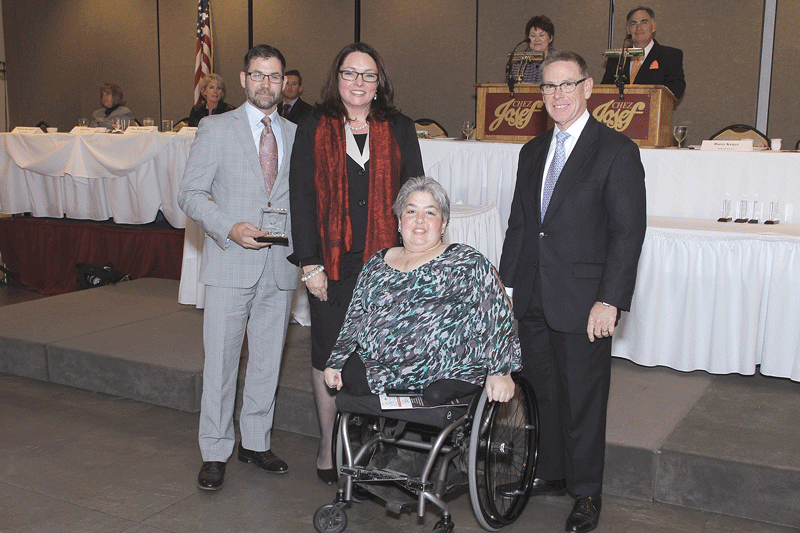
More than 500 guests gathered at Chez Josef in Agawam on Oct. 28 for the Super 60 awards luncheon, presented by the Springfield Regional Chamber to honor the region’s fastest-growing privately owned companies. This year’s top honoree in the Total Revenue category was Stavros Center for Independent Living Inc. in Amherst, while the top honoree in Revenue Growth was Lavishlyhip, LLC in Feeding Hills. The event’s keynote speaker was Tree House Brewing co-founder Dean Rohan.


Justin Pelis, board treasurer of Stavros Center for Independent Living

From left, Justin Pelis, board treasurer of Stavros Center for Independent Living; Ashley Allen, vice president of Sales and Marketing for Health New England; Nancy Bazanchuk, board vice president of Stavros; and John Patrick, president and CEO of Farmington Bank


Bill Grinnell, president of Webber

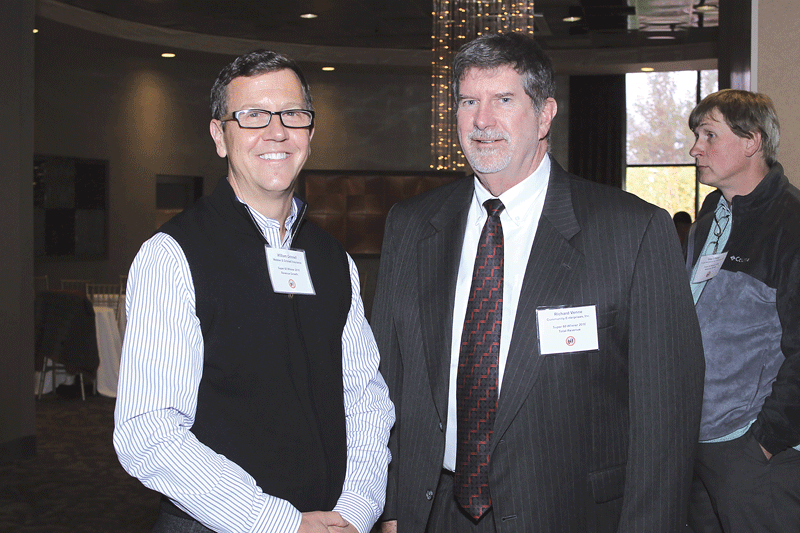
Bill Grinnell, president of Webber and Grinnell Insurance (left), and Richard Venne, CEO and president of Community Enterprises

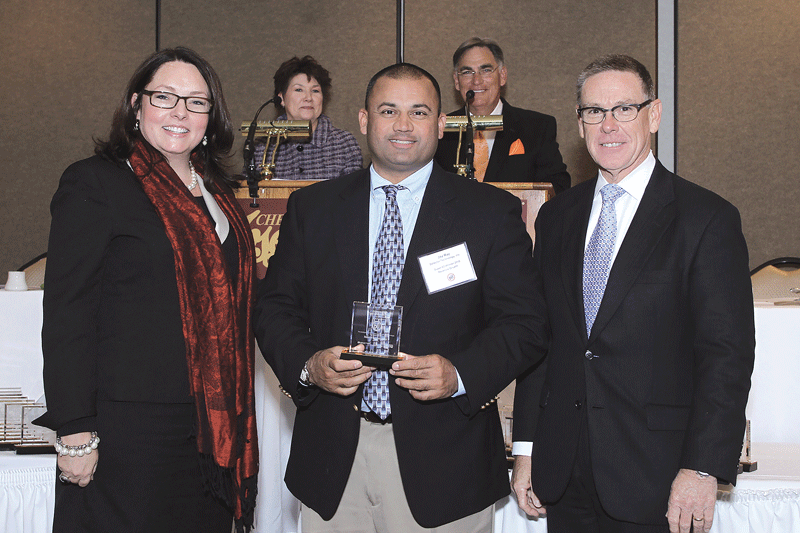
From left, Allen; Jay Ray, president of Detector Technology Inc.; and Patrick

From left, Allen; Jay Ray, president of Detector Technology Inc.; and Patrick

Daily News

EAST LONGMEADOW — HUB International New England, a division of HUB International Limited, announced that, effective Dec. 1, Timm Marini, will lead the Personal Lines Division for HUB International New England. This is in addition to his responsibilities of overseeing the Western Mass. offices and serving on HUB’s executive management team.

Marini will lead the Personal Lines teams, which consist of close to 150 employees in more than 20 offices located throughout Massachusetts, New Hampshire, Maine, and Rhode Island. His areas of focus will be developing and implementing sales and marketing strategies that result in value and pricing options while always meeting the underlying goal of “delighting the customer.”

“Developing an exceptional team is imperative in this fast-paced, technology-driven industry,” said Charles Brophy, CEO and Regional President, Eastern Region of HUB International New England. “The first person that came to mind for this position, without a doubt, was Timm Marini. His vision, leadership abilities, skillful thinking, discipline, and tact for customer service will be a great benefit for HUB New England as we continue to grow and expand into new markets.”

HUB New England was built through partnerships with long-standing, local brokerages housing years of experience in consulting on property and casualty insurance, personal insurance, and employee-benefits programs for New England businesses and individuals. As a full-service brokerage, HUB New England has access to the resources of a large, international company with local service and expertise.

Daily News

WESTFIELD — Westfield on the Weekends (WOW) will present Rob Goff Sr., founder, director, and lead investigator with Agawam Paranormal, for an otherworldly presentation on Wednesday, Nov. 16 at the Westfield Senior Center, 45 Noble St. Doors open at 6 p.m., and the presentation, which is free and open to the public, will begin promptly at 6:30 p.m.

The 90-minute presentation will highlight three local paranormal investigations and include the history of each location, highlights of the investigation, and evidence uncovered during the investigation. The audience will also learn about the technical side of paranormal investigations, including the use of special equipment and investigative photography and video technology.

“WOW brings the community together through interesting and unique presentations and performances. The presentation by Rob and Agawam Paranormal is something completely new, and we’re really looking forward to it,” said Amy Tosi, programming chair. “Not only is Rob putting on this presentation for free, he’s also donated two spaces on an upcoming investigation for a raffle to benefit Westfield on Weekends. For someone interested in the paranormal, it will be the experience of a lifetime.”

The winner of the raffle will participate (with a friend) in an active investigation. Raffle tickets cost $5 each and may be purchased the night of the event. Light refreshments will be provided by Storied Adventures Travel.

Daily News

AGAWAM — OMG’s RhinoBond System, the leading induction-based technology for installing single-ply roofing systems, has left marks across Europe with more than 125 completed projects and many more in the pipeline. Collectively, these projects represent more than 300,000 square meters (3.2 million square feet) of single-ply roofing.

“In last two years, the RhinoBond System has really started to take off across Europe, as more roofing contractors have seen the simplicity, labor savings, and superior roof-performance benefits that the system can offer,” said Web Shaffer, vice president of marketing for OMG Roofing Products. “We have completed projects across Europe, and we are expanding to new countries in the region, most recently into Southeast Europe.”

RhinoBond is an innovative method for installing thermoplastic and now also clean EPDM membrane. The system consists of a stand-up induction welding tool and magnetic cooling clamps. Contractors install roofing insulation using fasteners and specially coated plates designed specifically for the type of membrane being installed — PVC, TPO, or Clean EPDM. Each plate is then bonded to the roof membrane installed over the top with the RhinoBond plate welding tool. The result is a roofing system that can provide enhanced wind performance with fewer fasteners, fewer membrane seams, and no penetrations of the new membrane.

Daily News

SPRINGFIELDBusinessWest magazine, in conjunction with Presenting Sponsor Comcast Business, will present the sixth annual Western Mass. Business Expo on Thursday, Nov. 3 at the MassMutual Center in downtown Springfield.

Now a fall tradition for the region’s business community, the show will feature more than 100 exhibitors, more than 2,000 attendees, dozens of educational seminars, special presentations, breakfast and lunch programs, and much more. Some of the myriad highlights to this year’s show include:

• The Springfield Regional Chamber’s kickoff breakfast featuring keynoter Laura Masulis, MassDevelopment’s Transformative Development Fellow for Springfield;

• Demonstrations of virtual-reality technology that will allow Expo attendees to see for themselves;

• Robotics demonstrations and a ‘First Stronghold’ competition, presented by FIRST (For Inspiration and Recognition of Science and Technology);

• Seminars on a wide range of business topics ranging from motivating Millennials to putting virtual reality to work for your company; from taking full advantage of Big Data to using robotics programs to stimulate interest in STEM careers;

• The Professional Women’s Chamber’s November Luncheon featuring Boston Marathon bombing survivor Adrianne Haslet-Davis;

• A pitch contest, presented by SPARK Holyoke, featuring several startup companies;

• A ‘Where Are They Now’ program featuring several participants in Valley Venture Mentor programs;

• The day-capping Expo Social, and much, much more.

“There are a great many challenges to doing business today, from harnessing the latest technology to recruiting, developing, and retaining young talent, to creating an environment where several generations can work, and thrive, together,” said BusinessWest Associate Publisher Kate Campiti. “Expo organizers have created a full day of programming designed to help businesses cope with these challenges and grow their ventures.”

For more information on the Expo or to register, visit www.wmbexpo.com.

Daily News

BOSTON — Confidence among Massachusetts employers rose for a second consecutive month during October, bolstered by a surprising improvement in the outlook among manufacturers and the continued strong performance of the state economy.

The Associated Industries of Massachusetts (AIM) Business Confidence Index rose 0.3 points to 56.2 last month, 0.6 points higher than in October 2015. The increase was driven by a 2.6-point jump in the manufacturing index, which has lagged overall confidence readings for the past 18 months as companies struggled with economic weakness in Europe, China, and other key export markets.

The increase came as the Massachusetts unemployment rate fell to 3.6%, its lowest rate since the dot-com boom of 2001.

“Local unemployment rates dropped in 22 of 24 labor market areas throughout Massachusetts during September, which is consistent with gains in the AIM Employment Index over both the month and year,” said Sara Johnson, senior research director, Global Economics, IHS Global Insight, and a member of the AIM Board of Economic Advisors (BEA). “Both sets of numbers indicate that Massachusetts economy continues to perform well. State employment is growing faster than at the national level.”

The AIM Index, based on a survey of Massachusetts employers, has appeared monthly since July 1991. It is calculated on a 100-point scale, with 50 as neutral; a reading above 50 is positive, while below 50 is negative. The Index reached its historic high of 68.5 on two occasions in 1997-98, and its all-time low of 33.3 in February 2009. It has remained above 50 since October 2013.

Almost all of the sub-indices based on selected questions or categories of employer were up in October. The Massachusetts Index, assessing business conditions within the Commonwealth, gained 0.9 points to 57.9, leaving it a healthy 3.8 points ahead of the same time last year. The U.S. Index of national business conditions remained unchanged at 49.2, 1.7 points lower than its level of October 2015. Employers have been more optimistic about the Massachusetts economy than about the national economy for 78 consecutive months.

The Current Index, which assesses overall business conditions at the time of the survey, increased slightly to 56, while the Future Index, measuring expectations for six months out, rose 0.3 points to 56.3. The future view is virtually the same as it was a year ago.

The three sub-indices bearing on survey respondents’ own operations also strengthened. The Company Index, reflecting overall business conditions, rose 0.2 points to 57.9, while the Employment Index surged 0.9 points to 55.4. The Sales Index lost ground, however, falling 1.2 points during October and 3.9 points during the previous 12 months.

The AIM survey found that nearly 39% of respondents reported adding staff during the past six months, while 19% reduced employment. Expectations for the next six months were stable, with 38% expecting to hire and only 10% downsizing.

Despite the rise in the Manufacturing Index, non-manufacturing companies still maintain a significantly brighter outlook than manufacturers. The overall Business Confidence Index among non-manufacturers was 59.3, compared to 53.5 for manufacturing companies.

“The year-long weakening of the Sales Index presents some concerns in an otherwise upbeat report since sales ultimately drive employment growth,” said Barry Bluestone of Northeastern University, a BEA member. “In the longer term, concerns remain about the changing demographic structure of the state population, as relatively few young people enter, and a large group of older workers leave — or are poised to leave — the workforce.”

AIM President and CEO Richard Lord, also a BEA member, noted that the economic recovery appears to be benefiting the entire Commonwealth, not just the metropolitan Boston area.

“It’s great to see unemployment falling in areas outside the Boston-Cambridge technology belt, which has been enjoying explosive economic growth since the onset of the recovery,” he said. “One of the key tenets of AIM’s Blueprint for the Next Century economic plan for Massachusetts is that lawmakers must make public policy that allows economic opportunity to flourish in all areas of the Commonwealth, from Boston to the Berkshires. We look forward to bringing that perspective to the Legislature when it begins its new session in January.”

Opinion

Editorial

Years ago, the annual business trade show was a big deal.

It was a time to see the latest technology, find out what was new, discover what was trending, make some connections, and let people know your business could provide valuable products or services.

Well, times have changed somewhat — you don’t need us to tell you that — but the business show can still be a big deal, and this year’s edition of the Western Mass. Business Expo  certainly fits that description.

It will enable exhibitors and attendees to see the very latest technology — from robots to virtual reality to drones used in marketing; to find out what’s trending in everything from employment law to motivating Millennials to closing the dreaded skills gap; to make introductions; and to create some of those all-important connections.

And it’s this desire to generate connections that prompted BusinessWest to inject new energy and life into the Springfield Chamber’s annual business-to-business show, give it a new focus, and take it to a much higher level.

Indeed, while there are many networking opportunities on the calendar each year, none approaches the Expo in terms of both the size of the room and the depth of the opportunities.

Getting back to those connections, they are still needed in the business world today, but real, face-to-face connections are fast becoming as ‘old’ as the fax machine.

It seems that people communicate by e-mail and text these days, using the phone when something a little more personal than those options is required. Seeing people and shaking their hand … well, not so much. People rarely even go out to lunch anymore, preferring their desk or the conference-room table and solitude.

Not that there’s anything wrong with that.

But to do business and understand what’s happening in the business community, people need to get out more. And because there isn’t much time, they need to maximize their opportunities when they do get out. That’s not the official motivation behind the Expo, but it might as well be.

This year, attendees can go back to their offices better informed about:

• Innovation districts and efforts to create them;
• Millennials — what drives them, what motivates them, what keeps them at your company instead of looking for opportunities elsewhere, and much more;
• The skills gap and the many initiatives being undertaken to close it, including ongoing work to inspire young people to pursue STEM careers by conceptualizing, designing, building, and then competing with robots;
• Virtual reality and how to generate and then realize opportunities to seize the tremendous potential of what is being described as disruptive technology;
• Inspiration and perseverance, such as that displayed by a Boston Marathon bombing survivor who found the courage and determination not to let horrible injuries get in the way of her life and her dreams;
• Stories of entrepreneurship talking place across the region, through both a pitch competition and a ‘Where are They Now?’ program created to showcase the progress made by several startups;
• Marketing strategies, why they work, and why they might not; and
• Big Data, the cloud, drones, SEO (search-engine optimization), computer security, and many of the other high-tech developments and trends shaping business today.

Add it all up, and it yields one giant opportunity — to see, be seen, learn, become inspired, and inspire others.

In short, it’s an opportunity not to be missed.

Banking and Financial Services Sections

Lending Support

Country Bank President Paul Scully

Country Bank President Paul Scully

Country Bank’s sheer scope in Eastern and Central Mass. — it now boasts 15 branches, almost $1.4 billion in assets, and a loan portfolio approaching $1 billion — positions it among the larger banks in its footprint. But even during a time of financial growth, President Paul Scully is equally committed to growing the bank’s community ties, through an ever-evolving series of initiatives that engage employees, customers, and area residents alike. After all, a bank’s success, he believes, shouldn’t be reflected simply on the bottom line.

Paul Scully is gratified that Country Bank is wrapping up a particularly strong year for both commercial loans and retail business. But the bottom line isn’t all the bank is building.

For instance, employees at the bank’s newest branch, in Worcester, recently teamed with Habitat for Humanity to build a playhouse for children of veterans. “Staff members spent the day building the playhouse in the parking lot,” said Scully, the bank’s president. “They loved it.”

More significantly, Scully recently returned from Haiti, where a team of 14 built two houses over five days before being chased out by the quick-moving Hurricane Matthew. Last year, he accompanied a team of management-level employees on a similar home-building mission in the beleaguered Caribbean nation, and this year, he opened it up to all staff members.

“Thirty-three people said they’d like to go, so we had a lottery,” he explained. “It’s a tremendous feeling giving back in the most impoverished country in the western hemisphere. They realized, if they didn’t before, how amazingly fortunate everyone here is.”

The home-building project was also an exercise in team building, he added. “We got to know people for who they are — not just the role they play Monday through Friday.”

That sense of community — both within the Country Bank family and in service to the cities and towns where its 15 branches operate — has increasingly become a hallmark of the Ware-based institution’s identity, Scully said.

Country Bank employees

Country Bank employees in Worcester celebrate the construction of a playhouse for children of veterans, a project conducted alongside Habitat for Humanity.

“When it comes to giving and community involvement, we believe that’s the role of a community bank, and most community banks feel similarly,” he told BusinessWest, noting that the bank’s support of area food banks, senior centers, and Baystate Mary Lane Hospital, among other entities — in all, totaling some $600,000 annually.

“Donations are geared toward all aspects of the community to improve quality of life for residents,” he said. “We’re a staunch supporter of our local hospital because we believe healthy communities must have access to good healthcare, and people want to stay and live and perhaps move into our communities to access quality healthcare.”

To further focus its community involvement, in 2015, the bank launched its Country Bank Cares community volunteer program, offering volunteer opportunities at various events throughout the year to Country Bank staff. Each volunteer hour is logged, and at the end of the year, staff members who volunteered 10 hours or more are awarded a grant to a charity of their choice for $100; 25 hours earns $250.


Thirty-three people said they’d like to go, so we had a lottery. It’s a tremendous feeling giving back in the most impoverished country in the western hemisphere. They realized, if they didn’t before, how amazingly fortunate everyone here is.”


“They have a stake in where the money goes,” said Shelly Regin, the bank’s marketing director, noting that employees donate about 700 hours of service per year. “They’re really engaged in it and honored to take part in it.”

The spirit of giving even incorporates a dress-down day on Fridays, when employees pay to wear jeans, and the bank matches all donations. At the end of each month, a committee of staff members decides which local nonprofits get the money — to the tune of about $2,500 a month. “That’s a lot of jeans,” Scully said. Meanwhile, a recent event called Be Bald, Be Bold had employees donning bald caps to draw attention to cancer research and raise money for the Baystate Mary Lane Walk of Champions.

“This is something that existed here long before Shelly or me,” he went on, explaining the motivation behind Country Bank Cares and other initiatives. “It’s the idea that Country Bank is engaged in the community and people’s quality of life, and we want our 220 staff members to experience another dimension of giving back.”

Country and City

With assets of $1.39 billion at the end of 2015 and a loan portfolio of more than $978 million, Country Bank is, of course, deeply ingrained in its communities in the traditional banking sense as well. And 2016 has seen further financial growth.

“We’ve had a very robust year in commercial loan originations, really centered in our existing footprint but also throughout New England,” Scully said. “We’ve had a tremendous year in both loan growth and deposit growth. I think that’s attributable, in part, to improvements we’re seeing in the economy and more robust product offerings.”

He noted that the evolution of e-banking solutions increasingly allows banks to develop relationships with customers outside their branch footprint. “That’s opening up the market dramatically. Folks can open up accounts with us online, can do anything they want online.”

Still, physical branches remain important, and the move to Worcester last year made sense on multiple levels, he explained.


Go HERE for a list of Banks in Western Mass.


“We’ve been lending in Worcester for more than 50 years,” he noted, adding that the city boasts a larger population and more diverse demographic than most Country branches, both of which equate into more business opportunity. And without a branch, it was difficult to move commercial customers into other products, such as retail accounts.

“From a cultural perspective, we have not changed the culture to adapt to the city — we’ve just brought the same level of service and quality to Worcester as our other marketplaces.”

Shelly Regin

Shelly Regin says employees are gratified to have opportunities for volunteerism and a say in where the bank’s charitable dollars go.

However, Country remains focused on growing its e-banking platforms as well, reaching a generation that prefers the convenience of doing business on their devices rather than visit a branch. But the community-bank world has long moved past the days of thinking branches will eventually be obsolete.

“They said years ago that ATMs are going to replace branches,” Scully said. “What happens is, every time there’s an advancement, people believe it’s going to replace something, but it doesn’t replace it — it just complements it. In this case, it allows customers to enjoy many different ways to do their banking. Has the foot traffic slowed down? Yes, a little bit, but people still want to know it’s there if they need it for any reason.”

Mortgage applications are one area where the change in customer behavior has been stark. When Country launched an online application option 10 years ago, customers were slow to embrace it, preferring to meet with a loan officer in person. Online applications were filed mostly by customers with poor credit who were targeting multiple banks at once, hoping someone would accept them. Today, 80% of the bank’s mortgage applications originate online, simply because borrowers realize it’s easier.

Brick-and-mortar branches are important for branding as well, but marketing campaigns — through both traditional and social media — remain critical, Regin said, noting that the challenge is to effectively tell a story that’s reflective of the institution and sets it apart.

To that end, with the help of its marketing agency, the bank conducted scores of interviews, not only with customers and employees, but people with no connection at all to Country Bank, asking why they choose to bank or work there, or why they don’t. The overwhelming takeaway, Regin said, is that relationships, and how the bank treats people, are its most important investment. So its current campaign incorporates slogans driving home the importance of priorities like service and even good manners. (One slogan reads, “we think politeness is a higher form of intelligence.”)

“That’s just who we are,” she said, before Scully added that the bank has always conducted business that way, but the campaign simply crystallizes it. Equally important is providing the kind of customer or borrower experience that leads to referrals. “Someone says, ‘I had a great experience with them.’ Another says, ‘OK, maybe I’ll give them a try too.’”

Community Legacy

The Country Bank name is only 35 years old, but the institution has been around since 1850, when it was known as Ware Savings Bank. It took on its current name after a 1981 merger with Palmer Savings Bank; another merger with Leicester Savings Bank 17 years ago further increased the bank’s holdings.

With that long history behind it, the bank understands the importance of helping future generations establish their own financial health, which is why Country conducts financial-literacy programs in 29 elementary schools, conducts a Credit for Life program in area high schools — teaching seniors the importance of prioritizing spending — and expanding that program with seniors at Worcester Polytechnic Institute.

“That next step is really geared toward those graduating from college,” Scully said. “They’re the ones who will be experiencing the real workforce soon, so the engagement is greater.”

Also thinking generationally — this time focusing on Millennials — Country has been overhauling its corporate headquarters to reflect modern workforce trends, such as low walls, collaborative spaces, enhanced technology, and even a café.

“We want to be an employer of choice for Millennials and folks who say, ‘this would be a cool place to work,’” he explained. “There’s great stuff happening; we’re creating a different vibe in this building. I say we’re giving it a Google vibe. We want to have the building become a place where people not only want to work, but feel really engaged.”

It’s just one more way Country Bank continues to identify needs and meet them — just as it has for the past 166 years.

Joseph Bednar can be reached at [email protected]

Health Care Sections

Articulating Progress

A new partnership between Westfield State University and Springfield Technical Community College will allow nursing graduates from STCC to earn a four-year degree from WSU on the Springfield campus. At a time when it’s increasingly important for nurses to have four-year degrees, the goal, as one STCC dean said, is to “remove any barriers to success.”

From left to right, Jessica Tinkham, Marcia Scanlon, and Shelley Holden

From left to right, Jessica Tinkham, Marcia Scanlon, and Shelley Holden show off the new simulation lab in the Science and Innovation Center at Westfield State University that opened this fall.

Emily Swindelles will graduate from Springfield Technical Community College next May with an associate’s degree in Nursing.

The path to matriculation hasn’t been easy for the mother of three children — ages 5, 3, and 2 — who has worked part-time and commuted from her home in Ellington, Conn., but she has had a lot of support from her family and fellow students, who have become like an extended family.

Swindelles’s dream is to work in a hospital maternity ward and eventually become a nurse midwife, so the 30-year-old was happy to hear that officials from STCC and Westfield State University signed an articulation agreement on Oct. 4 that will allow STCC nursing school graduates to earn a four-year degree from Westfield on the Springfield campus.

The new partnership is the first hybrid RN-to-BSN (bachelor of science in nursing) completion program between two public institutions of higher education in Western Mass. ‘Hybrid’ refers to the fact that it includes online classes as well as courses on the STCC campus that will be taught by instructors from Westfield State.

“I was really excited when I heard about the new program. It’s convenient, flexible, and cost-effective,” Swindelles said, adding that she is used to the commute, familiar with STCC, and likes the fact that, although the majority of coursework will be done online, classes on campus will provide students with the support and interaction that she feels enhances learning.

“I would have taken a year off just to make sure that I was financially capable of going back to school, but with the flexibility of this program, I think I’ll be able to manage school, work, and family,” she added.

Jennifer Hoppie is another STCC nursing student who is enthusiastic about the new program. The 39-year-old mother of two children, ages 11 and 9, moved to the U.S. from St. Lucia in 1999, and her goal is to work in the pediatric department of a hospital and earn a bachelor’s degree because it will increase her job options.

Prior to the matriculation agreement, Hoppie planned to work for a year after passing the board exam required to become a registered nurse, then enter a bachelor’s-degree program. But she says if she can continue her education at STCC after she graduates, she will choose that option because it will allow her to stay close to home in case she is needed at her children’s school.

“The price of the new program is also good; there are people like me who can’t afford expensive tuition,” Hoppie said, adding that she took out a loan to earn the degree she will receive in May.

Lisa Fugiel and Christopher Scott

Lisa Fugiel and Christopher Scott say Westfield State University’s hybrid RN-to-BSN completion program will help remove barriers to education faced by many non-traditional students at STCC.

Indeed, the new RN-to-BSN completion program is touted as the most affordable pathway of its kind; Westfield will accept 90 credits from students toward the 120 needed for a four-year degree, and the cost for the additional 30 course credits will be $10,500.

Christopher Scott noted that STCC has collaborations with other schools of nursing that allow graduates to pursue a bachelor’s degree, and it’s important for students to be aware of all of their options.

“Our goal is to remove any barriers to success,” said the interim dean of the School of Health and Patient Simulation, adding that the majority of STCC students are non-traditional, and many face financial or personal challenges that make getting an education difficult.

“We want them to be able to continue their education and flourish after they succeed here,” he told BusinessWest.

Officials from both schools say the new program is also significant because it is in line with state and national goals to increase the number of nurses with bachelor’s degrees in the workforce.

“There’s been a national call to action from the Institute of Medicine to bring our BSN workforce up to 80% by the year 2020,” said Jessica Holden, a nursing instructor at Westfield State and program director of the RN-to-BSN program.

Holden said the goal in Massachusetts is to increase the number of BSN nurses from 55% in 2010 to 66% in 2020, and to reach the national goal of 80% by 2025. The goals were set by the Massachusetts Nursing and Allied Health Workforce Development Plan and implemented by the Massachusetts Action Coalition.


A list of Acute Care Hospitals in Western Mass. HERE


“There is a growing shortage of nurses, and we see our associate degree in nursing as an entryway into a bachelor’s program,” said Lisa Fugiel, director of Nursing for STCC’s School of Health and Patient Simulation. Although graduates can work as an RN after they earn an associate’s degree and pass their boards, she explained, nurses with a BSN are typically given more responsibility and supervisory roles. They also earn higher salaries, and many healthcare institutions are seeking nurses with advanced degrees to meet certain requirements.

Increasing Opportunities

Most colleges limit the number of credits a student can transfer, and the fact that Westfield’s hybrid nursing program will accept 90 is expected to make a real difference to STCC students.

“They might have to take 50 credits at another college to achieve a baccalaureate degree,” Scott noted, explaining that STCC and Westfield State have made the pathway easier by creating a ‘curriculum map’ that outlines prerequisite courses they need to enter the BSN program.

“It allows for seamless education,” said Marcia Scanlon, chair of the Department of Nursing at Westfield State.

Shelley Tinkham agreed, and said it’s important, because if students take the wrong electives, they will have to take additional classes to meet Westfield State’s entrance requirements. “The map was carefully developed as a partnership model,” said WSU’s dean of Graduate and Continuing Education.

Westfield State officials told BusinessWest they began developing their own RN-to-BSN program, which launched this fall, about four years ago. The STCC-Westfield nursing-degree partnership was developed simultaneously, and everyone involved believes it will increase the number of students who pursue a bachelor’s degree.

“Massachusetts issued a call to action to be creative and innovative in creating a seamless pathway so nurses can progress, and the new hybrid program meets that call,” said Holden. “It’s a new model for Westfield State that is very affordable.”

She noted that the push at the state and national levels to increase the number of nurses with bachelor’s degrees was initiated because nursing has become more complex due to the changing face of medicine, which includes advances in technology and a growing number of patients with multiple health issues.

Critical Relationships

Sims Medical Center at STCC is the largest simulation facility of its kind in the Northeast and has received national recognition.

“We recreate the environment of every type of care in a hospital, from the trauma room to acute care, child delivery, and pediatrics,” Scott said. “We have our own operating room and critical-care unit, as well as a home-care environment.”

Students in the college’s 20 healthcare programs work with human patient simulators that breathe, sweat, have pulses, and react to care and procedures that range from arthoscopic surgery to removing a gall bladder.

“Students can take their blood pressure and do every medical technique on them possible,” Scott said, explaining that the goal is to expose students to situations that can occur before they enter the workplace.

And, since nurses don’t work alone, STCC students work alongside their peers, who are studying a multitude of healthcare disciplines, including respiratory therapy, radiology, and surgical technology.

In fact, STCC’s center is so high-tech that the college has worked with hospitals, medical centers, and higher-education institutions to help them build and operate their own simulation centers and avoid perils and pitfalls in the process.

Emily Swindelles

Emily Swindelles says Westfield State University’s hybrid RN-to-BSN completion program will make it easier for her to continue her education.

Westfield State is among them, and Scott said officials sought the school’s help in developing a simulation center for the university’s $48 million Science and Innovation Center that opened this fall.

Westfield officials went to STCC, toured the campus, and met with faculty, administrators, and architects before designing their own space. They say the relationships that were formed played a role in the establishment of the matriculation agreement.

“Creating a transfer program is difficult, and historically, Massachusetts institutions have not done well with it. But the new program shows we can cooperate; it’s an excellent example of what can be accomplished, as it’s designed to be very flexible,” Tinkham said, noting that Westfield needed to pass a policy and ask its governing board to accept 90 transfer credits for the hybrid program because they normally accept only 67 from a community college.

“Dean Scott was very patient with us,” she continued, adding that Westfield State officials recognized that STCC has many non-traditional students and first-generation graduates who need a supportive environment and may not be familiar with WSU.

The nursing programs at STCC and Westfield State are both accredited. The baccalaureate degree in nursing at Westfield State is accredited by the Commission on Collegiate Nursing Education. STCC’s associate in science degree in nursing is accredited by Accrediting Commission for Education in Nursing Inc.

Ongoing Partnership

Westfield State University wants students entering STCC’s associate degree in nursing program to know they can earn a bachelor’s degree on the Springfield campus and plan to make them aware of the curriculum map at the beginning of each new school year.

“They will feel our presence on their campus from day one,” Holden said, adding that Westfield representatives will pass out brochures and be available to nursing students from the time they begin the nursing program at STCC.

She was hired at Westfield State a year ago, Tinkham has worked at the university for two years, and Scanlon has been there for five, but was named department chair a year ago; they all feel partnerships such as the new one with STCC are critical to the future of nursing.

“We’re already looking at other collaborations,” Tinkham said. “This is just the beginning.”

It’s a good beginning, one that not only addresses the workforce-development shortage, but will benefit the community as many STCC students become involved in charitable causes.

“Helping them to continue their education will allow them to give back even more,” Fugiel said, “and we are really excited to be able to offer them an affordable opportunity to do so.”

Columns Sections

Entrepreneurship

By Melyssa Brown

Melyssa Brown

Melyssa Brown

More than 627,000 new businesses open each year, according to the Small Business Administration, and entrepreneurship is a hot topic, especially here in the Pioneer Valley.

Local colleges have created centers and degrees around entrepreneurship, and organizations have been created to help startup companies prosper through coaching and education.

Whether you call yourself an entrepreneur or not, starting a business can be a significant challenge. Having an idea that inspires you is a good place to start. Once you have that, your passion for the business or its purpose is the most important factor to keep you pushing through the inevitable challenges and decisions that are ahead and are inherent to starting a business. The following helpful tips and guidance will provide resources to get you started down the right path.

The Business Plan

A business plan is a sales tool that should be considered as a first step in any business creation. It will help you raise money, get partners, and, most importantly, get people interested in your business.

Start by creating a document that describes your business inside and out. Describe your product or service. Your product description should take 30 seconds or less to explain. It should be simple and straightforward so that other people (even children) can understand and repeat it back to you. Lengthy or overly detailed pitches, while seemingly chock-full of great information, can actually be counterproductive and aren’t usually as effective at getting the attention of your audience.

Describe the product’s unique value proposition. What advantage does your product offer that no one else does? How is it different from other businesses? Also, describe the market opportunity by answering the following questions: how large is the market? How many total dollars are spent on similar products? How fast is the market growing? Who is your competition? Always remember to state who your customers are. Next, describe how you plan to generate revenue and sell your product or service.

Your customer may want the product or service, but who is actually paying for it? Is the customer paying subscriptions, or are you generating revenue via advertising from other businesses? Next, describe the business strategy or long-term vision. Where do you see the business in three, six, nine, and 12 months, and then in five to 10 years? Think of key metrics and set smart goals to help get you there and monitor your progress.

Describe who the management team will consist of to help you achieve the business strategy. You want qualified employees with relevant experiences to fill the needs of the business. Beware of simply bringing on friends and family — always ensure your team members understand your mission and objective, and not just their relationship with you personally.

A business plan should include projected financial information for the next three years. Explain the basic assumptions and key drivers behind your financial model. Revenue assumptions consist of the number of customers and how much will be charged for the product or service. Startup expenses may include lease/rent expense, building improvements (if needed), equipment, labor, supplies, and utilities.

There are certain costs when you start a business, and there is no negotiating some of it, such as safety precautions, filing fees, and fees for permits and licenses. However, you may be surprised by how many expenses you can cut or at least postpone — for example, using pre-owned equipment until you are making some sales.

Financial projections help determine how much outside financing you need to obtain. There are several financing options, including starting your business on the side while continuing to work full-time, working a part-time job until your business becomes established, waiting to start your business until you have saved up a financial reserve, and borrowing or raising funds, if necessary.

You may already be using the friends-and-family funding technique. Make it clear to them that the money is intended as risk capital, and they might lose it completely, or it may not be returned in the short term.

Technology has made asking the general public for donations and monetary support for a business commonplace. Crowdfunding is a form of finance that does not require repayment, and it will help you not only gauge interest in what you have to offer, but also help you build a customer base. Many times, the startup business will provide perks, such as free products or discounts, as a thank-you for the donations. Also, small-business grants are available from a number of resources, including state governments and private groups.

Although the grant-application process can be time-consuming, it is well worth it if you win the award. Also, even locally in the Pioneer Valley, there are investors and venture capitalists who are willing to fund a promising, high-risk startup business in exchange for a share of the business. They often bring experience, management expertise, and contacts to the table.

Prepare a business-plan deck to pitch to investors and venture capitalists. Create a PowerPoint presentation that addresses each of the major items in your business plan. Each item should have its own slide, and the presentation should be no longer than 15 slides. Begin with a high-level concept and brief, ‘grabby’ statement that sticks in the mind and most importantly tells a story.

Consider including a video of what the product or service does and how it interacts with customers. Investors and venture capitalists will want a preliminary valuation of the company. The valuation helps determine what share of the business you are giving up for what value. It can be a calculation of the future revenue (net earnings) of the business which then uses a discount factor to value it in today’s dollars. No matter which source you raise funds from, be sure to provide key operating, strategic, and accounting information to your financiers periodically.

Business Structure

The business structure can be impacted by your sources of financing. You can change the structure as the financing and business needs change. There are a few options to choose from, including sole proprietorships, general partnerships, limited-liability companies, C-corporations, and S-corporations, as detailed below.

• A sole proprietorship has no legal distinction between the owner and the business. It is a business of one person such as a lawyer, plumber, etc. There are minimal requirements, such as a business license.

• A general partnership is a joint business where the profit and debt are shared by general partners. A partnership agreement is created to dictate how the profit and debt are shared. For both sole proprietors and general partnerships, the business owner has primary personal liability.

• In a limited-liability company (LLC), owners are not personally liable for the debts of the business. LLCs are easy to use, have low setup fees, provide protection of the corporate veil, and are a pass-through tax entity.

• C-corporations are taxed separately from owners, the shareholders own stock in the business, and they require a board of directors who are hired by shareholders and are responsible for the business. C-corporations are perceived as providing the most protection between personal and corporate assets.  However, they may have double taxation upon the sale. Your salary is taxed at your personal rate, and business earnings are taxed at the corporate rate.

• In S-corporations, the business pays no federal taxes, and profit and losses are divided among the shareholders to be taxed at their personal rate. The number of shareholders is limited. Work with your accountant and lawyer to determine the best structure for your business.

Business Name

Determining the business name can be the most important and potentially challenging step. The right business name will help distinguish you from a sea of competitors, provide your customers with a reason to hire you, and aid in the branding of your company. Your name projects your image, brand, and position in the marketplace, so consider your mission statement, your business plan, and your unique selling proposition, and don’t forget to think about your target audience.

The more ideas you generate, the more possibilities you will have to choose from. You may want to conduct a series of brainstorming sessions or use a free business-name generator, such as Biznamewiz, Name Thingy, or Naming.net. Avoid wordplay dangers, and if you want a local name, add it to your marketing materials, such as “exclusively serving the (town) area.” Lastly, put your business name through the spelling test and ask others to spell it.

Once you have chosen a name for your business, you will need to check if it’s trademarked or currently in use. Search the federal database of the U.S. Patent and Trademark Office. You should also run a series of searches with Google and other search engines for your desired business name to make sure there isn’t another company already using your name. Then, you will need to register it with your county or state office. Also, don’t forget to register your domain name once you have selected your business name. Your website address should be the same as your business name.

Licenses and Permits

For a list of licenses and permits, go to the Small Business Administration (SBA) website. The SBA has compiled state-by-state information on small-business registration and license and permit information. Also, obtain a tax/employer identification number from the IRS.

Accounting System

An accounting system is necessary in order to create and manage your budget, track your actual results, set your rates, conduct business with others, and file your taxes. You can set up your accounting system yourself or hire an accountant to take away some of the guesswork. This should include opening a business checking account. Also, understand employer regulations such as new-hire reporting, employer corporate and payroll tax responsibilities, minimum-wage laws, workers’ comp, unemployment insurance, and health-insurance laws.

Lastly, get training and have a support network, which may include family, friends, colleagues, a mentor, a coach, and anyone else who can help you navigate roadblocks and be a successful entrepreneur. When you have an effective support system in place, you will find that you have a cheerleader, consultant, moral support, and even a devil’s advocate when necessary. Continually review and update your business plan and question its key assumptions by using a SWOT (strengths, weaknesses, opportunities, and threats) analysis of the business.

Melyssa Brown, CPA is a senior manager with the Holyoke-based public accounting firm Meyers Brothers Kalicka, P.C.; (413) 322-3484; [email protected]

Building Permits Departments

The following business permits were issued during the months of September and October 2016.

Agawam

Tolli’s Pizza
4 Southwick St.
$1,000 — Dividing wall for seating

Berkshiretown

SBA Communications
75 Kimball St.
$15,000 — Swap three existing cellular antennas with three newer-technology cellular antennas and associated equipment

Chicopee

Leonard E. Belcher Inc.
95 West St.
$6,866.50 — Replace storefront

Elms College
291 Springfield St.
$79,400 — Strip and reroof at Berchmans Hall

El Ro Realty LLP
2053 Memorial Dr.
$22,000 — Install fire-alarm system for 24-unit apartment building

El Ro Realty LLP
510 McKinstry Ave.
$22,000 — Install fire-alarm system for 24-unit apartment building

Greenfield

Center for Human Development
148 Montague City Road
$3,000 — Construct 16-by-16-foot platform anchored to ground

Bryan G. Hobbs
576 Leyden St.
$2,778.66 — Insulate and weatherize

Hobo Enterprises LLC
8-16 Federal St.
$10,000 — Extend bathroom to make ADA-compliant, change second bathroom into utility room with mop sink

Hope & Olive LLC
44 Hope St.
$39,000 — Reframe service window wall to eliminate bump, prep for new hood ventilation, new ceiling tiles, new FRP wall covering

Hadley

CBR Realty Corp.
195 Russell St.
$24,100 — Build new walls, interior non-structural, to create more office and patient exam rooms

Walter M. and Shirley H. Basara
3 Railroad St.
$4,800 — Build a small gable roof over entryway door

Longmeadow

GPT Longmeadow LLC
Bliss Road
$70,430 — Complete interior finishes for newly built Verizon store

Springfield

Baystate Medical Center Inc.
3601 Main St.
$967,970 — New elevator and interior fitout on third floor

Center for Human Development
332 Birnie Ave.
$6,860 — Modification of office partitions on second floor

Derf Realty Corp.
170 Carando Dr.
$350,000 — Installation of rooftop solar system on existing building

Derf Realty Corp.
190 Carando Dr.
$275,000 — Installation of rooftop solar system on existing building

The Dolben Co.
10 Chestnut St.
$7,311 — Reroof balcony on lower roof at Chestnut Park Towers

Eastman Chemical
730 Worcester St.
$2,024,500 — Installation of racking for new solar PV system

Jewish Community Center
1160 Dickinson St.
$24,850 — Roofing and insulation

McDonald Corp.
660 Liberty St.
$385,000 — Interior and exterior remodel, add second drive-thru lane, lot repairs, sidewalks, make restroom ADA-compliant

Pioneer Valley Christian Academy
965 Plumtree Road
$120,000 — Renovations of kindergarten toilets, counseling offices, and headmaster suite

Roman Catholic Diocese of Springfield
99 Wendover Road
$41,950,181 — Construct new high school and support facilities

SIS Center Inc.
1441 Main St.
$20,000 — Redivide tenant space on first floor

Springfield College
263 Alden St.
$15 million — New interior finishes, new concrete, new structural steel at stairway, new storefront system and windows

Agenda Departments

Seminars on Memory Loss

Nov. 1: Linda Manor Assisted Living will host seminars on early memory troubles and strategies for seniors at noon and again at 5:30 p.m. Lunch and dinner will be served. Dr. Beth Warner, a geriatrician and Linda Manor’s medical director, will discuss the early signs of memory problems, causes of memory loss, what a memory-loss evaluation should include, and strategies for discussing memory loss with loved ones. She is certified by the American Medical Directors Assoc. and has completed specialized education in care and management concerns specific to older populations and long-term care. She is board-certified in internal medicine, geriatrics, and hospice and palliative care. Seating is limited. Those wishing to attend are asked to register by calling (413) 588-3316.

‘Being Mortal’ Documentary

Nov. 1: Hospice of Franklin County, in collaboration with Baystate Franklin Medical Center, is holding a free community screening of the documentary Being Mortal at 5:15 p.m. in hospital conference rooms A, B, and C. After the screening, audience members can participate in a guided conversation on how to take concrete steps to identify and communicate wishes about end-of-life goals and preferences. Being Mortal delves into the hopes of patients and families facing terminal illness. The film investigates the practice of caring for the dying and explores the relationships between patients and their doctors. It follows a surgeon, Dr. Atul Gawande, as he shares stories from the people and families he encounters. When Gawande’s own father gets cancer, his search for answers about how best to care for the dying becomes a personal quest. The film sheds light on how a medical system focused on a cure often leaves out the sensitive conversations that need to happen so a patient’s true wishes can be known and honored at the end. It underscores the importance of people planning ahead and talking with family members about end-of-life decisions. Seventy percent of Americans say they would prefer to die at home, but nearly 70% die in hospitals and institutions. Ninety percent of Americans know they should have conversations about end-of-life care, yet only 30% have done so. For more information about the free screening or to RSVP for the event, contact Andrea Johnston at (413) 773-2144 or [email protected]. The free screening is made possible by a grant from the John and Wauna Harman Foundation in partnership with the Hospice Foundation of America.

Real-estate Licensing Course

Nov. 2: Beginning Wednesday, Nov. 2, the Realtor Assoc. of Pioneer Valley will sponsor a 40-hour, 14-class sales licensing course to help individuals prepare for the Massachusetts real-estate salesperson license exam. The course will be completed on Dec. 7. Tuition is $359 and includes the book and materials. For an application, call the Realtor Assoc. of Pioneer Valley at (413) 785-1328.

Western Mass. Business Expo

Nov. 3: Comcast Business will present the sixth annual Western Mass. Business Expo at the MassMutual Center in downtown Springfield, produced by BusinessWest and the Healthcare News. The business-to-business show will feature more than 150 exhibitor booths, educational seminars, breakfast hosted by the Springfield Regional Chamber of Commerce, lunch hosted by BusinessWest, and a day-capping Expo Social. Current sponsors include Comcast Business (presenting sponsor), Express Employment Professionals, Health New England, the Isenberg School of Management at UMass Amherst, Johnson & Hill Staffing Services, MGM Springfield, Wild Apple Design, the Western Mass. Economic Development Council, Savage Arms, Meyers Brothers Kalicka, the Better Business Bureau, and the Regional Employment Board of Hampden County. The event’s media partners are WMAS, WHMP, and Rock 102/Laser 99.3. For more Expo details, see the special section in this issue or visit www.wmbexpo.com.

Bay Path University Cybersecurity Summit

Nov. 4: Cybersecurity is no longer just a technology problem — it has become a business differentiator. As the topic is discussed around the table of company boards and government task forces, the face of cybersecurity professionals is changing as well. At Bay Path University’s fourth annual Cybersecurity Summit, “The Business of Cybersecurity,” Jillian Munro will share her experiences and observations from throughout her career of the different facets of that new face, highlighting how non-traditional skills now apply in the area of cybersecurity. The summit takes place in Blake Student Commons on the university’s Longmeadow campus. Breakfast will be offered at 7:30 a.m. followed by the presentation at 8 a.m. Munro is senior vice president of Resiliency & Business Engagement for the Enterprise Cybersecurity (ECS) organization at Fidelity Investments. Fidelity is a leading provider of investment management, retirement planning, portfolio guidance, brokerage, benefits outsourcing, and other financial products and services to more than 20 million individuals, institutions, and financial intermediaries. Munro joined Fidelity in 2015 and is responsible for ensuring alignment between the firm’s business priorities and the cybersecurity agenda, as well as leading the enterprise technology resiliency program. The summit is presented by Bay Path’s Master of Science in Cybersecurity Management program, which was launched October 2013 as the first of its kind in New England. The summit is free and open to the public. To register, visit www.baypath.edu and click on ‘Events.’ For more information, e-mail Ann Cantin at [email protected].

LEEF Black and White Fund-raising Gala

Nov. 5: The Longmeadow Educational Excellence Foundation (LEEF) will host its 15th annual fund-raising gala from 6:30 to 11 p.m. at Twin Hills Country Club. The event, which will feature a black and white theme, includes food, entertainment, silent and live auctions, and raffles. This year’s entertainment will be provided by Boston’s premier party band, the Marsels. Funds raised through the gala are used to provide grants to Longmeadow teachers, providing opportunities for innovative educational and enrichment programs that go beyond the tax-supported budget. Since its founding in 2001 by a group of dedicated parents, LEEF has funded 330 teacher grant requests, totaling more than $1.2 million, to Longmeadow public schools. LEEF maintains both a sustaining fund and a permanent endowment with the Community Foundation of Western Massachusetts. “It is only through the generous support of our sponsors and donors that we are able to supply these grants that enhance our students’ education,” said Whitney Harrington, LEEF board member and co-chair of the gala. The platinum sponsor of the 2016 LEEF gala is North Star Recycling. Gold sponsors are Bay Path University and Green Earth Energy Photo Voltaic Group. Long-time supporters Advanced Vein Care and Collins Pipe are silver sponsors, with Playful Minds, Bacon Wilson, and Harry Grodsky & Co. as bronze sponsors. Tickets are available at $85 each. Donations for the live and silent auction are still being accepted. To donate or sign on as a sponsor or volunteer, e-mail Harrington at [email protected]. To purchase gala tickets, visit www.goleef.org or mail checks to LEEF, P.O. Box 60782, Longmeadow, MA 01106-0782.

Spaghetti Dinner to Benefit Alzheimer’s Assoc.

Nov. 8: Williamstown Commons will host a spaghetti supper from 5 to 7 p.m. at Williamstown Commons, 25 Adams Road, Williamstown. The cost is $8 per person at the door, and all proceeds from the dinner will benefit the Alzheimer’s Assoc. The supper will include spaghetti with meatballs, Italian sausage, garlic bread, dessert, and beverages. Diners may dine in or take their meal to go. Williamstown Commons, located at 25 Adams Road, Williamstown, is a nonprofit organization providing short-term rehabilitation, long-term skilled-nursing care, respite care, and hospice services.

‘Diversify Your Workforce’

Nov. 17: The Western Mass. Employment Collaborative (WMEC) will present a breakfast event called “Diversify Your Workforce” from 9 to 11 a.m., preceded by breakfast and networking at 8:30 a.m. at the Delaney House in Holyoke. WMEC partners work toward the common goal of increasing employment opportunities for individuals with disabilities. WMEC works across all disabilities and represents hundreds of job seekers who have the skills, commitment, and desire to enter the workforce and contribute positively to a local employer. To that end, it is partnering with the Mass. Down Syndrome Congress and its “Find Your Next Star” campaign. Attendees of the Nov. 17 event will learn ways to grow their business and meet their hiring needs. To register, visit www.mdsc.kintera.org/dywwest.

Joseph D. Freeman Bowl-a-Thon

Nov. 19: The Joseph D. Freedman Bowl-a-Thon will present its fifth annual event to benefit Camphill Village in Copake, N.Y. The event will be held from 12:30 to 3:30 p.m. at Chicopee AMF Lanes. Last year, more than 250 attended the event, and since its inaugural in 2011, the event has raised more than $220,000 for Camphill, which is a residential village where 95 special-needs residents reside. No one has ever been charged a fee to live at the Village, nor has anyone ever been turned away for lack of funds. To learn more about the event, visit www.camphillvillage.org/bowlathon.

Features

Coming into Focus

BioFlight VR panel

BioFlight VR panel

Ed Zemba has quite a few memories from the huge trade show called VRLA, the world’s largest virtual and augmented reality expo, staged last spring, as the names suggests, in the City of Angels.

Most involve the technology itself and the large volumes of excitement generated about its seemingly limitless potential within the world of business. But he also can’t forget some of the comments directed his way when people found out his company, Robert Charles Photography, was based 3,000 miles to the east.

“One guy said, ‘hey, you’re two years early,’ or something to that effect,” said Zemba, who explained that this commentator was noting that the East Coast usually lags well behind the West Coast when it comes to technological breakthroughs of this kind, and was adding some pointed sarcasm and exaggeration (maybe) to the equation.

Zemba was somewhat taken aback by this, and said that such comments were repeated enough that he actually developed and refined a comeback of sorts.

“I said, ‘we do OK back east — wasn’t most of this technology developed at MIT?’” he recalled, adding that those who heard the line were mostly unimpressed and had a comeback of their own.

“One guy said, ‘yeah, OK, but what do the guys at MIT do when they develop the technology? They come out here to Silicon Valley, that’s what they do.’ They were tough,” he recalled, adding that this back and forth, coupled with the tremendously powerful displays of what VR and AR can do — and in some cases, are already doing — inspired him.

Ed Zemba says he created Link to VR to help business owners

Ed Zemba says he created Link to VR to help business owners understand this emerging technology and take full advantage of it.

To be more specific, the experiences inspired him to do what he could to make sure that, when it came to virtual reality and augmented reality, businesses in the 413 area code and beyond were not late (or much later) to the party when it comes to these technologies, as they are with so many other forms of innovation.

To that end, he partnered with several other business owners in the region to create a venture called Linked to VR, a name that pretty much says it all. Indeed, the company was created to help companies understand the vast potential of this technology — for everything from helping patients understand a medical procedure by transporting themselves (virtually, of course) into an organ or joint so they can see what’s wrong and what the doctor will do to fix it, to dramatically reducing the costs of training programs by curtailing or eliminating the need to travel — and then create a plan to put it to use.

“The earlier we can collectively get our heads around this, the better off we’re going to be,” he explained, using ‘we’ to mean business owners, but also educators, parents, and other constituencies. “We want to help people transition to the next platform and incorporate this technology into their business model.”

And this brings us to the Western Mass. Business Expo coming up Thursday (see the full guide to the show in the special section inside this issue). Indeed, Zemba, a huge supporter of the show going back to the ’90s, wanted this year’s edition of the event to become a vehicle for introducing VR and AR and putting its full potential on display.

And he has energetically worked with BusinessWest, producer of the Expo, to create a wide range of programming that will not simply allow attendees to be wowed by what they see when they put the goggles on (although that is a big part of it), but to enable them to fully understand how it can be applied to their business, and also how to get the ball rolling.

“I can remember that the business show was always a time to learn about new technology and new ways of doing business,” he explained. “That’s why this is the perfect forum for putting this technology on display and helping business owners get both hands around it.”

Learning — and doing — opportunities will come in several flavors, from so-called experience rooms, where Expo attendees can try out the Oculus Touch and see where this technology can take them (figuratively, but also from a business perspective), to an educational seminar called “Enterprise Virtual Reality: From Concept to Reality.”

Zemba, like others who have come to know and appreciate VR and AR, refers to this as “disruptive technology.”

That’s a technical term, and a business term, one that has come to define technology that displaces an existing technology and shakes up an industry — or several of them. Recent examples include the PC, cell phones, and e-mail. Others, from past decades, include the telephone, television, and jet travel.

Zemba knows a little about disruptive technology, because he’s seen it, from a business perspective, up close.

Indeed, digital photography certainly fits that description, he explained, adding that, when the technology exploded onto the scene in the ’90s, some could see what it was going to do, reacted, and took full advantage of it. Others, including established corporations, like Polaroid, were late to react or didn’t react at all, and paid a very steep price for their hesitation and arrogance.

“I saw some companies increase their sales exponentially, and I saw other companies go out of business,” he explained. “And what determined which direction you took was how you embraced the technology and how you prepared for it.”

The same will likely be true in many respects when it comes to virtual reality, he said, adding that it has vast potential to impact virtually every form of business, and especially healthcare and education.

“When I first saw this technology in use, I thought it was science fiction; I said, ‘we cannot be on that level yet,’” he recalled. “But it’s not science fiction. It’s real, and in many respects, it’s here.”

But not all people in business know that, or understand what it means, he went on, adding that three area businesses — Robert Charles, Del Padre Digital, and Tiger Web Designs, all in East Longmeadow — have come together to, as the name connotes, link businesses to VR.

“Most businesses have no real idea that this technology exists, or how to use it,” he noted, adding that this new venture was created specifically to do something about that.

And by link, Zemba means educating them about the technology and its practical applications, but also linking them (there’s that word again) with resources and potential partners. Like California-based BioflightVR, one of the leading-edge companies bringing VR to light — and to the boardroom.

Zemba told BusinessWest that the Western Mass. Business Expo, presented again by Comcast, represents an opportunity for Link to VR to bring its efforts to a new level and a new stage.

And they will make the most of that opportunity.

Indeed, in addition to the two ‘experience rooms’ at the MassMutual Center, Zemba and his partners have arranged for Rik Shorten, chief creative officer for BioflightVR, to deliver an educational seminar on the topic.

While Shorten, an Emmy winner for his work on CSI and a special-effects veteran who has been involved with a number of shows, will talk about the technology, he will put heavy emphasis on how businesses can harness it.

Going further, and as the title of his talk suggests, he will delve into how companies can conceptualize ways in which VR and AR can solve problems for them, and then how they can develop a pilot program for eventually putting the technology to use.

As they say in the entertainment business, these programs to take place at the Expo are certainly ‘must-see.’

For more information, peruse the guide in this issue and visit www.wmbexpo.com.

George O’Brien can be reached at [email protected]

Daily News

SPRINGFIELD — Springfield Technical Community College (STCC) has been awarded a five-year, $3.4 million grant from the U.S. Department of Education to help Hispanic and low-income students obtain degrees in science, technology, engineering, and math (STEM). U.S. Rep. Richard Neal announced the funding package during a press conference at STCC.

Called the Hispanic and Low-Income Transformed Education in STEM (HiLITES) Project, the grant will provide services and supports across campus to ensure student success in STEM classes and majors.

“Most jobs in the future will require a basic understanding of science, technology, engineering, and mathematics,” Neal said. “That is why this federal assistance from the U.S. Department of Education is so important and timely. It will give Hispanic and low-income students an opportunity to learn the necessary skills that can lead to a successful career in the growing STEM industry.”

STCC President John Cook understands this, Neal went on, “and that’s why I congratulate him and his team at STCC for securing this highly competitive grant. Because of their leadership, some of our region’s diverse student population are being given an extraordinary opportunity to receive a STEM-based education and find a good-paying job.”

STCC is the only community college in Massachusetts to receive this award.

“We feel tremendously fortunate to receive this funding from the U.S. Department of Education and are also very grateful for the support offered by Congressman Neal,” Cook said. “STCC is open-eyed about student needs, and this grant helps us address complex challenges. We look forward to building diversity across our unique array of STEM programs, and this is a chance to both expand initiatives, while also trying new and creative approaches.”

Only 11.4% of Hispanic students at STCC –— and 14% of low-income students — major in STEM fields, said Arlene Rodriguez, vice president for Academic Affairs at STCC. She noted that Hispanic and low-income students enter college with greater developmental math needs and have lower rates of retention and graduation. Students who are Hispanic and low-income perform worse on all three measures than students who are only Hispanic or low-income. The grant is designed to help Hispanic and low-income students overcome hurdles on their path to an associate STEM degree and transfer to a baccalaureate program.

“I am pleased that we have been awarded this grant, which aims at providing greater possibilities for a bright future for Latinx and low-income students,” Rodriguez said.

Dr. Adrienne Smith, dean of the School of Engineering Technologies and Mathematics, added that “I am thrilled about the receipt of this grant award, as this funding will provide the college with the necessary resources to increase the numbers of Hispanic and low-income students in STEM, thereby increasing their chances for employment in high-paying STEM careers.”

The project aims to increase the number of Hispanic and low-income students in STEM disciplines, increase pass and retention rates by redesigning developmental and gateway STEM coursework, provide student supports throughout degree programs to encourage progression and completion, and provide high-quality professional development for STEM faculty.

Highlights of the project include hands-on STEM demonstrations for local middle- and high-school students; an expansion of the method for assessing math placement for entering students; a redesign of developmental math and entry-level chemistry curricula; the hiring of two STEM advisers to conduct outreach and help transition STEM majors into the college; the creation of a STEM Center as a centralized location for presentations, group study, and tutoring; assessment software to support faculty work; and the funding of numerous professional-development opportunities for faculty.

To be eligible to receive the grant, colleges must have the federal designation of HSI (Hispanic-Serving Institution). An HSI institution must have at least 25% Hispanic students making up the total student population. With a Hispanic student population of 27.6%, STCC has officially been designated a Hispanic Serving Institution since 2013. Additionally, 56% of STCC students receive federal Pell grants, which are limited to students with financial need.

STCC began planning for the grant in September 2015 with the formation of a HSI STEM planning committee.

Daily News

HOLYOKE — Westside Finishing has been named one of the best finishing shops in North America, according to an industry benchmarking survey conducted by Products Finishing magazine, a trade publication that has covered the industry since 1938.

The magazine conducted an extensive benchmarking survey that analyzed hundreds of finishing companies in several different areas, including current finishing technology, finishing practices and performances, business strategies and performances, and training and human resources.

Only the top 50 shops were given the honor of being a Products Finishing ‘Top Shop’ based on a scoring matrix in those four criteria.

“Westside Finishing has established itself as one of the best finishing operations in the industry,” said Tim Pennington, editor of Products Finishing magazine. “The criteria we used was very stringent, and only the top finishing shops that excelled in all four areas made the list. Westside Finishing is in rare air when it comes to finishing operations.”

Brian Bell, owner and president of Westside Finishing, said he is “extremely excited and pleased to be named one of Products Finishing magazine’s Top Shops for the second year. Our employees and management team have worked very hard to be the best in the industry, and to provide our customers with quality service.”

Westside Finishing began as a liquid-coatings job shop based in West Springfield in the early 1980s. As the company began to grow and expand, powder-coating technology became more advanced and mainstream. In 1986, Westside Finishing purchased its first powder-coating setup and began spraying powder coatings. In 1994, the company moved its operation to 15 Samosett St. in Holyoke. The facility has undergone two expansions spurred by the dramatic increase in size and volume capability of parts that are being coated. In order to keep up with demand, new coating equipment was installed, and new employees were hired to meet customer demands.

In addition to powder coating, Westside Finishing offers a wide array of services including silk screening, pad printing, sub assembly, final packaging, and trucking to businesses in their service area. Westside Finishing is a family business; Bell is joined by his wife Jeanne, office manager, and son Korey, who has held various positions throughout the company and now serves as operations manager.

Daily News

LONGMEADOW — Cybersecurity is no longer just a technology problem — it has become a business differentiator. As the topic is discussed around the table of company boards and government task forces, the face of cybersecurity professionals is changing as well.

At Bay Path University’s fourth annual Cybersecurity Summit, “The Business of Cybersecurity,” Jillian Munro will share her experiences and observations from throughout her career of the different facets of that new face, highlighting how non-traditional skills now apply in the area of cybersecurity. The summit takes place Friday, Nov. 4 in Blake Student Commons on the university’s Longmeadow campus. Breakfast will be offered at 7:30 a.m. followed by the presentation at 8 a.m.

Munro is senior vice president of Resiliency & Business Engagement for the Enterprise Cybersecurity (ECS) organization at Fidelity Investments. Fidelity is a leading provider of investment management, retirement planning, portfolio guidance, brokerage, benefits outsourcing, and other financial products and services to more than 20 million individuals, institutions, and financial intermediaries. Munro joined Fidelity in 2015 and is responsible for ensuring alignment between the firm’s business priorities and the cybersecurity agenda, as well as leading the enterprise technology resiliency program.

The summit is presented by Bay Path’s Master of Science in Cybersecurity Management program, which was launched October 2013 as the first of its kind in New England. The summit is free and open to the public. To register, visit www.baypath.edu and click on ‘Events.’ For more information, e-mail Ann Cantin at [email protected].

Daily News

WILBRAHAM — Matt Roberts recently joined the Gaudreau Group Insurance and Financial Services Agency of Wilbraham as a business insurance service & sales assistant. He specializes in helping identify gaps in commercial insurance coverage, as well as areas in which a business may have been overinsured, which results in better control over costs while achieving more solid coverage.

“Matt delivers real value to our clients by helping them understand their insurance cost drivers, especially workers’ compensation. He utilizes our industry-leading technology, including forecasting tools and predictive budget analysis, to help our clients stay proactive and have better control over their insurance dollars,” said Jules Gaudreau, president of the Gaudreau Group.

Roberts has been in the insurance industry since 2011, when he started his career with a large national carrier. He is a graduate of Lasell College in Newton, with bachelor’s degrees in both accounting and business management.

Daily News

HOLYOKE — SPARK Holyoke, a program of the Greater Holyoke Chamber of Commerce Centennial Foundation, announced its fourth community-based crowd-funding event, Holyoke Soup, scheduled to take place Wednesday, Oct. 26 from 5 to 8:30 p.m. at Waterfront Tavern, 920 Main St., Holyoke.

Holyoke Soup is a dinner celebrating and supporting creative projects in Holyoke. For $5, attendees receive soup, salad, and bread while listening to presentations on business ideas, art, urban agriculture, social justice, social entrepreneurship, education, technology, and more. The food is prepared by culinary arts students from Dean Technical High School.

Several local entrepreneurs — all of whom have completed the SPARK entrepreneurship program — will also showcase their businesses beginning at 5 p.m. Each presenter has four minutes to share their idea and answer four questions from the audience. Attendees will then vote on the project that would be most beneficial to the city of Holyoke. At the end of the night, the ballots are counted, and the winner goes home with all the money raised to help fund their project. Winners come back to a future Holyoke Soup dinner to report their project’s progress. At the Oct. 26 event, the previous cash winner, Anna Rigali, from Holyoke High School, will share a brief report on how her winnings were used to further her project.

There is no admission charge to the event, but a minimum $5 donation is requested. All proceeds go to the presenter who receives the most votes. Anyone interested in presenting an idea at Holyoke Soup may apply at www.holyokesoup.com.

Daily News

WEST SPRINGFIELD — Connecticut Business Systems (CBS), a Xerox company, announced the grand opening of a state-of-the-art technology center in West Springfield. The facility has an on-site demo room providing the opportunity for clients to come in and experience the most advanced office technology in the industry.

When most people here the word ‘Xerox,’ they immediately assume copiers. In reality, this local technology company offers an entire suite of solutions ranging from scanners to folding machines, document management to marketing software, audio-visual to digital communication and much more.

“We are so pleased to have our office in this beautiful space for local businesses to come in and test out the devices,” said Sales Manager Cindy Mellen. “We are excited to allow people to be hands-on with the equipment before making a purchase. The new technology is truly out of this world.”

The official open house will be held Thursday, Oct. 27 from 8:30 a.m. to 3 p.m. at 134 Capital Dr., West Springfield. A ribbon cutting will be held at 9 a.m. The Delaney’s Grill food truck will provide gourmet refreshments throughout the day.

“In addition, we are also extremely excited to partner with our friends at Make-A-Wish of Massachusetts and Rhode Island for this event,” Mellen added. “A donation will be made by our local CBS family for every company or organization that attends.”

Those interested in attending are asked to register in advance at cbsbigreveal.eventbrite.com.

Daily News

SPRINGFIELD — Freedom Credit Union recently welcomed Gina Noblit and Charlene Smolkowicz to its management team.

Noblit joined Freedom as director of Human Resources, managing the HR activities for the credit union, which employs a staff of about 130. Noblit has more than 31 years of HR experience in both healthcare and manufacturing. She comes to Freedom from Baystate Health, where she was a senior Human Resources consultant. She earned her master’s degree in human resource technology from American International College and her bachelor’s degree from Westfield State University.

Smolkowicz joined Freedom as commercial credit manager, member business lending. Her primary responsibility is to assure the consistent application of and adherence to commercial credit policy and current regulations, strengthen commercial underwriting standards, monitor portfolio risk, as well as develop and maintain sound commercial credit quality. Smolkowicz has 18 years of experience in the finance industry, including expertise in credit/financial analysis, business development, and relationship management. Most recently, she was associate vice president, portfolio/relationship manager with People’s United Bank for nine years, where she specialized in nonprofit, healthcare, and higher education, in addition to commercial and industrial lending. She holds a bachelor’s degree from Northeastern University and a graduate certificate in nonprofit management from Bay Path University.

Law Sections

2016 or 1984?

By Stefanie M. Renaud


Stefanie Renaud

Stefanie Renaud

Imagine a piece of technology, so small it could be mistaken for a credit card, that tracks every movement an employee makes, analyzes every conversation that employee has, and could tell an employer when that employee was in need of a day off. What if that technology could identify patterns and traits that you could use to increase productivity by 23%? Would employers want to use this technology? Of course!

But what about the employees? Isn’t using technology like this an invasion of their privacy? We were shocked to learn, and we bet you are too, that, because of the way this technology is currently being used, employers actually can monitor every word and movement an employee makes without running afoul of the law.

Boston-based company Humanyze recently made headlines when it announced the success it has had analyzing data collected by employee ID badges, developed at the Massachusetts Institute of Technology, that track employees’ movements and analyze their voices during conversations. Contained within each badge are Bluetooth, radio frequency identification (RFID), and infrared technologies, as well as two microphones.

Each of these particular technologies has a different function and gives Humanyze different information that it can use to identify trends or patterns. Bluetooth and RFID technology are used to monitor the employee’s physical movements and location within the office. The microphones allow Humanyze to conduct real-time analysis of the speaker’s voice, including the frequency of speaking and interrupting, and how the tone and pitch of the voice change, which can be indicator of stress, although the badge does not record the content of the employee’s conversations. Finally, infrared technology monitors the wearer’s physiology for signs of stress.

Humanyze analyzes all of the collected data and identifies patterns or trends common to a specified group, such as top performers. Humanyze then works with companies to explore these trends and use them to the business’ advantage. For example, Humanyze helped Bank of America save millions of dollars by suggesting that they restructure employee breaks, which increased social interaction between employees and led to a 23% increase in employee productivity.

So, given how invasive this level of employee monitoring is, how could it not be an invasion of privacy? First of all, this isn’t an invasion of privacy because Humanyze only gathers data from employees who voluntarily offer to be tracked. Second, the individual’s data is their own; employers cannot see individual data and only receive information about aggregate data trends. According to Massachusetts General Laws, employees are protected by statute from “unreasonable, substantial, or serious interference” with their privacy.

However, in order to prove an invasion-of-privacy claim, the employee must show that the employer gathered and then disclosed information “of a highly personal or intimate nature.” While it is arguable that the data collected by these badges could be deemed highly personal in nature, in this case it’s Humanyze, and not the employee’s employer, who collects and analyzes the information.

For this same reason, Massachusetts employers do not need to worry about personnel-records law violations, because the employer is neither creating the records, nor is it the owner of the data. And, because the badges do not record audio, there is no concern about violating the Massachusetts wiretapping statute.

So are there any legal hurdles stopping an employer from implementing this type of employee monitoring? Only one: a workforce governed by a collective bargaining agreement. Employers with unionized workplaces will almost certainly need to bargain with the union before implementing a new employee tracking system.

Indeed, in another, related circumstance, the Boston Police Department engaged in negotiations with the union representing its police officers over whether or not the officers would be required to wear body cameras, ultimately agreeing with the union that, at least initially, the department would ask for volunteers. When no one volunteered, the BPD was allowed to assign the cameras to police officers, but that was after months of negotiations and subsequent litigation. So, if you have a unionized workforce, you can expect both union negotiations and substantial pushback on any requirement that members of the collective-bargaining unit wear these badges.

Employers in or with locations outside of Massachusetts that are inclined to experiment with this new employee-tracking system should check with labor and employment counsel in those jurisdictions, because state privacy laws can vary widely. Meanwhile, we’ll keep an eye on this new technology and let you know if there are any new developments.

Stefanie M. Renaud is an associate with Skoler, Abbott & Presser; (413) 737-4753; [email protected]

Business of Aging Sections

Lighting a Path


pathlightSPRINGFIELD — In a time of change for what, until recently, was known as the Assoc. for Community Living, the organization’s passion and innovative spirit will remain constants, its executive director says.

But it needed a name change, Ruth Banta went on, one that underscores the scope of the services it has provided to people with intellectual disabilities in the community — from youth through the senior years — since 1952.

That new name is Pathlight.

“What we’re hoping with the new name is that people will associate it with the breadth of the services that we offer,” she said. “When people hear that a service is a Pathlight program, we want them to know that means it is a caring, high-quality service backed by high-level expertise.”

Banta also announced that, in continuing the organization’s innovative spirit, Pathlight has partnered with Valley Venture Mentors (VVM) to offer the Pathlight Challenge. The two organizations have put out a national call to startup entrepreneurs to develop technology aimed at increasing independence for people with intellectual disabilities.

It’s expected that at least two proposals from startups will be accepted by Pathlight. Those entrepreneurs will be enrolled in Valley Venture Mentors’ four-month, intensive Accelerator Program in January.

“It’s a great partnership,” Banta said. “We’re tying our history of innovation and our passion for the people that we serve to entrepreneurs’ passion for innovation and breaking barriers.”

Paul Silva, chief innovation officer at Valley Venture Mentors, said what’s key in the Pathlight Challenge is that startups will have access to people in the populations they are hoping to serve as they produce their innovations.

“Interfacing with stakeholders is normally hard to do,” he said. “We have created a way in which companies that are worthy can get the access they need. If they want to develop something for parents, Pathlight can connect them to parents. If they want to gain access to staff, we can connect them to staff. This will allow them to troubleshoot problems as early as possible and allow their ideas to evolve more quickly. Pathlight is giving these startups a chance to be more competitive and, thus, more likely to survive.”

New Era

Formerly vice president of administration and chief financial officer at the organization that serves people with disabilities across Western Mass. from infancy through end of life, Banta said the name change to Pathlight was part of a rebranding that began last fall as a means of solidifying the agency’s persona and outlining its key values.

“Our mission is to help people on their own unique journey to experience the life they want to live,” she noted. “We weren’t being literal when we chose the new name, but we hope that it conveys that we shine a light on those journeys.”

Banta is excited about the partnership with Valley Venture Mentors, as it highlights the organization’s long-standing history of innovation. She noted that Pathlight’s history of advances dates back to its roots. “We were the first to open a community residence for people with disabilities and the first to create a shared living model for families.”

Now, she added, “we’re looking at how we serve the Millennial population of people with developmental disabilities and autism and looking at how technology can give these young adults the independence that they and their families want for them.”

The Pathlight Challenge is especially seeking solutions to issues regarding health, safety, and transportation.

“Transportation is often a big hindrance to the people we serve in terms of getting to jobs and recreational opportunities,” Banta said. “We’re looking to see how technology can offer assistance there.”

Silva said he is excited about the national call for proposals that will now be launched via both organizations’ databases and online connections. The selection process will continue through October.

The Accelerator Program is a four-month, intensive program held over one long weekend a month, offering startups connections to subject-matter experts, investors, and highly engaged and collaborative peers. Those competing in the program can win up to $50,000 in grants to develop their business or product.

The Pathlight fellows will graduate from the Accelerator Program in May, when they will also unveil their new technology, Silva said.

“To our knowledge, this challenge is the first of its kind,” he added. “There are hundreds of accelerator programs in this country running every year, but I haven’t run across any that are focused on assistive technology. Assistive technology is a new focus.”

One he and Banta — and plenty of clients — hope will continue to light a path to greater independence.

Daily News

SPRINGFIELD — Ruth Banta, executive director of the Assoc. for Community Living, announced that the organization has changed its name to Pathlight to underscore the breadth and scope of the services it has offered to people with intellectual disabilities in the community since 1952.

Banta also announced that, in continuing the organization’s long-standing innovative spirit, Pathlight has partnered with Valley Venture Mentors (VVM) to offer the Pathlight Challenge. The two organizations have put out a national call to startup entrepreneurs to develop technology aimed at increasing independence for people with intellectual disabilities.

It’s expected that at least two proposals from startups will be accepted by Pathlight. Those entrepreneurs will be enrolled in Valley Venture Mentors’ four-month, intensive Accelerator Program in January.

“It’s a great partnership,” Banta said. “We’re tying our history of innovation and our passion for the people that we serve to entrepreneurs’ passion for innovation and breaking barriers.”

Paul Silva, chief innovation officer at Valley Venture Mentors, said what’s key in the Pathlight Challenge is that start-ups will have access to people in the populations they are hoping to serve as they produce their innovations.

“Interfacing with stakeholders is normally hard to do,” he said. “We have created a way in which companies that are worthy can get the access they need. If they want to develop something for parents, Pathlight can connect them to parents. If they want to gain access to staff, we can connect them to staff. This will allow them to troubleshoot problems as early as possible and allow their ideas to evolve more quickly. Pathlight is giving these startups a chance to be more competitive and, thus, more likely to survive.”

Formerly vice president of administration and chief financial officer at the organization that serves people with disabilities across Western Mass. from infancy through end of life, Banta said the name change to Pathlight was part of a rebranding that began last fall as a means of solidifying the agency’s persona and outlining its key values.

“Our mission is to help people on their own unique journey to experience the life they want to live,” Banta said. “We weren’t being literal when we chose the new name, but we hope that it conveys that we shine a light on those journeys.”

She added, “what we’re hoping with the new name is that people will associate it with the breadth of the services that we offer. When people hear that a service is a Pathlight program, we want them to know that that means it is a caring, high-quality service backed by high-level expertise.”

Banta is excited about the partnership with Valley Venture Mentors, as it highlights the organization’s long-standing history of innovation. She noted that Pathlight’s history of advances dates back to its roots. “We were the first to open a community residence for people with disabilities and the first to create a shared living model for families.”

Now, she added, “we’re looking at how we serve the Millennial population of people with developmental disabilities and autism and looking at how technology can give these young adults the independence that they and their families want for them.”

The Pathlight Challenge is especially seeking solutions to issues regarding health, safety, and transportation. “Transportation is often a big hindrance to the people we serve in terms of getting to jobs and recreational opportunities,” Banta said. “We’re looking to see how technology can offer assistance there.”

Silva said he is excited about the national call for proposals that will now be launched via both organizations’ databases and online connections. The selection process will continue through October.

The Accelerator Program is a four-month, intensive program held over one long weekend a month, offering startups connections to subject-matter experts, investors, and highly engaged and collaborative peers. Those competing in the program can win up to $50,000 in grants to develop their business or product.

The Pathlight fellows will graduate from the Accelerator Program in May, when they will also unveil their new technology, Silva said.

“To our knowledge, this challenge is the first of its kind,” he added. “There are hundreds of accelerator programs in this country running every year, but I haven’t run across any that are focused on assistive technology. Assistive technology is a new focus.”

Cover Story

Confidence Builders

LPV Executive Director Lora Wondolowski

LPV Executive Director Lora Wondolowski

Created in response to the impending retirement of the Baby Boomer generation and the leadership void this will create, Leadership Pioneer Valley continues to refine and build upon its multi-faceted mission to groom the next generation of leaders.

Lora Wondolowski says she and her staff at Leadership Pioneer Valley do a lot of measuring.

That’s a broad term she used to describe a number of steps aimed at quantifying the overall impact of this program, now in its fifth year, a key milestone in many respects.

For example, LPV, as it’s known, likes to chart the progress of its graduates, she said, adding that some of the statistics are eye-opening. For example, a good percentage of program participants had received promotions, raises, or both within a few years of graduating. Meanwhile, roughly a third had moved on to new and better jobs with greater responsibility by the time they were polled. Also, 60% had joined a new board as a director, and 80% described themselves as more inclusive when it comes to their leadership style.

But there are other intriguing numbers to chew on, said Wondolowski, the organization’s director since it was conceived, and they speak loudly about what LPV is all about.

“When we ask people about their impression of Springfield at the beginning of our ‘Springfield Day,’ there’s usually about 20% to 30% who have a negative view of the city,” she explained while referring to one specific day of programming in LPV’s 10-month regimen. “And when we ask them at the end of the day … every year, it’s been positive, with no negatives.

I had personal confidence, but I didn’t have confidence that the peers around me had confidence in me. I loved what I was doing and had conviction — maybe that’s a better word to use — but I didn’t have confidence that the people who were senior to me believed in me.”

“And it’s the same with Holyoke and Franklin County,” she went on, adding that LPV also has programs focusing on those areas. “And that’s because there are a lot of perceptions out there, and we want people to look at these places with clear eyes. We don’t want to paper over the challenges, and we don’t, but we want participants to get past the stereotypes and what they think they know.”

Those specific words are not in the LPV mission statement, but they certainly go a long way toward explaining why the program was created and why those who conceived it are even more convinced of the need for it five years later.

The aforementioned numbers clearly show the program’s effectiveness in providing a clearer focus for its participants, and thus greater awareness of the region, its assets, problems, and potential.

Katie Stebbins

Katie Stebbins says she took part in LPV because, while she had confidence in herself, she wasn’t sure other people did.

But the numbers don’t really tell the whole story, or tell it as effectively as words can, and for evidence of that, one need only listen to Katie Stebbins.

A member of LPV’s first class, she is the assistant secretary of innovation, technology, and entrepreneurship for the state Executive Office of Housing and Economic Development. That means she’s definitely among those who moved on to a new job, a new title, and a larger number on the paycheck since graduating from the program.

But she was already, in many respects, already a leader when, after working for several years in Springfield’s Economic Development Department, she hung out her own shingle as a consultant. At the time, she told BusinessWest, she didn’t exactly lack confidence, but instead lacked a certain type of it.

“I had personal confidence, but I didn’t have confidence that the peers around me had confidence in me,” she explained. “I loved what I was doing and had conviction — maybe that’s a better word to use — but I didn’t have confidence that the people who were senior to me believed in me; I didn’t necessarily have confidence that I could take that conviction and bring lots of other people along with me.”

To make a long story short, LPV became a way to first test her theory — that she was actually better at getting people to follow than she thought — and then eventually rid herself of such doubts. Both were essentially accomplished through that rugged, 10-month program (one meeting per month) designed to inform, educate, inspire, create connections, and, yes, build confidence.

For this issue, BusinessWest takes an in-depth look at LPV as it reaches the five-year milestone, and at what lies ahead for this important addition to the region’s business landscape.

Lead-certified

Looking back, Stebbins recalls that 2012 was a watershed year for her in many respects.

In addition to taking on LPV’s program, she was accepted into Valley Venture Mentors, started homeschooling her children, launched a civic technology startup called BYO Family, and even started playing on a local roller-derby team.

You can’t really do any of that, let alone all of it, without a good amount of confidence, she acknowledged, adding quickly, and again, that in many respects she needed more of that invaluable commodity, and more affirmation that she had the ability to lead and get others to follow. And she credits the experience for helping her get where she is, with the seal of the state on her business card.

“It was really gratifying to hear people I didn’t know before say things like, ‘you’ve got leadership skills,’ ‘we believe in you,’ and ‘you’re going to go a long way,’” she explained. “It put extra wind in my sails, and it really energized me.”

In a nutshell, this is essentially what LPV was created to do.

Officially, the program was action item 7 in an update of the region’s Plan for Progress, first drafted by the Pioneer Valley Planning Commission (PVPC)  more than two decades ago and revised several times since to reflect changes and new priorities.

Specifically, LPV, which at first was part of the PVPC and is now a standalone nonprofit, was conceived as a response to the overwhelming numbers of Baby Boomers who would be retiring over the next several years and the need to fill the resulting leadership void.

The term ‘silver tsunami’ has come into vogue to describe this phenomenon and the overall aging of the population, and Wondoloski drove home the point that the issue is real and must be addressed.

“The rate of retirement is increasing each year, and that’s going to mean huge turnover at our companies, both at the leadership level and also on our boards of directors,” she explained, adding that, in some rural areas, the average age of the citizenship is at or near retirement age, presenting huge leadership voids.

Looking back on LPV’s first year and what’s transpired since, Wondolowski said that first class was somewhat older than those that have followed, probably because the concept was new and many established business owners and managers wanted to take advantage of an opportunity.

Today, the program is attracting a younger audience — most are now closer to 30 — and a growing number of entrepreneurs, a reflection of this region’s ongoing efforts to promote entrepreneurship and mentor startups.

The classes are also becoming more diverse geographically, and this is another positive development, said Wondolowski, noting that, in the beginning, individuals from Hampden County dominated the ranks, but in recent years, more rural areas, and especially Franklin County, have sent more representatives. This is critical, she noted, because the populations of such areas is aging at an even more pronounced pace as Millennials choose to locate in cities, leaving communities like Greenfield with a strong need for young leaders.

While the makeup of the classes has changed somewhat over the years, the curriculum, if you will, has been more of a constant. It was constructed with three main goals in mind, said Wondolowski, citing LPV’s mission — “to identify, develop, and connect diverse leaders to strengthen the Valley.” These deliverables, if you will, are:

• Increasing participants’ leadership skills through exercises involving everything from cultural competency to communication and critical thinking;

• Increasing participants’ networks, both within their own class and also through programs in and on various cities and regions; and

• Increasing their understanding of the Valley through these programs, which educate participants about the challenges and opportunities facing these geographic areas.

LPV, which has a current tuition of $3,500 with assistance available to those who need it,  accomplishes these goals through a series of monthly programs, including several ‘challenge days’ and ‘field experiences’ staged across the region. The 2016-17 slate is reflective of what’s been done since the beginning.

There will be an opening overnight retreat this coming weekend at the Berkshire Outdoor Center in Becket, followed by the first challenge day, with a focus on collaborative leadership, on Oct. 21. A second challenge day, this one centered on ‘inclusive leadership,’ is set for Nov. 18 at a still-to-be-determined site in Franklin County.

The first field experience, a concentrated program aimed to educate participants about a given region or city, is set for Dec. 16, and will focus on Hampshire County and the Five College area. Others will center on Springfield (Jan. 20), Holyoke and Chicopee (March 17), and Franklin County (April 28).

Other challenge days are slated for Feb. 10, with ‘creativity’ as the theme, and May 19 (‘skilled negotiations’).

Progress Report

As she talked about this milestone year for LPV, Wondolowski said that, in many ways, the organization was at a type of crossroads.

By this, she meant this was a time to revisit the mission, undertake some strategic planning, and devise a blueprint for the organization moving forward. And, in many respects, this work is already underway.

The focus will be on broadening its overall impact and tailoring programs to meet the many challenges facing young professionals, the region, individual communities, and the workplace of today and tomorrow.

As one example, Wondolowski noted, with MGM and rail car builder CRRC MA, and potentially other large employers, coming to the region over the next few years, there will be dozens, and perhaps hundreds, of younger professionals and managers who will need to familiarized with this region and, more importantly, encouraged to be active within it. LPV can, and hopefully will, take a lead role in such efforts.

“There are lots of new executives coming into the area; how do we orient them to what this region has to offer and make sure that they’re connected in with other leaders?” she asked, adding that LPV will work to answer that question. “We have so many who come here for a few years and then leave because they never got connected to the community.”

Meanwhile, there are four generations still active in the workplace (although the so-called Silent Generation is certainly aging out) and a fifth, known as Gen Z or the ‘Boomlets’ (those born after 2000), will be making their presence known within the workforce.

Each of these generations has its own needs, its own character, and even its own nickname, said Wandolowski, noting that hers, Gen X (born 1965-1980), is unaffectionately known as the ‘slacker generation’. And coexistence in the workplace is an issue for virtually every business in the region and a challenge LPV can help address.

“One of the things we’re really interested in at LPV is the new workplace and what it looks like — and it’s not just about Millennials,” she said, acknowledging that many business owners and managers are hard-focused on that group. “It’s about technology, increasing diversity in the workplace, the multiple generations; there are many forces shaping our future workforce and workplaces.”

As part of this focus on generations, LPV will be sharpening its focus on providing assistance to leaders at all stages of their career, she explained, meaning the programming will be appropriate for people of all ages, and, in many respects, always has been.

Meanwhile, it will work to continually increase diversity within its own classes, geographically and otherwise, in an effort to bring more perspectives to the issues confronting the business community and the region.

“If we’re going to solve complex problems, we’re need people with different mindsets coming at things from different directions,” she explained. “We tend to stay in our silos — if you’re a nonprofit person, you tend to reach out to nonprofit folks, and the same in the public sector. We’re really seeing cross-pollination, or interconnectedness, among our graduates, and we’ll need more of that moving forward.”

Leading by Example

Among those who have been accepted into LPV’s class of 2017 is West Springfield Mayor William Reichelt, who was actually turned down when he first applied four years ago.

West Springfield Mayor William Reichelt

West Springfield Mayor William Reichelt, seen here with the city’s terrier mascot for his BusinessWest 40 Under Forty picture, will be among LPV’s class of 2017.

That’s when he was in law school and working part-time, he told BusinessWest, adding that he applied to be part of that first class because he wanted to make connections, learn something, and share what he knew.

He believes this time in his life and career actually works better, because he knows more, can share more, needs to make more connections, and still has a lot to learn about this region and the many aspects of leadership.

“Now that I’ve had more leadership experience, I can speak more from what I’ve done,” he explained. “I thought working with other people from the Valley now would be even more beneficial; I can share a lot, but I can also learn a lot, and I’m looking forward to doing both.”

Such words, as much as those numbers mentioned earlier, explain why LPV has already become a force in the region, and why it will be even more so moving forward.

George O’Brien can be reached at [email protected]

Opinion

Editorial

“Do you get these Millennials?”

This question, and others like it, are becoming almost cliché in today’s workplaces. You hear them in the elevator, at the chamber After 5s, and basically wherever people who aren’t Millennials gather in significant numbers.

They speak to an emerging issue, or problem, involving today’s businesses. People talk about Millennnials as if they were some kind of 2016 version of the Rubik’s Cube, something to be figured out, only most of us can’t, or don’t want to try.

We just want to ask questions like ‘do you get these Millennials?’

This issue of BusinessWest is a case in point. You will read that word several dozen times, probably, and usually in the context of generalities — about how they like wide-open, collaborative workspaces and hate those cubicles, and are, for the most part, getting a better start on saving for retirement than the generations that preceded them, probably because they have no choice but to do so .

But Lora Wondolowski, executive director of Leadership Pioneer Valley, which counts a number of Millennials among its ranks and will be dominated by them in the years to come (page 6), gets it right when she says “it’s not just about Millennials.”

Yes, they’re a little different, and, like the generations that came before them, they have their distinct personality traits, she says, but the reality is that they are just one of four generations toiling in the workplace (soon there will be five), and far from the biggest — yet.

The real issue facing businesses large and small today isn’t trying to figure out Millennials, but trying to determine how these various generations can figure out each other and work as a team.

It’s a not a small challenge, especially with regard to perhaps the most important consideration in the workplace today — technology. Without generalizing again (OK, guess we have to), Millennnials embrace technology at every level, and Baby Boomers, the oldest of which can still remember the day their father brought home the family’s first TV, are still somewhat tenuous on the subject. And those Gen-Xers, well, they’re somewhere in the middle, probably a lot closer to the Millennials than the Boomers.

It goes beyond technology, obviously, and to such matters as work/life balance — different generations have different perspectives on the matter — and those soft skills, right down to knowing how to actually put that phone away for five minutes, or five seconds (sounds like a Boomer talking there).

Understanding the importance of this generational challenge, if you will, and the fact that the Baby Boomers are retiring in record numbers, BusinessWest will make these issues key focal points of its upcoming Western Mass. Business Expo on Nov. 3 (www.wmbexpo.com).

Programming, still being finalized, will address such matters as the skills gap facing all employers and efforts to close it; bringing the generations together effectively in the same workplace; and initiatives, such as LPV, to identify and mentor the next generation of leaders. And, yes, there just might be a seminar titled “Motivating Millennials,” or something to that effect.

Beyond the Expo, though, generations in the workplace comprise an ongoing issue for business owners and managers, and, really, anyone who works today. And the question shouldn’t be ‘do you get these Millennials?’

Rather, it’s ‘how do we get all the generations to move a business in the desired direction?’

And far more important than the question are the answers.

Modern Office Sections

Exercise in Problem Solving
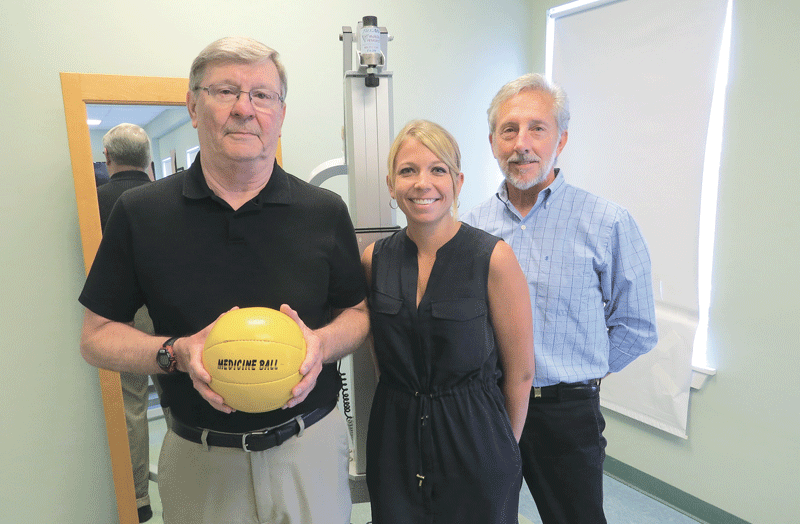
The managing partners at ECG, from left, Joe Kessler, Susan Lachowski, and Patrick Carley.

The managing partners at ECG, from left, Joe Kessler, Susan Lachowski, and Patrick Carley.

A quarter-century ago, Joe Kessler and Patrick Carley were working together to create cutting-edge solutions to problems with workplace injuries at East Longmeadow-based Hasbro (now Cartamundi). Later, after Carley left a position in academia, the two continued to collaborate on projects to identify and resolve issues in a wide array of workplaces. Today, with third managing partner Susan Lachowski, they are taking these efforts to a higher plane with a venture called Ergonomic Collaboration Group, a name that speaks volumes about what this company does — and how it does it.

When Shaun McConkey arrived at South Deerfield-based Pelican Products as director of operations a year ago, he found a company on the move.

As we reported back in May, this enterprise, long known for making hard-plastic cases for commercial, government, and military applications, was successfully diversifying into everything from coolers to suitcases to backpacks.

But amid all these green lights, McConkey saw a red flag. It took the form of a mounting number of soft-tissue injuries resulting from the processes (especially the literal heavy lifting) required to manufacture such products.

Desiring to ward off such injuries, he knew he would need some help, and also knew just who to call — meaning this wasn’t exactly a phone number he had to search to find.

That’s because he’d called it more than a few times before. Indeed, McConkey, Joe Kessler, and Patrick Carley go back a ways. The three were at Hasbro’s (now Cartamundi’s) sprawling manufacturing facility in East Longmeadow in the early ’90s. McConkey was director of manufacturing, Kessler was the in-house ergonomist, and Carley, a practicing physical therapist, joined him when the company decided to establish a physical-therapy clinic inside the plant to respond to the growing number of musculoskeletal-related injuries, now referred to as musculoskeletal disorders, or MSDs.

Shaun McConkey

Shaun McConkey, currently director of operations at Pelican Products, has called on the team at ECG on many occasions during his career in manufacturing.

Fast-forwarding a little, Carley left the clinic at Hasbro in 1996 to take a full-time faculty position at American International College. But the two continued to work together — often with Carley’s students — on projects to improve work processes and reduce the potential risks for MSDs.

One of their collaborative efforts was at the U.S. Tsubaki Automotive, LLC timing-chain-manufacturing facility in Chicopee, where McConkey, who was by then with that company as operations manager, sought their help with reducing and perhaps eliminating the threat of injuries related to the cleaning of a machine known as a ‘nut former.’

Their involvement led to the creation of a chest-resting bench — one we’ll hear much more about later — that speaks volumes about how a venture now known as Ergonomic Collaboration Group (ECG), LLC goes about its work.

It takes a scientific approach, said Dan Oliveira, environmental health and safety specialist at U.S. Tsubaki, one that engages employees in every step of the process and therefore achieves a critical volume of buy-in.

“They involved employees and helped them facilitate this change,” he explained. “That’s better than simply making a change and saying, ‘this is the way we’re doing things now.’ You’re having employees understand why that change is being made.”

The team at ECG, which now includes a third managing partner — Susan Lachowski, one of Carley’s students, who possesses a PhD in exercise physiology — intends to use this approach to extend its business portfolio well beyond Hasbro and Shaun McConkey’s career ladder.

And it is already moving strongly in that direction, adding clients ranging from the postal service to Merrill Lynch; from Hamilton Sundstrand to Riverside Industries.

Such growth is partly explained by the fact that ECG offers the right services at the right time — when employers, faced with ever-advancing technology and the ever-rising cost of doing business, want to fully exploit the former while perhaps reducing the latter, especially workers’ compensation costs.

For this issue and its focus on the modern office, BusinessWest talked with the team at ECG, as well as with some of those they’ve worked with and for, to identify potential problems and orchestrate solutions. You might call their endeavors in the field — as well as current efforts to grow their business — works in progress.

Stretching — the Truth

Kessler calls it simply the ‘blinking program,’ and no, it’s not what you might think.

Just as one’s eyes blink to keep them lubricated, the body’s muscles should blink to keep them from becoming stressed, or injured, he noted. But while eye blinking is mostly a reflex, or semi-automatic action, muscle blinking is not; it must be orchestrated, if you will.

Hence that word ‘program,’ which in this case refers to a regimen of movements designed just over a decade ago for employees at Hasbro while Kessler was still there and collaborating with Carley and some of his students on various projects.

The ‘chest rest’

The ‘chest rest’ at U.S. Tsubaki’s timing chain plant in Chicopee is an example of ECG working with a client to solve a potential problem.

“If you stretch five minutes before your shift starts and then don’t stretch for the rest of the day, how effective can that be?” Kessler asked. “So we instituted a ‘blink’ program; we designed a whole series of stretches that the employees could do discreetly, like when the line came down for a minute or if they were going to their break area.

“These were simple things, like shrugging the shoulders,” he went on, “just to stretch your muscles out and give them a break and let them breathe. The point was to do this several times a day, and we did it for the entire factory.”

Together, Kessler and Carley initiated a number of programs and initiatives for the game maker, many of them worthy of the descriptive phrase ‘state-of-the-art.’ That includes the physical-therapy clinic itself.

“We put it right inside the plant — if people got hurt, they went to medical, they were cleared and sent to physical therapy, which was right on the factory floor,” Carley said of the facility, established in 1991. “It was pretty forward-thinking stuff.”

And there was more of that to come, he went on, adding that he and Kessler were eventually assigned to the same committee at Hasbro that was charged not only with treating people after they were injured, but with developing strategies to keep them from getting injured in the first place.

“The committee tasked us with going out to the different work areas and try to determine what it was about the work process, the machine, or whatever it might be, to reduce exposure to injury,” he explained, adding that most problems were, contrary to popular belief, not with the back, but with upper extremities and arms.

“People were putting those packages of little green houses in boxes something like 4,000 times a day,” he told BusinessWest, before being corrected by Kessler, who said the number was probably closer to 15,000.

To reduce those injuries, the company, working on the advice of Kessler, Carley, and those they were working with, changed work processes (to reduce how far one would have to reach, for example), adjusted machines, instituted work rotations when needed, and, in some cases, changed or instituted policies, such as the limits placed on how many pounds employees would lift at a given time.

The initiatives at Hasbro would eventually yield accolades from OSHA , specifically, its Voluntary Protection Program (the company’s ergonomic program became the best practice in 2005). And in many ways, they laid the groundwork for the business that would become ECG.

“One thing led to another — we took some of the things we learned at Hasbro and applied them at Hamilton Sundstrand or at the post office, for example,” said Carley. “Other companies were calling us, and we started getting into office ergonomics.”

ECG-LogoOne of the companies that called was the Springfield office of Merrill Lynch, which was having some issues with new information technology.

“They changed over to flat screens, and when they put those screens up, they left the keyboards over here,” he said, using his hands to show there was some distance between the two. “And they were wondering why people’s necks were hurting them. They said, ‘you need to help us figure this out.’”

Documented success with helping a host of clients figure things out has been a key ingredient in the company’s efforts to grow its portfolio, he went on, citing U.S. Tsubaki’s chest-resting bench as a perfect example.

Body of Evidence

Bringing this seemingly simple piece of equipment to reality — meaning everything from its design to its implementation — came about through a scientific, or academic (but also collaborative) approach that enabled the employees who would be using it to play a huge role in its development.

Kessler calls it “engineering a problem out.”

It all begins with observation, interviews with employees, and other steps to pinpoint problems and also problems in the making — in every sense of that phrase. Then comes the work to devise a solution. As Oliveira mentioned, employees were front and center during that step as well.

Backing up a bit, he said employees were previously required to bend over these machines, unsupported, for long stretches as they cleaned them, presenting a risk for back injuries. Also, as they bent over, they were supporting themselves by putting one hand on an oily surface, presenting the possibility of acute injury.

“ECG enabled us to be proactive about this, rather than reactive,” he said, “and say, ‘there’s the potential for injury here, and we want to resolve it before anything happens.’”

The chest-resting bench not only reduces the threat to back injury, but it also improves productivity, said Carley, adding that Tsubaki now plans to put it into use worldwide.

But while responding to problems related to workplace injuries with engineering solutions is a big piece of ECG’s workload, keeping employees healthy, limber, and thus more out of harm’s way is also part of the equation, and it will only grow in significance in the future, said Carley.

And the addition of Lachowski, who focuses on using exercise science to improve work efficiency and safety, effectively “closes the circle,” as he put it, and enables ECG to provide a comprehensive roster of services, including prevention.

“My focus is on proper biomechanics and keeping the employee healthy through physical activity,” she explained. “If we can do that, we can reduce the threat of injury.”

As an example, she noted how ECG helped Riverside Industries — which provides services including life-skill development, rehabilitation, and employment options to adults living with developmental disabilities — to attain a grant from the Mass. Department of Industrial Accidents. It is being used for safety training for all employees involved in client handling, transfers, and transportation.

The program includes progressive stretching and exercising, in addition to a ‘train-the-trainer’ program to continue the safety efforts, she went on, adding that such efforts are critical to creating a culture focused on safety.

At Pelican, a train-the-trainer initiative will be part of a comprehensive response that is still in the formative stage, said Kessler, adding that stretching and exercise programs will likely be accompanied by changes in production processes to reduce exposure to injury.

In many ways, work at the Pelican plant illustrates the full range of ECG’s services and its efforts to customize solutions for clients.

“We have an educational approach to every project that we do, and we tailor each project to the company itself, because one size doesn’t fit all,” said Lachowski. “We really want to educate the workers, as well as the companies, and give them the tools to continue on after we’ve left.

“Our approach isn’t to go in and say, ‘this is the way to do it; you should it our way,’” she went on. “Many people don’t respond to that. That’s why we observe and ask questions, and do a comprehensive educational piece, so they’re in the driver’s seat.”

Looking ahead and toward where this company might go — in terms of what he anticipates will be controlled growth, but also specific assignments — Carley said the modern office and modern manufacturing facility are laden with potential ergonomic issues and potential problems.

Indeed, at a time when many professionals work with not one computer screen in front of them, but two or even three, attention must be paid to everything from where they’re positioned to their height off the desk.

And that’s just one small example of the importance of ergonomics today, said Kessler, noting that, as more individuals spend eight, 10, or 12 hours a day at a desk, attention must be paid to how they’re doing all that work and how it might impact everything from their vision to their back — to their productivity.

Which brings him back to that notion of ‘muscle blinking’ he described, a concept that encompasses everything from stretching before and during work to getting up and walking around, to perhaps not sitting at all and instead investing in a standing desk.

“When people are healthier, productivity is better, quality is better — if you’re sitting on a line and not feeling well, how good is the product? — it’s all interwined,” said Kessler in summing things up.

Limber Yard

As he talked about ECG, its reason for being, and its enormous potential as an entrepreneurial venture, Kessler summoned some numbers that put matters in perspective in a manner all business owners and managers could appreciate.

“There’s a rule of thumb out there that we used to use … if you have a $140,000 shoulder operation, and you’re a self-insured company, you have to sell 10 times that amount in product to make that up, because all that comes off your bottom line,” he said. “The most important thing is keeping people healthy, obviously, but by doing so, companies can save themselves a lot of money.”

Those numbers, and that reality, speak to why there is ever-increasing attention being paid to workplace wellness, if you will, and the broad realm of ergonomics.

And they also explain why the future appears extremely bright for a venture that has problem solving in the modern office down to a science — literally.

George O’Brien can be reached at [email protected]

Building Permits Departments

The following building permits were issued during the months of August and September 2016.

AGAWAM

Agawam Veterans Housing LLC
South Westfield St.
$115,000 — Install new fire-sprinkler system

CJN LLC
Springfield St.
$147,000 — Construct a 1,500-square-foot storage building

FRP Holdings Agawam LLC
Springfield St.
$64,275 — Strip roof and reroof Rite Aid

Amherst

Amherst College Trustees
151 College St.
$21,000 — Verizon Wireless is adding 3 remote radio heads on an existing smokestack installation.

Amherst Shopping Center Associates LLC
229 University Dr., Dunkin Donuts
$18,000 — Interior renovations

Hadley

Montgomery Rose LLC
316 River Dr.
$140,000 — Adding on to existing pre-fab steel building

Northampton

Chicopee Kendall, LLC
129 Pleasant St.
$10,290,000 — Construct 4-story building, 51,560 square feet

Cooley Dickinson Hospital Inc.
30 Locust St.
$1,263,329 — Create the Comprehensive Breast Care Center

Garibaldi Associates LLC
274 Pleasant St.
$495,000 — Construct 1,500 SF addition – optical studio

Northampton Veterinary Clinic
190 Nonotuck St.
$219,000 — Remodel and reconfigure space

Thornes Marketplace LLC C/O HPMG
150 Main St.
$51,286 — Rebuilding egress and vestibule skywalk to garage

Springfield

Children’s Study Home
38 Sherman St.
$5,800 — Build handicap ramp at side entrance

Eversource Energy
300 Caldwell St.
$4,400.00 – Move one antenna to top, add one new dipole at 105 ft. Old coax will be recycled in bins on site.

Mason Square Apartments II Limited Partnership
State Street (Abandoned Firehouse)
$100,000 — Abatement, light demo

Newport LLC
555 State St.
$395,473 — Interior selective demolition. Installation of new store front entry, overhead door, and new windows. Insulate, sheet rock, installation of HVAC units without distribution. Tennant to build out space.

SBA Communications
556-562 St. James Ave.
$13,000 — Remove and replace three existing fiberglass concealment enclosures.

WGBY
42-44 Hampden Street
$35,675 — Renovations

West Springfield

Building at 134 Capital Drive
134 Capital Dr.
$28,000 — Construct offices and product display area in vacant space, slab on grade, single story

Building at 1654 Riverdale Street
1654 Riverdale St.
$8,000 — Cover existing roofing with metal standing lock roofing

Building at 79 Wayside Ave.
79 Wayside Ave.
$105,000 — Build out 5,100 square feet of commercial building as office space

Cal’s Wood Fired Grilled Bar
1068 Riverdale St.
$35,500 — Tear off entire roof, install new roof, remove debris.

dePaul Center
2112 Riverdale St.
$1,012,000 – Renovate existing first floor offices. New HVAC, sprinklers, 3 new baths, new electrical

Existing Telecom Site
62 Bridge Street
$15,000 — Swap 3 existing cell antennas with 3 newer technology cell antennas and associated equipment. No change to tower.

Westfield

City of Westfield
158 Union St.
$38,178 — Renovation/maintenance of the building

J&F Management LLP
124 Elm St.
$35,000 — Re-design existing kitchen to accept new sanitation room, install wall separate in the basement

Meridian Transport Company
24 Fowler St. Ext.
$2,500,000 — Erect 100,000-square-foot warehouse

Sterling Realty Trust
125 North Elm St.
$61,500 — Reconfiguration of the existing office space

Company Notebook Departments

PeoplesBank Earns Accolades

HOLYOKE — Eighty-five Massachusetts companies were honored at the Boston Business Journal’s 11th annual Corporate Citizenship Summit on Sept. 8 at the EpiCenter at Artists for Humanity in Boston. For the ninth time, PeoplesBank was among the companies included, this year finishing 48th on the statewide list and third for companies headquartered in Western Mass. Meanwhile, AdvisoryHQ has named PeoplesBank to its list of “The Top Ten Banks in Massachusetts” after an extensive review. “The contributions these companies make to Massachusetts are incredibly impressive and go a long way toward helping strengthen the communities we live in,” said Boston Business Journal Market President and Publisher Carolyn Jones at the Sept. 8 event. Matthew Bannister, vice president, Corporate Responsibility at PeoplesBank, accepted the award at the summit on behalf of the bank’s associates. “Our mutual charter supports everything we do and why we are succeeding as a community bank,” he said. “Because of our mutual charter and related values, we have a unique ability to help the communities we serve through volunteer efforts and millions of dollars in donations to charitable and civic causes.” The Boston Business Journal’s “Top Corporate Charitable Contributors” list is composed of companies that gave at least $100,000 to Massachusetts-based charities in 2015. According to Advisory HQ, “the names on this list of banks in Massachusetts are all very distinctive from one another, yet all have many advantages, benefits, and value-creating products and services that make them excellent choices for consumers seeking the very best in financial services.” The bank’s corporate values were highlighted by AdvisoryHQ in its announcement of the list, which noted, “the corporate philosophy of PeoplesBank is a commitment to customers, maintaining corporate responsibility, creating a great place to work, and always striving to improve their environment.” Added Thomas Senecal, president and CEO of PeoplesBank, “AdvisoryHQ has accurately identified the values we are proud of. As a mutual bank, we strive to serve our customers and the community as well as support the environment and our associates’ growth and development. These are also the qualities that we believe separate us from other financial institutions and truly make us a top bank.” PeoplesBank was recently highlighted by the Assoc. for Customer Loyalty for the bank’s commitment to customers, was named a Top Place to Work by the Boston Globe, and an Employer of Choice by the Massachusetts Chamber of Commerce, and has received environmental-sustainability awards from the city of Springfield (the first-ever GreenSeal Award), BankNews (Green Leaf Award), and the American Bankers Assoc. (Sustainable Banking Award). AdvisoryHQ also suggested that the bank’s mobile app was one of the reasons it made the list of Top Ten Banks in Massachusetts. PeoplesBank was one of the first community banks in the nation to launch a mobile app and mobile deposit.

Baystate Hospitals Merge Under One License

The Mass. Public Health Council approved Baystate Wing Hospital’s application to merge Baystate Mary Lane Hospital with Baystate Wing Hospital and combine the two facilities and their respective satellite facilities under one license. The last day of inpatient services at Baystate Mary Lane was Sept. 9. As of Sept. 10, Baystate Mary Lane became a satellite of Baystate Wing. Inpatient care at Baystate Mary Lane transitioned to Baystate Wing, while all outpatient services will continue at Baystate Mary Lane. Baystate Mary Lane Emergency Department will now operate as a satellite emergency facility of Baystate Wing Hospital. Patients will get the same level of 24-hour emergency care delivered by the same caregivers. Those who need to be admitted for hospital care will be transported to Baystate Wing, Baystate Medical Center in Springfield, or another appropriate medical facility depending on their care needs. The Ware facility will be known as the Baystate Mary Lane Outpatient Center. “We appreciate the Public Health Council’s recognition that this transition is an important step toward providing the best possible quality and value in services for the communities we serve,” said Michael Moran, president and chief administrative officer for the Baystate Health Eastern Region. “Our priority now is to work to ensure that the transition goes smoothly, and to continue to engage our local community on the many health issues that we face together. Baystate Mary Lane will continue to play a vibrant role in improving health in our communities.” Patients should not expect any disruptions in services related to the transition, and may call their doctor’s office if they have any questions about the effect of the change on any scheduled appointments.

AIC Granted Reaffirmation of Accreditation

SPRINGFIELD — American International College (AIC) has been granted reaffirmation of accreditation of business and management programs offered through its schools of Business, Arts, and Sciences and the School of Graduate and Adult Education by the board of commissioners of the International Assembly for Collegiate Business Education (IACBE). The IACBE is nationally recognized by the Council for Higher Education Accreditation, and is a leader in mission-driven and outcomes-based programmatic accreditation in business and management education for student-centered colleges, universities, and other higher-education institutions throughout the world, The IACBE has hundreds of member institutions and campuses worldwide and has accredited more than 1,300 business and business-related programs in the U.S., Europe, Asia, the Middle East, Central America, and South America. According to the IACBE, “the School of Business, Arts, and Sciences and the School of Graduate and Adult Education at American International College have undertaken a rigorous self-evaluation, have undergone a comprehensive independent peer review, and have demonstrated compliance with the following nine accreditation principals of the IACBE: outcome assessment, strategic planning, curriculum, faculty, scholarly and professional activities, resources, internal and external relationships, international business education, and educational innovation.” In addition, the organization noted that AIC’s School of Business, Arts, and Sciences and the School of Graduate and Adult Education “have demonstrated a commitment to continuous improvement, excellence in business education, and advancing academic quality in their business programs and operations.”

ILI Earns Highest Ranking from Accreditation Authority

NORTHAMPTON — The Accrediting Council for Continuing Education and Training (ACCET) has certified the International Language Institute (ILI) of Massachusetts through 2021. This five-year accreditation is the highest level bestowed by ACCET, which since 1978 has been officially recognized by the U.S. Department of Education as a reliable authority regarding the quality of education and training provided by the institutions that ACCET accredits. ACCET first accredited ILI in 1984, and has continued its recognition of the school’s excellence since then. “We are proud to earn ACCET’s highest accreditation,” said Eric Wirth, ILI board president. “It underscores the extraordinary creativity and dedication of our teachers and administrative staff. And ACCET accreditation helps assure prospective students from around the world and right here in Western Massachusetts that they will receive top-notch service.” Operating for 32 years, ILI is a nonprofit language school in Northampton that partners with 12 colleges and universities (locally, Bay Path University, Elms College, Greenfield Community College, Springfield College, Western New England University, Westfield State University, and UMass Amherst graduate school) to teach academic English skills to international students planning on enrolling at these schools. The school also trains instructors in effective ways to teach English to non-English speakers in the U.S. and abroad. In addition, ILI offers French, German, Italian, and Spanish courses for English speakers who travel for pleasure and business or “who simply want to learn another language,” said ILI Executive Director Caroline Gear. “We are especially proud of our free English classes for refugees and immigrants,” she added. “For more than 30 years, these classes have helped change lives thanks to support from the Massachusetts Department of Elementary and Secondary Education and the generosity of hundreds of local businesses and individual donors.” ACCET personnel paid a site visit to ILI in July and completed extensive research as part of the accreditation process. Among the strengths pointed out in the ACCET assessment are ILI’s professional relationships within the Northampton community; the school’s short- and long-term business plans; the extensive tenure of ILI faculty and staff, which results in a collaborative environment that supports out-of-the-box thinking; student-centered classes, including free English classes for refugees and immigrants; the school’s exemplary teaching and the teachers’ qualifications that exceed ACCET requirements; and the fact that students enjoy their time at ILI and are making significant progress in language development.

Aegis Energy Services Announces Strategic Alliance with Yanmar

HOLYOKE — Aegis Energy Services Inc., a provider of co-generation technology, announced a strategic alliance with Yanmar, a 100-year-old Japanese diesel engine and equipment manufacturer and cogeneration provider. The Aegis and Yanmar relationship will broaden the reach of combined heat and power (CHP) systems by offering a wider product line to serve facilities of all sizes — from hotels, hospitals, and residential buildings with large footprints to smaller facilities, including nursing homes and assisted-living facilities, apartment complexes, boutique hotels, restaurants, and more. “For more than 30 years, Aegis has designed, manufactured, and installed combined heat and power systems equipped with world-class remote monitoring and service across the Northeast and Mid-Atlantic,” said Aegis President Lee Vardakas. “The alliance with Yanmar not only increases our CHP product offerings, but our geographic reach. Together, we can provide modular systems for facilities of any size to generate sustainable, clean power options that reduce energy costs and emissions on a wider scale.” According to the U.S. Energy Department, CHP captures energy that would normally be lost in power generation and uses it to provide heating and cooling, making CHP 75% to 80% percent efficient. While most central power plants create steam as a byproduct that is then expelled as wasted heat, a CHP system captures the thermal energy that would normally be lost in power generation and uses it to provide on-site heating and cooling to factories, multi-residential housing and hospitality facilities, breweries, athletic facilities, and other applications requiring thermal load. In 2012, legislation was enacted which set a national goal for increasing CHP capacity. “Aegis has already demonstrated a commitment to Yanmar’s cogeneration product line by successfully completing our training courses designed for these systems,” said Arne Irwin, Energy Systems Business Unit manager at Yanmar America. “They will be able to provide a high level of service in their market for Yanmar’s CHP products.”

OMG Roofing Opens Two New Warehouses

AGAWAM — To support its goal of accelerating international sales growth in Asia and Europe, OMG Roofing Products has established new warehouses in Rotterdam in the Netherlands as well as in Shanghai, China. The two new warehouses are centrally located within their regions to enable OMG to rapidly supply products to roofing contractors and OEM partners in each of these critical markets. Both warehouses will stock a wide range of products sold locally, including OMG fasteners and plates, RhinoBond tools and plates, OMG telescopic tubes, OlyBond500 insulation adhesives, OlyFlow drains, and EverSeal roof repair tape. “OMG Roofing Products has continued to grow and expand beyond U.S. borders,” said Web Shaffer, vice president of Marketing. “By adding these warehouses, we are building a stronger foundation on which to accelerate our international growth by improving our service and expanding our distribution into new countries throughout Europe and Asia.”

Berkshire Bank Named a Top Charitable Contributor

PITTSFIELD — Berkshire Bank announced it was named by Boston Business Journal as one of Massachusetts’ Most Charitable Companies at the publication’s annual Corporate Citizenship Summit in Boston on Sept. 8. The Boston Business Journal is one of the leading sources for business news, research, and events in the Greater Boston area. Each year it honors a select list of companies for their charitable work in the community. Berkshire Bank ranked 42nd for total financial contributions, with more than $1.27 million donated in Massachusetts alone and more than $2 million donated overall. Massachusetts-based bank employees also donated more than 27,000 hours of volunteer service. Berkshire Bank joined a select list of statewide, national, and international companies honored at the summit. The award recognized Berkshire Bank and Berkshire Bank Foundation’s philanthropic investments in the community through their charitable grants, corporate giving, scholarships, in-kind donations, and employee volunteerism. Annually, Berkshire Bank and Berkshire Bank Foundation provide more than $2 million to community organizations, as well as scholarships to high-school seniors with a record of academic excellence and financial need. In addition to financial support, XTEAM, the bank’s employee-volunteer program, provides employees with paid time off to volunteer during regular business hours. In 2015, more than 70% of Berkshire Bank’s employees donated over 40,000 hours of service to benefit community organizations across the bank’s service area.

Inspired Marketing Gains WBENC Certification

SPRINGFIELD — Inspired Marketing Inc. announced it has been certified as a woman-owned business by the Women’s Business Enterprise National Council (WBENC), and also announced several promotions and hires in the company. “This designation is something I have longed to receive, and this year was thrilled to have accomplished the goal,” said Jill Monson-Bishop, chief inspiration officer. “I am even prouder of this certification because I have incredible women on my team who celebrate it with me.”

Berkshire Theatre Group Receives $29,000 Grant

PITTSFIELD — Berkshire Theatre Group announced it is the recipient of a $29,000 grant from the Massachusetts Cultural Council’s Cultural Investment Portfolio (CIP), which provides unrestricted general operating support grants and project support grants to nonprofit organizations that provide public programs in the arts, sciences, and humanities in Massachusetts. “We’re deeply thankful for the Massachusetts Cultural Council’s CIP grant to BTG. As ticket sales only cover half of our expenses, outside funding is vital to maintain our educational and transformative programs and productions. We are grateful that the MCC supports the valuable work we do.” The CIP recognizes that organizations with an established record of programmatic service and administrative stability should have access to funds to support their organizational goals and objectives, and to maintain their ongoing programs, services, and facilities without special emphasis on new initiatives as justification for funding.

Springfield College Rises Again in U.S. News Rankings

SPRINGFIELD — Springfield College has again moved up the list of highest-ranked colleges in U.S. News & World Report’s latest edition of “Best Colleges.” In the 2017 report, Springfield College is ranked 27th in the first tier in the category of Best Regional Universities – North. This marks the sixth consecutive year that Springfield College has moved up in the U.S. News rankings. This year’s ranking of the college is up two spots from 2016 and 40 spots from 2011. “I am extremely proud that Springfield College is being recognized for our outstanding academic offerings and a rich co-curricular life outside of the classroom,” said President Mary-Beth Cooper. “The rise in our ranking over the past six years demonstrates that the value proposition for a school like Springfield College, grounded in the Humanics philosophy, is well-regarded.” The college also ranked 12th in Best Value Schools for Regional Universities – North, the first year it has been listed in the Best Values category, which takes into account a college’s academic quality and net cost of attendance. According to U.S. News, the higher the quality of the program and the lower the cost, the better the deal Springfield College’s rise in the rankings is spurred by improved graduation rates and improved retention of first-year students. The college’s traditional, undergraduate enrollment for the fall of 2016 remained steady, with 550 first-year students enrolling again this year. The ratings are based on such variables as peer assessment, graduation and retention rates, student selectivity, class size, alumni giving, and student-faculty ratio. The college was ranked in a third category by U.S. News for 2017. It is ranked 14th in the North region in Best Colleges for Veterans.

Community Spotlight Features

Community Spotlight

Lenny Weake

Lenny Weake says the Quaboag Hills Chamber of Commerce has partnered with QVCDC to promote resources available to startups and existing businesses in the region. 

In 2006, Nelson Rivera opened the Sharpest Edge Barber Shop on Main Street in Ware.

A few years later, he wanted to purchase a building on Pulaski Street to house his expanding operation, but didn’t think he could qualify for a commercial bank loan due to his poor credit score.

However, he found help at the Quaboag Valley Community Development Corp. (QVCDC), where he was referred to a bank that granted the loan he needed to buy the property.

“The QVCDC opened the door for me,” Rivera said, adding that he also took a QuickBooks class from the organization and recently got a loan from them that allowed him to make needed building improvements.

“The help they offer is amazing and if you have a good idea for a business, this is definitely a great place to launch it,” Rivera continued, as he told BusinessWest that business owners and residents in the area are very supportive of new and existing enterprises.

Lenny Weake agrees, and says the Quaboag Hills Chamber of Commerce has partnered with QVCDC to promote resources available to startups and existing businesses in the region. The chamber represents 15 towns: Belchertown, Brimfield, Brookfield, East Brookfield, Hardwick, Holland, Monson, New Braintree, North Brookfield, Palmer, Spencer, Wales, Ware, Warren, and West Brookfield.

“We want businesses to come to our area and stay here; we have a lot to offer and have established a cohesive network of resources to help them,” said the president of the chamber. “Anyone can open a new company, but it doesn’t mean they know the best way to market their product or service or have the financial knowledge they need to be successful.”

To that end, the chamber and QVCDC have coordinated their efforts and are working collectively to help new businesses as well as landlords with property to rent in the 400-square-mile rural region. “If a business in Ware does well, Palmer and Brimfield also benefit, and if we all work together, we can bring more businesses to the area, which will lead to more jobs,” Weake said, adding that, although some might question the desirability of setting up shop in this region roughly halfway between Springfield and Worcester, it is not as far away as people think. “Palmer is only 15 minutes from Springfield and has an exit on the Mass Pike,” he noted. “Spencer is 20 minutes from Worcester; Route 9 runs from Ware through West Brookfield, East Brookfield and Spencer; Route 20 runs from Palmer to Brimfield into Sturbridge; and the Quabbin Reservoir attracts hundreds of thousands of visitors each year.”

The area contains many former mill buildings that have been converted into office or light-manufacturing space, including the Palmer Technology Center and the Wrights Mill complex in West Warren, which is in close proximity to highways and freight-rail transportation systems.

“We’re a very vibrant region with beautiful open spaces, a rich history and culture, and wonderful people,” said Sheila Cuddy, executive director of the QVCDC and the Quaboag Valley Business Assistance Corp.

Indeed, Weake says some business owners have found that the Quaboag region is an ideal location. “Mike’s Party Rentals moved into space on Route 32 in Palmer several months ago because of its access to the Mass Pike and main roads,” he noted.

For this edition, BusinessWest takes a look at how organizations are working cooperatively to provide invaluable assistance  to businesses in the Quaboag region, which include a number of new programs, a workforce-training initiative, and education for landlords.

New Programs and Services

The QVCDC was formed in 1995, and it works in partnership with the Quaboag Valley Business Assistance Corp. and numerous community partners to provide a wide range of offerings. They include loans of $500 to $100,000 to businesses that are not bankable, job creation, and services designed to help businesses start, stabilize, and grow.

There is also help for outcome-driven projects, thanks to mini-grants of $300 to $750 and a network of professionals who offer their services at reduced rates to help business owners with legal issues, marketing, and more. For example, someone can get help with a logo or have an attorney review a contract or lease or provide assistance writing a contract for customers.

The QVCDC also offers classes on business topics not duplicated by other organizations, and Cuddy said a survey conducted in the region uncovered problems that the agencies are working collectively to address.

For example, many business owners reported they had trouble finding qualified employees, so a new program was designed to resolve that issue. QVCDC formed a partnership with Holyoke Community College, which led to the creation of the E2E (Education to Employment) program and the Quaboag Region Workforce Training and Community College Center in Ware.

The center contains two classrooms, private study areas, and office space, and has 10 computer workstations for people who want to enroll in HCC’s online credit classes.

Holyoke Community College President William Messner (far right), who recently retired, shakes hands with Tracy Opalinski during the opening ceremony for the new E2E (Education to Employment) program in Ware.

Holyoke Community College President William Messner (far right), who recently retired, shakes hands with Tracy Opalinski during the opening ceremony for the new E2E (Education to Employment) program in Ware.

In addition, there are non-credit classes in hospitality and culinary arts, and plans to expand course offerings in the future. Classroom education will be supplemented by hands-on training at Pathfinder Regional Vocational Technical High School in Palmer, and HCC will offer academic advising and career-counseling services on site beginning this month.

“This is the first installation of any education past high school in the Quaboag region,” Cuddy said, noting that it’s a public-private partnership that will provide critical help to low- to moderate-income residents and local employers.

Tracy Opalinski agrees. “Businesses in this area are starved for qualified employees, so we’re trying to create our own feeder program and build a base so people can live and work locally instead of having to move far away or commute to find employment,” said the trustee of the Edward and Barbara Urban Charitable Foundation, which provided support to the E2E program.

Other E2E community partners and supporters include Country Bank, Monson Savings Bank, the Donovan Foundation, Baystate Mary Lane Hospital, Quabbin Wire, Meredith Management, Otto Florists, and Carol Works for You.

In addition, QVCDC offers free computer-software training to incumbent employees and businesses in Worcester, Franklin, Hampshire, and Hampden counties. The training, which is funded by a state grant, takes place in Ware or at satellite training sites in Palmer or Brimfield. But if it is not feasible for employees to travel to those locations because of time, distance, or expense, the training sessions can be held at the businesses themselves.

“The program began last year and has been very popular; there are still slots available, but they are limited,” Cuddy noted.

She added that QVCDC’s most recent project is the Quaboag Connector, a regional initiative designed to transport people to and from work and the E2E program.

“One of the barriers to employment is the lack of affordable public transportation, and the creation of the E2E accelerated the need for it,” Cuddy told BusinessWest, adding that vans are being donated by the Pioneer Valley Transit Authority, and funding was provided by the Mass Dept. of Transportation and Baystate Wing Hospital in the form a $30,000 grant.

Another local initiative is the TRACK (Three Rivers Art Community Knowledge) program, which is using art as a catalyst to revitalize the downtown area and has been quite successful. Artwork is being displayed in empty and filled storefronts, there have been waiting lists for events for children and adults, and Workshop 13 in Ware held a business-planning session for artists that was attended by 15 aspiring entrepreneurs.

“We’ve recognized that we’re stronger when we form partnerships and work together,” Cuddy said, adding that the Quaboag Hills and Three Rivers chambers of commerce, the Ware Civic and Business Assoc., the Ware and Palmer Community Development Authorities, and the Palmer Historical and Cultural Center are among the groups that have joined forces to promote economic growth.

Their combined efforts have been enhanced by generous support from donors, which increased substantially over the past year after the QVCDC was selected to participate in the state’s Community Investment Tax Credit Program, which provides a 50% tax credit for donations to selected community-development corporations.

“We went from $126,000 in donations in FY 2013 to more than $208,600 in FY 2016,” Cuddy said. “Substantial support from our community partners has funded innovative new programs, sustained vital existing programs, and helped us leverage significant funding from state and federal sources.”

Ongoing Efforts

Weake said the Quaboag Hills Chamber of Commerce is also playing a vital role in economic-development efforts. For the past two years, its economic development committee has worked to match businesses that want to move to the region with available vacant space. It developed a form for them to fill out that provides information about their needs, and identifies suitable sites during monthly meetings.

“We have space available for $4.50 per square foot,” Weake noted, adding that this is very affordable compared to larger cities and towns.

The chamber’s efforts have extended to landlords; there are few commercial realtors in the area, and many property owners lack marketing experience and don’t know what to charge for available properties.

“We have landlords with space for rent who don’t put up signs, and we want to make people aware of what we have to offer,” Weake continued, noting that the chamber is working to become the central point for startups or businesses looking to relocate within the region.

Education is also being provided to landlords on a variety of topics, including the importance of forming and maintaining good relationships with tenants, because there has been a fair amount of turnover in the past.

Weake suggested that some landlords may want to consider measures such as graduated rents based on business profits or a number of other parameters. They are also being advised to provide new tenants with information about things such as rules and regulations regarding signage, and outline exactly what they are responsible for in a lease agreement.

Such education is critical, Weake said, citing the example of a business in Palmer that had to close when a leak in the roof caused damage it wasn’t prepared to fix because the owners hadn’t read the terms in their lease carefully enough.

“We’re doing all we can to work cohesively because we want small businesses to come here,” said Weake, referring to the sum of the many recent initiatives. “They’re the backbone of the community and give so much back to it, while adding life and energy to our towns.”

BusinessWest White Paper Sections

 Presented by Health New England

By Dr. Laurie Gianturco

Dr. Laurie Gianturco

Dr. Laurie Gianturco

Telehealth is the use of telecommunications and information technologies to deliver clinical care, preventative services, wellness services, patient education, and other health care related services from a distance.

But what does that mean to health care members and why should they take notice?

Telehealth is transforming the way health care is delivered, expanding it beyond the traditional doctor’s office to virtual consultations over the phone and on smart devices. Members can request a phone or online video consultation with a telehealth physician to treat low-acuity medical issues such as a cold, the flu, rash, urinary tract infections, ear infections, and more.

Roughly 30% of family physicians in rural communities have embraced telehealth, according to research conducted by the Robert Graham Center. An aging population, increasing incidences of chronic disease, and rapid technology advancements are fueling growth in the market.

Health New England was the first Massachusetts health plan to offer telehealth services to its members through a company called Teladoc. Health New England began offering telehealth services to its members in August 2015 as a convenient, affordable alternative to costly emergency room visits for non-urgent care.

Teladoc providers are U.S. board-certified in internal medicine, family practice, emergency medicine, pediatrics, dermatology and behavioral health. They are U.S. residents and are licensed in Massachusetts, with an average of 20 years of practice experience. Since Teladoc was launched in 2002, they have provided 1.6 million tele-visits.

To ensure continuity of care, Teladoc providers share information from a member’s virtual visit with their Primary Care Provider (PCP) so he or she is aware of the visit and can follow up as needed. Another benefit is that a Teladoc visit typically costs a member around $40, significantly lower than the cost of visiting an urgent care center or Emergency Department.

Teladoc offers a convenient option for members who need care for occasional minor issues after hours as well as those on vacation, on a business trip or away from home. Teladoc is not intended to replace a member’s PCP for ongoing care and for managing chronic conditions.
If you have a non-urgent medical need after hours, and your health plan offers a telehealth program, it’s an option that could save you time and money while providing care coordination with your PCP.

Dr. Laurie Gianturco serves as Vice President and Chief Medical Officer of Health New England. Dr. Gianturco is board certified in radiology and nuclear medicine.

8.22 BusinessWestWhite

Health Care Sections

Overcoming the Phobia

Dr. James Dores

Dr. James Dores says patients need to know their dentist will stop a treatment if they experience any pain.

The smell of freshly baked cookies wafts through the office at Dores Dental in Longmeadow, and a ‘comfort menu’ on the wall of the waiting room offers patients heated spa towels, movies, noise-canceling headphones, hot and cold drinks, and other items designed to help them relax before, during, and after a treatment.

The menu and idea of overcoming the smell associated with a dentist’s office by baking cookies all day are measures that Dr. James Dores and his staff use to help people overcome dental phobia, a severe, debilitating fear of having any type of dental work done.

And indeed, it’s a significant problem: the National Institute for Health reports the majority of people become anxious before getting dental treatment, and 10% to 20% have dental phobia. It tends to affect more women than men and can be detrimental to health as well as appearance.

People with dental phobia have fewer fillings and more decayed and missing teeth than their peers and typically contact a dentist only when they have pain that becomes unbearable, or when a major life event such as a divorce inspires them to do something about the condition of their mouth. However, waiting until that point often results in the need for complicated and traumatic procedures such as a root canal, which can further exacerbate and reinforce fear.

“About 75% of the population has some fear in regard to dental work. But there are definitely different tiers of it,” Dores said, adding that dental phobia can be resolved, but it takes caring and patience as it often stems from a traumatic, painful experience that occurred during childhood.


Health and Dental Plans in the region


Dr. Jane Martone has seen patients whose mouths are in terrible condition because of their fears regarding dentistry. “Some people are so afraid you will hurt them that just walking through the door is a major step,” said the founder of Westfield Dental Associates Inc., who teaches at the Medical College of Georgia School of Dentistry one week each month.

Dr. Vincent Mariano, a board-certified prosthodontist and co-founder of EMA Dental in Northampton and East Longmeadow, has seen patients who need work done on their entire mouth, and may need as many as a dozen crowns.

“If they have neglected their mouth for years, they can have problems with functionality. Some people have worn down their teeth so much that they can’t chew, or they have teeth that are so loose, they’re just moving around in their mouth,” he said.

As a result, people spend hours in his chair, so it is critical for him to develop a relationship with them and make sure they understand exactly what will be done before any work begins.

“I treat patients with very complicated dental needs, so the relationship is of the utmost importance for success,” he said, explaining that, in addition to fearing pain, many people with dental phobia are embarrassed about neglecting their oral health, but once a patient knows he is not judgmental, there is a much greater chance of success of rebuilding their mouth or treating their problem.

Martone concurs, and has talked to people at length on the phone to allay their anxiety before they work up the courage to visit the office. But since most are in pain, the first step is to eliminate it, although it’s equally important to reduce their overall fear, as preventive care can reduce the likelihood of future problems.

Dr. Vincent Mariano

Dr. Vincent Mariano says establishing trust with a patient is key to alleviating fear.

“People have died from infections because they didn’t seek dental treatment at the appropriate time,” Dores said, adding that gum disease starts out as gingivitis (inflammation) which can easily be addressed in the early stages, but if it progresses into periodontal disease, it can destroy structures in the jawbone that support the teeth.

Researchers are also finding links between gum disease and heart disease, stroke, premature births, diabetes, and respiratory disease, and Martone has discovered medical problems during an office visit and referred people to their primary-care doctor to treat high blood pressure or other health issues they were not aware of.

In this issue, BusinessWest looks at what local dentists are doing to help people overcome dental phobia and how advances in technology help to alleviate pain.

Treatment Choices

Dentists take different approaches to treating patients with irrational fears. They all believe it’s critical to establish a solid, trusting relationship, but some prescribe drugs to relax patients before a visit, while others offer sedation during procedures.

Dores calls every new patient the night before their first visit to welcome them to the practice, allay any fears they might have, and answer questions, and since he caters to people with dental phobia, the conversations can be lengthy.

“Some people have told me they are terrified and really appreciate the call because it shows that someone cares,” he said, adding that many prospective patients read online reviews that help boost their confidence in his practice.

When they do arrive, they are greeted warmly, then given a tour of the office, and before a treatment plan is drawn up, Dores talks to them about their previous dental experiences, taking note of things they didn’t like.

Many report an instance when they tried to tell a dentist they were experiencing pain, but were ignored. “I have had people tell me they were in tears and the dentist kept going,” Dores said, adding that, since people like to talk about bad experiences, it’s easy to have negative experiences validated and reinforced by friends, family members, or co-workers.

Certified dental assistant Diane Harvey, who works with Dores, assesses each patient’s body language before and during treatments, and says talking about their family or pets and using humor helps alleviate anxiety.

“It only takes one bad experience for a person to become scarred for life, and I have seen people shaking and crying before the dentist even comes into the room,” she recalled, explaining that she tries not to leave phobic patients alone in the room and reassures them if they tell her the the work will result in pain.

“I tell them that dentistry has come a long way, and in this day and age there should be no discomfort,” she said.

Mariano says patients need to know that if they raise their hand, the dentist will stop working on their mouth, which is critical, as fear of loss of control is almost as great as the fear of pain. To that end, he not only explains procedures in advance, but gives patients all of their treatment options and lets them choose what they want to have done.

“If a patient is going to lose a tooth, treatment could be a removable replacement or extend to a dental implant. But the patient needs to help make the decision,” he said, adding that he tells people not to focus on the procedure, but to think about the outcome, and since he is doing restorative work, that often means a beautiful smile.

Dores and Mariano sometimes prescribe mild sedatives for patients with dental phobia, which can be taken the night before a procedure and an hour before they arrive at the office. It means they need someone to drive them to and from the appointment, but Dores said their visits are always booked early in the morning so they don’t have time to upset themselves.

Martone said she is the only general dentist in the area who is board-certified in implant surgery, and is also trained and certified in intravenous sedation. She told BusinessWest that many patients with dental phobia seek her services because they want to be sedated even for simple treatments, such as filling a cavity.

Surveys show that IV sedation eliminates embarrassment about the condition of teeth, as well as the fears of gagging, injections, not becoming numb when injected with a local anesthetic, pain, and drills.

However, before it can be administered, the person’s medical history is taken to make sure there are no contraindications, and while they are under sedation, their vital signs are tracked, and they are put on a cardiac monitor.

Since they are not under general anesthesia, Martone noted, people are able to talk and follow commands while they are sedated, but feel no pain and have no memory of what took place when the procedure is finished.

She believes IV sedation is safer than oral medications, as the onset is very rapid, and the dose and level of sedation can be tailored to meet individual needs.

“This is a huge advantage compared to oral sedation, where the effects can be very unreliable,” she told HCN.

Technological Advances

State-of-the-art equipment also helps eliminate pain or discomfort that might occur during a diagnosis or treatment.

Martone uses a DEXIS CariVu device that uses near infrared light to detect cavities. “It allows the dentist to see decay without having to take an X-ray,” she said, explaining that some people can’t tolerate having to hold film in their mouth, and the device eliminates that problem.

Martone and Mariano also have CT-scan machines in their office that allow them to take X-rays without having to put anything in the person’s mouth, and Martone adds that small things can make a difference. For example, she uses a numbing topical anesthetic before giving an injection so there is no pain from the needle. And since rapid injections can also be painful, she makes sure she administers local anesthetics slowly.

Dores employs a DentalVibe Oral Injection System to administer local anesthetics. The handheld device was created by a dentist and sends soothing vibrations to the brain that block any sensations of pain.

He also uses laser therapy to fill cavities and says he is the only dentist in the area with the machine to do so. The device he employs never touches the tooth and delivers anesthesia, eliminating the need for numbing injections, along with wavelengths of light that evaporate the tooth enamel. A drill still may be needed for refinements, but Dores said the majority of the work is done with the laser.

Still, dentists agree that one of the most critical factors in treating fearful patients is a good relationship. “Technology helps, but it is secondary to the main component,” Mariano said. “Pain control begins outside of the office.”

Things like sleep matter: if a patient does not get a good night’s sleep before a treatment, it has an enormous affect on their pain threshold.

Mariano recalled a patient he had worked on before without a problem, but during a visit where she had had three sleepless nights in a row, “she was such a wreck I couldn’t do the procedure. Many times the anxiety and pain patients feel in a dentist’s office is not related to the significance of the treatment,” he told BusinessWest. “The patient’s state of mind is of the utmost importance in successful treatment.”

Which means if the person is going through a divorce, has lost their job, or has another major problem in their personal life, the anxiety they feel will be exacerbated, so they need to be comfortable talking to their dentist about anything that is affecting their state of mind.

Slow but Steady Progress

Dentists say they do their best to have their staff go above and beyond and take extra time with people with dental phobia.

“You have to gain their confidence, as somewhere along the way someone has hurt them,” Martone said, recalling a time when a patient traveled from Orange to see her and started crying as soon as she walked into the office. Another came from Sunderland, and although they had a long discussion about her dental fears, she was afraid to even sit in the chair.

“It takes time to get a person to trust you, and sometimes all you can do is treat their emergency. My goal is to win them over, but it’s not always possible,” she continued. “Their fear never really leaves them, but it is reduced each time they come in.”

Still, the goal is to develop a relationship where the patient feels safe and secure.

“The relationship is a life-long investment,” Mariano said. “It’s all about changing the quality of their life.”

Daily News

HOLYOKE — Aegis Energy Services Inc., a provider of co-generation technology, announced a strategic alliance with Yanmar, a 100-year-old Japanese diesel engine and equipment manufacturer and cogeneration provider.

The Aegis and Yanmar relationship will broaden the reach of combined heat and power (CHP) systems by offering a wider product line to serve facilities of all sizes — from hotels, hospitals, and residential buildings with large footprints to smaller facilities, including nursing homes and assisted-living facilities, apartment complexes, boutique hotels, restaurants, and more.

“For more than 30 years, Aegis has designed, manufactured, and installed combined heat and power systems equipped with world-class remote monitoring and service across the Northeast and Mid-Atlantic,” said Aegis President Lee Vardakas. “The alliance with Yanmar not only increases our CHP product offerings, but our geographic reach. Together, we can provide modular systems for facilities of any size to generate sustainable, clean power options that reduce energy costs and emissions on a wider scale.”

According to the U.S. Energy Department, CHP captures energy that would normally be lost in power generation and uses it to provide heating and cooling, making CHP 75% to 80% percent efficient. While most central power plants create steam as a byproduct that is then expelled as wasted heat, a CHP system captures the thermal energy that would normally be lost in power generation and uses it to provide on-site heating and cooling to factories, multi-residential housing and hospitality facilities, breweries, athletic facilities, and other applications requiring thermal load. In 2012, legislation was enacted which set a national goal for increasing CHP capacity.

“Aegis has already demonstrated a commitment to Yanmar’s cogeneration product line by successfully completing our training courses designed for these systems,” said Arne Irwin, Energy Systems Business Unit manager at Yanmar America. “They will be able to provide a high level of service in their market for Yanmar’s CHP products.”