Home Archive by category Sections (Page 47)

Sections

Accounting and Tax Planning

When Experts Become Victims

By Julie Quink

Julie Quink

Julie Quink

As professionals who counsel clients on best practices relative to fraud prevention and detection techniques, we unfortunately are not immune to fraud attempts as well.

The schemes that individuals and companies have fallen victim to are many, but here are two schemes we feel are important to mention for which we have recent personal experience.

The Fake Check Scheme

In a fake check scheme, the fraudster can obtain a check for the company and replicate the check using software that can be acquired easily on the Internet. The replicated check may look like an authentic company check written to a legitimate vendor.

By creating a replica of a legitimate company check, the fraudster now can generate a check payable to themselves or another entity for any amount. The check is entered into the banking system, deposited or cashed like a normal, routine check. If the check is negotiated at an out- of-state bank, it can take longer to move through the clearing process, and the fraudster can get the funds before the company or bank, which the company uses, is notified.

In this scheme, the original, authentic check is kept intact, and a fake replacement is generated using the information from the original check with slight modifications.

The Forged Payee Scheme

The forged payee scheme is a scheme whereby a fraudster intercepts a company check paid to a vendor for a legitimate invoice and washes the check to remove the original payee, amount, and sometimes date. The washing is done through a chemical process that removes the unwanted information so that the check becomes ‘blank’ again and can be modified with the information that the fraudster includes.

“It is always best practice to keep blank checks secured and accessible to only those who need access, thereby limiting the opportunity to generate fake checks.”

The original, authorized check signer’s signature is still on the check, so on its face, the check appears authentic to the bank clearing the check, and the fraudster can negotiate the check through deposit or check cashing. On its face, most times the check does not look to be altered or modified, so visually it is difficult to determine that the check is not a valid, authentic check.

Effects of Fraudulent Checks

In addition to the possible loss of company funds to the fraud, a level of business interruption can occur as a result of these schemes. The fraudster now knows the company’s routing information, bank account, name, and other critical information on the check and can continue to attempt to perpetuate the fraud. It is best practice to change the bank account to assist in preventing the fraud from continuing to occur.

Changing a bank account may not seem a significant interruption, perhaps, but if you consider all the transactions that occur within that account, it can be significant. Many companies use outside payroll firms that automatically withdraw funds from their account. Clients or customers may pay their bills automatically through ACH transactions. Vendors may also be paid electronically through the bank account.

The changing of the bank account requires consideration of all the transactions and activities that occur within that account and making the appropriate notifications to those parties to ensure the correct bank account information is provided to ensure continued operations.

Detection and Prevention Techniques

It is always best practice to blank checks secured and accessible only to those who need access, thereby limiting the opportunity to generate fake checks. Internal controls over the check-processing and mailing functions within a company are preventive measures to assist in minimizing the risk of forged payees.

These techniques can include a segregation of duties in the check-disbursement process to allow for appropriate oversight and control over the process.

Keep in mind that potential fraudsters can exist within a company as employees. They can also be external to the company. Consider that it is difficult at best to contemplate when a check, which has been mailed to a legitimate vendor for a legitimate expense, will be intercepted from the time it is mailed to the time it reaches a fraudster and is then replicated. The fraudster could be employed by the vendor that is receiving the company check.

In the age of electronic banking and ease of access to information, it is critical that bank-account activity be reconciled on a recurring, consistent basis to identify any unusual items. In addition, the reconciliation will identify older checks that have not yet cleared through the account but normally would clear in a timely fashion.

Through routine and timely reconciliation of bank accounts, items such as unusual, unauthorized checks can be easily identified and quickly investigated.

Many banks offer a service, which is most commonly referred to as ‘positive pay.’ This service requires the company to send over a check-disbursement list to the bank indicating all checks written. The bank will use the list to determine which checks will clear the company bank accounts. It is a higher-level control that can assist in preventing unauthorized checks.

Bottom Line

A heightened sense of awareness and evaluation of internal controls in place, including reconciliations, in addition to feeling comfortable with your banking partners and their controls, is critical to ensuring that your accounts are protected.

Julie Quink, CPA is managing principal of the West Springfield-based accounting firm Burkhart Pizzanelli; (413) 734-9040.

Banking and Financial Services

Financial Environment

PeoplesBank recently issued its annual Corporate Green Report in conjunction with Earth Day 2019. Through its green values and actions to support environmental sustainability, PeoplesBank believes it can help make the region a healthier place to live, work, and raise a family. The bank puts these values to work throughout the year through its charitable donations, volunteerism, support of green-energy projects, and construction of LEED-certified offices.

“As a mutual bank, we are focused on our values of innovation, community support, environmental sustainability, and employee engagement,” said Tom Senecal, president and CEO of PeoplesBank. “Environmental sustainability is really the meeting place of all those other values. It is a way we can be innovative, support the community, and engage our associates in a way that is meaningful.”

Added Philippe Michaud, a loan service associate at PeoplesBank and co-chair of its environmental committee, “a business’ responsibility is to try and influence its communities toward being more sustainable. The environment is a core belief that is built into the fabric of our organization. That goes a long way toward what we do in the community.”

Community banks, like PeoplesBank, are not generally known for building green offices, but PeoplesBank has a LEED Gold-certified office in Northampton, a LEED Gold-certified office in West Springfield, and a LEED Silver-certified office in Springfield. The LEED-certified office in Springfield, the first of its kind in the city, won a Green Seal from the city of Springfield.

The bank’s newest branch in Holyoke will also seek LEED certification once construction has finished. Pursuing that objective means the new branch will be constructed and operated as a green building. Some of the highlights include:

• Reuse of a portion of the existing Yankee Pedlar building (the historic Hildreth House);

• Reduction rainwater runoff on the site and use of landscaping that requires no irrigation;

• Use of low-flow water fixtures and high-efficiency HVAC; and

• Use of building materials that have low or zero volatile organic compounds and are sourced locally where possible.

In addition, the exterior wall is highly efficient and allows for the flow of air vapor in two directions, meaning the wall will ‘breathe’ throughout the year, leading to a cleaner indoor environment.

Three PeoplesBank offices (Northampton, West Springfield, and 330 Whitney Ave. in Holyoke) have electric-vehicle-charging stations. The bank is also launching a “Choose to Reuse” campaign designed to eliminate the use of disposable paper products internally.

“As a mutual bank, we are focused on our values of innovation, community support, environmental sustainability, and employee engagement. Environmental sustainability is really the meeting place of all those other values. It is a way we can be innovative, support the community, and engage our associates in a way that is meaningful.”

During the past year, PeoplesBank was recognized by Independent Banker magazine for its environmental sustainability efforts and, for the fifth year in a row, the bank was voted “Best Green Local Business” by Daily Hampshire Gazette readers. The bank is also a past recipient of the Sustainable Business of the Year Award and Associated Industries of Massachusetts’ Sustainability Award.

Over the course of the last year, PeoplesBank provided more than $58,000 in support for green initiatives in Western Mass., including:

• A mobile farmers’ market that travels to underserved and food-desert areas of Springfield and surrounding communities;

• The Community Involved in Sustaining Agriculture Food for All campaign;

• The Center for EcoTechnology’s Eco Fellows and support of over 100 community education events;

• The annual Source to Sea Cleanup of the Connecticut River, which also includes hands-on participation by a team of volunteers from the bank;

• The Mount Holyoke Wetlands Restoration Project, conducted by Restoration Ecology Summer Scholars;

• Scientific environmental education at the Hitchcock Center for the Environment; and

• ValleyBike, the region’s new bike-sharing program.

PeoplesBank is also a longtime leader in sustainable-energy financing, and the bank’s commercial lenders are recognized for their expertise in creating financing packages for green-energy power generation. To date, the bank has financed more than $183 million in wind, solar, and hydroelectric power-generation projects, an increase of $17 million in just one year.

Business of Aging

Back in the Swing

Jared Bean

Jared Bean says he’s giving people the injury-prevention education he didn’t receive as a young athlete.

Jared Bean grew up in Hampshire County and played youth sports in Easthampton. He recalls learning about how to improve his performance and conditioning — but not how to avoid getting hurt.

“I didn’t have that education, and neither did my coaches, and I ended up with injuries,” he told BusinessWest. “Now, I want to prevent that and give some more resources to this area.”

He does that as program coordinator and certified strength and conditioning specialist at the Cooley Dickinson Wellness and Sports Performance Center in West Hatfield.

Bean, who is credentialed through the National Strength and Conditioning Assoc. (NSCA), recognized early in his career how important it was for clients to achieve pain-free movement.

“I worked in the community for a while and found my way into what I call a corrective-based training system. I came across people, both athletes and non-athletes, who had discomfort or pain in a joint while moving, so I got into the process of helping alleviate that.”

“We wanted to have a place where we can focus on keeping our community healthy, and maybe prevent a visit to the doctor or the surgeon or rehab.”

On one hand, the center — the only one of its kind in Western Mass. — helps patients in Cooley Dickinson’s rehabilitation programs by serving as a connector between post-injury rehab and real-world activity. Trainers have on-site access to Cooley Dickinson’s orthopedic providers and rehabilitation therapists to collaborate on program development, striving to create a seamless transition from rehab therapy to resumed athletic training or other activity.

Andrea Noel-Doubleday, assistant director of Rehabilitation Services, noted that Cooley Dickinson supports two trainers in Northampton High School and Smith Vocational and Agricultural High School, maintains seven rehabilitation locations, and launched a walk-in orthopedic-injury clinic last year.

“We felt like, wow, we’re really supporting athletes and people in the community from the time they get injured on the field to finding their way to a doctor to finding their way to rehab, and this seemed like the next logical step,” she told BusinessWest.

“After rehab, where’s the best place to go to get that continuing work to get back to top performance?” she continued. “Then we thought, who better to do it than us? Jared knows the surgeons, he knows the therapists, he knows what we’ve been doing, so it’s a seamless recovery. That’s really what we were going for.”

But, because of its emphasis on injury prevention, it’s also a place where non-patients are welcome to work out, as they would be at any gym, while also learning proper technique. The center’s classes and programs emphasize injury prevention for athletes of all ages, as well as optimizing performance for serious athletes.

“We really wanted to offer wellness programs, and that’s why we called it the Wellness and Sports Performance Center,” Noel-Doubleday said. “We wanted to have a place where we can focus on keeping our community healthy, and maybe prevent a visit to the doctor or the surgeon or rehab. I think that’s a need in the community.”

Broad Spectrum

Bean, who earned a degree in applied exercise science at Springfield College, saw friends go into athletic strength and conditioning, often working solely with athletes on one team.

“I always had an interest in trying to help a bigger variety of people,” he went on. “I’ve seen older couples that came to me because they wanted to move well enough to hang out with their grandchildren. I had a gentleman who lost a lot of neuromuscular control through disease and wanted to go to Greece for two weeks — that was the sole reason he came to see me.”

Other clients include a 63-year-old power lifter and a ju jitsu fighter in her late 30s who just signed her first professional contract. “Definitely, being here, I’m going to see a lot of variety.”

Noel-Doubleday agreed. “It depends on what the person’s goal is. Sometimes they just want to lift their grandchild up, and sometimes they want to go out and try kayaking, and their shoulder’s been bothering them. They do a little PT, and I say the next step is to see the strength and conditioning specialist. Once I’ve gotten you to feel better and move well, he’s going to really tweak it and move you to the next level. It really is the next step, and more people are looking for that.”

Andrea Noel-Doubleday

Andrea Noel-Doubleday says CDH wanted a place that focuses on keeping the community healthy.

She noted one patient who had some cervical issues, but from a physical-therapy standpoint, there wasn’t much more she could do. “He said, ‘I’d like to start lifting weights, but I don’t want to get hurt.’” So the Wellness and Sports Performance Center was ideal for that — because improper technique is common to all athletic endeavors.

“A lot of times, it’s really just faulty movement,” Bean said. “That creates imbalances in the musculature, which creates discomfort and irritation. Unless it’s addressed, it’s just going to be continued discomfort, and might progress into a larger injury.”

And when someone’s technique is poor, Noel-Doubleday said, they have to be retaught. The center will film clients engaging in certain movements — jumping, for example — and the playback clearly demonstrates what’s wrong.

“When you see it, it makes sense. I can tell someone all day they’re not landing properly, but when they visualize it, especially in slow motion, they’re like, ‘oh.’”

Jumping, in fact, is something the trainers focus on, as it’s a common mechanism for non-contact ACL injuries.

“No one wants those. That’s one of those injuries that’s really devastating to an athlete. That could be the end of their career,” she said. “And there’s no reason we should have them, ever. It’s about weakness and neuromuscular control. And we know what we need to do to prevent it. So we need to really teach that.”

That education should start young, she said, which is why the center offers an injury-prevention class for athletes ages 11-14. Attendees learn positional awareness and how to move safely throughout space, and, by increasing their balance and stability, they learn how to safety build strength, endurance, speed, and agility.

“We want to prevent those non-contact ACL injuries before they happen. We know why they happen and how to prevent it, and we want to offer people a place to learn that,” she explained. “But we also offer advanced performance for the older athletes — the high-school varsity and college player who really wants to take it to the next level, and is asking, ‘how do I condition better and build strength so I don’t get injured?’ We wanted to offer a place where it’s safe to do that.”

Other classes include adult fitness, a blend of strength, endurance, cardiovascular development, and other components of physical activity; a class designed to help those who have undergone ACL reconstruction or other hip or knee surgeries return to their sport safely by focusing on restoring strength, endurance, and mobility; and a total joint class, for individuals who have undergone total joint replacement and want to maintain joint health and function through structured training.

A Vision for the Valley

Noel-Doubleday said the center has so far seen a healthy blend of CDH rehab patients and people coming from outside the system. In either case, they benefit from the expertise available to Bean, as the center is housed in the same building as Cooley Dickinson’s Orthopedic & Sports Medicine practice, the walk-in injury clinic, and the physical- and occupational-therapy suite.

“We have rehab specialists across the hall and orthopedic surgeons and sports medicine physicians downstairs,” she said. “If he needs to touch base with somebody, he’s got a whole group of resources at his fingertips.”

As it is not a physical-therapy facility, per se, the Wellness and Sports Performance Center does not take insurance, she noted. However, clients may submit their receipts to their health-insurance company to try to get reimbursed for fitness classes and services.

“It’s exciting for our organization to embrace this vision. Nobody else is doing this,” she told BusinessWest. “We’re in the business of recovering from injury, but we’re shifting the focus to say, ‘let’s not get injured in the first place.’ We want to get our rehab patients to where they want to be, but I would love to prevent non-contact ACL injuries. I would love to not see them in the Valley at all. If we can be a part of that, to me, that’s really exciting.”

Joseph Bednar can be reached at [email protected]

Business of Aging

In Search of Heroes

In the spring of 2017, BusinessWest and its sister publication, HCN, created a new and exciting recognition program called Healthcare Heroes.

It was launched with the theory that there are heroes working all across this region’s wide, deep, and all-important healthcare sector, and that there was no shortage of fascinating stories to tell and individuals and groups to honor.

Two years later, that theory has been validated, and stories that needed to be told have been told.

Some of them have involved individuals known to many across this region, such as Sr. Mary Caritas, SP, former president of Mercy Hospital and an inspirational leader for more than 60 years. And Bob Fazzi, the first leader of the nonprofit that became known as the Center for Human Development, and later the founder of Fazzi Associates, a company that provides a variety of products and services to home-care, hospice, and community-based programs.

But many have involved lesser-known individuals and groups, many of them working on the front lines of healthcare, saving lives and improving quality of life for those they touch every day.

There are hundreds, perhaps thousands of heroes whose stories we still need to tell. And that’s where you come in.

Indeed, BusinessWest and HCN are now actively seeking nominations for the Healthcare Heroes class of 2019. Nominations are due July 12, and we encourage you to get involved and help recognize someone you consider to be a hero in the community we call Western Mass. in one (or more) of these seven categories:

• Patient/Resident/Client Care Provider;

• Health/Wellness Administrator/Administration;

• Emerging Leader;

• Community Health;

• Innovation in Health/Wellness;

• Collaboration in Health/Wellness; and

• Lifetime Achievement.

Since we launched this initiative, many people have asked, ‘how do you define hero?’ We generally reply by saying, ‘what’s more important is how you define hero.’

A hero is someone you have come to recognize as a difference maker, a game changer — someone, or some group, that has stepped forward and changed the equation in a very positive way through what they do day in and day out.

People and groups like these — the Healthcare Heroes for 2017 and 2018:

Patient/Resident/Client Care Provider

• 2017: Dr. Michael Willers, owner of the Children’s Heart Center of Western Massachusetts;

• 2018: Mary Paquette, director of Health Services and nurse practitioner, American International College.

Health/Wellness Administrator/Administration

• 2017: Holly Chaffee, RN, BSN, MSN, president and CEO of Porchlight VNA/Home Care;

•2018: Celeste Surreira, assistant director of Nursing, the Soldiers Home in Holyoke.

Emerging Leader

• 2017: Erin Daley, RN, BSN, manager of the Emergency Department at Mercy Medical Center;

• 2018: Peter DePergola II, director of Clinical Ethics, Baystate Health.

Community Health

• 2017: Dr. Molly Senn-McNally, Continuity Clinic director for the Baystate Pediatric Residency Program;

•2018: Dr. Matthew Sadof, pediatrician, Baystate Children’s Hospital.

Innovation in Health/Wellness

• 2017: Dr. Andrew Dobin, director of the Surgical Intensive Care Unit at Baystate Medical Center; and Genevieve Chandler, associate professor of Nursing at UMass Amherst;

• 2018: TechSpring.

Collaboration in Health/Wellness

• 2017: The Healthy Hill Initiative;

• 2018: The Consortium and the Opioid Task Force.

Lifetime Achievement

• 2017: Sr. Mary Caritas, SP;

•2018: Robert Fazzi, founder and managing partner, Fazzi Associates.

As we said, there are many more heroes to be recognized. To nominate one, visit HERE and click on ‘Our Events’ and then ‘Healthcare Heroes.’

Features

The Stars Were Aligned

A high-resolution image of the black hole at the center of the galaxy known as M87.

A high-resolution image of the black hole at the center of the galaxy known as M87.

The image of the black hole in the center of the galaxy known as M87 that was released earlier this month was a groundbreaking development in many respects. It was the first direct visual evidence of a black hole, and it validated Einstein’s century-old theories of relativity. But it also put the spotlight on astronomers at UMass Amherst and a telescope, known as the LMT, that the university operates in partnership with the Mexican government.

Gopal Narayanan wasn’t totally sure, but he recalls that his gut told him “that we had … something.”

‘We’ is the collective that Narayanan, a research Astronomy professor at UMass Amherst, used to describe both his team stationed in April 2017 at the LMT (Large Millimeter Telescope) erected atop a 15,000-foot-high volcano in southern Mexico, and teams at seven other telescopes around the world. And the ‘something,’ as the world now knows, was what would become the first direct visual evidence of a supermassive black hole and its shadow.

Indeed, after a series of new conferences staged around the world announced the breakthrough on April 10, media outlets published what many would call a ‘photograph’ (see above) of the black hole at the center of Messier 87, or M87, as it’s called, a massive galaxy in the Virgo galaxy cluster, some 55 million light years from Earth.

It’s not a photograph in the traditional sense of the word, said Narayanan, but rather, as he’ll explain later, what amounts to a mathematical interpretation of data retrieved from those eight radio telescopes, known collectively as the Event Horizon Telescope, or EHT, a name that denotes the point at which light, matter, and other energy fall into a black hole.

From left: Aleks Popsefanija, Gopal Narayanan, and Peter Schloerb, members of the team at UMass Amherst that helped capture that first image of a black hole.

From left: Aleks Popsefanija, Gopal Narayanan, and Peter Schloerb, members of the team at UMass Amherst that helped capture that first image of a black hole.

While most of the world’s focus has been on that image, what it shows, and what it means — essentially validation of Einstein’s theories of relatively forged nearly a century ago — the collaborative effort that produced that image is an equally compelling and far-less-known story.

As is the large contribution made by UMass Amherst astronomers and the LMT, a facility the university operates jointly with Mexico’s Instituto Nacional de Astrofisica, Óptica y Electrónica (INAOE).

The LMT, at 50 meters in diameter, more than half a football field, is the world’s largest single-dish, steerable, millimeter-wavelength telescope in the world, said Peter Schloerb, UMass Amherst’s LMT principal investigator professor, and early on, those working to create the EHT recognized that it could play a vital role in those efforts.

Specifically, an initiative to create what would be become, in effect, a telescope the size of the planet, Schloerb went on, adding that, by combining results from large telescopes scattered across the globe, those searching for a black hole could create a virtual telescope some 9,000 kilometers in diameter.

“It’s quite rare to get eight telescopes scattered around the world in completely different geographic locations — northern and southern hemispheres, east and west — to all have good weather for a stretch of several days, which we did. And you also need to have all the telescopes working technically well, which we did. It took a lot of doing, and there was a lot of preparatory work that had to be done for this campaign.”

“Such a telescope would have the resolution power to detect an orange on the surface of the moon or read the words on a quarter held up in Los Angeles — from Washington, D.C.,” said Schloerb, adding that getting this global telescope network in sync is a huge feat.

Narayanan agreed, noting that, to eventually create that image broadcast to the world earlier this month — nearly two years after the data was actually collected — all eight telescopes had to be operating in perfect weather and with all instrumentation functioning properly, a difficult assignment, especially for the four-day window that was needed.

“It’s quite rare to get eight telescopes scattered around the world in completely different geographic locations — northern and southern hemispheres, east and west — to all have good weather for a stretch of several days, which we did,” he explained. “And you also need to have all the telescopes working technically well, which we did. It took a lot of doing, and there was a lot of preparatory work that had to be done for this campaign.”

In many ways, the image of the M87 black hole justifies decades of hard work at the LMT, a facility located in a challenging environment that has seen its share of struggles over the years, noted Narayanan, adding that the project puts the full potential of the facility on display.

“This is a fantastic validation of all the effort we have put in on the LMT,” he said. “It shows that the telescope works and that it can do ground-breaking science.”

The LMT (Large Millimeter Telescope) in Mexico

The LMT (Large Millimeter Telescope) in Mexico is operated jointly by UMass Amherst and Mexico’s Instituto Nacional de Astrofisica, Óptica y Electrónica.

And the LMT will certainly play a large role in what will hopefully happen next when it comes to capturing images of black holes, said Narayanan. This includes attaining similar images of the black hole at the center of the galaxy known as Sagittarius A* — data is still being collected on it — and it might also include what he called a movie of a black hole — again, not one in the traditional sense (more on that later).

For this issue, BusinessWest talked at length with Narayanan, Schloerb, and astronomy graduate student Aleks Popsefanija about the black-hole project and what will likely come next.

It’s All Relative

Returning to the subject of those observations captured by the EHT, Narayanan said they reveal the image of a black hole and the event horizon surrounding it.

The bright yellow and gold colors seen in the bright ring, which results from the incredible pull the black hole exerts on nearby matter, are not real, he told BusinessWest. They were chosen to convey the intensity of the emissions.

“Typically, astronomers use orangish-red hues to show when things are hot,” he explained. “These are super-hot objects around the black hole.”

This image has been literally decades in the making, he went on, adding that, while scientists have long coveted visual proof of a black hole to validate long-held theories on these mysterious and massively powerful objects, until recently, attaining one was merely a pipe dream.

The key to making it reality is the EHT and an earth-sized telescope it creates, said Popsefanija, an Amherst native who told BusinessWest that, after earning a degree in physics at Carnegie Mellon University in 2014, he was looking for a job, and his search took him the Astronomy department at UMass Amherst. Just a few years later, he would be part of the team at the LMT that made history.

And part of a larger team that would work in sync to gather and coordinate the data from those eight telescopes, which was, as noted, as almost herculean feat.

At the heart of it all is a 1-millimeter-length receiver built for the LMT that would be used to collect the EHT data. Essentially, this receiver, what Narayanan called a “super-conducting mixer” not built specifically for this purpose, takes signals from the black hole, brings them to lower frequencies, digitizes the signals, and sends them on to data recorders.

This same work was being done at the other seven telescopes simultaneously, he went on, adding that synchronizing the telescope network was an exercise in extreme precision, to say the least.
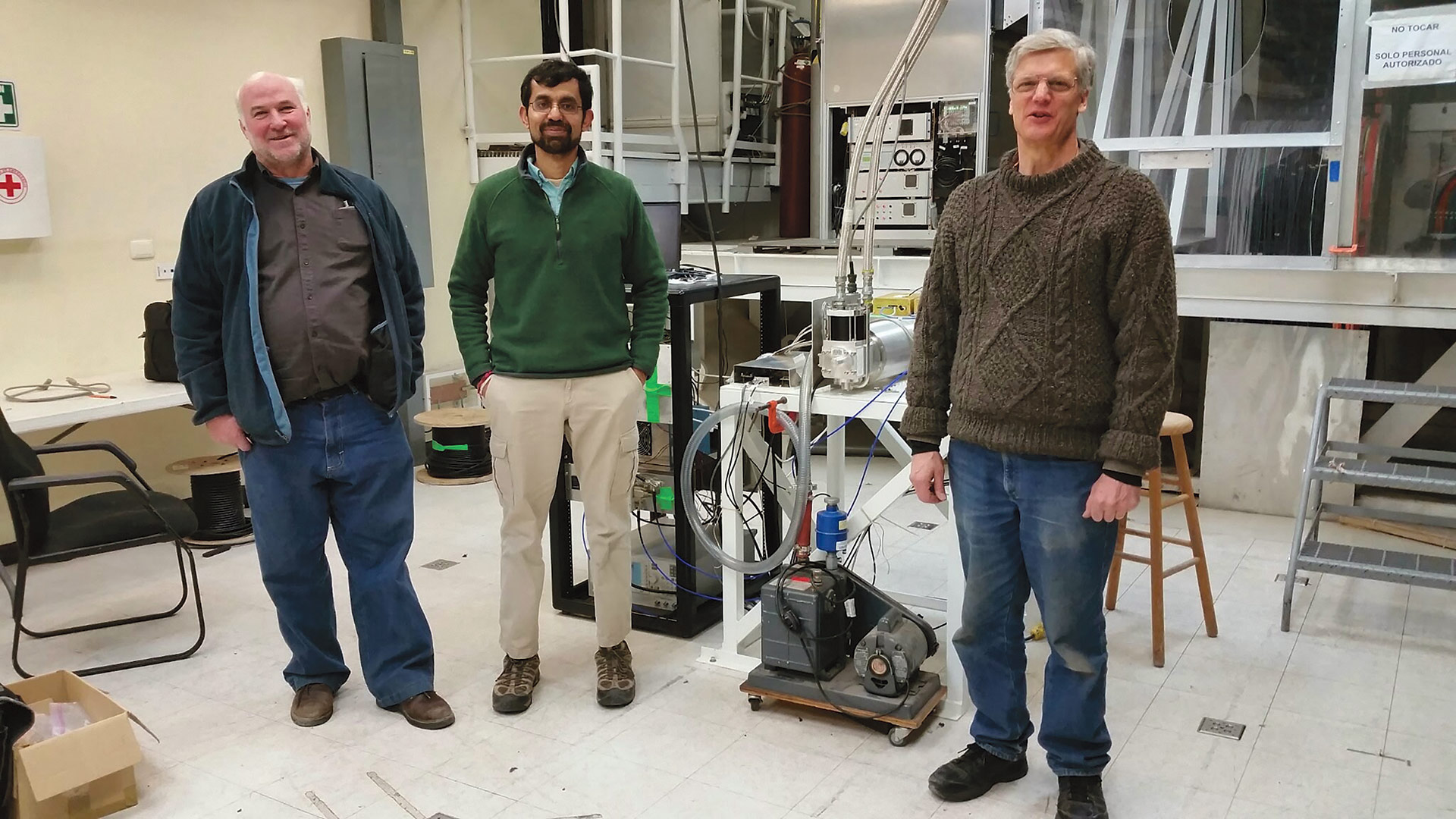
The engineering team responsible for building the 1-millimeter receiver that was installed on the LMT and used for the EHT campaign

The engineering team responsible for building the 1-millimeter receiver that was installed on the LMT and used for the EHT campaign. From left to right, Joe Crowley (MIT Haystack), Gopal Narayanan (UMass), and Ron Grosslein (UMass).

“We had to have very accurate timing in the collection of data,” he explained. “We had to know when the signals arrived at each telescope to a precision of a nanosecond, which is one-billionth of a second.”

So, to get the image that was eventually shared with the world earlier this month, the stars have to be aligned, in every sense of that phrase, said Narayanan, from the weather to the instrumentation. And those weren’t the only challenges to be faced.

Indeed, at 15,000 feet, the view from the LMT is spectacular — for telescopes, as well as the people working at one — but it’s difficult working at that altitude, said Narayanan, adding that one can remain at that elevation for maybe a dozen hours because there is far less oxygen than there is at sea level.

“Every step you take is hard, and thinking is hard, because your brain lacks oxygen,” he explained, adding that these conditions necessitated the need for two teams that would work in shifts at the telescope. “You always question any action you take, and it’s very strenuous work. At the same time, driving up the mountain and seeing the entire world beneath you, seeing the clouds beneath you, is a wonderful and emotional experience as well.”

Through all of that, Narayanan had that gut feeling that the teams working at those telescopes around the globe had ‘something.’

“I had a great deal of confidence that we had collected great data,” he explained, adding that this data then had to be analyzed and vetted, a lengthy, nearly two-year-long process during which astronomers had to keep quiet about their groundbreaking discovery.

Coming into Focus

With that, Narayanan explained how the image was attained. As for what it shows — that asymmetric ring-like structure around a central dark region — this is equally groundbreaking.

Indeed, the findings, as laid out in six papers published in a special issue of the Astrophysical Journal Letters, essentially support Einstein’s theories of relativity and confirm what scientists have long theorized about black holes without actually ever seeing one.

“Professor Einstein’s work has stood the test of time,” he said. “It’s been nearly 100 years since he came up with the two relativity theories — a special theory of relativity dealing with traveling near the speed of light and a general theory of relativity to do with gravitation. Black holes are direct predictions from his GR, general relativity theory, and multiple experiments show the theory works, and works in extreme regimes.

“But this particular regime, a 6-million-solar-mass black hole, was thought to be a place that would really test the limits of that theory,” he went on. “Our big hope was that we would obtain an image that would conclusively prove there is a black hole, and that was without a doubt the case, and that’s the sweet part of this.”

Part of the team in front of the LMT. From left, Gopal Narayanan, Aleks Popstefanija, Sandra Bustamante, Antonio Hernandez (Crya, Morelia, Mexico), David Sanchez, and Lindy Blackburn.

Part of the team in front of the LMT. From left, Gopal Narayanan, Aleks Popstefanija, Sandra Bustamante, Antonio Hernandez (Crya, Morelia, Mexico), David Sanchez, and Lindy Blackburn.

This is uplifting in many respects, said Narayanan, before adding quickly that he would likely have been equally excited, if not more so, if the evidence didn’t support those long-held theories.

“Perhaps if we had found something that violated the predictions of Einstein’s theories of relativity, we would come up in new, uncharted territory that makes us rethink the theories,” he told BusinessWest. “And that’s the way we basically make progress.

“You make a model of the universe and go out and observe to see if that model can be validated by actual observations, which is reality,” he went on. “And then you find out that the theory is not quite right because the observations belie the earlier predictions; that’s how you make progress. That’s not to say we didn’t make any progress — we made a lot of progress.”

And in a many different ways, he said, adding that the M87 project has certainly laid the groundwork for further developments in the search for — and study of — black holes.

And also in the emergence of the LMT. UMass has been involved with that facility for 20 years now, said Narayanan, who offered a quick history lesson.

He said UMass was one of the birthplaces of the pioneering field known as millimeter-wave astronomy back in the 1970s. As part of that effort, the university’s Astronomy department built a 14-millimeter radio telescope just north of the Quabbin Reservoir called the Five College Radioastronomy Observatory, which it operated until roughly 10 years ago, providing training for a few generations of students.

Years ago, it became apparent that the department had achieved about all it could with a facility of that size and commenced a search for a larger telescope. That search led to a partnership with the Mexican government and specifically the INAOE, and eventually the construction of the LMT, which saw what the industry calls ‘first light’ in 2010.

The first receiver built onto it was designed not to look at black holes, but rather the first galaxies to be created after the Big Bang.

The chosen site, the Sierra Negra volcano in the Mexican state of Puebla, brings many benefits, including location (close to the equator), that made it a pivotal piece of the EMT puzzle, said Narayanan, adding that its performance in that project bodes well for the future.

And that includes more work on black holes, including the one in Sagittarius A*, a much smaller black hole than that at M87, with a 4 million solar mass. Astronomers are still collecting data on that object, said Narayanan, adding that there many additional challenges (on top of those already mentioned) when it comes to observing and studying a black hole in the center of our galaxy.

“It’s a smaller black hole, so things move around faster,” he explained. “Also, looking through our galaxy itself produces some scattering of the light coming from the center of our galaxy. But we’re working through the data, and we should produce some results soon.”

As for that movie he mentioned, that may also become a reality through efforts to expand and enhance the EHT process through additional telescopes and other additions.

“We can make multiple images and stack them together to make a movie, as it were, of how things vary around a black hole,” he explained. “And that has fantastic scientific implications that will tell us a lot of things about black holes and the structure of our universe.”

Bottom Line

The image of the black hole at M87 that sped across the globe soon became the star of the show when it came to the groundbreaking discovery — pun intended.

But, in reality, there were many stars, including the teams of astronomers who collaborated on the project, and the LMT itself, a facility that, as Narayanan noted, has put its full talents on display.

Moving forward, the challenge — and the opportunity — lies in building on this breakthrough.

And the stars seem aligned for that to happen as well.

George O’Brien can be reached at [email protected]

Berkshire County

Creating Impact

An aerial shot of the sprawling, 26-building campus of MASS MoCA.

An aerial shot of the sprawling, 26-building campus of MASS MoCA.

Anyone who hasn’t been to the Massachusetts Museum of Contemporary Art in the past decade might be surprised at how different it is from its early days. From a near-doubling of art space to a growing array of long-term exhibits to a robust music, theater, and festival business, MASS MoCA has become a true driver of Berkshire County’s creative economy — and that’s by design.

Jodi Joseph understands the challenges of drawing visitors to a museum in — well, it’s not the middle of nowhere, exactly, but it’s also a far cry from Boston or Manhattan.

“We have 13,000 residents in town. We bring over 200,000 people to the galleries every year. That’s a hard thing to do,” said Joseph, director of Communications at the Massachusetts Museum of Contemporary Art, or MASS MoCA, in North Adams.

But it’s an important thing, she added — not just for the museum, but for the entire region’s creative economy.

“People from 75 miles or more from here know this is a place to see art. Within 75 miles, more people know us as a place to see music and performing arts,” she told BusinessWest during a recent visit. “We are finding more ways to draw connections between the performing and visual arts — to let those visual-arts people know we have this dynamic performing-arts program year-round, and get our performing-arts audience into the galleries to see everything here.”

That’s because more time spent here means more money spent in the northwestern corner of the state.

“Overnight visitors spend six times as much money as day visitors,” Joseph went on. “Part of our economic-development agenda is getting people to understand there’s so much to do at MASS MoCA, and we’re just one of several institutions up here. So if you want to come see us and the Clark [in nearby Williamstown], you’re going to have to spend a night, maybe two nights, to get it all in. Every admission here is good for two days. So stay awhile — there’s so much to see.”

Jodi Joseph, director of Communications at the museum.

Jodi Joseph, director of Communications at the museum.

Much more, in fact, than when the museum opened 20 years ago, or even 10 years ago, for that matter. Growth has been a constant in MASS MoCA’s second decade, with the addition of a robust performing-arts and festival business and a massive expansion of floor space to accommodate something unheard of in the early years: permanent exhibits.

Much credit for the former goes to the Chicago-based rock band Wilco, which, a decade ago, became enamored of Western Mass. and saw it as a place to establish a residency and work on side projects. They couldn’t make a connection with Tanglewood work, but when they visited MASS MoCA, they knew they had something. In 2010, the museum launched Wilco’s first-ever Solid Sound festival, a celebration of music and art now held every other summer.

“Thus began MASS MoCA’s foray into a pretty serious concert-festival business,” Joseph said. “It opened the idea of MASS MoCA, this campus, being a destination for music. It was such an exceptional marriage — the fanbase their music attracts was our target audience. There are many other bands we could say that about, but certainly Wilco is in the top 10.”

Today, MASS MoCA presents more than 75 performances year-round, including contemporary dance, alternative cabaret, world-music dance parties, indie rock, outdoor silent films with live music, documentaries, avant-garde theater, and an annual bluegrass festival known as Fresh Grass.

But the museum’s calling card is still modern art — in particular, large-scale, immersive ‘installation art’ that would be difficult to house in conventional museums. The unconventional works form an intriguing counterpoint to the century-old, high-ceilinged mill buildings that house them, which have retained their raw, industrial character over the years, with plenty of exposed brick, ductwork, and concrete floors.

Joseph said visitors appreciate the palpable sense of history they offer — even as MASS MoCA hurtles into its third decade of challenging the status quo.

Maker Space

The 16 acres of the MASS MoCA’s campus — 26 buildings occupying nearly one-third of the city’s downtown business district — form an elaborate system of interlocking courtyards and passageways, bridges and viaducts; a floor-to-ceiling window in one building overlooks the confluence of two branches of the Hoosic River.

By the late 1700s and early 1800s, businesses at or near the site included shoe manufacturers, a brickyard, a sawmill, cabinetmakers, hat manufacturers, machine shops for the construction of mill machines, marble works, wagon and sleigh makers, and an ironworks.

“Overnight visitors spend six times as much money as day visitors. Part of our economic-development agenda is getting people to understand there’s so much to do at MASS MoCA, and we’re just one of several institutions up here.”

In 1860, O. Arnold and Co. installed the latest equipment for printing cloth; large government contracts to supply fabric for the Union Army swelled business, and over the next four decades, Arnold Print Works became the largest employer in North Adams. By the end of the 1890s, 25 of the 26 buildings in the present-day MASS MoCA complex had been constructed, and by 1905, Arnold Print Works was one of the leading producers of printed textiles in the world, employing some 3,200 people.

In 1942, after a period of decline for Arnold, Sprague Electric Co. bought the site, converting the textile mill into an electronics plant, where physicists, chemists, electrical engineers, and technicians were called upon by the U.S. government during World War II to design and manufacture crucial components of some of its most advanced high-tech weapons systems, including the atomic bomb. After the war, Sprague’s products were used in the launch systems for Gemini moon missions, and by 1966 Sprague employed 4,137 workers. But, again, sales eventually declined, and in 1985, the company closed its North Adams operations.

“This campus has always made things,” Joseph said. “Now, what we make is art — performing arts as well as visual art.”

Indeed, when North Adams leaders began discussing a new use for the campus, the Williams College Museum of Art was seeking space to exhibit large works of contemporary art that would not fit in conventional museum galleries — and the idea of creating a contemporary arts center in North Adams began to take shape. With funding from both public and private sources, MASS MoCA opened in 1999.

Banners promote current, temporary exhibits

Banners promote current, temporary exhibits, but MASS MoCA has developed an array of long-term exhibits by prominent artists as well.

The ‘maker’ spirit of the complex extends to putting up the installations, many of which are not as simple as hanging a painting. The museum typically doesn’t hide the process, which can take several weeks, but instead embraces it.

“Because of the way our galleries are situated, we can’t help but put ourselves on view when installing an artist,” Joseph explained. “You might walk through and observe someone charging through the gallery with a forklift. This time of year, we’re moving from one gallery to the next, installing new art, and all that activity is usually on view to the public, in addition to everything that’s already installed in the galleries.”

She said the complex, for most of its history, has been home to a constant flow of humanity and industry, and the act of creation is as important — and worthy of viewing — as the static display of art.

“Even if you’re not a contemporary-art person, there’s so much to see in the architecture,” she told BusinessWest. “The buildings themselves are art. The fact that we fill them with art and ideas, and made these buildings accessible to the public, is a joyful experience. My grandparents worked here. My mom worked here. That’s real. I love coming to work every day and being in this site where I know my family history looms large.”

Even the performing-arts elements of the museum embrace the process as much as the outcome. For instance, in 2012, rock icon David Byrne teamed up with director Alex Timbers to create a theatrical piece called Here Lies Love — and, rather than perform it only as a finished product, presented it to audiences as a work in progress.

Similarly, just this year, actor Jon Hamm, director Danielle Agami, and Wilco’s Glenn Kotche led a team that developed a piece called Fishing, also performing it as an evolving work to audiences who were then invited to talk about what worked and what didn’t for them.

“It’s a phenomenal exchange — audiences love it,” Joseph said. “In this culture-drenched region, people get really excited about the creative process. Even if you are not the creator, you get to be involved.”

Permanence in Change

The process of developing and expanding an artistic idea has also taken shape on a macro level over the past decade on the MASS MoCA grounds. In 2008, the museum opened its first long-term exhibition, a three-story space housing about 100 works by famed large-scale wall artist Sol Lewitt — a display the Los Angeles Times once called “America’s Sistine Chapel.”

In 2013, the campus opened a previously unused building for a long-term exhibit by painter and sculptor Anselm Kiefer. And in 2017, the museum activated more buildings, almost doubling the previous gallery space from 135,000 square feet to 250,000, and installing permanent works by neoconceptual artist Jenny Holzer, multi-media artist Laurie Anderson (who makes use of virtual reality in her gallery), and James Turrell, whose interactive works make intriguing use of light and space, just to name a few.

The museum installed this floor-to-ceiling window

The museum installed this floor-to-ceiling window to give visitors a view of North Adams and, in particular, the point where two branches of the Hoosic River join up.

“Part of the joy of going to a museum is seeing the permanent collection,” Joseph said. “You might return time and again and see new exhibitions, but you can also visit old works in the collection like they are old friends to you. We never had that at MASS MoCA because we only had rotating exhibitions.

“But in 2008,” she went on, “people started to think about MASS MoCA not just as a pilgrimage site for Sol Lewitt fans, but also as a place where visitors could return and find something new at the galleries, but also have this body of work, this artist’s life work, where they were suddenly becoming experts. MASS MoCA members probably know more about Sol Lewitt than many Sol Lewitt scholars.”

The museum has expanded its community connections as well, such as an educational program that brings in 2,500 students from local public schools several times a year. Partner schools develop a curriculum of class projects based on what the students see at MASS MoCA. An invitational program for promising teenagers actually displays their artwork on the museum walls and provides grants to their teachers to stock their classrooms. One area teacher used the grant to purchase a kiln so students can create pottery.

“For these kids, she added, “seeing their art on the walls beside Sol Lewitt kind of raises the stakes for them.”

Another program, called the Studios at MASS MoCA, has hosted more than 500 artists and writers for residencies up to 10 weeks. Hosted by the museum’s Assets for Artists program, selected artists receive private studio space on campus, in addition to housing, free access to the museum’s galleries throughout the residency, optional financial and business coaching from Assets for Artists staff, and a daily group meal.

As part of its examination of the regional creative economy, the Berkshire Blueprint 2.0, a county-wide economic-development plan, recommended expanding the Studios program throughout Berkshire County, she noted. “I’m not sure how that would work, but it’s a great concept.”

And an exciting one, as MASS MoCA has long been a draw to this small city near the New York and Vermont lines — and from that destination status comes myriad ripple effects.

“We were founded with a two-headed mission,” Joseph said. “One was to present the best art of our time, and the second was to be an economic catalyst.”

It does that by leveraging all this activity — not just the performance and display of art, but its very creation — to develop new markets for artists, spur job creation, strengthen community identity, and even boost property values, all of which Joseph has witnessed and hopes to see continue.

“We’re in one of the most robust real-estate moments in North Adams in my adult life,” she said. “We’re happy to contribute to it — even if it’s one by one.”

Joseph Bednar can be reached at [email protected]

Manufacturing

Scaling Up

CEO Bill Bither

CEO Bill Bither

Over the past five years, Machine Metrics, a company that specializes in predictive analytics for manufacturers, has been scaling up its operation. But with an infusion of $11.3 million in venture capital last fall, this process enters a new and dynamic phase. The company has nearly doubled its workforce, expanded with a new office in Boston, and become much more aggressive in efforts to educate potential clients about its game-changing software.

Bill Bither was asked where he wanted to take Machine Metrics, the five-year-old startup he co-founded that specializes in predictive analytics for manufacturers.

He paused for a second or two, and then, in a voice that brimmed with confidence and conveyed the sentiment that he’d been asked this question — and given this answer — before, said simply and almost matter-of-factly, “we’re really looking to build a billion-dollar company.”

That’s not a phrase you hear often from entrepreneurs based in the 413, but Bither, who launched this venture with Eric Fogg and Jacob Lazier and serves as its CEO, believes that stated goal is certainly attainable. And those who have watched this company grow quickly and profoundly since it first gained attention as a member of one of Valley Venture Mentors’ first accelerator classes would certainly agree.

The company develops software systems that measure manufacturing productivity. To be more specific, these systems analyze performance in real time and send out alerts to clients when production falls behind.

Clients generally see a 20% improvement in efficiency, and the phrase most often used in relation to the software and its overall impact within a given shop is ‘game changer.’

There are now more than 100 manufacturers around the world using the company’s products, and Bither expects that number to climb steadily as awareness of the software, its capabilities, and the results it has generated for customers grows.

Bill Bither, left, seen here with co-founder and CTO Jacob Lazier

Bill Bither, left, seen here with co-founder and CTO Jacob Lazier, says Machine Metrics is adding clients across the country and overseas.

“What we’ve discovered since 2015 is that the market that we’re in is really large, and that industrial technologies are moving very quickly,” he told BusinessWest. “There’s a really high demand for companies to digitize their factories, and the key missing component to doing that is getting data from the factory floor; that’s the first step in digitizing a factory, and that’s what we do very well.”

To continue to do this well on a much larger scale, the company needed to move quickly on a number of fronts — from expanding its customer base beyond this region and this country to greatly expanding its team of engineers, salespeople, and marketers, to being far more aggressive when it comes to getting the word out.

And it has moved forward on all those fronts thanks in large part to an an infusion of $11.3 million in capital late last year.

The company has put that money to work to expand its data-science and product-development teams while accelerating global sales, said Bither, adding that, while the company has been scaling up on an ongoing basis over the past five years, that process has essentially entered a new, more dynamic phase.

“Last year, we grew about 200%, and this year we’ll probably be around that same number,” he explained, adding that this is now a truly global company that continues to expand geographically and in all other ways.

Now headquartered on Pleasant Street in Northampton — a move necessitated by the growth of its workforce — Machine Metrics has also opened an office in Cambridge, and now employs roughly 50 people, a number that has almost doubled since the company announced that infusion of capital.

“What we’re doing now is going even faster, looking at international expansion; having more engineers on the team helps us fulfill our vision quicker. We’ve shown that we’re leading the space that we’re in, and we need to keep leading the industry toward digitizing their factories.”

“We’ve doubled the size of our executive team, we’ve almost doubled the size of the workforce, and our customer count is now over 100,” said Bither. “What we’re doing now is going even faster, looking at international expansion; having more engineers on the team helps us fulfill our vision quicker. We’ve shown that we’re leading the space that we’re in, and we need to keep leading the industry toward digitizing their factories.”

For this issue, BusinessWest talked at length with Bither about the process of scaling up one of the most-watched startups in this region — and about the roadmap to becoming a billion-dollar company.

The Light Is Green

When he talked with BusinessWest earlier this month, Bither was in Toronto on vacation visiting family. Well, sort of.

“I have back-to-back meetings with clients today, which is what usually happens,” he explained. “A vacation trip turns into a work trip.”

There have been a number of work trips and vacations doubling as work trips for Bither and his partners over the past years, as they continue to bring awareness to a product that represents pioneering on a number of levels.

Indeed, while there have been production-monitoring software products on the market for some time, the software systems the company is now offering represent a huge step forward in what’s known as industrial IoT (Internet of Things) technology.

For clients, it has meant adding the phrase ‘being in the green’ to their lexicon. That’s the color that shows up on the dashboards, or large display boards, when machines are operating at or above the desired performance levels. An orange color means they are operating slightly below that level, and red means there’s trouble.

But beyond letting companies know how machines — or shifts of employees — are performing, the software can also predict when errors will occur and machines will fail, thus enabling manufacturers to avoid costly breakdowns that greatly impact overall productivity.

And as productivity improves, companies are better able to navigate what has long been the manufacturing sector’s most pressing — and perplexing — problem: a deep talent shortage that shows no signs of letting up any time soon.

All this explains why that phrase ‘game changer’ is being used so often by those who now have these systems operating in their plants. And it’s being heard both in this region — VSS CNC Inc. in Greenfield, Marox Corp. in Holyoke, and others are on the client list — and well outside it.

“We’re spread out across North America — I think we’re in roughly 40 states now,” he said. “And we’re starting to see some growth in Europe and South America. There’s still so much opportunity in this country, though, and that’s where we’re focusing most of our efforts.”

Bither, when pushed to guesstimate just how big the market is for industrial IoT technology, put the number at $85 billion, and said the mission moving forward, obviously, is to garner as large a share of that market as possible.

To do that, the company knew it had to expand its workforce, adding people in a number in a number of areas, but especially engineers in the field working with customers to digitize their factory floors.

As he talked with BusinessWest, Bither admitted he’d actually lost track of just how big the workforce was at that moment, a clear indication of how fast things are changing and how many people have joined the team.

“We’ve hired software developers, and we’ve added to our marketing team, our sales team, and our customer-success team,” he said, adding that the company has also brought on a chief financial officer, a vice president of Product, a vice president of Business Development, and a vice president of Sales, taking Machine Metrics and its leadership team to a much higher plane.

Meanwhile, the company has also opened an office in Boston, a step taken to not only better serve customers in that area, but also take advantage of the extremely deep pool of IT talent inside the 128 corridor.

“At the rate that we’re growing, it’s difficult to hire enough really skilled people in Western Mass. quickly enough,” he explained. “We’re combining the best manufacturing talent with the best software talent, and Boston really has a heavy concentration of software executives.”

Bither, who has been through the scaling-up process before — he grew the software company Atalasoft to 25 people before he sold it — said this experience at Machine Metrics is different in many ways, primarily because the company is a venture capital (VC)-backed enterprise.

“Therefore, the focus is on growing fast, not about being profitable — that’s the life of a VC-backed technology company,” he explained. “You’re really measured in growth and cash, more so than profits, and that’s different from what I’m used to.”

Moving forward, he said one key to continued growth and effective scaling of this venture is effective website content marketing, an approach designed to help educate and hopefully inspire movement within a sector, manufacturing, that has traditionally been slow to embrace new technologies and different ways of doing things.

Profound growth of its workforce forced Machine Metrics to seek larger quarters

Profound growth of its workforce forced Machine Metrics to seek larger quarters, and it found them in the old Post Office building on Pleasant Street in Northampton.

“We’ve been able to build quite a presence in this space without spending too much money because we’ve been able to build out content on our website and write a number of articles and blogs,” he explained. “And because of that, we’ve been able to bring in a lot of interested buyers that come through our website; our sales team will then talk to them, and a certain percentage of them will actually close.”

Another important marketing vehicle has been industry trade shows, such as the EASTEC show slated for next month at the Big E, but also the recent event in Hanover, Germany (the company’s first international show), where Machine Metrics had a large presence and was able to introduce itself and its software to new audiences.

“It was interesting because we were able to see what the landscape looks like in Europe,” he explained, adding that the company partnered with Amazon Web Services, a subsidiary of Amazon that provides on-demand cloud-computing platforms to individuals, companies, and governments, and thus gained considerable attention at the show.

The company also takes part in the International Manufacturing Technology Show, staged every other year in Chicago, and will be in Las Vegas in a few weeks for another large industry event, said Bither, adding that this exposure is critical to those scaling-up efforts.

Getting Things in Gear

Bither did not want to disclose current revenue figures for Machine Metrics, but he hinted strongly, not that he had to, that this venture is a long way from being a billion-dollar company.

But it seems to be on a path that would make that number more than a fantasy or pipe dream. This is a fast track greased by obvious need among manufacturers large and small to be able to track their performance in real-time analytics, and not rely on guesswork.

Whether the company can get to that magical milestone — or when, obviously — remains to be seen, but the scaling-up process continues, and like those clients it serves, this intriguing startup is certainly operating in the green — figuratively, if not literally.

George O’Brien can be reached at [email protected]

Community Spotlight

Community Spotlight

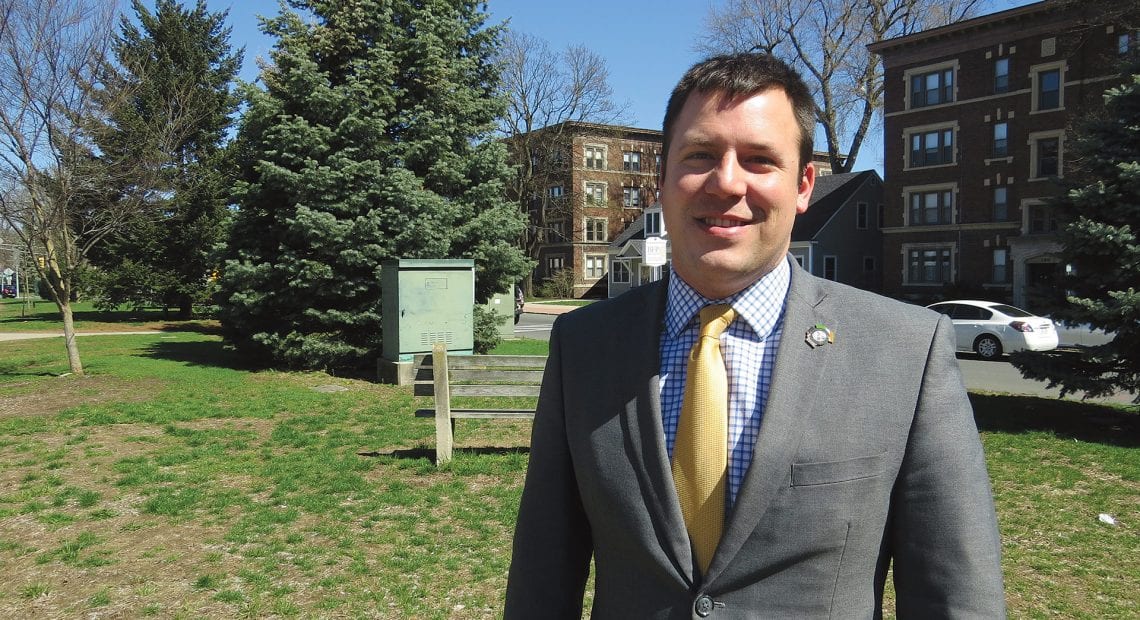
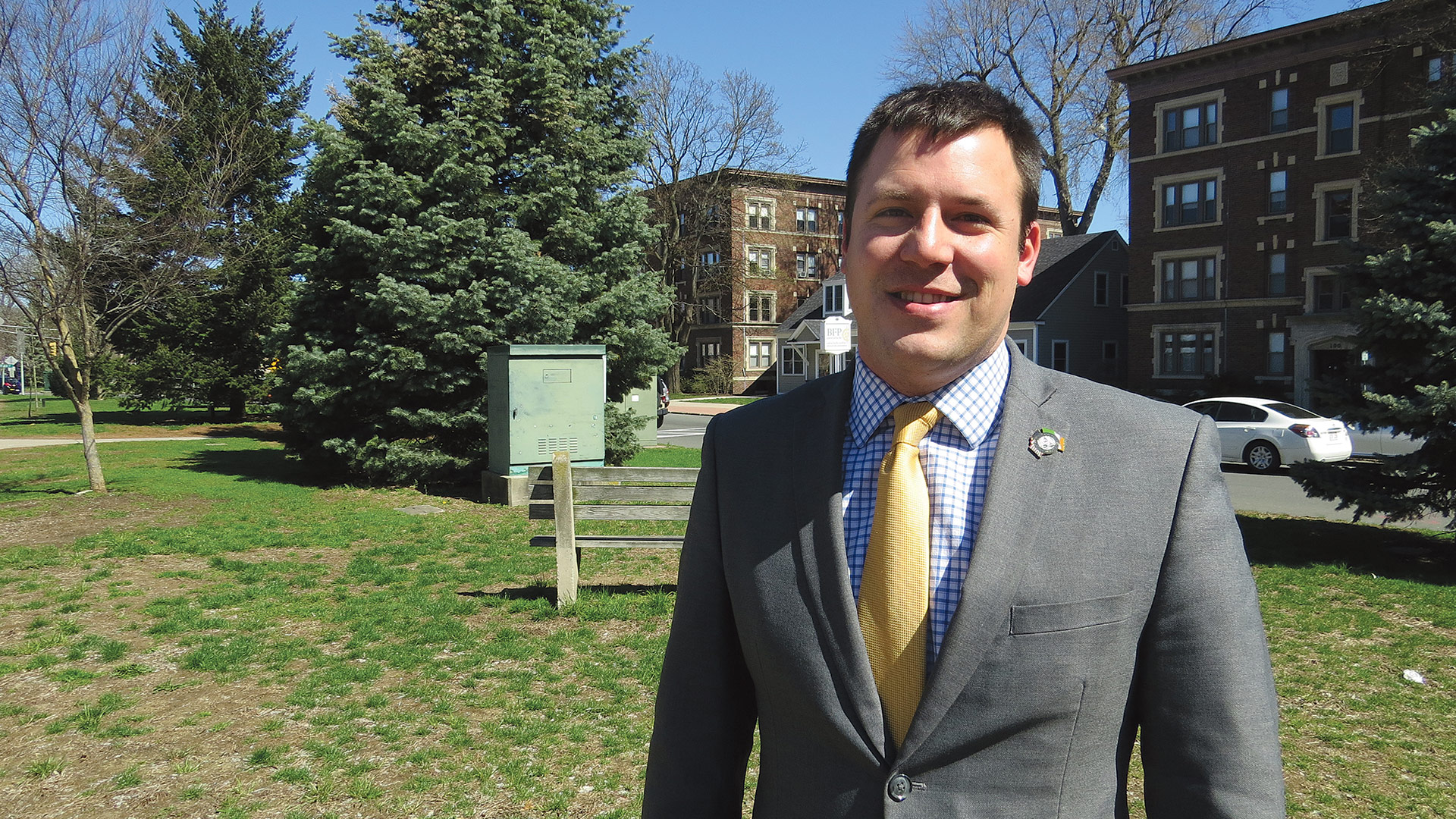
Mayor Will Reichelt

While the city will miss out on opportunities from its full ban on cannabis-related ventures, Mayor Will Reichelt says, there are new businesses of many kinds coming to the community.

West Springfield Mayor Will Reichelt recalls that, after his community’s City Council voted in the spring of 2018 to place a ban on any and all cannabis-related businesses, he received some texts from his counterparts in Holyoke and Westfield.

He doesn’t remember the exact wording of either one, but he told BusinessWest that they amounted to thank-you notes, as in — and he’s paraphrasing here, obviously — ‘thank you for the tax revenue that might be coming to our cities because it won’t be coming to yours.’

More than a year after that vote and those texts, Reichelt feels confident in saying that the full ban, while obviously well-intentioned, amounts to some missed opportunities for this community, for both the short and long term.

Indeed, West Springfield exists at the intersection of the Massachusetts Turnpike and I-91 (quite literally), and therefore, in many respects, it is the retail center of this region — complete with dozens of big-box stores, car dealerships, restaurants, and more — and draws people from across the region. But this retail hub will not include any cannabis dispensaries, despite a number of ideal sites for such facilities, resulting in, as those mayors pointed out in their texts, tax revenue that will go elsewhere.

But in Reichelt’s view, the ban has potentially deeper ramifications.

“A lot of our tax revenue comes from retail, most of it on Riverdale Street and Memorial Avenue; it’s car sales, it’s big-box stores — that’s a large portion of our commercial tax revenue,” he said. “And to not be open to new discussions, new ideas, and new businesses is going to hurt us in the long run because retail is changing; Amazon is coming, and not everyone is going to want to shop in Riverdale Plaza.

“If things change, we’re really going to struggle,” he went on, quickly adding that things certainly won’t change overnight or even over the next few years. “If we’re looking out 25 to 50 years, and West Springfield gets a name for itself that it’s not into these somewhat controversial but new and innovative business ideas, and the communities around us are, it will be easy to pass West Springfield by.”

Fortunately, at present, most traditional retailers, and consumers, have no intention of passing this community by. In fact, many retailers want in — and in a big way, for those reasons (and because of those roads) listed earlier. As an example, the mayor related the story of how Starbucks is very interested in landing a spot on Riverdale Street — specifically that very popular stretch south of I-91 — and how it will certainly be challenged to find one.

So while West Side won’t be entering the high-stakes competition for cannabis-related businesses any time soon, Reichelt and his administration will be focused on doing what this community has long been able to do — take advantage of its ideal location, already-deep portfolio of retail outlets, and heavy volume of traffic to attract more new businesses.

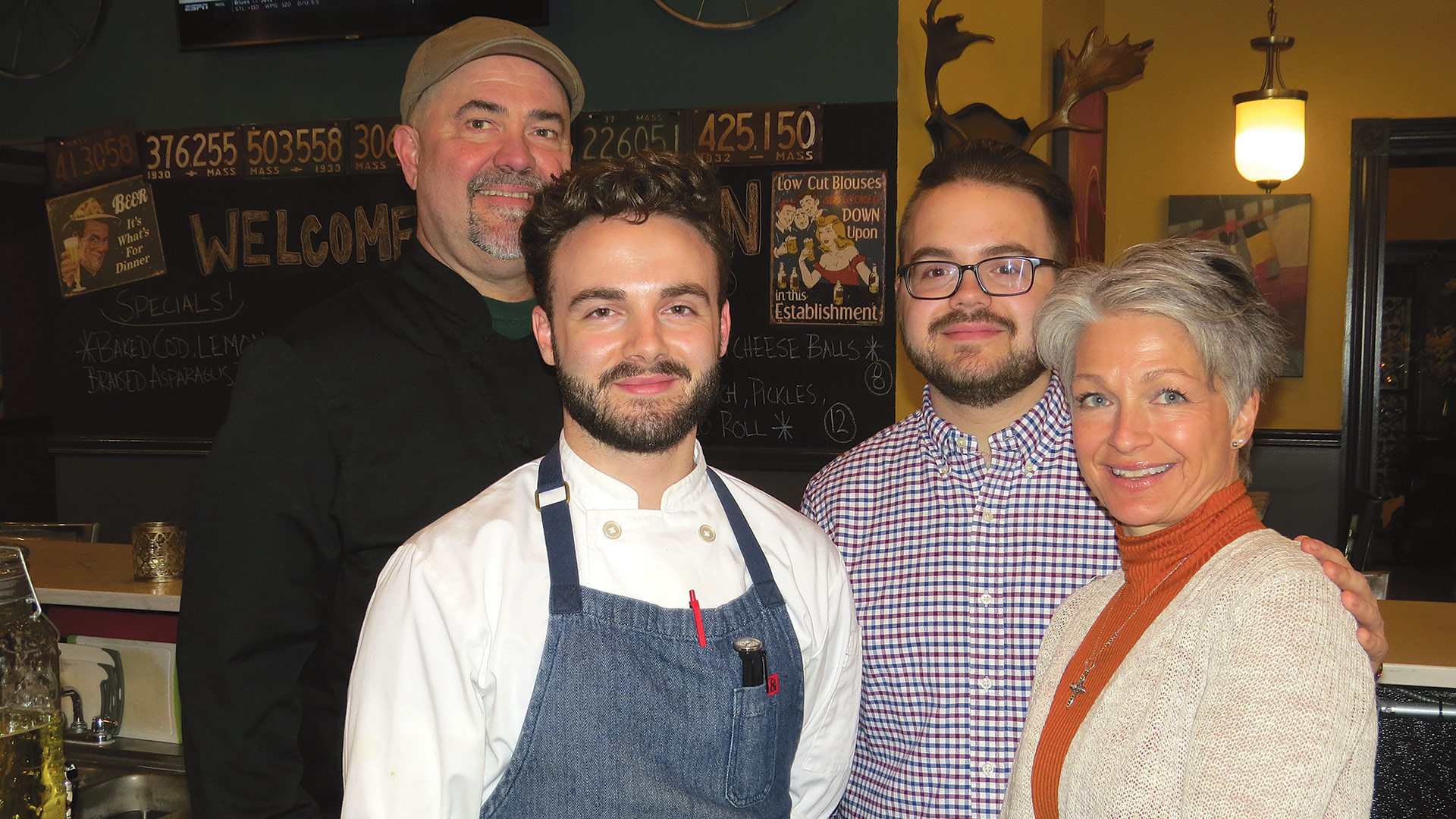
The team at 1105 Main: from left, Joe Stevens, Eric Waldman, Alex Waldman, and Liz Stevens.

The team at 1105 Main: from left, Joe Stevens, Eric Waldman, Alex Waldman, and Liz Stevens.

And it is enjoying success in this realm, as we’ll see later, with developments ranging from a new hotel on Riverdale Street to a new life for an old landmark just off Memorial Avenue, to the community’s first brewery just down that street.

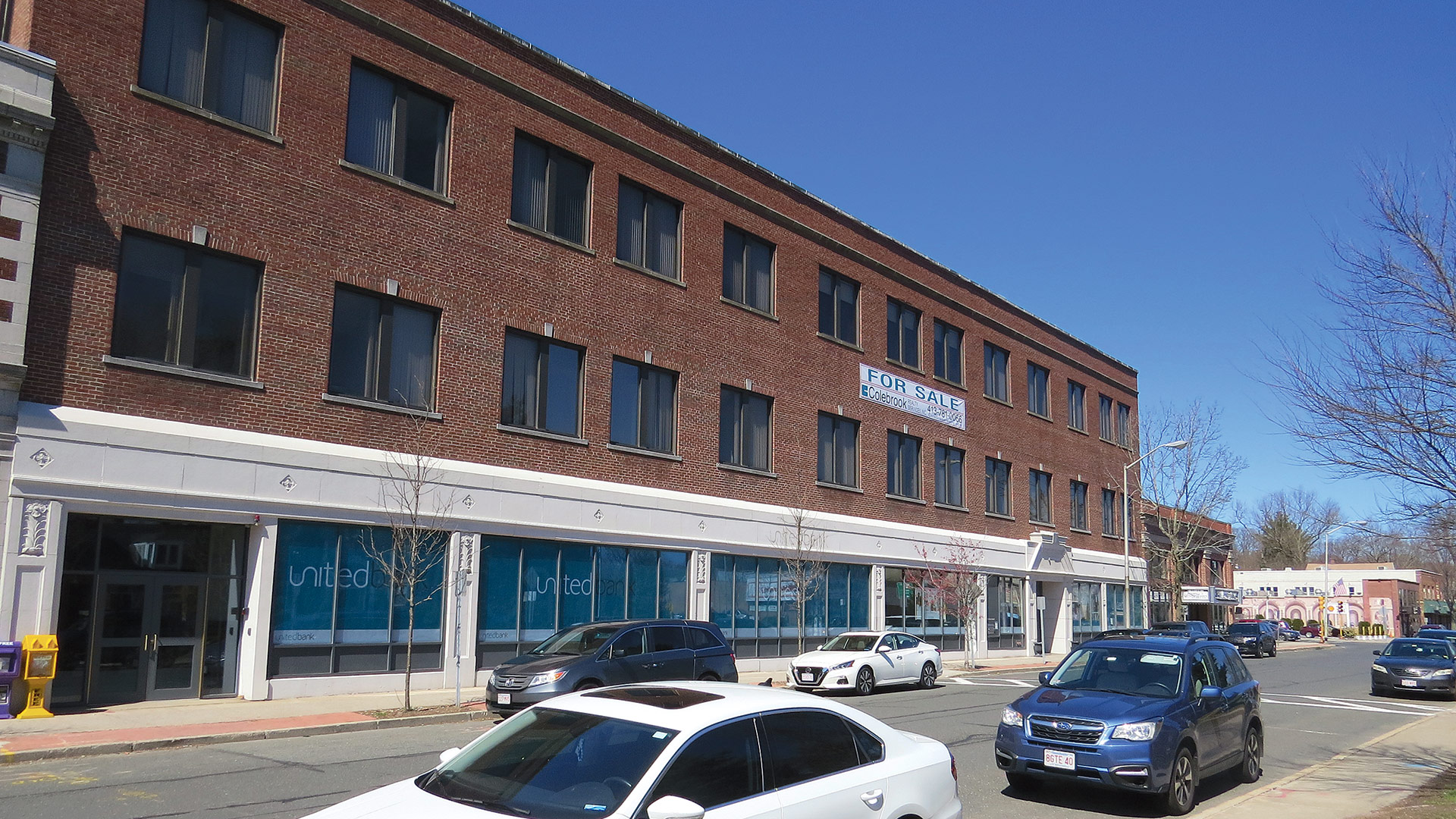
Meanwhile, beyond those two main retail corridors, there are other intriguing prospects for development. One involves the property known to most as the United Bank building on Elm Street. That’s not its official name, but the bank has long occupied it and is therefore associated with it.

But United has all but moved out, and there us now a huge ‘for sale’ sign on the side of the property.

As the mayor gestured toward it while walking downtown with BusinessWest, he noted that, years ago, there were a number of a small storefronts within that footprint along the street. Turning back the clock and creating a new generation of destinations along that block would help build on growing momentum in that area of the city, he said.

Meanwhile, a former mill property along the Westfield River just over the line from Agawam is being gifted to the city by Neenah Paper, the manufacturer soon to vacate the property, said the mayor, adding that a number of new uses, including some residential options, are being explored.

These are just a few of the intriguing developments unfolding in West Side, a city that won’t be entering the intense competition for cannabis-related ventures anytime soon, but still has a host of other emerging business and economic-development stories.

Ale’s Well

Reichelt laughed heartily as he recalled the e-mail that is at the heart of a story he’s now told more times than he can count.

It was from his city planner, and typed onto the subject line was the phrase ‘Two Weeks Notice.’ Upon further reading, the alarmed mayor learned that this was not a reference to another job opportunity seized, but rather an update on the plans for an intriguing new business coming to the community.

“After that, I said, ‘can we just put ‘brewery’ in the subject line?’” said Reichelt, noting that the Two Weeks Notice Brewing Co., located in the former Angie’s Tortellinis facility since late last year, makes some nice IPAs, and has become a solid addition to the business landscape in West Side.

And it is just one of several of those over the past several months, including a new name over a familiar door.

That would be 1105 Main, an address, but also the name of a new eatery at the site of what would have to be considered a West Side landmark — the old Hofbrahaus restaurant.

Joe Stevens, who owned and operated that German restaurant with his wife, Liz, for decades, closed it roughly a year ago. The couple thought they had the building sold, but the deal fell through, prompting a reassessment of their plans.

“We starting talking about a theme restaurant,” said Joe, adding that what eventually emerged is a true family affair, involving sons Eric Waldman, who had been sous chef at a restaurant in Westchester County, N.Y. and was looking for a new and different challenge, and Alex Waldman.

Joe told BusinessWest they are calling this “an American eatery,” offering “familiar food with a twist.” As an example, he cited the lasagna, which is pan fried after it’s baked and includes a wild boar and bison bolognese.

The property at 1105 Main St. was substantially renovated for this makeover. The bar area, popular with regulars then and now, has a fresh look, as does the dining room, which has a brighter atmosphere and a hardwood floor, found underneath an inch of carpet glue after the old flooring had been ripped out.

The new eatery is drawing a mix of families and business people, said Joe, and it even complements another new business just across the street — Hot Brass, a firearm and bow range that shares space with Guns Inc., a seller of firearms.

“We like to say, ‘after you’re done shooting, come in for a shot and a beer,’” said Stevens, adding that a number of people have done just that, thus bringing still more vibrancy to the Memorial Avenue area that has changed dramatically over the past several years.

Indeed, the face of the street — home, of course, to the Big E — has been altered by the addition of Fathers & Sons’ new Audi and Volkswagen dealerships, as well a new retail plaza featuring a Florence Savings Bank branch and new stores in the Century Plaza.

West Springfield at a glance

Year Incorporated: 1774
Population: 28,529
Area: 17.5 square miles
County: Hampden
residential tax rate: $16.96
commercial tax rate: $32.55
Median Household Income: $40,266
Median Family Income: $50,282
Type of government: Mayor, City Council
Largest Employers: Eversource Energy, Harris Corp., Home Depot, Interim Health Care, Mercy Home Care
* Latest information available

Memorial Avenue, like the city’s other main retail corridor, is in a seemingly constant state of change, said Reichelt, adding that still more change is likely as new tenants are sought for two locations across from the Big E — the former Monte Carlo restaurant and the former Debbie Wong eatery.

Still further down the road is more property in flux, the former Medallion Motel and the vacant lot next to it, formerly the site of an auto-repair shop. Redevelopment of those parcels will likely have to wait for another day, said Reichelt, because they sit in the shadow of the Morgan-Sullivan Bridge, which crosses the Westfield River and connects West Side with Agawam and is still in the early stages of what is expected to a four-year reconstruction and widening project.

Traffic is often backed up at the site, which is why developers are unlikely to do anything in that area for some time, said the mayor, adding, as his counterpart in Agawam did a few months ago in this space, that the goal is to minimize the disruptions from the bridge project, especially during the 17 days of the Big E, and try to incentivize construction crews to reduce that four-year timetable for this initiative.

Forward Progress

Back on Riverdale Street, a new Marriott Courtyard is set to open later this spring, one of several new developments on or around that busy retail corridor, which, like Memorial Avenue, is in a seemingly constant state of the change.

Others include a gas station at the Costco in the Riverdale Shops, a project expected to commence later this year; the opening of a 1.5-mile bike path behind those shops, due to open in May; and a $21 expansion of the Agri-Mark facility on Riverdale Street, completed last fall.

Looking down the road, Reichelt said the site of now-closed Bertucci’s, located along that stretch south of I-91, is still awaiting new development, and he’s optimistic one will come because properties don’t generally remain vacant for long on that stretch of road.

Meanwhile, as noted, there are developments unfolding outside of those two main retail corridors that could have important ramifications for the community. This is especially true of the United Bank property on Elm Street.

“That used to be a collection of small stores,” he said of the facility, adding that it was renovated to house a bank branch and several of the institution’s departments. “There was a nice bookstore and coffee shop, a restaurant … it was a real destination.”

It can be that again, he went on, adding that his vision includes the community petitioning the state for additional liquor licenses and perhaps transforming the property into a home for a number of hospitality-related businesses that would complement those already thriving in that area, such as the Majestic Theater (located on that same block) and bNapoli restaurant.

Mayor Will Reichelt says redevelopment of the former United Bank building on Elm Street could be a catalyst for growth in the city’s downtown.

Mayor Will Reichelt says redevelopment of the former United Bank building on Elm Street could be a catalyst for growth in the city’s downtown.

“I’d like to section that property back off again,” he said. “If we can get two more restaurants down there, a coffee shop or bagel place, and businesses like that, we could get a lot more life in the downtown, creating a real destination.

“Everyone always talks about how they’d like to have a mini-Northampton,” he went on. “That’s never going to happen if you don’t have stuff for people to do. This [property] represents a huge opportunity for us to create more things to do.”

And while hopefully generating more things to do with that downtown project, another initiative may well create more places to live.

The Neehah Paper Co. has donated the 100,000-square-foot mill property (formerly Strathmore Paper and then Fibermark) to the city, said the mayor, adding that residential is perhaps the best reuse option, be it elderly housing, affordable housing, or perhaps some combination, although other opportunities for development exist.

“We’ve run some breweries through it, and there’s been some interest,” he explained. “But we can’t really do much until we own it. This represents a great opportunity because we’re going to an actual section of riverfront property, which we don’t have in town.”

Location, Location, Location

Returning to the matter of cannabis-related ventures and the ban that covers the full spectrum of such businesses, Reichelt reiterated his concern that this goes well beyond lost commercial tax revenue.

“Councilors like to say that we’re business-friendly,” he told BusinessWest. “I say, ‘well, no, you’re not; you just completely wiped out an entire industry from coming to town.’”

This makes West Side an island of sorts when it comes to the cannabis trade, he went on, adding that there is still a lot of business activity happening on that island, with the promise of more to come in the months and years ahead.

The great location and easy access to major highways that would make West Side a perfect host for marijuana-related businesses also make it ideal for most any type of retail and hospitality-related venture.

And, as it has for decades, the city will continue to make of the most of all that it has to offer.

George O’Brien can be reached at [email protected]

Berkshire County

Designs on the Future

Jonathan Butler, left, and Benjamin Lamb

Jonathan Butler, left, and Benjamin Lamb discuss the plan at a recent public forum.

Jonathan Butler knows what happens to a lot of reports, and he’s determined to avoid that fate.

“This wasn’t intended to be just a two-year study that ends up as a report that sits on a shelf,” he said, referring to Berkshire Blueprint 2.0, an 80-page action plan of sorts for the Berkshire County economy. “It very much means to be a new look at our economy, a new baseline for where we are that identifies challenges we have in different areas and action steps needed to move forward.”

The project, the successor to the original Berkshire Blueprint released in 2007, was overseen by 1Berkshire, the regional economic-development agency Butler serves as president and CEO.

The report’s most notable feature is how it breaks down the economy into five ‘clusters’ — advanced manufacturing, the creative economy, food and agriculture, healthcare, and hospitality and tourism — and then lays out the challenges facing each cluster, who some of the main stakeholders are, and a series of ‘action steps’ aimed at spurring economic growth.

“We’ve made a process that’s accountable to itself and the stakeholders,” Butler told BusinessWest. “We have a small-business economy in the Berkshires, with a lot of business sectors, and approaching it from this vantage point is a helpful way to establish more creative problem solving and open up doors to more scalability for our economy.”

He admitted there are far more than five key clusters in the region’s economy, specifically citing education, financial services, and e-commerce as three others that may be woven into future iterations of the blueprint. But 1Berkshire had to start somewhere, and chose clusters that import wealth — in other words, bring money into the region from outside — and have shown growth over the past decade with the potential to scale up further.

“It’s all about getting different businesses outside of their silos to create more collaboration, more interactivity — to create an environment where things can take off organically.”

‘Scalability’ is a word that comes up repeatedly with Butler, who unveiled the plan at a recent, well-attended public forum alongside Benjamin Lamb, 1Berkshire’s economic development director.

“We’ve lived through the dialogue of a declining economy and job loss, and the narrative for many years has been to bring more jobs into the region,” he explained. “But we’ve pivoted away from that. We don’t need more jobs in the region; we need scalability for existing jobs and a better hiring pipeline. There’s a disconnect between the available workforce and the skill set and type of workforce businesses need.”

“There’s also a strong sense of momentum and progress that wasn’t here 15 years ago. That’s something to be excited about, and something we want to see evolve in the coming years.”

For evidence, Butler said there’s typically 1,300 to 2,000 jobs posted in the region at any given time, and they span the spectrum of the workforce, from entry-level to mid-career, management, and upper management. Many of the blueprint’s action steps take direct aim at identifying, connecting, and training potential workers for lucrative careers.

“A lot of employers here do a great job innovating in their sector, in their market, and are in a position where they can be scaling up, growing, expanding into new products and expanding product lines — but they’re not confident they can take the leap and scale the company because they’re not finding the workforce they need to fill those jobs.”

The Nitty Gritty

As an example of how the report dives into the five sectors, let’s consider the creative economy, which comprises segments like visual arts, performing arts, literary arts, design, film and media, and museums and cultural institutions.

The blueprint notes that the sector has seen 9.5% job growth since 2010, and the concentration of employers in this realm is 62% higher in the Berkshires than it is nationally, spurred by rapid growth in the northern part of the county.

Assets include a diversity of business establishments, institutional support by the likes of the Berkshire Taconic Community Foundation (BTCF) and Massachusetts College of Liberal Arts, and existing collaborative relationships across the county. Challenges, the report notes, include further engaging local residents, overcoming perceptions to demonstrate the economic importance of the arts, sustaining organizational support, and providing housing and transportation for seasonal employment.

With these factors in mind, the blueprint’s recommended action steps include convening the region’s major cultural institutions in dialogue, developing an intensive business-resources-awareness campaign, providing support to the BTCF and the Creative Commonwealth Initiative, reconvening the Creative Resources Conference, creating a partnership between the Berkshire Innovation Center and the creative community, and expanding the Assets for Artists program, a MASS MoCA initiative that provides professional-development opportunties — and housing — to emerging artists.

Collectively, that’s a mouthful, and it’s only the barest summary of just one of the five sectors. (The full report, and an executive summary, are available at 1berkshire.com.) But it suggests the copious work that must follow if the blueprint is to avoid becoming just another binder collecting dust.

“There are real challenges, and we have to work in collaboration to overcome them,” Butler said. “But there’s also a strong sense of momentum and progress that wasn’t here 15 years ago. That’s something to be excited about, and something we want to see evolve in the coming years.”

While much of the Berkshire Blueprint focuses on the five central clusters, the report also identifies several cross-cutting issues that impact the region at large, including all clusters.

For example, consistent access to high-speed broadband internet has long been a challenge in Berkshire County. Recently, actions on the state level have helped bring communities up to an equitable standard of broadband access and internet speed, but further advocacy and work are still needed, especially for residential access.

In addition, New England’s energy costs are significantly higher than they are in other regions of the country. With the retiring of regional power plants, lack of new plant construction, high cost of fuel distribution, and a limited pipeline infrastructure, the Berkshires face significantly higher energy costs compared to other areas of the country and the Commonwealth.

In the realm of transportation, gaps in public-transit services, inadequate evening bus service, a lack of coordination of private and public transportation assets, and challenges of getting to and from employment reliably are among the region’s nagging challenges.

Finally, population loss has been a persistent issue for decades in the region. 1Berkshire’s Berkshire Initiative for Growth began to lay groundwork for recruiting and retaining individuals to the region to curb this trend. While portions of the report were implemented, a number of components were laid out as the responsibility of other members of the regional business community to integrate.

“Population loss has been a mature conversation in the Berkshires,” Butler said. “The reality is, we’ll probably see another decline of some sort in the 2020 census, which would continue a half-century trend. But I’m optimistic that a lot of work done over the past five or six years will eventually shift that. We’re seeing more and more young families come to the Berkshires for a variety of reasons: quality of life, work-life balance, and the fact that our economy is quite big and diverse for such a small region.”

Then and Now

The blueprint authors were quick to note that the decades-long national decline of traditional manufacturing has had a negative effect on Berkshire County, and that the departures of long-time major employers such as General Electric and Sprague Electric devastated the local economy.

“For too long, the narrative has been that our best days were behind us, confined to faded newsprint and wistful memory,” they note. However, “that narrative is out of date. For several years, Berkshire County leadership has felt a sense of cautious optimism that the tide is turning. New buildings, businesses, and partnerships are springing up everywhere. With the knowledge that Berkshire County has seen $1 billion in investment over the last three years, the writing is on the wall: the days of doom and gloom are over. The new Berkshire narrative is about growth and opportunity in a diversified regional economy, and there is room for everybody at the table.”

That’s optimistic talk for sure, and Butler believes it, noting that he and his wife are in their late 30s, want to stay in the region for a long time, and believe it’s a good place to be.

“When we made the move home to the Berkshires in our late 20s, we saw a lot of potential,” he told BusinessWest — along with plenty of challenges. “But the narrative then and what we see happening in the future are different — and that’s become a more mainstream idea now.”

An idea that, with any luck, will do much more than sit on a shelf.

Joseph Bednar can be reached at [email protected]

Features

Hopes Are High

After recreational marijuana use became legal in Massachusetts in 2016, the expectation was that retail stores would pop up quickly within a couple of years. That hasn’t happened, as the state — and host communities — have taken a deliberately measured approach to permitting. But with early returns strong from a few shops, and towns reporting solid tax benefits and no real community disruption, the pace of openings should begin to increase — and so will the economic benefits of this new industry.

If Western Mass. was full of people who thought the sky was falling when recreational marijuana was legalized, well, Mark Zatyrka thinks fewer of them are saying the same thing now.

“I knew it would change. But I feel like it’s changed at a more rapid pace than I would have expected,” he said of public perceptions about the new access to cannabis products in the Bay State. “When we held our public meetings, we had a few folks who thought we were going to destroy the world and everything would come crashing down once we opened. But the opposite has been true.”

Take the location of INSA, the cannabis dispensary he owns in Easthampton, which has sold marijuana for medical purposes since February 2018, but began selling for recreational, or adult, use in December. Tucked beside Eastworks at the rear of the Keystone Mills building on Pleasant Street, he said some may have worried about INSA’s proximity to a nearby park where people hike.

“But, really, we bring more people to the area, we have cameras all over the place, it’s well-lit, so it’s actually a safer place to be,” Zatyrka said. “If the perception was that customers are hoodlums who come in, go out back, and get high and do crime, well, look around — we serve almost every demographic you can imagine, from seniors to millennials, rich and poor, and they’re not violent criminals. They’re not here to cause trouble. Yeah, the perception has changed pretty rapidly.”

Perceptions — pro and con — of this new industry have undoubtedly shaped a permitting process, on both the state and local levels, that has moved more slowly than first expected when recreational use became legal in 2016. The state’s first adult-use retail shops were expected to be open last July, but instead, the first two opened in November, and the pace of new shops since then has been leisurely at best.

But they’re coming. And the ones that are open are changing those worst-case perceptions.

Mark  Zatyrka says INSA has attracted a diverse array of customers

Mark Zatyrka says INSA has attracted a diverse array of customers since starting recreational sales in December.

Take New England Treatment Access (NETA) in Northampton, the Bay State’s first retailer of cannabis products for recreational use.

“For us, it’s been a positive experience,” Northampton Mayor David Narcewicz told BusinessWest. “We’re starting to see some of the economic benefits in terms of taxes, and I know our local businesses have been creative in embracing the new industry. Businesses back in November were offering specials to people who came into town and showed a receipt for shopping at NETA. If anything, I think the business community has been receptive.”

He noted that Northampton’s voters were among the most enthusiastic in their support of legal cannabis, both during the 2012 statewide vote to legalize medicinal marijuana, then for adult use in 2016. As mayor, he said, his approach has been to respect the community’s voice.

“So we’ve been very open and proactive; we created zoning regulations that essentially treat this new industry like any other business, and we did not impose caps on the number of retailers like many communities did.

“We also had the experience of having one of the first medical dispensaries in the state,” he added, speaking of NETA’s original business plan. “We had a track record of seeing how they had operated and had the chance to see what the potential impacts were. They’ve been a good member of our business community; they worked with us to make sure their opening went smoothly, and have been working with surrounding businesses to make sure there’s no disruption.”

Stories like this are why, despite the slow rollout of pot shops so far — and state tax revenue well under early projections — proponents are confident that the trends toward greater public acceptance of this industry, and tax revenues to match, will soon accelerate.

“As an industry, we’ve done a good job to ensure that things are done correctly, and the state’s done a good job putting measures in place to help ensure it is a safe industry and people are getting a safe product and it’s dispensed in a safe way,” Zatyrka said. “The state did a lot of things right, which is why we’re seeing a successful rollout. I know some people wish it moved quicker, but I understand why it didn’t. There are thousands of applications, a lot of inspections, a lot to oversee. It takes time. It’s a new industry for everybody.”

Green Growth

As part of its new marijuana laws, Massachusetts imposes a 17% tax — a 6.25% sales tax plus a 10.75% excise tax — on cannabis businesses, while cites and towns take another 3%, plus whatever else they may choose to impose as part of their host-community agreements.

In Northampton’s case, that’s an additional 3%, called a ‘community-impact fee.’ The city received two checks recently: $449,825 from the Department of Revenue representing the 3% tax rate for recreational marijuana sales in November, December, and January, and $287,506 from NETA itself, reflecting the 3% community-impact fee on recreational sales for December and January.

“When we held our public meetings, we had a few folks who thought we were going to destroy the world and everything would come crashing down once we opened. But the opposite has been true.”

Other towns are seeing their coffers benefit as well. Theory Wellness opened in Great Barrington in December, paying $90,000 in taxes to the town in its first month.

“They opened to long lines, which should level off as they get more competition,” Ed Abrahams, vice chair of the town’s Select Board, told BusinessWest last month. “This is new for all of us, but so far, there have been logistically few problems.”

Southern Berkshire County communities that embrace the cannabis trade are sure to benefit from the continued illegality of the drug in both Connecticut and New York, though leaders in both states have been talking about whether that should remain the case. Brandon Pollock, CEO of Theory Wellness, told the New York Post last week that about 15,000 New Yorkers have made purchases there since its Jan. 11 opening.

“I’d say we get dozens, if not hundreds, a day from the greater New York City area,” he noted. “We get people coming up in Zipcars, people carpooling, people who say they hardly ever drive at all — but will drive to purchase cannabis.”

That sort of consumer response is intriguing to towns that see this industry as a new economic driver.

“Some cities have been great to work with, some a little more difficult to work with,” Zatyrka said. “Easthampton is very progressive city, and early on it was very obvious they wanted us here.”

That’s important from a competition perspective, he said, because the application process is already time-consuming, and communities that want to make it even more difficult to move through permitting and craft a host-community agreement can tie up a project for years, while other shops in more amenable towns are opening and picking up crucial market share and customer loyalty.

“Easthampton was great,” he went on. “Everyone wants to find a solution instead of putting up roadblocks. They want us to be successful, to get their name on the map, and they saw the benefits early on.”

He’s seeing a gradual shift, too, in where proposed projects will be located, noting that, when INSA started cultivating marijuana for medical use, most such outfits were setting up in old mill buildings or industrial parks. “Now it’s not so restrictive — people can open up on Main Street, and wind up in locations that are made for retail use, for people to come visit.”

That’s certainly the goal in Northampton, which is looking at myriad applications from cannabis manufacturers, cultivators, testing labs, and retail establishments, Narcewicz noted. It welcomes them because it sees value in how NETA, which isn’t even located downtown, has impacted business.

“NETA has created good-paying jobs in the community, and it’s an important way to expand our tax base and grow our local economy,” he said. “We have a local economy focused on retail, dining, entertainment, and a very vibrant cultural economy. And I think this complements it.”

There have been traffic and parking challenges, he added, “but if you talk to most retailers, downtowns having too many visitors is never a bad thing. We’re kind of equipped to handle a lot of visitors. And NETA has been very responsive in terms of renting additional parking from neighboring businesses, which helps them as well by providing an income stream. So far, it’s been a very positive experience, and there’s no reason to believe that’s going to change.”

Making a Name

BRIGADE has certainly benefited from this new industry. The Hadley-based brand-services company has worked with INSA extensively, including the creation of the designs for all its products and marketing.

“Everyone calls cannabis the wild west, and it is from a branding and design perspective, too,” said Kirsten Modestow, BRIGADE’s owner and executive creative director. “The rules for a whole category are being written overnight. That’s challenging, but it’s also some of the most exciting stuff we’ve ever worked on.”

With some cannabis businesses coming out with 100 or more products, it presents a unique branding challenge, she added, because the goal is not only to create a memorable look, but to help customers, many of whom have little experience with marijuana, navigate the products.

“One of the upsides of this industry is the impact it’s having on our communities, and it’s providing a lot of new opportunities and jobs,” she said. “It’s providing a lot of work for people, even tapping into farmers and other people who have services to offer and know what they’re doing.”

The education aspect Modestow touched on is one that continues in the store, Zatyrka said. The sales associates — he prefers that title to the flip industry term ‘budtenders’ — are the same ones who have worked with medical patients for a long time, and they have the training to dig deep into the science behind the products, so they can effectively explain them.

“We understand it’s a product that needs to be consumed safely, and we take that seriously,” he said. “We don’t want to be liable for someone who doesn’t know what they’re doing and eats an entire chocolate bar and has to go to the ER. We do all in our power to prevent that from happening.”

The coming months and years will see more education (and more tax revenues) as pot-shop openings pick up the pace — including Evergreen Strategies, LLC, which recently inked a host-community agreement with Belchertown to bring a facility to that town as early as this fall.

The Boston Globe recently cited industry analysts who say Massachusetts has a much slower local approval process and a more complex system to navigate than other states, and the state Cannabis Control Commission has placed a premium on an adult-use regulatory structure that supports public health and public safety. The measured pace ensures that stores pass inspections, sell lab-tested products, hire vetted workers, and track their products.

“It’s a growing industry, and will continue to grow,” said Zatyrka, who plans to open an adult-use dispensary in Springfield and has a cultivating and manufacturing license in Pennsylvania as well. Meanwhile, INSA is doubling its cultivation — located directly above the Easthampton store — and is looking to triple it in the future. “We’re still a few years out before we can meet the demands of the state. So it’s going to be hard work until then to keep up our supply with demand.”

The work is rewarding, though, especially for someone who treated his chronic pain for more than 15 years with oxycontin, oxycodone, morphine, and methadone, and suffered side effects that drastically outweighed the benefits.

“Thanks to cannabis, I was able to stop taking them,” Zatyrka said. “Cannabis helped with the withdrawals, and now I only use cannabis to treat my chronic pain, and it works 100 times better than all the opioids. I know firsthand the power of cannabis versus painkillers.”

He tells that story not because it’s unique, but because it’s representative of many people he comes across, with stories about how cannabis has helped them with seizures, Crohn’s disease, arthritis, and multiple sclerosis. And if legal adult use is helping to tear down the last bits of stigma around cannabis, he’s all for it.

“It’s incredibly gratifying to hear the stories and how grateful people are,” he said. “They’re able to get benefits from cannabis, and don’t have to hide it like they once did.”

Joseph Bednar can be reached at [email protected]m

Employment

More Than a Job

President Tricia Canavan

President Tricia Canavan

At its core, the mission of a staffing agency is to connect employers with job seekers — a task United Personnel has tackled with success for 35 years. But creating those matches doesn’t occur in a vacuum. Rather, building a healthy workforce is a region-wide effort that makes demands of employers, colleges, training programs, K-to-12 schools, and lawmakers. United Personnel President Tricia Canavan recognizes this big picture — and her firm’s role in closing the gaps.

Tricia Canavan’s job is to help people get jobs, and to help companies find those people. It’s that simple — only, it’s not.

“Workforce development and education are things I’m really passionate about and involved in in a variety of ways,” she told BusinessWest. “We’ve heard about the skills gap and the disconnect between people who are not working or are underemployed, and employers who are saying they can’t expand because they don’t have the staff they need, and they have to turn work away because there’s not enough employees. There’s a real disconnect. So, what are the strategies we can use to be able to bridge that gap?”

As president of United Personnel, Canavan connects job seekers to regular paychecks every day. But the challenge of doing so runs far deeper than many might assume. In fact, for many, it starts well before kindergarten.

“I think we need to be really comprehensive and innovative in how we look at workforce develoment and education, even K to 12. They call it cradle to career — you want to start kids with a really good background to enter kindergarten.”

Consider, she said, that only 7% of Springfield children are considered kindergarten-ready when they enter school, and if they don’t hit reading proficiency by third grade, it sets them on a never-ending pattern of playing catchup.

“It’s said that, from kindergarten to third grade, you’re learning to read, and from third grade on, you’re reading to learn,” Canavan said. “So if your reading-comprehension skills are not where they need to be, it’s a very tough thing to make that up. The gaps start young, and they persist, and continue through high school.”

Beyond high school, in fact, contributing to what are commonly known in the employment world as skills gaps. Which brings her back to her daily role, one she tackles with a decidedly big-picture view.

“I think the disconnect and the skills gap we see is not only a challenge and a missed opportunity for local residents, but it also is an economic-development concern,” she said. “Ultimately, employers need the skilled workforce to be able to grow, and if we, over the long term, or even the medium term, are not able to produce better results at a time when Massachusetts population is pretty flat, we’re going to have a problem. It’s critical that we’re engaging as many of those residents as can work and want to work, and making sure they have the skills they need to be successful for themselves and their families, too.”

In today’s reasonably healthy economy, Canavan said, good jobs exist. She knows, because she’s got a large roster of clients that want to fill them.

“If we cannot access candidates that have the skill sets that employers need, we will not be viable as an organization. So we have some serious skin in this game,” she went on. “But I also see it as a social-justice issue. If we can do better in these fields of education and workforce development, if we can connect people with the opportunties that exist in ways they had not been connected before, that can be a game changer.”

“I think the disconnect and the skills gap we see is not only a challenge and a missed opportunity for local residents, but it also is an economic-development concern.”

For this issue’s focus on employment, BusinessWest sat down with Canavan to talk about the ways her 35-year-old firm continues to close the gaps between job creators and job seekers, and the myriad ways that task is complicated by a lifetime of factors.

Steady Growth

Jay Canavan, Tricia’s father, transitioned from a career as president of Springfield Museums to launch United Personnel in 1984; his wife, Mary Ellen Scott, joined him about six months later, eventually serving as the company’s long-time president until eight years ago, when Tricia took the reins.

Jay and Mary Ellen opened their first office in Hartford, specializing in professional, administrative, and finance services. A few years later, they opened a second office in Springfield, focusing on support to the light industrial sector. Today, the firm also boasts offices in Northampton, Pittsfield, Chelmsford, and New Haven.

Meanwhile, its roster of specialties has grown to include manufacturing, hospitality, information technology, nonprofits, medical offices, and even a dental-services division, which has proven to be a significant growth area.

“Then we continue to focus on some core competencies,” she noted. “We do a lot of vendor-on-premises account management, where we provide turnkey human-resources support for our clients.”

One example is Yankee Candle, a business whose staffing level fluctuates through the ebbs and flows of the retail seasons. “Back in the day, people would hire and lay off, hire and lay off, Now, using a vendor-on-premises model, we partner with their human resources and production teams, and we manage seasonal staffing for them in a turnkey way. We have management on site 24/7, so their human resources and production teams can focus on their core business, and we supplement those activities.”

Cavanan said she enjoys working in partnership with clients because it allows United to become a part of their business and operational strategy and provide real value.

“Because we deal with such a wide variety of clients, we’re often able to take best practices and lessons learned and apply them to new clients. It’s almost like a knowledge-sharing service that we offer. And we’ve been really pleased with the results of some of that expertise we’ve been able to implement.”

Whether it’s helping clients with continuous improvement, staff-retention strategies, or joint recruiting events, she said United does its best work when it’s able to take on that level of partnership.

“If clients are open to this, we’re able to take an advisory and consulting role where we share with them, ‘here are some things we’re seeing in the marketplace.’ Oftentimes, it’s even current employment law,” Canavan said, noting that, just last week, United showed a client that one of its incentive programs was no longer legal due to changes in the law.

“We’re really proud of being able to serve as subject-matter experts in terms of recruitment, but also often in terms of human-resources compliance,” she went on. “We’re not attorneys, but because of the nature of what we do, we frequently have a very good finger on the pulse of what’s happening in compliance and employment law.”

Those various human-resources services are often crucial to smaller clients that may not have an in-house HR team or, at best, have one person handling everything from benefits and compliance to performance management and recruitment.

“To recruit well and comprehensively in a very tight labor market is extremely time-consuming,” she said. “Not only are we doing it all day, every day, but we have the infrastructure to find not only candidates that are actively seeking employment, but also candidates who might be open to considering a new job. And being able to partner with small and medium-sized customers allows us to bring them support with services they likely don’t have time to do. We’re really proud of that aspect of our work.”

Work Your Way Up

But Canavan is also proud of the big-picture view United takes of the region’s jobs landscape, citing efforts like the Working Cities grant that aims to better align workforce-development efforts and produce positive results for both job seekers and employers. “The economy is good, so let’s use this time to focus on training those who need it.”

Many well-paying careers, she noted, are in reach without a college education for those who are willing to access training, start small, and work their way up — in advanced manufacturing, for instance. The MassHire career centers offer training programs in that realm, but the classes aren’t always full. “How do we do a better job helping people build awareness of those opportunities, connecting them to those opportunities, and supporting them through it?”

United Personnel has been headquartered in Springfield

For most of its history, United Personnel has been headquartered in Springfield — currently on Bridge Street — but its reach expands far beyond this region.

There are institutional barriers as well, such as the so-called ‘cliff effect’ that throws up financial disincentives to people on public benefits who want to work. She said a bill currently making its way through the state Legislature would address that scenario through a pilot program that would help low-income Springfield residents access jobs while reducing the need for public benefits.

On an individual level, part of United Personnel’s mission is to dismantle as many roadblocks to employment as it can, Canavan explained. For example, employers typically prefer to hire someone with at least six months of recent, steady work without gaps. But, realizing there are reasons those gaps exist, United offers myriad short-term jobs to help people build a portfolio and references and prove they can handle something more permanent.

“It’s not that hard to be successful. It’s being on time, paying attention, staying off your phone. And, if you’re successful, you’ll find lots of opportunities for career pathways.”

“We’re really proud of being able to serve as subject-matter experts in terms of recruitment, but also often in terms of human-resources compliance. We’re not attorneys, but … we frequently have a very good finger on the pulse of what’s happening in compliance and employment law.”

She understands that some job seekers, especially younger ones, often struggle with those ‘soft skills.’

“It may be a lack of awareness, or not being super engaged in the work they’re doing. Entry-level jobs can frequently be boring or repetitive — it may not be the most exciting day you’ve ever had in your life,” she went on, noting that one of her first jobs out of college was a temp role in Chicago, doing numeric data entry all day. “It was terrible. But we’ve all had those jobs.”

The idea is to use every opportunity — whether a temp job or a training program — as a chance to move up to something better. And when job seekers do just that, it’s especially gratifying.

“It’s not our success, it’s their success. We just helped them get a foot in the door,” she said. “A lot of people don’t realize the opportunities that come from working with a staffing firm. We can be your advocate. We can help you. Lots of jobs are available — start small, and you can work your way up.”

Community Focus

United Personnel has certainly worked its way up over the past 35 years, not just in helping people find jobs and helping clients run their businesses more efficiently, but through a culture of community support. Team members are encouraged to volunteer and serve on boards, while the company itself offers financial support to numerous organizations in areas like workforce development and education, women’s leadership, community vitality, and arts and culture. One program is an endowed scholarship at the Community Foundation of Western Massachusetts for first-generation college students from area gateway cities.

“We’re interested in leveraging what we do and whatever financial resources we have available to us,” Canavan told BusinessWest. “We consider it a privilege to be able to do that. We don’t just want to be here to do business; we want to be a part of the community. We are all very cognizant of the fact that we are successful because of our community.”

That said, she noted that legislative mandates from Boston continue to burden employers and make it more difficult than ever to do business in Massachusetts. Which makes it even more important for her to make clients’ lives a little easier.

“We feel honored to be able to do this work with our customers and candidates that come to us. When a client is happy with what we’ve done, or a candidate comes to us with a table-sized box of chocolates to say ‘thank you,’ that’s rewarding. It’s a privilege to help people find work and help companies find that talented staff they need to drive the success of their organization.”

Joseph Bednar can be reached at [email protected]

Health Care

On the Front Lines

VA Hospital in Leeds, Mass.

Early aerial photo of the VA Hospital in Leeds, Mass.

Gordon Tatro enjoys telling the story about how the sprawling Veterans Administration facility in Leeds came to be built there.
The prevailing theory, said Tatro, who worked in Engineering at what is now the VA Central Western Massachusetts Healthcare System for 20 years and currently serves as its unofficial historian, is that the site on a hilltop in rural Leeds was chosen because it would offer an ideal setting for treatment and recuperation for those suffering from tuberculosis — one of its main missions, along with treatment for what was then called shell shock and other mental disorders.

And while some of that may be true, politics probably had a lot more to do with the decision than topography.

“President Warren G. Harding came out and said, ‘stop looking for places … we’re going to put it in Northampton,’” said Tatro, acknowledging that he was no doubt paraphrasing the commander in chief, “‘because Calvin Coolidge is my vice president and he lives in Florence, and we want it to be in or around Florence.’”

Nearly 95 years later — May 12 is the official anniversary date — it is still there. The specific assignment has changed somewhat — indeed, tuberculosis is certainly no longer one of the primary functions — but the basic mission has not: to provide important healthcare services to veterans.

Overall, there has been an ongoing transformation from mostly inpatient care to a mix of inpatient and outpatient, with a continued focus on behavioral-health services.

“We’re more of a managed-care facility now,” said Andrew McMahon, associate director of the facility, adding that the hospital provides services ranging from gerontology to extended care and rehabilitation; from behavioral-health services to primary care; from pharmacy to nutrition and food services. Individual programs range from MOVE!, a weight-management program for veterans, to services designed specifically for women veterans, including reproductive services and comprehensive primary care.

Andrew McMahon says the VA facility in Leeds is undergoing a massive renovation

Andrew McMahon says the VA facility in Leeds is undergoing a massive renovation and modernization initiative scheduled to be completed by the 100th anniversary in 2024.

“When this facility was established, the mission of the VA was much different than it is today,” McMahon told BusinessWest. “We were a stand-alone campus in a rural part of the state that had 1,000 beds and where veterans went for the rest of their lives.

“Now, we are one facility within a network of eight serving Central and Western Massachusetts. We have this beautiful, 100-year-old campus, but the needs of today’s veterans are changing — they need convenience, primary care, and specialty care, and we’re trying to establish those services in the areas where the veterans live, primarily Worcester and Springfield.”

Elaborating, he said that, as the 100th anniversary of the Leeds facility in 2024 approaches, the hospital is in the midst of a large, multi-faceted expansion and renovation project designed to maximize its existing facilities and enable it to continue in its role as a “place of mental-health excellence for all of New England,” as McMahon put it, and also a center for geriatric care and administration of the broad VA Central Western Massachusetts Healthcare System.

By the 100th-birthday celebration, more than $100 million will have been invested in the campus, known colloquially as ‘the Hill,’ or Bear Hill (yes, black bears can be seen wandering the grounds now and then), said McMahon, adding that an ongoing evolution of the campus will continue into the next century.

“President Warren G. Harding came out and said, ‘stop looking for places … we’re going to put it in Northampton, because Calvin Coolidge is my vice president and he lives in Florence, and we want it to be in or around Florence.’”

Round-number anniversaries — and those not quite so round, like this year’s 95th — provide an opportunity to pause, reflect, look back, and also look ahead. And for this issue, BusinessWest asked McMahon and Tatro to do just that.

History Lessons

Tatro told BusinessWest that, with the centennial looming, administrators at the hospital have issued a call for memorabilia related to the facility’s first 100 years of operation. The request, in the form of a flyer mailed to a host of constituencies, coincides with plans to convert one of the old residential buildings erected on the complex (specifically the one that the hospital directors lived in) into a museum.

The flyer states that, in addition to old photographs, those conducting this search are looking for some specific objects, such as items from the old VA marching band, including uniforms and instruments; anything to do with the VA baseball team, known, appropriately enough, as the Hilltoppers, who played on a diamond in the center of the campus visible in aerial photos of the hospital; any of the eight ornate lanterns that graced the grounds; toys made by the veterans who lived and were cared for at the facility; copies of the different newspapers printed at the site, including the first one, the Summit Observer; and more.

Collectively, these requested items speak to how the VA hospital was — and still is — more than a cluster of buildings at the top of a hill; it was and is a community.

The oval at the VA complex

The oval at the VA complex has seen a good deal of change over the years. Current initiatives involve bringing more specialty care facilities to that cluster of buildings, bringing additional convenience to veterans.

“It was like a town or a city,” said Tatro, noting that the original campus was nearly three times as large as it is now, and many administrators not only worked there but lived there as well. “There was a pig farm, veterans grew their own food, there were minstrel shows, a marching band, a radio station … it really was a community.

“In that era, everyone had a baseball team, and we played all those teams,” he said, noting that the squad was comprised of employees. “The silk mill (in Northampton) had one, other companies had them; I’ve found hundreds of articles about the baseball team.”

This ‘community’ look and feel has prevailed, by and large, since the facility opened to considerable fanfare that May day in 1924. Calvin Coolidge, who by then was president (Harding died in office in 1923) was not in attendance, but many luminaries were, including Gen. Frank Hines, director of the U.S. Veterans Bureau.

He set the tone for the decades to come with comments recorded by the Daily Hampshire Gazette and found during one of Gordon’s countless trips to Forbes Library on the campus of Smith College. “President Coolidge has well stated that there is no duty imposed upon us of greater importance than prompt and adequate care of our disabled. And every reasonable effort will be made in that direction. I consider it the duty of those in charge of the veterans’ bureau hospitals to bring about a management and an administration of professional ability in such a manner as to recover many of those whose care is entrusted to them.”

“It was like a town or a city. There was a pig farm, veterans grew their own food, there were minstrel shows, a marching band, a radio station … it really was a community.”

The facility was one of 19 built in the years after World War I to care for the veterans injured, physically or mentally, by that conflict, said Gordon, adding that the need for such hospitals was acute.

“There was a drive in Congress to get the veterans returning from World War I off the streets,” he said. “They were literally hanging around; they had no place else to go. Public health-service hospitals couldn’t handle it, and the Bureau of War Risk Insurance couldn’t handle the cost, and I guess Congress just got pushed to the point where it had to do something.”

That ‘something’ was the Langley bill — actually, there were two Langley bills — that appropriated funds to build hospitals across the country and absorb the public health-service hospitals into the Veterans Bureau Assoc.

The site in Leeds was one of many considered for a facility to serve this region, including a tissue-making mill in Becket, said Tatro, but, as he mentioned, the birthplace of the sitting vice president ultimately played a large role in where the steam shovels were sent. And those shovels eventually took roughly 12 feet off the top of the top of the hill and pushed it over the side, he told BusinessWest.

As noted earlier, the facility specialized in treating veterans suffering from tuberculosis and mental disorders, especially shell shock, or what is now known as post-traumatic stress disorder (PTSD). In the early years, there were 300 to 500 veterans essentially living in the wards of the hospital, with those numbers climbing to well over 1,000 just after World War II, said Tatro.

Gordon Tatro, the unofficial historian at the VA hospital

Gordon Tatro, the unofficial historian at the VA hospital, says the facility is not merely a collection of buildings on a hill, but a community.

With tuberculosis patients, those providing care tried to keep their patients active and moving with a range of sports and games ranging from bowling to swimming to fishing in ponds stocked by a local sportsman’s club, or so Tatro has learned through his research.

As for those with mental-health disorders, Tatro said, in the decades just after the hospital was built, little was known about how to treat those with conditions such as shell shock, depression, and schizophrenia, and thus there was research, experimentation, and learning.

This added up to what would have to be considered, in retrospect, one of the darker periods in the facility’s history, when pre-frontal lobotomies and electric-shock therapy was used to help treat veterans, a practice that was halted in the late ’40s or early ’50s, he said, adding that this is one period he is still researching.

Battle Tested

Over the past several decades, there has been a slow and ongoing shift from inpatient care to outpatient care, said McMahon, who, in his role as associate director, is chief of all operations. He added that there are still inpatient wards at the hospital, and it retains its role as the primary regional provider of mental-health services for veterans.

But there is now a much broader array of services provided at the facility, and for a constituency that includes a few World War II and Korean War veterans, but is now dominated by Vietnam-era vets and those who served in both Gulf wars.

Overall, more than 28,000 individuals receive care through the system, which, as noted, includes both Central and Western Mass. and eight clinics across that broad area. The system measures ‘encounters’ — individual visits to a clinic — and there were more than 350,000 encounters last year.

The reasons for such visits varied, but collectively they speak to how the hospital in Leeds has evolved over the years while remaining true to its original mission, said McMahon.

“We haven’t really downshifted in our inpatient mental health — that’s an area of strength for the VA, and we continue to invest in that area,” he explained. “But in geriatrics, we’re looking to expand our nursing-home footprint, and hopefully double the size of those facilities by the time the 100th comes around — we have 30 beds now, and we’re looking to add maybe 30 more.”

McMahon, an Air Force veteran, said he’s been with the VA hospital for more than seven years now after a stint at Northampton-based defense contractor Kollmorgen. He saw it is a chance to take his career in a different, more meaningful direction.

“To get over into this area and serve the veterans … it’s a job that has a mission behind it,” he told BusinessWest. “It’s more than a paycheck.”

That mission has always been to provide quality care to those who have served, and today, as noted, the mission is evolving. So is the campus itself, he said, adding that ongoing work is aimed at maximizing resources and modernizing facilities, but also preserving the original look of the campus.

Current projects include renovation of what’s known as Building 9, vacant for roughly 15 years, into a new inpatient PTSD facility, with those services being moved from Building 8, an initiative started more than two years ago and now nearing its conclusion.

The new facility will be larger and will enable the VA hospital to extend PTSD care to women through the creation of a dedicated ward for that constituency.

Meanwhile, another ongoing project involves renovation of a portion of Building 4. That initiative includes creation of a new specialty-care floor, a $6 million project that will include optometry clinics, podiatry services, cardiology, and more.

Set to move off the drawing board is another major initiative, a $15 million project to renovate long-vacant Building 20 and move a host of administrative offices into that facility, leaving essentially the entire ‘Hill’ complex for patient care and mental-health services.

“We’re going to get HR, engineering, and other administrative offices down to Building 20 and expand our mental-health facilities around the oval,” McMahon said, referring to the cluster of buildings in the center of the campus. “There’s $40 million in construction going on at present, and by the end the this year, we expect that number to be closer to $60 million.

“There’s a lot of construction going on right now,” he went on. “But things will look good for the 100th.”

That includes the planned museum. The search goes on for items to be displayed in that facility, said Tatro, adding that he and others are working to assemble a collection that will tell the whole story of this remarkable medical facility that became a community.

Branches of Service

Tatro told BusinessWest he’s been doing extensive research on the history of the Hill since he retired several years ago. He’s put together thick binders of photographs and newspaper clippings — there’s one with stories just from the Gazette that’s half a foot thick — as well as some smaller booklets on individual subjects and personalities.

Including one Cedric (Sandy) Bevis.

There’s a memorial stone erected to him in what’s known as Overlook Park, created with the help of that 12 feet of earth scraped off the top of the hill. Tatro found it while out on one of his many walks over the grounds, and commenced trying to find out who Bevis was (he died in 1981) and why there was a stone erected in his honor.

But no one seemed to know.

So Tatro commenced digging and found out that Bevis was a Marine officer who served in Vietnam as a helicopter pilot. He had been shot down more than once but survived. After attaining the rank of lieutenant colonel, he left the service in June 1971, married, and settled in the Florence area. As a Marine Reservist, he got involved with a Vietnam veterans organization called ComVets (short for Combat Veterans) at the VA Hospital and was elected its first president.

“He was honored for his impact on other Marines who were part of ComVets, and they initiated and obtained a plaque for him,” said Tatro, adding that the saga of Sandy Bevis is one of thousands of individual stories written over the past 95 years. And those at the VA facility are going about the process of writing thousands more.

The last line on Bevis’ plaque reads, “He served when called.” So did all those all others who have come to the Hill since the gates opened in 1924. That’s why it was built, and that’s why it’s readying itself for a second century of service.

George O’Brien can be reached at [email protected]

Sports & Leisure

Diversity, Revenue Streams Are Key to Clubs’ Success

Attilio Cardaropoli displays one of the new four-passenger carts

Attilio Cardaropoli displays one of the new four-passenger carts at Twin Hills Country Club, one of many steps taken to make the game more enjoyable.

The golf business has never been entirely about golf. There has always been a need a diversity in the form of food and beverage, weddings and other events, and even cross-country skiing in the winter. But at a time when clubs are being challenged by declining play and rising expenses, the need to create revenue streams and put all their facilities to use has never been greater.

The ‘10-year challenge.’

That was the social-media phenomenon that started in early January and fizzled out … maybe in mid-January. You remember. Everyone was posting photos of themselves from then and now in an effort to judge who fared best over the ensuing decade.

People did it. Internet companies did it. If Twin Hills Country Club in Longmeadow did it, it would certainly have fared well against like facilities. Indeed, a decade ago, it was almost a casualty of a changing golf business and a new subdivision in a town that hadn’t seen one built in decades.

But Attilio Cardaropoli, a Twin Hills member who thought the club’s day hadn’t yet come, bought it and commenced writing a remarkable turnaround story. There were 85 members when he acquired it; now there are north of 300, and the number is holding steady. Back then, the course was tired and needed a facelift; same for the clubhouse. He’s done all that work and continues to make improvements every year inside and out, a formula that is certainly working.

“We keep making improvements — every year, we designate some area that needs some attention and improvement, and we continue to do that,” he explained. “Our members like to come in every season and see something new that’s been added on. It’s been a big factor in our success.”

But not many golf operations would have fared nearly as well with the 10-year challenge. The past decade has been a continuation of challenging times that peaked with the Great Recession and improved only slightly in the intervening years.

The story has been told many times. It’s about a falling level of interest in the game, especially among young people, families putting their time and money into avenues that don’t include the local country club, some closures among the area’s large roster of courses, and intense competition among the courses that remain for a shrinking pool of golfers.

And then, in the summer and fall of 2018, the story got even worse, as seemingly relentless rain, a lot of it coming on all-important weekends, erased days from the calendar, robbing clubs of revenue they couldn’t recover.

Dave DiRico, seen here with his son-in-law, Drew Michael

Dave DiRico, seen here with his son-in-law, Drew Michael, says both public and private courses must be diverse operations with a number of revenue streams.

“We had nine rainouts on Tuesdays, and it rained quite a few Saturdays and Sundays, too,” said Ryan Hall, head pro at Springfield’s two municipal courses, Franconia and Veterans, referring to both leagues and daily-fee golf. And with such washouts, a club loses more than greens fees — there’s also cart rentals and food and beverage.

“And people aren’t going to go out and play twice as much the next week,” said Hall, adding that this revenue is essentially lost.

As the 2019 season commences — thankfully early for the clubs able and willing to welcome players in early April or even late March — many challenges remain, said Hall and others we spoke with, but so does a high level of determination to find solutions to the current problems in the golf industry.

Some of them don’t necessarily involve golf, although they relate back to it some ways.
Indeed, diversification and securing new revenue streams are a huge component of the success formula for any club today, public or private, said those we spoke with. This means everything from the 19th hole — many clubs are redoing them and retooling menus at the same time — to more special events, from Mother’s Day brunches to cruise nights to weddings and banquets.

Meanwhile, on the golf side, the driving forces, as always, but especially in this climate, are providing value to existing customers, generating repeat business, and trying to grow the pie by attracting new players, especially when it comes to women and young people.

In some respects, Hall said, a large number of people now in their 20s, 30s, and early 40s are not involved with the game because they were not actively introduced to it and encouraged to play it. The industry seems intent on not making this same mistake with today’s young people.

Indeed, it is being more aggressive in getting them on the course through programs like the PGA Junior League, which creates teams of young people who practice together and play against teams from other area courses in an effort to introduce them and ease them into a game they can play into their 90s.

Springfield’s municipal courses have not participated in the program to date, but Hall plans to change that because of the program’s proven success in generating enthusiasm for the game.

“We just have to get golfers out there,” he explained. “We have to get these young kids to start to understand the game a little bit; it starts at the junior level, and if we can start to develop those skills a little bit and develop a love for the game at that age, we can grow the game.”

For this issue and its focus on sports and leisure, BusinessWest talked with a number of area club owners and operators and pros to gauge what the 2019 season holds. In most all respects, it holds more of what’s been seen over the past decade, which means still more grinding things out.

Course of Action

As he offered BusinessWest a quick tour of Twin Hills to highlight the latest changes and improvements, Cardaropoli stopped by the first tee. There, he asked one of the attendants to bring around one of the new four-passenger golf carts the club put into operation last year.

The majority of the club’s golfers make a point of walking, he noted with a discernable dose of pride, adding quickly that, for those who want or need a lift, the new carts have proven to be quite popular, especially with young families.

“Dad can go out with two or three kids, and they can all ride together,” he said, adding that, while this was the constituency everyone had in mind when the carts were ordered, others have taken a liking to them as well.

Ryan Hall says it’s imperative for those in the golf business to grow

Ryan Hall says it’s imperative for those in the golf business to grow the market by encouraging young people to take up the game.

“Older members are saying that this is a way they can be more sociable — they like them, too,” said Cardaropoli, adding that they are also popular with some playing in the many charitable tournaments hosted by the club, especially those where pace of play is generally slow and four people driving around in the same cart hunting down golf balls won’t slow things down any further.

In many ways, these four-passenger carts are an example of how Twin Hills, and all clubs, are reacting to changing forces around them. They’re responding with strategies to perhaps bring more people into the game and also make it more enjoyable.

And it’s all necessary because, unlike 20 years ago, as Tigermania was sweeping the country and clubs merely had to open the register and point to the first tee, now they have to work at it — and work pretty hard.

Assessing the situation, Dave DiRico, owner of DiRico’s Golf & Racquet in West Springfield, a course pro for more than 30 years, and a close observer of the region’s golf market (for obvious reasons), said the laws of supply and demand have certainly caught up with the golf industry — nationally and also locally.

In short, there’s more supply than current levels of demand would dictate. That’s great for people looking for tee times, but not for course owners facing ever-climbing expenses for everything from personnel to fertilizer and an ultra-competitive market where raising prices is essentially not an option.

All this has led to a thinning of the herd. In late 2017, Southwick Country Club was sold to a residential real-estate developer, and houses are now taking shape along the old fairways. And in Amherst, Hickory Ridge Country Club has closed and will become a solar farm.

These developments certainly benefit the courses remaining in those respective areas, said DiRico, noting that Agawam’s four public courses, Wesfield’s three, and the two remaining in Southwick all picked up some business from the closure of Southwick Country Club. Likewise, remaining courses in Amherst and neighboring Belchertown stand to benefit from Hickory Ridge’s demise.

But the market is still saturated with both public and private courses, he went on, adding that, to be successful, operations must focus on the total experience and not just 18 holes — although that’s a big part of it. And they have to put all of their facilities to work generating revenue.

This is nothing new, really — it’s always been this way — but in this environment, such diversity takes on heightened importance.

“A lot of clubs are doing functions now — weddings, showers, whatever they can book,” said DiRico. “That’s a big part of supplementing their revenue; they need to do those things.

“You need food and beverage,” he went on. “That’s a big revenue center. Years ago, many of the courses didn’t have elaborate food and beverage operations; now they’re adding them because they’re so important.”

Elaborating, he said such amenities enable clubs to book more tournaments because they can handle not only the golf but the networking, dinner, and awards presentation that come after — one-stop shopping that tournament organizers desire, and often demand.

Franconia has historically lost some events and been able to handle only the golf side of many tournaments because it didn’t have a facility on site, said Hall, adding that this will change this year with the addition of a large pavilion built late last year.

It’s a simple structure that is not enclosed, but still, it will enable tournament organizers to stage a dinner on site, rather than forcing participants to drive to the nearby Elks lodge or an area restaurant. And Hall said he can already see the impact in the number of events he’s booking this offseason.

“Having that pavilion is going to help us a great deal — we’re really growing that outside tournament business already,” he told BusinessWest. “People are excited about it, and they want to take advantage of it.”

Going for the Green

Looking back on his first 10 years of ownership at Twin Hills, Cardaropoli said a number of factors have contributed to the club’s turnaround.

He listed everything from some good fortune in the form of some private clubs moving to a semi-private format (Crestview and nearby Elmcrest, for example) and some struggles at other clubs, to strict policies at Twin Hills regarding assessments (there are none) and rate structures — the only real deals are given to long-standing members.

“A lot of clubs are doing functions now — weddings, showers, whatever they can book. That’s a big part of supplementing their revenue; they need to do those things.”

But the real keys have been continuous investments in all aspects of the property, from the course itself to the banquet rooms to other facilities.

Like the pool area, which is currently being expanded to create a larger play area for children, said Cardaropoli, who pointed out the ongoing work while offering his tour.

Meanwhile, on the course, work will start soon on the second and 11th holes — drainage, bunker work, and more — following improvements made last year to the seventh and eighth holes to enlarge the greens, reposition bunkers, and remove dozens of trees, a step taken to help improve drainage and even speed up play.

“Every year, we have a course designer come in and help us renovate the golf course, and every year we end up doing complete renovations on several holes,” he explained. “This past year, we removed 225 trees from the golf course, which makes it a lot healthier and able to dry up quicker after we have rains.”

Ongoing improvements are needed to retain members and attract new ones, he went on, adding that investments in the banquet facilities have also opened the door to additional bookings of weddings and other events, key revenue generators that help enable Twin Hills to avoid the assessments that have plagued other clubs.

And while private clubs are a breed apart in the golf industry, a focus on the customer and providing value are needed at all clubs, said DiRico, who noted, again, that the equation must involve more than just golf.

“To be more successful, clubs have to be more universal in what they provide,” he told BusinessWest. “And that’s not just for public golf, but private golf as well. The private clubs have to do a better job of keeping the families there — they have to be value-added facilities, and by that I mean that it’s not just golf anymore.”

But golf is the foundation for most of those other revenue streams, said those we spoke with, so it’s imperative to bring new players into the game. And the obvious focal point is young people, said Hall, adding that the PGA Junior League has enjoyed a great deal of success in this realm.

“You take kids and create teams — in Springfield, we could probably have one to three teams of maybe 12 kids — and you give them practice once a week, and then we set up matches against other clubs,” he explained, adding that the team format and scramble mode of play (everyone goes to where the best shot came down and plays from there) help ease people into a game that is in many ways daunting and even scary.

“You get kids who may be intimidated by golf because they don’t want to play off their own ball or be by themselves, so you play that scramble format and as a team against other kids their age,” Hall went on. “You develop their skills that way, and this is imperative to growing the game.”

Imaginative Strokes

DiRico said that, despite all the rain last year — or maybe in part because of it — he had his best year since he opened his store eight years ago.

He theorizes that people who couldn’t play focused at least some of those energies on buying new equipment and accessories for when they could play. It’s just a theory, and he listed several more solid reasons why business was so good in 2018 and the first three months of 2019.

These include everything from the store’s fitting services — no one should play clubs off the rack anymore — to the hot new drivers that everyone wants.

Whatever the reason, that side of the golf business is apparently holding its own. The rest of it? It’s as challenging as ever, as any club taking the 10-year challenge can attest.

George O’Brien can be reached at [email protected]

Community Spotlight

Community Spotlight

Charlie Blanchard says Palmer continues to make progress

Charlie Blanchard says Palmer continues to make progress in its commerce centers and with green-energy projects.

Palmer’s leaders see the town as a destination — and hope the myriad players investigating east-west passenger rail service in Massachusetts view it the same way.

That’s why the Palmer Town Council recently established a citizens’ advisory committee and contracted with the UMass Center for Economic Development to study — and prepare a report on — the merits of an east-west passenger rail stop in Palmer, to be submitted to the state advisory committee currently looking into the feasibility of expanded east-west passenger service.

Those efforts included a recent meeting with community members to brainstorm about the pros and cons of the entire concept of east-west rail and Palmer’s place on any proposed line.

“Originally, the discussion was to have a relatively high-speed east-west route between, say, Boston and Springfield, or Boston, Worcester, Springfield,” said Charlie Blanchard, Palmer’s town manager. “If you add a stop in Palmer, what does it do to the timing? In fact, the timing doesn’t change that much. But the big benefit would be more ridership coming in or getting off the train, which would be a big deal.”

In a recent letter to state Sen. Anne Gobi, who attended the community meeting, Blanchard pointed out that Palmer is roughly central to Springfield and Worcester, and also at the center of a market that extends north to Amherst — and to institutions like UMass Amherst and Amherst College — and south to Storrs and the University of Connecticut. In short, it’s a point of connection in many directions that would benefit from expanded rail service.

Palmer at a glance

Year Incorporated: 1775
Population: 13,050 (2015)
Area: 32 square miles
County: Hampden
Tax Rate, residential and commercial: Palmer, $22.14; Three Rivers, $22.90; Bondsville, $22.97; Thorndike, $23.78
Median Household Income: $41,443
Median Family Income: $49,358
Type of government: Town Manager; Town Council
Largest Employers: Baystate Wing Hospital; Sanderson MacLeod Inc., Camp Ramah of New England; Big Y
* Latest information available

Furthermore, the absence of a stop in what’s nicknamed the Town of Seven Railroads would mean commuters from the Quaboag region who want to travel by train to Boston would have to drive roughly 40 minutes per day to use Springfield’s Union Station or slightly more to access Worcester. Participants at the meeting believed Palmer-area residents would be loath to do either, limiting total ridership at a time when the state would be clamoring to maximize it.

In addition, “a train stop in Palmer would be a major stimulus in helping to provide quality housing for commuters at an affordable price. With the ability to commute by train, this would open up a very affordable housing market,” Blanchard wrote in his letter, adding that a stop would also stimulate the economy of a set of communities that have yet to capture the growth found to the east, while boosting Palmer’s own downtown revitalization and encouraging hospitality companies to build more lodging there.

In short, it would inject energy into a town that, while it has plenty to tout in recent years, could always use more.

Projects and Progress

Baystate Wing Hospital’s $17.2 million project to expand its Emergency Department was perhaps the town’s biggest development last year. Aimed at better supporting the current annual patient volume of 24,000 visits, the 17,800-square-foot space includes separate ambulance and public entryways and features 20 patient rooms, including trauma, behavioral health, and other dedicated specialty-care areas.

“That opened in September, and was quite a big expansion,” Blanchard said.

Meanwhile, Palmer joined the ranks of the many Western Mass. communities to welcome the burgeoning cannabis industry in Massachusetts (see story, page 6), approving its first medical-marijuana facility on Chamber Road, including a 25,000-square-foot greenhouse and 3,200 square feet of retail space. Altitude Organic Corp. will move its headquarters from Colorado to a property on Thorndike Street in Palmer as part of the development, and expects to have plants growing in an indoor facility by October.

“It really is interesting to see the public acceptance of this new type of business,” Blanchard added, noting that the town’s laws allow for three retail cannabis locations in its commercial business district. “We’re looking forward to having them and seeing how successful they can be.”

In the Three Rivers section of town, progress continues at 2032 Main St., where the South Middlesex Opportunity Council is renovating the top floor to apartments and the bottom to retail — a mixed-use plan expected to infuse new residents into the neighborhood while attracting more shoppers.

“They ran into some structural issues — it was a bigger project than they thought — but activity continues,” Blanchard said. “It was completely gutted, and they had to do some reinforcing, but now it’s back on track.”

Property and business owners in Three Rivers have been engaging in a grass-roots revitalization effort for years, which includes changing the perception of the area and filling vacant storefronts. At the same time, the consortium known as On the Right TRACK (Three Rivers Arts Community Knowledge) has been working for some time to build a cultural and creative economy in the village.

On the culinary front in town, Stables Restaurant of Hadley recently opened a new restaurant at Burgundy Brook, on Route 181 on the north side of town. “When you go by there, you see a lot of cars and a lot of activity,” Blanchard noted.

Finally, the new rail spur installed at Sherwood Lumber Yard, in the town’s industrial park — a project that has been in the works since 2013, and funded through an Industrial Rail Access Program grant — allows the business to bring in materials by train, spurring significant expansion of the operation and helping the entire industrial park by unloading without clogging up other traffic.

“Now that the rail spur is completed, there’s more activity up there,” Blanchard said. “It also helped increase the rail capacity for the rest of the businesses there.”

Powering an Economy

Palmer also continues to embrace green-energy projects. In addition to 10 large-scale solar projects — producing 29.3 megawatts of electricity every year — and the installationin early 2018 of car-charging stations at Town Hall and the public library, the town has been working with Thorndike Energy and the Microgrid Institute to explore the benefits of a microgrid system that would access the hydropower and solar power generated at Thorndike Mills for emergency power.

“Thorndike Energy has hyropower over there, and generates electricity through hydropower,” Blanchard said. “They’re going to be adding some solar to it as well. You take those two renewable sources of electricity, and you add battery or other types of standby storage, so that you can store some of this power generated through a renewable source, and have it available in the event of an emergency.”

Project objectives include improved resiliency of electrical services for critical community facilities, expanded storage capacity to better integrate local renewable energy, and supporting National Grid goals in terms of modernization, storage, and renewables. Then, of course, there’s the benefit of job growth and retention.

“Obviously, anything located at Thorndike Mills would benefit from it,” Blanchard said. “The benefit to overall economic growth would be to attract new businesses to Thorndike Mills, which right now is pretty underutilized. It would enhance their marketability to show they have this renewable stored energy there.”

It’s just one way in which Palmer is generating energy from an economic-development standpoint, and raising its profile as a destination and a connecting point to the rest of Central Mass. — a role it will continue to embrace regardless of the eventual fate of any east-west rail line.

Joseph Bednar can be reached at [email protected]
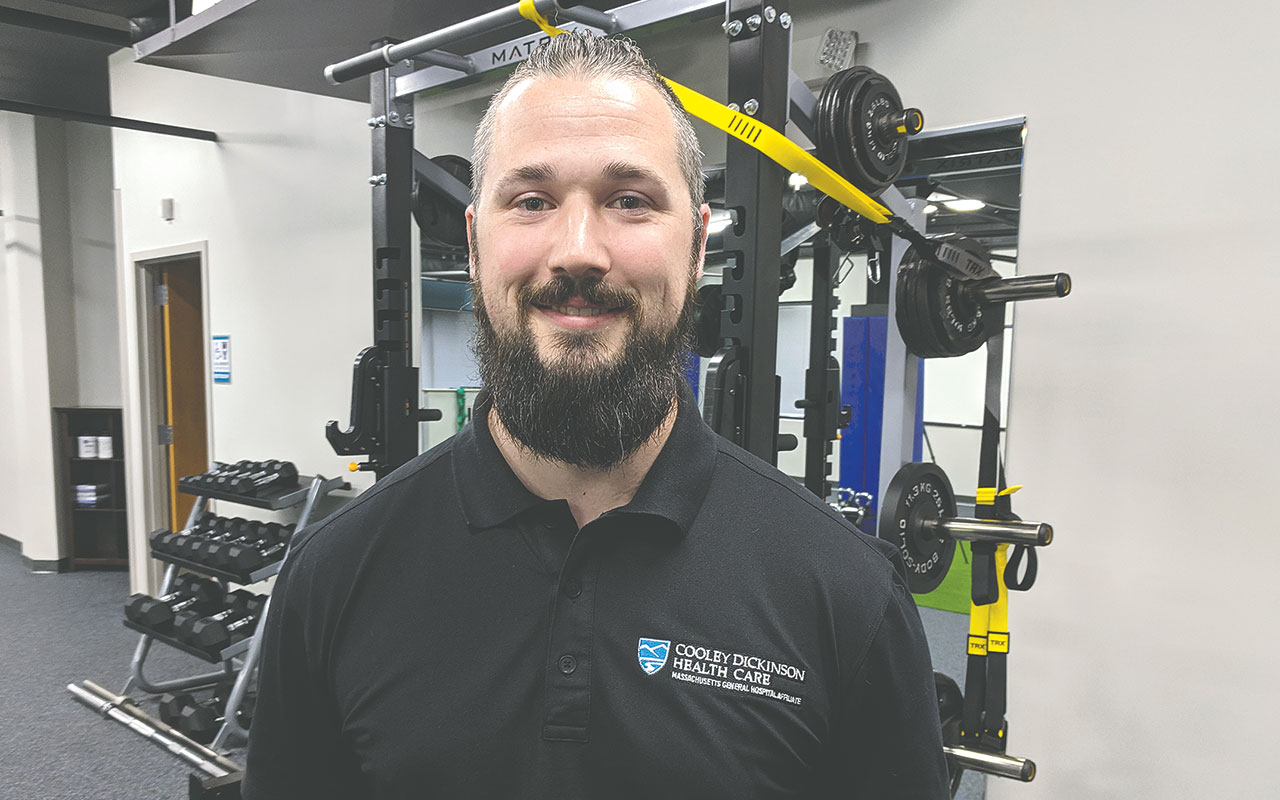
Nonprofit Management

In Good Company

Jennifer Connelly, left, and Dawn Creighton

Jennifer Connelly, left, and Dawn Creighton display promotional materials for the JA Inspire program’s career-exploration fair set for May 28.

The 100th Anniversary Gala for Junior Achievement of Western Massachusetts will have a decidedly ’20s flair — as in the 1920s. In fact, the theme is “The Roaring ’20s are Back.”

Attendees are encouraged, but not required, to come in period dress, a challenge that Jennifer Connelly, executive director of the local JA chapter, met (with considerable help from her daughter) by doing a hard search online that yielded the appropriate dress as well as a headband with a feather.

“I’ll have the long gloves and the long cigarette holder — a full outfit; it will be very interesting to see what people come up with to mark the ’20s,” she said with a trace of understatement in her voice.

But while the gala will amount to an effort to turn back the clock in many respects, Junior Achievement, and especially its Western Mass. chapter, have been turning the clock forward, focusing on the 2020s — and the decades to follow — with a host of programs that are seemingly far removed from the organization’s original mission to introduce young people to the principles of business — but then again, not very far removed at all.

Programs like JA Inspire.

Created by a coalition of education and industry leaders led by JA of Western Mass., this endeavor is designed to introduce young people to industry sectors and careers, and also provide awareness of what skills will be needed to thrive in those settings.

At the heart of the initiative is a massive career fair set for May 28 at the MassMutual Center that won’t follow the typical model for such events.

Actually, it will, but the audience will be decidedly different. Instead of people looking for jobs they can enter in a few weeks or even a few days, those roaming the aisles will be middle- and high-school students gaining information on jobs they might fill sometime in the next decade.

“We’re going to have representatives of a number of industry clusters, and we’ll also have representatives of the post-secondary schools in this area,” said Connelly, “so students can understand that there is a pathway to a career that they might be interested in.”

In many respects, JA has always been about identifying and illuminating pathways, and JA Inspire is just one example of how this nonprofit has stayed true to its original mission while also evolving over the years and expanding into programs, 23 of them in all, for students in grades K-12, said Connelly.

These programs provide lessons in everything from how government works to how large a slice of one’s paycheck the IRS takes; from how global the global economy truly is to the all-important difference between a ‘want’ and a ‘need’ when it comes to how one spends their money, she said, adding that, to get these messages across, JA relies (as it has throughout its history) on volunteers.

“We try to make that match between what they’re learning and why it’s important, and it’s very rewarding work.”

People like Sharon Dufour, chief financial officer at Ludlow-based LUSO Federal Credit Union and a JA volunteer for more than 30 years, 20 of them in this market. She has been instrumental in bringing JA programs into schools in the Wilbraham/Ludlow area, and also in moving beyond traditional school-banking initiatives — where students learn the basics of banking — and into financial literacy.

She’s taught at all levels, including seventh grade and a program called “JA is My Future,” which helps students understand the value of what they’re learning.

“It helps them understand the skills they’ll need for specific jobs,” she explained,” adding that, in the last full school year, LUSO helped coordinate 130 classes for Junior Achievement, reaching 2,810 students. “We try to make that match between what they’re learning and why it’s important, and it’s very rewarding work.”

Julie Ann Pelletier agreed. A retired transplant to the Berkshires just over a decade ago, she was looking for volunteer work to take on and certainly found it with JA — she now coordinates the agency’s programs across the Berkshires.

One of them is an initiative to promote entrepreneurship in high-school students, for which they needed a product that students could design, make, market, and sell. Pelletier helped inspire one — crocheted hats (she teaches that art).

Fast-forwarding, she said she wound up teaching a number of Putnam Vocational Academy students that skill, and a few of them went on to start their own businesses and eventually win business competitions as they moved their ventures forward.

“I’m 72, and they’re 17, so they called it ‘Twisting the Generations,’ — it was the old school teaching the new school,” she said, summing up quickly and efficiently what JA, and its volunteers, have been doing for the past century.

For this issue and its focus on nonprofits, BusinessWest examines all that JA is celebrating as its marks an important milestone — 100 years of not only teaching young people about business, but preparing them for all that life can throw at them.

Getting Down to Business

Connelly told BusinessWest that JA’s 100th birthday bash will be a year-long celebration, one that has a number of goals, from honoring the past to raising awareness of its many programs and initiatives in an effort to ensure sustainability.

It will be capped, in most respects, by a series of events on Sept. 28, when JA National, as it’s called, which is based in Colorado, will stage JA Day at the Big E, home to the first Junior Achievement building ever erected — funded by Horace Moses, president of Strathmore Paper Co., and one of three men who founded JA in 1919. There will be a parade, speeches, and a dinner, and Connelly is expecting representatives from many of the 107 JA chapters nationwide to be in attendance.

Jennifer Connelly says JA has evolved considerably

Jennifer Connelly says JA has evolved considerably over the past century, but remains true to its original mission.

Locally, the immediate focus is on the May 4 gala, to be staged at MGM Springfield, an event expected to draw more than 300 people. The list of attendees includes two descendants of U.S. Sen. Murray Crane of Massachusetts, another of the founders (the third was Theodore Vail, president of AT&T), as well as a representative of Strathmore Paper.

So there will be significant ties to the past, said Connelly, adding that the gala will honor the agency’s founders, but also all the change and evolution that has come over the past century, and there has been quite a bit of both, as her quick history lesson shows.

“When they founded JA 100 years ago, it started off with what they called the company program,” she explained. “Students came together, formed a company, and sold a product; they envisioned a way to help young people transitioning from an agrarian-based economy to a manufacturing-based economy.”

A glass display case in the front lobby of the JA’s offices on the second floor of Tower Square holds artifacts that speak to those early days of the company program, everything from ribbons awarded at a competition in the mid-1920s to a wooden lamp built by area high-school students to later sell. (Connelly isn’t sure of the date on that item, but guesses it’s from the mid-’70s.

The student-company initiative continues to this day, she said proudly, noting that a number of area high schools run the program after school, during the summer, and as part of the regular school day.

Pathfinder Regional High School, for example, has expanded its program to includes a Facebook page, she said, adding that one class is enjoying success with selling a brush designed for pets called Brush It Off.

But over the past 30 years or so, JA has taken on a broader role, one certainly in keeping with the founders’ intent, especially within the realm of financial literacy. And that role will likely become deeper still following the passage of a bill in January that allows state education officials to establish standards around financial literacy, which schools could incorporate into their existing curricula in subjects like math, business, and social sciences.

The standards will be guidelines, not a mandate, said Connelly, adding that, for those schools who wish to adopt these guidelines, JA could become a partner in helping to bring those lessons home.

The agency already provides a wide array of financial-literacy programs to students in grades K-12, she noted, citing, as one example, something called the Credit for Life Fair, staged recently at Elms College, a program created for high-school students.

Students essentially choose a field, are given a budget, and are presented a number of options on how to spend their money — from investments to essentials like housing, a car, and groceries, as well as ‘fun’ items. They then visit with a credit counselor to review their choices and discuss the consequences of each one.

“These are great learning experiences,” Connelly said of the fair, several of which are conducted each year. “They actually get to see that, even if they get a good job and make a lot of money, that money doesn’t go too far. And they learn about the importance of having a good credit score; they can be a doctor and make a lot of money, but if they have a bad credit score, that’s going to hurt them down the road.”

The Job at Hand

While JA is providing young people with a look at life in a chosen profession through these Credit for Life programs — well, sort of — it is also introducing them to industry sectors, career paths, and specific jobs through initiatives like the JA Inspire program and the aforementioned event at the MassMutual Center.

The formal name of that gathering is the Inspire Career Exploration Fair, and that’s appropriate, because that’s what the attendees will be doing — exploring. And while they’re doing that, area employers might be getting some help with the biggest problem they face these days — securing a workforce for the future.

“Every employer in every industry sector is experiencing workforce shortages,” said Dawn Creighton, Western Mass. director for Associated Industries of Massachuetts, which came on board as a sponsor of the initiative early on and has been encouraging its members to take part. “People are not ready for the workforce, whether it’s vocational skills, technical skills, soft skills — they’re not ready.”

The career-exploration fair was conceived to help ensure that the next generation of workers is more ready, she went on, by not just introducing young people to career possibilities they may or may not have known about, but also spell out for them what it will take to land such a position in terms of skills and education.

And that’s why the event has caught the attention of businesses in several sectors, from manufacturing to healthcare to financial services, and from every corner of the 413, said Creighton, adding that all see a chance to open some eyes.

“All too often, these types of career days come during the spring of senior year, and by then it’s often too late,” she told BusinessWest. “We need to introduce young people to all the career opportunities out there, and we need to do it earlier.”

Sharon Dufour, long-time volunteer with JA

Sharon Dufour, long-time volunteer with JA, is seen here with third-graders as she provides lessons about zoning and building a city.

Thus, the fair, as noted, is an example of how JA’s mission has evolved and the agency has moved beyond the classroom in many respects. But area schools are where most of JA’s life lessons are delivered, a tradition that began a century ago and continues today through the work of teachers and especially volunteers.

Dufour has worked to recruit them for years and said more are always needed to help JA reach more young people.

“I tell every volunteer I know that it’s the most rewarding experience you can imagine,” she said. “The kids see you; they remember you. I once had a kid come flying across the Stop & Shop to give me a big hug. Her mother said, ‘my daughter does not stop talking about you.’”

Pelletier agreed, and said the rewards from volunteering come in many flavors, especially the satisfaction that comes from seeing a light go on in a young person’s eyes as they realize their potential to take an idea or a skill (like crocheting) and run with it.

“Once people get the basics, they fly,” she said, referring specifically to crocheting, but also to the many principles of business in general. “And it’s incredibly exciting to watch it happen.”

Past Is Prologue

“The future of our country depends upon making every individual fully realize the obligations and responsibilities belonging to citizenship. Habits are formed in youth. What we need in this country now is to teach the growing generations to realize that thrift and economy, coupled with industry, are as necessary now as they were in past generations.”

Theodore Vail spoke those words a century or so ago when JA was in its infancy. But they certainly ring true today, especially that part about habits being formed in youth.

Helping young people develop the right habits has been JA’s informal mission for 100 years now. There are now more ways in which in that mission is being carried out, but it’s still about pathways and putting people on the right ones.

And that’s a proud history worth celebrating.

George O’Brien can be reached at [email protected]
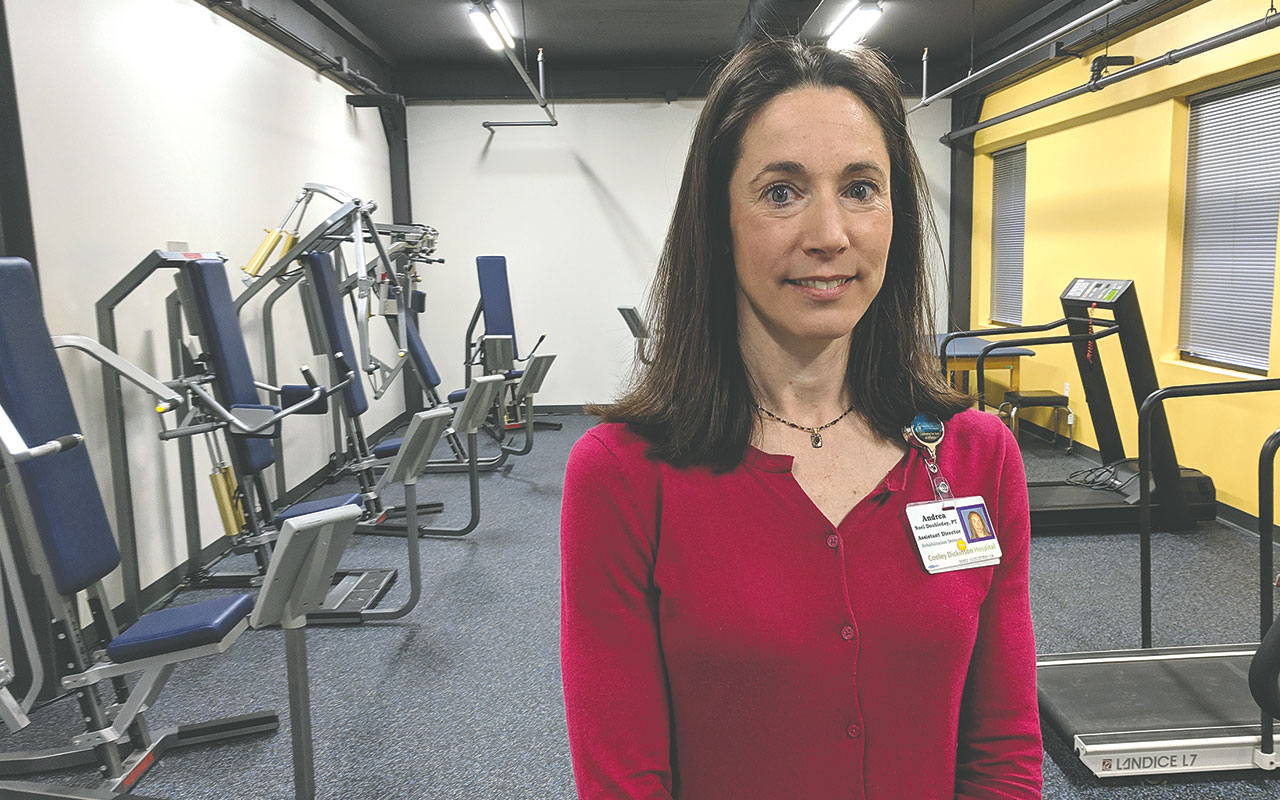
Health Care

Combating ‘Hair Interruption’

By Mark Morris

Joan Quinn, coordinator of the Wig Boutique at the Cancer House of Hope in West Springfield.

Joan Quinn, coordinator of the Wig Boutique at the Cancer House of Hope in West Springfield.

When a cancer patient goes through chemotherapy treatment, feelings of nausea, fatigue, and hair loss are all common physical reactions. For women, loss of hair often adds an emotional element of humiliation and shame.

“I don’t call it hair loss; I call it hair interruption,” said Joan Quinn, coordinator for the Wig Boutique at the Cancer House of Hope (CHH) in West Springfield, who sees her mission as helping women look good and feel better about themselves while their hair grows back.

And she is passionate about her work, as will become abundantly clear.

The Center for Human Development (CHD) runs the Cancer House of Hope as a free community resource to provide comfort and support in a home-like atmosphere for anyone going through cancer treatment. Yoga classes and Reiki massage are among the many services offered there.

As for wigs … Joseph Kane, former director of the Cancer House of Hope (he left that position for another opportunity earlier this month), admits that, while they’ve always been available, they were often treated as an afterthought.

“If someone asked for a wig, we’d pull one out of a plastic tub, and it usually looked like it had bed head; it wasn’t ideal,” he said, adding that this important service has come a long way in recent years thanks to Quinn, who not only provided the drive to create and stock a boutique where there was none, but also staff it with volunteers, maintain a steady inventory, and raise needed funding to keep the operation thriving.

Our story begins with a visit to CHH by one of Quinn’s neighbors, who left her tour thinking that the wig service, such as it was, needed serious help, and that Quinn, a cosmetology-field veteran of more than 50 years who spent 26 years teaching the subject at Springfield Technical Community College, was just the person to provide that help.

“If someone asked for a wig, we’d pull one out of a plastic tub, and it usually looked like it had bed head; it wasn’t ideal.”

“My neighbor said, ‘oh, Joan, I know your standards, and this doesn’t meet them. You should stop in and see them.’”

She did, and this was, coincidentally, after an answered prayer left her looking for a way to give back — and in a big way.

Indeed, a few years earlier, Quinn’s son suffered from a heart condition that required a transplant. As he was living in Iowa City, Quinn flew there to help. “During that time, I prayed that he would receive a heart transplant and promised God that, if he lived, I’d give back tenfold.”

Her son did receive a transplant and is healthy today.

Feeling that she now had to deliver on her promise, Quinn had no idea how she could help the American Heart Assoc. But when the need for a better wig situation presented itself at CHH, she knew immediately she could make a difference.

And she has. Now in operation for more than three years, the Wig Boutique is currently booking appointments five days a week with three volunteer consultants. Quinn estimates the facility has provided more than 300 wigs for cancer patients since opening.

For this issue and its focus on healthcare, BusinessWest explores how the Wig Boutique came to be and why the services it provides are so important to women battling cancer.

Root of the Problem

As she retold the story of how the boutique was launched, Quinn noted that, under some health-insurance plans, cancer patients can purchase a wig and get reimbursed after the fact. In order to be covered under MassHealth, cancer patients must travel to its contracted wig provider located in Worcester.

When Kane learned that three wig providers in the area went out of business, the thought of a dedicated wig program began to sound like a viable idea.

“When I met Joan, she had a vision to make the wig boutique feel like a higher-end service,” Kane said. Likewise, Quinn credits Kane for what she called his “blind faith” that she could convert one of the rooms in the Cancer House of Hope into a boutique on a zero budget.

Volunteer Jan D’Orazio in the Wig Boutique.

Volunteer Jan D’Orazio in the Wig Boutique.

The energetic Quinn began by figuring out how many wigs CHH had and how to get them into presentable shape. Tapping into her network, she convinced her former teaching colleagues at STCC to open their cosmetology classrooms during summer break and made arrangements to have 110 wigs washed. “We even brought in people who didn’t know how to wash wigs, but we taught them.”

Now with a starting inventory, Quinn needed to purchase shelving material and clean lighting for the room. “It had to be organized, and it had to be cheerful,” she explained. “I could not envision people coming in to look through a tub of wigs.”

Before she even had shelves, Quinn approached local businesses and asked them to sponsor $20 shelf tags to be placed in front of each displayed wig. In a short time, she raised enough to pay for the building materials.

While planning the design of the room at the Home Depot, Quinn lamented that she had enough money for materials but not enough to cover labor. The Home Depot associate told her about a program the store sponsors where it would pay for the labor as a donation, a big step toward executing Quinn’s vision.

The finished room resembles a true boutique, displaying 59 wigs under clean lighting with a fitting chair and a full-length mirror. Kane said the boutique provides a unique experience for cancer patients.

“It gives someone who is losing her hair a chance to come in, meet with a professional, and leave with something that does not look like a wig — all for free,” he told BusinessWest. “It’s really powerful.”

When women first come in for a consultation, Quinn said, they are often reliving the horror of having cancer and confronting the reality of their hair falling out.

“Many of the women we see are depressed and fearful of taking off their head covering,” Quinn said. “While we can’t take away their fear, we reassure them that we work with many people in their situation and that this is a safe place.”

She added that the dozens of wigs displayed in the room help to shift the women’s focus away from themselves and onto which style of wig they might want.

“Current wig styles change quickly, so we’re always looking for new styles and quality wigs,” she noted, adding that she approached Sally’s Beauty Supply in West Springfield and left her name on a piece of paper to call if they ever had wigs they wanted to donate. The manager of Sally’s happened to pin Quinn’s contact information on a bulletin board, and one day, when the company discontinued its line of high-end wigs, Quinn got the call and filled two shopping carts with donated wigs. In addition to local donations, CHH receives wig and accessory donations from as far away as North Carolina and California.

Quinn told BusinessWest she is grateful for her network of volunteers and professionals, whom she refers to as her “angels.” She works with many salons in the area whose owners are often former students.

Quinn approached salons with a fundraising idea for the Wig Boutique called “Hang Cancer Out to Dry,” consisting of a small, desk-sized clothesline where customers can attach cash donations with miniature clothespins.

“In its first 17 months, this effort has raised more than $10,000,” Quinn said, adding that it’s not unusual for a salon owner to raise $300 from customer donations and then match it with a $300 donation of their own.

While Quinn pursues donations with great drive and enthusiasm, she also goes after volunteers the same way. Jan D’Orazio was shopping for Christmas decorations at Michael’s when Quinn approached her and asked if she was a hairdresser. D’Orazio replied that many years ago she was, but hadn’t done it in a long time.

“I must have been having a good hair day, because the next thing I knew, Joan was showing me pictures of the boutique on her iPad and encouraging me to join her,” said D’Orazio. “By the time I got to my car, I said, ‘what did I just agree to do?’”

Quinn freely admits she chased down D’Orazio and is glad she did. “Jan is very calm, and she makes people feel comfortable.”

Joni Provost also works with D’Orazio and Quinn as a volunteer coordinator for the Wig Boutique. The three women provide consulting services on selecting wigs. They do not cut or style the wigs, but encourage having that done at a hairdresser. Quinn said sometimes a woman brings along her hairdresser to the boutique. “We want people to feel this could be their hair and their length.”

A Cut Above

D’Orazio said one of the most rewarding parts of working at the Wig Boutique is seeing her clients change in demeanor.

She said many women who come in are feeling down and have what she described as a “cancer look.” The consultation helps to brighten their day and change their whole outlook.

“Last week, a lady came in who is fighting her third bout with breast cancer. When she was getting ready to leave, she was so happy and told me, ‘I feel like Cinderella; I don’t look like I have cancer anymore.’”

Those sentiments speak to how the boutique is providing not only hair and a certain look, but a chance for women to feel better about themselves as they confront perhaps the most difficult time in their lives.

Thus, it’s changing lives in a profound way.

Sports & Leisure

More History to Write

From left, Charlie Arment and Elizabeth and Bob VanZandt

From left, Charlie Arment and Elizabeth and Bob VanZandt stand in the main ballroom at Wyckoff Country Club, one of its many facilities that have undergone a facelift.

None of the members of the new ownership team at Wyckoff Country Club in Holyoke had spent any time on the golf course — or in the golf business — prior to their acquisition earlier this year.

But they did know a few things about what they were getting into. Actually, more than a few.

They knew how to run a business — Bob VanZandt Sr. has operated American Tire Sales & Service in Springfield for nearly 40 years, and Charlie Arment has been at the helm of Charlie Arment Trucking in Springfield, a 65-year-old family business, since 1978.

Beyond that, well, they knew that there was still some history to be written at Wyckoff, originally known as Mount Tom Country Club, a Donald Ross design that has seen many changes over the decades and, like most all clubs, has suffered greatly in recent years as interest in the game has waned.

Most importantly, the new owners — VanZandt and his wife, Elizabeth, and Arment and his brother, William — who acquired the property from long-time owner Clarence “Clarky” Wojtowicz, understood that the golf business isn’t really the golf business anymore. Instead, it’s the entertainment and hospitality business, with golf as a big part of the equation, and they believe that Wyckoff, after some renovations and additions to the landscape, could certainly thrive in that environment.

“It’s more than the golf here — you have to diversify, which we did,” said VanZandt. “We’ll be able to make it because of the banquet facilities upstairs and downstairs, the kitchen, and the golf shop; it’s an attractive package.”

But it’s a package that needed some work, to be sure, and the new owners are supplementing their original purchase of the property — roughly 120 acres in total —with additional investments in both the course and, especially, the clubhouse, in an effort to capitalize on what they consider an attractive location (just off I-91 roughly halfway between Springfield and Northampton) and a solid foundation on which to build.

“No one wanted Wyckoff to go away. While some of the members had questions and concerns, this is what they wanted to see happen here — some improvements inside and out and attention to what the members wanted.”

Elaborating, VanZandt said the course — altered significantly by the construction of I-91 in the mid-’60s — is a hidden gem to many but certainly appreciated by members. Meanwhile, the main banquet facility is one of the largest in the region and can seat 470 for weddings and other events.

“There aren’t many rooms like that in this region — not many places where you can have a wedding or Christmas party or other event and host nearly 500 people,” he noted. “And there’s another room downstairs that holds 130 for bridal showers, brunches, and other events.”

Describing the work done inside to date, VanZandt and Arment said it involves modernizing and improving many of the facilities while also making some needed additions. Regarding the former, VanZandt started with a reference to a hallway on the lower level.

“This was all covered with green wallpaper — I think it was from the ’80s, but it might have been the ’60s; I’m not sure. Anyway, it needed to go,” he said, pointing to the bright white paint on the wall.

Meanwhile, a major renovation of the smaller, lower-level banquet room is underway, replacing wood paneling from several decades ago with a much more modern look. And just off a 19th hole that has been given a minor facelift, work is set to begin on a large patio that will be used by members and event attendees alike.

There are a number of events, said Elizabeth VanZandt, referring to everything from a recent St. Patrick’s Day dinner to planned brunches on Easter and Mother’s Day; from a Friday-night winter concert series to a tradition at Wyckoff known simply as ‘Wednesday Burger Night,’ a name that tells you all you need to know.

Bob VanZandt and Charlie Arment stand near a new patio that will soon be built at Wyckoff.

Bob VanZandt and Charlie Arment stand near a new patio that will soon be built at Wyckoff.

A sign of the times —

A sign of the times — literally; clubs like Wyckoff are now hosting a number of non-golf events to maximize revenues from their various facilities.

Meanwhile, on the course, Charlie Arment Trucking, which has done work on several area golf courses, has started on a number of projects at Wyckoff. Plans call for repairing sand traps, cleaning up ponds, renovating cart paths, clearing overgrown brush and trees, and restoring the ‘Wyckoff Country Club’ sign visible from I-91.

“The course was in pretty tough shape, but we’ve had people out cleaning it and getting it ready,” said Arment, adding that, while there was a soft opening in late March, the course will not be officially open until the end of this month, with the first tournaments scheduled for early May.

Summing up their plans, the new owners said they plan to continue things as they have been for the past 60 years or so — but, as noted, also make some much-needed improvements and additions. They knew considerable work was needed, but wanted to hear from members about what they thought, and received generous amounts of feedback at a meeting early this past winter.

“We asked them what they wanted, and we’re fulfilling what they wanted, and that’s what bringing membership back up,” said VanZandt, adding that the list of requests included everything from much-needed work on the sand traps to new lighting and carpeting in the 19th hole.

Moving forward, the new owners plan to be aggressive in getting the word out about Wyckoff through some targeted marketing, and they said that word-of-mouth marketing has already generated a solid response.

Membership that once exceeded 400 is now closer to 150, and the new owners obviously hope their investments and ongoing work to get the message out will bring that number considerably higher.

“No one wanted Wyckoff to go away,” Arment said. “While some of the members had questions and concerns, this is what they wanted to see happen here — some improvements inside and out and attention to what the members wanted. We’re seeing very positive feedback — a lot of past members are very interested in getting involved again.”

If this trend continues, then a course with some rich history can continue adding new chapters to that discourse for decades to come.

George O’Brien can be reached at [email protected]
Employment

Understanding PFML

John Gannon says there are always hot topics within the broad realm of employment law. And sometimes — actually quite often these days — there are what he called “sizzling hot” topics.

The state’s Paid Family and Medical Leave (PFML) law certainly falls in that latter category. Provisions of the bill, specifically the contributions to be paid by employers, go into effect on July 1. The actual law itself doesn’t take effect until Jan. 1, 2021, but the time between now and then will go by quickly, said Gannon, an employment-law specialist with Springfield-based Skoler, Abbott & Presser, adding that employers should do whatever they can to be ready. And there are things they can do, which we’ll get to in a minute.

First, the law itself. Gannon used the single word ‘scary’ to describe it, and he was referring to the reaction of employers large and small who simply don’t know how this piece of legislation, which makes the acronym PFML a new and important part of the business lexicon, will affect their business but have a good right to be scared because of how generous it is.

“This is a payroll tax at its core. So I think employers are going to have questions about how and whether they’re going to be billed, what their tax contributions are going to be, and other concerns.”

Gannon is expecting the Paid Family and Medical Leave Law to be among the main focal points of conversation at the firm’s annual Labor and Employment Law Conference, set for May 21 at the Sheraton Springfield. The conference is staged each year to help local businesses stay abreast of laws and regulations relating to labor issues, said Gannon, and this year there will certainly be a number of issues to discuss. Indeed, breakout sessions are slated on a host of topics, including PFML; wage-and-hour mistakes; harassment, discrimination, and why employers get sued; a labor and employment-law update, how to handle requests for reasonable accommodations (there will be a panel discussion on that topic); and how to conduct an internal investigation.

But Gannon told BusinessWest that paid family and medical leave will likely be the focus of much of the discussion and many of the questions, primarily because the law represents a significant change in the landscape, and business owners and human resources personnel have questions about what’s coming at them.

The first of these questions concerns the contributions to start July 1.

“This is a payroll tax at its core,” he explained. “So I think employers are going to have questions about how and whether they’re going to be billed, what their tax contributions are going to be, and other concerns.”

A 30-page set of draft regulations was recently released by the Executive Office of Labor and Workforce Development’s Department of Family and Medical Leave, and that same office has issued a toolkit for employers with information on everything from remitting and paying contributions to notifying their workforce to applying for exemptions.

There’s quite a bit to keep track of, said Gannon, adding that, under the new law, Massachusetts employees will be eligible to take up to 12 weeks of paid family leave (up to 26 weeks in certain circumstances) and up to 20 weeks of paid medical leave. In most cases, leave may be taken intermittently or on a reduced-schedule basis.

Family leave can be taken to bond with a new child, for qualifying exigency related to a family member on (or called to) active duty or to care for a family member who is in the service, or to care for a family member with a “serious health condition.” Medical leave can be taken for the employee’s own “serious health condition.”


John S. Gannon

John S. Gannon

“Someone has a medical impairment, and they need a new chair, or someone needs to change their schedule — they can’t work mornings anymore — or whatever the change in job structure they’re requesting … these matters can get complicated. How do companies handle these requests? Do they have to grant them? How do they work with employees? These are all questions this panel will address.”

In most cases, the annual cap for family leave is 12 weeks, 20 weeks for medical leave, and 26 weeks total cap for both, if needed.

The employee must give at least 30 days notice of the need for leave or as much notice as practicable. The weekly benefit amount maximum is $850 to start; in future years, it will be capped at 64% of state average weekly wage. The weekly benefits will be funded by contributions from payroll deductions into a state trust fund. The initial rate will be 0.063% of the employee’s wages. Employers may require employees to contribute up to 40% toward medical leave and up to 100% for family leave. Employers with fewer than 25 employees are exempt from paying the employer share of the contributions.

Employers must continue employee health-insurance benefits and premium contributions during any period of family or medical leave, said Gannon, and they must restore employees who return from leave to their previous, or an equivalent, position, with the same status, pay, benefits, and seniority, barring intervening layoffs or changed operating conditions.

There are many other conditions and bits of fine print, he told BusinessWest, adding that, while Jan. 1, 2021 is a long seven business quarters away, business owners and managers can and should start to prepare themselves for that day.

They can start by asking questions and getting answers, he said, adding that small businesses with fewer than 50 employees have not had to deal with federal family medical leave regulations and thus are treading into uncharted waters.

“They’re going to have to start thinking about how they’re going to manage this from a staffing perspective,” he said, adding that he is expecting a number of queries along these lines at the May 21 conference and the months to follow.

“Employers have to start thinking about this and getting ready for this now because of how generous the leave portion of this is,” he explained. “This is going to be a real challenge for employers.”

But overall, it’s just one of many challenges facing employers in the wake of the #metoo movement and other forces within employment law, all of which can have a significant impact on a business and its relative health and well-being.

Handling requests for reasonable accommodations is another area of concern, he noted, and that’s why the conference will feature a panel of experts addressing what has become a somewhat tricky subject for many business owners and managers.

“Someone has a medical impairment, and they need a new chair, or someone needs to change their schedule — they can’t work mornings anymore — or whatever the change in job structure they’re requesting … these matters can get complicated,” he explained. “How do companies handle these requests? Do they have to grant them? How do they work with employees? These are all questions this panel will address.”

For more information on the conference, visit skoler-abbott.com/training-programs.

— George O’Brien

Architecture Construction

Designs on Growth

As one local architect noted, we’re far enough away from the last recession to start worrying about the next one — and recessions tend to hit this sector particularly hard. Still, despite mixed signals in the long-term economic picture nationally, work remains steady locally, with municipalities, colleges, and businesses of all kinds continuing to invest in capital projects. Even if storm clouds do appear down the road, the 2019 outlook in architecture seems bright.

Curtis Edgin put it in simple terms when asked how 2019 is shaping up in the architecture sector.

“We’re busy; I can’t complain,” he told BusinessWest. Those five words sum up a strong outlook in an industry that tends to be a leading indicator for the economy as a whole — when things slow down, construction, finance, and other areas tend to follow — and is currently trending up, or at least holding steady.

“We’re far from the last recession — maybe far enough to worry about the next one,” said Edgin, a principal with Caolo & Bieniek Associates (CBA) in Chicopee. “But I don’t see that coming yet, looking at our workload.”

The American Institute of Architects (AIA) reports a similar outlook, with architecture firm billings nationally strengthening to a level not seen in the previous 12 months. Indicators of work in the pipeline, including inquiries into new projects and the value of new design contracts, also improved in January.

“The government shutdown affected architecture firms but doesn’t appear to have created a slowdown in the profession,” AIA Chief Economist Kermit Baker noted. “While AIA did hear from a few firms that were experiencing significant cash-flow issues due to the shutdown, the data suggests that the majority of firms had no long-term impact.”

Broken down by region, the Northeast is performing better than the West, but slightly trailing the South (which continues to rebuild from a rough 2018 hurricane season) and the Midwest. Nationally, billings softened slightly in February from the January pace, but remain strong in the big-picture sense, Baker said. “Overall, business conditions at architecture firms across the country have remained generally healthy.”

Curtis Edgin says specializing in a range of diverse niches is a plus for any firm

Curtis Edgin says specializing in a range of diverse niches is a plus for any firm, serving as a buffer against a downturn in any one area.

Jonathan Salvon, a principal with Kuhn Riddle Architects in Amherst, reports strong business as well, especially in the education realm, traditionally a strength for the firm, with projects for UMass and a historic-renovation conversion project for Elms College.

“Then there’s a mix of multi-family housing and commercial projects,” he told BusinessWest. “We’ve got a new office building for Way Finders going up on the old Peter Pan site in Springfield, which is our biggest commercial project at the moment. And there’s a 36-unit, multi-family housing project going up on University Drive in Amherst.”

Caolo & Bieniek, known for its wide range of public projects, from schools to fire and police stations, has expanded its base of private projects since merging with Reinhardt Associates in 2017.

“It’s been kind of a good synergy. We’ve blended our strengths and their strengths,” Edgin said, noting that one example is the recently completed Baystate Health & Wellness Center on the Longmeadow-East Longmeadow line, as Reinhardt has a solid history in medical office buildings.

“E-commerce has been growing at about three times the rate of traditional brick-and-mortar sales. The slowdown in housing hasn’t helped, as new residential development often spurs new retail construction activity. Instead, larger shares of investment in these facilities is going to the renovation of existing buildings.”

Other recent CBA projects recently started or well underway include a senior center in West Boylston, a police station in Williamstown, a public-safety complex in Lenox, a renovation of Chicopee’s public-safety facility, a pre-K to grade-8 school in Easthampton, and some work with UMass Amherst, Westfield State University, and other colleges.

“There’s a good mix of private and public, and we seem to be doing a fair amount of work with human-services agencies,” Edgin added, noting that the firm just did a project for Guidewire in Chicopee, and Sunshine Village in the city has also been a consistent client. “We seem to have a bit going in that sector right now. We’re busy, and it’s a good mix all around.”

Strong Pace, but Red Flags

The AIA suggests that growth in architecture should continue at least through 2020, but a number of emerging red flags suggest a cautious outlook.

Spending on non-residential buildings nationally is projected to grow by 4.4% this year, paced by healthy gains in the industrial and institutional building sectors, it notes. For 2020, growth is projected to slow to 2.4%, with essentially no increase in spending on commercial facilities, but gains in the 3% range in the industrial and institutional categories.

“Still,” Baker said, “there is growing concern inside and outside of the industry that a broader economic downturn may be materializing over the next 12 to 24 months.”

Nationally, growth in gross domestic product is estimated to be close to 3% in 2019, while the job market continues to be healthy, with more than 2.6 million net new payroll jobs added in 2018, an improvement over 2017’s figure of just under 2.2 million. In fact, the national unemployment rate was below 4% for most of 2018. Consumer-sentiment levels remained strong, and the nation’s factories also were busy, with industrial output achieving its strongest growth in almost a decade.

Jonathan Salvon says one of his firm’s three ‘legs,’ residential work, has been impacted by a slowdown in single-family construction

Jonathan Salvon says one of his firm’s three ‘legs,’ residential work, has been impacted by a slowdown in single-family construction over the past decade, but a rising portfolio of multi-family projects has picked up the slack.

However, there are several signals that point to an emerging slowdown in the broader economy, and therefore in the construction sector, Baker noted. These include declines in leading economic indicators, weakness in some key sectors of the economy, and softness in the markets of major U.S. trading partners. “These signals may be temporary responses to negative short-term conditions, but historically they have preceded a more widespread downturn.”

Meanwhile, since dropping sharply during the Great Recession, housing starts have had a very slow recovery, the AIA notes, and Salvon can attest to that reality locally. But Kuhn Riddle has adjusted in other ways.

“We’ve always been a stool with three legs,” he said. “One-third is work for various colleges, charter schools, prep schools, secondary schools, and even some day cares — we run the whole gamut in education. The second third is residential work; in the past, before the 2009 recession, that was often single-family residences. That market has never really come back, at least for us. But we’ve been lucky to develop a new market in multi-family projects.”

The third leg is a variety of commercial projects, including office buildings, restaurants, and bank renovations, to name a few, Salvon said.

“Hopefully we all stay busy. But we do know it goes in cycles; we’ve been through plenty of slower times and a lot of boom times. But we’ve been very blessed. We’re pretty busy and hope to stay that way.”

Nationally, Baker sees design work on the commercial front as a bit of a mixed bag at the moment.

“Business investments often reflect what corporate leaders feel is the growth potential for their companies. Investment nationally in new plants and equipment saw healthy growth in 2017 and through the first half of 2018, but slowed significantly beginning in the third quarter of last year,” he noted. “Given the recent trends in business-confidence scores, investment is unlikely to accelerate anytime soon. Business confidence fell sharply through 2018, with the fourth quarter showing the lowest levels in six years.”

In the Bay State, the picture is equally muddy. The Business Confidence Index issued monthly by Associated Industries of Massachusetts (AIM) reported a gain in February after dropping in January to its lowest level in more than two years.

“Employers remain generally optimistic about a state economy that continues to run at full-employment levels and a U.S. economy that is projected to grow by 2.2% this year,” said Raymond Torto, Chair of AIM’s Board of Economic Advisors and a lecturer at the Harvard Graduate School of Design. “At the same time, the erosion of confidence among Massachusetts manufacturers during the past 12 months raises some concern about the long-term sustainability of the recovery.”

On a sector-by-sector basis, Baker reported, design work for retail facilities continues to suffer from the growth on online shopping.

“E-commerce has been growing at about three times the rate of traditional brick-and-mortar sales. The slowdown in housing hasn’t helped, as new residential development often spurs new retail construction activity,” he noted. “Instead, larger shares of investment in these facilities is going to the renovation of existing buildings.”

On the other hand, office projects represent the strongest commercial sector in construction right now, with 5% growth projected for this year and 1% in 2020. “This sector has benefited from strong job growth and the apparent bottoming out of the years-long decline in office space per employee,” Baker said. “Much of the increase has come from the booming technology sector, so the outlook is dependent on continued growth in this industry sector.”

Meanwhile, eds and meds — or education and healthcare, two pillars of the Western Mass. economy — represent very healthy sectors nationally for architects and general contractors. AIA projects 5.5% in the education sector this year and an additional 4% in 2020, and 4% growth in healthcare in 2019 followed by 3.6% in 2020. 

“We’re pretty diversified and active in a lot of different environments,” Edgin said. “It’s not just schools, not just police stations, not just fire stations, but a little bit of everything.” He cited the recent renovation of Polish National Credit Union’s Front Street branch in Chicopee, as well as a new Arrha Credit Union branch in West Springfield and a project with the Boys and Girls Club of West Springfield. “A lot of things take a while, so it’s that advance planning that keeps you busy a year or two from now.”

Leading Indicator

Baker reported that business conditions at U.S. architecture firms in 2018, as measured by AIA’s Architecture Billings Index (ABI), were essentially unchanged from 2017.

“Since the ABI has been shown to lead construction spending by an average of nine to 12 months, this would suggest that the growth in spending on non-residential buildings in 2019 should be close to the growth rate of 2018,” he noted. “Additionally, new design contracts coming into architecture firms grew at a healthy pace in 2018, underscoring the robust level of backlogs currently enjoyed by most firms.”

Meanwhile, Dodge Data & Analytics recently released its 2019 Dodge Construction Outlook, which predicted that total U.S. construction starts for 2019 will be $808 billion, staying essentially even with the $807 billion estimated for 2018.

“There are, of course, mounting headwinds affecting construction, namely rising interest rates and higher material costs, but for now these have been balanced by the stronger growth for the U.S. economy, some easing of bank lending standards, still-healthy market fundamentals for commercial real estate, and greater state financing for school construction and enhanced federal funding for public works,” said Robert Murray, chief economist for Dodge Data & Analytics.

Locally, both architects and builders are maintaining the same sort of cautious optimism, at least in the short term.

“Right now, it’s strong,” Edgin said. “We’ve increased our staffing.”

Finding talented staff remains a challenge, he said, because strong growth among architecture firms in general means stiff competition, and Greater Springfield isn’t always a top destination for young professionals in the field compared to, say, Boston or New York, where pay scales are higher (but, of course, so is the cost of living).

Salvon understands that reality as well, but said Kuhn Riddle has benefited from its location in downtown Amherst, where it has easy access to the UMass architecture program. “We’ve been a little spoiled — we’ve been privileged to get some employees out of that program over the last decade or so, and we’ve tried to make a nice work environment, so people been staying here.”

All things considered, he told BusinessWest, the outlook seems strong in architecture locally, and others agree.

“We’ve been able to build some good staff and a good team, so we’re happy about that,” Edgin said. “Hopefully we all stay busy. But we do know it goes in cycles; we’ve been through plenty of slower times and a lot of boom times. But we’ve been very blessed. We’re pretty busy and hope to stay that way.”

Joseph Bednar can be reached at [email protected]

Estate Planning

Preparing for the Next Stage

By Barbara Trombley, MBA, CPA, CDFA

Life — and business — can shift in unexpected ways, and an ownership transition can sneak up on even someone who expected to be at the reins for a long time. That’s why it’s good to start preparing for that possibility well in advance.

A succession plan is a vital part of a small business.

Most small businesses were built from the ground up, with a dedicated founder and owner, and it may be very hard for the owner to consider a succession plan. But retirement — or worse, sudden illness or death — can creep up on an owner and create havoc. Without a solid plan, a family may suddenly lose their income or the inheritance that was counted on, or the business may cease to exist.

“Many succession plans are not carefully planned out or are devised as a result of health event. A good succession plan is made when the owner can think rationally and formally devise a sort of buy-sell agreement.”

My personal experience with a succession plan is based on our financial- planning business. My father-in-law did what quite a few financial planners do. He brought my husband (his son) and myself into his business a few years before he retired. My mother-in-law had a bad health scare, and he could see that his years in the business were numbered.

In our case, my husband and I were good candidates to take over the family financial-planning business. We were both graduates of Duke University; I was a CPA, and my husband had recently retired from a first career in major-league baseball. We had the backgrounds and were ready to assume the responsibility of maintaining and growing the business that he started.

The transition wasn’t easy; my father-in-law’s mind knew that it was the best course of actions for his clients, but his heart wasn’t ready to leave. In hindsight, it was a great decision, because his health deteriorated quickly after we took over, and he passed away three years ago.

Many succession plans are not carefully planned out or are devised as a result of a health event. A good succession plan is made when the owner can think rationally and formally devise a sort of buy-sell agreement.

The buy-sell agreement is a legally binding contract that says what will happen if the owner passes away, falls ill, or wants to retire. It will formalize information like the company sales price, the value of each share in the business, and how the sale of the company could be funded.


Barbara Trombley

Barbara Trombley

“Many buy-sell agreements are funded with life insurance; the company or the individual co-owners buy policies on the other co-owners that allow them to buy shares in the company using the proceeds from the insurance after the owner or shareholder’s death.”


Perhaps the simplest example of a buy-sell agreement is if there is more than one owner. The agreement will state that the co-owners can purchase each other’s shares in the event the buy-sell agreement is triggered.

Many buy-sell agreements are funded with life insurance; the company or the individual co-owners buy policies on the other co-owners that allow them to buy shares in the company using the proceeds from the insurance after the owner or shareholder’s death. A term policy is often more inexpensive, but a permanent policy may be more suitable for a longer period of time.

What if you are the only owner? What makes a good succession plan?

A good succession plan will consider the human-resources side of the transition as well as the financial aspects. Do you want to keep the business in the family? Are your family members qualified and knowledgeable about your business? Do they desire and have the heart to keep your business going? Will you choose certain family members over others?

Most businesses do better with a single overall successor as opposed to splitting ownership of the business. It may be possible to appoint different heirs to manage separate departments. Many small-business owners assume their children want to take over. We have heard many stories about family in-fighting or entitled heirs assuming roles that they are not prepared for. Many a business has suffered or failed after a leadership change; a good succession plan will look with an objective view at different family relationships.

Another option to a family succession plan would be to have a key employee buy the business.

The buy-sell agreement could be executed over time, giving the other employees and customers time to get used to the idea, or it can be triggered by an event such as an illness or death of the owner. Of course, not many employees have the funds to purchase a company.

One idea would be to provide seller financing. A loan from the owner to the buyer could provide a stream of income to the owner as he enters retirement. Another option would be outside financing. This would be the best course if the owner desires his funds up front.

In our financial-planning business, we are constantly urged to set up a succession plan. This is mainly to ensure that a properly licensed advisor can quickly service our clients in the event of the death or disability of myself and my husband. Our plan is to set up a buy-sell agreement with another financial advisor that would be triggered in an emergency but fully changeable in case one of our qualified children would like to take over the business for a third generation.

Taking the time to consider the human-resource angle as well as the financial angle can ensure an agreement that is beneficial to all parties involved and ensure the business you have built will last for a long time.

Barbara Trombley, MBA, CPA, CDFA is an LPL financial planner with Trombley Associates Investment and Retirement Planning in Wilbraham; securities offered through LPL Financial; member FINRA/SIPC. The opinions voiced in this material are for general information only and are not intended to provide specific advice or recommendations for any individual. Trombley Associates and LPL Financial do not provide legal advice or services. Consult your legal advisor regarding your specific situation.

Law

A Sometimes Fine Line

By Marylou Fabbo, Esq.

There’s no doubt the #MeToo movement has brought positive change to the business world by creating a safer environment for women (and men) to come forward with accounts of sexual harassment. But what if the claims aren’t true, either because they don’t rise to the legal definition of harassment or they’re completely fabricated? The damage, to both individual and company reputations, can be significant.

Make no mistake. Subjecting an employee to sexual harassment in the workplace, at a company-sponsored event, or on a business trip is unacceptable and should be punished.

#MeToo has had a strong, positive impact on encouraging victims to come forward with valid claims that had been unreported or overlooked. Everyone who complains of sexual harassment should be heard, but should everyone be believed? Most people — men and women — are not sexual abusers, and yet most individuals would say they have experienced some form of sexual misconduct. Most also would agree that some sexual behavior, such as grabbing a co-worker’s breast, exposing oneself to another employee, or telling an employee that he or she will get a promotion if he or she sleeps with the boss are clear-cut cases of sexual harassment.

Marylou Fabbo, Esq

Still, even if sexual comments or behaviors are inappropriate for the workplace, not everything of a sexual nature rises to the level of illegal sexual harassment under the law. This leaves the door open to unfounded and/or, in some cases, intentionally false claims, which can have a damaging impact on company image and the accused person’s professional and personal life.

Sexual Harassment Defined

Title VII and Massachusetts law prohibit sex discrimination in the workplace, and sexual harassment is a form of sex discrimination. The harasser and the victim of sexual harassment can be the same or opposite gender and have the same or different sexual orientations.

Although this article addresses sexual harassment in the workplace, sexual harassment is also prohibited in places of public accommodation, educational facilities, and housing.

“Even if sexual comments or behaviors are inappropriate for the workplace, not everything of a sexual nature rises to the level of illegal sexual harassment under the law.”

There are two types of sexual harassment: ‘quid pro quo’ harassment and ‘hostile work environment’ harassment. Quid pro quo harassment includes sexual advances, requests for sexual favors, and other verbal or physical conduct of a sexual nature when a term of employment or employment decision depends on whether an employee accepts or rejects those advances.

Many of the accusations asserted against producer Harvey Weinstein fall into the quid pro quo category. Actors have come forward stating that Weinstein promised them career advances in exchange for a positive response to his sexual advances; they also have stated that Weinstein failed to help them out if they chose not to meet his sexual demands. That’s unambiguous quid pro quo harassment.

In Massachusetts, employers are strictly liable for quid pro quo harassment, which means the business is on the hook for damages even if it did not know about the harassment.

The other type of sexual harassment is hostile work environment sexual harassment. Under Massachusetts law, illegal sexual harassment occurs when “requests for sexual favors and other verbal or physical conduct of a sexual nature unreasonably interferes with an individual’s work performance by creating an intimidating, hostile, humiliating, or sexually offensive work environment.”

Complaints about Matt Lauer and Charlie Rose’s actions fall into the sexually hostile work environment category. Lauer is accused of exposing himself to staff, and the accusations against Rose included making lewd phone calls and groping women’s breasts. In both cases, the individuals’ employers have been accused of knowing about the harassment and doing little to stop it.

Subjective and Objectively Offensive

An employee who is offended by sexual behavior may file a claim of harassment with the Mass. Commission Against Discrimination (MCAD), believing that the actions were illegal simply because they were of a sexual nature.

However, to constitute illegal sexual harassment in the workplace, the behavior must be offensive both to the recipient and the general public. Ask yourself this question: if an employee shows co-workers vacation pictures on his phone that include friends in bikinis, is that sexual harassment? What about the long-term manager who refers to women as ‘girls,’ gives hugs occasionally, and makes jokes about the lack of sex in his long-term marriage?

Some may find those comments and actions offensive, and others may not. Is the manager just ‘old school’? If an employee subjectively perceives the behavior as hostile, intimidating, humiliating, or offensive, then the conduct may constitute sexual harassment. But that’s not enough — the question becomes whether a reasonable person in the employee’s position would find the conduct offensive.

“To constitute illegal sexual harassment in the workplace, the behavior must be offensive both to the recipient and the general public.”

Conduct of a sexual nature also must be unwelcome in order to constitute illegal sexual harassment, but it is almost impossible to be absolutely sure whether the conduct is welcome or unwelcome. The fact that an employee appears to be a willing participant in sexual discussions about weekend conquests may suggest that the employee was not opposed to the sexual discussions by the water cooler on Monday mornings. Yet, the employee may have actually been cringing on the inside.

Under the law, even if an employee makes sexual comments or jokes, or engages in sexual conduct, those actions do not automatically mean that all behavior is welcome. A disgruntled employee who appeared to be a willing participant may later claim that behavior that was welcome was in fact unwelcome.

Nimrod Reitman, a former NYU graduate student, accused his school adviser, Avita Ronell, of sexually harassing him over a three-year period. He claimed that she referred to him in e-mails by names such as “my most adored one” and “sweet cuddly baby,” and kissed and touched him repeatedly and required him to lie in her bed, among other things. Ronell did not deny the behavior but denied the harassment and claimed that the behavior had been welcomed.

While that case doesn’t arise in the employment context, it provides an example of one reason employers should implement zero-tolerance policies when it comes to sexual banter in the workplace. What may have been considered welcome sexual commentary or behavior may have actually have been unwelcome and could subject them to a lawsuit.

False Accusations of Sexual Harassment

Why would one make a false accusation of having been sexually harassed at work? It cannot be disputed that some people fabricate claims of sexual harassment in the workplace because alleged victims have admitted to making up allegations against co-workers or management for many different reasons.

In some cases, sexual-harassment claims may be made to ward off terminations because employers are fearful of being accused of illegal retaliation if they take (warranted) disciplinary action after an employee has come forward with a sexual-harassment complaint. Disgruntled employees have been found to have made false accusations against someone they believe is responsible for an adverse personnel action the employee received, such as a demotion or termination from employment.

Employees have admitted that they have intentionally made sexual-harassment complaints against co-workers for vindictive reasons or for attention.

Unfortunately, it is often difficult to determine whether specific allegations are true or false, as there usually are no witnesses or hard evidence. Because of this, businesses may overreact or react harshly without having all of the facts.

Nev Shulman, star of MTV’s Catfish, was accused of sexual assault. He denied the claims, but the show was suspended anyway. Upon a later investigation, the claims were deemed not credible, and the show was reinstated. A Sacred Heart University student falsely reported having been raped by two school football players and has since faced criminal charges. The leader of the New York City Ballet was accused of sexual harassment and retired. He was later cleared of any wrongdoing.

Collateral damage follows baseless accusations of sexual harassment. Valid harassment claims are devalued and may be looked upon skeptically. When it becomes known that an accusation was false, it raises the possibility in individual’s minds that the next allegation of a similar nature may also not be credible.

Being falsely accused of sexual harassment is also a downfall to the accused’s career. Prior to having their names cleared, alleged harassers may quit or be required to resign, and they sometimes remain under suspicion even after the complaint is found to have been fabricated. The fact that a sexual harassment lawsuit has been filed against a company may be covered in the media, but when, years later, it is dismissed by the court before it gets to the jury stage because the case is without factual support, that information often is not made available to the public — perhaps forever leaving a bad mark on the employer in the eyes of its customers as well as employees. u

Marylou Fabbo is an attorney with Skoler, Abbott & Presser, P.C., one of the largest law firms in New England exclusively practicing labor and employment law. She specializes in employment litigation, immigration, wage-and-hour compliance, and leaves of absence. Fabbo devotes much of her practice to defending employers in state and federal courts and administrative agencies. She also regularly assists her clients with day-to-day employment issues, including disciplinary matters, leave management, and compliance; (413) 737-4753; [email protected]

Technology

Pipeline to Progress

When the Massachusetts Clean Energy Center released a study last fall examining potential locations for water-technology demonstration centers in Massachusetts — thus raising the Bay State’s profile and potential in the increasingly critical field of water supply, treatment, and sustainability — UMass Amherst was a natural choice, because it’s been making connections between water research and industry for some time. A host of key stakeholders believe it can become even more so in the decades to come.

Talk to experts in the broad realm of water technology innovation, and it doesn’t take long for Israel to come up, at least in terms of government investment.

It’s not exactly by choice.

“There are countries facing severe water issues right now,” said Loren Walker, director of the Office of Research Development at UMass Amherst. “Israel is the world leader in terms of state-led efforts to purify water — because they have to. They have a real water-constraint situation there.”

But several entities in the Bay State — from the university to the Massachusetts Clean Energy Center (MassCEC) to a host of industry players, both established companies and startups — are intrigued by the potential to make Massachusetts an international leader in water innovation as well. And they’ve got plenty of progress to build on already.

“It’s obviously a big area — there’s a water crisis around the country, around the world, and it will be more critical as the years go on, so there’s a need to innovate ways to treat water, both wastewater and surface water,” Walker told BusinessWest.

“It’s an active area of university research, an active area of industrial research,” he went on, “but there’s a gap between the kind of research the universities do — federally funded, more basic or fundamental — and technologies being developed by industry that they can ultimately commercialize and sell. There’s a gap between that fundamental research and the later applied research where you’re prototyping, scaling up, and seeing what technologies really work — and that’s where you need a pilot site. You need a way to go from fundamental laboratory research to commercial-scale research.”

UMass could be that site, he said.

Loren Walker

Loren Walker says the Amherst Wastewater Treatment plant provides UMass researchers and partnering companies a flow of wastewater on which to test new technologies.

Last fall, MassCEC released a comprehensive study that evaluates the technical and financial feasibility of three potential water-technology demonstration centers across Massachusetts, including one at UMass Amherst. Such centers, proponents say, could offer a test bed to pilot new water technologies and position Massachusetts as a global leader in the water-innovation and energy-efficiency sector, providing significant business and employment opportunities.

Rick Sullivan, president of the Western Mass. Economic Development Council, said one of the EDC’s goals is to help identify and develop sectors where Massachusetts could become a center of excellence. Back when he served as secretary of Energy and Environmental Affairs under then-Gov. Deval Patrick, he and the governor traveled to several locations, including Israel, to learn about water innovation, recognizing this was an issue of growing international concern.

“Water is just a really big issue, and becoming more important every day,” Sullivan said. “So we started asking, ‘can Massachusetts actually play in this water cluster?’ The short answer is, yes we can — because it’s already a multi-billion-dollar business in the Commonwealth.”

“It’s obviously a big area — there’s a water crisis around the country, around the world, and it will be more critical as the years go on.”

That figure includes everything from delivery systems to public-works projects; from filtering, purifying, and clarifying water to security of freshwater sources like the Quabbin Reservoir, he noted. “So it’s a bigger field than I think a lot of people realize.”

UMass Amherst has long been involved in water research. Then, in 2016, a $4.1 million grant from the U.S. Environmental Protection Agency — on the heels of a state earmark of $1.5 million from the state Department of Environmental Protection for water innovation — helped launch one of only two national research centers (the other is in Boulder, Colo.) focused on testing and demonstrating cutting-edge technologies for drinking-water systems.

All things considered, Sullivan said, UMass Amherst is an ideal spot to develop a demonstration center. A conference last October, called “Innovations and Opportunities in Water Technologies,” brought together the business and startup community, area municipal leaders who spoke about challenges to current water and wastewater systems, and UMass experts who detailed some of the cutting-edge work already being done on campus.

“At the end of the day, all of those panels and all the discussion and information kind of led back to reinforcing the idea that this is a really smart investment for the Commonwealth,” Sullivan said, noting that the investment to create the three centers was approved as part of the state’s 2014 environmental bond bill, but has not yet been appropriated in the state budget.

“When you talk to the companies that are in the innovation sector, one of the biggest needs they have is to be able to take their product and demonstrate that it works in real life — and to be able to do that not just in a lab, but out there in the real world,” he continued. “UMass has the ability to provide that infrastructure with some investment from the Commonwealth.”

In the Flow

The MassCEC study analyzed the technical and financial feasibility of three potential water-technology demonstration centers around the state: the so-called Wastewater Pilot Plant at UMass Amherst, the Massachusetts Alternative Septic System Test Center in Barnstable, and the Massachusetts Water Resources Authority’s Deer Island Treatment Plant in Boston Harbor.

Establishing this network could create jobs, lower energy costs, and optimize municipal operations in addition to supporting water-technology research, the study noted. A test-bed network could serve existing Massachusetts-based water technology companies, help attract new companies to the Commonwealth, advance new solutions to both local and global water challenges, and provide a strong foundation for innovation.

Key to UMass Amherst’s feasibility as a demonstration center is the fact that it already acts as a pilot site for industry — albeit on a limited basis — because of its access to flowing streams of municipal wastewater at the Amherst Wastewater Treatment Plant, located next to the university’s Water Energy Technology (WET) Center.

“You need flowing streams of municipal wastewater and surface water; you need to have access to this to test your filtration membrane or electrochemical treatment technologies, whatever they may be,” Walker said.

“Those facilities are few and far between,” he added. “But we happen to have one of just a couple facilities in the country that have some of the key attributes necessary to do some of this pilot testing — access to flowing wastewater and flowing surface-water streams, proximity to a research university, and access to stakeholders and end users.”

The issue, he said, is size and scale.

Rick Sullivan says Massachusetts can be a major player in the water cluster and, in many ways, already is.

Rick Sullivan says Massachusetts can be a major player in the water cluster and, in many ways, already is.

“We have the fundamental key attributes needed to make this kind of pilot facility, but we’re limited,” he went on. “We have bays now and already have companies using the facility to do their own research and scale up. It’s already an active space for research and development collaborations — but it gets filled up very quickly, so we would love to expand it, see even more companies come in and use this space, both established companies as well as new startups.”

The center was established in the 1970s and ran as a research pilot site for decades, but fell into disrepair in the late 1990s, he explained. Since its grant-funded renovation in 2016 as a research and collaboration space, it has hosted numerous industrial collaborators. “But it’s limited how many projects can happen in parallel. So there’s a case to be made for investing in infrastructure improvements, expansion, and modernization, do more projects in parallel.”

As an example of the kind of research being done there, Walker brought up ultrafiltration membranes — nanoscale membranes that can remove contaminants when water is forced through. One problem is that the membranes tend to get fouled up by materials in the water and eventually don’t work so well, and have to be replaced regularly, which is costly.

But Jessica Schiffman, an associate professor of Chemical Engineering at UMass Amherst, recently received a National Science Foundation grant to study the use of naturally occurring biopolymers that can be used as a nanofiber’s mat to prevent fouling in these ultrafiltration membranes, he explained. “Then you have a membrane that lasts longer and is more valuable, more efficient, and processes water more effectively.”

Then there are startups like Aclarity, whose CEO, Julie Bliss Mullen, presented at the fall conference. Her company specializes in electrochemical advanced oxidation, which is essentially using electricity to decontaminate water.

“Our faculty and students are looking for real-world problems to tackle. We’re on the research side of the equation, but the real world informs what gets done here.”

“Then there are companies developing their own technologies we don’t even know about,” Walker said. “When they get to the stage where they’ve tested it at the lab scale and they know it works at that scale, they still can’t sell it; they can’t turn it into a technology and market it to anyone until they’ve tested it at the municipal scale, and that’s where a facility like the WET Center comes in.

“We already know there’s interest here, and we have more interest than we can serve presently,” he went on. “And we’re hoping we can find ways to expand and renovate the facility so we can meet that interest.”

It’s not just companies that benefit, he added. “Our faculty and students are looking for real-world problems to tackle. We’re on the research side of the equation, but the real world informs what gets done here. So it’s a very fruitful partnership, to have our basic researchers working with companies, and companies hopefully getting some value out of the investigations we can lead, and we get a lot of value from the questions they ask, which informs the research we do here at the university.”

Current Events

One end result of all this innovation and connection, Sullivan said, is a real economic-development boost in a field that promises to become more critical over the next several decades.

“Companies these days are looking for direct ties to the university for two reasons: one, the students are graduating and they need the talent, and they also want to tie back to the research and development that’s occurring with the grad students and professors and other staff, so they can stay on the cutting edge,” he told BusinessWest.

The test-bed potential, to have a site big enough to accommodate real-life testing for more companies, only enhances that potential, he added, noting that it’s only one way UMass is leading the way in connecting scientific research with real economic development, with the core facilities at the Institute for Applied Life Sciences being another.

“It’s such a resource and economic opportunity for the region,” he said of the university as a whole, “and I think a lot of people don’t understand and appreciate the potential it has and the importance it has.”

Walker was quick to add that the state and region have been taking the water-technology issue seriously for some time. For example, the New England Water Innovation Network is a nonprofit trade group that examines the water cluster in Massachusetts — companies developing water-purification technologies, university researchers at UMass and other universities, and industry — and connects those dots to help foster collaboration and innovation that will develop technologies, attract companies interested in developing these technologies, and hopefully create more jobs and an economic boost, all while attacking a major global problem.

“So there’s a need, and it’s likely only going to grow,” he said. “UMass Amherst is going to help develop some of the solutions to solve that problem and, hopefully, in the process of doing so, create some economic opportunity for Massachusetts and Western Mass. in particular.”

While UMass is ahead of the curve, Walker noted, this isn’t an unknown area for innovation potential, and other states, like Georgia, are currently looking to develop similar pilot-scale and commercial-scale projects.

“Right now we’re in a good place. We have a lot of interest, and we have a lot of expertise here, but I think that, going forward, we’ll see a lot more competition from other states and other regions that want to get in on this game. But to be successful, you have to have combination of physical infrastructure, stakeholder relations, and, critically, the expertise. That means having experts at the university level, which we have in spades here.”

David Reckhow is one of the more prominent of that group. The director of the Water Innovation Network for Sustainable Small Systems at UMass Amherst, he has traveled to Israel, Singapore, and other places to learn about global water needs and the innovation occurring worldwide to meet those needs.

“They talk about water being the next oil,” Reckhow told BusinessWest in December 2014. “We’re running out of quality water. There’s plenty of water on the planet, but most of it is not usable; the water in the ocean is not usable, or, at least, it’s very expensive to use. So, as we move forward, there’s going to be more conflict over existing high-quality water sources. We have seen it in the Middle East for a long time, but it’s going to be more widespread. It’s an issue of national security around the world.”

The intervening years have only made it more of one. And UMass Amherst has the potential, Walker said, to be a national center for water innovation that will benefit the region, but also attract players from across the U.S., both industry and academic collaborators.

“I do think it’s new enough of a cluster that it’s just starting to get some real recognition of its importance,” Sullivan said. “I think there’s a real opportunity for Western Mass., and UMass in particular, to play a role here.”

Joseph Bednar can be reached at [email protected]

Community Spotlight

Community Spotlight

Jennifer Tabakin

Jennifer Tabakin says initiatives like high-speed broadband, environmental sustainability, and the arts all contribute to quality of life and help attract young people to town.

Jennifer Tabakin is a believer in using public investment to spur private investment. After six years as Great Barrington’s town manager — she’s stepping down in June — she has seen plenty of evidence to back up that philosophy.

“We’ve talked a lot about the investments we’ve made in Bridge Street, which is one of our side streets off Main Street,” she told BusinessWest. “Over the years, the public money put into it has been significant, and we’ve been able to see private development come along in response to it.”

Projects like Powerhouse Square, a mixed-use development on Bridge Street. “It’s literally steps from Main Street — exactly where new development should be,” said Town Planner Chris Rembold.

On the ground floor is Berkshire Co-op Market, a grocery store that’s moving from a different location and doubling its size. The development also includes space for smaller retail outlets and 20 new residential apartments on the second and third levels. In fact, that’s just a sample of a recent housing boom in town; in the past year alone, 228 new housing units were either built or permitted.

“We’ve been able to get far more downtown than I ever expected, ranging from affordable units to downtown condos. That meets the needs people have for a more walkable lifestyle” — one where residences are in close proximity to shopping, restaurants, and cultural amenities, Tabakin said.

One example of the latter is Saint James Place, which opened in 2017 as a home to small and mid-sized Berkshire County arts groups in need of performance, rehearsal, and office space. Created out of the historic St. James Episcopal Church on Main Street, several of its office spaces for lease have been filled by arts-related groups such the Berkshire Playwrights Lab, Flying Cloud, and the Berkshire Opera.

“It’s kind of a hub of supporting businesses and people. Not only are there traditional performing arts, but a dance studio, literary arts, and visual arts — and new media like computer design and software design.”

Saint James Place is now a thriving cultural venue, and we’re thrilled to have them here,” Tabakin said.

In October, in recognition of its vibrant arts life, the downtown was designated one of the state’s cultural districts by the Massachusetts Cultural Council.

“It’s a geographic area with not only plenty of cultural venues and things to do — like the Mahaiwe Performing Arts Center and Saint James Place as performing-arts venues — but it’s kind of a hub of supporting businesses and people,” Rembold said. “Not only are there traditional performing arts, but a dance studio, literary arts, and visual arts — and new media like computer design and software design.”

The cultural-district designation, he added, is a recognition of the vitality of the arts and culture in downtown Great Barrington, but it also serves a practical purpose. Cultural districts can access a stream of services including tax credits, economic incentives, planning assistance, grants, historic-preservation help, signs, and tourism promotion. Among the town’s plans is a shared cultural events calendar, which will help the various venues better coordinate their booking schedules, making it easier for visitors to know what’s happening when they spend a weekend or more here.

“It’s kind of an organizational effort, a marketing effort for the downtown,” Rembold said, adding that there’s much to market: the Mahaiwe and Saint James Place alone offer some 200 nights of entertainment a year. “And if something’s not going on there, you can go see a movie or a poetry reading or a Friday night film at the library. If you’re bored in Great Barrington, that’s your own fault.”

Getting with the Times

Another recent boon for downtown is the installation of fiber service. “It’s a strategy to make sure our downtown has the highest-speed broadband and can be competitive with our neighbors in the area, so people can locate here and take advantage of that higher speed,” Tabakin said.

“We have a private company covering all the development cost and infrastructure cost to bring fiber to downtown, and we’ll eventually start moving out to the rest of the community,” said Ed Abrahams, vice chair of the Select Board.

Great Barrington at a Glance

Year Incorporated: 1761
Population: 7,104
Area: 45.8 square miles
County: Berkshire
Residential Tax Rate: $14.98
Commercial Tax Rate: $14.98
Median Household Income: $95,490
Median Family Income: $103,135
Type of Government: Open Town Meeting
Largest Employers: Fairview Hospital; Kutscher’s Sports Academy; Prairie Whale
* Latest information available

Meanwhile, the town continues to make environmental sustainability common practice, moving all municipal, school, and community buildings to green energy sources and reducing use of single-use plastic products.

“For the past four years, we’ve supported eight large solar projects with a combined value of $16 million,” Tabakin added, while many town residents have gone solar as well.

All these factors — culture, high-speed broadband, sustainability — aim to position Great Barrington as a thoroughly modern community, even as it retains much of its quintessential old New England character, thus attracting more young families. Like other towns in rural Berkshire and Franklin counties, Great Barrington has seen the average age of its residents rise in recent years; the community has always been a popular spot for retirees, and there are a number of New Yorkers with summer homes in town.

But by bolstering ingredients like attractive (and affordable) housing, a vibrant downtown, a burgeoning cultural community, and outdoor activities (Ski Butternut is a prominent attraction), Great Barrington’s leaders are looking clearly at the future, which means attracting young people and especially young families.

Of course, those families will need to find find jobs here, and Great Barrington boasts strengths in a number of sectors, including education (Simons Rock of Bard College is located in town), healthcare (Fairview Hospital), technology (perhaps a dozen IT companies call the town home), the arts and tourism, the nonprofit community, and restaurants (the town is home to around 80 of them).

“We have challenges like other places, and we have to deal with the limited resources of a small town, but we have a very committed group here, and I have no doubt that will continue.”

“The challenge for the Select Board, and all of us, for that matter, is to maintain the vibrancy we have and support for our local retailers and existing businesses, and also be open to new businesses — to keep that appropriate balance and make sure we have diversity in the local economy,” Tabakin said. “That’s something we speak about a lot.”

One area of the economy that’s growing — literally — is the cannabis sector, which is something BusinessWest has mentioned in almost every Community Spotlight over the past six months. Great Barrington is no exception, with Theory Wellness opening the first retail marijuana store in Berkshire County in January, with others to follow. In the first month, the shop netted $2 million in sales and $90,000 in taxes paid to the town.

“They opened to long lines, which should level off as they get more competition,” said Abrahams, who quickly added that any cannabis business in Great Barrington should do well, due to the town’s proximity to Connecticut and New York, states where the drug is not legal. “This is new for all of us, but so far, there have been logistically few problems, and police report no increase in people driving under the influence.”

Continuing Commitment

As Tabakin looks back on her six years in office, she’s especially gratified at a Town Hall full of energetic and committed people, and a lot of new faces — during her tenure, 26 people were either promoted or started a career there.

“Several years ago, we were warned we had a number of people approaching retirement age,” Abrahams added, “and it’s been a really smooth transition replacing them with newer people.”

Having a well-run town, Tabakin said, speaks to a commitment to quality of life, one that’s evident in Great Barrington’s vibrant retail district, cultural attractions, quality schools, and more, she said.

“Many times, government gets a bad rap, but I don’t feel that’s the case in Great Barrington,” she told BusinessWest. “We have challenges like other places, and we have to deal with the limited resources of a small town, but we have a very committed group here, and I have no doubt that will continue.”

Joseph Bednar can be reached at [email protected]
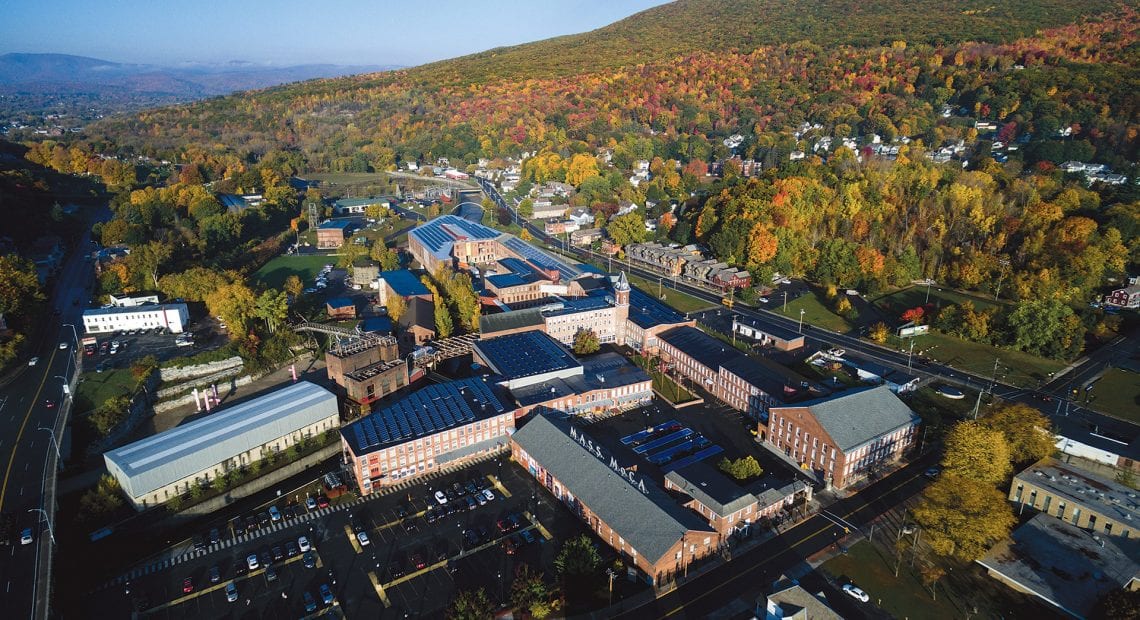
Construction

From Bedside to Job Site

Dorothy Ostrowski says she’s never been happier than she is at the helm of a venerable construction firm.

After more than a decade in nursing, Dorothy Ostrowski says she’s never been happier than she is at the helm of a venerable construction firm.

Dorothy Ostrowski has never settled for having just one ball in the air.

Like the time, a few years ago, when she was building a house with her husband, Mike, while pregnant with their second child, completing a dual master’s degree, and starting a new nursing job.

“Somehow, I don’t know how everything fits on my plate, but it all does,” she told BusinessWest. “One of the biggest things I believe is that anyone’s capable of anything. It’s really how bad do you want it, and how much does it impact you, your life, and your family?”

“One of the biggest things I believe is that anyone’s capable of anything. It’s really how bad do you want it, and how much does it impact you, your life, and your family?”

She had to ask all those questions, plus a few more, when the opportunity arose last April to purchase Adams & Ruxton Construction, a 110-year-old West Springfield company, from its then-owner, family friend Andy Touchette.

With Mike busy running his own company, Amp Electric, it was a decision that rested fully with Dorothy, who had worked in nursing for well over a decade but was intrigued by putting the MBA she earned in 2015 to good use.

He said, ‘what do you think? Do you think you can run it?’” she recalled. “And I was like, ‘you know what? It’s time to do something for me. It’s time to do something for our family. It’s time to do something where I know I have a passion and I can be a good leader.’ So I immediately contacted Andy and said we’re interested.”

Mike had long admired Adams & Ruxton and the work Touchette did there. “I knew it wasn’t a dud. It was all about if the numbers worked and whether or not we could afford it — and whether or not she wanted to run it. That’s how it came to be.”

Once the deal and a transition plan was in place, Dorothy spent the next six months working with Touchette, unpaid, learning every aspect of the business, from contracts and estimating to equipment and planning — “every nut and bolt,” as she put it.

Mike Ostrowski knew enough about his friend’s company

Mike Ostrowski knew enough about his friend’s company — and his wife’s skillset — to know this would be a good fit.

With a diverse range of work, from excavation to commercial buildings, the firm’s recent clients include Chicopee Electric Light, Bank of America, the Diocese of Springfield, Callaway, and Coldwell Banker, among others. The company is also currently being evaluated for woman-owned and veteran-owned certifications, which would open up more doors, especially in the realm of state and federal contracts.

It’s a new adventure for sure, one far different than her career stops to this point would have predicted. For this issue’s focus on construction and architecture, BusinessWest talked with Ostrowski about the many twists in her path, from the roads outside Afghanistan’s capital to emergency departments at area hospitals, to her new task, building a new career — both literally and figuratively.

Joining the Force

Growing up, Ostrowski’s plans were much different than her eventual path into nursing. Specifically, she wanted to be a police officer, eventually studying criminal justice at Holyoke Community College.

Before that, though, at age 17, she signed up with the Army National Guard. A friend had recently joined the service, so she spoke with the same recruiter, who explained the opportunities available in a military police role.

“It was one of those turning points in life, like, ‘what am I going to do with the rest of my life?’” she recalled. After attending boot camp the summer after her junior year, she left for Fort McClellan in Alabama the following year, after her high-school graduation, for what would become a seven-year stint, with stops in Italy, Honduras, Panama, and — most memorably — a nine-month tour in Afghanistan, two years after the 2001 U.S. invasion.

“Wherever I’ve been, we’ve always talked about us opening a business — maybe a daycare for special-needs children or something else. I’ve always had that desire to do more and be more.”

“We did a lot of security stuff in Kabul; we were there to support the rebuilding of the Afghan national army,” she explained. Partway through, she became a chase driver for Gen. Karl Eikenberry, tasked with ‘defensive driving’ to protect the general and others from gunfire and IEDs.

“I’ve had dinner at President [Hamid] Karzai’s palace,” she recalled. “We traveled by Chinooks and Blackhawks with Apache escorts through the mountains, met with warlords, and rode in armored-up Chevy Suburbans with thick, bulletproof glass.”

But her future wouldn’t be in police work — civilian or military. Instead, while taking classes at HCC, she crossed paths with some people who got her interested in medical assisting. After earning her certification in that field and working for a podiatrist, she landed in the Emergency Department of Baystate Medical Center. It was an eye-opening experience.

“That was my first taste of the chaotic world of emergency-room nursing, and I loved it,” she said. “I don’t think you ever get stagnant in that kind of environment. You never know what’s going to come around the corner next, and if you become complacent somewhere, you start to miss things and start to make mistakes. It’s the ever-changing part of it and the constant knowledge. No two patients have the same cookie-cutter symptoms or diagnosis. It’s that constant education that keeps you on your toes.”

She performed well in that environment, and colleagues began suggesting she attend nursing school, which she did, earning an associate degree in nursing at Springfield Technical Community College with help from G.I. Bill benefits, and soon found herself in a new-graduate residency at Baystate.

“But I always wanted more,” she said. “I stayed there long enough to get experience, then I did travel nursing. I saw a lot of different places and different ways procedures are done.”

Ostrowski eventually returned to Western Mass., where she dated, then married Mike, and earned her bachelor’s degree in nursing at Elms College. She took ER jobs at Baystate and Mercy Medical Center, but soon decided she wanted to shift into a less hectic type of job that allowed her more time with family. So she accepted a job with Sound Physicians, a medical process-improvement company, and went back to Elms for a dual master’s degree in nursing and business administration.

“Throughout these transitions, I always wanted more,” she said. “I wanted to be more in a leadership position.”

She found that by buying Adams & Ruxton.

“Wherever I’ve been, we’ve always talked about us opening a business — maybe a daycare for special-needs children or something else,” she said. “I’ve always had that desire to do more and be more.”

After Sound Physicians, she worked at St. Francis Medical Center in Hartford as a process-improvement nurse, and had moved to a role as nurse manager at Connecticut Children’s Hospital when the opportunity arose to buy the construction company.

“I’ve never not been happy as a nurse, and I think I would have potentially stayed in nursing longer had I stayed at the bedside,” she explained. “But I had moved into more of that management piece of nursing, and I constantly struggled with being a nurse’s nurse versus the business of healthcare. It was a difficult internal turmoil to be in, when you know what you want to do through your nurses and patients, but your constraints are based on finances.”

Furthermore, the job was keeping her busy 60 hours a week or more, and she felt she wasn’t home nearly enough to be with her family, especially her older son. “He was struggling to read as a first-grader, and I could have counted on my two hands how many times I was home in time to be able to read to him.”

Time to Change

Something had to give. And her husband could see it, too.

“Between the unhappiness of where she was and having a friend of ours running this [construction] business the past 10 years and how well he’s done, that put it into perspective — ‘hey, it’s just another type of business,’” Mike said. “We’re buying a fully established business that’s completely up and running. All you have to do is go in and replicate what’s going on. You don’t have to build it from the ground up — you can make your changes, you can improve it and grow the business, but in the beginning, all you have to do is replicate it and keep it going.”

“Knowing where to get the answers and knowing to tell someone you don’t know the answer — you get more respect from that than from anything.”

The transition period was important, Dorothy said.

“Andy said he had gotten multiple offers from people he thought would potentially be able to take this business on, but they weren’t the right fit,” she noted. “There’s a certain quality that Adams & Ruxton provides. You have to be the right kind of person who’s going to be there for your clients and your prospective clients. And Andy really wanted to make this a warm handoff. So, the last six months, he made sure he introduced me to all his key clients, and he’s come back in a consultative way; if there’s someone I didn’t meet during those six months, he goes out and meets them with me so they know they’re in the same hands they were before.”

She said the most gratifying aspect of her career move was the fact that Adams & Ruxton’s employees, many of whom have been there more than 20 years, stayed on board when she arrived — and have been a rich resource.

“There’s a constant conversation — if I don’t know something in the construction realm, I have the support system and the knowledge within these walls to ask the questions. I know finances, and I understand how to run the business. I may not know everything there is to know about general contracting, but I know when to say I don’t know, and I know when to ask the questions. I have a great support team.”

Mike agreed. “Knowing where to get the answers and knowing to tell someone you don’t know the answer — you get more respect from that than from anything,” he said.

Both are pleased that business — both at the firm and in the industry as a whole — is healthy right now, Dorothy said. “Our construction rampup this year has started much earlier this year than previous years, so I have no worries about the busy-ness or sustainability.”

It’s a peace she said she began to forge during the period she worked directly with Touchette.

“Over those first six months, there were times I’d never been more sure of something in my career, even as a nurse, and I’ve never been happier than I am now,” she told BusinessWest. “I probably have more stress because I directly impact the livelihoods of the people who work for me, but I’m happier. I enjoy coming to work every day. I enjoy learning new things every day.”

Ostrowski thinks back to other times of transition during her life — like when she missed her graduation from Elms in 2010 because she was delivering her first child — and sees one whirlwind after another, but that suits her just fine.

“I’ve never backed down from a challenge, and I think this is probably the coolest challenge I can embrace, and I will make this successful because I’ve got a great team around me,” she said. “I’m lucky to be where I am right now.”

Joseph Bednar can be reached at [email protected]
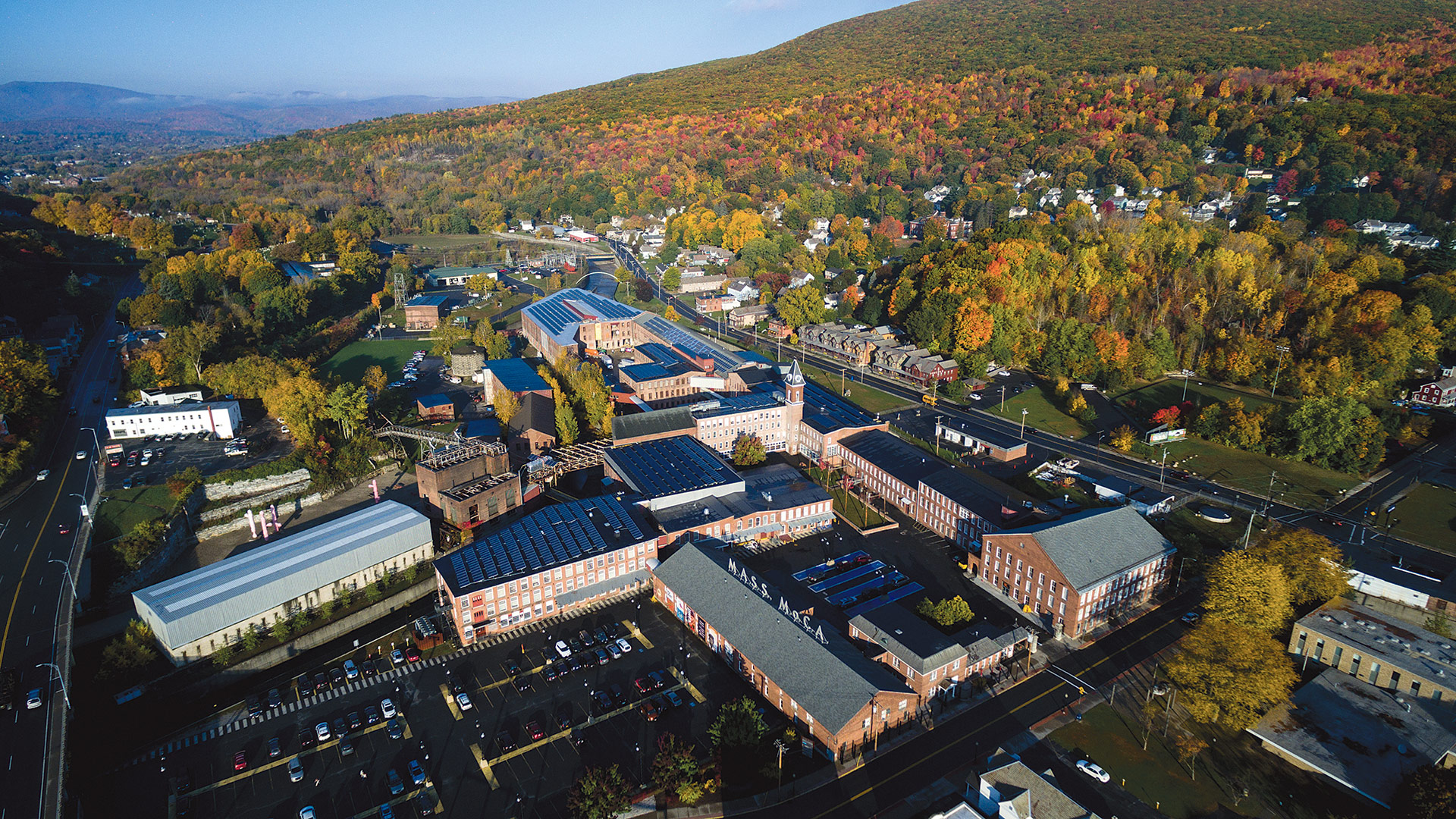
Estate Planning

Retirement-income Planning

By Greg Sheehan

Most working Americans have only one source of steady income before they retire: Their jobs. But when you retire, your income will likely come from a number of sources, such as retirement accounts, Social Security benefits, pensions, and part-time work.

When deciding how to manage your various assets to ensure a steady retirement-income stream, there are two main strategies to consider: the total-return approach and the investment pool — or bucket — approach.

The Total-return Approach

With the total-return approach, you invest your assets in a diversified portfolio of investments with varying potential for growth, stability, and liquidity. The percentage you allot to each type of investment depends on your asset allocation plan, time horizon, risk tolerance, need for income, and other goals you may have.

The objective of your investment portfolio generally changes over time, depending on how close you are to retirement.

• Accumulation phase: During this phase, your portfolio’s objective is to increase in value as much as possible, focusing on investments with growth potential.

• Approaching retirement-age phase: As you near retirement, your portfolio becomes more conservative, moving toward more stable and liquid assets in order to help preserve your earnings.

• Retirement phase: Once you retire, the idea is to withdraw from your portfolio at an even rate that allows you to enjoy a sustainable lifestyle.

A widely quoted withdrawal rate for the first year of retirement has usually been 4%. Ideally, that 4% should be equal to the amount left over after you subtract your yearly retirement income (e.g., pensions, Social Security) from your total cost of living, including investment-management fees. Each year, you will most likely increase your withdrawal percentage to keep up with inflation. Keep in mind, however, that the appropriate withdrawal rate for you will depend on your personal situation as well as the current economic environment.

The Bucket Approach

The bucket approach also begins with a diversified portfolio, following the total-return approach throughout most of the accumulation period. Then, as retirement approaches, you divide your assets into several smaller portfolios (or buckets), each with different time horizons, to target specific needs.

There is no ‘right’ number of buckets, but three is fairly common.

• The first bucket would cover the three years leading up to retirement and the two years following retirement, providing income for near-term spending. It would likely include investments that historically have been relatively stable, such as short-term bonds, CDs, money-market funds, and cash.

• The second bucket would be used in years three through nine of retirement. Designed to preserve some capital while generating retirement income, it would include more assets with growth potential, such as certain mutual funds and dividend-paying stocks.

• The third bucket, designated to provide income in year 10 and beyond, would contain investments that have the most potential for growth, such as equities, commodities, real estate, and alternatives. Although the risk profile of this bucket is typically higher than the other two, its longer time horizon can help provide a buffer for short-term volatility.

As you enter the distribution phase, you draw from these buckets sequentially, using a withdrawal rate based on your specific lifestyle goals in a particular year.

The Big Picture

Many people are familiar with the total-return approach, but the bucket approach has been gaining popularity, thanks in large part to its simplicity. It also accounts for different time periods during retirement, potentially allowing you to allocate money more effectively based on your personal situation.

Perhaps the greatest benefit of the bucket approach is that it can help provide a buffer during times of market volatility. If the value of the investments in buckets two and three fluctuates due to market conditions, your immediate cash income is coming from bucket one, which is likely to be less volatile. This may also alleviate the need to sell investments that have lost money in order to generate retirement income.

While the bucket approach has its advantages, some investors feel more comfortable using the total-return approach. The best strategy for your retirement is unique to you and your personal preferences and needs. However you choose to pursue your retirement dreams, it’s important to work with a financial professional who can help you create the most appropriate strategy based on your goals and situation.

Note that diversification does not assure against market loss, and there is no guarantee that a diversified portfolio will outperform a non-diversified portfolio. 

Greg Sheehan is an accredited investment fiduciary and partner at the Wealth Transition Collective, a Northampton-based financial-advisory and planning firm. The firm offer securities and advisory services as a registered representative and investment adviser representative of Commonwealth Financial Network, Member FINRA/SIPC, a registered investment adviser; (413) 584-1805; [email protected]

Estate Planning

Now Is the Time to Plan

By Gina Barry

In recent times, many committed couples are choosing not to get married, especially if they have been previously divorced or widowed.

Gina Barry

By Gina M. Barry, Esq.

Although these couples are not married, many present themselves as a married couple. They live together, while sharing their assets and debts. While this arrangement may allow the happy couple to live in bliss while each partner is alive and well, trouble begins when one of the partners loses their competency or passes away.

Your partner does not have the same legal rights as would your spouse. In fact, their legal rights are usually no more than a stranger would have. Fortunately, with proper planning, an unmarried partner can be provided with some legal rights.

The first potential issue to be addressed is incapacity. If you lose your capacity, your partner will have no power to handle your financial affairs unless you have executed a valid durable power of attorney. This is a document in which you designate someone to make financial decisions for you. At a minimum, naming your partner in this document will allow your partner to pay bills, manage real property and other assets, and deal with government agencies, such as MassHealth.

Similarly, if you lose your capacity, your partner will have no power to make medical decisions for you unless you have executed a valid healthcare proxy, a document in which you designate someone to make healthcare decisions for you in the event that you are incapacitated and unable to make your own healthcare decisions. Language addressing your end-of-life decisions, which is known as a living will, is normally included within the healthcare proxy.

This language usually states that you do not want extraordinary medical procedures used to keep you alive when there is no likelihood that you will recover. Having a living will in place lets loved ones know your wishes and should reduce conflict should such a situation arise.

“Although these couples are not married, many present themselves as a married couple. They live together, while sharing their assets and debts. While this arrangement may allow the happy couple to live in bliss while each partner is alive and well, trouble begins when one of the partners loses their competency or passes away.”

Further, if you have not properly planned your estate and you pass away, you may unintentionally disinherit your partner. Your probate estate consists of any assets held in your name alone at the time of your passing that do not have a designated beneficiary. When you die without a will, the heirs at law of your probate estate are your spouse and your blood relatives. As your partner is neither your spouse nor a blood relative, your partner would not receive any assets from your probate estate if you die without a will.

While your partner may receive assets held jointly with you or the assets on which you have named your partner as beneficiary, your partner will not receive anything from your probate estate unless you have a last will and testament naming your partner as your beneficiary. Another reason to establish a will is so that you may name your partner as the personal representative of your estate, which will give your partner the authority to handle your estate for you.

If you have a taxable estate, which at the present time in Massachusetts means an estate greater than $1 million, you will not be able to take advantage of estate-tax laws that favor married couples. The unlimited marital deduction allows a deceased spouse to leave assets of any amount to the surviving spouse without having to pay any estate tax. Since this deduction may be taken only with respect to assets left to a surviving spouse, it is not available to your estate if you leave assets to a partner.

As such, it may be necessary for you to address your tax issues in other ways, such as by gifting, using the annual gift-tax exclusion of $15,000 per person in 2019, or by establishing an irrevocable trust that owns life insurance meant to replace the wealth that will be lost on estate tax.

Even though you may have committed to your partner, if you have not taken the legal steps necessary to protect your partner’s interests should you lose your capacity or pass away, you have overlooked a very important aspect of your relationship.

Once you have lost your capacity or passed away, it is too late to protect your partner. For the love of your partner, plan now, and ensure their legal rights.

Gina M. Barry is a partner with the law firm Bacon Wilson, P.C.. She is a member of the National Assoc. of Elder Law Attorneys, the Estate Planning Council, and the Western Mass. Elder Care Professionals Assoc. She concentrates her practice in the areas of estate and asset-protection planning, probate administration and litigation, guardianships, conservatorships and residential real estate; (413) 781-0560; [email protected]

Law

Attention to Details Matters

By Timothy Netkovick, Esq.

As attorneys, we often hear comments like these: ‘we don’t need you to draft our handbook, we got one online,’ or ‘we got one from a third party.’

We also hear the same thing about employee trainings: ‘we don’t need an attorney to do our employee trainings; our HR department conducts our trainings,’ or ‘we’re having an outside contractor conduct the trainings.’

I could go on for hours talking about the importance of up-to-date employment trainings and making sure your employment policies are concise, to the point, and tailored to your company. But a recent case from Maine underscores this point better than I could.

By now you may have heard about the so-called ‘Oxford comma case,’ more formally known as O’Connor v. Oakhurst Dairy, which was filed in the U.S. District Court for the District of Maine. In the case, employees of Oakhurst Dairy filed suit against their employer alleging they were due unpaid overtime pay.

Timothy M. Netkovick

Timothy M. Netkovick

Oakhurst Dairy claimed that it did not have to pay overtime wages due to a qualifying exemption in the Maine overtime law. The entire case boiled down to the placement of a comma in the Maine overtime law. If Oakhurst Dairy was correct, it would incur no further expenses other than the time, expense, aggravation, and attorney’s fees incurred in defending the case. If the employees were correct, that meant that Oakhurst Dairy was in violation of the Maine overtime law, and could have had to pay the employees a substantial sum of money.

The case has reportedly settled for $5 million, an extremely hefty sum to pay based upon differing interpretations of the placement of a comma.

While the Oxford comma case dealt with the interpretation of a law, the lesson for employers is simple — attention to detail matters. In this age of cost cutting in HR departments and legal departments (both in-house counsel and the use of outside counsel), providing trainings for employees and having clear, concise employment policies can save your company immeasurably in the long run.

The Oxford comma case shows that even misplaced or missing punctuation could end up costing your company dearly. Trained legal counsel can provide comprehensive training that will help guide your employees, aid in defending your company in the event of litigation, and also review your handbook policies and give quality advice regarding updates that may be needed in the ever-changing world of employment law.

Holding off on trainings and handbook updates may save your company money in the short term; however, doing so invites the risk of unnecessary litigation based upon both naïve employees and outdated policies. Litigation can last for several years and can be a tremendous drain on your company, not only in terms of legal fees, but also in business disruption caused by the need to gather documents and comply with other discovery requests, including employee depositions.

A company’s managers are its first line of defense. Having regular trainings can help your managers identify potential issues and resolve them before the situation gets out of control. Likewise, having an annual review of your employee handbook can help ensure that all of your company’s policies are up to date and in compliance with applicable laws.

As the old saying goes, an ounce of prevention is worth a pound of cure.

Timothy M. Netkovick, an attorney at Royal, P.C., has more than 15 years of litigation experience, and has successfully tried several cases to verdict. In addition to his trial experience, he has specific experience in handling labor and employment matters before a variety of administrative agencies. He also assists employers with unionized workforces during collective bargaining, at arbitrations, and with respect to employee grievances and unfair labor practice charges; (413) 586-2288; [email protected]

Technology

Attack the Problem

By Sean Hogan

Over the course of my time as a business owner, I’ve been asked many times, ‘what keeps you up at night?’

In the early days, I would have said ‘payroll, employees, and sales,’ and maybe not necessarily in that order. Today my answer would be ‘cybersecurity.’

As things have advanced in technology, the web, connectivity, and social media, we have created an easy avenue to our data. Our exposure to hacking is one port away on your firewall, and in some cases, someone may have already breached that firewall.

Security practices in the past do not hold up to complex hacking attacks that are constantly barraging the internet. It used to be adequate to have complex passwords and updated computers with all the patches and security updates. The hackers have concentrated on the lowest-cost and easiest way to infect your computers.

Sean Hogan

Sean Hogan

In most cases, it’s a phishing attack. Phishing attacks are e-mails disguised as a reputable company with a clickable link or some embedded malware. The cyberthieves send out thousands of these attacks and lie in wait until some innocent victim opens the e-mail and clicks on the link or attachment. The malicious robot servers automatically churn out these e-mails, and before they know it, their device and network are infected.

Many of these attacks are designed to install ransomware or access all your critical data. The ransomware will lock down the machine and encrypt your data. They will contact you and request bitcoin to then release your data. Some hackers will pull your data, including contacts and personal information, and post or sell your data to the dark web.

Hacking has evolved greatly within the past few years. In the early days, we would receive a letter from the Nigerian prince, looking to transfer $7 million to you just for good measure. Modern-day hacks and phishing e-mails are very complex; they quite often mimic FedEx, UPS, and customer e-mails so you are more prone to click on the bait.

“As things have advanced in technology, the web, connectivity, and social media we have created an easy avenue to our data. Our exposure to hacking is one port away on your firewall and in some cases, they may have already breached that firewall.”

The most successful program to prevent phishing attacks is training. There are several services that offer security-awareness training (SAT). When you sign up for this type of training, you will be taught what to look for in phishing e-mails and how to respond. The SAT will also include a ‘fake attack’ so you can measure the results at your business and use it as a teaching aid to prevent against future attacks.

Businesses need to embrace a cybersecurity strategy. There are three categories to cybersecurity: Protect, detect, and respond.

Protect

Ask yourself, do you lock your car? Do you lock your front door? Think of your connection (router) as your front door to the web.

Securing this device is the first step in preventing hackers from getting in. Not only should you have the best-in-class router, you also need to maintain the patches and security updates, so the unit does not fall to the constant attacks from the internet.

Beyond the firewall, you need to secure your ethernet switches and your wireless access points. Access points are an easy target for rogue hackers; they often log into a weakly secured access point, and once they have entered, they can navigate your entire network.

Most often, malicious attacks are delivered via e-mail. Logically, it is critical to have very updated anti-spam software, as well as antivirus and malware protection.

It is also critical to have current backups; best practices recommend a full on-site backup with a virtual cloud backup. It is crucial to know that your backups are tested; if you are backing up corrupted data, then your backups are useless.

Detect

Early detection can save lots of time and potential loss of data. Most breaches are not detected for more than 100 days after the breach. Once you detect a breach, you can contain and react to that breach. This begs the obvious question: how can you detect a breach?

There are several ways to go about detecting a breach within your system. First is to engage in a dark-web monitoring service. These services have ‘crawlers’ that are constantly scanning the dark web. They will scan your company and your personal information. When they find your data on the dark web, the service will alert you and let you know what that information is and where it came from, but don’t get your hopes up; you cannot remove your information once it is on the dark web. For instance, LinkedIn was breached more than 10 years ago, and if you had a LinkedIn account in that time frame, your username and password are available on the dark web.

Respond

It’s not a matter of if, but when you are a victim of a cyberattack. Rapid response to a breach or infection is critical, and the faster you respond, the faster it will reduce your exposure. In some cases, you will need a support team to assist in cleansing machines, loading backups, and scanning your network.

The proactive approach is to engage a security operations center. This is a team of security professionals that will monitor your network and device. In the case of an infection or breach, the team will jump into recovery mode and secure your data.

Bottom Line

Above all, it’s important to stress that cybersecurity is more of a culture than a service. Cyberattacks cannot be prevented, but they can be avoided by having the proper procedures and training. Cybersecurity requires awareness and the ability to eliminate your personal and company exposure. All the tools in the world won’t prevent someone from clicking on malware in an e-mail. It is important for a company to have a stable cybersecurity policy and program in place.

Don’t wait until you are hacked to implement a cybersecurity prevention and awareness program.

Sean Hogan is president of Hogan Technology, a full-service managed IT, structured cabling, and cloud-services provider; (413) 779-0079.

Features

Using Brand Journalism

By John Garvey

Do you want to know what strikes fear in every marketing manager? It’s when someone from C-level walks in their office and asks, “hey, can you get this into the newspaper? Better yet, call the TV stations and have them come by for an interview.”

Sure, if you have a crisis (e.g., your CEO is being led out of the building in handcuffs or one of your employees stole money from a customer), you will have the media at your door. But this column is not going to be dedicated to crisis management. Instead, let’s focus on when you have good news. How do you get the good word out when the mainstream media these days is pretty much focused on dumpster fires?

Let’s look at the problem first. You are part of it. You and a lot of other people are not buying the newspaper anymore. Don’t even get me started on how much time you’re spending on Facebook rather than watching your local news. Here’s a shocker: media is a business, and because they have shed an incredible numbers of eyeballs, not to mention subscribers, a lot of them are having a tough time making a go at it. The first thing that gets cut under this immense pressure is reporters. The second thing is your good news story.

Where do you go with your good news story? Take heart; the answer is right in front of you. Here is a hint: the first word in PR is ‘public.’ Second word is ‘relations,’ of course. That’s it. Nobody put the word ‘media’ in there. Back in the day, media was the way you connected with the public. But, being back in the day, you had access to probably two papers (a morning paper and an evening paper) and three television stations. That black-and-white existence was a long time ago, so it is time to throw out most of the promotional tools we used back then as well.

“What is good brand journalism? You need to tell a story about something you are proud of and why, and do it without using the words ‘proud,’ ‘proudly,’ or ‘check it out.’”

The good news? Connecting with the public, your public, has never been easier. That is where brand journalism comes in.

Brand journalism, in today’s digital world, is very powerful. However, with great power comes great responsibility. Your good news has to be relevant to your audience. That relevance is not judged by you, it is judged by your target audience. If you were the king or queen of relevance, then you could post all day about how proud you are to support this or that. You would use #proud and probably an image of you giving some organization a big check. Or, you would simply start your lead sentence with “check it out,” and your audience, of course, would gobble up your good news. But, alas, you are not the king or queen, and “proudly proud/check it out” is not brand journalism.

Here is another news flash. Machines run the digital world. If your audience doesn’t like your content, chances are the machines won’t either. Quite simply, if you are relevant in your audience’s eyes, they will click, read, spend time on your page, and maybe share, and all that will be observed by the machines. They will then help your content to travel to even more eyeballs. Sure, I know, you can boost (pay to promote) “proudly proud/check it out” news, but that just means you’re shoving that content into your audience’s face. Ever try to get a toddler to eat creamed corn? It’s a mess.

What is good brand journalism? You need to tell a story about something you are proud of and why, and do it without using the words ‘proud,’ ‘proudly,’ or ‘check it out.’ If you’re supporting a cause, tell the story of that cause and why it is important to the community. That is a story that gets read and shared. You can also have employees tell stories about how and why they feel they make a difference in the community and or in the lives of their customers. If these stories are authentic, they also will pass the relevance smell test.

It doesn’t end with just causes and good deeds. You can tell stories about products and services. ‘Check out our products’ is not a story. On the other hand, digital audiences relish how-to’s, so how to use your product or service to do something they want to do is a subject that is meaningful. If you are in business, you are an expert at something, so try to think of how your product or service improves your customers’ lives. That style of content, sometimes referred to as content marketing and a cousin of brand journalism, can be very effective.

Here is where the fun starts: you don’t have to write all this stuff. You can use video. I know, video is so scary, and cameras have been proven to make people sound stupid. Find someone who can talk on a subject and ask them to do the video. The internet loves video. Google loves video. Search-engine optimization (SEO) loves video. You need video. I’m not kidding … run out and start videotaping right this second. Then throw it away and get a pro to help you.

This content in its full form should live on your website. You do want to pay for dissemination of both your brand journalism and content marketing. Using social-media marketing or Google Ads gives you tremendous reach and targeting power and it is very affordable. Your plan should be to promote this content to your target audience and lead them back to your website for consumption. That, of course, is where the sales funnel starts, and should you have Google Analytics on your site, you can observe their behavior once they get there (traffic, unique visitors, time on page, migration to other pages, etc.).

Oh, one last thought. Those of you who are smartypants already know that this article is an example of what I was talking about: brand journalism and content marketing.

John Garvey is president of GCAi — Digital Marketing Innovation; (413) 736-2245; [email protected]

Education

The Face of a Changing Landscape

Hampshire College President Miriam Nelson

Hampshire College President Miriam Nelson

As high-school graduating classes continue to get smaller and the competition for those intensifies, many smaller independent colleges are finding themselves fighting for their very survival. One of them is Hampshire College in Amherst, which, because of its unique mission, alternative style, and famous alums (including Ken Burns), has in many ways become the face of a growing crisis.

Miriam Nelson says she became a candidate to become the seventh president of Hampshire College — and accepted the job when it was offered to her last April — with her eyes wide open, fully aware of the challenges facing that Amherst-based institution and others like it — not that there are many quite like Hampshire.

Then she clarified those comments a little. She said she knew the school was struggling with enrollment and therefore facing financial challenges — again, as many smaller independent schools were and still are. But she didn’t know just how bad things were going to get — and how soon.

She became aware through a phone call on May 2 from the man she would succeed as president of the school, Jonathan Lash.

“He let me know that our target number for enrollment this year was significantly lower than what was expected; I think he knew, and I knew, at that time that my job this year was going to be different than what I’d planned,” she recalled, with a discernable amount of understatement in her voice.

Indeed, with that phone call — and the ensuing fight for its very survival — Hampshire became, in many ways, the face of a changing landscape in higher education, at least in the Northeast.

That’s partly because of the school’s unique mission, alternative style, and notable alums such as documentary filmmaker Ken Burns. But also because of heavy media coverage — the New York Times visited the campus earlier this month, one of many outlets to make the trip to South Amherst — and the fact that the school is really the first to carry on such a fight in an open, transparent way.

In some ways, Hampshire is unique; again, it has a high profile, and it has had some national and even international news-making controversies in recent years, including a decision by school leaders to take down the American flag on campus shortly after the 2016 election, while students and faculty members at the college discussed and confronted “deeply held beliefs about what the flag represents to the members of our campus community,” a move that led veterans’ groups to protest, some Hampshire students to transfer out, and prospective students to look elsewhere.

But in most respects, Hampshire is typical of the schools now facing an uncertain future, said Barbara Brittingham, president of the New England Commission of Higher Education (NECHE), adding that those fitting the profile are smaller independent schools with high price tags (tuition, room, and board at Hampshire is $65,000), comparatively small endowments, and student bodies made up largely, if not exclusively, of recent high-school graduates.

That’s because high-school graduating classes have been getting smaller over the past several years, and the trend will only continue and even worsen, said Brittingham, citing a number of recent demographic reports.

Meanwhile, all schools are confronting an environment where there is rising concern about student debt and an increased focus on career-oriented degrees, another extreme challenge at Hampshire, where traditional majors do not exist.

“He let me know that our target number for enrollment this year was significantly lower than what was expected; I think he knew, and I knew, at that time that my job this year was going to be different than what I’d planned.”

None of these changes to the landscape came about suddenly or without warning, said Brittingham, noting that the storm clouds could be seen on the horizon years ago. Proactive schools have taken a variety of steps, from a greater emphasis on student success to hiring consultants to help with recruiting and enrollment management.

But for some, including several schools in New England, continued independence and survival in their original state was simply not possible. Some have closed — perhaps the most notable being Mount Ida College in Newton, which shut down abruptly two months before commencement last spring — while others have entered into partnerships, a loose term that can have a number of meanings.

In some cases, it has meant an effective merger, as has been the case with Wheelock College and Boston University and also the Boston Conservatory and the Berklee College of Music, but in others, it was much more of a real-estate acquisition, as it was with Mount Ida, bought by UMass Amherst.

What lies ahead for Hampshire College is not known, and skepticism abounds, especially after the school made the hard decision not to admit a full class for the fall of 2019. But Nelson remains optimistic.

An aerial photo of the Hampshire College campus

An aerial photo of the Hampshire College campus, which has been in the national media spotlight since it was announced that the school was looking to forge a partnership with another school in order to continue operations.

“Hampshire has always been innovative, and we’re going to do this the ‘Hampshire way,’” she said during an interview in the president’s off-campus residence because her office on the campus was occupied by protesting students. “We’re thinking about our future and making sure that we’re as innovative as we were founded to be. We need to make sure that our financial model matches our educational model.”

For this issue and its focus on education, BusinessWest talked with Nelson and Brittingham about the situation at Hampshire and the changing environment in higher education, and how the school in South Amherst has become the face of an ongoing problem.

New-school Thinking

Those looking for signs indicating just how serious the situation is getting within the higher-education universe saw another one earlier this month when Massachusetts Gov. Charlie Baker filed legislation to strengthen the state’s ability to monitor the financial health of private colleges.

“Our legislation will strengthen this crucial component of our economy, but most importantly, it will help protect students and their families from an abrupt closure that could significantly impact their lives,” Baker said in a statement that was a clear reference to the Mount Ida fiasco.

The bill applies to any college in Massachusetts that “has any known liabilities or risks which may result in imminent closure of the institution or jeopardize the institution’s ability to fulfill its obligations to current and admitted students.”

And that’s a constituency that could get larger in the years and decades to come, said Brittingham, adding that demographic trends, as she noted, certainly do not bode well for small, independent schools populated by recent high-school graduates.

She cited research conducted by Nathan Grawe, author of Demographics and the Demand for Higher Education, which shows that, in the wake of the Great Recession that started roughly 11 years ago, many families made a conscious decision to have fewer children, which means the high-school graduating classes in the middle and end of the next decade will be smaller.

“Things are going to get worse around 2026,” she said. “The decline that is there now will only get more dramatic, especially in New England.”

As noted earlier, Nelson understood the landscape in higher education was changing when she decided to pursue a college presidency, and eventually the one at Hampshire, after a lengthy stint at Tufts and then at the University of New Hampshire as director of its Sustainability Institute.

She told BusinessWest that Hampshire offered the setting — and the challenge — she was looking for.

“Hampshire was the one where I thought there was the most opportunity, and the school that was most aligned with more core values and my interests,” she explained, adding that she was recruited by Lash for the post. “This school has always been inquiry-based, and I always like to start with a question mark. To be at Hampshire means you have to have imagination and you have to be able to handle ambiguity when you have an uncertain future; that’s one of the hallmarks here at Hampshire.”

Imagination is just one of the qualities that will be needed to help secure a solid future for the school, she acknowledged, adding that, while the current situation would be considered an extreme, the college has been operating in challenging fiscal conditions almost from the day it opened in 1970 — and even before that.

“We started out under-resourced, and we’ve had different moments during almost every president’s tenure where there were serious concerns about whether the college could continue,” she said. “We’ve always been lean, but we’ve managed.”

Barbara Brittingham

Barbara Brittingham

“Things are going to get worse around 2026. The decline that is there now will only get more dramatic, especially in New England.”

However, this relatively thin ice that the college has operated on became even thinner with the changing environment over the past several years, a climate Nelson put in its proper perspective.

“Higher education is witnessing one of the most disruptive times in history, with decreasing demographics, increased competition for lower-priced educational offerings, and families demanding return on investment in a college education in a short period of time,” she told BusinessWest. “There’s a lot of factors involved with this; it is a crisis point.”

A crisis that has forced the college to reach several difficult decisions, ranging from layoffs — several, effective April 19, were announced last month involving employees in the Admissions and Advancement offices — to the size and nature of the incoming class.

Indeed, due to the school’s precarious financial situation — and perhaps in anticipation of the governor’s press for greater safeguards against another Mount Ida-like closing, Hampshire has decided to admit only those students who accepted the school’s offer to enroll via early admission and those who accepted Hampshire’s offer to enroll last year but chose to take a gap year and matriculate in the fall of 2019.

Nelson explained why, again, in her most recent update to the Hampshire community, posted on the school’s website, writing that “our projected deficit is so great as we look out over the next few years, we couldn’t ethically admit a full class because we weren’t confident we could teach them through to graduation. Not only would we leave those students stranded — without the potential for the undergraduate degree they were promised when they accepted Hampshire — we would also be at risk of going on probation with our accreditors.”

Hampshire College is just one of many smaller independent schools

Hampshire College is just one of many smaller independent schools challenged by shrinking high-school graduating classes and escalating competition for those students.

While reaching those decisions, leaders at the college have also been working toward a workable solution, a partnership of some kind that will enable the school to maintain its mission and character.

Ongoing work to reach that goal has been rewarding on some levels, but quite difficult on all others because of the very public nature of this exercise, said Nelson, adding that her first eight months on the job have obviously been challenging personally.

She said the campus community never really got to know her before she was essentially forced into crisis management.

And now, the already-tenuous situation has been compounded by negativism, criticism (Nelson has reportedly been threatened with a vote of no confidence from the faculty), and rumors.

“There’s a lot of chaos and false narratives out there,” she explained. “So I’ve been working really hard both in print and in many assemblies and meetings to get accurate information out. This is a world with lots of false narratives and conspiracy theories; we heard another one yesterday — they’re really creative and interesting. I don’t know how people think them up.”

Textbook Case?

As she talked about the ongoing process of finding a partnership and some kind of future for Hampshire College, Nelson said she’s received a number of phone calls offering suggestions, support, and forms of encouragement as she goes about her work in a very public way.

One such call was from a representative of the Mellon Foundation.

“He said he’s never seen a college do this in a transparent way like we are,” she said. “He’s right, and when you’re doing it in real time, and transparently, it’s going to be clunky; it’s not like you’ve got every detail worked out and figured out right at the very beginning. We’re doing the figuring out in a public way and engaging with the community and our alums and the broader community and the higher-ed community as we do this.

“It’s a very different way to do it, and no one has ever done it; it is a very Hampshire way,” she went on. “But that makes it really hard, and I can see why every other president who has been in this place has not done this in an open way. I understand it.”

Miriam Nelson

Miriam Nelson says Hampshire College is determining the next stage in its history in real time, which means the process will be “clunky.”

Elaborating, she said there are no textbooks that show schools and their leaders how to navigate a situation like this, and thus she’s relying heavily on her board (in the past, it met every quarter; now it meets every week), the faculty, students, and other college presidents as she goes about trying to find a workable solution.

And there are some to be found, said Brittingham, adding that several effective partnerships have been forged in recent years that have enabled both private and public schools to remain open.

Perhaps the most noted recent example is Wheelock and Boston University, although it came about before matters reached a crisis level.

“Wheelock looked ahead and felt that, while they were OK at that moment, given the trends, given their resources, and given their mission, over time, they were going to be increasingly challenged,” she explained. “So they decided that sooner, rather than later, they should look for a partner, which turned out to be Boston University, which Wheelock essentially merged into.

“That’s seen as a good arrangement, it was handled well, and they were able to preserve the name of the founder in the Wheelock College of Education and Human Development at Boston University,” she went on. “They were able to transition a large number of faculty and staff to Boston University, it was geographically close … it’s been a smooth transition.”

Another partnership that fits that description is the one between two small public colleges in Vermont — Johnson State College and Lyndon State College.

“They had compatible missions — one of them was more liberal-arts-oriented, and the other was more focused on career programs — so they merged and became Northern Vermont University,” she said, adding that the merger allows them to share central services and thus gain efficiencies in overall administration.

Whether Hampshire can find such an effective working arrangement remains to be seen, but Nelson takes a positive, yet realistic outlook.

“I continue to be optimistic because Hampshire is an exceptional place with a great reputation,” she said. “But it’s not easy facing layoffs and things like that. But I believe this year, 2019, will be the toughest year, and then things will get better.”

Charting a New Course

Time will tell whether this projection comes to pass.

The decision not to admit a full class for the fall of 2019 is seen by some as a perhaps fateful step, one that will make it that much harder to put the college on firmer financial ground moving forward.

But Nelson, as noted, is optimistic that the ‘Hampshire way’ will yield what could become a model for other schools to follow in the years and decades to come, as the higher-education landscape continues to evolve.

George O’Brien can be reached at [email protected]
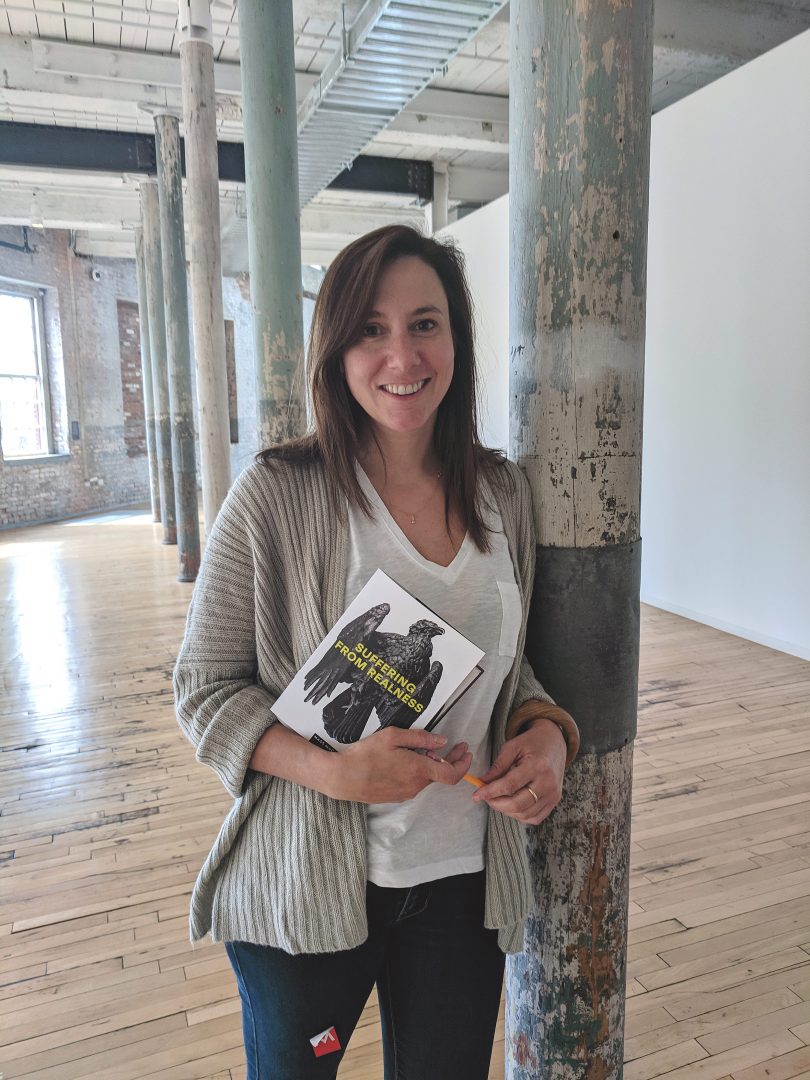
Home Improvement

Total Transformations

With the economy chugging along, home-improvement businesses report solid activity over the past few years, with the prospect of more to come. Locally, perhaps partly because of a relatively mild December and January, companies logged more customer calls during a time of year when homeowners traditionally want to hibernate. Now, on the cusp of spring, they’re ready to hit the ground running.

If there’s one thing R.J. Chapdelaine is grateful for, it’s changing tastes in home design.

Take, for example, the current trend — one that has been building over the past decade or two — of open floor plans.

“People seem to want to open up the kitchen to family room space, open the kitchen to dining room, and create that open floor plan. That, I think, is what we see the most, taking someone’s compartmentalized house and opening it up,” said Chapdelaine, owner of Joseph Chapdelaine & Sons in East Longmeadow.

“You see the center-hall Colonial with a dining room, living room, and kitchen, and we go in and open up the walls,” he continued. “I say, thank God my grandfather and my father built them the way they did. Now I can go in and open them up. It’s job security. And you watch — someday down the road, it’ll go back.”

Whatever the trends and the homeowner’s personal tastes, the home-improvement industry has been riding a wave for some time now.

According to the Home Improvement Research Institute (HIRI), the market for home-improvement products and materials grew by 6.3% in 2018 after a 7.3% jump in 2017. Breaking it down further, the professional market increased by 9.9% last year, while the consumer market saw a sales increase of 4.7%. That trend is expected to slow slightly over the next three years, but still increase by an annual average of 4.2% through 2022.

“What I’ve seen is a very strong push for kitchens and baths, additions, and remodels,” Chapdelaine said. “That seems to be our strongest portion of the business right now. The new homes have slowed for us considerably, but the kitchen, bath, and addition calls have been very strong, straight through the winter.”

“The new homes have slowed for us considerably, but the kitchen, bath, and addition calls have been very strong, straight through the winter.”

That’s somewhat surprising because normally calls slow through December, January, and February, he added. “Over the years, we’ve come to the conclusion that people really don’t want us in their house around the holidays. But this year, it’s been incredibly strong right through the winter months, which is great. As we gear up for spring, there’s a lot of work on the board. Usually we would be expecting the phone to ring now in anticipation of a good spring start, but it’s been ringing throughout the winter.”

Frank Nataloni, co-owner of Kitchens & Baths by Curio in Springfield, has also seen a busier-than-usual winter, perhaps because the snowfall has not been too onerous.

“We’re a year-round operation, but it really depends on the type of winter we have,” he said. “If we have a mild winter, what happens is demand ends up being spread out, and we see a bit more people through the winter. When the weather is really bad, nobody goes outside. Either way, spring is always the strongest time from a sales standpoint.”

According to the Project and Sentiment Tracking Survey conducted by HIRI toward the end of 2018, which queries adults across the U.S. about their planned home-improvement projects, outdoor living spaces will feature the most activity in the next three months. More than one-quarter of homeowners surveyed indicated they will take on lawn and garden and/or landscaping projects during this time.

R.J. Chapdelaine

R.J. Chapdelaine says the region’s older housing stock and demographic changes have contributed to a strong remodeling business in recent years.

Taking all types of projects into consideration, inside and out, the Northeast and South lead the way, with about two-thirds of homeowners in both regions saying they plan home-improvement projects this spring.

Meanwhile, whether homeowners shoulder the work themselves is relatively dependent on the project type. On average, a little more than half of all projects are of the DIY variety — and of those, many involve outdoor living spaces, with 82.6% of homeowners tackling landscaping projects.

“I have to say, people feel confident, and they’re willing to spend money on their house,” Chapdelaine said. “It seems as though people are upbeat, and we’re reaping the phone calls and the benefits of that consumer confidence.”

Trending Topics

HIRI reports that, nationally, the home-improvement products market continues to outperform many other sectors of the economy. At the organization’s 2018 Industry Insights Conference last fall, experts in the sector shared what they felt were some prevailing trends heading into 2019. Among them:

• DIYers are more likely to be Millennials, which may have to do with that generation’s connection to devices. “DIYers spend more than 60 hours per week on TV and digital devices, including computers and smartphones,” Peter Katsingris, senior vice president of insights at Neilsen, told conference attendees, according to Forbes. “The technology and the choices it provides make DIY a realistic option for people.”

• More than one-third of homeowners who completed a home-improvement project in the past year regret not spending more on the project.

• The rental housing market is on the rise. A wave of growth has increased the number and share of rental households in the U.S., especially higher-end rentals in urban areas. This reality could lead to greater interest in portable and free-standing home-improvement products tenants can take with them when they move, as opposed to permanent fixtures.

• With home wellness on the rise, the lighting industry has been coming up with intriguing options. A technology known as circadian rhythm lighting is one rising trend, producing indoor illumination that more closely matches natural light in its warmth and, paired with home automation, can shift through the day with the sun to ease the impact of artificial light on the human body.

• Finally, remodeling activity isn’t slowing down anytime soon, due in part to an aging housing stock. With home prices increasing and new construction harder to find in some areas of the country, people are staying put and remodeling. “With the existing house stock averaging 38 years old, much of the inventory is in need of updating,” Mark Boud, senior vice president and chief economist at Hanley Wood/Metrostudy, told the conference.

That aging stock is an especially relevant reality in Western Mass., but so is another trend boosting the remodeling market: an increasing desire among Baby Boomers to age in place.

This recent remodeling project by Kitchens by Curio

This recent remodeling project by Kitchens by Curio reflects some current trends in kitchens, particularly its color palette dominated by white and grey.

“We’re seeing more aging in place, and we’re seeing that as a reason people are making changes,” said Lori Loughlin, manager of Frank Webb Home in Springfield. “They’re doing what they can to make sure they stay in their homes as long as possible because they feel like it’s a better option.”

In some cases, that means installing mobility and safety equipment, but in others, it means building in-law suites, or even moving to — by either building or remodeling — a smaller house.

“We’re getting phone calls now for people looking to to downsize,” Chapdelaine said. “I think the Baby Boomers are going to be looking for that smaller house and aging in place.”

Style Points

As for interior styles, those haven’t shifted much over the past couple of years. Painted cabinetry finishes and color palettes dominated by white and grey are still popular in kitchens and bathrooms, Nataloni told BusinessWest. “I just did a process of cherry wood with a black finish rubbed off, and the cherry comes through the black. It’s spectacular, actually.”

Styles change, he noted, but they don’t change abruptly. “White is very popular, grey is popular, but we are starting to see other colors, hints of yellow and green, coming in. I’ll be doing a yellow kitchen — not school-bus yellow, a very pale yellow, but a very warm color.”

“We’re seeing more aging in place, and we’re seeing that as a reason people are making changes. They’re doing what they can to make sure they stay in their homes as long as possible because they feel like it’s a better option.”

Chapdelaine reported similar, gradual movement toward color, but mainly pastels and muted colors, not too much that would be characterized as bold. “We’re still seeing a lot of white cabinetry and floors stained a number of different colors. With surfaces, we’re still running strong in quartz — some granites, but mainly quartz.”

The most important trend, of course, is that the home-improvement business as a whole remains strong.

“We’re seeing everything from full bathroom jobs to kitchens with the walls removed, right up to additions, which are ranging from family rooms to master suites,” he said. “We’re seeing more whole-house updates — painting, hardwood floors, that kind of work — and we’re also seeing whole-house remodels, which is very similar to building a house. You’re gutting the house down to the bare studs, going through and doing a new bathroom, new kitchen, new flooring, new drywall, which is kind of nice.”

He expects spring to bring its usual rush of customer inquiries as the weather continues to improve, but said people looking to get into the queue for the spring should really be calling in February and March.

Nataloni agrees, and says he appreciates the fact that, with the economy performing fairly well, homeowners are investing more money in their living space, whether they plan to stay there for a long time or improve the house’s dated look in preparation to sell it.

“We have a lot of older housing stock around here,” he said. “Wherever you go, you see someone working on their house.”

Joseph Bednar can be reached at [email protected]

Insurance

Shelter from the Storm

In the insurance world, an umbrella policy is exactly what it sounds like, sitting atop home, auto, and business insurance coverage and providing excess protection against liability risks. What is less clear, area insurance experts say, is why more people don’t avail themselves of this relatively inexpensive vehicle. After all, life’s storms can strike at any time, and when they do, no one wants to be totally exposed.

Even the best intentions can’t always fend off an expensive lawsuit, said John Dowd, president and CEO of the Dowd Agencies in Holyoke. Take a field trip, for example.

“If you or your spouse has volunteered to chaperone your kid’s school field trip to an amusement park, you both can be held legally responsible for anything that goes wrong on the trip,” he explained. “If a child under your care is injured during the excursion, that child’s parents might try to sue you for damages.”

Which could wind up being a trickier situation than simply loading that child into one’s own car and crashing it — because the driver’s auto-insurance policy covers bodily injury. But what about situations like that field trip — what policy covers that?

It’s just one example, Dowd said, of why an umbrella policy is a good idea for most people. “A personal umbrella policy can provide coverage for such potential incidents, allowing you to chaperone a trip without worrying about potential financial risks.”

An umbrella policy — sometimes referred to as ‘family insurance,’ he noted — essentially sits atop existing auto and homeowners policies to deliver an additional layer of protection, especially against catastrophic liability loss.

“I would like to see anybody who has any net worth — say, more than $100,000, which would include most homeowners these days — to have a personal umbrella,” said Mark Lussier, who co-owns Lussier Insurance in West Springfield.

“The idea behind a personal umbrella is, you want to cover your net worth. When I get a phone call from someone who says, ‘I have this umbrella, but I don’t really need it,’ I say, ‘if somebody were to sue you for everything you were worth, is what you have on your home or auto policy enough?’”

Dowd noted that the coverage from a personal umbrella policy is wide-reaching, providing protection for scenarios not covered by a typical home or auto policy. For instance, if a family member rents a snowmobile on vacation and is involved in an accident, the umbrella policy may help pay for the cost of repairs and medical bills of the injured parties.

Perhaps the most compelling aspect of an umbrella policy, Lussier said, is its cost — maybe $250 or $300 per year for $1 million in coverage, with additional coverage available beyond that, typically in increments of $1 million. “I have a couple of clients who’ve got $5 million umbrellas because their net worth justifies the extra cost.”

“The idea behind a personal umbrella is, you want to cover your net worth. When I get a phone call from someone who says, ‘I have this umbrella, but I don’t really need it,’ I say, ‘if somebody were to sue you for everything you were worth, is what you have on your home or auto policy enough?’”

That’s on top of legal defense fees, which insurers cover as part of any policy. “So, if the unimaginable happens and you’re called by Mark E. Salomone, you have peace of mind knowing your insurance is going to defend you as well as pay anything you’re legally responsible for.”

Mark Lussier

Mark Lussier says the inexpensive cost of a personal umbrella policy, coupled with the many scenarios it covers, present a strong argument for buying one.

In addition, the umbrella is worldwide coverage. “So you can be vacationing in Europe, and if someone is injured because of something you’re responsible for, your umbrella is going to respond,” Lussier said.

Bill Trudeau, president of the Insurance Center of New England in Agawam, said he draws a simple diagram to explain the umbrella concept to customers, with policies like home and auto represented by rectangles, and the umbrella hovering over all of them.

“You can imagine a multi-fatality accident, where the claims might easily surpass $1 million. If an accident is deemed your fault, you may run out of insurance,” he explained. “But if you’ve bought a $2 million umbrella to go on top of a $1 million policy, now you have $3 million in protection in that instance. It’s a policy for excess liability claims — product liability, premises liability, bodily injury, property damage, all kinds of claims. It’s one policy, and you can decide how much protection you want to buy.”

Surprising Circumstances

Lussier stressed that umbrella coverage isn’t technically coverage the policy holder doesn’t already have. “You can’t get umbrella unless you have the underlying policy.”

While some may ask why not just increase coverage on existing home and auto policies, he pointed to the broad nature of umbrella protection, and, again, its cost.

“Many times, to buy more coverage under the basic policy begins to beg the issue of why you shouldn’t have the umbrella. I can have a $1 million umbrella for three cars and two houses for $250 a year. So it’s cheap.”

In Massachusetts, Dowd explained, most umbrella policies provide coverage for the policy holder and their immediate family members living in the same household, with some exceptions. And he listed a few scenarios where that wide net may come in handy.

For example, “if a dog attacks a guest in your home, you may be responsible for any medical bills,” he explained. Even a small bite could end up costing thousands of dollars, and, while some homeowners insurance policies provide liability coverage for dog bites, they typically restrict what breeds are covered. “If your policy excludes your dog’s breed, umbrella insurance may help cover any financial responsibility you have for the incident.”

As another example, if a recently licensed teenager causes a multi-vehicle auto accident, the resulting financial liability could be expensive. “While a single-car accident likely won’t exhaust your auto-insurance policy, a multi-car accident might exceed the coverage,” he said. “Personal umbrella insurance can cover expenses beyond those covered in your auto policy.”

One hindrance to purchasing umbrella coverage, Lussier noted, is that the holder must first increase his or her automobile bodily-injury coverage to $250,000 — and that floor can rise to $500,000 for older drivers. “In some cases, especially with multiple cars, that can be unaffordable. People say, ‘I can’t allocate that risk transfer; I’d rather retain the risk myself and take my chances.’ And that’s really what insurance is all about — it’s a transfer of risk.”

Then there’s something called ‘personal-injury coverage,’ Lussier said, which is different from bodily injury, instead referring to libel, slander, false arrest, and defamation of character. And this has become a minefield in the age of social media.

“Many times, to buy more coverage under the basic policy begins to beg the issue of why you shouldn’t have the umbrella. I can have a $1 million umbrella for three cars and two houses for $250 a year. So it’s cheap.”

“Some people, especially teens, don’t fully comprehend the power of social media,” Dowd said. “If your child makes a disparaging remark or unsubstantiated claim about someone on social media, that person might try to sue for libel.”

An umbrella policy may provide coverage for such situations, with most policies extending coverage to online statements. “Aside from just physical damage, umbrella protection can provide financial assistance if you’re being sued for libel or slander.”

Lussier agreed that this is a significant issue in an era when everyone is quick with a camera, and when images, videos, and statements online can live forever.

“Depending on your means, you can find yourself liable for substantial sums,” he told BusinessWest. “Nowadays, something said innocuously or without much thought can be a big deal. It goes viral, and the next thing you know, you’re saying, ‘I didn’t really mean it the way it was taken, but if I’d have known it would go that far, I would’ve kept my mouth shut.’ And if you put it in writing, you can make it even worse.”

Cost of Doing Business

Clearly, personal umbrella policies cover a wide net of possibilities. But it can be tricky when they cross over into the business realm. Lussier cited the example of a photographer who closes his studio and moves his enterprise into his house. “Now his house is a business exposure, and an umbrella excludes business exposures.”

That’s where a business umbrella comes in, working in much the same way a personal umbrella does, but covering liability risks related to a business.

Bill Trudeau

Bill Trudeau says growing businesses should continually reassess what level of coverage they need from an umbrella policy.

“If you have a relationship with your broker, they’re likely to offer you umbrella liability,” Trudeau said of business owners. “If you’re doing a review of your insurance, it’s something almost any competent broker brings up. As your business grows, it would be part of the basics of insurance coverage.”

The nature of the business would impact the risk exposure and, hence, the level of coverage needed, he noted. While a $1 million umbrella might be fine for a storefront shoe store or florist, a business owner with a fleet of heavy trucks would likely need more.

“We’re hoping not to scare people, but we want them to make realistic choices,” he said. “And a lot of times, those choices are informed by some requirement from the place you’re doing business with, like a contractor taking on bigger jobs, like a casino or office tower or hotel chain. The risk managers for those entities tend to have a requirement for higher limits of liability. So, like it or not, if you want to play in that area and do business with these kinds of clients, you probably have to buy an umbrella of some sort.”

Fame is a factor, too, Lussier said — and often results in higher rates per million of coverage, because famous people are seen as bigger targets for lawsuits.

“If you’re a high-profile person, like a news anchor, you won’t get an inexpensive umbrella, because of the higher exposure,” he explained. “If we’re selling you cheap insurance, we’re basically gambling that you’re never going to use it. That’s really what insurance is all about. The most people participate for the least amount of risk, so we can then price it accordingly.”

In addition, the level of coverage should reflect not only one’s net worth, but future earning potential as well. A doctor who just graduated from medical school and plans a career in brain surgery might have little more than debt to show right now, but a lawsuit could put significant future earnings at risk.

In the end, Trudeau said, umbrella coverage can bring peace of mind in myriad scenarios.

“If something’s gone wrong in your business — someone went through a stop sign, something terrible happened, some member of the public is injured badly, and your company is sued for $5 million — you can take some comfort: ‘I bought insurance, and I’m able to pay what people wanted to negotiate without having to declare bankruptcy.’ It’s still awful, but you have that small comfort, as opposed to sitting there wondering what to do.”

Joseph Bednar can be reached at [email protected]
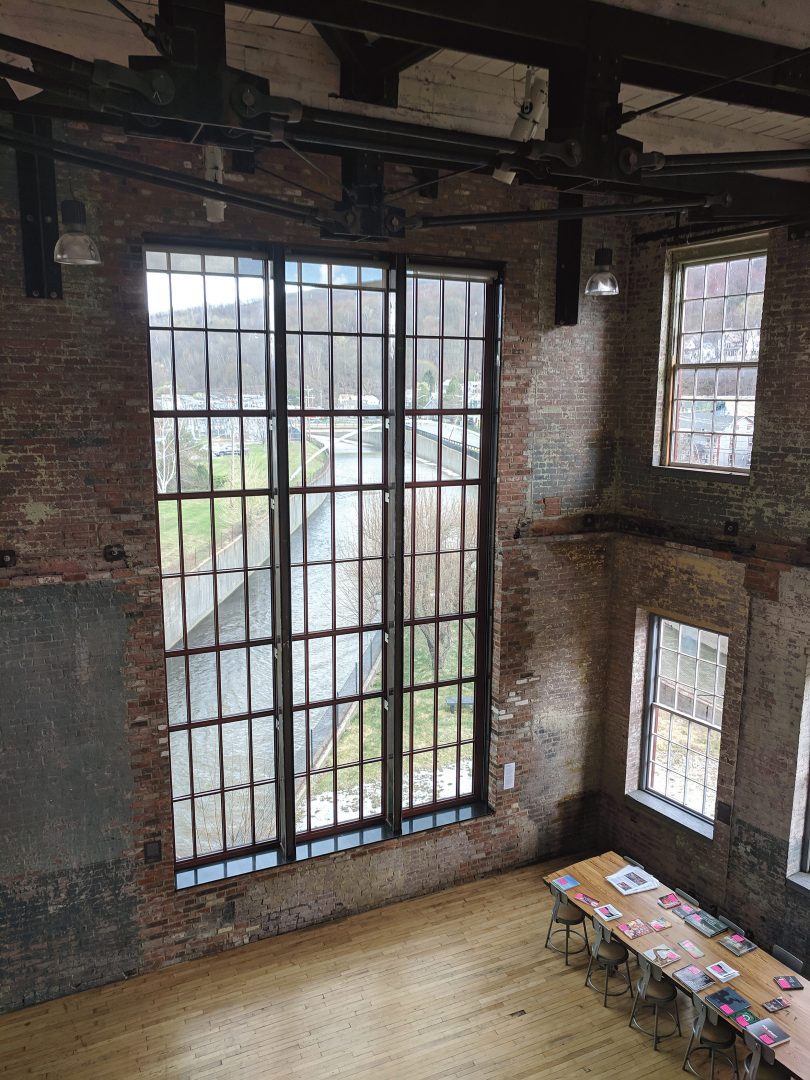
Community Spotlight

Community Spotlight

Diana Schindler

Diana Schindler says it’s key for Deerfield to balance the town’s rural character with needed economic growth.

Deerfield boasts numerous draws for businesses looking to relocate, Diana Schindler says, from its reasonable property-tax rate to its proximity to Interstate 91, Route 116, and Routes 5 and 10.

But there’s also been some pushback against some of those businesses, which reared its head when residents recently spoke out against a proposed Dollar General store in town. The Planning Board listened and turned down the project, said Schindler, Deerfield’s interim town administrator.

“There’s been a feeling in the community that they want that at arm’s length — that big-box retail development, drive-thrus, things they don’t feel are part of the culture of old Deerfield. It’s meaningful to them,” Schindler told BusinessWest.

“On the flip side, it creates more of a burden on the residential tax base,” she went on, noting that more than 80% of the town’s tax base is residential. “There’s a cost to the citizens in their tax rate and the sustainability of that tax rate. Deerfield has always readily paid for the level of service its citizenry wants and expects, but at the expense of not doing some major projects.”

For instance, the town is looking at a $1 million cost to replace a tank at the South Deerfield Wastewater Treatment Plant, which is only the tip of the iceberg when it comes to needed work at the facility over the next decade or two. Then there are plans to expand the Tilton Library and develop a shared senior center with surrounding communities.

“Seniors are asking for that. But all this adds up to millions of dollars, and you have the pressure of limiting development — or, rather, wanting development that will fit into the culture, which does limit it to some capacity,” Schindler said. “Less than 20% of the tax base is commercial/industrial, which is not a lot considering the viability of the property we have along 5/10 and a couple other areas. It’s going to become a question for the citizenry — is it sustainable?”

She’s one of many in Deerfield who believe economic development — in whatever form residents may want — is critical to the future of a town known for its tourist draws, including Yankee Candle’s flagship store, Mount Sugarloaf, Historic Deerfield, and Magic Wings, but needs to diversify and broaden its commercial portfolio.

“At first, they wanted to hide it, put it on the outskirts of town, but now they want it close to downtown. And that’s where it should be — take it out of the shadows, take it away from the edge of town where people can just pop in and leave. Bring them in and use it for economic development.”

“The ideal would be to get everybody together and integrate it all. We’re spread out geographically, and there’s a dichotomy between Old Deerfield and South Deerfield. We’re working toward making sure the town is the town, and everybody recognizes that if the town does well and comes together, then all of the components, all of our events, could do better.”

A veteran of the Franklin Regional Council of Governments and the Hampshire Council of Governments, Schindler has some regional government experience, and she believes there’s value in taking a regional view of economic development. But she’s more concerned with Deerfield’s residents, agencies, and organizations working together to forge a common vision for community development.

“If we could come together,” she said, “especially as we come to our 350th-anniversary celebration, we could build energy off of each other.”

Forging a Path

That celebration rolls around in 2023, which should be enough time, Schindler said, to see some real development progress in town, particularly in the Elm Street corridor, the main commercial area in South Deerfield.

Town leaders know that to attract new businesses — in hospitality and other sectors as well — they need to make the downtown area more inviting and pedestrian-friendly, and they’re eyeing a host of potential improvements in the Elm Street center, which may include work on sidewalks, lights, and storefronts.

For a year before taking on her current role last month — one she is interested in pursuing on a permanent basis — Schindler was a special projects consultant in town, and one of the big projects she embraced right away was Complete Streets, mostly geared toward the South Deerfield center.

South Deerfield center

Town leaders see plenty of potential in the South Deerfield center corridor.

“We’re in the process of putting that plan together. We want to create more walkability, more accessibility, and that includes for folks in wheelchairs, people with children, people of all abilities,” she said. “We’re also looking at ways to make South Deerfield’s center more aesthetically pleasing — light it, put in streetscapes, put in wayfinding, finish the municipal parking lot we have down there; all that is being discussed as part of the plan. We want it to stay a viable downtown.”

The area is not particularly expansive, she pointed out, spanning just a few blocks, but in some ways, that presents a more enticing opportunity, by ensuring that development and improvement efforts are tightly focused. There’s some land-use complexity as well, as the Massachusetts Department of Transportation owns a small part of the corridor, and the state owns Conway Street, home to Town Hall.

“But that’s an opportunity,” she said, “because the state is also excited about Complete Streets, and we could see a wonderful economic center down here, which I’m sure the state would support in a variety of different ways.”

The downtown has seen some business change recently, with longtime restaurant Jerry’s Place closing last year, and a café called Leo’s Table setting up shop in the location, with proprietor Jennifer Howard specializing in made-from-scratch breakfast and lunch fare. The building itself — which is also home to Ciesluk’s Market, Giving Circle Thrift Shop, the Tavern, and a Subway sandwich location, as well as 19 apartments on the second floor, has new owners, Jason Kicza and Justin Killeen, who plan to touch up the property this spring.

“I would consider that the anchor building on that side,” Schindler said, “and it’s doing great.”

Cumberland Farms’ move from South Deerfield’s center to the main road — specifically, the corner of Elm Street and Routes 5 and 10 — may not have been as great for the downtown’s prospects.

Deerfield at a Glance

Year Incorporated: 1677
Population: 5,400
Area: 33.4 square miles
County: Franklin
Residential and commercial Tax Rate: $16.34 (Deerfield), $18.14 (South Deerfield)
Median Household Income: $74,853
Median Family Income: $83,859
Type of Government: Open Town Meeting
Largest Employers: Yankee Candle Co., Pelican Products Inc.
* Latest information available

“They have a bigger business down on the corner, but it’s not necessarily a draw into the center; now people can just pop into Cumby’s for gas and keep going,” she said. “So we are looking at ways to basically create more stability in the center of South Deerfield by doing a variety of things. Obviously, part of that is keeping businesses and attracting more businesses.”

These days, the corridor can be oddly empty at certain times of the day, she noted, but well-trafficked during morning and evening rush hours. The goal, she told BusinessWest, is to turn it into a pedestrian-friendly center at all hours, rather than a thruway.

The Complete Streets plan will be a big part of that. By the time the 350th rolls around, she’d like to see significant physical and infrastructure improvements to make the downtown more of a destination. “The sidewalks will look different, maybe more green space, and hopefully we’ll see more people down there.”

High Times

Like many area communities, Deerfield has embraced the burgeoning cannabis industry in Massachusetts, recently approving two site plans, one for a cultivation facility at Pioneer Gardens on Mill Village Road, and the other for a dispensary run by Harvest Inc. on State Road.

“The culture has changed,” Schindler said, noting that, when communities were first exploring the economic possibilities of marijuana businesses, many Deerfield residents — most of them older — were staunchly opposed. But that opposition has died down to a large degree in many towns, to the point where communities might begin to locate such businesses in more central areas.

“At first, they wanted to hide it, put it on the outskirts of town, but now they want it close to downtown. And that’s where it should be — take it out of the shadows, take it away from the edge of town where people can just pop in and leave. Bring them in and use it for economic development.”

Meanwhile, Schindler and other Deerfield leaders will continue to think outside the box — even if big boxes aren’t in the cards — by examining where pockets of land already devoted to commercial and industrial businesses might have some infill potential, and continue to take pressure off the residential tax base.

“The thing I think is so tremendous about Deerfield is the huge opportunity it offers,” she said. “It’s wide open, and it’s got resources — financial resources, natural resources, culture, art, access to main roads. I get excited about it.”

Joseph Bednar can be reached at [email protected]

Education

Closing the Gap

Amanda Gould

Amanda Gould says the grant awarded to Bay Path University will fund a collaborative effort to help improve the digital fluency of the workforce.

When people talk about an ‘IT gap,’ Amanda Gould says, the appropriate response might be, ‘which one?’

Indeed, there’s the gap that seems to getting most of the attention these days, the one that involves the huge gender disparity in the IT workforce, with the vast majority of those well-paying jobs going to men, said Gould, chief administrative officer for the American Women’s College at Bay Path University, one of the institutions working to do something about this through its expanding Cybersecurity and IT degree programs.

But there’s another gap, she said, and this one involves the workforce and its digital fluency — or lack thereof. In short, too many people lack the necessary skills to thrive in the modern workplace, especially in IT-related roles, and the need to devise solutions for changing this equation is becoming critical.

For this reason, the nonprofit Strada Education Network committed $8 million to what it calls the ‘innovative solutions in education-to-employment’ competition, a name that speaks volumes about its mission.

And Bay Path emerged as one of the winners in this competition, garnering $1.58 million for a three-year project appropriately called “Closing the Gaps: Building Pathways for Women in a Technology-driven Workforce” (note ‘gaps’ in the plural).

This will be a collaborative effort, said Gould, adding that work is already underway with a number of partners, including the Economic Development Council of Western Mass., the MassHire Hampden County Workforce Board, the Massachusetts Technology Leadership Council, Pas the Torch for Women, Springfield Technical Community College, the UMass Donohue Institute, and others.

“Thinking about IT being in and of itself a discipline is, in my view, becoming obsolete.”

This work, said Gould, “involves extensive employer research and engagement, and building capacity of the American Women’s College to scale enrollment of adult women and prepare them with core cybersecurity and information-technology competencies that meet the needs of employers, support them as they move to degree completion, and assist them to successfully transition to careers in cybersecurity and IT-related employment.”

The key word in that sentence is ‘core,’ she said, because such competencies are now needed to succeed in jobs across virtually all sectors, not just IT and cybersecurity, and, as noted, many individuals simply don’t have them, and thus doors to some opportunities remain closed.

Opening them is the purpose of the of the Strada Education Network program, said Gould, adding that it will address a large problem that is obvious, yet often overlooked.

“What we’re not doing well overall when we think about our workforce is recognizing that technology is becoming increasingly more important in any role in any industry,” she explained. “Thinking about IT being in and of itself a discipline is, in my view, becoming obsolete; technology is a part of any organization running, and we should be less focused on training people to live in a silo or column that prepares them to fulfill very specific functions, and instead be training our women across all our majors to be thoughtful about how technology may impact their future roles in the workforce and how to be more engaged with ways technology helps them perform the aspirations they have in a variety of careers.”

Patricia Crosby, executive director of the MassHire Franklin Hampshire Workforce Board, agreed. She said her agency and other workforce-related partners will play a key role in this initiative — specifically bringing business leaders and those in the education sector together in the same room to discuss how curriculum can and should be structured to vastly improve the odds of student success and make what has been a fairly closed field much more open.

“The IT field has not been an open field to newcomers, diverse workers, and female workers,” said Crosby. “The Bay Path program is attempting to remedy some of that and make the pathways clearer.”

Overall, the nearly $1.6 million grant will be put toward a variety of uses, said Gould, who listed everything from career coaching to scholarships; from curriculum development to putting students in situations where they’re getting hands-on training in their chosen field. And all of them are pieces to the puzzle when comes to not only entering the workforce, but succeeding in a career.

For this issue and its focus on education, BusinessWest takes an in-depth look at the ‘closing the gaps’ initiative and why it is so critical when it comes to today’s workforce.

Keys to Success

Smashing Bay Path’s program down to a few key swing thoughts, Gould said it basically involves determining which IT skills are most needed in the workplace, which ones are missing in a large number of applicants and employees, and how to effectively provide those skills.

And while it’s easy to state the problem and this three-year project’s goals, devising solutions won’t be quite so easy because the problems are systemic and fairly deep-rooted.

Patricia Crosby

Patricia Crosby says the grant awarded to Bay Path University will help create clearer, better pathways into an IT field that historically has not been open to women, newcomers, and diverse workers.

“As higher-education institutions,” Gould explained, “we haven’t kept up with our education and our curriculum to make sure that, as students are leaving with a psychology degree or a communications degree or nursing degree, we are building in exposure to these tool sets and these skills. By being more theoretical in our education, we’ve almost created the gaps.

“I really think we’re at a moment in time when we need to be more thoughtful about integrating technology for all students,” she went on, adding that, if those in higher ed created the gaps, it’s now incumbent upon them to close them.

Elaborating, she noted that cybersecurity, while still a specific discipline and course of study, is also part of myriad job descriptions today — for those helping with social-media campaigns to those handling customer records — and thus cyber should be part of occupational training.

This is a relatively new mindset, she acknowledged, one that involves a close partnership between the business community and those in higher education.

To put it in perspective, she cited some research conducted by Strada and Gallup regarding the relevancy of educational programs.

“When they were interviewing higher-ed administrators about how prepared they thought their students were for the workforce, a majority of them said ‘they’re very prepared,’” she noted. “But when they interviewed employers, a very small percentage of them thought the students were truly prepared to enter the workforce. There’s an enormous disconnect.”

A commitment to closing it explains why the Strada network is giving $8 million to seven winners of its competition, and also explains why partners like the EDC and the MassHire facilities will play such a critical role in this endeavor.

They will help connect those with the project to industry groups and specific companies with the goal of not only determining the skill sets they need in their employees, but placing students in situations where they gain valuable hands-on experience.

These experiences can include job shadowing, interviewing someone in a particular role, project-based coursework, or actual internships, said Gould.

“There are a variety of ways we can get our students connected with employers,” she said, adding that such connections are vital to understanding the field, comprehending the role IT plays in it, and, ultimately, gaining employment within that sector.

“In an ideal scenario, our students are off and working,” she went on. “It would be better if they were working in a field they see as their career rather than in a job where they’re working to offset expenses. If there are ways to get students into the workplace before graduation, we want to nurture those entry points.”

Crosby agreed.

“In an ideal scenario, our students are off and working. It would be better if they were working in a field they see as their career rather than in a job where they’re working to offset expenses.”

“In this field [IT], more than any other, as much as any credentials or degrees, employers are looking for experience,” she said. “There’s a gap between the people who are learning it and the people who are getting the jobs because the people who get the jobs already have experience. There’s a bridge that has to be crossed between any education and training program and the workplace.

Sound Bytes

As she talked about the Bay Path program and how to measure its success, Gould said there will be a number of ways to do that.

These include everything from the level of dialogue between the business community and those in education — something that needs to be improved — to the actual placement rates of graduates in not only the IT and cyber fields, but others as well.

In short, the mission is to close the gaps, as in the plural. There are several of them, and they are large, but through a broad collaborative effort, those involved in this initiative believe they can begin to close those gaps and connect individuals to not only jobs but careers.

George O’Brien can be reached at [email protected]

Home Improvement

Foundation to Roof

The Western Massachusetts Home & Garden Show may last only four days each March, but Lori Loughlin says vendors reap the benefits all year long.

“The exposure at the show is tremendous,” said Loughlin, manager of Frank Webb Home in Springfield. “It pays for itself within the first week after the show closes. In May, June, July, people are coming in saying, ‘I was at the home show, and I saw this showerhead.’ They come back six months after and want to buy something they saw there. It’s nice.”

Loughlin, who serves as the event’s deputy chair for 2019, said her company, the showroom division of F.W. Webb, offers such a wide variety of products and services that it’s a no-brainer to participate in the show, which, in its 65th year, will feature more than 350 vendors displaying at more than 700 booths.

“You’ll find landscaping, appliances, hot tubs, bathrooms … you can go from foundation to roof and everything in between,” she said.

The Home & Garden Show, slated for March 28-31, is produced by the Home Builders & Remodelers Assoc. of Western Massachusetts (HBRAWM), whose 500-strong membership reflects the variety on the show floor, with roughly 90 categories on display from builders, remodelers, kitchen and bath specialists, landscapers, painters, roofers, financial institutions, pool companies, and more.

“We can give you a snapshot of what’s out there, of what’s new,” said Andy Crane, HBRAWM president. “The key word is local. Almost every business in there is local; these are the people who managed to stay in business through the ups and downs of the economy, and they’re there to show their wares.”

“The key word is local. Almost every business in there is local; these are the people who managed to stay in business through the ups and downs of the economy, and they’re there to show their wares.”

Crane said 2019 has been one of the show’s better years, with fewer than a dozen booths left to sell two weeks before the event was set to begin. In short, it remains the association’s signature showcase.

“People are going to see companies and meet owners that they probably wouldn’t be exposed to by word of mouth,” Loughlin said. “I can’t believe how many companies are involved in this home show. It’s huge. And we get such a rebound on this.”

While recognizing the show’s potential to connect businesses with homeowners, she said the cross-promotion that goes on is just as valuable as the visitors who walk through the door.

Andy Crane

Andy Crane says the 2019 Home & Garden Show is shaping up to be one of the strongest, if vendor commitments are any indication.

“The networking between companies has been great for our company,” she told BusinessWest. “We tie in with the tile people and kitchen-design people, who send people here to find sinks. It’s nice to create relationships with other vendors.”

Something for Everyone

The home show started as a way to generate revenue to support the association, but it also provides member companies with a chance to market to an audience — and a big one, with around 20,000 visitors over the four days in a typical year — that might not otherwise see their name. Conversely, it gives attendees, many of whom simply come to the show for fun, a host of concrete (or hardwood, or tile, or whatever) ideas for home improvement.

The exhibitors run the gamut from inspection services to security and alarm systems; Internet and communications to moving and storage; duct cleaning to pianos and organs. Meanwhile, show attendees fall into one of several categories, the association notes, including:

• People planning to buy or build a new home, who may visit with builders, real-estate agents, financial institutions, and sellers of component products, such as hardwood flooring, tile, and appliances;

• People planning to remodel or renovate, who may want to check in with all of the above, plus vendors of replacement components such as windows and doors, as well as appliances, wall treatments, and home furnishings;

• Yard and garden enthusiasts, who tend to be interested in lawn and landscaping services; wall, walk, and edging components and materials; and trees, shrubs, flowers, and seeds;

• Lifestyle-conscious individuals, who like to check out trendy, high-tech, or time-saving products; home furnishings; and products focused on self-improvement, fitness, and health;

• Committed renters, who have no plans to own a house, but may be interested in space-conservation and space-utilization products, as well as home furnishings;

• Impulse buyers, who flock to vendors of home décor, arts and crafts, cooking and baking products, jewelry, and personal goods; and

• Those who attend the show purely for fun, who may arrive without an agenda but often develop ideas for future purchases and home products. “More than any other group,” according to the association, “these people are the ones who have come to rely upon our show on an annual basis and who perhaps have the greatest impact upon our vendors.”

Indeed, Crane told BusinessWest, “it’s not just about coming to the show and spending money with the vendors, even though we hope that’s the case. It really is a social event. That’s the mindset — it’s a nice evening out, and people walk out of the show with ideas of their home.”

Once again, visitors will see the LIXIL Beauty in Motion 49-foot mobile showroom in the Young Building, showcasing an array of American Standard, DXV, and Grohe kitchen and bath products.

“We have a mobile showcase with active and working plumbing fixtures, the newest and greatest features in plumbing, from toilets to water-saving showerheads,” Crane noted.

Also in the Young Building, chefs from across the Pioneer Valley will create some of the signature dishes they serve at their restaurants. Visitors can see how they prepare some of their favorite dishes and perhaps ask how to tailor those dishes to fit their own family’s taste. This popular area, hosted by WMAS Radio, will also include cooking seminars every day of the show.

“It’s not just about coming to the show and spending money with the vendors, even though we hope that’s the case. It really is a social event.”

The Young Building will also be home to several kids’ and family activities, from the Melha Shriners clowns to Thousand Cranes Studio, which will be on hand to show off the creative talent of their students, as well as conduct hands-on activities with show attendees. Other attractions will include live butterflies from Magic Wings Butterfly Conservatory & Gardens, taking pictures on one of the go-karts from Pioneer Valley Indoor Karting, science experiments at the Rolling Acres Outdoor & Science Summer Camp, a Springfield Thunderbirds booth, face painting, and Looney Tunes characters from Six Flags New England. On Saturday and Sunday, the West Springfield Police Department will be on hand to fingerprint children and offer safety tips, and the Chesterfield Fire Department will give out hats and coloring books.

“There are a lot of different things to do, so you don’t have to come only for a siding or roofing job,” Crane said. “You can go have a nice, inexpensive time in a warm, dry facility.”

Business and Pleasure

In addition to Loughlin, Gisele Gilpatrick of Pro-Tech Waterproofing in Chicopee will serve as Home Show chair, while other committee members include Lisa Grenier of Market Mentors, Joe Mole’ of C.J. Carpentry, Josh Nolan of Fuel Services, Tom Silva of Triple S Construction, and Brian Zippin of Contractors Home Appliances. All are ramping up for what most in the home-improvement world say looks to be a strong year (see related story, page 24).

“This year, as every other year, the home show is a spring kickoff to the building season,” Crane said. “It’s the perfect time of year when people are thinking about projects both inside and outside the house. The show gets their minds moving a little bit.”

Again, though, he stressed that show organizers also want people to have fun.

“Take your wife out to dinner and swing by the home show, or call your brother or your neighbor. You can get out of the house and look at 700-something booths with different products — maybe something you’ve dreamed about.”

This year’s show hours are Thursday and Friday, March 28-29, 1-9 p.m.; Saturday, March 30, 10 a.m. to 9 p.m.; and Sunday, March 31, 10 a.m. to 5 p.m. General admission is $10 for adults, and children under 12 are admitted free. Discount coupons are available at www.westernmasshomeshow.com. Veterans and active military with ID receive free admission on Thursday only.

Joseph Bednar can be reached at [email protected]
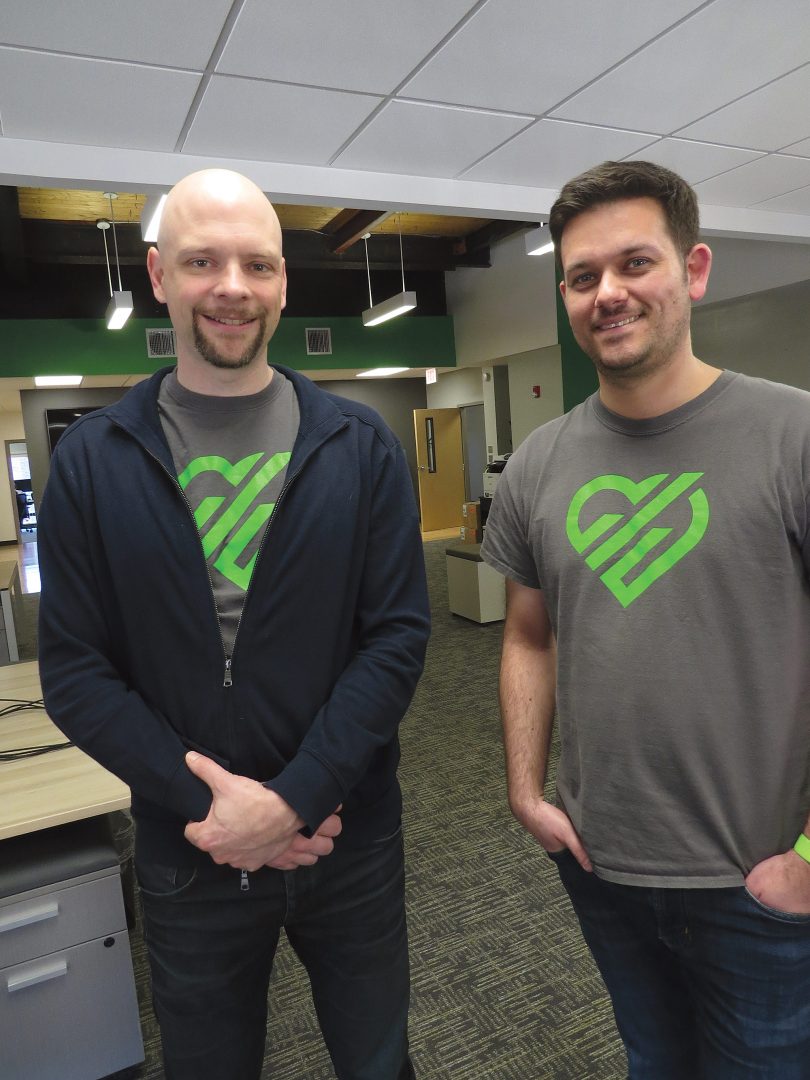
Insurance

Culture of Coverage

Gov. Charlie Baker announced that the Massachusetts Health Connector completed Open Enrollment with the highest membership in the 13-year history of the state’s health-insurance exchange, covering more than 282,000 people with health insurance.

“The Health Connector just completed its most successful Open Enrollment since the start of the Affordable Care Act, signing up more than 65,000 new people with health insurance coverage,” Baker said. “Massachusetts leads the way with the best insured rate in the country, with over 97% of our residents covered due in part to the Health Connector’s strong efforts to create a culture of coverage in the Commonwealth.”

Lt. Gov. Karyn Polito added that “the Health Connector plays an important role in ensuring communities across the Commonwealth have access to affordable, high-quality healthcare. Over the last four years, the Connector has worked tirelessly to transform the exchange into a functional and reliable service, as is evident by its current milestone enrollment figures.”

“Massachusetts shines as a model for the rest of the nation when it comes to getting people enrolled in health insurance — and maintaining coverage. That success is built off outreach and education efforts that effectively and efficiently target the state’s underinsured communities and get more people covered. This year, the Connector made inroads in these tough-to-reach uninsured groups.”

The Health Connector held Open Enrollment from Nov. 1 to Jan. 23, twice as long as the federal government’s Nov. 1 to Dec. 15 open period, to ensure Massachusetts residents had as much time as possible to shop for affordable coverage. Throughout Open Enrollment, Massachusetts residents were encouraged to get covered or stay covered, provide security for their health and financial well-being, and comply with the state’s individual mandate. Assistance was available through community-based health navigators around the state.

“Massachusetts shines as a model for the rest of the nation when it comes to getting people enrolled in health insurance — and maintaining coverage,” said Health and Human Services Secretary Marylou Sudders, the Connector board chair. “That success is built off outreach and education efforts that effectively and efficiently target the state’s underinsured communities and get more people covered. This year, the Connector made inroads in these tough-to-reach uninsured groups.”

As of March 1, 282,114 people were enrolled in health insurance, including 209,973 people in ConnectorCare, the state’s innovative affordability program, through which state subsidies are made available on top of federal tax credits, resulting in lower premium costs for members — including $0 premiums for the lowest-income enrollees — while also offering no or low co-pays and no deductibles. Overall, Health Connector membership rose 13%, compared to a 4% enrollment decrease through the federal healthcare.gov platform. In addition, 18,000 individuals receive dental insurance through the Connector.

“With stable operations and a clear message to get covered and stay covered, this was our most successful Open Enrollment to date, with high retention rates and strong new enrollment,” said Louis Gutierrez, executive director of the Massachusetts Health Connector. “We are going to keep working to ensure that everyone in Massachusetts is covered.”

The Health Connector placed extra focus on outreach and public education about affordable coverage options in communities with higher rates of uninsurance and worked to raise public awareness about coverage generally. At the close of Open Enrollment, the Connector had enrolled more than 65,000 people who did not have coverage at the start of Open Enrollment, about 22% more than last year.

Features

The Spirit Moved Him

Paul Kozub stands in front of picture of his new distillery in Poland.

Paul Kozub stands in front of picture of his new distillery in Poland.

Almost from the day he started V-One Vodka, Paul Kozub has been dreaming about, and planning for, the day when he’d make his product himself, at a distillery he owned in Poland, the birthplace of his ancestors — and vodka itself. Now, that day is here, and Kozub believes this huge investment will enable him to scale up his venture on a dramatic level.

Paul Kozub says the hardest part about the whole thing was keeping it a secret.

And that’s saying something, because there were many hard parts to his ambitious plans to building his own distillery to produce the Vodka label, V-One, that he brought the marketplace nearly a decade ago.

There was the process of finding a location in Poland, birthplace of both his ancestors and vodka itself, or so the story goes, as well as designing a facility and getting it built. And none of that could happen unless he sold enough shares of his company to raise the needed capital — but not so many shares that he would lose majority ownership of the venture.

But the keeping-it-all-a-secret part? That was quite necessary because, if word ever got out to those who had been producing his vodka since he launched his label that he was going into that end of the business himself, then they would stop producing it for him posthaste and leave him scrambling to not only fill orders but find someone else to make it in the interim.

So Kozub went to great lengths to keep his search and then his building project a secret. And, as he said, it wasn’t easy.

“My family and friends knew, but I had to really keep things quiet otherwise,” he explained at a short press conference on Feb. 26 to announce the purchase and expansion of a distillery in Kamien, Poland, about two hours southeast of Warsaw. “Every time I went to Poland, I wouldn’t post it on Facebook, because my suppliers are friends of mine and they’d see that I’m there [Kamien] and not coming to see them, so they’d know something was going on.”

As noted, he said this at a press conference, which means this huge development for the company is no longer a secret. Kozub told those friends who were producing his product (the operative word there is ‘were’) about it a few weeks ago, and he said they quite happy for him. At the Feb. 26 press conference, he told several media outlets, supporters, clients such as MGM Springfield, area bars and restaurants, and more.

The distillery in Kanien, Poland has a long history, and V-One Vodka will be writing an intriguing new chapter.

The distillery in Kanien, Poland has a long history, and V-One Vodka will be writing an intriguing new chapter.

It was an emotional announcement and an intriguing new chapter in the V-One story, which started back in 2003, when Kozub started distilling in his home in Hadley after using a $6,000 inheritance from his “Polish moonshining grandfather” to buy some equipment. There have been a number of milestones along the way, from the creation of his signature bottle to expansion into different markets; from the addition of several new flavors to Kozub’s being named BusinessWest’s Top Entrepreneur for 2016 (in recognition of all of the above).

The distillery, which he describes as a “multi-million-dollar investment,” without being more specific, represents the next milestone and one Kozub believes will greatly accelerate growth of the company.

“This will allow us to produce 400 times more vodka than we produce today; we will be looking to not only expand as a national brand, but as an international brand,” he explained. “This represents the next stage of the company — and a very exciting stage.”

Elaborating, he said he doesn’t have a firm timetable, obviously, but expects to expand outside of New England and down the East Coast in the years to come, and will then look to expand globally.

For now, though, he’s focused on getting the first bottle off the line in Kamien, something that should happen on or around April 1.

For this issue, BusinessWest looks at everything that has brought Kozub to that moment and at what will likely happen next.

Proof Positive

As he announced his expansion into Poland — a return to his family’s roots, if you will — Kozub did so with a type of high-tech slideshow. Only it started with a few low-tech pictures that captured some of those milestones described earlier.

One was of his first house in Hadley, a small Cape that he moved into just a few days after his Polish grandfather died, and another captured its basement, where he first started making vodka, or “moonshine,” as he called it. A third zoomed in on the special plumbing that enabled cold water to run through the still, a development that made everything that’s happened since possible.

Other pictures captured his first V-One bottle and his first van, which he purchased soon after going into business. He would load it with 100 cases of V-One and deliver it to clients across the region himself.

The addition built onto the distillery brings all aspects of the business together in one place — from production to bottling to warehousing.

The addition built onto the distillery brings all aspects of the business together in one place — from production to bottling to warehousing.

Yes, that’s a lot of firsts. But to take the venture forward in a meaningful way, Kozub said he needed to control production of his vodka with his own distillery. He said he’s known this almost from the beginning, but the costs of such a facility have been imposing and, until recently, prohibitive.

But knowing he needed to take this step, he raised capital by taking on additional investors as part of a process that really began a few years ago. Subsequent steps included scouting locations and kicking the tires on existing distilleries available for acquisition.

With that explanation, his show shifted to video captured by his phone as he traveled through the community he eventually chose to be home to his distillery.

“There’s thousands and thousands of acres of fruit trees here … it reminds me a lot of Hadley,” he said as the car transporting him moved down a rural road. “As soon as I saw this, I knew it was the place I wanted to call home.”

Home, meaning the actual distillery itself, has been around for more than 133 years, and thus it has some history, said Kozub, noting that, during World War II, the Nazis took it over and produced different kinds of spirits.

The next chapter in its history involves a sizable expansion necessary for producing V-One in the quantities that Kozub is envisioning for the years and perhaps decades to come. Indeed, the facility will include, in addition to the distilling equipment, laboratory space (mostly for R&D and new product development), a bottling area, and warehouse space.

Thus, when asked what this ambitious move does for the company, Kozub said quickly, “it makes everything better.” Elaborating, he said that, almost from the beginning, he has understood the critical need to have more control over every aspect of the V-One operation, especially production.

“I wanted to be in control of production — I’ve had a number of production nightmares over the past 15 years,” he explained. “Literally, we’ll be planting our own grain, our own spelt, harvesting it, and processing it. We like to say that, from farm to glass, we’ll be in control of each process, and that’s the trend today.”

Beyond control, Kozub said this expansion into Poland and the opening of his own distillery allows him to accelerate the process of growing the V-One label and taking it into new markets — in this country and then eventually abroad.

“I really never wanted to make rum or tequila or gin, but I have at least two dozen other vodka products I’d like to make someday,” he told those assembled at V-One world headquarters (a converted church) on Route 9 in Hadley. “And this allows us to be really innovative with doing some of that stuff; when someone else is making your vodka, you’re limited to their schedule and their timeframe.”

Moving forward, Kozub said that, while he did a sell an interest in the company — something he could do only after its raising its value over the past decade through new products and a wider reach market-wise — he is still the overwhelming majority owner, and still one who is quite hands-on and involved in all aspects of the business. That said, he still plans to spend the vast majority of his time in this country, and probably visit Poland about as much as he does now — maybe once a quarter.

While leaving actual production in the hands of a manager in Poland, Kozub will focus on the proverbial big picture and, more specifically, territorial expansion for V-One and a scaling up of the operation.

And having his own distillery, as he said, will certainly help in this regard.

“People comment to me all the time … ‘you’re a 13-and-a-half-year-old business; how come you haven’t gotten out of the New England market?’” he told BusinessWest. “I’ve had some serious production problems and packaging issues that have worried me about getting into Florida or Texas or California, three of the biggest vodka markets. This [distillery] will really allow us to scale up and tackle those challenges.”

Expanding within the U.S. and then overseas markets will obviously require more capital, he added, and he plans to sell additional shares in the business within the next year.

Bottom Line

As he continued his slideshow presentation before the press and his supporters, Kozub placed a map of Poland on the screen to show exactly where his distillery will be located.

He did so to offer a point of reference, offer up a short lesson on Polish geography, and also show where his ancestors are from — a small town not far Krakow. But he also did it to be a touch poetic.
“This really helps put on us on the map,” he said of the distillery, using that phrase to say a great deal.

This venture is now on the map, literally, and its product will be on — meaning available to — a much larger chunk of the map in the years to come because of what this facility will enable the company to do.

George O’Brien can be reached at [email protected]

Banking and Financial Services

What’s in a Name? Plenty

Mike Buckmaster

Mike Buckmaster, vice president of Commercial Lending for Community Bank, N.A.

Since entering the market in 2017 through the acquisition of Merchants Bank and its branch in Springfield’s Tower Square, Community Bank, N.A. has been working to build on its foundation in this region. It brings to the highly competitive local banking landscape both considerable size and an operating mindset commensurate with the name on the letterhead.

Mark Tryniski acknowledges that it sounds illogical that a financial-services institution with $12 billion in assets and more than 230 branches could call itself a community bank — let alone call itself Community Bank, N.A.

But Tryniski, president and CEO of the Syracuse, N.Y.-based institution, said ‘Community Bank’ represents more than a name — and one that fits. Indeed, it’s more like an attitude.

“As our name suggests, we’re a community bank — that’s how we’ve always operated,” he explained. “And when you put the name ‘Community’ on your bank, you’d better function as a community bank — and we do.

“There is such a thing as a community-bank model,” he continued. “You push authority down to people in the branches, as opposed to the big-bank model, where you walk in the door looking for a home-equity loan and they put you on the phone with a 1-800 number and someone working in another country. Community banks don’t do that.”

Mark Tryniski

Mark Tryniski

 “When you put the name ‘Community’ on your bank, you’d better function as a community bank — and we do.”

This operating mindset has enabled the institution to grow considerably over the past several years and into a number of different markets, including Springfield, accomplished through the acquisition in 2017 of Merchants Bank, which had previously acquired NUVO Bank, which operated a single branch within the 413 within a large footprint in Tower Square.

Since putting its name over the door on Main Street, Community Bank, N.A. has downsized that space considerably, while simultaneously working to establish itself and broaden its horizons within this market.

It has done so by essentially living up to the name over the door, said both Tryniski and Mike Buckmaster, vice president of Commercial Lending. They both said the institution possesses the formula that’s required to succeed today — a community-bank feel, but a large size that is necessary in a changing, quite challenging financial-services marketplace today.

“I think that, over a period of time, the market has accepted the fact, to a degree, that this is a consolidating industry,” said Buckmaster, who has logged more than 30 years in the banking industry, locally and in the U.K., and has carried business cards bearing the logos of NUVO and Merchants Bank, among others. “The differentiating factor tends to be the commercial banker, and if the commercial banker can continue to deliver in terms of service and business development, there tends to be a good degree of customer loyalty toward the banker, even through various acquisitions.”

That lengthy explanation helps explain why the Springfield facility has been able to enjoy steady growth in its portfolio even as the name on the wall of Tower Square has changed several times this decade.

Tryniski agreed, but said the combination of size and small-bank attitude is becoming ever more important as the consolidation movement continues without any signs of slowing down.

“I’ve been around the banking industry for a little more than 30 years, and there’s been a dramatic change in the banking landscape, mostly centered around consolidation,” he explained. “When I started, in the ’80s, there were 16,000 or 18,000 banks; now, there are roughly 6,000 banks.

“And I think the trend toward consolidation will continue because of efficiencies that can be garnered by scale and technology,” he went on. “The bigger you get, the more you can justify investments in technology to give you more efficiency. It’s hard for the smaller banks — you have to really be efficient and disciplined.”

Overall, Community Bank will look to get bigger still, and is looking at opportunities to expand within the Western Mass. and Connecticut markets, said Tryniski, but “haven’t found what the right opportunity is yet,” as he put it. Elaborating, he said growth for this institution will continue to come as it has historically, through a mix of organic growth and acquisition, with more of the latter than the former, especially in areas with slow or no growth but more than enough competition, and Western Mass. certainly fits that category.

In such markets, growth can come only by taking market share from other institutions, he went on, adding that this is generally difficult to do. Community Bank has had a good amount of success doing just that, however, because of that aforementioned enviable combination of large size and smaller-bank feel.

Community Bank, N.A.

Mark Tryniski says Community Bank, N.A. will look for opportunities to expand locally beyond its location in Tower Square.

For this issue and its focus on banking and financial services, BusinessWest talked at length with Tryniski and Buckmaster about how Community Bank, N.A. has firmly established its presence in the local market and how it intends to secure additional market share and perhaps expand its footprint in the 413.

By All Accounts

Since acquiring Merchants, and therefore all its branches, Tryniski has visited Springfield on several occasions as part of his efforts to fully understand the broad geographic area served by the institution — one that stretches from the Northern Kingdom in Vermont to the Southwest corner of New York to the Lehigh Valley in Pennsylvania — and meet both team members and customers.

“We spend a lot of time on the road,” he said of the management team at the bank, adding that, when he does visit Springfield, or any other community served by the bank, he makes a point of learning as much about the region as he can.

In the City of Homes, he’s become familiar with some of the players within the business community, has found a few restaurants he likes, and is both impressed with and encouraged by the high level of energy he’s seeing in the central business district.

He said there are a great many similarities between Springfield and Syracuse, and in some ways, that has helped him understand the dynamics of not only the communities themselves, but the banking environment here.

“They’re remarkably similar, actually,” he said. “They have the same population, they have an industrial history, they have a stable-but-not-growing population, there’s a lot of education, the downtowns look very similar … they’re very much alike. Springfield feels to me like Syracuse.”

From a banking perspective, that means a community that, as he said, is experiencing comparatively little growth, population-wise and new-business-wise, and has a crowded field of competitors for financial-services products — banks and non-banks alike.

In this environment, operating with that community-bank model — but with roughly $3 billion in assets behind the institution — is what amounts to a competitive advantage — a large competitive advantage, said Tryniski.

“We tell our branch managers that we want them to be the president of the bank in their town,” he explained. “And we give them the authority to do that; we give them lending authority and authority around charitable contributions, fee waivers, fee adjustments, things like that. We try to vest as much authority in our branch managers locally as we can, and let them make decisions about their customers and their market.

“We probably have more of a community-bank business model than most community banks,” he went on, “because most don’t operate like that.”

However, in this market, there are still a large number of community banks — more than in many other markets — and this simple math requires that small-bank mindset. Meanwhile, the field of competitors continues to change and grow, thanks to technology, which has brought many non-bank players into the mix, said Tryniski.

“We compete now with all sorts of non-bank competitors on the lending side — for everything,” he told BusinessWest. “Whether it’s personal loans, business loans, car loans … it doesn’t matter what kind of loan you’re making, you’re competing against a multitude of other, non-banking enterprises. And the same is true on the deposit side as well.”

Buckmaster agreed, noting that, on the commercial-lending side, with all that competition, as well as all that consolidation, having a local address is not the same thing as having people who know the local market and have worked within it for years, if not decades.

“All that competition puts the emphasis very much on the banker and being able to provide the service and support growth going forward as clients need,” he said, adding that Community Bank is large and stable, and thus able to provide commercial-banking products of all sizes, including dollar amounts beyond the scope of many of the smaller community banks that populate the region.

The sweet spot for the bank, though, is loans between $1 million and $3.5 million, he said, adding that the bank is able and willing to continue writing loans for small-business owners, something the very large banks seem less interested in doing so.

This flexibility has enabled the institution now known as Community Bank, N.A. to continue to serve the customers added to its portfolio when it was NUVO, he went on, adding that loans have been written for businesses across virtually all sectors and for a number of commercial real-estate acquisitions as well.

“We’ve have some customers who were initially small back eight or nine years ago who have grown into significant customers that require a significant increase in loan support going forward,” he told BusinessWest. “We’ve seen some good growth in commercial and industrial customers over that period of time, and in addition, we’ve also seen significant new dollars in different types of commercial-investment real estate, whether it be locally in Western Mass. or further afield.”

Worthy of Interest

Returning to some of those numbers mentioned earlier — the 230 branches and current status as the 125th-largest bank in the country — Tryniski said they certainly make Community Bank, N.A. sound big. And it is.

“But we’re a lot close to the smallest bank in the country than we are to the biggest, even though the numbers say we’re one of the biggest,” he noted, adding that, in today’s banking climate, it’s not how big a bank looks on paper that matters, but how big it acts in the markets it serves.

And with that as the benchmark, this institution does indeed live up to the words on its stationary and over those 230-odd doors.

George O’Brien can be reached at [email protected]