For Sale, for Lease
Click HERE to go to a PDF of available commercial properties in Western Mass.



Click HERE to go to a PDF of available commercial properties in Western Mass.

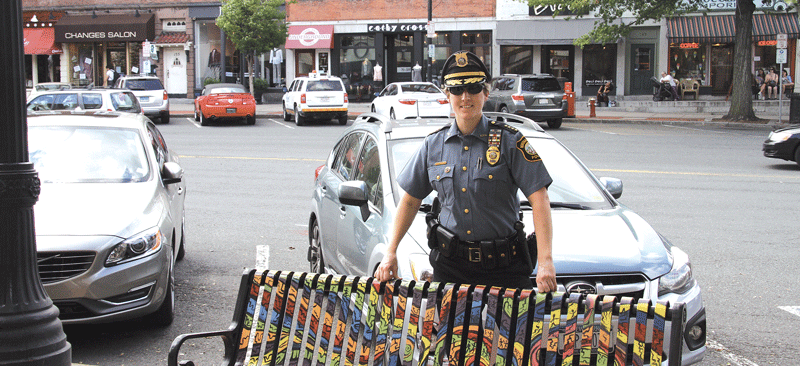
Northampton Police Chief Jody Kasper says LIPPI helped empower her to move aggressively up the department’s career ladder to the top rung.
It’s called the ‘impostor syndrome,’ a.k.a. the ‘impostor phenomenon’ and the ‘fraud syndrome.’
The term was originally coined nearly 40 years ago by clinical psychologists Dr. Pauline Clance and Dr. Suzanne Imes, who contrived it to describe high-achieving individuals who possess an inability to internalize their accomplishments and, as those above names suggest, live in what amounts to persistent fear that they will be exposed as an impostor or fraud.
Dr. Valerie Young, after first realizing that she suffered from that syndrome and that she was hardly unique in that self-diagnosis, would go on to become one of the world’s leading experts on the subject and write perhaps the definitive book on the matter: The Secret Thoughts of Successful Women: Why Capable People Suffer from the Impostor Syndrome and How to Thrive in Spite of It.
She has also taken her work regarding the syndrome on the road, speaking before hundreds of groups of various sizes and demographic breakdowns. One of them was a gathering last fall of the 2015-16 cohort of the Leadership Institute of Political and Public Impact, or LIPPI, as it’s more commonly called.
Created by the Women’s Fund of Western Mass. in 2010, LIPPI has hosted a number of speakers, like Young, who have helped change careers and lives by giving women of all ages something — or many things — to think about, insight that would stay with them long after the talk ended.
Jody Kasper, Northampton’s police chief, can recall one specific speaker — although she states with regret that she can’t remember her name — who certainly helped put her career on the path to the title that now graces her business card and office door.
“She said that a big difference between men and women becomes apparent when there’s an opportunity for a special assignment or promotion,” recalled Kasper, who was a detective with the force while participating in the 2012-13 LIPPI class. “She said a male candidate may — even if he didn’t know the material — say, ‘I’m going to put in for it, and I’ll figure it out once I get the job.’ And she said women candidates would be more likely to say, ‘I don’t really know how to do the job, so I’m not going to put in for it now; I’ll learn, and then, in a few years, I’ll put in for it when I feel more ready to do it.’
“That really stuck with me for some reason — that attitude holds women back,” Kasper went on, adding that those words were resonating with her when the post of detective lieutenant, one she admits to feeling not totally ready to seek at that time, came open — and she became an eventually successful candidate. The same attitude prevailed when the captain’s position came open.
“I had that same thought process … ‘should I be putting in for this? It’s a big job with a lot of responsibility; have I mastered what I’m doing now?’” she said of her eventual candidacy for captain. “And the answer was that I hadn’t mastered what I was doing; I was still in the learning stages of the detective lieutenant’s position. But I had the confidence to go for it.”
There are many similar stories to be told by LIPPI graduates, as they’re known. Indeed, while, as the name of the program implies, it puts emphasis on introducing women to careers in public service and helping them take on such challenges, it can — and does — provide women traveling down, or contemplating, a wide variety of career paths with more and deeper leadership skills.
When participants leave the stage with their diplomas in May, LIPPI organizers want them to take two things with them, said Ellen Moorhouse, who, as program officer for the Women’s Fund, has administration of LIPPI on her job description.
“The first is sisterhood,” she said, adding quickly that classmates form relationships that go on for years. “And also some tangible business skills — what it takes to write a professional e-mail, how we conduct ourselves in a meeting … what we call the nuts and bolts.”
For this issue and its focus on women in business, we take an in-depth look at how LIPPI provides not only nuts and bolts but the tools to use them, and how it leaves participants empowered to take on — and overcome — the many challenges their lives and careers will throw at them.
When asked what she considered her best takeaway from her LIPPI experience, Kasper, who was named chief last summer, paused for a moment, as if to indicate there were several aspects to be considered.
“I’m much more inclined to say ‘yes’ to things that are outside my comfort zone,” she said eventually, adding quickly that, because of this, that zone is now much larger and, thus, fewer challenges lie outside it.
While it’s not actually written down on a mission statement or anywhere else, providing women with a broader comfort zone is essentially what LIPPI is all about.
It accomplishes this through a series of monthly programs that essentially run along a typical college year — September to May with a break in December, said Moorhouse.
She told BusinessWest that the topics covered at those sessions speak volumes about what LIPPI was designed to provide for its participants.
Valerie Young’s program last October, for example, covered ‘Resilience, Public Speaking, and the Impostor Syndrome.’ In November, the subjects for discussion were ‘Social Justice, Race, and Equality.’ In January, it was ‘Mentoring and the Power of Your Network,’ and for February, the topic was ‘Conflict Resolution.’
Still to come are a broad March program focused on everything from communications and marketing to debating. Final presentations are in May, followed by an elaborate graduation ceremony at the Log Cabin on May 23.
Several of the monthly programs drive home one of the unique aspects of this leadership program — its focus on encouraging women to seek public service and helping them succeed if they do.
In late September, for example, the program was called ‘Performance Nuts & Bolts; Policy Advocacy; and Fund-raising Part 1.’ Part 2 came in March, along with a focus on personal finances, campaign finances, and ‘boardroom basics.’ In April, the program will be ‘Nuts & Bolts of Campaigning; Digital Tools and the Campaign,’ and on May 7, state Treasurer Deb Goldberg will be among those leading a discussion called ‘Women in Local, State, and National Politics — After the Campaign.’
It’s always a diverse group of women taking in these sessions, said Moorhouse, adding that this year’s class is especially so, with participants ranging in age from their early 20s to their mid-60s, and from a wide variety of backgrounds.
“This is our most diverse class yet — we have people coming from up and down the I-91 corridor and even New Bedford, and one of the women is almost 70 years old,” she noted, adding that the program draws women from the four Western Mass. counties, who must apply for the available seats — usually 30 to 40 a year.
When asked what the committee that weighs those applications is looking for, Moorhouse said simply, “passion.”
“And in whatever focus that might be,” she went on. “It could be political, or higher education … whatever their passion may be, it just has to shine through.”
The diversity of the LIPPI program, but especially the all-women nature of the program, makes it unique among the many leadership programs in the area and attractive to many potential candidates, Moorhouse went on, adding that many participants enjoy sharing common experiences, challenges, and approaches to business and problem solving.
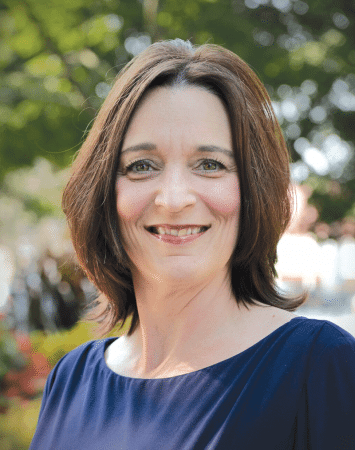
Linda Tyer
Pittsfield Mayor Linda Tyer, a member of the LIPPI class of 2013-14, agreed. She told BusinessWest that, while mixed-gender leadership programs certainly have value, and women in every field must work alongside men, there are many benefits to having only women in the room.
“I’ve always been an advocate for advancing women in politics and in business, and this was an opportunity to participate in that pipeline, not only for myself, but for the women around me,” she explained. “And what happens when you participate in leadership programs for women is that you start to recognize yourself in others, and this enables you to learn from their experiences.
“Women have a collaborative nature versus a competitive nature,” she went on, listing another reason why she LIPPI’s program is valuable. “And you learn that collaborations do lead to success — everything isn’t a competition.”
Over the years, LIPPI has not only inspired women to consider and then pursue public service, but helped hone the skills and, yes, broaden the comfort zone of those already in office.
Tyer falls into both categories, actually. She was the city’s clerk when she became part of the LIPPI class of 2013-14, and prior to that served on the City Council.
She said the LIPPI experience helped provide her with the will and confidence needed to seek the corner office.
“I had an aspiration to become mayor, and participating in the program gave me more confidence in my leadership abilities to take that big step forward,” she noted, adding that several factors, including everything from her family situation to her collective experience in city government, collided to convinced her it was time to seize the moment.
And since taking office in January, she said there have been many times when situations and challenges have prompted her to summon lessons learned during her LIPPI sessions.
“I carry with me important lessons about public speaking and giving yourself a presence in a room,” she explained, adding that these represent just a few of the many ways in which LIPPI continues to influence her life and career.
Denise Hurst, a Springfield School Committee member, tells a similar story.

Denise Hurst
She had been on the board a short time when she was asked to be part of LIPPI’s inaugural class, and admits to having doubts about whether she really needed it.
Just a few sessions in — and actually before the cohort began its work — those doubts were completely erased.
“I sat on a panel that the Women’s Fund held as a kickoff for LIPPI, and it was probably then that it became readily apparent to me that I needed to go through this,” she recalled, “because there was so much that I didn’t know about being an elected official.
“I didn’t come from a political family — I had no real experience in politics or elected office,” she went on. “So I felt very much behind the curve with respect to my colleagues on the School Committee, but the types of training and workshops provided by LIPPI were extremely helpful.”
Elaborating, she described her LIPPI experience as an internship of sorts, one that provided hands-on training and many types of invaluable experience. And, like others we spoke with, she said that what LIPPI helped provide, above all else, is that priceless commodity known as confidence.
“You can listen to all the speakers in the world about how you build confidence and how you should be confident and how you shouldn’t be scared, but the reality is that, when you walk into the School Committee chambers or the City Council chambers or state government, you’re there alone … your mentor is not there,” she told BusinessWest. “You have to be quick, you have to be able to think on your feet, and LIPPI helps you do that; it helps you strategize.”
A visitor to Pittsfield City Hall would quickly learn that the mayor’s LIPPI diploma is not the only one proudly displayed.
Indeed, several members of what would be called the Tyer administration were part of the class of 2013-14, and Roberta McCulloch-Dews, director of Administrative Services, is one of them.
A former journalist who later started her own communications company and then held several positions, including assistant to the president, at the Massachusetts College of Liberal Arts in North Adams, McCulloch-Dews said she wasn’t really thinking about a shift into public service when she participated in LIPPI.
What she was thinking about was taking advantage of any opportunity that would expand her horizons.
“I’m a knowledge seeker — I love to learn,” she explained. “And I love to challenge myself with new ways of thinking. So when I heard about LIPPI and how it encouraged women to think about public service as another outlet, I thought it was important to learn about this area — even though moving into that realm wasn’t really feasible at that time.”
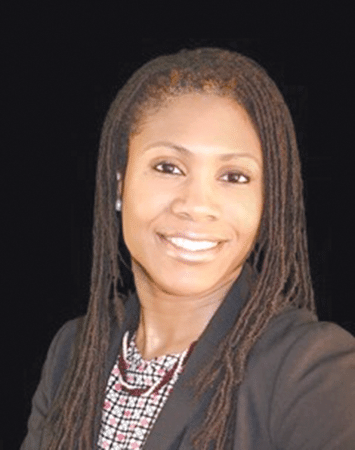
Roberta McCulloch-Dews
Or so she thought. Indeed, McCulloch-Dews said one of the many thoughts she took home from her LIPPI experience was the notion that one doesn’t have to wait until the conditions — especially a proper balance of work and family — are perfect to take a step into public service, or any other arena, for that matter.
“I would say that I came away from LIPPI empowered to know that I didn’t need to have everything fit perfectly to make the decision to go into public service,” she told BusinessWest. “I didn’t know at the time that I would be in public service now, but I think it was fitting to have that foundation, because it served to enrich what I’m doing now.”
Katherine VanBramer, Tyer’s executive assistant, was another member of that class of 2013-14, and she was technically already in public service while attending those sessions.
In fact, she was working for Tyer, as senior clerk.
Last November, Mayor-elect Tyer asked her to stay with her and become her executive assistant. This role would present a new set of challenges and even more work directly with constituents. But she credits LIPPI with helping to impart her with not only the confidence to make the shift, but the desire to take on a role where she would often be a liaison between the mayor and city residents.
“LIPPI definitely provided me with more self-confidence in dealing with the public,” she said. “And it really inspired me to appreciate how important it is to help people navigate their government, because it can be a tricky process sometimes. If there’s anything I can do to make the process more simple or more understandable, I’m happy and willing to do that.”
While all those we talked with related how LIPPI provided them with confidence and empowerment, they also talked with one voice about the power of mentoring, learning from others who have been through similar experiences, and how the relationships forged during their year certainly didn’t end when the diplomas were handed out.
They spoke also about how the program left them determined to mentor others and share collective knowledge and experience with those who are younger and walking where they were years ago.
“LIPPI has caused me to be more thoughtful about mentoring young women who are interested in getting into non-traditional fields,” said Kasper, noting that police work certainly falls into that category, and few women look in that direction simply because they lack role models — something she has become, and takes quite seriously.
“I’m in a position where I have a great opportunity to be a mentor,” she went on. “It’s an attitude I had before LIPPI, but that program really strengthened it.”
Experts on the impostor syndrome say it is quite common, difficult to completely cure, but, in most cases, quite manageable.
The process starts with recognizing the condition, understanding that many others suffer from it, and addressing it. The last part of that equation generally amounts to building confidence and thus erasing those nagging doubts about one’s abilities, and developing a strong support system that can help keep them from coming back.
All of that isn’t on LIPPI’s mission statement, either, but that’s exactly what this unique program does.
That, and providing women across Western Mass. with a much bigger comfort zone.
George O’Brien can be reached at [email protected]
By KATHLEEN MITCHELL

Karen Buell (left) says her career and work/life balance have both benefited from the help of her mentor, Mary Meehan.
Janice Mazzallo calls it a “perfect match.”
The executive vice president and chief human resources officer at PeoplesBank was referring to the mentoring relationship between Karen Buell and Mary Meehan, which began eight years ago, after Buell came to her and asked if she would allow Meehan to serve in that role.
Buell had completed a management-training program, participated with Meehan in strategic planning sessions, and identified her as an ideal role model.
“Mary is intelligent, polished, professional, and successful,” Buell told BusinessWest, adding that she wanted to follow in her footsteps.
The bank didn’t have a mentoring program of that specific type in place, but when Mazzallo presented the idea to Meehan, she readily agreed.
“I was honored to be singled out and hoped I could make a difference,” said the first vice president of commercial lending.
Since that time, Buell has had two children, completed her MBA, and been named vice president of the bank’s customer innovation lab. And she credits Meehan with playing a significant role in helping her achieve a successful life/work integration and thus accomplish all of the above.
In fact, the two women have worked so well together that last year they participated in the Bay Path University Women’s Leadership Conference, titled “Celebrating Sisterhood,” where they shared their mentoring experiences during a panel discussion.
Their experiences — on both sides of the equation — present an effective case study in the importance of mentoring and how both the mentee and mentor benefit from the experience.
Meanwhile it also shows the many roles mentors take in their work, everything from presenting what Meehan called “reality checks” to Buell — a self-described perfectionist, reluctant delegator, and professional prone to come down hard on herself — to simply acting as a reliable sounding board.
“I told her she has to let her husband or a friend help her, that having other people assist you is OK,” Meehan recalled, adding that young people face a number of challenges today, and too often they feel they must take them on alone.
Said Buell, “there are times when I set my expectations too high because I want to be able to do it all. But I can always go to Mary and run things by her, ask her if I am off base or whether I should shoot for the stars.”
For this issue and its focus on women in business, we shine a spotlight on this relationship, which serves as a model for how mentoring can — and should — work.
Buell didn’t have children when this relationship began, but the difficulties of balancing her personal and professional life were already becoming apparent. And after giving birth to a son and a daughter, who are now 4 and 2, there were times when she felt overwhelmed.
But Meehan’s guidance has proved invaluable, and she has urged Buell to be her own advocate when she felt it was appropriate.
For example, when Buell told her mentor she wanted to be able to pick up her son from school and work at home in the evenings to make up the time, Meehan supported the idea, even though flex schedules were not a common practice at the bank at that time.
“I thought, if anyone could do it successfully, it was Karen,” she noted, citing a long list of Buell’s accomplishments.
Meehan could certainly relate to Buell’s challenges and thought processes. Well, sort of.
She could relate to the part about desiring work/life balance and wanting to be with her children for important moments in their lives — or even a ride home from school every day. But not to the part about seeking — and then attaining — a flex schedule.
That’s because such thoughts were mostly foreign concepts when she broke into this business.
That was in 1975, after she graduated from college and completed a management program at Citibank. The institution didn’t have a formal mentoring program in place, but she noticed that networking took place naturally among the male employees.
“The women in the training program did connect with each other, but there were only a few in the commercial lending area,” she told BusinessWest.
A mentor might have helped her find solutions to difficult situations she encountered in her career, but she has never had one, and struggled with sacrifices she felt she needed to make during a stint in the insurance industry. Meehan had a young daughter and was working in a position that required a great deal of travel, and because her peers devoted untold hours to the job and took calls on weekends, she didn’t think flexibility was an option.
But she has never forgotten the day the sacrifice of being away from home became too much. She was working in Mexico City while at Cigna, and couldn’t return home in time to take her 4-year-old daughter trick-or-treating. And although her husband planned to do it, the idea that she would miss out on an event that meant so much to her was so upsetting that she made the decision to seek a job with more regular hours, left the insurance industry, and returned to banking.
“I never discussed my feelings with the people I worked with,” she noted, adding that doing so was certainly not accepted practice three decades ago.
Times have certainly changed, and today, mentoring is an accepted practice. As part of that practice, those being mentored are encouraged to openly discuss their feelings about what’s happening with their lives and careers.
For these reasons and many others, PeoplesBank now has two mentoring initiatives. The first is a peer-to-peer program that matches every new hire with a high-performing employee to help them acclimate to the workplace. The mentor takes the person out to lunch on their first day on the job, then continues to meet with them for six months. Matches are based on two factors — personality and the person’s position at the bank — and are not gender-specific.
Mentoring was also added as an enhancement to the bank’s management program. After Mazzallo reintroduced the training, and graduates indicated they felt having a mentor would be advantageous, the practice of assigning one to each participant was established.
It has been especially appropriate because Mazzallo hires two candidates each year from the UMass Isenberg School of Management. They typically have a degree in accounting or finance and spend 12 to 18 months working on special projects in different departments before advancing to a management position.
“I felt it was very important to assign these people to a mentor who could offer them support,” she noted. “We have many seasoned professionals who are able and willing to help these graduates and also help internal candidates in our Leadership Development Program who have the potential to become managers.”
Buell told BusinessWest that she feels mentorship is valuable whether someone is just beginning their career or facing new challenges.
“If your company doesn’t have a program, you should ask for one. It amounts to self-help and is well worth it,” she said. “Mary has given me many nuggets of wisdom and helped me get a better perspective on things, as she is able to look through a different lens.
“And although younger people don’t always take the time to look for a mentor, there is something to be said for life experiences that you just can’t Google,” she went on. “We are all very busy, but it’s important to have someone who can just sit down and listen.”
Buell acknowledged that approaching a person in a high position and requesting help can be uncomfortable.
“But if someone can see the value, they may be more apt to take a stance,” she said, citing her own success as an example.
“It has made a world of difference to have someone further down the road who I can talk to, and I produce more for the bank because of this relationship. It’s been life-changing and has helped me identify my strengths, be less critical of myself, and be better able to acknowledge my accomplishments.”
Meehan has also found it rewarding. “When you give of yourself, you get a lot back,” she explained. “I have had a lot of pleasure watching Karen grow, and someday, when I look back on my career, being a mentor will definitely be one of the highlights. It has been a very nice experience, and we have become friends.”
Friendship would be considered a bonus — an industry term of sorts — when it comes to such relationships, but they are commonplace.
And they are just one of many rewards to be garnered by those on both sides of mentoring, which, as this model shows, brings benefits for the participants, the company, and its customers.
That would make this a win-win-win-win situation, an eventuality that brings value in a number of ways.
By JACLYN C. STEVENSON

With many key projects completed last year, Mike Sullivan says, the town is now assessing its next moves.
Town Administrator Mike Sullivan said 2016 is shaping up to be a transitional year for South Hadley, but not necessarily a quiet one.
“A lot of projects finished last year,” he said, listing completion of a new library, high school, elementary school, and two new parks among them. “Things are steady. Now we’re assessing where we’re at and where we need to go.”
Several avenues have already been pointed out for the Hampshire County town of 17,000, guided by an expansive, town-wide renewal plan with a focus on creating healthy environments, giving the overall commercial landscape a boost, and collaborating whenever possible with neighboring communities.
The latter has been a necessity for South Hadley since its incorporation in 1775, largely due to geography. It’s in a unique spot; bordered by Hadley, Amherst, Granby, and Chicopee, and separated from Holyoke and Easthampton by the Connecticut River, South Hadley is insulated by a series of canals, rivers, and reservoirs, and isn’t fed by any interstate highways. It’s long depended on cooperation with its neighbors, particularly Holyoke, but with the town on solid footing with some new, positive developments on the horizon, Sullivan said South Hadley is positioned to offer its neighbors plenty in return.
South Hadley formed an official redevelopment authority last year, which is now working out a plan for revitalization that will begin in the area of South Hadley Center — commonly known as ‘the Falls,’ a former mill village with historic industrial roots — and branching out across town from there.
“It’s been a detailed and aggressive endeavor,” he said, noting that the plan will be presented to town meeting this year and, if approved, must then also be accepted by the state in order to access grant funding and other opportunities.
“Like most mill villages, we’re looking to regenerate the community and adapt it to be a cool place. The attempt is not to gentrify the mill village by any means — the attempt is to make it more habitable, safer, and particularly more pedestrian-friendly.”
As arguably South Hadley’s largest presence, Mount Holyoke College — and the college-owned Village Commons and Orchards Golf Club — is an active presence in the town’s revitalization efforts. Kevin McCaffrey, director of Government and Community Relations in the office of the president at the school, said Mount Holyoke has ramped up its community-support efforts of late, ranging from collaborations with the town’s schools to planning assistance for a new network of recreational trails that extends the walkable-town concept across the community.
“Mount Holyoke has very close ties to South Hadley in terms of economic development and revitalization, and we work every day to strengthen our relationship to the community,” he said, noting that, most recently, the college contributed $300,000 toward the Bachelor Brook Stony Brook Conservation Area and constructed a new boathouse with a community-rowing component, among other projects.
“Mount Holyoke is closely involved with South Hadley in planning efforts around issues such as development of new bike- and hiking-trail opportunities to enhance the quality of life for residents and our students alike,” added McCaffrey. “Our local connections, already strong, have strengthened further under President Lynn Pasquerella, who is very committed to community outreach, and should continue to grow under acting President-elect Sonya Stephens.”
Jeffrey Labrecque, chief operating officer of the Village Commons, has a similarly positive view of South Hadley’s overall business picture and how it’s positioned for the coming years. Today, the town has an opportunity to tackle some key issues surrounding growth in the business sector, he said, including increasing the commercial tax base in hopes of reducing the residential tax burden.
“I see business in South Hadley as being very steady, with a sudden increased interest in commercial and retail opportunities and with restaurant growth exceeding expectations,” he said, noting that conditions at the Village Commons reflect this stability; the mixed-use complex with a focus on retail, restaurants, office, and residential space is currently at 98% occupancy.
“On the office side, interest has calmed down, but business is stable. South Hadley’s ‘big little village’ continues to thrive and brings in business from all over the Valley,” he went on. “Most importantly, we are here to stay, we are invested, and we voluntarily support the community, its events, and its goals on a variety of levels.”
The Commons is eyeing possible expansion opportunities of its own, perhaps in the areas of additional leasable space or parking. Any move on the part of the Commons or South Hadley at large, said Labrecque, should be made to ensure a strong position in the local market, and always with an eye toward what’s happening in adjacent towns.
“There is a lot of growing competition in neighboring communities, and the future may very well lead to shared departments and services with neighboring towns,” he said. “We would be remiss in our position to sit back and watch; we need to always be looking for new ways to improve growth.”
In that regard, Sullivan said South Hadley has recorded a few wins lately. One of the most heralded developments in the Falls recently was the arrival of Mohawk Paper, the largest family-owned producer of envelopes in the country. Mohawk’s plant moved into a group of buildings formerly known as the U.S. Gaylord properties last year, and makes more than a million envelopes a day.
“It was quite a coup,” said Sullivan. “They were looking at plants not only in this region — in Chicopee, Westfield, Holyoke — but also locations in other states, including New Hampshire and Connecticut. We see having them choose South Hadley as a big success.”
What’s more, the properties still have more than 200,000 additional square feet of space available that the town is now actively looking to fill. Labrecque said Mohawk’s arrival was exactly the kind of boon South Hadley was hoping for, and added that he sees several other hot spots for development, including the now-vacant Newton Shopping Plaza.

The Village Commons, a mixed-use complex of retail, eateries, offices, and apartments, is 98% occupied.
“We’re seeing some great growth on the commercial-industrial side, and I remain hopeful that will support additional commercial interest,” he said. “While there are many areas of concern, I hope that much of the focus goes to Bridge and Main streets and the corner of Newton and Lyman streets. Route 33 from Newton Street to Chicopee also has prime areas of opportunity.”
Labrecque noted that growth in the commercial sector is the ultimate goal, but he does see development in the housing market as one of the town’s most immediate opportunities.
“I foresee huge opportunities, especially in the area of rental housing,” he said. “For some 26 years, the Village Commons has maintained a residential waiting list that at times could exceed 30 anxious prospective tenants. Whether you add housing on Main Street or College Street, there will continue to be a need.”
Sullivan agreed that South Hadley’s residential base is solid, and improvements to its infrastructure are very much on the town’s to-do list, in order to continue to attract residents, visitors, and businesses alike.
“We need to improve the housing stock,” he said. “We’re hoping this spurs investment in other properties from people around them who haven’t invested in years but might start feeling a new level of confidence. We’ve been very aggressive enforcing codes and health and safety regulations, particularly among absentee landlords.”
Two separate condominium projects are now underway in town — six units in the former public library through a $1.8 million investment, and plans for a second condo development near the new library building have just been approved, raising that investment in housing to nearly $3 million.
It’s a move that goes back to the overall redevelopment plan for the town — “those are the kinds of gateways you want to make really inviting to have people see the value of the community right away,” noted Sullivan — but development in the housing sector is also one aspect of a larger effort to continue to cultivate South Hadley’s strong niche in the business of aging.
“South Hadley is not an aging community so much as it is a community that is investing in aging,” he said. “Whether the community recognized it or just through happenstance, they have positioned the town very well to be ready for that industry.”
Sullivan listed elder-care businesses including Loomis Communities, Wingate at South Hadley, and Hubert Place, a federally funded supportive housing development for residents 55 and older, as examples.
“There are also early talks happening now regarding the construction of a new senior center for the town,” he went on, “and of becoming a ‘dementia-friendly community,’ a commitment to working with issues around people with changing abilities due to diseases of the brain.”
To that end, April will be Dementia Awareness Month in South Hadley, and the town is now exploring AARP’s Age-friendly Communities program to develop practices for walking, biking, and other outdoor recreation opportunities that are suitable for users of all ages. If approved, South Hadley would be the first community in Western Mass. to hold the title, and Sullivan hopes the focus on creating walkable areas will resonate with residents of all ages.
One project underway is a shift in operations at the town-owned Ledges Golf Club. The course’s general manager will now serve as the town’s recreation director, with the goal of attracting more South Hadley residents to the property for myriad activities year-round, from walking to snowshoeing. Sullivan said he’s also keenly interested in creating a walking path to Holyoke’s train station, less than a mile away from the center of South Hadley.
“People could walk across a bridge and access transportation to New York or Montreal,” he said. “We think that’s one of those cool features that could be an economic catalyst for South Hadley.”
All of these endeavors demand collaboration within South Hadley and beyond, but Sullivan, McCaffrey, and Labrecque each told BusinessWest that the climate in town is one more accepting than ever of cooperative ideas aimed at cost savings, efficiency, and economic growth.
“We work with the college quite a bit,” Sullivan said, “and we get a lot of cooperation from many surrounding towns, including Granby, Ludlow, Hadley, Chicopee, and particularly Holyoke. Holyoke Mayor Alex Morse understands the connection that exists between the city and South Hadley.”
McCaffrey said Mount Holyoke also sees that link and many others, and is actively creating programming aimed at the revitalization of South Hadley and economic growth region-wide.
“We’re very interested in discussing further opportunities,” he noted. “South Hadley’s economic health and our health as a college are intertwined, and we are always looking for opportunities to strengthen the bonds of South Hadley.”
Year Incorporated: 1775
Population: 17,514 (2010)
Area: 18.4 square miles
County: Hampshire
Residential and commercial Tax Rate: $19.85 (Fire District 1); $20.49 (Fire District 2)
Median Household Income: $46,678
median family Income: $58,693
Type of government: Town Administrator, Town Meeting
Largest employers: Mount Holyoke College, Loomis Communities, Mohawk Paper
* Latest information available
By KRISTINA DRZAL-HOUGHTON, CPA
So, you’re a woman, and you run a business. In the pool of privately held small businesses in this country, being a woman business owner actually has many advantages.

Kristina Drzal-Houghton
Most public corporations, as well as local, state, and federal government purchasing agencies, have programs for allotting a certain percentage of business to women-owned companies. Getting certified as a women’s business enterprise (WBE) can make the difference between landing that business or not. However, the certification process is not without its challenges, and owners often get discouraged during the process because they lack the proper guidance or misunderstand how the process works.
Certification validates that the business is 51% owned, controlled, operated, and managed by a woman or women. Ownership is just a small part of the equation. The term ‘ownership’ goes beyond numbers in this case. A woman must also hold the highest position at the company and be active in daily management and the strategic direction of the company.
So, before moving forward, make sure that you have several ways of proving that you are leading the company, from doing the hiring and firing to any planning documents. In addition to being a majority owner, the woman must also be a U.S. citizen.
If you are puzzled about the many types of certification, you are not alone. Much confusion exists, and to fully explain each is beyond the scope of this article. However, with just a short explanation, most people can determine which certification is probably right for them to pursue.
• Women’s Business Enterprise (WBE) certification is gender-based for woman-owned businesses;
• Women-owned Small Business (WOSB) certification is required for a specific federal purchasing program that has a set-aside for women-owned businesses. There is also a disadvantaged component to this program, which is called EDWOSB;
• The 8(a) designation is actually a business development/mentoring program administered by the Small Business Administration (SBA) for a company that has been disadvantaged, and 8(a) certification is part of that program;
• Small Disadvantaged Business (SDB) certification is for businesses that are disadvantaged but are not participating in the 8(a) development program;
• Disabled Veteran (DV) certification is for the business owner who is a veteran of the U.S. Armed Forces and who has been disabled in action; and
• Minority Business Enterprise (MBE) certification is race-based for minority-owned businesses.
The U.S. Small Business Administration can be contacted regarding participation in the 8(a) program, or to obtain the SDB certification as well as the DV certification.
MBE certification is done through the National Minority Supplier Development Council (formerly known as the Minority Supplier Council, or MSC). WBE certification, as well as WOSB and EDWOSB certifications, can be obtained through the government or third-party certifiers.
Third-party certification is geared to the private sector. If you are interested only in being a vendor/supplier to any government entity, it is recommended that you contact each specific agency to obtain their requirements. If you are more interested in doing work in the private sector, particularly with large, publicly traded companies, WBE certification by a third-party certifier is recommended.
There is a long list of documents that you will need to get together for your application. This is probably the most arduous part of the certification process, and if you’re not organized or haven’t kept track of important business documents, getting everything together can be even more time-consuming and challenging.
You don’t have to be going through the application process before you get organized. If you think that getting certified is something that you will eventually want to do, it is wise to start putting aside the necessary documents and paperwork as early as possible.
The Women’s Business Enterprise National Council (WBENC), a national, Washington, D.C.-based nonprofit that also provides an avenue for women-owned enterprises to get certified, has a list of required documentation on their website.
• The applicant sends the completed application to the certifying agency;
• The certifier checks to ensure that the application is complete with supporting documentation;
• The application is forwarded to one of the national review committees;
• If the committee has questions arising from the documentation in your application, they will contact you for clarification;
• A visit to your place of business will be arranged and conducted by one of the certifier’s trained site visitors. Results of the site visit are sent to the review committee;
• The review committee meets again to make final decision;
• The applicant is notified of the decision, and, if certified, a certification packet is sent. If the application has been denied certification, a letter is sent stating the reasons and stating the appeal process; and
• You must renew your company’s certification annually, whether you have WBE, WOSB, or EDWOSB certification. However, the process is a relatively simple one after the initial certification, especially if there have been no ownership changes.
Once you make it through the certification process, it’s time to use the distinction to your advantage. According to business owners who have their certification, there is a lot of potential to grow your business through this avenue, but you can’t just sit back and expect the business to come to you. The best way to get word out that you are certified is to contact local, state, and national certification agencies and ask to get put on their mailing list.
Additionally, mention that you are a certified women-owned enterprise on your marketing and promotional materials, which is an easy way to let potential customers know about this important distinction.
Kristina Drzal-Houghton, CPA, MST is the partner in charge of Taxation at Holyoke-based Meyers Brothers Kalicka, P.C.; (413) 536-8510.

Illumascape Lighting
After 23 years as a graphic designer in the sign-making industry, Rob Larkham decided to design and install landscape lighting for a career — a job that requires long hours of manual outdoor labor.
“Everything we’re doing is by hand. It’s labor-intensive,” said the owner of Illumascape Lighting in South Hadley. “But at night, when we turn the switch on, it’s a rewarding moment.”
Larkham is actually the second owner of Illumascape. Phil Costello, who founded the business, was one of Larkham’s customers, and when he was nearing retirement, he approached the graphic designer, believing he would be a good choice to take over the landscape-lighting company. So Larkham came on board four years ago and took over the reins a couple years after that.
“He saw me as a hard worker with an artistic eye — because, what we do is paint pictures with light,” Larkham said of why the opportunity appealed to him. “If it weren’t for the artistic end of it, I wouldn’t have made the transition. You’re outside digging ditches all day, but then you get to the end of the day, when it’s dark, and you flip the switch and get that ‘wow’ moment.”
Landscape lighting, also known as architectural lighting, has long been popular in warmer climes, but in the Northeast, most homeowners have been satisfied with porchlights and maybe a floodlight out back. But, increasingly, they’re seeing the aesthetic value in the variety of techniques available from companies like Illumascape and numerous landscape-design firms.
As Larkham explained, landscape lighting is the permanent placement of lighting fixtures in the outdoor environment, with the aim of highlighting the form, texture and definition of landscape plantings as well as enhancing the architectural features of the home. In contrast to one or two floodlights, architectural lighting may utilize dozens of smaller, strategically placed fixtures to accent the details of a home and yard.
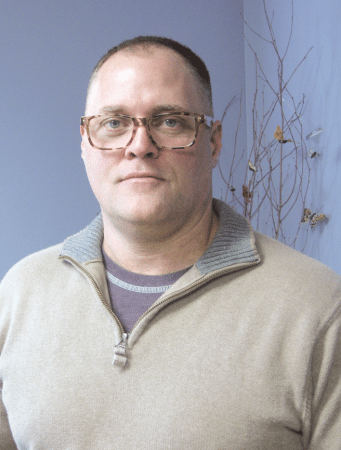
Rob Larkham says customers choose architectural lighting for both aesthetic and security reasons.
“It’s still really in its infancy here,” he told BusinessWest, adding that customers choose landscape lighting for two reasons: to add beauty to their property and for security. “A well-lit home is less likely to be broken into than the house next door. Plus, you’re more likely to slip on dark stairs and dark sidewalks.”
Gary Courchesne, owner of G&H Landscaping in Holyoke, said the emergence of energy-efficient LED diodes has made landscape lighting more popular, because people see the long-term value in what, admittedly, can be a hefty up-front investment.
He explained that a transformer installed in the yard converts the 120-volt household current to 12 volts, and the LED diodes reduce the energy drain even further. “From an energy standpoint, you’re getting the benefit of cost savings. That’s key for people.”
He and Larkham both noted how the fixtures are designed to direct each beam in a specific direction, with techniques ranging from uplighting and downlighting to path lighting and ground lighting.
“In other instances, we use well lights buried in the ground that give that upward lighting effect,” Courchesne explained. “You may have ornamental plants, which you want to show off and shed a little more light on.”
Added Larkham, “I just think people are seeing the value in it, whether it’s beauty, safety, security, or curb appeal. People are spending more time in their backyards. I really think the growth in this industry will be extensive.”
The key to successful lighting, Courchesne said, is professional design. He noted that a flood of low-voltage lighting kits hit retail stores over the past decade, and many people bought them, were unsatisfied, and didn’t think about it again. That’s because they didn’t have a skilled designer and installer on their side.
“When people buy a big-box store kit, they’re compelled to use every light in it. But, in the instance of low-voltage lighting, less is more. You don’t want your sidewalk or shrubbery to look like a runway. You want it to highlight, accent, and provide adequate light for pedestrians and the security element.”
With homeowners in the Northeast investing more money in their properties in recent years, he went on, many are now becoming aware of professional landscape-lighting design, which is ubiquitous down South.
Larkham said customers run the gamut from contractors building a new house and including landscape lighting in the initial design to homeowners who have been in their homes 25 years or more and have an itch to do something new and dramatic with their outdoor space.
“Sometimes it’s a complete landscape remodel — a landscape architect may be doing the whole backyard and will call me and say, ‘hey, we’d really like to do landscape lighting in this remodel.’ That said, I’ve gone out and done simple installations of five path lights, and, on the other end, 200-light installs.”
In other words, although architectural lighting is a high-end product in the world of landscape architecture, there’s typically something for every budget. Larkham said he often works within someone’s budget for an initial installation, but might put in a larger transformer if a client expresses interest in adding to the design later. “Maybe they’ll do the front of the house this year, and the backyard next year.”
With a budget in hand, Larkham then draws on his artistic side. “That’s my job as a designer — I show up, meet with client first, figure out what they’re looking to do on their property, and come up with a design using the proper fixtures.”

This Illumascape project demonstrates how small, strategically placed lights bring out the details of a house and yard.
For example, the same kind of tree could be lit using completely different techniques, depending on the yard.
“We’ll go out and do a lighting demonstration before we ever sign a contract, with about 100 demonstration lights, to show you what the final product might look like,” he said. “We don’t have clients come out until it gets dark so we have that ‘wow’ moment. More than nine times out of 10, they come out and say, ‘wow, we had no idea.’”
In many cases, he added, a customer’s neighbors may have architectural lighting, but when someone sees it on their own property, it’s a much more impactful experience.
“You have to look at the key elements of what people are trying to accent and highlight, then decide how to use the lights,” Courchesne said. “Some people want it on the front door to highlight a wreath, using it as a spotlight. In some cases, they want to flood the area with some light. But the whole key is subdued lighting, not offensive lighting.”
He told BusinessWest that the results are gratifying.
“Some of the comments I hear are, ‘can you believe my house now?’ I hear that time and time again. I would say 75% of the folks who buy landscape lighting, accent lighting, buy it for the aesthetic value. The other 25% also want it for the security value because lights deter a burglar; they’d rather go to a house that’s dark as opposed to a house that’s lit up.”
As landscape lighting becomes more prominent in the Northeast, customers are accessing some high-tech features not previously available. Residential Lighting magazine noted that, while low-voltage LED lighting is the key industry driver these days, linking lighting systems to smartphone apps, to control them remotely, is also a hot trend.
Other systems are timed to come on automatically, Larkham said, so that, “in the winter months, when it’s dark when you pull into the driveway, the house is warm and inviting already. That’s nice. Floodlights tend to be Fenway Park bright; obviously, what we’re doing is soft and subtle. That’s really what we’re looking for.”
Gary Courchesne says the goal of any landscape-lighting project is subdued, artistic light.
Courchesne also stressed the importance of subtlety in a lighting plan. He said today’s LEDs can bathe their target with a soft, warm, white glow, as opposed to the harsh blue light with which some people associate earlier LEDs.
“Not everyone can afford this,” he stressed. “It’s cost-effective from an operational perspective, but there’s capital investment involved for a quality system. Like anything else, you truly get what you pay for.”
Larkham added that, as time goes on and LEDs become more universal, costs should come down, and are already starting to creep in that direction, which is a good sign for homeowners who want to add a little artistry to their landscapes.
“It’s becoming more popular, it seems the technology is advancing every year, there are always new things happening,” he concluded.
In other words, the future is bright.
Joseph Bednar can be reached at [email protected]

Brian Campedelli says built-in kitchen appliances like these are often just the starting point for a backyard project.
For American families on the go, Brian Campedelli says, home should be an oasis from workplace stress and the general bustle of life.
“I think they’re looking for a general sense of relaxation in their yard. When they get home from work, they tend to be stressed out, and they want to kick their shoes off, throw on some flip-flops, head to their backyard resort, and forget about things for a while,” said the owner of Pioneer Landscapes in Easthampton, explaining why outdoor kitchens and living spaces are becoming more popular, and elaborate, in the Northeast.
“Some people are doing it because they want to entertain,” he added. “Some do pool installs and include an overhang [off the house] and fireplaces … a whole backyard development,” he went on. “They’re looking for a resort lifestyle, where they don’t have to go anywhere except their own backyard to get that feeling. It’s pretty nice.”
Outdoor kitchens — which can include anything from a simple built-in grill to expansive cooking surfaces, refrigeration, plumbing, audio-visual hookups, and more — are at or near the top of most lists of hot landscaping trends, along with firepits, water features, and architectural lighting, even in a region where people don’t want to spend much time outside for several months a year, the current mild winter notwithstanding.
“It’s definitely a growing industry, and it’s more than outdoor kitchens — it’s backyard living,” said Jason Harrington, manager of Ondrick Natural Earth in Chicopee. “Not only are people doing kitchens, they’re doing firepits, fireplaces, pizza ovens … basically a complete package of entertainment in the backyard. We’ve seen a real increase of these things in the past five years.”
He, like others BusinessWest spoke with, agreed the Northeast has lagged somewhat behind other regions of the country, particularly warmer climes, in expansive outdoor living spaces, he added, but that’s changing.
“People are focusing on their backyards in general; they’re creating a getaway in the backyard. Instead of going on vacation, they’re taking that money and putting it into a pool and patio space and creating a vacation feel in the backyard.”

Jason Harrington says homeowners are increasingly seeking a resort-type feel in their backyards.
According to the Hearth, Patio & Barbecue Assoc., patios are consistently among the top three features requested by new home buyers, and most aren’t leaving them bare, opting for permanent cooking fixtures, refrigerators, and other amenities. Meanwhile, noted Rick Miller, owner of RJM Landscaping in Southampton, existing homeowners are increasingly itching to bring the indoors outside.
“It’s slowly catching on and moving up people’s to-do list, particularly in the past two to three years,” he said. “Kitchen spaces are more popular now, maybe because people are aware of what’s out there and realize they can do something really simple, or they can get really elaborate. There’s an option for everyone’s budget.”
Indeed, Miller noted, “kitchens tend to be a little on the pricey side because of all the gadgets and such. Typically, a basic one will have a built-in grill and maybe a fireplace tied into either propane tanks or natural gas so you don’t have to deal with filling tanks. More elaborate spaces will have a built-in grill, refrigerator, sink, cabinet space — sometimes they’ll go as far as putting in a pizza oven.”
Justin Pelis, president of North Country Landscapes & Garden Center in Westhampton, said outdoor kitchens can run into serious costs on appliances alone, since they’re typically built into the stonework.
“You can’t take a normal grill and insert it into stone; it’s not meant for that,” he said. “So it can be just as costly as redoing your whole kitchen inside. You can spend easily between $40,000 and $50,000 just for an outdoor kitchen area, including the patio and everything else — the electrical hookups, the water hookups … it can get complicated.”
Those who opt for the higher-end designs tend to be committed to outdoor entertaining to justify the cost, Miller added.
“We’re seeing more people putting in outdoor kitchens, pools, large backyard spaces, because they want to entertain into the evening. That’s where I’m seeing the trend starting to go,” said Rob Larkham, owner of Illumascape Lighting in South Hadley, which benefits from that trend because homeowners then want to light those areas (see story, page 31). “They want well-lit spaces; some install under-counter lights. People are not just entertaining in the home, but trying to bring it into the backyard.”
Harrington said homeowners on a budget shouldn’t be scared off by the sheer range of amenities available for outdoor cooking and living spaces.
“You can actually find a backyard setup to fit a wide range of budgets; it doesn’t have to be on the extreme high end,” he said. “Part of our job as salespeople is to try to help them get as much as they can for their dollar.”
That said, customers who can afford more than a grill and fridge often look to cabinets, trash disposal, bar areas, pizza ovens, and fireplaces, he went on. “And fireplaces don’t even have to use wood; you can hook gas into it. For people who want to spend real money, we can basically custom-design something of any size.”
Campedelli agreed. “We’ve done all sizes, from poolhouses with full kitchens in them to just built-in barbecues. Mostly, around here, what people are doing is nice, built-in barbecues set up for convenience, with a little refrigerator, things like that.”
Some customers intend to start there but expand their plans to larger seating areas, firepits, and patio extensions as they catch the vision of outdoor living, he went on. “We usually do one or two large projects a year like that. Some go as far as adding an overhang off the back of the house or a pool house. For people who don’t want to go that far, most of what we hear is there’s not enough time in the [warm] season to use it, but others don’t have a problem with that at all, and really go to town.”
Miller has tracked the same statistics known across his industry, how Americans, over the past 15 to 20 years, have increasingly chosen to forgo travel and invest in their homes and yards.
“People are going away less and less, with what’s been going on with travel costs and such, staying close to home, utilizing their backyards more,” he told BusinessWest. “So kitchens have absolutely become more popular. We call them outdoor living spaces because not everyone does a kitchen, necessarily; some people just want a larger-than-usual patio with seating, walls, and lighting. Two of my more recent projects also had pavilions installed to create a little shade if it’s rainy or too hot.”

This Pioneer Landscapes project features a fireplace as the centerpiece.
Harrington added that he’s seeing more business at existing homes than at new construction. “Generally, when someone has been in their home for a while, built up some equity, been there long enough to get their savings back up, they want to invest back in their homes.”
And it’s not just for the adults, he added.
“We’re finding people are building backyards for their kids. I’ve seen it get as elaborate as movie theaters in the backyard with screens coming out of the ground. They’re building areas for their kids to play in and have friends over. They want to make an outdoor area for everyone.”
The bottom line, Pelis said, is that homeowners are increasingly seeing not only the potential aesthetic value of their yards, but the functionality, and kitchens and other outdoor-living features are a big part of that.
“People want to have more experiences in their yards and spend more time there, as opposed to just mowing the lawn and trimming the shrubs,” he added. “They want quality time with their family, and they want to get more use out of their yard.”
Harrington agreed. “It can be as simple as the family wanting a patio and a firepit to sit around at night, or something more complex. Everyone has their own vision.”
Joseph Bednar can be reached at [email protected]

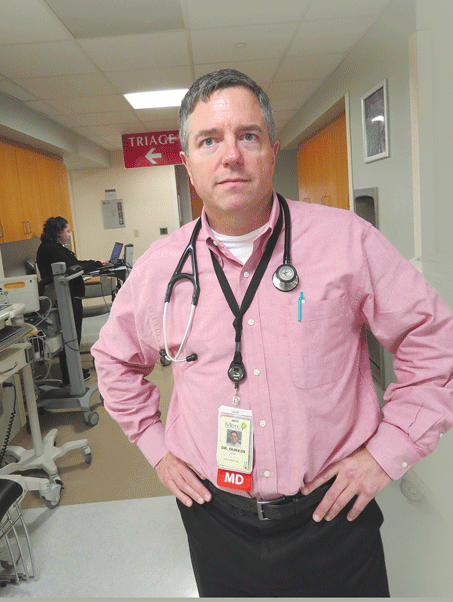
Dr. Louis Durkin says heroin overdoses represent simply the tip of the iceberg when it comes the nation’s opioid crisis.
Dr. Niels Rathlev says it was maybe a year ago that he started hearing, anecdotally, that the emergency room at Baystate Medical Center was rumored to be a place where a visitor could quite easily get some prescription pain meds — if they were so inclined.
Fast-forward to just a few months ago, when, he noted with noticeable pride in his voice, he heard — this time directly from people who were so inclined — that this was no longer the case.
“We actually overheard a couple of people in a back hallway here talking,” said Rathlev, chair of the Department of Emergency Medicine at Baystate. “They were saying that it’s much more difficult to get opioids from the doctors here.”
This significant change in dialogue about Baystate’s ER — and the reasons behind it — speak volumes about the many ways in which the ongoing opioid crisis is impacting life in area emergency departments, which are, in many ways, the front lines in this battle, and how they are responding to this epidemic.
The most visible, or news-making, aspect of this crisis and the way it’s affecting ERs is the alarmingly high number of heroin-overdose cases reported across the region. Since last fall, BMC is averaging at least one case a day, and often there are several, said Rathlev, adding that, thanks to naloxone, a medication sold under the brand name Narcan, among others, many of those who overdose can be saved. Still, some do not arrive in time to be revived, he went on, as almost weekly reports from area media outlets make clear.
When asked how many have died, he said simply, “I don’t have a number … obviously, too many.”
But heroin overdoses represent just the proverbial tip of the iceberg with the opioid crisis, said Dr. Louis Durkin, an emergency medicine physician at Mercy Medical Center, noting that there are many manifestations of this problem that are far less headline-grabbing, but nonetheless concerning.
This is especially true of addiction to prescription pain medications, which for years has revealed itself in individuals with chronic pain wandering from ER to ER looking for a prescription to Percocet, OxyContin, or myriad other drugs — and, until recently, having generally good luck obtaining one.
It’s certainly not a new problem; Durkin says he’s dealt with it throughout his 20 years as an emergency-room doctor. But it’s one that has grown in scope because of the manner in which those drugs were prescribed — and over-prescribed — for years, leaving people addicted to them and often desperate to get them.
“We see far more people with opioid issues, especially addiction, than we do with opioid overdoses,” he explained. “And we’ve been working very hard over the past five or six years to mitigate that, because this is clearly a high-risk group for overdoses.”
Indeed, hospitals like Baystate and Mercy have responded with comprehensive programs — greatly assisted by the state Prescription Monitoring Program (PMP), established in 2010 — that identify frequent visitors to ERs, and especially those who come in search of painkillers.
“We look at patients who are high-frequency users of ED services, and that is a pretty good screen, at least to begin with, and we track them,” Rathlev explained. “If you see someone who has been here 50 times in a year, that’s a good indicator.”

Dr. Niels Rathlev says Baystate, and all area hospitals, are working diligently to control the prescribing of addictive painkillers.
Such information is shared among the hospitals, said Durkin, adding that Mercy has a similar registry, if you will. There are now roughly 600 names on it, he went on, noting that care plans are developed for such individuals with the goal of treating their pain and reducing their risk of an opioid overdose.
In many ways, the region’s ERs serve as a microcosm of the opioid crisis — from the way it has permeated every region of the state, urban and rural, to the many ways the epidemic manifests itself; from the frustration that comes from reviving an overdose victim, only to see that individual back in the ER — or the morgue — just days later, to clear uncertainty about whether the crisis has peaked or is still getting progressively worse.
For this issue and its focus on healthcare, BusinessWest spoke with several ER administrators about the many faces of this crisis and how, in many ways, the ER has become ground zero in a war with many fronts.
Dr. Rakesh Talati says Greenfield is like many rural communities stung by the opioid epidemic — only there are some unique circumstances that make the situation there even worse.
Indeed, this city of 18,000 people sits right on I-91, the major north-south corridor for heroin trafficking, and is only a few miles from the Vermont border, where the opioid problem is especially acute, and a shortage of supply has prompted many entrepreneurial-minded individuals to energetically attempt to meet demand.
That makes heroin readily accessible and usually quite cheap, said Talati, chair of the Emergency Department at Baystate Franklin Medical Center (BFMC), adding that all this has also made it extremely, and alarmingly, popular.
“Our younger population seems to be using it quite a bit — heroin is the dangerous drug of choice in our area,” he said. “The problem is probably as prevalent here as it is in Springfield or Holyoke, because we’re just another stop off 91.”
Baystate Franklin sees only a fraction of the overdose cases that the Springfield-based hospitals do (maybe one a week) because it serves a wide but sparsely populated area, said Talati, but it handles its share, partly due to the aforementioned accessibility of heroin, but also because this is the only hospital in Franklin County, and those from the area who have overdosed can’t easily drive past it to get treatment somewhere else, which an individual might do if he or she lived in Northampton, Holyoke, or Westfield, also homes to community hospitals.
“When it’s 40 minutes to the next hospital, or to Springfield, people have a tendency to stop here,” he said, adding that this is also why the hospital sees a comparatively large number of stroke and heart-attack patients for its size. “We’re essentially the one shop in town, so we have to be ready for anything.”
This same geographic characteristic certainly limits the options for those seeking prescription painkillers, he went on, adding that BFMC sees every aspect of the opioid problem.
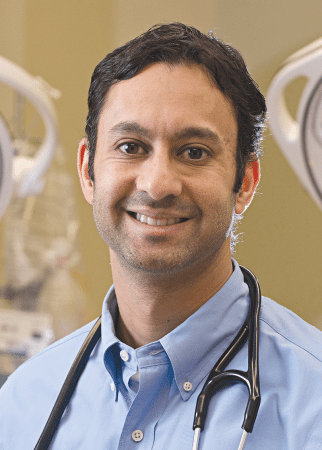
Dr. Rakesh Talati
And none of the them would qualify as recent phenomena, he stressed repeatedly, adding that heroin overdoses and patients coming to the ER in quest of powerful painkillers are problems addressed by generations of ER doctors.
But the scope of the problem continues to escalate, said Talati and the others we spoke with, noting that, while the huge amount of attention given the problem on the regional, state, and federal levels has certainly raised awareness of the issue, recent numbers would indicate that progress is elusive.
That is especially true when it comes to heroin overdoses, said Rathlev, adding that, while the effectiveness and improved accessibility of naloxone — one can now get it at Baystate’s pharmacy, for example, with only a $4 co-pay — have certainly made a difference when it comes to saving the lives of those who have overdosed, the number of cases continues to escalate, as does the number of deaths.
Quantifying the matter as best he could, Rathlev said Baystate saw roughly 150 overdose cases in the fiscal year that ended last Sept. 30. But in the first two months of the new year, it saw 109, and is on pace to more than double last year’s total and approach one case per day on average, with perhaps 60% of those cases involving men ages 15-30.
“Whether that was a blip, we don’t know,” he said of the start of the new fiscal year, “but we nearly tripled the rate of the year before for that same time period, and that is certainly concerning.”
Durkin agreed, and said there are many reasons for this rise, including those aforementioned efforts by all ERs — and the medical community in general — to curb the availability of prescription opioids.
“People are switching to heroin because it’s cheap and its available,” he noted, adding quickly that, nationally, overdoses of prescription opioids are still nearly three times as common as those involving heroin — roughly 28,000, compared to about 10,000.
Another reason for the rise in heroin overdoses is the potency of the products now being found on the streets. Some shipments, such as the highly publicized batches of ‘Hollywood’-stamped heroin that reached the area late last year, are quite lethal, he said.
But perhaps the biggest problem, he continued, is that users simply don’t know what they’re getting when they make a buy.
“The problem with an illicit drug is there’s no control,” he explained, “so the potency can vary by orders of magnitude — one batch can be 10 to 100 times more potent than another batch.”
Meanwhile, treating heroin overdoses is only part of the story, said Talati, adding that what happens after a patient is revived is becoming a growing source of frustration among ER personnel.
Such individuals require counseling, detox, and medication-assisted therapy, or MAT, meaning methadone or Suboxone, among other treatments for opioid dependency.
Often, they leave the ER and the hospital without any of the above, because they don’t want it or it’s not available.
“The majority of the patients that overdose on heroin that we revive are uninterested in treatment at that time and just want to go home, and they range in vocalness and belligerency concerning that,” he explained. “Addiction is a very difficult disease, and when they’re right in the midst of that addiction, even a near-death experience isn’t enough to shake them at that moment.”
Often, even for those who are shaken, securing proper treatment can be a challenge.
“What we really struggle with in the ER is that we can stabilize the patient, but then, if they want treatment, getting them into a center is not as easy as it should be,” said Talati. “So, oftentimes, we can’t get them the treatment they want.”
As Durkin noted, heroin overdoses represent only the tip of the iceberg with this crisis. Equally alarming is that problem of addiction to prescription painkillers, and efforts to use ERs as a dispensary.
Many chronic pain sufferers resort to the ER because, in most cases, there are few, if any, other options, he said, adding that many have essentially fired their primary-care physician — or been fired by that doctor — because they can’t get want they want there.
And what they’re finding, a trend verified by that conversation Rathlev overheard in the hallway, is that it is now increasingly difficult to obtain what they need in the ER, because those facilities are far more careful about how they dispense such medications.
The state PMP, which collects dispensing information on certain controlled substances, puts information in the hands of ER physicians, who then use it in efforts to control prescription drug abuse.
To explain the problem, and how ERs have responded, Rathlev cited a case that is in many ways typical of what ER doctors see on a regular basis.
“This was a young man who complained of back pain, and he had this pain for quite some time,” he told BusinessWest. “As I recall, he had seen an orthopedic surgeon, and surgery was either scheduled or had been postponed, and now he was in a lot of pain.
“Initially, I was prepared to give him opioids because he appeared to be in a lot of pain,” he went on. “As things unfolded, I checked with the PMP, I looked at his medical records, and I then called his primary-care physician, who said, ‘this is actually an issue for this patient, and you should be really careful what you prescribe.’ I think I did give him one dose of morphine, but I didn’t given him anything after that.”
Elaborating, Rathlev said incidents like this one — and the numbers of them are not declining — turn ER doctors into “sleuths” as they treat pain-related cases that come before them.
And, while such work is necessary, it is at times difficult because it collides head-on with any physician’s primary mission — to ease the pain and suffering of their patients.
“Our attitude is to try limit our prescribing as much as possible,” said Baystate Franklin’s Talati. “But we don’t want to swing in a direction so that some patient with true pain doesn’t get treated for that pain, either.
“It’s a very difficult thing to figure out sometimes,” he went on, adding that one compounding factor is the lack of quality dental care in some low-income populations, which often causes chronic pain — a problem prevalent in Franklin County.
Meanwhile, the new protocols can also lead to some stressful moments, said Durkin, adding that, while more patients seemingly understand why the ER doctor says ‘no’ when they ask for a painkiller, that is not the answer they are looking for.
“There are some very, very angry patients,” he explained. “It can be a difficult conversation, but it can be very rewarding, too, when you get someone into a better, safer place. But it’s not easy; it’s a challenge, and it’s going to be a challenge for a long time.”
When asked if the medical community, and society in general, had turned any kind of corner with regard to the opioid crisis, those we spoke with all expressed a desire to be optimistic, and to a large extent, they are. But they clearly conveyed the message that anything approaching real progress is still far off.
“I think we’ve hit the peak and are probably on our way down from the prescription-opioid problem — I think there’s now enough support for providers to try to limit, control, and decrease the amount of prescriptions we’re giving, which we didn’t have 10 years ago,” said Durkin. “A decade ago, the culture would be that, if a patient complained that you were not giving them pain medication, you’d be fired as a physician. Now, there’s much more support to limit the amount of prescribing.
“The problem, however, is that we have an incredible number of opioid-dependent people out there that we need to get into treatment, or they’ll turn to heroin,” he went on. “That aspect of the problem will continue to grow until we get a real handle on it.”
Talati agreed, and said there are many aspects of this crisis that would lead him to conclude that it has not peaked yet.
“The thing that concerns me is the age of the people we’re seeing who are using heroin and overdosing on it — people in their teens and early 20s,” he explained. “This means that the education for this has to be for preteens, and that’s a real challenge. Meanwhile, there’s a virtually unlimited supply of cheap, high-quality heroin, and until we can do something about that, it’s clear that we’re not going to make much progress.”
What is also clear is that the region’s ERs will continue to constitute the front lines in this fight, and they will continue to respond imaginatively and responsibly to a crisis defined by a host of stern challenges.
George O’Brien can be reached at [email protected]
By KATHLEEN MITCHELL

Maura McQueeney says telemonitoring equipment is so compact, a nurse of yesteryear could have fit it in her briefcase.
Every morning at exactly 10 a.m., Barbara Kobak weighs herself, takes her blood pressure, attaches a clip to her finger that measures her oxygen-saturation rate, then answers a series of computerized questions specific to her condition, which are presented out of sequence from one day to the next to ensure she thinks carefully about her response.
Within two minutes, the results are transmitted electronically to a registered nurse at Porchlight Visiting Nurse Assoc./Home Care in Chicopee, who calls the 84-year-old if anything doesn’t fall within the parameters Kobak’s doctor set for her.
The service is called telemonitoring, and Porchlight brought the equipment to Kobak’s home in January after she was released from the hospital. She had been diagnosed with congestive heart failure, and after an initial meeting with a nurse liaison in the hospital, a registered nurse spent several days in her home making sure she understood how to use the technology.
Home visits were spaced farther apart as time went on, which is typical; the goal is to help the person learn to manage their disease by recognizing potentially dangerous symptoms, making changes in their diet, and taking all medications prescribed for them.
“The equipment is really easy to use; I depend on it and don’t know what I would do without it. It’s reassuring to have someone call me if my blood pressure is up,” she noted, adding that there have been days when her pressure has been high in the morning, but when she puts the cuff on later in the day, she is relieved to see it has returned to normal.
The Chicopee octogenarian is one of a growing number of people who are benefiting from telemonitoring services. The equipment is made by a variety of manufacturers, and it allows healthcare providers to keep a close watch on the patient from a remote setting.
“We call new patients every day until they become comfortable with the equipment,” said Sandra Peret, a registered nurse at Porchlight and associate director of intake/community service. “We tell patients to use it at the same time every day, but if they are not feeling well, they can recheck the values.”
Telemonitoring is typically used to treat people with congestive heart failure or chronic obstructive pulmonary disease (COPD), which can make it difficult to breathe, although an additional module can be added if the person is diabetic and doesn’t have another reliable method to measure their blood-sugar levels.
Experts say it is valuable because people who are newly released from the hospital can feel overwhelmed when they get home due to the trauma of their diagnosis, the amount of information presented to them, and the lifestyle changes they must make to keep their condition from exacerbating, which can lead to rehospitalization.
“These conditions require a lot of self-management and usually include dietary changes such as cutting down sodium intake,” said Melissa Pouliot, a registered nurse and Porchlight’s intake/telemonitoring manager, noting that telemonitoring helps the patient see a direct correlation between their behavior and their health. For example, if someone eats Chinese food, their weight is likely to rise the next day due to its high salt content.
When that happens, a registered nurse calls the patient and conducts an assessment by phone to determine if the doctor needs to be notified. In some cases, there is no need for alarm, while in other instances, the person’s physician may be called to see if medication changes are in order.

From left, Melissa Pouliot, Sandra Peret, and Kathleen Stezko say patients being telemonitored are given a finger clip that measures oxygen saturation.
However, patients sometimes don’t follow instructions given to them, which can have a direct effect on their vital signs. For example, they might fail to weigh themselves at the same time each day or wear heavy shoes or clothing while they are on the scale.
In any case, the patient is followed closely, and if the weight gain continues, the doctor is contacted. “The ultimate goal is keep the patient from having an acute attack,” said Sue Pickett, director of Mercy Home Care, adding that patients track their symptoms themselves on a calendar even though the results are stored in the computer.
“Telemonitoring is a wellness proactive measure that allows us to catch symptoms early before they exacerbate and become a crisis,” she told BusinessWest. “The reason why these programs are so important is because is because rehospitalization is very common for people with congestive heart failure. We have patients who have been in and out of the hospital every other week.”
Major advances have been made in telemonitoring equipment in recent years, said those we spoke with.
In the past, people needed a landline to transmit information remotely, but today Bluetooth, cellular, and satellite technology make it possible to provide the service whether or not the person has a phone in their home.
The equipment patients receive from the VNA or home-healthcare service usually includes a blood-pressure cuff, an oxygen sensor that is clipped onto a finger, and a scale, which is plugged into a monitor with a touchscreen that not only transmits the information, but stores it, although there are some variations according to the company producing the equipment.
Pouliot said people tap the screen on the monitor Porchlight uses, and when a voice asks them what they want to do, they hit the corresponding icon. When they are finished with their reporting, which takes less than 10 minutes, a voice on the monitor asks the patient a series of questions which can range from “has the doctor changed your medications?” to “do you want someone to call you?” as well as reminders to take their medication.
However, these systems are not appropriate for some, including people with dementia or individuals with a disability who don’t have a caregiver.
“The person has to want to do this and be able and willing to use the equipment every morning,” said Sheryle Marceau, manager of clinical practice for Mercy Home Care.
The remote monitoring is combined with education that takes place during visits to the person’s home. Mercy’s patients are given printed materials with valuable information including symptoms that should not be ignored by people with congestive heart failure. They include unexpected or rapid weight gain; weakness or fatigue; dizziness or faintness; swelling of the legs, ankles, feet, or abdomen; more frequent visits to the bathroom at night; chest pain; and other signs.
“Exacerbation can be prevented, but people need to know what they can do every day, which includes reading food labels, taking their medication, and eating foods low in sodium,” Marceau said.
She added that hospital stays are usually short, so the staff doesn’t have time to teach the patient all they need to know. In addition to the goal of keeping them from returning to the hospital, they want patients to be able to maintain their quality of life and stay active in the community.
So, while the technology is important, it’s what people do with the information gleaned from daily readings that makes a difference.
“It helps patients connect the dots,” said Maura McQueeney, president of Baystate VNA and post-acute executive.
For example, if a patient has a big holiday dinner and their blood pressure and weight rise the next day, it will trigger a call from the nurse who will discuss what they have eaten and determine whether the doctor needs to be involved.
Medication is critical, but unless patients understand the importance of each drug prescribed for them and know exactly what it does, they may take it inconsistently or fail to get it refilled, particularly if they are on a fixed income.
“We try to update each patient’s medication list because the physician may make changes during an office visit, and monitoring allows us to see if the new medication is working,” McQueeney told BusinessWest.
Baystate typically uses telemonitoring for patients who have experienced heart failure. They usually keep the equipment 30 to 45 days or until the nurse feels the patient is capable of caring for himself or herself and has learned the association between symptoms that may indicate their disease is getting worse.
Insurance doesn’t pay for telemonitoring, but local visiting-nurse associations find it so valuable, they do not charge patients for the equipment or the service.
“It’s a tool that provides us with consistent information,” McQueeney said, adding that Baystate began tracking the effectiveness of telemonitoring in high-risk patients about 18 months ago and found their rates of rehospitalization are lower than the national average.
“If a patient calls at 8 p.m., we can have them slip on the blood-pressure cuff and the oxygen clip and get on the scale, which gives the nurse valuable information,” she noted.
In many cases, people have more than one chronic condition, which complicates matters, but a registered nurse has the ability to discern whether pain from a surgery or anxiety is likely the cause of shortness of breath, heart palpitations, or other complaints.
It takes a long time for most chronic diseases to become apparent, but there are points at which the disease progresses.
“Without monitoring, it can seem that the disease got worse overnight, but when a patient can chart their vital signs on a daily basis and know they are being watched by a registered nurse, trends can be identified that alert them to changes that require the doctor to become involved,” McQueeney told BusinessWest. “Telemonitoring is a tool that helps keep people out of the hospital. It involves education and a collaboration with the patient, the registered visiting nurse, and their physician.”
As a result, the service can make a critical difference in a person’s life.
The American Health Care Assoc. reports that the majority of people with chronic heart disease or COPD are elderly, and being readmitted to a hospital increases the risk of complications and infections during their stay as well as the likelihood that their functioning will be decreased when they return home. In addition, every hospitalization exacts an emotional toll on the patient and increases the cost of Medicare, since people are living longer and the incidence of chronic diseases has increased dramatically over the last three decades.
Before nurses discharge patients from home-based services, Marceau said, they make sure they have absorbed what they need to know and have a blood-pressure cuff and scale so they can continue to weigh themselves daily. “We have purchased scales for people who are unable to afford them and teach people when to call their doctors,” she noted.
However, Porchlight has found some patients or their families opt to pay for the telemonitoring service even when the person no longer needs it because it gives them peace of mind.
“It’s great for family members who are concerned about a loved one,” Pouliot said, adding that the service costs about $100 per month, and people on fixed incomes can apply for reduced rates.
Kathleen Stezko agrees. “People get nervous and aren’t sure who to call or whether they should call anyone if they don’t feel well. But telemonitoring provides them with reassurance; they know someone is checking on them each day and will get in touch with them and their physician if it is necessary,” said Porchlight’s vice president of clinical services, adding that people using the equipment can call at any time of the day or night if they have concerns.
Indeed, the peace of mind and patient learning that results from telemonitoring is so important that most VNAs and home-care agencies that use it keep adding more equipment, which helps patients and also ultimately reduces the cost of healthcare.
Kobak can attest to the comfort it provides. “When my friends visit and see this,” she said, “they are so impressed.”


PeoplesBank’s new Northampton branch models some of the latest innovations, from ‘green’ construction to two-way video in the drive-up lanes to iPad stations.
When customers engage the drive-up tellers at PeoplesBank in Northampton, they’re communicating via a video screen. That in itself may not be innovative, but the bank is intrigued by what it could eventually lead to.
“We still have drive-up like a traditional bank, but we have two-way video,” said Stacy Sutton, senior vice president, retail administration. “It’s almost a stepping stone for a future technology — a remote teller. This would be the first step in that process. The customer is getting the personal touch by seeing a teller, but the teller is not necessarily there — they could be back at corporate headquarters in Holyoke, but serving customers here.”
Matthew Bannister, the bank’s vice president, corporate responsibility, compared the idea to how the NFL runs instant replay from one location in New York, with referees from multiple cities around the country communicating with that site.
“It would allow us to have longer branch hours and, from a staffing point of view, more tellers without having to spread them around the area,” he noted.
That’s just one way the bank is looking to the future, discussing concepts and testing out ideas in its customer innovation lab, ideas that may someday be instituted in the branches.
“Technology is always changing, and we’ve got to stay at the forefront of that,” Sutton said. “Of course, not everything we throw against the wall is going to stick or be the best thing for customers or the bank.”
In recent years, questions have arisen in the banking industry about the need for new branches, given the emergence of online and mobile services for customers. But the way PeoplesBank and others see it, branches may be evolving in how they’re designed and what the customer experience is like, but they’re not going away.
“Every customer survey we do says that branches are important to the customer,” Sutton said. “They feel that the brick-and-mortar presence is important. And we do find that they like to come in and see people, have that conversation. That’s why we’re making these offices more inviting places they’ll want to come and stay.”
For example, newer PeoplesBank branches have eliminated teller lines in favor of smaller teller ‘pods’ for a more personal touch. In addition, a quick look around the Northampton branch on King Street — the bank’s newest — reveals refreshment and coffee stands and iPad stations for customers to use, drawing on the facility’s Wi-Fi.

Berkshire Bank has adopted many modern branch-design elements, including teller pods to eliminate counters and lines.
Berkshire Bank has incorporated similar changes in its new branches, said Tami Gunsch, executive vice president, retail banking.
“We’ve enhanced our branch design over the past five years; the new design includes smaller square footage, which allows for a more-personalized experience, greater site-selection opportunities, and overall lower operating costs,” she noted, adding that kiosk-like pods allow customers and tellers to interact quickly without the physical barrier of a teller line. Also like at PeoplesBank, Berkshire customers take advantage of in-branch cafés for coffee and refreshments.
“We have seen the needs of our customers change, with the desire to bank when and where it is convenient for them,” Gunsch noted, explaining why it’s important to make branches more inviting spaces. “Customers want to take advantage of multiple channels to do their banking inclusive of online, mobile, ATM, and branch visits. Meeting their needs is an important component in driving the relationship.”
When Connecticut-based Farmington Bank moved into the Western Mass. market, it incorporated some of the same trends adopted by PeoplesBank and Berkshire Bank, including open floor plans and replacing counters and lines with personal bankers serving customers at pods. Its first two offices in the region opened in the fall in West Springfield and East Longmeadow.
Ken Burns, executive vice president at Farmington, said it was important to get the branch design right because physical locations are critical to a bank’s growth, particularly one new to a region.
“We find that well over 80% of our customers believe branch location in proximity to their house or their work is important for them,” he told BusinessWest. “It’s well-documented that it is very difficult to compete and grow through a geographic area and get new accounts — unless you’re a national competitor with a huge marketing budget — without some sort of physical location, some physical proximity to where your customers are. A lot of statistics drive that; it’s not just a guess.”
That said, Sutton noted, the customer experience is changing as the industry moves to online banking, mobile banking, mobile check deposit, Apply Pay, and other innovations, and those factors are influencing branch design — for example, with the iPad stations.
“We wanted to do something different, and we did a lot of research and looked at a lot of national companies; Apple was one of them,” she said. “We went to the West Coast to see what they’re doing; we took ideas from everyone and have tried to incorporate them into PeoplesBank. We want to be innovative, to introduce new technology to customers, make it inviting to them; we want them to come visit PeoplesBank.”
One shift that has more to do with training than technology is the concept of ‘universal bankers,’ who are able to help customers with a range of tasks, from deposits to loan applications, as opposed to the traditional model, which separates those roles.
“Any one of the employees can help with anything; it doesn’t matter who the customer sees here,” Sutton said, noting that the new Northampton branch is modeling the idea, and other concepts, that will eventually move to other locations. “We hope to take elements of this building and incorporate them in other buildings, such as teller pods, two-way video, anything we see coming down the pike in the future. That is the plan.”
Berkshire Bank has begun to adopt the universal-banker model as well, Gunsch said, emphasizing the need for 21st-century branches to be both high-tech and high-touch.
“The new branch design has evolved to leverage new technology to enhance the customer’s experience in conjunction with our shift to staffing our branches with more universal-banker roles who can address any needs a customer may have, versus needing to deal with multiple team members,” she noted. “This maximizes teamwork through an efficient floor plan.”
Another shift in branch design is actually one being incorporated in myriad types of business — going ‘green’ to maximize energy efficiency and minimize environmental impact. In recent years, PeoplesBank has opened three offices certified by the national LEED (Leadership in Energy and Environmental Design) program.
Indoor and outdoor LEED elements at the King Street location include large windows allowing plenty of natural light, an energy-efficient HVAC system, carpeting and paint products that emit low levels of VOCs (volatile organic compounds), drought-resistant plantings, a rain garden directing water runoff back into the ground as opposed to drainage systems, and, car-charging stations free to anyone.
In addition, the bank built on an existing site instead of clearing trees from a new property, recycled 98% of all materials from demolishing the existing building, and brought in new building materials from within 500 miles. Other banks in the region have also targeted existing sites for new branches, such as Farmington Bank, which revitalized a landmark building in West Springfield once occupied by the West Springfield Trust Co.

Stacy Sutton says PeoplesBank’s customer innovation lab is always discussing ways to improve the customer experience.
For Peoples, the LEED efforts are part of its well-known environmentally conscious culture. “That’s a core value of PeoplesBank — to be sustainable and eco-friendly,” Sutton said. “It’s great for staff and customers who come into the building.”
She expects other banks to make similar efforts as time goes on, if only because building codes are moving toward green design as a baseline.
“We’ve had positive response to doing these offices,” she added. “I’m sure we’ll continue to ramp up, and we’ll see other people incorporate aspects of this type of building going forward.”
Finally, Sutton noted, some branch-design elements are aimed simply at making a bank a community meeting place of sorts. Moveable furniture in the Northampton branch allows the staff to conduct customer-education seminars on anything from first-time homebuying to financial strategies to, yes, environmental topics.
Similarly, Berkshire Bank has incorporated community rooms in many branch locations, available to be used for anything from PTA meetings to birthday parties to Little League sign-ups. “The community room is equipped with Wi-Fi, a large presentation monitor, a conference phone, and the newest gaming systems, all at no cost to the group,” Gunsch said. “This has been a differentiator in our local markets.”
It’s all part of efforts to get people into the branches, she noted.
“Customers have shifted away from being solely reliant on the branch to conducting their banking online. However, the majority of customers still visit a branch location at least monthly,” she told BusinessWest. “Person-to-person interaction remains important to the customer and the financial institution. We believe the branch still matters; we just needed to redefine the branch experience.”
Joseph Bednar can be reached at [email protected]
By BOB CUMMINGS
Although many provisions of the Affordable Care Act (ACA) have already been implemented, a few major ones are still to come. None are as far-reaching as the proposed ‘Cadillac tax’ on employer-sponsored health benefits.
Originally scheduled to take effect in 2018, the Cadillac-tax implementation was recently pushed off to 2020. If implemented, the IRS will impose a 40%, non-deductible excise tax on certain employer-sponsored health benefits that exceed a dollar threshold of $10,200 for an individual and $25,500 for a family. Health-insurance companies and self-insured plan sponsors will have to pay the tax on excess dollar amounts for benefits provided above this threshold. After 2020, the limits are to be adjusted for future changes in the consumer price index.
The thresholds will be increased in certain situations if the majority of covered employees are engaged in specified high-risk professions such as law enforcement and construction, and for group demographics including age and gender. For pre-65 retirees and individuals in high-risk professions, the threshold amounts are currently $11,850 for individual coverage and $30,950 for family coverage.
The Obama administration has stated that the purpose of the tax is to reduce the tax-preferred treatment of employer-provided healthcare benefits and raise revenue to help finance the expansion of subsidized health coverage under the ACA. Most experts believe that, contrary to what the name might imply, the Cadillac tax is going to directly impact the majority of employer-sponsored plans.
Many union plans and municipal plans could be impacted right out of the gate, and employers in high-healthcare-cost states like Massachusetts are going to be hit hard if the law goes into effect in its current form. If you thought your healthcare benefit plans were just a Chevy or a Buick, you are in for a big surprise.
As written, the tax is 40% of the cost of health coverage that exceeds these predetermined threshold amounts. Cost of coverage includes the total contributions paid by both the employer and employees, but not cost-sharing amounts such as deductibles, co-insurance, and co-pays when care is received.
Unfortunately, it’s not just the premiums for the employer health plans that are counted toward these thresholds, either. Currently, the Cadillac tax would also include contributions under certain pre-tax, account-based plans such as flexible spending accounts and health-savings accounts or health-reimbursement arrangements, as well as most wellness programs.
The calculation includes any contributions made by the employer or employees pre-tax. Employers are going to be responsible for calculating the total dollar value of benefits for each employee on a month-by-month basis and apportioning this among the benefits providers.
Cadillac-tax payments are not deductible for federal tax purposes. Consider what this might mean for an employer offering a health plan with a flexible spending account (FSA) or health-savings account (HSA) with the average total cost of coverage at $12,000 per year for self-only coverage. A $12,000 individual plan would pay an excise tax of $720 per covered employee: $12,000 – $10,200 = $1,800 above the $10,200 threshold; $1,800 x 40% = $720.
The tax on family coverage could be even higher. A $32,000 value of benefits provided to employees with family coverage would pay an excise tax of $1,800 per covered employee: $32,000 – $27,500 = $4,500 above the $27,500 threshold; $4,500 x 40% = $1,800.
On Feb. 23, 2015, the Internal Revenue Service issued a notice covering a number of issues concerning the Cadillac tax and requested comments on possible approaches that could ultimately be incorporated into proposed regulations. No new regulations have been issued to date.
How are employers responding to these looming changes? Many have yet to digest the impact, but the biggest trend is the migration to high-deductible health plans (HDHPS), and health-savings accounts. Recent statistics show that 60% of employers are contemplating or already have moved to implement new high-deductible health plans with companion HSAs. These HDHP plans have upfront deductibles of at least $1,300 single and $2,600 family and out-of-pocket cost sharing of up to $6,550 for a single and $13,100 for a family in 2016. As compared to traditional health-benefits plans, HDHP plans typically have dramatically lower premiums, as much as 40% lower.
Employees covered under a qualified HDHP plan can contribute (as can the employer) to an HSA either through pre-tax payroll or a direct, tax-deductible contribution to an individually owned tax-preferred accumulation account that can be used to pay for any qualified out-of-pocket health expenses during one’s lifetime with tax free dollars.
While downgrading health benefits to higher upfront deductibles is not the most popular solution for all employees, if paired with a health-savings account including some employer contributions into the HSA, it could be more palatable. This next-generation ‘consumer-directed healthcare’ is forcing consumers to assume more risk and responsibility in how they spend money on healthcare decisions.
While there is a growing movement in Congress and among business groups to repeal or significantly amend the Cadillac tax before it takes effect, we can be certain that no action will be taken until well after the 2016 election. However, given the broad-based impact, this is a topic that will likely stay high on the radar for Congress and our next president.
Bob Cummings is president of Northampton-based American Benefits Group; (413) 727-7211.
By SIENNA KOSSMAN
The nationwide shift to EMV is well underway.
EMV — which stands for Europay, MasterCard, and Visa — is a global standard for cards equipped with computer chips and the technology used to authenticate chip-card transactions. In the wake of numerous large-scale data breaches and increasing rates of counterfeit card fraud, U.S. card issuers are migrating to this new technology to protect consumers and reduce the costs of fraud.
“These new and improved cards are being deployed to improve payment security, making it more difficult for fraudsters to successfully counterfeit cards,” said Julie Conroy, research director for retail banking at Aite Group, a financial industry research company. “It’s an important step forward.”
For merchants and financial institutions, the switch to EMV means adding new in-store technology and internal processing systems and complying with new liability rules. For consumers, it means activating new cards and learning new payment processes. Most of all, it means greater protection against fraud.
 Here are some frequently asked questions to help explain the changes.
That small, metallic square you see on new cards is a computer chip, and it’s what sets apart the new generation of cards.
The magnetic stripes on traditional credit and debit cards store contain unchanging data. Whoever accesses that data gains the sensitive card and cardholder information necessary to make purchases. That makes traditional cards prime targets for counterfeiters, who convert stolen card data to cash.
“If someone copies a magnetic stripe, they can easily replicate that data over and over again because it doesn’t change,” said Dave Witts, president of U.S. payment systems for Creditcall, a payment gateway and EMV software developer.
Unlike magnetic-stripe cards, every time an EMV card is used for payment, the card chip creates a unique transaction code that cannot be used again. If a hacker stole the chip information from one specific point of sale, typical card duplication would never work “because the stolen transaction number created in that instance wouldn’t be usable again and the card would just get denied,” Witts explained.
EMV technology will not prevent data breaches from occurring, but it will make it much harder for criminals to successfully profit from what they steal. Experts hope it will help significantly reduce fraud in the U.S., which has doubled in the past seven years as criminals have shied away from countries that already have transitioned to EMV cards, Conroy said. “The introduction of dynamic data is what makes EMV cards so effective at bringing down counterfeit card rates in other countries.”
Just like magnetic-stripe cards, EMV cards are processed for payment in two steps: card reading and transaction verification. However, with EMV cards, you no longer have to master a quick, fluid card swipe in the right direction. Chip cards are read in a different way.
“Instead of going to a register and swiping your card, you are going to do what is called ‘card dipping’ instead, which means inserting your card into a terminal slot and waiting for it to process,” Conroy said.
When an EMV card is dipped, data flows between the card chip and the issuing financial institution to verify the card’s legitimacy and create the unique transaction data. This process isn’t as quick as a magnetic-stripe swipe.
“It will take a tiny bit longer for that transmission of data to happen,” Witts says. “If a person just sticks the card in and pulls it out, the transaction will likely be denied. A little bit of patience will be involved.”
Some EMV cards can also support contactless card reading, also known as near-field communication (NFC). Instead of dipping or swiping, NFC-equipped cards are tapped against a terminal scanner that can pick up the card data from the embedded computer chip.
Yes and no. You will have to do one of those verification methods, but it depends on the verification method tied to your EMV card, not if your card is debit or credit.
Chip-and-PIN cards operate just like the checking-account debit card you have been using for years. Entering a PIN connects the payment terminal to the payment processor for real-time transaction verification and approval. However, many payment processors are not equipped with the technology needed to handle EMV chip-and-PIN credit transactions. So it is not likely you will have to memorize new PINs anytime soon, according to Conroy.
“There aren’t going to be many issuers requiring a PIN,” she said. “A vast majority will be issuing chip-and-signature cards, which aren’t all that different from how credit cards work now.”
As with a magnetic-stripe credit card, you sign on the point-of-sale terminal to take responsibility for the payment when making a chip-and-signature card transaction.
U.S. chip-and-PIN cards will be transitioned in slowly, according to Ferenczi. “The card production demand today is really based on chip-and-signature cards. It will probably take two to three years to fully convert to chip-and-PIN.”
Despite a slow transition overall, those who get chip-and-PIN cards will be able to use them right away. “If a terminal doesn’t have the ability to accept a PIN, it will then step down to accepting a signature,” said Randy Vanderhoof, executive director of the Smart Card Alliance. “There will always be a secondary option.”
Today, if an in-store transaction is conducted using a counterfeit, stolen, or otherwise compromised card, consumer losses from that transaction fall back on the payment processor or issuing bank, depending on the card’s terms and conditions.
Following an Oct. 1, 2015 deadline created by major U.S. credit card issuers MasterCard, Visa, Discover, and American Express, the liability for card-present fraud shifted to whichever party is the least EMV-compliant in a fraudulent transaction.
Consider the example of a financial institution that issues a chip card used at a merchant that has not changed its system to accept chip technology. This allows a counterfeit card to be successfully used. “The cost of the fraud will fall back on the merchant,” Ferenczi said.
The change is intended to help bring the entire payment industry on board with EMV by encouraging compliance to avoid liability costs.
Today, any parties not EMV-ready could face much higher costs in the event of a large data breach. Automated fuel dispensers will have until 2017 to make the shift to EMV. Until then, they will follow existing fraud liability rulings.
Not exactly. Although the deadline was strong encouragement for all payment-processing parties to become EMV-compliant as soon as possible, not everyone has made the transition yet.
“It’s going to take a little time to adapt,” said Doug Johnson, vice president of risk management policy for the American Bankers Assoc.
EMV debit cards in particular are rolling out at a slower pace. While 90% of financial institutions began issuing EMV debit cards in 2015, only 25% of U.S. debit cards (about 71 million cards) were expected to be chip-equipped by the end of 2015. The percentage of EMV debit cards in consumers’ hands is expected to reach 73% by the end of 2016 and 96% by the end of 2017.
So far, the large majority of chip cards going into the hands of cardholders are coming from larger issuers like Bank of America and Chase, according to the Federal Reserve Bank of Chicago. The cost of this EMV transition is causing smaller banks to convert their cards more slowly.
EMV debit cards may be issued at an even slower pace as banks have to prep their software to accept those new cards as well, according to Ferenczi.
“Different companies will have different rollout strategies,” Johnson said. Some will base their actions on card expiration dates; others will work to get chip cards into consumers’ hands as soon as possible.
Yes. The first round of EMV cards — many of which are in consumers’ hands — will be equipped with both chip and magnetic-stripe functions so consumer spending is not disrupted and merchants can adjust. If you find yourself at a point-of-sale terminal and are not sure whether to dip or swipe your card, have no fear. The terminal will walk you through the process.
“For example, if you enter a card into the chip reader slot but the reader isn’t activated yet, it will come up with an error and you’ll be prompted to swipe the card in order to use it,” Vanderhoof said.
And vice-versa. “If a consumer tries to swipe a chip card instead of inserting it, an error will appear, and they will be prompted to insert the card for chip processing instead,” Vanderhoof said.
If chip-card readers are not in place at a merchant at all, your EMV card can be read with a swipe, just like a traditional magnetic-stripe card. “You can still conduct transactions, you just lose that extra level of chip security,” Johnson said.
Many large retailers, such as Walmart, Target and Costco, have upgraded their POS terminals and are activating them for chip-card acceptance, but smaller businesses may be lagging when it comes to upgrading their payment technology.
Yes and no. The U.S. is the last major market still using the magnetic-stripe card system. Many European countries moved to EMV technology years ago to combat high fraud rates. That shift has left many U.S. consumers who have magnetic-stripe cards looking for other forms of payment when they travel.
Since many foreign merchants are wary of magnetic-stripe cards, consumers who hold some type of chip card may run into fewer issues than those without one, according to Ferenczi.
However, chip-and-PIN cards are the norm in most other countries that support EMV technology. So consumers with chip-and-signature cards may find some merchants who are unwilling or unable to process their card, even though it does have an embedded chip.
Still, despite any difficulties in the transition, Ferenczi says the change is a step in the right direction.
“Nobody likes to think that his or her card is being secretly used for other purposes,” he says. “So I think regardless, there is a level of comfort knowing that it will be far more difficult to counterfeit EMV cards.”
Sienna Kossman is a staff reporter for CreditCards.com. Copyright 2016, CreditCards.com, all rights reserved, reprinted with permission.
From left, Linda Leduc, John Rahkonen, and Charlie Blanchard say Northern Construction’s new, $1 million office building contains cutting-edge technology that will help the company stay competitive.
The scope of economic development in Palmer is so diverse that Charlie Blanchard had to make a list to ensure he didn’t forget any major projects when he spoke about them with BusinessWest.
“We have a lot of commercial activity taking place. There has also been an increase in high-tech manufacturing; new medical office space is being developed, and we have a new recreational motorsports raceway,” said the town manager. “Progress continues in Three Rivers, and we are working to revitalize the Thorndike Mills.”
Linda Leduc, the town’s planner and economic development director, added that projects that were permitted years ago are coming to fruition, and commercial properties that sat on the market for years are finally being purchased.
“I’ve seen a 180-degree turnaround this year, and it has brought a multitude of new jobs to Palmer,” said Leduc, who attributes recent growth to a resurgence in the economy.
And, as she noted, change and progress is taking place in all parts of the community, including the Palmer Industrial Park in Bondsville.
Blanchard said Detector Technology Inc. needed room to expand and purchased a building from Wayne Buxton, who was using it to house his ShedWorks Inc. business.
“Wayne needed to downsize but wanted to stay in Palmer, so he kept half the lot and built a new, smaller structure on it,” Blanchard noted.
The decision reflects a trend he and Leduc are seeing: businesses are choosing to stay in Palmer, whether they are downsizing or expanding, if they can find appropriate space — a pattern town officials believe is based on the town’s location, competitive tax rate, good school system, and excellent municipal services.
“We’re right on the Mass Pike, which is ideal for businesses and for their customers coming from the east and west,” Blanchard said, adding that interviews with owners and executives of 16 companies showcased in a 2014 promotional video titled “Industry Alive in Palmer: An Inside Look at Local Businesses” showed they are happy with the educated workforce in the area and have dedicated, exemplary employees.
Growth is also occurring in the downtown area known as Depot Village, which is the first commercial district travelers encounter after they exit the Turnpike. It’s a prime commercial area and the place where O’Reilly Auto Parts chose to expand their New England presence.
“They purchased a vacant building on 1569 North Main St. that had been an eyesore for years,” Blanchard said. The old structure was demolished, and a new, state-of-the art distribution center has been built on the lot.
In addition, the American Legion building on 1010 Thorndike St. was purchased by Fire Service Group two days after it went on the market last May; the company was located in a smaller building in town but wanted to expand.
Meanwhile, Michael’s Party Rentals is moving from Ludlow into the former home of Baldyga’s Auto and RV Sales Inc. on 1221 South Main St. Company President Michael Linton said he purchased the 20,000-square-foot building in early January, and it is undergoing a substantial renovation.
“We’re building a showroom and design center so that we have a dedicated space where wedding planners, brides and grooms, and corporate clients can see our inventory and design capabilities,” he noted. “We’re also adding office space, as there wasn’t any in the building, and plan to install a $60,000, state-of-the-art tent-washing machine which will allow us to clean the tents we rent with less labor.”
The cost of the building, renovation, and new machine are expected to total about $712,000, and Linton anticipates moving in May or June when it is complete.
“My entire staff is excited. We are extremely cramped in our current location and looked for a building for two years,” he continued. “A combination of factors led to the decision to relocate in Palmer: the price of the building, its access to the Mass Pike, Palmer’s commercial tax rate, and the proximity to my home in Sturbridge.”
For this, the latest installment of its Community Spotlight series, BusinessWest looks at the many reasons why development is occurring in Palmer, and the various forms it is taking.
While Baldyga’s sold its property for the Michael’s relocation, the business didn’t leave Palmer; Blanchard said the owner purchased an empty lot on Park Street and has plans to construct a new, smaller building on the site, which is in the permitting stage.
In addition, a former Knights of Columbus hall was purchased last fall by Joe Kelley of Angelica Properties. It sits on the corner of Route 32 and River Road and had been for sale for more than a year; it is currently in the permitting stage, and the plan is to renovate it and turn it into state-of-the art medical office space.
Meanwhile, Northern Construction Service Inc. is another company that has chosen to expand in Palmer. About three years ago, owner John Rahkonen purchased a lot adjacent to the business that contained a mini-golf course and batting cages. They were demolished, and a new, state-of-the-art, 7,400-square-foot building, which cost about $1 million, opened in early February.
The company has grown from a $2.5 million operation in 1994 to a $45 million to $50 million business today, and although Rahkonen has two other locations, the new office space, which features skylights and advanced technology, was critical to continued success.
Today, the business occupies about 12 acres, but Rahkonen wishes there were more space available in Palmer so he could continue to expand there.
“I could use another 10 acres,” he told BusinessWest, adding that he agrees with town officials that Palmer’s location is ideal due to its access to key roadways. “We’re in the middle of the state, an hour from Boston and the New York border, and 40 minutes from Hartford. Interstate 91 is around the corner, the Mass Pike is here, and I-84 is 20 minutes down the road.” The company’s work requires moving heavy machinery all over New England, up to the Canadian border, and as far away as White Plains, N.Y., as well as to Block Island and Martha’s Vineyard, so access to a multitude of roadways is helpful.
The town also boasts a new recreational facility called Palmer Motorsports Park. It opened last May on a 500-acre tract of land, and since that time, Road & Track magazine has named it as one of the top 10 racetracks to drive on in North America.
However, it was one of the aforementioned projects that didn’t get off the ground for years due to the flagging economy.
“The Sports Car Club of America permitted the site for a sports motorpark in 2007 because they wanted a track in the Northeast,” Blanchard explained. But the land was not developed until 2012 when club member and private investor Fred Ferguson built the multi-million-dollar recreational facility with its 2.3-mile track, which has since brought new people to Palmer and had a beneficial impact on businesses in the north end of town.
As noted earlier, it is just another of a slew of projects that is expanding and diversifying the economy of a community that just three years ago was pinning its hopes on a resort casino.
Efforts to revitalize the Thorndike Mills, situated north of Depot Village, are another example of continued progress.
The property consists of seven linked mill buildings that contain 90,000 square feet and sit on 15 acres. They were once home to the thriving Diamond Cascade Manufacturing Co. but have been vacant since 2000, although a hydropower turbine operation has been installed at the site.
“The hydro units are under the floors because the canal runs beneath the buildings,” Leduc said, noting that some units are also located near the dams. But, despite the fact that she has worked with the mill owners for more than a decade to find new uses for the property, they couldn’t seem to make any progress.
However, new hope was generated last fall, thanks to state Sen. Anne Gobi, who was instrumental in introducing them to the Central Mass. Regional Planning Commission (CMRPC), whose work includes revitalizing the Warren Mill in West Warren, the Hardwick Knitters Mill in Hardwick, the Holland Road Mill in Sturbridge, and now, Palmer’s Thorndike Mill.
Leduc said a tour of the properties was conducted last fall as part of a larger project that includes the Jefferson Mill in Holden.
“We’re working with the CMRPC, MassDevelopment, and the Mass. Department of Housing and Community Development,” she noted. “It’s an interesting and important collaboration because these mills are significant historic structures. Our mill was once the center of Thorndike Village.”
The Center for Economic Development at UMass Amherst is also involved, and will hold a conference titled “The Future of the Massachusetts Mill Community” on April 12 in the campus center. In addition, UMass Professor of Planning John Mullin and a group of his students are working to identify common themes shared by these mills.
“We were on our own for years, so it’s wonderful to have this support,” Leduc said.
Growth is also occurring in Three Rivers, and collaborative efforts to revitalize Main Street are coming to fruition, thanks to work by the consortium On the Right TRACK (the acronym stands for Three Rivers Arts Community Knowledge).
Partners include North Brookfield Savings Bank, Palmer officials, the Palmer Historical and Cultural Center, the Three Rivers Chamber of Commerce, the Palmer Redevelopment Authority, and the Quaboag Valley Community Development Corp., all of which have been working to build a cultural and creative economy that will attract visitors.
Alice Davey, the town’s community development director, noted that the Quaboag Valley Community Development Corp. was successful in its bid to win a $13,500 Adams Art Grant for fiscal years 2016 and 2017, and the town completed a market-assessment and business-recruitment tool as well as a feasibility study showing that a building on 2032 Main St. obtained through the tax-title process has potential for redevelopment.
In addition, Davey said, “Palmer also signed a Community Compact agreement with the Commonwealth which will provide us with assistance. We’re taking positive steps forward, and many things are in the planning stages.”
The town also boasts five solar farms, and permits for four new ones have been issued. The newest operations include a five-megawatt farm on the grounds of the former Palmer Metropolitan Airfield that went online last February. It was built by Borrego Solar and is financed, owned, and operated by Syncarpha Capital.
In addition, a 4.8-megawatt operation on Baptist Hill Road, which was developed by Blue Wave Capital and is owned by Sun Edison, went online earlier this month. Blanchard said the town will purchase 2.8 megawatts of the generated electricity, which will meet 100% of its municipal needs and should result in a 20% to 30% savings on its electric bill.
Overall, officials expect growth in Palmer to continue. “There is so much going on here, and we are touching so many areas of the economy that are growing,” Blanchard said.
As a result, optimism is running high as new ideas to revitalize the Thorndike Mills are brought forward, and the creative economy in Three Rivers, the new racetrack, and a host of other growing enterprises attract people to “the town of seven railroads” from many different roadways.
* Latest information available


Rene Pinero says antiquated beliefs persist about individuals who become addicted to alcohol or drugs, despite recent headlines and ample evidence to the contrary.
“People think they’re homeless, don’t work, and have a low level of education,” Pinero, clinical director for Outpatient Behavioral Health at the Center for Human Development (CHD), told BusinessWest. “If you ask someone to describe an addict, they may paint that picture, but they don’t realize it can happen to anyone, and they don’t think about professionals such as doctors and lawyers.
“Addiction is a medical condition, like diabetes or hypertension,” he went on. “And well-educated people who have good resources are able to hide their problems better than those who don’t.”
Amy Royal agreed. “There are high-functioning people with addiction problems who are really good at concealing it,” said the founding partner of Royal, P.C. in Northampton, whose law practice deals exclusively with employment law and representing businesses.
But whether addiction is obvious or goes unnoticed for a long period of time, it has a profound effect on the workplace. Studies show addiction costs employers roughly $250 billion annually in lost productivity, absenteeism, attrition, safety issues, worker’s compensation claims, and hidden healthcare expenditures.
The National Business Group on Health reports that employees with substance-abuse issues often fail to fulfill major work obligations at work, home, or school; use substances in situations where it is physically hazardous to do so, which can include operating or working on machinery and driving company vehicles while impaired; and have recurrent legal or financial problems. In addition, they continue to abuse substances in spite of persistent or interpersonal difficulties.
Related statistics are certainly eye-opening. The American Council for Drug Education reports that 70% of substance abusers are employed, and 75% of workers have used drugs within the past year.
Although the belief persists that people are responsible for their addiction and can choose to stop their drug or alcohol use at any time, experts say people with the problem often suffer from a mental illness and initially try to alleviate symptoms with drugs or alcohol. However, as their tolerance to alcohol or the drug rises, they need to use more and more to combat their troubling symptoms, which causes side effects such as hangovers and depression.
“The majority of clients we see with an addiction problem also have a mental-health problem,” said William Davila, vice president of clinical services for CHD, the Springfield-based social-service agency that boasts 70 programs, many of which focus on the broad issue of substance abuse in some manner.
William Davila, left, and Rene Pinero say many people who struggle with addiction also have mental-health issues.
Pinero agreed, telling BusinessWest that, when clients come to CHD’s Pine Street Clinic in Springfield, it’s not uncommon to find that life situations led to their addiction. “Many have a co-occurring disorder and are dealing with anxiety, depression, or a past trauma. It’s rare to see someone who only has a problem with substance addiction.”
For example, someone with post-traumatic stress disorder who suffers from anxiety, depression, frequent nightmares, or disturbing memories may self-medicate so they can stop thinking about these issues, while a person with undiagnosed bipolar disorder may try to cope with the mood swings that accompany it by using alcohol, marijuana, or cocaine purchased on the street, or medications that have been prescribed for them.
“It’s a more severe form of what occurs when someone says they had a bad day at work and need a stiff drink,” Davila said. “These people are looking for a way to alleviate stress, exhaustion, or fatigue, and many times they start with one drink or one pill and it snowballs. The problem is often magnified when someone has a mental-health issue.”
Pinero agreed. “A lot of the clients we see are trying to cope with serious issues and are at the point of desperation,” he told BusinessWest, adding that many fear admitting to the problem due to the stigma associated with substance abuse and fear that they will lose their job if anyone finds out.
But they are often unable to focus while they are work due to their preoccupation about how or when they will be able to use the drug again and whether people will notice their condition. “It adds pressure, and the increase in stress can actually cause the person to use more,” Pinero said.
For this issue and its focus on employment, BusinessWest wades into the tide of addiction, what employers need to know, and how they can equip themselves to cope with this issue.
Massachusetts has initiated a so-called State Without Stigma campaign in response to statistics showing that about four people in the Commonwealth die every day as a result of their addiction to opioid painkillers. The goals of the initiative include creating new pathways to treatment, reducing the stigma that prevents people from seeking help, acknowledging addiction as a chronic medical condition, and a host of concrete measures.
“If someone fell and broke their leg on the way to work, they would not be embarrassed to seek medical treatment,” Pinero told BusinessWest. “But people with an addiction problem think they have to keep it under wraps. Eventually, it starts to consume their life.
“And if they don’t get the support they need, they are absent from work more often, late more often, and can engage in unsafe behavior,” he went on. “People with addictions are five times more likely than their co-workers to have an injury at work or injure others.”
Davila said signs that indicate an employee may have an addiction problem are many and are usually recognizable to those who know what to look for. They include unexplained absences, mood swings, changes in attitude, difficulty relating to others, a decrease in productivity, lack of focus or concentration, and work that fails to meet expectations.
On the other hand, there are people who drink excessively during lunch or during the workday and are skilled at hiding it. “By the time it’s discovered, many people have been using for months or years,” he explained.
An Opioid Task Force was created in Greenfield to cope with growing numbers of people in the Franklin County and North Quabbin regions of Massachusetts who are addicted to heroin and opiates, and it’s an example of what’s being done in many regions and cities.
The list of participating agencies and healthcare groups is lengthy, but the mission is clear: to prevent heroin and prescription-drug addiction and help people who are already hooked.
And there are many reasons to help people with addiction issues, starting with the fact that employers care about the people who work for them and value them for what they are — real assets, but also human beings.
“Employers want to do the right thing and support someone who is having a tough time,” Royal said. “There really is a desire to preserve employment, especially if someone has been a good employee and is well-liked.”
There are financial considerations as well, specifically the large investment employers have made in searching for, selecting, and training personnel.
But, since they know being under the influence at work presents liabilities and potential exposure to lawsuits, employers must conduct a delicate balancing act as they attempt to both help their employee and protect themselves from liability.
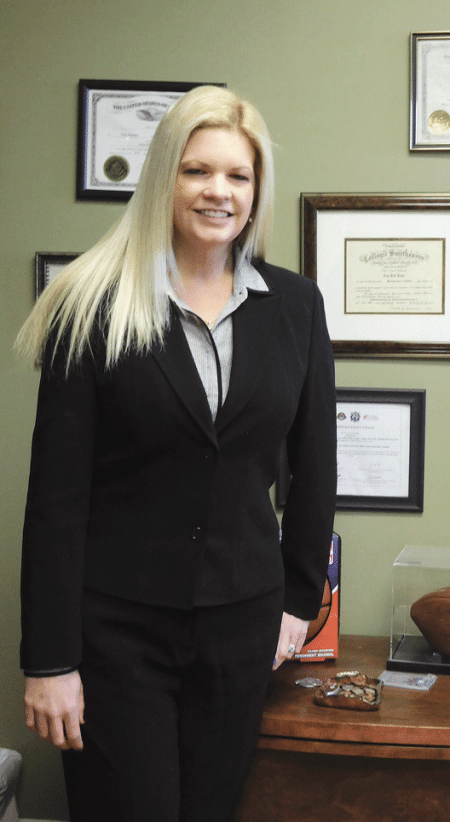
Amy Royal says employers often want to protect employees, but need to consider liability issues if they let addiction-related problems fester.
Royal cited a case in which a nursing home was sued after something went awry with a resident due to an employee’s irresponsible behavior. After the incident occurred, other employees told the family they had observed the person working in an altered state in the past, and, as a result, management was found negligent because it failed to do something about the problem.
“It can be a dilemma,” Royal explained. “An employer may really like the employee and want to help, but they need to weigh that against the risk of liability.”
She added that, in an office setting, concerns manifest themselves that have less to do with safety and more with the company’s reputation or the way it is perceived. For example, a receptionist who slurs his or her speech and has glassy eyes can be detrimental to interactions with the public or with clients.
However, the main concern for many employers is safety, which can be critical in a factory where machinery is involved, or when the person works for a nonprofit and engages in one-to-one care with a vulnerable population, as in the example of the nursing home.
Royal gets a lot of questions about when, if ever, to insist that an employee undergo drug testing, but she says Massachusetts does not have a drug-testing statue.
“However, there is a privacy statue that is very broad and is utilized in the employment context,” she noted, explaining that mandating a drug test can be considered an invasion of privacy. However, the courts have implemented a balancing test where they weigh privacy against legitimate business interests.
Safety is considered a legitimate reason to test, but Royal noted that any employer who mandates a drug test needs objective criteria it can present to a court if it is challenged.
“I suggest that front-line supervisors document their observations in a concrete way,” she told BusinessWest, adding that evidence cannot be subjective, and she has worked with clients to prepare a checklist of behaviors that include odor, the way someone walks and speaks, erratic behavior, shakiness, and whether the employee’s eyes appear glassy. “But first, I try to find out what an employer’s concerns are and whether or not they want to preserve the employee.”
Regardless of their goal, it’s important to provide supervisors with training regarding the legalities of what constitutes suspicious behavior.
“A supervisor needs to be able to recognize and document it, and a company shouldn’t assume the person is armed with these skills without some type of training,” Royal went on. “The supervisor also needs to understand that their role includes being accessible and present in the workplace.”
If an employer decides to confront an employee, Pinero said, they should be understanding and tell the person they want to do whatever it takes to help them keep their job and address their addiction.
“One of the best things employers can do is to establish a policy and an employee-assistance program to handle these problems,” he told BusinessWest, adding that employers should emphasize that any information shared with employee-assistance counselors is confidential.
Davila has been a manager for many years, and says there have been times when he suspected something was wrong with an employee. But he added that erratic behavior does not always result from addiction.
“The employee may have suffered a loss in their family, have financial problems, or problems with housing that can be as distracting as addiction,” he said. “Employers don’t want to police their staff, but they need to be vigilant and proactive so they can help.”
He suggests explaining to an employee that changes have been observed in their behavior that can include mood, self-care, or asking colleagues for money. “Tell the person you are concerned, there is a program that can help, and you recommend they try it,” he advised. “You should also emphasize that you are happy to talk to them about any of their concerns.”
However, experts admit that addiction can be a lifelong struggle, and in some cases, the person isn’t ready to admit they have a problem.
Addiction in the workplace is a complex issue, and despite all the media attention focused on it, outdated notions persist.
“People with addictions are not held in high esteem,” Royal said. “But it is a disease, not a conscious choice, even though people may perceive it that way.”
And there are definite benefits to helping someone recover.
“It’s a win-win situation for the employer, the person’s family, and the community,” Pinero said. “Some people start with outpatient services or peer-support programs, while others have to go to a detox program to deal with the physical aspects of addiction. But recovery is a process, and they will continue to need treatment.”
Which means employers need to be alert to potential problems and deal with them in a manner that is caring, but also addresses issues of liability.
“Just don’t be judgmental,” Pinero suggested. “Most people with an addiction want treatment, but often feel ashamed, and are waiting for someone to ask them to get help.”
By JAMES T. KRUPIENSKI, CPA

James T. Krupienski
Every 20 years or so, there is a generational shift in the workplace.
The most recent group — known as the Millennial generation — is currently integrating itself into the workplace. And by integrating, they are making a seismic statement. Recent studies show that Millennials now make up approximately 25% of the total workforce and that by the year 2020 they will comprise almost 50%. Given that this generation is generally defined as those born between 1980 and 2000, they are now at a point in their careers where they are taking on leadership roles.
If your leadership and management group, like many businesses, is made up of Baby Boomers and Gen-Xers, it is imperative that you understand what drives this next generation, because they will be the workforce and customer base that carries your business into the future. Millennials are different in so many ways from the Boomers and Gen X that it will require a shift in the way your business is managed. This article will help by focusing on the motivational factors and differences that set this generation apart and the impact Millennials will have on your workforce and their interaction with other employees.
At first glance, some of the more experienced generations may have certain negative perceptions about the Millennial generation — specifically, that they are entitled, require a lot of hand-holding, need constant encouragement, and don’t want to put in long hours. Stepping back, these are really just misconceptions due to a lack of understanding of what is driving them and how they grew up differently.
While the Boomers and Gen-Xers tend to value compensation and the need to work long hours to affirm their loyalty, this was born as a result of growing up in a period of limited resources and technology, with the need to focus on sweat equity as a result. Through this hard work, parents of Millennials were able to offer things to their children that were not available previously. As such, in a changing effort to push their children, parents tended to help them along the way, focusing on the social aspect of their value to society. The so-called ‘everyone gets a trophy’ mentality was created.
With this shift in how Millennials were raised, so to came a shift in what they value most and what they are looking for in a career. First and foremost, work-life balance is generally regarded as more important than how much they are making. They saw how hard and how many hours their parents and grandparents had to work to get to where they are and would like to avoid getting burned out over time. Additionally, they feel that, with the way technology has improved, it can help them better manage their time and complete tasks in a more time-efficient manner.
Other motivating factors include buy-in to the culture and mission of their employer, as well as the ability to receive continuous training and development. They also want to be heard. They are often not content with just coming to work and punching a clock. Rather, they are looking to provide ideas and be part of the solution.
With a shift in these motivational factors, the way you hired and retained employees in the past may not work going forward. Millennials don’t look at a job, even one early in their career, as one where they will need to ‘pay their dues.’ They know their value and want to be treated as a valued member of the organization — part of the team. This holds true whether it is your new front-desk receptionist or your newest design-team member. Where this can become difficult is in a company’s ability to influence the interaction between those Gen-Xers who have worked at a location for some time and those Millennials that were recently hired. Often the ability to manage these interactions can make all the difference in maintaining a successful business.
Additionally, it is important to always remember that Millennials keep a pulse on social media and, as a result, have networking skills exceeding those of many seasoned professionals. This leads to two different forces that need to be managed.
First, it is imperative to have a documented social-media policy at work. The speed in which words and thoughts can spread on the Internet cannot be overlooked.
Second, other business opportunities do arise. And Millennials are aware that they are out there. If they feel that they’re in a place where their personal values aren’t being satisfied, they are more apt to move to the next job than older generations would have been. A recent survey by PricewaterhouseCoopers found that 25% of Millennials expect six or more employers during their career, and 38% feel that senior management doesn’t relate to them. These statistics must not be ignored.
So, what is a business owner or manager to do in order to retain top talent? Some suggestions include providing them with regular training and holding frequent staff meetings. The creation of group idea-sharing sessions would afford them the opportunity to suggest ways the business or processes can be improved.
At work, Millennials want to have fun. This doesn’t mean there needs to be a pizza party every Friday afternoon, but the work environment needs to be lively with a sense of camaraderie. Finally, you need to listen — meet with them, seek feedback, mentor them, and take what they have to say seriously. While an idea or suggestion may seem off the wall to you, the fresh perspective may just be what your business needs.
The Millennials are here, and they are here to stay. As their numbers continue to grow and they continue to take on additional leadership positions within your business, it is important not to take them for granted. They are, after all, going to become your succession plan.
James T. Krupienski, CPA, is senior manager of the Health Care Services niche at Meyers Brothers Kalicka, P.C. in Holyoke; (413) 536-8510; www.mbkcpa.com
By STEFANIE RENAUD, Esq.
Stefanie Renaud
In December, the National Labor Relations Board (NLRB) struck down a Whole Foods policy banning employees from secretly recording conversations in the workplace as an unfair labor practice (ULP).
The NLRB concluded that the policy violated the National Labor Relations Act (NLRA) because it infringed on employees’ right to engage in concerted activity, which is protected by Section 7 of the NLRA. Concerted activity includes the ability to form, join, or assist a union; choose representatives to bargain with the company on employees’ behalf; and act together with other employees for mutual benefit and protection.
The NLRA applies to all employers, unionized or not, and all employees have the right to file a ULP charge with the NLRB if they believe a company policy interferes with their protected rights.
Whole Foods’ challenged policy was designed to foster open communication between employees and management by ensuring that conversations, phone calls, images, and company meetings were not recorded without prior authorization by management or consent of all recorded parties. Whole Foods’ goal was to “eliminate [the] chilling effect on the expression of views that may exist when one person is concerned that his or her conversation with another is being secretly recorded.”
Despite noble intentions, the NLRB concluded the policy was overbroad and had to be struck, because an employee could reasonably conclude that it infringed on his or her Section 7 rights. Under Section 7, photography, audio and video recording, as well as posting photographs and recordings on social media, are considered protected activity if employees are acting in concert for their mutual aid and protection, and there is no overriding employer interest. An employee acting alone may be engaged in protected activity if he or she makes the recording to further a group action, is attempting to enforce the terms of a collective-bargaining agreement, or is attempting to initiate or induce group action.
While the Whole Foods policy did not explicitly restrict or chill protected activity by prohibiting employees from engaging in protected activities, the NLRB nonetheless concluded that an employee could reasonably understand the policy to prohibit Section 7 activity. Aiding this conclusion, Whole Foods’ sole witness admitted that the policy would apply even if an employee were engaged in protected activity. Whole Foods’ policy also required employees to seek management permission to make recordings on non-working time, another infringement on employees’ Section 7 rights.
The NLRB distinguished this case from those where an employer had a compelling privacy interest that merited upholding a recording ban. For example, in Flagstaff Medical Center, 357 NLRB No. 65 (2011), enfd. in relevant part, 715 F.3d 928 (D.C. Cir. 2013), the NLRB upheld a hospital policy banning secret recordings because it protected patients’ health and privacy information. Outside of patient care, however, it is unclear what employer interest would be compelling enough for the NLRB to uphold a ban on secret recordings.
The consequences of a ULP finding are serious. The NLRB ordered Whole Foods to print and supply an insert regarding the illegality of the policy to every employee, at significant cost. The NLRB also ordered Whole Foods to post a notice in all facilities nationwide stating that “the [NLRB] has found that we violated federal labor law” and that employees have the right to “form, join or assist a union; choose representatives to bargain with us on your behalf; and act together with other employees for your benefit and protection.”
Clearly, even a small mistake can have huge consequences for the employer.
Massachusetts employers should also be aware that a recording that may deserve protection under the NLRA could still be illegal in the Bay State. Massachusetts is an ‘all party consent’ state, meaning that audio recordings (video recording and photography are not covered) made without the knowledge or consent of all parties involved violate the wiretap law. A violation of the wiretap law is a felony punishable by up to five years in prison or two and a half years in jail, fines up to $10,000, or a combination of fines and imprisonment.
The statute also provides a civil cause of action for any person ‘aggrieved’ by illegal wiretapping, but an employer cannot be considered an ‘aggrieved person.’ Only the individual whose voice was recorded could bring a lawsuit against the employee who made the unauthorized recording, even if the recordings were made at work. So there are few remedies available to employers when a worker secretly records a conversation.
To comply with the NLRA, the NLRB recommends that any policy against secret recordings specifically reference the applicable state wiretap laws. In Massachusetts, employers may want to include a provision that states that the policy applies only to those recordings that do not comply with Massachusetts law. In addition, the NLRB suggests that any recording policy explicitly state that it does not apply to recordings made as part of protected activity or to recordings made on non-working time.
Because a mistake in this area can create huge liability, Massachusetts employers should revisit their policies and handbooks with their labor and employment counsel to ensure compliance with both Massachusetts and federal law.
This column is not intended as legal advice related to individual situations. If your business is facing a specific legal problem, consult your labor and employment counsel for legal advice and planning.
Stefanie Renaud, Esq. is an associate with the law firm Skoler, Abbott & Presser, P.C., which exclusively represents management in labor and employment matters. She is admitted to practice in Massachusetts; (413) 737-4753; [email protected]


Bill Grinnell said he recently spoke with the owner of a construction-related business who was hit with a malicious program that froze his company’s computers and followed up with an extortion demand.
“More hacks are happening every day,” said Grinnell, president of Webber & Grinnell Insurance in Northampton. “You wouldn’t think of him as the type of business that might traditionally need cyber-liability insurance, and now he’s facing all these costs — having a company come in to get the computers up and running, potential lost business income if they can’t perform their jobs without what’s stored on the computers, then the cost of the extortion and potentially notifying people, all the customer-relations issues.
“That was eye-opening to me,” he went on. “Any business out there that has any type of sensitive records critical to the running of the business potentially needs this type of coverage.”
The good news, Grinnell said, is that businesses are more aware than ever about the threats that lurk behind seemingly safe computer screens.

Bill Grinnell says cyber-liability insurance used to be a hot topic only in certain industries, like financial services, healthcare, and retail — but that’s changing.
“It’s a relatively new insurance coverage, and it’s still evolving. We certainly talk a fair amount about it with clients interested in purchasing coverage, and demand is definitely increasing,” he went on, noting that, until recently, cyber liability wasn’t a hot topic outside of the retail, medical, and financial-services industries, but it’s becoming clearer that many other types of enterprise are at risk.
In a recent article on its website, Ross Insurance Agency in Holyoke noted that incidents like the Target breach in 2013 (70 million customer records exposed) and the Neiman Marcus breach around the same time (1 million customers affected) won plenty of headlines, yet a 2012 Verizon study revealed that 71% of breaches occur in businesses with 100 or fewer employees. Meanwhile, according to cybersecurity company McAfee, almost 90% of small and medium-sized U.S. businesses don’t use any form of data protection.
“This is one of the most forefront issues we have, something we talk about all the time,” Kevin Ross, vice president of Ross Insurance, told BusinessWest. “Coverage is becoming more widely available and broader in scope. We have not experienced any losses here with our clients, but we do know it’s a serious threat that can cause serious financial harm. Just because you haven’t had a fire doesn’t mean fire insurance isn’t important. We protect the financial integrity of clients from loss, and those losses could be severe.”
Indeed, cybercrime costs American businesses more than $100 billion per year, according to the Center for Strategic and International Studies.
“Lack of an incident can breed complacency. Companies think they’re OK, but lack of an event doesn’t mean they’re OK; it doesn’t mean they’ve done a good job,” said Bill Trudeau, president of the Insurance Center of New England (ICNE) in Agawam, adding that, while certain organizations have more to lose because of their customer exposure, almost all companies save employee data digitally.
Bill Trudeau says hackers are always thinking up new ways to breach systems, and employers have to be prepared.
“Even in a small company, one that makes widgets and gets paid with checks, you could have some data-breach exposure with your employees, so it’s worth reviewing what kind of access you have,” he said. “If it happens to your 200 employees, it’s not going to be a heartwarming experience for you and your employees. You need to take a hard look at your computers and how you transmit information.”
According to the Ponemon Institute, which has been reporting on the cost of cybercrimes for the past several years, the cost to a company that falls victim to a data breach is $188 per record breached. Yet, business- and property-insurance policies typically exclude data risks from their terms, which has contributed to the emergence of cybersecurity insurance as a separate, standalone line of coverage.
That coverage typically protects against a wide range of losses that businesses may suffer directly or cause to others, and these come in two forms: first-party and third-party losses. Grinnell explained that third-party losses involve regulatory fines and lawsuits brought by affected customers, while first-party losses are what the business itself incurs up front, such as business-income loss, data-retrieval services, downtime, and notification of customers, to name a few. On average, first-party losses average about one-third of a breached company’s expenses.
“In a lot of small data breaches, say in a small store or a doctors’ office with 10 doctors, most costs are first-party costs,” Trudeau explained. “Then, later, you’re going to have liability claims because maybe someone did get injured, their identify got stolen, you may owe them compensation, or they could end up suing you, despite all your efforts. So a good cyber policy or data-breach policy has both coverage for first-party costs and a liability component that pays for these different injuries that have occurred.”
Some cybersecurity-insurance carriers pose a long series of questions on their application forms about the details of a company’s exposure to data risk, Trudeau said, and if the underwriter isn’t satisfied with the answers, they may not write the policy until certain practices have been changed and safeguards put in place.
“When it comes to a data breach which has occurred, a lot of what you do to take action up front can reduce your liability. If you self-report to authorities and if you have a turn-key response to it, that’s good,” he went on, noting that carriers that specialize in this type of coverage, like Beazley and Chubb, have turn-key response operations as part of the policy. “They’ve got forensic computer analysts that get into the system and see what went wrong, public-relations people who understand this issue — it’s not their first time trying to calm customers and the public as to what went wrong with your organization — and they also have third-party notification operations.”
Trudeau recommends that businesses hire a third party to poke around their computer systems and challenge their operations when necessary.
“People get used to their own surroundings and don’t know what they don’t know,” he said. “Just because you think your business isn’t super attractive to hackers doesn’t mean they’re not going to pick you. I think it’s important that people are always challenging their IT department or IT vendor, saying, ‘is this the best form of firewall?’
In fact, he added, ICNE works with a company that will provide an ethical hacker, which is someone not out to steal data, but to break into a system and then show the business what they found and how they got in.
“There has to be a discussion with the client about what they’re doing, how they’re identifying threats,” Ross added. “Everyone needs to be aware of it. Any time you’re dealing with any type of customer information, especially dealing with credit cards, Internet sales, anything that has to do with the web in any form or fashion, you could be exposed to liability should you be hacked and clients’ information be exposed. That’s the threat.”
The impact on businesses can be severe and long-term, the report noted, citing an Economist Intelligence Unit consumer survey conducted in 2013. It found that 18% of respondents had been a victim of a data breach, and, of those individuals, 38% said they no longer did business with the organization because of the breach. Meanwhile, 46% said they advised friends and family to be careful of sharing data with the breached company.
However, data breaches don’t always have malicious origins. According to the data breaches it serviced in 2013 and 2014, Beazley reported that the two most common sources of breaches are unintended disclosure, such as misdirected e-mails and faxes (31%), and the physical loss of paper records (24%), which is particularly prevalent among healthcare organizations.
Breaches due to malware or spyware represented only 11% of breaches in 2013 and 2014, but they have been increasing, the firm reported, with the total number of breaches in this category growing by 20% between 2013 and 2014. Due to heavy forensics costs — money spent to find out exactly how the breach occurred — these breaches are on average almost five times times more costly than unintended disclosure.
Still, considering the sheer number of cases of accidental data exposure, employers can take steps to prevent data theft, Ross noted. These include protecting every computer connected to the Internet or the internal network with anti-virus and anti-spyware software (including any laptops that connect wirelessly); installing security-software updates promptly to stay ahead of hackers; securing the company’s wi-fi network by requiring passwords or even configuring the wireless access point or router to hide the network name; securing computers and network components and requiring log-on passwords for all employees; and continually educating employees on security guidelines for computer, network, database, e-mail, and Internet usage, as well as penalties for violating those guidelines.
“The bad guys are always thinking up new things. It’s important to stay on top of it,” Trudeau added, noting that data breaches may not be doubling or tripling in frequency year over year, but they are rising slowly. The financial industry alone saw 642 incidents in 2014.
As a result, “the number of people willing to buy data-breach insurance continues to increase year after year, as more customers start seeing it as something that should be part of their insurance portfolio,” he went on. “You need to be vigilant of the fact that someone may have come up with some way to hurt your organization that you’re not aware of yet.”
Grinnell told BusinessWest that there’s still too many holes out there, due to nothing more complicated than complacency.
“A lot of people think it it’s big businesses getting hacked — ‘they won’t get me.’ I think that’s beginning to change, but there’s a long way to go,” he said. “We need to get the word out and let people know the exposures that lurk out there and help them address them, both through insurance means and making sure they have the proper firewalls in place to prevent attacks as much as possible.”
In other words, anyone can be a Target, and there’s ample evidence that some common-sense precautions — and perhaps a well-written insurance policy — can go a long way.
Joseph Bednar can be reached a [email protected]
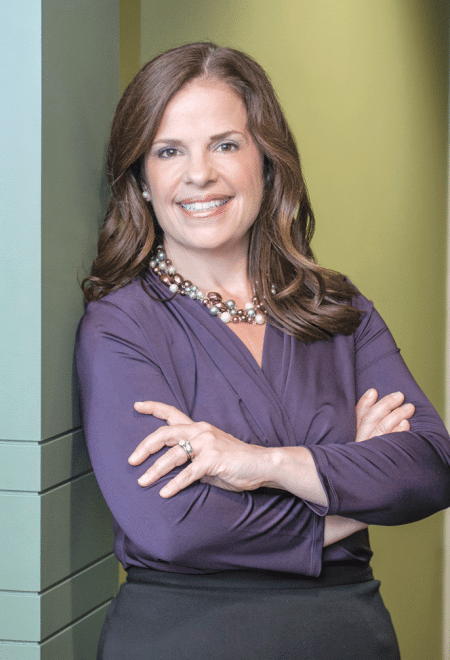
Maura McCaffrey says health plans work with drug companies to negotiate prices and with community physicians to assess patient needs, but rising costs continue to be a concern.
It’s a well-publicized issue in an election year, so it’s no surprise that lawmakers — including several presidential candidates — have been teeing off on soaring drug prices.
“Americans pay, by far, the highest prices for prescription drugs in the entire world,” Bernie Sanders recently noted. “A life-saving drug does no good if the people who need it cannot afford that drug.”
He pointed out that nearly one in five Americans between ages 19 and 64 did not get at least one prescription filled last year because they did not have enough money.
“There is no question that medicines help millions of people live healthier and longer lives, and can also prevent more expensive illnesses and treatments,” Sanders continued. “However, it is unacceptable that the United States now spends more than $370 billion on prescription drugs, and spending is rising faster than at any point in the last decade.”
Rising drug prices are having tangible effects on consumers, including those in Massachusetts. Among 16 carriers that recently testified before the state Division of Insurance, the first quarter of 2016 saw an average rate increase of 6.3%. They were asked to present the data used in determining their proposed rate filings for small-group plans in the second quarter of 2016. There are other reasons behind the increases, including the cost of expanding coverage under the Affordable Care Act, but drug prices are universally cited as a driving factor.
Meanwhile, even amid ever-louder complaints from lawmakers and the media, Pfizer, Amgen, Allergan, Horizon Pharma, and other manufacturers have raised U.S. prices for dozens of branded drugs since late December, with many of the increases between 9% and 10%, according to the Wall Street Journal. Overall, prescription-drug spending rose 12.2% in 2014, after just 2.4% growth in 2013, the Centers for Medicare and Medicaid Services reported.
There are a number of factors at play, ranging from the fact that the U.S. government doesn’t regulate drug prices to rising development and production costs; it can take more a decade and more than $1 billion to get a new drug approved. Still, there’s plenty of opportunity, industry critics say, to bring relief to patients.
“Their argument is we can — we can raise prices on this, the market will bear it, people like this drug, they rely on it, their physician will write it,” Marco Rubio recently told an audience on a campaign stop, blasting drug companies. “And so, because we can, we do. And it’s just pure profiteering.”
Insurance companies are feeling the pressure, Maura McCaffrey, president of Health New England (HNE), told BusinessWest. “Health plans have a responsibility to manage the pricing of these pharmaceuticals.”
They do this in two major ways, she explained. The first is to work with a pharmacy benefit manager, a third-party liaison between drug companies and insurers, to negotiate the drug prices. “Over the past year, Health New England did a very large renegotiation with its pharmacy contracts, and that has been very beneficial to members in Western Massachusetts.”
The second strategy is HNE’s clinical care assessment committee, which includes both primary-care and specialty physicians and meets eight times a year to discuss new medications — how they compare with current offerings and who the most appropriate patients would be.
“We come up with clinical criteria to make sure the right people have access to the right medications,” McCaffrey said, adding that, if the drug in question treats an uncommon condition, the committee will go into the local medical community to find additional specialists who can speak to that topic.
At the gathering before the Division of Insurance, Elin Gaynor, HNE’s assistant general counsel, cited several recent examples of unsustainable drug prices, including $259,000 per year for a drug treating cystic fibrosis, $118,200 per year for a breast-cancer medication, and more than $100,000 annually for a new hepatitis C treatment.
“As a community, we must be willing to tackle some very tough questions,” added Michael Caljouw, vice president of Government and Regulatory Affairs at Blue Cross Blue Shield of Massachusetts. “What is the right price for new drugs and therapies? What is the appropriate use of them? Who decides? How can we achieve a better balance between medical advances and affordability?”
In making coverage decisions, McCaffrey told BusinessWest, safety and effectiveness always trump cost. “Then, if it looks to be a safe and efficacious medication, we look at what else is on the market and compare the safety profiles and efficacy profiles. The last thing we do is compare the cost profiles. We do this every time.”
Dr. Peter Bach, a physician and director of the Center for Health Policy and Outcomes at Memorial Sloan Kettering Cancer Center, recently explained in the New York Times that drug manufacturers are hamstrung by the complexity of biology, government regulations, and shareholder expectations for high profit margins.
What they’re not saying, he went on, is that they take advantage of laws that force insurers to include virtually all expensive drugs in their policies, and an industry philosophy that demands that every new healthcare product be available to everyone — no matter its cost or how little it actually helps.
In late 2014, the New England Journal of Medicine detailed a number of ways drug companies take advantage of this system. For instance, they buy up the rights to inexpensive generic drugs, lock out competitors, and raise prices. In one example, albendazole, a drug used to treat certain kinds of parasitic infection, was approved 20 years ago and, as recently as 2010, had a wholesale cost of $5.92 per day. Three years later, it was $119.58.
“Many of these drugs remain key therapeutic tools. The number of prescriptions for albendazole has increased dramatically in part because the drug has increasingly been used to treat parasitic infections in refugees,” explained the report’s authors, Drs. Jonathan Alpern, William Stauffer, and Aaron Kesselheim.
“The Centers for Disease Control and Prevention recommends presumptive treatment of refugees arriving in the U.S. if they have not had prior treatment,” they went on. “Because the people who need albendazole are generally disadvantaged, the costs resulting from the enhanced demand and associated price increases are largely borne by the patients themselves through substantial out-of-pocket payments or by taxpayers through public insurers such as Medicaid and the Refugee Medical Assistance program.”
The albendazole situation is hardly unique, they added. “It is well-known that new, brand-name drugs are often expensive, but U.S. healthcare is also witnessing a lesser-known but growing and seemingly paradoxical phenomenon: certain older drugs, many of which are generic and not protected by patents or market exclusivity, are now also extremely expensive.”
For example, the price of captopril, which is used for hypertension and heart failure, increased by more than 2,800% between November 2012 and November 2013, from 1.4 cents to 39.9 cents per pill. Similarly, the price of clomipramine, an antidepressant also used for obsessive-compulsive disorder, increased from 22 cents to $8.32 per pill, and the price of doxycycline hyclate, a broad-spectrum antibiotic introduced in 1967, increased from 6.3 cents to $3.36 per pill.
The practice infuriated a number of U.S. lawmakers, who teed off on drug companies last month during a session of the Senate Special Committee on Aging.
“I find it so disturbing and unconscionable that a company would buy up a decades-old drug that it had no role in developing … and then would hike up the price to such egregious levels that it’s having an impact on patient care,” said U.S. Sen. Susan Collins, who chairs the committee.
Solutions have been difficult to come by, but Bach suggests one: what if insurance companies weren’t required to cover all drugs? He explained that, in Europe, many countries reject a handful of drugs each year based on their high cost and relatively low effectiveness — so companies are forced to offer their products at attractice prices.
As a result, prices in Europe for prescription drugs are typically 50% below what U.S. consumers pay. The pharmaceutical industry might argue, he went on, that drug spending accounts for just 10% of all healthcare spending, but that equals around $300 billion per year — no small number.
And those costs are being passed on to patients. The Wall Street Journal noted that Lilly’s drug Cyramza will cost the average Medicare patient $2,600 per month without supplemental insurance — more than most Medicare-age people earn each month, before taxes.
It would make sense, Bach argued, to do one of two things: free insurers and government programs from the requirement to include all expensive drugs in their plans, or demand that policymakers set drug prices in the U.S. equal to those seen in Europe. “Either approach would be vastly superior to the situation we have today.”
The New England Journal of Medicine report offered another strategy for bringing prices under control. The authors suggest that substantial increases in the price of an unpatented drug could trigger the FDA to issue a public announcement seeking other manufacturers for generic versions of the product. Companies responding to such a request could receive expedited reviews of their manufacturing processes, and generic-drug user fees could be waived to further increase incentives for potential competitors.
Meanwhile, they concede, there is little that consumers can do.
“Some patients seek to acquire these drugs in other countries, since many of them are widely and inexpensively available outside the U.S., but such foreign sources may be of variable quality. Until regulatory and market solutions are implemented to reduce prices for these older drugs, patients requiring such drugs and the physicians treating them will continue to be faced with difficult choices.”
McCaffrey said Health New England is trying to maintain as much consumer choice as possible, but not at the expense of ballooning rates.
“Going into 2016, one of our top priorities is to make sure people have access to the medications they need,” she noted, “but at the same time make sure we can control premiums for them so they can afford the health insurance that gives them access to the medications they need.”
Joseph Bednar can be reached at [email protected]
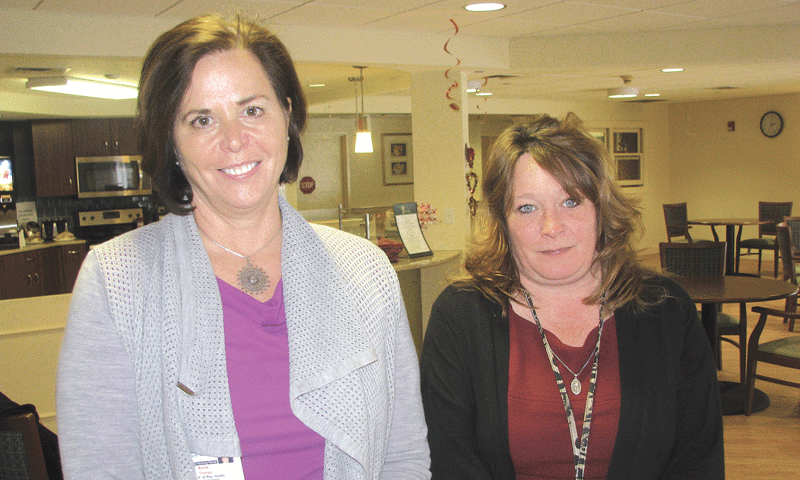
Anne Thomas (left) and Joelle Tedeschi say it’s critical that the Garden at Ruth’s House tailors programs to the individual interests and abilities of residents.
It’s not always easy to walk in someone else’s shoes, especially when that person suffers from dementia. But at Loomis House in Holyoke, they’re trying.
The training program for Loomis employees who work in the memory-care unit includes a mandatory activity called a ‘virtual dementia tour.’ They’re put through a sensory simulation including shoe inserts to make their feet uncomfortable, hazy goggles that mimic macular degeneration, headphones pumping in white noise like a ringing phone and an ambulance siren, and gloves to impair sense of touch.
“Then we ask them to do tasks. They quickly understand the frustration,” said Lori Todd, Loomis House administrator. “What we try to teach them is, you’re experiencing this for 10 minutes; imagine this all day long. Some people call it sundowning, but after eight hours, I’d be frustrated.”
A perceived need for better training led to the adoption two years ago of new regulations for Massachusetts nursing homes. Specifically, workers in specialized Alzheimer’s and dementia-care units are now required to undergo at least eight hours of initial training to care for such residents, and four additional hours annually. Proponents noted at the time that increased training is critical because roughly 60% of nursing-home residents have some form of dementia.
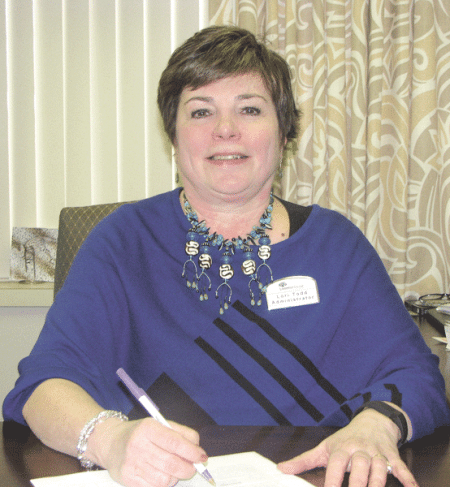
Lori Todd says Loomis House works to counsel and reassure families, who are often dealing with wrenching emotions around their loved ones’ dementia.
At Loomis House, which maintains two separate memory-care units totaling 41 residents — there’s always a waiting list — administrators have taken staff training seriously for much longer than that, Todd said. In fact, the way staff assesses and engages its Alzheimer’s and dementia population is indicative of a wider trend in senior care, one that acknowledges that dementia is not going away as the Baby Boom generation continues to stream into its retirement years.
For example, while many facilities place residents with dementia into one of three categories of memory function, Loomis uses seven, in order to develop as individualized and specialized a care plan as possible. “If you’re stage three, you may be able to do a 100-piece puzzle for an activity,” Todd said. “In further stages, you may still be able to do a puzzle, but it may be a four-piece puzzle so you’re not frustrated.”
That said, the goal is to maintain as much independence as possible for residents through an individualized plan that determines what activities will keep them active and engaged. “We have to get an understanding of who they were and what made them tick — basically utilize that information to develop a plan that will be of interest to them.”
Similar strategies are put into play at Ruth’s House in Longmeadow, an assisted-living residence operated by JGS Lifecare. It features the Garden, a 30-bed memory-impaired unit with a central kitchen and living area and an enclosed, secured outdoor courtyard.
“It’s very home-like, which is really important,” said Anne Thomas, vice president of residential health. “But the one thing that distinguishes us from others is our exceptional programming structure, which is really important to people with dementia. If they’re not given some structure, they don’t do well. They need that schedule, that routine.”
Joelle Tedeschi, executive director of Ruth’s House, explained that every new resident is evaluated by the resident care director to determine how they fit into the site’s programming, which includes sensory activities, art and cooking groups, cultural-enrichment programs, and much more.
“We try to find out as much as we can about each person and craft programs based on that,” Thomas added. “It’s about engagement, but also creating an environment as much like their real home as possible. All the things a person enjoyed before should continue here — it shouldn’t change.”
Like Todd, Thomas noted that the population is aging, and the number of Americans living with some form of dementia — currently 5.3 million — is only expected to rise, meaning more nursing homes and assisted-living facilities are making a commitment to taking care of this population.
“With dementia, unfortunately, there’s no cure in sight; we don’t see the disease going away,” Thomas said. “Our responsibility is to create a wonderful program. Boomers are very discerning; they have disposable income, and they expect a lot, and they should. We’re designing things that we as Boomers would want for ourselves and our parents.”
That begins with meeting each resident where they are, Todd said.
“There’s a lot of emphasis on understanding that we are guests in the home of the people who move in here. When people come to the dementia unit, they stay here; this is their home,” she said, explaining Loomis’ long-time philosophy of person-centered care. “So, if they want to get up at a certain hour, they can have their medicine when they wake up, rather than right at 8 in the morning. The satellite kitchen is open 24 hours a day, and they can eat when they want.”
Tedeschi said the Garden provides a similar sense of autonomy, including no set times for going to bed or waking up, and a kitchen where eggs can be cooked to order at any time. “Some folks don’t want to be up early for breakfast, so we’ll make them breakfast right before lunch if that’s their preferred time.”
The touches of home — and even pampering — continue with amenities like a full-service salon, live entertainers who get residents singing and dancing, and rules that allow residents to bring their pets with them. In addition, family members often volunteer to lead enrichment programs.
“Just today, one of the resident’s families brought in some old tools, and the residents sat around and reminisced about their lives. There were tools there I couldn’t identify, but some of our residents worked on farms as children and worked all day with these tools, and they talked about it. It was one of the most beautiful things I’ve ever seen.”
The Garden also recently introduced holistic-wellness activities including Reiki, aromatherapy, and reflexology, all conducted by student volunteers, said Mary-Anne DiBlasio, sales manager at JGS Lifecare, who has a background in alternative health. Meanwhile, a small activity room is being converted to a sensory meditation room.
In addition, JGS Lifecare takes part in the Music and Memory program, which works with residents’ families to develop a personalized playlist of meaningful songs, which they can play on donated iPods.
“We’ve seen some remarkable success stories with it,” said Alta Stark, director of marketing and public relations. “One woman’s daughter said she could tell immediately if her mother had her music therapy that day because she could have regular conversations with her. She said that had not happened for such a long time — it was like getting her mother back.”
Thomas is equally effusive. “I witnessed something walking through one day on the weekend — a resident in memory care was weepy, crying, and she wanted to go home. A life-enrichment person came over and consoled her, reassured her, got her iPod and earphones … and it calmed her down immediately.”
Tedeschi said it’s always a challenge to customize individualized programs when dementia has such a wide range of stages. Some residents can live relatively independently but need to be in a secure environment, she noted, while others wouldn’t even know how to press an alert pendant if they need help. “We need to anticipate what their needs would be. We have to customize a program for everyone and continue to add services according to their care needs.”
The complexity of caring for this population is why the Department of Public Health pushed for the new mandatory-training rules two years ago. In order to comply, staff members must be trained in the foundations of Alzheimer’s and other dementias, communication and connecting with these residents, techniques and approaches to care for this population, the components of person-centered care, working with families, the dietary needs of residents with Alzheimer’s and other dementias, social needs and appropriate activities in the care of such residents, recognizing and responding to caregiver stress, and preventing, recognizing, and responding to abuse and neglect of residents.
“Everyone who works here — even maintenance and housekeeping — has to have 12 hours of training,” Todd said. “And I’ve seen the benefits in training, retraining, and sensitizing. The regulations are strict, but it benefits the residents; it really does.”
No one wants to admit their parent has dementia, Todd said, but the services provided in a specialized memory-care unit are critical when that decision looms.
“Most people who live here are a little more advanced than you see at home, and they’re at risk being in the community. Really, it’s a safety issue, and the caregiver can’t do it anymore,” she explained, noting that Loomis House provides a continuum of care that includes hospice services near the end of life.
It’s emotionally wrenching, she added, when someone understands that their loved one doesn’t recognize them in the same way anymore, but noted that Loomis provides a social worker to help families process that experience, and family support groups that help each other through the transition.
“At first, there’s a lot of fear, guilt, and anxiety,” she went on. “Then they begin to trust us. They see they can go home at night and their parents will be cared for. They have to trust that our people are caring for their parents because their parents can’t always tell them.”
Thomas agreed. “Sometimes it’s harder on the family than on the person who has this illness, to see that person changing before their eyes. That’s why we offer support groups for families.”
In addition, as part of the admissions process, Tedeschi said, families help residents assemble a shadowbox of photos and memories, to hang outside their room. Not only do the boxes help residents identify where their rooms are, they give the staff a better idea of what that person is all about. Families also fill out a profile about their loved one’s likes and dislikes, interests and hobbies, to help the staff build a satisfying daily routine.
Once they’re comfortable in their new home, DiBlasio said, “family members don’t have to be full-time caregivers anymore. We let sons be sons, daughters be daughters, and we become the caregivers. If we know the idiosyncrasies of the person, we can become part of the family, and they look at us as part of the team.”
The worst feeling a loved one can have, Thomas said, is the idea that “‘this is my mother; there’s nothing left to her.’ We want to demonstrate that this person has a lot left, and we want to bring that out in them. That’s our job, to bring out the best in the person so the family can experience that as well. The employees that work here find it gratifying that they can make a difference in many small ways, just by getting to know the person.”
Joseph Bednar can be reached at [email protected]
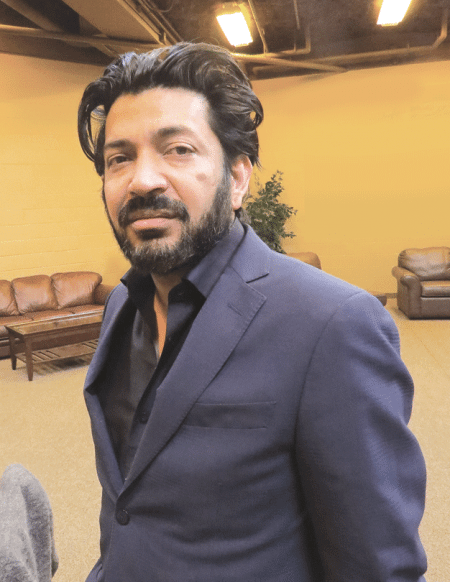
Dr. Siddhartha Mukherjee says the so-called ‘cancer moonshot’ will provide a road map for advancing the fight against the ‘emperor of all maladies.’
As he delivered his talk, “The Changing Landscape of Cancer,” to a large audience at CityStage earlier this month, Dr. Siddhartha Mukherjee had a PowerPoint presentation running on a large screen behind him.
In a way, it represented a seriously condensed but still highly informative version of his book, The Emperor of All Maladies: A Biography of Cancer, for which he won the 2011 Pulitzer Prize for general nonfiction, and it led with what amounted to a trailer for the Ken Burns-produced PBS film documentary based on the book.
One of the slides, kept on the screen for several minutes, depicted one of the now-famous full-page ads that ran in newspapers across the country in December 1969 with the screaming headline: “Mr. Nixon: You Can Cure Cancer.”
While one might debate whether those spots legally constituted false advertising, Mukherjee implied, they certainly amounted to wishful thinking — very wishful thinking.
Indeed, neither the nation’s president nor anyone else could cure cancer 47 years ago, he explained, because the scientific community simply didn’t know enough about the disease to remotely approach that ambitious goal.
Mukherjee said those ads, inspired by and paid for by Mary Lasker, the noted health activist, philanthropist, and champion of medical research, were a prime catalyst for what he called “the war on cancer 1.0” — a war declared far too early to result in even partial victory, but one that set the stage for later triumphs.
“We had no understanding of the physiology of a cancer cell, let alone what caused it to turn cancerous, and yet a war on cancer was launched without that understanding,” he told his audience, there, as he was, to celebrate the expansion of the Sr. Mary Caritas Cancer Center. “People have often said that this is like saying, ‘we’re going to the moon’ without having seen a jet engine; that’s what the situation was like.”
Nearly a half-century and seven U.S. presidents later (many of whom have declared what amounted to their own versions of a war on cancer), the situation is much different, said Mukherjee, because the world knows exponentially more about the physiology of a cancer cell and why a cell becomes cancerous.
And this new landscape certainly provides more optimism for the latest declared war on this disease — the so-called ‘cancer moonshot’ (a term that only reinforces Mukherjee’s analogy) — that was announced in January.
“We understand cancer at a cellular and molecular level that we didn’t understand before,” Mukherjee told BusinessWest prior to his talk. “We understand what causes cancer, we understand its progression, we understand some, but not all, of its risk factors, and we have not one, not two, but really several dozen important breakthrough therapies for several forms of cancer.
“The question now is how to deliver those therapies carefully, how to deliver them to the right people, how to pay for them, and much more,” he went on. “Meanwhile, there are many cancers that are difficult to cure and difficult to treat, and they will remain frontiers.”
In essence, the cancer moonshot is expected to yield a road map (a term Mukherjee would use early and often) — actually, several of them — for crossing those frontiers and answering all those questions, he went on, adding that this initiative will bring new layers of progress to what he called a “transformative impact” on understanding and treating the many cancers seen over the past half-century.
For this issue and its focus on the business of aging, BusinessWest took the opportunity to talk with one of the world’s leading cancer physicians about the stunning progress achieved to date and how the next chapter in cancer’s biography will unfold.
Reducing a few thousand years of conflict between humans and cancer down to a 55-minute presentation wasn’t easy, but Mukherjee, an assistant professor of Medicine at Columbia University and staff physician at Columbia University Medical Center in New York City, managed by focusing on basic science, the milestones in the history of cancer treatment, and the people who made them possible.
Thus, his powerpoint featured slides on everything from surgeon William Halsted’s 19th-century “radical mastectomy” to Mary Lasker’s newspaper ads, and on everyone from Rudolph Virchow, often called the father of modern pathology and noted for his early work on leukemia, to Sidney Farber, considered the father of modern chemotherapy, to Barbara Bradfield, a pioneer (she was patient zero) in the development of Herceptin, a treatment for breast cancer.
His lecture on the history of the disease and mankind’s attempts to cure it focused on several stages he detailed in his 594-page book. They include, more recently, ‘cancer as a disease of cells’ — the period roughly from 1860 to 1960; ‘cancer as a disease of genes’ (1970-1990); ‘cancer as a disease of genomes’ (1990-2010); and the current stage, ‘cancer as a pathway disease.’
He brought his audience from the first identification of cancer some 4,600 years ago by the Egyptian physician Imhotep to current events, including groundbreaking initiatives to rapidly determine the sequencing of genes in tumor cells, leading to new treatment platforms.
Describing what’s been accomplished to date, he used words such as “remarkable” and “unprecedented,” words he says are fitting given the resilience, complexity, and sheer uniqueness of the disease and each case of it.
“Every single cancer, at the genetic level and the genomic level, is its own cancer, and every single patient is its own patient,” he explained. “We knew this 100 years ago, but we really learned this 100 years later.
“There is no disease — and I will argue that there are few problems in human history — where the level of diversity of the problem, the level of complexity of the problem, is equal to the number of people who have the problem,” he went on, urging his audience to consider the magnitude of what he just said. “Cancer is that problem … and that makes it different than any other disease, and that’s what makes it the emperor of all maladies.”
But while his book, and his lecture, amounted to history lessons, Mukherjee said his current focus is obviously on what comes next, and this brings him back to the cancer moonshot.
“This is an incredibly important effort,” he told BusinessWest before his talk. “It clarifies what the goals are, and that is to have a transformative effect on cancer care over the next 100 years.”
When asked what the initiative, officially named Cancer Moonshot 2020, might accomplish by that date, he said simply, “a line in the sand,” before elaborating and returning to that analogy of drawing a road map.
“What will happen over the next four years is that we will clarify that road map, which will hopefully stay with us for the next 80 to 100 years to remind us what the big goals are and whether we met the goals or didn’t meet the goals,” he explained. “We may at times go off the road because we don’t understand something, but as long as we have a sense of what that landscape is like, we can stay on track.”
Again, there will likely be several road maps drawn, he went on, adding that there are, indeed, several fronts in any war on cancer.
One is obviously treatment, he said, noting that considerable progress has been made with some cancers, including blood cancers — leukemia and lymphomas — as well as lung cancer, breast cancer, colon cancer, and prostate cancer.
Another front is prevention, which of course plays a huge role in the larger effort to stem the tide of the disease and greatly reduce the numbers of individuals who will die from it. And within the discussion concerning prevention lies the overarching question concerning whether cancer — or specific cancers — can indeed be prevented.
Some carcinogens, such as smoking, have been identified, said Mukherjee, adding that great uncertainty remains about how many more are still to be recognized. And this is a huge issue moving forward.
“That’s an open question on the table and a very important question: are there still out there major preventable chemical carcinogens — have we missed some?” he asked rhetorically.
“And if we haven’t missed some, what do we do about the fact that the rest of it is spontaneous errors, accidents when cells divide?” he went on. “That has many, many, many consequences, and there have been four or five highly controversial papers back to back in major scientific journals, one claiming the former, the second claiming the latter, one saying it has to do with cells making errors when they divide, the other making the claim that the environmental impact has been underappreciated, and there may be some hidden, unknown carcinogenic input.
“We need to sort that answer out,” he continued, “because it’s a fork in the road, whether we move in one direction or the other.”
There will be several similar forks to confront in the years to come, he said, adding that, beyond treatment and prevention, there are other large issues to be addressed, such as handling the cost of this battle, deciding how resources are to be committed, and drafting a plan for making this a truly international moonshot, not a solely American initiative.
Almost immediately after Cancer Moonshot 2020 was announced, skeptics said it is as unlikely to achieve its stated goals as the initiative launched by President Nixon nearly five decades ago.
Mukherjee is far more optimistic. He notes that the pace of progress has greatly accelerated in recent years as more becomes known about the disease, and that enough will soon be known to not only draw a map, but enable society to reach its destination, one where cancer is far less the killer that it is now.
And he should know. After all, he wrote the book on the subject — a biography for which there are many chapters still to write.
George O’Brien can be reached at [email protected]
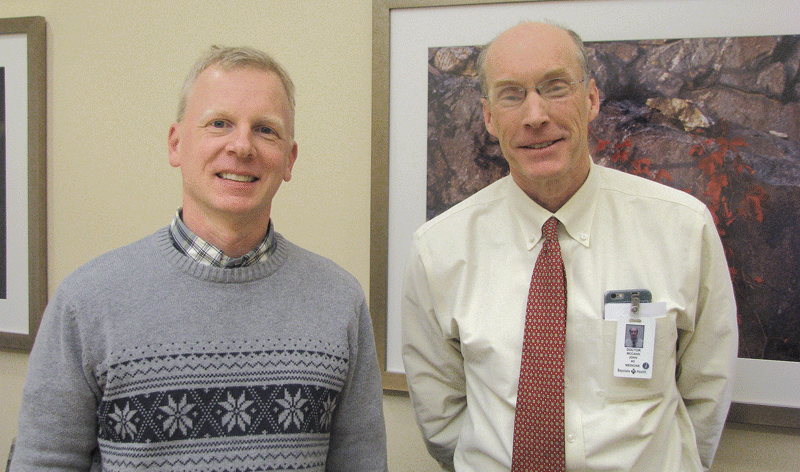
Dr. Matthew Richardson (left) and Dr. John McCann say Baystate’s clinical-trials program both helps current patients and advances research down the road.
When Linda Tedone was diagnosed in September with multiple myeloma, it wasn’t long before her oncologist at Baystate Medical Center, Dr. Syed Ali, came across an opportunity not available to many patients — yet.
It was a national clinical trial, one of dozens in which Baystate patients are enrolled at any given time. In Tedone’s case, her chemotherapy includes a drug, carfilzomib, that was FDA-approved in 2012, but only for relapsed patients who had undergone other therapies. Now, researchers are studying its effectiveness for first-time diagnoses.
“They explained it to me and my family, and we talked about it and were very interested,” Tedone told BusinessWest. “I have a lot of confidence in Dr. Ali. Being in a clinical trial, not only do I have him and his expertise, but lots of other great minds are involved in this, all watching my progress. And I’m reacting well to the medication; the chemotherapy is doing exactly what Dr. Ali wanted it to do.”
A robust clinical-trials program at Baystate — patients are currently participating in about 60 different ones — is available for both adult and pediatric patients, depending on need and what’s available, said Dr. John McCann, a medical oncologist at Baystate who works with adult cancer patients.
“Basically, we’re an academic medical center, so we’ve had a clinical-trials program here for quite a few years,” he explained. “The newer clinical trials are focusing on the specific molecular features of patients’ individual cancers and bringing new treatments to the cancer center that we can use. Because we have an entire team of clinical researchers working with us, we’re able to do sophisticated clinical trials right here at home, so patients don’t have to travel to go to another academic medical center.”
He cited, as one example, a new trial that seeks to evaluate three immunotherapy drugs given simultaneously for patients with advanced melanoma. “It’s very important that patients get really leading-edge clinical trials right here in Western Mass.,” he added, noting that Baystate’s clinical-trials division accesses national trials through organizations like the National Cancer Institute, the National Institutes of Health, and pharmaceutical companies.
And Baystate isn’t alone. When Cooley Dickinson Hospital merged with Mass General Hospital in 2014, it opened up a referral pipeline for oncology patients being treated at CDH to enroll in the kind of clinical trials Mass General has been involved in for decades.
“We joke that doctors frequently have hallway conversations, and we have the same thing, except the hallway is Route 90,” said Avital Carlis, administrative director of the Mass General Cancer Center at Cooley Dickinson Hospital, which opened last fall. “And these relationships are where our connections to clinical trials emanate from.
“I’m very excited that the Mass General Cancer Center will be integrated with the clinical trials available there,” she went on. “Our doctors constantly review cases, and if a patient has unique circumstances, they’ll reach out to their colleagues in Boston, and the doctors in Boston might say, ‘great trial available,’ or ‘perfect match’ or ‘we really should get them in this,’ and we can get our patients involved in these clinical trials. There is a huge spectrum of trials open to us.”
Mercy Medical Center, like Cooley Dickinson, will soon be able to access trials through a new affiliation — in its case, with Smilow Cancer Hospital at Yale-New Haven Hospital, with which is has signed a letter of intent to pursue a relationship that will enhance cancer care at Mercy.
The partnership with Smilow will create new opportunities for patients in Western Mass. to enroll in clinical trials for a wide variety of cancers, said Dr. Philip Glynn, director of medical oncology at the recently expanded Sr. Caritas Cancer Center on the Mercy campus.

Dr. Philip Glynn
“Trials are really important because people get a chance to see if a new treatment can help them — or help a population of patients in general,” he explained. “It’s almost like having a built-in insurance policy; you know you’re getting the most recent treatment. It’s been reviewed by experts, and you’re being very carefully monitored by your doctor.”
The downside, of course, is that previously unknown side effects may arise, and the treatment simply may not work.
“Ideally, you’re being carefully monitored so you can be taken off if it becomes clear it’s not working and there are another alternatives,” Glynn said. “Another downside is that some of these trials have placebos, and people don’t necessarily get the treatment they hoped they’d get.”
With more hospitals joining Baystate locally in providing access to clinical trials available nationwide, it’s a decision patients will increasingly have to answer.
Simply put, Glynn said, a clinical trial is a research study, and patients participate to answer a question or help improve or advance treatment of a disease.
“In my field, oncology, patients volunteer for clinical trials that test new treatments, to see how they compare with current treatment standards. Sometimes they test lifestyle changes to see if it lowers the chances of getting cancer. Sometimes they test new ways of finding out if people have cancer — diagnostic studies.”
Typically, trials are divided into three types, he explained. Phase 1 trials, which are most commonly conducted in a university setting, aim to answer questions about safety in terms of timing, dosage, and side effects. Phase 2 — the type of trial most-often available locally — delves further into safety but focuses more on effectiveness. Phase 3 trials compare the new treatment with the current standard, by placing patients randomly (and blindly) into one group or the other.
Not everyone who wants to take part in a trial may do so, Glynn noted, due to any number of contraindication factors. “There are times people may want to be in a study but are excluded based on pre-existing conditions.”
But plenty are able to enroll, McCann said, noting that some patients inquire about what opportunities are available to try new therapies, while others are steered toward trials by their doctor.
“If a patient is eligible for a trial, we go through the process in detail and talk about risks and potential benefits,” he explained. “Then the patient makes the decision whether or not they wish to participate in the trial.”
Which means they’re well-informed of all known risk factors, he went on. “Every clinical trial has risks associated with it. We are committed to the highest standards in terms of minimizing risk and also explaining very clearly to patients what risks are associated with the treatment.”
In many cases, however, patients have reached a point of desperation, said Dr. Matthew Richardson, a pediatric oncologist with Baystate Children’s Hospital.
“For some conditions, where the prognosis with traditional medicine is poor or at least not optimistic, I think people are motivated to try new things,” he told BusinessWest. “They also realize it may help other children in the future. I think that appeals to many patients — that ability to help other families and other people’s children in the future.”
The goal of any clinical trial, particularly in phase 3, is to compare new treatments or tests to standard tests, and that can’t be done with just one or two patients; researchers need hundreds — and because certain pediatric cancers are so uncommon, no single center will be able to provide that, he explained. That’s why Baystate is part of the Children’s Oncology Group (COG), which gives patients there access to the same trials offered at other children’s hospitals across the country.
Richardson is one of several doctors — as well as pharmacists and people not directly involved in the medical community — who sit on an institutional review board (IRB) that evaluates clinical-trial opportunities to make sure they’re appropriate for Baystate, that the science is sound, and that potential risks are not worse than the standard treatment — or, if the risks are high, that the potential benefit outweights the risk.
“We conduct a very thoughtful analysis, through very extensive discussions, before a clinical trial even begins at the hospital,” he said. “And if a member of the IRB is involved in the clinical research, they’re not allowed to weigh in on approval.”
An added benefit to clinical trials, Glynn noted, is that people feel gratified to be able to help advance new types of research.
“That’s absolutely true,” said Tedone, the Baystate patient. “I mean, this is definitely my journey, and I want to have success, but at the same time, I also know that, if this is going to work for me, it will work for other people and make their journey easier, too. I’m all about research, and we need to get rid of this horrible disease — get rid of all these cancers.”
Patients intrigued by opportunities to participate in this type of research have to be gratified by the new opportunities cropping up in Western Mass., from Mercy to CDH to, yes, a widening pipeline at Baystate.
We’re referring to UMMS-Baystate Health, a campus of UMass Medical School expected to open in Springfield in the fall of 2017. The project — a collaboration between the medical school, UMass Amherst, and Baystate Health — is intended to meet three goals: increasing access to students in Massachusetts seeking an affordable medical education, responding to the healthcare needs of the Commonwealth by increasing the number of Massachusetts physicians trained in urban and rural primary care, and applying academic research to improve population health, reduce health disparities, and make healthcare better integrated, more efficient, and more effective.
“It’s really a game changer for the region,” said Dr. John Schreiber, chief physician executive for Baystate Health, and one of the reasons is access to new avenues for clinical trials through UMass Medical School. “We’ll be able to offer patients in the Pioneer Valley much more than we have previously.”
And one of the goals for physicians coming out of the program is that they understand how to be part of a clinical trial and how to connect patients with experimental therapies. “We want to be able to access that across the Baystate system, not just in Springfield. The outlook is bright.”
With all the optimism over clinical trials, CDH’s Carlis stressed that eligibility criteria can be narrow. “What’s nice about our relationship with our colleagues in Boston is, many of these physicians are world-renowned experts in their field; they know these criteria backward and forward. So, if we think a patient might be eligible, there’s no assumption made until they speak with the people in Boston for a full criteria check.”
That said, the big picture is important. “Through clinical trials, we’re trying to identify where care is going in the future, what are the best combinations of drugs. It opens opportunities for patients they would not otherwise have access to.”
Glynn agreed. “Clinical trials are designed by experts to answer specific questions about therapies,” he explained. “It’s very important, especially today, because there are so many new therapies available for patients in oncology. We want to be able to offer patients as broad a spectrum of potential treatment options as we can.”
After all, Richardson concluded, these are matters of life and death.
“We’ve gone from acute lymphoblastic leukemia in children being a uniformly fatal disease to having some types of leukemia with a 90% cure rate,” he said. “And that’s only been through cooperative clinical trials.”
Tedone, who has been active in her trial for more than four months, tracks other cancer research as well.
“In the past few months, three new medications came out for my specific cancer; the FDA has approved them,” she told BusinessWest. “They’re making progress on my specific cancer by leaps and bounds, which is good news for me, that’s for sure.”
In the meantime, she said, “I’m being positive. I feel like I’m getting great care, and if I have lots of scientists watching me, that just more people on my side.” n
Joseph Bednar can be reached at
By ANN I. WEBER, Esq.
Ann Weber
When you become a ‘senior,’ defined variously as 60 to 70 or older, you become eligible for legal benefits that are not available to your younger compatriots.
While many of these laws are needs-based, some are not — for example, Social Security, Medicare, and others which are available to all of us. The following is a non-exclusive list of some of these laws which might be of interest.
Timing Social Security Benefits
When you turn 62, you become eligible for early withdrawal of Social Security benefits, and this is a great benefit for people who for one reason or another cannot continue to be employed or who do not have a long life expectancy. However, for individuals born between 1943 and 1954, the monthly benefit at age 62 will be 75% of the full monthly benefit at age 66.
If you can wait for benefits until you are 70, there is an additional 8% increase every year for the four years between 66 and 70. So, before making a decision about when to start collecting these retirement benefits, consider the differences, taking into account your estimated life expectancy and your financial situation. For people who can afford to wait or who are worried about outliving their resources, waiting to file might be a good option to consider.
As you probably know, for beneficiaries who are 65 and older, Medicare pays not only for medical and hospital services, but also for some home services and medical equipment used in the home. Less well-known perhaps are the hospice services available to anyone with a prolonged, life-threatening diagnosis.
Although the diagnosis must state that death is likely within six months, hospice now allows not only palliative but curative care, with the result that many individuals end up renewing their eligibility for the program in six-month installments, sometimes multiple times, or graduating from the program entirely.
Hospice services include scheduled in-home care and emergency 24/7 care, which can often obviate the need for routine medical appointments and some emergency-room visits. In addition, Medicare hospice assigns a licensed, professional social worker to beneficiaries to help the patient and family deal with the social and emotional ramifications of an end-of-life illness. It is a comprehensive home-healthcare program, and it’s free.
As a general rule, any withdrawal from a traditional individual retirement account (IRA) results in income taxation of the full amount withdrawn. However, if you are 70 1/2, you can make charitable gifts from your IRA up to $100,000, receive a full charitable deduction, and have the amount contributed count toward your required minimum distribution.
If you are charitably inclined and meet the age requirement, this is a great way to partially fund your charitable gifts with money that would otherwise be going to Uncle Sam.
In Massachusetts, a homeowner receives automatic protection from unsecured creditors up to $125,000 so long as the owner or covered family member occupies or intends to occupy the property as his or her principal place of residence. With a declaration filed on the land records, this protection is increased to $500,000 in total for the property.
However, for individuals 62 or older, a homestead may be filed on each individual’s behalf, so, for example, for two homeowners 62 or older, the aggregate protection increases to $1 million.
A reverse mortgage is similar to a purchase mortgage in that it is a loan from a bank or mortgage company to an individual. However, instead of using the funds advanced by the bank for purchase of a residence, a senior homeowner (62 or older) can use a portion of his or her home equity as collateral and receive cash in return.
Reverse-mortgage payments are not taxable, nor are the payments considered countable income for purposes of MassHealth (Medicaid) eligibility. However, reverse mortgages have fees due upon origination and servicing fees annually which can be substantial, and the loan will have to be repaid with interest which has accumulated over the life of the loan when the homeowner dies or no longer lives in the home as his or her principal residence.
In the right situation, these loans can be life savers, but, because of the fees and technical provisions, it may be wise to consult with a knowledgeable attorney before committing.
Durable powers of attorney are used to allow one person, the agent, to act for another, the principal, in financial matters. These provisions can take place immediately or be triggered by incapacity. Though powers of attorney can be utilized by people of all ages, signing a durable power of attorney can be one of the most important steps you can take if you are getting older to make sure your financial affairs are handled by the person you want and in the manner you would choose.
Under the Massachusetts Uniform Probate Code enacted in 2012, power of attorney was given additional muscle. Specifically, in the event of an unreasonable refusal of a third party to honor the authority of a valid durable power of attorney, the agent can sue for damages. This can be really helpful if the failure to honor an agent’s directions — for example, in a sale or purchase of property — results in a loss to the principal.
There are many other laws and programs which are available to seniors on a needs-based basis which have not been covered here. Additional information can be found at local senior centers and various government agencies, or by contacting an elder-law attorney. n
Attorney Ann I Weber is a partner at Shatz, Schwartz and Fentin, P.C., and concentrates her practice in the areas of estate planning, estate administration, probate, and elder law. She is a fellow of the American College of Trust and Estate Counsel and past president of the Hampden County Estate Planning Council, and has been recognized by Super Lawyers, Top Fifty Women Attorneys in Massachusetts, and Best Lawyers in America; (413) 737-1131; [email protected]

Bill Merrill, center, with fellow managing partners Rob Doty (left) and Greg Morgan, expect things to be hopping at Bounce!
Bill Merrill couldn’t help himself.
When asked how many young people — and some maybe not so young — he expects to see at his new venture, Bounce! Trampoline Sports, on a given day, week, or month, he started by saying, “well, when the place is hopping…’” in a voice that would indicate that he’s used the pun many times before.
Which he probably has. In fact, Merrill would be considered a veteran in this still very young business of trampoline sports — this is his second franchise with the firm Bounce! — and that experience helps explain why he endeavored to bring this concept to Springfield.
And it certainly helped him answer that earlier question. Indeed, Merrill would go on to do that math a little later — he’s anticipating perhaps 150,000 to 200,000 ‘jumpers,’ as they’re called, on an annual basis. In the meantime, he speculated that this establishment, carved out of roughly half the old cinema complex at the Springfield Plaza, will in fact be hopping.
That’s because there isn’t a facility like it in Western Mass., and there are only a few within a 50-mile radius. Meanwhile, a detailed demographic analysis revealed that the Greater Springfield area has the requisite large population of individuals ages 6-18 to make something like this work.
So the $1.5 million investment Merrill and several partners made was not exactly a huge leap from an entrepreneurial standpoint — pun fully intended.
However, it was, and is, a highly imaginative and rather involved reuse of some underperforming commercial real estate, and a gambit that became reality soon enough to keep the competition from … well, jumping in ahead of him.
Merrill, who is also a franchisee with the third Bounce! location, in Poughkeepsie, N.Y., told BusinessWest that trampoline sports — another of those entrepreneurial trends that has moved from the West Coast to the Northeast — had been gaining considerable steam in New York and New England over the past several years. And he certainly wasn’t the only one scouting sites in the Springfield area, which was among the largest metropolitan areas in the Northeast that did have such a facility at the time.
Those searches were essentially called off, though, when Merrill and his partners went public with their plans at the closing on the lease last June.
That was just as preliminary design work at the site was beginning, to be followed by extensive interior demolition and new construction that commenced in August and took five months to complete. Bounce! opened its doors on Jan. 29 and staged a grand opening a week later.
Early returns have been solid, and when he talked with BusinessWest, Merrill was looking ahead to the February school vacation as an effective barometer when it comes to whether his math — and his instincts — were right.
He thinks they’re on the money — literally and also figuratively — and he believes the Springfield complex has the facilities, location, and demographic footprint to be among the most successful trampoline centers in the country.
“I can say that because I’ve been to a lot of these parks,” he said. “This one is truly exceptional.”
For this issue and its focus on commercial real estate, BusinessWest takes a look at this different kind of business and how it has brought new life to a piece of property that was slated to go dark and sit idle.
Bill Low, a broker with the Springfield-based commercial real-estate firm NAI Plotkin, said Merrill first approached him about finding a location for a trampoline-sports facility more than a year ago.
He didn’t appreciate then just how difficult it would be to secure a home for such a business, but it didn’t take him long to grasp the magnitude of the challenge.
It would come in several parts, but center on three main ingredients — location (that’s a priority for any retail business), parking, and finding the requisite open spaces and, especially, high ceilings — at least 20 feet is required.
“You need a specific type of property for this,” he noted. “And we launched an extensive search across this area. But there just weren’t many locations that fit the profile.”

Obstacle course at Bounce!
In other parts of the country, and even Eastern Mass., warehouses have been successfully transformed into trampoline centers, said Merrill, and a few of those were considered in this region.
But, generally, they either lacked the proper dimensions, were located in out-of-the-way industrial areas, had insufficient parking, or a combination of the above. Other than that, they were ideal.
Other types of facilities were considered, such as the former Circuit City location at the corner of Parker Street and Boston Road in Springfield, as was the prospect of building to suit, said Merrill, adding that none of the apparent options on the table were very attractive, pricewise and otherwise. And that’s when another alternative emerged, seemingly from out of nowhere.
Actually, it emerged in the view out the window of the 99 Restaurant at the Springfield Plaza, where the various players in the bid to bring Bounce! to Springfield were having lunch and discussing various options, including the possibility of building a facility on a pad site at the plaza across the street from the restaurant.
That’s when the subject of the cinema complex came up, with Merrill soon learning it had just been acquired by Cinemark, owner of the theater complex on Riverdale Street in West Springfield and others in the region, with plans to place a deed restriction on it to essentially keep additional competition from entering the market.
“They told me the plan was to have that building go dark, and my jaw dropped,” said Merrill, adding that he was dismayed at the prospect of opening a new business next door to such a dormant hulk.
Fast-forwarding a little, the discussion shifted to perhaps leasing a portion of the former theater complex, which, with this use in mind, was eventually sold back to Springfield Plaza owners the Davenport Companies and Albany Road Real Estate as a site for Bounce!
Working with Shelburne Falls-based architect Joe Mattei, Merrill and fellow managing partners Rob Dory and Greg Morgan soon took their concept from their imaginations to the drawing board, and then to the big screen — well, nine of them, actually, comprising roughly 35,000 square feet of jumping space.
That’s how many of the old theaters were leveled, in every sense of that construction term, to make way for a host of different experiences for those aforementioned jumpers.
There are several party rooms, for example, which, as that name implies, are smaller rooms designed to host birthday parties — a few dozen have already been booked — and other gatherings. There are also larger, general bouncing rooms, carved out of the larger theaters, including one with three basketball hoops set at various heights to test those who can now dunk thanks to a lift from a trampoline.
There is a room for younger children, complete with a bounce house, and two so-called Xtreme rooms. There, visitors can find American Ninja Warrior-style obstacle courses of varying levels of difficulty. There are also spaces for dodgeball games on trampolines, an activity that is growing in popularity, said Merrill.
The Springfield location hopes to draw from a wide area ranging from Northern Connecticut to New Hampshire; from the Berkshires to the western fringes of Worcester County, he went on, adding that, while young people and families comprise the primary target audiences, the facility is also hoping to draw students from the many colleges and universities across the area.
He notes that both geographic location and the quality of the venue are factors that will play into those expectations.
“Bounce! is really the Cadillac of this business,” he said. “There are several people doing this now, but these facilities set the standard.”
Whether that standard will translate into business success remains to be seen, but all signs seem to indicate that this facility will indeed be hopping.
And if that’s the case, then it will mean a much different fate for a location that had seen the lights go out and was looking at a fairly dark future.
George O’Brien can reached at [email protected]

 When Peter Wirth and his business partner, Rich Hesse, commenced their search for a site to locate a Mercedes dealership that would serve Western Mass. and Northern Conn., they started, well, where one might think they would start — Riverdale Street in West Springfield.
There are more than a half-dozen dealerships already on that stretch for a reason — actually several reasons, he told BusinessWest, listing everything from traffic counts to accessibility (I-91 and the Mass Pike both have exits on or just off that road) to the fact that the bevy of brands there acts as a magnet for car shoppers.
But while their search started on that throughfare, it didn’t end there. Indeed, upon riding up and down Riverdale Street a few times, the partners came away unimpressed with available options and disenchanted by obvious challenges — from holiday-season bottlenecks to the long drives needed to turn around and get on the desired side of the street.
So they turned their attention elsewhere, and eventually found a site far less obvious, but with all or most of those aforementioned amenities found in West Side.
Indeed, Wirth and Hesse will soon close on the property just off Turnpike exit 6 and at the tail end of Route 291, which has been home to hotels with a succession of names, most recently the Plantation Inn, which closed several years ago. This is the site known to many as the long-time home of white statue known colloquially, and simply, as the ‘Country Ford guy,’ because it previously graced that dealership for many years.
By June, the partners expect to complete demolition and then start construction of a 35,000-square-foot facility that will bring a Mercedes dealership back to Western Mass. for the first time in more than a decade.
This is an $11.8 million undertaking when one factors in the purchase of the property, demolition, and new construction, Wirth — co-owner, with Hesse, of Mercedes Benz of Nanuet, N.Y. — told BusinessWest, adding that he believes this constitutes a sound investment.
And the location they eventually chose is a big reason why.
“It’s at the intersection of two highways, and it couldn’t be any easier to get to,” he said, adding that the site is convenient for most everyone living or working in the dealership’s large territory — from just west of Worcester to the New York line; from the Vermont border into the Northern Conn. region.
Wirth told BusinessWest that he and Hesse were approached by Mercedes about bringing the brand back to the 413 area code — the closest dealership is in Hartford — and the partners, after some research, concluded this was a market in which they and the German carmaker could thrive.
“Mercedes recognized that the Western Mass. and Northern Connecticut markets were somewhat underserved, and that there is an opportunity there for the brand,” he explained. “They asked us to partner with them to bring the brand back to the area.”
Those talks started roughly 18 months ago, he went on, adding that the search for a location commenced soon afterward, and it took most of 2015 to seal a deal. There were several priorities involved with that search, he said, adding that the dealership requires a minimum of four acres (the Plantation Inn site has six). Accessibility is also a major factor, as well as visibility, which this location also possesses.
It doesn’t have any other dealerships, he observed, adding that Mercedes is such a powerful brand, it doesn’t need help from other makes to draw people to the door.
“We decided fairly early on that we didn’t need to be there, and that there were actually several advantages to not being there,” he said of what amounts to an auto mile on Riverdale Street. “The Mercedes brand has enough attraction, enough pull, so that you don’t have to be where everyone else is.”
Wirth said the timetable, as currently constituted, calls for having the dealership open for business by the second quarter of 2017, and maybe the first quarter if everything falls into place smoothly.
As for the Country Ford guy, Wirth said it was still in residence on the property when the partners first looked at it, and they actually considered making it a part of the dealership.
But it now has a new owner, forever, and this Mercedes store will need a different identifier.
Wirth believes the Mercedes sign that adorns the property will be more than enough.
— George O’Brien

Kevin Kousch says there’s still demand for formal business attire, and he believes he can meet that need.
Kevin Kousch believes the reports concerning the death of the suit have been, as Mark Twain famously said, greatly exaggerated.
And he’s willing to bet what he described as “a decent chunk of my retirement savings” that he’s right with that assessment relating to what men are wearing to work — and will wear in the years to come.
Kousch, the former manager of the formal-attire department at Yale Genton, went into business for himself with a tuxudo-rental business after that Springfield-area landmark closed at the beginning of 2008. Over the past eight years since opening Formal Affair Tuxedos in West Springfield, he’s done fairly well, with lots of ups and downs, in his estimation. But he concluded late last year, after considerable reflection, that it was time to make a change and expand both his horizons and product offerings.
Thus, beginning sometime next month, he’ll be selling suits, sport jackets, and pants from his location on Route 20 in West Springfield — and, in so doing, fill a void he believes has gone largely unfilled since Yale Genton closed its doors.
“There are some stores that provide higher-end products, and there are others that cover the lower end,” he explained without naming names. “But there’s really nothing in the middle, and that’s where I’m going to be.”
By ‘middle,’ he meant suits and jackets in the $299 to $499 range, price tags he feels are appropriate for this market and that reflect what most men want to spend to dress professionally.
Kousch acknowledged that this business-expansion effort is somewhat of a risk — there is still competition in the market, and he’s observed that casual Friday has given way to ‘casual Monday through Friday’ in many settings, even banks and law offices. But he believes it’s a calculated risk worth taking.
“The young people today are dressing up — they want to wear those slim-fit suits,” he explained, adding that there were other factors involved with his decision, including a decline in the tuxedo-rental business — weddings are smaller, among other things — and a trend toward suits rather than tuxes for weddings and even proms.
Meanwhile, and perhaps more importantly, this gambit is a test drive of sorts for what could be a much larger undertaking at the planned MGM Springfield casino in the city’s South End. Indeed, Kousch said he has a memorandum of understanding with the casino giant that he will be an on-site vendor of tuxedos for the gaming complex.
If his current foray into retail, selling suits and jackets, establishes that there is a viable market for such products and he can command a good share of that market, then his facility in the casino, if it in fact becomes reality, may offer similar product lines.
“What we’ve decided to do is start here small and see if there’s a need,” he explained. “This is the preliminary for the bigger store and MGM.”
As he talked about his latest entrepreneurial foray, Kousch said it’s one he’s thought long about, and regrets not undertaking when he initially went into business for himself.
“I should have done it at the start,” he explained. “There was a need for it, and over the years, people have constantly asked me if I sold suits.”
Upon hearing that he didn’t — actually, the answer was usually that he could order something out of a catalog if a customer wanted to go that route — many encouraged him to do so.
It was those forms of affirmation, along with his own reading of the local market and what it needed, that prompted Kousch to branch out into a market segment he knows well.
Extensive renovations are currently underway at the West Springfield location, which, while not large, provides ample room to display several different brands and styles. Those brands will include Bertolini Mantoni, Enzo, and London Fog, which recently ventured into suits, among others.
The operation will also employ an in-house tailor, Zeza Santos, who has built a steady portfolio of clients since she started leasing space in Kousch’s shop several years ago.
If all goes well, and Kousch expects that it will, his expanded operation will prove to be a good fit for the region — in more ways than one.
— George O’Brien
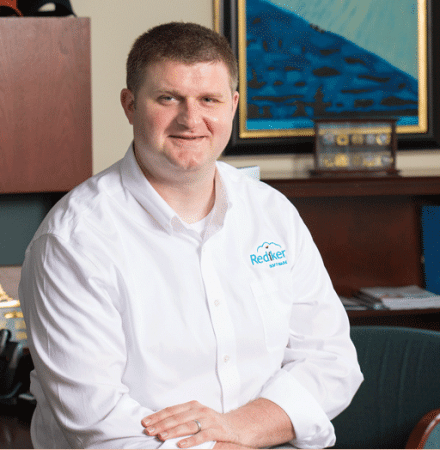
Andrew Anderlonis says Rediker Software’s products are designed to require as little time or fuss as possible from their users.
The Commodore PET was a late-’70s computer with a tiny, calculator-like keyboard and a whopping 4K of RAM.
It was also the foundation on which Rich Rediker built a software company that today employs 125 people at its Hampden headquarters and around the world, and has grown to become an international leader in what’s known as administrative software for schools, with a presence in all 50 states and 115 countries.
“The company started before the Internet existed, before Windows, even before DOS,” said Andrew Anderlonis, Rediker’s son-in-law and the firm’s second-generation president. What did exist, though, back in 1980, was a need.
Specifically, as a chemistry teacher at Longmeadow High School, Rediker needed an easier way to track student tardies and generate notices. So, using the PET he had scraped up enough money to buy, he designed a program to do just that — and also helped the school’s secretary produce a daily bulletin faster than before.
“He kept working on it, tinkering with it, and it became useful to the school,” Anderlonis explained, to the point where he offered to sell his program to other schools, beginning with St. Mary’s High School in Westfield in 1981. After a couple of years dividing his time between teaching and broadening his tiny software business, he left LHS and dedicated himself full-time to what is now known as Rediker Software.
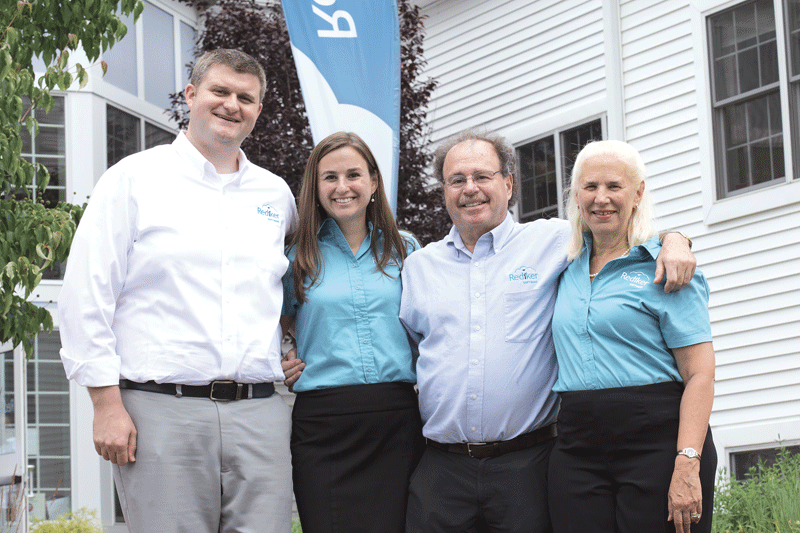
Two generations of Rediker leadership: Rich and Gail Rediker (right) and Andrew and Amy Anderlonis.
At first, Rediker ran his business from the basement of a house in Hampden — a story with echoes of the way giants like Amazon and Microsoft were birthed. As he developed more sophisticated programs to run other administrative tasks, sales took off, and in 1998, he moved into the building at the center of Hampden that still houses the enterprise today — that is, after a needed expansion in 2006.
“As the software evolved, he converted it for DOS, converted it to Windows … now we’re tackling mobile-type things. It’s amazing,” Anderlonis said. “Not many technology companies have been around four decades.”
Because of that long history, he added, “we’re convinced that we were the first student-information system on a PC. There were mainframe systems, but not on a PC.”
Today, the company serves public, private, charter, and religious schools with administrative software. That’s a broad category Anderlonis said, one best explained by some of the company’s key products, including:
• Administrator’s Plus, which manages data on students and staff. Schools can use the system to track attendance, create report cards, manage discipline, and build student schedules. Teachers can use the integrated web gradebook, TeacherPlus, to calculate and enter grades. School administrators can create digital portfolios for each student and staff member, and use them to electronically store documents and class projects. The system allows schools to batch e-mail report cards and other documents to parents, eliminating the need for paper and postage. Families can log into the system from home to see their children’s grades as well as other important school information. Finally, teachers can maintain web pages for their classes as a learning resource;
• Admissions Plus Pro, an enrollment-management software program that streamlines the admissions and enrollment process, while reducing extra work and duplicate data entry. The system can help private schools increase the number of applications they receive by allowing parents to submit them online;
• Teacher Evaluator, a web-based application available as an app for iPad but also accessible with any web browser. The application helps schools schedule and complete teacher evaluations; and
• School Office Suite, a product that complements Administrator’s Plus and folds in other areas of school functions, including cafeteria, library, and school-nursing services, in addition to basics like applications, admissions, and academics.
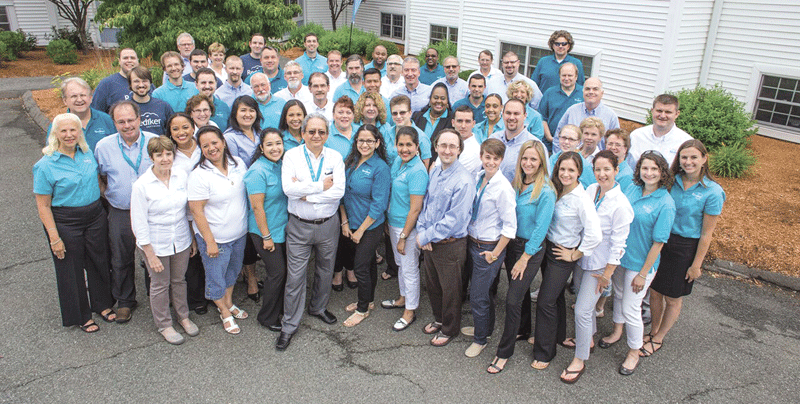
Rich Rediker (center) with his staff in Hampden, just some of the 125 employees based across the U.S.
“Our products cover anything that has to do with student data — attendance, report cards, grades, discipline, general demographic information, billing information, and more,” Anderlonis said. “The admissions product allows schools to customize the admissions process. Our goal is really to provide a complete product suite. When kids apply and enroll, they’re brought into the system, and their information can be shared with parents.”
The goal, he went on, is user convenience — specifically, as much automation, and as little time spent fussing with data, as possible.
“The end goal is for schools not to have to spend a lot of time managing data,” he told BusinessWest. “We’re building systems that are easy to use and easy to understand, and part of that hinges on great customer support.”
It’s an element Rediker has invested in, with an in-house call center in Hampden. In fact, 75% of the company is built around customer support and product development; half the firm’s employees are developers, tasked with creating new products and improving existing ones.
One sign of progress is the way the software has evolved beyond something only administrators used, to products that teachers and students interact with directly. “We’re approaching nearly 2 million students using portals, and close to 100,000 teachers; we’ve seen really substantial growth in the adoption and use of our portals.”
Since his arrival at the company four years ago — Anderlonis’ wife, Amy, is Rediker’s daughter and the firm’s public-relations manager, while Rich Rediker continues to act as CEO — he has made an effort to expand the ways in which Rediker interacts with customers, including delivering software through the cloud; partnering with Microsoft, Apple, and Google to open up new channels for its products; and finding new uses for its expertise.
“We’ve moved into products for mass notification, allowing schools to mix text, call, and e-mail notifications across the system,” he noted as one example. Another is a deeper commitment to designing school websites, an effort for which Rediker has partnered with Wild Apple Design Group in Wilbraham.
The bottom line, Anderlonis said, is that schools always have room for improvement in the way they incorporate technology. “Schools in general typically lag a little behind on the tech highway. They’re obviously constrained by what’s in the budget. But most schools are going to spend on classroom technology; we’re trying to provide software tools that enable them to be more constructive.”
The last two years have been an especially fruitful time, he added, when it comes to developing next-generation technology at Rediker. “We’ve looked at where we’ve had success and how we can continue that success and continue to grow. We have a very tight-knit family atmosphere here — we promote family and a great workplace culture — and make sure that, as a family business, we take care of our employees because, in the end, they take care of our schools.”
In short, Anderlonis said, he simply wants to make sure Rediker stays ahead of the technology curve and carry on an impressive record of growth.
“Rich has done an amazing job ensuring the company is profitable every year since the company was founded, and we continue to do that through product innovation,” he said. “My goal is really to set the company up for the next generation of management and success with these products, and to create a strategic vision going forward. With the products were introducing to the market, we’re focused on providing even more robust, powerful, and flexible tools for schools to utilize. We really feel we’re one of the top vendors in the U.S. with student-information systems, and we consider ourselves the market leader.”
As a preferred vendor for Massachusetts schools, Rediker software is employed in more than 80 districts and charter schools, but it has also forged a solid reputation in Catholic schools, recently winning a contract with the Archdiocese of Washington, D.C, one of many large dioceses the company boasts among its clients.
Public or private, Anderlonis said, “we want our customers to feel comfortable choosing to partner with Rediker. We want schools to call us when they need help. Schools call us all the time, and we’re there to talk to them.”
In addition, the company hosts three week-long workshops annually, each one drawing up to 100 educators from across the U.S. and around the world. “They interact with staff, train on the software, and get to network with other administrators. There’s a really tight-knit community around our products, both domestically and internationally. It’s pretty neat.”
As part of an effort to stay on top of advancing technology — while helping to cultivate the next generation of software developers — Anderlonis launched a summer internship program that brings a handful of promising high-school and college students on board to work on real-world projects.
“They experience the full life cycle — they’ll develop a product all the way from an idea on the whiteboard to possible customer interaction,” he explained, drawing from the skills they’ve been learning in school. “It’s not just a superficial internship; there’s a lot of depth. We give them a lot of autonomy. We’re essentially giving students in the local community an opportunity to use their abilities on real-world applications, but at the same time, they’re helping us.”
The company also connects to the community through a program called Rediker Cares, a volunteer program that allows employees to volunteer at local organizations and events during company time. As a result, employees have made significant contributions to local organizations, particularly Link to Libraries, the regional literacy initiative that was given workspace at Rediker free of charge; Anderlonis sits on the nonprofit’s board.
“Our company is a primary sponsor of Link to Libraries; they’re a great organization,” he said. “That’s another way we can give back — by helping promote literacy. Our employees have a chance to volunteer there and other ways in the community as well.”
That commitment echoes, in a different way, Rediker’s mantra of giving teachers more time with students, and developing software that allows them to have that.
“Technology is such a foundation for everything today, including education,” Anderlonis told BusinessWest. “Walk into any classroom nowadays, and you’ll see incredible technology — computers, tablets, smartboard projects. That’s the hardware, but what’s behind it? Our goal is to be part of the software that can help schools run more efficiently and effectively.”
Still, he added, as the company continues to branch out and diversify, it will do so at a measured pace, as not to lose the personal touch Rich Rediker has emphasized from his Commodore days.
“We’re not the biggest company, and we’re not the most aggressive,” Anderlonis said, “but we’re passionate about what we do, and we take care of our customers.”
Joseph Bednar can be reached at [email protected]
 American employers have realized the vital importance of cybersecurity — but that realization has created a near-term shortage of workers that may require long-term solutions.
Cybersecurity was once the province of defense contractors and government agencies, but in the third edition of its annual cybersecurity job-market analysis, Burning Glass found that hiring has boomed in industries like finance, healthcare, and retail.
A glance at the headlines is enough to explain why. In addition to the federal Office of Personnel Management, recent cyber breaches have hit major consumer companies like Chase and Target. According to PricewaterhouseCoopers’ 2015 State of U.S. Cybercrime Survey, a record 79% of survey respondents said they detected a security incident in the past 12 months. Many incidents go undetected, however, so the real tally is probably much higher.
Yet, we are also seeing multiple signs that demand for these workers is outstripping supply. Job postings for cybersecurity openings have grown three times as fast as openings for IT jobs overall, and it takes companies longer to fill cybersecurity positions than other IT jobs. That’s bad for employers, but good news for cybersecurity workers, who can command an average salary premium of nearly $6,500 per year, or 9% more than other IT workers.
Or, put another way, there were nearly 50,000 postings for workers with a CISSP certification in 2014, the primary credential in cybersecurity work. That amounts to three-quarters of all the people who hold that certification in the U.S. — and presumably most of them already have jobs.
This is a gap that will take time to fill. The skills for some IT positions can be acquired with relatively little training, but cybersecurity isn’t one of them. For example, five years of experience are required to even apply for a CISSP certification. That doesn’t even consider the rising demand for experience in a specific industry, like finance or healthcare. This suggests that the shortage of cybersecurity workers is likely to persist, at least until the education and training system catches up.
Among the key trends in cybersecurity jobs:
• These jobs are in demand and growing across the economy. The professional-services, finance, and manufacturing/defense sectors have the highest demand for cybersecurity jobs. The fastest increases in demand for cybersecurity workers are in industries managing increasing volumes of consumer data, such as finance (+137% over the last five years), healthcare (+121%), and retail trade (+89%).
• Positions calling for financial skills or a security clearance are even harder to fill than other cybersecurity jobs. The hardest-to-fill cybersecurity jobs call for financial skills, such as accounting or knowledge of regulations associated with the Sarbanes-Oxley Act, alongside traditional networking and IT security skills. Because finance and IT skills are rarely trained for together, there is a skills gap for workers who meet the requirements of the ‘hybrid jobs.’ Meanwhile, more than 10% of cybersecurity job postings advertise a security-clearance requirement. These jobs, on average, take 10% longer to fill than cybersecurity jobs without a security clearance.
• Cybersecurity positions are more likely to require certifications than other IT jobs. About one-third (35%) of cybersecurity jobs call for an industry certification, compared to 23% of IT jobs overall.
• Cybersecurity employers demand a highly educated, highly experienced workforce. Some 84% of cybersecurity postings specify at least a bachelor’s degree, and 83% require at least three years of experience. Because of the high education and experience requirements for these roles, skills gaps cannot easily be resolved though short-term solutions. Employers and training providers must work together to cultivate a talent pipeline for these critical roles.
• Geographically, cybersecurity jobs are concentrated in government and defense hubs, but are growing most quickly in secondary markets. On a per capita basis, the leading states are Washington D.C., Virginia, Maryland, and Colorado; all have high concentrations of jobs in the federal government and related contractors.
Burning Glass is a Boston-based firm that delivers job-market analytics that help employers, workers, and educators make data-driven decisions. Its full report on cybersecurity jobs is available online at burning-glass.com/research/cybersecurity.

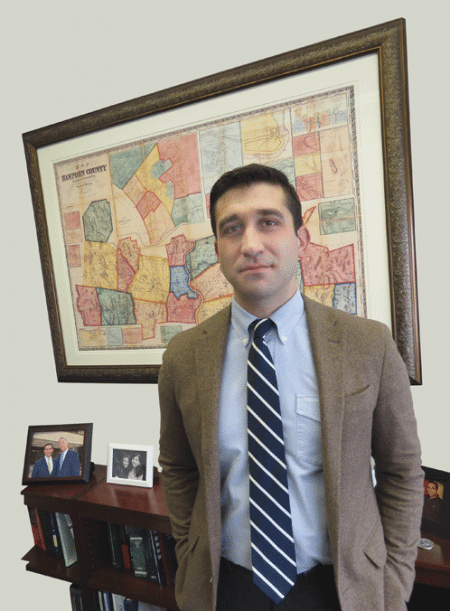
Hampden County District Attorney Anthony Gulluni
Hampden County District Attorney Anthony Gulluni is rather proud of the large map of the region he represents that now dominates one wall of his office in the Hall of Justice on State Street.
He found the item, circa 1857, on eBay, paid $40 for it — it’s a replica, not an original — and then plunked down more than 30 times that amount (his own money) to have it matted and framed.
“It’s sort of a gift to myself,” said Gulluni, who said he often finds himself looking at the map and noting the many forms of progress that have visited the region over the past 159 years.
But that term certainly wouldn’t be applied to the opioid crisis facing his territory — and the other 13 counties in the Bay State, and the entire country, for that matter.
In fact, it likely represents the biggest law-enforcement issue — and one of the deepest healthcare crises — in the Commonwealth and this region since his map was drawn.
“Historically, this is as bad as it’s ever been,” he said, referring to drugs and the many different tolls they take on society. “We had the crack epidemic in the late ’80s, but this is far worse, on many levels. Drugs have always been an issue, but it’s now reached a fever pitch.”
To map out strategies to address the crisis, Gulluni’s office is forming a task force comprised of law enforcement personnel, healthcare providers, elected officials, and others. These are the parties that will have to work together to not only conceptualize a strategy and its specific components, but secure the money to pay for them and then carry them out.
As he talked about the task force and this crisis in general, Gulluni acknowledged what many have said in various forums across the nation — that this is not a problem that the country or his county can arrest its way out of. But arrests can, and must, be a part of that equation. A big part.
Arrests like the one made in Springfield’s South End in early January that took more than 8,000 bags of lethal ‘Hollywood’ heroin off the street, probably saving many lives in the process (officials attribute at least six fatal overdoses to heroin bearing that stamp). And arrests like the one of Ludlow doctor Fernando Jayma, who was indicted late last year on 41 charges, including illegally prescribing oxycodone and other drugs and also making false Medicaid claims.
“We can’t arrest our way to a resolution of this problem, but we have to keep making arrests to take heroin off the streets and keep it from the people who are addicted,” Gulluni noted.
But the DA noted that this fight will have a number of fronts, including treatment of those currently addicted to opioids and educational efforts aimed at keeping others from becoming addicted.
And while saving lives and stemming addiction are the overriding goals of this initiative, the opioid crisis is a quality-of-life issue for everyone living in this county, said Gulluni, adding that, by his estimation, roughly 50% of the crimes committed in his jurisdiction are related in some way to drugs and, quite often, opioids.
This includes crimes related directly to those distributing and selling those drugs, but also those committed by individuals who will seemingly do anything to obtain the money needed to acquire them. And those committed by individuals impacted mentally, emotionally, and physically by those drugs.
“Addiction drives a lot of people’s crimes in terms of breaking and entering charges, trespassing, shoplifting, all those things,” he explained. “But there’s also domestic violence and other crimes that relate to the breakdown in people’s ability to deal with other people, the stress that addiction causes, and how it affects people’s well-being and their relationships with spouses and others.”
For this issue and its focus on law, BusinessWest talked at length with Gulluni about his ‘all hands on deck’ campaign against opioid abuse, and how it exemplifies the battle being waged across the region and across the country.
When asked if he thought the opioid crisis in this region had peaked, Gulluni offered a contemplative “I really hope so” that spoke volumes about this crisis, how far it extends, and, yes, the uncertainty about whether any kind of corner has been turned despite a mountain of press on the subject and calls for action at the local, state, and national levels.
And when queried about when and how it will become evident that real progress has been made, he said this will be borne out by numbers — such as those concerning everything from arrests to fatal overdoses — but perhaps more importantly by fewer uses of phrases too often heard in cities and towns today.
“We’ll know when there are fewer mothers, fewer brothers, and fewer friends coming to me and saying, ‘I can’t believe it was my son,’ or ‘I can’t believe it was me who’s become addicted and it started with a prescription from my doctor,’” he said. “When we hear fewer stories like that, fewer stories of woe, tragedy, and death, that will be a clear indication of progress, and it’s one I look forward to.”
Getting to that day — and he didn’t want to speculate on how far away it is — will require a concentrated, collaborative effort, Gulluni told BusinessWest, one that will involve law-enforcement agencies, the healthcare community, the court system, community activists, and government leaders, who will be called upon to provide the legislation and financial resources to get the job done.
 And, as mentioned, it will be a multi-faceted initiative, one focused on everything from curbing the supplies of lethal heroin to providing adequate numbers of beds for those trying to recover from addiction, to changing the way doctors prescribe narcotic painkillers.
Adding to the challenge in Hampden County is the fact that Gulluni’s office is already the busiest in the state by most measures, but has a fraction of the staffing that other DA’s offices have secured.
“We dispose of, in many years, the most Superior Court indictments, our District Court is extraordinarily busy — if you aggregate our numbers, we’re the busiest district, inclusive of Boston, Worcester, and Middlesex County, in the Commonwealth,” he explained. “We have 63 assistant district attorneys, Boston has about 140, Middlesex has 130, Worcester has about 95. So, with about half the staff of some districts, we have the same case load, or a bigger one.”
Gullini is lobbying state officials to enlarge his staff, and, in the meantime, he’s deploying the troops he has in ways that might bring the region closer to that day he described earlier.
These broad efforts might be described as efforts to dramatically curb both supply and demand for opioids.
Indeed, as he returned to the subject of arrests and convictions when it comes to those distributing and selling heroin, like that aforementioned batch with the ‘Hollywood’ stamp, Gulluni said that, while the supply of such drugs is seemingly inexhaustible, the seizures do make a difference.
“In terms of the overall supply of heroin in Western Mass. and Hampden County, those 8,200 packets were a drop in the bucket,” he said of the South End seizure, adding quickly that Western Mass. has become a kind of distribution hub for the drug. “And it has practically no effect on people’s access to heroin. But it’s significant nonetheless.
“And to understand that significance, you have to look at it from the context of how that particular heroin was killing people,” he went on. “Taking 8,200 bags of the ‘Hollywood’-stamped heroin out of circulation is significant; through the hard work of the Springfield Police Department and its narcotics group, in that case, a number of lives were saved as a result of that bust. Those bags would have found their way into any number of people’s hands — people suffering from addiction — and they would have used it, with possibly fatal consequences.”
While the South End bust certainly saved lives, the supply of heroin remains a huge issue, he said, adding that untold amounts of the almost ridiculously cheap drug flow into the region every day.
And by cheap, he means $3 or $4 a bag, with most users needing perhaps three of four a day to satisfy their cravings (at the extreme end, it could be a dozen or more). In Vermont, though, the price is much higher ($10 to $12 a bag due to supply-and-demand issues), which is in turn fueling a surge in cases where entrepreneurial criminals buy heroin at low prices in this state and then try to profit by crossing the border and selling it there. But that’s another story — or at least another disturbing aspect of this one.
“It’s a cheap habit, and that’s why we’re seeing this crisis reach this level,” said Gulluni, adding that heroin has become a very affordable alternative to the much-higher-priced prescription painkillers that many addicts began their unfortunate journeys with.
And this brings us to another front in this campaign — stemming the tide in the number of prescriptions of addictive pain killers.
The arrest of Jayma was one manifestation of this effort, said Gulluni, adding that this was the first such arrest during his administration, which began just over a year ago, and likely not the last. Indeed, while he’s not sure how widespread such abuse is, he knows this is not exactly an isolated incident.
“The so-called pill mills — they’re out there,” he explained, adding that he hopes Jayma’s arrest sends a strong message and becomes an actual deterrent.
“I hope it was a strong statement to everybody, including the prescribing community, that there are certain limits by which you have to abide, based on both your professional ethics and the laws of this Commonwealth and the federal government,” he said. “If you’re doing things that are irresponsible or unlawful, whether you’re a doctor or not, you’re going to be arrested.”
That arrest is part of the ‘curbing demand’ aspect of this fight, said the DA, adding that it is as important as the supply side, and perhaps even moreso, because without demand, there is no need for supply.
And it’s an example of how those involved with stemming this crisis must deal with the present and the future at the same time.
Regarding the former, efforts are focused on educating and treating those currently addicted, and not incarcerating them, said Gulluni, adding that jail time is generally for those who sell or traffic in drugs or those who profit from their use.
Elaborating, he said those arrested for possession of such drugs are, in most cases, given probation. And there is additional focus now on making sure this probation involves a setting where there is treatment for the addiction.
As for the latter, the future, Gulluni said attention must be directed toward the young people that might someday become addicted if they’re not encouraged to start down and stay on a different path.
“We’ve got to engage with young people; we have to engage with people who are at the stage where they’re beginning to use drugs,” he explained. “In terms of prevention and education, we need to get out in front on this issue for the future.”
Already, the DA’s office is engaged with programs to get opioid addicts and those who treat addiction in front of different types of audiences to “tell the stories,” as Gulluni put it, concerning what happened to them — and what could happen to others.
“We’re presenting groups of people — young people, parents, educators — with the information concerning how this affects people’s lives, how it starts,” he told BusinessWest. “We need people to say, ‘no, thank you; I don’t want 100 oxycodone pills because I had a tooth pulled.’ This is how this stuff starts.
“We need to get some of this out of the stream of commerce,” he went on, adding that legislation is being considered that would limit the numbers of potentially addictive painkillers that may be prescribed and the conditions they may be prescribed for.
Such efforts will require partnerships, he continued, adding that steps to limit prescriptions of this nature require the cooperation of the medical community, and represent just one example of how that constituency must work with law enforcement to stem the tide.
Many such partnerships will be needed, he said in conclusion, because of the deep-rooted nature of this problem and the simple yet indisputable laws of supply and demand.
A quick look at Gulluni’s prized map reveals just how much Hampden County has changed since 1857.
Missing from this snapshot are countless roads, bridges, dams, reservoirs, colleges, airports, and parks — all of which have contributed mightily to the current landscape.
As has the ongoing opioid crisis, which, of course, doesn’t show up on any map or limit itself to any borders — real or imagined.
It represents history, and not the kind that society will look back fondly on, like a map drawn 159 years ago. And it will take an historic effort to relegate it to the past tense.
The state’s youngest and newest district attorney is ready and willing to make such history, and he’s not wasting any time in that effort.
George O’Brien can be reached at [email protected]
By KATHERINE E. McCARTHY

Katherine E. McCarthy
While not a new development, it is clear that the law can rarely keep up with rapidly changing technology.
Increased surveillance technology, a host of mobile applications (including a popular rideshare app, Uber), GPS technology, and spyware, just to name a few, all present significant legal issues that most of us have never considered.
In this article, we’ll discuss this new technology and what it could mean for employees, business owners, the general public, and municipalities.
In the wake of civilian unrest in places like Ferguson and Baltimore, there has been an outpouring of support for police departments to adopt the use of body cameras. In theory, body cameras appear to be a great idea, and technology is available to implement the practice. Recording a police officer’s interaction with a civilian not only helps protect the civilian and hold police officers accountable for their actions, but also helps to protect the police officer against false claims of misconduct.
So what’s the problem? There are several, not the least of which is the financial strain on cities and towns. Next, audio-recording individuals without their consent can run afoul of the Commonwealth’s wiretap statute. Violation of the wiretap statute is a crime.
There are also privacy concerns. Members of the public may be inadvertently recorded, and those recordings could be disseminated under public-record-disclosure laws. Some additional issues to consider include whether a police officer is required to turn off the camera when interviewing a victim or witness of a crime, and, if not, what is the result if a police officer receives private medical information related to a suspect or victim? Is the video recording of such information a potential violation of medical privacy laws?
Still more issues are presented once video is recorded on a body camera. Like any other evidence used in a legal proceeding, the footage must be stored in such a manner that the chain of custody is not disturbed. If the chain of custody is in some way tainted, the admissibility of the evidence gathered on a body camera may be excluded from a legal proceeding, thus eliminating the purpose of the camera. Storing daily video footage is very costly and requires specific procedures and practices, many of which are cost-prohibitive.
It is clear that the law as it stands today does not adequately address the issues presented by the use of body cameras. Legislation is pending, but it will be some time before the stage is set for the proper, and legal, implementation of this practice.
Another hot topic in the realm of law and technology is the soaring popularity of the rideshare company Uber. Uber is a mobile application (commonly referred to as an ‘app’) that allows consumers to request a ride from drivers who use their own vehicles. The request is made via the Uber app and sent to Uber drivers located in the same geographical area as the consumer. Uber is growing in popularity at such a rate that taxi drivers and even some cities and towns are seeking to limit or even eliminate its presence.
To many of us, Uber seems to have come upon the scene without any forewarning. So it is perhaps not surprising that regulations have not yet been passed which address rideshare businesses. Again, the law has not caught up with technology. This leaves cities, towns, and the courts with little guidance as to how to treat these newly evolving businesses.
Airbnb is another popular service that allows customers to rent an entire house, apartment, or room from private individuals advertising on the website. While this is seemingly a win/win for both parties, liability is a serious concern. It is unlikely that a homeowner’s insurance policy would cover intermittent renters. Even most renter’s policies would not cover such a scenario. Like Uber, there is an absence of regulation that would exist for other similar services, such as hotels, inns, and bed and breakfasts.
By taking advantage of our ability to quickly and efficiently communicate with individuals all over the world, enterprising homeowners may be putting themselves at financial and legal risk they never considered.
Yet more issues are presented by the use of technology to surreptitiously monitor someone’s online activity. Commonly referred to as spyware, it is not infrequent in the realm of domestic relations for a spouse to use this technology to monitor the other spouse’s online activity. Unfortunately, using spyware in this manner could run afoul of Massachusetts privacy and wiretap laws, despite the fact that this technology can be purchased from many large retailers.
Undiscerning customers rarely consider such ramifications when purchasing software that is available at their local retail store. Because ignorance of the law is not a defense, individuals who misuse this software expose themselves to potential liability.
Keeping up with technology is no easy task. It seems every day there is a new app or gadget that seemingly nullifies all technology that came before. Therefore, it should come as no surprise that the law has a difficult time keeping up with changes in technology. The consequence is that cities, towns, and private individuals do not always know what is permitted under the law and what is not when it comes to evolving technologies.
The issue transcends every area of the law, from domestic relations to employment to civil rights. While the Legislature and courts continue their efforts to keep up with technology, that large gaps will inevitably remain. Caution, however, dictates that consumers at least educate themselves on the potential impact of the use of often-unregulated technology.
Katherine E. McCarthy is an associate with Robinson Donovan, P.C., where she concentrates on domestic relations and probate litigation matters; (413) 732-2301; [email protected]
By TALIA K. LANDRY, Esq.
Talia K. Landry
Many of our parents and grandparents are members of generations that value hard work and family above and beyond possessions. When times were tough, they counted their blessings rather than their money. Members of this generation know the true value of a dollar and often made significant sacrifices, all to provide better futures for their children and grandchildren.
These values and frugality often extend into individuals’ elder years, and many continue to live modest lifestyles so they can leave a legacy for their loved ones. While it is not hard to imagine these generous parents and grandparents, it is hard to imagine being tangled up in a heart-wrenching and protracted legal battle with family, all over grandma’s last wishes.
Probate litigation is emotionally charged and extremely difficult on all parties. These matters involve frustration, pain, and grief, as families are torn apart over money or even the personal possessions of a deceased loved one. These situations can even begin prior to a loved one’s passing, and are just as hard to navigate during life as they are after death.
In 2016, for example, the Massachusetts Appeals Court held in Vitale v. Koen that a deed where an individual gave her daughter a house was indeed valid — despite her own testimony that she lacked capacity and was subject to undue influence on the part of her daughter. While this snapshot is not a full picture of the matter, it does illustrate how emotionally charged this type of litigation can be.
How can you help your family avoid situations like this? While there is no foolproof way to prevent probate litigation, there are some suggested precautions that can ensure both quality of life for your parent or grandparent, and that their final wishes are followed.
First and foremost, take an active role. This is important not only to maintain a meaningful, happy, and loving relationship with your elderly parent or grandparent, but also so that you have regular opportunities to observe how effectively they are managing their affairs, and if it appears that someone may be taking advantage of them.
Maintaining an active role in their lives will also allow you to help them with making necessary arrangements for care or a companion, in the event they need assistance. Where possible, work together with other family members to ensure transparency and harmony for everyone.
Next, encourage your parent or grandparent to be open regarding the arrangements they have made for themselves and the reasons behind them. It is true that many elders tend to be private about their personal and financial matters, but encouraging conversations with family after arrangements are in place makes it clear what the true intentions are.
This may help discourage litigation after the elder’s passing. Additionally, if the matter does progress to the unfortunate point of litigation, past conversations could assist in proving the elder’s true intent. Most importantly, remember that, while you may disagree with the arrangements, it is ultimately the elder’s decision as to how to dispose of their assets. Unless there is reason to believe that an elder has been victimized by undue influence, their decisions should be respected.
Finally, if you are concerned that an elder is being mistreated in any way, do not wait to address the situation. Document your concerns. If you are uncomfortable addressing the issues yourself, contact your local elder-services provider to make a report. Many elders are unaware they are victims. Do not let your loved one suffer in silence or ignorance.
There are, of course, instances where litigation may be necessary, especially in circumstances where a family member or friend may have participated in isolating or influencing the elder. But as a general rule, litigation should always be a last resort. In the event that you are involved in a situation like this, it is crucial to seek advice and representation from qualified counsel. A well-versed probate-litigation attorney will not only assist with navigating legal issues, but can also be a resource to help alleviate the stress and emotional toll of probate litigation.
Attorney Talia K. Landry is an associate attorney with Bacon Wilson, P.C. and is a member of the firm’s litigation department. She assists clients in all areas of litigation, with a specialized focus in probate litigation, including will contests, trust disputes, and other contested estate and probate matters; (413) 781-0560; [email protected]


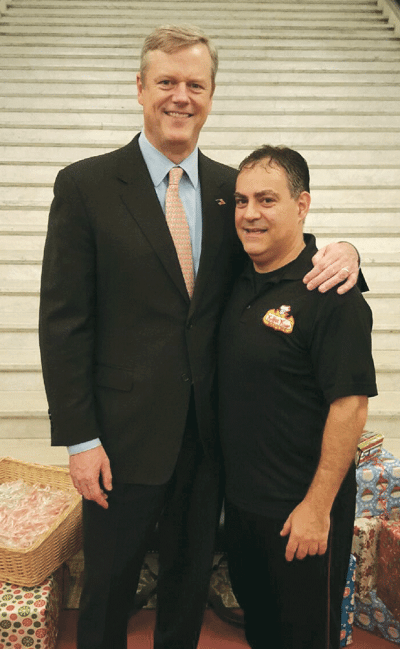
Dino Facente with his Boston cremes (above), and with one of his biggest fans, Gov. Charlie Baker.
Dino Facente knows full well that politics and commerce generally don’t mix, and that it’s never a good idea for a business owner to wear his or her preference for a party, candidate, or elected official on their sleeve.
But in this case, he knew he had to make an exception — and he did.
It comes in many forms, but perhaps most notably the ‘Baker/Polito’ campaign sign that is impossible to miss as one enters his establishment in the Springfield Plaza, Koffee Kup Bakery.
It’s there for a reason — actually, several of them.
In fact, it wouldn’t be an exaggeration, in any way, shape, or form, to say that no governor of the Commonwealth has done more for any small business — at least one in the 413 area code, or from a marketing perspective — than Charlie Baker has for Koffee Kup.
It all started in the Massachusetts Building at the Big E in late September 2014, when then-candidate Baker first took a bite of one of Facente’s Boston creme cupcakes — and new chapters to the story have been added almost monthly, it seems.
Indeed, until Baker came along, the Boston creme cupcake was just another item on a vast menu of options offered at Koffee Kup, which is perhaps best-known for its birthday cakes — it makes roughly 300 of them a week. Now? Well, it’s a bestseller that has gained celebrity status thanks to Baker — underneath ‘Koffee Kup Bakery’ on Facente’s business card, it reads ‘Home to the Governor’s Cupcake.’
And it will soon be named the state’s ‘official cupcake’ — that is, if state Rep. Angelo Puppolo, D-Springfield, can succeed in getting legislation he has filed to that effect through both houses.
It’s already been quite a year and a half for the Boston creme cupcake. And Facente. And Baker. And the New England Patriots, for that matter. The governor held up one of the items at the Springfield Regional Chamber’s Outlook luncheon roughly a year ago. There was also the governor’s inaugural, for which Facente baked 500 Boston cremes. And when the governor was out in Springfield with his cabinet several weeks ago, Boston creme cupcakes were on the menu.
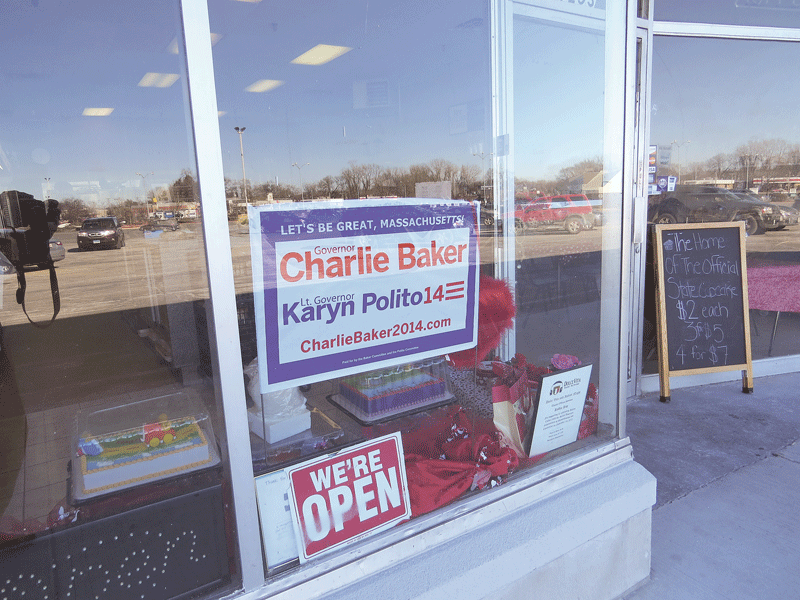
Politics and commerce usually don’t mix, but in the case of candidate Baker and then Gov. Baker, Dino Facente knew he had to make an exception.
Before the recent AFC championship game between the Patriots and Broncos, Baker was five for five when he wagered Facente’s Boston cremes in bets with various governors — four involving the Pats and one on Boston University in the 2015 Frozen Four hockey finals.
And although the Pats lost the game against Denver, the mystique of Facente’s cupcakes only grew, because, to make a long story short, Baker never got a bet down on that game because he couldn’t connect with Colorado Gov. John Hickenlooper.
“We’re still undefeated,” said Facente, referring to his cupcakes, not the football team, obviously. “We’ve become a good-luck charm for the team and the governor.”
And Baker has brought some good luck to Koffee Kup. While not hidden in the Springfield Plaza, the business has generally had limited visibility from a marketing perspective, relying through the decades almost entirely, and effectively, on word of mouth.
The governor has changed all that, becoming an unofficial, highly visible — and unpaid — spokesperson.
Facente (whose e-mail address is [email protected]) thought about trying to quantify the impact of Baker’s involvement with his venture, but then decided that really wasn’t doable, so he qualified instead.
“It’s definitely had an impact — when he mentions us, people come in; they want to see what all the buzz is about,” said Facente, who will soon undertake a major renovation of the business. “What can I say — he’s put us on the map.”
For this issue, BusinessWest talked at length with Facente about his corner-office pitch person, how this relationship came about, and how these two have become great fans of each other.
As he talked with BusinessWest on the Thursday before the AFC title clash — because he was expecting a crush of media on Friday, when a bet with Colorado’s governor was due to be announced — Facente paused often to find and then show off photos on his phone.
Collectively — and the portfolio keeps growing, to say the least — they speak to how this relationship with the governor has evolved over the past year and a half.
There are several shots of Facente with Baker, including a frequently used photo of the two with a tray of Boston cremes. But there are many others of Facente with various members of the Baker administration, other State House officials, and former Gov. Bill Weld.
There’s even a shot of the cake Facente baked for the governor on the occasion of his 59th birthday last November, one that features a reproduction of a photo of Baker’s family.
This is not the kind of electronic photo album most small-business owners can summon, and it’s not a collection Facente could have imagined when the hard-to-miss, six-foot, six-inch Baker walked into the Massachusetts Building during the 2014 Big E.
Indeed, meeting governors and candidates for that office and many others was nothing new for this business owner. He said he’s lost track of how many he’s met since he first set up shop on the Avenue of States nearly a dozen years ago.
“On Massachusetts Day, a lot of politicians pass though there,” he noted. “I’ve met people running for all kinds of different offices.”
Most of them took a passing interest in his business — and especially his wares, as Baker did, taking some of the Boston creme cupcakes home with him — but most all of those encounters turned out to be one-and-dones.
Not so with Baker.
To explain, Facente recalled a phone call he received on a Saturday morning a few weeks after that initial encounter. It was from Springfield City Councilor Tim Rooke, a Democrat who nonetheless became a strong supporter of Baker and his unofficial go-to person in this region.
“He said, ‘Dino, do you know Charlie Baker?’” Facente recalled, adding that he correctly identified him as ‘that guy running for governor.’ “He told me, ‘you’re not going to believe this, but he’s been craving that Boston creme cupcake and he wants to come to your bakery.’”
Indeed, Baker was planning to attend his son’s college football game in New York, and wanted to swing through Springfield on his way and pick up some cupcakes.

The sticker placed on each box of Koffee Kup products tells the story: this is, indeed, home to the governor’s cupcake.
“The next thing you know, the bakery is packed with people,” Facente recalled, adding that, while he was grateful for the exposure, he was also impressed with the candidate for following up on an informal pledge to return to Western Mass.
“I told him, ‘a lot of politicians pass through the Big E, but you said you were going to come by, and you kept your word,’” Facente said. “Most of those candidates make similar promises, but they never honor them; he’s probably the only one, and I’ve been here 22 years.
“So we took a liking to each other, and he took some cupcakes to go,” he went on, adding that the candidate actually gave him some money to help pay for the wedding cake of a young couple he met at the shop that day.
Just before leaving, Baker vowed to feature the Boston cremes at his inauguration if he was elected. It was another pledge he would make good on.
All that was enough to prompt Facente to ask for a campaign sign for his window, something he’d never done before.
“Being in business, you just don’t do stuff like that,” he explained. “But I really took a liking to the guy and wanted to support him.”
The feeling, of course, was mutual, and, as things turned out, the inauguration — for which Facente, the only Western Mass.-based baker to be invited to take part, provided 500 Boston cremes — was only part of what would turn out to be a memorable start to 2015 for Facente and his bakery.
Indeed, as the Patriots rolled to the Super Bowl, Koffee Kup cupcakes were the then-governor’s wager of choice. It started with the divisional-round win against Baltimore, and Baker stayed with the company through the Championship Game beatdown of Indianapolis and the Super Bowl win over Seattle.
Soon, that fledgling tradition, which continued last month with the Pats’ divisional-round win over Kansas City, gave the business a new identity, especially in the central and eastern parts of the state: specifically, ‘that bakery out in Springfield that makes the cupcakes the governor bets in the Patriots games.’
Meanwhile, the chamber’s annual Outlook 2015 luncheon was another coup. The governor was the keynote speaker, and he got things rolling by referencing the cupcake, his fondness for it, its role in bringing a fourth Lombardi trophy to Foxboro, and how the business exemplifies the depth and resilience of the state’s core of small businesses.
More than 800 attendees took in this testimonial, and some took the opportunity to congratulate Facente on his marketing good fortune.
“People were texting me saying, ‘how much are you paying this guy?’” he recalled. “I said, ‘I’m not giving him a penny; he just took a liking to me.’”
Over the course of the year, there were more opportunities for both parties to build on the relationship, from holiday-lighting ceremonies at the State House (Baker invited Facente to attend) to the governor’s birthday cake, to the Kansas City game a few weeks ago.
So what does it mean to have the governor as a spokesperson?
It has certainly meant additional and much-appreciated exposure — even if it’s in the form of ‘that bakery in Springfield’ — for the Koffee Kup, which was one of the original anchor tenants when the Springfield Plaza, built on the site of an old airport, opened in 1954.
Retail outlets and other ventures, including a few different movie-theater operators, have come and gone, but Koffee Kup remains. Facente and two of his uncles (since bought out) acquired the business in the early ’90s. The venture eventually expanded into Holyoke and West Springfield, but those locations have since been sold.
Overall, the business has been solid on both the retail and wholesale sides — the company provides products to a number of smaller outlets, he said, again referencing those birthday cakes, as well as a number of dates on the calendar that provide surges in business. Those include Valentine’s Day, St Patrick’s Day (he’s known in some circles as ‘the Italian doing all the Irish bread’), graduations, the Big E, Halloween, and other holidays.
“Being an American baker, I don’t have to specialize in one thing,” he explained, adding that this diversity has certainly been an asset.
As has the governor’s support, especially the bets on Patriots games, which twice now have helped the company through January, one of the few slower periods of the year.
“Last year, when the governor mentioned it, Saturday and Sunday sales were booming,” he recalled, noting that the bets were generally placed toward end of the week. “Everyone wanted to see what all the fuss was about. It happens every time he does it.”
Baker could not be reached for this story, but Facente said the governor has told him that, if the bill designating the Koffee Kup Boston creme as the state’s official cupcake reaches his desk, he’ll sign it.
That will be the latest, and perhaps the most significant, form of support the Bay State’s corner office holder has provided for this business owner.
Facente, as he did with other such inquiries, preferred not to speculate specifically on what that means for this six-decade landmark. Instead, he chose to focus on the significance of such an action to small businesses — and also Western Mass.
“I think it’s important to recognize the small guy, and this would do that,” he explained. “It would also show that the governor’s committed to the whole state, not just Eastern Mass.; putting me on the map like that would be huge.”
Suffice it to say, if it does become reality, it will certainly be something Facente has been specializing in throughout his career — icing on the cake.
George O’Brien can be reached at [email protected]
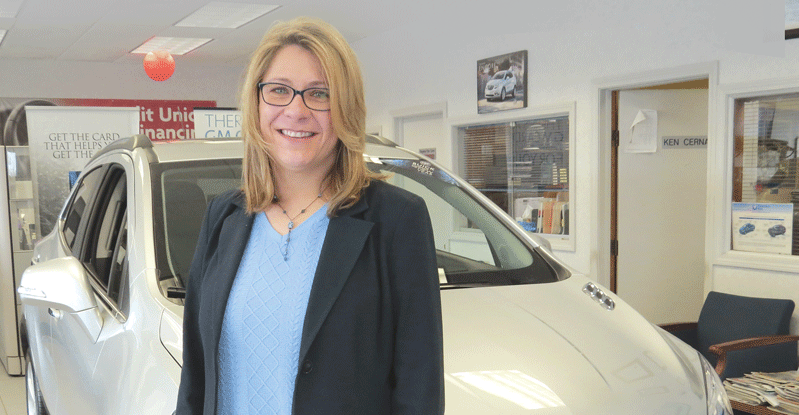
Jennifer Cernak says Buick’s new models, including its first convertible in 30 years, due to arrive in a few eeeks, are just one of many reasons to be optimistic about 2016.
Jennifer Cernak says there’s an intriguing story behind the 1922 Buick, model 22 37, parked in the showroom of the dealership her grandfather, Samuel, opened on Route 10 in Easthampton in 1940.
It turns out the car was a trade-in, a key piece in a deal the elder Cernak clinched in 1962.
“It wasn’t worth a lot of money, but my grandfather really wanted the antique, so he took it in trade,” she explained, adding that it’s been front and center, in one respect or another, ever since.
It’s been driven in various parades over the years, for example, and it’s been put on display at several classic-car shows across the region. But while it still runs fine, it hasn’t been out of the showroom much lately, Cernak told BusinessWest, because it doesn’t easily negotiate the ramp used to bring vehicles in and out of that room.
But it might soon have to make that trek and lose the spot it has owned for years, she went on, because Buick has a number of new models coming out over the next few months, and showroom floor space will be at a premium, to say the least.
“We’re already thinking about what to do,” said Cernak, adding that, while the antique holds a special place in this three-generation family business, it may have to go — somewhere — to make room for the Cascada and the Envision.
The former is a convertible, the first one Buick has offered in perhaps 20 years, and it’s due to arrive later this month. The latter, expected by summer, is a mid-sized SUV, smaller than the company’s Enclave and bigger than its Encore. Both are expected to be real assets in the carmaker’s ongoing efforts to convince the buying public that Buick isn’t just a model for your uncle or grandfather.
“There’s a lot of buzz about these cars, and we’re really excited to have a lot of new models,” Cernak explained, adding that the new nameplates are just one of many reasons why she believes the robust performance of 2015 — witnessed across the auto industry — will carry over into this new year.
And she’s not alone in that assessment.
Bill Peffer, COO at West Springfield-based Balise Motor Sales, told BusinessWest that industry analysts are predicting another solid year for sales, perhaps even something approaching the 17.4 million new cars sold in 2015, a total just shy of the record set some 15 years ago.
The reasons for such projections include everything from attractive interest rates (0% is still available, although harder to find), to low gas prices; from a still-strong economy to lingering, pent-up demand in the form of many older cars still on the road that need to be replaced; from decent weather (knock on wood) to an abundance of intriguing, well-made products.
“The stars are certainly aligned,” Peffer said of the current auto-sales sky, adding that, while this is a buyer’s market in every sense of that phrase, it’s an environment in which many constituencies benefit.
This includes consumers, dealers, and auto makers, who are, he said, taking the profits from the surge in sales and plowing them back into research and development, which will in turn lead to innovations and new products, which will continue the current cycle and fuel more growth.
“Forecasts we’re getting from various sources show growth this year,” he told BusinessWest. “Gas prices are lower, consumers have access to credit and low rates, we have a fairly robust economy, we’re seeing demand for vehicles, and there’s adequate supply. It all adds up to a very positive environment for sales.”
For this issue and its focus on auto sales, BusinessWest talked with several area dealers about what to expect in the months to come, and why all the experts are expecting another year in the fast lane for this industry.
Don Pion calls it “old iron.”
That’s an industry term of sorts that Pion, second-generation president of Bob Pion Buick GMC in Chicopee, summoned to describe the volume of elderly vehicles still on the road.
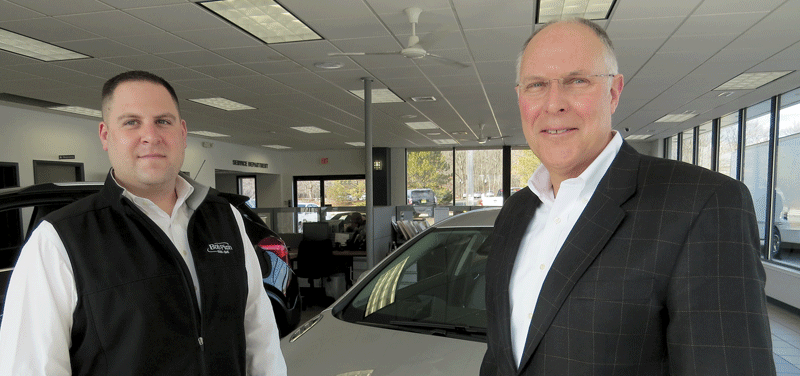
Don Pion and his son, Rob, note that many factors point to continued solid sales in 2016, especially all the “old iron” still on the roads.
There are many of them, he said, noting that there are a number of contributing factors to this phenomenon, including better quality, which prolongs a car’s life, and several years of lingering doubts about the economy and the direction in which it was headed, which prompted many consumers to get another year — or two, or three, or four — out of their vehicles.
“The age of the fleet, the cars on the road today, remains at an all-time high,” he said. “It’s almost 12 years, according to the reports I’ve heard, which is pretty remarkable given the number of cars that were sold last year.”
This old iron — and ‘old’ is a relative term, certainly — is one of those aforementioned stars now in alignment and a contributing factor to solid projections for the year ahead, said those we spoke with.
Indeed, the more elderly vehicles — which have kept service departments jammed, providing a different source of revenue — are finally being traded in, spawning sales of new and used cars. Meanwhile, a large amount of younger old iron — especially a huge number of cars coming off leases after 36, 24, or even 12 months — is creating attractive inventory for the used-car market, where profit margins are usually better than those for cars right out of the box.
It’s part of an intriguing cycle, with a number of moving parts, but sales of the new models definitely set the tone.
“The new-car side of the business is kind of the catalyst that makes everything go,” said Pion. “It keeps everything running.”
Peffer agreed, and said that current trends collectively comprise the best news for the industry — the fact that there is plenty of fuel to keep this fire burning through the year and probably well beyond.
Indeed, while more than 50 million cars were sold in 2015 — those 17 million new models and north of 40 million used cars — there is still plenty of demand for both.
“There is a lot of activity out there, and as dealers we sell new and used vehicles,” he explained. “When you take a used vehicle in, you sell a new vehicle, so that helps new-car sales. You recondition and then sell the used car, creating another transaction, creating more service department work, creating another customer that comes back for repeat business and service.”
Meanwhile, in a departure from recent years for some models, there is ample supply of new cars and trucks, although dealers could always use more.

The 1922 Buick at the Cernak dealership may soon have to find a new home to make way for the new models to roll in over the next few months.
“For many years following the recession [in 2008], you had a situation where there was maybe more demand than there was supply,” said Peffer, adding that this scenario was true with some carmakers more than others. “Most manufacturers, though, have caught up, and will, or already have, satisfied demand through additional production.”
As for the nature of that demand he and others mentioned, it comes in a number of flavors, and this is yet another reason for the rosy outlook for the industry.
Much of the focus, of course, is on the huge and seemingly insatiable appetite for SUVs and trucks, and especially the latter. Peffer said these vehicles have always been popular, and become even more so when gas prices fall below $3 a gallon. When they’re below $2, like they are now, it’s hard to keep trucks on the lot, and soaring truck sales, he noted, create a rising tide that, as the saying goes, lifts all boats.
“Low fuel prices generally move people into bigger vehicles, heavier vehicles — truck-based vehicles, so trucks are really hot right now,” he explained, putting additional accent on ‘really.’ “And when people buy more trucks, that’s good for the manufacturers — they take that money and put it into R&D, and that yields new products. The truck business is profitable for the manufacturers, and it’s profitable for dealers as well.”
But while trucks are white hot, so, too, are SUVs, a class of vehicle that has seen its appeal spread well beyond soccer moms.
“They’re attracting people of all ages, including a growing number of older individuals because they’re much easier to get in and out of,” said Rob Pion, Don’s son and a member of the third generation of management at the dealership. “There’s interest across the board.”
So much so that there is now demand for a host of different-sized and variously appointed SUVs to meet the wide variety of needs within that growing market. And that’s why Cernak is so enthusiastic about the Envision.
“Some people find the Enclave too big and the Encore too small,” she explained matter-of-factly, adding that the Goldilocks factor is prompting all makers, including Buick, to respond accordingly. “We really needed a mid-sized SUV, and now we’re getting one.”
And with gas prices low and expected to stay that way for the near future, sales of these vehicles should remain brisk, said the Pions, both noting that the near certainty that these prices won’t last isn’t nearly enough to deter most all buyers of these larger vehicles.
Don Pion’s memories of life in the auto business stretch back more than a half-century, to when his father was a salesperson at the old Boulier Chevrolet in Springfield and he would accompany him to the lot.
He recalls the fall season, when the new models would roll in and the dealership would cover the showroom windows with brown paper to build suspense and draw customers in.
He also remembers Presidents Day and how it was a much bigger deal decades ago, when red, white, and blue balloons would often populate the showroom, dealers would give away cherry pies with sales, and area newspapers would be crammed with full-page ads announcing deals.
Most all of that is gone now, especially the newspaper ads, he said with a hint of lament in his voice, adding that the Presidents Day sales, always a bigger event in the Northeast than other parts of the country for some reason, were designed to break the winter doldrums and give people a reason to get into the showrooms.
Such sentiment still exists, and some dealers continue to mark the holiday with special sales, he told BusinessWest, adding quickly that promotions are now a near-constant in this business, with new incentives on a monthly or quarterly basis. As for February, in many respects it’s just another month, although sometimes a challenging one when winter hits with full fury, as it did in 2015.
This year, of course, it’s expected to be a solid month, as all those aforementioned stars continue to shine an optimistic light on the industry.
“Everything is very favorable right now,” said Don Pion as he surveyed the scene. “All the signs are positive.”
There are always threats to this sector, though, and things could change in a hurry. But most potential stumbling blocks, such as the stock market’s dreadful start to the year, are minor or temporary in nature, said Peffer.

Bill Peffer says the “stars are aligned” when it comes to the auto industry and sales projections for 2016.
Still, while most of the arrows are pointing up for this industry, there are challenges in various forms, starting with heightened competition in the form of quality vehicles carrying seemingly every nameplate.
“Where quality was once a market differentiator decades ago, now it’s cost of entry,” said Peffer. “I can’t think of a brand that doesn’t have really good quality.
“There are so many new-product offerings on the market right now that are full of technology, full of safety features, full of performance and styling,” he went on, adding that all this competition is in many ways a positive more than a negative. “All this really piques a customer’s interest; it’s a very good time to be in the market for a new or near-new vehicle.”
Pion agreed. “In the age of consumerism that we have now, bad products don’t survive in any segment, whether we’re talking about automobiles or whatever,” he explained. “You have to build a good product because anyone can go online and read the reviews — and people do that before they buy.”
For the Buick dealers, meanwhile, there’s the almost age-old (no pun intended) challenge of convincing younger audiences that this brand is not just for their father or grandfather.
Rob Pion recalls a recent episode involving a younger individual who test-drove one of the Buick models, liked it, but then offered, ‘I’m not old enough to drive a Buick,’ or words to that effect. And that’s a fairly common refrain.
“We battle that all that time,” said the younger Pion. “If I could just blindfold people until they got in the car and took it for a test drive, I know I could sell more people on these vehicles.”
Time will tell whether that 1922 Buick retains its long-held parking space at the Cernak dealership. But at the moment, it looks like the family may well have to find a new home for the antique.
The Cascada will be arriving in a few weeks, and the Envision not long after that. In the meantime, the existing models, including more traditional offerings like the Lacrosse and the Verano, are in solid demand.
Add it all up, and the focus clearly shifts to the present and future, not the past.
And to the stars, which, as Peffer and other dealers said, are certainly aligned.
George O’Brien can be reached at [email protected]
 Editor’s Note: Again this year, five individuals have been chosen to score the nominations submitted for the 40 Under Forty Class of 2016. In keeping with past practice, BusinessWest has chosen two former winners to be part of this panel — in this case, members of the classes of 2012 and 2015. In addition, BusinessWest has sought out individuals with experience in business and entrepreneurship. This year’s judges are:

Elizabeth Barajas-Román
Elizabeth Barajas-Román is currently CEO of the Women’s Fund of Western Massachusetts, a public foundation that funds gender-based programs and operates a leadership program that trains women to run for public office. She has been a leader in progressive movements including advocating at the national level for the health and rights of immigrant women and their families.
Most recently, she was a manager at the Pew Charitable Trusts, where she directed a portfolio of partners that campaigned for state and federal policy change to improve government performance. Previously, as the Director of Policy at National Latina Institute, she directed the organization’s Washington, D.C.-based office, where she was instrumental in expanding the visibility of the organization on the national stage. She was frequently invited to be a voice in national policy discussions in the media, at the White House, on Capitol Hill, and in target states.
In addition, her leadership has been recognized nationally with a Center for Progressive Leadership Executive Fellowship, an appointment to the American Public Health Assoc. Committee on Women’s Rights, and as a current member of the Assoc. of Public Television Stations Leadership Council. Locally, she is on the WGBY Public Television Board of Tribunes, a member of the steering committee for New England Women’s Policy Initiative, and a member of the External Advisory Board for the University of Massachusetts-Boston Center for Women in Politics and Public Policy. She also serves on the Massachusetts Economic Empowerment Trust Fund Board and the statewide Committee on Wage Equality.
Barajas Román was honored as a member of BusinessWest’s 40 under 40 class of 2015. She is a certified project manager professional, a graduate of Oberlin College, and received her master’s degree in international policy from Harvard University.

Ben Craft
Ben Craft is the director of Public Affairs for Baystate Health. He grew up in East Longmeadow and graduated from UMass Amherst in 1996. He spent his early career in New York, where he worked as an editor at the Wall Street Journal and two years at the United Nations, specializing in environmental issues in human development. He joined Baystate Health in 2008.
At Baystate, Craft leads a team of seven in maintaining informative and constructive dialogue with the media and the community, sharing the stories of Baystate’s caregivers and the fulfillment of its mission, and building community relationships to improve health.
He is a graduate of the Springfield Leadership Institute, a member of BusinessWest’s 40 Under 40 Class of 2012, and vice president of the board of the Longmeadow Historical Society. He also coaches youth soccer and basketball and is the father of Emma, 8, and Teddy, 3.

Daniel Flynn
Daniel Flynn is executive vice president and COO of the Wholesale Banking Division at United Bank. In that capacity, he has oversight of the bank’s Greater Springfield commercial-banking operations, development of the bank’s business-loan center, cash-management enhancements, implementation of a new commercial-loan operating system, and incentive planning and administration.
Overall, Flynn has more than 33 years of commercial-banking experience. Prior to his arrival at United Bank, he held a number of positions at People’s United Bank (formerly Bank of Western Mass.) and, prior to that, worked at the First National Bank of Boston and Nations Bank.
He earned a bachelor’s degree in business at Rollins College and his MBA at the E. Crummer Graduate School of Business. He is heavily involved in the community, serving on the board of the YMCA of Greater Springfield and as a member of the Economic Development Council of Western Massachusetts. Previously, he served on the board of the Ronald McDonald House of Springfield, the Springfield Chamber of Commerce, and the South End Community Center.
An avid runner — Flynn has completed four marathons — he is married to Patricia Flynn, and has three children, Kathryn, Robert, and Elisabeth.

Michael Matty
A leading investment manager with decades of responsibilities for billions of dollars in equity investments, Michael Matty, president of St. Germain Investment Management, has more than 20 years of investment and wealth-management experience.
Before coming to St. Germain, he was vice president of Investments at Phoenix Investment Counsel, a subsidiary of Phoenix Home Life, as well as a principal at Capital Reflections Inc., an independent firm supplying investment research and stock recommendations to institutional investors and mutual-fund managers.
In his current tenure at St. Germain, Matty has served as executive vice president and chief investment officer, and still oversees investment policy and stock selection for well over $950 million in assets under management. In addition to his responsibilities at the trading desk, he plays a lead role in regulatory and compliance initiatives as directed by the SEC and FINRA.
Matty is a graduate of Penn State with his bachelor’s and master’s degrees in economics, and holds the NASD Series 7 designation. He is also a dedicated mountaineer and enjoys the challenge of high-altitude climbing. In fact, he has succeeded in climbing the tallest mountain on each of the seven continents, the so called Seven Summits: Mt. Kilimanjaro, March 2007; Mt. Elbrus, August 2007; Mt. Vinson, December 2007; Denali, June 2008; Mt. Aconcagua, February 2010; Mt. Kosciuszko, October 2010; and Mt. Everest, May 2011. Only 275 individuals have successfully completed the Seven Summits.

Lora Wondolowski
Lora Wondolowski is executive director of Leadership Pioneer Valley. She joined that organization as its founding director in 2011 after serving as the founding executive director of the Mass. League of Environmental Voters (MLEV). Prior to her work with MLEV, she worked for the League of Conservation Voters Education Fund and the National Audubon Society in Washington, D.C.
While at LCVEF and Audubon, she launched and organized several successful programs and training programs. She has nearly 20 years of experience with grassroots organizing and community outreach.
Wondolowski holds a bachelor’s degree from the University of Illinois at Champaign-Urbana and a master’s degree from Bard College. She was one of the founders of the Friends of the Great Falls Discovery Center in Turner’s Falls, was a volunteer and board member of Pride Zone Youth Center in Northampton, and was the founder of the Progressive Christian Voice at First Churches of Northampton.
She serves on the boards of the Connecticut River Watershed Council, Partners for a Healthier Community, and United Way of Pioneer Valley. She is the recipient of the Community Connector Award from the United Way of Pioneer Valley. She lives in Greenfield with her spouse and two young daughters. n
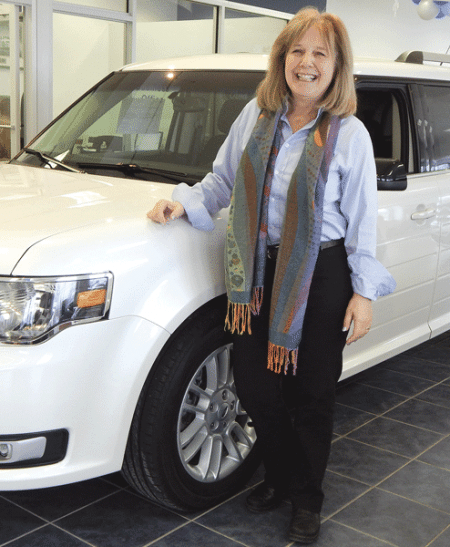
Bonnie Nieroda says she encountered a “boy’s club” when she first started selling cars, but times have changed in some respects.
When Carol Buker started selling Fords 42 years ago, it wasn’t unusual for her to encounter blatant sexism. Some male customers refused to talk to her, while others didn’t believe a word she said.
“I remember one man who came to the dealership wanting to know about trucks; he told me, ‘I am not about to talk to you,’” said Buker, a sales and leasing consultant for Toyota of Greenfield, adding that the roles of men and women had been set in stone and many people didn’t feel a female had any credibility or belonged on the sales lot.
Bonnie Nieroda faced similar challenges that were exacerbated by male co-workers who wanted to drive her out of the business.
“It was a tough industry, and selling cars was a boy’s club,” she said, citing memories of a finance manager who refused to process her deals because the salesmen didn’t want her there. “They conspired against me and took bets on how long I would last. They gave me a month.”
She not only beat their predictions, but outlasted most of them, became a success, and has been happily employed as a master certified sales consultant at Marcotte Ford in Holyoke for seven years.
Barbara Spear expected to confront discrimination when she was hired as a salesperson at Balise Lexus because she had encountered it during her previous job as general manager of a construction company. However she didn’t anticipate cynicism from other females, and was shocked by a friend’s response when she told her about her new job.
“She asked me why they would even consider hiring a woman,” Spear said, admitting, “I knew nothing about cars and had never even pumped my own gas when I took this job. But I had spent my whole life in sales, knew I could sell anything, and am a people person who really loves making my customers happy.”
Today, she numbers among an elite group of females who excel in a male-dominated industry. In fact, only 7% of auto salespeople are female, despite the fact that women play a leading role in 85% of auto purchases.
“It’s not an easy job. You have to shovel and brush snow off cars in the winter and deal with the heat in the summer,” Buker said. “You miss out on a lot with your family due to the long hours, but you also gain a lot.”
Those gains include close relationships that females tend to form with customers who share stories about deaths, divorces, illnesses, and family problems with them. There are also financial rewards because it can be a very lucrative career, and these women say they couldn’t imagine doing anything else.
“It gets into your blood,” said Jodi Colter, a sales manager for Fathers & Sons Volkswagen in West Springfield. “I took a two-year break when a family member became ill, but I always return. I like my staff, enjoy coaching people, and love the daily challenge of trying to make sales.”
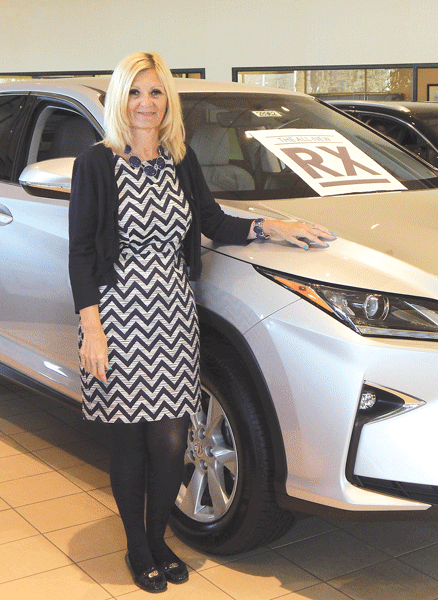
Barbara Spear says selling cars isn’t easy, and doing it well means time spent away from family. But there are many rewards as well.
Spear concurred. “This business is about making new friends and continuing the relationships. I am a workaholic and tend to be here seven days a week to accommodate customers, but I compete against myself and do very well,” she noted.
These women, in other words, are willing to go above and beyond to make prospective buyers happy.
For example, Nieroda had a female client who had her drive two different cars to the graveyard where her father was buried because she felt he would give her a sign as to which vehicle she should purchase.
“I just sat in the car while she got out,” she explained.
Some women find jobs in auto sales by happenstance, while others enter the field dreaming of autonomy and economic sufficiency. But the substantial sacrifices required to travel down such a road cause many to drive away from the futures they projected for themselves.
Colter’s career began after she was hired as a receptionist by Balise Motor Sales in 1996. She took the job to pay for college, and “became enchanted by the sales process” when she worked with the sales team.
Since that time, she has seen many female sales associates come and go, and said one of the toughest obstacles they face is balancing family life with the demands of a job that can require them to work six or seven days a week, plus holidays.
“I have a 4-year-old and a 14-year-old, but I also have a nanny; I’ve seen many single parents quit because of the hours,” she told BusinessWest. “Every mom wants to be home with her kids, and although it’s important to guys, they may be geared a little bit differently. Throughout the history of time, men have always been away from home working.”
But Colter and other saleswomen said that, if their peers are lucky enough to have family to help with children, or choose to make the sacrifices required to perform this work, they quickly discover their innate ability to communicate gives them a subtle — or maybe not-so-subtle — edge over male co-workers.
“When customers see me come out of my office, there is always an element of surprise,” Colter noted. “But then they seem to let their guard down … they joke with me and say, ‘so you’re the boss?’”
She takes such comments in stride. “You have to have a thick skin in this business, and I don’t get the objections some males do when they start to discuss numbers,” she went on. “Seeing a woman’s face can be refreshing, and some female buyers are more comfortable dealing with another woman. And if someone only wants to deal with a man, you can’t take it personally.”

Jodi Colter says selling cars “gets into your blood.”
She recalled one woman who purchased a car, then came back and sat at her desk and sobbed because her husband was very sick and she knew Buker would be sympathetic.
“I interact with my customers as if they are my friends. It’s just how I am,” she said, explaining that she knows many people have felt intimidated by auto salespeople and believe buying a vehicle is a confrontational experience.
She fell into the job after graduating from college and has never regretted it.
“I really love being able to help people,” she said. “Sometimes they don’t know what they want, have a problem with the website, or don’t know whether to repair their vehicle or buy a new one. I give them advice and have taken them into our service department if I feel it’s necessary because I want them to feel comfortable with their decision.”
Indeed, feeling respected is a critical factor in the profession, but saleswomen have heard stories from women about how they were insulted by salesmen.
“Women have told me they felt as if they have been talked down to,” Nieroda said. “But nine times out of 10, the woman in the family is the one who controls the sale. If she feels it’s not a good value, the answer will be ‘no.’”
Still, the stories abound. One woman told Spear she picked out a car, and when she was ready to purchase it, the salesman told her he would not discuss price unless she returned with her husband. Meanwhile, she recalled, another woman sat in the parking lot and sent her husband inside to buy a car until Spear coaxed her out of her car and listened to stories about bad experiences she had had in the past.
“I think women tend to be softer and a little more compassionate when it comes to sales. I tell my customers it’s their money, so it needs to be their decision; there shouldn’t be any pressure,” she said.
The Internet has had a dramatic affect on the way vehicles are sold.
“It has opened up the doors to the world,” Spear said.
But there are pros and cons: dealers lose sales because a car doesn’t have the exact specifications someone is looking for, but gain them if they have it in stock, even when the buyer lives in a distant state.
“I’ve shipped cars to Nigeria, Texas, Washington State, and California,” Spear said, noting that it’s not uncommon for people to purchase a certified auto via the Internet without ever test-driving it because they know it has gone through a 161-point inspection and is under warranty.
However, some still want the experience of seeing the vehicle, sitting in it, or taking it for a test drive, and will drive long distances or fly to the dealership, then make the purchase and drive their new auto home.
However, this can lead to less personal interaction, and although Buker applauds the research people do in advance of a purchase, she misses the ties that are forged when both parties work together to find a vehicle that fits their needs.
Other changes in the industry include the fact that advertising is being geared more toward advances in technology than improvements in the vehicles.
“We used to sell cars, but now we are selling technology — cars that can park themselves, radar that lights up when another automobile is passing, power lifts, and all types of sensors,” Nieroda said.
Buker agrees. “When I was a kid, it was a big thing when a new car was introduced to the market. People would line up in front of a dealership to see it, but today everything is online, and people can find what they want there.”
That includes prices for new vehicles advertised on general websites, which can become problematic because they don’t include docking and destination fees, CARFAX reports, or the cost of certifying a vehicle.
“Some people expect dealers to function without making any profit at all,” Nieroda said, citing another challenge.
She thinks sexism still exists in the auto-sales industry, although it definitely has lessened.
“I sell more trucks than the guys here, but you still don’t see many women in this business, and I imagine some people think I’m an anomaly,” she said. “The industry continues to be dominated by males, but it’s a lucrative field and women are not only smart, we probably have an edge because some people are more comfortable dealing with us. I can’t tell you how wonderful people are; I’ve gotten cards and flowers, and it really is a wonderful feeling to sell to one generation, then the next.”
Colter agrees. “If you love automobiles, this is a great field, and seeing a woman’s face can be refreshing. We’re compassionate and good listeners, so even men drop their guard and talk to us. But you do have to have thick skin, and you can’t take things personally.”
These women have conquered these challenges and others they have faced, and focus on the positive aspects of their business as they navigate the road to success using skills — both natural and honed — to help people purchase the perfect vehicle.
By JACLYN C. STEVENSON

Corydon Thurston says GE served Pittsfield well, but long gone are the days when the city should strive to be a one-industry town.
The pervasive feeling in the city of Pittsfield — the Berkshires’ largest city and county seat — is that it’s done trying to return to its heyday.
Rather, elected officials, business-development professionals, and entrepreneurs alike are calling for a new day in Pittsfield, one that celebrates the creative economy, makes great use of existing resources, and stands ready for entrepreneurial endeavors of all types and sizes.
Mayor Linda Tyer, who took office in January and will serve Pittsfield’s first-ever four-year mayoral term, made these tenets some of her key platform points during her campaign, and the message appears to have resonated. The former Pittsfield City Clerk defeated two-term incumbent Mayor Daniel Bianchi with 59% of the vote, winning all 14 precincts.
Tyer said the city has long suffered from what she calls “group depression” following the departure of General Electric, which became part of the Pittsfield landscape in 1903 and at its peak provided 13,000 jobs in a city of 50,000 residents. Its influence on the city’s economy dwindled steadily through the ’70s, ’80s, and ’90s, but many people long held hope that another outfit similar in size and scope may someday return.
“Pittsfield has a tendency to say, ‘someone is out there,’” Tyer noted. “But we’ve already seen that one business will only be able to sustain us for so long. I’m interested in who is already here, on the cusp of expansion or ready for something new. In the end, the best investment is local, big or small.”
Corydon Thurston, executive director of the Pittsfield Economic Development Authority (PEDA), has a similar, if not more concentrated, view of the city and its opportunities for business development.
“The chances of landing a major corporation are akin to winning Powerball,” he explained. “Today, competition isn’t just statewide, it’s worldwide, and finally the realization here is that we need to support who we already have, help them grow, and find ancillary opportunities for additional growth and added diversity — not create another a one-industry town.”
The largest development currently underway is the creation of the Berkshire Innovation Center (BIC), which will be located at the William Stanley Business Park (created at the massive former GE complex) and cater to small and medium-sized businesses positioned to add to the supply chain of various life-science and biotechnology projects.
“The BIC is designed to provide access to high-tech equipment that will allow businesses to innovate, grow, and respond to customer demands in an efficient and timely fashion — rapidly prototyping products and bringing them to market,” Thurston said. “Temporary space will be available for lease within the center to allow companies to mature, and hopefully they will stick around. Pittsfield has plenty of existing manufacturing space at low cost, and once we get them here, we can grow them here.”
He added that support of the BIC, which was made possible by a $9.75 million state grant, has been citywide and dovetails with a number of other initiatives in the areas of workforce training, real-estate development, and education. In the coming year, PEDA is expected to blend its efforts with 1Berkshire, a regional economic-development organization, and Pittsfield’s Office of Community Development.
“One of the reasons why we’re so bullish on the innovation center is it has a broad base of community support at every level,” Thurston went on. We also believe that a young startup company, whether it’s in Worcester, Boston, Albany, or Rensselaer, that is looking for a place to commercialize or test their ideas and inventions, will be attracted here because of our existing manufacturing structure and lower costs of doing business.”
A built-in mentor network will be part of the BIC’s offerings, with 19 mentoring partners from across Pittsfield already signed on, along with several academic partners from across the Northeast, including UMass and Rensselaer Polytechnic Institute.
“The support from the education side is rewarding to me because it’s a foundational element that will create a number of new opportunities for our industrial base,” Thurston said, noting that Berkshire Community College has been a particularly active participant.
In the absence of a physical building, for instance, BCC has taken the lead on the programmatic components of the center, identified a variety of courses to complement the BIC’s eventual hands-on work, and set up a temporary center at Pittsfield’s Taconic High School that includes a pipeline for students to pursue advanced-manufacturing careers.
Ellen Kennedy, president of Berkshire Community College, echoed Thurston’s excitement for the BIC.
“This could be the most promising economic-development engine to enter Pittsfield in a long time,” she said. “As the facility itself comes into play, training opportunities are already in place that allow existing businesses to share research and identify workforce-development needs.”
Kennedy said BCC has been instrumental in identifying academic opportunities for Pittsfield students from grade school to college, as well as career-development and refresher courses for the workforce. It received $500,000 in funding from the Massachusetts Life Sciences Center last year in order to create educational components to support the BIC, such as the purchase of state-of-the-art equipment and new courses in advanced manufacturing and engineering technology, and another $10,000 just last month to fund career-path programming for middle- and high-school students.
The BIC has also become the new lead organization of the Berkshire Robotics Initiative, with an eye toward underscoring the use of robotics in today’s manufacturing world and the career opportunities that may arise.
“We’re looking to build on students’ interests, allow them to see the different employment opportunities open to them, and start them on a career path,” Kennedy noted, adding that this and other projects have the dual benefit of increasing the college’s profile among prospective students, and therefore that of the city, which has an aging population.
“Berkshire County’s demographics are challenging, and it has become the job of both Pittsfield and BCC to keep the younger population engaged,” she told BusinessWest. “In a sense, we’re making a commitment to the Millennial.”
For Kennedy, that means offering more opportunities for the community to visit the campus, be it to play sports, attend a career fair, or utilize campus amenities. By extension, she hopes the city’s cultural destinations, retail shops, eateries, and nightlife will also get a boost.
“In order to attract people here to experience what we have to offer, we all need to market the quality of life and the world-class culture. In that respect, we are tied at the hip with the city of Pittsfield.”
That’s a construct the team involved with Hotel on North, a boutique hotel on Pittsfield’s main thoroughfare that just opened its doors in June, subscribes to as well.
Owned by Berkshire residents David and Laurie Tierney and managed by Main Street Hospitality Group, a hotel-management company based in Stockbridge that manages three other properties in the county, Hotel on North includes a restaurant, bar, event space, and gift shop housed in a pair of adjoining 19th-century buildings that are on the National Register of Historic Places.
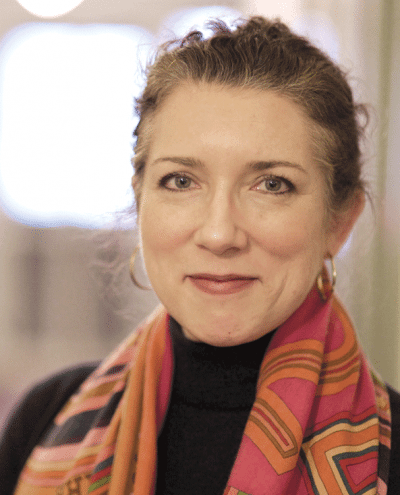
Sarah Eustis says Hotel on North was designed to reflect the character of its region, with plenty of local contributions.
Sarah Eustis, CEO and part-owner of Main Street Hospitality Group, said work between the partners began in earnest in 2012, and moved swiftly into “two solid years of highly collaborative project work.”
“We represent two deeply rooted Berkshire businesses with different skills that we wanted to apply to Pittsfield, to contribute to the renaissance that is happening here,” she said, noting that a hospitality venue in Pittsfield has been a goal of Main Street Hospitality Group for several years. “We looked originally to Pittsfield to build on a base, and now we have an undying passion that this is right for the city. That belief comes from both gut and numbers.”
The hotel features brick walls, tin ceilings, and hardwood floors that hearken back to the buildings’ original décor, as well as Victorian themes paired with nods to the Berkshires in the form of vintage maps and organic elements. The scheme is bound together with the ‘on North’ tagline, i.e. ‘Eat, Drink, Stay on North.’
In more ways than one, the entire business was “made on North,” said Eustis, by partnering with local vendors and craftsmen whenever possible, from architects to designers to furniture and décor makers.
“We like to create hotels that give you a sense of where you are, and we realized early on that it had to be ‘by Pittsfield for Pittsfield,’ with influences from around the world. That’s one reason we didn’t partner with a large brand or make a slick New York hotel and plop it in the Berkshires,” she went on. “The ‘on North’ concept arose from that idea of using local businesses.”
One of the hotel’s owners, Laurie Tierney, added that she hopes its luxurious feel paired with local accents will instill a feeling of pride in Pittsfield’s residents, and attract them downtown along with other visitors to the region.
“My goal is to change perceptions so people realize what’s downtown and feel safe,” she said. “The locals need to be brought into the change, and I do believe that there is a movement afoot.”
Sometimes, Tierney added, getting big things to happen in a city is like starting a lawnmower.
“You pull the cord, but it often takes a few times to start. That’s how it’s been in Pittsfield … almost, not quite, almost, not quite. I’m hoping this is what turns the engine.”
Indeed, it’s been nearly 90 years since GE made Pittsfield a boom town, and many people are now seeing the city’s heyday as something ahead of them, not behind. The key, says Tierney, is to maintain momentum.
“We can’t stop; we have to keep going,” she said. “I hope to be in a place someday where I can sit back and watch the ball roll a little, and maybe be a background person who whispers in someone’s ear, ‘hey. You know what we should do?’”
One person Tierney may be able to whisper to is Mayor Tyer.
“I’m interested in anyone who wants to make an investment in the city,” Tyer said in conclusion. “The idea of a hip, walkable urban center is coming back, and we have the infrastructure for it. Now, we just need to be plugged into the modern economy.”
Latest information available


Kevin Bradley says business travel on Rectrix’s charter planes is increasing to and from Westfield Barnes Airport.
Kevin Bradley calls them “time machines.”
He was referring to the private jets Rectrix has available for hire that are used by businesspeople to transport them to and from meetings in distant states.
Clients can drive their cars directly up to these well-outfitted aircraft that are stationed in general-aviation airports and board immediately, which saves the time it would take to park, check in, go through security, and suffer the delays that can occur at a commercial airport. Once passengers are airborne, they have access to technology, privacy, and comfort that allow them to continue their business dealings alone or in conjunction with the people they are traveling with, which can include satellite phone systems, wi-fi service, conference tables, and comfortable seating.
“If someone from Dallas needs to attend a meeting in Greenfield, they can charter a flight to Westfield Barnes Airport, find a rental car waiting for them on the ramp, and return home the same day,” said Bradley, vice president of operations for Rectrix Commercial Aviation Services Inc.
“If they flew commercially, they would probably have one or two connections and have to stay overnight,” he went on, adding that demand for the company’s services is high, and its target market is business travelers, although some people do charter jets to take them to vacation spots.
“These planes correlate to the Four Seasons — they are the Ritz Carlton of aviation in terms of luxury hospitality,” he told BusinessWest.
Rectrix, whose services in Westfield include a maintenance facility called AirFlyte, is one of three businesses at the 1,200-acre airport that provide a wide array of offerings that range from fixed-base operators (FBOs), which are the equivalent of a commercial terminal for private planes, to general maintenance, antique restoration, and retrofitting or upgrades to interiors, not to mention avionics, which include communications, navigation, and displays and management of multiple systems that aircraft need to function.
“People don’t realize how much general aviation occurs in Westfield,” Bradley explained. “Westfield Barnes Airport is a huge economic engine for the regional economy, and the businesses there have brought a tremendous infusion of money and skilled jobs to the area.”
Steve Cass agrees. “It’s a great location and a great place to work. We have approximately 250 people employed at our Westfield facility, and last year we serviced nearly 1,600 customers for both in-house and on-the-road events,” said the vice president of technical marketing and communications for Gulfstream Aerospace Corp.
Meanwhile, Tom Trudeau, who founded Aero Design Aircraft Services in 1984 at Barnes, says city officials and the Federal Aviation Administration are very supportive of the airport, which is rare because Westfield could make more revenue by selling the land to developers.
“But this airport is pretty solvent,” he told BusinessWest, explaining that his company has always done well and has never been affected by downturns in the economy. All of Aero Design’s business comes from word-of-mouth advertising and ranges from inspections and general maintenance on small private planes to antique restorations, which can take several years if it requires taking a plane completely apart and rebuilding it.

Tom Trudeau says Aero Design Aircraft Services is one of a few companies in New England that does restoration work on antique planes.
The company is one of a few in New England that does this type of restoration, and although this end of the business is limited to clients who can afford costly overhauls, Trudeau also caters to the lower end of the aviation business.
“Contrary to what most people think, flying is not necessarily a rich man’s activity. If you fly strictly for recreation, you can own a plane for less than the cost of a new car,” he said, adding the aircraft he works on range in price from $15,000 to about $3 million. About half his work is on planes used strictly for pleasure, while the remainder involves restoration on more expensive aircraft, which are often owned by businesses.
“But we’re so diverse,” he went on. “We update upholstery and do engine work and sheet metal repair — everything an airplane needs.”
For this edition and its focus on luxury living, BusinessWest takes a closer look at these companies that share space with the Massachusetts Air National Guard and Army National Guard at Westfield Barnes Airport, and how their work continues to take them to new heights.
Standards for maintaining aircraft are very strict, and all small planes must undergo annual inspections. Inspection times vary for larger aircraft, but a problem discovered on any plane must be repaired before it can be flown again.
Trudeau said most general-aviation planes in the air today are 15 to 20 years old, and, unlike automobiles, they increase in value as they age. For example, a four-person passenger plane that cost $20,000 in 1975 is worth double that today, and, if it’s in exceptional condition, the value is a lot higher.
As a result, Aero Design is often called upon to install new radios and instrumentation in addition to making upgrades to the interiors of aircraft, and the quality and scope of the company’s work on antique planes has been featured in a number of aviation magazines.
At present, the company is in the process of completely rebuilding a 1952 de Haviland Super Chipmunk, a process that has taken three years. “It probably cost $4,000 to $5,000 when it was new, but it’s worth $200,000 now because it’s so rare and has been modified and upgraded through the years,” Trudeau noted.
Although catering to this market is more lucrative than doing inspections and small repairs or upgrades, the company can do anything an airplane needs, Trudeau said. He has four to five employees and also works on the planes himself. The jobs the company undertakes are so diverse that it never lacks for business, especially since there is always a new generation of pilots purchasing small aircraft.
“Flying gets into your blood, and we have customers who don’t need their planes for business, but just enjoy going up in the air. We also service sport planes, aircraft used by businesses, and planes people have built themselves,” the pilot said, explaining that Aero Design’s clients range from a farmer to a dentist to people who have taken up flying in retirement.
Gulfstream caters to an entirely different market, and works almost exclusively on its own fleet, along with Falcon aircraft.

The interior layout of Gulfstream jets allows business travelers to work in a private, comfortable setting.
Cass said the Northeast has proven to be a very popular corridor for business travel due to financial districts in New York and the number of businesses in Boston, and 65% of its 2,500 planes are kept in the U.S.
In fact, business has been so good that, in 2013, Gulfstream built a new, 125,000-square-foot hangar in Westfield to accommodate not only its flagship G65OER jet, which costs $65 million, holds up to 16 passengers, and can travel non-stop from Boston to Beijing — a distance of about 7,500 nautical miles — but an influx of other models that routinely need service.
“The new hangar doubled the capacity of planes we can store there,” Cass told BusinessWest, adding that there was a real need for the structure due to the increase in business jet travel.
The company’s Westfield location is one of eight service centers in the U.S. and three overseas, in London, Brazil, and Beijing.
“As the fleet continues to grow, more investments are made in infrastructure,” Cass continued, adding that more than 50% of Gulfstream jets are owned by corporations, 30% are owned by individuals, and fewer than 10% are used by the government or built for special missions.
These jets are popular with Fortune 500 companies and other large firms because their cabins are quieter than commercial planes, the pressurization is better, which makes flying easier on the body, and large windows are tailored to provide a lot of natural light and better viewing.
“They allow business travelers to be productive while they’re in the air,” Cass noted. “In addition to high-speed Internet, people can have private phone conversations with a level of security that is important to them.”
Gulfstream produces about 100 to 150 new aircraft each year, and its Westfield operation has shown long-term, steady growth as the fleet continues to grow.
Bradley said Rectrix started as an FBO in 2005 in Hyannis, expanded to Sarasota, Fla. in 2008, and has two facilities at Barnes.
The first is AirFlyte Inc., which handles maintenance, and the second is its Aerodrome FBO Center, which is one of five such brick-and-mortar facilities in Massachusetts and Florida that offer amenities such as private business suites, state-of-the-art conference centers, and chart and weather rooms.
Rectrix purchased AirFlyte in 2012 from Gary and Judy Potts, who established the business in 1988. “Our companies complemented one another, and it filled a void in Rectrix,” Bradley explained, adding that, although AirFlyte wasn’t on the market at the time, its owners were willing to sell because the direction Rectrix planned to go in fit well with their vision for the future.
The purchase gave Rectrix a foothold in every geographic area in the state, boasting other locations in Worcester, Bedford, and Hyannis, and AirFlyte has been expanded to those sites, as well as Florida.
AirFlyte also attained the elite status of being named an FAA 14 CFR Part 145 Repair Station, which means it is held to high standards, and its programs, systems, and methods of compliance are thoroughly reviewed, evaluated, and tested. The FAA specifies the types of aircraft that can be serviced, and random drug and alcohol testing and stringent background checks on employees are included.
“We can work on almost any corporate jet, and we complement Gulfstream,” Bradley said, adding that Rectrix has registered 400% growth over the past two and a half years. In fact, after AirFlyte was acquired and its FBO in was rebranded with the Retrix name, the company purchased another FBO at Barnes called Five Star Jet Center, which was a competitor.
The company owns two Challenger 300 jet aircraft and five Learjet 45s, and manages an additional five aircraft, which are all brought to Westfield for maintenance.
“There is a fair demand in Western Mass. for business travel on private jets, and our fleet is wi-fi equipped so business isn’t interrupted while people are in the air,” Bradley noted, adding that there are about 500 commercial airports in the U.S. and about 15,000 general-aviation airports, which means travelers who fly in private planes can typically get closer to their destinations. “Some of our planes have satellite TVs, and some have videoconferencing, which allows them to be airborne conference rooms.”
The FBO and maintenance facility in Westfield complement each other, and AirFlyte Inc. services about 50 planes there each year. Its work includes inspections, repairs, and some avionics upgrades and interior improvements such as new carpeting, leather upholstery, entertainment and communications systems, and lighting; however, the company doesn’t do retrofitting.
Demand for services at Westfield Barnes Airport continues to grow as private planes are used more frequently for business and pleasure.
“Not only do the companies there infuse the economy with money and good-paying jobs, they attract new customers. We view them as one unit because they offer a full complement of services,” Bradley said, adding that people don’t realize how much general aviation occurs there, and the use of business aircraft is a good gauge of how the business market is doing, as growth in the industry means deals are being made and the economy is growing instead of contracting.
“Over the past two years, there’s been an increase of 20% in use of our private jets by individuals, and the rest can all be attributed to business travel,” he continued.
Which means these companies at Barnes are not only helping to bolster the local economy, but they’re raising it to new heights as more people use ‘time machines’ and take to the air for business and pleasure.
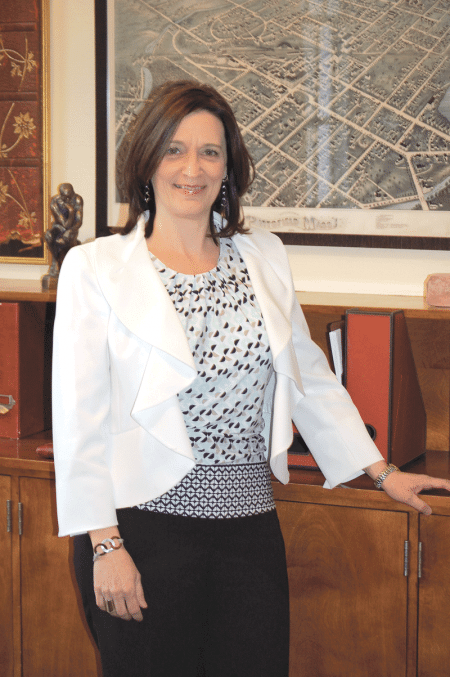
Mayor Linda Tyer says her administration is focused more on helping and growing existing busineses, not luring someone “out there.”
BusinessWest spoke with Pittsfield’s Mayor Linda Tyer on day 11 of her administration.
Only 1,450 days to go.
That’s notable because Tyer is serving Pittsfield’s first-ever four-year term, and, as such, she’s in the beginning stages of laying out a map for the long haul that pinpoints high roads, trouble spots, destinations for the future, and plenty of pit stops in between.
The journey began for Tyer last year, while she was still serving as city clerk. She’d served as a member of the City Council for five years prior to taking the clerk’s position, and watching the inner workings of Pittsfield’s government had her mulling a run for its top office.
“I saw the city’s potential being lost to old ways of thinking, governing, and leading,” she said. “It was time for a new generation of leadership, and I wanted the residents of Pittsfield to really think about what they imagined for themselves. I offered an alternative in every way: from gender to voice to style.”
Tyer announced her candidacy for mayor on the City Hall steps in March, and defeated two-term incumbent Mayor Daniel Bianchi in November. Since then, she’s pledged more communication and relationship building between the mayor’s office and all its stakeholders, from elected officials to Pittsfield’s residents and business owners.
“The plan is to have constant, regular communication, both incoming and outgoing,” she said, noting that this will include regularly scheduled public updates on some key issues — among them public safety, workforce development and retention, and ongoing work to create a hip, walkable urban center in the heart of Berkshire County. “We need to invest in public safety and, as part of that, address the underlying issues that are the source of crime, including poverty and feeling disenfranchised.”
Tyer added that there are strategies at play in these arenas, starting with youth initiatives such as a city-wide mentoring program for high-risk young adults. That program has recently been expanded through grant funding to include job training and workforce-development opportunities for men ages 17 to 24, which is one way Pittsfield is also addressing the dual issue of workforce training to fill the area’s job vacancies.
“The business community cares that its investments are being protected, but it also cares about filling the gap that exists between marketing their jobs and finding candidates with the right skills,” she said.
Abandoned sites scattered across the city and outdated technologies are other barriers to recruiting and retaining great talent in Pittsfield, Tyer noted.
“Neighborhood blight and business blight make it very difficult to market our city; it affects community pride, and potential investors aren’t going to announce their arrival so we can show them our best sites … they’re going to be stealth,” she said. “And we need access to broadband in our commercial centers. We have the infrastructure, but we’re not yet plugged in. A modern-day creative economy has to be global.”
Ultimately, that creative economy is what Tyer hopes to nurture through all of these initiatives: a diverse business landscape powered by human capital.
“Our transportation system is not conducive to big manufacturing — that’s not our strength,” she said. “What we can do is ensure that we’re providing young professionals with the tools they need to succeed so we can continue to cultivate the vibrant community we have here.”
To that end, Tyer’s plans for the first leg of her four-year tour of duty include targeting resources to Berkshire-based small businesses; ‘Blight to Bright’ initiatives, such as requiring that vacant buildings are maintained for aesthetics and safety; street-improvement plans; and strategies for expansion of early-childhood education.
It’s a packed itinerary, but Tyer said she has the drive.
“I am motivated by a belief that the city has great potential,” she said.
— Jaclyn C. Stevenson
Karen Tesini says customers are willing to pay for quality in a product they’ll have to live with for a long time.
Flooring products aren’t cheap, for the most part, which is why Best Tile recently opened an outlet store that caters to customers on a budget.
“We have a closeout outlet to stay in tune with people who don’t have the financial means to buy higher-end materials,” said Karen Tesini, manager of the Springfield-based store. But she found she doesn’t do nearly as much business there as she does in the main showroom. “Our customers are serious buyers; they know tile has longevity, it’s not something they’ll change frequently, and they’re willing to pay for high quality. That’s our typical client.”
Jorge Morgado agreed.
“The average person coming in, if they’re not looking to move often, if they’ll be staying in their home for a while, they’re really looking for better-quality materials, better-quality flooring,” said the vice president of Baystate Rug and Flooring in Chicopee and East Longmeadow. “People are still value-driven, but with the trend toward an improving economy — at least, there’s definite movement in that direction — they want something of quality.”
Steve Omartian knows something about quality. As the third-generation owner of Toros Omartian & Son, his family has been dealing in hand-woven, high-quality Oriental rugs — buying, selling, cleaning, repairing, and appraising them — for 96 years, and only in recent decades has he begun stocking rugs at price tags less than $5,000, to capture a segment of the market that prefers to stay around $3,000 or less.
“Professionals in the area were telling me, ‘I can’t afford your rug; it’s like $20,000, isn’t it? We could never afford a rug from you guys,’” he recalled, suggesting he had a perception problem more than a price problem. “The Omartian name had suggested very expensive rugs, but we were priced just like any other rug store. We do moderate to high-end rugs, we do collectibles — all the different designs and colors available in the oriental-rug industry now.”
What Tesini, Morgado, and Omartian have in common — besides businesses focused on floor coverings — is the need to strike a balance between quality, since customers will live with their products for a long time, and shoppers who focus on the bottom line. It’s not always an easy tradeoff.
“Obviously the economy — even though people say it’s thriving — is still soft in this area,” Morgado told BusinessWest, noting that his customer base has tended to skew older (typically professional people in their 40s and up) and it’s always a challenge to attract young people who are just as likely to grab a machine-manufactured rug on sale at Home Depot.
But if there’s one thing high-end and budget-conscious shoppers have in common, its that their tastes change — often quickly.
Indeed, Morgado said, “just like clothing trends, the style of hardwood flooring has changed over the years. In the past, he explained, hardwood options existed on a single continuum, dark finish to light finish, and three-inch planks were standard across the industry.
“Today’s look is completely different,” he went on. “People are looking for the wide boards, wide planks, with some character, whether it’s hand-scraped, darker-stained, whatever it takes to create that unique, different finish. These are considered higher-end products.”

Jorge Morgado says tastes in wood flooring have shifted in the past couple of years to wider planks and shades of gray.
He noted that proponents of wider planks feel they make a room feel more open and can create the appearance of a cleaner-looking space. Another rising trend is setting planks at a diagonal, rather than vertically or horizontally.
Morgado also noted that reclaimed wood is growing in popularity because it appeals to customers on two levels: eco-friendliness, and a vintage, one-of-a-kind look. This wood is being reused from sources such as barns, beams, wooden barrels, and salvaged logs, and the planks typically have characteristics that are different from board to board.
Finally, shades of gray are all the rage in hardwood flooring, rather than the natural finishes that have dominated for so long. One reason is that it tends to be a more neutral backdrop for paint, upholstery, and accessories. “People are attracted to that,” he said.
Tesini agreed, saying the gray craze has crossed over into tile as well. “A year and a half, maybe two years ago, the most popular color was beige. And, just overnight, a lightswitch was hit, and now everything is white and gray tile.”
Another consumer trend, Morgado said, is tile that looks like wood. At a time when designers are getting away from wood-colored cabinetry in favor of black and white, wood-colored flooring, if not hardwood itself, can be an attractive complement, since the rest of the space isn’t overwhelmed with wood. “More people are doing these uniquely finished things that are not considered traditional.”
Tesini said customers are responding to the sheer quality of tile that mimics wood. “Now, it’s digitally imaged, where before, it was screen printed. Digital imaging has come so far, and it’s difficult to tell it’s not real wood. Almost every manufacturer has changed their process to provide the highest-quality image on tile. It’s really an amazing time to be in the tile business.”
The other big trend in tile has to do with size, she told BusinessWest, with the long-popular 12-by-12 tiles being overshadowed today by 12-by-24 pieces. And that’s just the residential side. “Commercially, the bigger, the better: 16-by-32, 24-by-24.”
The biggest shift in the Oriental rug industry, Omartian recalled, was a change, in the early to mid-1980s, in how designs were created.
“In the interior-design field, American [wholesale] buyers would go to the countries of origin and buy what they made. But in the ’80s, they started telling them what to make, what designs and colors they wanted. And the market drastically changed — it became more appealing to the American consumer. It’s progressed that way ever since.”
That shift means Oriental rugs aren’t just an afterthought to a design, but are often included in a complete room strategy, just as fabrics, paint, wallpaper, and draperies are. “As far as the decision goes, it’s incorporated in the process, where, prior to the ’80s, it wasn’t.”

Steven Omartian says his company has stayed nimble in order to sell high-end rugs in an economy that has not fully recovered from the recession.
That was an overall positive to dealers like his family, but Omartian says the industry still faces plenty of challenges, including an economy that remains a bit soft. One change to compensate for fluctuating economy is an increased business presence; where his business was once 85% residential and 15% commercial, now it’s closer to 60-40. “We sell a lot for professional offices — an accent piece in the office or a large Oriental rug in the conference room, as well as occasionally hanging carpets on the wall as artwork.”
Morgado said manufacturers of wood flooring — and other materials, for that matter — produce lower-quality versions of their products to bring in value hunters and people who can’t afford high-end materials, but those who can afford top-line products demand them, if only because of how permanent those choices tend to be.
That said, while hardwood remains a popular choice, it typically trades places back and forth with carpeting in the race for most-popular floor covering.
“Designers know it’ll be a hardwood trend, then a carpet trend, then back to hardwood. The trend now is that carpet is starting to come back around. Designers are saying, ‘if you want a room to be comfortable, it’s a lot easier to bring comfort with a carpet,’” he explained, noting that today’s top-line rugs are built for both softness and better cleanability than before. He cited one brand in particular, Karastan, as the “Mercedes brand,” and noted that many people gravitate toward that as an alternative to wood.
While tile brands jostle for market dominance as well, Tesini said, she has seen a huge demand for Carrera tile — particularly in white and gray, of course — for kitchen floors, backsplashes, and bathrooms. But, she added, there will always be a place for natural stone.
“There’s an exotic quality to stone — it will always cost a bit more money than porcelain based on the rarity of certain types of stone, like marble,” she said, adding, however, that higher-end tiles are closing the price gap. “Natural stone is still very, very popular. Tile has come so far, but stone is stone; it’s what God created, and he’s not making it any better or worse. It’s never gone away in popularity.”
Which means it’s one more option for home and business owners looking to spend a little money — or a lot, as the case may be — for perhaps their most-used possession.
Joseph Bednar can be reached at [email protected]

Elms College President Sr. Mary Reap
Some might regard Sr. Mary Reap’s inauguration as president of Elms College in Chicopee as, well, a godsend.
After all, the former president of Marywood University in Pennsylvania had retired after serving at the first Catholic women’s university from 1988 to 2007 and establishing a wide variety of new programs at every level, including majors in physician’s assistant, art therapy, aviation management, biotechnology, information sciences, sports nutrition, and exercise science.
She came out of retirement to take the helm at Elms amid expectations that she could, and would, do the same for that Chicopee institution.
Indeed, soon after her 2009 arrival, Reap began to initiate positive change. But at that point seven years ago — as well as today — she simply viewed the position as an opportunity to put her honed skills to work.
“I arrived just in time; when I took office, Elms needed some updates, including new programs and structural work to the facilities,” Reap told BusinessWest. “Nineteen years of experience allows you to see things that can be changed, and the college was not only ready, they trusted me.”
From the first day she set foot on the Chicopee campus, she was highly impressed by the integrity of the staff and faculty and their willingness to do whatever it takes to help students succeed. In fact, it was one area where no improvements were needed.
“I viewed the job as a wonderful opportunity to take a very dedicated, caring group of individuals and move forward,” Reap said. “Our faculty is really dedicated to student success; we have a high retention rate, and it really amazes me to hear stories of what people here have done,” she continued, citing examples that include faculty members who have purchased books for students who could not afford them, cafeteria and housekeeping staff who know every student by name and give them “a little hug when they need it or make special food for them,” and others who have shouldered the expense of clothing needed by graduates for job interviews when they couldn’t afford it themselves.
Reap said these acts of kindness are done quietly behind the scenes, and she hears about them from grateful students. She attributes the altruism to an attitude that pervades the campus and its many new satellite locations and is passed from staff to students, infusing them with the desire to make an impact.
“Our students often begin their Elms careers with a passion for positive change and leave with the tools necessary to make change happen,” she said.
Her initial goal was to help individuals and the community by making it possible for more people to earn a four-year-degree in subjects that met the requirements of employers who were recruiting outside the area due to a lack of qualified local candidates.
“I looked at the demographics and found that less than 20% of the population in Western Mass. has a four-year degree,” she recalled.
These goals were bolstered by Reap’s belief that it is critical for her to be a good steward of the college and its resources — a commitment she takes seriously.
Her efforts to increase the numbers of graduates with bachelor’s degrees has been successful, and today, enrollment has increased by 400 students. Every building on the Elms campus has undergone renovations to keep up with the changing face of education, and 40 new jobs have been created, thanks to new programs at every level that resulted from collaborations and meetings with business owners, healthcare providers, representatives from the state’s community colleges, and data culled from the government and surveys that have been conducted in the community.
“Every new program has filled a need,” Reap said, using a word that surfaced repeatedly throughout the interview. For this issue’s focus on education, BusinessWest takes a look at the expansion that has occurred at Elms since Reap’s inauguration and how new collaborations have led to success.
Reap said that, after she arrived in Chicopee, she met with Holyoke Community College President Bill Messner and was pleased to discover he shared her vision of helping more HCC graduates earn a four-year degree.
“We formed a partnership in 2010-11 and launched our first completion program in the fall of 2010 in psychology, management, and accounting,” Reap recalled. “It’s a cohort model in which students start together and finish together on their own campuses. Classes are held on Saturdays, which makes things easier, and since that time, the program has expanded into other community colleges across the state.”
It is a popular program, and more than 90% of students who enroll graduate. “Right now, 230 students are enrolled, and we believe we have done a great service by making it possible for so many people to complete degrees, which enhances the workforce and puts graduates in line for job promotions,” Reap said.
Another new program instituted after Reap arrived at Elms allows registered nurses who are working in the field to earn a bachelor’s degree in nursing. The RN-BS degree-completion program came about as a result of a partnership with Berkshire Health Systems (BHS) in Pittsfield, and was launched in 2007. Classes are held on the hospital ’s Hillcrest Campus.
Reap said more than 100 people have received their four-year degrees, enhancing the level of care patients receive, and since 2007, RN-BS programs have expanded and are in place at four community colleges.
Reap noted that the baccalaureate program at BHS led to a master’s program, then a doctor of nursing practice program that was launched in the fall of 2014. Students can choose from two tracks and become a family nurse practitioner or adult gerontology acute-care practitioner.
Sr. Mary Reap says the new Center for Natural and Health Sciences was built in response to needs for more graduates with science and nursing degrees.
The inaugural class included nine students from BHS and and nine from Baystate Medical Center, whose tuition was underwritten by the hospitals, and 22 additional students.
“We have helped fill the need for nurses with advanced degrees in a number of local hospitals,” Reap explained. “It was a natural area to grow, especially since the population here is aging. And these programs have an added value as many of the students are bilingual. It’s a great asset as there are so many Spanish-speaking people in the area.”
She noted that Elms received a $650,000 Health Resources and Services Administration grant to provide undergraduate scholarships for deserving, financially eligible Hispanic nursing students.
“We gave out eight awards last year, and 16 students will receive them this year in addition to other help they receive. It’s a wonderful way to meet the needs of the community,” she continued. “Last fall, we also began offering an undergraduate degree in Ethical Healthcare Management, which can be completed online or at some of our satellite sites.”
Elms College has also focused on expanding its science programs. “We know that more young people are needed today in these careers,” Reap said, adding that this knowledge spurred the construction of a new, $13 million Center for Natural and Health Sciences, which contains classrooms and laboratories.
And three years ago, the college responded to another need with a new post-baccalaureate science program for students who want to apply to medical or dental school. It can be completed in one or two years, depending on the student, and Reap said it attracts candidates from around the world in need of additional coursework.
“We’re drawing graduates from Ivy League schools, and they have been getting accepted at the best medical and dental schools in the country,” she noted. “It’s another area that was underserved where we think we are adding value.”
The needs of employers in the business community have also been addressed, and three years ago Elms launched an MBA program. Fifty students are enrolled this year, and they are taking classes on campus and online, which allows them the flexibility to work and earn a degree simultaneously. And, thanks to a generous gift from a benefactor, Elms is in the process of launching a new business center that will provide entrepreneurial and leadership programs at the certificate and degree level. Reap said the center will open officially next fall.
“There are many small businesses in the area, and more open every day, and we were getting requests from them for workshops,” she told BusinessWest, adding that slots in the MBA program filled quickly and the school felt it was important to provide other types of education to business owners and employees working in an entrepreneurial environment.
Elms has always had a strong social-work program, and in the spring of 2012, it launched a bachelor’s-degree program in criminal justice. It was created in response to requests from students and an increased need for people to fill crimina-justice positions in the area.
“We work closely with the Hampden County Sheriff’s Department, local law-enforcement agencies, and the governor’s office, and have a nice relationship with the Soldier On program in the Berkshires,” Reap said, noting that Elms also has a strong legal-studies program and takes an interdisciplinary approach to these fields of study.
“The need is increasing for homeland security, and there are new approaches to criminal justice,” she continued. “Our emphasis is on helping to lower the recidivism rate of people released from prison, and the programs were driven by our mission to have a system of education with our philosophy and values. Respect for the individual is paramount, and it’s important to teach these people how to gain dignity as well as the skill sets they need to enter society again.”
Reap said the student body at Elms and its satellite locations is representative of the community. About 20% of their students are Hispanic, and close to the same number are African-American.
“We also have a lot of religious diversity on campus, and most women feel very comfortable here because it’s a place where they feel safe and respected; plus, they like the idea of coming to a school with a value system similar to their own,” Reap said. “And we have been very entrepreneurial and flexible in adapting, maintaining, and enhancing our reputation for quality and excellence.”
Core values at Elms include faith, community, justice, and excellence, and part of the college’s mission is to educate students and inspire them to help others. It’s a practice that starts at the top and filters down to students who absorb the value, then pay it forward.
“Staff members take turns providing meals for students who can’t go home for the holidays or come back to campus early; I’ve had them in my own home on Thanksgiving,” Reap said, citing just one example of the support the students receive.
“It’s part of our culture, our expectation, and our environment, and we have nursing students who volunteered to use their spring break to serve the poorest of the poor in Jamaica rather than going somewhere like Florida,” she said, noting that they will pay their own travel costs.
In fact, community outreach is such an integral part of the Elms nursing curriculum that, in January 2013, a new program to serve the homeless was launched by Br. Michael Duffy, an assistant clinical professor in the School of Nursing.
It’s called the Elms caRe vaN, and free healthcare services are administered by students in the bachelor’s-degree program out of a 32-foot van that contains two treatment stations, a full exam room, and a five seat-waiting area, which doubles as a warming area. The care is offered in conjunction with St. Stanislaus Basilica’s Sandwich Ministry in Chicopee, and free lunches are distributed every week during the van’s stop in Chicopee Center. In addition, traditional undergraduate nursing students work with Duffy at Lorraine’s Soup Kitchen and Pantry every Tuesday.
Reap said the majority of majors at Elms College are service-oriented in keeping with the school’s tradition. For example, its communication sciences disorders program is very strong and was designed to serve the increasing number of children who are diagnosed on the autism spectrum or have speech-language problems.
“Every program we offer was developed in response to need,” Reap repeated. “Before we started our nursing-degree programs, Berkshire Medical Center was going to other states to recruit qualified nurses. We wanted to prepare young people who grow up here to take higher-level positions and raise their own standard of living, while meeting job requirements in the area.
“And we plan to add more flexible programs and formats,” she went on. “We will also continue to gather information from the Department of Labor and conduct needs assessments, surveys, roundtables, and talk to people, not only at the community colleges, but in the business world and at the Economic Development Council, which has been very helpful.”
In short, Elms has done a good job keeping up with the times.
“We know where we are going, and I am confident that whatever we do will be done well and successfully because of our staff and the strong ethical and value-based approach to education that the college provides,” Reap said. “We continually seek out scholarships and grants for disadvantaged students as they comprise the majority of the population in our community; 90% of our student body gets some type of financial aid, and we’re always looking for assistance to help students, many of whom have financial challenges.”
She told BusinessWest that, when she asks students what makes Elms special, the answer is always the same. “It’s the strong sense of community we have here. Commencement can be difficult because this is a place they call home, and it’s hard to walk away from such a supportive setting.”
So, as Reap enters the spring semester of her seventh year at Elms, she feels satisfied with the growth that has occurred. It has aligned perfectly with her own goals, and she is confident that need-based growth will continue.
Which is, indeed, a true godsend to students seeking the education they need to get a job that pays well — and has helped establish a pipeline of new, local, well-educated graduates for employers.

 Long touted as the potential site of a boutique hotel, the historic building at 13-31 Elm St., bordering Springfield’s Court Square, is now the focus of a different vision, due to MGM Springfield’s own hotel plans. Peter Picknelly’s OPAL Real Estate Group now sees the property as a mixed-use center for retail, office space, and market-rate housing, and is working with the city to make the $40 million project a reality — and yet another key element to Springfield’s downtown revival.
When Kevin Kennedy talks about the potential of the long-vacant building on Elm Street, across Court Square from City Hall, he doesn’t consider it in a vacuum, but as one more complementary piece in the evolving story of Springfield’s downtown.
“What’s important about downtown, if you look at a three- to five-year window, you should have a really vibrant, entertainment-centric complex with MGM Springfield, more market-rate housing, along with a first-class intermodal transportation complex at Union Station, and hopefully new east-west rail at some point. We’re really talking about a completely different dynamic downtown,” said Kennedy, the city’s chief development officer.
He was speaking specifically of how a planned rehabilitation of 13-31 Elm St. into a mixed-use center for retail, office space, and residential units will create added vibrancy in a central business district which will be anchored by Union Station to the north and MGM to the South.
“This is a key project in the city,” said Chris Moskal, executive director of the Springfield Redevelopment Authority (SRA), which owns the building. “When you look at Union Station and its reputation, and this building and its reputation, they’re amazing anchors to both sides. We’re moving forward, but we’ve got to put together a tremendous amount of financing in order to accomplish what will be a $40 million project.”
OPAL Real Estate Group, which has been the SRA’s preferred developer on the project since the summer of 2011, had originally wanted to convert the property to a boutique hotel, a project OPAL President Peter Picknelly’s father had advocated before his death in 2004.
But MGM Springfield changed its casino design four months ago, nixing a planned, 25-story hotel at 73 State St. and replacing it with a six-story hotel at Main and Howard streets — a location the casino operator had planned to develop market-rate housing, a requirement of its host-community agreement with Springfield.
So MGM was forced to look off site to develop market-rate housing, and has since been in talks with OPAL about some kind of partnership at the 13-31 Elm St. property. The plan that has emerged calls for retail space on the ground floor, office space on the second floor, and 56 units of market-rate housing on the top four floors.
“For the past four years, OPAL has done due diligence in terms of structural analysis and historical analysis of both buildings, and also a hazardous review based on age, asbestos, lead paint — all those issues have already been addressed professionally,” Moskal said. “They’ve looked at what kind of scenarios might work, not only financially but in terms of fitting into the downtown.”

Chris Moskal, left, and Kevin Kennedy say 13-31 Elm St. can be as much of an anchor for Springfield’s downtown as Union Station a few blocks north.
In his conversations with the SRA, Picknelly has said he wants to complement what’s already happening downtown,” Moskal relayed. “He sees the value of having the retail on the first floor; there was a unique mix there before — a snack bar, a barber shop, a jewelry shop on the corner. He feels those first two floors of retail and office space are an easy sell. And he also feels that 56 units of market-rate housing will have some charm and appeal for people.”
Those might include older people looking to downsize or young professionals drawn to the possibility of living in an entertainment center. The units will be rentals, not condos, because of requirements involved in using historic or new-market credits.
“We think they have some great ideas,” Moskal added, “and, again, it’s going to complement what we already have and not duplicate what’s across the street.”
As part of its mission, the SRA acquires buildings bedeviled by urban blight and sells them to developers looking to bring them back to life.
In 2009, Springfield took ownership of 13-31 Elm over delinquent taxes and called for requests for proposals, eventually awarding preferred-developer status to OPAL in July 2011. Since proposing the market-rate-housing piece, OPAL has partnered with Winn Development, one of the region’s leaders in housing development, to move the effort forward. That’s a positive, Moskal said, “given their history, not only with residential rehabilitation, but for using historic types of buildings in their projects.”
The property also includes the adjoining 3-7 Elm St., the oldest mercantile building in the city. The estimated $40 million development cost would include no new parking structure, just surface parking behind the buildings.
“They’ve been talking to MGM to contribute to the project,” Moskal said of OPAL. In addition, they have, over the past four years, already secured money in tax credits. They’ve qualified the property for $8 million in federal tax credits and already received $2.6 million in state historic tax credits. They are moving toward this year, applying for new-market tax credits, which, in a project of this magnitude and complexity, they feel they need. In addition, further down the line, [Picknelly] would like to talk to the city about tax-increment financing while under development.”
Kennedy compares the effort to the city’s $88.5 million project to overhaul the long-dormant Union Station into an intermodal transportation center that will, hopefully, revitalize the area surrounding Springfield’s famous Arch. This multi-phase endeavor entails both new construction — especially a six-level parking garage and adjacent bus terminal — and historic renovation of both the station’s interior and exterior.
“In some ways, I compare [Elm Street] to Union Station in terms of the difficulty of rehabbing an old, historical building,” Kennedy said. “I would also compare it to the importance of Union Station in a sense, right in the city of Springfield’s town square and across the street from the $950 million MGM complex.”

This rendering shows OPAL’s vision for converting 13-31 Elm St. into a bustling, mixed-use complex.
However, it also comes with the same complexities Union Station has, he added. “It’s very difficult to do a rehab of that building that age, but you have to stay with it because it’s so important. With a mix of 35,000 square feet of commercial space, that’s really good for the downtown. It doesn’t dramatically affect the supply of commercial space downtown in terms of putting too much commercial space in. But it does finish a large swath of the central business district.”
Kennedy said Picknelly believes the market-rate units will be an easy sell at this time in Springfield’s history.
“And we agree with him,” he went on. “We also recognize it will take a while to put all the tax credits together necessary for the project.”
When MGM announced last fall that a skyline-level hotel would no longer be part of its project, city officials were taken aback, and some residents felt like the company was scaling back its commitment to the city. But MGM Springfield President has since made an effective argument that bringing the hotel — with fewer stories but the same number of rooms — closer to the casino will be a net positive. Moving market-rate housing to 13-31 Elm may turn out to be another plus, Kennedy said.
“We would really like to position ourselves as an entertainment capital of Western Massachusetts at least, and also an innovation center for Western Massachusetts,” he said, positioning the city center as a destination where people will want to live and start businesses, and Court Square project fits into that vision. “Springfield’s host-community agreement with MGM also contains new policing strategy downtown, 15 new police officers, cruisers, surveillance cameras, new lighting downtown … we’re moving on all of this in a holistic, strategic way.
“The hard part,” Kennedy added, “is that all these fairly complex moving pieces have to work in relation with each other.”
If Union Station can come to life, Moskal added, there’s no reason why 13-31 Elm St. shouldn’t do the same.
“We started Union Station with $3 million, and have been begging, applying, doing anything we can get to where it is today, finally underway,” he told BusinessWest. “I see [Elm Street] as a private-sector Union Station project.”
In short, he concluded, “this is the right time for this project. Coming at the end of Union Station, we are thrilled with it.”
Joseph Bednar can be reached at [email protected]