Home Posts tagged Construction (Page 28)
Court Dockets Departments

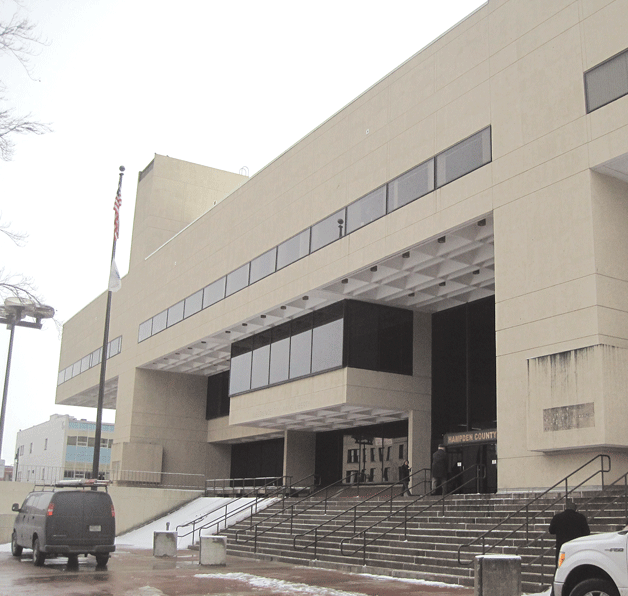
The following is a compilation of recent lawsuits involving area businesses and organizations. These are strictly allegations that have yet to be proven in a court of law. Readers are advised to contact the parties listed, or the court, for more information concerning the individual claims.

FRANKLIN SUPERIOR COURT
Carol Kestyn v. Green Acres, LLC and PCE Management Co. Inc.
Allegation: Negligent maintenance of carpet in the common area causing trip and fall: $250,000
Filed: 2/18/14

Marcia Vincent v. Mackin Construction Co., and ABC Corp.
Allegation: Failure to properly remove and treat accumulated snow causing injury: $487,500
Filed: 2/25/14

HAMPDEN SUPERIOR COURT
Cheyda Rodriguez v. Premier Education Group, LP, William Anjos, and Paul Ferrise
Allegation: FMLA interference and retaliation: $36,630
Filed: 2/28/14

Commerce and Industry Insurance Co. v. C.D.A. Roofing and Siding Contractors Inc.
Allegation: Non-payment on services rendered: $41,780
Filed: 2/21/14

Preferred Mutual Insurance Co. a/s/o Jose Santos v. Alves Fuels Inc.
Allegation: Defendant negligently overfilled fuel oil tank and pumped fuel into the plaintiff’s home: $59,021.71
Filed: 2/19/14

Ryder Truck Rental Inc. v. Souse Seafood Inc.
Allegation: Breach of vehicle lease agreement: $27,403.44
Filed: 2/24/14

Western Mass Electric Co. v. Videll Healthcare Springside, LLC
Allegation: Non-payment of goods sold and delivered: $118,409.33
Filed: 2/20/14

SPRINGFIELD DISTRICT COURT
Adam Farnum v. Windalier Springdale Mall, LLC
Allegation: Slip and fall causing injury: $14,440
Filed: 2/4/14

Bernardo A. Sanchez Jr. v. Town Fair Tire
Allegation: Plaintiff sustained injuries when hit by a scissor lift, which was operated by an employee of the defendant: $13,077.10
Filed: 2/19/14

Juan Wollmershauser v. The Mercy Hospital Inc.
Allegation: Plaintiff was struck in the face by an automated door: $14,651.37
Filed: 2/14/14

Departments Incorporations

The following business incorporations were recorded in Hampden, Hampshire, and Franklin counties and are the latest available. They are listed by community.

AGAWAM

Elite Appliance Inc., 172 School St., Agawam, MA 01001. Richard G. Melloni Jr., same. Appliance repair.

Amherst

New England Charter Service Inc., 150 Fearing St., Suite 3, Amherst, MA 01002. Hui Luo, 13825 31st Dr., #5H, Flushing, NY 11354. Bus touring and travel service.

Belchertown

Little Friends Child Care Center Inc., 58 Daniel Shays Highway, Belchertown, MA 01007. Elizabeth Sawyer, same. Child care.

Easthampton

Miranda Design Studio Inc., 281 Main St., Easthampton, MA 01027. Jason Miranda, same. Publishing service and graphic design.

Feeding Hills

Nesen Trucking Inc., 95 West View Lane, Feeding Hills, MA 01030. Nikolay Nesen, same. Trucking.

Granby

Premier Irrigation Inc., 49 Taylor St., Granby, MA 01033. Colby Nugent, 55 Taylor St., Granby, MA 01033. Installation and maintenance of irrigation systems.

Hampden

Earth Movers Excavation Inc., 65 Allen St., Hampden, MA 01036. Kara J. Hatch, same. Excavation services and site work for residential, commercial, and municipal projects.

Hadley

Wheel Equal Inc., 44 North Maple St., Hadley, MA 01035. Michelle Moore, same. To conduct scientific research to further the development, production and provision of wheelchairs and adaptive equipment for persons with disabilities.

Hinsdale

Frontline Service Solutions Inc., 81 New Windsor Road, Hinsdale, MA 01235. Anthony E. Hyte, same. Consulting.

Holyoke

Ministerio Evaniglistico El Reino De Los Cielo Se Ha Acercado Inc., 339 Hampden St., First Floor, Holyoke, MA 01040. Keilyn M. Betancourt, same. Religious church.

Morales Xpress Inc., 50 Holy Family Road, Holyoke, MA 01040. Noel Morales, same. Transportation of goods (trucking).

Lee

Piretti Tennis Inc., 625 Chapel St., Suite 1C, Lee, MA 01238. Richard F. Piretti, same. Tennis court construction and maintenance.

Monson

Main Street Restaurants Inc., 216 Main St., Monson, MA 01057. Paul S. Stone Jr., same. Restaurant.

Monson Fire Department Assoc. Inc., 121 Fenton Road, Monson, MA 01057. Mathew Walch, same. To provide a relief fund for any active member of the Monson Fire Department, honorary member of the association, and their immediate family who are in need of financial aid.

Departments Real Estate

The following real estate transactions (latest available) were compiled by Banker & Tradesman and are published as they were received. Only transactions exceeding $115,000 are listed. Buyer and seller fields contain only the first name listed on the deed.

FRANKLIN COUNTY

BERNARDSTON

3 Eden Trail
Bernardston, MA 01337
Amount: $150,000
Buyer: Steven Kubisch
Seller: Springleaf Financial Services
Date: 02/21/14

DEERFIELD

236 Greenfield Road
Deerfield, MA 01373
Amount: $730,000
Buyer: Massachusetts Dept. of Transportation
Seller: Gregory M. Gardner
Date: 02/12/14

5 Industrial Dr. West
Deerfield, MA 01373
Amount: $3,800,000
Buyer: LNR Mass Partners LLC
Seller: Deerfield Plaza LLC
Date: 02/12/14

Settright Road
Deerfield, MA 01342
Amount: $360,000
Buyer: James M. Pasiecnik
Seller: William W. Melnik
Date: 02/21/14

GREENFIELD

40 Conway St.
Greenfield, MA 01301
Amount: $132,400
Buyer: Andrew M. Cole
Seller: Robert K. Foley
Date: 02/20/14

25 Frederick Road
Greenfield, MA 01301
Amount: $166,000
Buyer: Paul J. Levasseur
Seller: Stanley H. Karpinski
Date: 02/14/14

46 Grinnell St.
Greenfield, MA 01301
Amount: $172,000
Buyer: Mitchell Penfield
Seller: Deborah A. Chauvin
Date: 02/14/14

MONTAGUE

28 Bridge St.
Montague, MA 01349
Amount: $220,000
Buyer: Millers Falls Ent. LLC
Seller: Burek Cross Props. LLC
Date: 02/21/14

67 Oakman St.
Montague, MA 01376
Amount: $265,000
Buyer: Casey R. Fahey
Seller: Paul C. Griffin
Date: 02/21/14

362 Turners Falls Road
Montague, MA 01351
Amount: $245,000
Buyer: Margaret M. Vezina
Seller: Gennadiy S. Konakh
Date: 02/14/14

21 West Main St.
Montague, MA 01349
Amount: $220,000
Buyer: Millers Falls Ent. LLC
Seller: Burek Cross Props. LLC
Date: 02/21/14

ORANGE

40 Shelter St.
Orange, MA 01364
Amount: $185,000
Buyer: Robert S. St.Marie
Seller: Craig T. Deveneau
Date: 02/21/14

SHELBURNE

247 Main St.
Shelburne, MA 01370
Amount: $250,000
Buyer: 247-251 Main LLC
Seller: Bertha A. Rainville
Date: 02/20/14

HAMPDEN COUNTY

AGAWAM

45 Family Lane
Agawam, MA 01001
Amount: $366,500
Buyer: Nathan L. Hall
Seller: Albert R. Kingan
Date: 02/13/14

14 George St.
Agawam, MA 01001
Amount: $146,250
Buyer: Sergey Sholopa
Seller: Laviolette, Elaine, (Estate)
Date: 02/21/14

16 Meadow St.
Agawam, MA 01001
Amount: $197,500
Buyer: Racheal A. Paveglio
Seller: Karen E. Daponde
Date: 02/21/14

51 Robin Ridge Dr.
Agawam, MA 01030
Amount: $235,187
Buyer: FHLM
Seller: Catherine Fatemi
Date: 02/10/14

BRIMFIELD

28 East Hill Road
Brimfield, MA 01010
Amount: $405,000
Seller: Dennis A. McCurdy
Date: 02/11/14

CHICOPEE

106 Bell St.
Chicopee, MA 01013
Amount: $227,000
Buyer: Michael J. Dupell
Seller: Carl D. Roy
Date: 02/18/14

17 Factory St.
Chicopee, MA 01013
Amount: $174,000
Buyer: Rachel E. Loomis
Seller: USA VA
Date: 02/12/14

62 Leona Ave.
Chicopee, MA 01013
Amount: $185,000
Buyer: Ivelisse Vicente
Seller: Touchette, Dorothy G., (Estate)
Date: 02/19/14

122 Pine St.
Chicopee, MA 01020
Amount: $115,000
Buyer: Paul Laflamme
Seller: Susan M. Rusiecki
Date: 02/18/14

28 Pleasant St.
Chicopee, MA 01013
Amount: $118,000
Buyer: Marta Syper
Seller: Solecki, Karoline, (Estate)
Date: 02/19/14

463 Springfield St.
Chicopee, MA 01013
Amount: $245,000
Buyer: L. A. Conner Inc.
Seller: Lucilia Nogueira
Date: 02/11/14

60 Whitman St.
Chicopee, MA 01013
Amount: $150,003
Buyer: FNMA
Seller: William E. Woods
Date: 02/13/14

EAST LONGMEADOW

227 Kibbe Road
East Longmeadow, MA 01028
Amount: $280,000
Buyer: Larry D. Fishbein
Seller: Laplante Construction Inc.
Date: 02/14/14

17 Redstone Dr.
East Longmeadow, MA 01028
Amount: $199,900
Buyer: Amro M. Osman
Seller: Margaret J. Crowe
Date: 02/19/14

26 Rogers Road
East Longmeadow, MA 01028
Amount: $216,000
Buyer: Daniel Fritz
Seller: John L. Occhialini
Date: 02/14/14

200 Shaker Road
East Longmeadow, MA 01028
Amount: $440,000
Buyer: ABE Property Mgmt. LLC
Seller: Caceres Ferez Gomez Realty
Date: 02/20/14

15 Wedgewood Road
East Longmeadow, MA 01028
Amount: $139,000
Buyer: Megan L. Boylan
Seller: FNMA
Date: 02/12/14

HAMPDEN

158 Ames Road
Hampden, MA 01036
Amount: $300,000
Buyer: Carl A. Knodler
Seller: David H. Cox
Date: 02/14/14

HOLYOKE

1395 Dwight St.
Holyoke, MA 01040
Amount: $124,936
Buyer: Lasalle Bank
Seller: Luis D. Rodriguez
Date: 02/20/14

2213 Northampton St.
Holyoke, MA 01040
Amount: $280,000
Buyer: Olga Alkattan
Seller: MKD Properties of Holyoke
Date: 02/18/14

LONGMEADOW

Lincoln Road
Longmeadow, MA 01106
Amount: $120,000
Buyer: Campagnari Construction LLC
Seller: Erika M. Crossman
Date: 02/20/14

LUDLOW

200 Chapin St.
Ludlow, MA 01056
Amount: $225,000
Buyer: Atwater Investors Inc.
Seller: Pamela Wells
Date: 02/14/14

181 Massachusetts Ave.
Ludlow, MA 01056
Amount: $190,000
Buyer: Brad Dakers
Seller: Joann L. Hnatow
Date: 02/18/14

55 Paulding Road
Ludlow, MA 01056
Amount: $253,000
Buyer: Daniel K. Saia
Seller: Gervasio Crespo
Date: 02/12/14

155 Tower Road
Ludlow, MA 01056
Amount: $180,000
Buyer: Jennifer M. Pazos
Seller: Cynthia M. Pazos
Date: 02/13/14

MONSON

243 Moulton Hill Road
Monson, MA 01057
Amount: $167,999
Buyer: Katie Defoe-Raymond
Seller: Bank New York Mellon
Date: 02/14/14

MONTGOMERY

1527 Southampton Road
Montgomery, MA 01085
Amount: $377,000
Buyer: Craig A. Dore
Seller: Matthew K. Wolanczyk
Date: 02/10/14

PALMER

31 Birch St.
Palmer, MA 01080
Amount: $163,863
Buyer: FNMA
Seller: Kevin D. Armitage
Date: 02/11/14

4148 Main St.
Palmer, MA 01069
Amount: $177,500
Buyer: Dale L. Menard
Seller: Wesley T. Blask
Date: 02/19/14

360 Palmer St.
Palmer, MA 01069
Amount: $200,583
Buyer: MHFA
Seller: Lynn C. Trombley
Date: 02/18/14

RUSSELL

723 Woodland Way
Russell, MA 01071
Amount: $307,000
Buyer: Richard C. Gallup
Seller: Mike Kamyshin
Date: 02/21/14

SPRINGFIELD

82 Biltmore St.
Springfield, MA 01108
Amount: $115,600
Buyer: Ryan E. Hutchins
Seller: MDK Prop Solutions LLC
Date: 02/10/14

28 Campechi St.
Springfield, MA 01104
Amount: $135,900
Buyer: Dana J. Anderson
Seller: Shannon Lawrence
Date: 02/18/14

1131 Carew St.
Springfield, MA 01104
Amount: $130,000
Buyer: Roxana Toledo
Seller: Silver Hammer Props. LLC
Date: 02/21/14

30 Corona St.
Springfield, MA 01104
Amount: $140,000
Buyer: Kyle A. Watt
Seller: William J. Boutin
Date: 02/19/14

93 Curve St.
Springfield, MA 01104
Amount: $145,000
Buyer: Israel J. Rosario
Seller: John Bechard
Date: 02/20/14

19 Dennis St.
Springfield, MA 01118
Amount: $131,500
Buyer: Patricia A. Cawley
Seller: William J. Kern
Date: 02/18/14

256 Edendale St.
Springfield, MA 01104
Amount: $124,000
Buyer: Bridge O’Connor
Seller: Eric A. Johnson
Date: 02/21/14

25 Elliot St.
Springfield, MA 01105
Amount: $125,000
Buyer: Long Wharf Financial
Seller: Angela Dennis
Date: 02/12/14

27 Elliot St.
Springfield, MA 01105
Amount: $125,000
Buyer: Long Wharf Financial
Seller: Angela Dennis
Date: 02/12/14

3 Glendell Ter.
Springfield, MA 01108
Amount: $177,000
Buyer: FNMA
Seller: Josefina Fernandez
Date: 02/10/14

116 Hampden St.
Springfield, MA 01151
Amount: $159,397
Buyer: USA HUD
Seller: MHFA
Date: 02/18/14

38 Madison Ave.
Springfield, MA 01105
Amount: $199,900
Buyer: Christinas House Inc.
Seller: Cottage Hill Church
Date: 02/13/14

15 Mattoon St.
Springfield, MA 01105
Amount: $128,775
Buyer: Robert D. Porter
Seller: John Russo
Date: 02/20/14

48 Pine Acre Road
Springfield, MA 01129
Amount: $166,000
Buyer: Miguel A. Martinez
Seller: JJS 17 Acquisition Co. LLC
Date: 02/21/14

66 Rencelau St.
Springfield, MA 01118
Amount: $157,000
Buyer: James Maples
Seller: Christopher W. Gaff
Date: 02/20/14

799 Sumner Ave.
Springfield, MA 01108
Amount: $163,740
Buyer: FNMA
Seller: Gregory J. Lyon
Date: 02/10/14

25 Walnut St.
Springfield, MA 01105
Amount: $320,000
Buyer: Strategic Acquisitions
Seller: SJE Properties LLC
Date: 02/18/14

SOUTHWICK

9 Jered Lane
Southwick, MA 01077
Amount: $393,000
Buyer: Marissa R. Monti
Seller: Janice S. Lafrance
Date: 02/20/14

WESTFIELD

39 Jessie Lane
Westfield, MA 01085
Amount: $322,500
Buyer: Greg H. Connors
Seller: FHLM
Date: 02/14/14

82 Pontoosic Road
Westfield, MA 01085
Amount: $191,000
Buyer: Ryan M. Flynn
Seller: J&C Property Services Inc.
Date: 02/20/14

13 State St.
Westfield, MA 01085
Amount: $196,634
Buyer: FHLM
Seller: Marcus A. Jaiclin
Date: 02/12/14

WILBRAHAM

10 Patriot Ridge Lane
Wilbraham, MA 01095
Amount: $460,000
Buyer: James Rocha
Seller: Christian A. Barthelette
Date: 02/21/14

17 Stirling Dr.
Wilbraham, MA 01095
Amount: $243,000
Buyer: Katherine Schmidt
Seller: Sean P. Devine
Date: 02/12/14

WEST SPRINGFIELD

67 Cornflower Dr.
West Springfield, MA 01089
Amount: $210,000
Buyer: Felix Lopez
Seller: Russo, Patrick F., (Estate)
Date: 02/21/14

50 East Gooseberry Road
West Springfield, MA 01089
Amount: $141,500
Buyer: Douglas H. Dreyer
Seller: Mark A. Biseinere
Date: 02/21/14

121 Kings Hwy.
West Springfield, MA 01089
Amount: $174,000
Buyer: Wells Fargo Bank
Seller: Paula J. Dalzovo
Date: 02/11/14

78 Lowell St.
West Springfield, MA 01089
Amount: $130,000
Buyer: George M. Katsoulis
Seller: Stephen G. Danalis
Date: 02/14/14

84 Nelson St.
West Springfield, MA 01089
Amount: $188,500
Buyer: Celine L. Young
Seller: Joseph L. Larrivee
Date: 02/21/14

380 Union St.
West Springfield, MA 01089
Amount: $4,000,000
Buyer: 380 Union LLC
Seller: 380 Union St. Props. LLC
Date: 02/14/14

2146 Westfield St.
West Springfield, MA 01089
Amount: $192,500
Buyer: Ryan C. Cramton
Seller: Richard F. Seidell
Date: 02/21/14

92 Wolcott Ave.
West Springfield, MA 01089
Amount: $149,000
Buyer: Melissa E. Trombley
Seller: Sherri S. Sbalbi
Date: 02/21/14

HAMPSHIRE COUNTY

AMHERST

1141 Bay Road
Amherst, MA 01002
Amount: $316,000
Buyer: Amit Sharma
Seller: Nomi Kluger-Nash
Date: 02/14/14

17 Curtis Place
Amherst, MA 01002
Amount: $235,000
Buyer: Vhristina G. Salgo
Seller: Vincent J. Vullo
Date: 02/14/14

48 Longmeadow Dr.
Amherst, MA 01002
Amount: $125,000
Buyer: J. M. Hess
Seller: Robbie S. Lauter
Date: 02/14/14

525 West St.
Amherst, MA 01002
Amount: $212,000
Buyer: Yili Chen
Seller: Margarita C. Zamora RET
Date: 02/14/14

BELCHERTOWN

23 Emily Lane
Belchertown, MA 01002
Amount: $379,000
Buyer: Jason F. Randall
Seller: JP Builders Inc.
Date: 02/14/14

454 Federal St.
Belchertown, MA 01007
Amount: $161,500
Buyer: Lisa A. Laflamme
Seller: Ronald T. McClure
Date: 02/12/14

EASTHAMPTON

23 Button Road
Easthampton, MA 01027
Amount: $351,245
Buyer: Kerrybeth A. Garvey
Seller: EH Homeownership LLC
Date: 02/10/14

9 Dragon Circle
Easthampton, MA 01027
Amount: $206,500
Buyer: Jane N. Aulisio
Seller: Gentes, Joseph P., (Estate)
Date: 02/14/14

24 Grant St.
Easthampton, MA 01027
Amount: $365,000
Buyer: LTL LLC
Seller: Mason F. Rapaport
Date: 02/14/14

25 Peloquin Dr.
Easthampton, MA 01027
Amount: $206,500
Buyer: Amanda M. Guyette
Seller: Kathleen L. Emet
Date: 02/18/14

8 Pine Hill Road
Easthampton, MA 01027
Amount: $310,000
Buyer: Boriana Canby
Seller: Jonathan W. Sicard
Date: 02/21/14

GRANBY

489 East State St.
Granby, MA 01033
Amount: $200,000
Buyer: FMJ Realty LLC
Seller: Nathan A. Swistak
Date: 02/21/14

5 Mary Lyon Dr.
Granby, MA 01033
Amount: $265,000
Buyer: Christopher J. McCurdy
Seller: Melissa M. Croteau
Date: 02/14/14

139 South St.
Granby, MA 01033
Amount: $212,000
Buyer: Kevin J. Longo
Seller: Kenneth W. Richards Sr. RET
Date: 02/19/14

24 Truby St.
Granby, MA 01033
Amount: $169,900
Buyer: James D. Cronk
Seller: MacBrien, Arlene L., (Estate)
Date: 02/14/14

HADLEY

93 Bay Road
Hadley, MA 01035
Amount: $300,000
Buyer: Raymond R. Rex
Seller: Walter C. Wanczyk
Date: 02/19/14

HATFIELD

129 Depot Road
Hatfield, MA 01038
Amount: $264,000
Buyer: Meaghan L. Tetreault
Seller: Glenn E. Moore
Date: 02/12/14

7 Elm Ct.
Hatfield, MA 01038
Amount: $245,000
Buyer: Barbara E. Folan
Seller: Birrington, Richard E., (Estate)
Date: 02/14/14

11 Prospect Ct.
Hatfield, MA 01038
Amount: $350,000
Buyer: David A. Raimondi
Seller: FNMA
Date: 02/20/14

HUNTINGTON

County Road
Huntington, MA 01050
Amount: $130,000
Buyer: Hamlet Homes LLC
Seller: Mountain Stream Inc.
Date: 02/12/14

NORTHAMPTON

21 Crosby St.
Northampton, MA 01060
Amount: $230,000
Buyer: Cynthia L. Nolan
Seller: Julia A. Root
Date: 02/12/14

122 Pine St.
Northampton, MA 01062
Amount: $390,000
Buyer: William S. Laidlaw
Seller: Florence Congregational Church
Date: 02/14/14

9 Trumbull Road
Northampton, MA 01060
Amount: $534,000
Buyer: Eric N. Wolpin
Seller: Carolyn A. Booth TR
Date: 02/10/14

1526 Westhampton Road
Northampton, MA 01062
Amount: $615,000
Buyer: Timothy V. Parsons
Seller: Paul C. McCutcheon
Date: 02/14/14

PELHAM

29 Jones Road
Pelham, MA 01002
Amount: $275,000
Buyer: Damien M. O’Halloran
Seller: Kenneth W. Doubleday
Date: 02/18/14

SOUTH HADLEY

145 Lathrop St.
South Hadley, MA 01075
Amount: $215,000
Buyer: Halley R. Orfner
Seller: John D. Leonard
Date: 02/12/14

78 Lyman St.
South Hadley, MA 01075
Amount: $159,000
Buyer: Thomas A. Lazio
Seller: Martha A. Berrouard
Date: 02/14/14

41 River Road
South Hadley, MA 01075
Amount: $142,500
Buyer: J. L. Kidder
Seller: Scott M. Dredge
Date: 02/13/14

SOUTHAMPTON

8 Glendale Woods Dr.
Southampton, MA 01073
Amount: $293,000
Buyer: Phillip Gallaspie
Seller: Rita J. Ramsey
Date: 02/14/14

64 Pleasant St.
Southampton, MA 01073
Amount: $148,000
Buyer: Michael A. Sorokin
Seller: James R. Labrie
Date: 02/21/14

WARE

13 Kingsberry Lane
Ware, MA 01082
Amount: $145,000
Buyer: James Desabrais
Seller: Stanley R. Lamb
Date: 02/14/14

278 Osborne Road
Ware, MA 01082
Amount: $239,900
Buyer: Michael J. Lacroix
Seller: Joel J. Harder
Date: 02/11/14

WESTHAMPTON

134 Easthampton Road
Westhampton, MA 01027
Amount: $192,000
Buyer: Paul C. McCutcheon
Seller: Thomas Martin
Date: 02/21/14

Entrepreneurship Sections
Serial Entrepreneurs Scale New Heights with Qnect

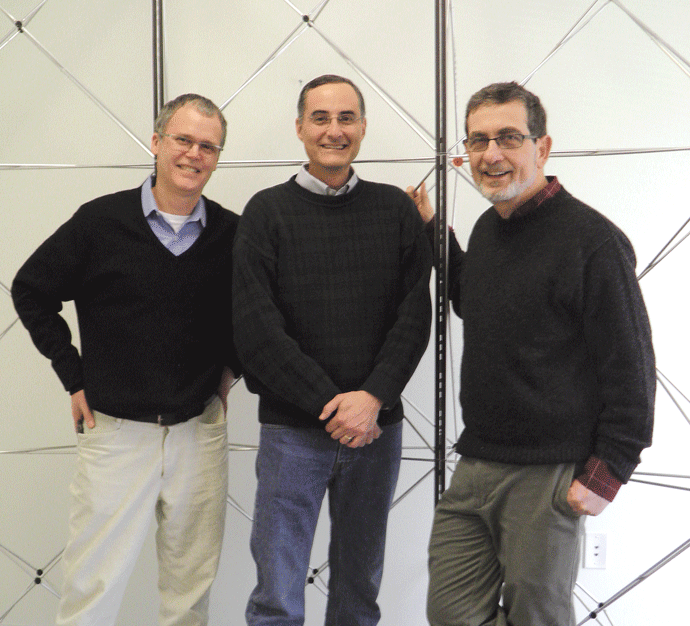
From left, Jef Sharp, Jeff Hausthor, and Henry Lederman

From left, Jef Sharp, Jeff Hausthor, and Henry Lederman created QuickQnect, software the connects the joints in a steel structure via an automatic process.

Jef Sharpe and Jeff Hausthor are on the edge again. The cutting edge, that is.

The entrepreneurs, who have been partners in five business ventures, joined Henry Lederman last October to start a new company called Qnect, and are launching a new software product called QuickQnect at the three-day NASCC Steel Conference in Toronto.

They say the product will revolutionize the way the joints in a steel structure are connected. “The idea of turning this manual process into a software solution is brand-new, and QuickQnect is up to 100 times faster than the conventional way of connecting the joints in a building,” said Sharp, adding that the service is available in the cloud.

Lederman, who has spent 42 years in the steel-detailing industry, developed an early version of the software that has already been used in 11 buildings, including structures at UMass and Harvard. And when BusinessWest spoke to the three entrepreneurs, they were looking forward to introducing their breakthrough product at the Toronto conference, which is expected to attract more than 3,500 structural engineers, steel fabricators, erectors, detailers, and educators involved in the design and construction of fabricated steel buildings and bridges.

Lederman said QuickQnect combines two critical components of the steel-connection process into one, eliminating weeks or months of manual labor required to connect each joint in a multi-story steel structure.

He created the new software to stay competitive in an industry that has cut costs by outsourcing work overseas. Developing it was a process, but the first step was recognizing there was room for improvement in the three-dimensional system used by steel-detailing companies.

Lederman’s history includes high-profile projects, including the World Trade Center Memorial Museum in New York City and Tata Hall at Harvard University. He has been a speaker at industry events and is a leader in detailing innovation.

“It’s fun starting something from scratch that has never been done before. And what this new product [QuickQnect] does is pretty extraordinary. But developing it was tempered by my desire to see it in its fullest commercial form,” he said.

That pursuit brought Lederman together with Sharp and Hausthor last fall. They were introduced through a friend, and his original plan was simply to get ideas from the successful entrepreneurs.

But the meeting proved to be serendipitous. Sharp and Hausthor were looking to start a new business, and Lederman was impressed by their background and knowledge. “They had amazing expertise, as they had grown other companies and also had IT experience. They had what I needed to take the company beyond what I had envisioned,” he said. “They viewed things I might have had doubts about as minor obstacles.”

Sharp and Hausthor said working with Lederman met the criteria they have established for a new venture (more about that later) as they know what it takes to transform a novel idea into a product, then market it successfully. But it’s work they truly enjoy.

“It’s exhilarating to start a new company, and even though there is risk, stress, and tension, there is also a feeling of accomplishment you can’t get with most 9-to-5 jobs,” Sharp said. “And this is an amazing company.”

Each of the entrepreneurs has different skills, and their titles at Qnect reflect their honed talents. Sharp is CEO, Hausthor is COO, and Lederman is CFO. They all agree that education is critical and learning must be an ongoing process. “It’s an interesting path, and the importance of entrepreneurs can’t be fully stated,” Sharp said.

However, he was quick to add that it takes a team effort to be successful. “Identifying great people is the most important job of a CEO.”

Lederman concurred. “There are many amazing business people doing wonderful things, but it’s very hard to find the right resources,” he said.

Still, they are confident they will reach their goals because their product will save time and money. But it took sophisticated engineering skills to create the software that automates a manual process. “Two hundred calculations are necessary for every joint, and there can be upwards of 2,000 joints in a building,” Hausthor said as he spoke about a building, constructed with the pre-commercial version of the software, that had 11,000 joints.

Sharp said they have also put together an exceptionally talented development team.

“I’m confident they will be unstoppable in building and expanding our software breakthrough. The design of the joints in a building is really important, and reducing months of work to a few hours drives everything else, including the cost of using steel, which is the most environmentally friendly solution for large buildings and is 97% recyclable,” he noted, adding they hope to identify powerful local investors.

Storied Past

The three men have impressive backgrounds. Lederman has built three successful companies, Sharp has founded six, and Hausthor has directed IT and software-development efforts and operations logistics for six firms.

“I like all new technology and enjoy investigating new things,” Hausthor said.

Sharp and Hausthor have been partners in five ventures and love being on the cutting edge of development. They also share a passion for helping the planet.

“It’s exciting to do things that have never been done before,” said Sharp. “You can start a business by buying a franchise in which everything is set up for you. But it’s not as creative or interesting as starting something from nothing and building something of great value that will last.”

His first business was a mobile food service he named the Clam Scam, which he launched when he was in college.

His next venture was started in 1999 after he moved to Western Mass. from New York, where he had been running a manufacturing company called Gravity Graphics. “I had a burning idea for a dot.com company that would sell excess manufacturing capacity online,” he said.

The idea didn’t require resources or capital, since he simply wanted to make more efficient use of what already existed on the planet. “Having a company that has an impact on the world has always been important to me, and in the past, green has always been a theme,” Sharp told BusinessWest.

Hausthor, who joined Sharp in the business known as XSCapacity, was a self-described “Fortune 500 guy” before they met. He had been a programmer analyst for Deloitte, an associate at Morgan Stanley, a technical specialist for Sony Electronics, and a project manager for Sony Corp. of America.

A friend introduced the two men, they had lunch together, and a short time later, Sharp asked Hausthor to help him start XSCapacity.

The idea appealed to Hausthor. “I had moved to Western Mass. and was working from home. I was in charge of 40 people in New Jersey, but I felt isolated,” he said. “So I made the jump.”

The idea took flight as other firms adopted the novel idea of using real estate, autos, and more to maximum capacity. “XSCapacity was a concept,” Sharp explained. And although they were reasonably successful in building their product and raising money, the company became part of the dot.com collapse.

Their next venture was TechCavalry in Northampton, which provided computer service for small businesses and homes. “We needed to do something quickly which we could fund ourselves that would provide us with relatively instant revenue,” Sharp said, adding they sold the firm in 2012 after 11 years, and it is still in business today.

Although TechCavalry was successful, “we felt compelled to do something good for the world that would have a positive impact,” Hausthor said. So in 2006 they founded Qteros Inc. with two other partners.

“The company was created to start green companies,” Sharp said. “We worked nights and weekends, and it took us nine months to find our first project.” They combined talents with Susan Leschine, a professor at UMass Amherst, who had discovered a microbe that made ethanol from cellulose.

“But we had to scale up the technology, as it was still at the test-tube level at UMass,” Hausthor said. “We had to make it into a product that needed to go into a $200 million facility. We were still running Tech Cavalry, and suddenly we were microbiologists at a facility in Marlborough.”

Sharp describes the time as “a whirlwind. We hired two scientists a month and grew quickly.” They secured a government grant, and their backers included the petroleum giant BP. The firm had 50 employees when the pair left in 2008, although Sharp continued to serve on the board of directors until 2012.

They were discussing what to do next when Sharp met Steve Frank from Florence, who had started a supercomputer business and was looking to expand. “He convinced us it should be our next company,” Sharp said, adding that Paneve, which has grown into a large data firm today, made a new type of computer chips.

But when the operation moved to Colorado at the behest of its engineers, and its Amherst office closed, Sharp and Hausthor decided to remain here and began a new search for another startup, which occurred when they met Lederman.

By that time, the duo had developed criteria to determine whether a business opportunity fit their needs. “It has to have good people,” Sharp said, adding that it’s important to him to have control of who is hired. “The product also has to be reasonably close to being ready to sell, as we have already owned two companies that spent a long time in the development stage. When we joined Henry, he was already using a pre-commercial version of the product, but wanted help scaling up and driving the business. The chemistry was good, and it was an excellent combination of our skills.”

Hausthor agreed. “The product also has to be protectable in terms of patent and other intellectual properties and has to be a technology that helps the world,” he added.

The fact that Lederman’s business was local made it especially appealing, he added. “We had met people in Boston who wanted our help, but we didn’t want to drive long distances or have to fly to do business.”

Conscious Choice

Sharp says starting new companies has become a way of life. “It’s pretty cool knowing that you can start something from an idea. But no entrepreneur does it alone. It’s very much a team effort, and it’s critical that the team gets credit, because without them you could never be successful.”

Sharp admits it’s not for everyone. “Starting your own company can be very exciting, but it can be just as exciting to join a young company,” he said, reiterating the importance of a strong team.

But people like Sharp, Hausthor, and Lederman will always thrive on work that is on the cutting edge.

“I was an entrepreneur before the word was coined,” Sharp said, “and what is really exciting is that we are always doing things that haven’t been done before.”

Construction Sections
Northern Construction Builds Bridges to Success

Shawn Clark

Shawn Clark, project manager and operations coordinator at Northern Construction Service

Pressure is replacing two well-traveled highway bridges in one weekend — or losing $1 million for missing the deadline.

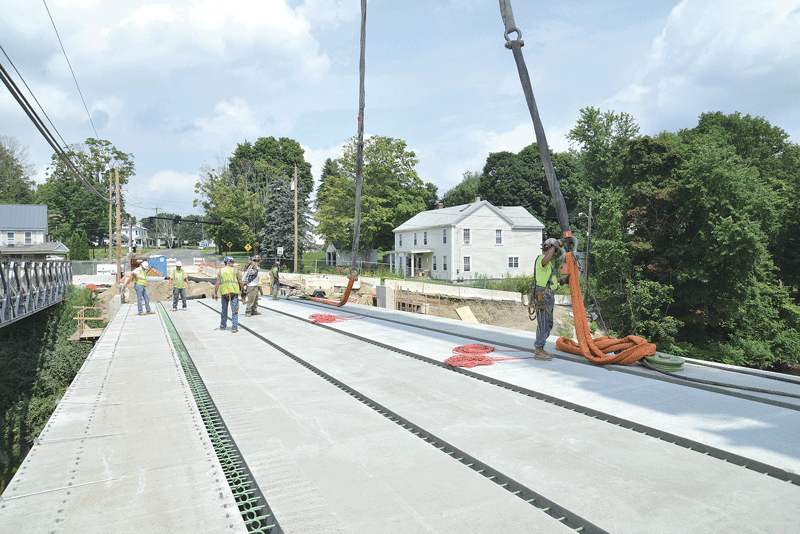
But that’s exactly what Northern Construction Service, based in Palmer, is taking on this summer in Southington, Conn., when it lifts the existing bridges off their supports this July and replaces them with new bridges it has been fabricating at the scene for the better part of a year — all within a 56-hour weekend window aimed at minimizing impact on commuters.

“We’ve had this job since last June, and after almost a year of prep, we’re only going to disrupt the public for a weekend,” said Shawn Clark, Northern’s project manager and operations coordinator. “And if it’s not done by Monday, there’s a million-dollar penalty.”

The bridges, which carry eastbound and westbound traffic on Interstate 84 over Marion Avenue in Southington, are 51 years old and in need of replacement, Clark said. Northern won the contract for the $6 million project last spring, and excavation, tree-clearing, and utility work began in November.

The technique being utilized is new to the Conn. Department of Transportation. The new spans are being fabricated on site in staging areas adjacent to the bridges. Interstate 84 and Marion Avenue traffic will remain open during the entire fabrication period, with occasional, temporary lane closures for other work associated with the project.

On the big weekend in July, the pre-fabricated structures will be moved from the staging areas using massive machines called self-propelled modular transporters. The existing bridges will be removed, and the new spans set into place on the existing abutments, which are in good condition.

Easthampton’s Manhan Bridge

Northern replaced Easthampton’s Manhan Bridge five weeks ahead of schedule.

In addition to the $1 million penalty if the project extends into Monday’s morning commute, ConnDOT has included a $250,000 incentive if the new bridges are open before 10 a.m. Sunday. Don’t put it past Northern to make that goal.

“We like to push,” Clark told BusinessWest. “Our company is not afraid to work overtime, generally at our own expense.”

Take the Davitt Memorial Bridge in Chicopee. Northern replaced that span, which connects Route 116 with Springfield Street — an $8.2 million project — 14 months ahead of schedule. The bridge was closed for just over a year and reopened last July.

“In Chicopee, the DOT offered incentives to work through the winter, to work overtime to meet the deadline,” he said, noting that overtime is already common at Northern during good weather.

“It took us seven or eight months to get going on the Davitt Bridge, and we still finished more than a year early,” Clark said, telling a similar story about the $3.7 million project to replace Easthampton’s Manhan Bridge, which closed last June and reopened in October, five weeks ahead of schedule.

“We had that job for probably eight or nine months before we closed the road, making sure everything was in order, utilities relocated,” he noted. “Then we worked overtime, Saturdays, Sundays — and, again, it went well.”

Clearly, Northern Construction specializes in bridges — as well as road and highway construction; concrete construction, including dams, seawalls, and foundations; excavating and grading; water, sewer, and drainage systems; building construction and relocation; and a host of other projects.

The company — owned by John Rahkonen and John Divito, who work out of offices in Palmer and Weymouth, respectively — has grown significantly in its 19 years of existence, employing up to 150 personnel at peak times and boasting about $45 million in projects annually.

“We’ve been growing or at least maintaining, luckily,” Clark said. “The recession was tough on us, but we’ve had work.”

Getting Around

Chicopee-(2)

Success stories like the Davitt Memorial Bridge in Chicopee — which was closed just over a year and reopened more than a year ahead of schedule — are due to the exhaustive work Northern does long before a bridge closes to traffic.

Success stories like the Davitt Memorial Bridge in Chicopee — which was closed just over a year and reopened more than a year ahead of schedule — are due to the exhaustive work Northern does long before a bridge closes to traffic.

As he noted, that work begins long before a road or bridge closes. “From the time you’re the low bidder, you have to sign contracts, which takes a couple of months,” Clark said. That’s followed by research, dealing with utilities, and a host of other administrative tasks before work can even begin.

Northern works for public and private entities in the six New England states and New York, and that diversity is key to its continued success, he added. “Private work has been slow, with the recession, so public work is all we have right now. But Massachusetts is having budget problems, and work has been sporadic. So, last year, we did five jobs in Connecticut; before that, we’d had only one in the company’s history.”

Bridge work is a big issue across New England, with thousands of aging spans in need of repair or replacement. In Massachusetts, the Accelerated Bridge Program, a $3 billion commitment to repair or replace 259 bridges, was launched in 2008.

“There’s plenty of disrepair. That’s why we have the Accelerated Bridge Program,” Clark said. “This is one of the worst states in terms of infrastructure, and you have to do something.”

He added that the state has moved toward more rapid bridge replacements, pre-fabricated structures, and financial incentives for contractors, all aimed at reducing inconvenience to the public.

“It’s a tough field. Bridges are demanding, and you need skilled personnel to do the work,” he noted, adding that companies need significant administrative expertise as well. “Compared to 30 or 40 years ago, there are more rules, regulations, liability — every ‘i’ has to be dotted. I’m not saying that’s a bad thing; it definitely discourages competition to a certain degree. But it also makes it more challenging.”

To perform such work on accelerated schedules, Clark noted, requires a high level of teamwork with each state’s DOT. “We get in people’s good graces by getting it done quickly. Not only does that require the cooperation of everyone involved, the DOT has to be on board with it. We can’t do it without them, and they can’t do it without us; it’s a team effort.”

Northern recently won a 2013 Design Award from the Precast/Prestressed Concrete Institute for Best Rehabilitated Bridge, a $9.4 million project in Smithfield, R.I. that the company completed — of course — six weeks early.

The Stillwater Viaduct over the Woonasquatucket River is a landmark of sorts, eligible for listing on the National Register of Historic Places, both for its association with a massive bridge-building campaign in the 1920s and 1930s and for serving as an example of an open spandrel arch bridge.

When it was rehabilitated in 2012, designers had to be careful to maintain the original design aesthetics. The use of pre-cast concrete not only allowed workers to replicate the original features of the bridge with modern performance, but it was critical to completing the project within a seven-month window. The existing arch rings and pier columns were also restored during construction.

“Maintaining the look of the old bridge was very important to the owner,” said Bharat Patel of Vanasse Hangen Brustlin, engineer of record for the project. “We were able to stay way ahead of schedule without compromising quality, and everyone in the community was pleased with the results.”

And, of course, much of that success came from the work completed long before the bridge closed. “We took six months before we closed that road,” Clark said, noting, however, that accelerated schedules aren’t always possible, especially when a bridge remains open during the entire project. “Some projects have to be done in phases. You do part of the bridge, part of the bridge, part of the bridge, to keep traffic flowing.”

From the Ground Up

Northern Construction keeps people moving in quite a different way when it comes to its long-standing relationship with Six Flags New England.

No, it doesn’t actually build new rides, but it has handled concrete, earth, site, and utility work for a number of new attractions, including this year’s major addition, the Sky Screamer, a swing ride that will tower 400 feet above the park — twice as high as the current tallest ride.

Meanwhile, Northern is versatile enough to have been called upon for emergency road work along the Mohawk Trail in 2011 after Hurricane Irene washed out stretches of the roadway. Following the immediate repair, it won bids for a $6.7 million repair of Route 2 in Florida and a $3.3 million job in North Adams.

“As soon as it hit, we were summoned to go up there,” Clark said. “We have the resources and organization to do it. We know what equipment is needed, and what work can be done without sacrificing other projects.”

It also takes a company that knows how to juggle the bureaucratic demands of both the state and the Federal Emergency Management Agency, which was involved in funding the road repairs. “That’s when you get into submitting invoices; every load of gravel has to be documented,” he explained, adding that the end result was a 700-page document. “You’ve got to coordinate it, do the paperwork, and administer it to get paid in an effortless manner. This was a big event.”

After all, who doesn’t want to be paid?

“Our owners have always insisted that our workers get paid every week for what they do,” Clark said. “And as a contractor, we need to get paid to be able to do that — to recover our money, keep the cash flowing, make sure everyone is getting paid. It allows us to take care of our personnel.

“You hear stories of contractors who don’t pay their wages,” he continued. “There are plenty of great contractors out there, but also companies that have issues. Our employees are our most valuable resource, and we want them to get paid.”

It’s all about strong relationships — between project owners and contractors and employees. After all, Northern Construction knows how to build bridges.


Joseph Bednar can be reached at [email protected]

Construction Sections
Economy Improves, but Challenges Remain for Builders, Consumers

Brad Campbell

As the economy ramps up, Brad Campbell says, so does the number of shady contractors looking to take advantage of eager consumers.

Brad Campbell calls it the “black-box effect.”

That’s the phrase the executive director of the Homebuilders and Remodelers Assoc. of Western Mass. (HBRAWM) contrived to reference the action of any consumer using their computer, tablet, or smartphone when selecting a professional home builder or remodeler.

“I think people have become way too dependent and trusting of the computer,” said Campbell, calling the phenomenon a faulty mindset, because glossy websites with carefully worded testimonials and paid reference sites like Angie’s List don’t always tell the full story. “And if consumers took the same amount of time to research the contractor as they do the product, they’d be much better off.

“As the economy gets better, we want consumers to know that there are risks and dangers out there,” Campbell continued. “There are more people out there who will take advantage of you.”

It’s a sign of the times, he told BusinessWest, adding that, just as contractors start coming out of the woodwork when there are weather-induced surges in construction-related work, as this region has seen recently, they also come out when consumers are ready to open their wallets and start catching up on deferred maintenance and expansion projects. And some of these contractors have less-than-stellar track records.

As she heard these remarks, Marybeth Bergeron of Charista Construction in East Longmeadow started nodding her head emphatically. “He’s absolutely right,” she said, adding that the conditions are now approaching perfect for disreputable builders to take advantage of consumers who are completely uneducated about how to find a contractor for repair or new construction, but want one because they’re in a mood to spend.

Because of the improving economy, and this black-box effect, Campbell said the focus of this year’s Western Mass. Home and Garden Show will shift from “come and see the products” to “come and learn about the people that install the products.”

Celebrating its 60th year, the show, produced by the HBRAWM, will run March 27-30 on the grounds of the Eastern States Exposition in West Springfield.

The show will feature hundreds of contractors and those who support the home-building and remodeling industry, Campbell explained, but more importantly, professionals to help educate attendees who are finally ready and able to spend money on home improvements or build new houses.

On the commercial side, business has definitely picked up, but education is necessary in that area of the building industry as well, due to heightened processes involving commercial and residential contractors’ licensing requirements, the Bay State’s increasingly strict energy-saving codes, and for the commercial consumer, a reality check about what is necessary and what isn’t for efficiency processes and new high-tech building products.

Town by town, Massachusetts is becoming the strictest state in the nation for energy-saving codes, said both Campbell and Seth Crocker, vice president and co-owner of Crocker Building Co. in Springfield. This development coincides with a desire among commercial and residential clients to be more ‘green’ in their building and perhaps pursue LEED (Leadership in Energy and Environmental Design) designation. What’s needed, they said, are detailed conversations between builders and their clients about what is necessary and what makes sense from the standpoint of return on investment.

For this issue’s focus on construction, BusinessWest spoke with professionals from both the residential and commercial sides of the building and remodeling industry just as the annual Home Show is about to begin, and winter exits stage left — finally. The consensus is that, while the economy is improving — and everyone has been waiting impatiently for that to happen — challenges remain.

Shades of Recovery

Seth Crocker

Seth Crocker says building codes are becoming more stringent, raising costs for contractors and homeowners.

Founded in 1939, the Springfield-based HBRAWM, a nonprofit trade association affiliated with the National Home Builders Assoc. (HBA), has nearly 350 members operating in Massachusetts and Connecticut, and promotes the best interests of home ownership, home buyers, and the building industry.

That mission is ongoing, but it takes on more emphasis at times like these, said Campbell, when there are more business relationships being made between consumers and contractors. He compared choosing a contractor to the dating process.

“You just can’t sit down with the first guy and say, ‘I trust him,’” said Campbell. “And when it comes to making a business relationship official, consumers are definitely afraid of something called a contract, and they have to change that mentality.”

Elaborating, Campbell said that consumers seem to feel that a contract is bad for them and good for the contractor, when in fact, it’s good for the contractor, and better for the consumer.  “It’s not restrictive, but a way to hold everybody accountable for what they said they were going to do.”

His example of a good contract is one that doesn’t have a line item stating that all the windows will be replaced in the home, but that a specific brand, style, and size of window will be used in all windows in question. Spending $300 to have an attorney look over a contract is also a good idea, Campbell added, given the much larger sum that could be lost if someone doesn’t exercise due diligence.

Additionally, he said, if the contractor doesn’t pull a permit, the consumer becomes 100% responsible for an entire project; if the project isn’t done the right way, the consumer can’t file a claim with the state’s repair fund.  “And if a contract doesn’t have certain things in it, it’s not a real contract.”

On the flip side, Campbell doesn’t want to see contractors themselves make mistakes. “They can hurt themselves by not having that same contract; it’s part of their licensing requirement, and they’re told they must have contracts for projects over $1,000, which these days could be just a storm door.”

Walt Tomala, president of TNT General Contracting, Home Show deputy chairman, former president of the HBRAWM, and past president of the statewide HBA, agreed.

Walt Tomala

Walt Tomala says a contract is critical to protecting the interests of both the builder and the consumer.

“There are so many different licensing qualifications that need to be met now, it’s hard enough for the contractor to keep up with it, never mind the consumer,” he said, adding that a contract protects both parties’ interests.

In order to get Home Show attendees to the HBRAWM booth to learn about such matters, agency officials are giving visitors a chance to register to win $160,000 cash. Upon entering, attendees will be given a card asking what they have planned for the next 12 to 18 months. Those who check off ‘building’ or ‘remodeling’ will be invited to speak one-on-one with HBRAWM professionals about what consumers need to know about hiring for these needs.

“We want you to talk to builders that have gone through a formal process to be approved in our association,” Campbell continued. “That’s not to say we’ve never had an issue with one of our builders, but at least if that happens, we have a policy and a process to help you get through this situation.”

LEED by Example

Contractors, homeowners, and business owners should have a lot to talk about at this year’s show.

Indeed, many consumers have put off repairs or remodeling while waiting for the economy to improve, and over the past few years, new products have been introduced, building codes have become more strict, and the world, in general, has become more green-focused.

Brothers Seth and Bill Crocker — co-owners of Crocker Building Co., which offers full-service general contracting solutions in commercial construction and renovation — have witnessed all of this. They say they often face a situation of balancing a desire to be environmentally friendly with what makes sense economically and what also meets state regulations.

Currently, there is heightened interest in efficiency in heating, air conditioning, and the thermal performance of the building envelope, but Seth Crocker sees the expense of higher-technology products as a hurdle that many clients are not willing to jump over, especially if they don’t have to.

The philosophy, Crocker said, is to advise clients on what are ultimately the best products to use, as far as efficiency and ROI.

“But what’s driving a lot of it is that the building codes are so stringent,” he told BusinessWest. “And all signs say that will continue to get more strict, which will drive more people to things like foam insulation, which is a lot more expensive.”

Campbell agreed, citing a survey by the NHAB suggesting that stricter codes are likely, and the Commonwealth has a mindset to be a clear leader in energy conservation, which has resulted in already-demanding regulations compared to most other states.

The 2012 Stretch Energy Code, which does what it says — stretches that base code by another 20% efficiency — and is adopted on a town-by-town basis, is making it financially difficult to build in Massachusetts, Campbell said, estimating that these codes add $16,000 to the cost of a 2,200-square-foot home.

Because of those strict Massachusetts codes, said Tomala — one of the first green professionals certified by the NAHB — he and most other contractors are already building to that highly efficient level, even though doing so does not necessarily designate a building as LEED-certified.

And this has prompted questions among some builders about whether LEED is worth pursuing.

“The actual LEED certification process is very time-consuming, and you really just get a plaque for the wall,” said Crocker. “In some cases, there’s a huge upfront cost, and the payback is all in feeling good about it.”

The plaque on the wall tells a story, for sure, Tomala added, but the Energy Star efficiency rating of the high-tech products he uses tells the same story, with a lot less time and formality.

“Don’t get me wrong — we’ll do whatever the customer wants, but we’d rather be out on the site, not have more office time doing paperwork,” which always means more expense to the customer, he said.

Sustainable Future

Weather extremes, a healthier economy, and the return of the popular outdoor modular home are expected to hike attendance at this year’s Home Show.

“I think the show is going to be a huge hit because people can only sit on their hands for so long, and it’s the year they feel like it’s OK to do something,” Tomala said.

Added Crocker, “I think there’s pent-up demand because people didn’t do anything for quite a few years and interest rates bottomed, but now they’re coming back up.” He noted that those climbing rates are causing people with residential and commercial building needs to move more quickly.

But as consumers make up for lost time, different levels of education about the right way to go about a project and the best return on investment will be the key to commercial and residential projects coming to fruition.

Community Spotlight Features
Developments Strengthen Northampton’s Economy

Mayor David Narkewicz

Mayor David Narkewicz says new projects in Northampton range from redevelopment of blighted buildings to new construction.

On March 7, a ribbon-cutting ceremony was staged at two new auto dealerships on 347 King St. — Country Hyundai, which relocated from Greenfield, and Northampton Volkswagen, which moved from Damon Road.

Mayor David Narkewicz said the dealerships are among a bevy of exciting new projects that will increase vitality in Paradise City. “There is a lot of investment going on right now, which we are very pleased about,” he told BusinessWest.
Terry Masterson agreed. “There are 13 projects with a total value of $88.6 million that will add 203,000 square feet of office/professional floor space, 110 new hotel rooms, 73 housing units, and 83 assisted-living units,” said the city’s economic development director.

He and the mayor then offered a tour, figuratively speaking, of the community and its many commercial and residential developments. And there were stops in virtually every corner of the city.

They started on King Street. The auto dealerships were a $6 million investment, and were built by TommyCar Auto Group on the site of the former Kollmorgen Corp. Electro-Optical Division (now L-3 KEO), which moved to Village Hill. They will add about 50 jobs and generate about $85,000 in tax revenue, Narkewicz said, adding that there is a significant amount of activity happening in the King Street area.

This includes the redevelopment of the blighted former Price Chopper supermarket property by Colvest Inc. It is now called Northampton Crossing, and a new building has become home to Greenfield Savings Bank, while the existing Firestone building has been expanded.

The most significant change, however, is the conversion of 70,000 square feet of retail space into medical offices. Baystate Health moved a medical practice into the renovated building and added a laboratory, MRI and imaging services, and obstetrics and gynecology. “They leased about 60,000 square feet of the facility,” Narkewicz said. “This is a great reuse of the property and gives area residents additional medical options in one of our key commercial areas.”

The former Mobil station at 300 King St. was also redeveloped last year by PeoplesBank in Holyoke, which purchased the site and built a LEED-certified, green banking center. “This is a commercial corridor, and we are excited about all of the investment here,” Narkewicz said.

Meanwhile, another project slated to change the landscape is the construction of a 108-room Fairfield Inn on Conz Street. Narkewicz said developer Mansour Ghalibaf, who owns Hotel Northampton, has been challenged to meet the demand for hotel rooms at commencement and other times of the year.

“This will increase the city’s hotel-room inventory from 358 rooms to 470 rooms,” said Masterson. “And multiplying it by the current occupancy rate will equate to 100,000 people staying overnight each year when it is complete.”

Activity is also occurring south of the site on Route 5 in Atwater Business Park, where space in two, new 40,000-square-foot office buildings has been leased. “The first building is occupied, while the second is expected to be finished by the end of the year,” Narkewicz said, adding that Cooley Dickinson Hospital’s medical offices and Community Support Options are consolidated into one building, and the hospital plans to move additional medical practices into the second.

There are also plans to tear down the former Clarion Hotel and Conference Center and build a new hotel with 100 rooms. “The property has a big footprint, and there is a separate retail pad that could become a restaurant as well as room for an 80,000-square-foot office building in the back,” he said.

Moving north, to the site of the former Northampton State Hospital, residential and commercial development is escalating (more on that later), and downtown continues to thrive.

Terry Masterson

Terry Masterson says the majority of space in two new office buildings in Atwater Business Park has been leased by Cooley Dickinson Hospital.

“Downtown has no real vacancies; there are over 70 stores and 35 different types of restaurants and specialty shops,” Masterson said. “Talbots is celebrating 20 years in their Northampton store, and the Academy of Music programs draw more than 40,000 people to the city.”

And long-term planning continues to redevelop the Three County Fairground into a year-round exhibition facility for agricultural and cultural shows. “A new, 80,000-square-foot exhibition facility will be built, and renovations will be made to the existing buildings,” he noted. “In the coming years, the expanded facility will become a regional attraction for shows and exhibits with the potential to generate $50 million in commerce.”

For this, the latest installment of its Community Spotlight series, BusinessWest continues that tour of Northampton, which reveals that an already-thriving city is building additional momentum in every sense of that phrase.

Grounds for Optimism
At Village Hill, the canvas that developers started filling in 15 years ago is fast becoming a masterpiece of mixed-use development, with more initiatives in progress or on the drawing board.

The Gatehouse, a 16,000-square-foot structure that integrated the former gates to the state hospital into its design, opened its doors last year. It hosts office and retail space, and is the first commercial building on the north side of the campus.

Fazzi Associates, a Northampton-based healthcare services firm, relocated to the Gatehouse from King Street and expanded into 20,000 square feet of office space, Masterson noted, adding that the building also contains a Liberty Mutual claims office, and a small coffee shop is being planned.

Although the Gatehouse is the first commercial structure on the north side of the development, it already was home to a number of residential developments that cross all price brackets.

“It’s impressive to drive through Village Hill and see the different types of housing and how balanced it is,” Masterson said, noting that Wright Builders Inc. built a six-unit subdivison of single-family homes last year and started the first phase of Upper Ridge, a four-unit townhome building. The company is expected to begin the second phase of its Upper Ridge at Village Hill project this spring.

That development will include a duplex as well as one three-story, six-unit, elevator-equipped apartment building. Each unit will have three bedrooms and two bathrooms.

Pecoy Builders is also developing homes in Village Hills, said Narkewicz. The company has completed roughly half of a 24-unit subdivision of single-family homes that offers homebuyers nine plans to choose from in varying price ranges.

MassDevelopment, for Hospital Hill Development LLC, has invested more than $18 million in planning and infrastructure construction, and created the master plan for Village Hill, which is being marketed and developed in sections. In addition to the land currently out to bid on the back property, additional acreage remains to be developed, the mayor noted.

Overall, said Masterson, commercial, retail, and residential development occurring in the city is well-balanced. “We have hotel and retail space, along with senior housing,” he noted as he spoke about the new Christopher Heights project, a $13.4 million, 50,000-square-foot, 83-unit assisted-living facility being built at Village Hill by the Grantham Group.

“Half of the units will be affordable,” Narkewicz said, explaining that the master plan includes mixed-income development.
Meanwhile, many other developments are underway or in the planning stages in and around downtown.

Northampton Community Arts Trust has found a new home at 33 Hawley St. “They purchased a former health club [Universal Health and Fitness] and plan to create 12,000 square feet of exhibition space and a 250-seat black-box theater in it,” said Narkewicz. “Northampton Center for the Arts will be the key tenant.”

Also, the former Clarke School campus on Round Hill Road is slated to undergo a transformation. The Springfield-based OPAL Real Estate Group purchased 12 acres, which contain eight buildings, and plan a historic conversion of the structures that will include residential apartments and retail and office space.

“It’s a significant development because the campus was never on the tax rolls,” said Narkewicz, adding that efforts to bring more housing stock onto the market are critical, because officials believe more healthcare professionals will want to live in Northampton due to the expansion of Baystate Health and the fact that Cooley Dickinson Hospital has become an affiliate of Massachusetts General Hospital.

The Northampton-based hospital and Mass General’s Cancer Center have also entered into an agreement to expand oncology services to Pioneer Valley residents, with plans to build a new cancer center in the city.

On the Right Track
Coinciding with the many commercial and residential developments are infrastructure initiatives designed to improve traffic flow and, overall, make it easier for people to commute to and live in Northampton.

For example, improvements are in the works for the fork in the road that drivers encounter when they take Exit 18 off I-91 and head into Northampton.

“The intersection is owned by the state, and it plans to redevelop it and turn it into a roundabout,” said Narkewicz, noting that design work is 75% complete. “It’s a much safer and more efficient way to move high volumes of traffic through a complicated traffic pattern.”

The city is also in discussions with the Greater Northampton Chamber of Commerce about the many new businesses that have opened at the juncture where Pleasant Street becomes Route 5.

“Several commercial buildings have been redeveloped, and this is an area we are trying to grow as a way of extending our downtown,” the mayor explained. “It’s evidence of an emergence of positive small business and retail growth, and the city is working with the chamber to improve parking to support the growth, traffic, and other pedestrian issues to extend the walkable district of Main Street. All these changes are bearing fruit.”

State officials also want Northampton to take over the section of Route 5 that turns into Pleasant Street. There are some environmental challenges, said Narkewicz, adding, “we’re looking at how we can create a better transition from the state highway to downtown. We have put in some traffic islands to demarcate the point when you leave the highway and enter the city zone to encourage new commercial development.”

City officials are also looking forward to the return of Amtrak service, which will transport passengers along the west side of the Connecticut River. It is part of a larger, $73 million federal project and calls for a shift in Amtrak’s Vermonter route, which will include new stations in Greenfield, Northampton, and Holyoke. “The state is working with us on plans to build a new railroad platform next to the track,” Narkewicz said.

Local businessman Jeremiah Micka has purchased the old rail station building with plans for its conversion, which will include a new sports bar on the north side of the structure, as well as a 200-seat banquet hall. The Tunnel Bar underneath the building will remain open, and the mayor said he is happy that the rest of the building will be redeveloped, as it was empty and on the market for several years.

Moving Forward
Masterson calls Northampton a leading city in Western Mass. “It has many diverse economic and demographic assets that generate economic strength locally and within the Pioneer Valley Knowledge Corridor region.”

Narkewicz agreed, and said Village Hill is a model development because it is close to downtown and residents can walk there, ride their bikes, or use PVTA buses. “Plus, it contains open space and community gardens. It’s an example of the sustainable growth Northampton is focusing on,” he said.

Growth that is taking place in every corner of the city.

Northampton at a glance

Year Incorporated: 1884
Population: 28,592 (2012)
Area: 35.8 square miles
County: Hampshire
Residential Tax Rate: $15.39
Commercial Tax Rate: $15.39
Median Household Income: $48,864
Family Household Income: $56,844
Type of government:
Mayor, City Council
Largest employers: Cooley Dickinson Hospital, Smith College, City of Northampton

Chamber Corners Departments

AFFILIATED CHAMBERS OF COMMERCE OF GREATER SPRINGFIELD
www.myonlinechamber.com
(413) 787-1555

• March 25: ACCGS Pastries, Politics and Policy, 8-9 a.m., at the TD Bank Conference Center, 1441 Main St., Springfield. The event will feature David Bassett, TSA federal security director at Bradley International Airport. Reservations are $15 for members, $25 for general admission. Reservations may be made online at www.myonlinechamber.com or by contacting Cecile Larose at [email protected].
• April 2: ACCGS Business@Breakfast, 7:15-9 a.m., at the Delaney House, 3 Country Club Road, Holyoke. Mayor’s Forum, featuring first-term Mayor Edward Sullivan of West Springfield, second-term Mayor Alex Morse of Holyoke, and third-term Mayor Domenic Sarno of Springfield, moderated by abc40’s Dave Madsen. Reservations are $20 for members, $30 for general admission. Reservations may be made online at www.myonlinechamber.com or by contacting Cecile Larose at [email protected].
• April 9: ACCGS Lunch N Learn, 11:30 a.m. to 1 p.m., at Lattitude Restaurant, 1388 Memorial Ave., West Springfield. Featuring “The Art of the Brand,” presented by Mary McCarthy of Andrew Associates. Attendees will learn the core elements of successful branding and the necessary building blocks that should be put in place in order to ensure that your brand successfully conveys meaningful messages that resonate with your customers or audience. Reservations are $20 for members, $30 for general admission, and may be made online at www.myonlinechamber.com or by contacting Cecile Larose at [email protected].
• April 30: Beacon Hill Summit, 7 a.m. to 7 p.m. Hosted by state Sen. Gale Candaras. Spend a day at the State House and hear from key legislators, members of the Patrick administration in its final months in office, and our local delegation. Reservations are $180 and include transportation, lunch at the Union Club, and a wrap-up reception at the 21st Amendment. Reservations may be made online at www.myonlinechamber.com or by contacting Cecile Larose at [email protected].

AMHERST AREA CHAMBER OF COMMERCE
www.amherstarea.com
(413) 253-0700

• March 27: Taste a variety of margaritas and vote for your favorites, 5:30-7:30 p.m., at the Eric Carle Museum of Picture Book Art, 125 West Bay Road, Amherst. Step into the tropics and pretend you’re on a Caribbean island. This is a Division One competition between restaurant and business margaritas. Your votes will determine who will take home the coveted AACC trophies. Restaurant margaritas presented by Hadley Farms MeetingHouse and Bridgeside Grille. Business margaritas presented by Amherst Laser and Skin Care, New England Promotional Marketing, Scandihoovians, and Applewood at Amherst. Admission is $20 pre-paid, $25 at the door.
• April 3: Chamber Brown Bag Event (first of a three-part series), 12:30-2:30 p.m., at the Jones Library. Learn about the importance of understanding Google searches for business visibility and learn about online business presence. More than 90% of consumers start their buying process online, and your business may be falling through the cracks when it comes to search engines. The talk includes prospect preferences in online search, your business presence on Google platforms (interactive), local search and your business (interactive), content marketing strategy, and converting shoppers into buyers. The event includes a raffle of a free Google presence analysis and a $100 voucher. Bring your mobile devices. Admission is free.
• April 9: Chamber Breakfast, “The Power of Video,” 7:15-9 a.m. at the Courtyard by Marriott, 423 Russell St., Hadley. Learn about using videos to promote your business. Sponsored by Epic Filmmakers. Cost is $15 for members, $20 for non-members.
• April 23: Chamber After 5, 5-7 p.m., at Western MA Family Golf Center, 294 Russell St., Hadley. Cost is $10 for members, $15 for non-members.

CHICOPEE CHAMBER OF COMMERCE
www.chicopeechamber.org
(413) 594-2101

• March 25: 20th Annual Table Top Expo and Business Networking Event, 4:30-7 p.m., at the Log Cabin Banquet and Meeting House, 500 Easthampton Road, Holyoke. Exhibitor cost: $125 for a table. Admission: $10 in advance or $15 at the door. To register, contact the chamber at (413) 594-2101.
• April 16: April Salute Breakfast, 7:15-9 a.m., at the Kittredge Center at Holyoke Community College. Tickets: $20 for members, $26 for non-members.
• April 16: April Business After Hours, 5-7 p.m., at the Residence Inn by Marriott. Tickets: $5 for members, $15 for non-members.

GREATER EASTHAMPTON CHAMBER OF COMMERCE
www.easthamptonchamber.org
(413) 527-9414

• April 10: Networking by Night, 5:30 p.m. More details to follow. RSVP appreciated. Contact us at (413) 527-9414 or [email protected]. Tickets are $5 for members, $15 for future members.
• May 02: Wine & Microbrew Tasting, 6 p.m., at Wyckoff Country Club. Unfamiliar with wines? Looking for the perfect wine for dinner? You’ve had the Wente Merlot and Chardonnay, but want to try the St. Michelle Riesling? Well, then, step up to the tasting bar. All of our guests (21 years of age and older) are welcome and encouraged to enjoy samples of more than 42 unique grape and fruit wines. Not interested in wine? That’s OK, because we have a microbrew tasting going on for you, too. One location, one price. Every year the event has grown. Tickets are $35 in advance or $40 at the door.

GREATER NORTHAMPTON CHAMBER OF COMMERCE
www.explorenorthampton.com
(413) 584-1900

• March 25: 20th Annual Table Top Expo and Business Networking Event, 4:30-7 p.m., at the Log Cabin Banquet and Meeting House, 500 Easthampton Road, Holyoke. Exhibitor cost: $125 for a table. Admission: $10 in advance or $15 at the door. To register, call (413) 584-1900 or e-mail [email protected].
• April 2: Arrive@ 5, 5-7 p.m., at PeoplesBank, 300 King St., Northampton. Sponsored by PeoplesBank. Cost: $10 for members, $15 for non-members. Register at [email protected].
• April 10: Seminar, “Art of Small Business,” first in a three-part series, 9-10:30 a.m., at the Greater Northampton Chamber of Commerce, 99 Pleasant St., Northampton. Presented by Don Lesser of Pioneer Training. Tickets: $20 for members, $25 for guests. Registration is required due to limited space.
• April 21: Seminar, “Art of Small Business,” second in a three-part series, 8:30- 9:30 a.m., at the Greater Northampton Chamber of Commerce, 99 Pleasant St., Northampton. Presented by Tina Stevens of Stevens 470. The program is free, but registration is required due to limited space.
• May 7: Arrive@ 5, 5-7 p.m., at King & Cushman Inc.; 176 King St., Northampton. Sponsored by Applied Mortgage Services Corp., King Autobody, and Goggins Real Estate. Cost: $10 for members, $15 for non-members. Register at [email protected].
• June 4: Arrive@ 5, 5-7 p.m., at Black Birch Vineyard. Sponsored by Johnson & Hill Staffing Services, the Creative, and viz-bang! Cost is $10 for members, $15 for non-members. Register at [email protected].

GREATER WESTFIELD CHAMBER OF COMMERCE
www.westfieldbiz.org
(413) 568-1618

• April 3: Social Media Workshop, 8:30-10:30 a.m., at the Holiday Inn Express, 39 Southampton Road, Westfield. Presented by Alfonso Santaniello, the Creative Strategy Agency. Topic: engaging across platforms — how to create engaging content, what types of content should you be creating, how to distribute content through various platforms, and the importance of tracking along the way. Cost: free to Westfield Chamber members, $25 for non-members paid in advance. Seating is limited; register early. To register, call Pam at the chamber office at (413) 568-1618.
• April 7: Mayor’s Coffee Hour, 8-9 a.m., at Renaissance Manor, 37 Feeding Hills Road, Westfield. The GWCC invites you to have coffee with Mayor Daniel Knapik in a very informal setting. Hear first-hand from the mayor about key issues and get an update on construction projects. The mayor also welcomes any questions or concerns you may have. Free, informative, and open to the pubic. To register, call Pam at the chamber office at (413) 568-1618, or e-mail [email protected].
• April 9: After 5 Connection, 5-7 p.m., at Czar Energy, 53 North Elm St., Westfield. Don’t forget your business cards. Great connection opportunities. Bring a prospective new member for free. Members: advertise your business with a table top for $50. Hors d’oeuvres served. Walk-ins welcome. Haven’t been to an After 5? Your first one is free. Cost: $10 for members, $15 for non-members (cash at the door). To register, call Pam at the chamber office at (413) 568-1618, or e-mail [email protected].
• April 30: Beacon Hill Summit, 7 a.m. to 7 p.m. Beacon Hill Summit, 7 a.m. to 7 p.m. Hosted by state Sen. Gale Candaras. Spend a day at the State House and hear from key legislators and members of the Patrick administration in its final months in office. Cost: $180, which includes bus, lunch, and reception. For more information, call the chamber office at (413) 568-1618.

PROFESSIONAL WOMEN’S CHAMBER
www.professionalwomenschamber.com
(413) 755-1310

• April 8: PWC Ladies Night, 5-7 p.m., at Baystate Health, 325 King St., Northampton. An opportunity to network socially with other female professionals in a casual and unique setting. Reservations are complimentary but required by contacting Dawn Creighton at [email protected]. The Professional Women’s Chamber is an affiliate of the Affiliated Chambers of Commerce of Greater Springfield.

WEST OF THE RIVER CHAMBER OF COMMERCE
www.ourwrc.com
413-426-3880

• April 2: Wicked Wednesday, 5-7 p.m., at Insurance Center of New England, Agawam. Free for chamber members, $10 for non-members. Event is open to the public; non-members must pay at the door. Wicked Wednesdays are monthly social events hosted by various businesses and restaurants, bringing members and non-members together to network in a laid-back atmosphere. For more information, contact the chamber at (413) 426-3880 or [email protected].
• April 16: Networking Lunch, hosted by Cal’s, 12-1:30 p.m. Must be a member or guest of a member to attend. Enjoy a sit-down lunch while networking with fellow chamber members. Each attendee will get a chance to offer a brief sales pitch. The only cost is lunch; attendees will order off the menu and pay separately that day. We cannot invoice you. For more information, contact the chamber at (413) 426-3880 or [email protected].

YOUNG PROFESSIONAL SOCIETY OF GREATER SPRINGFIELD
www.springfieldyps.com

• March 27: CEO Luncheon, 11:45 a.m to 1:15 p.m., at Health New England, Monarch Place, Suite 1500, Springfield. Guest Speaker: Peter Straley, president and CEO of Health New England. Sponsored by Adam Quenneville Roofing, Siding, and Windows and BusinessWest. Members-only event; space is limited. CEO Luncheons are first-come, first served; seats up to 20 maximum.

Briefcase Departments

Bradley Passenger Traffic Up Five Straight Months
WINDSOR LOCKS, Conn. — With January passenger statistics tallied, the Connecticut Airport Authority (CAA) has announced that Bradley International Airport (BDL) has continued an upward trend which began in September 2013. January’s 9% rise marks five straight months of positive year-over-year increases. This follows September (1%), October (4%), November (3%), and December (20%), as Bradley showed an overall 1% total growth in 2013 (5,421,975 passengers) compared to 2012 figures (5,381,860 passengers). Improvements to Bradley’s route offerings, which were implemented throughout 2013, have helped drive this upswing. These advances include American Airlines’ daily non-stop flight to Los Angeles, JetBlue Airways’ Fort Myers and Tampa daily non-stop service, and Southwest Airlines’ three daily non-stop flights to Atlanta through its wholly-owned subsidiary, AirTran Airways. Numerous customer-service enhancements have been instituted as well, such as the establishment of a frequent-parker program, expanded concession offerings, and improvements to passenger-processing wait times. “The Connecticut Airport Authority takes great pride in achieving this milestone of revitalization. One of our greatest selling points to our customers, in addition to our convenient terminal and on-airport parking facilities, is Bradley’s tremendous accessibility from anywhere in the Northeast,” said Kevin Dillon, executive director of the CAA. “We believe that the best is yet to come. We are excited about working with all of our stakeholders as we continue to aggressively seek additional daily non-stop destinations for our customers from one of the region’s most convenient gateways.” Bradley is the second-largest airport in New England, serving an extensive geographic area with a customer base that covers the entire Northeast. According to the most recent economic-impact analysis, Bradley contributes $4 billion in economic activity to the state of Connecticut and the surrounding region, representing $1.2 billion in wages and 18,000 full-time jobs.

State to Issue $30 Million in Residential Solar Loans
BOSTON — Massachusetts Energy and Environmental Affairs Secretary Rick Sullivan recently announced $30 million for a loan program aimed at encouraging residential solar projects, complementing the Commonwealth’s new solar program to be launched this spring. “When we support our solar industry, we are choosing to shape our future rather than leave it to chance,” Gov. Deval Patrick said. “These programs will allow the solar industry in Massachusetts to continue to flourish and will make solar energy more accessible for residents across the Commonwealth.” Added Sullivan, “the solar industry in Massachusetts has seen tremendous success since Gov. Patrick took office in 2007. The solar financing piece will make it easier for residents to participate in, and benefit from, the Commonwealth’s clean-energy revolution.” The Massachusetts Department of Energy Resources (DOER) is currently working with partners and stakeholders to develop the program, expected to launch this spring when the final solar regulations are promulgated. “We continue to work with all stakeholders at the table to develop successful programs to maintain the steady growth of the solar industry,” said DOER Commissioner Mark Sylvia. “I’m proud of the open and inclusive process that led to these regulations and will inform the loan program.” The flow of loans to the residential market is expected to commence in the summer or fall of 2014. The new solar regulations, part two of the Solar Renewable Energy Certificate program (SREC-II), are designed to meet Patrick’s goal to install 1,600 megawatts of solar energy by 2020. SREC-II aims to ensure steady annual growth, control ratepayer costs, and encourage ground-mounted solar projects on landfill and brownfield sites, as well as solar units on residential rooftops. “Investing in solar is a win for both our economy and our environment. This investment, in particular, will help spur the residential solar market,” said state Sen. Benjamin Downing, co-chair of the Joint Committee on Telecommunications, Utilities, and Energy. “Instead of drilling or mining for our power, we’ll be using our rooftops to fuel future growth. Gov. Patrick and his entire team deserve great credit for their leadership in making this investment.”

Teenagers Find Difficulty Accessing Job Market
WASHINGTON, D.C. — Teenagers are getting squeezed out of the labor force in record numbers as unemployment among the youngest workers continues to soar, according to a study from the Brookings Institution, a Washington think tank. The study found that the percentage of teenagers with jobs has plunged by nearly half over a decade, from 44% in 2000 to 24% in 2011. “If this were any other group, you would call it a Great Depression,” said Andrew Sum, the Northeastern University economist who co-authored the study. Competition from older, more experienced workers pushed into lower-skilled jobs because of the weak economy has crowded out teenagers from traditional jobs in retail, restaurants, and other lower-paying service industries, Sum said. This lack of opportunity could have long-term effects on teens, the labor force, and the broader economy as young people fail to gain the experience that might help them advance careers and become more productive workers, resulting in lower earnings over a working life. The Brookings study examined teen employment in 100 metropolitan areas. In New England, Portland, Maine fared best, with about 37% of teens employed. Providence, Hartford, and Boston all posted percentages around 34%. Teens who had paid employment in one year were more likely to work the following year, the study found. Conversely, said Sum, “if you don’t work at all, you are the least likely to work the following year.”

Partnership to Benefit Creative Businesses
WESTERN MASS. — The state recently designated the Pioneer Valley as part of Massachusetts’ Creative Economy Network and formally partnered with the Western Mass. Economic Development Council (EDC) on an initiative to help creative businesses increase their visibility, recruit talent, find appropriate space, borrow capital, and continue to grow. The designation doesn’t come with state money, but several organizations are planning to apply for state grants. Ann Burke, vice president of the EDC, told the Republican that more than 15,000 people in Hampden, Hampshire, and Franklin counties work in the creative economy, an umbrella term that encompasses writers, fashion designers, graphic artists, and advertising professionals, among others. DevelopSpringfield, the Fostering Arts and Culture Project in Franklin County, and the Hampshire County Regional Tourism Council are among the other groups participating. Burke said the EDC has already hosted networking get-togethers for these creative workers.

Union Station Project Gets Another $16.5M
SPRINGFIELD — The state Department of Transportation (DOT) has designated another $16.5 million toward the renovation of Springfield’s Union Station. The decision completes the $65.7 million funding package necessary to fully finance the first phase of the redevelopment effort. The total project cost is expected to be $83 million. Phase one of the project involves the construction of a 26-bay bus terminal for regional and intercity bus service; construction of a four-level parking garage; a 37,000-square-foot renovation of the train terminal’s first floor and grand concourse waiting area, including new ticketing and waiting space; and concessions and retail space, according to the DOT’s news release. Work at Union Station began in August 2010 and is expected to be completed in 2016. “Springfield is located at a strategic crossroads for both north-south and east-west interstate highway and railroad corridors in a key region of the Commonwealth,” said Richard Davey, MassDOT secretary and CEO, in a prepared statement. “With these additional resources, the city of Springfield is guaranteed that its potential as a major regional mobility hub will be realized.” As part of the second phase, the Redevelopment Authority would renovate the upper two floors of the terminal building and create an additional 64,000 square feet of commercial or retail space, as well as expanding the parking garage by 120 spaces.

Health Policy Commission Issues $10M to Hospitals
BOSTON — At its first board meeting of 2014, the Health Policy Commission (HPC) awarded approximately $10 million to 28 community hospitals, including seven in Western Mass., to enhance the delivery of efficient, effective healthcare across the Commonwealth. The funds, which range from $65,000 to $500,000 per organization, come from Phase 1 of the HPC’s Community Hospital Acceleration, Revitalization, and Transformation (CHART) Investment Program, which was established by the state’s landmark healthcare cost-containment law. The Western Mass. awards include: $476,400 to Baystate Franklin Medical Center to support expansion of telemedicine capacities to select inpatient and outpatient specialties, with the goal of reducing unnecessary transfers and costs, and connecting local providers to health information exchanges; $499,600 to Baystate Mary Lane Hospital to support expansion of telemedicine capacities to identified inpatient and outpatient specialties, in order to reduce unnecessary transfers and costs, connect local providers to health information exchanges, and support an evaluation of post-acute services and capabilities in the region; $500,000 to Holyoke Medical Center to support implementation of an electronic health record system in the Emergency Department; $233,134 to Mercy Medical Center to support the development of organizational capabilities, capacities, and culture change, in order to accelerate and sustain continuous quality and safety improvements; $344,665 to Noble Hospital to support the development of a centralized scheduling hub to coordinate appointments across multiple hospital units, and to support planning related to health information exchange connectivity; $395,311 to North Adams Regional Hospital to support co-location of behavioral-health services at primary-care practices in Northern Berkshire County; and $357,000 to Wing Memorial Hospital to support achievement of meaningful use stage 1 compliance. “These awards show that the HPC is committed to partnering with community hospitals to achieve the Commonwealth’s cost-containment and quality-improvement goals,” said David Seltz, executive director of the HPC. “We look forward to continuing this work until we build a more coordinated and affordable healthcare system in all corners of Massachusetts.”

Building Permits Departments

The following building permits were issued during the month of February 2014.

AMHERST

D’Angelos Inc.
48 North Pleasant St.
$99,000 — Renovations to existing restaurant space

James David Marley, et al
100 University Dr.
$59,000 — Remodel existing floor plan

The Common School Inc.
521 South Pleasant St.
$8,000 — Repair from water damage

Zbylut Realty
398 Northampton Road
$215,000 — New showroom construction

CHICOPEE

Abhas Hamdan
415 East St.
$71,000 — Interior remodel

AM Lithography
694 Center St.
$3,000 — New bathroom

Boston Bay Pizza
515 Montgomery St.
$8,000 — Install new commercial hood system

The Westmoreland Company
140 Lonczak Dr.
$2,640,000 — Office and warehouse addition to existing building

HADLEY

David Mill
100 Venture Way
$34,000 — Renovation of existing space for offices

Kidd-Luuko Corporation
20 North Maple St.
$204,000 — New roof

LUDLOW

Ana Capela
345 Holyoke St.
$12,000 — Commercial alterations

NORTHAMPTON

Arnold Levinson
176 Pine St.
$7,000 — Fabricate basement stairway

Messer Investment Inc.
306 King St.
$7,500 — Construct new entrance

Smith College
51 College Lane
$505,000 — Remodel foyer, reconstruct entrance terrace, and exterior renovations

SPRINGFIELD

1095 Main Street Trust
1095 Main St.
$200,000 — Construct new office spaces with elevator

Balise Automotive
500 Hall of Fame Ave.
$36,000 — Minor renovations

Balise Automotive
440 Hall of Fame Ave.
$75,000 — Minor renovations

WESTFIELD

71 Franklin Street, LLC
71 Franklin St.
$5,000 — Exterior repairs from car accident

Barnes Airport Commission
110 Airport Road
$86,000 — Remodel of 1,400-square-foot restaurant

Peabody-Westfield, Limited
126 Union St.
$400,000 — Total renovation

WEST SPRINGFIELD

1150 Union Street Corporation
1150 Union St.
$19,000 — Renovate 1,732 square feet of office space

Century Park, LLC
181 Park Ave.
$44,000 — Renovate four bathrooms

Robert Kelley
1305 Memorial Ave.
$97,000 — New office

Sam Patel
1080 Riverdale St.
$4,000 — Fit out for handicap accessible bathroom

Departments Real Estate

The following real estate transactions (latest avail­able) were compiled by Banker & Tradesman and are published as they were received. Only transactions exceeding $115,000 are listed. Buyer and seller fields contain only the first name listed on the deed.

FRANKLIN COUNTY

BUCKLAND

119 Charlemont Road
Buckland, MA 01338
Amount: $150,000
Buyer: Todd Seavey
Seller: Vicky Seavey
Date: 01/29/14

CHARLEMONT

57 Warner Hill Road
Charlemont, MA 01339
Amount: $156,000
Buyer: Thomas M. Pariseau
Seller: Academy At Charlemont
Date: 02/04/14

COLRAIN

21 Heath Road
Colrain, MA 01340
Amount: $155,000
Buyer: Heather Staas
Seller: Mutch, Duncan D., (Estate)
Date: 02/07/14

DEERFIELD

Greenfield Road
Deerfield, MA 01342
Amount: $300,000
Buyer: Deerfield Academy
Seller: Richard W. Wilby
Date: 01/28/14

72 Mill Village Road
Deerfield, MA 01373
Amount: $117,500
Buyer: Mark E. Gilmore
Seller: Griffith, Pauline E., (Estate)
Date: 02/04/14

GREENFIELD

177 Conway St.
Greenfield, MA 01301
Amount: $116,616
Buyer: FNMA
Seller: Elissa Rose
Date: 01/30/14

52 Country Club Road
Greenfield, MA 01301
Amount: $242,000
Buyer: David W. Britt
Seller: Nancy J. Baldwin
Date: 01/31/14

186 High St.
Greenfield, MA 01301
Amount: $193,987
Buyer: FHLM
Seller: Ricardo A. Fernandes
Date: 02/07/14

219 High St.
Greenfield, MA 01301
Amount: $184,000
Buyer: Kimberly J. Zabek
Seller: Clifford B. Long
Date: 01/31/14

93 High St.
Greenfield, MA 01301
Amount: $391,000
Buyer: Benegan LLC
Seller: Freehigh LLC
Date: 01/31/14

9 Holland Ave.
Greenfield, MA 01301
Amount: $230,000
Buyer: Lawrence Channel
Seller: Jocelyn M. Barnes
Date: 01/31/14

85 Phyllis Lane
Greenfield, MA 01301
Amount: $137,900
Buyer: Brooks A. Mostue
Seller: Szulborski, Rudolph W., (Estate)
Date: 02/07/14

5 Verde Dr.
Greenfield, MA 01301
Amount: $255,000
Buyer: Angelo L. Thomas
Seller: Govind R. Patel
Date: 01/31/14

HEATH

52 Burrington Road
Heath, MA 01346
Amount: $181,000
Buyer: Adam Ruhf
Seller: Jens Lindgren
Date: 02/07/14

LEVERETT

14 Lead Mine Road
Leverett, MA 01054
Amount: $310,000
Buyer: Marinos Vouvakis
Seller: Mary J. Kennedy
Date: 02/06/14

MONTAGUE

18 Winthrop St.
Montague, MA 01349
Amount: $146,500
Buyer: Abigail R. McGuigan
Seller: Roberta J. Billiel
Date: 02/07/14

NORTHFIELD

18 Hotel Road
Northfield, MA 01360
Amount: $450,000
Buyer: NGC Realty LLC
Seller: Northfield Mt. Hermon School
Date: 01/28/14

ORANGE

454 East River St.
Orange, MA 01364
Amount: $115,000
Buyer: Donald F. McHugh
Seller: Jeffrey K. Mosher
Date: 01/31/14

118 Eagleville Road
Orange, MA 01364
Amount: $220,000
Buyer: Brian Linstad
Seller: William A. Spooner
Date: 01/27/14

420 Mayo Road
Orange, MA 01364
Amount: $299,900
Buyer: Joshua A. Page
Seller: Robert A. Goodine
Date: 01/31/14

44 Meadow Lane
Orange, MA 01364
Amount: $167,516
Buyer: MHFA
Seller: Alan Notre
Date: 01/28/14

SHELBURNE

240 Colrain Shelburne Road
Shelburne, MA 01370
Amount: $608,500
Buyer: Graham Lawes
Seller: David Crutcher
Date: 02/03/14

SHUTESBURY

450 Pelham Hill Road
Shutesbury, MA 01072
Amount: $195,000
Buyer: Kasey J. Grant
Seller: Laurie J. Doubleday
Date: 02/07/14

WARWICK

216 Old Winchester Road
Warwick, MA 01378
Amount: $173,600
Buyer: Justin Costa
Seller: Nicolas J. Melvin
Date: 01/31/14

HAMPDEN COUNTY

AGAWAM

83 Horsham Place
Agawam, MA 01030
Amount: $215,000
Buyer: Ashley E. Cote
Seller: Romano M. Daniele
Date: 01/27/14

102 Lealand Ave.
Agawam, MA 01001
Amount: $185,000
Buyer: Katie A. Johnson
Seller: Eugene S. McLean
Date: 01/27/14

50 Primrose Lane
Agawam, MA 01001
Amount: $235,000
Buyer: Nico A. Connor
Seller: Francis A. Connor
Date: 02/07/14

19 Royal St.
Agawam, MA 01001
Amount: $125,000
Buyer: Vadim Nazarets
Seller: FNMA
Date: 01/31/14

7 Ruth Ave.
Agawam, MA 01001
Amount: $120,000
Buyer: Carol A. Skorupski
Seller: Heather M. Staas
Date: 01/29/14

94 Senator Ave.
Agawam, MA 01001
Amount: $228,000
Buyer: Sherry Goyette
Seller: Thomas Fountain
Date: 01/29/14

BLANDFORD

17 South St.
Blandford, MA 01008
Amount: $255,000
Buyer: Thomas J. Ryan
Seller: Richard A. Peloquin
Date: 01/27/14

BRIMFIELD

25 Warren Road
Brimfield, MA 01010
Amount: $230,000
Buyer: Thibeault Properties LLC
Seller: Robert H. Murray
Date: 01/31/14

CHICOPEE

127 Blanchwood Ave.
Chicopee, MA 01013
Amount: $115,000
Buyer: Krzysztof A. Smolucha
Seller: Larry J. Davis
Date: 02/07/14

388 Broadway St.
Chicopee, MA 01020
Amount: $330,000
Buyer: North Harlow 2 LLC
Seller: Sharon I. Riley
Date: 01/27/14

352 Chicopee St.
Chicopee, MA 01013
Amount: $187,000
Buyer: Jennifer L. O’Grady
Seller: Virginia M. Bateman
Date: 01/31/14

43 Dallaire Ave.
Chicopee, MA 01020
Amount: $159,500
Buyer: Domingo M. Martinez
Seller: Paul E. Martel
Date: 01/30/14

1191 Grattan St.
Chicopee, MA 01013
Amount: $174,500
Buyer: Joseph A. Heckman
Seller: Theresa A. Lamothe
Date: 01/31/14

75 Ludger Ave.
Chicopee, MA 01020
Amount: $115,000
Buyer: John O. Menard
Seller: Norman A. Belisle
Date: 02/07/14

55 Nash St.
Chicopee, MA 01013
Amount: $116,236
Buyer: FNMA
Seller: Michelle A. Taylor
Date: 01/27/14

76 Rzasa Dr.
Chicopee, MA 01013
Amount: $239,900
Buyer: John S. Godin
Seller: Jorge Morgado
Date: 02/07/14

161 Vadnais St.
Chicopee, MA 01020
Amount: $155,048
Buyer: US Bank
Seller: Herman C. Mendez
Date: 02/03/14

EAST LONGMEADOW

52 Allen St.
East Longmeadow, MA 01028
Amount: $195,000
Buyer: Mark Piotrowski
Seller: Michelle Daley
Date: 01/29/14

97 Bayne St.
East Longmeadow, MA 01028
Amount: $195,000
Buyer: Casey Christensen
Seller: Beverly J. Midwood
Date: 01/28/14

17 Harris Dr.
East Longmeadow, MA 01028
Amount: $178,500
Buyer: Derek R. Samble
Seller: USA VA
Date: 01/31/14

51 Schuyler Dr.
East Longmeadow, MA 01028
Amount: $143,988
Buyer: Cori L. Savio
Seller: Leon A. Osborne
Date: 01/29/14

157 Smith Ave.
East Longmeadow, MA 01028
Amount: $215,000
Buyer: Bilal Khalid
Seller: Daniel K. Saia
Date: 02/03/14

15 Wilder Lane
East Longmeadow, MA 01028
Amount: $220,000
Buyer: Shane R. Saunders
Seller: Irene C. Bernacki
Date: 01/30/14

GRANVILLE

910 Beech Hill Road
Granville, MA 01034
Amount: $225,000
Buyer: Gary E. Ransom
Seller: William J. Winn
Date: 02/07/14

HOLLAND

3 Causeway Road
Holland, MA 01521
Amount: $195,000
Buyer: Jessica Hilyard
Seller: Norman T. Godard
Date: 01/27/14

HOLYOKE

701 Kelly Way
Holyoke, MA 01040
Amount: $2,140,000
Buyer: KWHP LLC
Seller: 701 Kelly Way LLC
Date: 02/06/14

23 Magnolia Ave.
Holyoke, MA 01040
Amount: $140,000
Buyer: Austin W. Ballard
Seller: John P. Cadigan
Date: 01/29/14

69 Portland St.
Holyoke, MA 01040
Amount: $135,000
Buyer: Mildred Hernandez
Seller: Ryan, Margaret E., (Estate)
Date: 01/31/14

214 Southampton Road
Holyoke, MA 01040
Amount: $316,000
Buyer: Michael T. Clark
Seller: Miguel A. Rivera
Date: 02/04/14

29 Upland Road
Holyoke, MA 01040
Amount: $180,000
Buyer: John J. O’Connor
Seller: Donald A. Cooper
Date: 02/07/14

122 Waldo St.
Holyoke, MA 01040
Amount: $138,000
Buyer: Kelly L. Moore
Seller: T&Y Enterprises Inc.
Date: 01/31/14

LONGMEADOW

30 Clairmont St.
Longmeadow, MA 01106
Amount: $455,000
Buyer: Morris M. Fontenot
Seller: Glenn E. Lafountain
Date: 01/29/14

201 Converse St.
Longmeadow, MA 01106
Amount: $214,000
Buyer: Catherine C. Lafountain
Seller: Padruig P. Anderson
Date: 01/29/14

29 Franklin Road
Longmeadow, MA 01106
Amount: $201,000
Buyer: Jonathan M. Zobel
Seller: Patricia L. Hannon
Date: 01/31/14

1596 Longmeadow St.
Longmeadow, MA 01106
Amount: $227,000
Buyer: Elizabeth A. Dimeo
Seller: Philip N. Clark
Date: 01/30/14

190 Nevins Ave.
Longmeadow, MA 01106
Amount: $174,000
Buyer: Jeffrey Cohen
Seller: Over Bars LLC
Date: 01/27/14

LUDLOW

69 Massachusetts Ave.
Ludlow, MA 01056
Amount: $170,000
Buyer: James D. Kurtz
Seller: Raymond S. Suleski
Date: 01/28/14

12 Moody St.
Ludlow, MA 01056
Amount: $134,000
Buyer: NND LLC
Seller: Norman S. Belben
Date: 01/29/14

17 Parker Lane
Ludlow, MA 01056
Amount: $135,000
Buyer: Christopher B. Chutkowski
Seller: Whitetail Wreks LLC
Date: 02/07/14

229 Parker Lane
Ludlow, MA 01056
Amount: $361,600
Buyer: Alan R. Aubin
Seller: Mark J. Rodriquenz
Date: 02/03/14

124 Prospect Gardens
Ludlow, MA 01056
Amount: $127,900
Buyer: Ronald L. Schneider
Seller: Daniel D. Pereira
Date: 02/07/14

260 Prospect St.
Ludlow, MA 01056
Amount: $133,000
Buyer: Krista L. Ouimette
Seller: Harry C. Madsen
Date: 01/29/14

MONSON

15 Green St.
Monson, MA 01057
Amount: $163,000
Buyer: Peter F. Matrow
Seller: Paul A. Matrow
Date: 01/31/14

18 Robbins Road
Monson, MA 01057
Amount: $185,000
Buyer: Gary L. Depace
Seller: Gaj, Max T. Jr., (Estate)
Date: 01/31/14

9 Silva St.
Monson, MA 01057
Amount: $143,190
Buyer: Mary Curran-Lima
Seller: Joseph S. Bolduc
Date: 01/31/14

65 Stafford Hollow Road
Monson, MA 01057
Amount: $198,186
Buyer: JP Morgan Chase Bank
Seller: Janet Langelier
Date: 02/06/14

PALMER

6 Carriage Dr.
Palmer, MA 01069
Amount: $284,500
Buyer: Roger Kuneyl
Seller: James J. Rocha
Date: 01/30/14

376 Rondeau St.
Palmer, MA 01069
Amount: $255,000
Buyer: Dorota Cygan
Seller: Colette R. Wesolowski
Date: 02/07/14

RUSSELL

77 River St.
Russell, MA 01071
Amount: $152,000
Buyer: Frank J. Figueroa
Seller: James Vansickle
Date: 01/30/14

SOUTHWICK

24 Birchwood Road
Southwick, MA 01077
Amount: $165,000
Buyer: Holly L. Johnson
Seller: Michael T. Clark
Date: 02/04/14

SPRINGFIELD

719 Allen St.
Springfield, MA 01118
Amount: $124,000
Buyer: Couture Partners LLC
Seller: Phyllis A. Fedor
Date: 01/30/14

827 Armory St.
Springfield, MA 01107
Amount: $117,500
Buyer: Vladimir Buynovskiy
Seller: 827 Armory Street LLC
Date: 02/07/14

14 Bacon Road
Springfield, MA 01119
Amount: $125,000
Buyer: Richard E. Holmes
Seller: David Slora
Date: 01/31/14

305 Bicentennial Hwy.
Springfield, MA 01118
Amount: $5,200,000
Buyer: Practice Properties Springfield
Seller: Pearson Cooley Development Co. LP
Date: 01/29/14

155 Brittany Road
Springfield, MA 01151
Amount: $117,000
Buyer: Matthew F. Whitehouse
Seller: Lanzetta, Kathleen F., (Estate)
Date: 01/31/14

55 Burton St.
Springfield, MA 01108
Amount: $224,658
Buyer: JP Morgan Chase Bank
Seller: Jorge A. Rivera
Date: 01/30/14

541 Carew St.
Springfield, MA 01104
Amount: $116,000
Buyer: Hipolito Resto
Seller: Paul Santolini
Date: 01/28/14

228 Dayton St.
Springfield, MA 01118
Amount: $198,000
Buyer: Robert W. White
Seller: Kristy M. Hess
Date: 02/07/14

185 Dickinson St.
Springfield, MA 01108
Amount: $118,000
Buyer: Shaaheen Rashad
Seller: Sonia Lopez
Date: 02/03/14

65 Glenvale St.
Springfield, MA 01119
Amount: $119,070
Buyer: USA VA
Seller: Tonya M. Izzo
Date: 01/27/14

14 Junes Way
Springfield, MA 01108
Amount: $267,000
Buyer: Robert S. Sanville
Seller: L. P. Audette Builders Inc.
Date: 01/31/14

56 Juniper Dr.
Springfield, MA 01119
Amount: $141,000
Buyer: Malwina Kukwa
Seller: Pamela J. Harpin
Date: 01/31/14

63 Kensington Ave.
Springfield, MA 01108
Amount: $120,000
Buyer: Josue Velney
Seller: Eduard Donskoy
Date: 01/30/14

30 Lynwood Terrace
Springfield, MA 01104
Amount: $135,000
Buyer: Jose R. Rolon
Seller: Matthew D. Campagnari
Date: 02/03/14

31 Northampton Ave.
Springfield, MA 01109
Amount: $122,000
Buyer: Marangely Ortega
Seller: Tina Nguyen
Date: 01/31/14

48 Park Edge Ave.
Springfield, MA 01108
Amount: $250,000
Buyer: Vana N. Nespor
Seller: Julia A. Powers
Date: 01/27/14

86 Paulk Terrace
Springfield, MA 01128
Amount: $115,000
Buyer: Keith P. Diaugustino
Seller: FNMA
Date: 01/29/14

16 Powell Ave.
Springfield, MA 01118
Amount: $119,000
Buyer: Norman F. Gagnon
Seller: Gagnon, William E., (Estate)
Date: 01/29/14

131 Ramblewood Dr.
Springfield, MA 01118
Amount: $150,000
Buyer: Sean M. Walsh
Seller: Sandra M. Fielding
Date: 02/07/14

Rollins St. (SS) #104
Springfield, MA 01101
Amount: $122,000
Buyer: Keshawn S. Hines
Seller: Gregory F. Deangelo
Date: 01/31/14

17 Skyridge Lane
Springfield, MA 01128
Amount: $195,000
Buyer: Rosanna Greening
Seller: Amy Hoggard
Date: 01/31/14

40 Stony Brook Road
Springfield, MA 01118
Amount: $118,000
Buyer: Eric A. Rosa
Seller: Dorothy R. Proulx
Date: 01/27/14

172 Talmadge Dr.
Springfield, MA 01118
Amount: $118,500
Buyer: Karen L. Lackman
Seller: Bruce C. Davidson
Date: 01/29/14

57 Wilson St.
Springfield, MA 01104
Amount: $159,000
Buyer: Juan J. Cruz
Seller: Maribel Colon
Date: 01/27/14

WEST SPRINGFIELD

59 Beech Hill Road
West Springfield, MA 01030
Amount: $279,900
Buyer: Wayne L. Morris
Seller: Beech Hill Construction Inc.
Date: 01/31/14

219 Great Plains Road
West Springfield, MA 01089
Amount: $242,500
Buyer: Richard A. Peloquin
Seller: Joanne M. Kennedy
Date: 01/27/14

35 Houston Road
West Springfield, MA 01089
Amount: $134,500
Buyer: Paul M. Synan
Seller: Louis J. Demaio
Date: 01/31/14

170 Lower Beverly Hills
West Springfield, MA 01089
Amount: $186,000
Buyer: James M. Korbut
Seller: Tracy M. Demaio
Date: 01/31/14

165 Monastery Ave.
West Springfield, MA 01089
Amount: $181,000
Buyer: Jeffrey M. Lenahan
Seller: Brian D. Berchulski
Date: 01/29/14

32 Moseley Ave.
West Springfield, MA 01089
Amount: $165,000
Buyer: Ali Al-Janabi
Seller: Alliance Associates LLC
Date: 01/30/14

188 Riverdale St.
West Springfield, MA 01089
Amount: $124,500
Buyer: Sergiu Malancea
Seller: Tallage IMP LLC
Date: 02/07/14

78 Rogers Ave.
West Springfield, MA 01089
Amount: $180,000
Buyer: Tracy M. Demaio
Seller: Charles L. Gullett
Date: 02/03/14

WESTFIELD

63 Beveridge Blvd.
Westfield, MA 01085
Amount: $146,000
Buyer: US Bank
Seller: Debra Milczarski
Date: 02/07/14

29 East Bartlett St.
Westfield, MA 01085
Amount: $182,500
Buyer: Willard J. Kopatz
Seller: Caroline Hill
Date: 01/30/14

7 Hawthorne Ave.
Westfield, MA 01085
Amount: $330,000
Buyer: Larry D. Faulhaber
Seller: Robert A. Catuccio
Date: 01/31/14

175 Pontoosic Road
Westfield, MA 01085
Amount: $195,000
Buyer: Jessica L. Merati
Seller: Mark R. Jachym
Date: 01/29/14

24 Reed St.
Westfield, MA 01085
Amount: $226,000
Buyer: Patrick Moody
Seller: Aspen Properties Group LLC
Date: 01/31/14

22 Rosedell Dr.
Westfield, MA 01085
Amount: $175,000
Buyer: Caitlin E. Fields
Seller: Richard M. Fields
Date: 01/31/14

467 Russellville Road
Westfield, MA 01085
Amount: $165,000
Buyer: Marshall S. Harris
Seller: Jill C. Burckhardt
Date: 02/07/14

225 Sackett Road
Westfield, MA 01085
Amount: $140,000
Buyer: Rebecca L. Clark
Seller: Marci A. Kramer
Date: 01/30/14

100 Steiger Dr.
Westfield, MA 01085
Amount: $210,000
Buyer: John C. Guagliardo
Seller: John C. Macleod
Date: 01/31/14

88 Westwood Dr.
Westfield, MA 01085
Amount: $155,805
Buyer: Dewayne R. Devos
Seller: John S. Szpila
Date: 02/07/14

WILBRAHAM

2 Bonair Dr.
Wilbraham, MA 01095
Amount: $335,000
Buyer: Peter R. Carmichael
Seller: Anthony M. Gomes
Date: 02/07/14

4 Briar Cliff Dr.
Wilbraham, MA 01095
Amount: $445,000
Buyer: Phillip B. Clawson
Seller: Arthur J. Abrahamson
Date: 01/29/14

330 Glendale Road
Wilbraham, MA 01095
Amount: $299,000
Seller: Walter J. Kwiecien
Date: 01/31/14

HAMPSHIRE COUNTY

AMHERST

20 Beston St.
Amherst, MA 01002
Amount: $298,400
Buyer: Shirley L. Griffin TR
Seller: Lisa S. Scott
Date: 02/07/14

180 College St.
Amherst, MA 01002
Amount: $167,500
Buyer: Joseph D. Dasco
Seller: Roberts, Theresa, (Estate)
Date: 01/29/14

80 Cowls Road
Amherst, MA 01002
Amount: $322,500
Buyer: Holden House LLC
Seller: Susan S. Holden
Date: 02/07/14

287 Grantwood Dr.
Amherst, MA 01002
Amount: $173,200
Buyer: Paul C. Roud
Seller: FNMA
Date: 01/29/14

14 Gray St.
Amherst, MA 01002
Amount: $750,000
Buyer: Barbara L. Guidera RET
Seller: Gerald G. Guidera
Date: 01/29/14

60 Hobart Lane
Amherst, MA 01002
Amount: $275,000
Buyer: John J. O’Connell
Seller: Joel A. Feinman
Date: 01/31/14

43 Jeffrey Lane
Amherst, MA 01002
Amount: $240,000
Buyer: Matthew W. Dufresne
Seller: Robert J. Dufresne
Date: 02/04/14

95 Larkspur Dr.
Amherst, MA 01002
Amount: $516,000
Buyer: Carlos Suarez
Seller: Hana Rivkin TR
Date: 02/07/14

50 McClellan St.
Amherst, MA 01002
Amount: $270,000
Buyer: Craig Gibson
Seller: Craig Gibson
Date: 01/31/14

70 Red Gate Lane
Amherst, MA 01002
Amount: $530,000
Buyer: Anita M. McGahan RET
Seller: Colleen M. Osten
Date: 01/27/14

Shays St.
Amherst, MA 01002
Amount: $182,500
Buyer: Elizabeth N. Gummere
Seller: Fawkner, Margaret B., (Estate)
Date: 01/28/14

Station Road
Amherst, MA 01002
Amount: $125,000
Buyer: Western Development Corp.
Seller: Gregory J. Firman
Date: 02/07/14

474 Station Road
Amherst, MA 01002
Amount: $410,500
Buyer: Neal C. Crago
Seller: Gregory J. Firman
Date: 01/31/14

515 Station Road
Amherst, MA 01002
Amount: $440,000
Buyer: Leah C. Schmalzbauer
Seller: Marilyn C. Dahl TR
Date: 01/31/14

2 Teaberry Lane
Amherst, MA 01002
Amount: $370,000
Buyer: Ashley R. Carter
Seller: Rene Reyes
Date: 01/28/14

559 West St.
Amherst, MA 01002
Amount: $236,524
Buyer: FNMA
Seller: Daniel R. Martin
Date: 01/27/14

559 West St.
Amherst, MA 01002
Amount: $200,000
Buyer: Christina G. Salgo
Seller: FNMA
Date: 02/03/14

BELCHERTOWN

76 Dana Hill
Belchertown, MA 01007
Amount: $263,000
Buyer: Matthew J. Tudryn
Seller: Smith, Louis W., (Estate)
Date: 02/07/14

9 Eastview Dr.
Belchertown, MA 01007
Amount: $306,000
Buyer: Anthony E. Ceria
Seller: Cindy-Lee Jenks
Date: 01/31/14

624 North Washington St.
Belchertown, MA 01007
Amount: $225,000
Buyer: Ellyana S. Stanton
Seller: Gina M. Forbes
Date: 01/31/14

20 Springfield Road
Belchertown, MA 01007
Amount: $182,976
Buyer: FNMA
Seller: Judith C. Dudek
Date: 02/03/14

CHESTERFIELD

203 Main Road
Chesterfield, MA 01012
Amount: $166,500
Buyer: John L. Prystowski
Seller: Hinds, Marguerite H., (Estate)
Date: 01/30/14

EASTHAMPTON

103 East St.
Easthampton, MA 01027
Amount: $270,000
Buyer: J. P. Gillio
Seller: Michael R. Chevrette
Date: 01/31/14

1 Lexington Dr.
Easthampton, MA 01027
Amount: $337,100
Buyer: James Sheehan
Seller: Craig R. Bartolomei
Date: 02/07/14

GRANBY

104 Munsing Ridge
Granby, MA 01033
Amount: $325,000
Buyer: John C. Pelham
Seller: UB Properties LLC
Date: 01/28/14

HADLEY

344 Russell St.
Hadley, MA 01035
Amount: $2,600,000
Buyer: Hadley Corner LLC
Seller: Gator Pearson LLC
Date: 01/31/14

2 Sylvia Hts.
Hadley, MA 01035
Amount: $405,000
Buyer: Matthew Dlbartolomeo
Seller: Valley Bulding Co. Inc.
Date: 01/28/14

HATFIELD

42 Old Stage Road
Hatfield, MA 01088
Amount: $425,000
Buyer: David F. Bressem
Seller: E. R. Stevens
Date: 01/31/14

NORTHAMPTON

48 Chapel St. #GG
Northampton, MA 01060
Amount: $220,000
Buyer: Frances A. Risinger RET
Seller: MHC NT
Date: 01/31/14

242 Florence Road
Northampton, MA 01062
Amount: $198,500
Buyer: Jaspal Singh
Seller: Frances Sarazin
Date: 01/30/14

266 Florence Road
Northampton, MA 01062
Amount: $185,000
Buyer: HSBC Bank
Seller: Shelly A. Neumann
Date: 02/07/14

61 Hawley St.
Northampton, MA 01060
Amount: $380,000
Buyer: Martin V. Espinola
Seller: Lisa Orenstein
Date: 02/04/14

62 Laurel St.
Northampton, MA 01060
Amount: $127,000
Buyer: Rachel Ehrlich
Seller: Birk, David R., (Estate)
Date: 02/04/14

31 Winterberry Lane
Northampton, MA 01062
Amount: $441,500
Buyer: Frank J. Hurley
Seller: Gloria P. Ferber
Date: 01/31/14

SOUTH HADLEY

37 Michael Dr.
South Hadley, MA 01075
Amount: $255,000
Buyer: Anthony C. Pierno
Seller: Pauline A. Jacek
Date: 01/30/14

20 North St.
South Hadley, MA 01075
Amount: $120,000
Buyer: Scott L. Mead
Seller: MR Realty Inc.
Date: 01/31/14

154 Old Lyman Road
South Hadley, MA 01075
Amount: $227,000
Buyer: Wells Fargo Bank
Seller: Eileen P. Campbell
Date: 02/07/14

67 Pearl St.
South Hadley, MA 01075
Amount: $145,000
Buyer: Scott J. Fournier
Seller: Robert H. Mongeon
Date: 01/31/14

WARE

32 Vigeant St.
Ware, MA 01082
Amount: $153,500
Buyer: Shane E. Ryan
Seller: New England Equities LLC
Date: 02/03/14

WORTHINGTON

196 Prentice Road
Worthington, MA 01098
Amount: $190,000
Buyer: David S. Hill
Seller: Robert F. Llamas
Date: 02/07/14

DBA Certificates Departments

The following Business Certificates and Trade Names were issued or renewed during the month of and February 2014.

AGAWAM

Custom Maid Etc.
641 Springfield St.
Julie Demos

Jessica’s Little Explorers
29 Forest Road
Jessica Pietrasc

Kat’s Krystal Kleaning
10 East Mansion Woods Dr.
Kat Champagne

Kate Sound
418 Meadow St.
Ecaterina Duducal

Kiforishina Family Business
19 Harding St.
N & S Kiforishina

Lotus Salon
339 North Westfield St.
Carrie Gobeille

MyECigs Inc.
9 South Bridge Circle
Joe Rondoletto

MRG Remodeling
55 Emerson Road
Marc Guillemette

Northeast Distribution Services Inc.
469 North St.
James Pirro

Patriot Auto School
301 Springfield St.
Jeffrey Sabola

Pete’s Music
188 South Westfield St.
Peter Shamir

Romiro’s
88 Anthony St.
Roman Tavita

AMHERST

The Alchomystics
15 Grove St.
Jason Metcalf

College Realtors
163 Northampton Road
Gregory Houghton

The Homestead
500 Sunderland Road
Peter Emmet

McCreative
135 Red Gate Lane
Matthew Lebowitz

CHICOPEE

Caron Construction
11 Freedom St.
Scott Caron

Chich-Fil-A
501 Memorial Dr.
Robert Hewes

Fashion Alterations
343 Chicopee St.
Larisa Veremich

NBS Trend Sound
91 Maple St.
Nadezhda Bidyuk

HADLEY

Doubleday Farm
201 River Dr.
Doubleday Farm

Home Depot
350 Russell St.
The Home Depot Inc.

Howard Johnson
401 Russell St.
Howard Johnson

Tommy Car Auto Group
40 Russell St.
Tommy Car Management Company

HOLYOKE

Advance Auto Parts
447 South St.
Josh Lewis

City Shoes Plus
303 High St.
Roberto Rivera

Everest Jewelry
50 Holyoke St.
Tsering S. Lama

Highlands Card & Gift
903 Hampden St.
Earl K. Dandy III

Murphy Mechanical Services
208 Southampton St.
Ryan Murphy

Rainbow Nails
878 High St.
Trang Nguyen

NORTHAMPTON

Amherst Bulletin
115 Conz St.
Dennis Skoglund

Happy Valley
229 Main St.
Nancy Cowen

Measured Marketing Lab
152 Crescent St.
Christopher Chaput

Pine Spa Inc.
176 Pine St.
Jinhai Liu

SJC Photography
35 Stilson Ave.
Steven Coughlin

The School for Contemporary Dance & Thought
41 Hanshaw Ave.
Jennifer Polins

The Vault
135 Main St.
Adam Hazel

PALMER

A Calming Breath
1505 North Main St.
Linda Pardo

Home Heating Installations
88 Rondeau St.
Philip Myers

New England Water Management Services
81 Beech St.
Robert Flagg

Vinny’s Pizza
1112 Park St.
Angelo Manzi

SPRINGFIELD

Larry Goldberg
255 Berkshire Ave.
Lawrence L. Goldberg

M & M Mini Mart
142 Dickinson St.
Ismail S. Syed

MJM Plowing
16 Willow Brook Dr.
Matthew J. McConaha

Magnetiq Muziq Entertainment
93 Cedar St.
Sophia Strother

Maniac Apparel
80 Paradise St.
Miguel L. Rosado

Mark’s Restroom Service
95 Manor Court
Mark A. Mindell

Mendez Detailing
32 Everett St.
Jose A. Mendez

MHUB, LLC
1127 Main St.
Matthew J. Hubeny

Mill River Primitives
35 Middle St.
Tammy A. Belliveau

New York Style Deli
1003 St. James Ave.
Isam M. Alghazaly

Pointclick Pros
143 Main St.
Edwin DeJesus

Precision Lawn Care
232 Breckwood Blvd.
Scott J. Neuner

Quickfast Courier
104 Redden Road
Peter A. Chechile

Region Tech Inc.
39 Kenilworth St.
Jeremy J. Branco

Renee’s Visuals 3
1347 South Branch Pkwy.
Renee Flowers

Reydi Mark
494 Central St.
Pedro A. Almonte

Rios Accounting Service
28 Silver St.
Felix Rios

Salon Vittoria
380 Allen St.
Vittoria Lombardi

Scratchforms
346 Newhouse St.
Christopher T. Bernier

See Brian Write
15 Rockland St.
Brian LeTendre

Skyrlee Express
107 Cedar St.
Victor Amaro

Solika Transit
169 White St.
Joseph W. Wanyama

Springfield Cleaning Services
93 East Park St.
David Munoz

Springfield Diocesan
421 Tinkham Road
John J. Egan

Urban Kids
10 Kendall St.
David Class

Wendy’s Wellness Life
185 Senator St.
Wendy K. Newton

WESTFIELD

Broadbrook Landscaping & Irrigation
546 Southampton Road
John Muller

Denis Inv.
45 Parker Ave.
Denis Doroshenko

Domus Inc.
4 School St.
Ann D. Lentini

Expert Baseball & Softball, LLC
99 Springfield Road
Nabil Hannoush

KREW
14 Turnpike Industrial Road
Alex Kawtowski

McLellan Machine Company
571 Southampton Road
Jonathan McLellan

Slav’s
3 Scarfo Dr.
Viachaslau Khivuk

Whip City Towing
21 Union St.
Carlos Sifontes

WEST SPRINGFIELD

Arbella Insurance Group
1 Interstate Dr.
Various Corporations

Bliny Crepes Tea House
261 Union St.
Arturas Ribinskas

Buildex
96 Kings Highway
Mike Krasnov

First & Last
110 High Meadow Dr.
Irene J. Dejackome

Gaudino’s
44 Mulberry St.
Charles Gaudino

Marieta
71 Worcester St.
Petru Iurasco

Nikolay’s Music
1163 Westfield St.
Mykola Mevshy

Soap by Susan
89 Brookline Ave.
Susan L. McCarthy

Superior Painting & Renovation
64 Prince Ave.
Sean Kearney

WEBSPD Enterprises
27 Talcott Ave.
Mark Breveleri

West Side Cost Cutters
533 Union St.
AKC, LLC

Departments Incorporations

The following business incorporations were recorded in Hampden, Hampshire, and Franklin counties and are the latest available. They are listed by community.

AGAWAM

Bella Villa Inc., 7 Southbridge Dr., Agawam, MA 01001. Murat Atasoy, same. Restaurant.

BELCHERTOWN

Antonio’s Pizza of Belchertown Inc., 31 Federal St., Belchertown, MA 01007. Walter Pacheco, 54 Pondview Circle, Belchertown, MA 01007. Restaurant.

EAST LONGMEADOW

A.F. Smith Inc., 200 North Main St. Suite 17, East Longmeadow, MA 01028. Aaron F. Smith, same. Financial services.

HADLEY

AAJV Cleaning Services Inc., 112 Bay Road, Hadley, MA 01035. Adilson R. Dioliveira, same. Cleaning service.

HOLLAND

Blossom Journeys Inc., 4 Morse Lane, Holland, MA 01521. Jennifer Blossom Suprenant, same. Tour operator.

NORTH ADAMS

Brian Therrien Electrician Inc., 1270 South Church St., North Adams, MA 01247. Brian Therrien, same. Electrician services.

PITTSFIELD

All Berkshire Inc., 26 Harryel St., Pittsfield, MA 01201. Lee A. Kohlenberger Jr., same. Landscaping design, construction, and related services.

Battista Inc., 178 Longview Terrace, Pittsfield, MA 01201. Marco Allessio, same. Restaurant.

Berkshire Makerspace Inc., 69 Wood Ave., Pittsfield, MA 01201. Bruce Goguen, same. To promote and support the education and practice of crafts of all types.

College Internship Program Inc., 199 South St., Pittsfield, MA 01201. Michael P. McManmon, 18 Park St., Lee, MA 01238.

RUSSELL

A-1 Service Inc., 581 Huntington Road, Russell, MA 01071. Elizabeth S. Massa, same. Sewer and drain service.

SOUTH HADLEY

Custom Safety & Apparel Inc., 156 Amherst Road, South Hadley, MA 01075. Michael C. Caron, same. Purchase and sale of industrial safety equipment.

SPRINGFIELD

Casa De Oracion El Poder De Su Presencia, 104 Stafford St., F18, Springfield, MA 01104. Alexis Cruz, same. Non-profit church organization.

WEST SPRINGFIELD

340 Elm Street Inc., 43 Morton St., West Springfield, MA 01089. Deborah J. Belden, same. Real Estate.

CJ Entertainment Inc., 7 Upper Church St. Apt. 108, West Springfield, MA 01089. Kori Rybski, same. Video and photography production.

Cover Story
Mike Mathis Has Become the Face of MGM Springfield

MikeMathis600x200A year or so ago, Mike Mathis could walk the streets of downtown Springfield in relative anonymity.

These days … well, not so much.
He said he was buttonholed recently by a business owner on Worthington Street who gave him a tutorial on the wide range of musical talent that resides in this region and advised him to exploit it. And a few days ago, he was recognized by the person working behind the counter at a car-rental agency, who asked about job opportunities — not for himself, but for family members who had left the area and were interested in coming back.

There have been many similar episodes over the past several months, and there will certainly be exponentially more for what everyone expects will be years to come.

That’s because Mathis is the face of the $800 million casino project proposed for Springfield’s South End, and, increasingly, that face is being recognized, a development he doesn’t mind at all.

Indeed, Mathis, whose business card now reads ‘president, MGM Springfield,’ likes talking with people about what could be called his project, although there is already a sizable team working on it. And more than that, he loves hearing from individuals about how this initiative could dramatically change things for the city and the region — and in positive ways.

‘Transformative’ was the word he said one state official used to describe the MGM Springfield project, and he’s not at all shy about borrowing that term.

Actually, he’s not shy about much of anything, a character trait he says is one of many necessitated by, and also honed by, life as the son of an Army officer who moved his family a number of times during his career.

“It was a wonderful childhood,” Mathis told BusinessWest, listing stops in Atlanta, Monterey, Calif., Frankfurt, Germany, and Huntsville, Ala., among many others. “The nature of moving around that often, and the whole culture of military kids and schools, is that you make friends really quickly. It forces you to be outgoing, and you need to be open to a lot of different cultures, because you’re going to experience them. So I give a lot of credit to my dad and my mom for helping me to get there in terms of my personality.”

Those qualities he listed have served him well in a career that started with a New Jersey law firm just after he earned his juris doctor at Georgetown University, but soon saw the dateline shift to Las Vegas, where he would become involved in one of the biggest projects in the industry’s history — that is, until the recession stopped it in its tracks (more on that later).

He would eventually be recruited by MGM Resorts International, where he would rise to the title of vice president of the Global Gaming Department, a position that would take him from Vegas to Macau, Japan, countless other stops, and eventually to Springfield, which, by the fall of 2012 had become ground zero in the fight for the coveted Western Mass. casino license.

MGM’s proposed casino

Mike Mathis made frequent use of the word ‘transformative’ to describe the impact MGM’s proposed casino will have on Springfield and the surrounding region.

By last fall — Nov. 4, to be exact, the day Palmer voters said ‘no’ to Mohegan Sun’s plans to build a resort casino just off turnpike exit 8 — the MGM proposal was the proverbial last plan standing.

That phrase has been used quite extensively in the press, and Mathis doesn’t like it at all. He told BusinessWest that it conveys the sense that MGM will win this license — if that’s what happens — seemingly by default.

Instead, he said, MGM will have triumphed because it had the best plan, one that prevailed over Penn National’s bid to build a gaming complex in Springfield’s North End in what became the first stage of the license competition, and one he believes is a potentially groundbreaking concept for an urban gaming facility — what the company calls the ‘inside-out casino.’

“I think this project is going to set the bar for any other opportunities that a gaming company has to develop in a downtown urban environment,” he said, making reference to this plan’s focus on melding with its surroundings and putting the emphasis on family entertainment, not gaming. “If all goes well, people will look back at what we did in Springfield as the standard.”

For this issue and its focus on the casino era, BusinessWest talked at length with Mathis about everything from his career in this industry to the state of MGM’s proposal to the nagging presence of a referendum initiative that could undo everything that’s transpired since the gaming legislation was passed in the fall of 2011.

And in keeping with his character, he wasn’t shy about speaking his mind.

In the Background

Mathis remembers that it was a dark February day, one when the mercury barely touched 20 degrees. Those were the conditions when he and his wife, Lisa, whom he met while both were pursuing law degrees at Georgetown, boarded a plane at New York’s JFK airport to take up a fellow classmate’s advice to explore job opportunities in Las Vegas.

“It was 75 and perfect when we landed,” he said with a broad smile, adding that the weather was just one of many factors that would entice the couple to pack up and move roughly 2,500 miles west.

The bigger factor was that Las Vegas was at what would later be identified as the early stages of a massive building boom, one that this entrepreneurial couple wanted to be a part of.

MGM’s planned ‘inside-out’ casino

Mike Mathis says MGM’s planned ‘inside-out’ casino could set the standard when it comes to urban gaming facilities.

Backing up a bit, Mathis said his childhood spent moving from base to base, and the character traits it generated, definitely had an impact on his eventual career track and made it much easier to pick up and move across the country.

“My upbringing in a military family helps define my in a lot of ways,” he explained. “It’s not surprising to me that I’ve been attracted to hospitality and international development, because I’m very comfortable traveling, and I like experiencing new environments.”

He saw many environments in his youth, starting with the desert in Arizona, where he was born. Over the next decade and a half, his father’s work would take the family to the Southeast — Atlanta and Huntsville — and then to the West Coast and Monterey, a somewhat lengthier stint that was perhaps his favorite.

“We were there for four years,” he recalled. “I didn’t know how great that assignment was until we moved to New Jersey for middle school and high school.”

There was also a lengthy stay at a base near Frankfurt, one that afforded the family opportunities to travel throughout Europe, experiences that made a lasting impression on the young Mathis.

“My parents have always been great about exploring our environments and surroundings,” he said. “This was a working-class family, but my parents always put a priority on traveling. And my wife and I really go out of our way to make sure our kids see the world.”

Mathis probably couldn’t have imagined just how much of the world he would eventually see when he was wrapping up his law degree at Georgetown. He did a clerkship with a firm in New Jersey and a summer internship with a large Wall Street firm, experiences that exposed him to trial work and sophisticated corporate practice, respectively.

He eventually opted to return to New Jersey and spend more time in the courts.

Meanwhile, Lisa, who was in the same class with him at Georgetown, took a job with a Wall Street firm. Their schedules didn’t allow them to spend much time together, he said, and soon there was discussion about whether she would seek opportunities in New Jersey or he would do likewise in Manhattan.

Instead, they would both go to Las Vegas.

“We both got jobs with two of the top law firms in Las Vegas, who were happy to recruit some professionals from the East Coast because they were looking to broaden their practices,” Mathis recalled, adding that, within that first year, they both represented clients in the gaming industry; he worked with Las Vegas Sands, and Lisa with Caesars. Those stints eventually led to offers for in-house positions, which they both accepted.

Mathis spent the six years working with Las Vegas Sands, which he called a great learning experience, one in which he worked on not only the Venetian and Palazzo resort casinos, but also an expansion into Macau and the process of taking the company public.

“It was a really intense period with a lot going on, and I was right in the middle of all of it as a junior lawyer,” he explained. “It was just an incredible experience.”

He later accepted an offer to join Boyd Gaming and be general counsel for its flagship development on the Las Vegas strip — Echelon Place, at the site of the historic Stardust casino. The $4 billion venture would have included four hotels, a 140,000-square-foot casino, and the 650,000-square-foot Las Vegas ExpoCenter, but construction was halted in August 2008, roughly a year after it started, just as the effects of the Great Recession, which would devastate the Las Vegas economy, were starting to be felt.

While work at the site never resumed, Mathis considered his time at Boyd another key learning experience.

“Bill Boyd, who’s a legend in this industry, was an attorney who transitioned into an operator, so he was a great role model for me,” he said. “He was a very hands-on individual, very successful, very wealthy, but famous for working every day and knowing everyone’s names at each of the properties. I really respected that, and wanted to model my career after that type of engagement with the business, and with the people. He had a big impact on my outlook.”

Mathis described the demise of Echelon Place as the low point in his career — “I had only experienced the boom” — but he stayed with the Boyd group until 2011, when he accepted a position with MGM as vice president of Global Gaming Development for MGM Hospitality.

In that capacity, he has been one of the key players in advancing MGM’s latest developments — resort casinos in Macau, Delaware, and Springfield. And late last year, that focus was narrowed when he was made president of MGM Springfield.

Solid Bet

As he talked with BusinessWest in MGM’s offices in the TD Bank building — facilities crammed with architectural renderings and an elaborate model of the Springfield proposal — Mathis made it clear that he wasn’t taking anything for granted as the race for the Western Mass. license heads for the finish line. Nor was the company doing any coasting — another word he hears often — because there is no competition left.

“We’ve continued to work as if this were a five-operator race,” he said, referring to the number of companies that were bidding for the Western Mass. license in the final days of 2012 before the attrition started. “That’s what has helped make it such a detailed project; we felt a need to nail down a lot of specifics so that we could distinguish ourselves from our competitors. And that’s pretty unique to have as complete a design and as complete a program as we had early on.

“And we’ve continued to follow the Gaming Commission process, which is a very specific process,” he continued. “It requires engagement with surrounding communities, which has been ongoing, and it requires engagement with different entertainment venues. We’ve had a series of hearings in front of the Gaming Commission, and we passed suitability earlier in the year. We continue to keep our heads down and work and not take anything for granted.

“We’re at the point now where, from a development-operations standpoint, we can’t be arrogant about it, but we have to assume that we’re going to win the license,” he went on. “And we need to be ready to implement the project on day one.”

Overall, there are many aspects to the work being undertaken by the company at this juncture, roughly three months before the five-member Mass. Gaming Commission (MGC) is expected to decide the fate of the Western Mass. license.

There are some design elements to be finalized, he explained, as well as work to line up vendors (see story, page 19), secure tenants for the large retail component of the gaming complex, and ensure that a trained workforce will be in place when the doors open — sometime in 2017, if all goes according to plan.

But there are other, perhaps less obvious matters to contend with, he went on, using the broad term ‘education’ to categorize them.

Elaborating, he said that the gaming industry has been entrenched in Las Vegas and Macau for decades. Elected officials and the public at large are familiar with the concept and understand the business and what it brings to a community.

But in Massachusetts, it’s all foreign territory.

“And because of that, we need a lot of engagement at the local level,” he explained. “I feel the need to continually educate people not only in Springfield but across Western Mass., and make sure that everyone understands that this is a project that we think benefits not only the host community, but the region as well.

“This is unique for me personally,” he went on. “Prior to MGM, I just developed projects in Las Vegas, and it’s an entirely different process there.”

Locally, the process has a new and quite intriguing wildccard — an effort to repeal the state’s gaming legislation via a statewide referendum that would appear on this November’s election ballot. State Attorney General Martha Coakley ruled that the petition to put the matter on the ballot was unconstitutional because it would “impair the implied contracts between the [gaming] commission and gaming license applicants” and illegally “take” those rights without compensation.

Backers of the referendum then took their case to the state Supreme Judicial Court, which is expected to rule on the matter this summer, a few months after the Gaming Commission is likely to have awarded licenses for Western Mass. and the Boston area.

MGM has joined a coalition, which also includes other gaming companies, host communities, and backers of casino gambling, that was created to fight the repeal effort, which Mathis said could have a “chilling effect” on his company’s plans for a few months until the matter is decided.

“If we’re fortunate enough to win the license in May, to have the potential repeal hanging over our heads as an industry makes it difficult to do certain things,” he said, listing as examples some of the early financial commitments related to construction and other capital-intensive expenditures. “And that’s unfortunate; there will be a two-month window where we’re going to have to watch and see what the court does. It’s certainly not the way you want to kick off the project.”

For the immediate future, the company will be an interested spectator as Penn National Gaming, the recently announced winner of the contest for the state’s lone slots parlor license, decides how it will proceed with the repeal matter looming.

“The Commonwealth has invited our industry into this jurisdiction, and we’ve made a substantial investment in terms of time and money,” Mathis said. “We have other lines of business, and MGM will survive if this is repealed, but I think about the host community and all the potential that we promised them with this project, all the employment. These host communities will be impacted as much as anyone if this whole process is overturned.”

Odds Are

While monitoring the repeal effort and awaiting what everyone expects will be the green light from the Gaming Commission, the MGM team, and Mathis in particular, continue a dialogue with Springfield officials about the project, while also talking with and listening to area residents about this huge endeavor.

“What’s really great about this opportunity, and fairly unique because of the statute, is how much of a partner the city is through the host-community agreement,” he explained. “We always want to stay on the same page about all the things that we’re working on, and with other things that are happening in the city as well.”

And there are many initiatives on the drawing board or already underway, he went on, which makes the casino project even more intriguing.

“Even before we arrived in Springfield, [Chief Development Officer] Kevin Kennedy and the Economic Development office had been doing some really great things to make sure that Springfield continues to grow and improve its economic foundation,” he told BusinessWest. “There were a lot of great things happening in Springfield before we came on board, and we’re catalysts for future growth.

“Whether it’s Union Station or the UMass satellite campus moving in, I think Springfield is on the verge of a renaissance,” he went on. “And we’re excited to anchor that.”

And while there are a number of people involved with the MGM Springfield project, including several working in the downtown Springfield office, Mathis is the point person.

That’s why he’s far less anonymous than he was a year ago, and also why he’s hearing, and answering, a wide variety of questions — in the press, on the street, in the line at the breakfast buffet at the Sheraton, and, yes, at the counter at the car-rental agency.

And as might be expected (or not, as the case may be), a good deal of these queries have to do with employment opportunities — this project is expected to create 2,000 construction jobs and nearly 3,000 permanent jobs — and that makes Mathis feel even better about it.

“It’s really about jobs, and I wasn’t prepared for that,” he explained. “I’m sort of humbled by the idea that I walk around and people see the opportunity for a career in me; that’s a tremendous responsibility.

“People are really focused on when we’re going to open, when we’re going to start hiring, and what’s required for hiring,” he went on. “There’s not a day that goes by where I’m not approached in a very respectful way by citizens wanting to know about those opportunities. I’ll have an encounter with someone where it’s not about them getting a job, but about their brother, who’s an ironworker, or it’s about their daughter, who’s graduating next year, and they want to keep her home and interested in a career here.”

This return-to-Springfield aspect to this project is one of the more surprising, and also inspirational, story notes to date, said Mathis, and one of the many reasons why he makes use of that term ‘transformative,’ which he attributes to Jim Rooney, head of the Mass. Convention Center Authority, while noting that others have used it as well.

“I find it ironic that Springfield and Western Mass. are in the middle of the Knowledge Corridor, and it’s very difficult to keep that talent in state,” he went on.

“I think we have the ability to give some of the local talented young people a career opportunity and give them a reason to stay, and that will have a spin-off impact on other industries that will be able to tap into that growing labor pool.”

A Winning Hand?

When he and Lisa moved to Vegas, Mathis said, it was with the expectation that it would be a relatively short stay, like many of those stops from his youth.

But it lasted more than a dozen years, and thus provided ample evidence of how it’s difficult to forecast how one’s career path, or life in general, will unfold. So he’s not making any predictions about how long this assignment in Springfield might last.

What he does know, though, is that, if this project proceeds as planned, anonymity will become increasingly elusive.

That’s what happens when you’re the face of something transformative.


George O’Brien can be reached at [email protected]

Environment and Engineering Sections
With the I-91 Viaduct, Future Prospects Are Up in the Air

91ViaductDPartNick Fyntrilakis, vice president of Community Responsibility for MassMutual and frequent spokesperson for the financial-services giant, urged the state to hit the ‘pause’ button when it comes to a planned $260 million project to replace the stretch of Interstate 91 that runs through the center of Springfield and is known as the ‘viaduct.’

He used that term at a well-attended public hearing on the massive public-works project late last month, and in reference to another, much broader possible plan for the stretch of I-91 that slices through the very heart of the city’s central business district — taking it down to street level or perhaps even below street level, thus facilitating the process of reconnecting the city with the Connecticut River for the first time since construction of the highway began a half-century ago.

“We see this as a possible game changer, a once-in-a-lifetime opportunity to fix a 60-year-old problem in the city of Springfield — being disconnected from the riverfront and the access to economic-development opportunities that exist there,” he told those assembled, and especially Michael O’Dowd, project manager for the Mass. Department of Transportation (DOT). “If this [repair] project proceeds as proposed, it’s going to be very difficult to see $260 million of work just go away based on another design that comes up through the planning effort.

“If we go down this road,” he went on, again referring to the repair project, “we’re going to miss an opportunity, and we’re going to have this viaduct for the next 40 or 50 years, which I don’t think the majority of the community is looking for.”

And therein lies the problem, or controversy, arising at a time when most would expect public officials and business leaders to be thrilled, or at least happy, with the prospect of the federal and state governments spending a quarter of a billion dollars to fix a very tired stretch of road.

repairs of the viaduct section of I-91 cannot wait

Officials with MassDOT say the proposed repairs of the viaduct section of I-91 cannot wait due to the deteriorating condition of the roadway and cost of continually patching it.

But there are other concerns as well. They include logistics — the proposed repair project, even on a planned accelerated construction schedule, would take probably three years to complete, and prolonged closings of several off-ramps and partial closures of the parking garages under the highway would be unavoidable — as well as timing. Indeed, the project could coincide with the now-likely construction of an $800 million casino between State and Union streets, just a block or so from one of those aforementioned off-ramps.

But the pause that Fyntrilakis and others are seeking — to study a potentially bolder endeavor involving the viaduct — is not likely, or even advisable, said O’Dowd.

That’s because this section of I-91 is deteriorating rapidly, and the state is spending about $2 million a year annually on what amount to patch jobs that do little but buy the city some time. And, in his opinion, it can’t buy any more.

“This is something that needs to be done now,” he said at the public hearing, putting the accent on that last word as he talked about the financial and safety considerations that he believes should deter any delays in getting started.

But beyond those aspects of hitting ‘pause’ on the viaduct work, there are also economic-development concerns, said Jeffrey Ciuffreda, president of the Affiliated Chambers of Commerce of Greater Springfield.

He told BusinessWest that discussions about an extensive ‘repair-in-place’ project involving the viaduct have been ongoing for some time. But they took a far more serious tone — and the initiative moved into a faster lane, if you will — after the second level of the I-91 South parking garage had to be closed for an extended period due to falling concrete from the deck above.

“That convinced people that this was serious — it really showed the economic impact upon Springfield,” he said, adding that there are several buildings downtown that don’t have attached parking and rely on the I-91 lots. “When they closed that floor of the parking garage and told everyone to park in I-91 North, that overloaded that system, and we started realizing how dependent downtown Springfield is on two or three parking facilities.”

Frank DePaola

Frank DePaola says accelerated bridge construction, or ABC, should allow crews to complete the repairs of the viaduct section of I-91 in three construction seasons.

So it appears that the repair project will proceed as planned, with a contract slated to be awarded later this year and work to commence possibly next spring. This will be a long and likely painful period for those who live, work, and do business in the downtown area, said Ciuffreda, adding that it will be his agency’s goal to help minimize the disruptions through planning and communication.

For this issue and its focus on environment and engineering, BusinessWest focuses on those steps and many other aspects of what is turning into a controversial project long before any work actually begins.

Concrete Examples

It’s called ‘accelerated bridge construction,’ another term simplified to the acronym ABC.

And, as the name implies, it involves processes and materials — such as pre-fabricated sections of highway decking — that enables projects such as the proposed I-91 initiative to be completed in less time than under more traditional methods, said Frank DePaola, MassDOT highway administrator.

Before elaborating on just what’s involved, he told BusinessWest that the state has already had some experience with ABC, and it’s due to get quite a bit more in the years to come, because there are many elevated sections of highway like Springfield’s I-91 viaduct, most of which were built about the same time — the mid- to late ’60s, as the Interstate Highway Project was reaching its zenith — and they’re in generally the same condition: poor.

A partial list would include the I-90 (Mass. Turnpike) viaduct in Boston, the Route 79 viaduct in Fall River, the McCarthy Overpass in Sommerville, and a section of I-93 North that also passes through Sommerville, he said, adding that some have been repaired and others are awaiting work.

Reiterating O’Dowd’s comments, he said the work in Springfield cannot, and should not, be put off much longer.

“Over the years, the water, the salt, and just the weather elements have weathered the deck, so that without predictability, sections of the deck fall out, and we have to go out there and patch holes in the deck,” he explained. “We’ve spent, on average, $2 million a year patching the holes in the deck.”

Beyond this cost, and the safety element driven home by the closing of the upper level of the parking garage, there is a “nuisance factor” as well, he said, noting these patch jobs he described entail shutting down lanes of the highway for sometimes long stretches at a time.

Rather than continue with this frustrating, Sisyphean approach, the state has proposed an ambitious, and expensive, plan to replace the decking on the 67 spans of northbound highway within the viaduct and the 62 spans on the southbound section.

If all goes as planned, the contract for the repair project will be awarded later this year, and work is expected to commence late this fall. The plan is to keep two of the three lanes in both the north- and southbound sections open at all times, said DePaola, noting that, while 14 sections of I-93 were replaced in 10 weeks by shutting that section of the highway down completely, a similar strategy is neither necessary nor recommended for Springfield’s viaduct.

Keeping two lanes of traffic open on both the north- and southbound sections of the highway will reduce the overall inconvenience from the project, but there will undoubtedly be an impact on commuters as off-ramps are closed and traffic is detoured onto East Columbus and West Columbus avenues and other arteries, said O’Dowd at the public hearing.

Exits 6 and 7 on I-91 South will be closed, and traffic detoured to a temporary ramp to be constructed north of exit 8 to provide access to downtown Springfield via West and East Columbus avenues. The on-ramps to I-91 North from both State and Union streets will also have to be closed, he went on. I-91 northbound access will be provided via East Columbus Avenue, with I-291 access provided via a detour off East Columbus Avenue to Liberty and Dwight streets.

Ramping Up

Ciuffreda, who has many not-so-fond recollections of the I-91 ramp-reversal project that accompanied the opening of the new Basketball Hall of Fame, said residents, business owners, and those who work downtown couldn’t be blamed for being skeptical about vows to minimize the disruption from the planned I-91 project.

Indeed, the ramp project took far longer than originally estimated, and the impact was considerable. And those same things can be said about the Memorial Bridge reconstruction that took place 20 years ago, and the more recent repairs to the South End Bridge.

But Ciuffreda believes there is also room for optimism with regard to the I-91 initiative.

“The state has come a long way with how they go about construction projects like this one,” he said, citing the I-93 repairs as one example. “It’s going to be a major, major construction project, but they feel pretty comfortable — and I feel pretty comfortable — that they can minimize the downside of it.

“Clearly there will be disruptions — you can’t do a major construction project without them — but I think they’ve learned enough to expedite it and to minimize the adverse effects.”

But the 17-day run of the Big E each fall will severely test the patience, and the abilities, of those trying to keep the traffic flowing, he added quickly, noting that construction might have to be shut down during the fair’s run, and other steps, such as shuttling visitors from remote locations, might have to be undertaken.

And if a license is granted for MGM’s proposed South End resort casino, as expected, and construction begins later this year — that’s the current timetable — two of the biggest construction projects in the region’s history would be going on at the same time, and within a few hundred feet of each other.

Overall, effective communication with the public about the project, specific phases, lane and off-ramp closings, and other considerations are vital to efforts to minimize disruptions and the impact on commerce, said Kevin Kennedy, Springfield’s chief development officer.

“My issue is to make sure there’s enough communication so that we know where they’re working so we can tell people who work and come to downtown Springfield and use our parking facilities what’s going on and what the best route to get here is going to be,” he said. “It’s going to uncomfortable for a while, and no one likes that, but the idea that we can get a good fix, rather than a patch job, is good for Springfield in the long run.”

As for that broader vision for the viaduct and improved access to the river that Fyntrilakis mentioned, there is a study, being conducted independent of the repair project, that is exploring options.

Springfield Mayor Domenic Sarno has repeatedly called for something “bold and visionary” in his public comments on the matter, and State Transportation Secretary Richard Davey said it might be possible to take some sections of the elevated highway down to grade level or just below.

But there are myriad questions that will be need to be answered, about everything from what the soils can handle to how other barriers to the riverfront, such as East and West Columbus avenues  and the rail line just east of the river would be negotiated; from how such a project would be funded to whether the state and federal governments would invest heavily again in a road they just paid $260 million to fix.

“Once the repair project starts, it will take some of the options off the table for getting to the riverfront, but I’m not sure it takes all of them off the table,” said Ciuffreda. “We may have to settle for a lesser connection than we ideally would like. That’s just the hand we’ve been dealt. It’s a crumbling road, and if it ever went down to one lane, that would just cripple the economy.”

Bottom Line

How that hand will be played remains to be seen, but it appears that the pause sought by Fyntrilakis and others is not in the cards.

And for that reason, projecting down the road, for the short and long term, will be difficult. That’s why, when it comes to Springfield and its controversial, half-century-old viaduct, so many things are still up in the air.

George O’Brien can be reached at [email protected]

Community Spotlight Features
Economic Transformation Continues in Pittsfield

Community Development Director Douglas Clark

Community Development Director Douglas Clark says diversity is the key to sustained growth in Pittsfield.

Mayor Daniel Bianchi says downtown Pittsfield is continuing to evolve, and the establishment of a new, multi-million-dollar Innovation Center is moving forward. In addition, a new vocational technical high school is planned as part of a workforce-development initiative, and the city is taking a regional approach to growth.

“We have a lot of good things going on and are progressing nicely,” he told BusinessWest.

Douglas Clark concurred. “We want to be diverse. You have to grow on multiple fronts,” said the city’s community development director.

The Innovation Center holds real promise, and $6.5 million has already been earmarked for the project as part of the Commonwealth’s Life Sciences Bond Bill. It will be built in William Stanley Business Park, which encompasses 52 acres on the grounds of the former General Electric Pittsfield Works. The park opened in the summer of 2012 with a ribbon-cutting ceremony for its first tenant, Mountain One Financial Center, but since that time, plans for the Innovation Center have taken center stage.

Clark said the original plan called for a ‘life science center,’ but the name was changed to reflect the fact that Pittsfield has more plastic and advanced-manufacturing companies than life-science companies.

The 20,000-square-foot center will provide space for the development of new products, support services, and specialized equipment. Companies will pay a membership fee to use the facility, and will be able to lease space for first-stage commercialization.

“It will provide them with access to new, expensive equipment such as a 3-D printer. Plus, we envision support services with intellectual-property rights, patents, and a range of other things a startup might need,” Clark said. “We also hope to foster connections with one or more research universities, such as UMass or RPI [Rensselaer Polytechnic Institute], and become connected to high-speed computer service through the Mass Broadband Initiative. Our hope is that, if a company’s first-stage commercialization is successful, they might move into their own building.”

The center will contain a clean room with a controlled level of contamination, which advanced-manufacturing companies require to produce medical devices and other sensitive equipment.

However, Clark said the room will also offer educational opportunities. “Berkshire Community College could run training in the clean room and tie it into their curriculum.”

Progress has been fueled through a number of groups. Bianchi created a Life Science Task Force to develop ideas for the site, New England Expansion Strategies was hired to conduct outreach and feasibility studies, and Pittsfield Economic Development Authority (PEDA) is doing everything possible to move the project forward via loans and technical assistance. “We are not lying idle,” said the mayor.

Clark agreed. “The task force meets to discuss initiatives, including how Pittsfield can capitalize on life-science industries. They are a strategic focus of the Commonwealth, and we are hoping not to be left out of the discussion,” he said, adding that PEDA has commissioned a study of advanced manufacturing in the Berkshires.

An example of a success story is Nuclea Biotechnologies Inc., which develops and makes diagnostic tests for cancer and diabetes. It moved to Elm Street about a year ago, and recently received a $510,000 state tax incentive from the Massachusetts Life Sciences Center to develop more manufacturing in Pittsfield and create 25 jobs.

The city and PEDA have also joined forces to entice a rail-car manufacturer to the business park.

“The MBTA [Massachusetts Bay Transportation Authority] has issued a request for proposals for an $850 million contract to build railway cars for their Orange and Red Line trains,” with the stipulation that they must be assembled within the state, Clark said. “So a few weeks ago, the city put forth an offer of $1 million, and PEDA offered another $1 million incentive to try to bring a rail-car manufacturer here.”

Proposals are due in May, and any firm coming to Pittsfield will need to develop a parcel and erect a new building in the park, which could cost up to $20 million. But Clark said PEDA has a foundation suitable for construction, and the offer has led to meetings with a number of rail-car manufacturers. “It could bring 200 to 250 jobs to the city,” he added.

Potential for development also exists in Downing Industrial Park, and city officials are in discussion with a high-tech company about the former Meadwestvaco Resource building there, which has been unoccupied for years. If the company decides to settle in the city, Bianchi said, it will add about 100 scientifically oriented jobs to the area.

And although GE closed its transformer and aerospace operation in Pittsfield more than two decades ago, its presence is still evident. GE Advanced Materials, now owned by SABIC Innovative Plastics, has made Pittsfield its North American headquarters, and General Dynamics occupies many of the old GE buildings and is a major employer for the area.

Expanding Metropolis

The city’s downtown, which has undergone a transformation over the past decade, continues to evolve. Pittsfield has received $1.7 million to complete work on its main common, which Bianchi describes as “the largest, most centrally located urban block in the city,” and an additional $2 million in grants has been allocated for Phase 3 of the downtown streetscape-improvement project.

Community Development Specialist Laura Mick noted that infrastructure improvements have been ongoing since 2005, when a concerned citizens advisory committee told city officials the area needed more aesthetic appeal, better lighting, and improved pedestrian safety. “So we updated the master plan. We wanted to create a new image.”

To that end, new sidewalk treatments and LED decorative lighting have been installed; bump-outs were shortened, which makes it safer to cross the streets; and benches, bike racks, new trees, and a rain garden have combined to change the landscape.

Mick said Phase 3 of the plan, which will kick off this spring, will continue the improvements and include a bicycle lane.

The project has brought new restaurants and retail shops to the area, and Bianchi said there is not much vacant space left as developers continue to take advantage of tax credits and repurpose buildings that had sat abandoned for years.

They include the former Berkshire Bank building on 54 North St. Last month, NBT Bank opened a full-service location on the first floor, which will serve as the central location for its Berkshire County presence. Office space on the second floor has also been leased out and is being rented by attorneys. “The building is unique, and the bank fills a gap downtown,” Bianchi said.

A block away, Allegrone Construction is converting the old Goodrich House behind City Hall into about 20 market-rate apartments. That project is nearing completion, but Allegrone has plans for a similar makeover in the nearby Onota building.

In addition, Tierney Construction recently announced construction of a new boutique hotel with 43 rooms and space for meetings. It will occupy 68,000 square feet in two connected brick buildings that run from 273 to 297 North St. “Tierney will also maintain the two restaurants that are there now, and hope to get started on the hotel in 12 to 18 months,” Bianchi said.

Other efforts to promote vitality include a parking-management study commissioned by the city to ensure it is using available space wisely. “These things all work together to create a vibrant downtown,” Clark said.

Change is also occurring nearby. “We are seeing little restaurants, shops, and ethnic markets opening,” Bianchi said, adding that they offer Polish, Far Eastern, and Columbian products.

In addition, an architect hopes to put greenhouses inside the former Eagles building in the Morningside neighborhood, located a few blocks from downtown. “It would complement the farmers’ market that opened last year,” Bianchi said.

The arts community is also thriving. “Pittsfield used to be the ‘hole in the donut’ as far as the arts went, but with the Colonial and Berkshire theaters, Great Barrington Stage, the Beacon Cinema, and our First Friday Art Walks, we have filled that hole,” Clark said.

Bianchi said Barrington Stage opened a second venue about three years ago in a former Veterans of Foreign Wars hall, and the city’s newest art project, which is in the works, is a retrospective that will show how art and industry intertwined throughout Pittsfield’s history.

“The GE plant created glass bushings that were almost a crossover between art and industry,” the mayor said, citing one example. The undertaking will include televised interviews of residents who will recall the heyday of the mills.

In addition to arts and entertainment, Clark said the city offers recreation in the form of a state forest, a ski area, three golf courses, and two large lakes within city limits. But the arts overlay district and these venues are not enough to attract and retain skilled workers, so city officials are working in conjunction with other groups on workforce development.

To that end, a new vocational technical high school will be built on the grounds of Taconic High School, where enhanced programs to prepare people for careers in advanced manufacturing can be developed with partners such as Berkshire Community College.

Bianchi said the city is working with the Mass. School Building Needs Authority on the high school. DAR Associates in Waltham was selected to do the design, and it expects to have several concepts to choose from that will result in either a renovation and expansion of the existing building or a brand-new school. “The new school is integral to helping businesses grow,” the mayor said.

Moving Forward

Progress is expected to continue as people from many walks of life continue to join forces.

“We have a community that knows how to work together and really pull together for mutual purposes, and we are able to turn to the state and federal government and show them investments downtown which inspire them to invest in us,” Bianchi said. “We also have had good public and private partnerships for the last 10 years, and Mass Business Development is interested in helping us with a lot of these projects.”

Clark concurs. “Things don’t change in a linear, predictable fashion,” he said. “They spiral up or down, and right now, Pittsfield is in a good upward spiral.”

Pittsfield at a glance

Year Incorporated: 1761
Population: 44,737 (2010); 45,793 (2000)
Area: 42.5 square miles
County: Berkshire
Residential Tax Rate: 16.70
Commercial Tax Rate: 34.47
Median Household Income: $35,655
Family Household Income: $46,228
Type of government: Mayor, City Council
Largest employers: Berkshire Health Systems, General Dynamics Advanced Info Systems, SABIC Innovative Plastics

* Latest information available

Opinion
The Curse of I-91 Continues

Call it the ‘curse of I-91.’
Since about 20 minutes after it opened — and well before it was constructed, actually, when elected officials decided to build it on the east side of the Connecticut River rather than the west, as was originally planned  — this road has been a problem for the city of Springfield.

It slices through the downtown, effectively cutting it off from the river. It essentially destroyed much of the character and cohesiveness of the city’s South End neighborhood. And while it has helped this region promote itself as the ‘crossroads of New England’ — I-91 and the turnpike intersect here — the highway seems to have become more efficient at enabling people to pass through this area than stop here.

And now, the curse continues.

Indeed, at perhaps the most pivotal time in recent memory, a time when Springfield seems ready to shake off decades of stagnation and experience some real growth, the state Department of Transportation (DOT) has decided that the highway’s viaduct section must undergo a massive repair and reconstruction project (see story, page 32).

When we say massive, we mean it. At $260 million, this repair project will cost more than the entire highway when it was built in the late ’60s. That price tag is several times higher than the next-largest public-works initiative in the region’s history — the Great River Bridge project in Westfield.

And massive is also the word that will undoubtedly be used to describe the negative impact that will result from what the DOT says could be two or three constructions seasons of work, but will more likely be more — perhaps much more.

Anyone who lived through the reconstruction of the Memorial Bridge, the I-91 ramp project that coincided with the opening of the new Basketball Hall of Fame, or the South End Bridge repair initiative knows that projections about how long and painful such undertakings will be are generally well off the mark.

For this latest project, the DOT is touting the virtues of something called ABC, or accelerated bridge construction, practices. This involves use of pre-cast concrete sections of road, work that continues something approaching 24/7, and other steps designed to reduce the duration, and therefore the headaches, of this project.

For those tempted to be skeptical — and to borrow from the famous line in that old movie — ‘be skeptical … be very skeptical.’

This project has the potential to make the Memorial Bridge project look like a minor inconvenience — and that took six years to complete after construction crews started tearing up the deck and discovered that practically the entire bridge had to be reconstructed, while it remained open.

The I-91 project will lead to ramp closures and the funneling of traffic to East and West Columbus avenues, roads that cannot handle much more traffic than they’re already handling. And portions of the I-91 North and I-91 South parking garages will be closed, creating more inconvenience for people trying to get to downtown office towers, Symphony Hall, and especially the Hampden County Hall of Justice, which is due to be replaced, but certainly not in time for this project.

There’s also the matter of MGM Springfield, the $800 million casino planned for the South End. If all goes well — meaning the attempt to ban gaming via a statewide referendum fails — construction on those facilities should start just around the same time work begins on the highway. This means that two of the biggest construction projects in the region’s history will be going on simultaneously — and within a few hundred feet of one another.

And then, there are those 17 days in September when the Big E opens its gates. I-91 is already bumper to bumper through many days of the fair, especially the weekends. Now imagine the situation when two of the six lanes of traffic are shut down and ramps off the highway are closed.

But there’s another aspect to this curse. On top of all this uncertainty and inconvenience, the repair project, deemed necessary and not to be delayed, will essentially end any and all talk of doing something more dramatic with the highway, such as taking it underground or to street level.

Those who say that federal and state governments won’t do anything with a road they just spent at least $260 million to repair are right on the money with their analysis. If (it’s more like when, the way things look now) this project proceeds as scheduled, this city will have to live with the viaduct for probably another half-century.

And that’s why you could certainly call this the ‘curse of I-91.’

Opinion
A Region Ramps Up for MGM

Mike Mathis can’t promise you a job, although that hasn’t stopped people from walking up to him, the incoming president and CEO of MGM Springfield, and asking. But he can promise a fighting chance at some very intriguing opportunities.

In fact, that word promise is the heart of why MGM Springfield’s planned $800 million casino is appealing to so many locals. Take, for example, the host-community agreement forged with the city’s leaders last year.

The financial commitments — $15 million to Springfield up front, during the construction phase, and $25 million annually after that — are only the beginning. What really has locals excited are the 2,000 construction jobs expected in the short term, then 3,000 permanent jobs in the complex once it opens, as well as a commitment to spend at least $50 million dollars annually with local providers of goods and services.

Together, that amounts to a real shot in the arm for the local economy. The question is, will area businesses and job seekers take advantage?

It’s a more complex question than it sounds. On the vendor side, doing business with MGM — whether that’s opening up a restaurant or retail shop inside the casino or striking a deal to provide cleaning or groundskeeping services, office equipment or hotel linens, or dozens of other things — means meeting the needs of a large, Fortune 500 company and simultaneously jumping over the state’s regulatory hurdles aimed at anyone who does business in the gaming industry.

Neither is something many area small businesses are used to, and building capacity and navigating gaming-industry rules won’t happen overnight. That’s why local chambers of commerce are beginning to ramp up workforce-development programs for employers interested in securing some of those contracts.

Meanwhile, the region already struggles with a persistent ‘skills gap’ that has left many businesses struggling to find qualified help for job openings. Bringing another 3,000 positions into the City of Homes, although an obvious plus for job seekers, only exacerbates the skills gap, not just for MGM, but for the companies that will be losing workers to the shiny new casino and must scramble to backfill those resignations.

Thankfully, MGM will have a hand in this effort, with plans to participate in job fairs to promote the construction work and the permanent positions, as well as helping to fund training and workforce-development programs to lessen the skills gap, including endeavors to assist minority applicants, the disabled, and the chronically unemployed and underemployed.

BusinessWest, which supports the MGM project, has long believed that a casino, by itself, cannot be a panacea that will end economic stagnancy, but needs to be seen as one — albeit major — piece of a city’s long-term growth strategy.

We still believe that to be the case, and have been heartened by some of the other pieces falling into place downtown. And, if the Gaming Commission gives MGM the license (and if casinos aren’t overturned in a possible state referendum in November), more dominos will start falling as vendors ink deals, construction tradespeople get ready to go to work, and real-estate activity heats up downtown. And, of course, as thousands of area residents angle for jobs.

MGM is ready to come to Springfield — but are job seekers and small businesses ready to take advantage? It seems there’s work to be done on both counts. Let the competition begin.

Sections The Casino Era
Region’s Tradespeople Anticipate Casino Construction Opportunities

Jason Garand

Jason Garand says MGM has a track record of using local labor for its projects, and he expects Springfield to be no exception.

With a membership of 950 carpenters who work in Western Mass., the New England Regional Council of Carpenters Local 108, has, in many ways, its finger on the pulse of the region, said Jason Garand, business manager.

“We do almost all the big work — I would say 99% of the biggest work,” he told BusinessWest. “And this one is going to be the biggest of all.”

He refers, of course, to a plan by MGM Resorts International to develop an $800 million casino in Springfield’s South End, which is awaiting final approval by the Mass. Gaming Commission — and which, if it moves forward, promises to put thousands of the area’s construction tradespeople to work.

“MGM has been, from the beginning, very forthright and open about how they plan to build this,” Garand said. “They have a track record of construction in other states, and in Las Vegas and Atlantic City, where they are committed to all the right things. And not only are they committed, but they’ve done so in writing, with the host-community agreement.”

That agreement, hammered out with Springfield municipal leaders last year, calls for the construction phase of the casino project to incorporate mostly local labor, potentially to the tune of 2,000 construction jobs, followed by 3,000 permanent jobs in the casino once it opens.

“Springfield —  and Holyoke, too —  have higher unemployment than other cities in the state,” Garand said, “so we want to create those jobs right here.”

Jeffrey Ciuffreda, president of the Affiliated Chambers of Commerce of Greater Springfield, praised the way MGM has reached out to the area’s unions, and suggested the project might incorporate a handful of large contractors from the eastern part of the state, but will source most of the subcontracted work locally.

The end result will be an uncommon style of casino, one that will face outward onto the streets of the South End, allowing tourists to enjoy its shops and restaurants without having to navigate through the gaming area or hotel. This design will encourage local business growth (see story, page 19), and link visitors to other Springfield attractions, including the MassMutual Center, Springfield Museums, and Symphony Hall.

“Their model is really unique,” Garand said. “And, if this model works, Springfield will be the first of many projects in the country with this new casino style. For example, they’re not building a convention center of their own; they’re tying it into the MassMutual Center.”

From the start, he said, local labor leaders, contractors, and tradespeople hope that community outreach begins with the construction phase. So far, they like what they’re hearing.

From the Ground Up

The level of expectation varies, however, between individual businesses and niches. For instance, landscape-architecture opportunities might be limited in an urban casino, said Stephen Roberts, president of Stephen A. Roberts Landscape Architecture & Construction in Springfield.

“There might be some exterior construction in regard to pavers and maybe water features, but I don’t see there being a lot of green space available to create pocket parks,” he said. “From the plans I’ve seen, there’s not a whole lot of landscaping — it’s mostly a kind of urban cityscape.”

He said landscape architects, perhaps more than any construction trade, are hurt by the Springfield project’s status as the last proposal standing for the Western Mass. license.

“If there were a casino like the one proposed in Palmer, on a large, open area of land, you’d see better opportunities for landscape architects, for planning, different plantings, and landscape features,” he added. “In Springfield, space is tight; the buildings will take up 90% of the site. I don’t see there being some huge, open landscaping there. I don’t see this as a huge opportunity, but I might be wrong.”

Still, opportunities abound across the construction trades when one considers the sheer scope of the MGM development.

“From the perspective of local contractors, it’s a little problematic,” Garand said. “Even large companies like O’Connell and Fontaine could never do a single project at $400 million, never mind $800 million. This is a monster.”

He said what Baystate Medical Center did recently, with its $250 million ‘Hospital of the Future’ expansion, is a good example for MGM to follow. Even though the main contractor for the 640,000-square-foot project was from the Boston area, Baystate crafted a project labor agreement with local unions to ensure that much of the work would be performed by local talent.

As a result, of some 300 workers on site daily at the project, which wrapped up two years ago, about 70% of them were based in Springfield or the Pioneer Valley. “We’ve been able to keep these jobs,” Stanley Hunter, Baystate’s project executive at the time, told BusinessWest back then. “Especially in these times, we know there’s an interest in keeping work local in such an important project for the area.”

That certainly hasn’t changed with the MGM development.

“There is a fear out there, because contractors here are smaller, that they would come in with basically big contractors from Boston or Eastern Mass., set up, then leave, without much in value locally,” Garand said. “MGM has said, ‘absolutely not; we are going to make sure we get as many contractors from the 413 area code as possible. We are maybe going to chop up some of the contracts, break them up so it’s feasible.’”

That means that, while no company is going to take on an entire $800 million project, a $5 million hotel wing or $50 million in electrical or plumbing work are big prizes in themselves, and there should be plenty of such opportunity to go around.

Holding Pattern

Not only is MGM committing to some 2,000 construction jobs, it will strive to ensure that 35% of those go to Springfield residents, and that no more than 10% of the workforce is made up of people who live outside the Greater Springfield area. In addition, it has set goals of hiring 15.3% minorities, 6.9% women, and 8% veterans on the construction phase.

These goals have produced anticipation in the local construction industry, but the project has also hindered companies in a significant way — by putting many Springfield landlords in a holding pattern.

“So far it’s hurt us,” said Peter Allum, president of McCormick-Allum Co., a Springfield-based HVAC firm. “There are projects that haven’t happened because of what might happen.”

That’s because many downtown Springfield property owners are in a kind of holding pattern, waiting for the casino to become official before making any moves involving their buildings.

“In several cases, landlords have not renovated their buildings because they’re taking a wait-and-see attitude,” said Allum, who recently saw two potential projects downtown pushed to the back burner. “One is a four-story building that needs a new heating system. Depending on the casino outcome, [the owner] might move out. Whether he renovates the space or moves out depends on what happens.”

Still, Garand believes the project is an overall benefit to the region, and his union has already begun to partner with MGM on job fairs and is promoting its apprenticeship program for teens at area vocational schools, so they can find work opportunities right after graduation.

“When Baystate did its $250 million expansion, they had a firm commitment to use a certain percentage of local labor, and they exceeded that number by almost 50%,” Ciuffreda said. “It’s clear from the finished project that the quality of local workmanship is high. I think MGM knows that was the last big building project done in the area, and my sense is, they’re committed to local labor.”

Joseph Bednar can be reached at [email protected]

Education Sections
A Dynamic Principal Has Given New Meaning to the Phrase ‘Putnam Pride’

Gilbert Traverso

Gilbert Traverso, principal of Roger L. Putnam Vocational Technical Academy

There’s an axiom printed in bold black marker, and in capital letters, on a whiteboard in the principal’s office of the new Roger L. Putnam Vocational Technical Academy. It reads, “DO NOT ACCEPT, NOR BE PART OF, INSTITUTIONAL MEDIOCRITY.”

That last phrase is among many, most all of them with negative connotations, that have been summoned over the past decade or so in reference to the State Street institution. But those words and others like them are now used almost exclusively in the past tense.

Ray Lapite helped explained why. A Putnam Collision Department repair technician for 12 years, he points to Gilbert Traverso, principal at the school since July 2010, as the impetus behind a foundation-shaking and unwavering plan to trigger a positive cultural shift that has given new meaning to the phrase ‘Putnam Pride,’ a chant that is quoted often in the halls and on the playing fields.

The change in attitude is so profound that it actually dwarfs, in scope, the transition from the old Putnam high school to the sparkling, $114 million facility that opened its doors in the fall of 2012.

“Chaos reigned; it was a free-for-all, and the morale was so bad, there just wasn’t any at all,” said Lapite as he reflected, somewhat regrettably, on conditions before Traverso arrived. “But Gil came in, and he held us all accountable, because we’re here to do a job, and some people were acting back then like it was their retirement.”

The story of Putnam’s radical and swift turnaround has very little to do with the new school, said Lapite and others we spoke with. Its construction simply served as a rapidly looming deadline for Traverso in his new role making sweeping changes in every facet of a school that had low morale, low student scores, and little attention paid to the few policies and procedures that were in place.

“The majority of the change had to take place in the old school, because I didn’t want to bring old or negative habits into a new setting,” Traverso explained. “I don’t care what the façade is; it’s what the internal mechanisms are, and they have to be sound and effective.”

When Traverso arrived just before the 2010-11 school year was to begin, he was told that employees at neighboring MassMutual across the street were used to the regular sounds of sirens arriving at Putnam due to fights in the hallways and the 52 false fire-alarm calls in the previous year alone.

“I was not really welcomed by too many people when I came on board, and I had no connections here,” Traverso said, recalling that first school year. “I uncovered some issues, and then I was the bad guy.”

The issues that Traverso unearthed went far beyond weekly police calls. Indeed, he’d inherited a school with an internal systemic breakdown that prompted him — with seven unions to deal with — to restructure the grading policy and daily class schedules, and request an audit of his school’s books and procedures, which led to numerous lawsuits and hearings. He fully expected, and indeed received, tremendous pressure from administrators, teachers, parents, and students to essentially back off.

But he never did.

Peter Salerno

Peter Salerno supported Gil Traverso’s aggressive plan for Putnam’s culture change, with investment in students, not the new building, as the number-one goal.

What became an emotionally draining two-year reconstruction process required unwavering encouragement outside his supportive family, which he found with Superintendent Daniel Warwick and his office, and Peter Salerno, executive director of the Roger L. Putnam Technical Fund Inc.

“I told him that, five to seven years from now, nobody’s going to be talking about the new building; that’s not the story,” said Salerno. “The story is you and the kids, and the children are going to be new each and every year; we’ve got to reinvest in ourselves in making it work for them.”

For this issue and its focus on education, BusinessWest takes an in-depth look at what Traverso has accomplished and, more importantly, how. In doing so, we’ll shed light on how the phrase ‘new Putnam’ isn’t used exclusively in reference to the building.

Culture Clash

Traverso, an Hispanic, said he “came out of the ‘hood’” and had to work hard for everything he earned, a reality that has shaped his career, management style, and outlook on education.

Echoing Salerno, he said his mission is to provide a safe, fair, and equitable vocational and educational experience for those who are the intended beneficiaries — the students.

A former assistant principal of the Connecticut Department of Education’s Technical High School system, he was appointed to the Putnam position just two years before the opening of the new school. A visit early in the hiring process prompted some trepidation; he saw kids “hanging around,” and found little evidence to support the fact that there was a dress code in place.

The façade of the original Roger L. Putnam Vocational Technical Academy

The façade of the original Roger L. Putnam Vocational Technical Academy now serves as a grand entrance to the new, $114 million school.

“All I saw was that these urban kids weren’t being treated in an equitable manner, and I’m all about equality,” Traverso said as he pointed to a poster in his office printed with the Golden Rule. “I teach diversity training throughout Connecticut for the Anti-Defamation League, and if I want to live by that premise, why would I turn my back on an opportunity to address a situation that needed to be addressed?”

Elaborating, Traverso explained that many who are teaching these urban youths don’t live among them. “So there’s that misperception that maybe those kids can’t do it. But it’s not about lowering standards; it’s about providing multiple opportunities.”

It all starts with a belief gap, he went on, adding that there is a widely held belief that the students who don’t want to learn academically should be put in a vocational setting. “That doesn’t work,” Traverso stated.  “What that ultimately does is ruin their self-esteem.”

And it’s untrue to begin with, he said, because Putnam has 90 days of trade education and 90 days of academic classes, but with the latter, students have to cover the same amount of required content that other comprehensive high schools stretch over 180 days.

That initial visit just before he was hired convinced Traverso that very few within the school walls seemed to recognize the value in a quality vocational-educational setting; a balance between academics and trades had to be found.

But creating this balance, and inspiring change, would prove to be a challenging assignment, he said, adding that, from the start, there was animosity stemming from the perception that he was “the new guy that was coming in to fix us,” with the ‘us’ referring to both students and faculty alike.

In that environment, he decided there was no way he was going to get up, assembly-style, in front of 400 or more students at a time, as well as their equally skeptical teachers.

His method to change the perception of him was to “divide and conquer.” His class-by-class conversations and gatherings in very small groups of students, he can jokingly say now, had less chance of turning into a “synergistic meltdown.”

In his first year, Traverso found that several students had earned enough academic credits to qualify as 10th graders, but were recorded as seniors, or were making the grade in their academics but not in their vocational classes, and were still being passed upward. Making more friends by the day, Traverso and the teachers met with 60 quite upset parents, one on one, and explained that the credits would have to be made up, with the help of the school, or the student in question would have to transfer. But the recommendation was to stay at Putnam, and most students did.

With students randomly hanging out in the hallways, Traverso also had to make sure all could be easily accounted for at any given time of day. Two significant scheduling changes he made were to divide the lunch times by grade level, due to the many fights, and to split grade levels for academic and vocational classes. Previously, half the school’s students across all four grades (9-12) were in academic classes one week, known as A Week, while the other half was in vocations during B Week, a system that made it difficult to track where students were at any given time.  Traverso split the schedule to have ninth- and 11th-grade students traveling together to academics and 10th- and 12th-graders traveling together to their trades for the full five days of A Week, with both groups switching the next week.

Traverso and his team also created competencies for each grade level in each vocation, which provided more structure for the instructors and more accountability for the students, he said. During that analysis, he uncovered another alarming issue: each of Putnam’s 18 vocational programs, funded through Chapter 74 (Massachusetts Vocational Technical Education Regulations), are required to have advisory committees of two to 12 industry leaders from across the region. But most programs had no committee or, at best, one that was barely functioning.

The goal of each trade-advisory committee should be to identify new trends, skills, and technology required by the industry, and for those advisors to work with faculty and administrators to ensure that graduates are positioned for success in the workplace. When Traverso requested a meeting of all the advisory committees and vocational chairs, hardly anybody showed up to the first meeting.

“And I said, ‘that will not happen again,’” he told BusinessWest, adding that funding would stop for any trade without a fully functioning advisory committee. “From that day forward, we’ve had nothing but perfect attendance with active advisory committees.”

Looking back at the changes, Salerno added, “there’s a trait in Gil — he faces the brutal facts. Even if it’s a bad thing, you’ve got to face it courageously. You may not be applauded for every win, but you’ll know that you’ve won.”

Accountability Measures

But winning meant everyone had to feel that win.

Traverso recalled a teacher with many years of experience at Putnam who came to him at the beginning of this past school year, beaming and saying, “these kids are the best kids that I’ve ever taught,” an opinion he found intriguing.

“They’re the same kids — the same kids they’ve always been,” Traverso said with a laugh, adding that this episode is just one example of how much the attitudes, from the top down, have positively affected the feeling of being at Putnam, enabling people to say ‘Putnam Pride’ with conviction.

Four years ago, the pride was dead, Traverso explained, and “integrity-filled” instructors were in the shadows, lost in the shuffle during the audit phase. But as the smoke cleared, he created what became known as the Instructional Leadership Team for the purpose of giving more volume to those quiet voices throughout the old building to talk about the positive reality of Putnam’s transformation, as well as to learn what colleagues were doing in their core areas. Instructional rounds were formed, and teachers now run them every five weeks to observe, present feedback, and improve learning in the classroom.

Traverso also created an internal program called Implementation of Sustainable Change. It’s a simplistic flowchart of growth, showing where the school as a whole was in 2010, where it is at present, and where it is going as a team. His office whiteboard shows a graph in different-colored markers that breaks down the change process into four phases, all with traits that administrators, including Traverso, had to cultivate.

The phases include inception, incubation, inclusiveness, and interdependence.  Each phase closely follows each of the past four years of Traverso’s demanding schedule to right the sinking ship, including the few months of running room he needed that first fall. He told BusinessWest that Putnam is about 25% through the final phase, which is the chapter that speaks most to cohesive and consistent accountability, vision, and trust.

As they went through the phases, staff members were making data-driven decisions and analyzing, as a team, what was working, what was not, and how to make it all crystalize. By the inclusiveness phase around the start of 2013, the teachers were largely on board; there was far less pushback and far more teamwork, Traverso said.

“But it wasn’t me expanding; it was more people coming on board, and they were seeing change and facilitating these conversations themselves,” he recalled.

Turning his sights to Massachusetts Comprehensive Assessment System (MCAS) scores, Traverso launched an internal assessment to find out what areas the students were struggling with, which in turn would help teachers across the board in their teaching process. The assessment is done four times a year and has been a “game changer,” he said.

“It’s provided a professional recognition to the teachers about their input for the students and the assessment of their abilities in their own teaching method.”

Other grade-level exercises included tracking disciplinary data by teacher, attendance of students as well as teachers, out-of-school suspensions, and a tougher Dropout Early Warning System (DEWS) program, which is comprised of grade-level teams, allowing teachers to benchmark students through all four grades and intercept at the first signs of dropout behavior.

When all was said and done, in just over a two-year period of time, Traverso and the re-energized teachers at Putnam instituted more than 80 different policies and procedures.

Shared Victory

After the audit, a few “troublesome” teachers were either fired or left of their own accord, but those remaining, and any new instructors, have a found a place that they truly enjoy coming to each day.

A 22-year veteran at Putnam, John Kennedy, Collision Department head, saw the cultural change happen before his eyes, and both he and Lapite are still shocked at how fast the transformation happened.

“It’s a whole new atmosphere now, and the kids absolutely love the new building,” Kennedy said.  “The culture here now … it’s a new vibe.”

Feeling that new vibe, Traverso recently spoke to 10 new students accepted from a waiting list of 1,000, to tell them that Putnam is very structured; there are expectations, there’s no drama, and nobody bends the rules. “There was a big sigh, and some of the kids even clapped,” he recalled.

Salerno looks back at the disturbing number of false alarms that were pulled before Traverso’s leadership; now there are none, not because the halls are policed, but because the students don’t want to do it anymore.

“The peer-to-peer relationship is a major, positive change under Gil Traverso and all the team,” Salerno said, adding that “victory has many fathers; failure has none. Gil has created the architecture of a successful organization and created a systemic change — it’s not just dependent on Gil — that will be in place for many years.”

Elizabeth Taras can be reached at [email protected]

Business of Aging Sections
Glenmeadow Renovates, Responds to Lifestyle Changes

Tim Cotz, president and CEO of Glenmeadow

Tim Cotz, president and CEO of Glenmeadow

A few weeks ago, Tim Cotz, president and CEO for the past 20 years at Glenmeadow, noticed one of his housekeepers wished an elderly resident ‘happy birthday’ on Facebook.

Of course, he’s impressed with an octogenarian who is active on Facebook, but he said he’s even more pleased to see one of his staff reaching out to her, because it’s the personal bonds among the staff and residents that make Glenmeadow — an independent- and assisted-living complex in Longmeadow — feel like home.

In fact, Cotz can be found pouring coffee every weekday morning at 7 a.m., walking around opening shades for more light, and pouring glasses of chardonnay at a late Friday afternoon cocktail hour; his daily, hands-on style is a physical illustration of what he expects of his 110 employees in all their different roles. This philosophy, and an open ear to requests for change, have helped Glenmeadow grow successfully over the past 20 years, weather the Great Recession, and recently complete a $4 million renovation (more on that later).

Cotz describes Glenmeadow as “unique” in the business of senior living because it’s a stand-alone, nonprofit facility, while most of its competition is religious-based, for-profit, owned by private entities, or merged into large conglomerates.

He told BusinessWest that, while he’s always worked to enhance services and meet the expectations of his residents and their families, it’s a much more vocal demographic these days.

“I don’t think we can ever be a place where we say, ‘this is what we do, this is what we offer, that’s what it is,’” said Cotz, who noted that the organization’s original managers, which became a board in 1985, was long run by a group of ladies; in its 130-year history, Cotz is the first male to have the leadership role in Glenmeadow. “We’re ever-evolving.”

As another example, he mentioned a new addition to the staff, whose role is to help residents with their technology needs. Requests for assistance with iPads, iPhones, laptops, and the general need to keep up with social media is as important to residents, he said, as it is to everyone else today.

When Glenmeadow opened its new facility 17 years ago, “we had one person here with their own computer,” Cotz explained. “Now we have wi-fi throughout the building, and a majority of the folks have computers, so we’re looking at how we continue to enhance those services.”

For this issue’s focus on the business of aging, BusinessWest toured Glenmeadow to learn more about an elder residence with a long history in Greater Springfield, and how that nonprofit is catering to a demographic requesting amenities and programs reflecting a younger mindset than ever before.

Welcome Home

Working in long-term care since 1970, Cotz started as an orderly in college, and graduated from Hartwick College with a bachelor’s degree in healthcare before earning his master’s from George Washington University.

From 1982 to 1988, he served as executive director of the Geriatric Authority of Holyoke, then led Berkshire Health Systems in Pittsfield for five years, before transitioning to Glenmeadow, which at the time was located in downtown Springfield.

Doorstop Café

Tim Cotz said the $4 million in recent renovations includes the Doorstop Café, a popular meeting place for residents as well as visiting friends.

Explaining Glenmeadow’s history, Cotz said the nonprofit was founded in 1884 with donations and bequeaths, making it the oldest residential nonprofit for the elderly in Springfield. Originally named the Springfield Home for Aged Women, it was created to provide shelter and care for female seniors.

“Every city at the time had a ‘poor farm,’ and that’s where old people went,” Cotz told BusinessWest.  “But the citizenry of Springfield felt that they deserved a better option.”

The first structure was a home behind the current Red Rose Pizza in Springfield’s South End, which then moved to a mansion on the corner of Chestnut and Carew streets (the building is now used for alcohol and drug rehabilitation services), and by the 1960s the name was changed to Chestnut Knoll.

When the facility needed more space, it purchased a 20-acre plot of land from Daniel O’Connell’s Sons in 1993, just over the Springfield line in Longmeadow, and construction for the current facility was completed in 1997. The richly landscaped campus and buildings now boast 113 independent apartments (14 more were added in 2000 to the original 89 units), boasting full kitchens and baths, plus 34 assisted-living apartments with kitchenettes.

Demand for units has been fairly consistent over the past two decades, Cotz said. The recession impacted the nonprofit a bit in 2008 and 2009, causing the waiting list to shrink, but residents have consistently filled the apartments. After the recession, not only did the waiting list fill up again, the changing style of how seniors want to live created demands of a different sort.

Great Expectations

Specifically, Cotz pointed out two societal shifts that have affected Glenmeadow over the past decade. First is the trend toward ‘aging in place,’ which the facility turned into a revenue generator in 2001 with the introduction of Glenmeadow at Home, a non-medical, private-duty, home-healthcare company for those living there.

“People are living so much longer and living healthier, and typically there are periods where they need some additional support. So now we can hire our own staff, train them, do the background, and supervise them,” he explained. Residents also have the option to hire outside workers for those extra services, if they so choose.

The goal is to provide non-medical services that help elders stay comfortably in their home, which includes companionship, handyman service, transportation, meals, dog walking, and more. By 2003, Glenmeadow at Home expanded to caring for anyone 62 and older in the Greater Springfield community. Calls to clients’ personal physicians for medical attention are part of the services, and that eventually evolved into care management in the home to coordinate all the services that an elder would need as their medical care requirements increase. Today, Glenmeadow at Home employs 80.

The second trend Cotz has observed is a renewed focus on fitness and lifestyle programming.

“The population we’re serving is clearly looking for more options for wellness, so much so that 83% of the people in this building exercise regularly,” he explained, which has led to an expansion of wellness services on site.

“When we opened 17 years ago, we had a room about this size, and if people brought an exercise bike, we’d store it in there,” Cotz said, pointing around his office, which comfortably holds a desk, a table, and two easy chairs. “Well, now we have three trainers on staff, Nautilus equipment, and numerous exercise classes each day, from stretching to balance to Tai Chi, PiYo [a blend of Pilates and yoga], and aquasize.”

This attention to physical and mental wellness, Cotz told BusinessWest, is due to behavioral differences among three generations: the Silent Generation (born 1925-1944) and the GI Generation (1905-1924), which together which make up a large portion of Glenmeadow’s older residents, and the older edge of the Baby Boom Generation (1945-1964), who are now entering the facility or on the waiting list.

“They are very different populations; the expectations of people we’re serving are changing,” said Cotz. “My parents’ generation, the GI population, were kind of ‘give me a cot and a cup of coffee, and I’m good to go.’ But the people in their early 70s coming in clearly have higher expectations in terms of amenities, programs, and services.”

The standard independent-living facility — with individual living units, one large dining room, and some separate rooms for a lounge, library, puzzles, and crafts — are from a bygone era. Now, the demand for more contemporary open space and more choices for meal times has changed the entire look and feel of Glenmeadow’s first floor.

The complex recently invested $4 million in renovations to tear down interior walls, open up meeting rooms, add more windows for natural light, expand the wellness area, and split the formal dining room to create the casual Doorstop Café, as well as more administrative space for the growing Glenmeadow at Home.

Living Social

Another concern is the alarming trend of cognitive loss, ranging from general senility to vascular-related dementia to Alzheimer’s disease. Both Glenmeadow and Glenmeadow at Home aim to identify the first signs of impairment and the supports necessary to keep people independent for as long as possible.

While Glenmeadow is a private-pay business, the nonprofit accepts donations through requests and estates, and has an investment portfolio of $15 million. Those investments can help those that outlive their resources; Cotz said the facility has never discharged anyone due to inability to pay.

In addition, a few years ago, Glenmeadow began offering the use of its facilities to non-residents for only $25 per month. With little advertising, membership escalated to more than 80 people after renovations were completed last fall. Members take advantage of the pool, use the fitness programs and equipment, and grab soup or coffee at the Doorstop Café, Cotz said. “It allows the public to realize first-hand what could be their next home.”

That’s certainly worth a Facebook ‘like’ or two.

Elizabeth Taras can be reached at [email protected]

Sales and Marketing Sections
Springfield-based TSM Design Opens Second Office in Hartford

Deb Walsh, Nancy Urbschat, and Janet Bennett of TSM Design

Deb Walsh, Nancy Urbschat, and Janet Bennett of TSM Design will now have a marketing and design presence in two anchor cities.

Nancy Urbschat recalls the moment she and her team at TSM Design saw the small yet attractive office space in the historic former G. Fox & Co. department store building in downtown Hartford, and knew they’d found a home.

Or, to be more specific, a second home.

Indeed, the cozy, 475-square-foot space at 960 Main St. officially became the second location for Springfield-based TSM on Jan. 8. The office provides the company with opportunities to better serve clients based in Northern Conn. or who do business there, said Urbschat, principal of the firm since 2005, and also greater capacity to expand a client list that already includes a number of businesses across several sectors.

“To have a presence in two anchor cities felt great,” she told BusinessWest as she talked about the decision to expand. “I’ve long believed that Hartford-Springfield is a very robust market.”

And it’s a market that can better be served with a visible presence in each municipality, said Janet Bennett, the firm’s director of marketing since 2005.

“We were going down for meetings all the time, and the more we discussed it, we felt that if we were really going to do this, we needed to put ourselves in Hartford for real and have a real presence here,” she said.

With that presence, the marketing and design firm expects to take full advantage of the robust business climate in Connecticut’s capital, and also seize momentum from what those at TSM describe as an improving economy on both sides of the border.

Urbschat said marketing and advertising budgets are among the first things to be cut during a downturn like the recent recession, and they’re also some of the last things to be restored. But she’s seeing definite signs of progress.

“That’s the natural order of economic downturns and recovery, and I feel we’re in recovery,” said Urbschat, who speaks from the experience gained from living through several recessions. “That’s the beauty of being a small business — we’re lean; we can make adjustments as needed and respond. We took appropriate measures, and now we’re off to a fantastic start in 2014.”

For this issue and its focus on sales and marketing, BusinessWest talked with the team at TSM about their move into Hartford and what it means for the firm moving forward.

Capital Idea

Urbschat has long noted — and taken great pride from — the fact that her firm is not merely based in Springfield, specifically the historic Stearns Building on Bridge Street.

Instead, it has long been quite involved in efforts to help market the city and tell its story — both to those who live within it and those who would need a map to find it — while also promoting it as a great place to live, work, and do business.

TSM Design

A second office at 960 Main St. in Hartford will allow TSM Design to take full advantage of the robust business climate in Connecticut’s capital.

For example, Urbschat and her team launched Pro Springfield Media, a nonprofit organization dedicated to changing the conversation about the City of Homes, asking residents and officials to “say something nice.” She also chaired the Art & Soles project a few years ago, an initiative that saw the downtown decorated with colorful, five-foot-high sneakers in a nod to its history with the sport of basketball.

But while Springfield has been, and will remain, both the firm’s base and its passion, there was a clear need to expand to the city 20 miles to the south.

“We’re Springfield believers, and this is our anchor,” she noted. “Our footprint is solidly in Springfield, but we were ready for a new challenge, and there’s opportunity in Hartford.”

And as the TSM team looked for a base from which to pursue those opportunities, one of the first stops was the former G. Fox building, the art-deco landmark that has become home to Capital Community College and dozens of other tenants large and small.

Bringing the TSM name there ushers in a new chapter in the colorful history of the firm created by Leslie Lawrence and first called The Super Market.

Urbschat joined the venture a few months after it was launched and became a partner in 1990. The firm’s name was rebranded to the acronym TSM in the late ’90s to reflect the development of a wider range of work, especially design and branding. When Lawrence retired in 2004, Urbschat bought the business.

Using subcontractors — or partners, as Urbschat calls them — for specific needs in video production and web development, the current four employees have specific strengths in marketing, design, and creative thought and application. Urbschat is keeping the operation lean by having one team operate both locations.

Bennett, who is now spending much of her time at the Hartford facility — which Urbschat calls a ‘mini-me’ office, due to its similar contemporary, TSM-style decor — explained that growth is certainly attainable, and the vibe in the capital city is palpable.

“It feels like it’s hopping,” she told BusinessWest. “Even the sense on the street when you’re walking around, there’s a lot of buzz, and it’s exciting.”

Urbschat agreed, noting that some 80,000 people work in downtown Hartford, maybe 10 times the number that work in Springfield’s central business district. Some of those 80,000 work in marketing and advertising, she acknowledged, but while there is plenty of competition, there is also ample opportunity for growth for TSM.

With 15 active clients, the firm’s team is selective about whom they work with, and will keep that same philosophy in Hartford. While the company handles many types of businesses, it targets second-stage, ‘best-in-class’ companies with 150 or more employees and that share TSM’s core values. And there many of these in the Greater Hartford area.

One example is the Eastern States Exposition in West Springfield. That landmark, which includes a number of buildings and facilities, has seen its identity superseded by the 17-day fair that takes place there every fall — the Big E. TSM has been contracted to help rebrand the operation and tell what Urbschat calls the “amazing story of the history of the Eastern States Exposition.”

Over the years, it has done similar work for businesses and organizations ranging from Springfield Technical Community College to the Springfield Falcons, and currently boasts clients such as Barr & Barr Construction, Westfield Bank, and Baystate Health.

Right Place, Right Time

While some might view the Hartford office as a fresh, new start for the TSM team, Urbschat is quick to say that there’s nothing new about what TSM will offer businesses in Connecticut.

“This is an extension of what we already do, and we have a well-honed process; we’re just doing it in a new city,” she said, adding that she still enjoys coming into work every day. “When it stops being fun, we’ll probably just say, ‘OK, it was a great ride.’”

But for now, talk about the ride is restricted to the present and future tenses, and, with this expansion into Hartford, it is getting much more exciting.

Elizabeth Taras can be reached at [email protected].

Building Permits Departments

The following building permits were issued during the month of February 2014.

AMHERST

Barry Roberts
103 North Pleasant St.
$17,500 — Conversion of a candy store to a restaurant with seating for 16

James David Marley, et al
100 University Dr.
$60,000 — Reduction of existing second floor for tenant space

Oliver Allyn
42 Amity Place
$24,000 — Bathroom remodel

Shumway Limited Partnership
168 North Pleasant St.
$3,400 — New roof

CHICOPEE

City of Chicopee
816 James St.
$5,000 — Office and storage renovation

JGT Property
229 Grattan St.
$15,000 — Remodel first floor

JMDH Real Estate of Chicopee
123 1st Ave.
$4,300 — Construction of foundation for proposed addition

Riverbend Medical
444 Montgomery Road
$250,000 — Renovate Adult Medicine East

HADLEY

CBR Realty Corporation
195 Russell St.
$30,500 — Interior renovations

Lawrence Tuttle
195 Russell St.
$15,000 — Tenant fit-out for a martial arts studio

R.P. Masiello, Inc.
20 North Maple St.
$172,000 — Interior fit-out of first floor

LUDLOW

Iron Duke Brewery
100 State St.
$4,500 — Alterations

NORTHAMPTON

Florence Savings Bank
85 Main St.
$16,000 — Renovations on second floor

Oxbow Professional Park, LLC
22 Atwood Dr.
$3,800,000 — Interior build-out of medical office space

Peter Whalen
49 Gothic St.
$11,000 — Renovations for office space

SPRINGFIELD

Charles D’Amar
90 Memorial Dr.
$10,500 — New diesel generator

McDonald’s
1361 Liberty St.
$54,000 — New duct work

S. Herly Gleason, LLC
401 Liberty St.
$276,000 — Modifications for a rehabilitation facility

WESTFIELD

Beaver Lake Realty, LLC
47 Westfield Industrial Park
$300,000 — Install solar panels

Advance Associates
8 Turnpike Industrial Road
$284,000 — Construction of a new storage facility

Mheid-Kobeiss Inc.
21 Southwick Road
$36,000 — Interior renovation

Streamfield, LLC
303 East Main St.
$7,500 — Fix building struck by vehicle

WEST SPRINGFIELD

Ly Hai Long
366 Memorial Ave.
$25,000 — Renovate 2,000 square feet for a nail salon

Western MA Endodontics
306 Westfield St.
$25,000 — Office renovations

Departments Real Estate

The following real estate transactions (latest avail­able) were compiled by Banker & Tradesman and are published as they were received. Only transactions exceeding $115,000 are listed. Buyer and seller fields contain only the first name listed on the deed.

FRANKLIN COUNTY

BERNARDSTON

37 Depot St.
Bernardston, MA 01337
Amount: $205,500
Buyer: Brian Scully
Seller: Donald F. Freeman
Date: 01/24/14

BUCKLAND

65 Avery Road
Buckland, MA 01339
Amount: $600,000
Buyer: G. L. Langford
Seller: James M. Georgantas
Date: 01/24/14

27 Williams St.
Buckland, MA 01338
Amount: $215,000
Buyer: Rebecca B. Debeauport
Seller: Scott M. Doneilo
Date: 01/17/14
COLRAIN

82 Christian Hill Road
Colrain, MA 01340
Amount: $130,000
Buyer: Diane E. Donnell
Seller: Patrick M. Shippee
Date: 01/21/14

DEERFIELD

219 Upper Road
Deerfield, MA 01342
Amount: $380,000
Buyer: Evan H. Grant
Seller: Nancy C. Wrisley
Date: 01/16/14

ERVING

13 East Prospect St.
Erving, MA 01344

Amount: $135,000
Buyer: Cheryl Johnson
Seller: Norma Charbonneau
Date: 01/24/14

GILL

195 West Gill Road
Gill, MA 01354
Amount: $173,000
Buyer: Samuel J. Parker
Seller: Bruce E. Krejmas
Date: 01/24/14

GREENFIELD

111 Beacon St.
Greenfield, MA 01301
Amount: $250,000
Buyer: Brian Abramson
Seller: Marc J. Bernier
Date: 01/17/14

45 Congress St.
Greenfield, MA 01301
Amount: $210,000
Buyer: Kathleen M. Niedbala
Seller: Freehigh LLC
Date: 01/23/14

110 Harrison Ave.
Greenfield, MA 01301
Amount: $154,000
Buyer: Patricia A. Gillespie
Seller: United Arc. Of Franklin
Date: 01/24/14

11 Jefferson Ave.
Greenfield, MA 01301
Amount: $179,000
Buyer: Fred H. Field
Seller: Mark S. Bennett
Date: 01/21/14

23 Linden Ave.
Greenfield, MA 01301
Amount: $180,274
Buyer: FNMA
Seller: Bruce A. Mooney
Date: 01/21/14

ORANGE

130 Tully Road
Orange, MA 01364
Amount: $173,000
Buyer: Tammi L. Nell
Seller: Philip L. Briand
Date: 01/15/14

SHELBURNE

115 Main St.
Shelburne, MA 01370
Amount: $182,000
Buyer: Generation Mortgage Co.
Seller: Mary A. Hancock
Date: 01/22/14

HAMPDEN COUNTY

AGAWAM

176 Forest Hill Road
Agawam, MA 01030
Amount: $196,000
Buyer: Crystal Colson
Seller: Beneficial Mass. Inc.
Date: 01/15/14

22 Kathy Terrace
Agawam, MA 01030
Amount: $188,500
Buyer: Timothy D. Pelletier
Seller: Robert J. Wierdo
Date: 01/21/14

75 Letendre Ave.
Agawam, MA 01030
Amount: $190,000
Buyer: Pamela A. Perry
Seller: Sudie Marcuse-Blatz
Date: 01/17/14

235 Maple St.
Agawam, MA 01001
Amount: $127,000
Buyer: Exelis Realty LLC
Seller: Richard, Theodore E., (Estate)
Date: 01/16/14

31 Rowley St.
Agawam, MA 01001
Amount: $159,000
Seller: Reynaldo Mendez
Date: 01/17/14

944 Springfield St.
Agawam, MA 01030
Amount: $310,000
Buyer: Frank & Luigi Realty Inc.
Seller: KD Realty Inc.
Date: 01/21/14

1649 Suffield St.
Agawam, MA 01001
Amount: $151,500
Buyer: Fatima Bubuza
Seller: Robert P. Ugolini
Date: 01/17/14

99 Wagon Wheel Dr.
Agawam, MA 01030
Amount: $360,000
Buyer: Robert J. Wierdo
Seller: Mukesh Agarwal
Date: 01/21/14

BLANDFORD

5 Russell Stage Road
Blandford, MA 01008
Amount: $187,500
Buyer: Michael J. Lafrance
Seller: Russell Land Co. LLP
Date: 01/13/14

BRIMFIELD

390 Brookfield Road
Brimfield, MA 01010
Amount: $161,000
Buyer: Nathanial W. Croke
Seller: Ast, Donald, (Estate)
Date: 01/17/14

66 Old Palmer Road
Brimfield, MA 01010
Amount: $222,000
Buyer: Eugene Tucceri
Seller: Paul E. Sullivan
Date: 01/13/14

CHICOPEE

21 Charbonneau Terrace
Chicopee, MA 01013
Amount: $155,000
Buyer: Jessica L. Aitken
Seller: David B. Williams
Date: 01/24/14

31 Christopher St.
Chicopee, MA 01020
Amount: $130,900
Buyer: Ryan M. Wilson
Seller: Jeanne C. Latour
Date: 01/24/14

46 Emmett St.
Chicopee, MA 01020
Amount: $115,000
Buyer: Timothy M. Hurley
Seller: Michael J. Hurley
Date: 01/22/14

159 Joy St.
Chicopee, MA 01013
Amount: $198,500
Buyer: Gerson Carrasquillo
Seller: Ronald E. Swiderski
Date: 01/24/14

14 Milton St.
Chicopee, MA 01013
Amount: $125,000
Buyer: N. Riley Realty LLC
Seller: Sharon M. Collins
Date: 01/14/14

87 Olea St.
Chicopee, MA 01020
Amount: $216,000
Buyer: KRV Realty LLC
Seller: CDM Properties LLC
Date: 01/24/14

24 Stearns Terrace
Chicopee, MA 01013
Amount: $173,777
Buyer: Antonio F. Tereso
Seller: Ann D. Konicki
Date: 01/17/14

11 Walnut St.
Chicopee, MA 01020
Amount: $162,400
Buyer: Daniel Branco
Seller: William D. Morris
Date: 01/17/14

EAST LONGMEADOW

10 Crescent Hill
East Longmeadow, MA 01028
Amount: $125,000
Buyer: Kermuel RT
Seller: Wells Fargo Bank
Date: 01/15/14

3 Harwich Road
East Longmeadow, MA 01028
Amount: $200,000
Buyer: Richard H. Remillard
Seller: Judith G. Butler
Date: 01/24/14

Judy Lane
East Longmeadow, MA 01028
Amount: $182,771
Buyer: PNC Bank
Seller: Leslie N. Rivera
Date: 01/16/14

254 Kibbe Road
East Longmeadow, MA 01028
Amount: $235,000
Buyer: Vincenzo Calabrese
Seller: Audrey L. Bonacker
Date: 01/16/14

171 Porter Road
East Longmeadow, MA 01028
Amount: $417,000
Buyer: Keith J. Fitzgerald
Seller: Dorothy M. Joseph
Date: 01/17/14

58 Speight Arden
East Longmeadow, MA 01028
Amount: $155,000
Buyer: Timothy W. Gallagher
Seller: John L. Moodie
Date: 01/13/14

GRANVILLE

768 Beech Hill Road
Granville, MA 01034
Amount: $250,000
Buyer: Shawn M. Bliss
Seller: Jodine L. Bliss
Date: 01/15/14

HOLYOKE

20 Bray Park Dr.
Holyoke, MA 01040
Amount: $150,000
Buyer: Robert J. Shaw
Seller: Ethan A. Ledoux
Date: 01/13/14

4 George St.
Holyoke, MA 01040
Amount: $295,000
Buyer: George B. Bennett
Seller: Robert P. Lout
Date: 01/15/14

1532 Northampton St.
Holyoke, MA 01040
Amount: $500,000
Buyer: Pyraced LLC
Seller: Pratt RT
Date: 01/17/14

Holyoke, MA 01040
Amount: $188,500
Buyer: Shannon M. Naumowicz
Seller: Laufer, Estelle E., (Estate)
Date: 01/15/14

LONGMEADOW

129 Belleclaire Ave.
Longmeadow, MA 01106
Amount: $224,000
Buyer: Anna Gelinas
Seller: Michael F. Gelinas
Date: 01/16/14

197 Crestview Circle
Longmeadow, MA 01106
Amount: $360,000
Buyer: Christopher B. Myhrum
Seller: Gary Hochman
Date: 01/15/14

878 Frank Smith Road
Longmeadow, MA 01106
Amount: $288,000
Buyer: Binaya Shrestha
Seller: William J. Fagin
Date: 01/13/14

LUDLOW

18 Chapin St.
Ludlow, MA 01056
Amount: $214,900
Buyer: Marco M. Vieira
Seller: Batista, Bernice, (Estate)
Date: 01/22/14

15 Crest St.
Ludlow, MA 01056
Amount: $156,000
Buyer: Michelle V. Mei
Seller: Karen M. Putnam
Date: 01/24/14

31 Daisy Lane
Ludlow, MA 01056
Amount: $295,000
Buyer: Maureen C. Carneiro
Seller: Sergio J. Freitas
Date: 01/21/14

40 Focosi Lane
Ludlow, MA 01056
Amount: $315,000
Buyer: Monique Coates
Seller: Horacio Freitas
Date: 01/14/14

147 Ridgeview Circle
Ludlow, MA 01056
Amount: $140,000
Buyer: John J. Kania
Seller: Eric T. Hillmann
Date: 01/23/14

393 State St.
Ludlow, MA 01056
Amount: $155,000
Buyer: Antonio D. Palatino
Seller: Antonio Goncalves
Date: 01/23/14

128 Swan Ave.
Ludlow, MA 01056
Amount: $175,000
Buyer: Jakub Kopec
Seller: Frederick J. Shields
Date: 01/15/14

PALMER

1040 Circle Dr.
Palmer, MA 01069
Amount: $165,000
Buyer: Nancy M. Kresco
Seller: Steven R. Durham
Date: 01/17/14

SPRINGFIELD

314 Bay St.
Springfield, MA 01109
Amount: $125,000
Buyer: Nathilda Ramirez
Seller: Jose L. Rosario
Date: 01/15/14

15 Bridle Path Road
Springfield, MA 01118
Amount: $215,000
Buyer: Armand R. Impionbato
Seller: Richard E. Holmes
Date: 01/15/14

41 Copeland St.
Springfield, MA 01108
Amount: $127,500
Buyer: Brian F. Szmigiel
Seller: FHLM
Date: 01/13/14

49 East Hooker St.
Springfield, MA 01107
Amount: $180,250
Buyer: FNMA
Seller: Charles Serrano
Date: 01/17/14

19 Elizabeth St.
Springfield, MA 01109
Amount: $150,884
Buyer: US Bank
Seller: Brett Berchin
Date: 01/23/14

73 Ellsworth Ave.
Springfield, MA 01118
Amount: $149,217
Buyer: M&T Bank
Seller: Andrea S. Ferguson
Date: 01/15/14

8 Johnson St.
Springfield, MA 01108
Amount: $150,000
Buyer: Lan Oak Realty LLC
Seller: Vince LLC
Date: 01/22/14

165 Keddy St.
Springfield, MA 01109
Amount: $134,900
Buyer: May B. Williams
Seller: Hernando J. Salcedo
Date: 01/24/14

432 Longhill St.
Springfield, MA 01108
Amount: $275,000
Buyer: Mary J. Allen
Seller: Jean P. Blair
Date: 01/21/14

173 Mallowhill Road
Springfield, MA 01129
Amount: $149,900
Buyer: Rasheen J. Brown
Seller: My T. Nguyen
Date: 01/24/14

87 Methuen St.
Springfield, MA 01119
Amount: $117,000
Buyer: Justin A. Etting
Seller: Alex Alvarez
Date: 01/17/14

403 Orange St.
Springfield, MA 01108
Amount: $179,000
Buyer: Scott Morrissette
Seller: 652 Chicopee Street LLC
Date: 01/24/14

86 Randolph St.
Springfield, MA 01108
Amount: $125,000
Buyer: Timothy P. Trainor
Seller: Theodore Fantl
Date: 01/17/14

SOUTHWICK

128 North Lake Ave.
Southwick, MA 01077
Amount: $138,000
Buyer: Melissa Goyette
Seller: Marci M. Cooley
Date: 01/24/14

TOLLAND

1652 Colebrook River Road
Tolland, MA 01034
Amount: $332,500
Buyer: Kevin G. Hawes
Seller: Patrick Landry
Date: 01/15/14

WALES

104 Stafford Road
Wales, MA 01081
Amount: $226,000
Buyer: Patricia Dombek
Seller: Alberta S. George
Date: 01/24/14

WEST SPRINGFIELD

34 Beech Hill Road
West Springfield, MA 01030
Amount: $265,000
Buyer: Joan F. Spadoni
Seller: Beech Hill Construction
Date: 01/16/14

798 Birnie Ave.
West Springfield, MA 01089
Amount: $170,000
Buyer: Maroun Ghossein
Seller: George A. Hannoush
Date: 01/22/14

232 Great Plains Road
West Springfield, MA 01089
Amount: $207,000
Buyer: David Braska
Seller: Michael P. Shea
Date: 01/24/14

501 Memorial Ave.
West Springfield, MA 01089
Amount: $1,500,000
Buyer: James P. Demetri
Seller: Anthony J. Spano Inc.
Date: 01/13/14

125 Monastery Ave.
West Springfield, MA 01089
Amount: $155,000
Buyer: Benjamin D. Berchulski
Seller: Dorene A. Archambault
Date: 01/14/14

224 Rogers Ave.
West Springfield, MA 01089
Amount: $200,000
Buyer: Sardor Usmonov
Seller: Szumowski, Margaret C., (Estate)
Date: 01/17/14

1201 Westfield St.
West Springfield, MA 01089
Amount: $181,494
Buyer: Green Mountain Realty Corp.
Seller: Victor Drouin
Date: 01/16/14

WESTFIELD

40 Bristol St.
Westfield, MA 01085
Amount: $117,000
Buyer: Nicolette Morin
Seller: FNMA
Date: 01/15/14

33 Cedar Lane
Westfield, MA 01085
Amount: $205,000
Buyer: Paul L. Bradley
Date: 01/16/14

5 Clark St.
Westfield, MA 01085
Amount: $153,000
Buyer: Remington RT
Seller: Nathaniel Zajac
Date: 01/13/14

7 Grand St.
Westfield, MA 01085
Amount: $120,000
Buyer: Elzbieta Chmiel
Seller: Peter Anipko
Date: 01/15/14

38 Greenwood St.
Westfield, MA 01085
Amount: $232,000
Buyer: Alexsandr P. Vasilchenko
Seller: Jean H. Blair
Date: 01/14/14

2 Locust St.
Westfield, MA 01085
Amount: $210,000
Buyer: Godfrey FT
Seller: James V. White
Date: 01/17/14

13 Madison St.
Westfield, MA 01085
Amount: $160,000
Buyer: Olga Misiruk
Seller: Alexander Kiforishin
Date: 01/17/14

125 Montgomery St.
Westfield, MA 01085
Amount: $154,100
Buyer: Derik E. Gallis
Seller: US Bank
Date: 01/13/14

52 Pequot Point Road
Westfield, MA 01085
Amount: $170,000
Buyer: Vincent A. Rizzo
Seller: Darren E. Gilmet
Date: 01/14/14

65 Woodcliff Dr.
Westfield, MA 01085
Amount: $295,000
Buyer: Ian C. Plakias
Seller: Ruth I. Deacon
Date: 01/24/14

HAMPSHIRE COUNTY

AMHERST

73 Curtis Place
Amherst, MA 01002
Amount: $265,000
Buyer: Naitian Wang
Seller: Kevin H. Vanderleeden
Date: 01/16/14

925 South East St.
Amherst, MA 01002
Amount: $438,000
Buyer: Kevin H. Vanderleeden
Seller: Myron L. Stein
Date: 01/16/14

BELCHERTOWN

84 Allen Road
Belchertown, MA 01007
Amount: $192,000
Buyer: PNC Bank
Seller: Elaine P. Laporte
Date: 01/23/14

445 East St.
Belchertown, MA 01007
Amount: $243,000
Buyer: Jeremy S. Hill
Seller: James E. Thompson
Date: 01/15/14

137 Mill Valley Road
Belchertown, MA 01007
Amount: $280,000
Buyer: Daniel J. Murphy
Seller: Deborah A. Bell
Date: 01/17/14

CUMMINGTON

19 Harlow Road
Cummington, MA 01026
Amount: $272,500
Buyer: Amanda J. Savoie
Seller: David L. Bergeron
Date: 01/15/14

EASTHAMPTON

24 Chapman Ave.
Easthampton, MA 01027
Amount: $190,146
Buyer: FHLM
Seller: Summer L. Anderson-Beach
Date: 01/23/14

30 Chapman Ave.
Easthampton, MA 01027
Amount: $410,000
Buyer: Budlia LLC
Seller: Mason F. Rapaport
Date: 01/15/14

311 East St. #22
Easthampton, MA 01027
Amount: $305,000
Buyer: Richard W. Lindequist
Seller: Tom Development Corp.
Date: 01/16/14

21 Fairfield Ave.
Easthampton, MA 01027
Amount: $192,000
Buyer: Lauren G. Simonds
Seller: E. G. Campaniello IRT
Date: 01/21/14

6 Lovell St.
Easthampton, MA 01027
Amount: $380,000
Buyer: John A. Knybel
Seller: Mason F. Rapaport
Date: 01/15/14

5 River Valley Way
Easthampton, MA 01027
Amount: $377,491
Buyer: Stephen M. Linsky
Seller: EH Homeownership LLC
Date: 01/24/14

GRANBY

268 Batchelor St.
Granby, MA 01033
Amount: $266,583
Buyer: Jeffrey D. Mislak
Seller: Lafleur & Son Inc.
Date: 01/17/14

1 Dian St.
Granby, MA 01033
Amount: $160,000
Buyer: Kendra L. Kwasnik
Seller: Revampit LLC
Date: 01/22/14

HADLEY

18 Rocky Hill Road
Hadley, MA 01035
Amount: $140,000
Buyer: Western Development Corp.
Seller: Susan M. Norris
Date: 01/24/14

HATFIELD

85 Elm St.
Hatfield, MA 01038
Amount: $250,000
Buyer: Brian S. Paterson
Seller: Audrey G. Walker
Date: 01/17/14

MIDDLEFIELD

51 Skyline Trail
Middlefield, MA 01243
Amount: $232,000
Buyer: Susan G. Sala
Seller: Doktor, Anna M., (Estate)
Date: 01/21/14

NORTHAMPTON

781 Bridge Road
Northampton, MA 01060
Amount: $254,000
Buyer: Nicole Vaget
Seller: Gerald E. Boulanger
Date: 01/17/14

85 Cahillane Terrace
Northampton, MA 01062
Amount: $219,900
Buyer: Deborah L. Cohen
Seller: Ashtons Acquisitions LLC
Date: 01/24/14

4 Claire Ave.
Northampton, MA 01062
Amount: $258,000
Buyer: Lynn Newdome
Seller: Kathleen A. Hutchins
Date: 01/21/14

39 Lyman Road
Northampton, MA 01060
Amount: $499,000
Buyer: Quiet Corner Property Acquisitions
Seller: Timothy V. Parsons
Date: 01/22/14

2 Matthew Dr.
Northampton, MA 01062
Amount: $140,800
Buyer: Susan J. Loehn
Seller: Cindy Johnson-Maclam
Date: 01/23/14

Sylvester Road
Northampton, MA 01060
Amount: $232,864
Buyer: City Of Northampton
Seller: Szymanski, S. S. Jr., (Estate)
Date: 01/21/14

SOUTH HADLEY

3 Pheasant Run
South Hadley, MA 01075
Amount: $375,000
Buyer: Matthew C. Spaulding
Seller: John K. O’Connor
Date: 01/23/14

SOUTHAMPTON

5 Bissonnette Circle
Southampton, MA 01073
Amount: $377,500
Buyer: Jeffrey E. Schwenk
Seller: Aube Homes LLC
Date: 01/15/14

177 Brickyard Road
Southampton, MA 01073
Amount: $120,000
Buyer: David Garstka Builders LLC
Seller: Michael Wojtowicz
Date: 01/21/14

25 Helen Dr.
Southampton, MA 01073
Amount: $625,000
Buyer: Alan L. Maycock
Seller: Paul H. Cooke
Date: 01/23/14

WARE

50 Coffey Hill Road
Ware, MA 01082
Amount: $189,900
Buyer: Aaron L. Baxter
Seller: Tammy Neil-Walker
Date: 01/16/14

92 Shoreline Dr.
Ware, MA 01082
Amount: $351,000
Buyer: James G. Omara
Seller: Gabriel Moskovitz
Date: 01/15/14

17 Wildflower Dr.
Ware, MA 01082
Amount: $262,500
Buyer: Jeremy J. Donnelly
Seller: Rama Development LLC
Date: 01/17/14

WILLIAMSBURG

11 East Main St.
Williamsburg, MA 01096
Amount: $130,000
Buyer: CDM Properties LLC
Seller: Bank New York Mellon
Date: 01/22/14

DBA Certificates Departments

The following Business Certificates and Trade Names were issued or renewed during the month of and February 2014.

AGAWAM

Couture Wellness
46 Country Road
Barbara Couture

CRMG
46 Alice Lane
Stephen Cincotta

Filco Vending
61 Rugby Road
Philip Frogameni

Fitter, Faster, Stronger, LLC
8 Barry St.
Lauren Mendoza

L & D Home Solutions
322 Meadow St.
Ion Dracioc

Mary’s Party Favors
270 Main St.
Mary Mendoza

Smileynut Transportation
1810 Main St.
Sheri Nutbrown

Springfield Southern Hobbies
270 Main St.
John Kokolski

SV Colorist
833 Springfield St.
Sara Blackak

Towne Liquors
384 Walnut St.
Louis Bonavita

Wiggles & Giggles
313 Springfield St.
Sarah Messier

Wheeler Electrical
322 Meadow St.
David Wheeler

AMHERST

Amherst Welding Inc.
350 Aarkness Road
Darrin Brown

Capital Market Team
71 Country Corners Road
James Linfield

MFactor
78 Linden Ridge Road
Shalini B. Philne

Mystery Train Records
178 North Pleasant St.
Joshua Burkett

Northeast Construction Services
433 West St.
Ronald LaVerdiere

CHICOPEE

G. Boutique
212 Exchange St.
Amy Czerwiec

Mechanic Boutique
48 Walnut St.
Claudine Wega

Mike’s Bounce and Slide
664 Chicopee St.
Michael Rouleau

NP Cleaning
155 McKinstry St.
Nazar Pylypenko

Trend Sound Promoter
31 Swol St.
Vitaliy Dumanetskiy

HADLEY

Candy Stand
367 Russell St.
Candy Stand

Excel Builders
60 Chmura Road
Excel Builders

Off the Wall Games
41 Russell St.
Off the Wall Games

HOLYOKE

Best Price Mini Mart
753 Dwight St.
Saad Butt

Davans
245 Main St.
David J. Rodriguez

K. Cavagnac Painting
56 George St.
Kevin D. Cavagnac

Quisgueya Social
119 High St.
Carmen Rivera

Sei Mai, LLC
740 High St.
Charles A. Smithgall III

T & Y Enterprises Inc.
1530 Northampton St.
Tamer Mahdy

Taylor Rental
14 Shawmut Ave.
Richard A. Clark Jr.

NORTHAMPTON

Acadia Herbals
2 Conz St.
Jennifer Goodheart

Coles Meadow Music
470 Coles Meadow Road
William J. Hunt Jr.

Daily Hampshire Gazette
115 Conz St.
Dennis Skoglund

Greenwave Solutions
50 Union St.
Louis Franco

Groundings
7 Main St.
Lauren Pacosa

Owl’s Nest
11 Market St.
Laura Hoffman

PALMER

CKS
46 Wilbraham St.
Kevin Kolakowski

Country Corner Citgo
5 Springfield St.
Peter McKearney

Palmer Restaurant
1376 Main St.
Elias Poulopoulos

SPRINGFIELD

AD & T Property Preservation
81 Emerson St.
Adam H. Aiken

Al Nuwab, LLC
126 Osborne Terrace
Hussein A. Nuwab

Angel’s Party Plus
739 Liberty St.
Luz M. Colon

Assurance Investigations
84 Lyndale St.
Matthew D. Scott

Bay State Auto
720 Berkshire Ave.
Alberto Cordero

Blackout Pro
67 St. James Ave.
Michael D. Grant

Bobby’s HVAC Service
97 Groton St.
Robert A. Wilson

Bornfree Marketing
90 Cleveland St.
Charlie Holmes

Boston Road Auto Mall
712 Boston Road
Rafael Dominguez

Chelly Foreclosure Cleanup
30 Ronald Dr.
Michelle Rivera

Chester & Chester
1514 State St.
Inez Chester

City Zone Supermarket, LLC
770 Main St.
Raney Shabeneh

Collision Plus Auto Body
390 Main St.
Daniele A. DeCesare

Concentra
140 Carando Dr.
Joan D. Lenahan

Cummings Floor Covering
34 Front St.
James Cummings

D’Asti
55 State St.
Robert F. D’Agostino

D’Cache Barber Shop
28 Fort Pleasant Ave.
Derrick J. Hatwood Jr.

DiLaura Naturals
245 Roosevelt Ave.
Tunzala Eynula

EZ Services & Travel Agency
16 Longhill St.
Ricardo Valle

Egiks It Consultancy
17 Pineview Dr.
Maina Kiige

Entertainment Cuts
288 Worthington St.
Jose M. Torres

G’s Used Tires
62 Fremont St.
Craig O. Jones

Garcia’s Landscape
294 Quincy St.
Juan J. Garcia

J.R. Trucking
18 Chester St.
Jiovanni Rodriguez

Jazzii Apparel
37 Alice St.
Sheila Marshall

Joey’s Motors
105 Welland Road
Joel Cordero

Khi and Eli’s
754 Sumner Ave.
Stephanie Buggs

WESTFIELD

AK Promoting
476 Loomis St.
Alexander Kiforishin

County Barber Shop
61 School St.
David Monoz

Dintzner Electric
72 East Silver St.
Michael Dintzner

Dorsey Installations
25 State St.
Anthony Dorsey

Elite Training by Jennifer Amy Inc.
16 Union Ave.
Jennifer A. Pasterkiewicz

Florek Family Farm
840 Granville Road
Christopher Florek

Ivan Air Conditioning
18 Pumpkin Lane
Ivan Kulyak

M. Anthony Diamonds, LLC
461 East Main St.
Michael A. Rinaldi

Odd Job Doctor Inc.
8 Yale St.
Michael Banks

Troy St. Pierre
18 St. Pierre Lane
Troy St. Pierre

WEST SPRINGFIELD

AG Remodeling
45 Althea St.
Aleksander A. Glib

Cap and Hitch of New England
2001 Riverdale St.
Jeffrey S. Hanks

Double J Western
1472 Riverdale St.
Brenda T. Hodge

Good Dog University
167 River St.
Kimberly Balboni

JD Partner
67 Irving St.
John Huang

KPC Enterprises
35 Beverly Hills
Pedro Cuello

Briefcase Departments

Route 5 Tunnel to Be Closed for Several Weeks
WEST SPRINGFIELD — The Mass. Department of Transportation announced recently that the tunnel that carries Route 5 under the Route 20 rotary adjacent to the North End Bridge in West Springfield will be closed in both directions for several weeks for repairs. Vehicles will be detoured off Route 5 and up the ramp to the rotary for Route 20 and the North End Bridge. Vehicles heading in either direction will travel through the rotary and rejoin Route 5 at the second rotary exit. The closure is required because of advanced deterioration in the tunnel’s concrete driving surface. Numerous attempts to make interim repairs have demonstrated that more extensive repair efforts are necessary. During the closure, the deteriorated portions of the roadway through the tunnel will be chipped to a solid base prior to filling with a rapid-setting concrete, which must be specially ordered. MassDOT encourages drivers to allow for extra time when traveling through the detour and to be mindful of the additional vehicles traveling through the rotary.

Made in the Berkshires Seeks Artistic Submissions
PITTSFIELD — Berkshire Theatre Group will begin accepting submissions on March 10 for the fourth annual Made in the Berkshires festival, which will take place Oct. 10 and 11 at both the Colonial Theatre in Pittsfield and the Unicorn Theatre in Stockbridge. The festival has featured cutting-edge theatrical works performed as staged readings, live music, film, short stories, and dance in a festival atmosphere. New and innovative pieces, as well as established work, will be presented by local Berkshire County playwrights, actors, directors, musicians, and performers. The festival will be curated once again by local artists Hilary Somers Deely and Barbara Sims. Submitting artists must live and work at least part-time in the Berkshires. Submissions may include short and full-length plays, music, poetry, short stories, performance art/spoken word, film, and dance. All written material must include the artist’s name, address, and contact information, including phone number. Written material must be bound, with two copies submitted. Music, dance, film, and visual art must include two CDs or two DVDs with the artist’s name, address, and contact information, including phone number and e-mail address. Filmmakers must include the aspect ratio.

No online submissions will be accepted, and materials will not be returned. The deadline for submissions is May 15. Mail submissions to: Made in the Berkshires Submissions, 111 South St., Pittsfield, MA 01201.

Holyoke Medical Center Helps Launch New Phase of Health Info Exchange
HOLYOKE — Gov. Deval Patrick and Health and Human Services Secretary John Polanowicz recently witnessed the launch of phase two of the Mass HIway Health Information Exchange. Holyoke Medical Center (HMC) joined forces with Beth Israel Deaconess Hospital (BIDMC), Tufts Medical Center, and Atrius Health to demonstrate, for the first time, how healthcare providers will have the ability to instantly locate, request, and retrieve medical records from other participating providers from across the Commonwealth on a secure, interconnected system. The event was broadcast live and joined all four healthcare providers via video link. “This technology is a win for all of us. It will help us reduce health costs, improve patient care, and save lives,” Patrick said. “Accurate health information is the fuel of our healthcare system, and these innovations will allow providers to treat patients with greater accuracy and speed.” At the simulation, Emergency Department (ED) clinicians at BIDMC simulated an encounter where a patient presented to the ED as combative, non-compliant, and unable to give a reliable past medical history. Using the Mass HIway, doctors were able to discover the patient had previously been treated at HMC, Atrius Health, and Tufts, and, using the Mass HIway, they were able to request and retrieve these records at the touch of a button. This provided the BIDMC clinicians to instantly have a comprehensive medical history on the patient and allowed the care team to avoid drug-to-drug and allergic reactions, unnecessary or duplicative testing, and delayed diagnosis. “Holyoke Medical Center continues to be a leader in the area of health-information exchange,” said HMC Vice President of Operations and chief information officer Carl Cameron. “The Holyoke Medical Center HealthConnect currently has 60 healthcare providers in its exchange, and when the Mass HIway is fully opened up, these 60 providers will also have the ability to exchange information through the highway.” The mission of the Mass HIway is to deploy a secure electronic health-information exchange that is accessible to all healthcare systems statewide regardless of affiliation, location, or differences in technology, and to and serve as a tool for the Commonwealth’s healthcare community to improve coordination, quality, patient satisfaction, and public-health reporting while containing costs. The Mass HIway is operated by the state’s Executive Office of Health and Human Services.

Construction Industry Rebounds in January, Gains 48,000 Jobs
WASHINGTON, D.C. — The construction industry gained 48,000 jobs in January, according to the Feb. 7 employment report by the U.S. Department of Labor. Non-residential construction gained 21,000 jobs, representing a significant rebound from the 14,100 jobs lost by the segment in December. Non-residential construction accounted for 47.7% of January’s total construction-industry job gain and 28.1% of the construction-industry job gain in the past year. The national construction unemployment rate expanded to 12.3% on a non-seasonally adjusted basis in January, compared with 11.4% in December. This was due to a combination of seasonal factors and may be impacted by the end of the government’s long-term unemployment benefits program, which may have induced people look for work in construction, an industry generally known to be in recovery.

Departments People on the Move

Michaelene Cronin

Michaelene Cronin

Michaelene Cronin has been named Executive Director of the Curtis Blake Center at American International College. Cronin will play a pivotal role in developing, solidifying, and expanding center services; serve as the liaison between the center and the college; and oversee the Curtis Blake Day School, Tutorial Services, AIC Supportive Learning Services, Diagnostic Services, and a summer instructional clinic. She will be responsible for designing and implementing new initiatives in order to broaden the center’s reach and enhance and strengthen its current programming. Cronin comes to AIC from Goddard College in Plainfield, Vt., where she served as the Associate Academic Dean for Undergraduate Studies. She earned her B.A. in English from the University of Michigan and her J.D. from the University of Detroit School of Law. Cronin has been a member of the National Academic Advising Assoc., the Autism Society of America, and the Aspergers Assoc. of New England.
•••••
Easthampton Savings Bank announced the following promotions and additions:
Emily Drapeau

Emily Drapeau

Emily Drapeau has been promoted to Deposit Operations Officer. Drapeau joined the bank as a Teller in 1995 and was promoted to Customer Service Representative in 1997, Senior Teller in 2000, Deposit Operations Specialist in 2001, and Deposit Operations Supervisor in 2004 before being promoted to Deposit Operations Manager in 2011. She graduated from the New England School for Financial Studies in June 2012;


Stacey Laliberte

Stacey Laliberte

Stacey Laliberte has been promoted to Project Management Officer. Laliberte joined the bank as a Teller in 2001 and held the positions of Customer Service Assistant, Deposit Operations Assistant, Teller CSR, and Project Coordinator before being promoted to Project Manager in April 2011. She graduated with an associate’s degree from Holyoke Community College and with honors from the New England School for Financial Studies in June 2012;


Michael Fitzgerald

Michael Fitzgerald

Michael Fitzgerald has been promoted to IT Officer. Fitzgerald started with the bank in 2004 as a Systems Administrator and was promoted to IT Manager in November 2011. He graduated from the Graduate School of Banking’s Bank Technology Management School in April 2013; and


Jeffrey Hutchins

Jeffrey Hutchins

Jeffrey Hutchins, who boasts more than 25 years of local banking and real-estate experience, has been hired as a mortgage originator. Hutchins opened Hutchins Realty in 1991, which later merged with Jones Town & Country to form Jones Group Realtors. Hutchins graduated from Babson College with a degree in Business Marketing. He also completed a Center for Financial Training Mortgage Training class. Hutchins is a member of the Realtor Assoc. of Pioneer Valley and Nationwide Mortgage Licensing System.
•••••


MassMutual’s Retirement Services Division recently announced the following additions to its sales and client management organization:
Jason Bouldin, based in Atlanta, joined MassMutual as Managing Director covering Alabama and Georgia. Bouldin brings more than 15 years of industry experience to the company and previously served with Great-West Financial and the Hartford;
John Cunningham

John Cunningham

John Cunningham, an 18-year veteran of MassMutual, has been appointed Regional Sales Director covering Western Mass., Vermont, and Eastern Upstate New York. Cunningham previously served the past nine years as Regional Sales Director focused on strengthening career agency sales across the Northeast;


Lauren Drapeau

Lauren Drapeau

Lauren Drapeau rejoined MassMutual as Regional Sales Director covering Connecticut (excluding Fairfield County). Drapeau has more than 13 years of industry experience and previously served as an Annuity Wholesaler with MassMutual before her most recent role with MetLife;


Jon Ogren

Jon Ogren

Jon Ogren has been named Regional Sales Director covering Kansas, Nebraska, and Western Missouri. Based in Overland Park, Kan., Ogren has more than 15 years of experience in the retirement-services industry, previously serveing with the Standard and Northwestern Mutual; and


Mary Kay Zoulek

Mary Kay Zoulek

Mary Kay Zoulek joined MassMutual as Regional Sales Director for Western Michigan. Based in Grand Rapids, Mich., Zoulek brings more than 12 years of industry experience to her new role, all of which was built serving advisors across Western Michigan. Before joining MassMutual, Zoulek served with John Hancock and Principal Financial Group.
•••••


Janice Mazzallo

Janice Mazzallo

PeoplesBank has announced the promotion of Janice Mazzallo to Executive Vice President and Chief Human Resources Officer. Mazzallo previously served the bank as Senior Vice President of Human Resources, and has more than 30 years of human-capital-management experience, including serving as Second Vice President, Human Resources, at the Phoenix Companies in Hartford. Since joining PeoplesBank in 2005, she has partnered with management to drive change and develop strategies that achieve strong business results. She planned and directed the bank’s three-year strategic-planning process, developed human-resource programs that support a high-performance culture, and implemented a best-in-class Leadership Development Program that benchmarked Ritz Carlton Business Practices, as well as a Management Development Program. During Mazzallo’s tenure, PeoplesBank has been named a Top Place to Work by the Boston Globe on two occasions and was selected as an Employer of Choice by the Massachusetts Chamber of Commerce.
•••••
Dmitriy Mayboroda

Dmitriy Mayboroda

Dmitriy Mayboroda recently joined the Pioneer Valley Planning Commission as a Transportation Planner. Mayboroda holds a bachelor’s degree in Civil and Environmental Engineering from UMass Amherst. Previously, he was a transportation intern at PVPC, working on traffic-data collection and various projects for the Pioneer Valley Transit Authority. Mayboroda will focus on assisting transportation staff with a variety of transportation-related congestion and safety-improvement projects.
•••••


Marc Richards

Marc Richards

Marc Richards has rejoined Tighe & Bond Inc. as the engineering firm’s newly appointed Vice President of Environmental Services. A Licensed Site Professional (LSP), Richards has more than 20 years of brownfields redevelopment, environmental assessment and cleanup, hazardous-building materials abatement and demolition design, and construction management experience. He offers both public- and private-sector clients tailored expertise and solutions for complex environmental challenges. Besides LSP and Massachusetts Contingency Plan (MCP) services, Richards’ expertise includes oversight of environmental permitting, as well as above- and below-ground site cleanup, throughout the Northeast. His portfolio includes a wide variety of land-development projects where he has worked with stakeholders to advance improvements while protecting the environment and its natural resources. Richards earned his MS in environmental engineering from Tufts University and his BS in civil engineering from UMass Amherst. Richards is a licensed professional engineer in Massachusetts and New Hampshire and is active in the American Society of Civil Engineers, the Licensed Site Professional Assoc., the Environmental Business Council, the National Assoc. for Industrial and Office Parks, and the National Demolition Assoc. Richards will work primarily out of Tighe & Bond’s Worcester office, but his involvement will be region-wide.

Court Dockets Departments

The following is a compilation of recent lawsuits involving area businesses and organizations. These are strictly allegations that have yet to be proven in a court of law. Readers are advised to contact the parties listed, or the court, for more information concerning the individual claims.

CHICOPEE DISTRICT COURT
Gabriel Davila v. FDAS Corp., d/b/a Car Credit 1st, and Frank DeCaro
Allegation: Breach of warranty pertaining to the sale of a used vehicle and violation of the Mass. Consumer Protection Act: $15,000
Filed: 2/3/14

HAMPDEN SUPERIOR COURT
Mark A. Larace, et al v. Wells Fargo Bank, N.A., as trustee for ABFC 2005-OPT1 Trust, et al
Allegation: Wrongful foreclosure:
$7.7 million
Filed: 1/6/14

Paul J. Dellatorre v. Springfield Florists Supply Inc., Arthur Dellatorre, David Dellatorre, and Risa Teall
Allegation: Conversion of property: $306,520
Filed: 1/17/14

Scott Dunbar v. Accutech Insulation and Contracting Inc.
Allegation: Failure to pay wages, breach of contract, and retaliation: $150,000
Filed: 1/14/14

HAMPSHIRE SUPERIOR COURT
Granby Heights Assoc. Inc. v. SVE Inc. d/b/a SVE Associates
Allegation: Plaintiff retained defendant to design wastewater-treatment system which repeatedly failed state environmental-permitting requirements: $250,000
Filed: 12/30/13

Safety Insurance Co. as subrogee of Marion Kennedy v. S.E. Sulenski Roofing & Siding Co. Inc.
Allegation: Subrogation action against contractor for negligence and breach of contract for building collapse: $89,000+
Filed: 1/29/14

HOLYOKE DISTRICT COURT
Sandra Nomakeo v. Fazzi Associates
Allegation: Breach of contract and unpaid wages: $614+
Filed: 12/31/13

NORTHAMPTON DISTRICT COURT
Jessica Morris v. Dunkin Donuts
Allegation: Unpaid wages and overtime: $6,600
Filed: 1/27/14

Teagno Construction Inc. v. McCarthy Properties Inc.
Allegation: Breach of construction contract: $3,493
Filed: 1/16/14

PALMER DISTRICT COURT
Linda Johnson v. Phil’s Transportation Inc., Konstantin Tikhonov, and Svetlana Tikhonov
Allegation: Failure to pay wages and overtime, misclassification as independent contractor, and unjust enrichment: $20,000+
Filed: 1/8/14

SPRINGFIELD DISTRICT COURT
Atlantic Charter Insurance v. J. Hatchett Masonry, LLC
Allegation: Non-payment of insurance premiums: $29,269
Filed: 1/30/14

Cover Story
Yasir Osman Has Taken a Long, Twisting Ride to Entrepreneurship

COVER-0214bWhen Yasir Osman arrived in New York from his homeland of Sudan in 1989, he had $100 in his pocket and very limited knowledge of English.

“I knew ‘yes,’ ‘no,’ and had a good smile,” he said in a still-thick accent. “That was essentially it.”

Actually, he brought a few other things with him, although it would take several years before some would emerge. One was a basic understanding of business he gained while doing the books for his father, the owner of a butcher shop in Sudan’s capital city of Khartoum, starting at age 6. Another was an entrepreneurial spirit he believes he acquired from his time spent in that shop, watching his father work for himself, enjoy it, and take great pride in it.

And then, there were the business values that he would also take from his father, especially transparency and honesty, terms he would use early and often as he talked about how he runs what has become a multi-faceted operation.

Indeed, he has put all of the above to extremely good use as he’s made the shift from employee to business owner — and in a big way.

Osman, who would relocate to Springfield a few years after arriving in Brooklyn — only a few months after meeting his future wife, who grew up in the City of Homes — has taken an intriguing ride from being an attendant in a parking garage on East Court Street to working his way up with that enterprise to regional manager, to starting his own company, Executive Parking. That venture now manages more than a dozen garages and surface lots and hundreds of metered spaces for the parking authorities in Springfield and Holyoke. Osman also owns taxi operations that operate in both communities, and serves as a chaplain for the state Department of Corrections.

And he makes it abundantly clear that this entrepreneurial ride, which began just over five years ago, is really just getting started.

He wants to make Executive Parking more of a regional force, perhaps expanding it into Hartford, New Haven, and other New England cities, and then, perhaps, becoming a national player.

“There’s really no limit to where we can go from here,” he said, adding that he believes he has the know-how, the lean business model (more on that later), and the entrepreneurial drive to take this venture well beyond Springfield and the Northeast.

The Columbus Center Garage in downtown Springfield

The Columbus Center Garage in downtown Springfield is one of many facilities now managed by Executive Parking and its president, Yasir Osman.

But while casting a wide net in terms of hopes and aspirations, Osman is keeping a hard focus on his home of Springfield. In addition to basing two of his businesses here, he lives just a few blocks from downtown in the Hill-McKnight neighborhood, and is becoming increasingly vested in — and involved in — a city he believes is awash in potential and bound for better days.

“I love it here — I love being in Springfield,” he said. “I’ve been in the city for 22 years, and I’ve seen many ups and downs. But I’ve seen a lot of progress, and I think the city is heading in the right direction, especially with the economy; Springfield will see a lot happen in the next year or so.”

By that, he was referring to the casino slated to be built in the South End — a development that certainly has the potential to impact both of his business enterprises — but also other developments in and around downtown.

And as he looks ahead to a brighter future for the city, and himself, he has become one of the faces of a new breed of entrepreneur — minority business owners who are creating jobs as well as momentum in a city still trying to reinvent itself.

For this issue, BusinessWest talked at length with an individual who is still mastering English, but has become an entrepreneurial success story in any language.

His Lot in Life
As he wrapped up his talk with BusinessWest, and the conversation turned to the weather, as it often does in this winter that seemingly won’t end, Osman clicked on his phone to check the conditions in Khartoum, something he does regularly enough to have his device programmed to do so.

“It’s 72 degrees and sunny there,” he said with a nod of his head and a smile on his face, adding that he keeps tabs on much more than the forecast for the city he left 25 years ago. He still has family in Sudan, including his mother, whom he visited recently. In fact, his gray hair was mostly black from the dye job that his mother insists that he get before returning to what is still, in many respects, home.

By the late ’80s, though, it was a home that Osman knew he had to leave — and soon.

“The economy was very bad, and I was one of 10 children,” he said. “I saw my family struggling, I saw my father struggling, so I decided that something needed to be done.”

Osman Yasir

Osman Yasir says he has the team, and the experience, to take his parking venture regional and then national.

Picking up and leaving for the U.S. — something a growing number of people in that East African country were doing, or thinking about doing — was not an easy proposition, nor one without a good deal of risk. But it was certainly preferable to staying put.

Osman scraped together enough money to get a plane ticket to New York, and soon, with the help of a fellow countryman he connected with, was introduced to the city’s subway system. He would ride the train to Queens each day and actively pursue work, especially in realms where one could get by with just a little English — or very little, in his case — such as construction and security.

And while securing a succession of jobs, Osman was also working to gain a foothold with the English language. He took a few classes on the subject in New York, but has picked things up mostly from interacting with others — a broad constituency that has included everyone from his wife and children to customers in various parking garages.

“In my language [Sudanese], we move from right to left,” he explained. “In English, we move from left to right. That’s the hardest thing about learning the language; you have to think it in your mind before you speak it.”

He eventually saved enough money to buy a car, and was getting by in the Big Apple, when, through the intervention of another Sudanese native — a woman who was asked by Osman’s mother to help him find a wife — he met Asilla Eubanks. Five months later, they were married, and soon thereafter, the dateline for this story shifted to Springfield.

After relocating here, Osman soon took a job as a parking attendant at a small lot on East Court Street, working for a Hartford-based outfit called Professional Parking. He would stay with that firm for more than 15 years, serving in roles ranging from maintenance person to location manager; supervisor to city manager, meaning he oversaw all the lots and garages in Springfield.

The last title he had was regional manager, he noted, but in 2008 he was laid off from that post, a development that ultimately kick-started the next chapter of his career — as an entrepreneur.

The Space Race

He started by buying, at auction, a closed gas station with an accompanying convenience store on Allen Street in Springfield, and immediately began applying lessons in business not only from his youth and his father’s butcher shop, but also from the classroom, specifically the one at Cambridge College, where he earned a master’s degree in business management.

With a loan from NUVO Bank, he put the gas station back in operation and soon launched a taxi service and ran it out of a trailer on the Allen Street property. He now operates Ace Taxi, with eight cars, in Springfield, and Metro Taxi, with five vehicles, in Holyoke.

But the business he knew best was parking, and toward the end of 2008 he created Executive Parking.

“I just thought it was common sense to get into the business I understood most — and that’s parking,” he told BusinessWest, adding that his venture got a huge boost roughly a year ago, when it captured the contract to service the garages, surface lots, and metered spaces controlled by the Springfield Parking Authority (SPA) after submitting a bid $2.5 million lower than the company that previously had that assignment — Republic Parking.

When asked how he was able to submit such a number — and then convince the parking authority that service would actually improve — Osman laughed.

“Like I said, I know how to do parking,” he told BusinessWest. “Plus, I’m the owner of the company and the general manager of the company. I work … we don’t have a lot of overhead, like those other companies do.”

He’s also been applying those aforementioned lessons he learned while watching, and working for, his father all those years ago.

“You need transparency and to be honest in everything that you do — that’s what he taught me,” he explained, noting that his father passed away in 2007. “Communication is also important — communication with the people in the city, with your employees, with the managers, and with the public.

“Also, dedication — when you do something, give it 200%, not 100%,” he went on. “That’s another thing I learned from watching my father.”

Looking ahead, Osman is focused on what he called smart, controlled growth.

His first priority has been to bring stability to the lots and garages operated by the SPA, something he believes he’s done.

“We’ve stabilized the operation in Springfield — right now, things are going smooth,” he went on. “In the last year, since we’ve taken over the operation, we haven’t had even one complaint.

“Our plan is to take this operation to the next level and make it more customer-friendly, actually,” he went on. “We have training for our employees every three months, we talk to them about being more customer-friendly, and we talk to them about being sensitive to customers’ needs; we’re drilling into their heads the need to put customers first, and we’re getting results.”

The next challenge will be to expand regionally and, in essence, replicate the success registered in Springfield and Holyoke. And he believes there are opportunities to do so within New England.

“There are many possibilities with neighboring cities, such as Hartford, New Haven, Stamford — wherever we can help stabilize operations and make money for the city, we’ll be there,” he said. “We can do for them what we did in Springfield, where our low-cost, efficient operations enabled the Springfield Parking Authority to give $300,000 a year to the Springfield Police Department to put more officers downtown.”

Venturing Forth

Osman said he’s not sure how far he can take Executive Parking. But he is sure that, wherever this venture goes, Springfield will still be the base of the operation — and, more importantly, his home.

The Hill-McKnight neighborhood is nearly half the globe and worlds apart from the still-struggling country he left 25 years ago, but the same business principles that worked there are creating results — and opportunities — here.

In short, Osman has done quite a bit with that $100, those two words of English he knew, and those all-important lessons from his father.

And, as he said, the ride is really just getting started.

George O’Brien can be reached at [email protected]

Insurance Sections
Phillips Insurance Agency Specializes in Surety Bonds

Joseph Phillips

Joseph Phillips says the bonding process, while complex, should be considered an opportunity for businesses, not an obstacle.

Joseph Phillips is drawing a triangle to illustrate how a surety bond works. One leg is upheld by a contractor, and the other is held by a bonding company. The business owner, city, or agency that hired the contractor sits at the top.

The president of Phillips Insurance Agency in Chicopee explained that a surety bond is a type of guarantee, and if the contractor fails to complete a project, the owner can go directly to the surety bonding company to remedy the situation. “Surety is defined as a third-party guarantee, and the surety bonding company guarantees that the contractor will perform the work as stated in the contract,” he said, adding that this includes paying subcontractors and suppliers.

Although the concept is not difficult to understand, Phillip says confusion and misperceptions exist about the prequalification process required to post a bond. He admits it takes time and can be frustrating, but contractors who complete it have an edge in an industry that has become increasingly competitive. Bonds allow contractors to work in both public and private sectors and thus weather changes in the economy during an era in which more and more owners and banks require that projects are bonded.

Phillips is passionate about his work, and he and his 18 employees have spent close to two decades educating and helping clients complete the bonding process, which many don’t attempt because they consider it too complex or difficult.

But Phillips says it is a good investment of time. “People should not consider it an obstacle, but an opportunity to expand their business,” he told BusinessWest.

He has been dealing with surety bonds since he graduated from college, and today, due to his efforts, Phillips Insurance has become one of the largest bond and construction insurance writers in the Northeast. “We have the same expertise in surety bonds and risk management for contractors as our competitors in New York and Boston, and can respond to needs whether they are simple or complex,” he said.

Although his agency also writes automobile, home, and business insurance policies and serves 150 clients in 12 states, 80% of its work is with bonds.

Phillips does what it takes to attract and retain clients, and that includes meetings at 5:30 a.m. in a wide variety of places, including airports. “I’ve written bonds for contractors in Las Vegas whom I have never met,” he said.

Jocelyn Keech

Bond Administrator Jocelyn Keech is one of 20 employees at Phillips Insurance Agency in Chicopee.

He takes great pride and satisfaction in connecting clients with the companies that offer these third-party guarantees. What sets the company apart from the 38,000 other insurance agencies in the U.S. is that it is a member of the National Assoc. of Surety Bond Producers, Phillips said, adding that the organization has fewer than 500 members due to the difficulty of fulfilling its requirements. He is past president of the Surety Assoc. of Massachusetts, and has earned both his AFSB (associate in surety and fidelity bonding) and CRIS (construction risk and insurance specialist) designations.

Phillips advises contractors who are unfamiliar with the bonding process to visit his agency’s website — www.phillipsinsurance.com — and read the publication link titled “Your First Bond,” as well as other educational material posted there.

Changing Direction

Phillips Insurance Agency celebrated its 60th anniversary last year by giving $1,000 each to 10 nonprofits that were nominated by their clients, then voted on by the public. Winners included the Boys & Girls Club of Chicopee, the Constanza Medical Mission, the Assoc. for Community Living, the Sisters of St. Joseph, Camphill Village USA, and others. In addition, the agency donated $1 to Shriners Hospital for every ‘like’ it received on its Facebook page.

The company dates back to 1953, when Joseph’s father, Cornelius Phillips, purchased the William J. Fuller Agency in Chicopee. The Fuller Agency had been in business since 1898, and Cornelius renamed it and chose to focus on auto and home insurance.

A major shift occurred when Joseph took the helm after his father’s death in 1997 and put his focus on the surety bond market.

He had worked for Fidelity and Deposit Co., which is the oldest bonding company in the U.S, after graduating from college, then was employed as a bond writer for Liberty Mutual before he returned to Chicopee to join his father in business.

The company has always valued its employees, and when Joseph joined his father, there were only two employees. They included 52-year-old Jeanne Jones, who was employed by Cornelius at age 16 and is still working at the agency.

“We also have three employees who work remotely,” Phillips said, noting that he chose to keep these individuals when they moved from Western Mass. to distant states.

Phillips also places a high value on education, so the agency’s website contains a wealth of information about the bonding process. In fact, he finds great satisfaction in helping people obtain their first bond.

“It’s intimidating for small companies — the process can be confusing, and many people don’t think they can get a bond,” he said, adding that the agency receives a number of referrals from local certified public accountants and commercial lenders. “But if the person goes through the steps and understands what is required, they leave behind a slew of competitors who failed to do what is required to bid on public projects.”

Phillips said surety bonds resemble an extension of a line of credit at a bank, and the practice of issuing them dates back to ancient Egypt. They have been used throughout U.S. history as well. In fact, Franklin Delano Roosevelt was bond manager for Fidelity and Deposit Co. in New York from 1921 to 1928 before he was elected president in 1932. Three years later, passage of the Miller Act in the U.S. made it a legal requirement for a bond to be issued for all federal public works projects that exceed $100,000.

Phillips admits that trying to get a bond for the first time can be a frustrating process for people who don’t understand what is needed. “When a surety company underwrites a new account, they are looking for the three Cs  — capital, capacity, and character — or the moral and ethical nature of an individual or business entity,” he said. He defines ‘capital’ as a measure of the contractor’s ability to do the work, their working capital, and bank support; ‘capacity’ as their ability to perform a job, which includes their experience, people, and equipment; and ‘character’ as the contractor’s moral or ethical nature and reputation.

In order to gather that information, his agency becomes deeply involved with clients. “We learn the history of their company, their financials, their capabilities, and their failures and successes. We become trusted advisors, like certified public accountants or attorneys, and we have a very high retention rate,” he said.

After the agency gathers all it needs from the person or company, employees analyze and review the material. When that is complete, Phillips determines which bonding company will best serve the client’s needs. “We have the experience to see that the client is placed with the bonding company that matches up best with their type of construction, size, program, and financial position,” he said.

The final step involves submitting a recommendation and the required documents to the chosen bonding company and working out a program for the client. Phillips has access to most of the top 25 surety companies in the country and also offers complimentary products such as builders’ risk, railroad protective coverage, pollution liability, and more.

Projects for which Phillips Insurance recently executed bonds include:

• An $11 million bond guaranteeing the reconstruction of the William F. Davitt Memorial Bridge in Chicopee on behalf of the Mass. Department of Transportation;
• A $10 million bond for the Central Campus infrastructure project at UMass Amherst;
• A $35 million bond for a state utility company for an infrastructure project;
• An $11 million bond written for the masonry portion of the $100 million Commonwealth Honors College Complex at UMass Amherst; and
• A $12 million bond written for a HUD housing project in Greenfield.

Phillips has also written bonds for clients on projects nationwide. They include various clients at the $10 billion Global Foundries project in Malta, N.Y., as well the granite contractor at the Cosmopolitan in Las Vegas.

“We’ve bonded projects from $100,000 to $50 million, and have written bonds for subdivisions, landfills, and solar projects,” he said.

And new work is expected after a license to build a casino in Western Mass is issued, as widely expected. “We’re excited about it. It will be a $500 million-plus project, and if the owner decides to protect the project by bonding the contractors working on it, we will benefit,” said Phillips. “We’ve also seen a lot of activity in solar-field construction, which we expect to be a big part of our bond writing over the next three years.”


Promising Outlook

The Phillips agency’s business in surety bond premiums increased by 30% last year from the year before, and it continues to acquire new accounts.

Phillips wants to expand across the nation, and to that end, he is creating a new website — mybonddept.com — to help agencies that lack the expertise to serve clients who need bonds. “We want to split the commission without taking the business away from them.”

He acknowledges that bonding is a rigorous underwriting process and says an annual review is important. “But I tell new clients to hang in there, because once you accomplish this, you have an unlimited ability to work. It opens up so many doors.”

Class of 2014 Difference Makers
From the Beginning, This Nonprofit Has Been a Neighborhood Enterprise

Gray House Executive Director Dena Calvanese.

Gray House Executive Director Dena Calvanese.

The Gray House turns 30 this year.

The specific anniversary date comes sometime in October, said Dena Calvanese, the long-time director of the facility (yes, a house painted gray) on Sheldon Street in Springfield’s North End, who admitted that she didn’t know it offhand.

Nor did she or Mike Walsh, chairman of the agency’s board of directors, know what the organization might do to mark the occasion, or when.

“There has been some talk, but nothing much, really,” said Walsh, adding quickly that, while this unique nonprofit agency is quite proud of its history and its heritage — there are several pictures of the founders and their early work to renovate the home covering one wall of the front hallway — there are far more pressing matters to attend to than planning round-number celebrations.

Indeed, the cold, harsh winter of 2013-14 is impacting many area residents — especially those living at or below the poverty line — and, therefore, several of the individual programs at the Gray House. And it is forcing the staff to be diligent and imaginative in crafting responses.

Indeed, the extreme cold has prompted a continuous run on warm clothing in the facility’s thrift shop. There, clients can fill a large plastic bag for the suggested contribution of $3 (if they have it), said Calvanese, adding that the agency has struggled to keep an adequate supply of coats, hats, gloves, mittens, sweaters, and sweatshirts.

“This is the emptiest I’ve ever seen our store,” she said, adding that, in addition to the cold, there have been many fires this winter that have left victims tasked with rebuilding wardrobes, and some home-heating allotments have been reduced. “We typically struggle to keep up with sorting our donations — we can’t sort fast enough because we get so much — but we’re really at a low this year.”

Meanwhile, in the facility’s food pantry, there’s a similar story.

Cuts to the federal Supplemental Nutrition Assistance Program (SNAP) that took effect last fall have left many families running out of food long before they run out of month.

“A family of four receiving food stamps was cut $36 a month,” said Calvanese. “For a lot of folks, that doesn’t sound like much, but $36 a month, when you’re shopping economically on a low-income budget, amounts to almost a full week’s worth of food; that’s a drastic reduction.”

The Gray House is responding to these developments with everything from urgent calls to its many community partners, including churches, colleges, and other nonprofits, for donations of warm clothing, to efforts to fill in some of what Calvanese called “nutritional gaps,” especially with regard to foods rich in protein, created by the cuts to the SNAP program.

These are examples of how the agency stays attuned to the many, and frequently changing, needs within the community, and adjusts, often on the fly.

Gray House

Restoration of the old Victorian that became the Gray House, and the successful operation of the nonprofit agency that took that name, have both been community undertakings.

It has been this way since the mid-’80s, roughly two years after five members of the Sisters of St. Joseph — two of whom still live on the property — made the high bid of $500 for a run-down Victorian that had a tree growing through one of its 17 rooms.

What’s taken root in its place is a small but far-reaching nonprofit agency that started as what one founder called a “neighborhood enterprise” and has morphed into a regional phenomenon, one that epitomizes the phrase Difference Maker.

It does so with programs ranging from the food pantry and thrift shop — which serve 8,000 to 10,000 people each year — to community education programs involving hundreds of adults annually, to the Kids Club, which provides a host of after-school activities, most all of which come complete with learning opportunities.

These programs are run by the agency’s small staff, but they are made possible by a large army of volunteers, whose ranks include everything from college and high-school students to retired school teachers, as well as a number of partnerships with area schools and colleges, churches, and other nonprofits, and an active board of directors.

Together, these constituencies have helped the Gray House take its mission well beyond the North End, to all areas of Springfield and bordering communities.

As it recognizes the Gray House as a Difference Maker, BusinessWest takes a look back at how it all started, before returning quickly to the present to examine how this agency continues to carry out that broad mission.

Making Their Bid
Sr. Cathy Homrok described herself as the “realist,” and the woman sitting across the kitchen table from her, Sr. Jane Morrissey, as the “visionary.”

Those are the terms that have been consistently attached to these co-founders of the Gray House over the past 32 years or so as stories are recounted about how the property at 22 Sheldon St. was acquired, and how the nonprofit agency named after it came to be.

“She [Morrissey] just kept saying, ‘we should do something with that house,’” Homrok, who joined the Sisters of St. Joseph in 1959, recalled. “And I was the voice of reason. I kept saying things like, ‘what are we going to do with that house?’ ‘Where are we going to get the money?’ ‘We don’t know anything about renovating houses’ And ‘it’s a nice dream, but how can we do it?’”

‘That house’ was, at the time, a 110-year-old Victorian that was at least mostly gray — Morrissey remembers it being two-toned — and had been abandoned since a fire broke out in 1976 in the second-floor apartment that she and Homrok now occupy. Morrissey used to walk by the home every day while she and other members of the Sisters of St. Joseph lived in an apartment building just a few hundred feet or so down Sheldon Street, and she had a good view of it out her bedroom window after they moved to Huntington Street, one block to the north.

Sr. Cathy Homrok, left, the ‘realist,’ and Sr. Jane Morrissey

Sr. Cathy Homrok, left, the ‘realist,’ and Sr. Jane Morrissey, the ‘visionary,’ are two of the founders of the Gray House, and still live on the second floor.

Discussions about doing something with the house eventually turned to opportunistic action. Most efforts at reflection are focused on the auction, which occurred one cold day in January 1982, but Morrissey, who joined the order in 1963, said the ball started rolling months before.

Indeed, she recalls that the six founders — there were three other Sisters of St. Joseph, Kathleen O’Connor, Joan Roche, and Eileen Witkop, as well as Julie James, a layperson — created the nonprofit agency The Gray House Inc. well before the auction. In fact, Morrissey had applied to the Community Foundation for a grant to rehabilitate the property and create programming before the group had assumed ownership.

They didn’t get the grant, but did get some sage advice from Robert Van Wart, director of the foundation.

“He told us we were overreaching in what we asked for, considering that it was a request from a nonprofit that was named after a house we didn’t own,” said Morrissey with a laugh, adding that this oversight, if it could be called that, was corrected at the auction.

She recalls that there were initially a number of bidders at the site that day, but the herd thinned considerably, and almost completely, when her brother, an attorney who was on hand to assist however he could, approached some of the rivals and informed them that they would be competing with a group of nuns bent on community activism.

“I think they were members of the legal community representing property owners,” Morrissey said of the rival bidders. “My brother said something to one of them, and that person said something to another person, and they all got in the cars and drove away; we were the only ones left.”

There’s a picture hanging in the front hallway that captures the moment just after the sisters prevailed at the auction. Several of the founders are beaming and rejoicing in their triumph. But in reality, they had a much more difficult fight ahead, because the house was in terrible condition, and resources to complete Morrissey’s dream were scarce.

But the project soon became what Homrok called a “neighborhood enterprise.” The owner of a nearby lumberyard who was also in the construction industry pledged both supplies and technical support. Meanwhile, Kathleen O’Connor’s father, also in construction, lent his assistance, as did others from across the North End of the city. A former colleague of the sisters from their years teaching at Elms College helped with fund-raising. Even neighborhood children pitched in and helped with painting and other tasks.

“It was great to see the community come together and help us get off the ground,” said Morrissey. “Sometimes, walking down Main Street, you’ll bump into someone who helped, and they’ll say, ‘remember me? I lived across the street from the Gray House.’”

As the work to rehab the Gray House went on, so, too did the task of finalizing a mission statement and creating programs.

“Having lived in that neighborhood, we knew well what the needs were — food, clothing, and education,” said Homrok, adding that, beyond those basic necessities, some people simply needed a place where they could find peace and support. The Gray House has become all that.

Life Lessons
Just as creating this sanctuary was a neighborhood, or community, enterprise, the task of carrying out its mission has become much the same thing, said all those who spoke with BusinessWest.

This became evident as the two sisters provided a quick tour of the first-floor operations on a busy Tuesday morning.

Indeed, there were several volunteers, most of them retired individuals, working with people of various ages and many different nationalities as part of the Gray House’s Community Education Support Program, otherwise known as CESP.

Under the direction of Glenn Yarnell, the program offers English for Speakers of Other Languages (ESOL) services, basic skills (reading, writing, and math) tutoring, and English conversation classes.

Michael Walsh

Michael Walsh, chairman of the board at the Gray House, says the nonprofit has always been responsive to changing needs within the community.

There are 75 adult learners enrolled at any given time, said Calvanese, adding that the program has grown to include literacy development for resettled refugees, and has become an important addition to region-wide efforts to help individuals break through the barriers to employment and inclusion in the community.

“About 85% of our learners are doing English as a second language, but quite a few are doing English and literacy simultaneously,” she explained. “That’s because they grew up speaking another language, but didn’t have access to education in that language. So not only do they not know English, but they’ve never held a pencil before.”

Many of the participants are refugees, said Calvanese, listing Somalia, Burundi, Myanmar, and Iraq as just some of the countries of origin. Meanwhile, the adult leaders run the gamut, education-wise, with many having no formal schooling whatsoever, while others have advanced degrees but need to learn English.

Tutoring comes in one-to-one form or in small groups so people can learn at their own pace, she went on, adding that the ethnic and cultural diversity in the learning areas gives the Gray House a unique look and feel.

“It’s incredible to see the diversity we have and also have people be at peace with each other,” she said, adding that participants probably speak 20 different languages. “We may have people from two different African nations who were at war with one another not long ago. They come here, and they get along, and we have Muslims sitting beside Christians; it’s really beautiful to see the diversity at the house and have it be so peaceful.”

The Kids Club, meanwhile, provides after-school activities for two hours, Monday through Thursday, for students in grades 2 through 6, many of whom stay with the program for several years. There are 16 participants, signed up on a first-come, first-served basis, who have what amounts to a daily regimen carefully designed by the staff.

It starts with a snack and continues with 45 minutes for homework and other school-related work, with a heavy accent on reading, but also flash cards, creative writing, and educational games. There is then activity time, which always includes a learning component.

“Somers Academy donated some pumpkins for the kids to paint,” said Calvanese, providing an example of how it all works. “But before we let them paint them, we had them measure their circumference, height, and weight, and make charts to see which team had the biggest pumpkin. And then they got to paint.

“What we know about poverty is that a big reason why people end up in that state is a lack of education, so we really push that with our kids,” she went on. “And what we try to do with our activities is sneak in education in a fun way so they start to realize that learning can be fun.”

And while there is consistency to all programming at the Gray House, there is also much-needed flexibility, because the community is constantly evolving, said Calvanese, and so are its needs.

“Every time there are changes in the community, we try to adjust to meet them,” she told BusinessWest. “It never gets too stagnant around here, because as different populations come in, we’re adjusting.”

Home — Safe
Today, the Gray House, as reconstructed, is showing many signs of its age. The distinctive turret is deteriorating, said Calvanese. Meanwhile, the porch and chimney need help, and the flooring in the bathroom is in need of replacing.

Doing some quick math in her head, she said that maybe $75,000 worth of work is needed — and soon.

But like the 30th-anniversary celebration, these repairs and upkeep projects are going to have to wait, she told BusinessWest, because there are simply more important things to do with available time and resources.

The work will eventually have to be done, said Walsh, adding quickly that, while the facility’s board has thought about the high cost of operating in this rambling Victorian — and also about possibly moving someplace more modern and practical — those thoughts have been fleeting.

After all, the Gray House (or Casa Gris in Spanish) is more than a name on a nonprofit organization. It’s a place, a landmark, and a refuge of sorts in what remains, statistically, one of the poorest neighborhoods, if not the poorest, in the Commonwealth.

Returning to the subject of that 30th anniversary of the Gray House, Walsh said the agency actually just finished celebrating its 25th last fall.

“We don’t do big celebrations, just long ones,” he joked, noting that the organization had four of the surviving founders on hand for the dedication of a remembrance garden on the property, complete with a patio and bricks commissioned to honor founders and donors. It was three years in the making, he said, adding, again, that there is nothing yet in the works for the 30th, although something will probably come together. “We may try to do something appropriate in the fall, mostly to honor our founders and take a moment to reflect on what they’ve done.”

In the meantime, he and Calvanese said the very best way to celebrate is to simply find ways to do more to help a huge constituency in need.

That’s been the real mission since those sisters prevailed in that auction on Sheldon Street.

George O’Brien can be reached at [email protected]

Class of 2014 Difference Makers

Attorney and Director of Olde Holyoke Development Corp.

He’s Taken Early Literacy to the Forefront in the Paper City

Michael Moriarty

Michael Moriarty
Photo by Denise Smith

Michael Moriarty was searching for the right words to describe how he felt when he learned how Holyoke’s third-graders fared in the reading portion of the MCAS test last year, and found an analogy that works on a number of levels.

“I kind of know what a farmer feels like when his crops fail,” said Moriarty, who has been the main architect of ongoing initiatives to bring about improvement in early literacy across the city, as he talked about his reaction to the community going backward, not forward, when it comes to third-grade literacy rates.

Officially, Holyoke went from having 20% of its third graders reading at level (the state average is just over 60%) to 13%, said Moriarty, noting that, while most other communities across the Commonwealth went down in the tests taken last spring, Holyoke’s fall was far more precipitous, leaving ample reason for conjecture and concern.

But as with the farmer and his field, when it comes to Holyoke’s participation in the national Campaign for Grade Level Reading, or GLR, which Moriarty serves as community leader, he believes the difficult work of preparing the ground and sowing seeds has been done, and now it’s time to continue the even harder work needed to cultivate positive results.

Moriarty, a third-generation attorney and former School Committee member who recently became president of Olde Holyoke Development Corp., is firmly committed to achieving those positive results, and he believes the pieces are falling into place to reverse recent trends.

These pieces include personnel, infrastructure, and a set of strategic initiatives, he said. In that first category are administrators, including new Superintendent of Schools Sergio Paez, who led Worcester’s GLR initiatives, and the city’s new early literacy coordinator, Rosemary Hernandez, who assumed her post late last month.

Holyoke, the nation’s first planned industrial city

Michael Moriarty says there are many signs of life in Holyoke, the nation’s first planned industrial city, but true revitalization won’t happen unless chronically low literacy rates are reversed.

As for the infrastructure, he went on, it is modeled after Springfield’s highly touted Read for Success program, put in place by the Irene E. and George A. Davis Foundation. It has put early literacy on the front burner in the City Homes and kept it there, and, more importantly, it has improved third-grade literacy rates from 20% to 40% through aggressive programming and creation of bridges between the community and the school department to address the matter.

And the strategic initiatives? They center around the three critical elements in poor reading proficiency — chronic absenteeism, summer learning loss, and kindergarten school readiness.

“When you look at why children aren’t reading at grade level by the fourth grade, they tend to have come to school as kindergartners not well-prepared for school or learning, they tend to not have a lot going on in the summer, so they go backwards, and they tend to be the kids who are most absent, because obviously you’re not learning a whole lot if you’re not showing up,” said Moriarty, who clearly conveyed his passion for his work as he spoke to BusinessWest. “And very often, with the kids who aren’t reading proficiently, all three of those things turn out to be true.

“When that child, for whatever reason, is not prepared for school between the ages of birth to 5, it’s already predetermining the high likelihood that they’re not going to finish high school and they’re going to be economically hobbled for the rest of their life,” he went on, effectively stating the problem — and the consequences — that drive him to find solutions to this dilemma. “And Holyoke’s got the biggest problem with early literacy of any community in Massachusetts.”

And perhaps for that reason, those involved with this initiative set a probably (most would say ‘certainly’) unrealistic goal of 80% proficiency by this year. At his last school board meeting, Moriarty introduced a motion to slice that goal to 40%, which he believes is still “crazy ambitious.”

Still, he believes the community can and will move the needle.

There are a number of examples of community activism on Moriarty’s résumé. In addition to his work on the School Committee, he’s been involved with everything from the city’s Rotary Club to the Holyoke St. Patrick’s Day Committee to the public television station WGBY. He’s also been a strong supporter of the arts and arts education, and in 2008, he and a group of community members formed Friends of Holyoke Public Schools Inc., which has funded the Summer Strings program, a free music camp for Holyoke public-school students.

But it is his work to bring the issue of early literacy into the forefront — and to be a prime mover in the effort to draft and execute a battle plan to address the problem — that puts him firmly in the category of Difference Maker.

“His advocacy has ensured that early literacy is a priority in the Holyoke public schools,” said Mayor Alex Morse, who has worked with Moriarty on many of the GLR initiatives. “The stars are starting to align, and I believe we’re going to see real progress.”

Early Chapters
Moriarty graduated from Holyoke High School in 1979, which means he can easily recall when this city, and especially its downtown, were still bustling.

“I’m one of those guys who can remember Thursday nights in downtown Holyoke,” he said with a broad smile, noting that this was payday at most of the remaining paper and textile mills and other businesses. “You would walk from one end of the street [High Street] to the other, and the sidewalks would be packed; it was not unlike being in Manhattan.”

He remembers a number of restaurants and clubs that were booming.

“There were so many places to go in downtown Holyoke at that time,” he said. “My dad’s law office was around the corner from Gleason’s Town House on Suffolk Street. I remember it was a high-end piano bar and quite a fancy place to go to.

“I got engaged at the Golden Lemon,” he went on, referring to the former restaurant on Appleton Street. “And there was a big family dinner spot called Kelly’s Lobster House, where I learned most everything I know about politics. When I was a kid, those were just three of many places to go; this was a thriving commercial center.”

But Moriarty’s timeline in the nation’s first planned industrial city means he’s also seen the climax of a slow, painful decline that actually began just after the start of the Great Depression.

By the 1970s, most all of the mills that had given the city its identity had closed or moved south. Meanwhile, in Moriarty’s junior year in high school, the Holyoke Mall opened its doors to considerable fanfare.

Those Thursday nights he recalled so fondly have continued — sort of — at the mall, he said, but downtown slowly started changing and retreating, and it has really never been the same.

Indeed, there are now vacant lots where the Golden Lemon and Kelly’s Lobster House, which burned down in the ’80s, once stood. And the city’s daily newspaper, the Transcript, which once operated on High Street and won Pulitzer prizes for its coverage of a city in decline and the issues that changed its fate, closed in 1995.

Many of the people Moriarty graduated from high school with — as well as a good number of those who came before and after — knew there were few opportunities for them in their hometown, so they left.

“I saw many of my friends’ older brothers and family members move away, because the mill jobs and the construction jobs they thought they were going to have here were out in Colorado and Florida,” he told BusinessWest. “It was a pattern I saw when I was still a kid.”

But Moriarty stayed.

Indeed, while he was tempted to stay in the Washington, D.C. area after graduating from Catholic University with a degree in Education, he ultimately decided to come back home. “I loved living in Holyoke, and I’ve never regretted coming back.”

And almost since the day he returned, he’s been involved with the community and, more recently, efforts to revive its schools. He first ran for the school board in 2000 and served 13 years.

“Education has always been a vocation for me, and I will always have some way of being engaged in that realm,” he said. “Being on the school board gave me an oversight position for a district that had a lot of issues. It was never boring, not even for a minute; there was some important work or initiative that had to be done, and I enjoyed all of it.”

He began his professional career teaching social studies at Peck Junior High School, but was laid off in 1989. With some encouragement from his wife, a lawyer, he attended Western New England University Law School and essentially carried on the family law practice started by his grandfather and continued by his father, focusing on business law, family law, and estate planning.

Roughly two decades later, in the early spring of 2013, he was recruited by the board of directors of Olde Holyoke Development Corp. to succeed long-time president Richard Courchesne, whom Moriarty credits with effectively carrying out — and broadening — the agency’s mission to develop real estate, manage low- to moderate-income housing, and provide financial assistance to Holyoke residents.

“I thought I’d written enough wills,” he joked when asked about his career course adjustment. “If you get a call every 20 years or so to change what you’re doing, say ‘yes’ — it’s good for you.”

He told BusinessWest that he’s enjoying his new challenge, as well as his Monday nights, which he got back after opting not to seek another term on the school board so he could focus on his new job and his early-literacy responsibilities.


Reading Between the Lines

Michael Moriarty

Michael Moriarty says the recent decline in literacy rates is discouraging, but he believes the pieces are in place to achieve real improvement.

Today, Moriarty sees many signs of life, and hope, in his hometown.

These include a growing arts community, new businesses in many of the old mills, the arrival of some young professionals, and a somewhat renewed sense of civic pride.

“A coffee shop just opened on High Street recently, and there’s a lot of buzz here,” he told BusinessWest. “There’s a sort of arts center that’s popped up on Race Street, and other things happening; you just hope that one of those things becomes the spark that’s going to make all the rest of what you want to see in a vibrant downtown come to life.”
But he acknowledges that there has historically been a rather large barrier to further improvement, additional economic development, and more complete revitalization — those intolerably low rates of third-grade reading proficiency.

It was this recognized need to change this equation that prompted him to take a lead role in early-literacy initiatives and act as Holyoke’s liaison with the national Campaign for Grade Level Reading.

In that capacity, he wrote and submitted a community-solutions action plan, one that borrows heavily from Read for Success, but is far more embedded with the school department, which should, in theory, make it easier to generate change and improvement.

Like similar programs, Holyoke’s initiative recognizes the importance of that third-grade MCAS test as a milestone in young people’s lives.

“When you transition from the third grade to the fourth grade, you’re also transitioning from that part of your life when you’re learning to read to where you’ve got to read to learn,” he noted. “And so, everyone who goes into the fourth grade not doing that is automatically behind the eight ball, in need of remediation, and not going to stay on grade level for at least part of that year while they get caught up — if they get caught up. And when almost nine out of 10 kids in a class need remediation, that tends to be the whole curriculum, which is not a good thing.”

So, in simple terms, Holyoke’s early-literacy program is designed to position young people so they don’t have to catch up.

This is much easier said than done, as evidenced by the results of last year’s third-grade MCAS reading test, which Moriarty said professionals describe as being “for real.”
“Children who are illiterate are not passing third-grade MCAS,” he told BusinessWest, adding that, if anything, it’s the other way around.

Moving forward, he is optimistic that the numbers will begin to improve and perhaps someday approach that very aggressive goal set years ago for 80% third-grade proficiency.
Part of that optimism is based on the hiring of Paez, who was assistant superintendent of English Language Learners (ELL) students in Worcester, and significantly improved the percentage of those students who read at grade level.

“He recognized the importance of this work there, and he was able to use most of the elements of a vibrant literacy campaign as we were going through the hiring process,” he said, “and as far as my vote was concerned, that went a long way toward his getting his job.

Overall, those involved in this endeavor need to focus on the future and continuous improvement, he added.

“We have to take all the lessons learned, use all of the best things we’ve put in place in terms of policies, data gathering, and classroom practices, and redouble our efforts to see results,” he told BusinessWest. “I think we have a community that recognizes the problem and is fully committed to doing a lot about it. I think we can look forward to seeing a real change in third-graders, hopefully in a really short period of time.”

Today, Moriarty still wears a number of hats with this initiative. For example, he represents Holyoke at meetings of the Mass. Reading Proficiency Learning Network, a group comprised of representatives from Boston, Holyoke, Pittsfield, Springfield, and Worcester who have committed to learning and sharing best practices to ensure that young people have access to high-quality early education and become proficient readers. Meanwhile, he also co-chairs a facet of the broad initiative called Attend for Literacy, which, as the names suggests, oversees a policy to identify children who are chronically absent from school and puts good practices in place to address that issue.

And occasionally, he reads to young people in the classroom. He does this to engage the students in reading and also show them that people are willing to get involved in their education.

He usually reads the same book, Animalia, by Graeme Base, which combines colorful artwork with alliteration to teach the alphabet.

“There will be a giant gorilla eating gorgeous green grapes in a glass house,” he said, adding that he enjoys these assignments because they give him perspective on the challenge and bring him even more into the process of crafting solutions.


The Last Word
Moriarty recently appeared before the school board, complete with several new members, including one occupying the at-large seat he relinquished last month, and informed it that Holyoke was to be recognized nationally as a “pacesetting community” by the Campaign for Grade Level Reading, an honor resulting in large part from his many efforts.

While obviously proud of this accomplishment, Moriarty made it abundantly clear that his goal is to one day break much better and far more important news — that Holyoke is making clear progress toward meeting those ambitious goals for reading proficiency.

He’s not sure when he’ll be able to do that, but he suspects that it won’t be long — if this community remains committed to early literacy and to all the hard work that is involved with moving Holyoke from the very bottom of the charts to somewhere near the top.

If that happens, then Moriarty will know what it feels like to be a farmer with a bumper crop.

George O’Brien can be reached at [email protected]

Law Sections
Clerk of Courts Laura Gentile Has a Lot on Her Docket

Clerk of Courts Laura Gentile

Clerk of Courts Laura Gentile

For almost two decades, Laura Gentile has been exposed to plenty of things she’d rather not think about — violent crimes, sex offenders, families torn apart, and much more. As a parent, it affects her.
“My son says I worry about him too much,” she told BusinessWest, “but it’s because I’ve seen so much over the years.”
That boy was just a toddler when Gentile left her position at her family’s law firm 18 years ago to become an assistant clerk in Hampden County Superior Court.
“That’s how I got my start in the field of law,” said Gentile, who earned her law degree at Western New England College. “I initially worked with my father and brother at a law firm called Santaniello, Posnik & Basile. It was great fun, but then the opportunity came up to be an assistant clerk. My son was 2 at the time, and it provided more regular hours. So I decided, even though I loved practicing law, that it was in his best interest that I take more stable hours.”
And 16 years later, she decided it was time for another change — this one rather unexpected — when Clerk of Courts Brian Lees decided in early 2012 not to run for that position again. Gentile believed her many years in that office qualified her for the clerk’s job, and those sentiments were supported by collegues who encouraged her to run.
She did, and eventually prevailed in a crowded Democratic primary before running unopposed in the November election. All through that often-contentious campaign, she said that experience — not just in managing an office, which some of her opponents had, but as a lawyer — was the key to handling the position effectively.
And 13 months into her tenure, she believes she’s more than validated that argument.
She said her experience both as a lawyer and in the clerk’s office has helped her make some needed changes — in matters such as cross-training personnel, for example — and with some issues that some might consider out of the clerk’s purview.
At the top of that list has been her recent, and persistent, efforts to convince the Legislature, the press, and anyone else who will listen that the 35-year-old Hampden County Hall of Justice must be replaced with a more modern, better-located facility.
In reference to the former, she said many courtrooms are too small and the technology being used is old and obsolete. As for the latter, she said the probable construction of a $1 billion casino across State Street from the Hall of Justice is a nightmare in the making.
“MGM is going to be built,” she said, adding that, between the probable highway reconstruction and then constant casino traffic, she worries about accessibility issues for the courthouse. “I think it will be very problematic. I’m not sure the powers that be have focused on that enough, to find out what our impact will be. Before they start to build the casino, I think somebody needs to look at that. That’s my first concern.”
For this issue’s focus on law, BusinessWest sits down with Gentile to talk about the expansive responsibilities of her office, the physical limitations of the courthouse, and the kinds of cases she has dealt with closely over the years — and have caused her so much parental anxiety.

Face of the Court

Hampden County Hall of Justice

Laura Gentile has been busy persuading legislators and others that the 35-year-old Hampden County Hall of Justice would be seriously and negatively impacted by a Springfield casino, and should be replaced.

Looking back over her first year at the helm of the clerk’s office, Gentile said her transition has been a relatively smooth, easy one, and for those reasons she mentioned earlier.
“I knew what the job entailed,” she explained. “What has been challenging for me, but in a good way, an exciting way, is dealing with the administrative, managerial aspect of it. And I know that my experience as an assistant clerk for 16 years provided me with the skills to effectively manage this office.”
It’s an office that those with law degrees understand and greatly respect, but one that most not in that profession need a primer on. So Gentile offered one.
“The Superior Court clerk’s office in Springfield is, essentially, where every case, criminal and civil, begins and ends,” she explained. “If it’s a civil case, it begins with the lawyer filing a complaint and us taking it over the counter. We keep all the records, anything that goes into the court or comes out of the court. On the criminal side, it begins with an indictment; we take the indictments and we process them. Again, we start a file, and anything that goes into court or out of court comes through us.
“Once the case goes to trial, we are responsible for assisting the court, and we’re the conduit between the court and the jury for many things,” she continued. “We keep all exhibits, all evidence; we’re responsible for storing it. When the case is concluded, whether it’s civil or criminal, we close it up. And we’re always a conduit between the lawyers and the court. We’re the face of the court, basically.”
When she moved into the clerk’s office, she recognized some things that needed changing.
“One thing I set about doing was cross-training employees,” she said, noting that this initiative was launched out of sheer necessity — there are currently nine assistant clerks doing the work once handled by 12.
“Over the years, I realized that work came to a halt if someone was on vacation or out sick because only that person did that particular job,” she explained. I didn’t think that was an effective or efficient way to run an office, so one of the first things I did was cross-train employees, so now the work continues to flow.”
Another problem, she explained, was that bail monies were not always accounted for when transferred between courts. “For instance, bail that should be in Superior Court was still in the outlying district court, and there was no procedure in place to make sure that bail got transferred to this office. So I completely revamped that procedure.
“Again, it’s the knowledge I had being in this office for many years that gave me the skills to do all those things and make these different changes,” she added. “I hardly consider myself any kind of bookkeeper or anything like that, but just knowing the procedure and the legal aspect of how bail goes from one court to another made it very easy for me to come up with a procedure and policy to follow to make sure we’re getting the bail money that needs to be transferred here.”
Those are just two examples, Gentile said, in a job that offers something new to tackle every day.
“That’s what I like about the job. This morning, walking in, someone stopped me and said, ‘I can’t believe the way the office is being run.’ Everyone is so happy and more efficient, and it makes me feel good to hear that. From the feedback I’m getting, the people who work here seem much happier. My philosophy is, if you’re happy at work, you’re going to come to work and do a good job. And I think that’s what’s happening here.”

Assisting the Assistants
Gentile said she can still do the work of an assistant clerk, in a pinch, but they have their own broad set of responsibilities. There are eight courtrooms in Superior Court — six criminal and two civil — and a judge is assigned to each courtroom. “I assign an assistant clerk to each judge for the month, or a session; a session begins the first Monday of the month. Each clerk is responsible for his or her session.”
Assistant clerks prepare cases for trial, work with the judge to select and empanel the jury, and handle all the evidence and exhibits — and the paperwork attendant to all these roles.
These days, “I spend most of my time in the office because there are duties I have to attend to every day for the managerial, administrative aspect of the job. In the courtroom, you’re primarily dealing with the judge,” Gentile said, noting that the assistant clerk is responsible for bringing motions for the judge to rule on, then getting the responses back to the office so they can be processed.
Cases run the gamut — including serious crimes such as murder, home invasion, assault and battery, and robberies.
“We deal with life felonies all the time,” she said, noting that last year’s murder trial involving a Domino’s pizza driver wound up in both criminal and civil court, when the victim’s family sued the pizza chain for wrongful death. “In that case, the criminal case is the underlying basis for bringing the civil action against Domino’s; in their contention, Domino’s was negligent in carrying out their responsibility to their employee.”
Civil cases can include some serious matters as well, including ‘Mary Moe’ cases involving minor girls seeking the permission of the court to have an abortion. “We talk them through that procedure,” Gentile said.
Superior Court also processes SDPSs, or sexually dangerous person cases, which deal with the question of releasing someone convicted of a sexual crime back into the community, and a judge must determine whether that person is still a public risk. “Even though it feels like a criminal case, and it’s sort of administered as a criminal case, technically it’s a civil case,” Gentile explained.
Often in such cases, the district attorney’s office is the plaintiff, trying to block an impending release, but many times, the convicted individual initiates the process. “They’re entitled to ask for a review periodically to have their case presented, and they hope to have some new information that would allow them to be released.”

A Gamble for the Court?

Gentile has recently added a new line to her job description — that of being a vocal advocate for building a new Hampden County Hall of Justice. She’s working with state Sen. Gale Candaras and other legislators to bring courthouse issues to the state’s attention, and has won considerable attention in the local press.
“There are some really compelling issues that I feel warrant us getting a new courthouse,” she told BusinessWest. “I know people say, ‘this courthouse is only 30 years old; why do we need a new courthouse?’ What people don’t understand is, the money is there for new courthouses; it’s just a matter of, is it going to be built someplace where they need it more than we do, or built someplace where it’s not needed as much as we do? That’s the reason for advocacy — not because, ‘hey, we need a newer, prettier building.’”
To Gentile, the question comes down to MGM’s plans to build a casino across the street. If the plan is approved by the state’s Gaming Commission — and most observers believe it will — there will be traffic problems during a construction process expected to take at least two years, and then more when the resort casino opens.
But it’s not her only issue. Space has become a problem as well; five of the six criminal courtrooms aren’t big enough by modern standards, a dearth of elevators leads to waits of 15 to 20 minutes in the morning, and security isn’t state of the art.
“Our court officers are not allowed to carry guns or weapons, and there’s really no mechanism in place, no technology in place, to be able to alert other officers when there’s a problem. They have to rely on these antiquated radios,” she said.
“And there’s no technology in the building as far as wi-fi and things of that nature. In the courtroom, we still have a DVD player with knobs on it,” she said, adding that modern courthouses rely much more on cutting-edge, wireless technology, rather than grappling with cords and plugs.
In addition, “the lockup facility is way too small, and that segues into constitutional issues; there’s really no place a lawyer can have a private conversation with his client,” she said, while space to store evidence is tight as well.
But the casino remains her number-one concern. “I like it here, but I just don’t think anyone has taken a look at what the impact of the casino is going to be if we remain in this location.”

Great Escapes

Modern courtrooms are designed for safety for a reason, Gentile said, noting that it’s a running joke among her colleagues that she always seemed to be the clerk when a defendant totally lost his composure.
“I’ve been in the courtroom on a number of those occasions when a defendant was found guilty,” she said. “Two cases come to mind immediately, both murder cases, where the defendant flipped out. Both times it was because he heard his mother crying, and that was the trigger, and he went crazy.
“I remember one case where it took something like three court officers and two police officers that had been in the courtroom because they were involved in the case, plus the defendant’s lawyer, to subdue this man, who was a really big guy,” she recalled. “He was literally right next to me, and I had nowhere to go; I was basically trapped, unless I wanted to jump over the desk — and I would have, had he gotten any closer to me.
“In these situations,” she continued, “you need to know how to act quickly and calmly, and you have to know how to assist the judge and how to assist the jurors, who are very, very frightened. You need to look out for the court staff and make sure that you can get help.”
She praised her courthouse’s officers as being particularly adept at analyzing situations and recognizing when additional security needs to be on hand.
“We don’t have nearly as many melees as we would if we didn’t have such good court officers,” she said. “But as an assistant clerk, your responsibility is to the entire courtroom.”
She doesn’t get the same opportunities these days, of being in the courtroom and making sure proceedings run smoothly and justice is done — a role that extends from responding to those occasional melees to informing the judge if a juror is falling asleep.
“The clerk is a conduit between the judge and everyone else in the courtroom,” Gentile said. “Everything goes through the clerk.”
And now, the whole office goes through her. It’s a challenge she courts every day.

Joseph Bednar can be reached at [email protected]

Law Sections
State Creates a Hospitable Environment for Photovoltaic Developers

Michael Fenton

Michael Fenton

All across the four western counties of Massachusetts, solar farms are popping up on previously unutilized or underutilized land. This green technology that was once seen as an energy source of the future is thriving in Massachusetts because the Commonwealth has created financial and permitting incentives that have created a growing solar industry.
Massachusetts has become a leader in the nation for the development of solar facilities because of increased by-right zoning in municipalities, solar renewable-energy certificates, net-metering credits, federal tax benefits, and local payment in lieu of tax agreements.
What follows is a primer on these solar-power incentives, and the apparently bright future of this technology.

By-right Zoning
Massachusetts General Laws Chapter 40A, Section 3 prevents all municipalities from “prohibiting” or “unreasonably regulating” small solar-energy systems such as those commonly installed atop a home or business. However, it is not clear whether ths section applies to the construction of large-scale, ground-mounted systems which are commonly developed for private commercial purposes.
Purportedly to make up for this discrepancy and to promote green technology, the Commonwealth has made it financially lucrative for municipalities to remove zoning barriers for commercial solar developments.
In order to satisfy the Massachusetts Green Communities Act of 2008 and to be eligible for millions of dollars in state grant funding, municipalities must enact as-of-right zoning for solar photovoltaic  (PV) installations that utilize ground-mounted systems which individually have a rated name-plate capacity of 250 kW (DC) or more. Cities and towns across the Pioneer Valley that are anxious to become eligible for these state funds have enacted the expedited ‘by-right’ zoning process for large-scale PV installations.
As a result, the permitting environment is now more certain for solar developers who have long seen Massachusetts as an untapped market. To sweeten the pot even more for solar developers, the state has passed legislation allowing for the solar companies to re-sell the energy it harnesses from solar developments.

Solar Renewable-energy Certificates
Massachusetts retail electric suppliers are required to buy solar renewable-energy certificates (SRECs) for an increasing portion of the electricity that they deliver each year. SRECs are created as qualifying solar installations generate electricity.  One SREC is created for every 1,000 kHn (1 MWH) of electricity generated by a qualifying Massachusetts PV array. This has created a market demand for SRECs.  The owner of a solar PV array can sell SRECs generated by the project directly to the retail electric supplier or work with a broker who will help them identify buyers of the SRECs.

Net Metering
Additionally, customers of Massachusetts’ investor-owned utilities — National Grid, NSTAR, Western Massachusetts Electric Co., and Unitil, have the option of selling net excess electricity generated from a qualifying solar project via net metering. Net metering allows a project host to offset its electricity usage with electricity generated on site, reducing the amount of electricity the customer must buy from the distribution company. Electricity produced which is greater than the amount used by the PV facility can be sold in the form of a credit to another customer.

Federal Tax Benefits
Qualified solar PV projects are eligible for a federal investment-tax credit of up to 30% of eligible system costs if installed by Dec. 31, 2016. Additionally, under the federal Modified Accelerate Cost Recovery System (MACRS), businesses are able to recover investments in eligible solar PV through a six-year accelerated depreciation schedule. Moreover, for systems that were installed in 2012, bonus depreciation is available — businesses were able to depreciate 50% of the value of the system in the 2012 tax year.

Property-tax Benefits
Some Massachusetts towns have provided property-tax relief for large-scale solar arrays through payment in lieu of tax (PILOT) agreements. Under current Massachusetts law, municipalities have the discretion to tax energy-facility equipment or to negotiate PILOT agreements. However, the future of state law on this matter is uncertain, as there have been recent attempts to mandate a PILOT system for solar developments.
Recently proposed energy legislation on Beacon Hill would have exempted certain renewable-energy facilities, including commercial solar facilities, from local property tax, leaving communities with tax revenues equal to only 5% of electricity sales. After aggressive lobbying from the Massachusetts Municipal Assoc., that provision of the bill did not make it into the final law; however, the attempt to further incentivize solar developments through mandated local property-tax relief appears to be an ongoing discussion in Massachusetts.
The Commonwealth has emerged as a leader in the nation for the development of solar facilities; however, navigating the complex and ever-changing regulatory environment for solar development requires the assistance of experienced legal counsel. Interested renewable-energy businesses and private investors, as well as potential landlords and sellers of land for solar facilities, should speak with an attorney before pursuing a solar development in Massachusetts.

Attorney Michael A. Fenton is an associate with the Springfield-based firm Shatz, Schwartz and Fentin, P.C. He concentrates his practice in the areas of business law, real-estate development, and estate planning. He has served on the Springfield City Council since 2010, and was elected president in 2014; (413) 737-1131; www.ssfpc.com

Autos Sections
TommyCar Auto Group Expands with Two New Dealerships

Carla Cosenzi

Carla Cosenzi says new, state-of-the-art showrooms and large service bays await customers at the Country Hyundai and Northampton VW dealerships.

Carla Cosenzi is all about numbers … and customers.
The numbers come in the form of monthly markdown specials, which attract customers … and more customers mean growth. A trip down Northampton’s King Street is proof of the significant growth that Cosenzi and her brother, Tommy Cosenzi — president and vice president, respectively, of TommyCar Auto Group — have experienced since formally taking the reins of the company when their father, Thomas E. Cosenzi, succumbed to brain cancer in 2009.
Reflecting that growth are $13 million and 36,000 square feet of new commercial construction on King Street in Northampton, for two brand new state-of-the-art dealerships: one for the former Northampton Volkswagen, which TommyCar purchased and moved from Damon Road, and the other for Country Hyundai, recently relocated from Greenfield. They join two other dealerships in the family chain, Country Nissan on Route 9 in Hadley and Patriot Buick GMC in Charlton.
Carla, who has long been the face of all the TommyCar brands, uses numbers to her advantage in her quirky, sometimes edgy, always model-specific TV, radio, and Internet commercials. She’s currently promoting the move of Country Hyundai to its 347 King St. address with a deal for a brand-new Hyundai Accent for only $11,347 — the 347 a reminder of the new address — and spicing up the offer with 0% down, no trade required.
Proclaiming that “our move is done and it’s time for fun,” Cosenzi, her brother, and the TommyCar team — which has grown by 30 more employees between the two new showrooms and expanded services bays — officially opened the doors on Jan. 13, with Northampton Volkswagen expected to open Feb. 14, followed by a month-long grand-opening celebration starting March 1 for both new showrooms.
The barrage of advertising that has already begun will make clever use of wordplay and specific car-sale numbers, all to grab viewers’ and listeners’ attention, Cosenzi said — a function of the TommyCar business plan that has served it well, even through the toughest of times.
“You saw a lot of people in the [automobile] industry completely cut back advertising, where we stayed aggressive to that,” she said. “We stayed very true to our beliefs, our own business plan, and kept our name out there, and I think that helped us.”
With Carla handling spokesperson duties and the customer sales side, and Tommy working as the automobile buyer, they’re forecasting 2014 to be the best year since 2006. For this issue’s focus on auto sales, BusinessWest visited the Cosenzi team’s brand-new Hyundai and VW dealerships in Northampton to see what state-of-the-art looks like when coupled with the team’s focus on customer service — and a few unique new perks.

Road Trip
While some industries — including auto sales — struggled with ups and downs between 2009 and 2013, Cosenzi said unrelenting advertising and partnerships with strong manufacturers helped TommyCar weather the tough times, but a physical move in 2007 of the Nissan store from Greenfield to Hadley, followed by the 2012 acquisition of Northampton Volkswagen, really made a difference. But the process to acquire the VW dealership was one neither sibling expected to be so comprehensive.
Cosenzi told BusinessWest that she and her brother understand the Western Mass. market and believed in the VW brand, so they attempted to purchase the struggling dealership from the owners. When that didn’t work out, they reached out to Volkswagen to secure the franchise. Under the microscope for more than six months — including a thorough dissection of all their books — they were finally offered a visit to the New Jersey headquarters of VW, where they were interviewed.
“There were a lot of people in this area that wanted that franchise, so we were competing with local dealers,” Cosenzi added.  “And I have to say, they believed in our enthusiasm, in Tommy and I as a team, and what we foresaw for growth of that franchise in this market.”
Just two years later, Cosenzi said, Volkswagen management is “ecstatic” with VW’s growth under the TommyCar name. Part of the promise in that interview process was that TommyCar would not only exceed sales goals, but build a brand-new facility. To accomplish that, they purchased the five-acre Kollmorgen property for $1.8 million — $2.2 million less than the asking price, due to demolition and possible remediation needs.
“We knew it was the right property for us, but it doesn’t support just one manufacturer, so we spoke with Hyundai, because our dealership was in Greenfield. They also believed in our business plan and agreed in letting us move,” she said.
The move of the Nissan store from Greenfield to Hadley in 2007 wasn’t difficult for the siblings because Hyundai remained, but moving Hyundai to Northampton this year was bittersweet, Cosenzi said. “We’ve had a presence in Greenfield since my grandfather [Thomas A. Cosenzi] was there, long before I ever got into the business. But the opportunity for us to build this type of facility on King Street was too great,” she explained, adding that it fell into their five-year growth plan.
Abatement of asbestos and PCBs on the former defense manufacturer’s site set the complex construction project back just a few weeks.
“You don’t realize how much work it is, especially when you’re as involved as Tommy and I are,” Cosenzi recalled. “We wanted to make this building really efficient, customer-friendly, and a great work environment for our employees, so we paid attention to every single detail.”
The service areas in both dealerships expanded significantly, and the typical comfortable couches and large-screen TV in most dealerships are present in both lounges, along with free coffee and light snacks, and they’ve also added ‘Internet bars’ for customers who want to work or surf as they wait.
Meanwhile, close proximity to the amenities of Northampton is another way the Hyundai, Volkswagen, and nearby Nissan dealerships benefit customers.
For instance, Cosenzi noted, the Norwottuck Rail Trail bike path passes directly in back of the Hadley Nissan dealership and very near the King Street stores, so the auto group installed bike racks and will offer free bicycles for pleasure riding during the warmer months while customers are waiting for service. In addition, a year-round shuttle service between the three stores will transport those same customers to Northampton’s highly regarded restaurants; later, a call or text will let them know their vehicle is ready, followed by a shuttle pickup.
“We spend all this money on advertising to get customers to come through the door,” she said. “Now we need to treat them right and take care of them — not only when they buy the car, but when they service it. It’s a life cycle.”

Dealer Incentives
The two new brands on King Street, Cosenzi said, are helping transform the stretch into an ‘auto row’ that now includes five large, competing dealerships. But “competition is great for us,” she added.
As she was speaking with BusinessWest, a gong echoed through the brand-new building to signal another happy customer. “Someone sold a car,” Cosenzi said, smiling, just as a customer looked suddenly surprised to see her behind the counter — which is typical.
“People are shocked when they come in and I’m standing there,” she said, laughing. “It’s what sets us apart from a lot of our competitors. We have really aggressive advertising, and when the customers come in the dealership, the owners are approachable.”
For those who are new to Cosenzi’s style of advertising, the ‘I’m teasing’ wink, the metaphors regarding topical news, and the smart use of social media and contests to involve customers have produced a legion of new fans, many of whom competed in a popular jingle contest a few years ago, and, more recently, a commercial contest that garnered each winner a new car.
“Sometimes, I think advertising is taking over my life,” she said as she slumped her head into her hands — especially since manufacturers don’t announce each month’s incentives, rebates, and other programs until the first of the month. Then the rush is on to get scripts written — sometimes based on the season, current news, or whatever’s in Cosenzi’s head at the time — and get into the studio to record the ads and disseminate them to local TV and radio stations. The publication goal is always the fifth of the month, or the first weekend.
“A lot of other dealers will be out there just branding themselves with a generic message and leave the message on for two or three months, and you’ll see their prices aren’t as aggressive as ours because they don’t update them every month,” she explained. “But we go in every single month with a fresh idea and fresh prices on a specific car.”
While other dealerships might scoff at the price customers say they’ve heard Northampton Volkswagen advertise, claiming TommyCar will never honor that price, Cosenzi and her team do. She knows her advertising push for a certain Volkswagen model helps other Volkswagen dealers — a fact she confirms in shared monthly reports — but said her dealership definitely shows the largest spike in sales for that model. It’s a good feeling, but short-lived.
“We work so hard all month, and then you’re cut off, and you start back at zero the next month; it’s a constant struggle, and it rules my life,” she said. To be successful in auto sales today, she went on, her team has to understand customer service — and the rise of the online shopper who often knows the exact price a dealer paid for a car. “So it all goes back to customer service, because we all pretty much have the same cars.”

Gearing Up
Investment in customer service and giving back to each dealership’s local community is all part of the TommyCar business plan. Annually, TommyCar Auto Group holds the Thomas E. Cosenzi “Driving for the Cure” charity golf tournament, now in its fifth year, which helps to underwrite brain-tumor research at the Dana-Farber Cancer Institute in their father’s name, and has raised more than $400,000 since 2009.
The Cosenzi family also gives to many other charitable and civic organizations, and for the past three years, it has aided talented numerous high-school seniors with the $1,000 Tom Cosenzi Scholarship.
Considering all of that, Cosenzi is satisfied with where she and her brother have taken the TommyCar business.
“We’re not looking to be a mega dealer and grow too fast and lose what we have now,” she said as she gestured to her sparkling new surroundings. “This is our growth.”

Elizabeth Taras can be reached at [email protected]

Building Permits Departments

The following building permits were issued during the month of January 2014.

AGAWAM

Dragon Paradise, LLC
90 Merrill Road
$37,500 — Build snack bar and interior renovations

Six Flags New England
1623 Main St.
$10,000 — Frame new building

CHICOPEE

JMDH Realty of Chicopee
132 First Ave.
$206,000 — Interior renovation

South Hadley Realty Trust
45-48 Dakota Ave.
$11,000 — Strip and re-roof

The Westmoreland Company
170 Lonczak Dr.
$2,640,000 — Office and warehouse addition to existing building

GREENFIELD

Center for Human Development
140 Montague City Road
$284,000 — Renovate building

Christopher Ethier
76 Hope St.
$10,000 — Rebuild roof over stairway

Girls and Boys Club
35 Pierce St.
$3,000 — Replace front door

Sander Greenfield LLC
367 Federal St.
$7,000 — Install fire alarm system

PALMER

AAH Corporation
1559 North Main St.
$12,000 — New roof

Maple Leaf Distribution Services
14 Third St.
$7,000 — Install concrete pad for a generator

SOUTH HADLEY

Mount Holyoke College
50 College St.
$22,000 — New ceilings in Clapp Hall

SPRINGFIELD

Armory Plaza
405 Armory St.
$15,000 — Split existing space into two

Colvest Springfield, LLC
1259 East Columbus Ave.
$15,000 — Interior renovations

DERF Realty
190 Carando Dr.
$600,000 — Renovations to expand police lab

WMECO
282 Cottage St.
$1,950,000 – A 12,980-square-foot solar module installation supported on a ground mount

WESTFIELD

BDMG, LLC
1134 Southampton Road
$570,000 — Construction of a new convenience store

Savage Arms Inc.
100 Springdale Road
$262,000 — Renovations for new offices

WEST SPRINGFIELD

Angelica Properties, LLC
646 Westfield St.
$8,000 — Renovate residential housing

Quality Inn
1150 Riverdale St.
$38,000 — Renovations on third floor

DBA Certificates Departments

The following Business Certificates and Trade Names were issued or renewed during the month of January 2014.

AGAWAM

Kondreanu Family Promoter
19 Harding St.
G & D Kondreanu

S & H Daily Music
124 Main St.
Maria Duducal

Trend Sound Promoter
33 Valley St.
Vyacheslav Sholopa

CHICOPEE

Chicopee Urgent Care
1505 Memorial Dr.
Ahmed Elmogy

Concierge Enterprise
92 Stonina Dr.
Felix Maldonado

Lamode
619 McKinstry Ave.
Joslie Otero

GREENFIELD

Adam & Eve
18 Main St.
Scott McGregor

Alan’s Auto
10 Montague City Road
Alan Owseichik

Currie’s Lawn Care
104 High St.
Michael Currie

Extreme Styles
395 Federal St.
Linda Peters

Fitz, Vogt, & Associates
1 College Dr.
Mark Fortino

Hillside Woodworking
1173 Bernardston Road
Robert Callahan

New England Camper Repair
1399 Bernardston Road
Jeffrey Ennis

Prospective Planning
3 Grinnell St.
Wendy Marsden

HOLYOKE

City Pizza, LLC
420 High St.
Adam Kaplan

Coamo Fashion
343 High St.
Alberto Berrios

Westfield Wealth Management & Insurance Group
330 Whitney Ave.
Sean A. Torres

PALMER

2000 Food and Fuel
1239 Park St.
Muhammad Waseen

Chmura’s Bakery
1240 Park St.
Rocky Salundor

Cutting Corner Inc.
1372 Main St.
Carol Henriques

Des Woodworking
1132 Thorndike St.
Dustin Smith

Healing Hands for Body & Mind
54 South St.
Patricia Wheelock

SPRINGFIELD

Bay Street Bottles
836 Bay St.
Khanh H. Nguyen

Baystate Builders
44 Bither St.
Gino Decesare

Beyond Shoes & Accessories
10 Kendall St.
Vito C. Resto

Big Daddy Boomerangs
88 Coral Road
Jeffrey N. LeBeau

Bosslife Inc.
2383 Main St.
Rafael Nazario

CCNE
27 Carver St.
Monica J. Caldwell

Concentra Advanced
140 Carando Dr.
Joan O. Lenahan

Fragrant Elegance
13 Lawn St.
Malachi Tresch

Holyoke Nail II
471 Boston Road
Tho H. Nguyen

J. Horne Photography
143 Main St.
Jesse E. Horne

J.J. Knox Food Market
17 Knox St.
Jabir Khan

Jay Harland Corporation
504 St. James Ave.
Richard M. Black

Knots Indeed
63 Lakevilla Ave.
Rita F. Bartholomew

Lizet Land Photography
219 Gifford St.
Lizet Land

M.S.M. Enterprises Inc.
766 Liberty St.
Mark Flagg

WESTFIELD

Alla’s
3 Scarfo Dr.
Alla Y. Khivuk

Cadence Aerospace
35 Turnpike Industrial Road
Larry Resnik

EMN
19 Oakdale St.
Nadia Mocan

Genkas Trend Sound
33 Buschmann Ave.
Gennadiy Laba

KG Heating & Air Conditioning
44 Forest Ave.
Kenneth Garrett

iLab Trend Sound Promoter
30 Buschmann Ave.
Inna Laba

J. Shea Enterprises
243 Elm St.
J. Shea Enterprises

Lurii Covileac
21 Parkside Ave.
Lurii Covileac

Valentin Trend Sound
77 George St.
Valentin Bidyuk

WEST SPRINGFIELD

Akim Construction
455 Union St.
Timofiy Akimov

Bel-Air Inn
387 Riverdale St.
Richard Harty

Boosted Shades
193 Cayenne St.
Devan C. French

Bueno Y Sano
935 Riverdale St.
Robert A. Lowry

China Bodywork Center
2009 Riverdale St.
Xiuping Gao

Epco NBF Group
10 Central St.
James Marcus

La Prestiges Salon and Spa
553 Union St.
Tatyana Gitsman

Larry’s Painting
79 Lathrop St.
Lawrence P. Kelly

Make it Yours
237 Morton St.
Valentina Shyshla

Supreme Brass and Aluminum
210 Windsor St.
Domenico R. Rettura

YNS International
1521 Westfield St.
Yegor Stefanstsev

Departments People on the Move

Christopher Marini

Christopher Marini

Theresa Glod

Theresa Glod

Teresa Perkins

Teresa Perkins

Meyers Brothers Kalicka, P.C. recently hired two new Associates, Christopher Marini and Theresa Glod, and announced the promotion of Teresa Perkins. Marini and Glod will work closely with clients in the firm’s Accounting and Auditing department.  Before coming to MBK, Marini interned for two years at Pignatare and Sagan, LLC, Certified Public Accountants, and earned a BBA from UMass Isenberg School and Commonwealth Honors College. He is currently pursuing his MSA at UConn, and is a member of the Mass. Society of CPAs. Glod worked previously at PricewaterhouseCoopers in New York City, and holds a BBA in Accounting and an MS in Accounting from Western New England University. She is currently sitting for her CPA exam.  Perkins was promoted to Senior Associate in the Audit and Accounting division; she was previously a Staff Audit Associate and, before coming to MBK, was a staff accountant at Big Y Foods. Perkins is a graduate of Western New England University, earning a bachelor’s degree in 2006 and an MS in Accounting in 2009. She is currently studying for the CPA exams.
•••••
Lori Gazzillo

Lori Gazzillo

Berkshire Bank recently announced that Lori Gazzillo has been promoted to Vice President and Director of the Berkshire Bank Foundation. Gazzillo will oversee the bank’s two foundations, one of which provides grants to nonprofit organizations in the communities served by Berkshire Bank, and the other in which the foundation administers the bank’s extensive employee volunteer program and scholarship program. Gazzillo has served for the past year as the foundation’s Assistant Director and assumed the key leadership role with the retirement of Peter Lafayette as former director after eight years of service on Dec. 31, 2013. Lafayette will continue in an advisory capacity. Gazzillo joined Berkshire Bank in July 2011 from Legacy Banks after Berkshire Bank and Legacy merged. While at Legacy, she served as Vice President of Community Relations. Prior to her banking career, Gazzillo worked for nine years at Massachusetts College of Liberal Arts (MCLA), overseeing the institution’s public relations. Currently she serves on the Berkshire Chamber of Commerce Board of Directors, Multicultural BRIDGE, and Berkshire Business and Professional Women. She holds a BA in Journalism from Keene State College and a M.Ed. from MCLA.
•••••
The Westfield-based engineering firm Tighe & Bond recently promoted five employees who have demonstrated exceptional performance, client service, and leadership. Three of the five have been promoted to Associate within the firm’s stock ownership program; they are:
Briony Angus

Briony Angus

• Briony Angus, AICP, a project manager who joined Tighe & Bond’s Westfield office in 2008. Angus is an environmental and land-use planner with 15 years of experience managing development projects that require approvals from local, state, and federal regulatory agencies. A certified land-use planner, Angus is a member of the American Planning Assoc., and Chair of the Amherst Conservation Commission. Angus has a BA from McGill University and a MA in Urban and Environmental Policy and Planning from Tufts University;


Susan Guswa

Susan Guswa

Susan Guswa, P.E, a senior engineer who joined Tighe & Bond’s Westfield office in 2003. She has more than 18 years of experience, serves as a project manager and design engineer for major wastewater upgrades throughout New England, and is Tighe & Bond’s Wastewater Technical Practice Group Leader. Guswa holds a BS in Civil and Environmental Engineering from Duke University and a MS in Civil and Environmental Engineering from Stanford University. She is a member of the Water Environment Federation and the New England Water Environment Assoc., and


David Popielarczyk

David Popielarczyk

David Popielarczyk, P.E., a senior engineer who joined Tighe & Bond’s Westfield office in 1986, and has more than 27 years of experience in the planning, evaluation, design, and construction management of water resources and wastewater projects. Popielarczyk received his BS in Civil Engineering from the University of Hartford, and a MS in Environmental Engineering from UMass Amherst.  He is a member of the American Society of Civil Engineers, the New England Water Works Assoc., the New England Water Environment Assoc., and the Water Environment Federation.
Also promoted into the stock ownership program were:
• Gary Roberts, an environmental scientist in the firm’s Westfield office; and
• Joseph Persechino, P.E., LEEP AP, a project manager in the firm’s Portsmouth, N.H. office.
•••••
The Springfield-based regional law firm of Bacon Wilson, P.C. announced the following:
Benjamin Coyle

Benjamin Coyle

Benjamin Coyle has been named a shareholder. He is a member of the firm’s business and corporate, estate planning and elder, litigation, municipal departments, and is a five-time recipient of the SuperLawyers Rising Stars distinction and a board member of the Western Mass. Council of the Boy Scouts of America. Coyle earned his J.D. from Western New England University School of Law and his B.S.B.A. from Western New England University.


Adam Basch

Adam Basch

Adam Basch has been named a shareholder of the firm. He is a member of the litigation department, practices in the areas of construction litigation, personal injury, general litigation, and commercial litigation. He is the former secretary of the Hampden County Bar Association, a six-time recipient of the SuperLawyers Rising Stars distinction, and serves as a member of the Wilbraham Planning Board and the United Way Allocation Committee. He teaches litigation and business law at Bay Path College and is the author of numerous construction and general litigation articles. Basch earned his J.D. from Western New England University School of Law and his B.A. from Union College.

Construction Sections
Integrity and Accountability Are Central to Barr & Barr’s Business Philosophy

Stephen Killiam

While the volume of work is not up to pre-recession levels, Stephen Killiam says, state-agency work and private work are starting to come back.

Stephen Killian was asked to put the Great Recession and its many — and still-lingering — consequences into perspective, with regard to both his company, New York-based Barr & Barr, which has had a presence in Western Mass. for a decade now, and the construction industry in general.
He paused for a minute and exhaled as if to indicate there would be a lengthy, multi-faceted answer (and there was), before summoning an analogy to a large, powerful, fast-moving storm that leaves damage in its wake. Those in the construction sector, and many others, could see the storm approaching, he told BusinessWest, and did their best to prepare. But few could have predicted just how big a wallop it would pack and how deep the impact would be.

“We’d had multiple discussions about it,” said Killian, Barr and Barr’s COO, of the downturn. “It was too fast and too big, and we started to reduce internal costs. By 2008, when the economy really hit the skids, we lost hundreds of millions of dollars of contracts that were ready to go, but then the owners pulled the plug. But we’d already pared down … so we weathered it.”
Translating that phrase with more detail, he said Barr & Barr saw a 30% drop in volume, or construction in place, over the next 18 months, and experienced a reduction in project backlog from $350 million to $80 million. But the now-85-year-old company hung in, doing more with less and successfully fighting for a limited number of contracts, and emerged from the storm battered, like everyone else, but resilient.
That’s one of the adjectives that have defined Barr & Barr, a construction management (CM) firm that has gained a reputation in recent years as a leading CM at risk, or CMaR, a firm that takes on the risk in a bid number (hence the name) by essentially guaranteeing that price and then partnering with the customer to ensure that the number is hit. Success in that realm, as well as a problem-solving approach and a reputation for innovation, have earned the company an 85% repeat-business rate, one of the many factors that has enabled it to weather a number of downturns.
But while the big storm has passed, the company, and all its competitors, are still dealing with the aftereffects — and there are many.
Indeed, while the economy has improved in some respects, players in the many sectors Barr & Barr serves, including healthcare, higher education, and commercial, remain wary about building in what is still considered an unstable climate. Meanwhile, the competition for available work is growing, and margins are becoming increasingly thin.
“I think the construction industry is coming around, but the amount of construction managers around — even some of the small ones that were doing development and commercial work — is growing,” Killian said. “There are more people getting into the healthcare sector and education, so instead of a normal job having six to eight competitors, you have 14 to 20.”
Bill Aquadro, vice president and senior project manager of Barr and Barr, agreed. “Firms are coming out of the woodwork,” he said, adding that, to win projects, companies are bidding low — sometimes lower than reality dictates they should — and customers are being overwhelmed by those numbers.
In this climate, companies have to stand out and be able to offer more than price, said Aquadro and Killian, noting the CM-at-risk model has helped Barr & Barr, as has an ability to stay at the cutting edge of technology, especially with a process known as building information modeling (BIM), which, as the name suggests, allows contractors and architects to build a computer-generated  3-D model of a project before and during the building process, which saves time — and, therefore, money — by reducing errors and eliminating problems (more on this later).
For this issue and its focus on the construction sector, BusinessWest takes an in-depth look at a company with a deep and diverse portfolio — which includes everything from Rockefeller Center to the latest addition at Cooley Dickinson Hospital in Northampton — and a track record for excellence and partnership building that has enabled it to weather a number of storms throughout its history.

Building on a Legacy
Recognized by Engineering News Record as one of the nation’s top 400 construction companies, Barr & Barr’s New England annual volume during the recession seesawed between $135 million and $190 million, said Killian. Company-wide (in New York, New Jersey, Connecticut, and Massachusetts), the annual volume is finally back over the $300 million mark — with $70 million of that in Western Mass. last year — or what amounts to pre-recession levels.
A look at recent projects undertaken in the Bay State reveals the level of diversity within the company’s portfolio, and its ability to stay busy during difficult times. That list includes the $80 million Bridgewater State University Science and Mathematics Center, the $25 million Greenfield Community College Student Center, the $24 million Creighton Hall at Mount Holyoke College, the $23 million Hanover Theater in Worcester, and the $45 million addition at Cooley Dickinson.

Bridgewater State University Science and Mathematics Center

Barr and Barr has earned high praise for its work in healthcare and higher education, including the $80 million Bridgewater State University Science and Mathematics Center.

From the beginning, Killian noted, the company has been a CM firm, meaning it forms a contractual and collaborative effort with the owner and architect that allows them the ability to handle time, cost, and quality management; human resources; and decision making.
Transparency is the key, Aquadro added, because the CM is involved from the start of the design-build process. When an owner or developer contracts with a general contractor (GC), the money for anything that is not in the initial construction document — say, a sewer line — comes from the owner. The no-surprises relationship with a CM is the difference between a job staying on budget and, in Aquadro’s words, “a pile of change orders waiting to happen.”
By the time the construction process begins, everything is vetted out, said Aquadro. “We’re not fighting with the owner or the architects, and subcontractors aren’t fighting with us — we’re just one big happy family,” he explained. “That’s what you try to achieve; that’s the CMaR process — getting everybody on board.”
In recent years, Barr and Barr has gained a quality reputation as a CMaR, which has differentiated Barr & Barr from other CMs and GCs, because it is essentially taking on risk and guaranteeing a bid price. With “skin in the game,” as Killian called it, Barr and Barr becomes partners with the client, the architect, and subcontractors.
“A general contractor is not going to get involved in the pre-construction process or work with the design team like we do,” Aquadro added. “He’s going to bid on it and try his best to work with it, and fight about it at the end. But with us, it’s a collaborative effort from the start.”
Killian has seen more general contractors venture into the CM delivery method over the last six years. This trend is another after-effect of the recession, and it has prompted struggling GCs to venture into markets they’d never been involved in before.
Barr & Barr’s main Northeast competitors — such as Gilbane, Turner Construction, Bond Brothers, and Daniel O’Connell’s Sons — are large, experienced corporations, Killian said, but the process for bidding jobs now, especially for healthcare and state-agency jobs with the Division of Capital Asset Management and Maintenance (DCAMM), has far more entities at the bidding table than ever before, and not all of them are qualified to be there, in his estimation.
This saturation of the market, he went on, is affecting the request-for-qualifications (RFQ) and request-for-proposals (RFP) process, bringing not only more players into the mix, but more challenges for those who will award contracts.
A typical RFQ, which is meant to pre-qualify firms for work, usually results in five qualified firms. At that point, the firms are asked to prepare a full RFP, said Killian, who pointed to an RFQ that Barr & Barr had been short-listed on the day before. “We were one of 14 firms … and, realistically, what agency or what owner wants to go through 14 RFPs?”
The tough part for an experienced group like Barr & Barr is that GCs, or those now calling themselves CM companies, are bidding low, and developers and owners are being swayed more by those bid numbers than they are by a company’s track record.
And often, they’ve lived to regret it, said Killian, adding that, as contractors move out of their comfort zone, there are often consequences in terms of quality and meeting budgets and deadlines.

No Suspense
Other surprises lurk for those CMs, GCs, or subcontractors that have not kept pace with technology, specifically BIM, which is becoming a revolutionizing industry standard for the design/build process, said Killian, one that has been evolving for years.
And while it was first marketed to save 25% in hard construction costs, Killian shook his head as he talked about that number. “That’s unrealistic; what it does do is it saves you time, and time is money, bottom line.”
Through BIM, the architect generates a 3-D rendering of the building that can eventually encompass literally every last nut and bolt, as all players involved in a project add layers to that rendering to create a full-scale virtual replica.
Killian cited, as an example, a 50,000-square-foot floor plate that years ago would have taken three to four months of old-school, back-and-forth coordination to conceptualize — even with 3-D modeling, which was new more than a decade ago. Now, those floors can take shape in a month using the BIM model, said Killian, adding that this process has evolved to such a degree that as steel is being erected, two to three floors are concurrently being built out below, faster than ever before.
BIM 360, the next generation of BIM, allows Killian or Aquadro to stand with the developer in a partially constructed building, mark their location on an iPad, and peel away the wall on the visual image and see what structures and utilities are behind it.
“It’s accelerated the building process in the sense that we’re working with the designers during the development of the construction documents with the BIM model, and once a week or so, our BIM coordinator will work with the designers, mechanical people, and electrical contractors to get the model right where we need it to be, so when we turn it over, some of the steel companies will actually bring that BIM model to fabrication to verify a couple of things,” said Killian.
But the BIM model is only as strong as each user updating their changes, Aquadro said, adding that, if changes are not recorded and the model remains outdated, everyone after that is working with outdated plans, which results in what are known as ‘clashes,’ such as steel beams running through doorways.
During a recent BIM model meeting, more than 1,100 clashes were found and reported to team members; by the time the model went to final construction documents (CD), the clashes were down to six. The input by Barr & Barr over that four- to six-month process saved considerable time and money in future conflicts that could have resulted in multiple work stoppages or lost materials.
“In the past, we would have found a good percentage of those clashes, but not in that time span, and not all of them; that’s perfection,” Killian said. “BIM is not a panacea for the entire project, but it’s such a great tool.”
And by staying on the cutting edge of new developments in BIM, the company is positioning itself to better compete for projects moving forward, he went on, adding that, increasingly, bid specifications are mandating BIM. “And it’s not cheap, so those GCs and subcontractors that want to stay in the game are going to have to make that investment.”

Collaborative Effort
With the cyclical nature of large-scale construction, a good backlog was created in 2011 and 2012, and while 2013 wasn’t as big a year in New England as company leaders would have envisioned, Killian said Barr & Barr is definitely healthy, and the outlook is positive.
“The healthcare reform made some of the hospitals shy away from any major projects, but some are starting to come out now,” he said, noting that one of the jobs in the BIM process now is the Sisters of Providence Health System’s new $15 million expansion of the Sr. Caritas Cancer Center at Mercy Medical Center.
It’s a job that will require talent, technology, and teamwork, he said, adding that these have been the company’s calling cards throughout its history, enabling it to weather all manner of storms — even one as large as the Great Recession.

Elizabeth Taras can be reached at [email protected]

Community Spotlight Features
Holyoke’s Leaders Take a Broad View of Economic Growth

The Massachusetts Green High Performance Computing Center

The Massachusetts Green High Performance Computing Center is not an end in itself, but hopefully a catalyst for the entire Innovation District.

Alex Morse has a message for Holyoke’s residents and businesses: keep your eyes open.
Over the past two years, said the city’s 24-year-old mayor, “we’ve been doing some excellent planning, laying the foundation for things we’ll be pursuing in 2014. And we have a lot of projects happening this year. Residents, and people visiting Holyoke, have been noticing the changes in the city.”
Added Marcos Marrero, Holyoke’s planning director, “where 2012 was a big year for planning, and in 2013 we took steps to bring things to fruition, we’ll actually see that fruition in 2014.”
For instance, he noted, the Canal Walk project will break ground as soon as the ground thaws, while a $2 million train platform at Main and Dwight Streets, intended to bring passenger rail service to the city, will begin construction this year as well. “And there are a few private projects in the works, too. We’re seeing the needle moving on private activity.”
When Morse took office, he talked up a strategy of bringing municipal brass, economic-development agencies, and business leaders together to formulate and implement growth strategies in several different sectors.
And the city has seen a number of successes, many set in motion long before the current mayor’s tenure, from the $165 million Massachusetts Green High Performance Computing Center that opened in 2012 to the $1.4 million renovation of Veterans Memorial Park, a $14.5 million renovation of the public library, a new, $8.1 million senior center, and a $250,000 skate park at Pulaski Park, all of which opened in 2013. And the city continues to develop residential projects such as conversion of the former Holyoke Catholic High School property into 55 units of housing.
“The city is taking an active role in making the city a more attractive place,” Morse said, “a place where people want to live and where businesses want to be.”
Meanwhile, the urban-renewal plan unveiled by the Holyoke Redevelopment Authority in 2012 — which includes the city’s acquisition of 131 parcels, 92% of which are vacant, as well as a series of infrastructure upgrades and improvements, all with an eye toward spurring more private investment in the city — continues apace.
“The city approved the plan and sent it to the state to be approved, and it was approved in February 2013,” Marrero said, noting that the Redevelopment Authority has received its first seed money — just $100,000, but it’s a start — to start making land deals.
But Morse and Marrero continually stressed that measuring progress in Holyoke is not just an exercise in counting projects; it involves reshaping the image of the city in order to grow and attract sustainable economic vitality. For this issue’s Community Spotlight, they share some of the ways the city is working toward that goal.

Creating Change
Take the creative economy, for example. More than 100 painters, photographers, crafters, filmmakers, and other artisans had already set up shop in Holyoke’s central district when Morse and other leaders began discussing how to galvanize the city’s creative energy into real economic development.
One of the first steps was hiring Jeffrey Bianchine, a photographer who lives and works on Main Street, as the city’s ‘creative economy coordinator’ late in 2012. His roles include connecting the various artists and cultural activities in Holyoke, forging links among creative businesses, and using the presence of arts-related enterprises to boost economic development.
But when city leaders talk about the creative economy, Marrero said, they’re taking a much wider view than that phrase might suggest.
“We’re talking about companies that employ creativity as a centerpiece of production,” he explained. “It can be fine art, but we’re not building an economy based on painters. Craftspeople, photographers, architects, marketing, people like Steve Porter, who’s nationally acclaimed for digital media … what all these industries share is a need for creativity and artistry.”
Bianchine told BusinessWest last year that ‘art’ is too small a term for what the city hopes to accomplish. Rather, it’s forging connections between artists and the overall business community.

Marcos Marrero

Marcos Marrero says building a creative economy in Holyoke means forging connections between creative businesses and companies of all kinds.

One way the city hopes to do that is through a program called SPARK (Stimulating Potential, Accessing Resource Knowledge) geared toward identifying, recruiting, and, yes, stimulating individuals and businesses that have a desire — a spark, as it were — to move innovative or creative business proposals from concept to reality.
The program — which just this month received a $250,000 grant from the state’s Working Cities Challenge program — provides access to community-based resources (nonprofits, government, private business, and higher education), and is run through the Greater Holyoke Chamber of Commerce Foundation in conjunction with several local agencies.
“In cities that successfully develop their local economies, the characteristic they really share is cross-sector cooperation, with both nonprofits and the private sector, to solve very complex problems,” Marrero said.
“We want to start changing our value proposition,” he continued. “We’re not the capital of making paper anymore. We want to become a center of innovation and making things in new ways, and SPARK is really a response to that. We have several strategies, whether it’s being site-ready for businesses to build or rehab buildings, whether it’s fostering specific industries like the creative industry.
“But we want to open up more opportunities for people to be involved in the creative economy, in business and social ventures, and recruit and identify good and promising ideas for new ventures,” he added. “Several will turn into businesses, and some of them will fail — and that’s OK too, because it will make them better for their next venture, or make them more marketable for their next job.”
In a similar vein, the Holyoke Creative Arts Center, a nonprofit creative-learning resource, will benefit from a $75,000 Adams Art Grant. “We want to reposition the center so it’s more financially sustainable on its own — that it doesn’t become just a teaching center for do-it-yourself stuff, but move to the next level, so artists can start marketing their products … start making money, frankly.”
It’s an example of the city leveraging its assets to grow something larger than the sum of its parts, Marrero said, similar to the vision of the Innovation District Task Force, which is tasked with cultivating economic activity along the downtown canals, near the computing center. “We have this great computing resource; now what do we do with it?” Marrero said. “That’s the challenge — it’s not just new construction; you have to know how to leverage it.”

Upping the Ante
Holyoke is also moving quickly to procure benefits from MGM Springfield’s planned $800 million casino project in that city’s South End. Specifically, the city and casino reached a ‘surrounding-community mitigation agreement’ that calls for MGM to pay Holyoke $50,000 up front and nearly $1.28 million over 15 years if it gets a casino license, and also to provide residents hundreds of permanent job opportunities.
“MGM had options to negotiate with surrounding communities,” said Morse, whose initial campaign for mayor emphasized his opposition to siting a gaming resort in Holyoke. “We negotiated with them and are the only non-abutting community to get that designation from them.
“They’re committed to jobs for Holyoke residents at all different levels,” he added. “We’re working with CareerPoint to identify those applicants, and also working with the Chamber of Commerce to identify small businesses in Holyoke that could be contract vendors for services to be provided at the site.”
The main challenge regarding a casino, the mayor said, is how to mitigate the negatives and maximize the positives.
“A casino potentially sited in Springfield only accentuates Holyoke’s ability to set itself apart from other gateway cities to create a different kind of economy,” Morse told BusinessWest. “People are seeing that we have an economic plan that doesn’t rely on one thing, and are impressed that we have a long-term economic plan complemented by short-term gains.”
To that end, Morse and other leaders will continue to pursue development projects while trying to balance growth with neighborhood issues and quality of life, he explained.
“We’re sending a message, with some of the things that are happening, that our city is open for business,” he said. “We do have sites for development, not only in the center of the city, but in all areas of the city. The message is that we’re committed to development; we know we have to generate jobs here and bring in more opportunities for tax revenues, just as every city seeks to do.”
And people who keep their eyes open do recognize the changes, he added. “Sometimes we don’t know exactly what’s going on in a building, but when you see somebody buying it and renovating it, it makes a noticeable difference.”

Holyoke at a Glance

Year Incorporated: 1850
Population: 39,880 (2010); 39,838 (2000)
Area: 22.8 square miles
County: Hampden
Residential Tax Rate: 19.04
Commercial Tax Rate: 39.74
Median Household Income: $33,242
Family Household Income: $39,130
Type of government: Mayor, City Council
Largest employers: Holyoke Medical Center, Holyoke Community College, ISO New England, Marox Corp., Universal Plastics
* Latest information available

Joseph Bednar can be reached at [email protected]