Home Posts tagged Employment (Page 25)
Features
South Hadley & Granby Chamber Relies on Support

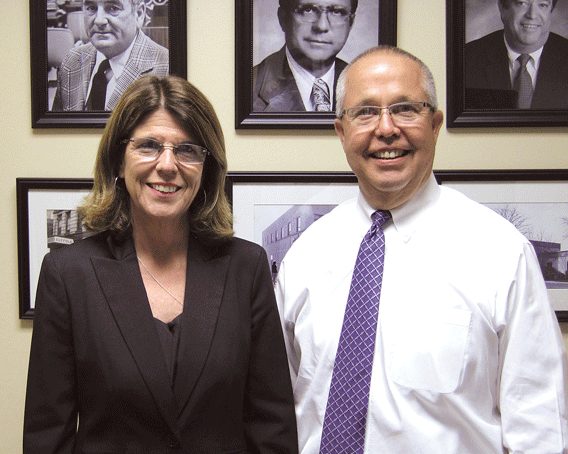
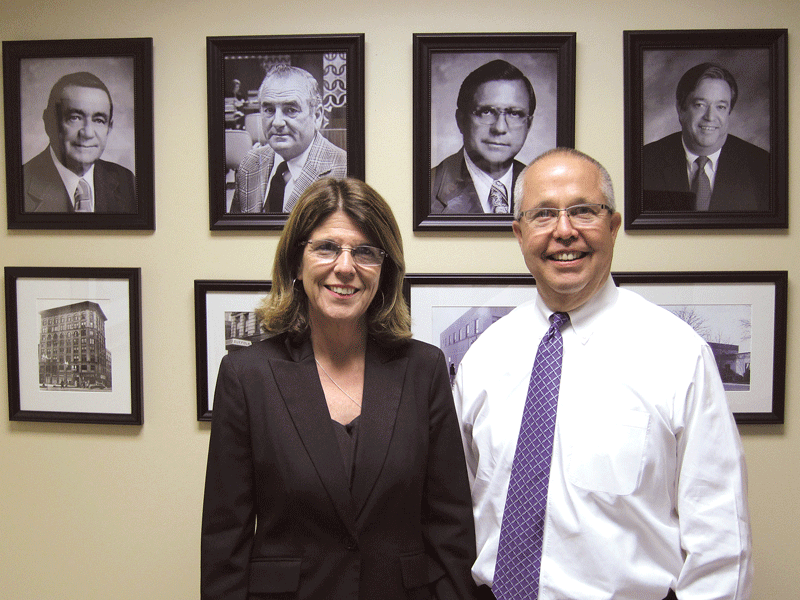
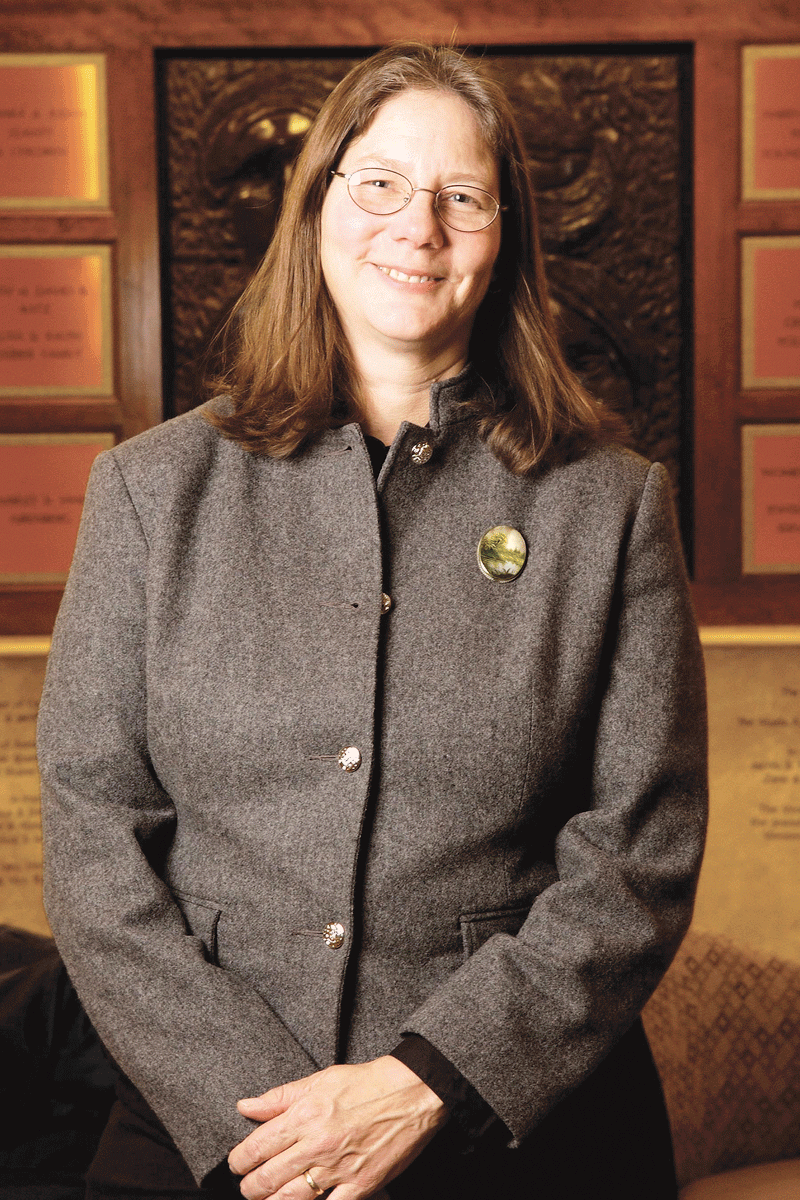
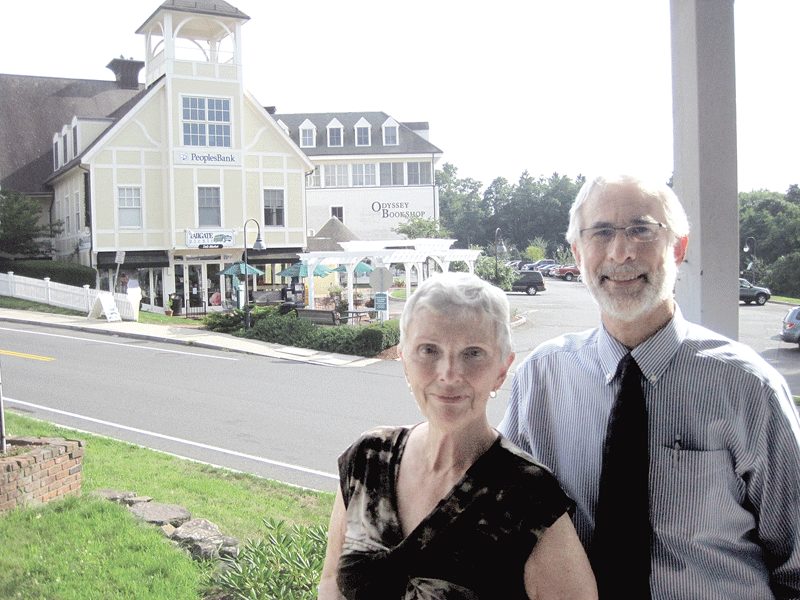
Susan Stockman and Steven Markow

Susan Stockman and Steven Markow say the chamber relies on a support network woven from about 100 mostly small businesses and organizations in the two towns.

Steven Markow was talking about life as a small-business owner in a small community. And to make his point about what he liked most about that life, he recalled a recent episode at the supermarket.

“A customer came up to me, called me by name, and said, ‘I need your help; I’ve broken my glasses,’” said Markow, an optometrist and owner of Village Eye Care in South Hadley. “I really like that. It’s just what I love about living and having a business in a small town; my customers can come up to me in the grocery store, and I know them by name, and I can know right away what they need.”

The business community in South Hadley and neighboring Granby is dominated by such small businesses, he went on, noting that, while this constituency certainly contributes to the social fabric of those towns, it creates challenges, as well as opportunities, for the South Hadley & Granby Chamber of Commerce, which he will serve as president beginning in January.

Elaborating, he said that, while the chamber has some larger members — Mount Holyoke College would definitely be in that category — most of the 100 businesses and organizations involved with the chamber would be considered small if not very small. This creates fiscal challenges (dues are set based on overall employment figures) and limitations on overall support for chamber initiatives, he noted, adding that what this chamber lacks in terms of a membership base and large companies, it makes up with imagination, energy, and resourcefulness.

Those were some of the words chosen by the chamber’s part-time executive director and only employee, Susan Stockman, former director of Corporate Communications for Yankee Candle. She said the chamber is able to carry out its broad mission of serving members and promoting the business community through the donations of time, talent, resources, and vision from supporters such as Mount Holyoke and its president, Lynn Pasquerella, who Stockman refers to as “a dynamo.”

“A while back, she opened her home to our members, and it was a highly attended networking event,” Stockman explained. “We have to rely on others in the community to support us in various ways so we can support our members. The police and fire department, South Hadley School Band, and even our small group of volunteers that produce the annual Holiday Stroll [an outdoor winter festival filled with music, shopping discounts, and food in the Village Commons], they all help.”

Markow agreed. “We take advantage of working as a group, and we’ve even gained members who want to help with the Holiday Stroll, which helps to develop our betterment goals for the community.”

For this issue’s Getting Down to Business focus, BusinessWest talked with Stockman and Markow about this support network that has evolved over the years, and how it is integral to the chamber’s efforts to help improve quality of life in South Hadley and Granby.


It Takes A Village

When Stockman retired from Yankee Candle in the fall of 2005, it took less than four months, even through the typically busy holiday season, for her to realize that full days of downtime were not for her.

“I was so bored, I couldn’t stand it,” she told BusinessWest. “But this opportunity came about, and I had a good deal of experience working with the Franklin County Chamber of Commerce, since Yankee Candle was the largest employer in that area.”

Her background in corporate communications at the renowned tourist attraction was a good fit for the town of South Hadley, and since the position was only part-time, skills that included effectively communicating business objectives and working with volunteers through past chamber functions were welcomed, said Stockman.

But the road hasn’t been easy. “We’re very different from every other chamber in the region in that we are not in a tourism area, and that doesn’t offer us any funding sources, like the state funding that Springfield or even the Berkshires receive.”

But Markow adds that what South Hadley lacks in tourism destinations, it makes up for in the nationally recognized college — Mount Holyoke — and the aforementioned high quality of life and atmosphere that both towns offer. While Granby may be more of an agricultural community, it recently became the new home of the MacDuffie School, a highly respected, private, international boarding high school, which relocated from downtown Springfield.

Markow says there are still many businesses in Granby, but those come with what he calls “outreach issues.”

“Granby has plenty of business, but it tends to be home-based, like contractors, electricians, and plumbers — those businesses that are service-related,” he explained. “And with just a part-time executive director and those of us in the chamber who are already very busy running our own businesses, it’s difficult to go out and speak to them about the pluses of being with the chamber.”

Still, membership has held fairly steady in recent years, despite some losses prompted by the Great Recession.

“It’s been a hard time for many, but most of those that we lost are small, one-person businesses or those that had personal or family concerns,” said Stockman, who noted that membership, which was at 125 a few years ago, is now closer to 100. She noted a spate of recent closings or businesses restructurings, mostly in the restaurant industry along the Route 202 corridor. “But already, we see new businesses taking over those spaces — a gourmet deli, for one — and that is encouraging.”

Overall, membership is just one of the areas where the chamber relies on its members and volunteers to help grow membership and otherwise enable the chamber to carry out its mission, said Markow. “It’s as a group that we can make progress.”

Stockman noted that even the small town of Greenfield has a paid official charged with business development. “We are that person for South Hadley and Granby.”

Despite these challenges, the chamber has been able to bring value to members — and help many small businesses mature and grow — by enabling them to make contacts, largely through a host of formal and informal networking events, as well as informational sessions designed to keep them abreast of issues impacting all businesses in the Commonwealth.

“We’ve had a lot of success over the past few years with our Beyond Business monthly events (essentially an after-5 networking event), and we are very flexible with the days, but members do help out.”

She offered a recent example of group-effort support: Chris Brunelle, owner of Brunelle’s Marina, offered the Lady Bea vessel (on which the company provides cruises down the Connecticut River) as the venue for a networking cruise event on August 28, which will keep the cost of the event down for members.


School Is in Session

Stockman is also preparing for a special Beyond Business at the Old Firehouse Museum in September that will honor premier members. But aside from the networking and recognition, Stockman said there are two standout events in the chamber’s educational program: an annual legislative breakfast, which offers members an update on the political landscape from state Rep. John Sciback and state Sen. Stan Rosenberg (who missed this past spring’s event due to cancer treatments); and the annual Economic Forum, now in its sixth year, which features Mount Holyoke College Professor James Hartley.

“The Economic Forum is especially well-received due to Jim Hartley, who heads the department of Economics and, in fact, was recently named as one of the best 300 professors in the nation by the Princeton Review,” Stockman told BusinessWest.

Indeed, that book, The Best 300 Professors, compiled by the well-regarded Princeton Review, lists no less than 14 Mount Holyoke College professors, more than any college in the Commonwealth listed in that publication.

It is through this high caliber of talent within the South Hadley and Granby area, Markow noted — not just from the large businesses like Mount Holyoke College, but from enterprises of all sizes — that the chamber is able to pool support that helps to educate and better the business and personal lives of those in the area, even if they aren’t chamber members.

“I’m really proud of the quality of life in this community,” he said. “We’re working to make both towns a more attractive place to live and work.”

As a final example, Markow mentioned that, even though he doesn’t own a dog, he suggested that the chamber help make possible the creation of a dog park, a concept he says is becoming increasingly popular in towns across the nation, and certainly a act of ‘betterment’ in the community.

“Dogs these days, with all the town policies, rarely have a chance to be off-leash, and while we can’t take this all on ourselves, we’ll help to facilitate and get it going,” he said.

While every program, initiative, or event isn’t exactly a walk in the park, so to speak, Stockman says each effort — small or large and usually group-oriented — is just one more step in the right direction for the chamber and the communities it serves.


Elizabeth Taras can be reached at [email protected]

Law Sections
So What Does That Mean for Massachusetts Employers?

John S. Gannon

John S. Gannon

In its most significant decision of the year, and arguably the last decade, the U.S. Supreme Court recently upheld most of the Patient Protection and Affordable Care Act (PPACA), the controversial health care legislation also known as ‘Obamacare.’

But a blessing from the Supreme Court only seemed to take the health care debate to more contentious levels as Republican politicians, including presidential hopeful Mitt Romney, have promised to repeal the law. Even so, businesses cannot wait for a ceasefire in Washington. Employers must forge ahead and continue efforts to implement the law as provisions pertaining to the employer-employee relationship become effective.


The Court’s Ruling

At the forefront of the dispute over the PPACA’s legality was a constitutional challenge to the so-called individual mandate, which requires individuals to carry health insurance or pay a penalty. Opponents argued that Congress overstepped its authority when it enacted this part of the law. The Supreme Court majority disagreed, concluding that the individual mandate is a valid exercise of Congressional power to tax. “Because the Constitution permits such a tax, it is not our role to forbid it, or to pass upon its wisdom or fairness,” wrote Chief Justice John Roberts, author of the majority opinion.

Notably, the Supreme Court rejected the Obama administration’s principal argument in support of the individual mandate. Trying to avoid labeling the provision a tax, the government contended throughout that the mandate was a valid exercise of Congress’ power to regulate interstate commerce. That contention failed. “The individual mandate forces individuals into commerce precisely because they elected to refrain from commercial activity,” declared Roberts. “Such a law cannot be sustained under a clause authorizing Congress to regulate commerce.”

Massachusetts is viewed by many as the birthplace of the individual mandate. The state health care reform law includes a similar provision requiring residents of the Commonwealth to carry health insurance or pay a fine, although the formula for calculating the penalty is different from the method used under federal law.


Next Steps for Employers

Now that the uncertainty surrounding health care reform has been resolved, at least from a legal perspective, employers must be prepared to comply with significant provisions of the PPACA that kick in over the coming months. Starting this year, employer-sponsored group health plans will need to provide employees with a summary of benefits and coverage (SBC), which must include certain coverage details. Insurance carriers may provide the SBC notification for fully insured group plans, but plan administrators will have to provide the notification for self-funded plans.

The PPACA also requires employers to report the aggregate cost of employer-sponsored health coverage on Forms W-2. Employers that filed more than 250 Forms W-2 for tax year 2011 must ensure that the cost of coverage is reported next year. Smaller employers may be off the hook until 2014.

Beginning Jan. 1, 2013, the PPACA limits employee contributions to an FSA to $2,500 per year. The $2,500 FSA cap applies only to employee pre-tax contributions to a health care FSA, and does not affect employer contributions toward health care premiums, health savings accounts, health reimbursement arrangements, or other similar accounts.

Looking Ahead

In addition, savvy employers should begin planning to implement parts of the law set to take effect in 2014, including an employer mandate that penalizes businesses for failing to offer adequate health-insurance coverage.

The controversial employer mandate kicks in a little over a year from now. Starting in 2014, employers with more than 50 full-time employees must provide a minimum level of health-insurance coverage or pay a $2,000 penalty per full-time employee. As noted above, this concept is not entirely new to Massachusetts employers, many of which have been required to provide health insurance to employees since 2006, when the Commonwealth enacted its own version of health care reform. However, Massachusetts employers need to be aware that the penalty for failing to offer coverage is far greater under federal law.

The PPACA also requires that the coverage be ‘affordable’ and provide ‘minimum value.’ Coverage is considered affordable if the employee’s required contribution does not exceed 9.5% of household income. An employer provides a ‘minimum-value’ plan if the plan covers at least 60% of the participant’s covered expenses. If the coverage fails to meet these requirements, the employer may be subject to an excise tax of $3,000 if an employee declines to enroll in the plan.


PPACA Uncertainty

Calls to repeal the PPACA will echo throughout the 2012 electoral season. But rescinding the law is no small task. For starters, it will almost certainly take a makeover in the Oval Office. Until that day comes, employers need to be sure they are in compliance with the provisions of the PPACA that are set to go into effect this year and next. They also need start planning for the critical employer mandate set for 2014.


John Gannon is an associate in the Springfield labor and employment law firm of Skoler, Abbott & Presser, P.C., which represents employers exclusively and specializes in helping employers understand their obligations under state and federal employment law; (413) 737-4753; [email protected]

Briefcase Departments

GSCVB Touts Discounts in Updated WOW Value Book

SPRINGFIELD — The Greater Springfield Convention & Visitors Bureau (GSCVB) has produced a new edition of the WOW Value Book, a collection of discount coupons for several of the Pioneer Valley’s leading attractions, restaurants, shops, and more. Offers include discounted admission prices, free restaurant items with the purchase of entrée selections, and shopping discounts. More than 12,500 copies of the dollar-bill-sized book have been printed. Each of the offers highlighted in the coupon book are also available online by visiting www.valleyvisitor.com and clicking “Download WOW Values.” The book offers more than $100 in total savings. According to GSCVB President Mary Kay Wydra, “we got a terrific response to the earlier edition of the WOW Value Book that we released several months ago, and it was our plan to have subsequent editions to allow our seasonal attractions to participate. We created the book for people who came to the region to attend conventions and meetings, to encourage them to visit our restaurants, shops, and attractions in their free time. It also came in handy for people who couldn’t download and print the coupons on our Web site.” Pioneer Valley residents who would like a copy of the WOW Value Book should email [email protected] and provide their name and mailing address, or call (413) 787-1548. The book’s participants include: Adolfo’s Ristorante, Artist Square Group Art Gallery, Bright Nights at Forest Park, CityStage and Symphony Hall, Frigo’s Foods, the Handbag Outlet, La Fiorentina Pastry Shop, Mana Iguana’s, Nadim’s Mediterranean Grill, the Naismith Memorial Basketball Hall of Fame, Petra Hookah Lounge, Springfield Museums, the Student Prince Café and the Fort Dining Room, Zonin’s Deli, and the Zoo in Forest Park, all in Springfield; the Pizza Guy and Six Flags New England in Agawam; the Eric Carle Museum of Picture Book Art and the White Hut in Amherst; Lee Premium Outlets in Lee; the Loft Restaurant & Lounge in Northampton; Renew.calm, Storrowtown Tavern & Carriage House, and the White Hut in West Springfield; Horizons Restaurant & Bar in Wilbraham; the Connecticut Science Center in Hartford; and Friendly’s locations throughout the Pioneer Valley.


Survey: Employers Increase Health and Wellness Benefits

ATLANTA — More employers are offering benefits that encourage employees to improve their health, according to a survey released by the Society for Human Resource Management (SHRM) at its 2012 Annual Conference and Exposition in Atlanta. Over the past five years, benefits that reward employees for improving their health have jumped — a sign that organizations are looking for ways to cut business costs and recognize that employees value these benefits. For example, the percentage of employers offering health and lifestyle coaching jumped from 33% in 2008 to 45% in 2012, and rewards or bonuses for completing a health and wellness program increased from 23% in 2008 to 35% in 2012. “Employers recognize that providing employees with the opportunity to improve their health can increase morale, confidence, and productivity,” said Mark Schmit, vice president of research at SHRM. “Organizations continue to look for ways to manage costs as the economy slowly improves. Benefits that encourage healthier behavior are a cost-effective way to keep up employee morale, while healthier employees also help decrease health care costs to employers and employees.” SHRM’s 2012 Employee Benefits Survey found that, while most employee benefits stabilized this year, 73% of HR professionals reported that the economic downtown negatively impacted employee-benefit offerings (11% to a large extent and 62% to some extent). This is more or less the same as in 2011, when 77% said the economy negatively affected benefits to some or a large extent. Because of the economy and recent employment-related legislation, many employers have switched to benefits that shift primary responsibility and control to employees. For example, more employers offer defined-contribution retirement-savings plans (92%) than defined-benefit pension plans (21%) in 2012, putting the impetus on employees to manage their own retirement savings instead of relying on employer-provided pensions. “By shifting primary responsibility in controlling certain health care and financial benefits, employers are recognizing a shift in workplace culture,” said Schmit. “The new plans allow employees have more control over how they save for retirement and manage their health, while reducing costs for employers. These plans are also more flexible, and thus more attractive, to employees who will likely not spend an entire career with one organization.” Employer spending on benefits remained stable this year, with organizations spending, on average, 19% of an employee’s annual salary on voluntary benefits, 18% on mandatory benefits, and 10% on pay for time employees did not work. Paid-time-off plans have become more  popular; more than half of organizations (51%) provide paid-time-off plans, a combination of traditional vacation time, sick leave, and personal days in one plan, up from 42% in 2009. For more survey data, visit shrm.org/surveys.


Construction Backlog Bounces Back in

Second Quarter

WASHINGTON, D.C. — Associated Builders and Contractors (ABC) reported that its Construction Backlog Indicator (CBI) rose 4.3% in the second quarter of 2012 after declining the two previous quarters. Despite the quarterly expansion, CBI is 0.3 months, or 4.2%, below the second quarter of 2011, and progress in the Northeast region of the U.S remains sluggish. CBI is a forward-looking economic indicator that measures the amount of construction work under contract to be completed in the future. “The CBI accurately predicted both the broader economic softness experienced during the first half of 2012, as well as a flattening of the nation’s non-residential construction recovery,” said ABC Chief Economist Anirban Basu. “The latest CBI data is now projecting gradual acceleration in non-residential construction spending, and perhaps a slight increase in the overall pace of construction activity going forward. Unfortunately, any improvement in non-residential construction activity is likely to remain modest given the ongoing uncertainty regarding America’s fiscal cliff — a number of tax increases and spending cuts that take effect at the end of the year — as well as European sovereign-debt issues and increasingly volatile energy prices. While there is pent-up demand for new construction in the power, manufacturing, and infrastructure segments, the level of economic and political uncertainty remains far too elevated to permit more aggressive non-residential-construction spending recovery in the near term.” During the second quarter of 2012, the Northeast had the smallest gain in construction backlog at 0.05 months for the quarter, and is now at 7.28 months. Across the U.S. average construction backlog rose for all monitored industry segments after declining the two previous quarters. The infrastructure segment registered the largest quarter-to-quarter construction backlog increase, up 1.4 months to more than 10 months — the first time infrastructure backlog has been above 10 months since the second quarter of 2010. Construction backlog in the heavy-industrial category is at its highest level since the first quarter of 2011, but at the lowest level of all the industry segments at 5.92 months. Construction backlog in the commercial and institutional segment is 0.85 months lower than one year ago, and now stands at 7.78 months.


Prices of Construction Materials Decline Again

WASHINGTON, D.C. — Prices of construction materials declined 0.7% in July, according to the Aug. 14 Producer Price Index report released by the U.S. Department of Labor. On a yearly basis, construction materials prices are down 0.6% — the first year-over-year decline since November 2009, when non-residential construction spending was at its lowest point. Non-residential construction materials prices also are down, falling 0.9% for the month and 1.2% for the year. Prices for iron and steel dropped 3.7% for the month and are 9.7% lower on a yearly basis. Softwood lumber prices fell 3.7% in July, but are still 5.9% higher than in July 2011. Steel-mill product prices decreased 2.8% for the month and are down 5.9% year over year. Prices for fabricated structural metal products slipped 1% for the month and are up 0.1% during the past 12 months. Prices for prepared asphalt, tar roofing, and siding surged 5.4% for the month, but are still down 3.8% year over year. Non-ferrous wire and cable prices increased 0.5% for the month, but are down 8.9% from July 2011. Prices for concrete products are up 0.3% for the month and are 1.8% higher year over year. Prices for plumbing fixtures and fittings inched up 0.1% in July and are 1.2% more expensive than one year ago. Crude-energy-material prices increased 0.6% in July, the first monthly increase since February 2012. Year over year, crude-energy-material prices are down 19.1%. Overall, the nation’s wholesale-goods prices increased 0.3% for the month and are 0.5% higher than in July 2011. The report “should be viewed by the non-residential construction industry as good news,” said Anirban Basu, chief economist at Associated Builders and Contractors. “Prices of a number of key inputs declined significantly last month, including steel-mill products, iron and steel, and softwood lumber. Lower construction materials prices translate into more attractive project pro-formas, which in turn make it more likely that a project will be financed and move forward. While it is true that last month’s decline in materials prices is a reflection of a still-sluggish economic environment, there are reasons for growing optimism. For example, much of the economy’s lackluster performance can be attributed to ongoing uncertainty emerging from Washington, D.C., including the looming fiscal cliff. If Congress acts soon to create greater certainty around federal budgetary and taxation issues, the level of business certainty would increase meaningfully. That would result in the availability of more risk-seeking capital to finance projects. Anecdotal and survey information indicate that bankers are becoming more aggressive in their lending. Lower and more stable materials prices are associated with less risky construction, and permanent loans and are more likely to attract capital to construction projects. This means that, for the first time in several months, more robust recovery in non-residential construction spending is conceivable. However, Congress and the administration still must act appropriately before capital becomes sufficiently risk-seeking.”

Education Sections
The Many Flavors of the Region’s MBA Programs

In an ever-more-competitive career marketplace, educational degrees don’t always carry the weight they used to.
“At the turn of the 20th century, if a person had a high-school education, that was fantastic,” said Kathryn Carlson Heler, director of the MBA (master of Business Administration) program at Springfield College. “Remember, most people finished eighth grade and were out working at age 14.”
In the years following World War II, she explained, the G.I. Bill and other factors boosted college attendance, and a bachelor’s degree became the ticket to a secure career. But, in many cases, that’s not enough anymore.
“Most professionals now are saying, ‘hey, what’s the next step?’ And I think the master’s has become an important step — and who knows if it’s going to go further?” she said. “Look at nurses, for example; most of them have bachelor’s degrees, and some hospitals prefer to hire people with their master’s. And in the business world, the MBA has become the degree to have.”
Others who spoke with BusinessWest agree. “The MBA does carry an awful lot of weight in the workplace,” said Tom Barron, director of the MBA program at American International College. “It can affect opportunities for promotion, raises, and the like.
“The MBA allows you to really look at other aspects of a business, not just your own area of expertise,” he further explained. “You end up seeing how your area impacts the other areas of a business, so you’re a lot more comfortable developing company-wide solutions. Many people who get MBAs consider changing career fields, exploring areas they wouldn’t have been able to before, because they now have a wider cross-section of knowledge and expertise.”
Mo Sattar, who directs the MBA program at Bay Path College, is another believer in the strength of the degree.
“It helps to create leverage: how can I be a little bit better than the next person or the next business? Knowledge creates power,” he said. “I believe in teaching students how to learn, how to be life learners. That really matters, especially in the MBA world.”
For this issue’s focus on education, BusinessWest sits down with administrators from six area institutions — Western New England University, Elms College, and UMass Amherst are the others — to talk about the elements of a vibrant MBA program, and how the schools are tailoring their offerings to a very diverse group of degree seekers.

Matt Fox

Matt Fox says WNEU’s MBA program, like many regional offerings, allows students to finish in a year or longer, working on campus or online.


Time Trials
Some undergraduates intend to continue on to an MBA program right after finishing their bachelor’s degree, while many MBA students are longtime professionals returning to school to enhance their career prospects — and don’t necessarily have time to tackle a full-time course load or daytime classes. That’s why many colleges offer online courses, evening classes, or a blend of options.
For example, Springfield College’s 4+1 program “is an opportunity for our undergrads to stay a fifth year and earn their MBA,” Carlson Heler said. “What they do is take two classes in the summer after they earn their undergraduate degree and eight classes over the next two semesters.
“We have also attracted professionals from the community. Some of them have done the program in one year, working full-time and also going to school full-time,” she said. “But most of my professionals who join our program do it on a part-time basis, and do about two classes a semester.”
Similarly, the MBA program at UMass Amherst, part of its Isenberg School of Management, also stresses flexibility — to pursue a degree full-time on campus, completely online, or in a blended format at any satellite campus location.
Katherine Piedra, the director of the full-time program, has a unique perspective on that track, having graduated from it in 2004; now, she handles admissions, acceptance procedure, and operations, among other roles.
“The format hasn’t changed much from when I was here eight years ago,” she said, noting that most of the core coursework is completed during the first year, with field work highlighting the second year.
“We get a gamut of people, and we want a diverse class — not just in the traditional diversity sense, culturally, but across the board. We have about 35% international students in our class,” Piedra said.
Having both full-time and online options provides needed flexibility for the differing needs of students, she added. “The full-time program tends to have more people who are career changers. With the online program, it’s people who want their MBA to stay within their company, but want that boost. The online students tend to be older on average, too.”
She noted that, over the years, online degree seekers have multiplied, with a corresponding decline in those pursuing the full-time program. So the playing field has changed, with a lot more entrants into the online market.” Piedra said
Like most regional offerings, AIC’s MBA program can be finished in under two years, although some students, largely working professionals, may spread it out over three to five years, Barron said. “We have an interesting mix, with students coming from undergraduate programs as well as people who have been in the workforce 5, 10, 20-plus years.”
Western New England University also offers a blended online and evening degree program. “Right now, we primarily serve working professionals,” said Matthew Fox, director of Recruiting and Marketing for Graduate Studies and Adult Learning. “But the traditional student coming right out of college with a bachelor’s degree, that’s growing.”
This fall, WNEU will launch a full-time, accelerated day program in addition to its existing track. “We see that as a great opportunity to cater to a growing international student body,” Fox said. “They’re clearly looking for an experience where they can be immersed in their studies and have that continuous, face-to-face interaction with the faculty, as opposed to the existing model that blends online and in-classroom time.”
In any case, he added, “we emphasize to students, whether they’re traditional students or working professionals, they can accelerate their studies and finish the program in as little as a year, or they can take longer. It’s quite flexible.”

What’s Your Niche?
Students are also finding flexibility in the focus of the region’s various MBA programs.
For example, the Elms, which launched its MBA program only last year, offers three areas of study — health care leadership, accounting, and management — in a fast-track, hybrid format that pairs online and on-campus courses, said Kerry Calnan, director of the program.
“We’re the last to the market, and it’s a saturated marketplace,” she noted, adding that the school’s leaders took to heart a study conducted recently at Harvard called “Rethinking the MBA.”
“When we were getting ready to launch, we talked about the old-school model of MBA programs and how we needed to change if we wanted to add value, so that people who go through our program are valuable in the marketplace. We want to make sure we’re fitting what the market needs.”
In doing so, Elms staff interviewed some two dozen senior-level business leaders in the region and asked them what they’d like to see in an MBA program that they’re not getting from current MBA graduates.
“We developed our program by listening to what they had to say,” Calnan said, adding that the program taps area professionals to participate in course instruction, to lend more real-world credibility to the program. In fact, the five core courses in each track are delivered by a team comprised of an academic and a professional.
Springfield College, another recent entry into the MBA market with a program that started in 2010, offers two concentrations: one in for-profit management, and one in nonprofit management. The latter is attractive to people eyeing opportunities in health care, recreation, youth, the arts, sports, and as fund-development officers, to name just a few possible career tracks.
In both its general management and nonprofit concentrations, Springfield College offers a one-year, 30-hour degree program that’s tailored for professionals, Carlson Heler said.
“It’s a very doable degree; our classes are offered in the late afternoon and evening so that students can work during the day and take classes at night,” she noted. “And the size of our classes is very small, so students get to know their professors, and the professors get to know them.”
As with the Elms, it’s important that the SC program involve area professionals in the courses, “so students have an opportunity to tap into their experience.”
And the benefits of those exposures go both ways, Carlson Heler noted. One executive involved in the program told her, “‘I get to know the younger generation, and they will be my future employees — or, in some cases, my future boss. I get to know how they think and how they view the world, and it’s very important for me to have that opportunity.’
“I think it’s important.” she added, “that we reach out to the business and nonprofit community and ask them, ‘what should our students learn? What is important for them to be successful, and for your company or organization to have the best employees it can?’”

Mo Sattar

Mo Sattar says Bay Path’s MBA program helps students “connect the dots” and understand how all aspects of business work together.

AIC offers both a traditional MBA program and a ‘high-performance’ degree, with concentrations available in health care management, operations management, international business, strategic marketing, workforce and leadership development, fraud and financial crimes, green business, and management and sustainability.
“AIC had the first MBA program in Western Mass.,” Barron said. “One thing that’s unique is our strong entrepreneurship program. In our capstone course, the final course, students are actually required to go through and develop a business plan they can use to start their own business.”

Going Global
One theme that surfaced repeatedly in discussing area MBA programs is a focus on international business — reflective of what has become a global marketplace.
“Throughout the history of AIC and its MBA program, we have always had a strong international base in all key studies,” Barron said. “When we’re going through, asking about finance, economics, operations, we’re always going through what’s happening from a global perspective.”
That distinction has become crucial over the past two decades with the emergence of the Internet as a business tool, he added.
“If you look at a business that wants to operate out of a home, 20 years ago, the geographic area was the area around the house. Today, with the Internet, you’re literally doing business and delivering products around the world,” he noted. “So, how do we take this knowledge from all these subjects and not only apply it to local industry, but learn how to deal with it on a global basis?”
UMass provides overseas opportunities for its MBA students by means of exchange programs in Sweden, China, India, Brazil, Denmark, and South Korea.
“We’re working in a global economy,” Piedra said. “Anyone with international work experience in their MBA program has an edge going out into the work world, because of that experience working with people from other cultures and other countries.”
Sattar emphasized the way a strong MBA program “connects the dots” throughout the content, giving students a broad perspective on business.
“Our program starts with a business introduction where students learn about business models and strategy models and start to analyze some case studies and use analytical tools, like Excel,” he explained. Once students are grounded in that foundation, they move on to specifics like marketing, organizational behavior, business law and ethics, and the like, always being pushed to see the overlap between all of these disciplines.
“We learn about the important building blocks in business and how to connect them together, how to synthesize and optimize and maximize them,” Sattar said. “I find that, sometimes, people working in one area don’t understand what’s happening in the next cubicle or the next office.”
The idea, he said, is to produce professionals who understand the big picture within the company they work for — or, in many cases, who are able to launch their own enterprises.
“The value they get is not just that they truly understand marketing, finance, and legal issues,” he stressed. “The value is seeing how they are all connected. It’s more like a symphony than individual pieces of music, and the value comes in connecting everything together.”

Value Proposition
That word ‘value’ was another concept that area administrators kept returning to.
“I’ve been working with the graduate office for approximately five years, and I have found that the number of students seeking their MBA has definitely increased, whether it’s for an entry-level position or to enhance their prospects within their organization, or even to secure their present job,” Fox said.
“I think the value of an MBA has held, and if anything, the interest has increased from students seeking their MBA. We’ve seen our enrollments more than double in the last four years. Yes, we’re dealing with smaller numbers than some other schools, but it’s significant for us. That, to me, is a positive sign.”
Even a recently established program like the one at Springfield College is reporting positive returns in the single most critical area — post-degree employment.
“In our first class, the class of 2011, all of my students found good jobs within six months,” Carlson Heler said. “With the class of 2012, half of them have jobs, and the other half are interviewing, and it looks really good.
“The jobs are out there,” she continued. “People talk about the economy, but my students are finding jobs — maybe not all in the Pioneer Valley, unfortunately, which we would love, but the jobs are definitely out there for the MBA graduates.”

Joseph Bednar can be reached at [email protected]

Agenda Departments

NEBA Golf Tournament
Aug. 26: New England Business Associates (NEBA) will host a golf tournament on at Tekoa Country Club in Westfield. Proceeds from the tournament will benefit NEBA’s skills-training, supported-employment, academic-achievement, and self-employment programs for individuals with disabilities. The tournament will begin with a shotgun start at 1 p.m., and an awards and dinner ceremony will follow the finish. Sponsorship opportunities are available, and all golfers will have an opportunity to participate in contests and win prizes. To participate in the tournament and/or become an event sponsor, visit neba.eventbrite.com or contact David Parkinson, tournament director, at (413) 821-9200, ext. 145, or [email protected].

Massachusetts Chamber Business Summit
Sept. 9-11: The Massachusetts Chamber board of directors will conduct its annual Business Summit and Awards Ceremony at the Resort and Conference Center at Hyannis. The two-day meeting allows participants to meet with business professionals from across the state, as well as listen to state and local elected officials who will discuss the future of business in Massachusetts. Additionally, representatives from the Mass. Office of Economic Development will discuss loans, grants, and tax incentives available to business owners. Industry experts will also be on hand to discuss topics such as leveraging social media, search-engine optimization, and health care cost containment. The winners of the Business of the Year Award and the Employer of Choice Award will also be announced during the summit. For more information, call (617) 512-9667 or visit www.masscbi.com.

World Affairs Council Annual Meeting
Oct. 10: Hampshire College President Jonathan Lash will speak at the World Affairs Council of Western Mass. Annual Meeting & Dinner in the Mahogany Room of the Springfield Sheraton Hotel in downtown Springfield. More details will be forthcoming. Lash is an internationally recognized expert on practical solutions to global sustainability and development challenges. Before he became president of Hampshire College in 2011, he served as president of World Resources Institute (WRI), an environmental think tank with offices in eight countries and partners in more than 50 countries. WRI is an international leader on issues ranging from low-carbon development to sustainable transportation. From 1993 to 1999, Lash was co-chair of the President’s Council on Sustainable Development, a group of government, business, labor, civil-rights, and environmental leaders appointed by Bill Clinton that developed visionary recommendations for strategies to promote sustainable development. He played a key role in the creation and success of the U.S. Climate Action Partnership, which in 2007 issued the highly influential “Call to Action” on global warming. Prior to WRI, Lash held posts as director of Vermont Law School’s Environmental Law Center, Vermont secretary of Natural Resources, and Vermont commissioner of Environmental Conservation, as well as as a federal prosecutor. For more information on the event, call (413) 733-0110.

Western Mass.
Business Expo
Oct. 11: BusinessWest will again present the Western Mass. Business Expo. The event, which made its debut last fall at the MassMutual Center in downtown Springfield, will feature more than 180 exhibitors, seminars, special presentations, breakfast and lunch programs, and the year’s most extensive networking opportunity. Comcast Business Class will again be the presenting sponsor of the event. Details, including breakfast and lunch agendas, seminar topics, and featured speakers, will be printed in the pages of BusinessWest over the coming months. For more information or to purchase a booth, call (413) 781-8600, e-mail [email protected], or visit www.wmbexpo.com.

40 Under Forty Reunion
Nov. 8: BusinessWest will stage a reunion featuring the first six classes of its 40 Under Forty program. Details on the event will be forthcoming. What is known is that it will be staged at the Log Cabin Banquet & Meeting House in Holyoke, and will be open only to 40 Under Forty winners, sponsors, and their guests, as well as judges of the first six contests. For more information on the event, call (413) 781-8600, or e-mail [email protected].

Departments People on the Move

Mark R. Tolosky

Mark R. Tolosky

Mark R. Tolosky, president and CEO of Baystate Health, was recently awarded the prestigious 2012 William L. Lane Hospital Advocate Award from the Mass. Hospital Assoc. (MHA) in recognition of his “exceptional leadership.” During his 20-year tenure at one of the largest health systems in New England, Tolosky has helped transform Baystate Health into one of the Top 15 health care systems in the country, as recognized by Thomson Reuters. Lynn Nicholas, president and CEO of the MHA, noted that Tolosky “has driven the transformation of the North End of Springfield into a vibrant ‘medical mile,’ constructing new facilities, creating jobs, improving the local community, and contributing to the economic development of the city.” Nicholas added, “under Tolosky’s leadership, Baystate Health and Health New England are also nationally recognized for top levels of quality and safety, most notably through advances made in clinical care, the adoption of health-information technology, and the development of team-based and patient-centered medical homes.” Each year at the association’s annual meeting, the MHA publicly acknowledges one senior hospital executive who exemplifies exceptional leadership and the characteristics to which all hospital and health system leaders should aspire. Tolosky was nominated by Richard B. Steele Jr., chairman of the Baystate Health Board of Trustees, and his senior leadership team at Baystate Health. “Mark sets a stellar example as a CEO who tirelessly advocates for improvement, inclusion, responsibility, preparation, taking the high road, and the importance of collaborative, positive relationships,” noted one letter in support of Tolosky’s nomination. According to Nicholas, it was the first time in the nine-year history of presenting the award that the MHA executive committee was unanimous in its selection.
•••••

Eugene J. Cassidy

Eugene J. Cassidy became the seventh CEO of the Eastern States Exposition (ESE) in its 95-year history on June 27. He joined ESE as Director of Finance in 1993, and was named Executive Vice President and Chief Operating Officer in March 2011. He succeeded Wayne McCary, who retired June 26 after 21 years at the helm of the West Springfield institution. “The Big E is a balance of agriculture, industry, and entertainment all designed to move the core mission of the exposition forward while retaining the roots on which it was built,” said Cassidy. He is accredited as a certified fair executive by the International Assoc. of Fairs and Expositions (IAFE) and is actively involved as a member of the budget and finance and program committees. He is a frequent presenter at IAFE meetings on the local, regional, and national levels and served as program chair of the organization’s International Convention in Las Vegas in 2010. Cassidy began his career at KPMG Peat Marwick in Springfield. He then served as treasurer of Chicopee Cooperative Bank and Colonial Mortgage Co. and was assistant vice president of Park West Bank and Trust Co., all wholly owned subsidiaries of Westbank Corp.
•••••
Andrea Robitaille, P.E., recently joined Tighe & Bond Inc. as a Project Engineer. She brings to that position eight years of professional experience with the firm’s expanding structural-engineering team. Robitaille has provided bridge design and inspection, construction design, and transportation-planning services for numerous clients and projects throughout New England.
•••••
David Kalman, M.D. was recently promoted to President of Springfield Medical Associates, a multi-specialty group gractice with locations in Springfield and Enfield. Kalman has been a practicing gastroenterologist since 1927.
•••••
Amy Royal

Amy Royal

Amy Royal, founding partner of Royal LLP, the Northampton-based woman-owned boutique, management-side labor and employment law firm, has been invited to speak at the ExecuSummit 7th Annual National Employment Practices Liability Insurance Conference at Mohegan Sun in Uncasville, Conn. in October. She will present on minimizing emotional-distress damages in employment-litigation claims.
•••••
Danielle Nicklas

Danielle Nicklas

Danielle Nicklas, an attorney with the Springfield-based firm Cooley, Shrair P.C., has been appointed to serve on the Mass. Bar Assoc. (MBA) Health Law Section Council. Each council is charged with formulating and recommending policy and legislative positions, developing CLE program content for the MBA, and producing articles for Section Review and/or Lawyers Journal. Nicklas focuses her practice on the area of health law with a concentration in health care compliance, risk management, Start, and anti-kickback regulations.
•••••
Kevin Hart

Kevin Hart

Holyoke-based Mohawk Communications announced that Kevin Hart has joined the staff as Director of Operations. Hart has more than 15 years experience in the telecommunications field, from high-end PBX systems, to fiber installation, to managing communication networks for mid- to large-sized businesses. He will be managing the customer service department along with the outside technicians and various other projects.

Agenda Departments

NEBA Golf Tournament
Aug. 26: New England Business Associates (NEBA) will host a golf tournament on at Tekoa Country Club in Westfield. Proceeds from the tournament will benefit NEBA’s skills-training, supported-employment, academic-achievement, and self-employment programs for individuals with disabilities. The tournament will begin with a shotgun start at 1 p.m., and an awards and dinner ceremony will follow the finish. Sponsorship opportunities are available, and all golfers will have an opportunity to participate in contests and win prizes. To participate in the tournament and/or become an event sponsor, visit neba.eventbrite.com or contact David Parkinson, tournament director, at (413) 821-9200, ext. 145, or [email protected].

Massachusetts Chamber Business Summit
Sept. 9-11: The Massachusetts Chamber board of directors will conduct its annual Business Summit and Awards Ceremony at the Resort and Conference Center at Hyannis. The two-day meeting allows participants to meet with business professionals from across the state, as well as listen to state and local elected officials who will discuss the future of business in Massachusetts. Additionally, representatives from the Mass. Office of Economic Development will discuss loans, grants, and tax incentives available to business owners. Industry experts will also be on hand to discuss topics such as leveraging social media, search-engine optimization, and health care cost containment. The winners of the Business of the Year Award and the Employer of Choice Award will also be announced during the summit. For more information, call (617) 512-9667 or visit www.masscbi.com.

World Affairs Council Annual Meeting
Oct. 10: Hampshire College President Jonathan Lash will speak at the World Affairs Council of Western Mass. Annual Meeting & Dinner in the Mahogany Room of the Springfield Sheraton Hotel in downtown Springfield. More details will be forthcoming. Lash is an internationally recognized expert on practical solutions to global sustainability and development challenges. Before he became president of Hampshire College in 2011, he served as president of World Resources Institute (WRI), an environmental think tank with offices in eight countries and partners in more than 50 countries. WRI is an international leader on issues ranging from low-carbon development to sustainable transportation. From 1993 to 1999, Lash was co-chair of the President’s Council on Sustainable Development, a group of government, business, labor, civil-rights, and environmental leaders appointed by Bill Clinton that developed visionary recommendations for strategies to promote sustainable development. He played a key role in the creation and success of the U.S. Climate Action Partnership, which in 2007 issued the highly influential “Call to Action” on global warming. Prior to WRI, Lash held posts as director of Vermont Law School’s Environmental Law Center, Vermont secretary of Natural Resources, and Vermont commissioner of Environmental Conservation, as well as as a federal prosecutor. For more information on the event, call (413) 733-0110.

Western Mass. Business Expo
Oct. 11: BusinessWest will again present the Western Mass. Business Expo. The event, which made its debut last fall at the MassMutual Center in downtown Springfield, will feature more than 180 exhibitors, seminars, special presentations, breakfast and lunch programs, and the year’s most extensive networking opportunity. Comcast Business Class will again be the presenting sponsor of the event. Details, including breakfast and lunch agendas, seminar topics, and featured speakers, will be printed in the pages of BusinessWest over the coming months. For more information or to purchase a booth, call (413) 781-8600, e-mail [email protected], or visit www.wmbexpo.com.

40 Under Forty Reunion
Nov. 8: BusinessWest will stage a reunion featuring the first six classes of its 40 Under Forty program. Details on the event will be forthcoming. What is known is that it will be staged at the Log Cabin Banquet & Meeting House in Holyoke, and will be open only to 40 Under Forty winners, sponsors, and their guests, as well as judges of the first six contests. For more information on the event, call (413) 781-8600, or e-mail [email protected].

Briefcase Departments

Paid Sick Leave Sent to Study by Lawmakers
BOSTON — Backers of a bill that would require certain employers to offer workers earned paid sick leave acknowledged in recent months that it would be an uphill battle to get the legislation passed this session. They were proven right when the Joint Committee on Health Care Financing sent the bill to a study, according to the House clerk’s office, effectively killing its chances of becoming law this session, with the Legislature planning to recess at the end of July. The paid sick-leave bill was drafted by state Rep. Cheryl Coakley-Rivera and released favorably this year from the Labor and Workforce Development Committee co-chaired by the Springfield Democrat. Paid sick-leave benefits for workers have become a perennial issue on Beacon Hill, backed by a broad coalition of organizations and lawmakers who argue that legislation would improve productivity, reduce turnover in the workplace, and drive down health care costs by allowing people to seek primary care during the day rather than visiting emergency rooms after hours. Many business groups, however, including the Massachusetts Chamber of Commerce, warn that forcing employers to provide certain benefits could discourage hiring at a precarious time for the economy. Coakley-Rivera’s bill would have allowed workers at companies with more than 10 employees to earn up to seven paid sick days a year, while employers with between six and 10 employees would have been required to allow employees to accrue up to five paid sick days. Business, however, strongly resisted mandating sick leave, warning the bill could cost the economy as many as 12,000 jobs and claiming that such policies are best established by employers.

Construction Employment Stagnates in June
ARLINGTON, Va. — Construction employment stalled in June as more former construction workers left the industry, according to an analysis of new federal data released by the Associated General Contractors of America. The lack of current job openings, along with the departure of experienced workers, suggests a potential skilled-labor shortage may be developing, construction association officials warned. “Employment in the construction industry has fluctuated within a very narrow range — 1% above or below the June level of 5.5 million — for more than two years now,” said Ken Simonson, the association’s chief economist. While the latest figure was 14,000 higher than one year earlier, the June 2012 total was just 2,000 higher than in May and in June 2010. “Construction employment has essentially been stagnant for much of the past two years.” Meanwhile, the unemployment rate for former construction workers fell to 12.8%, the lowest June rate since 2008 and much better than the 15.6% rate in June 2011 or the 20.1% rate in June 2010, Simonson noted. He added that, over the past two years, nearly 750,000 experienced workers have either found jobs in other industries, returned to school, retired, or otherwise left the workforce. “It will be hard for construction firms to get those skilled workers back when demand picks back up.” There was little difference among construction segments in terms of recent job gains or losses, Simonson noted. Residential construction added 1,700 total jobs in June and 8,900 (0.4%) over 12 months. Non-residential construction firms lost 600 jobs in June but added 4,300 (0.1%) over 12 months. Within the residential segment, residential specialty trade contractors added 7,600 jobs for the month and 14,100 (1.0%) over the past year, reflecting ongoing strength in multi-family construction. In contrast, residential builders — mostly single-family homebuilders — lost 5,900 positions in June and 5,200 (–0.9%) over 12 months. Non-residential job gains for the year were concentrated among non-residential building contractors, which lost 1,000 jobs in the latest month but added 4,300 (0.7%) over 12 months. Heavy and civil-engineering construction firms shed 2,000 jobs in June and 1,800 (–0.2%) in the past year. Non-residential specialty trade contractors boosted employment by 2,400 since May but only 1,800 (0.1%) since June 2012. Association officials noted that one bright spot for the industry was the 27-month highway and transit bill the president recently signed into law. They said the legislation includes many significant reforms that will allow more existing transportation funds to be invested in highway and transit construction projects, as opposed to unrelated programs. “This measure will certainly help staunch the decline in construction employment among highway and transportation builders,” said Stephen Sandherr, the association’s chief executive officer. “Congress understands that investing in infrastructure is one of the best ways to support growth within the private sector.”

Summit Focuses on Academic Advising
SPRINGFIELD — More than 70 community-college faculty and advisors met at the Springfield Technical Community College (STCC) campus to participate in an academic advising summit on June 22 to focus on advising as a collaborative approach. The summit workshops explored national best practices in academic advising, apprised academic advisors of National Academic Advising Assoc. (NACADA) services and resources that support more effective academic advising, and detailed how to improve both individual academic-advising skills and overall campus academic programs. Sessions included topics about career exploration and advising tools, introduced advisors to the Advising Is Teaching program, and discussed important updates to advising software. Keynote speaker Susan Kolls, associate director of Student Account Services at Northeastern University and a member of the NACADA board of directors, said students today are faced with a variety of challenges. They work hard both in and outside the classroom balancing school, work, and families; they struggle with financial issues; and many are in the military, often finishing their schoolwork while in the combat zone. “We’re looking at the whole student,” said Kolls. “None of our students are only students, and if we don’t look at the things that impact them, if we only look at the academic side, we can’t help them with the things outside of school.” Knowing a student’s background, Kolls said, can help advisors understand how a student is better, or less, able to cope with their situation. Through her interactive session, Kolls questioned how to get faculty, staff, and advisors to think about all of the contributing factors that impact a student’s success. According to Kamari Collins, STCC’s director of Academic Advising, the summit allowed advisors from the region to get together and start a conversation. “It was a good way to have everyone focus and strengthen our campus as a whole, and it was a great opportunity for us to share our best practices with our colleagues at the other community colleges.” The summit, made possible through the Board of Higher Education’s Vision Project Performance Incentive Grant, was available to the four community colleges in the Western Mass. Vision Project Exchange: Berkshire Community College, Greenfield Community College, Holyoke Community College, and STCC. This was the first time STCC has hosted the summit.

Hiring Lukewarm in June
NEW YORK — Hiring was lukewarm last month, with employers adding jobs but not enough to bring the unemployment rate down. The economy added 80,000 jobs in June, the U.S. Labor Department reported, barely an improvement from the 77,000 jobs added in May. Meanwhile, the unemployment rate remained at 8.2%. Economists surveyed by CNN Money had expected to see employers add 95,000 jobs and the unemployment rate to remain unchanged. The labor market has been volatile this year, with job growth starting off strong in the first couple months of 2012. Then a disappointing slowdown in the spring led many to wonder whether the recovery was taking a turn for the worse. June’s weak growth added to those fears. The economy needs at least 125,000 jobs added each month just to keep up with population growth. Revisions from previous months also showed the economy gained 1,000 fewer jobs in April and May than originally thought. Overall, the job market has a long way to go to climb out of the deep hole left by the financial crisis. Of the 8.8 million jobs lost, only about 3.8 million have been added back. Roughly 12.7 million Americans remain unemployed, and 41.9% of them have been so for six months or more. Another 88 million out-of-work people were not even counted as unemployed because they didn’t look for a job in the last four weeks.

Law Sections
Crear, Chadwell & Dos Santos Charts an Ambitious Course

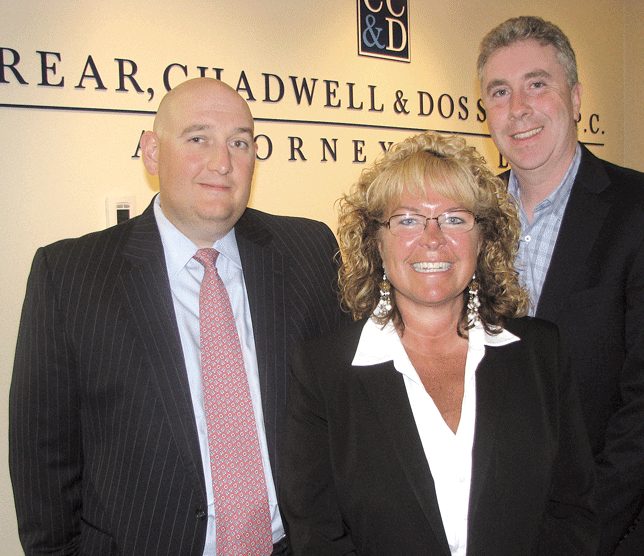
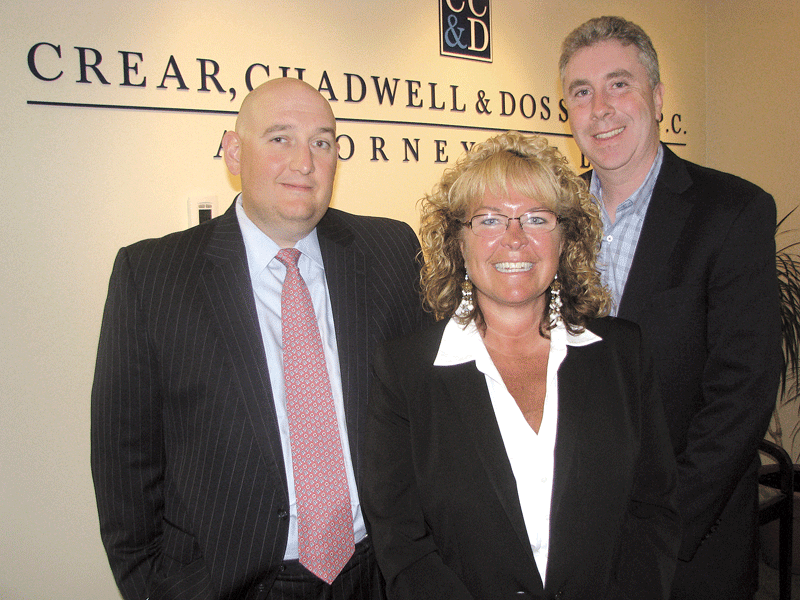
From left, Tony Dos Santos, Kimberly Davis Crear, and Jim Chadwell.

From left, Tony Dos Santos, Kimberly Davis Crear, and Jim Chadwell.

Tony Dos Santos remembers thinking — actually, the word he used was knowing — that it was definitely time for a career course change.
And as he talked about the thought process that led him to that conclusion that he needed to leave the larger-law-firm environment — in this case the Springfield-based firm Robinson Donovan — and find an opportunity to put his name over the door, he struggled somewhat in his efforts to describe it before eventually finding the terminology he was looking for.
“I just wanted to be in much greater control of my destiny,” he told BusinessWest. “I realized that being more of my own boss, being in a smaller place where there’s more flexibility and less structure, was what I was looking for at this stage in my career.”
Kimberly Davis Crear and Jim Chadwell could certainly relate.
They had come to the same basic conclusion about their careers several years earlier, and decided, separately, to leave Robinson Donovan and start their own firm. Crear did so in 2003, when she partnered with two former Robinson Donovan partners, and Chadwell joined that firm a few years later. He and Crear have remained together (the two other partners left to start their own venture), and built a solid reputation — and sizable portfolio of clients — in the realm of workers compensation defense work.
Late last year, the partners began talking with Dos Santos about broadening the base of their firm by adding his name to the letterhead and his expertise — commercial real estate and general business law — to the resume.
Those talks, which coincided with Crear and Chadwell’s need to find new quarters — their lease was up in space within the Fuller Block that will become the new home to WFCR — concluded that this was a good fit on many levels.
“We all knew each other, we’ve all worked together … we had a lot of history together,” said Dos Santos. “It’s helpful when you’re making a move to know the people you’re going to be working with and respect them.”
Chadwell agreed, and noted that the three lawyers, who have been referring clients to each other steadily for years, complement one another, and together offer a base of specialties that provides strong growth potential.
On April 1, the three partners and seven additional staff members settled into 3,500 square feet on the third floor of Monarch Place. And with the settling in period behind them, they’re focused on continued growth of their own practices and, in Dos Santos’ making that transition from lawyer to business co-owner.
For this issue and its focus on business law, BusinessWest talks with the three partners about where they eventually want to take this firm, but mostly about that notion of controlling not only their destiny — but that of their business venture.

Making Their Case
As she talked with BusinessWest about the feel of a small boutique firm and what she likes most about it, Crear pointed to the logo on her new business card.
The square image featuring three initials (‘C,’ ‘C,’ and ‘D’) as well as the ampersand, was selected after input from all three partners, who had an active role in the design process, which went fairly smoothly, she said, adding that such democracy — not to mention quick decision-making — doesn’t generally prevail at most large firms.
“I have a comfort level with this setting that I just didn’t have in a larger firm,” she explained, noting that over the past decade or so, she and Chadwell have become well versed in what both described as the “business side” of law — meaning everything from hiring personnel to handling a payroll to leasing a copier — and out of necessity.
Dos Santos, meanwhile, is still negotiating a learning curve.
“When you’re in a large firm, you don’t deal with any of the real day-to-day issues,” he said, referring to everything from IT matters to lease agreements, which he handled in this case. “You have either an executive committee or a professional executive who’s making all those decisions, and you’re just focused on practicing law; now, you’re more of a business person practicing law.”
While that transition process continues, the three partners are working to build the business they’ve formed. And for Crear and Chadwell, that means efforts to grow their already substantial portfolio in workers compensation defense work.
Both benefited substantially from the tutelage of former Robinson Donovan partner Jim Turtollotte, said Chadwell, describing him as the dean of the local workers comp defense bar, and have steadily expanded their client base over the years.
It now includes most all of the major workers comp providers, as well as self insured companies and groups, not only in Western Mass. but across the state as well.
And while such defense work generally involves the carriers, there is considerable employer involvement in such matters, said Crear, and thus the opportunity for referrals and a chance to do more and different types of work for those on the client list.
“I often have someone from the corporate piece of the company with me watching the workers comp claim,” she explained, “and as a result, we’ve been able to establish a number of relationships.”
And this is why Dos Santos is an important addition for the firm.
A partner at Robinson Donovan when he left that firm, Dos Santos specializes in all facets of commercial real estate, commercial finance, and general business law. He has significant experience representing developers, investors, and lenders regarding complex commercial real estate transactions, including acquisitions, dispositions, leasing, financing, zoning, and permitting, and recently has cultivated a niche involving affordable housing initiatives for formerly homeless veterans, including work with the nonprofit work Soldier On.
“They’re expanding exponentially, and I’ve done a lot for them,” he said of Soldier On, adding that one current project involves the former police training facility in Agawam, while another involves Veterans Administration property in Leeds.
When asked if there was anything approaching a five-year plan for the firm, Chadwell laughed and said, “we signed a five-year lease here — that’s our strategic plan.”
Elaborating, and turning more serious, he said the new venture, with its broader range of specialties, has solid growth potential. Where, when, and how that growth takes place is a function of how the three partners are able to expand their portfolios — possibly necessitating the need for more help — and whether there are logical additions to the roster of specialties that would bring more lawyers to the firm.
One possible avenue for growth is the broad realm of employment law, said Chadwell, adding that it would be a natural fit given the general business law work handled by Dos Santos and the workers comp defense services that he and Crear provide.
“I could see employment law being a tremendous fit going into the future with the nature our practices,” said Chadwell, noting that all three partners already refer out a considerable amount of work in that area. “And it’s an ever-growing practice area.”
The firm has the right of first refusal on some additional space on the third floor, said Chadwell, adding that it is hope — and expectation — that there will be need to exercise that right in the near future.

Final Arguments
As she gave a quick tour of the firm’s new offices, Crear noted that she swung a swift, mutually beneficial deal with Chadwell to take what would be considered the corner office. Dos Santos, meanwhile, got a consolation prize of sorts — the office closest to the conference room.
Such quick, easy decisions usually don’t happen at larger firms, where bureaucracy and rules often dictate such matters.
But they are part and parcel to life in a small boutique firm, where the principals are firmly in control of their destiny — and determined to make the most of that opportunity.

George O’Brien can be reached at [email protected]

Law Sections
NLRB Rules Most Proposed Provisions Are Too Broad in Nature

ROSEMARY J. NEVINS

Rosemary J. Nevins

In their quest to protect company interests and private information, many employers have developed social media policies restricting the use of such media by their employees with regard to workplace matters.
Responding to the increasing number of challenges to such policies, the National Labor Relations Board (NLRB) has recently issued its third report involving its review of the social media policies of seven different companies. Upon completing its review, the board determined that several of the policy provisions involved in six of the seven cases were overbroad and therefore, unlawful under the National Labor Relations Act (NLRA). The seventh case involved a revision of that company’s social media policy, which the board deemed to be lawful under the act.
In its two earlier reports the board’s focus was on notifying employers that their social media policies should not be so all encompassing as to ban employee activity protected under federal labor law. The board cautioned that an overly broad policy could potentially violate Section 7 of the NLRA, which protects an employee’s Section 8(1)(1) right to engage in concerted activities for the purpose of mutual aid and protection. Interestingly enough, the board determined that this caveat applies to both union and non-union employers alike.
In determining the lawfulness of each policy’s provisions, the board first analyzed whether the policy, as written, would “reasonably tend to chill employees” in the exercise of their rights under the NLRA by specifically restricting those rights. Absent such an explicit restriction, the board then focused on the following considerations:
• Whether an employee would reasonably conclude that the policy does prohibit protected activities;
• Whether the employer adopted the policy in response to union activity; and
• Whether the employer has applied the policy in such a manner as to restrict protected activity.
Examples of Unlawful Provisions
Among the many provisions deemed to be unlawful as written in the policies reviewed are the following:
• A provision including a general condemnation of posting “offensive, demeaning, abusive or inappropriate remarks on-line.”
Reason: Such a provision is overly broad and might potentially restrict an employee’s protected right to criticize its employer’s treatment of employees.
• A provision requiring the employee to ensure that information shared about the company is completely accurate, not misleading, and non-public.
Reason: Such a provision would be reasonably interpreted to apply to discussions about a criticism of the employer’s treatment of its employees.
• A provision preventing an employee from commenting on any legal matters, including pending litigation or disputes.
Reason: Such a provision restricts employees from discussing the protected subject of potential claims against the employer.
• A provision instructing employees not to share confidential information with co-workers — for example, their rate of pay, work schedules, etc., among other topics unless those co-workers need the information to do their jobs.
Reason: Employees would construe such a provision as prohibiting them from discussing information regarding the terms and conditions of their employment.
• A provision to prohibit employee’s release of confidential guest, team member, or company information.
Reason: This provision would reasonably be interpreted as prohibiting employees from discussing and disclosing information regarding their own conditions of employment, as well as the conditions of employment of other employees.
• A provision threatening legal action, including criminal prosecution, in addition to corrective action up to and including termination, where an employee violates any portion of the employer’s policies regarding confidential information.
Reason: Since the rules were found to be unlawful, the reporting requirement was also unlawful.
• A provision that cautions employees not to post information about which they are uncertain and to resolve any doubts as to whether they should post that information by checking the designated personnel.
Reason: Any rule that requires employees to secure permission from an employer as a pre-condition to engaging in Section 7 activities violates the Act.
• A provision that cautions employees to treat everyone with respect by refraining from posting offensive, demeaning, abusive, or inappropriate remarks on-line and reminding them that they are expected to abide by the same standards of behavior in the workplace as well as in their social media communications.
Reason: The first part of this provision proscribes a broad spectrum of communications that would include protected criticism of the employer’s labor policies of treatment of employees. The remaining portion is ambiguous as to its application to Section 7.
Among other findings, the board posited that even a “savings clause” stating that the policy would not be construed and applied in a manner that improperly interferes with employees’ rights under the act will not pass muster.
Lawful provisions include those that are clearly written and limit their application to examples of specific illegal or unprotected conduct that would not reasonably be construed to be protected activity.
One example of such a provision is one proscribing “harassment, bullying, discrimination, or retaliation that is impermissible in the workplace, and to be impermissible between co-workers online, even if it is done after hours, from home or on home computers.”
Similarly, it would be lawful for an employer to proscribe employees from posting information online in the employer’s name or in a manner that could reasonably be attributed to the employer without written authorization from the designated company agent.
Err on the side of caution and carefully review your social media policies.

Rosemary J. Nevins, Esq. specializes exclusively in management-side labor and employment law at Royal LLP, a woman-owned, boutique, management-side labor and employment law firm; (413) 586-2288; [email protected].

Departments People on the Move

Wolf & Company, P.C. recently announced the promotion of Mark O’Connell, CPA, to the position of President and CEO of the firm, effective July 1. O’Connell has been a member of the 100-year-old company since 1997, and spearheaded the development of its Springfield office, which he most recently served as dirctor. O’Connell will continue to work out of the Springfield office. He is a member of Wolf & Company’s financial-institutions group, and formerly held a seat on the firm’s executive committee, which establishes the firm’s policies and strategic direction.
•••••

Thomas R. Creed

Thomas R. Creed

TD Bank has named Thomas R. Creed Senior Vice President and Market Commercial Credit Manager in the new Credit Management Division in Springfield. Creed will direct approval, underwriting, and portfolio-management, staff, and procedures supporting TD Bank’s commercial-banking business in Western Mass. Creed has 27 years in banking and related fields and serves as chairman of the Holyoke Redevelopment Authority and on the board of the Economic Development Council of Western Mass.
•••••
United Bank announced the following:
• Amy Bilodeau has been promoted to the position of Personal Banking Officer at the West Springfield branch. She joined United Bank in 2008 with nearly 25 years of banking experience gained at the former Westbank, now New Alliance Bank, in West Springfield; and
Ronald A. Gannett

Ronald A. Gannett

• Ronald A. Gannett has joined the bank’s Beverly loan production office as a Senior Vice President in Commercial Baking, focusing on commercial real-estate opportunities in the Greater Boston area. He will assist in building the bank’s brand and commercial real-estate business in that area, while complementing the current activity in the Greater Worcester and Springfield areas.
•••••
American International College announced the following:
Linda Dagradi

Linda Dagradi

• Linda Dagradi, a 1971 AIC graduate, has been promoted to Vice President for Enrollment Management. Dagradi has most recently incorporated Admissions, Marketing, and Financial Aid into the umbrella of Enrollment Management to aid AIC in growing its student population both at the undergraduate and graduate levels; and
Nicolle Cestero

Nicolle Cestero

• Nicolle Cestero has been promoted to Vice President for Human Resources. In that position, she will supervise and direct the human-resources activities of the college.
•••••
Business Network International (BNI) Western Mass. recently appointed Jason Turcotte as Managing Director for the region. Turcotte will be responsible for overseeing and providing continued structure, training, and support to the chapters and members of BNI Western Mass. He will ensure that every chapter is following the BNI system and is on pace to achieve goals, as well as supporting the leadership teams within the region.
•••••
Elizabeth B. Rairigh

Elizabeth B. Rairigh

Elizabeth B. Rairigh, AICP, recently joined the Pioneer Valley Planning Commission as a Historic Preservation Planner. She holds a master’s degree in Historic Preservation and a master’s in City Planning from the University of Pennsylvania.
•••••
Thomas A. Miranda, an attorney with Springfield-based firm Cooley, Shrair, P.C., recently presented the seminar “Using Mediation to Settle Property Disputes” at the 2012 spring session of the CPE Forum at Holyoke Community College Kittredge Center. The forum provides educational programs to business professionals, including CPAs and CMAs. Miranda also recently presented a session on “Business Entity Organization and Structure to Limit Liability” at a Hampshire County Bar Assoc.-sponsored small-business-entity seminar.
•••••
Richard J. Kos

Richard J. Kos

The Board of Directors of Hampden Bancorp Inc., which is the holding company for Hampden Bank has named Richard J. Kos, Esq. to Chairman of the Board of the company and the bank, effective immediately. Kos has been an attorney at the firm of Egan, Flanagan & Cohen, P.C. since 2004 and is a partner of the firm. Prior to that, he had been in private practice since 1978, and was mayor of Chicopee from 1997 to 2004. Kos has a bachelor of science degree in Economics from Amherst College, and a law degree from Suffolk University Law School. He currently serves as a trustee of Our Lady of the Elms College, chairman of the Chicopee Chamber of Commerce, a member of the Board of Incorporators of the Mason Wright Foundation of Springfield, and a member of the Board of Directors of the Regional Employment Board of Hampden County. He has held prior directorships with the Pioneer Valley Red Cross, the Polish National Credit Union, Providence Place, the Economic Development Council of Western Mass., and the Westover Metropolitan Development Corporation. He had been
an incorporator of Chicopee Savings Bank.
•••••
The YMCA of Greater Springfield announced that four area leaders from the business and non-profit communities recently joined its Corporate Board of Directors. They are:
John Doleva

John Doleva

• John Doleva, President of the Naismith Memorial Basketball Hall of Fame;
Lorenzo Gaines

Lorenzo Gaines

• Lorenzo Gaines; Program Director for ACCESS Springfield;
Paul DiGrigoli

Paul DiGrigoli

• Paul DiGrigoli, Owner/CEO of DiGrigoli Salon and DiGrigoli School of Cosmetology; and
Jeffrey Poindexter

Jeffrey Poindexter

• Jeffrey Poindexter, an attorney with Bulkely, Richardson and Gelinas, LLP.
•••••
Friendly Ice Cream in Wilbraham recently announced the following appointments and promotions:
• Walter Kwiecien has been promoted to Director of Information Technology;
• Lionel Bisson is now Director of Training and Quality Assurance and will direct all training and development function and the quality assurance inspection process;
• Ana Alves, with the company since 1977, has been named Manager of Restaurant Technology and will be responsible for managing and developing point-of-sale systems;
• Valerie Doggett has been named Audit Service and Quality Service Assurance Manager, where she will be responsible for conducting quality service audits in both company as well as franchise-owned restaurants;
• Joseph Stiefel, a member of the IT Department since 2006, has been named Project Manager, and will be responsible for leading program development projects as well as supporting current systems from a programming and database perspective;
• Melany Howe has been appointed Senior Manager for financial planning and analysis, providing financial support and analysis for restaurant operations and all marketing and promotion activities;
• Matt Vitorino has been named Senior Financial Analyst, and will provide financial support and analysis for retail, co-pack and franchise operations;
• Christine Klingaman has been named the Franchise Business Consultant supporting several of Friendly’s franchise organizations as a liaison between the franchises and Friendly’s Support Center;
• Lynne Geiger, a 25-year employee, was named Point-of-Sale Systems Administrator, where she will be responsible for developing and maintaining Friendly’s POS systems as well as maintaining various software platforms;
• Richard Del Valle has been appointed Vice President of Restaurant Operations Support, where he is responsible for all restaurant operations support and quality assurance and training.

Opinion
Fueling the Next Wave of Biotech Growth

The staggering impact of the nationwide economic malaise has caused every state to examine what it can do to attract the industries that will drive sustainable growth over the long term. We were reminded once again of why the life-sciences industry in Massachusetts is the envy of states across the country — and why we can’t become complacent about it — when 15,000 biotech professionals from 65 countries descended on Boston for the BIO Convention last week.
The local economy has undergone a remarkable transformation in the past two decades, as industries that once dominated the local landscape have been reduced to a shell of what they once were, and newer, technology-driven industries have grown to fill the void. The life-sciences industry has experienced unprecedented growth during that time, buoyed by a unique combination of local assets, including world-class universities and hospitals; substantial federal funding for research; a strong, local venture-capital community that understands the vagaries of our industry; and, more recently, the active involvement and support of the Commonwealth.
Employment at Massachusetts biotechnology companies has grown more than 50 percent over the past decade, to nearly 50,000, and even managed to grow during the depths of recession from 2007 to 2010. The average salary of a biotech worker is more than $95,000, substantially higher than the estimated state average salary of approximately $54,000. And with construction cranes looming not just over Cambridge and the Boston waterfront, but also reaching well out into the suburbs, Central Mass., and the South Coast, it is clear that investment and optimism in the future of the industry in Massachusetts remain strong.
But it was evident at the convention how dangerous it would be to become complacent. Other states and countries were there competing to lure away our state’s biotech companies and talent. They have many tactics at their disposal, including strong financial incentives, tax breaks, lower labor costs, and, in some cases, a fairly convincing argument about quality-of-life benefits outside of our state.
I experienced this first-hand as CEO of Organogenesis Inc., a biotechnology company based in Canton that has successfully developed two regenerative medicine products that use human cells to stimulate the body’s natural ability to repair and regenerate itself.
When we began planning five years ago to expand our operations, our top choice was Massachusetts. But when other states offered us incentive packages that topped what was initially offered here, we couldn’t help but listen. When we were offered a package of incentives that would potentially make us more competitive and more sustainable, we were set to leave the state and expand elsewhere.
A lot has changed since that time, for Organogenesis and for Massachusetts. We are now in the midst of a major, multi-year expansion that will more than triple the size of our presence in Canton, to more than 300,000 square feet. Our global headquarters, R&D, and manufacturing facilities will remain in Massachusetts. The decision to remain and grow here was driven primarily by incentives provided by the state under its 10-year, $1 billion Life Sciences Initiative, signed into law in 2008. Massachusetts has provided us with grants, low-interest loans, and a competitive tax rate, and we in turn have invested five times that amount to build our new facilities. We are delivering on the pledge to create hundreds of new jobs in the years ahead.
The state’s investment in the future of Organogenesis made a critical difference at a crucial time in our history. Dozens of Massachusetts companies are wrestling with the same questions about long-term growth and sustainability. The competitive race for growing industries like ours will only get tougher.
With all that has been done to make Massachusetts a more attractive magnet for biotechnology, we will constantly be challenged to stay one step ahead of the competition.

Geoff MacKay is president and CEO of Organogenesis Inc., and chairman of the MassBio board of directors.

Sections Workforce Development
One-stop Career Centers Rely on Partnerships to Fulfill Their Missions

Executive director Rexene Picard

Executive director Rexene Picard says FutureWorks has made changes in the way the agency serves customers due to shifts in the economy and advances in technology.

When one-stop career centers began opening across the state 16 years ago, David Gadaire said, the mantra connected to them was “no wrong door.”
“The concept was one of universal access,” said the executive director of CareerPoint in Holyoke. “If someone needed to brush up on their skills, get help with writing a résumé, learn to network, or get more training, they could find it under one roof, whether they were a school-age person or an older worker.”
The concept was forward-thinking, but the funding was never in line with the complexity of need that job seekers brought to the table. Still, the problem wasn’t nearly as evident in the early years when the economy was flush.
“For the first few years we were open, 50% of the people we saw were employed,” said FutureWorks Executive Director Rexene Picard, explaining that many came to the center to brush up on skills or take a Saturday class.
Gadaire agreed. “In the beginning, we had enough resources. It was a different game then, and the funding we had supported people who needed to harness their skills,” he said.
FutureWorks and CareerPoint achieved national recognition in 1998 when they were selected as Career Centers of the Year by the National Alliance of Business.
“It was a tremendous honor, but the funding kept dissipating as the numbers grew,” Gadaire said. “We were originally chartered to serve 7,000 people a year, and last year we served between 14,000 and 18,000. The numbers have gone up steadily, and although they have plateaued in the last few years, it is only because our capacity is so overstretched.”
The unemployment office has a representative at both centers, and many people confuse the entities. But the former is run by the state, while the one-stops were established through competitive charters.
CareerPoint was chartered as a nonprofit and opened 16 years ago via a partnership that included the Greater Holyoke Chamber of Commerce, Holyoke Community College, the Department of Transitional Assistance, and the UMass Donahue Institute. “They joined together because there was a disconnect between the jobs that were available and the skills of the people available to fill them,” Gadaire said.
The story of FutureWorks is quite different. It was opened in 1996 as the first one-stop in the state by the Employment Training Institute in Ringwood, N.J., owned by Ken Ryan. Granting a charter to a private, for-profit corporation was controversial, but “it gave us a chance to think outside the box,” Picard said. “In the beginning, we said that what we did was not going to be about numbers, it was going to be about customer service. We had welcome centers and made people lifetime members. We could have fallen under the realm of social services, but we felt we were role models for job seekers and wanted to reinforce soft skills, so the center had the atmosphere of a business,” she told BusinessWest.
Although their evolution has been different, it soon became apparent that the needs of the people who came through the doors of both centers were complex, and the funding to help them was far from adequate. “In 1998 when the Workforce Investment Act was passed, the intent was that community partners would support the one-stops. But it never happened,” Picard said.
Still, they have found a way to meet a myriad of complex challenges. “We don’t tell our story well, and it’s a very impressive story,” said Gadaire. “But if 10,000 more people came to our door, I don’t know what we would do.”

Complex Situation
After CareerPoint received its award, it became even more committed to its mission, said Gadaire.
“Universal access meant we had to serve the older worker, the school-age person, professionals, and mid-level executives who found themselves out of work and needed to grow their skills, as well as people with a disability, those who had been incarcerated, homeless people, and individuals who didn’t have an education or didn’t speak English,” he explained. “All of those things required a more significant amount of time than the one-stops were prepared to address. But we realized that we were part of the answer for every one of those populations.”
Since the state did not have money to serve these subgroups, CareerPoint began writing grant proposals, seeking help from corporations and forming alliances with a wide variety of venues, such as the Hampden County Sheriff’s Office.
Today, it operates via seven or eight funding streams and grants that are continually changing. “We have a youth center due to six or seven grants, but we had to carve out a funding strategy,” Gadaire noted.
Finding sources of revenue is a constant struggle because the number of organizations looking to them for help continues to rise. “We’ve tried to create a marketing budget, but it keeps dwindling away. If the choice is marketing or helping a homeless person, the answer is obvious,” he said.
Although the agency initially provided free in-house training for businesses, it began to charge for those services. “We conduct sessions for businesses to help them manage their workforce. We’re giving a series of workshops right now to teach mid- to upper-level managers leadership skills — how to resolve problems, make their workers more productive, and avoid turnover,” Gadaire explained, adding that his organization is also set to launch a videoconference-training program to teach businesses how to conduct remote, face-to-face interviews, which he says will save them time and money.
Since the way people find jobs has changed, CareerPoint has two computer labs where people can become versed in new software and learn how to apply for jobs online. It also stages classes in networking, résumé writing, and a host of other topics related to finding employment.
When the one-stop center opened, it had 36 staff members, but that number has been reduced to around 30. However, it has compensated by forming alliances with many agencies and organizations. It has nine people from different agencies stationed within its office, and makes use of interns.
CareerPoint has also benefitted from countless hours of volunteer help from the Americorps Volunteers in Service to America program. VISTA volunteers have worked with youths involved with gangs as well as seniors, and include one volunteer who is the center’s information-technology manager. “We’ve also tried to build bridges with Westover Job Corps and agencies that offer veterans’ services,” Gadaire explained.
The agency’s staff members are so dedicated that, when they were told recently that two positions had to be eliminated, they offered to save them by taking a 10% pay cut for six months. Gadaire was against the idea, but finally agreed that everyone (including himself) would do it, and much to his surprise, it worked.
“These people are extraordinary; they believe in the community and want to make a difference,” he said. “But they are always exhausted, and I forever worry about burnout.”
Many sit on local nonprofit boards where they build partnerships. “Our partnerships are absolutely critical,” he said. “We are not experts in everything, but hopefully, if we do it right, we can expand our capacity. The community is better-served by our willingness to partner on just about every issue.”

Radical Changes
When FutureWorks opened, it was the only one-stop center in the state operated by a private company. Although profits were capped, Picard said many grassroots organizations and labor groups were upset that a private firm was operating with funds from the state and federal government.
So, in January 2002, after a series of meetings with then Springfield Mayor Michael Albano and Bill Ward, director of the Regional Employment Board of Hampden County, the owner agreed to turn over FutureWorks, with the caveat that it become a nonprofit agency. “The decision meant a lot in terms of restructuring,” Picard said, noting that the corporate headquarters of the Employment Training Institute handled the agency’s finances and human-resource issues.
“It was like starting a new company,” she said. “But having our own board of directors turned out to be one of the best things that happened; we had a very business- oriented team, and the community began viewing us differently.”
The change in status also allowed FutureWorks to pursue grants and funding unavailable to it as a private company. “We also began partnering with staff from other agencies,” Picard said.
One of its most profitable ventures was a shared contract that allowed the agency to work with welfare recipients in Hampden County. “We put more welfare recipients to work than in any other part of the state,” she said.
But despite such gains, the customer base continues to mushroom. “When we started, we saw between 3,000 and 5,000 people a year; last year, we served more than 16,000 individuals,” she noted, adding that FutureWorks consistently leads the state and serves more minorities, youths, and individuals with disabilities than any of the other career centers. “But in order to do so, we have had to look outward to other opportunities.”
These include a unique partnership with the Department of Revenue. The joint effort allows FutureWorks to work with non-custodial parents to help them get jobs so they can pay child support.
The program began as a pilot and expanded to include the family court system. In time, FutureWorks received a performance-based contract to extend the initiative. “It’s been a great program, and we have been told there is only one other place in the nation doing this. It’s in Tennessee, but we are unsure if we will be able to continue it,” Picard said, adding that they have not heard if their latest grant proposal will be extended.
Since Springfield is four times the size of Holyoke in terms of population, FutureWorks receives more funding than CareerPoint. But agency partners are equally critical to its ability to serve people and their on-site representatives. Those partners include Westover Job Corps, the Mass. Rehabilitation Commission, the Department of Education, the Resource Partnership, Hampden County Jail, the Mass. Commission for the Blind, the Commonwealth Corp., and state agencies such as the Department of Social Services and the Division of Employment and Training.
As the labor market has undergone change, FutureWorks has focused on health care and precision manufacturing, since those industries continue to experience growth.
The agency takes advantage of every opportunity, and was the second one-stop in the state to receive a national emergency grant related to a weather disaster. Picard said the Regional Employment Board received $3 million after the tornado on June 1, 2011 that allowed FutureWorks to hire people to do humanitarian work as well as clean-up, which in some instances led to full-time employment.
“We hired four staff people to administer the grant money; two focused on Springfield, and the other two focused on Monson and Brimfield,” Picard explained, adding that the agency has also deepened its link with Springfield Technical Community College.
“There is work taking place on both sides of the fence,” she said, adding that the agency has an STCC staff member on site.

Changing Tide
Gadaire said the one-stop career centers are opportunistic.
“Sometimes a program starts because we can easily fill a need, and sometimes the need has been there, and we finally find a way to fill it. But we don’t ever give up trying,” he said.
Picard agreed. “The one-stops have achieved a 50% rate of employment for the people they serve,” she said. “We’re here to give people hope.”

Features
Chicopee Chamber to Celebrate a Milestone

Gail Sherman

Gail Sherman says the Greater Chicopee Chamber will have a lot to celebrate at its 50th-anniversary party later this year.

Oct. 12 is shaping up as a big night for the Chicopee Chamber of Commerce. Make that the Greater Chicopee Chamber of Commerce (GCC).

That’s the original, corporate name of the organization that will celebrate its 50th anniversary on that evening with a dinner dance at the Castle of Knights on Memorial Drive. “Through the Years” will be the theme for the event, which will feature a special commemorative program, complete with a pictorial history of the chamber, a salute to board members, recognition of the 13 remaining charter members, (a list that includes Elms College, Chicopee Savings Bank, Spalding, and others), and the unveiling of a new logo that will return the word ‘Greater’ to the chamber’s brand.

And while much of the focus this fall will be on the past, there is much to celebrate concerning the present and future as well, said Gail Sherman, who this year will mark 15 years as director of the organization.

“We’ve developed a reputation as a chamber that’s very active, very inclusive, innovative, and that thinks outside the box,” she said, adding that there are many recent examples of how those qualities have manifested themselves to the benefit of members and the businmess community as a whole. They include:

• A new advocacy policy that represents a dramatic departure from the chamber’s longtime approach to issues impacting the business community. Where before, the GCC sought only to thoroughly educate its members on such matters, it will now do that while taking a position as well. Adopted in April, the new policy’s first position statement came in the form of opposition to a state budget proposal to centralize policy and budget control of community colleges under the state’s Board of Higher Education (more on that later);

• A new health care expo and career fair that will make its debut on June 19. Also located at the Castle of Knights, the fair, which is expected to draw at least 30 exhibiting companies from across the broad health care sector, has been designed to showcase those businesses, continue a chamber-wide focus on health and wellness, and help match companies in the field with qualified job candidates;

• Another new job fair — this one focused on veterans — that will take the name ‘Employ Wisdom — Hire a Veteran.” A collaborative effort between the chamber, the Chicopee Department of Veterans Service, and the Employer Support of the Guard & Reserve, the event, slated for July 3, is designed to bring veterans and employers together under one roof and create effective matches;

• Continuation of the chamber’s Business Executive Roundtable Series, a monthly program designed to help business owners and managers confront the many challenges involved with surviving and thriving in an increasingly global economy;

• A recent initiative called “Easy to Enter Chicopee Center,” a collaborative effort involving the chamber and downtown businesses that was launched to help those companies, especially retailers, cope with the closing of the Davitt Bridge; and

• Continuation of an accelerator program, or incubator initiative, that has helped a number of companies move from the garage or home office into the Western Mass. business community.

For this issue and its Getting Down to Business series, BusinessWest talked with Sherman about the coming milestone anniversary, but more about why she believes there will be much more to celebrate in the years and decades to come.


The Party Line

When Sherman arrived at the chamber in 1997 after career stops that included a lengthy stint as managing editor of the Chicopee Herald and later president of the Jay Peak Area Assoc. in Vermont, she didn’t expect that the stay would approach 15 years.

What has kept her in the chamber offices on Exchange Street in the heart of downtown has been the ongoing challenge to grow the chamber and make it a more effective force in what would be called the Greater Chicopee business community — and the way it has energized her and yielded a number of successful responses.

“It’s a busy, interesting, dynamic position,” she said of her role. “You get to know the business community and a lot of people, and you become so immersed in what’s going on in the community. I love the challenge of creating new programs and making this a better chamber.”

Indeed, over the years, and in collaboration with several other area chambers and other economic-development-related agencies, the Chicopee chamber has been part of a number of initiatives, ranging from innovative networking events, such as the recent Mine Your Business, to educational programs and the recently launched Business Roundtable series.

The key moving forward, said Sherman, is to continue to find new ways to serve the business community as a whole, while also bringing more value to a chamber membership.

And this brings her to the new advocacy program, which will involve issues — and there are many of them — that:

• Involve or pertain to the business community as a whole;

• Impact more than a substantial portion of the chamber membership;

• Influence the overall economic development of the area;

• Impact an entire business sector such as manufacturing, education, or tourism/retail; or

• Impact the enture business climate.

The state budget proposal to centralize policy and budget control of community colleges falls into each of those categories, said Sherman — so much so that a firm position statement on what the GCC calls a “red-flag issue” was deemed necessary.

“The chamber considers the local community colleges to be an important economic-development partner,” it reads. “We believe their ability to quickly identify and respond to particular local needs is a fundamental role that the colleges play in preparing residents for the available jobs and future employment opportunities. This ability would be drastically compromised if management were shifted to a centralized entity in Boston.

“We recognize that there are important gaps in the state’s overall arrangement for workforce preparation statewide that must be addressed,” the statement continues. “However, community colleges are only part of that system, and such issues have little to do with their governance. … Allowing for local control and self-determination to meet the ever-changing needs of the business community empowers the community colleges and their local boards.”

There will be more such position statements — reached when there is a consensus among chamber members on a specific issue — as the need arises, said Sherman, adding that possible subjects include everything from local property tax rates to unemployment insurance rates to a controversial proposal regarding mandated sick leave.

“Chambers are being pushed more and more toward becoming very involved in economic-development issues,” she told BusinessWest. “And that includes taking a position that would give our voice some power. We represent about 11,000 employees; to give them a voice is very important.”


Value Proposition

Due in part to the advocacy program and a desire to better reflect the regional impact of its programs and services, the chamber is re-emphasizing its original corporate name and the phrase ‘Greater Chicopee,’ which has not been used in many years, Sherman noted, adding that two area marketing firms, Jasin Advertising and Westwood Advertising, both based in Chicopee, are working on a new logo that will be launched at the October gala.

Meanwhile, there are a number of other new initiatives that are also part of that broad strategy to bring more value to members, she continued. These include the two job fairs slated for this summer. They were created to help job seekers find opportunities, she noted, but also to assist employers facing the ongoing challenge of finding qualified workers to fill job openings.

The health expo and career fair actually has many goals, she continued, and is in many ways an expansion of a collaborative effort with Health New England focused on health and wellness that included a unique event last fall called “Dancing Your Way to Wellness.” The June 19 event will feature exhibitors from across the medical field, a “Corridor to your Career” section, and a number of health screenings, including blood pressure, blood glucose, and body mass index.

“In order to lower their health-insurance premiums, people have to take an interest in becoming healthier,” she said. “One of the things we want to do with this expo is to keep the focus on wellness and remind people of the importance of taking care of themselves.”

The job fair focused on veterans, meanwhile, will have a singular purpose — bringing employers and potential employees together, said Sherman, who cited statistics showing that roughly one in three recently discharged young male veterans is unemployed, far more than double the current national jobless rate.

“Veterans can offer employers extensive skills sets — they have a lot of wisdom and skills that they can transfer to a job,” she explained. “But many veterans struggle to market themselves effectively. “Employ Wisdom — Hire a Veteran” was created to bring the employer and veteran employee together under one roof to meet face to face and interact in a less-stressful environment.”

And then, there’s the Easy to Enter Chicopee Center initiative, which has been active in raising money for an immediate need — promoting the downtown while the Davitt Bridge is closed, which it will be for the next two years — if all goes according to schedule.

The program includes a Web site (www.easytoenterchicopeecenter.com) that includes a button visitors can hit to find alternative routes into the central business district and a video featuring former Mayor Richard Kos explaining the many things people can do in Chicopee Center once they get there.

“We’re not doing this just because the bridge is closed,” Sherman told BusinessWest. “We want to start focusing on downtown and the gem that it could be. There are many mainstays that do bring people downtown, and we want to start shedding a positive light on downtown, but in the meantime, while people are readjusting their behavior because of the bridge closing, we want to make sure we stay positive.”

In addition to these new programs, the chamber is continuing and expanding many existing initiatives, said Sherman, citing, as just one example, the accelerator program that has been in place for more than a decade.

There are four incubator spaces of varying sizes at the chamber offices, she explained, noting that, at any given time, at least two are being rented by entrepreneurs trying to get ventures off the ground or to the next level. Current tenants include a massage therapist and Sandler Training, a business started by long-time consultant Jim Mumm that focuses on providing sales-staff training and other services to area businesses.

“We give people the opportunity to gain a downtown presence at a very affordable price,” said Sherman. “For businesses that are coming out of their home office or their cellar and want to have a professional environment, this is the perfect setting. We’ve had a lot of people come and go, and many have done very well in business.”

Another ongoing program is the series of business executive roundtables. Led by Lynn Turner and Ravi Kulkarni, principals with the Clear Vision Alliance, these sessions, staged on the second Thursday of each month from November through June, are a forum for leaders to stretch their thinking and challenge current assumptions in order to remain relevant and competive into the future.


The Bottom Line

The chamber’s 50th birthday actually arrives on Oct. 3, said Sherman, adding that she and her staff have been working for the past several months on the party that will come just over a week later and is expected to draw more than 200 people.

It will be a celebration of everything that’s happened since 1962, she told BusinessWest, adding quickly that, while this chamber is content to look back for this important milestone, its real mission is to look ahead and find new ways to build on that reputation for innovation and thinking outside the box.


George O’Brien can be reached at [email protected]

Sections Women in Businesss
Having a Baby Can — and Often Does — Alter a Woman’s Career Path

Sylvia Callam

Sylvia Callam says she has no regrets about the time she took off from work to spend with her children.


Sylvia Callam had invested an enormous amount of time and energy into her career, so she said she “thought long and hard” about making the decision to have a child.

“I had worked on Wall Street for eight years,” said the Yale graduate and director of research at Gage Wiley Inc., a brokerage-dealer firm. She planned to take two months of maternity leave, then return to work full-time. And although she doesn’t consider herself overly emotional, Callam felt very conflicted when that time approached.

“When you have a baby, your heart changes,” she said. “I had always been the first one to get to work and the last one to leave. But I was definitely surprised and taken aback by how much I wanted to be with my son.”

So she made the decision to put her family first. “For a few years, my career took a backseat. The motherly love I felt was overwhelming, and I needed some time to make sure that going to work was worth it,” said the Hatfield resident, adding that she only worked two days a week.

When her son, Nathan, turned 3, Callam gave birth to her daughter, Alyssa, who was born with myriad medical issues. Thankfully, her boss was understanding, and although she had returned to work full-time, he allowed her to take six months off.

Today, her children are 7 and 4, and despite working part-time for a period of time, she has made remarkable advances in her career. “I was very fortunate that my boss was willing to be patient,” she said.

Still, Callam believes becoming a mother improved her performance. “It is a real success story even though I have always put my children first; I’m more decisive, more confident, and more resilient than I used to be. I had to learn to do the same amount of work in four hours that used to take me eight, and my boss finds my attitude refreshing,” she said. “I am a much better mom because I work and a much better employee because I am a mother. But it’s all a question of whether a woman has a flexible employer.”

Experts agree.

Iris Newalu, director of Executive Education for Women at Smith College, says women can have both high-power careers and children. “But it’s not easy,” she told BusinessWest, adding that many are able to do so only because of flex time or companies that allow them to work from home. “There is no one formula, and everyone has to figure it out for themselves and decide where to set boundaries.”

Fern Selesnick says there was a myth generated years ago that women could have a family and a job and do it all perfectly.

“The standards are unrealistic, but the myth still exists. And even though employers say they support working mothers, it really is not across the board,” said Selesnick, who works as a professional career coach and trainer at Fern Selesnick Consulting.

As a result, having a child or growing one’s family can pose real challenges for working women intent on climbing the career ladder. Although it can be done, the rate of ascension for those who take a significant amount of time off from their jobs depends on a variety of factors.

“There are competing priorities once a woman becomes a mother,” Selesnick said, adding that concerns change while a woman is pregnant, once she has a baby, and when she decides to return to work. “There is an identity shift. Most women realize after the fact that they can’t give 100% to motherhood and 100% to their job. It requires making adjustments, so they need to figure out how they can do both well and take care of themselves without burning out.”

Experts say women should talk to their supervisors about how a leave of absence will affect their job standing before they become pregnant. “Women need to look at a mixture of practical and emotional issues,” Selesnick said, advising them to begin by reading their employee manual to find out how much maternity leave their company allows.

And when a woman does leave, she should tell her manager, “I hope the door will be open for me to come back,” Newalu said.


Pregnant Pause

Fern Selesnick

Once a woman has a baby, Fern Selesnick says, she realizes she cannot give 100% to her career and 100% to her role as a mother.

Most women need to work for economic reasons. However, statistics show that it can be financially lucrative to delay motherhood until one has achieved a modicum of success.

A study conducted by Amalia Miller, an associate professor of Economics at the University of Virginia, shows that each year a woman delays having her first child while she is in her 20s and early 30s results in an earnings gain of 9%. This is significant, since other studies show earnings often plateau once a woman becomes a mother.

This results partly from an inability to continue advanced schooling due to the limited number of hours a woman can work due to child-care issues or her desire to be home with her family. Issues mothers discuss with Selesnick include time management, self-esteem, a realistic identity, and career changes or adaptations that must be made, since research confirms that women are still the primary caretakers in families.

Selesnick said the decisions a woman makes and her ability to advance within her company often come down to her supervisor. She cites the cases of clients who were allowed tremendous flexibility. “But some supervisors expect everything to be the same in terms of performance and availability,” she told BusinessWest.

Newalu says women must learn how to negotiate to achieve what they need to be successful as a mother and employee. “Flexibility is key. Once you have a child, you can’t control things; children get sick, have performances at school, and have accidents that require a parent to leave work,” she said.

Attorney Kathy Bernardo was working for the law offices of Bulkley, Richardson and Gelinas in Springfield when she had her first child. And although she continued at the firm, a few years later when she found out she was expecting twins, she made the decision to work part-time.

“I made a conscious decision to get myself off the partnership track — I thought it would be more than I could handle,” she explained. “I knew I couldn’t commit 100% to my firm and my family, and I wanted to be fair to everyone as well as myself.”

When she returned full-time, it took her a year before she re-established her standing within the practice. “It wasn’t easy because I had to prove to them and to myself that I could handle it, and wanted them to have wonderful data to assess,” she said.

Bernardo achieved her goal of becoming a partner, but it took her 10 years instead of seven. “But I got where I wanted to be without sacrificing my family and was actually able to enjoy my children and be there for them in those important early years; babies demand most of your time,” she said.

Today, her children are teenagers, and she has no regrets about her decisions.

“Sometimes people feel that, if they don’t proceed as planned, they will lose their opportunity,” she said. “But I was fortunate to be somewhere where I could have that dialogue with my employer.”

Experts agree that a woman should have a frank discussion with her supervisor, manager, or someone in the company’s human-resources department before she leaves her job. They advise women to maintain relationships at work while on extended maternity leave, which has personal and professional benefits.

“It’s important for a woman’s self-esteem and confidence to feel that she still has a hand in her career and her work identity isn’t gone,” Selesnick said.

Other safeguards can help her to remain marketable. Selesnick recommends working part-time or doing volunteer work in an area that correlates to one’s career so there is not a large gap in a résumé.

Women also have a responsibility to stay current in their fields, Newalu said, adding it is especially important for those who work in information technology or other areas where change occurs rapidly.


Fair Exchange

Tricia Parolo’s career began in 1997, when she became an intern at MassMutual. In 2000, she achieved full-time status and held a variety of positions within the company until 2007, when she left to become a full-time mother.

“My husband and I had planned for it for two years; I took a leap of faith because I had no idea what to expect and what it meant to be a stay-at-home mom,” she said, adding that she had her second daughter shortly afterwards and soon discovered that working in an office seemed easier and less stressful than raising babies.

“I found it was really, really hard being at home,” Parolo said, adding that other people perceived her differently once she lost her professional identity.

She retained the part-time retail job she’d had while she was at MassMutual, but sometimes felt jealous of her husband when he left for work. “I was constantly torn about my decision.”

In 2010, a co-worker who had risen to a management position contacted her and asked if she wanted to work 20 hours a week. Parolo’s former colleague allowed her to work at home from 7 p.m. to midnight, although she did have to go into the office for four hours one day a week.

The following year, when her youngest daughter was 2, Parolo returned full-time and found she had to prove herself all over again. “I worked really, really hard to make up the gap,” she said.

But she has no regrets. “I had the best of both worlds. I was able to stay home with my two little babies and pick up where I left off,” she told BusinessWest.

Newalu says the top companies in the country are willing to invest in a woman’s career and make accommodations if she has a good track record, has been an excellent employee, and has established good relationships. “Talent is very expensive, and companies do not want to keep training new people; they want good employees back.”

However, as Parolo and Bernardo discovered, no one should expect to take up to a year off without consequences.

“It is unrealistic to think that you can slip right back into the position you had — a woman will probably be put where she is needed,” Newalu said. “The situation is the same for anyone who takes time off; you lose seniority, and the people who have stayed on the job have more understanding of the current situation.”

Women who cannot return to their previous position or are unhappy about what they are offered may want to seek employment at another company. However, when they do return to work — whether it is with their previous employer or a new one — they should know what they need and be willing to talk about these needs, even though it may be uncomfortable.

“Research shows that women don’t tend to be good negotiators. It’s a learned skill,” Newalu said, explaining that they can take a course, read books on the subject, or get a coach to teach them how to leverage their talent.

“Early in my own career, I did what I was told, but as I got more experienced, I learned to ask for what I needed,” she said. “You have to be willing to step outside your comfort zone. If you ask for what you need in the right way, you often get it. It can’t hurt to ask, and if you don’t have an open-door situation, you have to define how you will re-enter the workforce.”

Prior to becoming a mother, Selesnick held positions in management where she was required to be available at all times. She took a few years off when she had her daughter, but continued her part-time job as a writer. “It was a cut in income, but it allowed me to be the mother I wanted to be,” she said. “If I had taken a corporate management position, I couldn’t have been a mother in the way I wanted.”

When she did return to full-time work, she chose a much easier position at a nonprofit agency with a set schedule that didn’t include night or weekend hours. “Plus, my boss let me bring my daughter to work if it was necessary. Life was much simpler.”


Back to Business

As children grow, women often find that juggling roles becomes easier. “Women need to know that the demands of motherhood decrease and the time will come when you have complete flexibility again,” Selesnick said.

In fact, taking time off can be simply viewed as a detour on a career path.

“I am so glad that I persevered,” Callam said, “even in the lowest of times.”

Sections Women in Businesss
Understand Your Obligations for Maternity and Paternity Leave

Kevin V. Maltby

Kevin V. Maltby

At any given time, a female employee may approach you and share the wonderful news that she is pregnant. Similarly, a male employee may approach you with the news that he is going to be a father.
While such news is usually well-received, it also serves as notice that you, as the employer, should begin making preparations for your employee’s maternity or paternity leave. You must be mindful of both state and federal law.

The Massachusetts Maternity Leave Act
Under state law, the Massachusetts Maternity Leave Act (MMLA) applies to all businesses that employ six or more employees. As written by the state Legislature, the MMLA is gender-specific to females, and provides eight weeks of unpaid leave to full-time female employees for purposes of giving birth, adopting a child under the age of 18, or adopting a child under the age of 23 who is mentally or physically disabled.
The MMLA requires the employee to give her employer at least two weeks notice of her anticipated date of departure and intention to return. It should be noted that an employer cannot refuse to grant MMLA leave on the grounds that doing so would constitute a hardship.
The Mass. Commission Against Discrimination (MCAD) is the state’s chief civil-rights agency and is empowered with enforcing and overseeing the MMLA. As the chief enforcement agency, the MCAD has taken the position that the MMLA should be applied equally to both men and women despite it being gender-specific. In doing so, the MCAD effectively converted the MMLA to a paternity-leave act so that it would apply equally to men and women. Therefore, employers should treat both male and female employees equally under the MMLA when reviewing guidelines and leave requirements.
In a recent case involving a pregnant employee, the MCAD awarded an employee almost $25,000 in damages after finding that the employer had taken adverse employment action against the employee based on her pregnant status. In Sally Scaife v. Florence Pizza Factory, the MCAD found that, despite the employee’s positive work-performance reviews, the employer cut her hours upon learning that the employee was pregnant. The MCAD found that, as her pregnancy started to show, her boss reduced her work, stating, “it was bad for her and bad for the business” if she mopped or lifted. When she contested, her boss grew frustrated and reduced her hours, and finally told her “not to come in for the next shift because … she was too big.”
In another recent case involving the MMLA, the MCAD awarded an employee $111,300 in back pay and $35,000 in emotional-distress damages. In Patricia D. Kane v. College Central Network, the employee mostly worked from home, as one of 10 employees in a national company. In April 2000, she started working full-time as a regional manager, and she became pregnant in July 2001. She requested maternity leave, and was told that she “could take four weeks maternity leave and receive compensation equal to one week’s salary.” She made use of that time, and also took five sick days. In time, she became pregnant again, and was told that she “could take no more than four weeks of maternity leave and could not use any sick time toward her maternity leave.” The company president started to divert work from her and to pressure her to return as soon as possible.
Before she delivered her second child, she requested a full eight-week unpaid leave and a transition period of three days a week thereafter. She gave birth on Oct. 7, 2003, and started her leave. During that time, her boss took actions to remove her from the company, including stopping the lease payments on her car, shutting off her work cell phone, and replacing her name in the newsletter.
When she tried to come back to work, she found she was locked out of the intranet and e-mail. Her boss later informed her that her regional office was being closed and she was being laid off. Based on the employer’s conduct, the MCAD awarded the employee back pay and emotional-distress damages.

The Family Medical Leave Act
Under federal law, the Family and Medical Leave Act (FMLA) applies to businesses that employ more than 50 employees. The FMLA provides for 12 weeks of leave to an employee, regardless of the gender, for the birth and care of a newborn child or care for a newly adopted or foster child, or leave for a serious illness.
Leave can either be for paternity, maternity, or specified personal health reasons, depending on the needs of the employee. Under the FMLA, employees are eligible for FMLA benefits if they have worked for their employer for at least 12 months and at least 1,250 hours during the 12 months immediately preceding the leave, and they work within 75 miles of the location of the business.

A Case for Both MMLA and FMLA
As you can see in the chart above, some of the parameters of MMLA and FMLA seem contradictory. In addition, there are some circumstances where an employee may be entitled to 20 weeks of leave. These circumstances include a pregnant employee who has experienced complications and is on bed rest. During this pre-birth period, the employee can make use of her FMLA leave because she is experiencing a serious illness. Once the employee gives birth, she may then use her MMLA, because it applies only for the purpose of giving birth. Under these circumstances, the employer must comply with both FMLA and MMLA.
If you are unsure whether MMLA, FMLA, or both apply to your employee’s circumstance, and given the possibility of a discrimination claim, you should be sure to consult with a lawyer who concentrates their practice in employment law to be sure that you are in compliance with the law.

Kevin V. Maltby is an associate with Bacon Wilson, P.C. and a former prosecutor for the Northwestern District Attorney’s Office. He was named by SuperLawyers as a Rising Star from 2009 to 2011 in the field of employment and labor law, has extensive jury-trial and courtroom experience, and is an adjunct faculty member in the Legal Studies department at Bay Path College; (413) 781-0560; baconwilson.com/attorneys/maltby; bwlaw.blogs.com/employment_law_bits

Columns Sections
Record Retention for Small, Closely Held Businesses

Patricia Murphy

Patricia Murphy

Now that 2011 has come to a close and tax returns have been filed, many businesses may be considering purging old files. All businesses produce a variety of records; however, maintaining these records is more than a matter of filing away a few important documents.

Determining how long to keep documents is a combination of judgment and state and federal limitations. Document retention in small businesses might not be as challenging as it is in large corporations, but the small-business owner has a bigger role in keeping track of records and ensuring that they are both retained correctly and properly maintained.

Determining how long to keep business and financial records can quickly become complex and confusing. However, business-record retention is important for several reasons, including potential tax audits, litigation, future sale of business, and succession planning. Establishing and following a record-retention schedule will go a long way toward ensuring that your company keeps the vital records it will need. Here are some things to keep in mind.


Tax Records

Although actual tax returns should be kept permanently (including cancelled checks from tax payments), the supporting documentation from previous years should be kept until the chance of an audit passes.

The IRS generally has three years to examine your return. This limit can increase to six years if the agency believes you under-reported income by more than 25%. No limit exists if you failed to file or filed a fraudulent return. As such, it is wise to keep tax records for at least seven years after a return is filed.

Special attention should be paid to records connected to assets (i.e. residences, real estate, stock purchases, etc). Keep records relating to property until the period of limitations mentioned above expires for the year in which you dispose of the property itself. You must keep these records to figure any depreciation, amortization, or depletion deductions and to figure the gain or loss when you sell or dispose of the property.

Generally, if you have received property in a nontaxable exchange, your basis in that property is the same as the basis in the property you have given up, increased by any money you have paid. You must keep the records on the old property, as well as the new property, until the period of limitations expires for the year in which you dispose of the new property.


Accounting Systems

Audit reports and financial statements from accountants, trial balances, general ledgers, journal entries, cash books, charts of accounts, check registers, subsidiary ledgers, and investment sales and purchases should be kept permanently. Other records, such as payable and receivable ledgers, bank reconciliations, bank statements, and cash and charge slips, should be retained for seven years.

For certain assets (residences, real estate, stocks, etc.), all statements, invoices, and purchase documents that substantiate cost should be kept, typically for seven years after the asset is sold. Depreciation schedules and asset-inventory records should be kept permanently.


Corporate Records

Small businesses that have a corporate structure also need to retain certain corporate records. All information for annual reports, articles of incorporation, stock ownership and transfers, bylaws, capital-stock certificates, dividend registers, cancelled dividend checks, and business licenses and permits should be kept permanently.


Employee Records

Small businesses that employ individuals other than the owner or partners should keep each employee’s records for the duration of employment. These records can then be disposed of beginning seven years after the date of termination. Payroll records should be kept for the following periods.

Permanently:

• W-2 forms;

• Payroll tax returns; and

• Retirement plan agreements.

10 Years:

• Workers’ compensation benefits;

• Employee-withholding-exemption certificates; and

• Payroll records.

Seven Years:

• Payroll checks;

• Time reports;

• Attendance records;

• Medical benefits; and

• Commission reports.

Three Years:

• Contractor information upon completion of contract; and

• Tip substantiation.


Insurance

Copies of all current insurance policies should be maintained in separate files and kept for 10 years after the policies expire.


Legal

Documents such as bills of sale, permits, licenses, contracts, deeds and titles, mortgages, and stock and bond records should be kept permanently, while canceled leases and notes receivable can be kept for 10 years after cancellation.


Storage of Documents

To save time and space, consider an electronic storage system to file your data. The IRS has accepted electronic supporting documentation for several years. All requirements that apply to hard-copy books and records also apply to electronic storage systems that maintain tax books and records. The electronic storage system must index, store, preserve, retrieve, and reproduce the electronically stored books and records in a legible format. All electronic storage systems must provide a complete and accurate record of your data that is accessible to the IRS.

With the threat of identity theft, it is also good practice to shred all of the records you no longer need, especially those with personal information.  Shredders are an inexpensive means of destroying small amounts of information. However, a personal shredding service should be considered with a large volume of shredding.

The suggested retention periods shown above are not offered as a final authority, but as a guide to determine your needs. If you have any unusual circumstances or wish to delve further into record-retention rules and regulations for a specific industry, you should consult with your CPA, attorney, or other industry professional. This is especially important if you plan on destroying any important legal, business, or financial paperwork.


Patricia Murphy is a senior associate at the Holyoke-based public accounting firm Meyers Brothers Kalicka, P.C.; (413) 322-3540; [email protected]

Health Care Sections
Coping with Being Stuck in the Middle, Caring for Parents and Kids

Lisa L. Halbert

Lisa L. Halbert

They call it the ‘sandwich generation,’ those individuals who care for their young, college-aged, adult, or boomerang kids, while at the same time caring for parents or in-laws who need some level of assistance. These stuck-in-the-middle people are overworked, stressed, tired, and oftentimes financially strapped from the burden.
Typically there is some hope or expectation that, as a child ages, parenting modulates from hands-on caregiving duties to those of chauffeur, disciplinarian, and behavior-modeling duties, and then the child goes their own way. For many with aging parents, however, the roles reverse, and caring for parents expands from driving them to appointments to moving them in to live with you, to engaging in disagreements as if you had another grumpy child — and even to the adult equivalents of diapering and assisting with feeding.
For some, it is an honor to care for aging parents. This commitment comes not only from a strong sense of family, but also from concern that nursing-home experiences are not ideal and can be prohibitively expensive. For others, it is an obligation, whether self-imposed or not. For most people caught in the sandwich generation, perhaps it is a blend of love, obligation, and concern about how they would want to be treated if or when they become stuck in such a needy situation.
While the sandwich generation connotes comfort, the nitty-gritty is that caregiving for any one person is hard enough, but when attention and care must be divided among three generations — your parents, spouse, and children — the emotional, physical, and financial toll can become devastating. From both a practical and estate-planning perspective, steps that caregivers might consider taking include the following:

Anticipate Problems Before They Arise
As early as possible, consider typical sandwich-generation issues. Initiate discussions with your parents about how they want to live, whether they have long-term-care insurance, what kind of health care and life-saving measures are desired, and who should make legal and medical decisions for them if they are no longer able to handle their own affairs. Yes, these are difficult topics and not ripe for the holidays, but as an adult child of aging parents, you must address these types of questions while there is still time to plan. This can help your whole family avoid a lot of problems down the road.

Apply the Golden Rule
Remember your parents telling you that you should treat others as you would want to be treated? Well, now is the time to take that to heart, especially as even loving family members are sometimes not nice to those who are infirmed. You might talk about them rather than to them, or make decisions for them rather than with them. You might overestimate your loved one’s disabilities and underestimate their capabilities.
Too often, we equate intelligence with language and the ability to communicate, but how would you feel if you became hard of hearing or lost your ability to speak? Would that make you less intelligent?
Now is also your opportunity to train your children about how to treat you a few decades down the road. Teach them by example to be tolerant, loving, and kind. Teach them to include seniors in decision making and to be respectful.

Essential Legal Documents
In addition to a will, there are three basic estate-planning documents that every adult should consider. A health care proxy (HCP) authorizes another to make health care decisions when someone cannot make those decisions for himself or herself. A durable power of attorney (POA) authorizes someone to make decisions about issues in another’s legal world, such as bank accounts, brokerage accounts, or almost anything relating to money. This document can be drafted so that you and your elderly relative can access accounts at the same time. As the attorney-in-fact under a POA, therefore, you can help reinforce your family member’s independence in that he or she can retain some control until capacity diminishes.
The third document, a living will, provides a specific directive to the individual’s physician regarding under which circumstances the individual is to be kept alive by life-sustaining equipment and when the physician is to stop such mechanical approaches and allow the patient to die with as much dignity and as little pain as possible.  Some attorneys combine this directive within the HCP, while others leave it as a standalone document. Either approach works.
It is important to note that a diagnosis of Alzheimer’s or early dementia does not prohibit the consideration and signing of essential estate-planning documents. As early as possible, you must have your parent talk to estate-planning counsel. If your parent remains aware of basic information, he or she may still have capacity to sign the forms. This documentation is important, if not imperative, for both you and your parent. Statistics show that caregivers actually frequently falter because the stress and the pressure of caregiving may lead to their own injury or illness.
When documentation is in place, have it reviewed periodically, especially with any change in family structure, to ensure that the appropriate people are named to the appropriate positions.
Keep in mind that, while you might be a wonderful caregiver, loading up with financial responsibilities may result in too much of a time commitment for you. Sharing those same responsibilities with siblings or others might be the better choice.
Understand that, without a POA and/or HCP in place, situations will likely arise that require court action, whether guardianship or conservatorship, to be initiated. And while a POA and/or HCP are not a guarantee that you can avoid these actions (and additional costs), the chances of needing court involvement drops significantly.

Preserve Your Own Assets
Financial planners constantly say it is foolish to raid your retirement savings to pay for your children’s college education or your parents’ long-term care. Your kids can take out student loans that they have plenty of time to repay, and your parents’ own assets should finance their care for as long as possible.
If caregiving to a parent is likely to be in your future, urge your children to explore multiple financial-aid options to fund college, which will help alleviate the burden on you, especially merit grants and scholarships that neither of you will have to repay after they graduate. For some, one part of the puzzle might be to consider having your child spend a couple years at a community college, and then transfer to a four-year program, which can save tens of thousands of dollars. For others, consider whether your child might qualify for more money from needs-based aid as opposed to merit-based scholarships. A good college advisor should be fluent in advising which schools look at what information relative to financial aid. Also, understand that the optimal time to consider college financial-aid planning is when your child is in 9th or 10th grade.
As for your parents, you might consider involving a financial planner in advance of their caregiving needs changing. An evaluation of assets and income as well as expenses (current and then modified for the new living situation) can be done to consider whether investments should be adjusted so as to produce more or less income. Also consider long-term-care insurance, whether for nursing home care and/or home care — and the earlier, the better.
Identify a qualified financial planner who can advise whether a long-term-care insurance or home-care insurance policy may suit your parents’ needs. It is important to ascertain that the policy you’re considering meets current Medicaid requirements. These requirements are quite specific, so while your financial planner or insurance agent may have some knowledge of the issues, check with your legal counsel, who should be able to lend insight. Typically the premium will increase with age, and you and your parents should carefully consider the services provided and length of the term. Your lawyer may also be able to provide guidance while you’re in this process.
A caregiving contract may also be appropriate for services that you will provide for your parents, especially in cases where you leave or decline traditional employment in favor of caregiving. Such contracts should address the prospective wages and range of services to be paid under the contract. Contracts can also address your parent’s financial contribution to any modification of the residence where your parent will be living, yours or their own.
When considering caring for a parent who could potentially need traditional nursing-home assistance or renovating your home to accommodate the new caregiving duties, in order to avoid violating certain Medicaid regulations, a properly written contract must be made in advance of the cash outlay. If your parents make promises to compensate you via their will, or you are too proud to discuss the issues in advance, the result could be you bearing the financial brunt and never receiving appropriate compensation, irrespective of good intentions.

Check Your Health
From a practical standpoint, it must also be mentioned that you will be no good to your parents or your children unless you make yourself a priority. Get proper exercise, rest, and relaxation. Remain involved with your interests and friends. Keep communication lines open with your partner, parents, siblings, and children, and enlist the help of others. You cannot bear this burden alone without considerable stress taking its toll on you.

Lisa L. Halbert, Esq. is an associate in the Northampton office of Bacon & Wilson, P.C. A member of the estate-planning, elder, and real-estate departments, she is especially focused on legal matters relating to asset protection; (413) 584-1287; baconwilson.com/attorneys/halbert

Insurance Sections
Third Generation of Ross Insurance Agency Looks to the Future

Kevin Ross and Maureen Ross O’Connell

Kevin Ross says he and Maureen Ross O’Connell work well together because they understand where each excels.


While Maureen Ross O’Connell said that her father didn’t want her to work at the family’s insurance company during her college years, her brother, Kevin Ross, laughed and said he knew since he was 5 years old that the company would one day be in their hands.
“I can remember my father bringing me into his office, and as a kid I would point to a desk and say, ‘that’s mine, dad!’” he remembered with a laugh.
Today, the siblings comprise the third generation of their family to run Ross Insurance Agency Inc. Their brother, Ernie, was also part of the team until he passed away last year. Sitting down with BusinessWest recently, the partners offered a look into an agency that, in many intriguing ways, is looking squarely to the future.
Like many family-business owners, both Ross and O’Connell said that their best education came from the daily interaction and on-the-job words of wisdom from the generation before them. And having grown up in the agency together, Ross added, the siblings have honed their collaborative technique.
“Family businesses have their struggles,” he acknowledged. “Every one of them does, and I won’t say that we don’t sometimes. But we know where we excel. Maureen runs the inside of the house, administration, the staffing, company communications, and I’m in sales. We play off each other, and that’s why it’s been so successful.”
And it isn’t just the walk-in, brick-and-mortar business where Ross Insurance excels. The partners long ago recognized the changing marketplace for their service-based industry, and have been steadily trending in the direction dictated by technology.
Like a seasoned IT whiz, O’Connell explained both how the firm has maintained a regularly updated insurance blog, and the efficacy of spiking its professional online presence with current information, all for the purposes of search-engine optimization (SEO). “When people Google, we want to be right up there,” she continued. “We’ve been working very hard on organic SEO for almost a year and a half. It’s been very beneficial.”
But as the third generation talked about the shifting sands of technology and how it impacts their industry, they stopped before a wall of photos in their office. In front of this large grid of Little League team pictures, all sponsored by Ross Insurance, O’Connell said, “as much as this digital age allows us to grow, it’s not to say that this community and this local piece isn’t important.”

Shop Talk
O’Connell and Ross are just the latest generation to put their stamp on the company — and they are well aware of all the contributions needed to take the venture to this point in its long history.
“In 1925 our grandfather, George Ross, had a grocery store in Holyoke,” Ross said. “But he decided that he wanted to get into the insurance business instead. Holyoke was growing and booming, and he saw it as a real opportunity. So he started the business from scratch.”
In the years after World War II, his sons, George Jr. and Ernie, and son-in-law Jim Gorman took over the firm. Returning to the story of her first days in the company, O’Connell said that she had always been a diligent worker — “I didn’t play any sports in high school; I worked.
“When I entered college, my father insisted that I quit work and devote my time to my studies,” she continued, adding with a laugh, “I was furious!”
The time soon came for Ernie to revisit his moratorium on her collegiate employment. “He called me one day in November,” she remembered. “The business had recently moved from Suffolk Street to High Street. And basically, he said, ‘the bills aren’t getting out — can you come and send out statements?’ It didn’t take me long to say, ‘sure!’ I was going to get paid, it was work, I was thrilled.
“I finished that job before the day ended,” she continued, “so my uncle had me start another project. That wasn’t finished by day’s end, so I had to come back, and then that went on for several days. Finally my uncle said to my father, ‘either give her a job or let her go.’ And so my Uncle Jim hired me as a file clerk. That was my first official job here.”
Meanwhile, her sibling contrasted this story with his own tale, as an early adopter of the family business. “I went into the office with dad on nights and weekends,” Ross said. “I just knew from day one that this is what I wanted to do. I went to business school at Bryant, and there was no question about it; I was coming into the family business.”
While their stories might have diverged up to that point, once they were part of the staff, the two spoke similarly of the benefits of working in a generational family business.
“From my perspective as an in-house employee with my beginnings here,” O’Connell said, “dad was harder on me than any of the other staff — from day one.
“But we had the greatest working relationship,” she went on. “I learned everything from that second generation. I would come in the morning, grab a coffee, and sit at the spare chair at my dad’s desk and just hash things out — talk about the business, where we were going, what we were doing. I loved working with them.”
With Ross nodding in agreement, she added, “it was sad, very sad, when they all retired.” Their father eventually bought out his partners in the firm, and when the time came for his legacy to be built upon by the next generation, both O’Connell and Ross said the transition was as smooth as could be expected.
“In the last few years of his owning the business,” Ross explained, “he went into semi-retirement and passed the reins of operation over to us, which gave us valuable education, but also gave him a comfort level, knowing that, when he was ready to sell out, we could take it on successfully.”

Linked In
Pausing to reflect back on her earliest days in the firm, O’Connell recalled her first official job at Ross, in claims. “In those days we paid our own claims. So that means a customer would call in with a claim, I go into Jim’s office, ask him if it was a payable claim, he’d have me pull the form, and from that moment on, every claim that came in, I’d pull the form. He made me research every single claim. It was the best education I could ever have gotten in the industry.”
The pair’s professional development in many ways mirrors their industry. O’Connell said that, while the office isn’t paperless — yet — much of its registration and filing is streamlining in that direction. Their marketing budget has seen a similar shift.
“Years ago, quite a bit of our business was walk-in,” Ross added. “We were on High Street, and that’s the way things were done. Now, we have an employee who handles all of our social media. We post four blogs a week on our on-site blog, and we post to our off-site blog. And the bottom line is that this works for our SEO.
“The first thing the modern consumer does before he makes a purchase, he gets on the computer,” he continued. “We want to be the first agency that pops up, so we get the opportunity to deal with that person. Maureen really has been spearheading this process.”
The new walk-in customer, she said, is anywhere with an Internet connection. “We’re writing policies across the state,” she said. “We wrote a workmen’s comp policy for a business in Hawaii. They had a salesman in Massachusetts, and they had to have a workmen’s comp policy. Their agent couldn’t provide it, so they got in touch with us.”

Neighborhood Watch
O’Connell said that the firm is in the formative stages of digital growth.
“But while the digital age is very young, we think it’s the future of our business,” she continued. “So we’re embracing that and working as hard as we can to make that a very important part of our future. We’re growing without bricks and mortar.”
However, in talking about the future of their industry, both O’Connell and Ross gestured to that wall of Little League pictures. “We’re a committed, third-generation business in our community,” Ross said. “Maureen and I spend a lot of time trying to grow our business and be the best answer for all of their questions and needs. But it’s also important to give back to the fabric of our community. Immediately since we took over in 1990, we paid close attention to two areas — youth and education; they’re important to us.”
O’Connell said that is the difference — a locally based family business maintaining its community roots. “When auto insurance in Massachusetts went competitive in 2008,” she added, “we first had the Geicos, Progressive, all of them. To compete with that, we have to be an important part of our community, giving back to it. The direct writers don’t do that. They don’t care.”
As part of the ongoing renovations at the Holyoke Public Library, O’Connell and Ross have created the Team Ernie Charitable Golf Tournament; the goal is to raise $60,000 for the construction project, and in turn the newspaper and periodicals room at the new facility will be named for their late brother.
Speaking to the technology that has secured their generation’s ascent into the digital age, O’Connell said that, while it is necessary to have a strong online presence, some things will never change.
“Yes, we want to be straightaway on Google searches,” she said. “Otherwise, you’re not getting that primary opportunity. And then you get the chance to show them the personalized customer service.
“Face to face is not obsolete,” she added. “But it is important to get them here first.”

Columns Sections
Rank-and-file Employees on the Hook for Employment Discrimination

Amy Royal

Amy Royal

“A person’s a person, no matter how small.” — Horton Hears a Who, Dr. Seuss
This quote describes perfectly the general takeaway of a recent federal court decision finding that rank-and-file, hourly employees can be sued individually in an employment discrimination lawsuit brought under state law.
While Title VII, which is our federal anti-discrimination law, does not permit individual liability at all, our state counterpart, Mass. General Laws Chapter 151B, provides for it.  In fact, state courts interpreting Chapter 151B have found that supervisors and managers can be sued individually in an employment-discrimination lawsuit. Now, at least according to the federal trial court in Massachusetts (as well the MCAD), rank-and-file, minimum-wage workers can be sued individually for employment discrimination.

Why the Court Got It Wrong
First, Chapter 151B is a statute that applies only in the context of employment. The statute is further limited in its application to only those employers with six or more employees. By its very nature, Chapter 151B applies to employers and those ‘persons’ standing in the position of some authority at the employer, such as authority to discipline or terminate, authority to affect the terms or conditions of another’s employment, or some other supervisory-type authority. For persons with such authority, they are acting as if they are the employer. Indeed, the entire purpose behind Chapter 151B is to prohibit employment actions on the basis of discrimination.
While Massachusetts courts interpreting Chapter 151B have recognized that supervisors can be held individually liable by virtue of their position in management and the accompanying authority that comes with such a position, they have not held that such liability extends to a rank-and-file worker.
In the recent federal court case allowing for individual liability of rank-and-file workers, the court erroneously cited a Massachusetts Appeals Court case (Beaupre v. Cliff Smith & Associates) as grounds for its decision. That case is completely distinguishable: individual liability was imposed on the company’s top leader, its president and controlling shareholder, not a minimum-wage, rank-and-file worker.
Secondly, a plain reading of the statutory language simply does not provide for the individual liability of a rank-and-file worker. Chapter 151B, in pertinent part, provides as follows:
“It shall be unlawful … for any person to coerce, intimidate, threaten, or interfere with another person in the exercise or enjoyment of any right granted or protected by this chapter, or to coerce, intimidate, threaten, or interfere with such other person for having aided or encouraged any other person in the exercise or enjoyment of any such right granted or protected by this chapter.”
While recognizing that the Chapter 151B statutory language is broader than its federal counterpart insofar as it uses the word ‘person’ whereas Title VII does not, Chapter 151B language seems to allow for individual liability in the context of supervisory or management-level employment only, not a rank-and-file hourly worker. Linking the word ‘person’ to ‘coerce, intimidate, threaten, or interfere’ and to the exercise or enjoyment of a right connotes the actions of an individual possessing some level of control, power, or authority, or the appearance thereof. In other words, the statutory language implies that the word ‘person’ applies to someone with power to act or to influence in some way.
Furthermore, words such as coercion, intimidation, threats, and interference suggest that an individual has some level of power or influence over an employee’s exercise or enjoyment of a right. Therefore, a liberal construction of the statute, which is required and which in turn accomplishes its remedial purpose of prohibiting discrimination in the context of employment, is to extend liability to those individuals in positions of authority or perhaps even perceived authority, but not to a rank-and-file worker.
Third, in enacting Chapter 151B, our liberal Massachusetts legislature could never have intended to ascribe liability for employment discrimination to a low-wage, hourly worker who has no authority over a co-worker’s employment. Extending liability so broadly and under such circumstances would completely run afoul of legislative intent.
Fourth, as a matter of pure public policy, it would be patently unfair to hold a rank-and-file hourly worker (and low-wage earner) individually liable for discrimination in the context of employment. Such an interpretation would clearly offend public policy.

Why This Case Should Not Matter Anyway
This case was from a federal court, not our state court. As such, it has no mandatory effect on how our state courts should decide if faced with this same issue. Further, it was a trial court decision, not an appellate one, and no Massachusetts appellate court (or even federal appellate court covering Massachusetts) has ever decided this specific issue. While the federal court points to a case from the Massachusetts Appeals Court, as noted above, that case is completely distinguishable (it involved a company president who was sued, not a rank-and-file worker).
Although these are compelling reasons for arguing why this case should not matter, do not discount this case by any means. Until our state’s appellate courts are confronted with and rule on this issue, this decision, for now, will provide support to any plaintiff’s attorney who decides, for whatever reason, to sue a rank-and-file worker.

The Problems This Case Presents for You
Now, as the defendant employer, you have a non-management, rank-and-file worker as your co-defendant in a lawsuit. This worker very likely does not have the means and/or resources necessary to obtain separate counsel. Your options then become paying for an attorney for this worker yourself, having your labor- and employment-law attorney represent both of you, provided there is no conflict, or having the worker proceed pro se.
All three options create potential issues. When a rank-and-file worker represents himself, you lose a certain amount of control over the way the case progresses, the litigation may not be as efficient, the worker may become uncooperative, and/or the worker may default. While there are benefits to a joint representation arrangement, such as presenting a unified front, cooperation from the worker, and retaining more control over the direction of the case, issues and/or conflicts could arise down the road, such as with strategy or settlement. Hiring a separate attorney for the worker is obviously costly. These types of issues will need to be explored carefully with your labor- and employment-law counsel.

Amy B. Royal, Esq. specializes exclusively in management-side labor and employment law at Royal LLP, a woman-owned, SOMWBA-certified, boutique, management-side labor- and employment-law firm; (413) 586-2288; [email protected]

Employment Sections
What You Should Know About Worker Misclassification

Charlotte Cathro

Charlotte Cathro

Since the downturn in the economy, businesses have been looking for ways to cut costs, and the largest cost for many is payroll. Companies might engage more part-time and temporary workers, in addition to independent consultants, to reduce expenses. However, business owners could find themselves in a difficult position if they don’t know the rules of how to classify these workers.
Due to tight budgets and decreased collections, federal and state governments are also cutting costs and looking to generate additional revenue. These governments have focused efforts on misclassification of workers to collect unpaid employment taxes. A similar push by the IRS from 1988 through 1994 reclassified 483,000 workers as employees and resulted in $751 million in assessments.
Business owners trying to reduce costs would rather have their workers classified as independent contractors than as employees. Employers are required to withhold and submit federal and state withholding taxes from an employee’s payroll, and pay Social Security, Medicare, and unemployment taxes on their behalf. Depending on how the company’s plans are set up, they could also provide health, dental, retirement, and other benefits to everyone classified as an employee. Sick time and vacation time might also be paid. State protections such as wage-and-hour laws may apply only to employees, and employment arrangements can be much more difficult to terminate.
Independent contractors are considered self-employed individuals. Some workers appreciate the flexibility and the ability to deduct additional un-reimbursed expenses against income. The contractor is responsible for paying the employer and employee contributions for Medicare and Social Security taxes, and they receive a deduction on their tax return for the employer portion. They are expected to make quarterly estimated tax payments on their income since they are not having taxes withheld. Health and other insurance is the self-employed individual’s responsibility, and they may be entitled to a deduction for tax purposes. The company using their services is responsible for acquiring the appropriate federal identification number and issuing a form 1099 at the end of the year if they paid the worker over $600, but they do not incur payroll-tax liabilities.
Issues with classification are generally noted when a worker applies for unemployment, since employees are eligible, while self-employed individuals are not. Effective in 2008, the federal government implemented the Emergency Unemployment Compensation Program, which provides federal funding to extend unemployment benefits up to 53 weeks. An additional program effective in 2012, the Federal-State Extended Benefits Program, provides for an additional 20 weeks of unemployment during periods of high unemployment on a state-by-state basis.
Therefore, depending on the employee’s state, the individual may be eligible for up to 99 weeks of payments. The more attractive the unemployment benefits become, the more likely individuals are to apply and open up the inquiry into whether they were previously employed.
Determining whether a worker is an employee or an independent contractor is more complex than simply how the worker is paid or whether they work full-time or part-time. The IRS has historically used a series of questions referred to as the ‘20-factor test’ to establish worker status. The 20-factor test was not intended to be used as a pass-or-fail determination. However, the results were often unclear because some of the questions did not affect the final result of the test.
In a 2009 update to its manual for auditors, the IRS noted that some of these questions could be inapplicable, other pieces of information could be pertinent, and relevancy changes over time given the circumstances. Therefore, it revised its approach to include more general considerations organized into three categories: behavioral control, financial control, and relationship of the parties.
Behavioral control exists when the employer directs the employee in the way that they perform their duties. The level of instruction and training the worker receives, who provides the tools or equipment, and when and where the work should be done would all be factors to consider in this area. The business can, of course, indicate the result of the work to be performed, but when it also has control over the means and methods to achieve the result, it is acting more like an employer.
Financial control includes considerations related to whether the worker acts like a self-employed person. For example, to what extent do they make themselves available to assist multiple businesses? An independent contractor might also have made their own financial investment in facilities, tools, or equipment; might incur unreimbursed expenses related to their work; and could achieve a profit or a loss. To establish the relationship between the business and the worker, the IRS would look at the permanency of the relationship as well as to what extent the work performed is an integral part of the company’s business.
A written contract would be a consideration in determining the relationship of the parties, but it cannot be used to avoid classification as an employee if other factors indicate that relationship.
Many states, including Massachusetts and Connecticut, have moved away from the IRS definition of ‘employee,’ and have adopted another test for determining worker status. In addition, some states have separate tests for unemployment and workers’ compensation classifications. Often, specific industries, such as construction contractors, have stricter rules.
The most common non-IRS test is called the ‘A, B, C’ test. This test has three factors, all of which must be met for the worker to be considered an independent contractor. The first test is whether the employer exercised control and direction over the worker. This is similar to the behavioral-control test. The second test asks whether the duties performed were outside of the usual course or all normal places of business; integral functions of a business generally would be performed by employees. The final test is the most stringent, and is where this type of test differs from the IRS. A contractor must be engaged in an independently established trade or business. To meet this definition, it could be shown that the worker has his or her own business license, insurance, or federal identification number.
Penalties for misclassification of workers differ depending on whether the misclassification is considered an intentional disregard for the requirements. If it is deemed intentional, the employer is responsible for all back taxes. If no intentional disregard is found, the employer can use Section 3509 rates to calculate their federal liability. The rates are lower if the employer issued the appropriate 1099 forms.
If the forms were filed, the employer is liable for the employer’s share of Social Security and Medicare plus 20% of the employee’s portion. In addition, the employer is responsible for income tax at a rate of 1.5% of wages. If the 1099s were not filed, the amounts increase to 40% of the employee’s portion of Social Security and Medicare and 3% income taxes. The employer owes even if the worker properly paid income taxes and self-employment taxes on their income, and cannot recover amounts from the employee. The business would be responsible for unpaid benefits such as retirement-plan contributions for the reclassified employees. On top of the federal requirements, the employer will likely have state tax liabilities and may face steep fines and penalties.
A business can be absolutely certain that the IRS will agree with its worker classification only by obtaining a determination letter directly from the source. Form SS-8 is organized with questions in the three factor categories and provides information the IRS can use in issuing the determination. The form can be filed with the IRS by a firm or by a worker to receive a resolution for purposes of federal withholding and employment taxes only, although many states that conform to IRS rules will accept the determination. States that do not conform to IRS rules generally also have a request form to file with their employment divisions.
The IRS and many states have voluntary settlement programs whereby a company is required to file and pay only for the last few years, but these programs are available only if no notices or inquiries have been received. If you are unsure whether your workers are properly classified, it is best to speak with your accountant or labor attorney as soon as possible to gauge your exposure.

Charlotte Cathro is a tax manager for the Holyoke-based public accounting firm Meyers Brothers Kalicka, P.C.; [email protected]

Employment Sections
What a Résumé Can Say — or Not Say — About a Candidate

Katherine Lamondia-Wrinkle

Katherine Lamondia-Wrinkle says the references from the résumé don’t always tell the whole story.

Cynthia Landry says that, despite many advances in the process of recruiting, evaluating, and eventually hiring talent, the résumé remains one of the most critical pieces of the puzzle.
It presents the candidate with a chance to make a case, she explained, and thus do what every job seeker strives to do — get their foot in the door. And yet, many simply don’t make effective use of that opportunity, and sometimes that’s why the door doesn’t open, said Landry, a human resources generalist for Health New England (HNE).
“The résumé is for you to put your best attributes out there so we can match your skills to the requirements of the job,” she told BusinessWest, adding quickly that such attributes can be lost amid too many words about things that don’t matter — someone’s hobbies, for example — and too few about what does matter, such as how an individual has helped a company grow revenues and reduce expenses.
Katherine Lamondia-Wrinkle, a partner with the law offices of Thomas M. Libbos, agrees. She said too many candidates fail to take full advantage of a résumé’s ability to make a good first impression. Meanwhile, she advises business owners and managers to maximize their opportunities to use a résumé to learn about a candidate, and thus pose effective questions that will enable them to ascertain more.
Kim Kenney-Rockwal, director of human resources for HNE, said there is an art and science to both writing and reading résumés, and she stressed the importance of using the document to not only present a past employment history, but also — and more importantly — explain what one has accomplished and how.
“If you have two people that are equally qualified, it’s hard to differentiate each one,” she explained. “You have to show how you stand out, and you need to show how you can bring more to that position than anyone else.”
For this issue and its focus on employment, BusinessWest talked with several résumé readers and writers about what a résumé can say — and why, all too often, it doesn’t say enough.

The Write Stuff
Jill Grindle, a certified professional résumé writer who owns A Step Ahead Résumé in Agawam, said there are three styles of résumés.
The first and most common is the chronological résumé. While entirely overused, it serves a purpose for someone younger — say, a recent college graduate who doesn’t have much work history to report. The next is what’s known as the combination or hybrid, and it lists not only the dates and places one has worked, but also what they accomplished in that job. For instance, did the applicant start a new process that saved himself and others in the office time and effort? Did she go above and beyond her sales goals? Were they rewarded by their former employer for certain accomplishments?
The third style is the functional résumé, and, according to Grindle, this is the “job obituary.”
“It’s typically used when someone has a spotty work history and feels they need to minimize those gaps, but it’s a red flag for most employers, and it’s very hard to track when a skill was learned in what job during what dates.”
The functional résumé style lists a candidate’s information by skill sets, and while it does allow the person to match their skills to what a job description is requiring, it’s difficult for an employer to read, especially when 20 seconds is about all you get to make an impression on paper or computer screen.
Typically, those with many years out of the workforce — due to, say, raising a family, military obligations, or a multi-track job history — might use this style, but the hybrid should still be the number-one style choice.
Kenney-Rockwal says that fewer than one-quarter of the résumés that Health New England receives are in the hybrid format, and this is regrettable because opportunities are missed to showcase how a person has truly benefited a company.
“How much money did you save the company in what amount of time?” she said, referring to one question that a résumé should help answer. “Don’t just tell me what the role was; tell me what you did in that role to make it different.”
She adds that one of the biggest mistakes that people make is taking their former job description and simply transfering it onto the résumé.

Mind the Gap
But what about those gaps in a work history? According to Grindle, candidates should just be honest.
“If you were home raising children, say so,” she said. “If you had to leave full-time work to care for ailing children, you’re not alone. Many Baby Boomers, who are still a major force in the labor pool, are facing this same issue and will continue to for many years. If you were off for some time, what did you do during that time to gain more skills, or what effort did you take to make use of that time for the future?”
Kenney-Rockwal agrees, and said that the effort to keep strengthening skills during those gaps shows serious intent. “If someone is transitioning from one industry to another, then of course we are going to expect some gaps of time for education or job searching. Even using the time wisely to go back to school is important, and we recognize that.”
Elisa Rose, another human resources generalist with HNE, adds that some of the questions being asked these days regarding work-history gaps include inquires about what a person learned during their time off that can be beneficial to the company.
Lamondia-Wrinkle is leery of short-term hiccups in the work history, and uses the applicant’s references to do some fact-finding. Obviously, she’s looking for a reference to give a great review of the candidate, but sometimes the unfavorable review — if she can get it in this age of privacy laws and fears of legal ramification — doesn’t always tell the full story.
She gives the example of a recent position that had to be filled by someone who had fantastic people skills and would represent the firm at the first point of phone or in-person contact. One résumé presented the initial requirements, and after a stellar set of interviews, the reference from a former employer just didn’t add up for this particular candidate.
“Her references were not supportive of what her résumé said, but we really took a chance on who she was, how well she appeared, and how well-spoken she was — despite the poor references.”
Lamondia-Wrinkle says the situation turned out to be the result of bad feelings that lingered between the candidate and the former employer who made the past personal. “She really impressed us in the personal interview. She’s been a phenomenal asset to our company; she was the right person for the job.”

The Bottom Line
The résumé is still a force to be reckoned with and doesn’t appear to be going away anytime soon. Kenney-Rockwal says that not everybody can afford to hire a professional résumé writer, or automatically know the presentation skills that are necessary for the personal interview, but there are plenty of area organizations and career fairs that offer free services to help.
And, while there are many aspects to the job search, the résumé is one of the keys, she stressed — a key that just might open a door and allow one to get a foot inside.

Elizabeth Taras can be reached at [email protected]

Opinion
Time to Put Young People to Work

It’s never been easy for young people to find summer employment, especially low-income youths from urban areas. It’s seemingly always been a case of too much competition and too few opportunities.
And this year, it appears that things will get even worse. Indeed, a recent study conducted by the Center for Labor Market Studies shows that this will likely be the most difficult year in the past two decades for young people to secure summer employment. And it is that dire prediction that led Bill Ward, president and CEO of the Regional Employment Board of Hampden County, to note that it will take a concerted effort of the private sector, working in partnership with local, state, and federal government, to secure something approaching adequate numbers of summer jobs.
He made that assessment at the recent launch of the REB’s annual YouthWorks summer jobs program, where he was joined at the podium by the mayors of Springfield and Holyoke, as well as other area leaders, all of whom made the case for employers and municipalities to be bold and creative and find ways to create summer job opportunities.
We hope the collective messages resonate, because, as we’ve stated on many occasions over the years, summer jobs (which are often first jobs for those fortunate enough to get one) are an important part of the overall learning process for young people, as well as another vehicle for building a solid workforce for the future.
In short, they’re very important for the continued growth and prosperity of the region.
Employers in both the public and private sectors understand this, but many are facing enormous challenges of their own. While the Great Recession is being talked about mostly in the past tense, there is lingering hardship, not to mention large amounts of doubt about whether the state’s economy will continue to rebound, and, if so, to what extent.
In this climate, it’s easy to see why employers would be cautious about adding any help — even a teenager making $8 per hour, 20 hours per week. In this environment, it would be easy for employers to say ‘no, not this year’ when it comes to expanding their payrolls.
We’re hoping that they can do what’s more difficult and say ‘yes,’ thus giving a young person a tremendous opportunity that they will long remember.
Summer jobs, especially first jobs, do many things. First, they can help take young people off the streets and perhaps keep them out of trouble at a critical juncture in their lives. They can also put a little money in their pockets and their bank accounts, and thus introduce them to the concepts of earning an income and, hopefully, proper money management.
But, perhaps more importantly, such jobs introduce people to the world of work. They can learn about what to wear, how to work with the public, what it’s like to have people count on you, and, if conditions are right, what it’s like to be part of a team.
What’s more, in some cases, summer jobs can open young people’s eyes to career possibilities and introduce them to companies they may want to work for years down the road.
Add it all up, and it’s evident that mostly good things happen when businesses consider young people to fulfill their summer hiring needs. It is our hope that companies across many sectors will heed the call and make this a summer to earn and learn for area young people.

Entrepreneurship Sections
Entrepreneurs Gain Insight at Valley Venture Mentors Program

EntreneurshipDPartThe idea for Marcie Muehlke’s business was born when she went shopping for her wedding gown. “I wanted something that was beautiful, but also had a beautiful story behind it; I didn’t want a dress made in China in a sweatshop or by children,” said the Amherst resident.
Her search proved futile, but after talking with friends, the 29-year-old realized they shared her values — and so did many others.
“So I founded Joya Bride with the idea of having women’s cooperatives in Southeast Asia produce wedding dresses that would make women look beautiful and feel joyful on their wedding day,” Muehlke said, noting that her goal since she was a college undergraduate has been to figure out a sustainable way to help women in the developing world.
Muehlke recently returned from three weeks in Southeast Asia, where she met with silk makers and independent craftswomen. “It was an amazing trip,” she said.
It was also a journey she might never have undertaken without the help, support, and guidance she has received from Valley Venture Mentors, or VVM. The Springfield-based group provides critical support to entrepreneurs by linking them to business professionals who act as mentors during structured monthly pitch-and-planning sessions as well as in private meetings between sessions.
Although Muehlke had conducted academic research before making the decision to launch her company, the guidance she’s received from the group has been invaluable.
“Each month they posed questions about things like price points, sourcing, and supply-chain marketing, and through long conversations with my mentors, I was able to nail down answers and move forward,” she said. “They provided me with lots of valuable advice as well as help in making overseas contacts.
“I haven’t signed any contracts yet, but I have sample dresses and a few orders, and when I graduate next month from the Isenberg School of Management at UMass Amherst, I’ll devote myself to this full-time,” Muehlke continued. “It’s a decision the group really helped me with. We talked through the pros and cons, and they gave me the moral support to take the risk. They’ve helped me make critical decisions and move forward to make this business become a reality. It would have been a lot more difficult and slower without them.”
Muehlke’s comments are typical of those who have received — and continue to receive — support from the program. And for this issue, BusinessWest talked with several individuals on both sides of the mentoring spectrum about the VVM and its potential to spur business growth, and thus employment, in this region.

Valuable Exchange
Muehlke was one of more than 60 people who met in the Springfield law offices of Bulkley, Richardson and Gelinas during the VVM’s monthly meeting in April, where the degree of energy, enthusiasm, and intense interest in new business concepts was certainly palpable.
Four groups who hope to be accepted into the program delivered timed presentations. Their auditions had to include an executive summary, a video, and a pitch focused on how and why their company could work. When they finished, three teams already accepted into the VVM program reported back to the group on progress they have made since the last meeting.
Scott Foster, a partner and business law attorney with Bulkley, Richardson and Gelinas who started VVM with Paul Silva, managing partner of Angel Catalyst, said two main premises must be incorporated into each presentation. The first is called the ‘pain,’ which translates into the need or problem the entrepreneurs will fill or solve, as well as “why the world needs it.”
For example, a company dubbed Mission Control presented an idea for a software product that would be affordable and easy for nonprofits to use and noted that the market lacks software that meets the needs of such organizations.
After explaining why their product or service is valuable and viable, the entrepreneurs finish their presentations with the second critical component of the program, termed the ‘ask,’ which is a problem they must solve to move their venture forward — and a matter they want and need help solving.
Foster said entrance into the program is determined by the degree of maturity of an idea, and what the presenter has already accomplished. “We’ve had people present ideas that were not developed enough for us to be helpful,” he said.
Those who are accepted must be willing to accept what Foster refers to as “lovingly critical advice.”
“But this is not a shark tank — even if a mentor thinks an idea is the worst thing he or she has ever heard of, their job is to think about the challenges the business will face,” he explained, adding that groups who are not accepted can return and present their ideas again after they have done more work on them.
After the presentations, mentors meet with the presenters in two short break-out sessions where they pose questions aimed at helping the fledging entrepreneurs hone their ideas, identify exactly who their product or service will appeal to, where they might get financial backing, and the best way to market their idea. After those sessions, the mentors meet with teams already accepted into the program.
Foster said mentors refrain from giving advice, but may introduce solutions they have found helpful in solving similar problems. And between meetings, mentors, as well as the facilitator assigned to each group, often reach out to teams with help that can include introductions to people outside of VVM.
“We had one team that was creating a commercial coating to reduce the drag on ships,” said Foster. “One of our mentors knew someone at the Navy laboratories and was able to help the group get their product tested by the Navy. It’s a lot of work because the mentors and board members are all volunteers, but although it takes an enormous effort, it is very rewarding.”
Gourmet food and beverages are served to create a convivial atmosphere, and when the meetings finish, people often go to the sports bar in Tower Square to continue talking. “We’re hearing about innovative concepts and ideas that can change the world,” Foster said.
As word about VVM spreads, the number of people wanting to present ideas has mushroomed. “The majority of people we accept are still in early stages of establishing their company, and many are operating out of their homes, which is the stage where the least amount of assistance is available,” Foster told Business West.
The original concept called for a six-month membership for entrepreneurs accepted into the program. But that model has changed. “Some only need four months, while others come to a few meetings, then take time off to apply the advice they received before they return,” said Foster, offering the example of a person who came to the group with a viable concept, but needed time to bring it to fruition and figure out what the appropriate market for the product was before he was prepared to return. “But this is a lifeline for people. It’s the difference between sitting at home and thinking about a good idea and getting out there and getting it done.”
Nathaniel Davis was accepted into VVM last June. His company, Play/Give/Win, offers nonprofits and other people who want to raise money an innovative way to do so. Instead of asking for donations, charities can invite people to pay to play online games with prizes, or go on ‘missions’ that range from ‘liking’ a Facebook page or Twitter account, which translates into a cash value due to business sponsors, to checking in at a location where they can redeem a coupon.
“VVM has been absolutely pivotal in helping us create a working product, get customers, and generate our first revenue,” said Davis.
Before he found out about VVM last spring, Davis said he spent a large amount of money trying to make connections in Boston, and believed he would eventually have to relocate to a major hub such as New York or Silicon Valley, where there is strong support for technology entrepreneurs, in order to be successful.
But all that has changed as a result of his involvement with VVM. Davis had outsourced his Web development to India, but the relationships he made through his mentors allowed him to bring it back to Massachusetts at a lower cost, convey the concept in simpler terms, and define his product so the average person can understand it.
“They also helped me discover whether I was actually onto something,” he said. “I believed I had a viable idea, but they helped confirm it and provided valuable feedback that helped me redefine my business model. It’s a good place to come and pitch an idea; you will be among professionals in the area who have already succeeded and can help you avoid pitfalls and mistakes they made along the way.”

Changing Direction
“Entrepreneurship, whether for profit or nonprofit, is what changes an economy to make it more responsive to the region,” said mentor Rick Feldman, who has been involved with fledging firms for 30 years. “My world is the world of enterprise development; I’ve started and sold two companies and, years ago, started the Western Mass. Software Assoc. to do this type of work.”
Feldman enjoys his involvement with VVM, and says part of the group’s goal is to help people figure out the right path to take and think seriously about whether they are prepared to own their own business.
“In some cases, that means rethinking their plans; they may actually want a job or career, and you find that out through lovingly critical conversation,” he said, using a phrase other mentors employed on a frequent basis.
He’s worked with two people in VVM who decided that going into business was something they were not prepared to do. “They found their niche in another way, through a job,” Feldman explained.
Mentor Mike Ippolito had the same experience. He was mentor to a group he met with four or five times. “They couldn’t seem to get their business model down, and eventually they all found good jobs,” he explained. “When you are in a startup, you have to look around and ask if the path you are on is the right one. We encourage people to look at all of their options and hopefully come up with a decision.”
However, those who decide to move forward get help from a variety of professionals, who essentially urge them to think globally. “We’re not looking for companies that want to stay small, but for those who want to swing for the fences, hit a home run, and become as big as Facebook,” Foster said. “It’s a little crazy, but we want them to think big, become very successful, and employ hundreds of people.”
Cloud2Market founder Robert La Ferla said VMM has been very helpful to him and his partner, Chitra Dwarka. “They showed us gaps we needed to address as well as areas in which we needed to communicate more effectively. And our mentor gave us ideas about different markets to target,” La Ferla said.
Their business is aimed at redefining the call experience for consumers and businesses via a visual, branded, interactive, and easy-to-use mobile app and cloud service designed as a single integrated solution for customers that will increase satisfaction and reduce costs.
Mentor Daniel Lieberman says VVM also benefits those who volunteer. “It gives the established business community an opportunity to meet people and get new ideas for growth,” he said, adding that he was a mentor to Davis’s company for three months and has been part of the program for nine months. “It is very fulfilling, and I’ve learned a lot. I’m in Internet marketing, so it is good for me to be aware of what the business trends are.”
Mentor Jim Mumm looks forward to the monthly meetings. “It’s exciting to be around people with great ideas who are working long hours to make them happen; the caliber of people who come here and help is incredible,” he said. “This keeps me in an entrepreneurial mindset as I am around other like-minded people, whether they are wildly successful or just getting started. I get more than I give, and it makes you rethink what you are doing in your company and why.”

Positive Gains
Muehlke said the monthly presentations at VVM helped her to polish her public-speaking skills. “You have to explain your concept, present any updates, and defend your decisions; public speaking and pitching a business is not easy, and this has been a great way to practice,” she said. “This is a community of support, and their energy and enthusiasm are as important as their actual advice. I’m so glad I have been able to be part of it so I can provide brides with dresses that make them look beautiful and feel more joyful, knowing they are helping women around the world.”
It’s a goal right in line with the purpose of VVM. “These people are building ventures and satisfying significant niches,” Silva said. “They may not all be high-tech, but they are all high-scale.”

Briefcase Departments

Youth Summer Jobs Campaign Underway
SPRINGFIELD — The Regional Employment Board (REB) of Hampden County Inc., in conjunction with the FutureWorks and CareerPoint one-stop career centers, is seeking summer-employment opportunities for youth between the ages of 14 and 21. “The demand for youth summer-employment opportunities is great, with so many young people in search of a chance to work, learn, earn, and possibly be mentored,” said Joseph Peters, chair of the REB board of directors, in a letter to area businesses on the Youth Summer Jobs Campaign 2012. There are three ways employers can help: hire a youth, donate money, or become a work site. All youths receive 10 hours of work-readiness skills training before employment. “Youths are referred to you, and you make the final selection,” noted Peters. Also, a minimum donation of $150 is welcome from organizations and businesses to help pay wages for one week for a youth working in a community-betterment project in a park, camp, or nonprofit agency. Peters added that businesses should consider being a work site, and the youth will be paid by the REB. “It’s another great way to cover for employee vacations,” he said. Last year, 205 employers were involved in putting more than 1,200 young people to work. “Your private dollars expand summer opportunities to youth who may not meet the eligibility requirements of government-funded summer-jobs programs, as well as to those with limited family income,” said Peters. For more information, call (413) 787-1547 or visit www.rebhc.org.

Community-wellness Grant Projects Launched
HOLYOKE — Northampton Mayor David Narkewicz and Holyoke Mayor Alex Morse recently joined several state legislators to celebrate the expansion of the Mass. Department of Public Health’s (MDPH) Mass in Motion Municipal Wellness and Leadership Program. There are now 53 municipalities across the state that participate in the program. The Hampshire Council of Governments was awarded the Mass in Motion grant in October and will be partnering with the SPIFFY Coalition to implement efforts around healthy eating, nutrition, and physical activity. The Tobacco-free Living Initiative will be the work of the Tobacco Free Community Partnership, a Hampshire Council of Governments’ program. Targeted communities for this grant are Amherst, Belchertown, Northampton, and Williamsburg. The expansion, funded by a Community Transformation Grant awarded to MDPH by the Center for Disease Control and Prevention, adds Holyoke and communities from Franklin and Berkshire counties to the current Mass in Motion communities in Western Mass., which include Springfield, Lee, Lenox, and Stockbridge. Through unique partnerships and cross-department collaboration, communities will work to develop and implement prevention-based policies, systems, and strategies to encourage healthy eating and active living to help reduce obesity and promote tobacco-free living. Collectively, these initiatives will work with local schools to improve walkability and bikeability to area schools; establish community-design standards to make streets safe for all users, including pedestrians, bicyclists, and users of public transit; improve the nutritional quality of foods and beverages served or available in schools; increase the accessibility, availability, affordability, and identification of healthful foods by working with local retailers to promote healthier food and beverage options; and adopt policies to increase the number of multi-unit properties that are smoke-free. For more information on participating in the project, call Todd Ford of the Hampshire Council of Governments at (413) 584-1300, ext. 121, or Sue Cairn of the Hampshire Education Collaborative at (413) 586-4998, ext. 114.

Service Group Funding Replacement of Trees
SPRINGFIELD — Service Group Inc., the primary Clean and Safe contractor for the Springfield Business Improvement District (SBID), will fund the replacement of 11 trees in the downtown area damaged by last June’s tornado. Service Group, based in Malvern, Pa., is offering the trees as a gift to thank the downtown Springfield property owners who fund the SBID. “We walked the tornado-damaged areas over the summer, and saw that the void left by the lack of trees was stunning,” said Service Group executive Nick Bendistis. “This gift is a pretty obvious way of giving back to a community that we care deeply about. We are an engaged partner in Springfield’s revitalization.” Eleven trees throughout the downtown that were either damaged or destroyed by the tornado have been selected for replacement. The first tree to be replaced is outside of Tower Square by the CVS entrance at 1500 Main St.

Law Sections
New Legislation Could Set the Stage for a New Policy in Massachusetts

John S. Gannon

John S. Gannon

Last year, Connecticut became the first state to pass legislation requiring employers to provide paid sick leave to employees. The law, which went into effect on Jan. 1, 2012, requires most employers with 50 or more employees to provide paid sick days to their service workers, i.e. employees who regularly deal with the public.
Similar pieces of legislation have made their way up Beacon Hill over the last few years, but none have garnered enough support to raise eyebrows. However, with the new Connecticut law gaining national attention, Massachusetts may be more likely than ever to pass paid-sick-leave legislation.

Earned Paid Sick Time
Last month, paid-sick-leave supporters introduced their latest version of the bill to the state Legislature. The bill, titled “An Act Establishing Earned Paid Sick Time,” tracks analogous legislation proposed in previous years.
The law would require all employers with more than 10 employees to provide a minimum of 56 hours of paid sick leave to their employees on an annual basis. Employers with six to 10 employees would be required to provide at least 40 hours of paid sick leave, and the smaller ‘mom and pops’ with fewer than six employees need only give 40 hours of unpaid sick time.
Employees would accrue one hour of paid leave for every 30 hours worked. They would also be entitled to carry over unused leave into their next year of employment. However, even if employees were able to carry over some unused sick leave, they would not be entitled to take more than their annual allotment during any given calendar year.

Define ‘Sick Time’
The proposed legislation would allow employees to use paid sick leave for a variety of reasons.  First, they could use it to care for their own physical or mental illness that requires that they either stay home or seek professional medical care. This would permit usage for everything from the common cold to serious health conditions requiring a stay in the hospital.
Employees would also be able to use paid leave to attend routine medical appointments for themselves or for their children, spouse, and parents. Paid leave could also be used to care for an ill family member. Finally, employees could use the leave to address psychological, physical, or legal effects of domestic violence.

Prove It
In the ’80s classic Ferris Bueller’s Day Off, Matthew Broderick is able to pull off a legendary sick-day scheme that begins with faking an illness. Will Massachusetts employees be able to follow in his footsteps?
The newest version of the legislation gives employers the right to request ‘reasonable documentation’ only when an employee is out for more than a day. This is more favorable to employers than earlier versions of the bill, which allowed a request for documentation only for absences of three days or greater. Still, it doesn’t take Ferris Bueller to realize that single-day trips to Fenway Park or the beach under the guise of an illness may go unnoticed.

Compliance
The good news is that employers who already provide paid sick leave under a PTO, vacation, or other leave policy will not need to change their policies if they already provide the requisite amount of leave and permit carryover as designed under the proposed legislation.
The current form of the bill would consider any such policy to be in compliance with the law.  However, the paid-leave policy must permit the employee to use time for the reasons listed above, and documentation requirements can be no more demanding than specified in the law.

Going Forward
Naturally, the legislation has drawn praise from workers’ rights groups and criticism from business advocates. Supporters of the proposed law argue that employees should not have to sacrifice their health for wages. They also claim that paid sick leave would reduce the spread of communicable diseases among coworkers and to business customers.
Opponents are quick to point out that these benefits come at a price. The National Federation of Independent Business (NFIB) estimates that mandatory paid leave will cost Massachusetts nearly 12,000 jobs over the next several years, with smaller businesses bearing the brunt of the losses.
Finally, it’s important to remember that mandatory paid sick leave is only proposed legislation in Massachusetts. The bill has several hurdles to leap before it could be fully voted on by the Legislature and put before the Governor for passage. Still, paid sick leave legislation is something to keep track of in 2012.

John Gannon is an associate with Skoler, Abbot & Presser, P.C. He received his juris doctor, cum laude, from Western New England University School of Law; (413) 737-4753; [email protected]

40 Under 40 The Class of 2012
Senior Environmental Scientist, Tighe & Bond

Rukakoski-DanAs a first-year student at UConn working toward a degree in business, Dan Rukakoski said he had a moment of insight into his future.
“I got to thinking about what I was studying for,” he remembered, “and I asked myself, ‘do I want to be sitting at a desk my entire life?’ So I took a look at my own values and interests to see what I could do that would ultimately keep me from burning out on a career.”
This exercise in introspection led to a profound change of course into natural-resources management. Straight out of college, he took a job with TRC, an environmental-engineering firm in Connecticut, and there he fine-tuned his environmental-science background into the field of wetlands management. When the opportunity arose to move to Westfield-based Tighe & Bond to become a wetlands scientist, he dove right in. In the five years that he’s been there, Rukakoski has quickly risen to the position of manager for Wetlands and Ecological Management Services.
The president of Tighe & Bond credits him as a key contributor to the company’s development in areas of complicated environmental permitting. But others are also happy he made that move to Western Mass. A resident of Southampton, he’s been a member of that town’s Conservation Commission, and is currently consulting on the Greenway Committee in town on efforts to transform and link an old rail spur into the network of bike paths across the region.
But that memory of the student who was unsure of his future also informs his daily life, and Rukakoski is an active speaker in sophomore Environmental Science seminars at UMass Amherst on the employment marketplace for graduates in the field. “I had no idea what I was going to do after I graduated,” he said. “Those options weren’t laid out to me. The seminar is an opportunity to let students know what they could be doing right now to ready themselves for the workforce marketplace.”
In other words, he’s helping the next generation to get their feet wet — literally and figuratively.
— Dan Chase

40 Under 40 The Class of 2012
Business Development Officer, Freedom Credit Union

Nonez-EdwardAt Freedom Credit Union, Edward Nuñez said his primary role is working with the managers of the branch locations to maximize the offerings for their many types of customers, and also overseeing a program to offer benefits to member businesses for their employees. He loves the work that he does, but he said there’s another component that makes this the job of his dreams.
“One of my responsibilities here at Freedom is to oversee our financial-literacy program,” he explained. “What that allows me to do is go into various schools in Western Mass. and educate our young people about credit, the importance of making wise financial decisions, and how to budget. This is something that’s extremely important to me — not only that this message is coming to them, but that it’s coming to them from a member of the Latino community. They leave feeling empowered, and that they, too, can be successful.”
The schools he visits often have an overwhelmingly minority population, and he pragmatically noted that, often in our area’s cities, “a lot of our youths don’t always have good role models. So I’m very passionate about making a positive impression on these kids.”
His efforts in the region outside of his 9-to-5 job are tireless. He’s a vice chair of the Franklin and Hampshire County Regional Employment Board, a member of the advisory committee for the Finance and Marketing Program at Putnam Vocational Technical High School, and he participates in the Springfield School System’s Read Aloud program.
When asked what he enjoys most about his multi-faceted work within the community, Nuñez said it’s the ability to perhaps make a difference in a young life. “Some of these youths have no idea what to expect when they go into the ‘adult world,’” he noted. “So when a kid comes up to me and thanks me for teaching them something, that to me is the most gratifying thing about my job.”
And for those youths impacted by Nuñez’s financial-literacy programs, that makes a lot of cents.
— Dan Chase

Health Care Sections
Unique Partnership Strives to Reduce Rehospitalizations

Dr. Cynthia Jacelon

Dr. Cynthia Jacelon says rehospitalization is a problem these days because hospitals are under increasing pressure to discharge patients quickly.

Avoidable rehospitalization, when a patient returns to acute care within 30 days of having been released, has always been an issue facing those professionals on the front lines of quality patient care.
Dr. Cynthia Jacelon is the director of the UMass Amherst School of Nursing’s Ph.D. program, as well as the scholar-in-residence at Jewish Geriatric Services in Longmeadow. Her particular field of research in health care centers on dignity of care in older adults. She told BusinessWest that the issue of rehospitalization has received renewed scrutiny in recent years due to federal health care reform.
Specifically, it is the Patient Protection and Affordable Care Act, which has numerous provisions. But one which hits the bottom line is a change in insurance reimbursements for patients who have been subject to what is called ‘avoidable readmission.’
“Rehospitalization has become a problem, in part, because hospitals are squeezed to discharge people at the moment they are ready,” Jacelon said. “Every time a hospital discharges someone at the first second that they are able to be in a different care setting, they are taking a risk that they misjudged that second. If they judge the moment correctly, they get paid for the hospital stay, and it’s all good. But if they misjudge the second, they now face financial penalties.”
However, a partnership comprised of employers, education providers, workforce-development leaders, and philanthropists, which has been in existence since 2006, is in the beginning stages of a program designed to target that concern. Among the many partners in the Healthcare Workforce Partnership of Western Mass. is the Regional Employment Board of Hampden County, where Kelly Aiken is the director of Healthcare Initiatives. She said this partnership is “invested in the future of nursing.”
As she explained, “the whole premise of the project itself is that partners have come together to solve a problem that no one organization can solve on their own. Care transitions are such a critical component of achieving all the industry’s goals around improving access, increasing quality, and reducing costs.”
Since September of last year, the program known as the Care Transitions Education Project (CTEP) has been in the first of three stages in three years to develop what those involved say is a means to directly address the issue of rehospitalization, from both a financial perspective and also that of providing the best in patient care.
And while one primary goal is to reduce financial strain due to rehospitalization, and both Jacelon and Aiken stressed that this is indeed an outcome, they said the implications for health care are nothing short of groundbreaking.
“Yes, it is a strategy to reduce readmission rates,” Aiken said. “But the genesis of our partnership has been about collaboration. It has been a perfect match for trying to advance the type of collaboration that is required amongst these settings, in education and in health care.”

Team Work
Aiken said the CTEP program would never have happened “if the broader partnership of the Healthcare Workforce Partnership of Western Mass. were not in existence.” That group is comprised of three groups:
In health care, the players are Baystate Health, Berkshire Healthcare Systems, Cooley Dickinson Hospital, Commonwealth Care Alliance, Genesis Healthcare/Heritage Hall, Holyoke Health Center, Holyoke Medical Center, Jewish Geriatric Services, Noble Hospital, Holyoke VNA & Hospice Lifecare, Sisters of Providence Health System, Mass Senior Care Assoc., Home Care Alliance of Mass., Mass. Coalition for the Prevention of Medical Errors, and VNA and Hospice of Cooley Dickinson.

Kelly Aiken

Kelly Aiken says effective care transitions are a critical part of the health care industry’s efforts to improve access, increase quality, and reduce costs.

In education, the stakeholders are American International College, Elms College, UMass Amherst, Westfield State University, and Greenfield, Holyoke, and Springfield Technical community colleges.
Finally, the workforce-development group includes the Regional Employment Board of Hampden County and its programs.
The HWPWM has many broad initiatives under its banner, Aiken said, but one of crucial importance is the CTEP. According to the State Action on Avoidable Rehospitalizations Initiative, avoidable readmission rates for patients returning into acute care are as high as 28% of all hospitalizations.
Of course, that rate has long been addressed by a health care industry seeking to offer the best in care to its clients, but the insurance reform puts readmission into high relief.
“Readmissions have long been an issue,” Aiken explained, “but never one that has been tied to reimbursement rates. Now, what is coming down the line … if a patient is going from one setting to another, and it is deemed avoidable, there are going to be changes to the reimbursement rates for Medicaid and Medicare patients. That insurance will no longer reimburse facilities if there is an avoidable readmission that takes place within 30 days of discharge.”
The CTEP timeline approaches its goals in three parts. Currently, the project is in phase one — creation of curriculum for nursing students and incumbent professionals. Subsequent stages are pilot projects to put that information into the field, and the final stage of the process is to disseminate the curriculum, findings, and information statewide. Aiken explained the steps.
“Right now, we’re developing the curriculum which will be packaged as training for our target audience — staff nurses, nurse managers, and nursing students — those health care professionals who are the point of care,” she explained.
“You take that big-picture environment where health care reform is changing,” she continued, “and then you take it down further to an individual organizational level where they understand they are not going to be reimbursed if they don’t change their process and improve their care. And then you take it down even to the unit level, where you say, ‘my workforce needs to understand how to improve care transitions so that ultimately the quality of patient care improves, and I’m going to be reimbursed in an adequate manner for the services that I’ve provided.’”
The second phase of CTEP involves pilot testing and evaluation of the curriculum, rigorously evaluated. “We will be determining if the curriculum itself can help us achieve the learning objectives that we’ve set forth,” Aiken said.
The third phase is about dissemination statewide. Aiken said the lead grantee for CTEP is the Mass. Senior Care Foundation, which is associated with the Mass. Senior Care Assoc., the trade association for long-term-care facilities.
“The fact of the matter is that we’re operating here regionally because of our history of collaboration,” she explained. “But we are working directly with a state-level organization because we believe that what we can develop here has implications across the state.”

Collaborative Effort
The curriculum is designed not for the purpose of reinvention of nursing standards, but rather to offer a new perspective on collaboration between acute and long-term care.
Jacelon said this is nothing short of revolutionary.
“Across agencies, from acute care and long-term care, there can be a lack of what I will call respect,” she said. “For instance, it’s easy for me, as a nursing-home nurse, to say, ‘well, that acute-care nurse didn’t do their job because this patient came here clearly not ready to be discharged from the hospital.’ And it’s easy for the acute-care nurse to say, ‘they were OK when they left here, so the nursing-home nurse must not have known what they were doing.’
“So one of the goals of this CTEP curriculum is to build teams of nurses across settings,” she continued, “so the nursing-home nurse can say, ‘oh my goodness, something bad must have happened on the way here, because I know Joan at the hospital would not have sent me this patient in this condition.’ And for the hospital nurse to be able to say, ‘I know those people at the nursing home do a really good job, so it’s not their care that caused this person to come back; it’s something about the patient’s condition.’”
Summing up that hypothetical scenario, she added, “if we can build that respect, then you have much better communication across the changes of settings. And once you have better communication, then you have better transfers.”

Dollars and Sense
The financial incentives behind CTEP lie first and foremost with the acute-care facilities. But Jacelon and Aiken stressed that dollars and cents are important considerations for their organizations as well. Both stressed that readmission is first and foremost a problem under the purview of quality patient care, but there are fiscal ramifications for their organizations.
“The business point comes in for us because that acute-care facility is highly invested in not having their patients come back within 30 days,” Jacelon said, “and they’re going to be shopping, if you will, for the most effective post-acute-care setting for that patient.
“If the Jewish Nursing Home’s re-hospitalization rate is less than 10%, which I’m pleased to say ours is,” she added, “and the XYZ nursing home elsewhere is 25%, where are you going to send your patients? Therein lies the incentive for us; it makes us more desirable.”
Aiken said that, from the very start of the CTEP’s existence, the REB has seen this program as a means to address new-worker and incumbent-worker training and education needs.
“One, we have staff that our employers say are not prepared to face the future of health care,” she said, “and to help them in the success of their evolving business model. So in that way, it’s an incumbent-worker training need.
“From a new-worker perspective,” she continued, “we want to make sure that we are educating our new nurses so that they are prepared to take the jobs in the region that are here. And frankly, in the work that we had been doing before, we identified that new graduates weren’t interested in taking jobs outside the hospital setting. And in some cases, the employers weren’t prepared to take new graduates.
“There’s been this model for years that your first job is in the hospital, then you get some training, and then you can go into different care settings,” she added. “Well, it’s not necessarily the way it’s going to work in the future. Fewer and fewer jobs are going to be in the hospitals, so nurses have to be prepared and willing and excited to take the jobs that are going to exist in all these other care settings.”

Goal Standard
Because CTEP is funded through a Partners Investing in Nursing’s Future (PIN) grant, a collaborative effort of the Robert Wood Johnson Foundation and the Northwest Health Foundation, both Aiken and Jacelon are eager to see the regional impact of this curriculum and its outcomes. When asked about the national implications of CTEP, Aiken smiled.
“We would love to say that we can ultimately head in that direction, but I think that we start small and see where we can go,” she explained. “But PIN is involved in 37 states. That’s an incredible network that is in the future on our stage for dissemination.
“There is a great expectations of where we could go,” she added, “but first we have to get it right. And we feel that Western Mass. is a good place to test the waters.”
As an educator who has been actively building curricula for years, Jacelon said this is a fundamental building block in how nursing will be taught. “CTEP will be part of the curriculum of nursing school,” she explained, “and it’s designed for practicing nurses and for student nurses. It’s going to fill a hole in the curriculum, in that, to date, not a lot has been taught about these issues.”
Time will tell how CTEP will help to reduce rehospitalization rates, but like their other partner organizations, Aiken and Jacelon are both proud and confident in the partnership designing the curriculum and its subsequent programs.
“But it’s very hard to say whether a project like this will globally reduce rehospitalization,” Jacelon added. “Although, if the rates in the area decline over the next three years, it’s going to be because someone has done some intervention. That is our goal.”

Opinion
Maintaining Momentum at UMass Amherst

There were no real surprises at the elaborate press conference staged last week to introduce Kumble Subbaswamy as the chancellor-elect at UMass Amherst (see story, page 10).
The current provost at the University of Kentucky, due to assume his new post in July, said all the things that one would anticipate him saying — about taking the flagship campus to the proverbial next level, improving town-gown relations, maintaining and possibly expanding the school’s work within Greater Springfield, and striving to improve access to the university. In the course of doing all that, he used the words you would expect him to use: challenge, opportunity, relationships, partnerships, collaboration, communication, and transparency.
But he also used a word that some might not expect to hear — momentum. And he used it early and often, in phrases like ‘maintaining momentum,’ ‘building on the existing momentum,’ and others like it. And he was right to do so.
In the wake of what amounts to the ouster of Chancellor Robert Holub, it would be easy to forget or overlook the existence of a good deal of momentum at the flagship campus of the state university. Subbaswamy was wise to acknowledge it, and, more importantly, he understands that one of his primary goals is to sustain the current momentum, and in the many forms it takes.
In recent years, UMass has made great strides in its efforts to win more federal research dollars, and also in the broad and all-important category of fund-raising. Meanwhile, the many cranes operating on campus are a compelling sign of expansion and modernization.
But perhaps the most impressive gains, we feel, have come in the realm of economic development, or making the Amherst campus much more the ‘economic engine’ that area business and civic leaders have long desired — and expected — it to become.
Indeed, for years the phrase heard in the Greater Springfield area was, ‘why isn’t UMass doing more?’ And you heard it in reference to everything from a physical presence in downtown Springfield to job creation; from putting the vast resources at the Amherst campus to work helping individual businesses and economic sectors grow and thrive, to efforts to enable more area residents to attain four-year degrees. Even the football team’s ascension to the bowl subdivision connotes upward movement.
The fact that you don’t hear that phrase nearly as often indicates that the school has become far more involved in those initiatives and has created a good deal of that aforementioned momentum.
Examples abound, and include:
• Expansion efforts at the Pioneer Valley Life Sciences Institute, a collaborative effort with Baystate Health;
• The university’s lead role in making the Green High Performance Computing Center a reality in downtown Holyoke, where it is generating enthusiasm about bringing related businesses to that city;
• A project to move the university’s Design Center into one of the buildings in Springfield’s Court Square;
• The Precision Manufacturing Regional Alliance Project, or PMRAP, as it’s known, a project being undertaken with the Regional Employment Board of Hampden County and the National Tooling & Machining Assoc. to transfer technology from two departments at the university (Polymer Science and Mechanical and Industrial Engineering) to area precision manufacturers; and
• An ongoing partnership with Springfield Technical Community College to reinvigorate the Scibelli Enterprise Center on the STCC campus and, in so doing, help more fledging business ventures get off the ground or to that next level.
Together, these initiatives and many others add up to progress and (here’s that word again) momentum, not only for the university, but for the region and especially its largest city.
Subbaswamy told the press that there are many aspects to his job description as chancellor — everything from promoting the university and strengthening its brand to making sure a host of constituencies, from lawmakers to alumni, understand its true value to the Commonwealth.
But he can put ‘maintaining momentum’ at the very top of his list, and, judging from his comments, he already has.

Briefcase Departments

Springfield Official
Named to Casino Panel
BOSTON — Bruce Stebbins, business development director for the city of Springfield since September 2010 and a former member of the Springfield City Council, has been named to the Massachusetts Gaming Commission. The five-member panel is now complete. The other members are Chairman Steve Crosby; Judge James McHugh, who served on both the Superior Court and the Massachusetts Appeals Court; Gayle Cameron, a former New Jersey State Police lieutenant colonel; and Enrique Zuniga. Prior to his work with the city, Stebbins worked for the National Assoc. of Manufacturers and the Mass. Office of Business Development.

WMECo Grant Seeks to Boost Industry Competitiveness
SPRINGFIELD — The precision-manufacturing industry in Western Mass. received a major boost recently with the announcement of a $10,000 private initiative to increase the skills competencies of employees. The Regional Employment Board of Hampden County Inc. (REB) received the grant from Western Massachusetts Electric Co. (WMECo) to provide skills-enhancement courses and college-credit courses to 65 incumbent employees of the region’s precision-manufacturing companies. The award will be used as a match to a $150,000 grant received by the REB and its partners represented by the Western Mass. Chapter of the National Tooling Machining Assoc. (WMNTMA), which was announced in October by Secretary Gregory Bialecki of the Mass. Executive Office of Housing and Economic Development. The $150,000 grant from the Massachusetts Technology Collaborative’s John Adams Innovation Institute supports the work of the REB’s Precision Manufacturing Regional Alliance Project (PMRAP), which is focused on generating innovative and creative ideas that will raise the industry’s and region’s economic profile. “We are pleased to make a contribution to education that will stimulate growth for small and medium-sized precision-manufacturing companies,” said Peter Clarke, WMECo president and COO. “The region will benefit from sustained job creation and continued economic development.” In addition to the REB and the WMNTMA, partners in PMRAP include Holyoke Community College, Springfield Technical Community College, the Economic Development Council of Western Mass., and the region’s seven vocational-technical-comprehensive high schools. “The Patrick-Murray administration has made strong investments in growing the Commonwealth’s advanced manufacturing industry,” noted Bialecki. “This grant, in addition to the $150,000 grant from last year, will go a long way to helping give employees the vital training they need to help support their companies’ and industry’s continued growth.”

Forgay Shares Professional Leadership Secrets
LONGMEADOW — Bushido Business: The Fine Art of Professional Leadership is a new anthology featuring Richard Forgay II, president and CEO of Business Leadership Mastery. Forgay joins forces with internationally recognized business icons to share their secrets of success in ways one can immediately apply to business and life for sustainable success. Bushido is the traditional ethical code, or ‘way of the warrior,’ of the Japanese samurai. It is founded on the seven values by which they conducted their life and business of warfare — honesty and justice, heroic courage, compassion, polite courtesy, complete sincerity, loyalty, and duty and honor. Forgay, along with authors and professional speakers Tom Hopkins, Brian Tracy, and Stephen Covey, apply this historical code to the challenges faced by today’s leaders in business, government, education, and other diverse arenas. Forgay noted that the book shares time-proven methods of achieving sustainable success through leadership, team building, sales, marketing, business operations, interpersonal relationships, and customer-service excellence. Forgay’s contribution to the anthology is titled “Mastering the Bushido Code.” “Bushido Business is a moral compass, an authentic expression of individual and organizational values that defines their influence and culture,” he said. With straightforward language and supporting diagrams, Forgay applies the Bushido Code to modern-day professional leaders and actual events. Then he facilitates a structure for readers to apply their own virtues and values to be prepared to do the same in their chosen fields of expertise through a series of self-assessment Bushido Challenges that, if accepted, promise to produce immediate and transformational results. Forgay challenges leaders to embrace their traditional principles and values as the blueprint for major transformation. “Adherence to empowering values is always in vogue,” he said. “Identifying and activating value-based cultural standards of excellence is a way for leaders and teams to embody dignity, trust, and professionalism in their realms of responsibility among those they lead and serve in the business, government, educational, and spiritual communities.” Forgay educates and empowers top executive and entrepreneurial leaders to excel at growing companies where people, productivity, customer satisfaction, and profits thrive in any economy. For more than two decades, he has led and served thousands of people to achieve all-time-high sales and multi-million-dollar revenues, and he has earned international recognition as an effective executive leader in high-pressure, intensely competitive environments in the highest levels of corporate America. For more information on Bushido Business, visit www.businessleadershipmastery.com. Insight Publishing of Sevierville, Tenn. released the book on March 7. It retails for $19.95.

Project Provides Free Interview Clothes
ENFIELD, CT — For many soon-to-be college graduates at Asnuntuck Community College, Stacy’s Closet is a way to relieve some of the stress students with limited resources face, according to Stacy Lanigan, associate director of career services. Stacy’s Closet, now in its sixth year, solicits donations year-round of gently used business clothes from the college’s faculty and staff, as well as the surrounding community. In keeping with the community college’s mission, Lanigan noted that the clothes are also available free to members of the community. She said the college is committed to serving all residents in its service area, which includes Enfield, East Granby, East Windsor, Ellington, Granby, Somers, Stafford Springs, Suffield, and Windsor Locks. Stacy’s Closet accommodates students graduating in June and December. Offerings include shirts and blouses, business suits, shoes, belts, and ties. “We aim to prepare the whole student,” said Katie Kelley, dean of Student Services. “Not just academically, but also for the expectations in the workplace and the interview process.” Donations of clean, professional attire on hangers are being accepted through April.

Construction-industry Employment ‘Sluggish’
WASHINGTON, D.C. — In the week ending March 10, the advance figure for seasonally adjusted initial claims in the construction industry was 351,000, a decrease of 14,000 from the previous week’s revised figure of 365,000, according to the U.S. Labor Department. The four-week moving average was 355,750, unchanged from the previous week’s revised average of 355,750. The advance seasonally adjusted insured unemployment rate was 2.6% for the week ending March 3, a decrease of 0.1 percentage point from the prior week’s unrevised rate of 2.7%. The advance number for seasonally adjusted insured unemployment during the week ending March 3 was 3,343,000, a decrease of 81,000 from the preceding week’s revised level of 3,424,000. The four-week moving average was 3,394,250, a decrease of 25,250 from the preceding week’s revised average of 3,419,500. In related news, Associated Builders and Contractors noted that, despite a loss of 13,000 construction jobs in February, the industry’s unemployment rate dipped to 17.1%, down from 17.7% in January. The nation’s construction industry has added 65,000 jobs, up 1.2%, since February 2011, when the unemployment rate stood at 21.8%. The non-residential building construction sector added 2,000 jobs in February and has added 15,000 jobs, or 2.3% year over year, with employment now standing at 663,200. The residential building construction sector added 2,000 jobs for the month and has added 7,000 jobs, up 1.3%, compared to one year ago, with employment at 573,000. “Predictions for monthly job growth have been on the rise, and February’s performance exceeded those expectations,” said ABC chief economist Anirban Basu. “However, that is only true for the broader economy, not for the construction industry.” Basu added that ABC’s Construction Backlog Indicator, which declined during the fourth quarter of last year, foreshadowed this jobs report and indicates that construction-industry employment is likely to be sluggish in the months ahead. “The good news is that the overall economy continues to mend, implying ongoing recovery in construction spending,” said Basu. “This should eventually translate into more-stable non-residential construction employment growth later this year.” The largest increases in initial claims for the week ending March 3 were in New York (+16,478), California (+4,320), Pennsylvania (+2,859), Texas (+2,116), and Virginia (+1,554), while the largest decreases were in Massachusetts (-2,974), Rhode Island (-1,071), New Jersey (-1,034), Puerto Rico (-562), and Kentucky (-284). Overall, the nation added 227,000 jobs as the private sector expanded by 233,000 jobs and the public sector shrank by 6,000 jobs, according to the Labor Department. Year over year, the nation added 2,021,000 jobs, up 1.5%. The unemployment rate stood at 8.3% in February, unchanged from January.

‘Western Mass. Economic Review 2012’ Available
SPRINGFIELD — Western Massachusetts Electric Co. (WMECo) recently published “Pioneering Futures: Western Massachusetts Economic Review 2012,” reviewing the lifestyle, educational, and business aspects that make the area an attractive region. “Western Mass. offers a prosperous future for businesses looking to move to the region,” said Peter Clarke, president and chief operating officer of WMECo. “WMECo proudly produces this publication in order to expose the many appealing attributes of this unique location.” Clarke noted that some areas covered in the review include the region’s industry mix, business innovation, education and productivity, international trade, and quality of life. The review also compares the region’s ranking in these and other areas to nearby regions and other states. The review can be found at www.wmeco.com/business/growyourbusiness/publications.aspx?sec=nr. Printed copies may be requested by calling (413) 787-9333.

Agenda Departments

‘Music for the Eyes’
Through April 7: The artwork of Preston Trombly, host of Sirius/XM Satellite Radio’s nationally broadcast Symphony Hall channel, titled “Music for the Eyes,” will be exhibited through April 7 at the Arno Maris Gallery in Ely Hall on the Westfield State University campus. Regular gallery hours are Tuesday through Friday from 2 to 5 p.m., Thursday from 2 to 7 p.m., and Saturday from 1 to 5 p.m. For more information, call (413) 572-4400 or visit www.westfield.ma.edu/galleries.

Author Lecture
March 28: Internationally acclaimed author Tom Perrotta will read from his upcoming novel, The Leftovers, at 10:10 a.m. and 11:15 a.m. in Scibelli Hall Theater, as part of the Ovations series at Springfield Technical Community College. The talks are free and open to the public. Two of Perrotta’s books, Election and Little Children, have been made into movies, and five novels have been national bestsellers. For more information, call (413) 755-4233.

ADA, FMLA Workshop
March 29: Royal LLP, in conjunction with the Human Service Forum, will present a workshop at the Delaney House in Holyoke on the compliance issues involving the ADA and FMLA. The interactive workshop addresses some of the most common questions that upper management faces each day. Attendees will learn skills and strategies that can help reduce the risk of employment litigation. For more information on the 8:30 a.m. to noon event, contact Ann-Marie Marcil at (413) 586-2288 or visit www.humanserviceforum.org.

Not Just Business as Usual
April 5: Former NBA player and businessman Ulysses “Junior” Bridgeman will be the guest speaker at the Springfield Technical Community College Foundation’s third annual Not Just Business as Usual event at the Naismith Memorial Basketball Hall of Fame in Springfield. A cocktail and networking reception is planned from 5:30 to 7 p.m., followed by the dinner program from 7 to 9 p.m. Bridgeman spent most of his 12-year NBA career with the Milwaukee Bucks, but also played for the Los Angeles Lakers. He is the current franchise owner of more than 160 Wendy’s and 120 Chili’s restaurants. The event encourages local businesses to come together for an evening to network, learn from one another, and support student success. Funds from the event will provide students access to opportunities through scholarships, technology, and career direction to be successful future employees and citizens. “It’s a time to celebrate innovations, change, and our region’s success,” said STCC Foundation Interim Director Robert LePage. A variety of sponsorship opportunities are available, and individual tickets are $175 each. For more information, contact LePage at (413) 755-4477 or [email protected].

Constitution Café
April 10: Author and philosopher Christopher Phillips’ latest book, Constitution Café, draws on the nation’s rebellious past to incite meaningful change today. He proposes that Americans revise the Constitution every so often, not just to reflect the changing times, but to revive and perpetuate the original revolutionary spirit. He will present a free lecture at 8 p.m. in the dining hall at Blake Student Commons, on the Bay Path College campus, 588 Longmeadow St., Longmeadow. The lecture is part of the annual Kaleidoscope series. For more information, call (413) 565-1000 or visit www.baypath.edu.

Marketing Basics Seminar
April 11: The Mass. Small Business Development Center Network will host a lecture titled “Marketing Basics” from 3 to 5 p.m. at the Greater Northampton Chamber of Commerce, 99 Pleasant St., Northampton. Dianne Doherty of the MSBDC Network will present the workshop that will focus on the basic disciplines of marketing, beginning with research (primary, secondary, qualitative, and quantitative). For more information, call (413) 737-6712 or visit www.msbdc.org/wmass. The cost is $40.

RetireSmart Seminar
April 11: MassMutual’s Retirement Services Division continues its web-based RetireSmart interactive participant education series with “Understanding Target-Date and Target-Risk Investments” at noon. The 30-minute presentation will cover taking charge of your retirement-investing strategy in today’s market environment; the ABCs of target-date and target-risk strategies, and how these investments may fit into your overall plan. Space for the live online seminar is prioritized to retirement-plan sponsors and participants on MassMutual’s platform. MassMutual retirement-plan clients can register by logging into their retirement-plan account at www.retiresmart.com or by visiting www.retiresmartseminars.com.

Slam Poet Lecture
April 13: Taylor Mali, a former high-school teacher who has emerged from the slam-poetry movement as one of its leaders, will discuss his performances at 10:10 a.m. and 11:15 a.m. in Scibelli Hall Theater, as part of the Ovations series at Springfield Technical Community College. The talks are free and open to the public. For more information, call (413) 755-4233.

Christo to Keynote Riverscaping Conference
April 19-22: An international conference on the art, history, and science of the river will feature the celebrated artist Christo, whose latest project will be to install 5.9 miles of fabric over a stretch of the Arkansas River in Colorado. The Five College Riverscaping Conference also includes lectures, gallery openings, student poster sessions, and a two-day symposium opened by Jonathan Lash, Hampshire College’s new president and the former president of the World Resources Institute. The conference marks the conclusion of the 18-month Five College Riverscaping project, funded in large part by a grant from the American delegation to the European Union and in partnership with river experts from Hamburg, Germany. Aimed at developing sustainable approaches to reconnecting people with the river, the Riverscaping effort has brought together students, policy makers, artists, academics, entrepreneurs and environmentalists in a series of ‘laboratories.’ Centered around education, research, and design, the laboratories focus on Massachusetts’ stretch of the Connecticut River and the Elbe River in Hamburg. Christo’s address, at Smith College’s John M. Green Hall, will open the conference on April 19. He will discuss the two current projects that he and Jeanne-Claude (who died in 2009) have initiated: “Over the River” on the Arkansas River and “The Mastaba,” in the United Arab Emirates. The river installation, planned for the summer of 2015, will involve suspending nearly six miles of luminous fabric panels over a 42-mile stretch of the upper Arkansas River in Colorado. The project, while controversial, has received federal and state approval. Lash will open Saturday’s symposium sessions with his comments on “Why the River Matters.” Other highlights of the symposium on Friday and Saturday include papers by a wide range of designers, scientists, and scholars from around the world, including Jinnai Hidenobou of Hosei University in Tokyo, Johan Varekamp of Wesleyan University, and T.S. McMillin of Oberlin College, author of The Meaning of Rivers. A student session takes place on Friday evening, and a performance of music and readings will follow on Saturday. The entire conference, including Christo’s address, is free and open to the public, but online registration is required. Visit www.riverscaping.org for a complete schedule and to register for the Christo address and all the other events.

Comedy Night to
Benefit Charities
April 21: Smith & Wesson Corp. will host a benefit comedy show to support two local children’s charities, the Shriners Hospitals for Children and the Ronald McDonald House, beginning at 6 p.m. at the Cedars Banquet Hall, 419 Island Pond Road, Springfield. Tickets are $30 per person, and include the show, hot and cold hors d’oeuvres prior to the show, a cash bar, raffles, fund-raising, games, and music. Teddie Barrett of Teddie B. Comedy will emcee the event, featuring professional comedians Bill Campbell, Dan Crohn, and Stacy Yannetty Pema. For tickets or more information, contact Phyllis Settembro, Smith & Wesson, (413) 747-3597; Karen Motyka, Shriners Hospital, (413) 787-2032; or Jennifer Putnam, Ronald McDonald House, (413) 794-5683.

‘Adapt, Diversify,
Reinvent & Grow’
May 16: Local business owners will talk about what they have done to keep ahead of the many demands on their time, and at the same time adjust for the economic environment, during a workshop titled “Adapt, Diversify, Reinvent & Grow” at the Scibelli Enterprise Center, 1 Federal St., Springfield. Presenters include Paul DiGrigoli of Digrigoli Salon & School of Cosmetology; Tara Tetreault of Jackson & Connor; Kate Vishnyakov of Kate Gray Inc.; and Rick Ricard of Larien Products. The 9 to 11 a.m. session is sponsored by the Mass. Small Business Development Center Network. The cost is $40. For more information, call (413) 737-6712 or visit www.msbdc.org/wmass.

NYC Bus Trip
June 30: The Chicopee Chamber of Commerce will host a bus trip to New York City, leaving the chamber parking lot at 7 a.m. and returning around 9:30 p.m. Participants are on their own for the day in New York City. Tickets are $45 per person. For more information, contact Lynn at (413) 594-2101.

40 Under Forty
June 21: BusinessWest will present its sixth class of regional rising stars at its annual 40 Under Forty gala at the Log Cabin Banquet & Meeting House in Holyoke. The June 21 gala will feature music, lavish food stations, and introductions of the winners. Tickets are $60 per person, with tables of 10 available. Early registration is advised, as seating is limited. For more information, call (413) 781-8600, ext. 100, or visit www.businesswest.com.

Western Mass.
Business Expo
Oct. 11: BusinessWest will again present the Western Mass. Business Expo. The event, which made its debut last fall at the MassMutual Center in downtown Springfield, will feature more than 180 exhibitors, seminars, special presentations, breakfast and lunch programs, and the year’s most extensive networking opportunity. Comcast Business Class will again be the presenting sponsor of the event. Details, including breakfast and lunch agendas, seminar topics, and featured speakers, will be printed in the pages of BusinessWest over the coming months. For more information or to purchase a booth, call (413) 781-8600, or e-mail [email protected], or visit www.wmbexpo.com.

Environment and Engineering Sections
New OSHA Compliance Rules for Employers Are on the Way

Daniel W. Morton-Bentley

Daniel W. Morton-Bentley

After years of deliberation, the U.S. Occupational Safety and Health Administration (OSHA) will soon release a rule requiring employers to develop a written injury and illness prevention program (IIPP). This requirement, already in place in several states, is a proactive measure designed to help employers find and fix hazards in the workplace.
The rule is also likely to include additional requirements, such as developing a system for communicating with employees and conducting employee trainings.
OSHA is the federal agency that administers the Occupational Safety and Health Act. OSHA’s duty is to ensure that workplaces are safe and free of hazards. To that end, it prescribes safety regulations and engages in site investigations. While these efforts have largely been remedial in nature, OSHA’s new rule represents a significant step toward preventative regulation.
Generally, IIPP programs require employers to develop, communicate, and carry out workplace injury-prevention plans. More than a dozen states have adopted such programs, including, most notably, California. Thirty-four states either require or encourage employers to adopt IIPPs (15 require them), and many large organizations have voluntarily done so. OSHA has identified six elements crucial to any IIPP program:
• Management leadership;
• Worker participation;
• Hazard identification and assessment;
• Hazard prevention and control;
• Education and training; and
• Program evaluation and improvement.
OSHA has not yet released a draft of its IIPP program, but it is likely that the federal program will resemble California’s influential program, first instituted in 1991. That state’s IIPP initiative requires that plans be in writing and satisfy the seven following criteria:
• Accountability (identifying the person(s) responsible for administering the program);
• Compliance (creating a system that recognizes compliant employees and requires regular training and retraining);
• Communication (ensuring employee awareness of the IIPP and developing a system for communicating with employees that informs them of their right to complain without fear of reprisal);
• Identification (identifying and evaluating workplace hazards, including scheduled periodic inspections);
• Investigation (implementing a procedure to investigate occupational injury or occupational illness);
• Methodology (developing methods and/or procedures for correcting unsafe or unhealthy conditions); and
• Instruction (providing training and instruction at specified times).
California’s law also contains exceptions for small employers. Businesses with fewer than 10 employees can satisfy the communication requirement by orally informing employees about potential hazards, and businesses with fewer than 20 employees are exempt from certain documentation requirements.
California’s IIPP plan also contemplates, but does not require, the establishment of a labor/management health and safety committee. If California employers have a labor/management committee that meets often enough and satisfies certain requirements, this satisfies the employer’s communication requirement. OSHA’s rule could include a similar provision, or mandate the creation of such a committee.
What will this rule mean for your business? If you don’t already have an IIPP, developing one will certainly cost time and money. But, despite these short-term costs, OSHA anticipates that the rule will produce savings in the long run. A study cited in a January 2012 OSHA white paper indicates that IIPP programs have consistently increased productivity, reduced costs, and improved both employee retention and morale.
The effect of OSHA’s proposed rule on small businesses deserves special note.  This new requirement will be yet another legal hoop for small-business owners to leap through. However, as explained in the OSHA white paper noted above, the rule will likely be procedural and not mandate specific, quantifiable results.  Therefore, small businesses must only develop a plan suited to meet the needs of their specific workplaces (which may be relatively simple).
Small businesses should also be aware of the effect of the Small Business Regulatory Enforcement Fairness Act (SBREFA). This law affords small businesses greater input into the regulatory process and eases the burden of enforcement and administrative penalties on small businesses.
When a proposed OSHA rule (such as this one) is expected to have a significant impact on small entities, OSHA initiates a consultation process with the Small Business Administration. A review panel is convened and considers comments from industry representatives. After this meeting, a written report is prepared and submitted to OSHA within 60 days. OSHA then reviews the report, incorporates suggestions, and publishes the rule in the Federal Register for public comment. OSHA’s IIPP rule will undergo this process shortly (it was delayed late last month).
Businesses will be able to weigh in on the IIPP rule. Small businesses may contact the U.S. Small Business Administration’s small-business ombudsman at (888) REG-FAIR in anticipation of, or during, the SBREFA review process.  And once this process is complete and a final version of the rule is published in the Federal Register, any business (or interested member of the public) may submit written comments to OSHA during the rule’s notice and comment period.
OSHA has been pushing for a federal IIPP requirement for years, and it will likely be here before we know it.  Businesses both small and large now have opportunities to offer their thoughts on the rule and to plan for what a written IIPP plan will mean for their organizations.

Daniel W. Morton-Bentley, Esq. specializes exclusively in management-side labor and employment law at Royal LLP, a woman-owned, boutique, management-side labor and employment law firm; (413) 586-2288; [email protected]

Briefcase Departments

Federal Budget Cuts Would Impact Bay State
BOSTON — With a precarious economic recovery to preserve, currently mandated federal spending cuts of $1.2 trillion over the next 10 years are set to begin in 2013. The Budget Control Act of 2011 requires that these cuts be split equally between defense and non-defense programs, and they include reductions to Medicare and other mandatory spending programs. Assuming that the cuts will be enacted in accordance with the Budget Control Act, MassBenchmarks used REMI, a forecasting and comprehensive economic tool that answers ‘what-if’ questions about the state’s economy, to estimate the potential impact the cuts would have in Massachusetts. MassBenchmarks is published by the UMass Donahue Institute in cooperation with the Federal Reserve Bank of Boston. The Donahue Institute is the public-service, outreach, and economic-development unit of the UMass Office of the President. While Massachusetts relies heavily on federal defense spending, other leading industries would also be substantially affected, including professional and technical services, health care, and social assistance, resulting in approximately 52,000 jobs lost, according to the study. The types of jobs expected to be lost range widely, but on average they require higher levels of educational attainment and are high-paying with benefits. Significantly, they are within the sectors that have allowed the Massachusetts economy to outperform the nation in recent years, a fact that underscores the stakes for the Bay State in ongoing federal budget debates, according to Dr. Martin Romitti, MassBenchmarks managing editor and director of economic and public policy. “A reduction in state employment of 52,000 is more than 20% larger than the entire net increase in employment the Commonwealth experienced during 2011, when net job growth was an estimated 40,500,” said Romitti. “The pattern of these job losses strike at the very heart of the Massachusetts innovation economy. In addition to the 10,000+ federal civilian and military jobs that our model estimates would be lost, other leading industries would be substantially affected.” The study estimates that professional and technical services would experience a loss of nearly 10,000, health care and social assistance would lose more than 6,000. “What is not captured fully by these numbers is the collateral damage the cuts could trigger,” Romitti continued. “There is no way to conjecture what future innovations would be lost without the support to the state’s high-technology sector provided by federal dollars. A large number of important inventions and innovations in modern times can be traced to federal support of research and development.” Dr. Robert Nakosteen, MassBenchmarks executive editor and professor of Economics at UMass Amherst, echoed those sentiments. “These clusters require a critical mass of activity to thrive, and large federal budget cuts threaten this diverse community of firms,” he said. “These budget and job cuts are not inevitable. Congress and the president could finally agree on a grand bargain to rationalize budget cuts and combine them with revenue increases. The allocation of cuts could also be very different than our assumptions in making these estimates, which are based on the sequestration rules and past patterns of sector-specific expenditures in Massachusetts. It is possible, for instance … that a leaner military could depend on more high-technology support systems, favoring the state’s comparative advantage.”

Report: Bank Customer Switching Rates Rise Again
WESTLAKE VILLAGE, Calif. — Consumer backlash against bank fees, coupled with poor service and unmet customer expectations, has fueled increases in defection rates among customers of large, regional, and midsize banks, according to the J.D. Power and Associates 2012 U.S. Bank Customer Switching and Acquisition Study recently released. On the heels of Bank Transfer Day on Nov. 5, 2011, the beneficiaries of the accelerated exodus from larger banks are primarily smaller banks and credit unions. Acquisition of new customers by smaller banks and credit unions has increased by 2.2 percentage points to an average of 10.3% in 2012 from 8.1% in 2011. Among big banks, regional banks, and midsize banks, switching rates average between 10% and 11.3%, while the defection rate for small banks and credit unions averages only 0.9%, a significant drop from 8.8% in 2011. The study, which examines the bank shopping and selection process, finds that 9.6% of customers in 2012 indicate they switched their primary banking institution during the past year to a new provider. This is up from 8.7% in 2011 and 7.7% in 2010. The study finds that, not unexpectedly, fees are the main reason customers shop for a new primary bank. In particular, one-third of customers of big and large regional banks cite fees as the main shopping trigger. “When banks announce the implementation of new fees, public reaction can be quite volatile and result in customers voting with their feet,” said Michael Beird, director of the banking services practice at J.D. Power and Associates. However, according to Beird, customers weigh the price they pay against the value of their experience. “It is apparent that new or increased fees are the proverbial straws that break the camel’s back,” said Beird. “Service experiences that fall below customer expectations are a powerful influencer that primes customers for switching once a subsequent event gives them a final reason to defect. Regardless of bank size, more than one-half of all customers who said fees were the main reason to shop for another bank also indicated that their prior bank provided poor service.” In capturing customers who are shopping for a new bank, several of the more successful banks achieve higher acquisition rates through the use of promotions and cash incentives. Nearly 20% of customers indicate these promotions were the reason they selected their new bank. However, according to Beird, doing a good job for customers is not just about dollars, but also about loyalty and retention. “Only 32% of customers who selected a new bank because of promotional offerings said they definitely would not switch banks again in the next 12 months,” he said. “In comparison, 46% to 51% of customers who chose the new bank because of either good service experience or positive recommendations say they definitely will not leave within the next year.”

Students Protest Community-college
Board Consolidation
HOLYOKE — Occupy Holyoke Community College (OHCC) facilitated a campus-wide student walkout at the college on March 1 as part of a nationwide day of student action. The event took place on the plaza and featured speakers, music, and a speak-out. It was noted that students “are deeply concerned with Gov. Deval Patrick’s plan to consolidate the community-college boards of Massachusetts.” Speakers cited research that indicates that the student voice has been shut out of this decision. Overall, students felt “disheartened” that Patrick would target a plan for workforce development at schools that serve a diverse student population that includes low-income and non-traditional students. Protest organizers noted that a petition circulated that day stated that students will not allow the campus to become a location “simply used for job training.” The petition will be delivered to Patrick’s office in the coming weeks.

Agenda Departments

‘Music for the Eyes’ Exhibition, Reception
Through April 7: The artwork of Preston Trombly, host of Sirius/XM Satellite Radio’s nationally broadcast Symphony Hall channel, titled “Music for the Eyes,” will be exhibited through April 7 at the Arno Maris Gallery in Ely Hall on the Westfield State University campus. An artist reception at the gallery is planned for Feb. 29 from 5:30 to 8 p.m. On March 7 at 9:30 a.m., Trombly will present a lecture on his work at the gallery titled “Confluence of Creativity: Similarities Between Composing Music and Making Visual Art.” Regular gallery hours are Tuesday through Friday from 2 to 5 p.m., Thursday from 2 to 7 p.m., and Saturday from 1 to 5 p.m. For more information, call (413) 572-4400 or visit www.westfield.ma.edu/galleries.

Women in Philanthropy Conference
March 13: Women in Philanthropy of Western Mass. will host a conference titled “Growing Philanthropy, New Visions, New Voices,” from 8 a.m. to 4 p.m. at the MassMutual Center, 1277 Main St., Springfield. The event features nationally known leaders in the field of fund development, and is appropriate for women and men who are seasoned professionals or newcomers to the field. Workshops will be led by Penelope Burk, author of Donor-Centered Fundraising; Phil Cubeta, chair in Philanthropy of the American College; and Karen Osborne, president of the Osborne Group. The keynote address, titled “New Leadership for a New Nonprofit Sector,” will be presented by Rosetta Thurman. In addition, sessions will be led by Diana McLain Smith, chief transformation officer of New Profit Inc.; Kristin Leutz and Katie Allan Zobel of the Community Foundation of Western Mass.; Phyllis Williams-Thompson of the Prematurity Campaign of the March of Dimes; Deborah Koch, director of grants at Springfield Technical Community College; Dennis Bidwell of Bidwell Advisors; and Joe Waters and Joanna MacDonald, co-authors of Cause Marketing for Dummies. For more conference details, visit www.wipwm.com. The cost of the conference, with an early discount, is $140. For more information, contact Carol Constant at (413) 222-1761 or [email protected].

Economics Conference
March 13: The Department of Economics at Western New England University in Springfield will host its ninth annual Jolicoeur Economics Conference from 9:30 a.m. to 12:20 p.m. in Sleith Hall Auditorium. “Economics of the 2012 Election” will be the topic of the event, which is free and open to the public. The conference will feature two sessions: “The Economy and the Great Recession,” from 9:30 to 10:20 a.m., and “The 99% and the 1%,” from 11 a.m. to 12:20 p.m. For more information, visit www.wne.edu.

Financing Your Business
March 16: The Mass. Small Business Development Center Network will host a lecture titled “Financing Your Business” from 9 to 11 a.m. at the Scibelli Enterprise Center, 1 Federal St., Springfield. Speakers will include Ray Milano of the U.S. Small Business Administration, Gary Besser of First Niagara Bank, and Christopher Sikes, director of Common Capital Inc. Topics include what lenders are looking for, SBA loan programs, new SBA programs, and venture capital and grants. For more information, call (413) 737-6712 or visit www.msbdc.org/wmass. The cost is $40.

Pioneer Valley USO Gala
March 16: The Log Cabin on Easthampton Road in Holyoke will be the setting for the second annual dinner-dance gala of the Pioneer Valley USO. The featured speaker will be American Captain Richard Phillips, who offered himself as a hostage to save his crew from Somali pirates and was freed in a high-seas rescue by U.S. Navy SEALS. The gala theme will be “Proud to be an American.” A cocktail hour at 6 p.m. will be followed by the dinner program at 7. Heroes from each branch of the U.S. Armed Forces and top Pioneer Valley USO supporters will be honored. The Western Massachusetts All Stars Band, led by Joe Pereira, will provide the evening’s entertainment. Tickets are $45 per person and are available online at www.pioneervalleyuso.org or by calling (413) 557-3290. Tickets are limited. The mission of the Pioneer Valley USO is to “lift the spirits of America’s troops and their families.”

Difference Makers
March 22: BusinessWest will stage its Fourth Annual Difference Makers Celebration at the Log Cabin Banquet & Meeting House in Holyoke. The program recognizes area individuals and organizations that are truly making a difference in this region. This year’s honorees are:
• Donald and Charlie D’Amour, chairman/CEO and president/COO, respectively, of Big Y Foods;
• William Messner, president of Holyoke Community College;
• Majors Tom and Linda-Jo Perks, officers with the Springfield Corps of the Salvation Army;
• Bob Schwarz, executive vice president of Peter Pan Bus Lines; and
• The Women’s Fund of Western Massachusetts.
The awards ceremony will feature entertainment, butlered hors d’ oeuvres, and introductions of the winners. Tickets are $55 per person, with tables of 10 available. For more information or to order tickets, call (413) 781-8600, e-mail [email protected], or visit www.businesswest.com.

Women’s Leadership Conference
March 23: Keynote speakers Sister Helen Prejean, Marjora Carter, and Ashley Judd will share personal stories, as well as insightful advice and perspectives, during Bay Path College’s annual event at the MassMutual Center in downtown Springfield. The theme for the 7:30 a.m. to 4:30 p.m. event is “Lead with Compassion.” Prejean is a member of the Sisters of St. Joseph of Medaille and an anti-death penalty activist, while Carter, an eco-entrepreneur, is president of the Majora Carter Group, and Judd is a film and stage actor and human-rights activist. For more information on the conference or to register, visit www.baypathconference.com or call Briana Sitler, director of special programs, at (413) 565-1066.

Author Lecture
March 28: Internationally acclaimed author Tom Perrotta will read from his upcoming novel, The Leftovers, at 10:10 a.m. and 11:15 a.m. in Scibelli Hall Theater, as part of the Ovations series at Springfield Technical Community College. The talks are free and open to the public. Two of Perrotta’s books, Election and Little Children, have been made into movies, and five novels have been national bestsellers. For more information, call (413) 755-4233.

ADA, FMLA Workshop
March 29: Royal LLP, in conjunction with the Human Service Forum, will present a workshop at the Delaney House in Holyoke on the compliance issues involving the ADA and FMLA. The interactive workshop addresses some of the most common questions that upper management faces each day. Attendees will learn skills and strategies that can help reduce the risk of employment litigation. For more information on the 8:30 a.m. to noon event, contact Ann-Marie Marcil at (413) 586-2288 or visit www.humanserviceforum.org.

Not Just Business as Usual
April 5: Former NBA player and businessman Ulysses “Junior” Bridgeman will be the guest speaker at the Springfield Technical Community College Foundation’s third annual Not Just Business as Usual event at the Naismith Memorial Basketball Hall of Fame in Springfield. A cocktail and networking reception is planned from 5:30 to 7 p.m., followed by the dinner program from 7 to 9 p.m. Bridgeman spent most of his 12-year NBA career with the Milwaukee Bucks, but also played for the Los Angeles Lakers. He is the current franchise owner of more than 160 Wendy’s and 120 Chili’s restaurants. The event encourages local businesses to come together for an evening to network, learn from one another, and support student success. Funds from the event will provide students access to opportunities through scholarships, technology, and career direction to be successful future employees and citizens. “It’s a time to celebrate innovations, change, and our region’s success,” said STCC Foundation Interim Director Robert LePage. A variety of sponsorship opportunities are available, and individual tickets are $175 each. For more information, contact LePage at (413) 755-4477 or [email protected].

Constitution Café
April 10: Author and philosopher Christopher Phillips’ latest book, Constitution Café, draws on the nation’s rebellious past to incite meaningful change today. He proposes that Americans revise the Constitution every so often, not just to reflect the changing times, but to revive and perpetuate the original revolutionary spirit. He will present a free lecture at 8 p.m. in the dining hall at Blake Student Commons, on the Bay Path College campus, 588 Longmeadow St., Longmeadow. The lecture is part of the annual Kaleidoscope series. For more information, call (413) 565-1000 or visit www.baypath.edu.

Marketing Basics Seminar
April 11: The Mass. Small Business Development Center Network will host a lecture titled “Marketing Basics” from 3 to 5 p.m. at the Greater Northampton Chamber of Commerce, 99 Pleasant St., Northampton. Dianne Doherty of the MSBDC Network will present the workshop that will focus on the basic disciplines of marketing, beginning with research (primary, secondary, qualitative, and quantitative). For more information, call (413) 737-6712 or visit www.msbdc.org/wmass. The cost is $40.

Slam Poet Lecture
April 13: Taylor Mali, a former high-school teacher who has emerged from the slam-poetry movement as one of its leaders, will discuss his performances at 10:10 a.m. and 11:15 a.m. in Scibelli Hall Theater, as part of the Ovations series at Springfield Technical Community College. The talks are free and open to the public. For more information, call (413) 755-4233.

Comedy Night to
Benefit Charities
April 21: Smith & Wesson Corp. will host a benefit comedy show to support two local children’s charities, the Shriners Hospitals for Children and the Ronald McDonald House, beginning at 6 p.m. at the Cedars Banquet Hall, 419 Island Pond Road, Springfield. Tickets are $30 per person, and include the show, hot and cold hors d’oeuvres prior to the show, a cash bar, raffles, fund-raising, games, and music. Teddie Barrett of Teddie B. Comedy will emcee the event, featuring professional comedians Bill Campbell, Dan Crohn, and Stacy Yannetty Pema. For tickets or more information, contact Phyllis Settembro, Smith & Wesson, (413) 747-3597; Karen Motyka, Shriners Hospital, (413) 787-2032; or Jennifer Putnam, Ronald McDonald House, (413) 794-5683.

Walk of Champions
May 6: The Goodnough Dike area of the Quabbin Reservoir will be the setting for the seventh annual Walk of Champions in Ware. Participants walk in honor or in memory of loved ones affected by cancer, with the determination to make a difference in those affected by the disease. The event offers a five-mile or two-mile walk, with entertainment and refreshments along the route. For more information, visit www.baystatehealth.org/woc or e-mail Michelle Graci, manager of fund-raising events at Baystate Health at [email protected].

Small-business Seminar
May 16: Local business owners will talk about what they have done to keep ahead of the many demands on their time, and at the same time adjust for the economic environment, during a workshop titled “Adapt, Diversify, Reinvent & Grow” at the Scibelli Enterprise Center, 1 Federal St., Springfield. Presenters include Paul DiGrigoli of Digrigoli Salon & School of Cosmetology; Tara Tetreault of Jackson & Connor; Kate Vishnyakov of Kate Gray Inc.; and Rick Ricard of Larien Products. The 9 to 11 a.m. session is sponsored by the Mass. Small Business Development Center Network. The cost is $40. For more information, call (413) 737-6712 or visit www.msbdc.org/wmass.

Management Fundamentals Workshop
May 24: Lyne Kendall of the Mass. Small Business Development Center Network will present “Business Plan Basics” from 9:30 a.m. to 12:30 p.m. at Amherst Town Hall, first floor meeting room, 4 Boltwood Walk. The workshop will focus on management fundamentals from startup considerations through business-plan development. Topics will include financing, marketing, and business planning. The cost is $40. For more information, call (413) 737-6712 or visit www.msbdc.org/wmass.

40 Under Forty
June 21: BusinessWest will present its sixth class of regional rising stars at its annual 40 Under Forty gala at the Log Cabin Banquet & Meeting House in Holyoke. Nominations are currently being scored by a panel of five judges. The 40 highest scorers will be feted at the June 21 gala, which will feature music, lavish food stations, and introductions of the winners. Tickets are $60 per person, with tables of 10 available. Early registration is advised, as seating is limited. For more information, call (413) 781-8600, ext. 100, or visit www.businesswest.com.

Western Mass.
Business Expo
Oct. 11: BusinessWest will again present the Western Mass. Business Expo. The event, which made its debut last fall at the MassMutual Center in downtown Springfield, will feature more than 180 exhibitors, seminars, special presentations, breakfast and lunch programs, and the year’s most extensive networking opportunity. Comcast Business Class will again be the presenting sponsor of the event. Details, including breakfast and lunch agendas, seminar topics, and featured speakers, will be printed in the pages of BusinessWest over the coming months. For more information or to purchase a booth, call (413) 781-8600, or e-mail [email protected], or visit www.wmbexpo.com.

Columns Sections
Use Non-disclosure Agreements to Keep Things Confidential

Dawn McDonald

Dawn McDonald

Practically every business hires independent contractors. But rarely do they obtain non-disclosure agreements prior to disclosing information to the contractors.
If you hired a third party to develop your Web site, did you require an NDA before discussing your business procedures or methods? If you invented a new product or business process, did you obtain a NDA from manufacturers or distributors before discussions began? While this seems like common sense, most businesses fail to recognize this important protection.
A non-disclosure agreement is a legal contract between at least two parties that outlines confidential material, knowledge, or information that is to be shared between the parties, while one or both wish to restrict access to the data by third parties. The non-disclosure agreement is a contract creating a confidential relationship between parties to protect any type of proprietary information.
NDAs are often used when two or more entities are considering doing business and need to understand the processes used by the other for purposes of evaluating the business relationship. Employment contracts will often include a non-disclosure agreement clause restricting the use and dissemination of confidential, company-owned information.
Non-disclosure agreements may also contain clauses that protect the person receiving the information so that, if they lawfully receive the information through other sources, they would not be obligated to keep the information secret. The NDA typically requires the receiving party to maintain the information in confidence when the information was supplied directly by the disclosing party named in the agreement.
Many agreements are unilateral or directional NDAs. This would be used when only one party is disclosing information which is to remain confidential and requires that the other party not use the disclosed information without compensating the discloser. Another common type of non-disclosure agreement is a mutual agreement where both entities intend to disclose information that should remain confidential.
Just because a document or clause is titled ‘non-disclosure agreement’ does not mean it provides you with the appropriate level of protection. A non-disclosure agreement can protect any type of information that is not commonly or publicly known and may be very detailed; however, agreements generally address the following basic issues:
•Parties to the agreement;
•Definition of information to be held confidential;
•Time period of the confidentiality;
•Term the agreement is binding;
•Exclusions, if any, from the agreement; and
•Types of permissible disclosure, such as those required by law or court order.
Unless they can provide a compelling reason for their refusal, warning lights should go off if a party refuses to sign a non-disclosure agreement. Analyze the business relationship and the deal itself and consider whether you should walk away in the event one party refuses to sign.
To minimize and manage your risk, obtaining non-disclosure agreements should become a standard practice for your business.  Do not expose your business secrets to others without this protection.

Dawn D. McDonald is an associate with Cooley, Shrair P.C., focusing her practice on assisting clients in the areas of commercial litigation and labor and employment law; (413) 735-8045; [email protected]

Cover Story
Working Mothers Struggle to Balance Career and Home Life

Kelly Tobin has three children, is a claims consultant for Disability Management Services in Springfield, and loves her job. In fact, she would definitely not want to be a stay-at-home mother.
But she does not have a minute to herself from the minute the alarm goes off until her head hits the pillow at night. “There is always something to be done and someone to take care of,” said the 41-year-old Hatfield woman.
Jessica Phaneuf agrees. “I start my day at 6 a.m. and don’t stop until 8 or 9 at night. It’s really difficult to achieve balance between family and work, and it’s stressful because I bring work home with me. When I am home, I want to focus on my children, but that’s not always possible,” said Phaneuf, who has an 8-month-son and 2-year-old daughter, and owns Fitness Together in Amherst and Northampton.

Kelly Tobin loves her job and her three children

Kelly Tobin loves her job, but the multitasking and constant demands of caring for her three children and doing well at work result in days when her stress level is almost intolerable.

Registered nurse Jennifer Crocker, who works in the intensive care unit at Cooley Dickinson Hospital and is going to school full-time, is also among the ranks of working mothers under stress. “There is a lot of prioritizing and reprioritizing every day,” she said, adding that she chose to work the night shift so she would have the flexibility to care for her 7-year-old daughter and 16-year-old son.
And Janet Casey knows no limits, as she gives her all to home and work. Six hours after giving birth to twins via cesarean section, Casey was on the phone conducting business. “The twins were born on Election Day, and I was managing seven political campaigns,” explained the owner of Marketing Doctor in West Springfield.
Casey has four children, including 15-month old twins Cassidy and Cooper. Cassidy has had a feeding tube since he was born, and during four surgeries Janet slept in a chair in the hospital and kept up with work via a laptop and iPad. “My clients didn’t even know I wasn’t in the office,” she said, adding that her husband was home caring for their other three children.
Jessica Carlson says women have better coping strategies than men

Jessica Carlson says women have better coping strategies than men when it comes to stress, and are more likely to take advantage of social support.

As these women can attest, balancing responsibilities at work and home is not easy. “When women are juggling multiple roles — mother, daughter, parent — it can result in a very high amount of stress with significant mental-health consequences such as depression and anxiety,” said Jessica Carlson, associate professor of Psychology at Western New England University.
Still, a study released last year by the University of North Carolina, which followed 1,300 working mothers, showed those who work have better health and fewer symptoms of depression than stay-at-home moms. However, it also revealed that mothers with part-time jobs do a better job nurturing their children and balancing their life than those who work full time.
But working part-time is not always possible, especially for women intent on getting ahead in the business world. As a result, guilt and stress are constant companions, and in spite of their ability to multitask, women make real sacrifices to accomplish all they must get done.
For this issue and its focus on Women in Business, we take an indepth look at what, for many women, appears to be a mission almost impossible.

Difficult Choices
Michelle Budig, associate professor of Sociology at UMass Amherst, says researchers in time management have found the number of hours women spend at work has increased dramatically since 1960, but the hours they spend caring for their children has not changed. “What women have sacrificed is their personal care, leisure, and sleeping time,” she said.
Crocker is frequently sleep-deprived. “My exhaustion level is crazy. I have learned to function on four hours of sleep. On occasion I catch up, but if something has to give, my sleep is the thing that gets sacrificed because it’s definitely a priority to be with my children,” said the 43-year-old.
She also puts in extra effort to teach her children to be independent, and although it adds to her workload, she wants them to attain life skills necessary for independence. “It would be so much easier to do more for them, but the more you do for children, the less they do for themselves.”
Research shows that, although the amount of hours working mothers are present in the home has diminished, they have preserved the number of hours they spend interacting with their children. “They are still reading to their children, giving them baths, making meals, and feeding them,” Budig said, adding that researchers find it surprising that women are still doing so much. What has gone by the wayside is household chores, and working moms are hiring more help, eating out more, and lowering their standards for household cleanliness. Although many husbands help out, time diaries kept by parents over a period of about 40 years showed that men spend only five hours more a week helping out at home than they did in the ’60s.
Crocker makes a real effort to spend quality time with her children. But like other working moms, she has missed out on important milestones while at work, which results in conflicted feelings. “It’s a struggle, and I have to remind myself I am working to support them and give them everything I can,” she said.
Tobin remembers getting a phone call from her day-care provider, who told her to listen to the tapping noise on the phone. “That is your daughter walking,” she was told, as the knowledge sunk in that she had missed her baby’s first steps.
These losses, combined with continuous worry, lead mothers to try to compensate for the time they must be away from their children. Crocker keeps watch on them from a distance by calling her day-care provider several times a day. “I make sure I talk to both of my children. I don’t miss a day, and it makes me feel better,” she said.
Casey also goes above and beyond. “I spend days in my daughter’s classroom as a volunteer,” she said. And like Crocker, she also calls her day-care provider every day. “I have guilt every day, depending on which child I am more concerned about,” she said.
In addition, she spends time playing with her children every night. “When I come home, my needs come last. But this is the road I chose. I don’t know any mother who can be 100% sane. You are always at a varying degree of insanity because of everything you have to do.”
That includes dealing with the fact that young children get sick frequently, which means someone has to stay home and care for them. “I have missed a lot of work,” Tobin said. Her husband is an attorney, so if he is scheduled to be in court, “he trumps me, even though we try to juggle it.”

Janet Casey, who has four small children and owns Marketing Doctor

Janet Casey, who has four small children and owns Marketing Doctor in West Springfield, says juggling motherhood and a business means her needs are always the last to be met.

Casey has a fair amount of flexibility. But from mid-January to the beginning of this month, her children suffered from pinkeye, strep throat, vomiting, and diarrhea. Since her husband had used all of his sick days, she stayed home when it was necessary. “My work really suffered. But the guilt connected to that is not as bad as when I know my family is suffering,” she said.

Bonuses and Penalities
Carlson says working mothers in high-level positions have equally high levels of stress hormones flooding their bodies. But they also have better coping strategies than men because they are more likely to take advantage of social support.
“So even though they have more stress, evidence suggests that they handle it better than men, and multiple roles offer more opportunities for success, which leads to higher self-esteem and greater self-efficacy,” Carlson said, explaining that, if a woman has a frustrating situation at work or home, doing well in the other arena can compensate for it.
Marriages also benefit when women work, because they are contributing to their family’s resources and are able to share issues in the workplace with their husbands. However, having children does affect a woman’s earnings. Budig recently testified before the U.S. Joint Economic Committee about a research project she conducted titled “Work-Family Policy Consequences of Employment and Wages of Mothers.” It showed that women are penalized for having children while employers “see fatherhood as a signal of more stability and greater commitment to work. It’s a complete opposite,” she said, adding that there is a “wage punishment” for motherhood.
“On average, women earn 6% less per child in terms of lower wages after all the adjustments,” Budig said, explaining the study took a wide variety of factors into consideration, including whether women return to work immediately or take time off after giving birth, as well as their education, job changes they make due to motherhood, and the types of jobs they hold.
However, women who make $75,000 or more suffer significantly less. They are only penalized by about 1% to 2% per child in terms of earnings, while the lowest wage earners are penalized as much as 15%.
This may be because they are often dependent on family members and friends for child care, so in a crisis they may be forced to quit their jobs or take time off from work, while women with higher incomes are more likely to have quality child care, sick time, and flexibility. “They have more resources to maintain their employment when life gets difficult. Research has shown the women with the least to lose — the lowest earners — get the largest penalty for having children,” Budig said.
Other losses result from difficult emotional choices, such as whether to leave work to attend school events. “You only get so many of these opportunities in a lifetime. There is a price, and for every choice you make you lose something,” Tobin said. “There are days when I get heart palpitations or when I have felt so overwhelmed, I am afraid I could have an anxiety attack or go over the edge if I think about how many balls I have in the air. But working mothers are always hard on themselves, and when you make the decision to be a working mother, you have made the choice to live in conflict.”

Hidden Assets
There are benefits to mastering motherhood and job responsibility, and research shows the juggling act enhances a woman’s competencies. “For example, mothers have to learn patience, which can serve them well in the workplace,” Carlson said. “It’s a symbiotic relationship, and having multiple roles doesn’t always have to be detrimental, as the effects can improve their skills at work and at home.”
Working mothers also provide a positive role model for their daughters. “Girls who see their mothers working have more egalitarian views on gender,” Carlson said.
The ability to multitask successfully is another asset that is often overlooked. “The question,” she explained, “is how an organization can help make use of these talents and help women shine.”
Some of the measures that could make a difference have been identified. They include flexible hours and telecommuting that would make the work-life balance easier for women.
But few businesses offer these perks. “There is a perception that face time is important, so even if the benefits are available, people don’t feel free to use them,” Carlson noted. And only about 10% of U.S. firms have established on-site child-care centers. “So strides are being made, but there is still a long way to go.”
Tobin made the decision to leave her job when was pregnant with her third child because she realized she had missed out on a lot with her other children, and her employer didn’t offer part-time positions. But in time she was told she could work 25 hours a week, which she eventually expanded upon.
“I was fortunate enough to have the best of both worlds. It was risky for my employer because it was uncharted territory, so I am forever indebted to them,” she said, adding that the arrangement allowed her to maintain her professional status without impacting her career.
However, some countries that put a high value on family life don’t put parents in this predicament. “In Sweden, parents get a year of paid leave when they have a child, and it is commonplace for men as well as women to take these leaves,” Carlson said.
But in the U.S., motherhood is not always seen as a plus, and a study conducted by researchers at Stanford University indicates that employers may discriminate against women with children. Budig said researchers submitted résumés that were almost identical to a number of companies. The one difference between them was that one group listed activities such as parent-teacher-organization involvement or other things that indicated the women had children. Their research showed that the résumés without references to children resulted in significantly more callbacks and salary offers.

Reality Check
Still, American women are doing their best to work and raise their families within the confines of the system. “You can’t deny that someone else is raising your kids during the hours when you are at work,” Casey said. “Your family suffers when you are at work, and your business suffers when you are with your family. It’s just reality.”
But overall, women are happy that they can achieve both goals. “I like my job, and work is my escape from home. It allows me to use my brain in a very different way,” Tobin said. “I have suffered from guilt and cried, wondering if I am doing the right thing. But at the end of the day, I know I wouldn’t want to be a stay-at-home mom.”

Departments People on the Move

Carole Desroches

Carole Desroches

Carole Desroches has been appointed Assistant Vice President/Investment Officer at Westfield Bank. She has 16 years of experience in the banking industry, and will work primarily out of the corporate office. She will work with Westfield Bank’s investment portfolio to develop new strategies and provide ongoing analysis.
•••••
EBTEC of Agawam recently recognized nine employees, each with more than 25 years of service, representing 255 years of combined employment at the high-energy-beam-manufacturing facility. Those honored were:
• Christopher English;
• Daniel Hebert;
• Cathy Anderson;
• Mark Modzeleski;
• Mathew Girouard;
• Vincent Mammano;
• Paul Krassler;
• David Maheu, and
• Brian Havens.
•••••
Carla J. Potts has been named Coordinator of Media Relations in the Marketing and Communications Department at Springfield Technical Community College.
•••••
Chicopee Savings Bank announced the following:
• Irene Alves has been promoted to Assistant Vice President of Retail Lending Operations;
• Gloria Faria has been promoted to Assistant Vice President of Retail Banking and also manages the bank’s Ludlow office;
• Clare Ladue has been promoted to Assistant Vice President of Retail Banking and is also managing the main office in Chicopee;
• Becky Elias has been promoted to Portfolio Manager; and
• Sarah Medeiros has been promoted to Credit Officer.
•••••
Dan Carstens, publisher of the Airport News & Bradley International Cargo Guide, will serve as Marketing Consultant to the Connecticut Airport Authority (CAA). His role includes identifying new routes and enhancements for Bradley International Airport and the state’s general-aviation airports. The CAA was established last July to develop, improve, and operate Bradley International and the state’s five general airports (Danielson, Groton/New London, Hartford Brainard, Waterbury-Oxford, and Windham).
•••••
Shaun Dwyer has been named First Vice President and Commercial Team Leader for Berkshire Bank in the Pioneer Valley.
•••••
MassMutual’s Retirement Services Division in Springfield announced the following:
• John Budd has been appointed National Practice Leader covering the division’s institutional retirement products. In this newly created role, Budd is responsible for leading MassMutual’s distribution strategy for its stable-value investment-only and defined-benefit businesses, working with the division’s managing directors and their key advisor relationships; and
• Brian Mezey has joined the division as Managing Director of Institutional Sales. In this role, Mezey is responsible for working with retirement-plan advisors in mid-sized and large markets, and is partnered with Andy Hanlon covering the Eastern New England region.
•••••
Market Mentors in West Springfield announced the following:
• Jessica Lemieux has joined the firm as an Account Executive. She is responsible for managing accounts and client expectations, as well as outreach for new business;
• Karin O’Keefe has joined the firm as Account Coordinator and Manager of Digital Advertising. She will coordinate various accounts and oversee all social networking and digital advertising; and
• Laura Stopa has joined the firm and will assist the Art Director with Web coding and design.
•••••
Charles Frago

Charles Frago

Charles Frago has joined Wolf & Co., P.C. of Boston as a Principal on the tax-service team of Wolf’s Financial Institutions group. Frago will focus on tax planning, compliance, mergers and acquisitions, stock-based compensation, and preparing clients for tax examinations.
•••••
John P. O’Rourke has been named Director of Electricity for the Hampshire Council of Governments. He will lead the Hampshire Electricity Program, and work to expand the customer base by providing lower-cost electricity to government entities, school districts, nonprofits, and businesses throughout Western Mass.
•••••
Syeda Maham Al Rafai has joined Hatch Mott MacDonald in Holyoke as an Engineer. She is experienced in AutoCAD and Risa2D beam-column design, and will enroll in the engineer-in-training program for the state of Massachusetts.
•••••
Michael Natale was recently named Vice President of Sales for Leonard E. Belcher Inc. He will oversee all sales operations of the multi-branded, multi-state distributor.
•••••
Thomas W. Barney, Certified Financial Planner, has joined Heaphy Trust Group and Heaphy Investments, which offer investment-management, financial-planning, and fiduciary services to individuals, nonprofits, and retirement plans.
•••••
Susan Barbiasz has been promoted to Manager of the Chicopee Savings Bank Ware branch. She will manage the day-to-day operations of the branch office located at Gibbs Crossing on Palmer Road.
•••••
Michele A. Rooke has been named a Shareholder with the law firm of Doherty, Wallace, Pillsbury & Murphy. Rooke joined the firm in 2002 after serving as an Assistant District Attorney for Hampden County. She represents plaintiffs and defendants in a variety of civil-litigation matters. Her practice also includes criminal defense.

Education Sections
Sport-management Graduates Are Covering Their Bases

Lisa Masteralexis

Lisa Masteralexis says sport management is a growing industry, but also a competitive one.

Sport management is a broad term, Lisa Masteralexis said, but one way to narrow it down is to focus on the games people watch, not just play.
“Our students can go work anywhere in the industry, combining business and sports, but what they don’t do is recreation, health, fitness, those types of sports,” said Masteralexis, head of the Mark H. McCormack Department of Sport Management at UMass Amherst.
“We focus on spectator sports — imagine anything someone goes to see, then all of the support industries around that,” she added. “Think of the teams, the leagues, facilities, media, college athletics, Olympic sports, even high-school sports … really, anything a fan might go see, then all the sports businesses that go along with that.”
Sport-management students at Springfield College are taught the ins and outs of the industry through four lenses, said Matthew Pantera, professor and chair of the school’s Sport Management & Recreation Department. “There are four major areas: administration and management; event management and planning; maintenance, upkeep, and design of facilities; and problem solving. Those are highly transferable to quite a few degrees.”
In other words, he said, these are typically students with an interest in sports, but especially in what goes on behind the scenes; they are the individuals the fans aren’t watching when they click on the TV or file into the bleachers.
“We have kids working for ESPN, the Red Sox, the Miami Dolphins, doing sports marketing for the Basketball Hall of Fame, these types of organizations,” said Mei-Lin Yeh-Lane, professor of Sport Management at American International College. “Some are kids who like to work in the college or university arena.”
With a sport-management degree, “they can work as a sports agent; they can do event management, organizing a basketball, golf, or tennis tournament; they can join a marketing team to promote services or products; those types of things.”
In fact, the list is much longer, and while dreams of becoming the next Theo Epstein or Scott Boras might fall short, the spectator-sport industry in the U.S. — and internationally — has proven to be diverse, fast-growing, and relatively hardy even during recessions.
At the same time, however, college programs that teach students the business and behind-the-scenes aspects of sports have proliferated as well.
Adam Perri, pictured with Cookie Rojas.

Adam Perri, a 2011 graduate of Springfield College, now works as a marketing and sales representative with the Pawtucket Red Sox; he’s pictured with Cookie Rojas, general manager of sales for the Pawsox.

“There has been a lot of growth in the field, an incredible number of programs that have been developed over the past 20 years, and to be frank, I don’t think there are enough jobs out there for the number of students coming out of these programs,” Masteralexis told BusinessWest. “I feel like we’re in a position of luxury, having 40 years of alumni going out and making their way in the field; it’s more challenging for newer programs.”
The reason, she said, is all about connections.

Record Books
In those four decades the UMass program, part of the Isenberg School of Management, has been in existence, the school has cultivated an extensive alumni network, which is a great benefit to students seeking internships and eventual employment.
“As you can imagine, these positions are very competitive, and you have to connect with someone inside to get in; these teams and other organizations get thousands of unsolicited résumés,” said Masteralexis, meaning that it helps to tap into the influence of an alumnus or professor.
“We have alumni who really support our program by supporting internships, special projects, experiential learning … they really support our students in a mentoring capacity,” she explained. “We have an internship director and an internship database, hundreds of organizations where we place students, and some find internships on their own. In a nutshell, there are more internships than we have students to fill them.”
The same isn’t necessarily true for paying jobs upon graduation, which is why those internships are so crucial. In fact, many students are persuaded to take on multiple internships, both during the school year and over the summer, to set themselves apart from their competition and also broaden those networking opportunities that have become so valuable.
“With the growth in the industry, there are so many more internship opportunities, and I think the industry is recognizing the value of interns,” Masteralexis said. “However, one of the challenges is that many of these organizations do not pay students. It can be a difficult venture for a student who doesn’t come from means to live in New York City for the summer unpaid. How many of us could do that? So that’s very challenging.”
Pantera also recognizes the value of networking while in school, adding that Springfield College, which has operated its sport-management program for 30 years, has long cultivated invaluable relationships.
“We’re one of the few schools that visit every single one of these sites,” he told BusinessWest. “The fact that we go visit the Celtics and the Red Sox and the Indianapolis Colts with a professor helps us stay differentiated because not many schools are nurturing those contacts by visiting.”
Those efforts pay off when job openings arise, he added. “We just had a woman, in the middle of her master’s degree, get recruited by the Celtics in corporate luxury-box sales.”
In all, Springfield College is affiliated with approximately 900 organizations, large and small, throughout the U.S. and abroad, and around their junior year, students take on an internship, putting in 480 hours over a 12- to 15-week period. “Faculty members actually do visit them and see how they’re doing,” Pantera said. “It also gives us an opportunity to keep current with what’s going on, to stay on the cutting edge.”
As at UMass, the AIC program is part of the School of Business Administration, peppered with courses in sports marketing, finances and economics, communications, and the international aspects of the industry, in addition to those ubiquitous internships and experiential-learning opportunities
“As we know, sports are an important part of our lives,” Yeh-Lane said, noting that AIC’s program is relatively new compared to other disciplines, but growing, taking in about 25 freshmen per year.
“Sport management is a multi-billion-dollar industry, and it’s definitely more than professional sports teams. There’s event organizing, handling players’ contracts, budgeting and resource allocating. From a management perspective, there’s a really wide range of options, depending on what a student wants to do.”

Hire Ground
Although it’s been around since 1982, Pantera said, the Springfield College program has remained small, recruiting about 40 sport-management students and another 20 recreation-management students per year, as opposed to, say, UMass, which boasts between 400 and 450 undergraduates and 30 to 35 graduate students at any given time. One reason is to maximize opportunities, both on campus and in the field, for each student.
“Sixty is not that big a number, and we’re looking for leaders,” he told BusinessWest. “They’re getting face-to-face work with our professors. We don’t have graduate students teaching courses; we’re the ones in the classroom, and on the front lines with the students, and that’s an advantage of a Springfield degree.”
The sport-management industry, in all its diversity and vibrancy, “is a lot of fun, and a lot of work,” he added. “And it’s fun for us to work with the students and see them set goals for themselves. And it’s neat when they say, ‘I just graduated, and I got hired.’”
Getting there isn’t easy, Masteralexis reiterated, but “if you make a commitment to this industry, you can move up. We have alumni at the highest level — presidents, CEOs, and general managers, Division I conference directors, heads of Olympic programs, and some of the heads of ESPN and other organizations have come through the program. It’s a challenging road, often with long hours and low pay at the beginning, but once you get on track, you can advance.”
The types of students attracted to sport management tend to be personable and team-oriented, as much of the industry is very collaborative. “They’re people who want to be part of a team. And it’s constantly exciting.
“Our students have a passion for the business side of sports,” Masteralexis added. “I had a former student tell me, ‘the alarm goes off in the morning, and I want to go to work because it’s so much fun.’ I think that plays a role in the attraction. It’s like working in music or entertainment — it’s not the same thing every single day. Every day, there’s a new plan or new product to sell. One day, you might have a hidden gem like Jeremy Lin or Tim Tebow, and another day, you may have some disaster to deal with, but every day is a unique opportunity and a unique challenge.”
One thing it’s not (unless you’re Epstein or Boras, anyway) is a chance to be in the spotlight — that’s reserved for the players on the field — or to relax and cheer, like the spectators in the stands. “We tell students, ‘when everyone else is having fun, you’re working, creating fun for them.’”
For those who succeed in this competitive, fast-moving field, that’s reward enough.

Joseph Bednar can be reached at [email protected]