Home Posts tagged Health Care (Page 8)
Briefcase Departments

Business Confidence Index Stabilizes
BOSTON — The Associated Industries of Massachusetts (AIM) Business Confidence Index stabilized in July after drops in May and June, adding a half-point to 50.5. “The index remains near the neutral midpoint of its 100-point scale, and results overall are very similar to what we saw in June,” said Raymond Torto, global chief economist at CB Richard Ellis Group Inc., chair of AIM’s Board of Economic Advisors. “July brought more evidence of a lackluster economy, with the deadlock in Washington adding to the uncertainty about prospects for future growth. The deal reached at the end of the month to end the debt crisis may or may not restore faith in national leadership; it will not end the uncertainty, however, because we don’t know what the impact will be on the economy.” AIM’s Business Confidence Index has been issued monthly since July 1991 under the oversight of the Board of Economic Advisors. Its historical high was 68.5, attained in 1997 and 1998; its all-time low was 33.3 in February 2009. Although the index is up 2 points from last July, and about 10 points over two years, Torto noted, “a more realistic interpretation is that we saw confidence grow steadily from March 2009 to June 2010, and have bumped along since then.”

Baystate to Eliminate
354 Positions
SPRINGFIELD  — Citing continued cuts in state reimbursement and “the government’s inability to properly fund the expansion of health care,” as well as the lingering impact of a weak economy, Baystate Health recently announced a reduction in workforce totaling 354 positions. The cuts, announced on July 20, involve positions held by 169 managers and staff, as well as another 185 vacant, funded positions. Affected employees will receive severance pay and other benefits “in accordance with Baystate Health’s workforce-transition policy,” said Gregory Harb, executive vice president and COO at Baystate Health. “Our leadership carefully reviewed all positions system-wide, and … announced a reduction in our workforce by 354 positions.” Baystate Health, the region’s largest employer, took the action to ensure its financial viability and ability to fulfill its charitable mission, focused on improving the health of the people of Western Mass., said Mark Tolosky, president and CEO of the system. The combination of continued reductions in state reimbursements, inadequate funding of the expansion of health care, and a soft economy is creating dire situations for health care organizations throughout the state, and Baystate Health is not immune from these challenges, he added. Baystate senior leaders project a $25 million budget shortfall in 2011 growing to $54 million in 2012 unless expenses are reduced. Plans are to continue to monitor the situation closely to ensure the long-term viability of the system. “At Baystate Health, we embrace changing models of patient care and health coverage expansion; however, these changes are not based on a properly funded plan,” said Tolosky. “Massachusetts has expanded and enhanced health care for our residents, which we applaud, but the Commonwealth is not paying for these commitments.” Elaborating, he said that health care providers are facing intense pressures to transition to a less costly, highly coordinated, patient-centered model of care amid an environment of continuing underpayments. Massachusetts health care providers are faced with freezes in reimbursements for patient care by Medicaid and other state programs, Tolosky explained, while medical inflation is rising by 3% to 4% annually. The disparity created by decreasing revenues and increasing costs threatens the financial viability of hospitals throughout the Commonwealth. Baystate, like so many others within health care, is being paid less than the cost of the care it provides, he went on. The three hospitals of Baystate Health — Baystate Medical Center in Springfield, Baystate Franklin Medical Center in Greenfield, and Baystate Mary Lane Hospital in Ware — were underpaid $26.5 million by the state government for the cost of care for Medicaid patients in 2010. Medicaid patients represent 26% of the patient population at Baystate’s hospitals, resulting in significant financial loss for care of these patients.

Springfield Sells School Offices to Developer
SPRINGFIELD — The Springfield City Council voted last month to sell the vacant for School Department office building at 195 State St. to CSM North of Acton for $1. In exchange, CSM North must deliver on its commitment to use private funds to develop the site into 30 to 35 market-rate apartments. The School Department moved out of the building a year ago, relocating to the old federal courthouse building. The 195 State St. property is considered one of many efforts by the city to encourage the development of market-rate housing in the city’s central business district, and therefore one of the keys to revitalization of that area.

East Baking Co. Approved for Tax-incentive Program
HOLYOKE — The Holyoke Office of Planning and Development announced last month that the Mass. Economic Assistance Coordinating Council had approved the East Baking Co. certified project. The certified project status allows the company to be eligible for state investment tax credits and local property-tax exemptions. East Baking Co. is relocating and expanding operations to its new facility at 104 Whiting Farms Road, located within the Holyoke Economic Opportunity Area. Prior to the state approval, the Holyoke City Council approved the project, which includes a tax-increment financing agreement. East Baking Co. is a five-year-old Massachusetts company that manufactures baked goods. It counts UMass Amherst and Baystate Health among its many clients. The company outgrew its original location and is consolidating all of its operations at the 28,000-square-foot facility in Holyoke.

Survey: Salaries to Increase — for Some
NEW YORK — Despite ongoing uncertainty, companies are betting on their best workers — and are willing to pay more to prove it, according to a recent survey. After years of stagnant wages, nearly all — 97% — of the 1,200 U.S. employers polled in a compensation survey by Mercer said they plan to increase salaries in 2012. The average increase in base pay is expected to be 3% in 2012, up slightly from 2.9% in 2011 and 2.7% in 2010, the consulting firm said. However, the top-performing employees — just 8% of the workforce — will see their salaries increase by an average of 4.8% next year, the survey said.

Springfield Wins Square Dance Convention
SPRINGFIELD — The City of Homes will become the city of square dancing for a week in 2015, following the Greater Springfield Convention & Visitors Bureau’s successful bid to win a major convention. After a lengthy sales process, organizers of the National Square Dance Convention agreed to bring their event to Springfield for the first time. Nearly 7,000 attendees are expected for the convention.

Big E to Feature Diverse Lineup of Talent, Events
WEST SPRINGFIELD — The 2011 Big E, slated for Sept. 16 to Oct. 2, will feature a diverse lineup of talent this year, including Reba, Blake Shelton, and Darius Rucker. New England’s largest fair will also present two weekday Mardi Gras parades, sponsored by Mohegan Sun; the Big E Super Circus, sponsored by Coca-Cola; along with a assortment of rides, crafts, food, animals, and the best of the old and new that fairgoers have come to expect. The fair opens Friday, Sept. 16 with Be a Kid for a Day — all ages pay the children’s price of $10 — and Military Appreciation Day, honoring the men and women of the armed services; admission is free for military personnel and dependents with ID, as well as veterans with ID (copy of DD-214 or proof of membership to any veterans’ organization). For tickets, showtimes, and detailed information, visit thebige.com; www.facebook.com/thebige; or
twitter.com/the_big_e. Appearing on the Comcast Arena Stage will be:
Reba — Country-music legend and winner of seven CMAs and two Grammys, Oct. 2 at 7:30 p.m. (tickets: $69/$59/$49).
• Blake Shelton — Country sensation with four out of five gold albums, Oct. 1 at 7:30 p.m. (tickets: $39/$29).
• Darius Rucker — Rising country star and former lead singer of Hootie and the Blowfish, Sept. 23 at 7:30 p.m. (tickets: $39/$29).
• Freestyle Motocross — Sept. 16 at 7:30 p.m. and Sept. 17 and 18 at 2 and 7:30 p.m. (free).
• Bowzer’s Rock & Roll Party — John Bauman stars as his alter ego Bowzer, featuring his band, the Stingrays, and a lineup of 50s and 60s bands, Sept. 24 at 7:30 p.m. (free).
• Jake Owen — CMA-nominated, rising country star, Sept. 25 at 7:30 p.m. (free).
• An Evening with Cheap Trick — 70s icons, writer and producer of The Colbert Report theme song, Sept. 30 at 7:30 p.m. (free).
Appearing on the Court of Honor Stage, sponsored by Comcast, will be:
• Extreme Vegas — Spectacular illusions, acrobatics, and more, daily at 11 a.m., 3 p.m., and 8 p.m.;
• Frankie Lymon’s Legendary Teenagers — Sept. 16-22 at 1 and 6:30 p.m.;
• The Buckinghams — “Kind of a Drag,” “Don’t You Care,” Sept. 23-27 at 1 and 6:30 p.m.;
• Yvonne Elliman — Disco diva, Sept. 28-Oct. 2 at 1 and 6:30 p.m.
• Galaxy Girl — Tina Winn, who swings on a 120-foot sway pole, daily at 2, 5, and 7 p.m.

OPAL Real Estate Named Preferred Developer for Court Square Project
SPRINGFIELD – A development group led by local businessman Peter Picknelly has been designated the preferred developer for a project to convert a long-vacant office building on Elm Street at Court Square into a multi-million-dollar project with a mix of retail, office, and residential uses. The Springfield Redevelopment Authority, which owns the six-story office building at 13-31 Elm St. and four connected properties, voted unanimously in July to designate OPAL Real Estate Group of Springfield as preferred developer. The preferred-developer designation is for 120 days and, if successful, would culminate with the sale of the property to the developer. Picknelly is president of OPAL and Peter Pan Bus Lines. The OPAL team also includes Demetrios Panteleakis, managing partner; Robert Schwarz, executive vice-president; and Mark Healy, vice president of brokerage.

Health Care Sections
Recent Study Touts the Value of CT Screening for Lung Cancer

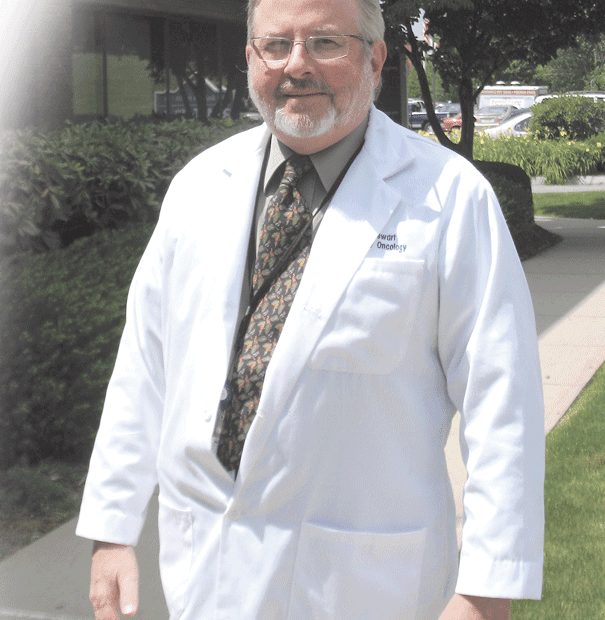
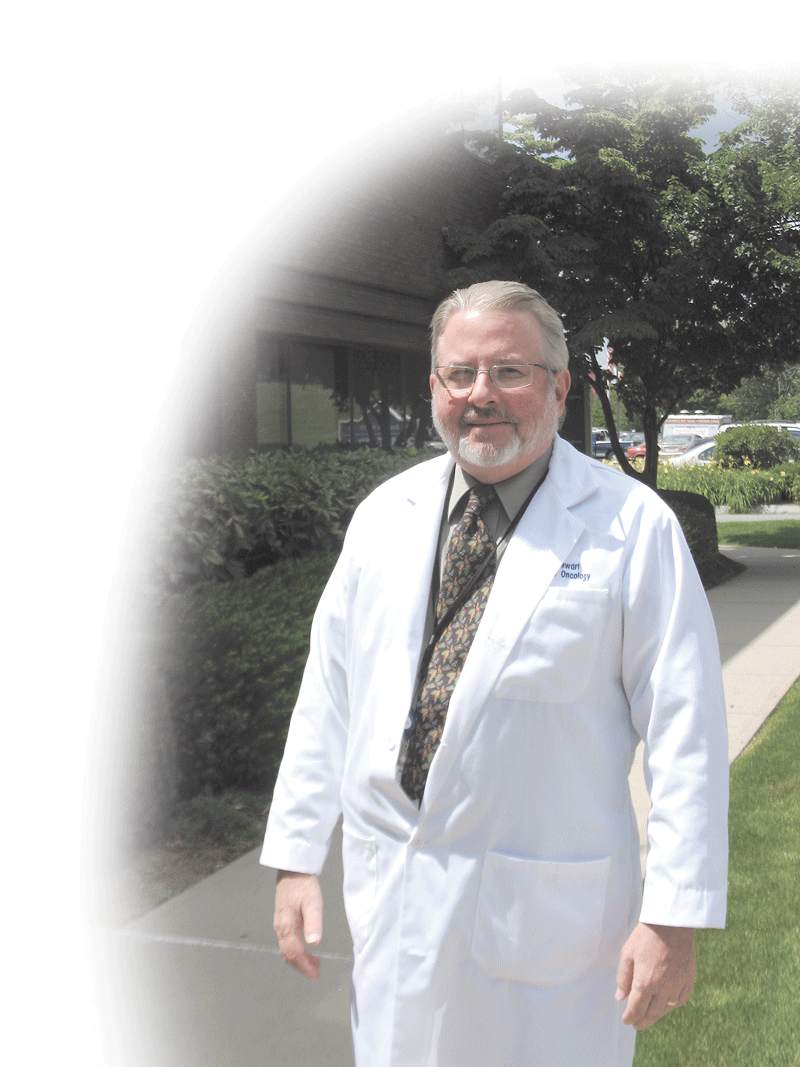
Dr. James Stewart

Dr. James Stewart says the CT study is encouraging, but the high incidence of false positives will stir debate over costs versus benefits.

They don’t call them cancer sticks for nothing.
“If I could pick one thing to reduce the cancer burden in this country, it would be eliminating tobacco,” said Dr. James Stewart, chief of Hematology/Oncology at the Baystate Regional Cancer Program. Not only does smoking account for the vast majority of lung-cancer cases, he explained, it’s also a factor in many other cancers, such as stomach, esophageal, and bladder.
Meanwhile, lung cancer is the deadliest cancer in the U.S., with a five-year mortality rate of 10% after the disease has metastasized. The odds of survival are much higher when the cancer is caught early, but right now just 16% of lung-cancer cases are detected in their earliest stages; by the time symptoms typically become evident, the cancer tends to be too advanced to cure.
But a promising study, conducted at UCLA and reported in the June 29 issue of the New England Journal of Medicine, has the oncology world buzzing about bringing that death rate down through widespread CT (computed tomography) screening of smokers and former smokers.
The National Lung Screening Trial (NLST), conducted from 1993 through 2005, involved more than 53,000 people at 33 different sites — all of them at risk for lung cancer but not showing symptoms. The study found that low-dose CT screening reduces the lung-cancer mortality rate in smokers and ex-smokers by 20% due to early detection of cancerous tissue. Many doctors are calling the study a game changer.
“Lung cancer is a very big problem in terms of the number of deaths that it causes,” Stewart said. “It affects both men and women — in fact, a surprising number of women. When I was a medical student, it was rare to see women who had lung cancer; now, there are as many women as men. Men in this country actually slowed down their smoking, and women still have an increasing risk of lung cancer.
“There’s always been this discussion — if we screen people, can we find the lung cancer at a time when it’s curable?” he added. “Because, unfortunately, most lung cancers show up at a time when it’s not curable, when it has already spread, even microscopically.”
A technology proven to catch significant numbers of cancers during treatable stages has, obviously, stirred hope for people with a history of tobacco use.
“There is a population of people who did not smoke but have lung cancer,” said Dr. Neil Chuang, director of thoracic surgery at Mercy Medical Center. “Their cancer may behave a little differently than the one smokers get, but it’s not that common. Smokers would be the ones targeted” by any new national screening protocol.
But the medical community is far from establishing such guidelines, considering the potential financial expense of expanded screening, especially given the propensity for false positives, which — as it has recently with mammograms — will spark a debate over cost versus benefits. But the benefits look promising indeed.

Raising Hope
The response from cancer centers nationwide to the CT report has been overwhelmingly positive.
“I believe that this is not only the best study done on lung cancer mortality, but one of the best studies on cancer screening ever done,” Dr. Otis Brawley, chief medical officer for the American Cancer Society, told CNN.
“With a greater than 20% reduction in lung-cancer mortality, there are very few single things in our lifetime that will have such a positive impact with lung cancer as these new screening suggestions,” Dr. Frank Detterbeck, surgical director of the Yale Thoracic Oncology program, noted on the practice’s Web site.
However, he added, “the NLST addresses a very specific population of people. It will be important to continue to monitor the data and evolve our screening and treatment practices in the coming years so that we can maximize the positive impact it will have on lung-cancer survival rates.”
Chuang said screening guidelines, when they do emerge, might first focus on the heaviest smokers. Currently, between 80% and 90% of all lung cancer is found in people with a history of tobacco use.
“Smokers have an increased risk of having lung cancer,” he explained. “In order to get cancer, a cell has to undergo a series of mutations — usually three or four before a cell becomes a cancer cell. Smoking accelerates that process. The question is, how much smoking is required before the risk goes up?”
He said doctors have settled on 20 ‘pack years’ as the point where the cancer risk rises for smokers. To calculate pack years, multiply packs smoked per day by years smoked; two packs a day for 10 years, or one pack a day for 20 years, would be 20 pack years.
“Most people, when they represent with the symptoms of cancer, are already advanced and not curable,” Chuang noted. “Usually lung cancer is caught by accident, but screening programs are a way of catching it earlier, before it progresses. Right now there’s no standardized policy that I’m aware of put out by any national medical societies, but we’re going in that direction in the next few years, probably for people age 50, 55, or older who have a history of greater than 20 pack years.”
One drawback to widespread screening, Stewart said, is the high rate of false positives when it comes to lung cancer screening. “If you do a lot of CT scans on people who are chronic smokers or former smokers, you’ll find a lot of lung nodules,” he explained.
“The majority of them, by far, are not going to be cancer,” he continued. “So, do you biopsy them with needles? Operate to take the nodules out? Follow up with another CT scan? How do you sort out whether it’s cancer? That’s where the cost comes in, and I haven’t seen a good number crunching of that so far.”
And that introduces the sticky factor of cost also into the picture. While an X-ray is about $50, CT scans typically cost hundreds of dollars. But, according to Brawley, chief medical officer for the American Cancer Society, the average cost of an abnormal spiral CT is about $40,000 to $50,000 once additional testing and possibly surgery is factored in.
“Are you going to implement this as a public health policy, and if so, can you afford it as a society?” Stewart said. “I think those questions have not yet been answered. There are a lot of things we can do using technology that might alter the natural history of a disease in a good way, but it’s not really a question of whether you implement these things; it’s a societal question of where we want to put our resources.”
That debate, he noted, may be influenced by a perception among some people — a kind of discrimination, really — that lung-cancer victims caused their own disease, so therefore society shouldn’t be forced to pour too much of its financial resources into helping them.
“It’s particularly painful for people who have stopped smoking,” he said. “Of course there’s a much higher risk in people who continue to smoke versus former smokers, but there’s no question that former smokers have an increased risk of cancer as opposed to those who never smoked.”
Still, Stewart said, “that conversation is just starting. We’ll see in the next six months or so, some of the major cancer organizations come out with some statements about this. These conversations come at a time when everyone wants to reduce health care costs, or at least slow the increase in health care costs. But it’s still a big story, the idea that screening certain populations of people for lung cancer can be successful.”

Tobacco Road
The CT study isn’t the only exciting news in the realm of lung cancer, Stewart added.
“We’re smarter about lung cancer; it’s not just one disease, but it’s many different diseases, just like breast cancer and colon cancer,” he said. “And the testing of the molecular subtypes of cancer is leading to opportunities to use very specific treatments that will only work in that one subtype. Pathologists are moving fast on this, giving us more information about which lung cancer will respond to which treatment. That’s pretty exciting stuff.”
Still, doctors say, the best way to reduce the risk of lung cancer is simply not to smoke, or at least to quit as soon as possible.
“I always say right up front, if you really want to address lung cancer, you have to address smoking,” Stewart said. “Why we haven’t done a better job of that — well, there are many reasons, but that’s fundamental. Tobacco kills.”
But even quitters — while they’re admittedly at lesser risk than active tobacco users — are far from out of the woods, which is why the recent CT study focused on both smokers and former smokers.
“It’s a lifelong risk, even though you’ve quit,” Chuang said. “A lot of patients I see quit 10, 20 years ago, and they come in and say, ‘I quit; how come I have lung cancer?’ The reason is, by smoking, they may have already caused some of the mutations that cause cancer, and it was only a matter of time before the cell mutations required to transform into cancer cells happened.”
Detecting that progression in time to save lives has long been a struggle for doctors. Now, at least, CT screening can be a powerful tool to help them do just that. Deciding exactly how to wield that tool could prove to be just as challenging.

Joseph Bednar can be reached at [email protected]

Departments Incorporations

The following business incorporations were recorded in Hampden, Hampshire, and Franklin counties and are the latest available. They are listed by community.

AMHERST

Sing This Summer Inc., 137 Pine St., Amherst, MA 01002. Jonathan Hirsh, same. Vocal training and coaching.

CHICOPEE

Zohra Inc., 659 Grattan St., Chicopee, MA 01020. Umar Bhatti, same. Convenience store.

GREAT BARRINGTON

Rude Movement Inc., 14 Berkshire Circle, Great Barrington, MA 01230. Jordan Ivey Weller, same. Organization designed to encourage good public behavior among citizens of Massachusetts.

HOLYOKE

Sybm Inc., 10 Beacon Ave., Holyoke, MA 01040. Alizabeth Bernadette Showers, same. To improve the communities in which we live by adding value through everyday contributions in the arts, education, and enterprise. Sybm hopes to create a renaissance like movement restoring the belief in our youth and young adults the ability to dream without fear.

Victory Home Healthcare Inc., 717 Northampton St., Unit 41, Holyoke, MA 01040. Jacob Waah, same. Home health care services.

Western Mass Safety and Fire Education Assoc. Inc., 600 High St., Holyoke, MA 01040. Michael Richard, 10 Heritage Lane, Monson, MA 01057.

HUNTINGTON

The Huntington Public library Foundation Inc., 7 Main St., Huntington, MA 01050. Karen Wittshirk, 143 Pond Brook Road, Huntington, MA 01050. Nonprofit organization formed to support and promote the Huntington Public Library.

INDIAN ORCHARD

Seven Oceans Inc., 967 Worcester St., Apt 3, Indian Orchard, MA 01151. Ramzan Ali, same. Convenience store.

Western Mass Hackerspace Corp., 34 Front St., Indian Orchard, MA 01151. Patrick Cagan, 11 Lewis St., Westfield, MA 01085. To promote and encourage technical, scientific, and artistic skills through individual projects, social collaboration and education.

LENOX

Stockbridge Motorcar Company Inc., 150 Hubbard St., Lenox, MA 01240. Automotive repairs and sales.

Women’s Interactive Network Inc., 213 Main St., Lenox, MA 01240. Laura Fetherolf, same.

LONGMEADOW

Springfield Rifles Inc., 100 Jonquil lane, Longmeadow, MA 01106. Youth hockey program.

NORTHAMPTON

Rich Denno Inc., 551 Florence Road, Northampton, MA 01062. Richard Denno, same. Construction.

Wayde James Inc., 49 Pine Brook Curv, Northampton, MA 01060. Wayde James, same. Construction.

SOUTH DEERFIELD

Primo Pizzeria & Restaurant Inc., 4B Sugerloaf St., South Deerfield, MA 01373. Ismael Alvarado, 275 East Hadley Road, Amherst, MA 01002. Pizzeria and restaurant

SPRINGFIELD

Quality Import Management Inc., 626 Carew St., Springfield, MA 01104. Jhoan Cruz, same. Roumeliotis Law Group, P.C. 51 Taylor St., Springfield, MA 01103. George Roumeliotis, same. Professional law services and consultation.

Royal Professional Inc., 101 Mulberry St., #113, Springfield, MA 01105. Avihen Levanon, same. Retail hair sales products.

Sh Wireless Inc., 1365A Liberty St., Springfield, MA 01104. Jin Hong, 2334 Founders Way, Saugus, MA 01906. Cellular phone sales and service.

Springfield Wildcats Inc., 179 Warrenton St., Springfield, MA 01109. Crystal Mendoza, same. Youth football and cheerleading program for grades 3-8.

St. James Property Mgmt. Inc., 706 Saint James Ave., Springfield, MA 01104. Carlos Rivera, 90 Paramount St., Springfield, MA 01104. Commercial property-management company.

Varsity Entertainment Group Inc., 202 Northampton Ave., Springfield, MA 01109. Heath Richardson, same. Music composition.

WEST SPRINGFIELD

Tri-State Fabricators Inc., 49 Apricot Hill Lane, West Springfield, MA 01089. Mark Edwards, same. Metal fabrications and construction.

WILBRAHAM

Wilbraham Construction Inc., 10 Beechwood Dr., Wilbraham, MA 01095. Judy Bergdoll, same. Construction

WILLIAMSBURG

Scotti’s Inc., 151 Sugar Hill Road, Williamsburg, MA 01096. Pierre Brisson, same. Limited food service and recreation.

WILLIAMSTOWN

Willows For Holidays Inc., 480 Williamstown, MA 01267. Bhupinder Sabharwal, same. Motel.

Commercial Real Estate Sections
O’Connell Development Envisions Mix of Uses for Sprawling Complex

WestinghouseDPartThe former Westinghouse Electronics complex in East Springfield was slated for redevelopment into a large retail Mall, with perhaps two dozen stores, but then the recession sent that sector into a deep tailspin and eventually scuttled those plans. The O’Connell Development Group, creator of Holyoke Crossing in Holyoke, among other area retail complexes, acquired the property last fall, and is advancing plans for a mixed-use facility — although there is uncertainty about what that mix might entail.

As he talked about the sprawling former Westinghouse Electric manufacturing complex off Page Boulevard in East Springfield, and the prospects for redeveloping it, Andrew Crystal drew a number of comparisons to another project orchestrated by the Holyoke-based O’Connell Development Group, which he serves as vice president.
That would be the transformation of the former H.B. Smith boiler plant in the center of Westfield into a massive Stop & Shop supermarket and accompanying parking lot.
“That was a large industrial site that was demolished, cleaned up environmentally, and then turned into a retail location,” said Crystal, adding that this is the plan for the Westinghouse site, located just off I-291, as well. Actually, it’s been the plan for some time, and the fact that the 40 or so acres in question are still home to several buildings in the process of being razed points up a big difference between this initiative and the one in Westfield.
The H.B. Smith project unfolded in 1997, when the economy was humming and most major retailers were in an aggressive expansion mode. A planned transformation of the Westinghouse site into a $45 million retail complex with a mix of stores, undertaken by Newton-based Packard Development, was put on the drawing board more than three years ago, or just before the start of the worst recession in 80 years.
That downturn prompted the closing of thousands of retail establishments across the country and back-burnered a number of projects like the Westinghouse endeavor, said Crystal, adding that, while the retail sector is still reeling from the downturn in many respects, that segment of the economy is expected to eventually recover. Meanwhile, the Westinghouse complex has that most precious of real-estate qualities — location.
These factors and others prompted O’Connell Development, one of the O’Connell companies, to acquire the complex for $4.2 million last November and quickly commence with the process of razing the many buildings and cleaning up environmental contamination.

promising possibility for the site

Andrew Crystal says retail is one promising possibility for the site, although the sector isn’t as healthy as it once was.

“We think the site has a lot of potential, and clearly some of that is for retail uses,” he said, “because it is within a fairly dense residential area and has such easy and immediate access to 291. That access accounts for much of the site’s appeal, but there’s also the visibility from the highway.”
For this issue, BusinessWest takes an indepth look at the prospects for the Westinghouse property, identified as one of the key economic-development priorities in the City of Homes and a big piece of the ongoing revitalization puzzle.

Back to the Future
In its heydey during World War II, the Westinghouse Electric complex, opened in 1915, employed as many as 7,000 people in the manufacture of white goods and other products. The plant was part of a large industrial corridor where Rolls-Royces were once assembled and Smith & Wesson later became a huge part of the landscape.
The Westinghouse operation eventually wound down in 1970, and since then the cluster of buildings has become home to a number of warehousing and distribution tenants, said Crystal, adding that the site has long been considered an attractive location for a retail center, given its size and location only a few hundred yards from the East Springfield exit off I-291.
And in early 2008, Packard Development, a subsidiary of New England Development, which has developed a slew of retail centers across the Northeast, including several in Eastern Mass., put plans on the table for such a center, one that would be home to perhaps two dozen stores and a total of 450,000 square feet of retail. Formal plans were submitted, an environmental impact report was filed with the state (addressing, among other things, traffic issues), and the company met several times with neighborhood residents to hear and address their concerns.
All systems appeared go, but then … the recession hit, and the East Springfield project, like many planned retail developments, was first delayed and then scrapped.
“New England Development is a good firm, and they had a pretty aggressive development plan — they just got caught by the recession,” said Crystal. “It was a time when even the big national retailers were pulling back, and some didn’t make it through the recession; there were many casualties.”
But O’Connell saw enough potential in the property to make that $4 million roll of the dice last fall, said Crystal, adding that he considers this property to be a gamble well worth taking, considering the site’s size, location, and potential for a number of possible uses.
Crystal told BusinessWest that demolition will likely be concluded by the end of this year, clearing the way for what he calls mixed-use development, “although, at this point, we’re just not sure what that mix of uses is or would be.”
The property is zoned commercial, he continued, adding that this designation doesn’t permit some specific uses, such as a large distribution center, but does allow almost all others.
Retail is certainly at or near the top in terms of preferred uses, he said, adding that there is a recognized need for more retail in that part of the region, and dense population centers within a few miles of the site that could be attractive to major players in the industry.
But retail is still in a relative holding pattern overall as a sluggish recovery from the downturn continues, and Crystal acknowledged that many questions remain about when and to what degree the sector will bounce back.
“Retail is doing better than it was a year or two ago, certainly,” he said, “but it’s not like it was five years ago, and it likely never will be again. There are fewer national retail tenants now — the bankruptcy filings provide ample evidence of that — and the sector is still making its way back. Things are better, and consumer confidence has improved tremendously, but it’s certainly not like it was.”
The O’Connell Development Group has extensive experience in retail development, with several such projects in its portfolio, including the Westfield Stop & Shop initiative; Holyoke Crossing, its best-known retail effort, and one that has certainly felt the impact of the downturn; the Bernie’s store across Whiting Farms Road from Holyoke Crossing; and several CVS locations across the region.
Meanwhile, the company continues its work to redevelop the former Atlas Copco property just a few blocks from Holyoke Crossing and the Holyoke Mall into a retail facility; it is currently being used for distribution.
But there are several other potential uses for the Westinghouse site, said Crystal, listing everything from office space to health care services; from entertainment venues to a satellite post office. All are permissible uses under the zoning, and all are viable alternatives given the location just off the highway.
In the meantime, O’Connell is working to lease out space in the Westinghouse office facility fronting Page Boulevard, which is not slated for demolition at this time. Approximately 30,000 square feet across two floors is leaseable, said Crystal, adding that the company is still gauging demand for that space while deciding its ultimate future.
Marketing of the site will commence once O’Connell has a firmer grasp of just what it wants to do with the location and what the market will bear, said Crystal, adding that the site simply has too much going for it to remain dormant for long.
“You just don’t find close to 40 acres in an urban environment like this,” he said, “that has such close proximity to the highway and such high visibility from the highway.”

The Bottom Line
The H.B. Smith project succeeded in changing the look and feel of downtown Westfield. It removed a decaying, contaminated factory complex and brought retail — and some vibrancy — to the downtown.
Whether history will repeat itself in East Springfield remains to seen, but Crystal is optimistic that another location known mostly for what transpired in the past will have a different, and quite compelling, future.

George O’Brien can be reached at [email protected]

Briefcase Departments

AIM Business Confidence Index Slumped in May
BOSTON — The Associated Industries of Massachusetts (AIM) Business Confidence Index dropped 4.4 points in May to 51.7 as state employers confronted a slowing economy and continuing uncertainty about the course of recovery. “The results mirror the national news,” said Raymond Torto, global chief economist at CB Richard Ellis Group Inc., the chair of AIM’s Board of Economic Advisors (BEA), in a statement. “A series of economic reports is telling us what AIM members were seeing in mid-May — disappointing growth and job creation, weakness in manufacturing and real estate, and declining consumer confidence locally and nationally, along with renewed turmoil in the euro zone and its impact on financial markets.” The economy, Torto added, “as we’ve often noted, is getting better but remains far from healthy, so it will be subject to relapses like this. The factors at work now are very similar to those that produced a dip in confidence last spring, with some added concerns about East Asia.” AIM’s Business Confidence Index, issued monthly since July 1991, uses a 100-point scale to judge business conditions, with 50 as neutral. Its historical high was 68.5, attained in 1997 and 1998; its all-time low was 33.3 in February 2009. “The index has been in positive territory for the past eight months, and it is up 12.7 points over two years, with most of its gain in late 2009 and early 2010,” Torto noted. “The economy, though clearly in stronger and more stable condition than it was in 2009, has yet to achieve sustained, robust growth.” All of the sub-indices based on selected questions or respondent characteristics gave ground in May along with the main index. The Massachusetts Index of business conditions prevailing within the Commonwealth dropped 1.5 points to 48.2, while the U.S. Index of national conditions fell 1.6 to 44.3. Since March 2010, the state indicator was ahead 4.1, and its national counterpart up 3.0 points. The Current Index of conditions prevailing at the time of the survey was off 4.2 points at 49.7, while the Future Index of expected conditions six months ahead lost 4.5 to 53.7. The Company Index, which measures survey respondents’ overall confidence in the situations of their own operations, dropped 6.6 points in May to 54.7. The two other company-specific sub-indices also fell, the Sales Index by 6.8 to 54.1 and the Employment Index by 6.0 to 51.9. Confidence was off among both manufacturers (-3.2 to 54.6) and other employers (-5.5 to 47.7); it also fell both in Greater Boston (-3.6 to 43.0) and outside the metropolitan area (-6.5 to 49.0). There was no clear pattern of responses by size of company. The monthly Business Confidence Index is based on a survey of AIM member companies across Massachusetts, asking questions about current and prospective business conditions in the state and nation, as well as respondents’ own operations. On the Index’s 100-point scale, a reading above 50 indicates that the state’s employer community is predominantly optimistic, while a reading below 50 points to a negative assessment of business conditions. A number of component sub-indices are derived by analyzing responses to selected questions or those of particular groups of respondents.

State Leading Growth Rate
BOSTON — The U.S. International Trade in Goods and Services report by the Commerce Department’s U.S. Census Bureau and the U.S. Bureau of Economic Analysis recently showed that U.S. exports of goods and services in April 2011 increased 1.3% from March 2011 to a record $175.6 billion, with record exports of both goods ($126.4 billion) and services ($49.1 billion). The monthly export values for U.S. industrial supplies ($43.4 billion) and capital goods ($41.0 billion) was also the highest on record.  U.S. imports of goods and services decreased 0.4% over this period to $219.2 billion, causing the U.S. trade deficit to decline 6.7% below March figures to $43.7 billion in April. “Over the past six months, the economy has added more than a million private-sector jobs, and exports — boosted by the president’s National Export Initiative — are helping us do that,” said U.S. Commerce Secretary Gary Locke in a statement. “President Obama announced several new commitments that will help 500,000 young Americans get the credentials they need to succeed in the manufacturing industry. Preparing Americans for good-paying jobs in the manufacturing sector will not only strengthen the economy and put people back to work, but will help us compete in today’s 21st-century global economy.” Locke noted that April is the second consecutive month of record export growth, and while there may be bumps on the road to recovery, he added that the administration is making the economy more competitive by fostering new jobs in new industries, and helping to educate and train workers to fill them. In Massachusetts, the state’s economy grew 4.2% in 2010, ranking it fourth in the nation in economic growth, according to the Commerce Department. The technology and health care industries have fueled the state’s growth, allowing Massachusetts to recover faster than the nation as a whole. Across the region, Vermont ranked second after Massachusetts with 3.2% growth, followed by Connecticut with 3.1%, Rhode Island with 2.8%, Maine with 2.1%, and New Hampshire with 1.3%.

Health Care Sections
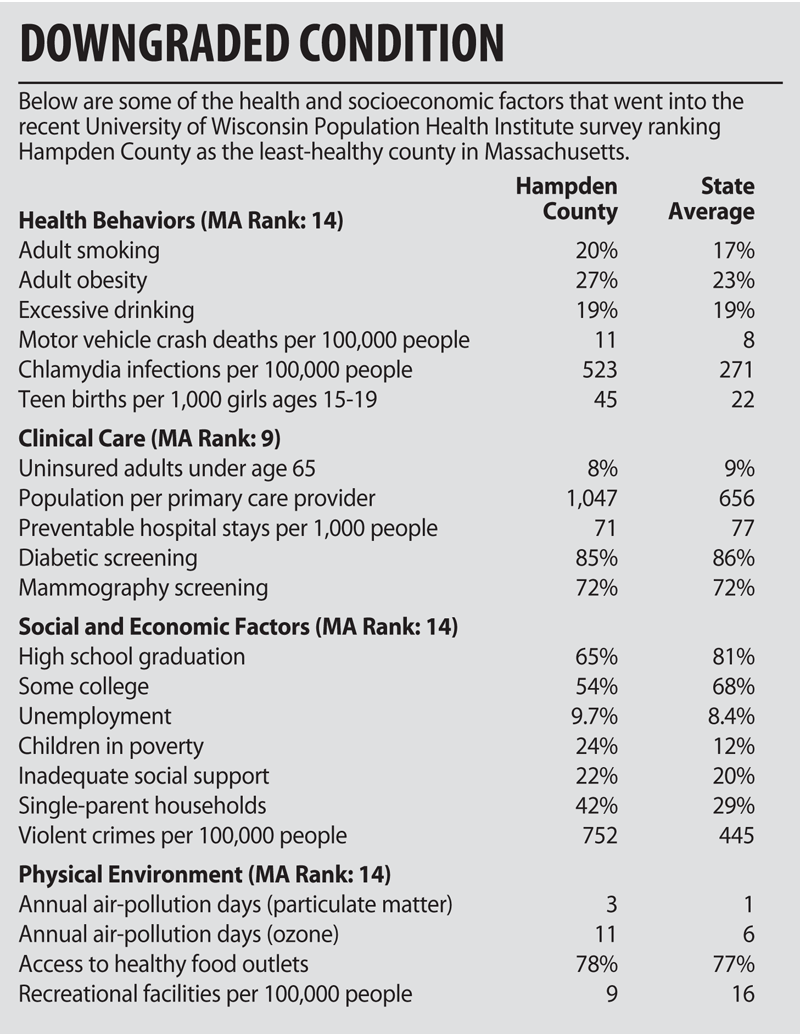
The Roots of Hampden County’s Health Problems Run Deep

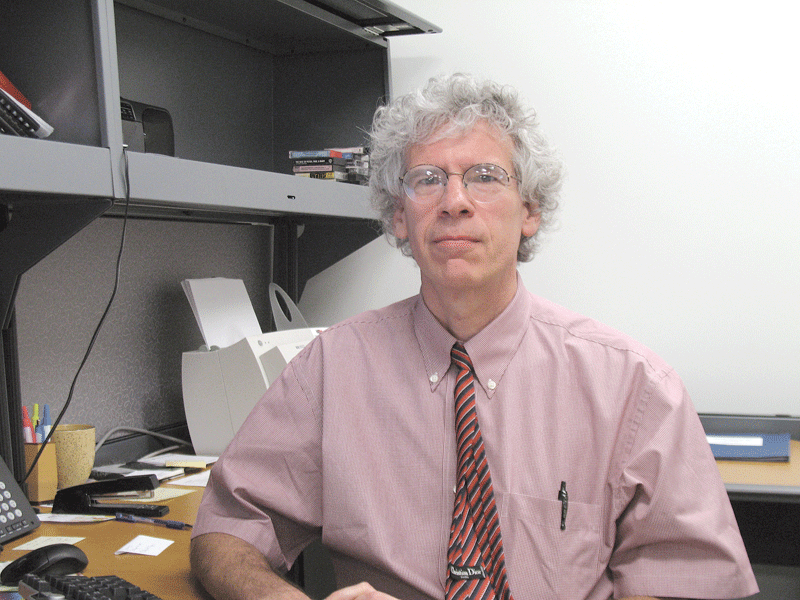
Dr. Andrew Balder

Dr. Andrew Balder says the socioeconomic data behind Hampden County’s health ranking is impossible to ignore.

Hampden County residents may have been surprised to see a national survey rank it last among all Massachusetts counties in the broad category of health, simply because of the many high-quality hospitals and other care providers in the region. But the ranking has little to do with those services, and much to do with socioeconomic factors, starting with pervasive poverty, that have been endemic to the county’s cities, particularly Springfield and Holyoke, for a long time. Those factors do influence public health — and they won’t be easily reversed.

Is Hampden County the least-healthy county in Massachusetts?
Well, the numbers don’t lie, but they also point to factors that run well beyond — and much deeper than — access to quality care.
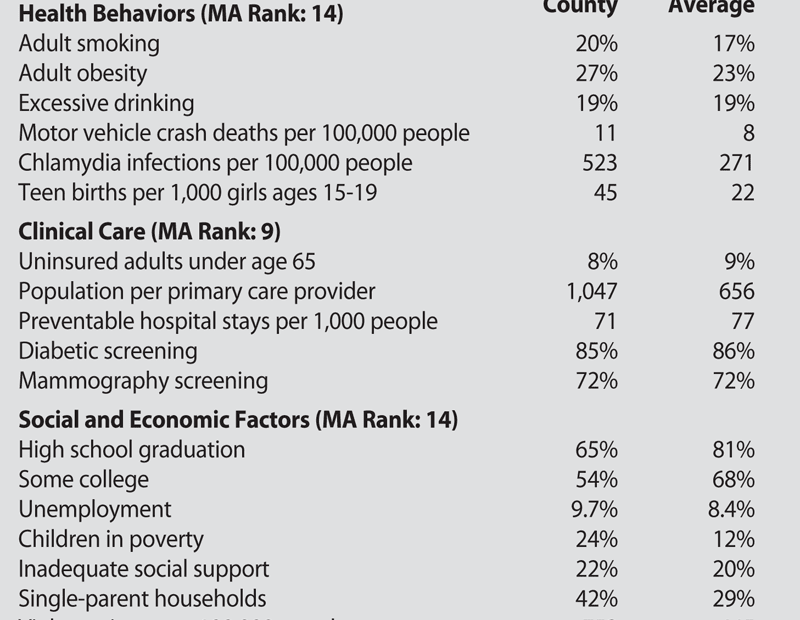
That’s the message conveyed in a recent survey of every U.S. county. The 2011 County Health Rankings — produced for the second straight year by the University of Wisconsin Population Health Institute and the Robert Wood Johnson Foundation — ranks Hampden County 14th among 14 counties in Massachusetts in overall health.
Initially, that might seem like a slap in the face to a region that’s home to many high-quality hospitals and other health care providers, but a closer look reveals issues that can’t be solved by the medical establishment.
“You can always question the data, but there’s reality behind it,” said Dr. Andrew Balder, attending physician at Baystate Mason Square Neighborhood Health Center and medical director of the Boston Medical Center HealthNet Plan.
He noted that socioeconomic factors played heavily into the rankings, putting many urban centers — which tend to be home to significant pockets of poverty — at an immediate disadvantage (Suffolk County, containing Boston, ranked 13th). The survey gave 10% of its weight to a county’s physical environment, 20% to clinical care, 30% to health behaviors, and 40% to social and economic demographics.
“It does take a village,” Balder said. “This is a direct reflection of Hampden County, of the difficulties of a county dominated by one poor city — Springfield — and a second, smaller, poorer city, Holyoke.”
Dr. Franklin Robinson, executive director of Baystate Health’s Partners for a Healthier Community, agreed. “If you look at the urban core on this county — Springfield and Holyoke — those two centers probably account for the majority of the county’s bad report, because these are problems that really concentrate in urban centers,” he said.
“That tells me this county is really healthier than we suspect, but the urban centers are that much more dramatically challenged, and that brings down the entire report,” he added. “It also signals that these are population-level problems that require much more than tinkering.”
The survey ranks Hampden County well below the top duo of Nantucket and Dukes counties, which represent the islands south of Cape Cod, but that’s not a useful comparison, said Dr. Garry Bombardier, medical director of the Work Connection at Holyoke Medical Center.
DowngradedConditionBW0611b“I know everyone wants to compare us to Dukes County, but that’s a very different part of the world,” he said. “It’s more helpful to take a look and compare us to the next county over — Hampshire County, which turned out to be fifth.”
And some of the comparisons are striking. The premature death figure — which calculates total years of life lost before age 75 — is 44% higher in Hampden County than in its northern neighbor, owing partly, of course, to the much higher rate of violent death in young people endemic to many cities like Springfield.
On the other hand, Bombardier said, “low birth weight in babies is very often an indirect measure of health care, nutrition, and economic status.” On that count, 8.6% of Hampden County babies are born underweight, as opposed to 6.4% in Hampshire County.
He cited other disparities between the two Pioneer Valley counties — a teenage birth rate of 4.5% in Hampden County and 0.7% in Hampshire County; high-school graduation rate, 65% and 85%; unemployment, 9.7% and 6.6%; single-parent households, 42% and 25%; children in poverty, 24% to 10%; and a violent-crime rate three times higher in Hampden County than in Hampshire County, to name a few.
“Again, this is taking a look at the fiber of our society, and it has to do with education, with social and economic factors, do you have jobs, things like that,” Bombardier said. “It’s a very big difference, and we should really be paying attention to it.”
The authors of the study recognize that they’re casting a wide net. “The rankings really show us with solid data that there is a lot more to health than health care,” said Dr. Patrick Remington, the project’s director, when the report was released earlier in the spring. “Where we live, learn, work, and play affect our health.”

Many Miles to Go
The report comes as no surprise to Mark Fulco, vice president for Strategy and Marketing for the Sisters of Providence Health System, who conducts a detailed community-needs assessment as part of the system’s overall planning and resource allocation.
The Wisconsin study “really deals with a lot of those issues,” he explained. “One of the things we look at is a community needs score; we look at each ZIP code and come up with a score from 1 to 5, with 5 representing the highest needs, based on factors like poverty rate, unemployment, and insurance coverage.”
Springfield, Holyoke, and parts of Chicopee all score very high on that scale, Fulco noted, adding that populations in this range are more likely to wind up in the hospital for conditions, like pneumonia and congestive heart failure, that people in communities with better socioeconomic scores are more likely to handle through primary care.
“If poverty influences health to a significant degree, then the [last-place] ranking is appropriate,” Balder said. “It’s part of the underlying environment that creates an unhealthy physical and social environment. It makes individual healthy behaviors more difficult to attain, and when you make the barriers higher and stack the decks, it becomes harder and harder to act on healthy decisions.”
Fulco cited a survey conducted by the Mass. Executive Office of Health and Human Services, which asked residents to rate their own health, and 21% of Springfield residents rated it ‘fair’ or ‘poor’; the state average was just over 12%.
“No wonder the report ends up where it does,” Fulco said, also citing asthma rates, tobacco use, inadequate prenatal care, and other factors in which Hampden County posts numbers nearly double the state average. “The magnitude of the problem is substantial. We’ve got a societal challenge, and it’s important to put public resources toward addressing these needs.”
As a health system, Fulco said SPHS is doing exactly that, from its mental-health programs run through Providence Behavioral Health Hospital to its participation in REACH programs in area schools; from its community health screenings to its Vietnamese Health Project that strives to reduce barriers to health care for the city’s Vietnamese population. “We know we are here to serve our community, and our services need to reflect that,” he said.
Robinson mentioned some community-based projects aimed at reversing some of the underlying factors highlighted in the report.
“The good news is that, in our local communities, there have been some neighborhood groups working together to affect some of these indicators,” he said, citing projects like the Mason Square Health Task Force, the North End Campus Coalition, and others that emphasize economic development alongside social needs.
“We’re beginning to look at the human social issues affecting residents,” he said. “In some of our most challenging neighborhoods, whole collections of people are trying to figure out how we can improve quality of life and the economic experience of our communities and, consequently, the health and well-being of the people who live there.
“It’s a public-health situation; it’s not just a health care problem,” he added. “To change our county’s health status, people need jobs, and they need housing. Essential to good health is the ability of a family to live in an economically self-sufficient manner.”
Some of the long-term statistics have been distressingly consistent, Robinson noted. For instance, infant mortality among African-Americans in the region is about three times that of white infants — the same gap that was present 30 years ago. “That’s a hard indicator that we haven’t been able to effectively organize our resources. We have not made an impact on changing that rate.”
And that’s just one of many stubborn trends, he said. “That’s what makes this so daunting — there isn’t a simple solution out there; there isn’t just one way to do it. How do we, as a community, work to achieve collective impact?”

A Call to Action
Like the others who spoke to BusinessWest, Balder believes the effort is worth it.
“Just because a community is poor doesn’t mean people have to be unhealthy,” he said. “A community can become healthier even though it’s poor. You can throw your hands up and be defeated, or keep working.”
The report’s authors claim that several communities across the U.S. have begun to take action in response to last year’s study, such as passing smoke-free laws, boosting educational opportunities for young children, and pushing for healthier grocery stores and farmer’s markets. But those who work with public-health issues in Hampden County have long been aware of the region’s needs.
“It’s more than the medical delivery system,” Bombardier said. “We’re definitely seeing more people dying younger and more low-birth-weight babies, who require lots more care, and many of them require special education later in life to get them back up to where they belong. We can see the results of poverty, of not having educated people, of not having enough primary-care providers. It’s an overall problem with our community.”
Dr. Risa Lavizzo-Mourey, CEO of the Robert Wood Johnson Foundation, noted that “it’s hard to lead a healthy life if you don’t live in a healthy community.” But the inverse is also true — communities don’t get healthy unless their residents start living healthy lives.
And despite the well-documented barriers, “we have a very bright community with some very active people,” Bombardier said. “My hope is that this will spur people to look at what we can do to make a difference.”

Joseph Bednar can be reached at [email protected]

Departments Picture This

Send photos with a caption and contact information to:  ‘Picture This’ c/o BusinessWest Magazine, 1441 Main Street,  Springfield, MA 01103 or to [email protected]

Woman of the Year

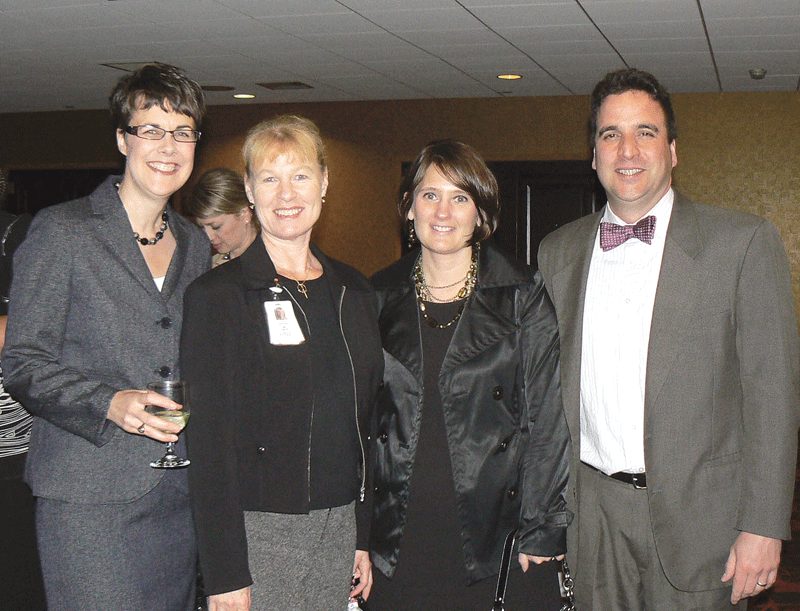
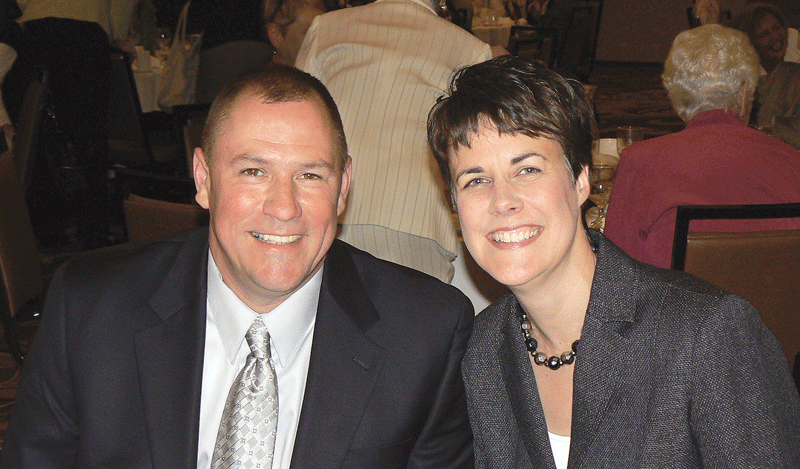
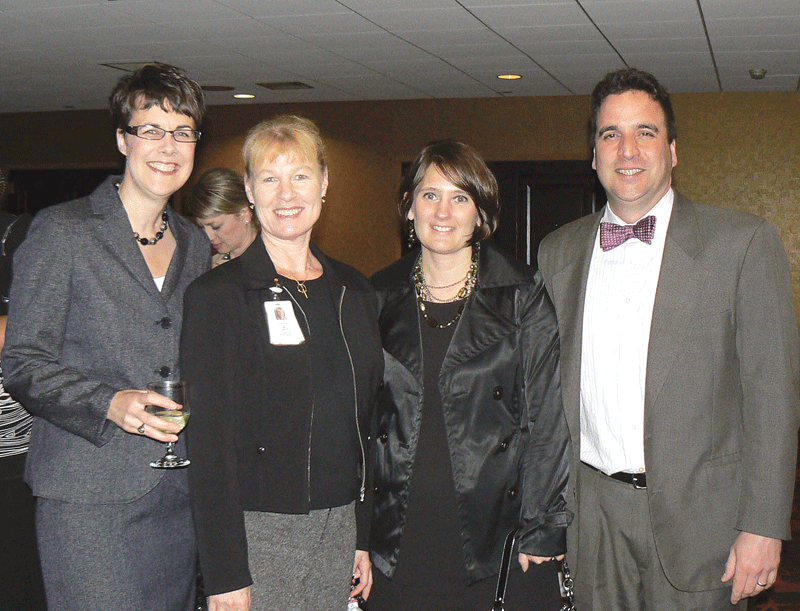
WomensChamber1WomensChamber2The Professional Women’s Chamber (PWC) honored Kate Kane, managing director with the Springfield Group of the Northwestern Mutual Financial Network in Springfield, with its annual Woman of the Year Award at a dinner on May 18 at the Springfield Sheraton. Kane was honored for her outstanding leadership, professional accomplishments, and service to the community. In accepting her award, Kane said, “I have learned more of value in my volunteer work than I have ever given back to the organizations I serve, and I want to thank all the community organizations and their amazing and dedicated staffs for offering me the chance to help.” Top left, Kane and her husband, Craig Knowlton. At left, Kane greets some of the many guests.


Grand Opening

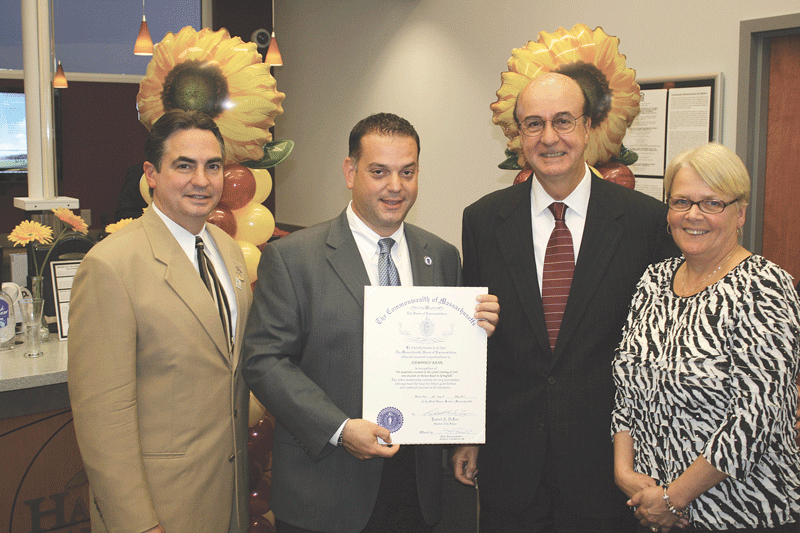
HampdenBankGrandOpenHampden Bank opened its 10th office at 977 Boston Road on May 24, featuring a ribbon-cutting ceremony. Seen here, from left, are Springfield Mayor Domenic Sarno; state Rep. Angelo Puppolo, with a proclamation from the House; Thomas Burton, president and CEO of Hampden Bank; and Peg Daoust, retail banking manager of the Boston Road office.


Legislative Outlook

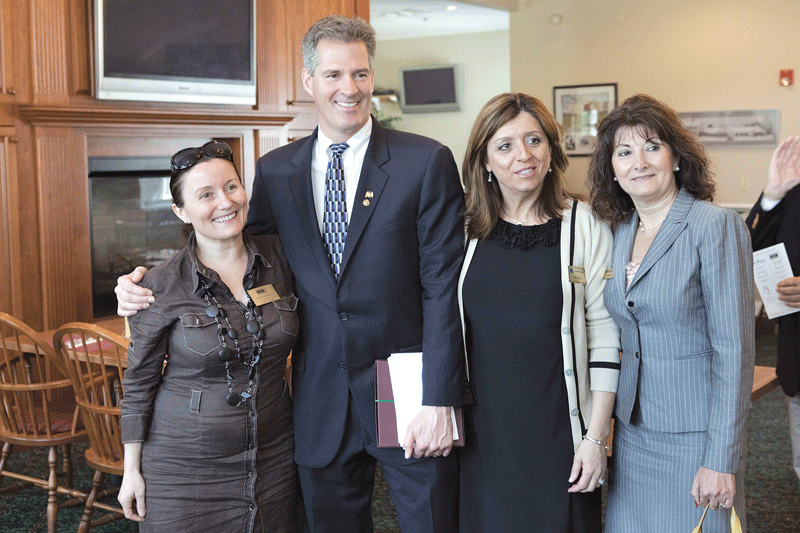
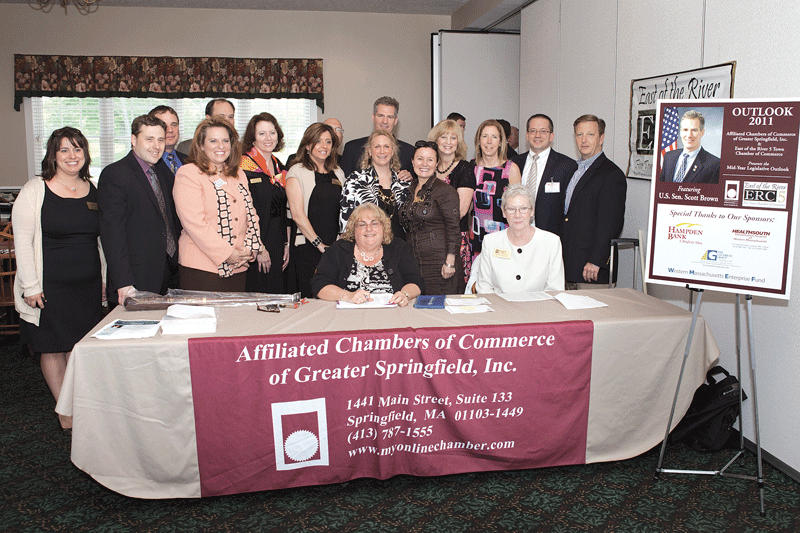
ScottBrownScottBrownChamberThe East of the River 5 Town Chamber of Commerce (ERC5) and the Affiliated Chambers of Commerce of Greater Springfield (ACCGS) staged their first mid-year legislative outlook luncheon on May 27 at the Country Club of Wilbraham. The keynote speaker for the luncheon was U.S. Sen. Scott Brown, who spoke about the economy, the federal budget, health care, and small business. Brown spent about an hour at the luncheon, meeting local residents, signing copies of his book, answering questions, and offering his comments. During the event, Wilbraham Selectman Pat Brady spoke about issues impacting municipal government and the people it serves. Tom Creed, a past chairman of the ACCGS Legislative Steering Committee, provided an update on legislative issues at the state level that are impacting member businesses. Left, Brown poses with members of  ERC5 Board of Directors, as well as staff from the ACCGS. At below left, Brown, spends time greeting guests, including ERC5 board members, from left, Carmina Fernandes of the Law Offices of Carmina Fernandes, and Gloria Faria and Cidalia Inacio, both of Chicopee Savings Bank.


YMCA Campaign Breakfast

YMCA 1YMCA 2
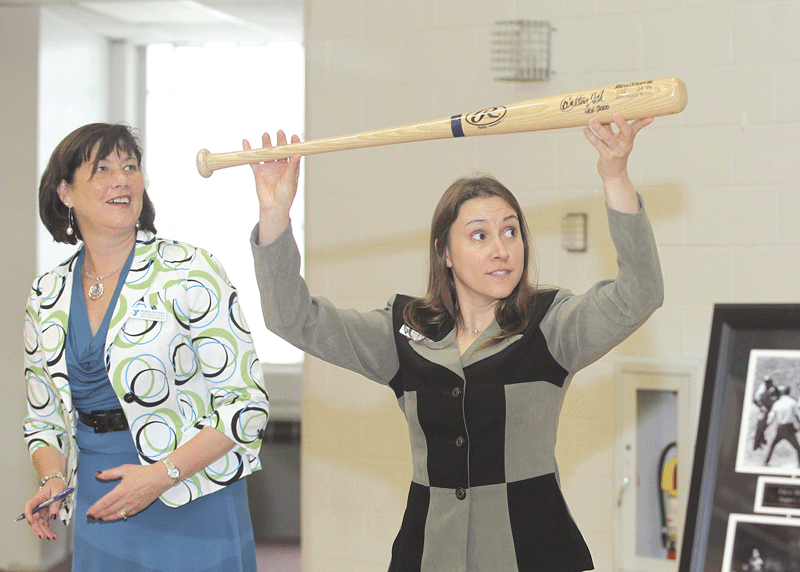
YMCA 3YMCA 4The YMCA of Greater Springfield staged its 2011 Annual Campaign Breakfast on May 20 at Springfield. The keynote speaker was Carlton Fisk, who regaled attendees with stories of his playing days with the Red Sox. The event itself raised more than $120,000, and the campaign has netted more than $325,000. Left from top, YMCA Board Chairman Sam Hanmer (left), CEO of FieldEddy Inc., bids on one of the many auction items signed by Fisk (Springfield Mayor Domenic Sarno is at his right); participants in the Y-TIP (YMCA-Teen Incentive Program) take a bow after performing for the audience; ‘Pudge’ Fisk accentuates one of his comments with a finger point; Karen Mercier, accounting manager for the Y, holds up a Fisk bat while Robin Olejarz, CFO, watches for new bidders.

Sections Supplements
Some Basic Steps for Taking Control of Your Money

Doug Wheat

Doug Wheat


If you are like most people, you are anxious and concerned about the economy, your job, and the future. While we may have a limited impact on the world around us, we can each take control of our own financial situation to ease our concerns. Whether you are wealthy or not, having specific financial goals and a plan for achieving them will help you be more in control of your financial life.
If you have a financial plan in place, make sure you review it on a regular basis. Life can take unexpected turns, and your financial planning may need to be appropriately altered. If you started implementing some changes to your finances but ran into a roadblock, got bogged down in the details, or your life got too busy, now is a great time to pick up where you left off.
Here is a challenge for you to complete this summer. Read through this article detailing nine basics of financial planning. Pick two action items that would be helpful to you, and implement them in June. In July, read a personal-finance book and pick two more action items to implement. You will be on your way to taking control of your finances for the next decade.
• Spend Less Than You Earn: While there are many different strategies for financial planning, no strategy will work unless you spend less than you earn. It doesn’t matter if you make $30,000, $100,000, or $250,000 per year; spending more than you take home each month will make all of your plans collapse. The amount you spend in a year is the result of hundreds of independent decisions. How are you making these decisions? Do you know the difference between your wants and your needs? If you have trouble spending less than you earn, it’s time for you to do some research and some experimentation to find a system that helps you have some money left at the end of every week. One alternative to a traditional budget is the ‘first-step cash management’ system that suggests dividing your money into separate bank accounts, each with a different purpose.
• Have a Cash Reserve: Having cash in the bank is a type of insurance against the unexpected. At some point everyone will face an unexpected large bill, possibly a car-repair bill or a hole in the roof. If you have cash on hand, you can pay the bill without going into debt. Should you lose your job, it is doubly important to have resources available until you can secure new employment. A good goal is to have three months of expenses available in cash; six months would be even better. It is helpful to put your cash reserve in a place that makes it difficult to spend, such as a separate bank.

• Pay Off Debt: Debt can be useful and sometimes unavoidable whether you are paying for college, a medical bill, or a new refrigerator. The average American household with credit-card debt owes $14,743 and pays nearly $2,000 in interest expense per year, according to creditcards.com. It is no surprise that 69% of people with credit-card debt find it difficult to save, according to a 2011 America Saves survey. Whatever the source, you will be better served by paying it off as quickly as possible. You might try the ‘snowball’ method of debt repayment. With this strategy, after you pay off one debt, you add its monthly payment to the next debt on your list until all debts are paid off. Unless you have no other choice, don’t use credit to make additional purchases.
• Establish Specific Goals: Too many people live on a day-to-day basis without thinking about their priorities and developing plans to reach them. The more specific you can make your goal, the easier it becomes to measure your progress. For example, instead of simply having a goal of paying off your credit-card debt, add a date by which you want to have a zero balance and figure out your monthly payment to make it happen.
• Multiply Your Money: We all know the best time to start saving is early, and the second-best time is now. There are lots of competing uses for our money, but the power of compounding is not available to us until our money is invested and earning money. When our money is earning money, then our wealth can build much more rapidly. A 25-year old who saves $1,000 per year for 40 years and earns 5% interest will have $133,880 at age 65. A 35-year-old who saves $1,000 per year for 30 years and earns 5% interest will have $74,083 at age 65. Starting to save early can give you a big jump on meeting a long-term goal.
• Understand Account Types: Tax-advantaged accounts are available to help all of us meet some of our most important goals. Understanding the difference between these accounts will help you minimize the taxes you pay and maximize the money you have available to reach your goals. There are essentially three types of accounts: tax-free, tax-deferred, and taxable. With tax-free accounts, both the money you put in the account and the money earned in the account can be taken out tax-free. Retirement Roth IRAs and 529 Educational Savings Accounts are two examples of tax-free accounts.  If you make a contribution to a tax-deferred account, it will reduce your taxable income this year, but withdrawals of both your contributions and earnings in the future are considered income, and you will owe income tax on it. Traditional IRA accounts, 401(k) accounts, and 403(b) accounts are examples of tax-deferred accounts. For a taxable account, you owe income tax and capital-gains tax each year based on your earnings. Taxable accounts include savings accounts and brokerage accounts.
• Invest in a Diversified Portfolio: Since we cannot predict the future, investing in a diversified mix of assets will help you weather economic storms or drops in the market while also having better growth potential than a savings account alone. Being diversified becomes more important as you get older and have accumulated money that you do not want to lose. There are many strategies for building a diversified portfolio. If you don’t have the opportunity to research the subject, a default choice can be either a retirement fund based on your age or an educational fund based on the age of your child. Try to find investment products with low fees.
• Prepare for Pitfalls: It is important to be prepared for unexpected events. Having a cash reserve is one way to be prepared. Having insurance and wills in place is another. Most people have health, automobile, and homeowners insurance because they are often mandatory and it is easier to see a relationship between risk and benefits. However, people often don’t realize their vulnerability to misfortune in other areas of their lives. According to the Social Security Benefit Administration, approximately 30% of 20-year olds entering work today will become disabled before they retire, and 1 in 6 Americans will die before reaching age 67. Finding cost-effective means to insure against the risks we all face will provide you and your family financial security if the unexpected happens.
• Expand Your Learning: Personal finance is a complicated subject with a number of different facets. There is a wealth of information available on the Internet as well as in publications such as Money, Kiplinger Personal Finance, and Smart Money. Basic books on financial planning include Personal Finance for Dummies by Eric Tyson, The Millionaire Next Door by Thomas Stanley and William Danko, and The 9 Steps to Financial Freedom by Suzy Orman. Even if you don’t like dealing with money, reading a few personal-finance items every year will help keep you up-to-date and better-able to plan for your future.

Early-Career (approx. age 23-35) Action Items:
• Establish a cash reserve equal to 3-6 months of expenses.
• Make a plan to pay off non-mortgage debt by a specific date.
• Invest in a 401(k) retirement account at least up to your employer’s match but hopefully 10% of your salary or more.
• Utilize a Roth IRA retirement account if you don’t have a retirement plan at work.
• Pay yourself first by setting up automatic transfers into a long-term savings or investment account.
• Watch your expenses. It is easy to burn through money on nights out or daily coffee. Make sure you are spending less than you are taking home.

Mid-Career (approx. age 36-50) Action Items:
• Make specific mid- and long-range goals and develop a plan to meet them.
• Pay off non-mortgage debt and kick the debt cycle by building up your savings.
• Step up your retirement savings in your 401(k) to 10% or 15% of your salary if you are not already doing so. The default investment option can be a target date fund based on your age.
• Review your insurance needs, including term life insurance and disability insurance.
• Establish a will, health care proxy, and power of attorney.
• Start saving for your kids’ college in a 529 account. The default investment option can be a target date fund based on your son or daughter’s age.

Pre-retiree (approx. age 51-64) Action Items:
• Review your long-range goals and adjust your spending and savings to meet them.
• Develop a realistic budget.
• Consider fully funding your 401(k) with $16,500 per year plus $5,500 per year in step-up contributions for people over age 55.
• Make sure your investments are diversified.
• Review your Social Security benefit information.
• Consider paying off your mortgage before you retire to increase your cash flow when you don’t have a job.
• Don’t sacrifice your retirement to pay for your kid’s college.
• Consider how you will pay for future health care costs, including long-term care.

Retiree (age 65 and up) Action Items:
• Determine your income, including pensions and Social Security.
• Set up your investments to transfer money to your checking account on a monthly basis. Starting with a 4% withdrawal rate can help make your money last.
• Finalize a realistic budget based on your income and asset withdrawals.
• Consider part-time work or delaying retirement if your numbers do not add up.
• Review your will, health care proxy, and power of attorney.

Doug Wheat, CFP is director of Family Wealth Management Inc. in Holyoke; www.fwmgt.com

Law Sections
You Should Prepare Now to Prevent Future Problems

Hyman G. Darling

Hyman G. Darling


Maintaining your estate plan is very important, regardless of your health or age. In fact, the Commonwealth of Massachusetts has already drafted a will for you, so if you want to make your own decisions about the distribution of your assets, the only way to do so is through your own will. But that’s just the first step.
This year has brought many state-specific changes in laws that require an update of your plan. For instance, in Massachusetts, there is a new homestead declaration law, which was enacted to provide an automatic exemption for homeowners. There is an additional increased exemption available if it is claimed; however, a document must be prepared, notarized, and recorded in order to become effective.
In addition, the federal law relative to estate taxes has changed so that the exemption is now $5 million per person, but only for two years. Then you must also consider your own state-specific tax laws and tax rates. Since no one knows what the law will be in two years, you shouldn’t count on the $5 million exemption forever, and therefore should plan around an anticipated reduction in the exemption.
Additional documents also need to be revised regardless of the size of your estate. One of the most important is the health care proxy, also known as a health directive, advance directive, or living will in some states. This is not just for the elderly. In fact, everyone over the age of 18 should have one, and this includes your college-age kids, because hospital privacy laws may actually prevent you from obtaining information about them if they become hurt or sick. Three of the most-highly publicized cases regarding the right to die included Karen Quinlan, Nancy Cruzan, and Terri Schiavo, all relatively young women who did not have a health care proxy in place.
This document allows you to designate who will be your decision maker in the unfortunate event of incapacity, as well as whether you wish to be kept alive by machines, and donate your organs. It also may include directives for funeral arrangements, such as cremation, burial, memorials, etc.
The power of attorney is another vital document that every individual should have. It nominates an individual or an entity, such as a bank or trust company, to make financial decisions for you when you become incapacitated and are unable to attend to your own financial matters. This would include paying bills, attending to investments, maintaining or selling a residence, paying a mortgage, filing tax returns, and all other financial matters.
Please note that the person nominated under the power of attorney does not have to be the same person who is serving for health-related decisions. This is an important concept, and the people that you nominate may serve different roles and have different strengths in performing various tasks. Care should be given when making these decisions to select the most appropriate, responsible, and trustworthy individuals to carry out these duties. If you already have a health proxy and power of attorney, it may be appropriate to review them at this time to be sure that the individuals named are still able and competent to make these decisions.
Your will should also be reviewed to be sure that the individuals who are named as executors and beneficiaries remain appropriate for the tasks. If your child or grandchild is named as a beneficiary and has financial or marital problems, or has been declared disabled, it may be appropriate to have their share held in a trust as opposed to providing an outright distribution for them. If a trust is being established, care should be given to choose a trustee who will be capable and willing to attend to all financial affairs.
Consideration for guardians to care for your minor children if you are unable to do so is another important consideration. Please also consider this if you are a grandparent caring for your grandchildren.

Financial Matters
Other areas of concern that must be considered include retirement planning and financial planning. It’s never too early to plan for retirement and provide funds for your children’s education. Setting up so-called 529 Plans, as well as establishing IRAs, Roth IRAs, and funding a 401(k) and other qualified plans, are a necessity. Funds that are contributed at an early age may contribute significant appreciation with compounding and will provide for additional retirement funds to augment whatever your private pension or Social Security may fund.
Other considerations in your planning process include verifying beneficiary designations of life insurance, annuities, and retirement plans. Be sure that the individuals named are still appropriate and listed in the correct percentages and amounts. Also, charitable planning is a major consideration if you want charitable deductions, either during your lifetime or upon your death. Long-term care insurance is also important if you want to alleviate the need to spend private funds for long-term care, be it institutionalized care or home care. The sooner and earlier a policy is purchased, the less costly the premiums, and the more likely you will be insurable, since medical issues may prevent coverage in the future.
In addition, preparing an inventory of your assets, making a list of your professional advisors, and also providing your login names and passwords to online accounts should be completed, so if you become disabled or pass away, there won’t be any delay or problems in accessing those accounts and paying your bills. This includes social-media sites, because your family may wish to create an online memorial or take your pages down.
Nobody likes to contemplate what the future inevitably holds, but it is critically important to follow through on the planning process and complete the necessary documents to minimize taxes, avoid probate, and preserve assets for the next generation.

Attorney Hyman G. Darling is chairman of Bacon Wilson, P.C.’s Estate Planning and Elder Law Departments. His areas of expertise include all areas of estate planning, probate, and elder law. He is a frequent lecturer on various estate-planning and elder-law topics at local and national levels, and he hosts a popular estate-planning blog at bwlaw.blogs.com; (413) 781-0560; baconwilson.com.

Departments Picture This

Send photos with a caption and contact information to:  ‘Picture This’ c/o BusinessWest Magazine, 1441 Main Street, Springfield, MA 01103 or to [email protected]

The Power of Choice

Women’s Leadership Conference 1
Bay Path College staged its 16th annual Women’s Leadership Conference on April 29 at the MassMutual Center. More than 1,000 attendees took in the day-long event, which took the theme ‘The Power of Choice,’ and featured keynoters Wes Moore, a youth advocate, Army veteran, business leader, and author of The Other Wes Moore; Alison Levine, team captain of the first American women’s Everest expedition; and Victoria Kennedy, attorney and advocate for health care reform and women’s issues.
Women’s Leadership ConferenceAt above left, Levine (center) talks with Bay Path President Carol Leary and her husband, Noel. Bottom left, the large crowd mingles in the concourse area.


Coming Together

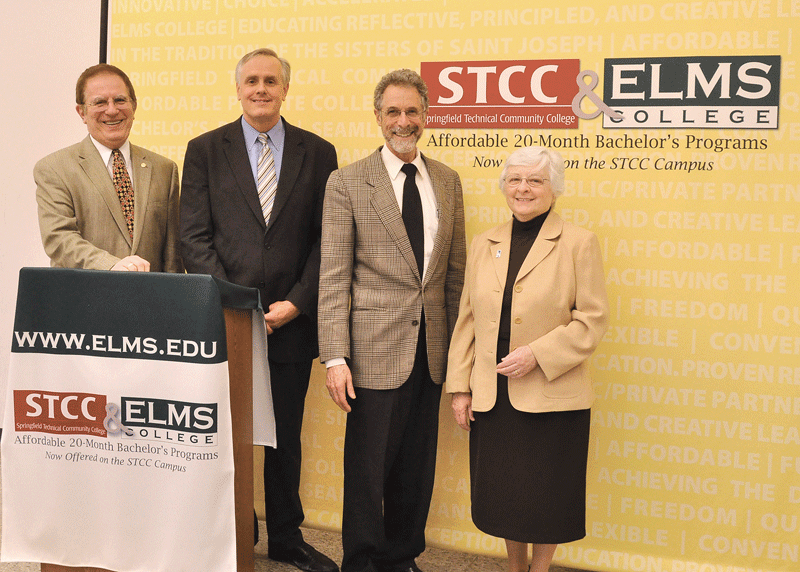
Elms College and Springfield Technical Community CollegeElms College and Springfield Technical Community College recently announced a new partnership through which classes in an Elms bachelor’s degree completion program in social work will be held at STCC. The program will benefit STCC students and alumni, as well as area residents with associate’s degrees, who are interested in a career in social work. Seen at the announcement are, left to right: Richard Parkin, assistant vice president for Academic Affairs, STCC; Walter Breau, vice president for Academic Affairs, Elms College; Ira Rubenzahl, President, STCC; and Sr. Mary Reap, Ph.D., President, Elms College.


Celebrating Entrepreneurship

Harold Grinspoon1
Harold Grinspoon2
Harold Grinspoon3
Harold Grinspoon4The Harold Grinspoon Charitable Foundation Entrepreneurship Initiative Awards Ceremony and Banquet was staged April 27 at the Log Cabin Banquet & Meeting House in Holyoke. The event featured an Elevator Pitch Competition featuring representatives of all the area colleges and universities. From top left: Lindsay Weaver, winner of the Elevator Pitch Competition, shares her idea for a business called Polar-EYES (a soft contact lens that provides outdoor UV protection, the power of polarization, and can transition from dark to light as traditional sunglasses do); Harold Grinspoon (light jacket) and keynote speaker Johnny (Earle) Cupcakes (center, front) are joined by the spirit winners from area colleges; Nate Lare, a student entrepreneur whose company, RDS Enterprise, provides a self-contained, semi-permanent disaster-relief housing kit, was the runner-up in the Elevator Pitch Competition; Adena Lavin (right), a student entrepreneur from Mt. Holyoke College, is seen at her exhibit of kale snacks. Her business is called ‘Pow! Chow,’ and she’s assisted by Lauren Palulis. Their exhibit was was one of 35 at the awards ceremony.
Photos by Shana Sureck


Not Just Business as Usual

Not Just Business as Usual1
Not Just Business as Usual2
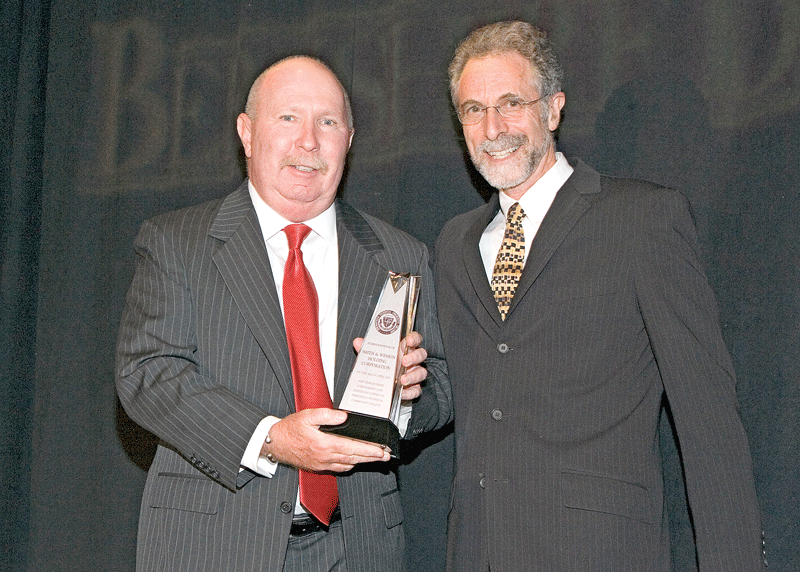
Not Just Business as Usual3Al Verrecchia, retired CEO and chairman of the board of Hasbro, was the keynote speaker for a program titled Not Just Business as Usual, presented by the Springfield Technical Community College Foundation on April 26. Event organizers also honored two area companies, Balise Motor Sales and Smith & Wesson, for their continued success and contributions to the local community. From top, STCC President Ira Rubenzahl (right) with Smith & Wesson CEO Michael Golden, and Rubenzahl with Balise President Jeb Balise. Emcee Frank Quigley (left), president of F.D. Quigley & Associates, a member of the STCC Foundation Board, and vice president of the STCC Alumni Advisory Board, with Michael Oleksak, executive vice president of Berkshire Bank and president of the STCC Foundation Board.


Royal LLP Open House

Royal LLPThe law firm Royal LLP staged an elaborate open house on April 14 at its new location at 270 Pleasant St. in Northampton. Here, Principal Amy Royal, left, with Anne Weiss, owner of Weiss Consulting.

Health Care Sections
Navigating the Minefield of Long-distance Caregiving

Gina Barry

By Gina M. Barry, Esq.

There comes a point when most of our nation’s elders will need assistance with various tasks, such as household management, bathing, dressing, medication management, meal preparation and eating, transferring, and/or using the restroom. In the past, such assistance was typically provided by family members; however, with the increased mobility of our society, it is now common for family members to be too physically distant to provide hands-on care.
It is also common for an elder to be unwilling to move closer to their family, even if staying where they are means receiving care from someone other than their family members. Although the distance creates many hazards, steps can be taken to allow successful navigation of the minefield of legal, financial, and administrative issues that lie in wait for the long-distance caregiver.
The most common legal issue associated with providing proper care and oversight from a distance involves establishing proper legal authority to ensure ongoing care in the event of incapacity of the elder. When proper legal authority is not established, caregiving can be interrupted, leaving the elder at risk for physical, mental, and/or financial harm.
This legal issue can be easily resolved through the elder’s execution of a durable power of attorney and health care proxy. The durable power of attorney and health care proxy are two distinct legal documents that give a person the elder chooses the authority to make financial and medical decisions on the elder’s behalf if the elder is incapacitated.
In the event that a durable power of attorney and health care proxy are not established and the elder loses capacity, it will be necessary to petition the probate court to appoint a conservator and/or guardian to make financial and medical decisions for the elder. The process of having a conservator or guardian appointed is expensive, time-consuming, and results in the elder’s loss of privacy and legal rights. As such, the overseer of the elder’s care should discuss with the elder the need to establish these documents while the elder is still capable of executing them.
In addition, end-of-life decisions should be discussed with the elder, and the elder’s wishes should be memorialized in writing within the proper legal document. Ideally, the estate plan will also include a will, which provides clear instructions as to the disposition of the elder’s estate upon their passing away.
Because the law varies from state to state, another common legal pitfall arises when the estate planning documents that have been established are not valid or are not recognized. This pitfall usually arises because: (1) the documents were not properly prepared or executed; (2) the documents were prepared in the caregiver’s state and are not recognized in the elder’s state; or (3) the documents were prepared in the elder’s state and the elder moves to the caregiver’s state where documents are not recognized.
To avoid the pitfall of having unusable estate-planning documents, it is best to hire elder-law attorneys practicing in both the elder’s and the caregiver’s states, so that you can be sure the advice you receive will pertain to the law of each state, and any necessary state-specific provisions will be incorporated into the estate-plan documents. Otherwise, it is possible that the elder could lose the protection of the documents, especially if the elder moves after losing his or her capacity to execute new documents.
Financing care is another area loaded with potential problems for the long-distance caregiver. Many times, the elder expects that public benefits (Medicaid) will pay for his or her care needs. Again, each state has different rules relative to obtaining approval for public benefits, and there are vast differences between the states as to various issues, including, but not limited to, asset and income limits, the effects of long-term-care insurance, and the effects of past gifts. Again, it is imperative to consider the rules in both states when planning if there is any possibility that the elder will relocate.
Further, there are also differences in the reach of each state’s estate-recovery rules, which are the rules that allow the state to recover benefits paid for care from the estate of a recipient who has passed away. Here, proper planning can ensure that benefits will be obtained as efficiently as possible and, at the same time, minimize the exposure of the elder’s estate to recovery efforts.
With respect to administrative issues, coordinating caregivers can be a daunting task. It can also be a serious mistake to rely on an elder’s self-reported care needs, because many do not recognize their own needs when they arise. As such, every long-distance caregiver should hire a geriatric care manager in the elder’s area. A geriatric care manager is a health care professional with training in gerontology, social work, and nursing. In most cases, the geriatric care manager will conduct an assessment of the elder and develop an individualized care plan.
In the long-distance-caregiving situation, the geriatric care manager will act as a liaison for the distant caregiver. Here, the geriatric care manager will oversee the elder’s care, providing a report to the caregiver at regular intervals and alerting the caregiver to any potential problems. The geriatric care manager’s additional oversight not only provides peace of mind for the long distance caregiver, but also guards the caregiver from claims that he or she is not conscientiously carrying out his or her duties due to the distance and/or lack of personal oversight.
Even though long-distance caregiving is a minefield, the wisest of caregivers knows that hiring professionals in the elder’s area, the caregiver’s area, or both is the equivalent of employing a minesweeper. With proper planning and the advice of elder-care professionals, caregivers can defuse or altogether avoid the mines and successfully navigate the minefield of long-distance caregiving.

Gina M. Barry is a partner with Bacon Wilson, P.C. She is a member of the National Assoc. of Elder Law Attorneys, the Estate Planning Council, and the Western Massachusetts Elder Care Professionals Assoc. She concentrates her practice in the areas of estate and asset-protection planning, probate administration and litigation, guardianships, conservatorships, and residential real estate; (413) 781-0560; baconwilson.com

Health Care Sections
In the Trauma Bay, Work Is Carefully Choreographed

Dr. Reginald Alouidor

Dr. Reginald Alouidor, here consulting with surgical residents, says work in the trauma unit is a total team effort.


It is 4:56 p.m., and Dr. Reginald Alouidor is looking at his pager.
It is alerting him to the fact that an elderly woman is being transported from Cooley Dickinson Hospital in Northampton to the trauma unit at Baystate Medical Center. She had fallen in her home, suffering injuries to her face, as well as a broken wrist, but there are fears that she has also sustained brain injuries. “She was stable, but there was blood in her brain and the potential for deterioration,” Alouidor would explain later.
In the parlance of the trauma unit, this is what is known as a ‘category-2,’ or ‘cat-2,’ emergency, an incident less severe in nature than a ‘cat 1,’ which could be a serious motor-vehicle accident; a gunshot wound, or GSW, as one is called; a stabbing; or perhaps a paralyzing injury to an athlete.
But with either category, the message on the pager sets in motion a highly choreographed response that is part and parcel to life in the only level-1 trauma unit in Western Mass. When the patient arrives from CDH, the so-called ‘trauma team’ is ready and waiting to administer care that will continue long after the individual is taken from the trauma bay.
On this particular Monday, BusinessWest was a guest in the bay and surrounding emergency department to talk with team members about their work, its challenges, and rewards, and also record what would be considered a typical night in the trauma unit, although all those involved say there is no such thing.
Each day is different, said Alouidor, the attending trauma physician on this night, and unpredictability is the only constant.
Soon after the aforementioned patient, who suffered what’s known as a ‘mechanical fall’ arrives, the bay becomes awash in motion, with the various players — Alouidor, residents, a nurse, and others — attending to specific duties while trying to maintain order in what would be considered close quarters. There are a half-dozen people treating the patient, looking at information, and consulting with one another as data is pored over. In other instances, including most cat-1 cases, there may be two or three times that many people in the room (including security personnel and family members), necessitating what Alouidor calls “crowd control.”
“Having 10, 15, or even 20 people in the room is not unusual, and there’s a sign on the wall that identifies who is supposed to be there,” he explained. “It shows the room, it shows where the bed is, and it shows the position of each member of the team. As trauma-attending, when I have a very ill patient, I don’t just walk around the bed; I know where I’m supposed to stand — I have a position at the foot of the bed. My airway resident has a position at the head of the bed, the ED-attending has a position at the head of the bed, the trauma nurse and the trauma scrub nurse all have their positions marked out, they know where they’re supposed to be.
“So when we talk about choreography, or ballet, when we walk in the room, everyone knows their role,” he continued, “and everyone knows where they’re supposed to be.”
Life in the trauma unit is demanding, said those we spoke with, work that requires a broad mix of abilities, from the surgical skills needed to save lives to the soft skills one must possess to properly inform, comfort, and console patients’ family members.
“It’s a golden rule — the family needs to know what’s going on,” said Alouidor. “Even during resuscitation, family members have a right to be present, and someone from the team will detach from the team and stay at the side of that person so that they know what’s going on. If we admit a 4-year-old, the best medication I can provide to calm that child is his mother or father to hold his hand.”
Both tragedy and triumph, if it can be called that, can be found in the trauma unit.
“We make a lot of great saves here,” said trauma nurse Concetta ‘Chetty’ Jez, an evening supervisor in the emergency department and 38-year nursing veteran, who would emphasize that word ‘we’ with every comment she made about the trauma unit. “We don’t save everyone, but when you walk away, you’re thinking, ‘we really did it.’”
For this issue, BusinessWest talked at length with Alouidor and other members of the trauma team that night to gain a perspective on the choreography that goes on in the trauma unit, and how the ‘controlled chaos,’ as some described it, represents teamwork personified.

Step by Step
Alouidor, who was born in Zaire but is a citizen of Haiti and grew up in that country, told the BusinessWest that he’s always been drawn to emergency-room medicine and especially trauma care.
And in Haiti, where he did his first four years of surgical residency work, this care took on a different tone and tenor than what he would experience here later in his career, and provided different kinds of learning experiences.
“I come from a third-world country where our trauma systems are not as well as organized as here in the U.S.,” he explained. “Back home, we see things that you may have seen in the states 50 or 60 years ago, because at work, employees are not protected, and as a result, their hands get mangled in machines. Also, the streets are not properly lighted and the cars are not properly inspected, and as a result, you have a vehicle traveling with 20 people that was meant for 10, and when this vehicle tips over, everyone is injured.
“It’s a country where basic emergency services and transportation are not well-organized,” he continued. “So someone who has a car crash in a town 100 miles away from the capital is not stabilized and is brought to us by means other than an ambulance, and without having been properly screened or triaged. These are the patients that we had to take care of, so as a medical student, I was always very involved in the care of these patients and recall in my third and fourth year of medical school taking extra time to spend with residents in surgery so I could get more exposure to trauma.”
Alouidor would do a second surgical residency in New York City, and eventually came to Baystate in the summer of 2006. There, he spends roughly one-third of his time in what is the only level-1 trauma unit in the four western counties of Massachusetts — there is one at UMass Medical Center in Worcester and six in Boston — and one of three that serve Connecticut.
Level 1 is the highest designation for trauma units, and such facilities provde the highest level of care, said Dr. Ronald Gross, chief of Trauma and Emergency Surgery Services at Baystate Medical Center, noting that there are three levels of trauma facilities in Massachusetts, and as many as five in other states.
“If you take the overall spectrum of trauma, 100% of all injured patients, level-1 centers will care for about 15% of the trauma patients,” he explained. “All of the rest can be very well-cared for at community hospitals that are level 2 or less. The most severely injured patients should go to a level-1 center, and the statistics show that, if they do, you decrease their mortality by 25%. In fact, the numbers show that if you don’t take your patients to a level-1 trauma center and they go somewhere else first, mortality is four times that of those who go to a trauma center first.”
An emergency department is part and parcel of what is needed to have a level-1 trauma center, he continued, adding that trauma surgeons work hand-in-glove with emergency medicine physicians who staff the ER.
Key elements of a level-1 center include 24-hour in-house coverage by general surgeons and prompt availability of care in varying specialties, such as orthopedic surgery, neurosurgery, plastic surgery, anesthesiology, emergency medicine, radiology, internal medicine, oral and maxillofacial surgery, and critical care, said Gross.  In addition, a level-1 center has a program of research, is a leader in trauma education and injury prevention, and is a referral resource for communities in nearby regions.
The long, severe winter of 2010-11 has added to what would be considered a typical workload in the trauma unit — again, if there is such a thing, said Gross. He noted that there have been more weather-related motor-vehicle accidents, by his estimation, a higher number of serious slip-and-fall incidents, and considerably more cases of people falling off roofs, an obvious result of the heavy snowfalls and homeowners’ attempts — almost always ill-advised — to reduce the threat of collapse. Meanwhile, Alouidor said this winter has seen a high volume of what he called ‘interpersonal violence’ — “there’s been a lot of penetrating injuries, a lot of gunshot wounds and stabbings” — a statistical anomaly he could not explain.
A recent serious head injury, a true cat 1, provides an insightful look at the full breadth of the work performed by trauma-team members after the pager goes off — and well after the patient leaves the bay.
“He had a very severe brain injury, and at the time of admission, we were all concerned about the potential outcome,” Alouidor recalled. “This patient put in a week in our ICU in which he received what we categorize as maximum medical therapy.”
Elaborating, he said that surgical teams moved quickly to decompress the brain, a procedure gaining more acceptance after recent success with soldiers in Iraq and Afghanistan.
“A large fragment of bone is removed, and thus the brain has room to swell,” he explained. “When there’s a brain injury, the brain’s main response is to swell, and with the swelling, the pressure in the brain increases, and that’s what leads to complications. There are multiple medications we can use to decrease the swelling and decrease the pressure and stabilize the patient, but this patient did not respond to any form of medical therapy, so at that point we had to decompress his brain.
“Despite this, his brain pressures were not properly controlled,” he continued. “After several days, he eventually died. We spent those days with the family, hand-in-hand with his wife, his children, his parents; it was a very long process, and a case that shows how we’re not just taking care of the patient, but taking care of the family.”

On the Clock
When asked what he enjoys (if that’s an appropriate word) about trauma work, Alouidor said he takes a great deal of satisfaction from making a profound and often immediate impact on someone who is probably having the worst day of his or her life, but there is much more to it than that.
“I like what I do for a variety of reasons,” he explained. “It’s not only the relatively quick results, but also the fact that I really like taking care of my patients; I’m very busy and very involved in their care, and that’s rewarding.
“There’s a wide range of results in trauma,” he continued, adding that not all of them come quickly, and some are obviously tragic in nature. “It’s not only the person who comes in in extremus that you can turn around very quickly by properly resuscitating them in the emergency room, bringing them to surgery, and doing the right operation at the right time, and watching this patient turn the corner within hours and come back to life; that’s the best-case scenario, but they’re not all like that.”
On the Monday he spoke with BusinessWest, Alouidor’s day began at 7 a.m., and the shift would continue until 7 the next morning. That might seem like a long shift to most, but he’s used to it — so much so that his body’s ‘clock’ is impacted when he’s not working. Indeed, he finds that, when he’s on vacation, by the time he’s a few days into a trip, or about when he’d normally be taking a turn in the trauma unit, he finds himself staying up all night.
Since this Monday was relatively quiet, Alouidor was able to spend some time with BusinessWest and discuss the many nuances of work in trauma. He said he arrives each day expecting “anything and everything,” and quite often gets both.
There is often no rhyme or reason to the level of the activity in the trauma unit, although there are some circumstances that will obviously contribute to volume, he explained, noting that the frequency of motor-vehicle accidents increases with bad weather and poor road conditions, and, in general, more bad things happen when people are outdoors, such as the summertime.
And there is, he maintains, scientific evidence of — and common-sense explanations behind — surges in activity during hot weather and full moons.
“The heat does things to people,” he said with a smile. “There is actually data in the literature that demonstrates that, when it’s a warm summer night or when the moon is out, trauma departments are more busy, and this is something we have known for years. When it’s warm, people are outside, and when they’re outside, things tend to happen — accidents, people fall off the balcony — and some bad things, like fights. And when you have a full moon, there is light until very late, and since people are out later, there’s more potential for them to get into trouble.”
And while this Monday was uncharacteristically calm — until mid-evening, at least — there are occasions, and many of them, he noted, when the patient volume on the first day of the work week will prompt someone to say, ‘are you sure today is Monday?’
Penetrating wounds, especially those related to interpersonal violence, have been occurring with great frequency this winter and, in general, over the past several years, said Alouidor, who noted that, had there been a shooting on the night of BusinessWest’s visit, he probably would not have been at liberty to talk about it due to health care privacy regulations. So he used a hypothetical situation to discuss these cat-1 cases and all the ways the trauma unit responds, starting with what his pager would be telling him when it went off.

Teaming with Anticipation
“It would be alerting us to a ‘category 1, GSW,’” he explained. “There would be an age to follow, a location of the wound or wounds — chest, body, head — and there be be vital signs, blood pressure, heart rate, mental status, and EMS can tell us if the patient is critical, meaning minimum vital signs, or stable.
“And stable is a relative term —  young, healthy people can tolerate a lot before they crash, but when they do crash, they’re in trouble,” he explained, adding that ‘critical’ is a relative term as well, and one that refers to potentially life-threatening injuries and an individual who needs to be stabilized.
With the information from EMS in hand, the trauma team begins to mobilize, said Alouidor, noting that the information on his pager is also now in the hands of other departments and individuals whose services will likely be required. This list includes the ICU, the operating room, radiology, the blood bank, lab, and also pastoral care.
“We care for these patients, but also their families,” he said. “If someone arrives here and has their 25-year-old wife or 50-year-old mother or 17-year-old son with them, someone needs to sit down with these people and talk them through what’s going on. We’ll provide the necessary medical information, but they also need support; we want to make sure there’s someone there for the family if they need someone to talk to.”
By the time the patient arrives, the team members are ready, he continued, adding that, by this, he means they are gowned, masked, and fully prepared to perform the rapid assessment that is needed in such cases. Airway, breathing, and circulation are the first things checked, he said, adding that disabilities, mental status, and injuries are also assessed.
“I’m not distracted by the fact that someone has a hole in their chest and a hole in their abdomen and they’re screaming bloody murder,” he told BusinessWest. “What’s important to me is to see if the person is stable first, and then, in a very systematic fashion, we go over things. People look at us very cynically and say, ‘this guy’s been shot in the abdomen; why are you looking at the airway first?’ That’s because the first thing that’s going to kill this person is not the fact that they’ve been shot in the liver or in the blood vessels in the stomach. What’s going to kill them first is that they’re not breathing. What’s going to kill them afterward is the fact that they don’t have circulating blood.
“Then, we go on to assess the injuries and do what’s called a secondary survey,” he continued. “Then we make our decisions. Is this patient stable? Is he critical? Is this a patient we will do a workup on? This might be a gunshot wound we assess in ED and determine it’s not a penetrating injury. Then we can say, ‘it’s your lucky day; you got shot, and the bullet only grazed you,’ or ‘it didn’t go through any significant structures.’”
If the patient is critical and needs surgery, he or she is in the operating room within minutes, Alouidor went on, adding that other types of trauma, be they injuries from a car accident, fire, or fall from a roof, are assessed and treated in the same fashion.
And with every step in the process, the team is involved.
“I don’t work alone — I work with a team,” he stressed. “I could not provide the care I provide alone. And one of the reasons why modern trauma centers are so successful is not just because they have good doctors, nurses, X-ray technicians, or anesthesiologists. They are successful because they have good systems, and these systems are put in over months and years, and it is these systems that lead to good outcomes.”
Children make up a small percentage of the caseload in trauma, said Alouidor, adding that they bring some additional challenges to the fore.
Communication is one of them, he explained, adding that very young children can’t articulate what’s happened or where it hurts. “Parents can provide a story,” he explained, “but sometimes, that story is, ‘I was in the other room, I walked in, I saw him lying on the floor,’ so we don’t really know what happened in those circumstances. And to me, that’s one of the more challenging aspects of caring for kids.”
“Some people say it’s difficult to treat children because when you look at them you see your own children,” he continued. “And while that’s true, when I look at my patients, whether it’s the 20-year-old, the 45-year-old, or the 85-year-old, I tend to see someone I know. I think about my niece, who is 20 years old, I think about my brother, who’s 45, and I think about my parents. You tend to find yourself in any patient you’re seeing.
“It is more difficult to accept a child who has significant injuries, especially when you know the outcome will not be good, as opposed to someone who’s older,” he continued. “That’s not to say that you don’t care as much [with the older individual], but it’s easier to understand and cope with someone who’s 88 and coming to the end of their life than it is with a child who’s 4 who has a devastating injury and will live with those complications for the rest of his life.”

Work in Progress
‘The Q word.’
That’s the usually unspoken term for ‘quiet’ in the trauma unit — and in most hospital settings, for that matter.
Those who are superstitious won’t say it out loud, said Dr. Mazen Al-Mansour, a surgical resident at Baystate who spends good deal of his time handling trauma work. That’s because doing so will, in their minds, inevitably change the course of an otherwise calm evening in the bay.
Al-Mansour is a fourth-year resident in the Department of Surgery, which means he’s nearing the end of this long, grueling stretch of his training. He told BusinessWest he would like to become a general surgeon, but enjoys many aspects of trauma work, especially the pace and unpredictability of the work.
When asked if organized, or controlled, chaos would be a good way to describe what goes on, he said only those who don’t work in the unit would use that term, even if it is fairly accurate.
“Everyone knows exactly what’s going on and what’s going to happen next, when there are multiple traumas at the same time or when we get extremely sick patients,” he explained. “It can be a little chaotic, but that’s the nature of traumas.”
Echoing Alouidor, Al-Mansour said work in the trauma unit requires a mix of skills, from the ability to assess and treat a penetrating wound to the compassion needed to address the wants and needs of family members.
“We work closely with extensively trained trauma surgeons who have the experience of dealing with life-threatening injuries in different areas of the body and different kinds of trauma, such as penetrating trauma or blunt trauma such as a motor-vehicle accident or people who are struck by vehicles,” he said. “We get to work closely with these people — we get to be the first-assist when it comes to the operation, and we get to watch these people talking to families, and we get to be involved with the families as well.
“There are different levels of people who get involved, and different levels of experience,” he continued, “and a lot of mentorship and observation on the part of younger people to pick up on the skills and the knowledge of how to handle the trauma patients and their families.”
Jez, whose job it is to coordinate nurse activity in the emergency department, including the trauma unit, said trauma nurses are specially trained for their work, which is demanding physically and also emotionally, but in many ways rewarding.
“It’s one of the greatest places to work in, and the nurses, while they can feel stressed — it’s a very, very busy place — will say that they truly make a difference,” she said, adding that the nurses play a critical and yet often overlooked role in the ED and the trauma bay.
“When these patients come in to the trauma unit, there’s this huge hurry — everyone’s in this big rush, everyone’s all excited, and the adrenaline’s flowing,” she explained. “And the nurse is in the middle of it. It’s the nurse and the patient, it’s the nurse who brings in the family, it’s the nurse who does all the meds, it’s the nurse that’s doing all the re-evaluation, it’s the nurse who’s there when you’ve lost the patient, and it’s the nurse who makes the patient look presentable so the family can come in and see him.
“They do it because it they love it,” she said of the nurses and their work. “They cry a lot down there — that goes with this territory — and they find order in the chaos.”
Alouidor stressed repeatedly that ‘quiet’ — he’s not at all afraid to use the ‘Q’ word — doesn’t translate into not busy.
Indeed, trauma physicians have patients to continually evaluate and myriad other types of work to handle when beds 9 and 10 in the trauma unit are empty or emergencies have passed. And they know that, at any minute, even if the moon isn’t out or it’s warm outside, the pace of the evening can change dramatically — and often does.
That’s why there are systems and procedures and signs on the walls in the bay telling people where to stand. The only job description for the people who work in this unit is to be ready — before the pager alerts them to an arriving patient, and long after the controlled chaos begins.

George O’Brien can be reached at [email protected]

Employment Sections
For Lower Insurance Premiums, it Pays to Keep Employees Fit

Healthier employees lead to lower premiums, according to numerous studies. If companies can help their workers improve their health without cutting benefits or shifting more premium costs to employees, where is the downside? After all, Fortune 1000 companies have been using wellness programs for years to combat the rising costs of health care.
So, the question is, why aren’t smaller companies using this proven method to lower their health care costs?
Randy Boss, a risk architect for Ottawa Kent Insurance in Jenison, Mich., helps companies implement successful wellness programs. And he says he can understand how employers feel.
“They’re frustrated because most likely they have tried things that didn’t work,” said Boss. “There seems to be a wellness vendor on every street corner these days and many use ROIs from Fortune 1000 wellness programs as their own, yet they had nothing to do with that program.”
All wellness programs are not equal! This is a very important problem and something companies need to understand when selecting the appropriate wellness program for their company.” Secondly, Boss says, “businesses tend to think short-term and not long-term, and expect to see solid and immediate savings on their health care costs.”
Yet, the benefits of having healthy workers transcend reduced health care costs, including workers’ compensation and lower absenteeism. Healthy workers are less prone to injury and when injured, they recover quicker than less healthy workers. Conversely, out-of-shape workers are at a higher risk for injury and healing is often delayed and complicated by other health factors. If workers change and modify their lifestyle and reduce their health risks, medical costs decline.
While this may seem intuitive, the connection between wellness and workers’ compensation has been slow to take root. The reasons appear to be separate risk-management departments overseeing workers’ comp and group health, concerns about expanding the employers’ liability for work-related injuries, a focus on workplace safety rather than workers’ health, and a number of small companies with high workers’ comp costs that do not offer health insurance have all been contributing factors. Still, one of the major areas of concern for employers is an out-of-shape employee.
According to a recent Duke University study, the cost of obesity among full-time employees is estimated to be $73.1 billion a year. This is the first study to quantify the total value of lost job productivity as a result of health problems, which is more costly than medical expenditures.
The report recommends that employers promote healthy foods in the workplace, encourage a culture of wellness from the CEO on down, and provide economic and other incentives to employees who show signs of improvement. And there is evidence that this plan can work for employers.
A University of Michigan study of a Midwest utility company’s workplace wellness program found that over nine years, the utility company spent $7.3 million for the program and reaped $12.1 million in savings. Medical and pharmacy costs, time off, and worker’s compensation factored into the savings. The study, which took into account a number of costs, including indirect costs of implementing wellness programs, such as recruitment and the cost of changing menus, showed that wellness programs work long-term even though employees aged during the course of the study.
Overall, the program cost the employer $100 per employee. The cost of lost work time, workers’ compensation, and pharmacy and medical expenses among employees who participated each year increased by $96, compared with a $355 increase among employees who did not participate.
This is good news for employers. Amid heightened cost pressures and leaner staffs brought about by the prolonged economic downturn, employers need to reduce all types of absences to help maintain productivity. While employers tend to focus their energies on controlling the highly visible health care costs, which are more easily shifted, there are significant opportunities to control other costs with wellness programs.
On average, employers can see a 30% reduction in workers’ compensation and disability claim costs, according to a review of 42 published studies involving the economic returns of wellness programs. Moreover, such programs will reduce the costs of absences that, according to the 2010 Kronos/Mercer Survey on the Total Financial Impact of Employee Absences, add up to 8.7% of payroll costs, more than half the cost of health care.
It stands to reason that healthier employees will use less sick time. But ultimately, companies need to make a commitment to helping their employees stay in better shape.
“Employers should focus on health and wellness at work,” says Boss. “Businesses should allocate 2% to 3% of their budget to an effective program that includes at least 90% participation by employees and a wellness coach on site to effect behavior change.”
Although budget and company size will dictate the type of program a company can undertake, there are five steps that companies should take before launching a wellness program:
Evaluate. Know your cost drivers. Analyze workers’ compensation, health care, and absenteeism data to identify common issues and trends. Understand the legal regulations governing wellness programs.
Do a workplace assessment. Examine the physical and cultural framework in which the wellness program will operate. Consider opportunities for on-site physical activity, partnerships with community wellness providers, local gyms or health and nutrition classes, on-site vending machines and cafeteria, etc. Identify the interests and motivation of employees as well as barriers to employee participation through surveys, wellness committees, along with an analysis of past efforts.
Educate. For several years, businesses have been shifting more of the costs of health insurance to workers through increased premiums and higher deductibles. Since 2005 workers’ contributions to premiums have gone up 47%, while wages have increased 18%. Employees are feeling the pinch. Show them how participating in a wellness program can affect premiums as a result of making less use of medical care.
Obtain management support. A wellness program will not succeed without the ongoing support of management. Communicate the goals of the program and assess the commitment of supervisors and management.
Identify goals and metrics for measuring success. When implementing a wellness initiative, senior management will want to see a return on investment. Establishing a consensus on the goals or metrics for measuring the success of the program will help shape the program and ensure its success.
When it comes to implementing a wellness plan at your place of business, it’s really all about risk versus reward. And the rewards can be huge, but only if the plan is properly implemented and the management team is committed to its success.

Preston Diamond is managing director and co-founder of the Institute of WorkComp Professionals (IWCP), based in Asheville, N.C. In 2010, IWCP created a sister organization, the Institute of Benefits & Wellness Advisors, that trains, tests and certifies select insurance professionals to apply the concepts of risk management to benefit; (828) 274-0959.

Employment Sections
Employment Board’s Strategic Plan Identifies Challenges, Game Plans

Bill Ward of the REB

Bill Ward says that one of the goals of REB’s new plan is to have the organization become known as the leading source of regional labor market information and innovative ideas.


The days when a college degree or training certificate combined with years of experience were enough to ensure job security and a steady path toward advancement have all but disappeared.
Today, rapid advances in technology and outsourcing have made job competition fierce. In fact, one of the key findings in the recently released Regional Employment Board of Hampden County Strategic Workforce Development Plan for Hampden County 2011-2013 is that life-long learning is essential to job creation, retention, and the economic health of the region.
The report, which took nine months to produce and involved partnerships, collaborations, a retreat, and data compiled over a six-year period, paints a clear picture of the state of the region’s economy, workforce trends, challenges, and opportunities for growth.
REB Executive Director William Ward says the plan also creates a framework for solutions to the identified challenges and covers a broad continuum, which begins at the pre-school level and runs into the future, addressing gaps that local businesses anticipate over the next decade.
“The REB is embarking upon a new and more expansive strategic direction, and we’re looking at workforce development in a more comprehensive way, because we want to build a more prosperous community,” Ward explained. “One of the essential components of a high quality of life is safe, secure employment with adequate pay.”
Meanwhile, he continued, there is a direct relationship between the number of people with the requisite skills to fill open positions and the strength of the economy in Western Mass.
“When a company inquires about moving to a new location, one of its top three questions is, ‘what is your workforce like?’ he told BusinessWest, adding, “people call it ‘talent management.’ So, the REB looks at jobs and their connection to human capital and views it in terms of supply and demand. We ask what employers are looking for and then look to see whether we are producing sufficient numbers of people to meet their needs, or overproducing them.”
Ward said many jobs have moved to Boston, which has an economy based largely on higher education, health care, and financial services, due to the abundance of qualified talent there.
REP staffers Kelly Aiken and David Cruise

REP staffers Kelly Aiken and David Cruise are focusing on training in health care and precision manufacturing, respectively, to meet the needs of businesses today and in the future.

Still, health care is the largest employer in Western Mass., and the area boasts a large number of precision manufacturing companies not found in the Boston region, he said. These two sectors play prominently in the report, along with the need for more education for people along the continuum.
Ward said that last year, more than 20,000 area residents sought employment assistance at the REB’s one-stop career centers in Springfield and Holyoke (FutureWorks and Career Point, respectively), but fewer than half were able to secure jobs. At the same time, many good-paying positions went unfilled, especially in health care, precision manufacturing, human services, and financial services. The reason? A lack of qualified candidates.
Kelly Aiken, the REB’s project director of Health Care Initiatives, said it’s critical that the curriculum at local schools and training centers is in line with both the needs of industry and job seekers. “Education doesn’t move as fast as industry, so we had to figure out a way to ensure a continuum for learners and career pathways. These are main threads that run through the report,” she said.
The REB doesn’t train people, but it is the “go-to place” for companies to find out how they can find qualified workers or obtain grants or other assistance to help them train their workforce or hire new people,” said Ward, adding that the organization uses federal dollars to set up training programs and facilitates the infrastructure between education and local companies.
“This is a business-led organization, and our role is to ensure that state and federal investments in workforce development are wisely spent and have a good return on investment,” he continued. “The REB’s new strategic plan is data driven and we aim to be the leading source of regional labor market information and innovative ideas for advancing workforce development.”
The REB develops, plans, and contracts with providers to hold workshops for people in the job market through its one-stop career centers, and also community colleges and training schools. It also works hand-in-hand with businesses to create internships and increase work-based learning opportunities that align closely with the needs of industry.
“The jobs that have left this region are not coming back,” Ward explained. “And if new jobs emerge, people will need new skills, so workforce training is integral to our mission.”

Learning Curves
Springfeld and Holyoke have been earmarked as Gateway Cities with high levels of poverty and comparatively high dropout rates within their school districts, and those figures play a significant role in the REB’s report.
Ward said recent research shows that 74% of students who don’t read well in third grade will continue to have difficulty, which can lead to dropping out of school and lost opportunities. And local MCAS scores show gaps in the areas of reading, science, and technology — areas directly related to the types of jobs that will be available to graduates in the future. The picture doesn’t get better at the community college level, where one of every three students drops out because their schooling is too costly or they need too much remediation.
“Although Massachusetts ranks number-one in public education and the use of technology, the problem is that we have pockets and gaps within the community with very low achievement,” Ward explained. “Springfield and Holyoke are two of those pockets, so we need to make an above-average investment to close the educational skill gap. That’s why a strategic plan for our area is very different than one for Boston or Cambridge would be.”
The REB has several initiatives in place to expand family literacy. One is a pilot program called “Talk, Read, Succeed,” which is a collaboration between Springfield Public Schools, the United Way, Springfield Housing Authority, and the Irene E. and George A. Davis Foundation. The goal of this early-literacy project is to help ensure that children from 200 families in two Springfield public housing developments are proficient readers by the end of third grade.
Ward said studies show that the vocabulary of first-grade students is directly related to their environment. Children from poor neighborhoods and homes are deficient in this area, and once they start school, they usually experience learning setbacks every summer.
The staff members in “Talk, Read, Succeed” will work with families to help them increase their children’s vocabularies, and will also provide programs to help improve the odds that students will retain what they learned in school. In addition to helping children, “we’re also going to set up literacy programs for parents who want to learn English or get a GED,” Ward said.
The Hasbro Summer Learning Initiative is another program with a similar goal. In its third year, it serves about 2,000 children up to age 12 during the summer. Ward said the data is very clear that students in the program are making gains every summer instead of losing what they learned.

Making Connections
The new workforce plan also reinforces the REB’s commitment to partnerships. Ward said government cannot pay the entire bill for ongoing education, and that local businesses need to make investments in workforce development to remain competitive.
“They need to see it as an investment, not as a cost. Although we focus on adults, youth is the pipeline of the future and that begins at the pre-kindergarten level and goes up to age 21,” he explained. “We have to find ways to prepare our youth, stem the dropout rate and increase the graduation rate. It’s not simple, but we need to manage our human capital because it is the only way to ensure that the supply will meet the demand.”
Precision manufacturing is one of the areas targeted in the new plan, and David Cruise, director of Business and Employer Services, has been working with the Western Mass. Chapter of the National Tooling and Machining Assoc. (WMNTMA) to make gains in this arena using data collected from 33 local employers over a period of six years.
Last year these employers added 103 new jobs, which represents a 8.6% increase over the previous year. In addition, their sales increased 9.5% over the previous year to about $21 million.
“The sector is growing, and the REB has targeted it as having significant long-term potential for the area,” Cruise said. “The work they are doing is not going offshore, so we are trying to have the Pioneer Valley become ‘Precision Valley.’ We have companies here with the technology, leadership, and the skilled workforce to become what can be known as a precision manufacturing hot spot.”
WMNTMA and REB have joined forces, and are offering 34 evening courses for incumbent workers. They are also working diligently to encourage junior high school students and even elementary school students to to consider manufacturing — a sector that that has taken some public relations hits over the years as plants have shut down and jobs have moved overseas — as a viable career option.
In addition, local employers are donating equipment to schools, staging workshops and conducting tours of their facilities to showcase the types of jobs and environments they offer, and attract young people.
“The continuum is important, so we have put together a training network that utilizes the resources at several local companies along with local vocational technical high schools and Springfield Technical Community College, which is a major venue because it has a mechanical engineering technology program,” Cruise said. “Incumbent employees are volunteering for this training, and classes are held at these sites four nights a week.”
The new workplace plan also recognizes the industry’s concerns over its graying workforce.  “The owners of precision machining companies are very concerned about how they will replace those individuals. They expect to lose 25% to 27% of their employees over the next decade,” Cruise said.
Health care is also a major focal point of the new strategic report. “The plan highlights the fact that we are actively engaged in convening and building partnerships to ensure the region has a quality health care workforce,” Aiken said, adding that there is a major focus on jobs in elder care that will open up due to the fact that Baby Boomers are aging.
In fact, the face of the medical field is changing, and Aiken said health care workers of the future will need to plan to work in long-term care, home health, and community based venues instead of setting their sights only on acute care facilities or hospitals.
“It is our job to consistently stay in front of industry needs, which we do through partnerships, data collection, changing curriculums, and matching people with jobs,” she told BusinessWest. “One of the key themes of the strategic plan is how to do a better job defining and promoting seamless career pathways. Health care is changing dramatically, and it is a challenge to marry sector initiatives with federal funds to build a system that will support people on their continuous lifelong journey.”
In short, cooperation and investment in education is critical, and strategic workforce collaborations are more important than ever before.

The Bottom Line
Officials at the REB recognize that their goals are ambitious, but they plan to measure their progress, and are guardedly optimistic about the future.
“What is new about our sector initiatives is the realization that people need to learn outside of their silos,” Aiken explained. “Ongoing, sustained partnerships are required to ensure that we are always ahead of the game.”
Ward agreed. “The report is a call to action,” he said. “Everyone in the community needs to work more closely so the size and preparedness of our current and future workforce will make us more competitive as a region.”

Employment Sections
Presenteeism Is a Growing Workplace Challenge

Bob Oldenberg

Bob Oldenberg says that in an era of two-income households, parents are bringing more stress and anxiety with them to the workplace.

Everyone knows what absenteeism is — staying home from work due to sickness or some other reason. Not everyone has heard of its counterpart, presenteeism — but anyone can understand the concept, which is basically coming to work but being too sick, distracted by personal issues, or just plain disinterested to get much done. It’s a major cost to employers — and a growing problem, as technology provides new ways to waste time on the job. While it’s impossible to eliminate presenteeism entirely, some human-resources experts say effective communication between management and workers can reduce its impact.

Virtually everyone has shown up at work under the weather, with nagging allergies, a nasty cold, or a more serious chronic condition.
Or they’ve spent the workday anxiously fretting over their failing marriage, their kids’ failing grades, or their parents’ failing health.
Or they’re just, well, failing to get anything done, arriving at the office more in the mood to post on Facebook and text their friends than earn the money they’re being paid.
All of these situations fall under the umbrella of presenteeism, which is a term not everyone has heard, yet is a concept anyone can understand.
Originally, presenteeism signified the opposite of absenteeism, explained Sandy Reynolds, executive vice president of the Employer’s Resource Group at Associated Industries of Massachusetts (AIM). “It meant somebody who came to work when they were sick because they wouldn’t get paid at home. And there is a cost to having people come to work when they’re sick, in terms of reduced productivity.
“Over time,” she continued, “in the business community, the definition has been expanded to people who are at work who are either not well or distracted by child-care issues, elder-care issues, marital problems, discipline issues with their kids — in general, people who are coming to work but are not fully productive because of some health-related or family-related issue.”
And for employers, it’s a monumentally costly issue. According to the Society for Human Resources Management, absenteeism costs U.S. companies $118 billion annually in medical expenses and lost productivity. But presenteeism — stemming from illness, stress, family and personal issues, and what the society calls an “entitlement mentality” — costs companies an estimated $180 million.
Other estimates are even higher, and most studies admit that it’s not an easy number to pin down. And it’s not a problem that can ever be totally eradicated — as long as human beings, and not machines, are doing the work.
“Many times in the traditional work world, things are happening in our lives that are out of our control,” said Patricia Guenette, vice president of Human Resources for Square One, the Springfield-based early-education provider. “They could be marital issues, financial issues, educational issues — a variety of things can happen in everyday life, regardless of your status.”
If this broader definition of presenteeism is a relatively new concept, that’s partly due to the fact that today’s professionals bring more personal baggage with them to work because no one’s at home to focus on these issues.
“In very many families, both parents are working,” said Bob Oldenburg, director of the Baystate Employee Assistance Program in Springfield, a department of Baystate Health.
“If you look back a generation ago, you typically had a working father and a mom at home, which freed up the dad to focus on work,” he continued. “Those days are long gone; even in intact families, quite often both people are breadwinners in order maintain a certain standard of living, and that creates pressure because neither may be available to deal with what’s going on at home.”
Reynolds, Guenette, and Oldenburg were among the panelists at a recent seminar on presenteeism sponsored by AIM and the Economic Development Council of Western Mass. They spoke to BusinessWest about reasons employers need to hear such a discussion, and what they can do to help workers who are struggling to balance work and life — and often falling short in both realms.

Present and Unaccounted For
Presenteeism is a fairly new concept, Oldenburg said.
“It was developed over the past 15 to 20 years or so, and while the term can sound pejorative, I think it’s important to point out that there’s a variety of demographic trends driving this issue. All of us can identify a time when we fell into the category of being at work but not being as efficient or productive as we could be.”
Indeed, the reasons for a notable uptick in presenteeism — and corresponding loss of productivity — are many, but most reflect changes in the modern workplace. They include:
• Two-income households and more working mothers. As Oldenburg noted, the past 40 years have seen a dramatic demographic shift in how families divide work and home duties. Where the 1950s model saw a working father and a mother holding down the home front and its attendant child-care duties, the modern family is more-often characterized by two incomes, or, in many cases, working single mothers.
This means that, when a child is too sick to go to school, or other household issues arise, one parent’s workday is often disrupted.
“One thing I urge employees to do is be better-prepared to deal with unexpected circumstances and have back-up plans for when a child suddenly becomes ill or a child needs to be picked up from school,” Guenette said.
If someone doesn’t have child-care plans they feel comfortable with, she added, “often their mental status isn’t there at all; while at work they’re thinking about the care of their child — is the child getting nurtured? Is the child eating? All those things reduce their level of productivity at work. If they had an appropriate backup plan, it’s an easier transition, and then they can really focus on going to work and giving it their all.”
On the flip side, many parents use their limited sick days to stay home when their children are home from school with an illness, and consequently don’t have any when they’re sick themselves — which risks the spread of illness throughout the office, thereby compounding the effects of presenteeism in its classic form.
• The ‘sandwich generation.’ This is a term that descibes people who are both raising children and providing some level of care to their elderly parents — while, in many cases, holding down full-time jobs. Needless to say, the distractions from the home front can mount quickly, Oldenburg noted.
“That’s a really new concept, the reality that we have a generation of people at work dealing with issues at both ends of the spectrum,” he said. “These pressures are pushing on people who are trying to work while meeting the challenges from two generations, above and below.”
• The ‘knowledge economy.’ “Before,” Oldenburg said, “many workplaces just needed your arms and legs; if you put the widget in the right place and didn’t stick your arm in the machine, that was fine. People were needed for what they could do, not their hearts and minds.”
But today, he continued, “the economy has moved in a direction where workplaces, in order to be most effective, need not only your arms and legs, but hearts and minds. That kind of engagement requires a higher level of attention and ‘presentness,’ if you will.” And that can magnify everyday distractions to the point of seriously hindering productivity.
At the same time, he said, the global economy has forced many companies to scale back and require greater productivity from each employee — making each distracted worker more of a liability to the business than he or she used to be.
• The rise of the Internet. A 1999 study sponsored by the Employers Health Coalition calculated that lost productivity from presenteeism is 7.5 times greater than that from absenteeism. That statistic has only risen since then, as the Internet — not to mention texting and other high-tech communications — has become a much more ubiquitous use of office time, and not just for work-related duties.
“It’s so much easier today to look busy because so much work is done on the computer, and unless you have all the computers facing your doorway, it’s a huge problem for employers,” Reynolds said. “Employees spend an unbelievable amount of time surfing the Web. It’s a lot easier to look busy when you’re not doing the work you’re supposed to be doing.”
• Everything else. It was easier to gauge the extent of presenteeism when it simply meant coming to work sick, but including every other distraction in the definition makes it tougher for employers to get their arms around.
“Whether it’s asthma, allergies, or chronic conditions, people might be at their desks but not productive because of how they’re feeling physically,” Oldenburg said. “But it’s more than that: anything that’s going on that keeps people from being active and engaged at work — including interpersonal or relational issues — may drive presenteeism.”

Human Resources
In the face of what must seem like overwhelming amounts of wasted time, many employers are asking what they can do to reverse the trend toward presenteeism. Equally important, Reynolds said, is what they should not do.
“Any time an employee is at work and is not able or willing to give 100% effort, it’s a problem for the employer,” she conceded. “But they can’t solve people’s personal issues. While they should give people information about resources available to them, and encourage them to take advantage of those resources, if they try to solve their problems, it’s a disaster.”
That said, any personal distraction is an issue for employers who are paying for time focused on the job.
“Ultimately the jobs have to be done,” Reynolds said. “Don’t be oblivious to what’s going on in the company, but be realistic about what you can provide and the ultimate reason the company is there and the employee is there. The best employers are not heartless; they care very much, but they realize they don’t have a magic pill, and they can’t solve everyone’s problems.”
So what can they do? She and others pointed to employee-assistance programs (like Oldenburg’s in the Baystate system) and other human-resources outreach efforts that can link employees with outside resources to help them deal with personal, financial, or family matters.
“There’s no way to eliminate presenteeism 100%, but you can diminish it greatly using a variety of different resources,” Guenette said. “Having resources to help in those difficult circumstances, and somebody to turn to on a consistent basis, is usually a big help for employees.”
Part and parcel of the employee-assistance process, Oldenburg said, is understanding the needs of the company’s workers.
“Because Baystate is a health care organization and we are a woman-dominated workplace demographically,” he explained, “in addressing presenteeism, Baystate wants to look at the kinds of issues showing up primarily for women. The goal is knowing what kinds of challenges are facing your workforce and the variety of ways you can get at that.”
Square One’s Guenette agreed. “You really need to know the demographics of your workplace, and understand the needs of your employees, to be able to respond to those needs,” she said. “If the workplace is mainly from the Baby Boom generation, their needs will be different than an organization where most employees are females and in their childbearing years.”
Another key factor, Oldenburg said, is knowing the difference between employee satisfaction and employment engagement. His organization and others are starting to move toward surveying workers on both.
“It’s management’s responsibility to know what’s going on when productivity or performance is suffering. It’s an issue,” Reynolds said. “It’s all about whether an employee is engaged and willing to give effort toward their job.
“You may have an employee who’s very satisfied; he likes the company and is paid adequately,” she added. “Yet, he may not be very engaged at all in the work he should be doing. I think that was an eye-opener to some people in the room” at last month’s seminar.
Guenette said good employers understand, for example, why parents (especially first-timers) will fret over leaving their child in the care of someone new, which is why it’s important that a working mother or father plan ahead for such contingencies. But, in the same way, employers can plan ahead too, by understanding the unique personal needs of their workforce.
“The sooner you begin to identify and address these issues, the better it’s going to go for the organization and the employee,” Oldenburg explained, adding that employers can also model good wellness habits — healthy snacks in vending machines, posted signs about handwashing and infection control — that cut down on the number of employees who come to work sick.
Meanwhile, he added, “there are many ways in which supervisors and managers can check in with employees and identify when there might be an issue, and point people in the right direction.”
Guenette agreed that communication is key.
“Our workforce knows they’re valued, and as an employer, you want to work with them to handle their issues,” she said. “When you give them opportunities and resources to choose from, it makes the whole situation much better for them, and for us as an employer.”
Meaning that life goes on — but the work gets done.

Joseph Bednar can be reached at [email protected]

Opinion
Assessing the Job at Hand

The trends and statistics that form the basis of the Regional Employment Board of Hampden County’s latest strategic initiative are not exactly recent phenomena, and together, they would hardly be considered a news flash.
But they are still eye-opening, and comprise a significant challenge for this region moving forward.
Summing up what the report’s authors have noted, or recorded, there remains a significant gap in this region between what many employers are seeking in terms of requisite abilities and skill sets from their workers, and what is apparently available in the region’s workforce as currently comprised. This sobering realization can be drawn from the fact that we still have a rather high unemployment rate in Western Mass. — around 9% according to most estimates, with that number much higher in some metropolitan areas like Springfield and Holyoke — and yet there are many employers in several sectors of the economy, from health care to precision manufacturing, who have vacancies they can’t fill because they can’t find skilled workers.
This is a rather unique problem for this region, historically, and one that constitutes a major economic development agenda item, even if some still don’t understand that the phrases ‘workforce issues’ and ‘economic development’ can and must be put together in the same sentence.
Indeed, while most consider economic development to be luring new businesses to the region, building clusters of companies of specific sectors, such as green energy and biotechnology, and enabling existing companies to expand, none of that can really happen — even if the economic conditions were favorable — unless this area had the workforce to support such growth.
Which is why we’re glad that the REB has not only put a plan down on paper — it’s known officially as the ‘Strategic Workforce Development Plan for Hampden County 2011-2013’ — but has developed a game plan for addressing some of the major issues, and has the ability to keep these matters front and center, where they belong.
In short, the report concludes that closing that gap — the overriding mission beyond the strategic plan — will not be easy and it won’t happen overnight. But it must be done, and it will involve the continuation of several current collaborative efforts, and some new ones, to get the job done.
And the work encompasses many different elements, from promoting pre-school programs and helping young people gain the reading skills they need, to introducing junior high school students to the benefits of a career in precision manufacturing; from working with health care providers and area colleges to ensure that graduates have the skills necessary to succeed in specific careers, to the fostering of mentoring programs that will help curb the high drop-out rates in several areas cities.
For decades now, the REB’s unofficial mission has been to help create employment opportunities, anticipate where the jobs will be for the short and long term, and partner with area institutions to ensure that there is a match between the skills needed for those jobs and the skills possessed by those in the workforce. The mission hasn’t changed, but there is now a greater sense of urgency, because, in very simple terms, that aforementioned gap is getting wider, not narrower.
And unless that trend is reversed, cities and towns across the region will suffer in their efforts to attract new companies and diversify their bases of businesses.
Workforce development certainly would not be considered the glamorous side of economic development, which is reserved for those announcements of new companies or expansions of existing ones involving hundreds of jobs. But those announcements won’t come unless this region has workers of sufficient quantity and quality.
As we’ve said many times, and we’ll keep saying it— workforce development is economic development.

Sections Supplements
Telemedicine Virtually Connects Patients with Doctors and Nurses

Mary Thomas

Mary Thomas shows off a computer monitor that displays the results of daily readings of vital signs taken by patients in their homes via a monitoring system, which transmits the data to a nurse.

It’s been called “the stethoscope of the future,” but the future is already here when it comes to telemedicine. This technology, which essentially refers to any kind of remote monitoring of patients, is used in a range of settings, from home health care agencies and visiting-nurse associations that track the vital signs of patients with chronic diseases to hospitals that use telemedicine in their emergency rooms to diagnose stroke victims. Proponents say the technology is helping people live longer, and more independently, while reducing the overall cost of health care.

Last summer Edna Ogulewicz had triple bypass surgery. When the 83-year-old returned home from the hospital, she didn’t know how to monitor her own recovery.
But thanks to the home-based telemonitoring system used by Mercy Home Care, a member of the Sisters of Providence Health System in Springfield, a nurse was able to see the octogenarian’s weight, blood pressure, and oxygen saturation every day via a computer screen without having to visit her home.
Ogulewicz was given a special blood-pressure cuff, a clip to attach to her finger to measure her oxygen, an oversized scale, and a small base unit which was plugged into the wall and into her home phone line.
Every morning between 6:30 and 7 a.m., she took her blood pressure, weighed herself, and used the oxygen monitor. That information was immediately transmitted to a central monitoring station and then to a secure Web site where a Mercy telehealth nurse could see the readings and determine whether there were any signs of trouble.
“It was very convenient. I am a very nervous person, but I found myself pretty calm doing this,” Ogulewicz said. “I am not a professional, so I didn’t know if the results were good, bad, or indifferent. It was something new, but I liked it, and it made me feel more secure.”
One day, when the scale showed she had gained a few pounds, the nurse called her and, after discussing what she had eaten the previous day, determined it was the result of consuming too much sodium. “It’s nice to have someone watching you,” Ogulewicz said, adding she found the system so beneficial that she told her doctor it would be great for all of his patients.
Ogulewicz is one of many people in the U.S. who are becoming more confident about caring for themselves and their chronic conditions as a result of telemedicine.
The technology is used locally in several settings. Many home health care agencies and visiting-nurse associations have deployed home telemonitoring systems to track the vital signs of their patients who have chronic diseases.
In addition, physicians at Baystate Franklin Medical Center and Baystate Mary Lane Hospital are using telemedicine in their emergency rooms with stroke victims.
“Telehealth is the stethoscope of the future that enables people to get information in a quick and efficient way,” said Mary Thomas, director of Homecare Operations for Baystate Health System’s Visiting Nurse Assoc.

Heart to Heart
In November 2009, the Journal of the American College of Cardiology published the results of the largest analysis ever conducted to measure the effectiveness of telehealth monitoring in patients with heart failure. They found that using the monitoring systems reduced mortality rates by 28% on average and reduced the rate of rehospitalizations for heart failure by 26% on average. That figure is significant, since people with congestive heart failure typically undergo multiple hospitalizations.
And this year, the government launched a new initiative focused on congestive heart failure through home telemonitoring to keep people with the disease out of the hospital. “Congestive heart failure is one of the biggest reasons for hospitalization and rehospitalization in patients over 65, which adds to the cost of health care,” said Sheryle Marceau, manager of clinical practice for Mercy Home Health.
“Patients often don’t understand why they ended up in the hospital or what they need to do to to prevent rehospitalization,” said Thomas.
But they learn quickly with telemonitoring, as a nurse visits their home several times a week to talk about what their daily readings mean. In addition, they are called by the telehealth nurse whenever their readings fall outside of the parameters their doctor has determined is acceptable for them.
“One of the great things is the feedback the patient gets immediately. It’s a real cause-and-effect type of learning and helps them stay out of the hospital. Plus, most patients love it because it gives them a sense of security knowing that someone is keeping an eye on them,” Marceau said.
“People who tend to be non-compliant often see the immediate effect,” she added. “If they eat Chinese food or pizza, they may see a four-pound weight gain the next day, which can put them in jeopardy, as it means they may be retaining fluids around their heart or lungs. Plus, they can call us any time to talk about their readings or ask questions.”
Sue Pickett agrees that the system works to prevent problems and educate patients. “We are trying to catch things before there is a full flareup, and telemonitoring can give us a sign that something may be wrong,” said the registered nurse and executive director of Mercy Home Health Care.
Most patients assigned to Mercy’s system use it for an average of 60 days. If there is a problem, the nurse calls and asks the person how they are feeling. In some instances, the patient is asked to take their blood pressure or other vital signs again, and at that point the nurse determines whether the situation warrants a home visit, a call to their doctor, or, in extreme cases, a trip to the emergency room. Telemedicine also benefits physicians, as they can access two months of daily monitoring results, Pickett said.
Many patients have more than one diagnosis, which can be overwhelming for them to understand. But monitoring makes a difference.
“If this can help them learn how to manage their conditions, it empowers them to have better control over their lives, which means a better quality of life with more time spent at home and less in the hospital,” Pickett said. She added that elderly patients using the system are asking more questions, and the knowledge they gain allows them to become more proactive about their own health.
It also has a ripple effect by reducing the cost of health care. “We know how to get people to live longer, but this results in chronic disease that needs to be managed better in order to not use up our health care resources,” Pickett said.
Baystate has plans to grow its home-monitoring program and include other diseases. “It’s very cost-effective,” Thomas said. “In this economic climate, we are very challenged to provide care that is cost-effective, efficient, and promotes a good outcome for the patient, and this provides us with a lot of opportunity. We have an aging nursing workforce, and telemedicine allows us to monitor people without having a nurse in their home. It doesn’t take the place of an actual visit, but is an addition at no cost to the patient.”
Right now, Baystate is using its system strictly for people with cardiac conditions while Mercy uses its telemonitoring units for patients with congestive heart failure, as well as emphysema or chronic obstructive pulmonary disease.
Mercy also has a patient using the equipment to monitor her blood pressure. “If it goes up, the doctor can adjust her medicine right away,” said Marceau. Additional equipment can be added to monitor low blood sugar or temperature, and even to allow people to do an EKG at home.

In the Hospital
Baystate Franklin Medical Center and Baystate Mary Lane Hospital are primary stroke centers. In order to earn that designation, a hospital must have a neurologist on staff around the clock. These community hospitals accomplish that through the use of telehealth technology at Baystate Medical Center.
If a person comes into the emergency room at one of the two community hospitals exhibiting stroke symptoms (which can include a sudden change in vision, garbled or slurred speech, numbness of the face, weak arms or legs, weakness on one side of the body, trouble walking, or dizziness or a headache that comes on without cause), and if the emergency-room physician thinks the person is having a stroke, they will be given a CT scan, and a neurologist can come on the scene if there is not one in house — remotely, through the use of telehealth technology.
“We have a special, giant TV screen similar to a large plasma TV which is interactive,” said Michelle Mortimer, nurse manager of the emergency room at Baystate Franklin. “The technology allows the neurologist to assess the patient by zooming in on them. They can see each other, and the neurologist works in conjunction with the emergency-room physician to do a full workup.”
This allows people who live far from major medical centers to access the options offered at one.
“Larger medical centers have more resources than community hospitals,” Mortimer said. “But telemedicine is an amazing advancement that allows community hospitals to provide services that would otherwise be out of reach. We use it to help us diagnose and treat patients, and we are able to collaborate and have an array of expanded services, which is always a benefit.”
Thomas concurred. “Technology of the future will enable people to get information in a quick and efficient way,” she said — no matter how far away they are.

Features
Hospital CEO’s Career Is a Study in Determination

Craig Melin President and CEO, Cooley Dickinson Hospital

Craig Melin President and CEO, Cooley Dickinson Hospital

When Craig Melin embarked on his pursuit of a doctoral degree from the Dartmouth Institution for Health Policy and Clinical Practice, he figured it would be a two- or three-year journey.
Almost five years after he started, Melin, president and CEO of Cooley Dickinson Hospital in Northampton, still has a ways to go, but there is light, he said, at the end of the proverbial tunnel.
Work on his dissertation has been slowed, and made both more challenging and intriguing in many respects, by the lengthy recession and its ongoing impact within the broad health care community, he explained, and especially hospital administration, which is at the heart of his work.
“There were two factors, both of which had to do with the health care environment, that slowed things up,” he explained. “One was that this environment became so treacherous that two of the hospitals that I wanted to visit were going through such economic upheaval that, at the times I wanted to visit, they were going through reductions in force.
“And to interview people about all the wonderful things they’d done and how great their outcomes were, at a time when the staff was going through the angst of feeling that they had failed and that the world doesn’t work … well, the timing just wasn’t right,” he continued, adding quickly that the second delaying factor was that he was dealing with these same issues, including workforce reductions, at CDH — work that absorbed early-morning and evening hours he would otherwise have devoted to his studies.
When asked about the specific thrust of his doctoral work, Melin said it centers on “how to transform the quality of care in community hospitals.” He then caught himself and made a key adjustment. “It’s actually ‘how to lead the transformation of the quality of care in community hospitals.’ It’s from a leader’s perspective.”
That’s an important distinction, and in many ways, Melin isn’t simply studying this concept, he’s living it. It has become much more than the title of a dissertation — it has become a life’s work.
Indeed, when Melin arrived at Cooley Dickinson in 1988, soon to commence work that would pull the hospital from the brink of financial collapse, he figured the stay would be no longer than five years. Close to a quarter-century later, he is still at the helm, primarily because he believes this is where he can make the most significant impact with regard to that ‘big picture’ that is modern health care administration.
His goal, almost since the day he arrived and especially over the past decade or so, has been to make CDH what he called a “model community hospital.” And to do that, he decided he needed to take his base of knowledge to a much higher level. “I understood that I needed to be an expert in that field, not simply know about it, and that’s why I decided to pursue my doctorate.”
This pursuit has been a learning experience on a host of levels, one that has brought new perspectives on the ongoing work at Cooley Dickinson and lessons in how to do it better.
For this, the latest installment of its Profiles In Business series, BusinessWest talked with Melin at length about the process of putting Ph.D. after his name, and about what is certainly much more than a research topic; it’s what he hopes will become a blueprint for more effective hospital administration.

Healthy Perspective
Regarding the timeline for his dissertation, Melin said most all of the course work, research, site visits to four of the top-performing community hospitals in the country (which he couldn’t disclose at this time), transcription of dozens of interviews, and coding of most results is now all behind him.
What remains, essentially, is completion of his analysis and the writing, which he has started, both on his home computer and in his mind. He said he anticipates being finished by this June, but followed that statement with a qualifying ‘but…’
While acknowledging that it is quite difficult to sum up what he has learned and what his dissertation will say quickly or in simple terms, Melin said much of his doctoral work comes down to five steps, not necessarily sequential, that he has identified and that he believes form a framework that can be followed by virtually any community hospital as it goes about working to transform quality of care.
“The first involves how the leader got the attention of his or her organization regarding the gap between where they are and where they need to be,” he explained. “And the second, after you’ve recognized, for example, that more people are dying in health care than should be or people are harmed in health care organizations more than is necessary, the next question is how to get people’s intentions to change. So you go from attention to intention.”
In other words, he said, the employees of the hospital, not merely the administrators, take ownership of that aforementioned gap.
“The third piece concerns how we translate that ‘intention’ into the work that people actually do,” he continued. “So it’s one thing to believe that we need to do a better job of eliminating infections in a hospital, it’s another question to look at whether we can figure how to test every patient who comes in and disinfect rooms in a very different way. It has to be the work of the people on the front lines, not the managers and directors.”
The fourth step involves how to hold people within an organization accountable for the change in their work and the results that are expected, he went on, adding that this step is necessary to ensure that the changes that everyone agreed to make are actually happening.
As for the fifth … “you can do all of this and still fail as a leader if, as an organization, you don’t provide all the system supports to help people change their work, know how they’re doing, and so on,” he told BusinessWest. “Whether it’s IT support, or, for the front-line staff, whether the group has time to sit down and think, rather than just do, whether they have a facilitator and outside resources to look at what others are doing and what can be copied and adjusted for us … the system supports are central to success. You’ll see systems that will do the first four things and then fall apart, because they’re expecting everyone to change the work they do, but not give them any time to think about how they would do it.”
The dissertation will go into several hundred pages worth of elaborate detail on these five steps, and essentially take a retrospective look at how those four chosen hospitals, each with outstanding outcomes, navigated them.
Meanwhile, the experience of doing the research and those interviews has provided invaluable opportunities to look prospectively at how CDH may be able to take what those hospitals have done and are doing and apply them to its quality-improvement efforts (more on that later).
How Melin arrived at this place in both his professional career and education is an intriguing story that really begins to take shape at the Massachusetts Institute of Technology, where Melin earned a bachelor’s degree in Mathematics and for a long time thought he would wind up teaching that subject at some level.

Adding Things Up
“But I sort of adjusted to more practical uses for math,” he said, adding that his search led him to actuarial work with some insurance companies and, eventually, a summer job with the Mass. Rate Setting Commission, where he worked for a group redesigning the payment system for hospitals and nursing.
“Through that, I came to the conclusion personally that the data suggested that health care organizations were not well-managed,” he said, “and that this represented an opportunity for me.”
So he enrolled in Harvard Business School with the mindset of pursuing a career in health care management. While there, the School of Public Health created a new program called Health Policy and Management and invited the 800 first-year students at Harvard Business to consider a course of study that would essentially combine management and health care. Melin said he was the only one who did.
Fast-forwarding a little, he said he would go on to earn master’s degrees in business and health policy as well as management. He would put them to work first at Beth Israel Hospital in Boston, which he would eventually serve as associate director; National Jewish Hospital in Denver, where he would become both vice president of Planning and director of Hospital and Clinical Services; the Cambridge Research Institute; and University Hospital (now Boston University Medical Center), which he would serve as vice president of External Affairs.
His career then approached what could only be described as a crossroads.
“I was contacted by a search firm to look at the possibility of a teaching hospital in another state and also Cooley Dickinson Hospital,” he explained. “I didn’t really know Cooley Dickinson or Northampton, and I was at a career stage where I was considering two paths to reach my ultimate goal, to be CEO of a major teaching hospital; one was to be the CEO of a community hospital first, and the other was to be the number-two person at a teaching hospital.
“There was something about Cooley Dickinson and the community that attracted me, and so I came here,” he continued. “I thought it would be five years, but once here, that attitude changed, because underlying all that was wanting to change the health care field, not just where I was working. I soon got the sense, from all that we were able to do, that you could develop a model community hospital that others could learn from, and change the field.”
Melin told BusinessWest that recruiters have contacted him countless times over the past 23 years to gauge his interest in other administrative positions, some at facilities several times the size of CDH.
They still call, or e-mail (the more common method of making such inquiries these days), but he said he hasn’t seen or heard anything that would take him away from CDH. When asked to elaborate on why, he said, in essence, that there is still considerable work to be done with regard to making Cooley Dickinson into that model community hospital. In short, he hasn’t finished what he started.
Which brings him back once again to his Ph.D. and that prospective work he’s doing with taking lessons from his site visits back to CDH. He said those visits have generated tremendous learning experiences and provided plenty of insight into the work he’s doing in Northampton — and how he might do it better.
“I’ve got a framework for how I think and how I lead,” he explained. “The experience of seeing other places has given me guidance on how to adjust that framework, because it’s always going to be different based on context. There’s a concept called realist evaluation that says that you need to look at the mechanisms of change in the context in which they occur, and then look at the outcomes.
“And where the process I’m talking about has five steps,” he continued, “we’re looking at five different mechanisms of change, but the question becomes, ‘how do you adjust them in different contexts, and what outcomes do you get?’
“Basically, it comes down to what works where, when, and why,” he went on, adding, once again, that his site visits have provided myriad talking points for his dissertation and plenty to think about at CDH. “Cooley Dickinson has a completely different context than those other places, and our outcomes will be different, but we can still ask the question, ‘how can we make that framework successful in our community?’”
And while his site visits have involved lengthy visits to CEOs’ offices, they’ve also included talks with physicians and quality-improvement staff and lengthy stints on the front lines, said Melin, adding that with each group came a unique perspective on the steps taken and, more importantly, why they were successful.
“This was a real learning experience for someone who’s a CEO,” he told BusinessWest. “When I talk to the CEO about what he or she has done to lead change, and then I talk to the front-line staff, they’ve experienced the change, too, and they know why it is they made the changes, but they might not be the same reasons as the leader thought.
“And as someone who’s in a leadership position, this was a great opportunity to see first-hand somewhere else that there is that disconnect,” he continued. “That doesn’t mean that what the leader did wasn’t really effective, because in each of these places it obviously was, but it wasn’t necessarily what they thought they did that caused the success at the front lines; it was something that happened within their organization because of the transitions they set in place.”

Degree of Progress
When asked what he does in his spare time, Melin smiled and said that, at this time in his life, there simply isn’t much of that precious commodity.
Indeed, between his work molding CDH into a model community hospital and work on his Ph.D., most everything else has been put on hold. He still finds time to visit the Connecticut shore with his wife, who operates a unique bed-and-breakfast in Northampton that features extended-stay programs. There will be more time for the beach when his doctoral work is completed, obviously, a day Melin is looking forward to seeing.
But while that work will eventually end, the more important assignment of applying what’s learned won’t. That’s because hospitals must seek to continuously improve, he said, adding that this is the real framework for a model community hospital.

George O’Brien can be reached at [email protected]

Commercial Real Estate Sections
Northampton Project Moves Off the Drawing Board

Northampton/I-91 Professional Center

Northampton/I-91 Professional Center

Development Associates, which has a portfolio boasting 1.5 million square feet of office and mixed-use facilities across Western Mass. and Connecticut, is adding a new facility to its product mix — a Class A office facility to be known as the Northampton/I-91 Professional Center. And as the name suggests, it promises access and a host of amenities.

Ken Vincunas says that considerable time and energy were devoted to coming up with a name for his company’s latest commercial real-estate endeavor.
And he considers it all very well spent.
Indeed, he believes ‘Northampton/I-91 Professional Center’ effectively conveys not only where his next project will take shape, but what it will become.
The two-building, 80,000-square-foot Class A office complex will be located in Paradise City and, more specifically, just off exit 18 off I-91, adjacent to the Clarion Inn and Conference Center, where it will be quite visible from the highway. Meanwhile, it is a facility being designed for professionals, and while the health care sector is certainly one target, he believes individuals and firms across several sectors will be attracted to this site’s combination of access and amenities.
And in time, the site will become a center of business activity, he predicts, noting that the location makes the complex accessible to points well north and south of that I-91 off ramp, and thus perfect for professionals that do business across the region.
“In the end, everyone involved thought this name captured the fact that it was in Northampton and on the highway, which are the two biggest features,” said Vincunas, president of Agawam-based Development Associates Inc., which is spearheading the project for the owner of the Clarion complex, Atwood Drive, LLC, which has assembled the needed acreage over the past several years. “There were options, incorporating phrases like ‘Mountain View,’ that were a little more touchy-feely, but we wanted to emphasize our strengths and what sets this project apart.”
He described his company’s latest venture as a ‘partial-spec project,’ meaning that work will not commence until commitments have been received for probably 60% to 70% of the available square footage. But there is some risk involved, he continued, adding that there are still some question marks concerning when and to what degree the economy will turn around in the months to come.
The professional center is the first undertaking by Development Associates in Northampton, and is the latest in a series of office and mixed-use ventures across Western Mass. The portfolio, which totals 1.5 million square feet in facilities stretching from New Haven to Greenfield, currently includes the 31,000-square-foot Agawam Crossing professional building, the 85,000-square-foot North American headquarters for Convergent Lasers in the Chicopee River Business Park, the 190,000-square-foot Greenfield Corporate Center, the headquarters for Seahorse Bioscience in Chicopee, and dozens of other single- and multi-tenant facilities.
Vincunas believes this will be a worthy addition to that portfolio and, more importantly, an economic driver for the Northampton area and the region as a whole.

Paradise Found?

Ken Vincunas

Ken Vincunas says that, in addition to location, his project would seem to have timing in its favor.

As he talked with BusinessWest about the Northampton/I-91 Professional Center, Vincunas said be believes this endeavor, the first Class A project to be built in Northampton in several years, has more going for it than an effective name and an attractive location.
Indeed, he’s also of the opinion that the timing is good, especially with regard to the laws of supply and demand. Elaborating, he said that, while the economy is still very much in recovery mode, there are certainly signs of progress and higher confidence on the part of business owners, including those in the health care sector.
“If we get the pre-leasing in place and get started soon, the timing could be perfect,” he said, citing what he considers a good amount of pent-up demand for such facilities within the health care sector and other professional groups. “We’d definitely be ahead of the curve because there’s not a lot of things being proposed for this kind of use.
“In the Northampton office market, while there is space,” he continued, “it’s mostly in the downtown where it’s hard to find parking and it can be challenging getting in and out of the center of town, traffic-wise. This gives people with a regional perspective a location that they can get to from all quarters very quickly. You can draw from all areas. You don’t have to be just a local office; you can be a regional office.”
Meanwhile, many of the office projects created for the health care market, such as a series of developments on Wasson Avenue in the North End of Springfield, near Baystate Health, are at or near capacity, said Vincunas, as are many of the rehabbed former mill buildings in Northampton, Florence, and Easthampton. And as the medical sector, one of the mainstays of the local economy, continues to grow, Class A space will be in demand.
The professional center has been on the drawing board for roughly two years ago, or since Atwood Drive LLC completed the task of acquiring additional adjacent parcels, including a former Mobil gas station and a small auto-repair venture, and assembling a parcel totaling just over four acres.
The timing certainly wasn’t as appropriate then, he noted, referring to both the economy as a whole and the fact that two major potential players, Baystate Health and Cooley Dickinson Hospital, were involved with other initiatives. Also, the project had not gone through the involved permitting process in Northampton, he continued, adding that the cart was essentially put before the horse.
“This time, we received the permitting first, so we know what we can offer,” he said, “and we know we can build it as soon as we’re ready.”
The center will consist of two buildings, one with 39,000 square feet of leasible space, and the other with 43,000 square feet. Full floors are approximately 12,000 square feet, and spaces as small as 1,000 square feet will be available.
The exterior of the buildings features a high proportion of glass, complemented by natural brick and EFIS (exterior insulation and finishing system) effects, said Vincunas, adding that the major entrances of the buildings feature a two-story glass lobby. Meanwhile, green materials and high-efficiency mechanical systems will be implemented throughout the project to reduce energy and improve overall quality.
Vincunas said marketing of the professional center has begun in earnest, and initial interest is solid and crosses several industry sectors. Pricing is currently being finalized on the shell and interior spaces, he continued, adding that these numbers will contribute to lease rates, which have not yet been determined.

Space Exploration
While Vincunas exudes confidence while discussing his latest endeavor, he noted that there are still many variables when it comes to the economy and its ongoing rebound, and that time will tell just how much demand there will be for this new supply of Class A space.
At this moment, though, he believes he has the right product in the right place at the right time.
And the name is pretty good, too.

George O’Brien can be reached at [email protected]

Sections Supplements
Health Care Construction Poses Unique Challenges

Steve Killian

Steve Killian says the health care sector provides plenty of opportunities for contractors — who know how to work around patients.

Hospitals and other medical facilities have long been a key driver in the region’s construction industry; even during the past few years of recession, such projects kept many firms busy. But not every contractor can tackle a job in a clinical setting, say builders with experience in the field. From privacy and patient-flow concerns to infection and particle control, working around medically compromised individuals poses a set of challenges not present when building, say, an office or store. Still, gaining the skills to compete in this arena can be well-worth the effort.

Dr. Louis Durkin’s workplace never closes.
So when his department undergoes a major renovation, as it is now, construction crews have to work around the employees and the customers, and sometimes both get moved around to accommodate the remodeling.
That would be inconvenient at any business — except that Durkin is chief of the Emergency Department at Mercy Medical Center, and his ‘customers’ are patients, many of them in seriously compromised health, and some clinging to life as they’re wheeled in.
Not exactly the right crowd to bring into a construction zone.
“Imagine a patient who’s in severe respiratory distress and bringing them through a dust cloud where ER construction is happening,” Durkin said. Fortunately, that scenario is only an imaginary one, thanks to a complicated dance that medical staff and construction crews engage in every day to ensure patient privacy and infection control while renovation continues.
“We’re taking care of patients, and we’ve done a good job sequestering where we’re doing construction; we haven’t seen any dust in the patient-care areas,” he told BusinessWest. “We’ve done a great job keeping dust and noise to a minimum, and that’s a huge consideration; it hasn’t been an issue.”
To get to that point, though, a builder needs to know something about working in a health care facility.
“There’s a host of things to deal with in the clinical setting as opposed to the standard administrative setting,” said Stephen Killian, president of Barr & Barr, a Springfield-based general contractor that specializes in two traditionally robust construction sectors in Western Mass., health care and higher education. But in a medical setting — unlike school or college renovations, which can be scheduled when classes aren’t in session — there’s often no way to remove the patients from the picture.
With privacy laws strengthened under the Health Insurance Portability and Accountability Act (HIPAA) — and with medical centers more vigilant about infection control since a series of reports a decade ago detailing an epidemic of preventable deaths in hospitals — contractors and tradespeople working in that arena simply need to know more than ever before.
“Some people don’t succeed very well,” Killian said. “There are firms that say, ‘we’d love to go into that; we’d love to go work for Baystate,’ and they come in with a very competitive number. But in the end, they’re ill-equipped to do the job appropriately.”

Jason Garand

Jason Garand says hospitals see benefits in a construction crew trained in privacy issues, infection control, and other matters.

Jason Garand agrees. As business manager of the New England Regional Council of Carpenters Local 108, he is promoting a training program for members who perform work in a clinical environment. The union-created curriculum covers everything from controlling airborne contaminants to mold remediation to routing materials and personnel around patients and staff. Graduates earn certifications from the union in ‘best practices in health care construction in occupied facilities’ and ‘blood borne pathogens.’
“It’s a program designed to create awareness for tradespeople who come into an occupied facility,” Garand said. “There are many problems people might not aware of when they’re cutting into walls or opening up an old floor or ceiling; you’re releasing pathogens, mold, and mildew.
“As a carpenters’ union, we live in this community, and we want to have our membership trained, especially in an occupied setting,” he added. “So we started to ask where they’re vulnerable, where they have liability issues.”
For this issue’s focus on construction, BusinessWest talked to several professionals about what it takes to build, remodel, and upgrade in a clinical environment, and why hospitals are taking these efforts more seriously than ever.

Union Label
Karen Sprague, vice president of Holyoke-based builder A.R. Green & Son, said her company was among the first to have its employees (eight of them, to be exact) certified in the union’s program. She said changes in the health-insurance industry require hospitals to accept more liability for infection-related incidents, making this sort of education program even more critical.
“It also extends to nursing homes,” Sprague said of the insurance changes. “It’s not just hospitals, but other facilities; these insurance regulations trickle down to all of them.”
Garand said mitigating risks from airborne particles extends beyond erecting a temporary wall, but often involves blocking off a work area correctly and using negative airflow, so that dust, germs, and pathogens don’t get into a patient-care area.
“We think it’s important for our contractors to have an educated workforce, so they can walk into Baystate or other hospitals and say, ‘our guys are aware of these problems, and not only are they putting up a wall so a little child doesn’t walk through, but they’re keeping their air on this side and not letting it pass through,” he told BusinessWest.
“One of the benefits for employers is, instead of thinking of ‘best-trained’ in terms of physically skilled, we’re taking it to a new level, bringing another layer of education,” Garand continued. “Instead of a tradesperson saying, ‘I have to knock this wall down as fast as possible,’ it’s realizing that this wall could have mold and mildew behind it, from when the floors were washed and water leaked in.”
If a construction company doesn’t consider this possibility, it can create that liability that medical centers fear, he added. “So hospitals will see this [certification] as a benefit; they’ll know they don’t have to worry about someone coming in there and releasing polluted air into the hospital, where it can hit the most vulnerable.”
For builders, it’s potentially a marketing tool. If A.R. Green can get the word out that its employees are trained in hospital protocol and how to work in a medical setting, “it’s going to trickle down to me as a general contractor,” Sprague said. “If I can save the hospital money, they’re more likely to hire me than somebody who doesn’t have that training.”
It’s not just general contractors looking for an edge in the fertile health care market, though. Mark Kent, sales engineer at Springfield-based HVAC company Hurley & David, was recently certified as a health care facility design professional by the American Society of Heating, Refrigeration and Air Conditioning Engineers (ASHRAE).
The ASHRAE certification program identifies individuals who have mastered a body of knowledge covering the successful design and operation of health care facilities, Kent said.
“Someone who successfully passes the exam for that certification has demonstrated an understanding of the specific codes and requirements and understands a health care facility’s specific needs,” Kent said.
“When it comes to infection control and patient privacy, the number of issues that exist in a health care facility is sometimes mindboggling,” he added. “The purpose of the certification is to assure our potential health care customers that we have a broad understanding of the issues they face, and that, when we design a solution for them, we have tried to assess as many of these issues as possible, and certainly we pass that on to our guys in the field who are actually executing the work.”
It’s an important point of differentiation for Hurley & David, which has done extensive work in medical settings, Kent said. “We are fortunate to have a couple of health care facilities as customers, and we oftentimes work directly for them, as well as working through general contractors and construction managers.”

Have Patients
Understanding how to work around patients and residents goes beyond infection and particle control, however. “The main issue is that things are always changing on a daily basis,” said Durkin of Mercy’s ED project, which is being conducted by Ludlow-based Raymond R. Houle Construction, another contractor that specializes in the health care field.
“The eventual outcome is ending up with more space and better flow, so things are more convenient,” Durkin said. “But when construction is going on, things are obviously less convenient, and it changes every day. One day you have a whole pod open with rooms and storage, and the next day none of it is available. You have to be ready to move different kinds of patients into different areas as needed.”
For example, when he spoke to BusinessWest, the ED was preparing for three days of work on its sprinkler system, necessitating the loss of its FastTrack area, which serves less-critical patients and handles some 40% of total traffic each day. “We have to see all those patients — close to 100 — somewhere else.”
Durkin said the renovation would go much quicker if the hospital could just close down the emergency room for awhile, but, obviously, that’s not possible. In fact, the effort was drawn out because of flu and pneumonia season, which typically causes a surge in patient traffic. “We had to add another phase to the project so we didn’t lose too many beds at one time. The project will take longer than anticipated, but having a small bed capacity at the busiest time of the year wasn’t going to work.”
Robert Aquadro, project manager for Barr & Barr, said disturbing patients who aren’t feeling well brings up a host of undesirable issues.
“It’s very hard to mitigate every aspect, and to do it, you have to be flexible,” he said. “To do construction in a hospital, you always have to be ready to stop, move on, and do something else.”
In addition, Killian explained that the Joint Commission on Accreditation of Healthcare Organizations has created the Interim Life Safety Measures program, which works with hospitals to identify and mitigate risks to patients during construction. “It may seem like overkill, but you have to have it in place,” he said. “You have to be mindful of these proactive safety measures.”
He should know; Barr & Barr has certainly forged a deep niche in health care, recently finishing projects at Mercy, Holyoke Medical Center, and Cooley Dickinson Hospital, among others.
“Our staff members are frankly cognizant of what it’s like to be around patients,” he said. “Someone starting out in this area may have the knowledge, but not the staff experience, and it’s a risk for them and the hospital. At the end of the day, we’re all about patient care. It’s not about getting a job done faster and cheaper; it’s about patient care, and how that’s being taken care of during the construction process.”
As for Durkin, he knows Mercy’s emergency area will eventually be more spacious and easier to navigate, and that’s worth what he admitted is occasionally a tight squeeze for staff working around the renovation.
“It’ll end up being an eight-month ordeal,” he said. But as long as patients aren’t the ones being inconvenienced — or worse — it’s a hassle he can live with.

Joseph Bednar can be reached at [email protected]

Features
The ‘City in the Country’ Is Turning Some Heads

Michael Supranowicz

Michael Supranowicz says the Berkshires offer quality of life, good schools and colleges, and plenty to do after work, among other draws.

Michael Supranowicz says the business community in the Berkshires is vibrant and alive.
“Pittsfield had a $21 million increase in retail sales from 2008 to 2009. It was one of only three cities in the state with an increase, so we know we are attracting people and something is happening here,” said the president and CEO of the Berkshire Chamber of Commerce.
The region contains about 30 towns and cities, with commercial hubs in Pittsfield, Lee, and Great Barrington. These communities boast residential and business space that is lower in cost than other, larger cities in the Northeast, said Supranowicz, with plenty of opportunity for growth.
Deanna Ruffer, Pittsfield’s community development director, agreed. “We are the city in the country. That characterizes not only what we offer businesses but what we have for all those who come here as a destination for health care, legal activities, shopping, and more.”
During the past five years, Pittsfield, which is a short distance from the Mass Turnpike, has concentrated its efforts on becoming a cultural and entertainment destination.
The historic Colonial Theater reopened about five years ago after a comprehensive restoration, and the Barrington Stage Company moved to Pittsfield from Great Barrington, investing millions into renovating an old theater. The two attractions draw at least 100,000 people a year, Ruffer said. In addition, a six-screen movie theater opened a year ago behind the façade of a historic building.
“We have it all and are known to be very pro-business. Recently, the mayor approached the vice president of General Dynamics and helped them get a Navy contract which will create 500 new jobs,” she said.
There is land available for development in existing buildings as well in the 52-acre William Stanley Business Park, a remediated brownfield site that sits a quarter-mile from downtown. The chamber offers a site locator on its Web page that shows the diversity of properties and buildings available.
“Mayor James Ruberto set a vision for this community to become the best small city in New England, and we are well along the way to accomplishing that,” said Ruffer. “We really have something to offer everyone, and this is a great place to live, work, and play.”

Middle Ground
Richard Vinnette, executive director of the Community Development Corp. in the centrally located town of Lee, calls it “the gateway to the Berkshires.”
Located off Route 2 and boasting a single tax rate, the area has a rich concentration of art, recreation, and cultural venues. “We are right in the middle of what is the quintessential Berkshires. Tanglewood and Jacob’s Pillow are only minutes away, and we are well-positioned to accommodate innovative companies,” he said. “It is a great place to live and do business, and those who do live and work here know that there is no place like the Berkshires.”
There are a number of economic opportunities in Lee with state incentives available to relocate or expand businesses there. Greylock Mill, situated two miles from I-90, is offering both a 17-acre parcel and a 28-acre lot with rail service. Quarry Hill Business Park has a number of lots sized from two to eight acres, while Laurel Mill, which has a building on 15 acres, is also available, as is another six-acre parcel for sale or lease.
“There are a number of real-estate opportunities available to developers; we have a 200-year tradition of skilled manufacturing and innovation that continues today, and we are well-positioned to accommodate innovative companies,” Vinnette said, adding that businesses such as Country Curtains, Boyd Technologies, and Onyx Specialty Papers Inc. have evolved over the years and offer new businesses the chance to form synergestic partnerships.
“We also have wonderful restaurants and shops downtown, plus the 60 brand- name shops at Premium Outlets provide retail diversions,” Vinnette said, explaining that tourists who come to Lee to shop often explore its walking downtown, which “also has a great array of retail shops and restaurants.”
The Community Development Corp. and a private developer recently worked together to create a viable business plan in the downtown area. The CDC is building a 61-car parking lot near the historic Baird-Benton building, while the developer, whose business addresses the needs of college-age students with Asperger’s syndrome, is doing a $3 million renovation to convert the top two floors of the building into office and classroom space for students with special needs.

Southern Exposure
Great Barrington is nestled in the southwestern corner of the state, and its 46 acres are bordered by Connecticut and New York. It is the commercial and cultural hub of the Southern Berkshires and its eight contiguous towns.
Proponents say it has everything that a large city offers, but on a smaller scale, with close to 50 gourmet restaurants, a diverse number of small businesses, the county courthouse, a small hospital, and a large second-home market. The region, with its two ski areas, fall foliage, hiking trails, fishing, and more, attracts a continuous influx of tourists which double its population year-round.
“We have a walking downtown and are a quintessential New England village with a variety of businesses. There are also some tremendous businesses in the area with an international reach,” said Christine Ludwiszewski, chief executive officer of the Southern Berkshire Chamber of Commerce, citing examples that include Sheffield Plastics, Fairview Hospital, and Jane Iredale mineral cosmetics.
“But there are also many small new businesses that have opened recently, including the Magic Fluke, which relocated here on Jan. 1 from New Hartford, Conn. We have a new clothing shop opening on Main Street and a new restaurant, Fiori, on Railroad Street,” she continued. “Our downtown, which is very walkable, has two hardware stores, a half-dozen restaurants, a number of women’s clothing stores, and specialty shops such as a Swedish furniture store. There are also at least three art galleries downtown, so Great Barrington is a great tourist destination and an exciting place to live and shop. We get visitors from Hartford, Albany, New York City, and around the world.”
Great Barrington is also known as a cultural mecca. The historic Mahaiwe Performing Arts Center has undergone $8 million in renovations in recent years and offers concerts, lectures, and films, as well as Broadway plays. “They open here before they go to Broadway; we also have a castle in the middle of town that has been converted to a private school,” Ludwiszewski said.
And although Pittsfield is becoming a haven for artists and culture, “we definitely have a different ambiance, with well-established art galleries, films, and theater,” Ludwiszewski said. Antique shops in the area also bring in many tourists, and since Route 7 is the main downtown throughfare, businesses in that location see a lot of traffic.
The town also has a number of redevelopment projects underway which will provide new office, gallery, and/or loft space for businesses. The former St. James Episcopal Church is being refurbished, and the owner hopes to use it as a wedding and/or music venue. The purchase of the old firehouse was recently approved, and will have space for a café as well as classroom space for students studying culinary arts and woodworking.
Two former schools, which sit on the same piece of downtown property, are also undergoing renovation. Iredale Cosmetics is converting one into office space for its own use, while the other will be transformed into private residences, retail, and office space.
Nearby towns are home to vibrant businesses, and opportunity exists there, Ludwiszewski said. Egremont’s thriving retail shops include a high-end ski clothing store, an antique lighting store, and an Asian antique shop.
“The quality of life is peaceful in the Berkshires,” she continued. “We are surrounded by beautiful scenery, we have excellent schools and health care, and businesses rely on each other to prosper.”
Supranowicz agrees. “When people talk about relocating their business, they want to know what there is for employees to do after work, and we have so many established cultural attractions,” he said. “Plus, there is just such an attractive quality of life here. We have colleges that offer training opportunities so businesses can change as quickly as their customers and a huge second-home market in South County which provides another layer of customers who spend a lot of time and dollars here.
“There is a mix of business in every community,” he concluded. “A lot is happening here.”

Features
He’s Leaving the Nation’s Poor Health in His Wake

Peter Straley President and CEO of Health New England

Peter Straley President and CEO of Health New England


Peter Straley was talking about the Connecticut River — specifically, a winding stretch in Northampton — and how almost no one knows that it’s an ideal spot for waterskiing.
Or didn’t know.
“Maybe I should keep quiet about this,” he said with a laugh, adding that one of the things that makes this spot perfect is a lack of congestion, which he expects will continue even though he’s effectively blown his cover. Waterskiing isn’t a hugely popular sport in these parts, and it’s not something one enters into easily.
Although maybe they should, said Straley, president and CEO of Health New England, adding that he started with this activity in his youth — his grandparents built a summer camp on a lake in the Adirondacks the year he was born (1954) — and continued through his life. But it became much more than a summer-vacation pursuit when he discovered that stretch of the Connecticut River many years after one of his many career twists and turns (they’ll be chronicled later) brought him to Western Mass.
He considers it perhaps his favorite way to put the pressures of the day aside for an hour or two, and physically and mentally reboot.
“I remember a performance coach telling me, ‘Peter, you’re expected to be on all day, every day — people don’t expect the CEO to ever have a bad day or ever be in a bad mood — and of course, no one can do that,’” he explained. “She said, ‘when you have a 7 a.m. meeting followed by a full day of internal meetings, and then a 7 p.m. event, you have to carve out a time when you can let down and be offstage, because if you don’t, you’re just fooling yourself; no one can sustain that continuously.’
“She told me that, if I was passionate about something, whether it’s waterskiing or running or whatever, I should carve out an hour and just go do it; I’d come back renewed,” he continued. “And so I do try to leave here and go off and do something, and often, it’s waterskiing.”
Before and after he takes this time to relieve stress and stay fit, Straley does a lot of things that, collectively, work to diffuse the notion of the “big, bad insurance company,” as he called it on several occasions. This includes everything from being very visible in the community to inviting guests to his office to take a few minutes on his ‘Bogo Board,’ a contraption designed to help improve one’s balance.
The perception of large health-insurance companies has taken a number of hits over the years, especially as rates continue to climb and companies of all sizes struggle to meet this necessary but often-perplexing cost of doing business. The most recent controversies involved Blue Cross Blue Shield paying $8.6 million to CEO Cleve Killingsworth after he resigned roughly a year ago, and revelations that Blue Cross and other insurers paid their board members five-figure stipends at a time when relatively few nonprofits did so (the practice has since been halted at Blue Cross, and the others are considering a similar tack).
“When these people [at Blue Cross] look at the scope of their company — it’s a multi-billion-dollar corporation — and compare themselves to the for-profit world … there’s lots of people making that kind of money,” Straley said of Killingsworth’s departure package. “So when they do objective compensation analysis, which everyone does, from that truly rational perspective, with rational meaning objective, you get there. But then, when you say, ‘how does that play out in the environment we’re in today, in the state we’re in today, with the increased levels of scrutiny they have?’ — it just doesn’t work.”
Straley had much more to say about the reasons why he believes health care costs, and especially insurance, continue to soar. Chief among them, he said, is a propensity among many Americans to simply make bad decisions when it comes to their overall health and well-being. And as he said this, he referenced his father, who died the day he turned 51.
“While I don’t know this for a fact, I believe that he could have lived a much longer, more productive life, and I would have known him much better had he made different choices in his life,” said Straley, noting that his father was a heavy smoker, drank more than he should have, didn’t have a good diet, and didn’t do enough to avoid or deflect the stress that came with a high-pressure job in the insurance business.
His father’s death at a young age — and the causes of it — have prompted Straley to take words and advice from his mother and compose them into a white paper he drafted last fall called “My Mother’s Health Plan — Everything I Need to Know About Good Health I Learned from My Mother.”
“Health care is extremely complex, and therefore you may believe that the solutions to decreasing health care costs are also complex,” he writes. “However, my mother’s health plan offers a simple solution to bending the cost curve in the right direction.
“When you take a moment to think about it, you can summarize the important components of good health into three categories: 1) physical activity/exercise, 2) good nutrition, and 3) practicing prevention,” he continued. “These are all things your mother told you do to. It most likely sounded like ‘turn off the TV and go out an play,’ ‘eat your vegetables,’ and ‘wash your hands and brush your teeth!’ Thinking back, this message was about taking responsibility for my own health and well-being.”

Fruits of His Labor
As Straley talks about this responsibility, one can clearly see that he is passionate, if not obsessed, with his desire to see individuals make smarter choices, become healthier — and, perhaps most importantly, have the workplace become a real force for helping people down this road.
His father’s early death has something to do with this, obviously, but he says an equally impactful catalyst came with the events of 9/11, or, to be more specific, with an exercise Health New England, headquartered on floors 15-17 in Monarch Place, had undertaken just a few days after the terrorist attacks.
“That’s when I realized you could change things from work,” he explained. “I heard all these stories about people who couldn’t be rescued [from the Twin Towers] because they couldn’t make it down the stairs. Shortly thereafter, we decided we should have a fire drill here, because we’d never had one.
“Well, we did — and it was scary,” he continued. “People just couldn’t make it down the 15, 16, or 17 flights of stairs. I realized that, if this was real and all 25 floors of this building emptied out at once, people would have been trampled just like they were in New York.
“That’s when I decided that we just had to do more,” he went on, adding that HNE already had programs in place to promote healthier living, but they weren’t “grabbing people,” as he put it. “So we set off on a journey back then, thinking, ‘if what we’re doing isn’t really affecting everyone, then we have to try more, we have to do different things, and we have to take some harder positions.”
Thus began an initiative that goes well beyond walking programs, reimbursements for gym memberships, and participation in Weight Watchers.
Referencing his father one more time, Straley tapped the side of his head a few times as he talked again about choices, responsibility, and doing the right things.
“He knew up here that all those things were not good for him,” he explained. “But knowing something isn’t enough to motivate behavioral change. I believe — and I’m wrong in a lot of my beliefs, so I may be wrong about this one, too — that the workplace is the best place to motivate change. And this is a radical idea for a lot of people.
“They think, ‘I go to work, I do my job, I’m myself, you can’t change me, and I go home and I live my life,’” he continued. “I believe the workplace is where you can make these kinds of changes; you’re there eight, nine, 10 hours a day … it’s a pretty self-contained biosphere, and, generally speaking, it’s a supportive environment.”
How Straley arrived at the corner office at HNE and eventually led the company to its current leadership role in health and fitness is an intriguing career-development story, one he says has no “rhyme or reason,” and starts at Vermont’s Middlebury College, where he majored in a subject far removed from both health care and insurance — geology.

Stone’s Throw Away
“It really worked well for me, because it was a blend of outdoor work and intellectual work — this was the early ’70s, when tectonic plates were first discovered,” he recalled. “So the science was going through a revolution, and this is a recurring thing for me; I’ve always been attracted to things where you don’t have to be an expert to have a contribution. In most aspects of science, you had to have a Ph.D. and 30 years of research before you could actually contribute something new. But this was new — the research didn’t matter anymore; as an undergraduate student working with an inspired professor, you could contribute something.”
But job opportunities in this field were limited, he said, adding that, fortunately, he was also making strides in another field coming its own — computer science. He took every computer course Middlebury offered (two), eventually landed a job in a computer lab on campus, and took his first career step as a systems analyst for Squibb in New Jersey.
Later, he held several positions, including vice president of R&D for Amherst Associates, a Amherst-based firm that developed software for the health care industry. While there, he earned an MBA at UMass, and eventually went into management-consulting work at the Northampton office of a firm called Jennings, Ryan & Kolb.
“It was fast-paced, exciting work, and I really enjoyed it,” he recalled. “You’re sitting in this room with the board of directors, and you’re a 30-year-old kid. And you had to be right. You couldn’t be saying, ‘I think you do this — you had to prove that this is what they should be doing. It was a great experience.”
In the course of that work, Straley worked with a number of hospitals, including Baystate Medical Center, where the assignment was to form Bay Care Health Partners, a three-hospital, 720-physician managed-care contract organization serving Western Mass. “I had actually developed an expertise in building these things,” he said. “Why? Because no one else was doing it; it was a new thing, you could jump in really quickly and be an expert on it. I wrote the book on it — actually, I edited the book on it.”
After he set it up, Baystate asked him to run it, which he did for three years, essentially following the advice that he had been giving to others as a consultant. And when there was an opening at Health New England in 1997, he said he was brash enough to aggressively pursue the position.
“I didn’t know coming here what the challenges were going to be,” he continued. “I didn’t know that health care was going to implode and there would be all this national stuff. But I did know that I had enough faith in my ability to run a business, I knew a lot about health care, and I could figure out the parts I didn’t know.
“And it’s a job that’s allowed be to use all my skills,” he continued. “We’re a big IT company here, and we‘re trying to figure out how to redesign the health care system, so that consulting background is helpful, and we’re a service organization, and we’re about health. It was not my plan to come here, but it’s turned out to be a great place for me personally, and I think the company’s done pretty well under my tenure.”

The Shape of Things to Come
Straley told BusinessWest that he’d lived in Western Mass. for many years before waterskiing suddenly became a much bigger part of his life.
“Through my kids, I met a guy who had a boat on the river, and it turned out that he was an avid waterskier; I’d never even heard of anyone waterskiing on that river,” he said gesturing out his office window to the Connecticut. “Our kids played soccer together, and I remember asking him if I could invite myself to go waterskiing some day; I wasn’t shy about it.
“We’ve been skiing together ever since,” he continued, adding that, unbeknownst to most in this region, a section of the river near the Oxbow provides ideal conditions for this sport.
“What you want is glass,” he explained, referring to calm conditions and little traffic from other boats. “You don’t want other people around — you want it all to yourself. The other thing that makes it good is that this river is long and narrow and it curves; if there’s a wind out of the west, the river curves, and you can find a place where you’re not into the wind and there’s no chop. No matter which direction the wind is coming from, you can find a place that’s calm.”
Several years ago, Straley bought his own boat, one he says is good for one thing and one thing only, and that’s pulling waterskiers in a straight line. “You have to get people out of the water quickly and without a lot of effort, so you need a powerful engine,” he explained. “The second thing you have to do is not create a wake, because a wake is disruptive, and the third thing is that it has to be highly maneuverable so you can go where you want to go.”
The waterskiing is part of Straley’s work to alleviate the stress and burnout that claimed his father more than 30 years ago and threaten many business owners and managers today as they try to pack work and life into what always seems like too few hours.
“Sometimes I’ll leave at 4:30, go ski for an hour, put my suit back on, and go to a 7 o’clock event,” he said. “I’ve been off having a complete release of mind, body, and soul, and I’m really happy when I come back; I’m a lot happier than anyone else in the room because I got away.”
He finds other ways to find these releases, such as jogging and biking. The common denominator is putting the pressures of the day aside for a while, knowing that they’ll be there when you get back, but you’ve managed to spend at least an hour away from it all.
“The most important thing is relaxing your mind,” he told BusinessWest. “When your body is moving, and when your body is engaged in doing what it knows how to do, your mind is then free to think and to imagine, and I get more good ideas by not trying to think about good ideas. If you occupy your body in a fun, productive, challenging thing, your mind is free to imagine.”
One of these good ideas, he believes, is “My Mother’s Health Plan,” co-authored by Lynn Ostrowski, director of brand and corporate relations at HNE, and distributed at various events in recent months, including the Affiliated Chambers’ Outlook luncheon, attended by roughly 1,000 people. As he talked about it, Straley summoned a term most Baby Boomers would be familiar with, although it hasn’t been used much lately.
“The boob tube — your mother was always telling you to turn it off and go outside and play,” he recalled. “That was pretty good advice that people have gotten away from. People of all ages need to get outside and play more. And they need to eat their vegetables — something else their mother told them to do — and brush their teeth.”
All this brings him back to the high cost of health care, and how doing all these things can move the needle in the right direction. It can be done, he told BusinessWest, but it won’t be easy, because changing individuals’ behavioral patterns is quite challenging.
“We try everything,” he said of HNE’s efforts to promote health and well-being. “And each thing grabs one more person and brings them along, but no one thing grabs everybody, so you have to be committed to meeting people where they are right now and just get them to take the first step.
“The reason I think people don’t sustain the change is that they actually know up here that they should do it,” he continued, tapping his temple again for effect, “but the task is so daunting, there are so many moving parts, and their lives are so complex and fast-paced right now, they can’t figure out the first step. If we can help them with that first step, and they have success, then it’s easier to take that second step.”

The Bottom Line
Straley’s white paper, dated November 2010, is identified as “Volume 1, Number 1,” a strong hint that there are more of these to come.
The next installment may involve thoughts on personal responsibility and how to assume some, he said, adding that this assignment involves people of all ages and social strata — and employers as well.
And it is one of the foundations of a multi-pronged approach that he firmly believes will bring down the cost of health care in this country.
“I don’t expect the 15th floor of Monarch Place to be the epicenter of change,” he said, “but we do expect to have an impact, and we do expect that we’ll export that impact to any place else that will listen.”
He seems quite willing to do everything in his power — and that of his company’s — to make a real difference in this matter.
And that includes letting everyone in on his favorite spot for waterskiing.

George O’Brien can be reached at [email protected]

Building Permits Departments

BUILDING PERMITS

The following building permits were issued during the month of March 2011.

AGAWAM

Fitness First
60 North Westfield St.
$45,000 — Repairs to damaged roof system

Western Mass Electric Company
198 Springfield St.
$200,000 — Construction of retaining walls

AMHERST

IAT Partnership LLC
49 Boltwood Walk
$7,500 — Foundation only for mixed-use commercial and residential building

Slobody Development Corporation
101 University Dr.
$9,300 — Alter existing lab space

CHICOPEE

Chicopee Housing Authority
94 Riverview Terrace
$56,000 — Restore unit from fire damage

News Corporation Dow Jones
200 Burnett Road
$4,500,000 — Construct addition and new interior layout

EAST LONGMEADOW

Town of East Longmeadow
124 Pease Road
$376,000 — Pump station upgrades

GREENFIELD

Homesavers Council of Greenfield
2 Pray Dr.
$11,000 — Construct reception area

Saga Communications of New England
81 Woodward Road
$9,315 — Re-shingle

HADLEY

Edward and Joseph Hardy
165 Russell St.
$80,450 — Interior wall build out

Chamisa Corporation
31 Campus Plaza Road
$15,948 — Interior renovations

HOLYOKE

MISZ Realty LLC
104 Whiting Farms Road
$426,000 — Construct new bakery

SOUTHWICK

Town of Southwick
661 College Highway
$3,600 — Site work improvements

SPRINGFIELD

Caring Health
1049-1063 Main St.
$9,500,000 — Renovate three buildings for use as a walk-in health care center

Cutting Edge Pizza, LLC
1762 Boston Road
$110,000 — Remodel of existing retail space

Springfield Center I Associates, LLC
1365 Liberty St.
$86,000 — Construct new space in existing Hollywood Video

Stop & Shop
1600 Boston Road
$5,000 — Install temporary office partitions

WESTFIELD

Centro Heritage SPE 6, LLC
231 East Main St.
$80,000 — Interior renovations to commercial retail space

Lower Mill Inc.
77 Mill St.
$564,000 — Office build out of existing first floor

WEST SPRINGFIELD

Rasim Ibrahimov
205 Allen Park Road
$6,000 — Re-occupy existing retail store

Town of West Springfield
200 Park St.
$107,000 — Replace 18 windows in public library

DBA Certificates Departments

The following Business Certificates and Trade Names were issued or renewed during the month of March 2011.

AGAWAM

Elite Systems
1075 Main St.
Jon-Paul Rodier

Family Bike of Agawam
270 Maple St.
Trevor Emond

Industrial Sandblasting
109 Ramah Circle
John Desrosiers

Mylocaline
301 Springfield St.
Usman Rashad

Noyes Accounting
65 Broz Ter.
Eric Noyes

WAN Associates
37 Dogwood Lane
Carol Nemes

CHICOPEE

Country Looks Designs Gift Baskets
68 Raylo St.
Lynne Robitaille

Life Path Solutions
381 Chicopee St.
Luzelessia Casanova

EASTHAMPTON

Captain Jack’s Roadside Shack
232 Northampton St.
Kevin Sahagian

Fleury’s Outdoor Power Equipment
126 Northampton St.
Stephen Fleury

Promark Graphics
10 O’Neill St.
Gregg Lambert

R & H Roofing Inc.
59 South St.
Henry Hopkins

EAST LONGMEADOW

Jennifer Guinipero @ JMG Salon
37 Maple St.
Jennifer Guinipero

Powerhouse Training LLC
80 Denslow Road
Jonathan Davis

GREENFIELD

Daily Nuggets
324 Wells St.
Robert Apteker

KDS Dance Supplies
49 Bank Row
Karen F. O’Hare

M.C.P. Development & Design
32 High St.
Peter Salryman

Spalding Affordable Custom Cleaning
256 Davis St.
William Spalding

HOLYOKE

7-Eleven
539 Pleasant St.
Mohinder Grewal

Cellarmaster Cases
1450 Northampton St.
Gordon Alexander

Custom Embroiderers
50 Holyoke St.
Clayton Chow

Sahara Gas & Snack LLC
582 South St.
Hatem Rajad

LUDLOW

Envision Wellness-Acupuncture & Chinese Herbal Medicine
77 Winsor St.
Cristina Carreira

Ludlow Public Market
46 Birch St.
Isidoro Fernandez

Voyik & Voyik LLC
409 West St.
Jennifer Voyik

NORTHAMPTON

Boomerang Booksellers
139 Federal St.
Mark Brumberg

Eco-Renovations
90 Conz St.
David Gandner

Nuevva
117 Conz St.
The Fleet Excellence Network

Swing Graphics
36 Marker St.
Gregory Perham, Jr.

The Valley Swiac School
46 Round Hill Road
Craig R. Collins

SOUTHWICK

Debby-Debby Fitness
208 College Highway
Deborah Seyller

J Nine Fashion
549 College Highway
Tnuy Pham

Specialty Metal Products
23 Eagle St.
Steven Pulaski

SPRINGFIELD

Jack Chen Chinese Restaurant
1193 Sumner Ave.
Jin Q. Chen

Moriarty Law Firm
34 Mulberry St.
Marshall Theodore

My Mangu Restaurant
130 Walnut St.
Jose A. Javier-Vargas

New England Business Association
66 Industry Ave.
Jeannine Pavlak

New Era Barber Shop
902 Carew St.
Juan Santana

NightsTV
1156 Dwight St.
Eric Maldonado

Osaka Japanese Hibachi
1380 Boston Road
Wai T. Cheng

Pafumi’s State Inspection
354 Main St.
Joseph M. Pafumi

Paul’s Barber Shop
1597 Main St.
Pablo R. Torres

Peter Pan Bus Line
1776 Main St.
Brian R. Stefano

Reilly Property Management
95 State St.
Kevin Reilly

Roache Properties
82 Fargo St.
Don Roache

S & P Design and Construction
73 Kipling St.
James Santamaria

Scott’s Guitar Exchange
107 Enfield St.
Scott M. Urzedowski

Selion Management Service
169 White St.
Joseph Wanyonyi

Skit Records
40 Dubois St.
Frank Morales

Springfield Falcons Hockey
45 Falcons Way
N. Bruce Landon

Starchild Salon
1085 State St.
Pauline Morris

Telejobforce
73 Mobilehome Way
Edith I. Savoy

Zheng’s Garden II LLC
415 Cooley St.
Michael Zheng

WESTFIELD

Cornerstone-Good Goth
77 Mill St.
Marianne DelDolori

Country Store
518 Southampton Road
Taskeen H. Butt

Ezra’s Mercantile
34 Elm St.
Lou Sirois

Flowers by Joanne
1358 East Mountain Road
Joanne Janik

Coache Construction
15 Lozier Ave.
Gene Coache

J.M.C.
18 King St.
James J. Merati

Novix
202 Union St.
Anatoliy Novik

Roman Landscaping and Property Management
13 Furrow St.
Eric Roman

WEST SPRINGFIELD

Affordable Property Services
52 Ravenwood Lane
Todd Freeman

Avis Rent-a-Car System Inc.
2161 Riverdale St.
Matteo J. Rettura

Eger Associates
12 Royce Circle
Michael Eger

Friendly Car Wash
668 Westfield St.
James D. Porter

Simple Pleasures of Mind
1111 Elm St.
Mary-Anne Diblasio

Total Women’s Health Care Inc.
46 Daggett Dr.
Aleli L. Villanueva

The Travel Group Inc.
1111 Elm St.
Michael S. Egan

Departments Incorporations

The following business incorporations were recorded in Hampden, Hampshire, and Franklin counties and are the latest available. They are listed by community.

AGAWAM
 
Ludlow Tool Inc., 46 Moylan Lane, Agawam, MA 01001. Jason Lucas, 370 Fuller St., Ludlow, MA 01056. Machine tool business.
 
BELCHERTOWN
 
Swift River Preservation Association Inc., 507 Cold Springs Road, Belchertown, MA 01007. Dennis Morin, same. Non-profit organization formed to educate and promote public awareness of the removal of the Bondsville Dam by the Belchertown Land Trust.
 
CHICOPEE
 
Rusin Inc., 76 Cote St., Chicopee, MA 01020. John Rusin, same. General cleaning and maintenance services.
 
FEEDING HILLS
 
Thibault Construction Inc., 536 Franklin St., Feeding Hills, MA 01030. Jean-Claude Thibault, same. Constuction services.
 
HOLYOKE

Holyoke for All Inc., (Holyoke Para Todos Inc.) 106 Northeast St., Apt. 1A, Holyoke, MA 01040. Nelson Rafael Roman, same. Corporation established to educate, support and advocate for Lesbian and Gay rights.

Holyoke Solar Cooperative, 99 Suffolk St., Holyoke, MA 01040. James Lavelle, 54 Pleasant St., Holyoke, MA 01040. Purchase, acquire, distribute, sell, resell, supply and provide any energy or energy related services.
 
New Horizons Family Community Center Inc., 189 Pine St., Holyoke, MA 01040. Felicita Lopez, same. Community services.
 
INDIAN ORCHARD
 
The Screen Print Express Inc., 36 Oak St., Indian Orchard, MA 01151. Scott Peterson, same. Screen printing services.
 
LONGMEADOW
Guideway Inc., 32 Homecrest St., Longmeadow, MA 01106. Richard Golbert, 3170 South Ocean Blvd., Unit 504, North Palm Beach, FL 33480. Marketing and branding advertising services.
 
Jirah Fasteners Inc., 740 Maple St., Longmeadow, MA 01106. Timothy Gould, same. Sale of automotive aftermarket parts.
 
Longmeadow Girls Lacrosse Association Inc., 215 Ellington Road, Longmeadow, MA 01106. James Fitzpatrick, same. Provides a girls lacrosse program that fosters an appreciation of the game of lacrosse among players with a positive athletic experience.
 
NORTH ADAMS
 
The Sushi House Corp., 45 Main St., North Adams, MA 01247. Meng Wu Wang, 41 Cobbleview Road, Williamstown, MA 01267. Restaurant
 
PALMER
 
Nu-WAY Mobile Home Supplies Inc., 1124 Thorndike St., Palmer, MA 01069. Robert Jones, same. Sales of good, supplies, parts, and merchandise necessary or incidental to the sale, lease, repair and service of mobile homes.
 
PITTSFIELD
 
MT Inc., 18 Charisma Dr., Pittsfield, MA 01201. Brian Arseneau, same. Restaurant.
Scalise Enterprises Inc., 2 Federico Dr., Pittsfield, MA 01201. Tonia Scalise, 40 Commonwealth Ave., Pittsfield, MA 01201. Life coaching.
 
SPRINGFIELD
 
Human Resource Crisis Center Inc., 44 Prospect St., Springfield, MA 01107. Charlene Naylor, 57 Wisteria St., Springfield, MA 01119. Nonprofit corporation to promote the relief of the poor, the distresses or the underprivileged.

JV Properties Inc., 120 Talbot Road, Springfield, MA 01119. Jose Velasquez, same. Real Estate.
 
Image Maker II, Beauty Salon Corp., 614 Carew St., Springfield, MA 01104. Rosa Belliard, same. Beauty Salon.
 
Laprise Inc., 1365 Main St., Springfield, MA 01103. Ronald Laprise, 6 Canterbury Lane, Feeding Hills, MA 01030. Chiropractic treatment and services.
 
McVan Home Care Service Inc., 603 Sumner Ave., Springfield, MA 01108. Huethen Livingston, 99 Windsor St., Enfield, CT 06082. Home Health Care Service.
 
WESTFIELD
 
Help of Angels Inc., 21 Prospect St., Westfield, MA 01085. Lisa Smith, same. Provides basic needs services and financial assistance to families when a family member has a serious illness and/or financial hardship.
 
Premier Web Management Systems Inc., 191 Western Circle, Westfield, MA 01085. Christopher Whalley, same. Web site design, sales, and maintenance.

Departments People on the Move

John J. Szczepanek

John J. Szczepanek

John J. Szczepanek has been appointed Manager of the Laboratory at Holyoke Medical Center. He had formerly been Chemistry Supervisor at the facility.
•••••
John Murgatroyd has been named the Regional Sales Manager for the Small Business Administration (SBA) division of TD Bank. He will manage a team of business-development officers to originate SBA loans and enhance the TD brand within the northeast SBA business segment, including the Boston and Springfield-Hartford regions.
•••••


Victoria J. Noble, M.D.

Victoria J. Noble, M.D.

Victoria J. Noble, M.D., has joined the Medical Staff of Wing Memorial Hospital and Medical Centers, and is providing internal-medicine services at the Wing Medical Center in Wilbraham. Noble received her medical degree from the University of Vermont College of Medicine and completed her residency at Baystate Medical Center.
•••••
Marcos A. Marrero recently joined the Pioneer Valley Planning Commission in Springfield as a Land Use and Environment Planner.
•••••


St. Germain Investment Management, with offices in Springfield and Hartford, Conn., announced the following:
Christine M. Andrzejewski

Christine M. Andrzejewski

• Christine M. Andrzejewski has joined the firm in the Client Services Group; and


Tanya Longo

Tanya Longo

• Tanya Longo has joined the firm in the Client Services Group.
•••••
Sean T. Mitchell has joined Cooley Dickinson Hospital in Northampton as Director of Major Gifts. He is responsible for increasing the number of donors and support for Cooley Dickinson at the level of $10,000 or more.
•••••


Stephen Greenberg, M.D.

Stephen Greenberg, M.D.

Stephen Greenberg, M.D. has been appointed Medical Director of Adult Services at Providence Behavioral Health Hospital in Holyoke. He is responsible for the overall supervision and direction of psychiatric care for Adult Psychiatric Services, including psychiatric diagnostic evaluations, medication management, and participation in team meetings. Board-certified in psychiatry, Greenberg earned his medical degree from Northwestern University Medical School in Chicago. He completed his residency in psychiatry at Montefiore Hospital and Medical Center in Bronx, N.Y., and received fellowship training in clinical psychiatry at the New York Hospital, Westchester Division, in White Plains, N.Y.
•••••
Robert D. Hoyt recently received the 2010 George Warren Fuller Award from the New England Water Works Assoc., the region’s largest and oldest not-for-profit organization of water-works professionals. Hoyt has been Manager of the Worcester Department of Public Works water-filtration plant in Holden for 14 years.
•••••
Bulkley, Richardson and Gelinas, LLP, with offices in Springfield, Amherst, and Boston, announced the following:
Kelly A. Koch

Kelly A. Koch

• Kelly A. Koch has joined the firm as an Associate Attorney in the Domestic Relations Department. She handles matters relating to divorce, child custody, antenuptial agreements, post-divorce issues, guardianships and probate litigation;


George W. Adams IV

George W. Adams IV

• George W. Adams IV has joined the firm as an Associate Attorney in the Business/Finance Department. Adams focuses on general corporate and business matters;


Christopher J. Visser

Christopher J. Visser

• Christopher J. Visser has joined the firm as an Associate Attorney in the Litigation/Alternative Dispute Resolution Department. He focuses on medical malpractice litigation; and


Abena A. Mainoo

Abena A. Mainoo

• Abena A. Mainoo has joined the firm as an Associate Attorney in the Litigation/ADR Department. She handles commercial and corporate litigation matters, primarily for large financial institutions.
•••••
Kazimierz Borawski has joined United Bank in West Springfield as Vice President of Finance. He is responsible for coordinating all phases of financial planning and forecasting, reporting of financial results, analysis and reporting of profitability, asset-liability management reporting, and peer-group comparisons. He will also assist in preparation of materials for investors and analysts.
•••••
Steven M. Vitorino has joined TD Insurance Inc., a subsidiary of TD Bank, as a Vice President and Regional Market Producer for Surety Sales, with offices in West Springfield and Wethersfield, Conn. He is responsible for providing a range of surety services, including bond underwriting and claim handling, to contractors and business owners across the TD Bank footprint from Maine to Florida.
•••••
Carol Cloe Klyman

Carol Cloe Klyman

Carol Cloe Klyman has been appointed to the Professional Advisors Board of Mason-Wright Foundation. Klyman is an elder-law and estate-planning attorney with Shatz, Schwartz & Fentin.
•••••
For the fourth year in a row, Springfield Attorney Paul Nicolai has been listed in The Best Lawyers in America, cited for his expertise in commercial litigation. Nicolai founded Nicolai Law Group in 1988 after serving as Company Counsel and Assistant Clerk for Friendly Ice Cream Corp. More than 3 million confidential evaluations by 39,000 of the country’s leading attorneys help formulate the lists for the annual publication.
•••••
Egan, Flanagan and Cohen, P.C. of Springfield announced the following:
• John J. Egan has been named a New England Super Lawyer. Egan has had extensive trial experience in civil litigation for more than 40 years. His practice concentrates in civil litigation, including business and shareholder disputes, eminent-domain and land-valuation disputes, employment discrimination, personal injury, and First Amendment issues;
• Edward J. McDonough Jr. has been named a New England Super Lawyer. McDonough’s work covers a wide range of disputes, including accident and injury claims, insurance disputes, employment-discrimination litigation, product liability, medical malpractice, and civil-rights litigation;
• Maurice M. Cahillane has been named a New England Super Lawyer. His practice areas include litigation, labor and employment law, commercial law, age discrimination, administrative law, and municipal law;
• Katharine Pacella Costello has been named a Rising Star in Boston magazine. She specializes in employment litigation, including discrimination claims, contract disputes, wage-act claims, harassment claims, and non-competition agreements; and
• Joseph M. Pacella has been named a Rising Star in Boston magazine. He primarily practices in civil litigation, including personal injury, business litigation, and zoning and real-estate disputes.
•••••
Christel Harju of Meyers Brothers Kalicka, P.C. has accepted positions on both the Finance Committee and the Board of Directors of the Food Bank of Western Massachusetts. She has worked as a Senior Associate in the Audit Department since 2006.
•••••
W. F. Young Inc. announced the following:
• Steve Gootzeit has been appointed Director of Marketing;
• Tom Johnson has been named National Sales Manager for Animal Health Care Products;
• Laurie Klafeta has been named Export Sales Administrator; and
• Molly O’Brien has expanded her role as Advertising Supervisor with new responsibilities.
•••••
Paul V. Erwin has joined NUVO Bank & Trust Co. in Springfield as Chief Financial Officer.
•••••
Eric Taylor has joined the American Institute of Economic Research in Great Barrington as a Graphic Artist and Web Content Manager.
•••••
Suzette Fontaine Collins has announced the opening of Fontaine and Collins in Westfield. Collins is an experienced trust and estate-management advisor and will offer services as a personal trustee, as well as estate and trust administration, consulting, and estate settlement.
•••••
Anabela A. Blake has been promoted to Manager of the TD Bank branch at 52 East St. in Ludlow. An Assistant Vice President, she is responsible for new-business development, consumer and business lending, and managing personnel and day-to-day operations at the store serving customers throughout the region.
•••••
Bethany D. Hinton has been named Loan Servicing Officer for Florence Savings Bank.
•••••
Laurie A. Rosner has been appointed Executive in Residence in the Master in Business Administration in Entrepreneurial Thinking and Innovative Practices program at Bay Path College in Longmeadow. Rosner is a Vice President of Marketing and Administrative Services Officer at Rockville Bank.
•••••
Hyde Tools of Southbridge announced the following:
• Robert B. Clemence has been promoted to a Vice President of Sales position; and
• Louis A. Oleksy Jr. has been promoted to a Vice President of Sales position.
•••••
Bozena Dabek has joined Easthampton Savings Bank as Senior Vice President and Chief Financial Officer.

Sections Supplements
What Is the Future of the So-called ‘Watson’ Technology?
James Allan, co-director of UMass Amherst’s Center for Intelligent Information Retrieval.

James Allan, co-director of UMass Amherst’s Center for Intelligent Information Retrieval.

The recent Jeopardy! contests featuring IBM’s Watson computer was a success on a number of levels, from television ratings to exposure for IBM and its products. In a quieter fashion, the show and the computer have shed some light on what’s known as question-answering, or QA, technology, and the important work being done in this realm by UMass Amherst and its Center for Intelligent Information Retrieval, which is hard at work finding new and better ways to search materials, extract information, and help people make sense of the information they retrieve.

The correct response, or question, in Jeopardy! parlance, was, “what is Chicago?”
The category was U.S. Cities, and the answer (paraphrasing) was ‘this city’s two airports are named after a war hero and a World War II battle.’
Watson, the IBM-designed supercomputer that cost between $100 million and $2 billion to develop, depending on who is answering that question, ‘wrote’ “what is Toronto” in its Final Jeopardy space.
Hmmmmm.
“That just goes to show that computers can’t do some things as well as humans,” said James Allan, a computer scientist at UMass Amherst and co-director, along with Bruce Croft, of the university’s Center for Intelligent Information Retrieval (CIIR). While not a real fan of the show, he watched every minute of the Jeopardy! episodes involving Watson and his routing of the show’s most accomplished human champions, because UMass — and specifically its CIIR — was one of eight universities collaborating with IBM on the question-answering, or QA, technology behind the company’s new computing system.
So how could Watson, the system named after IBM founder Thomas J. Watson, have made a mistake that most grade-school students wouldn’t have?
It’s fairly simple, said Allan, noting that the computer, in its sophisticated search of a host of databases for the answer, focused on the ‘two airports/war hero’ aspect of the query, and not as much (obviously) on the ‘U.S. Cities’ part. (For the record, the question refers to Chicago’s O’Hare and Midway airports, but one of Toronto’s airports is named after William “Billy” Bishop, a Canadian World War I fighter ace.)
“Toronto’s case is very similar, but not exactly the same as Chicago’s,” Allan explained, adding that the search, in this instance, went in a similar fashion to another of Watson’s few missteps.
The question (answer) from the category Alternate Meanings was ‘stylish elegance or students who all graduated together.’ Watson’s reply was ‘chic’ — other options it considered were ‘panache’ and ‘Vera Wang’ (more on how it could have arrived at such candidates later) — while the correct response was ‘class.’ “Here, ‘stylish elegance’ was obviously more important to Watson,” said Allan, adding that ‘chic’ clearly doesn’t have a definition approaching a ‘group of classmates.’
But while Watson had some wrong answers that led to some serious head-scratching, and even a snicker from Jeopardy! host Alex Trebek, the focus should certainly be on how many questions it got right, said Allan, noting that the computer exceeded the expectations of all but the most optimistic of the individuals involved in the project. And the stunning performance, coupled with vast amounts of hype — television commercials on the Jeopardy! experience were still running weeks after the shows aired — has brought QA technology and its more practical uses to the forefront.
Some of the more obvious of these are in health care, said Allan, noting that IBM, in tandem with voice-recognition software maker Nuance, is already working to produce a medical version of the computer system. It will use speech recognition, super-fast processing, and massive databases to help doctors and nurses find answers to questions from and about patients.
The intelligence sector is another logical landing place for Watson-like technology, he said, adding that a such a system can and likely will be used in “any situation in which getting the answer quickly is an important step in the process.”
Meanwhile, Watson’s exploits have brought some attention — MIT received considerably more — to UMass and the CIIR. Launched in the late 1990s, the center’s work comes down to one word — search — and how to do it better, faster, and more efficiently.
“We look for ways to search for things, ways to organize materials, ways to help people build queries, ways to present what’s on there,” he said. “We’re very interested in issues that are new and interesting; more and more, people are using streaming media, stuff that comes at you all the time, like Twitter feeds and news feeds.
“We’re focusing on finding ways to use computers to help pull from that fire hose of information coming at you stuff that’s interesting to you and also different from what you’ve already seen,” he continued. “In other words, we want to answer the question, ‘how do you find new and interesting stuff in all the stuff that’s constantly arriving?”
For this issue and its focus on technology, BusinessWest takes an indepth look at the Watson technology and its vast potential, and also sheds some light on the ongoing work at the CIIR and how computer scientists at UMass continue to search for answers to the question of how to make computers search better and faster.

It’s Elementary
Allan admitted to BusinessWest that, deep down, he didn’t think Watson would beat his human opponents, and he never imagined the kind of drubbing the computer eventually administered.
This mindset had more to do with the quality of the computer’s opponents than any lack of confidence in the system he and his team helped create. In the end, though, he learned at least a few things — first, that Watson was indeed quite skillful in searching and then finding the right answer, and second, that he was really good at ‘buzzing in,’ as it’s called in Jeopardy!
Actually, some would say the computer had an unfair advantage in that regard, said Allan, noting that many Jeopardy! players don’t fare well on the show, not because they lack smarts, but because they lack good timing with that buzzer. Hitting it too early locks a contestant out for a costly fraction of a second, he explained, and hitting it too late isn’t good, either, obviously.
Watson, because it’s a machine, essentially had perfect timing with the buzzer, he said, adding that he, like all viewers, could see some frustration on the part of Watson’s opponents, and especially Ken Jennings, who knew many of the answers but simply couldn’t buzz in faster than the computer.
That skill — not to mention Watson’s odd ‘Daily Double’ wagers (those certainly weren’t round numbers) — came from some other contributors, said Allen, noting that the CIIR’s assistance came in the form of information retrieval, or text search. This capability of QA technology is the first step taken when looking for text that’s most likely to contain accurate answers. The system’s deep language-processing capabilities then analyze the returned information to find the actual answers within that text.
What IBM essentially borrowed from UMass and adopted for its own use is an open-source software product called Indri that effectively initiates and facilitates the computer’s search for the information that will ultimately lead to an answer, and preferably the right one.
“The question you have essentially becomes a search request,” he explained. “And a search engine, just like a Web-search engine, goes out and searches all the text, the unstructured free text we have available, to pull back portions of documents that seem likely to have an answer. The way that works in a question-answering system is that all those documents are then passed on to the next steps, which do a lot more deep processing to try to extract the specific answer.”
There were many components to Watson’s success, Allan continued, but the search software was critical.
“Search is a very important first step in the question-answering process. If we don’t find the answer, then the system can’t work,” he explained. “If the search step fails early on, all the rest of it doesn’t matter.”
The process of taking a question and arriving at an answer has several components, said Allan, all of them handled in about three seconds total. Specifically, the computer:
• Identifies plausable targets;
• Builds queries to find answers;
• Searches unstructured text for matching text;
• Extracts candidates from the text;
• Looks for evidence for each candidate;
• Scores the candidates; and
• Ranks them and decides if it’s confident enough to choose one.

Nowhere to Hyde
Using some fairly simple language, Allan explained how it all works, using a question from one of the Jeopardy! shows. From the category Literary Character APB (all points bulletin) came the question (answer) ‘Wanted for killing Sir Danvers Carew; appearance: pale & dwarfish; seems to have a split personality.’ Here’s how Watson arrived at the correct answer (question): ‘Hyde,’ as in Mr. Hyde, the alter ego of Dr. Jekyll.
First, it looked at possible targets for the answer (question), said Allan, meaning something or someone that can be wanted, has an appearance, is involved in a killing, and has a personality — more specifically, a split one. The computer then looks for strings that fill all of those, working on the premise that the target is probably a noun, possibly a person (though other animate objects fit), and the category’s key words are ‘literary,’ ‘character,’ and ‘ABP.’
The computer then builds a query from the question (answer), Allan continued, with some words and phrases becoming important: in this case, ‘killing,’ ‘Danvers Carew,’ ‘pale,’ ‘dwarfish,’ and ‘split personality.’ Then, using the CIIR’s Indri search engine, the computer searches text sources — encyclopedia articles, dictionaries, books, newspapers, movie scripts, and some added material needed for Jeopardy!, including the complete works of William Shakespeare.
Next, the computer extracts candidates from the text it searches, he continued, adding that, in this case, it would come across passages such as “Sir Danvers Carew: member of Parliament who is murdered by Hyde,” “Mr. Hyde was pale and dwarfish,” “Mr. Hyde-type split personality,” and “Sherlock Holmes solves the mystery surrounding Jekyll and Hyde.” It would then identify candidates such as:
• Sir Danvers Carew, member of Parliament;
• Murdered, Hyde;
• Sherlock Holmes, mystery; and
• Jekyll.
It would then look for evidence to support candidates, or not support them, as the case may be. ‘Parliament,’ for example, has no personality, and it’s also real, not a literary character; ‘mystery’ is not a character; ‘murdered’ is not a noun; but ‘Hyde’ is a person, has a connection to Jekyll, was the killer of Carew, was wanted, had a split personality, and is fictional.
Fast-forwarding, Allan said Watson eventually came up with three candidates — ‘Hyde,’ ‘Sherlock Holmes,’ and ‘Dracula’ (who indeed had a split personality), and ranked the three in terms of its confidence level — 71%, 15%, and 7%, respectively, and thus chose ‘Hyde.’

Creating a Buzz
That lengthy tutorial explains, sort of, how and why Watson kicked ass on Jeopardy!, said Allan, but it also shows the vast potential for this technology to help users answer questions when there is much more at stake than winning a game show.
Noting that the Watson system used for Jeopardy! is about the size of 10 full-size refrigerators, Allan said that model doesn’t have very many practical, or affordable, applications. But the basic technology (not the buzzing-in capability) does.
“You can get a lot of Watson’s power without all of Watson,” he explained, adding that IBM is already marketing the technology in a smaller, slightly slower package, especially to the health care community, where there is a great deal of potential.
“What is the recommended dose of ibuprofen for a 10-year-old child? — that’s the kind of question this technology can answer and answer quickly,” he explained, adding that there are myriad other examples of medically related questions that don’t involve cause and effect, or subjective thinking, that a computer can help with.
Intelligence analysis, from both business and national-security perspectives, is another potential landing spot, he said, stressing again that the technology is most relevant in realms where correct answers — and speed — are equally critical. “‘Name the people who were seen with Gadhafi in the last year?’ — that’s the kind of question that can be answered.”
As for the CIIR, meanwhile, the Jeopardy! project may be over, but the work to find new and better ways to extract information from a host of databases goes on.
“We have a large project going on now concerning why people want to search books and how we can do that better,” he said. “Some of the early work we’re doing is in collaboration with humanities scholars who want to look at old books, read them, analyze them, and understand what’s happening.”
Meanwhile, Allan said he is spending a good deal of his time involved with something called ‘information literacy.’
Elaborating, he said this genre, if it can be called that, involves helping someone looking at a Web page decide whether — and how much — to trust the material in question.
“We don’t want to tell them whether it’s right or wrong, necessarily,” he explained. “But we want to help them look at it and be literate about material and look at it critically.”
As an example, he cited a theoretical cancer-treatment page.
“There are a lot of bogus cancer treatments out there, but the Web sites look very good; they’re beautifully crafted and seem authoritative,” he explained. “We want to help people look at something like this and decide whether it is to be believed, or how to go about deciding.”
Coming up with answers to such questions will likely take years, not a few seconds, said Allan, adding quickly that, while IBM’s computer amazed those who watched it, the realm of information retrieval and analysis is still in its infancy, and the art of the search is still a work in progress.

Class Act
Watson’s ‘Toronto’ answer shows that QA technology, while it has witnessed significant advances over the years, still has some limitations, said Allan.
But the system’s performance — not the final scores in relation to its human opponents, necessarily, but the number of questions it answered correctly — shows that great strides have been made in enhancing a computer’s ability to understand language, take a question, and efficiently search for the answer.
Where this technology will wind up and when are questions no one can fully answer at this point, he continued, but the practical applications are many.
So, for this exercise, Watson went to the head of the class — and not the ‘chic’ — and showed a good deal of style in the process. n

George O’Brien can be reached
at [email protected]“That just goes to show that computers can’t do some things as well as humans,” said James Allan, a computer scientist at UMass Amherst and co-director, along with Bruce Croft, of the university’s Center for Intelligent Information Retrieval (CIIR). While not a real fan of the show, he watched every minute of the Jeopardy! episodes involving Watson and his routing of the show’s most accomplished human champions, because UMass — and specifically its CIIR — was one of eight universities collaborating with IBM on the question-answering, or QA, technology behind the company’s new computing system.
So how could Watson, the system named after IBM founder Thomas J. Watson, have made a mistake that most grade-school students wouldn’t have?
It’s fairly simple, said Allan, noting that the computer, in its sophisticated search of a host of databases for the answer, focused on the ‘two airports/war hero’ aspect of the query, and not as much (obviously) on the ‘U.S. Cities’ part. (For the record, the question refers to Chicago’s O’Hare and Midway airports, but one of Toronto’s airports is named after William “Billy” Bishop, a Canadian World War I fighter ace.)
“Toronto’s case is very similar, but not exactly the same as Chicago’s,” Allan explained, adding that the search, in this instance, went in a similar fashion to another of Watson’s few missteps.
The question (answer) from the category Alternate Meanings was ‘stylish elegance or students who all graduated together.’ Watson’s reply was ‘chic’ — other options it considered were ‘panache’ and ‘Vera Wang’ (more on how it could have arrived at such candidates later) — while the correct response was ‘class.’ “Here, ‘stylish elegance’ was obviously more important to Watson,” said Allan, adding that ‘chic’ clearly doesn’t have a definition approaching a ‘group of classmates.’
But while Watson had some wrong answers that led to some serious head-scratching, and even a snicker from Jeopardy! host Alex Trebek, the focus should certainly be on how many questions it got right, said Allan, noting that the computer exceeded the expectations of all but the most optimistic of the individuals involved in the project. And the stunning performance, coupled with vast amounts of hype — television commercials on the Jeopardy! experience were still running weeks after the shows aired — has brought QA technology and its more practical uses to the forefront.
Some of the more obvious of these are in health care, said Allan, noting that IBM, in tandem with voice-recognition software maker Nuance, is already working to produce a medical version of the computer system. It will use speech recognition, super-fast processing, and massive databases to help doctors and nurses find answers to questions from and about patients.
The intelligence sector is another logical landing place for Watson-like technology, he said, adding that a such a system can and likely will be used in “any situation in which getting the answer quickly is an important step in the process.”
Meanwhile, Watson’s exploits have brought some attention — MIT received considerably more — to UMass and the CIIR. Launched in the late 1990s, the center’s work comes down to one word — search — and how to do it better, faster, and more efficiently.
“We look for ways to search for things, ways to organize materials, ways to help people build queries, ways to present what’s on there,” he said. “We’re very interested in issues that are new and interesting; more and more, people are using streaming media, stuff that comes at you all the time, like Twitter feeds and news feeds.
“We’re focusing on finding ways to use computers to help pull from that fire hose of information coming at you stuff that’s interesting to you and also different from what you’ve already seen,” he continued. “In other words, we want to answer the question, ‘how do you find new and interesting stuff in all the stuff that’s constantly arriving?”
For this issue and its focus on technology, BusinessWest takes an indepth look at the Watson technology and its vast potential, and also sheds some light on the ongoing work at the CIIR and how computer scientists at UMass continue to search for answers to the question of how to make computers search better and faster.

It’s Elementary
Allan admitted to BusinessWest that, deep down, he didn’t think Watson would beat his human opponents, and he never imagined the kind of drubbing the computer eventually administered.
This mindset had more to do with the quality of the computer’s opponents than any lack of confidence in the system he and his team helped create. In the end, though, he learned at least a few things — first, that Watson was indeed quite skillful in searching and then finding the right answer, and second, that he was really good at ‘buzzing in,’ as it’s called in Jeopardy!
Actually, some would say the computer had an unfair advantage in that regard, said Allan, noting that many Jeopardy! players don’t fare well on the show, not because they lack smarts, but because they lack good timing with that buzzer. Hitting it too early locks a contestant out for a costly fraction of a second, he explained, and hitting it too late isn’t good, either, obviously.
Watson, because it’s a machine, essentially had perfect timing with the buzzer, he said, adding that he, like all viewers, could see some frustration on the part of Watson’s opponents, and especially Ken Jennings, who knew many of the answers but simply couldn’t buzz in faster than the computer.
That skill — not to mention Watson’s odd ‘Daily Double’ wagers (those certainly weren’t round numbers) — came from some other contributors, said Allen, noting that the CIIR’s assistance came in the form of information retrieval, or text search. This capability of QA technology is the first step taken when looking for text that’s most likely to contain accurate answers. The system’s deep language-processing capabilities then analyze the returned information to find the actual answers within that text.
What IBM essentially borrowed from UMass and adopted for its own use is an open-source software product called Indri that effectively initiates and facilitates the computer’s search for the information that will ultimately lead to an answer, and preferably the right one.
“The question you have essentially becomes a search request,” he explained. “And a search engine, just like a Web-search engine, goes out and searches all the text, the unstructured free text we have available, to pull back portions of documents that seem likely to have an answer. The way that works in a question-answering system is that all those documents are then passed on to the next steps, which do a lot more deep processing to try to extract the specific answer.”
There were many components to Watson’s success, Allan continued, but the search software was critical.
“Search is a very important first step in the question-answering process. If we don’t find the answer, then the system can’t work,” he explained. “If the search step fails early on, all the rest of it doesn’t matter.”
The process of taking a question and arriving at an answer has several components, said Allan, all of them handled in about three seconds total. Specifically, the computer:
• Identifies plausable targets;
• Builds queries to find answers;
• Searches unstructured text for matching text;
• Extracts candidates from the text;
• Looks for evidence for each candidate;
• Scores the candidates; and
• Ranks them and decides if it’s confident enough to choose one.

Nowhere to Hyde
Using some fairly simple language, Allan explained how it all works, using a question from one of the Jeopardy! shows. From the category Literary Character APB (all points bulletin) came the question (answer) ‘Wanted for killing Sir Danvers Carew; appearance: pale & dwarfish; seems to have a split personality.’ Here’s how Watson arrived at the correct answer (question): ‘Hyde,’ as in Mr. Hyde, the alter ego of Dr. Jekyll.
First, it looked at possible targets for the answer (question), said Allan, meaning something or someone that can be wanted, has an appearance, is involved in a killing, and has a personality — more specifically, a split one. The computer then looks for strings that fill all of those, working on the premise that the target is probably a noun, possibly a person (though other animate objects fit), and the category’s key words are ‘literary,’ ‘character,’ and ‘ABP.’
The computer then builds a query from the question (answer), Allan continued, with some words and phrases becoming important: in this case, ‘killing,’ ‘Danvers Carew,’ ‘pale,’ ‘dwarfish,’ and ‘split personality.’ Then, using the CIIR’s Indri search engine, the computer searches text sources — encyclopedia articles, dictionaries, books, newspapers, movie scripts, and some added material needed for Jeopardy!, including the complete works of William Shakespeare.
Next, the computer extracts candidates from the text it searches, he continued, adding that, in this case, it would come across passages such as “Sir Danvers Carew: member of Parliament who is murdered by Hyde,” “Mr. Hyde was pale and dwarfish,” “Mr. Hyde-type split personality,” and “Sherlock Holmes solves the mystery surrounding Jekyll and Hyde.” It would then identify candidates such as:
• Sir Danvers Carew, member of Parliament;
• Murdered, Hyde;
• Sherlock Holmes, mystery; and
• Jekyll.
It would then look for evidence to support candidates, or not support them, as the case may be. ‘Parliament,’ for example, has no personality, and it’s also real, not a literary character; ‘mystery’ is not a character; ‘murdered’ is not a noun; but ‘Hyde’ is a person, has a connection to Jekyll, was the killer of Carew, was wanted, had a split personality, and is fictional.
Fast-forwarding, Allan said Watson eventually came up with three candidates — ‘Hyde,’ ‘Sherlock Holmes,’ and ‘Dracula’ (who indeed had a split personality), and ranked the three in terms of its confidence level — 71%, 15%, and 7%, respectively, and thus chose ‘Hyde.’

Creating a Buzz
That lengthy tutorial explains, sort of, how and why Watson kicked ass on Jeopardy!, said Allan, but it also shows the vast potential for this technology to help users answer questions when there is much more at stake than winning a game show.
Noting that the Watson system used for Jeopardy! is about the size of 10 full-size refrigerators, Allan said that model doesn’t have very many practical, or affordable, applications. But the basic technology (not the buzzing-in capability) does.
“You can get a lot of Watson’s power without all of Watson,” he explained, adding that IBM is already marketing the technology in a smaller, slightly slower package, especially to the health care community, where there is a great deal of potential.
“What is the recommended dose of ibuprofen for a 10-year-old child? — that’s the kind of question this technology can answer and answer quickly,” he explained, adding that there are myriad other examples of medically related questions that don’t involve cause and effect, or subjective thinking, that a computer can help with.
Intelligence analysis, from both business and national-security perspectives, is another potential landing spot, he said, stressing again that the technology is most relevant in realms where correct answers — and speed — are equally critical. “‘Name the people who were seen with Gadhafi in the last year?’ — that’s the kind of question that can be answered.”
As for the CIIR, meanwhile, the Jeopardy! project may be over, but the work to find new and better ways to extract information from a host of databases goes on.
“We have a large project going on now concerning why people want to search books and how we can do that better,” he said. “Some of the early work we’re doing is in collaboration with humanities scholars who want to look at old books, read them, analyze them, and understand what’s happening.”
Meanwhile, Allan said he is spending a good deal of his time involved with something called ‘information literacy.’
Elaborating, he said this genre, if it can be called that, involves helping someone looking at a Web page decide whether — and how much — to trust the material in question.
“We don’t want to tell them whether it’s right or wrong, necessarily,” he explained. “But we want to help them look at it and be literate about material and look at it critically.”
As an example, he cited a theoretical cancer-treatment page.
“There are a lot of bogus cancer treatments out there, but the Web sites look very good; they’re beautifully crafted and seem authoritative,” he explained. “We want to help people look at something like this and decide whether it is to be believed, or how to go about deciding.”
Coming up with answers to such questions will likely take years, not a few seconds, said Allan, adding quickly that, while IBM’s computer amazed those who watched it, the realm of information retrieval and analysis is still in its infancy, and the art of the search is still a work in progress.

Class Act
Watson’s ‘Toronto’ answer shows that QA technology, while it has witnessed significant advances over the years, still has some limitations, said Allan.
But the system’s performance — not the final scores in relation to its human opponents, necessarily, but the number of questions it answered correctly — shows that great strides have been made in enhancing a computer’s ability to understand language, take a question, and efficiently search for the answer.
Where this technology will wind up and when are questions no one can fully answer at this point, he continued, but the practical applications are many.
So, for this exercise, Watson went to the head of the class — and not the ‘chic’ — and showed a good deal of style in the process.

George O’Brien can be reached at [email protected]

Company Notebook Departments

Bank Employees Collect Items for Soldiers
PITTSFIELD — Berkshire Bank conducted a company-wide care-package drive in mid-February through its employee-volunteer program to raise awareness of soldiers’ needs and show troops the support they have throughout Berkshire County, the Pioneer Valley, Eastern New York, and Southern Vermont. Bank officials partnered with local, service-connected organizations to distribute the care packages to soldiers serving in Iraq and Afghanistan. Customers and the public were invited to participate in the care package drive by donating non-perishable foods, travel-sized toiletries, games, and certain clothing items. Peter Lafayette, Berkshire Bank Foundation’s executive director, noted in a statement that the bank was “very proud” to again sponsor the drive to benefit soldiers from the region. Organizations partnering on the project with the bank were the USO of the Pioneer Valley and Blue Star Mothers of the Capital District.

Springfield Partners for Community Action Relocates Offices
SPRINGFIELD — Springfield Partners for Community Action’s main office at 619 State St. and its weatherization office at 284 Main St., Indian Orchard, were moved the week of Feb. 14. Staff moved into renovated office space on the second floor of 721 State St., which houses Springfield Partners New Beginnings Childcare Center on its first floor. The main office phone number, (413) 263-6500, and staff extensions will not change. Weatherization staff can also be reached at this number. Visitors to the second floor of 721 State St. should park in the lot behind the building, which can be accessed from Monroe Street. For more information, visit www.springfieldpartnersinc.com.

Big Y Plans Store in Connecticut
SPRINGFIELD — Big Y Foods Inc. recently announced plans to open a World Class Market in Meriden, Conn. The company’s proposed 55,000-square-foot supermarket will be located in the 125,000-square-foot Townline Square shopping center on North Colony Road at its intersection with South Broad Street. Big Y intends to renovate the location vacated by ShopRite when it relocated to Wallingford in 2010. The Meriden Big Y will employ between 150 and 175 people. In other news, a Big Y World Class Market is under construction in Lee, and one in Franklin is scheduled to start construction later this year. Big Y has also announced plans to develop a Big Y World Class Market in the Foxfield Plaza in Foxborough. Big Y operates markets in Massachusetts and Connecticut. The Meriden market will represent Big Y’s investment of approximately $5 million into the community. In addition, the project will provide construction opportunities for local contractors during the renovation process. A late-spring opening is planned.

Authority Approves Baystate’s New ED Plan
SPRINGFIELD — The Massachusetts Public Health Council recently approved Baystate Medical Center’s request to meet urgent community needs by expediting construction of a new emergency department as part of Baystate’s Hospital of the Future project now underway. The council of the Mass. Department of Public Health considers and approves or denies determination-of-need applications for health care building projects such as Baystate’s. The new ED, 70,000 square feet, nearly doubles the number of treatment areas, including a separate pediatric triage and treatment area, an urgent care center, eight rooms specifically designed for behavioral-health services, and an adjacent space for diagnostic imaging such as X-ray scanning. The new ED is scheduled to open by early fall of 2012, just a few months after the March 2012 opening of the first phase of the building project. For more information, visit www.baystatehealth.org/hospitalofthefuture.

UMass Spending on Financial Aid Rises to $130.5M
BOSTON — Illustrating its commitment to affordability, the University of Massachusetts is directing $130.5 million of its own funds to student financial aid this year, according to a recent report to the UMass Board of Trustees Committee on Administration and Finance. During the past eight years, UMass spending on financial aid has risen from $35.6 million to $130.5 million, an increase of 267%. In a statement, UMass President Jack Wilson noted that “we understand that higher education is the path to a better life for students and is critical to our future as a Commonwealth, and therefore the University of Massachusetts is doing everything it can to maintain access and affordability.” According to the report, 25,681, or 61%, of the university’s 41,947 in-state undergraduate students are receiving some amount of need-based financial aid this year.

Kindred Hospital Has Deficiency-free Survey
SPRINGFIELD — Kindred Hospital officials recently announced that its survey for Park View Rehabilitation & Nursing Center, a specialty neurobehavioral unit, was deficiency-free. The center, located within the hospital, provides services to individuals with acquired brain injuries, neuropsychiatric disorders, and other neurological/behavioral disorders. Massachusetts conducts on-site inspections that determine whether its nursing homes meet the minimum Medicare and Medicaid quality and performance standards. During the nursing-home inspection, a team evaluates whether the facility is meeting residents’ needs. Marcia B. Zimmer, executive director of the center, noted in a statement that she was “proud of the team of caregivers.” Zimmer added, “it’s an honor to have a deficiency-free survey, and I would like to thank the staff for their hard work in providing the quality care our residents deserve and expect.”

Baystate Home Infusion Opens Branch at Hospital
WARE — Baystate Home Infusion & Respiratory Services (BHI&RS) recently opened a second store at Baystate Mary Lane Hospital. Located on the first floor of the hospital, the firm offers a wide selection of medical equipment and is staffed by trained advisors. “A great advantage to the retail showroom is that customers can view many different personal-care items and also try out a wide range of medical products such as canes, walkers, crutches, hospital beds, wheelchairs, rollators, and transport chairs,” said Gisele Livingstone, customer service coordinator, in a statement. With trained Sigvaris fitters on staff, the store also offers a wide range of medically approved Sigvaris compression stockings, socks, and hosiery. The firm accepts most major insurances, and staff can work directly with customers to obtain coverage for products and services that qualify.

Easthampton Savings to Open New Loan Center
EASTHAMPTON — William Hogan Jr., president and CEO of Easthampton Savings Bank, announced that the bank will submit building plans to the city of Easthampton to construct a 28,000-square-foot loan center with a banking office at the corner of Northampton and O’Neill streets in town. This facility, which will be called the Easthampton Savings Bank Loan Center, will house the entire lending team and operations departments, as well as provide banking services with a new branch office. Thanks to the recent zone change by the city, there will be a drive-up window and a drive-up ATM at this location. The bank’s current drive-up ATM will be temporarily relocated across the street during construction. “With our expansion into this facility, we will be adding 14 new jobs in the community as well as generating approximately $60,000 annually in new tax revenue to the city,” Hogan said. “We will be constructing this building as green as possible and are currently exploring the feasibility of solar power. We will also provide bike racks to encourage customers to visit the bank from the nearby bike path.” The bank hopes to break ground this summer and be open for business in the spring of 2012. The bank’s main office is located at 36 Main St. in Easthampton.

Opinion
Business Needs Partnership with Education

A more comprehensive partnership between business and education could benefit both our student population and the economy. The need for expanded educational options, with more focus on career preparation, has been suggested in several recent studies and articles, and is becoming part of the national conversation.
And a new statewide vision can help us set that course.
We’ve read of states and cities with high unemployment where jobs are still unfilled due to a lack of potential employees with the necessary skill set. And according to a recent report, the National Skills Coalition has found that, by 2016, 38% of all job openings will require more than a high-school education.
Additionally, a new study conducted by the Harvard Graduate School of Education notes that, of the 47 million American jobs expected to be created by 2018, only one-third will require a bachelor’s degree. One solution, the report suggests, is to place stronger emphasis on career-focused education. The report also urges employers to expand opportunities for work-based learning by high-school students.
Over the past century, America moved ahead because of the widespread education of its workers. Now, that once-accepted education level has become inadequate, because many jobs previously available for a high-school graduate no longer exist, or at least not in this country.
With lower-skilled and lower-cost jobs moving abroad, could technically advanced products and processes lead to jobs that would be created and retained at home? Do the appropriate academic programs now exist, or can they be established in response to this need? Might the high-school dropout rate decrease if students could see a clear path through education to a useful and satisfying career?
One clear way to answer these questions in the affirmative is to strengthen partnerships — among educational institutions at different levels, and between education and business.
A pathway to progress in American education and jobs is being promoted by Richard Freeland, Massachusetts commissioner of Higher Education, in the Vision Project. This initiative asserts that Massachusetts will be a national leader, and will assess and report on five goals for our 29 public higher-education institutions. These goals include sending more Bay State high-school graduates to college, graduating them from college at a higher rate, measuring their academic achievement, aligning programs with the workforce needs of the state, and closing achievement gaps among different student population groups.
At Springfield Technical Community College, we have been working on these issues for some time, through a variety of means that include:
• Encouraging higher college-enrollment rates through outreach efforts to area high schools, and through scholarship and financial-aid support;
• Focusing on increasing student success through Achieving the Dream initiatives (STCC is the only Western Mass. college selected by the Lumina Foundation for this national, multi-year, grant-funded effort);
• Making sure our career programs lead to jobs in area businesses and organizations;
• Measuring student academic achievements, and comparing the results nationally; and
• Working to close the achievement gap among our varied student populations through focused advising and assistance toward student success.
One goal in the Vision Project — producing graduates that possess the skill sets demanded by business and industry — is the most relevant for this forum. Are we educating appropriately trained graduates for current and future jobs here in Western Mass.?
We believe so, partly because STCC career programs are advised by professionals in those specific industries. We are very grateful to the many businesses, banks, and foundations that have generously contributed toward these academic programs.
A few years ago, we conducted a series of studies in local industries from health care to financial services to manufacturing, and heard that we are, indeed, producing graduates with the requisite skills and knowledge.
We welcome a continued, ongoing discussion with industry leaders. What can we do better? Are there new academic areas that we should explore to assure a solid economic future not only for our graduates, but also for the potential employees needed to allow our regional industry to grow? We look toward an expanded, strengthened partnership between education and business to invigorate the economic vitality of our region.

Ira Rubenzahl is president of Springfield Technical Community College.

Features
New SPHS CEO Enters the Health Care Fast Lane

SPHS President and CEO Dan Moen

SPHS President and CEO Dan Moen

Dan Moen wasn’t looking for a job opportunity when a recruiter invited him to apply for the position of president and CEO of the Sisters of Providence Health System last summer. But after the initial interviews, Moen, then president of Heywood Hospital in Gardner, saw an intriguing career challenge unfolding. Since putting his new title on his business card, Moen has been familiarizing himself with the region, his health care system and its employees, and even the competition. He’s also getting to work on strategic initiatives to confront the myriad hurdles facing all health care providers.

Dan Moen describes himself as “an adrenaline junkie.”
He explained by pointing to several pictures of a red racecar adorning the bookcase of his office. “I race at Lime Rock and Sebring regularly,” he said of two road courses in Connecticut and Florida, respectively. “I started with open wheels, but now I race mostly sports cars, and I love it.”
He continued by grabbing a framed copy of a Worcester-area magazine story highlighting his exploits in something called hydrofoiling, an extreme form of waterskiing in which one is actually riding on a sled-like device several feet above the surface of the water.
Moen is also feeding his habit with his latest career move — assuming the helm at the Sisters of Providence Health System (SPHS). While not as outwardly hair-raising as those other pursuits, this assignment comes with its own stern set of challenges. Indeed, while SPHS and its various component parts, including Mercy Medical Center, are facing the same fiscal challenges as other providers, the system itself has the specific challenge of meeting a mission, set more than a century ago, to essentially serve the historically underserved.
And often, this means programs that struggle to pay for themselves, and often don’t.
Meanwhile, there is the regionwide and nationwide matter of coping with health care reform — or what Moen calls “access reform” — and the need for what he termed “payment reform.”
“Every hospital is going to be challenged over the next three to five years, maybe longer, and moreso than I think we’ve ever seen before,” he told BusinessWest. “The pressures on the cost side are enormous at this point; the state budget is in serious trouble, the federal budget is in serious trouble, and employers are experiencing premium increases on health insurance for their employers that are just unsustainable. Things will have to change.”
All this adds up to a challenge that is bigger and, in some ways but not all, different than the one Moen was facing at Heywood Hospital, a 125-bed facility in Gardner, just north of Worcester. And it was, and is, an intriguing-enough challenge for him to first accept an invitation to interview for the position and then accept it when it was offered.
“At one point I thought I’d finish my career at Heywood — I’d spent 21 years there and was enjoying a good run; it’s a fine institution,” he said. “But when the recruiter called me on this one, it really made me start to think about the rest of my career, and I said to myself, “if I’m going to do something else with my career, now is the time to do it. I looked at this and saw some new challenges for me, and the fit was right.”
Elaborating, Moen said SPHS, with its wide range of services and focus on accountable care (which moves toward rewarding good peformance and better outcomes, rather than sheer volume), represents “where health care is going,” and he wanted to be on the front lines of that movement.
“When you look at some of the work that’s being done here to build a model for accountable-care organizations, I don’t see a lot of institutions at the level we’re at here,” he explained. “Some of them are just getting their hands around what it all means. I’m enthused that we’re already looking at the model of care that’s going to help us be successful in the future, because starting from scratch is a big undertaking.”
For this issue, BusinessWest talked at length with Moen about the challenge he’s accepted, how he’ll approach his latest high-octane endeavor, and topics ranging from physician recruitment to having his major competition (Baystate Health) 800 yards away, instead of 15 miles, as was the case at Heywood.

Getting Revved Up

Dan Moen, seen here in a Mazda

Dan Moen, seen here in a Mazda, has added racecar driving to his list of adrenaline-pumping activities.

Moen has enjoyed an intriguing, 28-year career in health care, one that has offered him a number of vantage points and insight into services — and those to whom they are provided.
Indeed, he started out as a radiologic technologist, or rad tech, as they’re called, at several hospitals, and later taught that subject at Quinsigamond Community College and Northeastern University.
He said that direct-care experience has helped in a series of administrative roles he’s had in the past quarter-century, including that of CEO at Heywood and, before that, Holden Hospital in Holden, Mass.
“Coming from a direct-patient-care position,” he explained, “my values center around the quality of patient care, the experience the patient has when he or she comes into the institution, building a positive reputation for the institution out in the community, but also connecting with the community and not being isolated.”
Moen told BusinessWest that he certainly wasn’t looking for a career move, and had already turned down a number of recruiters’ requests to interview, when the SPHS position came onto his radar screen.
“I was so involved in what I was doing, and was still having fun with it — we were doing a lot of innovative things,” he said of his work at Heywood. “There wasn’t the opportunity to make a change until the right opportunity came along, and this was it.”
Since arriving on Jan. 24, Moen says he’s spent most of his time listening — to employees, fellow administrators, patients, area business owners, and government leaders — and is just getting started with that exercise.
“The learning curve is just getting to know so many people — hundreds of people in the organization and lots of people out in the community,” he said. “Having been in my previous institution for 21 years, I pretty much knew everything and everybody; one of the exciting things about coming to a new opportunity is getting to meet a lot of new people. Everyone has something to bring to the table, so I try to learn from every conversation I have out there, both inside the organization and outside, because I call it servant leadership, if you will; it’s a situation where I feel we’re really here to help other people do their jobs well, and we’re here to serve the community.
“I see one of my roles being as an information gatherer for the system, and I do that in a lot of different ways,” he continued. “Bringing that information to the institution and talking to people about it will help us make better strategic decisions, both short-term and long-term.”
Looking ahead, he said he has a number of receptions planned to advance the process of meeting and listening. Those constituencies include the medical staff and area business leaders, while at the same time, he’s also reaching out to other hospital CEOs in the region to sound them out on opportunities for collaboration.
“I know all of them very well, but this is a new day, a new opportunity for us to talk about health care needs in the area and how we can meet those needs,” he said. “There may be some things we can do together.”
At Heywood, he recalled, that facility worked with nearby Health Alliance to put a program in place to facilitate access to care. “We were helping patients and their families get health-insurance coverage that they were eligible for; it’s quite a task to get people enrolled in these plans,” he said. “We worked with Health Alliance to make it a multi-town, multi-city effort. This is the kind of thing hospitals can look at.”
Moen noted that he is now in a different kind of competitive situation than he was at Heywood, with Baystate just a few blocks to the north. He said he’s never been afraid of competition, and looks forward to it in this case, but will look for ways to collaborate as well.

A Higher Gear
When asked to describe his management style, Moen came back repeatedly to the adjective ‘collaborative.’ And when pressed to elaborate on what that means to him, he said it entails an inclusive form of management where he delegates where necessary and does not make decisions in a vacuum.
“To me, it’s more about listening than anything else — listening and learning from the people who are really out there doing these important jobs on a day-to-day basis,” he explained. “And that feedback is included when we’re making decisions about the future of the system.
“As CEO, I view myself an orchestra leader,” he continued. “There are a lot of talented people out there in the organization, and it’s my job, and that of the administrative team, to pull all that together, make sure there’s a vision for the future, and that we take steps to get this institution ready for that future. And that’s something I think I have a pretty good history of doing.”
Moen will lead this orchestra at a time when composing quality, efficient health care is a daunting task, and in an environment where the questions about how to change a system that most say doesn’t work come much easier than the answers.
“There’s a lot of pressure on the system to be more efficient, and payment changes will put a premium on wellness and keeping people’s health at optimum levels — whatever that happens to be for the individual,” he continued. “There will be a lot more preventative care, preventing readmissions and exacerbations of chronic illness — that’s what it’s going to be.”
But while acknowledging that all this is the right thing to do, Moen said this thinking runs counter to the way most health care systems have been set up to operate.
“People get into health care because they want to do the right thing and help patients,” he explained, “but the health care system isn’t built to make that happen. But I think we’re going to see some real changes because the status quo, in the bigger health care system, is really unsustainable.
“Something’s going to have to change in our health care system in this country,” he went on. “We’ve done the access reform, and we’ve seen national health care follow Massachusetts on that. But now it comes down to answering the question, ‘how are we going to be able to provide high-quality care and do it at a cost that everyone can afford? The current fee-for-service system doesn’t reward people for doing that.”
While accomplishing the change that seems so necessary won’t be easy, Moen says the needed building blocks are, for the most part, ready and waiting to be put into place.
“We’re caught in this system that doesn’t work as well as we would like, but it will be a more efficient system and one that, I think, will reward the right behaviors if we make some of these payment changes,” he said. “A lot of the pieces are here … you’re going to see more care delivered in the home; you’re going to see intensive medical care delivered in skilled-nursing beds; you’re going to see more work being done on an outpatient basis to prevent hospitalizations. These are just some of the pieces in place.
“The question is, what are the strategies we work on to further improve the Sisters of Providence Health System and make sure we’re well-positioned for what comes down the road?” he continued. “And it could come fast.”

Getting on the Right Track
Summing up his thoughts on health care in general, and his new assignment in particular, Moen said that health care, and running a health care system, “is not necessarily rocket science.”
“It’s making sure the basics are done well, that the planning is done well, getting patients in and out, making sure there’s good quality and a good experience, and planning and implementing new services for the community in the future,” he explained. “Those basics are inherent in any hospital or health care system.”
But taking care of those basics is more challenging than ever before. And while health care isn’t as fast-paced, literally, as racecar driving or hydrofoiling, it will get the adrenaline pumping.
And Moen, as he said, is a junkie. n

George O’Brien can be reached at [email protected]

Company Notebook Departments

Vann Group Launches Simply Booked
SPRINGFIELD — The Vann Group recently launched Simply Booked, an affordable, easy-to-use, outsourced bookkeeping service that combines the benefits of an online service with the expertise of a dedicated accountant. The firm has two locations, on Worcester Street in Springfield and at 10 Post Office Square in Boston. For more information, visit www.simply-booked.com.

Gravity Switch Develops iBracket for iPad
NORTHAMPTON — Gravity Switch, a Web, iPhone, and iPad development firm, has developed the first wall bracket for the iPad, the iBracket. The iBracket fills the need for a wall-mounting system for Apple’s iPad and doubles as a means for a cost-effective Internet-enabled kiosk. The firm has worked closely with LB Manufacturing in Chesterfield from the beginning to produce the iBracket, which comes in a variety of colors and finishes and offers various features. The iBracket is being built to order and takes approximately two weeks from order to delivery. Customers have already included Powerhouse Entertainment, the Bruce Museum in Greenwich, Conn., and the Asian Art Museum in San Francisco, Calif., which are showcasing the iBracket/iPad combination. For more information, visit www.gravityswitch.com.

Berkshire Hills Reports Solid Fourth Quarter
PITTSFIELD — Berkshire Hills Bancorp Inc. recently reported another solid quarter of earnings growth and strong asset-quality metrics, according to a statement by Michael Daly, president and CEO. Core earnings per share reached $0.28 in the fourth quarter of 2010, representing growth of 12% over third-quarter results. Asset-quality trends continued to improve, and the loan-loss provision covered net charge-offs. For the quarter, GAAP earnings per share were $0.26, which included approximately $0.4 million in non-core charges relating to bank acquisitions. Core and GAAP earnings for the fourth quarter were $3.9 million and $3.6 million, respectively. For the year in 2010, core earnings per share were $1.01, while GAAP earnings per share were $0.99. The board of directors maintained the cash dividend on Berkshire’s common stock, declaring a dividend of $0.16 per share to stockholders of record at the close of business on Feb. 10, 2011, payable on Feb. 24, 2011. The $0.64 full-year dividend in 2010 provided a 3.3% yield based on the average closing price of Berkshire’s common stock in 2010.
Colebrook Brokers Lease Renewal to HNE
SPRINGFIELD — Colebrook Realty Services Inc. recently brokered the long-term lease renewal of tenant Health New England Inc. (HNE) at One Monarch Place. HNE leased in excess of 51,000 square feet on three floors of the Class A office tower. Prior to the extension, HNE had been a tenant of One Monarch Place for 17 years. Colebrook principals B. John Dill and Mitch Bolotin represented HNE in the transaction. Headquartered in the city, HNE is a health maintenance organization serving select counties in Western Mass. Robert Kosior, vice president and chief financial officer of HNE, said the firm wanted to stay in its current space “because we are committed to supporting the downtown area.” He noted that Colebrook was instrumental in negotiating a cost-effective lease for HNE.

Lowell Named President
of Monson Savings
MONSON — Steven Lowell has been selected by the board of trustees of Monson Savings Bank to succeed as bank president Roland Desrochers, who announced his intentions to retire in mid-2011. Lowell has served as executive vice president and chief operating officer for Cape Cod Cooperative Bank for 10 years. He has been with Cape Cod Cooperative Bank for 15 years and has more than 30 years of banking experience. Lowell was chosen for the new post based on his “outstanding leadership, strategic planning, team building, and sales-management skills,” according to a statement by Desrochers. While at Cape Cod Cooperative Bank, Lowell oversaw planned deposit growth from $145 million to more than $400 million and helped to grow assets from $150 million to $580 million. The Monson Savings Bank trustees were also impressed by Lowell’s strong community commitment and long list of charitable and volunteer engagements, as community involvement is an important part of the bank’s core values. Lowell will join Monson Savings on Feb. 14 and will be elected president in March. At that time, Desrochers will become CEO and will oversee the transition and work full-time in an advisory capacity through June. During Desrochers’ tenure at Monson Savings, the bank opened branches in Hampden and Wilbraham, added a Loan Center, built a commercial-lending operation, added financial-advisory services, increased community giving, and grew from $80 million to $236 million in assets while at the same time improving its capital position and financial stability.
O’Connell Care at Home Opens Hadley Office
HADLEY — O’Connell Care at Home and Healthcare Staffing, based in Holyoke, has opened a satellite office at Hadley Crossing Plaza. The new office will provide the residents and business community of Hampshire County with better access to the company’s services, according to Fran O’Connell, president and founder. O’Connell noted that the company’s goal has always been to help ensure that elders can live in comfort and dignity in their home. O’Connell added that the team focuses on the complete needs of the individual, be they physical, mental, or spiritual. O’Connell’s offers skilled nursing and rehab services; personal-care, homemaker, and companion services; geriatric care management; and transportation. In addition, the company offers area health care providers with staffing services, including temporary, temp-to-hire, and direct hire. For more information, visit www.opns.com.

WMA Launches Tuition Affordability Initiative
WILBRAHAM — Wilbraham & Monson Academy (WMA) recently announced an ‘affordability initiative’ for the WMA Middle School, grades 6 through 8, to make private, independent education more accessible to families by saving students and their families up to $11,000 a year in tuition. Current annual tuition for the middle school at WMA is $25,000. Under the new initiative, the school’s new grade 6 tuition would be $14,000 annually, an $11,000 savings. Grade 7 tuition will be reduced to $15,000, a $10,000 savings, and grade 8 tuition will decrease to $16,000, a $9,000 savings. This initiative applies to all current and incoming students. WMA Middle School enrollment is limited to 75, broken down into classes with a maximum of 15 students — one grade 6 class, two in grade 7, and two in grade 8. WMA Head of School Rodney LaBrecque noted in a statement that, “given the importance of education in an increasingly competitive world and the economic pressures many families are facing today, the academy’s board of trustees felt it was timely to launch this initiative and make this scholarship universally available to middle-school students, making our unique education available to more families.” Starting with the 2011-12 academic year, the board will provide support to all middle-school families. For more information about WMA and the admission process, visit www.wma.us and click on the middle-school blog.

Tighe & Bond Survey: Water, Sewer Rates Rising
WESTFIELD — The results from Tighe & Bond’s recently published 2010 water and sewer rate surveys for communities in Massachusetts indicate that residential users pay approximately $470 and $638 annually for water and sewer, respectively. This represents increases of 10.3% and 9.2% above the averages reported in the 2009 surveys. For more than a decade, Tighe & Bond has gathered and reported data on water- and sewer-rate service in the state. Using rate information that survey participants provide, they calculate the annual average homeowner’s cost for water and sewer service based on the consumption of 90,000 gallons or 120 cubic feet of water. The survey, which includes typical annual homeowner water costs for each community in Massachusetts, also provides information regarding rate structures, billing cycles, and seasonal rates. The surveys offer municipalities and private suppliers a benchmarking tool for comparing their rates against other suppliers in the state. The survey results are available to the public online at rates.tighebond.com.

Stevens 470 Develops Brand for Milana Gourmet Collection
WESTFIELD — Rao’s Coffee Roasting Co. recruited Stevens 470 to conduct market research and develop the brand identity for a new food offering, the Milana Gourmet Collection. Rao’s touts its “exceptional coffees and teas” and wanted to create a food collection that met its same high-quality standards. The coffees, teas, syrups, preserves, chocolates, and additional food items were developed to provide a diversified selection to the retail gift market. Stevens 470 designed the retail packaging for more than 70 products and managed the printing of labels and packaging. Wholesale order materials and an e-commerce Web site were also developed for the launch of the new product line. For more information on the products, visit www.milanagourmet.com.

MassMutual, Money Coach Team Up to Motivate Younger Plan Participants
SPRINGFIELD — MassMutual’s Retirement Services Division has joined forces with Farnoosh Torabi, independent Generation Y money coach, to help connect with younger plan participants and inspire them to take a more active role in planning and saving for retirement. While the alliance is meant to benefit participants of all ages in retirement plans administered by MassMutual, the company hopes to motivate Gen Y in particular to understand the value of starting early to plan and save for retirement. Through online seminars, online video, social-media interactions, and live speaking events, Torabi hopes to get participants on a solid path toward retirement readiness. MassMutual created this program to address the findings of its own participant research as well as industry data. A recent industry analysis by Financial Engines, an independent investment adviser, indicates that 53% of retirement-plan participants under age 30 do not save enough to receive the full employer match. For more information, visit www.massmutual.com.

Perigee Launches
Supper Clubs
LEE — In the 1920s and ’30s, supper clubs were destinations that offered dinner, dancing, and entertainment into the wee hours of the night. Perigee Restaurant is honoring the dinner and dancing hotspots of the past with its own rendition this winter. Owner Dawn LaRochelle noted that the evenings will take their cues from the clubs and speakeasies of days gone by. The prix fixe menu will reflect Perigee’s Berkshire Cuisine theme, using locally sourced ingredients whenever possible. For more information, visit www.perigee-restaurant.com/dinner-dancing.html.

Departments People on the Move

Bradley Newell

Bradley Newell

Bradley Newell recently joined Consolidated Health Plans in Springfield as Chief Financial Officer. Newell oversees the Finance Department, Information Technology, and Employer Enrollment area. His major responsibilities include billing, receivables, payables, general ledger reconciliation, financial reporting, and information technology.
•••••
Jon Parent has joined Valley Computer Works in Hadley as a Master Account Representative.
•••••
Janet Uthman

Janet Uthman

Comcast has named Janet Uthman its Vice President of Marketing and Sales for Western New England. She oversees all marketing and sales initiatives for the region, which encompasses 300 communities in Connecticut, Western Mass., New York, and Vermont. She will also be responsible for overseeing marketing campaigns, competitive intelligence and strategy, and local marketing and sales event sponsorships. Additionally, she will oversee regional sales channels.
•••••
Eric Taylor

Eric Taylor

Eric Taylor has joined the American Institute of Economic Research in Great Barrington as a Graphic Artist and Web Content Manager.
•••••
Ann Marie Gorham has joined Baystate Ob/Gyn Group in Springfield as a Nurse Practitioner, providing routine gynecologic care.
•••••
James Parrish has been named Executive Vice President of Company Operations for Friendly Ice Cream Corp. in Wilbraham.
•••••
Susanne deVillier

Susanne deVillier

Susanne deVillier has joined Easthampton Savings Bank as the Branch Manager for the new Agawam office, slated to open in the coming weeks.
•••••
Florence Lombard has been named the Chief Executive Officer of the Chartered Alternative Investment Analyst Association in Amherst. Lombard is the founding member and former CEO of the Alternative Investment Management Assoc., a global hedge-fund industry association.
•••••
Paul Erwin

Paul Erwin

NUVO Bank & Trust Co. in Springfield has hired Paul Erwin, CPA, to be its Chief Financial Officer.
•••••
The Willie Ross School for the Deaf in Longmeadow announced the following:
• Thomas Laurin has been named to the Board of Directors.; and
• James Ross III has been named to the Board of Directors.
Laurin and Ross, both second-generation supporters of the school, take their fathers’ places on the board. Francis Laurin served on the board for many years and established the Laurin Audiological Center for Children in Pittsfield as a resource for the families of deaf children in Berkshire County. James Ross Jr. served for 20 years as a treasurer and a member of the Willie Ross School Board of Trustees.
•••••
Sean Mitchell

Sean Mitchell

Sean Mitchell has joined Cooley Dickinson Hospital in Northampton as Director of Major Gifts. He is responsible for increasing the number of donors and support for Cooley Dickinson at the level of $10,000 and above. He will also be instrumental in raising the remaining $4.2 million of an $8.2 million campaign that will make possible a number of initiatives, primarily a new Cancer Center and nurse-development programs.
•••••
Lena Buteau

Lena Buteau

Monson Savings Bank has announced the recent promotion of Lena Buteau to Assistant Vice President, Retail Banking. Previously the Branch Manager for the Monson branch, Buteau will now oversee all of Monson Savings’ branches in Monson, Hampden, and Wilbraham, and will direct the institution’s retail banking operations.
•••••
The Springfield affiliate of Rebuilding Together announced the following:
• Ralph DiVito has been elected to its Board of Directors. DiVito is Director of Business Development at Rocky’s Ace Hardware in Springfield; and
• Frank Nataloni has been elected to its Board of Directors. Nataloni is Owner and President of Kitchens by Curio in Springfield.
•••••
The U.S. Supreme Court recently admitted a group of Widener University School of Law attorneys to its bar in Washington, D.C., including George Pappas of Springfield. Pappas, a 2000 graduate of Widener’s Delaware campus, has his own law practice with offices in Springfield and Charlotte, N.C.
•••••
Pamela Wells, Resident Service Manager at the Springfield Housing Authority, was recently appointed to the Springfield Advisory Board of the Department of Transitional Assistance. The appointment was made by Gov. Deval Patrick, Commissioner Julia Kehoe, and state Health and Human Services Secretary JudyAnn Bigby.
•••••
Berkshire Bank in Pittsfield announced the following:
Kevin O’Donnell

Kevin O’Donnell

• Kevin O’Donnell has been promoted to Assistant Vice President. O’Donnell’s role includes the continued growth of the Wealth Management Center by assisting customers in outlining their financial goals and developing thoughtful strategies to achieve those goals; and
Nicholas Strom-Olsen

Nicholas Strom-Olsen

Nicholas Strom-Olsen, CFP, AIF, has been promoted to Assistant Vice President. His areas of focus include retirement planning, education planning, investment management, and insurance.
•••••
Loretta Brennan Glucksman, Chairperson of the American Ireland Fund, will receive the 2011 Ambassador of Ireland Award by the Saint Patrick’s Committee of Holyoke Inc. and the Republic of Ireland. Presented annually by a representative of the Irish government, the award honors individuals who have made extraordinary efforts in furthering the relationship between the people of the U.S. and Ireland. Glucksman’s philanthropic efforts in Ireland and the U.S. are internationally recognized. The American Ireland Fund raises funds to support programs of peace, culture, education, and community development in Ireland, having raised more than $250 million for Irish charities. The award will be presented in Holyoke during a pre-parade breakfast and reception on March 20.
•••••
Realtor Stephen Oates has completed the requirements to be licensed as a licensed Real Estate Broker in Massachusetts. In other news, Oates recently received a 2010 Coldwell Banker Sterling Society Award of Recognition and a 2010 Silver Coldwell Banker Sales and Service Award working with Coldwell Banker Upton-Massamont Realtors.
•••••
W.F. Young Inc. of East Longmeadow announced the following:
Steve Gootzeit

Steve Gootzeit

• Steve Gootzeit has been appointed Director of Marketing;
Tom Johnson

Tom Johnson

• Tom Johnson has been appointed National Sales Manager, Animal Health Care;
Laurie Klafeta

Laurie Klafeta

• Laurie Klafeta has been appointed Export Sales Administrator; and
Molly O’Brien

Molly O’Brien

• Molly O’Brien has expanded her role as Advertising Supervisor with new responsibilities.
•••••
Bulkley, Richardson and Gelinas, LLP of Springfield announced the following:
• Associate Attorney Kelly Koch has joined the Domestic Relations Department. She handles matters relating to divorce, child custody, antenuptial agreements, post-divorce issues, guardianships, and probate litigation;
• Associate Attorney George Adams IV has joined the Business/Finance Department. He focuses on general corporate and business matters.;
• Associate Attorney Christopher Visser has joined the Litigation/Alternative Dispute Resolution Department. He focuses on medical-malpractice litigation; and
• Associate Attorney Abena Mainoo has joined the Litigation/ADR Department. She handles commercial and corporate litigation matters, primarily for large financial institutions.
•••••
Nate Dube of Expert Laser Services in Southbridge, will lecture at the upcoming Digital Marketing Forum in Austin, Texas, detailing his use of social media in an unconventional marketing campaign. Dube will discuss his Destroy Your Printer Contest, which invited office workers to submit videos of creative ways to vent their frustration against office imaging equipment. Dube first posted the videos on YouTube, then promoted them using a variety of social media. Bloggers and Internet news outlets picked up the story, and Dube found himself answering calls and tweets and doing interviews. The contest also earned Expert Laser a cover story in the international trade magazine the Recycler.
•••••
Christina Sousa has been named by TD Bank as Manager of its Ludlow branch at 549 Center St.
•••••
David Hrycay was the recipient of a Carole-Cope Ward Award from Mass-West Enterprises and the state Department of Developmental Services’ regional employment-services office. The award is given annually to a staff member who goes above and beyond normal job responsibilities for the benefit of individuals supported. Hrycay is a Job Coach and works with individuals with intellectual disabilities at the Route 20 redemption center in Palmer.
•••••
John J. Turgeon, Certified Public Accountant and Human Capital Strategist, is now a member of Kostin, Ruffkess & Co., a Farmington, Conn.-based certified public accounting and business-advisory firm. As leader of the Human Capital Consulting Group, he offers an array of services to clients, including executive coaching, personal-development planning, leadership-meeting facilitation, and professional recruitment assistance.
•••••
Amy Driver has joined Kunhardt Financial and Insurance Strategies in Northampton as Senior Services Assistant.
•••••
Dr. Jose Vinagre has received recognition from the Heart-Stroke Recognition Program of the National Committee for Quality Assurance and the American Heart Assoc.-American Stroke Assoc. for providing quality care to his patients with cardiovascular disease or who have had a stroke.
•••••
John Shecrallah of Peter Pan Bus Line’s Springfield central operations office, has been promoted to Director of System-Wide Operations.
•••••
Janice Santaniello has joined Keller Williams Realty in Longmeadow. She has been a full-time Realtor in the Longmeadow area for more than 10 years.
•••••
Nina Wishengrad has joined Market Mentors of West Springfield as a Copywriter.
•••••
Farmers recently named to the committee of the Hampshire-Hampden County Farm Service Agency, a part of the U.S. Department of Agriculture, are:
• Diana Strzemienski, who with her family runs a 112-acre beef cattle, hay, and vegetable farm in Palmer; and
• Peter R. Hanifin, who, with his family, operates a 50-acre hay farm in Ware.
The committee is responsible for the local administration of federal farm programs.

Departments Picture This

Send photos with a caption and contact information to: ‘Picture This’
c/o BusinessWest Magazine, 1441 Main Street, Springfield, MA 01103
or to [email protected]

Cones for Kids

Cones for Kids

Cones for Kids

Andrea McKenna, executive vice president and chief marketing officer for Friendly’s, shows off a T-shirt presented to her by Easter Seals Camp Friendly’s counselor Flemmings Beaubrun (far right). Pictured with McKenna are Jim Williams, president and CEO of Easter Seals (center), and staff from Easter Seals’ National Office in Chicago. The group visited Friendly’s last month to mark the start of the company’s 30th annual Cones for Kids fund-raiser to help kids with disabilities go to summer camp.

Photo by Dennis Vandal, Vandal Photo

Cutting the Ribbon

Cutting the Ribbon

Cutting the Ribbon

Alliance Medical Gas, an engineering firm that designs, sells, services, and installs medical gas systems for health care providers, has become a new tenant in the Scibelli Enterprise Center in the Technology Park at Springfield Technical Community College (STCC). On hand for the official ribbon-cutting at the announcement of the move are, from left: Marla Michel, director of the SEC and executive director of Economic Development Strategies at UMass Amherst; Linda Crouse, director of Marketing for Alliance; Springfield Mayor Domenic Sarno; Chester Wojcik, president of Alliance; Michael Suzor, assistant to the president at STCC; Glenn Welch, executive vice president of Hampden Bank and chairman of the SEC Advisory Board; and Robert Greeley, president of the R.J. Greeley Co., leasing agent for the tech park.

Sections Supplements
Understanding Tax Credits for Those Who Hire Eligible Employees

Kristen Houghton

Kristen Houghton

By KRIS HOUGHTON

In today’s tough economy, every dollar counts. But many businesses lose out on thousands of dollars in tax savings every year by failing to claim tax credits to which they’re entitled.
For 2010 and 2011, two credits are available for employers who hire eligible employees. The Hiring Incentives to Restore Employment (HIRE) Act of March 2010 offers payroll tax breaks for employers that hire unemployed workers, plus additional credits for qualified workers they retain for at least 52 consecutive weeks. This article looks at the HIRE credit and examines whether this benefit is more advantageous than the often-overlooked Work Opportunity Tax Credit (WOTC).
Back in March, health care reform grabbed most of the headlines, but it wasn’t the only legislation enacted that month. About a week earlier, President Obama signed the HIRE Act. An employee qualifies for payroll-tax breaks if he or she:
• Starts work after Feb. 3, 2010, and before Jan. 1, 2011;
• Wasn’t employed for more than 40 hours during the 60-day period before the start date (and signs an affidavit to that effect);
• Doesn’t replace an existing employee (except one who quits voluntarily or is fired for cause); and
• Isn’t related to the employer or to an individual who owns more than 50% of the business.
Qualified employees include previously laid-off workers that you rehire, provided they meet the above requirements. Employment can be full-time or part-time, but the more hours a qualified employee works, the greater the benefits.
If you hire qualified employees, you’re exempt from the 6.2% Social Security portion of Federal Insurance Contributions Act (FICA) taxes on wages you pay them for work performed after the HIRE act was enacted (March 18, 2010) through the end of 2010. Based on the current Social Security taxable wage base of $106,800, the maximum tax benefit is $6,622 per qualified employee.
For each employee qualifying for the payroll tax break whom you keep on the payroll for at least 52 consecutive weeks, you’re entitled to a tax credit of up to $1,000 on your 2011 income-tax return. To qualify for the credit, an employee’s wages for the second half of the 52-week period must be at least 80% of his or her wages for the first half of the period. Even if a new hire leaves voluntarily before 52 consecutive weeks are up, no retention credit is received for that hire.
To prevent employers from claiming the full $1,000 credit for employees who do minimal part-time work, the amount of the credit is the lesser of $1,000 or 6.2% of a qualified employee’s wages during the 52-week period. Put another way, new hires who earn more than $16,129 during that period qualify for the full $1,000 credit.
Now let’s look at the rules for the WOTC, which is a dollar-for-dollar reduction in federal tax liability — ranging from $1,200 to $9,000 per new hire — for companies that hire people from disadvantaged groups, including certain youth, public-assistance recipients, and veterans.
The credit’s requirements are detailed and specific. Generally, new hires who belong to one of these groups qualify:
• Short- and long-term recipients of Temporary Assistance for Needy Families (TANF) benefits;
• Veterans who are disabled or unemployed, or receive food stamps;
• Ex-felons hired within one year after conviction or release from prison;
• Individuals age 18 to 39 who live in empowerment zones, enterprise communities, or renewal communities (‘designated communities’);
• Disabled individuals referred after completion of a qualified vocational rehabilitation program;
• Summer youth employees age 16 or 17 who live in designated communities and work at least 90 days between May 1 and Sept. 15;
• Individuals age 18 to 39 who receive food stamps;
• Individuals receiving Supplemental Security Income (SSI) benefits; and
• ‘Disconnected youths’ ages 16 to 24 who aren’t in school, employed, or readily employable due to a lack of basic skills.
Each target group is subject to specific requirements, so it’s important to do your homework to see whether any of your new hires qualify.
Generally, the credit reduces the employer’s wage deduction dollar-for-dollar. The reduction is required even if you can’t take the full amount of the credit in the current year and must carry it back or forward.
For long-term TANF recipients, the maximum credit is 40% of first-year wages up to $10,000 (a $4,000 credit), plus 50% of second-year wages up to $10,000 (a $5,000 credit, so there’s a maximum credit of $9,000 over a two-year period). Formerly known as the welfare-to-work credit, this credit was combined with the WOTC a few years ago.
The maximum WOTC is available for employees who work 400 hours or more during their first year of employment. A partial credit equal to 25% of qualifying wages is available for those who work between 120 and 399 hours.
To obtain the WOTC, you first need to complete and file various federal forms when hiring a qualifying employee. Once the employee has worked the required number of hours, you can claim the credit on your company’s next income-tax return. You also may be eligible for state credits or other incentives. Your tax advisor can help guide you through the process. Although it’s complicated, the tax savings can be well worth the effort.
Wages you pay to a worker who qualifies for the HIRE Act’s payroll-tax exemption don’t qualify for the Work Opportunity Tax Credit unless you elect not to claim the payroll-tax exemption. So it’s important to select the tax break that provides the greater benefit.
For some new employees, the WOTC will provide a greater benefit than the HIRE act’s payroll-tax exemption. Suppose, for example, that you hire a new employee on July 1, 2010, at an annual salary of $50,000, and the employee qualifies for both tax breaks. The payroll tax exemption would provide tax savings of $25,000 × 6.2%, or $1,550. In this case, you’d be better off opting out and claiming the $2,400 WOTC.

Kristina Drzal-Houghton, CPA MST is the partner in charge of Taxation at Holyoke-based Meyers Brothers Kalicka, P.C.: (413) 536-8510.

Sections Supplements
Job Outlook Brightens for Graduates … Who Have Planned Ahead

College Try

College Try

In decades past, getting a good job was often a matter of choosing a hot career field and getting into a well-regarded college program, and offers would follow. But in recent years, amid a crushing recession, new graduates have encountered a far more competitive job market. Prospects seem to be improving for the class of 2011, however — especially graduates who have paved their path with a steady diet of work experience while in college.

College used to be a time to prepare for the work world. These days, the lines between the two have been blurred, with work experience becoming a more prominent part of one’s education.
And those who graduate without that experience are finding themselves at risk to a greater degree than ever before.
“It’s become more competitive,” said Deborah Pace, director for Employer Relations at Western New England College, “and if an employer looks at a student with a business background who interned for a semester or two, and then one who didn’t, and they both interview well and present themselves well, more than likely they’re going to hire the student who did the internship.”
Internships are nothing new, but they’re an especially hot topic today, as a still-tight job market has allowed employers to be choosier with applicants, and they’re increasingly focusing on the volume and quality of work experience a college student has amassed before donning that cap and gown.
“Multiple internships are becoming very important now,” said Nicholas Wegman, executive director of the Chase Career Center at UMass Amherst. “It used to be that having an internship would get you an edge; now, it’s almost assumed that business students will have an internship, and the buzzword is multiple internships.
“There are lots of opportunities for experiential learning — doing a project for a small business or going out to a manufacturing site or a distribution center, or doing Web-based projects, interactive marketing, or social-media marketing,” he added. “These are things you can reference on your résumé and that give you something positive to say in an interview.”
Most observers of the employment landscape say things are looking up for the class of 2011, at least compared to the past two years. But progress in the marketplace has been gradual, and the recession has in some ways forged a new reality: yes, jobs might be available for new graduates, but the days of taking them for granted are, at least for now, a thing of the past.
First, the good news: even amid the persistent stagnancy of the job market, this year’s college graduates seem to have more options than last spring’s crop. According to the Job Outlook 2011 survey conducted by the National Assoc. of Colleges and Employers (NACE) last fall, companies anticipate hiring 13.5% more new college graduates from the class of 2011 than they hired from the class of 2010.
However, the improved expectations are not across the board; in fact, only 48% of responding employers expect to increase hiring at all. Meanwhile, 40% plan to maintain last year’s pace of hiring new graduates, and 12% anticipate reducing hiring among this age group. The odds of landing a job vary by region of the U.S., too; according to NACE, Pace pointed out, the Midwest promises to be more fertile ground than the Northeast when it comes to hiring graduates.

Pamela White

Pamela White says she has seen interest in internships rise over the past few years, among both students and employers.

“I think it’s going to be challenging,” said Pamela White, director of Cooperative Education, Career Services, and Transfer Affairs at Springfield Technical Community College. “For some fields, it seems to be a little better. Obviously, in health care there always seem to be more opportunities, but even in that field we’ve seen some challenges.”
For this issue, BusinessWest gazes upon the landscape being contemplated by the collegiate class of 2011, why there’s reason for optimism, but also why students who have not adequately trained for their future might be nervous about what awaits them this spring.

Looking Up
The Chase Career Center, as a department of the Eisenberg School of Management at UMass, serves about 3,400 undergraduate students in various business fields, from accounting and finance to management and marketing, so Wegman has the pulse of a variety of fields — and he likes what he hears.
“The indications I have are that the market is going to be a little better than it was last year, and certainly much better than it was the year before that,” he told BusinessWest. But there’s a caveat, one that can be frustrating for students anxious to line up jobs for the spring.
“I think the market is developing a little later,” he said, explaining that, in the past, recruiters would descend upon campus early each school year, in the fall, because competition for top students was high, and they wanted to get offers out as soon as possible. Now, companies are waiting until the spring, in many cases, because they don’t want to commit to new staff seven or eight months out, with their own balance sheets in flux due to an uncertain economy.
“When so many offers were made in the fall,” Wegman continued, “there was an expectation — even a little subtle pressure — for those students to commit. Their parents liked it, and the companies liked it. Now, they’re cycling back and making job offers more closely aligned to their market situation. They’re not as anxious to make offers in the fall.”
Pace — who regularly tracks information from NACE, and has also been involved in many job fairs, including last fall’s regional College 2 Career Expo — sees a mixed picture for graduates.
“We had about 50 employers [at the expo], and they were looking for students with all backgrounds — arts and sciences, business and engineering majors. And jobs are still available. But in the Knowledge Corridor, we’ve seen some decreases.”
She pointed to population growth in Massachusetts that has trailed behind other states, and anecdotal evidence, such as fewer companies participating in local chamber of commerce breakfasts, as signs that graduates may have to set their sights on other regions of the country where business is expanding more rapidly. But some fields remain strong in Massachusetts. She told of an accounting student who began doing projects for a local firm before graduation, and recently received an attractive job offer.
“They weren’t going to let him get away,” Pace said. “If you have an accounting or financial background, a good GPA, and excellent interviewing skills, they’re going to scoop you right up. Those graduates are still in high demand.”

Test Drive
But in that case and so many others, gaining real-world experience is key — moreso, perhaps, than ever before, White said, as employers seek to test-drive potential employees before making a commitment. Of course, internships also benefit companies in the short term.
“Many have some projects that need to be completed,” she noted, “but they don’t have funds in the budget to hire someone, so they’re seeking out college students to help fill that gap.
“I’ve seen a real increase in students seeking out internship opportunities,” she added. “More and more employers have been requesting interns than in the past. Given our population [at a two-year college], the majority of students are either working or need to work, and they’re receptive to the idea. I’ve had more and more students coming through who want to find internships, just to have that competitive edge, something on the résumé. They clearly understand the level of competition right now, and they’re doing what it takes to get experience.”
Pace agreed that internships have become more prominent over the past three years or so. “Definitely, employers would like to see internships on students’ résumés, and then be able to talk about that experience,” she told BusinessWest.
And for most students, she noted, getting that sort of experience shouldn’t be too difficult. “There are more than enough employers in the region for students to do internships.”
Given the opportunities available, Wegman says today’s business students are encouraged to start building a portfolio of these work-related experiences, transferable skills, and leadership roles starting freshman year — and they’re arriving on campus willing to do just that.
“We are finding that students are more invested, more interested” in their long-term outlook, he said, and parental encouragement to set career goals early and work hard to reach them seems to be a factor.
“They’re thinking about internships earlier, understanding some of the language of corporate America earlier, interacting with recruiters and companies earlier,” Wegman added. “They know they have to do that; it’s not such a big surprise to them anymore. And we’re trying to get our students involved with corporate recruiters and business representatives, and into internships, from their freshman and sophomore years.”

Attitude Adjustment
Considering the challenges they’re facing in a somewhat reordered economy, Pace was frank about the fact that many Millennials, the generation that includes the class of 2011, need an attitude adjustment before entering the work world, having grown up hearing stories of Silicon Valley employees kicking back at work in pajamas and slippers.
“Most industries aren’t like that,” she laughed. “Companies expect you to show up on time, fully clothed with a nice suit, with a service-minded attitude.”
What does that have to do with graduates’ employment outlook? Simply put, perceptions of this generation as entitled and transitory — earned or not — could be suppressing the number of entry-level jobs available to them.
“Some companies are hiring older people because they know they come to work on time and respect the workplace,” Pace said. “They know younger people take a job for a year and leave — they job-hop; they don’t want the onus of staying on a job for at least five years. That creates problems for employers, who need to spend money recruiting and then retrain and acclimate a new employee to the company.”
That presents opportunities for applicants who are able to project the right combination of maturity and experience, regardless of their age, and often community-college students fit that mold, STCC’s White said.
“We think our students are really qualified and able to compete for a lot of opportunities with people at four-year colleges,” she argued. “Employers know that these students are just as able to compete one-on-one with other students at four-year schools.”
For graduates with an adventurous streak, Pace said, the world of entrepreneurship holds promise, although their path carries more risk. Western Mass. has long boasted a strong tradition of business startups, and uncertainty in the employment market may be persuading some to create their own jobs.
“Here at Western New England College, that’s built into the curriculum — doing a business plan,” she said. “A lot of students say they want to get a business degree, then start their own business after they graduate, especially if the startup costs are low.”
But that general feeling of uncertainty in the job market may be lifting just a bit. Wegman has noticed a little more restlessness in his school’s graduate students after a few years in which workers not satisfied with their careers have often been unwilling to make a move and sacrifice their current job security.
“My sense now is that, after several years of being static, people are re-energized about making a change of company, or retool and move up, as opposed to the sense that, ‘this is a good job; I should stay focused on this.’”
And so the employment cycle continues — upward, by most accounts. But just in case, it wouldn’t hurt to pad that résumé a little more.

Joseph Bednar can be reached at [email protected]

Sections Supplements
How to Avoid Turning Private Estate Matters into Public Conflicts

Carol Cioe Klyman

Carol Cioe Klyman

Litigators love conflict.
In the world of trust and estates litigation, an innocent transaction, such as adding a child’s name to a bank account, could set the stage for a legal battle royal after the parent’s death.
Consider the questions mom will not be around to answer. Did she put Johnny’s name on her account because she wanted him to be able to withdraw funds while she was living, or rather to inherit the account when she died? Or did she intend to give Johnny access to the money just in case something happened to her, but she really wanted all her children to split the account when she died?
The siblings never got along that well, but think about what could happen in this family when mom is no longer around to referee.
Walk into most courthouses these days, and you will soon realize that ambiguity and conflict mean money. Trust and estates litigation is booming in no small part because the innocent transactions of life conflict with family dynamics and the complex realities of the legal system. Litigators sue, but estate-planning attorneys try their best to keep clients out of court. So here, from my observations, files, and trials, and those of my colleagues, are some of the mistakes that can drive what should be private matters into public conflict.
1. DIY estate planning. Filling out forms from the Internet for wills, trusts, and powers of attorney is the easy part. Thinking through the ramifications of those documents takes knowledge and skill. Most people plan one or two generations ahead, but life is not that simple.
Divorce, biology, human frailty, and the simple passage of time all affect our planning. It also takes knowledge to separate the useful from the flawed in these Internet documents. Litigators will exploit ambiguities and unintended consequences.
2. Not having a will, power of attorney, and health care proxy. If you don’t have these basic documents, the government controls where your property goes and monitors who makes decisions about your health care and your funds. If you become incapacitated, a judge will appoint a guardian and conservator to take care of your financial and medical affairs. Families often disagree over who will serve in these roles, and these conflicts often end up in court. These cases can be brutal, costly, and time-consuming.
The judge, usually the person in the room who knows the least about your case, is confronted with choosing between children, as often as not appointing a professional who is a stranger to the family.
3. The law of unintended consequences. Even people who have estate plans can fail to consider the consequences. In one glaring example that came across my desk some years ago, a man terminally ill with cancer thought he had provided for his adult children in his will, signed six months before his death. The will left everything to his second wife, whom he had married two years previously, and then to his five children if she were dead. When he died, his wife inherited his entire estate, and his children got nothing.
His children sued. The case settled with the widow agreeing to give them their father’s property at her death. Many such cases end only after protracted and expensive litigation that leaves the children empty-handed.
4. “My child will do the right thing.” I can’t tell you how many times a client has told me, “I’m leaving everything to my daughter. She knows what I want.” The law favors certainty over sentiment. The certainty is, the daughter owns everything at the parent’s death. Fortunately, in most cases, the child will do the right thing when a parent dies. However, at times the ‘right thing’ is unclear.
The person in charge may believe she knows exactly what the deceased person wanted. Others may disagree, and even resent the authority given to the favored person.
5. Promising more than you deliver. Many lawsuits are won and lost over the issue of a promised inheritance that failed to materialize. In many of these cases, the neglected survivor performed an uncompensated service expecting to be rewarded later. In one recent case, a son was promised he would inherit the family business and real estate if he ‘employed’ his mother at a substantial salary and paid her living expenses.
He faithfully performed his obligations until her death. Unfortunately for the son, the mother changed her estate plan in the intervening years and split the business among her children when she died. The dutiful son sued his siblings and won. The sympathetic judge found that the son acted based on his mother’s promise and should be compensated for his trouble.
6. Picking the wrong person to be in charge. A corollary to this is, “Sheila is the oldest, so I’ll name her.” Much sadness, loss, and many expensive lawsuits arise from this mistake. An executor of a will, trustee of a trust, and agent with power of attorney or health care authority — each of these jobs requires a person of intelligence, honor, loyalty, and diligence. Putting the wrong person in charge can completely derail a perfectly crafted estate plan.
Individuals abuse the trust placed in them when they use funds for their own purposes, contradict their principal’s instructions, or fail to follow the directions expressed in the decedent’s will. These cases run the gamut: a grandmother serving as executor of her daughter’s will spent her grandchildren’s inheritance on herself; an agent transferred property owned by her incapacitated mother to herself without permission; an executor used estate funds to repair and improve his own home. Often the people who are wronged — an incapacitated person, trust beneficiaries, a decedent’s heirs — have the law on their side but cannot recover what was lost or taken. The wrongs can occur many years before discovery, and perpetrators often are poor and ‘judgment-proof,’ and not required by the court to have insurance to cover losses.
7. Dueling powers of attorneys. When a parent cannot choose which child to put in charge, they sometimes put too many children in charge. They will sign a power of attorney naming one child, a second power of attorney (sometimes drafted by a different lawyer) naming another child, and so forth. The question then becomes, who is really in charge?
If the parent is incapacitated, unable to pick the first among equals, and the children can’t agree, the decision will end up in court. My advice is to say what you mean in one document only, and don’t let your children bully you into creating another. If you can’t pick one and then another as backup, you can name two serving together, but it is best for an odd number to serve in case a tiebreaker is needed. You might also spread the jobs of executor, attorney-in-fact, and health care agent among your trusted family members so no one feels slighted.
8. Failing to name successor executors, agents, and trustees. If an office is vacant, the court may need to appoint an individual or corporation to serve. Refer to points 2, 3, 5, and 6 for the ramifications.
9. Not specifying how taxes are paid when you die. If you leave assets of more than $1 million, Massachusetts will tax your estate (more than $5 million, and the federal government is also interested). Unless you decide differently, taxes are paid from general probate assets, which do not include specific assets bequeathed in a will, insurance policies, annuities, retirement accounts, and other assets with beneficiaries. The result could be that the people you want to benefit the most will pay all the taxes and receive the least.
10. Specifying that taxes be paid from tax-exempt assets. Some assets transferred at death, such as gifts to charity or to a trust for a surviving spouse, are exempt from estate tax and can actually result in reduced taxes for an estate. However, an improperly drafted estate plan can cause a portion of these exempt assets to be spent on estate taxes, reducing the amount of the exempt gift, and in turn increasing the taxable estate and the tax bill — a mathematical spiral that often ends in court. Charities, marital trust beneficiaries, and litigators can do the math.
11. The ostrich estate plan. Pretending problems don’t exist, and not meeting them head-on, is a gift that keeps on giving to a litigator. A parent may disinherit a child or children for any reason, sometimes out of sheer dislike. Most parents can’t live with the thought of treating one child differently, even a child with substance-abuse, financial, or marriage problems, or perhaps physical or mental challenges. Failing to address these issues by sweeping them under the rug or pretending they don’t exist can be destructive to the family. With proper planning, children can be protected from themselves in many positive ways.
However, if ever your loved ones would have reason to race to their lawyer, an estate plan that singles out a child with problems, disinherits children, or leaves the entire estate to the poodle would be it. Care must be taken to evidence that the parent acted willfully and with full understanding. Plans that seem irrational or flippant leave much room for doubt and speculation — and make a litigator’s day.

Attorney Carol Cioe Klyman is a shareholder with Shatz, Schwartz and Fentin, P.C., Springfield, Northampton, and Albany, N.Y. Her practice concentrates in the areas of elder law, estate and special-needs planning, estate administration, and trusts and estates litigation. She is a fellow of the American College of Trust and Estates Counsel and immediate past president of the Hampden County Estate Planning Council; (413) 737-1131.

Sections Supplements
Builders Hone Strategic Initiatives for Weathering the Downturn

Kevin Perrier

Kevin Perrier says builders are being forced to bid at distressingly low figures if they want to keep working.

The local construction sector realistically plans for a sluggish 2011 on the heels of one of the worst years in decades. While strategies have been in place to get their businesses through this economy, many wonder how many more knocks this already-troubled industry can take. Careful oversight and rigorous planning may be a new set of tools for builders in Western Mass. and across the nation, but the recession that has brought this industry to historic lows is a redefining moment for local contractors.

When asked to describe the current state of the construction sector, Five Star Construction owner Kevin Perrier said simply, “it stinks.”
Although he went on to assess the industry in more specific terms, Perrier’s two-word assessment of this state of affairs is something everyone agrees upon. The recession has taken its toll on many industries, but with so much of the construction sector dependent on better economic footings, 2010 wasn’t a year for a solid rebound. And while Wall Street and Main Street both are feeling some measure of progressive economic activity, that doesn’t yet translate to a rosy outlook for builders in 2011.
The latest reports from industry analysts at Associated Builders and Contractors (ABC) don’t offer much in the way of better news than what contractors can see for themselves — that private construction slipped even further in the last months of 2010. The ABC’s chief economist, Anirban Basu, put a finer point on the bad news by compiling a list of no less than 10 “headwinds” he predicts will further impact the sector’s economy for the current year, including industry unemployment, increased commodities pricing, and the end of stimulus funds conspiring to bring about what he ominously called “phase two of the economic downturn.”
But while the outlook isn’t good, the builders who spoke to BusinessWest offered some hope that the techniques that have kept hammers ringing, even if the phones aren’t, will continue to be sound strategies to keep their businesses above water in 2011.
MaryBeth Bergeron, owner of Charista Construction in East Longmeadow, said that, having weathered other recessions, she has a good grip on imminent changes in the industry. “When this recession started, you intuitively knew business was slowing down and softening,” she said. “I’ve been in business 25 years, and after that much time, you recognize it.”
For some, 2010 meant a continuation of the operating strategy that they had begun using in 2009 — tightening the labor rolls to get lean and mean, and trimming as much as they could from the margins to be competitive while still keeping their trucks on site.

David Dietz

David Dietz says the current struggles of builders, and how they respond to them, are potentially career-defining experiences.

But many spoke of the necessity to move even further beyond those tactics. David Dietz, a principal with Dietz Construction in Easthampton, said that what his 50-year-old business is doing now not only keeps the business on solid footing through the recession, but has the potential to put the company in better shape on the other side of this economy.
“I remember my dad talking about recessions, and those experiences that defined him both as a businessperson and how he would work,” he said. “I think this is going to define our generation for quite a long time.”
The construction sector faces challenges that for many are unrivaled in their history. But, while their industry’s drums beat a tune of gloom, area builders say that, with some hard work, and no small amount of hope for better times ahead, construction can make it to the other side of the recession with a new set of tools.

Hammer Time
At Triple S Construction in Wilbra-ham, Tom Silva — one of those three S’s with his brother and father — said that his company opened shop in the midst of a recession in 1987. “We were just coming of age then,” he said. “It didn’t hit us as hard as this one.”
A residential remodeling and construction firm, Silva said that this facet of the industry has not recovered from the burst bubble of the recent past.
“Last year started out better than it ended,” he said. “I think homeowners were feeling a little bit better about the economy. But then things didn’t get better, in many people’s eyes. In November and December the phone stopped ringing. Right about now people are usually calling to get ready for springtime, to get estimates. But we’re not seeing that. I was at a homebuilders’ meeting last night, and I heard the same things.”
For third-generation Springfield builder John Vadnais, owner of the construction company that bears his name, the residential construction sector has basically turned away altogether from new building toward remodeling, making that already-competitive sector even tighter. He pronounced this era “a distressed state of affairs in an inflationary environment.”
Kitchen and bath rebuilds are the new norm, he added, as customers look for the most impact on the shortest price tag. People are still spending money, he said, “But there is a micromanagement to see the project thoroughly.
“This is one of the deepest recessions I’ve seen, or that I can remember as a kid,” he continued. “Today, it is so deep that people are having a hard time getting out of the negativity.”
Perrier echoed that sentiment, and added that, in order for him to stay competitive last year, margins became increasingly tighter.
“In 2010 it became apparent quickly that, if you wanted to be a player in getting projects, and to get a decent workload, you were going to be bidding at a much lower percentage,” he said.
The danger there, he continued, isn’t just in that one job, for that one builder. He called it the “snowball effect.”
“Because if you’re not low on the first job, the next time, you’re going to go a little lower, and then the person behind you goes a little lower,” he explained. “That trend continues, and by the end of last year you were seeing that in order to pick up jobs, your bid was incredibly competitive.
“It’s going to take a while to get away from that, also,” he added. “You’re not going to see people putting healthy margins on their bids for a while now. It slowly has to creep back up.”
Perrier said that his firm kept enough projects on the books to make sure that his employees were busy, and that trend will continue into this year. “Yes, it is good news that we have a good book of work,” he said, “but unfortunately we’re having to meet our budget by volume. And that’s tough on everyone. The staff is working twice as hard.”
Steve Killian, executive vice president for the Springfield branch office of construction management firm Barr & Barr, said 2010 was “not a pretty year.”
The firm handles multi-million-dollar construction for higher education, health care, and other industries with the pockets to finance $30 million projects. But budget shortfalls and low returns on stock portfolios caused many of those clients to back off or postpone significant capital improvements.
However, he tempered those dim reflections with a more positive outlook. “I believe that some of these capital projects are going to have to be built — either for life-cycle concerns of buildings, or for institutions to stay competitive,” he said. “They just have to pull the trigger.”
With pre-construction times in his echelon of the industry taking anywhere from three months to upwards of a year, he hopes that an uptick in business in the third quarter of 2010 bodes well for large projects in the months to come.
But even with the forecast of high-value and overdue projects, the construction sector faces some challenges from increased materials costs (see related story, page 30). And when construction management projects need to be estimated over a period of several months of volatile pricing, that can get tricky.
“Copper costs are rising,” said Killian, “and that will affect prices in the near future. Anything starting in the next three to six months will reflect the rise in that price.” With copper for electrical and plumbing needs — two services typically responsible for 30% to 40% of a project’s cost — that will significantly impact the price of building.
Labor rates have been flat for the construction sector, he said, adding, “normally, labor is the greater portion of costs, so it is a bit of an equalizer, but in this industry, people need to be able to hold their pricing for more than one year because of your bid. When you’ve tied into a project 18 to 24 months down the road, you pray that your suppliers hold to their numbers for that duration.”
In order to get this industry moving again, he said, a holistic approach to the economy is necessary and vital to plan on better times for construction. “The housing crisis still hurts us, significantly,” he said.
“There has to be more confidence there,” he continued. “And we need to see increased commercial lending for developers. Investors are looking far more critically at all projects to see if there will be a profit. And that’s something that has held them back. They’ve said they are hanging back, waiting for the promise of a good return. Private investment, people with that volume of money to lend, they just aren’t pulling the trigger.”

Planning Department
Killian said that there are no secret techniques, really, in how a firm like Barr & Barr gets through an economy like this. “A lot of it is keeping your overhead costs low,” he explained, “and watching the bottom line. The margins are tighter, so there’s no excess anywhere — from the office to the field.”
For some, though, the recession has led to internal reassessment of their core strengths. Bergeron said that, when she saw the economy taking a turn for the worst, she asked herself, “where do I want my company to be during those times?
“With some work,” she continued, “I knew we could position ourselves to be where business is best. And so, over the last couple of years, what we have been doing is government-funded work, meaning housing-allowance programs — like Springfield neighborhood housing services, West Springfield community development, and a number of other nonprofit developers of real estate.
“Sure, just as before, we hustle, and we really go after the work,” she continued. “We try to be where the business is. If you don’t have your eyes open as a business owner, you’re not prepared.”
There is a strong market for a builder to take advantage of the changing demographics of building projects, she added, saying, “I do think there is a lot of opportunity right now with Baby Boomers retiring. ADA compliance, ramps, grab bars, all of those things are important.”
Dietz sees this recession redefining his operation through a series of techniques to trim excess off his costs, but also as a means to streamline his operation for the future. He said that Dietz Construction owns its own gravel pit, a number of specialized pieces of machinery, and various other core investments, all to keep his bid low in a highly competitive marketplace.
“For companies that don’t have as big a foundation as we do,” he said, “I don’t see how they can be competitive.”
But rather than continued investment in the latest big-ticket construction equipment, Dietz said, “We have learned to subcontract things more cost-effectively than it might be to do it ourselves. For instance, maybe getting someone who specializes in setting curbs, getting them for the handful of days that we would need them, and not worry about a workforce trained for it. There are times when it is more beneficial to outsource.”
Such tactics not only help him get through the current economy, but are a way to increase profitability in the future.
For Perrier, that future he sees is now. He said he’s confident in his crew to have projects for the year ahead, but he isn’t one to sit back idly. “We made some changes in being more aggressive in finding work.
“Where a lot people are laying off, we hired a director of project management,” he said. “His sole job is to go out and network, market our company, and meet with architects to get our name out there. So far, that’s been working out very well.
“We took a gamble and tried to take advantage of the downturn,” he continued. “It’s a roll of the dice, but while everyone is quieting down, we said ‘let’s get out there, tell people who we are and what we can do.’”
In an unforgiving economy, and for an industry, he said, where one is always just a job away from being out of work, it’s more important than ever for builders to have the right tools for the job.

Features
A Progress Report from the State’s Economic-development Czar

Greg Bialecki, secretary of Housing & Economic Development

Greg Bialecki, secretary of Housing & Economic Development

As the Patrick administration begins its second term in office, the focus, from an economic-development perspective, will be to continue to use public dollars to leverage private investment, says Greg Bialecki, secretary of Housing & Economic Development. He noted that so-called gateway cities such as Springfield and Holyoke need investments from the state to stimulate private spending and create new sources of jobs and overall economic vitality. In a wide-ranging Q&A touching on everything from corporate incentives to market-rate housing development, Bialecki talks about what’s been accomplished, and the work still to do in such cities.

Greg Bialecki acknowledged that that much of the progress being seen in Springfield and other area communities has been generated by state and/or federal assistance — on one level or another.
Examples abound, from the presence of Liberty Mutual in the Technology Park at Springfield Technical Community College to the high-performance computing center in Holyoke; from the tax incentives recently awarded to Smith & Wesson in exchange for its pledge to create 225 new jobs at its Springfield plant and make significant investments there, to the backup data center soon to be take shape at the former Technical High School on Elliot Street in Springfield.
Bialecki, the state secretary of Housing and Economic Development, prefers to look at the state’s contributions as investments that will help trigger private-sector spending in older, former manufacturing centers, like Springfield, Holyoke, Chicopee, and others, that need a boost in their efforts to reinvent themselves and spur economic growth.
The Deval Patrick administration’s strategic plan has been to make prudent, well-thought-out investments capable of generating significant returns, said Bialecki, adding that this policy will continue in the second term that started this month, and that, given some help in the form of economic recovery, such returns should soon be visible and measurable.

data center

The data center taking shape at the old Tech High building is another example of state investment in a gateway city — Springfield.

In this Q&A, BusinessWest sounded out the state’s economic-development czar on what’s been accomplished to date, and what can be expected in the months and years to come.
BusinessWest: Talk about the state’s investments in economic development and the goals and expectations that come with this assistance.

Bialecki: “Everyone who does investing is always looking for leverage, and the state is no exception. The governor has asked me to look for opportunities where a state investment will be matched, not just one-to-one, but many times over, by private investment. The high-performance computing center is a good example of that; the state has committed $25 million to that effort, which will probably be a $160 million project when all is said and done, and a number of private colleges involved have made sizeable investments as well. Originally, we put out the promise of some public funding to encourage private funding, but at this point, all the money that’s needed to make this go is in hand.
“Smith & Wesson is another example. Our $6 million investment tax credit is probably going to be about 10% of the actual private investment. Smith & Wesson has committed to spend at least $60 million in new plant equipment there over the next several years, so we’re just making a commitment that’s way overmatched by private investment.”

BusinessWest: How do these investments fit into the state’s broad strategic initiative involving the so-called Gateway Cities, such as Springfield and Holyoke, and are there signs that state-assisted projects are, in fact, stimulating private development?

Bialecki: “You can see some examples of the model this administration is advancing taking place in Springfield. Liberty Mutual is one, and the old federal building, 1550 Main St., is another, and so is the data center. These are public/private projects, for the most part, and examples of how state assistance has been provided to help older cities. We do believe that, if you’re really going to be a catalyst for economic development and job creation, we need to be thinking not only about places where we can do public projects — Union Station might be an example — but balancing that out with projects where we are providing an incentive for private investment.
“These projects send a bit of a different message about the way we think of the economic potential of different regions of the state, including our older cities. In other words, this approach is based on the view, the perspective, that good things are happening in all the regions and many of our cities, and if we can address their challenges, but also talk up the good things about them, we can convince private business to locate there.”

BusinessWest: Some people and groups criticize such public assistance to private companies, calling it corporate welfare and a flawed system for spurring economic development and job growth. How do you respond to that, and does the state need to make such incentives available to compete with other regions and cities?

Bialecki: “We believe that some level of assistance is probably required in a number of these places to help people make the decision to locate in a Springfield or locate in Western Mass., in part because of what other regions are offering, but also in part because some companies like it here and want to be able to stay here.
“Frankly, the Smith & Wesson deal, although that was real money, was in a way a blockbuster deal, in terms of the amount of incentives compared to what other states are offering. We have other states offering some of our companies huge deals — they’re saying, ‘if you move here, we’ll build you a factory, and we’ll pay for it.’ And if you talk to Smith & Wesson and ask them if the state’s willingness to commit to incentives was an important part of their decision, they’ll say, ‘yes, absolutely.’ But they’ll also say that they really like being in Springfield, we’ve got a great workforce; it’s not a case where they’re saying, ‘we don’t want to be in Massachusetts, we don’t wan’t to be in Springfield, but if you pay us enough, we’ll stay here.’ They want to be here.”

BusinessWest: How important is balance, in terms of public and private investments, to a city’s long-term success?

Bialecki: “Very important. The ultimate goal, obviously, is to maximize the amount of private-sector job-creation and private-sector investment in the region. We’re glad to continue to make significant public investments as well, but, realistically, and from our point of view, you’re only to going to be able to say we have a healthy economy in Western Mass. if there’s not only public dollars going into employment and investment, but also private dollars, and more private dollars than public.”

BusinessWest: Talk about the plight of the gateway cities and what the state is doing to assist them.

Bialecki: “Our approach is very consistent in that we don’t look down condescendingly on these cities — we view them as being able to participate in and contribute to the economic health of the state. We want them to be in the mainstream of the business mix in the state. What are the big industries in Massachusetts? Health care, higher ed, financial services, high tech … a measure of our success should be that those industries are in our gateway cities. In Springfield, MassMutual was already there, but getting Liberty Mutual was big — these are Fortune 100 companies, and they both have a presence there.
“There are also many colleges and universities in Springfield, and that’s important, as well as Baystate Medical center and other health care providers. We want to add the tech sector to that mix, and the high-performance computing center will help. We want the gateway cities to be in the mainstream of the state’s economy, especially the innovation economy.”

BusinessWest: What role does housing, specifically market-rate housing that will, theoretically, attract young people and professionals, play in economic development, and what is the state doing to stimulate such developments?

Bialecki: “Housing is a critical component, and we want to make sure that cities have a good mix of all kinds of people living within their boundaries. We want there to be enough affordable housing for those at that end of the spectrum, but also enough places for people who are middle-class and above and have choices about where they want to live. How can we create an environment where people will want to live in our gateway cities?
“We started a new program where, for the first time, we have money available to provide tax-incentive support for people to create market-rate housing in gateway cities. It’s a pilot program with $5 million available initially, and it’s something [Springfield] Mayor [Domenic] Sarno has expressed great interest in. Officials in Springfield have done an inventory of what market-rate housing is available today, and identified potential pipeline opportunities where such housing can be created; developers will probably need some help, and we’re willing to do that.”

BusinessWest: Is there a policy or strategic plan for helping these cities, and if so, what are the main elements?

Bialecki: “Some of the strategies that people have talked about in the past for helping gateway cities have been to mitigate the challenges and the problems facing these cities, such as public safety, and those are important things to do. But we are actually aiming higher. We’re not just trying to mitigate the problems; our vision focuses on determining what these cities, like Springfield, would look like if they were functioning at a high level and were contributing to the economic life of the region.
“And if you look back, all of these played that role at one time, some more recently than others. Holyoke was the first planned industrial city in the country, New Bedford was the whaling capital of the world, and Lowell and Lawrence were main textile centers. Most all of these cities were, at some point in time, not just keeping up with the economic prosperity of their neighbors, they were driving the economic prosperity of their respective region.
“We understand the challenges, but we think that that is the right aspiration to have for these cities: what would it look like and feel like for Springfield to be that driving force again?”

BusinessWest: What are the immediate hurdles to achieving that goal, and what has to be done for the city to achieve this vision?

Bialecki: “There are a lot of good building blocks in Springfield, like its colleges, universities, and fine health care facilities. We would like to see other aspects of the innovation economy; we’d like to see more tech companies. There are some initiatives with incubator space [at STCC], and there is the Pioneer Valley Life Sciences Initiative to get some other life sciences and biotech. There is plenty to build on.
“And development of these sectors goes back to my earlier comments about how many projects require some measure of state assistance. While it’s true that, to jump-start some of these things, assistance is needed, our goal is to move off that.
“In other words, let’s talk about the things we have to do in Springfield and the other gateway cities so that the businesses will say, ‘you don’t need to persuade me to open a new business unit in Springfield — that’s where things are happening; that’s where I want to be.’

BusinessWest: Is there a model to be followed in terms of such a recovery?

Bialecki: “Lowell is the classic; that’s the one everyone points to, and they have had a good deal of success over a prolonged period of time, going back to the ’80s. But I’ve seen some very impressive changes and improvements more recently, over the past four years, for example. In Haverhill, the mayor has made a big focus on market-rate housing in the downtown, mostly in old mills and even to the point where people said, ‘what are you doing?’ But it’s worked out very well; he’s got a lot of telecommuters there and people who can work anywhere, and it’s a short commute to Boston. And he’s generated a lot of street life, a lot of new restaurants.
“And New Bedford’s done very nicely. We’ve helped them with some things, and they’ve used those projects to trigger some private investments; there is a nice creative-economy element to what they’ve done, with a lot of artists moving in.
“The thing about gateway cities is that there’s no silver-bullet project that’s going to put you over the top; it’s an accumulation of things that are going to make a difference, including that all-important private investment.”

George O’Brien can be reached at [email protected]

DBA Certificates Departments

The following Business Certificates and Trade Names were issued or renewed during the month of January 2011.

AGAWAM

Istanbul Mediterranean Grill
365 Walnut St.
Gani Dinc

Pizza House
846 Suffield St.
Erol Kumas

Ridgeway Plumbing & Heating
5 Ridgeway Dr.
Bruce Shelkey

Vintage Auto Pickers
23 Edgewood Lane
Donald A. Sorel Jr.

WAM III LLC Delivery Service
1178 Suffield St.
Walter Meissner

Window World of Western Mass.
351 Walnut St.
Robert Bushey Jr.

CHICOPEE

AJL Electric
95 St. Jacques Ave.
Alan J. Lubas

DMS Auto Body
393 Ludlow Road
Wesley D. Smith

Lombard Appraisals
246 Frontenac St.
Todd Lombard

New Asia Bakery & Grill
159 Grove St.
Youel C. Gato

Spruce Salon
920 Front St.
Kate Przybyl

Tony’s Auto Repair
341 Chicopee St.
Antonio Fronseca

GREENFIELD

Charmed Nails
41 Bank Row
Carrie Kuzmekus

Ken’s Jax Prep
40 School St.
Kenneth Lang

Ozzie’s Autobody
328 High St.
Tamas Mercher

SG Glassworks
34 Pierce St.
Susan Griswold

Star Dust RES Publishing
353 Conway St.
Robert E. Sweeney

HOLYOKE

Dairy Market
160-162 Lyman St.
Irfan Kashif

JMW Construction
6 Bray Park Dr.
James Wildman

Muse Custom Framing
220 South Water St.
Debra Luzny

Providence Prenatal Center of Holyoke
384 High St.
William Bithoney

Winners Internet Café
209 South St.
Jennifer Stambovsky

CNS Academy of Health Care Professionals
187 High St.
Marc Bealieu

LONGMEADOW

NCR Corporation
3095 Satellite Blvd.
Lyane Hight

LUDLOW

Domino’s Pizza
309 Center St.
John Gesualdi

Kleenrite Services
35 State St.
Rick Paixao

Marc’s Trucking LLC
810 Moore St.
Marc Toton

PALMER

Rebingham Inc.
166 Ware St.
Reginald Bingham

SOUTHWICK

Feed Warehouse
707 College Highway
Larry Bannish

Interstate Coach Builders
633 College Highway
Richard Battistoni

John Labelle Plumbing & Heating
17 Kimberly Dr.
John Labelle

Strain Family Equestrian Center
18 Vining Hill Road
William Strain

SPRINGFIELD

A & M Landscaping
18 Dubois St.
Edyta Halastra

A Brighter Future Childcare
83-85 Main St.
Michele T. Pepe

Art’s Gardens
27 Savoy Ave.
Arthur Martin

Bark & Park Mobile Grooming
44 West Crystal Brook Dr.
Angela M. Robinson

C & G Furniture Service
149 Bolton St.
Carlos Arce

Combo-Work
1500 Main St.
Neung Chummasorn

Cottage St. Motors LLC
807 Cottage St.
Vincenzo Botta

Felix Auto Sales
237 Dickinson St.
John DeCesare

Four Seasons Cyber LLC
296 Cooley St.
Jennifer D. Burritt

WESTFIELD

Ezra’s Mercantile
34 Elm St.
Lou Sirois

Flowers by Joanne
Aa1358 East Mountain Road
Joanne Janik

Roman Landscaping and Property Management
13 Furrow St.
Eric Roman

WEST SPRINGFIELD

DLP Hospitality
1080 Riverdale St.
Shailesh Patel

Gengras Motors Inc.
1712 Riverdale St.
Clayton Gengras

Kristen Walters Photography
138 Quarry Road
Kristen J. Walters

Memo’s Restaurant
1272 Memorial Ave.
Christine Pompi

Pat’s Auto Service
163 Norman St.
Richard D. Parenteau

R & D Inc.
1557 Riverdale St.
Dilip R. Rana

Royal Food Supplements
298 Elm St.
Nadezhda Koleznik

The Cleaning Elves
42 Chester St.
Roxanne S. Sjostrom

Welcome Inn
2041 Riverdale St.
Patel Pravinbhai

Departments People on the Move

The Holyoke-based accounting firm Meyers Brothers Kalicka, P.C. announced the following:

James T. Krupienski

James T. Krupienski

• James T. Krupienski, CPA, MSA has been promoted to Senior Manager in the Audit and Accounting Division of the firm. In this role, he will be a key contributor in two distinct niches within the firm. A member of MBK’s health care niche, Krupienski works with an array of medical and dental groups in Western Mass. and Connecticut, providing accounting and consultative services. He also brings 10 years of experience to the firm’s employee-benefits division, providing a strong focus on compliance audits and employee-benefit-related consultative services.
Scott Adams

Scott Adams

• Senior Associate Scott Adams has earned the certified valuation analyst (CVA) designation through the National Assoc. of Certified Valuation Analysts (NACVA). Business valuations are a tool often used by business owners, stockholders, bankers, financial planners, attorneys, and others, when an objective analysis of a business worth is indicated. This may occur in scenarios that range from mergers and acquisitions, succession planning, stockholder disputes, estate planning, and gifting to transitional life events such as divorce. The certified valuation analyst is the premier accreditation for providing business valuation and litigation support consulting services, and the certification process is open only to licensed, certified public accountants who meet NACVA’s rigorous standards of professionalism, expertise, objectivity, and integrity.
•••••
Julie Cowan has been appointed to the Board of Trustees of the Clarke Schools for Hearing and Speech in Northampton. Cowan is a Vice President for Commercial Lending at TD Bank.
•••••
Pamela Wells

Pamela Wells

Pamela Wells, Resident Service Manager at the Springfield Housing Authority, was recently appointed to the Springfield Advisory Board of the Department of Transitional Assistance. Her appointment to the advisory board is through 2013.
•••••
American International College in Springfield announced the following:
• Thomas E. Dybick has been appointed Vice President for Finance; and
• Linda Dagradi has been hired as the Associate Vice President for Student Financial Services.
•••••
Mary Fallon

Mary Fallon

Mary Fallon, Media Director at Garvey Communication Associates Inc., recently attained Google AdWords Individual Certification. Fallon passed two exams to gain certification, including an advanced-level exam on search advertising covering best practices for managing AdWords campaigns.
•••••
William Murphy has joined Connie Laplante Real Estate in Franklin, Hampshire, and Hampden counties. Real-estate offices are located in Belchertown and South Hadley.
•••••
Marcos A. Marrero recently joined the Pioneer Valley Planning Commission in Springfield as a Land Use and Environment Planner.
•••••
Christina Cronin was recently qualified as a Certified Fund-raising Professional by CFRE International. Cronin is Director of Major Gifts and Campaign Coordinator for Wilbraham & Monson Academy.
•••••
Kimberly A. Klimczuk

Kimberly A. Klimczuk

Attorney Kimberly A. Klimczuk has returned to Skoler, Abbott & Presser, P.C., in Springfield. Her focus is labor law and employment litigation.
•••••
Arthur Marshall has been awarded the accredited Senior Appraiser designation by the American Society of Appraisers. He is employed at Berry, Dunn, McNeil & Parker.
•••••
Caroline Fisher

Caroline Fisher

Caroline Fisher, M.D. Ph.D., has been appointed Medical Director of Child and Adolescent Services at Providence Behavioral Health Hospital in Holyoke. In addition to her responsibilities in Holyoke, she serves as Medical Director of Pediatric Behavioral Health, LLC, in West Boylston, and as editor-in-chief of the Carlat Child Psychiatry Report.
•••••
U.S. Sen. Scott P. Brown has named Nick Powers to serve as his Constituent-services Representative for Western Mass. Powers is available to provide assistance to constituents in navigating federal programs ranging from veterans’ benefits to Social Security.
•••••
Bethany Hinton

Bethany Hinton

Bethany D. Hinton has been named Loan Servicing Officer of Florence Savings Bank.
•••••
Certified Public Accountant Linda Syniec has joined the firm of S. Reichelt & Co. Her expertise is in providing tax services to clients in most every industry group, including closely held private companies and high-net-worth individuals.
•••••
The Western Massachusetts Jewish Ledger announced the region’s Jewish Movers & Shakers for 2010:
• Robert Engell, working in health care management, has used his experience to help rebuild the health care system in Afghanistan;
• Susan Jaye-Kaplan, co-founder of Link to Libraries, collects and distributes new and gently used books to elementary-school libraries and nonprofit organizations for children in Western Mass. and Northern Conn.;
• Jeremy Pava has served on the board of the Harold Grinspoon Foundation for 20 years, and is president of the Hebrew High School of New England;
• Rabbi Saul Perlmutter instituted the Ride to Provide, an annual event for students at UMass Amherst Hillel that brings cyclists together to raise funds and to enjoy a scenic bike ride through Amherst. In addition, an executive director of the Hillel House for more than 35 years, Perlmutter has helped UMass Hillel grow from an office in the Student Union to a three-story building and a home to Jewish students at the school. Along with his responsibilities at Hillel, Perlmutter is also rabbi at Congregation Sons of Zion in Holyoke;
• Shamu Sadeh is director of ADAMAH, the farming fellowship for young Jews at the Isabella Freedman Jewish Retreat Center. A leader in the Jewish food movement, Sadeh is an environmental-studies instructor, Jewish educator, writer, organic farmer, and wilderness guide;
• Barbara Sanofsky founded the Pioneer Valley chapter of the Pomegranate Guild of Judaic Needlework, an organization of Jewish needle artists that create ceremonial objects for their synagogues, homes, and communities. She has been named president of the national organization, which has chapters throughout North America; and
• Ruth Webber recently received the 2010 Kipnis Wilson/Friedland Award, the biennial lifetime achievement award given by the Jewish Federations of North America.
•••••
PeoplesBank of Holyoke announced the following:
Heidi Nowak

Heidi Nowak

• Heidi Nowak Leonard has been appointed a Mortgage Consultant. She is responsible for residential mortgage business in the Greater Westfield area; and
Kate Reagan

Kate Reagan

• Kate Reagan has been appointed a Mortgage Consultant. She will be responsible for residential mortgage business in South Hadley, Northampton, Easthampton, and the surrounding areas.
•••••
Kate Phelon

Kate Phelon

Kate Phelon has been named executive director of the Greater Westfield Chamber of Commerce.
•••••
Erik Skar has been named Vice President of the Board of Directors at the Pioneer Valley Montessori School of Springfield. He is a financial-services professional at MassMutual.
•••••
The law firm Shatz, Schwartz and Fentin, of Springfield and Northampton, has several members currently serving on boards and committees throughout the region, including:
• Ellen W. Freyman, appointed by Gov. Deval L. Patrick to the Springfield Technical Community College Assistance Corp.;
• L. Alexandra Hogan, serving as a member of the board of Junior Achievement of Western Massachusetts; and
• Carol Cioe Klyman, named to the editorial board of the National Academy of Elder Law Attorneys Journal.
•••••
Merriam-Webster Inc. of Springfield announced the following:
• Jane Mairs has joined the firm as Director of English Language Learning Publishing;
• Meghan Lieberwirth has been promoted to Director of Marketing; and
• Matthew Dube has been named Business Development Manager.
•••••
The Williston Northampton School announced the following:
• Peter Valine has been named Dean of Faculty; and
• Jen Fulcher has been named Director of the Middle School.