Home Posts tagged Law (Page 16)
Law Sections

Law and Disorder

StressDPartLaw2Many lawyers say they entered the legal field to help people with their problems — often very difficult, serious problems. The danger is internalizing those problems and making client stress a permanent part of one’s psyche. That pitfall, and other stressors common to lawyers, from time pressures to sometimes-adversarial work relationships, contribute to unusually high levels of burnout, depression, substance abuse, and even suicide in the legal field. One challenge, experts say, is to recognize those dangers before they take root.

To many who aspire to the field, being a lawyer is a job to die for.

Unfortunately, many do, far too young. According to the Centers for Disease Control, lawyers are more likely than almost any other type of professional to commit suicide —  ranking behind only doctors and dentists — and are 3.6 times more likely to suffer from depression, a common trigger for suicide. Others deal with poor health due to overwhelming stress.

“A lot of lawyers are dissatisfied with their work, for reasons including long hours, conflicting demands on their time and energy, and the exacting and confrontational nature of the work,” said Linda Benoit, a licensed clinical social worker with Lawyers Concerned for Lawyers (LCL), an organization dedicated to helping legal professionals navigate the pitfalls of career stress — and worse. “Many lawyers are leaving the profession, and it appears job burnout is implicated in the exodus.”

Benoit spoke at a recent seminar at Western New England University School of Law titled “Stress Management for Lawyers: Building Resilience and Avoiding Burnout,” talking with lawyers and law students alike about the health problems, physical and emotional, common to their field, and how to tackle — or, better, avoid — them.

“Realistically, you could plug a lot of occupations in — you could say the same thing about elementary-school teachers or social workers — so take it with a grain of salt,” she said about the general topic of job stress. “Yes, some things are unique to each profession, but there are more likely to be commonalities.”

Still, an American Bar Assoc. survey suggests that more than one-third of lawyers are dissatisfied and would choose another profession if they could, and 15% to 18% suffer from some measure of substance abuse, compared to 10% of the general population, so something is clearly going on.

“If these things are particular to the legal field, why is that?” Benoit asked. “There’s something called an addictive personality … is there a legal personality?”

She cited several common characteristics of lawyers, including a need for achievement, extroverted and sociable — yet competitive and aggressive — personalities, a focus on the economic bottom line and material concerns, and, perhaps as a result, a higher incidence of psychological distress and substance abuse.

According to CNN, at least seven state bar associations have become so concerned about suicides that they took measures to stop the pattern, adding a mental-health component to mandatory legal continuing education.

“One of the things we have to guard against is unhealthy ways to alleviate stress,” said Eric Gouvin, dean of the WNEU School of Law. “It’s easy to get caught up in short-term alleviation of stress through drugs and alcohol, which only makes things worse in the long run.

“This has always been an issue in the legal profession,” he went on. “The only profession with a higher rate of alcoholism is the clergy, which has the same dynamic of folks trying to help people deal with their problems. Those problems are not trivial; they can get to you. And if you find a release with a drink at the bar, that could easily become three, four five drinks.”

“You have to learn how to talk yourself off the ledge,” said Barbara Bowe, another licensed clinical social worker with LCL. “And if you can’t do that, you had better have some people in your life you can call to help talk you off.”

A Question of Empathy

Benoit pointed out that most stress is psychological; while many people think of stress as something that attacks them, they bring their own beliefs to it. She cited the famous Anais Nin quote, “we don’t see things as they are; we see them as we are.”

As an example, she recalled a client who was upset that his wife frequently yelled at him. But he wasn’t responding to her only; he had been severely ridiculed and yelled at growing up, “and he was responding and filtering and exaggerating it based on his own history.”

How does that apply to lawyers? Basically, Gouvin told BusinessWest, they are constantly saddling themselves with the feelings and concerns — often negative — of others, which warps the way they see the world.

“People generally come to lawyers because they’ve got problems, and lawyers tend to get into this line of work because they want to help people solve their problems. It’s easy for lawyers to take on clients’ problems as if they were their own, and that’s where the stress comes in,” he explained.

Linda Benoit, left, and Barbara Bowe

Linda Benoit, left, and Barbara Bowe say Lawyers Concerned for Lawyers is a response to a very real tendency for attorneys to succumb to stress, depression, substance abuse, and even suicide.

“Most successful lawyers, over the long term, are able to get a little professional distance between their clients’ problems and their own individual life,” he added. “But sometimes folks need to be reminded of ways to take care of themselves and their mental health. They get so wrapped up in these issues, and if they don’t take a minute to step back every now and then and find a way to center themselves, the stress will accumulate over time and cause psychological and physical damage.”

Indeed, Benoit said, chronic, unmanaged stress is implicated in 50% of all illnesses, contributing to atherosclerosis, hypertension, weight gain, memory impairment, decreased immune-system functioning, increased blood-glucose levels, and mental-health and substance-abuse problems.

“In spite of all this,” she noted, “almost half of all adults say they’re not sure they’re doing enough to manage stress, and one in five Americans say they do nothing to manage stress.”

And managing the stress of others makes it even worse, Bowe said. She spoke about one of her past clients, a lawyer on the cusp of retiring from decades of solo practice. His wife, a teacher, had recently retired herself, so they planned on getting a boat and setting sail into their leisure years. “But he presented with a lot of anxiety, a lot of panic. He lost sleep, he lost weight, he couldn’t swallow. He had talked to his doctor about his blood pressure and cardiac levels.”

And then, she discovered the core issue. It turned out her client’s father had “gone down the rabbit hole” after retirement, dealing with issues that landed him in a psychiatric hospital. He ended up killing himself when her client, the one now approaching retirement, was 18 years old.

“He was afraid he would wind up like his old man, even though that wasn’t his story at all,” she said. “So whenever his wife talked about retirement, he broke into a panicked sweat, sweaty palms, wondering, ‘if I retire, what will become of me?’ He had the sense, because of what happened to his father, that would be his future, too.”

While that’s not the same as empathizing with a client, Bowe sees some similarities between that man and lawyers so emotionally involved with their clients that they bury their own needs, and make their clients’ worries their own.

“You need to have the ability to step outside of that,” she explained. “Maybe you put your best case together and things don’t go as planned. So many things are out of your control. How do you manage that?

“As a laywer,” she went on, “you can always do more, and clients expect you to do more. At some point, internally, you have to say, ‘I’ve dotted my Is, I’ve crossed my Ts. I’ve done what I can do, although someone thinks I could have done more.’”

Though attorneys see themselves as problem solvers, Bowe said, there have to be limits. “You have to figure out your own level of stress. If your satisfaction is based on what the client says, you’re in trouble. It’s never going to be perfect, so you have to decide for yourself what is good enough. It’s never going to be 100%. That’s not the nature of law.”

Change the Tapes

Benoit was quick to point out that not all stress is negative; sometimes, it can serve as a motivator. “Any kind of stress can have beneficial benefits, depending on the strength of the stressor and how an individual deals with it.”

She pointed out the difference between ‘eustress’ — stress that provokes a positive response, from enhanced performance to improved mood to sharper memory — and ‘distress,’ which produces a negative cognitive response, like nervousness, anxiety, fatigue, and depression.

Most jobs have stress triggers, she added, from lack of communication in the office to unrealistic expectations and time demands; from lack of appreciation to job insecurity. Lawyers have specific stresses on top of those, including billable-hour pressures, the sometimes-adversarial nature of their working relationships, perfectionist tendencies, student-loan debt, and a sometimes-poor public image of the profession.

It’s important, she said, to take control of one’s thoughts when those pressures start to overwhelm. “What is your cognitive response? Are you able to visualize a positive outcome, or do you dwell on catastrophic, worst-case thinking?”

Bowe referred to the importance of “changing the tapes” that play in one’s head.

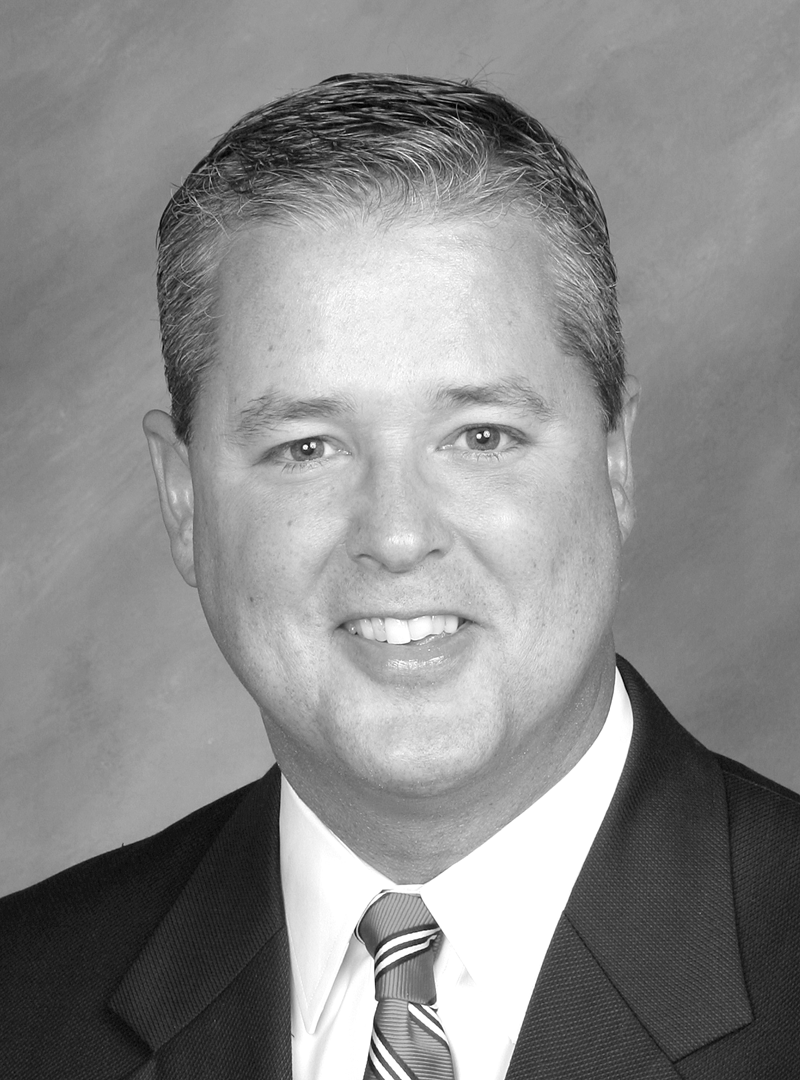
Eric Gouvin

Eric Gouvin says people often become lawyers to help others, but tend to make those problems their own.

“You have that power. It doesn’t mean the cognitive fairy will come to your house and change everything, but you can work to develop a pattern of visualizing and assessing a situation from a more positive standpoint, and ask, ‘what kinds of resources do I need to draw in to do better on this?’” she explained. “Some lawyers put their head down and keep moving, even though it’s not necessarily in a positive direction.

“You can definitely bring a different mindset to a situation to influence an outcome,” she went on. “But you have to have the desire and want to do it.”

Benoit agreed. “The stress isn’t going to go away,” she said, “but it doesn’t have to be this constant negative thinking. When you do that, you’re doing violence to yourself. Why would you want to participate in that?”

Building resilience against factors that trigger stress can come in many forms, she went on. “If you’re in a toxic or hostile work environment, you may have to cut your losses and leave. If you’re in a solo practice, maybe hire someone to help you develop or redesign career goals.”

Other tips include taking firmer control of one’s schedule by rigidly prioritizing tasks, getting away from the desk once in a while by taking short breaks, avoiding unpleasant colleagues as much as possible, educating clients about the process of law (to counter unrealistic expectations), and avoiding workaholism.

“Set limits, and don’t put all your well-being eggs — how you feel about yourself — in your work basket,” Benoit said. “You’re more than your occupation. Make time for yourself and your relationships every day.”

And, overall, be realistic. “You don’t have to be perfect, or read every journal article,” she said. “Remind yourself that you can’t solve all your clients’ problems, even though they will want you to. Remind yourself that you can’t save everybody.”

Finding Purpose

Obviously, clinical depression, substance abuse, and suicidal thoughts aren’t issues people can defeat through positive thinking, and LCL offers resources to lawyers struggling with those demons.

But for everyday stresses, a little mindfulness doesn’t hurt. Some of Benoit’s stress-reduction tips are applicable to many fields, such as finding humor in situations, setting aside time for rest and leisure, avoiding drugs and alcohol, maintaining good nutrition and sleep habits, setting small, achievable goals, and having two specific friends: “one friend you can vent with, and one you can’t.”

It also helps, she said, for lawyers to remember their purpose and passion. She cited a mission statement from the American Bar Assoc. that touches on concepts like defending liberty and pursuing justice, and said lawyers should step back once in a while and reassess why they chose the career to begin with.

“Is it being a defender of rights? A commitment to social justice? Being a protector of human dignity, or a crusader against discrimination? Maybe there are some bigger things that will re-energize you. You can change the system.”

Joseph Bednar can be reached at [email protected]

Law Sections

Knowing the Answer Can Save Employers Much Aggravation

Hunter S. Keil

Hunter S. Keil

Patricia M. Rapinchuk

Patricia M. Rapinchuk

By HUNTER S. KEIL and PATRICIA M. RAPINCHUK

Whether an employer is obligated to pay its employee overtime should be a simple question to answer. A recent decision in the federal courts in Massachusetts, however, illustrates that this is not always the case.

A quick primer on certain aspects of wage-and-hour laws may be helpful. First, under Massachusetts wage laws, failure to pay wages, including overtime, on a timely basis leads to an automatic trebling of damages regardless of the employer’s knowledge or intent. Under federal wage laws, there is no automatic trebling of damages.

Second, under both federal and Massachusetts wage laws, employees must be paid at a rate of 1.5 times their normal hourly rate for all hours worked over 40 hours per week. There are, however, a number of exemptions to the overtime laws under both Massachusetts and federal wage laws.

While the Massachusetts and federal exemptions often overlap, they are not always identical. The most common exemptions are the ‘white-collar exemptions’ for executive, administrative, and professional employees, which exist under both Massachusetts and federal laws. There are also a wide range of less-common exemptions. For example, there are exemptions from federal overtime laws for farm implement salespeople, railroad employees and taxi drivers.

Under Massachusetts overtime laws, there are exemptions for employees employed in a gasoline station, as seamen, and in nonprofit schools or colleges.

A recent case involved one of these less-common exemptions. In Lambirth v. Advanced Auto Inc., the plaintiff was an automotive technician. He routinely worked more than 40 hours per week. Although he was paid his regular hourly rate for all hours worked, he was never paid 1.5 times his regular rate of pay for his hours which exceeded 40 hours.

After he was terminated, the employee brought suit in federal court alleging that the failure to pay time and a half for his overtime over a period of approximately a year and a half violated federal wage laws, and that he was entitled to treble damages for that unpaid overtime under Massachusetts wage laws because he was not paid all wages owed to him on a timely basis. The employee did not bring a claim for overtime violations under Massachusetts wage laws, presumably because the Massachusetts overtime law contains an overtime exemption for ‘garagemen,’ which arguably applied to the employee.

The employer filed a motion to dismiss the Massachusetts claim, arguing that Massachusetts wage laws, and particularly its automatic treble-damages provision, could not apply to claims alleging a violation of federal wage laws.

The judge denied the employer’s motion to dismiss, ultimately holding that Massachusetts wage laws, including the treble-damages provisions, applied to the untimely payment of all wages to which an employee is entitled whether under Massachusetts or federal law. While the judge declined to rule on the viability of the employee’s claimed right to overtime under the federal wage laws, and noted a federal exemption similar to the garagemen exemption found in the Massachusetts wage laws, the judge nonetheless allowed the claim to proceed.

The full impact of this decision, and others that preceded it, remains to be seen. As a practical matter, however, employers need to be sure that they are in compliance with both Massachusetts and federal wage laws concerning payment of overtime in order to be protected from judgments requiring mandatory treble damages for failure to pay overtime.

Because treble damages are mandatory for any violation, employers cannot defend a claim by arguing that they were in compliance with Massachusetts wage laws and did not know about the differences in federal wage laws.  Presumably, the employer in the Lambirth case believed that it was in full compliance with Massachusetts laws when it determined that the plaintiff fell within the garagemen exemption and was entitled not to time and a half, but only to straight time, for hours worked over 40.

The real takeaway from the decision is that all wages, regardless of their source, are covered by the Massachusetts wage act and subject to treble damages if they are not paid on a timely basis.

Hunter S. Keil is an associate with Springfield-based Robinson Donovan specializing in employment law and litigation; Patricia M. Rapinchuk is a partner with the firm who specializes in employment law and litigation.

Business of Aging Sections

Cause and Effect

Dr. Mitchell Clionsky

Dr. Mitchell Clionsky says many conditions can mimic attention deficit disorder, so obtaining an accurate diagnosis is critical before treatment begins.

People with attention deficit/hyperactivity disorder (ADHD) have endured all sorts of labels — lazy, stupid, even crazy — while dealing with the self-berating that accompanies an inability to stay focused and complete tasks. Enter the ADD Center of Western Massachusetts, which opened in the 1990s and today serves as a neuropsychological diagnostic practice, providing a pathway for ADHD sufferers of all ages to get the help they need.

Dr. Mitchell Clionsky often suggests two books to patients diagnosed with attention deficit/hyperactivity disorder, which is commonly referred to as ADHD. The first is Driven to Distraction, and the second is You Mean I’m Not Lazy, Stupid or Crazy?! The Classic Self-Help Book for Adults with Attention Deficit Disorder.

The second tome recognizes the fact that many people with ADHD have been labeled any or all of those things — lazy, stupid, or crazy — and that they also berate themselves for their inability to stay focused, complete tasks, or even make money, which Clionsky says is a common problem for small-business owners because they frequently start too many projects at once, fail to bill clients in a timely fashion, or become overwhelmed by bookkeeping and detailed paperwork.

“There is so much shame and stigma associated with ADHD,” said Clionsky, the board-certified neuropsychologist and co-founder of the ADD Center of Western Massachusetts in Springfield. “Children feel stupid if they fail an exam because they got distracted, skipped a page, or forgot they were supposed to multiply rather than divide. They often do their homework but forget to turn it in, and feel embarrassed and defensive when their parents reprimand them.

“But they are not lazy, and they are not stupid,” he went on. “They have a deficit that involves their brain’s ability to produce or release the chemical known as dopamine, which allows people to stay focused.”

The Mayo Clinic defines ADHD as a chronic condition that affects millions of children and often persists into adulthood. It includes a combination of problems, such as difficulty sustaining attention, hyperactivity, and impulsive behavior. Children with the disorder frequently struggle with low self-esteem, troubled relationships, and poor performance in school. It occurs more often in males than in females, and behaviors can be different in boys and girls.

Two years ago, the Centers for Disease Control and Prevention reported that up to 11% of children in the U.S. have been diagnosed with ADHD. Thankfully, about half of them will outgrow it in their teens and 20s, but millions of adults remain undiagnosed, and even if children improve, they may still exhibit some signs of the disorder throughout their lives.

However, many other medical conditions cause similar symptoms, and Clionsky said depression, anxiety, and trauma can lead to an inability to concentrate and stay focused. In addition, frequent bouts of tonsillitis that cause children to sleep poorly can make it difficult for them to concentrate and perform well in school because they are always tired. But a number of studies, including a recent one conducted by the University of Michigan, show that when children diagnosed with ADHD have their tonsils removed, half of them no longer exhibit the problematic behaviors.

The same situation can result if a person has obstructive sleep apnea.

“We recommend that many people have a sleep study done before they start taking medication for ADHD; in some cases, the symptoms resolve once they are treated for the apnea,” Clionsky noted, adding that the inability to get enough oxygen while sleeping can make people inattentive during the day.

“No one has ADHD until it’s been proven — it’s a medical problem that requires a careful and detailed evaluation,” he continued. “When it is correctly diagnosed and properly treated, children and adults can perform so well that it seems miraculous. But the diagnostic process is complex, and there is a lot of variability.”

He explained that ADHD appears to have a genetic component and tends to run in families; if a parent has ADHD, his or her children have more than a 50% chance of being diagnosed with the disorder, and if an older child has ADHD, their siblings have more than a 30% chance.

However, some people have two conditions that exist at the same time. For example, Clionsky says a person with ADHD and obsessive compulsive disorder may have everything perfectly lined up in their cabinets, but be completely disorganized in almost every other aspect of their life. Meanwhile, a child may be depressed and also have attention deficit disorder.

“It’s a neurologically based condition. But there is no blood test, litmus test, or MRI scan that can prove a person has ADHD, which is what makes a clinical diagnosis so complex,” Clionsky told HCN, noting that people who have a hard time concentrating due to ADHD can pay attention under novel or interesting circumstances. “A 7-year-old may act completely normal when his mother takes him to the doctor; it’s a novel experience, so the doctor doesn’t see the child exhibiting any of the symptoms she describes. But if the appointment took two hours, he would notice everything she spoke about.”

But since everyone occasionally exhibits traits found in people with ADHD, diagnosticians look for entrenched patterns of behavior that fall outside the range considered normal for their age.

Complicated Undertaking

Clionsky opened the ADD Center in the ’90s with four partners, who planned to provide all the services people with the condition might need. But they soon discovered most clients simply wanted a diagnosis, and when the evaluation was complete, they returned to their own physicians and counselors for medication and help.

So, today, the ADD Center has become primarily a neuropsychological diagnostic practice.

“We evaluate about 200 people each year and have seen more than 4,000 patients since we opened,” Clionsky told BusinessWest, explaining that children must be at least 6 years old because, prior to that age, there is not enough evidence for a diagnosis to be conclusive as most young children have short attention spans and are very active.

Testing done on the first visit takes one to two hours and begins by collecting in-depth information.

“We get a comprehensive history that includes the person’s academic, medical, psychiatric, and family background, and they fill out a detailed questionnaire and are asked to rate a variety of symptoms on a scale of one to five,” said Clionsky. “We also interview the individual who is being studied as well as their parents or spouse.”

In addition, the person suspected of having ADHD takes a 15-minute, computerized performance test, which is purposely designed to be boring. “It compares their vigilance and ability to focus and respond consistently against people of own their age, and is used to determine how capable the person is of staying on task,” Clionsky explained.

When those tests are complete, the results are tabulated. However, if the case is complicated by medical or psychological issues, several more hours of evaluation may be needed that include testing the person’s reasoning and looking at their learning and problem-solving skills, their ability to memorize things, their intelligence, and their emotional state.

In order to be diagnosed with ADHD, six out of nine diagnostic symptoms must be rated ‘moderate’ or ‘severe,’ and they have to have been present since before age 12 and have created problems in more than one area of the person’s life.

“The symptoms have to have interfered with their academic, occupational, or social functioning and can’t be due to another cause such as anxiety, depression, a trauma, or a concussion,” Clionsky said, explaining that the symptoms of a concussion can mimic ADHD, but are typically temporary.

He added people with ADD fall into two categories. The first group has attention-impairment problems that lead to disorganization.

“It’s not that they can’t pay attention, but they are easily distracted or lose focus if something is boring, routine, difficult to understand, or has too many variables,” he explained. “Adults with ADD often become distracted or impatient during lectures where there is no interaction. They also have trouble completing tasks; they begin one thing, get distracted, and start another, which leads to something else, without ever realizing their primary objective.”

The second group has problems related to hyperactivity and impulsivity. “It predisposes them to a higher likelihood of auto accidents, orthopedic injuries, and head traumas because of their risk-taking behaviors. They tend to engage in activities that stimulate the release of dopamine, such as motocross or mountain biking, and are more likely to be in trouble with the law,” Clionsky said. “They also tend to speed, jump red lights, and do things such as leaping off the walls of a quarry without knowing its depths.”

If a person is diagnosed with ADHD, Clionsky talks to them about the condition and how it is affecting their life. He also suggests appropriate medication, which they can get from their own physician, and may recommend counseling to improve their organizational skills. Educational planning is included in the center’s services for students, and academic accommodations are usually recommended, which may involve having them take tests in a separate classroom and allowing them extra time to complete the work.

“We also tell students with ADHD to sit as close to the front of the room as possible,” he explained. “Most tend to sit in the back, which makes it really difficult, because there is an ocean of activity in front of them, which can be distracting.”

The testing is repeated during a six-month follow-up exam, but the medication usually works. Side effects are minimal, and negative long-term effects of the drugs are almost unheard of, Clionsky said.

Coping Mechanisms

ADD is a developmental disorder that starts in childhood, and even though some young people learn to compensate with help from adults, in many cases, it catches up with them.

For example, adolescents who get extra help from their teachers or have parents who carefully monitor their schoolwork often do well in high school. But once they enter the adult world or go to college, they are unable to manage on their own.

“I see many clients who have left law school or college; they’re bright, but they are failing,” Clionsky says, adding that they miss class, don’t allow themselves enough time to complete assignments, and are often distracted and thrown off track during exams by something as simple as someone dropping a pencil.

He added that many small-business owners who work in the trades, including landscapers and contractors, have come to the ADD Center for help.

“They may be really good at their job, but they are not good business people. They are working 70 to 80 hours a week, but are in debt because they fail to collect payment for their bills or have too many things going on at once, which keeps them from ever finishing anything,” Clionsky noted. “People with ADHD are the most wonderful people in the world, but they frustrate others because they don’t return calls, are late coming home because they make too many stops, and are disorganized. They make dates and promises but forget about them, and although their spouses love them, they can’t count on them. So, resentment builds up, their home lives become very disruptive, and they have trouble retaining jobs or relationships.”

However there is an exception: If the person with ADHD is working on something they really enjoy, they can block out everything else, and many adolescents and adults exhibit this behavior when they are playing video games because they are fast-moving and demand total attention.

But Clionsky says it’s never possible to know for sure if someone has the disorder until a full evaluation is done. He recently diagnosed a 20-year-old with anxiety disorder whose mother was sure she had ADHD.

“She couldn’t seem to pay attention to anything or finish filling out college applications,” he explained. “But the real problem was that she was so anxious, she worried constantly.”

The example points out the importance of examining every factor of an individual’s life that could cause symptoms commonly seen in people with ADHD.

“Some children and people just have bad habits. They procrastinate or are disorganized, so we are very careful about what we diagnose,” Clionsky said. “But if it is ADHD, it’s a real medical problem, and treatment can and will make a difference.”

Company Notebook Departments

STCC, United Way Open Financial Success Center

SPRINGFIELD — Springfield Technical Community College (STCC) opened Springfield’s first Thrive Financial Success Center on Dec. 3, with a ceremony in the President’s Conference Room in Garvey Hall. Thrive is a collaborative effort between United Way of Pioneer Valley and STCC to provide financial education and support services to students and community residents. It is supported by PeoplesBank, MassMutual, the Irene E. and George A. Davis Foundation, the United Way of Pioneer Valley, and the STCC Foundation. “After the success of the Thrive Financial Success Centers at Holyoke Community College and in downtown Holyoke, we are thrilled to open a third Thrive Center at Springfield Technical Community College,” said United Way of Pioneer Valley President and CEO Dora Robinson. “At the United Way of Pioneer Valley, we believe basic financial literacy should be a key aspect of everyone’s education. No career goal or life’s ambition should be hindered because a person doesn’t know how to balance their checkbook or maintain a good credit rating.” Thrive @ STCC anticipates it will serve 400 individuals in its first year of operation. Program offerings include confidential benefits screening and enrollment, a money-skills class, individual financial coaching sessions, free income-tax prepatration through the Volunteer Income Tax Assistance (VITA) program, links to workforce-development and training workshops, and LifeBridge, MassMutual’s free life-insurance program. Thrive Centers currently operate in partnership with the United Way at Holyoke Community College and at the Picknelly Adult and Family Education Center in downtown Holyoke. “Building financial awareness and planning skills is essential to our students’ and our community’s economic prosperity,” said STCC President Ira Rubenzahl. “Many of our students are overburdened with outside financial struggles. Coupling career guidance with access to financial coaching will assist Thrive participants to make informed decisions that will make their lives easier, allow them to remain focused on their studies, and prepare them for future employment.”

Berkshire Bank Launches ‘Season of Giving’ Effort

PITTSFIELD — Berkshire Bank has launched its fourth annual “Season of Giving” campaign, which runs through the end of the holiday season. Through the campaign, bank employees will complete a variety of community-service projects throughout cities and towns that Berkshire Bank serves. Berkshire Bank employees are also inviting the public to join with them to support local children and families in need during this holiday season to further expand the collective impact. More than 200 Berkshire Bank employees will participate in the effort, with all of the service projects benefiting nonprofit organizations and families across Massachusetts, New York, Connecticut, and Vermont. In addition to these local efforts, Berkshire Bank has teamed up with the American Red Cross to participate in their annual Mail for Heroes program, through which bank employees will send holiday cards to service men, women, and veterans who cannot be with their families during the holidays. In the Pioneer Valley, all Berkshire Bank branches and Berkshire Insurance Group offices have teamed up with the state Department of Children & Families to collect gifts for local families in need. Donations are being accepted at any Berkshire Bank location in Hampden, Hampshire, and Franklin counties. The public is invited to stop by their local office to see which items are needed from the ‘giving tree.’ Bank employees will also volunteer their time with a variety of local nonprofit organizations during the holiday season, including Wreathes Across America and the Salvation Army. Berkshire Bank Foundation, the charitable arm of Berkshire Bank, also plans to contribute grants to local nonprofit organizations.

WNEU Offers Free Small-business Legal Assistance

SPRINGFIELD — The Western New England University Small Business Legal Clinic is now accepting applications from entrepreneurs and small-business owners seeking legal assistance for the spring 2016 semester. Under faculty supervision, law students assist clients with legal issues including choice of entity, employment policies, contract drafting, regulatory compliance, and intellectual-property issues relating to trademark applications and copyright. This is a free service available to local businesses. The Small Business Clinic at Western New England School of Law has assisted more than 300 small businesses, and is a solid resource for entrepreneurs who lack the finances to retain an attorney. By using the clinic’s services, businesses can avoid problems by getting legal issues addressed early and correctly. It also provides students with an opportunity to gain real-world experience. The Small Business Legal Clinic asks small-business owners to submit their applications by Thursday, Dec. 31. Applications received after that date will be considered if additional resources are available. Students will begin providing services in mid-January. For more information, call the clinic at (413) 782-1469 or e-mail [email protected].

Departments People on the Move

The Massachusetts Board of Higher Education formally approved Ramon Torrecilha, a lifelong educator, as the 20th president of Westfield State University (WSU). A lifelong educator, he is currently a professor of sociology at California State University Dominguez Hills. “I am delighted by the appointment of Dr. Ramon Torrecilha as the new president of Westfield State and look forward to working with him,” said Carlos Santiago, state commissioner of Higher Education. “I want to thank the Westfield board of trustees and the search committee for delivering an exceptional pool of quality candidates, and congratulate them on an outstanding selection.” Torrecilha will be the first Latino to serve as president in the university’s 176-year history. He is scheduled to begin his term on Jan. 25. Westfield State’s presidential search process officially launched in January 2015, with a search committee comprising 13 members of the campus community. The pool of candidates was narrowed to a semi-finalist group of 13 in August, and on Sept. 29, the presidential search advisory committee announced three finalists: Torrecilha; Damian Fernandez, CEO and head of school at Ethical Culture Fieldston School; and Linda Vaden-Goad, provost and vice president for Academic Affairs at Framingham State University. On Oct. 28, the WSU trustees voted to recommend Torrecilha as the final candidate, and the state Board of Higher Education approved the choice this week. Previous to his current role at California State University Dominguez Hills, he served as provost and vice president for Academic Affairs, where he designed and implemented a cohort-based, first-year initiative to increase student retention and graduation rates. As provost, he invested in student research and supported more than 200 undergraduate research projects. He provided leadership and support to secure more than $16 million in grants and contracts and $600,000 to support faculty research and creative activity. Torrecilha also served as executive vice president of Mills College in Oakland, Calif., during which time he served as acting president on two separate occasions. His many accomplishments at Mills include the design, implementation, and successful achievement of a capital campaign that raised more than $130 million dollars on behalf of women’s education. He also led a successful campus reaccreditation process resulting in an eight-year renewal from the Western Assoc. of Schools and Colleges and increased the alumnae participation rate by 10%. Torrecilha earned his bachelor’s and master’s degrees in sociology from Portland State University and his Ph.D. in sociology from the University of Wisconsin Madison.

•••••

Eight lawyers from Bulkley Richardson have been named to the 2015 Massachusetts Super Lawyers list of top lawyers in the state, and two lawyers from the firm have been named to the 2015 Massachusetts Rising Stars list of top up-and-coming lawyers. No more than 5% of lawyers in Massachusetts are selected for the Super Lawyers list, and no more than 2.5% are selected for the Rising Stars list. The following Bulkley Richardson lawyers were named to the 2014 Massachusetts Super Lawyers list:
• Francis Dibble Jr., whose practice areas include business litigation, health law, and antitrust litigation;
• J. Patrick Kennedy, whose practice areas include business litigation, banking and intellectual property litigation;
• Kevin Maynard, whose practice areas include business litigation, general litigation, and nonprofit;
• David Parke, whose practice areas include business/corporate and mergers and acquisitions;
• John Pucci, whose practice areas include criminal defense (white collar);
• Donn Randall, whose practice areas include banking and business litigation;
• Ellen Randle, whose practice focuses on family law; and
• Ronald Weiss, whose practice areas include mergers and acquisitions, closely held business, and estate planning and probate.
The following Bulkley Richardson lawyers were named to the 2015 Massachusetts Rising Stars list:
• Michael Roundy, whose practice areas include business/commercial litigation, tax appeals, and medical malpractice (defense); and
• Kelly Koch, whose practice areas include family law and estate planning and probate.
Super Lawyers, a Thomson Reuters business, is a rating service of outstanding lawyers from more than 70 practice areas who have attained a high degree of peer recognition and professional achievement. The annual selections are made using a patented, multi-phase process that includes a statewide survey of lawyers, an independent research evaluation of candidates, and peer reviews by practice area.

•••••

Kenneth Albano

Kenneth Albano

Bacon Wilson, P.C. announced that attorney Kenneth Albano was recently honored with the Esteemed Service Award from Behavioral Health Network Inc. (BHN). Albano was presented with the award during BHN’s annual meeting, in recognition of his 20-plus years as a member of BHN’s board of directors and his related board service. “I am grateful to BHN for this recognition,” Albano said. “The services BHN provides are essential to the wellness of so many in our community who may be struggling with addiction or other life crises. I am honored by this award, and it has been my honor to serve this excellent organization for so many years.” Behavioral Health Network is a growing non-profit, community behavioral-health service organization, and has served the needs of children, adults, families, and communities in Western Mass. since 1938, offering tools and treatments for those with mental illness, substance-use disorders, or intellectual disabilities. Albano is a senior partner with Bacon Wilson and a member of the firm’s corporate, commercial, and municipal practice groups. In addition to his work with BHN, he has worked with the American Cancer Society, Make-A-Wish, and the ALS Assoc., and he serves as board chair of the March of Dimes Western MA Division and on the board of the New England Chapter of the March of Dimes. In June, Albano was honored with the Mass. Bar Assoc. Community Service Award in recognition of his exceptional volunteer work.

•••••

Country Bank President and CEO Paul Scully announced that Eric Devine has been promoted to first vice president, Information Technology. Devine has been with Country Bank since 2006 in the IT Department, working most recently as the Information Technology Services officer. “Eric is a dedicated and driven member of our team. I am pleased to have the opportunity to recognize him for his outstanding leadership over the last few years,” Scully said. Devine studied at Sacred Heart University with a concentration in information technology and graduated from New England School for Financial Studies in 2012. He is very active in the community, serving on the program advisory committee for Porter and Chester Institute, working on the annual SIDS Road Race committee, and supporting the Griffin’s Friends Children’s Cancer Fund as a runner and charity fund-raiser. In addition, he served as the 2015 Springfield grand parade marshal for the annual St. Patricks Day Parade in Holyoke. He was elected to BusinessWest’s 40 under Forty in 2015.

•••••

Aaron Smith, P.C., a certified public accounting firm serving individuals and businesses in the Pioneer Valley, announced the addition of two new staff accountants, Trent Domingos and Emily Sit. Both are responsible for audits, reviews, and compilations. “We are pleased to add two staff accountants to our team, as this allows us to maintain a high level of excellence and personal attention that our clients have come to expect,” said David Padegimas, CPA, managing director of Aaron Smith, P.C. Domingos is a graduate of Fairfield University with a bachelor’s degree in accounting. He previously served as a tax intern at Therrien & Associates, P.C., in Wilton, Conn. At Fairfield University, Domingos was a four-year member of the varsity rowing team. “I am excited to join the team. I look forward to growing as an accountant in this position and contributing to the distinguished reputation that Aaron Smith, P.C. has established,” Domingos said. Sit is a graduate of the UMass Isenberg School of Management with a bachelor’s degree in business administration and accounting. She is expected to obtain her master’s degree in accounting in May. Prior to joining the team at Aaron Smith, P.C., she was employed by IBM Corporation as a financial analyst. She is fluent in English and Chinese, and enjoys gardening in her spare time. “Aaron Smith, P.C. has an excellent track record of great customer service,” Sit said. “I am thrilled to continue my passion for accounting in a well-respected firm.” CPAs at Aaron Smith, P.C. continually invest time and resources into furthering professional education, using state-of-the-art computer technology and developing extensive new business relationships.

•••••

Ruth’s House, the assisted-living residence at JGS Lifecare, announced the appointment of Samantha Panniello as dining services coordinator. As an experienced executive and catering chef, she brings a new dimension to the facility’s signature kosher dining and banquet menus. Panniello brings more than 10 years of experience to Ruth’s House. Formally trained at the Connecticut Culinary Institute, where she was recognized for excellence and graduated at the top of her class, she worked as a chef for both Springfield College and UMass Amherst before becoming kitchen manager of the Federal in Agawam and Vinted in West Hartford, Conn. where she was named head chef. While at Vinted, the restaurant received a rave review by the New York Times, praising its “rich tastes on small plates.” Panniello also landed an executive chef position at Lego in Enfield, Conn., and most recently served as head chef of Marketplace/Back Street Bistro in Springfield. “We’re proud to welcome Samantha to coordinate our dining services. She brings tremendous talent, enthusiasm, and experience to our culinary team,” said Joelle Tedeschi, executive director of Ruth’s House. “Our residents are in for a treat.”

Court Dockets Departments

The following is a compilation of recent lawsuits involving area businesses and organizations. These are strictly allegations that have yet to be proven in a court of law. Readers are advised to contact the parties listed, or the court, for more information concerning the individual claims.

CHICOPEE DISTRICT COURT

Horizons Engineering Inc. v. Chicopee Inn Inc., d/b/a Econo Lodge and Dinesh Patel
Allegation: Non-payment for services rendered: $16,350.50
Filed: 9/30/15

GREENFIELD DISTRICT COURT

West County Equipment Rentals, LLC v. Sugarloaf Nurseries and David and Charlotte Smith
Allegation: Breach of agreement for rental agreement: $7,771.88
Filed: 10/5/15

HAMPDEN SUPERIOR COURT

Ciocca Construction Corp. v. Baystate Co. d/b/a Columbia Gas
Allegation: Negligence causing massive explosion, personal injury, and property damage: $590,000+
Filed: 10/7/15

Coyote Realty, LLC v. Total Wellness Center, d/b/a CleanSlate
Allegation: Breach of lease agreement: $220,000
Filed: 10/9/15

Earl and Stacy Lannon v. Kadant Black Clawson Inc.
Allegation: Product liability causing permanent personal injury: $286,743.16
Filed: 10/28/15

Kate Dunne, PPA Tara Dunne and Michael Dunne v. Baystate Ob-Gyn Inc., Debra J. Junnila, M.D. and Julie M. Bell, C.N.M.
Allegation: Medical malpractice: $1,100,000+
Filed: 10/5/15

New England Family Dentistry, P.C. v. Supreeth Veevanna and Children’s Dentistry of Chicopee, LLC
Allegation: Breach of contract: $60,000+
Filed: 10/14/15

Pablo Torres v. The Silverbrick Group and 15 Taylor, LLC
Allegation: Breach of lease agreement: $25,000+
Filed: 11/2/15


SPRINGFIELD DISTRICT COURT

Brett Fongemie v. Champion Steel, LLC,  Mark E. Gervais, and Bruce B. Bouchard
Allegation: Non-payment of wages: $25,000
Filed: 9/22/15

Miriam Rivera v. Joe Dias d/b/a Care Improvement Inc.
Allegation: Breach of contract for home-improvement services: $10/13/15

Perkins Paper LLC v. Fiore’s Bakery, LLC
Allegation: Non-payment of goods sold and delivered: $8,986.25
Filed: 10/20/15

Daily News

BOSTON — Gov. Charlie Baker signed legislation yesterday establishing the Massachusetts Workforce Investment Board to improve the public workforce system and enhance regional economies around the Commonwealth by focusing on employers’ growing need for skilled workers.

“With changes to the federal workforce-investment laws, we now have an opportunity as a state to redefine and reimagine how we create skill-building programs,” Baker said. “Creating strong regional economies by designing programs that meet the demands of workers and businesses in each region is important to driving economic growth and new job opportunities for our residents.”

Required by federal law and currently defined by state statute, the Massachusetts Workforce Development Board advises the governor and the secretary of Labor and Workforce Development with the mission to build a strong workforce system aligned with state education policies and economic-development goals.

“To help people find good jobs, we are flipping the model to be demand-driven for employers, which, in turn, will help more people find jobs that suit their skill sets,” Secretary of Labor and Workforce Development Ronald Walker II said. “We need to create a system that better meets the needs of employers who struggle to find talented workers.”

The legislation, “An Act Establishing a State Workforce Development Board,” is based on a bill introduced Baker in June reconstituting the state’s Workforce Investment Board, reducing its membership from 65 members to 33, and ensuring the makeup of its membership continues to comply with federal requirements under the federal Workforce Innovation and Opportunity Act (WIOA). WIOA was signed into law by President Obama on July 22, 2014, reauthorizing the Workforce Investment Act of 1998 after more than a decade to transform the nation’s workforce system, and to invest in a skilled workforce.

The Workforce Development Board is charged with developing plans and policies, which are approved by the governor, to coordinate services through one-stop career centers and workforce boards. The board also issues policy recommendations to align the public workforce system and improve performance accountability, and will develop strategies to promote workforce participation of women, people of color, veterans, and people with disabilities across industry sectors.

Court Dockets Departments

The following is a compilation of recent lawsuits involving area businesses and organizations. These are strictly allegations that have yet to be proven in a court of law. Readers are advised to contact the parties listed, or the court, for more information concerning the individual claims.

CHICOPEE DISTRICT COURT

Lucky Se7ens Carpet v. LLC Valley Opportunity Council Inc.
Allegation: Fraud, unfair and deceptive acts, breach of contract: $25,000
Filed 10/30/15

HAMPDEN SUPERIOR COURT

Boston Baking Inc. v. East Baking Company Inc. and Nuvo Bank
Allegation: Non-payment of goods sold and delivered: $46,262.35
Filed: 10-30-15

Country Development Corp. v. Visual Changes Inc.
Allegation: Failure to pay rent and other obligations: $83,781.63
Filed: 10/27/15

Mark Ogoley v. Town of Hampden
Allegation: Negligent containment of road salt causing contamination on abutting property: $66,200
Filed: 10-30-15

Matthew Vitantonio v. Allure Med-Spa, LLC and Mary Jo Devlin, a/k/a Mary Jo Carruthers
Allegation: Breach of promissory note and fraud: $69,460.37
Filed: 10/27/15

Regina Burns v. Samuel’s Tavern
Allegation: Negligence and careless conduct of an employee causing serious and permanent injury: $188,893
Filed: 10/30/15

Robert Ferrier, et al v. Comcast Corp. of MA
Allegation: Failure to provide services: $75,000
Filed: 10/29/15

Schletter Inc. v. Bach Towing Inc., James E. Lawrence, and Leonard Eremento
Allegation: Breach of contract for services, labor, and materials: $100,000+
Filed: 10/23/15

SPRINGFIELD DISTRICT COURT

Domingo Diaz v. Vesuvio, LLC, Mark Laramee, and Lisa Mackenzie
Allegation: Non-payment of wages: $3,190
Filed: 9/18/15

Daily News

SPRINGFIELD — The Western New England University Small Business Legal Clinic is now accepting applications from entrepreneurs and small-business owners seeking legal assistance for the spring 2016 semester.

Under faculty supervision, law students assist clients with legal issues including choice of entity, employment policies, contract drafting, regulatory compliance, and intellectual-property issues relating to trademark applications and copyright. This is a free service available to local businesses that would not otherwise have the resources to obtain these types of services.

The Small Business Clinic at Western New England School of Law has assisted more than 300 small businesses, and is a solid resource for entrepreneurs who lack the finances to retain an attorney. By using the clinic’s services, businesses can avoid problems by getting legal issues addressed early and correctly. It also provides students with an opportunity to gain real-world experience.

The Small Business Legal Clinic asks small-business owners to submit their applications by Thursday, Dec. 31. Applications received after that date will be considered if additional resources are available. Students will begin providing services in mid-January. For more information, call the clinic at (413) 782-1469 or e-mail [email protected].

Community Spotlight Features

Community Spotlight: Stockbridge

Leslie and Stephen Shatz

Leslie and Stephen Shatz stand outside the historic Stockbridge Library, which is undergoing a major renovation.

Stockbridge became known for its quintessential New England charm after it was depicted by artist Norman Rockwell in a masterpiece titled “Main Street.”

The town is also known for its cultural offerings, which include Tanglewood, and Stockbridge has become a destination for people who appreciate its unique character. But, despite the fact that hotel-room occupancy was up 5.3% this summer, cell-phone service is extremely limited and available in just a few locations.

In fact, Selectman Stephen Shatz said it’s not unusual for him to be asked by tourists who are shopping downtown where they can go to use their phones. “They come here with the expectation that they will have cell-phone service, and you can see them on the streets hunting for a place where they can find it,” he told BusinessWest.

That problem will soon be solved, as Verizon is in the process of installing a cell-phone tower on the town’s capped landfill.

“We’ve completed the local part of the permitting process,” Shatz said, explaining that, two years ago, the Board of Selectmen proposed a zoning bylaw to permit the tower to be erected, which received a favorable vote at a town meeting last year. He added that town officials were quite pleased to have the well-known, licensed FCC carrier win the bid because the law requires the company to provide up to four co-locations for other cell-phone companies. “We also negotiated the right to put up municipal public-safety antennas on the tower, although there are no plans to do that at the moment,” he noted.

Preliminary work is expected to begin in March, which will involve installing electricity and a landline at the site. Construction of the actual tower will start next summer, and “by this time next year we should have cell service in town,” Shatz said.

It’s one of a number of measures officials are taking to keep pace with changes in society and allow the town that always appears frozen in time to be anything but.

“Many people have an image of Stockbridge that is immutable. They think of it like the Norman Rockwell portrait, but change does occur, even when you do nothing,” Shatz said.

He explained that, in addition to advances in technology, which require infrastructure to support them, the town’s population has grown smaller and considerably older, which presents a number of intriguing challenges.

“The town has changed. Between 1996 and 2010, our population decreased by almost 20%, and the median age went from 31 to 55,” he told BusinessWest. “Unfortunately, it’s a fact of life in Berkshire County, and even though we don’t have all of the tools we need to respond, we are trying.”

Three years ago, Shatz also came up with the idea to take a new look at other measures that will help the town move into the future and meet the needs of residents and tourists, who are vital to its economy. To that end, a committee has been formed for a Visionary Project that could lead to a master-planning process.

“The last master plan was completed in 1996, and although it was supposed to be looked at every five years, that never happened,” Shatz explained.

One of the first steps will be to initiate a discussion with residents about services they need and want and how the town can provide them. “About 60% of our residences belong to second-home owners. It’s pretty significant because we get income from the taxes they pay, but these people aren’t actively involved in the community. They participate in our cultural and community activities, but they can’t vote, and we are trying to find ways to involve them in our ad hoc committees,” Shatz said.

Since their input is critical to the Visionary Project, the 10-person committee, chaired by Shatz, includes two second-home owners as well as people born in Stockbridge and those who moved there recently.

“We need a different model and want to increase public awareness about our challenges,” he said, adding that the town appropriated $25,000 to fund the initial phase of the project.

Capital Ideas

Leslie Shatz (Stephen’s wife) is a trustee of the Stockbridge Library Assoc., head of its development committee, and a member of its capital campaign steering committee, which was formed four years ago to raise funds to renovate and revitalize the town’s private, nonprofit library and museum. “It contains more than 500 artifacts along with artwork and detailed records of the town’s history,” she said, adding that the renovations were prompted by the need to install an elevator to make the library’s three floors handicapped-accessible because the historic building had been untouched since its last renovation in 1937.

Library Director Katherine O’Neil said that, right after she was hired in June 2011, the library received a $6,000 grant for a code review of the building. The following month, Center Line Architects from Vermont was selected to do the work, which included preliminary design schematics. In addition, a consultant was hired to determine whether it was realistic to raise the funds needed for a major renovation. The result was positive, and a capital campaign kicked off in 2013, right after Thanksgiving.

“By the end of January 2014, we had raised $1 million in pledges and contributions,” Leslie Shatz said, adding that they included some “magnificent leadership gifts.”

The John and Jane Fitzpatrick Fund, headed by Nancy and Ann Fitzpatrick-Brown, contributed $500,000, and an equal amount was donated by sisters Mary Stokes Waller and Carol Fremont-Smith in memory of their mother and grandmother.

Revenue raised to date includes a grant of $600,000, $500,000 in historic tax credits, and $200,000 from the town. As a result, the renovation is well underway and the committee is close to wrapping up its $4 million fund-raising goal.

“The library is essential to the community life of Stockbridge. It opened in 1862 during the darkest days of the Civil War and was launched by a group of public-spirited men who believed a library was central to the life of the town,” Leslie Shatz said.

“They put up the money needed to build the structure on donated land and challenged the townspeople to raise enough to buy books. It was a community endeavor,” she continued, adding that the first librarian was the sister of a Supreme Court Justice, and the library was only one of five built in the U.S. during the war.

The new building will retain the majority of its historical elements, but square footage has been added for the elevator. Space has also been repurposed in the attic, the roofline has been raised, and skylights are being installed.

In addition to updating the electrical, plumbing, and heating and air-conditioning systems, a new multi-purpose room will accommodate up to 35 people in the main area of the building.

“It will give us the option of holding more library programs as well as allowing groups in the community to use the space,” Leslie Shatz said.

O’Neil said a strategic plan for new programming was created for 2012-17 after input was received from focus groups and community surveys, which resulted in an expansion of existing programs and a plethora of new ones, including a financial-literary program for teens and their parents that will be conducted by second-home owner Jon Budish.

“The renovation has been a wonderful project to be part of, and we are looking forward to letting patrons see the renovated space and using it to better serve their needs and interests,” O’Neil said.

The work is slated to be completed in January, and the building will open after the books are shelved and the museum artifacts are put into place.

“We have been exceptionally gratified by the support we have received for the project,” Leslie Shatz said. “We are all very excited about opening the doors and welcoming the community into the building.”

While the library project draws to a close, there are other initiatives taking shape in this picturesque community.

One of the primary challenges the town faces is providing ambulance, police, and fire protection, since the population increases by 7,000 on summer weekends.

To lower operating costs and take advantage of underutilized sites, the Board of Selectmen has taken a proactive stance, and in addition to the cell phone tower, it plans to establish a solar farm on the landfill. The board is in the process of selecting a provider, but the project cannot begin until it receives permission from the state.

“If we’re successful, it will cover the cost of almost 100% of the electricity used to power the town’s buildings,” Shatz said. “The landfill has the potential to be a real income generator because we will receive rent from Verizon which could amount to $30,000 annually. It’s real money to a small town.”

Moving Forward

Stephen Shatz said Stockbridge is a great place to live, but lacks the type of jobs needed to retain and attract young people. So he hopes the Visionary Project, coupled with a new cell-phone tower, solar farm, major renovations to the library, and efforts to get second-home owners more involved will help Stockbridge solve the challenges it faces.

“The Visionary Project is related to finances and services,” he said. “One of the only things we can do is provide a regulatory framework conducive to smart growth.”

Indeed, that is in line with the change occurring on many levels in a town so picturesque that it attracts tourists from all over the world.

Stockbridge at a glance

Year Incorporated: 1739
Population: 2,065
Area: 23.7 square miles
County: Berkshire
Residential Tax Rate: $8.67
Commercial Tax Rate: $8.67
Median Household Income: $65,323 (2013)
Family Household Income: $79,144 (2013)
Type of government: Town Administrator/Board of Selectmen/Open Town Meeting
Largest Employers: Austen Riggs Center; Berkshire Theater Festival; Red Lion Inn
* Latest information available

Opinion

Editorial

When the battle lines for the Western Mass. casino license were being drawn three years ago, Springfield became ground zero. And for many reasons.

The city was on major transportation arteries; it was close to the Connecticut border; it had sites that looked practical for building a casino; it was seeing better times but was still in many ways down and out, and a casino company could win some style points for becoming part of a revitalization effort; a tornado had plowed through just a year earlier, making the city a sympathetic location.

Yes, it quickly became clear that, while there were some other contenders in the mix at various points — Palmer, Holyoke, West Springfield — Springfield was the frontrunner in this competition and the seemingly perfect place to spend $800 million or so on a casino.

Things can change quickly in three years, and they have, especially with regard to Connecticut and its decision to not sit back and watch a Springfield casino wreak more havoc on that state’s already-embattled casino industry.

Indeed, the state is essentially parterning with two Native American tribes — those that operate Foxwoods and Mohegan Sun — to open a casino just south of the border with Massachusetts. It is an unprecedented alliance, and its plans completely alter the equation when it comes to a Western Mass. casino and the plans to build one in Springfield.

And that’s why MGM is being ultra-aggressive in its efforts to stop this proposal in its tracks.

It has hired the Washington-based law firm led by former U.S. Attorney General Eric Holder to wage a legal battle, essentially challenging the constitutionality of the state of Connecticut’s recent granting of exclusive right to the tribes to open the casino near the border. And it is unleashing an army of lobbyists in advance of debate on the tribal plan in the Connecticiut General Assembly early next year.

The size and intensity of this fight shows just how much the plan changes the dynamic of the Springfield casino, and it also helps explain why MGM has seemed at least distracted when it comes to moving ahead with its now-$900 million plan.

It should be distracted. What Connecticut is proposing is historic and landscape-altering, and it certainly changes the perspective of Springfield as the perfect place to launch the Western Mass. casino.

In this fight, MGM is clearly in, and it needs to be. n

Employment Sections

Joint Venture

HempDesk

The statute legalizing marijuana for medical purposes in Massachusetts presents a confounding dilemma when comes to the workplace. On one hand, the law states that any person who meets the requirements for medical marijuana may not be penalized or “denied any right or privilege” for such activity. On the other hand, employers aren’t required to accommodate marijuana use in the workplace. But what if an employee is fired for using the drug after hours, then failing a drug test? On issues like that, the statute is frustratingly vague, but cases winding their way through the system may soon provide some clarity.

Advantage Sales and Marketing never wanted to be a test case for medical marijuana, but that’s exactly what the Foxborough company has become.

It likely won’t be the only battleground, either.

The issue began when Cristina Barbuto, who suffers from Crohn’s disease and is prescribed marijuana to deal with painful flareups, applied for a job at Advantage.

“She told them, even before the pre-hire drug screening, that she was going to test positive,” said Timothy Murphy, an attorney with Skoler, Abbott & Presser, P.C. in Springfield, noting that her marijuana use, typically during the evening, was a doctor-directed strategy to deal with her condition.

She was hired. Then fired the next day.

“They brought her on, but when they got the test result, they said they had a zero-tolerance policy, and she had tested positive,” Murphy said. When Barbuto, who is now suing Advantage, reminded the company she had been upfront about her marijuana use, he went on, “they said, ‘sorry, but this is our policy.”

This type of confusion, he explained, is due to what seems to be conflicting language in the statute that legalized marijuana for medical reasons after Massachusetts voters approved it in a November 2012 ballot question.

On one hand, the law states that any person who meets the requirements for medical marijuana — which include suffering from a qualifying medical condition (such as cancer, glaucoma, HIV/AIDS, Crohn’s, Parkinson’s, multiple sclerosis, and others) and being prescribed the drug by a physician — may not be penalized under state law or “denied any right or privilege” for such activity.

On the other hand, nothing in the statute requires employers to accommodate marijuana use in the workplace or requires health-insurance reimbursement for its use.

The grey area — what about employees who use medical marijuana at home, then come to work the next day? — is proving to be vexing for employers worried about crafting drug-use policies that protect their rights under the law. Because the law, so far, is largely silent on the matter.

“When it comes to this language, no one knows what it means,” Murphy said. “A registered user can’t be denied any rights or privileges, and [Advantage] is going to be a test case.”

While the medical-marijuana law says employers don’t have to accept marijuana use in the workplace, “that’s not really the question,” said Karina Schrengohst, an attorney with Royal LLP in Northampton. “The question is whether you can make employee decisions based on marijuana use outside the workplace and whether you need to make a reasonable accommodation.”

Barbuto seems to have some standing based on the federal Americans with Disabilities Act, which prohibits workplace discrimination based on a disability and requires employers to make a “reasonable accommodation” for that employee if it would not pose an “undue hardship” on the operation of the business, as long as the employee can perform the essential functions of the job.

“We have our own state anti-discrimination law which largely tracks the federal ADA,” Murphy said. “Under that law, discrimination against disabled employees is unlawful, and employers can’t take any negative actions against employees because of a disability.”

But Massachusetts employers have rights as well, and medical marijuana isn’t even legal under federal law, and … well, it’s easy to see why confusion reigns right now.

On the wording of the Bay State’s medical-marijuana statute regarding rights and privileges, “does that mean medical-marijuana use is protected, and employers can’t take any adverse action against employees who use it?” Murphy asked. “Nobody is entirely sure.”

However, cases like Barbuto v. Advantage Sales and Marketing and others winding their way through the Massachusetts courts should begin to add clarity to the issue. That clarity, Murphy said, can’t come soon enough.

A Question of Safety

The law does seem clearer, he noted, when the position in question involves issues of safety — say, truck drivers and forklift operators.

“Obviously, it’s an employer’s responsibility to ensure a safe workplace for all employees, and that’s important. The use of marijuana can impact an employee’s job. It’s a legitimate concern for employers … similar to alcohol use.”

Employers have a dilemma, he said. On one hand, Murphy said, “they probably want to be empathetic and understanding to medical marijuana users because they’ve been dealt a bad hand; they’re not in a good place with their health. Most employers tend in that direction, but at the same time, they’ve got to maintain safety for everyone.”

On-the-job impairment, regardless of the cause — whether it’s marijuana, other prescription drugs, alcohol, or illegal narcotics — and workplace safety should be the central piece of any substance-abuse policy, he said.

However, Schrengohst noted, many positions don’t involve issues of safety.

“Often this question comes up when employers are balancing workplace safety against this new law. On the issue of workplace safety, preventing workplace injuries, for people like factory workers and forklift operators, I’m going to advise clients to require drug tests because of a legitimate safety interest,” she told BusinessWest. “But in an office setting, there’s more confusion. Obviously, you don’t want your receptionist, as a face of the business, to be under the influence, but the safety issue is the clearer one.”

And what constitutes ‘under the influence?’ The argument Barbuto makes, Murphy said, is that her nighttime use of marijuana does not affect her daytime performance. “She’s saying, ‘I have this disability, and you have a responsibility to accommodate my situation, as long as I’m not impaired at work.”

In short, he went on, “does an employer in Massachusetts have to accommodate an employee who is a medical-marijuana user? That’s the question.”

It’s a question other states are dealing with as well. In Coats v. Dish Network in Colorado, the plaintiff is a quadriplegic who used medical marijuana outside working hours, a registered user who took the drug in a manner according to the state statute authorizing medical-marijuana use.

Yet, the Colorado Supreme Court upheld his firing earlier this year because marijuana is classified as a schedule 1 drug, illegal under federal law. In other words, he couldn’t be arrested for using medical marijuana, but he could be fired.

“The court said the termination did not violate the employee’s rights. That’s really been the trend throughout the country,” Murphy said, citing two California cases: James v. City of Costa Mesa, in which the U.S. Court of Appeals for the Ninth Circuit held that the ADA doesn’t offer job protections for medical marijuana, and Ross vs. RagingWire Telecommunications, which held that the state’s medical-marijuana law does not require an employer to accommodate the use of otherwise illegal drugs for chronic back pain.

Those cases date back several years, however, and are no indication of how Massachusetts courts will view similar complaints, Murphy said.

“We need more regulations as well as more guidance through case law,” Schrengohst said. “The cases I’ve looked at in other states inform this, but they’re not binding in Massachusetts. Those cases have ruled in favor of employers, but the bottom line is, our statute and regulations don’t actually address all the issues, so I’m going to deal with it on a case-by-case basis — whether workplace safety is an issue, what the risks are going to be, and how we think a court might look at it. It’s a hard question right now.”

“In the context of workplace safety,” she went on, “employers really struggle to balance a safe workplace with this new legislation that doesn’t provide clear guidance. The explicit statement that you don’t have to accommodate it in the workplace at first seems great, and then it’s not, really.”

That’s partly because of the potential for dishonesty.

“When you drug test someone, it’s not like when you do a breathalyzer when someone is drinking,” she said. “With a positive drug test, everyone is going to say, ‘weeks ago’ or ‘after hours.’ No employee is ever going to say, ‘that was during my shift yesterday.’ I think employers are concerned, and obviously they’re worried that they’re going to be faced with litigation. It’s new, and we don’t know what to expect. It’s a really interesting topic.”

Changing Times

Murphy noted that the medical-marijuana statute makes an effort to protect employers, even if some of the specifics get blurry.

“It’s now well-understood that employers don’t have to excuse employees from performing the essential functions of their jobs, and don’t have to exclude employees from following their other types of policies, whether attendance-related or other standards of conduct,” he said.

As for drug testing, Schrengohst said companies with well-understood safety concerns are on firmer ground.

“I want to know what the facts of the situation are, what the industry is. If you want to have a drug policy and you want to drug test, why? What are the reasons behind this? Like I said, it’s a lot clearer when you have employees where safety is really important — someone who’s driving or operating equipment, and they have to be focused.”

Meanwhile, Massachusetts also faces the possibility of changing winds on the federal side, a question that vexes many physicians concerned about prescribing patients a drug that is technically illegal.

“Marijuana use remains illegal under federal law, but Obama’s administration has basically said, ‘we have bigger fish to fry, and we’re not going to be enforcing our medical marijuana and drug laws; we’re not going to punish marijuana users,’” Murphy said. “But that could change. There’s obviously going to be a change in the White House. Is the next president going to take a different view that could impact things? Or will the federal law be changed to allow for medical-marijuana use? That’s probably far less likely than state-by-state changes in laws.”

Massachusetts has progressed in this issue like many states, gradually changing its marijuana laws, Murphy noted. In 2008, the law was changed to decriminalize very small amounts of the drug. In 2012, voters ushered in the era of medical marijuana in the Bay State. In 2016, could full legalization follow, as Washington and Colorado have done?

“I expect there to be further efforts next year to liberalize our marijuana laws, and with each legislative step, maybe the picture gets clearer for employers,” Murphy said. “Advocates have tried to get the Legislature to pass it, but there doesn’t seem to be much appetite in the Legislature to do that. And, often, when the Legislature won’t act on things, people feel, ‘well, we’ve got no choice but to bring it to the voters.’”

Which would lay a whole new set of questions at the feet of employers already struggling to balance their employees’ rights and privileges with their own.

Joseph Bednar can be reached at [email protected]

Employment Sections

Lessons from the ‘Blind Barber Case’

By PETER VICKERY

Peter Vickery

Peter Vickery

A mixture of sympathy and surprise best describes the tone of the news stories about the recent decision from the Mass. Commission Against Discrimination (MCAD) in what headline writers dubbed the “blind barber case.”

According to media interviews with satisfied customers, Joel Nixon is a fine young barber. But upon losing his job, he fell into debt, faced foreclosure on the family home, and had to go on food stamps, all while his wife was pregnant with their first child. This explains the sympathy. He is also legally blind, and to the extent we ever thought about the subject at all, many of us may have assumed that barbershop owners could lawfully require that their employees be sighted. Hence the surprise.

These are the basic facts of Nixon v. Tony’s Barber Shop: Nixon suffers from the degenerative eye disease retinitis pigmentosa, has a certificate of blindness from the Mass. Commission for the Blind, and had to surrender his driver’s license in 2004. In November 2011, he applied for a job at the newly opened Tony’s Barber Shop in his hometown of Norton. The owner, Caesar Antonio Morales, hired him.

Four months later (after Nixon had tripped over a customer’s legs, a chair, and a ladder), Morales fired him. Blindness is a disability, so the MCAD decided that, by firing Nixon because of his blindness, Tony’s Barber Shop had discriminated against him, thereby violating the Massachusetts anti-discrimination law (Chapter 151B). The MCAD ordered Morales to pay Nixon $100,000, of which a sizeable sum, $20,000, was to compensate Nixon for emotional distress.

At this point, readers may be wondering, at the risk of seeming insensitive, whether those in the tonsorial business are legally entitled to require that the barbers they employ can see. After all, although the term ‘blind barber’ may not trigger the same degree of trepidation as the words ‘blind brain surgeon’ or ‘blind airline pilot,’ the occupation does entail the use of sharp scissors and, from time to time, cut-throat razors.

Some potential customers, decent people with no bias against the visually impaired, might be a tad wary of a barber who has a certificate of blindness. Does the law let Morales take this possible loss of customer confidence into account, or would that constitute prejudice by proxy? And would Morales (after Nixon tripped over the legs, the chair, and the ladder) have been allowed to fire Nixon if the young man was not visually impaired, but merely clumsy? Clumsiness is not, to date, a recognized disability, so the clumsy are not a protected class.

The narrow question is not whether current social mores favor Morales giving Nixon a fair shake, but whether state law compels him — on pain of a close encounter with the MCAD followed by a penalty of the six-figure kind — to continue employing Nixon even after the young man’s series of stumbles. A definitive answer to the question depends on this case, or one like it, making its way to the appellate courts. In the meantime, here is what we know:

Chapter 151B prohibits discrimination quite comprehensively, and Section 9 of the statute mandates that the courts construe the law liberally for the accomplishment of its purposes, which they certainly do. But it does have an out. It allows an employer to discriminate on the basis of disability if, and only if, the disability renders the employee unable to meet a bona fide occupational qualification (BFOQ).

Judges have read this statutory proviso as creating an affirmative defense, meaning the employer always bears the burden of proving it. Further, in its regulations, the MCAD interprets the BFOQ as the “narrowest of exceptions,” an interpretation the judiciary has endorsed. So, although the employee bears the burden of proving discrimination, it is for the employer to squeeze into the narrow BFOQ exception by persuading the MCAD that the discrimination was justifiable — a significant challenge.

Federal law contains a similar affirmative defense, which the delivery company UPS was able to deploy with partial success when the Equal Employment Opportunities Commission (EEOC) charged it with discriminating against would-be drivers who had failed the company’s eyesight test. UPS claimed that it was entitled to discriminate against those visually impaired people who could not meet the company’s vision protocol, pointing to the safety-of-others exception written into the federal Fair Employment and Housing Act.

Under the statute, an employer secures the protection of the safety-of-others exception if it can prove that, even with reasonable accommodations, the disability in question would prevent the employee from performing the job’s essential functions in a manner that would not endanger the health and safety of others. UPS contended that it imposed the eyesight test because — of all things — it did not want its drivers running down small children who might suddenly dart into the street.

Nevertheless, in 1997 the EEOC commenced an action in California against UPS for violating the rights of job applicants who were monocular, i.e. with sight in just one eye. Eight years later, the Court of Appeals for the Ninth Circuit held that UPS did, indeed, have the benefit of the safety-of-others defense because “peripheral vision plays an important role in avoiding accidents” and monocular drivers would have “less opportunity to see a child … darting from the impaired side.”

As a result of the case EEOC v. UPS, it is now reasonably well-established that, under federal law, peripheral vision contributes to safer driving (in California, at any rate).

So, in keeping with the spirit of the safety-of-others exception, did the MCAD consider the possibility that visual acuity might constitute a BFOQ for barbering, given the sharp scissors and cut-throat razors? No, it did not.

This brings us to perhaps the most noteworthy fact about Nixon v. Tony’s Barber Shop: the employer defaulted. At the hearing, there was nobody to advocate for Tony’s Barber Shop, and the only witness was the complainant himself, Nixon.

One piece of evidence, it turns out, was crucial to the MCAD’s ruling that Tony’s Barber Shop discriminated against Nixon on the basis of his blindness, namely Nixon’s own account of what Morales said to him in the barber shop at the time of his discharge. According to Nixon, Morales used profane comments that referred to his blindness, e.g. “you blind f___,” comments the hearing officer found to reveal “gross insensitivity” and “discriminatory animus.”

With no attorney present at the hearing to cross-examine Nixon or to elicit Morales’s (possibly different) version of the conversation, Nixon’s account stood unchallenged and unrebutted. And, without defense counsel, there was nobody to raise, let alone prove, the BFOQ affirmative defense.

The first lesson for employers? Show up. An adjudicatory hearing is an adversarial process, and if the adjudicator — here the MCAD, the same agency that investigated the complaint and found probable cause — hears from only one side, the result should surprise no one.

The second lesson? Resist the temptation to fire first and ask questions later. Upon learning that an employee has a disability and wants an accommodation of some kind, the employer has a duty to initiate an interactive dialogue to find out whether reasonable accommodations will allow the employee to perform the job.

Remember, although it is the employee’s responsibility to request an accommodation, the onus is on the employer to start the series of two-way conversations so as to determine whether an accommodation is reasonable. And when making that determination, think back to Tony’s Barber Shop and ahead to your own looming discrimination case and assess whether you will be able to prove, by a preponderance of the evidence, the affirmative defense of BFOQ.


Peter Vickery practices employment law in Amherst; (413) 549-9933; www.petervickery.com

Employment Sections

Letter of the Law

By OLGA M. SERAFIMOVA, Esq.

Olga Serafimova

Olga Serafimova

Having to deal with a unionization effort is challenging enough, but having to do it a second time after a narrow success would be truly taxing.

Yet, Danbury Hospital is faced with exactly this task.

Specifically, Danbury Hospital’s workforce voted 346 for and 390 against joining AFT Connecticut, which is a union comprised of teachers, nurses, and other healthcare workers. However, last month, the National Labor Relations Board (NLRB) — the federal agency responsible for the implementation of the National Labor Relations Act — set aside these results and ordered a re-run election. The reason for this development was that the NLRB concluded that the hospital had violated a recent amendment to its rules requiring employers to provide available personal e-mail addresses and telephone numbers for employees included on a voter list.

When a petition is filed with the NLRB seeking to form or join a union, the employer must comply with a number of requirements with short deadlines, such as compiling and providing a voter list. A voter list contains specific information about all employees who would be included in the proposed union if the unionization effort is successful, as these are the employees who get to vote on whether or not to unionize. After the petition is filed, the proposed union and the employer may agree to put the matter to a vote by entering into an election agreement, or may have the NLRB decide whether or not a vote should occur.

To be entitled to a vote, the proposed union must comply with a number of specific requirements, and unless an agreement is reached, the issue is decided at a hearing before the NLRB. This hearing may result in the dismissal of the petition or the issuance of a direction of election, in which case the matter is put to a vote by the employees.

Generally speaking, the voter list must be provided to the NLRB and the proposed union within two business days after the approval of the agreement or the issuance of the direction of election. This deadline is very strict. To get an extension, the employer must be able to show ‘extraordinary circumstances.’

The fact that the employer may be decentralized, have a large workforce, or rely on an outside payroll company, all of which would make gathering the required information more time-consuming, are not sufficient to meet this test. Other aspects of the rule that render the task time-consuming are the very specific format requirements. The NLRB rule controls the file format to be used, the order of the columns, the order of the names, and the font to be used, and failing to comply with any of these requirements could potentially result in a re-run election.

The information required to be on a voting list includes the employees’ full names, job classifications, work locations, shifts, and contact information, including their home addresses, available personal e-mail addresses, and available home and personal cell-phone numbers. In compiling the voter list, Danbury Hospital relied exclusively on the information contained in the employee database maintained by its Human Resources Department.

In so doing, the hospital provided all personal e-mails in that database, as well as telephone numbers for 94% of the employees on the list. Nevertheless, the NLRB held that its rules had been violated.

The NLRB reached this decision not because it found that the hospital had failed to provide any e-mail addresses and telephone numbers, but because it found that the hospital had failed to search diligently enough for any additional e-mail addresses and telephone numbers that may exist.

The NLRB reasoned that, by failing to look into other databases, such as those maintained by its Emergency and Nursing departments, the hospital had not exercised the necessary level of due diligence to comply with the rule.

Given the grave consequences of failing to comply with the requirements of the voter list and the broad interpretation of the new rule in the case of Danbury Hospital, employers facing a unionization effort are advised to start preparing the list as soon as they know the likely scope of the bargaining unit at issue.

A similar result could follow if an employer is found to have failed to properly post or distribute the notice of election, the document informing the parties and employees that a vote will be held. Under the NLRB’s new rule, this notice must be posted in conspicuous places in the workplace, including all places where notices to employees are “customarily posted.”

The employer must also e-mail the notice to all employees with whom the employer “customarily communicates” electronically.

Given these vague definitions, further litigation is bound to happen.

Olga M. Serafimova, Esq. is an attorney at Royal LLP, a woman-owned, boutique, management-side labor and employment law firm. Royal LLP is a certified women’s business enterprise with the Massachusetts Supplier Diversity Office, the National Assoc. of Minority and Women Owned Law Firms, and the Women’s Business Enterprise National Council; (413) 586-2288; [email protected]

Employment Sections

Going Concern

By MARYLOU FABBO, Esq.

Marylou Fabbo

Marylou Fabbo

Massachusetts specifically recognizes ‘gender identity’ as a protected classification, providing transgender employees with certain rights, including the right to be treated in the same manner as their co-workers in the workplace.

So, what exactly does ‘transgender’ actually mean? ‘Sex’ is a term used to describe someone’s biological assignment at birth. ‘Gender’ is the sex with which an individual identifies. Gender is an individual’s sense of being ‘male’ or ‘female’ and is often, but not always, expressed through clothing, hair, or other means.

‘Transgender’ is the term used to refer to people who do not identify with the sex they were assigned at birth or with society’s expectations about female and male gender roles. ‘Trans’ is often used when referring to a transgender individual. Trans people may be male-to-female (MTF) or female-to-male (FTM). Whether someone is transgender does not turn on whether the individual has had surgery to reflect his or her gender identity.

There have been many issues surrounding transgender employees, but perhaps the most frequent one that arises for employers is the use of workplace bathrooms. A transgender employee may feel entirely comfortable using the restroom of the gender with which he or she identifies, but the employee’s co-workers may be opposed to sharing a bathroom with the employee.

Co-workers may complain that they feel that their privacy is invaded or that transgenderism offends their religious beliefs. In some situations, trans employees may feel harassed when using the facility that corresponds with their gender identity. Employers often do not know what to do when faced with competing complaints.

In 2011, Massachusetts employment and housing laws were amended to specifically include transgender employees as a protected group, and Executive Order 526 extended Massachusetts equal-rights protections to gender identity and expression. As of Aug. 1, 2015, surgery is no longer a prerequisite to obtaining a new birth certificate in Massachusetts. Legislation has been proposed in Massachusetts that would prohibit discrimination against trans individuals in places of public accommodation, such as public bathrooms.

Similarly, federal courts and agencies such as the Equal Employment Opportunity Commission (EEOC) have held that Title VII of the Civil Rights Act’s prohibition against sex discrimination applies to those who do not act according to sex stereotypes, such as the expectation that only those whose sex is female should wear a dress. In 2015, both courts and federal agencies made their position on bathroom accessibility clear: transgender employees should be permitted to use the restroom with which they identify.

In April of this year, the EEOC ruled that a transgender employee cannot be denied access to common restrooms used by other employees of the same gender identity, regardless of whether the transgender employee has had any medical procedure or whether other employees may have negative reactions to allowing the employee to do so. In May, the Occupational Safety and Health Administration (OSHA) announced an alliance with the National Center for Transgender Equality to promote the safety and health of transgender workers, and in June, OSHA issued a four-page “Guide to Restroom Access for Transgender Workers.”

As most employers are aware, OSHA requires that employers provide employees with sanitary and available toilet facilities so that employees will not suffer adverse health effects that can result when such toilets are not available when employees need them. In its guide, OSHA has made it clear that all employees should be permitted to use the facility that corresponds with their gender identity.

Regardless of an individual’s personal beliefs regarding gender-identity issues, employers should make it clear that all employees are entitled to be treated with dignity and respect in the workplace. Employers must consider restroom modifications that provide options for transgender employees and for co-workers who are not comfortable sharing facilities. Where possible, an employer should consider offering a single-occupancy, gender-neutral bathroom in an equally convenient location. The transgender employee may not be required to use that facility, but it would remain an option for whomever is uncomfortable with the situation — whether it be the transgender employee or a co-worker.

If a single-occupancy facility is not available, employers should have multi-occupant, gender-neutral restroom facilities with lockable stalls available. Employers should also let all employees know that the presence of a transgender employee in the restroom is not per se harassment and that reports of inappropriate behavior or comments in the restroom will be addressed regardless of whether they are asserted against someone who is transgender or not.

Marylou Fabbo is a partner and head of the litigation team at Skoler, Abbott & Presser, P.C. She provides counsel to management on taking proactive steps to reduce the risk of legal liability that may be imposed as the result of illegal employment practices, and defends employers who are faced with lawsuits and administrative charges filed by current and former employees; (413) 737-4753; [email protected]

Health Care Sections

Tough Pill to Swallow

HCNcover1215ART

Causing 1,200 overdose deaths per year, the opioid-abuse problem in Massachusetts has reached crisis levels, to hear some doctors and lawmakers describe it. While the goals of those two groups are similar, their strategies for tackling the epidemic can differ. Take, for example, Gov. Charlie Baker’s recently announced bill, which seeks to sharply limit the length of opioid prescriptions and allow for the involuntary hospitalization of substance abusers deemed to be in immediate danger, to name two controversial provisions. Doctors may quibble over the details, but Baker argues that a tough problem requires equally tough solutions.

Gov. Charlie Baker knew his bill would ruffle a few feathers. That was the point.

He said as much when he reminded lawmakers last month that Massachusetts doctors, in 2014, wrote more than 4.4 million prescriptions for Schedule II and Schedule III drugs — defined as medications with high to moderate potential for dependency and abuse — totaling more than 240 million pills.

“I should remind everybody that we only have six and a half million people in the Commonwealth of Massachusetts,” Baker said. “In the same year, over 1,200 people died of opioid overdoses. Simply put, the status quo is unacceptable, and it needs to be disrupted.”

Baker was testifying before the Joint Committee on Mental Health and Substance Abuse, alongside Boston Mayor Martin Walsh and Christopher Barry-Smith, the state’s first assistant attorney general, in support of “An Act Relative to Substance Use Treatment, Education and Prevention,” a bill the governor filed in mid-October to address an opioid epidemic in Massachusetts that claims the lives of nearly four residents every day, on average.

Dr. Robert Roose, chief medical officer of Addiction Services for the Sisters of Providence Health System, was part of a 16-member working group Baker assembled earlier this year to craft a plan to combat what medical professionals have been calling a statewide crisis, and said the bill’s components — including a 72-hour limit for new opioid prescriptions and involuntary hospitalization of patients who might pose a danger to themselves or others — originated from that group.

“We took our responsibility seriously, to come up with interventions and strategies to address the epidemic in a bold way,” Roose told BusinessWest. “The premise we were operating from was that this epidemic is unlike any we’ve seen before, both in magnitude and breadth of who is impacted, and knowing the strategies we’ve attempted in the past likely would prove insufficient, we wanted to come up with bold, new strategies.

“Governor Baker’s bill does exactly that,” he went on. “These are provocative and bold ideas that have generated some discussion, if not controversy, throughout the medical community and healthcare systems, as well as, perhaps, with patients themselves and treatment advocates.”

Certainly, Dr. Dennis Dimitri is well-versed in the opioid issue, as president of the Mass. Medical Society (MMS), which has come up with its own broad series of strategies to combat the problem. He cited a recent poll by the Harvard School of Public Health showing that nearly four in 10 Massachusetts residents personally know someone who has abused prescription pain medications.

Therefore, he thanked the governor and lawmakers for their multi-pronged approach to addressing the crisis, including significantly increased funding for addiction services, insurance coverage, and enhancements to the state’s Prescription Drug Monitoring Program. “We strongly support these and other measures,” Dimitri said.

Still, not every detail of the bill — the logistics of which still need to be hammered out — will necessarily go down easy with the state’s physician community.

Drawing a Line

Take, for example, a provision in the bill limiting patients to a 72-hour supply the first time they are prescribed an opioid or when they are prescribed an opioid from a new doctor.

“Looking back over the past 20 years,” Roose said, “we have overprescribed for pain and done an insufficient job of educating patients in the community about potential risks of opioids. The medical community has been engaged with this issue increasingly over the past several years, but, clearly, what has been done is not enough.”

Dr. Robert Roose

Dr. Robert Roose says the governor’s working group on opioid abuse recognized that bold strategies were needed to combat a growing crisis.

As a member not only of the governor’s working group but the Mass. Hospital Assoc. (MHA) Substance Use Disorder Prevention and Treatment Task Force, Roose has been heavily involved in discussions of prescription limits. While the limits themselves aren’t controversial, the details are a point of contention. While Baker seeks a four-day limit in his bill, the MHA prefers a five-day limit, while the Mass. Medical Society seeks a seven-day limit, calling four days simply too onerous for many patients.

“A patient with acute pain beyond the proposed initial 72-hour treatment period would have to return to their physician’s office, obtain a paper prescription, bring it to the pharmacy, and wait for it to be filled,” Dimitri said. “An elderly or disabled or poor patient, especially one without a helping caregiver or transportation, could be left to suffer.”

Dimitri understands the rationale behind limits. Citing statistics from the Centers for Disease Control, he noted that more than 80% of people who misuse prescription pain medications are using drugs prescribed to someone else. That’s why the MMS proposed a seven-day limit last spring, which includes a sunset provision to take effect when the crisis abates, allowing prescribers to care for their patients on an individual basis.

Dimitri also encouraged lawmakers to consider allowing ‘partial-fill’ prescriptions, which, he said, would help patients “balance the need to relieve pain with an adequate supply of pain medications by only filling part of their prescription, with the ability to later go back if necessary to fill the rest.”

On the federal level, current Drug Enforcement Administration regulations prohibit partial-fill prescriptions, but the MMS has supported an effort by U.S. Rep Katherine Clark, who represents Massachusetts’ 5th District, to urge the DEA to change the partial-fill rules.

“We continue to support incorporation of clinical judgment,” Dimitri added, “fully understanding the severity of the significant challenges confronting the Commonwealth and our patients.”

Roose admitted many providers are leery about a prescribing limit as short as 72 hours, but also conceded that it might be an effective tool.

“A lot of work has been done by the medical community to recognize the risk of overprescribing or having excessive medications left around, but where do you draw the line?” he said. “On the face of it, physicians don’t want to be regulated; they don’t want to have their behavior dictated into statute. But, at this point, I think we have evidence suggesting that measures need to be taken to protect the community and the public health. We do want to reduce the availability of unused medications in the home.”

Barry-Smith agreed. “We’re confident that the Department of Public Health will work with the medical community to implement and, if necessary, refine that 72-hour limit,” he told the legislative committee, “but, as a general matter, there can be no doubt that additional safeguards on opioid prescribing are necessary.”

Added Walsh, “help means prevention, and I agree with the governor. A common-sense limit on first-time opioid prescriptions would provide an effective checkpoint to limit the flow of addictive narcotics into our homes and our communities.”

Against Their Will

Perhaps more controversially, Baker’s bill would grant medical professionals the authority to involuntarily commit an individual with a substance-abuse disorder for treatment for 72 hours if they pose a danger to themselves or others. Currently, such people can be held for treatment only through a court order — and the court system isn’t always available when a patient needs protection.

“We already have, in Massachusetts, a process of involuntary commitment for individuals in danger of substance abuse,” Roose said, noting that Baker’s proposed statute would streamline the process, recognizing that the critical moments of a substance-abuse episode can happen at any hour of the day, 365 days a year.

“Treatment is often delayed through other, voluntary routes. This could provide an avenue where individuals in immediate danger are transported to a facility, at least for evaluation by a medical professional,” he explained, adding that such a process would in no way replace or minimize the importance of available avenues for individuals and families to seek voluntary treatment.

“But it does take into consideration the fact that addiction is a disease that fundamentally impairs somebody’s control and judgment,” he went on. “While we need to, in my view, move toward decriminalizing substance abuse and offering treatment as opposed to punishment, we also need to provide treatment on demand when people need it, where they need it, and at the right level of care. This could provide another avenue for people in immediate danger to be stabilized and evaluated. That could save countless lives.”

However, Dimitri argued, addiction-medicine specialists have raised concerns that such commitment won’t work without access to more treatment resources and post-hospitalization care.

“There is a paucity of evidence that forcing hospitalization on patients not ready to make a change will be successful, and there is evidence that addicted patients released from hospitalization with no plans to pursue after-care are at higher risk for opioid overdose,” he told lawmakers. “My colleagues in emergency medicine and hospital leadership are concerned that this proposal could create a new standard of care requiring all patients who are suspected of having the potential to overdose to be involuntarily hospitalized. This will result in new demands on hospital medical and psychiatric beds that are already severely strained.”

Roose noted that increasing involuntary hospitalization could be an additional impetus for increasing additional capacity and treatment services in the state — a process that is ongoing, with dozens, if not hundreds, of new inpatient beds soon to be available in Massachusetts, including the four counties of in Western Mass.

Also, “requests for new programs have been released by the Department of Public Health in recent weeks,” he added. “I believe that the Department of Public Health and the administration recognizes capacity is insufficient and are making strides in response to that.”

Dimitri agreed, but said involuntary hospitalization might be putting the cart before the horse. “The Commonwealth has spent a tremendous amount of time and resources in trying to resolve the issue of emergency-department overcrowding, boarding, and diversion. This could further exacerbate that problem without actually benefiting patients.  New funding has become available to expand capacity; let’s see what progress we can make before adding more stress to our system.”

While the concept might be controversial to some, Roose said, the devil is in the details.

“We need to answer questions about the logitistics, our capacity for treatment, how this will end up being implemented, and potential risks to providers who choose to — or choose not to — utilize this statute,” he said. “We know right now we don’t have adequate substance-abuse treatment in this state, but that should not be a reason, in my view, to not be creative in how we treat patients.”

Watchful Eye

Other elements of Baker’s bill aren’t as controversial. For example, practitioners would be required to check the state’s Prescription Monitoring Program (PMP) prior to prescribing an opioid to a patient, and would be required to fulfill five hours of training on pain management and addiction every two years.

“Monitoring is an extremely useful tool for providers,” Roose said, noting that it’s a tool to determine what prescriptions a patient has received and prevent duplicate prescriptions through different doctors at different pharmacies.

Dimitri noted, however, the Legislature’s recent law mandating the use of the PMP the first time an opioid or benzodiazepine is prescribed.  “We believe it would be prudent to keep the existing law in place without modification at this time,” he said. “As improvements are realized with the new PMP, we can better determine optimal use.”

He also suggested enabling the PMP to ‘push’ information to physicians, indicating how their prescribing patterns compare to their peers.  “Programs such as this have successfully reduced opioid prescribing in other states, and we welcome the opportunity to work with you on developing language to allow for these concepts.”

Dimitri also used his testimony to remind the committee that the MMS launched multiple efforts of its own last spring to combat the opioid epidemic. Among them are new prescribing guidelines since adopted by the Massachusetts Board of Registration of Medicine and disseminated to every practicing physician in the Commonwealth; free continuing-medical-education programs on opioids and pain management available to all prescribers in the state; and a collaboration with the commissioner of Public Health and the secretary of  Health and Human Services to bring together the deans of  the state’s medical schools in developing  a first-in-the-nation set of core competencies for medical students in the prevention and management of prescription drug misuse.

Still, Barry-Smith said Baker’s bill is a strong additional step in the right direction.

“The bill is bold, it’s innovative, and, as the governor already stated, it makes crystal clear that the status quo will not suffice,” he argued. “Changes need to occur, and the first of those changes concerns prescribing practices.”

He cited a statistic that the U.S. has less than 5% of the world’s population but consumes 80% of the world’s opiate supply. “To address that problem, this bill puts in place education requirements for prescribers, seeks to increase the use of the Prescription Monitoring Program, and sets a general limit on most opioid prescriptions.”

Boston’s mayor testified that he supports the bill because “I know from personal experience that, to get people the help they need, we have to meet them where they are, whether it’s on the streets, in the hospitals, at home, at work, or at school.”

Walsh added, however, that healthy communities start with education, not just regulation. “This bill provides a tool to help educate parents and children about the dangers of misusing opioids.”

Stay Tuned

Roose also believes fighting the opioid crisis requires a multi-faceted, collaborative effort.

“The medical community is actively working with the administration and the Department of Public Health, addressing this issue,” he told BusinessWest. “Certainly education is a big piece of this, and this bill, as well as efforts from the Mass. Medical Society and the Mass. Hospital Assoc., will increase provider education on appropriate prescribing, addiction, and how it can be treated.”

Dimitri said the state’s physicians stand ready to aid in the effort, no matter what the outcome of Baker’s bill.

“Addiction is a chronic disease that is difficult to overcome,” he said. “Reversing this epidemic will not be easy, but I am committed, as is the medical society, to do everything necessary to continue our efforts and increase our outreach for the benefit of our patients.”


Joseph Bednar can be reached at [email protected]

Health Care Sections

Steering Committee

Al Parrow

Al Parrow enjoys driving for the Road to Recovery program so much that he bakes cookies for patients and the people who work in the chemotherapy and radiation units.

When Al Parrow retired from his job at ADT Security Systems, he never imagined that, a year later, he would spend his days driving people he didn’t know to and from doctor’s appointments.

But the 70-year-old has become part of a team of dedicated volunteers who make a profound difference in people’s lives through the American Cancer Society’s Road to Recovery program. The initiative provides free transportation to people who have no other way to get to cancer treatments, and volunteers say the gratitude those patients express is more than enough payment for using their own vehicles and gas.

Parrow signed up as a Road to Recovery volunteer four and a half years ago after he began to get bored with retirement, and says he has been behind the wheel constantly ever since.

“I seldom say ‘no’ if they call me; I’ll drive five days a week if someone is without a ride,” he told BusinessWest as he spoke about the intangible rewards of the position. “Everyone is so appreciative, and they always thank you.”

Gary Watson

Gary Watson drives two to three days a week for the Road to Recovery program and has taken people as far as Boston for cancer treatments.

“I drove one man to his daily radiation treatments, and he didn’t speak English, so we couldn’t converse, but each time I picked him up, his wife stood in their front window and bowed to me,” he went on. “On the day of his final treatment, she came running out and gave me a big hug, then they stood together and bowed in the rain while I drove away. It is the highest sign of respect. Little things like this mean so much, and volunteering is uplifting because everyone you meet is so grateful. The rewards are phenomenal, and it’s worth every trip every day.”

Gary Watson could not agree more.

He’s been a Road to Recovery driver for more than six years, and enjoys it so much that, when he was unable to drive after surgery, he worked from home as a program coordinator. But once he regained his strength, he got behind the wheel again, because he finds the personal interaction very satisfying.

“I started doing this because I wanted to do something after I retired that would be rewarding and allow me to meet wonderful people,” said the 73-year-old, explaining that, when he saw an item in the newspaper seeking drivers for the program, he knew it would be a good fit, because he has known many people with cancer and is a good driver.

Although the majority of volunteers take people only to appointments at local hospitals, sometimes a patient needs to go to Boston for a second opinion or specialized treatment or procedure, and Watson is always willing to go the distance.

“I knew there was a need for long-distance drivers, and it was something I was willing to do,” he said.

Several years ago, the Springfield resident was recognized with a Driver of the Year Award, but he told BusinessWest to downplay the honor. “I’m just so glad there is a program that offers a service like this for folks who truly need transportation. They’re very grateful,” he said.

Indeed, that’s exactly how Betty Swanson feels. “I don’t have any family whatsoever, and I wouldn’t be able to get to my treatments without this program,” said the 78-year-old. “I’m a widow, we never had children, and I don’t have any siblings. I do have a car, but haven’t been able to drive since I had surgery last December.”

Parrow has given her many rides, and she enjoys his sense of humor. “He is such a nice man and keeps me in stitches all the way to my appointments. When we arrive, he gets out of the car, opens the door, and comes into the building with me. I tell him he doesn’t have to do it, but he takes my mind off of things,” she said.

Driving Force

Karen Mernoff , Road to Recovery coordinator for Hampden and Franklin counties and the South Shore of Massachusetts, says comments like Swanson’s are typical.

Drivers in this program often ease people’s troubles simply by their willingness to help, she noted.

“We can’t cure people’s cancer, but we can make their life easier during treatment,” said Mernoff. “Most of them don’t have family in the area, and many elderly people have stopped driving.”

It is for these reasons and many others that the Road to Recovery program, which has been operational for many years, is currently in dire need of volunteers who are able and willing to transport people to chemotherapy and radiation treatments or procedures.

“We recently had to turn people away who were desperate for a ride, and some had to miss their cancer treatments as a result,” Mernoff explained.

Michele Dilley urges people who are interested in volunteering to call the American Cancer Society at (800) 227-2345. “I truly believe this is a life-saving program for people who don’t have family nearby,” said the ACS program manager for mission delivery in the Bay State.

Background checks are conducted on all potential drivers. But anyone who is 18 to 85 with a clean driving record, a reliable and insured vehicle, and a desire to help is welcome.

Referrals come from social workers or patients who call the ACS, and Mernoff said she does her best to match drivers with people who live near them to reduce the time they are on the road.

She told BusinessWest about an elderly patient who was taking two buses to get to chemotherapy, and added that it hurts to have to tell people there is no one who can give them a ride. And since many volunteers are seniors and go south during the winter, the need for help increases at this time of year.

Volunteers are free to drive as little or as often as they want, and if someone is having a hectic week, it’s perfectly acceptable to say they aren’t available.

“There are no penalties, and people can take breaks or vacations whenever they want,” said Mernoff. “We are very flexible, and if something comes up and someone can’t drive or has to take time off for a personal matter, it’s fine.”

Joe Audette

Joe Audette says volunteers for the Road to Recovery program perform a valuable service in the community.

In most cases, volunteers take someone to an appointment, bring them home, and are able to return to their own home within an hour.

“Sometimes the person just needs to go for blood work. But if they didn’t have the ride, they couldn’t get it done, which is why our program is so critical,” she continued. “But we don’t expect people to go out in a snowstorm or really bad weather.”

Still, some drivers are so dedicated, they will do their best to get patients the care they need, even in inclement weather.

Joe Audette is one of them. After retiring from a 42-year career with the U.S. Postal Service and thinking about volunteering at a hospital, he discovered the Road to Recovery program.

“I like to drive, like meeting new people, and wanted to give back to the community,” said the 69-year-old.

He has driven patients to and from appointments for the past three years.

“I’ll drive anytime unless the weather is so bad that they cancel everything; some people are in treatment every day or every other day, and the ACS tells you how long the appointment is likely to be,” he went on. “It’s interesting, and you meet some really nice people. I’m not much of a talker, but I try to cheer them up by keeping the conversation light and commenting on the weather or the way people in cars around us are driving. I stay in the office once we arrive because they might get done early or need an extended amount of time. And it feels so good when they thank me.”

The Ride Stuff

Audette has also gone above and beyond for some people. For example, a man he drove was upset because his prescription wasn’t ready at the pharmacy when they arrived after his appointment. So, although Audette knew it wasn’t part of his job, he offered to pick it up later. “I wanted to ease his worries,” he said.

In another instance, a woman accompanied her husband to the treatment, but told Audette there was no need for him to stay while her spouse had a procedure.

“But she changed her mind, and when it was over, she told me she was glad I was there. She would have sat in the waiting room for several hours by herself, and you never know what’s going to happen or what’s going on in someone’s mind,” Audette said. “I’ve had surgeries and always had family members or someone there to pick me up. I knew I wasn’t alone, and don’t want anyone else to feel that way.”

He has been invited into people’s homes, and at least one family has offered him something to eat. But that rarely happens and is not something he’s comfortable with. But he loves the interaction that occurs while he drives.

“One lady was Russian and didn’t speak any English. So we used hand signals to communicate, and when we got to the hospital, we were laughing,” he recalled.

He added that, although some of the people he has transported have their own cars, they can’t drive because of medication they are taking, and often don’t want to take a bus because their immune systems are compromised.

Occasionally volunteers and patients get to know one another well enough that the patient requests that particular driver when they need a ride again. “But it’s not necessary to form relationships with the people you transport, and we don’t expect it to happen,” Mernoff said.

Parrow is extremely outgoing, and has laughed and joked with patients.

“I’m a cribbage fanatic, and since I usually wait for the patients, when I found a lady who also liked the game, we played during her chemotherapy treatments,” he told BusinessWest.

Parrow has also encouraged people to continue with their treatments when they tell him they are discouraged and feel like stopping.

“And because I like to cook, I bake cookies and give them to the patients and people who work in the radiation and oncology units,” he continued. “Not everyone has to do as much as I do, but I lost my mother to cancer more than 30 years ago, and if she was still alive and sick, I hope someone like me who enjoys driving would give her rides.”

Worthy Cause

In addition to losing his mother to cancer, Parrow has also lost a brother, sister-in-law, and niece. He finds the volunteer work meaningful and brings different types of music on CDs to suit the tastes of those he’s driving. “Everyone doesn’t have to do these things,” he said. “But I really enjoy this.”

Audette expressed similar feelings. “I feel good about doing something useful for someone else, and hope I give each person a few minutes of happiness,” he said, explaining that they often laugh together.

But, enjoyment aside, this volunteer work makes a profound difference.

“I can’t tell you enough how important this is,” Swanson said. “I have no other way to get to my appointments and no one else I can count on. This program is a lifesaver, and I appreciate it so much.”

Daily News

SPRINGFIELD — Eight lawyers from Bulkley Richardson have been named to the 2015 Massachusetts Super Lawyers list of top lawyers in the state, and two lawyers from the firm have been named to the 2015 Massachusetts Rising Stars list of top up-and-coming lawyers. No more than 5% of lawyers in Massachusetts are selected for the Super Lawyers list, and no more than 2.5% are selected for the Rising Stars list.

The following Bulkley Richardson lawyers were named to the 2014 Massachusetts Super Lawyers list:

• Francis Dibble Jr., whose practice areas include business litigation, health law, and antitrust litigation;

• J. Patrick Kennedy, whose practice areas include business litigation, banking and intellectual property litigation;

• Kevin Maynard, whose practice areas include business litigation, general litigation, and nonprofit;

• David Parke, whose practice areas include business/corporate and mergers and acquisitions;

• John Pucci, whose practice areas include criminal defense (white collar);

• Donn Randall, whose practice areas include banking and business litigation;

• Ellen Randle, whose practice focuses on family law; and

• Ronald Weiss, whose practice areas include mergers and acquisitions, closely held business, and estate planning and probate.

The following Bulkley Richardson lawyers were named to the 2015 Massachusetts Rising Stars list:

• Michael Roundy, whose practice areas include business/commercial litigation, tax appeals, and medical malpractice (defense); and

• Kelly Koch, whose practice areas include family law and estate planning and probate.

Super Lawyers, a Thomson Reuters business, is a rating service of outstanding lawyers from more than 70 practice areas who have attained a high degree of peer recognition and professional achievement. The annual selections are made using a patented, multi-phase process that includes a statewide survey of lawyers, an independent research evaluation of candidates, and peer reviews by practice area.

For more information about Bulkley Richardson and its practice areas, visit www.bulkley.com.

Daily News

HOLYOKE — The Holiday Business Breakfast of the Greater Holyoke Chamber of Commerce, sponsored by Holyoke Gas & Electric, Health New England, United Bank, and the Republican/El Pueblo Latino will be held on Wednesday, Dec. 9 at 7:30 a.m. at the Delaney House.

Salutes will be given to Marcotte Ford for its new commercial truck repair facility; Vin’s Cloth Car Wash on its renovations; Holyoke Works for its new training facility at Mont Marie Rehabilitation & Healthcare Center; Holyoke-Chicopee-Springfield Head Start on its 50th anniversary; Joseph Peters, recipient of the SPE Thermoforming Division 2015 Outstanding Achievement Award; and Associated Industries of Massachusetts on its 100th anniversary. Salutes will also go out to the chamber’s new members, Paychex, Zerorez, Champ Law, Axxion Co., Towing Plus, and Revitalize CDC.

The Chamber’s ornament promotion will be in full swing and will feature Mountain Park, Kenilworth Castle, and the St. Patrick’s Day Road Race ornaments at $20 each. Solders’ Home of Holyoke ornaments will be offered at $25, with a portion of the proceeds to benefit the residents’ recreation fund.

Reservations may be made in advance by contacting the chamber office at (413) 534-3376 or registering online at holyokechamber.com. Tickets are $22 for members if purchased in advance and $27 for all other tickets. Chamber members and the public are welcome to attend and encouraged to bring men’s, women’s, and children’s warm socks to be distributed to those in need by Providence Ministries.

Daily News

BOSTON — In an 8-3 vote, the state Board of Elementary and Secondary Education voted Tuesday to replace the Massachusetts Comprehensive Assessment System (MCAS) test with a hybrid version that incorporates elements of a proposed replacement, known as PARCC. The new test will be administered starting in the spring of 2017.

School districts that tried out the PARCC this past spring will do so again for 2016, and districts that chose to stick with the MCAS will continue to use it unless they opt to switch to the PARCC, short for Partnership for Assessment of Readiness for College and Careers.

Massachusetts must begin administering the new test in 2017 to comply with a federal law that requires states to use a single standardized test. The state had obtained a two-year waiver to the law so districts could try out the PARCC before the vote.

According to the Boston Globe, the PARCC aims to examine how students arrived at their answers and requires more critical thinking skills than the MCAS, and is aligned with the Common Core standards adopted by the state in 2010. Just like the MCAS, students will have to pass the new hybrid test to graduate.

The Mass. Business Alliance for Education (MBAE), a supporter of the PARCC, issued a statement supporting the decision of Board of Elementary and Secondary Education, with reservations.

“We are encouraged that Board Chairman Paul Sagan clearly stated that, in developing a new test, the board does not intend to duplicate five years of investment by the state and hundreds of Massachusetts educators who developed a high-quality assessment in PARCC. We continue to believe the evidence showed PARCC was a superior assessment,” the Alliance said. “MBAE is concerned, however, that we don’t know what we’re buying, or what it will cost. Although Chairman Sagan pledged not to follow the experience of other states, the fact is that those developing a test like PARCC spent as much as $50 million or more.”

Accounting and Tax Planning Sections

Inaction by Congress Leads to a Challenging Assignment

Kristina Drzal-Houghton

Kristina Drzal-Houghton

By KRISTINA DRZAL-HOUGHTON, CPA, MST

Year-end tax planning, which always brings its own challenges, has become even more burdensome this year due to  the inaction of Congress on extending a host of expiring tax breaks, among other issues. But there are still a host of tax strategies that businesses and individuals can enact now while they wait for lawmakers to do their part.

Year-end tax planning for 2015 is particularly challenging because Congress has not yet acted on a host of tax breaks that expired at the end of 2014.

It is uncertain at this time whether the extender provisions will be extended by Congress on a permanent or temporary basis (and whether any such extension would be made retroactive). These extender provisions may be dealt with as part of a broader tax-reform effort. These tax breaks include, for individuals:

• The option to deduct state and local sales and use taxes instead of state and local income taxes;
• Educator-expense deduction;
• Deduction for mortgage-insurance premiums;
• Exclusion of gains on sale of small-business stock;
• Energy-efficiency tax provisions;
• Above-the-line deduction for qualified higher-education expenses;
• Tax-free IRA distributions for charitable purposes by those age 70 1/2 or older; and
• Exclusion for up to $2 million of mortgage debt forgiveness on a principal residence.

For businesses, tax breaks that expired at the end of last year and may be retroactively reinstated and extended include:

• A 50% bonus first-year depreciation for most new machinery, equipment, and software;
• Expanded Section 179 deduction;
• R&D tax credit;
• Section 179D energy-efficiency deductions for commercial buildings;
• Section 45L energy-efficiency credits for multifamily and residential developers; and
• The 15-year write-off for qualified leasehold-improvement property, qualified restaurant property, and qualified retail-improvement property.

TaxPlanningDPartIt’s obvious that taxpayers across the spectrum are affected by these tax provisions. The delayed action on the part of Congress has left taxpayers with questions about how to proceed.

One might think we should be fully able to plan despite uncertainty. Remember, the tax cuts enacted in 2001 and 2003 included sunset provisions, so these cuts began to expire at the end of 2010. Since then, they have been extended for one or two years at a time. On Dec. 17, 2014, the cuts were extended for the tax year 2014 and expired on Dec. 31, 2014.

Although the Senate Finance Committee has voted to extend the provisions for 2015, Congress will not address possible legislation until later in the year. Such action is anticipated, but what exactly can be concluded for this year is unknown at this point. This is not an insignificant item since the tax impact of these expired provisions is significant for millions of taxpayers.

There are those in Congress who hear the voice of the taxpayer and are attempting to address these issues sooner rather than later. There is also a contingent in the House that would make the tax cuts permanent.

The best advice for taxpayers at this point is to:

• Make good business decisions, regardless of the tax implications;
• Reject a strategy that is dependent on Congress extending these provisions;
• Be ready to act if the cuts are extended; and
• Keep in close communication with their CPA to stay abreast of any late-breaking tax developments.

If the continued uncertainty of tax breaks doesn’t have you aggravated enough, contacting the IRS for guidance has become more difficult because budget cuts have resulted in personnel layoffs and reduction in services. On the bright side, your chances of facing an IRS audit are greatly reduced.

Meanwhile, the IRS continues to send out computer-generated notices, usually from document-matching processes. Since IRS notices generated in this way are sometimes incorrect, you should consult your tax professional about the appropriate response.

Business Planning

If you’re a business owner, you are facing another year-end with more tax questions than answers.

One 2015 inflation adjustment applies to the small-business healthcare tax credit. This year the maximum credit is phased out based on the employer’s number of full-time equivalent employees in excess of 10 and the employer’s average annual wages in excess of $25,800, which was $25,400 in 2014.

Of course, a major unknown right now is whether Congress will restore expired tax provisions noted above retroactively to the beginning of 2015, providing some tax relief. Or will extender legislation get trapped somewhere between the Senate, the House, and the Oval Office?

You can’t stake the welfare of your business on possibilities, but there’s some evidence that many of the business tax provisions will be extended.

While you’re waiting for the outcome of the extenders, you need to proceed with your standard tax filings, making sure they are properly filed in a timely manner.

Important guidance to keep in mind is the recently issued U.S. Department of Labor clarification of the definition of an independent contractor, as opposed to an employee. If you are classifying workers as independent contractors to reduce your health-insurance obligations, your share of Social Security and Medicare payments, and unemployment taxes, tread carefully.

If you classify some of your workers as independent contractors who are actually employees, your business could be required to pay unpaid payroll taxes and interest and penalties. It could also be obligated to pay for employee benefits that your company didn’t previously provide, as well as federal penalties.

The basic guidance is an ‘economic realities test.’ In other words, how much control does your company have over the way workers perform their jobs? For example:

• Do the workers in question determine how they accomplish their task, or do you closely supervise them?
• Do they have other clients, or do they work full-time for you?
• Do they receive payment for each job, or do you pay them on your schedule?
• Do they own their own equipment and facilities, or does your company provide equipment, supplies, and office space?

These and other considerations are important in determining a worker’s status. If you have any questions, consult with your CPA about the proper classification of your workers to avoid additional taxes and penalties.

Individual Planning

For 2015, the personal and dependency exemptions were increased to $4,000, from $3,950 in 2014. The standard deductions for all filing statuses received a small boost of between $100 and $200 above the 2014 amounts.

The annual health flexible spending account (FSA) contribution limit increased by $50 to $2,550. Both employee and employer may contribute to this account, but the combined contribution may not be greater than the annual limit.

Taxpayers who have a health savings account under a high-deductible health plan (HDHP) have higher contribution limits this year of $3,350 per individual and $6,650 for a family. The HDHP’s out-of-pocket maximums of $6,450 per individual and $12,900 for a family and minimum deductibles of $1,300 per individual and $2,600 for a family are up somewhat from 2014.

A good tax strategy is to participate in your employer’s 401(k) plan. You may elect to contribute up to $18,000 this year before taxes, and the additional catch-up contribution for employees who are age 50 and above is $6,000. Refer to your employer’s plan to confirm that the catch-up contribution is permitted. These increased contribution limits also apply to 403(b) plans, most 457 plans, and the Thrift Savings Plan.

The IRA contribution limit was not raised in 2015. It is still $5,500, with an additional $1,000 catch-up contribution allowed for people 50 years of age or older.

But rules governing IRA rollovers have changed. As of 2015, you may make only one IRA-to-IRA rollover per year. This does not limit direct rollovers from trustee to trustee.

Whether the estate tax will be repealed is an unknown at this point. Currently, the estate-tax exemption is $5.43 million. Together, a married couple can pass an estate valued at $10.86 million to their heirs without paying federal estate tax because of the portability provision. Taxpayers will have to see what awaits them in 2016.


Go HERE for a PDF of the region’s accounting firms


Estate-tax planning is incredibly complex. It should be done in concert with a qualified financial adviser or CPA who specializes in estate- and gift-tax planning. You don’t have to be wealthy to engage in estate-tax planning. Middle-income couples have made mistakes in estate planning costing them thousands of dollars. Additionally, for Massachusetts, the minimum taxable estate is considerably lower than the federal amount.

Another inflation adjustment applies to foreign earned income. U.S. citizens and U.S. resident aliens who live abroad are taxed on worldwide income. If you worked outside of the U.S. this year, you may qualify for the foreign earned income exclusion, which means you may qualify to exclude from income for 2015 up to $100,800 of foreign earnings. This amount is adjusted annually for inflation. You may also exclude or deduct certain foreign housing amounts.

As most taxpayers are aware, federal tax law allows a deduction for charitable contributions made to qualified IRS tax-exempt organizations. Before making such contributions, however, you should become familiar with some of the laws and limitations on contributions so you can maximize the tax benefit of the deduction.

The contribution must be made by Dec. 31. A check mailed with a Dec. 31 postmark is acceptable. The organization cannot ‘hold the books open’ for a few days after the end of the year and credit those contributions to the year just ended.

There are limitations on the amount of charitable contributions that you may deduct. For individuals, the limit is 50% of adjusted gross income (AGI) or 30% of AGI if the donation is capital-gain property. Any excess may be carried over to future years.

Corporations are limited to deducting 10% of the corporation’s pre-tax net income. An S corporation carries the contribution to the individual shareholders’ returns, so they are not subject to the 10% limitation.

Beyond the laws and limitations discussed above, some strategies may be employed to maximize the benefit of the deduction. If your itemized deductions are near the amount of the standard deduction, you may wish to bunch contributions in a year in which the standard deduction amount has been exceeded.

In addition, if your AGI exceeds a threshold amount — for example, $309,900 for married filing jointly — your charitable deduction amount will be phased out to not less than 80% of the contribution. If you have unusually large income in a particular year, you may wish to defer your giving to another year to receive a greater benefit.

It is a good strategy to keep a running list of your charitable contributions so you can be prepared to speed up or delay any contributions to maximize your deductions. Along this same line, keeping tabs on your total income for the year, in case you will be subject to the phaseout provisions, will enable you to plan properly.

If you plan to contribute appreciated capital-gain property, you will achieve the maximum benefit if the property is long-term — property held for more than 12 months. You can normally deduct the fair market value of the contribution rather than the cost basis. If held for 12 months or fewer, the deduction is limited to the basis in the property.

Before making such a contribution, you should ascertain that the property does qualify for deduction of the fair market value and is, in fact, appreciated property.

Timing income and expenses can be an important tax-reduction strategy. As you consider your tax plan, determine whether you are likely to be subject to the alternative minimum tax (AMT). The AMT’s function is to level taxes when income — adjusted for certain preference items — exceeds certain exemptions, but the tax rate applied to that income falls below the AMT rate.

Before deciding to accelerate or defer income and prepay or delay deductible expenses, you need to gauge the possible effect of the AMT on these tax-planning strategies. Having a number of miscellaneous itemized deductions, personal exemptions, medical expenses, and state and local taxes can trigger AMT. Our experience is that a vast number of taxpayers in Massachusetts and Connecticut pay the AMT tax as a result of the amount of real estate and state income tax they pay.

After analyzing your specific tax situation, if you anticipate that your income will be higher in 2016, you might benefit from accelerating income into 2015 and possibly postponing deductions, keeping the AMT threat in mind.

Individuals usually account for taxes using the cash method. As a cash-method taxpayer, you can deduct expenses when you pay them or charge them to your credit card. Expenses paid by credit card are considered paid in the year they are incurred.

In addition to charitable contributions discussed earlier, you should decide whether it would be beneficial for you to prepay the following expenses:

• State and local income taxes;
• Real-estate taxes;
• Mortgage interest;
• Margin interest; and
• Miscellaneous itemized deductions.

Taxpayers usually elect to itemize deductions only if total deductions exceed the standard deduction for the year. If itemized deductions are near the standard deduction amount, grouping these deductions in alternating years is often an effective tax-planning strategy. Bunching your deductions can be particularly advantageous for taxpayers with unreimbursed medical and dental expenses, who may deduct the amount in excess of 10% of AGI. For taxpayers age 65 or older, the percentage is 7.5%, but this exception is temporary, slated to expire after Dec. 31, 2016.
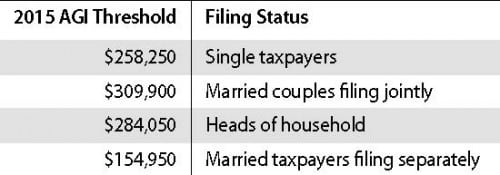
TaxPlanningGRAF1115BAlso deductible are unreimbursed employee business expenses, tax-return-preparation fees, investment expenses, and certain other miscellaneous itemized deductions that together are in excess of 2% of AGI

Keep in mind that not only AMT, but the amount of itemized deductions you can claim on your 2015 tax return is reduced by 3% of the amount by which your AGI exceeds the threshold amount.

Taxpayers cannot lose more than 80% of the itemized deductions subject to the phaseout. And deductions for medical expenses, investment interest, casualty and theft losses, and gambling losses are not subject to the limitation.

Conclusion

The U.S. tax code is incredibly complex and can change rapidly, even though it may sometimes seem to be moving along at a snail’s pace. This complexity has given rise to more calls for simplification. For now, taxpayers must still live with the complexity and the changes, as simplification appears to be only a dream.

Although a majority of taxpayers have their taxes prepared by a professional, they are turning in larger numbers to self-prepared returns. Since the online program does the calculations, it seems to be an economical approach to preparing and filing taxes.

However, the program is no substitute for a qualified tax professional such as a CPA. Programs can calculate tax liability, but they cannot substitute for professional advice and guidance. As a CPA, I would equate it to watching a how-to video on YouTube and embarking on repairing my car.

With such complexity in the tax code, a CPA is better able to keep abreast of the changes and can prepare taxes in a manner that determines a taxpayer’s minimum legal tax liability. But minimizing tax liability started last week, last month, last year. Tax planning is a constant in today’s complex world.

Kristina Drzal-Houghton, CPA MST is the partner in charge of Taxation at Holyoke-based Meyers Brothers Kalicka, P.C.; (413) 536-8510.


Accounting and Tax Planning Sections

Giving Advice

By HILLARY BURR, CPA, MST

Hillary Burr

Hillary Burr

While I can’t confirm the percentage of us that are procrastinators, I am comfortable assuming that, when it comes to year-end planning, that percentage skyrockets.
Understandably so, because this time of year is filled with travel, family, and holidays. For those reasons, now is the time to start thinking about year-end. This is particularly true if this will be a high-income year or if you are considering making larger charitable donations before year-end.
Here are some things to think about:

Get Your Advisors Talking
We often work with investment advisors, estate-planning attorneys and sometimes a client’s family office as a team. Each advisor brings a valuable piece to the table to assist in the decision-making process.  Having a handle on how the current year compares to the prior year and the impact on your upcoming tax liability allows your tax preparer to take a team approach with you and any of your other financial and legal professionals in deciding what makes sense for the remainder of the year.
It also allows this team to combine estate planning with income-tax planning.

A Focus on Philanthropy
When you have a high-income year, this is a natural time to consider the benefit that year-end charitable contributions can have.
This could be from selling a business or large holding in your portfolio, a stock-option exercise, or maybe a significant bonus. Often, clients know the amount they are comfortable donating. Your tax professional’s role is in educating you and your team to structure those donations in the most tax-efficient way and to confirm the desired outcome has been achieved.
If you are planning on donating or gifting appreciated securities, have a conversation with your custodian as to when they stop accepting transfer requests. The deadlines can vary by custodian, so having the conversation earlier allows you to ensure that it can be acted upon, as opposed to waiting until the end of the year, when it may be too late to request these transactions.
If you are planning on donating real estate or tangible property, you’ll need time to obtain the proper valuations and get the legal documents in order, so the earlier the better.


Go HERE for a PDF of the region’s accounting firms


Consider a Donor-advised Fund
An excellent planning tool for charitable giving is a donor-advised fund (DAF). This allows you to take the deduction on your return for the contribution in the current year while allowing you to be thoughtful in your giving. For example, if you are able to give a large amount to a DAF in a high-earning year, you can give smaller amounts away to your favorite charities, keeping annual donations at a level you are comfortable with and allowing you to give the same amount to the charity in your lower-income years. This approach is particularly useful in the last earning years before retirement.
Donor-advised funds can also be used to meet required distributions from a private foundation and can serve as a good opportunity to get younger members of the family involved in charitable giving with the funds in the DAF.

Review of Carry-forwards
If you have larger donations made in previous years that are coming up on their five-year expiration, you may be able to utilize the carry-forward and delay the contribution to January, effectively moving it into the next tax year.
Similarly, if income can fluctuate, as we saw with late capital-gain dividends in 2014, consider whether it makes sense to create a little bit of a carry-forward with your donations and make sure you’re achieving as much tax minimization benefit as you can.

Don’t Miss Out
Not taking action until Dec. 31 can leave you open to changes in the law but could also move a deduction or planning opportunity out another year, meaning April 2017 before you see the benefit. n

Hillary Burr is a CPA and principal with Wolf & Co., an accounting firm in Springfield and Boston; (617) 428-5460; [email protected]

Court Dockets Departments

The following is a compilation of recent lawsuits involving area businesses and organizations. These are strictly allegations that have yet to be proven in a court of law. Readers are advised to contact the parties listed, or the court, for more information concerning the individual claims.

HAMPDEN SUPERIOR COURT

CJM Services Inc. v. Fontaine Brothers Inc. and Federal Insurance Agency
Allegation: Breach of construction contract: $300,000
Filed: 9/25/15

Gerald and Elizabeth Sulewski v. Menard Construction and Design
Allegation: Negligence in deck installation: $40,943
Filed: 8/24/15

Northern Land Clearing Inc. v. Taylor Oil Northeast Inc. and Construct Oil Northeast Inc.
Allegation: Defendant negligently drove a vehicle onto a gas line causing damages and personal injury: $30,000
Filed: 9/23/15

HAMPSHIRE SUPERIOR COURT

Atlantis Comfort System Corp. v. James J. Welch & Co. and Cottage Square Apts., LTD, and Berkeley Regional Insurance Co.
Allegation: Breach of construction contract and claim on bond: $105,529.44
Filed: 8/27/15

Boulanger’s Plumbing and Heating Inc. v. James J. Welch & Co. and Cottage Square Apts., LTD
Allegation: Non-payment of goods sold and delivered: $145,218.10
Filed: 8/12/15

G&M Enterprises Inc. d/b/a Mr. Gutter v. James J. Welch & Co. and Cottage Square Apts., LTD and Berkeley Regional Insurance Co. $16,418.19
Filed: 9/2/15

John and Donna Lastowski v. Kaufco-BH Inc. and John Doe
Allegation: Breach of contract and chapter 93A violation: $21,000
Filed: 8/10/15

NORTHAMPTON DISTRICT COURT

Commonwealth Capital Inc. v. Long Plain, LLC and Scott Hutkowski
Allegation: Non-payment of promissory note: $11,678.89
Filed: 9/28/15

Randall G. Baker Jr. v. Eddie Benton and ICC Trucking, LLC
Allegation: Negligence causing damage to plaintiff’s truck resulting in lost wages: $42,000
Filed: 9/18/15

SPRINGFIELD DISTRICT COURT

Domingo Diaz v. Vesuvio, LLC, Mark Laramie, and Lisa Mackechnie
Allegation: Breach of employment contract: $3,190
Filed: 9/18/15

WESTFIELD DISTRICT COURT

Carmen Burgos v. Silverman Realty Group, Split Excavating Inc., and Stop and Shop Supermarket
Allegation: Negligent maintenance of property: $8,306.77
Filed: 9/23/15

Daily News

HOLYOKE — The Human Service Forum (HSF) will welcome attorney Steven Schwartz, litigation director for the Center for Public Representation, on Wednesday, Nov. 18 for a presentation titled “The ADA: Successes and Challenges for Ensuring Full Equality.”

This past July, America marked the 25th anniversary of the Americans with Disabilities Act (ADA), the landmark civil-rights law designed to promote full citizenship and equal opportunity for individuals with disabilities. But how much has that promise been realized? Like most visionary laws and social reforms, only somewhat. In certain arenas, like equal employment opportunities, the past quarter-century has been marked by a series of disappointing Supreme Court decisions, consistent (more than 90%) court victories for employers who refuse to hire or accommodate employees with disabilities, and even a major legislative initiative to amend the ADA to rebalance the legal landscape.

In other areas, and especially with respect to the historical segregation of persons with significant disabilities, the ADA has radically restructured the provision of public services in many state systems, and created a warning signal to those states which refuse to integrate their public and private programs.

Both of these trends are likely to continue for the next decade, with new targets for the ADA’s integration mandate and, most importantly, a profound cultural change in public awareness of the contributions of citizens with disabilities in all aspects of community living.

The event will take place from 8 to 9:30 a.m. at the Log Cabin in Holyoke. The cost is $25 for HSF members, $30 for non-members. Online registration is available at www.humanserviceforum.org.

Daily News

NORTHAMPTON — Gove Law Office, LLC announced that founding attorney Michael Gove has been chosen as a 2015 Super Lawyers Rising Star in Massachusetts.

Only 2.5% of lawyers are named to the Rising Star list after having first been nominated by their peers. Nominated attorneys are then vetted and evaluated by practice area using a rigorous, multi-phase process for their professional achievement and activities, including experience, honors, and education.

Gove is a 2001 cum laude graduate of UMass Amherst, where he received a bachelor’s degree in political science. In 2004, he earned his juris doctor degree from Boston College School of Law. He is admitted to the Massachusetts and Connecticut bars, the U.S. District Court of Massachusetts, and the U.S. District Court of Connecticut.

Gove Law Office, with offices in Northampton and Ludlow, is a bilingual firm with attorneys who can assist clients in both English and Spanish, providing legal representation in the areas of business representation, commercial lending, residential and commercial real estate, estate planning, immigration, and bankruptcy. For more information, visit www.govelawoffice.com.

Daily News

PITTSFIELD — Berkshire Hills Bancorp Inc. announced that Shawn Howard will lead investment strategies for the bank as its new senior vice president, chief investment officer, senior portfolio manager. In addition, Tom Barney, first vice president, wealth advisor, and Colleen Lussier, vice president, wealth advisor, have joined the Wealth Management team. These additions represent a continued focus on providing convenient, fully integrated investment and money-management solutions to Berkshire Bank customers.

Howard has more than 20 years of financial experience, with nearly 16 years in the asset-management space as a portfolio manager; he was most recently at TD Bank in the Private Client Group in Springfield, where he managed investment portfolios for high-net-worth individuals, nonprofit organizations, and institutional clients. He served in a similar capacity at Evergreen Investments and Mellon Private Asset Management Companies.

Barney, a certified financial planner for more than 30 years, has rejoined the Berkshire Bank Wealth Management team after retiring in 2011. Prior to his retirement, he led the team for 17 years, growing the division to almost $700 million in assets. Barney previously served as vice president for Fleet Investment Services in Hartford, Conn., as well as vice president and private banker for Bank of Boston in Pittsfield, Springfield, and Hartford. He was on the board and served as president of the Estate Planning Council of Hampden County.

Lussier also joins the bank from TD Bank, where she was a wealth advisor for more than 16 years. Her expertise is concentrated in areas of trust and estate planning, business succession, and contract law. She is a certified trust and financial advisor and a registered financial consultant. She will assist in developing client relationships as well as trust and estate administration.

“Berkshire Bank is a strong, well-capitalized financial institution that continues to invest in wealth management with the addition of talented team members and resources to support our clients’ financial goals,” said Sean Gray, chief operating officer of Berkshire Bank. “We are delighted to add experienced professionals in these important roles and know that Shawn, Tom, and Colleen share Berkshire Bank’s commitment to a customer-focused approach.”

Daily News

NORTHAMPTON — Royal LLP, a woman-owned, boutique, management-side labor and employment law firm, announced that Amy Royal, principal and founding partner of the firm, has been honored as one of New England’s Super Lawyers and has been included in the 2015 issue of New England Super Lawyers magazine. Super Lawyers consists of attorneys throughout New England who are nominated by their peers as outstanding lawyers, and each nomination undergoes an extensive selection process.

With nearly 15 years experience, Royal has successfully defended employers in both federal and state courts as well as before administrative agencies in a variety of areas of employment law, including employment discrimination and sexual harassment, unfair competition, breach of contract and wrongful discharge claims, workers’ compensation, and Family and Medical Leave Act, Employee Retirement Income Security Act, and Fair Labor Standards Act violations, with a special emphasis on wage-and-hour class actions.

Royal regularly advises non-union clients on maintaining a union-free workplace and performs other preventive work such as wage-and-hour-law compliance, record-keeping audits, drafting of employee manuals and affirmative-action plans, and management training. In addition, she assists unionized clients during contract negotiations, at arbitrations, and with respect to employee grievances and unfair-labor-practices charges.

Royal’s accolades also include Massachusetts Lawyers Weekly’s 2012 Top Women of Law award recognizing her as a top woman lawyer in Massachusetts, as well as BusinessWest’s prestigious 40 Under Forty award recognizing her for outstanding leadership in the Pioneer Valley business community.

Daily News

SPRINGFIELD — Bacon Wilson announced the firm’s inclusion in the 2016 “Best Law Firms” rankings published by U.S. News – Best Lawyers. The full-service firm has been recognized with a Tier 1 Metropolitan designation for Springfield.

Firms are selected for professional excellence, with tier rankings based on a meticulous assessment process that includes the collection of client and lawyer evaluations as well as peer reviews from leading attorneys in their fields. Achieving a Tier 1 ranking indicates both quality law practice and expansive legal knowledge. This marks the sixth consecutive such honor for Bacon Wilson. Additionally, in August, four partners were named to the Best Lawyers in America 2016 list: Paul Rothschild, Stephen Krevalin, Michael Katz, and Jeff Fialky.

Bacon Wilson’s managing partner, Stephen Krevalin, noted that the latest award is “among the most significant in our field. We are pleased and gratified to be counted among the 2016 Best Law Firms. For me, Bacon Wilson’s inclusion in this publication highlights the outstanding skills of our attorneys.”

Bacon Wilson, P.C. is one of the largest firms in Western Massachusetts, with a total of 42 lawyers and approximately 60 paralegals, administrative assistants, and support staff. The firm’s main office is located in Springfield, with regional offices in Northampton, Amherst, and Westfield. For more information, visit www.baconwilson.com.

Opinion

Opinion

By Domenic J. Sarno

In July 2013, when Springfield voters approved MGM’s development of an $800 million hotel-casino complex in our downtown, it was an historic event and the culmination of a two- year process. The vote backed a vision of transformation for an area destroyed by a tornado and a city devastated by the loss of manufacturing jobs. As I stated then, the proposal would not be a panacea, but, as the largest development in the history of Western Massachusetts, the benefits outweighed the costs, and it was worth pursuing.

In addition to local approval, last November in a state-wide referendum, support from voters in virtually every city and town across the Commonwealth validated our selection process. In fact, the Mass. Gaming Commission recommended to the Japanese government, which is considering legalizing casinos, that they study Springfield’s selection process. Based on their recommendation, last month the Japanese government sent its representatives to interview me and our internal team about how we established the process.

However, I have always known that, no matter how successful we were in attracting and reaching a contract with one of the largest corporations in the entertainment and gaming industry, the most difficult part would be making sure that the development was completed as promised.

To assist us in the enforcement of the promises made by MGM, we have a binding host community agreement with enforceable legal remedies and damages for non-compliance. In addition, I have the assurances of the chairman of the Mass. Gaming Commission that he will defer to the City’s design concerns in the commission’s enforcement of MGM’s gaming license conditions.  These tools will allow us to keep MGM’s feet to the fire, and should assure the naysayers that, working together, we can be successful in seeing the fruits of our labor and our hopes and expectations realized.

Indeed, these tools already helped us negotiate through the I-91 delay, and I will continue to aggressively enforce the binding agreement in the negotiation of any changes that are in the best interests of the city. As further proof that this process works, although I initially was skeptical about losing the original glass tower, I now believe that the benefits to our community of relocating the market-rate housing offsite outweigh the intangible, yet perceived, loss of a new addition to Springfield’s skyline.

Now, a new challenge is presented by MGM’s proposal to reduce the size of the original project. I pledge that I will not agree to any changes that negatively affect MGM’s promises of employment opportunities and revenue. We again will utilize our consultants to assure that the city is protected as we review and negotiate over the latest proposed changes. MGM will pay for our review costs including our team of gaming law, design, and engineering experts that have been with us since the beginning of our casino selection process.

I have asked my internal team, together with our outside experts, to provide me and the City Council with the analyses that we need to make decisions in the best interest of the city. I am confident that our rigorous review process will result in the city realizing the vision it had when it selected MGM: developing a first-class resort casino project benefitting the city, region and Commonwealth. I will settle for nothing less.

 Domenic Sarno is mayor of Springfield

Banking and Financial Services Sections

Measure Entitles Businesses to Reimbursement

By MICHAEL A. FENTON, Esq.

Michael A. Fenton

Michael A. Fenton

Does your business import products from a foreign country? If so, you may be eligible for reimbursement of some or all of the import duties you paid over the last three years. In some cases this can equate to hundreds of thousands of dollars in refunds.

Swift action is required because the deadline to apply for reimbursement is Dec. 28. What follows is some detailed advice on what to do.

Through a trade program known as the Gen-eralized System of Preferences (GSP), the U.S. promotes economic growth in the developing world by providing preferential duty-free entry for up to 4,800 products from 129 designated beneficiary countries and territories. The GSP was instituted on Jan. 1, 1976, by the Trade Act of 1974 and has continued in various forms since its enactment.

As with other legislation, Congress often allows the GSP authority to lapse before it is renewed. This causes duties on imports that are normally covered by the GSP to be charged at the applicable port of entry. Said duties are held in escrow pending renewal of the GSP. Once the GSP is re-authorized, duties held in escrow can be retrieved by importers who paid them on GSP products during the period in which the GSP lapsed.

However, if any item’s GSP status changes, thereby losing eligibility for duty-free treatment, the duties held in escrow will not be refunded to the importer.

Most recently, the GSP expired on July 31, 2013, causing companies all the U.S. to be charged tariffs on imports that previously entered the United States without such fees. The lapse of the GSP continued until June 29, 2015 when President Obama signed into law a bill (H.R. 1295) which reauthorized the GSP retroactively to July 31, 2013. This enables importers of GSP-eligible products to seek reimbursement for tariffs paid during the lapse in GSP coverage. The GSP reauthorization provided retroactive benefits only for goods from a country that is a beneficiary of the GSP program as of July 29, 2015. As such, this would exclude countries such as Bangladesh and Russia that lost eligibility between July 31, 2013 and July 29, 2015.

If your business imported products from a foreign country between July 31, 2012 and June 29, 2015 effective legal counsel can help you determine your reimbursement eligibility and navigate the process of seeking a refund.

Importers who filed their entries electronically, used the appropriate special program indicator for GSP, and paid duty on GSP-eligible goods, will receive an automatic refund. However, many entries were made without using the special program indicator for GSP refunds. Unfortunately, many local importers use couriers that did not properly claim eligible GSP products at the time of entry. Many couriers did not claim products as having GSP status at the time of entry because the GSP legislation was expired. Because the products were not claimed at GSP at the time of entry, a formal request must be made of US Customs and Border Protection for a refund of the tariffs.

A refund request for duties deposited must be received by U.S. Customs and Border Protection no later than Dec. 28. There are very specific requirements for processing these requests and our office has experience in handling these claims. Typically, the only documentation needed to determine eligibility and process any applicable refunds can be found on a statement of the transaction from your courier (e.g. FedEx, UPS, etc.)

These tariff refunds represent thousands of dollars to many area business, but swift action is required to receive the reimbursements. If you have questions about GSP reauthorization and whether your company is entitled to a refund contact qualified legal counsel immediately.

Attorney Michael A. Fenton, of Shatz, Schwartz and Fentin, P.C., concentrates his practice in the areas of business planning, commercial real estate, estate planning and elder law; [email protected]; (413) 737-1131.

Health Care Sections

Driving Forces

By TODD C. RATNER, Esq.

Todd C. Ratner

Todd C. Ratner

Do you remember the day when you received your driver’s license? Most people experienced a rush of excitement and a sense of freedom that they could clearly recall many years later. Now imagine losing this mobility and freedom . . . or, being the one who has to inform an elderly driver that their driver’s license should be limited or even taken away.

The thought of having this often-awkward and painful conversation tempts loved ones to procrastinate; however, adequately preparing for this conversation with an elderly driver who poses a danger to himself and others, and understanding the resources available to both you and your loved one, can facilitate what otherwise might be a traumatic experience.

First, it is important to recognize that everyone ages differently. As such, age alone should never be the sole factor in determining whether or not an elder has the ability to drive safely. However, there is no denying that a person’s physical and cognitive abilities often deteriorate with age. As we age, there is a greater likelihood of becoming inflicted with chronic diseases such as arthritis, dementia, and hearing impairment. In addition, safety of the elder is a concern, as elderly people are more likely to be injured than younger people in similar automobile accidents.

Because the Commonwealth of Massachusetts has no special licensing requirements for elderly drivers, family members should continually watch for signs of diminished capacity. Specifically, family members should ascertain whether or not the driver gets lost, has an increasing number of accidents, becomes forgetful, or has problems understanding simple instructions. Additionally, both Massachusetts and Connecticut require drivers to inform the Registry of Motor Vehicles and Department of Transportation if they have a medical condition that they believe may affect their ability to operate a motor vehicle.

In the event that you believe an elderly driver should reduce or stop driving, it is important to form a plan prior to commencing a dialogue with this individual. Driving is often the last means of independence, because it provides the elderly with the opportunity to visit friends, go shopping, and manage other tasks of daily life. Elderly drivers may get defensive and angry upon hearing that someone is attempting to take away this freedom. Thus, approaching this subject with realistic expectations is critical.

It is important to introduce this subject at a quiet time when both you and the elderly driver are relaxed, without any other immediate concerns. It is also preferable to include the elderly person in the decision-making process, if possible, instead of dictating a decision to them.

You may wish to discuss this matter together with other family members, doctors, and people that the elderly person respects. You might try having the elder write down both pros and cons, in the hope that they will realize that there are benefits to not driving. The initial conversation does not need to yield permanent decisions. Often it is preferable to put the discussion on temporary hold for a few days, to allow time for reflection on various options.

Caregivers and family members may also get assistance from all available resources to facilitate the determination of whether or not the elder should be driving. One option is offered through Weldon Rehabilitation Services on Carew Street in Springfield. They have developed a program to assess an individual’s ability to drive safely. The Driving Assessment Program will take approximately 90 minutes to complete. It commences with a licensed and registered occupational therapist providing a clinical evaluation. If warranted, an on-road evaluation and on-road training with a licensed driving instructor may also occur.

Upon the completion of the evaluation, the results and appropriate recommendations will be discussed with the driver and their physician. The program evaluates vision and perception, physical status, mobility, upper- and lower-extremity reaction time, traffic sign/situation identification and interpretation, cognition, and adaptive equipment. A family member may accompany the elder to the evaluation. To schedule an evaluation, contact the Driver Advisement Program at Mercy Medical Center’s Weldon Rehabilitation Services (413-748-6880).

Other resources to consider are the Berkshire Medical Center’s Driver Evaluation Program in Pittsfield (413-447-2000); the Fairlawn Rehabilitation Hospital’s Driving Evaluation Program in Worcester (508-791-6351); the AARP’s Driver Safety Course (888-227-7669 or http://www.aarpdriversafety.org); the Association for Driver Rehabilitation Specialists, which offers referrals to professionals trained to help people with disabilities, including those associated with aging (866-672-9466); and the AAA Mature Operator Program (800-622-9211).

If the elderly driver cannot operate a vehicle safely and refuses to stop driving, then further action may be warranted. There are several options available:

• Stage an intervention. This involves family members, health care workers, and anyone respected by the elderly driver, uniting to talk to the elder, firmly but compassionately, in an effort to help the senior accept the issue.
• Contact the local Department of Motor Vehicles and register a complaint. You may wish to do this anonymously.
• If all else fails, you may need to disable the car. This subterfuge should always be a last resort, but sadly, some families do find it necessary. This could include taking away the car keys, disconnecting the battery, or moving the vehicle to a location beyond the elderly person’s control. Duplicity is not a long-term solution, but if there is an immediate need to get the elder off the road, it is sometimes necessary.

Denying an elderly person a driver’s license can be an extremely traumatic event. Restricting or removing an elderly person’s right to drive should be done with careful planning, and by taking advantage of the community resources available.

Todd C. Ratner is a shareholder with Bacon Wilson, and member of the firm’s estate planning, elder, real estate, and business & corporate departments. He handles all aspects of estate planning and probate and real estate, as well as general business matters. He is a member of the National Academy of Elder Law Attorneys and was a recipient of Boston Magazine’s Massachusetts Super Lawyers Rising Stars award from 2007-2012, and Lawyers Weekly Up & Coming Lawyer in 2014; (413) 781-0560; [email protected].

Bankruptcies Departments

The following bankruptcy petitions were recently filed in U.S. Bankruptcy Court. Readers should confirm all information with the court.

Alfaro, Blanca L.
304 Liberty St.
Springfield, MA 01104
Chapter: 13
Filing Date: 09/28/15

Ames Spaces
Ames Living Spaces
Ames, Scott A.
PO Box 123
Oakham, MA 01068
Chapter: 7
Filing Date: 09/29/15

Baker, William C.
Baker, Theodora A.
94 Sheri Lane
Agawam, MA 01001
Chapter: 7
Filing Date: 09/25/15

Barnes, Jeffrey O.
Barnes, Susan M.
27 Somerset Dr.
Chicopee, MA 01020
Chapter: 7
Filing Date: 09/25/15

Belanger, Michelle L.
705 Sumner Ave.
Springfield, MA 01108
Chapter: 7
Filing Date: 09/24/15

Belcastro, Kari E.
106 Faculty St.
Wilbraham, MA 01095
Chapter: 7
Filing Date: 09/29/15

Brazeau, Vincent A.
Brazeau, Dianne E.
55 Spring St.
Apartment 113
Pittsfield, MA 01201
Chapter: 7
Filing Date: 09/29/15

Brown’s Auto Body
Brown, Fitzroy
25 Rosemary Dr.
Springfield, MA 01119
Chapter: 13
Filing Date: 09/17/15

Bucknell, Robert T.
Bucknell, Barbara A.
5 Stoneybrook Dr.
Sturbridge, MA 01566
Chapter: 7
Filing Date: 09/25/15

Change Enterprises, LLC
Chang, Jimmy E.
175 Cedar Road
Longmeadow, MA 01106
Chapter: 7
Filing Date: 09/25/15

Chapin, Joyce Francis
45 Doverbrook Road
Chicopee, MA 01022
Chapter: 7
Filing Date: 09/30/15

Cross, Anita S.
52 Westbank Court
Springfield, MA 01118
Chapter: 7
Filing Date: 09/25/15

Daviau, Christopher M.
Daviau, Lilaina W.
25 Taylor St.
Holyoke, MA 01040
Chapter: 13
Filing Date: 09/16/15

Elhassan, Alaa A.
65 Harrington Road
Chicopee, MA 01020
Chapter: 7
Filing Date: 09/25/15

Eurkus, Michael Edward
4 Center St.
Brimfield, MA 01010
Chapter: 7
Filing Date: 09/24/15

Gonzalez, Cassaundra L.
a/k/a Jayne Gonzalez, Cassaundra Lea
57 South Maple St.
Hadley, MA 01035
Chapter: 7
Filing Date: 09/18/15

Goyette, Jay M.
Goyette, Debora A.
16 Bay State Road
Pittsfield, MA 01201
Chapter: 13
Filing Date: 09/25/15

Hastings, David F.
74 Forest Park Ave.
Springfield, MA 01108
Chapter: 7
Filing Date: 09/22/15

Henchey, Allen D.
938 Piper Road
West Springfield, MA 01089
Chapter: 13
Filing Date: 09/30/15

Kenyon, Amanda
46 Fairview St.
Ludlow, MA 01056
Chapter: 7
Filing Date: 09/28/15

LaGasse, Robert Joseph
LaGasse, Rhonda Ann
105 Island Pond Road
Springfield, MA 01118
Chapter: 7
Filing Date: 09/23/15

Law Office of Jennifer A. Smolinski
Smolinski, Jennifer A.
252 Green Ave.
Belchertown, MA 01007
Chapter: 13
Filing Date: 09/16/15

Lepine, Lori A.
44 Governor Dr.
Westfield, MA 01085
Chapter: 13
Filing Date: 09/25/15

Mercado, Betsy L.
21 Ames St.
Springfield, MA 01104
Chapter: 7
Filing Date: 09/16/15

Muse-Coney, Corinthia E.
188 Russell St.
Springfield, MA 01104
Chapter: 7
Filing Date: 09/25/15

Okey Dokey DJ Service
Bell, Kevin S.
82 Monroe St.
Chicopee, MA 01020
Chapter: 7
Filing Date: 09/30/15

Ramos, Evelyn
Ramos, Luis
16 Pear St.
Springfield, MA 01109
Chapter: 7
Filing Date: 09/26/15

Ramsdell, Phillip Leroy
Ramsdell, Brooke Lee
43 Falmouth Road
West Springfield, MA 01089
Chapter: 7
Filing Date: 09/30/15

Rivard, Randall William
14 Harrison Ave.
Holyoke, MA 01040
Chapter: 7
Filing Date: 09/24/15

Rodriguez, Victor L.
73 East St., Apt. 305
Ludlow, MA 01056
Chapter: 7
Filing Date: 09/30/15

Rosario, Doris
42 Harvard St.
Chicopee, MA 01020
Chapter: 7
Filing Date: 09/24/15

Salahna, Thomas M.
236 South Main St.
Orange, MA 01364
Chapter: 13
Filing Date: 09/19/15

Slater, April
143 Mill St.
Pittsfield, MA 01201
Chapter: 7
Filing Date: 09/16/15

Trinidad, Justina
a/k/a Torres, Justina
268 Sargeant St.
Holyoke, MA 01040
Chapter: 7
Filing Date: 09/16/15

Trudell, Nicholas J.
Trudell, Christine R.
45 Wakefield St.
Indian Orchard, MA 01151
Chapter: 7
Filing Date: 09/29/15

Turati, Jill C.
a/k/a Lombardi, Jill C.
103 Prospect St.
Hatfield, MA 01038
Chapter: 7
Filing Date: 09/30/15

Velez, Frances
20 Easthampton Road, #J2
Holyoke, MA 01040
Chapter: 7
Filing Date: 09/22/15

Weigel, Anita Maria
71 State St., Apt 322
Northampton, MA 01060
Chapter: 7
Filing Date: 09/24/15

Whitten, Richard W.
Whitten, Marsha M.
46 Davis St.
Holyoke, MA 01040
Chapter: 7
Filing Date: 09/18/15

Winslow, Brian P.
219 Greenwich Road
Ware, MA 01082
Chapter: 13
Filing Date: 09/17/15

Wright, Deborah L.
13 Columbia Ave.
Orange, MA 01364
Chapter: 7
Filing Date: 09/22/15

Zaldivar, Nicholas P.
17 Grandview Ave.
Ludlow, MA 01056
Chapter: 13
Filing Date: 09/16/15

Departments People on the Move

Webber and Grinnell Insurance Agency announced several recent changes at its North King Street office in Northampton:
• Mat Geffin has been named Vice President and Equity Partner at the firm. He started at the agency in 2009 as vice president of business development in the commercial-lines department, and quickly established himself as a leader at the agency. Geffin leads the sales efforts at Webber and Grinnell, in addition to managing a large book of business encompassing the construction, habitational, manufacturing, and nonprofit market niches. He is an active board member for the United Way of Pioneer Valley, Tech Foundry, and the philanthropic services committee at the Community Foundation;
• Jenna Rodrigue has been promoted to Commercial Lines Supervisor. She leads a team of eight business-insurance specialists and is responsible for the day-to-day service of the agency’s commercial clientele. She began her career at Webber and Grinnell 12 years ago as a commercial lines customer-service representative;
• Kathy Cusson has been named Personal Lines Supervisor. Part of the Webber and Grinnell team since 1989, she leads a staff of nine and is responsible for the day-to-day servicing of the agency’s personal-lines clients.
•••••

Alison Shilinsky

Alison Shilinsky

Country Bank announced that Alison Shilinsky has been named senior vice president of Human Resources. With 10 years in the industry, Shilinsky is an experienced human-resources professional. She earned her master’s degree in management from UMass Amherst and her bachelor’s degree in English and communications from Assumption College. Shilinsky’s previous work at Brown Rudnick LLP, a prominent Boston law firm, has had a significant impact on her approach to human resources and business. She is an active member of the Society for Human Resources Management, the New England Human Resources Assoc., the New England Employee Benefits Council, and the Mass. Bankers Assoc. “Alison is an exceptional example of what a human-resources professional is supposed to be,” said Paul Scully, president and CEO of Country Bank. “Not only is she knowledgeable and dedicated, she demonstrates compassion and empathy to all employees. We are thrilled to have her join our team, as we know she will be a valued resource for Country Bank and its employees.”
•••••

April Healey

April Healey

Greenfield Cooperative Bank announced that April Healey has joined the bank as a Mortgage Originator at the bank’s main office on Federal Street in Greenfield. Healey has more than 14 years of experience in real estate, most recently at a local, regional bank. She will be responsible for originating residential mortgage loans in Franklin and Hampshire counties. She attended Holyoke Community College and has held various positions with the Realtor Assoc. of Pioneer Valley, including director and chairperson of its Realtor Public Image Committee. Greenfield Cooperative Bank and its Northampton Cooperative Bank division is a community-based institution with more than $525 million in assets and $60 million in capital reserves. The bank provides residential mortgages, commercial loans, and deposit products at 10 offices in Western Mass.
•••••

Tim Irwin

Tim Irwin

Chris Mader

Chris Mader

Tim Irwin and Chris Mader of OMG Inc., have been named in the annual 30 Under 30 Awards given jointly by Young Fastener Professionals and the Fastener Industry Coalition. “To be recognized by this prestigious group is certainly a high honor for these two outstanding individuals, and also for OMG,” said Hubert McGovern, president of OMG. “We are very proud of their accomplishments and for this great industry recognition.” The 30 Under 30 Awards are given annually to young industry professionals who are making a difference in the fastener industry. Ideal candidates are leaders who are driven, motivated, and passionate about their jobs and the future of the fastener industry. Individual nominations are selected based on several criteria, including their contribution to measurable results in the form of cost savings, sales increases, and design-efficiency increases. Irwin is a Product Manager with FastenMaster, where he is responsible for the LOK line of structural wood fasteners. He was cited for his team leadership as well as significant contributions he has made on the success of the FlatLOK, the ThruLOK, and the FastenMaster business as a whole. In his role as product manager, he has been able to significantly impact sales revenue and profits and has demonstrated a keen ability to drive product development based on end-user needs. Mader is a Codes/approvals Support Engineer for OMG’s Roofing Products division, responsible for helping evaluate new products, as well as developing and maintaining technical product specifications, maintaining code approvals, and keeping abreast of technical changes and advancements in the commercial-roofing industry. He has been instrumental in helping OMG understand critical compliance standards and requirements for products sold in various international markets and for his work with products designed to secure solar PV racking systems to commercial roofs. The winners from this year’s 30 Under 30 Awards were recognized at the National Fastener Industrial & Mill Supply Expo in Las Vegas on Oct. 21. Headquartered in Agawam, OMG Inc. is North America’s largest manufacturer of specialty fasteners and products for commercial and residential construction applications. The company operates two business units: OMG Roofing Products and FastenMaster.
••••
Beloved Earth, the Pioneer Valley’s first green cleaning company, has promoted Lynn Moynahan to the position of Assistant Vice President in charge of the residential services division. Beloved Earth co-founders David and Terra Missildine serve as company president and vice president, respectively. David oversees commercial services, and Terra oversees general operations. Moynahan has been with Beloved Earth for three years and previously served in the role of residential services manager for Hampshire County only. In her new position, Moynahan will oversee the entire residential services team, including managers in other counties. Beloved Earth employs a total of 12 staff members in its two divisions. The business primarily serves Hampshire County, but also Hampden and Franklin counties.
•••••

Edward Garbacik

Edward Garbacik

Edward Garbacik has joined the team at Private Financial Design, LLC in South Hadley. For more than 30 years, he has been providing individuals and small-business owners with comprehensive financial planning as an advisor and planner, including investment-advisory services, retirement planning, estate planning, and other wealth-management needs. He earned the certified financial planner designation through the CFP certificate program at Boston University and has also been awarded the accredited investment fiduciary (AIF) designation, widely considered the fiduciary standard for business retirement planning and plan-sponsor services. Prior to joining Private Financial Design, Garbacik held the title of partner at a boutique investment firm specializing in retirement-income planning. He was also vice president and managing partner of investments at FSB Financial Group, where he led the group’s financial-planning and wealth-management team. Private Financial Design offers comprehensive financial planning for both personal and business needs, including fee-based investment-advisory services, retirement plans, and other wealth-management services.
•••••
Dakin Humane Society has appointed Kimberly Hannah and Brendan Wood to serve three-year terms on its board of directors, according to interim Executive Director Nancy Creed. Hannah currently serves as office manager and executive assistant to the president and CEO for the Sisters of Providence Health System. Prior to that, she was the office manager and executive assistant to the president and CEO of Cooley Dickinson Hospital and worked at Baystate Health for several years. She has volunteered for animal-rescue organizations including FACES and the Westfield Animal Shelter, and is a graduate of Bay Path College. Wood is a wealth-management advisor with the Foundation Management Group at Merrill Lynch. He previously taught at independent schools in Santa Barbara, Calif., and is a graduate of Princeton University. Dakin Humane Society delivers services that improve the lives of animals in need and the people who care about them from its two locations in Springfield and Leverett. The organization shelters, treats, and fosters more than 20,000 animals each year and has performed more than 62,000 spay/neuter surgeries since 2009.

Court Dockets Departments

The following is a compilation of recent lawsuits involving area businesses and organizations. These are strictly allegations that have yet to be proven in a court of law. Readers are advised to contact the parties listed, or the court, for more information concerning the individual claims.

HAMPDEN SUPERIOR COURT

Ellendave, LLC v. Stick Time Sports Inc.
Allegation: Breach of lease agreement: $102,375
Filed: 9/28/15

Francis Duda, M.D. v. Baystate Medical Practices Inc.
Allegation: Employment discrimination: $100,000
Filed: 9/29/15

Verizon New England Inc. v. Springfield Water & Sewer Commission
Allegation: Negligence and trespass causing damage to equipment: $16,246.65
Filed: 9/23/15

W.W. Grainger Inc. v. Westcarb Enterprises Inc.
Allegation: Non-payment of goods sold and delivered: $144,215.49
Filed: 9/24/15

HAMPSHIRE SUPERIOR COURT

Easthampton Savings Bank v. Dependable Drywall Inc. and Lukas J. Rosov
Allegation: Non-payment on commercial line of credit: $39,327.68
Filed: 9/13/15

H. Lawrence Foster Company Inc. v. James J. Welch & Co. and Cottage Square Apts., LTD, and Berkeley Regional Insurance Company
Allegation: Non-payment of services, labor, and materials: $197,797.15
Filed: 9/21/15

Paul Weinberg, Weinberg & Garber, PC v. Climate Design Consulting, and First American Insurance
Allegation: Non-payment of services rendered: $1,500,000
Filed: 9/22/15

Tofino Associates, LLC v. Ted Ondrick, LLC
Allegation: Breach of contract for asphalt road installation: $117,172.35
Filed: 9/24/15

NORTHAMPTON DISTRICT COURT

GRP Capital, LLC v. Adamos Pizza and Restaurant
Allegation: Defendant failed to deliver receivables purchased by plaintiff in breach of contract: $12,800.00
Filed: 9/21/15

SPRINGFIELD DISTRICT COURT

Kendrick Wong v. The Creative Strategy Agency, Inc.
Allegation: Breach of employment contract: $4,209.72
Filed: 9/28/15

Susan Poirier v. ProFast Commercial Flooring, LLC and Pyramid Management, LLC
Allegation: Negligent maintenance of work area causing injury: $4,146.00
Filed: 9/17/15

WESTFIELD DISTRICT COURT

Marion Air Conditioning & Refrigeration v. Maurice Casey, Inc.
Allegation: Non-payment of balance due on repairs, parts, and labor: $8,686.51
Filed: 9/4/15

Daily News

SPRINGFIELD — Transgender identity and gender transition have taken center stage in the media in recent weeks, but the rights of transgender individuals in the workplace are still unclear to many. Several federal agencies — including the Equal Employment Opportunity Council (EEOC) — have created or revised policies to protect transgender individuals from discrimination in the workplace. These policies set forth what business owners must know to protect themselves and their employees, according to local employment law attorney, Marylou Fabbo.

A partner at Springfield-based Skoler, Abbott & Presser, P.C., attorney Fabbo has been selected to discuss transgender discrimination in the workplace during the 20th annual Advanced Employment Issues Symposium (AEIS) in November.

“Employers are required to provide equal opportunity to people who are lesbian, gay, bisexual and transgender (LGBT),” said Fabbo.” There is absolutely no excuse for not treating transgender employees with dignity and respect. It is especially important with the recent stance of various federal agencies that employers take proactive measures to insure that employees transitioning and those who have transitioned are treated in the same manner as all other employees. Human resource management should draft transition policies and educate employees accordingly.”

Just days after the Occupational Safety and Health Administration (OSHA) published “A Guide to Restroom Access for Transgender Workers” to advise employers on ways to accommodate transgender employees, four federal government agencies with roles in ensuring fairness in the federal workplace — the Office of Personnel Management, the EEOC, the Office of Special Counsel, and the Merit Systems Protection Board — released a guide on the rights of employees who allege sexual orientation or gender identity discrimination. The guide, which was reissued after more than a decade, has been substantially revised to reflect major recent developments in the law.

“The guide from OSHA addresses a very specific area of the workplace: the restroom,” said Fabbo. “Among the concerns of employers are the reactions of coworkers regarding a transitioning employee’s restroom use. The core principle of the OSHA guide is that transgender employees should have access that corresponds to their gender identity. Restroom access for transgender individuals has generated controversy — especially in recent weeks — and led to claims of discrimination.”

Employers that don’t respect a transgender worker’s restroom choice, for example, could run the risk of potential liability under Title VII of the 1964 Civil Rights Act. Among the best practices for providing restroom access for transgender employees are:
• Single-occupancy gender-neutral (unisex) facilities, and
• Use of multiple-occupant, gender-neutral restroom facilities with lockable single-occupant stalls.

According to a 2013 study by Fenway Health, 65% of Massachusetts’ transgender population have experienced discrimination in public settings — including being denied access to public restrooms. On July 11, during Boston Pride Week, a celebration of the LGBT population, Boston Mayor Marty Walsh signed an executive order to immediately establish gender-neutral restrooms outside his office in Boston City Hall.

“State and federal agencies are speaking out and changing policies,” said Fabbo. “OSHA has stated that failure to provide appropriate restrooms for transgender employees might be an OSHA violation because it is a health and safety hazard. In the past five years – and especially within the last few months – the topic of transgender equality has been steadily on the rise and employers should be prepared to address it.”

The Advanced Employment Issues Symposium will be held Nov. 4-6 in Las Vegas, bringing together employment law attorneys and human resource experts to deliver compliance guidance and strategic HR solutions. Fabbo will present Gender Identity and Expression: Accommodations and Conversations Related to Transgender and Gender Non-Conforming Employees at the symposium Nov. 6. The presentation will highlight the proactive approach employers should take to ensure policies and practices related to dress, use of bathroom facilities and other issues are handled in a legally compliant and respectful manner.

Daily News

BOSTON — Massachusetts legislative leaders and gambling regulators say state oversight of the fantasy-sports industry — and increased scrutiny of the operations of companies such as Boston’s DraftKings — is becoming more likely, the Boston Globe reported.

The Mass. Gaming Commission has launched a review of the legal and regulatory issues posed by the surging popularity of online fantasy sports, including whether the games are allowed under state law. Chairman Steve Crosby said the commissioners would discuss whether fantasy sports are legal, whether they should be regulated, and, if so, who should regulate the companies, and how.

The commission will discuss the issues at its next public meeting, on Oct. 29. Attorney General Maura Healey is conducting a similar review through her office.

Daily News

SPRINGFIELD — The law firm Bacon Wilson announced that five attorneys have been named to the 2015 Massachusetts Super Lawyers list of top attorneys in the Commonwealth, and four have been named to the 2015 Massachusetts Rising Stars list of up-and-comers.

Identified by a research team at Super Lawyers, the attorneys are selected for background, professional experience, achievement, and peer recognition. There is no opportunity to pay for a listing, and only 5% of New England’s lawyers are Super Lawyers. The following Bacon Wilson attorneys were honored for 2015:

• Gary Fialky, business/corporate, banking, real estate;

• Michael Katz, business/corporate, business bankruptcy, consumer bankruptcy;

• Paul Rothschild, general litigation, employment and labor, personal injury;

• Hyman Darling, estate planning and probate, elder law, tax; and

• Gina Barry, estate planning and probate, elder law, residential real estate.

Rising Stars are under 40 years old or have been practicing law for no more than 10 years. Fewer than 2.5% of New England lawyers were named as Rising Stars, including the following Bacon Wilson attorneys for 2015:

• Adam Basch, construction Litigation, business litigation, personal injury;

• Benjamin Coyle, business/corporate, state/local/municipal, estate and trust litigation;

• Kevin Maltby, employment and labor, general litigation, criminal defense; and

• Thomas Reidy, land use/zoning.

Super Lawyers, an attorney-rating service, compiles annual rosters of lawyers with high degrees of peer recognition and professional achievement. Selections are determined by a process that includes independent research evaluation of candidates, peer reviews, and a statewide survey of lawyers.

Bacon Wilson, P.C. is one of the largest firms in Western Massachusetts, with a total of 42 lawyers and approximately 60 paralegals, administrative assistants, and support staff. The firm’s main office is located in Springfield, with regional offices in Northampton, Amherst, and Westfield. For more information, visit www.baconwilson.com.

Daily News

SPRINGFIELD — Springfield-based law firm O’Connell & Plumb, P.C. announced that attorney Daniel J. O’Connell was named to the 2015 New England Super Lawyers list in the area of plaintiff employment litigation, and attorney Sarah Ornelas has been named to the 2015 New England Rising Stars list in the area of plaintiff employment litigation.

Super Lawyers is a rating service of outstanding lawyers from more than 70 practice areas who have attained a high degree of peer recognition and professional achievement. The selection process includes independent research, peer nominations, and peer evaluations. Super Lawyers selections are made annually using a patented, multi-phase process that includes a statewide survey of lawyers, an independent research evaluation of candidates, and peer reviews by practice area. Only 5% of lawyers in each state are selected to the Super Lawyers list annually, and only 2.5% of lawyers under the age of 40, or in practice for 10 years or fewer, are named a Rising Star.

Earlier this year, both O’Connell and Ornelas also received the Martindale-Hubble Client Distinction Award. Martindale-Hubbell gives the award to lawyers whose clients give the lawyer a 4.5 average rating (out of 5.0) in the following areas: communications ability, responsiveness, quality of service, and value for the money. Less than 1% of the more than 900,000 attorneys listed on the martindale.com and lawyers.com websites receive the Martindale-Hubbell Client Distinction Award.

Daily News

SPRINGFIELD — Robinson Donovan, P.C. announced that eight attorneys have been selected to the 2015 Massachusetts Super Lawyers list, and three attorneys have been selected to the Rising Stars list.

Super Lawyers, part of Thomson Reuters, is a rating service of outstanding lawyers from more than 70 practice areas who have attained a high degree of peer recognition and professional achievement. The annual selections are made using a patented, multi-phase process that includes a statewide survey of lawyers, an independent research evaluation of candidates, and peer reviews by practice area. No more than 5% of lawyers in Massachusetts are selected by Super Lawyers, and no more than 2.5% of lawyers in Massachusetts under the age of 40, or in practice for 10 years or fewer, are selected to Rising Stars.

• Kevin Chrisanthopoulos was selected to the 2015 Massachusetts Super Lawyers list in the field of general litigation. He practices litigation.

• Richard Gaberman was selected to the 2015 Massachusetts Super Lawyers list in the field of estate and probate law. His practice focuses on corporate and business counseling, commercial real estate, tax, and estate-planning law.

• James Martin was selected to the 2015 Massachusetts Super Lawyers list in the field of closely held business law. He practices corporate and business counseling, litigation, and commercial real-estate law.

• Jeffrey McCormick was selected to the 2015 Massachusetts Super Lawyers list in the field of general litigation. He practices litigation.

• Carla Newton was selected to the 2015 Massachusetts Super Lawyers list in the field of family law. She practices divorce and family law, litigation, corporate and business counseling, and commercial real estate.

• Nancy Frankel Pelletier was selected to the 2015 Massachusetts Super Lawyers list in the field of civil litigation (defense). She exclusively practices litigation.

• Patricia Rapinchuk was selected to the 2015 Massachusetts Super Lawyers list in the field of employee litigation (defense). She practices employment law and litigation.

• Jeffrey Roberts was selected to the 2015 Massachusetts Super Lawyers list in the field of estate and probate law. His practice focuses on corporate and business counseling and estate planning and administration.

• David Lawless was selected to the 2015 Massachusetts Rising Stars list in the field of state, local, and municipal law. He practices municipal, business, and employment law and litigation.

• Michael Simolo was selected to the 2015 Massachusetts Rising Stars list in the field of estate and probate law. He practices corporate and business counseling, estate planning, and litigation.

• Jeffrey Trapani was selected to the 2015 Massachusetts Rising Stars list in the field of personal injury (defense) law. He practices litigation and employment law.

Daily News

WARE — Country Bank announced that Alison Shilinsky has been named senior vice president of Human Resources.

With 10 years in the industry, Shilinsky is an experienced human-resources professional. She earned her master’s degree in management from UMass Amherst and her bachelor’s degree in English and communications from Assumption College.

Shilinsky’s previous work at Brown Rudnick LLP, a prominent Boston law firm, has had a significant impact on her approach to human resources and business. She is an active member of the Society for Human Resources Management, the New England Human Resources Assoc., the New England Employee Benefits Council, and the Mass. Bankers Assoc.

“Alison is an exceptional example of what a human-resources professional is supposed to be,” said Paul Scully, president and CEO of Country Bank. “Not only is she knowledgeable and dedicated, she demonstrates compassion and empathy to all employees. We are thrilled to have her join our team, as we know she will be a valued resource for Country Bank and its employees.”