Home Posts tagged Law (Page 22)
Daily News

NORTHAMPTON — Now that the new year here, it’s an ideal time to review the past year’s changes in labor and employment law. Royal LLP will host a seminar on Tuesday, Jan. 27 from 8 to 9 a.m. to review some of the most interesting and significant labor- and employment-law changes from 2014 and provide timely and practical advice on how these changes will affect businesses in years to come.

Attorney Sarah Torres will conduct the roundtable-style seminar, where she will provide practical pointers to assist organizations in ensuring they are up-to-date and in compliance with these new laws. She will cover topics such as sick leave, domestic-violence leave, minimum-wage increases, and more.

The cost for the seminar is $30 per person, and it will take place at Royal LLP, 270 Pleasant St., Northampton. Advance registration is required, and seating will be limited. Contact Ann-Marie Marcil at [email protected] to register or if you have any questions about the seminar. Checks should be made payable to Royal LLP and mailed to 270 Pleasant St., Northampton, MA 01060.

Daily News

SPRINGFIELD — The November election has passed, and the voters have spoken, approving ballot question #4 approving of mandated sick leave, making Massachusetts only the third state in the nation to guarantee paid sick days for workers.

Timothy Murphy, Esq., partner with Skoler, Abbott & Presser, P.C. and leading expert on the subject for the Affiliated Chambers of Commerce of Greater Springfield (ACCGS) Legislative Steering Committee, will explore the impact of the law at the ACCGS Lunch ‘n’ Learn on Jan. 28, from 11:30 a.m. to 1 p.m. in the Dodge Room of the Flynn Campus Union at Springfield College, 263 Alden St., Springfield.

Murphy will discuss what the law entails for both large and small businesses, how the law will impact companies already providing sick leave or those that provide personal time off incorporating sick leave, which workers are eligible and which are not, what it means for a company and its workforce, and the subtle nuances of the law.

Murphy joined Skoler, Abbott & Presser in 2001 after serving as general counsel to an area labor union. He represents and advises both union and non-union employers in a wide range of labor and employment matters. He regularly represents employers in matters before state and administrative agencies and courts. His work includes assisting employers to remain union-free, defending unfair labor practices, negotiating collective-bargaining agreements, and handling grievance arbitrations. Murphy is on the executive committee of the Springfield Chamber of Commerce and, is the former chair of the ACCGS Legislative Steering Committee, and is the go-to resource for the ACCGS on the issue of mandated sick leave.

Reservations for the January Lunch ‘n’ Learn are $25 for members, $35 for general admission. Registration includes lunch and one-on-one discussions with Murphy. Reservations may be made online at www.myonlinechamber.com or by e-mailing Sarah Mazzaferro at [email protected].

Daily News

SPRINGFIELD — The Springfield-based law firm Shatz, Schwartz and Fentin, P.C., today announced that attorney L. Alexandra Hogan has been appointed as the new vice-chair of the New England division of the International Women’s Insolvency and Restructuring Confederation (IWIRC). In 2012, Hogan was voted in to join the organization’s board of directors. The New England IWIRC is a networking organization pursuing the goal of creating a vibrant community of restructuring practitioners from every discipline. For more than two decades, IWIRC has been connecting women worldwide through a global membership of more than 1,200 attorneys, bankers, corporate-turnaround professionals, financial advisors and other restructuring practitioners. “IWIRC provides valuable networking opportunities and leadership roles on a global and local level,” said Hogan. “Whether members are just beginning their careers or they are looking to take their profession to the next level, IWIRC has a platform to help them get there. I am proud to serve on the board of an organization devoted to improving the professional opportunities for women in my field and I’m excited to take my own involvement with the organization to the next level as the vice-chair for the New England division.” Hogan concentrates her practice primarily in bankruptcy, litigation and business law. She graduated from Western New England University School of Law in 2008 with cum laude honors and from Bay Path University with summa cum laude honors in 1996. For the years 2011-2014, she has been selected by Super Lawyers as a Rising Star and a Top Woman Attorney. She also currently serves as vice chair of the Hampden County Bar Association’s Bankruptcy Division.
Hogan volunteers to the Financial Literacy Program for U.S. Bankruptcy Court for the District of Massachusetts and the Boston Bar Association to aid high school students in personal finance and also provides pro bono services through the Law Consortium for Western Mass.

Agenda Departments

Business@Breakfast
Jan. 7: The entrepreneurial spirit of the region will take center stage at the Affiliated Chambers of Commerce of Greater Springfield’s Business@Breakfast on Jan. 7, from 7:15 a.m. to 9 a.m. at Ludlow Country Club, One Tony Lema Dr., Ludlow. Paul Silva, executive director of Valley Venture Mentors (VVM), will discuss “Putting the PIONEER Back in Pioneer Valley.” He will be joined by Natasha Clark, founder of LionessMagazine.com, a Western Mass.-based, all-digital magazine for the female entrepreneur. VVM is a nonprofit based in Springfield that provides key support to the entrepreneurial ecosystem through its mentorship and accelerator programs. Silva is the manager of the River Valley Investors angel-investor network and co-founder of the Valley Venture Mentors entrepreneurship-mentoring program and All in Play, a company creating software that helps the blind socialize with their fully sighted friends and families as equals. He is the former president of the co-working space and incubator Click Workspace. The breakfast will also honor Dr. Mark Keroack on his new role as CEO of Baystate Health, and recognize Andrew Associates on its 30th anniversary in business. Reservations are $20 for ACCGS members in advance ($25 for members at the door) and $30 for general admission. Reservations are suggested and can be made online at www.myonlinechamber.com.

WNEU Mini-Law School
Feb. 10 to March 10: Western New England University School of Law will open its doors to the community with a five-week program focused on demystifying the law. Starting on Feb. 10, the Mini-Law School will be held on Tuesday evenings from 6 to 8 p.m. at the Blake Law Center, Room D, 1215 Wilbraham Road, Springfield. “Individuals interested in becoming better-informed and engaging in stimulating dialogue will find this program rewarding,” said Pat Newcombe, associate dean for Library and Information Resources. “No legal knowledge is necessary, just a curious mind.” Mini-Law School offers non-lawyers an understanding of legal topics that impact their everyday lives. Each class is taught by School of Law faculty and moderated by the Hon. Kenneth Neiman, magistrate judge, U.S. District Court, District of Massachusetts. Blending theory and practice, the classes will focus on family law, health law, constitutional law, and environmental law. The sessions include:
• Feb. 10: “Welcome to Mini-Law School: An Inside View of Law School and the Courts,” presented by Neiman and School of Law Dean Eric Gouvin;
• Feb. 17: “Family Law: What Defines a Family?” presented by 
Professor of Law Jennifer Levi and Neiman;
• Feb. 24: “Health Law: End-of-Life Choices,” presented by 
Professor of Law Barbara Noah and Neiman;
• March 3: “Constitutional Law: Real Law or Just Another Kind of Politics?” presented by Professor of Law Bruce Miller and Neiman; and
• March 10: “Environmental Law: Legal Solutions to Pollution Challenges,” presented by 
Professor of Law Julie Steiner and Neiman.
“After five weeks, you won’t be a lawyer,” said Western New England University Associate Dean for Academic Affairs Beth Cohen, “but you will be able to better understand laws that have an effect on your life, and, unlike traditional law school, there are no tests or homework.” Tuition is $35 for all five sessions, or $10 for each individual session. The program is free of charge for any high-school, college, or graduate student with a valid student ID. To register by phone or for more information, call Newcombe at (413) 782-1616. Registration will continue through Jan. 19. Learn more at www.law.wne.edu/minilaw.

Difference Makers

March 19: The sixth annual Difference Makers award program, staged by BusinessWest, will be held at the Log Cabin Banquet & Meeting House. Details on the event will be published in upcoming issues of the magazine. Difference Makers is a program, launched in 2009, that recognizes groups and individuals that are, as the name suggests, making a difference in this region. The magazine’s editor and publishers are currently reviewing nominations, and this year’s class will be profiled in the Feb. 9 issue.

Origami-inspired Art Exhibit
Through April 26: “Origami Interpretations,” an exhibit of 25 vibrant paintings, sculptures, and prints by New York artist Gloria Garfinkel, will be on view at the George Walter Vincent Smith Art Museum through April 26. The works, produced in the late 20th century, feature bold color, energetic patterns, and abstract compositions inspired by Japanese designs and origami forms. The artist, whose work combines complex geometry and painterly invention, is particularly fascinated by the kimono, the traditional dress of Japan, and the obi, the wide sash that is worn as a belt with it. She appreciates the “beauty and tenacity” expressed through the garments and notes that Japanese women continually recycle and layer fabrics to create unique looks and patterns. Garfinkel is also inspired by the color-field artists of the mid-20th century who explored different optical effects by manipulating their canvases. Garfinkel carefully arranges her forms in very specific ways to create a uniquely approachable and participatory aesthetic experience. The exhibition features pieces from Garfinkel’s series “Gingko Kimono,” collaged etchings from the late 1980s; paintings inspired by the obi; etchings from the “Kiku” (chrysanthemum) series; Kado woodcut prints; Hanabi maquettes; and aluminum flip paintings.

40 Under Forty
June 18: The ninth annual 40 Under Forty award program, staged by BusinessWest, will be held at the Log Cabin Banquet & Meeting House. Details on the event, which honors the region’s most accomplished and civic-minded professionals under age 40, will be published in upcoming issues. Nominations are now open for the class of 2015, and are due by the end of the day (5 p.m.) on Feb. 6. The nomination form can be found at HERE, in this issue, and in upcoming issues.

Court Dockets Departments

The following is a compilation of recent lawsuits involving area businesses and organizations. These are strictly allegations that have yet to be proven in a court of law. Readers are advised to contact the parties listed, or the court, for more information concerning the individual claims.

FRANKLIN SUPERIOR COURT
Hikaru Taketani, father and next friend of Kazuki Takeni, a minor v. Northfield Mount Hermon School
Allegation: Breach of educational services and wrongful expulsion: $10,000+
Filed: 11/12/14

Roy Varney v. General Motors, LLC
Allegation: Product liability, breach of express and implied warranties. Vehicle airbags did not deploy causing serious injury and permanent injury: $25,000+
Filed: 11/7/14

HAMPDEN SUPERIOR COURT
B.S.C. Realty Inc. v. Baystate Gas Co. d/b/a Columbia Gas of MA
Allegation: Explosion caused by negligent puncture of an underground pipe at 91 Taylor St.: $500,000
Filed: 11/13/14

Frances Jacques v. Suburban Propane Gas Co. d/b/a Punderson Oil Co.
Allegation: Negligence in fuel-oil delivery causing release into basement of home: $175,000
Filed: 11/5/14

Gordon L. Goldsmith Jr. v. Axiom Capital, LLC
Allegation: Breach of contract and non-payment of promissory note: $100,017.59
Filed: 11/21/14

Plumbing and Heating Supply Inc. a/k/a Langone Pipeline and Utility Contractors v. Carlysle Engineering Inc.
Allegation: Negligence and failure to follow required job specs causing damage: $31,697.25
Filed: 11/5/14

TerraSmart, LLC v. Sunpin Solar, LLC and Deming Family Nominee Trust
Allegation: Failure to pay under the terms of a construction contract: $196,463.05
Filed: 11/6/14

SPRINGFIELD DISTRICT COURT
Astro Chemicals Inc. v. Lansal Inc.
Allegation: Non-payment of goods sold and delivered: $3,798.16
Filed: 10/23/14

Lisa Johnson v. M-Scribe Technologies Inc.
Allegation: Failure to pay wages: $3,500+
Filed: 11/7/14

Marlent Johnson v. A.T.C. Home Improvement and Kenton Johnson
Allegation: Confirmation of an award set by arbitrator: $7,824.72
Filed 11/10/14

Olivia Weson v. Briarwood Three, LLC, Madison Square Realty Management, Clark HVAC, Union Mutual of Vermont
Allegation: Negligence and breach of duty to maintain property causing carbon-monoxide poisoning: $13,560.77
Filed: 11/3/14

Robert Billings III v. New Castle Building Products Inc.
Allegation: Failure to pay overtime: $5,633.56
Filed: 11/10/14

Warren Slates v. Hulmes Transportation
Allegation: Negligence in operation and failure to attach restraints: $5,000
Filed: 10/29/14

WMECO v. Associated Building Wreckers Inc.
Allegation: While digging with heavy equipment, Defendant struck plaintiff’s electrical facilities: $12,248.02
Filed: 10/29/14

WESTFIELD DISTRICT COURT
Mount Tom Box Co. v. Renz America Co. Inc.
Allegation: Non-payment of goods sold and delivered: $19,520.94
Filed: 10/20/14

40 Under 40
The Search is on for the Forty 4o Under Forty Class of 2015

40under40threeinches-LOGO2013When she was chosen to judge last year’s 40 Under Forty nominations, Meghan Rothschild didn’t fully appreciate how challenging the task would be.

“There were so many deserving candidates to choose from that it was really difficult to rate everybody,” said Rothschild, co-owner of the marketing firm chikmedia and a member of the 40 Under Forty class of 2011.

“No two candidates are the same; everyone has different strengths or some sort of leadership role that’s a personal cause, or has done something different from the rest, so it was really tough having to assign a numerical score,” she added. “We had a lot of candidates who were involved in a half-dozen things, serving on committees, where someone else wasn’t as involved in local committees, but had one leadership role that was huge and super impactful in the community. How do you balance that?”

That’s just one question this year’s judges HERE will ponder as they sort through nominations for the class of 2015. Coming off a record number of applicants (more than 150) in 2014, the 40 Under Forty program shows no signs of slowing down as it enters its ninth year.

BusinessWest launched the program in 2007 as a way to spotlight the accomplishments of younger professionals throughout Western Mass. — not only their on-the-job achievements, but their often-extensive volunteer work with organizations that benefit their communities.

There were many motivations for creating the program, said BusinessWest Editor George O’Brien, listing everything from a desire to identify rising stars to encouraging individuals to get involved in the community and, in short, do the things necessary to become a 40 Under Forty winner.

“Within just a few years, 40 Under Forty became a brand, as well as a goal for many young people in the business community, nonprofit sector, and public-service realm,” said O’Brien. “It’s become a benchmark, if you will, a symbol of excellence that, above all, identifies someone as a leader.”

Over the years, the program has highlighted individuals from a wide range of businesses and industries, including nonprofits. In addition, a healthy number of honorees each year are true entrepreneurs, individuals who have taken risks, developed their own business plans, and built companies that in turn create jobs.

“It was very exciting for me to see a ton of people I had never heard of, people who had started businesses,” Rothschild said. “I had a very exciting and positive feeling reading about these talented individuals who choose to make Western Mass. their home. It resonated with me as a small-business owner. It was really inspiring.”

Who’s Next?

That process begins with individuals nominating the people who inspire them, either online HERE or with a nomination form found in this issue and subsequent issues.

Jim Sheils, partner at Springfield-based law firm Shatz, Schwartz and Fentin, also judged last year’s bumper crop of nominations, and was as overwhelmed — in a good way — as Rothschild.

“It really was a difficult process because all the applications we went through were pretty stellar,” he said. “It was so encouraging to see the type of young talent we have here in the Pioneer Valley, who will be up and coming in the business community. But it was also very difficult to go through them all and figure out who were 10s and who were less than 10s. Winnowing them down, I must have gone through the pile four times to make my final cut.”

In the end, Sheils said, “I was very pleased with the final 40. We’re very fortunate to have the level of talent and dedication we have in the community.”

With competition expected to be just as fierce this year, nominators have to raise their game, said Kate Campiti, BusinessWest’s associate publisher. “That’s where it starts, with the nomination. It needs to be complete, it needs to be thorough, and it needs to essentially answer the question, ‘why is this individual worthy of a 40 Under Forty plaque?’”

The nomination form requests basic information, said Campiti, and can be supported with other material, such as a résumé, testimonials, and even press clippings highlighting an individual’s achievements in their profession or service to their community. Nominations must be received by the end of the business day (5 p.m.) on Feb. 6. The five judges will then score those nominations, and the winners will be notified by mail by the end of the month.

The chosen 40 will be profiled in the magazine’s April 20 edition, then toasted at the annual gala reception on June 18 at the Log Cabin Banquet & Meeting House in Holyoke.

“The gala has become a happening, a not-to-be missed gathering that is also the year’s best networking opportunity,” said Campiti, adding that those who wish to attend must act quickly, because the gala traditionally sells out weeks before the event.

Hit Send

Before people clamor for tickets, though, they tend to get excited about the nomination process, which, again, is fully underway.

“When I was a judge last year, people called me, messaged me, sent me e-mail — ‘did you see my application? I heard someone nominated me. I really want this award,’” Rothschild recalled. “It’s become this goal that professionals in the community strive toward. This is a huge event, a huge award, and I think anyone somewhat tapped into Western Massachusetts wants to put it on their résumé.”

Sheils agreed, and said he’ll be excited to read about the class of 2015.

“The qualifications of people applying, they cross all the fields — people starting businesses, people who have been with large businesses for a number of years, people with social-service agencies, who are very dedicated to what they’re doing and making a terrific impact on the region,” he said. “The talent pool is not going down; it’s going up. We haven’t exhausted it by any means.”

Joseph Bednar can be reached at [email protected]

40 Under 40
Introducing the 2015 40 Under Forty Judges

Again this year, five individuals have been chosen to score the nominations submitted for the 40 Under Forty Class of 2015. In keeping with past practice, BusinessWest has chosen two former winners to be part of this panel — in this case, members of the class of 2014. This year’s judges are:

ElmsCollegeKimKenneyRockwalKim Kenney-Rockwal, director of MBA programs at Elms College, provides strategic direction into programming, learning outcomes, and student success within the MBA tracks of Accounting, Management, and Healthcare Leadership. She recently developed a graduate certificate program in Forensic Accounting. Prior to joining the college, she held executive human resource and coaching roles within the healthcare, electronic manufacturing, and pharmacy retail industries. Kenney-Rockwal is certified as a senior professional in human resources, a Myers-Briggs type indicator master practitioner, and an executive coach. Additionally, she is a business advisory member of the Mass. Rehabilitation Commission and a member and past president of the Human Resource Management Assoc. of Western New England.

LAM-AndrewDrAndrew Lam, M.D. is a retinal surgeon and bestselling author. A graduate of Yale University and member of the 40 Under Forty class of 2014, he is a partner with New England Retina Consultants, P.C., an attending surgeon at Baystate Medical Center, and an assistant professor of Ophthalmology at Tufts University School of Medicine. He is the author of two books: Two Sons of China and Saving Sight, the latter of which won awards from the New England and London Book Festivals and was a finalist in the 2014 Next Generation Indie Book Awards. In Longmeadow, Lam serves on the Finance Committee and has also served on the Historical Commission, Historical District Commission, and Center School Council.

B24B9321Kate Putnam is president and CEO of Package Machinery Co. Inc., a technology leader in wrapping machinery for consumer products. Under Putnam’s leadership, the company has developed a new generation of all-servo wrapping machinery for consumer products. She brought her career in multi-national banking, corporate treasury, and consulting to her role as change leader at Package Machinery. She serves on the board of Associated Industries of Mass., the Regional Employment Board of Hampden County, and the state board of The Nature Conservancy. Putnam has served on the board of the Packaging Machinery Manufacturers Institute (2005-08), Parkinson Technologies (2007-09), the Food Bank of Western Mass. (2000-10), and Baystate Health. She holds a BA in history from Mount Holyoke College and an MBA in Finance from New York University.

JeffSattlerJeff Sattler is president and senior loan officer at NUVO Bank & Trust Co. For 33 years, he has been working in the Western Mass. banking industry. He began his career in 1981 with the Bank of New England West, formerly known as Third National Bank, where he became vice president of the Corporate Banking Division. Sattler filled a number of roles as he forged a career in commercial lending, including managing large corporate relationships for Shawmut Bank, N.A., Baybank, N.A., and TD Banknorth. In 2006, he became one of the original organizers that formed NUVO Bank & Trust Co., now in its sixth year of operation as the only independently owned, local commercial bank in Western Mass.

SchneiderMichael Schneider, a member of BusinessWest’s Forty Under 40 class of 2014, is a business attorney with Doherty, Wallace, Pillsbury & Murphy, P.C. He works in all areas of commercial and industrial real estate, including the disposition, acquisition, financing, and leasing of commercial properties. As a land-use attorney, he has worked extensively in the zoning and permitting of industrial and commercial real-estate projects. His business practice focuses on representing lenders and borrowers in complex secured financing transactions and on the acquisition and sale of area precision-manufacturing companies. Aside from his real-estate and corporate practice, Schneider works extensively with the law governing physician-compensation arrangements and railroad operations. His pro bono activities include membership on the Longmeadow Conservation Commission and board membership in Springfield educational charities.

Cover Story Law Sections
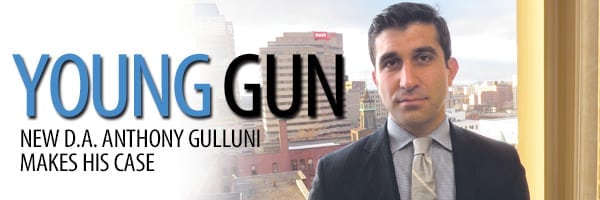
New D.A. Anthony Gulluni Makes His Case

COVER1214cAnthony Gulluni says he was in Boston recently for a meeting of the state’s district attorneys and district attorneys-elect — he’s in that latter category, having won the position in Hampden County in September.

And he noted that he was subjected to more than a few not-unexpected cracks about his age.

“Someone said I brought down the median age by 20 years, or something like that — there were quite a few jokes,” said Gulluni, who turned 34 in October, looks even younger, and is believed to be one of the youngest district attorneys — if not the youngest — in the state’s history.

While he takes the ribbing in stride, he makes it clear that he intends to have people talking about something other than his age — and soon.

Indeed, Gulluni, who will be sworn in early next month and has been hard at work on transition matters for several weeks now, has some ambitious plans for his office. Specifically, and repeatedly, he talked about fighting crime not only in the courtroom, where he intends to be much of the time, but outside it as well.

“We have a fundamental obligation to work with police departments and prosecute cases in the courtroom and keep people safe,” he explained. “But it’s a two-phase approach; there’s prevention, education, and addressing core issues such as mental health and substance abuse. But there’s also performing that fundamental function of the D.A.’s office — promoting public safety by prosecuting cases.”

Elaborating, he stressed that the D.A.’s mission to serve the public means working to assist not only the victims of crimes, but, when possible and when appropriate, those committing them as well.

“I see this as a position in which I’m serving the public; I’m serving the people of Hampden County and promoting public safety and ensuring criminal justice,” he explained. “There’s a great responsibility with that criminal-justice part, where serving people means serving the defendants that come into that courthouse.

“It’s very often overlooked that we have such impact on those people’s lives — and very often they’re repairable lives,” he went on. “All but a very, very small percentage of these defendants are people we’re not looking to save in some way or improve. And this goes into the job of being a district attorney and being a prosecutor, especially at those lower levels in Juvenile Court and District Court, where the focus should be, and often is, on rehabilitation.”

Gulluni told BusinessWest that he has a number of priorities for the months and years to come. They include everything from lobbying the state’s elected leaders for funding he said would be commensurate with the size of the county’s courts and their volume levels (more on that later) to creation of a new position, one dedicated to what amounts to public relations and telling the mostly unknown story of what the D.A.’s office does within, and for, the community.

And he will place heavy emphasis on stemming the tide of gun violence in the county and especially its two largest communities, Springfield and Holyoke.

“I’ve handled a lot of gun cases, and I think it’s the scourge of urban America,” he said. “Very literally, guns are necessary components in the street violence and many of our murders. An emphasis has been placed on prosecution of defendants with illegal guns, and this emphasis will continue. It’s a major problem, especially in Springfield, and there’s a trio that often travels together — guns, drugs, and gangs — and this is manifesting itself in the deaths of a lot of young people and the destruction of countless lives.”

For this issue and its focus on law, BusinessWest talked at length with Gulluni about his new position, the philosophy he brings to it, and his goals for his office and the diverse county it serves.

Law and Order

When asked why he joined the D.A.’s office and later chose to try and lead it, Gulluni started by talking about his father, Frank, and the legacy he left in public service.

“My father worked very hard for many, many years to help people, essentially, and was a public servant in the truest sense of the word,” he explained, noting that his father founded and then managed the Mass. Career Development Institute (MCDI) for roughly a quarter-century, until the late ’90s. “That record of service certainly influenced me. He helped thousands and thousands of people; I really learned a lot from that, and this passion for public service was ingrained upon me as a young person watching him help so many people.”

Anthony Gulluni

Anthony Gulluni says he intends to fight crime both in the courtroom and in the community.

That fondness for public service is reflected in his career path following graduation from Western New England University School of Law. After first serving as a law clerk in the Springfield Law Department and then as an assistant city solicitor, he joined then-District Attorney Bill Bennett’s team as an assistant D.A. in June 2009.

He said that both Bennett and his successor, Mark Mastroianni, served not only as mentors, but, like his father, as individuals who embodied the importance of public service.

“I had great mentors in that particular job,” he told BusinessWest. “But once I started in that office, I realized a love for the job because of the work, particularly the trial work, but moreso the public-service side of it and the impact that we as prosecutors have on individuals, particularly the individuals who come into the courthouse and those whose cases we prosecute, and those victims who are involved in the cases we prosecute.

“And because I live in the county and especially a place like Springfield, I also realize the impact that the office has collectively, and that we have individually as prosecutors, on the communities we serve in Hampden County,” he continued. “That was a source of great pride; I had opportunities to leave, and thought about it, but ultimately I stayed because I loved what I was doing.”

Soon after Mastroianni was appointed to a federal judgeship, Gulluni announced he would seek to succeed him as the region’s top prosecutor. He said his triumph over three opponents in the Democratic primary in September (there were no Republican candidates) was verification that he made the right career decision.

“If I lost, I think that would have shown that I was wrong in seeking the office at this time,” he said. “To win by a resounding margin in a four-person race really answered the question of whether I chose right, whether my sense was right, and whether my reasons were right.

“The way in which I ran my campaign was a manifestation of my reasons for running,” he went on. “And that was to show people that I care about the community. I’m a lifelong Forest Park resident, and I’ve been in the county my whole life, I was educated in this county, and I have a familial background in public service.”

As an assistant under Bennett and Mastroianni, Gulluni said he gained invaluable experience in the courtroom — which was another motivation for making that career transition — but also developed an appreciation for the many kinds of rewards that come from assisting the victims of crimes.

“Those are the cases I remember, the ones where someone was victimized and who was looking to me, the prosecutor, to bring some sense of satisfaction, maybe, or some sense of wholeness or repair for what happened to them,” he noted, adding that this category of crime includes everything from gun offenses to many OUI cases, to instances of breaking and entering. “That’s a solemn responsibility I always took very seriously. But in some cases, you let people down or you could never really satisfy them, which is understandable.

“However I could help that person in the healing process was always of great satisfaction to me,” he went on. “Sometimes you do let people down — maybe they’re unsatisfied with the sentence, or the case could not go forward — and that’s an inevitable part of the system, but I always worked as hard as I could to make people happy and give them a sense of closure.”

Bullet Points

Looking ahead, while also surveying the county and assessing the issues confronting it, Gulluni expects his office and its staff of 160, including 65 lawyers, will be busy not only assisting victims and providing that sense of closure, but also working to limit and perhaps reduce their numbers.

And, as he stated earlier, a critical piece of this assignment is work to rehabilitate, or save, the defendants in such cases.

“My focus is going to be especially on people who are suffering from mental and substance-abuse issues,” he told BusinessWest. “We need to address those core issues and give these people a hand. Very often there’s some punishment that goes with that, and this goes with the territory, but we’re looking to help some of those people we can help and who have issues — with crime being an outgrowth of those core issues.

“And if we can address those core issues, we’re acting in that humanitarian way by trying to help those people,” he continued. “But we’re also being fiscally prudent as well, understanding that the initial investment in these people hopefully will prevent future expenditures in terms of prosecution, probation, and incarceration if things were to continue in that way.”

As an example, he cited the national, and regional, problem of opiate addiction. The numbers of those who become addicted to painkillers and potent drugs such as heroin are rising at alarming rates, and with this surge comes criminal activity on many levels as individuals struggle to feed their addiction.

“We have to fight this inside the courtroom and outside it,” said Gulluni. “It comes to us as a criminal-justice issue, but it’s really a health issue. These people dealing with mental-health and substance-abuse issues are coming to us with the outgrowth of their problem — the commission of a crime — but that underlying issue is a health issue. Whether we’re equipped to our not, we have to deal with this issue and make a difference through whatever means we have. It’s going to be my obligation to better prepare and treat those issues through cooperative arrangements with nonprofits and outside agencies, but also with the trial court and the probation department.”

To this end, a so-called Veterans Court is being established through a pilot program to deal with individuals suffering from post-traumatic stress disorder and other issues, he said, and, likewise, a drug court is being considered to identify and handle cases where there are no real victims of the crimes in question, other than those suffering from addiction, and such individuals do not have a significant criminal history.

Such facilities, similar to a mental-health court already in existence, would enable prosecutors to take such cases out of the mainstream criminal-justice system and deal with them in a specialized way, Gulluni went on, adding that a drug court has been discussed for some time now, and he intends to make it a priority of his administration.

There are other priorities, as well, and Gulluni and has transition team have been addressing them since the end of what the D.A.-elect called a “time to rehabilitate” and then a “thank-you tour” that followed the election.

One of the first matters to be considered is personnel, said Gulluni, adding that the process of assembling his team is ongoing and will continue for some time.

Meanwhile, another priority is forging relationships with elected officials, with the goal of communicating the need for more funding and, hopefully, seeing that need addressed.

“We’re going to work hard to bring in as much money as we can,” he noted. “For fiscal year 2013, we were the fifth of the 11 districts in the Commonwealth in terms of funding, and our Superior Court during that time period disposed of the most cases of any district. Our District Court is among the busiest in the state; the volume is there, but the funding is not commensurate with the work that we’re doing.”

While funding is indeed tight, he will strive to find room in his budget for a professional to work with the media to better tell the story of what the D.A.’s office does, how, and why.

“We haven’t had such a person in a long time, and we need one,” he explained. “It’s a positive thing for us and a positive thing for transparency, most importantly. We’re accessible — this is essentially the people’s office, and we’re prosecuting on behalf of the people of Hampden County, and I’m beholden to them, so being able to communicate readily with members of the press is very important.

“Whether you’re in business or in the public sector, you want to get your message out,” he went on. “You want to show people what you’re doing and show them that what you’re doing is positive and impactful. It’s not just putting a face on the office — it’s preventing crime.”

Beyond greater exposure, Gulluni wants the D.A.’s office to be more visible and more active in the community, especially when it comes to young people and keeping them from taking the wrong path.

“We need to get in front of young people and send a message that there are things they have to avoid, especially in the urban atmosphere,” he said. “If we can get to some kids before they fall into that trap of crime, street violence, gangs, guns, and drugs, we might be able to keep them from getting into trouble.”

Bottom Line

When asked if he thought he’d be in the D.A.’s office long enough to be on the other end of jokes about 30-something prosecutors, Gulluni laughed before explaining that he’s focused now on the weeks and months ahead, not a few decades down the road.

He said he expects to serve in this office for at least two four-year terms, and hinted that his stay might be considerably longer.

At the moment, his only commitment is to the people of Hampden County and his pledge to fight crime inside the courtroom and out.

George O’Brien can be reached at [email protected]

Law Sections
Having Thorough, Detailed Documents Is a Must for Employers

By SUSAN G. FENTIN, Esq.

Is one of your New Year’s resolutions to work on your company’s job descriptions? If so, make this an early priority in 2015.

SUSAN G. FENTIN

Susan G. Fentin

Job descriptions are one of the five documents that are guaranteed to show up in employment litigation. Full and accurate job descriptions can make the difference between winning and losing claims filed by employees under a multitude of state and federal statutes, including discrimination claims under the Americans with Disabilities Act, Title VII, the Equal Pay Act, the Fair Labor Standards Act, and parallel Massachusetts law.

The New Year is a great time to tackle this job. This review is especially important if it’s been several years since you last conducted a full review. Frequently, job duties change over time: new tasks are added, and duties that previously were assigned to a particular worker might no longer be necessary or not performed in the same way. Employees who were originally considered exempt may have had responsibilities removed from their job duties, which might lead to questions as to whether the employee is still properly classified.

If an employee should have been paid on an hourly basis and worked substantial overtime, there could be a basis for large damages under Massachusetts wage-hour law. In addition, a good job description clearly communicates the company direction and where the particular position fits in the big picture. It describes the major areas of an employee’s job, sets out clear expectations for performance, and provides a reference point for compensation decisions. Carefully drafted job descriptions help attract the right candidate for the position and give supervisors the documentation they need to support decisions such as performance evaluations and promotions.

Complete and accurate job descriptions that include all the essential functions of a position and the physical requirements of the job have become especially significant since the amendments to the ADA were passed in 2008. As a result of those amendments, more and more employees are able to claim that they are disabled in some way, leading to an increase in claims of disability discrimination and failure to accommodate.

However, employers who develop full and accurate job descriptions have an easier time beating disability-discrimination claims, as the Friendly restaurant chain demonstrated in a 2010 case that went all the way up to the First Circuit Court of Appeals.

Friendly’s hired Katharine Richardson as assistant manager at its Ellsworth, Maine, restaurant. In addition to administrative tasks, Richardson was expected to work the grill, cook French fries in a deep fryer, scoop ice cream, lift heavy bags of trash, mop the floor, wait on and bus tables, and unload delivery trucks.

In January 2007, Richardson began to experience severe shoulder pain. For the next nine months, she did her best to do her job by changing the way she performed her duties: she cooked French fries in smaller batches and used tongs, since she couldn’t lift the basket from the fryer, and she delegated many other tasks, such as mopping the floor and taking out the trash.

In September 2006, Richardson took FMLA leave for shoulder surgery. She expected to return to work in October, but her surgeon did not release her to return to work until January 2007. Friendly’s extended her leave of absence, but when she finally returned to work, she had severe, permanent restrictions on lifting anything that weighed more than five pounds and performing repetitive activity. Since Richardson’s limitations meant she was unable to perform most of the manual tasks required of assistant general managers, Friendly’s terminated her from employment.

Predictably, Richardson sued. Friendly’s defense was that she was not a ‘qualified individual’ entitled to the protections of the ADA, since she was not able to perform the essential functions of her position with or without an accommodation. The U.S. Court of Appeals for the First Circuit took up the case to decide whether Friendly’s had discriminated against Richardson and/or failed to accommodate her disability. After all, Richardson argued, the restaurant chain had been able to accommodate her for quite some time by allowing her to assign many of her lifting tasks to other employees.

The court reviewed EEOC regulations governing ‘essential functions’: does the position exist for the purpose of performing the function? How many employees could perform the function? Is the function highly specialized? Was the employee hired for her expertise or ability to perform it? The court also considered other factors, including the employer’s judgment concerning essential functions, written job descriptions, the time spent performing the function, the consequence of not requiring the employee to perform the function, any applicable collective bargaining agreement, and the work experience of past and current employees in similar positions. The court noted that substantial weight is given to the employer’s view of what functions of the job are essential, particularly when articulated in a written job description.

Richardson claimed that, as an assistant manager, her only truly essential job function was to oversee the smooth operation of the restaurant. However, Friendly’s relied heavily on its six-page, written job description for the position, which specified essential functions and specific, physical requirements of the position.

Indeed, Richardson conceded that part of her job was to be able to fill in for any employee in the restaurant when needed, and she described in detail the duties she was required to perform. The First Circuit came to the conclusion that Richardson’s manual duties were essential to her position, and that, since she was not able to perform them, she was not a qualified individual under the ADA.

Clearly, a carefully drafted job description that includes all the physical requirements of a position and delineates essential functions can make the difference between winning and losing a charge of disability discrimination. And, as we’ve explained above, there are many other ways in which full and accurate job descriptions can make a big difference in managing your employees.

If you need assistance identifying essential functions or developing an accurate list of the physical requirements of your position, contact your labor and employment counsel. But be sure to put this on your list of new year’s resolutions for January 2015.

Attorney Susan G. Fentin has been a partner at Springfield-based Skoler, Abbott & Presser since 2004. Her practice concentrates on labor and employment counseling, advising large and small employers on their responsibilities and obligations under state and federal employment laws, and representing employers before state and federal agencies and in court. She speaks frequently to employer groups, conducts training on avoiding problems in employment law, and teaches master classes on both the FMLA and ADA; (413) 737-4753; [email protected]

Law Sections
A Primer on the New England Compounding Bankruptcy Proceedings

By STEVEN WEISS

New England Compounding Pharmacy Inc. (NECC) was a drug-compounding facility located in Framingham. Beginning in the fall of 2012, reports began to surface that patients across the country who had been given an NECC-manufactured product had contracted fungal meningitis.

Steven Weiss

Steven Weiss

Health authorities soon determined that NECC’s products were, in fact, tainted, and NECC ordered a recall. However, considerable damage had been done. The Centers for Disease Control and Prevention eventually determined that, as of October 2013, 64 people had died, and 751 had become ill. At least 555 separate lawsuits have been filed against NECC, its officers, and others, which have been consolidated in federal court in Boston. Ultimately, approximately 3,350 people have filed claims for personal injuries allegedly resulting from the tainted pharmaceuticals.

Two weeks ago, 14 people, including the former owners of the company, were arrested on federal charges, including RICO charges under the Racketeer Influenced and Corruption Organizations law.

As a result of the outbreak, NECC could no longer operate, and on Dec. 21, 2012, it filed a Chapter 11 bankruptcy petition in the Massachusetts Bankruptcy Court (the case is being heard in the Springfield session of the court). Not long after the case was filed, NECC’s management was removed and a Chapter 11 trustee (Paul Moore) was appointed to oversee the liquidation of the company, to collect funds to distribute to victims and other creditors, and to establish a plan to distribute those funds. During the course of the case, the trustee and lawyers representing victims reached settlements with NECC, its officers and directors, several affiliated entities, several insurers, and others, through which as much as $135 million has been recovered for victims.

Recently, almost two years after the bankruptcy petition was filed, the Chapter 11 trustee and the unsecured creditors’ committee filed a joint disclosure statement and a plan of reorganization for NECC. Under the Bankruptcy Code, the disclosure statement is intended to be something like a stock prospectus; it is intended to provide creditors with sufficient information to enable them to make an informed judgment about whether to approve the plan. After the disclosure statement is approved by the Bankruptcy Court, it will be distributed to all of NECC’s creditors, who will have the opportunity to vote on whether or not the plan should be confirmed by the court. The vote is ‘weighted,’ because it has to be approved by a majority of creditors holding two-thirds of the dollar amount on the ballots of those who vote.

The plan, while complicated, is essentially a ‘liquidating plan,’ so-called because it does not contemplate that NECC will reorganize and ever operate again. Instead, it provides a process for estimating and determining the amounts of the victims’ claims, as well as a mechanism for making distributions to victims. If the plan is confirmed, all of the funds from the settlements will be transferred to a tort trust established under the plan.

One of the potentially controversial features of the plan is that, if confirmed, it will provide releases to parties not just to NECC and the insurers who have funded the settlements, but also to third parties who are not in bankruptcy, and enjoin further suits against those parties. Courts across the country have reached different conclusions about whether such broad injunctive provisions are beyond the powers of bankruptcy courts.

The plan provides for a ‘claims-resolution facility,’ under which victims’ claims are evaluated and ‘scored’ based on seven base-point categories, such as whether NECC’s products caused death and the extent of surviving victims’ injuries, then possibly adjusted based on individual victims’ personal circumstances.

That will enable the tort trustee to assign a dollar value to each victim’s claim. Those claims will then be eligible to receive pro-rated distributions from the pool of funds in the tort trust. Because there are so many claims, the disclosure statement does not provide any estimate of what the total amount of claims is likely to be, so the disclosure statement also does not predict what percent dividend victims are likely to receive on their claims. But for purposes of illustration, if there are total claims of $270 million, each victim with an allowed claim would receive a dividend of approximately 50% (less attorneys’ fees, of course).

The disclosure statement acknowledges that it may take several years to fully determine the amount of victims’ claims. Thus, the tort trust allows the tort trustee to make an initial interim payment to victims, followed by a final distribution once all of the claims have been calculated.

The Bankruptcy Court has scheduled a hearing on whether to approve the disclosure statement for Feb. 24. Once the disclosure statement is approved, it will be served on all of NECC’s creditors, along with the plan, a ballot, and voting instructions. A hearing on whether the plan should be confirmed — and be binding on NECC and all creditors — will likely be held in the spring.

Attorney Steven Weiss is a partner at Springfield-based Shatz, Schwartz and Fentin. He concentrates his practice in the areas of commercial and consumer bankruptcy, reorganization, and litigation. Weiss supervises the firm’s bankruptcy, reorganization, and workout practice; represents creditors, debtors, and others in both commercial and consumer bankruptcy cases throughout Massachusetts; and has been a member of the private panel of Chapter 7 trustees for the District of Massachusetts since 1987, and also serves as a Chapter 11 trustee; (413) 737-1131; www.ssfpc.com

Law Sections
The New Year Is the Perfect Time for an Audit of Your Practices


By SARAH G. TORRES, Esq. and KARINA L. SCHRENGOHST, Esq.

Sarah G. Torres

Sarah G. Torres

Karina L. Schrengohst

Karina L. Schrengohst

As the new year approaches, employers would be wise to include in their resolutions efforts to ensure compliance with the myriad employment laws affecting their business, including those related to sick leave, disability discrimination, sexual harassment, and wage-and-hour issues.

To accomplish this, employers can begin by conducting an internal audit of their employment practices with the assistance of employment counsel, including looking at their employee handbook and other policies and job descriptions, as well as planning supervisor training.

Employee Handbook and Policy Reviews

Is your employee handbook up to date? Employers should consider having their employee handbook and other policies reviewed on an annual basis by employment-law counsel to ensure they are compliant with state and federal law and recent National Labor Relations Board (NLRB) decisions. For instance, just this month, the NLRB issued a decision permitting employees to use company e-mail accounts on their own time for non-business purposes, including discussing union organizing and work grievances.

Employers must be aware that these communications are protected in both union and non-union workplaces. Accordingly, employers may need to revise their computer-usage policies to comply with this decision.

Likewise, many Massachusetts employers will need to revise their current paid-time-off policies or create sick-time policies to comply with new sick-leave legislation that will go into effect on July 1, 2015. Under this new law, employers with 11 or more employees must provide up to 40 hours of paid sick time per calendar year. Employers with fewer than 11 employees must provide up to 40 hours of unpaid sick time per calendar year.

In addition, some Massachusetts employers with 50 or more employees will need to create policies or amend their employee handbooks to incorporate a domestic-violence-leave policy, if they have not done so already. This past summer, Massachusetts enacted a law that requires these employers to provide up to 15 days of leave during a 12-month period to employees who are victims of domestic abuse or who have a qualifying family member who is a victim, and to notify their employees of their rights and responsibilities under the law. The attorney general recently suggested that employers can meet the notice requirement under the law by including a provision in their employee handbook.

Also, employers with six or more employees are reminded that Massachusetts law requires annual distribution of your sexual-harassment policy.

Training for Managers and Supervisors

Do you offer your managers and supervisors regular training?

Creating or revising workplace policies to comply with new laws and regulations is only one preventive step. The next step is training managers and supervisors to ensure they understand these policies and their responsibilities under these policies, which is equally crucial. Employers should consider scheduling training for their management personnel on employment-law topics such as sick and domestic leave laws and the new NLRB decision related to e-mail communications, as well as refreshers on topics such as disability discrimination, sexual harassment, and wage-and-hour issues.

Many employment issues that eventually evolve into litigation stem from actions or inactions of managers or supervisors. Employers should regularly conduct trainings to give these key employees the knowledge and skills required to enable them to properly handle situations as they arise.

Review, Update, and Revise Job Descriptions

Do your job descriptions accurately reflect your employees’ actual job duties?

Job descriptions can be used as a basis for interviewing candidates, orienting a new employee, and evaluating job performance. In addition, an accurate job description listing the essential functions of a position will assist you when faced with requests for accommodations under the Americans with Disabilities Act. Sending an accurate job description to an employee’s medical provider will help you determine whether an employee is able to return to his or her position and what, if any, accommodations may be necessary.

An accurate job description with a detailed list of the essential functions of a position can also assist you with determining whether an employee is exempt from overtime pay under the Fair Labor Standards Act. This is especially important because the Department of Labor (DOL) announced this year that it will be reviewing these overtime exemptions and will likely be revising their regulations in 2015. Compliance in this area is particularly important because an employer who has been found to have misclassified an employee as exempt can be subject to significant penalties as a result of a DOL audit.

The cost of defending expensive litigation far exceeds the investment in taking proactive, preventive steps to reduce the risk of litigation. Therefore, employers should consider conducting an internal audit at the beginning of the New Year.

Sarah G. Torres, Esq. and Karina L. Schrengohst, Esq. are attorneys at Royal LLP, a woman-owned, boutique, management-side labor and employment law firm. Royal LLP is a certified women’s business enterprise with the Massachusetts Supplier Diversity Office, the National Assoc. of Minority and Women Owned Law Firms, and the Women’s Business Enterprise National Council; (413) 586-2288; [email protected]; [email protected]

Law Sections
Now Is the Time to Review Documents and Create an Action Plan

By LISA L. HALBERT, Esq.
Lisa L. Halbert

Lisa L. Halbert

As the end of 2014 approaches, articles are published that recap the year’s events (“the best of…,” “the worst of…”), or that encourage changes in behavior (how-tos) for 2015. Among that genre are the top 100 videos, 10 most influential people, and my perennial favorite, “how to lose that first 10 (or 50) pounds this year.”

In this respect, the field of elder law and estate planning is not terribly different. The new-year celebration is an opportunity to review legal documents and consider an action plan for estate-planning needs during the coming year.

Estate-planning documents need to be reviewed at least every five years and also upon major life events, to make sure they continue to be relevant. Even attorneys can neglect this periodic review, and as this article is written, I am reminded to pull out my own documents and confirm that my wishes are properly reflected. As for those who do not yet have documents, read below for the potentially serious consequences of not having documents in place.

What follows is a list of estate-planning documents, action steps, and paperwork to consider, and advice for the coming year.

Prepare a Comprehensive List of Assets

Make this less daunting by doing it in stages. When next balancing your checking account, before you get up from your desk, start an asset list and add all bank accounts and possibly real estate. Then set a time to consider what you hold in securities, retirement funds, insurances (life or disability), annuities, business valuations, and tangible personal property, such as art, furniture, and jewelry. Make a column and indicate who owns the asset, whether it is held in your name alone or jointly with another. See the section about beneficiary designations for further information.

This list should also include any assets held in a trust. Sharing this list with your estate-planning attorney is a good beginning point. Understand that, after your estate plan is fully developed, the titling of your assets may change to accommodate the plan.

Durable Power of Attorney

The DPA allows you to appoint people to assist with financial management of assets in your name while you are alive. The person who creates or grants the power is referred to as the ‘principal,’ while the person who is appointed to act on behalf of another is sometimes referred to as the ‘attorney-in-fact’ (AIF). The principal gets to determine the amount of authority to grant the AIF, with the exact terms set forth in the DPA. The benefit to a DPA is that you, not a court, choose who can have access to your financial information. A DPA can allow the AIF to access your assets even though you are fully capable of thinking and acting for yourself (for example, as a convenience for you while away on vacation), or it can be written to allow access only if and when you start to fail mentally.

A DPA does not change the ownership of any asset or account. It merely allows another to act as your fiduciary — to step into your shoes and make decisions as your agent. If an asset is owned by you alone, then at your death, the authority of the AIF terminates and the asset then goes through your will, unless there is a beneficiary designation attached to it.

Whether a copy of the DPA is immediately provided to your appointees or held to be distributed at a later time is a discussion to have with your attorney. Remember, if no one knows about it, or you fall ill and cannot communicate where the document is located, court action might still result.

The issue always comes up about whom to appoint and how many to serve at any one time. Should it be one person, or two people serving together? And if two serve, do they need to act together, or may they act unilaterally? From a purely administrative perspective, it is easiest to identify one person to act alone. But in families where there may be friction, or differing skills in terms of money management, then appointing two people to act may be the best choice for that particular family.

Decisions about whether to require two signatures or one are made by the principal after considering the benefits and burdens of both choices.

If a DPA does not exist or cannot be located, and you are unable to manage your financial affairs, then without a DPA in place the family may find itself needing to go to court to obtain a conservatorship over the accounts. In the alternative, the matter might linger and not be addressed in a timely manner. For example, through oversight, a deadline may be missed to pay a premium for life or disability insurance, causing the policy to lapse. Either way, the financial consequence could be much greater than the cost associated with having the document prepared and gaining control of who has access to the accounts.

Healthcare Proxy

Review your HCP to confirm that it identifies those you would want making healthcare decisions for you if and when you can no longer make or communicate them on your own. List appointees to serve in consecutive order, and make it long enough so that it stands the test of time. Discuss the prudence of additional provisions. For example, do certain religious beliefs impact healthcare decisions, and how should they be articulated? Would you allow certain drugs to be administered that might otherwise require court approval? Do you want your healthcare agent to choose a nursing home for you if it becomes necessary?

Once signed, provide your HCP to your healthcare providers and other physicians and hospitals. Some people keep a copy on the refrigerator, in the car, in their luggage, or with other important papers. And, of course, provide a copy of your HCP to those you have appointed as decision makers.

Remember, an HCP is not a medical release that allows an appointee to look into your private medical records or make changes to current treatments. Rather, a physician or certain nurses must invoke the HCP when you are no longer able to make informed decisions about your healthcare, or cannot communicate them. And just because the HCP is invoked does not necessarily mean that you do not have capacity to handle your own finances or manage other contracts.

If you have a surgical procedure, remember to bring a copy of your HCP with you, or ask the facility if you can e-mail a copy for their records. Many medical facilities provide a boilerplate form for completion prior to a procedure. Patients then dutifully fill it in, not necessarily realizing that this new form will revoke a previously signed HCP. It is always better to supply a doctor or hospital with your own HCP document, which will likely be a more considered and thorough document than the hospital’s standard form.

Without an HCP, if healthcare decisions need to be made for you, a court will appoint a guardian. This process takes time and costs money, and you may no longer get to control who is appointed to serve. The benefit of an HCP is that you get to choose those individuals you trust to make decisions for you as you would want for yourself, as opposed to having a court choose.

Massachusetts Medical Orders for Life-sustaining Treatment

The MOLST is a relatively new medical form and not a legal form. It is intended to be used by patients of any age who suffer from an advanced illness. It addresses current medical orders about life-sustaining treatment(s). It involves the medical provider/clinician and the patient, and it is effective as of the time of signing. It serves a different purpose than a HCP. Those with advanced illness or the loved ones of those same people are encouraged to discuss a MOLST with their clinician, or visit molst-ma.org.

Nursing Homes and Long-term-care Facilities

This is one of those cautionary tales that cannot be ignored. Too many times in 2014, clients have come in to ask for assistance in dealing with a collection issue concerning a loved one in an assisted-living residence, nursing home, or similar facility. For example, Barney Rubble arrives in the office stating that an assisted-living facility is looking to collect against his own assets to pay for his friend Fred Flintstone’s stay. It seems that the insurance that might have covered the experience had a glitch and is not paying.

Barney is Fred’s trusted friend and is appointed as Fred’s healthcare agent and AIF. On Fred’s application for admission to the facility, Barney signed as the ‘responsible party,’ because he felt that, since he was helping his friend Fred, he was therefore responsible to make sure Fred’s bills were paid. Although Barney was well-intentioned, in most cases, he missed the mark. While he is the AIF, it is only with respect to using Fred’s funds. Barney never intended to promise to use his own funds.

Before signing any paperwork, slow down and carefully read the application. ‘Responsible party’ frequently means that the person signing is actually financially responsible for the person who is going into the facility. Therefore, the proper way to have completed this area of the form so as to insulate Barney’s assets was: ‘Fred Flintstone by Barney Rubble, his AIF.’ Otherwise, Barney may be setting himself up for the facility to come after his own assets, in addition to Fred’s.

Last Will and Testament

A last will and testament controls assets that are held in your name alone without a designated beneficiary, at your time of death. These are the only assets that go through the probate process. Your will is a road map as to whom you would like to receive your probate assets, so long as it is not illegal.

It can also provide for forgiveness of debt or allow someone temporary use of an asset (such as living in a home until X age, or Y event occurs). Generally, a will allows you to control and determine who inherits your estate at your death. (A surviving spouse and minor children, however, do have certain statutory rights that take priority over the terms of the will, even if you intended to try to disinherit the spouse and/or child.)

When you die, the Mass. Uniform Probate Code (MUPC) controls the probate process. The MUPC is intended to expedite the process and no longer requires as much court intervention or oversight, although court supervision is available where appropriate. For those with new probate matters, be aware that, as of the end of October, a new rule was issued that requires seven days’ notice must be given to the Division of MassHealth before a petition for probate is filed with the court.

While this usually will not pose a problem, compliance is required. Because the MUPC is still relatively new, attorneys continue to identify nuanced changes relative to how the rules are to be implemented. And while the law was intended to be user-friendly and more streamlined, another caution is to seek legal counsel, especially where a decedent dies owning real estate.

If you pass away without a will (referred to as dying ‘intestate’), state law dictates how your assets get distributed. Under the MUPC, if you die intestate and are survived by your spouse and children of both you and your spouse (whether biological or adopted), then your spouse will receive your entire estate, without any portion specifically allocated to the children of the relationship. If there are stepchildren (on the side of the decedent or the spouse), then a different distribution is dictated.

Under the MUPC, your spouse has priority to serve as the personal representative (formerly executor) for your intestate estate. The statute, however, provides that, if your spouse does not want to accept the position, he or she may designate someone else to act, effectively skipping over an adult child who might have anticipated taking on that role. So, while you might not think you have enough assets to have a will prepared, having control and choosing the beneficiaries is likely the best route to go in case that late-bought lottery ticket is found, or a family member inadvertently left you as a beneficiary.

A will can also have some significance prior to your death. During your lifetime, if you become incapacitated and another is put in charge of your assets and financial management, there may be occasions where gifts are appropriate. The AIF or conservator can look to your will in order to figure out who or what entities are most dear to you and help implement some of those dispositions even before you pass away. The will, therefore, may offer some guidance even during your lifetime.

Trust-based Planning

Depending upon your assets, intended beneficiaries, and other information, a trust might be a better option to accomplish your preferred distributions than a will. A trust is a document with three major players — the person who creates it (you, also known as the grantor), the trustee (who could be you and/or others and is the one who actually administers or managers the assets), and the beneficiaries (who could be you and/or others who receive a benefit under the trust). The trust document provides direction as to how you want your assets (and debt) managed, invested, and distributed. It is especially useful if there are minor beneficiaries and you want to know that instructions are followed long-term, or where another needs some long-term financial assistance or management (such as a special or supplementary needs trust.)

This year, irrevocable trusts have become a topic of much discussion among elder-planning attorneys. Irrevocable trusts have been used by elder-planning attorneys as one way to provide the elder ‘income only,’ but save the principal for others. When created, counsel and clients knew that income-only trusts would leave the income exposed and in the sights of MassHealth, and available to pay for care.

This past year, however, MassHealth more frequently required that the principal also be made available to pay for the elder’s care. MassHealth’s position seems based on an interpretation of text that might allow for the trustee to alter or exchange assets within the trust. While there is some myopic interpretation which, when taken out of context, might allow for an elder to receive what was formerly characterized as principal, when considered in total, most of these irrevocable trusts do not allow for such dispositions.

The legal battle continues to heat up, and for the immediate future, an irrevocable income-only trust, where a MassHealth application might someday be required, should be approached with extreme caution.

Beneficiary Designations

Review beneficiary designations on your various accounts to confirm that they remain current and in line with your overall estate plan. Types of assets that frequently carry opportunities for beneficiary designations include insurance, annuity, retirement accounts, and some brokerage accounts (accounts that hold securities and other investments).

Designating a beneficiary completely avoids the asset going through probate, and there may be some income-tax advantages to naming a direct beneficiary. Most people, however, forget that the first-named beneficiary might not outlive them, and do not properly name a contingent beneficiary. Also, if your estate plan is premised on having assets go through your probate estate, but the designations are not changed, then your plan may be defeated.

An estate plan, once completed, may use a blend of assets that are directed to specific beneficiaries via designation, as well as assets that go through probate or a trust. Retirement assets may have a better income-tax benefit if directed to specific individuals or charities (especially if you are looking to save an income-tax bite to the estate), while life insurances might be more appropriate to go through probate. Each client situation is different.

The MUPC effectively revokes certain beneficiary designations to a prior spouse. Therefore, if you are divorced and yet still intend for your ex-spouse to receive assets via a beneficiary designation that has not been changed since the divorce, revisit the designation.

Further, there are many insurance companies that do not yet respect the MUPC and stand by their own rules stating that, where a spouse is named as a beneficiary, even after a divorce the prior designation stands. So, even if your separation agreement holds that the ex-spouse is not a beneficiary, some companies ignore that text. Rather than cause your family unnecessary angst, it is best to affirmatively confirm or change beneficiary designations after a divorce is finalized.

Same-sex Spouses

A year ago, significant ink was used getting the word out that same-sex spouses could qualify for spousal benefits in Massachusetts and under the federal law. While not exactly breaking news, spouses (including same-sex) are once again encouraged to review all financial aspects that might impact their married life. For planning purposes, this impacts your federal income taxes, Social Security benefits, FMLA, and health-insurance coverage.

Retirement benefits from a qualified retirement plan will be required to allow the surviving spouse of a married couple, whether same-sex or not, to withdraw the funds over the surviving spouse’s lifetime. IRAs that allow a spouse to roll over inherited assets into his or her own IRA are now allowed. There are more than 1,000 federal benefits that may be impacted by this ruling. Check beneficiary designations as well as federal tax withholding. By now it should be old news, but I will remind you that same-sex spouses may file joint income-tax returns.

From an estate-planning perspective, we are in the second year that same-sex couples can take advantage of the unlimited marital exemption to transfer assets between spouses during life, as well as at death. For high-wealth couples, ‘portability’ of the estate-tax exemption at the death of the first spouse to a surviving spouse is now allowed. With an estate-tax exemption currently at $5.34 million per spouse (and $5.43 million for 2015), this allows a same-sex married couple to have a combined $10.68 million ($10.86 million for 2015) estate-tax exemption.

While this may not currently impact you, if the surviving spouse wins a large lottery ticket, or comes into money for any other reason even after the first spouse’s death, having elected portability may result in a significant estate-tax savings.

Do-not-resuscitate Order

A DNR is not prepared by your attorney. It is available to be signed in your physician’s office, and it states that, if your heart stops, you do not want extraordinary measures taken to restart it. A DNR is not interpreted to mean that you want to be taken off of medical machinery (and be allowed to die) if you are being kept alive only by such mechanical devices.

Passwords

Regrettably, I am electronically challenged. So, the best advice I can offer is that you need to figure out an appropriate way to track all of your passwords and user ID information, and consider how to leave this information so that your attorney-in-fact or personal representative can access it in the future. There is an old-school view, which is to write it all down and keep it in one place, and there are those who use the cloud or other programs.

Either way, while you still have capacity, think about and organize the information. From experience, the list should include bank accounts, ATM cards, brokerage access, credit and other loans, and even health-related information. Document the answers to applicable security questions.

From a practical perspective, it is frequently very hard for your AIF to establish online access; it is much easier to continue access which you have established. Yet, where many AIFs do not live proximate to the principal, online access is the best solution. So before your memory fades, or an unexpected accident arises, consider whether you want to figure out a solution that makes it much easier for those who might have to assist you.

Important Papers

Organize a filing system for important papers. Whether alphabetical or by category (bank papers, insurance, etc.), consider putting all important papers in one place. Documents to be retained include Social Security cards, copies of birth certificates, and legal documents (will, trust, HCP, DPA, marriage license or divorce decree, and funeral-related paperwork). Include on this list your children or next of kin and their addresses. If you should die, and a non-family member is involved, it makes locating family much easier.

This checklist provides a starting point. For more information, contact an estate-planning professional for a comprehensive review of your plans.


Lisa L. Halbert is an estate-planning, elder-law, and real-estate attorney with the regional law firm Bacon Wilson, P.C. She is especially focused on legal matters relating to elder care, estate planning, and asset protection; (413) 584-1287; baconwilson.com


Columns Sections
Consider the Many Options with IRAs

By KEVIN E. HINES, CPA, MST, CVA, CSEP

Kevin Hines

Kevin Hines

It’s a common belief that Social Security benefits alone will not be enough to fund your retirement, these benefits will most likely diminish over the years as the need grows, and you will need to supplement them with other income, whether through part-time work or retirement savings.

It is a given that, if you can contribute to your employer’s retirement plan, you should do so. At a minimum, you should participate with your employer so that you can maximize any company matching, since this is newfound money. This article will explore other options beyond employer retirement plans.

Traditional IRA

The IRA began back in 1974 when it was first added as a tax-advantaged investment (deferral of taxes until withdrawal). Current rules allow you to make annual tax-deductible contributions up to $5,500 (and an additional $1,000 if you are over age 50); these can be made before April 15, 2015 for calendar year 2014. There are certain restrictions for which taxpayers can take the deduction.

If you can participate in your employer plan and your income levels are higher than threshold amounts (single taxpayers with income in excess of $129,000 and married filing jointly with income in excess of $191,000), you may be limited in the amount of your deduction. An additional requirement is that you have earned income that equals or exceeds the amount of the contribution. Examples of earned income would be W-2 wages, sole-proprietorship income, or partnership pass-through income subject to self-employment taxes.

Advantages of an IRA

There are several advantages to having an IRA or some other tax-advantaged retirement plan:

• You are able to invest more dollars because the investment is on a pre-tax basis;

• The earnings are tax-deferred as well; and

• Taxes are paid only when you withdraw the funds down the road. The common thinking is that, at retirement, you should be in a lower tax bracket and, therefore, pay less in taxes. This thinking may need to be re-evaluated in the future based on where the tax law is heading.

Disadvantages of an IRA

It is only fair to consider the negative attributes as well as the good:

• If you should withdraw the funds before age 59 1/2, there could be a penalty for early withdrawal of funds; and

• You will pay at ordinary tax rates when the funds are withdrawn and possibly lose out on the preferred tax rates of capital gain and qualified dividends, which are taxed at lower rates.

Spousal IRA

As required by tax law, you must have earned income in order to contribute to an IRA. There is one exception to this rule. Should your spouse have earned income, you may treat a portion of his or her earnings as your earnings. This will allow a spouse to contribute to his or her own IRA separate from the working partner. This would be the same for traditional and same-sex marriages recognized by your home state.

Non-deductible IRA

If you are not eligible to take advantage of the tax-deductible IRA (for reasons mentioned above), you still can put money into your IRA. Keep in mind that one of the advantages is the tax deferral on the earnings held within an IRA even if you miss out on the tax deduction.

IRA Payouts

There are a number of considerations when planning for IRA withdrawals:

• If you make a withdrawal from an IRA before age 59 1/2, generally there will be a 10% penalty, in addition to the withdrawal being included as taxable income. There are a number of exceptions to this for hardship causes, but generally, it is not a good idea to withdraw funds until after this age;

• You may defer withdrawals until age 70 1/2. It is generally an advantage to defer the payment of tax as long as you can. This will allow for more funds (the funds you would have paid in taxes) to be invested longer; and

• Should one spouse pass away, you may elect to defer taking into income the IRA funds by completing a spousal rollover and deferring the income until a later date.

Roth IRA

In 1997, along came the Roth IRA. This IRA involves a different approach to investing one’s retirement funds.

The Roth does not allow for an income-tax deduction when you contribute funds. The benefit is that, under current tax law, you will not pay any income tax on the withdrawal of the funds, both income and contributions, provided that you do not withdraw within the first five years and you are older than age 59 1/2.

Best of all, you are not required to begin withdrawing funds during your lifetime if you so choose. As you consider these Roths, think estate planning.

Consideration of Roth Rollover

Beginning in 2010, any taxpayer may take funds out of an IRA account and roll them over into a Roth IRA. The disadvantage to this practice is that you must pay income taxes up front on funds being rolled over. However, the estate-planning opportunities are significant in the right situation.

Consider the following example. Grandparents roll their funds into a Roth IRA and pay the tax up front. They name their grandchildren as beneficiaries. This might allow the funds to continue to accumulate during the remainder of the grandparents’ life and then be drawn down over the following 20-plus years tax-free by the grandchildren. This is real planning, especially if you don’t need the funds during your lifetime.

Consult with a Professional

This topic is a very complex area of income tax and estate planning and is fraught with peril. Consider seeking a tax or estate professional to sit with you and review your situation, particularly because each situation is unique.


Kevin E. Hines, CPA, MST, CVA, CSEP, is a partner with Meyers Brothers Kalicka, P.C., with specialties in business valuations, estate planning, and taxes; (413) 536-8510.

Briefcase Departments

UMass President Robert Caret to Step Down
AMHERST — University of Massachusetts president Robert Caret has announced he will leave his job after four years to become the next chancellor of the University of Maryland system. Caret, who became president of the five-campus UMass system in July 2011, begins his new position in July. Before coming to Massachusetts, he had spent much of his career at Towson University, near Baltimore, where he worked as a faculty member, dean, executive vice president, president, and provost. “I could not say no to an offer to return to my home state, where I will be closer to my family,” Caret wrote in a statement. He will succeed chancellor William “Brit” Kirwan, who has led the 12-institution Maryland system for the past 12 years. In a statement, Kirwan praised his successor, saying, “I’ve known Bob Caret for several years. He has had significant positive impact on each institution he has led. The University System of Maryland and the state will benefit greatly from his leadership in the years ahead.” Caret, who will be formally introduced to the University of Maryland community at a news conference Friday, will earn $600,000 a year, and his contract will run for five years. At UMass, he was paid about $500,000 a year. He will be taking over a much larger system, with 162,000 students and an operating budget of $4.9 billion. UMass has half as many students and a budget of $2.9 billion.

MassBenchmarks Report Optimistic About Area’s Economic Prospects
HADLEY — The state’s workforce and job seekers have reason for optimism, according to the economists behind MassBenchmarks, a study of the state’s economy prepared by the UMass Donahue Institute. “State gross product growth has kept pace with strong national growth for the past two quarters,” according to the report. “State job growth has been steady, with software, information technology, and staffing-services sectors doing well. The Commonwealth’s labor force has grown consistently since June, as workers who were previously discouraged re-enter the labor market. And strikingly, Massachusetts has the fastest-growing population not only in New England, but in all of the Northeastern U.S. This is in large part due to international immigration and a lower level of domestic net outmigration than has been experienced in recent recoveries.” The state also appears to be benefiting from a national economic expansion that is gaining traction. The national jobs report for October was strong, with more than 300,000 jobs added, an increase in the average workweek, modestly rising wages, and upward revisions in job growth for August and September. Falling oil and gas prices are putting more money in the pockets of consumers and lowering business costs. Still, challenges remain, the report notes. “Electricity prices in Massachusetts are expected to rise steeply this winter largely as a result of the New England region’s ongoing difficulties in accessing a sufficient supply of natural gas to power its electricity generators. Rising electricity prices can be expected to partially offset the beneficial effects of the drop in oil prices and will create significant financial challenges for energy-intensive industrial users. Federal-government expenditures, long an important funding source for a variety of private-sector contractors and nonprofit research institutions (universities and hospitals), will continue to be squeezed. And, absent action on the part of the incoming governor and Legislature, state infrastructure spending will be significantly constrained in coming years now that state voters have determined that the gas tax will not be indexed to inflation.” In addition, housing production, especially single-family units, remains well below pre-Great Recession levels. “Despite these challenges,” the report goes on, “the Massachusetts economy continues to experience solid economic growth, particularly in the Greater Boston region, and the prospects for continued growth remain strong. After a weak first quarter of the year, the Massachusetts economy has rebounded strongly. While there continue to be serious concerns about the geographically and financially imbalanced nature of this recovery, the MassBenchmarks editorial board is as optimistic as it has been in some time and expects the state’s economic expansion to continue for the foreseeable future.”

Valley Gives Day Brings In More than $2.67 Million
SPRINGFIELD — Western Mass.-based nonprofits sent out the call, and their supporters gave — and gave and gave. In 24 hours, 14,189 donors made 28,824 gifts for a grand total of $2,676,595 at the third annual Valley Gives Day. In addition, a prize pool of $225,000 was distributed among several nonprofits. Organizations in three budget categories competed for bonus grants presented to the top three slots for ‘most unique donors.’ First prize was $5,000, second was $4,000, and third was $3,000. In keeping with a In addition, nonprofits in 12th place in each category were awarded a $1,200 bonus grant. In the category of large nonprofits, the winners were New England Public Radio (839 unique donors), Dakin Humane Society (739 donors), and the Food Bank of Western Massachusetts (696 donors). Among medium-sized nonprofits, the winners were New Spirit Inc. (641 donors), Whole Children (632 donors), and Pioneer Valley Symphony (384 donors). Among small nonprofits, the winners were Friends of the Hilltown Cooperative Charter School Inc. (437 donors), Grow Food Northampton (342 donors), and the Jackson Street School PTO Inc. (299 donors). Other awards were given in the category of money raised by first-time participants, with first place going to the Jackson Street School PTO Inc. with $24,356. Also, hourly beginning at 9 a.m., a randomly selected donation to a participating nonprofit had a $1,000 golden ticket added to the total. Throughout the day, there were five bonus power hours (10 a.m., noon, 4 p.m., 6 p.m., and 9 p.m.) when a total of $22,000 golden tickets were added to randomly selected donations. The full list of nonprofits and their totals raised is available at www.valleygivesday.org. 

Leadership Pioneer Valley Launches Leadership 2.0
SPRINGFIELD — Leadership Pioneer Valley (LPV) is offering offering a new series of bite-sized training sessions beginning in January to enhance leadership skills and understanding of the region. The sessions are open to LPV alumni and other emerging and established leaders. LPV recognizes that leadership is a lifelong process, and the Leadership 2.0 series features six two- to three-hour training sessions on a variety of topics with the goal of deepening leadership skills, creating new and diverse connections, and making an impact on the region. The sessions are open to LPV alumni who want to continue their learning or others who are unable to be part of LPV’s 10-month program. The intent is to diversify Leadership Pioneer Valley’s offerings and create new opportunities. Workshop topics include “Effective Communications,” “Becoming a Superhero Board Member,” and a field experience to explore the Agawam area. The series sponsors include Sisters of Providence Health System/Mercy Hospital, Appleton Corp., the Beveridge Family Foundation, and the Community Foundation of Western Massachusetts.

Springfield Chamber Opposes Recommended Tax Rates in City
SPRINGFIELD — The Springfield Chamber of Commerce, an affiliate of the Affiliated Chambers of Commerce of Greater Springfield, announced that it has reviewed the city of Springfield’s proposal for property taxes for fiscal year 2015 and has issued a position paper opposing the rates recommended. “The Springfield Chamber, on behalf of its more than 500 members, has consistently advocated for a reduction in the heavy tax burden that has been shifted from the residential community onto the backs of the business community,” said chamber President Jeffrey Ciuffreda. “While the recommended tax rates being proposed by Mayor [Domenic] Sarno reduces both classes of rates, his proposal actually increases the burden again onto the business community, and that is something the chamber cannot accept.” The chamber has a stated, long-term goal of reducing the heavy burden of taxes that has been shifted onto the business community, especially over the past 10 years, to a level that is more reasonable and one that has been used in past years, it said in its position paper. “In 2004, the business classification of properties paid 12.93% more in property taxes than its percentage of overall value. The chamber refers to this increased business-tax burden as the ‘gap.’ Businesses made up 26.86% of all property values in Springfield, yet paid 39.79% of all the property taxes, and used less municipal services. The gap provides for the business community to pay additional taxes so that the residential tax rate can remain lower. Since 2004, the chamber has consistently advocated for a reduction in the gap. Despite these efforts, that gap has seen a steady increase, to its current level of 15.37%.” Ciuffreda said that, while the chamber firmly believes that reducing this burden will spur economic growth, it recognizes the current economic fragility of the city and, for fiscal year 2015, is simply recommending a freeze in the extra level of taxes borne by the business sector. The chamber recommends that the difference between what the business community pays and the percent of value it comprises overall remain at the current level of 15.37%. Under the chamber’s recommendation, all classes of property taxes would be reduced (to $19.68 for residents and $38.72 for businesses), but, more importantly, the gap between the business tax rate and the residential tax rate would remain level. Under the mayor’s proposal, the tax rates would be reduced, but the business sector would pay an even higher rate of taxes, increasing the gap to 15.57%, again shifting more of an already burdensome tax level onto the business community, the chamber argues.

Red Cross Seeks Nominations for Hometown Heroes
SPRINGFIELD — Each year, the American Red Cross of Western Massachusetts hosts the Hometown Heroes Breakfast to honor local individuals and groups that have shown courage, kindness, and unselfish character when a friend, family member, or stranger faced a life-threatening situation, or who have had an extraordinary impact on his or her community. Next year’s breakfast will take place on Thursday, March 19 from 7:30 to 9 a.m. at the MassMutual Center in Springfield. Members of the community are invited to nominate local heroes for consideration by sharing their story. Honorees will be selected by a committee of individuals from the community, including former Hometown Heroes. Submissions for nominations are welcome from throughout Hampden, Hampshire, and Franklin counties. Nomination forms and criteria are available on the chapter website at www.redcross.org/news/event/ma/springfield. Nominations must be submitted online or postmarked no later than Dec. 31. This year’s event is being sponsored by Columbia Gas of Massachusetts, Channel 22 News, the MassMutual Center, and OMG Inc. Additional sponsorship opportunities are still available for this event. Hometown Heroes is the chapter’s largest annual fund-raising event and supports the ability to provide the resources necessary to serve its communities. The American Red Cross of Western Massachusetts serves Hampden, Hampshire, and Franklin counties, assisting families affected by disaster, helping military families relay emergency communications to their deployed loved ones, and providing life-saving training programs. For further information, contact Gina Czerwinski at (413) 233-1035 or [email protected].

State Issues $12.2M to Reduce Healthcare Costs
LOWELL — Secretary of Labor and Workforce Development Rachel Kaprielian awarded more than $12.2 million in the latest round of grants to help train healthcare providers to improve patient service and reduce healthcare costs. The funding goes to 53 organizations across the state as part of the Patrick administration’s effort to encourage economic growth by supporting innovation in the Commonwealth’s healthcare industry. “These grants will help ensure healthcare providers succeed in implementing new models of service delivery and adapt to new payment structures,” said Kaprielian. “By providing resources to develop new and innovative training and education programs, Massachusetts will continue to solidify its place as a leader in healthcare modernization and advances.” In 2012, Gov. Deval Patrick signed a law making Massachusetts the first state in the country to enact healthcare quality-improvement and cost-containment legislation. The act allocated $20 million to prepare the healthcare industry for the new demands and innovations called for in the legislation. Patrick announced the first round of grants in March, allowing businesses to assess their workforce and determine what skills and training they will need to change operations and deliver more efficient healthcare. For many of this week’s grantees, the training activity ahead builds on that planning work. All the grantees have identified a set of operational changes that are driving their need for increased workforce skills. The training activity will support new models for coordinating care across professions, institutions, and settings; focus on patient-centered care, stronger patient engagement, and health education to promote health and wellness; and spur the integration of primary care and behavioral health. In Western Mass., grants were awarded to Berkshire Health System ($249,286), Community Health Programs ($148,349), Baystate Medical Center ($249,682), Gandara Center ($250,000); Springfield Technical Community College ($156,338); and Carson Center for Human Services ($249,996).

Park with Ease Program Continues in Springfield
SPRINGFIELD — As the temperatures continue to drop, the Springfield Business Improvement District (SBID) plans to continue its Park with Ease valet program through the winter. “We are thrilled the community has responded so positively to our valet program,” said Chris Russell, executive director of SBID. “After many conversations with stakeholders downtown, including building owners, business owners, and community members, we kept hearing the same comment about parking issues, so we have addressed the concern.” Two valet stations are set up each Thursday, Friday, and Saturday along Main Street; simply look for the signs and valet kiosk. The first is at Court Square across from the MassMutual Center, and the other at the corner of Worthington and Main streets. Car acceptance runs from 5 to 9 p.m., with retrieval continuing until midnight. The SBID is underwriting the service, lowering the customer’s cost to just $5. For more information, visit www.springfielddowntown.com/parkwithease.

Daily News

SPRINGFIELD — Coming off a record haul of nominations last year, BusinessWest expects the momentum to continue as its 40 Under Forty program enters its ninth year. The magazine launched the program in 2007 as a way to spotlight the accomplishments of younger professionals throughout Western Mass. — not only their on-the-job achievements, but their often-extensive volunteer work with organizations that benefit their communities.

There were many motivations for creating the program, said BusinessWest Editor George O’Brien, listing everything from a desire to identify rising stars to encouraging individuals to get involved in the community and, in short, do the things needed to become a 40 Under Forty winner. “In eight short years, 40 Under Forty has become a brand, as well as a goal for many young people in the business community, nonprofit sector, and public-service realm,” said O’Brien. “It’s become a benchmark, if you will, a symbol of excellence that, above all, identifies someone as a leader.”

Over the years, the program has highlighted individuals from a wide range of businesses and industries, including nonprofits. In addition, a healthy number of honorees each year are true entrepreneurs, individuals who have taken risks, developed their own business plans, and built companies that in turn create jobs.

“It was very exciting for me to see a ton of people I had never heard of, people who had started businesses,” said Meghan Rothschild, co-owner of marketing firm chikmedia and a 2011 40 Under Forty honoree, who helped judge last year’s submissions. “I had a very exciting and positive feeling reading about these talented individuals who choose to make Western Mass. their home. It resonated with me as a small-business owner. It was really inspiring.”

To nominate an individual, visit businesswest.com; the nomination form will also be printed in BusinessWest through January. Nominations will be accepted through the end of the business day (5 p.m.) on Feb. 6. Five judges will then score those nominations, and the winners will be profiled in the April 20 issue.

Kate Campiti, BusinessWest’s associate publisher, said a compelling nomination “needs to be complete, it needs to be thorough, and it needs to essentially answer the question, ‘why is this individual worthy of a 40 Under Forty plaque?’” The nomination form requests basic information and can be supported with other material, such as a résumé, testimonials, and even press clippings highlighting an individual’s achievements in their profession or service to their community.

The class of 2015 will be toasted at the annual gala reception on June 18 at the Log Cabin Banquet & Meeting House in Holyoke. “The gala has become a happening, a not-to-be missed gathering that is also the year’s best networking opportunity,” said Campiti.

Jim Sheils, partner at Springfield-based law firm Shatz, Schwartz and Fentin, was excited to help judge last year’s bumper crop of nominations. “The qualifications of people applying, they cross all the fields — people starting businesses, people who have been with large businesses for a number of years, people with social-service agencies, who are very dedicated to what they’re doing and making a terrific impact on the region,” he said. “The talent pool is not going down; it’s going up. We haven’t exhausted it by any means.”

Added Rothschild, “it’s become this goal that professionals in the community strive toward. This is a huge event, a huge award, and I think anyone somewhat tapped into Western Massachusetts wants to put it on their résumé.”

Daily News

HARTFORD, Conn. — Saint Francis Care Inc. will join Trinity Health, a leading national health system, under the terms of a definitive agreement, the two systems announced Wednesday.

The agreement outlines the creation of a nonprofit, regional health system that includes Saint Francis Care and the Sisters of Providence Health System in Springfield, already a member of Trinity Health. The organizations will combine strengths in inpatient, outpatient, and continuing-care settings to better serve patients. Together, they will expand Trinity Health’s vision of becoming a people-centered health system.

“Our focus on building a people-centered health system fits very well with Saint Francis Care’s strategy, capabilities, and commitment to their communities. We look forward to Saint Francis Care joining Trinity Health and working together to better serve people across the region,” said Dr. Richard Gilfillan, president and CEO of Trinity Health.

The new regional health system will embody both organizations’ shared commitments to Catholic values and high-quality, high-value health care. Christopher Dadlez, president and CEO of Saint Francis Care, will lead the new regional ministry.

“This is an important milestone expanding our ability to work with community physicians and clinicians to deliver outstanding, coordinated care to our patients and communities,” said Dadlez. “Together, we will take progressive, innovative steps on diverse fronts, like this one, to capture opportunities being presented by the revolutionary changes sweeping today’s delivery of healthcare. Consistent with our legacy of providing high-quality, low-cost clinical care for patients, we will continue to capitalize on initiatives that are leading-edge and sustainable, and to pioneer best-practice protocols.”

Daniel Moen will continue to serve as president and CEO of the Sisters of Providence Health System and will play a significant role in the formation of the new regional system.

“The Sisters of Providence Health System serves thousands of people every year, ensuring they receive the highest-quality care and best patient or resident experience possible,” said Moen. “United in a regional ministry with Saint Francis Care, we will expand access to our top-tier, people-centered health system.”

The merger is expected to provide better care coordination for people in New England, as well as provide models that could be shared across the Trinity Health system.

“A strategic partnership with Saint Francis Care enhances our leadership in the Hartford and Springfield regions while bringing some significant population-health management expertise into our system,” said Scott Nordlund, executive vice president, Growth, Strategy, and Innovation, at Trinity Health. “We look forward to this merger that will expand services for people and communities in in the region.”

One benefit to Saint Francis Care will be Trinity Health’s outstanding credit rating, which will significantly improve its access to capital and cost of financing.

“Saint Francis has consistently demonstrated its ability to be progressive in its delivery of world-class care while maintaining its long-standing Catholic tradition of quality and compassionate care,” said Dan O’Connell, chairman of the board of directors at Saint Francis Care. “Operating from our position of financial and clinical strength, we have been evaluating how best to position Saint Francis and continue its nonprofit status as healthcare delivery continues to evolve, and we have concluded that this opportunity provides us with the potential to create a powerful, regional presence.”

The announcement comes after eight months of discussions and due-diligence efforts to create a strategic partnership that would greatly enhance care in New England. The agreement has been approved by the Archdiocese of Hartford, which sponsors Saint Francis Care, and is subject to further approvals required by canon law, and to regulatory approvals from state and federal agencies. It is expected to be completed by late 2015.

Once the partnership is complete, Trinity Health will ensure the investment of at least $275 million over the next five years to support the healthcare needs of the community through capital projects in the new region.

Economic Outlook Sections
What to Expect in Labor and Employment Law in 2015

By SUSAN G. FENTIN, Esq.

For employers in Massachusetts, 2014 was quite a year: in addition to multiple Supreme Court decisions, the Equal Employment Opportunity Commission (EEOC) issued guidance on the Pregnancy Discrimination Act, and new Massachusetts legislation increased the minimum wage, created rights for employees who are victims of domestic violence, and mandated paid sick leave for employers of more than 10 workers.

SUSAN G. FENTIN

Susan G. Fentin

So what can employers expect from the new year? Based on Congress’s recent inability to pass any meaningful legislation, we don’t expect much from that body, and we don’t have a crystal ball as to what we can expect from the Massachusetts Legislature. But several cases pending before the U.S. Supreme Court could have significant impact on Massachusetts employers. Plus, we can count on some revised regulations related to wage-and-hour exempt status.

Here’s a summary of some issues that employers should watch for in the coming year.

Wage-and-hour Regulations

In March, President Obama directed the secretary of Labor to modernize and streamline the existing wage/hour regulations, specifically to consider how the executive, administrative, and profession exemptions should be updated to provide minimum wage and overtime protection to more employees.

In May, the Department of Labor (DOL) announced its plans to review these so-called ‘white-collar’ exemptions. Many labor and employment advisors expected proposed regulations to be issued after the November elections, but the DOL has announced that these regulations will not likely be rolled out until early 2015. There is no question that the regulations governing exempt status will be revised; the only questions are how and when. This is a change that will definitely take place in 2015, and employers should plan now to re-evaluate their exempt classifications when the final regulations are issued.

Supreme Court Cases

• Integrity Staffing Solutions v. Busk: In October, the court heard oral arguments in this case, which deals with whether time spent going through security is compensable under the Fair Labor Standards Act. Integrity staffs warehouses for its customers and requires workers in those warehouses to pass through security clearance before leaving for the day, a process that sometimes takes up to 25 minutes to complete.
If the court determines that the time spent in security is ‘integral and indispensable’ to the employees’ principal job activities — fulfilling online purchase orders — the employees will be entitled to be paid for that time. However, if the security line is determined to be ‘postliminary’ to the employees’ work, it’s not compensable.

• M&G Polymers v. Tackett: This is a labor case that wrestles with the interpretation of collective-bargaining agreements under the Labor Management Relations Act. At issue are retiree healthcare benefits for M&G’s unionized employees, as outlined in the CBA. In 2006, M&G announced that retirees would be required to begin making contributions toward the cost of their healthcare coverage. The union objected, arguing that, since the agreement was silent on the duration of the benefit, the employees were entitled to lifetime retiree healthcare benefits without any contribution. According to M&G, other documents, ‘cap’ letters, and ‘side’ letters were intended to modify the agreement for M&G’s plant in Apple Grove, W.V. The court will decide what type of language is required to support a benefit of indefinite duration.

• Mach Mining v. EEOC: In the Bay State, the vast majority of discrimination charges are handled by the Mass. Commission Against Discrimination, so many Massachusetts employers do not have to deal with the federal EEOC. However, for those that face an EEOC charge, this case may have consequences. When the EEOC finds probable cause in a discrimination case, it is required to engage in discussions with the employer in an effort to resolve the matter prior to litigation. In this case, the EEOC cut short the conciliation efforts and filed suit.
Mach Mining claimed that the EEOC did not attempt to conciliate in good faith and that the company should be able to defend the lawsuit on that basis. The court will decide whether litigating the EEOC’s good-faith efforts at conciliation can be considered an affirmative defense in such cases.

• Young v. UPS: This case dovetails with the EEOC’s newly issued enforcement guidance on the Pregnancy Discrimination Act. Young’s doctor restricted her ability to lift more than 20 pounds after she became pregnant, and as a result she could not meet one of the essential requirements of her position. Although UPS had a light-duty policy, it was available only to employees who had been injured on the job or who suffered from a disability under the Americans with Disabilities Act.
UPS gave Young an unpaid, job-protected leave until she could return to work, but the leave was unpaid, and she lost her medical coverage. UPS claimed that its light-duty policy was “gender-blind” because both women and men who were injured at work or disabled under the ADA were eligible for light duty. Young claimed that she was entitled to light duty under the PDA. The court’s decision will have far-reaching impact on the ability of pregnant workers to claim entitlement to light duty as a reasonable accommodation for pregnancy-related work restrictions.

• EEOC v. Abercrombie & Fitch
: Samantha Elauf wore a hijab (head scarf) to her interview for a retail position at Abercrombie. Although she scored well on the interview, she was not hired. She believed it was because her head scarf conflicted with the company’s dress code, although she never discussed her head scarf or any religious beliefs with the interviewer.
A lower court ruled that, because religious beliefs are personal, Elauf was required to tell Abercrombie that she wore the scarf for religious purposes in order to trigger Abercrombie’s duty to consider whether exempting her from its dress code would be a reasonable accommodation for her religious beliefs. The court will decide whether Abercrombie had notice of Elauf’s religious beliefs and their impact on her attire simply because she came to the interview dressed in a head scarf.

Employers who are interested in staying up to date on these and other significant developments in labor and employment law can sign up for a blog, “The Law@Work,” available at www.skoler-abbott.com.


Attorney Susan G. Fentin has been a partner at Skoler, Abbott & Presser since 2004. Her practice concentrates on labor and employment counseling, advising large and small employers on their responsibilities and obligations under state and federal employment laws, and representing employers before state and federal agencies and in court. She speaks frequently to employer groups, conducts training on avoiding problems in employment law, and teaches master classes on both the FMLA and ADA; [email protected]; (413) 737-4753.

Agenda Departments

Affiliated Chambers’ Business@Breakfast
Jan. 7: The entrepreneurial spirit of the region will take center stage at the Affiliated Chambers of Commerce of Greater Springfield’s Business@Breakfast on Jan. 7, from 7:15 a.m. to 9 a.m. at Ludlow Country Club, One Tony Lema Dr., Ludlow. Paul Silva, executive director of Valley Venture Mentors (VVM), will discuss “Putting the PIONEER Back in Pioneer Valley.” He will be joined by Natasha Clark, founder of LionessMagazine.com, a Western Mass.-based, all-digital magazine for the female entrepreneur. VVM is a nonprofit based in Springfield that provides key support to the entrepreneurial ecosystem through its mentorship and accelerator programs. Silva is the manager of the River Valley Investors angel-investor network and co-founder of the Valley Venture Mentors entrepreneurship-mentoring program and All in Play, a company creating software that helps the blind socialize with their fully sighted friends and families as equals. He is the former president of the co-working space and incubator Click Workspace. The breakfast will also honor Dr. Mark Keroack on his new role as CEO of Baystate Health, and recognize Andrew Associates on its 30th anniversary in business. Reservations are $20 for ACCGS members in advance ($25 for members at the door) and $30 for general admission. Reservations are suggested and can be made online at www.myonlinechamber.com.

WNEU Mini-Law School
Feb. 10 to March 10: Western New England University School of Law will open its doors to the community with a five-week program focused on demystifying the law. Starting on Feb. 10, the Mini-Law School will be held on Tuesday evenings from 6 to 8 p.m. at the Blake Law Center, Room D, 1215 Wilbraham Road, Springfield. “Individuals interested in becoming better-informed and engaging in stimulating dialogue will find this program rewarding,” said Pat Newcombe, associate dean for Library and Information Resources. “No legal knowledge is necessary, just a curious mind.” Mini-Law School offers non-lawyers an understanding of legal topics that impact their lives. Each class is taught by School of Law faculty and moderated by the Hon. Kenneth Neiman, magistrate judge, U.S. District Court, District of Massachusetts. Blending theory and practice, classes will focus on family law, health law, constitutional law, and environmental law. They include:
• Feb. 10: “Welcome to Mini-Law School: An Inside View of Law School and the Courts,” presented by Neiman and School of Law Dean Eric Gouvin;
• Feb. 17: “Family Law: What Defines a Family?” presented by 
Professor of Law Jennifer Levi and Neiman;
• Feb. 24: “Health Law: End-of-Life Choices,” presented by 
Professor of Law Barbara Noah and Neiman;
• March 3: “Constitutional Law: Real Law or Just Another Kind of Politics?” presented by Professor of Law Bruce Miller and Neiman; and
• March 10: “Environmental Law: Legal Solutions to Pollution Challenges,” presented by 
Professor of Law Julie Steiner and Neiman.
“After five weeks, you won’t be a lawyer,” said Western New England University Associate Dean for Academic Affairs Beth Cohen, “but you will be able to better understand laws that have an effect on your life, and, unlike traditional law school, there are no tests or homework.” Tuition is $35 for all five sessions, or $10 for each individual session. The program is free of charge for any high-school, college, or graduate student with a valid student ID. To register by phone or for more information, call Newcombe at (413) 782-1616. Registration will continue through Jan. 19. Learn more at www.law.wne.edu/minilaw.

Difference Makers
March 19:
The sixth annual Difference Makers award program, staged by BusinessWest, will be held at the Log Cabin Banquet & Meeting House. Details on the event will be published in upcoming issues of the magazine. Difference Makers is a program, launched in 2009, that recognizes groups and individuals that are, as the name suggests, making a difference in this region. The magazine’s editor and publishers are currently reviewing nominations, and this year’s class will be profiled in the Feb. 9 issue.

Origami-inspired Art Exhibit
Through April 26: “Origami Interpretations,” an exhibit of 25 vibrant paintings, sculptures, and prints by New York artist Gloria Garfinkel, will be on view at the George Walter Vincent Smith Art Museum through April 26. The works, produced in the late 20th century, feature bold color, energetic patterns, and abstract compositions inspired by Japanese designs and origami forms. The exhibit will also serve to complement the extensive collection of Japanese decorative art from the 18th and 19th centuries on view on the second floor of the museum, and masterpieces of Japanese arms and armor in the gallery at the south end of the building.

Court Dockets Departments

The following is a compilation of recent lawsuits involving area businesses and organizations. These are strictly allegations that have yet to be proven in a court of law. Readers are advised to contact the parties listed, or the court, for more information concerning the individual claims.

HAMPDEN SUPERIOR COURT
A.J. Virgilio Construction v. Big Y Foods, Alteris Renewables, Inc. d/b/a RGS Energy, and Hudson Solar Corp.
Allegation: Breach of contract: $244,472.24
Filed: 10/16/14

Hanover Foods Corp. v. Hot Mama’s Food Acquisition Corp.
Allegation: Non-payment of goods sold and delivered: $134,386.30
Filed: 10/20/14

Premier Source Credit Union v. Berkley Regional Insurance Co.
Allegation: Breach of insurance contract: $63,000
Filed: 10/12/14

Ramona Benbow v. Medeiros Williams Inc., General Motors, LLC, and Drive USA 2
Allegation: Product liability causing injury: $5,091,185.28
Filed: 10/14/14

HAMPSHIRE SUPERIOR COURT
Amy Jennings and Walter Jennings v. Russell Realty Partnership and G&M Enterprise d/b/a Mr. Gutter
Allegation: Negligence in property maintenance causing personal injury: $52,412.85+
Filed: 9/29/14

Safety Insurance Co. a/s/o Mary Edith Granlund v. Cory Kibbe d/b/a Adirondack Heating and W.E. Donavan & Co. Inc.
Allegation: Property damage caused by release of fuel oil into home: $329,000
Filed: 10/31/14

NORTHAMPTON DISTRICT COURT
Weslee Sicard v. Wildwood Barbeque
Allegation: Gross negligence leading to smoke inhalation: $5,000
Filed: 10/29/14

PALMER DISTRICT COURT
Empire Distribution v. George Dubois d/b/a Turnpike Acres Stove Shop
Allegation: Non-payment for services and merchandise provided: $7,977.18
Filed: 10/10/14

Ronald Jansen v. Esis/Ace Insurance
Allegation: Failure to make fair, prompt, equitable offer to a demand for settlement: $4,493.97
Filed: 10/6/14

SPRINGFIELD DISTRICT COURT
Comcast Spotlight Inc. v. Michael Boden d/b/a Michael’s Motor Co.
Allegation: Non-payment of advertising services provided: $3,243.73
Filed: 10/1/14

Olivia Wilson v. Briarwood Three, LLC, Madison Square Realty Management, Clark HVAC Services, LLC, and Union Mutual of Vermont Cos.
Allegation: Negligence in property maintenance causing carbon-monoxide poisoning: $13,560.07
Filed: 11/3/14

Western Mass Electric Co. v. Maddox Realty, LLC
Allegation: Non-payment of electric services provided: $2,138.01
Filed: 10/7/14

WESTFIELD DISTRICT COURT
Capital One Bank v. Gerard Mongeau and Target Restoration
Allegation: Unpaid credit balance: $5,771.75
Filed: 8/29/14

Granite City Electric v. Southwick Electric Co. and Louis Berrelli Jr.
Allegation: Breach of contract and failure to pay: $7,902.17
Filed: 9/19/14

Daily News

LOWELL — Secretary of Labor and Workforce Development Rachel Kaprielian awarded more than $12.2 million in the latest round of grants to help train healthcare providers to improve patient service and reduce healthcare costs. The funding goes to 53 organizations across the state as part of the Patrick administration’s effort to encourage economic growth by supporting innovation in the Commonwealth’s healthcare industry.

“These grants will help ensure healthcare providers succeed in implementing new models of service delivery and adapt to new payment structures,” said Kaprielian. “By providing resources to develop new and innovative training and education programs, Massachusetts will continue to solidify its place as a leader in healthcare modernization and advances.”

In 2012, Gov. Deval Patrick signed a law making Massachusetts the first state in the country to enact healthcare quality-improvement and cost-containment legislation. The act allocated $20 million to prepare the healthcare industry for the new demands and innovations called for in the legislation. Patrick announced the first round of grants in March, allowing businesses to assess their workforce and determine what skills and training they will need to change operations and deliver more efficient healthcare.

For many of this week’s grantees, the training activity ahead builds on that planning work. All the grantees have identified a set of operational changes that are driving their need for increased workforce skills. The training activity will support new models for coordinating care across professions, institutions, and settings; focus on patient-centered care, stronger patient engagement, and health education to promote health and wellness; and spur the integration of primary care and behavioral health.

In Western Mass., grants were awarded to Berkshire Health System ($249,286), Community Health Programs ($148,349), Baystate Medical Center ($249,682), Gandara Center ($250,000); Springfield Technical Community College ($156,338); and Carson Center for Human Services ($249,996).

Daily News

SPRINGFIELD — Skoler, Abbott & Presser, P.C., a labor and employment law firm serving the Greater Springfield area, announced an upcoming briefing, to be co-hosted by the Employers Assoc. of the NorthEast (EANE), focused on the new Massachusetts sick-leave initiative. The event will take place Thursday, Dec. 18, at the Berkshire Bank Community Room in Pittsfield from 8 to 10 a.m.

The sold-out program demonstrates an extraordinary need to educate business owners and human-resource professionals about the change in law that will go into effect on July 1. Specifically, Massachusetts voters backed paid sick leave, which was a question on the ballot this past November. The law entitles employees to earn up to 40 hours of paid sick time each year if they work for businesses with 11 or more employees; workers at smaller companies may earn 40 hours of annual unpaid sick time.

“Very rarely does an event sell out so quickly,” said Mark Adams, director of human resource solutions for EANE. “It’s a big indicator that this law will have a major impact on business here in Massachusetts. We like to stay on top of the most recent laws governing the workplace and are thrilled to see so many professionals learning more through EANE programs.”

Attorney Amelia Holstrom of Skoler Abbott will present the briefing as part of the firm’s partnership with EANE. She will provide answers to the most common questions about the new law, including:
• What does the law require?
• How is sick time earned?
• When do employees begin to earn this time?
• When can employees begin to use this time?
• What happens to unused sick time left over at the end of a calendar year?
• What can sick time be used for?
• Must employees give advanced notice before taking sick time?
• Can an employer require documentation when an employee uses sick time earned under this law?
• Does unused sick time need to be paid out when an employee leaves a company?
• Are there notice requirements?
• What are the penalties for non-compliance?

“At Skoler, Abbott & Presser, we specialize in these niche matters of employment and represent only the needs of employers,” said Holstrom. “This briefing is one of many resources we offer for business owners and human-resource professionals, and we are available to help employers navigate through the changes needed in order to stay in compliance with the law. Although the changes will not go into effect until July 1, the new year is a great time to re-evaluate sick-time policies and update professional protocol. We encourage all employers to become educated on the new law and make any necessary changes.”

Additional EANE forums for education about the new sick-time-leave initiative will be considered after further guidance is issued by the state Attorney General’s Office. The attorney general is expected to announce interpretations of the law between now and when it takes effect.

Daily News

SPRINGFIELD — The Western New England University (WNEU) Small Business Legal Clinic is now accepting applications from entrepreneurs and small-business owners seeking legal assistance for the spring 2015 semester.

Under faculty supervision, law students assist clients with legal issues including choice of entity, employment policies, contract drafting, regulatory compliance, and intellectual-property issues relating to trademark and copyright. This is a free service available to local businesses that would not otherwise have the resources to obtain these types of services.

The Small Business Clinic at the WNEU School of Law has assisted more than 250 small businesses. The clinic is a resource for entrepreneurs who lack the finances to retain an attorney. By using the clinic’s services, businesses can avoid problems by getting legal issues addressed early and correctly. It also provides students with a great opportunity to get real-world experience.

The Small Business Legal Clinic asks small business owners to submit their applications by Dec. 12. Applications received after that date will be considered if additional resources are available. Students will begin providing services in January. For more information, call the Legal Clinic at (413) 782-1469 or e-mail [email protected].

The Western New England University Small Business Legal Clinic was established to provide law students with an opportunity to provide practical consultation to entrepreneurs launching small businesses or growing existing businesses in the community. For more information, visit www1.wne.edu/cie.

Daily News

SPRINGFIELD — Western New England University School of Law will open its doors to the community with a five-week program focused on demystifying the law. The Mini-Law School will be held from Feb. 10 to March 10 on Tuesday evenings from 6 to 8 p.m. at the Blake Law Center, Room D, 1215 Wilbraham Road, Springfield.

“Individuals interested in becoming better-informed and engaging in stimulating dialogue will find this program rewarding,” said Pat Newcombe, associate dean for Library and Information Resources. “No legal knowledge is necessary, just a curious mind.”

Mini-Law School offers non-lawyers an understanding of legal topics that impact their everyday lives. Each class is taught by School of Law faculty and moderated by the Hon. Kenneth Neiman, magistrate judge, U.S. District Court, District of Massachusetts. Blending theory and practice, the classes will focus on family law, health law, constitutional law, and environmental law. The sessions include:

• Feb. 10: “Welcome to Mini-Law School: An Inside View of Law School and the Courts,” presented by Neiman and School of Law Dean Eric Gouvin;

• Feb. 17: “Family Law: What Defines a Family?” presented by 
Professor of Law Jennifer Levi and Neiman;

• Feb. 24: “Health Law: End-of-Life Choices,” presented by 
Professor of Law Barbara Noah and Neiman;

• March 3: “Constitutional Law: Real Law or Just Another Kind of Politics?” presented by Professor of Law Bruce Miller and Neiman; and

• March 10: “Environmental Law: Legal Solutions to Pollution Challenges,” presented by 
Professor of Law Julie Steiner and Neiman.

“After five weeks, you won’t be a lawyer,” said Western New England University Associate Dean for Academic Affairs Beth Cohen, “but you will be able to better understand laws that have an effect on your life, and, unlike traditional law school, there are no tests or homework.”

Tuition is $35 for all five sessions, or $10 for each individual session. The program is free of charge for any high-school, college, or graduate student with a valid student ID. To register by phone or for more information, call Newcombe at (413) 782-1616. Registration will continue through Jan. 19. Learn more at www.law.wne.edu/minilaw.

Daily News

HADLEY — Paragus Strategic IT was recently honored with an Employer of Choice award by the Employers Assoc. of the NorthEast at the organization’s Employment Law and HR Practices Conference in Sturbridge. Paragus CEO Delcie Bean was also a featured speaker at the 21st Century Talent event focused on how top employers are changing today’s workforce.

Winners of the Employer of Choice award are recognized for developing a culture of transforming and rewarding employee performance. Entrants are judged in categories including company culture, training and development, communication, recognition and reward, and work-life balance. Past winners include Maybury Material Handling, PeoplesBank, and Health New England.

The 21st Century Talent conference was organized by Bank of America, Commonwealth Corp., and Grads of Life. Along with representatives from Harvard and Udacity, Bean was invited to speak about Paragus Strategic IT’s commitment to the next generation of workforce.

Since Bean founded the company at age 13, Paragus has grown from a one-man operation to a regional leader in business computer service, consulting, and information-technology support. And despite a sluggish economy, Paragus IT has continued to thrive and expand. In 2012 and 2013, Paragus was named in Inc.’s annual ranking of the 5,000 fastest-growing businesses. With a 546% growth rate over six years, Paragus is the second-fastest-growing outsourced IT firm in New England.

Most recently, Bean started Tech Foundry, a nonprofit education program designed to provide area high-school students with strong education and career training in technology.

Education Sections
WNEU’s Biomedical Engineering Program Is in a Growth Mode

By KEVIN FLANDERS

Dr. Robert Gettens

Dr. Robert Gettens, right, with students Hadiatou Barry (left) and Dena Navarroli, check out lab equipment in the Biomedical Engineering department at WNEU.

Inside the labs at Western New England University’s Biomedical Engineering (BME) department, students aren’t simply studying the technologies behind medicine. They’re constantly searching for ways to improve them.

It’s a philosophy, acting Department Chair Dr. Robert Gettens and BME students agree, that prepares them well to be leaders in a variety of careers. Many recent WNEU graduates have become specialized medical attorneys. Others have gravitated toward research. One particularly accomplished alumnus, Ryan Turner, is on his way to becoming a brain surgeon. But, regardless of what path graduates choose, they all share an ability to comprehensively analyze and enhance technology, a trait that is imbued in each student while studying at WNEU.

“Rather than teach students what the functions are of particular medical devices, we focus on the fundamentals of engineering so they will be able to go out and design new products,” said Gettens, an associate professor who will remain the acting department chair until Dr. Judy Cezeaux returns from her sabbatical.

Named by U.S. News to its “Best in Undergraduate Engineering” list, WNEU’s Biomedical Engineering department has seen a marked increase in enrollment over the past five years. What was once a fledgling department with fewer than 10 graduates per year has become a paragon of biomedical pedagogy that sends about 20 students each year into the field. With five professors — each boasting impressive credentials to go along with a Ph.D. — the department has inspired students from throughout the nation to pack their cold-weather gear in preparation of continuing their studies in Western Mass.

“The numbers have skyrocketed,” said Gettens, who praised his students for their commitment and relentless pursuit of knowledge. “The students are always so engaged and dedicated to learning.”

Training Future Inventors

Take a moment to reflect on how far medical devices and the technologies that allow for their creation have come in the last 10, 20, and 50 years, enabling millions of individuals to have hope that wouldn’t have existed in the past. Now project those same time frames into the future, and the possibilities for expansion and invention seem unimaginable.

But for BME professors and students, future technologies are not only imaginable but viable. Every invention starts somewhere, and perhaps the incipient traces of tomorrow’s next breakthrough are currently confined to the notebook of a student in Western Mass. It’s not that much of a stretch, considering that 10 BME students at WNEU have been listed as inventors on patents since 2010. Moreover, almost 22% of graduating seniors since 2001 have received regional or national awards for their senior design projects. Engineering careers are no longer dominated by men, either, as more than 40% of WNEU’s BME students are women.

“What we teach here is engineering, which is all about designing,” Gettens told BusinessWest. “By the time they graduate, our students know how to design medical devices.”

The BME department also collaborates with several area hospitals to ensure that students are provided with the best opportunities possible. Among its partners are Baystate Medical Center, Mercy Medical Center, and Shriners Hospital for Children, as well as other local organizations and hospitals that utilize and advance medical technology. Additionally, a few seniors are currently teamed up with hospitals or companies to develop new devices that could potentially transcend the way patients are cared for.

In short, at WNEU, the future truly does lie in the here and now.

And the BME department hasn’t grown exclusively from an enrollment perspective. Following a two-phase, $12.8 million renovation and expansion project at Sleith Hall that concluded in September, students and staff are benefiting daily from two brand-new laboratories. The bioinstrumentation lab is dedicated mostly to the electronic components of engineering, including electrocardiography, bioamplifier design, ultrasound, signal-processing systems, and pulse oximetry. The second lab, meanwhile, serves as a simulated hospital room, complete with a dummy patient decked out in WNEU apparel who occupies the hospital bed. In this lab, students get to see the latest technologies in action and record their effectiveness in a medical setting. That way, when it comes time for these innovations to serve actual patients in hospitals, they will function at the highest levels possible.

In addition to their work inside the labs, WNEU students also have an opportunity each year to take part in a global health and technology course that includes a trip to Guatemala to learn about healthcare in a foreign environment. The BME department, which also includes professors Dr. Anthony English, Dr. Michael Rust, and Dr. Brent Ulrey, know a thing or two about travel, as they’ve earned degrees from several universities and conducted research throughout the nation.

What’s Next?

For thousands of graduating college seniors each year, a degree doesn’t necessarily translate into a job. In some cases, it’s a matter of too many graduates and limited positions to be filled within that field, while in others the problem is rooted in choice of major. But for those emerging from the BME program at WNEU, it’s not a question of whether they will find a job, but which position they’ll choose.

Sometimes opportunities abound to the extent that graduates must first determine what field they’ll choose, then begin the process of applying for positions.

“Many of our graduates work for companies that make medical devices, and others are working for the government,” said Gettens, who earned his Ph.D. in biomedical engineering from Syracuse University and also served as an engineering officer in the U.S. Army. “They can also go to graduate school to do more research, or they can go to medical school. It depends on what interests them.”

Nationally, 20% of all BME students go on to medical school, according to WNEU’s statistics. But since the university offers a unique, six-year engineering/law program, many of its students have selected the two-for-one degree and backed up their knowledge of medical technology with legal education, a decision that opens many doors.

For WNEU seniors Hadiatou Barry and Dena Navarroli, it will soon be time to say goodbye to William H. Sleith Hall and begin their careers. Armed with advanced training that will serve them well in any field, it will surely be a bittersweet departure.

“I love it here — the professors are really down to earth; you have your fun moments and your serious moments,” said Barry, who is originally from New York City. “It’s the best of both worlds.”

Navarroli, who came to WNEU from Gilbert, Ariz., added, “I was really scared moving all the way from Arizona, but the professors have really supported me. They’ve been great, and they provide so many opportunities here that you can’t find anywhere else.”

For their senior design projects, Barry is researching quantum dot nanocarrier systems for targeted drug delivery, while Navarroli is working with a clinical sponsor on an innovative breast-cancer-surgery device. Both students have excelled in the BME program, and Barry is taking advantage of the rigorous six-year engineering/law opportunity. When she graduates, she’ll be able to choose between patent law and medical litigation if she selects a legal career, both of which are branches of law that require extensive knowledge of medical technology.

“It’s definitely been challenging, but this was my top choice, and it’s been a great experience,” she said.

Both Barry and Navarroli have bright futures ahead of them, as employment of biomedical engineers is expected to increase by nearly 30% by 2022, according to the U.S. Bureau of Labor Statistics. In recent years, WNEU seniors have gone on to work for such major healthcare companies and institutions as Active Medical Devices, Covidien, St. Louis University, Cornell University, Respironics Novametrix LLC, and Microtest Laboratories Inc., among others.

Rewarding Field

Interests and specialties aside, WNEU’s BME students and professors were drawn together by a common passion — helping people in need.

Though many biomedical-engineering students throughout the nation may never operate on a single patient in their careers, the technologies they develop help doctors and nurses save countless lives. From advanced imaging systems to pioneering point-of-care devices, BME students situate themselves on the cutting edge of technology by studying thousands of applications and mechanisms during their college years. They also dedicate several hours each week to reviewing case studies and staying current on the latest research and literature pertaining to the constantly evolving field.

And the research is hardly limited to the students. With busy teaching schedules, professors sometimes struggle to find enough time to complete multiple research projects each semester.

“The faculty members have done a lot of research lately in micro- and nano-devices,” said Gettens, whose department recently received a $500,000 grant from Massachusetts Life Sciences. “Because the professors usually do 12 credit hours of teaching [per semester], trying to find time for research can definitely be a challenge.”

Gettens said the grant will allow for the purchase of equipment that facilitates micro- and nano-fabrication for medical devices. To outsiders, these words might as well be written in a different language, but for those immersed in the innovative, collaborative culture of biomedical engineering, the more complex the application, the more enthralling the endeavor.

And that explains why the program — and the job opportunities it creates — are both on the rise.

Columns Sections
Employers Should Heed Social-media Rulings

By PETER VICKERY, Esq.

What should you do if an employee ‘likes’ a Facebook post that accuses you of dishonesty? The answer may surprise you.

Peter Vickery

Peter Vickery

Are you on solid legal ground if you peruse a job applicant’s blog? The answer to that question could change, depending on what happens in the next session of the state Legislature. Employers interested in staying on the right side of social-media law should know about two recent decisions from the National Labor Relations Board (NLRB) and one state-level proposal that would further limit the ability to screen job applicants here in Massachusetts.

Let’s start with the federal decisions. Section 7 of the National Labor Relations Act (NLRA) protects employees who are engaged in “concerted activity for the purpose of collective bargaining or other mutual aid or protection.” It applies to unionized and non-unionized workplaces alike, so long as the business falls under the jurisdiction of the NLRB.

In the last four years, the NLRB has issued three reports on the extent to which the act protects employees’ online statements, and earlier this year it decided two cases that between them answer some questions about how far employers can go in protecting their businesses from the damaging effects of employees’ social-media activities. The first case involves Facebook’s ‘like’ button.

What’s Not to Like?

Can a series of public, profanity-laced Facebook comments accusing the employer of incompetence and dishonesty constitute protected concerted activity? Yes, says the NLRB. What about clicking ‘like’ to show you approve of a comment-forming part of the discussion? Is that a protected Section 7 right? Yes, it can be.

Ralph DelBuono and Tommy Dadonna own Triple Play Sports Bar and Grille in Watertown, Conn. They produced an employee handbook that contained a policy about online conduct. The policy warned employees that they would be subject to disciplinary actions for engaging in “inappropriate [online] discussions about the company, management, and/or co-workers.”

In early 2011, Triple Play’s owners learned that some of their employees were worried that they might owe more in state taxes than anticipated, so DelBuono and Dadonna decided to call a staff meeting. A week or so before the scheduled staff meeting, a Facebook discussion took place, initiated by a former Triple Play employee, Jamie LaFrance. That online conversation led to a decision from the NLRB, Three D, LLC d/b/a Triple Play Sports Bar and Grille (Aug. 22, 2014).

By way of status update on Facebook, LaFrance alleged that Triple Play’s owners “can’t even do the paperwork correctly” and that, as a result, she owed taxes to the state. She concluded her status update with a profanity. A Triple Play customer posted a comment, which also included a profanity.

One current Triple Play employee, a cook named Vincent Spinella, then ‘liked’ LaFrance’s status update. LaFrance posted an additional statement about DelBuono, saying “he’s such a shady little man. He prolly [sic] pocketed it all from all our paychecks.” At that point Jillian Sanzone, a current Triple Play server and bartender, joined the conversation, stating “I owe too. Such an a—hole.” Two other Triple Play employees participated in the discussion as well.

The employers learned about the Facebook discussion and discharged Sanzone. After asking Spinella why he had ‘liked’ the status update, and concluding that he approved of the disparaging comments, they discharged him, too. Sanzone and Spinella took the matter to the NLRB.

An administrative-law judge decided that the Facebook discussion, including Spinella’s ‘like,’ was concerted activity and that the discharge of Sanzone and Spinella was unlawful. Triple Play appealed to the board, without success. Although the outcome was the same (the employer lost), the board differed from the judge as to which standard to apply in determining whether the comments forfeited protection under the act. In other words, the board agreed with the judge that the comments did not lose protection, but disagreed as to why.

Triple Play’s owners said the Facebook posts were disparaging and defamatory. But the board disagreed, deciding that the comments “did not even mention the respondent’s products or services, much less disparage them.” And although an employer has the right to protect its reputation, Sanzone’s and Spinella’s comments were “not so disloyal” as to lose the protection of the NLRA. Because they were posted on an individual’s Facebook page, the board held that the comments were not directed to the general public, but were more like a workplace conversation that “could potentially be overheard by a patron.”

So the first aspect of the case that employers should bear in mind is that Facebook discussions among non-unionized employees relating to work can constitute concerted activity, thereby bringing those employees’ statements within the protection of the NLRA.

Second, the NLRB does not consider Facebook discussions that flow from a status update to be directed at the general public. Would the situation be different if the discussion had started on a Facebook page with a link to a blog and then continued on the blog’s moderated thread? Perhaps. But for now, business owners need to remember that discussion on an individual’s Facebook page is not directed at the public in the eyes of the NLRB.

The third point concerns the reach of a ‘like’ on Facebook. The administrative-law judge had taken Spinella’s ‘like’ as approving of the discussion in its entirety, but the board concluded that it only meant he approved of the initial status update (i.e., “they can’t even do the [tax] paperwork correctly”). Had he been so inclined, Spinella could have ‘liked’ the additional disparaging comments separately, but he did not. When reviewing a contentious Facebook discussion, employers should bear this distinction in mind.

The final reason this case matters has to do with social-media policies. Unlike the administrative-law judge, the board found that the Internet/blogging policy’s language about “inappropriate discussions” was unlawful because it would tend to “chill employees in the exercise of their Section 7 rights.” The policy’s language was too broad, and the board ordered the owners to revise or rescind it.

The takeaway for employers? General statements that discourage inappropriate discussions are definitely out of favor with the NLRB, so your online/social-media policies might be in need of some changes.

Beacon of Hope

The second NLRB decision, Richmond District Neighborhood Center, 361 NLRB No. 74 (Oct. 28, 2014) displays a little more balance. The board ruled that the Facebook posts at issue did constitute concerted activity under Section 7, but were not entitled to protection. So the employer was allowed to withdraw its offer to rehire the posts’ authors.

The employer was a nonprofit in the business of providing after-school activities via the Beacon Teen Center at George Washington High School in San Francisco. The case concerned two of the center’s employees: Ian Callaghan, an activity leader, and Kenya Moore, a program leader. They seem to have been unhappy in their work and, judging by their plans for the coming school year, were intent on spreading the unhappiness around.

On Aug. 2, 2012, Callaghan expressed his dissatisfaction with the program being “happy-friendly-middle school campy,” and said he would “have parties all year” at the center, encourage the students to “graffiti up the walls,” and, more generally, “f— it up.” Moore’s comments were of a similar timbre: “F— em. Field trips all the time to wherever the f— we want,” and “when they start [losing] kids I ain’t helpin.” She also indicated that, in the year ahead, she would take the students to “clubs” and that her work attendance would be less than exemplary: “I ain’t never go[ing to] be there,” she stated (in all caps).

After seeing a screenshot of the discussion, the employer rescinded its offer to rehire the pair. So Callaghan and Moore filed a complaint with the NLRB, where the administrative judge, referring to the Facebook exchange, found that “these two employees were engaged in concerted activity when voicing their disagreement with management’s running of the teen center.”

If Callaghan and Moore had resumed their positions as activity leader and program leader, it seems fairly likely that the Beacon Teen Center would have been anything but “happy-friendly-middle school campy,” as Callaghan put it. So it is worth pausing at this point to reflect that, in the eyes of the judge, when two employees of a publicly funded after-school program, charged with the care of teenaged high-school students, expressed their intention to hold parties at the center, put graffiti on the walls, take the students away from the center on “field trips” (including trips to clubs of some kind) without informing anyone, and simply fail to show up for work, they were engaged in Section 7 concerted activity.

Fortunately for the employer — and for the students and their parents — although he deemed the discussion to be concerted activity, the judge also found that it was of such a character that the employer was allowed to consider the employees unfit for further service. He dismissed the case. The General Counsel of the NLRB, on the side of the employees, appealed to the full board, arguing that the Facebook posts “could not reasonably be understood as seriously proposing insubordinate conduct.” The board disagreed with the General Counsel and upheld the administrative judge’s finding that the posts had lost the act’s protection.

The final outcome of the Beacon Teen Center case may give employers some degree of hope for future NLRB decisions regarding potentially damaging social-network commentary. It serves as a reminder that there is, indeed, a line between protected concerted activity and concerted activity that is so egregious that it forfeits protection. Even if it does not demarcate that line clearly, at minimum, the case suggests that, if employees indicate on Facebook that they are going to jeopardize (a) child safety and welfare, and (b) program funding, it might just be permissible to discharge them.

On the other hand, it is important to bear in mind two points. First, even a discourse like the one authored by Callaghan and Moore can amount to concerted activity. Second, even after trial, the General Counsel of the NLRB took the position that the participants in that discussion (replete as it was with plans to render the teen center a chaotic danger zone) were not really proposing insubordinate activity.

State-level Development

In addition to noting the federal decisions, employers should keep an eye on a state-level proposal that might reappear when the Legislature assembles next January. If reintroduced and enacted, state Rep. Cheryl Coakley-Rivera’s bill from the last session, titled an “Act Relative to Social Network Privacy and Employment,” would add to the growing list of thou-shalt-nots. If the bill becomes law, employers would not be allowed to require that job applicants and current employees add the employer to their list of social-media contacts or grant the employer access to their networks.

One apparent concession to the rights and needs of business owners is the bill’s proviso that employers would not be prohibited from obtaining information about an applicant or employee that is “in the public domain.” That looks reassuring. But ‘public domain’ is a term with a precise legal meaning, and it applies to creative works whose copyright has expired. It is not a synonym for ‘publicly available.’ An applicant’s blog may be visible for all the world to see, but that does not strip it of copyright protection and put it in the public domain.

If this bill becomes law in its present form, a judge construing the exemption could conclude that the Legislature intended to allow employers to obtain only information that is in the public domain (i.e., not subject to copyright) and to prohibit employers from obtaining information that is not in the public domain (i.e., information subject to copyright). But most of the information an employer would be interested in reading is subject to copyright. This presents a serious problem.

Imagine an applicant’s blog that consists of screeds about various Massachusetts businesses and their customers. Unless the job applicant takes a conscious decision to dedicate the blog to the public domain, the applicant owns the copyright. Is the publicly accessible blog in the public domain? No. Because copyright attaches at the moment the author creates the work and lasts for the life of the author plus 70 years, there would be precious little online information that an employer could look at without falling foul of the statute.

If the “Act Relative to Social Network Privacy and Employment” is re-filed, it will merit serious attention from the Massachusetts business community.

Peter Vickery practices law in Amherst; (413) 549-9933; www.petervickery.com

Columns Sections
Know the Rules for Charitable Gift Deductions

By Terri Judycki, CPA, MST

As year-end approaches, most charities see an increase in donations as a result of donors’ year-end tax planning. Many donors do not realize that they need to do more than write out a check to secure the charitable contribution deduction.

Terri Judycki, CPA, MST

Terri Judycki, CPA, MST

This article will explore the compliance and substantiation requirements for both donors and donees of charitable contributions, since organizations that receive gifts have an interest in ensuring that donors can deduct their gifts for income tax purposes as well as avoiding penalties that could be imposed on them.

Of course, donors must be able to substantiate their gifts to charities — dates and amounts. For this purpose, a bank record or acknowledgement from the charity is sufficient. However, if the amount of the gift is $250 or more, the donor must have a written acknowledgement from the charity that includes either a description and estimate of any goods or services the charity provided in return for the contribution or a statement that no goods or services were provided in return for the contribution. 


There are exceptions for insubstantial or token items as well as for certain membership benefits. The donor must have this written acknowledgment prior to filing his or her income tax return claiming the deduction or by the due date of the return, if the tax return is filed late. The donor’s requirement to obtain written substantiation for gifts in excess of $250 also applies to out-of-pocket expenses incurred on behalf of a charity.  

While the $250 written acknowledgement is a requirement imposed on the donor, the charity has a requirement to disclose in connection with any part-gift/part-purchase with a price exceeding $75. For example, if tickets to a golf tournament or gala exceed $75, tax law imposes a requirement on the charity to disclose the amount that the patron may deduct as a charitable contribution. The acknowledgement must include a statement that only the amount in excess of the fair market value of the goods or services provided by the charity is deductible and must provide an estimate of the value of those goods or services, which may be very different than the cost to the organization. 

The acknowledgment must be made in a manner that will be noticed. The penalty for noncompliance is $10 per contribution up to $5,000 for a single fundraiser.  

With respect to non-cash gifts, additional requirements are imposed on the donor and the charity. Donors are required to obtain qualified appraisals for non-cash gifts (other than publicly traded securities) in excess of certain thresholds. For property with a claimed value of more than $5,000, the donor must attach to his or her income tax return an appraisal summary on Form 8283, signed by both the appraiser and the charity.

If the charity sells or otherwise disposes of donated property with a claimed value of more than $5,000 within three years of the donation, the charity is required to file Form 8282 reporting the sale. Every time a charity is asked to sign a Form 8283, it should consider the potential Form 8282 filing requirement if the asset is disposed of within 3 years. Form 8282 is due on or before the 125th day after the disposition, and a copy must be sent to the donor. Penalties for failure to comply may apply. 

There are even further rules and requirements that apply to contributions of qualified intellectual property, art valued at $20,000 or more, other non-cash property valued over $500,000, certain qualified conservation easements, and contributions to a college or university that entitle the donor to purchase tickets to athletic events.

In response to perceived abuse, there are now specific rules that apply to donations of used cars, boats, and airplanes after Dec. 31, 2004. While there are many exceptions and modifications, in general if the vehicle is sold for more than $500, the charity must file Form 1098-C. The donor must receive a copy within 30 days of the date of sale, and it must be filed with the IRS by Feb. 28 of the following year. Again, penalties may apply. Note that Form 1098-C is in addition to, not in lieu of, Form 8282 discussed above.

Many charities hold raffles as a fundraiser or in connection with another fundraiser. Raffles are a form of lottery, and only certain charities may hold raffles under Massachusetts law. The charity is required to obtain a permit from the local town hall before the raffle and to pay a tax to the Massachusetts State Lottery Commission within 10 days after the raffle. There are additional Massachusetts requirements for tickets with a sale price of $10 or more or if the prize is worth more than $10,000. The purchase of a raffle ticket is never deductible as a charitable contribution, and the charity should be cautious not to imply that the purchase price may be deducted. There are income-tax-reporting and withholding rules that may apply to the winnings if the value of the prize is $600 or more.

Massachusetts requires income tax withholding when the value is $600 or more. For federal purposes, if the prize is valued at $600 and is at least 300 times the amount of the wager (for example, a $1 raffle ticket with a $600 or greater prize), reporting is required on Form W-2G, but federal withholding is not required until the value of the prize exceeds $5,000.  For noncash prizes, the winner must remit the withholding tax to the charity. If, instead, the charity pays the withholding tax on behalf of the winner, it must include the tax remitted on behalf of the winner in the value of the prize.

Raffle tickets with non-cash prizes of $600 or more should contain language to the effect that the winner may be required to pay state or federal income taxes to avoid any hard feelings. A charity that fails to withhold income taxes when required can be liable for the tax. There are somewhat similar rules that apply to charities conducting other types of gaming activities.

Don’t let your charitable contributions fall into the “no good deed goes unpunished” category from a tax perspective. Now is the time to gather your acknowledgment letters and signatures on Form 8283, if required. If you’re in doubt regarding the requirements in a specific situation, consult your tax adviser.

Terri Judycki, CPA, MST, is senior tax manager with the certified public accounting firm Meyers Brothers Kalicka, P.C. in Holyoke; (413) 536-8510.

Court Dockets Departments

The following is a compilation of recent lawsuits involving area businesses and organizations. These are strictly allegations that have yet to be proven in a court of law. Readers are advised to contact the parties listed, or the court, for more information concerning the individual claims.

HAMPDEN SUPERIOR COURT
Calise & Sons Bakery Inc. v. East Baking Co. Inc.
Allegation: False advertising and breach of contract: $26,000
Filed: 11/7/14

Datto Inc. v. Haselkorn Inc.
Allegation: Breach of equipment lease: $143,704
Filed: 10/30/14

Mark Lizak v. Apria Health Care, LLC
Allegation: Product liability: $13,593
Filed: 10/20/14

Perkins Paper, LLC v. Daily Harvest Café Inc.
Allegation: Non-payment of goods sold and delivered: $91,147.42
Filed: 10/27/14

HAMPSHIRE SUPERIOR COURT
Hap Inc. v. Certain Underwriters of Lloyd’s London and Bresnahan Insurance Agency Inc.
Allegation: Breach of insurance policy: $99,000+
Filed: 10/3/14

Kenneth Williams v. Thibault Fuel Inc.
Allegation: Negligent operation of motor vehicle causing injury: $25,444.86
Filed: 10/20/14

Teresa O’Shea v. Florence Pizza and Family Restaurant
Allegation: Negligent maintenance of property causing injury: $289,365.20
Filed: 10/6/14

NORTHAMPTON DISTRICT COURT
David W. Kretchmar v. Burris Logistics, Inc. d/b/a Burris Springfield, LLC and Jason James
Allegation: Violation of the Wage Act: $4,149.76
Filed: 11/5/14

PALMER DISTRICT COURT
Lynn Baker v. East Longmeadow Methodist Church
Allegation: Negligent maintenance of property causing slip and fall: $2,888.80
Filed: 11/5/14

St. Clair Landscaping Inc. v. Northern Tree Service
Allegation: Non-payment for labor and materials: $6,394
Filed: 9/4/14

SPRINGFIELD DISTRICT COURT
Amelia Goldrup p/p/a Trista Nadolski v. Peanuts Daycare Inc.
Allegation: Breach of duty of care and failure to adequately supervise: $912.50
Filed: 10/1/14

Comcast Spotlight Inc. v. Adrian Construction Co.
Allegation: Non-payment of advertising services provided: $2,580.16
Filed: 10/6/14

Marlene Johnson v. Kenton Johnson d/b/a A.T.C. Home Improvement, LLC
Allegation: Breach of contract: $7,824.72
Filed: 11/10/14

WESTFIELD DISTRICT COURT
Advance Me Inc. v. Lawrence Bannish d/b/a Feed Warehouse
Allegation: Breach of contract: $27,284.26
Filed: 8/28/2014

Capital One Bank v. Jason Liacos and Liacos Landscaping
Allegation: Non-payment on credit account: $12,934.94
Filed: 10/28/14

Patricia Scuderi v. Scuderi’s Inc. d/b/a Crabby Joe’s
Allegation: No compensation for hours worked: $11,942.87
Filed: 9/22/14

Daily News

SPRINGFIELD — The Basketball Hall of Fame and the Rotary Club of Springfield have announced their honorees for the fifth annual Basketball Hall of Fame/Springfield Rotary “Service Above Self” Luncheon on Dec. 5 at noon on the Hall of Fame’s Center Court. This year’s honorees — who live out the Rotary motto “service above self” — are local residents York Mayo and Bob Perry, and national honoree Bob Delaney.

Mayo is a long-time community volunteer and has served as chairperson of a $1 million capital campaign for ReStore Home Improvement. He is CEO and president of the Roger L. Putnam Technical Fund. He has served on the advisory board of ROCA and is co-founder of the Millbrook Scholars Program. He is the co-founder of the Springfield Unity Festival, which was held the week of Oct. 12. He currently mentors five people. In addition, he serves on several boards and committees regionally and nationally.

Mayo has been the recipient of several prestigious service awards, including an honorary degree from Springfield Technical Community College, the 2010 William Pynchon Award, the 2010 United Way Spirit of Caring Award, the Western New England University Presidential Medallion, and the National Conference for Community and Justice Human Relations Award. He is active in the Christ the King Lutheran Church congregation in Wilbraham.

Mayo graduated from Hobart College in Geneva, N.Y. in 1963 with a bachelor’s degree in economics. After six years with Mobil Oil and Carborundum Abrasives, he joined American Saw and Manufacturing Co. as a Lenox sales representative in Baltimore, Md. Over the course of his 30-year career with American Saw, he served in many capacities, including sales representative, sales manager, vice president of International Sales, and senior vice president of Sales and Marketing.

Perry has always been involved in the community. A few of the organizations he has been involved with include the Exchange Club, the Greater Springfield YMCA, the Western Mass. Lacrosse Officials Assoc., the Roger L. Putnam Technical Fund, the Children’s Chorus of Springfield, and Ronald McDonald House, as well as being a platelet donor at the American Red Cross.

His greatest passion has been Greater Springfield Habitat for Humanity. Recruited by Mayo in 2000, Perry became committed to the organization. He is currently the board president, a position he has held for 10 of the 14 years he has been involved. He and his wife celebrated their 35th anniversary with a groundbreaking of the local Habitat’s 35th house, for which they were the major sponsors.

In 2011, he co-founded, with Mayo and Dr. Mark Jackson, the Millbrook Scholars program, which provides housing, tutoring, and life-skills mentoring to graduating seniors from Springfield area high schools. Perry was named a 2011 Hometown Hero by Reminder Publications and a 2011 Difference Maker by BusinessWest magazine, and earned the William Pynchon Medal from the Ad Club of Western Mass. in 2012.

Perry is a 1973 graduate of Northeastern University with a bachelor’s degree in business administration. He started his career in public accounting with Grant Thornton in Boston, where he became a CPA in 1976. He later worked for Greenberg, Rosenblatt, Kull and Bitsoli, where he became partner of the Springfield office in 1987 after five years with the company. He had his own consulting practice from 1991 to 1995, providing business-planning services to closely held companies. In 1995, Perry joined Meyers Brothers and became partner in 1998. He retired as an active partner of the firm in 2008, but continues to provide technical and consulting services to the firm on a part-time basis.

National honoree Delaney is a dedicated and hard-working NBA referee and crew chief, consultant, public speaker, and founder of two basketball-officiating academies. He has a background in law enforcement and worked with the New Jersey State Police. In a joint operation between the New Jersey State Police and FBI, his years of undercover work and testimony led directly to the conviction of more than 30 Mafia criminals.

Tickets to the luncheon are $50. For more information on sponsorships or to purchase tickets to the luncheon, contact Jason Fiddler, director of Museum Sales, at (413) 231-5540 or [email protected].

Court Dockets Departments

The following is a compilation of recent lawsuits involving area businesses and organizations. These are strictly allegations that have yet to be proven in a court of law. Readers are advised to contact the parties listed, or the court, for more information concerning the individual claims.

FRANKLIN SUPERIOR COURT
Frances Harrington v. John A. Rousou, M.D. and Cardiac Surgical Associates of Western MA, P.C.
Allegation: Negligent implantation of prosthesis: $30,000
Filed: 8/22/14

Roberta Ovitt v. First Transit Inc. and John Sierakoski
Allegation: Negligent operation of transit bus resulting in personal injury: $234,406.24
Filed: 8/14/14

Shelly Chapin v. Crooked River Corp. and Food City
Allegation: Negligence in property maintenance causing slip and fall: $100,000
Filed: 8/29/14

GREENFIELD DISTRICT COURT
Stiller Distributors Inc. v. Billy Whitaker d/b/a BK Tile and Stone
Allegation: Non-payment of goods sold and delivered: $4,752.04
Filed: 9/19/14

HAMPDEN SUPERIOR COURT
Ryder Transportation Services v. Mass Web Printing Co. Inc.
Allegation: Breach of contract for lease of a vehicle: $97,595.71
Filed: 9/26/14

Van Duc Tran and Charles Tran v. Chau K. Tu and Long Kim Le, individually, and Lucky Nails, LLC
Allegation: Breach of contract: $200,000+
Filed: 9/24/14

HOLYOKE DISTRICT COURT
Falcetti and Clark Supply Co. Inc. v. Hot Mama’s Acquisition Corp.
Allegation: Non-payment of supplies and services: $1,788.44
Filed: 9/4/14

Poly-Plating Inc. v. Package Machinery Co. Inc.
Allegation: Non-payment of metal finishing services rendered: $4,802.50
Filed: 9/8/14

SPRINGFIELD DISTRICT COURT
American Express, FSB v. Raymond Nadeau d/b/a Kare Realty
Allegation: Breach of credit agreement: $13,225.03
Filed: 9/19/14

Camelback, LLC v. LD Acquisition Co. 2, LLC
Allegation: Breach of cell-tower lease agreement: $17,000
Filed: 9/23/2014

Stiller Distribution Inc. v. Boston Carpet and Flooring Distribution Inc.
Allegation: Non-payment of goods sold and delivered: $2,586.94
Filed: 9/22/14

VK Transportation, LLC v. Viacheslav Chabanov and USA ALFA Transportation Inc.
Allegation: Non-payment for materials and labor: $6,910.57
Filed: 9/16/14

Departments People on the Move

Farmington Bank announced the following:

Michael Moriarty

Michael Moriarty

Michael Moriarty has been named Senior Vice President, Commercial Team Leader, and Regional Executive. Moriarty is a 24-year veteran of the Western Mass. banking industry. He comes to Farmington Bank from United Bank, where he most recently served as executive vice president and regional commercial executive. Moriarty is the treasurer of Human Resources Unlimited in Springfield and is a member of the board of directors of the West Springfield Boys and Girls Club and St. Thomas School in West Springfield. Moriarty received a bachelor’s degree from Merrimack College and an MBA degree from Western New England University.
Joseph Kulig

Joseph Kulig

Joseph Kulig has been named Vice President, Commercial Lender. Kulig also has 24 years of local banking experience, and has held the position of relationship manager at both United Bank and TD Bank. Kulig is a member of the board of directors of Rebuilding Together Springfield, West Springfield Youth Soccer Club, and West Springfield Wildcats Baseball Club. Kulig received his bachelor’s degree from UMass Amherst and an MBA degree from Western New England University.
Joseph Young

Joseph Young

Joseph Young has been named VicePresident, Commercial Lender. Young also brings to Farmington Bank more than 24 years of local banking experience. Previously a senior vice president of commercial lending at United Bank, Young is a 20-year retired veteran of the U.S. Air Force. He serves on the board of directors of the Boys and Girls Club of Greater Westfield. Young received his bachelor’s degree from St. Leo College in Florida; and
Candace Pereira

Candace Pereira

Candace Pereira has been named Assistant Vice President, Commercial Portfolio Loan Officer. Pereira, with nearly 10 years of local banking experience, comes to Farmington Bank from United Bank, where she most recently served as a commercial lending officer. Pereira is a member of the board of directors at the Gray House in Springfield. She received her bachelor’s degree from UMass Amherst. In September, Connecticut-based Farmington Bank announced its plans to enter Massachusetts with the establishment of a commercial-lending office and two de novo hub branches, subject to regulatory approval, located in West Springfield and East Longmeadow. With this expansion, Farmington Bank services will now be available from Hampden County to New Haven, Conn., spanning New England’s Knowledge Corridor, an interstate partnership of regional economic-development, planning, business, tourism, and educational institutions that work together to advance the region’s economic progress.
•••••
Jean Deliso

Jean Deliso

Jean Deliso has been named a member of the 2014 Chairman’s Council of New York Life. Members of the elite Chairman’s Council rank in the top 3% in sales achievement among New York Life’s elite sales force of more than 12,000 licensed agents. Deliso has accomplished this level of achievement after 30 years in the financial-services industry. Her passion for finance and strategic planning led to the creation of Deliso Financial and Insurance Services in 2000. Deliso began her career in corporate accounting in Tampa, Fla., where she consulted with small-business owners on financial operations and maximizing performance. She has been a New York Life agent since 1995 and is associated with New York Life’s Connecticut Valley General Office in Windsor, Conn. She serves on many boards in her community, including the Pioneer Valley AAA Auto Club and Pioneer Valley Refrigerated Warehouse, and is currently chairman of the board at the Community Music School of Springfield. She is a past chairman of the board at the YMCA of Greater Springfield and a past trustee of the Community Foundation of Western Massachusetts and the Bay Path College Advisory Board.
•••••
Morrison Mahoney LLP announced that attorney Jennifer Rymarski has been elected a Partner. Rymarski, who practices in the Boston-based firm’s Springfield office, serves a wide base of clients in the arenas of medical malpractice litigation, as well as employment, business, and corporate law. Rymarski has more than 10 years of experience as an attorney and more than 15 years of experience in the legal field. She has a diverse background in medical-malpractice defense work and general business law, communications, and management. Rymarski advises healthcare clients on litigation matters and other issues involving healthcare law. She also serves as defense counsel for court cases and Board of Registration in Medicine investigations and complaints. For general business clients, she offers business advice, including dispute resolution, collections, adherence to corporate and regulatory formalities, and negotiations concerning leases, contracts, financing, and bankruptcy. Rymarski earned a bachelor’s degree from Westfield State University, a certificate of paralegal studies from Elms College, and a juris doctor from Western New England University School of Law. She is a member of the Massachusetts Bar Assoc. and the Hampden County Bar Assoc., and is also licensed to practice law in Connecticut. She serves as a board member of the Children’s Study Home. Rymarski has been named a “Rising Star” in Boston magazine for four consecutive years.
•••••
Mary Hurley

Mary Hurley

The law firm of Cooley Shrair announced that Mary Hurley, Esq., retired first justice of the Chicopee District Court, has returned to private practice with Cooley Shrair. Hurley served 19 years as a judge, following 18 years as a practicing attorney. She was a principal with Cooley Shrair and served two terms as mayor of Springfield before accepting an appointment as a state court justice. Hurley actively serves as a member of the advisory board for the Elms College Criminal Justice Program and the College Club of Greater Springfield. Her background of community service includes work as a trustee of Elms College, the Springfield Library and Museums Assoc., Springfield College, and Holyoke Community College, as well as service on the boards of directors for such organizations as Sisters of Providence Health System, Springfield Symphony Orchestra, and Alcoholism and Drug Services of Western Mass. Inc. She is also a recipient of the Massachusetts Bar Assoc. Public Service Award. Hurley earned her J.D. from Western New England College School of Law and her bachelor’s degree from Elms College, where she also obtained a teaching certificate and an honorary doctorate.
•••••
Patrick McCann

Patrick McCann

Robert Herchert

Robert Herchert

Tighe & Bond, a civil and environmental engineering firm, recently appointed two new members to its board of directors, Patrick McCann and Robert Herchert. McCann has more than 30 years of leadership experience in the environmental, engineering, and construction business. He joined Weston Solutions, an infrastructure-redevelopment firm with offices nationwide, in 1996 and led the company through a successful transformation from public to employee ownership. He became chief operating officer in 1997, president in 1998, and CEO from 2003 to 2013. Currently, McCann serves as board chair for Water for People, an international development organization with operations in nine countries that focuses on providing sustainable water and sanitation to some of the poorest villages in the developing world. He also serves as a board member for Harris & Associates, a West Coast construction-management and design firm, as well as the SUNY Oneonta Foundation. Herchert has nearly 50 years of leadership experience in the public and private sectors, with approximately half of those in the professional-services industry. For the past 13 years, he has been chairman of the board at Freese and Nichols Inc., an engineering, architecture, and environmental-science firm headquartered in Fort Worth, Texas. He also develops and maintains client relationships, and is a Freese and Nichols representative in community and civic activities. Prior to this, he was the firm’s president and CEO for 11 years. Previously, Herchert served as city manager for the City of Fort Worth from 1978 to 1985, and as executive vice president for Texas American Bancshares from 1985 to 1990. Over the years, he has served on numerous boards to support government, business, and community initiatives, and has served on various corporate boards. In 2009, he joined the board of Terracon Consultants Inc., where he also chairs the executive compensation committee and serves on the governance committee.
•••••
Craig Smith

Craig Smith

Craig Smith has joined Berkshire Community College (BCC) as Vice President for Institutional Advancement and Executive Director of the BCC Foundation. In this dual role, Smith is responsible for developing, directing, and implementing internal and external fund-raising for both the college and the foundation as well as advancing community initiatives that promote BCC’s mission, direction, and goals. Smith, who has extensive experience in capital-campaign fund-raising as well as annual and planned giving programs, previously served as managing director of the Berkshire Theatre Group in Pittsfield. Prior to that, he was the development director at the Becket-Chimney Corners YMCA in Becket. “Craig’s years of fund-raising and management experience will be a true asset to our institution, the advancement division, and the BCC Foundation,” said BCC President Ellen Kennedy. “His knowledge, coupled with his ties to the Berkshires, will certainly help him forge relationships not only with our donors and alumni, but also with our students, faculty and staff, and the community at large.” He earned a master’s degree from Assumption College in Worcester, and a bachelor’s degree from Eastern University in St. Davids, Penn.

Features
Casino Project Generates Challenges, Anticipation

A panoramic view of the section of Springfield’s South End that will be transformed into MGM’s $800 million casino complex.

A panoramic view of the section of Springfield’s South End that will be transformed into MGM’s $800 million casino complex.

Thirty-three months.

That’s how long MGM Resorts International has to complete construction on its $800 million casino complex in Springfield’s South End, according to the host-community agreement inked early this year.

That means August 2017, if you haven’t already done the math.

Kevin Kennedy, Springfield’s chief development officer, said the city (or MGM) might eventually erect one of those digital displays that counts down the months, days, hours, minutes, and seconds until something starts, as cities hosting the Olympics have done. But even without such a device, everyone involved will know that the clock is ticking — and that time, as that old saying goes, is money.

That’s why MGM didn’t put this project aside during the four months between when it was announced that a measure to repeal the state’s gaming law would appear on the election ballot and when it was soundly defeated, said Mike Mathis, president of MGM Springfield.

“There was a mandate from our chairman, Jim Murren, and our president, Bill Hornbuckle, an attitude that ‘we’re going to win this on Nov. 4, so let’s keep the intensity up so we don’t lose that time,’” said Mathis, adding that work pressed on with everything from final design to workforce-development issues to the overall timetable for what will easily be the largest construction project in this region’s history.

In some ways, this initiative will look like one of those 1960s-style urban-renewal projects, said those we spoke with, noting that several buildings, many of them damaged by the June 2011 tornado, will be torn down within the 14.5-acre site, and a number of businesses will be relocated to make way for the casino project. But it will also be different in many respects.

Indeed, this will be a private project, one that won’t bulldoze an area, but rather preserve many buildings within it, including historic 101 State St. — the original home of MassMutual — as well as First Spiritual Church and the façade of distinctive 73 State St. And instead of taking taxpaying properties off the rolls, as many of those massive urban-renewal projects did, this one will raise the amount of taxes generated within those 16 acres from $634,000 at present to $17.6 million when the casino opens its doors.

Mathis, who has been involved with several MGM casino initiatives, in this country and abroad, said the Springfield project presents some distinctive challenges — and opportunities — with its urban setting, its location in a state that has no experience with gaming at this level, and its so-called inside-out design.

“They’re all unique, but this is particularly unique, because of the integration with the existing downtown environment; this is not a greenfield project,” he explained. “There’s no template in our portfolio for a project like this, but that said, we’ve built in challenging environments at major scale, so this is certainly within our wheelhouse.”

Mike Mathis

Mike Mathis says MGM’s Springfield casino complex is unique in many respects, and thus it presents a number of challenges.

Mathis said work has already commenced on the site, with some soil testing underway, as well as surveying and preliminary work to attain excavation permits. The first component of the complex to take shape will be a 3,500-car parking garage that will sit on the site of the tornado-damaged Zanetti School, said Mathis, noting that the casino project will take a number of existing surface parking spaces offline in the South End. He expects that facility to be completed over the next 12 to 14 months.

Next will come the hotel tower, which will incorporate the façade of 73 State St. into its design, as well as other components on what Mathis called “parallel tracks.” These include retail areas, a projected 50 units of market-rate housing near the casino site, and other facilities. Many of those components will be preceded by demolition of existing structures, including the school, the Western Mass. Correctional Alcohol Center on Howard Street, and a retail complex on Main Street, among others, and the relocation of roughly 20 businesses.

Meeting that 33-month mandate will be challenging on many levels, especially if the planned I-91 viaduct reconstruction project takes place at the same time, as expected. But all parties involved — MGM, the city, and the state — have no shortage of incentives to meet that timetable.

For this issue, BusinessWest talked with Mathis, Kennedy, and others about what the next 33 months might be like. The words heard most often were ‘challenging’ and ‘exciting.’

The Suspense Is Building

Kennedy, who has played a role in several development projects — from the new federal courthouse to significant improvements to State Street to Union Station — in his current role and also as aide to U.S. Rep. Richard Neal, said the casino will be like those initiatives in some ways, but there are important differences that might actually make the MGM complex a smoother, easier undertaking.

“The scale is obviously much different than anything we’ve ever done here in Springfield before — there haven’t been any $800 million projects,” he told BusinessWest. “However, the nature of the projects and how a project gets done … they’re all pretty similar in terms of permitting, demolition, and all the things that will happen here.

“But in terms of complications, while this is the largest economic-development project we’ve undertaken, the complexity of it, from a government standpoint, is actually less than either the U.S. courthouse and State Street,” he went on. “On the courthouse, not only did we have to make deals with property owners, tear down a portion of Technical High School, and move the Alexander House, but this was a three-tiered governmental project — there was federal, state, and local involvement, and everyone has their regulatory issues. And when you’re redoing 3.2 miles of State Street, we were two years in the planning process alone.”

But the casino project will undoubtedly have its challenges, said Kennedy, adding that one matter of particular concern is infrastructure and, more specifically, old and deteriorating water and sewer lines in that part of the city.

“When we had our negotiations with MGM, we talked to them extensively about these infrastructure issues, and they are very much on board for this because they can’t afford to have a water or sewer problem,” Kennedy noted. “And we don’t want them to have a breakdown, either, because some of our funds are attached to their ability to do business.”

The Western Mass. Correctional Alcohol Center

The Western Mass. Correctional Alcohol Center on Howard Street will be one of the buildings demolished to make way for the casino.

Overall, the keys to keeping the project on schedule and free of problems are organization and communication, said Kennedy, who was preparing last week for the first of what will be regular meetings “between our team and their team” (MGM).

“We’ll start to scope out what the issues are, how we’re going to do this, and who needs to be assembled on either side of the table in order to coordinate this and deliver the project by August 2017,” he explained.

Mathis acknowledged that building an urban casino — and building one in a heavily regulated state like Massachusetts — will be a different experience for himself and MGM, but lessons learned during other projects will serve the company well.

“We’ve built City Center, an 18 million-square-foot project in Las Vegas, one of the largest private developments at that time in the entire country, so we know how to do sophisticated construction in tough environments,” he said. “So we’re confident we can hit our time period. But it takes a lot of work, it takes a lot of preparation, and our group recognizes that.”

Meanwhile, all the principal parties involved — MGM, the city, and the state — have plenty of motivation to help this project proceed on schedule.

“The great thing is that the state is our partner on this, as is the city,” said Mathis. “We all have the common goal to get this facility up and start generating revenue and putting people to work.”

Overall, he said he hopes to harness the considerable energy present at a gathering at the Basketball Hall of Fame on election night to move the casino project from the drawing board to reality.

“The energy in the room was palpable — everyone wanted to be a part of this,” he told BusinessWest, adding that this level of support and enthusiasm should help the company navigate the many kinds of challenges that will present themselves over the next 1,000 days or so.

Placing Their Chips

Indeed, while the transformation of the site in the South End will be the focus of most of the region’s attention over the next three years, there are many other matters to address to ensure a successful opening in the summer or fall of 2017, said Mathis, adding that MGM and its many types of partners in this region are already working on some of them.

Relocation of businesses to be displaced by the casino complex is one such matter, said Mathis, noting that uncertainty in the wake of the referendum vote has delayed this process somewhat and has now generated a new sense of urgency (see related story, page 43).

“One of the things that we negotiated with the city was to provide incentives — we’ll pay the moving costs for tenants if they relocate in the downtown Springfield area,” he explained. “For those who take us up on that offer, we’ll be happy to subsidize that move and keep the energy downtown. We’re already talking with other commercial property owners about space that they can make available that we can provide a pre-agreed group rate to and make this transition as easy as possible.”

Meanwhile, MGM is preparing to close on roughly $35 million worth of real estate it has acquired in the South End for the project, he went on, adding that designs for the project, while not final, are close, and at this moment they do not require any additional acquisitions.

As designs are completed, the company will also go about hiring a general contractor for the massive project, he went on, adding that there are a number of developments happening simultaneously.

“We’re excited about our preparedness to move forward with the project with our different contractors and suppliers,” he said, adding that workforce development is another focal point moving forward. And there are challenges in this regard, Mathis told BusinessWest, because gaming is new to the Bay State, and thus there is no trained workforce in place, as there would be in Las Vegas, Atlantic City, or Macau.

“There is a significant amount of training that needs to take place in a market like this that doesn’t have casinos or gaming,” he said, adding that MGM is working with a host of parties, including the area community colleges and regional employment boards, to identify and then train a workforce.

Another partner is the American Red Cross and its Boots to Business program. As part of that initiative, several area veterans will go to Las Vegas to be trained on table games. After eight months of training and honing their skills, they will return to this region and train others who have been identified as good candidates for those positions.

Other priorities for MGM and various partners are to develop a comprehensive marketing strategy for MGM Springfield — one that focuses on the Bay State as well as surrounding states with competing casinos — and work to sell Springfield (and its new casino) as a destination for meetings and conventions.

“A casino is one of the things that meeting planners look for, but they also look for the things that come with a casino, like four-star hotel rooms, which this market doesn’t have. They look for high-end restaurants and diverse entertainment experiences,” he said, adding that MGM’s complex will make this region that much more attractive to those booking conventions.

“We’re one of the largest convention-space operators in the world — our Mandalay Bay events center is the fifth-largest convention facility in the country — so we know as much about conventions as we do about gaming,” Mathis went on, adding that MGM has a huge database of current and potential clients, including some groups that are too small to consider Las Vegas, but would find Springfield a good fit.

Mary Kay Wydra, director of the Greater Springfield Convention & Visitors Bureau, said that, with the defeat of ballot Question 3, Springfield and the region as a whole can now market themselves as the future home of a gaming complex, a considerable addition to the current list of amenities.

“If we can capture a fraction of their [MGM’s] national and international database and get the regional groups that those entities represent, those will be obvious targets as the building opens and the casino comes online,” she told BusinessWest. “They’re already familiar with MGM — they know what that brand stands for — and they know its quality and what they’re going to get. We’re excited about starting our work with them in that matter.”

Not Hedging Their Bets

That excitement, coupled with large doses of anticipation, should make the next 33 months an intriguing time for the region, one that will test the imagination — and sometimes the patience — of all those involved.

“It would not be wise to think that we’re not going to have some challenges as we go through this,” Kennedy told BusinessWest. “There will be some bumps in the road. We have a partnership with MGM, and any partnership will have some tension built into it. There will be some issues as we move through this process.”

But as all those we spoke with noted, there is more than enough incentive to get through those issues and clear those bumps.

August 2017 will no doubt arrive quickly, and the countdown has already begun.

George O’Brien can be reached at [email protected]

Features
A Primer on the New Law Requiring Employers to Provide Sick Leave

By JEFFREY TRAPINI and HUNTER KEIL

Jeffery Trapani

Jeffery Trapani

Hunter Keil

Hunter Keil

Through a ballot intitiative in the November election, voters in Massachusetts decided to require employers to provide sick-time benefits to all workers. The law passed by a margin of approximately 60% to 40%, and it goes into effect on July 1, 2015.

Here what employers need to know about this measure and how it will impact their business.

What the Law Requires

The law applies to all employers, regardless of size. If the employer has 11 or more employees, then the sick time must be paid, and if the employer has fewer than 11 employees, it may be unpaid.

Regardless of the size of the employer, the law has the same requirement for accrual. Employers must provide a minimum of one hour of sick time for every 30 hours worked by an employee, up to a maximum of 40 hours of sick time per year. The law applies to both full-time and part-time employees, although obviously part-time employees will not accrue sick time as quickly as full-time employees. Employees who are exempt from overtime requirements are presumed to work 40 hours per week for the purposes of accrual, unless their normal work week is fewer than 40 hours, in which case it will accrue based on their normal work week.

Employees are allowed to carry up to 40 hours of sick time accrued in one calendar year over to the next calendar year, but employers are not required to allow employees to use more than 40 hours of sick time in one year. For that reason, this carry-over provision affects when an employee can take his or her sick time, but not the total amount of time that can be taken in a year.

Sick time may be used by employees for a number of reasons. In addition to caring for an employee’s own health, it can be used for caring for the employee’s child, spouse, parent, or parent of a spouse. Sick time can be used for both unforeseen illnesses and for routine medical appointments. If the use of earned sick time is foreseeable, the employee is required to make a good-faith effort to provide notice to the employer. Finally, sick time can be used to address the psychological, physical, or legal effects of domestic violence.

Employees will begin accruing sick time under this law on July 1, 2015 or on the date of their hire, whichever is sooner. Although employees begin accruing sick time upon hire, there is a 90-day waiting period for use of the sick time. Therefore, employees cannot use accrued sick time until they have been employed for 90 days or more by the employer, but they begin accruing it immediately.

The law does not require accrued sick time to be paid to an employee upon termination or resignation. Employers should be careful, however, if they have a paid-time-off (PTO) policy that grants employees a certain amount of paid time off that can be used as either vacation or sick time. The law does not require an employer to provide paid sick time in addition to PTO, provided that the PTO policy meets the minimum criteria of the law.

The Massachuetts Wage Act, however, requires employers to pay employees for all of their accrued vacation time upon termination or resignation. If an employer does not differentiate between vacation time and sick time, then it arguably must pay all accrued PTO at the time of the employee’s departure. If a policy is unclear, the courts may construe it against the employer, so it would be wise for an employer to make sure it is clear on this point.

The Law Is a Floor

The new law, which will be codified as Chapter 149, §§ 148C, 148D, acts as a floor below which employers may not drop, but nothing in the law forbids employers from granting more benefits to employees than the law requires. If an employer’s existing policy grants more generous sick-time benefits to its employees than the law requires, the employer does not need to modify its policy in reaction to this law. However, employers should be cautious in assuming that their policy is in compliance with the law, and it would be prudent to seek advice.

While an employer’s sick-time policy may be generous, it may still have details that are not in compliance with this law. For example, an employer may grant more than 40 hours of sick time per year, but if it does not allow up to 40 hours per year to be rolled over to the next calendar year, it may not be in compliance. Likewise, if an employer does not provide benefits, including sick time, to part-time employees, it will not be in compliance with the law regardless of how generous its sick-time policy may be for full-time employees.

Potential Liability for Employers

Both individual employees and the Massachusetts attorney general have the right to enforce the provisions of the law. Like other statutes relating to employment discrimination and wages, employers may be sued for interfering with or denying an employee from using earned sick leave, or for retaliating against employees for asserting their rights to sick leave or for supporting the rights of another employee. If the employer is found to have engaged in such conduct, it can be liable for any lost wages or other damages resulting from the adverse employment action. Further, it also appears that an employer’s decision maker may also be liable to the employee.

Employers should take special note of the retaliation provision of the statute. Where damages are awarded, they must be automatically tripled, and the employee may also recover attorney fees and costs. The mandatory tripling of damages and the availability of attorney fees for a successful plaintiff pose the possibility of surprisingly large awards, creating an incentive for attorneys to represent employees in these cases. It would be wise for employers to be meticulous in ensuring that their sick-time policies comply with the law, and that their policies are uniformly followed.

Attorney General Regulations

The law requires the attorney general to promulgate regulations on a number of the provisions in this law. These regulations will clarify ambiguities, and employers will have to make sure that they are in compliance with these as well. Employers should be aware that further modifications to their policies may be necessary when this occurs.

Jeffrey Trapani and Hunter Keil are attorneys with Springfield-based Robinson Donovan, specializing in employment law and litigation; (413) 732-2301.

Banking and Financial Services Sections
Know the Rules to Understand If You Qualify for Deduction

Today, technology allows us the opportunity to work from just about anywhere. One benefit is the ability to work from home. This has brought the home-office deduction into play for some taxpayers — or so they think. Taxpayers assume that, since they work from home, they will qualify for the deduction. This may not be the case, as we will see in this article.

Sean Wandrei

Sean Wandrei

Tax law states that the deduction is permitted for expenses associated with that portion of the home that is exclusively used on a regular basis either (1) as the principal place of business for any trade or business of the taxpayer; (2) as a place of business that is used by patients, clients, or customers in meeting or dealing with the taxpayer in a normal course of his or her trade or business; or (3) in the case of a separate structure that is not attached to the home, in connection with the taxpayer’s trade or business. As long as one of the above requirements is met, the taxpayer can take the deduction.

A principal place of business is a location that a taxpayer uses for the administrative or management activities of the taxpayer’s trade or business if there is no other fixed location where the taxpayer conducts substantial administrative or management activities.

‘Exclusively used on a regular basis’ can be a difficult hurdle to overcome. A taxpayer must use the space exclusively for business all the time and not just during business hours. This means that the kids cannot go into the ‘office’ to watch TV or do their homework. It also means that the business owner who does his or her billing on the kitchen table does not have a space that is exclusively used in business.

The most likely scenario is that a self-employed business owner has an office in his or her home that they use for business. The billing, scheduling, administrative work, etc. is done in this room since the taxpayer has no other location to do these types of activities. The office is not used by anyone else in the household during off hours.

A note on employees: if you are an employee who works from home and has a home office, you can take the deduction as long as you are working from home for the convenience of the employer. Most employees work from home for their own convenience.

If it has been determined that there is a home office, what expenses are deductible, and how is the deduction calculated? Relevant expenses are categorized as direct and indirect. Direct expenses benefit the office portion of the home directly (e.g. painting the office) and are deducted in full. Indirect expenses are incurred while maintaining and operating the home. Indirect expenses must be allocated since they benefit both the home and the home office. The allocation is based on floor space of the office compared to that of the home in total to arrive at a business percentage. The indirect costs are multiplied by the home-office percentage to arrive at the total indirect cost.

The allowable home-office deduction cannot exceed the gross income from the business less all other business expenses attributable to the activity. Home-office expenses of a self-employed individual are trade or business expenses, and are deductible for adjusted gross income. Any disallowed home-office expenses are carried forward and used in future years, subject to the same limitations.

In January 2013, the IRS released guidelines that allow a taxpayer an optional ‘safe-harbor’ method to calculate the deduction. This optional method has been available since 2013. If the taxpayer elects this method, he or she can deduct $5 per square foot of office space in the home, up to a maximum of 300 square feet. The maximum amount of home-office deduction using the safe harbor is $1,500. The requirements discussed above must be met to deduct the safe-harbor amount. If the taxpayer is using the safe-harbor method, he or she cannot deduct the actual cost as well.

If the safe-harbor method is elected, no depreciation is allowed in that year. Taxpayers who itemize deductions can still deduct all costs that are normally deductible as an itemized deduction if the safe-harbor method is used. If you elect the safe-harbor method one year, you can switch the actual cost in the next year. There is no limitation on switching between methods year-to-year.

As you can see, potential exists to save some tax dollars if you use a portion of your home for business.


Sean Wandrei is a lecturer in taxation at the Isenberg School of Management at UMass Amherst. He also practices at a local CPA firm; [email protected]

Commercial Real Estate Sections
Casino Vote Spurs Movement in Real-estate Market

Main Street between Harrison Avenue and Falcons Way

The buildings along Main Street between Harrison Avenue and Falcons Way are among those expected to draw interest from businesses to be displaced by the casino.

Kevin Jennings called it “an election-night hangover.”

That’s how he chose to describe the relative — and unexpected — quiet on the morning of Nov. 5, maybe a dozen or so hours after it became clear that ballot Question 3 was going to be defeated and that the casino era had officially begun in Springfield.

“But then on Thursday, the floodgates opened,” said Jennings, president of Springfield-based Jennings Real Estate, in reference to the volume of phone calls to his office, most of them from business owners who will be displaced by the $800 million gaming complex to be built by MGM Resorts International in the city’s South End.

And he expects the calls to keep coming in the weeks and months to come as the dust only begins to start settling from this momentous development, one that has the potential to lift the local real-estate market from the general doldrums that have characterized it for the more than a decade now.

“My expectation is that we will be busy, and the whole trickle-down from this will be fantastic,” he told BusinessWest. “It will involve not only the real-estate brokers, but the lawyers, the phone companies, the contractors, the rug companies, the movers, and many others.

“The trickle-down will be significant and exciting,” he went on. “For the first time in I don’t how long, the landlords in Springfield who have slugged it out for the past 15 years will finally see some rent appreciation.”

While he was somewhat more reserved in his tone, Doug Macmillan, president of Macmillan & Son Inc., said essentially the same thing as he speculated on what will certainly be an intriguing time for the downtown real-estate market.

“I don’t think we’ve ever seen anything quite like this — it’s a dynamic change,” said Macmillan, who came into the business started by his father just as the real-estate bust of the late ’80s was gaining steam and has seen a number of economic cycles since. “This is certainly going to be interesting.”

73 State St

The stately building at 73 State St., part of which will be used for the casino’s hotel, is among those whose tenants must find new homes.

And the relocation of businesses to be displaced by the casino is only one of the reasons why.

Indeed, while many tenants in buildings along State, Main, and other streets in or near the South End will have to be moved to make way for the casino and MGM’s operations, there are others who will want to be near that $800 million complex — or away from it, as the case may be. Meanwhile, Macmillan has started getting calls from some parties concerned about the casino and I-91 reconstruction projects happening simultaneously, and the possible negative impact on their business.

“We’ve seen a fair amount of people who are actively contingency planning for how all this construction for the casino and the viaduct might impact their business downtown,” he said. “They’re wondering if customers are going to be able to get to them and if employees are going to be able to get to work. They’re thinking about whether they should set up a satellite office or do something different. It’s created a lot of … not pandemonium, but certainly uncertainty.”

MGM is offering incentives to businesses to be displaced by its complex — $3 per square foot for those who stay in Springfield and $4 per square foot for those who remain in the central business district.

And while the downtown market has tightened up somewhat in recent years, with new businesses and organizations ranging from MassLive to Bay Path University moving in, there is still plenty of space available in many different categories.

One full floor and many smaller spaces are available in 1350 Main St., also known as One Financial Plaza, said Bill Low, a broker with NAI Plotkin, which is leasing agent for the top 12 floors in that building. There is also some space in both Tower Square and Monarch Place, Macmillan noted. Meanwhile, considerable square footage is available in Harrison Place and other buildings along Main Street between Harrison Avenue and Falcons Way, noted Jennings, who is handling those properties for owner Glenn Edwards.

Jennings said he’s already had a few soon-to-be-displaced business owners sign on the dotted line, and he expects several more in the months to come as the project moves forward.

“Our goal is to be 100% occupied,” he said of the properties along Main Street. “That’s ambitious, but we’re optimistic.”

1350 Main St.

One Financial Plaza, a.k.a. 1350 Main St., is another property expected to draw interest from displaced businesses, including many law firms.

For this issue and its focus on commercial real estate, BusinessWest takes an in-depth look at this exciting time for the local market and at how this unique opportunity might play itself out.

New Lease on Life

MacMillan told BusinessWest that he didn’t care to speculate on how many businesses will be displaced by the casino and MGM’s day-to-day operations and how much square footage is represented by those pending relocations. “I really have no idea, and if I guessed, I’m sure I’d be way off.”

Jennings said he’s heard some numbers, such as 250,000 square feet, in reference to the amount of real estate involved — meaning property to be demolished or made part of the casino complex.

Whatever the figure is, it adds up to an unprecedented opportunity for area landlords and brokers to fill space that in some cases has been vacant for more than a decade.

And, in many ways, movement to seize that opportunity began months ago.

Indeed, Edwards has invested a significant amount of money in capital improvements to the properties along Main Street in anticipation of the casino moving forward, said Jennings, adding that his firm has been proactive with regard to marketing the space, opting not to wait until after the vote on Question 3.

“We put together a strategic list of properties that we have both for sale and lease in Springfield,” he explained, “and knocked on doors.”

And there are many to knock on within the 14.5-acre area in which the casino will be built, he said, noting that there are many lawyers and other professionals in both 95 State St. and 73 Main St. — located just a block or two from the Hampden County Hall of Justice — which will both become part of the casino complex.

Meanwhile, there are several retail operations along Main Street and other service businesses within the casino site that will have to be relocated.

Some will move out of that area and perhaps out of the city, but Jennings and Macmillan believe many will opt to stay downtown.

And some of these business owners are being proactive themselves when it comes to finding a new address, opting not to wait until the votes were counted on Nov. 4 to consider some options.

“The day after the election, my phone did ring a little louder and a little longer than it normally does,” said Macmillan. “But a lot of these people have been forward-thinking enough to understand that they need to be proactive about this, because they’re only going to have X amount of time to find a new home.

“We’ve been working with some groups for more than a year now,” he continued, “because they’ve recognized this eventuality and wanted early on to identify where they thought they might like to be.”

However, some waited until after the vote, said Low, and now they’re making up for lost time.

“There were some people who didn’t bother calling — they just showed up at 1350 Main St. and asked to see space,” he told BusinessWest, adding that a few businesses have made verbal commitments to take space there. “You hardly ever see anything like that.”

He noted that the building is attractive to the law firms and solo practitioners that will be displaced by the casino because of its proximity to the courthouse and the flexible nature of the available space.

Jennings said he’s brokered some deals for smaller spaces, 2,000 square feet and under, and also a few in the 2,000-to-4,000-square-foot range. And since Question 3 was defeated, the volume of inquiries has increased exponentially.

They come during a time that Macmillan described as a “resurgence of interest in downtown,” a period during which UMass Amherst has opened a center in Tower Square; Bay Path, MassLive, and Thing5 have moved into 1350 Main St.; New England Public Radio has relocated into the Fuller Block; and Accountable Care Associates has taken a full floor in Monarch Place; just to name a few developments.

“There’s been a renewed interest in downtown that is unrelated to the casino,” he explained. “We’ve been extremely busy leasing an awful lot of downtown office space for the past two years. Some of them are new tenants, some of them expanding; there’s been a lot of activity, and we’ve done a number of deals.”

The “shuffling of the deck,” as he called it, that will result from the casino projectg — and is, in many respects, already underway, will further tighten and stabilize the market, and likely push lease rates higher.

“With all this interest we’ve seen in downtown before the casino, the downtown market has tightened up; there’s still a fair amount of space, but there’s not the same amount that there was two years ago,” Macmillan said, speculating that perhaps 80% of the Class A space and 70% of the Class B space downtown was occupied.

Jennings said the surge of interest is already impacting rates in some of the properties he’s representing. At Harrison Place, he noted, space that was quoted at $11 or $12 per square foot is now being quoted at $17, and there have been similar increases at other properties along Main Street.

Low said the asking prices at 1350 Main St. may soon be rising, adding that those who wait to begin the process of finding a new home will likely pay more for that square footage.

Building Momentum

As he talked about the recent history of the downtown commercial real-estate market, Macmillan said there have been a number of “fits and starts” over the past few decades, small gains that have been slowed or reversed by economic declines in the early ’90s, just after 9/11, and the Great Recession.

The dawn of the casino era presents the opportunity for something far more substantial and lasting, he said, although the overall impact of this massive development is still difficult to predict.

What is known is that this situation presents a rare opportunity, one that all those involved are committed to take full advantage of.

George O’Brien can be reached at [email protected]

Daily News

AGAWAM — Two Massachusetts businesses were selected as Employer of Choice Award recipients by the Employers Assoc. of the NorthEast (EANE). Paragus Strategic IT of Hadley and R.H. White Construction Companies, based in Auburn, received their awards at EANE’s Employment Law and HR Practices Conference on Nov. 4.

Winners of the Employer of Choice Award are recognized for developing a culture for transforming and rewarding employee performance. Entrants are judged in categories that include company culture, training and development, communication, recognition and reward, and work-life balance.

“Both R.H. White and Paragus have succeeded in creating amazing workplace cultures which maximize employee engagement, creativity, and organizational success,” said Meredith Wise, president of EANE. “They are truly connected to their communities, contributing financially as well as with staff time and talent to various charities and events.”

Paragus Strategic IT employees attend 90 to 100 hours of learning and development each year. In 2012, the company was ranked by Inc. magazine as one of the 5,000 fastest-growing companies in the country. R.H. White Construction Companies celebrated its 90th anniversary last year with a goal to raise $90,000 for local charities; the company actually raised $156,000. It provides more than $700,000 in safety-related training to employees annually.

Employers who have been in business for at least three years and have a minimum of 25 employees are eligible to participate; both the company size and its resources are considered in the screening and selection process. Sponsored by EANE and the Massachusetts Chamber of Commerce, the award has been given since 2011.

Daily News

SPRINGFIELD — Local law firm Shatz, Schwartz and Fentin, P.C., serving Massachusetts, Connecticut, and New York, has received a Tier 1 ranking in the 2015 edition of U.S. News/Best Lawyers “Best Law Firms.”

The firm has been recognized with Tier 1 metropolitan designations for Springfield in the practice areas of corporate law, real-estate law, and trust and estate law. Additionally, the firm has been recognized with Tier 2 metropolitan designations for Springfield in the practice areas of bankruptcy and creditor-debtor rights, insolvency and reorganization law, and tax law.

The U.S. News/Best Lawyers “Best Law Firms” rankings are based on a rigorous evaluation process that includes the collection of client and lawyer evaluations, peer review from leading attorneys in each field, and review of additional information provided by law firms as part of the formal submission process. As firms are often separated by small differences in overall score, a tiering system is used rather than ranking law firms sequentially. To be eligible for a ranking in a particular practice area and metropolitan region, a law firm must have at least one lawyer who is included in The Best Lawyers in America 2015 in that particular practice area and metropolitan area.

“We are thrilled with our top-tier inclusion in this year’s Best Law Firms report,” said founding Partner Steven Schwartz, who has been with the firm since its inception 45 years ago. “Additionally, eight of our attorneys were named to the Best Lawyers in America 2015 list this year, demonstrating the significant individual achievements at the firm.”

Daily News

SPRINGFIELD — Morrison Mahoney LLP announced that attorney Jennifer Rymarski has been elected a partner. Rymarski, who practices in the Boston-based firm’s Springfield office, serves a wide base of clients in the arenas of medical malpractice litigation, as well as employment, business, and corporate law. Morrison Mahoney is one of the 15 largest firms in Massachusetts.

“Jennifer’s varied experience is an asset to Morrison Mahoney,” said Dennis Anti, a partner at Morrison Mahoney. “She is a skilled medical-malpractice litigator who also is practiced in corporate law.”

Rymarski has more than 10 years of experience as an attorney and more than 15 years of experience in the legal field. She has a diverse background in medical-malpractice defense work and general business law, communications, and management. Rymarski advises healthcare clients on litigation matters and other issues involving healthcare law. She also serves as defense counsel for court cases and Board of Registration in Medicine investigations and complaints. For general business clients, she offers business advice, including dispute resolution, collections, adherence to corporate and regulatory formalities, and negotiations concerning leases, contracts, financing, and bankruptcy.

Rymarski earned a bachelor’s degree from Westfield State University, a certificate of paralegal studies from Elms College, and a juris doctor from Western New England University School of Law. She is a member of the Massachusetts Bar Assoc. and the Hampden County Bar Assoc., and is also licensed to practice law in Connecticut. She serves as a board member of the Children’s Study Home. Rymarski has been named a “Rising Star” in Boston magazine for four consecutive years.

Daily News

SPRINGFIELD — Skoler, Abbott & Presser, a labor- and employment-law firm serving the Greater Springfield area, has received a Tier 1 ranking in the 2015 edition of U.S. News/Best Lawyers “Best Law Firms.” The firm has been recognized with Tier 1 metropolitan designations for Springfield in the practice areas of arbitration; employment law, management; labor law, management; litigation, labor law and employment; and mediation.

The U.S. News/Best Lawyers “Best Law Firms” rankings are based on a rigorous evaluation process that includes the collection of client and lawyer evaluations, peer review from leading attorneys in each field, and review of additional information provided by law firms as part of the formal submission process. As firms are often separated by small differences in overall score, a tiering system is used rather than ranking law firms sequentially. To be eligible for a ranking in a particular practice area and metropolitan region, a law firm must have at least one lawyer who is included in The Best Lawyers in America 2015 in that particular practice area and metropolitan area.

Daily News

SPRINGFIELD — The Basketball Hall of Fame and the Rotary Club of Springfield have announced their honorees for the fifth annual Basketball Hall of Fame/Springfield Rotary “Service Above Self” Luncheon on Dec. 5 at noon on the Hall of Fame’s Center Court. This year’s honorees — who live out the Rotary motto “service above self” — are local residents York Mayo and Bob Perry, and national honoree Bob Delaney.

Mayo is a long-time community volunteer and has served as chairperson of a $1 million capital campaign for ReStore Home Improvement. He is CEO and president of the Roger L. Putnam Technical Fund. He has served on the advisory board of ROCA and is co-founder of the Millbrook Scholars Program. He is the co-founder of the Springfield Unity Festival, which was held the week of Oct. 12. He currently mentors five people. In addition, he serves on several boards and committees regionally and nationally.

Mayo has been the recipient of several prestigious service awards, including an honorary degree from Springfield Technical Community College, the 2010 William Pynchon Award, the 2010 United Way Spirit of Caring Award, the Western New England University Presidential Medallion, and the National Conference for Community and Justice Human Relations Award. He is active in the Christ the King Lutheran Church congregation in Wilbraham.


Mayo graduated from Hobart College in Geneva, N.Y. in 1963 with a bachelor’s degree in economics. After six years with Mobil Oil and Carborundum Abrasives, he joined American Saw and Manufacturing Co. as a Lenox sales representative in Baltimore, Md. Over the course of his 30-year career with American Saw, he served in many capacities, including sales representative, sales manager, vice president of International Sales, and senior vice president of Sales and Marketing.

Perry has always been involved in the community. A few of the organizations he has been involved with include the Exchange Club, the Greater Springfield YMCA, the Western Mass. Lacrosse Officials Assoc., the Roger L. Putnam Technical Fund, the Children’s Chorus of Springfield, and Ronald McDonald House, as well as being a platelet donor at the American Red Cross. His greatest passion has been Greater Springfield Habitat for Humanity. Recruited by Mayo in 2000, Perry became committed to the organization. He is currently the board president, a position he has held for 10 of the 14 years he has been involved. He and his wife celebrated their 35th anniversary with a groundbreaking of the local Habitat’s 35th house, for which they were the major sponsors.

In 2011, he co-founded, with Mayo and Dr. Mark Jackson, the Millbrook Scholars program, which provides housing, tutoring, and life-skills mentoring to graduating seniors from Springfield area high schools.
 Perry was named a 2011 Hometown Hero by Reminder Publications and a 2011 Difference Maker by BusinessWest magazine, and earned the William Pynchon Medal from the Ad Club of Western Mass. in 2012.


Perry is a 1973 graduate of Northeastern University with a bachelor’s degree in business administration. He started his career in public accounting with Grant Thornton in Boston, where he became a CPA in 1976. He later worked for Greenberg, Rosenblatt, Kull and Bitsoli, where he became partner of the Springfield office in 1987 after five years with the company. He had his own consulting practice from 1991 to 1995, providing business-planning services to closely held companies. In 1995, Perry joined Meyers Brothers and became partner in 1998. He retired as an active partner of the firm in 2008, but continues to provide technical and consulting services to the firm on a part-time basis.

National honoree Delaney is a dedicated and hard-working NBA referee and crew chief, consultant, public speaker, and founder of two basketball-officiating academies. He has a background in law enforcement and worked with the New Jersey State Police. In a joint operation between the New Jersey State Police and FBI, his years of undercover work and testimony led directly to the conviction of more than 30 Mafia criminals.

Tickets to the luncheon are $50. For more information on sponsorships or to purchase tickets to the luncheon, contact Jason Fiddler, director of Museum Sales, at (413) 231-5540 or [email protected].