Home Posts tagged Law (Page 21)
Daily News

CHICOPEE — Skoler, Abbott & Presser, P.C., a labor- and employment-law firm serving the Greater Springfield area, announced that attorney John Gannon will address attendees of the Chicopee Chamber of Commerce Lunch & Learn on Wednesday, March 18 from 11:45 a.m. to 1 p.m. at the Hampton Inn, 600 Memorial Dr., Chicopee. Massachusetts-based businesses are working to revise policies based on two new leave laws that will take effect this year.

Registration for the event can be completed online at chicopeechamber.org. Chamber members receive a discounted rate of $15 per person, while non-members can attend for a registration fee of $23.

“The new parental- and sick-leave laws should have employers questioning company policies,” said Gannon. “It’s imperative that policies and procedures are updated — including new language for handbooks — to stay in compliance of the law. I encourage both Chicopee Chamber members and non-members to take advantage of this opportunity to learn about both laws that will impact business this year.”

Specifically, Massachusetts has a new parental-leave law that will go into effect April 7. Under existing state law, new mothers are entitled to take up to eight weeks of unpaid leave to care for the new child if they work for organizations with six or more employees. Under the new law, signed by former Gov. Deval Patrick just before he left office, unpaid leave is now afforded to male employees as well as females.

Additionally, Massachusetts has a new sick-leave law that will go into effect July 1. The law entitles employees to earn up to 40 hours of paid sick time each year if they work for businesses with 11 or more employees; those working for companies with fewer than 11 employees will be entitled to earn up to 40 hours of unpaid sick leave.

Attendees will learn what the laws require, how leave is earned, when employees can begin to earn this time and when they can use it, what happens to earned leave at the end of a calendar year, what sick and paternal leave can be used for, whether advanced notice is required for leave, and what employers can require regarding documentation for leave.

Gannon joined Skoler Abbott in 2011, practicing in the firm’s Springfield office. He has defended employers against claims of discrimination, retaliation, harassment, and wrongful termination, as well as actions arising under the Family Medical Leave Act and wage and hour law. He also has experience with lawsuits seeking to enforce restrictive covenants and protect trade secrets. He is a regular contributor to business publications and to the Massachusetts Employment Law Letter. He also is a frequent speaker on employment-related legal topics for a wide variety of associations and organizations, including appearances on CBS 3 Springfield and Massachusetts Lawyers Weekly.

Opinion
Adjust Health Law for Small Businesses

By Jon Hurst

Congressional Republicans and President Obama continue to wrangle over the future of the nation’s healthcare law. But they need to focus on fixing the law rather than repealing it or threatening vetoes on any form of improvement.

It is no surprise to us in Massachusetts that the shortcomings of the basic framework of the Affordable Care Act mean marketplace discrimination for small businesses and their employees. We saw that in our state model of the ACA. Powerful lobbying groups protected certain consumer groups from harm. Big businesses were protected and retained the ability to self-insure, while lower-income individuals qualified for taxpayer-funded premium assistance.

Left unprotected and arguably disadvantaged were those in the middle — owners and employees of small businesses. Several years of double-digit premium increases here resulted in changes to state law to help empower small businesses.

Washington should make changes to the ACA like those made in Massachusetts to make sure health-insurance reform works for everyone. Here are four recommendations:

• Allow existing organizations — associations, professional societies, and chambers of commerce — to form nonprofit, small-business cooperatives to enhance purchasing power, provide more choices, and better educate their members and employees on the importance of wellness programs and the use of provider-transparency tools. This is how small businesses want to buy their insurance. Consider that, since their start in 2012, the Massachusetts cooperatives have served more small businesses than the state’s Health Connector, and they haven’t cost the taxpayer one dime.

• Allow insurers to give discounts to small businesses as they get bigger. It is a fact that, for both actuarial and administrative reasons, the more people a business covers, the lower the cost per person. Yet the Affordable Care Act is phasing out this ability for any employer with fewer than 99 employees, since the law eliminated the size-rating factor from the small-group market.

Those businesses with 100 or more employees are not hurt by this policy, which in turn gives them a huge premium competitive advantage. The phaseout of the size-rating factor means artificially higher premiums for growing small businesses. The logical way to avoid unreasonable premiums is to leave the fully insured small-group market entirely and to self-insure. Already, 55% percent of the Massachusetts market is self-insured. This trend will grow rapidly unless this discriminatory ACA policy is fixed.

• Change the definition of full-time employee from 30 to 35 hours per week. Massachusetts used the 35-hour threshold without disruption, but the same can’t be said of the 30-hour ACA requirement. Most small employers consider employees working 35 hours or more to be full-timers, but few have the same view about 30 hours.

• Allow small businesses to avoid state mandates — just as big businesses do. Self-insured employers operate under federal law and can avoid state mandates. But small, fully insured employers have no escape. Twenty-four new mandates and/or assessments have been passed in Massachusetts since 2006, making the health-insurance marketplace increasingly discriminatory. The ACA needs to address the proliferation of state mandates.

Unfair provisions in the healthcare law are putting small businesses and their employees at a huge disadvantage.

The Affordable Care Act can work for everyone, but not under today’s model. Unfair provisions are putting small businesses and their employees at a huge disadvantage, endangering their futures. Washington needs to fix the problems.

Jon Hurst is president of the Retailers Assoc. of Massachusetts.

Banking and Financial Services Sections
Westfield Bank Continues to Grow After Connecticut Expansion

Westfield Bank President and CEO James Hagan

Westfield Bank President and CEO James Hagan

Westfield Bank recorded an especially strong year in 2014, thanks partly to the success of two new branches in Connecticut. At a time when more banks are looking across state lines for growth opportunities, Westfield’s president says the moves made sense because the bank’s name was already well-known in the border towns of Granby and Enfield. However, as the bank continues to expand and add services — like a new wealth-management division — its leaders don’t want to lose the community involvement for which it’s well-known.

Kevin O’Connor says it’s just a dotted line separating Massachusetts and Connecticut — a line Westfield Bank has crossed with considerable success.

“Part of our strategic plan is to look at expansion and strategic opportunities,” said O’Connor, the bank’s senior vice president of Retail Banking, Consumer Lending, and Marketing. “Certainly Connecticut represents natural growth for us.”

Specifically, the bank opened new offices in Granby, Conn. in 2013 and Enfield late in 2014. “That’s very new for us, to go into the Northern Connecticut marketplace,” said James Hagan, the bank’s president and CEO. “We’ve never had a presence there, but we thought it would be a nice opportunity for us to expand, especially in our commercial-loan portfolio.”

While it doesn’t tell the whole story, the success of those two branches has contributed to a $17.1 million increase, or 2.1%, in total deposits during 2014, and especially an $87.3 million jump, or 13.7%, in total loans over the same period.

It helps, Hagan said, that Connecticut customers have long been aware of the Westfield Bank name, thanks to its presence in Agawam, Feeding Hills, and Southwick.

“There has been some shakeup in the marketplace through mergers and acquisitions, and our name has played very well there,” he told BusinessWest. “We weren’t unknown. We had some name recognition. And it has gone better than we’d budgeted or anticipated. We’re very pleased with the Northern Connecticut marketplace, and we’re ahead of our plans in both branches.”

Banking lines have increasingly been falling, with several recent cross-border mergers and expansions in recent months, from United Bank joining with Rockville Bank to Connecticut-based Farmington Bank setting up shop in the Pioneer Valley. O’Connor said these moves often make sense, especially with many people living in one state and working in another.

“I think it makes life easier for them to have us on both sides of the border,” he said. “You see the dotted line of the state border, but really, it’s nothing more than moving from one town to the next.”

To boost business, Hagan said the bank keeps the two new branches open seven days a week, building off a successful model at its East Main Street branch in Westfield, and made a point of hiring bankers from the Northern Connecticut marketplace to run the new offices.

“The Connecticut people have brought a base of business with them, which has been tremendously helpful. They have professional contacts, personal contacts, and as they move from one institution to another, they’re able to bring their customer base with them.”

O’Connor agreed. “We have a lot of nice connections in the community, and we’re reaching out to those communities to make sure we understand and address their needs.”


Providing Solutions

Growth for Westfield Bank has not been limited to branch expansion, however.

“We’ve continually looked at our products and services to make sure we’re well-matched against national banks and regional banks,” O’Connor said. “So, while having a community-bank model, staying true to our culture, we want to offer products and services people are looking for, that resonate well in the community. Over the last few years, electronic banking services have been a good example of how we’ve stayed matched with other banks.”

O’Connor also heads up Westfield Bank’s new Wealth Management division, for which it has partnered with Charter Oak Insurance and Financial, an affiliate of MassMutual.

“We started that in February of last year,” he said. “We spent a lot of time looking for the right partner before partnering with Charter Oak.

“We had not offered those services before” he added. “A lot of times, customers were looking for those solutions — insurance, investments — and we wanted the best match for those services. That continues to grow month over month.”

Hagan said bank leadership is pleased with the alliance, and said a full range of wealth-management services for individuals and businesses was long overdue.

“We want to be that full-solutions provider,” O’Connor added. “If we can’t do something ourselves, we’ll form an alliance or partnership with somebody, so we can bring our services full-circle.”

Kevin O’Connor

Kevin O’Connor says Connecticut represents natural growth for the bank, considering its well-established presence along the state line.

As for electronic and mobile banking, “we’re trying to stay ahead of the curve in our communities and make sure our customers have the conveniences they need,” he said, noting that adoption of the bank’s mobile app was very strong. “We rolled out mobile deposit a few weeks ago, and we’re really happy with that. Also, as we redo the ATMs, instead of old envelope ATMs, we’re going to image ATMs. Again, it’s easier for the customer, easier for us.”

Despite the uptick in online and mobile banking, he added, bricks-and-mortar activity hasn’t declined, partly because of the new branches. “We’re gaining so many customers while we’re seeing more customers going electronic, so we’re hitting on all barrels in that regard.”

Seeing opportunities in the commercial-lending arena, Westfield Bank is also seeing its move to Tower Square in Springfield paying off.

“One reason why we moved our mid-market and core commercial lenders there was to be closer to spheres of influence — to be downtown, in a center for accounting firms, law firms. Our small-business leneders are still here [in Westfield], but for larger relationships, we wanted a central location, and to be closer to our Connecticut ventures as well.”

Added O’Connor, “that was an extension of our plan to better align ourselves with Springfield and the 91 corridor, without losing our roots.”

Hagan pointed to that 13.7% growth in loan volume between December 2013 and December 2014 as evidence that the strategy is working.

“That’s very strong; actually, anything in the high single digits is an excellent year, and we were able to approach the 14% figure.”

Part of that growth must be attributed to a strengthening economy, he noted, but he also credits the bank’s aggressive follow-up efforts to obtain new business.

“We have a constant calling effort,” he said. “We’ve always had a philosophy here at the bank that we’ll continue to call on various accounts, because sometimes it takes two, three, even four years to move one account to this bank. If we were somebody’s close second choice, they would always say, ‘gee, if anything happens, if my bank sells out or my loan officer leaves, I’ll come to you guys.’ That’s part of it — and there has been some disruption in the marketplace. Our calling effort is something we pride ourselves on.”

Community Ties

Westfield Bank also prides itself on its community-support efforts, O’Connor said. “Jim has been such a leader in commitment to communities, to charitable giving — and that legacy plays out across the region.”

One example is the bank’s recent $150,000 donation to the Sr. Caritas Cancer Center being expanded at Mercy Medical Center in Springfield.

“That was eye-opening,” Hagan said. “Kevin and I took a tour there, and we learned that 45% of the population in Western Mass. will use this facility, 45% will use Baystate, and the remaining 10% will go to Boston or Hartford or elsewhere. We thought that was an important statistic.

“When we grant out funds from our Future Fund,” he continued, “we want to support as many people in as many communities as we can. It’s a central location for folks battling cancer, so we thought it was a worthy donation, and absolutely something we wanted to get involved with. We look for organizations that can service the most people within their particular area, whether it’s Western Mass., Northern Conn., or wherever our branches are. We want to serve all those areas with our dollars.”

O’Connor said making choices about which causes to support gets tougher every year, simply because of the growing number of requests.

“We have large things like Sr. Caritas Cancer Center or the Westfield Senior Center, which we committed to last year, but we also try to be very attentive to the small needs; you have to try to balance the large requests with the smaller ones.”

The reason, Hagan noted, is that “you may make a $2,000 donation to someone, and it’s every bit as important as a $10,000 donation to someone else, because it’s about their survival and their ability to service the needs of their clients. We’ve always supported programs that our employee base is involved with — backed them with funding from the Future Fund, supported golf tournaments, wine tastings, many of those events. We want to get involved.”

O’Connor noted that the bank also encourages volunteerism by giving every employee a full paid day each year to use for volunteer efforts. “Many employees go well beyond by volunteering at events; it’s not just financial contributions.”

One key question now is which communities Westfield Bank will set its eyes on next. Whatever the case, O’Connor said, the institution will continue to focus on smart, measured steps.

“As big as we might get, Jim always emphasizes what made us who we are — that connection to our communities. It’s important that we represent our communities well,” he told BusinessWest. “At the same time, a couple of years ago, Jim charged each senior officer to continually look for improvements and efficiencies. So we’re growing very carefully, with smart growth, efficient growth.”

On both sides of the dotted line.

Joseph Bednar can be reached at [email protected]

Business of Aging Sections
Aging Population Creates Myriad Healthcare Challenges

Dr. Rebecca Starr

Dr. Rebecca Starr says the role of geriatricians and others who treat the elderly will become even more important as the over-65 population dramatically expands in the coming years.

It’s no secret that the nation’s demographics are skewing older. Paul Judd doesn’t think that’s all bad.

“People talk about aging of America, but it sure beats the alternative, which is not aging,” said Judd, vice president of Talent Acquisition and Workforce Planning for Baystate Health.

That said, the aging trend is no laughing matter for the healthcare industry, which faces a number of challenges directly related to the fact that Americans are living longer, often with multiple and chronic health conditions, than ever before, and the massive Baby Boom generation — all 75 million of them — will continue to swell the ranks of the over-65 crowd.

“In 2012, there were 40 million people over the age of 65. By 2040, it’s expected to double to 80 million. Really, that’s tremendous growth,” said Dr. Rebecca Starr, a geriatrician with Baystate Medical Center.

The cause isn’t solely generational; the fact is that modern medicine keeps sick people alive much longer than in decades past.

“We’re doing a great job treating heart disease, diabetes, COPD [chronic obstructive pulmonary disease],” she continued, “and as a result, people are getting through these very significant things that they didn’t used to survive, and people are growing older. And because they’re living longer, that means we’re seeing more dementia as well.”

All of that comes with a cost. In 2010, senior citizens accounted for 13% of the population but 34% of the heathcare costs, according to the Centers for Medicare & Medicaid Services. But national health expenditures are projected to grow at an average rate of 5.7% through 2023, and older Americans will drive the largest percentage of that cost.

At the same time, the role of geriatricians is expected to become more prominent, Starr said.

“We have extra training, we’re fellowship-trained, and we specialize in taking care of people over 65,” she explained. “Our goal is keeping people living independendly as long as possible, and healthy as well. We look at the whole person. We take a look at all their diseases and all their medications, and we make sure their medications are appropriate for them and don’t cause adverse side effects and also that we’re not treating the side effects of their other medications, what we call a prescribing cascade.”

That said, there’s a “tremendous shortage of geriatricians,” Starr said. “I think it’s pretty significant.”

In fact, many health fields may face shortages in the coming decade, because at the same time an older population is placing more demand on the industry — for both acute care and myriad services aimed at seniors’ health maintenance and quality of life — Boomers are aging out of the healthcare workforce as well, posing what could be a difficult recruiting landscape for health organizations large and small.

Age-old Concerns

It’s an issue Judd is deeply involved with, but Baystate isn’t waiting around for that coming wave of retirements.

“If there were a silver bullet, everyone would be doing it. It would be an easy fix, and it’s certainly not,” he told BusinessWest. “With the aging of the workforce, the approach we’ve taken is to truly understand where our aging is. So we’ve done a lot of workforce planning, to try to understand where we’ve got issues and what we need to do to fill these pipelines, if you will, well in advance of it becoming a problem.”

So Baystate has launched a number of workforce-development programs with area schools and colleges, and partnered with other health systems through the Regional Employment Board of Hampden County on worker-training initiatives.

“Instead of trying to steal from each other, we’re trying to take a look at the healthcare needs of the whole Pioneer Valley and say, ‘here’s what we all need; let’s create pipelines to fill all of our needs,’ instead of Baystate doing the training and everyone tries to steal them from us.

“We have to look at it from a community perspective,” Judd added. “You see we have all these healthcare offerings in the community, and they’re all important. From a community perspective, we’ve been somewhat successful at building some healthcare pipelines, working with places like HCC and STCC, developing programs and creating oppportunties for jobs. Some of the demand to do with aging, some with changing regulations with healthcare. We’re trying to get ahead of it, create these pipelines before it gets to where there’s an issue.”

Internally, Baystate has identified a number of areas where an aging workforce and other factors could come into play — operating-room nurses, for example.

“They can be a little difficult [to recruit], because a lot of nursing schools don’t have a rotation through the operating room anymore, as they did in past years,” Judd said. “Getting young nurses interested in going into the OR can be a bit of a challenge. So we created an internship, a nine-month orientation, for any registered nurses interested in going into the OR. That’s an issue I anticipate will become more acute over the next 10 years.”

Shortages are expected to be especially high in primary care, an issue that’s already rearing its head. In its most recent Physician Workforce Study, the Mass. Medical Society listed family medicine and internal medicine atop its list of specialties facing shortages already, and new recruits into primary care aren’t expected to match the anticipated retirements of older doctors.

Keeping the Pace

That’s one reason why keeping older people healthy has taken on a new importance in America — a reality that has seen the emergence of a number of programs to help families do just that.

Take, for example, Mercy Life, a PACE (Program of All-inclusive Care for the Elderly) program run by the Sisters of Providence Health System. Medicaid oversees PACE programs, which are on the rise in the U.S. because the role they play — providing a range of adult-day health programs aimed at keeping seniors out of nursing homes — is becoming more prominent.

Since Mercy Life opened its doors a year ago on the former Brightside for Children and Families campus in Holyoke, it has expanded its census to 82 seniors who come for primary care; physical, occupational, and speech therapy; and the services of a social worker, dietitian, nurse, and other care providers as needed.

“From anecdotal comments from people, the sense is that, in a really short period of time, people who come to the PACE program are experiencing an awakening of sorts,” said Chris McLaughlin, chief operating officer of the Mercy Continuing Care Network, which encompasses a number of independent-living, assisted-living, and skilled-nursing facilities, as well as home-care, hospice, and adult day programs.

He told of one man, about 60, who had been living with his father and never ventured out of his room. “He was kind of a curmudgeon. His brother-in-law said he reawakened when he came to the program. He didn’t think he’d like it — he wasn’t a social person — but he made friends, he’s smiling, he’s happy. His brother-in-law told me, ‘we’re seeing the old Bob we used to know come out.’”

Another woman whose husband was participating at Mercy Life told McLaughlin, “‘you’ve improved the quality of my husband’s life. He walks better, he’s not afraid he’s going to fall, and he’s regaining limited use of his hands via therapy and other work done with him.’

“People love the fact that their loved one can continue to live at home,” he continued. “We run some great nursing homes, but we never have anyone walk through the door and say, ‘geez, this is wonderful. I’ve always wanted to come here.’ They want to stay with their loved ones, in their own environment. And this has improved people’s vitality so they can continue living where they’re most comfortable.”

In a way, McLaughlin said, PACE programs are a form of accountable care, the model becoming more common at hospitals nationwide, which involve teams of providers being paid by insurers to keep patients well over a period of time, rather than being paid for each treatment, test, and hospital stay. It’s a model that becomes more challenging when dealing with an older population grappling with chronic conditions.

“As hospital stays decline, more care is being provided in people’s homes, where most of us prefer to receive care,” he told BusinessWest. “In a PACE program, we’re at risk for outcomes and at risk for managing seniors’ health within their means. The goal is to manage someone’s care and get them to a better state in terms of wellness and overall health.”

Hospital to Home

When she considers the aging of America, Starr recognizes a range of needs — specifically, growing demand for home care, residential care, adult day health, and various other services along the continuum for senior citizens. Part of her role is coordinating patient transitions into these various programs.

“That’s the goal, but it’s very difficult to put into place,” she said. “We have these multiple transitions of care; we have people transferred from one hospital to another for more acute care, they can go to rehab, perhaps home — that’s three or four transitions where you can have errors in medication, can lose track of follow-up … it can be a real problem.”

The key is communication between the different providers, especially at a time when the accountable-care model of healthcare is forcing hospitals to emphasize population health and reduce readmission rates — a task that becomes more challenging as the aging trend in America means more people living with chronic conditions.

“I think it obviously starts at home, and making sure that primary-care physicians have some geriatric training,” Starr said. “Then hospitals have to make sure the care of older adults meets the standard of geriatric care.

“Our goal is to keep people healthy by preventing and managing disease and helping people maintain function, the things they should be able to do — get out of bed, shower, get dressed, toilet themselves — because if that’s not maintained, that means extra care, that can mean nursing home as well.”

To better meet those goals, she explained, “one of the things we’re starting now is an acute-care floor dedicated to providing care for older adults, with the goal of maintaining function, preventing delirium, and having get them back home so they don’t need short-term rehab or, even worse, long-term care.”

It’s a model that might become more common over the next decade, she added. “It’s not as common as I think it should be, but where it’s been taken up, it’s shown things like reduced readmission rates, reduced length of stay, and reduced delirium. Getting people back home is really important.”

To do that effectively, Judd understands that hospitals and other providers need to be well-staffed, so he continues to cultivate programs to ensure a healthy future for Boomers in Western Mass.

“We’re taking a planning approach to it, getting in front of it, working with the local community colleges to build programs, and creating pipelines of people in the future,” he told BusinessWest. “I think, for communities like us, this will continue to be an issue.”

Joseph Bednar can be reached at [email protected]

Court Dockets Departments

The following is a compilation of recent lawsuits involving area businesses and organizations. These are strictly allegations that have yet to be proven in a court of law. Readers are advised to contact the parties listed, or the court, for more information concerning the individual claims.

CHICOPEE DISTRICT COURT
Brenda Cruz v. Carrington Property Services and Frank and Priscilla Schissel
Allegation: Negligent property maintenance causing slip and fall: $4,478
Filed: 1/23/15

FRANKLIN SUPERIOR COURT
Melissa C. Hubert v. Starbucks Corp. d/b/a Starbucks Coffee Co.
Allegation: Plaintiff ingested broken pieces of a thermometer which had been blended into her drink, causing significant personal injury: $4,728.30
Filed: 12/17/14

GREENFIELD DISTRICT COURT
Federated Mutual Insurance Co. v. Green River Circle Sales Inc., f/k/a Green River Holding Co. Inc.
Allegation: Money due for insurance services: $8,250
Filed: 12/10/14

HAMPDEN SUPERIOR COURT
Direct Energy Business Marketing, LLC assignee of Hess Corp. v. DLP Hospitality, LLC d/b/a Clarion Hotel and Conference Center
Allegation: Unpaid bills for delivery of natural gas: $28,071.64
Filed: 1/23/15

Unifirst Corp. v. Avax Technologies Inc.
Allegation: Non-payment of goods and services and breach of contract: $56,200.68
Filed: 1/30/15

PALMER DISTRICT COURT
American Express Bank, FSB v. Fresh Cuts by Toni Inc. and Toni Marcus
Allegation: Failure to pay money due: $5,145.77
Filed: 1/15/15

Adelino Francisco v. Oak Tree Inn Inc.
Allegation: Negligent maintenance of property, causing trip and fall: $35,000+
Filed: 12/31/14

SPRINGFIELD DISTRICT COURT
Jany Lopez, as parent and guardian of minor, Hansel Lopez v. Walmart Stores East, L.P
Allegation: Minor was in a Walmart store when a ball rack fell, striking the minor on the forehead, causing injury: $7,500
Filed: 1/5/2015

Daily News

SPRINGFIELD — The Springfield-based law firm Shatz, Schwartz and Fentin, P.C. announced that attorneys James Sheils and Steven Weiss were invited to speak to the Real Estate Bar Assoc. (REBA) of Massachusetts today, March 10, regarding a complex area of the law, intercreditor agreements.

REBA members include lenders, buyers, sellers, owners, landlords, and tenants — all of whom have a vested interest in understanding the financial responsibilities and rights of the commercial real-estate market. Shatz, Schwartz and Fentin was recognized as a leader of business, finance, and real-estate law within the Commonwealth and invited to share expertise at the seminar in Boston.

“It’s not unusual for a borrower to have loan relationships from several lenders,” said Sheils, who concentrates his practice in commercial finance law, creditors’ rights, and banking law. For example, the senior lender could be a bank that is supplemented by a junior lender, such as a government agency, that provides advanced funding for a particular project. “Frequently, both loans are secured by the same property [or collateral] of the borrower. When that occurs, an intercreditor agreement is often required by the senior lender.”

Intercreditor agreements confirm the rights and liabilities of each creditor, or lender, and their impact on the other creditors. Drafted properly, they prevent confusing and often inefficient processes of exercising lenders’ rights should a borrower’s financial condition deteriorate.

“Intercreditor agreements often include rights for the junior lender to buy out the senior lender’s claims and liens if the borrower declares bankruptcy, but there is uncertainty in the extent to which intercreditor agreements are enforceable in bankruptcy cases,” said Weiss, who concentrates his practice in commercial and consumer bankruptcy, reorganization, and litigation.

Daily News

NORTHAMPTON — Due to the high volume of interest, Royal LLP will present an encore of its seminar pertaining to three major changes in employment law that every employer needs to be aware of for 2015. The seminar will take place on April 9, 8-9 a.m., at the company’s offices at 270 Pleasant St., Northampton.

At this roundtable, the company will focus on sick leave, domestic-violence leave, and paternity leave, and will also flag an issue with respect to the Affordable Care Act relating to healthcare reimbursement, as well as minimum wage. The seminar will be led by principal Amy Royal.

The cost is $30 per person; payments may be mailed to Royal LLP, 270 Pleasant St., Northampton, MA 01060. Advance registration is required, and seating will be limited. Contact Ann-Marie Marcil at [email protected] to register.

Daily News

SPRINGFIELD — Springfield Mayor Domenic Sarno and the Office of Planning & Economic Development have officially announced the establishment of the Casino Liaison Office.

In order to meet the requirements of the Gaming Act found under Section 96 of Chapter 194 of the Acts of 2011, a host community is required to take action to help coordinate and expedite local permitting of a gaming facility. The Casino Liaison Office will act similar to a local permitting ombudsman to help coordinate and expedite local permitting of the development. The role of this office is to work with MGM Springfield and its construction-management team to resolve the myriad issues likely to occur during the construction period and to help streamline city permitting.

This office will be in existence for a short time covering the period of construction and the first year of operation, with an expected span of 39 months. It will be overseen by Kevin Kennedy, the city’s chief development officer, and will be staffed by Al Chwalek, retired director of the Department of Public Works, and attorney James Hannifan.

The Casino Liaison Office will coordinate the efforts of the various city departments involved in the development and construction of the casino project and serve as an information resource for the developer and as a representative and facilitator for developer in the processing of its permitting, licensing, and regulatory approvals.

“Due to the size and complexity of this multi-million-dollar project, it is imperative that the city provide a direct point of contact as we move forward with the realization of this tremendous economic-development project for the city of Springfield,” said Sarno. “Both Al and Jim have direct knowledge of the development process and will be instrumental in making sure that, when issues arise, they can be dealt with directly and in a timely manner to ensure this project stays on track.”

In addition to the Casino Liaison Office staff, Sarno will also be bringing together a number of key departments as part of a casino-development team. This team will include the Office of Planning & Economic Development, Department of Public Works, Law Department, Building Department, Police Department, Fire Department, Water & Sewer Commission, and Office of Administration and Finance.

As part of this team, the city will also be re-engaging the services of a number of outside casino-related consultants. These include Fuss & O’Neil, a local traffic-engineering consultant; the Chicago Consultants Studio Inc., a Chicago-based planning firm, which will review site-planning-related issues; and Taft Stettinius & Hollister LLP, formerly Shefsky & Froelich Ltd., for its expertise concerning legal matters relating to the gaming industry.

The city will fund the office staff through payments received in conjunction with the host-community agreement. Outside consultants used for their expertise will be funded pursuant to the terms of the agreement, which obligate the developer to pay development process cost fees.

“As we did during the casino-review process, the city wants to ensure that we have a transparent and open process and that we also have the most qualified people to help guide one of the largest development projects in the city’s history,” Kennedy said. “This team of city departments and consultants, which will also be fully available to the City Council as part of their review, will help to play a major role in the permitting process and provide much-needed input as we look forward in anticipation of the casino’s opening in 2017.”

Daily News

NORTHAMPTON — Royal LLP will receive an award from the state because of its demonstrated commitment to providing employment opportunities to individuals with mental illnesses. For several years, the Royal law firm has partnered with Human Resources Unlimited’s Star Light Program, a program providing services to individuals with mental illness, in this regard.

Attorney Amy Royal will accept the award on behalf of Royal at a special ceremony to be held at the State House in Boston on April 15. Royal founded the boutique, management-side-only labor and employment law firm with a mission to provide such employment and advancement opportunities.

Community Spotlight Features
In Amherst, Public, Private Investments Bear Fruit

John Musante

John Musante says development projects that include incubator space bode well for the town’s future.

Town Manager John Musante says a plan to position downtown Amherst as a center for innovation is gaining momentum.

“One of the keys is to make it an attractive place where people can live, play, and start and grow a business,” he told BusinessWest, adding that the town is doing all it can to redevelop its downtown and strengthen its relationships with UMass Amherst, Amherst College, and Hampshire College.

A recently released report from the 24-member Town Gown Steering Committee, titled “The UMass/Town of Amherst Housing and Economic Development Plan,” outlines strategies, interventions, and recommendations to enhance the overall desirability and affordability of living and working in Amherst. The report is based on an analysis conducted by consultant U3 Advisors that cites the need for an increase in quality housing for UMass students, faculty, and staff that will lead to a stable balance and strengthen neighborhoods, as well as an expansion of the tax base, which could be achieved by encouraging entrepreneurial and research endeavors and targeting opportunities to support the business sector.

The special committee formed by UMass Amherst and the town of Amherst to address the common housing and economic-development opportunities delivered its final recommendations only two months ago. But a number of significant public and private investments over the past year have already led to change that will help bring the plan to fruition.

“Overall, 2014 was a breakthrough year for Amherst,” Musante said, citing examples of how public funding and private investment have worked together to pave a pathway to success.

Last October, the town was awarded a $1.5 million MassWorks Economic Development Grant to bury the utility lines in the north end of its downtown, which will allow investors maximum use of any available property.

Meanwhile, Archipelago Investments LLC in Amherst has become a major player in that neighborhood and has ambitious plans to build two major, mixed-use, LEED-certified buildings there. The first is a five-story structure called Kendrick Place, which is under construction on a vacant lot on the corner of Triangle and East Pleasant streets across from Kendrick Park.

The ground floor will contain commercial space and a café, while the upper stories will house 36 luxury apartments with floor-to-ceiling glass, white-oak hardwood floors, stainless-steel appliances, and views of UMass and Amherst College. “We are tremendously excited about Kendrick Place,” Musante said.

The project is expected to be complete in August and is the second of its kind in Amherst by developers Kyle Wilson and David Williams, who invested $4 million into Boltwood Place, which opened in 2012 in the back of Judie’s Restaurant, featuring 12 loft apartments in a LEED-certified, award-winning, mixed-use building with 650 square feet of retail space on the ground floor.

Two months ago, Archipelago received approval from the planning board to build a third mixed-use, five-story building called One East Pleasant near Kendrick Place, on the site of the old Carriage Shops, which have been deteriorating for some time.

Plans call for demolition of the 52-year-old structure originally built as a motel before it was converted into shops in the 1970s, along with two additional buildings that house the Loose Goose Cafe and the law offices of Seewald, Jankowski & Spencer.

One East Pleasant will contain commercial and retail space on the ground floor and about 80 apartments on the upper stories. “The permits for the building have been approved. There is one ongoing appeal which will result in a short delay, but the goal is to have it built and occupied by 2017,” Musante said.

Both Kendrick Place and One East Pleasant will contain incubator and maker space on their ground floors.

“It’s an exciting component, and the developer is working with the town, the university, and the Business Improvement District to attract research and development spinoffs,” Musante said, adding that the report generated by the Town Gown Steering Committee shows UMass spent $194 million on research in FY 2013, and although 24 patents and 21 license and option agreements were issued, little of this potential was realized locally. Reasons cited include Amherst’s lack of space for startups, along with a lack of community among those that do exist.

Musante believes having incubator space close to the UMass campus in buildings where people can also live and play has real potential for the town, and free wi-fi and Internet service available downtown will also help to position it as an innovation district.

Sarah la Cour agreed. “Combining business and social space will make it easier for spinoffs coming out of the university,” said the executive director of the BID, as she explained that the business community is doing its part to promote downtown as a walkable, livable center.

Variety of Undertakings

The town adopted an innovative master plan in 2010, and Musante said one of its primary focuses is to concentrate on development downtown and in the village centers of North Amherst, East Amherst, Pomeroy, and Atkins Corner. “The plan contains an anti-sprawl, smart-growth strategy.”

La Cour concurred, saying this is important because the town wants to preserve its farmland.

“We want to balance and protect our natural resources while creating more density downtown and in our village centers, and the types of projects envisioned in the Town Gown report follow the same principles as the master plan,” she noted. “And we are seeing that vision begin to take shape. Things have really moved forward in the last year or two, and since zoning was passed in 2012 to increase density downtown, we’ve seen private investment that will create incredible opportunities for an innovation district on the doorstep of the Commonwealth’s flagship campus.”

Private investment is also occurring in North Amherst, and W.D. Cowls Kamins and Jones Group Realtors have been seeking partners to build what they are calling the ‘Mill District’ in a one-block radius on the commercially zoned 10-acre former sawmill and Trolley Depot site in hopes that it will become a center for arts and entertainment.

Developer Cinda Jones built and opened the Trolley Barn there in December. It contains retail space on the ground floor and four large apartments above.

“The commercial space is completely occupied, and a salon and breakfast place in the Trolley Barn have become part of the village,” Musante said. “Jones Library has a branch in the Mill District, and there is a recreation area within walking distance. As a result, more and more people are becoming excited about its potential as a gathering place for families and young people.”

He added that Atkins Farm Market plans to open a satellite location in the former Cow Barn there this summer after it finishes renovating the formerly vacant structure. “There are also other opportunities available within the footprint.”

But ultimately, Amherst is a college town, he continued. In addition to UMass, it is also home to Amherst College and Hampshire College, and Musante said they are all making investments in the future, which include the two new science buildings UMass has put up over the past five years. “There has been a lot of positive momentum under the leadership of Chancellor Kumble Subbaswamy, and the university has been working collaboratively with the town,” he said. “Amherst College, which sits at the edge of town, has also been active in the BID and is an incredibly ambitious partner. They are planning to build a $200 million state-of-the-art science center and have some residential housing under construction.”

In addition, Hampshire College President Jonathan Lash is an internationally recognized expert on practical solutions to global sustainability, climate change, and development challenges. “He has really been positioning the college as a leader in environmental education and sustainability,” Musante said.

Hampshire’s R.W. Kern Center, which is under construction, is one of only a handful of buildings in the country that meet the rigorous requirements of the Living Building Challenge. “Jonathan is re-imaging the campus, and this will become the portal building,” said Musante, noting that it will house the admissions office.

The 50-year-old Hitchcock Center for the Environment in Amherst is also active in town and is in the middle of a capital campaign to build a new facility on the Hampshire College campus, which will be another Living Building.

Solid Ground

Musante said the development projects that were a dream when the master plan was created five years ago are beginning to be realized.

“Two studies completed in 2013-14 show pent-up demand for housing, and the new projects by Archipelago Investments will meet that demand,” he told BusinessWest. “Kendrick Place will become the gateway to our downtown, and we are expecting a wide range of tenants: college and university faculty and staff members, young retirees, and some students. We are a college town, so having more residential units in the center is key to strengthening the entire BID, as it will increase foot traffic downtown.”

The Town Gown Steering Committee recommended creating a University-Town of Amherst Collaborative to continue their combined efforts, and also suggested the town would benefit from hiring an economic-development director.

Musante said he and Subbaswamy will announce the next steps they will take in the weeks ahead, and he included funds to pay for an economic-development director in his budget recommendation.

“We are working to build relationships and strengthen our partnerships and have all the permitting processes we need to bring great concepts and ideas to reality,” Musante said in conclusion. “Amherst and its downtown are really on the way to becoming an innovation hub. We plan to leverage the research and development spinoffs from UMass, and we have a road map for the town to reach its full potential. The momentum here is palpable; it’s a tremendously exciting time.”

Amherst at a glance

Year Incorporated: 1759
Population: 37,819 (2010)

Area: 27.8 square miles

County: Hampshire

Residential Tax Rate: $20.54
Commercial Tax Rate: $20.54
Median Household Income: $53,191
Family Household Income: $96,733
Type of government: Select Board, Town Meeting
Largest Employers: UMass Amherst; Amherst College; Delivery Express; Hampshire College
* Latest information available

Employment Sections
NLRB’s Joint-employer Campaign Provides Some Food for Thought

By PETER VICKERY

Is a franchisor liable for the labor practices of a franchisee? Are they joint employers? No, not according to the law. The franchisee is the employer, not the franchisor. But you would never guess that from the attitude of the National Labor Relations Board (NLRB) and the Equal Employment Opportunity Commission (EEOC).

Together, these two agencies are trying to foist labor-practices liability onto parties whose business models are predicated on its absence.

Peter Vickery

Peter Vickery

The joint-employer concept is a creature of the common law, which is a flexible thing, evolving on a case-by-case basis to meet society’s changing needs. But some areas of law achieve a certain degree of stability, which makes life in general (and business in particular) more predictable. One such area of settled law is the relationship between franchisees and the people they employ.

For more than three decades, the NLRB and the courts have applied the principle that the franchisee — not the franchisor — is the employer of the individuals who work in the franchisee’s place of business. If a franchisor actually exercised significant control over the terms and conditions of employment — such as hiring and firing decisions, rates of pay, day-to-day supervision, and scheduling — the story would be different. In the absence of that control, franchisees and franchisors are not joint employers.

But now, the NLRB is pursuing charges against franchisors for the alleged labor practices of franchisees, asserting that they are joint employers.

Certainly, a franchisor has to involve itself in aspects of a franchisee’s operations in order to police and protect the brand. Depending on the provisions of the intellectual-property agreement, this can entail monitoring and instructing a franchisee’s employees with regard to quality control. But that kind of involvement, no matter how deep, does not constitute significant control over labor relations. Nevertheless, the NLRB asserts that it does.

The first targets in the board’s crosshairs are McDonald’s and Browning-Ferris Industries. The goal is to make it easier for unions to organize fast-food employees and temporary workers hired by staffing agencies.

Just to be clear, the law has not changed. In 1982 the U.S. Court of Appeals for the Third Circuit articulated the sufficient-control standard, and two recent rulings from California reiterated the point that franchisors and franchisees are not joint employers. The rules governing how the NLRB defines the term ‘joint employer’ are the same as well. What has changed, however, is the identity of the NLRB’s general counsel. In November 2013, President Obama appointed Richard Griffin, formerly general counsel to the International Union of Operating Engineers, which represents not only workers in construction and petrochemicals, but also in service industries. As the NLRB’s legal chief, Griffin made the decision to go after McDonald’s Corp.

Those who agree argue that the NLRB board is doing no more than meeting its “responsibility to adapt the [National Labor Relations] Act to the changing patterns of industrial life,” as Supreme Court Justice Brennan put it in the 1975 case of NLRB v. Weingarten. There is no doubt that Justice Brennan, the champion of the ‘living Constitution,’ wrote those words. What is in serious doubt is whether Congress can delegate to an executive agency the power to ‘adapt’ a statute. The Constitution vests the legislative power exclusively in the legislative branch. If Congress wants to adapt a statute to the changing patterns of industrial life, it — and it alone — is free to do so.

By launching complaints against franchisors on the basis of joint-employer status in the face of settled law, the NLRB is taking a tack similar to the one some commentators have described as the sue-and-settle approach. Rather than go through the cumbersome process of adopting new rules and regulations, some agencies and their allies in the economic areas they regulate (their de facto constituents) prefer a faster route.

The sue-and-settle approach involves agencies collaborating with advocacy groups to achieve a policy objective by leaning on businesses until they agree to the group’s demands, bypassing the rule-making process. Together, the advocacy group and the agency accomplish via a consent decree what they could not have accomplished through the statutorily mandated regulatory route, replete with notice, review, public input, and political accountability.

What the NLRB is engaged in with its joint-employer campaign is a variant on sue-and-settle. While Mr. Griffin embarked on the case against Browning-Ferris, but without pausing, the board invited public comment on its new definition of joint employer. One of the supportive comments came from the EEOC, which seems to welcome the prospect of expanding the range of potential defendants subject to its jurisdiction in discrimination cases. If the NLRB and EEOC succeed, the ramifications will extend well beyond the fast-food and staffing sectors.


Peter Vickery practices law in Amherst; (413) 549-9933; www.petervickery.com

Commercial Real Estate Sections
Renovation of Former Federal Building Creates Momentum Downtown

Jonathan Weaver, Zach Greene, and Richard Henderson

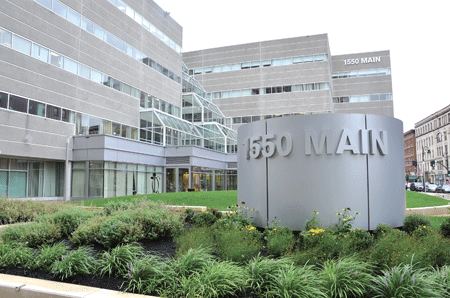
From left, Jonathan Weaver, Zach Greene, and Richard Henderson say the renovation of 1550 Main St. has spurred investment and economic development downtown.

In 2006, prospects for the federal building at 1550 Main St. in Springfield were grim.

A new federal courthouse was under construction on State Street, and many people were afraid that the prominent building in the central business district of the city would become a vacant eyesore after the court and other tenants vacated.

“The market for office space was very weak at the time, and it was feared that the building could become a blank in the downtown fabric,” said Richard Henderson, executive vice president of real estate for MassDevelopment, the state’s finance and development authority, which eventually assumed ownership of the property. “No one in the private sector seemed to have any interest in it, and owners of other buildings thought it should be closed. It was never attractive to begin with and looked worse after jersey barriers were installed in front of the plaza after 9/11. Plus, it was in poor shape, and the bricks on the exterior were falling off.”

Zach Greene agreed, and told BusinessWest the jersey barriers had been painted an unsightly brick orange, and although flower boxes had been stationed on top of them, the effect was far from pleasing.

“The building was not only unattractive, it was uninviting. It had a flimsy canvas awning outside, and when people entered the doors, they were greeted by metal detectors,” said Greene, MassDevelopment’s senior vice president of asset management, adding that, to make matters worse, visitors who parked in the Columbus Center garage behind the building had to walk down Bridge Street in inclement weather to get to the entrance because the back doors were locked for security reasons.

However, at the behest of city leaders, the Urban Land Institute, a national organization that disseminates experts to study challenging real-estate and land issues, sent a panel to Springfield for five days to determine, among other things, the best use of the property.

“They did extensive interviews with city officials, business leaders, and people in the neighborhoods, and concluded the building was key to downtown revitalization and should be made a priority,” said Henderson, noting that it had been built in 1980 and was one of a handful of newer office buildings downtown.

In 2007, MassDevelopment partnered with city administrators and the Finance Control Board, which was running Springfield at the time, and began what would become an $11 million acquisition and renovation of the building’s public spaces, which would take four years to complete.

However, the agency’s first step was to determine how to use it. After homeless and veterans’ groups, who had the first option on the building, failed to express interest, other possibilities were explored.

“We considered moving the police headquarters into it as well as using it as a place for higher education, similar to the new UMass facility that recently opened in Tower Square,” Henderson said.

But after a few years, the city, the Commonwealth, the U.S. General Services Administration (GSA), U.S. Rep. Richard Neal, and Baystate Medical Center put together a plan that included pre-leasing the building to private and public tenants. The Springfield School Department would occupy 56,989 square feet on the first and second floors, Baystate agreed to bring support staff into downtown for the first time and lease the entire fifth floor, and a number of federal agencies would remain in their space on the fourth floor.

“The School Department really needed to move; they didn’t have any air conditioning in their building and were way over capacity,” Henderson said, explaining that the move, which was strongly defended by Mayor Domenic Sarno, incited controversy in the City Council.

1550-main-before

1550 Main St

The property at 1550 Main St. before its makeover, left, and after it, right.

But in the end, the commitment by the School Department and Baystate made the project possible, and thanks to help from Neal and Kevin Kennedy, who was a member of his staff at that time, MassDevelopment purchased the building for $2.5 million in September 2009 from the GSA and renamed it “1550 Main.”

Its redevelopment has become a success story on many levels, and, according to some, an inspiration for more initiatives downtown, such as the UMass project.

“After we made our commitment, the Dennis Group purchased and renovated the Fuller Block across the street, and radio station WFCR has moved in,” Henderson said, as he listed a number of new downtown ventures.

“The Morgan Square Apartment block down the street has been acquired by a group from New York and is undergoing a major renovation and will become the Silver Brick Lofts,” he went on. “UMass has a new facility in Tower Square, and new investment is taking place in the surrounding area, with more to come. One thing builds on another, and what could have been a negative or a poorly redeveloped building has led to a lot of positive consequences.”

Complex Undertaking

Renovating 1550 Main was no simple feat, but the School Department did its own work and moved into the space in June 2010, which allowed MassDevelopment to focus on the plaza and exterior of the building.

“We wanted the tenants to be able to use the outside areas, but a large portion of the plaza was over an underground parking deck, which made removing and redoing it very tricky,” Henderson said.

The jersey barriers were removed in the fall of 2009, and high planter walls that blocked views from the street were taken down in the spring of 2010, making way for new landscaping.

Outdated glazed-brick flooring and planters in the atrium were also removed, along with an extra stairway inside the lobby that connected the first and second floors.

“Taking out the stairway allowed us to create a public walkway that people could use to get to CityStage and the parking garage,” Henderson said, noting that a $3 million Growth Districts Initiative Grant, secured with the help of the city, was used to make improvements to the public plaza, building entrance, and atrium.

All of the elevators were also replaced, and although there was not enough money to gut the bathrooms, the tiling was sanded, and new lighting and plumbing fixtures were installed. “We had to do the work in a way that didn’t disturb the tenants who had remained in the building. The Internal Revenue Service office was on the first floor, and we pulled up the entire floor of the lobby while they were working,” Henderson said.

Cosmetic improvements were also made on every floor, including new lighting and paint. “Many of the walls were painted an antiseptic green that had been offset by fluorescent pink lighting, so it really made a difference,” Greene said.

Since the federal offices were on the fourth floor, officials agreed that the metal detectors could be relocated there, which allowed MassDevelopment to install an attractive security desk in the entrance of the building.

“The back doors no longer had to be locked, so people who parked in the garage were able to come directly into the building without going outside,” Greene said. “We also installed a security system to make sure people who rented the space felt comfortable in the building.”

Baystate moved into the renovated space in May 2011, and since that time, the building’s 128,000 square feet of rentable space has been close to capacity, Henderson said. “Baystate has renewed its lease, and at present, the building is 98% occupied.”

Michael Moran, vice president of Clinical, Facility and Guest Services for Baystate Medical Center, said the healthcare provider has enjoyed being part of the redevelopment.

“Baystate Health is fully invested in carrying out its charitable mission of not only supporting the health and well-being of the community, but its economic viability as well,” he explained. “Our commitment to renting space for information-technology staff on the fifth floor of the former federal courthouse building back in 2009 was designed to help spur the city’s economy and brought a further presence for Baystate Health in downtown Springfield.”

Although some of the federal agencies have moved out since that time, new tenants were found to take their place, and the fourth floor is now home to offices for U.S. Sens. Ed Markey and Elizabeth Warren, as well as a law firm that occupies 4,100 square feet. In addition, private tenants have taken advantage of the first-floor space formerly used as military recruiting stations.

Since the time the building reopened, Greene said, it has been a source of pride. “Visitors have said they can’t believe the transformation, and the building has earned a number of awards,” including Outstanding Building of the Year in 2012 and 2013 by the Building Owners and Managers Assoc., and its Middle Atlantic Award Winner in 2013 in the Government Building category. In addition, in April 2013, the building earned the Environmental Protection Agency’s Energy Star Certification.

New Lease on Life

Today, 1550 Main St. hosts a series of lunchtime concerts held outside on the plaza in the spring and summer, and its lobby is used to showcase public and private art exhibits.

The new entrance has become an inviting gateway to the public atrium, which is open to the public and used for a variety of gatherings, including appreciation events held by Springfield School Department.

Overall, the property’s transformation has become one of many positive developments downtown and a gleaming example of a public-private partnership that has created momentum and additional success stories.

“My mother grew up in Springfield, and it’s been rewarding to help bring life back downtown and renew the vitality that existed there years ago,” said Greene. “We are happy to help it get back on track.”

DBA Certificates Departments

The following Business Certificates and Trade Names were issued or renewed during the months of January and February 2015.

AGAWAM

Auto Point Motors
1039 Springfield St.
Anthony Lafromboise

Beauties to Behold
238 Maple St.
Jasmine Brewer

Eileen Oak’s Supplies
430 Main St.
Eileen Perez

Patton Financial
15 Plumtree Way
Michael Pelletier

Professional Upholstery
1443 Main St.
Juan Ayala

Shye Ann Photography
159 Main St.
Shye Ann Brown

Therapeutic Behavioral Intervention
159 Main St.
Kristen Kocot

CHICOPEE

G & P Home Improvements
21 Forest St.
Alex Perevala

Fairview Pediatrics, LLC
1176 Memorial Dr.
James Bell

Hallmark Dental Laboratory
63 Main St.
Laura Gustafson

Heat Exchange Systems
278 Britton ST.
Howard Schwalm

Lucky Cheng’s Restaurant
920 C. Meadow St.
Ching Cheng

Millie’s Pierogi
129 Broadway
William Kerigan

Oquendo Driving School
527 Grattan St.
Jorge Oquendo

Naz Trucking
139 Nonotuck Ave.
Tomasz Nazim

Newark Paperboard Products
70 Better Way
Wayne Kelch

Prime Printing
46 Newbury St.
Marc Crescione

Rollin Rock Tavern
258 Exchange St.
Richard Ferus

St. Laurent Photography
195 Oiko Circle
Gregory St. Laurent

Tapp Construction
300 Schoolhouse Road
Jeffrey Tapp

GREENFIELD

Antonio’s Pizza
201 Main St.
Clayton Cardian

Brad’s Place
353 Main St.
Daniel Devine

Manna House
27 Bank Row
Dwight Zeager

HOLYOKE

Champ Law
330 High St.
Adam J. Basch

La Vega Grocery
518 High St.
Manuel A. Gomez

Nasty Habit Crossfit
68 Winter St.
David J. Vooris

Rendevouz
50 Holyoke St.
Chang H. Kim

PALMER

C & S Services
8 Crest St.
Marie A. Day

Friendly’s
1519 North Main St.
Catharine Senith

SPRINGFIELD

A.C. Services
657 Cooley St.
Alexa M. Cale

Aivir Value Consulting
23 Westernview St.
Joseph F. Otero

B & S Trucking Company
63 Stocker St.
Benito Santiago

Basics Plus Mini Mart
91 Main St.
Nadeem Saeed

Brian’s Barber Shop
346 Orange St.
Brian Miranda

C.R. Medical Management
405 Armory St.
Charity M. Robbins

Capuanomall.com
18 Edendale St.
Maria L. Capuano

CKG Designs
205 Tamarack Dr.
William Patrick

D2D Localtrepreneur
287 Walnut St.
Frankie J. Mozell

Desert Tales
45 Willow St.
Yassine Zian

Devine Designs Beauty Salon
428 Springfield St.
Micheline A. Martin

Doggy Dooz
1512 Allen St.
Paula L. Cox

Draintech
145 Porter Lake Dr.
Joshua M. Moses

Elegant Hair Design
473 Boston Road
Maureen Brown

WESTFIELD

A Touch of Vintage
71 Elm St.
Marilyn Arroyo

Daniel Rollend Electrician
28 Belleview Dr.
Daniel D. Rollend

Ezra’s Mercantile
34 Elm St.
Ezra’s Mercantile

Goodgoth
77 Mill St.
Marianne Deidolori

Michon Associates
102 Northridge Road
Sandra M. Michon

Ryan’s Package Store
31 Franklin St.
Anderson Family Enterprise’s

Veto Cleaning Services
15 Susan Dr.
Donald G. Veto

WEST SPRINGFIELD

Icarus Boutique
677 Westfield St.
Julian Toledo

James Maxwell Real Estate
776 Westfield St.
James Maxwell

Kristen Walters Photography
1346 Elm St.
Kristen Jeanne

Lilo’s Tire
2 Elizabeth St.
Angel Rivera-Torres

Lower Pioneer Valley Education
174 Brush Hill Ave.
Andrew Churchill

Marlene of Hair East
306 Westfield St.
Marlene Lohmeyer

Taco Bell
298 Memorial Ave.
Taco Bell of America

Welcome Inn
2041 Riverdale St.
Patel Pravinbhai

Court Dockets Departments

The following is a compilation of recent lawsuits involving area businesses and organizations. These are strictly allegations that have yet to be proven in a court of law. Readers are advised to contact the parties listed, or the court, for more information concerning the individual claims.

CHICOPEE DISTRICT COURT
Belmont Laundry Inc. v. Michael’s Pasta in the Pan and River Road Corp.
Allegation: Breach of contract and failure to pay for services rendered: $8,375
Filed: 1/29/15

FRANKLIN SUPERIOR COURT
John Doe v. Allen Chase Foundation d/b/a Eaglebrook School and Andrew Chase
Allegation: Breach of contract and failure to provide a safe academic environment when plaintiff was attacked by members of the hockey team causing severe personal injury: $100,000+
Filed: 12/17/14

GREENFIELD DISTRICT COURT
Leader Home Center Inc. v. Charles Cresta d/b/a Raven Construction
Allegation: Non-payment for goods and services: $6,228.11
Filed: 12/10/14

Vend Lease Co. Inc. v. Edward Wierzbowski, Arts Block, LLC, Global American Television Inc. and Puskin, LLC
Allegation: Defendants are indebted to the plaintiff based upon a debt on judgment: $19,094.92
Filed: 12/17/14

HAMPDEN SUPERIOR COURT
Cadlerock III, LLC v. Pisa Granite & Marble, LLC, Pedro Caceres, Creations Factory, LLC
Allegation: Suit upon a Connecticut judgment: $839,000
Filed: 1/12/15

NWS Corp. v. Sergio Bonavita and Westfield Brewing Co., LLC
Allegation: Breach of commercial lease: $85,838
Filed: 1/21/15

PALMER DISTRICT COURT
Ali Syed v. Balise Motor Sales Co., James Balise Jr., and Steven M. Mitus
Allegation: Failure to pay wages: $25,000+
Filed: 1/21/15

Shemin Nurseries Inc. v. CSL Inc. and Nancy Barroso Rodrigues
Allegation: Default on term note: $7,171.69
Filed: 1/23/15

SPRINGFIELD DISTRICT COURT
Bass Spine and Rehabilitation, LLC v. Peerless Insurance Co.
Allegation: Defendant failed to make PIP payments: $967.28
Filed: 1/5/15

Daily News

BOSTON — As the number of deaths from opioid-related overdoses rises, Gov. Charlie Baker is taking is appointing a 16-member working group assigned the task of putting together “specific, targeted, and tangible recommendations” by May to stem the tide. The group will be led by Health and Human Services Secretary Marylou Healey, and include individuals working in government, law enforcement, and addiction treatment.

As he made the announcement, Baker stood in front of a display bearing alarming statistics, including the 978 deaths attributed to opioid-related overdoses in 2013, a 46% increase from the year before. Baker, who pledged to provide quarterly data on overdoses, said the 2014 death toll would be available in April. The working group will hold public meetings, assess the resources devoted to the problem, and make specific recommendations.

Court Dockets Departments

The following is a compilation of recent lawsuits involving area businesses and organizations. These are strictly allegations that have yet to be proven in a court of law. Readers are advised to contact the parties listed, or the court, for more information concerning the individual claims.

HAMPDEN SUPERIOR COURT
Daviau Construction, LLC v. Complete Restoration Solutions Inc.
Allegations: Failure to pay under the terms of a construction contract: $28,010
Filed: 12/30/14

Prospect Builders Inc. v. Elmcrest Country Club
Allegations: Non-payment of construction labor and materials provided: $33,378.22
Filed: 12/16/14

Quality Health Ideas Inc. v. Accountable Care Associates Inc.
Allegations: Breach of contract and breach of implied covenant of good-faith and fair dealing: $955,916.00
Filed: 12/23/14

USNE Inc. v. Prime Solutions Inc., Sune Monson I, LLC, and Pro-Tech Energy Solutions Inc.
Allegations: Non-payment of labor and materials: $118,843.30
Filed: 12/18/14

HAMPSHIRE SUPERIOR COURT
Ian Hogan v. Gary M. Bombardier, M.D., Louis J. Durkin, M.D., Holyoke Medical Center, and Mercy Medical Center
Allegations: Tortious interference with business relations causing plaintiff to lose his job and restrict future employment: $450,000
Filed: 12/9/14

Michael J. Kocak, personally and as administrator for the estate of John W. Kocak v. Apple New England, LLC d/b/a Applebee’s Neighborhood Bar and Grill
Allegations: John Kocak was a patron at Applebee’s where he choked on food and later died as a result: $25,000+
Filed: 12/4/14

Vincent O’Connell and Katharine Swanson v. George Propane Inc.
Allegations: Negligence in winterizing of heating system causing damage to property: $42,000
Filed: 11/17/14

NORTHAMPTON DISTRICT COURT
Cheryl A. Vaid v. Seneca Foods Corp. and Stop and Shop Companies Inc.
Allegations: Negligence in food packaging and breach of implied merchantability: $25,000.00+
Filed: 12/9/14

SPRINGFIELD DISTRICT COURT
Thomas Publishing Co., LLC v. Diecutting Tooling Services Inc.
Allegations: Non-payment of advertising services rendered: $3,938.40
Filed: 11/24/14

WESTFIELD DISTRICT COURT
Horizon Beverage Co. Inc. v. Buck Pond Enterprise Inc., f/d/b/a Tommy D’s
Allegations: Non-payment of goods sold and delivered: $3,929.16; Filed: 11/21/14

Daily News

DARTMOUTH — UMass trustees formally launched the system’s search for a new president by creating a 21-member presidential search committee to oversee what it said would be a wide-ranging and comprehensive search process. The committee was created at a special board of trustees meeting held at the UMass School of Law.

“We will ask this committee to conduct a national search that is open and thorough — a process that will give any and all candidates the opportunity to come forward and offer their ideas and make their case,” said Victor Woolridge, board of trustees chairman. “This board is wholeheartedly committed to conducting a search that is inclusive and transparent, with the goal of attracting the outstanding candidates that a top-tier university like UMass deserves.”

Woolridge described the committee as “distinguished and diverse,” adding, “I believe we’ve found the right people at the right time to handle the very important task of finding an outstanding new leader for the university system that means so much to the Commonwealth and its people.”

The search committee includes faculty members from all five UMass campuses, three students, community and business leaders, and members of the UMass board of trustees, including state Secretary of Education James Peyser. The presidential search committee will be chaired by Robert Manning, chairman of MFS Investment Management and former Chairman of the UMass board of trustees.

“It is my goal and the search committee’s goal to conduct a search that is thorough and wide-ranging,” said Manning, who is a graduate of UMass Lowell. “We will seek to attract and assess the very best candidates and are confident that our committee will meet its charge, which is to recommend outstanding finalist candidates.”

The search committee will make its recommendations to the UMass board of trustees, which hopes to make the final selection of a new president by July 1.

“As a UMass system graduate, I take great pride in the fact that our university has enjoyed such significant progress in recent years and is now recognized as the top public university in New England and as one of the 100 best universities in the world,” Manning said. “Many factors feed into this surge of success, and strong presidential leadership certainly plays a prominent role — and, thus, we must find a leader who can keep us on our upward trajectory. As I am confident we will.”

The new president will succeed current UMass President Robert Caret, who has announced he will assume the chancellorship of the university system of Maryland on July 1. Caret has served as president of the five-campus UMass system since July 1, 2011.

“Under President Caret’s leadership, the University of Massachusetts has achieved increased national and international recognition and has made significant progress in many key areas,” Woolridge said, adding that Caret’s tenure at UMass has been marked by his strong advocacy for the university, a focus on controlling student cost, and an emphasis on accountability and efficiency.

Class of 2015 Difference Makers
This Agency’s Mission Is to Launch an ‘Entrepreneurial Renaissance’

VVM

From left, VVM Executive Director Paul Silva with board members Scott Foster and Jay Leonard.
Photo by Denise Smith Photography

Scott Foster says the genesis of Valley Venture Mentors sounds like one of those old jokes.

“A lawyer and a physicist go into a bar,” he deadpanned, adding that, in this particular case, he was, and still is, the lawyer. The physicist was Paul Silva, although he isn’t in that line of work and never really was.

The bar in question was in Amherst, and what the two protagonists, meeting for the first time after taking in an entrepreneurship event at UMass, started talking about over a cold beer was the need to create a mentoring program for entrepreneurs that went beyond the existing initiatives, such as those created by the Grinspoon Foundation, focused on college students.

Foster called it a “finishing school” for those with entrepreneurial spirit and an idea in some stage of development.

It would take four years to open this finishing school, but the partners prevailed. They called it Valley Venture Mentors and gave it a bold mission statement — “to launch an entrepreneurial renaissance in the region.” It staged its first monthly meeting in early 2011, bringing together mostly young entrepreneurs, many of them still in or just out of college, and mentors ready to help with advice on how to take an idea to the next level, whatever that might be.

To say those were humble beginnings, and that VVM has come a long way in four short years, would be an understatement. The first sessions were staged in the spacious, donated conference room of the Springfield-based law firm Bulkley Richardson, for which Foster is a partner. Most meetings drew 25 to 30 people. The organization had roughly $25,000 to work with, said Silva, now its executive director, and had no paid staff.

mentoring is a big part of the equation at VVM

As the agency’s name would suggest, mentoring is a big part of the equation at VVM as it goes about helping entrepreneurs get started and get to the next level.

Today, the meetings are held in the Food Court at Tower Square because attendance has grown to 150 or more, and that’s the only spot big enough to seat that many. Thanks to donations from MassMutual (see related story, page A10), the state, and other sources, VVM now has $5 million with which to administer a number of programs, including those monthly meetings, pitch camps, a pitch contest that has become a pivotal component of BusinessWest’s annual Western Mass. Business Expo, co-working space initiatives, and a new accelerator program, based on the MassChallenge model, that will bring 30 emerging companies together for four months of intensive learning, sharing, and competing for no less than $225,000 in prizes. There are now several paid staff members and a host of interns from area colleges working for VVM.

That profound growth shows how far VVM has come, but it doesn’t explain why this organization, still very much in the start-up phase like the companies it works with, has been designated a Difference Maker.

What does explain it is commentary from those who are in various ways part of the VVM phenomenon, or impacted by it. Using different words and phrases, these individuals make it clear that VVM is making a difference by creating what many call “collisions” involving people with ideas, valuable insight in business, and capital to make these ideas reality, and, in the process, create that aforementioned entrepreneurial renaissance and spark a revival in Springfield’s long-struggling central business district.

“The economic development of Springfield is a six-legged stool, and VVM is definitely one of those legs,” said Delcie Bean, founder and president of Paragus Strategic IT, BusinessWest’s Top Entrepreneur for 2014, a frequent mentor at VVM meetings, and a key player in efforts to revitalize downtown. “We need a place for very early-stage companies to go, be supported and mentored, and pushed and accelerated to get off the ground. If we’re going to have a successful city that’s going to rebound, that’s one of the critical elements.”

Evan Plotkin, a commercial real-estate broker, co-owner of 1350 Main St. in downtown Springfield, and a force behind many efforts to revitalize the central business district and grow the cultural economy in the city, agreed, and said VVM is generating momentum by bringing like-minded entrepreneurs and innovators together, creating what he called “entrepreneurial energy.”

“Creating these collision spaces and creating opportunities for interaction allows for ideas to take root, develop, and expand,” he noted. “VVM not only provides a forum for that kind of brainstorming and thinking, but it also contributes by finding ways to help those ideas become successful businesses.”

Getting the Idea

Both Silva and Foster used the phrase ‘turning point’ to describe what 2014 became for VVM and those who administer it.

This was a year when the agency grew exponentially — in terms of funding, programming, facilities, publicity, and, perhaps most importantly, respect from the many constituencies monitoring its progress or impacted by its widening reach, including then-Gov. Deval Patrick’s administration and the region’s only Fortune 100 company.

That upshift in momentum started roughly a year ago, when the Mass. Technology Collaborative announced that it was awarding VVM a $150,000 grant to fund its various endeavors, a development that gave the organization some exposure — and some validation that it was becoming an important economic-development initiative.

VVM helps entrepreneurs

Among other things, VVM helps entrepreneurs master the art and science of the pitch.

“That was essentially the collaborative’s stamp of approval for what we were doing,” said Foster, adding that VVM was the only entity west of Route 495 that prevailed in competition for funding. “We were invited to multiple meetings across the state, we were introduced to others as an innovative program that was really doing cutting-edge mentoring — and that’s when we realized that we were doing something special.”

More validation would soon come from the governor himself, who met with VVM administrators in the spring, during one of his many visits to Springfield.

“He essentially said, ‘I think we need to do more for you guys — you’re doing some pretty interesting things, and we can help with some capital,’” said Foster, adding that he backed up those words with a $2 million commitment to the agency.

More money would come VVM’s way in the form of a $1.6 million donation from MassMutual (the company also created the $5 million Springfield Venture Fund, designed to encourage companies to locate or relocate within Springfield), and awards from the Irene E. and George A. Davis Foundation and the Community Foundation.

With some of that money, VVM created physical space within Tower Square, first with a co-working space and then with a facility for its accelerator program, and made plans to become a major tenant in the Springfield Innovation Center on Bridge Street, an undertaking led by DevelopSpringfield, with construction set to begin soon.

What all that additional funding, operating space, and programming does is give VVM exponentially more resources to do what it was created to do. As they elaborated on that, Silva and Foster went back to the beginning, that first monthly session, because, while the setting has changed, the rooms are bigger, and the budget involves two more zeroes, the mission, as well as the basic strategy for meeting it, remains the same.

“We had 24 people at that first meeting, and Paul and I were two of them,” Foster recalled. “We had four entrepreneurs, so that means there were 18 others — 18 mentors. We didn’t really know quite what we were doing, but we knew we wanted the entrepreneurs to pitch, and we wanted the mentors to give them feedback, and we didn’t want it to be chaos.

“Early on, we decided we wanted this kind of a breakout idea,” he went on. “We wanted people to go and talk to whomever they wanted to talk to, and we wanted to have enough structure so it was meaningful, but not so much structure that it stifled creativity and the natural chaos of meeting other people and having those chance interactions.”

That word ‘interactions’ probably best describes what VVM is all about, said Foster, adding that they come in many shapes and sizes, and all of them could be very impactful.

Entrepreneurs can interact with seasoned business owners, he explained, or with individuals who have expertise in their chosen industry, or with other entrepreneurs dealing with many of the same issues and challenges they are, and, in what would likely be the best of scenarios, they could interact with an individual or venture fund willing to invest in their concept.

Parker Holcomb, who created what was known then as Five College Storage (it is now All College Storage, an indication of how it has grown geographically) while attending Amherst College, credits VVM with helping him “move the needle” with his venture, which places students’ belongings in storage between semesters and delivers them when school is back in session.

“VVM was my first professional network — it was my first opportunity to interact with people, ask questions, and figure out ways to leverage those peoples’ experiences,” he explained, adding that he credits VVM with helping him expand his company to 23 schools in five states.

He said it has also enabled him to sharpen his presentation skills, an important consideration for any small business that has to continually pitch its product or services, and develop accountability, something that’s often difficult in a one-man show.

“The practice I gained in presenting over the past several years could not have been more valuable,” he explained, adding that he has put those skills to work in everything from business-plan competitions to product demo days. “When you’re making a pitch to them, they say, ‘present the problem, present the potential market, present your solution, explain why your solution is defensible, talk about your team and what your advantages are.’ Practicing all that in front of a critical yet supporting group is extremely valuable.”

Moving Experiences

But while VVM’s basic mission hasn’t changed since that first meeting back in 2011, it has been broadened somewhat and certainly facilitated by many of those aforementioned developments in 2014.

Indeed, as part of that goal of creating an entrepreneurial ecosystem, VVM is focused on not only fostering entrepreneurship and mentoring business owners, but making it easier — and more desirable — for ventures to take root in Western Mass. and remain here.

And both the accelerator program and the Springfield Venture Fund should assist in these efforts, said Foster.

The new accelerator facility at Tower Square

The new accelerator facility at Tower Square opened its doors in January.

The accelerator, for example, will give 30 companies the opportunity to vie for at least $225,000 in prizes that will come without strings, he explained, adding that the money is essentially a carrot. The real prize in this exercise, the reason why VVM and its funders want companies to engage in it, is to take part in those interactions, take advantage of the support being offered, and realize the many potential advantages to basing a business in the 413 area code.

And Silva, a serial entrepreneur of sorts who has launched several small businesses, used his own experiences to get his point across.

“I’m not from Western Mass. — I came here for school, and I was very likely to leave, like all of my friends who took off and constantly tell me how much warmer it is where they are,” he told BusinessWest. “The reason I stayed was because the embryonic version of this entrepreneurial ecosystem was here in the Valley, and it loved me and gave me help to start my first company, so that’s why I stayed.

“So, if we can provide that kind of incredible, intense support and relationships, then we can impact these baby companies that don’t have roots yet,” he went on. “They can set down roots wherever someone will give them fertile ground. So we’re going to bring them in, we dangle the carrot to get them here, but the real value is that they see all this amazing stuff, they’re given opportunities to engage, and the ones that are a great fit are going to put down roots here.”

Those supporting the accelerator program through funding were asked to make a three-year commitment, and they did, said Foster, adding that it will likely take some time for VVM’s leaders, like startup business owners themselves, to “figure out what’s wrong, fix it, and do it better the next time.”

The first 30 companies in the program, based on the hugely successful MassChallenge model, which awards roughly $2 million in prize money, got down to business in mid-January. Among them is a venture called MachineMetrics, the latest endeavor launched by serial entrepreneur Bill Bither.

Using patented software, the company automatically collects and analyzes data from CNC machines, sending out notifications when production falls behind. It also provides a real-time dashboard that allows operators and managers to keep tabs on production at all times.

The product differentiates itself from others on the market by enabling managers to identify problems quickly and fix them, said Bither, who met a manufacturer who agreed to let his shop become a beta-testing site for the software at a VVM meeting. He told BusinessWest that he was drawn to become one of the 120 applicants for the first accelerator session because of the prize money — and the training and mentoring that can help him, well, accelerate his pace of growth.

“I think our company can benefit from the structure, and from the experience of the mentors,” he said. “But the cash grants are nice, and we hope to be one of the teams that wins one.”

As for the Springfield Venture Fund, it made its impact felt for the first time late last year, when it provided a large portion of the $1.25 million commitment from area investors that prompted video-game maker HitPoint Studios to relocate from Amherst to downtown Springfield. More such developments are expected in the months and years to come.

Looking at the larger picture, at the ecosystem created by the various entrepreneurship programs, Jay Leonard — an economic researcher for MassMutual subsidiary Babson Capital, a board member for VVM, and one of its mentors — said it has the potential to change the landscape in Springfield’s downtown. In some ways, he notes, it already is.

“We’ve had more than 150 people at our last five monthly meetings, which is pretty amazing for a Wednesday night in Springfield,” he said. “At any given time, we have 10 teams involved in our mentorship program, 30 teams associated with the accelerator … add this all up, and it brings an amount of positive energy to downtown Springfield.

“The accelerator becomes part of building out this entrepreneurial ecosystem, and it’s one of the notions that MassMutual and our other sponsors have bought into — the notion that entrepreneurship really can change Springfield,” Leonard went on. “Supporting this ecosystem means there will be more young people here; it means there will be more young people doing value-added activities and positive economic input. It provides us the ability, as a community, to grow without seeking outside support.”

Bottom Line

No one involved with VVM or any other element of the region’s entrepreneurial ecosystem expects Springfield or the Pioneer Valley to become another Cambridge or Silicon Valley, probably the nation’s two most popular addresses for startup companies.

But they do expect this area to increase the number of young entrepreneurs ready and willing to call it home, and perhaps dramatically.

For that to happen, entrepreneurship must be fostered, entrepreneurs need to be mentored, and incentives must be created for companies to take root here, as Silva did years ago. VVM is already doing all that, and it has laid track that will enable it to do so on a much larger scale in the years to come.

That’s why a fledgling agency, started only a few years ago when a lawyer and a physicist walked into a bar, is already a Difference Maker.


George O’Brien can be reached at [email protected]

Law Sections
Each Day Is Different for MGM Springfield General Counsel Seth Stratton

Seth Stratton
Ask Seth Stratton for his job description, and he’s likely to respond, “which day?”

“I don’t know the answer, and that’s the exciting part of this job,” said Stratton, who was recently named vice president and general counsel for MGM Springfield, making him only the company’s second full-time hire, after President Michael Mathis.

“This is a unique development,” Stratton said of the $800 million resort casino expected to open in 2017. “Western Massachusetts has never seen this type of development, and the statute [legalizing casinos] poses legal questions that haven’t been addressed yet in Massachusetts. My job description is to oversee legal affairs and government relations. But what that means day to day is the exciting part.”

Technically, Stratton’s job is overseeing legal affairs and government relations for MGM Springfield — an extension of work he had been performing with the company while working at Fitzgerald Attorneys at Law in East Longmeadow. But as the casino project moves forward, his job will shift often.

“Last week, we were making sure legal notices go out to the tenants of the buildings that comprise the project parcel. They’ll be vacating a lot of those buildings, and we need to make sure we prepare the legal notices they need in a way that’s informative but complies with the law,” he explained.

“We were also in Boston last week, in front of the Gaming Commission, dealing with a few issues that were required under statute — implementing some monitoring of electronic gaming and an affirmative diversity plan for hiring; MGM is committed to that,” he continued.

“That was last week. And I think a good part of the development period will be like that. It’s going to be an ongoing development project, and there are going to be a whole lot of legal issues — in construction, as we start to roll out our hiring, and making sure we’re complying with gaming statutes and regulations. As things start to normalize, we’ll have a better sense of what the average day for the general counsel of MGM Springfield is like.”

Before being hired away from Fitzgerald, Stratton worked with MGM Springfield for almost three years, negotiating agreements with the city of Springfield and surrounding communities as well as advising on permitting and real-estate acquisitions, all the while becoming a familiar face at the Massachusetts Gaming Commission, presenting on legal issues relevant to the casino project.

Now that role has expanded, and Stratton understands the complexity of navigating a project that will eventually employ some 3,000 people in an industry making its debut in the Commonwealth.

“We’re working with outside counsel in Las Vegas, making sure that an enterprise this size is complying with all the laws and regulations,” he told BusinessWest. “A lot of it is working with the Gaming Commission on regulatory and statutory compliance to gaming laws and regulations, as well as local compliance issues. We have an agreement with the city of Springfield, they did a great job in the interests of the city, and they’re very clear they will hold our feet to the fire on all these issues.”

In other words, bring on the myriad challenges.

“That’s the reason I jumped at the opportunity to take this job,” he said. “It’s really a cool opportunity where the job description changes on a weekly basis based on what’s going on at the moment.”

Coming Home

Stratton is, for lack of a better term, a Springfield guy, through and through.

“I was born and raised in East Forest Park,” he said. “My parents were both born and raised in Springfield. My wife and both her parents were born and raised in Springfield. I went to Cathedral.”

proposed $800 million casino

Seth Stratton says the proposed $800 million casino is a “unique development,” one that will certainly keep him busy in his role as general counsel.

However, armed with a bachelor’s degree in political science from Colgate University and a master’s in public affairs from UMass Boston, he couldn’t find a suitable job in Springfield, so he went to work for state Sen. Brian Lees at the State House. After earning his law degree from Suffolk University Law School, he took a job as a litigation associate at Brown Rudnick in Boston.

When his first child was born, however, he and his wife decided they wanted to live near their families in Western Mass., so they moved back to Longmeadow.

“There was nothing really comparable to what I’d been doing in Springfield, so I took a job with a similar firm in Hartford,” he said, referring to his counsel position in the Financial Institutions Litigation Group at Bingham McCutchen in Hartford. “But I felt disconnected form the community I lived in; I didn’t feel connected to the business community here.”

That’s when an opportunity opened up at Fitzgerald, where Stratton took on a diverse litigation and dispute-resolution practice focusing on a wide range of corporate, commercial, and personal disputes. “They were looking for a litigator, and I knew of their reputation, so I went to work there. That way, I worked five minutes from where I live, and I could be involved in the legal community in Western Mass.”

Within a month after taking the job, the casino legislation passed, and MGM eventually came poking around Springfield, and hired Fitzgerald to handle legal and governmental matters.

“We were essentially the local counsel for MGM in connection with local matters,” Stratton said. “About two years ago, I really started getting busier and busier; there was a lot going on, and I really became enmeshed in the project. I worked directly with Mike Mathis. We have similar backgrounds. He’s a lawyer by training, a former litigator, so we worked very well together. And I started getting more involved in these issues.”

One of his first roles involved negotiations of the host-community agreement with Springfield and surrounding-community agreements with neighboring cities and towns.

“That was a lengthy process. Under statute, we had to reach out to the surrounding communities and negotiate with them, and that involved knowing who the players were and knowing what the communities are all about. That’s where my local experience, being local and involved in local politics, helped me to negotiate and handle arbitrations in front of the Gaming Commission.”

He worked extensively on the West Springfield and Longmeadow deals, and though both towns prevailed in arbitration, “we were satisfied with the results, which were consistent with the statute’s intent. We eventually ended up with surrounding-community agreements with all the communities abutting Springfield.”

As he became more involved with MGM through Fitzgerald, he worked on regulatory aspects and compliance issues with the Gaming Commission, and on the host-community agreement with Springfield.

“I worked pretty closely with the city solicitor on a number of items,” Stratton said. “I think it was helpful that folks I was dealing with in the city, and in the surrounding communities, knew I’m from the city, I have local roots, and I think that gave me credibility in these discussions that an outsider with a similar legal background may not have had. And MGM recognized that as a benefit.”

Added Mathis, “from day one as one of our local counsel, Seth has been a steady sounding board for the entire MGM Springfield team. We feel fortunate that he is not only a respected lawyer, but also cares deeply about the future of this area and the city of Springfield. His advice is always informed by his concern for local issues.”

Stratton praised Mathis equally effusively. “He’s a dynamic, young leader in this industry — very bright, very energetic, very demanding. Working with him over the last couple years has been very exciting. I truly have been impressed with the quality of professionalism and work ethic from all the individuals I’ve dealt with at MGM. To become a part of that culture is something I really appreciate.”

Bringing Springfield Back

Stratton also has a vision for his home city’s future, with MGM Springfield at the center of the revival.

“It sounds a little colloquial, but I grew up off Sumner Avenue and Allen Street, and I remember Christmas Eve, my father doing last-minute shopping at Baystate West. I remember hopping on the PVTA bus from Sumner Avenue to downtown and going to Johnson’s Bookstore,” he recalled.

“I love the idea that there could be more of those opportunities for people hoping to go to entertainment venues in downtown Springfield. For people living in these neighborhoods to go to MGM Springfield, not only to the casino but for some of the retail and restaurants, that would be exciting to me.”

While the city’s downtown has generated momentum lately with a growing number of businesses and colleges setting up shop, Stratton didn’t sense much excitement in the area around the time the gaming legislation was passed.

“I didn’t have the impression things were happening,” he said. “But right away, I realized this project had the opportunity to be the spark Springfield needed. Springfield does have its challenges. I’m not under the impression that MGM Springfield will be the hero, but I definitely think it has a catalyst ability, to be the spark that gets people excited about reinvesting in downtown.

“The idea that my wife and I can hop in the car and go to dinner and a show and then be home in five minutes, that’s truly exciting to us as a family,” he continued. “There are so few of those opportunities. When we do have time to go out to dinner, we’ll drive to Northampton, but it’s never been on our radar to go to Springfield. That’s going to change, and that’s really exciting for us.”

For now, though, Stratton continues to press his legal expertise and local knowledge to help bring that vision to reality. He expects his role to continue expanding, encompassing federal issues as well as state-level regulations, as groundbreaking, construction, and hiring and training strategies all move forward.

“It all changes day to day,” he said. “And that just makes the job more interesting.”


Joseph Bednar can be reached at [email protected]

Law Sections
New Parental-leave Law Will Soon Impact Bay State Employers

By ROBERT ZYWNO, Esq.

Robert Zywno

Robert Zywno

The subject of parental leave has received a lot of attention in the media following President Obama’s recent focus on family issues in this year’s State of the Union speech. Indeed, the president has since directed federal agencies to grant their employees six weeks of paid parental leave and is pushing Congress to grant them six more.

Receiving less attention is the Bay State’s new law on parental leave, which goes into effect on April 7. Former Gov. Deval Patrick signed the law, called the Massachusetts Parental Leave Act (MPLA), on Jan. 7, in his final days as governor. The law replaces the Massachusetts Maternity Leave Act (MMLA), which currently only provides leave to expecting and adopting mothers, while the MPLA will extend eight weeks of unpaid leave to both men and women.

The new law makes several other notable changes to the MMLA as well.

Beyond extending leave rights to men, the MPLA also expands the purposes for which employees can take parental leave. Under the MMLA, employees are allowed eight weeks of unpaid leave for childbirth or for adopting a child under the age of 18 (or, alternatively, under the age of 23 if the child is physically or mentally disabled). In addition to these purposes, the MPLA will also allow employees eight weeks of unpaid parental leave if a child under the age of 18 (or, alternatively, under the age of 23 if the child is physically or mentally disabled) is placed with them pursuant to a court order. Accordingly, employers should update their policies to allow employees leave in such circumstances.

In extending parental-leave rights to men, the MPLA does provide an employer-friendly benefit. If an employer has two employees who are together expecting, adopting, or having a child placed with them pursuant to a court order, the MPLA only requires that the employees receive a total of eight weeks of leave between them both. Thus, the employer is not required to provide eight weeks of leave to each of the two employees.

Other changes under the MPLA are more employee-friendly. For instance, employers who require employees to complete an initial probationary period should be aware that, under the MPLA, employees are eligible for parental leave after completing just three months of their initial probationary period. This differs from the MMLA, which requires that employees successfully complete their entire initial probationary period. Otherwise, the MPLA will continue to allow employees with no initial probationary period leave after three months of employment.

The MPLA generally carries forward the same requirements for notice that employees are currently required to give under the MMLA. If an eligible employee intends to take parental leave, the employee must give the employer at least two weeks notice. However, the MPLA will allow employees some leniency in providing notice where the MMLA does not. If an employee cannot provide two weeks notice of parental leave for reasons beyond the employee’s control, the MPLA will allow the employee leave if he or she provides notice as soon as practicable.

The most substantial change in the MPLA requires an employer who grants an employee more than eight weeks of parental leave to return the employee to the same or similar position and benefits if the employee does, in fact, take more than eight weeks of leave. Under the MMLA, employees do not currently receive such job protection beyond eight weeks, even if the employer grants more than eight weeks of leave.

The MPLA, however, does provide a way for employers who wish to grant more than eight weeks of parental leave to do so while still limiting job protection to just eight weeks. To do so, the employer must, prior to the employee taking leave, provide written notice that the employee risks losing his or her position and benefits if the employee takes more than eight weeks of leave.

Notably, like under the MMLA, an employer will still not be required to return an employee back to the same or similar position, regardless of the amount of parental leave taken, if other employees in the business with equal length of service and status have been laid off due to economic or operating conditions. However, like under the MMLA, the employee retains preferential consideration for other positions the employee may have been entitled to as of the date of leave.

The MPLA also continues the MMLA’s requirement that employers post a notice in the workplace about parental-leave rights. However, where the MMLA only requires that employers post a copy of the law, the MPLA requires that the notice be conspicuous and describe the law as well as the employer’s policies on parental leave.

Employers should further take note that any violation of the MPLA will soon be a violation of M.G.L. c. 151B, the Massachusetts law prohibiting employer discrimination, retaliation, and harassment in the workplace. Accordingly, of the claims that employees and former employees may now bring against an employer through the Massachusetts Commission Against Discrimination, among them will soon be claims for failure to restore an employee to the same or similar position after taking protected parental leave, as well as for any other violation of the MPLA.

Like the MMLA, the MPLA generally applies to employers with six or more employees. Accordingly, Massachusetts businesses with six or more employees should consult with an attorney and review their leave policies to ensure compliance with MPLA requirements before they go into effect on April 7.


Robert Zywno is an attorney at Royal LLP, a woman-owned, boutique, management-side labor and employment law firm. Royal LLP is a certified women’s business enterprise with the Massachusetts Supplier Diversity Office, the National Assoc. of Minority and Women Owned Law Firms, and the Women’s Business Enterprise National Council; (413) 586-2288; [email protected]

Law Sections
The NLRB’s ‘Quickie’ Election Rule Is Coming This April

By AMELIA J. HOLSTROM, Esq.

Amelia Holmstrom

Amelia Holmstrom

Any employer that has been through a union-representation election knows the importance of time. The longer the time frame between the filing of the union’s petition and the election, the more time the employer has to educate and communicate with employees about the merits of remaining union-free.

This time period also gives the employer time to train its supervisors how to respond lawfully to the union’s organizing campaign. But beginning in April, that time frame will be drastically reduced. The National Labor Relations Board’s (NLRB) election rules are changing. The NLRB’s new election rule, frequently referred to as the ‘quickie’ election rule, will dramatically shorten the time period between the filing of a petition and the election.

The new rule means significant changes for employers. Under the current rule, the time between the filing of the petition and the election is generally 38 to 42 days, although it may be slightly longer. The new rule, however, will reduce that time period to around 19 or 20 days. Most importantly, this shortened time frame means that unions will now have more control over the timing of what will be ambush elections, purposefully designed to limit an employer’s ability to respond and educate its employees. Additionally, employers will have limited opportunities to raise challenges to the fairness and legality of the election process.

Under the current election rules, a petition filed by a union and hearing notice is faxed to the employer on the day that the petition was filed. The hearing date to determine voter eligibility and the time and place of an election is scheduled within seven to 10 days after the petition is filed. If the parties agree on matters at the hearing, the regional director issues a decision and direction of election, scheduling the election no more than 42 days from the date the petition was filed. The employer then has seven days from the direction of election to provide a list of eligible voters, including their names and addresses only.

Under current procedures, whenever the union and the employer cannot agree on matters at the hearing, the employer has a right to litigate such issues, file a post-hearing brief seven days after the hearing, and ask the regional director to resolve disagreements before an election is scheduled. The NLRB’s regional director then issues a decision, and the employer has 14 days to request board review of the regional director’s decision.

The NLRB also schedules the election for 25 to 30 days after the decision by the regional director, and the employer must provide a list of eligible voters, including names and addresses only, seven days after the regional director’s decision. Requests for review may result in a stay of the election or a delay in opening the ballot box on election day.

Beginning in April, however, the election rules are changing.

Under the ‘quickie’ election rule, pre-election hearings will be limited to a determination of whether an election should be conducted. Those hearings must begin eight days after the NLRB issues a notice of hearing. The new rule now requires the employer to submit a “statement of position,” generally no later than one business day before the hearing. This statement must include the identification of any issues the employer has with the petition plus a list of prospective voters with their job classifications, shifts, and work locations.

Any issues not included in the statement are deemed waived. The new rule also gives the NLRB the ability to limit the presentation of evidence at the hearing to evidence it believes is relevant to the existence of a “question concerning representation.” The rule also grants the hearing officer discretion over the filing of post-hearing briefs.

Additionally, the employer must provide a list of eligible voters, including the names, addresses, e-mail addresses, telephone numbers, work locations, shifts, and classifications within two work days of the decision. The rule eliminates the recommendation that the regional director should ordinarily not schedule an election sooner than 25 days after the direction of election.

In addition to these timing challenges, the new election rule also restricts the parties’ right to file a pre-election request for review of a regional director’s decision and instead puts all such requests off until after the election. Board review of the regional director’s decision will be discretionary, and the circumstances under which a request for review will be granted are substantially narrowed. In other words, employers may be denied the opportunity to challenge pre- and post-election rulings.

Each year Bloomberg BNA releases mid-year NLRB election statistics. According to the statistics for 2013 and 2014, unions have been winning representation elections between 65% and 70% of the time. However, under the ‘quickie’ election rule, we expect that unions may be able to win more frequently in the future.

Employers need to understand the increased risk and be ready to act quickly when they learn that a petition has been filed. Employers concerned that they are at risk of a union-organizing drive should reach out to experienced labor counsel for assistance before it’s too late.

Amelia J. Holstrom joined Skoler, Abbott & Presser in 2012 after serving as a judicial law clerk to the judges of the Connecticut Superior Court, where she assisted with complex matters at all stages of litigation. She is a graduate of Western New England University School of Law, where she was the managing editor of the Western New England Law Review. Her practice is focused in labor law and employment litigation; (413) 737-4753; [email protected]

Law Sections
Law Helps the Disabled Gain Greater Control of Their Financial Lives

By HYMAN G. DARLING, Esq.

Hyman G. Darling

Hyman G. Darling

The House and Senate, together with President Obama, recently passed the ABLE (Achieving a Better Life Experience) Act of 2014.

This new law will allow a disabled individual to establish a tax-free savings account while preserving government benefits. The ABLE savings account is modeled after the so-called 529 College Savings Plan, where funds are contributed on an annual basis, and the income earned is free from tax.

ABLE accounts allow the beneficiary to contribute $14,000 per year, provided the account balance does not exceed $100,000. Based on current tax rates, income-tax savings are minimal. The appeal and protection of the new law is that the individual can have a savings account without jeopardizing Social Security, Medicaid, and other benefits.

Unlike conventional savings accounts, all funds in an ABLE account are subject to payback, meaning that, if the ABLE account’s beneficiary passes away, then the state is entitled to reclaim benefits paid, up to the amount of the account at death. The intention, therefore, is that the funds will be spent on the individual’s needs and expenses, and not saved for a rainy day.

If a disabled person receives a lump sum — for example from an inheritance, divorce settlement, tort injury, retroactive Social Security Benefits, etc. — up to $14,000 may be contributed to an ABLE account without affecting other benefits. In this way, the ABLE account may eliminate the need to set up a special-needs trust or contribute the funds to a pooled trust.

The disabled individuals who will benefit most from the ABLE Act of 2014 are primarily those who do not have significant assets. A number of disabled people may also have ‘third-party’ special-needs trusts, which do not require payback. In this way, trust funds can be preserved for other beneficiaries, while ABLE account funds may be used only for the ongoing needs of the disabled person. ABLE account funds may be used for education, healthcare, transportation, and housing, among other expenses. ABLE accounts will have no impact on Medicaid eligibility.

Many worthy organizations worked for the passage of this bill, including the National Academy of Elder Law Attorneys, the Special Needs Alliance, and the National Down Syndrome Society. The ABLE Act, however, does contain some significant restrictions, including the provision that the disability must have been present before age 26. The act, nevertheless, was passed with overwhelming support from both Democrats and Republicans. The House passed it with a vote of 404-17, and the Senate approved the bill by a vote of 76-16. President Obama signed the bill into law before leaving for the 2014 winter holidays.

Disabled persons can start setting up ABLE accounts in 2015, if they can find a bank, broker, or agency to establish the account. While the ABLE Act changes federal law to allow for the savings accounts, each state must now create its own regulations. At this time, it is anticipated that the same banks or brokerage firms who offer 529 College Savings Plans are likely to offer the new ABLE accounts as well.

Living with a disability can be both time-consuming and expensive. There are approximately 58 million individuals with disabilities in the U.S. Given its restrictions, the ABLE Act of 2014 will affect a relatively small portion of those individuals and their families. The act is, however, an important step toward disabled individuals gaining greater control of their financial lives.


Attorney Hyman G. Darling is chair of Bacon Wilson, P.C.’s Estate Planning and Elder Law departments. His areas of expertise include all areas of estate planning, probate, and elder law. He is a frequent lecturer on various estate-planning and elder-law topics at local and national levels; (413) 781-0560; [email protected]

Law Sections
With These Documents, Understand All the Caps, Wraps, and Traps

By JAMES SHEILS

James Sheils

James Sheils

It is not unusual for two or more lenders to have loan relationships with a borrower. The lenders might both be banks, or the second (junior) lender might be a government agency that is advancing funds for a particular project (examples of the latter would include housing developments, specialized equipment financing, and the like).

Frequently, both loans are secured by the same property (collateral) of the borrower. When that occurs, an intercreditor agreement is often required by the first (senior) lender. That document typically establishes the rights and priorities of the lenders if the borrower’s financial conditions deteriorates and the lenders want to exercise their respective rights regarding the collateral. Absent such an agreement, each lender could theoretically exercise its rights at the same time, perhaps inconsistently, and the process could be confusing, inefficient, or worse.

This article addresses some of the principal issues that arise when an intercreditor agreement is negotiated.

Areas of Negotiation

The senior lender will want to have maximum control over any foreclosure process, and both lenders will want the process to be as efficient as possible. Common areas of negotiation include the following:

• How much of the senior lender’s debt is to be afforded first priority? This issue has at least two components — what type of debt, and any cap on the amount of debt. Principal and interest, of course, are customarily protected, but other components could include late fees, pre-payment, or ‘make-whole’ charges; amounts due under cash-management or hedging/‘swap’ arrangements; indemnity provisions; and similar related costs, fees and expenses. Also, the agreement may cover all debt owed to the senior lender, whenever incurred, or it may be limited to a specific transaction.

Once the components are determined, the junior lender may insist on a cap on the amount entitled to first lien priority — for example, are future advances included? Since the junior lender is relying on any excess collateral value to be available for the repayment of the junior debt, the junior lender will want a cap, and will want it to be progressively reduced by the amount of any permanent reductions in the debt owed to the senior lender.

• Is all of the collateral ‘shared’ by the lenders? A common alternative is a ‘wrap,’ where one lender has a first lien on asset A, and the second lender has a first lien on asset B, with each lender obtaining a junior lien behind the other lender’s first lien.

The application of proceeds received from the sale of the shared collateral is sometimes subject to what’s known as a ‘waterfall’ provision. The senior lender gets proceeds up to a certain amount, then payments go to the junior lender up to a certain amount, then remaining proceeds (if any) go to the senior lender.

• Is the junior lender entitled to any priority if the senior lender has failed to do everything required to make its lien on the shared collateral a first-priority lien absent the intercreditor agreement? Many intercreditor agreements contain such provisions, even though the practical result can be a serious reduction in the amount recovered by the junior lender in a foreclosure proceeding. The junior lender may obtain recovery from the collateral, but be required to turn it over to the senior lender. If there is insufficient collateral, the junior lender may wind up with little or nothing, while the possibly negligent senior lender obtains a full recovery.

• What happens if the borrower wants to sell an asset that is collateral for both loans? The senior lender will want the junior lender to consent in advance to any sale which it approves; it doesn’t want the junior lender to leverage its consent to obtain payments or changes in terms. In return, the junior lender will insist that any such sale be ‘commercially reasonable,’ and may also attempt to require that the sale proceeds be used to permanently reduce the amount of debt secured by the senior lender’s lien.

• How does the senior lender exercise its control? Typically, the junior lender agrees to a ‘standstill,’ meaning a time period during which it agrees it will allow the senior lender sole discretion on if, how, and when to proceed against the collateral. The duration of the standstill is often heavily negotiated; six months is not unusual. Intercreditor agreements typically provide for an automatic extension of the standstill so long as the senior lender has commenced action against the collateral and is diligently pursuing its rights.

The ‘trigger’ which starts the standstill is also a point of discussion. It will be based on a default under the junior lender’s documents, so the nature and materiality of the default is important, as well as whether the standstill clock is reset if the default is ‘cured’ within the standstill period. For example, the senior lender may insist on having the right (but not the obligation) to cure a default under the juunior lender’s documents, with a corresponding re-set of the standstill.

Other Issues

While a detailed discussion of the impact of a insolvency is beyond the scope of this brief review, many issues may arise in a bankruptcy, including voting rights on a plan of reorganization, restrictions on the junior lender exercising rights (which may result in the junior lender having fewer rights than an unsecured creditor), and the value (if any) of any subrogation claims available to the junior lender.

Obviously, each lender and borrower anticipate and expect a profitable, uneventful relationship, in which case the intercreditor agreement is likely to sit on a shelf and never be looked at again after the loan closing. If things go south, as they can and do, an intercreditor agreement can be a critical component to the orderly liquidation of collateral as the repayment source to both lenders.


James B. Sheils, a partner of Shatz, Schwartz and Fentin, P.C., concentrates his practice in the areas of commercial finance law, creditors’ rights, banking law; and telecommunications siting matters; (413) 737-1131; [email protected]

Daily News

NORTHAMPTON — Gove Law Office is proud to announce that Attorney Michael Gove has recently been certified by the National Assoc. of Development Companies in regard to business-loan programs under by the U.S. Small Business Administration (SBA), including the Section 504 loan program.

In existence since 1981, NADCO is the trade organization for certified development companies of the Small Business Administration and other lenders delivering SBA loans. Its training courses cover SBA loan programs and ensure that CDCs, lenders, and attorneys are well-versed in SBA regulations, allowing for an effective and efficient loan process.

Gove is the owner of the Gove Law Office, a law firm with offices in Northampton and Ludlow, which concentrates in business representation, commercial lending, residential and commercial real estate, estate planning, bankruptcy, and personal injury.

Construction Sections
Recreation of Monticello Was A Project for the Ages

S. Prestley Blake takes a photo of the replica of Monticello he had built in Somers.

S. Prestley Blake takes a photo of the replica of Monticello he had built in Somers.

Bill Laplante remembers the phone call like it was yesterday.

That’s because it seemingly came out of nowhere, and also because it marked the unofficial start of easily the most intriguing — and also one of the more challenging — endeavors in his long career as a home builder, and what he would repeatedly call “the opportunity of a lifetime.”

On the other end of the line was S. Prestley Blake, the then-98-year-old co-founder of Friendly Ice Cream and admirer of both Jefferson and the Laplante company’s work — it built the home his daughter and son in law now reside in, and also the new residence for the president of Springfield College (erected a dozen years ago), for which Blake developed a deep appreciation regarding both its design and workmanship.

“He said ‘Bill … I’m thinking about building a replica of Monticello in Somers,’” said Laplante, president of the East Longmeadow-based firm launched by his father, Ray. “He said he wanted me to come over and assess the property, take a look at things, review the site plans … that’s how it all started.”

It all ended just a few months ago, with a black-tie party that was combination early 100th birthday bash and open house attended by more than 250 people at what would have to be called ‘Blake’s Monticello,’ although it’s highly unlikely that he’ll ever spend a night in it.

This Monticello, slightly smaller than the original, Thomas Jefferson’s home in Charlottesville, Va., is what Blake, reached by BusinessWest in Florida, called, alternately, a “gift to the community,” his “swan song,” and “something I’m doing for posterity, not profit.”

Indeed, he expects to certainly lose money on the home currently on the market with a sticker price of $6.5 million, roughly $1 million less than what it cost to buy the land, raze what was on it, and build the landmark. There have been a few inquiries, and those interested will have to eventually impress Blake, who has the final say on this sale and insists he’ll only sell to someone who has both the requisite financial wherewithal and the same commitment to the community that he does.

As for Laplante, his crews, and lead design consultant Jennifer Champigny (not to mention Prestley Blake and his wife Helen) the endeavor quickly became a labor of love, a project no one really wanted to see end, although everyone involved was firmly committed to getting things done before Blake became a centenarian last November. Overall, the huge undertaking was completed in an impressive 14 months, more than three decades less than it took Jefferson to complete the original.

“The whole project, from start to finish, was a lot of fun … everyone who worked on it, from day one, thoroughly enjoyed it,” said Laplante. “It truly was a once-in-a-lifetime opportunity.”

The building process, began in the spring of 2013, soon after Blake closed on the nine acres of land off Hall Hill Road, just a few hundred yards from the Massachusetts border, and the structures built on it (owned then by the estate of the late Big Y co-founder Gerry D’Amour and his wife Jeanne). It was preceded by a visit to the original Monticello by Laplante and his father.

They took hundreds of photographs, made volumes of notes, and purchased the book Monticello in Measured Drawings, which soon became invaluable.

Bill Laplante

Bill Laplante, standing in the foyer at the
Somers Monticello, called the project the “opportunity
of a lifetime.”

Using these resources, the Laplante company built an almost exact replica of the exterior of Jefferson’s home, and an ultra-modern, luxurious — and ‘green’ —interior. Both elements can certainly turn heads.

“I think this is the most prominent private house in the country,” Blake told BusinessWest in reference to his creation, noting that this assessment is based on aesthetics and the model that inspired it, not sheer size or features. “The White House is the most prominent house in the country, but that’s owned by the government. This is a private house I built on my own.”

For this issue and its focus on contruction, BusinessWest takes an in-depth look at why Blake’s Monticello came to be built and how. In the course of doing so, it became clear why those who view the house use the same word to describe it as those called upon to recount the building process: memorable

Landmark Decisions

They eventually dubbed it ‘Monticello Highway.’

That was the name given to the path that Blake had carved between the site of the Somers Monticello and his own home, just a few hundred yards away (the properties abut).

Blake would take that path on his small, four-wheel-drive motorized vehicle called a ‘Gator,’ said Laplante, adding that he was at the construction site by 7:30 a.m. almost every day he was in this region to observe, take photos, and offer both suggestions and commentary — mostly the latter, because he gave great latitude to the builders.

What the Blakes saw emerge on the gently rolling parcel is one of the few replicas of Monticello in this country — there’s a bank modeled after it in Monticello, Ind., and a chiropractor’s office in Paducah, Ky., for example — and certainly the most extensive and expensive.

The Monticello in Somers has a number of things the one in Charlottesville doesn’t, including:

• A three-car garage;
• A tiled patio atop the three-car garage, which was a very popular gathering spot during the party in October;
• An elevator;
• Laundry rooms on the first and second floors;
• A wine chiller;
• Wolf and Sub-Zero appliances;
• A pantry with floor-to-ceiling cabinets, a so-called library ladder to reach those heights, and leathered granite counter tops;
• Five full baths complete with walk-in showers, towel warmers, and other amenities;
• Coffee stations in most of the rooms and a second-floor kitchenette; and
• Geothermal heating and cooling.

It does, however, have many of the same exterior features, including the white columns, roof ballustrades, and signature dome at the front of the structure (or the back at the original Monticello; the back entrance was the main entrance in Jefferson’s time), and some interior elements as well, including a tea room, a lavish foyer (although the one in Somers has a double staircase), ornate hard-wood floors, and so-called great room.

DownHallRooms

At top, the dining room in the Somers Monticello, and above, the bathroom off the master bedroom.

At top, the dining room in the Somers Monticello, and above, the bathroom off the master bedroom.

Retelling the story of how it all came about, Laplante said Blake was never particularly fond of the large estate built by the D’Amours, and has always been enamored with Monticello, architecturally and otherwise, and conceived a project to replace one with the other and, in the process, build something memorable and lasting.

As Blake was finalizing his purchase of the site, he was also engaging Laplante on the undertaking to come.

The trip to Charlottesville was educational and therefore quite helpful, said Laplante, adding that this was his first visit to the landmark.

“We met with the people giving the tours of Monticello, we toured the entire facility, and took a number of photographs, including many detailed photographs,” he explained. “We were focusing on the exterior of the building, because the original plan called for building a replica of Monticello, especially with regard to the exterior façade, but make it into a modernized single-family home on the inside — something that someone would be interested in purchasing and living in.”

Monticello in Measured Drawings became a valuable resource, he went on, adding that it was assembled by an architectural group that recreated scaled drawings of the original.

“It was very difficult, because there were areas that were 1:32 scale, because of the size of the house and obviously the size of the book,” Laplante explained. “We were dealing with very, very small scale, but it was very helpful having that, as well as the photos we took of the original and the tours we took.”

Glory Details

Beyond the basic mission of reproducing the original Monticello’s exterior, the Blakes’ only real instructions to the builders were simple, said Laplante, adding that he was told not to spare any expense, to build a replica as exacting as possible, and, inside “to make every room spectacular.”

And by all accounts, he and his crews followed those instructions to the letter.

Attention to detail can be seen in many aspects of the recreation work, including the brick used. Bricks in the original were hand-made made on-site in Virginia, said Laplante, adding that those used in Somers were also hand-made and cast to look like what was used in the early 19th century.

The decision was made early on to place the dome at the front of the house, the side facing Hall Hill Road, said Laplante, adding that the ‘front’ façade of the replica is, by his estimation, 98% accurate to scale.

One of the main differences between the two Monticellos is that the one in Virginia has an open porch, complete with arched-brick openings, on the left side, while the one in Somers has an enclosed hearth room, located just off the kitchen, in that location.

Also, Jefferson’s Monticello had a room inside the dome, while the one in Somers does not, and the second-floor windows in the replica are larger than those in the original to meet modern building codes.

“Working around the windows was perhaps the biggest challenge in designing this, because we were designing an interior around an exterior that was built 200 years ago,” he said, adding that both the original and replica (at least from the ‘front’ view) are two-story homes that don’t look like two-story homes.

The kitchen in the Somers Monticello is certainly different than the one in Thomas Jefferson’s original in Charlottesville, Va.

The kitchen in the Somers Monticello is certainly different than the one in Thomas Jefferson’s original in Charlottesville, Va.

And while creating a modern interior within a two-century-old shell came complete with many challenges, that assignment gave the builders and designer plenty of opportunities to stretch their collective imaginations.

“From the beginning, the Blakes said, ‘we want every room we walk into to be spectacular,’” said Laplante. “But they didn’t micro-manage the design and the details; they let us come up with what we thought should be done.”

Some of the details were taken from the original, he went on, citing such things as floor patterns (although slightly different wood species were used), but the interior obviously bears little resemblance to the one in Charlottesville.

The kitchen in Jefferson’s Monticello was a simple facility in the basement. The kitchen in Somers is massive, with the most modern appliances and quartz countertops. The Monticello in Virginia had five outdoor privvys; the one in Somers has nine baths, many of then featuring Carrara marble.

The biggest difference between the two landmarks, however, is the ‘green’ nature of the replica. Jefferson heated with wood. The Somers home features geothermal heating and cooling equipment (which Laplante said is becoming increasingly popular due to attractive tax credits). It also has LED lighting, energy-efficient windows and doors, and icynene spray foam insulation. Meanwhile, raw materials from the site, including oak and cedar trees and red stone harvested from the parcel were used in the construction.

Overall, the buildings are worlds apart in terms of building materials and processes and creature comforts, but they look remarkably similar in large, framed photographs hanging side by side in the wood-paneled garage.

History in the Remaking

In addition to the party in October, the Blakes had a small gathering in the Somers landmark just before the holidays.

For the event, dubbed ‘Christmas at Monticello,’ the Blakes actually borrowed a few pieces of furniture and had some tables placed in the great room, said Laplante, who was among those invited.

The scene was a little strange, he recalled, but understandable because while the Blakes built the home, technically, it’s not theirs.

Soon, if the right buyer and right price come together, it will belong to someone. But it many respects, it will always belong to the community, said Blake, adding that, like the original, it was built to last and built to inspire.

And it is already doing just that.

George O’Brien can be reached at [email protected]

Departments People on the Move

William Crawford IV, CEO of United Financial Bancorp Inc. and United Bank of Glastonbury, Conn., announced that United Bank has recruited the following bankers from People’s United Bank to cover the Greater Springfield region:
Dan Flynn, Executive Vice President and Chief Operating Officer for Wholesale Banking. Flynn will report to David Paulson, executive vice president and head of Wholesale Banking. His primary role will be to drive numerous enterprise-wide commercial-banking functions for United’s wholesale-banking team. He will have oversight of United’s Greater Springfield commercial banking operations, as well as management responsibilities for the bank’s shared-national-credit business and all business-banking teams. Most recently, Flynn was senior vice president and market manager at People’s United Bank, primarily for Western Mass., for seven years, where he was responsible for managing and coordinating all aspects of C&I lending activities. In his previous roles at People’s United, he held similar responsibilities for managing and coordinating all aspects of a significant C&I portfolio in the Central Mass., Western Mass., and Vermont markets. Before People’s United acquired Bank of Western Massachusetts, Flynn was executive vice president and senior lender from 1989 to 2009 for the Bank of Western Massachusetts.
Tony Liberopoulos, Senior Vice President and Commercial Banking Regional Executive. Liberopoulos, who will be directly responsible for United Bank’s commercial-banking practice in Greater Springfield, brings 27 years of commercial-banking experience, most recently holding the position of senior vice president and regional manager for People’s United Bank in Springfield. He also spent more than a decade at Fleet Bank and BayBank in various positions, including underwriting, loan resolution, and lending.
Rick Rabideau, Senior Vice President and Commercial Banking Team Leader. Rabideau also comes to United from People’s United Bank, where he most recently served as senior vice president and team leader. He will take on a dual responsibility with United as a commercial banking officer, focusing on developing and growing commercial-banking opportunities as well as a player-coach role in leading and mentoring other teammates on the commercial team. Rabideau’s career in banking started in 1986 with Shawmut Bank, where he was a commercial banker from 1988 to 1996. He then joined First International Bank/UPS Capital, eventually ascending to senior vice president with the key responsibility of managing 10 lenders who made up the Springfield and Hartford market lending units. In 2008, he joined People’s United Bank.
Sheryl McQuade, Senior Vice President and Massachusetts Senior Credit Officer. McQuade has more than 25 years of corporate and commercial banking experience, most recently serving as senior vice president, commercial regional leader for Berkshire Bank, where she was responsible for all commercial teams and production in Connecticut. She worked for Bank of America and predecessor banks in a variety of senior production and credit roles for the business-banking, middle-market, and corporate-banking divisions.
•••••

Nancy Buffone

Nancy Buffone

The Amherst Area Chamber of Commerce announced the election of Nancy Buffone, Executive Director of External Relations and University Events for UMass Amherst, as President of the organization. Buffone assumes leadership of the chamber following the two-year term of Lawrence Archey of Hampshire College. Julie Marcus, principal of New England Environmental, has been elected Vice President of the chamber. The chamber also announced the election of six community leaders to join the chamber’s board of directors:
Robin Brown, Lord Jeffery Inn;
• Sean Cleary, Amherst Copy and Design Works;
• Heidi Flanders, Integrity Development;
• Katelyn Lockhart, Big Brothers Big Sisters of Hampshire County;
• April Williams, J.F. Conlon and Associates; and
• Peter Vickery, Esq., attorney at law.
The chamber also acknowledged those stepping off the board after years of dedicated service to the organization:
Kathryn Grandonico-Chiavaroli, Lincoln Real Estate;
• John Kokoski, Mapleline Farm;
• Reza Rahmani, Moti Restaurant; and
• Meredith Schmidt, UMass Campus Center.

•••••
Christopher Neronha

Christopher Neronha

Christopher Neronha, an attorney with extensive experience in higher education, has been named General Counsel at Springfield College. Neronha will provide legal counsel and guidance to the leadership of the college and will serve as secretary to its board of trustees. He will be a member of the president’s senior leadership team. Neronha has 19 years of experience as an in-house corporate attorney, nine of those as a senior in-house attorney for Roger Williams University in Bristol, R.I., where he previously was employed since 2006, as the associate general counsel and executive director of risk management. Prior to Roger Williams, Neronha was assistant general counsel and assistant secretary at National Life Insurance Co. in Montpelier, Vt., where he provided legal support for all company operations. He is an attorney licensed in the federal and state courts of the Commonwealth of Massachusetts and the states of Connecticut, Rhode Island, and Vermont. A graduate of Providence College with a bachelor’s degree, summa cum laude, in political science, Neronha received a juris doctor, magna cum laude, from the University of Notre Dame Law School.
•••••
FieldEddy Insurance Inc., which recently became a division of HUB International New England, LLC, a leading global insurance broker, has announced several appointments:
Olga Tracy

Olga Tracy

Olga Tracy has rejoined the agency as the newest Personal-lines Account Manager in the Monson office. She will be responsible for educating and ensuring that clients have the proper insurance coverage;
Marylou “Lou” Rosner

Marylou “Lou” Rosner

• In the East Longmeadow office, Karen Britt has accepted a promotion to Middle-market Account Manager, Heather Fleury has been named Small-business Account Manager, and Peggy Grundstrom will be a part of the quality-control team.
The agency also recognized Marylou “Lou” Rosner upon her retirement. She leaves FieldEddy with more than 29 years of devoted customer care.
•••••
Main Street Hospitality Group announced a new addition to its management team, appointing sommelier Dan Thomas to the position of Wine and Bar Director. Main Street Hospitality Group is a hospitality-management company based out of Stockbridge. The group owns and manages the Red Lion Inn in Stockbridge, where Thomas has held the role of sommelier since 2007. Over his seven years at the inn, Thomas has expanded the wine list to include more than 400 selections and 50 half-bottle selections, with a focus on international artisan producers and local and regional wines. The Red Lion Inn was awarded the Wine Spectator Award of Excellence for the 16th consecutive year in 2014. Thomas possesses an extensive knowledge of oenology and has completed the first level of the Court of Master Sommeliers.

Chamber Corners Departments

AFFILIATED CHAMBERS OF COMMERCE OF GREATER SPRINGFIELD
www.myonlinechamber.com
(413) 787-1555
 
• Jan. 28: January 2015 Lunch & Learn, 11:30 a.m. to 1 p.m., at Springfield College (Dodge Room in Flynn Campus Union), 263 Alden St., Springfield. The event topic is “Question 4: Mandated Sick Leave … Now What?” presented by Skoler, Abbott & Presser, P.C. Core concepts discussed include who is eligible and who isn’t, what it means for your workforce, and the subtle nuances of the law. Sponsored by Skoler, Abbott & Presser, P.C. Tickets are $25 for members, $35 general admission. For more information, contact Sarah Mazzaferro at (413) 755-1313.
 
• Feb. 4: Business@Breakfast, 7:15-9 a.m., at Crestview Country Club, 281 Shoemaker Lane, Agawam. Featuring: “You’re a Piece of Work! Celebrate Joy, Passion, and Influence,” presented by Dr. Steve Sobel, humorist and motivational speaker. Saluting: FIT Solutions — 10th anniversary; GZA GeoEnvironmental — 50th anniversary; and Shriners Hospitals for Children — 90th nnniversary. Sponsored by United Personnel. Reservations are $20 for members (in advance, $25 members at the door), $30 general admission. Reservations may be made online at www.myonlinechamber.com.
 
• Feb. 12-March 26: Leadership Institute 2015, to be staged Thursdays, 1-4:30 p.m., between Feb. 12 and March 26. The opening session will be held at Sheraton Springfield, One Monarch Place, Springfield, and all remaining sessions will be held at TD Bank Conference Center, 1441 Main St., Springfield. In partnership with Western New England University, this seven-week program is designed to teach mid- and upper-level managers the crucial thinking and problem solving skills needed to enable them to be effective leaders in service to the community and in their workplaces and designed to develop high energy and high involvement leadership. Sponsored by MassMutual with scholarship support from the Irene E. and George A. Davis Foundation. For information, contact Kara Cavanaugh at [email protected].
 
AMHERST AREA CHAMBER OF COMMERCE
www.amherstarea.com
(413) 253-0700

• Jan. 29: Chamber After 5, 5-8 p.m., at artALIVE, 35 South Pleasant St., Amherst. Ever try a Wine & Paint night? Here’s your chance to do so. Don’t know how to paint? Who cares, neither do we. We’re all on the same level, folks — that’s why we will have an instructor. Admission is $20, and the price includes wine and two and a half hours with a personal instructor.
 
GREATER CHICOPEE CHAMBER OF COMMERCE
www.chicopeechamber.org
(413) 594-2101
 
• Jan. 28: January Business After Hours,  5-7 p.m., at H & R Block, 1475 Memorial Dr., Chicopee. Tickets are $10 for members, $15 for non-members.

• Feb. 11: CEO Luncheon, 11:45 a.m. to 1 p.m. Hosted by Collegian Court Restaurant, 89 Park St., Chicopee.
Tickets are $25 members, $30 for non-members.

• Feb. 18: February Salute Breakfast & Annual Meeting, 7:15-9 a.m., at the MassMutual Learning & Conference Center, Chicopee. Tickets are $23 for members, $29 for non-members.
 
GREATER EASTHAMPTON CHAMBER OF COMMERCE
www.easthamptonchamber.org
(413) 527-9414
 
• Feb. 9: Getting Down to Business about Business, 8-9 a.m., on the second Monday of each month.  Mayor Karen Cadieux will be hosted by one of Easthampton’s businesses for casual question-and-answer sessions.
 
• Feb. 14: Second annual Easthampton WinterFest, starting at 11 a.m. The Nashawannuck Pond Steering Committee and Greater Easthampton Chamber of Commerce invite you to the second annual Easthampton WinterFest. This community-wide event features family-friendly winter activities held throughout the day, featuring an historical ice harvest on Nashawannuck Pond, horse-drawn wagon rides, snowshoeing, snow sculpture, a chili cook-off, a community bonfire, and much more. There will also be winter-themed indoor activities for all ages. Most events are free or by donation. A lineup of the day’s events will be posted on www.nashawannuckpond.org.
 
GREATER HOLYOKE CHAMBER OF COMMERCE
www.holycham.com
(413) 534-3376
 
• Jan. 30: Legislative Coffee Hour, 7:45-9 a.m., at the Summit View Banquet House, 500 Northampton St., Holyoke. Speakers will be state Sen. Donald Humason and state Rep. Aaron Vega. Tickets are $25 for members with reservations, $35 for non-members and at the door. Price includes a continental breakfast.
 
• Feb. 3: “How to Start and Maintain Your Business: Staff – Hiring and Firing,” 5:30-7:30 p.m., at the chamber conference room. This program, the latest in a series, will provide all you need to know about employee handbooks, insurance, performance evaluation, job descriptions, sexual harassment, sensitivity training, and human resources. Tickets are $20. Series sponsors: PeoplesBank, Common Capital, Mass Cultural Council/the Artery in partnership with the Holyoke Creative Arts. Call the chamber at (413) 534-3376 or sign up online at holyokechamber.com.
 
• Feb. 18: Chamber After Hours, 5-7 p.m. Business networking event includes complimentary appetizers, 50/50 raffle, and door prizes. Sponsored and hosted by Gary Rome Hyundai, 1000 Main St., Holyoke. Tickets are $10 for members, $15 for the public. Call the chamber at (413) 534-3376 or sign up online at holyokechamber.com.
 
• Feb. 24: “How to Start and Maintain Your Business: Marketing Your Business,” 5:30-7:30 p.m., at the chamber conference room, 177 High St. This program, the latest in a series, will provide all you need to know about designing a logo, branding your business, advertising opportunities, social media, and developing a website. Tickets are $20. Series sponsors: PeoplesBank, Common Capital, Mass Cultural Council/the Artery in partnership with Holyoke Creative Arts. Call the Holyoke chamber at (413) 534-3376 to sign up or online at holyokechamber.com.
 
GREATER NORTHAMPTON CHAMBER OF COMMERCE
www.explorenorthampton.com
(413) 584-1900

• Jan. 27: New Member Orientation at Northampton Chamber of Commerce, noon to 1 p.m. This is the chance to tell us more about your business and how the chamber can best serve you, meet other new members, and learn how to make to the most of your chamber membership. RSVP to (413) 584-1900 or [email protected]. Cost: free.

• Feb. 6: Google Docs for Nonprofits Workshop, 9-11 a.m., at the chamber office, 99 Pleasant St., Northampton. Presented by Pioneer Training. The class is an introduction to Google Docs and Google Drive, the online storage location for Google Docs. Since this software is available at no cost, many non-profit organizations are using it extensively for collaboration purposes and to supplement or even replace Microsoft Office. In this two-hour workshop, you’ll learn how to set up a local Google Drive folder, which automatically synchronizes with Google Drive on the Web.  You’ll learn to create new documents in the Google Docs format, as well as how to work with Word documents in Google Docs and how to convert Word documents to the Google Docs format. The class will focus on basic v and editing techniques in Google Docs, but will also cover best practices for using Google Docs. Since it is a collaboration tool that lets you share documents in real time with other users, you’ll need to be mindful of issues related to safeguarding confidential data. You’ll learn the difference between viewing and editing, and how to set permission levels for collaborators. You’ll also learn simple tips that will help you avoid accidentally overwriting data or accidentally publishing confidential data. Cost is $20 for members, $30 for non-members. Pre-registration is required; space is limited. To register: visit [email protected].
 
GREATER WESTFIELD CHAMBER OF COMMERCE
www.westfieldbiz.org
(413) 568-1618
  
• Feb. 2: Mayor’s Coffee Hour with Westfield Mayor Dan Knapik, 8-9 a.m., at McDonald’s, 182 North Elm St., Westfield. This event is free and open to the public. Call Pam at the chamber at (413) 568-1618 to register.

• Feb. 11: February After 5 Connection, 5-7 p.m., at Betts Piping Supply Co., 14 Coleman Ave., Westfield. For more information, contact the chamber at (413) 568-1618.

PROFESSIONAL WOMEN’S CHAMBER
www.professionalwomenschamber.com
(413) 755-1310
  
• Feb. 10: Ladies Night, 5-7 p.m., at It’s All About Me!, 2 Somers Road, Hampden. Enjoy complimentary wine and refreshments. 
Reservations are complimentary but required. Contact Gwen Burke at (413) 237-8840 or [email protected]. The Professional Women’s Chamber is an affiliate of the Affiliated Chambers of Commerce of Greater Springfield.

WEST OF THE RIVER CHAMBER OF COMMERCE
www.ourwrc.com
413) 426-3880
 
• Feb. 4: Wicked Wednesday, 5:30-7:30 p.m., at Flowers By Webster 82 Elm St., West Springfield. Wicked Wednesdays are monthly social events hosted by various businesses and restaurants. These events bring members and non-members together to network in a laid-back atmosphere. Free for chamber members, $10 for non-members. Event is open to the public; you must pay at the door if you’re a non-member. For more information, contact the chamber office at (413) 426-3880 or e-mail [email protected].
 
• Feb. 19: Networking Lunch, noon to 1:30 p.m., at Lattitude, 1338 Memorial Ave., West Springfield. One must be a member or guest of a member to attend. Enjoy a sit-down lunch while networking with fellow chamber members. Each attendee will get a chance to offer a brief sales pitch. The only cost to attend is the cost of your lunch. Attendees will order off the menu and pay separately the day of the event. Please note that we cannot invoice you for these events.
 For more information, contact the chamber office at (413) 426-3880 or e-mail [email protected].

• Feb. 25: Legislative Breakfast, 7-9 a.m., at Storrowton Tavern,  1305 Memorial Ave., West Springfield. The breakfast will feature a panel of various leaders, including state Sen. James Welch, state Sen. Donald Humason, Agawam Mayor Richard Cohen, and West Springfield Mayor Edward Sullivan. Tickets are $25 for members, $30 for non-members. For more information on ticket sales, contact the chamber office at (413) 426-3880 or e-mail [email protected].

Court Dockets Departments

The following is a compilation of recent lawsuits involving area businesses and organizations. These are strictly allegations that have yet to be proven in a court of law. Readers are advised to contact the parties listed, or the court, for more information concerning the individual claims.

CHICOPEE DISTRICT COURT
Stewart Staffing Solutions, LLC v. Spic n Span Cleaning Company, LLC
Allegations: Non-payment of services rendered: $9,846.11
Filed: 12/30/14

HAMPDEN SUPERIOR COURT
Ellen Simes v. Drug Stores II, LLC d/b/a Innovo Specialty Compounding Solutions
Allegations: Breach of contract: $435,000
Filed: 11/26/14

Maurice Christopoher Chin v. Garda CL New England Inc.
Allegations: Negligence, libel, and defamation: $93,000
Filed: 11/24/14

SPEC Process Engineering and Construction Inc. v. Vertrolysis, LLC and Ricar, LLC
Allegations: Breach of contract: $341,467.96
Filed: 12/3/14

VIP Physical Therapy Inc. v. Elco Administrative Services
Allegations: Breach of contract and unfair and deceptive practices: $1,000,000
Filed: 11/24/14

HAMPSHIRE SUPERIOR COURT
Christian A. Fitzgerald, personal representative of the estate of Rebecca A. Turner v. Richard Romano, M.D., Jena Marie Comeau, R.N., and Baystate Mary Lane Hospital
Allegations: Medical negligence resulting in pain, suffering, and death: $5,075,000
Filed: 12/30/14

Miranda Design Studio Inc. v. Flat World Knowledge Inc.
Allegations: Failure to pay for services rendered: $46,288
Filed: 12/9/14

NORTHAMPTON DISTRICT COURT
Denise Lussier v. Bob’s Aluminum Supply and Robert Lamy
Allegations: Failure to complete proposed three-season room in accordance with contract: $29,484
Filed: 12/15/14

SPRINGFIELD DISTRICT COURT
Liberty Mutual Insurance Company v. SMP Real Estate Investment & Development Company, LLC d/b/a SMP Realty Development, LLC
Allegations: Balance owed for insurance premiums: $7,778.56
Filed: 12/23/14

Ted Ondrick Company, LLC v. GML Construction Inc. and Victor R. O’Brien Jr.
Allegations: Non-payment of construction materials and landscaping services rendered: $20,768.19
Filed: 12/16/14

WESTFIELD DISTRICT COURT
W.W. Grainger Inc. v. Odd Job Doctor Inc.
Allegations: Non-payment of goods sold and delivered: $9,448.90
Filed: 11/13/14

Daily News

WESTFIELD — The Community Education Department at Westfield State University is offering a Human Resource Certification Preparation Program beginning Thursday, Feb. 26. This course is offered in partnership with the Society for Human Resource Management (SHRM).

An intensive, 36-hour course, the Human Resource Certification Preparation Program is designed primarily for those seeking certification as a certified professional (CP) or senior certified professional (SCP). It is also beneficial for those wanting to broaden their knowledge of human resources as part of their continuing professional development. The course relies on the SHRM Learning System, which offers the most up-to-date HR content aligned with the HR Certification Institute body of knowledge.

Program content is updated annually to reflect legislative changes and new HR developments. As a result, SHRM Learning System participants consistently beat the national pass rate on certification exams. The Learning System has helped more than 30,000 HR professionals earn their PHR or SPHR certification. This course will prepare students to take the SHRM Certified Professional and SHRM Senior Certified Professional exams.

The instructor of the program, Karen Smith, is currently vice president of Human Resources at Square One, a nonprofit that provides a range of family-friendly education and support services. She received her bachelor’s degree in human resources and labor relations from Ohio State University and earned a juris doctor from the Western New England University School of Law. She has been SPHR-certified since 2002 and has taught SPHR classes for 10 years. She effectively leverages her extensive background in HR consulting and training to provide a relevant and engaging classroom experience.

The cost of this course is $1,200. The course will meet on Thursday evenings, Feb. 26 through May 14, from 5:30 to 8:30 p.m. in Springfield. For more information about this course or to register, contact Community Education at (413) 572-8033 or [email protected].

Daily News

SPRINGFIELD — Western New England University School of Law and the Center for Innovation and Entrepreneurship will present a cutting-edge program highlighting current legal issues in privacy, data security, and cybersecurity law on Tuesday, Feb. 3, from 4 to 7 p.m. in the Blake Law Center, 1215 Wilbraham Road, Springfield. The program is free and open to the public. Light refreshments will be provided.

The panel will explore current and evolving legal, insurance, and regulatory trends affecting this rapidly changing and growing area of law. The speakers will identify emerging issues to prepare for in 2015 and beyond, and will discuss legal concerns that keep them awake at night.

For law students and practitioners who are not yet involved in this area of law, the speakers will also share how they came to practice in this field, and offer suggestions on how to gain experience and pursue a career in privacy, data security, and cybersecurity. As part of this discussion, the panel will note available training and certification programs at the International Assoc. of Privacy Professionals to increase one’s profile and build knowledge.

The presenters include Kathleen Porter, partner, Robinson & Cole LLP, CIPP/US (program chair); Elena Gervin, vice president, Claim Legal and Specialized Services, Travelers; Andrew Levchuk, counsel, Bulkley, Richardson and Gelinas, CISSP; and Richard Reynolds, privacy counsel, Boston Scientific Corp., CIPP/US.

Daily News

SPRINGFIELD — Robinson Donovan, P.C., announced the promotion of two attorneys to partner: Jeffrey Trapani, Esq. and Michael Simolo, Esq.

Trapani concentrates in civil litigation, including insurance defense, employment law, municipal liability, business litigation, and professional malpractice. He also represents landlords in summary-process actions and housing-discrimination claims, and insurance companies in unfair-settlement claims and coverage issues.

“Jeff is highly deserving of this designation,” said Nancy Pelletier, Esq., head of the Litigation Department at Robinson Donovan. “His expertise in civil litigation — both in the courtroom as well as in mediations and arbitrations — is a true asset to our firm.”

Simolo, who specializes in corporate and business counseling, estate planning, and litigation, plays a number of roles at Robinson Donovan, including supervising the organized transfer of wealth from clients to their beneficiaries.

“Michael has deep knowledge of our shared practice areas and is a constant source of insight,” said Jeffrey Roberts, Esq., managing partner at Robinson Donovan. “He forms great relationships with his clients, getting to know their circumstances and helping them develop the kind of foresight that is beneficial for them in the long run.”

Simolo joined the firm in 2009, and Trapani in 2007.

Daily News

SPRINGFIELD — MGM Resorts International announced that Seth Stratton has been named vice president and general counsel of MGM Springfield. Stratton, a Springfield native and Longmeadow resident, will be responsible for overseeing legal affairs and government relations at the casino resort.

“From day one as one of our local counsel, Seth has been a steady sounding board for the entire MGM Springfield team,” said Michael Mathis, MGM Springfield president. “At MGM, we feel fortunate that he is not only a respected lawyer but also cares deeply about the future of this area and the city of Springfield. His advice is always informed by his concern for local issues. I am thrilled he will be with us to provide his valuable counsel during the next important phases of this project and beyond.”

Added Stratton, “I am extremely grateful to have the opportunity to play a part in Springfield’s comeback story working with a company like MGM. I am constantly impressed by the professionalism and dedication MGM has shown throughout this process and am honored to join the team. To be able to support the team at MGM Resorts on legal issues in a new area of the law, all while working on an important project that allows me to help build the future of my hometown, is a remarkable opportunity. I take this responsibility seriously and look forward to the work ahead.”

Stratton has worked on MGM Springfield for almost three years, negotiating agreements with the city of Springfield and surrounding communities as well as advising on permitting and real-estate acquisitions. He has become a familiar face at the Massachusetts Gaming Commission, as he regularly presents on legal issues relevant to MGM Springfield.

Stratton most recently worked at Fitzgerald Attorneys at Law, P.C. in East Longmeadow, where he maintained a diverse litigation and dispute-resolution practice focusing on a wide range of corporate, commercial, and personal disputes. Prior to that, he held a counsel position in the Financial Institutions Litigation Group at Bingham McCutchen LLP in Hartford. Before joining Bingham, he served as a litigation associate at Brown Rudnick LLP in Boston.

Stratton holds a law degree from Suffolk University Law School, a master’s degree in public affairs from UMass Boston, and a bachelor’s degree in political science from Colgate University. He is admitted to the state and federal bars of Massachusetts and Connecticut. He is a member of the Hampden County Bar Assoc., the Massachusetts Bar Assoc., and the Connecticut Bar Assoc.

Daily News

SPRINGFIELD — Skoler, Abbott & Presser, P.C., an employment law firm serving employers in the Greater Springfield area, today announced an upcoming “Lunch ‘n Learn” program, focused on the new Massachusetts sick leave initiative. The event will take place Jan. 28 in the Dodge Room of the Flynn Campus Union at Springfield College (263 Alden St., Springfield) from 11:30 a.m. to 1 p.m. Partner Timothy F. Murphy will co-host the event with the Affiliated Chambers of Commerce of Greater Springfield (ACCGS). Murphy is a member of the Executive Committee of the Springfield Chamber of Commerce, the former chair of the ACCGS Legislative Steering Committee, and the chamber’s leading resource on the issue of mandated sick leave. The new Massachusetts law regarding sick leave entitles all employees to accrue up to 40 hours of sick time each year; for businesses with 11 or more employees, this sick leave is paid leave. The state’s attorney general is expected to announce interpretations of the law before it takes effect. Skoler, Abbott and Presser is available as a resource for employers to stay abreast of interpretations. “Voters spoke this past November and passed the ballot question approving mandated sick leave,” said Murphy. “Massachusetts is only the third state in the nation to guarantee sick days for workers, so there is a lot of confusion about what employers are legally responsible for when the law takes effect July 15. I look forward to clarifying nuances within the law and setting employers up for success.”
At the Lunch ‘n Learn Program, Murphy will address core concepts including:
• Who is eligible for sick time and who is not;
• What the new law means for the workforce; and
• The subtle nuances of the law

Attendees must register in advance for the event, admission fees include lunch. ACCGS members are eligible for a reduced admission fee of $25, but the event is open to the public with a general admission fee of $35. Register online at myonlinechamber.com or contact Sarah Mazzaferro at (413) 755-1313 or [email protected].

Sections Security
Companies Need to Stay Vigilant Against Hackers

Charlie Christianson

Charlie Christianson says small companies should not assume their size protects them from hacker attacks.

It turns out Target wasn’t the only … well, target.

A year ago, Target announced that hackers had stolen personal information from some 110 million customer accounts. A handful of similarly high-profile breaches followed, including the breach of some 83 million JPMorgan Chase accounts in August and financial data from 56 million Home Depot customers in September.

Other high-profile victims of cybercrime in 2014 included Staples, Healthcare.gov, Neiman Marcus, and, of course, Sony, which endured the release of e-mails that strained relationships across the entertainment industry.

But those are major corporations, household names. The smaller companies that dot Western Mass. don’t have to worry about such attacks, right?

Think again.

“Small to medium-sized businesses tune out because they think, ‘I’m just too small; no one’s going to want to attack me.’ The reality is, attacks on soft targets are going up astronomically every day,” said Charlie Christianson, president and CEO of Peritus Security Partners and CMD Technology Group.

“We want businesses to understand that there’s no magic bullet, no one product or solution that’s going to eliminate all the security risks,” he added. “Defenses need to be layered, and you have to include your people in the process. You’ve got to educate the people using your systems and make sure the culture in your organization is security-centric, and that everyone understands the risks that are out there.”

James Baker, lead security consultant for Peritus, agreed.

“Those are extreme cases,” he said of cases like Target and Sony, “but people shouldn’t have the attitude that ‘it won’t happen to me.’ A lot of hackers go after low-hanging fruit; they’re not focusing on a specific company or organization. Maybe your firewalls are misconfigured, and someone’s doing a scan, looking for certain ports open, and all of a sudden you pop up. It can be done fairly easily. It’s not a direct attack on your organization — it’s about low-hanging fruit, and your fruit is exposed.”

Although awareness is growing of the threats, he added, smaller companies often figure it’s not worth investing scarce resources into hiring a full-time cybersecurity professional or using a consultant.

“They think, ‘we don’t find a significant need for this. Why would we want to budget money on something we don’t feel we need?’” Baker told BusinessWest. “But once people do get compromised, they become very reactionary. Target did not have a CISO [chief information-security officer]; they did not have a security representative in the executive organization. Since this happened, they hired a brand-new CISO and compliance officer, who have that voice in management.

“But at smaller companies, where budgets are tight and personnel are overworked, they just go to the IT person whose responsibility is to keep the organization running, thinking, ‘he understands security.’

“We see that a lot,” Christianson added, “especially in small companies, where one person in the house has a little tech savvy and they’re the guy or woman who handles everything, who wears a whole bunch of hats. They put out the fires as they exist, and although they give it their best shot, security is not what they do. They don’t understand what the best practices are; they don’t understand all the things you need to do to secure an organization.”

For this issue’s focus on security, BusinessWest explores the reasons why that mindset is changing at many companies — sometimes, unfortunately, after the damage is done.

Head in the Cloud

One major change that has complicated cybsersecurity is the fact that so much data is stored in the cloud and shared among remote devices, said Dave DelVecchio, owner of Innovative Business Systems in Easthampton. He believes companies need to take a hard look at how data is shared and where, with the goal of “letting the good guys in and keeping the bad guys out.”

For example, “if you’re a 40-, 50-, or 100-person company, whether you have an internal IT department or outsource to a company like us, what are the appropriate safeguards to put in place if you want to allow remote access on company-owned devices?” he asked. “Now that employees have more technology in their hands, and they want to store their calendars and contacts on their smartphone, what if a device is stolen or falls into the wrong hands?”

Mark Jardim (right, with James Baker)

Mark Jardim (right, with James Baker) says that, when it comes to remote access, companies must strike a balance between employee convenience and protecting data.

The question companies need to ask is what benefit they’re getting from allowing remote sharing of data. “I think it’s important to go back and see what people are trying to accomplish. The goal of working with technology in any business is to improve efficiencies and be able to get more done with less. That goal hasn’t changed in 40, 50 years, since ENIAC, in fact,” he said, referring to the first computer, built in the 1940s.

“Ultimately, what really matters is providing a secure and stable user environment to allow users access to technology to allow them to do their jobs,” he went on. “Employers need to decide whether allowing sensitive data on [remote] devices helps them achieve those efficiencies, and if so, they need to make sure employees understand how to protect that data.”

Baker agreed. “Years ago, there was a perimeter around your infrastructure to protect you. But that perimeter is gone. With the cloud and mobile devices and the need for businesses to virtualize and have information in the cloud, the idea of having a perimeter around your infrastructure to protect your assets is going away,” he told BusinessWest.

More important, he said, is the human element — educating employees in best practices to protect data, whether that’s creating strong passwords and storing them properly or restricting company-wide access to certain records. “Whether they work for a hospital dealing with patient records or they’re handling credit-card information, your employees have got to understand the data they’re working with, how to protect it, and what are the tools in their repertoire to assist in that.”

Mark Jardim, lead engineer for CMD, said companies can’t secure data without knowing where it is. “We see laptops out in the field, and they have Dropbox, and the person is saving all his stuff there, maybe synching the laptop to work, and it’s not encrypted. Now he has all this data, not encrypted, not backed up. What happens if someone steals or hacks the computer?”

One common hacker ploy is to break into a device, encrypt important data, and extort the victim for money — often hundreds or thousands of dollars — to unencrypt it. “A police department in Massachusetts got infected with malware and actually paid the hacker money to get the data back,” Jardim said.

Christianson said his company recently tested a client’s employees by creating an e-mail that looked like it came from an internal source but was actually a faux phishing scam. “When they clicked the link, it took them to a bogus webpage that looked like the organization’s webpage, where they were asked to enter their name and password.” Thirty percent of the recipients gave up their data.

“People opened the e-mail thinking it was from a trusted resource,” Baker said. “That is where education and awareness come into play. You can explain to them what happened and how they were tricked and how they can protect themselves in the future.”

Because of the sophistication of hackers and phishing scams, Jardim concedes that today’s environment is much more of a minefield for companies. “Before, you had a firewall, and everything was behind the firewall. Now you have data everywhere, and you have to find a good balance between user convenience and protecting that data.”

Compliance and Common Sense

DelVecchio noted that companies in regulated industries, like finance and healthcare, face a strict regulatory environment that guides their cybersecurity decisions and, in many cases, forces them to employ compliance and security personnel. But for other types of business, it’s a gray area.

“The industry is a big determining factor in how they define their security and remote-access plan,” he said. “But for any business, regardless of industry, there should be a plan. If you fail to plan, you plan to fail — it’s an old, silly line, but it’s true in this case.”

Even with the Sony hack, which didn’t necessarily threaten regulated data, “they got into sensitive e-mails,” Christianson said, “and now all these stars are getting this information about what people are saying behind their backs. It affects contract negotiations and all kinds of things.”

Jardim said the fundamentals are still strong passwords, strong firewalls, and lots of education. “The easiest way to get a lot of the risk out is to have good practices in place. When JPMorgan recently got hacked, basically, one of their servers didn’t have two-factor authentication. What’s scary is, JPMorgan spent $250 million on secure systems. But, because of one small mistake, they got violated. Best practices were overlooked.”

Christianson agreed, noting that the security of an entire system is only as good as the weakest point.

“Security companies have to be right 100% of the time,” Baker added. “A hacker only has to be right 1% of the time.”

And the threats come from everywhere, he noted. “Somebody from Canada can hack you as easily as a 15-year-old in the Philippines practicing his hacking skills, or the guy next door. There are no boundaries. And to think you can call some sort of law enforcement to assist in this is a bit naïve. If you’re a Home Depot where billions of dollars are involved, the federal government will get involved, but otherwise, it’s not significant enough in cost. They have much bigger fish to fry.”

For the hacked organization, however, it’s a very big deal. The Target attack cost the company $148 million and affiliated financial institutions $200 million. In Home Depot’s case, those figures were $62 million and $90 million, respectively. For small companies, the cost of cleaning up a breach can be even greater, even though the numbers are much smaller, because budgets are already stretched thin.

“The culture starts at the top, with management or the board of directors,” Baker said. “They play a key role in this. They need to realize this is an important aspect of their organization, that there are consequences if you don’t protect sensitive data.”

In other words, don’t make yourself a target.

Joseph Bednar can be reached at [email protected]

Departments People on the Move

L. Alexandra Hogan

L. Alexandra Hogan

The Springfield-based law firm Shatz, Schwartz and Fentin, P.C., announced that attorney L. Alexandra Hogan has been appointed the new vice chair of the New England division of the International Women’s Insolvency and Restructuring Confederation (IWIRC). In 2012, Hogan was voted in to join the organization’s board of directors. The New England IWIRC is a networking organization pursuing the goal of creating a vibrant community of restructuring practitioners from every discipline. For more than two decades, IWIRC has been connecting women worldwide through a global membership of more than 1,200 attorneys, bankers, corporate-turnaround professionals, financial advisors, and other restructuring practitioners. “IWIRC provides valuable networking opportunities and leadership roles on a global and local level,” said Hogan. “Whether members are just beginning their careers or they are looking to take their profession to the next level, IWIRC has a platform to help them get there. I am proud to serve on the board of an organization devoted to improving the professional opportunities for women in my field, and I’m excited to take my own involvement with the organization to the next level as the vice chair for the New England division.” Hogan concentrates her practice primarily in bankruptcy, litigation, and business law. She graduated from Western New England University School of Law with cum laude honors in 2008 and from Bay Path University with summa cum laude honors in 1996. For the years 2011-14, she has been selected by Super Lawyers as a Rising Star and a Top Woman Attorney. She also currently serves as vice chair of the Hampden County Bar Assoc. Bankruptcy Division. Hogan volunteers to the Financial Literacy Program for U.S. Bankruptcy Court for the District of Massachusetts and the Boston Bar Assoc. to aid high-school students in personal finance, and also provides pro bono services through the Law Consortium for Western Mass.
•••••
Peter Hazel

Peter Hazel

North Brookfield Savings Bank announced that Peter Hazel has been hired as vice president and commercial loan officer. Hazel has more than 30 years of commercial-lending and business-development experience, including as senior vice president/business banking officer at Fidelity Bank in Gardner and vice president of Business Development and senior commercial lender at GFA Federal Credit Union, also in Gardner. He is proficient in Small Business Administration and USDA Rural Development lending programs. Hazel joins NBSB’s growing team of business-lending experts located throughout the bank’s business centers and seven branches in Central and Western Mass. The bank has been named an SBA preferred lender, with membership in the program given only to financial institutions that have a proven capability and commitment to small-business lending and strict adherence to SBA guidelines. Involved in a number of local community organizations, Hazel is a Gardner Chamber of Commerce board member and finance committee member, a Community Foundation of North Central Massachusetts board member and grant committee member, a North Worcester Country Development Corp. board member, a board member and treasurer of RCAP Solutions, and a former president of the Gardner Rotary Club, where he twice received the Paul Harris Award for community service.
•••••
Avital Levy Carlis has joined Cooley Dickinson Hospital as administrative director of the Massachusetts General Cancer Center at Cooley Dickinson Hospital and service-line development. Carlis earned a master’s in public health, with a concentration in health policy and management, from the University of California, Berkeley, and holds bachelor’s degrees in both biology and international history from the University of Rochester. Most recently, she served as director of Finance for the Mass General Cancer Center and was the administrative director for the division of Hematology and Oncology at Mass General. Cooley Dickinson and the Massachusetts General Hospital Cancer Center have collaborated in providing cancer care since 2009. In 2015, the Mass General Cancer Center at Cooley Dickinson Hospital will open.
•••••
Salon Herdis announced that Tara Abramowicz, a Redken creative colorist and image consultant, has joined the staff. She holds several certifications, including Redken certified hair colorist and Redken certified design and finish specialist, and sharpens her skills regularly with continuing education. She also travels and educates other hairstylists on color. “I’ve always been inspired by fashion, since I was a little girl,” Abramowicz said. “It’s great to be a part of something bigger than myself, in making people look and feel their absolute best.” Salon Herdis is an 11-year old downtown Northampton institution, providing a full range of hair and spa services to clients looking for a big-city experience in the Pioneer Valley. “The beauty industry is one of the few industries where women take the lead,” said Salon Herdis owner Linda Hannum, “and Tara is truly a leader among her peers.”

Chamber Corners Departments

AFFILIATED CHAMBERS OF COMMERCE OF GREATER SPRINGFIELD
www.myonlinechamber.com
(413) 787-1555
 
• Jan. 14: Speed Networking, 3:30-5 p.m., at the Sheraton Springfield, One Monarch Place, Springfield. Meet up to 50 contacts in under an hour. Don’t miss this high-speed way of working the room. Tickets are $20 for members ($25 at the door), and includes complimentary admission to the After 5 immediately following so you can continue to network. For more information, contact Sarah Mazzaferro at (413) 755-1313.
 
• Jan. 14: After 5, 5-7 p.m., at the Sheraton Springfield, One Monarch Place, Springfield. Enjoy networking in a casual atmosphere and expect some surprises. Event sponsors: Wolf & Co. P.C.,  DevelopSpringfield Corp., Springfield Falcons Hockey Club, United Way of Pioneer Valley Inc., and BusinessWest. Tickets are $5 for members, $10 general admission. Complimentary with purchase of January Speed Networking. For more information, contact Sarah Mazzaferro at (413) 755-1313
 
• Jan. 28: January 2015 Lunch & Learn, 11:30 a.m. to 1 p.m., at Springfield College (Dodge Room in Flynn Campus Union), 263 Alden St., Springfield. The event topic is “Question 4: Mandated Sick Leave … Now What?” presented by Skoler, Abbott & Presser, P.C. Core concepts discussed include who is eligible and who isn’t, what it means for your workforce, and the subtle nuances of the law. Sponsored by Skoler, Abbott & Presser, P.C. Tickets are $25 for members, $35 general admission. For more information, contact Sarah Mazzaferro at (413) 755-1313.
 
• Feb. 4: February Business@Breakfast, 7:15-9 a.m., at Crestview Country Club in Agawam. The guest speaker will be Dr. Steve Sobel, humorist and motivational speaker, who will present “You’re a Piece of Work! Celebrate Joy, Passion, and Influence!” This presentation will illuminate all of life’s possibilities and provide attendees with the tools  to embrace all things coming their way and bring their ‘A game’ to their customers. Sponsored by United Personnel. Salutes: FIT Solutions, 10th anniversary; GZA GeoEnvironmental, 15th anniversary; and Shriners Hospital for Children, 90th anniversary. Tickets are $20 for members ($25 at the door), $30 for non-members. For more information, contact Sarah Mazzaferro at (413) 755-1313.
 
AMHERST AREA CHAMBER OF COMMERCE
www.amherstarea.com
(413) 253-0700
 
• Jan. 13: Business Buddies: Grow Your Business with Co-hosted Events, 8:30 a.m. to noon, at Hadley Farms Meeting House, 41 Russell St., Hadley. Join Liz Provo, authorized expert for Constant Contact, and Thom Fox, business advisor, for a free workshop. Learn how to plan, hold, and run successful events for your business. Special focus on collaboration, online registration tools, e-mail and social media. For more information, e-mail [email protected].

• Jan. 13: Chamber Brown Bag, noon to 1 p.m., at Downtown Mindfulness, 67 North Pleasant St., Amherst. Topic: “Rewiring the Brain For Success.” Start the new year learning skills to rewire the brain for success. The brain is naturally wired to be more sensitive to failure, which can limit people from knowing their full potential and power. What distinguishes successful people is their attitude toward failure. In this workshop, become familiar with your explanatory style — how you talk to yourself when you experience a setback — and learn mindfulness-based practices to overcome your negativity bias. Admission is free and open to the public. Register at downtownmindfulness.com.

• Jan. 14: Chamber Annual Meeting, noon to 1:30 p.m., at Chandler’s Restaurant. Guest speakers will be Kerry Miller, director of Membership Services, and Stephen Clark, director of Government Affairs. The meeting will also feature the formal election of the 2015 chamber board of directors, including the installation of Nancy Buffone as board president. Sponsored by the UMassFive College Credit Union. Tickets are $25. For more information, e-mail the chamber at [email protected].
 
• Jan. 29: Chamber After 5, 5-8 p.m., at artALIVE, 35 South Pleasant St., Amherst. Ever try a Wine & Paint night? Here’s your chance to do so. Don’t know how to paint? Who cares, neither do we. We’re all on the same level, folks — that’s why we will have an instructor. Admission is $20, and the price includes wine and two and a half hours with a personal instructor.
 
GREATER CHICOPEE CHAMBER OF COMMERCE
www.chicopeechamber.org
(413) 594-2101
 
• Jan. 21: January Salute Breakfast, 7:15-9 a.m., 
at the Munich Haus, 13 Center St., Chicopee. 
Tickets are $23 for members, $29 for non-members.

• Jan. 28: January Business After Hours,  5-7 p.m., at H & R Block, 1475 Memorial Dr., Chicopee. Tickets are $10 for members, $15 for non-members.

• Feb. 11:
CEO Luncheon, 11:45 a.m. to 1 p.m. Hosted by Collegian Court Restaurant, 89 Park St., Chicopee.
Tickets are $25 members, $30 for non-members.

• Feb. 18: February Salute Breakfast & Annual Meeting, 7:15-9 a.m., at the MassMutual Learning & Conference Center, Chicopee. Tickets are $23 for members, $29 for non-members.
 
GREATER EASTHAMPTON CHAMBER OF COMMERCE
www.easthamptonchamber.org
(413) 527-9414
 
• Jan. 22: Chamber Annual Meeting & Awards Dinner, 5 p.m., at Southampton Country Club. The event will feature presentation of Business of the Year awards and celebrate member milestones. For more information, contact the chamber.
 
• Feb. 9: Getting Down to Business about Business, 8-9 a.m., on the second Monday of each month.  Mayor Karen Cadieux will be hosted by one of Easthampton’s businesses for casual question-and-answer sessions.
 
• Feb. 14: Second annual Easthampton WinterFest, starting at 11 a.m. The Nashawannuck Pond Steering Committee and Greater Easthampton Chamber of Commerce invite you to the second annual Easthampton WinterFest. This community-wide event features family-friendly winter activities held throughout the day, featuring an historical ice harvest on Nashawannuck Pond, horse-drawn wagon rides, snowshoeing, snow sculpture, a chili cook-off, a community bonfire, and much more. There will also be winter-themed indoor activities for all ages. Most events are free or by donation. A lineup of the day’s events will be posted on www.nashawannuckpond.org.
 
GREATER HOLYOKE CHAMBER OF COMMERCE
www.holycham.com
(413) 534-3376
 
• Jan. 13: “How to Start and Maintain Your Business: Finding a Location,” 5:30-7:30 p.m., at the chamber, 177 High St., Holyoke. Join us in this workshop series as members of the chamber teach members of the community the steps it takes to build a successful business. Tickets are $20 per session or $175 for the series. Series sponsors: PeoplesBank, Common Capital, Mass Cultural Council/the Artery in partnership with Holyoke Creative Arts. Call the Holyoke chamber at (413) 534-3376 to sign up or online at holyokechamber.com.

• Jan. 30: Legislative Coffee Hour, 7:45-9 a.m., at the Summit View Banquet House, 500 Northampton St., Holyoke. Speakers will be state Sen. Donald Humason and state Rep. Aaron Vega. Tickets are $25 for members with reservations, $35 for non-members and at the door. Price includes a continental breakfast.
 
• Feb. 3: “How to Start and Maintain Your Business: Staff – Hiring and Firing,” 5:30-7:30 p.m., at the chamber conference room. This program, the latest in a series, will provide all you need to know about employee handbooks, insurance, performance evaluation, job descriptions, sexual harassment, sensitivity training, and human resources. Tickets are $20. Series sponsors: PeoplesBank, Common Capital, Mass Cultural Council/the Artery in partnership with the Holyoke Creative Arts. Call the chamber at (413) 534-3376 or sign up online at holyokechamber.com.
 
• Feb. 18: Chamber After Hours, 5-7 p.m. Business networking event includes complimentary appetizers, 50/50 raffle, and door prizes. Sponsored and hosted by Gary Rome Hyundai, 1000 Main St., Holyoke. Tickets are $10 for members, $15 for the public. Call the chamber at (413) 534-3376 or sign up online at holyokechamber.com.
 
• Feb. 24: “How to Start and Maintain Your Business: Marketing Your Business,” 5:30-7:30 p.m., at the chamber conference room, 177 High St. This program, the latest in a series, will provide all you need to know about designing a logo, branding your business, advertising opportunities, social media, and developing a website. Tickets are $20. Series sponsors: PeoplesBank, Common Capital, Mass Cultural Council/the Artery in partnership with Holyoke Creative Arts. Call the Holyoke chamber at (413) 534-3376 to sign up or online at holyokechamber.com.
 
GREATER NORTHAMPTON CHAMBER OF COMMERCE
www.explorenorthampton.com
(413) 584-1900

• Jan. 27: New Member Orientation at Northampton Chamber of Commerce, noon to 1 p.m. This is the chance to tell us more about your business and how the chamber can best serve you, meet other new members, and learn how to make to the most of your chamber membership. RSVP to (413) 584-1900 or [email protected]. Cost: free.
 
GREATER WESTFIELD CHAMBER OF COMMERCE
www.westfieldbiz.org
(413) 568-1618
 
• Jan. 14: January After 5 Connection, 5-7 p.m., at the Arbors of Westfield, 40 Court St. in Westfield. Sponsored by Susan Allen Financial. Cost is $10 for members, $15 cash for non-members. Refreshments will be served. Bring your business cards and make connections. To register, call Pam at the chamber office at (413) 568-1618.
 
• Feb. 2: Mayor’s Coffee Hour with Westfield Mayor Dan Knapik, 8-9 a.m., at McDonald’s, 182 North Elm St., Westfield. This event is free and open to the public. Call Pam at the chamber at (413) 568-1618 to register.

• Feb. 11: February After 5 Connection, 5-7 p.m., at Betts Piping Supply Co., 14 Coleman Ave., Westfield. For more information, contact the chamber at (413) 568-1618.

PROFESSIONAL WOMEN’S CHAMBER
www.professionalwomenschamber.com
(413) 755-1310
  
• Jan. 21: 2015 Tabletop Expo/Luncheon, 11:30 a.m. to 1:30 p.m., at Storrowton Tavern at Eastern States Exposition, 1305 Memorial Ave., West Springfield. Reservations are being accepted for the 17th annual Tabletop Expo. Last year’s successful Expo was a sellout. Sign up today to showcase your company’s products and services or to attend the event. Display price includes a draped table and lunch for one. General-admission tickets include specialty sandwiches, fruit, chips, and dessert. Please note on your reservation form if your exhibitor’s table will require electricity. Luncheon admission: $25 for members, $35 for non-members. Tabletop exhibitors (includes one luncheon ticket): $75 for members, $105 for non-members. For more information, contact Sarah Mazzaferro at (413)755-1313.
 
WEST OF THE RIVER CHAMBER OF COMMERCE
www.ourwrc.com
(413) 426-3880
 
• Jan. 15: Networking Lunch, noon to 1:30 p.m., at Lattitude, 1338 Memorial Ave., West Springfield. One must be a member or guest of a member to attend. Enjoy a sit-down lunch while networking with fellow chamber members. Each attendee will get a chance to offer a brief sales pitch. The only cost to attend is the cost of your lunch. Attendees will order off the menu and pay separately the day of the event. Please note that we cannot invoice you for these events.
 For more information, contact the chamber office at (413) 426-3880 or e-mail [email protected].
 
• Feb. 4: Wicked Wednesday, 5:30-7:30 p.m., at Flowers By Webster 82 Elm St., West Springfield. Wicked Wednesdays are monthly social events hosted by various businesses and restaurants. These events bring members and non-members together to network in a laid-back atmosphere. Free for chamber members, $10 for non-members. Event is open to the public; you must pay at the door if you’re a non-member. For more information, contact the chamber office at (413) 426-3880 or e-mail [email protected].
 
• Feb. 19: Networking Lunch, noon to 1:30 p.m., at Lattitude, 1338 Memorial Ave., West Springfield. One must be a member or guest of a member to attend. Enjoy a sit-down lunch while networking with fellow chamber members. Each attendee will get a chance to offer a brief sales pitch. The only cost to attend is the cost of your lunch. Attendees will order off the menu and pay separately the day of the event. Please note that we cannot invoice you for these events.
 For more information, contact the chamber office at (413) 426-3880 or e-mail [email protected].

• Feb. 25: Legislative Breakfast, 7-9 a.m., at Storrowton Tavern,  1305 Memorial Ave., West Springfield. The breakfast will feature a panel of various leaders, including state Sen. James Welch, state Sen. Donald Humason, Agawam Mayor Richard Cohen, and West Springfield Mayor Edward Sullivan. Tickets are $25 for members, $30 for non-members. For more information on ticket sales, contact the chamber office at (413) 426-3880 or e-mail [email protected].
 
YOUNG PROFESSIONAL SOCIETY OF GREATER SPRINGFIELD
www.springfieldyps.com
  
• Jan. 15: January Third Thursday, 5-8 p.m., at Nadim’s Mediterranean Restaurant & Grill, 1390 Main St., Springfield. All are welcome; admission is free for non-members. Community spotlight: Springfield Symphony Orchestra. Come learn more about SSO and their upcoming events. They’ll be raffling off pairs of SSO tickets at the event and selling tickets at a discount for YPS members.

Court Dockets Departments

The following is a compilation of recent lawsuits involving area businesses and organizations. These are strictly allegations that have yet to be proven in a court of law. Readers are advised to contact the parties listed, or the court, for more information concerning the individual claims.

FRANKLIN SUPERIOR COURT
Majk Samic v. Sarah Kennedy, Vicki Kennedy, Kevin Kennedy, proprietors of Kennedy’s Bostons & Frenchies
Allegation: Breach of contract, unjust enrichment, misrepresentation, and fraud regarding the sale of a puppy: $25,000
Filed: 11/21/14

HAMPDEN SUPERIOR COURT
Interstate Fire and Casualty Co. v. The Dennis Group Inc.
Allegation: Plaintiff seeks reimbursement of deductible pursuant to terms of commercial general liability insurance policy: $75,000
Filed: 11/14/14

Helesant Inc. d/b/a Scores v. Baystate Gas Co.
Allegation: Negligence causing property damage and lost revenue: $5,000,000
Filed: 11/13/14

Naismith Memorial Basketball Hall of Fame v. Grey Flannel Auctions Inc.
Allegation: Breach of contract: $225,000+
Filed: 11/18/14

Starlight Entertainment v. Baystate Gas Co. d/b/a Columbia Gas
Allegation: Negligence causing explosion and loss of revenue: $322,800
Filed: 11/13/14

U.S. Financial Services Inc. v. Berry Berry, Inc. Happy Treats Center Inc., Dalen and Samantha Pham
Allegation: Breach of equipment lease agreement: $67,162.36
Filed: 11/14/14

SPRINGFIELD DISTRICT COURT
Anthony Choquette v. All Seasons Painting and Decorating
Allegation: Breach of contract and deficient and unworkmanlike labor while painting: $12,000
Filed: 11/19/14

Bassett Printers, LLC d/b/a Bassett Co.v. Minutemen Press of Worcester Inc.
Allegation: Non-payment of goods sold and delivered: $19,472.84
Filed: 11/20/14

Datagram Inc. v. CSR Wire, LLC
Allegation: Non-payment of services rendered: $5,420.71
Filed: 11/21/14

FXI Inc. v. Sleep Inc. d/b/a Mattress World
Allegation: Non-payment of goods sold and delivered: $7,286.74
Filed: 11/12/14

Mass Park Inc. d/b/a Valet Park of America v. Nora’s Restaurant Inc.
Allegation: Non-payment of valet services: $5,265.68
Filed: 11/19/14

Performance Food Group Inc. d/b/a Roma Pizza v. Todd P. Denis d/b/a Red Rock Pizza
Allegation: Non-payment of goods sold and delivered: $8,577.70
Filed: 10/31/14

Stewart Staffing Solutions, LLC v. Hot Mama’s Acquisition Corp.
Allegation: Non-payment of staffing services rendered: $16,997.44
Filed: 11/18/14

WESTFIELD DISTRICT COURT
Sassne Enterprise Inc. d/b/a Service Master Assured Cleaning v. Target Restoration Inc.
Allegation: Non-payment of services rendered: $10,993.50
Filed: 10-21-14

Daily News

SPRINGFIELD — Christopher Neronha, an attorney with extensive experience in higher education, has been named general counsel at Springfield College, effective Jan. 20, President Mary-Beth Cooper announced. Neronha will provide legal counsel and guidance to the leadership of the college and will serve as secretary to its board of trustees. He will be a member of the president’s senior leadership team.

Neronha has 19 years of experience as an in-house corporate attorney, nine of those as a senior in-house attorney for Roger Williams University in Bristol, R.I., where he previously was employed since 2006, as the associate general counsel and executive director of risk management. Prior to Roger Williams, Neronha was assistant general counsel and assistant secretary at National Life Insurance Co. in Montpelier, Vt., where he provided legal support for all company operations. He is an attorney licensed in the federal and state courts of the Commonwealth of Massachusetts and the states of Connecticut, Rhode Island, and Vermont.

“I am delighted that Chris will join the senior leadership team of Springfield College,” said Cooper. “His strong professional background and his expertise in higher-education legal issues will provide a great resource to the college and ensure that we continue to provide the best experience for our students.”

A graduate of Providence College with a bachelor’s degree, summa cum laude, in political science, Neronha received a juris doctor, magna cum laude, from the University of Notre Dame Law School.

Daily News

AMHERST — The Amherst Area Chamber of Commerce announced the election of Amherst resident Nancy Buffone, executive director of External Relations and University Events for UMass Amherst, as president of the organization. Buffone assumes leadership of the chamber following the two-year term of Lawrence Archey of Hampshire College.

Amherst resident Julie Marcus, principal of New England Environmental, has been elected vice president of the chamber. The chamber also announced the election of six community leaders to join the chamber’s board of directors: Robin Brown, Lord Jeffery Inn; Sean Cleary, Amherst Copy and Design Works; Heidi Flanders, Integrity Development; Katelyn Lockhart, Big Brothers Big Sisters of Hampshire County; April Williams, J.F. Conlon and Associates; and Peter Vickery, Esq., attorney at law. The appointments will be effective Jan. 14, at the chamber annual meeting.

The chamber also acknowledged those stepping off the board after years of dedicated service to the organization: Kathryn Grandonico-Chiavaroli, Lincoln Real Estate; John Kokoski, Mapleline Farm; Reza Rahmani, Moti Restaurant; and Meredith Schmidt, UMass Campus Center.

“I am honored to help lead the board of the Amherst Area Chamber of Commerce, as the chamber plays a critical role in the economic and cultural vitality of Amherst and the local communities,” said Buffone. “I look forward to continuing to build relationships with our members and to providing opportunities and avenues to expand the economic base in Amherst. The partnerships between the towns of Amherst and Hadley, in particular, the institutions of higher learning, and the business community are essential to our shared success.”