Home Posts tagged Security (Page 10)
Accounting and Tax Planning Sections
Understand the Many Ways It Can Impact Your Bottom Line

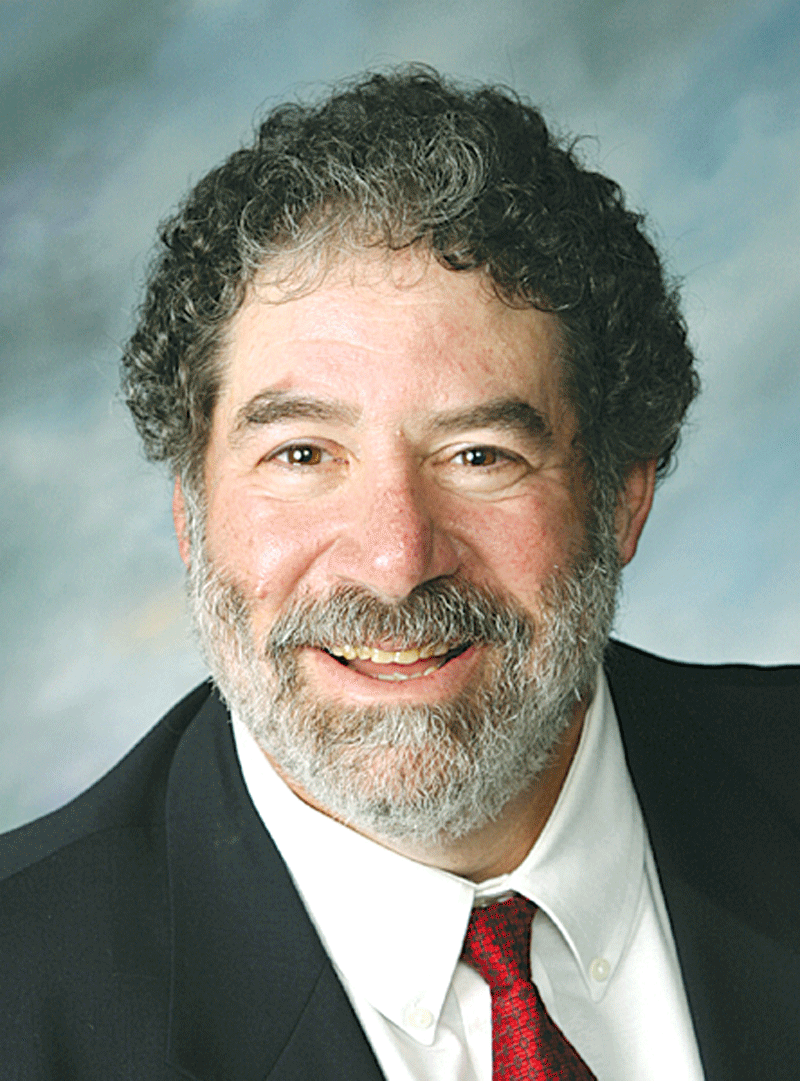
Bruce Fogel

Bruce Fogel

Everybody knows that the government is out of money and needs to raise cash. However, do you understand the financial impact that the 2010 health care legislation will have on your family?
This isn’t just about everybody being required to carry health insurance. It is much more. The government is using this legislation as a revenue builder, and you will be paying the bill. So what will your cost be?

Individual Mandate
The new federal law requires that non-exempt individuals must maintain qualifying health-insurance coverage for themselves and their dependents or face a tax penalty after 2013. Similar to Massachusetts law, those without qualifying health coverage will be required to pay a tax penalty. The federal penalty will be the greater of: (a) $695 per year, up to a maximum of three times that amount, or $2,085, per family, or (b) 2.5% of household income over the threshold amount of income required for income-tax-return filing.
The penalty will be phased in according to the following schedule: $95 in 2014, $325 in 2015, and $695 in 2016 for the flat fee; or 1.0% of taxable income in 2014, 2.0% of taxable income in 2015, and 2.5% of taxable income in 2016. Beginning after 2016, the penalty will be increased annually by a cost-of-living adjustment.
Exemptions will be available for a variety of reasons, including but not limited to, financial hardship,  those without coverage for less than three months, illegal aliens, prisoners, those for whom the lowest cost plan option exceeds 8% of household income, and those with incomes below the tax-filing threshold (in 2011 the threshold for taxpayers under age 65 is $9,500 for singles and $19,000 for couples).

Premium Assistance Tax Credits for Purchasing Health Insurance
A refundable tax credit is available to certain individuals who are not eligible for Medicaid, employer-subsidized health insurance, or other acceptable health coverage, and who get health insurance by enrolling in a qualified health plan through a state-run insurance exchange for tax years after 2013. While the credit generally will be payable directly to the insurer, individuals can elect to purchase health insurance out of pocket and then claim the credit on their Form 1040.
Based on the information provided to the exchange, the individual receives a premium-assistance credit based on income, and IRS pays the premium-assistance credit amount directly to the insurance plan in which the individual is enrolled. The individual then pays to the plan in which he or she is enrolled the dollar difference between the premium-assistance credit amount and the total premium charged for the plan. For employed individuals who purchase health insurance through an exchange, the premium payments are made through payroll deductions.
The premium-assistance credit will be available for individuals and families with incomes up to 400% of the federal poverty level ($43,320 for an individual or $88,200 for a family of four, using 2009 poverty level figures) who are not eligible for Medicaid, employer-sponsored insurance, or other acceptable coverage.

Higher Medicare Taxes on
High-income Taxpayers
High-income taxpayers will be subject to a tax increase on wages and a new levy on investments as well.

Higher Medicare Payroll Tax on Wages
Under current law, wages are subject to a 2.9% Medicare payroll tax with employees and employers paying 1.45% each. Self-employed people pay both halves of the tax, but are allowed to deduct half of this amount for income-tax purposes. While the payroll tax for Social Security applies to earnings up to an annual ceiling ($106,800 for 2011 and increasing to $110,100 for 2012), the Medicare tax is levied on all earnings without limit.
Under the provisions of the new law, which goes into effect in 2013, most taxpayers will continue to pay the 1.45% Medicare hospital-insurance tax, but single people earning more than $200,000, and married couples earning more than $250,000, will be required to pay an additional 0.9% (2.35% in total) on the excess over those base amounts. Self-employed individuals will pay 3.8% on earnings over the threshold.

Medicare Payroll Tax Extended to Investments
As part of the revenue-generation aspect of the new laws, beginning in 2013, a Medicare tax will, for the first time, be applied to net investment income. A new 3.8% tax will be imposed on such income of single taxpayers with adjusted gross income above $200,000, and joint filers over $250,000. Net investment income includes interest, dividends, royalties, rents, gross income from a trade or business involving passive activities, and net gain from disposition of property (other than most property held in a trade or business) reduced by properly allocable deductions to such income.
The new tax is intended to apply only to income in excess of the $200,000/$250,000 thresholds. For example, if a couple earns $200,000 in wages and $100,000 in capital gains, $50,000 will be subject to the new tax ($300,000 minus $250,000).
Additionally, while not directly applicable to individuals, this new tax is also applicable to estates and trusts. In such situations, the tax is 3.8% of the lesser of (a) undistributed net investment income, or (b) the excess of AGI over the dollar amount at which the highest estate- and income-tax bracket begins.

Threshold for Medical-expenses Deduction Raised
Under current law, taxpayers can include in their itemized deductions unreimbursed medical expenses for regular income-tax purposes (not AMT) only to the extent that those expenses exceed 7.5% of the taxpayer’s AGI.
As noted, the new law raises the threshold for itemized medical expense deductions from 7.5% of AGI to 10%, effective for tax years beginning after Dec. 31, 2012. However, it should be noted that the threshold for individuals age 65 and older (and their spouses) will remain unchanged at 7.5% through 2016.

Reimbursement Limited for Some OTC Medications
Qualified medical expenses, which are expenses that can be reimbursed tax-free through a health reimbursement account (HRA), health flexible savings account (FSA), health savings account (HAS), or Archer Medical Savings Account (MSA), no longer include over-the-counter medicines (except for insulin, which continues to qualify), unless prescribed by a doctor, effective for tax years beginning after Dec. 31, 2010.

Increased Penalties on Non-qualified Distributions
from HSAs and Archer MSAs
The penalty tax on distributions from a health savings account or an Archer MSA that are not used for qualified medical expenses has been increased to 20% (from 10% for HSAs and from 15% for Archer MSAs) of the disbursed amount, effective for distributions made after Dec. 31, 2010.

FSAs Limited to $2,500
An FSA is one of a number of tax-advantaged financial accounts that can be set up through a cafeteria plan of an employer. It allows an employee to set aside a portion of his or her earnings to pay for qualified expenses as established in the cafeteria plan, most commonly for medical expenses, but often for dependent care or other expenses. Under current law, there is no limit on the amount of contributions to an FSA. Under the new law, however, allowable contributions to health FSAs will be capped at $2,500 per year, effective for tax years beginning after Dec. 31, 2012. The dollar amount will be indexed for inflation after 2013.

Dependent Coverage in Employer Health Plans
Effective as of March 30, 2010, the new law extended the general exclusion for reimbursements for medical-care expenses under an employer-provided accident or health plan to any child of an employee who has not attained age 27 (whether they qualify as a dependent or not) as of the end of the tax year.
This change is also intended to apply to the exclusion for employer-provided coverage under an accident or health plan for injuries or sickness for such a child. A parallel change is made for voluntary employee benefit associations (VEBAs) and 401(h) accounts. Also, self-employed individuals are permitted to take a deduction for the health insurance costs of any child of the taxpayer who has not attained age 27 as of the end of the tax year.

Excise Tax on Tanning Services
The new law imposes a 10% excise tax on indoor tanning services. The tax, which will be paid by the individual on whom the tanning services are performed, but collected and remitted by the person receiving payment for the tanning services, will take effect July 1, 2010.

Liberalized Adoption-credit and Adoption-assistance Rules
For tax years beginning after Dec. 31, 2009, the adoption tax credit is increased by $1,000, made refundable, and extended through 2011. The employer-provided adoption-assistance exclusion is also increased by $1,000.

Bottom Line
These are some of the highlights of the 55-page health care legislation that was signed into law by President Obama on March 30, 2010. It affects every American citizen to varying financial degrees and phases, in different aspects, at various timeframes. If you have questions about how it will affect your family, it would be wise to consult with your tax advisor.

Bruce M. Fogel, Esq. is a partner with Bacon Wilson, P.C. in Northampton. He is a member of the firm’s estate-planning, elder, real-estate, and business departments. He has extensive experience in matters relating to income, gift, and estate taxes, and he focuses on the tax implications of all legal transactions. He also co-hosts the “Taxes and Assets” radio show on WHMP-AM; (413) 584-1287;
[email protected]

Departments People on the Move

Yuki Cohen

Yuki Cohen

Yuki Cohen has been named Vice President and Wealth Advisor for the Wealth Management Division of Berkshire Bank in Pittsfield. Cohen will work with a variety of clients and institutions throughout the Berkshire County and Pioneer Valley markets, providing trust-administration and asset-allocation services to wealth-management clients.
•••••
Attorney Karina L. Schrengohst has joined Royal LLP, based in Northampton, focusing her practice in labor law. She will represent unionized employers in court, defending them against unfair labor practice charges, and before administrative agencies, such as the National Labor Relations Board. Also, she will assist clients at arbitrations in matters involving contract interpretation and employee discipline or discharge and advise non-union clients on developing the best practices for maintaining a union-free workplace.
•••••
Shefali Desai has been appointed National Sales Leader of Emerging Markets for MassMutual’s Retirement Services division, based in Springfield. Desai is responsible for leading the division’s 15 sales directors, as well as third-party administrator channel managers targeting small-market retirement plans.
•••••
Ralph F. Abbott Jr.

Ralph F. Abbott Jr.

Skoler, Abbott & Presser, P.C., with offices in Springfield, Worcester, and Meriden, Conn., has announced that Ralph F. Abbott Jr. has been named the 2012 Springfield Employment Law-Management Lawyer of the Year by Best Lawyers, a peer-review publication in the legal profession. Abbott has been a member of the firm since 1975. In addition to providing employment-related advice to employers, he assists clients in remaining union-free and represents employers before the National Labor Relations Board.
•••••
Heather Bosworth has joined Park Square Realty’s Westfield office as a Sales Associate.
•••••
Johanna M. LaClair has joined the Insurance Center of New England as a Personal Lines Sales Representative.
•••••
James E. Vinick has been named Treasurer of the Naismith Memorial Basketball Hall of Fame in Springfield.
•••••
Chicopee Savings Bank announced the following:
• Martha M. Rickson has been named Branch Officer of the West Springfield branch office; and
• Maribel Torres has been named Assistant Vice President of Retail Lending.
•••••
Western New England College in Springfield announced the following:
• Nuno C. Alves has been named Instructor of Electrical and Computer Engineering;
• Anthony E. English has been named Associate Professor of Biomedical Engineering;
• Joe A. Riofrio has been named Assistant Professor of Mechanical Engineering; and
• Brian K. Smith has been named Assistant Professor of Industrial Engineering.
•••••
Joseph DaSilva has been named Vice President of Administration at Springfield Technical Community College.
•••••
Florence Savings Bank announced the following promotions:
• Susan A. Pepin-Phillips has been named Vice President of Marketing;
• Shelley M. Daughdrill has been elected Assistant Vice President and Branch Manager;
• Michele Z. Lawrence-Bennett has been named Assistant Vice President and Security Officer;
• Sharon C. Malouin has been elected Audit Officer; and
• Robert E. Teto has been elected Virtual Branch Manager.
•••••
Western New England University in Springfield recently appointed new members of the faculty at the College of Arts and Sciences:
• Eric L. Clark has been named Assistant Professor of Mathematics;
• William R. Force has been named Assistant Professor of Sociology;
• Jacob L. Krans has been named Assistant Professor of Neuroscience;
• Sean P. McClintock has been named Assistant Professor of Chemistry;
• Alexander S. Rosas has been named Assistant Professor of Political Science and Director of the Law and Society program; and
• Heather Stassen-Ferrara has been named Assistant Professor of Communication.

Columns Sections
Understanding Older Generations at Work

Mandatory retirement has been illegal in most industries for decades, but some managers are still reluctant to hire and retain workers older than 65. Frequently workers in this age group are characterized as inflexible, slower, and reluctant to evolve with technology. But most employers find that today’s older workers challenge these stereotypes and can be real assets.
Biological and psychological changes occur as we get older. Each generation is also different sociologically from other age groups. Awareness of age-related differences can empower employers to capitalize on senior workers’ positive attributes and consider making workplace adaptations for their limitations.

Biological Age-related Changes
While most stereotypes about older adults are greatly exaggerated, many biological changes do take place both physically and cognitively. Nearly every organ and system in the body is a bit less efficient than it once was, but this does not mean inevitable disease or disability. The stereotype that seniors can’t hear or see well is false, but it is true that hearing and vision are not quite as sharp as they once were when we are younger. While Alzheimer’s disease and dementia are not part of the normal aging process, tip-of-the-tongue moments and slower reflex, reaction, and recall times are.
Due to changes in eyesight and hearing, consider moving an older worker’s seat at a meeting table to enable a better view of a projection screen. Recognizing normal changes that happen to the aging brain can help managers understand older workers’ behavior. For example, some older workers may be quiet during that meeting but submit great ideas a few hours later, after they’ve had time to process.

Sociological Age-related Changes
Sociologically, older workers are generally highly dedicated employees. Many seniors, particularly older women, are motivated by financial need. There are numerous advantages to deferring Social Security payments, so many seniors want to put off collecting for as long as possible. Most older adults have also witnessed steep declines in their retirement accounts, so there is a genuine need to supplement their income. Others simply did not adequately plan for retirement and require additional income from a full- or part-time job.
Generationally, workers older than 65 are known for a strong work ethic. Even if there is not a significant financial incentive, they were raised in an era that idealized hard work. They are team-oriented and unlikely to leave coworkers in a bind. This age group has likely finished raising their families so they can be open to working more hours when necessary. They are known for honoring commitments and respecting authority.
This age group also is typically good at interpersonal communication. Having worked for most of their careers without access to e-mail and texting, these workers have had to rely on their people skills to get things accomplished. They tend to also be more resourceful than younger generations who have come to rely only on the Internet for research and problem-solving.
Since this age group may have less computer experience than their younger coworkers, it is important to assess and respond to needs for training. Older workers are sometimes thought to be technologically challenged, but often it is because they have not had the opportunity to learn the appropriate skills.

Psychological Age-related Changes
Psychologist Erik Erikson believed that older adults experience a crossroads in their life: a stage he called “ego integrity vs. despair.” The concept of ego integrity is that, when a senior reviews his life thus far, he finds meaning in the way he has spent his time, which leads to wisdom and acceptance of his mortality. On the other hand, if a senior’s life review is focused on feeling resentful or disappointed about the way his time has been spent, he feels despair, which can sometimes even trigger depression.
Meaningful work often promotes increased self-worth in older adults, regardless of whether they are experiencing ego integrity or despair. In understanding this, managers can best motivate older employees by critiquing gently and praising publicly when it is earned. A manager singling out an older employee for a job well-done provides psychological benefits for the senior but also goes a long way to dispelling false stereotypes about older workers.

Tips for Accommodating and Embracing Older Workers
The best strategy in managing and accommodating older workers is the same as with employees of any age: observe , identify strengths and weaknesses, and work with that person to optimize performance. Nearly every employee requires some accommodations in order to do the best job possible. For example, a manager may have to spend time with a new college graduate explaining when, and if, it is appropriate to text customers. The same concept is true with older workers.
It is also important to re-evaluate a worker’s duties as he ages during employment with an organization. For example, a 70-year-old hotel shuttle driver who has been with a company for 20 years may be better-suited to a front-desk assignment if age-related changes are interfering with driving abilities.
Older workers have so much to offer: experience, work ethic, potential to mentor, and, frequently, fewer family obligations that will interfere with work. The key to maximizing value with older employees is recognizing and accommodating their differences.

Jennifer FitzPatrick, MSW, LCSW-C is an author, speaker, and educator. Founder of Jenerations Health Education Inc., she has more than 20 years’ experience in health care. She is a frequent speaker at national and regional conferences and was an adjunct instructor at Johns Hopkins University. Her new book, “Your 24/7 Older Parent,” is addressed to those dealing with the care of an elderly parent; www.jenerationshealth.com

Cover Story
Why Area Businesses Need a Disaster Recovery Plan

There’s no doubt that the summer of the tornado, hurricane, and earthquake in Western Mass. got more businesses thinking about the importance of a disaster-recovery plan. But the truth is, it doesn’t take a natural disaster to suddenly shut a company down; a freak fire or flood will do the trick, too. Employers who have developed business-continuation strategies in case of an adverse event — and those who wish they had done so sooner — agree that there’s plenty of value in preparing for the worst.

No one goes to work expecting the roof to come off. Gretchen Neggers certainly didn’t.
She’s the town administrator in Monson, and she recalls the fateful late afternoon of June 1, when a tornado cut a path right through downtown.
“It passed right over our town offices and police station, causing significant damage to that structure,” she told BusinessWest. “It essentially blew the roof off.”
The initial concern, of course, was to see if anyone was physically hurt. The next was how to keep municipal services running at a time when residents would need them more than ever.
“Obviously, that facility houses critical operations,” she said. “All the town’s vital data, our permanent records, everything was housed in that building, and all the essential functions we perform as a town happen there. So it was a challenge to respond to the needs of residents in the community, and at the same time deal with the disaster within our own building.”
One of the town’s first calls was to CMD Technology Group in East Longmeadow, which handles a variety of information-technology services for Monson.
“We said, ‘we need to get our servers out of here,’” Neggers said. In the meantime, someone had the sense to do what they could to protect them before CMD was able to move them — in this case, covering the equipment with a tarp and setting up a fan to blow cool air at it.

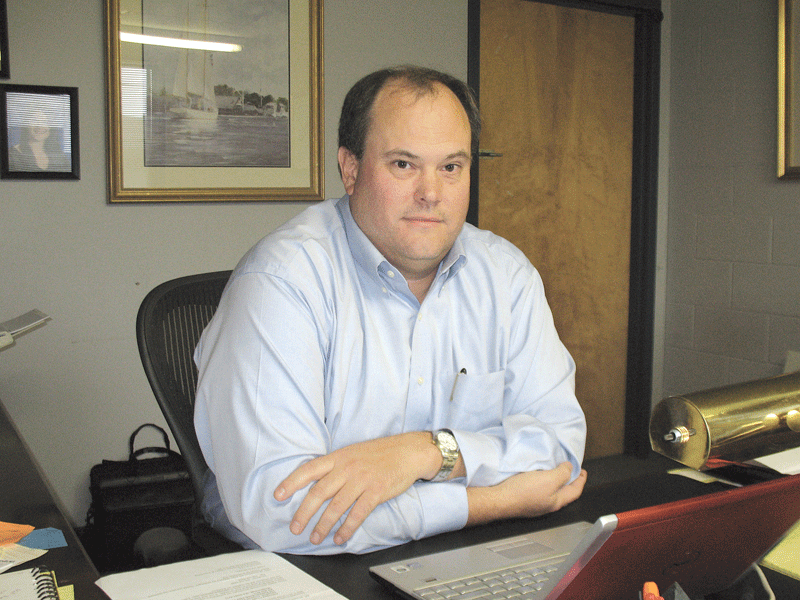
Charlie Christianson

Charlie Christianson says disaster-recovery plans should have many facets, from IT to relocation to communication plans if the phones go down.

“We were very fortunate that our data survived,” she told BusinessWest. “There was some blessing in that; had we lost our data, the recovery would have been much harder. We did have some limited backup, but we didn’t have any off-site backup, which is something I now strongly recommend. It was a lesson learned.”
The town offices were relocated, and the town undertook what she called “an intense effort” to get operations up and running in a few days. Importantly, no municipal employees had any paychecks delayed.
“It was something you say, ‘that’ll never happen,’” Neggers said. “Unfortunately, what we learned is that the unthinkable can happen, and you do have to be prepared for it.”
After a summer when Western Mass. was hit with a tornado, the remnants of a hurricane (and plenty of flooding), and even a minor earthquake, companies, municipalities, and nonprofit agencies are looking more seriously at having a plan in place to keep their business operating even if their place of business is no longer usable.
Joan Kagan knows what that’s like. The president and CEO of Square One, whose Springfield headquarters was demolished by the tornado, did indeed have a disaster-recovery plan in place, meaning luck was less of a factor than it was at Monson’s town hall.
“We had completed the first phase of our plan, which was focused on our financial data, which we backed up every night on computer servers down in Connecticut, far from any of our facilities,” she said. “All our our financial data was backed up every night. That allowed us to get back into business right away, and we didn’t lose any of our data. That was critical to us.”
Why? For one thing, “we bill the state electronically for 1,200 kids every month,” Kagan said. “What if we had to go back and recreate the ID numbers and what the services are that we provided that month, so we could bill the state for it? We’d probably still be working on it now. Instead, we were able to get back in business right away.”
For a business like child care, where so many clients depend on those services every day, that continuity is particularly important, she added.
Joan Kagan (center, with Sarah Smith, vice president of Finance, and Phil Klimoski, director of IT)

Joan Kagan (center, with Sarah Smith, vice president of Finance, and Phil Klimoski, director of IT) says Square One not only had a disaster plan, but actively practiced it.

“These are critical services for families, and also, our employees depend on us for their paychecks,” she said. “Some are single or heads of household. You’re talking about hundreds of people who could be impacted if they go without paychecks. But we were able to get payroll out three days after the tornado because we had a backup system. A lot of people lost jobs because of that storm, but we were able to keep everyone employed.”
In this issue, BusinessWest examines the issue of disaster response, and how having a plan — and, just as important, making sure employees understand it and train on it — can make the difference between being helpless and staying in business when there’s no longer a physical business to go to.

Banking on Trouble
Paul Scully knows a little about disaster planning. That’s because Country Bank, of which Scully is president and CEO, has long had such a plan, and trained on it often — which turned out to be extremely fortunate the day a fire broke out at its main office in Ware in 2008, causing no injuries but significant smoke damage.
“It doesn’t matter what the size of your company is; if you could potentially have an interruption in cash flow and business, you have a problem,” Scully said. “You should never think you’re too small to prepare, even if you’re just a two-person company.”
With 44,000 square feet of space rented nearby, stocked with dozens of spare computers, and plenty of server redundancy, every bank office except the one affected by the fire (which had to be cleaned and renovated) was open for business the following morning (a Saturday), with no loss of data for any customer.
“The real key to having a plan is testing it — on an annual basis at mininum — but, in addition to testing it, updating it,” he said. “We do a mock disaster drill every year; we literally make the switch over as if we had just had a disaster. Not only do we switch the operating system over to backup, but we have people come in and do testing at the backup site that day.”
The reasons for repeating the training often are obvious, he said.
“A lot of folks wear different hats, their job responsibilities might change, or they might leave the organization,” he explained. “If Joe was in charge of making sure everyone is accounted for, and suddenly Joe’s gone, then who is the person responsible for that?”
Kagan also stressed the importance of having staff trained in disaster-recovery procedures — “particularly, in our case, with safety measures, evacuating children, which allowed us to avoid any tragedies or having anyone injured. We practice that in our centers and have fire drills once a month, so the staff are trained in how to safely evacuate, and children know how to go to a safe place. That worked to our advantage.”
She emphasized the need for a communication plan after an event. “We make sure that people have their cell phones, that people are in communication and identifying what the needs are,” she explained. “We were able to do that, and the next morning we were able to use our contacts in the community to help us identify space [to set up shop]. The community was very responsive, and from day one people offered us space.”
Dave Delvecchio, president of Innovative Business Systems in Easthampton, recently opened a data center in Marlborough that acts not only as a remote office, but as a disaster-recovery suite for clients. If a customer’s place of business is suddenly rendered unusable, IBS can transfer the contents of the client’s entire network to the Marlborough office, which is equipped with four workstations, in effect providing a location for that customer to continue to operate.
It’s not just disasters business owners should worry about, he said, but everyday mishaps. For tenants in a mixed-use, multi-tenant building, he explained, the odds of a localized disaster — anything from a candle fire to a knocked-out sprinklerhead — go up by a factor of 10. But the past summer’s weather events have really got clients talking.
“We’ve definitely received some cold calls from a few folks about disaster response this year,” he said — as well as a humorous moment the day the Valley trembled. “I was talking with a client one day about potential solutions, and he said, ‘is the floor moving?’ As soon as the earthquake ended, he said, ‘all right, you’ve made the earth move — I’ll sign anything!’”
On a serious note, though, sometimes it takes a disaster for people to realize the importance of their computer infrastructure.
“They don’t have paper-based forms to fall back on anymore. A hotel can’t make a reservation without going online. Insurance companies can’t process claims without going online. Whether you’re a large, regional bank, a single-location business with 10 employees, or a nonprofit agency, we’re finding that disaster planning is meaningful to businesses.”

In Touch and in Business
Charlie Christianson, president of CMD and its sister company, Peritus Security, which offers risk-management services to businesses, echoed the importance of backing up data off-site.
“A lot of people just plug a USB drive into the server and create another hard drive — but all the hard drives are sitting on one site,” he said. “What if the building gets crushed? It’s great on a day-to-day basis if a file gets lost, but it certainly doesn’t protect against catastrophic failures. If a catastrophic event comes through, or an electrical event occurs, you run the risk of losing it all.”
And that means possibly losing business — permanently. After the tornado, the CMD/Peritus offices had no phone connections or Internet access; even cellular service wasn’t active. So the team “triaged,” Christianson said, at a local coffee shop where service was available.
“We started going down the customer list and calling our clients, letting them know how to get hold of us, finding out what they needed, and we started slapping priorities on things,” he said. “You could have people who have been customers for years, and when they can’t get hold of you during an event like this, instead of thinking, ‘maybe there’s a problem with the phones,’ it’s ‘oh, we hope you’re not out of business.’ That’s how quickly people turn nowadays.
“You have to have systems in place on the technology side,” he added, “and it’s equally important to have this stuff written down. Because as calm and cool as people think they’re going to be when stuff hits the fan, that’s not a good time to be figuring things out.”
Scully agrees with the importance of a business-continuity plan. “What do you do if the building isn’t accessible for months? How would you operate? Sure, you may have business insurance, and that may help with cash flow, but what it doesn’t do is satisfy your customer base, and that’s a risk you can’t quantify.”
Some customers would go elsewhere, he said, while competitors would have no problem exploiting the situation and reaching out to welcome them. “I don’t think you can underestimate the the impact of not having a disaster-recovery plan or a business-interruption plan. It’s worth its weight in gold.”
That goes for all kinds of operations, Neggers said.
“A lot of business are regulated — like banking — and are required to have disaster-recovery plans, but I can see why it’s something that everyone should put a lot more attention into,” she told BusinessWest. “It’s not something you want to develop after a disaster happens.”
And just having a plan isn’t enough, she said. “Your plan needs to be precise, it needs to be comprehensive, and you need to train on it. What are you going to do if you can’t go to the office tomorrow, if you don’t have your computer, don’t have your files, don’t have your phone? How are you going to perform the essential functions of your business?
“I hope our experience is something that other entities can learn from,” she continued. “We were lucky in many ways because we didn’t lose our server, but you can’t have your critical functions reliant on luck. It’s something I know we’ll take a lot more seriously moving forward.”

Shelter from the Storm
Christianson still marvels at the sudden outburst by Mother Nature.
“Western Mass. never used to have such radical swings in weather. Maybe once in a great, great while,” he said. “But during the course of the summer, we had a tornado, an earthquake, a hurricane, multiple borderline tornadic events — it seemed like every two weeks we were having a windfall of activity.
“It certainly kept us busy,” he added. “You don’t like to see it happen to people, of course. But no sooner than we’d get one mess cleaned up, the next thing you know, another storm ripped through, causing damage or flooding.”
It shouldn’t take a natural disaster to get employers preparing for the worst, he said, but it’s an effective reminder.
“You need to step back and think outside your box,” he said. “You can’t just say, ‘oh, it’ll never happen,’ because we saw it happen.”

Joseph Bednar can be reached at [email protected]

Law Sections
Businesses Must Take the Necessary Steps to Protect Themselves

Peter Shrair

Peter Shrair

The Great Recession taught many of us a number of lessons in dealing with our own business and that of our customers. As the businesses that survived the recession learned, in addition to monitoring expenses and trying to carefully guard scarce resources, there are protocols that can be implemented on a regular basis to protect ourselves.
One such instrument is a commercial credit application. This article is not intended to discuss consumer credit transactions; rather, it is simply trying to elaborate on some of the mechanisms that might be used in a commercial setting.
Most entrepreneurs know that two types of credit are available — secured credit and trade credit. Secured credit is typically borrowing from a bank or other institutional lender, which places a lien on business assets and provides a business with working capital or term debt for equipment and other asset acquisition. The majority of credit, however, is trade credit from one business to another. Trade credit is an unsecured promise to pay for the delivery of goods or services.
Most businesses decide on an informal basis what credit terms to provide to their various customers. In order to do this effectively, many use credit-reporting services, and others employ informal procedures they have developed and implemented over time. This writer advocates that a complete credit application should be had from all trade creditors, which can provide information that could prove critical in determining whether to extend credit, how much credit to extend, and what to do if there is a default in payment.
Generally, on a credit application you want to start with the exact name of the account debtor. Whether it is a corporation, limited liability company, partnership, or an individual, you should be careful to specify its correct name. Oftentimes, businesses use a ‘trade name,’ and you should look at the secretary of state’s Web site to verify the correct entity name. The credit application should not be done in the trade name. Further, a responsible person in your organization should review each credit application prior to any credit being extended.
Under the credit application, I would recommend obtaining information as to the owner of the real estate, as well as the owner of any equipment. It is helpful to obtain bank-account information because you have the ability at times to attach certain bank accounts prior to judgment if a default occurs.
In Massachusetts, as in most states, legal fees are the responsibility of each party unless the rule has been varied by contract or statute. As such, you generally want to include a sentence such as, “the undersigned agrees to pay all costs of collection, including reasonable counsel fees if any invoice or other obligation is past due.” By having a representative of the customer sign the credit application and agree to these terms prior to extending credit (not simply placing them on an invoice), you have a better chance that you will be awarded counsel fees if a collection action is started.
You may wish to include terms for service charges as well, and these would also need to be stated in your terms and conditions.
Often, you may be able to secure a guarantee whereby an owner of a business will become personally responsible for the debts of his or her company. This becomes a bargaining consideration and could prove useful. Again, you want to be cautious that the person who executes the personnel guarantee is not a salesman, but rather the owner of the business.
Some companies that extend large amounts of credit or sell large pieces of equipment actually take a security interest in the items being sold. This, too, can be accomplished through a credit application if a security agreement has been included.
If you are operating in the state of Connecticut, then it is imperative that you include the so-called Connecticut pre-judgment waiver paragraph in your document, which allows you to attach assets without notice in certain cases.
If you use general terms and conditions, you want to be sure that an account debtor has agreed to them, and I would advocate that these general terms and conditions also be placed directly on the credit application.
While this article is intended to simply be a brief overview of some of the protections afforded with a credit application, you should remember that the application can be as large or small as necessary to fulfill the needs of your business in determining the critical questions outlined above.

Peter Shrair is managing partner of the Springfield-based law firm Cooley Shrair; (413) 781-0750.

Banking and Financial Services Sections
Chicopee Savings Seeks to Soar on the Wings of Creativity

CSB President Bill Wagner

CSB President Bill Wagner

Like all financial institutions in the region, Chicopee Savings Bank is struggling to grow in a challenging environment marked by historically low interest rates, razor-thin margins, and unparalleled competition. Despite the hurdles, the institution has managed to grow market share, increase deposits, and, in general, position itself for when there is less turbulence.

Bill Wagner says that the last time Chicopee Savings Bank drew out a five-year plan was as it was making its conversion to a publicly traded institution in late 2006.
It was solid in most respects, he said, but it couldn’t possibly have taken into account the events that would trigger the so-called Great Recession less than two years later, not to mention a string of governmental actions to stem its impact. These steps have brought interest rates to historic lows, cut bank margins to razor-thin levels, and, ultimately, made it extremely difficult, if not impossible, for financial institutions to post the kind of solid growth that was commonplace in the decade preceding the crash.
It didn’t anticipate the housing bubble, which was aggravated significantly more than past housing bubbles by the failure of certain types of financial institutions that engaged in the secondary mortgage market, he explained. “There were two years of extremely high unemployment that weren’t in the plan, either, and we didn’t anticipate the unprecedented interference in the free-market cost of money by the Fed and the Treasury Department.
“We don’t do five-year plans anymore,” Wagner added with a wry smile. “That’s too far ahead to plan; we do three years now; every year we do a three-year plan.”
And even three years is a virtual eternity in the current environment, marked by challenging conditions, a lack of confidence among business owners, virtually non-existent organic growth in the business community, and spiraling competition in all areas, especially commercial lending.
In this climate, said Wagner, the dean of the local bank presidents now in his 27th year at the helm at CSB, the goals are to take advantage of the opportunities that do arise, work diligently to create new opportunities, and properly position the institution for the time when conditions improve. Meanwhile, the bank needs to remain true to its mission, be a positive force within the community, and, in a word, be creative.
And CSB is doing all of that, he said, listing, as evidence, everything from positive gains in market share in commercial lending across the region to some new products and services, such as a rewards checking program, and even the fiberglass replica C-5 Galaxy transport plane now sitting in the bank’s headquarters on Center Street.
It is one of three planes sponsored by the Chicopee Savings Bank Foundation in a program to raise funds for a new senior center in the city. Like Springfield’s sneakers, West Springfield’s terriers, and Easthampton’s bears, the planes, with 7-foot wingspans, are themed artistically, and sponsored by area businesses and individuals. The plane in the lobby is called “In Your Honor,” and features the likenesses of Chicopee veterans who have fought in each of the nation’s wars.
“This is what it means to be part of the community,” Wagner said of the bank’s contributions to the program as he looked over the plane and pointed out veterans of various conflicts. “We’ve been here for nearly 170 years, and we’re going to keep on being here.”
And CSB will keep on slugging it out in a difficult environment where the choppy air is persistent and gaining altitude is a real challenge.

He’s Not Winging It
As he wrapped up his talk with BusinessWest, Wagner gave a quick tour of the Central Street facilities, focusing on the C-5 model and the many pieces of artwork hanging in his office, the hallways, and especially the ground-level conference room, which was the last stop.
There, among several framed pieces, are paintings by local artist Ted Fijal of Chicopee landmarks. There’s one of the main administration building at Elms College that dominates the back wall, and another looking down the hill on Springfield Street past the old Rivoli Theater and City Hall to the massive Cabotville Industrial Park, which has played such a big role in the city’s business history, dating back to the days when Civil War uniforms were manufactured there.
The artwork, along with the plane in the lobby, provide evidence of CSB’s devotion to the city that’s been its home since 1854, said Wagner, as does the fact that, while other institutions have removed geographic references from their names, this one hasn’t.
Nor has it struck the word ‘savings’ from the name either, years after most all other institutions thought it prudent to remove the adjective in a nod toward their institutions’ broader mission.
Rather than acknowledge change with new signage, CSB has done it with action, said Wagner, noting everything from the bank’s conversion to a public institution five years ago to its geographic expansion efforts (most recently in South Hadley and Ware; more on that later) to its ongoing evolution from a savings bank to an institution with a host of commercial and consumer products.
And that evolution continues, even in this current, ultra-challenging environment, said Wagner, adding that the bank continues to make solid gains in the realms of commercial lending and commercial real estate.
Indeed, as he looked over the latest statistics concerning commercial loan volume in individual communities, especially in the $100,000-to-$3 million range, or what he called the bank’s “sweet spot,” Wagner said CSB continues to grow market share.
“We’ve been pretty successful, in spite of the environment we’re in, in growing our commercial-loan department and maintaining asset quality,” he said, noting that, in many area cities and towns, the bank is at or near the top in volume of those sweet-spot-sized loans, and total volume of outstanding loans has gone from $51 million in 2008 to $75 million in 2010 and past $80 million this year. In the area of commercial real-estate loans, the numbers have risen from $150 million outstanding in 2008 to $178 million through the first half of this year.
It has been helped in these efforts, he continued, by continuing consolidation in the banking community (Berkshire Bank’s merger with Legacy is the latest example; see story on page 32) and movement away from such institutions and toward smaller community banks on the part of many business owners. But he also credits the bank’s team of experienced lenders that have enabled CSB to grow market share at a time when there has been marginal business growth across the region.
“It’s very difficult to grow as we have,” Wagner explained. “We have a solid, seasoned commercial lending team, we have a lot of technical skills, and we have the ability to service commercial accounts at a level business owners are comfortable with. We seldom lose a good commercial account, and we certainly gain a good deal more a year than we lose.”
And beyond sheer volume, the commercial portfolio boasts great diversity, he said, adding that this has been another asset during the recession and modest recovery. “It’s enabled us to go through this environment, knock on wood, without too many bruises and cuts; we’ve had higher-than-normal losses, but they’re still well within industry averages.”

Taking Flight
When asked what was in the bank’s latest three-year plan, Wagner said he wasn’t at liberty to reveal any specific details — in keeping with the rules governing the dissemination of information involving publicly traded institutions.
Speaking in general terms, though, he said there are no immediate plans for additional territorial expansion, and that one of the immediate goals is to grow the South Hadley and Ware branches, both opened in 2009, which are off to decent starts given the conditions.
Those branches represent the bank’s first foray in Hampshire County (although South Hadley borders Chicopee), and the Ware office represents its deepest move east. It was a common-sense move, said Wagner, adding that the location — near the Wal-Mart that serves the Greater Palmer area and not far from turnpike exit 8 — is ideal, and Ware, although headquarters to Country Bank, is not in the ‘overbanked’ category as so many area communities are.
“I went out to Ware one day to look at a piece of property and went by the Wal-Mart, and the place was packed,” he said while recounting how the journey to Ware started. “I drove through the shopping center and said to myself, ‘in this whole 10- or 12-town area, this has to be the busiest place.
“We thought that this would be the place to put a bank, and thus far, it’s worked out for us,” he continued. “It’s probably going to take a little longer than most branches, but it’s still progressing at an acceptable rate.”
While building up deposits in the new branches and gaining market share in commercial lending and deposits, the bank is taking other steps that would fall into the realm of building volume and effectively positioning itself for the day — whenever it comes (the Fed recently announced that it would keep its interest rate at nearly zero through the middle of 2013) — when interest rates start to rise and paper-thin margins start to increase.
“We’re going to continue to operate our franchise in the best interest of our stockholders and our customers,” he said. “And we’re going to continue to try the commercial sector as well as the retail sector, and try to be creative and differentiate ourselves from other banks.”
Rewards checking is one example of this creativity, Wagner said, adding that the product, rolled out several months ago, pays interest on accounts that maintain a certain level of activity in electronic banking services. It has helped the bank grow its retail portfolio in the same manner it has registered gains on the commercial side of the ledger.
“As a result of that and other efforts, we increased our demand deposits by $11 million over the past three months,” he explained. “This is part of our plan to continue to develop a high percentage of core deposits so that, when rates do go up, we have cheap money on our books.”
Meanwhile, the bank will continue its mission within the community, he said, adding that, beyond the planes purchased to help build the new senior center in Chicopee, the institution has been aggressive in its efforts to help victims of the recent tornadoes.
The bank has partnered with Salvation Army, the O’Connell Oil Co., and Channel 22 to assist in tornado-relief efforts. As of late July, more than $60,000 had been raised at CSB’s nine branches, and through parallel efforts involving the bank’s foundation and O’Connell’s convenience stores, the total has exceeded more than $120,000.

Soft Landing
Through nearly a half-century in banking (48 years to be exact, starting at the old Security National Bank in downtown Springfield), Wagner says he has been through six major bank crises by his count.
That includes the so-called ‘machine-shop recession’ of 1972, he said, recalling that, with severe cutbacks in defense spending as the Vietnam War was winding down, most of the machine shops in the area were hurt, and many didn’t survive. There was also the housing bubble of 1976, the deep recession of the early ’90s, which was particularly hard on banks, and others to follow. Comparing the current crisis to the one 20 years ago, he said the earlier one claimed more banks, obviously, “but this one has been very painful; it’s like comparing a broken arm to a broken leg — it all depends on whether you’re sitting or standing as to which one hurts more.”
Though they were all different in some respects, he went on, the common denominator with each crisis was the need for creativity and cautious aggressiveness to maneuver through the choppy air and be better positioned for when the skies cleared.
This time of challenge is no different, continued Wagner, who was exercising some plane speaking — literally and figuratively.

George O’Brien can be reached at [email protected]

Features
The Maccabi Games Will Bring the World to Springfield

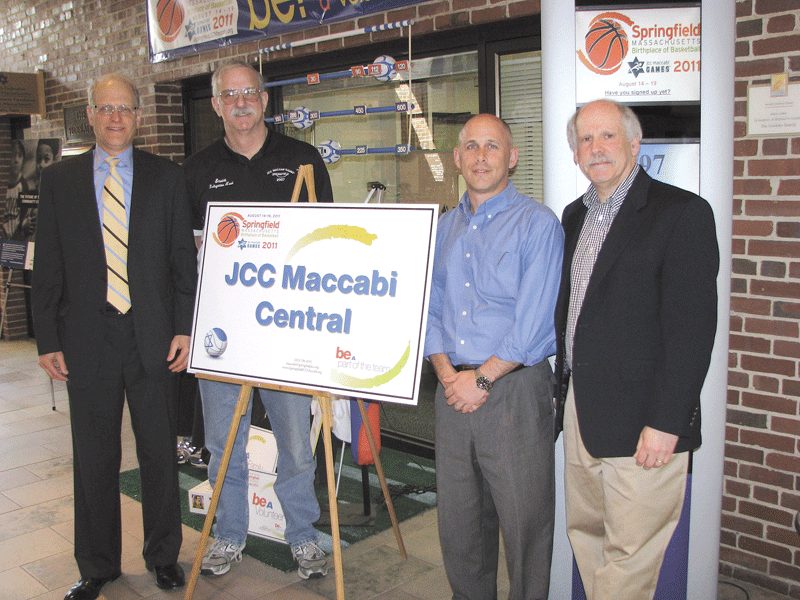
Organizers of the upcoming Maccabi Games

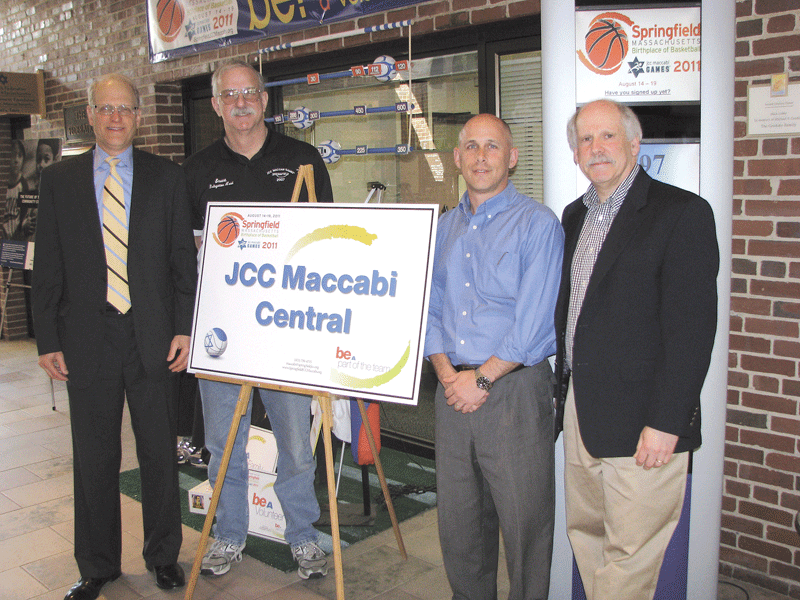
Organizers of the upcoming Maccabi Games, from left: Francis Mirkin; Stuart Greene; Jeff Grodsky, vice president of the Harry Grodsky & Co.; and Michael Paysnick.

The digital display in the lobby of the Springfield Jewish Community Center (SJCC) has been counting down the days, hours, minutes, and seconds to the start of the Maccabi Games since early this year.
What the current numbers translate to is crunch time, said Michael Paysnick, executive director of the center, noting that the kickoff ceremonies on Aug. 14 are virtually right around the corner. Most all of the really hard work, from recruiting sponsors to finding host parents (although some still need to be secured) to arranging security for the estimated 900 athletes (ages 12-16), 250 coaches and delegates, and 5,000 spectators, has been handled, “and now we’re down to the fine details.”
And they are what ultimately add up to a successful week (Aug. 14-19), said Paysnick, adding that the final pieces are coming into a place for an event that truly brings the world to Western Mass.
Indeed, athletes from across the country and several foreign nations, including Israel, Canada, and Mexico, will descend on the region in mid-August for an event that mirrors the Olympics in many ways, starting with elaborate opening ceremonies at the MassMutual Center, said Francis Mirkin, an attorney with the Springfield-based firm Bacon Wilson and co-chairman of the Games.
“Like the Olympics, the Maccabi Games bring people together from across the country and other nations,” he explained. “They compete against each other, but they also learn from each other and share ideas and memories. It’s a learning and growing experience as much as it is an athletic competition.”
The games mirror the Olympics in another respect as well: putting them on is a huge undertaking, a challenging test for a region and its hospitality infrastructure, but with rewards there as well.
Indeed, while the games are, at their core, a series of athletic competitions with medals for the top performers, said Mirkin, they have become an economic boon for the hosting region and, in the case of Springfield, which hosted the games before, in 1992, a showcase of its tourism facilities, communities, colleges, and universities, many of which will host sporting events, and the business community as well.
“In many ways, this region is perfect for the games,” Mirkin explained. “It has the strong support network and communities with hundreds of willing host families. But it also has the colleges, the facilities, such as those at the MassMutual Center, and the attractions like Six Flags and the Basketball Hall of Fame. And while the games have benefited from coming here, this region has benefited from being host.”
For this issue, BusinessWest goes behind the scenes as the region again prepares to host nearly 900 young Jewish athletes and create another of those learning experiences Mirkin described.

Winning Proposition
Stuart Greene, director of Health & Physical Education at the SJCC, coordinated the games when they came to Springfield in 1992, and he has that assignment again this year.
He brings to the job nearly two decades of experience with the games, starting in 1992, when he took a delegation from the SJCC to its first Maccabi event in Boston. Since then, he’s led subsequent delegations as they’ve competed in Denver, Baltimore, Philadelphia, San Diego, and other cities.
The Maccabi movement was started in 1895, but it was not until 1932, when the first official Maccabiah Games — originally conceived by Yosef Yekutieli, a 15-year-old inspired by the 1912 Stockholm Olympic Games — were held in Israel. And it wasn’t until 1982 that the first games were staged in North America, in Memphis.
Like Mirkin, Greene said the games represent much more than a chance to compete in sports ranging from basketball, soccer, and volleyball on the team level to tennis, swimming, golf, and track and field at the individual level — although that’s certainly a big part of it.
“It’s a chance to see other places, meet lots of new people, forge friendships, compete, and learn,” he said. “It’s a rewarding experience on so many levels.”
The same can be said of the art and science of hosting the games, he continued, adding that Springfield and Philadelphia stepped forward to co-stage the event (it’s usually held in several venues each year) when many other cities were simply unable to, due in large part to a still-sluggish economy.
The work actually began more than a year ago, when the host cities were announced, said Paysnick, and it will continue until long after the countdown is officially over and even after the athletes and coaches have gone home.
There is a virtual mountain of logistics involved, said Paysnick, adding that perhaps the most challenging is finding host families for the athletes. That work continues even in the final weeks, he said, adding that additional beds are still being sought.
But there are myriad other details to be worked out, he continued, from the securing of venues for the various athletic events to the recruitment of hundreds of volunteers; from security arrangements (which are not as elaborate as they were in 2002, only months after the 9/11 terrorist attacks, but are still comprehensive) to coordination of transportation for all those athletes.
In all, 33 delegations will descend on Springfield and the surrounding region. In addition to three international teams, there will be squads representing neighborhoods of big cities (Bensonhurst in New York and North Miami Beach, for example) and entire cities, including Hartford, Houston, Chicago, San Antonio, and Jacksonville.
They will be competing in events staged at several area colleges and facilities, including the MassMutual Center, Springfield College, American International College, Holyoke Community College, several area golf courses, and other venues.
The total budget for the SJCC games is approaching $1 million, and is covered through contributions, in cash and in-kind donations, from a host of individuals and corporate sponsors. That latter list includes PeoplesBank, Big Y, C&S Wholesale Grocers, Harry Grodsky & Co., Bacon Wilson, Williams Distributing, and many others.
“It’s a huge undertaking that wouldn’t be possible without the donations of time, money, and energy from many people and businesses,” said Mirkin.

Let the Games Begin
As the numbers get smaller on the digital display at the SJCC, the anticipation builds for an event that will showcase not only young athletes, but Western Mass. and its proficiency at staging large, and ultimately successful, events.
In that respect, there will be winners on many levels as these games are played out in mid-August, and rewards for the all those participated — and those who were part of the effort to bring the event back to Greater Springfield.

George O’Brien can be reached at [email protected]

Health Care Sections
Tornadoes Spur New Chapters in Hospitals’ Books on Preparedness

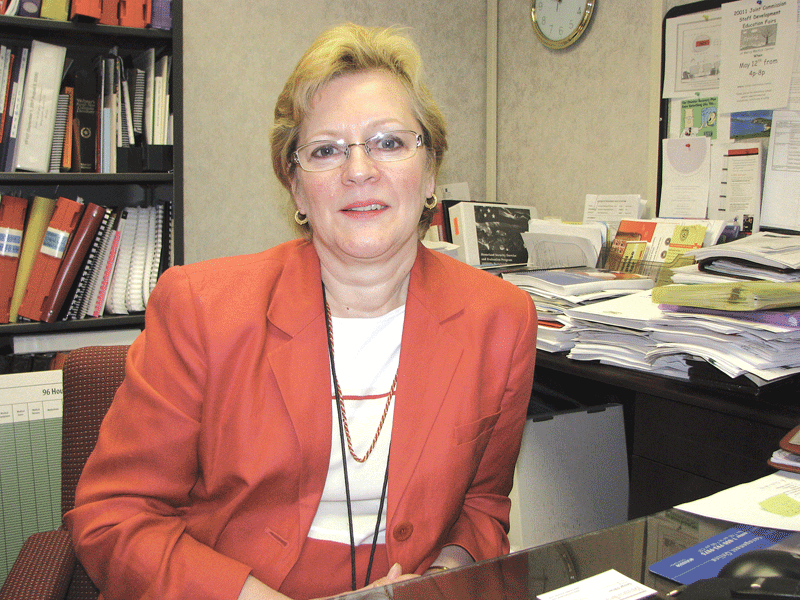
Ann Carroll

Ann Carroll had already been thinking about tornado preparation when the events of June 1 put Springfield’s hospitals to the test.

Ann Carroll spent most of the morning on June 1 preparing a PowerPoint presentation on, of all things, tornadoes and what hospitals should be thinking about to be fully ready in case one strikes.
This work, which falls under her job description as emergency preparedness coordinator at Mercy Medical Hospital, was inspired by the events in Joplin, Mo. eight days earlier, when a mile-wide tornado devastated that community, killing at least 155 people. It hit the nine-story St. John’s Regional Medical Center head-on, and many of the stories of out of Joplin detailed how the hospital’s staff scrambled to safeguard patients during the few moments of warning they had, and how they carried on, despite great adversity, after disaster struck and cleared the hospital in less than 90 minutes.
Believing there were poignant lessons from Joplin, Carroll started logging information about that event and tornadoes in general to add to Mercy’s database on such matters. What she learned, or had reinforced, among other things, was the fact that tornadoes can ‘hop’ — touching down in one area, rising off the ground for what could be a few hundred yards or several miles, and then touching down again.
“Another thing I learned is that they generally take on the color of the ground,” she said. “If they’re coming just over grass, they’re green, but when they’re black, it means they’re picking up debris.”
Little did Carroll know that, by day’s end, she would have some first-hand knowledge of these phenomena and many others to add to her presentation — which remains a work in progress — and perhaps a few new pages for the binder on the bookshelf behind her desk titled ‘Weather Emergencies.’
Indeed, the series of tornadoes that hit Western Mass. late that afternoon, and especially the one that arrived in downtown Springfield around 4:30, gave new meaning to the phrase ‘learning experience’ for all involved, said Carroll, and in this case provided just one of the myriad ironic twists that fateful day.
Tom Lynch

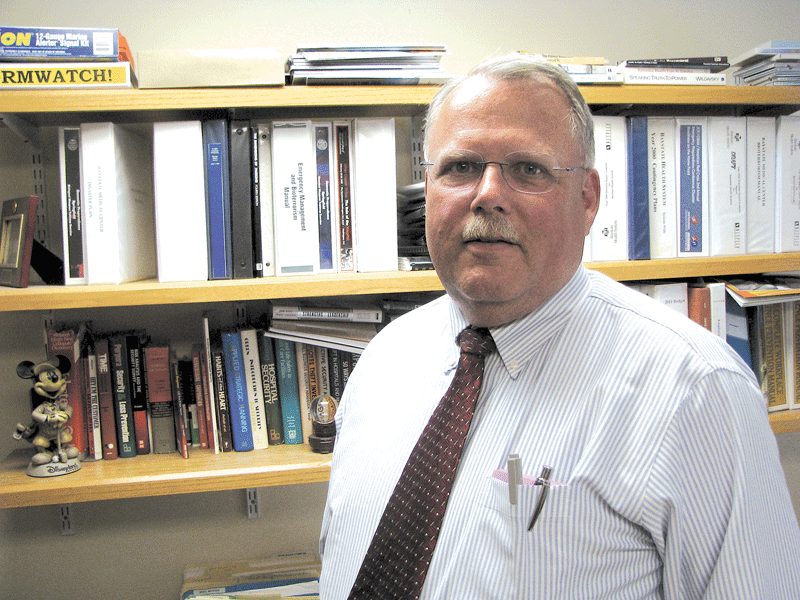
Tom Lynch said any emergency plan has a certain amount of flexibility built into it, because it’s impossible to predict precisely what type of disaster will strike.

Tom Lynch agreed. He’s the director of Security at Baystate Health, and he, too, was going over material written about Joplin in the days leading up to the Massachusetts tornadoes. And while doing so, he put special focus on how St. John’s and its parent system, based in Springfield, Mo., handled the broad matters of information management and communication.
“One of the things that becomes critical is how you communicate with your staff and how you communicate with the community,” he said, “because, if there’s a need to access services or if there’s a question of whether you should come to work and, if so, how you should do it, then the ability to get that information out becomes a challenge.”
Like Carroll and most everyone else at Baystate and Mercy, he would have some personal accounts to add to his base of knowledge by the time the sun went down on June 1, and some thoughts about where changes or improvement may be needed in disaster readiness. Like Carroll, he said the collapse of cell-phone service was unexpected and problematic. Meanwhile, he said, overall, things could have been much worse that day if, for example, the tornadoes had done considerable damage to one of the arteries it passed right over, including I-91, Route 5, and the Memorial Bridge. And he believes plans should be made for such specific calamities.
For this issue, BusinessWest looks at how Joplin put tornadoes on the radar screen here and elsewhere, in a figurative sense, and how this region’s own experiences brought those lessons home in ways no one could have imagined on May 31.

Getting Wind of It
Recalling the events of that fateful Wednesday, Dan Moen, president and CEO of the Sisters of Providence Health System, which includes Mercy Medical Center, said there wasn’t much talk of tornadoes that morning, and very little in the way of what would be considered heightened alert of additional preparedness other than people “being aware of what could be a pretty significant storm.
“I think that, sometimes, we don’t pay enough attention to those types of storm warnings,” he continued, adding that it’s fair to say that the word ‘tornado’ will never be regarded the same way in this region. “I don’t think anyone will underestimate those storm warnings in the future.”
Although the first tornado touched down in Westfield, and then again in West Springfield, there was very little warning to speak of at Mercy Medical Center, said Carroll, whose basement-level office at Mercy has no windows. She added that there was a warning around 1 p.m. that conditions were ideal for severe thunderstorms and perhaps a tornado, and the first real warning — but for possible tornadoes much further north, in the Amherst/Belchertown area — came at 4:23 p.m., just seven minutes before the funnel cloud then making its way across the Connecticut River showed up on a camera fixed atop the hospital’s roof.
No one at Mercy really knew about the tornado until they heard about that image from the roof camera or saw the funnel for themselves, said Carroll, adding that she was walking through a tunnel between the hospital and Memorial House when the tornado crossed the river into Springfield, and first saw it when she emerged at the other end. She immediately told staffers to seek shelter, and within seconds, warnings had been sent to the pagers and cellphones of employees, and Mercy swung into what’s known as a ‘Medical Alert Code 1,’ the lowest of four levels, with a ‘4’ translating into full-scale evacuation of the hospital.
In the Code 1 scenario, personnel at the hospital were asked to work beyond their traditional shifts (which vary with the position in question), and additional personnel were placed on standby. Meanwhile, patients were moved away from windows — a step already in the response book but reinforced by the events at Joplin — and Moen took up a command post in the hospital’s ER with the mindset that a tornado in an urban area like Springfield could result in a large number of injuries.
“We anticipated that there would be many more victims than what we actually experienced,” he said. “We started to work on the staffing piece — asking people to stay beyond their shifts and calling some people whose skills we knew we’d need, not knowing whether they could get in at that point.”
At Baystate, very much the same thing was happening as that hospital shifted into what it calls a Plan D (for disaster), said Lynch, noting that the facility first went into standby mode for that particular response scenario, and then, when the tornado officially touched down in Springfield, went into the actual Plan D.
There have been a few occasions over the years when this has happened, he said, adding that, in his 16 years at the hospital, the only direct comparison he could draw to the tornado in terms of the type and degree of response and general level of mobilization was the Jahn Foundry explosion in February 1999 that sent 12 workers to Baystate with burn injuries; three of them would later die as a result.
“The similarities are the spontaneity of it, the fact that we had some self-drives — not everyone came by ambulance — and the level of preparation activity,” he said, adding that the nature of the foundry injuries, severe burns requiring that patients be stabilized and then moved to burn centers, made that case different in some respects.
Baystate does not have a specific contingency plan for a tornado, said Lynch, adding that such a development would be covered under what’s known as hazard-vulnerability analysis, which looks at 35 to 40 different things that can happen — from a terrorist attack to a severe blizzard — and prioritizes them in terms of the likelihood of their occurrence, the kinds of damage each might cause in terms of operation, and preparedness level. Tornadoes do not appear on the list (although ‘severe weather’ does), he told HCN, and they’re certainly not a high-priority consideration, or at least they weren’t before June 1.
“When you design a weather-emergency plan, there’s a certain amount of flexibility in there,” he explained. “It might be snow, ice, or severe thunderstorms that take things out of play.”

Imperfect Storm
Given the population density in downtown Springfield and the neighborhoods surrounding it, personnel at both Mercy and Baystate were preparing for a high volume of injuries that, thankfully, never materialized.
At Baystate, for example, the hospital moved into what the system calls ‘mass casualty mode.’
“With the damage you’re hearing about — with the collapses, the closed-off neighborhoods, and the closed-off streets, the anticipation is that you’re going to get large numbers of wounded people here,” Lynch explained. “So you move into the mass-casualty mode, which then ramps up different aspects of the operation, particularly the clinical things.”
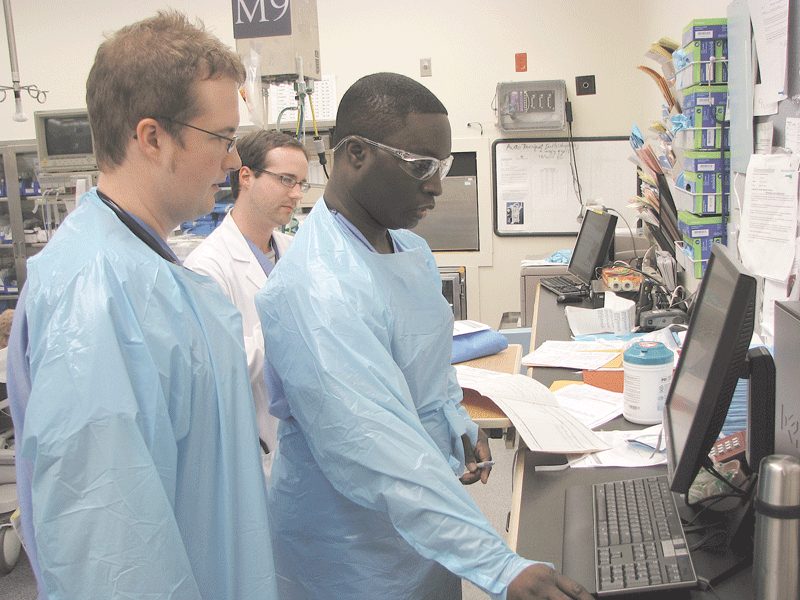
Elaborating, he said that Dr. Reginald Alouidor, attending physician in Baystate’s Level One trauma unit, the only facility of its kind in Western Mass., was forming trauma teams, and the Emergency Department staff were moving patients and creating room for a crush that was far less severe than it could have been.
Baystate eventually treated 25 people, 10 of them in the trauma unit; seven were admitted. Mercy, meanwhile, treated a total of 35 people, none of them with life-threatening injuries, and all were treated and released.
Many of these individuals transported themselves to the hospital, which made this situation unique in some ways. “I remember this one car that drove up … the roof was V-shaped,” said Carroll. “A tree had fallen on top of it, and the windows were blown out; there was a baby in the car, and they needed two wheelchairs to get the occupants out and into the emergency room.”
While dealing with the injured from the first tornado, both hospitals soon went on alert for more twisters, especially one that was reportedly moving southwest from Chicopee, right into the path of the two facilities.
Moen said these reports prompted staffers to once again move patients away from windows and consider additional steps to ensure both patient safety and efficient handling of large numbers of injuries.
When asked what lessons Mercy and other hospitals could take away from the events of June 1 — just as they are all learning from Joplin — Carroll started with the need to pay a little more attention to the weather, a need she’s already addressed.
“Someone told me Radio Shack was having a special on hazard-alert radios, for $29.99,” she said. “They were getting rid of last year’s models, so I went and bought five of them; we’re going to place them at the security booth, the front desk, at the switchboard, which is also in the basement, and the fourth floor of the Weldon Center, because they saw it out the window about the same time I did.”
Beyond that, she and Lynch said much of the focus has been on the ineffectiveness of cellphones — again, something that wasn’t anticipated — and steps that may be taken in the future as a result.
“I received only one call in two hours, and every call I tried to make didn’t go through,” she said, adding that backup contingencies, ranging from land lines to two-way radios to texting, kept most of the lines of communication open.
In the wake of the tornadoes, Mercy will look into having more ham radios tuned to the SkyWarn channel, another stormchasers’ outlet. “Many times, they’re the first to see the first touchdown.”
Said Lynch, “It’s a stunning thing for people to dial something on a cell phone and get busy circuits all the time. You have to look at what that impacts. It didn’t affect our operations, but when you live though it like this, you ask questions about what happens next time.”
As is typical with such events and the drills that replicate them, he added, there is a comprehensive debriefing exercise, at which those involved discuss what went well and what didn’t. In this case, most all matters fell into that first category.
“But in this particular case, we’re going well beyond that, because it was an actual event, and we’re really soliciting information from our clinical people,” Lynch said. “They did fabulous work, and they organized this so rapidly; it’s not a surprise, but it’s always great to see. People take the training, and they take the understanding, and they do what they have to do, and do it remarkably well.”

Lasting Impressions
Caroll is still working on that PowerPoint presentation she talked about. The pictures and accounts of the Joplin disaster offer some important lessons for Mercy and all hospitals.
“We wanted to look at the types of damage done to the hospital in Joplin, and the things that we would need to consider in our planning,” she said, “such as the safest places to seek shelter in the buildings, warning systems, and so on.”
All that will still go on, but now there are other, far more personal accounts of what to do when a tornado strikes. They are one of the more positive things to take away from a day that won’t ever be forgotten. n

George O’Brien can be reached at [email protected]

Building Permits Departments

BUILDING PERMITS

The following building permits were issued during the month of June 2011.

AGAWAM

1676 Main St., LLC
1676 Main St.
$250,000 — Renovate existing building into restaurant and pub

Agawam Properties, LLP
408-410 Meadow St.
$85,000 — Renovations

EAST LONGMEADOW

Vertis Inc.
245 Benton Dr.
$48,500 — Construct steel-frame room

HOLYOKE

City of Holyoke Schools
500 Beech St.
$2,801,000 — Renovation of classrooms, locker rooms, and install new security system

WBC Realty
28 Appleton St.
$14,400 — Install new roof

NORTHAMPTON

City of Northampton
19 Meadow St.
$3,400 — Install interior stained glass window

Coolidge Northampton, LLC
243 King St.
$5,500 — Interior renovations

Kenneth and Carol Bowen
40 Center St.
$8,250 — Remove and construct new wall to expand waiting room

The Brushworks, LLC
221 Pine St.
$8,000 — Replace six antennas

LUDLOW

Westside Pizza
103 West St.
$5,000 — Install new exhaust system

SOUTHWICK

Dunkin Donuts
497 College Hwy.
$60,000 — Renovations

SPRINGFIELD

Pearson Cooley Development
1334 Liberty St.
$179,000 — Convert to franchise pizza restaurant

SIS Center
1459 Main St.
$340,000 — Tenant improvements

WESTFIELD

Cloverleaf Realty
110 Elm St.
$7,500 — Renovation for new restaurant

Sage Engineering
217 Root Road
$139,000 — Interior repairs

Banking and Financial Services Sections
There Are Financial Benefits to Putting Family Members on the Payroll

Dawn Badorini

Dawn Badorini


It is that time of year again. The kids are out of school, and you wonder what they are going to do all summer to keep themselves busy and away from the social-media frenzy. If you are a business owner, there are many potential financial benefits of hiring your children.
One of the biggest incentives of hiring your children is the potential tax savings. The tax savings will vary depending on the type of entity your business is. If you are the owner of an unincorporated business (Schedule C/Self-Employed) you have the greatest potential tax savings. If your children are under age 18, you will not have to pay FICA (Social Security and Medicare) taxes on their wages. Your children are also not required to have these withheld from their paycheck.
For employers, the Social Security portion of the tax is 6.2%, and the Medicare tax is 1.45%. For your children, the Social Security portion is 4.2% (reduced from 6.2% for 2011 only), and Medicare is 1.45%. Also, wages paid to children under age 21 are exempt from federal unemployment taxes (FUTA). Both the FICA and FUTA tax exemptions also apply if your business is a partnership or LLC as long as the only partners are the parents. This is a huge tax savings because you would have to pay these payroll taxes on any other employee you hired.
This does not mean there are no tax benefits if you are an S-corporation or a C-corporation. No matter what type of entity you are, you will get a business deduction for the wages paid to your children, assuming it is for bona-fide work at a reasonable rate. As a corporation, you also get a deduction for the payroll (FICA/FUTA) taxes paid on their wages. This reduces the amount of overall profit subject to income taxes. Assuming you are in the 33% tax bracket, if you pay wages of $10,000 to your child, this could potentially reduce your tax liability by almost $3,700. The tax liability to your child before possible education credits is $985 ($565 FICA and $420 federal income tax). The tax savings to the family is more than $2,700. If you are self-employed, it also reduces the amount of profit subject to self-employment taxes, further reducing your own overall income-tax liability.
Now let’s look at the tax impact on your children. If the wages paid to your children are equal to or less than the standard deduction ($5,800 in 2011), they will not owe any income taxes on their earnings. Even if you pay your children more than the standard deduction, there is typically still a tax benefit. Since your children are most likely in a lower tax bracket than you are, you are shifting income from your higher tax bracket to their lower one. In 2011, taxable income up to $8,500 is taxed at only a 10% rate for a single taxpayer. Also, earned income (wages) is not subject to the ‘kiddie tax.’
Another advantage is that older children may be able to offset any taxes owed by education credits of up to $2,500 claimed on their own individual tax return. In many cases, your income is too high to utilize these education credits. In order for the child to claim any of the education credits, the parents may not claim them as a dependent on their tax return. This results in you losing the deduction for their personal exemption ($3,700 in 2011). To demonstrate the benefit, lets assume the child earns $20,000 working during school breaks and maybe on weekends. Their tax would be $1,530.
This represents only the FICA tax on their earnings, since the income tax is fully offset by education credits. The first $5,800 is tax-free, the next $8,500 has a tax of $850 (10%), and the remaining $5,700 is taxed at 15% or $855. If you or your child paid college tuition of $1,705, they can get a tuition credit of the full $1,705 (100% of first $2,000 of tuition and 50% on next $1,000). The parents’ tax savings could be $4,534, which is a $20,000 deduction plus a deduction of $1,530 for employer FICA less the lost dependent deduction of $3,700, or $17,830 at 33% or $5,553, reduced by the employer FICA tax of $1,530 to net to the $4,534 benefit. Compare this to the child’s tax cost of $1,530, and the family unit saves $2,824.
However, assuming the child does have a tax liability, the overall tax savings is typically still greater when the child is able to claim the education credit. Furthermore, beginning in 2013, personal exemptions will once again be subject to phase-out limits based on income. If your income exceeds these limits, you get no tax benefit for claiming their personal exemption.
Something else you should consider is having your children begin to save for their own retirement by investing some of their wages in a Roth IRA. In 2011, they may make a contribution to a Roth IRA of $5,000 or their taxable compensation, whichever is less. This is an excellent long-term tax-savings investment for your child. They will be able to withdraw this account with all its earnings tax-free upon retirement. This could be substantial since it’s most likely 50 or more years from now.
Of course,there are some limitations and other considerations in employing your children. As mentioned above, in order to get the payroll tax savings (FICA, FUTA), your business must be unincorporated (this includes a sole proprietorship, limited-liability company, or partnership if the only partners are the parents).
There are no age limitations for employing your child, but the work performed must be necessary for the business, and the wages paid must be reasonable for the type of work performed. There could be a little more bookkeeping required as you should keep time sheets showing the dates, hours, and services performed. You will also need to file quarterly payroll tax reports and Form W-2 at the end of the year. However, if you have other employees, you are filing these already. Finally, money held in your child’s name may reduce the amount of financial aid available.
Everyone’s situation is different, but this could be a great opportunity for you to teach your child about your business and help them learn new skills, as well as begin to develop a sense of responsibility, limit the amount of time available for non-desired activities, and save taxes as well.

Dawn Badorini, MST is a manager in the Tax Division of Meyers Brothers Kalicka, P.C. in Holyoke; (413) 536-8510.

Sections Supplements
Some Basic Steps for Taking Control of Your Money

Doug Wheat

Doug Wheat


If you are like most people, you are anxious and concerned about the economy, your job, and the future. While we may have a limited impact on the world around us, we can each take control of our own financial situation to ease our concerns. Whether you are wealthy or not, having specific financial goals and a plan for achieving them will help you be more in control of your financial life.
If you have a financial plan in place, make sure you review it on a regular basis. Life can take unexpected turns, and your financial planning may need to be appropriately altered. If you started implementing some changes to your finances but ran into a roadblock, got bogged down in the details, or your life got too busy, now is a great time to pick up where you left off.
Here is a challenge for you to complete this summer. Read through this article detailing nine basics of financial planning. Pick two action items that would be helpful to you, and implement them in June. In July, read a personal-finance book and pick two more action items to implement. You will be on your way to taking control of your finances for the next decade.
• Spend Less Than You Earn: While there are many different strategies for financial planning, no strategy will work unless you spend less than you earn. It doesn’t matter if you make $30,000, $100,000, or $250,000 per year; spending more than you take home each month will make all of your plans collapse. The amount you spend in a year is the result of hundreds of independent decisions. How are you making these decisions? Do you know the difference between your wants and your needs? If you have trouble spending less than you earn, it’s time for you to do some research and some experimentation to find a system that helps you have some money left at the end of every week. One alternative to a traditional budget is the ‘first-step cash management’ system that suggests dividing your money into separate bank accounts, each with a different purpose.
• Have a Cash Reserve: Having cash in the bank is a type of insurance against the unexpected. At some point everyone will face an unexpected large bill, possibly a car-repair bill or a hole in the roof. If you have cash on hand, you can pay the bill without going into debt. Should you lose your job, it is doubly important to have resources available until you can secure new employment. A good goal is to have three months of expenses available in cash; six months would be even better. It is helpful to put your cash reserve in a place that makes it difficult to spend, such as a separate bank.

• Pay Off Debt: Debt can be useful and sometimes unavoidable whether you are paying for college, a medical bill, or a new refrigerator. The average American household with credit-card debt owes $14,743 and pays nearly $2,000 in interest expense per year, according to creditcards.com. It is no surprise that 69% of people with credit-card debt find it difficult to save, according to a 2011 America Saves survey. Whatever the source, you will be better served by paying it off as quickly as possible. You might try the ‘snowball’ method of debt repayment. With this strategy, after you pay off one debt, you add its monthly payment to the next debt on your list until all debts are paid off. Unless you have no other choice, don’t use credit to make additional purchases.
• Establish Specific Goals: Too many people live on a day-to-day basis without thinking about their priorities and developing plans to reach them. The more specific you can make your goal, the easier it becomes to measure your progress. For example, instead of simply having a goal of paying off your credit-card debt, add a date by which you want to have a zero balance and figure out your monthly payment to make it happen.
• Multiply Your Money: We all know the best time to start saving is early, and the second-best time is now. There are lots of competing uses for our money, but the power of compounding is not available to us until our money is invested and earning money. When our money is earning money, then our wealth can build much more rapidly. A 25-year old who saves $1,000 per year for 40 years and earns 5% interest will have $133,880 at age 65. A 35-year-old who saves $1,000 per year for 30 years and earns 5% interest will have $74,083 at age 65. Starting to save early can give you a big jump on meeting a long-term goal.
• Understand Account Types: Tax-advantaged accounts are available to help all of us meet some of our most important goals. Understanding the difference between these accounts will help you minimize the taxes you pay and maximize the money you have available to reach your goals. There are essentially three types of accounts: tax-free, tax-deferred, and taxable. With tax-free accounts, both the money you put in the account and the money earned in the account can be taken out tax-free. Retirement Roth IRAs and 529 Educational Savings Accounts are two examples of tax-free accounts.  If you make a contribution to a tax-deferred account, it will reduce your taxable income this year, but withdrawals of both your contributions and earnings in the future are considered income, and you will owe income tax on it. Traditional IRA accounts, 401(k) accounts, and 403(b) accounts are examples of tax-deferred accounts. For a taxable account, you owe income tax and capital-gains tax each year based on your earnings. Taxable accounts include savings accounts and brokerage accounts.
• Invest in a Diversified Portfolio: Since we cannot predict the future, investing in a diversified mix of assets will help you weather economic storms or drops in the market while also having better growth potential than a savings account alone. Being diversified becomes more important as you get older and have accumulated money that you do not want to lose. There are many strategies for building a diversified portfolio. If you don’t have the opportunity to research the subject, a default choice can be either a retirement fund based on your age or an educational fund based on the age of your child. Try to find investment products with low fees.
• Prepare for Pitfalls: It is important to be prepared for unexpected events. Having a cash reserve is one way to be prepared. Having insurance and wills in place is another. Most people have health, automobile, and homeowners insurance because they are often mandatory and it is easier to see a relationship between risk and benefits. However, people often don’t realize their vulnerability to misfortune in other areas of their lives. According to the Social Security Benefit Administration, approximately 30% of 20-year olds entering work today will become disabled before they retire, and 1 in 6 Americans will die before reaching age 67. Finding cost-effective means to insure against the risks we all face will provide you and your family financial security if the unexpected happens.
• Expand Your Learning: Personal finance is a complicated subject with a number of different facets. There is a wealth of information available on the Internet as well as in publications such as Money, Kiplinger Personal Finance, and Smart Money. Basic books on financial planning include Personal Finance for Dummies by Eric Tyson, The Millionaire Next Door by Thomas Stanley and William Danko, and The 9 Steps to Financial Freedom by Suzy Orman. Even if you don’t like dealing with money, reading a few personal-finance items every year will help keep you up-to-date and better-able to plan for your future.

Early-Career (approx. age 23-35) Action Items:
• Establish a cash reserve equal to 3-6 months of expenses.
• Make a plan to pay off non-mortgage debt by a specific date.
• Invest in a 401(k) retirement account at least up to your employer’s match but hopefully 10% of your salary or more.
• Utilize a Roth IRA retirement account if you don’t have a retirement plan at work.
• Pay yourself first by setting up automatic transfers into a long-term savings or investment account.
• Watch your expenses. It is easy to burn through money on nights out or daily coffee. Make sure you are spending less than you are taking home.

Mid-Career (approx. age 36-50) Action Items:
• Make specific mid- and long-range goals and develop a plan to meet them.
• Pay off non-mortgage debt and kick the debt cycle by building up your savings.
• Step up your retirement savings in your 401(k) to 10% or 15% of your salary if you are not already doing so. The default investment option can be a target date fund based on your age.
• Review your insurance needs, including term life insurance and disability insurance.
• Establish a will, health care proxy, and power of attorney.
• Start saving for your kids’ college in a 529 account. The default investment option can be a target date fund based on your son or daughter’s age.

Pre-retiree (approx. age 51-64) Action Items:
• Review your long-range goals and adjust your spending and savings to meet them.
• Develop a realistic budget.
• Consider fully funding your 401(k) with $16,500 per year plus $5,500 per year in step-up contributions for people over age 55.
• Make sure your investments are diversified.
• Review your Social Security benefit information.
• Consider paying off your mortgage before you retire to increase your cash flow when you don’t have a job.
• Don’t sacrifice your retirement to pay for your kid’s college.
• Consider how you will pay for future health care costs, including long-term care.

Retiree (age 65 and up) Action Items:
• Determine your income, including pensions and Social Security.
• Set up your investments to transfer money to your checking account on a monthly basis. Starting with a 4% withdrawal rate can help make your money last.
• Finalize a realistic budget based on your income and asset withdrawals.
• Consider part-time work or delaying retirement if your numbers do not add up.
• Review your will, health care proxy, and power of attorney.

Doug Wheat, CFP is director of Family Wealth Management Inc. in Holyoke; www.fwmgt.com

Health Care Sections
In the Trauma Bay, Work Is Carefully Choreographed

Dr. Reginald Alouidor

Dr. Reginald Alouidor, here consulting with surgical residents, says work in the trauma unit is a total team effort.


It is 4:56 p.m., and Dr. Reginald Alouidor is looking at his pager.
It is alerting him to the fact that an elderly woman is being transported from Cooley Dickinson Hospital in Northampton to the trauma unit at Baystate Medical Center. She had fallen in her home, suffering injuries to her face, as well as a broken wrist, but there are fears that she has also sustained brain injuries. “She was stable, but there was blood in her brain and the potential for deterioration,” Alouidor would explain later.
In the parlance of the trauma unit, this is what is known as a ‘category-2,’ or ‘cat-2,’ emergency, an incident less severe in nature than a ‘cat 1,’ which could be a serious motor-vehicle accident; a gunshot wound, or GSW, as one is called; a stabbing; or perhaps a paralyzing injury to an athlete.
But with either category, the message on the pager sets in motion a highly choreographed response that is part and parcel to life in the only level-1 trauma unit in Western Mass. When the patient arrives from CDH, the so-called ‘trauma team’ is ready and waiting to administer care that will continue long after the individual is taken from the trauma bay.
On this particular Monday, BusinessWest was a guest in the bay and surrounding emergency department to talk with team members about their work, its challenges, and rewards, and also record what would be considered a typical night in the trauma unit, although all those involved say there is no such thing.
Each day is different, said Alouidor, the attending trauma physician on this night, and unpredictability is the only constant.
Soon after the aforementioned patient, who suffered what’s known as a ‘mechanical fall’ arrives, the bay becomes awash in motion, with the various players — Alouidor, residents, a nurse, and others — attending to specific duties while trying to maintain order in what would be considered close quarters. There are a half-dozen people treating the patient, looking at information, and consulting with one another as data is pored over. In other instances, including most cat-1 cases, there may be two or three times that many people in the room (including security personnel and family members), necessitating what Alouidor calls “crowd control.”
“Having 10, 15, or even 20 people in the room is not unusual, and there’s a sign on the wall that identifies who is supposed to be there,” he explained. “It shows the room, it shows where the bed is, and it shows the position of each member of the team. As trauma-attending, when I have a very ill patient, I don’t just walk around the bed; I know where I’m supposed to stand — I have a position at the foot of the bed. My airway resident has a position at the head of the bed, the ED-attending has a position at the head of the bed, the trauma nurse and the trauma scrub nurse all have their positions marked out, they know where they’re supposed to be.
“So when we talk about choreography, or ballet, when we walk in the room, everyone knows their role,” he continued, “and everyone knows where they’re supposed to be.”
Life in the trauma unit is demanding, said those we spoke with, work that requires a broad mix of abilities, from the surgical skills needed to save lives to the soft skills one must possess to properly inform, comfort, and console patients’ family members.
“It’s a golden rule — the family needs to know what’s going on,” said Alouidor. “Even during resuscitation, family members have a right to be present, and someone from the team will detach from the team and stay at the side of that person so that they know what’s going on. If we admit a 4-year-old, the best medication I can provide to calm that child is his mother or father to hold his hand.”
Both tragedy and triumph, if it can be called that, can be found in the trauma unit.
“We make a lot of great saves here,” said trauma nurse Concetta ‘Chetty’ Jez, an evening supervisor in the emergency department and 38-year nursing veteran, who would emphasize that word ‘we’ with every comment she made about the trauma unit. “We don’t save everyone, but when you walk away, you’re thinking, ‘we really did it.’”
For this issue, BusinessWest talked at length with Alouidor and other members of the trauma team that night to gain a perspective on the choreography that goes on in the trauma unit, and how the ‘controlled chaos,’ as some described it, represents teamwork personified.

Step by Step
Alouidor, who was born in Zaire but is a citizen of Haiti and grew up in that country, told the BusinessWest that he’s always been drawn to emergency-room medicine and especially trauma care.
And in Haiti, where he did his first four years of surgical residency work, this care took on a different tone and tenor than what he would experience here later in his career, and provided different kinds of learning experiences.
“I come from a third-world country where our trauma systems are not as well as organized as here in the U.S.,” he explained. “Back home, we see things that you may have seen in the states 50 or 60 years ago, because at work, employees are not protected, and as a result, their hands get mangled in machines. Also, the streets are not properly lighted and the cars are not properly inspected, and as a result, you have a vehicle traveling with 20 people that was meant for 10, and when this vehicle tips over, everyone is injured.
“It’s a country where basic emergency services and transportation are not well-organized,” he continued. “So someone who has a car crash in a town 100 miles away from the capital is not stabilized and is brought to us by means other than an ambulance, and without having been properly screened or triaged. These are the patients that we had to take care of, so as a medical student, I was always very involved in the care of these patients and recall in my third and fourth year of medical school taking extra time to spend with residents in surgery so I could get more exposure to trauma.”
Alouidor would do a second surgical residency in New York City, and eventually came to Baystate in the summer of 2006. There, he spends roughly one-third of his time in what is the only level-1 trauma unit in the four western counties of Massachusetts — there is one at UMass Medical Center in Worcester and six in Boston — and one of three that serve Connecticut.
Level 1 is the highest designation for trauma units, and such facilities provde the highest level of care, said Dr. Ronald Gross, chief of Trauma and Emergency Surgery Services at Baystate Medical Center, noting that there are three levels of trauma facilities in Massachusetts, and as many as five in other states.
“If you take the overall spectrum of trauma, 100% of all injured patients, level-1 centers will care for about 15% of the trauma patients,” he explained. “All of the rest can be very well-cared for at community hospitals that are level 2 or less. The most severely injured patients should go to a level-1 center, and the statistics show that, if they do, you decrease their mortality by 25%. In fact, the numbers show that if you don’t take your patients to a level-1 trauma center and they go somewhere else first, mortality is four times that of those who go to a trauma center first.”
An emergency department is part and parcel of what is needed to have a level-1 trauma center, he continued, adding that trauma surgeons work hand-in-glove with emergency medicine physicians who staff the ER.
Key elements of a level-1 center include 24-hour in-house coverage by general surgeons and prompt availability of care in varying specialties, such as orthopedic surgery, neurosurgery, plastic surgery, anesthesiology, emergency medicine, radiology, internal medicine, oral and maxillofacial surgery, and critical care, said Gross.  In addition, a level-1 center has a program of research, is a leader in trauma education and injury prevention, and is a referral resource for communities in nearby regions.
The long, severe winter of 2010-11 has added to what would be considered a typical workload in the trauma unit — again, if there is such a thing, said Gross. He noted that there have been more weather-related motor-vehicle accidents, by his estimation, a higher number of serious slip-and-fall incidents, and considerably more cases of people falling off roofs, an obvious result of the heavy snowfalls and homeowners’ attempts — almost always ill-advised — to reduce the threat of collapse. Meanwhile, Alouidor said this winter has seen a high volume of what he called ‘interpersonal violence’ — “there’s been a lot of penetrating injuries, a lot of gunshot wounds and stabbings” — a statistical anomaly he could not explain.
A recent serious head injury, a true cat 1, provides an insightful look at the full breadth of the work performed by trauma-team members after the pager goes off — and well after the patient leaves the bay.
“He had a very severe brain injury, and at the time of admission, we were all concerned about the potential outcome,” Alouidor recalled. “This patient put in a week in our ICU in which he received what we categorize as maximum medical therapy.”
Elaborating, he said that surgical teams moved quickly to decompress the brain, a procedure gaining more acceptance after recent success with soldiers in Iraq and Afghanistan.
“A large fragment of bone is removed, and thus the brain has room to swell,” he explained. “When there’s a brain injury, the brain’s main response is to swell, and with the swelling, the pressure in the brain increases, and that’s what leads to complications. There are multiple medications we can use to decrease the swelling and decrease the pressure and stabilize the patient, but this patient did not respond to any form of medical therapy, so at that point we had to decompress his brain.
“Despite this, his brain pressures were not properly controlled,” he continued. “After several days, he eventually died. We spent those days with the family, hand-in-hand with his wife, his children, his parents; it was a very long process, and a case that shows how we’re not just taking care of the patient, but taking care of the family.”

On the Clock
When asked what he enjoys (if that’s an appropriate word) about trauma work, Alouidor said he takes a great deal of satisfaction from making a profound and often immediate impact on someone who is probably having the worst day of his or her life, but there is much more to it than that.
“I like what I do for a variety of reasons,” he explained. “It’s not only the relatively quick results, but also the fact that I really like taking care of my patients; I’m very busy and very involved in their care, and that’s rewarding.
“There’s a wide range of results in trauma,” he continued, adding that not all of them come quickly, and some are obviously tragic in nature. “It’s not only the person who comes in in extremus that you can turn around very quickly by properly resuscitating them in the emergency room, bringing them to surgery, and doing the right operation at the right time, and watching this patient turn the corner within hours and come back to life; that’s the best-case scenario, but they’re not all like that.”
On the Monday he spoke with BusinessWest, Alouidor’s day began at 7 a.m., and the shift would continue until 7 the next morning. That might seem like a long shift to most, but he’s used to it — so much so that his body’s ‘clock’ is impacted when he’s not working. Indeed, he finds that, when he’s on vacation, by the time he’s a few days into a trip, or about when he’d normally be taking a turn in the trauma unit, he finds himself staying up all night.
Since this Monday was relatively quiet, Alouidor was able to spend some time with BusinessWest and discuss the many nuances of work in trauma. He said he arrives each day expecting “anything and everything,” and quite often gets both.
There is often no rhyme or reason to the level of the activity in the trauma unit, although there are some circumstances that will obviously contribute to volume, he explained, noting that the frequency of motor-vehicle accidents increases with bad weather and poor road conditions, and, in general, more bad things happen when people are outdoors, such as the summertime.
And there is, he maintains, scientific evidence of — and common-sense explanations behind — surges in activity during hot weather and full moons.
“The heat does things to people,” he said with a smile. “There is actually data in the literature that demonstrates that, when it’s a warm summer night or when the moon is out, trauma departments are more busy, and this is something we have known for years. When it’s warm, people are outside, and when they’re outside, things tend to happen — accidents, people fall off the balcony — and some bad things, like fights. And when you have a full moon, there is light until very late, and since people are out later, there’s more potential for them to get into trouble.”
And while this Monday was uncharacteristically calm — until mid-evening, at least — there are occasions, and many of them, he noted, when the patient volume on the first day of the work week will prompt someone to say, ‘are you sure today is Monday?’
Penetrating wounds, especially those related to interpersonal violence, have been occurring with great frequency this winter and, in general, over the past several years, said Alouidor, who noted that, had there been a shooting on the night of BusinessWest’s visit, he probably would not have been at liberty to talk about it due to health care privacy regulations. So he used a hypothetical situation to discuss these cat-1 cases and all the ways the trauma unit responds, starting with what his pager would be telling him when it went off.

Teaming with Anticipation
“It would be alerting us to a ‘category 1, GSW,’” he explained. “There would be an age to follow, a location of the wound or wounds — chest, body, head — and there be be vital signs, blood pressure, heart rate, mental status, and EMS can tell us if the patient is critical, meaning minimum vital signs, or stable.
“And stable is a relative term —  young, healthy people can tolerate a lot before they crash, but when they do crash, they’re in trouble,” he explained, adding that ‘critical’ is a relative term as well, and one that refers to potentially life-threatening injuries and an individual who needs to be stabilized.
With the information from EMS in hand, the trauma team begins to mobilize, said Alouidor, noting that the information on his pager is also now in the hands of other departments and individuals whose services will likely be required. This list includes the ICU, the operating room, radiology, the blood bank, lab, and also pastoral care.
“We care for these patients, but also their families,” he said. “If someone arrives here and has their 25-year-old wife or 50-year-old mother or 17-year-old son with them, someone needs to sit down with these people and talk them through what’s going on. We’ll provide the necessary medical information, but they also need support; we want to make sure there’s someone there for the family if they need someone to talk to.”
By the time the patient arrives, the team members are ready, he continued, adding that, by this, he means they are gowned, masked, and fully prepared to perform the rapid assessment that is needed in such cases. Airway, breathing, and circulation are the first things checked, he said, adding that disabilities, mental status, and injuries are also assessed.
“I’m not distracted by the fact that someone has a hole in their chest and a hole in their abdomen and they’re screaming bloody murder,” he told BusinessWest. “What’s important to me is to see if the person is stable first, and then, in a very systematic fashion, we go over things. People look at us very cynically and say, ‘this guy’s been shot in the abdomen; why are you looking at the airway first?’ That’s because the first thing that’s going to kill this person is not the fact that they’ve been shot in the liver or in the blood vessels in the stomach. What’s going to kill them first is that they’re not breathing. What’s going to kill them afterward is the fact that they don’t have circulating blood.
“Then, we go on to assess the injuries and do what’s called a secondary survey,” he continued. “Then we make our decisions. Is this patient stable? Is he critical? Is this a patient we will do a workup on? This might be a gunshot wound we assess in ED and determine it’s not a penetrating injury. Then we can say, ‘it’s your lucky day; you got shot, and the bullet only grazed you,’ or ‘it didn’t go through any significant structures.’”
If the patient is critical and needs surgery, he or she is in the operating room within minutes, Alouidor went on, adding that other types of trauma, be they injuries from a car accident, fire, or fall from a roof, are assessed and treated in the same fashion.
And with every step in the process, the team is involved.
“I don’t work alone — I work with a team,” he stressed. “I could not provide the care I provide alone. And one of the reasons why modern trauma centers are so successful is not just because they have good doctors, nurses, X-ray technicians, or anesthesiologists. They are successful because they have good systems, and these systems are put in over months and years, and it is these systems that lead to good outcomes.”
Children make up a small percentage of the caseload in trauma, said Alouidor, adding that they bring some additional challenges to the fore.
Communication is one of them, he explained, adding that very young children can’t articulate what’s happened or where it hurts. “Parents can provide a story,” he explained, “but sometimes, that story is, ‘I was in the other room, I walked in, I saw him lying on the floor,’ so we don’t really know what happened in those circumstances. And to me, that’s one of the more challenging aspects of caring for kids.”
“Some people say it’s difficult to treat children because when you look at them you see your own children,” he continued. “And while that’s true, when I look at my patients, whether it’s the 20-year-old, the 45-year-old, or the 85-year-old, I tend to see someone I know. I think about my niece, who is 20 years old, I think about my brother, who’s 45, and I think about my parents. You tend to find yourself in any patient you’re seeing.
“It is more difficult to accept a child who has significant injuries, especially when you know the outcome will not be good, as opposed to someone who’s older,” he continued. “That’s not to say that you don’t care as much [with the older individual], but it’s easier to understand and cope with someone who’s 88 and coming to the end of their life than it is with a child who’s 4 who has a devastating injury and will live with those complications for the rest of his life.”

Work in Progress
‘The Q word.’
That’s the usually unspoken term for ‘quiet’ in the trauma unit — and in most hospital settings, for that matter.
Those who are superstitious won’t say it out loud, said Dr. Mazen Al-Mansour, a surgical resident at Baystate who spends good deal of his time handling trauma work. That’s because doing so will, in their minds, inevitably change the course of an otherwise calm evening in the bay.
Al-Mansour is a fourth-year resident in the Department of Surgery, which means he’s nearing the end of this long, grueling stretch of his training. He told BusinessWest he would like to become a general surgeon, but enjoys many aspects of trauma work, especially the pace and unpredictability of the work.
When asked if organized, or controlled, chaos would be a good way to describe what goes on, he said only those who don’t work in the unit would use that term, even if it is fairly accurate.
“Everyone knows exactly what’s going on and what’s going to happen next, when there are multiple traumas at the same time or when we get extremely sick patients,” he explained. “It can be a little chaotic, but that’s the nature of traumas.”
Echoing Alouidor, Al-Mansour said work in the trauma unit requires a mix of skills, from the ability to assess and treat a penetrating wound to the compassion needed to address the wants and needs of family members.
“We work closely with extensively trained trauma surgeons who have the experience of dealing with life-threatening injuries in different areas of the body and different kinds of trauma, such as penetrating trauma or blunt trauma such as a motor-vehicle accident or people who are struck by vehicles,” he said. “We get to work closely with these people — we get to be the first-assist when it comes to the operation, and we get to watch these people talking to families, and we get to be involved with the families as well.
“There are different levels of people who get involved, and different levels of experience,” he continued, “and a lot of mentorship and observation on the part of younger people to pick up on the skills and the knowledge of how to handle the trauma patients and their families.”
Jez, whose job it is to coordinate nurse activity in the emergency department, including the trauma unit, said trauma nurses are specially trained for their work, which is demanding physically and also emotionally, but in many ways rewarding.
“It’s one of the greatest places to work in, and the nurses, while they can feel stressed — it’s a very, very busy place — will say that they truly make a difference,” she said, adding that the nurses play a critical and yet often overlooked role in the ED and the trauma bay.
“When these patients come in to the trauma unit, there’s this huge hurry — everyone’s in this big rush, everyone’s all excited, and the adrenaline’s flowing,” she explained. “And the nurse is in the middle of it. It’s the nurse and the patient, it’s the nurse who brings in the family, it’s the nurse who does all the meds, it’s the nurse that’s doing all the re-evaluation, it’s the nurse who’s there when you’ve lost the patient, and it’s the nurse who makes the patient look presentable so the family can come in and see him.
“They do it because it they love it,” she said of the nurses and their work. “They cry a lot down there — that goes with this territory — and they find order in the chaos.”
Alouidor stressed repeatedly that ‘quiet’ — he’s not at all afraid to use the ‘Q’ word — doesn’t translate into not busy.
Indeed, trauma physicians have patients to continually evaluate and myriad other types of work to handle when beds 9 and 10 in the trauma unit are empty or emergencies have passed. And they know that, at any minute, even if the moon isn’t out or it’s warm outside, the pace of the evening can change dramatically — and often does.
That’s why there are systems and procedures and signs on the walls in the bay telling people where to stand. The only job description for the people who work in this unit is to be ready — before the pager alerts them to an arriving patient, and long after the controlled chaos begins.

George O’Brien can be reached at [email protected]

Sections Supplements
Telemedicine Virtually Connects Patients with Doctors and Nurses

Mary Thomas

Mary Thomas shows off a computer monitor that displays the results of daily readings of vital signs taken by patients in their homes via a monitoring system, which transmits the data to a nurse.

It’s been called “the stethoscope of the future,” but the future is already here when it comes to telemedicine. This technology, which essentially refers to any kind of remote monitoring of patients, is used in a range of settings, from home health care agencies and visiting-nurse associations that track the vital signs of patients with chronic diseases to hospitals that use telemedicine in their emergency rooms to diagnose stroke victims. Proponents say the technology is helping people live longer, and more independently, while reducing the overall cost of health care.

Last summer Edna Ogulewicz had triple bypass surgery. When the 83-year-old returned home from the hospital, she didn’t know how to monitor her own recovery.
But thanks to the home-based telemonitoring system used by Mercy Home Care, a member of the Sisters of Providence Health System in Springfield, a nurse was able to see the octogenarian’s weight, blood pressure, and oxygen saturation every day via a computer screen without having to visit her home.
Ogulewicz was given a special blood-pressure cuff, a clip to attach to her finger to measure her oxygen, an oversized scale, and a small base unit which was plugged into the wall and into her home phone line.
Every morning between 6:30 and 7 a.m., she took her blood pressure, weighed herself, and used the oxygen monitor. That information was immediately transmitted to a central monitoring station and then to a secure Web site where a Mercy telehealth nurse could see the readings and determine whether there were any signs of trouble.
“It was very convenient. I am a very nervous person, but I found myself pretty calm doing this,” Ogulewicz said. “I am not a professional, so I didn’t know if the results were good, bad, or indifferent. It was something new, but I liked it, and it made me feel more secure.”
One day, when the scale showed she had gained a few pounds, the nurse called her and, after discussing what she had eaten the previous day, determined it was the result of consuming too much sodium. “It’s nice to have someone watching you,” Ogulewicz said, adding she found the system so beneficial that she told her doctor it would be great for all of his patients.
Ogulewicz is one of many people in the U.S. who are becoming more confident about caring for themselves and their chronic conditions as a result of telemedicine.
The technology is used locally in several settings. Many home health care agencies and visiting-nurse associations have deployed home telemonitoring systems to track the vital signs of their patients who have chronic diseases.
In addition, physicians at Baystate Franklin Medical Center and Baystate Mary Lane Hospital are using telemedicine in their emergency rooms with stroke victims.
“Telehealth is the stethoscope of the future that enables people to get information in a quick and efficient way,” said Mary Thomas, director of Homecare Operations for Baystate Health System’s Visiting Nurse Assoc.

Heart to Heart
In November 2009, the Journal of the American College of Cardiology published the results of the largest analysis ever conducted to measure the effectiveness of telehealth monitoring in patients with heart failure. They found that using the monitoring systems reduced mortality rates by 28% on average and reduced the rate of rehospitalizations for heart failure by 26% on average. That figure is significant, since people with congestive heart failure typically undergo multiple hospitalizations.
And this year, the government launched a new initiative focused on congestive heart failure through home telemonitoring to keep people with the disease out of the hospital. “Congestive heart failure is one of the biggest reasons for hospitalization and rehospitalization in patients over 65, which adds to the cost of health care,” said Sheryle Marceau, manager of clinical practice for Mercy Home Health.
“Patients often don’t understand why they ended up in the hospital or what they need to do to to prevent rehospitalization,” said Thomas.
But they learn quickly with telemonitoring, as a nurse visits their home several times a week to talk about what their daily readings mean. In addition, they are called by the telehealth nurse whenever their readings fall outside of the parameters their doctor has determined is acceptable for them.
“One of the great things is the feedback the patient gets immediately. It’s a real cause-and-effect type of learning and helps them stay out of the hospital. Plus, most patients love it because it gives them a sense of security knowing that someone is keeping an eye on them,” Marceau said.
“People who tend to be non-compliant often see the immediate effect,” she added. “If they eat Chinese food or pizza, they may see a four-pound weight gain the next day, which can put them in jeopardy, as it means they may be retaining fluids around their heart or lungs. Plus, they can call us any time to talk about their readings or ask questions.”
Sue Pickett agrees that the system works to prevent problems and educate patients. “We are trying to catch things before there is a full flareup, and telemonitoring can give us a sign that something may be wrong,” said the registered nurse and executive director of Mercy Home Health Care.
Most patients assigned to Mercy’s system use it for an average of 60 days. If there is a problem, the nurse calls and asks the person how they are feeling. In some instances, the patient is asked to take their blood pressure or other vital signs again, and at that point the nurse determines whether the situation warrants a home visit, a call to their doctor, or, in extreme cases, a trip to the emergency room. Telemedicine also benefits physicians, as they can access two months of daily monitoring results, Pickett said.
Many patients have more than one diagnosis, which can be overwhelming for them to understand. But monitoring makes a difference.
“If this can help them learn how to manage their conditions, it empowers them to have better control over their lives, which means a better quality of life with more time spent at home and less in the hospital,” Pickett said. She added that elderly patients using the system are asking more questions, and the knowledge they gain allows them to become more proactive about their own health.
It also has a ripple effect by reducing the cost of health care. “We know how to get people to live longer, but this results in chronic disease that needs to be managed better in order to not use up our health care resources,” Pickett said.
Baystate has plans to grow its home-monitoring program and include other diseases. “It’s very cost-effective,” Thomas said. “In this economic climate, we are very challenged to provide care that is cost-effective, efficient, and promotes a good outcome for the patient, and this provides us with a lot of opportunity. We have an aging nursing workforce, and telemedicine allows us to monitor people without having a nurse in their home. It doesn’t take the place of an actual visit, but is an addition at no cost to the patient.”
Right now, Baystate is using its system strictly for people with cardiac conditions while Mercy uses its telemonitoring units for patients with congestive heart failure, as well as emphysema or chronic obstructive pulmonary disease.
Mercy also has a patient using the equipment to monitor her blood pressure. “If it goes up, the doctor can adjust her medicine right away,” said Marceau. Additional equipment can be added to monitor low blood sugar or temperature, and even to allow people to do an EKG at home.

In the Hospital
Baystate Franklin Medical Center and Baystate Mary Lane Hospital are primary stroke centers. In order to earn that designation, a hospital must have a neurologist on staff around the clock. These community hospitals accomplish that through the use of telehealth technology at Baystate Medical Center.
If a person comes into the emergency room at one of the two community hospitals exhibiting stroke symptoms (which can include a sudden change in vision, garbled or slurred speech, numbness of the face, weak arms or legs, weakness on one side of the body, trouble walking, or dizziness or a headache that comes on without cause), and if the emergency-room physician thinks the person is having a stroke, they will be given a CT scan, and a neurologist can come on the scene if there is not one in house — remotely, through the use of telehealth technology.
“We have a special, giant TV screen similar to a large plasma TV which is interactive,” said Michelle Mortimer, nurse manager of the emergency room at Baystate Franklin. “The technology allows the neurologist to assess the patient by zooming in on them. They can see each other, and the neurologist works in conjunction with the emergency-room physician to do a full workup.”
This allows people who live far from major medical centers to access the options offered at one.
“Larger medical centers have more resources than community hospitals,” Mortimer said. “But telemedicine is an amazing advancement that allows community hospitals to provide services that would otherwise be out of reach. We use it to help us diagnose and treat patients, and we are able to collaborate and have an array of expanded services, which is always a benefit.”
Thomas concurred. “Technology of the future will enable people to get information in a quick and efficient way,” she said — no matter how far away they are.

Opinion
Time to Pull the Plug on NPR

While it may seem outwardly risky to support one’s argument with statements made by Ron Schiller — this is, after all, the man who described Tea Party members as “not just Islamaphobic, but xenophobic … seriously racist people” — we’re going to do it anyway.
While it was Schiller, National Public Radio’s now former senior vice president for development (he was abruptly fired for those comments and others exposed in a hidden video sting) who said NPR “would be better off in the long run without federal funding,” he’s certainly not the only one saying such things. And we agree wholeheartedly.
The rhetoric is picking up as the public broadcasting industry wages an all out, almost desperate, campaign to save its federal allowance, which amounts to about $430 million a year for the Corporation for Public Broadcasting (CPB), of which NPR receives about $5 million. Schiller and others say that NPR can easily survive without the federal dollars. More to the point, it should.
Why? There are a host of reasons, not the least of which is paring the federal deficit, and there are myriad ways to allocate precious funds more responsibly than handing them over to those running public broadcasting facilities and earning six-figure salaries to boot. But those aren’t the best reasons.
Simply put, when government subsidizes the media, any media, it also exercises a measure of control, or influence, over that media, which is something Americans don’t want and don’t need. Over the years, NPR, and local public broadcasting in general, has become a haven for left-wing radical ideologues spewing out anti-business rhetoric.
Without public funding, NPR could operate, theoretically at least, without politics always being the elephant in the room. Looking at things another way, it wouldn’t have to spend time, money, and political capital every year to save its budget.
From our view, NPR, and public broadcasting as a whole, would be better off — much better off — without its public subsidies, but no one in that industry (save for Ron Shiller) will say that out loud.
Call it tough love if you will, but Congress has to cut public broadcasting loose and let it try to survive without its security blanket, our tax dollars. And it will survive, and do just fine, without federal money — and the scrutiny and cynicism that comes along with it.
And as for public television, people should be upset about facilities like Boston’s WGBH’s headquarters, an $85 million multi-media palace dubbed the “Taj Majal,” and the dozen people inside making more than $200,000 a year. Should our tax dollars be subsidizing these edifices of government-funded excesses? We think not.
To go back to where we started, Schiller is right on the money — not about Tea Party members, but about public broadcasting. It would be better off not being on the dole, and so would the people who watch and listen to it.
Will government cut the cord? We hope so.

Cover Story
Separating Hype from Reality on Debt Relief

Cover March 14, 2011

Cover March 14, 2011

Millions of Americans are drowning in debt and desperate for a lifeline, so it’s no wonder ads touting easy debt relief are so alluring. But they can also be deceptive, glossing over the harsh realities and limitations of the debt-settlement industry; in fact, these programs leave many customers worse off than when they enrolled. Solutions to spiraling debt — bankruptcy among them — do exist, financial experts say, but finding the right remedy takes an understanding of all the options and a willingness to accept that there are no easy answers.

Michael Katz keeps a box of tissues behind his desk. And they get a lot of use from the people who sit down to talk with him about their crippling debt, and the reasons — unemployment, divorce, medical bills, or perhaps plain old bad decisions — it has spiraled out of control.
It’s not just feelings of anxiety and helplessness, but often a sense of desperation that brings them to tears — and to promising-sounding solutions, like debt-settlement companies that promise to drastically reduce or eliminate that crushing red tide.
Reality, they often find, paints a far different picture.
“So many people I talk to found these agencies through a television commercial or on the Internet, and in a very high percentage of cases, they have no idea about the legitimacy of the agency,” said Katz, an attorney with Bacon Wilson, P.C. who specializes in business and insolvency law and co-chairs the firm’s bankruptcy department.
“Most people who come to see me who have been in one of these programs found them to be unsuccessful and basically worthless,” he continued, explaining that many of them charged membership fees in the hundreds of dollars, followed by a monthly maintenance fee. This monthly payment typically goes into a ‘dedicated account’ which builds up over time, and is eventually used to make ‘full and final’ settlement offers to one or more of a customer’s creditors.

Thom Fox

Thom Fox says people should be wary of companies that want to enroll them in a program without offering credit counseling.

Sometimes these are accepted, and an account settled. However, Katz said, “the problem with that is, during this time, your debts are still earning interest and still accruing fees and late charges. Some people who started the plan with X dollars of debt find that, by the time the settlement is offered, the debt has grown to twice that, and they owe as much at the end of the plan as when they started.”
That anecdotal evidence is backed up by a Federal Trade Commission (FTC) study determining that 65% of people who leave debt-settlement programs do so without receiving any settlements whatsoever. Overall, during the survey period, they paid $55.6 million in fees while receiving just $58.1 million in savings from settlements — essentially a wash.
However, the FTC points out, those figures don’t include other costs typically associated with debt-settlement programs, such as late fees and interest charges from creditors, meaning the cost of using such a program, in many cases, far outweights the benefits.
“The FTC received a couple thousand complaints about these services, and that put them on the radar,” said Thom Fox, community outreach director at Cambridge Credit Counseling Corp. in Agawam. “When the FTC did its report, the findings were startling to many people.”
The data eventually led the FTC to amend its Telemarketing Sales Rule. The new regulations, which went into effect in October, set tighter restrictions on how debt-settlement companies — specifically those that solicit customers by phone or receive phone calls in response to ads — conduct their business.
But consumers must still be wary of the remedies they seek to get out of debt, Fox said. In this issue, BusinessWest examines what those options are, and why becoming debt-free is almost never as easy as a TV commercial might make it sound.

Cards on the Table
For instance, Fox said, a consumer might owe $10,000 on a credit card, and the creditor might accept a $7,000 settlement. But while payments to a debt-relief firm are amassing in escrow, that $10,000 can rise at an alarming rate. “Your creditor’s not being paid during that time, the bills pile up, you fall behind, and maybe you get sued,” he said, adding that debt-settlement programs have rarely explained that to clients, but now they have to lay it all out.
Under the new FTC rule, debt-relief companies that run ads or engage in telemarketing will not be able to charge upfront fees until three conditions have been met: the service successfully renegotiates, settles, reduces, or otherwise alters the terms of at least one debt; a written settlement, debt-management plan, or other agreement is worked out between the consumer and the creditor; and the consumer has made at least one payment to the creditor as a result of this agreement.
Also, debt-relief services cannot require that consumers set aside payments in a dedicated account unless the account is maintained at an insured financial institution; the consumer owns the funds (including any interest accrued); and the consumer can withdraw the funds at any time without penalty. In addition, the debt-relief firm cannot own, control, or have any affiliation with the company administering the account, nor receive any referral fees from it.
Finally, before the consumer signs up for any debt-relief service, the company must disclose certain aspects of their services, including how long it will take for consumers to see results, how much it will cost, the negative consequences that could result from using debt-relief services, and detailed information about dedicated accounts if they require them.
The Better Business Bureau (BBB) heartily supports the changes. From December 2007 — roughly the start of the Great Recession — through late 2010, the BBB received more than 6,000 complaints from consumers about debt-relief or debt-settlement companies. Complainants typically said they were charged large up-front fees in exchange for a promise — soon proven empty — to significantly reduce or eliminate their debt.
But consumers aren’t out of the woods because of a rule change, the bureau stresses, and still need to use caution when enlisting a third party to help them get out of debt.
“The debt-relief industry has flourished in the current economy, and you can bet that many unscrupulous companies are feverishly trying to figure out ways to get around the new laws, such as relying less on telephones to solicit new customers,” said Alison Southwick, BBB spokesperson. “While these new rules provide effective new protections, consumers still need to be on the lookout for deceptive debt-relief services.”
Fox said the rule takes aim at all sorts of misleading marketing practices, from promising to cut personal debt by 75% to using President Obama’s image in ads, giving the debt-relief service the appearance of government approval.
“A lot of these things are going away” with the new rules in place, Fox told BusinessWest. “They’re trying to get rid of deceptive advertising, give people proper disclaimers, and empower people with knowledge. Debt settlement can hurt people as well as help them.”
Katz added that people facing debt issues have local options — banks, lawyers, and agencies like Cambridge, to name a few — that provide a level of security that an out-of-state debt-relief firm might not.
“That way, if you have issues or problems, you know where to find someone to help you,” he said. “You can go to a local office and sit down with someone to talk about a program, rather than doing business with someone you and I and, frankly, sometimes Google has never heard of, who has no desire to be a responsible citizen or work out your concern.”

Problem Not Solved

Mike Katz

Mike Katz says bankruptcy can be preferable to debt relief because it erases all the debt at once so that an individual can begin to rebuild his credit rating.

One drawback to debt settlement, Katz said, is its piecemeal approach to fixing the problem. For instance, if two of an individual’s 10 creditors eventually accept a final offer, that still leaves eight more debts that remain — and, in most cases, have only grown since the start of the process. “Whether you’re shot with eight bullets or 10, you’re still mortally wounded,” he quipped.
Another issue, he explained, is the problem of ‘phantom income.’ It can take several forms.
“If you owe the bank $200,000 on your home and the bank forecloses on the house, and the house sells for $100,000, by law the bank is required to report the money being written off to the taxing authorities, including the IRS and the Mass. Department of Revenue, and they issue a 1099 to you as well as to the IRS,” he said. “Therefore, you owe federal and state income tax on the amount of debt being written off by the lender, and must pay taxes on it at the same rate as your own personal income tax.”
Similarly, Katz explained, “any debt that’s settled through one of the debt-settlement agencies will result in phantom income being produced. And we have found that, in virtually every agency we have dealt with, that fact has never been disclosed to people until the end of the term.”
As an example, he noted that someone with $50,000 in debt who settles for $25,000 might be taxed 30% on the $25,000 written off, or $7,500.
Opting instead for Chapter 7 bankruptcy proceedings, he noted, does not produce any phantom income and might cost as little as $2,000 to erase the entire debt, and the individual can start rebuilding his ruined credit score immediately, especially if he’s diligent about paying other bills, such as a mortgage or car payment. Choosing debt settlement can be equally devastating to one’s credit rating — again, something customers weren’t always told in the past — with little chance of improving it during the life of the plan, which might be three years or more.
“You don’t get any extra credit unless you pay your creditors in full,” Katz said. “So it’s better to do the Chapter 7 and start building your credit back three years earlier than not having it paid in full and still having a black mark on your credit. That’s the reality.”
That’s not to say bankruptcy is the only answer — “it’s not a good thing for anybody,” he said — but he recommended at least talking to a lawyer with expertise in that field.
If someone is considering using a debt-relief agency, Katz said, at minimum they should go online and search for positive or negative comments about that firm. But even then, they should be aware that companies often hire people to post false comments on message boards, praising their services or blasting a competitor’s, a practice that extends to other service industries as well, such as restaurants and hotels.
“So when you see reports online, you have to take them with some skepticism because you don’t know who’s writing them,” he noted, adding that the Better Business Bureau is often a more reliable resource to investigate customers’ experience with various agencies.
A good start, Fox said, is to seek help from a nonprofit agency, which is more likely to focus on the needs of each client, and not just the bottom line.
“Let’s say 100 people call me tomorrow; we’ll offer a debt-management program to roughly 20 of them. That’s about how many would qualify. But the remaining 80% receive personalized advice regarding their situation. Our average employee has been here eight years and has made a career out of helping people with their finances.”

No Quick Fix
The mistake many consumers make, Fox said — and one that has been exacerbated by those ads trumpeting quick, dramatic debt reduction — is relying on a one-size-fits-all program to solve their problem quickly. But the first step in the journey out of the red has to be a serious study and understanding of their own situation, how it developed, and what it will take to avoid future setbacks.
To that end, Cambridge Credit Counseling conducts hundreds of seminars each year — reaching about 7,000 people in Western Mass. annually — in addition to issuing publications and maintaining a weekly YouTube show called Your Money. That’s in addition to spending hours at a time providing free, intensive counseling services to its clients, whether they’re among the 20% referred to debt-management programs or the 80% who aren’t.
“Our goal is empowerment. Maybe 90% of the people who call us have never put a budget into play. They understand their income, but they don’t understand their expenses,” he said — and, specifically, which ones can easily be reduced or eliminated.
“The best learning experiences are the mistakes you make, not the triumphs you have,” Fox continued. “But people aren’t learning financial literacy in their school systems, although that philosophy started changing after the financial collapse. Money is a central aspect of life, and people need to know how to manage it.”
It’s an issue close to the heart of Brady Chianciola, assistant vice president and regional manager at PeoplesBank, who has initiated a series of financial-literacy programs for area students.
“Locally, we’re trying to start young and educate the youth of the region with financial-literacy initiatives,” he said of the school-based programs in Springfield and other Pioneer Valley communities — from budgeting and recognizing the difference between needs and wants to seminars on mortgages and mutual-fund investing.
“No matter what, you need to know about the complex financial landscape we live in,” Chianciola said. “We certainly understand how easy it is to get into trouble, and we hope that, by the time they get out into the real world, they’ll understand these concepts and not fall into some of the traps and scams out there.”
In talking to parents, Chianciola is encouraged by their support of the program. “They say they didn’t have this education,” he told BusinessWest, “but they’re excited about their kids starting young and not falling into the same pitfalls they did.”
Fox said his agency is providing a crash course to people who are learning the hard way. “Our counseling sessions can be an hour and a half, two hours. We do an in-depth budget analysis. We can’t give anyone advice without a full understanding of their goals and situation and aspirations. We can’t build a plan from nothing.”
While making sure any solution fits the individual is simple common sense, he said, it’s a practice that has been neglected by debt-relief services and people who are clamoring for an easy way out — when one usually doesn’t exist.
In most cases, Fox said, “there’s not going to be a quick answer. If anyone gives you a quick answer just to enroll you in their program for debt settlement or debt management, you’re with the wrong agency. Walk away; nobody benefits from that. They’re not providing value if they’re pushing you into a program that’s going to hurt you.”
In too many cases, the end result is more debt — and more tears to wipe away.

Joseph Bednar can be reached at [email protected]

Sections Supplements
What Is the Future of the So-called ‘Watson’ Technology?
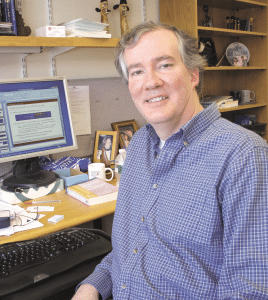
James Allan, co-director of UMass Amherst’s Center for Intelligent Information Retrieval.

James Allan, co-director of UMass Amherst’s Center for Intelligent Information Retrieval.

The recent Jeopardy! contests featuring IBM’s Watson computer was a success on a number of levels, from television ratings to exposure for IBM and its products. In a quieter fashion, the show and the computer have shed some light on what’s known as question-answering, or QA, technology, and the important work being done in this realm by UMass Amherst and its Center for Intelligent Information Retrieval, which is hard at work finding new and better ways to search materials, extract information, and help people make sense of the information they retrieve.

The correct response, or question, in Jeopardy! parlance, was, “what is Chicago?”
The category was U.S. Cities, and the answer (paraphrasing) was ‘this city’s two airports are named after a war hero and a World War II battle.’
Watson, the IBM-designed supercomputer that cost between $100 million and $2 billion to develop, depending on who is answering that question, ‘wrote’ “what is Toronto” in its Final Jeopardy space.
Hmmmmm.
“That just goes to show that computers can’t do some things as well as humans,” said James Allan, a computer scientist at UMass Amherst and co-director, along with Bruce Croft, of the university’s Center for Intelligent Information Retrieval (CIIR). While not a real fan of the show, he watched every minute of the Jeopardy! episodes involving Watson and his routing of the show’s most accomplished human champions, because UMass — and specifically its CIIR — was one of eight universities collaborating with IBM on the question-answering, or QA, technology behind the company’s new computing system.
So how could Watson, the system named after IBM founder Thomas J. Watson, have made a mistake that most grade-school students wouldn’t have?
It’s fairly simple, said Allan, noting that the computer, in its sophisticated search of a host of databases for the answer, focused on the ‘two airports/war hero’ aspect of the query, and not as much (obviously) on the ‘U.S. Cities’ part. (For the record, the question refers to Chicago’s O’Hare and Midway airports, but one of Toronto’s airports is named after William “Billy” Bishop, a Canadian World War I fighter ace.)
“Toronto’s case is very similar, but not exactly the same as Chicago’s,” Allan explained, adding that the search, in this instance, went in a similar fashion to another of Watson’s few missteps.
The question (answer) from the category Alternate Meanings was ‘stylish elegance or students who all graduated together.’ Watson’s reply was ‘chic’ — other options it considered were ‘panache’ and ‘Vera Wang’ (more on how it could have arrived at such candidates later) — while the correct response was ‘class.’ “Here, ‘stylish elegance’ was obviously more important to Watson,” said Allan, adding that ‘chic’ clearly doesn’t have a definition approaching a ‘group of classmates.’
But while Watson had some wrong answers that led to some serious head-scratching, and even a snicker from Jeopardy! host Alex Trebek, the focus should certainly be on how many questions it got right, said Allan, noting that the computer exceeded the expectations of all but the most optimistic of the individuals involved in the project. And the stunning performance, coupled with vast amounts of hype — television commercials on the Jeopardy! experience were still running weeks after the shows aired — has brought QA technology and its more practical uses to the forefront.
Some of the more obvious of these are in health care, said Allan, noting that IBM, in tandem with voice-recognition software maker Nuance, is already working to produce a medical version of the computer system. It will use speech recognition, super-fast processing, and massive databases to help doctors and nurses find answers to questions from and about patients.
The intelligence sector is another logical landing place for Watson-like technology, he said, adding that a such a system can and likely will be used in “any situation in which getting the answer quickly is an important step in the process.”
Meanwhile, Watson’s exploits have brought some attention — MIT received considerably more — to UMass and the CIIR. Launched in the late 1990s, the center’s work comes down to one word — search — and how to do it better, faster, and more efficiently.
“We look for ways to search for things, ways to organize materials, ways to help people build queries, ways to present what’s on there,” he said. “We’re very interested in issues that are new and interesting; more and more, people are using streaming media, stuff that comes at you all the time, like Twitter feeds and news feeds.
“We’re focusing on finding ways to use computers to help pull from that fire hose of information coming at you stuff that’s interesting to you and also different from what you’ve already seen,” he continued. “In other words, we want to answer the question, ‘how do you find new and interesting stuff in all the stuff that’s constantly arriving?”
For this issue and its focus on technology, BusinessWest takes an indepth look at the Watson technology and its vast potential, and also sheds some light on the ongoing work at the CIIR and how computer scientists at UMass continue to search for answers to the question of how to make computers search better and faster.

It’s Elementary
Allan admitted to BusinessWest that, deep down, he didn’t think Watson would beat his human opponents, and he never imagined the kind of drubbing the computer eventually administered.
This mindset had more to do with the quality of the computer’s opponents than any lack of confidence in the system he and his team helped create. In the end, though, he learned at least a few things — first, that Watson was indeed quite skillful in searching and then finding the right answer, and second, that he was really good at ‘buzzing in,’ as it’s called in Jeopardy!
Actually, some would say the computer had an unfair advantage in that regard, said Allan, noting that many Jeopardy! players don’t fare well on the show, not because they lack smarts, but because they lack good timing with that buzzer. Hitting it too early locks a contestant out for a costly fraction of a second, he explained, and hitting it too late isn’t good, either, obviously.
Watson, because it’s a machine, essentially had perfect timing with the buzzer, he said, adding that he, like all viewers, could see some frustration on the part of Watson’s opponents, and especially Ken Jennings, who knew many of the answers but simply couldn’t buzz in faster than the computer.
That skill — not to mention Watson’s odd ‘Daily Double’ wagers (those certainly weren’t round numbers) — came from some other contributors, said Allen, noting that the CIIR’s assistance came in the form of information retrieval, or text search. This capability of QA technology is the first step taken when looking for text that’s most likely to contain accurate answers. The system’s deep language-processing capabilities then analyze the returned information to find the actual answers within that text.
What IBM essentially borrowed from UMass and adopted for its own use is an open-source software product called Indri that effectively initiates and facilitates the computer’s search for the information that will ultimately lead to an answer, and preferably the right one.
“The question you have essentially becomes a search request,” he explained. “And a search engine, just like a Web-search engine, goes out and searches all the text, the unstructured free text we have available, to pull back portions of documents that seem likely to have an answer. The way that works in a question-answering system is that all those documents are then passed on to the next steps, which do a lot more deep processing to try to extract the specific answer.”
There were many components to Watson’s success, Allan continued, but the search software was critical.
“Search is a very important first step in the question-answering process. If we don’t find the answer, then the system can’t work,” he explained. “If the search step fails early on, all the rest of it doesn’t matter.”
The process of taking a question and arriving at an answer has several components, said Allan, all of them handled in about three seconds total. Specifically, the computer:
• Identifies plausable targets;
• Builds queries to find answers;
• Searches unstructured text for matching text;
• Extracts candidates from the text;
• Looks for evidence for each candidate;
• Scores the candidates; and
• Ranks them and decides if it’s confident enough to choose one.

Nowhere to Hyde
Using some fairly simple language, Allan explained how it all works, using a question from one of the Jeopardy! shows. From the category Literary Character APB (all points bulletin) came the question (answer) ‘Wanted for killing Sir Danvers Carew; appearance: pale & dwarfish; seems to have a split personality.’ Here’s how Watson arrived at the correct answer (question): ‘Hyde,’ as in Mr. Hyde, the alter ego of Dr. Jekyll.
First, it looked at possible targets for the answer (question), said Allan, meaning something or someone that can be wanted, has an appearance, is involved in a killing, and has a personality — more specifically, a split one. The computer then looks for strings that fill all of those, working on the premise that the target is probably a noun, possibly a person (though other animate objects fit), and the category’s key words are ‘literary,’ ‘character,’ and ‘ABP.’
The computer then builds a query from the question (answer), Allan continued, with some words and phrases becoming important: in this case, ‘killing,’ ‘Danvers Carew,’ ‘pale,’ ‘dwarfish,’ and ‘split personality.’ Then, using the CIIR’s Indri search engine, the computer searches text sources — encyclopedia articles, dictionaries, books, newspapers, movie scripts, and some added material needed for Jeopardy!, including the complete works of William Shakespeare.
Next, the computer extracts candidates from the text it searches, he continued, adding that, in this case, it would come across passages such as “Sir Danvers Carew: member of Parliament who is murdered by Hyde,” “Mr. Hyde was pale and dwarfish,” “Mr. Hyde-type split personality,” and “Sherlock Holmes solves the mystery surrounding Jekyll and Hyde.” It would then identify candidates such as:
• Sir Danvers Carew, member of Parliament;
• Murdered, Hyde;
• Sherlock Holmes, mystery; and
• Jekyll.
It would then look for evidence to support candidates, or not support them, as the case may be. ‘Parliament,’ for example, has no personality, and it’s also real, not a literary character; ‘mystery’ is not a character; ‘murdered’ is not a noun; but ‘Hyde’ is a person, has a connection to Jekyll, was the killer of Carew, was wanted, had a split personality, and is fictional.
Fast-forwarding, Allan said Watson eventually came up with three candidates — ‘Hyde,’ ‘Sherlock Holmes,’ and ‘Dracula’ (who indeed had a split personality), and ranked the three in terms of its confidence level — 71%, 15%, and 7%, respectively, and thus chose ‘Hyde.’

Creating a Buzz
That lengthy tutorial explains, sort of, how and why Watson kicked ass on Jeopardy!, said Allan, but it also shows the vast potential for this technology to help users answer questions when there is much more at stake than winning a game show.
Noting that the Watson system used for Jeopardy! is about the size of 10 full-size refrigerators, Allan said that model doesn’t have very many practical, or affordable, applications. But the basic technology (not the buzzing-in capability) does.
“You can get a lot of Watson’s power without all of Watson,” he explained, adding that IBM is already marketing the technology in a smaller, slightly slower package, especially to the health care community, where there is a great deal of potential.
“What is the recommended dose of ibuprofen for a 10-year-old child? — that’s the kind of question this technology can answer and answer quickly,” he explained, adding that there are myriad other examples of medically related questions that don’t involve cause and effect, or subjective thinking, that a computer can help with.
Intelligence analysis, from both business and national-security perspectives, is another potential landing spot, he said, stressing again that the technology is most relevant in realms where correct answers — and speed — are equally critical. “‘Name the people who were seen with Gadhafi in the last year?’ — that’s the kind of question that can be answered.”
As for the CIIR, meanwhile, the Jeopardy! project may be over, but the work to find new and better ways to extract information from a host of databases goes on.
“We have a large project going on now concerning why people want to search books and how we can do that better,” he said. “Some of the early work we’re doing is in collaboration with humanities scholars who want to look at old books, read them, analyze them, and understand what’s happening.”
Meanwhile, Allan said he is spending a good deal of his time involved with something called ‘information literacy.’
Elaborating, he said this genre, if it can be called that, involves helping someone looking at a Web page decide whether — and how much — to trust the material in question.
“We don’t want to tell them whether it’s right or wrong, necessarily,” he explained. “But we want to help them look at it and be literate about material and look at it critically.”
As an example, he cited a theoretical cancer-treatment page.
“There are a lot of bogus cancer treatments out there, but the Web sites look very good; they’re beautifully crafted and seem authoritative,” he explained. “We want to help people look at something like this and decide whether it is to be believed, or how to go about deciding.”
Coming up with answers to such questions will likely take years, not a few seconds, said Allan, adding quickly that, while IBM’s computer amazed those who watched it, the realm of information retrieval and analysis is still in its infancy, and the art of the search is still a work in progress.

Class Act
Watson’s ‘Toronto’ answer shows that QA technology, while it has witnessed significant advances over the years, still has some limitations, said Allan.
But the system’s performance — not the final scores in relation to its human opponents, necessarily, but the number of questions it answered correctly — shows that great strides have been made in enhancing a computer’s ability to understand language, take a question, and efficiently search for the answer.
Where this technology will wind up and when are questions no one can fully answer at this point, he continued, but the practical applications are many.
So, for this exercise, Watson went to the head of the class — and not the ‘chic’ — and showed a good deal of style in the process. n

George O’Brien can be reached
at [email protected]“That just goes to show that computers can’t do some things as well as humans,” said James Allan, a computer scientist at UMass Amherst and co-director, along with Bruce Croft, of the university’s Center for Intelligent Information Retrieval (CIIR). While not a real fan of the show, he watched every minute of the Jeopardy! episodes involving Watson and his routing of the show’s most accomplished human champions, because UMass — and specifically its CIIR — was one of eight universities collaborating with IBM on the question-answering, or QA, technology behind the company’s new computing system.
So how could Watson, the system named after IBM founder Thomas J. Watson, have made a mistake that most grade-school students wouldn’t have?
It’s fairly simple, said Allan, noting that the computer, in its sophisticated search of a host of databases for the answer, focused on the ‘two airports/war hero’ aspect of the query, and not as much (obviously) on the ‘U.S. Cities’ part. (For the record, the question refers to Chicago’s O’Hare and Midway airports, but one of Toronto’s airports is named after William “Billy” Bishop, a Canadian World War I fighter ace.)
“Toronto’s case is very similar, but not exactly the same as Chicago’s,” Allan explained, adding that the search, in this instance, went in a similar fashion to another of Watson’s few missteps.
The question (answer) from the category Alternate Meanings was ‘stylish elegance or students who all graduated together.’ Watson’s reply was ‘chic’ — other options it considered were ‘panache’ and ‘Vera Wang’ (more on how it could have arrived at such candidates later) — while the correct response was ‘class.’ “Here, ‘stylish elegance’ was obviously more important to Watson,” said Allan, adding that ‘chic’ clearly doesn’t have a definition approaching a ‘group of classmates.’
But while Watson had some wrong answers that led to some serious head-scratching, and even a snicker from Jeopardy! host Alex Trebek, the focus should certainly be on how many questions it got right, said Allan, noting that the computer exceeded the expectations of all but the most optimistic of the individuals involved in the project. And the stunning performance, coupled with vast amounts of hype — television commercials on the Jeopardy! experience were still running weeks after the shows aired — has brought QA technology and its more practical uses to the forefront.
Some of the more obvious of these are in health care, said Allan, noting that IBM, in tandem with voice-recognition software maker Nuance, is already working to produce a medical version of the computer system. It will use speech recognition, super-fast processing, and massive databases to help doctors and nurses find answers to questions from and about patients.
The intelligence sector is another logical landing place for Watson-like technology, he said, adding that a such a system can and likely will be used in “any situation in which getting the answer quickly is an important step in the process.”
Meanwhile, Watson’s exploits have brought some attention — MIT received considerably more — to UMass and the CIIR. Launched in the late 1990s, the center’s work comes down to one word — search — and how to do it better, faster, and more efficiently.
“We look for ways to search for things, ways to organize materials, ways to help people build queries, ways to present what’s on there,” he said. “We’re very interested in issues that are new and interesting; more and more, people are using streaming media, stuff that comes at you all the time, like Twitter feeds and news feeds.
“We’re focusing on finding ways to use computers to help pull from that fire hose of information coming at you stuff that’s interesting to you and also different from what you’ve already seen,” he continued. “In other words, we want to answer the question, ‘how do you find new and interesting stuff in all the stuff that’s constantly arriving?”
For this issue and its focus on technology, BusinessWest takes an indepth look at the Watson technology and its vast potential, and also sheds some light on the ongoing work at the CIIR and how computer scientists at UMass continue to search for answers to the question of how to make computers search better and faster.

It’s Elementary
Allan admitted to BusinessWest that, deep down, he didn’t think Watson would beat his human opponents, and he never imagined the kind of drubbing the computer eventually administered.
This mindset had more to do with the quality of the computer’s opponents than any lack of confidence in the system he and his team helped create. In the end, though, he learned at least a few things — first, that Watson was indeed quite skillful in searching and then finding the right answer, and second, that he was really good at ‘buzzing in,’ as it’s called in Jeopardy!
Actually, some would say the computer had an unfair advantage in that regard, said Allan, noting that many Jeopardy! players don’t fare well on the show, not because they lack smarts, but because they lack good timing with that buzzer. Hitting it too early locks a contestant out for a costly fraction of a second, he explained, and hitting it too late isn’t good, either, obviously.
Watson, because it’s a machine, essentially had perfect timing with the buzzer, he said, adding that he, like all viewers, could see some frustration on the part of Watson’s opponents, and especially Ken Jennings, who knew many of the answers but simply couldn’t buzz in faster than the computer.
That skill — not to mention Watson’s odd ‘Daily Double’ wagers (those certainly weren’t round numbers) — came from some other contributors, said Allen, noting that the CIIR’s assistance came in the form of information retrieval, or text search. This capability of QA technology is the first step taken when looking for text that’s most likely to contain accurate answers. The system’s deep language-processing capabilities then analyze the returned information to find the actual answers within that text.
What IBM essentially borrowed from UMass and adopted for its own use is an open-source software product called Indri that effectively initiates and facilitates the computer’s search for the information that will ultimately lead to an answer, and preferably the right one.
“The question you have essentially becomes a search request,” he explained. “And a search engine, just like a Web-search engine, goes out and searches all the text, the unstructured free text we have available, to pull back portions of documents that seem likely to have an answer. The way that works in a question-answering system is that all those documents are then passed on to the next steps, which do a lot more deep processing to try to extract the specific answer.”
There were many components to Watson’s success, Allan continued, but the search software was critical.
“Search is a very important first step in the question-answering process. If we don’t find the answer, then the system can’t work,” he explained. “If the search step fails early on, all the rest of it doesn’t matter.”
The process of taking a question and arriving at an answer has several components, said Allan, all of them handled in about three seconds total. Specifically, the computer:
• Identifies plausable targets;
• Builds queries to find answers;
• Searches unstructured text for matching text;
• Extracts candidates from the text;
• Looks for evidence for each candidate;
• Scores the candidates; and
• Ranks them and decides if it’s confident enough to choose one.

Nowhere to Hyde
Using some fairly simple language, Allan explained how it all works, using a question from one of the Jeopardy! shows. From the category Literary Character APB (all points bulletin) came the question (answer) ‘Wanted for killing Sir Danvers Carew; appearance: pale & dwarfish; seems to have a split personality.’ Here’s how Watson arrived at the correct answer (question): ‘Hyde,’ as in Mr. Hyde, the alter ego of Dr. Jekyll.
First, it looked at possible targets for the answer (question), said Allan, meaning something or someone that can be wanted, has an appearance, is involved in a killing, and has a personality — more specifically, a split one. The computer then looks for strings that fill all of those, working on the premise that the target is probably a noun, possibly a person (though other animate objects fit), and the category’s key words are ‘literary,’ ‘character,’ and ‘ABP.’
The computer then builds a query from the question (answer), Allan continued, with some words and phrases becoming important: in this case, ‘killing,’ ‘Danvers Carew,’ ‘pale,’ ‘dwarfish,’ and ‘split personality.’ Then, using the CIIR’s Indri search engine, the computer searches text sources — encyclopedia articles, dictionaries, books, newspapers, movie scripts, and some added material needed for Jeopardy!, including the complete works of William Shakespeare.
Next, the computer extracts candidates from the text it searches, he continued, adding that, in this case, it would come across passages such as “Sir Danvers Carew: member of Parliament who is murdered by Hyde,” “Mr. Hyde was pale and dwarfish,” “Mr. Hyde-type split personality,” and “Sherlock Holmes solves the mystery surrounding Jekyll and Hyde.” It would then identify candidates such as:
• Sir Danvers Carew, member of Parliament;
• Murdered, Hyde;
• Sherlock Holmes, mystery; and
• Jekyll.
It would then look for evidence to support candidates, or not support them, as the case may be. ‘Parliament,’ for example, has no personality, and it’s also real, not a literary character; ‘mystery’ is not a character; ‘murdered’ is not a noun; but ‘Hyde’ is a person, has a connection to Jekyll, was the killer of Carew, was wanted, had a split personality, and is fictional.
Fast-forwarding, Allan said Watson eventually came up with three candidates — ‘Hyde,’ ‘Sherlock Holmes,’ and ‘Dracula’ (who indeed had a split personality), and ranked the three in terms of its confidence level — 71%, 15%, and 7%, respectively, and thus chose ‘Hyde.’

Creating a Buzz
That lengthy tutorial explains, sort of, how and why Watson kicked ass on Jeopardy!, said Allan, but it also shows the vast potential for this technology to help users answer questions when there is much more at stake than winning a game show.
Noting that the Watson system used for Jeopardy! is about the size of 10 full-size refrigerators, Allan said that model doesn’t have very many practical, or affordable, applications. But the basic technology (not the buzzing-in capability) does.
“You can get a lot of Watson’s power without all of Watson,” he explained, adding that IBM is already marketing the technology in a smaller, slightly slower package, especially to the health care community, where there is a great deal of potential.
“What is the recommended dose of ibuprofen for a 10-year-old child? — that’s the kind of question this technology can answer and answer quickly,” he explained, adding that there are myriad other examples of medically related questions that don’t involve cause and effect, or subjective thinking, that a computer can help with.
Intelligence analysis, from both business and national-security perspectives, is another potential landing spot, he said, stressing again that the technology is most relevant in realms where correct answers — and speed — are equally critical. “‘Name the people who were seen with Gadhafi in the last year?’ — that’s the kind of question that can be answered.”
As for the CIIR, meanwhile, the Jeopardy! project may be over, but the work to find new and better ways to extract information from a host of databases goes on.
“We have a large project going on now concerning why people want to search books and how we can do that better,” he said. “Some of the early work we’re doing is in collaboration with humanities scholars who want to look at old books, read them, analyze them, and understand what’s happening.”
Meanwhile, Allan said he is spending a good deal of his time involved with something called ‘information literacy.’
Elaborating, he said this genre, if it can be called that, involves helping someone looking at a Web page decide whether — and how much — to trust the material in question.
“We don’t want to tell them whether it’s right or wrong, necessarily,” he explained. “But we want to help them look at it and be literate about material and look at it critically.”
As an example, he cited a theoretical cancer-treatment page.
“There are a lot of bogus cancer treatments out there, but the Web sites look very good; they’re beautifully crafted and seem authoritative,” he explained. “We want to help people look at something like this and decide whether it is to be believed, or how to go about deciding.”
Coming up with answers to such questions will likely take years, not a few seconds, said Allan, adding quickly that, while IBM’s computer amazed those who watched it, the realm of information retrieval and analysis is still in its infancy, and the art of the search is still a work in progress.

Class Act
Watson’s ‘Toronto’ answer shows that QA technology, while it has witnessed significant advances over the years, still has some limitations, said Allan.
But the system’s performance — not the final scores in relation to its human opponents, necessarily, but the number of questions it answered correctly — shows that great strides have been made in enhancing a computer’s ability to understand language, take a question, and efficiently search for the answer.
Where this technology will wind up and when are questions no one can fully answer at this point, he continued, but the practical applications are many.
So, for this exercise, Watson went to the head of the class — and not the ‘chic’ — and showed a good deal of style in the process.

George O’Brien can be reached at [email protected]

Sections Supplements
Mapping the Best Route for Higher Travel-expense Deductions

Kristina Drzal Houghton

Kristina Drzal Houghton

Some business owners and managers think of traveling for business as burdensome; however, others enjoy such trips and seek opportunities for additional travel. One reason is that the IRS business travel rules make it possible to obtain unique tax benefits. For example, the deduction for the round-trip cost of travel undertaken primarily for business can effectively subsidize a mini-vacation taken along the way, or result in a partially tax-free perk for an employee.
The deduction for travel expenses must pass various tests — in particular, whether a sufficiently direct connection exists between the expenses and the income-producing activity of the taxpayer and whether the expenses are excess or personal in nature. In addition to these controversial rules, the IRS limits deductions for business travel when involving foreign travel, including conventions, cruise-ship conventions, and when spouses accompany the business traveler. This article will explain the often-complex limits on deductions.
In general, deductions for travel expenses are allowed because the costs either are duplicative of expenses that the taxpayer must pay in any event (e.g., a taxpayer who rents a hotel room while out of town on a two-week business trip must continue to pay rent or other expenses for his residence even though he is away), or require the taxpayer to pay more for some expenses than he would if he were at home (e.g., meals). Nonetheless, the deduction allows somewhat of windfall to the taxpayer because, in the Supreme Court’s words, “at least part of what he spends … represents a personal living expense that other taxpayers must bear without receiving any deduction at all.”
Travel to a business convention is treated as business travel if attendance benefits the taxpayer’s trade or business. If a business convention takes place outside of the U.S. but within the North American area, the trip is treated the same way as any other form of business travel. In general, the North American area includes Canada, Mexico, Puerto Rico, the U.S. Virgin Islands, Bermuda, and numerous Caribbean countries such as Barbados, Costa Rica, the Dominican Republic, Grenada, Jamaica, Saint Lucia, Trinidad, and Tobago.
If the foreign convention takes place outside of the North American area, then there’s no business travel deduction unless the meeting is directly related to the active conduct of the taxpayer’s trade or business, and the taxpayer can prove that it is as reasonable for the convention to be held outside of the North American area as within it. An example of this would be the residences of the active members of the sponsoring organizations and places where other meetings of the sponsors have been or will be held.
Even if a foreign convention satisfies the ‘as reasonable’ test, the taxpayer does not automatically get a deduction for all his travel expenses. Foreign-convention travel expenses remain subject to the allocation rules that apply to foreign business travel.
The foreign business-travel rules diverge from those for domestic business travel when the taxpayer undertakes a trip primarily for business reasons, but also takes some personal days at the foreign destination. In this situation, the transportation expenses must be allocated between deductible business activities and non-deductible personal activities, unless one of the tests is met. These tests include:
• The traveler had no substantial control over arranging the trip;
• The trip is for one week or less;
• Less than 25% of the time outside the U.S is for personal matters; or
• Vacationing was not a major consideration in arranging the trip.
If foreign travel doesn’t meet one of these four full-deductibility tests, the non-deductible portion of the transportation expenses — the cost of getting there and back — generally is determined by using a day-to-day allocation formula.
When a convention takes place on a cruise ship, another set of rules apply. A cruise ship, for purposes of these rules, is any ship sailing within or outside of U.S. territorial waters. No deduction is allowed for business or professional conventions held on a cruise ship unless:
• The convention is held on a U. S.-registered cruise ship;
• All ports of call during the convention are in the U.S. or U.S. possessions; and
• The taxpayer can establish that the meeting is directly related to the active conduct of his trade or business.
If the convention meets these rules, there still is a dollar cap on the amount deductible. This cap is $2,000 per person annually.
Some taxpayers take their spouses or other companions along on business trips. Although the rules are tough, in some cases it may be possible to deduct the spouse’s (or other companion’s) travel expenses, or be reimbursed for those expenses tax-free. In fact, there may be a benefit to the business traveler even if the spouse’s (or other companion’s) travel expenses aren’t deductible or reimbursable tax-free.
As a general rule, the IRS allows no deduction for travel expenses paid or incurred for a spouse, dependent, or other individual accompanying the taxpayer (or an officer or employee of the taxpayer) on business travel, unless:
• The spouse, etc. is an employee of the taxpayer;
• The travel of the spouse, etc. is for a bona-fide business purpose; and
• The expenses would otherwise be deductible by the spouse, etc.
This rule does not apply to a companion who is the taxpayer’s business associate (e.g., an unrelated fellow employee), makes the trip for a bona-fide business purpose, and could otherwise deduct the travel expense if he or she incurred it.
When an employee is away from home overnight on business, the employer may decide to reimburse the travel expenses of his spouse or other travel companion. If the travel does not qualify as an excludable fringe benefit, the employee must include in gross income the value of the spouse’s or other companion’s company-paid travel expenses.
Where a corporation fails to include the spousal travel in an employee’s W-2, the corporation can be disallowed the deduction. This disallowed deduction does not eliminate the employee being required to report income related to this benefit. This can be particularly burdensome where the employee is a shareholder owner.
An employer can avoid winding up with disallowed deductions for a spouse accompanying an employee on business travel by characterizing the travel as employee compensation on its originally filed return, and as wages for Social Security and income-tax withholding.
What is a bona-fide business purpose for the spouse’s presence? There is no detailed guidance on this question. IRS guidance states that the taxpayer “must prove a real business purpose for the individual’s presence. Incidental services, such as typing notes or assisting in entertaining customers, are not enough to warrant a deduction.”
Depending on the circumstances, however, a bona-fide business purpose probably would be found to exist where the spouse or other companion:
• Performed the duties of a secretary (scheduling meetings and appointments, writing up notes of meetings, checking and answering office e-mail);
• Acted as a translator for the business person (e.g., a spouse fluent in Spanish accompanies an executive on a Latin-American trip); or
• Went along to trade shows and assisted with running the company’s booth or display.
Even if the spouse’s or other companion’s travel isn’t deductible, the taxpayer may still be able to deduct a substantial portion of the trip’s costs. That’s because the rules don’t require the business traveler to allocate 50% of his travel costs to the spouse. The business traveler only has to allocate to the spouse any additional costs incurred for him or her. And if the business traveler drives their own car or rents a car, the cost will be fully deductible even if the spouse is along for non-business purposes. Of course, any separate costs incurred on behalf of a spouse for public transportation and for meals would not be deductible at all.
While the idea of traveling seems straightforward, it should be clear by now that it is almost mind-boggling how complicated the tax rules in this area have become. However, with proper planning and good tax guidance, a traveler can structure business travel to reap the greatest benefit.

Kristina Drzal-Houghton, CPA, MST is the partner in charge of Taxation at Holyoke-based Meyers Brothers Kalicka, P.C.; (413) 536-8510.

DBA Certificates Departments

The following Business Certificates and Trade Names were issued or renewed during the month of February 2011.

AGAWAM

CES Logistics
335 Walnut St.
George Ammirato

Gonyeas Business Support
32 Wildflower Lane
Judith Gonyea

Hidden Treasures
143 Main St.
Laura Albano

Holly’s Consignment
1325 Springfield St.
Holly Kirby

Second Wind Yoga
327 Walnut St.
William Clark

TLC Transport LLC
91 Ramah Circle
Jo-Anne Candido

CHICOPEE

Great China Restaurant
690 Grattan St.
Li Q. Gao

LS Cleaning Services
954 Chicopee St.
Luciano C. Santos

EASTHAMPTON

Aaron’s Roll-Off Service
1 Loomis Way
Joel Keefe

All Things Relaxation
21 South St.
Jessica Berger

Skull Factory
12 Matthew Dr.
Eric Talbot

Three Posies
2 Franklin St.
Bronwen Hodgkinson

EAST LONGMEADOW

Landmark Realtors
60 North Main St.
Thomas Avezzie

Red Carpet Nails
424 North Main St.
Kwang Shin

Vanie’s Hair and Nails
613 North Main St.
Stephanie Le

GREENFIELD

D’Angelo Grilled Sandwiches
68 Mohawk Trail
Land Corporation

Soucie Styles
94 Main St.
Amy Soucie

The Laundry
176 Federal St.
Alexander Fiorey

The Solar Express
120 Fox Hill Road
Alexander Fiorey

HOLYOKE

Diaz Auto Sales
829 Main St.
Jose R. Diaz

N.F. Creed Communications
2 Pheasant Dr.
Nancy F. Creed

Vin’s Car Wash
185 South St.
Paul J. Mazzariello

LUDLOW

All Day All Night Fitness
56 East St.
Carol J. Morello

Compass Professional Services
733 Chapen St.
Kathleen Duke

Warrior Nation Xtreme Fighters Alliance
885 East St.
Jess G. Camp

NORTHAMPTON

John Geryk Plumbing & Heating
20 Jackson St.
John T. Geryk

MIS Cleaning
377 Florence Road
Patricia Mizula

Northampton Cab
68 Bradford St.
Seemo Amzil

Paradise Food Group
139 Federal St.
Donna B. Lilborn

Rich Clothing For Men
22 Masonic St.
Nancy Donato

SOUTHWICK

Donna M. Houghton Licensed Massage Therapist
405 North Loomis St.
Donna M. Houghton

Hairsworks Salon
320 College Highway
Paula Zering

New England Academic Specialties
1 Cody Lane
Kristen Coccia

SPRINGFIELD

Ahisha’s Snow Removal
1303 Bay St.
Ahisha L. Fontanez

Anderson Home Improvement
777 St. James Ave.
Frederick C. Anderson

Appleby’s Neighborhood Grille
1349 Boston Road
Rebecca R. Tilden

Car-Venience
6 Lawton St.
Glen D. Porter

Clinton Nursery School
1590 Sumner Ave.
Karen L. Hachadourian

Conquest
351 Bridge St.
AT & T Corporation

Cumberland Farms
70 Parker St.
Cumberland Farms Inc.

CVS Pharmacy
1242 Parker St.
Isabel B. Amado

Doggy Dooz
1512 Allen St.
Paula L. Cox

Downtown Convenience
160 Worthington St.
Nafees Awan

Eternal Nail Salon Inc.
1195 Sumner Ave.
Nicole Chen

Fantastico Wraps and Salads
1500 Main St.
Nazario J. Settembre

Fresh Anointing Ministries
711 Dwight St.
Anthony Darryl

Healing Hands Ministries
158 Chestnut St.
Clive Ryan

Heavenly Essence
280 Oakland St.
Hamzah Latif

House of Tickets
340 Cooley St.
Bruce M. Cooper

Interior Motives Publishing
97 Lumae St.
Keith L. Walker

J. Methe Construction
34 Newport St.
Jeremy D. Methe

WESTFIELD

Gene Paulson Health & Happiness
31 Ridgeway St.
Eugene Paulson

GG’s Auto Repair Inc.
988 Southampton Road
John R. Gagnon

Greg Mastroianni Electrician
110 Joseph Ave.
Greg Mastroianni

Gulfstream
33 Elise St.
Gulfstream Aerospace

Household Handyman
130 Park Dr.
Edwin Pemberton

Leger’s Field Services
77 Valley View Dr.
Gary M. Leger

Lethe-Rasa Freelancing
12 Chestnut St.
Hunter Elliot

Ryan’s Package
31 Franklin St.
Edwin O. Anderson

Seasons for Gifting
19 Old Park Lane
Kathie Mazza

WEST SPRINGFIELD

Atwood Fire & Security
33 Sylvan St.
George Condon III

Coppa Law Group
1012 Memorial Ave.
Vittorio Coppa

Kevin T. Boyle Plumbing and Heating
19 Rochelle St.
Kevin T. Boyle

Long Radio
1102 Riverdale St.
W. T. Mitus Company Inc.

Lower Pioneer Valley Educational
174 Brush Hill Ave.
Anne S. McKenzie

Naatz Law Office
1012 Memorial Ave.
Carrie A. Naatz

New Image Décor N More.com
129 Apple Ridge Road
Linda M. Guiel

Shades of Jade
1138 Memorial Ave.
JB Studios Inc.

Class of 2011 Difference Makers

Executive Director, Pioneer Valley Planning Commission

Tim Brennan

Tim Brennan

Tim Brennan was talking about the specific skills one must possess to be a successful planner, especially a long-range planner, which is his unofficial job title.

And he focused on two traits — patience and tenacity — noting that one must have them in abundance in this arena, because some — actually, it’s more like most — initiatives don’t take a few months or years to become reality; they take a few decades, at least.

“If you get disappointed easily, and you don’t have the grit to keep coming back over and over again and make the plans work that you think should work, then you’ve picked the wrong job,” he told BusinessWest, laughing as he did so. “And it happens; some people just don’t have that demeanor for this.”

As an example of patience and tenacity, he cited work to create bike paths in the region, an initiative that dates back to when he started working for what was then known as the Lower Pioneer Valley Regional Planning Commission (LPVRPC), as the transportation planner, in 1973.

“There were none at that time, but the temperature started to change and the federal government became interested in things other than autos and transit,” he explained. “We started working on what was then the Five College Bikeway, which was a conceptual idea. Once the media-release value was gone, everyone abandoned it; but we stayed with it, and 20-something years later, I’m at the ribbon-cutting for the trail. I’m not the planner in the Transportation Department, I’m the director, and I’ve got two young daughters who are going to be able to use the Norwottuck trail.

“That’s a long time to wait for some satisfaction,” he continued, putting extra emphasis on that word ‘long.’ “But now we have these bikeway projects springing up across the area, and I think they’re really attraction amenities; they add a lot of value to communities, and when we get them to hook up with one another, they’re great assets.”

There are several other examples from Brennan’s tenure with what is now simply the Pioneer Valley Planning Commission. They include everything from Connecticut River clean-up efforts to initiatives to bring more and better rail service to the area; from work to maximize the CSX complex in West Springfield as a regional economic-development asset to efforts to promote greater regionalization in this region and also neighboring Northern Conn.

For achieving progress in these areas and, overall, for giving that grit he described earlier, Brennan has been named one of BusinessWest’s Difference Makers for 2011. Some of the work he’s led is easy to see, such as those bike trails, a cleaner Connecticut River, and a reconstructed Coolidge Bridge. But some of it is outwardly less visible, yet equally important, such as the creation in 1994 of the Plan for Progress — a blueprint for helping the Valley remain competitive in an increasingly global economy — and its many updates since.

Brennan has seemingly always been a little ahead of his time, dating to when he did his thesis at UMass Amherst on issues concerning the collection and management of solid waste, and, specifically, the need for greater recycling. “That was kind of a radical idea at the time,” he said.

While at UMass, he took part in an internship with the city of Northampton, “which at that time was as downtrodden as any city you could imagine,” and worked on solid waste and, eventually, planning issues for then-Mayor Sean Dunphey. He was part of efforts to create a new master plan and revamped zoning laws, and was there to see the very beginnings of that city’s renaissance.

After graduating from UMass, Brennan commenced a search for employment in the region and found an opportunity at the LPVRPC as transportation planner. While in that position, he led the formation of the Pioneer Valley Transit Authority (PVTA), one of many regional transit systems created by the state Legislature.

In 1980, when the directorship of the LPVRPC came open, Brennan applied, but did not get the nod. But when the individual who was chosen ultimately decided not to relocate from Illinois, another search was commenced, and this time Brennan triumphed.

When asked what’s kept him in this job for more than 30 years, working for and alongside countless mayors, selectmen, and planning and development leaders, Brennan said it’s the diversity of the work and the satisfaction that comes with overcoming the many challenges it takes to bring projects that are decades in the making to fruition.

He also likes the balance between working in both the present and future tenses.
“I tell people, and I really believe this, that one of the interesting things about planners is that you have to be bipolar in terms of your time zone,” he explained. “And I don’t know if you can quantify it, but both switches are always on because, if you can’t demonstrate that you’re relevant to the present, all your conjecture about the future gets completely tuned out.”

So when asked what the Greater Springfield area might look like in 30 years, the man who always has one eye focused at least that far down the road said there will be some recognizable changes.

“What’s going to shape the region is energy and climate change,” Brennan said. “Suddenly, it’s politically unpopular to talk about climate change, but the scientists are screaming that it’s real and we have to do something about it. A few weeks ago, the state set greenhouse-gas emission-reduction goals for 2020 and 2050. I don’t think I’ll be around in 2050, but it’s my job to start, with my colleagues, to take this seriously and try to get us ready.

“So what I see is that we won’t be on fossil fuels anymore; we’ll be running off different kinds of fuels, and we’ll need a more-compact land-use pattern — we can’t keep spreading out like we have been,” he continued. “We’ll be going back to the future in a way, where some of the places that we depopulated get repopulated, including many of the urban areas, the downtowns.”

Meanwhile, the Valley will have to focus its energies on successfully existing in one of what are projected to be a dozen or so ‘super regions,’ the one in question stretching from Philadelphia to Boston.

“We have to be connected to the Northeast mega-region, or we’re toast,” Brennan told BusinessWest. “There was a guy here 10 years ago who has a national reputation, who said that if we didn’t have firm plans and follow through on them, much of New England, including this region, could end up as a cul-de-sac, and that really stuck in my mind.

“I think the Valley has all the right building blocks to be one of those regions that can sustain itself going into all these major changes,” he continued. “That’s why we’re working on rail, that’s why we’re working on the broadband, that’s why we will be working on food security; these are all designed to put the infrastructure in place for the region to be vibrant and attractive.”

Getting to that place won’t be easy, but Brennan has the requisite personality traits — patience, tenacity, and that all-important grit — to get the job done.

— George O’Brien

Sections Supplements
Understanding Tax Credits for Those Who Hire Eligible Employees

Kristen Houghton

Kristen Houghton

By KRIS HOUGHTON

In today’s tough economy, every dollar counts. But many businesses lose out on thousands of dollars in tax savings every year by failing to claim tax credits to which they’re entitled.
For 2010 and 2011, two credits are available for employers who hire eligible employees. The Hiring Incentives to Restore Employment (HIRE) Act of March 2010 offers payroll tax breaks for employers that hire unemployed workers, plus additional credits for qualified workers they retain for at least 52 consecutive weeks. This article looks at the HIRE credit and examines whether this benefit is more advantageous than the often-overlooked Work Opportunity Tax Credit (WOTC).
Back in March, health care reform grabbed most of the headlines, but it wasn’t the only legislation enacted that month. About a week earlier, President Obama signed the HIRE Act. An employee qualifies for payroll-tax breaks if he or she:
• Starts work after Feb. 3, 2010, and before Jan. 1, 2011;
• Wasn’t employed for more than 40 hours during the 60-day period before the start date (and signs an affidavit to that effect);
• Doesn’t replace an existing employee (except one who quits voluntarily or is fired for cause); and
• Isn’t related to the employer or to an individual who owns more than 50% of the business.
Qualified employees include previously laid-off workers that you rehire, provided they meet the above requirements. Employment can be full-time or part-time, but the more hours a qualified employee works, the greater the benefits.
If you hire qualified employees, you’re exempt from the 6.2% Social Security portion of Federal Insurance Contributions Act (FICA) taxes on wages you pay them for work performed after the HIRE act was enacted (March 18, 2010) through the end of 2010. Based on the current Social Security taxable wage base of $106,800, the maximum tax benefit is $6,622 per qualified employee.
For each employee qualifying for the payroll tax break whom you keep on the payroll for at least 52 consecutive weeks, you’re entitled to a tax credit of up to $1,000 on your 2011 income-tax return. To qualify for the credit, an employee’s wages for the second half of the 52-week period must be at least 80% of his or her wages for the first half of the period. Even if a new hire leaves voluntarily before 52 consecutive weeks are up, no retention credit is received for that hire.
To prevent employers from claiming the full $1,000 credit for employees who do minimal part-time work, the amount of the credit is the lesser of $1,000 or 6.2% of a qualified employee’s wages during the 52-week period. Put another way, new hires who earn more than $16,129 during that period qualify for the full $1,000 credit.
Now let’s look at the rules for the WOTC, which is a dollar-for-dollar reduction in federal tax liability — ranging from $1,200 to $9,000 per new hire — for companies that hire people from disadvantaged groups, including certain youth, public-assistance recipients, and veterans.
The credit’s requirements are detailed and specific. Generally, new hires who belong to one of these groups qualify:
• Short- and long-term recipients of Temporary Assistance for Needy Families (TANF) benefits;
• Veterans who are disabled or unemployed, or receive food stamps;
• Ex-felons hired within one year after conviction or release from prison;
• Individuals age 18 to 39 who live in empowerment zones, enterprise communities, or renewal communities (‘designated communities’);
• Disabled individuals referred after completion of a qualified vocational rehabilitation program;
• Summer youth employees age 16 or 17 who live in designated communities and work at least 90 days between May 1 and Sept. 15;
• Individuals age 18 to 39 who receive food stamps;
• Individuals receiving Supplemental Security Income (SSI) benefits; and
• ‘Disconnected youths’ ages 16 to 24 who aren’t in school, employed, or readily employable due to a lack of basic skills.
Each target group is subject to specific requirements, so it’s important to do your homework to see whether any of your new hires qualify.
Generally, the credit reduces the employer’s wage deduction dollar-for-dollar. The reduction is required even if you can’t take the full amount of the credit in the current year and must carry it back or forward.
For long-term TANF recipients, the maximum credit is 40% of first-year wages up to $10,000 (a $4,000 credit), plus 50% of second-year wages up to $10,000 (a $5,000 credit, so there’s a maximum credit of $9,000 over a two-year period). Formerly known as the welfare-to-work credit, this credit was combined with the WOTC a few years ago.
The maximum WOTC is available for employees who work 400 hours or more during their first year of employment. A partial credit equal to 25% of qualifying wages is available for those who work between 120 and 399 hours.
To obtain the WOTC, you first need to complete and file various federal forms when hiring a qualifying employee. Once the employee has worked the required number of hours, you can claim the credit on your company’s next income-tax return. You also may be eligible for state credits or other incentives. Your tax advisor can help guide you through the process. Although it’s complicated, the tax savings can be well worth the effort.
Wages you pay to a worker who qualifies for the HIRE Act’s payroll-tax exemption don’t qualify for the Work Opportunity Tax Credit unless you elect not to claim the payroll-tax exemption. So it’s important to select the tax break that provides the greater benefit.
For some new employees, the WOTC will provide a greater benefit than the HIRE act’s payroll-tax exemption. Suppose, for example, that you hire a new employee on July 1, 2010, at an annual salary of $50,000, and the employee qualifies for both tax breaks. The payroll tax exemption would provide tax savings of $25,000 × 6.2%, or $1,550. In this case, you’d be better off opting out and claiming the $2,400 WOTC.

Kristina Drzal-Houghton, CPA MST is the partner in charge of Taxation at Holyoke-based Meyers Brothers Kalicka, P.C.: (413) 536-8510.

Chamber Corners Departments

Affiliated Chambers of Commerce of Greater Springfield
www.myonlinechamber.com
(413) 787-1555

• Jan. 19: Professional Women’s Chamber 13th Annual Business Expo, 11:30 a.m. to 1:30 p.m., Max’s Tavern, MassMutual Room. Cost, Table Top: members $60, non-members  $90 (includes one lunch ticket). Cost, lunch only: members $25, non-members $35. For reservations, contact Lynn Johnson PWC liaison, at (413) 755-1310 or [email protected]

• Jan. 22: West of the River Chamber of Commerce Night at the Falcons, 7:30 p.m., MassMutual Center. Cost: $10. For reservations, call Chris Thompson at (413) 739-3344 ext. 109. 
 
Young Professional Society of Greater Springfield
www.springfieldyps.com

• Jan. 20: Third Thursday, 5 to 8 p.m., Panana’s Restaurant, Agawam. Cost: free for members, non-members $10. Includes food and cash bar.
  
Chicopee Chamber of Commerce
www.chicopeechamber.org
(413) 594-2101
 
• Jan. 19: Salute Breakfast, 7:15 to 9 a.m., MassMutual Learning & Conference Center, 350 Memorial Dr., Chicopee. Cost: members $18, non-members $25. For tickets, call the chamber at (413) 594-2101 or purchase online at www.chicopeechamber.org
 
Greater Easthampton Chamber of Commerce
www.easthamptonchamber.org
(413) 527-9414

• Jan. 27: Greater Easthampton Chamber of Commerce Annual Meeting and 50th Anniversary Dinner, 5 p.m., the Delaney House, 500 Country Club Road, Holyoke. Cranberry chicken and halibut combo luncheon. Cost: members $29.95, non-members $32.95. 
 
Greater Holyoke Chamber of Commerce
www.holycham.com
(413) 534-3376

• Jan. 19: Chamber After Hours, 5 to 7 p.m., hosted and sponsored by Homewood Suites, 375 Whitney Ave., Holyoke. Cost: members $5, non-members $10 cash. 
n Jan. 25: Computer Security Seminar, 8 to 11 a.m., Mass Mutual Conference Center, Chicopee
 
Northampton Area Young Professional Society
www.thenayp.com
(413) 584-1900

• Jan. 30: Bowl with a Purpose, 12 to 2 p.m., Spare Time, 525 Pleasant St., Northampton. Charity fund-raiser. Teams of four to six players. Registrants can register as a team or be placed on a team. Cost: $20 pre-registered, $25 at the door. Includes unlimited bowling during the event, shoe rental, pizza, and soda. For registration information, visit www.thenayp.com
  
South Hadley/Granby Chamber of Commerce
www.shchamber.com
(413) 532-6451

• Jan. 25: President’s Dinner, cocktails at 5:30 p.m., dinner at 6:30 p. m., Willitts-Hallowell Center, Mount Holyoke College. Sponsors: premier members. Special guest speakers: TBD. Annual business meeting. Cost: $37. Check must be received by Jan. 21.

Sections Supplements
Health Reform Adds a Twist to Long-term Care Insurance

Imagine that long-term care insurance meets Medicaid, and you will begin to have some idea about the new CLASS Act. CLASS is a program established by the new health care reform law, and it stands for Community Living Assistance Services and Supports.
At a time when long-term care costs are expensive and only becoming more so, the program represents the first major attempt of the federal government to provide long-term care benefits. The program went into effect on Jan. 1, 2011, but it is unlikely that you’ll be able to enroll before 2012 because a number of details still need to be ironed out.

Julie Lackner, Esq.

Julie Lackner, Esq.

The program will be administered by the federal Department of Health and Human Services (HHS) and its secretary, Kathleen Sebelius. CLASS is completely voluntary and is meant to provide cash benefits to working adults who become functionally disabled.
The program is similar to private long-term care insurance because you pay the premiums. It resembles Medicaid, however, in that it offers lifetime benefits and can’t exclude people with pre-existing conditions.

Who Can Enroll?
Any working adult can participate. You must be over 18 years old and actively employed. The details of what constitutes actively employed will be determined by the HHS, but will include part-time employees who earn enough to pay Social Security taxes, or about $1,120 per year. It will also include self-employed people. Retirees, unless they continue to work part-time, will not be eligible. Patients in nursing homes and other institutions, as well as incarcerated people, will be eligible to enroll. The most attractive part of CLASS is that you are not ineligible if you already have health issues.
One major drawback of private long-term care insurance is that you are often disqualified for pre-existing conditions. The CLASS legislation prohibits this kind of underwriting. As long as you can pay the premiums for five years and continue to work at least part-time during three of those years, you can enroll, and you won’t be excluded from receiving benefits. You can either become enrolled through your employer, or you can enroll on your own if your employer decides not to participate. The method for enrolling on your own hasn’t yet been determined, but it will be up to HHS to institute that. If your employer signs up, then all employees will be automatically included. Nevertheless, you can always choose to opt out of the system.

How Much Will It Cost?
Payments for the cost of the premiums will be deducted directly from your paycheck if you enroll through your employer. When the Congressional Budget Office analyzed the legislation, it estimated that monthly premiums would average around $120. This means that, if you get paid weekly, about $30 will come out of each paycheck to pay the premiums for your coverage. Your employer will have the option of deciding whether it wants to cover any of the cost of the premiums. If you’re lucky, your employer may decide to do so as an additional part of the benefits package it offers to employees.
Under the law, premiums can be lower for younger people and higher for older participants. Generally, this makes sense because younger people will usually be paying the premiums for a longer period of time. Additionally, there are some very attractive provisions: premiums are intended to remain the same throughout a person’s lifetime, and people with health issues cannot be charged higher premiums. For people below the federal poverty line and for working students, there will be a special low premium that may be as little as $5 per month. All the premium information has to be determined by HHS by October 2012. Until then, no one knows for sure how much CLASS will cost.

How Do I Get Benefits?
The CLASS Act has various vesting requirements that you must meet before you can become eligible for benefits. First of all, you must pay the premiums for at least five years before you are eligible for benefits. Second, you must have been actively working at least three of those five years. Special rules will apply if you drop out of the program and then subsequently reapply. If you re-enroll within 90 days, your premiums will not change. After 90 days, however, the premium may be adjusted based on your current age. So if you join the program when you are 22, drop out for more than three months when you are 40, then re-enroll a year later, your new premium will be based on your current age of 40, and it is sure to be higher than the premium you had at age 22.
In addition to meeting the vesting requirements, you must have a qualifying level of disability to begin receiving benefits. The benefits granted by the program will depend on the level of physical and/or cognitive disability. The qualifying level of disability is defined as being unable to perform at least two or three of the Activities of Daily Living (ADLs), which include eating, bathing, and dressing yourself. Alternatively, the qualifying level of disability can be met if you require substantial supervision due to cognitive impairment. The disability must occur for at least 90 days consecutively to qualify. But as long as a qualifying level of disability exists, you can continue to receive benefits.

How Large Are the Benefits?
CLASS will pay a cash benefit of no less than $50 per day on average. This means that some people will receive more than $50 and some will receive less, but the average amount paid out cannot be less than $50. The benefit will depend on the level of disability and will increase annually to keep up with inflation. The beauty of CLASS is that there is no lifetime limit on benefits. If you’re eligible for benefits under CLASS and you get into a car accident at age 40 resulting in the need for care for the rest of your life, you’ll get a payment from the government every month, adjusted for inflation, as long as you live.
One criticism of the program is that CLASS could never cover the entire cost of long-term care in a nursing home. Although that is likely to be true, even $50 a day will help finance extra help at home, or take care of part of the cost of assisted living or adult day care. With the cost of a private room in a nursing home averaging over $9,700 per month in Massachusetts in 2010, every little bit helps.
CLASS can provide assistance to people who have pre-existing conditions and would never be able to obtain long-term care insurance. It can also provide benefits to those who make too much money to qualify for Medicaid but not enough to pay the premiums on private insurance. The bottom line is that CLASS is likely to be a winner because it will cost less than long-term care insurance, while providing benefits to more people.

Julie R. Lackner, Esq. is an associate attorney with the Springfield-based law firm Bacon Wilson, P.C. She handles all aspects of estate planning and elder law; (413) 781-0560; baconwilson.com; bwlaw.blogs.com

Sections Supplements
What the Recently Passed Tax Legislation Means for You

The Tax Relief, Unemployment Insurance Reauthorization and Job Creation Act of 2010 (the 2010 Tax Relief Act) was signed into law Dec. 17, 2010, avoiding what would have been one of the largest tax increases in history if Congress and the president had not compromised.

Terri Judycki, CPA, MST

Terri Judycki, CPA, MST

As background, in 2001 and 2003 Senate Republicans were not certain they could pass permanent tax cuts with the required votes. As a result, both the 2001 and 2003 tax cut acts were passed as reconciliation bills that needed fewer votes. Under the ‘Byrd rule,’ bills passed under reconciliation may not alter federal revenue for more than 10 years. Consequently, the 2001 and 2003 tax cuts were scheduled to sunset after 2010.
The 2010 Tax Relief Act extends the Bush-era individual income tax cuts for all taxpayers and makes many other changes. A brief description of some of the provisions follows.

Individual Income Tax Rates
The sunsetting of the tax cuts would have resulted in tax rates of 15%, 28%, 31%, 36%, and 39.6%. Under the 2010 Tax Relief Act, individual income-tax rates will remain at the current levels for 2010 and 2011: 10%, 15%, 25%, 28%, 33%, and 35%.

Capital Gains/Qualified Dividends
The maximum rate of 15% for long-term capital gains and qualified dividends have also been extended through 2012. Taxpayers in the 10% and 15% tax brackets continue to pay 0% on this income. Had this provision been permitted to expire, the maximum rate of tax would have been 20% on long-term capital gains, 39.6% on qualified dividends.

Itemized Deduction and
Personal Exemption Limitations
Higher-income individuals would again have found their itemized deductions and personal exemptions reduced. Under the 2010 Tax Relief Act, higher-income taxpayers will receive benefit of the full deduction through 2012.

Marriage Penalty Relief
This refers only to the tax penalty. The expiring tax provisions provided that the standard deduction and the 15% tax bracket for married couples filing jointly were double that of a single filer. This is extended through 2012.

Alternative Minimum Tax (AMT)
The 2010 Tax Relief Act includes an AMT patch for 2010 and 2011. The patch provides increased exemption amounts to avoid impacting many middle-class taxpayers.

Charitable Incentives
The Tax Relief Act extends several charitable incentives, including tax-free distributions from IRAs to charitable organizations.

Individual Tax Credits
The act extends various credits through 2012, including the $1,000 child tax credit and the American Opportunity Tax Credit for higher education expenses.

Individual Tax Extenders
Expiring at the end of 2009, the following were extended for 2010 and 2011: state and local sales-tax deduction, higher-education tuition deduction, and teacher’s classroom-expense deduction.

Payroll Tax Cut
For 2011 only, the employee portion of the Social Security tax is reduced from 6.2% to 4.2%. The self-employment tax rate is also reduced by 2%. In 2009 and 2010, the Making Work Pay credit provided a $400 credit to single filers and $800 to taxpayers filing jointly, subject to phaseout for higher-income taxpayers. This new payroll tax ‘holiday’ has no income limitation. Therefore, jointly filing taxpayers who make more than $40,000 will receive more under the new holiday, while those public employees who do not pay into Social Security will not receive any benefit.

Section 179 Expensing
Under Section 179, a business meeting certain limits can currently expense the cost of asset purchases. The 2010 Small Business Jobs Act increased the expense limit to $500,000 for businesses with maximum investment for the year of $2 million for 2010 and 2011. The 2010 Tax Relief Act provides for a 2012 limit of $125,000 for businesses with a maximum investment of $500,000, indexed for inflation. Setting the 2012 limit now may permit businesses to budget capital improvements.

Bonus Depreciation
Under the 2010 Small Business Jobs Act, businesses could claim 50% bonus depreciation on qualified assets. Under the Tax Relief Act, bonus depreciation is increased to 100% for qualifying assets placed in service between Sept. 9, 2010 and Dec. 31, 2011. For assets placed in service during 2012, 50% bonus depreciation will apply. While 100% bonus depreciation sounds like Section 179 expensing, bonus depreciation is not subject to limitations for businesses that make large capital-asset purchases and is not subject to the Section 179 income limitations. Unlike Section 179 expensing, bonus depreciation can create or increase a net operating loss. On the other hand, many states do not allow bonus depreciation, but do allow Section 179 if claimed on the federal return.

Tax Credits
Several credits were extended, including the research credit that had expired at the end of 2009, as well as various energy credits.

Estate and GST Taxes
The 2001 tax cut phased out the estate and generation-skipping transfer (GST) taxes so that they were fully repealed in 2010. In 2009, there was a $3.5 million estate/GST tax exemption and a 45% estate-tax rate. In 2010, in lieu of estate taxes, a modified carryover basis would apply to assets owned by a decedent. In 2011, the estate/GST tax was scheduled to return with a $1 million exemption and estate tax rates up to 60%.
The 2010 Tax Relief Act reinstates the estate tax for decedents dying after Dec. 31, 2009, but with a $5 million exemption and a 35% estate tax rate. Estates of decedents dying in 2010 have the option to elect either the new estate tax or the modified carryover basis. There are also significant opportunities for GST tax planning, but those changes are too technical for this article. Suffice it to say that many wealthy taxpayers should be funding new GST trusts by the end of 2010. The new estate-tax regime is once again temporary and scheduled to sunset at the end of 2012.

Conclusion
The 2010 Tax Relief Act also included temporary extension of unemployment insurance, with the total cost estimated at about $858 billion by the Joint Committee on Taxation.
The new law allows taxpayers to plan through 2012, a presidential election year. One of the bigger battles this year concerned extending the tax cuts for higher-income taxpayers, not just those making less than $200,000 if single ($250,000 if filing jointly) as proposed by the Obama administration. It’s reasonable to expect that debate to resurface in 2012. n

Terri Judycki, CPA, MST, is senior tax manager with the certified public accounting firm Meyers Brothers Kalicka, P.C., based in Holyoke; (413) 536-8510.

Sections Supplements
Innovative Business Systems Hones Its Pitch

IBS President Dave DelVecchio

IBS President Dave DelVecchio

In 20 years, Innovative Business Systems has evolved from a software-development firm to an outfit that businesses of all kinds rely on to manage their computer networks, data security, and a host of other high-tech needs. But as it celebrates this anniversary, IBS has launched a rebranding effort that aims to better-clarify what its services are, and why they are becoming increasingly necessary.

Dave DelVecchio says that the speed at which information technology advances can leave business owners confused, buffeted by buzzwords, and unsure of the value of an IT partner.
Innovative Business Systems Inc. has successfully built such partnerships for two decades, but DelVecchio, the company’s president, and his staff recently began to ask whether its customers and, perhaps more important, prospective clients really understand the need for its services.
“So many IT companies are so fixated on the ‘how’ that they can’t communicate the ‘why,’” he told BusinessWest. “We’re focused on helping businesses determine the why.”
Last year marked a 20th anniversary of sorts for this Easthampton-based IT sales and support firm (which launched in 1987 but didn’t officially incorporate until three years later). “And, as major milestones tend to be, that became a time for reflection,” DelVecchio said.
He explained that IT changes so much in a few years — “for some people, that’s a blink of an eye, but in our industry, it’s a lifetime” — that questions arose regarding how well IBS was delivering its message to the public.
“We weren’t sure we were doing an effective job communicating with prospects, clients, and the general public exactly what we do,” he explained. “Sometimes, we’re too close to it to communicate it ourselves.”
So the company launched a rebranding campaign, looking for a succinct way to communicate its range of services, and at the same time refreshing its logo. It enlisted an outside consultant for these tasks, and launched a new Web site earlier this month, presenting itself with the new tagline, “smarter technology for better business.”
“A lot of people historically have thought of companies like ours as computer repairmen, like they think of appliance repairmen or auto mechanics,” DelVecchio said. “That’s not what we do, or, it’s a very small subset of what we do.”
Rather, he said, “we help folks cut through the clutter of ever-changing technology, to find out what’s the right fit for a business, what’s applicable and what’s not, what fads stick and what’s a flash in the pan. We want to have conversations with them from a business perspective, not just a technology perspective. And we felt this tagline best encapsulates that.”

Gang of Five
Bill Tremblay began Innovative Business Systems in 1987 as a software-development outfit (more on that later), then sold the firm in 2003 to five employees — DelVecchio, Brian Scanlon, Scott Seifel, Ben Scoble, and Sean Benoit — who continue to run it today.
IBS handles PC sales, data analysis, networking, hardware and software support, repair, and maintenance services for businesses of all sizes. It built much of its business in the financial-services arena, working with banks and credit unions — both those with their own existing IT departments and those without — on issues including data access, information security, and disaster-recovery planning.
The rest of the IBS client list is comprised largely of small-to-medium-sized, privately owned businesses in a wide range of sectors, from health care to manufacturing, many of which are not large enough to have their own IT departments but view the need for constantly updated technology as a growing necessity.
“For many years, our niche was supporting banks and credit unions,” DelVecchio said. “But we’ve got multiple 10-employee companies running technology rivaling what the banks are running — remote offices, mobility suites, document imaging, hosting their own Web-based data applications, some of them being publicly accessible, and some in industries with strict security requirements.”
He said he gets annoyed when people assume that the need for the services IBS provides are always related to the size of the client. Instead, “the more technology-driven a business is, the better fit they are for us, regardless of size.”
One of the biggest issues IBS has dealt with in recent years has been access to data from various computers, company locations, or remotely. A related, and often equally important, consideration is data recovery, because it can be disastrous for a business to store information in one office only.
DelVecchio is especially excited about the company’s new data center in Marlborough, which will serve as a remote office, but, more importantly, as a disaster-recovery suite. In case of some event that renders a customer’s place of business unusable, IBS can transfer the contents of the client’s entire network to the Marlborough office, which is equipped with four workstations, in effect providing a location for that customer to continue to operate.
“From a solutions standpoint, this is huge,” he said. “In case of a localized disaster, like a fire, a flood, a sprinkler goes off at midnight and leaves the office knee-deep in water, this location is, in most cases, within an hour’s drive, so you have a place to function.”
Why Marlborough? Its distance is an asset, DelVecchio said, explaining that disaster-recovery suites should be close enough that the commute isn’t too onerous, yet far enough away to be clear of a regional disaster; 45 to 60 minutes away is ideal.
And while most businesses might never need the use of such a facility, many will, especially those in multi-tenant buildings, and should appreciate paying around $3,500 annually for a “a business continuity plan in a box,” he said.
“For tenants in a mixed-use, multi-tenant building, the odds of a localized disaster go up by a factor of 10. When you have a lot of tenants, all it takes is the tenant next door to plug up the drainpipe with grass and knock out the sprinklerhead, or put a candle too close to a curtain, to cause an issue. In multi-tenant buildings, we see this as an incredibly underused but much-needed solution.”

Down to Earth
Putting this sort of real-life face on often-complex technology is key to IBS’ new focus on communicating the big picture to clients, DelVecchio said.
He noted that Microsoft has been promoting ‘cloud computing’ — a term synonymous with Internet-based computing, whereby shared servers provide resources, software, and data to individual computers and other devices — “but if you ask 100 people what the cloud is, you get 100 different answers. The cloud can be a lot of things.”
He compared it to 15 years ago, when the commercial use of Internet technology was just exploding, and “cyber” became the hot buzzword, even though it wasn’t always used correctly. “We’ve developed our own cloud strategy to cut through that clutter.”
What businesses need to understand, he said, is what those buzzwords mean, and how the technology behind them can benefit their operations. He said some have predicted that 80% of all IT services will be cloud-based within five years, but feels that number may be a bit aggressive; he sees many firms using a hybrid approach. “Businesses might be running things like E-mail in the cloud and applications on premises, or vice versa. Determining the right mix for business is the foundation of what we do.”
No IT firm can be everything to all its clients, so IBS touts a number of ‘partners’ on its Web site — not formal partnerships, but related companies with whom IBS shares clients — that do a good job at what they do, and can benefit Innovative’s customers. “Building a strong partner network is something we take a lot of pride in; it takes a village to maintain an IT infrastructure, but we can be the hub that facilitates getting it done.”
Like companies of all sizes and in all sectors, IBS has endured a sluggish economy for the past few years, but felt it mainly in product sales, not consulting.
“In 2007 and 2008, most companies were investing in their business, with technologies like remote access and document-management solutions,” DelVecchio said. “When the economy slowed down, everyone went into a wait-and-see, maintenance mode; our revenue remained constant in 2009, but our material sales dropped 20%. People kept what they had; they weren’t upgrading. Over the course of 2010, though, we saw a consistent increase in projects.”
All the more reason to launch a rebranding effort — and make some hard decisions about the direction of the company.
“Every business has been forced to look at their balance sheet and take a look at expenses and figure out where they were getting value,” he said. “And if you’re not delivering value, should you be doing it?” In answering that question, last year, IBS phased out of the software-development business, which was the work on which the company was founded.
“Running a software-development business is a completely different model than running an IT service and consulting business,” said DelVecchio, noting that IBS’ full-time developer left the firm on amicable terms and continues to support all the clients for whom IBS had developed applications. “That allowed us to focus on our core business moving forward. After that decision, we focused creating branding for what our core business will be like in 2011 and beyond.”

Bottom Line
By all indications, that core looks healthy, he said, noting that, as clients started to order upgrades they had deferred during the recession, IBS saw a strong second half to 2010.
“Clients are back in the game,” DelVecchio said. “From a business outlook, I’m very positive about 2011. It appears that people have come out of their bunkers, and they’re ready to do business again.”
Whether in their offices, or in the cloud.

Joseph Bednar can be reached at [email protected]

Chamber Corners Departments

Affiliated Chambers of Commerce of Greater Springfield
www.myonlinechamber.com
(413) 787-1555
n Jan. 19: Professional Women’s Chamber 13th Annual Business Expo, 11:30 a.m. to 1:30 p.m., Max’s Tavern, MassMutual Room. Cost, Table Top: members $60, non-members  $90 (includes one lunch ticket). Cost, lunch only: members $25, non-members $35. For reservations, contact Lynn Johnson PWC liaison, at (413) 755-1310 or [email protected]
n Jan. 22: West of the River Chamber of Commerce Night at the Falcons, 7:30 p.m., MassMutual Center. Cost: $10. For reservations, call Chris Thompson at (413) 739-3344 ext. 109. 
 
Young Professional Society of Greater Springfield
www.springfieldyps.com
n Jan. 20: Third Thursday, 5 to 8 p.m., Panana’s Restaurant, Agawam. Cost: free for members, non-members $10. Includes food and cash bar.
 
Amherst Area Chamber of Commerce
www.amherstarea.com
See the chamber’s Web site for information on upcoming events.
 
Chicopee Chamber of Commerce
www.chicopeechamber.org
(413) 594-2101
 n Jan. 19: Salute Breakfast, 7:15 to 9 a.m., MassMutual Learning & Conference Center, 350 Memorial Dr., Chicopee. Cost: members $18, non-members $25. For tickets, call the chamber at (413) 594-2101 or purchase online at www.chicopeechamber.org
 
Greater Easthampton Chamber of Commerce
www.easthamptonchamber.org
(413) 527-9414
n Jan. 13: Networking By Night Business Card Exchange, 5 to 7 p.m., hosted and sponsored by Harley-Davidson of Southampton, 17 College Highway, Southampton. Co-sponsor: Puffer Printing & Copy Center. Door prizes, hors d’ouevres, host bar. Cost: members $5, non-members $15.
n Jan. 27: Greater Easthampton Chamber of Commerce Annual Meeting and 50th Anniversary Dinner, 5 p.m., the Delaney House, 500 Country Club Road, Holyoke. Cranberry chicken and halibut combo luncheon. Cost: members $29.95, non-members $32.95. 
 
Greater Holyoke Chamber of Commerce
www.holycham.com
(413) 534-3376
n Jan. 12: Winner Circle, 5 to 7 p.m., Yankee Pedlar, 1866 Northampton St., Holyoke. Sponsored by Holyoke Medical Center; Dowd Insurance; Resnic, Beauregard, Waite & Driscoll; PeoplesBank; Holyoke Community College; and Universal Plastics. 
n Jan. 19: Chamber After Hours, 5 to 7 p.m., hosted and sponsored by Homewood Suites, 375 Whitney Ave., Holyoke. Cost: members $5, non-members $10 cash. 
n Jan. 25: Computer Security Seminar, 8 to 11 a.m., Mass Mutual Conference Center, Chicopee
 
Greater Northampton Chamber of Commerce
www.explorenorthampton.com
(413) 584-1900
n Jan. 12: January Arrive @ 5, 5 to 7 p.m., Volkswagen of Northampton, 968 Bridge Road, Northampton. Cost: $10 for members.
 
Northampton Area Young Professional Society
www.thenayp.com
(413) 584-1900
n Jan. 30: Bowl with a Purpose, 12 to 2 p.m., Spare Time, 525 Pleasant St., Northampton. Charity fund-raiser. Teams of four to six players. Registrants can register as a team or be placed on a team. Cost: $20 pre-registered, $25 at the door. Includes unlimited bowling during the event, shoe rental, pizza, and soda. For registration information, visit www.thenayp.com
  
South Hadley/Granby Chamber of Commerce
www.shchamber.com
(413) 532-6451
n Jan. 25: President’s Dinner, cocktails at 5:30 p.m., dinner at 6:30 p. m., Willitts-Hallowell Center, Mount Holyoke College. Sponsors: premier members. Special guest speakers: TBD. Annual business meeting. Cost: $37. Check must be received by Jan. 21.

Company Notebook Departments

International EC Acquires MacDuffie School
SPRINGFIELD — Representatives of the MacDuffie School recently announced the planned sale of all school operations, not including the school’s city real estate, to International EC LLC, the group that acquired the former St. Hyacinth seminary campus in Granby in June. International EC is establishing an independent school in Granby and will absorb MacDuffie’s curriculum, corporate identity, intellectual property, furnishings, computers and business equipment, and faculty as it establishes a school serving grades 6 through 12 beginning next fall. The school, currently in its 120th year of operation, will continue as a day and boarding school. Massachusetts attorney-general approval is needed since the sale involves a nonprofit entity, the MacDuffie School, being acquired by a privately held company. Michael A. Serafino, chairman of MacDuffie’s Board of Trustees, noted in a statement that the acquisition “represents an exciting new chapter in MacDuffie’s history, offering the student body a larger campus with enhanced classroom space, outstanding boarding facilities, state-of-the-art technology, and athletic fields in a college-preparatory environment with high academic standards.” Serafino added that, in the highly competitive academic marketplace for private middle and secondary schools, “this move represents a chance to expand and promote the MacDuffie mission in a way that our current location, with space and infrastructure limitations, would not allow.” The sale of assets does not include the campus on Ames Hill Drive, and a workgroup has been established to ensure that the campus is maintained and secured after the school’s operations move to Granby. Efforts to prepare the campus for sale have started, according to Serafino. International EC, LLC has three managing partners — Craig Brewer, who currently oversees a large private high-school program for international students in the U.S.; Wayne Brewer, who is currently the CEO of International Student Exchange, and Dal Swain, the owner and president of FLS, which has a network of ESL schools for foreign students.

More Than 3,700 Sack Hunger at Big Y
SPRINGFIELD — In a chain-wide effort to help the hungry within their local communities, all Big Ys have initiated this year’s Sack Hunger program. The program consists of a large, green, reusable grocery bag filled with staple non-perishable food items selected by the food banks. Customers purchase a pre-assembled bag for $10, and Big Y then distributes the bags to that region’s local food bank. In turn, the food banks distribute the filled sacks to area soup kitchens, food pantries, senior food programs, day-care centers, as well as many of their other member agencies. All of the donated sacks will be distributed within the supermarket’s marketing area, so every donation stays within the local community. The Sack Hunger Campaign began Nov. 8 and will run through the rest of this year. So far, almost 4,000 bags have been sold. All five food banks within Big Y’s marketing area will be participating in Sack Hunger. These food banks represent more than 2,100 member agencies throughout the region. They are the Food Bank of Western Massachusetts, the Greater Boston Food Bank, the Worcester County Food Bank, Foodshare of Greater Hartford, and the Connecticut Food Bank. The sacks include the following non-perishable Big Y items: corn flakes, long-grain rice, elbow macaroni, kidney beans, peanut butter, cut green beans, sweet peas, whole kernel corn, chunk light tuna, and quick oats. Sacks are available at all Big Y Supermarkets and Fresh Acres. Big Y hopes to provide at least 5,000 bags to area food programs by the end of the program.

WMECo Starts Construction on Reliability Project
SPRINGFIELD — Western Massachusetts Electric Company (WMECo) recently broke ground for the Greater Springfield Reliability Project, a $795 million transmission upgrade designed to strengthen the region’s power grid, meet mandatory reliability standards, and allow power to move more freely around the Greater Springfield and North-Central Conn. area. Construction on the project has started at the new Cadwell Switching Station in Springfield and at the existing Agawam Substation. Construction of the overhead transmission line in Massachusetts is expected to begin on existing rights of way in early 2011. The creation of approximately 1,000 jobs is anticipated at the peak of construction, while adding about $11 million in much-needed tax revenues to towns along the project route. The project includes work along 39 miles of an existing transmission right of way between Ludlow and Bloomfield, Conn. The 27-mile portion in Massachusetts includes new 345-kilovolt (kV) transmission lines, new and reconstructed 115-kV lines, two new switching stations, and several substation upgrades. In Connecticut, construction is expected to begin with a substation upgrade in Bloomfield in mid-2011, and construction of the overhead line is expected to begin in late 2011. The project is expected to be in service in 2013. For more information about the initiative, visit www.neewsprojects.com

LENOX Earns OSHA ‘Star’
EAST LONGMEADOW — LENOX has been recertified for an additional five years in the prestigious ‘Star’ Voluntary Protection Program (VPP) of the U.S. Labor Department’s Occupational Safety and Health Administration (OSHA). LENOX has maintained this elite health-and-safety certification for more than 10 years. OSHA’s verification for the Star certification includes an application review and a rigorous on-site evaluation by a team of OSHA safety and health experts. In 1997, LENOX became the first cutting-tool company in the country to receive this honor. Since then, LENOX has earned recertification in 2000, 2005, and now in 2010. Sites that make the grade must submit annual self-evaluations and undergo periodic onsite re-evaluations to remain in the programs. The plant, which employs 720 workers, manufactures power-tool accessories and blades including band-saw blades, hack saws, hole saws, utility knives, and reciprocating saw blades. The VPP promotes effective worksite-based safety and health, according to Mike Avery, director of safety and security for LENOX.

Langone’s Florist Opens at Tower Square
SPRINGFIELD — Brent Bertelli, owner of Langone’s Florist, recently signed a lease to take the former Longmeadow Flowers space located on the street level of Tower Square. This new endeavor is the second Langone’s Florist operation. The original store, located at 838 Main St., has been family-owned and operated since 1967. Bertelli said he hopes to expand the business and offer more products and services to the downtown clientele through the new location. Langone’s Florist offers custom florals, tropical plants, silk arrangements, seasonal décor, and a diverse collection of gifts.

Fallon Supports
Hunger-relief Programs
WORCESTER — Fallon Community Health Plan recently distributed more than $170,000 to dozens of designated food pantries and hunger-relief programs throughout Massachusetts. The donations represent the total net proceeds from its annual fund-raising event in September. This year’s record-breaking result is due to the participation of 96 organizations that generously contributed to the effort. Organizations specifically recognized for their donations include Booz & Co., CVS Caremark, the Revere Group, Epstein Becker & Green, Fallon Clinic, Acton Medical Associates, Beacon Health Strategies, Income Research & Management, and Protector Group. Fallon will support the following regional hunger-relief programs: Alliance to Develop Power, Springfield; Amherst Survival Center; Berkshire Community Action Council, Pittsfield; Christian Pentecostal Church, Holyoke; Elder Services of Berkshire County Inc., Pittsfield; Gandara Mental Health Center, West Springfield; Jubilee Cupboard, Ware; Lorraine’s Soup Kitchen & Pantry, Chicopee; Open Pantry Community Services Inc., Springfield; Providence Ministries for the Needy Inc., Holyoke; Western MA Labor Action, Pittsfield; and the Westfield Food Pantry. Founded in 1977, Fallon is a national, not-for-profit health-care-services organization.

Baystate Rug and Flooring Receives Honor
CHICOPEE — Baystate Rug and Flooring was recently awarded the honor of being Mohawk Industries’ North American Flooring Store of the Year. Mohawk Industries awarded the firm the prestigious award based on criteria including sales, growth, marketing techniques, product knowledge, community service, and best practices. Baystate Rug competed regionally, winning the title of Northeast Flooring Store of the Year, before winning the national championship for all of Canada and the U.S. Joseph Montemagni, president of Baystate Rug, noted that, in order to qualify, “Mohawk evaluated our store’s business practices, our employees’ training, their product knowledge, and reviewed our commitment and involvement in our community.” Baystate Rug is a family-owned flooring company that specializes in retail and commercial flooring, installation, and decorating services. A diversified product selection includes carpet, ceramics, hardwoods, resilient, laminate, green flooring products, area rugs, and window treatments.

Bradley’s Paradies Shops Receive Awards
WINDSOR LOCKS, Conn. — Bradley International Airport’s prime retailer, the Paradies Shops, was recently honored with several awards recognizing its top-performing managers and first-class associates at the company’s annual management seminar and vendor show in Georgia. The seminar celebrates the accomplishments of managers and both customer-facing and support-level associates who exemplify the company’s mission statement “to exceed the expectations of the customers and business partners we serve.” The Paradies Shops has operated at Bradley for almost 25 years, serves 78,000 customers per month, and runs six retail stores at the airport. Its team at Bradley, led by General Manager Deb Donahue, received numerous awards, including Best Customer Service, Best 401(k) Participation, and the coveted Public Relations Award. These honors are considered qualifying awards and are the basis for the revered awards that recognize the best of the best within the company. Taking home the top honors as one of four Executives of the Year was Judy Heit, a regional merchandise planner based at Bradley. Additionally, Patty Tucker, also of Bradley International, was selected as one of three Assistant Managers of the Year. The Paradies Shops, a family business established in 1960, operates more than 500 stores in more than 70 markets across the U.S. and Canada.

Departments People on the Move

Tighe & Bond of Westfield recently promoted Christopher Bone, a Mechanical Process and Environmental Engineer, to Associate in recognition of his exceptional performance. He joined the firm in 1999 and has more than 17 years of project-management and engineering experience in providing municipal clients with innovative solutions for complicated water and wastewater challenges.
•••••
Dan Cohn has joined CornerStone Telephone Co. as an in-market Account Executive.
•••••
Hatch Mott MacDonald of Holyoke announced that Eliezer Barbosa has joined the firm as a Designer.
•••••
Linda Syniec, CPA, has joined S. Reichelt & Co., LLC. Syniec has more than 25 years of public-accounting experience, specializing in tax services for private companies and high-net-worth individuals.
•••••
Anne Mostue has joined public radio station WFCR and WNNZ as a reporter. Mostue will be based at WFCR’s Peggy and David Starr Broadcast Center in Springfield.
•••••
Massachusetts Five Colleges Inc. announced the following:
• Herbert Bernstein, Professor of Physics at Hampshire College, Amherst, has been named a Five College 40th Anniversary Professor; and
• Debbora Battaglia, Professor of Anthropology at Mount Holyoke College, South Hadley, has been named a Five College 40th Anniversary Professor.
A 40th Anniversary Professorship is an opportunity for veteran faculty members within the five campuses to share their expertise with students at other schools. During the three years of the professorship, each faculty member receives a research stipend, teaches at least three courses on other consortium campuses, and gives a public lecture on his or her work.
•••••
Garvey Communication Associates Inc. of Springfield announced the following:

Caroline Scannell

Caroline Scannell

• Caroline Scannell has been appointed Accounts Analyst; and
Laura Chechette

Laura Chechette

• Laura Chechette has been appointed Public Relations Analyst.
•••••
Massachusetts College of Liberal Arts (MCLA) announced the following appointments to its Board of Trustees:
• William Dudley, Professor of Philosophy at Williams College. He has served on a range of college committees dealing with issues of educational policy, student and residential life, and diversity, and as an advisor to first-year students. He is a graduate of Williams, and earned his master’s and doctoral degrees from Northwestern University;
• Shirley Edgerton, Residential Program Director for the Department of Developmental Services of Berkshire County. In addition to this work, she is the founder of the Women of Color Giving Circle of the Berkshires, based in Pittsfield, as well as Youth Alive step dance program, which uses the arts as a vehicle to engage young women in educational and mentoring programs. She also serves as a board member for the Women’s Fund of Western Massachusetts. She holds a bachelor’s degree from Herbert Lehman College at the City University of New York, and a master of Education from MCLA; and
• Susan Gold, a member of the MCLA Foundation Board of Directors. Gold is an active community volunteer with experience and expertise in development and fund-raising who has worked with a number of organizations in Berkshire County, including Northern Berkshire Health Systems, the REACH Community Health Foundation, and Images Cinema. She serves as a trustee of the Massachusetts Museum of Contemporary Art. She has served as a member and officer of the MCLA Foundation Board of Directors, and co-chair of the Foundation Board’s ad-hoc Fundraising Committee. She earned a bachelor’s degree from American University.
•••••
Leslie Lawrence has been named Director of Lending for the Western Massachusetts Enterprise Fund in Holyoke.
•••••
David Rittenhouse has joined McCormick-Allum as manager of the electrical contracting division.
•••••
Lisa Doherty, Co-founder, President, and CEO of Business Risk Partners of Windsor, Conn. has been named to Business Insurance magazine’s list of “Women to Watch 2010.” Working with producers nationwide and partnering with global specialty carriers, the firm underwrites and administers professional and management liability policies for more than 160 professions in businesses of all sizes. The annual “Women to Watch” issue profiles 25 women executives based on recent professional achievements, influence on the marketplace, and contributions to the advancement of women in business.
•••••
Brenda D. Cuoco was recently recognized at Coldwell Banker for being a top producer within the Western Mass.area. She ranked 86th for units sold in Massachusetts and seventh for units sold within Western Mass.
•••••
Martin Luther King, Jr. Family Services recently honored several area residents for their community work during its ninth annual business partnership breakfast in Springfield. Honorees were:
• Hampden County Sheriff Michael J. Ashe Jr.;
• George Burtch, Vice President for Global Integration-Games at Hasbro;
• Jim Goodwin, President and Chief Executive Officer of Center for Human Development; and
• Tim Sneed, Executive Director of the Massachusetts Career Development Institute.
•••••
Kristina Drzal Houghton, a Partner with Meyers Brothers Kalicka, has been named one of three “Women to Watch” in the 2010 Experienced Leader category by the Massachusetts Society of Certified Public Accountants, in partnership with the American Institute of Certified Public Accountants’ Women’s Initiatives Executive Committee. The annual awards program highlights the achievements of women in the certified public accounting profession in Massachusetts who have made significant contributions to the profession and their community, and who demonstrate leadership within their profession.
•••••
Charles Epstein, Founder of The 401(k) Coach Program, was named to Legg Mason Inc.’s Retirement Advisory Council, a new think tank comprised of 14 retirement-industry leaders. The council will convene quarterly and examine the major challenges facing retirement products, service providers, and the best practices observed by the industry. Participants on the council include 401(k) plan providers, brokerage/financial-adviser leaders, retirement-plan advisers, and independent contribution-industry experts. Legg Mason, headquartered in Maryland, is a global asset-management firm with $677 billion in assets under management as of Oct. 31, 2010.
•••••
Delania Barbee has been appointed Community Engagement Coordinator and Massachusetts Promise Fellow for the ACCESS Springfield Promise program. The program works to increase college aspirations, access, and success among city students. It also provides free financial-aid advising and scholarships to young people in Springfield.
•••••
Sean Capaloff-Jones is the new Manager of Member Outreach for the UMass-Five College Credit Union. He will be responsible for member development and maintaining positive relationships with the credit union’s sponsor groups. He will also guide the credit union’s financial literacy program and community-outreach initiatives.
•••••
Rebecca Wylde has joined radio station Rock 102 as host for the 10 a.m. to 2 p.m. shift.
•••••
William J. Noonan has been named Director of Security for the Springfield Museums.
•••••
Robert P. Ziomek has been named Director of Major and Planned Gifts at Western New England College in Springfield.
•••••
Theodora “Teddy” W. Woeppel has joined the Goodman Speakers Bureau as Director of Marketing and Communications. She will develop and implement all online and Web-based marketing efforts and strategies for the bureau. She will oversee print, direct mail, sponsorships, and special-event marketing to increase business opportunities among the company’s national client base.
•••••
The Community Foundation of Western Massachusetts announced the election of new members to its Board of Trustees:
• Amy Jamrog, Managing Director of the Jamrog Group in Northampton;
• George C. Keady III, Senior Vice President and Branch Manager of UBS Wealth Management in Springfield;
• Robert L. Pura, President of Greenfield Community College;
• Peter J. Daboul, Executive in Residence at Western New England College, Springfield, who will serve as Chairman of the foundation’s trustees; and
• Sanford A. Belden, retired President of Community Bank System, who will serve as Vice Chair.

Chamber Corners Departments

Affiliated Chambers of Commerce of Greater Springfield
www.myonlinechamber.com
(413) 787-1555
n Jan. 5: Business@Breakfast, 7:15 to 9 a.m., Sheraton Springfield. Cost: members $20, non-members $30. For reservations, contact Diane Swanson, ACCGS events manager, at (413) 787-1555 or [email protected]
n Jan. 19: Professional Women’s Chamber 13th Annual Business Expo, 11:30 a.m. to 1:30 p.m., Max’s Tavern, MassMutual Room. Cost, Table Top: members $60, non-members  $90 (includes one lunch ticket). Cost, lunch only: members $25, non-members $35. For reservations, contact Lynn Johnson PWC liaison, at (413) 755-1310 or [email protected]
n Jan. 22: West of the River Chamber of Commerce Night at the Falcons, 7:30 p.m., MassMutual Center. Cost: $10. For reservations, call Chris Thompson at (413) 739-3344 ext. 109. 
 
Young Professional Society of Greater Springfield
www.springfieldyps.com
n Jan. 20: Third Thursday, 5 to 8 p.m., Panana’s Restaurant, Agawam. Cost: free for members, non-members $10. Includes food and cash bar.
 
Amherst Area Chamber of Commerce
www.amherstarea.com
See the chamber’s Web site for information on upcoming events.
 
Chicopee Chamber of Commerce
www.chicopeechamber.org
(413) 594-2101
 
n Jan. 19: Salute Breakfast, 7:15 to 9 a.m., MassMutual Learning & Conference Center, 350 Memorial Dr., Chicopee. Cost: members $18, non-members $25. For tickets, call the chamber at (413) 594-2101 or purchase online at www.chicopeechamber.org
 

Franklin County Chamber of Commerce
www.franklincc.org
(413) 773-5463
 See the chamber’s Web site for information on upcoming events.
 
Greater Easthampton Chamber of Commerce
www.easthamptonchamber.org
(413) 527-9414
n Jan. 13: Networking By Night Business Card Exchange, 5 to 7 p.m., hosted and sponsored by Harley-Davidson of Southampton, 17 College Highway, Southampton. Co-sponsor: Puffer Printing & Copy Center. Door prizes, hors d’ouevres, host bar. Cost: members $5, non-members $15.
n Jan. 27: Greater Easthampton Chamber of Commerce Annual Meeting and 50th Anniversary Dinner, 5 p.m., the Delaney House, 500 Country Club Road, Holyoke. Cranberry chicken and halibut combo luncheon. Cost: members $29.95, non-members $32.95. 
 
Greater Holyoke Chamber of Commerce
www.holycham.com
(413) 534-3376
n Jan. 12: Winner Circle, 5 to 7 p.m., Yankee Pedlar, 1866 Northampton St., Holyoke. Sponsored by Holyoke Medical Center; Dowd Insurance; Resnic, Beauregard, Waite & Driscoll; PeoplesBank; Holyoke Community College; and Universal Plastics. 
n Jan. 19: Chamber After Hours, 5 to 7 p.m., hosted and sponsored by Homewood Suites, 375 Whitney Ave., Holyoke. Cost: members $5, non-members $10 cash. 
n Jan. 25: Computer Security Seminar, 8 to 11 a.m., Mass Mutual Conference Center, Chicopee
 
Greater Northampton Chamber of Commerce
www.explorenorthampton.com
(413) 584-1900
n Jan. 12: January Arrive @ 5, 5 to 7 p.m., Volkswagen of Northampton, 968 Bridge Road, Northampton. Cost: $10 for members.
 
Northampton Area Young Professional Society
www.thenayp.com
(413) 584-1900
n Jan. 30: Bowl with a Purpose, 12 to 2 p.m., Spare Time, 525 Pleasant St., Northampton. Charity fund-raiser. Teams of four to six players. Registrants can register as a team or be placed on a team. Cost: $20 pre-registered, $25 at the door. Includes unlimited bowling during the event, shoe rental, pizza, and soda. For registration information, visit www.thenayp.com
 
Quaboag Hills Chamber of Commerce
www.qvcc.biz
(413) 283-2418
See the chamber’s Web site for information on upcoming events.
 
South Hadley/Granby Chamber of Commerce
www.shchamber.com
(413) 532-6451
n Jan. 25: President’s Dinner, cocktails at 5:30 p.m., dinner at 6:30 p. m., Willitts-Hallowell Center, Mount Holyoke College. Sponsors: premier members. Special guest speakers: TBD. Annual business meeting. Cost: $37. Check must be received by Jan. 21.
 
Three Rivers Chamber of Commerce
www.threeriverschamber.org
413-283-6425
See the chamber’s Web site for information on upcoming events.
 
Greater Westfield Chamber of Commerce
www.westfieldbiz.org
(413) 568-1618
See the chamber’s Web site for information on upcoming events.

Opinion
Putting the Pioneer Valley Back on Track

A $70 million federal grant to rebuild the Pioneer Valley’s main, north-south rail line has generated excitement and anticipation across the region. Another $210 million of committed rail-corridor grants in neighboring Connecticut and Vermont underscores the strategic importance of this critical Northeast rail link connecting New York City with Montreal.
Next year, this $70 million award will begin funding the wholesale rebuilding of the rail line from Springfield north to Vermont — construction work that will take 24 months to complete. Thus, by 2013, we can look forward to rail passenger service being reintroduced and expanded to Holyoke, Northampton, and Greenfield, which all lost service in 1989 due to poor, unsafe track conditions. Rail revitalization constitutes a game changer, enabling the Valley to regain an asset that’s crucial to a prosperous and sustainable future.
The opportunity for the Valley’s 700,000 residents to access metro centers including New Haven, Hartford, and Springfield, plus major Northeast Corridor mega-regions like New York, Philadelphia, and Washington, is a rail benefit most area residents understand and are eager to take advantage of. Less known are the ways new and improved rail service constitutes an economic engine providing a powerful catalyst that spurs development and employment opportunities, especially around the stations that will serve thousands of train riders.
As has been demonstrated in the U.S. and around the globe, the introduction of intercity and/or commuter rail service stimulates new economic-development opportunities, which, locally, are projected to exceed $240 million in value. In the specific case of the Knowledge Corridor, a variety of economic opportunities are anticipated:
• Fostering transit-oriented developments in and around rail stations along the rail corridor that grow residential, commercial, and mixed-use developments by taking advantage of their proximity to rail; think of Springfield’s $70 million redevelopment of Union Station or Greenfield’s new Intermodal Center.
• Connecting rail-passenger services to transportation providers such as PVTA’s regional system and intercity carriers like Peter Pan Bus Lines; think PVTA and Peter Pan bus services feeding Five College students to new rail stations in Northampton and Holyoke.
• Reducing the Pioneer Valley’s overreliance on single-occupant automobile trips at a time of intensifying concerns about the cost and reliability of worldwide energy supplies and stark warnings about the urgent need to reduce greenhouse-gas emissions.
• Linking rail service to Bradley Airport and, by so doing, boosting transit ridership while gaining air travelers from both Connecticut and Massachusetts; think affordable and congestion-free rail access to Bradley.
As we await the start of reconstruction on the region’s north-south rail corridor, no one should overlook the importance of reinvigorating the east-west rail line connecting Springfield to Palmer, Worcester, and Boston. The Mass. Department of Transportation will soon launch a long-awaited, $1.9 million planning study to address this designated high-speed rail corridor.
Passenger trains are capable of moving people quickly, efficiently, comfortably, and safely. In addition, they are environmentally friendly, energy-efficient, and positively contribute to enhanced levels of national security by reducing our reliance on scarce natural resources. These benefits, coupled with the ancillary economic-development and job gains, add up to a significant and impressive return on investment that’s bolstered by a highly favorable 3-to-1 benefit-cost ratio. Given these favorable metrics, we can’t afford to forfeit these benefits nor the increased property-tax revenues generated from transit-oriented developments.
More than a century ago, as railroads emerged as a major force in growing and connecting a young nation, it was a small clique of local, private investors who used their funds to ensure that Springfield would be located adjacent to the rail lines that would connect the Commonwealth to a rapid westward expansion. These investments spurred Springfield’s growth into the region’s largest urban center.
Now, 170 years later, Pioneer Valley residents are once again confronted with the question of whether to invest in rebuilding a rail network capable of transporting the Valley into the 21st century and thereby achieve the sustainable success that will keep the Valley connected, competitive, compact … and special. v

Timothy Brennan is executive director of the Pioneer Valley Planning Commission; (413) 787-1547.

Sections Supplements
NTS Takes Its Problem-solving Approach into the Greater Springfield Market

New Technology Systems (NTS), the East Hartford-based technology-solutions company, has always had a portion of the Western Mass. market, but never really a strong presence. Things are changing, with the opening of a new office in Monarch Place and an aggressive effort to grow market share by being visible and selling the company’s partnership-focused approach to doing business.

Barry Kelly says he had a simple, three-word set of instructions for Stan Bates as he was joining East Hartford-based New Technology Systems (NTS).
“I told him to go conquer Springfield,” said Kelly, who founded the technology-solutions company with his brother in 1981 and, until very recently, focused the vast majority of his time and energy on the Greater Hartford area. Over the years, he picked up several clients on this side of the border, but he never really made Western Mass. a strong priority.
Until now.
Or, to be more precise, until Bates took on the role of business development manager for NTS and started talking up Western Mass. as a potential growth area.
“He was and is very bullish on Springfield,” said Kelly, adding that he’s giving Bates the room (a new office on the second floor of Monarch Place) and the resources to be aggressive in Greater Springfield and grow market share here.
And as he sets out to conquer Springfield, he says he’s selling the company’s full roster of products and services — hardware, software, and consulting — but what he’s actually offering to potential clients is partnerships. That’s the word he chose to describe how NTS goes about its work — with all customers, but especially the SMB (small to medium-sized business) clients, or those who don’t have an IT manager, let alone an IT department.
Describing his approach with clients and potential clients, Bates says he spends time and energy getting to understand someone’s business, and, from an IT perspective, identify their “pain points,” and reduce or eliminate them.
“I really try to think outside the box with technology and find ways to help people use technology more effectively, while also keeping their costs under control,” he explained. “We had one client who had a whole bunch of laptops that he couldn’t afford to upgrade with the recession — but he needed to do something. With the latest technology in hard drives, we were able to significantly increase the performance of his laptops, but at a fraction of the cost of upgrades. That’s what we mean by working in partnership with the client.”
Kelly and Bates say these partnerships are made stronger by the relationships NTS has forged with manufacturers, vendors, and service providers, including Microsoft, HP, IBM, Dell, Intel, Cisco Systems, and many others. Products handled include everything from copiers and printers to computer networks.
Over the past few months, NTS has hosted a number of events featuring some of these manufacturers and their latest products, and more will be scheduled. They’ve been successful, said Bates, because busy business owners often need an education in the latest products that can help them do what they do better and faster than before. What’s more, after pushing most major investments, including those in IT, to the back burner during the economic downturn, many business owners and managers are ready to spend again, or soon will be ready.
“We’re seeing things picking up somewhat … people seem to have more confidence in the economy now,” said Bates, adding that there is a lot of new technology for business owners to consider as they look at their needs and their budgets and try to determine what to do next. “Besides the new operating systems and new equipment that’s much faster and better, there’s new technology that we have to educate our clients on.”
For this issue and its focus on the technology sector, BusinessWest takes an in-depth look at NTS, and why Kelly and Bates believe the timing is right for its expansion into the Springfield market.

Technically Speaking
Tracing the history of NTS, Kelly said the company got its start in the Hartford area and, like most technology-solutions companies 30 years ago, had to work hard to establish itself and grow its client list.
The venture grew largely on the strength of handling all-sized accounts, but especially the large insurance companies that give that city its identity, or ‘enterprise businesses,’ as Kelly called them. NTS still has many in its portfolio, but its bread and butter has always been small to medium-sized businesses with 100 or fewer employees.
And it is this market that Bates has essentially been hired to penetrate in the Greater Springfield area, where NTS has always had a presence — it has handled work for several enterprise businesses over the years — but not a large share of the market.
Since arriving late last year, Bates, working closely with Kelly, has expended considerable time and energy making introductions to business owners and IT managers in Western Mass., and keeping NTS visible.
For example, he secured a major role for NTS in something called the MassISS, or Massachusetts Information Security Summit, a comprehensive program outlining the state’s new information-security regulations, staged on Jan. 27.
“We brought a lot to the table for that event, and it was a major success for us,” said Bates, noting that the company was able to not only introduce itself to the business managers and IT professionals who dominated the audience, but also gain some business, on both the new security law and other matters.
The company also staged an elaborate open house in early May to mark the opening of downtown Springfield office, as well as other events to put the NTS name out and educate its target audience about what’s new in technology. However, most all of the portfolio-building work is done the old-fashioned way, said Bates, through pavement-pounding and earning the kinds of word-of-mouth referrals that bring new business to the door.
From the beginning, the company has worked with that ‘partnership’ mentality, said Kelly, as he talked about how NTS works with clients find ways to get the most out of advancing technology to work better and smarter.
And most companies need a partner to handle those assignments properly, said Kelly, noting that most very small companies don’t have a designated IT person, and even in larger businesses, IT staffs are thin, to say the least.
“You’ll have some companies with 300 employees, and they’ll have one person in IT who’s not even full-time,” he explained. “It’s pretty hard to stay on top of technology under those circumstances.”
Bates agreed, noting that companies in that category, and there are many of them, need assistance with everything from coordinating break-fix work to determining when, how, and with what to upgrade technology.
“You go in looking for the pain, saying, ‘how can I help this customer?’” he said. “Then you work the problem and essentially try to make that pain go away.”
Elaborating, Bates and Kelly said company representatives work with a company’s managers and IT directors to first identify and quantify problems, and then generate solutions. The key to successful outcomes, they said, is asking the right questions, listening carefully to the answers, and creating solutions that serve the client, not the company selling products.
“We try to get the C-level, where we can help those managers lower the cost of technology, or to the IT directors themselves, who might need a little bit of a helping hand getting their network to the next level,” said Bates. “And we approach things with the mindset of forging a long-term relationship.”
Kelly concurred, and said that a client’s representatives will have one eye on managing and reducing costs, and the other on efficiency and optimizing the technology that’s on the market. NTS works on both sides of the equation.
“IT people are all about performance, while the C-level folks are focused on dollars and cents — if it’s going to save them money, on power or cooling, for example, they’re all about that,” said Kelly. “As for the IT people, if you’re solving problems that are keeping them up at night, that’s huge.”
While helping the tech people sleep better, NTS is focused on educating clients and prospective clients about new technology, how it works, and how it can help companies with everything from sales to marketing.
“Things like digital signage,” said Bates, referring to the LCD, LED, plasma displays, or projected images that are becoming more commonplace. “People are aware of the technology, but many don’t know how they can take advantage of it. I have five or six potential clients coming in to meet with us and some professionals on that subject who will be teaching them the pros and cons of digital signage.”
The company also staged informational events like one on May 13 at the Sheraton in Springfield, where attendees were briefed on Windows 7 and learned about HP business-notebook innovations and HP client virtualization, and it has more planned, said Bates, adding that these are true win-win-win scenarios. Clients and potential clients benefit from the education they’re receiving in new technology, while NTS and the manufacturers involved gain exposure and business.

Keys to Success
Time will tell how Bates fares with his assignment to “go conquer Springfield.” For now, both he and Kelly are confident that NTS has the products, services, track record, and excellent timing needed to accomplish that mission.
And as it goes about that work, the company will take the same approach that it does with clients and that process of eliminating pain: in short, NTS is in this for the long haul.

George O’Brien can be reached
at [email protected]

Sections Supplements
This Unique Event Will Put Businesses in Front of Decision Makers

Mine Your Business

Mine Your Business

In 2008, the Greater Holyoke and Chicopee Chambers of Commerce commenced a search for an event that would be an alternative to the traditional trade show and typical networking event. What has emerged for 2010, and Nov. 4, to be more specific, is Mine Your Business, or what is being described as a networking and sales- building opportunity for companies across the region. Presented by BusinessWest, this unique event will give participants a chance to tell their stories in front of actual decision makers. Here’s a look at how Mine Your Business will unfold, and who will be taking part..

Peter Rosskothen says he gets some of his business at the Log Cabin-Delaney House from referrals, and still more from essentially showing people what he can do — putting on an event that prompts people to think of his venues when it’s their turn to stage a get-together.
But Rosskothen, co-owner of those Holyoke institutions, says that networking remains a big part of efforts to fill the calendars at both locations, and that’s why he does a lot of it. “It’s important to get in front of people, remind them you’re there, start new relationships, and strengthen existing ones,” he told BusinessWest.
For all these reasons, Rosskothen is a participant and strong supporter of Mine Your Business, what is being described as a networking and sales-building event slated for Nov. 4 at the Kittredge Center at Holyoke Community College. He said the gathering, presented by BusinessWest and sponsored by several area companies, including the Log Cabin-Delaney House, will give those involved a chance to not only tell their stories, but tell them to an audience of decision makers.
“And this is the audience you want to be reaching,” he said. “And that’s what makes this event different. At a trade show or a typical networking event, you get some exposure and you meet quite a few people, but you don’t generally get to see the decision makers, the people you need to be seeing.”
Here’s how it works: participating companies will send two representatives to the event — a decision maker and a top sales executive. This team will then meet a series of other teams for eight-minute discussions, or encounters, during which introductions can be made, information can be shared, relationships can be initiated or taken to a higher level, and, down the road, sales can be made.
With this sequence of events in mind, Kate Campiti, associate publisher and advertising director at BusinessWest, said that event organizers have incorporated the slogan ‘it’s where the conversation starts’ into Mine Your Business promotional efforts.
“People tend to do business with people they know and trust, people they have a relationship with,” she explained. “Relationships start when people get to know each other and come to understand their respective businesses can help one another.”
At press time, nearly two dozen companies, representing several business sectors, had signed on to take part in Mine Your Business. The list includes financial-services providers, printing companies, office-supply companies, a Ford dealer, and much more. Profiles of participating companies begin on page 21.
There is still plenty of time for companies to reserve space, however.
In addition to the Greater Holyoke and Chicopee Chambers of Commerce, Mine Your Business is being sponsored by First American Insurance, Holyoke Community College, Marcotte Ford, and Meyers Brothers Kalicka, P.C.
For more information or to reserve space, call the Greater Holyoke Chamber at (413) 534-3376, the Chicopee Chamber at (413) 594-2101, or BusinessWest at (413) 781-8600.

A to Z Moving & Storage Inc.
380 Union St., Suite One, West Springfield, MA 01089
(413) 736-4440
www.a-zmovers.net
A to Z can move individuals and businesses, and no job is too small or too large. A to Z can also store excess files — and a customer’s active ones — as well as providing delivery and pickup when needed them. All customers are treated with courtesy and professionalism.

ABC 40 and Fox 6 WGGB-TV
1300 Liberty St., Springfield, MA 01104
(413) 733-4040
www.wggb.com
As Springfield’s only locally owned TV stations, a commitment and access to local communities, support of viewers, and strength of programming combine to make WGGB-TV ABC 40 and Fox 6 a valuable partner to create visibility and awareness for local businesses.

BusinessWest
1441 Main St., Springfield, MA 01103
(413) 781-8600
www.businesswest.com
Founded in 1984, BusinessWest is the region’s premier business publication bringing local business news, trends, and information to nearly 30,000 readers. Published bi-weekly, BusinessWest is read by business owners, presidents, CEOs, senior managers, and professionals throughout Western Mass., and it is committed to the region’s economic health, vitality, and future.

Comcast Business Class
222 New Park Dr., Berlin, CT 06037
(413) 730-4579
www.business.comcast.com
Comcast Business Services offers Western Mass. businesses a one-stop solution for all of their communication needs. With business-class Internet, voice, and TV, companies can leverage the power of Comcast’s fiber-optic network while enjoying the convenience of one provider for all three services and 24/7 customer support.
 

Deliso Financial and Insurance Services
540 Meadow St., Suite 108, Agawam, MA 01001
(413) 785-1100
www.delisofinancialservices.com
After 20 years in the financial-services industry, Jean Deliso’s passion for finance and strategic planning led to the creation of Deliso Financial and Insurance Services in 2000. Deliso Financial and Insurance Services is a comprehensive financial-management agency.

First American Insurance Agency Inc.
510 Front St., Chicopee, MA 01021
(413) 592-8118
www.faiagency.com
This family-owned insurance agency is proud of its local heritage and committed to its strong principles of personal service. Founded in 1986 by President Ed Murphy, First American Insurance Agency is a proud example of the region’s powerful entrepreneurial spirit, growing to become a leading insurance agency specializing in both personal and commercial lines of coverage.

Hadley Printing
58 Canal St., Holyoke, MA 01040
(413) 536-8517
www.hadleyprinting.com
For more than 100 years, Hadley Printing has provided high-quality printing to a wide range of clients throughout the Northeast. Hadley Printing’s excellent reputation is a result of company values reflecting honesty, integrity, and a strong work ethic. Customers trust and respect Hadley Printing for high-quality work and exceptional service.

Holyoke Community College
303 Homestead Ave., Holyoke, MA 01040
(413) 552-2500
www.hcc.edu
Since 1946, Holyoke Community College has been a gateway to quality education and career advancement. Seeking to realize their dreams and aspirations, more than 100,000 students have come through the doors of the college. Today, HCC serves more than 9,000 students annually in more than 100 associate degree and certificate options, and more than 5,500 in non-credit and workforce-development courses.

Holyoke Gas & Electric/HGE.net
9 Suffolk St., Holyoke, MA 01040
(413) 536-9300
www.hged.com
Formed in 1902, HG&E is a municipally owned utility that provides electricity, natural gas, and fiber-optic Internet services to more than 18,000 customers. Its mission to customers is to provide competitive energy rates, reliable service, and excellent customer service.
 

INK Products
25 Grove St., Chicopee, MA 01020
(413) 594-7533
www.inkprod.com
INK Products was established in 1996 with the intent to bring businesses competitive prices on a wide variety of printing and office supplies, and to provide businesses with a source of answers to any questions regarding their supply needs. Service like this is not available at superstores or mail-order companies.

The Log Cabin Banquet & Meeting House
500 Easthampton Road, Holyoke, MA 01040
(413) 535-5077
The Delaney House
1 Country Club Road, Holyoke, MA 01040
(413) 532-1800
www.logcabin-delaney.com
Beautiful settings and Old World charm have given the Log Cabin and the Delaney House a reputation as premier banquet facilities and restaurants in the Valley. Attention to detail, exclusive service, and unrivaled menus distinguish the quality options offered to customers.
Marcotte Ford
1025 Main St., Holyoke, MA 01040
(800) 842-0699
www.marcotteford.com
Marcotte Ford is a premier new Ford and used car dealer. With a friendly and helpful sales staff, highly skilled mechanics, and multiple automotive certifications, Marcotte’s mission is to make every customer a customer for life by consistently offering superb customer care, competitive prices, and a knowledgeable staff.

Meyers Brothers Kalicka, P.C.
330 Whitney Ave., Suite 800, Holyoke, Massachusetts 01040
(413) 536-8510
www.meyerskalicka.com
Meyers Brothers Kalicka, P.C. is the largest independently owned and operated CPA firm based in Western Mass. Its mission is to provide professional services of superior quality and value to enable clients to achieve their goals. Every MBK client, from individual proprietorships to multi-million-dollar international organizations, receives the personal attention of one of the partners.
  

Moriarty & Primack
One Monarch Place, Suite 1300, Springfield, MA 01144
(413) 739-1800
www.mass-cpa.com
Moriarty & Primack, P.C. was founded in 1993 by the late Richard Moriarty and Jay Primack. At that time, each had 18 years of diversified public-accounting experience with Big Four firms. Today, many individuals on the staff have a large-accounting-firm background. The firm and its affiliates have a total professional staff of 28, of whom 17 are certified public accountants.
 

Northeast Security Partners
33 Sylvan St., West Springfield, MA 01089
(413) 733-7306
www.northeastsecuritysolutions.com
Northeast Security Solutions is a company driven by the goal of achieving total customer satisfaction in everything it does. It’s the only one-stop security company in the area offering mechanical and electronic security integration, saving customers time, money, and ‘buck-passing’ between suppliers.

Ondrick Natural Earth
729 Fuller Road, Chicopee, MA 01020
(413) 594-8803
www.ondricknaturalearth.com
Ondrick Natural Earth is the Greater Springfield’s most comprehensive supplier of landscaping and building stone. With an impressive inventory, a knowledgeable sales staff, and a homeowner-friendly store, Ondrick meets landscape, architectural, and building-stone needs, from wall and patio stone to natural thin stone veneers.
 

Peter Pan Bus Lines
P.O. Box 1776 , Springfield, MA 01102
(800) 343-9999
www.peterpanbus.com
Peter Pan is one of the largest privately owned intercity bus companies in the industry, with the most modern fleet on the road. Its new, state-of-the-art motorcoaches have changed bus travel, offering passengers amenities such as wi-fi, electrical outlets for laptops and cell phone chargers, tray tables, extra legroom, safety restraints, and more.

Telemundo
866 Maple Ave., Hartford, CT 06114
(860) 956-1303
www.zgsgroup.com
This Spanish-language, American television network is operated by ZGS Communication, a Hispanic-owned company with a profound commitment to serving the local communities where it conducts business.

Valley Engraved Gifts & Awards
120 Whiting Farms Road, Holyoke, MA 01040
(888) 226-5252
www.signature-engravers.com
Valley Engraved Gifts & Awards, a division of Signature Engraving Systems, is a privately held corporation and an offshoot of United Innovations Inc., an engineering design firm. Now the benchmark for computerized engravers, Signature has evolved to not only develop better tools and systems, but also educate the industry about personalization so they can benefit from increased margins and experience the pleasure of making their customers happy.

United Bank
95 Elm St., West Springfield, MA 01089
(866) 959-2265
www.bankatunited.com
United Bank is a federally chartered stock bank headquartered in West Springfield. The bank has been doing business in the Pioneer Valley since 1882. Today, it has more than $1.5 billion in assets and offices throughout the Greater Springfield area.

Valley Computer Works
84 Russell St., Hadley, MA 01035
(413) 587-2666
www.valleycomputerworks.com
Valley Computer Works has been selling and servicing computers in the Pioneer Valley since 1999. It offers a wide array of services for residential and commercial clients. Fueled by a growing client base and the constant expansion of its staff and facilities, Valley Computer Works has established itself as a premier computer consulting, sales, and service business.

Sections Supplements
Steps to Take from the Funeral Home Right Through to Probate

ToddRatner

ToddRattner

Coping with the death of a loved one is difficult. Since family members and friends will be experiencing a time of emotional strain, it is important for those involved with the funeral arrangements and estate settlement to have the fundamental information necessary to perform their respective tasks.
This article will demystify the important action steps needed to ensure a smooth process of administrating and settling a loved one’s estate.

Actions Immediately upon Death
Upon the death of a loved one, there are certain actions that should take place immediately. A funeral director should be notified, and an appointment should be made to discuss funeral arrangements. These may include transfer of your loved one to another location and the decision whether to pursue burial or cremation, which has become increasingly popular.
At that time, you should request certified death certificates from the funeral director, and in the event that you require additional ones, they may be obtained through the municipality or town where the death occurred. Notification of your loved one’s death should be made to the post office, especially if the decedent lived alone; the Social Security administration; a retirement plan custodian, if any; investment professionals; an accountant or tax-return preparer; and the attorney for your loved one’s estate, among others.

Duty to Deliver the Will
Massachusetts law requires that any person having custody of a will must, within 30 days of acquiring knowledge of the death, deliver the will to the Probate and Family Court Department for the county in which the decedent lived at the time of death. However, as a practical matter, oftentimes the will is filed more than 30 days after without penalty.

To Probate or Not to Probate the Will?
Probate is the court’s supervision of the process that transfers the legal title of property from your loved one’s estate to his or her beneficiaries. The court appoints an executor as the personal representative of the estate and adjudicates the interests of heirs and other parties who may have claims against the estate.
In short, the probate process proves the validity of the will. This counters the erroneous but widely held belief that, if you have a valid will, you will avoid probate. However, not all estates need to go through the probate process.
Basically, any property held in trust or in joint names is non-probate property, so in the event that all of your loved one’s property passes outside of his or her will, there is no need to go through probate. In addition, property passing by beneficiary designations to anyone other than the estate of the decedent, such as TOD accounts, POD accounts, life insurance, annuities, retirement, and pension accounts, are non-probate property. However, if any asset is owned individually by the decedent, without a joint owner or beneficiary, or is held in trust, the asset is considered a probate asset and must go through the probate process to reach its proper beneficiary.

The Probate of the Will
To start a probate action in Massachusetts, you must petition the Probate Court, asking for the allowance of the decedent’s will and appointment of the executor. Until the executor is appointed, he or she has no authority to pay bills or distribute your loved one’s property.
In the event that the decedent did not have a will, a similar procedure is necessary to appoint an administrator with power to handle the decedent’s property. It is important to note that, if the decedent’s assets are below $15,000, a shortened procedure, called a voluntary administration, may be possible.
An executor, or administrator, as the case may be, typically engages an attorney to prepare and file the petition for probate, as well as the fiduciary bond and other corresponding legal documents. After the petition is filed, the Probate Court will issue a formal notice that needs to be published in a local newspaper and sent to all heirs. This notice alerts any creditors and other interested parties that the will has been offered for probate. If no one objects to the will or to the appointment of the nominated executor or administrator, the attorney requests the allowance of the will, the judge to sign the fiduciary bond, and the appointment of the nominated executor or administrator.
Three months after the judge signs the fiduciary bond, and the executor or administrator is appointed by the court, Massachusetts requires the filing of an inventory showing the probate estate held at date of death. However, oftentimes the executor waits until the estate-tax figures have been established to complete and file the final inventory.
Massachusetts also requires an accounting at the end of the administration of an estate that provides for all probate estate items received and distributed during the administration, income earned, and fees and expenses paid. Accounts are either prepared annually, or a single account called the first and final account is prepared at the end of administration. Typically, once the court allows the account, the executor’s liability for the estate ends.
During the probate process, the executor typically performs the following tasks:
• Identifying and inventorying estate property;
• Paying estate debts, expenses of administration, and taxes;
• Distributing property as directed by a will or state law;
• Accounting to the Probate Court or beneficiaries for the collection and distribution of probate assets; and
• Preparing estate-tax returns if necessary.

Estate-tax Returns
Executors are required to have estate-tax returns prepared if the estate assets (probate and non-probate) reach a certain threshold. Under current law, the threshold for Massachusetts estate tax is $1 million. As of now, no federal estate-tax return is required for a decedent dying in 2010. However, Congress may enact a law during 2010, and if it does, it may be retroactive to Jan. 1, 2010. Federal and state estate tax returns are due nine months after the date of death.
Many people are interested in the distribution of the estate, including creditors, a surviving spouse, government taxing authorities, beneficiaries, and executors of the estate. Individual parties may have competing interests in the probate and estate administration, so sound estate planning during one’s lifetime often facilitates the estate administration upon death and prevents the various challenges and potential disputes that may plague the unprepared.

Todd C. Ratner is an estate-planning, business, and real-estate attorney with the Springfield-based law firm Bacon Wilson, P.C. He is a member of the National Academy of Elder Law Attorneys and recipient of Boston Magazine’s 2007, 2008, and 2009 Massachusetts Super Lawyers Rising Stars award; (413) 781-0560; baconwilson.com; bwlaw.blogs.com

Sections Supplements
New ‘Green’ Laws May be Considered a Double-edged Sword

Dennis G. Egan

Dennis G. Egan

As Kermit the Frog so aptly put it: “It’s not easy being green.” While this may be true as it relates to a talking frog, achieving ‘green’ status doesn’t have to be an arduous process so long as you are familiar with the laws and regulations — federal, state, and local — that govern the process of going, and the status of being, green.
As the green movement continues to grow in both depth and breadth, so too do these laws and regulations.
In May, the Massachusetts Board of Building Regulations and Standards adopted an amendment to the Massachusetts building code, which has become known as the “Stretch Code.” This allows cities and towns throughout the Commonwealth to adopt stricter energy-savings provisions to their respective residential and commercial building codes. In communities that have adopted the Stretch Code, newly constructed single- and multi-family homes must achieve a HERS (Home Energy Rating System) index rating of 60 or less, as certified by a third-party HERS reviewer.
The HERS index is a ratings system introduced by the Residential Energy Services Network in 2006 that is used to calculate a home’s energy efficiency. The index is based on a point scale ranging from 1 to 100. The lower the score, the better. Locally, the Stretch Code has been adopted in Springfield, Holyoke, Northampton, Greenfield, Pittsfield, Palmer, and Easthampton, just to name a few.
As a point of reference, currently a newly constructed home in Massachusetts must achieve a minimum HERS rating of 99 (a rating of 100 represents the American Standard Building.) Consequently, a new single or multi-family home built in a municipality that has adopted the Stretch Code must be almost 40% more energy-efficient than the same home built in a municipality that has not adopted the code. Additionally, major renovations undertaken in cities and towns that have adopted the code must receive a HERS rating of 70 or less. While debate continues regarding the efficacy of the Stretch Code, one thing is certain — the cost of construction and/or major renovation of single- and multi-family homes in Stretch communities has increased, significantly in some cases.
One of the most recognized certifications that can be attained by builders, developers, building owners, and landlords is Leadership in Environment and Energy Design (LEED) standards set forth by the U.S. Green Building Council, which awards points based on building specifications. LEED certification can be achieved in a number of different areas, including but not limited to existing buildings (operations and maintenance), commercial interiors (leases/tenant improvements), core and shell (design for new core and shell construction), schools (construction of K-12 schools), retail (retail design and construction), and health care (planning, design, and construction for health care facilities).
More important is the fact that these certifications are being recognized and adopted as the benchmark in ever-increasing numbers by federal, state, and local governments. As such, many government entities are requiring that government buildings, new and existing, owned and leased, comply with LEED standards.
In Connecticut, a state law passed in 2006 that requires all new buildings costing more than $5 million dollars and financed with state funds to be constructed and designed in conformance with LEED standards. As a result, contractors who bid on applicable public projects must adhere to the LEED standards.
Likewise, in January of this year, California became the first state to implement a statewide green-building code. Some of the mandates of this new building code are the use of plumbing components designed to reduce water consumption, diversion of construction waste from landfills to recycling centers, and the inspection of mechanical systems and components to ensure that certain efficiency standards are being met. Interestingly, the code allows local municipalities to implement standards that are stricter than the state standards. As a result, a great deal of power will rest with local governments in determining their respective green-building requirements.
More and more companies and government entities are now demanding green lease space. For example, in 2007, the Energy Independence and Security Act of 2007 (EISA) was enacted, which set forth goals and standards for the reduction of energy use in federal buildings. This includes all buildings in which the federal government leases space. The new standards include the use of energy-efficient lighting fixtures and bulbs and a prohibition against federal agencies leasing space in buildings that do not have an Energy Star rating. Additionally, many companies have enacted sustainability statements that, in addition to other provisions, require that leases entered into by the company contain at least some green language. These mandates, along with a growing and continuing trend toward green building and green initiatives in general, are beginning to force landlords and tenants to rethink lease arrangements in order to meet the goals of both parties.
As you can see, the green movement’s momentum continues, and its reach has grown. As such, you would be wise to understand the related laws and regulations, and the effect they can have on your bottom line, both positive and negative. n

Dennis G. Egan Jr. is an associate with Bacon Wilson, P.C, concentrating in business and corporate law; (413) 781-0560; [email protected]
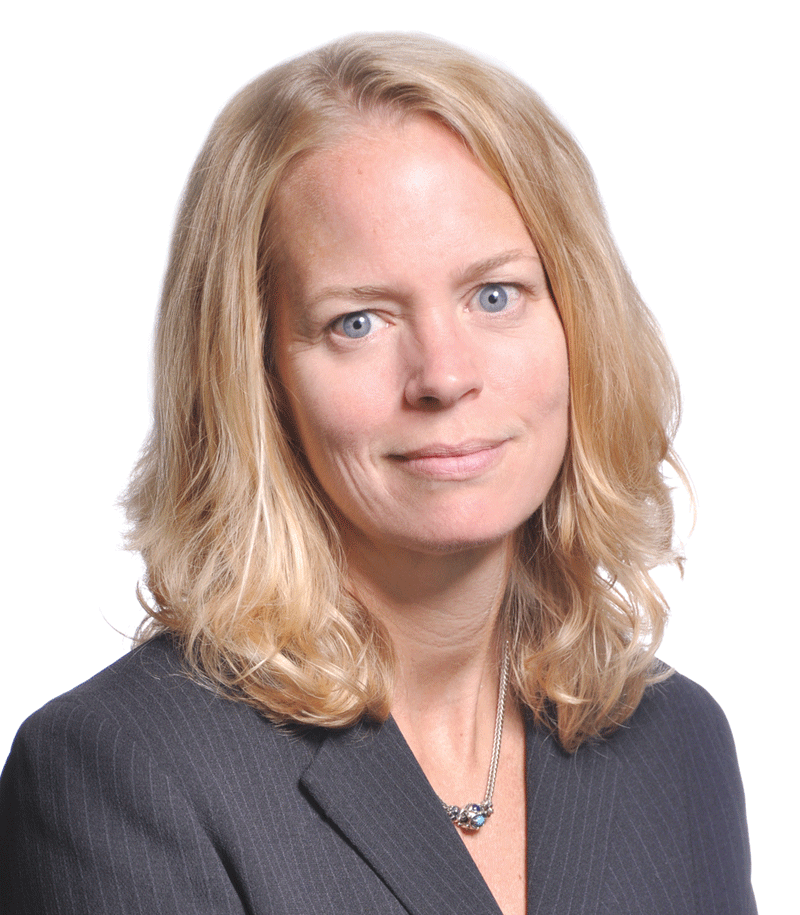
Departments

The following building permits were issued during the month of September 2010.

AGAWAM

Shoemaker Self-Storage
444 Shoemaker Lane
$150,000 — Construction of a new storage facility building

CHICOPEE

Leclerc Properties
603 Grattan St.
$12,000 — New siding

GREENFIELD

Fenwick, LLP
111 Hope St.
$3,500 — Installation of six replacement windows

Girl’s Club of Greenfield, MA
35 Pierce St.
$4,000 — Installation of a kitchen hood

Greenfield Corporate Center, LL
101 Munson St.
$12,000 — Installation of interior partitions

Greenfield Farmer’s Cooperative Exchange
275 High St.
$7,000 — Installation of a metal roof

Northeast Biodiesel Company, LLC
Silvio O Conte Dr.
$75,000 — Foundation for a new industrial building

HADLEY

Pyramid Mall of Hadley, LLC
367 Russell St.
$2,200 — Replace ceiling

Vertical Assets, LLC
165 Russell St.
$902,000 — Pre-engineered metal building and finishes

HOLYOKE

Cabot Mill Realty, LLC
102 Cabot St.
$99,000 — Construction of new offices

Open Square Properties, LLC
110 Lyman St.
$54,000 — Enclose walls at salon and spa

Valley Opportunity Council
300 High St.
$401,000 — Facade renovations

Yvon Laduc
52 Main St.
$33,000 — Install new roof

LUDLOW

Verizon
131 Winsor St.
$133,000 — Alterations

NORTHAMPTON

Blue Sky Real Estate, LLC
269 Main St.
$1,400 — Ceiling repair

Clarke School for the Deaf
45 Round Hill Road
$3,800 — Install electronic security door in egress hallway

Joseph Edward Welch
264 Elm St.
$3,800 — Renovate two rooms in a dentist’s office

Paul E. Brown
1 Market St.
$5,000 — Non-structural interior renovations

PALMER

Robert J. Larose
543-545 Wilbraham St.
$25,000 — Construct addition for new office space

SOUTH HADLEY

Second Baptist Church
589 Granby Road
$2,000 — Renovation

SOUTHWICK

College Associates Inc.
800 College Highway
$300,000 — Construction of a new wing with sleep room

SPRINGFIELD

1350 Main St., LLC
1350 Main St.
$26,500 — Reconfigure office layout on the 11th floor
City of Springfield
1395 Allen St.
$206,000 — Exterior renovations

Springfield College
263 Alden St.
$193,000 — New roof

Titeflex Corporation
603 Hendee St.
$1,489,000 — Construct new offices and restrooms

WESTFIELD

Governor’s Nursing Home
66 Broad St.
$60,000 — Re-roof

Little River Crossing
93 S. Maple St.
$3,400 — Minor renovations

WEST SPRINGFIELD

ATC Audio
89 Myron St.
$22,000 — Re-roof

H&P Realty
246 Main St.
$20,000 — Re-roof

United Bank
95 Elm St.
$15,000 — Renovate 720 square feet of space

Wingate Healthcare
42 Prospect Ave.
$925,000 — Renovate 8,254 square feet of existing nursing home

Departments

The following building permits were issued during the month of September 2010.

AGAWAM

Shoemaker Self-Storage
444 Shoemaker Lane
$150,000 — Construction of a new storage facility building

CHICOPEE

Leclerc Properties
603 Grattan St.
$12,000 — New siding

GREENFIELD

Fenwick, LLP
111 Hope St.
$3,500 — Installation of six replacement windows

Girl’s Club of Greenfield, MA
35 Pierce St.
$4,000 — Installation of a kitchen hood

Greenfield Corporate Center, LL
101 Munson St.
$12,000 — Installation of interior partitions

Greenfield Farmer’s Cooperative Exchange
275 High St.
$7,000 — Installation of a metal roof

Northeast Biodiesel Company, LLC
Silvio O Conte Dr.
$75,000 — Foundation for a new industrial building

HADLEY

Pyramid Mall of Hadley, LLC
367 Russell St.
$2,200 — Replace ceiling

Vertical Assets, LLC
165 Russell St.
$902,000 — Pre-engineered metal building and finishes

HOLYOKE

Cabot Mill Realty, LLC
102 Cabot St.
$99,000 — Construction of new offices

Open Square Properties, LLC
110 Lyman St.
$54,000 — Enclose walls at salon and spa

Valley Opportunity Council
300 High St.
$401,000 — Facade renovations

Yvon Laduc
52 Main St.
$33,000 — Install new roof

LUDLOW

Verizon
131 Winsor St.
$133,000 — Alterations

NORTHAMPTON

Blue Sky Real Estate, LLC
269 Main St.
$1,400 — Ceiling repair


Clarke School for the Deaf
45 Round Hill Road
$3,800 — Install electronic security door in egress hallway

Joseph Edward Welch
264 Elm St.
$3,800 — Renovate two rooms in a dentist’s office

Paul E. Brown
1 Market St.
$5,000 — Non-structural interior renovations

PALMER

Robert J. Larose
543-545 Wilbraham St.
$25,000 — Construct addition for new office space

SOUTH HADLEY

Second Baptist Church
589 Granby Road
$2,000 — Renovation

SOUTHWICK

College Associates Inc.
800 College Highway
$300,000 — Construction of a new wing with sleep room

SPRINGFIELD

1350 Main St., LLC
1350 Main St.
$26,500 — Reconfigure office layout on the 11th floor
City of Springfield
1395 Allen St.
$206,000 — Exterior renovations

Springfield College
263 Alden St.
$193,000 — New roof

Titeflex Corporation
603 Hendee St.
$1,489,000 — Construct new offices and restrooms

WESTFIELD

Governor’s Nursing Home
66 Broad St.
$60,000 — Re-roof

Little River Crossing
93 S. Maple St.
$3,400 — Minor renovations

WEST SPRINGFIELD

ATC Audio
89 Myron St.
$22,000 — Re-roof

H&P Realty
246 Main St.
$20,000 — Re-roof

United Bank
95 Elm St.
$15,000 — Renovate 720 square feet of space

Wingate Healthcare
42 Prospect Ave.
$925,000 — Renovate 8,254 square feet of existing nursing home

Departments

The following business incorporations were recorded in Hampden, Hampshire, and Franklin counties and are the latest available. They are listed by community.

BELCHERTOWN

Kac’s Corp., 67 Russell Ave., Belchertown, MA 01007. Katherine Currier, 67 Dressel Ave., Belchertwon, MA 01007. Travel writing.

BRIMFIELD

M.K. Fuel Inc., 4 Sturbridge Route 20 and Route 19. Brimfield, MA 01010. Anwar Afrede, 286 Middle Haddam Road, Portland, CT 06480. Gas station and convenience store.

CHICOPEE

Mick Euclid Corp., 27 Washington St., Chicopee, MA 01020. Michael Methe, same. Transportation services.

Szlachetka Dubay, P.C. 10 Center St., Suite 200, Chicopee, MA 01013. Stanley Szlachetka, 66 Airport Hill Lane, West Springfield, MA 01089. General law practice.

DEERFIELD

S.R. Marketing Services Inc., 81 Old Main St., Deerfield, MA 01342. William Moncrief, 2310 Central Ave., North Wildwood, N.J. 08260. Marketing and promotional services.

FEEDING HILLS

Organic Change Inc., 368 North St., Feeding Hills, MA 01030. Josephine Ann Smith, 346 Rowley St., Agawam, MA 01001. Non-profit organization established exclusively for educational purposes.

FLORENCE

Michael Kayne’s Family Restaurant, LTD, 176 Pine St., Florence, MA 01062. Kerry Ann Avezzie, 32 Berkshire Ave, Southwick, MA 01077. Family restaurant.

HOLYOKE

Ken’s Auto Sales Inc., 921 Main St., Holyoke, MA 01040. Michael Cashman, 36 Indian Ridge Road, Westfield, MA 01085. Auto sales.

LENOX

Pilson Communications Inc., 25-B Main St., Lenox, MA 01240. Neal Pilson, same. Consultation services.

NORTHAMPTON

Pioneer Ecovalley Inc., 42 Day Ave., Northampton, MA 01060. Danielle McKahn, same. Organization established to promote environmental sustainability in the Pioneer Valley region.


Primary Care Foundation Inc., 378 Pleasant St., Northampton, MA 01060. Joyce Miga, same. Primary health care private practice.

SPRINGFIELD

Ianello & Brittain, P.C., 55 State St., Suite 201, Springfield, MA 01103. Richard Ianello, 17 Woodside Dr., Longmeadow, MA 01106. Law practice.

Osaka Japanese Hibachi Steak House Inc., 1380 Boston Road, Springfield, MA 01119. Wai Tin Cheng, same. Restaurant.

Project Progress Inc., 137 Barre St., Springfield, MA 01119. Nadhir Abdul-Wadud, same. Non-profit youth mentoring organization.

Samson Pharmaceuticals Inc., 52 Mulberry St., Springfield, MA 01105. Sherman Fein, 224 Longmeadow, St., Longmeadow, MA 01106. Pharmaceuticals.

Shephard Security Corp., 191 Chestnut St., Suite 2C, Springfield, MA 01103. Dennis Cote, 55 Dearborn St., East Longmeadow, MA 01028. Commercial security.

Sr. Williams Resource and Development Center Inc., 132 Florence St., Springfield, MA 01105. Steven Williams Sr., 141 Florence St., Springfield, MA 01105. Non-profit organization for the purpose of making distributions to organizations that qualify as tax- exempt organizations.

St. Germain Investment Management Inc., 1500 Main St., Springfield, MA 01115. Michael Matty, same. Investment management services.

St. Germain Securities Inc., 1500 Main St., Springfield, MA 01115. Michael Matty, same. Broker-dealer transactions.

WEST SPRINGFIELD

Sun Air Transport Inc., 57 Amherst St., West Springfield, MA 01089. Sergey Poddubchak, same. Transportation services.

The Car Spa of Western Massachusetts Inc., 115 Stevens St., Springfield, MA 01104. Michael Freedman, 71 Woodsley Road, Longmeadow, MA 01101. Cleaning and detailing of motor vehicles.

The Leather Guy, 149 Bolton St., Springfield, MA 01119. Carlos Arce, same. Automotive finish restoration services.

Sections Supplements
Adult Education Takes a Different Dimension at the University Without Walls

Cindy Supois

Cindy Supois, former director, now senior lecturer

Now celebrating 40 years in operation, the University Without Walls program at UMass Amherst continues a long tradition of empowering non-traditional students to earn that degree they’ve been coveting but unable to complete because life has gotten in the way. UWW, as it’s called, enables people to take their work and life experiences and translate them into college credits. It’s a unique program that has helped script thousands of success stories over the years.

Deb Savola said that, when she entered University Without Walls as a full-time parent, she started off with only 14 credits, and it didn’t seem like she would ever finish her degree.
“I figured I might graduate right around the time I started collecting Social Security,” she joked.
Savola said that, when she graduated from high school “some time ago,” she went straight to college. But working full-time didn’t give her the time to devote to an education. “I always figured that at some point I would kick it back up, but life goes on, and I hadn’t gotten there,” she said.
Her story is one that is entirely familiar to the staff and faculty of UMass Amherst’s division of adult education known as UWW. Started back in 1971, the program began as a means for people with lives on the move — with family constraints and job requirements — to not only have the ability to get their bachelor’s degree without disrupting their non-academic lives, but also to have that work experience transformed into credits toward their degree.
Cindy Suopis is one of the senior faculty members at the UWW, and is also the former director. She explained to BusinessWest what makes this program so much different than any other.
“First off, we are one of the only undergraduate programs to focus on adult students,” she explained, with an age range that spans 20-somethings on up. “The UWW is a degree-completion program, so people who started a bachelor’s degree at some time, at some place, be it at an associate college or at a school where they never finished, can pick up where they left off.”
Instead of majors, UWW offers concentrations, which, Supois said, run the gamut from journalism studies to business organizational leadership, “and just about anything in between.”
What makes UWW stand out is the focused one-on-one attention with advisors, so that students can find exactly what it is that they wish to study, and how their educational experience, and their life, can inform the concentration for their degree.
“Unlike a traditional major, saying you need to take this lockstep route,” Suopis explained, “we bring in the student’s experience. And often that’s work or volunteer experience. We are sanctioned by our faculty senate to give credits for that type of learning. It allows students to see a light at the end of the tunnel when they can receive anywhere from one to 30 credits for their experience. That’s pretty significant, and can replace several courses.”
A lot has happened in the four decades of UWW’s existence. But not so much that the core mission of the program has been altered. The biggest change has come in all classes taking place online, and Suopis said this initially caused a stir with some of the earliest supporters and administrators.
Sitting down with BusinessWest at the start of a new school year, Suopis described how the program reaching 40 years old has been able to keep up with both the times and the changing face of adult education.

Moving On … Line
Suopis started her affiliation with UWW as a program manager at MassMutual, bringing the academic classes to that workplace, something that was common in the days before the online classroom.
“That’s what the UWW has always done,” she explained. “We see a need in a specific place, and a capacity to make it sustainable, bringing the classroom to the marketplace.”
But five years ago, she said, the seismic shift of classroom geography began.
More and more classes were being offered online, and even students within the Amherst town limits opted for that format. “There was a time when we would offer a live class and an online class, and we’d sit back and say, ‘which one is going to fill up first?’ — it was always the online one. Even with locals, they would tell us, ‘my life is too busy. I’d like to take a live class, but really, the online format is much better for me,’” she said.
And thus UWW went online, and Suopis said the decision was a sound concept for the students, but also for the business model of the program. “As a result,” she said, “we can serve many more students in a much broader reach. When you’re delivering something live, you have some constraints. You have to have a classroom, you need people. Online, it’s much different. Classes can be bigger.”
But, she stressed, the core mission of providing one-on-one advising for students is one facet that will not change regardless of a student learning in a classroom or a living room.
“There’s a lot of bad press out there about the for-profits of the online education world, but we do not want to be categorized in that manner,” she emphasized. “We had to really think about how we wanted to deliver this type of education, and these types of goals, to students, and hopefully more students than we ever had before, in an online format.
“So we had to learn how to teach online,” she continued, “and we did have to learn how to teach differently. Pedagogically, we made changes, but also emotionally as well. Technologically, we’ve also learned some new skills as faculty members. And the outcome has been tremendous.”
What started out with 30-odd students has grown to approximately 550 students every semester, and in many different concentrations. Business-themed coursework is the most popular these days, she said, with early-childhood education and health and human services as respective second and third.
“Those are our so-called bread-and-butter programs,” said Suopis, “but if you look at our last graduating class, you’ll see any number of other things as well, from journalism arts, criminal science, construction management, and environmental studies.”

Telling Tales out of School
Bruce Michaels was one of those students from MassMutual who felt that finishing his bachelor’s degree wasn’t a practical reality.
After completing an associate’s degree at a community college, he went on to become certified to teach helicopter flight lessons. He entered the corporate world and knew that he wanted to get that bachelor’s, but “something always came up,” he said. “Getting married, or having a big project at work. I just never found the time to finish the degree, or have the consistency to finish.”
He went to an education fair at his workplace and met Suopis, who told him about UWW. He said that from the very first moment he was introduced to the program, he knew it was a home run.
“In my head I was thinking that this was a great opportunity to get credits based on what I did in the past, and get a jump start on my BA,” he said. “Finally, universities are starting to see the value in the workforce, and what they have done, and are giving credit for that. Someone going into college from high school doesn’t have that life resource.”
Savola was another MassMutual employee recommending co-workers to the UWW program at her workplace when Suopis asked her one day, “when are you going to sign up?”
The wife of a college professor, Savola and her husband were home-schooling their children and she told herself that, when her last child went to college, she too would take the steps to finish her degree.
“But I had a conversation with my family,” Savola remembered, “and I thought I’d go through the first semester where you write your portfolio to figure out how many credits you’ll get. I got so into it, and so excited about the opportunities and the many interesting ways to get credit. I saw it as something very doable, and my family was committed to it, knowing how much I’d always wanted to get a degree. So I jumped in and didn’t look back.”
Despite receiving a smaller credit load than she may have hoped for, Savola was undaunted by the prospect of someday graduating. “If I kept looking at that number of credits I needed for graduation,” she said, “I don’t think I could have done it. You don’t climb a mountain by looking at how far you have to go, but by one step at a time.”
Savola said that the possibility of finishing a college degree is a reality that anyone entering UWW can face, and she gives great credit to the faculty and staff there. But, at the end of the day, it is the possibility to realize one’s own personal goals that will carry them to the finish line.
“When I started this program,” Savola said, “my husband was my greatest cheerleader, and he said he was going to help me through it, knowing that I’d wanted it for so long. I was about a year and a half into it when he died of a massive heart attack.
“I was determined to stay in the program no matter how long it took,” she continued. “My dad died a year later, from pancreatic cancer, and I was helping my mom during that time. But I got this degree through the worst five years of my life. And as I look back, I think, where there’s a will there’s a way. We shouldn’t let things in our life discourage us from reaching for our goals.”
At her graduation day at the university football stadium, with thousands of fellow students and alumni, Savola said the enormity of the situation came clear to her. Standing there with her son, himself an alumni of UMass, she said, “It made me realize how much a part of something I was. If I can do it, I think anyone can.”
But she quickly added, it’s not just about finishing, and graduating. “I think if we look at our education as just getting a degree, that’s tunnel vision, and you miss out on the enriching aspects of it.”

The Secret Is Out
With the online class venue the most recognizable new development of UWW, Suopis said that new marketing techniques have been employed over the last few years to cast some light on what she called “one of the best-kept secrets in the Pioneer Valley.”
Successfully doing such outreach, the enrollment numbers are at an all-time high. But managed growth is of paramount importance to a program with such an individualized component.
“We do not want to have hundreds of thousands of students, to be a diploma mill,” she stated emphatically. “Remember, our model is one-on-one advising. If we became formulaic, if all our courses were templates, we wouldn’t be able to carry on that way. That’s not in our history, it’s not what we want to do, and it’s not what we will do.”
Alumni like Michaels and Savola0 have the highest praise for their experience, and strongly encourage anyone who finds themselves without a bachelor’s degree to consider the UWW.
“When I graduated from high school, everyone needed that diploma to move on into the world,” Savola said. “Nowadays, it’s the bachelor’s that is the minimum education required.”
Asked if one could ever be too old to finish their undergraduate career, she laughed and said, “I don’t think that’s an issue at all. When I was in school, one of my classmates told me that his mom was one of the first people in the program, and she did it in her 70s.”

Departments

The following business incorporations were recorded in Hampden, Hampshire, and Franklin counties and are the latest available. They are listed by community.

BELCHERTOWN

Kac’s Corp., 67 Russell Ave., Belchertown, MA 01007. Katherine Currier, 67 Dressel Ave., Belchertwon, MA 01007. Travel writing.

BRIMFIELD

M.K. Fuel Inc., 4 Sturbridge Route 20 and Route 19. Brimfield, MA 01010. Anwar Afrede, 286 Middle Haddam Road, Portland, CT 06480. Gas station and convenience store.

CHICOPEE

Mick Euclid Corp., 27 Washington St., Chicopee, MA 01020. Michael Methe, same. Transportation services.

Szlachetka Dubay, P.C. 10 Center St., Suite 200, Chicopee, MA 01013. Stanley Szlachetka, 66 Airport Hill Lane, West Springfield, MA 01089. General law practice.

DEERFIELD

S.R. Marketing Services Inc., 81 Old Main St., Deerfield, MA 01342. William Moncrief, 2310 Central Ave., North Wildwood, N.J. 08260. Marketing and promotional services.

FEEDING HILLS

Organic Change Inc., 368 North St., Feeding Hills, MA 01030. Josephine Ann Smith, 346 Rowley St., Agawam, MA 01001. Non-profit organization established exclusively for educational purposes.

FLORENCE

Michael Kayne’s Family Restaurant, LTD, 176 Pine St., Florence, MA 01062. Kerry Ann Avezzie, 32 Berkshire Ave, Southwick, MA 01077. Family restaurant.

HOLYOKE

Ken’s Auto Sales Inc., 921 Main St., Holyoke, MA 01040. Michael Cashman, 36 Indian Ridge Road, Westfield, MA 01085. Auto sales.

LENOX

Pilson Communications Inc., 25-B Main St., Lenox, MA 01240. Neal Pilson, same. Consultation services.

NORTHAMPTON

Pioneer Ecovalley Inc., 42 Day Ave., Northampton, MA 01060. Danielle McKahn, same. Organization established to promote environmental sustainability in the Pioneer Valley region.

Primary Care Foundation Inc., 378 Pleasant St., Northampton, MA 01060. Joyce Miga, same. Primary health care private practice.

SPRINGFIELD

Ianello & Brittain, P.C., 55 State St., Suite 201, Springfield, MA 01103. Richard Ianello, 17 Woodside Dr., Longmeadow, MA 01106. Law practice.

Osaka Japanese Hibachi Steak House Inc., 1380 Boston Road, Springfield, MA 01119. Wai Tin Cheng, same. Restaurant.

Project Progress Inc., 137 Barre St., Springfield, MA 01119. Nadhir Abdul-Wadud, same. Non-profit youth mentoring organization.

Samson Pharmaceuticals Inc., 52 Mulberry St., Springfield, MA 01105. Sherman Fein, 224 Longmeadow, St., Longmeadow, MA 01106. Pharmaceuticals.

Shephard Security Corp., 191 Chestnut St., Suite 2C, Springfield, MA 01103. Dennis Cote, 55 Dearborn St., East Longmeadow, MA 01028. Commercial security.

Sr. Williams Resource and Development Center Inc., 132 Florence St., Springfield, MA 01105. Steven Williams Sr., 141 Florence St., Springfield, MA 01105. Non-profit organization for the purpose of making distributions to organizations that qualify as tax- exempt organizations.

St. Germain Investment Management Inc., 1500 Main St., Springfield, MA 01115. Michael Matty, same. Investment management services.

St. Germain Securities Inc., 1500 Main St., Springfield, MA 01115. Michael Matty, same. Broker-dealer transactions.

WEST SPRINGFIELD

Sun Air Transport Inc., 57 Amherst St., West Springfield, MA 01089. Sergey Poddubchak, same. Transportation services.

The Car Spa of Western Massachusetts Inc., 115 Stevens St., Springfield, MA 01104. Michael Freedman, 71 Woodsley Road, Longmeadow, MA 01101. Cleaning and detailing of motor vehicles.

The Leather Guy, 149 Bolton St., Springfield, MA 01119. Carlos Arce, same. Automotive finish restoration services.

Sections Supplements
Tech High Project Is a Complex — and ‘Green’ — Undertaking
An architect’s rendering of the new data center

An architect’s rendering of the new data center, which will incorporate the façade of the old Springfield landmark.

The recently initiated work to build a data center at the site of the former Technical High School in Springfield is unique in that the façade of the 105-year-old building will be incorporated into the design of the $110 million facility. But beyond this challenging assignment, the project will incorporate a number of energy-efficient systems that will make it truly state of the art. Thus, this is a project that brings the past, present, and future together in one bold initiative.

Transforming the old Springfield Technical High School into a new and secure data center to house the state’s electronic records and serve as the backup for its primary data center is a complex construction and engineering feat.
A tremendous amount of planning has gone into the design of the new facility. It involves erecting a state-of-the-art 149,000-square-foot, energy-efficient building that will be connected to the front and side sections of the school’s historic façade. But the result will be something that not only serves a critical need; it will also put Springfield on the map.
“When it is complete, it will be one of the most energy-efficient buildings of its kind in the world,” said Kevin Flanigan, deputy director for the Mass. Office of Finance and Administration Division of Capital Asset Management. “It is a challenging project that involves a great deal of coordination and quality control due to its complexity.”
Although other data centers are being built across the nation, preserving the front of an old building and three window bays on its sides that measure about 30 feet in length, then incorporating them into a new building design is highly unusual, said Henry Cence, the on-site project manager for Skanska USA Building Inc., which was awarded the contract and has made data centers a specialty.
“It is something you don’t see very often,” he explained as he stood near the school, where water was being sprayed out from an upper-story window to keep the dust down.
Flanigan says the $110 million project is a major investment the Commonwealth has made to revitalize the State Street corridor. “It represents a critical component of our overall effort to bring new life to this part of Springfield,” he said. “This is a highly anticipated project for the city that will also fill an important need.”
The construction will take two years to complete and is expected to create about 200 full-time jobs in addition to 35 information technology positions that will be filled after the project is finished.
“In addition to the economic benefit and revitalization, this will address the state’s need for a highly secure facility that will provide a critical backup for systems used by state workers who need immediate access to information to carry out their jobs,” said Flanigan.
The offices in the building will be housed against the existing brick façade, while the computer rooms and computer systems will be contained within the modern, new two-story structure.
For this issue, BusinessWest gives readers an inside look at what it will take to preserve the exterior of the old brick school and attach it to a building that will become a model for green construction.

School of Thought
Ethel Macleod is the senior associate of architecture for TRO Jung Brannen, and project manager for the data center. She said the exterior of the old high school sits in the historic Quadrangle/Mattoon Street district, but the land behind it, where the new building will be constructed, does not. After several meetings with both state officials and Springfield Historic District members, they agreed that the new construction could take place as long as the front of the old school and sections of both sides were preserved, she explained.
“It was a real challenge to incorporate the old façade with the new addition, which needed to be distinct and not replicate what is already there,” Macleod noted, adding that the design had to include a fence to meet security specifications. “Our original plan had to be modified to preserve the historic character of the exterior.”
The final plan calls for a steel fence that will resemble wrought iron to reflect the neighborhood’s character.
The windows also had to considered. “We removed them, but have taken care to save them so the manufacturer will be able to match the sizes and create identical windows that are energy-efficient replicas of the old ones,” said TRO Jung Brannen Principal Sandy Smith.
Part of the building was demolished several years ago to make room for the new federal courthouse. But removing the remainder of the building is no easy task, and cannot be done without a great deal of preparation.
Steve Eustis, senior vice president of Skanska USA Building, explained that a temporary steel skeleton must be built to provide support for the existing façade. “Structural steel will be anchored to the footings at the front of the building near the sidewalk on Elliot Street during the first phase of the project. Once the skeleton is installed, it will support the new masonry work that needs to be done on the inside of the façade,” Eustis said.
The next step will be the demolition of most of the building, followed by excavation of a new foundation that will be larger and deeper than the old one. The remainder of the old foundation will be filled in, and the temporary skeleton will remain in place until a permanent steel skeleton is put up and the roof is finished. In order to maintain authenticity, however, the old bricks will be salvaged and reused to infill the basement windows that line the front of the façade.
Smith said the new building will have aluminum-framed glass curtains of walls in the building’s two glass stair towers, as well as at the front entrance to the lobby. The remainder of the building will be made up of terra cotta panels clipped to a substrate.
The preliminary underground infrastructure work will begin this fall, and the project is expected to reach completion in the summer of 2012. The facility will operate 24 hours a day, seven days a week, and will contain many sophisticated systems that will provide backups to the primary systems, so operations can continue even if electricity or water power is lost.

Down to a Science
Since data centers consume a tremendous amount of energy, Smith said the goal of the design process for the Springfield Project was to create a structure that would serve as a showcase for green technology.
“Many strategies were incorporated that are sustainable and energy efficient,” she said, adding that when the building is complete, the state plans to seek a USGBC Leadership in Energy and Environmental Design (LEED) gold certification.
“The design included selecting materials that are energy and water efficient and will sustain the environment in the building,” said Smith. “There are a number of ways to achieve this, but among the more unique is daylight harvesting, which will be done using sensors in the lighting system. When there is enough daylight, the lights will go off. Plus, 90% of the occupants will have daylight views.”
Stormwater will also be collected and used in the cooling towers. “Another strategy that is very innovative is the heating, ventilation, and air-conditioning system, which will allow us to take advantage of free cooling in the spring and fall; we are using very energy-efficient plumbing fixtures and also reducing the heat-island effect, which occurs when surfaces soak up sun and become too hot,” Smith said. This will be accomplished by installing a white, reflective roof and reflective paving in the parking lot, sidewalks, and driveways.
The fact that the computer systems will run continuously creates a challenge, because they generate a lot of heat, she continued. “Computer equipment is very sensitive to heat so there is a tremendous need to generate cooling to keep the center at the appropriate temperature, along with the problem of what to do with the waste heat,” Macleod said. “Some systems expel it, but ours will capture it and reuse it, which is part of our HVAC strategy.”
Energy star equipment and servers will be installed in the computer areas, and the designers are working with Western Mass. Electric Company to maximize utility rebates. “They are helping to identify energy-efficient equipment, which allows us to install more than we would without the program. We are optimistic that the project will benefit greatly from the rebates,” Flanigan said.
Energy-saving measures are also being taken during the construction process. “We are diverting waste from the demolition and construction activity and will recycle 75% of all the waste,” Smith explained. In addition, designers are using carpet, ceramic, acoustical tiles and other products from companies within a 500-mile radius to reduce transportation costs.
Eustis said Skanska has done several billion dollars worth of work on data centers throughout the world, including one that is almost finished in Utah.
“The information age is exploding and creating a tremendous demand for data centers in both the public and private sector,” he said. “Businesses are much more dependent on information sharing. But this design is among the most efficient you will find anywhere with today’s technology.”
It will also stand as an intriguing example of how architects and construction firms can work together to create new history in an old building and change the face of a neighborhood with environmentally friendly measures.

Features
The Springfield Public Forum at 75

Springfield Public Forum 2010

Springfield Public Forum 2010

Launched in 1935 as a pilot program designed to further the education of adults unable to attend college at the height of the Great Depression, the Springfield Public Forum is today one of the oldest lecture series in the country and perhaps the only one that remain free to the public. The list of speakers who have come to Springfield includes hundreds of luminaries, ranging from future presidential contenders Richard Nixon and Hubert Humphrey to Doonesbury creator Gary Trudeau. Through the years, the forum has remained true to its mission while also changing and evolving to remain relevant, reach audiences of all ages, and be a force in the cultural life of the region

Patricia Canavan says those round-number anniversaries, such as the 75th now being marked by the Springfield Public Forum, are much more than occasions for blowing out candles on a cake and marking the passage of time.
Indeed, these are occasions — historically better than other anniversary numbers, such as 74, 76, 49, or 51 — for efforts to draw attention to an organization and remind the public of its value to the community. “And, even more importantly, it’s a time for introspection, for looking at what’s being done and for ways to do it better,” said Canavan, executive director of the forum, noting that those involved with this Western Mass. institution are taking full advantage of this anniversary to do all that and more.
In other words, she said, the 75th will be an occasion to underscore one of the forum’s more effective marketing slogans: ‘Old, but New Every Year.’
Dave Martel, a partner with the Springfield-based law firm Doherty, Wallace, Pillsbury, and Murphy, and a board member for nearly half the forum’s existence, agreed. He told BusinessWest that this year’s forum series, to begin Sept. 21 with a talk from Supreme Court Justice Stephen Breyer, is both a celebration of the institution’s contributions to the community and testimony to how the forum continues to carry out its mission to educate and engage area residents.
He said the 75th anniversary season, while in many ways no different than other years, does, because it is a milestone, present a good opportunity for everything from enlisting additional support from the business community, which underwrites the lectures, to building up an endowment that will someday lessen the forum’s reliance on fund-raising.
“We want to use that endowment to fund one lecture each year, which will put less emphasis on having to find sponsors for each talk,” said Martel, adding that the attention garnered by the 75th anniversary celebration will provide a real boost for those efforts.
Canavan, now in her fourth year at the helm of the forum, said the organization, one of the oldest lecture series in the country and perhaps the only one that remains free to the public, continues to evolve. She used that term first in reference to the fact that the staff, which has grown to four part-time employees, is now paid. But she also utilized it to describe efforts with everything from choosing speakers that will appeal to today’s tech-savvy young people to taking learning opportunities well beyond the one hour of a speaker’s address.
These and other measures are part of a broad strategic planning initiative launched in 2007 and, in many ways, inspired by the diamond anniversary, said Canavan, noting that, overall, the plan’s goal is simply to extend the forum’s reach and enable it to touch more lives.
“We needed to define where we were going and look into the future and decide what we wanted to be,” she said of the strategic initiative. “We are committed to the fact that we are education organization, and while the lectures play a huge part in this, we decided that because we’re bringing such a wealth of resources, people, to a community, to just let them speak for one night and have that be it, is in many ways a waste.”
For this issue, BusinessWest, on the occasion of the forum’s 75th anniversary, takes a broad look at how the lecture series continues to evolve and find new and different ways to remain true to its original mission.

Learning Experience
As she talked about the 75th anniversary and anticipation of it, Canavan said that one more thing the milestone inspired was research into the forum’s creation, history, and legacy. Much of the work was carried out by an intern, and it was quite eye opening, she noted.
Among other things, it revealed that the forum began in 1935 as a three-year project sponsored by the American Association for Adult Education in New York City, which ran similar programs across the country. The first series featured 40 programs over eight weeks, and functioned as a short college course with guest lecturers on related topics, said Canavan, noting that, at the time (the height of the Great Depression), many adults simply did not have the wherewithal to pursue college degrees, and the forum served as a means for continuing their education.
The lectures, which drew nearly 50,000 people that first season, were intentionally historical in nature for the first few years, she continued, but changed at the request of the audience to address topical issues. By openly addressing contemporary problems, the forum series became a driving force in the cultural life in Springfield.
Over the years, luminaries from politics, literature, science, sports, the media and other fields have appeared at Symphony Hall. The list of speakers includes Henry Kissinger, Robert Moses, Maya Angelou, Issac Asimov, Zbigniew Brzeziniski, Alex Haley, Art Linkletter, Gary Trudeau, and Red Auerbach. In 1952, Senators Richard Nixon and Hubert Humphrey, who would square off against each other in the 1968 presidential election, both spoke at the forum.
Then, as now, the commitment has been to “great speakers, great discourse,” said Martel, and this is a tradition being continued with the 75th anniversary lineup, which presents testimony to the many ways in which the forum remains true to its mission, but also continues that evolutionary process and strives to reach larger and more diverse audiences.
The roster of speakers reflects how those who are assembling the lineup are striving for diversity in terms of subject matter, as well as a focus on current events and efforts to grow attendance by bringing more families and young people to Symphony Hall, he continued.
Breyer, just the second Supreme Court justice to take part in the forum (William O. Douglas was the other), appears as both a jurist — speaking on current issues, including the recent appointment of the court’s latest member, Elena Kagan — and as author of several books, including Active Liberty and Through the Eyes of a Judge.
Breyer’s visit will be followed by what Canavan calls one of the forum’s “family friendly” lectures, featuring Mars Rover lead scientist Steven Squyres, on Oct. 24. This will be a multi-media presentation that will include up-to-the-minute news and footage from the Mars Rovers Spirit and Opportunity, as well as information about NASA’s future plans. The lecture, which is the culminating event in a month-long series of programming involving science and technology (more on that later) will be preceded by a small student discussion group with Squyres and demonstrations by student robotics groups.
Squyres’ appearance typifies efforts in recent years on the part of forum administrators and board members to reach out to younger people, said Canavan, noting that recent lineups, crafted with the same goal in mind, have included marine archeologist Robert Ballard, whose team located the Titanic, Jean Michel Cousteau, son of the late explorer, oceanographer, and filmmaker Jacques Cousteau and president of the Ocean Futures Society, and others involved in the sciences.
Inclusion of speakers with messages that will appeal to younger audiences is a key part of that broad initiative, but it is only one component.
“One of our big goals for this season is to really resonate with people of my generation or younger,” said Canavan, 41, noting that one of the strategies for doing this is making full use of the rapidly advancing information technology and social media outlets embraced by younger generations. “We have updated and upgraded our Web site, we have a very active FaceBook page and an electronic newsletter.
“But that’s just one part of the equation,” she continued. “Another piece is resonating with movers and shakers within the younger crowd. “I’ve reached out to people who can say to their group or sphere of influence, ‘hey, look at this … this is something great, a real asset to our community.”

Talking the Talk
The rest of the lineup for this fall reflects efforts on the forum’s part to be topical while also engaging audiences, said Canavan.
On Oct. 28, Kavita Ramdas, senior advisor to and former president and CEO of the Global Fund for Women, will give a talk focusing on the challenges and opportunities presented by globalization, with a look at the role of social entrepreneurship on improving health, education, and economic security in developing countries.
Meanwhile, urban revitalization will the focus of a talk by Newark, N.J. Mayor Cory Booker, whose innovative strategies are producing solid results for that community. Booker will share his multi-faceted approach to economic development, community building, education and housing reform, and promotion of arts and culture. The season will conclude with a town-hall-style moderated conversation with new analysts and commentators Mark Shields and David Brooks, as they appear on PBS’s Newshour. They will provide insight into current events, including the mid-term elections, the economy, national, and international affairs.
In many ways, the 2010 season and its lineup of speakers reflects initiatives included in that strategic planning process, completed two years ago, that spurred several new initiatives.
Among them is something called the City Thinks Program, undertaken in conjunction with the Springfield Public Library and funded by a number of groups, especially the American International College Honors Program. City Thinks takes one of the forum lecture topics and develops three weeks of programming around it, offered in a number of venues.
This season, the Squyres lecture was chosen, said Canavan, adding that programming will include book-discussion groups, movie and documentary screenings, a student video contest (with a special prize donated by PeoplesBank), “Family Fun Day” at the Springfield Museums, and more.
“The goal is to give as many as possible the opportunity to learn more about this topic,” she explained, noting that this year’s topic is called “The Final Frontier: Space, Science, and Technology. “We want to provide as many avenues as possible for people to engage and learn more.”
Other component of the strategic initiative involves efforts to expand outreach to area schools, community centers, and other facilities to provide resources for additional learning, she continued. These endeavors include small-group discussions with forum speakers prior to their talks at Symphony Hall. One such talk two years ago, involving presidential historian Michael Beschloss involved 25 students in Springfield Public Schools.
“It was a terrific program … these students were prepped, they came with great questions,” said Canavan. “This was a great way for them to build upon what they were learning in the classroom.
“We’re finding that with these educational outreach activities and the partnerships we’re building with different educational and cultural organizations that we’re able to reach more people,” she continued. “And that’s something we’re really excited about.”

In Conclusion
Canavan told BusinessWest that some special marketing initiatives have been undertaken for this 75th season of lectures, including a new logo and related materials. There are some other things planned that would be considered extraordinary, and there may well be a cake included in the mix somewhere.
But forum administrators and board members want to do much more this year than simply celebrate a milestone, a diamond anniversary. They want to take full advantage of this opportunity to not only mark some history, but generate some awareness and momentum so that much more history can be written, and a tradition can not only continue, but expand and thrive.
If they can succeed with all that, then there will be really something to celebrate.

George O’Brien can be reached at [email protected]