Home Posts tagged Technology (Page 11)
Banking and Financial Services Sections

Not Business as Usual

PeoplesBank’s new Northampton branch

PeoplesBank’s new Northampton branch models some of the latest innovations, from ‘green’ construction to two-way video in the drive-up lanes to iPad stations.

When innovations like online and mobile banking began to emerge, banking leaders pondered how they would impact the role of brick-and-mortar branches. Specifically, would customers simply have no need to stop by? The answer to that question, at least so far, has been a resounding no. However, that doesn’t mean branches should stop evolving, say area bank executives who have seen their institutions alter customer interaction in ways both big and small, aiming to provide a more high-tech, yet still highly personalized, experience.

When customers engage the drive-up tellers at PeoplesBank in Northampton, they’re communicating via a video screen. That in itself may not be innovative, but the bank is intrigued by what it could eventually lead to.

“We still have drive-up like a traditional bank, but we have two-way video,” said Stacy Sutton, senior vice president, retail administration. “It’s almost a stepping stone for a future technology — a remote teller. This would be the first step in that process. The customer is getting the personal touch by seeing a teller, but the teller is not necessarily there — they could be back at corporate headquarters in Holyoke, but serving customers here.”

Matthew Bannister, the bank’s vice president, corporate responsibility, compared the idea to how the NFL runs instant replay from one location in New York, with referees from multiple cities around the country communicating with that site.

“It would allow us to have longer branch hours and, from a staffing point of view, more tellers without having to spread them around the area,” he noted.

That’s just one way the bank is looking to the future, discussing concepts and testing out ideas in its customer innovation lab, ideas that may someday be instituted in the branches.

“Technology is always changing, and we’ve got to stay at the forefront of that,” Sutton said. “Of course, not everything we throw against the wall is going to stick or be the best thing for customers or the bank.”

In recent years, questions have arisen in the banking industry about the need for new branches, given the emergence of online and mobile services for customers. But the way PeoplesBank and others see it, branches may be evolving in how they’re designed and what the customer experience is like, but they’re not going away.

“Every customer survey we do says that branches are important to the customer,” Sutton said. “They feel that the brick-and-mortar presence is important. And we do find that they like to come in and see people, have that conversation. That’s why we’re making these offices more inviting places they’ll want to come and stay.”

For example, newer PeoplesBank branches have eliminated teller lines in favor of smaller teller ‘pods’ for a more personal touch. In addition, a quick look around the Northampton branch on King Street — the bank’s newest — reveals refreshment and coffee stands and iPad stations for customers to use, drawing on the facility’s Wi-Fi.

Berkshire Bank

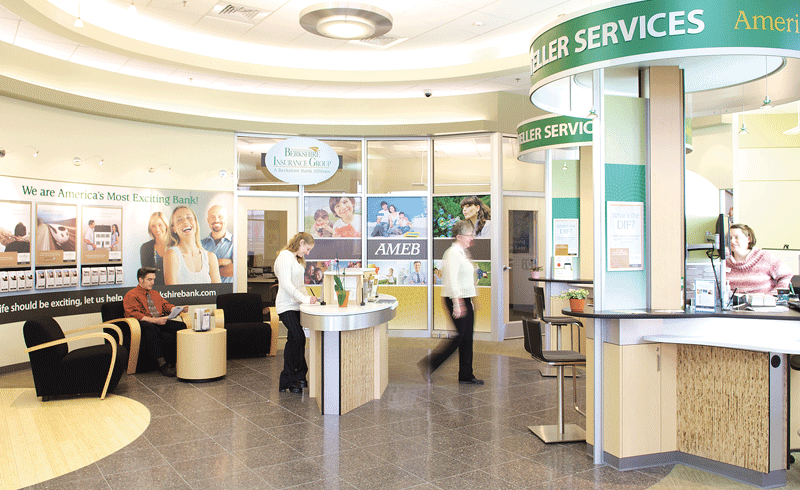
Berkshire Bank has adopted many modern branch-design elements, including teller pods to eliminate counters and lines.

Berkshire Bank has incorporated similar changes in its new branches, said Tami Gunsch, executive vice president, retail banking.

“We’ve enhanced our branch design over the past five years; the new design includes smaller square footage, which allows for a more-personalized experience, greater site-selection opportunities, and overall lower operating costs,” she noted, adding that kiosk-like pods allow customers and tellers to interact quickly without the physical barrier of a teller line. Also like at PeoplesBank, Berkshire customers take advantage of in-branch cafés for coffee and refreshments.

“We have seen the needs of our customers change, with the desire to bank when and where it is convenient for them,” Gunsch noted, explaining why it’s important to make branches more inviting spaces. “Customers want to take advantage of multiple channels to do their banking inclusive of online, mobile, ATM, and branch visits. Meeting their needs is an important component in driving the relationship.”

Checks and Balance

When Connecticut-based Farmington Bank moved into the Western Mass. market, it incorporated some of the same trends adopted by PeoplesBank and Berkshire Bank, including open floor plans and replacing counters and lines with personal bankers serving customers at pods. Its first two offices in the region opened in the fall in West Springfield and East Longmeadow.


Click HERE to view a PDF listing of Banks in Western Mass.


Ken Burns, executive vice president at Farmington, said it was important to get the branch design right because physical locations are critical to a bank’s growth, particularly one new to a region.

“We find that well over 80% of our customers believe branch location in proximity to their house or their work is important for them,” he told BusinessWest. “It’s well-documented that it is very difficult to compete and grow through a geographic area and get new accounts — unless you’re a national competitor with a huge marketing budget — without some sort of physical location, some physical proximity to where your customers are. A lot of statistics drive that; it’s not just a guess.”

That said, Sutton noted, the customer experience is changing as the industry moves to online banking, mobile banking, mobile check deposit, Apply Pay, and other innovations, and those factors are influencing branch design — for example, with the iPad stations.

“We wanted to do something different, and we did a lot of research and looked at a lot of national companies; Apple was one of them,” she said. “We went to the West Coast to see what they’re doing; we took ideas from everyone and have tried to incorporate them into PeoplesBank. We want to be innovative, to introduce new technology to customers, make it inviting to them; we want them to come visit PeoplesBank.”

One shift that has more to do with training than technology is the concept of ‘universal bankers,’ who are able to help customers with a range of tasks, from deposits to loan applications, as opposed to the traditional model, which separates those roles.

“Any one of the employees can help with anything; it doesn’t matter who the customer sees here,” Sutton said, noting that the new Northampton branch is modeling the idea, and other concepts, that will eventually move to other locations. “We hope to take elements of this building and incorporate them in other buildings, such as teller pods, two-way video, anything we see coming down the pike in the future. That is the plan.”

Berkshire Bank has begun to adopt the universal-banker model as well, Gunsch said, emphasizing the need for 21st-century branches to be both high-tech and high-touch.

“The new branch design has evolved to leverage new technology to enhance the customer’s experience in conjunction with our shift to staffing our branches with more universal-banker roles who can address any needs a customer may have, versus needing to deal with multiple team members,” she noted. “This maximizes teamwork through an efficient floor plan.”

Another shift in branch design is actually one being incorporated in myriad types of business — going ‘green’ to maximize energy efficiency and minimize environmental impact. In recent years, PeoplesBank has opened three offices certified by the national LEED (Leadership in Energy and Environmental Design) program.

Indoor and outdoor LEED elements at the King Street location include large windows allowing plenty of natural light, an energy-efficient HVAC system, carpeting and paint products that emit low levels of VOCs (volatile organic compounds), drought-resistant plantings, a rain garden directing water runoff back into the ground as opposed to drainage systems, and, car-charging stations free to anyone.

In addition, the bank built on an existing site instead of clearing trees from a new property, recycled 98% of all materials from demolishing the existing building, and brought in new building materials from within 500 miles. Other banks in the region have also targeted existing sites for new branches, such as Farmington Bank, which revitalized a landmark building in West Springfield once occupied by the West Springfield Trust Co.

Stacy Sutton

Stacy Sutton says PeoplesBank’s customer innovation lab is always discussing ways to improve the customer experience.

For Peoples, the LEED efforts are part of its well-known environmentally conscious culture. “That’s a core value of PeoplesBank — to be sustainable and eco-friendly,” Sutton said. “It’s great for staff and customers who come into the building.”

She expects other banks to make similar efforts as time goes on, if only because building codes are moving toward green design as a baseline.

“We’ve had positive response to doing these offices,” she added. “I’m sure we’ll continue to ramp up, and we’ll see other people incorporate aspects of this type of building going forward.”

Earning and Learning

Finally, Sutton noted, some branch-design elements are aimed simply at making a bank a community meeting place of sorts. Moveable furniture in the Northampton branch allows the staff to conduct customer-education seminars on anything from first-time homebuying to financial strategies to, yes, environmental topics.

Similarly, Berkshire Bank has incorporated community rooms in many branch locations, available to be used for anything from PTA meetings to birthday parties to Little League sign-ups. “The community room is equipped with Wi-Fi, a large presentation monitor, a conference phone, and the newest gaming systems, all at no cost to the group,” Gunsch said. “This has been a differentiator in our local markets.”

It’s all part of efforts to get people into the branches, she noted.

“Customers have shifted away from being solely reliant on the branch to conducting their banking online. However, the majority of customers still visit a branch location at least monthly,” she told BusinessWest. “Person-to-person interaction remains important to the customer and the financial institution. We believe the branch still matters; we just needed to redefine the branch experience.”

Joseph Bednar can be reached at [email protected]

Banking and Financial Services Sections

FAQs About EMVs

By SIENNA KOSSMAN

The nationwide shift to EMV is well underway.

EMV — which stands for Europay, MasterCard, and Visa — is a global standard for cards equipped with computer chips and the technology used to authenticate chip-card transactions. In the wake of numerous large-scale data breaches and increasing rates of counterfeit card fraud, U.S. card issuers are migrating to this new technology to protect consumers and reduce the costs of fraud.

“These new and improved cards are being deployed to improve payment security, making it more difficult for fraudsters to successfully counterfeit cards,” said Julie Conroy, research director for retail banking at Aite Group, a financial industry research company. “It’s an important step forward.”

For merchants and financial institutions, the switch to EMV means adding new in-store technology and internal processing systems and complying with new liability rules. For consumers, it means activating new cards and learning new payment processes. Most of all, it means greater protection against fraud.

ThinkstockPhotosCreditCardChipHere are some frequently asked questions to help explain the changes.

Why Are EMV Cards a More Secure Option?

That small, metallic square you see on new cards is a computer chip, and it’s what sets apart the new generation of cards.

The magnetic stripes on traditional credit and debit cards store contain unchanging data. Whoever accesses that data gains the sensitive card and cardholder information necessary to make purchases. That makes traditional cards prime targets for counterfeiters, who convert stolen card data to cash.

“If someone copies a magnetic stripe, they can easily replicate that data over and over again because it doesn’t change,” said Dave Witts, president of U.S. payment systems for Creditcall, a payment gateway and EMV software developer.

Unlike magnetic-stripe cards, every time an EMV card is used for payment, the card chip creates a unique transaction code that cannot be used again. If a hacker stole the chip information from one specific point of sale, typical card duplication would never work “because the stolen transaction number created in that instance wouldn’t be usable again and the card would just get denied,” Witts explained.

EMV technology will not prevent data breaches from occurring, but it will make it much harder for criminals to successfully profit from what they steal. Experts hope it will help significantly reduce fraud in the U.S., which has doubled in the past seven years as criminals have shied away from countries that already have transitioned to EMV cards, Conroy said. “The introduction of dynamic data is what makes EMV cards so effective at bringing down counterfeit card rates in other countries.”

How Do I Use an EMV Card?

Just like magnetic-stripe cards, EMV cards are processed for payment in two steps: card reading and transaction verification. However, with EMV cards, you no longer have to master a quick, fluid card swipe in the right direction. Chip cards are read in a different way.

“Instead of going to a register and swiping your card, you are going to do what is called ‘card dipping’ instead, which means inserting your card into a terminal slot and waiting for it to process,” Conroy said.

When an EMV card is dipped, data flows between the card chip and the issuing financial institution to verify the card’s legitimacy and create the unique transaction data. This process isn’t as quick as a magnetic-stripe swipe.

“It will take a tiny bit longer for that transmission of data to happen,” Witts says. “If a person just sticks the card in and pulls it out, the transaction will likely be denied. A little bit of patience will be involved.”

Some EMV cards can also support contactless card reading, also known as near-field communication (NFC). Instead of dipping or swiping, NFC-equipped cards are tapped against a terminal scanner that can pick up the card data from the embedded computer chip.

Will I Still Have to Sign or Enter a PIN?

Yes and no. You will have to do one of those verification methods, but it depends on the verification method tied to your EMV card, not if your card is debit or credit.

Chip-and-PIN cards operate just like the checking-account debit card you have been using for years. Entering a PIN connects the payment terminal to the payment processor for real-time transaction verification and approval. However, many payment processors are not equipped with the technology needed to handle EMV chip-and-PIN credit transactions. So it is not likely you will have to memorize new PINs anytime soon, according to Conroy.

“There aren’t going to be many issuers requiring a PIN,” she said. “A vast majority will be issuing chip-and-signature cards, which aren’t all that different from how credit cards work now.”

As with a magnetic-stripe credit card, you sign on the point-of-sale terminal to take responsibility for the payment when making a chip-and-signature card transaction.

U.S. chip-and-PIN cards will be transitioned in slowly, according to Ferenczi. “The card production demand today is really based on chip-and-signature cards. It will probably take two to three years to fully convert to chip-and-PIN.”

Despite a slow transition overall, those who get chip-and-PIN cards will be able to use them right away. “If a terminal doesn’t have the ability to accept a PIN, it will then step down to accepting a signature,” said Randy Vanderhoof, executive director of the Smart Card Alliance. “There will always be a secondary option.”

If Fraud Occurs, Who Is Liable for the Costs?

Today, if an in-store transaction is conducted using a counterfeit, stolen, or otherwise compromised card, consumer losses from that transaction fall back on the payment processor or issuing bank, depending on the card’s terms and conditions.

Following an Oct. 1, 2015 deadline created by major U.S. credit card issuers MasterCard, Visa, Discover, and American Express, the liability for card-present fraud shifted to whichever party is the least EMV-compliant in a fraudulent transaction.

Consider the example of a financial institution that issues a chip card used at a merchant that has not changed its system to accept chip technology. This allows a counterfeit card to be successfully used. “The cost of the fraud will fall back on the merchant,” Ferenczi said.

The change is intended to help bring the entire payment industry on board with EMV by encouraging compliance to avoid liability costs.

Today, any parties not EMV-ready could face much higher costs in the event of a large data breach. Automated fuel dispensers will have until 2017 to make the shift to EMV. Until then, they will follow existing fraud liability rulings.

Is the Transition to EMV Technology Complete?

Not exactly. Although the deadline was strong encouragement for all payment-processing parties to become EMV-compliant as soon as possible, not everyone has made the transition yet.

“It’s going to take a little time to adapt,” said Doug Johnson, vice president of risk management policy for the American Bankers Assoc.

EMV debit cards in particular are rolling out at a slower pace. While 90% of financial institutions began issuing EMV debit cards in 2015, only 25% of U.S. debit cards (about 71 million cards) were expected to be chip-equipped by the end of 2015. The percentage of EMV debit cards in consumers’ hands is expected to reach 73% by the end of 2016 and 96% by the end of 2017.

So far, the large majority of chip cards going into the hands of cardholders are coming from larger issuers like Bank of America and Chase, according to the Federal Reserve Bank of Chicago. The cost of this EMV transition is causing smaller banks to convert their cards more slowly.

EMV debit cards may be issued at an even slower pace as banks have to prep their software to accept those new cards as well, according to Ferenczi.

“Different companies will have different rollout strategies,” Johnson said. Some will base their actions on card expiration dates; others will work to get chip cards into consumers’ hands as soon as possible.

Can I Use My Card at a Retailer That Doesn’t Support EMV Yet?

Yes. The first round of EMV cards — many of which are in consumers’ hands — will be equipped with both chip and magnetic-stripe functions so consumer spending is not disrupted and merchants can adjust. If you find yourself at a point-of-sale terminal and are not sure whether to dip or swipe your card, have no fear. The terminal will walk you through the process.

“For example, if you enter a card into the chip reader slot but the reader isn’t activated yet, it will come up with an error and you’ll be prompted to swipe the card in order to use it,” Vanderhoof said.

And vice-versa. “If a consumer tries to swipe a chip card instead of inserting it, an error will appear, and they will be prompted to insert the card for chip processing instead,” Vanderhoof said.

If chip-card readers are not in place at a merchant at all, your EMV card can be read with a swipe, just like a traditional magnetic-stripe card. “You can still conduct transactions, you just lose that extra level of chip security,” Johnson said.

Many large retailers, such as Walmart, Target and Costco, have upgraded their POS terminals and are activating them for chip-card acceptance, but smaller businesses may be lagging when it comes to upgrading their payment technology.

Will I Be Able to Use My EMV Card Outside the U.S.?

Yes and no. The U.S. is the last major market still using the magnetic-stripe card system. Many European countries moved to EMV technology years ago to combat high fraud rates. That shift has left many U.S. consumers who have magnetic-stripe cards looking for other forms of payment when they travel.

Since many foreign merchants are wary of magnetic-stripe cards, consumers who hold some type of chip card may run into fewer issues than those without one, according to Ferenczi.

However, chip-and-PIN cards are the norm in most other countries that support EMV technology. So consumers with chip-and-signature cards may find some merchants who are unwilling or unable to process their card, even though it does have an embedded chip.

Still, despite any difficulties in the transition, Ferenczi says the change is a step in the right direction.

“Nobody likes to think that his or her card is being secretly used for other purposes,” he says. “So I think regardless, there is a level of comfort knowing that it will be far more difficult to counterfeit EMV cards.”

Sienna Kossman is a staff reporter for CreditCards.com. Copyright 2016, CreditCards.com, all rights reserved, reprinted with permission.

Landscape Design Sections

Painting Pictures with Light

Illumascape Lighting

Illumascape Lighting

When some people think of outdoor lighting, they may think of floodlights and porchlights — but many more options are available in the emerging world of architectural lighting, which accents the details of front and backyards, melding safety and security with atmosphere and aesthetics. Designing and installing these systems is both art and science, say experts in the field, who are always gratified by the ‘wow’ factor when homeowners flip the switch.

After 23 years as a graphic designer in the sign-making industry, Rob Larkham decided to design and install landscape lighting for a career — a job that requires long hours of manual outdoor labor.

“Everything we’re doing is by hand. It’s labor-intensive,” said the owner of Illumascape Lighting in South Hadley. “But at night, when we turn the switch on, it’s a rewarding moment.”

Larkham is actually the second owner of Illumascape. Phil Costello, who founded the business, was one of Larkham’s customers, and when he was nearing retirement, he approached the graphic designer, believing he would be a good choice to take over the landscape-lighting company. So Larkham came on board four years ago and took over the reins a couple years after that.

“He saw me as a hard worker with an artistic eye — because, what we do is paint pictures with light,” Larkham said of why the opportunity appealed to him. “If it weren’t for the artistic end of it, I wouldn’t have made the transition. You’re outside digging ditches all day, but then you get to the end of the day, when it’s dark, and you flip the switch and get that ‘wow’ moment.”

Landscape lighting, also known as architectural lighting, has long been popular in warmer climes, but in the Northeast, most homeowners have been satisfied with porchlights and maybe a floodlight out back. But, increasingly, they’re seeing the aesthetic value in the variety of techniques available from companies like Illumascape and numerous landscape-design firms.

As Larkham explained, landscape lighting is the permanent placement of lighting fixtures in the outdoor environment, with the aim of highlighting the form, texture and definition of landscape plantings as well as enhancing the architectural features of the home. In contrast to one or two floodlights, architectural lighting may utilize dozens of smaller, strategically placed fixtures to accent the details of a home and yard.

Rob Larkham

Rob Larkham says customers choose architectural lighting for both aesthetic and security reasons.

“It’s still really in its infancy here,” he told BusinessWest, adding that customers choose landscape lighting for two reasons: to add beauty to their property and for security. “A well-lit home is less likely to be broken into than the house next door. Plus, you’re more likely to slip on dark stairs and dark sidewalks.”

Gary Courchesne, owner of G&H Landscaping in Holyoke, said the emergence of energy-efficient LED diodes has made landscape lighting more popular, because people see the long-term value in what, admittedly, can be a hefty up-front investment.

He explained that a transformer installed in the yard converts the 120-volt household current to 12 volts, and the LED diodes reduce the energy drain even further. “From an energy standpoint, you’re getting the benefit of cost savings. That’s key for people.”

He and Larkham both noted how the fixtures are designed to direct each beam in a specific direction, with techniques ranging from uplighting and downlighting to path lighting and ground lighting.

“In other instances, we use well lights buried in the ground that give that upward lighting effect,” Courchesne explained. “You may have ornamental plants, which you want to show off and shed a little more light on.”

Added Larkham, “I just think people are seeing the value in it, whether it’s beauty, safety, security, or curb appeal. People are spending more time in their backyards. I really think the growth in this industry will be extensive.”

Professional Touch

The key to successful lighting, Courchesne said, is professional design. He noted that a flood of low-voltage lighting kits hit retail stores over the past decade, and many people bought them, were unsatisfied, and didn’t think about it again. That’s because they didn’t have a skilled designer and installer on their side.

“When people buy a big-box store kit, they’re compelled to use every light in it. But, in the instance of low-voltage lighting, less is more. You don’t want your sidewalk or shrubbery to look like a runway. You want it to highlight, accent, and provide adequate light for pedestrians and the security element.”

With homeowners in the Northeast investing more money in their properties in recent years, he went on, many are now becoming aware of professional landscape-lighting design, which is ubiquitous down South.

Larkham said customers run the gamut from contractors building a new house and including landscape lighting in the initial design to homeowners who have been in their homes 25 years or more and have an itch to do something new and dramatic with their outdoor space.


Go HERE to download a PDF chart of area landscape design firms


“Sometimes it’s a complete landscape remodel — a landscape architect may be doing the whole backyard and will call me and say, ‘hey, we’d really like to do landscape lighting in this remodel.’ That said, I’ve gone out and done simple installations of five path lights, and, on the other end, 200-light installs.”

In other words, although architectural lighting is a high-end product in the world of landscape architecture, there’s typically something for every budget. Larkham said he often works within someone’s budget for an initial installation, but might put in a larger transformer if a client expresses interest in adding to the design later. “Maybe they’ll do the front of the house this year, and the backyard next year.”

With a budget in hand, Larkham then draws on his artistic side. “That’s my job as a designer — I show up, meet with client first, figure out what they’re looking to do on their property, and come up with a design using the proper fixtures.”

small, strategically placed lights bring out the details

This Illumascape project demonstrates how small, strategically placed lights bring out the details of a house and yard.

For example, the same kind of tree could be lit using completely different techniques, depending on the yard.

“We’ll go out and do a lighting demonstration before we ever sign a contract, with about 100 demonstration lights, to show you what the final product might look like,” he said. “We don’t have clients come out until it gets dark so we have that ‘wow’ moment. More than nine times out of 10, they come out and say, ‘wow, we had no idea.’”

In many cases, he added, a customer’s neighbors may have architectural lighting, but when someone sees it on their own property, it’s a much more impactful experience.

“You have to look at the key elements of what people are trying to accent and highlight, then decide how to use the lights,” Courchesne said. “Some people want it on the front door to highlight a wreath, using it as a spotlight. In some cases, they want to flood the area with some light. But the whole key is subdued lighting, not offensive lighting.”

He told BusinessWest that the results are gratifying.

“Some of the comments I hear are, ‘can you believe my house now?’ I hear that time and time again. I would say 75% of the folks who buy landscape lighting, accent lighting, buy it for the aesthetic value. The other 25% also want it for the security value because lights deter a burglar; they’d rather go to a house that’s dark as opposed to a house that’s lit up.”

Left to Their Own Devices

As landscape lighting becomes more prominent in the Northeast, customers are accessing some high-tech features not previously available. Residential Lighting magazine noted that, while low-voltage LED lighting is the key industry driver these days, linking lighting systems to smartphone apps, to control them remotely, is also a hot trend.

Other systems are timed to come on automatically, Larkham said, so that, “in the winter months, when it’s dark when you pull into the driveway, the house is warm and inviting already. That’s nice. Floodlights tend to be Fenway Park bright; obviously, what we’re doing is soft and subtle. That’s really what we’re looking for.”

Gary Courchesne

Gary Courchesne says the goal of any landscape-lighting project is subdued, artistic light.

Courchesne also stressed the importance of subtlety in a lighting plan. He said today’s LEDs can bathe their target with a soft, warm, white glow, as opposed to the harsh blue light with which some people associate earlier LEDs.

“Not everyone can afford this,” he stressed. “It’s cost-effective from an operational perspective, but there’s capital investment involved for a quality system. Like anything else, you truly get what you pay for.”

Larkham added that, as time goes on and LEDs become more universal, costs should come down, and are already starting to creep in that direction, which is a good sign for homeowners who want to add a little artistry to their landscapes.

“It’s becoming more popular, it seems the technology is advancing every year, there are always new things happening,” he concluded.

In other words, the future is bright.

Joseph Bednar can be reached at [email protected]

Health Care Sections

Check Point

 By KATHLEEN MITCHELL

Maura McQueeney

Maura McQueeney says telemonitoring equipment is so compact, a nurse of yesteryear could have fit it in her briefcase.

Every morning at exactly 10 a.m., Barbara Kobak weighs herself, takes her blood pressure, attaches a clip to her finger that measures her oxygen-saturation rate, then answers a series of computerized questions specific to her condition, which are presented out of sequence from one day to the next to ensure she thinks carefully about her response.

Within two minutes, the results are transmitted electronically to a registered nurse at Porchlight Visiting Nurse Assoc./Home Care in Chicopee, who calls the 84-year-old if anything doesn’t fall within the parameters Kobak’s doctor set for her.

The service is called telemonitoring, and Porchlight brought the equipment to Kobak’s home in January after she was released from the hospital. She had been diagnosed with congestive heart failure, and after an initial meeting with a nurse liaison in the hospital, a registered nurse spent several days in her home making sure she understood how to use the technology.

Home visits were spaced farther apart as time went on, which is typical; the goal is to help the person learn to manage their disease by recognizing potentially dangerous symptoms, making changes in their diet, and taking all medications prescribed for them.

“The equipment is really easy to use; I depend on it and don’t know what I would do without it. It’s reassuring to have someone call me if my blood pressure is up,” she noted, adding that there have been days when her pressure has been high in the morning, but when she puts the cuff on later in the day, she is relieved to see it has returned to normal.

The Chicopee octogenarian is one of a growing number of people who are benefiting from telemonitoring services. The equipment is made by a variety of manufacturers, and it allows healthcare providers to keep a close watch on the patient from a remote setting.

“We call new patients every day until they become comfortable with the equipment,” said Sandra Peret, a registered nurse at Porchlight and associate director of intake/community service. “We tell patients to use it at the same time every day, but if they are not feeling well, they can recheck the values.”

Telemonitoring is typically used to treat people with congestive heart failure or chronic obstructive pulmonary disease (COPD), which can make it difficult to breathe, although an additional module can be added if the person is diabetic and doesn’t have another reliable method to measure their blood-sugar levels.

Experts say it is valuable because people who are newly released from the hospital can feel overwhelmed when they get home due to the trauma of their diagnosis, the amount of information presented to them, and the lifestyle changes they must make to keep their condition from exacerbating, which can lead to rehospitalization.

“These conditions require a lot of self-management and usually include dietary changes such as cutting down sodium intake,” said Melissa Pouliot, a registered nurse and Porchlight’s intake/telemonitoring manager, noting that telemonitoring helps the patient see a direct correlation between their behavior and their health. For example, if someone eats Chinese food, their weight is likely to rise the next day due to its high salt content.

When that happens, a registered nurse calls the patient and conducts an assessment by phone to determine if the doctor needs to be notified. In some cases, there is no need for alarm, while in other instances, the person’s physician may be called to see if medication changes are in order.

From left, Melissa Pouliot, Sandra Peret, and Kathleen Stezko

From left, Melissa Pouliot, Sandra Peret, and Kathleen Stezko say patients being telemonitored are given a finger clip that measures oxygen saturation.

However, patients sometimes don’t follow instructions given to them, which can have a direct effect on their vital signs. For example, they might fail to weigh themselves at the same time each day or wear heavy shoes or clothing while they are on the scale.

In any case, the patient is followed closely, and if the weight gain continues, the doctor is contacted. “The ultimate goal is keep the patient from having an acute attack,” said Sue Pickett, director of Mercy Home Care, adding that patients track their symptoms themselves on a calendar even though the results are stored in the computer.

“Telemonitoring is a wellness proactive measure that allows us to catch symptoms early before they exacerbate and become a crisis,” she told BusinessWest. “The reason why these programs are so important is because is because rehospitalization is very common for people with congestive heart failure. We have patients who have been in and out of the hospital every other week.”

Nuts and Bolts

Major advances have been made in telemonitoring equipment in recent years, said those we spoke with.

In the past, people needed a landline to transmit information remotely, but today Bluetooth, cellular, and satellite technology make it possible to provide the service whether or not the person has a phone in their home.

The equipment patients receive from the VNA or home-healthcare service usually includes a blood-pressure cuff, an oxygen sensor that is clipped onto a finger, and a scale, which is plugged into a monitor with a touchscreen that not only transmits the information, but stores it, although there are some variations according to the company producing the equipment.

Pouliot said people tap the screen on the monitor Porchlight uses, and when a voice asks them what they want to do, they hit the corresponding icon. When they are finished with their reporting, which takes less than 10 minutes, a voice on the monitor asks the patient a series of questions which can range from “has the doctor changed your  medications?” to “do you want someone to call you?” as well as reminders to take their medication.

However, these systems are not appropriate for some, including people with dementia or individuals with a disability who don’t have a caregiver.

“The person has to want to do this and be able and willing to use the equipment every morning,” said Sheryle Marceau, manager of clinical practice for Mercy Home Care.

The remote monitoring is combined with education that takes place during visits to the person’s home. Mercy’s patients are given printed materials with valuable information including symptoms that should not be ignored by people with congestive heart failure. They include unexpected or rapid weight gain; weakness or fatigue; dizziness or faintness; swelling of the legs, ankles, feet, or abdomen; more frequent visits to the bathroom at night; chest pain; and other signs.

“Exacerbation can be prevented, but people need to know what they can do every day, which includes reading food labels, taking their medication, and eating foods low in sodium,” Marceau said.

She added that hospital stays are usually short, so the staff doesn’t have time to teach the patient all they need to know. In addition to the goal of keeping them from returning to the hospital, they want patients to be able to maintain their quality of life and stay active in the community.

So, while the technology is important, it’s what people do with the information gleaned from daily readings that makes a difference.

“It helps patients connect the dots,” said Maura McQueeney, president of Baystate VNA and post-acute executive.

For example, if a patient has a big holiday dinner and their blood pressure and weight rise the next day, it will trigger a call from the nurse who will discuss what they have eaten and determine whether the doctor needs to be involved.

Medication is critical, but unless patients understand the importance of each drug prescribed for them and know exactly what it does, they may take it inconsistently or fail to get it refilled, particularly if they are on a fixed income.

“We try to update each patient’s medication list because the physician may make changes during an office visit, and monitoring allows us to see if the new medication is working,” McQueeney told BusinessWest.

Baystate typically uses telemonitoring for patients who have experienced heart failure. They usually keep the equipment 30 to 45 days or until the nurse feels the patient is capable of caring for himself or herself and has learned the association between symptoms that may indicate their disease is getting worse.

Insurance doesn’t pay for telemonitoring, but local visiting-nurse associations find it so valuable, they do not charge patients for the equipment or the service.

“It’s a tool that provides us with consistent information,” McQueeney said, adding that Baystate began tracking the effectiveness of telemonitoring in high-risk patients about 18 months ago and found their rates of rehospitalization are lower than the national average.

“If a patient calls at 8 p.m., we can have them slip on the blood-pressure cuff and the oxygen clip and get on the scale, which gives the nurse valuable information,” she noted.

In many cases, people have more than one chronic condition, which complicates matters, but a registered nurse has the ability to discern whether pain from a surgery or anxiety is likely the cause of shortness of breath, heart palpitations, or other complaints.

It takes a long time for most chronic diseases to become apparent, but there are points at which the disease progresses.

“Without monitoring, it can seem that the disease got worse overnight, but when a patient can chart their vital signs on a daily basis and know they are being watched by a registered nurse, trends can be identified that alert them to changes that require the doctor to become involved,” McQueeney told BusinessWest. “Telemonitoring is a tool that helps keep people out of the hospital. It involves education and a collaboration with the patient, the registered visiting nurse, and their physician.”

As a result, the service can make a critical difference in a person’s life.

The American Health Care Assoc. reports that the majority of people with chronic heart disease or COPD are elderly, and being readmitted to a hospital increases the risk of complications and infections during their stay as well as the likelihood that their functioning will be decreased when they return home. In addition, every hospitalization exacts an emotional toll on the patient and increases the cost of Medicare, since people are living longer and the incidence of chronic diseases has increased dramatically over the last three decades.

Weighing In

Before nurses discharge patients from home-based services, Marceau said, they make sure they have absorbed what they need to know and have a blood-pressure cuff and scale so they can continue to weigh themselves daily. “We have purchased scales for people who are unable to afford them and teach people when to call their doctors,” she noted.

However, Porchlight has found some patients or their families opt to pay for the telemonitoring service even when the person no longer needs it because it gives them peace of mind.

“It’s great for family members who are concerned about a loved one,” Pouliot said, adding that the service costs about $100 per month, and people on fixed incomes can apply for reduced rates.

Kathleen Stezko agrees. “People get nervous and aren’t sure who to call or whether they should call anyone if they don’t feel well. But telemonitoring provides them with reassurance; they know someone is checking on them each day and will get in touch with them and their physician if it is necessary,” said Porchlight’s vice president of clinical services, adding that people using the equipment can call at any time of the day or night if they have concerns.

Indeed, the peace of mind and patient learning that results from telemonitoring is so important that most VNAs and home-care agencies that use it keep adding more equipment, which helps patients and also ultimately reduces the cost of healthcare.

Kobak can attest to the comfort it provides. “When my friends visit and see this,” she said, “they are so impressed.”

Company Notebook Departments

Mercy, SPHS Welcome RiverBend Medical Group

SPRINGFIELD — Mercy Medical Center and the Sisters of Providence Health System (SPHS), members of Trinity Health – New England, have welcomed RiverBend Medical Group into their family of providers and network of services. This partnership positions Mercy, SPHS, and RiverBend to make significant strides in care delivery while continuing to focus on high quality, efficiency, access to services, and cost containment, said Dr. Scott Wolf, president of Mercy Medical Center. “The joining of these two clinically excellent and financially strong providers – one with expertise in the delivery of outpatient care and the other with expertise in inpatient care and related services – creates a strong clinically integrated network that will better meet the health care needs of the local community.” The plan is for RiverBend’s physicians, physician assistants, nurse practitioners, certified nurse midwives, and staff members to continue practicing at RiverBend’s current locations in Agawam, Chicopee, Springfield, Westfield, and Wilbraham. “We welcome the opportunity to partner with Mercy Medical Center because of our shared vision regarding patient care. We remain committed to treating each patient with dignity, compassion, and clinical excellence, and doing so in a manner that will have a positive impact on our community,” said Dr. Richard Shuman, president of RiverBend Medical Group. This new arrangement also strengthens the longstanding collaboration between Mercy Medical Center and RiverBend Medical Group on patient care and patient-experience improvement. Patients will benefit from enhanced services through Mercy’s continuum of care options that focus on the ‘triple aim’ of better health, better care, and lower costs for the patient population, Wolf said. In addition to his role as RiverBend president, Shuman has been named senior vice president of the Mercy Physician Network Organization (PNO). In this position, he will be responsible for strategic and operating plans for RiverBend Medical Group and the managed practices within the PNO. He will also focus on promoting the delivery of quality healthcare services, providing leadership for the effective management of medical resources and staff, and ensuing clinical quality management and improvement activities for RiverBend, the PNO, and Mercy Medical Center.

Website Lists the Fort as Bucket-list Restaurant

SPRINGFIELD — When onlyinyourstate.com, a popular website that lists top attractions in every state in the U.S., ranked its “14 Restaurants to Visit in Massachusetts Before You Die,” the Student Prince Café and Fort restaurant came in near the top of the list. The article cited “sublime German food,” the ambience of the dining room, and the restaurant’s noted collection of steins among the aspects that make the Fort a must-visit on any restaurant lover’s list. “It’s great to see a national media outlet highlight what locals have known forever,” said Managing Partner Andy Yee. “This is exactly why we all came together last year to make sure this Springfield institution survived. We hope this article will help a whole new crop of people discover the magic of our restaurant.”

Eric Carle Museum of Picture Book Art Named National Medal Finalist

AMHERST — The Institute of Museum and Library Services (IMLS) announced that the Eric Carle Museum of Picture Book Art is among 30 finalists for the 2016 National Medal for Museum and Library Service. The National Medal is the nation’s highest honor given to museums and libraries for service to the community. For 22 years, the award has celebrated institutions that demonstrate extraordinary and innovative approaches to public service to make a difference for individuals, families, and communities. This will mark the second year that the Carle has been recognized with this honor. “The 2016 National Medal finalists make lasting differences in their communities by serving and inspiring the public,” said Kathryn Matthew, director of IMLS. “We proudly recognize these museums and libraries for their invaluable work to provide citizens with educational resources, 21st-century skills, and opportunities for lifelong learning.” Added Christopher Milne, the Carle’s chairman of the board, “it is hard to believe what the Carle has achieved in just 13 years. The museum’s exhibitions are traveling to major museums in the U.S., while our literacy and art programs are reaching as far as Asia and the Middle East. It just proves that people of all ages and cultures are deeply moved by the artwork and stories of childhood.” The National Medal winners will be named later this spring.

Greenfield Cooperative Bank Partners with Raymond James

GREENFIELD — John Houston, managing director of the Raymond James Financial Institutions Division, announced that the advisors at GCB Financial Services, a division of Greenfield Cooperative Bank, will offer investment and wealth-management services to its clients through Raymond James Financial Services Inc., member FINRA/SIPC. GCB Financial Services includes program manager and financial advisor Michael Johnson and financial advisor Edward Zadworny. The team previously partnered with MML Investors Services for third-party support. “We chose Raymond James as our new partner because it provides its clients with superior research, technology, and planning tools,” said Michael Tucker, president and CEO of Greenfield Cooperative Bank and its parent company, Greenfield Bancorp, MHC. “The breadth of the resources and the type of support available to its financial advisors will allow us to provide more in-depth service to our clients and, ultimately, to help them better achieve their financial goals.” Johnson has more than 20 years of experience in the financial-services industry, having begun his career in 1995 with A.G. Edwards and moved to Greenfield in 2003. He is a graduate of UMass Amherst with a bachelor’s degree in economics. Zadworny has been in the financial industry since 1988, when he joined Prudential Insurance and Pruco Securities. In 2012, he moved to Greenfield, where he partnered with Johnson as part of the investment program at Greenfield Cooperative Bank. He earned a bachelor’s degree in business from Westfield State University.

Adam Quenneville Wins Award from Astec Roofing

SOUTH HADLEY — Adam Quenneville announced that his company, Adam Quenneville Roofing & Siding, was awarded the 2015 Astec Roofing New Dealer of the Year award, which is presented to a dealer who has completed the most work in the Northeast region, as well as had the highest customer satisfaction. In addition, Adam Quenneville Roofing & Siding was also named the number-one Astec dealer in the state of Massachusetts for 2015. “We here at Astec hold our dealers to the highest standards in providing our strict specifications on each and every job,” said Scott Transue, a sales representative at Astec. “Adam Quenneville Roofing & Siding has outperformed even our strict standards of professionalism.” Astec is a fluid-applied roofing solution which takes the same durable, protective, and energy-efficient principles the NASA space program uses. Its mission is to solve industrial problems, improve appearance, and save energy, while adding to the weathertight sustainability of roofs, walls, and industrial surfaces.

Agenda Departments

Management Conference

March 10: The Employers Assoc. of the NorthEast (EANE) announced its 12th annual Management Conference will be held at the Springfield Marriott, with a focus on driving business performance. The full-day conference will address how managers and supervisors can create a culture of alignment, agility, and engagement to improve organizational performance. The program will feature Bruce Tulgan, an expert on leadership and management. He is the bestselling author of It’s Okay to Be the Boss, Managing Generation X, and his newest book, Bridging the Soft Skills Gap. The conference also includes breakout sessions, a presentation on “Building a Leadership Culture of Innovation and Energy” with Rich Trombetta of Innovation Is Easy, and an improv workshop by ConnectAnd about connecting your leadership to your team. The cost for the program is $325 per person, with discounts for three or more. Register and learn more at eane.org/12th-annual-management-conference or call (877) 662-6444. The program will offer 6.75 credits from the HR Certification Institute. Sponsoring the program are Johnson and Hill Staffing and the Human Resource Certification Institute.


Springfield Falcons Dr. Seuss Night

March 12: The Springfield Falcons, in partnership with the Springfield Museums and Dr. Seuss Enterprises, announced Dr. Seuss Night, to be held during a game against the Portland Pirates starting at 7 p.m. Dr. Seuss Night and the game will be sponsored by Berkshire Bank. For the first time ever, Dr. Seuss Enterprises has partnered with the Falcons and the Springfield Museums in presenting this special night to honor Theodor Geisel, a.k.a. Dr. Seuss, who was born and raised in Springfield. The Springfield Museums are preparing to open the Amazing World of Dr. Seuss Museum in 2016, an exhibit featuring interactive activities for children and a one-of-a-kind experience that will provide a look at the man behind the drawing board. “We are excited to partner with the Springfield Museums and Dr. Seuss Enterprises in presenting this special night to honor one of Springfield’s most famous native sons,” Falcons President Sarah Pompea said. “We have been anticipating this night since the summer months and are excited to aid the launching of the new museum in support of a unique family entertainment night around a favorite children’s author.” The night will include appearances by the Cat in the Hat and Thing 1 and Thing 2 costumed characters. In addition, specialty jerseys will be worn by Falcons players and auctioned off, with proceeds donated to the Springfield Museums to help support the creation of the new museum. “We are thrilled that the Falcons are stepping up in support of our fund-raising campaign,” said Kay Simpson, president of the Springfield Museums. “It’s wonderful to have the support of one our best downtown neighbors.”


Difference Makers

March 31: The eighth annual Difference Makers award program, staged by BusinessWest, will be held at the Log Cabin Banquet & Meeting House. Tickets cost $60, and tables of 10 are available. To reserve a spot, call (413) 781-8600, ext. 10, or go HERE. Difference Makers is a program, launched in 2009, that recognizes groups and individuals that are, as the name suggests, making a difference in this region. This year’s class was profiled in the Jan. 25 issue, and their stories can also be read online at businesswest.com. They include Hampden County Sheriff Michael J. Ashe Jr.; Mike Balise, Balise Motor Sales, philanthropist (1965-2015); Big Brothers Big Sisters of Hampden, Hampshire, and Franklin counties; Bay Path University President Carol Leary; and John Robison, president, J.E. Robison Service. Difference Makers is sponsored by EMA Dental, First American Insurance Agency, Health New England, Meyers Brothers Kalicka, P.C., Northwestern Mutual, PeoplesBank, Royal LLP, and Sunshine Village.


‘Training for the Digital Marketplace’

April 1, 8, 15: Stevens 470 will host a three-week program called “Training for the Digital Marketplace: Develop Your Online and Offline Marketing Strategies” to show attendees how to maximize their marketing channels. This seminar is for business owners, marketing managers, entrepreneurs, and key marketing staff. As marketing channels continue to evolve, are you using them to maximize your business opportunities? This program covers the latest online and offline marketing channels including brand presentation, websites, SEO, advertising, social media, e-mail, and mobile technologies. During this hands-on program, participants will review their current messaging and marketing channels; learn the latest ways to use both traditional and new media channels; explore social media, online advertising, and search-engine optimization; outline plans for offline and online marketing campaigns; coordinate marketing channels to maximize their effectiveness; and determine methods for evaluating results. Each participant will complete the program by creating a specific plan for their online and offline channels that they can share and put into action with members of their business team. The program meets weekly on three consecutive Friday mornings at Stevens 470 in Westfield. Limited space is available. For details, visit stevens470.com or call (413) 568-2660.


‘A Night of Passion’ for Link to Libraries

April 5: They’re calling the event “A Night of Passion.” That’s a phrase that applies to both support for efforts to promote childhood literacy and a fondness for a particular food or beverage. These various passions will come together April 5 at the Log Cabin Banquet & Meeting House in Holyoke at Link to Libraries’ biennial fund-raising event. Proceeds from all ticket sales will go to Link to Libraries. More than 500 people are expected to attend the event, which will be a celebration of all that Link to Libraries has accomplished since it was created in 2008 — including the donation of nearly 500,000 books to area schools and organizations — and how it intends to continually expand its mission in the years to come. As for those passions for specific foods and drinks, they will be a focus of the night, provided by a host of area celebrities and business leaders, including Mike Mathis, MGM Springfield president and chief operating officer; Kevin Rhodes, Springfield Symphony Orchestra conductor; Spiros Hatiras, Holyoke Medical Center president and CEO; Delcie Bean IV, CEO of Paragus Strategic IT; Mick Corduff, executive chef and co-owner of the Log Cabin; Amy Royal, founding partner of Royal, P.C., and many more. As for their passions, well, those are carefully guarded secrets at this point. Those who would like to experience these passions and support Link to Libraries — which supplies books to schools and other organizations across Western Mass. and Northern Conn., and promotes read-alouds that put area business and civic leaders in area classrooms — can buy tickets for $40 each by sending checks to: Link to Libraries, Attn. Karen Blinderman, P.O. Box 958, West Springfield, MA 01090. All beverages are included in the ticket price. Food and beverages are donated by the Log Cabin. Sponsors for “A Night of Passion” include lead sponsors Health New England and Rediker Software, and event sponsors Bacon Wilson, Bank of America – U.S. Trust, the Frank Stanley Beveridge Foundation, the Irene E. & George A. Davis Foundation, James Vinick and Moors & Cabot Investments, Monson Savings Bank, PeoplesBank, Peoples United Bank, the Springfield Falcons, and United Bank.


Not Just Business as Usual

April 14: The Springfield Technical Community College (STCC) Foundation’s Not Just Business as Usual (NJBAU) event, a networking event for business leaders in Western Mass., will be held at the Naismith Memorial Basketball Hall of Fame. The event, now in its seventh year, is a celebration of innovative thinking giving participants the opportunity to learn from business experts while raising significant funding for the STCC WORKS scholarship program. A cocktail and networking reception will be held from 5:30 to 7 p.m., with dinner and keynote speakers to follow from 7 to 8:30 p.m. This year, NJBAU will host a discussion of diversity in the science, technology, engineering, and mathematics (STEM) fields with panelists Emily Reichert, CEO of Greentown Labs; Laurie Leshin, president of Worcester Polytechnic Institute; and Frank Robinson, vice president of Public Health and Community Relations for Baystate Health. Tickets and sponsorship opportunities are now available. Tickets are $175 each, and sponsorships begin at $2,500 for a table for 10. For additional information or to become a sponsor, contact Christina Tuohey, STCC’s director of Annual Giving and Alumni Relations, at (413) 755-4475 or [email protected]. To purchase tickets online, visit www.stcc.edu/njbau.


Walk of Champions

May 1: The community is invited to come together at the Quabbin Reservoir to mark the 11th annual Walk of Champions to benefit the Baystate Regional Cancer Program at Baystate Mary Lane Hospital in Ware. The Walk of Champions, founded in 2006 by John O’Neill, field-hockey coach at Quaboag Regional Middle High School, began as a tribute to the compassionate care and comfort his mother received during her struggle with cancer. Since then, the Walk of Champions has grown into a collection of teams and individuals each walking for their own reason. There are friends and family members celebrating victory over cancer. Others are encouraging their loved ones in their personal fight over cancer, while others walk in memory of those who have lost their battle with cancer. The walk is a one-mile loop that allows walkers to choose the number of miles they complete among the comfortable walking terrain of the Goodnough Dike. Along the way, walkers will enjoy entertainment and refreshments, along with the peace and beauty of the Quabbin Reservoir. Since its inception, the Walk of Champions has raised more than $662,000. All funds raised remain local to support those cared for in the Baystate Health Eastern Region at Baystate Medical Center’s Mary Lane Satellite Unit and for things such as family-support counseling, educational outreach, pastoral care, medications, state-of-the-art equipment, and the Healing Garden located in the courtyard of the hospital. Overlooking the Healing Garden is the oncology suite, which provides access to comprehensive cancer care, clinical trials, and a multi-disciplinary team approach to cancer care. Pledge forms, fund-raising resources, giving opportunities, and more are available at www.baystatehealth.org/woc for businesses, community organizations, and individuals who wish to participate.


40 Under Forty

June 16: The 10th annual 40 Under Forty award program, staged by BusinessWest, will be held at the Log Cabin Banquet & Meeting House in Holyoke, honoring 40 of the region’s rising stars under 40 years old. An independent panel of judges has chosen the winners, and their stories will be told in the April 18 issue. The event is sponsored by Northwestern Mutual and Paragus Strategic IT (presenting sponsors), EMA Dental, Health New England, Isenberg School of Management at UMass Amherst, Moriarty & Primack, and United Bank. More details on the gala will be revealed in upcoming issues.

Daily News

PITTSFIELD — The Feigenbaum Hall of Innovation, one of the most popular core exhibitions at the Berkshire Museum, will undergo a significant upgrade and reopen to the public on Saturday, April 16. The improvements and upgrades to the Hall of Innovation are supported by a grant from the Feigenbaum Foundation that has pledged $500,000 to the Berkshire Museum, to be used for a series of annual improvements over the next few years.

The Feigenbaum Foundation has made a commitment to “ensure the Feigenbaum Hall of Innovation at the museum is on the leading edge of exploring innovation in the Berkshires and beyond. This will require ongoing intellectual, financial, and physical resources to implement and maintain a high-level core experience for visitors in the Hall,” said Emil George, president of the Feigenbaum Foundation.

While the Feigenbaum Hall of Innovation will continue to feature the accomplishments of Berkshire innovators and the many ways they were able to change the world around them, visitors will experience several exciting new additions. The highly anticipated Mindball brain game will engage visitors of all ages. The only one of its kind in the state of Massachusetts available to the public, Mindball uses EEG biofeedback sensors to track the players’ alpha and theta brain waves sending the ball across the table and into their opponent’s goal.

In addition, the Museum’s brand-new interactive app, i-Innovate, provides a digital visitor experience, from opportunities to create and innovate right in the galleries to accessing expanded content and information. The video displays at each entrance to the Hall have been updated with new innovators, new ideas, and a fresh look. The Hall of Innovation will boast all-new interactive activities, original artwork, and new displays and objects from the museum’s permanent collection, as well as fresh paint and new carpet.

“I was fortunate to be part of the team that originally designed the Feigenbaum Hall of Innovation,” said Maria Mingalone, Berkshire Museum’s director of Curatorial Affairs and Collections. “After several years observing how the exhibition engages visitors to think creatively, we are excited to expand the audience experience through fresh new technology, with Mindball and the new i-Innovate app as centerpieces of this first upgrade. By modeling innovative thinking, we anticipate making ongoing improvements to keep the Hall of Innovation truly innovative, including the addition of new innovators and exhibit components in the coming years.”

Daily News

GREENFIELD — The 2016 Jury of Fellows from the American Institute of Architects (AIA) elevated 149 AIA members to its prestigious College of Fellows, an honor awarded to members who have made significant contributions to their profession.

Margo Jones, principal of Jones Whitsett Architects (formerly Margo Jones Architects), was nominated and elected to the College of Fellows in recognition of her leadership in the field and her service to the communities of Western Mass.

Jones, who holds a master’s degree in architecture from Massachusetts Institute of Technology, has practiced architecture in Greenfield for more than 30 years. As principal of her own design firm since 1984, she has designed numerous award-winning schools, public projects, and significant historic-preservation projects, including Sanderson Academy in Ashfield, several projects at the Bement School in Old Deerfield, renovations to the Ted Shawn Dance Theater at Jacob’s Pillow in Becket, and, most recently, the renovation of Colegrove Park Elementary School in North Adams, a project currently being considered for a Massachusetts Historic Commission Preservation Award.

Jones has also served on the board of directors of the National Council of Architectural Registration Boards, the Massachusetts Board of Registration of Architects, and the board of directors of the Western Mass. chapter of the American Institute of Architects.

Out of a total AIA membership of nearly 88,000, fewer than 3,200 members are distinguished with the honor of fellowship. Jones will be honored at an investiture ceremony at the AIA convention in Philadelphia in May.

Daily News

LEE — Lee Bank President and CEO Chuck Leach announced that Lee Bank and St. Germain Investment Management have entered into a strategic alliance called October Mountain Financial Advisors, by which St. Germain will provide investment-management and financial-planning services to Berkshire County clients from its new offices in Lee.

“Lee Bank is thrilled to offer a Berkshire County-focused wealth-management platform staffed with Berkshire residents who care deeply about their customers and community,” said Leach. “We’re extremely pleased to join forces with St. Germain Investment Management as we embark on this new endeavor. Furthermore, with our recently granted trust powers, we look forward to working closely with attorneys, CPAs, and our clients on trust and estate-planning matters right here in Berkshire County.

“We have long considered tackling the wealth-management space because it’s a natural extension of what we do extremely well — building strong relationships with our customers and community,” he added. “It is logical for us to be working with St. Germain given their deep bench of talented investment professionals, most of whom I have worked closely with in the past, and their commitment to remaining independent and committed to our same core values.”

Prior to being named president and CEO of Lee Bank last July, Leach served as senior vice president/managing director of wealth management and chief investment officer at Berkshire Bank Wealth Management. Previous positions include vice president/senior portfolio manager at TD Bank Wealth Management Group and vice president of the Gilder Technology Group and the Telecosm Fund.

According to Tim Suffish, senior vice president and head of equities at St. Germain Investment Management, “we place the highest value on client relationships and locally made investment decisions, whether it’s a family’s nest egg or a nonprofit’s endowment. We believe that October Mountain Financial Advisors is well-positioned to avoid the conflicts of interest, persistent fee increases, and key person risks inherent with most investment options available today. As a long-time resident of Pittsfield, I’m thrilled to bring our highly qualified team to the Berkshire community.”

Along with Suffish, October Mountain Financial Advisors’ principal team includes St. Germain Investment Management’s Michael Matty, president and director; Richard Bleser, vice president, portfolio manager; Matthew Farkas, vice president, portfolio manager; and Thaddeus Welch, portfolio manager.

October Mountain Financial Advisors is now open for business at the bank’s branch in Lee and at St. Germain’s offices in Springfield and Hartford, Conn. October Mountain’s permanent headquarters will be located at 103 West Park St., adjacent to Lee Bank, and is slated to open in the spring following renovations to the building.

Daily News

BOSTON — Gov. Charlie Baker and Lt. Gov. Karyn Polito announced $9.3 million in workforce skills equipment grants to 35 high schools, community colleges, and vocational training providers across the Commonwealth for vocational-technical education and training equipment purchases that connect Massachusetts students and residents to economic opportunities in high-demand industries.

“Workforce skills education and training plays an enormous role in economic and personal development by helping residents acquire the skills they need to connect with promising careers,” Baker said. “These vocational-technical education equipment grants will help build stronger communities and a more competitive business environment that ensures more residents have the skills they need to succeed in and support the Commonwealth’s economic future.”

Added Polito, “these workforce-development grants will build bridges between residents seeking careers to build a future on and the employers who need a skilled workforce to grow the state’s economy. Today, too many good-paying jobs are going unfilled because employers are struggling to find skilled employees. This investment in training equipment will enable high schools and community colleges across the Commonwealth to equip students with the skills they need to secure a bright future.”

The Workforce Skills Capital Grant Program is a new initiative of the Governor’s Workforce Skills Cabinet, which seeks to align education, workforce, and economic-development strategies across the state.

Western Mass. recipients of the new round of grants include:

• Berkshire Community College, Pittsfield, $465,119 to upgrade and modernize its manufacturing and engineering program, utilizing new hydraulics, pneumatics, electrical controls, materials testing, CNC, and 3-D printing equipment to train students and adult learners for careers in advanced manufacturing, engineering, and biotechnology;

• Dean Technical High School, Holyoke, $393,156 to transform its existing machine technology shop into an advanced-manufacturing shop that aligns with current industry practices and technologies, in order to connect Holyoke students to career opportunities in the Pioneer Valley’s skilled manufacturing workforce;

• Franklin County Technical School, Montague, $52,500 to revamp its computer programming and web-design programs and expand the programs’ capacity to reach adult learners;

• Lower Pioneer Valley Educational Collaborative, West Springfield, $257,100 to expand the capacity of its recently-founded high school Machine Technology Program, and to extend programming to adult learners, including unemployed and underemployed individuals facing barriers to employment;

• McCann Technical School, North Adams, $121,128 to revamp its welding and metal-fabrication equipment to train students for careers in Berkshire County’s aerospace, defense, commercial, medical-device, and power-generation industries, and enable re-training for unemployed workers;

• Roger L. Putnam Vocational Technical Academy, Springfield, $441,500 to launch a new program to equip students with the skills to enter the construction workforce, including training with heavy equipment; and

• Springfield Technical Community College, $499,785 to enhance training in its Laser Electro-Optics and Advanced Manufacturing Engineering Technology programs by creating an advanced-laser-machining laboratory and a one-year Laser Materials Processing Certificate of Completion, in order to meet the needs of the Commonwealth’s rapidly growing laser-manufacturing industry.

Daily News

AGAWAM — Howard Bruck has been named president and CEO of Farm Credit Financial Partners Inc. (FPI). With 30 years of experience in general business and financial services, Bruck was most recently chief information officer with Sterling National Bank in New York, responsible for information technology and banking operations.

“The breadth and depth of Howard’s business and technology experience and expertise will bolster our collective and individual efforts to better serve our customers and continue to evolve our organizations,” said Bob Bahl, chairman of the board. “His vision builds on FPI’s 21-year history of providing technology to the Farm Credit System.”

Bruck has an MBA in accounting from Fordham University and a bachelor’s degree in mathematics from Long Island University. He also served as an adjunct professor at Fordham University, teaching technology, information-management systems and security, and project and operations management for the past 10 years. He has also advised major corporations, investment managers, and technology providers in those areas.

“FPI has an impressive history of providing important technologies to the Farm Credit System for over 20 years,” Bruck said. “I am honored to have the opportunity to lead the organization as we embark into an exciting era of business-technology transformation. Realizing the opportunity to strengthen our products and services and support the business objectives of our customers will require us to be innovative, proficient, and competitive. A big part of my job will be to insure that we focus on creating and delivering great solutions and be recognized as thought leaders and valued partners.”

Daily News

AMHERST — CTI Energy Services, LLC, based in Amherst, was recently certified by the Department of Veterans Affairs as a Service Disabled Veteran Owned Small Business (SDVOSB). Craig Meadows, the firm’s CEO and certified energy manager, served in Vietnam, where he sustained his injuries.

For more than 35 years, Meadows has worked hands-on in the energy field. He has been regional vice president and U.S. general manager for international energy-service companies and has been a principal in his own energy-efficiency businesses. In 2009, he, Thomas Timmins, and several local investors teamed up to form CTI Energy Services, LLC, with an eye toward opportunities and future growth in the industry.

This SDVOSB designation opens the way for CTI to take advantage of further federal and state set-aside provisions. The SDVOSB certification expands the scope of CTI’s operations for energy savings and renewable-energy projects as well as more partnerships with national and international energy-services companies.

Since its founding, CTI has earned a reputation for successful management of energy-savings performance contracts (ESPCs), primarily with small to mid-size housing authorities in the Northeast, Mid-Atlantic, and Midwest. Two years ago, the company began working with private schools, not-for-profit human-service organizations, and government agencies to identify opportunities for improved energy efficiency, solar energy, and compliance with the federal and state mandates. CTI is on the Department of Energy’s qualified list of energy-services companies.

As one of only three SDVOSB companies in the DOE’s new ESPC ENABLE program, CTI received a Schedule 84 award from the General Services Administration. CTI’s steady growth now has the potential to take a giant leap forward.

“We may be a small company, but our vision has always been far-reaching,” Meadows said. “Our business is all about bringing together people, technology, financing and other resources to improve — and, in the process, to help make this a healthier planet for everyone.”

Daily News

GREENFIELD — John Houston, managing director of the Raymond James Financial Institutions Division, announced that the advisors at GCB Financial Services, a division of Greenfield Cooperative Bank, will offer investment and wealth-management services to its clients through Raymond James Financial Services Inc., member FINRA/SIPC.

GCB Financial Services includes program manager and financial advisor Michael Johnson and financial advisor Edward Zadworny. The team previously partnered with MML Investors Services for third-party support.

“We chose Raymond James as our new partner because it provides its clients with superior research, technology, and planning tools,” said Michael Tucker, president and CEO of Greenfield Cooperative Bank and its parent company, Greenfield Bancorp, MHC. “The breadth of the resources and the type of support available to its financial advisors will allow us to provide more in-depth service to our clients and, ultimately, to help them better achieve their financial goals.”

Added Houston, “we are pleased to welcome the professionals at GCB Financial Services to our Financial Institutions Division. Their decision to partner with us is further proof that Raymond James resources and support continue to attract expanding bank investment programs. We look forward to helping both Michael and Edward grow and expand their investment-services program, while supporting the client-first culture and values established by Greenfield Cooperative Bank.”

Johnson has more than 20 years of experience in the financial-services industry, having begun his career in 1995 with A.G. Edwards and moved to Greenfield in 2003. He is a graduate of UMass Amherst with a bachelor’s degree in economics.

Zadworny has been in the financial industry since 1988, when he joined Prudential Insurance and Pruco Securities. In 2012, he moved to Greenfield, where he partnered with Johnson as part of the investment program at Greenfield Cooperative Bank. He is a graduate of Westfield State University with a bachelor’s degree in business.

Community Spotlight Features

Community Spotlight

From left, Linda Leduc, John Rahkonen, and Charlie Blanchard

From left, Linda Leduc, John Rahkonen, and Charlie Blanchard say Northern Construction’s new, $1 million office building contains cutting-edge technology that will help the company stay competitive.

The scope of economic development in Palmer is so diverse that Charlie Blanchard had to make a list to ensure he didn’t forget any major projects when he spoke about them with BusinessWest.

“We have a lot of commercial activity taking place. There has also been an increase in high-tech manufacturing; new medical office space is being developed, and we have a new recreational motorsports raceway,” said the town manager. “Progress continues in Three Rivers, and we are working to revitalize the Thorndike Mills.”

Linda Leduc, the town’s planner and economic development director, added that projects that were permitted years ago are coming to fruition, and commercial properties that sat on the market for years are finally being purchased.

“I’ve seen a 180-degree turnaround this year, and it has brought a multitude of new jobs to Palmer,” said Leduc, who attributes recent growth to a resurgence in the economy.

And, as she noted, change and progress is taking place in all parts of the community, including the Palmer Industrial Park in Bondsville.

Blanchard said Detector Technology Inc. needed room to expand and purchased a building from Wayne Buxton, who was using it to house his ShedWorks Inc. business.

“Wayne needed to downsize but wanted to stay in Palmer, so he kept half the lot and built a new, smaller structure on it,” Blanchard noted.

The decision reflects a trend he and Leduc are seeing: businesses are choosing to stay in Palmer, whether they are downsizing or expanding, if they can find appropriate space — a pattern town officials believe is based on the town’s location, competitive tax rate, good school system, and excellent municipal services.

“We’re right on the Mass Pike, which is ideal for businesses and for their customers coming from the east and west,” Blanchard said, adding that interviews with owners and executives of 16 companies showcased in a 2014 promotional video titled “Industry Alive in Palmer: An Inside Look at Local Businesses” showed they are happy with the educated workforce in the area and have dedicated, exemplary employees.

Growth is also occurring in the downtown area known as Depot Village, which is the first commercial district travelers encounter after they exit the Turnpike. It’s a prime commercial area and the place where O’Reilly Auto Parts chose to expand their New England presence.

“They purchased a vacant building on 1569 North Main St. that had been an eyesore for years,” Blanchard said. The old structure was demolished, and a new, state-of-the art distribution center has been built on the lot.

In addition, the American Legion building on 1010 Thorndike St. was purchased by Fire Service Group two days after it went on the market last May; the company was located in a smaller building in town but wanted to expand.

Meanwhile, Michael’s Party Rentals is moving from Ludlow into the former home of Baldyga’s Auto and RV Sales Inc. on 1221 South Main St. Company President Michael Linton said he purchased the 20,000-square-foot building in early January, and it is undergoing a substantial renovation.

“We’re building a showroom and design center so that we have a dedicated space where wedding planners, brides and grooms, and corporate clients can see our inventory and design capabilities,” he noted. “We’re also adding office space, as there wasn’t any in the building, and plan to install a $60,000, state-of-the-art tent-washing machine which will allow us to clean the tents we rent with less labor.”

The cost of the building, renovation, and new machine are expected to total about $712,000, and Linton anticipates moving in May or June when it is complete.

“My entire staff is excited. We are extremely cramped in our current location and looked for a building for two years,” he continued. “A combination of factors led to the decision to relocate in Palmer: the price of the building, its access to the Mass Pike, Palmer’s commercial tax rate, and the proximity to my home in Sturbridge.”

For this, the latest installment of its Community Spotlight series, BusinessWest looks at the many reasons why development is occurring in Palmer, and the various forms it is taking.

Progress Report

While Baldyga’s sold its property for the Michael’s relocation, the business didn’t leave Palmer; Blanchard said the owner purchased an empty lot on Park Street and has plans to construct a new, smaller building on the site, which is in the permitting stage.

In addition, a former Knights of Columbus hall was purchased last fall by Joe Kelley of Angelica Properties. It sits on the corner of Route 32 and River Road and had been for sale for more than a year; it is currently in the permitting stage, and the plan is to renovate it and turn it into state-of-the art medical office space.

Meanwhile, Northern Construction Service Inc. is another company that has chosen to expand in Palmer. About three years ago, owner John Rahkonen purchased a lot adjacent to the business that contained a mini-golf course and batting cages. They were demolished, and a new, state-of-the-art, 7,400-square-foot building, which cost about $1 million, opened in early February.

The company has grown from a $2.5 million operation in 1994 to a $45 million to $50 million business today, and although Rahkonen has two other locations, the new office space, which features skylights and advanced technology, was critical to continued success.

Today, the business occupies about 12 acres, but Rahkonen wishes there were more space available in Palmer so he could continue to expand there.

“I could use another 10 acres,” he told BusinessWest, adding that he agrees with town officials that Palmer’s location is ideal due to its access to key roadways. “We’re in the middle of the state, an hour from Boston and the New York border, and 40 minutes from Hartford. Interstate 91 is around the corner, the Mass Pike is here, and I-84 is 20 minutes down the road.” The company’s work requires moving heavy machinery all over New England, up to the Canadian border, and as far away as White Plains, N.Y., as well as to Block Island and Martha’s Vineyard, so access to a multitude of roadways is helpful.

The town also boasts a new recreational facility called Palmer Motorsports Park. It opened last May on a 500-acre tract of land, and since that time, Road & Track magazine has named it as one of the top 10 racetracks to drive on in North America.

However, it was one of the aforementioned projects that didn’t get off the ground for years due to the flagging economy.

“The Sports Car Club of America permitted the site for a sports motorpark in 2007 because they wanted a track in the Northeast,” Blanchard explained. But the land was not developed until 2012 when club member and private investor Fred Ferguson built the multi-million-dollar recreational facility with its 2.3-mile track, which has since brought new people to Palmer and had a beneficial impact on businesses in the north end of town.

As noted earlier, it is just another of a slew of projects that is expanding and diversifying the economy of a community that just three years ago was pinning its hopes on a resort casino.

New Initiatives

Efforts to revitalize the Thorndike Mills, situated north of Depot Village, are another example of continued progress.

The property consists of seven linked mill buildings that contain 90,000 square feet and sit on 15 acres. They were once home to the thriving Diamond Cascade Manufacturing Co. but have been vacant since 2000, although a hydropower turbine operation has been installed at the site.

“The hydro units are under the floors because the canal runs beneath the buildings,” Leduc said, noting that some units are also located near the dams. But, despite the fact that she has worked with the mill owners for more than a decade to find new uses for the property, they couldn’t seem to make any progress.

However, new hope was generated last fall, thanks to state Sen. Anne Gobi, who was instrumental in introducing them to the Central Mass. Regional Planning Commission (CMRPC), whose work includes revitalizing the Warren Mill in West Warren, the Hardwick Knitters Mill in Hardwick, the Holland Road Mill in Sturbridge, and now, Palmer’s Thorndike Mill.

Leduc said a tour of the properties was conducted last fall as part of a larger project that includes the Jefferson Mill in Holden.

“We’re working with the CMRPC, MassDevelopment, and the Mass. Department of Housing and Community Development,” she noted. “It’s an interesting and important collaboration because these mills are significant historic structures. Our mill was once the center of Thorndike Village.”

The Center for Economic Development at UMass Amherst is also involved, and will hold a conference titled “The Future of the Massachusetts Mill Community” on April 12 in the campus center. In addition, UMass Professor of Planning John Mullin and a group of his students are working to identify common themes shared by these mills.

“We were on our own for years, so it’s wonderful to have this support,” Leduc said.

Growth is also occurring in Three Rivers, and collaborative efforts to revitalize Main Street are coming to fruition, thanks to work by the consortium On the Right TRACK (the acronym stands for Three Rivers Arts Community Knowledge).

Partners include North Brookfield Savings Bank, Palmer officials, the Palmer Historical and Cultural Center, the Three Rivers Chamber of Commerce, the Palmer Redevelopment Authority, and the Quaboag Valley Community Development Corp., all of which have been working to build a cultural and creative economy that will attract visitors.

Alice Davey, the town’s community development director, noted that the Quaboag Valley Community Development Corp. was successful in its bid to win a $13,500 Adams Art Grant for fiscal years 2016 and 2017, and the town completed a market-assessment and business-recruitment tool as well as a feasibility study showing that a building on 2032 Main St. obtained through the tax-title process has potential for redevelopment.

In addition, Davey said, “Palmer also signed a Community Compact agreement with the Commonwealth which will provide us with assistance. We’re taking positive steps forward, and many things are in the planning stages.”

The town also boasts five solar farms, and permits for four new ones have been issued. The newest operations include a five-megawatt farm on the grounds of the former Palmer Metropolitan Airfield that went online last February. It was built by Borrego Solar and is financed, owned, and operated by Syncarpha Capital.

In addition, a 4.8-megawatt operation on Baptist Hill Road, which was developed by Blue Wave Capital and is owned by Sun Edison, went online earlier this month. Blanchard said the town will purchase 2.8 megawatts of the generated electricity, which will meet 100% of its municipal needs and should result in a 20% to 30% savings on its electric bill.

Positive Outlook

Overall, officials expect growth in Palmer to continue. “There is so much going on here, and we are touching so many areas of the economy that are growing,” Blanchard said.

As a result, optimism is running high as new ideas to revitalize the Thorndike Mills are brought forward, and the creative economy in Three Rivers, the new racetrack, and a host of other growing enterprises attract people to “the town of seven railroads” from many different roadways.


Palmer at a glance

Year Incorporated: 1775
Population: 11,049 (2015)
Area: 32.14 square miles
County: Hampden
Tax Rate (Residential and Commercial): Palmer, $21.27; Three Rivers, $22.19; Bondsville, $22.13; Thorndike, $22.30
Median Household Income: $50,050
Family Household Income: $58,110
Type of government: Town Manager; Town Council
Largest Employers: Baystate Wing Hospital; Camp Ramah of New England; Big Y World Class Markets

* Latest information available


Employment Sections

This Generation Is Already Making a Seismic Statement

By JAMES T. KRUPIENSKI, CPA

James T. Krupienski

James T. Krupienski

Every 20 years or so, there is a generational shift in the workplace.

The most recent group — known as the Millennial generation — is currently integrating itself into the workplace. And by integrating, they are making a seismic statement. Recent studies show that Millennials now make up approximately 25% of the total workforce and that by the year 2020 they will comprise almost 50%. Given that this generation is generally defined as those born between 1980 and 2000, they are now at a point in their careers where they are taking on leadership roles.

If your leadership and management group, like many businesses, is made up of Baby Boomers and Gen-Xers, it is imperative that you understand what drives this next generation, because they will be the workforce and customer base that carries your business into the future. Millennials are different in so many ways from the Boomers and Gen X that it will require a shift in the way your business is managed. This article will help by focusing on the motivational factors and differences that set this generation apart and the impact Millennials will have on your workforce and their interaction with other employees.

Motivational Factors

At first glance, some of the more experienced generations may have certain negative perceptions about the Millennial generation — specifically, that they are entitled, require a lot of hand-holding, need constant encouragement, and don’t want to put in long hours. Stepping back, these are really just misconceptions due to a lack of understanding of what is driving them and how they grew up differently.

While the Boomers and Gen-Xers tend to value compensation and the need to work long hours to affirm their loyalty, this was born as a result of growing up in a period of limited resources and technology, with the need to focus on sweat equity as a result. Through this hard work, parents of Millennials were able to offer things to their children that were not available previously. As such, in a changing effort to push their children, parents tended to help them along the way, focusing on the social aspect of their value to society. The so-called ‘everyone gets a trophy’ mentality was created.

With this shift in how Millennials were raised, so to came a shift in what they value most and what they are looking for in a career. First and foremost, work-life balance is generally regarded as more important than how much they are making. They saw how hard and how many hours their parents and grandparents had to work to get to where they are and would like to avoid getting burned out over time. Additionally, they feel that, with the way technology has improved, it can help them better manage their time and complete tasks in a more time-efficient manner.

Other motivating factors include buy-in to the culture and mission of their employer, as well as the ability to receive continuous training and development. They also want to be heard. They are often not content with just coming to work and punching a clock. Rather, they are looking to provide ideas and be part of the solution.

How Will This Affect Your Workforce?

With a shift in these motivational factors, the way you hired and retained employees in the past may not work going forward. Millennials don’t look at a job, even one early in their career, as one where they will need to ‘pay their dues.’ They know their value and want to be treated as a valued member of the organization — part of the team. This holds true whether it is your new front-desk receptionist or your newest design-team member. Where this can become difficult is in a company’s ability to influence the interaction between those Gen-Xers who have worked at a location for some time and those Millennials that were recently hired. Often the ability to manage these interactions can make all the difference in maintaining a successful business.

Additionally, it is important to always remember that Millennials keep a pulse on social media and, as a result, have networking skills exceeding those of many seasoned professionals. This leads to two different forces that need to be managed.

First, it is imperative to have a documented social-media policy at work. The speed in which words and thoughts can spread on the Internet cannot be overlooked.

Second, other business opportunities do arise. And Millennials are aware that they are out there. If they feel that they’re in a place where their personal values aren’t being satisfied, they are more apt to move to the next job than older generations would have been. A recent survey by PricewaterhouseCoopers found that 25% of Millennials expect six or more employers during their career, and 38% feel that senior management doesn’t relate to them. These statistics must not be ignored.

So, what is a business owner or manager to do in order to retain top talent? Some suggestions include providing them with regular training and holding frequent staff meetings. The creation of group idea-sharing sessions would afford them the opportunity to suggest ways the business or processes can be improved.

At work, Millennials want to have fun. This doesn’t mean there needs to be a pizza party every Friday afternoon, but the work environment needs to be lively with a sense of camaraderie. Finally, you need to listen — meet with them, seek feedback, mentor them, and take what they have to say seriously. While an idea or suggestion may seem off the wall to you, the fresh perspective may just be what your business needs.

The Millennials are here, and they are here to stay. As their numbers continue to grow and they continue to take on additional leadership positions within your business, it is important not to take them for granted. They are, after all, going to become your succession plan.

James T. Krupienski, CPA, is senior manager of the Health Care Services niche at Meyers Brothers Kalicka, P.C. in Holyoke; (413) 536-8510; www.mbkcpa.com

Agenda Departments

Academy of Music Historic Tour

Feb. 24: The Academy of Music will offer a free tour of the historic theater at 5:15 p.m. Led by Academy of Music Development Coordinator Kathryn Slater, the tour will provide insight into the history behind this Northampton mainstay, including details about the organization’s founder and interesting notes about the many revitalizations. Built in 1891, the Academy of Music was the first municipally owned theater in the U.S., and home to the first stock theater company in the nation, the Northampton Players, formed in 1912. For nearly 125 years, the Academy has hosted an impressive array of performers, and the building holds the tales. See for yourself the century-old hole cut in the stage floor for Houdini’s disappearing act; Cole Porter’s grandfather clock; dressing rooms used by Sarah Bernhardt, Boris Karloff, Ethel Barrymore; and more. Step on the stage and see the Academy of Music from a whole new perspective, and take in the results of the 2014 restoration that refurbished the 800-seat auditorium, which earned a Mass. Historical Commission Preservation Award. This walking-and-talking tour begins promptly at 5:15 p.m. in the main lobby and is expected to run approximately 45 minutes. Admission is free, but reservations are required, as attendance is limited to 20. Reservations may be made through the Academy of Music Box Office by calling (413) 584-9032, ext. 105, Tuesday through Friday from 3 to 6 p.m., or by e-mailing [email protected].

Management Conference

March 10: The Employers Assoc. of the NorthEast (EANE) announced its 12th annual Management Conference will be held at the Springfield Marriott, with a focus on driving business performance. The full-day conference will address how managers and supervisors can create a culture of alignment, agility, and engagement to improve organizational performance. “Research shows that 60% of highly engaged employees report that their work is not aligned with company goals,” said Meredith Wise, EANE president. “By aligning employees to business priorities and equipping them with skills to quickly sense and lead change, companies can improve their organizational performance. Our conference is about managers and supervisors learning how alignment, agility, and engagement contribute to corporate performance.” The program will feature Bruce Tulgan, an expert on leadership and management. He is the bestselling author of It’s Okay to Be the Boss, Managing Generation X, and his newest book, Bridging the Soft Skills Gap. The conference also includes breakout sessions, a presentation on “Building a Leadership Culture of Innovation and Energy” with Rich Trombetta of Innovation Is Easy, and an improv workshop by ConnectAnd about connecting your leadership to your team. The cost for the program is $325 per person, with discounts for three or more. Register and learn more at eane.org/12th-annual-management-conference or call (877) 662-6444. The program will offer 6.75 credits from the HR Certification Institute. Sponsoring the program are Johnson and Hill Staffing and the Human Resource Certification Institute.


Celebrate Springfield Dinner

March 10: DevelopSpringfield will host its fifth annual Celebrate Springfield dinner event in celebration of the many accomplishments the community has achieved over the past year along with exciting new initiatives underway. The event will take place from 5:30 to 8:30 p.m. at the MassMutual Center in Springfield. Festivities will include a reception with live music by the Eric Bascom Trio, auction activities, a cash bar, and hors d’oeuvres, followed by dinner, a brief program, and award presentations. The platinum sponsor this year is MassMutual Financial Group. Many other local businesses and organizations are also supporting the event as sponsors and participants. Sponsorship opportunities are still available. DevelopSpringfield will once again present its Partner in Progress Award to recognize the outstanding contributions of three individuals toward revitalization in Springfield. Honorees are selected for their leadership and ability to motivate and inspire others. This year’s honorees are Brian Connors, Springfield’s deputy director of Economic Development; Maureen Hayes, president of Hayes Development Services; and Ira Rubenzahl, president of Springfield Technical Community College. In addition to the program and award presentations, greetings will be provided by Mayor Domenic Sarno followed by Jay Ash, secretary of the Commonwealth’s Executive Office of Housing and Economic Development. Jill Monson-Bishop of Inspired Marketing will serve as mistress of ceremonies. The celebration is a benefit event; all proceeds will support DevelopSpringfield’s redevelopment initiatives, projects, and programs. More than 500 attendees, including state and city officials, leaders from the business and nonprofit communities, and local residents, are expected to come together in support of ongoing efforts to advance development and redevelopment projects, to stimulate and support economic growth, and to expedite the revitalization process within the city. Tickets are $100 per person. Registration and sponsorship information is available at www.developspringfield.com or by contacting Paige Thayer at (413) 209-8808 or [email protected]. RSVP by Tuesday, Feb. 23.


Springfield Falcons Dr. Seuss Night

March 12: The Springfield Falcons, in partnership with the Springfield Museums and Dr. Seuss Enterprises, announced Dr. Seuss Night, to be held during a game against the Portland Pirates starting at 7 p.m. Dr. Seuss Night and the game will be sponsored by Berkshire Bank. For the first time ever, Dr. Seuss Enterprises has partnered with the Falcons and the Springfield Museums in presenting this special night to honor Theodor Geisel, a.k.a. Dr. Seuss, who was born and raised in Springfield. The Springfield Museums are preparing to open the Amazing World of Dr. Seuss Museum in 2016, an exhibit featuring interactive activities for children and a one-of-a-kind experience that will provide a look at the man behind the drawing board. “We are excited to partner with the Springfield Museums and Dr. Seuss Enterprises in presenting this special night to honor one of Springfield’s most famous native sons,” Falcons President Sarah Pompea said. The night will include appearances by the Cat in the Hat and Thing 1 and Thing 2 costumed characters. In addition, specialty jerseys will be worn by Falcons players and auctioned off, with proceeds donated to the Springfield Museums to help support the creation of the new museum. “We are thrilled that the Falcons are stepping up in support of our fund-raising campaign,” said Kay Simpson, president of the Springfield Museums. “It’s wonderful to have the support of one our best downtown neighbors.”


Difference Makers

March 31: The eighth annual Difference Makers award program, staged by BusinessWest, will be held at the Log Cabin Banquet & Meeting House. Tickets cost $60, and tables of 10 are available. To reserve a spot, call (413) 781-8600, ext. 10, or visit businesswest.com. Difference Makers is a program, launched in 2009, that recognizes groups and individuals that are, as the name suggests, making a difference in this region. This year’s class was profiled in the Jan. 25 issue, and their stories can also be read online HERE. They include Hampden County Sheriff Michael J. Ashe Jr.; Mike Balise, Balise Motor Sales, philanthropist (1965-2015); Big Brothers Big Sisters of Hampden, Hampshire, and Franklin counties; Bay Path University President Carol Leary; and John Robison, president, J.E. Robison Service. Difference Makers is sponsored by EMA Dental, First American Insurance Agency, Health New England, Meyers Brothers Kalicka, P.C., Northwestern Mutual, PeoplesBank, Royal LLP, and Sunshine Village.


‘A Night of Passion’ for Link to Libraries

April 5: They’re calling the event “A Night of Passion.” That’s a phrase that applies to both support for efforts to promote childhood literacy and a fondness for a particular food or beverage. These various passions will come together at the Log Cabin Banquet & Meeting House in Holyoke at Link to Libraries’ biennial fund-raising event. More than 500 people are expected to attend the event, which will be a celebration of all that Link to Libraries has accomplished since it was created in 2008 — including the donation of nearly 500,000 books to area schools and organizations — and how it intends to continually expand its mission in the years to come. As for those passions for specific foods and drinks, they will be a focus of the night, provided by a host of area celebrities and business leaders, including Mike Mathis, MGM Springfield president and chief operating officer; Kevin Rhodes, Springfield Symphony Orchestra conductor; Spiros Hatiras, Holyoke Medical Center president and CEO; Delcie Bean IV, CEO of Paragus Strategic IT; Mick Corduff, executive chef and co-owner of the Log Cabin; Amy Royal, founding partner of Royal, P.C., and many more. As for their passions, well, those are carefully guarded secrets at this point. Those who would like to experience these passions and support Link to Libraries — which supplies books to schools and other organizations across Western Mass. and Northern Conn., and promotes read-alouds that put area business and civic leaders in area classrooms — can buy tickets for $40 each by sending checks to: Link to Libraries, Attn. Karen Blinderman, P.O. Box 958, West Springfield, MA 01090. Sponsors for “A Night of Passion” include lead sponsors Health New England and Rediker Software, and event sponsors Bacon Wilson, Bank of America – U.S. Trust, the Frank Stanley Beveridge Foundation, the Irene E. & George A. Davis Foundation, James Vinick and Moors & Cabot Investments, Monson Savings Bank, PeoplesBank, Peoples United Bank, the Springfield Falcons, and United Bank.


Not Just Business as Usual

April 14: The Springfield Technical Community College (STCC) Foundation’s Not Just Business as Usual (NJBAU) event, a networking event for business leaders in Western Mass., will be held at the Naismith Memorial Basketball Hall of Fame. The event, now in its seventh year, is a celebration of innovative thinking giving participants the opportunity to learn from business experts while raising significant funding for the STCC WORKS scholarship program. A cocktail and networking reception will be held from 5:30 to 7 p.m., with dinner and keynote speakers to follow from 7 to 8:30 p.m. This year, NJBAU will host a discussion of diversity in the science, technology, engineering, and mathematics (STEM) fields with panelists Emily Reichert, CEO of Greentown Labs; Laurie Leshin, president of Worcester Polytechnic Institute; and Frank Robinson, vice president of Public Health and Community Relations for Baystate Health. Tickets and sponsorship opportunities are now available. Tickets are $175 each, and sponsorships begin at $2,500 for a table for 10. For additional information or to become a sponsor, contact Christina Tuohey, STCC’s director of Annual Giving and Alumni Relations, at (413) 755-4475 or [email protected]. To purchase tickets online, visit www.stcc.edu/njbau.


5K Run & Walk for a Noble Cause

April 30: Registration is now open for Baystate Noble Hospital’s 32nd annual 5K Run & Walk for a Noble Cause, being held at Stanley Park in Westfield. The race begins at 9 a.m., with registration from 7:30 to 8:30 a.m. near the Children’s Pavilion. The Baystate Noble 5K is a competitive road race for all levels of runners, from the novice to the serious athlete. The 3.1-mile course is flat out and back through Stanley Park and the surrounding residential area. A family-friendly, non-competitive walk follows the same route as the road race. Individuals, teams, wheelchair racers, and school groups are all encouraged to participate. After the race, refreshments, activities, and vendor tables will be located near registration, and awards will be given out. Early registration is encouraged. The registration fee for ages 13-59 is $35 through April 29 (seniors 60 and older are $25). The registration fee for ages 13-59 is $40 on April 30 ($30 for seniors). Children 12 and under participate free when accompanied by a paying adult. T-shirts in various sizes are available to registrants on a first-come, first-served basis while inventory is available. To register online, download registration materials, and read general information, visit baystatenoblehospital.org/5k.


40 Under Forty

June 16: The 10th annual 40 Under Forty award program, staged by BusinessWest, will be held at the Log Cabin Banquet & Meeting House in Holyoke, honoring 40 of the region’s rising stars under 40 years old. Nominations are now closed, and an independent panel of judges will choose the winners; their stories will be told in the April 18 issue. The event is sponsored by Northwestern Mutual and Paragus Strategic IT (presenting sponsors), EMA Dental, Health New England, Isenberg School of Management at UMass Amherst, Moriarty & Primack, and United Bank. More details on the gala will be revealed in upcoming issues.

Cover Story

Progressive Platforms?

WMass asks for expanded rail service

WMass asks for expanded rail service

Since Amtrak’s Vermonter returned to the so-called Connecticut River Line just over a year ago, bringing back passenger rail service to Northampton, Holyoke, and Greenfield after a nearly 30-year hiatus, officials in those cities say the train has done what they hoped it would — enable people to make connections. But the single train per day has certainly limited the number of those connections, they note, which is why they’re calling for additional north-south service while also pressing the state to make long-dreamed-of plans for an east-west line that would connect Springfield with Worcester and Boston a reality.

Dave Almacy was in a really good mood.

And why not? Ohio Gov. John Kasich, for whom he was doing volunteer work leading up to, and then the day of, the New Hampshire primary, finished second in that closely watched contest, surprising pundits and energizing his candidacy while doing so.

“A definitive second,” offered Almacy, putting heavy stress on that adjective as he typed correspondences on his laptop while riding Amtrak’s Vermonter back to his home in Alexandria, Va. the day after the Granite State voted.

Almacy, a principal with Alexandria-based Engage, a Republican digital-strategy company, has mixed politics with technology for some time now — he was White House Internet director for George W. Bush from 2005 to 2007— and regularly takes the train north out of Washington, D.C.

Dave Almacy passed through Western Mass. on the Vermonter

Dave Almacy passed through Western Mass. on the Vermonter. Area officials want to attract riders who will get on and off in this region.

“I like the comfort. It’s a nice ride; I can be online and do my work, and you don’t have to worry about falling asleep at the wheel,” he joked, adding that he usually doesn’t get past Philadelphia or New York, cities where he has many clients. But his service to Kasich — “we were part of the ground game, going door to door, making phone calls, town halls, you name it” — took him to the northern stretches of the Vermonter and, for these particular remarks, the stretch between Springfield and Greenfield.

Indeed, the train was just south of Northampton, gliding on rails seemingly a few yards from the Connecticut River’s west bank, when he became one of several riders who spoke with BusinessWest about this Amtrak service and why they were using it.

That Northampton train platform became a line on the Vermonter schedule just over a year ago, joining Greenfield and (several months later) Holyoke as new stops for this service amid considerable fanfare from those communities’ elected officials and area economic-development leaders.

Actually, these are new/old stops for the Vermonter, which used to run along what’s known as the Connecticut River Line, or Conn River Line, until 1989, when the deteriorated condition of the track forced the service to move east and run from Springfield to Palmer to Amherst and then Vermont, a far more rural trek that bypassed several of the region’s most populous cities.

With seemingly one voice, area officials say the restored, now-quicker route — coupled with the new stops — is prompting more people like Almacy to grab a seat on the Vermonter, and adding new potency to comments about the seemingly vast potential of the train to bring people, vibrancy, and economic-development opportunities to those four cities and the region as a whole.

But those comments almost always come with, well, a ‘but.’ It’s usually followed by a reminder, twinged with lament, that the Vermonter — which connects Vermont with Washington, D.C. — runs but once a day; the southbound train passes through Springfield at 2:35 p.m., while the northbound version stops there at 3:15.

This schedule certainly limits the train’s potential when it comes to everything from economic-development potential to taking cars off the roads, said Northampton Mayor David Narkewicz, noting that anyone getting on the train in his city, and there are many who do just that, can’t return to it on a train for at least 24 hours — unless they get off in Springfield and take the northbound train a half-hour later.

“If you want to go to New York City and come back the same day, you can’t really do that,” he noted, adding that, while the train has in many ways energized his city, the current service is certainly limited in its impact.

Tim Brennan, executive director of the Pioneer Valley Planning Commission, and perhaps the greatest champion of rail service in the region, agreed. He and the region’s mayors have taken their case to the state — more specifically, Transportation Secretary Stephanie Pollack. In a letter sent a few weeks ago, they seek help in two specific areas: first, with creation of a pilot program that would expand the north-south service to at least five trips a day, through the use of surplus, reconditioned MBTA locomotives and coaches, and second, with development of a business plan for the ongoing operation of the service beyond the initial pilot phase.

Rail proponents want to see more trains

Rail proponents want to see more trains on the schedule at Springfield’s Union Station — and all the other stops in this region.

But as they pursue that option, officials are looking at another one. Indeed, as Connecticut invests heavily in the expansion of rail service between New Haven, Hartford, and Springfield, area officials have begun talks with officials in the Nutmeg State about a partnership that might see some of those trains continue past Springfield and on to Holyoke, Northampton, and Greenfield.

And, while maintaining a focus on the north-south aspect of rail service, area officials continue to press the case for an east-west route that would connect Springfield, Worcester, and Boston. That’s an expensive proposition, and it may not become reality for a decade or more, but proponents say it will be well worth the wait.

In general, those officials are hoping that rail service as a whole can do what the Vermonter does as it chugs north out of the Northampton station — pick up considerable speed.

Train of Thought

As she stood on the platform just outside the John W. Olver Transit Center in Greenfield, braving a stiff wind and passing snow squall, Carolynne O’Connell found a few people who could do what she couldn’t — speak from experience about riding the Vermonter.

And she had seemingly as many queries as BusinessWest did. ‘Which direction does the train come from?’ ‘How fast does it go?’ ‘How long are the stops?’ ‘How many people get on and off?’ — these were just some of the questions she was asked in rapid succession in the moments before the southbound train arrived, right on time, at 1:35 p.m.

Soon, O’Connell, an environmental health and safety specialist with Turners Falls-based Judd Wire, would be able to answer those questions herself. She and her husband were on their way to an annual conference of safety officials, this time in the Big Apple.

She’s been to similar gatherings in recent years, in Milwaukee, Los Angeles, Boston, and other cities where the method of transportation was seemingly obvious. Not so with Manhattan, she explained, adding that several options were considered and mostly discounted for one reason or another.

Flying was deemed rather expensive, while driving seemed impractical given traffic and the cost of parking, she said, adding that some research introduced her to the Vermonter, which was now quite accessible from her home in Orange, roughly 15 miles east of Greenfield, and affordable — $126 per person for a round-trip ticket.

Thus, she became one of a growing number of individuals choosing that train and, in many ways, providing additional motivation for that letter from area mayors to Secretary Pollack.

Indeed, O’Connell is the kind of passenger area officials had in mind when they pressed for the new/old stops for the Vermonter. Or one of the kinds of passengers, to be more precise — individuals across several categories who get on or off the train in Western Mass.instead of merely traveling through it on their way to somewhere else, like Almacy and many others BusinessWest encountered on this Wednesday afternoon.

Other categories include area college students commuting between home and their chosen campus; professionals with clients in Hartford, New York, Philadelphia, Baltimore, Washington, or any of the other stops the Vermonter makes; individuals seeking another option for getting to a ski resort; and people visiting friends and relatives north and south of the Pioneer Valley.

And then, there are potential new categories of riders — including those who might choose to live in a particular area because it’s near a convenient rail line, and also those who might want to visit Northampton for dinner and a show and then head back home.

In each case, the categories — real and potential — are limited by that aforementioned ‘but,’ the one train a day. That’s why Brennan and the area’s mayors, while happy for that one train, are making their case for expanded service loud and clear.

The new rail platform in Greenfield

The new rail platform in Greenfield is one of several built with the anticipation that train service will be a game-changer in the region.

Narkewicz noted that Northampton has easily seen the most ridership among the cities that have again become lines on the Vermonter schedule. He’s ridden the train many times himself, and has encountered area college students heading north and south, as well as students from this area returning to various campuses; musicians traveling to New York for performances; and residents heading to various stops along the line for business or pleasure.

“It’s really a broad mix, and it’s very encouraging to see all these people taking the train,” he told BusinessWest, adding quickly that there would be far more potential for people to get both on and off the train in Paradise City if it came through more often.

“You could have people looking to see someone playing at the Calvin Theatre, or take in a play at the Academy of Music, or see an exhibit at the Smith College art gallery — and take the train to do that,” he explained. “We already are a destination for tourism, and this could be another access mode for people.”

And if the service were regular enough, there might be a much different train of thought — literally, said the mayor.

“If there is enough frequency of trains, you may have people getting off in Northampton and saying, ‘this is a really beautiful city … this would be a great place to live — it’s on a train route, and I can get to Springfield, Hartford, New Haven, or wherever by train; I can live here,’” he said.

Connecting the Dots

Marcos Marrero, director of Planning & Economic Development in Holyoke, said the city built its $3.2 million Depot Square Railroad Station with what he called realistic expectations for its use.

For the most part, he added, they are being realized, with fewer than a dozen people, on average, getting on or off the Vermonter each day in the Paper City.

“We projected that there would not be a lot of riders starting out, which is why we didn’t build a huge parking lot for it,” he explained, adding that the unwritten ambition is to have to construct a bigger one someday, preferably soon.

Marrero said he’s witnessed people getting on the train to go skiing, travel to business appointments, or visit relatives in Connecticut and New York — something they could do previously by train, but only by getting to Springfield first — with more usage on or just before a weekend.

But Holyoke didn’t build that train platform — nor do its officials continue to talk glowingly about its potential to help the city attract residents and businesses — with one train a day in mind.

The focus, as it is in other communities, is on the bigger picture, said Marrero, noting that this means both more north-south travel and, eventually, hopefully, an east-west route.

“The promise of rail is attractive,” he explained. “Having the train station is akin to building an airport … that’s the start, and then you work to populate it with more air service. The train service is similar to that — now we have to work on expanding it.”

Like Brennan and others, Marrero said the train — even one that goes through once a day — allows people to make connections in other Western Mass. communities as well as other cities and towns on the route, especially those to the south. More trains equates to more connections, which is why, throughout history, communities with rail stops have generally fared better than those that lack them, when it comes to being both a destination and a place where people want to live and conduct business.

“For our strategy in the downtown of creating new businesses, homegrown businesses, people from the outside who want to start new ventures, while also creating more opportunities for living here, it’s important to have those connections,” he explained. “They can be with businesses in Springfield or job opportunities in Hartford.”

Narkewicz agreed. “Any time you can make the world a little bit smaller in terms of connecting us to the Valley and the rest of the north-south corridor, that’s important.”

It is the desire to create such connections that prompted a return to the Conn River Line for the Vermonter and, only a few months after it was back in service, a call for more trains.

Just when, and even if, Holyoke will need to build a bigger parking lot is hard to gauge, but Brennan believes there could be some progress by the end of this year or early next. Indeed, expansion of the New Haven-Hartford-Springfield service, which will bring another 12 trains a day into the City of Homes, should be completed by year’s end.

Talks are underway with the Connecticut Department of Transportation about taking some of those trains farther north, and the matter is being taken under advisement, he noted.
“They’re interested in doing that. They would want us to pay our fair share, but they are keeping that option open.”

The other option for expanding north-south service — deploying surplus MBTA equipment on that route — was promoted in a Jan. 29 letter to Pollack, which seeks creation of a pilot program that will reveal potential usage.

Obtaining that MBTA equipment is the key, Brennan told BusinessWest, adding that, if and when it can be earmarked and refurbished, a request for proposals will be submitted for those seeking to operate a service several times a day — preferably two runs in the morning and two more in the evening, on top of the Vermonter.

He expects there will be response to such an RFP.

“There would likely be a half-dozen or so operators that would bid on it,” he projected, adding that Amtrak and Pan Am Railways, which moves freight along the Connecticut River Line, could be among those bidders.

Track Meets

Such expansion of rail service, both north-south and (hopefully) east-west, will enable the train to become more than what it is now — essentially another means of getting from here to there, said Brennan.

As he elaborated, he summoned the phrase “transit-oriented development,” terminology that essentially speaks for itself — although Brennan did offer an explanation.

“When you’re able to offer passenger rail service, the places where the train stops tend to become catalysts for economic development within a quarter-mile to a half-mile of the station,” he noted. “It’s like you create a hot spot for development in that area where you can walk to the station — for example, if you get out of Springfield’s Union Station and walk to your office, or get off the platform in Northampton and walk to Smith College.”

Creating such hot spots is really what the push for rail service is all about, he went on.

“We’re trying to get the level of service up so that those communities where the train is going can generate the full rate of return on investment,” he told BusinessWest, referring to both the costs the communities have incurred and the money pumped into rail by the state.

Hopefully, there will be additional investments, in the north-south line, but especially east-west service farther down the line, as they say in this business.

Indeed, it is the potential to connect Springfield with Worcester and Boston via rail that has Springfield Mayor Domenic Sarno particularly intrigued about transit-oriented development.

Carolynne O’Connell, who took the train from Greenfield to the Big Apple

Carolynne O’Connell, who took the train from Greenfield to the Big Apple for a conference, represents the type of rider area officials had in mind when they lobbied for an extension of north-south rail service.

He noted that the potential for people to be able to work in Boston, Cambridge, or Worcester and live in Springfield — something that would become much more feasible with fast, reliable, east-west train service — could be one of many sources of economic development in the future.

“An east-west service makes sense with everything we’re doing here in the city, including Union Station, MGM, efforts to generate entrepreneurship, creating market-rate housing such as Silverbrook Lofts, and more,” he explained. “The cost of living out here, whether it’s for residential or running a business, is much more palatable than it is in the eastern part of the state.

“It will take a huge investment, and for that reason some people say this is all pie in the sky,” the mayor went on. “But to have an east-west service that would run all the way to the Berkshires makes a lot of sense.”

Brennan agreed, noting that, if expanded rail service becomes reality, this region, and especially cities like Springfield, Northampton, and Holyoke, could benefit from what he called “re-urbanizing,” a reverse of what occurred 40 years ago, when people and businesses moved out of cities.

“There are two segments of the population that are increasingly interested in living in denser urban centers where they don’t need a car,” he explained. “These are seniors, retirees, and also young workers.

“Young people often don’t have a car and don’t want a car,” he went on. “But they want mobility, so the train is very attractive to them; they’ll live and work in an area if you offer them some type of rail alternative. Conversely, seniors, while they’re healthier, aren’t as interested in maintaining a big home and a lawn, and they’re finding cities more attractive.”

The region can be part of this movement, which is national in scope, said Brennan, but not if there’s only one train a day going in both directions, and not without east-west service.

The Last Stop

Sarah Beers is a costume designer from Queens. As she rode the Vermonter back home from Marlboro College — a liberal-arts school located in a town of that same name just west of Brattleboro, where she teaches three times a semester — she talked of this train service in mostly glowing terms.

“But it could be a little quieter … and definitely faster,” she told BusinessWest, adding that she wishes Amtrak could somehow slice at least an hour off the five-and-a-half-hour trek to Penn Station.

Western Mass. officials have another wish when it comes to the train — they just want more of it.

Getting those additional runs, they say, will take rail service from being a convenient transportation option to being a platform for growth and progress — both literally and figuratively.

Meanwhile, such an expansion will allow them to stop talking about what rail service could be and start discussing what it is.


George O’Brien can be reached at [email protected].

Daily News

SOUTH HADLEY — Adam Quenneville announced that his company, Adam Quenneville Roofing & Siding, was awarded the 2015 Astec Roofing New Dealer of the Year award, which is presented to a dealer who has completed the most work in the Northeast region, as well as had the highest customer satisfaction. In addition, Adam Quenneville Roofing & Siding was also named the number-one Astec dealer in the state of Massachusetts for 2015.

“We here at Astec hold our dealers to the highest standards in providing our strict specifications on each and every job,” said Scott Transue, a sales representative at Astec. “Adam Quenneville Roofing & Siding has outperformed even our strict standards of professionalism.”

Astec is a fluid-applied roofing solution which takes the same durable, protective, and energy-efficient principles the NASA space program uses. Its mission is to solve industrial problems, improve appearance, and save energy, while adding to the weathertight sustainability of restored roofs, walls, and industrial surfaces.


“I would like to take a moment and thank my team,” Quenneville said. “I couldn’t have achieved this award or any of the success over the last two decades without them. It is very important to me that my team continues to learn the latest technology and trends, as well as continue to show dedication to our customers.”

Daily News

AGAWAM — Meredith Wise, president of the Employers Assoc. of the NorthEast (EANE), announced the addition of four executives to the 18-member EANE board of directors: David Leslie, controller of Glenmeadow Inc. in Longmeadow; William Manthey, vice president and chief financial officer at Bridgeport Fittings Inc. in Stratford, Conn.; Erin Gisherman Minior, CEO of Jewish Family Services (JFS) of Rhode Island in Providence; and Michael Rocheleau, executive vice president and chief financial officer of PTA Corp. in Oxford, Conn.

EANE board members offer concrete counsel and valuable perspectives that help the organization remain at the forefront of employment relations and drive member engagement.

Leslie oversees the accounting and information-technology functions at Glenmeadow. Over the 19 years he has been with the company, he has negotiated tax-exempt bond and private-placement issues that have funded expansions and major renovations at Glenmeadow. He has overseen the responses to random audits by the IRS and DOL, both with successful outcomes. He is on the board of directors for the Community Music School of Springfield and has served on the board of directors of the East Longmeadow/Longmeadow Chamber of Commerce and East of the River 5 Town Chamber of Commerce. He remains connected to chamber service, sitting on two committees of the Springfield Regional Chamber of Commerce. He is also an Aging Services surveyor for CARF International.

Manthey has been vice president and CFO at Bridgeport Fittings for 13 years, and has held CFO and administrative positions in general management for Connecticut manufacturing companies over the last 40 years. He is also a certified management accountant, a certificate he received in 1981. He is a former chair of the board for the Manufacturing Alliance of CT and negotiated its acquisition by EANE. In his spare time, he does volunteer work in the Cheshire, Conn. Lions Club and was a co-founder and now vice president of the Cheshire Half Marathon Foundation.

Minior is responsible for the workings of JFS and for all services under its mission to care for families and individuals throughout their life cycle. These services include the Counseling Center, Adoption Options, Lifeline RI, home care, the Kosher Mealsite in Cranston, R.I., and Kosher Meals-on-Wheels, AgeWell RI, and Moes Chitim (the annual Passover appeal). She joined the agency in 1997 as coordinator of elderly services and became director of professional services in 1999. Currently, she is a member of the CEO Council of the Assoc. of Jewish Family & Children’s Agencies. She has been active in leadership positions with the Somerset Council on Aging, the YMCA, and Big Brothers Big Sisters. She has an extensive clinical background in social work and is an experienced instructor and supervisor.

Rocheleau has been with PTA Corp. for more than 20 years. Besides serving as executive vice president and CFO, his additional duties include serving as the general manager of the Oxford, Conn. business unit. Prior to joining PTA, he served as CFO for a multi-state plastics manufacturer with international operations, vice president of Operations for a multi-plant manufacturer and distributor of stainless-steel and specialty alloys, and corporate controller for a security and alarm company with significant growth fueled organically and through acquisitions. Early in his career, he held progressively more responsible positions in financial and operational accounting.

Daily News

SPRINGFIELD — The Springfield Technical Community College (STCC) Foundation’s Not Just Business as Usual (NJBAU) event, a networking event for business leaders in Western Mass., will be held at the Naismith Memorial Basketball Hall of Fame on Thursday, April 14.

The event, now in its seventh year, is a celebration of innovative thinking giving participants the opportunity to learn from business experts while raising significant funding for the STCC WORKS scholarship program.

A cocktail and networking reception will be held from 5:30 to 7 p.m., with dinner and keynote speakers to follow from 7 to 8:30 p.m. This year, NJBAU will host a discussion of diversity in the science, technology, engineering, and mathematics (STEM) fields with panelists Emily Reichert, CEO of Greentown Labs; Laurie Leshin, president of Worcester Polytechnic Institute; and Frank Robinson, vice president of Public Health and Community Relations for Baystate Health.

Tickets and sponsorship opportunities are now available. Tickets are $175 each, and sponsorships begin at $2,500 for a table for 10. For additional information or to become a sponsor, contact Christina Tuohey, STCC’s director of Annual Giving and Alumni Relations, at (413) 755-4475 or [email protected]. To purchase tickets online, visit www.stcc.edu/njbau.

Daily News

HOLYOKE — Meyers Brothers Kalicka, P.C. (MBK) announced the promotion of Brandon Mitchell, CPA, MSA and Chris Marini, MSA, MOS to senior associate positions.

Mitchell has been with MBK since 2013 and brings a strong technical skill set to his work, as well as a background in sales.

“Brandon has demonstrated a strong understanding of our clients and their industries in his time with our firm,” said MBK partner Howard Cheney. “He is resourceful and often takes the initiative to educate himself on his clients beyond the scope of his technical work, allowing him to enhance his relationship with our client base and deliver an even higher level of client service.”

Mitchell earned his MSA from Westfield State University. He is a member of the Massachusetts Society of Certified Public Accountants and the American Institute of Certified Public Accountants.

For more than two years, Marini has demonstrated a dedicated work ethic to both clients and the firm. He is a team leader within the not-for-profit, HUD, and pension-audit niches.

“Since the very beginning, Chris has worked hard and demonstrated a commitment to growth and education,” Cheney said. “He is also an instrumental resource for computer and technology matters here at the firm, helping to spearhead a number of projects and initiatives as we continue to take our cloud-based computer environment to the next level. This has resulted in efficiencies which we are able to pass on to our clients.”

Marini holds a BBA with a concentration in accounting from the Isenberg School of Management at UMass Amherst and earned his MSA from the University of Connecticut. He is a member of the Massachusetts Society of Certified Public Accountants and the board of trustees for the Springfield Symphony Orchestra, and serves as a mentor for the Westfield State University Accounting Club.

Opinion

Editorial

The high-stakes battle to land General Electric’s corporate offices is over. But the debates concerning this move certainly are not.

Well, some of them are. There is no debating who the big loser is here — Connecticut, which lost 800 jobs, a huge and very generous corporate entity, and a good deal of momentum because of political infighting and short-sightedness.

As for who won, clearly the answer is Boston, which prevailed over a number of municipalities, including New York. But there are still lingering questions about just how much it has won, why, whether the price paid — a $276 million package that includes various kinds of incentives such as tax breaks and infrastructure improvements — was worth it, and whether that money should have been spent in other ways to bolster the state’s economy.

These are all good questions that are, by and large, difficult to answer.

From our vantage point, though, this seems to be a clear victory — for Boston, the Bay State, its unrivaled core of colleges and universities, and its developing reputation as a center of entrepreneurship and innovation.

It was those factors that clearly weighed on GE’s mind, because Boston was outbid by a number of cities when it came to the number at the bottom of the incentive package. GE’s choice was a very strong advertisement for Massachusetts and a clear signal that the state can now compete against Silicon Valley, New York, and other centers of innovation.

This was also a victory, or another victory, to be more precise, for urban centers. Indeed, for years, corporate America, like many of the people inhabiting large cities, especially in the Northeast, opted for the suburbs. Now, they’re coming back, as cities become more livable, walkable, and culturally attractive.

Evidence of this phenomenon is everywhere, from Brooklyn to Lowell; from Boston to Springfield.

Well, maybe it’s too early to put Springfield in that category, but progress is being made. And while GE didn’t choose Springfield, it did choose a city on the rise, one with a strong workforce and an economic engine fueled mostly by innovation. This is what Springfield is aspiring to become.

And GE will, in some respects, help it get there, and that’s why we believe the sticker price for luring GE to the Bay State will ultimately be one well worth spending.

Yes, that’s a lot of money for only 800 jobs — roughly 6,000 positions are created in this state every month, to put things in perspective — and there are a lot of incentives, right down to a helipad. And, yes, in theory, Boston and the state could have taken that money and put it into other programs, especially workforce-development initiatives and additional efforts to help its many still-struggling gateway cities, that would have a direct impact on the state’s economy.

But often, incentives of this kind have a way of paying off, and in this case, we believe they will. GE has the potential to not only inspire other technology-based companies to follow it, but to spur new businesses from the technology its employees create.

We believe there will be a trickle-down effect, perhaps not immediately, but eventually, and other cities, including Springfield, Holyoke, and Pittsfield (long a home to GE’s transformer complex and 13,000 employees), will benefit.

It might be years before those questions listed earlier can be effectively answered. It might actually take decades before we can successfully say whether Boston and the Bay State paid too much to put the letters ‘G’ and ‘E’ on a building along the Hub’s waterfront.

But, for now, this looks like a sound investment in the future of the Commonwealth.

Law Sections

Two Steps Behind

By KATHERINE E. McCARTHY

Katherine E. McCarthy

Katherine E. McCarthy

While not a new development, it is clear that the law can rarely keep up with rapidly changing technology.

Increased surveillance technology, a host of mobile applications (including a popular rideshare app, Uber), GPS technology, and spyware, just to name a few, all present significant legal issues that most of us have never considered.

In this article, we’ll discuss this new technology and what it could mean for employees, business owners, the general public, and municipalities.

Body Cameras

In the wake of civilian unrest in places like Ferguson and Baltimore, there has been an outpouring of support for police departments to adopt the use of body cameras. In theory, body cameras appear to be a great idea, and technology is available to implement the practice. Recording a police officer’s interaction with a civilian not only helps protect the civilian and hold police officers accountable for their actions, but also helps to protect the police officer against false claims of misconduct.

So what’s the problem? There are several, not the least of which is the financial strain on cities and towns. Next, audio-recording individuals without their consent can run afoul of the Commonwealth’s wiretap statute. Violation of the wiretap statute is a crime.

There are also privacy concerns. Members of the public may be inadvertently recorded, and those recordings could be disseminated under public-record-disclosure laws. Some additional issues to consider include whether a police officer is required to turn off the camera when interviewing a victim or witness of a crime, and, if not, what is the result if a police officer receives private medical information related to a suspect or victim? Is the video recording of such information a potential violation of medical privacy laws?

Still more issues are presented once video is recorded on a body camera. Like any other evidence used in a legal proceeding, the footage must be stored in such a manner that the chain of custody is not disturbed. If the chain of custody is in some way tainted, the admissibility of the evidence gathered on a body camera may be excluded from a legal proceeding, thus eliminating the purpose of the camera. Storing daily video footage is very costly and requires specific procedures and practices, many of which are cost-prohibitive.

It is clear that the law as it stands today does not adequately address the issues presented by the use of body cameras. Legislation is pending, but it will be some time before the stage is set for the proper, and legal, implementation of this practice.

Rideshare and Homeshare Services

Another hot topic in the realm of law and technology is the soaring popularity of the rideshare company Uber. Uber is a mobile application (commonly referred to as an ‘app’) that allows consumers to request a ride from drivers who use their own vehicles. The request is made via the Uber app and sent to Uber drivers located in the same geographical area as the consumer. Uber is growing in popularity at such a rate that taxi drivers and even some cities and towns are seeking to limit or even eliminate its presence.

To many of us, Uber seems to have come upon the scene without any forewarning. So it is perhaps not surprising that regulations have not yet been passed which address rideshare businesses. Again, the law has not caught up with technology. This leaves cities, towns, and the courts with little guidance as to how to treat these newly evolving businesses.

Airbnb is another popular service that allows customers to rent an entire house, apartment, or room from private individuals advertising on the website. While this is seemingly a win/win for both parties, liability is a serious concern. It is unlikely that a homeowner’s insurance policy would cover intermittent renters. Even most renter’s policies would not cover such a scenario. Like Uber, there is an absence of regulation that would exist for other similar services, such as hotels, inns, and bed and breakfasts.

By taking advantage of our ability to quickly and efficiently communicate with individuals all over the world, enterprising homeowners may be putting themselves at financial and legal risk they never considered.

Spyware

Yet more issues are presented by the use of technology to surreptitiously monitor someone’s online activity. Commonly referred to as spyware, it is not infrequent in the realm of domestic relations for a spouse to use this technology to monitor the other spouse’s online activity. Unfortunately, using spyware in this manner could run afoul of Massachusetts privacy and wiretap laws, despite the fact that this technology can be purchased from many large retailers.

Undiscerning customers rarely consider such ramifications when purchasing software that is available at their local retail store. Because ignorance of the law is not a defense, individuals who misuse this software expose themselves to potential liability.

Keeping up with technology is no easy task. It seems every day there is a new app or gadget that seemingly nullifies all technology that came before. Therefore, it should come as no surprise that the law has a difficult time keeping up with changes in technology. The consequence is that cities, towns, and private individuals do not always know what is permitted under the law and what is not when it comes to evolving technologies.

The issue transcends every area of the law, from domestic relations to employment to civil rights. While the Legislature and courts continue their efforts to keep up with technology, that large gaps will inevitably remain. Caution, however, dictates that consumers at least educate themselves on the potential impact of the use of often-unregulated technology.

Katherine E. McCarthy is an associate with Robinson Donovan, P.C., where she concentrates on domestic relations and probate litigation matters; (413) 732-2301; [email protected]

Autos Cover Story Sections

Turbo Charged

Jennifer Cernak

Jennifer Cernak says Buick’s new models, including its first convertible in 30 years, due to arrive in a few eeeks, are just one of many reasons to be optimistic about 2016.

Last year was nearly one for the record books when it came to new-car sales, with more than 17 million transactions recorded nationwide. There were a host of factors that contributed to that stellar performance, from attractive interest rates to low gas prices to an aging fleet of vehicles on the road. As the new year kicks into second gear, little has changed, playing-conditions-wise, so dealers are expecting more high-octane results.

Jennifer Cernak says there’s an intriguing story behind the 1922 Buick, model 22 37, parked in the showroom of the dealership her grandfather, Samuel, opened on Route 10 in Easthampton in 1940.

It turns out the car was a trade-in, a key piece in a deal the elder Cernak clinched in 1962.

“It wasn’t worth a lot of money, but my grandfather really wanted the antique, so he took it in trade,” she explained, adding that it’s been front and center, in one respect or another, ever since.

It’s been driven in various parades over the years, for example, and it’s been put on display at several classic-car shows across the region. But while it still runs fine, it hasn’t been out of the showroom much lately, Cernak told BusinessWest, because it doesn’t easily negotiate the ramp used to bring vehicles in and out of that room.


Go HERE for a PDF chart of area auto dealers


But it might soon have to make that trek and lose the spot it has owned for years, she went on, because Buick has a number of new models coming out over the next few months, and showroom floor space will be at a premium, to say the least.

“We’re already thinking about what to do,” said Cernak, adding that, while the antique holds a special place in this three-generation family business, it may have to go — somewhere — to make room for the Cascada and the Envision.

The former is a convertible, the first one Buick has offered in perhaps 20 years, and it’s due to arrive later this month. The latter, expected by summer, is a mid-sized SUV, smaller than the company’s Enclave and bigger than its Encore. Both are expected to be real assets in the carmaker’s ongoing efforts to convince the buying public that Buick isn’t just a model for your uncle or grandfather.

“There’s a lot of buzz about these cars, and we’re really excited to have a lot of new models,” Cernak explained, adding that the new nameplates are just one of many reasons why she believes the robust performance of 2015 — witnessed across the auto industry — will carry over into this new year.

And she’s not alone in that assessment.

Bill Peffer, COO at West Springfield-based Balise Motor Sales, told BusinessWest that industry analysts are predicting another solid year for sales, perhaps even something approaching the 17.4 million new cars sold in 2015, a total just shy of the record set some 15 years ago.

The reasons for such projections include everything from attractive interest rates (0% is still available, although harder to find), to low gas prices; from a still-strong economy to lingering, pent-up demand in the form of many older cars still on the road that need to be replaced; from decent weather (knock on wood) to an abundance of intriguing, well-made products.

“The stars are certainly aligned,” Peffer said of the current auto-sales sky, adding that, while this is a buyer’s market in every sense of that phrase, it’s an environment in which many constituencies benefit.

This includes consumers, dealers, and auto makers, who are, he said, taking the profits from the surge in sales and plowing them back into research and development, which will in turn lead to innovations and new products, which will continue the current cycle and fuel more growth.

“Forecasts we’re getting from various sources show growth this year,” he told BusinessWest. “Gas prices are lower, consumers have access to credit and low rates, we have a fairly robust economy, we’re seeing demand for vehicles, and there’s adequate supply. It all adds up to a very positive environment for sales.”

For this issue and its focus on auto sales, BusinessWest talked with several area dealers about what to expect in the months to come, and why all the experts are expecting another year in the fast lane for this industry.

Firing up the Grille

Don Pion calls it “old iron.”

That’s an industry term of sorts that Pion, second-generation president of Bob Pion Buick GMC in Chicopee, summoned to describe the volume of elderly vehicles still on the road.

Don Pion and his son, Rob

Don Pion and his son, Rob, note that many factors point to continued solid sales in 2016, especially all the “old iron” still on the roads.

There are many of them, he said, noting that there are a number of contributing factors to this phenomenon, including better quality, which prolongs a car’s life, and several years of lingering doubts about the economy and the direction in which it was headed, which prompted many consumers to get another year — or two, or three, or four — out of their vehicles.

“The age of the fleet, the cars on the road today, remains at an all-time high,” he said. “It’s almost 12 years, according to the reports I’ve heard, which is pretty remarkable given the number of cars that were sold last year.”

This old iron — and ‘old’ is a relative term, certainly — is one of those aforementioned stars now in alignment and a contributing factor to solid projections for the year ahead, said those we spoke with.

Indeed, the more elderly vehicles — which have kept service departments jammed, providing a different source of revenue — are finally being traded in, spawning sales of new and used cars. Meanwhile, a large amount of younger old iron — especially a huge number of cars coming off leases after 36, 24, or even 12 months — is creating attractive inventory for the used-car market, where profit margins are usually better than those for cars right out of the box.

It’s part of an intriguing cycle, with a number of moving parts, but sales of the new models definitely set the tone.

“The new-car side of the business is kind of the catalyst that makes everything go,” said Pion. “It keeps everything running.”

Peffer agreed, and said that current trends collectively comprise the best news for the industry — the fact that there is plenty of fuel to keep this fire burning through the year and probably well beyond.

Indeed, while more than 50 million cars were sold in 2015 — those 17 million new models and north of 40 million used cars — there is still plenty of demand for both.

“There is a lot of activity out there, and as dealers we sell new and used vehicles,” he explained. “When you take a used vehicle in, you sell a new vehicle, so that helps new-car sales. You recondition and then sell the used car, creating another transaction, creating more service department work, creating another customer that comes back for repeat business and service.”

Meanwhile, in a departure from recent years for some models, there is ample supply of new cars and trucks, although dealers could always use more.

The 1922 Buick at the Cernak dealership

The 1922 Buick at the Cernak dealership may soon have to find a new home to make way for the new models to roll in over the next few months.

“For many years following the recession [in 2008], you had a situation where there was maybe more demand than there was supply,” said Peffer, adding that this scenario was true with some carmakers more than others. “Most manufacturers, though, have caught up, and will, or already have, satisfied demand through additional production.”

As for the nature of that demand he and others mentioned, it comes in a number of flavors, and this is yet another reason for the rosy outlook for the industry.

Much of the focus, of course, is on the huge and seemingly insatiable appetite for SUVs and trucks, and especially the latter. Peffer said these vehicles have always been popular, and become even more so when gas prices fall below $3 a gallon. When they’re below $2, like they are now, it’s hard to keep trucks on the lot, and soaring truck sales, he noted, create a rising tide that, as the saying goes, lifts all boats.

“Low fuel prices generally move people into bigger vehicles, heavier vehicles — truck-based vehicles, so trucks are really hot right now,” he explained, putting additional accent on ‘really.’ “And when people buy more trucks, that’s good for the manufacturers — they take that money and put it into R&D, and that yields new products. The truck business is profitable for the manufacturers, and it’s profitable for dealers as well.”

But while trucks are white hot, so, too, are SUVs, a class of vehicle that has seen its appeal spread well beyond soccer moms.

“They’re attracting people of all ages, including a growing number of older individuals because they’re much easier to get in and out of,” said Rob Pion, Don’s son and a member of the third generation of management at the dealership. “There’s interest across the board.”

So much so that there is now demand for a host of different-sized and variously appointed SUVs to meet the wide variety of needs within that growing market. And that’s why Cernak is so enthusiastic about the Envision.

“Some people find the Enclave too big and the Encore too small,” she explained matter-of-factly, adding that the Goldilocks factor is prompting all makers, including Buick, to respond accordingly. “We really needed a mid-sized SUV, and now we’re getting one.”

And with gas prices low and expected to stay that way for the near future, sales of these vehicles should remain brisk, said the Pions, both noting that the near certainty that these prices won’t last isn’t nearly enough to deter most all buyers of these larger vehicles.

Setting a President

Don Pion’s memories of life in the auto business stretch back more than a half-century, to when his father was a salesperson at the old Boulier Chevrolet in Springfield and he would accompany him to the lot.

He recalls the fall season, when the new models would roll in and the dealership would cover the showroom windows with brown paper to build suspense and draw customers in.

He also remembers Presidents Day and how it was a much bigger deal decades ago, when red, white, and blue balloons would often populate the showroom, dealers would give away cherry pies with sales, and area newspapers would be crammed with full-page ads announcing deals.

Most all of that is gone now, especially the newspaper ads, he said with a hint of lament in his voice, adding that the Presidents Day sales, always a bigger event in the Northeast than other parts of the country for some reason, were designed to break the winter doldrums and give people a reason to get into the showrooms.

Such sentiment still exists, and some dealers continue to mark the holiday with special sales, he told BusinessWest, adding quickly that promotions are now a near-constant in this business, with new incentives on a monthly or quarterly basis. As for February, in many respects it’s just another month, although sometimes a challenging one when winter hits with full fury, as it did in 2015.

This year, of course, it’s expected to be a solid month, as all those aforementioned stars continue to shine an optimistic light on the industry.

“Everything is very favorable right now,” said Don Pion as he surveyed the scene. “All the signs are positive.”

There are always threats to this sector, though, and things could change in a hurry. But most potential stumbling blocks, such as the stock market’s dreadful start to the year, are minor or temporary in nature, said Peffer.

Bill Peffer

Bill Peffer says the “stars are aligned” when it comes to the auto industry and sales projections for 2016.

Still, while most of the arrows are pointing up for this industry, there are challenges in various forms, starting with heightened competition in the form of quality vehicles carrying seemingly every nameplate.

“Where quality was once a market differentiator decades ago, now it’s cost of entry,” said Peffer. “I can’t think of a brand that doesn’t have really good quality.

“There are so many new-product offerings on the market right now that are full of technology, full of safety features, full of performance and styling,” he went on, adding that all this competition is in many ways a positive more than a negative. “All this really piques a customer’s interest; it’s a very good time to be in the market for a new or near-new vehicle.”

Pion agreed. “In the age of consumerism that we have now, bad products don’t survive in any segment, whether we’re talking about automobiles or whatever,” he explained. “You have to build a good product because anyone can go online and read the reviews — and people do that before they buy.”

For the Buick dealers, meanwhile, there’s the almost age-old (no pun intended) challenge of convincing younger audiences that this brand is not just for their father or grandfather.

Rob Pion recalls a recent episode involving a younger individual who test-drove one of the Buick models, liked it, but then offered, ‘I’m not old enough to drive a Buick,’ or words to that effect. And that’s a fairly common refrain.

“We battle that all that time,” said the younger Pion. “If I could just blindfold people until they got in the car and took it for a test drive, I know I could sell more people on these vehicles.”

Super Models

Time will tell whether that 1922 Buick retains its long-held parking space at the Cernak dealership. But at the moment, it looks like the family may well have to find a new home for the antique.

The Cascada will be arriving in a few weeks, and the Envision not long after that. In the meantime, the existing models, including more traditional offerings like the Lacrosse and the Verano, are in solid demand.

Add it all up, and the focus clearly shifts to the present and future, not the past.

And to the stars, which, as Peffer and other dealers said, are certainly aligned.

George O’Brien can be reached at [email protected]

Autos Sections

A Subtle Edge

Bonnie Nieroda

Bonnie Nieroda says she encountered a “boy’s club” when she first started selling cars, but times have changed in some respects.

When Carol Buker started selling Fords 42 years ago, it wasn’t unusual for her to encounter blatant sexism. Some male customers refused to talk to her, while others didn’t believe a word she said.

“I remember one man who came to the dealership wanting to know about trucks; he told me, ‘I am not about to talk to you,’” said Buker, a sales and leasing consultant for Toyota of Greenfield, adding that the roles of men and women had been set in stone and many people didn’t feel a female had any credibility or belonged on the sales lot.

Bonnie Nieroda faced similar challenges that were exacerbated by male co-workers who wanted to drive her out of the business.

“It was a tough industry, and selling cars was a boy’s club,” she said, citing memories of a finance manager who refused to process her deals because the salesmen didn’t want her there. “They conspired against me and took bets on how long I would last. They gave me a month.”

She not only beat their predictions, but outlasted most of them, became a success, and has been happily employed as a master certified sales consultant at Marcotte Ford in Holyoke for seven years.

Barbara Spear expected to confront discrimination when she was hired as a salesperson at Balise Lexus because she had encountered it during her previous job as general manager of a construction company. However she didn’t anticipate cynicism from other females, and was shocked by a friend’s response when she told her about her new job.

“She asked me why they would even consider hiring a woman,” Spear said, admitting, “I knew nothing about cars and had never even pumped my own gas when I took this job. But I had spent my whole life in sales, knew I could sell anything, and am a people person who really loves making my customers happy.”

Today, she numbers among an elite group of females who excel in a male-dominated industry. In fact, only 7% of auto salespeople are female, despite the fact that women play a leading role in 85% of auto purchases.

“It’s not an easy job. You have to shovel and brush snow off cars in the winter and deal with the heat in the summer,” Buker said. “You miss out on a lot with your family due to the long hours, but you also gain a lot.”

Those gains include close relationships that females tend to form with customers who share stories about deaths, divorces, illnesses, and family problems with them. There are also financial rewards because it can be a very lucrative career, and these women say they couldn’t imagine doing anything else.

“It gets into your blood,” said Jodi Colter, a sales manager for Fathers & Sons Volkswagen in West Springfield. “I took a two-year break when a family member became ill, but I always return. I like my staff, enjoy coaching people, and love the daily challenge of trying to make sales.”

Barbara Spear

Barbara Spear says selling cars isn’t easy, and doing it well means time spent away from family. But there are many rewards as well.

Spear concurred. “This business is about making new friends and continuing the relationships. I am a workaholic and tend to be here seven days a week to accommodate customers, but I compete against myself and do very well,” she noted.

These women, in other words, are willing to go above and beyond to make prospective buyers happy.

For example, Nieroda had a female client who had her drive two different cars to the graveyard where her father was buried because she felt he would give her a sign as to which vehicle she should purchase.

“I just sat in the car while she got out,” she explained.

Bumpy Road

Some women find jobs in auto sales by happenstance, while others enter the field dreaming of autonomy and economic sufficiency. But the substantial sacrifices required to travel down such a road cause many to drive away from the futures they projected for themselves.

Colter’s career began after she was hired as a receptionist by Balise Motor Sales in 1996. She took the job to pay for college, and “became enchanted by the sales process” when she worked with the sales team.

Since that time, she has seen many female sales associates come and go, and said one of the toughest obstacles they face is balancing family life with the demands of a job that can require them to work six or seven days a week, plus holidays.

“I have a 4-year-old and a 14-year-old, but I also have a nanny; I’ve seen many single parents quit because of the hours,” she told BusinessWest. “Every mom wants to be home with her kids, and although it’s important to guys, they may be geared a little bit differently. Throughout the history of time, men have always been away from home working.”

But Colter and other saleswomen said that, if their peers are lucky enough to have family to help with children, or choose to make the sacrifices required to perform this work, they quickly discover their innate ability to communicate gives them a subtle — or maybe not-so-subtle — edge over male co-workers.

“When customers see me come out of my office, there is always an element of surprise,” Colter noted. “But then they seem to let their guard down … they joke with me and say, ‘so you’re the boss?’”

She takes such comments in stride. “You have to have a thick skin in this business, and I don’t get the objections some males do when they start to discuss numbers,” she went on. “Seeing a woman’s face can be refreshing, and some female buyers are more comfortable dealing with another woman. And if someone only wants to deal with a man, you can’t take it personally.”

Jodi Colter

Jodi Colter says selling cars “gets into your blood.”


Buker says things have improved dramatically over the years and agrees that women have an advantage that comes to them naturally: their ability to listen empathetically and form bonds with people quickly.

She recalled one woman who purchased a car, then came back and sat at her desk and sobbed because her husband was very sick and she knew Buker would be sympathetic.

“I interact with my customers as if they are my friends. It’s just how I am,” she said, explaining that she knows many people have felt intimidated by auto salespeople and believe buying a vehicle is a confrontational experience.

She fell into the job after graduating from college and has never regretted it.

“I really love being able to help people,” she said. “Sometimes they don’t know what they want, have a problem with the website, or don’t know whether to repair their vehicle or buy a new one. I give them advice and have taken them into our service department if I feel it’s necessary because I want them to feel comfortable with their decision.”

Indeed, feeling respected is a critical factor in the profession, but saleswomen have heard stories from women about how they were insulted by salesmen.

“Women have told me they felt as if they have been talked down to,” Nieroda said. “But nine times out of 10, the woman in the family is the one who controls the sale. If she feels it’s not a good value, the answer will be ‘no.’”

Still, the stories abound. One woman told Spear she picked out a car, and when she was ready to purchase it, the salesman told her he would not discuss price unless she returned with her husband. Meanwhile, she recalled, another woman sat in the parking lot and sent her husband inside to buy a car until Spear coaxed her out of her car and listened to stories about bad experiences she had had in the past.

“I think women tend to be softer and a little more compassionate when it comes to sales. I tell my customers it’s their money, so it needs to be their decision; there shouldn’t be any pressure,” she said.

Changing Field

The Internet has had a dramatic affect on the way vehicles are sold.

“It has opened up the doors to the world,” Spear said.

But there are pros and cons: dealers lose sales because a car doesn’t have the exact specifications someone is looking for, but gain them if they have it in stock, even when the buyer lives in a distant state.

“I’ve shipped cars to Nigeria, Texas, Washington State, and California,” Spear said, noting that it’s not uncommon for people to purchase a certified auto via the Internet without ever test-driving it because they know it has gone through a 161-point inspection and is under warranty.

However, some still want the experience of seeing the vehicle, sitting in it, or taking it for a test drive, and will drive long distances or fly to the dealership, then make the purchase and drive their new auto home.

However, this can lead to less personal interaction, and although Buker applauds the research people do in advance of a purchase, she misses the ties that are forged when both parties work together to find a vehicle that fits their needs.

Other changes in the industry include the fact that advertising is being geared more toward advances in technology than improvements in the vehicles.

“We used to sell cars, but now we are selling technology — cars that can park themselves, radar that lights up when another automobile is passing, power lifts, and all types of sensors,” Nieroda said.

Buker agrees. “When I was a kid, it was a big thing when a new car was introduced to the market. People would line up in front of a dealership to see it, but today everything is online, and people can find what they want there.”

That includes prices for new vehicles advertised on general websites, which can become problematic because they don’t include docking and destination fees, CARFAX reports, or the cost of certifying a vehicle.

“Some people expect dealers to function without making any profit at all,” Nieroda said, citing another challenge.

She thinks sexism still exists in the auto-sales industry, although it definitely has lessened.

“I sell more trucks than the guys here, but you still don’t see many women in this business, and I imagine some people think I’m an anomaly,” she said. “The industry continues to be dominated by males, but it’s a lucrative field and women are not only smart, we probably have an edge because some people are more comfortable dealing with us. I can’t tell you how wonderful people are; I’ve gotten cards and flowers, and it really is a wonderful feeling to sell to one generation, then the next.”

Colter agrees. “If you love automobiles, this is a great field, and seeing a woman’s face can be refreshing. We’re compassionate and good listeners, so even men drop their guard and talk to us. But you do have to have thick skin, and you can’t take things personally.”

These women have conquered these challenges and others they have faced, and focus on the positive aspects of their business as they navigate the road to success using skills — both natural and honed — to help people purchase the perfect vehicle.

Luxury Living Sections

Expectations Are Soaring

Kevin Bradley

Kevin Bradley says business travel on Rectrix’s charter planes is increasing to and from Westfield Barnes Airport.

Westfield Barnes Airport is home to a number of businesses that provide a wide array of services, ranging from fixed-base operators, the equivalent of a commercial terminal for private planes, to general maintenance, antique restoration, retrofitting or upgrades to interiors, and avionics, which include communications, navigation, and other key systems. These companies are busy these days, as plane ownership is strong in the region — and not just among the rich.

Kevin Bradley calls them “time machines.”

He was referring to the private jets Rectrix has available for hire that are used by businesspeople to transport them to and from meetings in distant states.

Clients can drive their cars directly up to these well-outfitted aircraft that are stationed in general-aviation airports and board immediately, which saves the time it would take to park, check in, go through security, and suffer the delays that can occur at a commercial airport. Once passengers are airborne, they have access to technology, privacy, and comfort that allow them to continue their business dealings alone or in conjunction with the people they are traveling with, which can include satellite phone systems, wi-fi service, conference tables, and comfortable seating.

“If someone from Dallas needs to attend a meeting in Greenfield, they can charter a flight to Westfield Barnes Airport, find a rental car waiting for them on the ramp, and return home the same day,” said Bradley, vice president of operations for Rectrix Commercial Aviation Services Inc.

“If they flew commercially, they would probably have one or two connections and have to stay overnight,” he went on, adding that demand for the company’s services is high, and its target market is business travelers, although some people do charter jets to take them to vacation spots.

“These planes correlate to the Four Seasons — they are the Ritz Carlton of aviation in terms of luxury hospitality,” he told BusinessWest.

Rectrix, whose services in Westfield include a maintenance facility called AirFlyte, is one of three businesses at the 1,200-acre airport that provide a wide array of offerings that range from fixed-base operators (FBOs), which are the equivalent of a commercial terminal for private planes, to general maintenance, antique restoration, and retrofitting or upgrades to interiors, not to mention avionics, which include communications, navigation, and displays and management of multiple systems that aircraft need to function.

“People don’t realize how much general aviation occurs in Westfield,” Bradley explained. “Westfield Barnes Airport is a huge economic engine for the regional economy, and the businesses there have brought a tremendous infusion of money and skilled jobs to the area.”

Steve Cass agrees. “It’s a great location and a great place to work. We have approximately 250 people employed at our Westfield facility, and last year we serviced nearly 1,600 customers for both in-house and on-the-road events,” said the vice president of technical marketing and communications
for Gulfstream Aerospace Corp.

Meanwhile, Tom Trudeau, who founded Aero Design Aircraft Services in 1984 at Barnes, says city officials and the Federal Aviation Administration are very supportive of the airport, which is rare because Westfield could make more revenue by selling the land to developers.

“But this airport is pretty solvent,” he told BusinessWest, explaining that his company has always done well and has never been affected by downturns in the economy. All of Aero Design’s business comes from word-of-mouth advertising and ranges from inspections and general maintenance on small private planes to antique restorations, which can take several years if it requires taking a plane completely apart and rebuilding it.

Tom Trudeau

Tom Trudeau says Aero Design Aircraft Services is one of a few companies in New England that does restoration work on antique planes.

The company is one of a few in New England that does this type of restoration, and although this end of the business is limited to clients who can afford costly overhauls, Trudeau also caters to the lower end of the aviation business.

“Contrary to what most people think, flying is not necessarily a rich man’s activity. If you fly strictly for recreation, you can own a plane for less than the cost of a new car,” he said, adding the aircraft he works on range in price from $15,000 to about $3 million. About half his work is on planes used strictly for pleasure, while the remainder involves restoration on more expensive aircraft, which are often owned by businesses.

“But we’re so diverse,” he went on. “We update upholstery and do engine work and sheet metal repair — everything an airplane needs.”

For this edition and its focus on luxury living, BusinessWest takes a closer look at these companies that share space with the Massachusetts Air National Guard and Army National Guard at Westfield Barnes Airport, and how their work continues to take them to new heights.

Plane Speaking

Standards for maintaining aircraft are very strict, and all small planes must undergo annual inspections. Inspection times vary for larger aircraft, but a problem discovered on any plane must be repaired before it can be flown again.

Trudeau said most general-aviation planes in the air today are 15 to 20 years old, and, unlike automobiles, they increase in value as they age. For example, a four-person passenger plane that cost $20,000 in 1975 is worth double that today, and, if it’s in exceptional condition, the value is a lot higher.

As a result, Aero Design is often called upon to install new radios and instrumentation in addition to making upgrades to the interiors of aircraft, and the quality and scope of the company’s work on antique planes has been featured in a number of aviation magazines.

At present, the company is in the process of completely rebuilding a 1952 de Haviland Super Chipmunk, a process that has taken three years. “It probably cost $4,000 to $5,000 when it was new, but it’s worth $200,000 now because it’s so rare and has been modified and upgraded through the years,” Trudeau noted.

Although catering to this market is more lucrative than doing inspections and small repairs or upgrades, the company can do anything an airplane needs, Trudeau said. He has four to five employees and also works on the planes himself. The jobs the company undertakes are so diverse that it never lacks for business, especially since there is always a new generation of pilots purchasing small aircraft.

“Flying gets into your blood, and we have customers who don’t need their planes for business, but just enjoy going up in the air. We also service sport planes, aircraft used by businesses, and planes people have built themselves,” the pilot said, explaining that Aero Design’s clients range from a farmer to a dentist to people who have taken up flying in retirement.

Gulfstream caters to an entirely different market, and works almost exclusively on its own fleet, along with Falcon aircraft.

The interior layout of Gulfstream jets

The interior layout of Gulfstream jets allows business travelers to work in a private, comfortable setting.

Cass said the Northeast has proven to be a very popular corridor for business travel due to financial districts in New York and the number of businesses in Boston, and 65% of its 2,500 planes are kept in the U.S.

In fact, business has been so good that, in 2013, Gulfstream built a new, 125,000-square-foot hangar in Westfield to accommodate not only its flagship G65OER jet, which costs $65 million, holds up to 16 passengers, and can travel non-stop from Boston to Beijing — a distance of about 7,500 nautical miles — but an influx of other models that routinely need service.

“The new hangar doubled the capacity of planes we can store there,” Cass told BusinessWest, adding that there was a real need for the structure due to the increase in business jet travel.

The company’s Westfield location is one of eight service centers in the U.S. and three overseas, in London, Brazil, and Beijing.

“As the fleet continues to grow, more investments are made in infrastructure,” Cass continued, adding that more than 50% of Gulfstream jets are owned by corporations, 30% are owned by individuals, and fewer than 10% are used by the government or built for special missions.

These jets are popular with Fortune 500 companies and other large firms because their cabins are quieter than commercial planes, the pressurization is better, which makes flying easier on the body, and large windows are tailored to provide a lot of natural light and better viewing.

“They allow business travelers to be productive while they’re in the air,” Cass noted. “In addition to high-speed Internet, people can have private phone conversations with a level of security that is important to them.”

Gulfstream produces about 100 to 150 new aircraft each year, and its Westfield operation has shown long-term, steady growth as the fleet continues to grow.

Propelling Growth

Bradley said Rectrix started as an FBO in 2005 in Hyannis, expanded to Sarasota, Fla. in 2008, and has two facilities at Barnes.

The first is AirFlyte Inc., which handles maintenance, and the second is its Aerodrome FBO Center, which is one of five such brick-and-mortar facilities in Massachusetts and Florida that offer amenities such as private business suites, state-of-the-art conference centers, and chart and weather rooms.

Rectrix purchased AirFlyte in 2012 from Gary and Judy Potts, who established the business in 1988. “Our companies complemented one another, and it filled a void in Rectrix,” Bradley explained, adding that, although AirFlyte wasn’t on the market at the time, its owners were willing to sell because the direction Rectrix planned to go in fit well with their vision for the future.

The purchase gave Rectrix a foothold in every geographic area in the state, boasting other locations in Worcester, Bedford, and Hyannis, and AirFlyte has been expanded to those sites, as well as Florida.

AirFlyte also attained the elite status of being named an FAA 14 CFR Part 145 Repair Station, which means it is held to high standards, and its programs, systems, and methods of compliance are thoroughly reviewed, evaluated, and tested. The FAA specifies the types of aircraft that can be serviced, and random drug and alcohol testing and stringent background checks on employees are included.

“We can work on almost any corporate jet, and we complement Gulfstream,” Bradley said, adding that Rectrix has registered 400% growth over the past two and a half years. In fact, after AirFlyte was acquired and its FBO in was rebranded with the Retrix name, the company purchased another FBO at Barnes called Five Star Jet Center, which was a competitor.

The company owns two Challenger 300 jet aircraft and five Learjet 45s, and manages an additional five aircraft, which are all brought to Westfield for maintenance.

“There is a fair demand in Western Mass. for business travel on private jets, and our fleet is wi-fi equipped so business isn’t interrupted while people are in the air,” Bradley noted, adding that there are about 500 commercial airports in the U.S. and about 15,000 general-aviation airports, which means travelers who fly in private planes can typically get closer to their destinations. “Some of our planes have satellite TVs, and some have videoconferencing, which allows them to be airborne conference rooms.”

The FBO and maintenance facility in Westfield complement each other, and AirFlyte Inc. services about 50 planes there each year. Its work includes inspections, repairs, and some avionics upgrades and interior improvements such as new carpeting, leather upholstery, entertainment and communications systems, and lighting; however, the company doesn’t do retrofitting.

Taking Flight

Demand for services at Westfield Barnes Airport continues to grow as private planes are used more frequently for business and pleasure.

“Not only do the companies there infuse the economy with money and good-paying jobs, they attract new customers. We view them as one unit because they offer a full complement of services,” Bradley said, adding that people don’t realize how much general aviation occurs there, and the use of business aircraft is a good gauge of how the business market is doing, as growth in the industry means deals are being made and the economy is growing instead of contracting.

“Over the past two years, there’s been an increase of 20% in use of our private jets by individuals, and the rest can all be attributed to business travel,” he continued.

Which means these companies at Barnes are not only helping to bolster the local economy, but they’re raising it to new heights as more people use ‘time machines’ and take to the air for business and pleasure.

Sections Technology

Class Act

Andrew Anderlonis

Andrew Anderlonis says Rediker Software’s products are designed to require as little time or fuss as possible from their users.

As a chemistry teacher in the late ’70s, Rich Rediker was simply seeking a way to generate tardy notices more efficiently, using a computer which, by today’s standards, seems impossibly inadequate for … well, anything. But that humble machine became the foundation of what has evolved into an international leader in school administrative software, doing business in every state and 115 countries. Through four decades of innovation and growth, one goal has remained constant: to make life easier for teachers and administrators, so they, in turn, can spend more time with the kids.


The Commodore PET was a late-’70s computer with a tiny, calculator-like keyboard and a whopping 4K of RAM.

It was also the foundation on which Rich Rediker built a software company that today employs 125 people at its Hampden headquarters and around the world, and has grown to become an international leader in what’s known as administrative software for schools, with a presence in all 50 states and 115 countries.

“The company started before the Internet existed, before Windows, even before DOS,” said Andrew Anderlonis, Rediker’s son-in-law and the firm’s second-generation president. What did exist, though, back in 1980, was a need.

Specifically, as a chemistry teacher at Longmeadow High School, Rediker needed an easier way to track student tardies and generate notices. So, using the PET he had scraped up enough money to buy, he designed a program to do just that — and also helped the school’s secretary produce a daily bulletin faster than before.

“He kept working on it, tinkering with it, and it became useful to the school,” Anderlonis explained, to the point where he offered to sell his program to other schools, beginning with St. Mary’s High School in Westfield in 1981. After a couple of years dividing his time between teaching and broadening his tiny software business, he left LHS and dedicated himself full-time to what is now known as Rediker Software.

Two generations of Rediker leadership

Two generations of Rediker leadership: Rich and Gail Rediker (right) and Andrew and Amy Anderlonis.

At first, Rediker ran his business from the basement of a house in Hampden — a story with echoes of the way giants like Amazon and Microsoft were birthed. As he developed more sophisticated programs to run other administrative tasks, sales took off, and in 1998, he moved into the building at the center of Hampden that still houses the enterprise today — that is, after a needed expansion in 2006.

“As the software evolved, he converted it for DOS, converted it to Windows … now we’re tackling mobile-type things. It’s amazing,” Anderlonis said. “Not many technology companies have been around four decades.”

Because of that long history, he added, “we’re convinced that we were the first student-information system on a PC. There were mainframe systems, but not on a PC.”

Covering the Bases

Today, the company serves public, private, charter, and religious schools with administrative software. That’s a broad category Anderlonis said, one best explained by some of the company’s key products, including:

• Administrator’s Plus, which manages data on students and staff. Schools can use the system to track attendance, create report cards, manage discipline, and build student schedules. Teachers can use the integrated web gradebook, TeacherPlus, to calculate and enter grades. School administrators can create digital portfolios for each student and staff member, and use them to electronically store documents and class projects. The system allows schools to batch e-mail report cards and other documents to parents, eliminating the need for paper and postage. Families can log into the system from home to see their children’s grades as well as other important school information. Finally, teachers can maintain web pages for their classes as a learning resource;

• Admissions Plus Pro, an enrollment-management software program that streamlines the admissions and enrollment process, while reducing extra work and duplicate data entry. The system can help private schools increase the number of applications they receive by allowing parents to submit them online;

• Teacher Evaluator, a web-based application available as an app for iPad but also accessible with any web browser. The application helps schools schedule and complete teacher evaluations; and

• School Office Suite, a product that complements Administrator’s Plus and folds in other areas of school functions, including cafeteria, library, and school-nursing services, in addition to basics like applications, admissions, and academics.

Rich Rediker (center) with his staff

Rich Rediker (center) with his staff in Hampden, just some of the 125 employees based across the U.S.

“Our products cover anything that has to do with student data — attendance, report cards, grades, discipline, general demographic information, billing information, and more,” Anderlonis said. “The admissions product allows schools to customize the admissions process. Our goal is really to provide a complete product suite. When kids apply and enroll, they’re brought into the system, and their information can be shared with parents.”

The goal, he went on, is user convenience — specifically, as much automation, and as little time spent fussing with data, as possible.

“The end goal is for schools not to have to spend a lot of time managing data,” he told BusinessWest. “We’re building systems that are easy to use and easy to understand, and part of that hinges on great customer support.”

It’s an element Rediker has invested in, with an in-house call center in Hampden. In fact, 75% of the company is built around customer support and product development; half the firm’s employees are developers, tasked with creating new products and improving existing ones.

One sign of progress is the way the software has evolved beyond something only administrators used, to products that teachers and students interact with directly. “We’re approaching nearly 2 million students using portals, and close to 100,000 teachers; we’ve seen really substantial growth in the adoption and use of our portals.”

Since his arrival at the company four years ago — Anderlonis’ wife, Amy, is Rediker’s daughter and the firm’s public-relations manager, while Rich Rediker continues to act as CEO — he has made an effort to expand the ways in which Rediker interacts with customers, including delivering software through the cloud; partnering with Microsoft, Apple, and Google to open up new channels for its products; and finding new uses for its expertise.

“We’ve moved into products for mass notification, allowing schools to mix text, call, and e-mail notifications across the system,” he noted as one example. Another is a deeper commitment to designing school websites, an effort for which Rediker has partnered with Wild Apple Design Group in Wilbraham.

The bottom line, Anderlonis said, is that schools always have room for improvement in the way they incorporate technology. “Schools in general typically lag a little behind on the tech highway. They’re obviously constrained by what’s in the budget. But most schools are going to spend on classroom technology; we’re trying to provide software tools that enable them to be more constructive.”

The last two years have been an especially fruitful time, he added, when it comes to developing next-generation technology at Rediker. “We’ve looked at where we’ve had success and how we can continue that success and continue to grow. We have a very tight-knit family atmosphere here — we promote family and a great workplace culture — and make sure that, as a family business, we take care of our employees because, in the end, they take care of our schools.”

Next Generation

In short, Anderlonis said, he simply wants to make sure Rediker stays ahead of the technology curve and carry on an impressive record of growth.

“Rich has done an amazing job ensuring the company is profitable every year since the company was founded, and we continue to do that through product innovation,” he said. “My goal is really to set the company up for the next generation of management and success with these products, and to create a strategic vision going forward. With the products were introducing to the market, we’re focused on providing even more robust, powerful, and flexible tools for schools to utilize. We really feel we’re one of the top vendors in the U.S. with student-information systems, and we consider ourselves the market leader.”

As a preferred vendor for Massachusetts schools, Rediker software is employed in more than 80 districts and charter schools, but it has also forged a solid reputation in Catholic schools, recently winning a contract with the Archdiocese of Washington, D.C, one of many large dioceses the company boasts among its clients.

Public or private, Anderlonis said, “we want  our customers to feel comfortable choosing to partner with Rediker. We want schools to call us when they need help. Schools call us all the time, and we’re there to talk to them.”

In addition, the company hosts three week-long workshops annually, each one drawing up to 100 educators from across the U.S. and around the world. “They interact with staff, train on the software, and get to network with other administrators. There’s a really tight-knit community around our products, both domestically and internationally. It’s pretty neat.”

As part of an effort to stay on top of advancing technology — while helping to cultivate the next generation of software developers — Anderlonis launched a summer internship program that brings a handful of promising high-school and college students on board to work on real-world projects.

“They experience the full life cycle — they’ll develop a product all the way from an idea on the whiteboard to possible customer interaction,” he explained, drawing from the skills they’ve been learning in school. “It’s not just a superficial internship; there’s a lot of depth. We give them a lot of autonomy. We’re essentially giving students in the local community an opportunity to use their abilities on real-world applications, but at the same time, they’re helping us.”

The company also connects to the community through a program called Rediker Cares, a volunteer program that allows employees to volunteer at local organizations and events during company time. As a result, employees have made significant contributions to local organizations, particularly Link to Libraries, the regional literacy initiative that was given workspace at Rediker free of charge; Anderlonis sits on the nonprofit’s board.

“Our company is a primary sponsor of Link to Libraries; they’re a great organization,” he said. “That’s another way we can give back — by helping promote literacy. Our employees have a chance to volunteer there and other ways in the community as well.”

That commitment echoes, in a different way, Rediker’s mantra of giving teachers more time with students, and developing software that allows them to have that.

“Technology is such a foundation for everything today, including education,” Anderlonis told BusinessWest. “Walk into any classroom nowadays, and you’ll see incredible technology — computers, tablets, smartboard projects. That’s the hardware, but what’s behind it? Our goal is to be part of the software that can help schools run more efficiently and effectively.”

Still, he added, as the company continues to branch out and diversify, it will do so at a measured pace, as not to lose the personal touch Rich Rediker has emphasized from his Commodore days.

“We’re not the biggest company, and we’re not the most aggressive,” Anderlonis said, “but we’re passionate about what we do, and we take care of our customers.”

Joseph Bednar can be reached at [email protected]

Departments Incorporations

The following business incorporations were recorded in Hampden, Hampshire, and Franklin counties and are the latest available. They are listed by community.

Agawam

Krishna Keshav Corp., 31 Riviera Dr., Agawam, MA 01001. Jay Patel, 9 Sanford Road, Chelmsford, MA 01824. Gas station and convenience store.

Amherst

Ginger Garden Restaurant Amherst Inc., 351 Northampton St., Amherst, MA 01002. Xue Bin Zhang, 1855 SW Jamesport Dr., Port St Lucie, FL 34953. Food service.

Belchertown

Gigxero Inc., 121 Aldrich St., Belchertown, MA 01007. Kristopher J. Pacunas, same. Technology: Internet (e-commerce and website).

Clarksburg

Florida Mountain Turnip Inc., 522 Walker St., Clarksburg, MA 01247. Jerrid C. Burdick, same. Service — Florida mountain turnips and vegetables.

Easthampton

Golden China Pan Inc., 98 Union St., Easthampton, MA 01027. Dan Ju Pan, 8 Quirk Ave., Holyoke, MA 01040. Restaurant.

Great Barrington

MC2 Creative Services Inc., 454 Main St., Great Barrington, MA 01230. Walter J. McTeigue III, 76 Townhouse Road, South Egremont, MA 01258. Jewelry design and related services.

Hampden

La Casa Bella Inc., 546 Main St., Hampden, MA 01036. Michael F. Connors, 7 Jennifer Lane, East Longmeadow, MA 01028. Restaurant/tavern.

Holyoke

Jeb Corporation, 81 North Bridge St., Holyoke, MA 01040. Jose Almonte, 193 Cabot St., Holyoke, MA 01040. Own and operate a liquor store.

Longmeadow

Hair Studio One Inc., 20 Cross St., Longmeadow, MA 01106. Michelle La Valley, 13 Rabideau Dr., Easthampton, MA 01027. Hair salon.

Southwick

Him Group Foundation Inc., 37 Dear Run Road, Southwick, MA 01077. Pramod Sarraf, same. Organization for charitable, religious, educational, and scientific purposes.

Springfield

Guananico 1 Market Corp., 68 Locust St., Springfield, MA 01108. Carlos Tejada, same. Grocery store.

Main Wok Inc., 590 Page Blvd., Springfield, MA 01104. Song Qiu Chen, same. Restaurant/food service.

Mama Hilda’s Houses Inc., 13 Quincy St., Springfield, MA 01109. Rosah Clase Tuarezca, same. Recovery center for women from alcohol, drugs, and domestic violence.

Markey Barrett, P.C., 1414 Main ST. 8th Floor, Springfield, MA 01144. Patrick J. Markey, 17 Oxford St., Springfield, MA 01108. Law practice.

Masjid Al-Nur Inc., 820 Worthington St., Springfield, MA 01109. Yasir Osman, 197 Florida St., Springfield, MA 01109. Place of worship for Muslims and providing education on Islam.

Westfield

HCT Second Hand & Pawn Shop Inc., 68 Court St., Westfield, MA 01085. Thang Dac Bui, 32 Russell St., West Springfield, MA 01089. Buy and sell new and used merchandise.

West Springfield

Het Parikh Inc., 55 Main St., West Springfield, MA 01089. Rakesh Parikh, same. Real estate.

Daily News

PITTSFIELD — Christopher Buono has joined the CompuWorks HealthyIT team as virtual chief information officer. As a VCIO, he guides clients through the critical process of aligning technology decisions with organizational goals by understanding where the company is today and its vision for the future.

Buono has worked in the information-technology field for more than 20 years, including 12 years in leadership roles. He holds a bachelor’s degree in management information systems from the University at Albany Business School and attended the MBA program at Rensselaer Polytechnic Institute’s Lally School of Management. He holds numerous technical certifications, including Microsoft Certified Systems Engineer, Certified Novell Engineer, Certified Information Systems Security Professional, and Cisco Certified Network Administration. He serves on the board for Community Health Programs and on the strategic planning committee for WAM Theatre.

According to CompuWorks partner Alan Bauman, “we are very pleased to have Chris on our team and to be able to offer his depth and breadth of experience and perspective to meet the IT challenges of our clients.”

Daily News

SPRINGFIELD — Mayor Domenic Sarno and Chief Development Officer Kevin Kennedy announced upgrades to Springfield’s downtown technology infrastructure. The initiatives include providing free public wi-fi access beginning in the downtown area this spring, then expanding to other areas of the city, including public parks.

Working with city partners, the initiative will also bring high-speed fiber into buildings, which will provide the growing entrepreneurship sector with quicker, cost-effective, easier-to-access technology.

“Springfield has a history of innovation,” Sarno said. “These investments will keep us competitive in the market to attract entrepreneurs and to assist those here today in continuing to grow. This will also serve as a matter of convenience for residents and tourists who will be able to access Internet in our parks and public spaces.”

The initial investment will range between $50,000 and $100,000 and will ensure free wi-fi access throughout downtown.

The investment comes on the heels of the city’s announcement of a National Disaster Resilience Competition (NDRC) award, part of which will dedicate funding to a pair of key innovation projects in the district: DevelopSpringfield’s Springfield Innovation Center and an IT workforce-training program through Tech Foundry. Funding is expected to be $300,000 for each project.

All of these activities fall in the city’s Transformative Development Initiative district, a designation the city applied for and was awarded through MassDevelopment, which has since provided staff, an equity investment, and technical and financial assistance as the Worthington Street master plan continues to advance.

“This has all been part of a dedicated planning process to establish an innovation district in our downtown,” Kennedy said. “The private and nonprofit sectors have been doing their share in creating a great deal of excitement with programming; these key city infrastructure investments will only help further these efforts. It’s been a great partnership.”

Daily News

HOLYOKE — PeoplesBank announced the promotions and appointments of nine associates.

Matthew Bannister has been appointed to vice president, corporate responsibility. He possesses more than 30 years of brand management and corporate social-responsibility experience. He earned a bachelor’s degree in communications from UMass Amherst. His prior experience includes advertising, public relations, and event marketing for top advertising agencies and major nonprofit organizations.

Paul Hillsburg has been promoted to vice president, PeoplesFinancial and Insurance Services. With more than three decades of financial, sales, and business-development experience, he first joined the bank in 2008 and previously served as assistant vice president, PeoplesFinancial and Insurance Services. He holds an associate degree in business management from Springfield Technical Community College. He holds Series 7 and Series 66 licenses.

Kristen Hua has been promoted to vice president, secondary market. She possesses more than a decade of banking experience. She first joined the bank in May 2001 and previously served as assistant vice president, secondary market. She holds an MBA from the Isenberg School of Management at UMass Amherst and a bachelor’s degree from Providence College. She also is a graduate of the New England School for Financial Studies.

Craig Kaylor has been appointed to vice president, compliance. He brings more than a decade of banking and financial experience to his new position, where he will be responsible for overseeing all compliance regulations and policies. He holds a juris doctor degree from the Maurice A. Deane School of Law at Hofstra University and a bachelor’s degree from the University at Albany, SUNY.

Denise Lamory has been promoted to vice president, commercial loan administration. She possesses close to four decades of banking experience. She first joined the bank in August 1976 and previously served as assistant vice president, commercial loan administration. She holds several business and financial certificates from the Western Massachusetts Institute of Management Education Inc. and Holyoke Community College.

Trisha Leary has been promoted to vice president, internal control. She possesses more than a decade of financial experience. She first joined the bank in 2013 and previously served as risk oversight officer. She holds a master’s degree in accounting and a bachelor’s degree in accounting from the Isenberg School of Management at UMass Amherst.

Karen Sinopoli has been appointed to vice president, controller. She brings a decade of banking and audit experience to her new position, where she will be responsible for maintaining and supervising the financial record of the bank in accordance with generally accepted accounting principles. She holds a master’s degree in accounting from the Isenberg School of Management at the UMass Amherst and a bachelor’s degree in accounting from Pennsylvania State University.

Donna Wiley has been promoted to vice president, regional manager. She possesses close to four decades of banking experience. She first joined the bank in 1979 and previously served as assistant vice president, regional manager. She holds an associate degree in business administration from Holyoke Community College and graduated with honors from the Massachusetts Bankers Assoc. School for Financial Studies.

Brian Rheaume has been promoted to assistant vice president, information technology. He possesses more than a decade of information-technology experience. He first joined the bank in 2002 and previously served as information technology officer supervisor. He holds a bachelor’s degree in computer information systems from Westfield State University and is an A+ certified professional IT technician.

Class of 2016 Difference Makers

His Career Has Been All About ‘Embracing the Challenge’

Hampden County Sheriff Michael J. Ashe Jr.

Hampden County Sheriff Michael J. Ashe Jr.
Leah Martin Photography

Since taking office back in January 1975, Michael Ashe has spent roughly 15,000 days as sheriff of Hampden County.

The one everyone remembers was that Friday in October 1990 when he led what amounted to an armed takeover of the National Guard Armory on Roosevelt Avenue in Springfield. It was mounted in response to what Ashe considered dangerous overcrowding at the county jail on York Street, built in 1886 to house a fraction of the inmates he was hosting at the time.

The incident (more on it later) garnered headlines locally, regionally, and even nationally, and in many ways it finally propelled Hampden County’s commissioners to move toward replacing York Street — although nothing about the process of siting and then building the new jail in Ludlow would be considered easy.

While proud of what transpired on that afternoon more than 25 years ago, Ashe, now months away from retirement, hinted strongly that he would much rather be remembered for what transpired on the 14,999 or so other days. These would be things that didn’t land him on the 5 o’clock news, necessarily (although sometimes they did) — but did succeed in changing lives, and in all kinds of ways.

Summing up that work, he used the phrases “embracing the challenge” and “professional excellence” for the first of perhaps 20 times, and in reference to himself, his staff, and, yes, his inmates as well.

Elaborating, he said professional excellence is the manner in which his department embraces the challenge — actually, a whole host of challenges he bundled into one big one — of making the dramatic leap from essentially warehousing inmates, which was the practice in Hampden County and most everywhere else in 1974, to working toward rehabilitating them and making them productive contributors to society.

This philosophy has manifested itself in everything from programs to earn inmates a GED to the multi-faceted After Incarceration Support Systems Program (AISSP), to bold initiatives like Roca, designed to give those seemingly out of options one more chance to turn things around.

Slicing through all those programs, Ashe said the common denominator is making the inmate accountable for making his or her own course correction and, more importantly, staying on that heading. And the proof that he has succeeded in that mission comes in a variety of forms, especially the recently released statistics on incarceration rates in Hampden County.

They show that, between September 2007, when there were 2,245 offenders in the sheriff’s custody — the high-water mark, if you will — and Dec. 31, 2015, the number had dropped to 1,432, a 36% reduction.

Some of this decline can be attributed to lower crime rates in Springfield, Holyoke, and other communities due to improved policing, but another huge factor is a reduction in the number of what the sheriff’s office calls “recycled offenders” through a host of anti-recidivism initiatives.

Like the Olde Armory Grille. This is a luncheon restaurant and catering venture (a break-even business) operated by the Sheriff’s Department at the Springfield Technology Park across from Springfield Technical Community College, and in one of the former Springfield Armory buildings, hence the name. It is managed by Cpl. Maryann Alben, but staffed by inmates engaged in everything from preparing meals to cashing out customers.

‘Bill’ (rules prohibit use of his last name) is one of the inmates currently on assignment.

He’s been working on the fryolator and doing prep work, often for the hot entrée specials, and hopes to one day soon be doing such work in what most would call the real world, drawing on experiences at the grille and also while working for his uncle, who once owned a few restaurants.

He said the program has helped him with fundamentals, a term he used to refer to the kitchen, but also life in general.

“I went from being behind the wall to being out in the community,” he said. “And now I’m into the community.”

Bill’s journey — and Ashe’s life’s work — are pretty much defined by something called the “Hampden County Model: Guiding Principles for Best Correctional Practice.”

There are 20 of them (see bottom), ranging from No. 4: “Those in custody should begin their participation in positive and productive activities as soon as possible in their incarceration” to No. 15: “A spirit of innovation should permeate the operation. This innovation should be data-informed, evidence-based, and include process and outcome measures.”

But it is while explaining No. 2 — “Correctional facilities should seek to positively impact those in custody, and not be mere holding agents or human warehouses” — that Ashe and his office get to the heart of the matter and the force that has driven his many initiatives.

“It is a simple law of life that nothing changes if nothing changes,” it reads.

By generating all kinds of change, especially in the minds and hearts of those entrusted to his care, Ashe is the epitome of a Difference Maker.

Coming to Terms
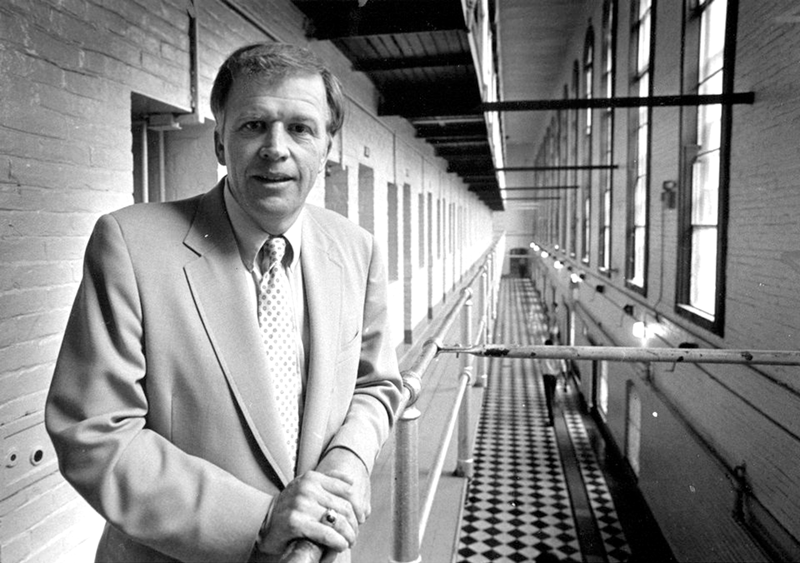
Sheriff

The old and the new

The old and the new: above, Mike Ashe at the old York Street Jail, which was finally replaced in the ’90s with a new facility in Ludlow, bottom.

Ashe told BusinessWest that, when he first took the helm as sheriff in 1975, not long after a riot at York Street, he was in the jail almost every day, a sharp departure from his current schedule.

Perhaps the image he remembers most from those early days was the white knuckles of the inmates. They were hard to miss, he recalled, as the prisoners grasped the bars of their cells, an indication, he believed, of immense frustration with their plight.

“There was a great deal of tension, and you see it in those knuckles.” he said. “Inmates had a lot of time on their hands; people were just languishing in their cells. I think the only program they had at the time was a part-time education program conducted with the Springfield School Department, an adult basic-education initiative. That was it, and it was only part-time.”

Doing something about those white knuckles has been, in many ways, his personally written job description. As he talked about everything involved with it, he spent most of his time and energy discussing how one approaches that work, using more words that he would also wear out: ‘intensity’ and ‘focus.’

Together, those nouns — as well as the operating philosophy “firm but fair, and having strength reinforced with decency” — have shaped a remarkable career, one that he freely admits lasted far longer than he thought it would when he took out papers to run for sheriff early in 1974. It’s been a tenure defined partly by longevity — since he was first elected, there have been seven U.S. presidents (he had his photo taken with one — Jimmy Carter); eight Massachusetts governors (nine if you count Mike Dukakis twice, because he had non-consecutive stints in office); and eight mayors of Springfield — but in the end, that is merely a sidebar.

So too, at least figuratively speaking, are the takeover of the Armory and the building of a new Hampden County jail, although the former was huge news, and the latter was a long-running story, as in at least 20 years, by most accounts.

Recalling the Armory seizure, Ashe said it was a back-door attempt — literally, the sheriff’s department officials gathered at the front door while the inmates were brought in through the back — to bring attention to the overcrowding issue, because all other attempts to do so had failed to yield results.

“We were trying to get people to listen, because it was clear to us that they weren’t listening,” he explained. “We went to the Armory that Friday afternoon and basically evoked a law that went back to the 1700s. Getting into the building was key; once we did that, we knew we’d get everyone’s attention.”

No, the sheriff’s story isn’t defined only by the Armory takeover or his long tenure. It involves how he spent his career working to give his staff less work to do — or at least fewer inmates to guard.

To explain the philosophy that has driven the many ways Ashe has worked to lessen that workload, one must go back to guiding principle No. 2.

“If incarceration is allowed to be a holding pattern, a period of suspended animation, those in custody are more likely to go back to doing what they have always done when they are released,” it reads, “because they will be what they have always been. The only difference may be that they have more anger and more shrewdness as they pursue their criminal career.”

Elaborating on what this principle and the others mean in the larger scheme of things, Ashe said most inmates assigned to his care have been given sentences of seven to eight  months. Relatively speaking, that’s a short window, but it’s an important time. And what the sheriff’s office does with it — or, more importantly, what that office enables the inmate to do with it — will likely determine if the individual in question becomes one of those recycled offenders.

So we return once more to the second principle for insight into how Ashe believes that time should be spent.

“Most inmates come to jail or prison with a long history of social maladjustment, carrying a great deal of baggage in the form of histories of substance abuse; deficits in their educational, vocational, and ethical development; and disconnectedness to the mores and values of the larger community,” it reads. “Given the time and resources dedicated to corrections, it is absolute folly in social policy not to seek to address these deficit areas that inmates have brought to their incarceration.”

And address them he has, through programs that have won recognition nationally, but, more importantly, have succeeded in bringing down the inmate count by reducing the number of repeat offenders.

Sentence Structure

As he talked about these programs, Ashe began by offering a profile of his inmates, one of the few things that hasn’t changed much in 40 years.

“Roughly 90% come there with drug or alcohol problems,” he explained. “You’re looking at a seventh-grade education, on average; 93% of them lack any kind of marketable skill; and 70% of the people are unemployed at the point of arrest.

“Everyone knows that, in the state of Massachusetts, no one just happens to end up in jail — they land there after a long period of what I call irresponsible behavior,” he went on, adding that, likewise, no one just happens to correct that behavior and rehabilitate themselves.

Instead, that comes about by addressing those gaps he mentioned, or doing something about addiction, the lack of an education, the shortage of marketable skills, and the absence of a job.

In a nutshell, this is what the sum of the programs Ashe and his staff have created — both inside and outside the prison walls — is all about.

“What I’m most proud of, I think, is that we never waved at those gaps,” he told BusinessWest. “We put together strategies to deal with these issues.”

And as he likes to say — in those principles, or to anyone who will listen — re-entry to society begins on the first day of incarceration.

That’s when an extensive, seven- to 10-day orientation program and testing period begins, one designed, as Ashe said, to let staff “get to know the inmate — let’s find out who this guy is.”

Such steps are important, he went on, because even amid all those common denominators concerning education, addiction, and lack of job skills, there is still plenty of room for individualization when it comes to correctional programs.

Orientation is then followed by a mandatory transitional program, during which the sheriff says he’s trying he capture the inmate’s heart and mind. Far more times than not, he does, although sometimes it’s a struggle.

And as he said, the work has to begin immediately.

“I didn’t want them to languish,” he explained. “In years past, we would have programs, but they would have a beginning and an end, so you had waiting lists; to get into the GED program would take three weeks, to get into anger management would take four weeks, and I didn’t want that.

“If they come in and just languish in a cell for four, five, or six weeks, I’ve lost them,” he went on. “The subculture wins out — the inmates take over.”

There are always those reluctant to enter the mandatory transition program, the sheriff noted, adding that these individuals are sent to what’s known as the ‘accountability pod,’ a sterile environment where there are fewer rights and privileges. In far more cases than not, time spent there produces the desired results.

“Inevitably, what happens is, at the end of two to four weeks, they say, ‘Sheriff, I get it,’” Ashe told BusinessWest. “They say, ‘this is a coerced program … mainstream me; I’ll go to your programs.’ Not all the time, but a lot of the time, inmates will look back and say, ‘Sheriff, I’m glad you forced me to go through this.’”

Elaborating, he said ‘this’ is the process of addressing the various forms of baggage identified in principle 2 — addiction, lack of education, and a lack of job skills. Initiatives to address them include intense, 28-day addiction-treatment programs; GED classes; an extensive vocational program featuring graphics, welding, carpentry, food service, and other trades; and more.

Many of those who take part in the culinary-arts program will then move on to work at the Olde Armory Grille, an example — one of many — of how the work that begins inside the walls can lead to a productive life when one moves outside those walls.

Indeed, roughly 80% of the women who work in various capacities at the grille — and statistics show women enter the county jail with even fewer marketable skills than men — are finding work in the hospitality sector upon release, said Ashe.

To find out how that specific program works, and how it exemplifies all the programs operated by the Sheriff’s Department, we talked to Alben and Bill.

Food for Thought

The grille, which opened its doors in 2009, is in many ways an embodiment of that line explaining principle 2 regarding change. Indeed, there was a good deal of apprehension about this initiative at first, the sheriff recalled, adding that those attitudes had to change before the facility could become reality.

Over the years, it has become one of the most visible examples of the Sheriff’s Department’s focus on providing inmates with a fresh start — and a popular lunch spot for the hundreds of employees at the tech park and the community college across Federal Street.
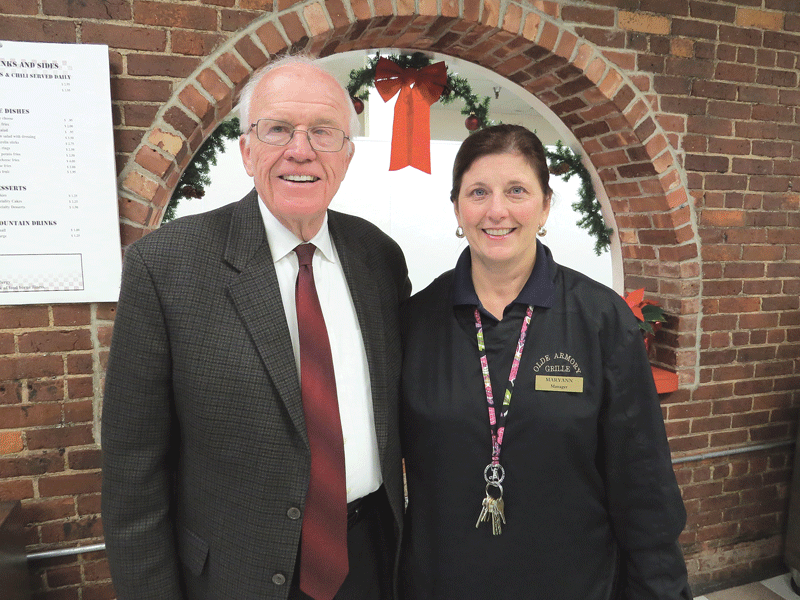
Sheriff Ashe with Maryann Alben

Sheriff Ashe with Maryann Alben, catering and dining room manager at the Olde Armory Grille.

The restaurant is designed to provide real work experience and training for participants returning from incarceration as they re-enter communities, said Alben, adding that it involves inmates from the Ludlow jail, the Western Mass. Regional Women’s Correctional Center in Chicopee, and the Western Mass. Correctional Alcohol Center. These are inmates in what is known as ‘pre-release,’ meaning they can leave the correctional facility and go out into the community and work.

When asked what the program provides for its participants, who have to survive a lengthy interview process to join the staff, Alben didn’t start by listing cooking, serving, making change, or pricing produce — although they are all part if the equation. Instead, she began with prerequisites for all of the above.

“Self-esteem is huge,” she said. “When most women come in here, they have slouched shoulders … many of them have never had a job before,” she explained, adding that this is reality even for individuals in their 40s or 50s. “You bring them in here, and you try to build them up. Some of them will catch on sooner than others; some of them worked in restaurants way back when.

“We help them understand how to work with customers and leave the jail behind them,” she went on, adding that inmates don’t often exercise their people skills inside the walls, but must hone those abilities if they’re going to make it in the real world.

And many do, she went on, adding that there are many employers within the broad restaurant community who are able and, more importantly, willing to take on such individuals.

In fact, roughly 87% of those who take part are eventually placed, usually in kitchen prep work, she said, a statistic that reflects both the need for good help and the quality of the program.

Bill hopes to be a part of the majority that uses the grille as an important stepping stone.

“This is the next step in getting back into the community 100%,” he explained. “Not only with getting up early with a job to go to five days a week, but in the way it prepares me mentally and fundamentally for the next step into the real world.”

Such comments explain why an inmate’s final days at the grille involve more emotions than one might expect.

Indeed, the end of one’s service means the beginning of a new and intriguing chapter, which translates into happiness tinged with a dose of apprehension. Meanwhile, there is some sadness that results from the end of friendships forged with customers who frequent the establishment. And there is also gratitude, usually in large quantities.

“We’re giving them a chance to prove themselves,” said Alben. “And when they leave here, most of all them will say, ‘thank you for believing in me.’”

If they could, they would say the same thing to Sheriff Ashe. He not only believed in them, he challenged them and held them accountable, a real departure from four decades ago and what could truly be called white-knuckle times.

No Holds Barred

When asked what he would miss most about being sheriff of Hampden County, Ashe paused for a moment to think back and reflect.

“I think I would have to say that it’s the challenges, embracing the challenges,” he said one last time. “I’ll miss the work of recognizing the problems that our society faces and trying to come up with solutions.”

That answer, maybe as much as anything that he’s done over the past 41 years and will do over the next 11 months, helps explain why Ashe will be remembered for much more than what happened at that National Guard Armory.

And why he’s truly a Difference Maker.

George O’Brien can be reached at [email protected]


Guiding Principles of Best Correctional Policy

(As developed by the Hampden County Model, 1975-2013)

1. Within any correctional facility or operation, there must be an atmosphere and an ethos of respect for the full humanity and potential of any human being within that institution and an effort to maximize that potential. This is the first and overriding principle from which all other principles emanate, and without which no real corrections is possible.

2. Correctional facilities should seek to positively impact those in custody, and not be mere holding agents or human warehouses.

3. Those in custody should put in busy, full, and productive days, and should be challenged to pick up the tools and directions to build a law-abiding life.

4. Those in custody should begin their participation in positive and productive activities as soon as possible in their incarceration.

5. All efforts should be made to break down the traditional barriers between correctional security and correctional human services.

6. Productive and positive activities for those in custody should be understood to be investments in the future of the community.

7. Correctional institutions should be communities of lawfulness. There should be zero tolerance, overt or tacit, for any violence within the institution. Those in custody who assault others in custody should be prosecuted as if such actions took place in free society. Staff should be diligently trained and monitored in use of force that is necessary and non-excessive to maintain safety, security, order, and lawfulness.

8. The operational philosophy of positively impacting those in custody and respecting their full humanity must predominate at all levels of security.

9. Offenders should be directed toward understanding their full impact on victims and their community and should make restorative and reparative acts toward their victims and the community at large.

10. Offenders should be classified to the least level of security that is consistent with public safety and is merited by their own behavior.

11. There should be a continuum of gradual, supervised, and supported community re-entry for offenders.

12. Community partnerships should be cultivated and developed for offender re-entry success. These partnerships should include the criminal-justice and law-enforcement communities as part of a public-safety team.

13. Staff should be held accountable to be positive and productive.

14. All staff should be inspired, encouraged, and supervised to strive for excellence in their work.

15. A spirit of innovation should permeate the operation. This innovation should be data-informed, evidenced-based, and include process and outcome measures.

16. In-service training should be ongoing and mandatory for all employees.

17. There should be a medical program that links with public health agencies and public health doctors from the home neighborhoods and communities of those in custody and which takes a pro-active approach to finding and treating illness and disease in the custodial population.

18. Modern technological advances should be integrated into a correctional operation for optimal efficiency and effectiveness.

19. Any correctional facility, no matter what its locale, should seek to be involved in, and to involve, the local community, to welcome within its fences the positive elements of the community, and to be a positive participant and neighbor in community life. This reaching out should be both toward the community that hosts the facility and the communities from which those in custody come.

20. Balance is the key. A correctional operation should reach for the stars but be rooted in the firm ground of common sense.

Daily News

SOUTHWICK — Bob Barna has joined Whalley Computer Associates (WCA) as a consulting architect.

Barna was employed by VMWare as a senior consultant for the last 16 months and has 19 years of experience in the IT industry. He spent 17 of those years as the senior systems engineer at Competitive Computing. He has earned numerous VMware certifications and has extensive experience in design enablement, developing business requirements and identifying use cases, architecture design, environment build, product pilot, documentations and knowledge transfer, and more.

Barna joins a team at WCA that also includes another former VMWare employee, Dan Sullivan, who joined VMWare shortly after it was founded and, in his seven years there, served customers all over New England and New York as a VMware systems engineer, VMware account executive, and partner business manager. Sullivan, who now holds the role of senior solution architect at WCA, is a 39-year veteran of the IT industry, with a background that combines technical expertise and sales skills.

“Over the past six years, we have invested over $20 million to reach our goal of becoming one of the five best IT engineering firms in New England and Upstate New York. Barna is an important piece of the puzzle,” said Paul Whalley, vice president of Whalley Computer Associates.

Added Barna, “I am extremely happy to join a family-owned organization that values customer relationships and ensures the solutions we help deliver enable them to succeed in utilizing technology to meet their desired business outcomes.”

WCA has been a leading technology provider for more than 37 years, servicing customers of all types and sizes throughout New England and Upstate New York. WCA is ranked in the top 0.1% of all solution providers in North America and services more than 3,000 customers with more than 140 local technology professionals.

Daily News

LEE — Chuck Leach, president of Lee Bank, announced that Wendy Healey has been named to the position of senior vice president, community banking, and David Harrington has been named to the position of vice president, commercial lending.

Healey joins Lee Bank with a wealth of experience in both the retail-banking and financial-technology sectors. She most recently served as senior vice president in charge of retail, sales, and marketing at Torrington Savings Bank. Prior to that, she was an independent financial services consultant while pursuing an MBA, and has held senior management roles at COCC Inc., a lead provider in core technology to the financial industry; Sovereign/Santander Bank; and People’s United Bank in Connecticut.

As senior vice president in charge of community banking, Healey’s focus will be on existing and new customer relationships, as well as the design and fulfillment of new products and packages of services to meet customer needs. She will oversee policies, future business planning, and long-range strategic goals for her department and is responsible for the overall administration of compliance, including policy and procedures, monitoring, review, training, and board reporting.

Harrington brings more than 18 years of experience in product and operations management. He most recently served as multi-life new business operations manager at Guardian Life Insurance Co. in Pittsfield. Prior to that, he was employed as product and project manager, U.S. Insurance Group, MassMutual Financial Group, and senior product line manager, disability and long-term-care insurance at Berkshire Life Insurance Co.

As vice president of commercial lending, Harrington is responsible for developing and maintaining Lee Bank’s commercial-lending activities and expanding existing customer relationships in conjunction with the bank’s strategic goals.

“We are pleased to welcome Wendy and David to the Lee Bank team. They each bring a wide range of experience from the banking, financial-technology, and community-service sectors,” said Leach. “In their new positions, they will enhance and carry forward Lee Bank’s tradition of innovation and our mission as a community-based and independent, full-service bank, singularly focused on continued excellence in serving our customers today and for decades to come.”

Daily News

AMHERST — The Isenberg School of Management’s online MBA program at UMass Amherst ranks among the best online MBA programs in the country, according to U.S. News & World Report’s “Best Online MBA Programs.” The Isenberg MBA is ranked 12th out of 221 institutions ranked by the publication.

“We continue to lead the pack in an increasingly competitive online educational landscape,” said Mark Fuller, dean of the Isenberg School. “This confirms what thousands of Isenberg students and alumni have known for over a decade: Isenberg’s online program goes beyond case studies and textbooks to drive students to real success.”

The U.S. News ranking is based on five factors: student engagement, admissions selectivity, peer reputation, faculty credentials, and training and student services and technology.

Unlike many of the other programs that recently entered the online space, Isenberg has offered its MBA in a 100% online format for more than 13 years, making it one of the oldest accredited online MBA programs in the nation. Enrollment approaches 1,300 students, making it the largest out of the top 25 schools ranked by U.S. News.

“We continue to attract a high number of highly educated, highly successful professionals because we have a team of experienced professors and advisors who really understand how these students learn best,” said John Wells, associate dean of professional programs. “Despite our long tradition of outstanding online education, we continue to innovate with a variety of new approaches and technologies to connect students in our online format, new opportunities for in-person connections, and more diversity in our class offerings, including business analytics and sport management.”

Daily News

HOLYOKE — PeoplesBank has announced the promotions and appointments of four associates.

Brian Canina has been promoted to senior vice president, chief financial officer, and treasurer. He possesses more than 16 years of financial experience and first joined the bank in 2009. He holds a bachelor’s degree in accounting from Bryant College and is a certified public accountant. He is also a graduate of the ABA Stonier Graduate School of Banking and is a recipient of the Wharton Leadership Certificate. Canina is president of the Finance and Accounting Society of New England and an officer of the Financial Managers Society, Boston Chapter. He serves on the boards of directors for the Greater Holyoke Chamber of Commerce and the Children’s Study Home.

Stacy Sutton has been promoted to senior vice president, retail administration. Boasting more than two decades of banking experience, she joined the bank in 1992 and previously served as first vice president, retail administration. She holds an associate degree in accounting from Springfield Technical Community College and is a graduate of the Massachusetts Bankers Assoc. School for Financial Studies. She serves on the board of directors for Springfield Partners.

Joseph Zazzaro has been promoted to senior vice president and chief information officer. He possesses over three decades of information technology experience with a focus in financial services. He joined the bank in 2006 and previously served as first vice president, information technology. He holds a bachelor’s degree in information systems from the University of Phoenix and an associate degree in management information systems from Holyoke Community College. He also is a graduate of the New England School of Financial Studies. Zazzaro was a 14-year member of the Greater Westfield Boys and Girls Club board of directors and continues to volunteer to provide technical support for the club. He has also volunteered his technical and leadership skills at other local organizations, such as the Greater Springfield Habitat for Humanity, the United Way, the Red Cross, and the Chicopee Boys and Girls Club.

Russell Fontaine has been promoted to first vice president, retail sales. Boasting more than a decade of financial experience, he first joined the bank in 2009 and previously served as vice president, sales and service manager. He holds a bachelor’s degree in business management from Westfield State University and a certificate from the Wharton School of Business Leadership at the ABA Stonier Graduate School of Banking. He serves on the board of the Greater Springfield Habitat for Humanity.

Features

Dogged Determination

Dave Waymouth and Pip

Dave Waymouth and Pip

Dave Waymouth had an itch to earn his MBA. His dog simply had an itch to escape. Those two worlds collided when Waymouth entered the UMass Innovation Challenge with an idea: to develop and market a more effective pet tracker than the ones he had researched, with some disappointment, on the Internet. Fast-forward two years, and his startup company, PetSimpl, is preparing to unveil a device called Pip, which uses GPS and Bluetooth technology to keep dogs safe, track their exercise levels, and potentially much more.

Dave Waymouth calls his 15-pound dog, Pip, an escape artist.

“We had him for only a short while, and he ran off,” Waymouth told BusinessWest. “I’d never had a dog before; I’d always had outdoor cats, and they go and come back. But a dog follows its nose. So this was a panic moment. I thought, ‘there’s nothing I can do; I hope someone calls the number on the collar.’”

Dog and owner were reunited, but it wasn’t the last time Pip tried to get free. So Waymouth started scouring the Internet for a product that would alert him to potential escapes and help him recover the dog.

“I assumed there were products on the market and searched around. I found stuff for hunting dogs, but they were really expensive and really bulky. One product on the market looked like it would work, but it was expensive, and when I did buy it, it was too big, so I returned it.”

While that struggle was going on at home, Waymouth was running a video-marketing company in Northampton. Its product was a channel on area hotel-room televisions — in fact, the channel that automatically appeared when the TV was switched on — that highlighted local dining and attractions; area businesses paid Waymouth to advertise on the channel.

It was a good idea, one he’d picked up working for larger marketing firms in bigger cities, but he questioned its scalability. Besides, as someone who had studied English and film studies as an undergraduate, he felt he needed more business expertise, so in 2013, he returned to UMass to enroll in the MBA program at the Isenberg School of Management.

There, he was exposed to the Innovation Challenge, a competition during which potential entrepreneurs develop product ideas and pitch them to judges. That’s when he thought of his dog.

“Honestly, the night before the application for the competition was due, I was sitting there saying, ‘I’ve got to think of an idea. I should just pick something that excites me and go with it.’”

His idea was a canine GPS tracker small enough to fit even compact dogs, yet with much better reliability and battery life than the products he had researched online. “That was the innovation — we’d keep it small and have 10 times the battery life of similar devices.”

petsimplLOGOFast-forward two years, and that idea has become a company called PetSimpl, and a tracking device called — of course — Pip, which alerts owners with Bluetooth if a dog leaves a pre-set area and activates a GPS tracker on a smartphone app to locate the furry runaway. When the dog is in the ‘safe zone,’ the device operates at minimal power, extending typical battery life to about three months between recharging sessions.

Currently in the final stages of production, after which it will be shipped to customers who preordered it, Pip is also a kind of “Fitbit for dogs,” Waymouth said, serving not only as a tracker, but also as a way to monitor a dog’s activity levels using that same app.

“We can tell you how much exercise he’s getting during the day and how far he’s walked. It’s useful for people with dog walkers, especially, to make sure the dog is getting a long-enough walk. Parents can use the app to keep track of their kids walking the dog. I found a lot of parents are excited about being able to check all this stuff. We’re using technology that’s already out there, but in a way that’s useful for day-to-day pet care.”

In this, the latest in a series of articles highlighting entrepreneurial endeavors across the region, BusinessWest sheds some light on a device that promises to improve the lives of dogs — and the people who worry about them.

Idea to Reality

The Pip product didn’t appear overnight. Rather, it emerged from the supportive world of startup incubators and crowd-funding campaigns.

“I’m a big tech guy. While I was in video marketing, and I studied English and film in college, I had been taking things apart from a very young age.”

Still, he went on, Pip was only an idea at first, not anything resembling a company. But what the UMass Innovation Challenge, and later the MassChallenge accelerator program in Boston, gave him was a chance to have that idea validated by others, and to develop a real business plan.

“That gave us a ton of exposure, and we were able to partner with Verizon,” he explained. “When they saw it, they offered us a good deal to put it in their network.”

Verizon’s saturation coverage of the country gives PetSimpl needed cachet in the tech world, he explained. “The U.S. is the world’s largest pet market, and we’re a tiny company, so we don’t have to take over the world just yet. It’s good to be attached to a large name brand; other networks are not as reliable.”

Dave Waymouth (left, with Seth Berggren)

Dave Waymouth (left, with Seth Berggren) says he hasn’t been too aggressive in marketing Pip, preferring to launch at a manageable pace.

During his four months with MassChallenge, during the second year of his MBA program at Isenberg, Waymouth was staying with a family friend near Boston from Monday through Wednesday, taking classes online, then returning to his home in Northampton and attending a couple of classes on campus on Thursday and Friday. Fortunately, he said, the culture at Isenberg is to be flexible with students balancing MBA studies with, well, trying to make it in business. “They helped me finish my degree while starting this company.”

Around the same time, Scott Foster, president of Valley Venture Mentors and someone Waymouth considers a mentor, tipped him off about VVM’s accelerator program in Springfield — a much closer commute than Boston. So he enrolled in that four-month program, where he eventually won $32,500 in VVM’s Accelerator Awards — the second-highest award among 29 participants — to further fund the development of Pip.

Meanwhile, he launched a Kickstarter campaign, with an initial goal of $50,000, to verify that sufficient demand existed in the market. “We felt, if we got to that point, there were enough people interested out there to make it a viable product,” he told BusinessWest. “We didn’t want the Kickstarter to go too viral, since a lot of companies take on way too many orders and get overwhelmed.”

The campaign wound up raising $75,000 on the strength of more than 400 preorders, and Waymouth has since continued taking preorders — at a slightly higher price — from people who came across PetSimpl too late to take part in the Kickstarter campaign.

“We haven’t really been marketing it,” he said, “but just letting people find us as we get ready to ship out the first batch.”

Collaring a Problem

One of Waymouth’s main concerns has been the reliability of the Bluetooth signal, but he reports that it outperforms 90% of cellphones. “We’re now just finishing the casing, which is what holds the circuit board together. We had to make it waterproof and minimize how far it hangs off the collar.”

Noting that Pip has gone through six or seven designs, he noted that product development early on, without funding, was extremely difficult.

However, before the final round of the UMass Innovation Challenge, he won a grant for a couple thousand dollars, which he used to hire an electrical engineer to look at his basic designs and see if he could turn it into a circuit board.

Waymouth had to be resourceful early on, such as when he bartered office space at MassChallenge for his first website design. But once the Kickstarter campaign was over, he was able to hire his first employee, Seth Berggren, as hardware lead. Patrick Kearney came on soon after as software lead.

“I became a master of getting people interested and excited with the promise of future success,” he said of not only his team, but those who preordered. “I’m happy to say, everything I promised to them, we’ve followed through on. Patrick was just going to develop the app for us, but fell in love with the product and came on full-time. Everyone is juggling multiple roles. And we have six or seven people involved as contract workers.”

The team has faced down a number of thorny — often literally — problems.

“We were unwilling to satisfy ourselves with the status quo,” Waymouth said, explaining that pet trackers he had researched have a tendency to catch on branches while the dog runs in the woods.

Some companies have designed devices with a stronger snap that holds it together, only to find that the whole collar gets pulled off. PetSimpl’s solution is to attach the device around the collar, with the circuit board on one side and the battery on the other, the whole piece sliding around the collar so that the smallest piece possible hangs over.

The company promises to develop additional products in the future, among them a pet door that opens only for a Pip-equipped animal, and a programmable food dispenser that knows when and how much food to release.

But for now, Waymouth said, he’s excited to get the first iteration of Pip manufactured and shipped.

“Thankfully, our competition has stumbled a little bit, shipping products too early. The customers who have ordered Pip understand that, and will wait for a product that works,” he explained. “Our main competition [among startups] is a Silicon Valley company with millions in funding, so, in many ways, we’re definitely the little guys, trying to do this in Western Massachusetts. But we feel confident, and hopefully we’ll have some good reviews at launch, and we’ll move forward from there.”

Paws and Effect

Waymouth has looked into non-battery-powered options for Pip. Solar power intrigues him, but with such a small device, solar power could prove erratic, especially for dogs with long fur. “There’s no point if you can’t get the signal. That’s a huge problem.”

But he and his team will continue to hone their product in any way that makes sense, he said, again repeating the mantra that the pet-owner market is an enthusiastic and loyal one, as long as a product does what it promises. And when the promise is to keep a family member from running away, that’s a serious pact indeed.

“This particular product has had a huge uphill battle,” he said. “Since people learned about GPS, they’ve been trying to create a viable GPS tracker, and the challenge has always been size, battery life, and performance. We’ve had a lot to overcome, because it’s difficult to convince investors who have tried these crappy products over the past 10 years and say, ‘yes, I’ve seen this, and it failed.’ We’ve studied the same history they have, and we have answers, but some investors didn’t want to touch it.”

However, many were willing to back PetSimpl and the Pip tracker, and Waymouth will soon learn whether he made the right move putting video marketing on the back burner and watching his career go to the dogs.

“It takes longer to launch a physical thing than a service,” he told BusinessWest, “but the sky’s the limit if we get a good product out there. So we’re excited.”

Joseph Bednar can be reached at [email protected]

Banking and Financial Services Sections

Delayed Reaction

By BOB CUMMINGS

Bob Cummings

Bob Cummings

For many employers, their first challenge with the Affordable Care Act (ACA) may be compliance with the new reporting requirements.

Under the ACA, the Internal Revenue Code added IRS Section 6056, which requires ‘applicable large employers’ to file information returns with the IRS and provide statements to their full-time employees about the health-insurance coverage that the employer offered. Under the terms of the ACA, an applicable large employer generally means an employer that had 50 or more full-time employees (including full-time equivalent employees) in the preceding calendar year.

Last month, the IRS released IRS Notice 2016-4, which delays Sections 6055 and 6056 reporting for the 2015 reporting year. Forms 1095-B and 1095-C must now be distributed to employees by March 31, as opposed to the original due date of Feb. 1. If filing by paper, forms 1094-B, 1095-B, 1094-C, and 1095-C must be filed with the IRS by May 31 (changed from Feb. 29). If filing electronically, the forms are due to the IRS by June 30 (changed from March 31). The extended deadlines apply to all filers automatically. In summary, the deadline for distributing forms to employees has been extended two months, while the filing deadline with the IRS has been extended three months.

The original due dates were aligned so that individual taxpayers could use the information contained in the forms to file their individual tax returns. Specifically, the information is needed by individuals to help determine whether they were eligible for the premium tax credit or subject to the individual mandate. The IRS has granted this automatic extension due to the fact that insurers, self-insuring employers, and other providers of minimum essential coverage need additional time to adapt and implement systems and procedures to comply with the reporting requirement.

As a result of this delay, if individuals have not received the information by the time they file their individual tax return, they may rely upon other information received from employers or coverage providers when filing their returns. They need not amend their returns once they receive the forms, but they should keep them with their tax records.

The IRS reinforced that an employer should make a good-faith effort with reporting. If an employer does not comply with the extended deadlines, the employer could be subject to penalties. Applicable large employers must report whether an individual is covered by minimum essential health benefits coverage, and that an offer such was made to each full-time employee.

Applicable large employers will need to file IRS Form 1094-C, Transmittal of Employer-provided Health Insurance Offer and Coverage Information Returns, and IRS Form 1095-C, Employer-provided Health Insurance Offer and Coverage, to report the information required. These 1095-C forms are to be provided by Jan. 31 for the calendar year 2015 coverage periods. (The final versions of these forms will not available until February.)

What qualifies as an offer of ‘minimum essential health benefits coverage?’ Well, the IRS says it is an offer that satisfies all of the following criteria:

1. An offer of minimum essential coverage that provides minimum value and includes 10 minimum essential healthcare services: outpatient services, emergency services, hospitalization, maternity/newborn care, mental-health and substance-abuse services, prescription drugs, rehabilitation (for injuries, disabilities, or chronic conditions), lab services, preventive/wellness programs and chronic-disease management, and pediatric services;

2. The employee’s cost for employee-only coverage for each month does not exceed 9.5% of the mainland single federal poverty line divided by 12; and

3. An offer of minimum essential coverage is also made to the employee’s spouse and dependents (if any).

These new employer-health-benefits reporting forms and instructions look complicated even to benefits professionals, and they will require gathering quite a bit of information. For example, Form 1095-C is a form an employer is supposed to use to give employees the health-benefits information they need to fill out their own tax forms and insurance coverage applications, and to give the Internal Revenue Service, the Employee Benefits Security Administration, and the U.S. Department of Health and Human Services the information they need to detect individual taxpayers’ violations of the Patient Protection and Affordable Care Act (PPACA) rules.

An employer is also supposed to send the IRS a 1094-C summary form, or report, on the information provided in the 1095-C forms, along with copies of the 1095-Cs.

The IRS and other agencies are supposed to use the 1094-Cs, together with the 1095-Cs, to detect any problems with employer compliance with the PPACA employer mandate rules described in Internal Revenue Code Section 4980(H).

This is a major new compliance burden for employers, and the IRS and other federal agencies will most likely show some compassion initially for employers who are making a good-faith effort to comply with the rules.

Most benefits-compliance professionals believe the IRS will begin a major enforcement initiative by this May, because as many as 50,000 employer-benefit plans may be audited over the first two years for compliance. Employers should do everything possible to avoid compliance traps that could trigger an audit.

Among the compliance challenges is the requirement that employers must track full-time-equivalent employees. Basically an employer must track all of their part-time employees, even if those employees may likely not get the 1095-C forms. If a part-time employee becomes full-time at any point in the year, even for only a short period, then the employer has to provide the 1095-C form for that individual.

One of the major challenges confronting employers who will have to comply is the fact that so many are still relying on a paper-based benefits-administration system. It will be virtually impossible to do the tracking and the reporting without an automated benefits-administration system. This really spells the end of paper-based benefits administration for employers subject to these new tracking and reporting requirements.  Employers will have to adopt an online benefits-administration technology platform in order to perform both the tracking and reporting requirements under Section 6056.

The good news is that there are a number of outstanding benefits-technology solutions available for employers today. Forward-thinking benefits professionals are rapidly incorporating and delivering technology platforms across their client base.

The benefits business today is also a technology business. From ACA reporting to employee communications; benefits enrollment and administration to HRIS functionality like paid-time-off tracking or onboarding, an extensive array of software and employee services can be provided on one fully integrated platform. This means, as an employer’s benefits needs evolve, benefits professionals can provide added functionality, configurability, sophistication, and services.

Are you ready to navigate the new world of healthcare compliance and reporting? Ask your benefits consultant if they are ready to advise and assist you.

Bob Cummings is CEO and managing principal of Northampton-based American Benefits Group; (413) 727-7211.

Health Care Sections

Share Scare

Elizabeth Morgan

Elizabeth Morgan says young people interacting online are “experimenting with their public persona.”

Worried parents have all kinds of reasons why their kids shouldn’t participate in social media, Elizabeth Morgan said. But perhaps it might be helpful for them to consider why they want to.

“Researchers have asked teenagers this, and the typical reason is to connect with other people. Their primary motivation is to maintain connections, and establish new connections, with other people,” said the assistant professor of Psychology at Springfield College.

Teens with niche interests or unique challenges also benefit from social media, she said, because they might not find similar support locally.

“A lot of times, they’re using it to get information and learn about some experience they’re going through from people online who may not be in their immediate social network,” Morgan said. “That’s one of the positives. Think about a teenager with a chronic illness in Western Mass., where not many people experience that chronic illness. They can connect with people in Missouri, California, or Florida who are going through the same thing, to get information about what they’re going through.”

Still, whatever the reason, young people are also doing something developmentally important when they interact online — they’re experimenting with their public persona. And that can present social and emotional pitfalls.

“For some teens and tweens, social media is the primary way they interact socially, rather than at the mall or a friend’s house,” said Dr. Gwenn O’Keeffe, co-author of a clinical report issued by the American Academy of Pediatrics (AAP), called “The Impact of Social Media Use on Children, Adolescents, and Families.”

“A large part of this generation’s social and emotional development is occurring while on the Internet and on cellphones,” O’Keeffe added. “Parents need to understand these technologies so they can relate to their children’s online world — and comfortably parent in that world.”

Morgan said the idea of self-presentation in social media, on sites like Facebook, Instagram, and many lesser-known outlets, represent a developmental task. “Teenagers are always testing different identities, different personas face to face, and social media provides a way to do it in a safe place where they can manage their presence.”

But how safe is it, really?

“There are all kinds of risks, in the different choices kids make, in how they’re going to be seen and categorized by their peers,” said Dr. Barry Sarvet, chair of Psychiatry at Baystate Medical Center. “Kids have to deal with that anyway, but the online factor makes it quantitatively different; their choices potentially have bigger, broader consequences because of how viral things can get online. Misunderstandings happen more easily online; things are misconstrued.”

The preteen and teen years come with an array of hazards that aren’t exclusive to the Internet age, he went on, from character disparagement and low self-esteem to being stalked or threatened by truly dangerous people.

“Parents need to be aware of and help kids understand the dangers, but they’re not brand-new dangers; there have always been risks of kids being exploited, stressed, and depressed because they’re being stigmatized and misunderstood. And there have always been social networks, circles of friends, cliques. Social media is just another expression of that — but it’s got higher stakes in some ways, because of the permanence and irrevocability of what happens online.”

The solution, Sarvet says, isn’t necessarily to block teenagers’ access to the online world, but to become partners with them and help them manage it. Because social media, while a potentially valuable tool, poses some complex issues at a particularly vulnerable age.

Pursuit of Happiness

Morgan cited a study indicating that some people who use Facebook are happier than those who don’t — or, perhaps, happy people are more willing to share their lives on social networks — but, interestingly, excessive Facebook use may be linked with depression.

“Facebook can be a great experience that leads to connection, but it can also lead to depression, partly because of social comparison to other people who are presenting their best side,” she said, adding that those effects are not pronounced when people compare themselves to immediate friends and family, but spike when making comparisons to casual acquaintances, perhaps because that ‘best side’ seems more like reality.

When teens make the same comparisons to their peers, it’s even worse, she said, because social comparison is already a big issue in adolescence, so it makes them feel worse about themselves. “They might say, ‘look, he has 200 likes; I only have 100,’ or ‘she has 600 friends; I only have 550.’”

That said, it’s difficult to define exactly when young people should enter the social-media world because there’s such a broad range of personal development.

Dr. Barry Sarvet

Dr. Barry Sarvet says the choices young people have when it comes to social media come with “bigger, broader consequences” than ever before.

“Some are late bloomers, some early bloomers,” Sarvet told BusinessWest. “Kids will say, ‘all my friends are on it, so I should be allowed.’ But parents have to consider how mature their child is and how vulnerable they might be and their level of judgment. One 13-year-old can have really good judgment and be very safe and be able to follow guidelines and understand why they’re important, and another 13-year-old may be completely unready to have that freedom and power.”

It’s natural, he went on, for kids to desire more freedom than they’re ready to have. “Parents have to constantly make those difficult decisions, how much freedom to give them. A lot of times, kids have to earn the trust. Parents may say to their kids, ‘I want to trust you, but you haven’t earned it because you haven’t been responsible or careful about things, so I don’t feel you’re ready right now.’

“We live in a world where a lot of personal sharing is going on, and kids don’t always understand the impact of what they put online or even just messaging with each other, not realizing things can be forwarded; even those Snapchat images can be captured and saved,” Sarvet added. “The complexity of people’s privacy, understanding the importance of privacy, is something that takes a lot of judgment, which kids don’t always have.”

Lapses in judgment can wreak havoc on young lives, O’Keeffe said, adding that young people can harm their reputations and safety by posting personal and inappropriate information. Meanwhile, information about sites they visit may be captured and used to target them with advertising.

“Cyberbullying happens as well. That’s the dark side of the situation,” Morgan told BusinessWest. “Really, it’s on the parents to try to help manage their children’s experience and be aware of what’s going on, so if there do happen to be instances of cyberbullying, the parents can help the child deal with it.”

Straight Talk

The AAP has issued a series of guidelines pediatricians can use to help families navigate the social-media landscape, including:

• Advise parents to talk to children and adolescents about their online use and the specific issues that today’s online kids face, such as cyberbullying, sexting, and difficulty managing their time;

• Advise parents to work on their own ‘participation gap’ in their homes by becoming better-educated about the many technologies their children are using;

• Discuss with families the need for a family online-use plan, with an emphasis on citizenship and healthy behavior; and

• Discuss with parents the importance of supervising online activities via active participation and communication, not just via monitoring software.

Some house rules can be as simple as using the Internet only in a common room of the house, or not logging on past a certain hour at night, as not to disrupt sleep, Morgan added. “There are so many ways to manage these experiences beyond saying, ‘no social media at all.’”

She added, however, that it’s just as important for parents to develop trust and strong communication with their children, so they feel comfortable approaching the adults with problems that arise.

“Be sure your child knows what can happen and, if it does, that you’re available to help them deal with it, whether that involves blocking a person from your network or pressing charges, if stalking is going on, or just learning how to respond to, or ignore, negative statements and emotionally cope with them. Parents can be a good resource for all of that.”

Sreedhar Potarazu, an ophthalmologist and CEO of VitalSpring Technologies Inc., recently wrote at CNN.com that young people are growing up to expect immediate response, gratification, and notification, all hallmarks of social media, and their brains no longer have time to evolve; instead, they must adapt to change in an instant.

“The results are distressing. The difficulties of growing up have never been so public,” he wrote. “Social technology provides a platform where things can run wild. Imagine the stress of high school — the competition for popularity, the pressure to fit in, the judgmental nature of social activities — at an accelerated pace.”

He suggests a number of steps parents can take to help their children navigate this world, such as:

• Create more structured forms of social media that prevent children from diving into, say, Snapchat right from the start;

• Provide a way for parents and administrators to get feedback on their kids’ online use without intruding on privacy and alert them to impending dangers;

• Add courses on social technology and responsibility to school curricula, teaching adolescents that what they do online exposes them to the whole world — sometimes forever, and perhaps affecting their job searches and choice of a mate; and

• Ease up on the pressure, and persuade teens that that they don’t have to market themselves constantly, and that social media can be a mechanism for fostering collaborative relationships, rather than competition, aggression, and irresponsible behavior that contributes to anxiety and depression.

A Question of Trust

Sarvet stressed, however, that the online world is not an intrinsically bad place.

“I think there’s still a lot of richness,” he said. “I tend to encourage parents to be open-minded about this stuff because I think a lot of parents are very suspicious and skeptical of it and focus more on the horrible things that can happen, and they’re also very unrealistic about their ability to control it.”

To wit, a recent Pew Research Center study found that 92% of teens go online daily, and 24% say they are online “constantly.” Common Sense Media reports that 90% of teens have used social media, and 75% of them have profiles on social-networking sites. In another study, CNN found that some 13-year-olds check their social-media feeds 100 times a day.

“I think it’s important for parents to recognize that their kids are in school, out in the world, and they should assume — even if they have a rule that their kids are not allowed to be on Facebook — that their kids might be on Facebook,” Sarvet said. “They should accept that they’re not in charge all the time of their kids’ use of social media, and they can’t be. If you accept that, the focus becomes less on having rules and more on helping them understand the complexity of what they’re doing online.”

Barring teens outright from social media, he suggested, only manages to destroy the lines of communication that might come in handy someday, whether dealing with serious issues like cyberbullying and sexting or simply learning more from one’s teens about the online world, which sites are popular, and what kids today are doing there.

“If they have a nice, respectful relationship with their kid, it allows the parent to have a guiding influence and an opportunity to learn what kids are doing and have an open dialogue about it,” Sarvet went on. “When parents are overly nervous and, in response to this nervousness, start making these strict rules, it just invites kids to find ways to get around the rules, and they no longer talk to their parents about it, knowing you’ll be mad at them.”

In short, he told BusinessWest, “control what you can control,” and the rest is building trust.  No one said it would be easy, in a culture where positive connections and lurking dangers are both just a few clicks away.

Joseph Bednar can be reached at [email protected]

Departments Real Estate

The following real estate transactions (latest available) were compiled by Banker & Tradesman and are published as they were received. Only transactions exceeding $115,000 are listed. Buyer and seller fields contain only the first name listed on the deed.

FRANKLIN COUNTY

GREENFIELD

40 Allen St.
Greenfield, MA 01301
Amount: $155,000
Buyer: Deborah H. Squires
Seller: David J. Chula
Date: 12/08/15

629 Bernardston Road
Greenfield, MA 01301
Amount: $400,000
Buyer: David J. Donoghue
Seller: Christopher M. Goodwin
Date: 12/04/15

367 Country Club Road
Greenfield, MA 01301
Amount: $155,283
Buyer: US Bank
Seller: Lois M. Sanders
Date: 12/07/15

113 Hastings St.
Greenfield, MA 01301
Amount: $195,000
Buyer: Edith K. Drury
Seller: Virginia Pechin Keen IRT
Date: 12/09/15

284 High St.
Greenfield, MA 01301
Amount: $305,000
Buyer: Green Man Enterprises LLC
Seller: Richard E. Sigda
Date: 12/03/15

55 White Birch Ave.
Greenfield, MA 01301
Amount: $155,742
Buyer: US Bank
Seller: Lance E. Mitchell
Date: 12/09/15

LEVERETT

11 Church Hill Road
Leverett, MA 01054
Amount: $270,000
Buyer: Hannah L. Muszynski
Seller: Edith H. Riddle
Date: 12/04/15

118 North Leverett Road
Leverett, MA 01054
Amount: $180,000
Buyer: Adam V. Wellen
Seller: Ann J. Delano
Date: 12/03/15

MONTAGUE

46 High St.
Montague, MA 01376
Amount: $195,000
Buyer: Jacqueline M. Krzykowski
Seller: Catherine R. Balboni LT
Date: 12/04/15

57 Mormon Hollow Road
Montague, MA 01349
Amount: $125,000
Buyer: Meagan L. Veith
Seller: Phillip J&N J. Szenher RET
Date: 12/07/15

ORANGE

25 Bartlett Lane
Orange, MA 01364
Amount: $245,000
Buyer: Aleesha C. Watson
Seller: Bassett RT
Date: 12/07/15

160 Chase St.
Orange, MA 01364
Amount: $149,000
Buyer: Felicia N. Atherton
Seller: Jerry L. Aldrich
Date: 12/04/15

665 East River St.
Orange, MA 01364
Amount: $119,000
Buyer: Wells Fargo Bank
Seller: Eliane B. Monteiro
Date: 12/03/15

17 Main St.
Orange, MA 01364
Amount: $169,000
Buyer: Michael G. Morse
Seller: Blast Tech Inc.
Date: 12/08/15

SHELBURNE

1155 Mohawk Trail
Shelburne, MA 01370
Amount: $340,000
Buyer: Pamela J. Miner
Date: 12/04/15

SUNDERLAND

44 Mount Toby Woods
Sunderland, MA 01375
Amount: $570,000
Buyer: John W. Campbell
Seller: Barry J. Gallerani
Date: 12/02/15

150 Old Amherst Road
Sunderland, MA 01375
Amount: $255,000
Buyer: Valley Building Co. Inc.
Seller: Frederick Weinberg
Date: 12/08/15

HAMPDEN COUNTY

AGAWAM

20 Allison Lane
Agawam, MA 01030
Amount: $250,000
Buyer: Maria Spano
Seller: Drzal, Alice, (Estate)
Date: 12/07/15

64 Belvidere Ave.
Agawam, MA 01030
Amount: $185,500
Buyer: Courtney M. Barbieri
Seller: Steven W. Hershowitz
Date: 12/08/15

40 Cherry St.
Agawam, MA 01030
Amount: $205,000
Buyer: Daniel Brady
Seller: FNMA
Date: 12/02/15

67 Highland St.
Agawam, MA 01030
Amount: $174,300
Buyer: Melhem F. Salloum
Seller: Hanibal Technology LLC
Date: 12/09/15

119 Maple St.
Agawam, MA 01001
Amount: $152,000
Buyer: FNMA
Seller: Kimberly S. Miner
Date: 12/07/15

627 North Westfield St.
Agawam, MA 01030
Amount: $262,000
Buyer: Charles Devins
Seller: Hillside Development Corp.
Date: 12/09/15

77 Parkview Dr.
Agawam, MA 01030
Amount: $239,900
Buyer: Matthew J. Maynard
Seller: Theodore J. Gingras
Date: 12/04/15

31 Ridgeview Dr.
Agawam, MA 01030
Amount: $124,339
Buyer: FNMA
Seller: Michael J. Demars
Date: 12/08/15

18 Wildflower Lane
Agawam, MA 01001
Amount: $389,900
Buyer: Dinesh B. Patel
Seller: Brian P. Mullins
Date: 12/02/15

BLANDFORD

22-R Birch Hill Road
Blandford, MA 01008
Amount: $200,000
Buyer: James E. Stockseth
Seller: Allen, Thomas W., (Estate)
Date: 12/04/15

CHICOPEE

103 Acrebrook Dr.
Chicopee, MA 01020
Amount: $183,000
Buyer: Paige L. Vandermyn
Seller: Frank Bogdanovich
Date: 12/02/15

104 Bardon St.
Chicopee, MA 01020
Amount: $178,500
Buyer: Michael L. McKnight
Seller: Samantha T. Basnet
Date: 12/02/15

13 Brouillard Dr.
Chicopee, MA 01013
Amount: $180,000
Buyer: Jennifer Sibilly
Seller: Barry J. Brouillard
Date: 12/04/15

20 Concord St.
Chicopee, MA 01020
Amount: $250,000
Buyer: Mary G. Corrado
Seller: James Newcity
Date: 12/08/15

503 East St.
Chicopee, MA 01020
Amount: $142,500
Buyer: Gerard A. Leclair
Seller: Kevin P. Fontaine
Date: 12/04/15

66 Lagadia St.
Chicopee, MA 01020
Amount: $216,500
Buyer: Brenda Kroeber
Seller: Frank Stefanik
Date: 12/01/15

22 Luther St.
Chicopee, MA 01013
Amount: $165,000
Buyer: Ricardo C. Borges
Seller: Margaret B. Koziol
Date: 12/04/15

104 Madison St.
Chicopee, MA 01020
Amount: $196,000
Buyer: Erik O. Cubi
Seller: Victor M. Felix
Date: 12/04/15

619 McKinstry Ave.
Chicopee, MA 01020
Amount: $150,000
Buyer: Luis M. Torres
Seller: Wieslaw Szczubelek
Date: 12/04/15

161 Meadow St.
Chicopee, MA 01013
Amount: $160,000
Buyer: Pioneer Housing LLC
Seller: Keith G. Rudzik
Date: 12/04/15

476 Montcalm St.
Chicopee, MA 01020
Amount: $147,000
Buyer: Michael J. Oparowski
Seller: Justin G. Constantilos
Date: 12/09/15

77 Nash St.
Chicopee, MA 01020
Amount: $128,634
Buyer: US Bank
Seller: Donald J. Dugas
Date: 12/07/15

123 Prospect St.
Chicopee, MA 01013
Amount: $167,000
Buyer: Jared S. Johnson
Seller: Peter P. Pavalyuk
Date: 12/01/15

53 Sanford St.
Chicopee, MA 01013
Amount: $154,900
Buyer: Patrick Perez
Seller: Carrie L. Smith
Date: 12/01/15

35 Shirley St.
Chicopee, MA 01020
Amount: $158,500
Buyer: Adam Bartusewich
Seller: Gail M. Boone
Date: 12/09/15

47 Victoria Park
Chicopee, MA 01020
Amount: $149,000
Buyer: Rosa Guzman
Seller: Jeannine I. Lareau
Date: 12/09/15

EAST LONGMEADOW

6 Garland Ave.
East Longmeadow, MA 01028
Amount: $165,000
Buyer: William O. Kerr
Seller: Thomas A. Ryan
Date: 12/07/15

296 North Main St.
East Longmeadow, MA 01028
Amount: $825,000
Buyer: Quercus Properties LLC
Seller: Pecousic Assoc. Ptnshp.
Date: 12/07/15

83 Nottingham Dr.
East Longmeadow, MA 01028
Amount: $690,000
Buyer: William P. Garvey
Seller: William P. Laplante
Date: 12/07/15

23 Porter Road
East Longmeadow, MA 01028
Amount: $219,000
Buyer: Donald J. Wiswall
Seller: Julie J. Drzymalski
Date: 12/07/15

GRANVILLE

23 Cross Road
Granville, MA 01034
Amount: $160,000
Buyer: Daniel E. Franklin
Seller: Evans, Lorraine M., (Estate)
Date: 12/03/15

HAMPDEN

21 Allen Crest St.
Hampden, MA 01036
Amount: $203,000
Buyer: Raymond C. Bartolucci
Seller: Jeffrey D. Hecht
Date: 12/07/15

51 Ridgeway Road
Hampden, MA 01036
Amount: $225,000
Buyer: Erica M. Davenport
Seller: David J. Farioli

HOLLAND

24 Forest Park Dr.
Holland, MA 01521
Amount: $189,000
Buyer: Charles Cloutier
Seller: Thomas A. Laplante
Date: 12/04/15

HOLYOKE

99 Meadowbrook Road
Holyoke, MA 01040
Amount: $160,000
Buyer: Christopher Dangelo
Seller: Louis R. Redfern
Date: 12/07/15

43-45 Portland St.
Holyoke, MA 01040
Amount: $132,360
Buyer: Nationstar Mortgage LLC
Seller: Lisa J. Robert
Date: 12/01/15

LONGMEADOW

39 Birchwood Ave.
Longmeadow, MA 01106
Amount: $300,000
Buyer: Deeba A. Zaher
Seller: Marjorie Farnan
Date: 12/03/15

72 Crescent Road
Longmeadow, MA 01106
Amount: $350,000
Buyer: Raymond Christensen
Seller: Jamie B. Quinn
Date: 12/08/15

37 Lynnwood Dr.
Longmeadow, MA 01106
Amount: $340,000
Buyer: Mutharasu Sivakumar
Seller: Jonathan M. Retchin
Date: 12/01/15

749 Maple Road
Longmeadow, MA 01106
Amount: $875,000
Buyer: VK Heritage LLC
Seller: IE Realty LLC
Date: 12/08/15

N/A
71 Roseland Terrace
Longmeadow, MA 01106
Amount: $213,000
Buyer: Frank A. Langone
Seller: Irene E. Beron
Date: 12/04/15

48 Silver Birch Road
Longmeadow, MA 01106
Amount: $430,000
Buyer: Alexander Cohen
Seller: Ellis Goldberg
Date: 12/08/15

58 Yarmouth St.
Longmeadow, MA 01106
Amount: $190,980
Buyer: USA HUD
Seller: Tripp, Thomas M., (Estate)
Date: 12/02/15

LUDLOW

34 Carmelinas Circle
Ludlow, MA 01056
Amount: $299,200
Buyer: Crown Castle Towers 9 LLC
Seller: Silva Real Estate Service
Date: 12/01/15

188 Fuller St.
Ludlow, MA 01056
Amount: $369,000
Buyer: Fuller Future LLC
Seller: Joaenn M. Grybosh
Date: 12/02/15

108 Loopley St.
Ludlow, MA 01056
Amount: $257,500
Buyer: Selenia E. Cruz
Seller: Susan Y. Weinstein
Date: 12/04/15

295 Winsor St.
Ludlow, MA 01056
Amount: $195,000
Buyer: Robert E. Costa
Seller: Bogdan A. Mastalerz
Date: 12/02/15

MONSON

214 Bumstead Road
Monson, MA 01057
Amount: $160,000
Buyer: Jason P. Allen
Seller: Ralph J. Coolong
Date: 12/04/15

PALMER

2006 Calkins Road
Palmer, MA 01069
Amount: $145,000
Buyer: Joyce G. Campbell
Seller: Marcia A. Cichon
Date: 12/01/15

3037 High St.
Palmer, MA 01069
Amount: $136,900
Buyer: Joseph C. Harris
Seller: Toni J. Gunn
Date: 12/09/15

3003 Oak St.
Palmer, MA 01069
Amount: $195,000
Buyer: Richard A. Brown
Seller: Edmund J. Stokowski
Date: 12/07/15

1094 Pleasant St.
Palmer, MA 01069
Amount: $155,000
Buyer: Joseph J. Skowyra
Seller: Kenneth L. Fitzgibbon
Date: 12/08/15

RUSSELL

961 Blandford Road
Russell, MA 01071
Amount: $226,000
Buyer: Marcus Houston
Seller: Clarence S. Rowley
Date: 12/04/15

41 Westwood Dr.
Russell, MA 01071
Amount: $241,000
Buyer: Jay M. Smith
Seller: Charles R. Margarites
Date: 12/09/15

SOUTHWICK

196 Berkshire Ave.
Southwick, MA 01077
Amount: $417,000
Buyer: Richard M. Kellett
Seller: Ralph H. Ramsdell
Date: 12/01/15

26 Crystal Dr.
Southwick, MA 01077
Amount: $300,000
Buyer: Brian G. Kendall
Seller: Eugene F. Petit
Date: 12/04/15

307 Granville Road
Southwick, MA 01077
Amount: $223,000
Buyer: Michael J. Goneau
Seller: Matthew J. Maynard
Date: 12/04/15

7 Reservoir Road
Southwick, MA 01077
Amount: $323,100
Buyer: Citimortgage Inc.
Seller: Slawamir Kuzmicki
Date: 12/03/15

SPRINGFIELD

40 Audubon St.
Springfield, MA 01108
Amount: $194,764
Buyer: Nationstar Mortgage LLC
Seller: Jason S. Donaldson
Date: 12/08/15

624 Boston Road
Springfield, MA 01119
Amount: $316,500
Buyer: American Dream Estate LLC
Seller: Stoughton L. Smead
Date: 12/01/15

155 Carnavon Circle
Springfield, MA 01109
Amount: $155,000
Buyer: Iris G. Rodriguez
Seller: Bennye N. Crawford
Date: 12/04/15

15 Dianna Dr.
Springfield, MA 01101
Amount: $239,900
Buyer: Stephen Yankson
Seller: Sodi Inc.
Date: 12/03/15

115 Donbray Road
Springfield, MA 01119
Amount: $124,900
Buyer: Tiana M. Davis
Seller: David M. Murphy
Date: 12/01/15

93-95 Edgeland St.
Springfield, MA 01108
Amount: $175,000
Buyer: William Holmes-Murphy
Seller: Visionary Realty LLC
Date: 12/02/15

400 Forest Hills Road
Springfield, MA 01128
Amount: $185,000
Buyer: Julian S. Tenczar
Seller: Letendre, Jeannine M., (Estate)
Date: 12/07/15

63 Glenham St.
Springfield, MA 01104
Amount: $133,900
Buyer: Cherie C. Burton
Seller: Linda B. Szklarz
Date: 12/04/15

236 Harkness Ave.
Springfield, MA 01118
Amount: $127,000
Buyer: Kyle E. Velez
Seller: Francis J. Boudreau
Date: 12/04/15

33 Kittrell St.
Springfield, MA 01119
Amount: $150,000
Buyer: Justin K. Barroso
Seller: Steven M. Vigneault
Date: 12/04/15

26 Lorenzo St.
Springfield, MA 01109
Amount: $137,500
Buyer: Luz E. Santos
Seller: Mona A. Vancicni
Date: 12/04/15

22 Maplewood Terrace
Springfield, MA 01108
Amount: $245,000
Buyer: Jose Aviles-Torres
Seller: Yehuda Dery
Date: 12/02/15

22 Mayflower Road
Springfield, MA 01118
Amount: $118,500
Buyer: Marcus J. Catlett
Seller: Andre E. Vaine
Date: 12/08/15

101 Miller St.
Springfield, MA 01104
Amount: $147,900
Buyer: Frank C. Salas
Seller: Attaford LLC
Date: 12/07/15

42 Perkins St.
Springfield, MA 01118
Amount: $166,777
Buyer: JJJ 17 LLC
Seller: Joseph Eadie
Date: 12/08/15

745 Plumtree Road
Springfield, MA 01118
Amount: $174,000
Buyer: Meghan K. Healy
Seller: Ronald J. Sullivan
Date: 12/08/15

37-39 Prentice St.
Springfield, MA 01104
Amount: $126,000
Buyer: Richard H. Cataldo
Seller: Lapa, Katherine J., (Estate)
Date: 12/08/15

66 Roosevelt Ave.
Springfield, MA 01118
Amount: $198,000
Buyer: Samuel Delvalle
Seller: Joseph M. Marullo
Date: 12/04/15

5 Sedgewick St.
Springfield, MA 01108
Amount: $120,000
Buyer: Jordan C. Leonard
Seller: Amanda M. Gonzalez
Date: 12/04/15

22-24 Somerset St.
Springfield, MA 01108
Amount: $140,000
Buyer: Peter S. Ellis
Seller: Edward P. Cerrone
Date: 12/04/15

152 Wachusett St.
Springfield, MA 01118
Amount: $145,050
Buyer: Household Finance Corp. 2
Seller: Richard J. Sacco
Date: 12/01/15

51-53 Winthrop St.
Springfield, MA 01105
Amount: $138,971
Buyer: FNMA
Seller: George Kahi
Date: 12/08/15

143 Woodlawn St.
Springfield, MA 01108
Amount: $135,000
Buyer: Alan Rosario
Seller: James W. Fiore
Date: 12/04/15

106 Wrenwood St.
Springfield, MA 01119
Amount: $162,000
Buyer: Jeffrey J. Kristek
Seller: Brian G. Kendall
Date: 12/04/15

WEST SPRINGFIELD

61 Bosworth St.
West Springfield, MA 01089
Amount: $120,000
Buyer: Ramis Afrailov
Seller: CGS Realty LLC
Date: 12/01/15

15 Boulevard Place
West Springfield, MA 01089
Amount: $158,000
Buyer: Benjamin J. Scott
Seller: Matthew B. Pioggia
Date: 12/04/15

70 Carriage Lane
West Springfield, MA 01089
Amount: $340,000
Buyer: Dan Le
Seller: Chidiac, Badui, (Estate)
Date: 12/04/15

57 Herrman St.
West Springfield, MA 01089
Amount: $165,000
Buyer: Tatyana V. Krasun
Seller: Steven P. Nicora
Date: 12/03/15

41 High St.
West Springfield, MA 01089
Amount: $193,891
Buyer: US Bank
Seller: Paul Jaeger
Date: 12/08/15

375 Lancaster Ave.
West Springfield, MA 01089
Amount: $203,000
Buyer: Earl Burney
Seller: David H. Judge
Date: 12/04/15

112 Main St.
West Springfield, MA 01089
Amount: $174,740
Buyer: Aminata D. Diedhiou
Seller: Zenon Pardave
Date: 12/08/15

1183 Morgan Road
West Springfield, MA 01089
Amount: $205,000
Buyer: Peter B. Chlastawa
Seller: Anthony A. Hannoush
Date: 12/04/15

110 Old Barn Road
West Springfield, MA 01089
Amount: $235,000
Buyer: Henry M. Mushi
Seller: Margaret R. Valentine
Date: 12/09/15

635 Piper Road
West Springfield, MA 01089
Amount: $246,623
Buyer: US Bank
Seller: Joseph L. Kitt
Date: 12/07/15

309 Woodmont St.
West Springfield, MA 01089
Amount: $215,000
Buyer: Zenon Pardave
Seller: David W. Tourville
Date: 12/08/15

WESTFIELD

8 Columbia St.
Westfield, MA 01085
Amount: $148,000
Buyer: Scott Snyder-Perusse
Seller: FNMA
Date: 12/04/15

32 South Maple St.
Westfield, MA 01085
Buyer: Mark E. Ethier
Seller: Gary A. Conroy
Date: 12/09/15

WILBRAHAM

24 Carla Lane
Wilbraham, MA 01095
Amount: $409,900
Buyer: David Mahan
Seller: Custom Homes Development Group LLC
Date: 12/01/15

610 Glendale Road
Wilbraham, MA 01095
Amount: $339,000
Buyer: George C. Pidgeon
Seller: David A. Gilfor
Date: 12/03/15

6 Lance Lane
Wilbraham, MA 01095
Amount: $247,000
Buyer: Jose A. Vargas
Seller: Mark S. Szydlowski
Date: 12/03/15

468 Springfield St.
Wilbraham, MA 01095
Amount: $263,000
Buyer: Brad J. Kane
Seller: Jeffrey Fontaine
Date: 12/09/15

8 Squire Dr.
Wilbraham, MA 01095
Amount: $489,000
Buyer: Jeffrey M. Fontaine
Seller: Suzanne F. Murphy
Date: 12/09/15

HAMPSHIRE COUNTY

AMHERST

76 Chestnut St.
Amherst, MA 01002
Amount: $310,000
Buyer: Chestnut St Realty Partners
Seller: Cynthia J. Mussinan
Date: 12/04/15

384 Middle St.
Amherst, MA 01002
Amount: $507,500
Buyer: Dano J. Weisbord
Seller: Joel Ouellette
Date: 12/04/15

910 South East St.
Amherst, MA 01002
Amount: $902,500
Buyer: Abida Adnan
Seller: Shaul Perry
Date: 12/04/15

682 Station Road
Amherst, MA 01002
Amount: $475,000
Buyer: Ekaterina D. Vavova
Seller: Abida Adnan
Date: 12/04/15

BELCHERTOWN

37 Fletcher Ave.
Belchertown, MA 01007
Amount: $355,000
Buyer: Joseph C. Black
Seller: Steven D. Rose
Date: 12/04/15

85 Howard St.
Belchertown, MA 01007
Amount: $191,500
Buyer: Scott E. Baronas
Seller: Marianne Burno
Date: 12/04/15

234 Michael Sears Road
Belchertown, MA 01007
Amount: $215,000
Buyer: Ryan P. Johnson
Seller: Crane, Mary Rose, (Estate)
Date: 12/09/15

312 South St.
Belchertown, MA 01007
Amount: $389,000
Buyer: Gerald R. Maloney
Date: 12/02/15

EASTHAMPTON

15 Emily Lane
Easthampton, MA 01027
Amount: $309,000
Buyer: Kevin Slate
Seller: Elizabeth A. Armstrong
Date: 12/09/15

9 Fort Hill Road
Easthampton, MA 01027
Amount: $349,900
Buyer: James J. O’Malley
Seller: Ryna Russell
Date: 12/04/15

11 Strong St.
Easthampton, MA 01027
Amount: $214,400
Buyer: Bank New York Mellon
Seller: Timothy J. Young
Date: 12/04/15

GOSHEN

124 Spruce Corner Road
Goshen, MA 01032
Amount: $140,000
Buyer: Lauren M. Culver
Seller: Richardson, F. D., (Estate)
Date: 12/01/15

GRANBY

32 East St.
Granby, MA 01033
Amount: $350,000
Buyer: Daniel R. Moroney
Seller: Nathan A. Swistak
Date: 12/04/15

HADLEY

199 North Maple St.
Hadley, MA 01062
Amount: $150,000
Buyer: 199 North Maple NT
Seller: Zion Korean Church
Date: 12/04/15

HATFIELD

2 Prospect St.
Hatfield, MA 01038
Amount: $220,000
Buyer: Matthew J. Hunter
Seller: Gratl, Barbara A., (Estate)
Date: 12/04/15

72 School St.
Hatfield, MA 01038
Amount: $338,625
Buyer: Hatfield School St. Properties
Seller: Hatfield Properties & Storage LLC
Date: 12/09/15

MIDDLEFIELD

11 Clark Wright Road
Middlefield, MA 01243
Amount: $188,000
Buyer: Scott T. McCoy
Seller: John J. Kozynoski
Date: 12/09/15

55 Town Hill Road
Middlefield, MA 01243
Amount: $210,000
Buyer: David C. Nurse
Seller: Jack I. Joseph
Date: 12/07/15

NORTHAMPTON

88 Bancroft Road
Northampton, MA 01060
Amount: $910,000
Buyer: Held RT
Seller: Patricia J. Walsh
Date: 12/01/15

117 Barrett St.
Northampton, MA 01060
Amount: $309,000
Buyer: Brent D. Visser
Seller: Edward J. Harvey
Date: 12/03/15

157 Bridge St.
Northampton, MA 01060
Amount: $380,000
Buyer: Louise C. Humiston
Seller: Manuel T. Morocho
Date: 12/01/15

19 Columbus Ave.
Northampton, MA 01060
Amount: $595,000
Buyer: Samuel W. Craig
Seller: Peter A. Pacosa
Date: 12/08/15

41 Hillside Road
Northampton, MA 01060
Amount: $455,000
Buyer: Alan J. Irish
Seller: Shirley D. Tallent RET
Date: 12/07/15

201 Main St.
Northampton, MA 01060
Amount: $1,350,000
Buyer: Sierros Family Ent. LLC
Seller: Elizabeth Hanson
Date: 12/03/15

60 Maple St.
Northampton, MA 01062
Amount: $327,400
Buyer: KSM Properties LLC
Seller: Droescher Myers LLP
Date: 12/01/15

40 Ridgewood Terrace
Northampton, MA 01060
Amount: $255,000
Buyer: Amanda C. Dixon
Seller: Steliana Naumescu
Date: 12/03/15

205 South St.
Northampton, MA 01060
Amount: $429,500
Buyer: Anton M. Broekman
Seller: Lathrop Home Inc.
Date: 12/01/15

8 Westwood Terrace
Northampton, MA 01062
Amount: $172,000
Buyer: Tracy J. Lisewski
Seller: Francis T. Grover
Date: 12/07/15

PELHAM

66 Daniel Shays Hwy.
Pelham, MA 01002
Amount: $133,673
Buyer: Deutsche Bank
Seller: Stanley C. Wojtkielewicz
Date: 12/02/15

PLAINFIELD

120 Pleasant St.
Plainfield, MA 01070
Amount: $301,888
Buyer: Brenda L. Light
Seller: Robert Baker
Date: 12/04/15

SOUTH HADLEY

434 Granby Road
South Hadley, MA 01075
Amount: $140,000
Buyer: Jesse S. Dubois
Seller: Collingwood, Evelyn M., (Estate)
Date: 12/04/15

25 Kimberly Dr.
South Hadley, MA 01075
Amount: $312,000
Buyer: Michael R. Sobon
Seller: Patrick W. Laskey
Date: 12/04/15

WARE

93 Doane Road
Ware, MA 01082
Amount: $205,000
Buyer: David S. Desroches
Seller: Edward L. Lavella
Date: 12/03/15

20 Sherwin St.
Ware, MA 01082
Amount: $185,000
Buyer: Scott E. Stuckenbruck
Seller: Lorraine M. Naglieri
Date: 12/01/15

WORTHINGTON

116 Huntington Road
Worthington, MA 01098
Buyer: Deborah Dreschnack
Seller: FNMA
Date: 12/08/15