Home Posts tagged Technology (Page 23)
Company Notebook Departments

UMass Innovation Institute Forges Links Between Research, Industry

AMHERST — The UMass Innovation Institute (UMII) is accelerating connections between private business and advanced science and technology available in campus laboratories at UMass Amherst. Its most recent initiative is a five-year strategic partnership with BASF, the world’s leading chemical company, to develop new advanced materials for the automotive, building, construction, and energy industries. The new agreement was announced this week in Cambridge. The agreement between BASF and the UMII, along with Harvard University and the Massachusetts Institute of Technology, is called the North American Center for Research on Advanced Materials, and is expected to create 20 new postdoctoral positions at the three universities. In addition to the new agreement with BASF, the Innovation Institute, in its first year, hit an all-time high in generating $14.3 million in industry-research awards. The UMII, established in June 2011, expects to grow industrial supported research to about $30 million annually in five years and to become financially self-sustaining during this period. Additional income is anticipated from licensing and startups through the Office of Commercial Ventures and Intellectual Property. James Capistran, executive director at UMII, says his organization is well on its way to meeting the initial goals. “Our key task is to quickly and efficiently move the new technologies and scientific capabilities developed in our laboratories at UMass Amherst into the real-world economy,” he said. “We have streamlined the process so that all parties to our agreements can realize the maximum benefit in a time frame that is responsive to the markets and business cycles.” Capistran also noted that, in addition to linking the top-notch researchers and scientists at UMass Amherst to the many high-technology businesses in Massachusetts and the New England region, UMII also plays a key role in boosting the overall reputation of UMass Amherst. “A lot of people in business know we do good work, but now they know we can move rapidly when developing new ideas and products.”


Arbors Kids to Open

New Childcare Center

EAST LONGMEADOW — The Arbors Kids will open an additional location at 126 Industrial Dr. in East Longmeadow, across from the Post Office. This will be the company’s largest childcare center, with a host of indoor and outdoor facilities. The new complex provides a full range of programs and activities, all under one roof. The center will house classrooms with interactive smart boards, indoor basketball courts, a turf field, an arcade, a music room, a dance studio, a cafeteria, a lounge, and more. The expansive space outdoors includes an inground pool and waterslides, a basketball court, soccer fields, a baseball field, and play areas. The new childcare center and summer camp will be opening this fall, and enrollment dates will be announced soon. The Arbors Kids provides childcare services for infants, toddlers, and preschoolers in a safe and nurturing environment, with a caring and professional staff. In addition, it offers summer camps and before- and after-school programs at locations throughout Greater Springfield. For more information, visit www.arborskids.com.


Asnuntuck, Bay Path Sign

Joint-admissions Pact

Asnuntuck Community College and Bay Path College announced that a joint-admissions agreement has been approved by the two institutions. The agreement is designed to provide barrier-free movement from the associate’s degree to the baccalaureate and graduate degrees for students enrolled at ACC. The presidents of the two schools signed the agreement at the Asnuntuck campus on March 5. Multiple opportunities will be afforded to ACC students choosing to take advantage of the agreement. Students participating in the process will receive consideration for various merit-based scholarships, they will be able to obtain jointly supported advisement, and students will be afforded early and conditional acceptance into graduate-school programs.

Departments People on the Move

American International College announced the following:

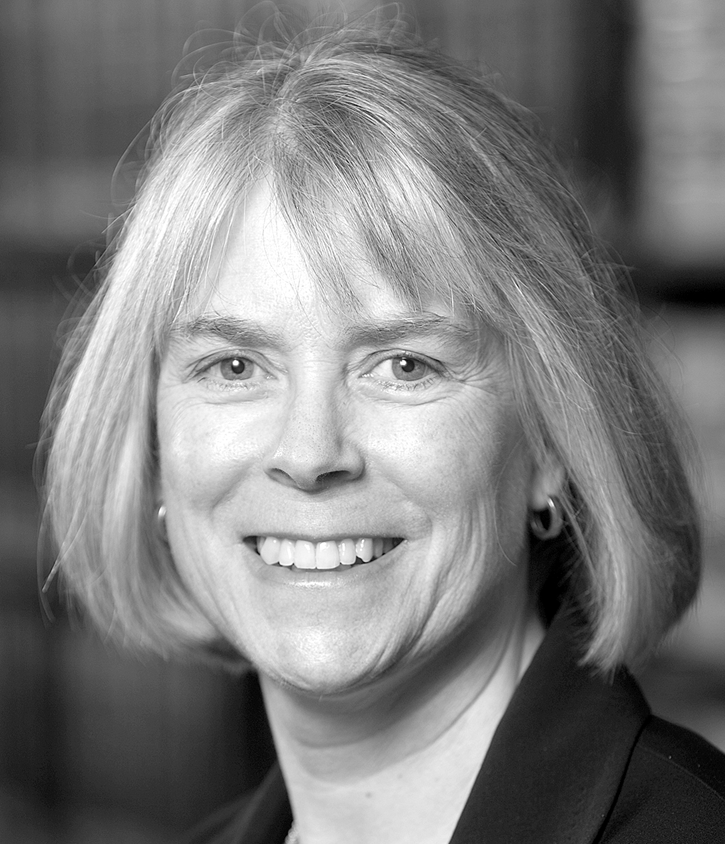
Heather Cahill

Heather Cahill

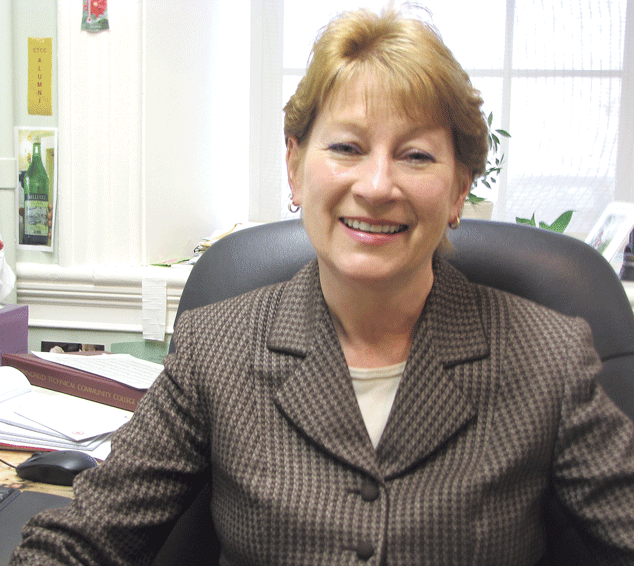
• Heather Cahill has been promoted to Associate Vice President for Institutional Advancement. Serving as the Executive Director for Institutional Advancement for the past three years, Cahill brought much-needed organization to the fund-raising and alumni operations of the department. Cahill’s accomplishments during her tenure with AIC include the Inaugural AIC Run for Education; a $2.38 million HRSA grant, the largest grant in the college’s history; a grant from the Alden Foundation in support of a trading-room-style classroom; multiple federal grants in support of scholarships and equipment; an increase in professional training for current staff and phone-a-thon student employees, resulting in a strengthened commitment to the professional development of the staff; and the inaugural Cornerstone Society Brunch. Cahill also expanded the college’s communication to alumni through larger social-media presence and an increase in both circulation and production of Lucent magazine. Cahill received her BA and MBA from Boston University; and

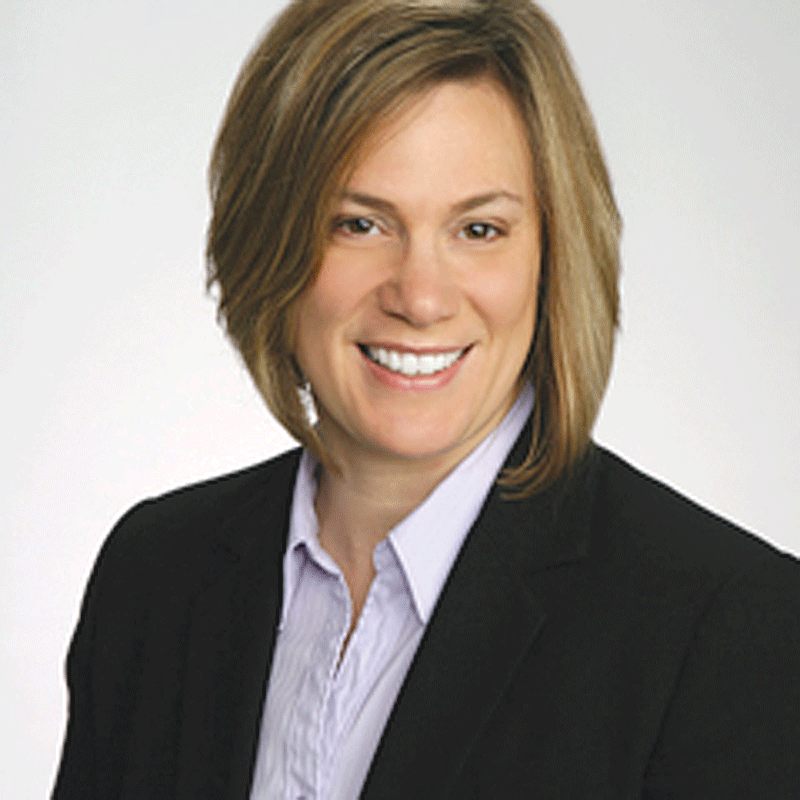
Ellen Noonan

Ellen Noonan

• Ellen Noonan has been named Vice President for Graduate and Adult Education at American International College. Noonan had been serving as Associate Vice President for Educational Enterprise for Extended Campus Programs at AIC. In addition to her current supervision of Extended Campus Programs and Continuing Education, Noonan will oversee all master’s-degree programs in Education, Psychology, and Business. She will also be responsible for the doctoral programs in Education and Psychology, as well as the master’s program in Cairo, Egypt. Noonan received her bachelor’s and master’s degrees from AIC.

•••••

The Center for Human Development (CHD) announced that Kirk Woodring, LICSW, has been named Vice President of Clinical Services. With 29 years of experience in human services and mental-health programs, Woodring will oversee CHD’s outpatient behavioral-health clinics, the Institute of Dynamic Living, early intervention, in-home therapy, and other program clinical services. Woodring most recently served as the Senior Director of Access, Evaluation, and Ambulatory Services for the Brattleboro Retreat in Vermont. Additionally, he served as the Director of the CHD Training Institute for three years and the Senior Program Manager of Behavioral Health Network for six years. Recognized as a member of the American College of Healthcare Executives and the National Registry of Certified Group Psychotherapists, Woodring holds an MSW from the Smith College School for Social Work and a BS in Public Administration from Western Michigan University. He teaches courses in group theory and advanced group practice at Smith College as an adjunct associate professor. In 2011, he co-authored and published the book Assessing the Risk: Suicidal Behavior in the Hospital Environment of Care.

•••••

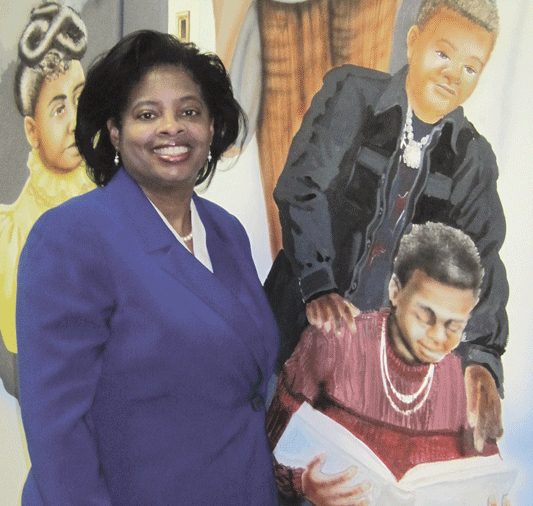
R. Kirk Mackey

R. Kirk Mackey

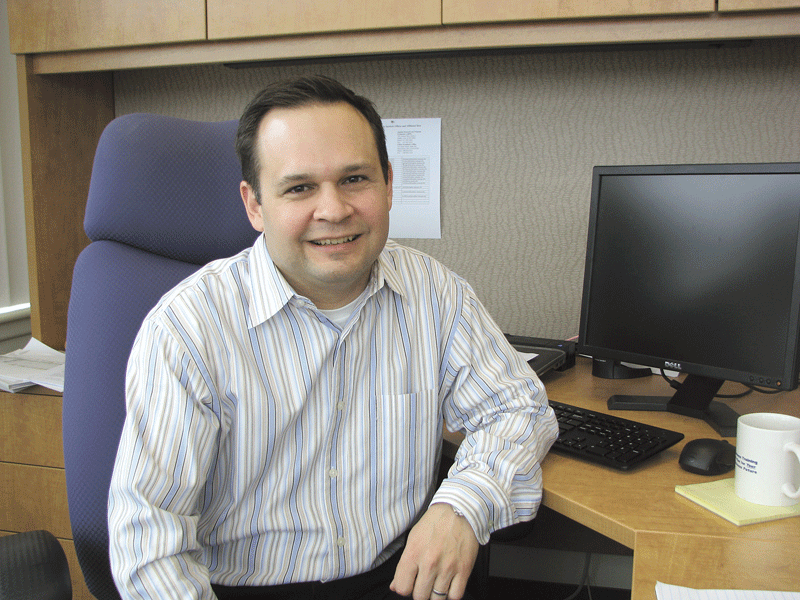
The Dowd Agencies announced the appointment of R. Kirk Mackey as President of Dowd Financial Services LLC (DFS) and its Employee Benefits Division. DFS is a full-service financial division of the Dowd Agencies. Mackey, who has been in the financial-services industry since 1979 and with Dowd since 2005, was formerly a representative of New England Financial Group, LLC. He now specializes in corporate employee-benefit planning, including group health, life, and disability-insurance plans in addition to qualified retirement plans and selective executive-compensation arrangements. He received a BA in Business Administration from UMass in 1978, and a MBA with a concentration in Accounting from Western New England College in1987.

•••••

David Fedor, President of the West Springfield-based Fedor Financial Group, LLC, and an independent financial advisor affiliated with Commonwealth Financial Network, was named to Commonwealth’s Winners Circle. The distinction recognizes only 10% of Commonwealth’s more than 1,400 financial advisors nationwide. Fedor will join his peers at the Winners Circle conference in April at the El Conquistador Resort in Fajardo, Puerto Rico.

•••••

Jean Deliso was recently named Agent of the Year in the Connecticut Valley General office of New York Life Insurance Co. Deliso received the award in recognition of outstanding sales achievement and exemplary client service and professionalism. A New York Life agent for 18 years, Deliso is a member of New York Life’s Chairman’s Council and is a consistent qualifying member of the Million Dollar Round Table, recognized throughout the industry as the standard of excellence in life-insurance sales performance, and is currently a 2013 Court of the Table member. Members of the elite Chairman’s Council rank in the top 3% of New York Life’s elite sales force of more than 12,000 licensed agents.

•••••

Jack Hibbard

Jack Hibbard

Monson Savings Bank announced the promotion of Jack Hibbard to Assistant Vice President and Controller and the election of four new corporators. Hibbard began his career in banking in operations and then as a branch manager more than 25 years ago. He joined the financial department of Monson Savings Bank in 2004 and was promoted to Controller in 2011. Hibbard left banking while he earned his BBA in Accounting from UMass and then worked for a Big Six accounting firm before returning to community banking. New Corporators are Lisa Fallon of Lisa Fallon CPA, PC; Art Ferrara, Co-owner of Landmark Realty; Kara Rescia, Attorney with Eaton & Rescia, LLP; and Elaine Korhonen, Certified Public Accountant.

•••••

Amherst-based New England Environmental Inc. (NEE) of Amherst recently promoted Jack Jemsek, to Vice President of NEE’s Hydrogeology and Remediation Group. Jemsek is a Massachusetts Licensed Site Professional (LSP), a Connecticut Licensed Environmental Professional (LEP), a Professional Geologist in New Hampshire, and a Certified Geologist in Maine. He has B.S. in Earth Science from the University of Notre Dame, and a Ph.D. in Marine Geology and Geophysics from the Massachusetts Institute of Technology (MIT) and Woods Hole Oceanographic Institution Joint Program in Oceanography.

Banking and Financial Services Sections
Country Bank Maintains Its Community Focus

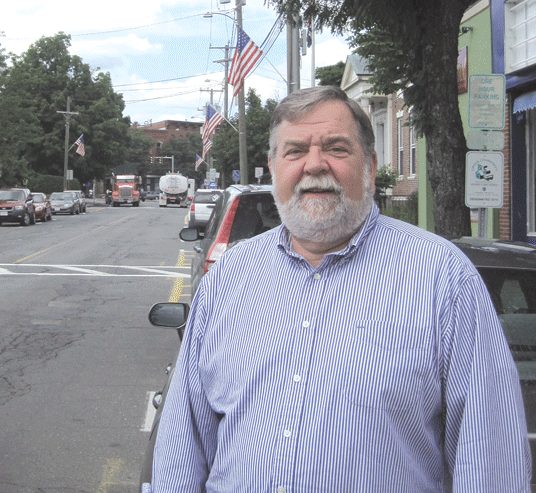
Paul Scully

Paul Scully says Country Bank’s community involvement extends beyond philanthropy to financial-education programs for young and old.

To describe how Country Bank is getting stronger, Robert Kolb used an apt analogy.

Specifically, Kolb — the bank’s senior vice president and chief commercial banking officer, who came on board six months ago — said he wants to take a “barbell approach” to growing its loan portfolio. Picture Country’s reach geographically, he said, with Springfield and Worcester representing the weights and all the smaller towns in between, where Country has a branch presence, as the bar.

“If we want to continue to grow the portfolio, we have to put our toe in the waters of other areas,” Kolb said, noting that the bank does not have physical branches in those two larger cities, but sees opportunities there. “We’re looking to do more in the Worcester market and the Springfield market … we want to expand our presence in those markets.”

As a mutual savings bank with $1.4 billion in assets, and boasting 14 branches and 245 employees — Country has the reach to grow, said its president, Paul Scully, but continues to maintain an emphasis on small communities.

“We’re still focused on providing a full range of consumer and business products and services within our marketplace, and we view our marketplace as the geography between the Worcester and Springfield areas,” he noted. “Our branching strategy is the same: smaller towns.”

However, he noted, “branch locations don’t matter as much anymore; between mobile banking, remote capture, and other services, customers have really caught on to the fact that they can do all their banking and really never go into a branch. Technology has allowed us to expand our product offerings within more urban marketplaces without having a physical presence there.”

And growth is what Scully has in mind.

“Last year we originated about $105 million in commercial loans — pretty respectable, considering what the market was and what the competition is,” he said, noting that the bank boasts a loan portfolio of $838 million. “A lot of banks are looking for the same opportunities as we are, but there aren’t as many opportunities to go around. What every bank tries to do is differentiate themselves from the crowd.”

One of the ways Country has always tried to do so is through an emphasis on service.

“We look at ourselves as a small business,” Scully said. “We’re a good-sized bank, but we’re still a small business able to offer personalized service. We don’t have a high level of turnover; people who come into the branches see the same people who have been working with them for a long time. Customers are recognized and feel comfortable with the people they’re doing business with. They’re not calling an 800 number where someone across the country is answering. The service element is really a key factor in our success and has set us apart since 1850.”

Added Kolb, “on the commercial side, as an organization, we provide a nice match for what the market demands. We’re not too big and not too small.” But he also echoed Scully’s sentiments about service.

“The money’s still green at the bank across the street. It’s a pretty homogenous product. We all make mortgages and commercial loans; we all do deposits,” he said. “But what really differentiates us is service. It’s not just a tagline; it’s something that’s ingrained and apparent.

“When you walk around the teller line, the average tenure there is 20 years. In the business lines, it’s 10 to 15 years. They don’t stay here because it’s a local, sleepy bank in Massachusetts; they take a lot of pride in the relationships they’ve forged. It is the difference between us and the bank across the street.”


Wiring of the Green

Bob Kolb says Internet and mobile banking are key to a bank’s success today

Bob Kolb says Internet and mobile banking are key to a bank’s success today, but so is the personal service available at a branch.

But how important is that physical bank on the street, in the era of Internet and mobile banking? Kolb said it will always have its place.

“There are still customers out there that like to see the branch bank on the corner,” he explained. “Having that visibility is important, and it’s never going away; it’s the doorstep to us being active in the community. And giving back to the community is really part of the culture at Country Bank.”

But technology has certainly changed the way customers interact with banks, Scully told BusinessWest.

“We’re pretty much able to have a full range of products to meet everyone’s expectations, from savings accounts straight through to mobile banking and e-bill payment,” he said. “Last year, we converted our ATMs to digital ATMs, so there are no more envelopes; you put the check right into it. That’s the convenience factor; it expedites the transaction for a person sitting in their car with a couple kids or a dog who wants to be somewhere else.”

Those high-tech advances extend to remote capture for businesses that can conduct transactions without going to a branch, and retail online banking has come into its own as well, but there’s no longer as dramatic a split in the ages of people who use it.

“We used to think of it as a generational thing, with the older client base wanting to come into the branch,” Scully said. “People still want to know the branch is on the corner, but we’ve learned that age doesn’t matter. Almost everyone uses a computer, and we have a lot more seniors using e-billing and other technology, and we have people feeling more and more comfortable with security.”

For that reason, the bank’s educational outreach spans generations as well. Country conducts a banking program in area elementary schools, building early financial literacy by teaching students about savings and investment and providing them with passbooks to open their own in-school accounts. It has since expanded that to a ‘credit for life’ program for high-school seniors, teaching them about credit scores and smart handling of paychecks and expenses.

“But the other thing we’re focused on is the senior piece,” Scully noted. “We do a lot with senior centers, talking about banking technology and security, so they don’t feel intimidated using a computer for their banking.”

When Social Security switched over to electronic payments, “we did a lot with senior centers about what that change means and why e-banking is very secure,” he added. “Once seniors feel more comfortable with the technology and understand that their money is not at risk, they want to use e-banking; they want to use mobile banking.”

“The key,” added Kolb, “is to make those channels available, whether through the computer, at a branch, or on the phone, whether someone is 18 or 88 years old.”

In fact, Scully said, there’s no reason why remote banking shouldn’t be embraced by seniors. “Once people realize, ‘OK, I don’t have to go out in the snow and possibly fall down,’ suddenly they feel really good about it.”

For younger customers, he added, “it’s all about smartphones. They’re not looking to have a passbook; they don’t want to bring in some clunky old thing.”


Hometown Appeals

The Country Bank name is only 32 years old, but the institution has been around since 1850, when it was known as Ware Savings Bank. It took on its current name after a 1981 merger with Palmer Savings Bank; another merger with Leicester Savings Bank 17 years ago further increased the bank’s holdings.

From the time of the name change, Scully said, it has been important to communicate a sense of community ties. That’s why the name of each branch reflects its hometown: Country Bank of Ludlow, Country Bank of Palmer, etc. “We like to think of ourselves as that town’s small-town bank, their community bank,” he said — despite the occasional confusion of a customer who goes into a branch in a different town and wonders whether he can bank there because of the different name.

The small-town focus is a positive when it comes to lending, Kolb said.

“Small business is really the backbone of America, and it’s certainly the backbone of the small areas we operate in,” he told BusinessWest. “In Central and Western Mass., it’s about small business; it’s about Main Street. With our branch network and experienced lenders on the commercial side and on the mortgage-origination side, that puts us in a great spot to serve the community with the resources of a big bank, yet we’re small enough to be able to jump in the car and see someone at 7 at night, or be reminded when walking down the aisle of the grocery store that you need to see somebody.”

The hometown emphasis is also at the heart of Country’s philanthropic efforts. In 2012, Scully noted, the bank donated more than $600,000 to community organizations.

“They’re causes that people don’t think about because they don’t necessarily apply to their life, but there are so many people whose lives are affected,” he said, citing the bank’s support of domestic-violence task forces, food pantries, and other organizations. “Unless you need that service, you might not pay attention to the fact that their funding sources have been reduced, or that their needs have grown.”

But the bank offers more than money, he was quick to add, noting that management staff alone volunteered more than 1,400 hours last year at community events — “that’s personal time, nights and weekends” — and the bank has been expanding volunteer opportunities for all employees as well. “Now we have more than 100 volunteers giving back to the community.”

All the bank’s efforts — from its lending business to its charitable work — boil down to an effort to improve people’s quality of life,” Scully said. “Maybe we lend to a business that puts up a building and hires more people. Or we could be giving a scholarship to a kid who then graduates from college. Or we could be supporting social services. It’s all full circle, quality of life.”

Kolb was quick to note that “philanthropy is not something that drives revenue; it’s not a profit center. What it is, really, is part of the culture; it’s consistent with the mutuality of the company. What we’re trying to do for the communities we serve is not a revenue driver; it’s really part of who we are.”

Specifically, Scully added, “the profit is in the long-term impact in the community. Everyone benefits from it. And we didn’t start those things; it’s the legacy of the bank as it relates to every aspect of community life.”


Bottom Line

In many ways, despite its asset growth, some things have remained the same at Country Bank, Scully said. “Community banking is consistent banking. We’re taking what we believe we’ve done well and expanding it.”

And that requires constant reconsideration of business strategies. For example, “the [loan] portfolio is very heavy in real estate, so one of my objectives in coming here is to diversify the portfolio,” Kolb said, a process that will take some time considering an economy that is improving, but still far from thriving. “The idea is to start with small businesses and identify opportunities in that space where we can exploit our leverage with our infrastructure and the experience of our lenders and our service.”

Scully called today’s banking environment “an exciting time, but a challenging one,” but he noted that, particularly since the financial collapse in 2008 that was brought on partly by the misdeeds of the largest banks, there’s something appealing to many customers about a community bank’s consistency.

“That’s not to disparage super-regionals, but those organizations use their customer base as a means to produce revenue and income, which increase shareholder value,” Kolb noted. “What sets us apart, as a mutual bank, is that our depositors are in essence the drivers, and our mission is to service those individuals.”

“We have sort of a split personality,” Scully added. “Are we a big little bank or a little big bank? We’re sort of both; we can do almost any type of transaction a big bank can do, and by any standard we’re considered large, but by having a focus on the customer, the community perceives it as a little bank.”

But one that, barbells or not, is growing stronger.


Joseph Bednar can be reached at [email protected]

Conventions & Meetings Sections
Hotel Group Gives New Look, Feel, and Name to a Springfield Landmark

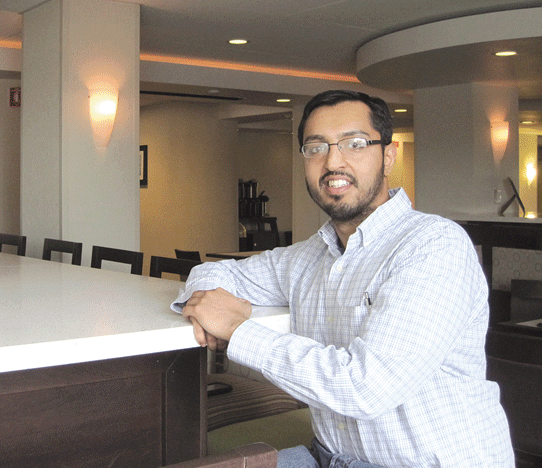
Shardool Parmar

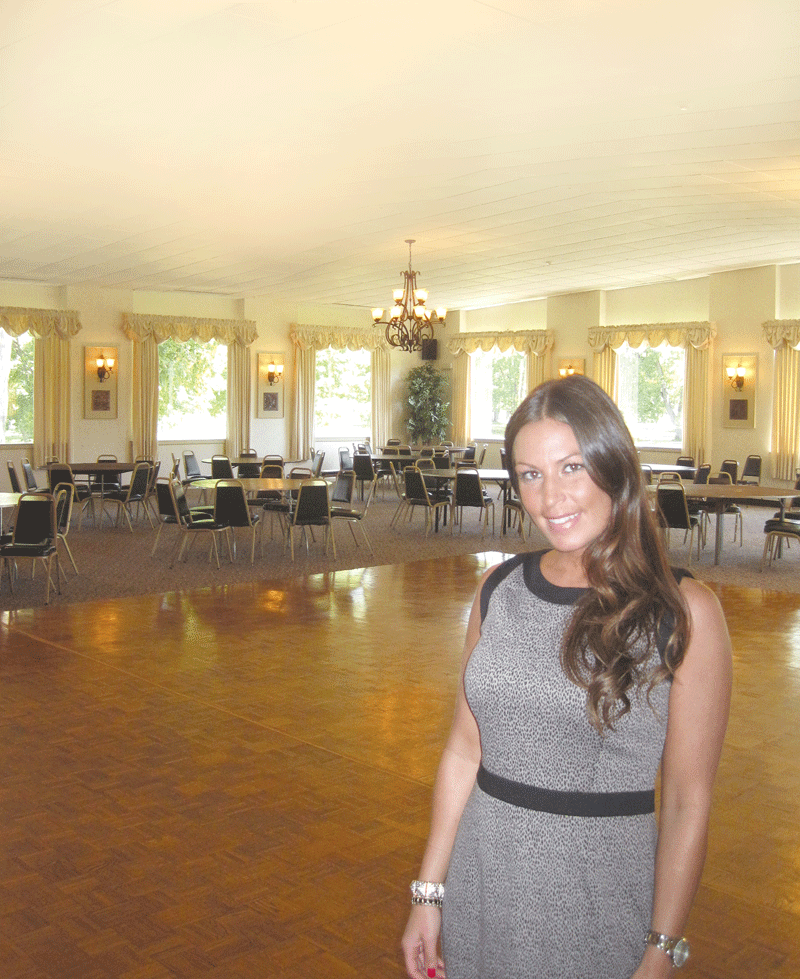
Shardool Parmar says the large Mount Tom ballroom on the 12th floor showcases the downtown Springfield skyline and Connecticut River.

Shardool and Kishore Parmar, president and vice president respectively of the Pioneer Valley Hotel Group (PVHG), understand that they have two sizeable challenges when it comes to the property at 711 Dwight St. in Springfield.

The first is to get people to stop talking about it in the past tense — a still-common practice, especially when it comes to the rotating restaurant on the top floor that was once a major destination in the region — and using one of the names that used to be on the building, especially Holiday Inn.

The second is to convince several constituencies, from families to business travelers to event planners, to embrace the new name over the door — LaQuinta Inn & Suites — as one that represents both quality and an attractive option to the deep roster of other players in the local hospitality sector.

And the brothers Parmar believe that a recent $4.5 million renovation project, one that accompanied the new brand name on the landmark — will go a long way toward tackling both.

Indeed, the Parmars say they’re already noticing that while some people still talk nostalgically about the revolving restaurant, named Top o’ the Round, and how they had they had their high school prom there, many more are now talking about the new Mount Tom Ballroom, carved out of the space once occupied by the restaurant, and its stunning views of the Connecticut River and the Springfield skyline.

Meanwhile, they say the facility is catching the eye of event planners, some of whom are still getting quizzical looks, and more, when they reveal their choice for the company’s next function.

“Just recently, we’ve had meeting planners go back to their superiors after booking here and the superiors say, ‘there’s no way we’re going to book over there; are you crazy?’” he said with the laugh. “But they haven’t seen the space.”

Those who have generally report a facility that’s much brighter than the old Holiday Inn or, later, the Inn Place or CityPlace Inn and Suites, and also more customer friendly.

“This is probably one of the nicest looking LaQuinta hotels you’ll see in the whole country,” said Shardool. Indeed, PVGH recently won the Best Conversion award for all LaQuinta Inns & Suites in the U.S.

The Parmars realize that while they’ve made some progress with those aforementioned challenges, real success will take time and energy. It’s an assignment they embrace as one of the more visible components of a growing hospitality chain that also includes facilities in Ludlow and Hadley.

For this issue and its focus on meetings and conventions, BusinessWest toured what had been the forgotten hotel in Springfield, and gained a sense for what could happen next for this intriguing slice of the city’s skyline.


Suite Success

Wanting a better life for his two young sons, Laxman Parmar, PVHG’s CEO, brought the family to America in 1987, and eventually purchased the Seven Gables Motel (now Howard Johnson’s) on Boston Road in Springfield.

His two young sons essentially learned the hospitality business from the ground up at the motel, handling a number of odd jobs, from changing beds to cleaning bathrooms to tackling landscaping duties. And their learning opportunities multiplied as their father eventually came to preside over a hotel group that now also includes two facilities in Hadley, the Hampton Inn and Comfort Inn; and the Comfort Inn in Ludlow, which will soon change over to the Holiday Inn Express name in April.

Shardool and Kishore both enjoyed hospitality, but pursued degrees in engineering, and took jobs in related fields. A chemical engineer, Shardool worked in the biotech industry, while Kishore, an electrical engineer, worked at a Boston-area provider of information technology services.

They returned to the family business, however, when their father suffered a second stroke in 2005. And they took what they learned in the engineering field with them, skills and knowledge that have helped them shape decisions that have enabled the hotel chain to continue growing.

“If you look at the greatest CEOs in business history, most of them were engineers,” Shardool explained. He referenced Jack Welch, the former chairman of General Electric, who was a chemical engineer, and former Coca-Cola chairman Roberto Goizueta, a Cuban immigrant and also a chemical engineer.

“Engineers are good in business because we can quickly identify problems, and we have a great understanding of the mechanics of a business, not in the sense of equipment, but in the sense of what steps and what procedures need to take place to achieve the right outcome,” Shardool explained. “So when it comes down to making sure that rooms are clean, we don’t just take somebody’s word for it, we verify it.”

Kishore agreed.

Kishore Parmar

Kishore Parmar says customers are impressed by the contemporary new lobby of LaQuinta Inn & Suites.

“The worst thing you can do is let a problem linger,” he said. “And engineers hate problems that linger, we want solutions, very quickly.”

These attributes and attitudes certainly came into play as the Parmar brothers first assessed the risks and opportunities involved with the former Holiday Inn, and also with moving forward after they eventually triumphed in the competition to acquire the property from the company that was operating it in receivership.

While all those who looked at the facility saw a property in a advanced state of decline, the Parmars saw something else — what Shardool described as ‘great bones.’

“We saw what happened to the hotel more as neglect, and lack of good management than anything else,” said Shardool. “We essentially had an idea of what we wanted here, but it takes time.”

One of the first priorities for the new owners was to rebrand a facility they had already been renamed the CityPlace Inn and Suites. What ensued was in-depth research into national franchise options, and analysis about what might work within the Greater Springfield market.

This research eventually focused on LaQuinta, a name and a chain that is far better known in other regions of the country. What the brand offered was a reputation for quality (at least in those markets where it’s a known commodity), and an opportunity to succeed within a specific niche — a lower-priced product that appeals to those who don’t want or need all the amenities of a full-service hotel.

But what it lacked was name recognition in the 413 area code.

“The greatest thing and the worst thing about LaQuinta is that nobody knows what LaQuinta is,” Shardool explained to BusinessWest. “The greatest thing is that nobody has a preconceived idea of what it is, but of course the downside is that it’s not as well-known.”


Room for Improvement

Once they had zeroed in on the LaQuinta brand, the PVHG began formalizing what became a $4.5 million renovation, funded in part by a $2.5 million loan from the U.S. Department of Housing and Urban Development (HUD) and a secondary loan from NUVO Bank & Trust Company, along with PVHG’s own funds.

The motivation for the massive undertaking was to change the look, feel, and attitudes concerning the property, said Kishore, and the LaQuinta chain facilitated these efforts by providing a great amount of flexibility, or individuality when it came to design elements and overall layout of the facility.

“Our goal from the beginning was to have as few walls as possible,” added Shardool, adding the desired effect was a much brighter, far more modern, more customer-friendly facility, from the front lobby to the 12th-floor facilities, and the two brothers believe all that has been accomplished.

The hotel now offers 182 rooms, down from the original 207, and 28 suites, said Kishore, adding that the work was phased in to enable the facility to remain open during the rehab process. The Parmars would close down two to three floors to gut and renovate, while the other floors remained open for business.

The bright, contemporary, open design that allows people to move more freely through the hotel has generated strong word-of-mouth referrals, said the brothers.  Moving the complimentary breakfast down from the dark and cramped top floor to the main lobby area has allowed the staff to meet the customers during breakfast or at the comfortable bar with it’s lime green pendant lamps and stylish, geometric design bar-height chairs.

On the 12th floor what had been three rooms has been transformed into one large function area, renamed the Mt. Tom Ballroom, which comfortably accommodates 260 people for sit-down functions, and 400 for cocktail events. The Summit Room, also on the top floor, can be split into two separate rooms and can hold up to 80 seated guests and 200 for cocktail functions.

Starting from essentially scratch, sales staff at the hotel report considerable interest in the 12th floor’s facilities, with a number of events already booked.


Mint on the Pillow

Recent increased national advertising by LaQuinta has helped famililiarize people in this region with the brand, but the Parmars acknowledge that many still don’t know about their facility or its extensive renovations.

They hope to change all that through strong word-of-mouth marketing, and by creating positive experiences for those who choose what amounts to Springfield’s newest hotel.

“LaQuinta has a good leisure following, nationally, and Springfield is predominately a leisure and sports type of customer,” said Shardool. “The business market is not as strong in Springfield, but the hotel market is changing, and we know, it just takes time.”

And in time, they believe far fewer people will be talking about this landmark with the past tense.


Elizabeth Taras can be reached at [email protected]

Environment and Engineering Sections
FloDesign’s New CEO Eyes Aggressive Growth Patterns

Walter Thresher

Walter Thresher says he would like to position FloDesign to be a ‘skunkworks’ operation for defense and aerospace corporations.

Walter Thresher certainly wasn’t thinking about retiring after a nearly 34-year career at Hamilton Sunstrand, now United Technologies Aerospace Systems, but he was looking to perhaps throttle down a bit, to borrow an industry term, after work on everything from the B2 bomber to the Comanche helicopter to Boeing’s 787 Dreamliner.

“I was looking for a different challenge — something approaching part-time,” he told BusinessWest, adding that he’s found the former, but not exactly the latter, in his new capacity as CEO of Wilbraham-based FloDesign.

This is the company, founded by Western New England University Engineering professor Walter Perez and led by WNEU Engineering graduate and serial entrepreneur Stanley Kowalski, that is most associated with a radical new design for wind turbines. But while that concept was, indeed, designed by FloDesign engineers, Kowalski and Perez now maintain only a minority ownership in the company they spun off to take the concept to the marketplace — FloDesign Wind Turbine — and the company is now headquartered in Waltham.

Meanwhile, another spinoff, FloDesign Sonics, still based in Wilbraham, is engaged in developing technology using sound waves for a variety of uses, including water purification.

The parent corporation, FloDesign, is essentially an aerospace company that has designed, prototyped, and developed products ranging from noise suppressors for jet engines to something called a RAP nozzle, a device that transmits a fluid force, gas, or fine particles over a distance with minimal loses. Thresher takes the helm at an intriguing time for the enterprise, as it looks to create new business opportunities and avenues for growth.

Thresher, who came to the company in February, is considering a number of options for the company, but especially evolution into what he called a ‘skunkworks operation’ for major defense and aerospace companies, like Hamilton Sundstrand.

Skunk Works is the official alias for Lockheed Martin’s Advanced Development Programs operation, formerly known as Lockheed Advanced Development Projects, which was created in the 1940s and developed aircraft ranging from the U-2 to the SR-71 Blackbird to the F-22 Raptor. But over the ensuing decades, the term has been applied (using the lower case) to a group within an organization, or an outside venture, given a high degree of autonomy to conceive and prototype new products and technologies.

“The team we have here has very good capability in design, rapid prototyping, and then getting parts on test fast,” he explained. “And that’s something that larger companies have a hard time doing; they tend to go slow and follow very fixed processes. What I’d like to do is operate as a skunkworks operation for a larger company.”

Thresher brings vast experience in aerospace product development and engineering to his new position at FloDesign.

After starting his career with Pratt and Whitney as a development engineer in turbine cooling and dirt-separator development, the WNEU graduate moved to Hamilton Sundstrand a year later, where he developed high-pressure water separators, air mixers, sub-freezing heat exchangers, and air-bearing turbomachinery. He led the engineering efforts to improve heat-exchanger-manufacturing processes and defined the build process for air-bearing air-cycle machines used in a number of current military fixed-wing applications.

He has also been responsible for systems on the B2 bomber, and was chief project engineer for the Environmental Control System (ECS) for the F/A-18 E/F aircraft. Later, he was the design manager for the thermal-management systems for the Boeing 787 Dreamliner program, and also performed the function of weight manager to control and reduce the weight of the design. As part of that effort, his team received a special challenge award from Boeing for creative use of design tools to achieve weight reduction.

He was previously chief engineer for the Comanche helicopter ECS, and was most recently the chief engineer for the CH53K HLR helicopter secondary power system. During the design phase, he led efforts to reduce system weight, resulting in a simplified system with little functional compromise, and a 10%-under-contract weight system.

Summing up what’s on that extensive résumé, Thresher said his work centered on parts and systems such as water collectors, air mixers, and heat exchangers, devices similar to those with which FloDesign has made its reputation.

What’s more, the company had been working on some specific projects that intrigued him, such as initiatives involving UAVs, or unmanned air vehicles, for both military and civilian use.

Thresher was eventually approached by Kowalski about taking the helm at the aerospace division of the company. “I was thinking that this was a bit more than a part-time job,” he said, “but it was an exciting opportunity to do some of the things that were on my list at Hamilton.”

He told BusinessWest that his primary job description is to determine the next direction for the aerospace unit. One of his immediate goals is to use proprietary mixer/ejector technology that the company has developed to move two products from the drawing board to the market.

One is a noise-suppressing device that has been in development and funded through a grant from the Small Business Innovation Research program, while the other is the RAP nozzle, which Thresher believes has potential for use in a number of markets, from fire suppression to personal protection.

“We’re trying to figure out just where to go with it at this point,” he explained. “But it has a number of potential applications.”

And his long-range goal for FloDesign is to become an independent skunkworks operation that would take advantage of its experience with everything from scale-model testing to work in design of “less-than-lethal” weapons to design and develop products and technologies for what could become a variety of clients.

“We’re able to do things faster and less expensively than larger operations can,” he explained. “That’s a major area of opportunity that I plan to expand.”

Thresher said FloDesign could thrive in such a role because, while there are many smaller shops that specialize in one phase of product development — design, fabrication, or testing, for example — there are few that can, like FloDesign, handle them all.

“We also have the technical capability to think through what the issues are with the first round of what was designed and tested, and even design modifications,” he said. “And that’s what would make us unique compared to other companies.

“Normally, at a test house, you take parts there, you run a test, they give you the data, and you go home,” he went on. “At a design house, you tell them what you want designed, they do the design, and they give it back to you. We can do all those things.”


— George O’Brien

Environment and Engineering Sections
WNEU Creates New Civil and Environmental Engineering Program

Student Emily Lynch, seen here with Kenneth Lee

Student Emily Lynch, seen here with Kenneth Lee, says she’s always been fascinated by bridges, and ultimately decided to make civil engineering a career.

When asked about the factors that drove Western New England University’s decision to create its new Department of Civil and Environmental Engineering, Ken Lee summoned some telling numbers.

The first were from the Bureau of Labor Statistics (BLS), which is projecting an employment growth rate of 19% for civil engineers and 22% for environmental engineers — one of the fastest-growing subspecialties within the broad realm of civil engineering — between 2010 and 2020.

Another number — and probably the one fueling those BLS projections — comes from the American Society of Civil Engineers, which, when assessing the nation’s aging infrastructure, projects that $71 trillion in infrastructure investments will be made by 2030.

“Everything we make in civil engineering has a lifespan,” said Lee, chairman of the new department, in an article announcing his appointment in the university’s alumni publication, the Communicator. “Buildings and bridges are crumbling, and transportation systems need overhauling. We need plenty of engineers to plan, design, analyze, develop, organize, and manage retrofits and new construction projects.”

Couple these projections with the university’s desire to grow its well-regarded College of Engineering, and civil engineering, with a strong focus on environmental engineering, was the logical path to take, said S. Hossein Cheraghi, dean of the College of Engineering.

“We want to grow, and one of the best ways to do that is with new programs,” he said, adding quickly that existing offerings are also being expanded. “And when we looked at different programs and at statistics from the Department of Labor in terms of future opportunities for employment, we realized that civil engineering made the most sense for us.”

He told BusinessWest that talks on such an expansion were initiated about three years ago, and they culminated with a program launched last fall with 13 students.

Emily Lynch is one of them.

A Connecticut resident, she said that, while growing up, she became fascinated by bridges — “I would drive over them and just be awestruck,” she explained — and by her junior year had decided to make civil engineering a career.

“I liked math more, but I didn’t want to make that my livelihood,” she went on. After being alerted by her guidance counselor to the new program at WNEU, she made that school one of three options — Wentworth in Boston and the University of New Haven were the others — and eventually decided to became part of the inaugural class at the Springfield campus. “There’s supposed to be a huge jump in demand for civil engineers in the years to come; I want to be part of that.”

Creation of the Civil Engineering program is one of the primary drivers of a planned expansion of Sleith Hall, home to the College of Engineering, said Cheraghi, noting that plans call for 8,600 square feet of new space, as well as renovations and upgrades to the entire building.

Work on the two-story addition, projected to cost between $12 million and $13.5 million, is expected to begin this summer, he went on, adding that the new area will house laboratory space for the new program, as well as labs for Biomedical Engineering, classroom space, and a computer lab. The project also includes building-wide HVAC improvements, the installation of a new sprinkler system, and technology improvements.

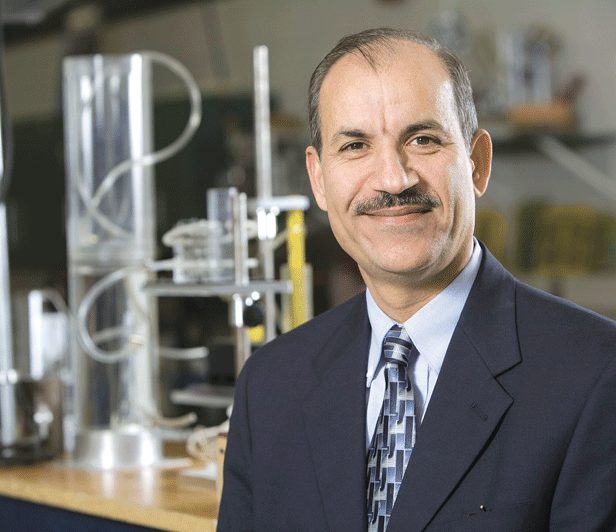
S. Hossein Cheraghi, dean of the College of Engineering

S. Hossein Cheraghi, dean of the College of Engineering, says the new civil engineering program will help “internationalize” the WNEU campus.

“The addition of new programs and growth in existing programs in the College of Engineering is driving the need for additional space,” said Cheraghi, noting that the school also added a doctoral program in Engineering Management and has seen increasing enrollment in its existing engineering programs — biomedical, electrical, industrial, and mechanical.

For this issue and its focus on engineering and the environment, BusinessWest takes an in-depth look at the university’s new Civil Engineering degree and what it means for both the school and those currently enrolled in the program.


Bridging a Gap

When asked why he left a teaching position at UMass Lowell to come to WNEU, Lee broke into a wide smile.

“Opportunities to lead a new program, especially a civil engineering program … those are quite rare today,” he said, adding that he was looking forward to the many challenges involved with getting such an initiative off the ground, from hiring faculty to recruiting students to setting the tone academically. “This is a very exciting career opportunity.”

It came about, said Cheraghi, because the School of Engineering, and the university as a whole, has set some ambitious goals for continued growth, and civil and environmental engineering represented both the most glaring area of need and the best opportunity for expansion, given those projections from the BLS.

The new program also fits nicely into a recently developed strategic plan for the university, one component of which is the goal of greater “internationalization” of the campus and thus the student population.

“We want to bring more international students to our campus,” he explained. “And this is one of the most important programs for developing countries. There is a global need for civil engineers.”

Meanwhile, an analysis of the regional market revealed that there was a need for — and thus room for — another civil engineering program.

Departments exist at UMass Amherst and UConn, said Lee, and there is an associate’s degree program at Springfield Technical Community College. A two-year degree opens some doors to employment, he went on, but a baccalaureate or graduate degree offers access to many more opportunities.

Cheraghi told BusinessWest that the new program will play a large role in helping the College of Engineering continue its pattern of growth and reach ambitious targets for enrollment. Indeed, the Engineering department had 320 students in 2009, boasts 475 at present, and would like to be at 600 within five years, he said, adding that these numbers clearly indicate the need for the planned expansion of Sleith Hall.

While the Civil and Environmental Engineering initiative is new, Lee said, the university has a long history of excellence in engineering, and this will certainly help draw people to what’s called the CEE program. WNEU’s comparatively smaller class sizes and its so-called ‘theory to practice’ approach to engineering education, which provides hands-on experience that enables students to hit the ground running as they enter their chosen careers, are also effective selling points.

These were some of the factors that helped prompt Lynch to eventually choose WNEU. She’s still wrapping up her freshman year, but already has designs on what she wants to do professionally.

“I’m leaning toward the structural side of civil engineering — building roads and bridges and fixing the many that are crumbling,” she said. “I really want to fix our infrastructure.”

Students in the program will focus on the latest advances in the design, construction, and maintenance of today’s infrastructure, including roads, bridges, buildings, airports, tunnels, dams, water-treatment and supply networks, and environmental systems, said Lee, adding that students will study the many areas of civil engineering, from structural engineering to geotechnical engineering.

The WNEU program is somewhat unique, he went on, because of its separate environmental engineering concentration. Students who take that route will get a civil engineering degree, which provides great flexibility, he explained, but also a strong focus on issues involving water — from treatment to renewable energy.

Another unique aspect of the program will be the incorporation of ‘green’ engineering techniques and sustainable materials, he said.

“Until recently, efficiency and environmental impacts have not been major parts of the equation,” he told the Communicator. “But now, when you design a building, you want it to be as energy-efficient as possible and use as little water as possible.”

Original projections for the program’s first year were for 10 students, said Lee, adding that, without much (if any) advertising, 13 were chosen from roughly 75 applications. And both of those numbers project to go much higher for year two, with perhaps 140 applications and possibly 20 to 25 students admitted. The goal is to reach 100 students in the program by the time the first class graduates in 2016.

One popular route could be transferring into the program from STCC after completion of the two-year program there, he noted, adding that WNEU can begin accepting transfers when members of the inaugural class reach their junior year.

The university is set to hire a second faculty member for the program for year two, said Lee, who was the first, and add two more for the start of the 2014-15 academic year.


On the Right Road

Assessing his career shift and decision to both teach and administer WNEU’s new engineering program, Lee said he believes he’s in the right place at the right time.

And the same can be said of the 13 students in that program’s inaugural class and those who will enroll in the years to come.

Indeed, the projections made by the American Society of Civil Engineers and the Bureau of Labor Statistics would seem to provide ample evidence that he’s right.

Time will tell if WNEU’s large investment will prove worthwhile, but already there are signs that the university is building momentum — in more ways than one.


George O’Brien can be reached at [email protected]

Cover Story
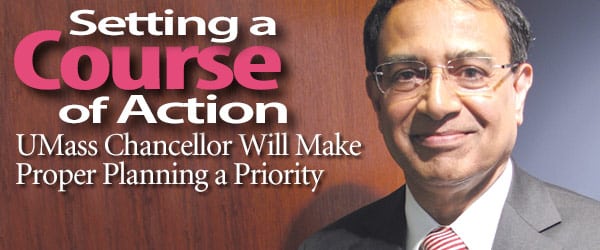
UMass Chancellor Will Make Proper Planning a Priority
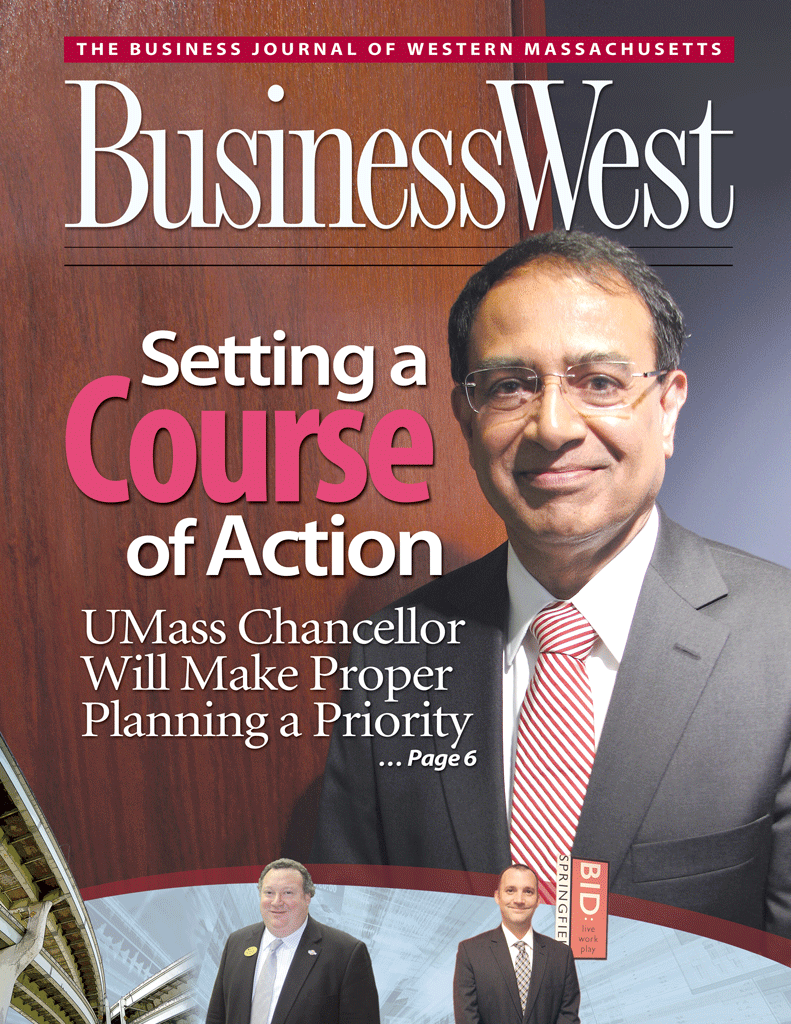
COVERart0313bAs he talked about UMass Amherst and the course he projects for the school he now serves as chancellor, Kumble Subbaswamy summoned a well-worn quote from Dwight Eisenhower: “plans are nothing; planning is everything.”

Those words were uttered in reference to preparations for D-Day, the largest amphibious invasion in history, but they’ve been borrowed by leaders in virtually every field, including academia, to describe the difference between having a plan on paper and engaging in effective, thorough, sensible planning.

There is a new strategic planning initiative underway at the Amherst campus, said Subbaswamy (known to colleagues as ‘Swamy’), one that will provide a detailed outline of where this soon-to-be-150-year-old institution needs to be with regard to everything from the life sciences to economic-development initiatives within the Commonwealth; from increasing the volume of research initiatives on the campus to improving graduation rates.


The faculty-led initiative, which should be ready by the summer, will shape the school’s trajectory for the next several years, said Subbaswamy, who came to the Amherst campus last July.

“Eisenhower was correct — planning is a forcing mechanism for us to think seriously about where we want to go,” he told BusinessWest. “Without planning, anything goes.

“This is a time when economic development is on a lot of people’s minds,” he continued, while juxtaposing the school’s current mission against the one it started with as one of the institutions created through the Land Grant Act of 1862. “Globalization has had an impact on what it means to be a 21st-century economic power; we still have a lot of assets that the state has invested in that can produce direct benefits to the Commonwealth and beyond, and we will be articulating that as part of our strategic plan.”

But planning has become a far more challenging assignment in the current fiscal climate, one in which state contributions to the state university have been declining, said Subbaswamy, adding that the funding situation leaves many question marks about everything from further progress in what has become known as the ‘Springfield Initiative’ to efforts at the university to help the state’s businesses become more globally competitive.

“If the expectation is that planning means that new resources will suddenly and magically appear, that’s unrealistic; that’s not what happens,” he said. “But if the goal is to say, ‘whether new resources come in or not, we want to prioritize where we spend our money,’ then the planning exercise is a very important one and a necessity.”

Moving forward, he said the school, its administrators, and faculty will be addressing what he called some of the “new challenges” facing those in higher education today. He put on that list such matters as the emergence of online education and what it means to residential institutions to continuously hone the model for a successful research university.

Meanwhile, one additional challenge for the UMass Amherst campus, and it’s not a recent phenomenon, is making its various programs and reputation for excellence as well-known within the state as it is outside.

“Sometimes, it feels like UMass Amherst is the best-kept secret inside the Commonwealth of Massachusetts — it has a far better reputation outside the state,” he explained, adding that this is likely due in large part to the Bay State’s many prestigious and well-known private institutions — Harvard and MIT top that lengthy list — which often overshadow the state university’s flagship campus.

“But I think people are beginning to recognize the difference between the publics and the privates,” he went on, “and, in particular, the important role that public institutions play within the Commonwealth. When you get into deeper conversations, you see that there is high and growing regard for UMass Amherst; people recognize, for example, that admission standards have gotten pretty high, and they recognize that the Commonwealth Honors College is a destination place for the best and the brightest inside the state and outside it as well.”

The Commonwealth’s stock of private schools may also play a role in what many have described as a less-than-passionate alumni base when it comes to the university, said Subbaswamy, who didn’t exactly disagree with that characterization. He said the school suffers from geographic challenges — many of its graduates live and work across the state, which is not a huge distance comparatively, but certainly psychologically — and also from a lack of what he called “connecting points.”

And he placed in that category everything from buildings and features on the campus itself — perhaps the most historic and best-known building, the chapel, has been closed for more than a decade — to a big-time sports program.

For this issue, BusinessWest conducted a wide-ranging interview with Subbaswamy, one that touched on everything from rising in the ranks nationally among research institutions to possible expansion into downtown Springfield — and how it all comes back to planning.


Class Action

After arriving last summer after a stints at two other major public schools — the University of Kentucky’s Lexington campus and the University of Indiana’s flagship campus in Bloomington — Subbaswamy said he commenced a lengthy, and in some ways ongoing, series of “meets and greets” with individuals and groups at both ends of the state.

The constituencies involved were both internal — faculty, staff, and students, among others — and external, ranging from alumni groups to state legislators to the Cranberry Growers Assoc., which, while based in Wareham on Cape Cod, boasts many members from the UMass School of Agriculture, and certainly isn’t among those lacking an appreciation for the state university.

“Among the cranberry growers, there is true adulation and respect for the institution,” said the chancellor, “because they readily admit that their business would not be what it is today without the continued work on the campus.”

In some respects, these meetings involved varying degrees of what Subbaswamy called “repairing relations” — his predecessor, Robert Holub, was essentially forced out after three years at the helm, and there has been considerable turnover in the chancellor’s office in recent years — but he told BusinessWest that this work is essentially done.

“Part of this work was reassuring our support base that everything is continuing on campus, that the positive momentum generated by my predecessors has not been slowed down, and that we’re on track to dealing with the new challenges in public higher education,” he explained. “The other was securing their continued support as we commence our 151st year.”

Those aforementioned constituencies have moved on, he explained, to the broader topic of what to expect from the school’s new leader.

And the answer to that question is clouded by a number of issues, but mostly the challenging fiscal situation, said the chancellor, adding that those who have expectations should manage them appropriately given the financial landscape.

And this mindset applies to both aspects of how a flagship university impacts economic development, he said, referring to both the narrow focus — the jobs at the campus and the spending it generates, for example — and the broader role stemming from transferring research into business opportunities, assisting existing businesses with becoming more competitive and moving in new and profitable directions, and drawing new businesses to the region.

“This is a role than can only be played by major research universities, public or private, and in this region, we’re it,” he explained. “And in a climate where the state has been reducing our appropriation over the past five or six years, we don’t have the resources that we can come up with to play that additional role in economic development.

“We have the knowhow, we have the expertise, and we have the desire,” he continued. “But we have a very limited ability to get engaged unless we find resources, whether it’s through the state, the local region, or federal assistance, to do it on the scale that’s needed to be a true catalyst.

“And we’re only one element in bringing about systemic change,” the chancellor went on. “The local government, local businesses, the state government, and the private sector — they all have a role to play in this. We’re ready, and we have a track record of getting involved with social change and economic development, but we can’t do it without resources.”

Quantifying matters, Subbaswamy said the university has been coping with a 26% reduction in state appropriations over the past several years. A current proposal from the governor to reverse the course of state assistance would certainly help, he went on, but it wouldn’t put the university even back to where it was five or six years ago.

Meanwhile, the campus infrastructure continues to age and deteriorate, he told BusinessWest, adding that the vast majority of the buildings are now more than 50 years old or fast approaching that number — there was a huge building boom in the ’60s and early ’70s, but then virtually nothing for the next 30 years — and there is currently $1.6 billion in deferred maintenance that needs to be undertaken.

The school has responded with efforts to become more efficient and cut fat where possible, but higher tuition and fees have also become reality, bringing the school dangerously close to limiting one of its historical assets in the Commonwealth — access to all economic classes of students.


Progress — by Degrees

The ongoing fiscal challenges are also going to play a role in the university’s involvement in the region’s largest community, said Subbaswamy, adding, again, that there are expectations about what the institution can and should do with regard to the City of Homes.

The Springfield Initiative has a number of moving parts, involving everything from the arts to biosciences (the Pioneer Valley Life Sciences Institute); from creating an active presence in the downtown — the university’s Design Center was relocated to Court Square — to work with Davis Foundation on issues involving education in urban settings.

The most recent talk, or speculation, has centered on broadening that downtown presence with a satellite facility, said Subbaswamy, adding that terminology, not to mention expectations, must be put in proper perspective.

“Somehow, the expectation that a large campus can be created suddenly, and without a comprehensive needs analysis, is unrealistic,” he explained, opting to use the phrase ‘satellite center’ to describe what, if anything, could develop. “Different people have different views on what they expect from UMass, and, in general, these expectations need to be managed properly.”

Elaborating, he said that many area officials have an ‘if-you-build-it-they-will-come’ thought process when it comes to a UMass facility in downtown Springfield, while he considers smaller, phased-in growth to be more practical, especially in these times.

“If you want to grow organically, and start with what we consider to be the highest priorities — how can we make a difference,” he said, “and then, based on that success and additional resources, grow more, I think that’s a much more realistic approach for today’s financial climate.”

And this brings him back to the subject of planning and the ongoing initiative at the university to chart a course for the years and decades to come.

UMass already has a number of stated priorities and strategic initiatives — some more clearly articulated than others, he said, adding that putting such matters within a plan, with clearly stated goals and methods for measuring results, makes it easier to achieve progress with those goals.

He cited work within the broad realm of life sciences as one example.

“We understand that the life sciences are of major importance to the state at this time, so we will have a focus on life-sciences research and development in this plan,” he explained. “We’re already doing [work in that field], but we haven’t explicitly stated it. By stating it, that allows different colleges and departments to align their resources in this general direction.”

Moreover, the strategic plan in progress will not only prioritize matters and provide a road map for reaching certain goals, it will ultimately leave the university better prepared for when the financial skies clear, said the chancellor.

“When you make an argument for new resources, having a cogent plan allows you to make an argument for those resources better than if you simply said, ‘give us money, and we’ll do good things,’” he told BusinessWest. “I’m sure we’ll do good things, but what is the benefit to society; what is the benefit to the Commonwealth?”

While undertaking this strategic planning, the new chancellor will look to address some of the other priorities that were reinforced during those meet and greets. These include making the school less of a well-kept secret within the Commonwealth and getting graduates more engaged with their alma mater.

The school’s almost-year-long sesquicentennial celebration may provide one of those key connecting points for the alumni base that Subbaswamy described.

The chancellor said the planned events, including a Founder’s Day that will be expanded into a Founder’s Week, will offer a springboard for fund-raising efforts that have been delayed by the change in the chancellor’s office, with the so-called ‘public phase’ of that initiative set to begin April 27. Meanwhile, it will also dovetail in many respects with the strategic-planning initiative and offer opportunities to show how, while the school may have changed in countless ways since 1863, its overall mission really hasn’t.

“When the Land Grant Act was passed 150 years ago and our campus was created, there were specific expectations about educating the general populace and conducting relevant research and making sure that this research translated into benefiting society,” Subbaswamy said. “As times have changed, the role of research universities has also evolved, but land-grant universities have maintained that original mission — teaching, research, and outreach.

“This will be a time for reflection on where you’ve come from,” he continued, “and also an opportunity to rethink how you want to focus for the future.”


School of Thought

As he talked about where the Amherst campus has been, where it is, and where it’s going, the chancellor didn’t borrow another famous Eisenhower quote — “unless we progress, we regress” — but that was the essence of the message he left with BusinessWest.

The school does, indeed, have the same mission it had when it was launched at the height of the Civil War, but education, technology, and the global economy have all changed in myriad ways.

Subbaswamy has many items on his to-do list, but proactive response to those changes are at the top of the chart — along with the constant planning that is, as Ike said, everything.


George O’Brien can be reached at [email protected]

Opinion
Let’s Not Forget What’s Really Important

The formal program for the Affiliated Chambers’ Outlook Luncheon was only a few minutes old when Springfield Mayor Domenic Sarno stepped to the microphone.

He started with some humor — a joke about how Big E President Eugene Cassidy had said the mayor was there that day to formally endorse the Hard Rock casino proposed for the Big E grounds — and then snuck in a little poignancy.

It was rather innocuous, something about how the casino issue was “sucking all the life out of the room.”

He moved on quickly, but the point was made — casinos are, in fact, sucking the life out of the room, and they’re drawing needed attention and energy away from other things. That’s not exactly a news flash, but it is relevant and certainly worth remembering.

The casino is a huge, 800-pound, $800 million gorilla or elephant in the room (take your pick), and the identification of the winner of the Western Mass. casino license will be the biggest news story in decades; it’s been that long since the Republican has used 120-point type on a page 1 headline, but the paper might just put it to use in this case.

But while that story plays out, we can’t forget everything else that’s happening in this region from an economic-development perspective. That’s because it will take four years for a casino to open its doors, and when it does open, it will not magically transform this region or even the host city into a thriving center for business.

This issue of BusinessWest provides some timely and pertinent matters that this region can’t forget about while the casino sweepstakes plays itself out.

For starters, there’s the University of Massachusetts Donahue Institute (page 6) and, more importantly, some of the work it’s doing — to gauge the need for and the benefits to be derived from enhanced passenger rail service; to identify strategies for expanding the manufacturing sector in the Berkshires; and to chart the needs of small and mid-sized businesses across the region and suggest ways of meeting them, among many other initiatives.

There’s also the work taking place in the city of Holyoke (page 13) to reinvent that community and diversify its economy — through the arts, technology, and other sectors — without a casino within its boundaries. There are other stories involving this region’s two largest sectors — education (page 27) and healthcare (page 44) — which emphasize the need to focus on ways to keep these industry groups vibrant and growing.

And then’s there’s Delcie Bean.

The 26-year-old serial entrepreneur, and now owner of one of the fastest-growing private companies in the country, is one of the rising stars in the region’s business galaxy, and a prime example of where this region really needs to focus its efforts.

Success in stimulating the creation and growth of more small businesses like Bean’s Paragus Strategic IT will ultimately be more important to the long-term vibrancy of this region’s economy than the casino that will eventually open its doors somewhere within the 413 area code. That’s because a gaming complex won’t change the complexion of dozens of cities and towns in the four western counties nearly as much as jobs like the 27 (and counting) that Bean has created.

We can easily understand why casinos are sucking the life out of the room, as Sarno mentioned. This development is exciting — several companies want to spend $800 million in Western Massachusetts! — and there are countless parties that have huge stakes in the outcome of that competition.

But we can’t wait until that contest is over, and we certainly can’t wait until the casino opens its doors, to save most of our attention for those matters that will ultimately have a much greater impact on the long-term health of this region.

Employment Sections
Online Education Programs Are Undergoing Rapid Change

Debbie Bellucci

Debbie Bellucci says that 12% of the credits sold at STCC are of the online variety.

John Wells teaches a course in Information Technology Strategy at the Isenberg School of Management at UMass Amherst. But his students don’t spend their time listening to lectures. Instead, they access that information online and use classroom sessions to discuss complex projects or cases, he said.

The associate dean for professional programs is just one of many college and university professors taking advantage of technological advances in what has become known as the ‘flipped classroom’ — a form of blended learning that encompasses technology to leverage learning, so a teacher can spend more time interacting with students.

“There’s been a huge movement of change over the past five years, and the way people deliver content has improved dramatically as instructors and students get more comfortable online,” Wells said.

An example of advancing technology is a pilot program at Isenberg for students taking online courses. They are participating in live lectures and interacting with students in traditional day classes via the computer, and if they aren’t available when the class meets, they can watch the captured portion later. “We’re seeing a constant melding of online and offline courses, and we plan to expand the pilot program in the fall,” Wells told BusinessWest.

Integration exists in many degree programs, and at Springfield College, students in the Physical Therapy program take online courses while they are engaged in off-campus clinical fieldwork. “It allows them to discuss their clinical experiences, receive mentoring and enjoy a much richer environment than was possible in the past,” said Jean Wyld, vice president for Academic Affairs. “Discussions can include students from across the country, and everyone joins in the discussion forum.”

She added that it’s a virtual version of everyone getting together at the end of the workday to talk about what happened. “It’s a great addition to our program.”

So, although the two entities — online classes and on-site classes — still exist, the boundaries are beginning to blur, while the benefits and disadvantages of distance learning are becoming clearer as the number of online course offerings expand.

“Online education is a great idea, but traditional education is faced with the dilemma of having to meld the two types of learning. And schools like ours are offering more online courses because the market wants it,” said Christopher Hakala, professor of psychology and director of the Center for Teaching and Learning at Western New England University.

That market includes a diverse group of students, and some are definitely more suited to distance learning than others. But for all students, accessing educational information via the Internet is a valuable tool.

“In the future, online learning at work will play a major role for our graduates, so we want them to learn how to do it well,” said Wyld, adding that the typical 2013 faculty member is using electronic resources to support their teaching. And since many students are mixing online and traditional classes, their skills are growing, along with a set of best practices for online learning being developed at institutions of higher learning.

But it doesn’t take advanced skills to begin, and even those who are almost computer illiterate can participate.

“If you can write an e-mail and attach a word document to it, you can take a distance course,” said Debbie Bellucci, dean of the School of Continuing Education and Online Learning at Springfield Technical Community College. “People think of them as technical, but they aren’t. You don’t need to be a computer programmer or a techie. And they are very popular — 12% of all of the credits we sell are distance credits. Students are taking some courses online and some on-site. They are not buttonholed into one method, and it affords another option for people to complete a degree.”

For this issue and its focus on education, BusinessWest takes an in-depth look at the world of online classes and what students need to know about this type of learning.


Bevy of Benefits

Christopher Hakala

Christopher Hakala says one of the biggest challenges facing educators today is successfully melding traditional and online methods of learning.

Wells said many UMass students take online classes in the summer to accelerate matriculation. “They can take a lighter load during the semester and fill in the gap over the summer, which many students feel comfortable doing, especially if they are working part-time. In fact, it can be a huge advantage for people who are putting themselves through school by working.”

Another benefit is that the courses allow every student to voice their opinion via discussion boards. “In a regular classroom, everyone may have their hands up, but then you run out of time, so they can’t contribute their thoughts,” Wells said, noting that both instructors and students tout the forums as an online advantage.

Bellucci agrees, and says it can be a real bonus for shy students due to the sense of anonymity. “No one is staring at you, so people feel safer. And for those who are not good at responding on the fly, it gives them time to think about their answers.”

Flexibility is another advantage, especially for those who commute. “Students can take regular classes on Tuesdays and Thursdays; work Mondays, Wednesdays, and Fridays; and do the rest online,” Wells said.

Hakala concurs. “Convenience is a factor, and students can access material when they need to. Plus, online courses allow us to reach people who might not otherwise be able to take classes,” he said.

In addition, learning on one’s own timetable can allow a student to do an internship and still graduate on time, which can prove beneficial to their future career.

Vana Nespor, dean of Online and Adult Studies at Bay Path College in Longmeadow, said the school has a Saturday degree program that many women take advantage of, especially since a blended course format is available. “Some say their employers have told them their job will be in jeopardy if they don’t get a degree, while others want to move up the career ladder,” she explained. “And although many love face-to-face classes, we are seeing more and more students who like the convenience of taking courses from home.”

She added that Bay Path has received grants that allow it to incorporate advanced technology in all of its classes, including occasional live video chats with instructors.

“The new wave of online courses is exciting and very interactive and gives students the opportunity to build community through Facebook, YouTube, and social media,” she continued. And since online classes include students from around the world, “it opens discussion to a much broader society than if the majority of people in the class came from Western Mass.”

It also allows students to finish degrees who can no longer attend classes on campus. Nespor said Bay Path had a traditional student two courses shy of graduation who needed to return to Africa and was able to complete her degree due to online offerings.

However, Belluci said online courses are not open-ended, and students do face constant deadlines. But they still have a certain amount of freedom. “Some people will work for six hours at one sitting, while others like to do it in smaller pieces. It’s all related to their learning style.”

Plus, there is no lack of social interaction. “We hear that many online students get to know each other better than they would in a classroom because there are no time barriers,” said Belluci. “When you are in a three-hour class, there isn’t time to really talk to anyone. But in most online classes, the first assignment is to introduce yourself, which is not done in a regular classroom.

“A student might spend a whole semester not knowing who the person sitting next to them is or what they do,” she went on. “But online, people form great bonds because they have each other’s e-mails. And faculty members tell us they know more about their online students than the students in their classrooms.”


Drawbacks Exist

Although benefits abound, there are disadvantages, and cost can factor into this because some institutions charge more for online courses, and others don’t include them in the price of full-time tuition.

But perhaps the most critical issue is whether the student is suited to this type of learning. “Older students who are returning to school tend to be better at online learning because they are usually more self-disciplined. It’s a matter of being able to manage your time efficiently,” Hakala said.

Wyld agrees, citing a study of 40,000 students released last month showing that students who are academically unprepared for college may not only fail to benefit from online classes, they may actually be hurt by digital instruction.

“Students need to have strong study skills and a solid high-school foundation to complete college-level online courses. It’s not a great fit for all students for a host of different reasons,” she explained. “Some do much better with face-to-face interactions in regular classes.”

Wyld said the ideal candidate is “a very focused, self-disciplined person who has very good time-management skills. Flexibility is the hallmark of online learning, but students still need to meet the same outcome, and an online learner must go to class.”

Wells advises people to choose their online courses carefully. “If a class is very experiential, don’t take it online,” he said. “Putting concepts into practice is more conducive to face-to-face learning.”

In addition, not all professors are adept at using technology to teach. “Some are very good at it and can turn readings, discussions, and PowerPoint presentations into a good learning experience, while others simply give students assignments and don’t provide them with structure,” Hakala said. “Professors have a long history of in-class experience to draw upon, but sometimes fail to anticipate issues that happen online.

“In a classroom, you can respond rapidly to feedback, but online it’s staggered,” he continued. “And many professors who have been in the classroom for 20 or 30 years have never taken an online course, so they don’t see it from both sides. However, we are getting better at it and moving towards standardization as we develop best practices.”

Wyld concurs. A recent study at Springfield College showed that its typical online student is a woman in her 30s taking classes to advance her career. “Many of them have a job and a family. And the success people have really depends on the quality of the experience. It has to be very interactive to be successful, which depends on the professor and the course design,” she said, adding there is a clear distinction between online courses at non-accredited institutions and those that are accredited.


Final Grade

Although the options to earn a degree are expanding thanks to online options, “there are deadlines, and the assignments are not open-ended, so students who engage in distance learning have to be very self-motivated,” Bellucci reiterated.

But the horizon has few limits. “The world of online education was clumsy when it started. But it has become highly interactive and very engaging, and instead of feeling isolated, students are building a community online and helping each other,” Nespor told BusinessWest.

“This is a going to be a great decade because technology is becoming so sophisticated and we can do things we couldn’t do before,” he went on. “It just gets better and better every day.”

Sections Technology
Report on Innovation Economy Details Opportunities, Challenges

The state’s innovation economy is experiencing three new shifts that present both opportunities and challenges, including the growth of new sectors like robotics and ‘Big Data’ as major economic drivers, according to the annual Index of the Massachusetts Innovation Economy, recently released by the Innovation Institute at the Massachusetts Technology Collaborative (MassTech).

The index benchmarks the performance of Massachusetts in key innovation-economy sectors against nine leading technology states.

“Our innovation economy is both producing new opportunities and facing new challenges. The net outcome is that our innovation economy is growing and supporting our rebound from the economic downturn,” said Pamela Goldberg, CEO of the Massachusetts Technology Collaborative. “Most of our key innovation industries are adding jobs, and newer sectors like robotics and big data are growing at a remarkable pace. There is, however, work ahead to preserve our leadership status as a global hub for innovation.”

Almost 40% of the state’s employment is concentrated in the 11 key sectors of the innovation economy, and employment rose in 7 of the 11 key sectors in the first quarter of 2012. Meanwhile, average annual wages for all innovation industries increased from 2010 to 2011.

The three new shifts identified by the report are:

• New sectors, such as robotics and Big Data, that are growing and emerging as significant economic drivers. Employment in both areas has outpaced that of the entire Massachusetts economy as well as the 11 clusters identified as the innovation economy. Robotics generated substantial gains in employment between 2007 and 2010, and Big Data’s employment grew 21% in that same time period.

• A changing capital landscape. Massachusetts is also experiencing an increase in angel investment, which nearly doubled between 2009 and 2011. Many entrepreneurs are pursuing innovation with smaller capital requirements than in the past, due to factors such as virtualization of company functions. While Massachusetts retained its first-in-the-nation ranking for venture-capital investment per GDP, the dollar amount of venture-capital investment in the state is still below pre-recession levels.

• Competition. Massachusetts retains its position of strength as compared to other leading technology states, but this year’s index reveals that many other states are gaining ground. For example, while Massachusetts ranks second in industry funding of academic R&D per capita, three other leading technology states grew at a faster rate from 2005 to 2010. Analysis indicates that this trend in broad-based growth may be due to the democratization of innovation and entrepreneurship across the country and globe.

“Our innovation economy has become a global calling card for the Commonwealth, and the Patrick-Murray administration’s continued investments in innovation, technology, and life sciences will help keep Massachusetts at the head of the pack,” said Secretary of Housing and Economic Development Greg Bialecki. “The index shows why the administration has called for increasing investments in innovation, education, and infrastructure.”

Added Patricia Flynn, trustee professor of Economics and Management at Bentley University and chair of the Innovation Index Committee, “the index demonstrates the central role the innovation economy plays in jobs, incomes, and long-term economic growth in the state.” However, she noted, “this year’s index highlights why Massachusetts cannot afford to become complacent with its role as an innovation leader, and that now more than ever we need to invest in the state’s innovative people and assets.”

The new edition of the Innovation Index will feature a new, interactive web portal which provides the public with easier access to the information contained within the index, as well as additional charts and data. The web portal also allows for MassTech to update index data throughout the year.

“The index helps us assess where we are as a Commonwealth and informs the debate about where we are headed,” said Patrick Larkin, director of the Innovation Institute at MassTech. “This new index portal makes this data more accessible to all participants in the state’s innovation ecosystem.”

Other highlights from the Index include:

• As of the second quarter of 2012, Massachusetts had the fastest-growing computer and communications hardware sector employment out of the leading technology states, demonstrating the continued vitality of this key component of the state’s tech sector.

• Massachusetts had the highest number of patents per capita in the country for 2011, an increase of 5.4% from 2010.

• Massachusetts’ research institutions attract the largest share of the National Institutes of Health (NIH) extramural research funding per $1,000 GDP among leading technology states.

• Our total science and engineering talent increased 6% between 2000 and 2011, driven by a 33% increase among those who were born outside the U.S. and relocated to Massachusetts during the same period.

In partnership with the Patrick-Murray Administration, MassTech makes strategic investments that help create conditions for innovation to thrive. These include the Massachusetts Green High Performance Computing Center in Holyoke, which helps position Massachusetts as a global leader in Big Data; the Massachusetts Digital Gaming Institute at Becker College (MassDiGI), which supports the digital-gaming sector; a recent spotlight report on the Commonwealth’s manufacturing renaissance; and a new tech-sector internship program launching this spring to support talent retention.

Features
At the Donahue Institute, They Also Help Formulate the Questions

Executive Director J. Lynn Griesemer

Executive Director J. Lynn Griesemer

While J. Lynn Griesemer still hears the phrase ‘think tank’ used in reference to the University of Massachusetts Donahue Institute (UMDI), she acknowledges that she’s heard that largely inaccurate description less often in recent years.

And she believes that’s because more groups and individuals are coming to understand that this agency, attached to the UMass President’s Office, is so much more than that.

Indeed, while the institute certainly has its share of experts among its 100 employees — on subjects ranging from the U.S. Census and the numbers it generates to passenger rail service in the Northeast Corridor — and has been called upon to conduct research on matters as disparate as college-graduate retention rates and the workforce needs of the state’s life-sciences industry, it also boasts a number of programs that one might not expect from a pure think tank.

For starters, said Griesemer, the agency’s executive director, there’s a so-called special initiative called the Academy for Newly Elected Legislators. This is a biannual program (senators and representatives are elected to two-year terms) that the institute funds from its own budget. It’s designed to help newcomers to Beacon Hill with everything from understanding the nuances of the state’s budget to dealing with the media.

There’s also another recent endeavor called the Massachusetts STEM (Science, Technology, Engineering, and Mathematics) Summit. The ninth edition of the program, staged last October inside Gillette Stadium in Foxboro, was hosted by the Donahue Institute and the Massachusetts Business Roundtable and sponsored by more than two dozen colleges, universities, businesses, and education-related agencies. It brought more than 1,200 people together for sessions with titles like “Preschool Science Standards: Connecting Theory to Early Childhood Education” and “Aligning STEM and the Commonwealth’s Economic Development Strategy.”

Couple these initiatives with long-standing Donahue Institute programs involving everything from the training of state employees to workforce-development initiatives to early-childhood-education services, and it’s easy to see why the term ‘think tank,’ while in some ways appropriate, doesn’t quite cover things.

And this lack of a simple descriptive phrase makes the institute quite unique, said Eric Heller, its deputy director, who spends a good amount of his time educating people about what the UMDI does and how it does it.

“When you think of a traditional think tank and the white papers it would produce … that’s not the typical bread-and-butter work that goes on here,” he told BusinessWest. “The work here is client-oriented; we support ourselves by doing work for clients to help them solve problems.”

But there remains a large and vibrant research component at the institute, as evidenced by the white board that dominates one wall in the office occupued by Dan Hodge, the recently named director of the agency’s Economic and Public Policy Research department.

It lists more than a dozen potential projects, or “opportunities,” as he called them, and several initiatives already underway, including a study on the growth potential of the manufacturing sector in the Berkshires, commissioned by the Pittsfield Economic Revitalization Corp., and another research project, undertaken for the Boston Redevelopment Authority, on retention of college graduates.

Dan Hodge

Dan Hodge is currently overseeing projects on matters ranging from the industrial sector in the Berkshires to growth issues involving businesses across the region.

“Even Boston thinks about the notion of brain drain,” Hodge said with a laugh, noting that the issue is now national in scope, although many of those who study it are uncertain just how much of a concern it should be. “Part of the argument that we’re trying to make, or one conclusion we’re reaching, is that it matters less if someone went to Boston University or Dartmouth; what matters more is that the individual is a skilled, educated worker in the area.”

For this issue, BusinessWest takes an in-depth look at the Donahue Institute and the many kinds of work it undertakes within the Commonwealth and beyond.


Getting the Idea

Griesemer was somewhat apologetic when she brought up another of those special initiatives involving the UMDI — research into the feasibility and practicality of a UMass satellite facility in downtown Springfield, a development that many believe would bring foot traffic and therefore more vitality to the city’s central business district.

That report is nearly ready, she said, but isn’t something she can talk about in any detail until the ink is officially dry and the product has been delivered to the client — in this case, the President’s Office itself.

“There’s need, but the real issue is going to be money — funding such a facility,” said Griesemer, while politely declining further comment and acknowledging that there are many officials at the university and Springfield City Hall who are eagerly awaiting the report and its findings. “I spent a lot of time on that project personally, and understand how important this is to the city.”

There have been countless similar initiatives since the UMDI was created by an act of the state Legislature in 1970 and eventually led by former state Senate President Maurice Donahue, a Holyoke Democrat who was looking for a new challenge after leaving his Senate seat for what turned out to be an unsuccessful run for governor.

The institute was originally charged with “bringing the intellectual resources of the university to bear on the needs of the Commonwealth and its citizens,” said Heller, adding that this unofficial mission, while intact, has evolved and manifested in a number of ways over the past 43 years.

In the beginning, for example, much of the emphasis was placed on training and educating individuals involved in state and local government, said Griesemer, adding that the federal government was pumping large sums of money into such initiatives in the early and mid-’70s.

One of the institute’s early programs, for example, was an annual ‘cherry sheet conference,’ created to help officials in cities and towns understand the state appropriations that were detailed on documents that came in that unusual color.

“We still do a lot of work with those in state and local government, but from that beginning, the institute has grown and evolved significantly,” Griesemer explained, adding that it now has a staff of 100 and six business units handling roughly $15 million in contracts and grants each year. The UMDI will handle roughly 140 contracts each fiscal year, with dollar amounts ranging from a few thousand to several million.

Those six business units are Applied Research & Program Evaluation, Economic & Public Policy Research, Organizational Development & Learning Solutions, Early Childhood Services, Workforce Development Services, and Civic Initiative/International Programs. A seventh unit — Financial Management Education & Training — is being phased out.

The institute is described in its own promotional literature as a “client-focused provider of a broad array of consulting services, including applied research, training, organizational development, management support, technical assistance, educational programming, international-exchange programming, and workforce-development services.”

As it goes about that broad assignment, the UMDI serves clients in the public, nonprofit, and private sectors through grants and contracts, Heller went on, noting that the institute works throughout Massachusetts, across New England, nationally, and also through international programs. In doing so, it routinely collaborates with a broad range of individuals and organizations to meet client needs, including UMass faculty, independent consultants, and other consulting organizations. And, in some cases, the university itself is the client.

The institute is headquartered in Hadley, at a facility within the WestMass development known as University Park, and also has a facility in Brockton that houses a career center for employers and displaced workers, another in Shrewsbury that houses the Applied Research & Program Evaluation unit, and other operations scattered across New England and also in Washington, D.C.

And while its role extends well beyond pure research and advocacy, some of its most important work falls within those realms. As an example, Griesemer cited important work it does for the state with regard to the Census.

“We support the Common-wealth by being the home for the U.S. Census in Massachusetts,” she explained. “We help ensure the best count for Massachusetts, which in turns leads to the state getting the most federal money, because the Census count and the subsequent estimates affect 140 federal formulas involving 140 federal programs. And if you don’t have as good a count as you can get, you’re losing money.”

And there are some of those aforementioned white papers, or detailed reports for clients, said Heller, listing, as just one example, a document called “Growing Talent: Meeting the Evolving Needs of the Massachusetts Life Science Industry,” which was prepared by the institute and commissioned by the Massachusetts Life Sciences Center and the Massachusetts Biotechnology Council.


Study in Perseverance

Some of the UMDI’s most visible work falls to the Economic & Public Policy Research unit, which Hodge took over just a few months ago.

He had been working as an independent consultant after stints with Regional Economic Models Inc. (REMI) in Amherst, a venture started by a long-time UMass Amherst economics professor; Cambridge Systematics, known for transportation-related policy and planning work; and the Boston-area office of engineering and architecture company HDR, when the position became open.

Hodge said he was intrigued because the job presented him with an opportunity to blend his experience in research with many recent projects that have made him familiar with this region, its economic-development leaders, the issues it faces, and its prospects for growth.

These include a study undertaken while he was at HDR that focused on passenger rail service in the so-called Knowledge Corridor, which stretches from Northampton to New Haven, Conn., which was undertaken for the Pioneer Valley Planning Commission, and another initiative involving the High Performance Computing Center in Holyoke and the development of an innovation-based economic-development strategy for Holyoke and the Pioneer Valley.

“The big thing for me was a chance to continue to focus on the Massachusetts economy,” he told BusinessWest, adding that he and his team do this through analysis of current economic trends and statistics (Hodge presented a broad overview of the state’s economy at the Affiliated Chambers Outlook Luncheon, for example), and also through various projects, such as those currently listed on that white board in his office.

“To a large extent, we function almost as a quasi-consulting group within the university,” he explained, adding that the institute is being called upon to conduct research and then analyze the resulting data on a host of timely matters.

The study on manufacturing in the Berkshires, for example, was commissioned to identify potential growth areas for a region known more for its tourism-related businesses and institutions, at a time when it is trying to diversify its overall economy.

“Growing Talent,” a report undertaken for the Life Sciences Institute and the Mass. Biotechnology Council

“Growing Talent,” a report undertaken for the Life Sciences Institute and the Mass. Biotechnology Council, is one of hundreds prepared by the Donahue Institute since 1970.

“The Berkshires aren’t necessarily known for manufacturing, but there is some tradition of manufacturing there and a number of small to mid-sized companies that are doing quite well,” Hodge explained. “We’re looking at how that sector can potentially be expanded and how could it possibly be a supplier to the many semiconductor firms in New York, for example.”

Another current initiative undertaken by Hodge’s division is a business-growth study for the Pioneer Valley, a project undertaken for several clients working collaboratively, including Common Capital, the PVPC, the Economic Development Council of Western Mass., and the Franklin Regional Council of Governments. The specific assignment is to create a detailed profile of existing businesses in the region and identify growth trends among individual sectors and companies.

A key component of the work is a detailed business survey designed to identify both the factors likely to stimulate or restrict growth and the types of support needed, said Dodge, adding that the initiative has thus far generated nearly 200 responses from Hampden, Hampshire, and Franklin counties.

“There are financial needs that could be met by organizations like Common Capital,” he explained. “But there are other concerns, such as access to skilled workers, that affect a number of businesses across the region.”


Thought Process

While handling those 140 contracts, or assignments, each year, Griesemer said, the Donohue Institute must also do some strategic planning of its own, to remain effectively positioned to meet the needs of its many kinds of clients.

“In this business, you have to be constantly scanning the environment to see what’s emerging,” she explained. “The development of each of our units has a history behind it; they all came about because of opportunities — what was out there as far as recognized needs, and could we meet those needs? That continues today.

“And there are some characteristics of the institute from a business standpoint that have opened up some of those doors,” she continued. “We are like a mid-sized consulting company that has the good fortune of being located inside a public university.”

These thoughts bring her back to the uniqueness of the institute — “there are organizations within universities that will do one of the pieces of the institute’s work, but not all the pieces,” she said — and some of the work it does that falls well outside basic research or consulting.

And the STEM Summit, co-sponsored by businesses and institutions ranging from Raytheon to Westfield State University, is a perfect example.

“This is an event that’s grown steadily over the past 10 years, and taking it to Gillette Stadium has taken it to a new level,” said Heller, adding that the program has drawn attendees from across the country who want to learn about the state’s aggressive approach to tackling the STEM challenge, and how the summit is a key component in those efforts.

The Academy for Newly Elected Legislators is another example. The three-day, non-partisan program, jointly conducted with the president of the Senate and speaker of the House, falls under the category of community service and speaks to the original motivations for creating the institute, said Griesemer.

“We focus on everything from communication, working with the press, to ethics, how the budget works, and the overall process — what happens when you’re on the floor of the House or Senate,” she explained, adding that there was a special program this year on the economy and the budget featuring Michael Widmer, president of the Mass. Taxpayers Assoc., and Michael Goldman, co-editor of MassBenchmarks.

Looking ahead, Griesemer and Heller said that, because much of the institute’s work is generated by federal grants and contracts, the agency is watching the phenomenon known as sequestration very closely.

As an example, Heller cited work handled by the Applied Research & Program Evaluation group, which will often collaborate with the state Department of Elementary and Secondary Education on projects funded by federal grants.

Beyond that, well, it’s often up to clients to decide what’s next for the UMDI, said Heller and Griesemer, before quickly adding that the institute can in many ways help clients and potential clients figure out what’s coming down the road.

“All of our clients will tell us what’s next,” said Griesemer, “but we also engage heavily with clients about shaping their own thoughts about what’s next. And that’s tricky business, because sometimes clients will be absolutely convinced that it’s this, or the facts are that. But one of our first engagements with a client is always around helping them shape what the questions are and what they’re really trying to accomplish with an engagement with us.

“We’ll do a needs assessment, because the perception about what is needed may not be, in reality, what is needed,” she continued. “Helping a client shape their thinking, and their request, is always critical.”

Heller concurred. “Helping them ask the right questions of themselves is an important part of what we do,” he told BusinessWest. “And I think that’s very common in consulting; it’s not uncommon that the presenting question or need, or perceived need, does not end up being what the real need is. And when you’re good at working with this client to think through and explore all the aspects of what they’re dealing with, then you end up providing them with a service that is much more responsive and that really helps them.”


Schools of Thought

Such involvement is just another example of how the institute is not like most other consulting organizations, and why ‘think tank,’ doesn’t always, or even usually, work when describing the institute and what it does within and for the Commonwealth.

Heller doesn’t have a simple one- or two-word phrase to sum it all up, and that’s one of the challenges he faces when he goes about explaining the UMDI’s mission and how it’s carried out.

It takes probably a full sentence or two to do that, he said, and it comes down to not only coming up with the answers, but helping clients understand — and formulate — the questions.

George O’Brien can be reached at [email protected]
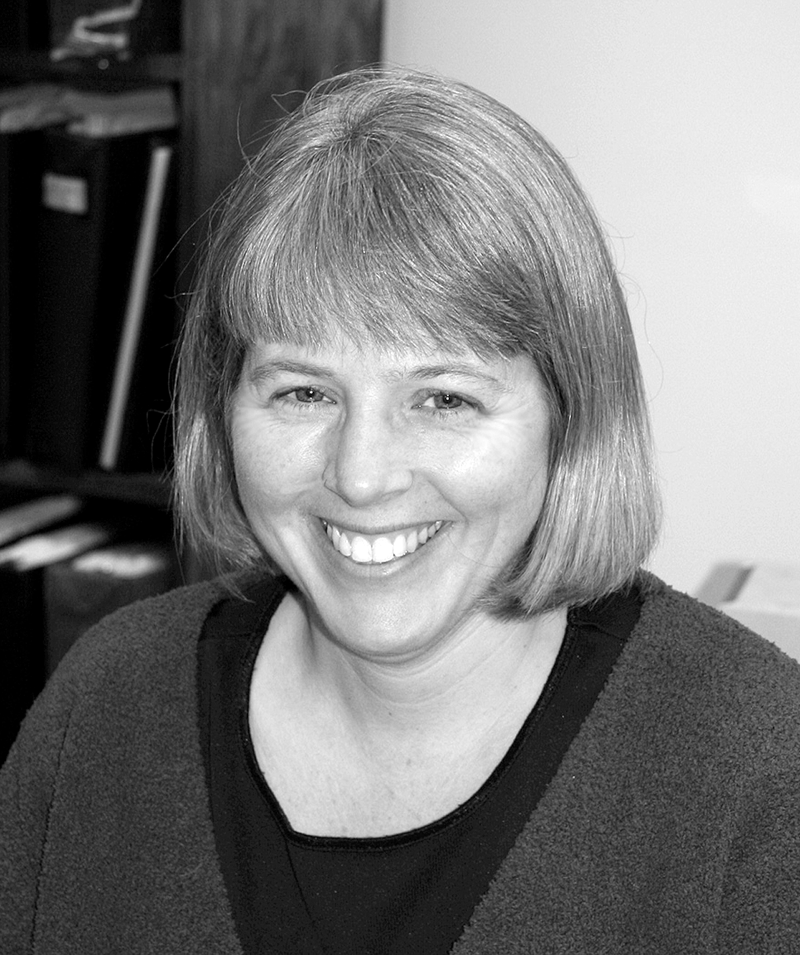
 

Departments People on the Move

The Business Networking International (BNI) Western Massachusetts Executive Team recently chose Jason Turcotte, owner of Turcotte Data & Design, a website design and development business in Ware, as the 2012 Director of the Year for Western Mass. at the organization’s annual banquet at the Delaney House. The award recognizes one director for commitment and dedication to the organization and for accomplishments within the chapters each oversees. In June 2012, after two years as a director consultant, Turcotte became the managing director of the Western Mass. BNI region, which encompasses Hampshire, Hampden, Franklin, and Berkshire counties. In that part-time role, he oversees and provides continued structure, training, and support to the region’s chapters and members in Western Mass. to ensure that every chapter is following the BNI system, establishing goals, and keeping pace to achieve them.

•••••

Hector Toledo

Hector Toledo

Gov. Deval L. Patrick has reappointed Hector Toledo to the Springfield Technical Community College board of trustees, effective Jan. 16, 2013 through March 1, 2017.  Toledo, an alumnus of STCC, is Vice President and Sales Director at Hampden Bank and has served on the STCC board of trustees since 2008.  In June 2012, Toledo was appointed by Patrick to serve as the chair of the board of trustees.

•••••

Doherty, Wallace, Pillsbury & Murphy, P.C. recently announced that attorney Rebecca Thibault has joined the Springfield-based firm as an Associate. Her practice areas include general corporate, real estate, and environmental law. She was an intern of the Massachusetts Department of Environmental Protection’s Office of Appeal and Dispute Resolution (Western Region) and was managing editor of Washington University Global Studies Law Review while in law school.

•••••

Felicity Hardee

Felicity Hardee

Felicity Hardee, a Partner with the regional law firm Bulkley Richardson who chairs its Real Estate and Environmental Law departments, has been elected President of the Valley Community Development Corp. The nonprofit corporation addresses the growing needs of low- and moderate-income people in the Pioneer Valley through developing and preserving affordable rental and ownership housing, cultivating economic self-sufficiency, and fostering community leadership. Hardee previously served as the organization’s vice president.

•••••

First Niagara Bank recently announced that First Vice President of Small Business Banking John Delgadillo and Vice President of Commercial Lending Allison Standish Plimpton have each been recognized as a New Leader in Banking by the Connecticut Bankers Assoc. and Connecticut Banking magazine. Delgadillo manages small-business relationships in the New England Region for the bank, while Standish Plimpton manages commercial relationships in the Greater Hartford and Greater Manchester area. The New Leaders In Banking awards recognize bankers who show promise and potential in the local banking industry. Honorees are chosen by an independent panel, which considers Connecticut bankers under the age of 50 who are judged to be outstanding employees, managers, or business leaders and who make a notable impact within their banks or their community.

•••••

Amherst-based New England Environmental Inc. (NEE) announced that Jack Jemsek has joined the company as a Senior Hydrogeologist. Jemsek is a Massachusetts licensed site professional, a Connecticut licensed environmental professional, a professional geologist in New Hampshire, and a certified geologist in Maine. He has a bachelor’s degree in Earth Science from the University of Notre Dame, and a Ph.D. in Marine Geology and Geophysics from the Massachusetts Institute of Technology and Woods Hole Oceanographic Institution Joint Program in Oceanography. With more than 24 years of conducting environmental assessments, remedial investigations, hydrogeologic studies, and environmental permitting, Jemsek has been responsible for overseeing technical and regulatory aspects of environmental projects and project teams, directing and managing site investigations and risk characterizations, and designing and evaluating remedial actions for hazardous-waste disposal and brownfield sites throughout New England.

•••••

Craig Melin, President and CEO of Cooley Dickinson Hospital, will join the founding board of the Hampshire County Regional Chamber, while the hospital has pledged a two-year, $15,000 investment to the developing initiative. Melin has been a longtime supporter of the idea of a Regional Chamber, saying it can help Northampton, Amherst, and Easthampton avoid duplication of economic-growth efforts. Melin said he brings to the board a perspective on improving the health of the community, continuously improving the quality of the broader care system and helping to make healthcare more affordable.

Company Notebook Departments

Paragus IT Makes Inc. 5,000 Ranking

HADLEY — Inc. magazine recently named Paragus IT to its annual ranking of the 5,000 fastest-growing businesses. With a 232% growth rate between 2008 and 2011, Paragus is the second-fastest-growing outsourced IT firm in New England. Since CEO Delcie Bean founded the company at the age of 13, Paragus has grown from a one-man operation to a regional leader in business computer service, consulting, and information-technology support. And, despite a sluggish economy, Paragus IT continues to thrive and expand. The company now employs a staff of 24 and has recently added a satellite office in the backyard of its Russell Street headquarters to accommodate the growth.


United Bank Again Named Top SBA Lender to Women

WEST SPRINGFIELD — Richard Collins, president and CEO of United Bank, announced that the bank was named the state’s “#1 Lender to Women” by the U.S. Small Business Administration (SBA). This is the second consecutive year United has earned this honor. Of all participating SBA lenders, United once again approved the highest percentage of total loans to women in fiscal year 2012. “We are always eager to help women in business achieve their goals,” said Collins. “Their success is always significant to the growth of the economy, and their contributions are more vital than ever in today’s economic environment.” Barbara-Jean DeLoria, senior vice president of commercial and retail lending, said there is a reason for the bank’s success. “We have a team in place that is personally committed to making United Bank the number-one choice for local residents and businesses. We promise, and we deliver, the most responsive and attentive service, competitive rates, and fast answers.” United Bank has 16 branch offices and two express drive-up branches in the Springfield region of Western Mass.; six branches in the Worcester region of Central Mass., with a seventh branch to open in Northborough this month; and 15 branches in Connecticut’s Hartford, Tolland, New Haven, and Litchfield counties. The bank also operates loan-production offices in Beverly, Mass. and Glastonbury, Conn.


DiGrigoli School of Cosmetology Honored

LINCOLNSHIRE, Ill. — Modern Salon Media has named the 2012 class of Excellence in Education honorees in its annual program recognizing leadership and best practices among cosmetology schools. DiGrigoli School of Cosmetology in West Springfield was chosen to represent excellence in the category of ‘school culture.’ This category recognizes unique programs offered to enhance the cosmetology-school experience and to foster the personal development and growth of students. Modern Salon Publisher Steve Reiss announced the honorees during the 2012 AACS (American Assoc. of Cosmetology Schools) annual convention in Orlando last fall. Hundreds of entries were submitted from cosmetology schools across North America, in eight categories ranging from marketing to placement to school culture. Honorees were determined based on school size and number of locations, with one overall honoree chosen from a list of finalists within each category. “We are absolutely dedicated to providing our students with education at the highest level,” said Paul DiGrigoli, president and CEO of DiGrigoli School of Cosmetology. “Beyond the standard cosmetology curriculum, we offer ‘Life Skills’ personal-development classes and feature guest educators at the top of their respective fields within the beauty industry. We also offer business classes, such as ‘How to Own and Operate Your Own Salon,’ and much more. I am so proud of my dedicated team of instructors and administrators, who devote their very best to our students.”


AirFlyte Inc. Acquired by Rectrix Commercial Aviation Services

BEDFORD — Rectrix Commercial Aviation Services recently announced the acquisition of AirFlyte Inc. of Westfield, a full-service executive-terminal fixed-base operator with state-of-the-art maintenance and hangar facilities. “We’re pleased to welcome AirFlyte’s employees into the Rectrix family,” said Thomas Russell, executive chairman of Rectrix Commercial Aviation Services (RECAS). “The substantial reputation enjoyed by AirFlyte is consistent with our company’s mission of offering high-quality services to all aviation segments in which we operate. Further, this acquisition represents a strategic link in the East Coast expansion of RECAS.” Terms of the acquisition were for an undisclosed sum of cash. AirFlyte founder Gary Potts will remain as president of AirFlyte. The company maintains a respected FAA Part 145 certified repair station. AirFlyte’s capabilities include maintenance of most corporate jet aircraft within its 43,000-square-foot facility at Westfield’s Barnes Regional Airport. AirFlyte can fulfill other needs, such as professional photo shoots and interior restorations. AirFlyte’s premier FBO provides business suites, concierge services, crew lounge, quiet rooms, refueling services, aircraft de-icing, and the availability of a conference center. “AirFlyte has been providing premier service to the executive traveler since 1988. By becoming a part of the Rectrix family of companies, we have the opportunity to grow further and do even more for our loyal clients,” said Potts. “We are extremely excited about our future with Rectrix.”

Briefcase Departments

Mohegan Sun Taps Partner for Casino Project

PALMER — Mohegan Sun has announced a strategic partnership with Brigade Capital Management on its project to build a destination resort casino in Palmer. The agreement with Brigade — a $12 billion New York-based investment advisor — coincides with Mohegan Sun’s formal application for a casino license to the Mass. Gaming Commission.
“This is an important day for Mohegan Sun, for Western Mass., and the entire Commonwealth. Today, we take the next critical step in fulfilling our commitment to bringing new jobs and economic growth to the region,” said Bruce “Two Dogs” Bozsum, chairman of the Mohegan Tribal Council. “It’s our intent to be the first casino to open its doors in Massachusetts.”
Added Mohegan Tribal Gaming Authority CEO Mitchell Etess, “Brigade Capital Management will be a great partner and important asset to this project. They are experienced as institutional investment partners on gaming projects in several states across the U.S., and understand the business that Mohegan Sun has been successful in for 16 years.” Through this agreement, Brigade will invest capital into the corporate entity that is being established to develop Mohegan Sun’s project in Western Mass. “Mohegan Sun is one of the most recognized casino gaming brands in the U.S., and they embody the proven model of success for gaming in New England,” said Don Morgan, managing member of Brigade. “This project will be built at the best location for a casino in Massachusetts, by a team with combined experience in multiple licensing jurisdictions, and managed by one of the premier gaming operators in the U.S. We are excited to be a partner in this endeavor and to have a role in establishing the Massachusetts casino gaming industry.”
Mohegan Sun is planning a world-class destination casino resort in Palmer that promises to create thousands of jobs and bring economic growth to Western Mass. Mohegan Sun established a storefront office in Palmer more than three years ago, and has conducted outreach to thousands of area residents through its Community Conversations series, appearances at other community meetings, a Mohegan Sun in Palmer newsletter and social-media outreach. Mohegan Sun is also far along in discussions with Palmer officials on a host community agreement, which is required under the Massachusetts casino-gaming legislation.
“Our project has distinct and unique advantages with regard to location, access, and infrastructure. Its rural setting on 150 acres — adjacent to other large parcels that present ancillary development possibilities — is ideal for creating the type of gaming facility that New England patrons are familiar with and have made successful over the past two decades,” Etess said. “Moreover, our host community of Palmer has been welcoming, motivated, and supportive. The community is excited about the jobs and economic development that Mohegan Sun will bring to the entire region.”


MGHPCC Awards $500,000

in Grants for Research

HOLYOKE — The Massachusetts Green High Performance Computing Center (MGHPCC) has announced $500,000 in seed grants to six multi-university teams to support cross-institutional research among MGHPCC members.
The MGHPCC, which opened in November, is intended to promote research collaboration among the participating universities — Boston University, Harvard University, the Massachusetts Institute of Technology, Northeastern University, and UMass — through high-performance computing, a pillar of major scientific research today. The seed grant program is intended to accelerate the MGHPCC’s mission of computational collaboration. This is the second round of seed grants awarded by the MGHPCC Consortium, and it brings the total amount of awards to $1.1 million. The six winners were chosen from a field of 26 applications by a committee of researchers from the participating universities. The funded projects are: “The CaterPillar Project: Exploring the Dark Matter Substructure of Milky Way Galaxies”; “Designing Cloud and Big Data Platforms for Scientific and HPC Applications”; “Strength and Fracture Mechanisms of Hierarchical Biological Materials”; “Computational Identification of Outcome-Associated DNA Alterations in Neuroblastoma”; “Genome-Scale Characterization of Chromosonal Aberrations Using Parallelizable Compression Algorithms”; and “Automated Segmentation of Vessel Network Structures in Large Image Stack Sets.” The grant amounts ranged from $52,000 to $131,000. The request for proposals sought “novel collaborative researchactivities addressing significant and challenging problems at the forefront of high-performance technical computing.” Proposals also had to include a strategy for followup research that would attract external funding.
“This year’s awards span basic astrophysics research, computer-systems innovation, and real-time clinical application, and highlight the richness of the region as a world leading center of gravity for academic discovery,” said Chris Hill, an MIT researcher who served on the committee.


MassDOT Releases

Transportation Plan

BOSTON — The Board of the Mass. Department of Transportation (MassDOT) and Transportation Secretary and CEO Richard Davey have announced a plan for the next generation of transportation investment in the Commonwealth. The plan includes passenger-rail service connect Boston and Springfield, commonly known as the “Inland Route,” and the rehabilitation of infrastructure to support rail service between Pittsfield and New York City. A $362.4 million investment to fund the Inland Route will cover rehabilitation along the route, creating a second track, widening bridges, upgrading signals purchasing train equipment, and constructing or rehabilitating stations. This will also support future high-speed rail connection to New York City via Springfield. Another $113.8 million in funding for rail service between the Berkshires and New York City will include rehabilitation of track, signals, and structures between Pittsfield and the Massachusetts-Connecticut state line to support future rail service between Pittsfield and New York City. The current line is served by freight carriers and is not up to standards necessary for commuter service. The plan also includes a $32.2 million increase to the Pioneer Valley Transit Authority in fiscal year 2014, a $3.2 million increase to the Berkshire Regional Transit Authority (BRTA), and a $1 million increase to the Franklin Regional Transit Authority (FRTA). The PVTA is receiving the largest increase of all regional transit authorities in the state. Additional Western Mass. investments in the plan, including funding for the 1-91 Viaduct in Springfield, reconstruction of Route 2 in Erving Center, and investments in the Mohawk bike and pedestrian trail in North Adams and the Skyline Trail in Hinsdale, promise to further ensure regional transportation equity, create jobs, and expand economic opportunity.  “We have parts of this Commonwealth whose opportunities are constrained by substandard service and lack of access. Our plan outlines increased investments in passenger rail in Western Mass. and regional transit authorities to unlock opportunities across the board,” said Gov. Deval Patrick. “Improving our transportation system is key to meeting our economic potential, for Western Mass. and every region of the Commonwealth.”


Hospitals Request Response to Community Health Survey

PIONEER VALLEY — The Coalition of Western Massachusetts Hospitals is conducting a community-health-needs assessment to identify and address the most pressing public health needs in the Pioneer Valley. Community members are encouraged to participate in this process by taking the Community Health Survey. The link to the survey can be found on the participating hospitals’ websites and at www.surveymonkey.com/s/masschna.
The coalition is a partnership between eight area tax-exempt hospitals: Baystate Medical Center, Baystate Franklin Medical Center, Baystate Mary Lane Hospital, Cooley Dickinson Hospital, Holyoke Medical Center, Mercy Medical Center, Shriners Hospitals for Children – Springfield, and Wing Memorial Hospital and Medical Centers. The survey is currently available online in English and Spanish and will soon be available in Russian and Vietnamese (paper copy only).
The coalition began meeting to plan the process for this community-health-needs assessment in August, and is scheduled to have reports finalized by this spring. Its goal is to identify the health and safety assets of area communities and also to determine the potential concerns they face. They will do so by asking residents for their opinions about these issues, services presently available, their satisfaction with these services, and identification of others programs that may be needed. The survey should take no more than 15 minutes to complete and will be available through Feb. 15. Survey respondents will be identifiable only by ZIP code, and all individual responses will be kept confidential.
All survey respondents will have the option to enter a drawing for an iPad Mini and several gift cards. Personal contact information entered for drawing registration will be kept confidential and used solely for the purpose of this drawing and not for any marketing purposes.


Chamber Seeks Input for

2013 Woman of the Year

SPRINGFIELD — The Professional Women’s Chamber, a division of the Affiliated Chambers of Commerce of Greater Springfield, is seeking nominations for the 2013 Woman of the Year Award. This award has been presented annually since 1954 to a woman in the Western Mass. area who exemplifies outstanding leadership, professional accomplishment, and service to the community. The nominee’s achievements can be representative of a lifetime’s work or for more recent successes. Any woman in the Pioneer Valley is eligible for nomination, and a chamber affiliation is not required. A Woman of the Year nomination form may be obtained online at www.professionalwomenschamber.com or by emailing Nancy Mirkin, committee chair, at [email protected]. Nomination documents are due by Feb. 15.


Consortium Plans Program

to Train Casino Workers

SPRINGFIELD — In an effort to prepare local residents for future casino jobs, a consortium of community colleges from across the state, led by Springfield Technical Community College and Holyoke Community College (HCC), recently signed worker-training agreements with four prospective casino developers. The group, called the Community College Casino Careers Training Institute, gives casino developers a single point of contact to help develop their workforce. William Messner, president of HCC, said the consortium hopes to have a training program up and running sometime in 2015, about one year before any of the proposed casinos would open.


MassINC Program Aims to

Stimulate Gateway Cities

The Gateway Cities Innovation Institute, an entity run by MassINC, is proposing a $1.7 billion public investment in Massachusetts’ Gateway Cities, which include Springfield, Holyoke, Pittsfield, and Westfield. The Gateway Cities Innovation Institute focuses on the 24 cities designated by the Massachusetts Legislature as Gateway Cities — midsize urban cities, typically former manufacturing centers — that anchor their regional economies but have had trouble attracting new growth and investment. MassINC predicts that its $1.7 million investment would stimulate at least seven projects totaling $3.4 billion of new development or reuse, which could in turn leverage nearly $7 billion in investments and create about 80,000 jobs. The money would be split between public funding and loan guarantees, tax incentives, regulatory reform, and technical assistance.

Banking and Financial Services Sections
How Do I Know If My Business Should Be Filing in Multiple States?

Jennifer Reynolds

Jennifer Reynolds

With the speed at which technology is changing and the borderless environment in which we now live, businesses often find themselves unknowingly doing business in states other than the one they call home.

In fact, in today’s business environment, very few companies do business in only one state. Further, it is not unusual to find that small to medium-sized closely held companies are doing business in several states — or even all 50. And it’s no secret that states are struggling financially. As such, they are all competing for your tax dollars.

A review of your company’s interstate activities can help comply with the various tax laws and identify valuable tax-saving opportunities.


So, how do you know if your business should be filing in other states?

A state’s power to tax your business depends on its connection (or nexus, as it is referred to in the world of accountants and attorneys) with the state. The level of nexus required, however, may vary depending on the tax involved. The four most prevalent state taxes are:

• Sales and use taxes;

• Corporate income taxes;

• Franchise taxes; and

• Payroll taxes.

Many early nexus cases involved sales and use taxes. Technically, the consumer is responsible for those taxes, but because of the impracticality of collecting them from individuals, states have placed this burden on the seller.


Do you have an economic presence?

Going back to the founding fathers, the Commerce Clause prohibited states from imposing tax on out-of-state businesses unless that business had a ‘substantial nexus’ with the taxing state. Substantial nexus, as you can imagine, can be interpreted differently by each person. So how do we know what constitutes substantial nexus?

Well, as with all interpretations of the Constitution, the courts interpret the meaning. Here, U.S. Supreme Court decisions have determined that, for purposes of applying the commerce clause, ‘substantial nexus’ means physical presence. Thus, states cannot constitutionally tax an out-of-state business unless that business has some form of physical presence in that state.

In its landmark 1992 decision in Quill v. North Dakota, the U.S. Supreme Court ruled that a state cannot require an out-of-state seller to collect sales or use taxes unless it has a substantial physical presence in the state. Again, the meaning of ‘physical presence’ depends on the facts and circumstances. But, in general, you have a physical presence if you maintain offices, stores, manufacturing or distribution facilities, property, or employees in the state.

In the age of e-commerce, it’s extremely easy for companies to do business remotely with customers in states or countries where they have no physical presence. Many courts and state legislatures believe that economic presence is a more relevant indicator of a business’s connection with a state.

Over the last few years, there has been a trend in the courts toward eliminating the physical-presence requirement, at least for purposes of income and franchise taxes. But for now, physical presence is still required today to trigger sales and use tax-collection obligations, but many states require only a very minimal presence to establish nexus, and the courts are agreeing.

However, under Federal Public Law 86-272, states are prohibited from taxing a company’s income if its only activity in that state consists of the solicitation of orders or the sale of tangible personal property that is approved and shipped from outside of that state.

One caveat, though: this law does not apply to intangible property. Hence, several recent cases have allowed states to tax an out-of-state firm’s income on intangibles such as credit cards or trademark licenses, even though the firm had no physical presence in that state. A substantial ‘economic’ presence was sufficient.

For example, Connecticut has now instituted a ‘bright-line’ economic nexus test. A taxpayer is deemed to have substantial economic presence if it generates receipts of $500,000 or more attributable to the purposeful direction of business activities toward the state, examined in light of the frequency, quantity, and systematic nature of a company’s economic contacts with this state, without regard to physical presence, to the extent permitted by the U.S. Constitution.

However, Public Law 86-272 will continue to restrict Connecticut’s ability to impose a tax on income derived within its borders from interstate commerce if that activity was only the solicitation of orders of tangible personal property, and where those orders are sent from outside of Connecticut for acceptance and subsequently shipped from outside of Connecticut. And Connecticut is not alone. More states are pushing for economic presence in lieu of a required physical presence.


Am I doubling my tax obligations by crossing state lines?

You might think that establishing nexus with a state increases your tax exposure, but in some cases it does the opposite.

Consider corporate income taxes. Many states determine the portion of your income subject to their tax using a three-factor formula based on the percentage of your sales, property, and payroll attributable to the state. (In some states, the sales factor is double-weighted.) Others use a single-factor formula based on sales. If you’re able to apportion some of your income to a state with a lower tax rate, it can actually reduce your company’s tax bill.


Taking the ‘I’ll take my chances and let them find me’ approach can be a gamble.

Revenue-hungry states will continue to extend the geographical reach of their tax laws, and state agencies will continue to communicate with each other about state taxes. Along with companies, state revenue departments are also becoming more sophisticated.

For example, many states are starting to query vendor files of customers within the state. In-state auditors are looking at invoices to ensure that proper sales and use taxes are being paid for the out-of-state businesses with potential nexus in their state. From there, the states are generating nexus questionnaires to businesses that appear in their audits but are not showing as being registered in their state.

States are not only going after current taxes, but targeting businesses and individuals for back taxes from the date they first started doing business in that state. In addition to the tax, states are imposing penalties for not registering to do business in the state (which itself requires a fee and generally requires the company to file annual reports). The penalties for not registering, and penalties and interest for late filing and payment of taxes, can be substantial.


How can I be proactive to determine my company’s exposure to other states?

To ensure compliance with all applicable laws, be sure to periodically review your business’s interstate activities either internally with your accounting staff or with a qualified tax or legal advisor.

A nexus study may help you to understand your company’s obligations in the various states. It helps to identify your company’s normal business activities in relation to the various nexus standards, based on the type of tax (i.e. income, franchise, payroll, sales and use, or even a ‘privilege tax’ imposed by some states) and the states with which you may have connections.

Having the information up front before you begin a job or do business in another state can help you manage your company’s bottom line. Managing and planning for potential filing and tax obligations in advance can mean the difference between a profitable job and an unprofitable job.

This article is intended to provide a general overview of the multi-state tax environment. As always, you should consult your tax and/or legal advisor regarding the applicability of this general information to your business’s specific situations.


Jennifer Reynolds is a tax manager with the Holyoke-based certified public accounting firm Meyers Brothers Kalicka, P.C.; (413) 322-3542; [email protected]

Agenda Departments

‘Perfect Pitch’ Program

Jan. 22: The Scibelli Enterprise Center in Springfield will host a day-long program called “Perfect Pitch,” delivered by Linda Plano, a seasoned entrepreneur’s coach and professional who is familiar with academic programs. As its name implies, the program helps entrepreneurs perfect their company’s pitch to a variety of audiences. Plano, via her firm, Plano and Simple, is subsidizing the cost of this workshop through her sponsorship of ACTION, the Assoc. of Cleantech Incubators of New England, of which the SEC is a member, so the fee is only $50 per participant, and food is included. Non-cleantech companies are also encouraged to attend. Registration is available online at www.planoandsimple.com/ppworkshop-2013-01-22-springfield-mass. Attendance will be limited. There are some valuable pre-workshop webinars and advising sessions described on the website as well.


Essence Editor to Speak

Feb. 5: Susan Taylor of Essence magazine will speak at Springfield Technical Community College at 11 a.m. in the Scibelli Hall gym as part of the STCC Diversity Council Event Series. The presentation, which coincides with Black History Month, is free and open to the public. Taylor’s name is synonymous with Essence magazine, the brand she built as the magazine’s fashion and beauty editor, editor in chief, and editorial director. For nearly three decades, Taylor has been the driving force behind one of the most celebrated black-owned businesses of our time and a legend in the magazine-publishing world. She is the only African-American woman to be recognized by the Magazine Publishers of America with the Henry Johnson Fisher Award, the industry’s highest honor, and the first to be inducted into the American Society of Magazine Editors Hall of Fame. Taylor also is the recipient of the NAACP President’s Award for visionary leadership and has honorary degrees from more than a dozen colleges and universities. A fourth-generation entrepreneur and the author of four books, she supports a host of organizations dedicated to moving the black community forward, but her passion and focus today is with the National Cares Mentoring Movement, a call to action which she founded in 2006 as Essence Cares. The National Cares Mentoring Movement (www.caresmentoring.org) is a massive campaign to recruit 1 million able adults to help secure children who are in peril and losing ground. Taylor’s presentation is sponsored by PeoplesBank, Hampden Bank, the STCC Diversity Council, the Springfield Department of Health and Human Services, Baystate Health, Health New England, MassMutual, and the United Way of Pioneer Valley.


HP Vendor Showcase

Feb. 5: Entre Computer and vendor partner Hewlett Packard (HP) will exhibit the latest technologies and products for 2013 from 4 to 9 p.m. at the Naismith Memorial Basketball Hall of Fame in Springfield. The event, hosted by Hewlett Packard and strategic partners, will introduce new information from Entre, Intel, and Microsoft, who will all be present to discuss the latest innovations from their companies, including the new HP Business Tablet featuring Windows 8 and Intel technology, HP point-of-sale products, and digital signage. The event will highlight HP’s innovation in personal computers and printing. Some of the educational topics covered will include mobile computing, Microsoft Windows 8, and a host of leading-edge solutions, followed by dinner and a partner technology exposition. Entre Computer invites all qualifying customers, businesses, healthcare providers, manufacturers, banks, and retailers to the exhibit, and all are welcome to a complimentary, self-guided tour of the Hall of Fame at the conclusion of the program. Attendance and seating are limited, and pre-registration is required by visiting hpbroadband.com. For additional information, contact Entre Computer at (413) 736-2112 or e-mail [email protected].


40 Under Forty Reunion

Feb. 7: BusinessWest will stage a reunion featuring the first six classes of its 40 Under Forty program at the Log Cabin Banquet & Meeting House in Holyoke. The event, open only to 40 Under Forty winners, event judges, and sponsors, will begin at 5:30 p.m. and feature a talk from Peter Straley, president of Health New England, about leadership and community involvement. For more information on the event, call (413) 781-8600 or e-mail [email protected].


Difference Makers 2013

March 21: The annual Difference Makers award program, staged by BusinessWest, will be held at the Log Cabin Banquet & Meeting House starting at 5 p.m. Details on the event will be published in upcoming issues of the magazine. Difference Makers is a program, launched in 2009, that recognizes groups and individuals that are, as the name suggests, making a difference in this region. Several dozen nominations for the award have been received, and are now being reviewed. The winners will be announced in the magazine’s Feb. 11 issue. For more information, call (413) 781-8600.

Features
In Chicopee, a Can-do Attitude Generates Progress

Editor’s Note: In an effort to keep its readership abreast of what’s happening in cities and towns across Western Mass., BusinessWest is commencing a year-long series of community profiles. We begin with the second-largest city in the region — Chicopee.

There is a small, carved wooden turtle that sits on Michael Bissonnette’s desk in Chicopee City Hall. It’s been there since early 2007, near the end of his first full year as mayor of this city of just over 55,000 residents.

As of yet, the turtle has no name, said Bissonnette, adding that it won’t until the so-called River Mills Project, a 65-acre brownfield site along the Chicopee River involving the former Uniroyal and Facemate manufacturing complexes, is fully ready for redevelopment. The initiative, marked by lengthy court fights and the complicated process of acquiring property and securing the funds to remediate it, has been nearly 30 years in the making. But there has been some dramatic progress in recent years, which brings the mayor back to his turtle.

“It’s my reminder to be patient — all good things come in time,” said Bissonnette,  noting that the story of the tortoise and the hare resonates in Chicopee, where city leaders believe they are winning an important race for greater vibrancy, job opportunities, and tax revenue by being diligent and doing things right, and not necessarily quickly — although the pace of progress has picked up considerably (more on that later).

But patience is not the city’s only virtue, said the mayor, also citing perseverance, imagination, and even an ability to embrace modern telecommunications technology in an effort to better serve residents.

Indeed, just before speaking with BusinessWest, Bissonnette, a prolific user of Facebook and other forms of social media to communicate with various constituencies, texted a directive to the Department of Public Works to meet a resident’s request to have a street sanded.

“We’re in a digital age, and its all part of our ability to reach out and be customer-friendly,” said the mayor. “And I can be responsive to that.”

Beyond the visible progress at what is usually called simply the ‘Uniroyal site,’ greatly facilitated by the city’s ability to win funding for participation with the state’s Brownfields Support Team (BST), there are many other signs of growth and vibrancy in the city.

They include the Marriott Residence hotel now taking shape as part of the Chicopee Crossing project on Memorial Drive, progress with ongoing work to replace the Davitt Bridge in the heart of downtown, and two new, state-of-the art high schools built over the past decade.

Meanwhile, the city has been able to maintain and even grow its strong manufacturing base — which accounts for 22% to 25% of the jobs in the community —  and is looking to add more in both existing manufacturing facilities and a 110-acre parcel near the Massachusetts Turnpike recently acquired by the Westover Metropolitan Development Corp.

From a fiscal standpoint, the city has rarely been in a stronger situation, with an A+ credit rating and $15 million in the so-called ‘rainy-day fund,’ the high-water mark for that account.

Summing up what has happened and what could happen in the years to come, Tom Haberlin, the city’s economic development director and long-time planning and development official, said the community has honed its can-do attitude with an even more business-friendly approach in City Hall.

“Chicopee remains a very easy place to get things done,” he said. “It doesn’t have the levels of bureaucracy you see in other cities, and this has helped us in many ways over the years.”

As BusinessWest begins its year-long series of community profiles, it starts with Chicopee, an old industrial city that that has stayed true to those roots while also managing to diversify its economy.


Progress Report

Bissonnette acknowledged that the phrase ‘running the city like a business’ has been used and overused in recent years and has lost some of its meaning. But this is exactly the approach he has taken since he was first elected in 2005, and he believes it has paid dividends.

Elaborating, he said the broad goal of his administration is to eliminate or minimize bureaucracy and politics (to the extent that it can), and create operating systems that remove barriers to progress, not add more.

“I can’t tell you how many developers have complimented the process, saying that we cut red tape and bend over backwards to accommodate the needs of the private sector, and that has paid off,” Bissonnette said. “The idea that a government is going to function more like a business is very appealing to the private sector, and it’s an extension of our business-friendly approach.

Mayor Michael Bissonnette

Mayor Michael Bissonnette says Chicopee takes a business-friendly attitude.

“When the state talks about taking six months to get something permitted, we laugh and say, ‘let’s try to do it in six weeks,’” he continued, adding that this operating philosophy has certainly helped the city withstand the prolonged economic downturn, and will be a real asset when conditions improve and companies gain the confidence to proceed with new building and expansion projects.

Meanwhile, he went on, the city has been aggressive in its pursuit of state and federal funding for various initiatives, such as the Uniroyal site, a character trait that has enabled it to advance a number of infrastructure and development projects.

That aggressiveness has paid off, said Haberlin, with grant awards on a scale not often often seen in a city this size.

“It’s very rare for a city to get these types of awards, and it’s a tribute to those that put the proposal together,” Haberlin said, referring specifically to funding secured for the Uniroyal project. “The BST knew that this project was moving at a very rapid rate and they would get the biggest bang for their dollar and it would be spent effectively.”

Kate Brown, the city’s long-time planning director, agreed.

“That turtle should have blisters on its feet,” she said with a laugh, “because, after the brownfields team was put together, this thing just took off. But nobody believed it could happen this fast.”

While work on the Uniroyal site proceeds ahead of schedule, city officials are enthusiastic about additional development opportunities in several parts of the city, including the Memorial Drive area, downtown, and the 110-acre site acquired by the Westover Metropolitan Development Corp.

“Potentially, that could be the springboard for some huge economic development,” said Haberlin, adding that the property is coming on line as city officials and regional economic-development leaders are hearing their phones ring again with regard to companies looking for places to locate or expand.

Haberlin referenced one manufacturer he chose not to name that was interested in existing real estate in the city, an attractive alternative to new building.

“It’s the first real inquiry we’ve seen in six or seven years,” he noted, adding that this company’s interest goes well beyond the routine tire-kicking witnessed in recent years.

Haberlin said Chicopee has a decent inventory of manufacturing and distribution facilities that were built at or near the $125-per-square-foot price point but are now selling for perhaps 20% to 25% of the cost, creating opportunities for both businesses and the city.

“The quality that this particular manufacturer is looking at couldn’t even be built today at that [$125-per-square-foot] cost, so they’re really trying to take advantage of the values out here,” he explained.

Momentum Is Building

Looking ahead, Bissonnette said city officials are working aggressively to properly position the city for everything from new manufacturing-sector jobs to a casino in Western Mass.

With regard to the latter, the mayor said he certainly hasn’t given up on the prospect of a gaming facility in his city — “we fully expect a casino to be built adjacent to Chicopee, if not in Chicopee” — but will be prepared to benefit no matter where it goes.

As for the former, the city has created a number of partnerships aimed at making sure it has a  large and qualified workforce in place for current employers and potential new ones.

If a company is interested in workers with a particular skill set, said the mayor, relationships with Springfield Technical Community College, Holyoke Community College, Chicopee Comprehensive High School, Branford Hall Career Institute, and Porter and Chester Institute can facilitate the process of creating customized training programs.

“We say to interested precision-manufacturing companies, ‘tell us what you want us to train these students in, and we’ll train to suit,’” he noted, adding that, at Chicopee Comp, an advisory group with experts across different areas of manufacturing is helping the city to figure out what manufacturing jobs may look like in the future, and what skill sets will be necessary to secure one.

And while consistently looking for better ways to assist employers and potential employers, the city is always searching for new and more effective ways to serve constituents as well, said the mayor.

This includes use of social media as a way to communicate with residents, hear and read their concerns, and, in essence, create a dialogue on the issues facing the community, he told BusinessWest.

In addition to the mayor’s use of Facebook and Twitter, the internal information technology department, which maintains the city’s website, has been decentralized, a process that Bissonnette calls rare in municipalities.

This makes each department head accountable for uploading and maintaining his or her department’s up-to-date information. Going a step further, Bissonnette told BusinessWest that Chicopee was recently selected to be the only city in Hampden County, in conjunction with Boston, to get a smart app for smartphones through a three-year ‘efficiency in government’ grant from the state.

The app will be implemented in the spring to allow for complaints to make it to the proper department in real time; the Chicopee Police Department and DPW, the two entities that receive the most requests, will be the first to go live, bringing more of the transparency in government that  Bissonnette said the city wants and needs.

After all, he said, it shouldn’t be a mystery about how to get a pothole filled or a sign replaced. “And you shouldn’t have to know somebody to get your street plowed or your trash picked up.”

The Finish Line

Bissonnette told BusinessWest that another of his goals moving forward is to revamp the city’s charter. Among those things on his wish list are a four-year term for the mayor (it’s currently two, which he believes adds up to too much time campaigning and not enough time managing the city) and revisions to create a strong-mayor form of government.

Whether he succeeds with those goals remains to be seen. As for most others, including the prospects for his turtle getting a name, he is eternally optimistic.

“We’re a can-do community,” he said. “We get things done.”


Elizabeth Taras can be reached at [email protected]

Banking and Financial Services Sections
Berkshire Bank Continues Its Dramatic Growth Pattern

Sheryl McQuade

Sheryl McQuade calls Berkshire Bank’s blend of financial clout and personal service “thinking big and acting small.”

It’s certainly a season of change for Berkshire Bank, which is making news on Wall Street, a splash in Connecticut, and big changes in its branches, in its core Massachusetts market, and beyond.

The Wall Street development is the bank’s recent move from NASDAQ to the New York Stock Exchange, which became official in November, around the same time that eight former Connecticut Bank and Trust (CBT) branches — which Berkshire acquired earlier in 2012 — officially converted to their new name, Berkshire Bank — CBT Region.

“Connecticut is a new market for us. We made an investment in Connecticut by way of our acquisition of CBT, and we did so because the Connecticut market offers significant opportunities for commercial and retail banking,” said Sheryl McQuade, senior vice president and regional commercial leader for the Greater Hartford market.

“We believe Berkshire Bank has a unique value proposition,” said McQuade, who admitted that any expansion into Connecticut is fraught with challenge, because the region is arguably as overbanked as Western Mass. “It’s not like we’re the first game in town there, but we believe, because of our size — which is about $5.5 billion now — matched with our product capabilities and diverse business lines, we can offer everything a large, regional bank can, but so do in a more nimble fashion.”

The Connecticut acquisition ostensibly benefits former CBT customers due to the banks’ comparative size; CBT had assets of about $280 million, and commercial loan limits of around $3 million, while Berkshire Bank can conduct deals in the $15 million range. McQuade also touted the bank’s growing suite of products in retail and business banking, insurance, and wealth management.

None of which, she said, will matter if Berkshire Bank doesn’t effectively integrate itself into the culture of its new communities, and that takes more than size. It’s a strategy that McQuade calls “thinking big and acting small,” and for this month’s focus on banking and finance, she and other bank leaders explained to BusinessWest exactly what that entails.


Growing Footprint

Berkshire Bank is no stranger to growth, having taken an aggressive approach to geographic expansion in recent years.

In the summer of 2011, the bank acquired Legacy Bancorp of Pittsfield, bringing 15 branches under its umbrella in Western Mass. and New York. That move came on the heels of other, smaller acquisitions, including New York-based Rome Bancorp earlier in 2011 — a series of moves that, including the CBT merger, has seen Berkshire expand its footprint from 43 to 75 branches in less than 20 months.

Last year, Sean Gray, executive vice president of Retail Banking, told BusinessWest that Berkshire Bank looks to organic growth first — as he put it, “getting the most out of our existing footprint.”

But the past decade has seen this Pittsfield-based institution make headway in New York, Vermont, Central Mass., and now Connecticut. Gray said Berkshire looks for banks that share a similar culture when seeking consolidation opportunities, but the leaders of its Springfield and Hartford markets say they’ve launched an ambitious strategy to introduce a unique, customer-focused culture in new branches.

For example, “we’re launching a new program called MyBanker,” said Lori Gazzillo, assistant vice president of Community Relations. “When we talk about relationship banking, we’re talking about personal bankers who work with individuals who have various financial needs, whether it’s loans or insurance or deposits. They can go to this one person for all their banking needs — somebody they can call about anything, who can connect them with the services they need.”

Branch design is also being overhauled to reflect a more personal, less institutional touch, McQuade said. The bank’s Springfield headquarters, where she and Chamberlain sat down with BusinessWest, is a good example, with its coffee station at the entrance, and where customers are invited to sit down with tellers, no longer separated by an impersonal counter.

“This will be the design going forward in our new branches,” Gazzillo said, adding that older branches will be renovated to match. “This new design enhances teller technology, and it’s a more personalized situation; it’s also more efficient as transactions go, and it’s more inviting, with a café and comfortable chairs and a common room.”

That common room is another way Berkshire is trying to connect with its communities. Each branch will offer local nonprofits and other organizations a space, equipped with multi-media, wi-fi, and videoconferencing equipment, to hold meetings. “It’s a way to offer something back to the communities we’re operating in,” McQuade said, “versus a lot of banks pushing people away from bricks and mortar and toward online banking.”

That’s a constant concern for banks these days, which are trying to serve two distinct constituencies — the traditional, older-skewing customer who prefers face-to-face transactions, and the younger, more mobile crowd that has embraced banking on computers, smartphones, and tablets.

“Berkshire Bank has really invested in a lot of products and technological capabilities,” McQuade said. “On the commercial side, we’re not dependent on branches to serve our customers; we have remote deposit and other tools that a large, regional bank would have.”

However, Gazzillo said, “we think it needs to be both. People are becoming more high-tech, relying on their phones and iPads, and we’re working on rolling out a mobile-banking platform. But customers still want to see someone on a personal level. It’s important to keep up with both, and we’re large enough to do that.”

Sue Chamberlain

Sue Chamberlain says it’s important to cater effectively to both the high-tech, mobile crowd and those who want face-to-face interaction.

Susan Chamberlain, first vice president of Retail Banking in the Springfield/Hartford region, agreed. “More and more people are now doing their banking online and on their phones, but we’re seeing our bricks-and-mortar side growing for sure. You can’t ignore the customers who like to come in and have face-to-face contact, for mortgages, home-equity loans, or if they just need some information.”


Culture Change

Gazzillo knows that Berkshire — which dubs itself “America’s most exciting bank” in its marketing materials — has bitten off quite a bit with its recent acquisitions, but she feels the institution has the right strategy to thrive in a highly competitive financial-services landscape.

“We’re succeeding at a time, and in a banking environment, where it’s difficult for banks to succeed,” she said. “We have been expanding, and we’ve acquired a number of banks, but it’s a careful process of looking at the culture and philosophy of a bank and making sure it fits within our own banking culture.

“We’re doing it the right way,” she said, “by providing customers with the tools and resources they need, and a level of personal service that they want. I’m proud of that, and happy with what we’re doing.”

Reflecting that emphasis, Berkshire Bank delayed the changeover of CBT branches by about six months because the company was going through a major upgrade to its operating system across all branches, and didn’t want to put the new, Connecticut-based customers through two separate conversions.

Meanwhile, Berkshire is trying to ease the transition for Nutmeg Staters in other ways. “Part of that is by hiring capable, talented people who are seasoned and experienced in their own communities,” McQuade said. “I’ve hired several people in Connecticut who have a history and relationships in their markets.”

The bank remains committed, Gazzillo said, to meeting community needs as well, across its entire four-state footprint.

“We have a foundation, and as far as financial contributions go, we give $1.5 million,” she said, but added that money is just one element of community involvement; others include a volunteer culture and a benefit that offers employees paid time off to volunteer at nonprofits in their communities. “That’s a big component of who we are, of being a community partner.”

McQuade credited bank President and CEO Michael Daly, who recently added chairman of the board to his business card, for setting the institution — which originally focused mostly on commercial banking — on a path to strong growth across many niches.

“He had the vision to grow the bank’s commercial business, but in a relationship-banking fashion, principally because, in addition to all our capabilities in commercial banking, we have wealth management, an insurance group — a lot of things that can be leveraged as part of a deliberate, relationship-banking strategy,” she explained — one that attempts to draw in young customers and meet their needs for life.

And, now, aims to bring a little excitement to Connecticut, too.


Joseph Bednar can be reached at [email protected]

Opinion
An Achievement of Note in Springfield

Last Spring, Gary Bernice raced into a banquet hall, leapt on top of a chair, and led 100 young jazz musicians in a full-blown, off-the-charts performance at the NEPR Arts & Humanities Award. I knew I had to meet him.

The Springfield High School of Science and Technology (Sci-Tech) welcomed Bernice as its new band director in 2007. Initially comprised of only 20 students, the band has grown 15-fold under Bernice’s direction.

So why is this important to the region’s business community?

Today, just as in 2007, the vast majority of students have never picked up an instrument before meeting Bernice. In fact, an entire generation of students within the Springfield public schools has had little to no exposure to the visual and performing arts.

There are 2,076 teachers in the district; only 70 are visual- and performing-arts teachers. Currently, 11 elementary schools have no designated art teacher; many schools have a part-time instructor. In that case, students receive only 24 hours of instruction during the entire course of the school year. What’s more, it’s up to each school principal to determine whether or not to offer visual and performing arts as part of the school’s curriculum.

With a student population of 25,000 and so few arts educators, you can see why some kids get little or no art, music, theater, or dance.

I recently spoke with Carol Hausamann, a retired Springfield public-school drama teacher. She said it was a sad day in 1992 when the decision was made to cut visual and performing arts from the district’s curriculum.

Wayne Abercrombie, director of the Children’s Chorus of Springfield, recently told me about the physical effect of not having vocal music in the schools. “Kids come to our choir without developed vocal muscles,” he said. “The good news is, we can do something about it.”

I’m not saying that the Springfield public schools have no visual and performing arts. I’m saying there aren’t nearly enough — especially when you consider the positive impact they have on students’ academic performance.

A recent longitudinal study among at-risk youth found that 75% of eighth-graders from poor households showed significantly higher scores in science and reading when involved in the arts from kindergarten through elementary school. With 80% of students within the district coming from low-income households, Springfield should take this study to heart.

Just under 84% of Sci-Tech students are from low-income households and are already proving that such a relationship with the arts can be extremely beneficial. According to Bernice, students who were enrolled in band for more than one year have a graduation rate of 80%. Students who stayed in band for two or more years have a dropout rate of 0%.

Keep in mind: the band is a pretty significant proportion of Sci-Tech’s students. This fall, Bernice had 588 students — nearly half the school — trying to get into the band. He could take only 300.

Without diving too deep into the data, it seems pretty clear that art, music, theater, and dance are more than extracurricular activities. And with a decreasing district graduation rate of 52.1% (down from 53% in 2010), the Springfield public schools could use some more of Bernice’s graduation magic.

In a perfect world, every Springfield school would have a Gary Bernice engaging his students and making music. That’s not possible, but with compelling data about the efficacy of programs like the Sci-Tech jazz band and an annual district budget of more than $410 million, it’s clear that we could be doing better.

The Springfield public schools’ number-one core value is: “our students will always come first.” Given this, I trust we’ll see the return of visual and performing arts to the curriculum in every classroom, and in every school, in the district.


Nancy Urbschat is president of Springfield-based TSM Design.

Sections Women in Businesss
Unity First’s Janine Fondon Mixes Diversity and High-tech Savvy

Janine Fondon

Janine Fondon says she’s always managed to stay atop trends in communications.

In the spring of 1946, Irene Morgan, a black woman, boarded a bus in Virginia headed to Baltimore. She was ordered to sit at the back of the bus, as Virginia state law required, but she objected, saying that, since it was an interstate bus, the law did not apply. Morgan was arrested and fined $10.

Attorney Thurgood Marshall and the NAACP took on the case … and won, thus striking down Jim Crow laws in interstate travel. In 1955, Rosa Parks refused a bus driver’s order to move for white riders on a city bus, which initiated the Montgomery Bus Boycott and eventually a precedent-setting win in the Supreme Court.

Irene Morgan — whose bravery and tenacity paved the way for Rosa Parks to become an icon of the Civil Rights movement — was Janine Fondon’s aunt.

Fondon is now the successful president and CEO of Unity First Direct Inc., a marketing and public-relations consultancy business, which she founded with her husband, Tom Fondon, in 1996. That business was soon followed by its website counterpart, UnityFirst.com — a national distributor of diversity-related e-news — that grew, as the world grew, with the explosion of workplace computer technology and the burgeoning Internet.

Her ability as a young African-American woman to forge a career in what are mostly male-dominated industries stems from that same bravery and tenacity that her Aunt Irene demonstrated more than 65 years ago. With each new position, all involving communications of some form, Fondon has deepened her public-relations and communications abilities, while picking up emerging technology skills.

Looking back at her family history and career, she noted that, somewhere along the road, she realized she’d been ahead of the curve at almost every point. A persistent focus on the future and an ever-growing skill set that she acquired in various positions — and a particular interest in computers, which she repeatedly referred to as ‘fun’ — ensured that she showed up at the doorstep of each new opportunity with confidence.

For this issue’s focus on women in business, BusinessWest spoke at length with Fondon about her intriguing background. Her keen eye for concrete workplace skills, mixed with an awareness of different cultures and human behavior, has enabled her to launch a small consultancy group that has evolved into a growing, diversity-focused web destination targeting African-Americans and others seeking information of interest to multicultural communities.


Right Time, Right Place

Straight out of Colgate University, young New York native Janine Fondon landed her first job with ABC-TV New York in the public relations department as a broadcast analyst. In that position, she would hear viewer responses about programming content, news personalities, and sports analysts, and report back to the network.

“Working for ABC Sports … every time they mentioned things like ‘Hail Mary’ passes, the Catholic Church would not be too happy,” Fondon laughed. But strong miniseries like ‘The Winds of War’ and docudramas with controversial topics were great introductions to a broad variety of perspectives — and watchdog groups that were concerned about how the network was representing women, culture, or some specific issue, Fondon said. WJLA in Washington, D.C. helped expand her work in large metropolitan areas, especially the promo coverage she did in January 1987 when the space shuttle Challenger exploded after takeoff, just one of the milestones that helped her hone her writing skills.

“Those days of writing good stories, getting to the heart of the message … it was really exciting figuring out what the real story was,” she explained. “Those positions made me think how I might pursue something else in the communications field, and honestly, that field has changed every two years since I’ve been involved in it.”

A move to Boston for a PR job with the Unitarian Universalist Assoc. wasn’t a great fit, but with the New England area going though high-tech growth, she was thinking, as always, of the future. She targeted Digital Equipment Corp. and landed in its Corporate Communications department as the associate editor of Digital’s worldwide internal publication, Decworld.

“At Digital, we were communicating internally and with the world, much like we do with Facebook and other forms of communication today, but we were doing it before the mainstream,” Fondon told BusinessWest.

The jump from religion to technology wasn’t an issue. “This was a global company, and I would be able to see what it was like to build this global effort,” she said. Later, with the eventual demise of Digital, her communications and technology skills made her a solid fit in the financial industry which was entering a new age of online sharing of highly confidential financial information.

Working for BankBoston, she was writing not only for the internal print magazine but online vehicles as well — the early development of online communications for the masses. People were using WordPerfect, and everyone still wanted hard copies, and her co-workers were resistant to online bulletin boards and new computer programs. Fondon thought they were great. “I don’t know about you, but IBM Selectric was not my idea of fun, so anything that made it easier, I was all for it,” she laughed.

“Everybody was asking, how are we going to deal with all this change — change in management, change in technology, and the efforts to bring more women into the workplace?” she continued. Meanwhile, she was experiencing major changes in her own life — a husband who came from the world of IBM, and a baby daughter, had her reevaluating her path.


Worldwide Change

Fondon can remember people saying that newsrooms weren’t diverse. “I said, ‘if you think newsrooms aren’t diverse, you should enter into corporate communications!’”

Merging her past positions, her skills, and what she saw as a need in all workplaces, Fondon created a small consulting company that she named Unity First Direct. Her husband, Tom, with his IT skills, joined her soon after. She kept busy with magazine writing, brochures, reports, and the like, and within that same year, she and her husband noticed that diversity really was becoming a buzzword, and more venues for community outreach were needed.

So she launched the Unity First newspaper and built a small following, but discovered a growing need for different avenues of diversity awareness. Through e-marketing, outreach, and public relations, Fondon could help clients engage new audiences and build their brands with diverse, emerging markets, including people of all backgrounds, experiences, and geographic locations.

“As we moved from being a print publication to online, and more diversity consulting,” she said, “we saw companies had all the pieces, so we would work to help them connect the dots.”

Eric Gouvin, director of the Center for Innovation and Entrepreneurship at Western New England University, has worked with Fondon on many occasions, having used her as an expert panelist and through co-sponsored events. “We’ve had diversity events that focus on inclusive management,” he said. “Your workforce has its own sets of traits and properties: the way you manage young folks versus old folks, women versus men, people of color versus other races … there are ways of handling all that, not heavy-handed, but sensitively.”

As Fondon described this aspect of her work, “if a company has a project and they want to develop it to meet this 21st-century approach through demographics, content, and tone, then we can help them shape that project.

She explained what she means by ‘tone.’ “Companies that are trying to position themselves in today’s workplace need to reflect diversity inclusion in their internal communications, external communications, community relations, and media approach, and they need people like us to help them sharpen those skills.”

She prefers to not spend energy on the negative, which includes all the things that can happen when a proper approach to tone is ignored — everything from diminishing one’s culture to lawsuits — but to focus on positive outcomes, the companies that make a respectful and educated difference and, thus, enhance their own success.

Today, UnityFirst.com is a growing voice on the Internet and one of the most in-depth resources for connecting with diverse communities and press across the U.S. and beyond. Engaging more than 2 million readers from corporations and boards to cross-cultural business leaders striving for new bottom-line success, the site is a content driver of news, with more than 4,000 national press members, including top mainstream business publications; television, Internet, and radio sources; and press from the African, African-American, Caribbean, Hispanic/Latino, and Native American communities.

In addition, UnityFirst.com delivers content to ForbesDiversity.com, an outgrowth of Forbes.com that offers special sections with comprehensive subject matter from different perspectives.


Driven to Success

In addition to a multitude of speaking engagements, Fondon is an adjunct professor at Baypath College and Westfield State University. She and Tom are also targeting young local middle- and high-school students through two projects, the Digital Ambassadors Program and the Common Ground Leadership Forum and Awards.

“It’s our initiative to work with young people around the technology and diversity topics,” said Fondon. “Both programs emphasize the importance of digital learning, inclusion, and leadership.”

Part of her work with students is to keep the dialogue applicable to young people’s interests. Considering the speed at which technology and young people’s interests evolve, Fondon said, “as a teacher, when you think you’re making it relevant and interesting, revisit what that means, because either you got it right, or you didn’t.”

Gouvin agrees, and praises Fondon’s ability to consult with employers. “If you want to be effective, you’ve got to find a way to connect with the people who are working for you,” he said. “It’s not a matter of being PC [politically correct], or doing it because that’s what everyone’s doing; there is sense to it. Janine has always made a case for diversity that is compelling.”

Along with her tenacious and pioneering qualities — like those that spurred her Aunt Irene to such groundbreaking action — Fondon will continue to assist clients with marketing, educate communities about diversity awareness through digital, print, and verbal communication, and help individuals and corporations realize their full potential.

In short, she’s keeping them ahead of the curve.


Elizabeth Taras can be reached at [email protected]

Company Notebook Departments

Bulkley Richardson Recognized for Professional Excellence

SPRINGFIELD — Bulkley Richardson was recently named a 2013 Top Ranked Law Firm by Lexis-Nexis Martindale-Hubbell for having more than one-third, or a total of 15, of its attorneys identified by their peers as AV Preeminent, the highest ranking for professional excellence in the peer-review rating system. The firm was also included in the 2013 edition of Best Law Firms published by U.S. News – Best Lawyers. It was ranked in the top tier in eight practice areas, the most of any Springfield law firm.


Freedom Credit Union Reaches Out to Latinos

SPRINGFIELD — Freedom Credit Union, a full-service financial cooperative with online banking and nine branches throughout the four counties of Western Mass., announced it has launched its first marketing campaign to extend brand awareness and loyalty to the Latino community throughout in the region. The new campaign is called “Juntos Por Tu Libertad Financiera” (Together for Your Financial Freedom), and reflects the value Freedom Credit Union brings through its many products and services that help people realize their dreams through financial freedom. The Latino community now comprises almost 39% of Springfield’s population, up from 27.2% in 2000, according to the U.S. Census. The census also reported that the region’s Latino population grew 40% from 2000 to 2010. “The Latino community has always been a very important part of our membership base, and the recent and rapid growth of the Latino population in the region provides Freedom Credit Union a unique opportunity to demonstrate that we value the diverse community in which we live,” said President Barry Crosby. “The theme ‘Juntos Por Tu Libertad Financiera’ echoes this sentiment and reinforces that we are a collaborative partner in helping the Latino community realize their dreams through financial freedom.” The campaign, created by Bauzá & Associates, consists of a TV, radio, and print advertising campaign as well as financial literacy and public relations. “Freedom Credit Union is very proud of the relationship we have established with our Latino members. We are now looking to expand our efforts by enhancing our communication and servicing our membership in a more culturally relevant manner,” Crosby added. “As a local and cooperative institution that believes in elevating the community, we are focused on consistently delivering the highest-quality value to all of our members.”


Innovative Business Systems Wins Accolades

EASTHAMPTON — Innovative Business Systems, a technology-solutions company, was recently chosen as one of the top three technology companies in the state in the banking industry in the Warren Group’s annual readers poll for Banker & Tradesman’s Best of 2012. In the survey, readers are asked to vote on their favorite companies in several categories. The Warren Group publishes Banker & Tradesman and the Commercial Record.


Baystate Earns Distinction as Leapfrog Top Hospital

SPRINGFIELD — Baystate Medical Center has, for the fourth consecutive year, joined an elite group of 60 urban hospitals in the U.S. named Top Hospitals in the Leapfrog Group’s 2012 survey of more than 1,200 hospitals. Leapfrog’s Top Hospital designation is the most competitive national hospital quality award in the country and recognizes hospitals that deliver the highest-quality care by preventing medical errors, reducing mortality for high-risk procedures such as heart bypass surgery, and reducing hospital readmissions for patients being treated for conditions like pneumonia and heart attacks. University and other teaching hospitals like Baystate, children’s hospitals, and community hospitals in rural, suburban, and urban settings were all represented in the 2012 rankings. Leapfrog also identified Baystate Medical Center in the top 5% of hospitals that completed the survey in 2012. “Patients deserve to be in the safest hospital possible. Our superior performance, recognized in this prestigious survey for the fourth consecutive year alongside our many other awards and accreditations, confirms for our patients that we meet the highest quality and safety standards among an elite group of top-ranked hospitals in the United States,” said Dr. Evan Benjamin, senior vice president of Healthcare Quality at Baystate Health. The Leapfrog Survey provides a broad look at a hospital’s quality, safety, and efficiency, and uses some of the most widely accepted and nationally validated measures of hospital performance. Leapfrog also offers healthcare consumers and purchasers unique information not available anywhere else. For example, Leapfrog is the only national source of information on a hospital’s rate of early elective newborn deliveries (Baystate Medical Center has taken a leadership role in working with all Massachusetts birthing hospitals to stop all elective preterm births), adoption of computerized physician order entry to prevent medical errors (Baystate began CPOE back in 1991 and has long been a national leader in that area, with virtually 100% compliance), and several other important measures of inpatient care. In addition to making the Top Hospitals list, Baystate Medical Center, as well as its sister hospital, Baystate Franklin Medical Center (BFMC) in Greenfield, received ‘A’ grades from Leapfrog on its latest Hospital Safety Score released on Nov. 28. Dr. Gerda Maissel, BFMC’s chief medical officer, noted that “the Leapfrog Group is an important and objective national organization that has done great work to ensure that the public is informed about hospital quality and safety. Quality is a top priority at Baystate Franklin Medical Center, and I am proud of everyone involved in this achievement, including those who provide direct care to our patients and those who work behind the scenes to keep us on track and moving forward.”


O’Connell Care at Home and Healthcare Staffing Marks 25th Anniversary

HOLYOKE — O’Connell Care at Home and Health Care Staffing,

a regional provider of personal aid and nursing services, recently marked its 25th year in business. O’Connell has been providing Western Mass. and Northern Conn. individuals and families with a holistic approach to care since its founding in 1987. O’Connell’s holistic approach factors an individual’s social wants and needs into his or her personalized care plan. The company states that, by doing so, its staff is able to provide more emotionally supportive experience for the individual, as well as address his or her physical limitations and medical conditions. According to President Fran O’Connell, this approach grew out of his personal experiences and became the founding principal of the company. “In my youth, I saw firsthand what a difference it made when things that are important to people are still part of their lives,” he said. “Little things, like lunch with friends or talking baseball with someone, helps individuals feel whole — like they are still loved and respected. It’s something all of us deserve.” The company’s services range from transportation and home-companion services to geriatric-care management and hospice care. The company also provides staffing solutions for some of the region’s assisted-living facilities, rehabilitation centers, and visiting-nurse associations.

Opinion
Electronic Health Records Bring Change

Implementation of electronic health records (EHRs) is bringing a cultural change to daily medical practice operations in the Bay State. The National Center for Health Statistics estimates that 71.2% of Massachusetts office-based physician practices used some kind of EHR in 2011.

For practices that haven’t adopted EHR technology yet, the time is now. EHRs are important for enhancing patient care delivery and collaborating in accountable-care organizations (ACOs) or integrated care networks. In order to adopt EHRs effectively, practices should be aware of several points essential for success.

Evaluate Information Use and Flow: EHR implementation can disrupt a well-functioning system. Before adopting a new system, a practice should evaluate its own existing care system and consider the following questions: What systems are already in place? How is information recorded and exchanged? Who needs what kinds of information? Where do they use it? Once equipped with those answers, practices should be prepared to take the next step.

Find a Compatible EHR: Several key considerations must be made when choosing an EHR, including flexibility, user-friendliness, mobility, and transition support. Flexibility must account for customization of the system, mobility is necessary for sharing patient information throughout the care setting, and transition support ensures a smooth integration of the EHR into the practice’s workflow.

Institute Team-wide Acceptance: Most importantly, groups should ensure that the workplace dynamic is maintained throughout EHR implementation. Teamwork should not suffer at the hands of technological innovation. Therefore, it is paramount that the system sustains the work environment.

EHR use will benefit patients and practices alike. Streamlined data will allow for streamlined care. Not only can patient care be enhanced through EHRs, but practice-wide improvements in communication, productivity, and data utilization can occur as well.

For assistance with EHR implementation or general practice issues, contact the Mass. Medical Society’s Physician Practice Resource Center at (781) 434-7702 or [email protected]. v


Leif Brierley writes about medical-practice issues for Vital Signs, a publication of the Mass. Medical Society. The MMS is the statewide professional association for physicians and medical students, representing more than 24,000 members statewide. The MMS is also a leader in continuing medical education for healthcare professionals throughout Massachusetts, conducting a variety of medical-education programs for physicians and healthcare professionals.

Education Sections
STCC Nursing Program Celebrates 40 Years of Evolution, Excellence

The STCC Alumni Association

The STCC Alumni Association honored several STCC nursing alumni on Nov. 3. From left are honorees Kerry Fournier (’98) and Marianne Hamel (’72); STCC Dean of Nursing Mary Tarbell; STCC Dean Emeritus Mary Elizabeth O’Leary; honoree Sunshine Domaruma (’08); and STCC President Ira Rubenzahl. (Missing from photo is honoree Melissa Odom, ’04.)

Mary Tarbell was among those receiving pins at the graduation ceremonies for the first class of nursing students at Springfield Technical Community College in 1972, and she has many memories from those early days of the program she now directs.
She recalls, for example, that the fledgling nursing program was housed in what amounted to one half of a duplex, known then (and now) as Buildings 5 and 6 on the grounds of the closed Springfield Armory. “We had classes in the bedrooms,” she told BusinessWest, “and labs were in the living room; the faculty ate in what was the kitchen.”
She also remembers that there were some doubts within the medical community about the quality of this college-based program, which was created to help fill the gap when the hospital-based nursing programs that had been existence for decades closed their doors due to the high costs associated with them.
“After I got my first job, someone said to me, ‘do you really know what you’re doing?’ I said, ‘I think so,’” said Tarbell, who also remembers her first paycheck from that assignment, from Providence Hospital in Holyoke.
“It was for $144, and, if I remember right, 17 cents … I know I have that pay stub somewhere,” she recalled. “That was for a 40-hour week on the second shift. Today, that would represent about three or four hours for some nursing graduates.”
There was quite a bit of this looking back in retrospect going on at a recent get-together to mark the 40th anniversary of that first class of nurses at STCC, said Tarbell, noting that more than 100 people turned out, and all but a few are still active within the profession.
The event was a celebration of just how far the program has come in four decades, she said, as well as the broad impact STCC graduates have had on the large healthcare community in Western Mass.
But the milestone also serves as an appropriate time to examine where nursing education has been, where it is now, and where it’s going, Tarbell noted, adding that, while some things haven’t changed over the years, many things have, especially technology.
And Tarbell used that phrase to refer, collectively, to everything from high-tech simulation labs to students’ ability to put huge textbooks onto their cell phones.
“We can no longer teach the way we were taught,” she explained, referring to educators of her age. “You have to get very innovative; this is a different generation, and it’s a very tech-savvy generation. This class that just came in in September is the first class that’s required to have laptops. We’ve also converted all of our paper-and-pencil tests — we’re in the final phase of shifting all tests to a computer — and we do this to mimic the licensing exam.
“Technology has changed, and you have to embrace the technology, because that’s the only way we’re going to be able to continue to put out safe practitioners.”
For this issue, BusinessWest takes advantage of the 40th anniversary celebration to examine four decades of change and progress in nursing education, and what lies ahead for the STCC program.

School of Thought
Tarbell said the nursing program had simulation technology in 1972 — well, sort of.
“We had what we call a task trainer,” she explained. “You’d have a model of a leg … and you would use it to teach a student how to put on an elastic stocking or wrap a stump after amputation — something limited to that part of the body.”
Today, students learn from computer-controlled simulators that can talk back to them while displaying a wide range of symptoms and conditions, she continued, adding that this is one of many sea changes that have occurred over the past 40 years. Summing it up, Tarbell said that what’s being taught is virtually the same as when she was attending classes in Building 5, but how it’s being taught is radically different, because of changes in technology and the healthcare industry itself.
Turning the clock back to when Richard Nixon was in the White House, Tarbell said nursing education was undergoing a seismic shift with regard to where and how students were taught.
For decades, area hospitals had their own programs, she said, noting that, by the early ’70s, the last of them had closed due to the high costs of administering the schools. To fill the gap and put more students in the pipeline, college programs were created at STCC, Holyoke Community College, Elms, American International College, and other schools.
The transition process created both challenges and opportunities, she said.
“Those nurses who were going to the hospital-based programs were so exposed to patient care in a different way than an associate-degree nurse was exposed to patient care,” she explained, “because they were actually in the hospitals managing the units and running the units.
“When the associate-degree program came in, we were on limited hours — we were doing 12, maybe 15 hours, and as you advanced, maybe 18 hours a week in clinical, far less than what the diploma schools were doing,” she continued. “But we were getting a sound education based on the fact that we were taking college-level courses along with our nursing curriculum.
“But when we first went out there,” she went on, “no one believed that we could actually function. And that was just one of the obstacles we had to deal with as we went out into practice.”
Today, of course, there are no such doubts about the qualifications of those who graduate from STCC and other area programs, said Tarbell, adding, however, that today’s nursing students face other challenges when they enter the job market, particularly patients who are, overall, sicker than those who would be in a hospital 40 years ago.
And this phenomenon, prompted by a wave in changes in technology, how care is administered, and how it’s paid for, is reflected in how nursing students are prepared for their chosen profession, she told BusinessWest.
“What we see now in the hospital is different than what we saw years ago,” she explained. “Decades ago, if someone had their gallbladder out, a fairly simple surgery, that person would have a large abdominal incision and be in the hospital for a week. Today, you can be in the hospital at 6 in the morning, and many times, you’d be home that evening after having your gallbladder taken out.
“The fast turnover of patients has driven us to deliver care in a more intense fashion,” she continued, “but what you can’t separate from it is the caring and the safety and the knowledge. One of the key things we look at in all of our students is safety; if we find anyone who is unable to maintain safety, we counsel that student and we try to help them and facilitate how they can be a safe practitioner.”
There are other challenges awaiting today’s nursing graduates, said Tarbell, including a tighter job market than many industry and workforce experts were predicting even a few years ago. Graduates are still finding jobs, she continued, but sometimes not in the desired acute-care setting.
One of reasons for this is that many of the Baby Boom-aged nurses who were expected to retire over the past few years — including some from that first class at STCC — are finding that they can’t retire yet for financial reasons, or are not yet ready to leave the profession. But perhaps more importantly, she said, many employers, especially those in acute-care settings, are demanding more than an associate’s degree from their nursing applicants.
“We’re graduating nurses, just as the other schools are, but the vacancy rate is just not what it used to be,” said Tarbell. “You used to be guaranteed that, when an associate-degree nurse or a bachelor-degree nurse graduated, they would have a job in an acute-care facility — and not that many years ago, it was even before they graduated; they had their jobs in January, February, or March.
“Now, many places are not interviewing or even accepting applications until after that nurse has his or her license in hand,” she continued. “At the same time, when they [associate-degree recipients] graduate, they’re not guaranteed a job in acute care. It’s few and far between when it comes to associate-degree students being hired into acute care right away.”
Instead, they’re finding jobs in community nursing (as school nurses, for example), long-term-care facilities, and other settings, such as home care, she told BusinessWest, adding that there is still 100% placement within six months of graduation.
To help its graduates get the jobs they desire — and to address the demand for higher-degreed nursing graduates — STCC started collaborating with UMass Amherst and Baystate Health on a program that would enable the college’s two-year graduates to then earn a bachelor’s in a year plus the intervening summer.
“They can do it three years instead of four,” she said, adding that this program, in addition to similar initiatives involving other four-year schools, is designed to improve the likelihood that those leaving STCC with an associate’s degree can get the bachelor’s degree needed to open more doors, and in less time.

Class Acts
As she talked with BusinessWest, Tarbell paused for a minute and went to a bookcase to collect a textbook from her days as a student at STCC.
As she thumbed through Cooper’s Nutrition in Health And Disease, she marveled at the simplicity of the diagrams — and also the price tag on the inside cover: $9.75.
“That’s another thing that has changed, obviously,” she said with a laugh, noting that today’s textbooks, like the one recently sent to her one publisher in hopes that it might become part of the curriculum, cost perhaps 20 times what they did four decades ago.
Those inflationary changes aside, as well as the myriad advances in technology, the basic mission of the STCC hasn’t changed and won’t, said Tarbell. Now, as then, the goal has been to properly prepare students for the industry they have chosen.

George O’Brien can be reached at [email protected]

Employment Sections
Labor-market Report Highlights the Region’s Skills Gap

Bill Ward calls it a “mismatch.”
There are other words being used to describe the region’s job market, none of them particularly enthusiastic. But to Ward, president and CEO of the Regional Employment Board of Hampden County (REB), it boils down to an ever-present skills gap.
“It all comes back to this huge, complex issue we have: there are skills shortages, and there are people who are looking for jobs and can’t find them,” he said. “There’s a mismatch out there. There always has been, but now it’s more pronounced because today’s jobs require a higher skill set.”
Ward was responding to a report — “Labor Market Trends in the Pioneer Valley Region” — recently issued by the Commonwealth Corp. and the New England Public Policy Center of the Federal Reserve Bank of Boston. That report paints a picture of a naggingly high — albeit slowly falling — unemployment rate in the region, but also a labor pool that’s not adequately equipped to fill the job openings that do exist, which creates a problem for companies looking to grow or locate here.
This trend is exacerbated, the report notes, by an aging population and, in some fields, potential future shortfalls of workers with the skills and education required by employers. In 2008-10, the period the report focuses on, 47.1% of the labor force was age 45 or older, while only 31.6% was 34 or younger.
And while the region’s residents have, on average, increased their level of education over the past decade, progress in that area has been slower than in other regions, leading some economic-development leaders to wonder whether the younger generation will be adequately equipped to replace the masses of retiring Baby Boomers over the next decade.
All this isn’t news to Ward, who deals every day with the challenges of the Pioneer Valley economy and strategies to boost it.
“It updates the reality and confirms it,” he said, noting that the report offers plenty of data but few solutions. “These are complex issues; you can’t just flip a switch. What keeps me up at night is the quality of this workforce and what it needs to do to be competitive. If anything, this report emphasizes that.”

Youth Is Not Served
Robert Clifford, an economist and public policy analyst for the New England Public Policy Center, took part in a roundtable recently at Holyoke Community College to discuss ther report’s findings. He noted that the region’s working population between ages 16 and 24 actually fell from 51,988 in 2000 to 49,788 in 2010 — the only region in the state where that occurred.
Clifford broke down the report’s findings into four main points:
• After nearly a decade of declining employment, the Pioneer Valley is recovering at a modest pace, but continues to have one of the highest unemployment rates statewide;
• An aging workforce, declines in younger workers, and a stagnant population will force the region to confront demographic challenges sooner than other regions;
• Despite gains in the educational attainment of its labor force in the past decade, the Pioneer Valley still has the highest share of individuals with only a high-school degree or less; and
• Addressing the barriers to employment facing the region’s
jobless population, particularly among the young and less educated, is key to the Pioneer Valley’s economic vitality moving forward.

Bill Ward

Bill Ward says businesses shouldn’t wait for the perfect candidate for a job, but be willing to train a talented learner.

“It’s very clear,” Ward told BusinessWest, “with the dynamics of our region, with an older population and a shortage of younger people coming into the workforce, it leaves us in a situation where education and training are even more critically important to our region than to most other regions in the Commonwealth — whether it’s the K-12 system, the community-college system, or investments in training by employers themselves. That’s the big message.”
It’s a message framed by an air of overall sluggishness on the job front locally.
“While the employment rate in the region was nearly the same as the rate statewide through the first half of the past decade, the impact of the Great Recession was particularly severe in the Pioneer Valley,” the report states, noting that the region’s unemployment rate reached 9.2% in 2010, slightly below the national rate of 9.6%, but far exceeding the statewide rate of 8.5%, making it the third-highest jobless rate among all regional labor markets. It also represents a much higher rate than the 3.0% recorded in 2000 and the 5.8% posted in 2003, following the 2001-02 recession.
Perhaps more troubling, however, is the report’s repeated emphasis on how young workers are being impacted. In 2008-10, more than 50% of the region’s unemployed were 34 years old or younger, though such individuals accounted for just 32% of the region’s workforce. Meanwhile, 60% of those unemployed in the Pioneer Valley had a high-school degree or less, while only 38% of the region’s workforce had such an education.
That points to multiple demographic trends that intersect in a troubling way. While the Pioneer Valley’s workforce skews higher in age than other regions, the younger generation isn’t always ready to compete for the jobs that do, and will, arise — the very definition of a skills gap.
“Massachusetts is one of the most highly educated states in the nation, but the Pioneer Valley’s residents and workforce … have education levels similar to their counterparts in the United States,” the report asserts. “Over the past decade, the region has seen progressively higher levels of educational attainment among its residents and workforce, but a high-school degree continues to be the most common level of educational attainment in the region.”
Specifically, in 2008-10, the share of the region’s labor force with a bachelor’s degree or higher (30.5%) trailed that of Massachusetts as a whole (41.2%). However, when the figures are calculated to include all workers with some kind of post-secondary education, the Pioneer Valley (67.8%) closes the gap somewhat on the state (67.8%), due to a larger concentration of individuals with certificates or associate’s degrees, perhaps reflecting the strong presence of the region’s community colleges.

Training from Within
The persistent skills gap, the report notes, “may be particularly troublesome given that 91.5% of the region’s employees are also residents. The Pioneer Valley may not be able to attract workers from other regions to work in jobs with relatively low education requirements and pay, given that those populations are typically filled by less mobile populations.
“However,” it continues, “younger workers and those with lower levels of education, who are disproportionately unemployed, may provide a future supply of labor that can be educated and trained to address labor shortages.”
To foster economic growth in the future, the report argues, the Pioneer Valley should “strive to align the education of its labor force to meet the demands of the region’s employers” — a call to colleges to step up efforts to draw students into degree programs for in-demand careers, like those in the STEM (science, technology, engineering, and math) fields.
Although Ward has been involved in many such initiatives to boost worker training in the region, he notes that colleges, career centers, and other economic-development entities can’t do it themselves.
“There’s an insidious dynamic in the job market where employers say, ‘I have jobs, but I can’t fill them; I can’t find skilled workers,’” he noted. “But these employers need to do some rethinking about training. They need to do it on their own. This idea of looking for a perfect candidate … the workplace is changing, and there’s no such thing as an off-the-shelf worker. You can’t expect that.
“Because of the complexity of the marketplace today, employers need to be more engaged in preparing their future workforce,” Ward continued. “They need to do more on-the-job training and engage with educators to create career pathways for young people, so when they’re in school and see the applications of math, science, and technology in the workplace, there will be less dropping out, and more kids turned on by seeing the connections between school and work. It’s a complex issue, and there is no single solution.”
Despite the presence of a “feeder system” in the form of multiple well-regarded colleges, plus the state’s flagship university campus, Western Mass. has long had difficulty holding on to graduates, he noted. “We’re seeing large numbers of young people not being retained in this region, and the reason for their outmigration is that we have not been able to generate employment opportunities for these young people.”
Part of that, he said, is due to generally lackluster job creation over the past three years, which has hit young people hardest, particularly in the realm of summer jobs, which provide much-needed experience and develop workplace skills. “Young people, up to age 25 or so, have been bearing the brunt of the recession, so to speak, and to get that first job, they’re tending to be more mobile and look elsewhere; we see them crossing into the Boston area and other markets.”
Meanwhile, older workers are holding on to their jobs longer, in many cases due to the financial meltdown of 2008 and the downturn that followed, which exacerbates the problem young people have finding work.
But the aging of Massachusetts will eventually provide opportunities for the young, Ward said, and it’s incumbent upon the region’s employers, educators, and economic-development leaders to turn those opportunities into a more vibrant hiring culture.
“We’re going to need to fill these positions of the job leavers who are maturing, and the people who fill them are going to need the right skills.”
Ward noted that fewer than half of all recent college graduates in the region are currently working in their degree fields. While troubling in some ways, that statistic also means there are plenty of smart, talented young people who have the aptitude to change careers if given the opportunity by proactive employers. But instead of cultivating their own pipeline of talent, “many employers say, ‘let someone else do it,’ and they wait at the end of the pipeline for someone with their specs.”
The question, he said, is “do you keep turning away from your door the person who could potentially do the job, but doesn’t have all the skills yet? We need some rethinking by employers.”

Opportunity Knocks
There’s a tidbit buried in the labor-market report that offers a bit of optimism. “After two recessions and a decade of declining employment, the region is now gaining jobs and recovering at a modest pace. Moreover, the recent recovery from the Great Recession has been somewhat stronger in the region than in the state as a whole. The Pioneer Valley has experienced relatively broad-based improvement, with stronger growth than the state in a majority of industries.”
Combined with that outlook, the region’s demographic trends — notably, the massive Baby Boom generation approaching retirement — may seem to bode well for younger workers, Ward said, but the skills gap remains, and it threatens the growth of current businesses and hinders others from moving to Western Mass.
“Companies looking to relocate look at the labor supply,” he told BusinessWest. “We need to be willing to say, ‘we can’t afford to waste a single young person.’ We have to get as many people as possible to their full potential.” n

Joseph Bednar may be reached at [email protected]

Opinion
Holyoke’s Time Is Now


While much of the attention locally has been fixed on the issue of a Western Mass. casino, where it will go, when, and with what impact, there is an intriguing story being written just a few miles up I-91 from Springfield in Holyoke.

It’s not complete yet — in fact, it’s just getting started — but some of the chapters in progress are enough to warrant optimism in a city that has a rich industrial history but a turbulent recent past and status as one of the poorest communities in the Commonwealth.

As the story on page 44 reveals, there is considerable momentum building in what’s known as the Paper City, and there may be some important lessons here for those communities that don’t wind up with a casino — and even for those that do.

Holyoke is rebuilding itself the old-fashioned way, if you will, going one block, sometimes one building, at a time, using the creative economy as a way to create vibrancy and interest, and building a reputation as a place where technology and green-energy-related businesses can take hold.

As we said at the top, there is a long way to go in this, the nation’s first planned industrial city, but the signs of a strong comeback are there, and the elements for continued progress are in place or in the works.

Start with stories like Steve Porter’s. He was working and living in New York, and looking to take a traveling DJ business and expand it into a video-production venture. Real estate in New York was well out of his reach, so he started looking for another setting in which to set up shop. He found an oddly shaped building in a former textile complex known colloquially, and within Porterhouse Media, as the ‘wedge.’ Not much to look at on the outside, the building has become home to cutting-edge studios and offices with tight corners and unique square footage.

In many ways, Porter and his building represent the essence of the emerging Holyoke story — a small business finding a good home in a piece of property that many people wouldn’t bother to look at. It’s a story that could be replicated dozens of times, and that’s the simple message that Porter wants to leave with anyone who hears of how he came to Holyoke.

As he retells it, it wasn’t simply the price tag on the property that attracted him — although that was a big part of it. There was also a sense that something interesting, something exciting, was happening in Holyoke, and he wanted to be a part of it.

Vitek Kruta and Lori Devine felt the same way when they, like Porter, assumed a large amount of risk by opening Gateway City Arts in the former Judd Paper complex on Race Street.

Describing themselves as enablers, Devine and Kruta have a host of things going on in their complex — from tango classes to painting lessons; from performances and lectures to an incubator facility currently with a handful of tenants and potential for about 20 more.

The broad goal is to use the arts as a way to bring people to Holyoke, create energy and vibrancy, and perhaps give birth to some businesses that will repurpose more old mill space and put people to work.

As these stories and others unfold, the pieces of a puzzle are coming together for Holyoke. Creative-economy initiatives are introducing the city to more people and business owners, while the Green High Performance Computing Center, a collaboration involving several universities and technology corporations, give the community “affirmation,” as one entrepreneur out it, while also showing what this city can do. Rail service is returning on a limited basis, and old mills like Open Square continue to add new tenants and bring more vibrancy to the heart of the city.

Holyoke’s comeback story is far from complete, and there are many challenges ahead, but all the signs are there for a turnaround that will be real — and very inspirational.

Departments Incorporations

The following business incorporations were recorded in Franklin, Hampden, and Hampshire counties and are the latest available. They are listed by community.


AGAWAM


East Coast Petroleum Compliances Inc., 50 Main St., Agawam, MA 01001. Jeffrey Hansen, same. Petroleum-compliance testing.


AMHERST


Gemini’s Pampered Greyhounds Inc., 145 Whitney St., Amherst, MA 01002. Lisa Packard, same. Nonprofit organization developed for the purpose of finding appropriate homes for greyhounds which fail to qualify for racing regardless of health, condition, or age.


CHICOPEE


Chicopee Outreach Services Inc., 636 Chicopee St., Chicopee, MA 01013. Debra Moncrieffe, same. Develop a preferential option for those affected by domestic violence. By providing a safe environment in emergency, abusive situations, our goal is to improve the lives of women and children who live with abuse.


Eco Friendly Air Systems Inc., 477 Chicopee St., Chicopee, MA 01013. Alberto Ortiz, same. Sales and installation of air-quality products and systems.


KLM Auto Repair Inc., 21 Lacine St., Chicopee, MA 01020. Maria Christy, same. Automotive reapair.


EASTHAMPTON


AHA Creative Solutions Inc., 6 Pomeroy St., Easthampton, MA 01027. Tracey Bryant, same. Consulting services.


GZ Bagel Inc., 27 Bayberry Dr., Easthampton, MA 01027. Brian Greenwood, 366 East Street, Easthampton, MA 01027. Brian Greenwood, 366 East St., Easthampton, MA 01027. Restaurant and bagel shop.


FEEDING HILLS


FL Referrals Inc., 778 Springfield, St., Feeding Hills, MA 01030. Michael Preston, 01030. Business consulting services.


FLORENCE


Left Hand Productions Inc., 491 Bridge Road, Unit 2311, Florence, MA 01062. Heather Sutliff Rogers Craig, same. The corporation is organized exclusively for charitable and educational purposes, including for such purposes, the making of distributions to organizations that qualify as exempt organizations under section 501 (c)(3) of the internal revenue code, or the corresponding section of any future federal tax code.


GREENFIELD


AE Sushi Inc., Aaron Liang, 70 Deerfield St., Greenfield, MA 01301. Aaron Liang, same. Making and packaging sushi to be sold in supermarkets.


FCTS Machine Technology Inc., 15 Greenfield St., Greenfield, MA 01301. Steven Capshaw, same. To purchase machinery, to support current and future training of students at the Franklin County Technical School in Turners Falls, Mass. regarding the use and operation of modern machinery.


Greenfield and Western Corporation, 19 Carol Lane, Greenfield, MA  01301. Thomas Carter, same. Realty rental.


LONGMEADOW


K. Francis Lee, M.D., P.C., 29 Longmeadow, MA 01106. K. Francis Lee, M.D.295 Pinewood Dr., Longmeadow, MA 01106. Medical practice.


LUDLOW


Cleaning Crew, Corp., 17 Grimard St., Ludlow, MA 01056. Daniel Goodwin, same. Specialized cleaning.


Lavertue Electric Inc., 733 Chapin St., Suite 200C, Ludlow, MA 01056. Paul Lavertue, 37 Ferncroft St., Longmeadow, MA 01106. Electrical Service.


MONTGOMERY


Grogan & Speer Inc., 16 North Road, Montgomery, MA 01085.Nathan Speer, same. Information-technology consulting.


NORTH ADAMS


Barbara and Eric Rudd Art Foundation Inc., 189 Beaver St., North Adams, MA 01247. Eric Von Eggers Rudd, same. To promote, conserve, preserve and exhibit the sculptures and pieces of art of Rric Rudd for the benefit of the public; to exhibit his visual art, and to organize performances of his written and described works; to collect, conserve, preserve and exhibit, on a temporary or permanent basis, the original works of other artists as such works relate to the works of Eric Rudd and in the context of such relationships; to organize and sponsor educational activities related to his art including, but not limited to seminars, workshops and performances; to promote, support, foster and/or contribute to the establishment, maintenance, and operation of a museum for the public exhibition of Eric Rudd’s art.


NORTHAMPTON

Hampshire Foundation Inc., 99 Main St., Northampton, MA 01060. Todd Ford, 78 Fern St., Florence, MA 01062.


Friends of Sayulita Inc., 189 Beaver St., North Adams, MA 01247. Eric Von Eggers Rudd, same. Nonprofit organization.


PALMER


Exhibit Resources Inc., 35 Cedar Hill St., Palmer, MA 01069. Mario Biagetti, same. Provide full range of product and support services to the trade show and event industry, to include all planning and design aspects of event exhibits and displays. This corporation may engage in or transact any and all lawful activities or business permitted under the laws of United States of America, the state of Massachusetts, or any other state, county, territory, or nation.


Cabot Pub II Inc., 387 Riverdale St., West Springfield, MA 01089. Richard Harty, same. Restaurant and pub.


SOUTH HADLEY


Leprechaun Plunge Inc., 246 Ferry St., South Hadley, MA 01075. Lucien Brunelle Jr. same.


SOUTHBRIDGE


Dance to Live Foundation Inc., Arianys De Jesus, 58 Crestwood Dr., Southbridge, MA 01550. Arianys De Jesus, same. A foundation for teens that suffer from depression or any mental health issue. To create a community where young teens are mentored to live healthy and meaningful lives, free from the bonds of depression. Mission: to battle depression through the art of dance and music by providing teens with the space and opportunity to better their physical fitness as well as mental and spiritual health.


SPRINGFIELD


A.M.R Inc.,  31 Daviston St., Springfield, MA 01108. Philps Roberge, same. Heating, refrigeration and air conditioning.


Ambassadors Professional Painters Inc., 38 Berkshire Ave., Springfield, MA 01109. Desmond Cavaan, 11 Balboa Dr., Springfield, MA 01109. Professional painters.


Artistic Remodeling Inc., 138 Santa Barbara St., Springfield, MA 01104. Barbaro Veloz, same. Remodeling services.


Bright Dental Care, PC 1795 Main St., #203, Springfield, MA 01103. Ranganayaki Chirummailla, 75 Hockanum Blvd., #1536, Vernon CT, 06066. Dental Practice.


Family Life Humanitarian Organization Inc., 335 Rosewell St., Springfield, MA. Randolph Lester, same. Provide free meals and clothing to homeless citizens within the Commonwealth.


WEST SPRINGFIELD


Aroma Inc., 935 Riverdale St., Unit 11, West Springfield, MA 01089. Chang Qiao Jiang, same. Restaurant.

Banking and Financial Services Sections
Principals Say NUVO Has Become a ‘Proven Commodity’

Jeff Sattler

Jeff Sattler says NUVO is on target with its goals for assets, revenue, and gaining respectability in the local banking market.

Jeff Sattler says he feels an attachment to the small-business owners sitting across the conference room table from him, a bond that most commercial-lending officers probably wouldn’t understand.

That’s because he’s been in their shoes.

Indeed, five years ago, he was one of the principals trying to lure investors and amass the capital needed to launch the venture that would become NUVO Bank, which he now serves as president.

“When you’re dealing with a banker, most of them haven’t owned a business — they have to critique the business owner,” he told BusinessWest. “I started this thing with the same mentality as other entrepreneurs — ‘I’m going to do this; there’s a market, and I’m going to make this work.’ And I had the same growth pains, issues, challenges, and fears that any entrepreneur has. I can talk the same language as that business owner.”

This linguistic ability is one of the factors that Sattler and NUVO’s CEO, Dale Janes, believe have contributed to the bank’s steady growth and recent momentum. Like most of its commercial clients, NUVO’s primary objective has been to gain a strong measure of respectability and build a solid foundation for growth, said Janes, adding that, despite being launched just as the worst downturn since the Great Recession was taking hold, the bank has, in his opinion, achieved that goal.

Dale Janes

While other banks rush to add branches, Dale Janes says NUVO will stay with its business model and maintain one location.

“We’ve come a tremendous distance,” he said. “We are now what I call a proven commodity.”

Sattler agreed. “We’re profitable right on plan,” he said. “I don’t want to be the biggest in this market; I want to be the most profitable, and that’s return on assets, return on equity, efficiency ratios … key bank ratios that we want to be leaders in eventually, and we’re getting there now.”

Janes told BusinessWest that the institution’s first four-plus years in business have proven that its basic model — operating through one location with a reliance on technology that would ensure that most clients would rarely see that facility on the ground floor of Tower Square — works, and there is no need to change it.

“Our overhead is so low, we can afford to be aggressive on retail CD rates, savings rates, and the costs of accounts,” he said while citing the main advantages to being small and efficient. “The core of our model is small business, small business, small business — and it’s worked; about a year ago, it really started to kick in.

“With longevity comes credibility,” he continued. “So, more and more now, customers who used to do business with Jeff or with me are saying, ‘these guys are around, and they’re going to be here; let’s go check them out.”

Doing some quick math, Sattler noted that NUVO, which just passed the $100 million mark in assets, has something approaching 1% of the regional market, and is by far the smallest bank in the region. While that number may not sound impressive, he said — while noting that doubling or tripling it would still give the bank only 2% or 3% of a market dominated by huge national and regional players — it is a solid base on which to build.

And as he surveyed the local banking market, especially the smaller, community institutions, Janes, who has been in the business for more than 30 years, sees ample opportunity to grow.

“There is going to be more consolidation within this market; it’s inevitable,” he said with a large dose of certainty in his voice. “And with that consolidation, there will be opportunities for banks with the right products and the right approach to customer service. We’ve positioned ourselves to be one of those banks.”

For this issue and its focus on banking and financial services, BusinessWest looks at how far NUVO has managed to come in four challenging years, and what the future could hold for the institution.


By All Accounts

As he prepared to talk with BusinessWest, Sattler was closing on another small-business loan, giving NUVO just over 80 such clients in its portfolio.

That’s another comparatively small number, especially when put alongside the other institutions with downtown Springfield mailing addresses, but Janes and Sattler both take a ‘glass is much more than half-full’ mentality.

“Every new customer is another dot on the map,” said Sattler, adding that the bank’s approach from the day it opened has been to achieve to measured, smart growth, while also carving out a specific niche in the market — in this case, what would be considered small, or even very small, loans.

And both officers believe the institution has achieved those missions, while also establishing the NUVO brand across Greater Springfield and into Northern Connecticut.

“This is the reason why we knew we were going to be successful — we have a niche,” said Sattler, referring to the small-business loans like the one he closed on that afternoon late last month. “Everyone thought we were going to fail, but we succeeded, because we created that niche.”

Both men said that virtually every bank in the region can write the kinds of small loans that NUVO has made its specialty, but most don’t have the need or desire to do so, and can’t do it as well.

“We’ll look at every single deal, no matter what the industry,” he explained. “I won’t say ‘yes’ to every deal, but if we can’t do it, then nobody can do it.”

Meanwhile, another advantage is the aforementioned ability to “speak the language,” as Sattler described it.

“I appreciate their passion,” he said of entrepreneurs. “They have a vision of where they want to take their company, and I can relate to that. I try to get under the tent with them and say, ‘how are we going to make this loan?’

“They say, ‘Sattler, I’m not talking to you like a banker,’” he continued. “And I’m not; I’m a business owner, not just a banker, who started the same way most of these businesses started.”

Overall, the bank has been “on target” with everything from asset growth to profitability to brand recognition, said Janes, adding that the current momentum has manifested itself in a number of ways.

For starters, there have been roughly 18 months of continued monthly profits, he said, adding that another commercial-lending officer, the bank’s third, was recently hired, and another addition is planned for the first quarter of next year. Meanwhile, the bank is planning another capital raise — the prospectus is currently being finalized — to provide the wherewithal to continue growing.

“We’re doing well against our original plan, and super well against our model,” Janes explained. “We have a lot of focus and a lot of discipline around the business model; we can’t be everything to everyone, and we’re honest about that.”


Balance Statement

Moving forward, Janes and Sattler said NUVO is in the process of scripting a new three-year strategic plan.

When asked what it will likely include, they said, in essence, there would be more of the same that has marked the bank’s four-plus years of existence — with the emphasis on more.

The planned additions to the commercial lending staff — “we’re now building a lending team,” said Sattler — and the capital raise are part of this strategic initiative, noted Janes. Overall, he believes that, given the bank’s steady growth and the current landscape in financial services, NUVO is well-positioned to add market share for the short and long term.

Elaborating, he said there are two trends in the marketplace that are working in NUVO’s favor. The first is a significant shift among consumers, business owners, and investors away from large regional and national banks and toward community banks.

“And why not? They’re just smaller, and they have more flexibility and more options for the small-business customer,” he told BusinessWest. “And we plan to take advantage of that, especially on the investor side, because as we grow, we’re going to need to raise more capital.”

The second trend, although it has slowed in recent years, is a movement toward greater consolidation, said Janes, adding that the many publicly owned regional and community banks serving Western Mass. are both candidates for additional expansion themselves or targets for acquisition. And both scenarios, which will be driven by shareholders and their desire for better returns, bode well for banks like NUVO that can take on customers left wary by such transactions.

“This is a very challenging time to provide a return to your shareholders,” he said of the situation facing the public banks. “Everyone’s had what amounts to a free pass because of the recession, because everyone made bad loans and business slowed down, but that free pass is going to get called in, and banks are going to have to start producing, either a dividend or growth in the market price of the stock.

“People are going to instigate,” he continued, “and get these banks to either perform better on an earnings-per-share basis through the organic nature of their business, or by selling.”

And while NUVO has plans for more lending officers, employees, loans, and assets, one thing there won’t be more of is branches.

“People keep asking me, ‘why don’t you open a branch here?’” said Janes, adding that there have been many suggestions when it comes to ‘here.’

“That’s not who we are or ever intend to be,” he continued. “We will never have a huge branch network, and probably will not have a traditional branch. We will expand our footprint; we will take our model and replicate it somewhere else, in a market where there are a lot of small businesses. That was our intent, and it’s still our intent. We’re not ready for it yet, but our three-year plan contemplates something like that.

“Right now, we just want to dominate where we are,” Janes went on, “and earn our keep in this region.”

Despite its lone location, NUVO has been able to grow its presence and build its brand through track record and word-of-mouth referrals. And with presence and referrals, the bank has opportunities to show what it can do, said Janes, which is an important component in the growth equation.

“Once we get in front of people,” he said, “we’re pretty good at bringing in some business.”


Brand Equity

Looking at the numbers compiled by area banks for assets, deposits, and loans (see pages 38 and 39), Janes and Sattler know they will be looking up at the rest of the region’s banking community for quite some time.

But after four recession-riddled years, the bank is starting to see some real momentum. As Janes said, there is enough statistical and anecdotal evidence to show that the bank is indeed a proven commodity — and that things are truly looking up.


George O’Brien can be reached at [email protected]

Court Dockets Departments

The following is a compilation of recent lawsuits involving area businesses and organizations. These are strictly allegations that have yet to be proven in a court of law. Readers are advised to contact the parties listed, or the court, for more information concerning the individual claims.


HAMPDEN SUPERIOR COURT

Audette Group, LLC v. Concord Heights, LLC, et al

Allegation: Failure to pay for construction services: $118,945

Filed: 10/11/12


People’s United Bank v. A.D. George Construction Inc. and Andrew D. George

Allegation: Non-payment and default on two promissory notes: $138,631.67

Filed: 9/28/12


HAMPSHIRE SUPERIOR COURT

Financial Pacific Leasing, LLC v. Atkins Construction, LLC, Kenneth G. Atkins, and Maureen A. Atkins

Allegation: Suit on previous judgment: $39,802.28

Filed: 8/13/12


Gary Kendall v. Colvest/Belchertown, LLC

Allegation: Negligent property maintenance causing injury: $28,763.43

Filed: 9/25/12


Krishnamurti Rao, M.D. v. Michael Dillon, M.D.

Allegation: Action to recognize the judgment of a different state: $226,293.68

Filed: 8/29/12


HOLYOKE DISTRICT COURT

Diana Rodriquez v. Kmart Corp.

Allegation: Negligent maintenance of property causing slip and fall: $3,908.31

Filed: 7/26/12


NORTHAMPTON DISTRICT COURT

Western Mass Environmental, LLC v. Corbett Home Improvement and Edward Corbett

Allegation: Non-payment of services rendered: $8,735

Filed: 9/27/12


PALMER DISTRICT COURT

Larry G. Cusing & Sons Inc. v. Papesh Excavation and Alan R. Papesh

Allegation: Non-payment of well-drilling services and materials: $5,499.07

Filed: 8/6/12


SPRINGFIELD DISTRICT COURT

Pioneer Chiropratic Inc. and Pain Management and Rehabilitation Inc v. The Premier Insurance Co. of Massachusetts

Allegation: Breach of contract and failure to pay PIP: $3,719.08

Filed: 9/12/12


Robert Gossman v. Szczebak Realty Trust, et al

Allegation: Breach of contract when defendant failed to return refundable deposit pursuant to a formal offer to lease: $8,000

Filed: 9/20/12


WESTFIELD DISTRICT COURT

American Zurich Insurance Co. v. Carlos Professional Deliveries and Carlos Cosmo

Allegation: Monies owed for insurance services rendered: $7,543

8/29/12


Correction:

A court listing in the Oct. 22 issue of BusinessWest was incorrect due to a transcription error. The item should have read:


HAMPDEN SUPERIOR COURT

Hanibal C. Tayeh, Hanibal Technology, LLC, and Spectrum Analytical Inc. v. Vanessia Petroleum of Doha, Qatar and Cheikh Abdul Aziz Al Thani

Allegation: Breach of loan agreement: $1,500,000

Filed: 8/27/12

Court Dockets Departments

The following is a compilation of recent lawsuits involving area businesses and organizations. These are strictly allegations that have yet to be proven in a court of law. Readers are advised to contact the parties listed, or the court, for more information concerning the individual claims.


CHICOPEE

DISTRICT COURT

LVNV Funding, LLC, assignee of FIA card Services, N.A. v. Sweetwater Cycles

Allegation: Unpaid balance due for monies loaned: $27,629.29

Filed: 9/5/12


GREENFIELD DISTRICT COURT

Trans River Marketing Co., L.P. v. Whitney Trucking Inc.

Allegation: Non-payment of waste disposal services provided: $188,160.50

Filed: 8/29/12

HAMPDEN

SUPERIOR COURT

Hanibal Technology, LLC v. Spectrum Analytical Inc.

Allegation: Breach of loan agreement: $1,500,000

Filed: 8/27/12


Ocean State Job Lot v. Cobalt Industries Inc.

Allegation: Defendant has failed to pay subcontractors: $116,459

Filed: 9/4/12


SPRINGFIELD

DISTRICT COURT

Perlman Recycling Inc. v. Tri County Recycling

Allegation: Non-payment of goods sold and delivered: $9,874.99

Filed: 8/28/12

Company Notebook Departments

MGM Resorts Opens Springfield Office

SPRINGFIELD — MGM Resorts International has opened an office in downtown Springfield, at 1441 Main St., the TD Bank Building. An opening reception was staged on Oct. 9. “The opening of our community office in Springfield is an important and exciting milestone for MGM Springfield,” said Bill Hornbuckle, MGM’s chief marketing officer. “MGM Springfield is about helping to create a better future for an entire city, and to do that we want our neighbors to have convenient access to our team so they may get all of the information they want about our proposal.”The MGM Springfield Community Office was opened so neighbors, residents, and the local business community may easily come and go while visiting downtown, said Hornbuckle. The community is invited to stop in and learn more about the company and the proposed development in Springfield, and get answers to any questions as well as offer any thoughts and suggestions they may have regarding MGM’s proposal and the economic benefits it would bring to Springfield. “Springfield is a great city worthy of an even greater future, and MGM Resorts International wants to be a part of that future,” he said. The MGM Springfield Community Office will be open from 9 a.m. to 5 p.m. Monday through Friday.


Creative Strategy Agency Relocates Downtown

SPRINGFIELD — The Creative Strategy Agency, a digital-marketing agency, recently moved its office location to the former 19th-century hotel located at 1242 Main St. in downtown Springfield. “Moving our office to downtown Springfield was a logical business decision,” said Alfonso Santaniello, president and CEO. “We are heavily involved in the local community, and it made sense to move our space to the heart of it all.”  The Creative Strategy Agency specializes in web, mobile, and video marketing strategies.


PeoplesBank Invests in Hampshire County Regional Chamber

NORTHAMPTON – The founding board of the Hampshire County Regional Chamber recently announced that PeoplesBank has come on board as a key financial supporter, offering a $30,000 investment over two years. In addition, Tom Senecal, executive vice president and chief financial officer for PeoplesBank, will be joining the founding board. “We are encouraged that Tom and PeoplesBank think that a regional chamber is the best approach for taking on the economic challenges of our region, and we are grateful for their support,” said Suzanne Beck, executive director of the Greater Northampton Chamber of Commerce and the interim director for the Regional Chamber. “PeoplesBank has a strong reputation as a bank that invests generously in key regional initiatives. This is a prime example of that type of investment. They are putting a significant amount of money into an initiative that gears Hampshire County to have a greater presence and greater profile within the region.” Said Senecal, “PeoplesBank has a strong commitment to the communities we serve. We were supportive of the initial study on a regional chamber, and in investing in the initiative, we hope for improvements in the local economy, which we think a regional chamber can bring to the area. Economic growth will occur if more businesses develop a regional viewpoint; we need a business outlook that is more comprehensive than one restricted by political or community boundaries. We’re a regional economy, and, therefore, a business outlook generated by a regional chamber makes a lot of sense.” Beck said that, with the investment from PeoplesBank, the Regional Chamber has now raised 42% of its $400,000 startup goal.


Westfield State Summer Program Wins Regional Award

WESTFIELD — Westfield State University’s summer program “Westfield Crime Scene Investigation (CSI)” has been honored with the Innovative and Creative Program Award by the University Professional and Continuing Education Assoc. (UPCEA). “Engaging students during the summer can be challenging. Our CSI program provides a unique educational opportunity whose content is topical, timely, and doesn’t feel like learning,” said Kim Tobin, dean of Graduate and Continuing Education. “This award is really a recognition of the faculty and staff who work hard throughout the year to provide a high-quality educational experience for our students.” In its second year, Westfield CSI is an interactive, two-week-long residential program for students entering their freshman, sophomore, and junior years of high school. Students work in small teams to solve a fictional murder case by using forensic science, criminal-justice techniques, and crime-scene-investigation technology. While the program revolves around solving crimes, there is also a college-preparatory component. Each weekday, students attend classes that teach them skills related to the college search, including essay writing, choosing the right college and major, and even tips on living away from home for those who are nervous about living on their own for the first time. In addition to classroom learning about CSI technology, students perform investigative laboratory work. This lab work is divided into four separate stations: using a microscope to examine forensic materials, creating crime scenes using a computer and a PowerPoint on what is done during an autopsy, fingerprinting, and fuming the prints and suspect identification. At the end of the program, each team submits reports on its findings. Each report is evaluated on specific elements of the case, and prizes are awarded to the winning teams. “What makes this program different is that teens in the community get to explore a side of criminal justice and investigation that very few people, law-enforcement professionals included, are able to experience,” said Meaghan Arena, summer programs coordinator. Arena will accept the award at the 2012 UPCEA New England Conference at the Cliff House Resort in Ogunquit, Maine on Oct. 25. Fellow program organizer Jessica Tanesey and Westfield CSI instructors Robert Stering and John Sterson will also attend. Westfield CSI is now in the running for the national award in the same category, which will be announced in March.

Nonprofit Management Sections
Nonprofit Managers Face a Host of New Questions — and Challenges

Sarah Tsitso at the new outdoor play area at the Boys & Girls Club Family Center in Springfield.

Sarah Tsitso at the new outdoor play area at the Boys & Girls Club Family Center in Springfield.

Sarah Tsitso has been spending a lot of her recent spare time on eBay, looking for 1920s garb.
She needs a dress and some accessories for a Nov. 17 fund-raiser at the Museum of Springfield History that she has created for the Boys & Girls Club Family Center, which she serves as executive director. It’s called ‘Jazz Fantasia,’ billed as an opportunity to experience the so-called Harlem Renaissance (which Tsitso has studied extensively) with jazz music, dinner, and both live and silent auctions.
“It’s something really different — which you definitely need these days,” said Tsitso, adding that, when it comes to raising funds for the family center (or any nonprofit, for that matter), a large dose of imagination and a willingness to look well beyond the traditional golf tournament or the usual event venues are certainly necessary.
And that’s just one of the many ways in which the lives of nonprofit managers have changed in recent years, she told BusinessWest. New challenges range from heightened competition for available funds to a need for far greater accountability when it comes to how funds are expended; from a critical need to create partnerships and collaborations with a host of constituencies to simply securing the operational funding to keep the lights on.
“The new buzzword is ‘measurable outcomes,’” she said, adding that most all donors are seeking (or demanding) them these days.
Kirk Smith, executive director of the YMCA of Greater Springfield, agreed, and used the phrase “new questions” to describe what nonprofit managers are facing these days, adding quickly that, to succeed, they need thoughtful, specific, and effective answers.
“Before, you could put together a good mission statement, and people would give you money based on just that — but those days are long gone,” he explained. “Now, what they want to know is your track record — how have you demonstrated that what you’re doing is effective?
Kirk Smith

In this new environment for nonprofits, Kirk Smith says, organizations and their leaders must do many things well, but above all else, they must be able to effectively communicate.

“They want to know how efficient you are, how strong your organization is, and who it’s collaborating with,” he continued. “And then, there’s the bigger question, which comes in two parts: ‘how are you going to use my support to leverage further support?’ and ‘when that funding runs out, what’s next? How sustainable is that program or initiative?’”
These are questions that nonprofits are not used to answering and didn’t have to answer until maybe a decade or so ago, he continued, adding that, overall, this responsibility is a good thing for all parties involved, because greater accountability helps an organization stay on mission, and statistical evidence of success is far more effective than anecdotal evidence when it comes to gaining additional support.
To succeed in this changed environment, organizations and their leaders must do many things well, said Smith, adding that, above all else, they must be able to effectively communicate. And there is much that goes into this, he went on, adding that it means everything from relaying an organization’s mission to conveying how well it is meeting stated goals, to sustaining a dialogue with funders about what they see as priorities and would like to accomplish.
“Today, it’s not about asking for money, but asking for a conversation,” he said. “Donors are not just people who give you money; you have to understand them and tap into what’s important to them, not what’s important to you.”
Summing it all up, Dora Robinson, executive director of the United Way of Pioneer Valley, said today’s nonprofit managers must wear many hats, and, in a word, be “generalists.” Elaborating, she said, while they still must be devoted to the mission — that part won’t change — they must also develop new programs, be well-versed in financial matters, be effective managers of employers and groomers of talent, and, overall, be visionaries.
“People have to manage from soup to nuts,” she explained, “ and it’s a real challenge keeping all those balls in the air while at the same time looking for new opportunities. Now, you have to be a solid fiscal manager; the new leadership requirements for nonprofits are to not only be a good friend- and fund-raiser, but also a good manager.”
The phrase ‘operate like a business’ is overused and somewhat of a cliché when it comes to nonprofit management, said Andrew Morehouse, executive director of the Food bank of Western Massachusetts, but it’s quite accurate.
A recent graduate of the MBA program at the Isenberg School of Management, Morehouse said nonprofit managers today must be adept in everything from strategic planning to teamwork building to Stephen Covey’s famous seven habits.
For this issue and its focus on nonprofit management, BusinessWest talked with several administrators about the changed — and still changing — landscape, and what it means for their organizations.

Exercise in Creativity
As she talked with BusinessWest about her organization — which traces its roots back to 1899, when it was a settlement house in Springfield’s North End — and the many challenges involved with nonprofit management, Tsitso took a break for a tour that helped her get several points across.

To be successful today, Dora Robinson says, nonprofit managers must be “generalists.”

To be successful today, Dora Robinson says, nonprofit managers must be “generalists.”

She stopped in what she called the “library in progress” to talk about partnerships — in this case, one with the organization Link to Libraries, which has helped the family center stock its shelves and put books in the hands of children who don’t have many, if any, at home.
She pointed out the large kitchen, and, while doing so, talked about how the center doesn’t just feed children, but engages in educational programs about proper nutrition — a reflection of changing times, heightened awareness about the problem of childhood obesity, and a broader mission. And while traversing the hallways, she mentioned her desire for a capital campaign aimed at expanding the nearly 50-year-old Acorn Street facilities.
The highlight, though, was a new outdoor play center that was almost ready for prime time. An addition to the offerings at the family center, the facility was created in response to several recognized needs and goals — especially a desire to provide outdoor recreation to children who have limited access to both playground equipment and fresh air.
“My daughter goes to Springfield public schools, so I know first-hand how little time they get outside,” Tsitso noted. “Recess is nothing — if they get it at all, it’s 10 minutes, and there’s very little playground equipment. And most of the children in this neighborhood live in apartments, and oftentimes, it’s not safe to walk around.”
So she applied for a grant through the Boston-based Amelia Peabody Foundation to build a playground, and she admits that this was somewhat of a hard sell.
“It was a tough one, because they don’t typically fund playgrounds, and they weren’t interested in funding this one,” she recalled. “But the pitch I made to them was about childhood obesity and diabetes, and the fact that we need to provide opportunities to keep children active in any way we can. I convinced them that this was important.”
Together, Tsitso’s commitment to creating an outdoor play area and her success in securing the funds to get it done reflect many of the challenges facing nonprofit managers today — everything from the need to be creative and persistent in the pursuit of funds to fully knowing and understanding what drives those who eventually open their checkbooks.
“Years ago, many of the managers of nonprofits were former corporate executives,” said Tsitso as she attempted to sum up the new environment. “They would go to their corporate contacts and very passionately pitch the cause … and people would just start writing checks.
“It worked — for that time and that purpose — but it doesn’t work anymore,” she continued. “I can’t just waltz into MassMutual and ask them to cut me a check for a $1 million. That’s not going to work; I wish it would, but it won’t. You really need to spend time and steward donors and figure out how your mission and what you’re trying to accomplish falls in with that corporation and the goals that they’ve set for themselves.
“It’s all about finding that symmetry between nonprofit and business,” she went on. “What businesses really want to support at-risk youth in our community? Some are very interested in the arts, some are into cancer research; you have to find the right match for you.”
Using different words and phrases, Smith said essentially the same thing, putting heavy stress on the need for nonprofits large and small to be accountable, while also providing something else for donors: bang for their buck.
“Donors want to understand how their support is making an impact,” he told BusinessWest, adding that, to help in this process, nonprofits must provide more quantitative (rather than qualitative) evidence than ever before, meaning those measurable outcomes. “Accountability is much greater — there’s no more ‘here’s $10,000, go help some kids.’ The conversations have to be at a much higher level than that, and I think that’s appropriate.
“Charitable giving is up in America,” he continued. “But it’s more competitive in terms of fund-raising, and you need to be prepared to be held accountable, moreso than you did in the past.”

By the Numbers
As an example, he pointed to the Y-AIM Program, which matches at-risk teenagers with mentors, with the goal of keeping them in school and seeing them through to graduation. The initiative was created with the initial support of Big Y, and First Niagara and Health New England have been more recent backers, said Smith, noting that all those involved have been looking for evidence that it’s working.
“People need to see some specific numbers,” he said, adding that, with Y-AIM, there are some.
“This program is about addressing at-risk high-school students who have very low GPAs, are repeaters, and have low attendance and behavior problems,” Smith explained. “We started at Sci-Tech [the High School of Science and Technology] with 40 kids, and we graduated 39 of them; 36 went to college, one went into the military, and one went into the Job Corps.”
With those numbers in hand, program administrators have been able to gain the attention and support of other donors, said Smith, adding that Y-AIM has expended from one school to three and now four. “If we weren’t able to demonstrate success and track the data, we wouldn’t be where we are now.”
But quantifying results is often difficult for smaller nonprofits, said Tsitso, and especially with her organization, where the goal is often prevention.
“It’s harder to measure the ‘don’ts’ than the ‘dos,’” she explained. “Our outcomes are really non-outcomes; we start with a child who’s 6 or 7 years old, and through the services we provide, they don’t get pregnant at 14, they don’t join a gang, they don’t drop out of high school, they don’t engage in risky behavior, and they don’t end up in jail.
“We can measure our children, but it’s a long-term measurement,” she continued. “We’re talking about a 6- or 7-year-old; let’s see where they are at 20. It’s not something we can measure on a one-year grant cycle.”
Beyond this dilemma, however, the advent of greater accountability has brought other challenges for nonprofits, said Robinson. Elaborating, she said that, in this changed environment and its greater emphasis on programming and measurable outcomes — what she called “moving the needle” — basic operating costs often get overlooked.
“One of the big questions today for organizations like the United Way is, how do we keep the infrastructure in place to really support and promote our mission and our work?” she explained. “You need to have an administrative infrastructure in order to do the kind of work that needs to be done in communities — so who pays for that?”
This challenge is compounded by unfunded mandates at both the state and federal level, she said, as well as by new reporting requirements dictating that work be done electronically, which constitutes a major burden for many smaller agencies.
“Some can’t meet these costs,” she told BusinessWest, “and while some can, often they do it at the expense of direct services.”
And this brings her back to that notion about nonprofit managers being generalists and keeping a large number of balls in the air at the same time, especially when so much emphasis is on programs and quantifying the results they’re generating.
“The funders want to provide funds for the programs, but not necessarily the operations,” she explained. “And that makes it almost impossible for some nonprofits; those organizations then have the additional burden of doing fund-raising. Not only are they trying to manage and bring in resources through contracts from state and federal foundations, they now have to do fund-raising to cover the gaps.”
Meanwhile, they have to be able to attract and effectively manage talent and get a team to move in the same direction, she went on, adding that, for many, this requires additional education, such as an MBA, or work in college programs specifically tailored for nonprofit managers (see related story, page 22).

Getting the Mission Accomplished
While acknowledging that some things have indeed changed for nonprofits, Morehouse said many aspects of effective management in this realm have simply been “rediscovered.”
At the top of that list, he told BusinessWest, is that all-important element of trust, and the need to establish and maintain it with all constituencies, including the many different funders of the organization, from corporations, individuals, and foundations to state and federal government.
“There are certain basic elements of humanity that make social enterprises work, whether be it a for-profit business or a nonprofit business,” he explained. “We’re social enterprises where human beings have to interact to create a product or service to get it out the door — and trust is a very important element.
“Employees want to be able to trust one another; partners in a business relationship want to be able to trust one another,” Morehouse continued. “And when you have that trust, respect, and fairness in a relationship, you can create a lot more productivity, whether it be producing a good or providing a service, because people want to do it; they feel good about it and they’ll go the extra mile, not just because they believe in a mission, but because they believe in their peers and their partners.”
Another element that has in many ways been rediscovered, or re-emphasized, he went on, is the need to create and strengthen relationships and partnerships at all levels.
These include the organization’s board, donors, the communities being served, other nonprofits, and especially the internal partners — emergency providers (pantries) that distribute the food to clients. Such relationships help stretch available funding, he explained, while also enabling organizations to take their missions in new directions and become something else that nonprofits must be in this day and age: nimble.
“One of the efforts that we’re undertaking for the next few years is to work with our network of emergency providers to create efficiencies through better collaboration and cooperation, and some of that will result in reducing duplication of effort,” Morehouse said.
Tsitso echoed those comments, noting that the family center has successfully forged partnerships with groups ranging from Link to Libraries to Rick’s Place (which counsels children who are grieving lost parents) to Girl Scouts of America (there’s now a troop at the center) to broaden its mission and better meet it.
“These partnerships are allowing us to do a lot more with less,” she explained. “They allow us to offer far more than homework help and free gym time; we can really put together a slate of programs that kids enjoy.
“Because these other organizations are willing to work together with us, we’re able to expand our reach, expand our visibility, partner on some grants, and share important information, because we’re serving basically the same population.”
This talk of partnerships and collaboration brings Smith back to his comments about how nonprofits shouldn’t be asking for money these days, but instead asking for conversations. And these talks have changed, he went on, noting that, instead of asking how a corporation or foundation can help the Y, the Y is asking how it can help those entities reach their stated goals.
“First, we explain to them who we are, and detail the depth and breadth of our work,” he said, “and then we ask, ‘what do you want to see addressed in the community?’
“That’s the question we ask funders, whereas in the past, we would say, ‘we have a menu of programs — pick one.’ Now, it’s ‘what do you want to see addressed in the community?’” he continued. “‘Is it education, childhood obesity, teen pregnancy … what needs to be addressed?’ And then we ask them, ‘if we’re able to put something together consistent with meeting that need, will you fund it?’”

Changes of Note
For Jazz Fantasia, Tsitso and her staff at the family center will give the history museum the look and feel of the Roaring ’20s for an event that will be a decidedly different kind of fund-raiser.
For her and other nonprofit managers, though, there is no turning back the clock when it comes to what is expected — and demanded — of them, and the myriad challenges they face.
This is a different era, a time for those new questions, as Smith called them, and for terms such as accountability, measurable outcomes, partnerships, and collaboration.
And they will define the landscape for the foreseeable future.

George O’Brien can be reached at [email protected]

Holiday Party Planner Sections
And for Banquet Managers, that Means Creating Opportunities

Rachel Voci, banquet manager at Tekoa Country Club

Rachel Voci, banquet manager at Tekoa Country Club

Andrew Calvanese, partner with his sons Vinny and Donald at the Storrowton Tavern in West Springfield, can remember a time when the holiday party season was literally booming.

“The ’80s were just incredible,” recalled Calvanese, who was then managing Suffield Country Club, noting that money was seemingly no object, and budgets were nonexistent.

To say that the times have changed would be a huge understatement.

“Today, we deal with some pretty big companies, and they are really watching how they spend their money; they are definitely budgeting,” said Calvanese, who fully expects that trend to continue this year, although he remains optimistic that more companies will be in a mood to party.”

Peter Rosskothen, president and CEO of the Log Cabin and Delaney House, takes a similar outlook. He said 2008 and 2009, the height of the Great Recession, were the worst years he’s seen in terms of holiday-party spending. Things have improved a little each year since, and he’s hoping that trend will continue.

Summing things up, he said he’s not wasting time pining for a return for those free-spending days in the ’80s; he’ll settle for what he called stability.

“It’s my hope that this year will get us close to where we were before the ’08 and ’09 disaster,” he told BusinessWest, “but I’m not so sure we’ll get there.”

Peter Rosskothen

Peter Rosskothen says 2008 and 2009 were bad years for holiday-party spending, but things have improved steadily since.

His guarded optimism is reflected in the results from the latest annual survey of corporate America’s holiday party plans conducted by Amrop Battalia Winston, a leading global executive-search firm, which conducted the survey among a cross-section of 120 companies.

In 2011, 26% of U.S. companies did not hold a holiday party, up 5% from the year prior, and nearly half cited budgetary issues as the reason why. Analyzing those numbers, Dale Winston, Amrop Battalia Winston’s chairwoman and CEO, said, “there was uncertainty about the speed of the recovery in 2010; that has been replaced by the certainty that the recovery has a long way to go.”

For this issue and its focus on holiday party planning, BusinessWest talked with area banquet-facility owners and managers about their expectations for the season ahead and the factors that will determine just how wonderful this time of the year will be for them.

Sign of the Times

Overall, the facility managers we spoke with say they’re enjoying a steady year thus far, and, in some cases, better than steady.

“Right through January, right up to now (post-Big E), to the end of the year, our banquet business is excellent,” said Andy Calvanese, noting that the family has noted consistent growth since they acquired the landmark nine years ago.

Offering a total of six room options, the largest being the Carriage House for 350 and the smallest, the Tavern, seating 35, Storrowton is one of the oldest establishments in the area; portions of the buildings date back more than 200 years.

Meanwhile Patrick Gottschlicht, owner of Munich Haus in Chicopee, has battled back from the Great Recession and a devastating fire in a neighboring apartment complex to record a few solid years.

And at Tekoa Country Club, banquet manager Rachel Voci, starting from what amounted to scratch after the facility changed hands in 2009, has amassed a solid book of business. She’s built her corporate and wedding business to 98 bookings this year (not counting golf outings) in her 400-seat Berkshire Room and 200-seat Westfield Room, and with recent interior renovations, she aims to establish a new reputation, and is looking forward to improving her numbers this holiday season.

But as the leaves start to turn, there is still a huge dose of uncertainty about will happen during what has historically been a very important — and lucrative — time for banquet-facility owners.

Much of that uncertainty has to do with employers, their appetite for spending at a time when the economy could go either way, and the level of importance they attach to employee morale.

According to the 2011 Amrop Battalia Winston survey, for more than half (53%) of all companies that were still planning on holding a get-together, employee morale was the reason.

In this environment, said Voci, banquet facilities have to work with employers and become partners in staging their events, providing value for the dollar and, in some cases, some imaginative ideas on how to make the event meaningful and memorable.

At the same time, the pressure is on banquet managers to help all kinds of potential customers with limited budgets — and increasingly, that means groups of employees.

“Over the last few years, companies have cut back on corporate parties, and I see more people planning their own little gatherings,” Rosskothen told BusinessWest. “So a group within a company goes out and has dinner.”

Envision the sales team or the IT division of a company having its own special get-together, and everyone pitches in to pay their way. Both Calvanese and Gottschlicht see the same trend and will work with budgets for even the smallest of groups.

Voci added that some of those small parties will join what is now an increasingly common event, the small-group holiday get-together, which enables small companies or departments within bigger entities to enjoy the look and feel of a full ballroom.

Group Effort

Another challenge and opportunity for banquet managers, said those we spoke with, is the need to move quickly and help those last-minute event organizers, and there are many of them.

“Across the board, last-minute planning is much more common than ever,” said Rosskothen. “Information technology allows us to be last-minute, we can communicate with our employees last-minute, and I would not think anything of somebody calling two weeks before and planning a party.”

But another trend that Rosskothen would like to see more of is the use of the holiday party as morale builder and vehicle for saying ‘thank you’ to employees, many of whom have suffered in various ways because of the economic downturn.

“I’ll speak as an employer,” said Rosskothen. “I think finding ways for us to acknowledge our co-workers is always going to be normal, and the holidays are one of those times, and if financial means allow, we should do something for our employees.”

What that ‘something’ is depends on each decision maker, and that individual should put some time and attention into their work, he continued.

“They have to put effort into it … don’t just make it a two-minute phone call,” said Rosskothen. “Think it through, plan it well, and make it worthwhile, especially since resources are tight.”

Voci says she works with clients to brainstorm, and even the smallest touches, such as a signature drink for the night in lieu of a costly open bar, will help to personalize the event and show effort on the employer’s part.

Gottschlicht will offer employers his new authentic German Biergarten, which seats 160, an addition to the 200 for the second-floor banquet hall. After the apartment-house fire next door last year that nearly consumed the Munich Haus, Gottschlicht purchased the cleared lot and created a unique Biergarten with long benches, a bandstand, and large tents and a large bar that he’s not yet sure will be year-round; he’s still working out the kinks.

“But if anyone wants to do an Oktoberfest-themed holiday party, we have heaters, and we’ll try it, and we have accordion players we can provide as well,” he laughed. “It really depends on the weather.”


Decking the Halls

Andy Calvanese has had a successful year at Storrowton Tavern

Andy Calvanese has had a successful year at Storrowton Tavern and is hopeful for more of the same come this holiday season.

“I see the light at the end of the tunnel,” said Calvanese. “I think the economy is starting to turn, and I always remain open-minded; after 50 years, I’m still learning. I also think companies are going to be wiser; it’s OK to spend, we all spend, we all get extravagant once in a while, but not all the time. I think that trend is gone.”

Rosskothen agreed. “Holidays will be tough for a long time until we forget about these times,” he said, noting that hope for the future is still something to celebrate. “You have to find a balance.”

With the memories of the over-the-top ’80s and visions of sugarplums (sort of) dancing in their heads, owners and managers of area banquet facilities have come to the realization that times have changed, and they’re likely to be this way for the foreseeable future. In this environment, they have to create their own opportunities and make the most of them.

If they can, this holiday season might become something approaching wonderful.


Elizabeth Taras can be reached at [email protected]
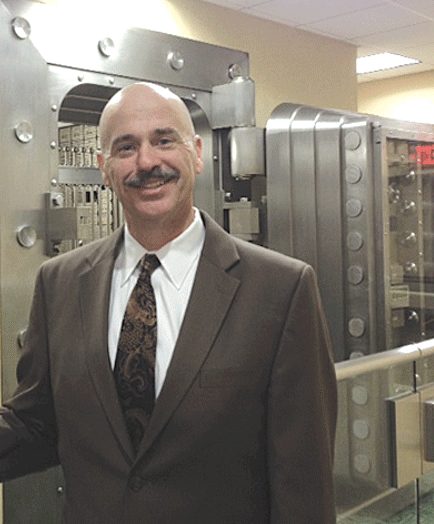
Columns Sections
Be Wary of Pitfalls That Can Be Costly to Your Company

James T. Krupienski

James T. Krupienski

Oct. 15 is almost upon us. For some, this is just another day on the calendar. For those responsible for an employee-benefit plan, however, this is a very important date.

Oct. 15 is the extended due date for filing a calendar year-end employee-benefit-plan tax return — Form 5500. This means that many of you are wrapping up your annual financial statement audit, or are working with your third-party administrator to remember your PIN and password, which is needed to electronically file your return.

As an auditor of these plans, I often see fiduciaries who are not fully aware of the specific provisions of their plan or the rules and regulations regarding their administration. As a result, there are many errors that can occur. Some of these errors can lead to serious consequences regarding the continuation and qualified status of the plan.

While preparing your plan’s tax filing, it’s a good idea to re-evaluate some of the process and controls involved, making adjustments and improvements where necessary.

This article is intended to highlight some of the more common errors that are found, including the timing and remittance of employee-deferral contributions, the improper application of the definitions of eligibility and compensation, the improper use and review of hardship distributions, and a general overreliance on the plan’s third-party administrator.


Timing of Employee Deferrals

Employee-deferral contributions are required to be remitted to the plan as soon as they can be segregated from the company’s general assets, but in no event later than the 15th business day of the month following the month they were withheld. In many instances, plan administrators will cite the 15-day rule when discussing their remittance policies. It should be noted that the 15-day rule is not a safe harbor, but rather the last day before contributions are automatically considered late.

More often than not, upon examination by the Department of Labor, examiners will look at when all other payroll taxes were remitted by the company. In addition, they will look at consistency, adherence to the established policy, if any, and past history. With technology today, most plans should be able to remit these funds within three to seven business days. Any remittances that fall outside of the established guidelines, even if only by one day, may be considered late and consequently subject to corrective procedures and excise tax reporting.


Eligibility and Compensation

There are many items that are defined in the plan document. Two of the most misunderstood and/or overlooked definitions are those for plan eligibility and compensation.

Misunderstanding the plan’s definition of ‘eligibility’ often leads to employees being delayed entrance to a plan when they are eligible, while other employees are allowed to enter the plan prematurely. Many administrators misinterpret the difference between when an employee meets the eligibility requirements and when the employee is allowed to enter the plan. For example, if an employee meets the eligibility requirements of a plan on June 1 but there is a quarterly entrance date, the employee may not be able to enter the plan until July 1.

If for any reason you feel that this is not being performed properly, please check with your third-party administrator or CPA, as the penalties for failing to comply with the provisions of a plan can be severe.

Compensation is another area to which plan administrators need to pay particular attention. First, not every plan uses the same definition of compensation. Second, the plan may use different definitions of compensation for different purposes, such as for deferrals and employer contributions. Most often overlooked is the treatment of bonus compensation in relation to the plan definition of ‘eligible compensation.’ For example, if the plan elects to use W-2 wages as its definition of compensation, all bonuses, whether through payroll or manual check, must be included when calculating the employee deferrals. If not, a written election from the employee must be on file.


Hardship Distributions

With the current economic conditions, hardship distributions may become more common for those plans that allow them. It is critical to take note of the rules and regulations for these distributions, which must be adhered to.

First, before a hardship distribution can be requested, the employee must provide evidence to the employer that all other sources of financing, including loans from the retirement plan, have been exhausted. Second, the amount requested cannot exceed the amount needed to satisfy the event at hand, such as the amount necessary to block foreclosure proceedings of a home. Additionally, the request can be made only to satisfy certain predetermined obligations. Purchasing a new car is not a qualifying event.

In order to provide evidence that these provisions have been met, it is strongly recommended that the request be made in writing and that the employee provide documentation that should be kept on file with the application. Finally, once the distribution has been made, it is imperative to understand that employee deferrals to the plan must be suspended for a period of six months.


Third-party Administrators

When errors are detected, the response most often heard is ‘why didn’t our third-party administrator catch this?’ Unfortunately, while this may be a valid argument in some cases, at the end of the day there is a fiduciary responsibility that has been placed on the trustees and administrators who oversee the plan in-house. Adequate time and attention are often not devoted to administering these plans, but when something goes wrong, there is the potential for personal liability, up to and including fines and other penalties.

It is recommended that, at minimum, those assigned to oversee the plan obtain and review the reports that are available from the third-party administrator on a quarterly basis. When reviewing these reports, don’t focus solely on investment performance.

Take the review further. Tie out contributions posted to the account to your general ledger and payroll records. Review loan activity and balances, questioning new loans that aren’t recognized or outstanding loans with balances that have not changed. Also, review benefit payments to ensure that you have properly executed withdrawal-request forms on file for each.

Retirement plans, depending on how they are designed, can be very complex. Additionally, there are many rules and regulations that need to be followed, which are not always spelled out explicitly in the plan document. Penalties and ramifications for not following the plan document or governing rules can be extremely severe.

It is strongly recommended that your plan, no matter how large or small, have a few basic controls and procedures in place. Your third-party administrator can assist you with this process, but they can’t replace the ultimate responsibility that you have as the plan’s fiduciary. In the event of an unwanted knock on the door from the Internal Revenue Service or Department of Labor, how well-prepared will you be?


James T. Krupienski, CPA, is a senior manager with the Holyoke-based accounting firm Meyers Brothers Kalicka, P.C. His practice is based in the healthcare industry; (413) 322-3517; [email protected]

Company Notebook Departments

Big Y Relaunches Education Express

WILBRAHAM — Citing a passion for education and a belief that strong schools build strong communities Big Y World Class Markets recently announced the return of the Big Y Education Express Program beginning Oct. 4. Through the program, shoppers help schools receive supplies such as new computers, software, books, math and science materials, sports equipment, and other items. Shoppers can sign up to support the school of their choice beginning Sept. 6, and points will accumulate from Oct. 4 through Jan. 1, 2014. Sign up is available online at bigy.com/educationexpress, through Facebook, or by filling out a form at the customer-service desk or any register at a Big Y store. When shoppers purchase participating products, marked with a school-bus logo on the shelf sign, and present their Big Y Express Savings Club or Silver Savings Club card, they earn points for the school of their choice. Schools can then redeem the points for free educational supplies. Customers can track individual contributions online, and schools receive point updates weekly and can redeem points at any time during the program. Since 1993, Education Express has awarded more than $13 million worth of teaching materials and classroom equipment to more than 2,000 schools in Big Y’s market area.


HCC Foundation Awarded Grant

HOLYOKE — The Holyoke Community College Foundation has been awarded a $200,000 grant from Urban Research Park CDE, LLC, to launch a technology career pathways program in partnership with Dean Technical High School and the Massachusetts Green High Performance Computing Center (MGHPCC). The collaborative project, called Career Pathways in Technology for Holyoke, is designed to enhance technology education for Holyoke and area residents by establishing a CISCO Academy at HCC and Dean Tech while leveraging educational opportunities through the MGHPCC. CISCO, a corporate sponsor of the MGHPCC, licenses its CISCO Academy curriculum to offer training and professional certifications in the latest technology to help prepare students to fill the global demand for networking professionals. The three-year grant will serve at least 150 students, 25 a year at Dean and 25 a year at HCC. Classes are expected to begin in January 2013, with the program in full operation at both Dean and HCC by September 2013. Career Pathways in Technology for Holyoke will offer both non-credit and credit courses. Non-credit courses will offer certifications that can lead to job placement and are expected to serve the region’s current workers seeking entry-level jobs or job advancement. Dean students will also have the opportunity to enroll in credit classes at HCC in Computer Information Systems to obtain a certificate or associate degree. “One of the goals is to create an educational pathway from Dean Tech to both the credit and non-credit opportunities available at HCC and ultimately into the workforce or toward further educational opportunities,” said Jeffrey Hayden, vice president for Business and Community Service at HCC.


Impressions Academy of Dance Performs at WDW

FEEDING HILLS — Members of The Impressions Academy of Dance recently traveled to Downtown Disney at Walt Disney World Resort in Florida to take part in a Disney Performing Arts Program. Dance groups, choirs, ensembles, and marching bands from around the world apply to perform each year as part of Disney Performing Arts at both Disneyland in California and Walt Disney World. Once selected, groups are given the opportunity to perform at the resort for an international audience of theme-park guests. Millions of performers have graced the stages of the Disney parks in the more-than-25-year history of the program. Disney Performing Arts offers band, choral, dance, and auxiliary performers the opportunity to learn, perform, and compete at the Disney World resort.


Springfield College Ranked by Magazine

SPRINGFIELD — Springfield College was recently ranked in the top tier of the Best Regional Universities – North Region category in U.S. News & World Report’s 2013 edition of “Best Colleges.” The ratings are based on such variables as peer assessment, graduation and retention rates, student selectivity, class size, alumni giving, and student-faculty ratio. “We take pride in this recognition,” said SC President Richard Flynn. “Springfield College is committed not only to academic excellence, but to providing an affordable private education. This latest ranking again confirms that our outstanding faculty and staff remain committed to providing a top-notch education for our students.”


Tighe & Bond Awards Scholarships

WESTFIELD — Through the Community Foundation of Western Massachusetts, Tighe & Bond Inc. recently awarded its yearly scholarships to three local college students pursuing engineering degrees. According to David Pinsky, president of the civil- and environmental-engineering firm, “Tighe & Bond firmly believes in the importance of higher education for promising students who have the desire to pursue degrees in engineering. It also offers us a tangible way to support the future of the engineering practice which is essential to problem solving and the well-being of our society.”

Recipients include Johnniel Gomez, a 2012 graduate of Roger L. Putnam Vocational High School, who will attend UMass Dartmouth and study Civil Engineering and received the Philip W. Sheridan – Tighe & Bond Scholarship; Jason Arble, a 2012 graduate of Holyoke High School, who plans to study Electrical Engineering at UMass Amherst and is the recipient of the Edward J. Bayon Memorial Scholarship; and Aaron Sabbs, a 2009 graduate of South Hadley High School, who will be a senior at Worcester Polytechnic Institute, where he is majoring in Civil Engineering, and is a recipient of the George H. McDonnell Scholarship for the fourth year running. All of the scholarships awarded are in memory of past Tighe & Bond presidents.


Winstanley Partners Revamps Race Website

LENOX — Winstanley Partners recently revamped the website for the annual Josh Billings Run Aground Triathlon, also simply known as the Josh, which occurred on Sept. 16. Founded in 1976, the race draws more than 500 teams, from weekend warriors to full-fledged Ironmen and Ironwomen, who converge at the Stockbridge Bowl with bicycles, kayaks or canoes, and running shoes. Phil Cohen, project manager at Winstanley Partners, explained that the agency worked in tandem with Race Director Patty Spector to switch joshbillings.com over to the WordPress content-management system, which makes additions and updates simpler and allows race coordinators and the all-volunteer staff to revise information throughout the year. The new site will also keep race enthusiasts informed and attract more athletes and spectators who routinely check race locations, routes, and results.

Cover Story
A Textbook Example of Effective Job Sharing

While job sharing is hardly a new concept — it’s at least a few decades old by most accounts — it has rarely succeeded, or even been tried, at a high-level administrative post, such as vice president of Philanthropic Services at the Community Foundation of Western Massachusetts, which is now being shared by Kristin Leutz and Katie Allan Zobel. For one of them (Leutz), this is a chance to live out research she did while attaining a master’s degree in Industrial/Organizational Psychology at Springfield College. For both, it’s a way to achieve coveted work/life balance while also carrying out highly rewarding work. What they’ve been doing for the past seven years can be described with one word: pioneering.

There’s a small pile of rocks — one of the owners actually called it a “sculpture” — sitting in the middle of the table, or leaf, that lies between the desks occupied by Katie Allan Zobel and Kristin Leutz.

These items come in all sizes and shapes (including a few that look like hearts — Leutz collects and treasures those), and they were brought back to Springfield from many different travel destinations. Most are gifts from one to the other, but some were found and simply added to the mix.


Kristin Leutz

Kristin Leutz says the unique job-sharing situation she entered allows her to live out the research she did at Springfield College and MassMutual.

“It’s … a shared pile of rocks,” said Leutz with a laugh, noting that this makes the unique office accessory symbolic in many ways. That’s because these two women share, well, just about everything.

That starts with a job — vice president of Philanthropic Services for the Community Foundation of Western Massachusetts — and its salary and needed benefits. They also share an office, a copier, that leaf with the rocks, a bookcase that is far too cluttered for either one’s good, the nameplate outside the door, and even the door itself (items chosen by both, ranging from newspaper cartoons to art created by Leutz’s youngest child, now compete for space).

It’s been this way since the late fall of 2005, when Zobel and Leutz applied as a team for a position then called director of Development, and prevailed over several traditional hopefuls — meaning singular men and women — in a decidedly different candidate-selection process (more on that later).

Currently, Leutz works Mondays and Tuesdays, Zobel takes over on Thursdays and Fridays, and they’re both in on Wednesday, or what has come to be known, alternately, as ‘overlap day,’ ‘hand-off day,’ and ‘pass-the-baton day.’

Between them, they have raised between $5 million and $8 million per year, said Kent Faerber, former president of the foundation and now interim president, and been highly successful in a multi-faceted position that has involved everything from fund-development management to PR and marketing, to promoting philanthropy across the region.

“This has been a very challenging job to share because of the sophistication of the work and the need for our external constituency to feel that their relationships with the foundation are seamless,” he told BusinessWest. “While a prospective donor might make initial contact with one of them, the other needed to be able to pick that up whenever he or she might call back or make contact later. They have developed quite extensive routines of information sharing and collaboration despite the fact that they are normally not in the office or on duty at the same time.”

When asked how they are able to succeed in this unique and challenging sharing arrangement, Leutz and Zobel used different words and phrases to say what amounts to the same thing: they work hard at it. And they need to, because, while having two minds working on all that goes into this job description is certainly beneficial for the foundation, such a scenario can get complicated.

“To try to figure this out is not simple; it’s not a straightforward thing,” Zobel said of job sharing in general. “We’re true pioneers.”

That’s a word that both used early and often, because there is very little job sharing going on in this region in general, and only a few examples from across the country of it working at such a high administrative level. The two are well-aware of this, and understand that their partnership could be considered ground-breaking and a potential model.

For this issue and its focus on women in business, we take a look at this unique employment arrangement, how it came about, and why, seven years later, it’s stronger than ever.

Sharing the Wealth

Carol Leary, president of Bay Path College and a long-time (now former) board member and president of the Community Foundation, remembers the search that eventually brought Leutz and Zobel to the organization — as well as her reaction to a situation (a teamed pair of candidates) that she hadn’t seen before and hasn’t seen since, at least at that level.

“I really didn’t have to be convinced very much — I loved the concept of trying it,” she recalled. “My sense was that the worst thing that could happen was that it wasn’t going to work … and I figured it was well-worth the risk because we didn’t want to lose either one of them.”

But Faerber, president of the foundation at the time, remembers that there was considerable skepticism among other members of the search panel, especially about the logistical aspects of such an arrangement. What eventually swayed them, he believes, was the prospect of putting two strong, creative minds to work on the many challenges and opportunities that would confront whomever held that title.

Katie Allan Zobel

Katie Allan Zobel says she wanted to work for the Community Foundation, but couldn’t handle a 55-hour week, and the job-sharing arrangement allowed her to advance her career goals.

“I was aware of the talent that these two brought to the position, so I was prepared to rethink whatever preconceptions I had about how this might get done,” he told BusinessWest, adding that other search committee members obviously felt the same way, as they chose the two over perhaps 25 other candidates. “There was awareness of the fact that, if you had two minds working on this, that was a fairly significant plus.”

How these two minds came to sit across the table from those interviewers is an intriguing story, which starts at Amherst College in the mid-’90s, where Leutz and Zobel worked together in the broad realm of fund-raising and alumni relations.

They thrived in those roles, but Leutz eventually left the school to pursue a master’s degree in something called Industrial/Organizational (I/O) Psychology at Springfield College. This is an emerging field, she explained, that involves the scientific study of employees, workplaces, and organizations, and covers many aspects of human resources and organizational development, including a wide range of work/life balance issues and trends.

These specific areas of study defined her master’s thesis work at MassMutual. “I was looking at what they called alternative work arrangements there,” she explained, adding that job sharing was part of the mix, but there was a very limited study pool. “I did a large-sample survey and qualitative study of their employees and what kinds of work/life arrangements they were using — alternative schedules, part-time work, and other initiatives.”

She would eventually go on to work for the company as an organizational-development consultant in the Human Resources department, working on what amounted to the human side of a large-scale implementation of the SAP technology system. Little did she know that soon she would be taking much of what she learned in the classroom and at the financial-services giant and applying it to what amounts to a pioneering experiment.

Fast-forwarding somewhat, Faerber reached out to Zobel in the early fall of 2005 when she was an independent consultant (Amherst College was one of her clients) and asked if she could provide temporary support for the Community Foundation when its director of development was stricken with the cancer that would eventually take her life, and was then on leave of absence.

Zobel recalls being somewhat reluctant at first, but agreed, and soon found the work rewarding and the foundation an organization she enjoyed working for. “I was here for three months, and came to realize what an amazing resource the Community Foundation is. I had no idea the extent of their work and the way in which they did that work; it was both surprising and so engaging that I wanted to stay and apply for that position.”

But she determined fairly quickly that the 55-hour work week that the job entailed was something she didn’t want at that time in her life, with two young children.

Zobel recalls initial discussions with Leutz (who by this time had left MassMutual after the birth of her first child, ironically because she couldn’t work out the flex-time arrangement she desired) about the possibility of sharing this job. She did so without knowing the full extent and specific direction of Leutz’s graduate work — “I knew it was organizational development, but not much more than that” — and found her very open to what at that time amounted to exploring uncharted territory.

“This was a chance to live out my research and test it out,” Leutz recalled. “I was working way too many hours at MassMutual after the birth of my son, and didn’t have the work/life balance that I wanted. Here was the work/life expert having no balance; it was like the shoemaker’s children having no shoes. I was home with my son and ready to work, but not full-time.”

“When Katie came to me with this opportunity, which represented a chance to work in philanthropy in a way that I hadn’t before, I was excited,” she continued, “and I knew how to structure the job. So we applied for the position as a team.”


Work in Progress

Since getting the job and putting both their names on the plate outside their office, Leutz and Zobel have had an additional — and unique — segment attached to an already-lengthy job description: making their employment arrangement work for all parties involved.

This assignment involves everything from financial considerations, or costs to the organization, to ensuring seamless (that’s another word both women used repeatedly) delivery of services to the many kinds of clients who work with the Community Foundation.

As for the financial side of things, if two people are going to take a job that would normally be carried out by one individual, they theoretically can’t cost more than that one person would if things are going to work out for the company. And for the most part, that’s been the case with Leutz and Zobel.

Neither one has needed health insurance through the organization, which helps — if both did, that would be an additional expense — and their salary and other benefits amount to no more than what one individual would earn. There are some additional expenses — two computers and two phones are required, and if they travel together on conferences, there are two plane tickets and two registration fees (they split a hotel room) — but not many.

As for achieving a seamless operating environment, this involves constant and highly effective communication and making the very most of those aforementioned hand-off days.

Backing up a bit, the co-vice presidents went into some detail about what the foundation does and what their responsibilities are.

The foundation itself administers a charitable endowment consisting of approximately 528 separately identified funds (totaling $110 million) serving Hampden, Hampshire, and Franklin counties. The foundation also plays a central role in the charitable distributions from four large private foundations in the region, administered by Bank of America and representing approximately $24.6 million in additional charitable assets.

As for Leutz and Zobel, their official job description reads this way: “manage fund development and donor services; provide charitable gift-planning services to individuals, families, and groups, including planned gifts and gifts on non-cash assets; serve as a partner to local professional advisors assisting their clients in charitable giving; promote philanthropy in the region among stakeholders including institutions, individuals, and corporations.”

There are myriad responsibilities that go with that description, said Zobel, adding that, for two people splitting a week to carry them out, there must be communication, organization, and efficient sharing of those most important ingredients: information and opinions.

Elaborating, Zobel said she and Leutz will use Tuesday evening and then their traditional Wednesday carpooling (they both live in Amherst) to stay abreast of what’s happening with their many constituencies and plan a smooth flow of service and teamwork.

“On Tuesday evening, Kristin puts down in an e-mail to me what we call our ‘transition memo,’” she explained. “It explains everything that has happened, with highlights and bullets and an ongoing project list that we continually update; some things come off the project list, while others are added on that we need to do.

“We use that Wednesday commute to talk things over,” she continued. “I’ll have read the memo, looked it over Tuesday, and we’ll talk about those things that really need discussion.”

Said Leutz, “we basically talk on the phone a lot on our off days as well. We try to respect time off, but we wind up talking a lot because it makes things easier. And we use that commute to make the most out of discussing things that need decisions together or relationships that we share equally.”


Checking Your Balance

And while this job-sharing relationship has worked out well for the Community Foundation, it has also been everything Leutz and Zobel could possibly have expected from it — and more.

Indeed, they both talked about how this arrangement has done more than help them achieve work/life balance. It has also enabled them to be in a creative, rewarding job they could not have taken on otherwise, while also putting them in a collaborative environment that has allowed them to stretch their collective imaginations and become even better at what they do.

It’s such an attractive work environment that Leutz has stayed in it far longer than she has any other employment situation.

“I’m a restless person — this is the longest I’ve stuck with anything,” she said. “And I think that’s because I’m a collaborative thinker; even if I was working full-time, I would want to work this way, with people, because it enhances my production.”

Zobel agreed. “To do this kind of work on your own would be much harder. I can get a lot of feedback from Kristin throughout the week and from week to week about what I’m doing right, what I should change … I get infused with new energy.”

The downside to the arrangement, or at least one of them, they said, is that they are now latched to each other career-wise, a fairly tenuous situation, but one that neither one is worried about at the moment. After all, the relationship has survived a parental leave (Leutz had her second child a year after they took the job) and the need for both to earn higher wages, which they’ve accomplished through outside consulting work.

“You have to be much more creative with your own career to stay committed to someone at this level,” said Zobel. “That’s not necessarily a disadvantage, but it’s certainly a challenge.”

When asked if job sharing is a viable option for area companies and individuals working for them, both Leutz and Zobel said they provide ample proof that such arrangements can work.

But both employer and employees have to fully understand the concept, its many potential benefits, and the myriad challenges before they attempt to implement such a practice, they said.

And that starts with individuals fully understanding that, when they split a job, they take half the salary. That sounds simple, but many don’t get that part, said Zobel.

“People get all excited about this idea when we talk about it,” she told BusinessWest. “What Kristin and I wanted was a really meaningful, significant, meaty job, and you don’t usually get that in a part-time job; you either have to work much more than part time, or you work part-time and don’t get everything you want.

“Many of our peers feel the same way,” she went on. “And that’s why they get so excited about this. But then when they realize they only get half the salary, they get these startled looks on their faces.”

Moving beyond that all-important consideration, such arrangements can only work when the two individuals can work together effectively and establish a very high level of trust, something that has been accomplished in this case.

“I know when I’m not here, the work is getting done at as well as I would have done it, if not better,” said Leutz, “because Katie is here and I have complete trust in her.”

In general, job sharing has worked best with positions like administrative assistant, Leutz explained, but it has been effective in a variety of settings and with many different job titles.

“Any job share should be able to be matched to the work and to the role, but there are certain jobs that would be very difficult for people to share, and there are many ways that people structure job shares,” she said. “Some people have very discreet responsibilities and don’t overlap very much, and other people share everything because of the nature of the work.

“There are examples from around the country where executive-level employees, women and men, have been able to do this,” she continued. “But they have tended to structure these arrangements very creatively depending on the organization and the needs of the job. And we figured we had to do that here; we had to really understand the nature of the work and make ourselves flexible.”

Looking back, Leutz and Zobel both noted that they didn’t have all the answers for that search panel back in 2005, and that it’s taken the ensuing seven years to completely fill in their canvas. They’re not sure how long this relationship will go on, but for now they’re more than content to continue their pioneering efforts.


Two the Future

The level of sharing between Leutz and Zobel apparently goes further than the two understood — at least until recently.

Indeed, Leutz has one of those office chairs with a large rubber ball as the seat — chosen for ergonomic reasons (something else she learned while studying I/O Psychology). And when BusinessWest noted that Zobel uses a more traditional model, she admitted to her office mate, “I often use yours when you’re not here,” which was news to Leutz.

But beyond the chair, the door, the copier, and the four weeks of vacation, the two share something else — a firm desire to make this situation work both for them and the organization. It’s been something they’ve certainly had to work at, and it is that commitment to not merely a job, but also a truly unique work arrangement, that has made it successful.

You might say it’s a working situation that’s rock solid — and in more ways than one.

George O’Brien can be reached at [email protected]

Green Business Sections
Scuderi Group Continues to Seek Its Next Breakthrough

A prototype of the Scuderi split-cycle engine.

A prototype of the Scuderi split-cycle engine.

Changing the world isn’t easy. But the Scuderi family never expected that it would be.

“Our biggest hurdle, basically, was getting the engine to work. That took a lot of engineering,” said Bill Wrenn, director of marketing for the Scuderi Group, the West Springfield-based company that has spent the past decade attempting no less than a revolution in energy-efficient automotive technology.

“We first fired it up on June 25, 2009; that’s when we got the prototype up and running for the first time,” Wrenn continued. “And that really was the biggest question leading up to that point: will this work? Well, it not only works, but it has worked a lot better than anyone had thought originally.”

The promise of the Scuderi split-cycle engine, as it’s called, is that it could dramatically increase the efficiency of a machine — the internal-combustion engine — that has been notoriously resistant to such efforts in the more than 130 years since it was invented.

It all began in the mind of Carmelo Scuderi, who developed the concept shortly before he died in 2002. His sons — Sal, Stephen, and Angelo — have spent the years since honing the idea, raising millions of dollars in research funding, and preparing to market the final product. They were aided in building a prototype by Southwest Research Institute in San Antonio, Texas., and have since opened offices in the automotive hotbeds of Germany and Japan, making the Scuderi brand an international presence.

But the amount of hype surrounding the engine has some wondering when it might finally appear in a marketable vehicle. To which Wrinn urges patience, while fully acknowledging the complicated nature of the Scuderis’ efforts.

“Anyone who’s not skeptical about this engine doesn’t understand the complexity of the combustion engine,” he told BusinessWest. “It’s not like trying to build new office furniture and sell it; these are very scientific processes we’re working on.”

But he pooh-poohs any notion that the auto or energy industry has hindered progress on a more energy-efficient machine. “We’ve had no visits from men in dark blue suits telling us to go away,” he said with a laugh. “But the attraction has varied from continent to continent and continues to change.”


Change Resistant

The first four-stroke piston engine was developed in 1876, and remains the primary design of engines today. And despite the myriad changes to automotive technology over the past century-plus, the efficiency of this engine design has remained largely unchanged. Specifically, it operates at about 33% efficiency, meaning that only one-third of the energy in each gallon of fuel is used to power the machine, and the rest is lost through friction and heat.

The Scuderi Group believes their model could finally change that equation. They note that the heart of the internal-combustion engine is a piston connected to a crankshaft, moving up and down in a cylinder through the intake, compression, power, and exhaust strokes. In a typical four-stroke cycle engine, power is recovered from the combustion process in these four separate piston strokes within each single cylinder.

The Scuderi split-cycle engine changes the heart of the conventional engine by dividing the four strokes of this cycle over a paired combination of one compression cylinder and one power cylinder. Gas is compressed in the compression cylinder and transferred to the power cylinder through a gas passage.

The gas passage includes a set of uniquely timed valves, which maintain a precharged pressure through all four strokes of the cycle. Shortly after the piston in the power cylinder reaches its top, center position, the gas is quickly transferred to the power cylinder and fired (or combusted) to produce the power stroke.

By splitting the strokes of the cycle over a pair of dedicated compression and power cylinders, the design of each cylinder can be independently optimized to perform the separate tasks of compression and power.

Stephen Scuderi briefs Japanese media about the Scuderi split-cycle engine.

Stephen Scuderi briefs Japanese media about the Scuderi split-cycle engine.

The Scuderis have called the engine “disruptive technology,” meaning it has the potential to shake up an industry. Wrenn said the family has been pleased with the engine’s performance so far.

“To put it in perspective, we’re at the genesis of a new thermodynamic process, a new way of creating combustion that has never been discovered before,” he said. “We’re discovering interesting new facts about the engine’s potential ability to do certain things and how much power it can produce.”

Since the prototype was completed, Wrenn said, “we’ve spent a lot of time collecting statistics and measurements and simulating how the engine would work in typical vehicles. One test took a typical European economy-class vehicle — these are some of the most efficient vehicles in the world — and, with the Scuderi engine, took the car through a typical drive cycle in various driving modes. What we found was, where normally those cars would get 52 miles to the gallon, the Scuderi engine got more than 65. On the emissions side, we emitted 85 grams of CO2 per kilometer, compared to a conventional engine with 104 grams per kilometer.”

Beyond the basic concept, the company is generating additional energy savings from an innovation it calls the air hybrid, in which it stores energy as compressed air during braking and feeds it into the combustion cylinder when the car is accelerating. Electric hybrids also use braking force to store energy, but in a battery, and the Scuderi Group points out that batteries are costly, heavy, and wear out — and are hazardous to dispose of.

Sal Scuderi told the Wall Street Journal recently that the company is getting close to licensing its technology for production, but scoring an automotive customer is challenging. “You can’t beat [incumbent engine designs] by a little bit. You have to beat them by a lot.”

The test Wrenn cited may fall under the ‘little bit’ category, but, “since then, the data has gotten even better,” he told BusinessWest. “Since then, we’ve made tweaks on our valve systems, and we’ve found that we can manipulate it even more, increasing power and also bringing down fuel combustion. That has been an extremely exciting discovery.”


The Next Phase

Wrenn said the Scuderi family is fond of the quote often attributed to Mahatma Gandhi: “first they ignore you, then they ridicule you, then they fight you, then you win.”

“We’re definitely going through those stages right now, and we’re turning a corner where it’s becoming more accepted,” he said. “It’s been really interesting.”

For example, “our engine has applications in other industries,” he noted. “I think everyone has associated us with the automotive industry. Yes, it’s a car engine, but we are now being looked at as a solution not just for automotive applications, but power generators, compressed-air energy-storage solutions, and distributed power.”

He said the Scuderi Group has negotiated with multiple manufacturers in more than one industry and could be close to a licensing deal, although he could share no details yet. But he said the confidence of the family in their father’s dream has never wavered.

“As new discoveries have created new opportunities for success, we’re even more excited about it,” Wrenn said, adding that one of the most intriguing parts of the process has been opening up the concept to engineers of all stripes.

“The family chose long ago to begin to promote the technology, but at the same time it’s being developed, we wanted to bring the engineering community along for the ride,” he explained. “We’ve always known that, once the engine starts to get worked on by the greater engineering community around the globe, they’re going to discover a few new things and make it better. We think that’s fascinating and a great thing.”

In other words, the biggest news with the Scuderi split-cycle engine is still a ways down the highway — and this globetrotting family is enjoying the ride.


Joseph Bednar can be reached at [email protected]


Company Notebook Departments

STCC, Eastern States Exposition Partner on Internship Program

SPRINGFIELD — Springfield Technical Community College (STCC) and the Eastern States Exposition (ESE) recently announced a scholarship that creates internship opportunities for STCC students in the Civil Engineering Technology program. Through a donation from Eastern States Exposition, the college created the STCC Civil Engineering Excellence Fund this past June to support a Civil Engineering Learning Laboratory at the exposition facilities. The laboratory will provide STCC students with the opportunity to apply classroom skills outside the campus in a working environment. The partnership between STCC and the ESE will provide a unique learning opportunity to STCC students. Selected interns will receive a scholarship and be recognized at the annual STCC scholarship and awards ceremony. Students will develop project organization, management, and communication plans; catalog, review, and digitally archive historical blueprints and engineering documents; interview and gather facility development history; locate the exposition site’s structural, sewer, electrical, and roadway systems; provide updated digital schematics and renderings of the site using industry-standard software; and recommend areas for consideration for future analysis and verification. “It’s a unique opportunity for our students because it allows them to have a historical perspective of what they are working on,” said STCC Foundation Interim Director Robert LePage. “It’s a really great hands-on learning experience.” STCC student Carlos Cruz is the first student to participate in the program and began work this summer. Under the supervision of STCC Adjunct Professor of Civil Engineering Technology Robert Vetrano, Cruz already has scanned more than 600 of the exposition’s drawings, converted them into TIF format, cleaned the images, and finally converted them into PDF format. Next summer, LePage said he hopes to have at least three or four additional interns to help with the project, and credits the Eastern States Exposition with stepping forward to become the first local organization to support the scholarship program. “It’s an interesting project,” said LePage. “And it’s nice to support and partner with an organization like the Eastern States Exposition, with such a strong mission and focus on education.” LePage noted that, while the ESE is the first organization to step forward to contribute to the STCC Civil Engineering Excellence Fund, there are opportunities for other area businesses to get involved.


Colony Hills Capital Announces Acquisition

WILBRAHAM — Colony Hills Capital, LLC (CHC), a Wilbraham-based real-estate-investment firm, recently closed on the $14 million purchase of Wynthrope Forest Apartments, a 270-unit, garden-style community located in Riverdale, Ga. Wynthrope Forest, built in 2000, occupies 28 acres of land. “Because Wynthrope Forest was an REO, we were able to acquire this tremendous asset at an excellent cost basis and significantly below replacement cost,” said David Kaufman, vice president with CHC. “With minor capital improvements and instituting best-in-class management disciplines, I believe our investors will be rewarded with strong risk-adjusted returns.” CHC was joined by equity partners Plymouth Opportunity REIT and Redwood Real Estate Partners in the investment, as well as Morgan Stanley, which provided the mortgage financing on the property.


Big Y Opens Latest Store

in Franklin

SPRINGFIELD —  Big Y recently opened its newest World Class Market at 348  East Central St. in Franklin. The 56,866- square-foot market boasts many new innovations both inside and outside of the store. Bowdoin Construction Corp. served as the general contractor for this location, in conjunction with several local subcontractors, such as Tom Gioloso Construction Inc., for the completion of this $14.5 million investment that began in September 2011. “All of us at Big Y are excited to offer the Franklin community with a brand-new shopping experience and a new option for their grocery and lifestyle needs,” said Big Y’s president and chief operating officer, Charles D’Amour.


AJE Financial Services Moves into New Quarters

LUDLOW — AJE Financial Services in Ludlow recently moved into new offices at 588 Center St. in Ludlow. Previously located on 364 East St. in Ludlow, the company had outgrown its former location. Owner and President Robin Wdowiak said he is pleased to be able to keep the business in town. “AJE Financial Services has been a part of the Ludlow business community for 17 years, and we are thrilled that we were able to find a  suitable location right here in town,” said Wdowiak. “I grew up in Ludlow and know many of the residents here, so there is always a neighbor-helping-neighbor feeling to the services that we provide.” The company staged an open house on Sept. 6.

Features
Business Expo Will Feature a Wide Array of Educational Programs

Mobile marketing. E-mail marketing. Social-media marketing.

These are terms that most people in business has no doubt heard, and that most have uttered themselves. But not many can truly say they fully understand them, or know how to effectively utilize them to move their company or organization forward.

They’ll have a much better appreciation after attending the Western Mass. Business Expo 2012 on Oct. 11 at the MassMutual Center. Indeed, among the nearly two dozen informational programs to be presented that day will be “The Growing Role of Mobile Marketing: New Trends in Mobile and Why Consumers Love It,” “The Power of E-mail Marketing,” and “Social-media Marketing Made Simple.”

“E-mail marketing is the most cost-effective, targeted, trackable, and efficient way to build and maintain relationships for all types of businesses and organizations,” said Corissa St. Laurent, director of Regional Development for Constant Contact New England, which will present the latter two programs. “In this [e-mail] session, participants will discover how communicating with customers regularly can help a small business stay connected and generate increased referrals and repeat sales, as well as unwavering customer loyalty.”

As for mobile marketing, Tina Stevens, president of Stevens 470, who will present that program, said research shows that the number of mobile Internet users will exceed desktop users by 2014, and business owners must be prepared for that eventuality.

“Mobile devices have become so easy and convenient to use, they are now an integral part of our on-the-go lifestyle,” said Stevens. “Many of us are using a mobile device as much as, or more than, our desktop computer. We want businesses to realize that this is happening, and help them find ways to use this mobile technology to their advantage.”

These programs, part of the broader Sales & Marketing category of programs, are good examples of the way in which the Expo is much more than a networking event and opportunity for a company to gain exposure — although those opportunities exist as well, said Kate Campiti, associate publisher of BusinessWest, which will again produce the event.

“We want to provide attendees with tools, resources, and knowledge that business owners and managers can take back to their offices or plants and put to use the next day,” said Campiti. “That’s why we’ve made educational programs such a big part of the Expo. The expertise offered by our many speakers is one of many ways of providing value to attendees and exhibitors alike.”

The full roster of educational programs will be finalized over the next few weeks, said Campiti, adding that, in addition to Sales & Marketing, other categories will include Management & Leadership and General Business. In addition to the 21 seminars, there will be a number of Show Floor Theater presentations, including a talk by Michael Martin, vice president of Sales for Vibram FiveFingers, who will tell that company’s intriguing story, while also addressing the broader subject of innovation and how one development — such as the FiveFingers product — can lead to a number of growth opportunities for a company.

Details of the Expo are emerging, said Campiti, adding that organizers have been meeting through the spring and summer to finalize programs and fill in a schedule of events that will begin with breakfast at 7:30 a.m. and conclude with the popular Expo Social starting at 4:30 p.m., a get-together that has become one of the more highly anticipated networking events of the year.

Highlights will include more than 180 exhibitors, breakfast and luncheon speakers, presentation of the Better Business Bureau’s Torch Awards, educational seminars and special programs, a Technology Corridor, a Health Care Corridor, and a number of co-located events that will bring more people, energy, and opportunities for doing business to the MassMutual Center.

The event is being sponsored by Comcast Business Class (presenting sponsor), and silver sponsors Health New England, Johnson & Hill Staffing Services, and  Stevens 470. Additional sponsorships are available.

Booths are also still available, and can be ordered by calling (413) 781-8600, logging onto www.wmbexpo.com or www.businesswest.com, or e-mailing [email protected].


— George O’Brien

Commercial Real Estate Sections
MGM Unveils Plans for Casino in Springfield’s South End

proposed MGM Springfield

An architect’s rendering of the proposed MGM Springfield.

MGM Resorts International took the competition for a Springfield-based casino to the next stage recently, with the unveiling of an $800 million complex to be built in the city’s South End, between State and Union streets, Main Street, and East Columbus Avenue. Plans call for a 25-story, 250-room hotel, gaming space, and a retail and entertainment district being referred to as Armory Square. MGM Chairman and CEO James Murren summed up the company’s plans by saying, “we don’t want to build a box; we want to build an urban environment.”

As he stood at a podium talking about MGM Resorts International’s plans for a casino in Springfield’s South End, Bill Hornbuckle repeatedly referenced an image displayed on large projection screens in the front of the room.

This was a black-and-white photograph of a section of downtown Springfield from nearly a century ago. And as he discussed that scene, through the magic of technology, the streetscape was transformed into a vivid color image of roughly that same location (see page 41) as it would look after MGM was done creating an $800 million casino, hotel, and entertainment complex there.

And with that, the competition to bring a casino to Western Mass., and, more specifically, to the City of Homes, took a major leap forward.

Indeed, for the first time, a casino developer has put a specific plan on the table. It is known for now as MGM Springfield, and Hornbuckle, the company’s chief marketing officer, is the company official charged with making it happen.

He explained the initiative at an elaborate press conference at the MassMutual Center that drew more than 200 business leaders, elected officials, and scores of media from across the state. He shared the podium with MGM President Jim Murren, who welcomed those assembled by saying simply, “we want to be here; we want to be in Springfield.”

Springfield’s South End

An architect’s rendering of what Springfield’s South End will look like if the planned $800 million MGM Springfield becomes reality. The view is from the south at the corner of Union and Main streets.

The two administrators would go on to explain that, for MGM, which operates a portfolio of more than a dozen major casinos across the country, Springfield is the logical next point of expansion, and the South End location, near I-91 between State and Union streets, Main Street, and East Columbus Avenue, is the most attractive location for such a facility.

As he talked about the proposal, Hornbuckle said the contest to be named the designated Springfield casino project (there are at least two other plans coming together) — as well as the fight that would follow to gain the Western Mass. casino license — will be spirited competitions, and the corporation is ready for what will be a pitched battle.

It has already launched a Web site (www.mgmspringfield.com) that introduces the project and invites input from area residents, and has launched a series of television and print ads announcing the initiative and its role in tornado-recovery efforts. And billboards will soon be appearing with the message: “World Class Entertainment, Gaming, and Dining. HERE.”

“We go hard and fast when we go, and we’re going,” Hornbuckle said. “This is a competition … and we’re in it for the journey.”


Going All In

As he referenced the old image of Springfield’s downtown and its technology-enhanced morphing into a casino site, Hornbuckle said the juxtaposition of images was chosen by MGM and its marketing team to show how the planned casino complex would effectively transform the old into the new.

Actually, it would blend the old — such properties as the old MassMutual headquarters at the corner of State and Main and the former South End Community Center, for example — and new, including a 25-story, 250-room hotel; shops and restaurants; entertainment facilities, including a movie theater and a high-end bowling alley; and new market-rate housing.

It was also chosen to convey that a new era in the city’s history would be unfolding, one that would, in this case, transform an area — the South End — that had fallen on hard times in recent years and then found itself squarely in the path of the tornado that changed Springfield’s landscape in many ways last June.

Overall, the more than 500,000-square-foot, mixed-use development would include the hotel (with amenities such as a spa, pool, and roof deck), 89,000 square feet of gaming space, and about 70,000 square feet of retail and restaurant space that would accommodate 15 shops and restaurants and a multi-level parking garage.

An architect’s rendering of the planned Armory Square in the proposed MGM Springfield.

An architect’s rendering of the planned Armory Square in the proposed MGM Springfield.

Plans also call for an approximately 130,000-square-foot dining, retail, and entertainment district, tentatively named Armory Square. It would include about 25 dining and retail venues, including a 12-screen cinema, bowling alley, and outdoor stage, on land now occupied by the South End Community Center and the former Zanetti School on Howard Street.

Those are two properties for which the city will soon be issuing RFPs (requests for proposals), said Hornbuckle, adding that MGM will need to prevail in those contests if its vision is to become reality. In the meantime, MGM has gained control of several privately owned parcels in the development zone, and has many others under contract.

Plans also include 400,000 square feet of market-rate, one- and two-bedroom apartments, intended for young professionals working in the new entertainment district, said Murren, adding that MGM intends to partner with local cultural institutions, with the broad goal of jump-starting a new era of economic development in Springfield that will radiate out from the project onto Main Street and into other parts of the downtown and the city.

“I want to build a landmark here, and I want to integrate the assets you have already have — you have great bones here in the city,” he told those assembled at the press gathering. “The job we have is to knit all that together. We don’t want to build a box; we want to build an urban environment.

“We want people to walk up and down the streets, we want people to enjoy themselves, we want people to shop, go to movies, and go bowling,” he continued. “We want families to enjoy being here, and we want people to move back into the city, and I think we can be a big catalyst for all that.”

The blueprint for accomplishing all that will come together by borrowing concepts from existing MGM projects as well as from established retail and entertainment centers, said Hornbuckle, who then clicked to a PowerPoint slide that showed roughly how the complex will come together.

The stretch of the site along Main Street will be devoted to retail, offices, and residential buildings, he explained, adding that the hotel would be constructed along State Street, using the historic building at 73 State St. as the main entrance. Parking would be created along the western side of the property, near Columbus Avenue, and the aforementioned Armory Square would be created between Howard and Union streets.

The casino itself? It would be the middle of all this, said Hornbuckle, adding that it would be essentially invisible to those walking or driving by the site.

“It’s a casino you won’t see,” he explained, adding that MGM Springfield is being designed with the casino as just one part of the experience.

“What’s critical about the design is that you can interact, whether it be the hotel, the gaming, the entertainment, or up on Main Street, without having to go into the casino,” he noted. “We’re not forcing you to into that environment; if you want to bring a family to enjoy this, you can. That’s a critical element, especially for an urban casino.”

Both Murren and Hornbuckle stressed that no indoor entertainment area is planned for MGM Springfield. Instead, the company plans to partner with existing facilities such as the MassMutual Center, Symphony Hall, CityStage, and local museums, including those at the Quadrangle, to help drive traffic to those facilities. To that end, a pedestrian bridge has been proposed to link the MGM complex with the MassMutual Center.

Placing Their Bets

Several times during his address to those assembled at the press gathering, Murren said that event marked the start of a conversation, or dialogue, on the company’s plans to take its brand into downtown Springfield.

That dialogue will continue over the next several months as MGM’s plans are finalized and rival plans join the competition for the Western Mass. license.

But company officials already believe they have a winning hand, and they’re betting heavily that the community — not to mention the state’s Gaming Commission — will feel the same way.


George O’Brien can be reached at [email protected]
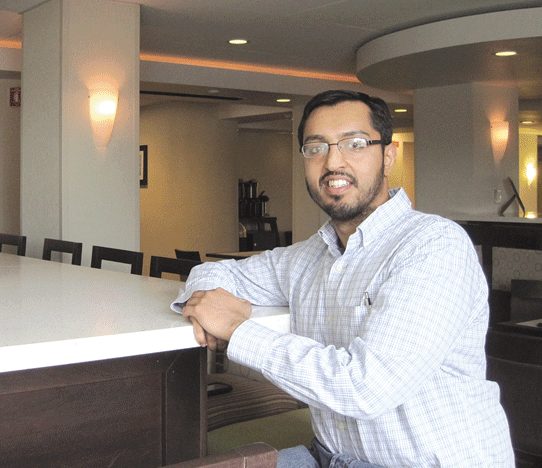
Features
GECC Looks to Channel Entrepreneurial Energy

Eric Snyder

Eric Snyder says a large supply of entrepreneurial spirit has helped revitalize Easthampton’s downtown and former mills, and given the chamber some new priorities.

Eric Snyder says that, while there are still a few large employers in Easthampton — Berry Tubed Products, National Nonwovens, and Stevens Urethane, for example — the business landscape in this community in the shadow of Mount Tom is now dominated by small (or, in many cases, very small) ventures.
“We have a lot of two- or three-person businesses, as well as a large number of sole proprietorships, and many of them are artists,” said Snyder, executive director of the Greater Easthampton Chamber of Commerce (GECC), noting that, as the face of business in this city has evolved over the past several decades, the chamber has responded accordingly.
Indeed, while the basic mission of the organization — representing the needs of the business community and giving it a voice on pertinent matters — hasn’t changed, many of the ways in which that mission manifests itself have.
In short, the chamber, which turned 50 last year, is doing more than it has historically in the broad categories of networking, education, and building exposure, said Synder, in an effort to help the myriad small businesses now filling storefronts and old mill space get off the ground or get to the next level.
“We’re concentrating more on the marketing of these small businesses and trying to keep them more in the forefront,” said Snyder, adding that the chamber now hosts a wide range of networking events, including its Networking at Night program on the second Thursday of each month, a casino night, and wine- and microbrew-tasting get-togethers. “We’re trying to get people to meet people; it’s as simple as that.”
And then, there’s a new monthly newsletter, sent electronically to the chamber’s approximately 300 members. It includes everything from legislative updates and reminders on upcoming events (Bear Fest 2012 was a lead item in the recent edition — more on that later) to news and notes on members; from a list of new arrivals at the chamber to something called ‘Member Spotlight.’
As the name suggests, this segment profiles a GECC member through words and a short video. One recent issue turned the spotlight on Web-tactics Inc., an eight-year-old company that handles Web-site design and other technology-solutions work. The video featured Janel Jordan, the company’s president.
“We like to educate people — ‘Web speak’ is very confusing and very scary, especially to someone just getting started,” said Jordan as the camera rolled. “We’re very patient … and we hold the client’s hand through the entire process.”
Such videos have now told a number of stories, noted Snyder, adding that the free service was designed to assist young and growing businesses by providing them with another marketing vehicle, one that has already brought results to some who have been profiled.
“It’s helping them get their name out and make those all-important connections,” said Snyder, who would put that last word to repeated use.
For this, the latest installment of its Getting Down to Business series, BusinessWest takes an indepth look at the changing business climate in Easthampton and how the half-century-old chamber is evolving to effectively serve its constituents.

Bear Necessities
A quick look at the rundown of new chamber members in the July newsletter speaks volumes about the still-emerging business landscape in this community.
That list includes Fitness Fusion, Furniture Recyclers, Glory of India restaurant, Mountain View Antiques & Collectibles, and Studio 72, among others.
Most of these ventures fall into that ‘very small business’ category, said Snyder, adding that many are now located in storefronts in a revitalized downtown or in the many renovated and rejuvenated former mill complexes that once gave this community its identity.
These include Eastworks (the former Stanhome headquarters building), the Paragon Arts & Industry Building, and Mill 180, all on Pleasant Street, and many others in and around the central business district.
These facilities are now home to a host of businesses across several sectors, including many that would fall into the category of ‘creative economy,’ said Snyder, adding that, on the whole, they speak to the vast supply of what he called “entrepreneurial energy” in this former manufacturing hub.
“Our downtown areas and shops are filling up again,” he said, noting significant progress on Cottage and Union streets in particular. “And we have a good amount of new businesses, which bodes well for the downtown.
“At the same time, things are picking up in the old mill buildings, especially along the Pleasant Street corridor,” he continued. “And we’re seeing a little bit of everything — light manufacturing, studios, and small businesses. Many of these are arts-related, but we’re also seeing the High & Mighty Brewery on Pleasant Street and another brewery operation progressing on East Street.”
What most of these small businesses need are visibility and those aforementioned connections, said Snyder, adding that many chamber initiatives added in recent years have been designed to provide those commodities, while also building what could be called the Easthampton brand.
The various networking events are a big part of the connection-building process, he noted, adding that attendance has been strong at such recent, and now stable, additions as Casino Night (there have been three) and the wine-tasting event, now in its fifth year.
As for branding and putting the city in the spotlight, the Bear Fest has been the biggest addition to the calendar, said Snyder, adding that the chamber partners with Easthampton City Arts on the initiative, now in its second incarnation (the first was in 2009).
This is a public art project in which life-size fiberglass bears are creatively transformed by locally and nationally known artists, putting Easthampton on the map as West Springfield has with its terriers, Springfield with its giant sneakers, and Chicopee with its replica C-5As.
This year, 92 bears now populate various locations in and around downtown. Sponsored by various businesses and organizations, the bears, to be auctioned off later this year at an event at the Log Cabin Banquet & Meeting House, bring thousands of visitors to the city’s streets and former mills, said Snyder, where they are introduced to many of the community’s new businesses.
Further introductions are being made on the new e-newsletter, he continued, adding that the publication has become another effective form of networking, as businesses can post news items and events, become a profile subject, and otherwise raise their profile among the diverse chamber membership.
The July edition, for example, has an item about Mary Ann’s Dance and More being featured in a recent issue of Retail Minded, a trade magazine devoted to news, education, and support of boutique businesses. There was also an extensive preview of Bear Fest 2012, with a call for sponsorships, an update on the Easthampton Farmers Market, and a look back at the Easthampton Spirit Committee’s family event and fireworks. There’s even a section called ‘Making Moves,’ highlighting such things as the opening of Mahan Bicycles and the expansion of Fur’s-a-Flyin with a new venture called Hairy’s Pet Supply.
“This is all free marketing, and we encourage people to take full advantage of it,” said Snyder. “It’s a way to bring additional value to members and help them make those connections.”

Work of Arts
Jordan mentions such connections during her member-spotlight interview.
“The networking events are priceless,” she said by way of explaining why Web-tactics is a member of the GECC. “You can go to one and meet hundreds of businesses and individuals and get referrals.”
Such get-togethers have always been part of the fabric of the chamber, but today, they’re even more important, as the city’s business community continues its evolution from a handful of mills that employed hundreds or thousands, to seemingly countless ventures that employ just a few.
“It’s a change for us, but then again, it isn’t,” said Snyder. “It’s always been about helping people meet people.”

George O’Brien can be reached at [email protected]