Home Posts tagged Technology (Page 24)
Columns Sections
Adopting His Philosophy Would Certainly Be a Successful Habit

Charlotte Cathro

Charlotte Cathro

Stephen R. Covey, a teacher, author, and business consultant, passed away in July at age 79 from complications after a bicycling accident. Known for his bestselling books, his words affected millions of people, and in his passing, many reflect on his teachings.
Covey’s management principles were founded on values and behavioral psychology. Part motivational speaker, part business consultant, his concepts have been embraced by an international following.
Covey graduated from the University of Utah with a bachelor’s degree and Harvard Business School with a master’s, both in Business Administration. Dedicating himself to teaching, he completed a doctorate degree at Brigham Young University. In 1984, he left his life as a university professor and founded the Covey Leadership Center. The center merged with FranklinQuest in 1997 to become Franklin Covey Co., a publicly traded company providing services in 147 countries worldwide. The management-consulting firm specializes in leadership training, improving productivity, and implementing business strategies.
The 7 Habits of Highly Effective People is Covey’s best known work. The book has sold more than 20 million copies and was named the most influential business book of the 20th century. The success of 7 Habits spawned a series of followup editions, Webinars, and management trainings. The seven habits have been adapted for families, associates, and managers. Covey toured the world lecturing and facilitating workshops. Business courses at universities often include the book in their curriculum and show excerpts of his presentations. Fortune 500 companies have even accredited his management principles as the foundation for their business processes.
The habits focus on maximizing individual effectiveness while improving teamwork and communication. For instance, Covey comments on the distractions that have come along with advanced technology and their polarizing effect on interpersonal relationships. e-mail, for example, muddles communications. Active listening is not just hearing a person, but also seeking to understand. The book defines for us the differing realities of the personal and the interpersonal. Our intentions and expectations are not always a shared understanding. Working together as a team, our individual self can get in the way of common goals. We are most successful when we are able to achieve the ‘win-win’ scenario.
Time management is a concept we all struggle with. When people are busy, they become overwhelmed by small tasks and have trouble prioritizing. Covey presents a matrix for determining how to plan and execute assigned responsibilities. As a famous exercise at his workshops, he demonstrates this concept with different sizes of rocks and a glass jar. The large rocks represent the most important considerations in your life — for example, family time. The small rocks are the small daily jobs we all have to do, like laundry. If you pour the small rocks into the jar as you place the large rocks, you can then fit in everything you need to accomplish.
The book is motivational, with step-by-step processes and relatable anecdotes. Included are visual and mental exercises designed to reinforce the material. Concepts in 7 Habits are assigned buzzwords, which have since been adopted into the language of business. These terms include ‘win-win,’ ‘proactive,’ and ‘synergy.’ The secret to the book’s success, however, is the understanding of human nature it demonstrates the behavioral commonalities we all share. The insights span both business and personal relationships, and thus countless individuals have found them applicable to their lives.
Accolades for Covey and his work are too numerous to mention. Covey was named one of Time magazine’s 25 most influential Americans in 1996. He received eight honorary doctorate degrees, an International Man of Peace award, and an International Entrepreneur of the Year award. A dedicated family man with nine children, 52 grandchildren, and two great-grandchildren, he was also awarded with a Fatherhood Award from the National Fatherhood Initiative. He considered this to be the most meaningful award that he ever received.
Covey dedicated his life to helping people achieve their business and personal goals though books, workshops, and lectures. An international management icon, he shaped what business is today and what it strives to be. In The 7 Habits of Highly Effective People, Covey addressed tendencies that hold people back from achieving their best in life. While he admitted that, at times, he himself had trouble applying his concepts to everyday life, he no doubt achieved a great deal of success in his time.

Charlotte Cathro is a tax manager with the Holyoke-based CPA firm Meyers Brothers Kalicka, P.C.; (413) 536-8510; [email protected]

Construction Sections
High Performance Computing Center Touts Energy, Security Innovations

The MGHPCC, which will open along the canals in Holyoke this fall.

The MGHPCC, which will open along the canals in Holyoke this fall.

For John Goodhue’s father, it took a tour through the Massachusetts Green High Performance Computing Center to understand exactly what goes into housing — and protecting — computers.
“When my dad toured the center,” said Goodhue, the center’s executive director, “he came out the other end and said, ‘I finally get it! It’s not about computers; it’s about bringing electricity in and creating a lot of heat and then removing that heat from the building.’”
Bingo.
Of course, that has been just one of the challenges — albeit a critical one — of preparing the MGHPCC to open in Holyoke later this year. The $95 million facility is a joint venture between UMass, MIT, Harvard University, Boston University, and Northeastern University, as well as technology giants EMC Corp. and Cisco Systems Inc., to create a high-tech research center.
To create that all-important cooling effect, the facility will use a continuous water loop in and out of the building. A chilling system will cool the water, which will then be pumped into air-conditioning units placed beside the computers; the heat generated by the equipment will then be exhausted outside, and the process begins again. Constantly.
“The cooling took an enormous amount of effort,” Goodhue said, explaining that the two major techniques used for the process involve air and water, respectively. After six weeks debating which technique to use, architects and builders decided on the chilled-water option. “And we’re bringing it quite close to the computers; for every two racks full of computers, right next to them is a little air-conditioning rack. It takes water into it and cools the air around the computers, and takes the water out.
“Water is actually much better at carrying heat and absorbing heat than air is,” he continued. “A very small volume of water, relatively speaking, can carry the same heat as a much larger volume of air, and it’s one of things that allows us to run the center more efficiently. The cooling system really allowed us to cool these computers that are very, very hot. Some machines pack a considerable amount of electronics into a very small space, and we have to be extra vigilant about cooling — and water is better at doing that.”
But that raises challenges regarding energy efficiency — another goal of the computing center’s leaders. Meanwhile, designers were also faced with protecting sensitive equipment and data from more than heat, so decisions about building security were high on the priority list as well.
For this issue, BusinessWest delves into some of these questions, and how the MGHPCC is proving to be an innovative facility long before going online this fall.

Green for a Reason
From the start, the Holyoke center was designed to be energy-efficient, Goodhue told BusinessWest. “One of the things that drew us to Holyoke is that the power came principally from renewable energy. Holyoke Gas & Electric generates 70% of its power from renewable sources — primarily the dam, but it also has the largest solar array in the state, and also has ideas about adding other resources to their portfolio.”
Holyoke’s dam on the Connecticut River generates hydroelectricity that is then sold to industrial users for about 8 cents per kilowatt hour, compared to a state average of more than 12 cents, according to the U.S. Energy Department.
That’s good, because data centers tend to suck up a lot of energy — partly because they never shut down, partly because of the power the equipment uses. “There has been a trend in recent years toward operating computers and servers at higher and higher temperatures,” Goodhue noted.
In fact, according to a 2011 Stanford University report, data centers account for about 2% of the nation’s energy consumption, and many use electricity generated by coal-fired power plants, not exactly a clean energy source. Because of its power supply and design, the MGHPCC is expected to use at least 25% less energy than the typical data center.
Goodhue said the computing center has applied to be a Leadership in Energy and Environmental Design (LEED) project, aiming for Gold status — the second-highest accreditation — from the national recognition program run by the U.S. Green Building Council.
“Again, that’s by paying attention to hundreds of details, from how we manage stormwater to the white reflecting roof; from what landscaping materials we use to the chemical basis for our paints,” he explained, noting that the paint must not contain what are known as volatile organic compounds, or VOCs; when breathed in, these are not acutely toxic, but can cause long-term health effects.
“There are dozens of small things that, taken individually, add up to a very different way of designing and building this center, so that it has a much lower environmental impact,” Goodhue continued. “The good part about it is, people have thought very carefully about the environmental impact, so you don’t have to reinvent the wheel — just follow the best practices you know, none of which are crazy or over the top. They just make good design sense.”

The Springfield Data Center, currently under construction on the former Technical High School site.

The Springfield Data Center, currently under construction on the former Technical High School site.

Some of the same focus on energy efficiency is evident at the Springfield Data Center (SDC), set to open in 2013 on the site of the former Technical High School. The facility will be one of the state’s two primary data centers, backing up and supporting the Massachusetts Information Technology Center in Chelsea.
New York-based Skanska USA, the contractor for the SDC, has also incorporated a number of energy-efficient elements in aiming for Silver certification under LEED. “This is one of the most energy-efficient buildings of its type in the United States right now,” said Steve Eustis, senior vice president and project executive for Skanska.
The design includes selecting materials that are energy- and water-efficient and incorporates ‘daylight harvesting,’ which uses sensors in the lighting system to shut off the lights when there is sufficient daylight; 90% of the occupants will have daylight views. The roof will be also be a reflective white, and HVAC systems were designed with energy conservation in mind. In fact, the air-conditioning system that cools the computers will capture the waste heat and reuse it.

Securing the Data
Of course, protecting computers from heat damage while keeping energy costs low is only one balancing act a data center must perform. Another is keeping data private while not hindering the ability of the facility’s users to conduct and share their research.
“Security is of critical importance. If you’re doing medically oriented research, for instance, you might have sensitive patient data in the center, and it’s very important to protect that,” Goodhue said. “At the same time, this is a research center, and it’s very important to give people as much flexibility as possible to share data.
“So we have these two conflicting constraints, and we handle that in two ways,” he continued. “One has to do with the physical infrastructure. There are maps that label every room as a security zone, with relatively small lists of people who are allowed to go into each room in the building, and that drives our keycard-access system. Your ID will let you inside doors and won’t let in others.
“So, if you’re an electrician servicing the transformer,” he went on, “you probably don’t need to go into the computer room, so that person’s card will let him into the transformer room and maybe one or two other adjacent rooms. Similarly, if you’re operating a computer in the computer room, you probably have no business hanging around the transformers.”
The other element is how networking is handled, Goodhue continued.
“Every institution that uses the facility — Harvard, MIT, UMass, and so forth — already has well-developed methods of protecting data when it flows across their networks,” he said. “So, imagine that, on the floor, there’s one network that we’ve arranged so it’s an extension of the MIT campus network, and one we’ve arranged as an extension of the Harvard campus network, and so on. Each exists here in parallel universes; they don’t see each other, but are kept separate. If you’re at MIT, you can think of the building as just another building on campus, but farther away, and BU folks can see it the same way.
“That gets you the protection,” he noted. “So how do you get flexibility?”
For that, the center uses what Goodhue called a “meet-me switch,” which allows two or more users from different networks to exchange data. “Again, it’s the balance between access and flexibility and making sure the data is protected and controlled.”
In addition, each rack of computers has its own set of keys, so only authorized people can access each one. “This isn’t like the movies where you see these places with barbed wire and armed guards and so forth,” he said. “We are a high-tech facility, and we’re very careful about protecting it, but we’ll put on a slightly friendlier face than what you see in the movies.”

Little Things
Goodhue said the MGHPCC will open on time and under budget, but that’s far from the only positive aspect of it.
“People often ask me, ‘what’s one unique thing about the data center that makes it the best in some way?’” he told BusinessWest. “But there’s not just one thing. It’s lots of attention paid to literally hundreds of details that gets you there.”
And that’s when the real excitement — the research itself — begins.

Joseph Bednar can be reached at [email protected]

Banking and Financial Services Sections
O’Connell Eyes Continued Growth as He Takes the Reins at Wolf & Company

Mark O’Connell now oversees Wolf & Co. from his office in Tower Square in Springfield.

Mark O’Connell now oversees Wolf & Co. from his office in Tower Square in Springfield.

Mark O’Connell says he can usually get from his house in Belchertown to Wolf & Company P.C.’s Boston offices in less time than most of his colleagues who live within the Route 128 beltway.
That’s good, because he’ll be making that trek much more often in the coming months and years as he takes the helm of the century-old accounting firm. He’ll still be working primarily out of the downtown Springfield office that he helped open and that has been his business address for the past 15 years, but he will obviously have more responsibilities as he takes the reins from long-time president and CEO Daniel DeVasto.
At the top of that list is ongoing execution of a long-term strategic plan that has put the company in a strong growth mode, said O’Connell, who assumed his new position on July 1.
Indeed, Wolf was named one of the five fastest-growing CPA firms in the $20 million to $30 million category nationally by Inside Public Accounting magazine, he told BusinessWest, adding that it has achieved such status through a number of strategic initiatives.
These include attaining greater market share in many geographic areas, including Western Mass., as well as within specific sectors of the economy, including the nonprofit realm, manufacturing, family and closely held businesses, and higher education, he noted. Meanwhile, Wolf has succeeded in providing more services to existing clients, he said, adding that the company’s WolfPAC software (a suite of enterprise risk-assessment tools and risk-management plans) has opened many doors and ultimately allowed the company to handle additional needs for clients as well.
Such growth strategies are necessary in areas where there is little economic growth, such as Western Mass., said O’Connell, and also in a regional economy that is in many ways still recovering from the Great Recession, producing an operating environment for accounting firms that he described as “the new normal” (more on that later).
Looking ahead, O’Connell said the company, which has offices in Boston, Springfield, and Alabany, will consider expansion into additional markets in the Northeast and perhaps nationally, and in the meantime will continue to exploit growth opportunities in existing service areas.
And it will do so through continuous promotion of what he said is known simply as the “Wolf culture,” or VIRTUE philosophy, an acronym created by the words vision, integrity, respect, trust, understanding, and excellence.
Overall, he said, this will be an exciting time for the company, and also for him professionally.
“I’m very excited about this opportunity, and am focused on making the transition as smooth as possible,” he said, while praising his predecessor for putting a solid road map in place for the company. “There is not a need for dramatic change; there is a need for continued growth and focus on those efforts, but the core operations of our firm have been humming along very well.”
In this issue, BusinessWest talked at length with O’Connell on the occasion of the arrival of his new business cards with the title ‘president & CEO’ under his name, thus getting some clear insight into where he wants to take this company.

By the Numbers
O’Connell told BusinessWest that, while most of Wolf’s 175 employees work in the Boston office, the company is officially headquartered there, and the president and CEO traditionally works out of that facility, he has no plans to relocate to that part of the state or put his office there.
As he said, he can get to the High Street office quicker than most who live in the Hub and its immediate suburbs, and besides, he grew up in Springfield and enjoys the quality of life in this region.
A graduate of Classical High School and Western New England University, where he majored in accounting, he started at a small firm and eventually moved on to KPMG, which was then one of the so-called Big 6 national accounting firms, and had an office in downtown Springfield.
As the spate of mergers and consolidations that reduced the number of ‘big’ firms continued, KPMG closed its Springfield office in the mid-’90s, and O’Connell went to the company’s Hartford office. He said it soon became clear that, if he wanted to ascend within that firm, he would have to go to New York or another major urban center to do it, and this was not his preferred career course.
“By that time, Wolf had been making some inroads into the financial-services marketplace in Western Mass.,” said O’Connell, “so I reached out to them with the idea of starting an office here.”
Company officials in Boston were intrigued, and a Springfield office became reality in 1997, starting in what is now the TD Bank building. Wolf quickly gained some traction in this region, and the office was eventually moved into larger quarters — ironically, space that KPMG was subleasing out in Tower Square.
Over the years, the Springfield office has achieved substantial growth — it has done particularly well in the nonprofit and higher-education sectors — and the company has made some further inroads in Northern Conn., said O’Connell, adding that, while overseeing the progression of that office, he became part of Wolf’s executive committee.
And when DeVasto announced his intention to retire early this year, O’Connell became one of the candidates to succeed him, and eventually prevailed in what became an extensive search.
The transition process, O’Connell said, will come in many forms. Elaborating, he noted that he will be assuming new responsibilities and direction of the company’s three offices, which will require an inevitable reduction in direct accounting work for clients in his own portfolio.
“I will be keeping some of my clients,” he explained, “but my goal is to reach a balance in the size of my practice that will enable me to keep a good-sized practice but also handle the responsibilities I have as CEO. We have a very professional organization, so the ability to delegate responsibilites to other shareholders in the firm or to our administrative infrastructure should enable me to do that.”
Beyond that, though, he is expecting a very smooth transition at the top, mostly because of the systems and philosophies that DeVasto put into place, the experience he gained while serving on the executive committee, and the simple fact that very little, if anything, is broken and in need of fixing.

Bean Aggressive
And that includes the overall long-term strategic plan, which calls for growth both organically and through expansion into new geographic markets.
“Our firm takes on a niche structure,” O’Connell told BusinessWest. “We have individual niches that are focused on specific industries; some of those niches are going to be able to expand within our existing geographic footprint, and others, especially our financial-services niche, we’ll look to grow through geographic expansion.
“There’s been a lot of consolidation in the banking industry,” he continued. “And as that consolidation continues, we have to go further afield to get the work.”
And while much of the growth strategy involves expansion into new regions — the company recently gained its first audit client in New Jersey, for example — or gaining market share in existing service areas, another component involves providing a wider range of services to existing clients.
And this brings him back to the WolfPAC software.
“This product is sold throughout the country — we have clients using it in Califiornia,” he explained, noting that many banks now use the software. “It has allowed us to gain name recognition in other parts of the country. In New Jersey, for example, we’ve sold several WolfPAC modules, and people would seek us out and ask, ‘can you provide other professional services to us?’
“That’s an exciting way of breaking into the marketplace,” he explained. “From an audit, tax, and risk-management perspective, this business is built on trust, and it takes a long time to build those relationships and gain the work, and this is one way to facilitate that process.”
Looking at the current picture, O’Connell said that, in many ways, the state and this region are still recovering from the recession and its many aftereffects, and this means the accounting profession as well.
Firms had to adjust to a changing climate in which there was little if any new growth, and many ventures went out of business, downsized their operations, or had trouble paying their bills — all key contributors to that “new normal” he described. In this environment, many firms, including Wolf on a small scale, took the opportunity to “rightsize,” as he called it, and many have stayed at the new, smaller size.
Conditions are improving somewhat, he continued, and many accounting firms, Wolf included, are hiring again.
“We hired four people last year, and we will be hiring three more in September,” he explained, adding that another of the company’s challenges moving forward, especially with its intention to grow and expand geographically, is to find and cultivate new talent. “We’re continuing to build a pipeline.”
And as it does so, it faces heavy competition from what are now the Big 4 firms — PwC (PricewaterhouseCoopers), Deloitte Touche Tohmatsu, Ernst & Young, and KPMG.
“We have to sell people on a way of life and a well-defined career path,” O’Connell explained. “But it’s hard to talk a young, aggressive accountant out of wanting to get Big-4 credentials under their belt.”

Firm Commitment
O’Connell told BusinessWest that, for the foreseeable future, meaning until the formal transition process is over, he expects to be in Boston perhaps two or three days a week.
After that, he anticipates being able to reduce his time on the Turnpike, especially with the help of technology, specifically in the form of a new conferencing system.
And beyond putting a lot more miles on the car, he is projecting only a smooth transition and further momentum as the company continues its second century in business.

George O’Brien can be reached at [email protected]

Banking and Financial Services Sections
PeoplesBank Expands Its Mobile Offerings for Customers

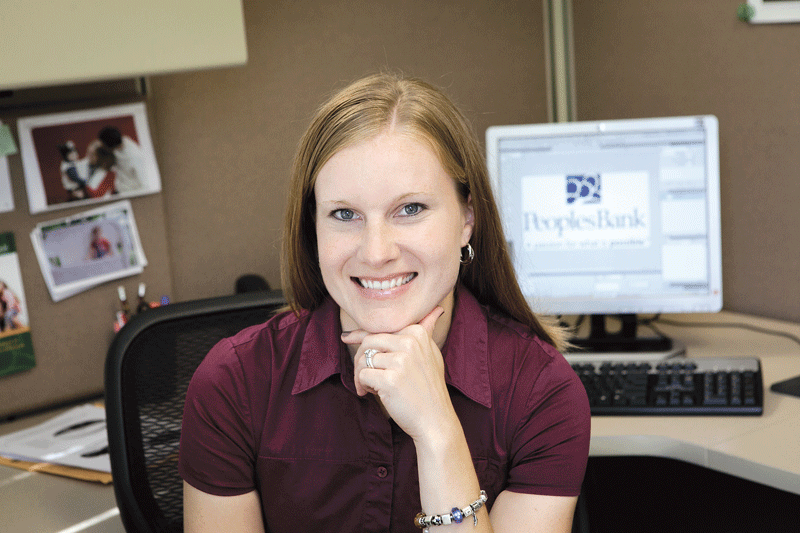
Karen Buell says younger customers are particularly open to mobile banking.

Karen Buell says younger customers are particularly open to mobile banking.

Considering that banking a generation ago always involved visiting a branch — or at least an ATM — it says something that even logging on to a Web site may be too slow for some customers.
But when PeoplesBank added text banking to its growing stable of online and mobile services, it established a new standard for speed.
“It’s pretty quick and efficient,” said Karen Buell, the institution’s Internet branch manager. “You don’t have to call or anything like that, and it’s faster than a browser; if you want a quick balance check, you don’t have to log on.”
To use the option, customers can text a short code — just a few characters — to the bank to access balances, transaction history, and other information immediately. Its functionality may be limited compared to the bank’s other remote-banking services, but Buell said it’s a logical next step for customers on the go needing quick information.
“PeoplesBank has been a leader in mobile banking since 2008, since we introduced our first mobile app, one of the first in the country,” she told BusinessWest. “A lot has changed since then. We try to continue to innovate as technology changes and advances.”
For example, “we have a mobile banking app that will work for any platform — iPhone, Android, BlackBerry,” she said. “We also have a mobile browser which allows you to have the mobile-banking experience from any phone that has an Internet plan, so you don’t have to download the app.”
To develop these offerings, the bank partnered more than a decade ago with Online Resources Corp. (ORCC), which provides Web- and phone-based financial services, electronic payments, and marketing services to financial institutions. “PeoplesBank and Online Resources have been working together for more than 12 years. We started with online banking, then merged into mobile solutions,” said Lori Mark, ORCC’s director of Product Management.
The company estimates that the total number of mobile-banking users in the U.S. will grow from 25 million in 2011 to 42 million by the end of 2013 — a surge driven by the continuing uptick in smartphone adoption, a wider range of modes (mobile apps, text banking, etc.) appealing to a wider range of customers, and ever-improving usability. In addition, according to the Forrester Research Mobile Banking Forecast 2012-2017, 47% of all adults online in the U.S. will be using mobile banking by 2017.
The shift is evident locally, Buell noted. “We continue to see great increases. Browser sessions are going up about 5% month over month; people are logging in to check their balances, transfer money, and pay bills. Personally, I like it; when a bill comes, I pay online, and I’m good to go.
“We’re seeing huge increases in mobile visits to our Web site,” she added. “In the second quarter of this year, mobile devices were 14% of our total Web site volume. We know that there’s demand for it, and people are using it.”

Addressing Concerns
Buell said she recently attended a conference in San Francisco on mobile banking and e-commerce. There, the American Bankers Assoc. presented poll results showing that increasing numbers of people plan to adopt mobile banking if they haven’t done so already; the biggest percentage increase is in the 18-34 age group, followed by the 35-49 crowd.
“We know that Generation Y and Generation X are searching for this technology, and they want to do things on the go,” she told BusinessWest. “That’s being confirmed nationally.”
Some potential users might be put off at first by wireless transactions, worried about the security of their data, but Mark said those anxieties are baseless.
“Financial institutions, just because of how highly regulated they are, tend to be very security-conscious, and so are we,” she said. “We have the same parameters, and we take a lot of time educating our client base about security from hackers. We do what we can to allay those fears.”
Breaking down that trust barrier is key, Buell added.
“When they trust it, they embrace it,” she said. “Out of all our online customers, 25% to 30% are using mobile banking. I think, if you’re already comfortable doing something online or electronically, mobile banking becomes just another way to do transactions electronically.”
She conceded that many customers, particularly of the older generations, prefer to bank only in physical branches, “but if you’ve already embraced the technology, mobile is just another step. There don’t seem to be any barriers.”
Mark said the numbers of users across all platforms — browser, app, and text — continue to grow. “On our side, the smartphone usage is where we’ve seen the growth,” she noted. “Today, 6% of all Internet banking activity comes from mobile devices, and it’s increasing on a daily basis, with the vast majority of that usage coming from iPhones and Androids.”
Buell said PeoplesBank, where the mobile-user percentage is even higher, markets its high-tech banking options through its Web site — a logical place to attract customers who are already comfortable online, many of whom are happy not using brick-and-mortar branches at all.
“We’ve also done a lot of online advertising, Facebook and Twitter posts — and we had a billboard recently, just trying to spread the word that, if you’re looking for technology, PeoplesBank has it.”
The numbers back up the demand, as total mobile visits at PeoplesBank in the second quarter of 2012 were up 178% over the same period last year.
“We know customers are using smartphones, which are changing their lives in meaningful ways,” Buell told BusinessWest. “Our commitment is to answer that desire for convenience.”

Joseph Bednar can be reached at [email protected]

Sections Workforce Development
One-stop Career Centers Rely on Partnerships to Fulfill Their Missions

Executive director Rexene Picard

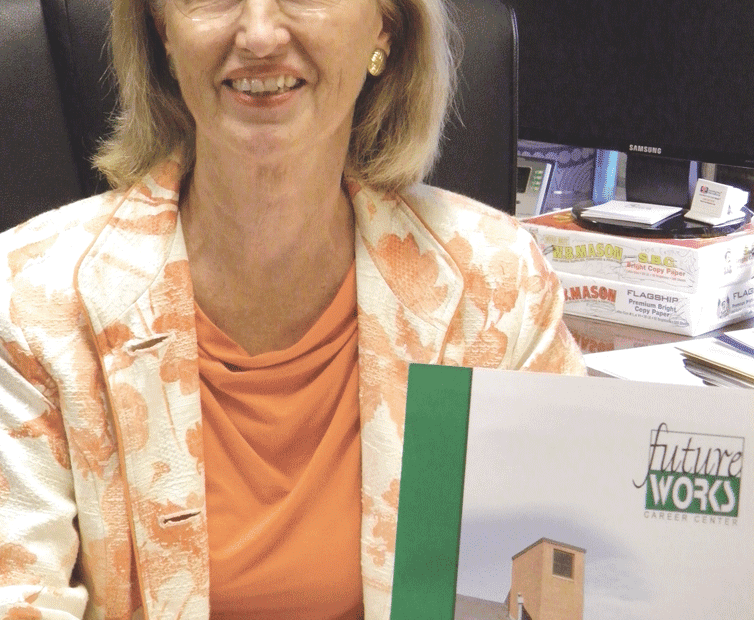
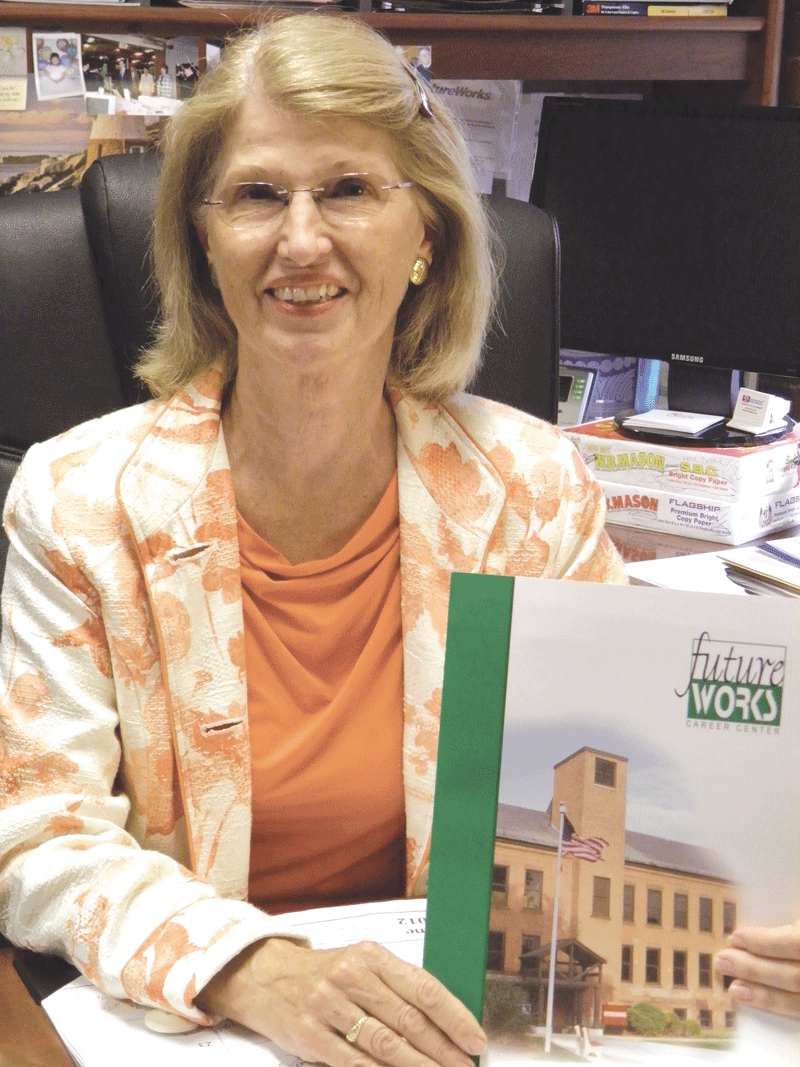
Executive director Rexene Picard says FutureWorks has made changes in the way the agency serves customers due to shifts in the economy and advances in technology.

When one-stop career centers began opening across the state 16 years ago, David Gadaire said, the mantra connected to them was “no wrong door.”
“The concept was one of universal access,” said the executive director of CareerPoint in Holyoke. “If someone needed to brush up on their skills, get help with writing a résumé, learn to network, or get more training, they could find it under one roof, whether they were a school-age person or an older worker.”
The concept was forward-thinking, but the funding was never in line with the complexity of need that job seekers brought to the table. Still, the problem wasn’t nearly as evident in the early years when the economy was flush.
“For the first few years we were open, 50% of the people we saw were employed,” said FutureWorks Executive Director Rexene Picard, explaining that many came to the center to brush up on skills or take a Saturday class.
Gadaire agreed. “In the beginning, we had enough resources. It was a different game then, and the funding we had supported people who needed to harness their skills,” he said.
FutureWorks and CareerPoint achieved national recognition in 1998 when they were selected as Career Centers of the Year by the National Alliance of Business.
“It was a tremendous honor, but the funding kept dissipating as the numbers grew,” Gadaire said. “We were originally chartered to serve 7,000 people a year, and last year we served between 14,000 and 18,000. The numbers have gone up steadily, and although they have plateaued in the last few years, it is only because our capacity is so overstretched.”
The unemployment office has a representative at both centers, and many people confuse the entities. But the former is run by the state, while the one-stops were established through competitive charters.
CareerPoint was chartered as a nonprofit and opened 16 years ago via a partnership that included the Greater Holyoke Chamber of Commerce, Holyoke Community College, the Department of Transitional Assistance, and the UMass Donahue Institute. “They joined together because there was a disconnect between the jobs that were available and the skills of the people available to fill them,” Gadaire said.
The story of FutureWorks is quite different. It was opened in 1996 as the first one-stop in the state by the Employment Training Institute in Ringwood, N.J., owned by Ken Ryan. Granting a charter to a private, for-profit corporation was controversial, but “it gave us a chance to think outside the box,” Picard said. “In the beginning, we said that what we did was not going to be about numbers, it was going to be about customer service. We had welcome centers and made people lifetime members. We could have fallen under the realm of social services, but we felt we were role models for job seekers and wanted to reinforce soft skills, so the center had the atmosphere of a business,” she told BusinessWest.
Although their evolution has been different, it soon became apparent that the needs of the people who came through the doors of both centers were complex, and the funding to help them was far from adequate. “In 1998 when the Workforce Investment Act was passed, the intent was that community partners would support the one-stops. But it never happened,” Picard said.
Still, they have found a way to meet a myriad of complex challenges. “We don’t tell our story well, and it’s a very impressive story,” said Gadaire. “But if 10,000 more people came to our door, I don’t know what we would do.”

Complex Situation
After CareerPoint received its award, it became even more committed to its mission, said Gadaire.
“Universal access meant we had to serve the older worker, the school-age person, professionals, and mid-level executives who found themselves out of work and needed to grow their skills, as well as people with a disability, those who had been incarcerated, homeless people, and individuals who didn’t have an education or didn’t speak English,” he explained. “All of those things required a more significant amount of time than the one-stops were prepared to address. But we realized that we were part of the answer for every one of those populations.”
Since the state did not have money to serve these subgroups, CareerPoint began writing grant proposals, seeking help from corporations and forming alliances with a wide variety of venues, such as the Hampden County Sheriff’s Office.
Today, it operates via seven or eight funding streams and grants that are continually changing. “We have a youth center due to six or seven grants, but we had to carve out a funding strategy,” Gadaire noted.
Finding sources of revenue is a constant struggle because the number of organizations looking to them for help continues to rise. “We’ve tried to create a marketing budget, but it keeps dwindling away. If the choice is marketing or helping a homeless person, the answer is obvious,” he said.
Although the agency initially provided free in-house training for businesses, it began to charge for those services. “We conduct sessions for businesses to help them manage their workforce. We’re giving a series of workshops right now to teach mid- to upper-level managers leadership skills — how to resolve problems, make their workers more productive, and avoid turnover,” Gadaire explained, adding that his organization is also set to launch a videoconference-training program to teach businesses how to conduct remote, face-to-face interviews, which he says will save them time and money.
Since the way people find jobs has changed, CareerPoint has two computer labs where people can become versed in new software and learn how to apply for jobs online. It also stages classes in networking, résumé writing, and a host of other topics related to finding employment.
When the one-stop center opened, it had 36 staff members, but that number has been reduced to around 30. However, it has compensated by forming alliances with many agencies and organizations. It has nine people from different agencies stationed within its office, and makes use of interns.
CareerPoint has also benefitted from countless hours of volunteer help from the Americorps Volunteers in Service to America program. VISTA volunteers have worked with youths involved with gangs as well as seniors, and include one volunteer who is the center’s information-technology manager. “We’ve also tried to build bridges with Westover Job Corps and agencies that offer veterans’ services,” Gadaire explained.
The agency’s staff members are so dedicated that, when they were told recently that two positions had to be eliminated, they offered to save them by taking a 10% pay cut for six months. Gadaire was against the idea, but finally agreed that everyone (including himself) would do it, and much to his surprise, it worked.
“These people are extraordinary; they believe in the community and want to make a difference,” he said. “But they are always exhausted, and I forever worry about burnout.”
Many sit on local nonprofit boards where they build partnerships. “Our partnerships are absolutely critical,” he said. “We are not experts in everything, but hopefully, if we do it right, we can expand our capacity. The community is better-served by our willingness to partner on just about every issue.”

Radical Changes
When FutureWorks opened, it was the only one-stop center in the state operated by a private company. Although profits were capped, Picard said many grassroots organizations and labor groups were upset that a private firm was operating with funds from the state and federal government.
So, in January 2002, after a series of meetings with then Springfield Mayor Michael Albano and Bill Ward, director of the Regional Employment Board of Hampden County, the owner agreed to turn over FutureWorks, with the caveat that it become a nonprofit agency. “The decision meant a lot in terms of restructuring,” Picard said, noting that the corporate headquarters of the Employment Training Institute handled the agency’s finances and human-resource issues.
“It was like starting a new company,” she said. “But having our own board of directors turned out to be one of the best things that happened; we had a very business- oriented team, and the community began viewing us differently.”
The change in status also allowed FutureWorks to pursue grants and funding unavailable to it as a private company. “We also began partnering with staff from other agencies,” Picard said.
One of its most profitable ventures was a shared contract that allowed the agency to work with welfare recipients in Hampden County. “We put more welfare recipients to work than in any other part of the state,” she said.
But despite such gains, the customer base continues to mushroom. “When we started, we saw between 3,000 and 5,000 people a year; last year, we served more than 16,000 individuals,” she noted, adding that FutureWorks consistently leads the state and serves more minorities, youths, and individuals with disabilities than any of the other career centers. “But in order to do so, we have had to look outward to other opportunities.”
These include a unique partnership with the Department of Revenue. The joint effort allows FutureWorks to work with non-custodial parents to help them get jobs so they can pay child support.
The program began as a pilot and expanded to include the family court system. In time, FutureWorks received a performance-based contract to extend the initiative. “It’s been a great program, and we have been told there is only one other place in the nation doing this. It’s in Tennessee, but we are unsure if we will be able to continue it,” Picard said, adding that they have not heard if their latest grant proposal will be extended.
Since Springfield is four times the size of Holyoke in terms of population, FutureWorks receives more funding than CareerPoint. But agency partners are equally critical to its ability to serve people and their on-site representatives. Those partners include Westover Job Corps, the Mass. Rehabilitation Commission, the Department of Education, the Resource Partnership, Hampden County Jail, the Mass. Commission for the Blind, the Commonwealth Corp., and state agencies such as the Department of Social Services and the Division of Employment and Training.
As the labor market has undergone change, FutureWorks has focused on health care and precision manufacturing, since those industries continue to experience growth.
The agency takes advantage of every opportunity, and was the second one-stop in the state to receive a national emergency grant related to a weather disaster. Picard said the Regional Employment Board received $3 million after the tornado on June 1, 2011 that allowed FutureWorks to hire people to do humanitarian work as well as clean-up, which in some instances led to full-time employment.
“We hired four staff people to administer the grant money; two focused on Springfield, and the other two focused on Monson and Brimfield,” Picard explained, adding that the agency has also deepened its link with Springfield Technical Community College.
“There is work taking place on both sides of the fence,” she said, adding that the agency has an STCC staff member on site.

Changing Tide
Gadaire said the one-stop career centers are opportunistic.
“Sometimes a program starts because we can easily fill a need, and sometimes the need has been there, and we finally find a way to fill it. But we don’t ever give up trying,” he said.
Picard agreed. “The one-stops have achieved a 50% rate of employment for the people they serve,” she said. “We’re here to give people hope.”

Company Notebook Departments

Normandeau Communications Changes Name to Normandeau Technologies
WEST SPRINGFIELD — In a strategic move designed to better convey the company’s full range of products and services, Normandeau Communications recently changed its name to Normandeau Technologies Inc. “It is our goal to have our name reflect more than just communications, but the entire breadth of solutions provided — telephone systems, structured cabling, networking, carrier and Internet services, mobility solutions, surveillance, call accounting, overhead paging, and messaging on hold,” said Kim Durand, director of sales for the company. “Our dedication toward building relationships with our customers and technical expertise has led us to become valued partners in decision-making processes for all their technology needs.” As part of its efforts to educate business owners and managers on the latest technology and how to take full advantage of it, Normandeau will offer ‘Lunch & Learn’ meetings at its new technology and training facility, located at the company’s office at 2097 Riverdale St., West Springfield. “We look forward to serving our community and providing educational opportunities to learn more about how new technology can benefit our customers,” said Durand.

Ludlow Mills Awarded $200,0050 EPA Cleanup Grant
LUDLOW — The U.S. Department of Environmental Protection has awarded WestMass Area Development Corp., owner and developer of the Ludlow Mills project, a $200,000 brownfields cleanup grant, another sign of progress in the continuing redevelopment of the 1.4 million-square-foot redevelopment project. The grant was part of a competitive process, and Ludlow Mills is one of 18 projects in Massachusetts to receive EPA Region One grants in this round. Westmass will use the funding to immediately begin removing asbestos from old mill buildings on the site. Westmass President Kenn Delude said the funds will augment state funding from the Office of Energy and Environmental Affairs for environmental remediation work that did not cover the removal of asbestos. “This is another significant step forward in the redevelopment of the largest brownfield mill-redevelopment project in New England,” said Delude. Westmass recently announced two projects for the site — a $27 million initiative launched by HealthSouth to build a new rehabilitation hospital, and a $22 million, 83-unit senior independent-housing project.

WEEI Radio Awarded UMass Athletic Broadcast Rights
SPRINGFIELD — Sports Radio 105.5 WEEI-FM recently announced an exclusive partnership with UMass that makes it the official home of UMass football and basketball. The five-year agreement kicks off with the 2012 football season, which begins on Aug. 30 at the University of Connecticut. In addition to comprehensive game coverage, WEEI Springfield will host the UMass coaches shows, featuring The Charlie Molnar Show and The Derrick Kellogg Show. The agreement was brokered by Nelligan Sports marketing, the multi-media rights holder for UMass Athletics.

Columbia Gas Donates Blankets to Friends of the Homeless
SPRINGFIELD — Employees of Columbia Gas of Massachusetts visited the Friends of the Homeless shelter on Worthington Street in Springfield recently to donate 150 heavy-duty blankets to the shelter. Columbia Gas employees have adopted Friends of the Homeless as one of the local charitable organizations they will be supporting in 2012, said Andrea Luppi, manager of Communications and Community Relations. “In addition to the donation of blankets, once a month, a group of employees from all departments has volunteered to serve lunch at the shelter and spend some time getting to know the people there,” she said. “It gives everyone a good feeling to be able to do something for a group that needs and deserves some help.” Last year, Columbia Gas signed on as one of the primary sponsors of “Journey in My Shoes,” which was the first fund-raising event for Friends of the Homeless.

Departments People on the Move

Wolf & Company, P.C. recently announced the promotion of Mark O’Connell, CPA, to the position of President and CEO of the firm, effective July 1. O’Connell has been a member of the 100-year-old company since 1997, and spearheaded the development of its Springfield office, which he most recently served as dirctor. O’Connell will continue to work out of the Springfield office. He is a member of Wolf & Company’s financial-institutions group, and formerly held a seat on the firm’s executive committee, which establishes the firm’s policies and strategic direction.
•••••

Thomas R. Creed

Thomas R. Creed

TD Bank has named Thomas R. Creed Senior Vice President and Market Commercial Credit Manager in the new Credit Management Division in Springfield. Creed will direct approval, underwriting, and portfolio-management, staff, and procedures supporting TD Bank’s commercial-banking business in Western Mass. Creed has 27 years in banking and related fields and serves as chairman of the Holyoke Redevelopment Authority and on the board of the Economic Development Council of Western Mass.
•••••
United Bank announced the following:
• Amy Bilodeau has been promoted to the position of Personal Banking Officer at the West Springfield branch. She joined United Bank in 2008 with nearly 25 years of banking experience gained at the former Westbank, now New Alliance Bank, in West Springfield; and
Ronald A. Gannett

Ronald A. Gannett

• Ronald A. Gannett has joined the bank’s Beverly loan production office as a Senior Vice President in Commercial Baking, focusing on commercial real-estate opportunities in the Greater Boston area. He will assist in building the bank’s brand and commercial real-estate business in that area, while complementing the current activity in the Greater Worcester and Springfield areas.
•••••
American International College announced the following:
Linda Dagradi

Linda Dagradi

• Linda Dagradi, a 1971 AIC graduate, has been promoted to Vice President for Enrollment Management. Dagradi has most recently incorporated Admissions, Marketing, and Financial Aid into the umbrella of Enrollment Management to aid AIC in growing its student population both at the undergraduate and graduate levels; and
Nicolle Cestero

Nicolle Cestero

• Nicolle Cestero has been promoted to Vice President for Human Resources. In that position, she will supervise and direct the human-resources activities of the college.
•••••
Business Network International (BNI) Western Mass. recently appointed Jason Turcotte as Managing Director for the region. Turcotte will be responsible for overseeing and providing continued structure, training, and support to the chapters and members of BNI Western Mass. He will ensure that every chapter is following the BNI system and is on pace to achieve goals, as well as supporting the leadership teams within the region.
•••••
Elizabeth B. Rairigh

Elizabeth B. Rairigh

Elizabeth B. Rairigh, AICP, recently joined the Pioneer Valley Planning Commission as a Historic Preservation Planner. She holds a master’s degree in Historic Preservation and a master’s in City Planning from the University of Pennsylvania.
•••••
Thomas A. Miranda, an attorney with Springfield-based firm Cooley, Shrair, P.C., recently presented the seminar “Using Mediation to Settle Property Disputes” at the 2012 spring session of the CPE Forum at Holyoke Community College Kittredge Center. The forum provides educational programs to business professionals, including CPAs and CMAs. Miranda also recently presented a session on “Business Entity Organization and Structure to Limit Liability” at a Hampshire County Bar Assoc.-sponsored small-business-entity seminar.
•••••
Richard J. Kos

Richard J. Kos

The Board of Directors of Hampden Bancorp Inc., which is the holding company for Hampden Bank has named Richard J. Kos, Esq. to Chairman of the Board of the company and the bank, effective immediately. Kos has been an attorney at the firm of Egan, Flanagan & Cohen, P.C. since 2004 and is a partner of the firm. Prior to that, he had been in private practice since 1978, and was mayor of Chicopee from 1997 to 2004. Kos has a bachelor of science degree in Economics from Amherst College, and a law degree from Suffolk University Law School. He currently serves as a trustee of Our Lady of the Elms College, chairman of the Chicopee Chamber of Commerce, a member of the Board of Incorporators of the Mason Wright Foundation of Springfield, and a member of the Board of Directors of the Regional Employment Board of Hampden County. He has held prior directorships with the Pioneer Valley Red Cross, the Polish National Credit Union, Providence Place, the Economic Development Council of Western Mass., and the Westover Metropolitan Development Corporation. He had been
an incorporator of Chicopee Savings Bank.
•••••
The YMCA of Greater Springfield announced that four area leaders from the business and non-profit communities recently joined its Corporate Board of Directors. They are:
John Doleva

John Doleva

• John Doleva, President of the Naismith Memorial Basketball Hall of Fame;
Lorenzo Gaines

Lorenzo Gaines

• Lorenzo Gaines; Program Director for ACCESS Springfield;
Paul DiGrigoli

Paul DiGrigoli

• Paul DiGrigoli, Owner/CEO of DiGrigoli Salon and DiGrigoli School of Cosmetology; and
Jeffrey Poindexter

Jeffrey Poindexter

• Jeffrey Poindexter, an attorney with Bulkely, Richardson and Gelinas, LLP.
•••••
Friendly Ice Cream in Wilbraham recently announced the following appointments and promotions:
• Walter Kwiecien has been promoted to Director of Information Technology;
• Lionel Bisson is now Director of Training and Quality Assurance and will direct all training and development function and the quality assurance inspection process;
• Ana Alves, with the company since 1977, has been named Manager of Restaurant Technology and will be responsible for managing and developing point-of-sale systems;
• Valerie Doggett has been named Audit Service and Quality Service Assurance Manager, where she will be responsible for conducting quality service audits in both company as well as franchise-owned restaurants;
• Joseph Stiefel, a member of the IT Department since 2006, has been named Project Manager, and will be responsible for leading program development projects as well as supporting current systems from a programming and database perspective;
• Melany Howe has been appointed Senior Manager for financial planning and analysis, providing financial support and analysis for restaurant operations and all marketing and promotion activities;
• Matt Vitorino has been named Senior Financial Analyst, and will provide financial support and analysis for retail, co-pack and franchise operations;
• Christine Klingaman has been named the Franchise Business Consultant supporting several of Friendly’s franchise organizations as a liaison between the franchises and Friendly’s Support Center;
• Lynne Geiger, a 25-year employee, was named Point-of-Sale Systems Administrator, where she will be responsible for developing and maintaining Friendly’s POS systems as well as maintaining various software platforms;
• Richard Del Valle has been appointed Vice President of Restaurant Operations Support, where he is responsible for all restaurant operations support and quality assurance and training.

Manufacturing Sections
Instrument Technology Inc. Has an Eye on the Future

ITI

ITI has found a number of military and law-enforcement uses for its scopes.

Walk inside the Westfield headquarters of Instrument Technology Inc., and the first thing you’ll notice is the totem pole. It’s kind of hard to miss, rising dramatically up two levels of the front atrium.

In fact, an abundance of Native American art graces many of the walls and offices of the facility. ITI President Greg Carignan says there’s a good reason for this, and it has to do with a hobby his father, Donald, stumbled upon by accident decades ago, shortly after founding the company.

“He was on the road, in very remote areas of the United States, calling on nuclear power plants that were usually out in the boonies,” Carignan said. “Usually, there was nothing around except Indian reservations. So, when he had time on his hands, he’d visit these reservations and meet artists, and he started growing an interest in Indian art. He started collecting it, and when his house overflowed, it started coming here. It’s quite a collection.”

Why nuclear power plants? When he launched ITI in 1967 as a manufacturer of optics equipment, the elder Carignan got heavily involved in the nuclear-energy market; “he started building underwater periscopes and wall periscopes to look at the spent fuel rods being stored underwater.”

Greg Carignan explained that, after a period of time, a nuclear fuel rod’s energy is spent, but it’s still radioactive, which has led to debate over the years about establishing a national repository for those spent rods in the Southwest, but bureaucracy and public opposition have made that all but impossible.

“So nuclear plants are required to store spent rods at their facility, mostly underwater, and they’re required to be inspected periodically,” he said. “Dad developed a large-diameter periscope that could go down underwater and look at those spent fuel rods and make sure they’re in good condition. He built quite a few of those scopes in the late ’60s and early ’70s.”

Greg Carignan

Greg Carignan says the company’s diversity has allowed it to thrive during societal changes, such as a shift away from nuclear power plants.

Today, Carignan, who, along with two siblings, took over the company from their father in 1990, oversees a 47-employee workforce designing and building cutting-edge optical equipment for a wide range of purposes, from peering around corners in war zones to helping doctors navigate inside the human body.

For this issue’s focus on manufacturing, BusinessWest pays a visit to Instrument Technology, which has been scoping out new opportunities in an intriguing field for the last 45 years — and shows no signs of slowing down the pace of innovation.


Solo Act

Donald Carignan, his son recalled, had a background in optics and worked as a project engineer for American Optical from 1960 to 1966. He then took a job with Kollmorgen Electro-Optical; “that’s where he got his experience building borescopes and periscopes.” Just a year later, he was ready to strike out on his own, launching ITI in Southampton.

“My dad was a pretty driven individual; he worked hard to make it a success,” Greg Carignan said, noting that the company was a bit gypsy-like during its first two decades, moving from Southampton to West Springfield, then to Westfield, and finally to the current facility on the other side of the city in 1985.

“We specialize in the design and manufacturing of remote-viewing instruments,” he explained, noting that the company employs designers and engineers, as well as a full machine shop and assemply department to build the products it designs.

“What is remote viewing? It’s the ability to view a photograph or video-record any area that’s inaccessible or hostile, as well as the ability to view covertly,” he explained. “We added that last portion over the past 20 years because, before that, it hadn’t been used for covert operations.”

But he backed up a bit to describe how ITI has branched into so many diverse fields.

It began with the nuclear-power plants, for which the company developed not only those underwater-viewing scopes, but wall periscopes that allowed workers to see past thick concrete walls into the ‘hot cells’ where radioactive materials were handled. But societal changes that impacted the nuclear-power industry would force ITI to shift its focus — and not for the last time.

“During the Carter years of the late 1970s,” Carignan said, “the nation saw a drastic decline in the number of nuclear facilities being built. And most facilities had our equipment in them. My dad was in need of business, so he looked elsewhere to try to continue moving ITI forward.

“He looked at the industrial market and saw that it was being served by medical endoscopes at the time, and nobody was building industrial borescopes,” he said, noting that the two words are essentially interchangeable, with ‘endoscope’ typically referring to a medical instrument and ‘borescope’ a non-medical one.

“Endoscopes for the human body came on the scene about 40 years ago, but it wasn’t until later on that people figured out they could use the same scopes to look into jet engines, castings, pipes, and other things in industry,” Carignan said. “My dad started working for companies like Pratt & Whitney and General Electric to build delicate industrial borescopes to inspect their engines. They called it the ‘jetscope.’”

Many years ago, he explained, the airline industry had to take apart engines to conduct inspections required by the Federal Aviation Administration — a very costly, time-consuming process. But the development of a flexible borescope that could be inserted into each end of the engine was a revolutionary and cost-saving change.

“Designers started designing points along the engine so they could look in the middle, too,” he said. “You take out a plug and stick in the scope to look at the different sections of the engine.”

During the ’80s and ’90s, the industrial market grew for ITI, and the scopes became more complex, with flexible shafts and articulated tips allowing for more flexible movement.


A Time to Kill, a Time to Heal

Dawn Carignan Thomas

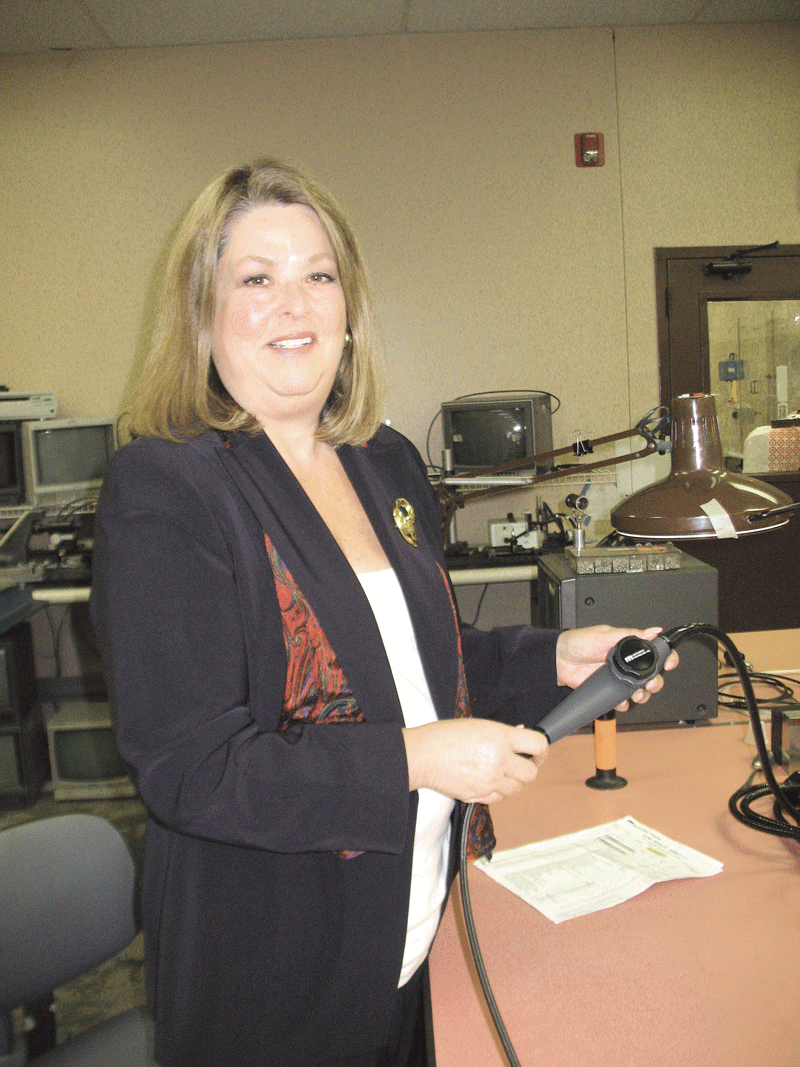
Dawn Carignan Thomas holds one of ITI’s scopes used for medical applications.

Throughout this expansion, ITI hadn’t done anything in the medical market. “But that changed in the 1990s when a company on the West Coast — Accuscan in Mountain View, Calif. — knocked on our door and asked us to make what they called a gastroscope for them,” Carignan said.

“They didn’t want to see through it; they didn’t want fibers in it or optics of any kind,” he continued. “They were going to put a transducer in the tip and use it as an ultrasonic device for an esophageal probe down the throat to scope the heart, which is much easier than to try to do it externally and look through the rib cage and all the muscle and fatty tissue.

“We worked with them for a year and a half, and that’s when we started in the medical business,” he continued — a shift that has seen the company produce rigid arthroscopes, ureteroscopes, otoscopes, spine scopes, and laparoscopes; flexible gastroscopes, bronchoscopes, and colonoscopes; as well as equipment for video intubation.

“After 20 years, we’ve become a lot more selective about who we decide to work with,” Carignan said regarding the ideas potential customers pitch to ITI. “If it sounds like a very high risk, or a low chance of successfully bringing it to market, we may not get involved. If it’s a startup company or doctor/inventor that’s asking us to do it on our dime and pay for the development costs, oftentimes we’ll say no.

“The model we’ve come to develop,” he continued, “is companies that have some success already and are willing to share the developent costs of the product.”

Eventually, ITI expanded its offerings even further by getting involved in the law-enforcement and military markets, with products such as telescopic cameras that can see around corners and in darkness, under-door scopes, and scopes that see into rooms using tiny (as small as 2.6 mm) holes in the wall.

“We also needed non-conductive probes that could look into a package or parcel to check if there was anything explosive,” Carignan said. “You don’t want to stick in something metallic that could short the device and cause an explosion.”

The original models used infrared light to expose images, and “that was very successful — then the bad guys figured it out,” Carignan said. “So we were asked to find out new ways of seeing. So we developed a blue-light diode, with different characteristics that wouldn’t trigger detection devices. We always want to stay one step ahead of the bad guys.”

ITI also built a pole camera to look into second stories of buildings, down stairwells, into ceiling tiles, and even underwater. “This was a scope we sold quite a bit of to special-ops groups in Iraq, to clear buildings, streets, and neighborhoods, to look around corners and into rooms where the bad guys might be before clearing out a room. They were eventually used in caves to hunt down Al Qaeda in Afghanistan.”

The wars and Iraq and Afghanistan saw a surge in the production of such devices. Carignan showed BusinessWest a chart breaking down sales from 1999 through 2008, and while medical devices tend to make up the biggest percentage of the company’s sales in a typical year, the law-enforcement and military division took that spot from 2003 through 2006. Meanwhile, sales of industrial scopes have fallen off somewhat over the years, but are rebounding.


Next Generation

The three siblings — Greg, Controller and Purchasing Manager Dawn Carignan Thomas, and Manufacturing Manager Jeff Carignan — admit their devices don’t allow a clear view into the company’s future. With six kids among them, third-generation ownership is always possible.

“We’re wondering where the next generation might take us,” Greg Carignan said, “but it’s still early for that.”

For now, they continue to grow and innovate, scoping out new ideas to help people — manufacturers, surgeons, and soldiers alike — see a lot more clearly.


Joseph Bednar can be reached at  [email protected]

Sections Women in Businesss
Having a Baby Can — and Often Does — Alter a Woman’s Career Path

Sylvia Callam

Sylvia Callam says she has no regrets about the time she took off from work to spend with her children.


Sylvia Callam had invested an enormous amount of time and energy into her career, so she said she “thought long and hard” about making the decision to have a child.

“I had worked on Wall Street for eight years,” said the Yale graduate and director of research at Gage Wiley Inc., a brokerage-dealer firm. She planned to take two months of maternity leave, then return to work full-time. And although she doesn’t consider herself overly emotional, Callam felt very conflicted when that time approached.

“When you have a baby, your heart changes,” she said. “I had always been the first one to get to work and the last one to leave. But I was definitely surprised and taken aback by how much I wanted to be with my son.”

So she made the decision to put her family first. “For a few years, my career took a backseat. The motherly love I felt was overwhelming, and I needed some time to make sure that going to work was worth it,” said the Hatfield resident, adding that she only worked two days a week.

When her son, Nathan, turned 3, Callam gave birth to her daughter, Alyssa, who was born with myriad medical issues. Thankfully, her boss was understanding, and although she had returned to work full-time, he allowed her to take six months off.

Today, her children are 7 and 4, and despite working part-time for a period of time, she has made remarkable advances in her career. “I was very fortunate that my boss was willing to be patient,” she said.

Still, Callam believes becoming a mother improved her performance. “It is a real success story even though I have always put my children first; I’m more decisive, more confident, and more resilient than I used to be. I had to learn to do the same amount of work in four hours that used to take me eight, and my boss finds my attitude refreshing,” she said. “I am a much better mom because I work and a much better employee because I am a mother. But it’s all a question of whether a woman has a flexible employer.”

Experts agree.

Iris Newalu, director of Executive Education for Women at Smith College, says women can have both high-power careers and children. “But it’s not easy,” she told BusinessWest, adding that many are able to do so only because of flex time or companies that allow them to work from home. “There is no one formula, and everyone has to figure it out for themselves and decide where to set boundaries.”

Fern Selesnick says there was a myth generated years ago that women could have a family and a job and do it all perfectly.

“The standards are unrealistic, but the myth still exists. And even though employers say they support working mothers, it really is not across the board,” said Selesnick, who works as a professional career coach and trainer at Fern Selesnick Consulting.

As a result, having a child or growing one’s family can pose real challenges for working women intent on climbing the career ladder. Although it can be done, the rate of ascension for those who take a significant amount of time off from their jobs depends on a variety of factors.

“There are competing priorities once a woman becomes a mother,” Selesnick said, adding that concerns change while a woman is pregnant, once she has a baby, and when she decides to return to work. “There is an identity shift. Most women realize after the fact that they can’t give 100% to motherhood and 100% to their job. It requires making adjustments, so they need to figure out how they can do both well and take care of themselves without burning out.”

Experts say women should talk to their supervisors about how a leave of absence will affect their job standing before they become pregnant. “Women need to look at a mixture of practical and emotional issues,” Selesnick said, advising them to begin by reading their employee manual to find out how much maternity leave their company allows.

And when a woman does leave, she should tell her manager, “I hope the door will be open for me to come back,” Newalu said.


Pregnant Pause

Fern Selesnick

Once a woman has a baby, Fern Selesnick says, she realizes she cannot give 100% to her career and 100% to her role as a mother.

Most women need to work for economic reasons. However, statistics show that it can be financially lucrative to delay motherhood until one has achieved a modicum of success.

A study conducted by Amalia Miller, an associate professor of Economics at the University of Virginia, shows that each year a woman delays having her first child while she is in her 20s and early 30s results in an earnings gain of 9%. This is significant, since other studies show earnings often plateau once a woman becomes a mother.

This results partly from an inability to continue advanced schooling due to the limited number of hours a woman can work due to child-care issues or her desire to be home with her family. Issues mothers discuss with Selesnick include time management, self-esteem, a realistic identity, and career changes or adaptations that must be made, since research confirms that women are still the primary caretakers in families.

Selesnick said the decisions a woman makes and her ability to advance within her company often come down to her supervisor. She cites the cases of clients who were allowed tremendous flexibility. “But some supervisors expect everything to be the same in terms of performance and availability,” she told BusinessWest.

Newalu says women must learn how to negotiate to achieve what they need to be successful as a mother and employee. “Flexibility is key. Once you have a child, you can’t control things; children get sick, have performances at school, and have accidents that require a parent to leave work,” she said.

Attorney Kathy Bernardo was working for the law offices of Bulkley, Richardson and Gelinas in Springfield when she had her first child. And although she continued at the firm, a few years later when she found out she was expecting twins, she made the decision to work part-time.

“I made a conscious decision to get myself off the partnership track — I thought it would be more than I could handle,” she explained. “I knew I couldn’t commit 100% to my firm and my family, and I wanted to be fair to everyone as well as myself.”

When she returned full-time, it took her a year before she re-established her standing within the practice. “It wasn’t easy because I had to prove to them and to myself that I could handle it, and wanted them to have wonderful data to assess,” she said.

Bernardo achieved her goal of becoming a partner, but it took her 10 years instead of seven. “But I got where I wanted to be without sacrificing my family and was actually able to enjoy my children and be there for them in those important early years; babies demand most of your time,” she said.

Today, her children are teenagers, and she has no regrets about her decisions.

“Sometimes people feel that, if they don’t proceed as planned, they will lose their opportunity,” she said. “But I was fortunate to be somewhere where I could have that dialogue with my employer.”

Experts agree that a woman should have a frank discussion with her supervisor, manager, or someone in the company’s human-resources department before she leaves her job. They advise women to maintain relationships at work while on extended maternity leave, which has personal and professional benefits.

“It’s important for a woman’s self-esteem and confidence to feel that she still has a hand in her career and her work identity isn’t gone,” Selesnick said.

Other safeguards can help her to remain marketable. Selesnick recommends working part-time or doing volunteer work in an area that correlates to one’s career so there is not a large gap in a résumé.

Women also have a responsibility to stay current in their fields, Newalu said, adding it is especially important for those who work in information technology or other areas where change occurs rapidly.


Fair Exchange

Tricia Parolo’s career began in 1997, when she became an intern at MassMutual. In 2000, she achieved full-time status and held a variety of positions within the company until 2007, when she left to become a full-time mother.

“My husband and I had planned for it for two years; I took a leap of faith because I had no idea what to expect and what it meant to be a stay-at-home mom,” she said, adding that she had her second daughter shortly afterwards and soon discovered that working in an office seemed easier and less stressful than raising babies.

“I found it was really, really hard being at home,” Parolo said, adding that other people perceived her differently once she lost her professional identity.

She retained the part-time retail job she’d had while she was at MassMutual, but sometimes felt jealous of her husband when he left for work. “I was constantly torn about my decision.”

In 2010, a co-worker who had risen to a management position contacted her and asked if she wanted to work 20 hours a week. Parolo’s former colleague allowed her to work at home from 7 p.m. to midnight, although she did have to go into the office for four hours one day a week.

The following year, when her youngest daughter was 2, Parolo returned full-time and found she had to prove herself all over again. “I worked really, really hard to make up the gap,” she said.

But she has no regrets. “I had the best of both worlds. I was able to stay home with my two little babies and pick up where I left off,” she told BusinessWest.

Newalu says the top companies in the country are willing to invest in a woman’s career and make accommodations if she has a good track record, has been an excellent employee, and has established good relationships. “Talent is very expensive, and companies do not want to keep training new people; they want good employees back.”

However, as Parolo and Bernardo discovered, no one should expect to take up to a year off without consequences.

“It is unrealistic to think that you can slip right back into the position you had — a woman will probably be put where she is needed,” Newalu said. “The situation is the same for anyone who takes time off; you lose seniority, and the people who have stayed on the job have more understanding of the current situation.”

Women who cannot return to their previous position or are unhappy about what they are offered may want to seek employment at another company. However, when they do return to work — whether it is with their previous employer or a new one — they should know what they need and be willing to talk about these needs, even though it may be uncomfortable.

“Research shows that women don’t tend to be good negotiators. It’s a learned skill,” Newalu said, explaining that they can take a course, read books on the subject, or get a coach to teach them how to leverage their talent.

“Early in my own career, I did what I was told, but as I got more experienced, I learned to ask for what I needed,” she said. “You have to be willing to step outside your comfort zone. If you ask for what you need in the right way, you often get it. It can’t hurt to ask, and if you don’t have an open-door situation, you have to define how you will re-enter the workforce.”

Prior to becoming a mother, Selesnick held positions in management where she was required to be available at all times. She took a few years off when she had her daughter, but continued her part-time job as a writer. “It was a cut in income, but it allowed me to be the mother I wanted to be,” she said. “If I had taken a corporate management position, I couldn’t have been a mother in the way I wanted.”

When she did return to full-time work, she chose a much easier position at a nonprofit agency with a set schedule that didn’t include night or weekend hours. “Plus, my boss let me bring my daughter to work if it was necessary. Life was much simpler.”


Back to Business

As children grow, women often find that juggling roles becomes easier. “Women need to know that the demands of motherhood decrease and the time will come when you have complete flexibility again,” Selesnick said.

In fact, taking time off can be simply viewed as a detour on a career path.

“I am so glad that I persevered,” Callam said, “even in the lowest of times.”

Sections Technology
Normandeau Communications Is All About Making Connections

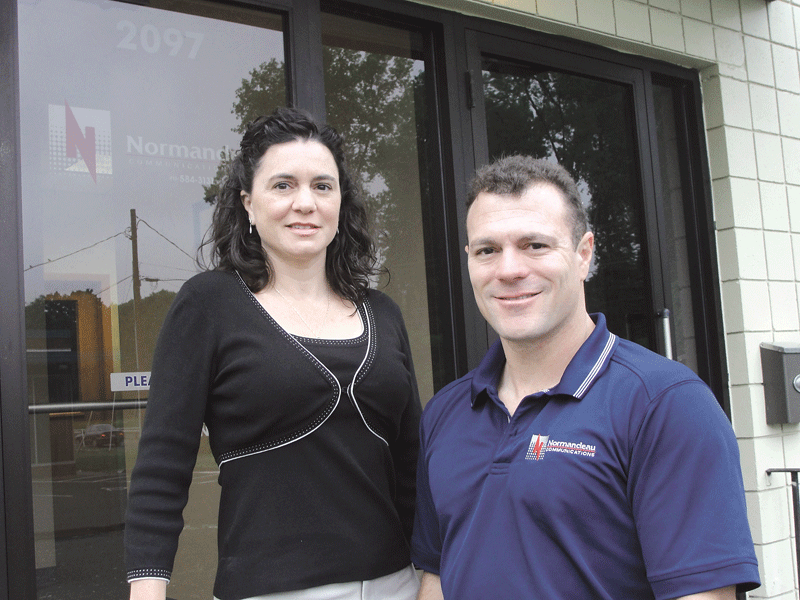
Kim Durand and Brett Normandeau

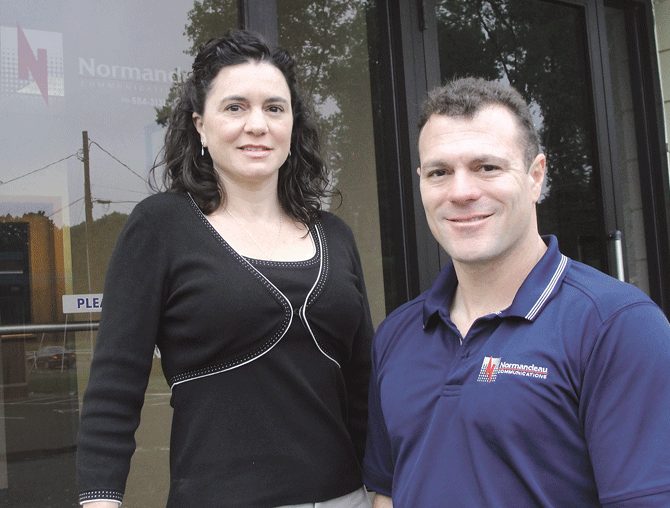
Kim Durand and Brett Normandeau say they strive to match clients with business technologies that, in many cases, they weren’t even aware of.

WestIt wasn’t too long ago that business phone calls had to be made from a desk, and call management meant having a good secretary.
But there’s more than a hint of gee-whiz in Kim Durand’s voice when she describes some of the technology being installed by Normandeau Communications these days. Take the LG-Ericsson iPECS-LIK product, which manages all kinds of communication — phone calls, e-mails, texts, faxes, etc. — across multiple sites, and even on the road.
“The system processes all calls and does the call management for you,” said Durand, director of sales. “Not only can calls be sent to your cell phone, but voice mails left at your office can automatically appear on your smart phone with the .wav file attached, so you can listen to voice mail at any time. Any time people are on the road and not at their desks, like salespeople, it’s really important for them to be able to do the things they need to do.”
Normandeau has been selling, installing, and servicing telephone systems for 22 years, but voice over Internet protocol (VoIP) technology — which uses the Internet to exchange various forms of communication that have traditionally been carried over land lines — has added elements of convenience unheard of in those early days.
The company’s primary product line, Estech Systems Inc., gives business clients the option of a traditional digital business phone system, an Internet protocol telephony system, or a mix of the two.
But Normandeau is also touting a new patnership with LG-Ericsson, whose iPECS-LIK product further streamlines communication within any size business, from small offices to multi-site corporations with thousands of users, allowing calls to be forwarded between sites and even, as Durand mentioned, to mobile phones.
“We’re also providing surveillance systems as well as loudspeaker paging systems,” said Brett Normandeau, the company’s president and Durand’s brother. “All that ties in very well to your telephone system or your whole communication system. With Web access, I can log in and check the surveillance cameras, tie into the phone system, check e-mails” — all from a distance.
These are certainly exciting times in communications, and Normandeau has tried to stay ahead of the curve as it grows its presence in the Valley. Its visibility was boosted two years ago by a move from Florence to Riverdale Street in West Springfield.
“For us it’s been a convenient spot because a lot of our customer base is located in the Hampden County area,” Normandeau said, “and having acess to Interstate 91 and the Mass Pike makes it more convenient.”
In this issue, BusinessWest sits down with Normandeau and Durand to talk about how these siblings — and the company their father began — is making new connections every day.

New Menu
“Communications is not just talking anymore,” Normandeau said at one point. “It’s the integration of many different types of technology that allows you to communicate more effectively — be it Web sharing, desktop collaboration, instant messaging.”
“We’re taking these technologies,” Durand quickly added, “and merging them into single platforms that are able to offer comprehensive solutions for the customer.”
At its heart, Normandeau commiunications has been trading in phone systems since Ray Normandeau launched the enterprise in Florence in 1990, using money from an early-retirement package offered by a streamlining AT&T.
As Ray built his business on word of mouth and a few loyal customers, Brett started working alongside his father from the start, having been licensed as an electrical journeyman shortly before Ray launched the company. He took over as president when his father retired about 10 years ago.
At the start, clients were mainly residential, but gradually, the emphasis turned to business customers, which today comprise more than 90% of the client base.
“We’ve been expanding slowly since we started with just me and my father,” Normandeau said. “We’re moving into different avenues now. We just opened up a training room to hold seminars.”
That’s an important development, he and Durand said, because technology is changing so rapidly that employers don’t always understand what’s available to help their teams do their jobs.
“It’s technical training, training people on different technologies being brought to market,” Durand said. “These are business customers and commercial clients that might be looking for training on these technologies and how to apply them to their business. We’re really trying to find the right applications to fit our customer base.”
With the LG-Ericsson product, the focus is on consolidating different modes of communication. “It collects all technology — digital, analog, wi-fi, phones — and integrates them all with one solution,” Durand said. “That’s really important when you have multi-site networks with multiple locations, like bank branches or realtors. A lot of different types of businesses can benefit from this type of technology.”
Take the Three County Fair in Northampton, for example, which is now using the iPECS-LIK system to manage communication among seven buildings and across the grounds, while incorporating staff mobile phones and providing options for exhibitors as well.
“Because it’s an old fairgrounds, they have an antiquated communications infrastructure,” Normandeau said. “But because of the technology, we were able to utilize all that infrastructure and bring it up to IP specifications, so they could link it all together. It allows them to use old analog-type techniques and IP techniques in the same system.”
But the technology links sites much more far-flung than across a fairgrounds.
“We’ve gone from very small home offices to large companies with multiple sites across the country,” Normandeau said. “We’re implementing a system to connect an East Longmeadow office with a San Jose, Calif. office. Two weeks ago, we finished one connecting Hartford to Orlando.”
Such new products have allowed Normandeau to expand its reach from the smaller businesses that were long its bread and butter to bigger clients.
“The larger customers are definitely much more accessible to us now,” Durand said. “We’ve been doing this for so long now that we know what the implications are for each business; even if they don’t understand them, we can help them find what the right solution is, by making use of their existing infrastructure and minimizing the costs to the customer. That’s the thing we’ve excelled the most at — offering cost-effective solutions while still providing the technology to see them into the future.”

Knowledge Is Power
On July 18, Normandeau will host a seminar with a representative from LG-Ericsson to talk about the how its communications technology can benefit businesses, especially those with multiple sites. It’s just one of many such events aimed at educating clients — and potential clients.
“Customers in general are becoming more informed,” Durand said. “They’re looking at different technologies, and they do recognize what was not possible years ago is really feasible now.
“It’s really about educating customers so they know what they’re getting,” she continued. “We want people to know what the differences are. We know it’s a significant investment to update technology and phone systems. As a family business, this level of customer service has been really critical for us.”
Added Normandeau, “telephone systems don’t even have to be hardware-based on a customer’s premises anymore. They can be hosted IP systems. We are improving that solution as well, so customers can have an IP phone, but all system connectivity and features are located off-site.”
That option is especially important at a time when disaster recovery and business continuation are on the minds of Western Mass. businesses more than ever, following a year marked by tornadoes in June, tropical-storm flooding in August, and a freak snowstorm and widespread power outages in October.
“We moved a lot of clients, especially in the downtown Springfield area” following the tornado, he noted.
“As soon as it happened, Brett drove down there to try to reach out to our customers,” Durand added. “So many were impacted, with physical damage to their buildings, and communications were lower on the priority list at the moment.”
Still, she said, “it was a very busy year.” And yet another teaching opportunity — and those are, after all, yet another chance to make connections.

Joseph Bednar can be reached at [email protected]

Bankruptcies Departments
The following bankruptcy petitions were recently filed in U.S. Bankruptcy Court. Readers should confirm all information with the court.

Albert, Douglas R.
735 Memorial Dr.
Chicopee, MA 01020
Chapter: 7
Filing Date: 05/07/12

Altro, Karin M.
15 Leclair Ter.
Chicopee, MA 01013
Chapter: 7
Filing Date: 05/01/12

Anderson, Theresa
174 Spear Road
Springfield, MA 01119
Chapter: 13
Filing Date: 04/29/12

Arroyo, April
132 Myrtle Ave., 1st Fl.
Indian Orchard, MA 01151
Chapter: 7
Filing Date: 04/23/12

Aukstikalnis, Joan M.
163A Leyden Road
Greenfield, MA 01301
Chapter: 7
Filing Date: 04/26/12

Avery, Jason D.
Avery, Jennifer A.
76 Penncastle St.
Springfield, MA 01129
Chapter: 7
Filing Date: 05/10/12

Avery, Michael L.
24 Elm St.
Greenfield, MA 01301
Chapter: 13
Filing Date: 04/29/12

Bachelder, Todd C.
554 East Main St.
Orange, MA 01364
Chapter: 7
Filing Date: 04/27/12

Balser, Erik R.
31 Ludger Ave.
Chicopee, MA 01020
Chapter: 7
Filing Date: 05/09/12

Balser, Jessica A.
a/k/a Antoine, Jessica Ann
a/k/a O’Leary, Jessica Ann
31 Ludger Ave.
Chicopee, MA 01020
Chapter: 7
Filing Date: 05/09/12

Batchelor, Tanza L.
414 Chestnut St.
Springfield, MA 01104
Chapter: 7
Filing Date: 04/18/12

Bellucci, Anthony A.
13 Plum St.
Springfield, MA 01119
Chapter: 13
Filing Date: 04/24/12

Bellunduno, Helen Rita
132 Lovefield St.
Easthampton, MA 01027
Chapter: 7
Filing Date: 04/17/12

Bergeron, Mary E.
104 Pearl St.
South Hadley, MA 01075
Chapter: 7
Filing Date: 05/01/12

Berthiaume, Nathan H.
413 Belchertown Road
Ware, MA 01082
Chapter: 13
Filing Date: 04/23/12

Biladeau, Diane Mary
2 Jones Dr.
Easthampton, MA 01027
Chapter: 7
Filing Date: 05/02/12

Botta, Roberto G.
Botta, Carmela
32 Green St.
Monson, MA 01057
Chapter: 13
Filing Date: 04/20/12

Bowell, Robert A.
28 River Road
Apt. #147
Sunderland, MA 01375
Chapter: 7
Filing Date: 05/02/12

Bradford, James H.
P.O. Box 795
East Longmeadow, MA 01028
Chapter: 7
Filing Date: 05/04/12

Brooks, Jason C.
63 Belanger St.
Three Rivers, MA 01080
Chapter: 7
Filing Date: 04/18/12

Brooks, Kristy A.
a/k/a Francis, Kristy Ann
63 Belanger St.
Three Rivers, MA 01080
Chapter: 7
Filing Date: 04/18/12

Brothers, Nelson W.
81 Hanson Dr.
Springfield, MA 01128
Chapter: 7
Filing Date: 05/10/12

Cady, Gabriel
264 Alden St.
Ludlow, MA 01056
Chapter: 13
Filing Date: 04/24/12

Carney, John B.
a/k/a Carney, Burke
95 Davis St., Apt. 5
Greenfield, MA 01301
Chapter: 7
Filing Date: 04/26/12

Christianson, Robert L.
226 New Boston Road
Sturbridge, MA 01566
Chapter: 7
Filing Date: 04/18/12

Clifford, Myla J.
22 Williams Ave.
Athol, MA 01331
Chapter: 13
Filing Date: 04/30/12

Coburn, Richard
PO Box 905
Warren, MA 01083
Chapter: 7
Filing Date: 04/17/12

Cochran, Adam W.
76 Enfield St.
Indian Orchard, MA 01151
Chapter: 7
Filing Date: 04/20/12

Connor, Steven J.
19 Church St.
Northampton, MA 01060
Chapter: 7
Filing Date: 04/19/12

Cook, Deborah D.
P.O Box 1017
Sheffield, MA 01257
Chapter: 7
Filing Date: 05/04/12

Coppedge, James Darnell
Coppedge, Lakisha Marie
45 Valley Road
Springfield, MA 01119
Chapter: 7
Filing Date: 05/11/12

Coulombe, Alan J.
51 Amherst Road
Granby, MA 01033
Chapter: 13
Filing Date: 05/08/12

Couture, Elizabeth E.
a/k/a Stevens, Elizabeth
11 Freyer Road
Southampton, MA 01073
Chapter: 7
Filing Date: 04/30/12

Cranstoun, Mary-Joan
22 Town Farm Road
Monson, MA 01057
Chapter: 7
Filing Date: 04/18/12

Creamer, Guillermo D.
1 Ladd Road
Sturbridge, MA 01566
Chapter: 13
Filing Date: 04/17/12

Crocker, Douglas George
11 Giovina Dr.
Pittsfield, MA 01201
Chapter: 13
Filing Date: 04/25/12

Croteau, Judith G.
279 Pleasant St.
Orange, MA 01364
Chapter: 7
Filing Date: 04/27/12

Cusson, Jarid C.
Cusson, Heather L.
833 Pendleton Ave.
Chicopee, MA 01020
Chapter: 7
Filing Date: 05/07/12

Danforth, Brenda L.
100 Elizabeth St.
Pittsfield, MA 01201
Chapter: 7
Filing Date: 04/16/12

Davis, Gary C.
Davis, Maryann
a/k/a Zelazo, Maryann
118 Belchertown St.
Three Rivers, MA 01080
Chapter: 7
Filing Date: 04/24/12

Dean, Betsy E.
a/k/a Dean, Autumn
75 Lyman Road
Northfield, MA 01360
Chapter: 7
Filing Date: 04/27/12

DeJesus, Eva M.
74 Elmer Dr.
Chicopee, MA 01013
Chapter: 7
Filing Date: 04/18/12

Devine, Shawn P.
38 Louis Road
Springfield, MA 01118
Chapter: 13
Filing Date: 05/02/12

DeVree, Brett L.
36 Gillette Circle
Springfield, MA 01118
Chapter: 7
Filing Date: 05/01/12

Dixon, Marjorie M.
220 Maple St., #1
Springfield, MA 01105
Chapter: 7
Filing Date: 05/08/12

DLB Computer Technology
Couture, Duane Edward
Couture, Lori Ann
37 Rosie Lane
Agawam, MA 01001
Chapter: 7
Filing Date: 04/30/12

Drobiak, Richard P.
65 Hitchcock St.
Holyoke, MA 01040
Chapter: 7
Filing Date: 04/24/12

Duplessis, Paula A.
459 East River St.
Orange, MA 01364
Chapter: 7
Filing Date: 04/27/12

Dupuis, Richard Robert
25 Kon Tiki Circle
Chicopee, MA 01020
Chapter: 7
Filing Date: 04/17/12

Ehmann, Amy Nicole
20 Conz St.
Northampton, MA 01060
Chapter: 7
Filing Date: 04/19/12

F.I.T. Inc.
Leao, Linda N.
a/k/a Raina, Linda Leao
39 Shaw St.
East Longmeadow, MA 01028
Chapter: 7
Filing Date: 04/17/12

Fernet, Tabitha M.
23 Burrill Ave.
Orange, MA 01364
Chapter: 13
Filing Date: 04/19/12

Figueroa, Emily
P.O. Box 663
Chicopee, MA 01021
Chapter: 7
Filing Date: 05/02/12

Flagg, Cory J.
PO Box 216
Southwick, MA 01077
Chapter: 7
Filing Date: 04/19/12

Flores, Porfirio
84 Hockanum Road
Hadley, MA 01035
Chapter: 7
Filing Date: 04/19/12

Foster, Merianne L.
a/k/a Myers, Merianne
a/k/a Thompson, Merianne
40 Partridge Road
Pittsfield, MA 01201
Chapter: 7
Filing Date: 05/06/12

Garziano, Leslieanne
18 Lyman Ave.
Easthampton, MA 01027
Chapter: 13
Filing Date: 05/03/12

George, Starla C.
2205 Boston Road, #0147
Wilbraham, MA 01095-1164
Chapter: 7
Filing Date: 05/07/12

Germain, Michelle D.
41 Crest Road
Monson, MA 01057
Chapter: 7
Filing Date: 05/11/12

Goggin, Stephanie Lee
a/k/a Miner, Stephanie L.
127 Balfour Dr.
Springfield, MA 01118
Chapter: 7
Filing Date: 04/23/12

Guzman, Marta I.
1574 Memorial Ave.
West Springfield, MA 01089
Chapter: 7
Filing Date: 04/18/12

Hall, LaTasha M.
a/k/a Hall-Fletcher, LaTasha M.
95 Dickinson St.
Springfield, MA 01108
Chapter: 13
Filing Date: 05/09/12

Hanks, Kathleen E.
47 Huntington Road
Hadley, MA 01035
Chapter: 7
Filing Date: 04/19/12

Hanks, Russell F.
47 Huntington Road
Hadley, MA 01035
Chapter: 7
Filing Date: 04/19/12

Harris, Teresa Ann
967 Worcester St.
Indian Orchard, MA 01151
Chapter: 7
Filing Date: 04/25/12

Hayes, James E.
459 East River St.
Orange, MA 01364
Chapter: 13
Filing Date: 04/30/12

Himmelreich, Herbert N.
Himmelreich, Debra A.
67 Theroux Dr. # 7F
Chicopee, MA 01020
Chapter: 7
Filing Date: 05/10/12

Hinckley, Michael W.
57 Calumet St.
Pittsfield, MA 01201
Chapter: 7
Filing Date: 04/19/12

Huot, Rodney R.
Huot, Ann-Marie
222 Freedom St.
Athol, MA 01331
Chapter: 7
Filing Date: 04/30/12

Ihedigbo, Joy C.
2082 Page Blvd.
Springfield, MA 01151
Chapter: 13
Filing Date: 04/21/12

Ireland, Debra Ann
48 Wimbleton Dr.
Longmeadow, MA 01106
Chapter: 7
Filing Date: 04/23/12

Jacobson, Steven E.
1111 Hubbardston Road
Barre, MA 01005
Chapter: 13
Filing Date: 05/01/12

Joanides, Maria E.
a/k/a Martel, Maria E.
110 Britton St.
Chicopee, MA 01020
Chapter: 7
Filing Date: 04/20/12

Jones, Candace E.
390 Montague Road
Shutesbury, MA 01072
Chapter: 7
Filing Date: 04/17/12

JR Simmons Group
Simmons, Jacqueline
a/k/a Betts, Jacqueline
45 Central St., Apt. A
Springfield, MA 01104
Chapter: 7
Filing Date: 04/20/12

JR Tower & Sons
Tower, James R.
Tower, Shirley P.
346 North Main St.
Sunderland, MA 01375
Chapter: 7
Filing Date: 04/30/12

Katand Inc.,
Katok, Andrew
a/k/a Katok, Andrei
19 Norman Ter. Ext.
Feeding Hills, MA 01030
Chapter: 7
Filing Date: 04/17/12

Kelley, Susan J.
a/k/a Kelley-Thibault, Susan J.
46 Cleveland St.
Feeding Hills, MA 01030
Chapter: 7
Filing Date: 04/24/12

Krol, Stephen R.
15 Gardner Road
Chicopee, MA 01013
Chapter: 7
Filing Date: 05/07/12

Kupiec, Freddie J.
Kupiec, Laurie Anne
4 Fern Hill Road
Palmer, MA 01069
Chapter: 7
Filing Date: 05/01/12

Kuzmenko, Pavel
69 Line St.
Feeding Hills, MA 01030
Chapter: 13
Filing Date: 04/30/12

Lacoste, David D.
59 Orchard St.
Chicopee, MA 01013
Chapter: 7
Filing Date: 05/01/12

Lamorticelli, Dana J.
243 Cutt Off Road
Barre, MA 01005
Chapter: 13
Filing Date: 04/29/12

Lamorticelli, Sherri L.
243 Cutt Off Road
Barre, MA 01005
Chapter: 13
Filing Date: 04/29/12

Lemay, Edward A.
Reilly, Rose A.
31 Hillcrest St.
Chicopee, MA 01020
Chapter: 7
Filing Date: 04/18/12

Lesko, Alishia Lyn
a/k/a Baker, Alishia Lyn
136 Main St.
Hatfield, MA 01038
Chapter: 7
Filing Date: 04/19/12

Lind, Susan L.
547 Fuller St.
Ludlow, MA 01056
Chapter: 7
Filing Date: 04/19/12

Little Explorers Learning
Poole, Cynthia L.
a/k/a Jochim, Cynthia L.
a/k/a Jochim-Poole, Cynthia L.
97 Klaus Anderson Road
Southwick, MA 01077
Chapter: 7
Filing Date: 04/30/12

Lopez, Richard
126 W. Alvord St.
Springfield, MA 01108
Chapter: 7
Filing Date: 05/02/12

Lorenz, Harry L.
Lorenz, Debra M.
132 Pine St.
Ludlow, MA 01056
Chapter: 7
Filing Date: 05/02/12

Lozada, Juana
29 Beacon Ave.
Holyoke, MA 01040
Chapter: 7
Filing Date: 04/20/12

Manarite, Thomas J.
58 Merriam St.
East Longmeadow, MA 01028
Chapter: 7
Filing Date: 05/09/12

Marcille, Barbara A.
P.O. Box 1485
Warren, MA 01083
Chapter: 13
Filing Date: 04/24/12

Martin, John M.
23 Cottage St.
Agawam, MA 01001
Chapter: 7
Filing Date: 04/19/12

Martin, Kathy L.
26 Gay St.
Orange, MA 01364
Chapter: 7
Filing Date: 04/30/12

McCann, Jason R.
McCann, Kimberly R.
161 Stafford Road
Wales, MA 01081
Chapter: 7
Filing Date: 05/01/12

McClain, Shawn A.
McClain, Lisa A.
41 Gould Road
Ware, MA 01082
Chapter: 7
Filing Date: 04/27/12

Meredith, Sally
106 Hitchcock St.
Holyoke, MA 01040
Chapter: 7
Filing Date: 04/26/12

Michalowicz, Carolyn
311 Regency Park Dr.
Agawam, MA 01001
Chapter: 7
Filing Date: 04/19/12

Miller, Wayne A.
Miller, Wendy J.
a/k/a Nye, Wendy
a/k/a Cook, Wendy
1 Students Lane
Pittsfield, MA 01201
Chapter: 7
Filing Date: 04/30/12

Mims, Edward
55 Dupuis Road
Holyoke, MA 01040
Chapter: 13
Filing Date: 05/08/12

Moore, Fannie Mae
27 Barry Wills Place
Springfield, MA 01118
Chapter: 7
Filing Date: 05/04/12

Moriarty, Daniel F.
88 Country Road
Agawam, MA 01001
Chapter: 13
Filing Date: 05/02/12

Moya, Sandy Misael
PO Box 1333
Holyoke, MA 01041
Chapter: 7
Filing Date: 04/30/12

Newton, Heather M.
33 Center Dr.
Orange, MA 01364
Chapter: 13
Filing Date: 04/23/12

Ogden, Charlotte H.
PO Box 13
West Springfield, MA 01090
Chapter: 7
Filing Date: 05/09/12

Olivo, Yanira
167 Russell St.
Springfield, MA 01104
Chapter: 7
Filing Date: 05/07/12

Osei-Bonsu, Prince
24 Crystal Ave.
Springfield, MA 01108
Chapter: 7
Filing Date: 05/09/12

Ostrowski, Christopher M.
311 Regency Park Dr.
Agawam, MA 01001
Chapter: 7
Filing Date: 04/19/12

Ozdemir, Yasemin
24 McKinley Ter.
Pittsfield, MA 01201
Chapter: 7
Filing Date: 05/10/12

Pagios, Mark S.
302 Rogers Ave.
West Springfield, MA 01089
Chapter: 7
Filing Date: 05/02/12

Parent, James C.
Mulvenna-Parent, Kristen M.
189 Hillcrest Ave.
West Springfield, MA 01089
Chapter: 7
Filing Date: 05/01/12

Parker, Brian J.
150 Cloran St.
Springfield, MA 01109
Chapter: 13
Filing Date: 05/08/12

Parker, Mary Jane
189 Stratton Road E4
Williamstown, MA 01267
Chapter: 7
Filing Date: 04/16/12

Parker, Michael J.
Parker, Carolyn J.
37 Laconia St.
Ludlow, MA 01056
Chapter: 13
Filing Date: 05/08/12

Pelkey, David J.
Bussiere-Pelkey, Beverly A.
86 Beacon Ave.
Holyoke, MA 01040
Chapter: 7
Filing Date: 05/08/12

Perrier, Jeremy J.
Perrier, Laura L.
12 Madison St.
Westfield, MA 01085
Chapter: 13
Filing Date: 05/08/12

Piazza, Trina M.
81 Columbia Dr.
Feeding Hills, MA 01030
Chapter: 7
Filing Date: 04/26/12

Polite, Tracey
33 Metzger Place
Springfield, MA 01104
Chapter: 13
Filing Date: 04/25/12

Pomeroy, Frank E.
Pomeroy, Shirley M.
344 Belmont Ave.
Springfield, MA 01108
Chapter: 13
Filing Date: 04/29/12

Porter, Aaron R.
2518 Chestnut Hill Ave.
Athol, MA 01331
Chapter: 13
Filing Date: 04/30/12

Quick Stop Package Store
Wes’s Package Store
Wes’s, Inc., LLC
Zachara, Wesley
Zachara, Marzena
P.O. Box 239
Agawam, MA 01001
Chapter: 7
Filing Date: 04/17/12

Rapisarda, Clifford Ernest
62 Goss Hill Road
Huntington, MA 01050
Chapter: 13
Filing Date: 04/26/12

Raymond, Allan D.
Raymond, Cindy K.
a/k/a LaHair, Cindy K.
a/k/a Greenwood, Cindy K.
5 Highland Village, Apt.
Ware, MA 01082
Chapter: 7
Filing Date: 04/30/12

Redmond, Jeremy L.
Redmond, Joanna R.
a/k/a Bruneau, Joanna R.
11 Acrebrook Dr.
Granby, MA 01033
Chapter: 7
Filing Date: 04/19/12

Rejouis, Jean Delix
P.O. Box 81371
Springfield, MA 01138
Chapter: 7
Filing Date: 05/04/12

Rivera, Daisy
a/k/a Ortiz, Daisy
21 Nassau St., Apt. 1R
Chicopee, MA 01013
Chapter: 7
Filing Date: 05/07/12

Robienczak, Cheryl L.
133 Janet St.
West Springfield, MA 01089
Chapter: 7
Filing Date: 04/25/12

Rock, Gilbert E.
Rock, Kimberly A.
40 Elizabeth St.
Chicopee, MA 01013
Chapter: 7
Filing Date: 04/19/12

Rooney, Krystle A.
a/k/a Renkie, Krystle Ann
21 Reed Ave.
Chicopee, MA 01020
Chapter: 13
Filing Date: 04/24/12

Rousse, Toni F.
22-B Castle Hill Road
Agawam, MA 01001
Chapter: 7
Filing Date: 04/27/12

Rowe, David J.
Prechtl, Mary E.
P.O. Box 80812
Springfield, MA 01138-0812
Chapter: 7
Filing Date: 05/02/12

Salvi, Michael A.
Salvi, Nichole D.
11 High Meadow Road
Feeding Hills, MA 01030
Chapter: 7
Filing Date: 05/01/12

Sanchez, Emmanuel
a/k/a Sanchez, Manny
31 Carlton St.
Holyoke, MA 01040
Chapter: 7
Filing Date: 04/23/12

Santiago, Dionisio
41 Chestnut St.
Holyoke, MA 01040
Chapter: 7
Filing Date: 04/23/12

Santiago, Jose M.
229 Kent Road
Springfield, MA 01129
Chapter: 7
Filing Date: 05/02/12

Sargent, Jamie Roger
Sargent, Danielle Joy
a/k/a Ericson, Danielle J.
36 Lake Mattawa Road
Orange, MA 01364
Chapter: 7
Filing Date: 04/19/12

Sarno, Sara E.
81 Somers Road
East Longmeadow, MA 01028
Chapter: 7
Filing Date: 04/30/12

Schneider, Blanca I.
10 Wolcutt St.
Holyoke, MA 01040
Chapter: 7
Filing Date: 04/30/12

Schroth, Tonya L.
a/k/a Beaudry, Tonya L.
125 Marion St. Ext.
Chicopee, MA 01013
Chapter: 7
Filing Date: 05/11/12

Serrano, Eliezer
Serrano, Candida
20 Windermere Dr.
Feeding Hills, MA 01030
Chapter: 7
Filing Date: 05/02/12

Shurtleff, Arthur L.
Shurtleff, Anne M.
111 Wealthy Ave.
Pittsfield, MA 01201
Chapter: 13
Filing Date: 05/09/12

Siciliano, Scott M.
50 Howland Ave.
Adams, MA 01220
Chapter: 7
Filing Date: 04/17/12

Solivan, Ana
140 Chestnut St.
Apt. 614
Springfield, MA 01103
Chapter: 7
Filing Date: 05/03/12

Soucy, Roger L.
76 Apple Road
Brimfield, MA 01010
Chapter: 13
Filing Date: 05/01/12

Stephens, Shirley R.
124 Balis St.
Springfield, MA 01109
Chapter: 7
Filing Date: 05/01/12

Still, Gary S.
60 Braddock St.
Springfield, MA 01109
Chapter: 7
Filing Date: 05/07/12

Sullivan, Katie M.
15 Franklin St.
Greenfield, MA 01301
Chapter: 7
Filing Date: 04/26/12

Supinski, Thomas R.
47 Kensington St.
Feeding Hills, MA 01030
Chapter: 7
Filing Date: 05/07/12

Suprenant, George N.
Suprenant, Mary Ann
282 Little Alum Road
Brimfield, MA 01010
Chapter: 7
Filing Date: 04/19/12

Tatro, Brenda L.
429 Main Road
Colrain, MA 01340
Chapter: 13
Filing Date: 05/04/12

Thagard, Scott
20 Denwall Dr.
Springfield, MA 01119
Chapter: 13
Filing Date: 04/17/12

Tompkins, Doreen Lynn
281 Turkey Hill Road
Belchertown, MA 01007
Chapter: 7
Filing Date: 04/17/12

Twin Brook Farm
Wide Range Inv.
Giard, Paul Arthur
42 Purington Lane
Colrain, MA 01340
Chapter: 13
Filing Date: 05/11/12

Vandall, Donna L.
770 Moore St.
Ludlow, MA 01056
Chapter: 7
Filing Date: 05/01/12

Velez, Monica
353 Ingleside St.
Holyoke, MA 01040
Chapter: 13
Filing Date: 05/07/12

Venne, Thomas R.
28 Pencasal Dr.
Florence, MA 01062
Chapter: 13
Filing Date: 05/04/12

Walton, Lynne A.
42 South Park Ter.
Northampton, MA 01060
Chapter: 7
Filing Date: 05/02/12

Watt, Cleveland W.
Watt, Gwenn P.
709 Suffield St.
Agawam, MA 01001
Chapter: 7
Filing Date: 05/10/12

Westley, Anthony R.
Westley, Averil H.
269 B Roadway St.
Chicopee, MA 01020
Chapter: 13
Filing Date: 04/22/12

Williams, Gary S.
Williams, Cynthia G.
30 Craig St.
Springfield, MA 01108
Chapter: 13
Filing Date: 05/09/12

Willis, Irene
2 Cornwall Dr.
Great Barrington, MA 01230
Chapter: 7
Filing Date: 04/26/12

Wiseman, William E.
Wiseman, Jannette K.
a/k/a Segona-Wiseman, Jannette K.
26 Brookside Ave.
Greenfield, MA 01301
Chapter: 7
Filing Date: 04/30/12

Wohllebe-Swider, Linda J.
65 South Tallyho Dr.
Springfield, MA 01118
Chapter: 7
Filing Date: 04/30/12

Wood, Christopher T.
Wood, Amanda L.
105 Agnes St.
Springfield, MA 01118
Chapter: 7
Filing Date: 05/09/12

Young, Marty Neilson
62 Goss Hill Road
Huntington, MA 01050
Chapter: 13
Filing Date: 04/26/12

Departments People on the Move

James F. Truden III

James F. Truden III

TD Bank has named James F. Truden III the Store Manager of the store located at 10 Center St. in Adams. An assistant vice president, he is responsible for new-business development, consumer and business lending, managing personnel, and overseeing the day-to-day operations at the store serving customers throughout Berkshire County.
•••••
In a third return engagement, Carol Cioe Klyman an attorney with Springfield-based Shatz, Schwartz and Fentin, P.C. recently acted as co-chair of the 13th annual New England Elder and Disability Law Conference in Boston. Klyman, who concentrates her practice in the areas of elder law, estate and special-needs planning, estate settlement, guardianship, and trust and estate litigation, co-presented a workshop titled “The Hidden MassHealth: What You Need to Know That’s Not in the Rule
Carol Cioe Klyman

Carol Cioe Klyman

Book.” Klyman covered the unwritten rules of MassHealth long-term care policies and procedures, including the use of caregiver agreements and private annuities, transfer of assets issues, and the application process.
•••••
Berkshire Hills Bancorp Inc. has appointed Geno Auriemma as a Director of the company and of Berkshire Bank.Additionally, Berkshire Bank intends to enter into a marketing arrangement with Auriemma, subject to final approval, whereby he will serve as a spokesperson for the bank. Auriemma has been head coach of the University of Connecticut women’s basketball team since 1986, is a seven-time national Coach of the Year and has won or shared the Big East Coach of the Year award eight times. He has served as president of the Women’s Basketball Coaches Assoc., and is involved in the national V Foundation for Cancer Research.
•••••
Brad Larsen was recently named head coach of the American Hockey League’s Springfield Falcons by Columbus Blue Jackets Executive Vice President of Hockey Operations and General Manager Scott Howson. Larsen spent the past two seasons as an assistant coach with Columbus’ AHL affiliate, and was an assistant coach for the Springfield Falcons prior to the start of the 2010-11 season after concluding a 13-year playing career in 2009-10 with the AHL’s Portland Pirates.
•••••
Lawrence B. Smith

Lawrence B. Smith

Lawrence B. Smith recently joined the Pioneer Valley Planning Commission as a senior planner. He holds a bachelor’s degree from the UMass Amherst Department of Landscape Architecture and Regional Planning. Smith comes to PVPC with more than 30 years’ experience in municipal planning and community development serving numerous Western Mass. communities.
•••••
MassMutual recently named two individuals to senior vice president positions:
• Sri Dronamraju is the new Senior Vice President for Enterprise Technology and serves as MassMutual’s chief information risk officer, where he is responsible for developing and maintaining a multi-faceted approach for identifying and mitigating information risk, including strong policy, threat detection and deterrence, data-loss prevention, and employee education; and
• Scott Palmer was named Senior Vice President of Retirement Services Systems. He is responsible for managing information technology and systems for the corporate, union, nonprofit and governmental employers’ defined-benefit, defined-contribution, and non-qualified deferred-compensation plans for MassMutual’s Retirement Services division.
•••••
Coldwell Banker Residential Brokerage office in Chicopee announced that Linda Blackburn has been added as a Sales Associate.  Blackburn will provide residential real-estate services in Chicopee as well as Belchertown, Palmer, Monson, Ware, and Warren.
•••••
John Henry has been named associate at the environmental firm of O’Reilly, Talbot & Okun Associates in Springfield. Henry is a Massachusetts- and Connecticut-licensed professional engineer with more than 20 years experience in the civil-engineering and environmental-consulting fields. Henry is very active in solar-power development projects as well as soil and groundwater remediation projects at airports, industrial and commercial facilities, schools, and religious institutions.
•••••
PeoplesBank in South Hadley recently named Jessica L. Wales Branch Manager.

Departments Picture This

Send photos with a caption and contact information to:  ‘Picture This’ c/o BusinessWest Magazine, 1441 Main Street, Springfield, MA 01103 or to [email protected]

Continuing the Legacy

The Sisters of Providence Health System staged its eighth annual Continuing the Legacy luncheon on May 4 in the Springfield Sheraton ballroom. More than 500 people attended the annual fundraiser, at which guests are inspired by, and educated about, the SPHS mission, services and advancements. The event introduces the multi-year giving society, Providence Circle, and invites guests to provide financial or other support. From top, Judith Danek, of Chicopee, tells the gathering about her family’s positive experiences at Mercy Medical Center; John E. Sjoberg, SPHS trustee and SPHS Foundation Board chair, speaks to attendees; and Daniel P. Moen, President and CEO, SPHS, (standing) is surrounded by members of the Sisters of Providence congregation; seated (from left) are Sisters Mary McGrath, SP, Ruth McGoldrick, SP, Margaret McCleary, SP, and Elizabeth Oleksak, SP. Standing (from left) are Sisters Mary Martin de Porres, SP, Priscilla St. Pierre, Joan Manning, SP, and Ann Horgan, SP.


Art of the Matter

Students from the UMass Amherst Commonwealth Honors College, none of whom are Fine Arts majors, showcased their artwork in a pre-concert gallery opening and reception in the lobby of One Financial Plaza on May 12. The students’ works were inspired by Gustav Holst’s The Planets, being performed that evening by the Springfield Symphony Orchestra. Top to bottom, exhibiting senior Rachel Mroz and guest Charlene Baiardi discuss a painting; parents Louise and Bernie Hartnett and Connoisseur Rosemary Tracy Woods view a recreation of Botticelli’s Primavera; James Vinick of Moors & Cabot Investments and Marjorie Koft contemplate an artist’s unique chimpanzee concept; Springfield City Councilor Timothy Rooke and Spirit of Springfield President Judy Matt discuss the artists’ talent; and (from left) Professor John Simpson, Beverly Hill, Evan Plotkin, and Willie Hill Jr. celebrate the opening of the exhibit and gallery. The event was sponsored by UMass Amherst, NIA Plotkin, and Springfield Symphony Orchestra.


Corridan Center Dedication

The Springfield Technical Community College (STCC) Technology Park dining commons courtyard was recently dedicated to Brian Q. Corridan, president and CEO of the investment firm Corridan & Co. Corridan was honored in recognition of his years of service to the STCC Board of Trustees, including several years as president, a lengthy tenure as chairman of the STCC Assistance Corporation Board of Directors, and strong record of community service. Top, Corridan (center) poses with former STCC President Andrew Scibelli and Gail Carberry, former STCC vice president and current president of Quinsigamond Community College in Worcester. Below, Corridan with his family in front of the plaque inside the center.


Greaney Award Winners

On May 1, the fourth annual John M. Greaney Awards were given out during the Hampden County Bar Association’s National Law Day Ceremony in the Springfield District Court. The awards are given to both an attorney and non-attorney who are deemed outstanding citizens of the Hampden County legal community. Here, Greaney, center, is seen with this year’s winners, Kevin J. Claffey, Esq., and Noreen E. Nardi.

Health Care Sections
Family Care Medical Center Marks 30 Years in Business

Drs. David Doyle, left, and Ira Helfand say the Family Care Medical Center

Drs. David Doyle, left, and Ira Helfand say the Family Care Medical Center has become what they call a “community institution.”

Dr. Ira Helfand says the staff at the Family Care Medical Center in Springfield  may eventually get around to doing something this year to officially mark the facility’s 30th anniversary, but at present, people are simply too busy to have any kind of party.
But that doesn’t mean there isn’t anything to celebrate at the urgent-care facility that has been at the same location on Allen Street since the start. Actually, there’s plenty.
For starters, there’s the sustained, steady growth that Helfand and partner Dr. David Doyle have orchestrated since they acquired the business six years ago from founder Dr. Ty Matthews after working for him for many years. There’s also continued diversification of the center — which now handles everything from camp and school athletic physicals to a host of urgent-care matters; from physical therapy to suboxone treatment for those with opiate addiction — a key source of that growth.
And then, there’s the fact that the center is still thriving long after many competitors have opened their doors — and then eventually closed them because their operating model wasn’t profitable. “We’ve seen a lot of them come and go,” said Doyle, referring to rival urgent-care facilities.
But what is perhaps most celebration-worthy, said Helfand, is that the center has become what he considers “a community institution,” a part of the fabric of the Western Mass. health care sector.
“There have been people who have been coming here for two decades or more,” he explained. “They have their own primary-care doctor, but come here for their urgent-care needs on a fairly regular basis. We have charts for all our patients, and some are big and thick, because people have been coming back year after year for their urgent-care problems.”
For this issue, BusinessWest takes an indepth look at just how the FCMC has gained institution status in this region, and how it intends to continually build on the success that has enabled it to reach a notable milestone like 30 years and boast shelves crowded with those thick files Helfand described.

No Cake Walk
There were about 15 people in the waiting room at the FCMC when BusinessWest visited the facility in the late afternoon on a Friday in mid-April. That’s typical for the center, said Helfand, noting that its staff will treat 90-100 people per day, on average, numbers that have remained fairly constant through the years.
And those waiting at that particular time represent the many different reasons why people come to the center, he continued, noting that some required attention but couldn’t get an appointment with their primary-care physician for several days or even weeks, while others could have opted for a hospital emergency room, but were wary of a lengthy wait that has become the norm in such units. And still others have less-urgent needs that don’t require a visit to an ER or PCP — and thus can be handled at the center.
All these reasons explain why the FCMC and other urgent-care facilities were created, said Doyle, noting that this type of facility is certainly not a recent phenomenon. But they don’t make clear why this facility has succeeded while others have not.
The explanation for this lies in the center’s ability to essentially provide what it promises — quality, compassionate care that is usually administered in an hour, on average, he told BusinessWest, adding that the answer also lies with a staff that boasts many who have been at the FCMC for decades and thus understand the large and diverse population it serves.
The center’s successful track record is reflected in the fact that the vast majority of new patients are derived from word-of-mouth referrals from existing clients, said Helfand. “We’ve never done much marketing, mostly because we haven’t needed to.”
Backing up a bit, Helfand and Doyle said they both started in health care as emergency-room physicians and worked together for many years at Cooley Dickinson Hospital in Northampton. But both were attracted to the urgent-care model, and more specifically, the one in place at the FCMC.
In 2006, with Matthews easing into retirement, the two acquired the facility, and have since made the often-difficult transition from employee to employer, while achieving roughly 50% growth in revenues over that six-year span and expanding the staff to roughly 30.
Helfand and Doyle said many things have changed since 1982, and even since 2006, including the advent of health-care reform in Massachusetts, which has mandated insurance coverage for all residents (bringing some logistical and bureaucratic challenges), as well as ever-improving information technology and a constantly changing competitive landscape. But some things haven’t changed, he went on, including the factors that gave rise to urgent-care facilites.
In fact, some of these have become more exacerbated in recent years. This includes the declining numbers of primary-care physicians — a phenomenon that exlplains those issues of accessibility — and the still-growing use of the hospital emergency room as a PCP among some constituencies, creating more crowding and longer waits.
“I think people have more difficulty accessing their primary-care physician,” said Doyle. “When they have an urgent problem, they’ll call their primary care, and not be able to see him or her for weeks or months; they might have an acute infection, allergic reaction, poison ivy, a sprained ankle, and need some attention. Also, emergency rooms are overutilized, and we are able to see a lot of the minor emergencies.”
Helfand concurred, and noted that being able to help people impacted by these converging forces in health care is one of the most rewarding aspects of working in an urgent-care setting.
“So many patients in the emergency room are just so unhappy,” he said by way of contrasting his current work assignment with the one he had several years ago. “They’ve been waiting for hours — even in the best emergency rooms. So many of the patients who come here are just so pleased that they can be seen by a doctor, get treated, and get discharged in an hour or an hour and 15 minutes.”
Today, the FCMC provides a host of services it has offered since the beginning, such as school and camp physicals; primary-care services for those suffering from hypertension, diabetes, and other conditions; and urgent care for everything from flu-like symptoms to urinary infections to lacerations. It also offers lab and X-ray services, FAA exams, psychological counseling, and orthopedics, and has an on-site physical-therapy facility.
In recent years, though, the center has added additional services, such as the suboxone practice for opiate addiction involving heroin, but also pain medications such as oxycontin. Suboxone is an alternative to methadone, and one that Doyle believes is more effective.
“We feel strongly that works much better than methadone,” he explained, adding that the number of patients being treated for opiate addiction continue to rise, and the extent of the problem isn’t generally understood.
“When we started doing this five years ago, experts estimated that there were 1 million people with opiate addiction,” he continued. “Now, they’re saying 4 million to 5 million, and it’s probably many times that number.”

On the Mark
As he talked with BusinessWest in the center’s conference room/break facility, Helfand helped himself to one of the large chocolate-chip cookies from a box someone had left on the table.
“This is our celebration, I guess,” he joked, noting that, while 30 years in any business is a noteworthy achievement, and three decades in this one is certainly an accomplishment, nothing elaborate is planned to commemorate what started in 1982.
Instead, the FCMC will celebrate by doing what it has always done, and that’s meet a need, and do so in an effective, patient-friendly fashion.
In other words, it will go on being a community institution.

George O’Brien can be reached at [email protected]

Construction Sections
Improvements at Red Lion Inn Respect the Past

The Red Lion Inn in Stockbridge.

The Red Lion Inn in Stockbridge.

When the Red Lion Inn undertook a major renovation of its south wing a few years ago, it knew it was digging into the past. Exactly how far past, no one could say.
The wing is between 111 and 115 years old, but it’s hard to pinpoint the precise age, said James Hunt, buildings and grounds manager, explaining that it doesn’t show up on the inn’s 1897 maps — drawn shortly after its reconstruction following a devastating fire in 1896 — but the section does appear on 1901 maps.
“Strangely enough,” he said, “after this project was completed, we found the original set of blueprints. We had those reproduced, matted, and framed,” and they’re hanging in the first-floor hallway of the renovated section today.
These days, Red Lion owner Nancy Fitzpatrick might find some wall space to mark another milestone, as the inn was recently honored with the 2012 Paul E. Tsongas Award, the highest award given by Preservation Massachusetts, a statewide, nonprofit advocacy organization that promotes the preservation of historic buildings as a positive force for economic development and community character.
“We did 28 guest rooms in the south wing,” Hunt told BusinessWest. “The project was a full remodel, and that involved structural, electrical, mechanical, plumbing, the fire-alarm system, the sprinkler system, and all the finishes that go along with that. That was the basic scope of the job. We brought everything up to code in that section.”
The way they did so — enhancing guest comfort and increasing energy efficiency while maintaining the historic character of the rooms — is what drew the attention of Preservation Massachusetts.
“From my perspective,” Hunt said, “what’s neat about the whole project was that it took the latest and greatest of modern technology and installed it in this historic environment.”

Quiet, Please

Innkeeper Michelle Kotek stands in one of the remodeled rooms.

Innkeeper Michelle Kotek stands in one of the remodeled rooms.

The key, Innkeeper Michele Kopek said, is to integrate the upgrades so seamlessly that guests have a better experience without any loss of the Red Lion’s historic character. “People look around and say, ‘oh, what did you change?’” she noted. “But much of it is behind the walls.”
Or on the walls themselves. “Contractors, by nature, when they do a demolition, like to tear out everything,” Hunt said. “One challenge we faced was to save as much of the original horsehair plaster as we could. The fact is, it probably would have been a lot more affordable for us to peel it all off and start over, but we were able to put patches in where it needed them.”
Similarly, workers kept the door hardware — ornate bronze hinges and knobs well-worth saving, Hunt said — and stripped off literally dozens of coats of paint to bring out the look of the original doors. And 17 of the rooms saw their fireplaces — which were, in some cases, buried behind walls — upgraded with new gas inserts. “They were woodburning fireplaces,” Kotek said, “but we didn’t use them for fear of fire.”
Other upgrades speak directly to guest comfort, such as an upgrade of the old air conditioners, replaced now by modern temperature-control units.
Hunt explained that the project really began with frequent complaints about traffic noise coming from outside, as the hotel sits at the intersection of routes 7 and 102 in downtown Stockbridge. Meanwhile, “it was very difficult to control the climate in the rooms, and it was kind of a double-edged thing — guests would come in, and the room would be overheated, so they’d open the window to cool the room down, and then deal with the truck noise.”
Now, thanks to the upgraded heating and cooling units — not to mention the eight inches of insulation inside the walls and between the rooms — guests in each room can much more easily control the climate while minimizing noise with the new insulated glass in the windows.
Speaking of the windows, Hunt said he was surprised when architects recommended keeping the triple-track aluminum storm windows instead of replacing all the windows completely.
“So we removed every window sash and marked and catalogued every single sash and where it was located. We sent the windows out and had them stripped and then milled out to accept insulated glass. Then we put insulated glass in the sash that had been there for 100 years, in that exact position.”
Kotek said that, between the attention to guest comfort and a restoration of original elements, “we kind of kept some of the old with the new.”

Quality of Life
The Tsongas Award from Preservation Massachusetts comes on the 10th anniversary of the Massachusetts Historic Rehabilitation Tax Credit (MHRTC) program. Even though the Fitzgerald family was given the award in 1999 for its dedication to preservation projects in Stockbridge, today, the honor — awarded to 32 developments in 2012 — recognizes projects that have successfully used the MHRTC to revitalize communities, spur investment, create jobs, or enhance quality of life in the Commonwealth.

“The Red Lion Inn is one of the most well-known historic inns in all of Massachusetts, if not the entire country,” said Jim Igoe, president of Preservation Massachusetts. “Its continual presence and popularity as a Stockbridge destination shows how historic preservation benefits our communities, both large and small.”
Hunt said he’s amazed at how quickly the project was completed — less than five months from moving furniture out to checking visitors in. “At one time, I counted 80 tradesmen on the job,” he added, noting that the contractor, David J. Tierney Jr. Inc. of Pittsfield, deserves credit for moving the project along successfully at that pace.
Hunt said most of the preservation aspects of the renovation were decisions made internally, and not by any outside body overseeing historic sites. “Most of the elements were things we wanted to keep, and a lot of them, the architects wanted to keep,” he noted, referring to Einhorn Yaffee Prescott of Albany, N.Y., an architecture firm that specializes in this kind of property. “They are passionate about historic preservation, and it shows.”
That appealed to the inn’s leadership, said General Manager Bruce Finn. “Preservation is a critical factor in the core values of our business.”
Kotek said the Red Lion, at least since being rebuilt following the 1896 fire, has upgraded rooms at various times, but never on the scale of the current project.
Still, the work is far from done. Hunt said the facility has a master plan in place to conduct similar large-scale renovations in three more phases. The first of those has been drawn up, but all renovations have been on hold due to the economy. However, the Red Lion will soon open 17 rooms in a new guest house, one of several the inn has converted from neighboring buildings it purchased over the years.
He added that further renovations, when they take place, will reap economic benefits over time in added energy effiency.
“It’s great to have the historic-preservation part of it coupled with the energy part of it,” he said. “We’ve reduced energy consumption in the south wing by 27%, both electric and gas. The numbers are there; they don’t lie. That’s what’s neat, to see that kind of improvement in this historic environment.”
And those benefits don’t at all change what guests have always loved about the Red Lion Inn and its quirky appeal, Kotek said.
“We like to keep our leaks and our slanted floors and the doors that don’t close all the way. That’s part of the charm. We wanted to keep that historic aspect and yet enjoy these modern changes.”

Joseph Bednar can be reached at  [email protected]

Entrepreneurship Sections
Entrepreneurs Gain Insight at Valley Venture Mentors Program

EntreneurshipDPartThe idea for Marcie Muehlke’s business was born when she went shopping for her wedding gown. “I wanted something that was beautiful, but also had a beautiful story behind it; I didn’t want a dress made in China in a sweatshop or by children,” said the Amherst resident.
Her search proved futile, but after talking with friends, the 29-year-old realized they shared her values — and so did many others.
“So I founded Joya Bride with the idea of having women’s cooperatives in Southeast Asia produce wedding dresses that would make women look beautiful and feel joyful on their wedding day,” Muehlke said, noting that her goal since she was a college undergraduate has been to figure out a sustainable way to help women in the developing world.
Muehlke recently returned from three weeks in Southeast Asia, where she met with silk makers and independent craftswomen. “It was an amazing trip,” she said.
It was also a journey she might never have undertaken without the help, support, and guidance she has received from Valley Venture Mentors, or VVM. The Springfield-based group provides critical support to entrepreneurs by linking them to business professionals who act as mentors during structured monthly pitch-and-planning sessions as well as in private meetings between sessions.
Although Muehlke had conducted academic research before making the decision to launch her company, the guidance she’s received from the group has been invaluable.
“Each month they posed questions about things like price points, sourcing, and supply-chain marketing, and through long conversations with my mentors, I was able to nail down answers and move forward,” she said. “They provided me with lots of valuable advice as well as help in making overseas contacts.
“I haven’t signed any contracts yet, but I have sample dresses and a few orders, and when I graduate next month from the Isenberg School of Management at UMass Amherst, I’ll devote myself to this full-time,” Muehlke continued. “It’s a decision the group really helped me with. We talked through the pros and cons, and they gave me the moral support to take the risk. They’ve helped me make critical decisions and move forward to make this business become a reality. It would have been a lot more difficult and slower without them.”
Muehlke’s comments are typical of those who have received — and continue to receive — support from the program. And for this issue, BusinessWest talked with several individuals on both sides of the mentoring spectrum about the VVM and its potential to spur business growth, and thus employment, in this region.

Valuable Exchange
Muehlke was one of more than 60 people who met in the Springfield law offices of Bulkley, Richardson and Gelinas during the VVM’s monthly meeting in April, where the degree of energy, enthusiasm, and intense interest in new business concepts was certainly palpable.
Four groups who hope to be accepted into the program delivered timed presentations. Their auditions had to include an executive summary, a video, and a pitch focused on how and why their company could work. When they finished, three teams already accepted into the VVM program reported back to the group on progress they have made since the last meeting.
Scott Foster, a partner and business law attorney with Bulkley, Richardson and Gelinas who started VVM with Paul Silva, managing partner of Angel Catalyst, said two main premises must be incorporated into each presentation. The first is called the ‘pain,’ which translates into the need or problem the entrepreneurs will fill or solve, as well as “why the world needs it.”
For example, a company dubbed Mission Control presented an idea for a software product that would be affordable and easy for nonprofits to use and noted that the market lacks software that meets the needs of such organizations.
After explaining why their product or service is valuable and viable, the entrepreneurs finish their presentations with the second critical component of the program, termed the ‘ask,’ which is a problem they must solve to move their venture forward — and a matter they want and need help solving.
Foster said entrance into the program is determined by the degree of maturity of an idea, and what the presenter has already accomplished. “We’ve had people present ideas that were not developed enough for us to be helpful,” he said.
Those who are accepted must be willing to accept what Foster refers to as “lovingly critical advice.”
“But this is not a shark tank — even if a mentor thinks an idea is the worst thing he or she has ever heard of, their job is to think about the challenges the business will face,” he explained, adding that groups who are not accepted can return and present their ideas again after they have done more work on them.
After the presentations, mentors meet with the presenters in two short break-out sessions where they pose questions aimed at helping the fledging entrepreneurs hone their ideas, identify exactly who their product or service will appeal to, where they might get financial backing, and the best way to market their idea. After those sessions, the mentors meet with teams already accepted into the program.
Foster said mentors refrain from giving advice, but may introduce solutions they have found helpful in solving similar problems. And between meetings, mentors, as well as the facilitator assigned to each group, often reach out to teams with help that can include introductions to people outside of VVM.
“We had one team that was creating a commercial coating to reduce the drag on ships,” said Foster. “One of our mentors knew someone at the Navy laboratories and was able to help the group get their product tested by the Navy. It’s a lot of work because the mentors and board members are all volunteers, but although it takes an enormous effort, it is very rewarding.”
Gourmet food and beverages are served to create a convivial atmosphere, and when the meetings finish, people often go to the sports bar in Tower Square to continue talking. “We’re hearing about innovative concepts and ideas that can change the world,” Foster said.
As word about VVM spreads, the number of people wanting to present ideas has mushroomed. “The majority of people we accept are still in early stages of establishing their company, and many are operating out of their homes, which is the stage where the least amount of assistance is available,” Foster told Business West.
The original concept called for a six-month membership for entrepreneurs accepted into the program. But that model has changed. “Some only need four months, while others come to a few meetings, then take time off to apply the advice they received before they return,” said Foster, offering the example of a person who came to the group with a viable concept, but needed time to bring it to fruition and figure out what the appropriate market for the product was before he was prepared to return. “But this is a lifeline for people. It’s the difference between sitting at home and thinking about a good idea and getting out there and getting it done.”
Nathaniel Davis was accepted into VVM last June. His company, Play/Give/Win, offers nonprofits and other people who want to raise money an innovative way to do so. Instead of asking for donations, charities can invite people to pay to play online games with prizes, or go on ‘missions’ that range from ‘liking’ a Facebook page or Twitter account, which translates into a cash value due to business sponsors, to checking in at a location where they can redeem a coupon.
“VVM has been absolutely pivotal in helping us create a working product, get customers, and generate our first revenue,” said Davis.
Before he found out about VVM last spring, Davis said he spent a large amount of money trying to make connections in Boston, and believed he would eventually have to relocate to a major hub such as New York or Silicon Valley, where there is strong support for technology entrepreneurs, in order to be successful.
But all that has changed as a result of his involvement with VVM. Davis had outsourced his Web development to India, but the relationships he made through his mentors allowed him to bring it back to Massachusetts at a lower cost, convey the concept in simpler terms, and define his product so the average person can understand it.
“They also helped me discover whether I was actually onto something,” he said. “I believed I had a viable idea, but they helped confirm it and provided valuable feedback that helped me redefine my business model. It’s a good place to come and pitch an idea; you will be among professionals in the area who have already succeeded and can help you avoid pitfalls and mistakes they made along the way.”

Changing Direction
“Entrepreneurship, whether for profit or nonprofit, is what changes an economy to make it more responsive to the region,” said mentor Rick Feldman, who has been involved with fledging firms for 30 years. “My world is the world of enterprise development; I’ve started and sold two companies and, years ago, started the Western Mass. Software Assoc. to do this type of work.”
Feldman enjoys his involvement with VVM, and says part of the group’s goal is to help people figure out the right path to take and think seriously about whether they are prepared to own their own business.
“In some cases, that means rethinking their plans; they may actually want a job or career, and you find that out through lovingly critical conversation,” he said, using a phrase other mentors employed on a frequent basis.
He’s worked with two people in VVM who decided that going into business was something they were not prepared to do. “They found their niche in another way, through a job,” Feldman explained.
Mentor Mike Ippolito had the same experience. He was mentor to a group he met with four or five times. “They couldn’t seem to get their business model down, and eventually they all found good jobs,” he explained. “When you are in a startup, you have to look around and ask if the path you are on is the right one. We encourage people to look at all of their options and hopefully come up with a decision.”
However, those who decide to move forward get help from a variety of professionals, who essentially urge them to think globally. “We’re not looking for companies that want to stay small, but for those who want to swing for the fences, hit a home run, and become as big as Facebook,” Foster said. “It’s a little crazy, but we want them to think big, become very successful, and employ hundreds of people.”
Cloud2Market founder Robert La Ferla said VMM has been very helpful to him and his partner, Chitra Dwarka. “They showed us gaps we needed to address as well as areas in which we needed to communicate more effectively. And our mentor gave us ideas about different markets to target,” La Ferla said.
Their business is aimed at redefining the call experience for consumers and businesses via a visual, branded, interactive, and easy-to-use mobile app and cloud service designed as a single integrated solution for customers that will increase satisfaction and reduce costs.
Mentor Daniel Lieberman says VVM also benefits those who volunteer. “It gives the established business community an opportunity to meet people and get new ideas for growth,” he said, adding that he was a mentor to Davis’s company for three months and has been part of the program for nine months. “It is very fulfilling, and I’ve learned a lot. I’m in Internet marketing, so it is good for me to be aware of what the business trends are.”
Mentor Jim Mumm looks forward to the monthly meetings. “It’s exciting to be around people with great ideas who are working long hours to make them happen; the caliber of people who come here and help is incredible,” he said. “This keeps me in an entrepreneurial mindset as I am around other like-minded people, whether they are wildly successful or just getting started. I get more than I give, and it makes you rethink what you are doing in your company and why.”

Positive Gains
Muehlke said the monthly presentations at VVM helped her to polish her public-speaking skills. “You have to explain your concept, present any updates, and defend your decisions; public speaking and pitching a business is not easy, and this has been a great way to practice,” she said. “This is a community of support, and their energy and enthusiasm are as important as their actual advice. I’m so glad I have been able to be part of it so I can provide brides with dresses that make them look beautiful and feel more joyful, knowing they are helping women around the world.”
It’s a goal right in line with the purpose of VVM. “These people are building ventures and satisfying significant niches,” Silva said. “They may not all be high-tech, but they are all high-scale.”

Features
EANE Has Been a Resource for Nearly 100 Years

Meredith Wise

Meredith Wise says the Employers Association of the NorthEast acts as a partner with area business owners and managers.

It was well over a century ago when a group of business owners in manufacturing decided that, rather than hold on to the unique workforce solutions they had formed within their own firms, they would share this information and, in the process, benefit their entire industry.
This group of businessmen was originally based in Connecticut, but in 1913, a branch of similar visionary mill owners in Western Mass. saw the wisdom of this way of doing things and joined the movement. That, Meredith Wise told BusinessWest, is how the Employers Association of the NorthEast got its start.
“They felt that they could do better in their businesses if they shared all manner of interests, best practices, how they could be doing things,” said Wise, the group’s president. “Part of it at that point in time was to combat union organizations. But when you look back at the records, it wasn’t militant, or ‘keep the unions out at all costs.’ Instead, it was, ‘how do we make our workforce better so that they’re not interested in unions?’”
Today, the EANE has broadened both its member base and its geographic scope. Where once manufacturing was the only sector served, today the 830-plus members range across New England and into Eastern New York, with virtually every industry represented.
The smallest of companies on up to firms with a workforce numbering in the thousands benefit from the combined wisdom of the organization, which Wise said simply exists “to provide the best human resources, training and development information, and services to our members so that they can improve their business and meet their overall goals.”
That early mythology of ‘union busting’ is one that Wise again dismissed. “What we’re doing is trying to improve the relationship between an employer and their employees,” she explained, “so that there’s not a need for any third parties — whether that’s a union or an employee going to the Mass. Commission Against Discrimination, or to an attorney. What we want to do is work with our members to provide a better workplace for their employees.
“The idea,” she continued, “is to keep good communication, before something becomes a problem.”
In an increasingly volatile business climate featuring outsourcing, ‘rightsizing,’ fluctuations within the economy, and information technology entering the workplace at light speed, Wise said her organization is there to provide assistance and advice to its members, with the expectation of bolstering each company’s strengths and bettering its bottom line.
And that is where Wise and her staff at the EANE are getting down to business. Often a company lacks the ability to devote time or resources to changing compliance regulations and the complications of business in the fast-paced technology arena. While there are times she hears from new clients, more often, she works with businesses that understand the long history of EANE’s assistance, and seek to get their own share of its experience in the marketplace.

Motivational Speaker
While the agency’s name puts the spotlight on the employers themselves, Wise said that much of what her organization focuses on is the workforce.
“The thought is that, in order for companies to reach what they want to achieve, they have to make sure that they’ve got the right people in the right spots with the right talent and skills, all to do what needs to get done,” she explained. “Without those people, and without that motivation and competency, a business isn’t going to meet its bottom line.”
Here, she said the EANE is engaged to assist with the HR departments of its members to fine-tune industry, legal, and regulatory compliances, but without forgetting those individuals on the floor, and always with the goal of attracting, retaining, and motivating the employee base to keep the business moving in a progressive fashion.
“We do a lot of passing along of best practices in human-resource areas — what other companies are doing around retention, engagement, what they’re doing to keep people motivated in the economic climate that we’ve got, how they’re keeping people motivated when they’re asking them to do more with less,” Wise said.
To achieve such goals, she said the EANE spends a significant amount of time in training for leadership, management development, customer service, and teamwork — either in seminars or at roundtable discussions. “We provide all of the skills that people need in order to help their businesses grow,” she added.
But rather than an outsourced model of HR, she said the EANE acts as a partner, or addition, to the existing departments within member businesses.
“Everything has gotten so complicated, and changes so fast, that it’s hard for one person to have all the resources and all the skills that they need,” she continued, “even for a few people in the HR department. So we look at ourselves as augmenting that function within an organization.”
Such complications arise as the very nature of business hierarchy has been shifting away from a purely top-down model. In generations past, a president, CEO, CFO, or senior management team were the people who made all the decisions within a company.
“That fit the environment that was there,” Wise went on. “But nowadays, so much is changing in the business sphere that almost everyone within an organization has to have some decision-making capability. It is increasingly important to be sure that people have the training, the skills, that they’re onboard with the mission and vision of the organization, that they’re held accountable for their decisions, that they have the knowledge to make those decisions. That gets complicated for an organization to do.”
Sometimes, this can be a difficult decision for business leadership to make. But the EANE helps each client take a look at its practices, policies, benefits programs, and employee engagement, and shares the best practices from other employers as well as helping to design strategies unique to that organization.
It’s not always about putting out a fire, Wise said. “Lots of times where we get that call, it happens when a CFO, CEO, or an HR person is out in a group and they’re kibitzing with their peers. That person may ask their colleagues about pain points in their own business — starting to see some turnover, maybe losing some good people. Sometimes it’s just about a number of workers ready to retire. They’ll ask who you are using as a resource. Then our name comes up.”

Stock in Trade
There are still people who say the EANE aims to keep unions out of the workplace, Wise said. Further explaining her dismissal of this notion, an aim of her organization is instead to ensure that her clients’ workforce gets valued attention and recognition.
“We’re not stepping into the middle of that relationship — getting between the employer and the worker,” she continued. “We’re not the employer’s voice to the employee, or vice versa. What we’re trying to do is coach the employer so that their practices and procedures are positive.
“It’s not that we want to keep out unions,” she continued, “but to improve that relationship so that the employee doesn’t feel the need for a union, or that they don’t feel discriminated against, or that, if there’s a harassment issue, that the employee feels comfortable walking into that HR director’s office, the CEO’s office, and telling them about issues that are important to talk about.”
But that’s not as much of an issue, she said, as the nature of the modern workplace, which is evolving on a near-constant basis. And her advice to all business owners and managers is to work within the changes that have taken place rather than try make older ways of doing things work is this changed environment.
Speaking of the Baby Boomer generation as an example, she said that there are many who are nearing or at retirement age. “Some of them may not be able to retire now,” Wise said, “as their savings may have been decimated through the recession. But what is happening within the workplace is that those in their late 50s or 60s, maybe they’re not at a place where they can retire, but they can step back from the 50-hour workweeks. How can an employer meet the needs of that population?”
Here, the unfolding technology that increasingly drives the office could be utilized for Boomers to work from remote locations or work more flexibly outside of a traditional workweek. Such models are also advantageous to newly minted college graduates, for whom a 9-to-5, Monday-through-Friday schedule might not work effectively.
“This is an example of a good lesson from the last few years on how business needs to better leverage technology,” she said.
As she reflected on the long history of her organization and a century of providing assistance to area businesses, Wise said it’s important to note that the EANE is based in the region it serves.
“What we try to get across to our members is that we’re not just their partner, and not just their resource,” she said. “We’re local, and we’re tied into the communities that are here — which means we understand the environments in which they’re working.
“We’ve been here for over 100 years,” she added with a smile, “and I hope we can continue to be helping organizations for another 100.”

40 Under 40 Cover Story The Class of 2012

The Young Business and Community Leaders of Western Massachusetts

In 2007, BusinessWest introduced a new recognition program called 40 Under Forty. It wasn’t unique — business journals across the country have similar initiatives — but it was new to this region.

It was designed to enlighten the region and introduce it to 40 rising stars in the realms of business, nonprofit management, and community service. It was also created to inspire others to become leaders and find their own ways to join the ranks of 40 Under Forty winners. Five years later, the program continues to succeed on all levels, and a 40 Under Forty plaque has become a coveted prize across the four counties of Western Mass.
It has become a symbol of excellence, an honor that speaks to the energy, drive, passion, and commitment to help others that all the winners share.
With that, we introduce the Class of 2012, a diverse group that includes entrepreneurs, professionals, nonprofit managers, a state senator, and a police sergeant. The stories are all different, but the common denominator is that these young men and women possess that most important of qualities: leadership.

2012 40 Under Forty Winners:

Allison Biggs
Christopher Connelly
Scott Conrad
Erin Corriveau
Carla Cosenzi
Ben Craft
Michele Crochetiere
Christopher DiStefano
Keshawn Dodds
Ben Einstein
Michael Fenton
Tim Fisk
Elizabeth Ginter
Eric Hall
Brendon Hutchins
Kevin Jennings
Kristen Kellner
Dr. Ronald Laprise
Danielle Lord
Waleska Lugo-DeJesus
Trecia Marchand
Ryan McCollum
Sheila Moreau
Kelli Ann Nielsen
Neil Nordstrom
Edward Nuñez
Adam Ondrick
Gladys Oyola
Shardool Parmar
Vincent Petrangelo
Terry Powe
Jennifer Reynolds
Jessica Roncarati-Howe
Dan Rukakoski
Dr. Nate Somers
Joshua Spooner
Jaclyn Stevenson
Jason Tsitso
Sen. James Welch
Karen Woods

Photography for this special section by Denise Smith Photography

Meet Our Judges

This year’s nominations were scored by a panel of five judges, who accepted the daunting challenge of reviewing more than 110 nominations, and scoring individuals based on several factors, ranging from achievements in business to work within the community. BusinessWest would like to thank these outstanding members of the Western Mass. business community for volunteering their time to the sixth annual 40 Under Forty competition. They are:
40u40Judges2012

• Scott Foster, partner in the Business & Finance Department of the law firm Bulkley Richardson, develops practical, cost-effective legal strategies that complement the goals of the business and the business owner. His clients range from startups seeking venture capital to established businesses preparing for a transition to the next generation or a transfer to new owners. Foster, a member of the 40 Under Forty Class of 2011, is the co-founder of Valley Venture Mentors, an organization that provides critical mentoring to early-stage, pre-seed companies. He also serves on committees of local organizations focused on growing the business and entrepreneurial community in the Pioneer Valley.
• Jaimye Hebert is currently a vice president of Commercial Lending at Monson Savings Bank. Previously she worked for People’s United Bank (formerly known as the Bank of Western Massachusetts) as a vice president of Commercial Lending and various other positions, including credit officer and portfolio manager. A graduate of Springfield Technical Community College and Western New England University and a 40 Under Forty honoree in 2011, Hebert is a lifelong resident of Western Mass. and serves on the STCC Foundation board of directors. She is also actively involved with local organizations, including the American Cancer Society Relay for Life and the Pioneer Valley Junior Soccer League.
• Lynn Ostrowski is the director of Brand & Corporate Relations at Health New England. Her role includes oversight of brand, marketing and advertising, graphic design, communications, community relations, sponsorships, public relations, and government affairs. She recently joined the faculty of Elms College, appointed program coordinator for the Health Services Administration undergraduate degree. She earned her bachelor’s degree in Health Fitness and her master’s degree in Health Promotion & Wellness Management from Springfield College, and her doctorate in Health Psychology from Capella University.
• Kirk Smith is president and CEO of the YMCA of Greater Springfield, a position he took just over a year ago. He has been an operator of residential facilities and a nonprofit executive, minister, and motivational speaker for more than 17 years in Ohio, Florida, and Massachusetts. Smith holds a bachelor’s degree in Science of Human Services and a master’s in Organizational Management and Leadership from Springfield College. Smith has been featured on several national and local television shows and in news publications and magazines discussing YMCA work in urban communities and professional staff development.
• Jim Theroux is the Flavin Professor of Entrepreneurship at UMass Amherst. He had a business career in the cable-TV industry that began with Time-Warner Cable. After several years there, he went out on his own by raising $20 million in venture capital to start a new cable company. That company was sold in 1991, at which time Theroux joined the faculty at UMass Amherst. There, Theroux has partnered with scientists to form new companies. He is a co-founder of two biotech ventures and a food-science company. In addition to angel investing, Theroux is an advisor to many area businesses. He received his MBA at Harvard University and his doctorate in Educational Technology at UMass.

Sponsored by:
40 Under 40 The Class of 2012
Lead Interventionist, Springfield Academy Middle School

Nielsen-KelliAnnThere is nothing Kelli Nielsen enjoys more than immersing herself in a challenging environment and making a difference.
“My favorite quote is ‘the heart is what makes it great,’” said Nielsen, who is passionate about travel, working with students, and community service. She is lead interventionist at Springfield Academy Middle School and has been moved to progressively more difficult classrooms due to her ability to reach students labeled ‘unteachable’ in a mainstream environment.
“The ones who present the most difficult challenges are the ones who need the most support,” she said, adding that she helped change the environment to a place focused on academics rather than behavioral issues. “The students my team works with have a lot of social and emotional needs. But I love working with this population and have grown along with them. If I could, I’d like to get them out into the world to do community service, because being able to step outside of your environment is an incredible experience.”
It’s something she has done with students at her alma mater, Westfield State University. Nielsen recently co-instructed a Westfield State Global Service Learning Class in Nicaragua where students built a technology classroom in a destitute area in a week. And in 2007, she served as chaperone to university students who helped rebuild a musicians’ village in New Orleans with Habitat for Humanity. “The growth our teams experienced is immeasurable,” she said.
She is also chair of the Membership and Diversity Committee at Westfield State, and the youngest president-elect of the 37,000-member alumni organization. Nielsen served as site coordinator for the Assoc. of College and University Housing Officers International study tour of campuses in New England and Montreal, is a volunteer at the Westfield Soup Kitchen, serves as an aide to the Westfield’s Business Improvement District coordinator, and was progressively promoted at Brantwood Camp for Girls in New Hampshire, where she helped facilitate a creative learning environment.
“Working with a group of students and seeing them learn and grow really motivates me,” she said.
— Kathleen Mitchell

40 Under 40 The Class of 2012
Principal, Brainstream Design

Einstein-BenBen Einstein says it takes “a certain kind of crazy” to work as he does.
And by that, he means the life of a combination serial entrepreneur and inventor, someone who has worked on virtually every aspect of product development, from concept initiation and refinement to prototyping; from small-scale production to full-scale manufacturing.
He does all this through a venture called Brainstream Design, which, Einstein says, brings ideas to life. Such concepts, developed in collaboration with clients looking to bring products to the marketplace, have included everything from a folding chair and ottoman inspired by pop-up books to something called the Unity Remote, a smartphone accessory that, as the name implies, allows people to operate a host of devices with a single remote. And then there’s the Wine Bottle Table, which is sold as a single piece of acrylic with no legs. It is the user’s responsibility to drink wine and to decide how to create their own table.
And Einstein is taking his entrepreneurial flair to another level with a new business venture called Bolt, a Boston-based accelerator program that will focus exclusively on entrepreneurs who want to design physical products, rather than Internet-related concepts.
Einstein cultivated his passion for entrepreneurship and inventing at the Hampshire College Lemelson Center, which focuses students on art, design, and “innovation for social change,” through concentration in such areas as applied design, social entrepreneurship, and art and technology. Einstein said this project-based learning process appealed to him and helped get Brainstream, now based in Northampton, off the ground.
And while he’s made his own serious strides in entrepreneurship, Einstein is also committing large amounts of time and energy to helping others get their start and promoting a culture of innovation in the region. Indeed, he’s taken a lead role with a program called Idea Mill, a conference staged last fall that showcased emerging young businesses and attracted more than 300 attendees from across the Northeast.
Many of them, like Einstein, have that aforementioned certain kind of crazy, which is good for a region striving to become an innovation leader and create jobs.
— George O’Brien

40 Under 40 The Class of 2012
Assistant Director of Information Technology, Center for Human Development

Conrad-ScottScott Conrad joined the IT department at the Center for Human Development eight years ago and quickly started taking on more responsibility. It wasn’t too hard to find some.
“We’re actually a rather small department for an agency of our size and geographic location,” he explained. “We’re spread out wide, with a lot of locations, and to have an IT department as small as we are, we have to wear a lot of hats.”
Those hats include overseeing the support and administration of all data and network systems for more than 90 sites where CHD offers services, as well as strategic planning for the agency’s technology future.
“We’re kind of the architects of what our computer infrastructure is going to look like, and we also do a lot of troubleshooting,” said Conrad, who takes pride in providing that support for an organization known for meeting difficult needs.
“We help people when they’re at their worst or have got nowhere else to go. We run the gamut with all kinds of social services, making sure people are able to function as a society,” he said.
“We all have a responsibility to others who do not have the luxuries of good health or other things that many of us take for granted, to help them out,” he added. “I came from private industry, where everything was about dollars and the bottom line. Now I’m in a place where the money aspect is important, to be sure, but only to make sure it stretches as far as it can go to serve the client. And that’s a refreshing thing.”
As refreshing as a scuba dive, one of many outdoor activities Conrad enjoys. He is an accomplished Eagle Scout who has helped other Scouts with their community projects and personal development, both on a personal level and through service on the Eagle Boards.
“My experience with Boy Scouts and the lessons I learned there have truly shaped me into the person I am,” he said. “They gave me the confidence to handle any situation that comes up, and gave me the leadership ability to deal with people.”
— Joseph Bednar

Features
Pieces Coming Together for Second Annual Business Expo

As she talked about the rapidly approaching Western Mass. Business Expo 2012, Kate Campiti put to use a phrase that has become an operating mantra for many businesses across this region: continuous improvement.
Indeed, while the inaugural expo surpassed all of its stated goals — from selling out the floor at the MassMutual Center to capturing the attention of the area’s business community (more than 2,300 guests took in the event), to providing thought-provoking seminars and special programs — the mission for year two is clear and simple: to improve upon that performance and bring more value to exhibitors, attendees, and sponsors.
And this is why a large steering committee, which began meeting earlier this year, has a lengthy list of assignments and items on its to-do list, said Campiti, associate publisher of BusinessWest, which is again presenting the expo, slated for Oct. 11 at the MassMutual Center.
Among them is the task of creating an even more compelling roster of educational seminars, designed for all levels of a company’s workforce, she said, adding that another involves bolstering two intriguing elements from last year’s show — health care and technology ‘corridors.’
Both were effective in spotlighting area businesses in those sectors, said Campiti, adding that the goal for 2012 is to make these corridors longer and, at the same time, more interactive.
“Technology is a matter that affects everyone and every business,” said Campiti. “We want to create opportunities for Expo guests to learn about the latest telecommunications technology and understand how it can help their businesses grow and become more efficient.
“Health care, meanwhile, is a vibrant, still-growing sector of the region’s economy,” she continued. “And we want to make people aware of how strong and diverse that industry is here in Western Mass.”
Another assignment for the steering committee is exploration of another corridor, one that would turn the spotlight on the region’s still-vibrant manufacturing sector, said Campiti, adding that one of the goals for organizers is to create an even larger, more diverse roster of exhibitors, one that truly reflects the depth of the business community.
And there will be more room for such exhibitors on the show floor, she said, noting that the event organizers will make use of more of the many facilities at the MassMutual Center for educational seminars and other programs, thus expanding the footprint for exhibitors.
These changes are among many developments that all point toward considerable momentum for the 2012 Expo, said Campiti, adding that another is the early return of many of last year’s sponsors, including presenting sponsor Comcast Business Class. Others that are returning are silver sponsors Health New England, Johnson & Hill Staffing Services, and Stevens 470.
There are many additional opportunities for sponsorship, she continued, adding that, by attaching its name to the Expo, a company can gain invaluable exposure on a number of levels — in print, online, and in many ways at the event itself.
For more information on the Expo or to reserve a booth, call (413) 781-8600, or visit www.wmbexpo.com or www.businesswest.com.

Opinion
Maintaining Momentum at UMass Amherst

There were no real surprises at the elaborate press conference staged last week to introduce Kumble Subbaswamy as the chancellor-elect at UMass Amherst (see story, page 10).
The current provost at the University of Kentucky, due to assume his new post in July, said all the things that one would anticipate him saying — about taking the flagship campus to the proverbial next level, improving town-gown relations, maintaining and possibly expanding the school’s work within Greater Springfield, and striving to improve access to the university. In the course of doing all that, he used the words you would expect him to use: challenge, opportunity, relationships, partnerships, collaboration, communication, and transparency.
But he also used a word that some might not expect to hear — momentum. And he used it early and often, in phrases like ‘maintaining momentum,’ ‘building on the existing momentum,’ and others like it. And he was right to do so.
In the wake of what amounts to the ouster of Chancellor Robert Holub, it would be easy to forget or overlook the existence of a good deal of momentum at the flagship campus of the state university. Subbaswamy was wise to acknowledge it, and, more importantly, he understands that one of his primary goals is to sustain the current momentum, and in the many forms it takes.
In recent years, UMass has made great strides in its efforts to win more federal research dollars, and also in the broad and all-important category of fund-raising. Meanwhile, the many cranes operating on campus are a compelling sign of expansion and modernization.
But perhaps the most impressive gains, we feel, have come in the realm of economic development, or making the Amherst campus much more the ‘economic engine’ that area business and civic leaders have long desired — and expected — it to become.
Indeed, for years the phrase heard in the Greater Springfield area was, ‘why isn’t UMass doing more?’ And you heard it in reference to everything from a physical presence in downtown Springfield to job creation; from putting the vast resources at the Amherst campus to work helping individual businesses and economic sectors grow and thrive, to efforts to enable more area residents to attain four-year degrees. Even the football team’s ascension to the bowl subdivision connotes upward movement.
The fact that you don’t hear that phrase nearly as often indicates that the school has become far more involved in those initiatives and has created a good deal of that aforementioned momentum.
Examples abound, and include:
• Expansion efforts at the Pioneer Valley Life Sciences Institute, a collaborative effort with Baystate Health;
• The university’s lead role in making the Green High Performance Computing Center a reality in downtown Holyoke, where it is generating enthusiasm about bringing related businesses to that city;
• A project to move the university’s Design Center into one of the buildings in Springfield’s Court Square;
• The Precision Manufacturing Regional Alliance Project, or PMRAP, as it’s known, a project being undertaken with the Regional Employment Board of Hampden County and the National Tooling & Machining Assoc. to transfer technology from two departments at the university (Polymer Science and Mechanical and Industrial Engineering) to area precision manufacturers; and
• An ongoing partnership with Springfield Technical Community College to reinvigorate the Scibelli Enterprise Center on the STCC campus and, in so doing, help more fledging business ventures get off the ground or to that next level.
Together, these initiatives and many others add up to progress and (here’s that word again) momentum, not only for the university, but for the region and especially its largest city.
Subbaswamy told the press that there are many aspects to his job description as chancellor — everything from promoting the university and strengthening its brand to making sure a host of constituencies, from lawmakers to alumni, understand its true value to the Commonwealth.
But he can put ‘maintaining momentum’ at the very top of his list, and, judging from his comments, he already has.

Company Notebook Departments

Big Y Completes LED Lighting Retrofit
SPRINGFIELD — Big Y Foods and Groom Energy recently announced the completion of a significant LED lighting retrofit at Big Y’s distribution facility in Springfield. The energy-efficiency upgrade is part of a broader scope of sustainability-oriented investments in its operation that will reduce the company’s environmental impact. The newly implemented LED lighting system applies the latest lighting and networking technologies, bringing better illumination, operating efficiency, and energy-savings monitoring to the Springfield distribution center. The upgrade replaced existing T5- and T8-based fluorescent lighting systems, both within the dry and cooled areas, and will reduce annual energy consumption by more than 521,833 kilowatt hours. This initiative will eliminate more than 4,000 pounds of carbon annually. Groom Energy worked closely with the Big Y energy-management team to design, test, and install the upgrade. The system is based on LED products from Digital Lumens, a Boston-based LED-systems manufacturer. The project was supported by financial incentives from Western Massachusetts Electric Co., which regularly supports energy-savings upgrades by its commercial and industrial customers. “We’re very pleased with the results of our lighting-upgrade project,” said Gary Kuchyt, manager of the Energy and Sustainability Department at Big Y Foods. “It has been a successful collaboration from the onset and will help us to dramatically reduce our energy costs — a great outcome for our company and our customers.”

INK Products Supports Square One
CHICOPEE — INK Products, an office-products, printing, and promotional-products supplier, is teaming up with local businesses in an effort to raise funds for Square One. Tom Guertin, founder of INK Products at 25 Grove St., noted that Square One will receive a percentage of a business’ purchases as a donation direct from INK Products. “This is another way local businesses, including mine, can give something extra to Square One,” he said. For more information on the promotion, contact Guertin at (413) 594-7533.

Hampden Bank
Charitable Giving
Tops $716,000 in 2011
SPRINGFIELD — The Hampden Bank Charitable Foundation Inc.’s charitable giving topped $716,000 in 2011, according to Glenn Welch, president and COO of Hampden Bank. “In addition to our foundation grants, the bank also provided significant financial support to area communities in excess of $116,000 through our marketing and human-resources departments’ community-relations activities,” noted Welch. He added that much of the funding was allocated to youth development, school enrichment, and Little League programs throughout Hampden County. “As we prepare to celebrate our 160th anniversary on April 13, I can think of no better way to mark the occasion than by recommitting ourselves to our long history of community service and support as we move through the 21st century,” he said. Community organizations receiving grants included the American Red Cross, the Salvation Army, DevelopSpringfield, the Food Bank of Western Massachusetts, Friends of the Soldiers Home of Holyoke, Square One, and Rebuild Together.

Three Companies Join to Create Red Thread
BOSTON — Three New England businesses have joined forces to become Red Thread, according to Jenny Niemann, chairman of the company. The newly combined regional enterprise connects work, workers, and the workplace as the authorized Steelcase dealer in New England. Red Thread is comprised of three companies that previously operated under the names of Office Environments of New England, bkm Total Office, and Business Interiors. “When we initially brought these three companies together, we knew they were three strong brands, each with its own brand equity in its own territory,” said Niemann in a statement. “An ancient legend describes a red thread as an unbreakable link between those meant to be together. Rebranding under Red Thread enables us to express to our customers the connection we see between our culture, values, and business mission.” Niemann added that the name also “articulates our aspiration to help our customers identify their own common threads — the way their brand, culture, and promise can be effectively expressed through their environments’ furniture, technology, architectural systems, and audio-visual solutions.” For more information, visit www.red-thread.com.

Monson Savings Reports ‘Outstanding Results’
MONSON — Monson Savings Bank President Steve Lowell recently announced that the bank’s 2011 results surpassed national and statewide benchmarks for growth and profitability while posting a record year for giving back to the community. During the bank’s annual meeting, Lowell noted that deposits grew in 2011, predominantly in core deposits, by 11%. Also, Monson Savings achieved a return on assets of 0.66%, which ranked first among peer banks throughout Massachusetts, according to Lowell. “The bank also announced outstanding results for its Financial Advisory Services division and compared these results to the 172 other banks that partner with Infinex Financial Group throughout the East Coast,” he said. “Specifically, Monson Savings ranked second of the 50 peer banks and 24th out of all Infinex partners.” He also noted that the bank gave back a record $142,000 to the community in charitable donations. “What I am most proud of is that we were able to give back so much to our community last year,” said Lowell, “while at the same time keeping our institution growing and financially healthy. We had an outstanding year, and I can’t thank our customers, staff, board, and corporators enough for their contributions.”

Open Square Welcomes Brave One Agency
HOLYOKE — Brave One, an agency specializing in corporate social responsibility and sustainability communications, recently selected Open Square for its new location. The agency plans to grow considerably in the coming year, and Brave One founders Lukas Snelling and Jesse Mayhew feel the building will allow them to grow while staying true to its commitment to sustainability. “We are really excited to be in Holyoke and participate in the Paper City’s digital revival,” said Snelling. “We think this city provides a great platform for us to do business, and we look forward to the possibility of expanding even further here.” Mayhew echoed the sentiments of Snelling. “Open Square seemed like a natural fit,” he said. “Not only are they reusing beautiful mill space, but they are generating their own renewable energy to power our office. We couldn’t be happier to be part of such an amazing and growing community.” Both founders hope their growth “will be a contributing force in Holyoke’s continued revitalization.” Brave One’s new office is located at 4 Open Square Way, Suite 219. For more information, visit www.braveoneagency.com.

Easthampton Savings Launches eBranch
EASTHAMPTON — Easthampton Savings Bank has introduced a new eBranch that will be replacing its Web site at bankesb.com, according to William Hogan, president and CEO. “Our goal was to mirror what a typical experience would be for one of our customers visiting a branch and to bring it to our virtual site,” Hogan said. “This will allow greater online functionality and resources for our customers, making the entire site more convenient and easier to use.” The new eBranch will offer site search, online account opening, loan applications, and customer service along with fun and useful tools such as interactive calculators and an educational-resource center. To celebrate the launch, the bank is offering a CD and auto-loan special online. For more information, call (413) 527-1111.

JN Phillips Auto Glass Expands Service
CHICOPEE — JN Phillips Auto Glass recently opened a 7,500-square-foot distribution center in the city, and also added a Springfield service center and relocated its Northampton service center to 144 King St. “Combined with its service centers in Chicopee and Pittsfield, JN Phillips has increased the company’s ability to provide Western Mass. customers even faster, more convenient auto-glass replacements and repairs while ensuring the highest safety standards possible,” said Robert Rosenfield, CEO. Rosenfield also noted that the company has begun offering windshield recycling. “It took some time, almost two years, and a financial commitment to figure out how to do it, but it was worth it, and our customers really appreciate knowing that, when they have us replace their windshields, the damaged ones don’t end up in landfills,” said Rosenfield. “For all of us in this beautiful Pioneer Valley, preserving our environment is paramount.” In related news, Dan and Matt Bean, former operators of Bean’s Auto Glass, a locally owned family business for more than two decades, have joined JN Phillips Auto Glass. “We are very proud to be part of JN Phillips Auto Glass now,” said Dan Bean. “This is another family-owned business that puts customer service and community values first. The company’s commitment to safety, convenience, and expertise leads our industry.”

United Bank Foundation Awards $34,500
WEST SPRINGFIELD — The United Bank Foundation recently awarded $34,500 in grants to community initiatives in the Springfield area during the organization’s most recent round of funding, according to Dena Hall, president. Womanshelter/Companeras, a Holyoke-based nonprofit dedicated to assisting victims and survivors of domestic violence, received $5,000 in support from the foundation. In Springfield, students will benefit from the foundation’s $5,000 grant to Springfield School Volunteers to support the Science, Math, and Reading Tutoring (SMART) program. Also, a $5,000 grant will provide support to the Enchanted Circle Theater, an educational theater company based in Holyoke that inspires learning through the arts. The foundation awarded grants of $4,000 each to the Community Adolescent Resource and Education (CARE) Center in Holyoke, to fund a portion of the teen Rowing Strong, Rowing Together program; to Noble Hospital in Westfield, to purchase recliners for psychiatric patients in the Emergency Department; and to Springfield College, to fund the East Campus renovation project. Additional grants included $3,000 to the Carson Center for Human Services in Westfield, to fund a fully accessible spray park for Kamp for Kids; and $2,500 to Valley Community Development Corp., to support a foreclosure-prevention counseling program for Hampshire County residents. Grants of $1,000 each went to Domus Inc. to support the community youth and adult basic-education program in Greater Westfield; and to the Northampton Center for the Arts, to support Northampton Draws, a free community art festival and workshop. The United Bank Foundation has awarded more than $1.4 million in grants since it was established in 2005 as a permanent source of funding to benefit communities in United Bank’s market area.

Departments Picture This

Send photos with a caption and contact information to:  ‘Picture This’ c/o BusinessWest Magazine, 1441 Main Street, Springfield, MA 01103 or to [email protected]

Taking Shape

0184
0199
197
0202
Members of the media had the opportunity to tour the inside of the Massachusetts Green High Performance Computing Center on March 14. John Goodhue, executive director of the center (seen at top and second-from-top),  led a tour of the 90,000-square-foot, $168 million facility taking shape at the former Mastex Industries site in downtown Holyoke. Work on the center is expected to be completed at the end of this year. Partners in the center are the University of Massachusetts, Harvard University, the Massachusetts Institute of Technology, Boston University, Northeastern University, EMC Corp., and Cisco Systems.


St. Patrick’s Day Breakfast

Berkshire-Bank

The Greater Westfield Chamber of Commerce staged its annual St. Patrick’s Day Breakfast on March 16. A number of city officials and state legislators took to the podium, and BusinessWest Editor George O’Brien delivered the keynote address. At top, a delegation from Berkshire Bank takes in the festivities, while below, representatives of Noble Hospital enjoy the day’s events. At bottom, the Westfield Colleen, Meagan Susan Casey (center), enjoys a bite of cake with her court, from left, Meaghan Kwarzinski, Ryan Hickson, Sinead Smith, and Connor Sheehan.

Sections Technology
Mobile Web Sites Provide Information Via a Simple Touch

Blair Winans

Blair Winans says a majority of Web sites are not formatted for mobile and tablet devices.

Blair Winans gets many requests from business owners who tell him they want their Web site turned into an app.
“I ask them whether they really need an app or whether they just need a mobile Web site,” said the principal and creative director of Winans Creative in Easthampton, which specializes in Web site design and development.
Technology is moving so quickly that, although many people are familiar with these terms, they don’t understand the real differences between them and what they can accomplish, Winans told BusinessWest. They also don’t know what makes sense for their business in terms of the cost/benefit ratio.
“Apps have become a buzzword,” he explained, “But there is a lot that goes into figuring out what someone needs, and it all comes down to functionality.”
Apps cost $20,000 or more to develop, and once they are in use, they are not easy to change. In addition, they must be approved by the iTunes store, then downloaded by people who want to use them, which makes them inappropriate for most small businesses. An idea is viable only if a company wants to provide a service that will become unique to its brand.
For example, a business might want to provide video tutorials that can be accessed via a mobile device, or a real-estate agency might want people to be able to see all their listings on a phone or tablet, Winans said. But many of these things can be accomplished via a mobile-optimized Web site, which is much more cost-effective than an app.
“You really need a high-level strategy to justify an app. Unless you have a revolutionary idea of how to connect with customers, it may not be worth the investment,” said Winans. “There are a million useless apps in the App Store, and if you can’t effectively answer the question, ‘why would someone download this?’ it is pointless to think about developing one.”
Rachael Frank concurs. “Unless your business is the size of Bank of America or Amazon, you probably cannot afford an app that will provide a return on your investment,” said the lead strategist for Gravity Switch in Northampton, which focuses on specialized technology development.
Still, most businesses have fallen behind the times in terms of keeping their Web sites updated, and could profit from technological advances.
“The whole world is playing catchup as Web development and technology has advanced so far in the last five years,” Winans said. “Ninety-nine percent of Web sites are not formatted for phones, and most people are still trying to get their Web site up to 2012 standards.”
Rachael Frank and Rob Archer

Rachael Frank and Rob Archer say creating an effective Web site is not something that can be done once and left alone.

Rob Archer, senior developer for Gravity Switch, said that being able to view a Web site on a mobile device and use it effectively are entirely different things. “If it doesn’t present well on a small screen, it is not really usable,” he explained, adding that, if people type the name of a company into their phone, they can easily become frustrated if the site has not been formatted to fit their viewing screen.
This occurs frequently because most Web sites were built to be viewed on a desktop computer or laptop with a full-size screen. “A Web site built for a desktop assumes that people have the height and width on their screen that make it easy for them to see everything,” Winans said. There is also information that can be accessed using a computer mouse that will not work with the touch of a thumb, such as a drop-down menu.
“Traditional Web sites can be cumbersome for people using mobile devices,” he continued. “If they are not formatted for mobile users, the bounce rate of people who visit them, then leave quickly, is high,” Winans said, explaining that the term ‘bounce rate’ refers to the speed at which people leave a site that is not user-friendly.

Options Galore
Mobile Web sites can be formatted so that the information people are searching for is literally at their fingertips. “You want to create a layout that gives people a friendly experience when they visit across multiple platforms,” Winans said.
The first step is to determine what mobile users who call up a site are looking for. For most businesses, this is their phone number and address. “If people are looking for a restaurant on a mobile device, they probably don’t care about your history or where your chef trained,” Frank said. “They want your menu, but they want to be able to view it in a way that can be seen well on a mobile device. And this not a PDF, which is for printing purposes.”
That format does work well for people on a desktop computer, Archer said. “But you need to provide multiple solutions and have a responsive design that looks good on a 3- by 5-inch screen as well as a 7-inch tablet.”
Frank told BusinessWest that a mobile site is a separate entity from a traditional site and, therefore, requires a different form of navigation.
“A responsive design will automatically adapt to the size of a mobile device and do things like load a smaller picture or change a layout,” she explained. “This technology has been built upon for the last 10 years.”
And providing this platform can make the difference between keeping or losing a prospective client.
“If you’re pulling in a lot of business from outside of your area, it is important for someone on a mobile device to have the ability to check your hours of operation,” Frank said. “If they can’t get the information instantly or access directions easily, they are likely to go somewhere else. You want to make it easy for people.”
Archer provided another example. If someone is walking around Northampton and knows the name of a restaurant but has no idea where it is located, he explained, that information needs to be easy to find on their smartphone.
Winans agrees, and says design is critical to making a site user-friendly. “Since a phone is small, you want to have big buttons to show specialized content,” he said, adding that a mobile site can be linked directly to Google Maps. “People on mobile devices are usually trying to find several pieces of information quickly, and a mobile site can provide a different layout and change their experience.”

Tuneups
Archer says the maintenance required on a Web site can be compared to the work necessary to keep up a home’s lawn or garden.
“If you let a backyard go, it will end up with weeds and molehills,” he explained. “You need to cut the grass, water it, and make changes according to the weather conditions. And, like the weather, the technology landscape is continually changing, so your business needs to change along with it to keep up with the times.
“A Web site is often the first impression people have of your business,” he continued, “so when they see it on a mobile device, it had better look good and work well.”
Archer advises business owners who have the ability to make changes to their site to make sure the Google Analytics program is turned on. Last June, a new feature was introduced that shows the breakdown between mobile and non-mobile visitor activity on a Web site, including what type of device people used to access it.
Even if the numbers of mobile users are small, they are bound to increase. According to a  report by eMarketer, half of the U.S. population will be using mobile devices, rather than computers, to access the Internet in 2015.
“The days of instant gratification are upon us, and it’s not enough to simply have a Web site or application. You need to be able to deliver content to anyone, anywhere, on any device,” Winans said.
He told BusinessWest that creating a mobile-optimized site from an existing Web site is not expensive. “It can be done for under $1,000 using a standard design,” he said. “And a large portion of businesses could definitely benefit from simple upgrades to their Web site. They can make a big difference.”
A mobile site can also serve as a starting point for a business that is considering an app. “You don’t need to jump into everything head first. There are definitely varying levels and ways of approaching it to minimize the up-front investment,” Winans said.
But building on a Web site requires a solid foundation.
“A lot of people can’t even change the content on their home page,” he noted, adding that he advises people to make sure their site has been built using a framework that can be expanded.
“If you have a good content-management system, it will allow you keep building rather than tearing down the structure each time you want to change something,” he continued, adding that some businesses may eventually want to add options such as e-commerce or video blogging.

Unfinished Business
Frank reiterated the fact that many small businesses have lagged behind the times. “They haven’t assumed their Web presence is important enough to develop,” she said. “But they need to build it and let it grow.”
Archer agrees. “Technology continues to grow, and we don’t know what is coming next,” he said.
So, although the future is unknown, experts say businesses need to make their products and services available in a way that shows they care. And right now, that means extending a friendly hand — or, rather, a design made for a thumb.

Briefcase Departments

Federal Budget Cuts Would Impact Bay State
BOSTON — With a precarious economic recovery to preserve, currently mandated federal spending cuts of $1.2 trillion over the next 10 years are set to begin in 2013. The Budget Control Act of 2011 requires that these cuts be split equally between defense and non-defense programs, and they include reductions to Medicare and other mandatory spending programs. Assuming that the cuts will be enacted in accordance with the Budget Control Act, MassBenchmarks used REMI, a forecasting and comprehensive economic tool that answers ‘what-if’ questions about the state’s economy, to estimate the potential impact the cuts would have in Massachusetts. MassBenchmarks is published by the UMass Donahue Institute in cooperation with the Federal Reserve Bank of Boston. The Donahue Institute is the public-service, outreach, and economic-development unit of the UMass Office of the President. While Massachusetts relies heavily on federal defense spending, other leading industries would also be substantially affected, including professional and technical services, health care, and social assistance, resulting in approximately 52,000 jobs lost, according to the study. The types of jobs expected to be lost range widely, but on average they require higher levels of educational attainment and are high-paying with benefits. Significantly, they are within the sectors that have allowed the Massachusetts economy to outperform the nation in recent years, a fact that underscores the stakes for the Bay State in ongoing federal budget debates, according to Dr. Martin Romitti, MassBenchmarks managing editor and director of economic and public policy. “A reduction in state employment of 52,000 is more than 20% larger than the entire net increase in employment the Commonwealth experienced during 2011, when net job growth was an estimated 40,500,” said Romitti. “The pattern of these job losses strike at the very heart of the Massachusetts innovation economy. In addition to the 10,000+ federal civilian and military jobs that our model estimates would be lost, other leading industries would be substantially affected.” The study estimates that professional and technical services would experience a loss of nearly 10,000, health care and social assistance would lose more than 6,000. “What is not captured fully by these numbers is the collateral damage the cuts could trigger,” Romitti continued. “There is no way to conjecture what future innovations would be lost without the support to the state’s high-technology sector provided by federal dollars. A large number of important inventions and innovations in modern times can be traced to federal support of research and development.” Dr. Robert Nakosteen, MassBenchmarks executive editor and professor of Economics at UMass Amherst, echoed those sentiments. “These clusters require a critical mass of activity to thrive, and large federal budget cuts threaten this diverse community of firms,” he said. “These budget and job cuts are not inevitable. Congress and the president could finally agree on a grand bargain to rationalize budget cuts and combine them with revenue increases. The allocation of cuts could also be very different than our assumptions in making these estimates, which are based on the sequestration rules and past patterns of sector-specific expenditures in Massachusetts. It is possible, for instance … that a leaner military could depend on more high-technology support systems, favoring the state’s comparative advantage.”

Report: Bank Customer Switching Rates Rise Again
WESTLAKE VILLAGE, Calif. — Consumer backlash against bank fees, coupled with poor service and unmet customer expectations, has fueled increases in defection rates among customers of large, regional, and midsize banks, according to the J.D. Power and Associates 2012 U.S. Bank Customer Switching and Acquisition Study recently released. On the heels of Bank Transfer Day on Nov. 5, 2011, the beneficiaries of the accelerated exodus from larger banks are primarily smaller banks and credit unions. Acquisition of new customers by smaller banks and credit unions has increased by 2.2 percentage points to an average of 10.3% in 2012 from 8.1% in 2011. Among big banks, regional banks, and midsize banks, switching rates average between 10% and 11.3%, while the defection rate for small banks and credit unions averages only 0.9%, a significant drop from 8.8% in 2011. The study, which examines the bank shopping and selection process, finds that 9.6% of customers in 2012 indicate they switched their primary banking institution during the past year to a new provider. This is up from 8.7% in 2011 and 7.7% in 2010. The study finds that, not unexpectedly, fees are the main reason customers shop for a new primary bank. In particular, one-third of customers of big and large regional banks cite fees as the main shopping trigger. “When banks announce the implementation of new fees, public reaction can be quite volatile and result in customers voting with their feet,” said Michael Beird, director of the banking services practice at J.D. Power and Associates. However, according to Beird, customers weigh the price they pay against the value of their experience. “It is apparent that new or increased fees are the proverbial straws that break the camel’s back,” said Beird. “Service experiences that fall below customer expectations are a powerful influencer that primes customers for switching once a subsequent event gives them a final reason to defect. Regardless of bank size, more than one-half of all customers who said fees were the main reason to shop for another bank also indicated that their prior bank provided poor service.” In capturing customers who are shopping for a new bank, several of the more successful banks achieve higher acquisition rates through the use of promotions and cash incentives. Nearly 20% of customers indicate these promotions were the reason they selected their new bank. However, according to Beird, doing a good job for customers is not just about dollars, but also about loyalty and retention. “Only 32% of customers who selected a new bank because of promotional offerings said they definitely would not switch banks again in the next 12 months,” he said. “In comparison, 46% to 51% of customers who chose the new bank because of either good service experience or positive recommendations say they definitely will not leave within the next year.”

Students Protest Community-college
Board Consolidation
HOLYOKE — Occupy Holyoke Community College (OHCC) facilitated a campus-wide student walkout at the college on March 1 as part of a nationwide day of student action. The event took place on the plaza and featured speakers, music, and a speak-out. It was noted that students “are deeply concerned with Gov. Deval Patrick’s plan to consolidate the community-college boards of Massachusetts.” Speakers cited research that indicates that the student voice has been shut out of this decision. Overall, students felt “disheartened” that Patrick would target a plan for workforce development at schools that serve a diverse student population that includes low-income and non-traditional students. Protest organizers noted that a petition circulated that day stated that students will not allow the campus to become a location “simply used for job training.” The petition will be delivered to Patrick’s office in the coming weeks.

Features
Women Lag Behind Men in Attaining Leadership Roles and Financial Parity

Elaine Sarsynski

Elaine Sarsynski says women believe meritocracy exists, and they will be recognized for their efforts without having to call attention to themselves. But she thinks this is a false perception.

It’s been decades since female Baby Boomers took to the workplace demanding equal wages for equal work. And although women have indeed come a long way, gross inequities still exist in terms of the status they have achieved in economic and leadership realms.
“There is still a stark difference between the earning potential of women and men,” said Elaine Sarsynski, executive vice president for MassMutual’s Retirement Services Division and CEO of MassMutual International. “Even though women make up almost 50% of the workforce today and hold almost 52% of managerial positions in professional occupations, as you start to go up the pyramid, the real issues begin. Today, there are 17 female CEOs in Fortune 500 companies, which is only 3.6%. And when you include Fortune 1000 companies, you are still looking at only 35 female CEOs.”
Other statistics mirror this lack of parity. In 2010, females who worked full-time made 77 cents for every dollar earned by men, according to the Institute for Women’s Policy Research. The inequity often starts from the time they are hired, and a difference of $3,000 in starting salaries between a man and woman is significant.
“It translates into hundreds of thousands of dollars when you factor in retirement, promotions, and bonuses,” said Kristine Barnett, assistant dean of the College of Arts and Sciences and director of the WELL (Women as Empowered Learners and Leaders) campus theme program at Bay Path College in Longmeadow.
Women also haven’t fared well in the political arena. A recent United Nations report shows the U.S. ranks 75th among the world’s countries in terms of the percentage of women in political office. “We are behind Indonesia, Bosnia, and the Dominican Republic,” said Carla Oleska, CEO of the Women’s Fund in Easthampton, adding that Sweden, South Africa, Cuba, and Iceland are in the forefront.
Kate Kane

Kate Kane says that advancing to the top levels of many businesses requires a certain amount of personal sacrifice.

Meanwhile, Kate Kane, managing director of Northwestern Mutual Life Insurance in Springfield, says the world of finance is also male-dominated. “I don’t see many women running financial-service field operations,” she told BusinessWest. “I think roadblocks still exist due to the reality of what it takes to be at the top level in any corporation or sales organization; if you want to be in a C suite, there is a certain amount of personal sacrifice that goes with it. The expectation is that you will give your life to your career.”
Many women are not willing or able to do this, but those who do seek such positions face real roadblocks on the path to success. Experts say the reasons are complex and range from ongoing gender conditioning to embedded corporate patriarchal systems, along with myriad other issues, including women’s denial that inequality still exists.
But the combination of these factors means that a woman’s best efforts may not result in success. A recent survey conducted by Catalyst Inc. shows that, when women did all of the things they were told would help them get ahead and used the same tactics as men, they still advanced less rapidly and profoundly than their male counterparts and had slower increases in pay growth.
However, initiatives to help women succeed are beginning to gain force, such as Vision 2020, which has 102 delegates from the across the nation who have united with the goal of advancing women’s equality by the year 2020. Measures they have adopted include raising awareness, developing shared leadership, and creating opportunities for success for future generations.
“Women want to become executive leaders and have the talent, capability, and wisdom to do so, but ultimately the system forces them to make decisions that do not complement their lives; if you want to become a partner in a law firm, do you spend 70 hours a week at work and put off having children?” Oleska said, citing a host of situations women face that include dealing with aging parents, as this responsibility frequently falls on them.
“There is a lot at stake when women consider whether they will pursue a position in executive leadership. The expectations for a CEO do not allow for a healthy work/life balance, and some women don’t want to be out seven nights a week,” she continued. “But as we continue to build a critical mass of women executives, we will see some of these systems change.”

Work in Progress?
Gender differences are inherent in every workplace, and even though some things are real and others are a matter of perception, they create problems for women trying to climb the corporate ladder.
Sarsynski believes part of the reason so few women achieve the coveted C office is because decisions in succession management are often made by male-dominated boards of directors, which, she says, tend to be biased against women. “But women-owned businesses employ 35% more people than all Fortune 500 companies combined, and 40% of all U.S. businesses are owned by women,” she continued, “so the idea that women don’t make good managers just doesn’t hold up.”

Kristine Barnett

Kristine Barnett says women are more uncomfortable than men when it comes to promoting and negotiating for themselves in the workplace.

Still, Barnett says standards for men and women are very different.
“Men are promoted on potential, while women are promoted only after they have demonstrated competence and results,” she opined. “So men come to the workforce with a different attitude; they feel very capable and don’t have to prove themselves the way women do.”
Experts tell women who want to attain high-ranking positions to find mentors and executive sponsors who can help them advance their careers. “They also need to have clear conversations with their managers about how they can achieve additional competencies, and be very vocal about where they want to go in their careers,” Sarsynski said. “It’s important for a woman to find her voice. There is absolutely no doubt in my mind that women are every bit as competent as men and are often superior leaders, but they need to become more focused and communicate during critical conversations with decision makers.”
Effort and initiative are additional factors in success, and ambitious women need to become knowledgeable about every nuance of the business line they are interested in, she went on. And it’s also critical for them to take risks in groups, where their knowledge can stand out. In fact, learning effective communication skills and putting them to use during presentations and discussions is an essential component in moving up the corporate ladder.
Sarsynski says women think meritocracy exists, and they will be recognized for their efforts without having to call attention to themselves. But, she argued, this is a false perception, adding that women need to learn to promote themselves and their accomplishments in the way men have done for generations. But this isn’t easy, because touting their success runs counter to the socialization process.
“Women tend to embrace teamwork,” she noted. “They want to make sure the members of their team receive recognition, and tend to be quieter about self-promotion. They also tend to take the blame if there is a problem with a project, whereas men tend to self-promote and leverage the power of their relationships.”
Barnett agrees. “Women are socialized to be more compliant and sensitive to the feelings of others; they are taught not to boast, as it is seen as unattractive, whereas men are socialized to compete in healthy ways and be direct about what they need,” she said, adding that, since women don’t negotiate well for themselves, if a woman and man with the same credentials compete for the same job, the man is likely to negotiate a higher salary.
“Men are more comfortable negotiating; they are socialized to know their self-worth and believe in it, where women are socialized into minimizing their self-worth and not leading with it,” Barnett continued. “A woman will be happy just to be offered the job, while a man will say, ‘I am worth more.’ And companies know the game.”
Carla Oleska

Carla Oleska says workplace paradigms often make it difficult for women to achieve their career goals.

Expectations are also tempered because women with children are realistic about the number of hours they can devote solely to work, said Oleska, noting that Oprah Winfrey is one of many high-profile women who made the decision not to have children because it would interfere with her career.
Kane agrees, and says the added responsibility can compete with success at work. “The biggest problem is that, 90% of the time, women still are the primary caretakers of children, and if they are sick or if the women have older relatives or parents who need help, that also falls on them.”
In the past, women have made attempts to change the perception of the game, but found it didn’t work well. One attempt came during the 1980s, when many women broke through what was known as the glass ceiling by emulating a man’s style. In addition to adopting more assertive behavior, their dress code was dominated by business suits with large shoulder pads that Barnett said were meant to mirror a man’s physique.
“They thought it would make them more successful,” she said. “But there was a backlash, as men realized that emulating their style didn’t change anything; they had a figurehead, not someone who was going to change the culture.”

New Ideas
Kane says women in executive positions today face myriad issues in regard to change in their workplace.
“I’m always aware of the fact that I am one of the few who has gotten to the level I have attained. There is a sense of pride, but I also think about whether I should be crusading for wholesale change,” she said, adding it can be problematic because those who change a culture risk doing away with elements that work well. “But you do want to embrace new perspectives, thought processes, and talents that could make it even better. It is an incredibly nuanced and difficult issue.”
Oleska has a small staff, and says the Women’s Fund makes it a priority to model how work and motherhood can coexist by allowing employees to work from home if their children have snow days or are sick. “We try to take the system here and make it work for women’s lives, not against them. Some companies have made wonderful strides and are family-friendly. And when that happens, ultimately, everyone benefits,” she said.
Northwestern Mutual is putting together a corporate-led department that will deal with issues of inclusion as well as diversity. But change doesn’t happen overnight. “There is a lot of talk about flex time, but I have very few clients who have that in their workplace; the majority must report to their office, and their productivity is measured by how much time they spend there,” said Kane.
Sarsynksi is proud of MassMutual’s approach to diversity and gender issues, and says information gleaned from a number of diverse employee-resource groups has led to better business decisions. Flex time and the ability to work at home is determined by individual managers, and the company has a physician, day-care facility, and hairdresser on site to help make things easier for employees.
Still, early conditioning prompts women who are allowed flex time or given the opportunity to work at home to feel they must explain their actions, said Barnett. “It is a sensitive issue because women do believe they have to justify their decisions.”
Kane said business leaders need to consider whether their workplace and culture are inclusive enough to make women feel comfortable so they will remain in their positions. “It’s the crux of the problem. If you fill positions with high-quality people because you want to solve demographic issues but don’t change anything else, it won’t work due to cultural norms, especially in sales, where employees must be competitive and aggressive to succeed,” she explained.
MassMutual is taking the lead by launching a Women’s Leadership Forum next month that will focus on retention, development, and advancement of women in leadership.
Retention is especially important, since many women make the decision to leave their jobs and start their own businesses so they lead more balanced lives.
“More and more women are choosing the entrepreneurial route. If you own your own business, you can choose your hours and are not judged,” Kane said, adding that managers often assess work performance in terms of hours spent at the office even though people are still tethered to their jobs via technology 24 hours a day.

Hope Prevails
One of the reasons momentum has slowed in terms of economic parity is that most people are unaware or would rather not face the fact that inequity still exists. “People think there has been progress, so they believe the issue doesn’t need to be on the front burner,” Barnett said, adding that many young women also adhere to this belief.
Still, she believes America is headed in the right direction. “Women who reach CEO levels have power and are changing cultures, which filters down and benefits everyone,” she said. “The issues will never go away, but I would be happy to see them diminish. And I think the progress women have made is tremendous. But they will have to take responsibility to keep the momentum going, and awareness is key.”

Banking and Financial Services Sections
The 401(k) Coach Gets Write to It

Charlie Epstein says that, as he was pondering a title for his recently released book, he was, for a very short time by his estimation, thinking about something Steven Covey-like — “maybe ‘Nine Habits of Highly Successful Savers.’”
But while those habits, or principles, as he calls them, are, indeed, the foundation of the book, and he has a patent pending on them, he opted instead for a phrase he started putting to use several years ago  — ‘paychecks for life’ — because he believes it’s far more forceful, attention-grabbing, and to the point.
And it also helps him in his quest to entertain as well as educate, a quality he maintains is missing from most everything else that has been written on the subject.
“When I was starting in the retirement industry and reading through what was available for educational material … it was absolutely atrocious,” Epstein, president of Epstein Financial Services and the 401(k) Coach, told BusinessWest. “The average person comes into a 401(k) meeting with the expectation that they’ll be asleep in 10 minutes. You have to create a Disney-like experience for people today; you have to entertain them.
“That’s hard to do, but the principles are engaging — and they’re simple,” he went on, while explaining his approach taken with Paychecks for Life: How to Turn Your 401(k) into a Paycheck Manufacturing Company, a detailed look at effective retirement saving — although Epstein doesn’t use the word retirement any more.
Well, he does, but only in an exercise he’s probably repeated several hundred times, in which he asks the person he’s sitting across from (be it a reporter, client, or potential client) to give Webster’s definition of the term. Usually he doesn’t wait long before giving the answer himself — ‘to be put out of use’ — and then asking, “do you know anyone who’s working to be out of use?”
So he’s created the phrases ‘desirement,’ ‘desirement plan,’ ‘desirement mortgage,’ ‘desirement years,’ and others, which are at the heart of his motivation to pen and then self-publish Paychecks for Life.
“My book is not about how to invest your money better,” he explained. “It’s about the nine principles to get you to save smarter, and then how to maximize this mechanism that the government calls the 401(k).”
Elaborating, Epstein said he wrote the book ($22.99 hardcover, available through Amazon and paychecksforlife.com) to change people’s attitudes about saving for the years after they’re done working. When asked what needs to be changed, he said many things, but especially the still-wildly held opinion that Social Security or a company pension will be there and be an adequate source of income, and also the sentiment among many people that they simply cannot afford to save for retirement — or save enough to create what Epstein calls a paycheck-manufacturing company.
Which brings Epstein to one of those nine principles, the ‘desirement mortgage’ (which he calls the centerpiece of the book), and the many parallels he makes between this and a traditional mortgage.
Indeed, Epstein advises individuals to follow what he terms the “home-ownership formula for success” when they craft a retirement-savings strategy, with the following thought processes:
• You identified your dream house and what it would cost;
• You committed to paying for your dream house within a certain period of time;
• You calculated what it would cost, i.e. what you could afford to finance each month as a mortgage payment;
• You saved for your down payment;
• You adjusted your plan and budget to overcome unforeseen financial obstacles that might prevent you from achieving your dream of home ownership;
• You never stopped believing you could save for and finace your goal of home ownership; and
• You achieved your dream (desirement) and purchased your first home.
For this issue, BusinessWest turns some of the pages in Epstein’s book, in a figurative sense, while talking with the author to gain some perspective about how he came to write Paychecks for Life, and why he firmly believes it will successfully change some mindsets.

Past Is Prologue
“Your Annual Eviction Notices.”
That’s the title Epstein put on one of the earlier, introductory chapters of his book, and it’s a phrase designed to grab some attention, but also to drive home his points about Social Security and company pensions.
He notes that, when most people get their annual Social Security statements in the mail, they immediately turn to the page that breaks down what they’ll receiving in benefits if they retire at 62, 65, and 67, respectively. What just about everyone neglects to do, Epstein goes on, is look at the first page, where the following notice is printed:
“Social Security is a compact between generations. Since 1935, America has kept the promise of security for its workers and their families. Now, however, the Social Security system is facing serious financial problems, and action is needed soon to make sure the system will be sound when today’s younger workers are ready for retirement. In 2015, we will begin paying more in benefits than we collect in taxes. Without changes, by 2037 the Social Security Trust Fund will be able to pay only about 76 cents for each dollar of scheduled benefits.”
While discussing this fine print, as he called it, Epstein digressed to talk about why he and many others believe the Social Security system must be changed — with wealthy Americans removed from it, among other adjustments — but quickly returned to the matter at hand, which was getting readers to think well beyond checks issued by the U.S. Treasury when they consider their desirement years.
And the same goes for pension plans, he writes. “In 2007, of all the Fortune 500 pension plans that existed in 1996, 25% had been terminated, closed, or frozen. Between 1996 and 2007, Fortune 500 plans were closed or frozen at the average rate of 3% per year. In 2006, Verizon and IBM shocked the corporate world by freezing their pension plans (managers only in the case of Verizon), which created a standard that others soon followed.”
Which brings Epstein back to the 401(k) — the vehicle that enables employees to put a portion of their current income (a contribution) into several investments on a pre-tax basis — which has been the victim of some negative PR in recent years. Examples include the term ‘201(k),’ used often during the height of the Great Recession, when participants were seeing their balances take hits of 30% or more, and also a Time magazine cover which came out in October 2009 with the headline, “Why It’s Time to Retire the 401(k) (and What You Can Do Instead).”
“That was the worst journalism I think I’ve ever seen in my life,” he said of the Time article, adding that such bad press helped inspire Paychecks for Life. But the seed had actually been planted well before, when the idea of the 401(k) as a paycheck-manufacturing plant started gelling in his imagination.
But merely having such a plan isn’t enough to meet that mission of providing paychecks for life, Epstein told BusinessWest, noting that this simple fact is what compelled him to draft his nine principles for carrying out that task — and then writing about them. They are, in order:
• Act like an entrepreneur;
• Determine your desirement mortgage;
• Use other people’s money to capitalize your business;
• Harness the power of compound interest;
• Use technology to save automatically;
• Manage risk by outsourcing;
• Control fees and expenses;
• Guarantee your paychecks for life with annuities; and
• Take advantage of tax benefits with a Roth.
All the principles are important, said Epstein, noting that, together, they send a clear message — that, for a 401(k) to work as designed, the participant must take full ownership of it. His book, in essence, explains how to do that.

The Plot Thickens
It all starts, literally and figuratively, with that part about thinking like an entrepreneur, writes Epstein, who adds to the generally used definitions of that term his own spin: “one who figures out what products and services are needed and then finds the people (talent) who can make the idea become reality, all the while spending less money than will be received. In other words, one who recognizes opportunities and seizes them.”
Elaborating, Epstein notes that, when he asks many business owners to identify their retirement plan, they almost always answer, ‘you’re sitting in it.’ The bottom line is that entrepreneurs work hard to create value in their business so they can later transform it into paychecks for life. Employees need to do the same thing, he writes, through a 401(k).
“Your employer is saying, in essence, ‘I’m going to give you an opportunity to build a business inside my business that you can sell someday,’” he explained. “The government calls it the 401(k); I call it your own personal paycheck-manufacturing company, the single greatest mechanism you have to accumulate wealth in the most tax-advantaged way — but you have to act like an entrepreneur.”
There are similar calls to action, supporting charts and graphs, acronyms (such as YEM, your employer’s money; and USM, Uncle Sam’s money), and what Epstein calls ‘paychecks-for-life action steps’ for each of the principles. Consider these as typical:
• “The dollars you invest in your PCM Co. are like the employees your boss hires to work in his or her company, only better. Your employees work 24/7/365 and never complain. Hire as many as you can as fast as you can.”
• “To act like an entrepreneur, you must practice marginal thinking. Always think and act in small increments. The results will be exponential.”
• “Uncle Sam’s money (USM) is offered to you interest-free. You can either take it now and invest in your PCM Co. or let Uncle Sam keep it, never to be seen again.”
• “Think of your desirement mortgage the same way you do your home mortgage. Use the lowest interest rate possible and sleep at night. Treat it with respect. Never gamble with it.”
• “Slow and steady wins the race. Compounding takes a while to get started, but once it does, the process accelerates, and your savings grow more substantially every year.”
Epstein also uses a number of catchphrases and mantras he hopes will become part of the reader’s vocabulary, such as the ‘10-1-NOW’ rule.
The ‘10’ stands for 10% of the participant’s pay — the number Epstein and other experts say is needed to generate those paychecks for life. As for the ‘1,’ if you can’t save 10% now, increase the contribution by 1% of your earnings until you get to 10%.
“If you can get a participant to increase their contribution by just 1% to 2% a year, the impact is hundreds of thousands of dollars,” he said, making use of the chart that appears on page 36 to drive home his point.
Overall, Epstein said he tried to make the book entertaining — and he believes he’s done that — “but you can’t get away from the numbers — although I made the numbers simple.”
As for his own numbers, Epstein said the initial printing of the book was for 5,000 copies, which are selling well thus far. There are two main audiences, he continued, listing the “advisor world” and individuals, with the former being the primary target at present.
More than 1,000 copies have been sold to date, with Legg Mason putting in an order for 500, he told BusinessWest, adding that Epstein Financial and the 401(k) Coach is in the process of packaging the nine principles so that advisers can effectively purchase material to teach them to clients and potential clients.
“There will be a video for each principle, and instructions on how to teach them,” he explained, “because advisors need to know how to teach these principles and educate and entertain people.”
As he talked about Paychecks for Life, Epstein — recently named one of the Top 100 Most Influential People by 401(k) Wire — repeatedly referred to it as his first book, with the clear implication that there would be more.
He gave no specifics on potential subject matter for future works, but hinted strongly that they will be similar in their intent to inform, educate, and help people enjoy a long, comfortable desirement.
And they will undoubtedly entertain as well, as Epstein strives to not only keep people awake through an intense discussion of effective 401(k) management, but firmly focused on his now-copyrighted and registered phrase ‘desirement planning.’

George O’Brien can be reached at [email protected]

Landscape Design Sections
Design Professionals Navigates Shifting Landscape in a Competitive Field

Peter DeMallie (right, with Ben Wheeler)

Peter DeMallie (right, with Ben Wheeler) says factors like ADA compliance and ecological concerns have made landscape architecture more complex over the years.

Peter DeMallie says some people have an image of landscape architects hauling potted plants and bags of mulch into a torn-up backyard.
“Landscape architecture is not just selecting plant species and outlining them on a map of the property,” said DeMallie, president of Design Professionals Inc. “That’s a very small component of what landscape architects do.”
Rather, the projects his company tackles tend to be much larger in scale, with significant elements of civil engineering, site planning, and land surveying, some of the other specialties of this South Windsor, Conn.-based firm.
“The crux of our landscape-architecure business supports our other disciplines, our civil-engineering and land-surveying business, and most of that work is for commercial and industrial clients,” said Benjamin Wheeler, a landscape architect and director of Operations for the company.
Design Professionals, which celebrated 25 years in business last year, has worked on more than 2,500 projects in more than 120 communities in Connecticut, Massachusetts, and Rhode Island, encompassing residential, retail, office, and industrial sites, as well as schools, churches, parks and sports fields, and municipal facilities.
“We average 100 new projects a year, and that’s over all disciplines,” DeMallie said. “Not all those have a landscape-architecture component, but a large number of them do.
“We aren’t the type of firm that goes into somebody’s backyard,” he added, before correcting himself somewhat and detailing some relatively larger-scale residential jobs. “They’re primarily high-end residences looking for professional designs in and around the pool, associated landscaping, waterfalls … we can do that, but typically for the higher-end market.”
In fact, residential work used to be a larger portion of the business, before the housing market collapsed in 2008 and launched the Great Recession.
“The demand for services dropped off appreciably during the recession, and even after the official recession end. The economic impact to our business, to the design marketplace, was heavily impacted,” DeMallie said.
Many anticipated projects were backlogged, he explained, and residential work in particular suffered; “as for single-family subdivisions, we have worked on one in the last three years. Forty percent of our business used to be residential; now it’s probably under 20%.”
Still, Design Professionals has stayed busy with projects ranging from a Fedex Ground distribution center in South Windsor to the design of the Farmington Sports Arena, which features a mix both natural- and artificial-surface fields.
DeMallie and Wheeler recently sat down with BusinessWest to talk about how the company has grown over the past quarter-century, and particularly how the business of landscape architecture has changed over that time. It’s a complicated field, to be sure, even though the outcome is often fun and games.

Green Acres
One current job that is strictly a landscape-architecture project involves extensive work at South Windsor High School, bringing the grounds and athletic fields up to code, including handicapped access under the Americans with Disabilities Act.
“ADA compliance is a component of every single project now, whether public or private sector, whether it’s an educational facility, police station, industrial facility, office space, you name it,” said DeMallie. “It’s one of the many challenges for every site.”
Another major shift has been the increasing prominence of ecological concerns over the past few decades, and the expanding maze of regulatory hassles that surround those issues.
“Environmentally, if you think back as late as the 1960s or even the 1970s, wetlands was not a major factor,” he noted. “But preservation of inland wetlands has grown — the recognition of those sites as important environmental assets. Wetlands on site or adjacent to the site have become a major issue. The idea is to avoid the impact of wetlands, but if it can’t be avoided, you must minimize the impacts and justify the impacts.”
“Erosion control and sedimentation control were an afterthought years ago,” he added. “Now it’s standard operating procedure.”
He laughed when he evoked the pre-1970 view of filling in a wetland as a positive thing — “you were just removing mosquitoes. It has changed a lot.”
Wheeler said “low-impact development” has become a watchword, and referred to a retail project in Easthampton, Conn. that was approved under new local parking-lot regulations. One component of those guidelines is that stormwater runoff is directed into ‘rain gardens’ rather than into underground systems. “The gardens are planted with material that’s appropriate and can tolerate both moist and dry conditions.”
The benefit, he explained, has to do with keeping runoff, which may contain anything from fertilizers to debris from the metals on cars, out of the municipal water system.
“Another trend in site design, also part of the green movement, is that you’re seeing more use of LED lighting for [outdoor] fixtures,” he explained. “The technology is those is rapidly improving, so much that I think, in a very few years, we’re going to see even more extensive use of LED lights for site lighting. We’re not quite there in all projects, but in certain situations, it does make sense.”
DeMallie noted that the costs of such amenities are coming down as well, and site owners are always looking to affect the bottom line.
“You can save a lot on energy efficiency,” Wheeler said. “You spent more on the install, but there’s a long-term return on investment.”

Breaking New Ground
The sheer range of the firm’s portfolio is impressive. “Every retail development has a landscape-architecture component,” DeMallie said. A good example is Buckland Commons in South Windsor, a two-building project in South Windsor that includes a bank, retail space, and offices.
“As a landscape architect, I worked to develop multiple concepts for the property, and after one concept was selected, we moved forward with the local approval process,” Wheeler explained. “The site design included signage, determining plant species and their proper location, also a decorative screening wall. I also helped determine the appropriate amount of lighting for the site and worked closely with soil scientists to come up with a wetland mitigation plan, because there was some direct wetland impact with that project.”
That’s a good example of the range of skill sets that go into many commercial, industrial, and municipal projects — it’s no surprise that the Landscape Architecture program at Ohio State University, where Wheeler earned his degree, is housed in the School of Engineering. “It’s a pretty diverse profession,” he said. “I’m constantly working with engineers and surveyors on projects.”
But, again, not as many residential projects as in the past. DeMallie said it’s not just the housing market that has impacted that side of the business, but inadequate long-term planning by communities, with plenty of McMansions and over-55 housing erected over the past decade or two, but not nearly enough affordable homes for young professionals.
“That’s one of the problems in the Hartford and Springfield area,” he said. “The farther you go out from Hartford and Springfield, beyond the heavily urbanized city and suburban areas, as you get into the exurban areas, there’s still land available — but most don’t have full utilities to support it.
“It’s no surprise to anyone that this region has lost some of its young workforce, and one reason is that we don’t have the housing projects to meet their desires and needs, as well as affordable mass transit. It affects our ability as an employer to attract and retain employees with the skill sets we want.”
Still, the company has navigated changes in its industry before, and will continue to do so as the impact of the recession begins to lift. After all, the landscape is always changing — and Design Professionals continues to shape it.

Joseph Bednar can be reached at [email protected]

Company Notebook Departments

PeoplesBank Passes $1M Giving Threshold
HOLYOKE — PeoplesBank recently announced a historic milestone for the 127-year-old institution: for the first time in its history, the bank contributed more than $1 million to local charitable and civic causes. “We are focused on the possible,” said President and CEO Douglas A. Bowen in making the announcement. “We feel it is possible to create a better community through our charitable giving and volunteer efforts. It is something that we are very passionate about, and it is this passion that makes us who we are.” In a year marked by the widespread devastation caused by the June tornadoes, the bulk of the bank’s charitable giving went toward human services. PeoplesBank committed $200,000 for tornado-relief efforts in the aftermath of the storm. Keeping to its track record of supporting environmentally friendly initiatives, $80,000 of that commitment was spent on regreening five of the impacted communities, including $40,000 for Springfield to help it return to its former status of ‘Tree City USA.’ The bank also made substantial contributions to education, including a greenhouse for students of the Leverett Elementary School. “We had been looking around for different ways to try and raise enough money to build a greenhouse, which is a fairly large expenditure,” said Suzie Chang, a volunteer and parent at the school. “So we were especially excited and thrilled that PeoplesBank decided to make a leadership gift of this size, because it enabled us to just go ahead and do the entire project.” According to Bowen, direct financial contributions are not the only way the bank is making a difference in Western Mass. “Writing a check is not the whole story. At PeoplesBank, we are actively encouraging and facilitating volunteerism. Our employees want to have a direct hand in helping the community. In fact, they were ranked third in the state for most-generous employees, and fourth for volunteer hours donated.”

Hampden Bancorp Reports 19% Increase in Net Income
SPRINGFIELD — Hampden Bancorp Inc., the holding company for Hampden Bank, recently announced net income for the three months ended Dec. 31, 2011 of $694,000 or $0.12 per fully diluted share, as compared to $491,000, or $0.18 per fully diluted share, for the same period in 2010. The company had an increase in net-interest income of $197,000 for the three months ended Dec. 31, compared to the same period in 2010. There was a decrease in interest and dividend income, including fees, of $362,000, or 5.6%, for the three months ended Dec. 31 compared to the three months ended Dec. 31, 2010. This decrease in interest income was mainly due to a decrease in loan income of $257,000 and a decrease in debt-securities income of $100,000. For the three-month period ended Dec. 31, interest expense decreased by $559,000, or 28.7%, compared to the three-month period ended Dec. 31, 2010. The company had net income for the six months ended Dec. 31, 2011 of $1.2 million, or $0.20 per fully diluted share, as compared to $1.0 million, or $0.16 per fully diluted share, for the same period in 2010. The organization’s total assets decreased $5.1 million, or 0.9%, from $573.3 million at June 30, 2011 to $568.2 million at Dec. 31, 2011. Net loans, including loans held for sale, increased $1.7 million, or 0.4%, to $399.8 million at Dec. 31, 2011. Securities decreased $5.8 million, or 5.2%, to $106.1 million as of Dec. 31, 2011 compared to June 30, 2011, and cash and cash equivalents decreased $6.2 million, or 19.9%, to $24.9 million at Dec. 31, 2011. The board of directors declared and increased the quarterly cash dividend to $0.04 per common share, payable on Feb. 28 to shareholders of record at the close of business on Feb. 14.

Dressbarn Plans Donation Drive
WESTFIELD — Dressbarn is teaming up with the nonprofit organization Dress for Success to gather more than 60,000 articles of clothing as part of its S.O.S. ­— Send One Suit — weekend donation drive on March 1-4. This year’s clothing drive marks the 10th consecutive year Dressbarn and Dress for Success have partnered to help women in need receive professional business attire. All 825 Dressbarn stores across the country, including the shop in Westfield, will serve as dropoff sites for new or gently used professional attire including suits, dress shirts, blazers, pants, dresses, and shoes that will be used to benefit women seeking to transition into the workforce. All of the collected professional items will be given to Dress for Success, which will then distribute the articles to women looking to gain a job or trying to re-enter the workforce.

Baystate Medical Center Plans Healing Garden
SPRINGFIELD — Patients, visitors, and staff at Baystate Medical Center will benefit from the therapeutic qualities provided by a new healing garden that will serve as the centerpiece of its Hospital of the Future, which opens its doors on March 2. Recognizing the importance of a holistic approach to medicine and the health benefits that gardens provide, Charles and Elizabeth D’Amour and Big Y have provided funding for the new healing garden, whose fountain, labyrinth, numerous plants, benches, and more will serve as a respite for those visiting Baystate. In recognition of the D’Amour family’s longstanding commitment to Baystate Medical Center and to create a healthy community, Mark R. Tolosky, president and CEO of Baystate Health, announced the official name of the garden as the D’Amour Family Healing Garden. “We are humbled and privileged to be able to honor our entire Big Y family of employees and customers by contributing to Baystate Health’s Hospital of the Future,” said Charles L. D’Amour, Big Y president and CEO. “Elizabeth and I are particularly proud to lend our efforts to support Baystate’s mission to improve the health of our neighbors, friends, and people in our communities, and we hope that this healing garden will provide comfort, support, and healing for all.” Tolosky noted that the hospital is grateful for the ongoing support of the D’Amour family over the years. “Their philanthropic support has been instrumental in helping us to carry out our mission of providing quality patient care and clinical excellence in a setting close to home, where residents throughout Western Mass. can benefit from the latest technology and specialized care,” he said. Tolosky added that studies have shown that access to an outdoor garden where patients and their families can relax in a beautiful, natural environment can have a positive effect on their physical and mental well-being. “The D’Amours’ latest gift to the hospital now makes this possible, not only for our patients and visitors, but for our health care staff who also need a place to get away and enjoy a moment for themselves,” he added. Located off the hospital’s main lobby, the garden is easily accessible to patients, staff, and anyone visiting the hospital.

MassMutual Retirement Services Records Third Year of Record Sales
SPRINGFIELD — MassMutual Retirement Services’ 2011 sales results mark the highest in the division’s 65-year history, surpassing its record-breaking sales performance of 2010. Written sales for 2011 exceeded $6 billion, representing a 13% increase over 2010. Assets under management in retirement plans administered by MassMutual also reached a new record of $55 billion at year end 2011, a 7% increase over the same period last year. The division also enjoyed record net cash flow in 2011, surpassing $3.5 billion for the first time in division history. “MassMutual’s strong sponsor retention rate of 95%, along with the sustained sales momentum in the company’s retirement plan business, have directly contributed to our 2011 record results,” said Elaine Sarsynski, executive vice president of MassMutual’s Retirement Services Division and chairman and CEO of MassMutual International LLC. “In addition to growing our core retirement-plan business in the corporate segment, MassMutual’s success in the nonprofit market was exceptional, with a 29% increase in sales vs. 2010.” Sarsynski added that MassMutual’s stable value/investment only and professional employer organization markets also enjoyed strong growth. “Our broad capabilities make MassMutual a provider of choice in the industry — one that delivers high-value, high-touch service,” she added.

Maybury Material Handling Receives Industry Award
EAST LONGMEADOW — Maybury Material Handling has been awarded MVP (Most Valuable Partner) status for 2011 in a new program from the industry’s trade association, the Material Handling Equipment Distributors Assoc. To earn the award, the company demonstrated a commitment to business excellence, professionalism, and good stewardship. MVP status requires a company to provide evidence of their commitment to their partners in business, including their customers, employees, and suppliers. Companies must satisfy criteria in industry relations, customer relations, peer-to-peer networking, training for employees, and business best practices. Brian Boals, UNARCO’s director of distributor sales, recommended Maybury for the honor, noting that “Maybury’s partnership with UNARCO is exemplary of the model to which we would like all dealer partners to aspire.” John Maybury, president of Maybury Material Handling, noted, that “our business success is dependent on forming partnerships with top-rated industrial suppliers like UNARCO and in hiring and developing associates that consistently display our values of integrity, teamwork, ongoing improvement, and customer-service excellence. They deserve every bit of this recognition.”

Berkshire Bank Receives National Recognition for Community Commitment
PITTSFIELD — Berkshire Bank has received national recognition for its contributions to the community from the American Bankers Assoc. (ABA) through the organization’s Community Bank Award Program. Berkshire Bank was one of more than 200 entrants to be awarded a certificate of recognition for its ‘outstanding work’ in the community through the efforts of its Employee Volunteer Program. “We are extremely honored to receive this recognition from the ABA, and take great pride in the contributions that we make to the community through our Employee Volunteer Program, as well as through the financial support we are able to provide to nonprofit organizations doing important work,” said Sean Gray, executive vice president of retail banking. “At Berkshire Bank, community involvement is ingrained in our culture. Our team members are always eager to give back in a variety of ways, including company-wide projects and individual initiatives such as board service.” In 2011, Berkshire Bank employees donated 26,620 hours of community service through both individual employee efforts and company-sponsored projects. Through the bank’s corporate employee-volunteer program, employees completed 67 projects last year in which more than 50% of the bank’s 800 employees participated. These projects included a company-wide food drive to support local food pantries, a care-package drive for soldiers serving overseas, assistance with tornado-relief efforts, mentoring efforts in local schools, winter coat collection, and various work projects throughout the bank’s service area. Gray noted that, of the 7,363 federally insured banks currently operating in the U.S., fewer than 1% were honored in 2011 with the ABA award for work in the community.

Synergy Physical Therapy Opens in Northampton
NORTHAMPTON — Physical therapists Jim Lyons and Bill Hogan recently opened a clinic, Synergy Physical Therapy, behind the Northampton Athletic Club on Carlon Drive. Lyons noted that the goal of the clinic is to “create the best physical-therapy clinic in the region and merge it with the health and fitness goals that Northampton Athletic Club has achieved, giving patients the best continuum of care on their wellness journey.” Hogan added that their commitment to patients is to “help restore function, improve mobility, relieve pain, and prevent or limit permanent physical disability.” Lyons is a graduate of Springfield College and American International College and is currently pursuing his doctorate in Physical Therapy with a concentration in manual therapy from the University of St. Augustine. He has experience working with a variety of orthopedic and neurologic conditions in all age groups, as well as pre- and post-surgical patients. Hogan started his career as an athletic trainer working with high-school, college, professional, and recreational athletes and broadened his scope of practice by acquiring a master’s degree in Physical Therapy. He has worked with geriatric and spinal rehabilitations, and his specialties are sports medicine, orthopedics, and manual therapy.

Monson Savings Involves Community in Giving
MONSON — For the second year, Monson Savings Bank asked the community to help plan the bank’s giving activities by inviting area residents to vote for the organizations they would like the bank to support during 2012. Hundreds of people weighed in and voted for more than 65 organizations doing community service work in Monson, Hampden, and Wilbraham, according to Steven Lowell, bank president. “Charitable giving is absolutely part of the fabric of this bank,” he said. “In 2011, we made more than $134,000 in contributions to local and regional causes, which were in part guided by the input we received through this process last year. We feel it is important to engage our communities like this and are pleased that so many people responded to our request for input.” The top vote getters are Greene Room Productions, Link to Libraries, Monson Bellman Antique Fire Apparatus Club/Museum, Opacum Land Trust, Monson Tornado Volunteers, Quaboag Highlanders Pipes and Drums, Trees Bring Hope, Monson Free Library, Wilbraham Soccer Club, and the Replanting Monson Tree Committee. Four of the 10 organizations were new to the top 10 list this year. “The fact that the list changes somewhat from year to year demonstrates the value of our reaching out to ask people for their input,” said Lowell, adding that “we are very pleased to be part of a community that is so committed to helping people, to volunteerism, and to great causes.”

Departments Picture This

Send photos with a caption and contact information to:  ‘Picture This’ c/o BusinessWest Magazine, 1441 Main Street, Springfield, MA 01103 or to [email protected]

Watt’s Happening

WMECOCheckPresentation7587The $296 million expansion of Baystate Medical Center, opening in early March, promises to offer the latest in medical technology, patient care, and comfort. However, it represents the latest thinking in another area, too — energy efficiency in major building construction. Energy efficiency was a top priority for Baystate in conceiving, designing, and building the facility; architects and builders put in advanced cooling and heating systems, energy-efficient lighting, and a green roof to save on energy costs. In recognition of these efforts, Western Mass. Electric Co. President and COO Peter Clarke, left, presented a $426,373 incentive check to Baystate CEO Mark Tolosky. This is the largest energy incentive awarded by WMECo for 2011. Thanks to Baystate’s commitment and WMECo’s support, these changes will save 3,282,269 kWh and about $459,000 in operating costs each year.

By the Book

booksphotoHampden-based Rediker Software recently teamed up with the local nonprofit organization Link to Libraries as part of their Caring Community Project to assemble literacy book bags for children entering kindergarten in Holyoke and Springfield public schools. Pictured, from left, are Rediker Chief Financial Officer Gayle Rediker, Stacie Ann Walker, Ofelia Cruz, and David Tivoli. Link to Libraries has assembled more than 2,800 Welcome to Kindergarten literacy kits and donated more than 50,000 new books since the organization’s inception in 2008.


WMAS Radiothon at Baystate

Radiothon-Susan-and-DJAbove, Susan Toner, vice president of Development at Baystate Health and executive director of the Baystate Health Foundation, speaks with Chris Kellogg, morning host of the Kellogg Krew on 94.7 WMAS, during the 94.7 WMAS Radiothon to benefit Baystate Children’s Hospital. The 11th annual Radiothon was held from Feb. 16-18. Bottom, Amy Weiswasser, whose son, Alex, was born prematurely and spent time in the Davis Neonatal Intensive Care Unit at Baystate Children’s Hospital, speaks with Kellogg during the event. Weiswasser serves as a member of Baystate’s Family Advisory Council and NICU Parent to Parent.

Employment Sections
Thing5, United Personnel Ramp Up Search for 500 Employees

Patricia Canavan

Patricia Canavan says Thing5 has generated excitement not only in the number of new jobs, but their broad scope.

The announcement that Thing5 would relocate to downtown Springfield and hire 500 new employees this year was met with suitable excitement by city officials hungry for more economic development downtown, as well as by career seekers even hungrier for well-paying jobs.
But the initial excitement has given way to a sobering, yet intriguing, question: how does a company hire that many qualified people that quickly?
“This is an exciting opportunity for our community, in the number of jobs being brought to downtown, but also the scope of the jobs,” Patricia Canavan said. “To a degree, there’s something for almost everyone.”
Canavan is president of United Personnel Services, whose offices are right across Main Street from One Financial Plaza, soon to be renamed the Thing5 Building when the company moves into about 20,000 square feet of prime real estate there — with plans to occupy more space down the line. And United — contracted by Thing5 to locate and, in many cases, train those hundreds of new employees — has wasted no time in getting started.
“We’ve geared up on our end,” Canavan said. “We’re working Saturdays and evenings, bringing on some new staff, and working with our experienced recruiters because of the volume of paperwork.
“This is an exciting opportunity, particularly in this current economic environment,” she added, noting that her firm has tackled large-scale hires before, for clients such as Smith & Wesson. “We love to be a human-resource partner to companies in growth mode. Helping to further a business is something our staff loves, and it’s exciting.”

Bigger Things
Thing5, which provides call-center services for the hospitality industry, has been in a growth mode that forced Managing Director David Thor to look outside his current headquarters at the Basketball Hall of Fame. He didn’t have to look far to find ideal class A space in the heart of Springfield’s downtown.
But filling up the building’s sixth floor is no overnight effort.
“The majority of the positions are fairly entry-level, contact-center service types of positions, taking e-mails and calls,” Canavan said. “There’s a need for bilingual candidates as well as English-only candidates.”
However, “there are also some high-level management positions available,” she added. “Because they’re growing so fast, they need to have a variety of management-level people to manage the growth and promote quality standards.”
Thor noted that, as an ‘inbound’ call center, these employees are not tasked with cold calls and selling people on a product. “These are more like modern-day travel agent positions — booking rooms, advising about reservations at certain hotels.”
Beyond those entry-level positions, however, is a support structure that includes training, quality assurance, information technology, and other roles. “For every 25 or so agents, there’s a leader agent, and then a supervisory position above that, and the management infrastructure that manages the whole team,” he explained.
The response to Thing5’s big news in January certainly reverberated around a region still struggling to recover from the Great Recession.
“After the press conference announcing Thing5’s presence downtown, we saw an unprecedented flood of applications, which is great,” Canavan said — and not just for those who will make the cut. News like this, she explained, tends to draw out job seekers who might have become frustrated and slowed their search, and who might be ideal fits for other clients of United Personnel.
“We work to identify those people who can meet needs in our community, and we help them access other great opportunities,” she told BusinessWest.
For Thing5, “people need to meet minimum requirements, certain work experience, and as a result of our interviews and the screening process we’re putting people through, some people are not meeting those requirements,” she explained. “The good news is, Thing5 is not the only company out there We are very, very busy. We are seeing a turnaround in the economy, and a multitude of jobs available.”
As a result, Canavan said, “the thing that’s kind of nice for folks applying at Thing5 is that, if it doesn’t work out, there are other opportunities being placed through us. We do have a pretty robust training program for people we think could benefit from training. If you have great data-entry skills but don’t know Excel, we can train you in Excel. That is a general philosophy of the company — there are opportunities available, and we help people see them.”

First Steps
For applicants who land jobs at Thing5, Canavan explained that United will have a significant role in training — “our piece of the orientation is pretty robust” — before Thing5 takes over for task-specific training.
‘Robust’ is also an apt word for what will happen downtown if more employment stories like this one emerge in the neighborhood; this one move alone reduces the amount of vacant space in One Financial Plaza by 25%, and will increase the number of people working in the high-rise by 60%, with more growth possible in the near future.
“We’re being careful” in keeping the initial growth to around 500, Thor said. “We think this business has great potential and can grow well beyond that. But we don’t know that for sure.”
Evan Plotkin, president of NAI Plotkin, which co-owns the building, recently told BusinessWest he hopes such developments create a critical mass of people downtown that could, in turn, spur additional retail, restaurants, entertainment, and even residential addresses.
But all that starts with finding those 500 workers.
“When we look at Thing5’s record, their growth has been fairly exponential, so it’s fantastic for our community,” Canavan said. “We are so thrilled to be a part of that. There are challenges of staffing this project — it’s a lot of people, and we have to interview and screen many multiples of 500, then train them. We’ve been working hard to get the word out, recruit, get a variety of ways to reach the widest audience possible.
Thor said the company has had reasonable success so far with the entry-level positions. “We’re more than satisfied with what they’ve been able to find. With some of the more skilled positions, like technology and some of the management positions, we’ve had a harder time.”
However, he noted that Thing5 has always professed a “no-barriers” philosophy of promoting from within and allowing employees to further their experience. “If you talk to the people in the company, most of them had some other position before that.”
And opportunities are what Canavan, and United Personnel, are all about.
“Something I’m always struck by is how many opportunities there are for people, even in this tough job market,” she said. “Right now, we’re seeing people we’ve placed getting into companies and creating their own opportunities. We can be a great resource for people, whether they’re going to Thing5 or somewhere else.”

Joseph Bednar can be reached at [email protected]

Health Care Sections
Mercy Medical Center Expands Its Reach in Robotic Surgery

Dr. David Kelley (right, with Dr. Scott Wolf)

Dr. David Kelley (right, with Dr. Scott Wolf) says the technological advancement of robotic surgery makes something that was good even better.

Referring to the new surgical equipment at his hospital, Dr. Scott Wolf used a playful comparison, calling it “something akin to Xbox for surgeons.”
Wolf, chief medical officer and vice president of Medical Affairs at Mercy Medical Center in Springfield, was speaking of the da Vinci Si, the latest word in robotic surgery, which was recently delivered to the hospital. While Mercy has for some years owned an earlier DaVinci surgical robot system, this state-of-the-art device expands on that platform.
Elaborating on his metaphor, Wolf said that not only does the Si provide greater resolution, but the hospital invested in the constituent simulator to act as a training and practice tool for the many complex procedures available with the robot.
“The enhancement of technology in this instance is making something that was good even better,” said Dr. David Kelley, chief of Urology and chief of Surgery at Mercy.
Robotic surgery as a concept is not new to the hospital. In fact, Mercy committed several years ago to investment in the high-tech machinery. “And it’s not just the surgeon,” Wolf said. “You need an extraordinary team devoted to da Vinci surgery.”
For Kelley, a life’s work in surgery has been transformed in recent years. “Laparoscopy has been around for a while, and it was a great benefit, but that was handheld,” he said, adding that the latest da Vinci technology is able to provide invaluable assistance to surgical teams on long, complex procedures.
“The ability to magnify 10 times greater — it’s like Superman,” he added. “And the robot can do things that my hand cannot do, in spaces my hand cannot go, with dexterity.”
Kelley noted that, when he started his practice 25 years ago, the common thought was that one needed to travel far afield of the Pioneer Valley in order to have access to the most current advances in medicine. But this native Springfield resident said that’s no longer the case.
“Machinery such as this gives Mercy, and Western Mass., a competitive edge,” he added. “There is talent that we can attract to our practice because of the hospital’s commitment to bringing in this type of technology. They want to practice here.”
Wolf and Kelley gave BusinessWest a sneak peek at the latest da Vinci equipment at Mercy, not yet fully assembled. While it will be a few weeks before both the robot is fully operational and the robotic-surgery program brought up to compliance with this model, the doctors agreed that this is the cutting edge of medicine.

The Sharper Image
Wolf stated that, while the prior DaVinci system was an important step in Mercy’s commitment to offering robotic surgery, the Si is without compare.
“It offers a tremendous amount of operative advantages for the surgical technique,” he explained, “and it affords our patients a tremendous amount of clinical advantages, from the perspectives of decreased blood loss, decreased discomfort, and a much-quicker recovery time. Ultimately, the goal is to get you back to your normal life sooner.”
A key distinction with the Si is the enhanced, high-definition vision of the operative field, equivalent to 1080i in televisions, Wolf said. It has ability to magnify up to 10 times, “so you can imagine that the visual clarity of the operative field is that much more precise.”

Some of the high-precision instruments of the da Vinci Si.

Some of the high-precision instruments of the da Vinci Si.

“The other advantage is the dexterity and precision with which you can manipulate this robot,” he went on. “It is far better than the human hand. It affords the surgeon the opportunity to access surgical areas with much better confidence and detail than ever before.”
Kelley offered a contrast between the robotic and traditional forms of surgeries. “Before, an open prostatectomy would mean a week in the hospital, and blood loss could be significant,” he explained. “With a robotic prostatectomy, it’s rare that anyone needs blood. In fact, that would be unusual. Blood loss is down to very, very little, which is a major departure from what it had been in the past.”
Robotic surgery at Mercy has heretofore been focused on intra-abdominal procedures. “The urologists first used it on the prostate, we have used it for cystectomies, we’ll remove a bladder, we do nephrectomies — removal of a kidney, urethral surgeries,” Kelley said.
“The entire genitourinary tract outside of the genitals themselves has been accessed through the robot,” he continued. “Likewise, gynecologists have used it through the abdominal cavity to do ovarian surgery, uterine surgery, and prolapses.” He added that the hospital is exploring the possibility of thoracic surgery with the da Vinci as well.
Because of the lessened trauma of robotic surgery, Kelley said that recovery times have been cut significantly. “Patients are often discharged within 24 to 48 hours,” he noted. “The patient needs to get up early, and ambulation is important. But, of course, to achieve that, you need the best team, and we at Mercy have assembled this team.”

Mission Accomplished
The Si has streamlined the mechanics of this latest robot. While the layout of two modules has remained — a control booth in which the surgeon sits and manipulates the controls, and the actual surgical robot itself — the connections have all been condensed into a single cable from one machine to the other.
Also, the function of attaching the patient to the surgical platform has been fine-tuned. Kelley called this “side docking.”
“And it all has to be precise in placing the patient on the table,” he went on. “The placement can’t even be a little off. The manufacturer saw the potential problems with the original model and determined that it can take so long for the staff to figure out how to dock the robot with the patient, that they figured out how to make it easier. The robot and the patient can get together more safely and easily.”
Both doctors credited the many employees associated with Mercy’s robotic-surgery procedures, from surgeons and nurses to the OR staff. “You can’t just bring in a piece of equipment like this without an extraordinary team to use it,” Wolf said.
To help better prepare that network of medical professionals, Mercy purchased a simulator module complementary to the Si.
“It replicates the actual surgical cases that the surgeon is about to perform,” Wolf explained. “It’s giving the ability to assist from a training perspective, but also preoperatively — to get into the seat, if you will, and get the proper frame of reference.
“Not only will this help our existing surgeons,” he continued, “but for any new doctors to become skilled at these techniques. We’re one of the only facilities in the area to have that simulator.”
The learning curve for the Si will not be significant, the doctors said, because the robotic-surgery staff has been skilled in da Vinci equipment for years. “But there are newer details that we all need to be proficient on before the jump from one machine to the next,” Kelley said.
A certain number of hours must be logged on the simulator to realize that goal, and Wolf expects mid-February to be the target date for the Si to become operational. In that time, Mercy is looking at not only how this latest and greatest robotic-surgery technology can redefine the surgical theater, but how it can affect the hospital’s mission.
“We’re putting together a robotics committee to further develop Mercy as a center of excellence,” Wolf said. “The committee will establish protocols around pre- and post-operative care, intra-operative cases, and establishment of our quality metrics to truly build a program here. It’s not just delivering a machine and putting it into the OR. It’s a full robotics program.”
Wolf admitted that the Si was a significant capital investment, but one that further establishes Mercy as a vital resource in Western Mass.
“That’s reflective of our commitment to the community,” he said. “You can’t put a price tag on quality care. And this allows us to continue providing that quality care. For the last two years in a row, we’ve been voted one of America’s top 100 hospitals for value and quality, and we will continue to deliver care in that fashion, regardless of the investments that we make.
“We’re not just the community hospital that can only treat coughs and colds,” Wolf added. “We want to provide the latest to our patients, because they deserve it.”

Construction Sections
Baystate Project Lifted a Troubled Construction Sector

BaystateDPartLate in 2008, just as the economy began to slide into the Great Recession, officials at Baystate Health were having second thoughts about moving forward with their planned $250 million Hospital of the Future expansion. They eventually decided to press on, much to the relief of hundreds of workers in the construction trades — most of them local — who found the project a lifeline at a time when opportunities were scarce.

When the economy fell off a cliff late in 2008, the construction industry was already suffering — and the region’s largest health system had a big decision to make.
The issue before Baystate Health was whether to move forward with a $250 million expansion and renovation project dubbed the Hospital of the Future. Project executive Stanley Hunter said there was real anxiety about breaking ground when the economy was on such shaky ground.

Stephen Hunter

Stephen Hunter says more than two-thirds of construction jobs on the Hospital of the Future went to people who live in Springfield or the surrounding region.

“We were at the point in 2008 when we were set to start construction, and that was the time — in September and October — when the economy took a real dive, and we really thought it through, as a campus, whether we should continue the project or not,” Hunter told BusinessWest.
“We went back to reassess the finances and the long-term medical impact, and through the course of a four-month evaluation, in early 2009, we decided to stay with the project,” he went on. “We held off on going to financing and making a final decision until the board decided to move forward with it, but that was a big decision, and it has really proven to be a huge benefit for the community that we went forward.”
The first beneficiaries — long before patients will reap the benefits of a new, state-of-the-art Heart and Vascular Center and, later this year, a new Emergency Department — were the builders and tradesmen — and women — who have reaped the benefits of steady work for almost three years, at a time when their industry really needed the jobs.
“As the project came along, a lot of the construction industry — union and non-union — was at an all-time high in unemployment,” said Fiore Grassetti, business agent and industry analyst with the Ironworkers Local Union No. 7. “This came at the perfect time for the building trades.”
That’s clear from a look at the numbers.
“Obviously, the crews there were different at various times, but we consistently had 250 to 300 construction workers on the site for more than two years,” Hunter said. “That’s a huge amount of jobs, and what we’ve been able to do is focus on using as much of the local workforce as possible.”

Hire Ground
That was certainly important for Grassetti.
“We wanted to protect our labor agreement with the hospital and guarantee that local workers were put on this project, as well as responsible contractors, meaning companies with health insurance and pension plans, and who actually train with apprenticeship programs,” he said. “The hospital really went out of its way to make sure the reps were contacted and local workers got the jobs.”
To break it down, Hunter tracked four categories of workers who labored on the project: those based in Springfield, those from outside the city but within the Pioneer Valley region, females, and minorities. Two-thirds of all workers over the course of the project to date have hailed from the city or surrounding region — “well beyond the expectations we had at the beginning of the project,” he said — while women and minorities comprised 15% of the workforce.
“That was something we were very pleased with, seeing those jobs stay local,” Hunter added. “We worked with local trade organizations to set that as a priority at the very outset of the project. And they were responsive to that; they wanted to help us, to really emphasize that as an important part of this project.”
Baystate also tracked the businesses it hired to work on the Hospital of the Future, and 40% of them are headquartered locally, while 55% of employers fall into one of the four aforementioned categories (Springfield-based, regional, female, minority).
“It’s been interesting; some guys — and women — worked on the job the whole three and a half years, like the company that did the site work and landscaping, Northeast Contractors out of Ludlow,” Hunter said. “They were here in the beginning, doing excavation, and are still here now doing landscaping.”
Meanwhile, Adams and Ruxton of West Springfield was brought on for casework, millwork, and general carpentry for the project. “They’re a small company that we’ve used before this project on smaller jobs, and when this larger job came up, they were able to help out with part of it.”
Baystate also hired Harry Grodsky & Co. for HVAC work. “Grodsky did mechanical systems and plumbing systems; they’re a pretty common name here, a Springfield company,” Hunter said. “They’ve been a great partner on this job, but also on many jobs.”
The new building is 640,000 square feet in size, which Baystate is fitting out in phases. Just under half the building will house the Heart and Vascular Program, which comprises an ICU floor for the most serious patients, two regular inpatient floors, space for outpatient procedures, and a spacious operating suite with cutting-edge technology and large monitors looming above the surgical tables.
Later this year, Baystate will unveil a much larger, state-of-the-art Emergency Department in the new building, replacing a current ER that was designed to handle much less traffic than it does. Other floors have been left unfinished as shell space so that the hospital can meet future needs that may not be apparent right now — hence, the Hospital of the Future moniker.

Kid Stuff
Hunter said many workers take pride in helping to build a facility they might have visited in the past, or might need in the future.
“This is the hospital they’d go to if there was an issue with their health or their family’s health,” he said. “To have worked here for that amount of time, they’re very proud of that.”
For many of the ironworkers, the project got personal when they started working under the watchful eye of patients and staff at Baystate’s Children’s Hospital. The kids would watch the workers, who in turn started communicating with hospital staff.
“The steward was talking to the nurse and heard a Wii game got broken or stolen from the hospital, so the guys took up a collection to replace the game,” Grassetti said. “it just snowballed from there.”
Indeed, not only did the workers supply a new Wii, but they added a new Xbox for older pediatric patients, several other donations of presents, and about $1,000 from their pockets to purchase whatever else the kids might want. Later, workers discovered that the chidren’s play area was outdated, “so we hit other contractors up, other unions, and some side organizations I worked with, and we collected about $10,000 to help fix up the children’s room.”
“From there,” Grassetti added, “it snowballed even more.”
He was referring to the beams.
Those started with a sign, one of many the children had set to making for the ironworkers. It read, “hello down there from the kids up here.”
The kids started using the signs to introduce themselves, and the workers started spray-painting their patients’ names on the steel beams they sent up into the grid — similar to the well-documented beam-painting effort at the Dana Farber Cancer Institute during one of its expansions several years ago.
“Every day, we’d get a couple new names and put them on the beams, and fly the beams up,” he recalled. “It was all about putting smiles on kids’ faces. Something as simple as a name on a beam could do that.”
The effort even extended to the topping-off ceremony, which incorporated a white beam decorated with the kids’ painted handprints, as well as a pillowcase fashioned into an American flag, teddy bears, and other items.
“It was pretty exciting to be part of that project, to work with the nurses and see the smiles on the kids’ faces,” Grassetti said. “We don’t get a lot of those opportunities, to give back to the community quite like that.”
Hunter appreciates those gestures. “They made some major donations to the Children’s Hospital and made several collections for gifts around Christmas. It was a really positive experience.”
Still, it all comes back to having the opportunity to work at a time when so many in the construction industry are still struggling.
“We had high unemployment in our industry, across the building trades,” Grassetti said, “and this put a lot of our members back to work, in many cases just as their unemployment benefits were running out. Baystate really did the right thing by working with us and with all the building trades and giving us the opportunity to work with them. We formed a good relationship.”

Joseph Bednar can be reached at [email protected]

Commercial Real Estate Sections
Enterprise Center Has a New Lease on Life

Dan Touhey, a partner in psi 91, which develops and distributes inflatable products for Under Armor

Dan Touhey, a partner in psi 91, which develops and distributes inflatable products for Under Armor, is one of many new tenants in the Springfield Enterprise Center.

One of the main marketing taglines for the Scibelli Enterprise Center at Springfield Technical Community College is ‘Business Building.” This explains both what the facility is — a facility housing small businesses, said Director Marla Michel — and what it does, which is to help certain clients develop, mature, and get to the next level. In recent years, the focus has been primarily on the former, she said, noting that, as the economy sagged, the emphasis was on filling space. Moving forward, the shift will be more to the latter, which has always been the primary mission.

Marla Michel acknowledged that Square One is not exactly the kind of tenant that the creators of the Scibelli Enterprise Center, a business incubator, had in mind when they opened its doors more than a dozen years ago.
The provider of early-childhood-education programs and related services is certainly not a startup (in fact, it’s one of the oldest businesses in Springfield), and it’s not a fledgling outfit looking for advice and technical support on how to get to that proverbial next level — two variations on the desired-tenant profile.
But the institution needed office and operations space after its headquarters and other facilities on Main Street were destroyed in the June 1 tornado, and the Technology Park at Springfield Technical Community College, as well as the so-called SEC, which is part of that complex, provided an attractive, accessible, and affordable option.
“So by taking seven suites in the SEC, Square One has helped forge a classic win-win scenario,” said Michel, the SEC’s director, adding that the company moves into centrally located Class A space not far from where it was before, while the enterprise center gains what she called “much-needed breathing room.”

Marla Michel

Marla Michel says Square One’s arrival at the SEC provides the facility with much-needed breathing room to conduct strategic planning.

Elaborating, Michel said the SEC, through its arrangement with Square One and other recent additions to the tenant roster, has gained a strong measure of financial stability and thus the time and opportunity to conduct some strategic planning, marketing, and other steps to attract more of the type of tenants that those aforementioned creators have in mind.
Companies like psi 91, which moved in just over a year ago.
Started by two former Spalding executives who opted to stay in the region when the corporation left Springfield for Kentucky in 2009, the venture — which takes its name from its function (inflatable products and their unit of measure, pounds per square inch) and its location, off the interstate — develops and distributes products for apparel maker Under Armor. A basketball and football were brought to the market last year, its first in operation, and a volleyball and soccer ball will follow later in 2012 (a rugby ball is also in the works).
There’s also Tickets for Groups, which, as the name suggests, serves groups of 15 or more looking for tickets for everything from Rockettes performances to the current traveling show known as “Bodies: the Exhibition,” touted as a celebration of the human form. Deb Axtell, who started the venture after working as director of group sales for Radio City Music Hall and then Disney Theatricals, and moved into the SEC in 2010, said the King Tut exhibit that was in Discovery Times Square for several months before recently returning to Egypt was a “home run” for the company, and she’s looking for the another show that will fit that description.
Another recent arrival is Barkley Logistics, a third-party logistics company owned by Robin Sauve, that arranges the transportation of shipments between two points, with palletized freight — usually much less than a truckload — comprising much of the business volume. There is a separate division, called My Luggage Valet, which will do the same thing with suitcases, golf clubs, and other items that one may not want to trust to an airline.
The most recent addition, meanwhile, is Sanitas Solutions, a technology partner focused specifically on helping individual physicians and practice groups make the transition to electronic medical records.
To attract more ventures of this type and thus secure long-term sustainability for the SEC, Michel is preparing what amounts to a new strategic plan. As part of that process, the college has hired a consultant, Jim Robbins, a noted expert on business incubators and innovation clusters, to help develop a game plan for the facility as well as implementation processes.
Summing up what Robbins has told the college thus far, Michel said he’s suggested strongly that it undertake revenue-diversification efforts, meaning more income streams — “right now, what we have is the state [through the college] and rent, which is a model that’s not sustainable,” she explained. Also, he has suggested a more regional approach to marketing, greatly increasing the number of incubator tenants, and also providing services outside the walls of the SEC to make it more of a regional resource.
“Once we take location off the table and start shoring up the services an incubator provides, that an enterprise center provides, we can potentially have a much larger economic impact,” she explained, adding that successful incubators around the country have both ‘resident’ and ‘non-resident’ programs, and the SEC will look to emulate those models.

What’s In the Cards?
Like most people in business and education (she’s in both, technically), Michel, who splits her time between the SEC and UMass Amherst, where she serves as executive director for economic development and regional partnerships, has a stack of business cards on her desk. Only, her stack is unlike almost any other.
Her cards are what she calls “three-dimensional.” They fold into small, four-sided cubes, many of which she has sculpted into a multi-level tower. Printed inside the cube are the words ‘business’ and ‘building,’ which, depending on which order they’re arranged, explains both what the SEC is and what it does, said Michel.
And moving forward, it would like to put much more emphasis on the latter half of that equation, and this explains why Square One’s move to the facility is so important.
In recent years, the SEC has suffered from high vacancy rates (near 50% at the low point) that have stemmed from several factors, but mostly the sluggish economy and a lack of aggressive marketing, said Michel. She noted that her initial focus when she arrived 20 months ago, as part of a cooperative agreement between the college and the university, was much more on filling space than the mission of incubating fledgling companies.
Indeed, not long after she took the helm, college administrators gave her the go-ahead to bring in tenants that were non-incubator-related, with the over-arching goal of lessening the financial burden imposed by the center on the college.
She’s added several companies and agencies that fit that description, one of many initiatives designed to help position the center for a stronger, more impactful future when it comes to economic development and all-important job creation.

Deb Axtell, owner of Tickets for Groups

Deb Axtell, owner of Tickets for Groups, says many SEC incubator tenants leave kicking and screaming — and she intends to do the same.

These steps include bringing more space on line, or into the ‘leaseable’ category, by taking some unused or underutilized square footage and retrofitting it for paying tenants. She’s also reduced the rates on suites, from $800 per month to $560, and created what is now known as the E-Zone, located in the former student incubator. It houses cubicles leased by budding entrepreneurs who don’t require a suite but do need some space and an Internet connection to advance their business concept.
Meanwhile, she’s also been building what she calls “business clusters” within the center. There are now three of them — Cleantech, IT, and Education, and the hope is that a growing critical mass will help attract other ventures in each category.
With these and other efforts, as well as the relocation of Square One following the tornado, Michel has built up occupancy to near capacity, with tenants falling into four categories:
• Incubator Clients, now totaling six, including psi 91, Tickets for Groups, and Barkley Logistics;
• Anchor Tenants, including the Mass. Small Business Development Center Network, SCORE, and the Small Business Administration;
• SEC Tenants, or non-incubator clients, including Square One, Alliance Medical Gas, CTC Electric, the Achievement Network, and the Veritas Preparatory Charter School; and
• STCC Tenants, or agencies related to the college, such as T.W.O., the workforce-training initiative undertaken in collaboration with Holyoke Community College, and the MassGreen Initiative, a program designed to train people for jobs in green-energy businesses.
The goal moving forward, Michel said, is to gradually increase that number of incubator tenants, but also enable the SEC to have a greater impact on economic development through both resident and non-resident programs aimed at helping ventures survive their first few years in operation and stay in business rather than failing or selling out.
“Our region is lacking services that help companies that are already in business,”she explained. “We have a fair amount of services for those who want to get into business, but when they’re in business, we have to make services more accessible that will teach companies how to grow rather than sell.”
At the moment, she focused on steps ranging from more aggressive marketing of the square footage to simply telling the stories of the people who now have a business address of 1 Federal St., Building 101.
They are all unique, but with several common denominators, including, in many cases, a need and desire to have a place to bring potential clients other than the corner Dunkin Donuts.

A Fortuitous Bounce
Such was the case with Dan Touhey, a former sales executive with Spalding (and BusinessWest 40 Under Forty winner) who opted not to relocate his family when the corporation that owned the sporting-goods maker moved it to Kentucky.
He took his career in a few directions, including a stint in business consulting and an assignment teaching management at UMass, where he met Michel. Later, after he and former Spalding colleague John Frank decided to launch psi 91 together, Touhey asked Michel if the partners could use one of the conference rooms in the SEC to meet with Under Armor executives.
“We had been meeting at Panera Bread or wherever we could grab a cup of coffee, and it just wasn’t working for us to have confidential conversations in that environment,” he told BusinessWest, adding that, to make a long story a little shorter, he and Frank inked their first contract in that conference room and shortly thereafter decided to move into the SEC. Meanwhile, Michel created a new policy whereby any pre-revenue-stage company can use the conference room at the enterprise center.
Just over a year after opening, Touhey and Frank can claim a number of success stories. For example, if one was to look really hard — and past the new (and many would say garish) uniforms worn by the University of Maryland football team last fall — he or she would notice that the team’s offensive unit uses an Under Armor pigskin.
“That’s how it works in college football — the offensive team can decide what ball it wants to use,” said Touhey, adding that several squads that wear Under Armor apparel are now using its footballs and basketballs as well.
“The beauty of our relationship with Under Armor is that we can come under the umbrella of the master brand of that company,” he explained. “And they have a very strong relationship with about 15 colleges and universities; for example, the University of Maryland is an all-Under Armor school, and it used our football last year.
“In basketball, it’s a little different; you play the ball the home team decides to use,” he continued. “If you go Auburn, Texas Tech, Towson University, LaSalle, Lamar, the University of Utah, and others, they’re playing with our basketball.”
The company has added staffing, including other former Spalding employees, and is already tight on space in its 635-square-foot facility. Touhey anticipates that psi 91 will have to move to larger quarters sometime in 2013, an eventuality he’s not looking forward to, because he likes the building, gains from the expertise of Michel and others, and enjoys sharing war stories with other entrepreneurs.
Axtell can relate. She’s not looking to move out either, although she understands that ‘graduation,’ as it’s often called, is part of the incubation process.

Robin Sauve, owner of Barkley Logistics

Robin Sauve, owner of Barkley Logistics, says one of the main benefits from being an incubator tenant is being able to learn from people who have “been there and done that.”

For now, she’s looking for the next King Tut exhibit, for which she booked a number visits to Gotham. “I could use another blockbuster,” she said, noting that field trips comprise a large part of this business, which she started on a lap-top computer in her bedroom eight years ago after tiring of the commute from Western Mass. to New York while working for Radio City Music Hall and Disney.
She eventually moved into a tiny office in East Longmeadow and quickly outgrew that. Thus commenced a search for larger and better quarters that ended at the SEC; she moved in just before Michel arrived.
She told BusinessWest that she’s now up to six employees — four in the SEC, and two who work out of their homes in New York — and is in the process of “taking a snapshot” of her business and writing a new five-year plan.
Meanwhile, Sauve is focused more on crafting a two-year plan for Barkley Logistics, which she created not long after Premiere Logistics, which she served as vice president of business administration before it lost its line of credit, then its reputation, and then most of its customers.
She bought the equipment (mostly hardware and software) used by Premiere,  and, seeking a clean break from that venture, started Barkley Logistics, which has been growing steadily since its formation, thanks in large part to support from the panel of advisors assigned to the company as part of its incubation experience.
“There’s an enormous sense of affirmation when you’ve met with people who have been there and done that,” she explained. “The people on my panel, designed to meet my specific needs, have been instrumental.
“As much as I have a general business-management background, I’m not an accountant,” she continued, noting that there is one on her panel who has been helpful with the many financial aspects of operating the venture. “The same with marketing — I’m not an advertising person, so some of the tips I’ve been given on that have been tremendous.
“Just hearing from other people who have run their own business and been through many of the same things I’m going through is a great benefit,” she went on. “It’s comforting to hear them tell me I’m on the right track, and also to know that, if I was doing something wrong, they’d be the first to let me know about it and steer me back in the right direction.”

Room for Improvement
Axtel told BusinessWest that she knows how it’s supposed to work in a business incubator.
“You’re supposed to get the support you need, spunk up, and then you’re thrown out,” she said. “I’ve heard stories that people exit here kicking and screaming, and I hope to be one of those.”
But exit she will — eventually — because, while the SEC is indeed a business building, the focus for the future will be more on what the facility does. And with that in mind, Michel intends to take full advantage of the breathing room that she’s been given.

George O’Brien can be reached at [email protected]

Departments Incorporations
The following business incorporations were recorded in Hampden, Hampshire, and Franklin counties and are the latest available. They are listed by community.

AMHERST

Polymer Standards Service-USA Inc., 160 Old Farm Road, Suite 1, Amherst, MA 01002. John McConville, same. Importing and selling chromotology products.

EAST OTIS

Well of Salvation Ministries Inc., 146 Ridge Ave., East Otis, MA 01029. James Wackerbarth, same. To drill water wells and provide safe and clean drinking water.

HOLYOKE

National Deaf Basketball Organization Inc., 7 Green Willow Dr., Holyoke, MA 01040. Donnie Schwebke, 9630 West Coldspring Road, Greenfield, WI 53228. Organization designed to provide eligible players an opportunity to develop their basketball skills and play basketball competitively.

Standen & Gallagher Insurance Agency Inc., 1763 Northampton St., Holyoke, MA 01040. Paul Gallagher, 1763 Northampton St., Holyoke, MA 01040. Insurance Agency.

LEE

Skyline Ridge Homeowners Association Inc., 10 Park Place, Lee, MA 01238. Sean McGlone, 49 Turtlecove Lane, Huntington, NY 11743. Managing the affairs of Skyline Ridge subdivision in the Town of Becket, MA.

LEEDS

Soldier On Development & Management Company Inc., 421 North Main St., Building 6, Leeds, MA 01053. Taylor Caswell, same. Development of housing for veterans, consultation and management of developments.

LONGMEADOW

Locivi Corp., 138 Longmeadow St., Longmeadow, MA 01106. John Kole, same. Development and sales of mobile-orientated platforms.

MIDDLEFIELD

RWB Farms Inc., 92 Skyline Trail, Middlefield, MA 01243. Laurence Kenneth Shorter, same. To provide shelter and care for homeless and unwanted animals.

NORTHAMPTON

West Street Properties Inc., 82 Coles Meadow Road, Northampton, MA 01060. Patricia Giangregorio, same. Residential property rentals.

PALMER

Yanming Inc., 16 Cedar Hill St., Palmer, MA 01069. Michael Yan, same. Restaurant.

PITTSFIELD

Omvistech Inc., 20 Meadow Ridge Dr., Pittsfield, MA 01201. Srinivas Lingutla, same. Software products and services, online services, and information-technology products.

SPRINGFIELD

Maahi Petrolium Corp., 491 Allen St., Springfield, MA 01118. Rakeshkumar Vyas, 8 Bulhill Road, Pittsfield, MA 01201.

R.B.C. Foundation Inc., C/O Sabrena Brantley, 40 Delmore St., Springfield, MA 01109. James Jiles, 504 Fort Pleasant Ave., Springfield, MA 01108. Provides youth services and athletic opportunities to at risk youth in the Western Mass. area.

Rana Supplies Inc., 337 East Columbus Ave., Springfield, MA 01105. Harbhajan Singh. 191 Elm St., East Longmeadow, MA 01028. Whole supplier for convenience stores.

S.A.E. Records Inc., 61 Keith St., Springfield, MA 01108. Denroy Morgan, same. Corporation is involved in all aspects of the music industry.

Seabrooks Inc., 47 Overlook Dr., Springfield, MA 01118. Christopher Seabrooks, same. Marketing services.

Shaili Love Inc., 500 Page Blvd., Springfield, MA 01104. Suresh Patel, 176 Rolling Green, Amherst, MA 01002. Convenience store.

St. Sauveur Associates Inc., 72 Sterling St., Springfield, MA 01107-1339. Michael James McMann, same. Manufacturers sales agency.

T3KDAD Inc., 692 Carew St., Springfield, MA 01104. Zachary Lamour, same. Software application development with sales.

The Corporation for Epiphany Development Corporation, 339 State St., Springfield, MA 01105. Timothy Baymon, 57 Thompson St.  Springfield, MA 01109. Establish ventures for other corporate entities.

Vann Group Resources Inc., 819 Worcester St., Springfield, MA 01151. Michael Vann, 149 Pitroff St., South Hadley, MA 01075. Employee staffing and management services.

WEST SPRINGFIELD

Vision Source West Inc., 180 Westfield St., West Springfield, MA 01089. Brian Wadman, 100 Meadow Lane, Greenfield, MA 01301. Optical services.

WESTFIELD

Perfect Climate Inc., 649 Montgomery Road, Westfield, MA 01085. David Gourley, same. HVAC and mechanical systems.

Vellano Servistar Inc., 199 Servistar industrial Way, Unit One, Westfield, MA 01085. Joseph Vellano, 7 Hemlock St., Latham, NY 12110. Municipal water, sewer, and drainline supply house.

Company Notebook Departments

Tighe & Bond Launches New Web Site
WESTFIELD — Tighe & Bond recently launched a new Web site aimed at making information on the engineering firm’s core services easier to find and more comprehensive, according to David Pinsky, president. “Part of being a progressive engineering firm that is client-focused means keeping up with technology and making it easier for our clients and others to readily find the information they seek on our Web site,” said Pinsky. He added that the firm wanted to “bring elements of our core business into greater focus and create a fresh design.” Beyond the firm’s traditional core business — civil engineering, water, wastewater, and environmental consulting — the Web site highlights newer areas of expertise. These areas include renewable energy, as well as the latest 3D modeling and GIS technologies. In addition, the Web site offers interactive features such as the ability to ask a question on each Web site page, review current projects that are out to bid, and request a host of technical papers authored by Tighe & Bond staff. The Web site also features a revitalized section on career opportunities and information on the company’s culture. Facebook, Twitter, and LinkedIn are also integrated to keep followers up to date on the latest news. Lastly, the Web site spotlights the firm’s commitment to sustainability, documents the firm’s history, and provides a link to the online commemorative book, Engineering a Century of Progress: The Evolution of Tighe & Bond.

NUVO Bank Unveils No-Catch Checking
SPRINGFIELD — NUVO Bank & Trust Co. is now offering No-Catch Checking, a free account with no hidden requirements, according to M. Dale Janes, CEO. Customers may open a No-Catch Checking account with a deposit of $10; going forward, there is no minimum balance to maintain. Customers will have the benefits of no direct-deposit requirements, no monthly maintenance or activity charges, no service charges, no hidden fees, and no ATM fees. “We simply adjusted the requirements of our original two checking-account options,” said Janes. “We listened to what is going on regionally and nationally and heard consumers demanding simplicity in banking, with no games or hoops to jump through.”

Cooley Dickinson Named High-performing Hospital
NORTHAMPTON — Two independent rating organizations have verified that patients who choose Cooley Dickinson Hospital (CDH) for their health needs receive better quality and safer outcomes, even as the hospital has reduced the cost of care, according to Dr. Mark Novotny, chief medical officer. The hospital is among the 2011 Top Performing Hospitals in the Premier health care alliance’s national QUEST collaborative. In the delivery of evidence-based care, CDH ranked 10 percentage points above the top-performing hospitals’ score of 84%, and its cost per adjusted admission was $780 lower than that of other community hospitals in its size group. This is the first year CDH placed among the top-performing QUEST hospitals. “Being a QUEST member means redesigning the way we provide care so that patients receive reliable, safe, and efficient health care every time they visit Cooley Dickinson,” added Novotny. QUEST, the most comprehensive hospital collaborative (300 hospitals) in the nation, measures, compares, and scales solutions for the complex task of caring for patients. In related news, the Leapfrog Group reported that CDH ranked in the top 10% on overall value, a measure that takes into account the quality of care hospitals provide. This is the second consecutive year that CDH has ranked in Leapfrog’s top 10%. “Achieving high overall value is the key success factor for health systems,” said Novotny. “More than ever, employers and patients expect superb outcomes at low cost.” Among the Leapfrog database of 1,066 hospitals from 43 states, CDH earned roll-up scores of 81 on quality and 88 on resource use in Leapfrog’s 2011 Hospital Survey. The value score combines the quality and resource scores, with quality weighted most. The hospital’s 83 for value is 11 points above the 72 score needed to rank in the top 10%. Leapfrog’s quality score is based on a hospital’s performance on more than 20 national quality standards. The standards measured include care provided for common conditions such as pneumonia and normal deliveries of babies, intensive-care unit physician staffing levels, and performance on preventing conditions such as pressure ulcers and central-line-associated bloodstream infections.

Lord Jeffery Inn Reopens in Downtown Amherst
AMHERST — The transformation of the Lord Jeffery Inn is complete, according to the Amherst Inn Co., an affiliate of Amherst College and owner of the inn. The downtown property features 49 state-of-the-art guestrooms, including three king, three queen, and two double/double suites. The inn has added a 2,360-square-foot ballroom along with a tented garden area that can accommodate up to a 40’ x 80’ tent. The project also included upgrading the 46,000-square-foot building’s internal systems, adding 20 parking spaces, and creating a new restaurant. The renovation and expansion also included significant energy-efficiency improvements that make it one of the greenest inns in the Pioneer Valley, according to Amherst College President Biddy Martin. “The absence of the Lord Jeff over the past few years has shown how important the inn is to the vibrancy of the college and the community,” said Martin. “The Lord Jeff has long served as a beacon, welcoming visitors to the town of Amherst and to Amherst College. We are thrilled that the magnificently renovated inn and restaurant is open to guests once again.” Last June, the Mass. Historical Commission announced that it had voted and approved the expansion of the boundaries of the Amherst Central Historic Business District to allow for the inclusion of the Lord Jeffery Inn. The vote was the first step in recognizing the historical significance of the inn, which is now included on the National Historic Registry along with such notable community landmarks as the Emily Dickinson Homestead, the Evergreens, the Strong House, and the West Cemetery. “The new inn was given a fresh contemporary update representing the spirit of a new generation of modern comfort,” added Rob Winchester, president and COO of Waterford Hotel Group Inc., the inn’s management company. “This renovation addresses the evolving needs of today’s traveler, offering a more contemporary style and the latest technology. We are thrilled to reintroduce the Lord Jeffery Inn to the community as the premier destination for lodging, dining, corporate meetings, and social events.”

Holyoke Community College Going Smoke-free
HOLYOKE — Holyoke Community College will become an entirely smoke-free campus on Aug. 13, college President William Messner announced recently. On that day, smoking will no longer be permitted in any building or outdoor area on the 135-acre HCC campus. Smoking is now allowed only outdoors outside 20-foot buffer zones around entryways. “The decision to establish a smoke-free campus reflects HCC’s commitment to provide an accessible, safe, and healthy environment in which to learn and work,” Messner said in a message sent out today to the HCC community. “It is also a result of the efforts of HCC students and the staff members of the HCC Smoke-Free Committee, who urged us to join the hundreds of other colleges and universities that have already made smoke-free a reality.” The full text of Messner’s statement is available on the HCC Web site at www.hcc.edu/smokefree, along with resources and links for people who want to quit smoking. Counseling and nicotine patches are also being made available through HCC Health Services. “We understand that overcoming the addiction to tobacco is a great challenge,” Messner said. “For students and staff who wish to quit smoking or find ways to manage their cravings on campus, HCC will provide a variety of resources.” HCC will also be holding events throughout the spring semester to raise awareness about the new smoking policy and the health benefits of quitting. Testimonials from people who quit smoking will be going up soon in the main lobby of HCC’s Frost Building. “As with any change, it will take time to adjust,” Messner said. “During the transition to a smoke-free campus, all members of the HCC community must share the responsibility of self-enforcement and of creating an environment that is respectful and cooperative.”

United Bank Supports Several United Ways
WEST SPRINGFIELD — United Bank’s employees and its United Bank Foundation recently contributed a combined totaled of $97,643 in support of the United Ways of Pioneer Valley, Hampshire County, and Central Mass. United’s employee campaign totaled more than $58,000, surpassing last year’s level of giving, according to Richard Collins, president and CEO. In addition, the bank’s foundation contributed $39,000 to the three United Ways. “The participation of our employees is also a reflection of United Bank’s commitment to the communities where we live and work,” said Collins. “It’s particularly meaningful in today’s trying economic times. Our neighbors need our help; our employees stepped up to provide that help.”

First Niagara Donates
$50,000 to Mass Mentoring Partnership
BOSTON – Mass Mentoring Partnership (MMP), a Boston-based nonprofit that is an umbrella organization for youth mentoring statewide, recently announced that First Niagara Bank will donate $50,000 to support the organization’s mentoring efforts, with a focus on initiatives in Western Mass. During Mass Mentoring’s annual Youth Mentoring Forum at State Street, which was held recently at State Street Financial Center, MMP Chief Program Officer Marty Martinez thanked representatives from First Niagara for signing on as the Western Mass. sponsor of National Mentoring Month (January) and for its support of the annual Champions of Mentoring fund-raising event with the Boston Red Sox, which will be held June 7 at Fenway Park. “National Mentoring Month is a time when mentoring organizations across the country come together with a focus on raising awareness of the importance of mentors, acknowledging and appreciating current mentors, and positioning our organizations for future success,” said Martinez. “We’re thrilled to partner with First Niagara to promote National Mentoring Month and expand quality mentoring in Western Mass.” During January, First Niagara supported MMP’s efforts to promote the importance of mentoring through a multi-faceted marketing campaign with a focus on Western Mass. Throughout National Mentoring Month, MMP aims to help Massachusetts mentoring programs celebrate the everyday people who are making a difference for young people in their communities.

Construction Sections
Forish Construction Marks Another Milestone in Its Long History

Eric Forish says  he has always taken a slow and steady approach to growth.

Eric Forish says he has always taken a slow and steady approach to growth.

Eric Forish is a man of contrasts.
On the one hand, the man at play is a passionate and dedicated seeker of extreme winter sports. His adventures on ski slopes that few will ever traverse would give just about anyone a head of gray hair.
But the man at the helm of Forish Construction, the second-generation owner and current president, considers himself a conservative businessperson. “I always have been,” he told BusinessWest recently, “and I’ve always taken the attitude of slow and steady growth. That’s how we’ve been able to maintain ourselves over the last few years, which we have done despite the economy. We reinvest in our company — whether that’s tools or employees and staff. We continue in a controlled-growth mode.”
That approach to his family’s business is clearly a good blueprint for success in an industry that has taken some hard hits in not only this recession, but every other in its seven decades of operation. Since Forish Construction celebrated its last milestone, 60 years in business, the company’s founder (Forish’s father) passed away.
“That’s been the biggest change,” he said. “Dad’s no longer here. He was the one who created and developed this company, and of course there’s a void with his absence.” After the succession of operations to his son, Leonard Forish still came to work every day, and his legacy of how the business developed is one that the new generation credits for its success.
“Dad was always someone who embraced new technologies,” Forish explained. “But he did it with machinery and tools for doing certain operations. We always had the newest equipment to be able to increase productivity, to have the ability to do a better job, to be one step ahead of the next guy.
“And we’ve pretty much continued that tradition,” he continued. “When dad was here, he saw that, and I know he enjoyed that I was doing the same as he, in a different way — in my own field of interest.”
To that end, he said that, in construction, it is a mandate to stay current with not only the newest technology, but also training, education, regulations, licensures — all the products of an industry that is constantly changing.
“Staying current, no matter what your profession, is essential,” he said, “or else you really are moving backward.”
But as the company’s 65th year in business came to a close, and Forish looked ahead to his next milestone, it’s clear the business his dad built is headed onward and upward. “I know for a fact we’ll be here in another five years,” he joked. “So I guess the next milestone is 75 years.”

Industrial Revolution
Sitting in front of a wall of framed photographs showing the structures his firm has built over the last half-century, Forish said that a big difference in the scope of its work has come from the changing nature of the area’s business sector.
“We were living in a region of different industry,” he said. “There were still paper mills up and down the Connecticut River Valley. My dad focused on maintaining and working on all those paper mills and factories.
“We are still fortunate, though,” he was quick to add. “Our region has high-tech tooling, medical-related manufacturing, and many other types of industries that still prosper. And we still participate in activities at those sites and businesses. However, we have also focused and increased our volume of building construction over the years. Years ago, where we might have been more involved in a maintenance style of construction, now we have increased our volume of building-related activities.”

Framing goes up for the new Curry Honda in Chicopee.

Framing goes up for the new Curry Honda in Chicopee.

As an adjunct to building services, Forish has also added design services. “By self-performing the design aspect, we are able to keep a tight control on the final product and the ultimate cost. Design/build services often save time as well as money for the end user.”
Over the past decade, Forish has made a foray into publicly funded works, also. It is this facet of the construction industry that he said has not only helped his own firm, but, in many ways throughout this downturn, helped to keep his industry alive.
That changing face of the construction industry was a common refrain in his conversation with BusinessWest. And with so many years of growth and development, Forish said that his business has had a chance to perfect what it takes to not only get the job done right, but to get that job in the first place.
“Clearly in the private sector, the volume decreased,” he said. “Therefore, whatever activity is out there is highly sought. We’ve been successful because of the team we assembled over the years.
“As much as we’re diversified in our activities,” he continued, “my personnel is also diversified. Some are very well-versed in public sector, others in private, but overall, it’s a very strong team. That’s what is necessary in any business through difficult times. You need a strong staff to complement your organization.”
That team is vital to Forish’s own perspective on the concept of legacy. “I don’t have someone within my immediate family ready to follow me,” he said. “So what I’ve been doing is surrounding myself with good people, finding that team that can carry us forward.”

Solid Build
Forish cited another legacy that gives him a great deal of pride — the finished projects that dot the region.
“I’m proud to drive through areas and see buildings that my father completed, and then projects that we did after. Everyone in the organization feels a similar pride in our finished products. When they pass a facility that they worked on, they proudly tell their families, and their families proudly tell their friends. We all work together to create something that will last a very long time, and take great pride in doing so.”
He listed the names of several clients that have been repeat customers — Dirats Laboratories, Governor’s America Corp., as well as numerous auto dealers, public and private colleges, banks, municipal offices, and many others. Most recently, Forish completed the Steve Lewis Subaru expansion on Route 9 in Hadley, and is currently undertaking the full rebuilding of Curry Honda in Chicopee into that brand’s Generation 3 image program.
Like many other current owners of a family business, Forish said he knew early on that one day he would enter the profession of his father. The earliest address for Forish Construction was the homestead, he said, and his Tonka trucks were overshadowed by their real-life counterparts across the yard.
“I’ve always enjoyed being around construction projects and construction equipment,” he said. “It was just always part of my life. I became a civil engineer in order to gain the skills and knowledge to actually be able to go to the next level within the industry — to be the conductor of the orchestra, putting these projects together.”
He chuckled when he told the story of a recent late evening, when he stopped off at the School Street Bistro in Westfield for dinner before heading home. As he sat alone, “in walks John Reed, 95 years old, the owner of Mestek,” he said. “There’s a man who built himself a legacy.
“John told me again the story of how my grandfather worked for him, my father worked for him, and so did I,” he continued. “Not only has he used Forish Construction services for 65 years, but those of my grandfather, who was a stonemason before that.”
Forish clearly swells with pride in retelling and remembering the buildings that were built by his forebears. He calls it “an emotional connection” to the work and the region.
“Whether it’s the legacy of the family company,” he said, “or those who have worked with us, who helped us create these structures that go on for many years, I’m proud of what we do. Everyone here is proud of what we do.
“I’m thankful that we’ve had such good customers, good employees, and good opportunities,” he continued. “I’m thankful for everything that we’ve been blessed with in the past 65 years. Now let’s sit here and talk again in 10 years.”

Employment Sections
Job Prospects Are Bright for the Class of 2012

Sally Schirner-Smith

Sally Schirner-Smith says students network, do volunteer work, take internships, and use the Internet to make themselves marketable.

There are a number of indications that the employment outlook for college seniors is fairly bright — from the strong turnout of employers at recent job fairs to statistics showing an uptick in overall hiring. Recent and upcoming graduates have other things going for them as well, especially a proficiency with technology that gives them a decided edge over older individuals competing with them for job opportunities.

Nic Wegman calls it a “competitive edge.”
He was referring to technology, and, more specifically, the ability of recent and upcoming college graduates to understand it and take full advantage of it when it comes to both handling a job and applying for one.
“Their relationship with technology is seamless and almost intuitive,” said Wegman, executive director of the Career Center at the Isenberg School of Management at UMass Amherst, citing just one of their strengths.
His colleague, Jeff Silver, touched on another. “Our graduates have a real edge,” concurred the director of Career Services at UMass Amherst, adding that more than 60% of its undergraduates complete internships that allow them to show off their skills and network with professionals in their field.
And although local experts say it’s a little early to project how the class of 2012 will fare after graduation, indicators are bright. “Employers booked every space we have for a job fair in February; in the past, it was more challenging to get them to sign up,” said Silver, adding that an employer networking event in New York City this month reached maximum capacity in terms of employers, as did an engineering fair last fall.
“We had employers in the hallway,” he recalled. “It’s a positive sign because in the past we had to call companies and go through our database to find people who were hiring. But this year employers are running to us.”
Deborah Pace, director of employer relations at Western New England University, said a job fair held in November for the class of 2012 attracted 45 employers who “had openings and were willing to hire graduates.”

Barbara Kautz, director of the Career Center at Springfield College

Barbara Kautz, director of the Career Center at Springfield College, says today’s college graduates offer advanced Internet skills and a tremendous amount of energy and enthusiasm.

In addition, employers who participated in the Job Outlook 2012 survey conducted by the National Assoc. of Colleges and Employers (NACE) said they plan to hire 9.5% more graduates in 2011-12 than they did in 2010-11. The majority of jobs are entry- level positions, but NACE reports the average salary offer for grads in the class of 2011 rose 6% over the previous year’s average, soaring from $48,288 to $51,171. However, career experts do say there is a wide variance in those numbers because students who major in accounting, engineering, or computer fields earn far more than those who study liberal arts.
For this issue, BusinessWest talked with career experts about the prospects for the class of 2012, as well as the forces that will shape their job-search fortunes.

Progress in Degrees
Wegman works with people who are pursuing degrees in management, marketing, finance, accounting, operations management, hospitality management, and sports management.
“They’re faring better in this economy than students from higher-education backgrounds in other fields,” he said. “Companies that are hiring are looking for the skill sets they have mastered.”
He added that the buzzword, or phrase, often used by corporate recruiters is ‘transferable skills.’ Today’s business graduates have them, and Wegman said they include “the ability to solve problems using data. Our graduates are able to model and use analytics that can lead to potential solutions.”
Nearly half (47%) of students in the graduating class of 2011 who responded to a UMass survey said they had accepted a job related to their field of study before graduation, and an additional 15% had jobs three months later. “We feel very confident that, if anything, these numbers are understated,” Wegman added.
The poll’s results showed that 70% of these jobs were in Massachusetts, 11% were in New England, and 7% were in New York or New Jersey. “So the outlook for business students with a four-year degree is better than the press is portraying; they seem to be disproportionally sought after by companies in this difficult market,” Wegman said, adding the average salary for entry-level jobs his students accepted ranged from the 30s to the high 50s.
Pace agrees that students with degrees in accounting, finance, or telecommunications are in demand, and said graduates in these fields almost always have a job offer before graduation.
Their sophisticated knowledge of technology gives them an edge over older workers, said those we spoke with.
“There is no doubt that there is a generational difference,” Wegman explained. “Students can use multiple devices at the same time and process and solve so much through the efficient use of technology that it is almost mindboggling.”
Barbara Kautz, director of the Career Center at Springfield College, is also impressed by students’ advanced technological abilities. “Their comfort, savvy, and expertise can be better and more refined than those who didn’t grow up with the Internet. They may not have much work experience, but their personal involvement with technology surpasses that of many other people looking for employment,” she said.
Recent graduates in any field of study are also willing and able to research a company’s history and apply for jobs quickly online. “It’s as simple for them as ‘click, click, click,’” Pace said. “And new college graduates are adept at using Microsoft Office products.”
Kautz said the students’ ability to present information about a company works to their advantage. “If a candidate fails to demonstrate knowledge about an organization, he or she is unlikely to be hired,” she told BusinessWest.
Meawhile, many businesses use the Internet to research a candidate by viewing their Facebook or LinkedIn profiles. “They are looking for a certain level of professionalism,” Kautz said, adding that, in some instances, job offers have been rescinded if inappropriate pictures or postings are discovered. “A candidate may be a finalist for a job, but the employer wants to check the way the person represents themselves,” she explained.
Students with degrees in health care, which include physical and occupational therapy, as well as accounting, marketing, and retail management, are also in high demand. “There is opportunity for growth in these fields, and these grads don’t have the dilemma of identifying jobs that students in other liberal-arts programs have,” Kautz  said.

Smart Choices
Many students take advantage of internships, which gives them with a clear picture of what is expected in the workplace as well as an inside track with what is going on within the company.
“It provides them with an edge because most employers are looking for candidates who can help move their organization forward,” Kautz said. “And because graduates are at the beginning of their careers, they throw themselves into their work with eagerness. That’s not to say people in their 40s and 50s don’t have as much energy, but they may have some reservations or ambivalence if they’ve been laid off, which can result in a morale issue.”
Sally Schirner-Smith, director of Career Services at Bay Path College, said that school requires students to perform an internship or have experience in their field before graduation. “We have found it is very beneficial for leveraging employment. If an employer has trained a student or put them through an orientation and they are a good fit for the company and have the right skill set, it can be a win-win situation. Some students have gotten jobs as a result, because employers don’t want to lose the person if he or she is doing quality work.”
Silver said UMass is one of a handful of schools in the country that allows students to earn up to 18 credits through internships or paid co-op positions. “U.S. News and World Report rated UMass among the top 10 universities in the country for producing internships,” he said. In fact, it recently started a program that allows students from other schools to sign up for internships through UMass and earn credits for their experience.
“An internship allows students to prove themselves in front of people who are doing the hiring,” Silver explained. “When they graduate, they have a leg up if their experience is linked with good grades.”
But even if a job offer isn’t forthcoming, the students gain valuable work experience, which enhances their résumé. Volunteer work is also beneficial, so many students pursue this avenue. “If a business sees that a graduate has given his or her time as a volunteer, it tells them a lot about the person’s interest and willingness to give back,” Schirner-Smith said.
Another decided advantage is that many young people are willing and able to relocate to distant states. “Today, people have to be open to mobility and the geographic regions that offer the greatest opportunity in their field,” said Schirner-Smith.
“There are jobs out there, but if a student wants to teach, he or she may have to work in North Carolina,” Pace agreed. “There are older people who are not getting jobs because they don’t want to move. They are established and have homes and young families.”
Recent graduates at Western New England University in Springfield have done well in the job market. “About 78% of the class of 2010 got jobs in their field,” said Pace, adding that statistics have not yet been compiled for 2011 graduates. The jobs spanned a wide range of fields, but the average starting salary was between $35,000 and $45,000.  “Employers are hiring the newbies because they can pay them less money,” Pace said.
Silver said students also haven’t developed bad habits and can be molded to fit within a corporate culture.

Alternative Measures
Many students who receive a bachelor’s degree continue their education, but Pace said most do so because their field requires a graduate degree. “If a student is a liberal-arts major and wants to become a social worker, he or she generally will be required to get a master’s degree.”
However, a fair number of the 44% of graduates in the class of 2010 at Springfield College who went to graduate school did so because they believe an advanced degree is a good investment. Because they realize work experience is important, competition can be fierce for fellowships and internships. “Students recognize that challenging themselves and seeking experiences of service to others can help them develop skills and competencies that are of value to employers,” Kautz said.
Colleges also do their best to offer programs that put grads at the top of the game, including a two-day career summit at Bay Path which offers workshops, classes, and opportunities to have résumés reviewed by professionals.
But some grads prefer to take the entrepreneurial path and have launched their own companies. Pace attributes this to two factors: they want to be in charge of their own destiny and want to help the country remain strong.
“They don’t like the trends they have seen in business and the fact that jobs are being sent overseas, so they decide to grow businesses that are American-owned,” Pace said, adding that recent grads have opened a variety of businesses which range from a bakery to a diagnostic car-repair company and a vodka company. “Ten years ago, graduates would have been more reluctant to do this. Back then, they were looking for jobs within companies, but today they want to be in charge of their own success and have control of their own legacy.”

Promising Futures
Experts concur that the outlook is positive for today’s graduates. “I think the prospects for the class of 2012 are good because there has been slight growth in some industries, and right now there are companies in the U.S. that are doing well,” Pace said.
Schirner-Smith acknowledged that graduates will face challenges.
“But things are slowly improving with the economy, and we are definitely seeing more students find jobs than we did in the past,” she said. “They are working very hard to strategize for employment in their respective fields by networking, using social media, joining organizations, and going to conferences, because many jobs are never posted. These things can streamline the time it takes to find a position, so we anticipate they will have success.”