Home Posts tagged Technology (Page 22)
Banking and Financial Services Sections
Mobile Banking Is the Hot Trend in Personal Finance

MobileBankingDPartMore than ever, Susan Wilson says, people aren’t content to just get around. They want to get things done, even while moving from place to place.
“Everyone is on the go, and everyone’s got some kind of mobile device, whether it’s an iPad or an iPhone,” said Wilson, vice president of Corporate Responsibility at PeoplesBank. “Take a look out the window and watch people walking down the street.”
Indeed, smartphones and tablets have made it possible for individuals to e-mail and text friends, engage in social media, and play games while on the move. And, increasingly, get a little banking done.
“Right now, we have a mobile browser and mobile apps for both iPhone and Android,” said Mike Raposo, eChannel product manager at PeoplesBank. “They can use it for transaction history, transfers, and bill payments, and we have some graphs to track their expenses; these are the main components of the mobile app right now.”
Five years after introducing mobile products to customers, the bank has witnessed a dramatic rise in their use, he noted. “We typically see about 50% growth in mobile users each year, and that’s pretty consistent with what we’re forecasting going forward.”
Joan Klinakis, senior vice president of Operations at United Bank, said her institution also launched mobile banking about five years ago and has seen a steady increase in its use.
“It is definitely becoming more and more popular,” she told BusinessWest. “We have an app customers can use; you can find it in the iTunes app store or the Google Play shop if you have an Android.” Like most banks, United also has a text offering, where customers can text a code to check information like balance transfers.
The ubiquitous nature of mobile devices has most banks following suit, including Florence Savings Bank, which introduced what it considers a ‘basic’ mobile suite in March, said Becky Lynch, eproduct manager.
“The customer can either use the browser on their cell phone, use our app if they’re running iPhone or Android, and also do SMS texting to do basic functions like account history and transferring funds, as well as get the bank’s locations and that type of information.”

Becky Lynch says Florence Savings Bank will soon expand on its recently launched mobile platform.

Becky Lynch says Florence Savings Bank will soon expand on its recently launched mobile platform.

Increasingly, a smartphone culture is becoming more accustomed to moving functions once performed on desktops to the computers they carry in their pockets and purses. Rohit Sharma of Virtusa Corp., an information-technology consulting firm, recently wrote at banktech.com that mobile devices have already displaced desktop-based Internet access and will soon become the preferred vehicle for carrying out banking activities.
In fact, as far back as late 2010, according to research by Google, more consumers were using smartphones to access the Internet than PCs, and that trend has only accelerated. “As such,” Sharma said, “the tipping point for smartphones has already arrived.”
And banks, increasingly, are responding to that shift.

Smart Response
Klinakis said use of United’s mobile platform continues to grow every month, a direct result of people becoming more reliant on their smartphones and tablets. “That seems to be where everyone is going; we see a steady increase month after month in adoption rates.”
And the shift seems to be occurring across all age groups, not just the younger generations who were the first to embrace online banking a decade ago. “It doesn’t seem to be age-related any longer,” she told BusinessWest. “It may have started out that way, but these devices are popular across the board, and everyone is following suit.”
United is no stranger to technological change, having delivered online-banking options since 1997. “Back then, we still had to mail floppy discs to customers,” Klinakis said with a laugh. “I think mobile is still something that’s still up and coming; it hasn’t plateaued yet. It’s still moving in a forward direction.”
Raposo agrees. “As more and more mobile phones and tablets get in people’s hands, the age doesn’t really matter. Whoever has mobile devices use them for their banking,” he said. “Especially over the last few years, people are feeling more secure using mobile devices for everything.”
Data security is, of course, a concern, but it’s one that customers are less anxious about, according to the banks we spoke with.
In fact, “they say nothing. They just forge ahead and use these services,” Lynch said. “We have a level of trust with them. We consider mobile part of our online channel, even though it’s not Internet-based, because the service goes through all the same security reviews and risk assessment that our online banking does. Customers don’t ask about it because they know we’re securing their online banking session, and they think of them similarly.”
Wilson agreed, noting that, “based on our adoption rates, we would say it’s not a primary concern.”
Those rates, she added, have been strong. “We’ve seen tremendous growth. We started this journey in 2008 when we introduced the mobile app, and since then we’ve been adding to it. Last year we introduced the mobile triple play,” which is a combination of browser, app, and text services on one platform.

Joan Klinakis

Joan Klinakis says growth in mobile banking is largely related to Americans’ increasing reliance on their smartphones.

Although customers turn to mobile banking for a number of uses, Wilson noted, transferring funds seems to be one of the most popular, based on the bank’s internal statistics. “Sometimes people are making some sort of impulse purchase and want to transfer the funds to make sure they’re available.” Meanwhile, she added, mobile bill payment is on the rise as well.
Lynch said the majority of users of Florence Savings Bank’s mobile services check balances and transfer funds. “If you need to pay a bill, you can move money from one account to another to avoid fees. You can set up alerts based on low balance and any other kind of activity. You can move money into savings, that kind of thing.”

Making Connections
Chrissy Kiddy, eChannel specialist at PeoplesBank, told BusinessWest that even mobile users who don’t want to download an app can engage in commerce on their smart devices through a ‘responsive website.’
“In the past, PeoplesBank has always prided itself on offering customers the tools they need to be financially successful. In the case of mobile devices like smartphones and tablets, we’ve taken it upon ourselves to launch a new, responsive website that really optimizes to whatever mobile device you’re on, which makes navigation much simpler for our customers.”
The issue with many websites is that they’re optimized to be viewed on a PC screen, not on the smaller screen of a mobile device, but PeoplesBank has customized its website to be easily readable and navigable on any device.
“Whether they have a smartphone or tablet or desktop, they’re able to see all the information they need to see in order to make the transaction — do online banking, view products, view rates,” Kiddy explained. “No longer do customers have to pinch and zoom on mobile devices. Our customers are now able to receive accurate online information and view it on their mobile devices.”
She cited a report at mashable.com suggesting that many mobile users would rather use their browsers than an app, so providing both makes sense. “We’ve now optimized our website and app to cover all customer bases.”
Klinakis agreed that many customers still want to use a browser, and the banktech.com report suggested that online banking on desktops isn’t going away anytime soon.
“Smartphones are predominately used for transactional or quick access, such as looking up restaurants, products, or transit information. A consumer is more likely to use a tablet or a desktop for more analysis-based activity,” Sharma said. “In terms of banking, one can think of transactions being completed through mobile devices, but budgets or financial planning will still be done on desktops, potentially to be replaced by tablets.”
Klinakis added that more mobile features could be in the works, including the ability for customers to snap a photo of a check and send the image to the bank to deposit it. “That’s one of the key things I hear everyone moving toward. In general, customers seem to like that feature.”
As for Florence, it’s relatively new mobile platform won’t stay ‘basic’ for long.
“We will continue to enhance it, to offer solutions that will allow for some bill payments and mobile alerts — account alerts you set up yourself to deliver to your cell phone,” said Lynch. “You’ll eventually have the ability to deposit checks using the camera on your cell phone — what we refer to as ‘consumer deposit capture.’ That’s really kind of a next step. Big banks have been doing it for awhile. For us, we’re just trying to analyze risks and costs, and we’ll more than likely have more solutions soon.”

Rolling It Out
With only a few months under its figurative belt, Florence’s suite of mobile services are being used by only some 5% of customers, and the bank has tried to roll it out quietly as it evaluates user response and gauges what needs to be done next. But if the accounts of other banks hold true, the user rate won’t remain in the single digits for long.
“It really goes hand in hand with smartphone adoption, which isn’t surprising,” Lynch said. “If people are comfortable with a smartphone, they’ll want to get their banking done as well.”

Joseph Bednar can be reached at [email protected]

Banking and Financial Services Sections
Sumner & Toner Offers Generations of Insurance Expertise

The two generations of leaders at Sumner at Toner

The two generations of leaders at Sumner at Toner: From left, Warren Sumner, Bud Sumner, Bill Toner, and Jack Toner. Together, they’re charting a course for a company now 80 years old.

There’s an oversized postcard prominently displayed on the bookcase in the conference room at the Sumner & Toner Insurance Agency in Longmeadow. Its few words and accompanying photographs effectively tell the story of this enterprise and the recent history of the insurance industry in general.
Well, they begin to tell the story.
Pictured on one side of the missive is Warren Sumner, and on the other is William “Bill” Toner Jr. In between is a message, written in the form of a subtle warning: “Always treat your competitors with respect,” it reads. “You may end up sharing office space.”
That’s exactly what happened in 1998, when Sumner, a principal with the Sumner Spingler Insurance Agency, located on Williams Street, decided to join forces with Toner, a principal with Smith & Toner, located just a few hundred yards away on Bliss Road.
This merger, which came a few years after Richard Smith and Douglas Spingler both retired from the firms that bore their names, is typical of the many consolidation initiatives that have taken place in the insurance industry over the past few decades. Such unions have materialized with the knowledge that two companies can, theoretically, succeed better as one, with a shared office, computer network, telephone system — and philosophy about how to thrive in an increasingly competitive insurance landscape.
“We have me here, and Warren Sumner across the street,” said Toner, reflecting back on how and why the merger came about. “After three years of that, we said, ‘let’s merge.’ And when you put two businesses together, there are synergies — you don’t have to duplicate expenses.”
But what ultimately determines how successful such mergers are isn’t bottom-line savings on rent and utilities, said Sumner, but how well the new company melds the talents of the merged entities to effectively serve customers and negotiate the many challenges now facing those in a rapidly changing insurance industry.
And the company now known as Sumner & Toner — which sprung from an enterprise born 80 years ago — has been successful with this, Toner said, noting that his expertise in commercial products (especially with contractors’ needs), coupled with Sumner’s experience in personal lines and marketing, has given the company a competitive edge.
“There was and is good synergy between the two of us — we were able to bring our collective expertise to the table,” Toner noted, adding that the next phase of this process is greater use of social media to market the company and communicate with clients and potential clients.
And this is one of many assignments that will mostly fall to the next — and, in many respects, current — generation of leadership at the company, specifically Jack Toner (Bill’s son), and Bud Sumner (Warren’s son).
These younger principals have complementary skill sets as well, said the elder Toner, referencing Bud’s expertise in medical and professional offices on the commercial side of the ledger, and Jack’s work with younger individuals — both as an insurance executive and as current co-vice president of the Young Professional Society of Greater Springfield (YPS).
For this issue and its focus on banking and financial services, BusinessWest takes advantage of the recent milestone anniversary to offer an in-depth look at how Warren Sumner and Bill Toner came to be on that postcard, and what happens next for this enterprise, where things have certainly come together nicely, and in more ways than one.

Policy Makers
As he traced the history of the company, Bill Toner started with his transition from work within an insurance company to owning an insurance agency.
It’s a significant if not uncommon career shift, he said, noting that insurance companies, or carriers, assume the risk for the policyholder and pay the claim when something happens. The agency, or what he called the “intermediary,” helps to market the different insurance products and services of the insurance companies, selling on behalf of those corporations.
Toner said he was drawn to the agency side of the industry after working for one of the many large insurance companies in Hartford. After serving in the Army for three years, he acquired from his father the Angers Agency Inc., the Springfield-based entity founded in 1933 that the elder Toner purchased upon his retirement from the General Accident Insurance Co. in New York. (It is the 80th anniversary of that business venture that is being celebrated this year).
Bill Toner said he ran that agency for 14 years, before opting to merge with Smith in 1984, and then with Sumner in 1998.
Warren Sumner was a marketing and sales vice president for Milton Bradley for years, but, as with Bill Toner, the entrepreneurial bug was biting, and he decided to venture out on his own by purchasing the Spingler Insurance Agency in 1987. A few years later, he merged with his friendly competitor across the street to form Sumner & Toner.
“My father has the advertising, marketing, and sales background, which, with the product knowledge in insurance, makes him a great salesman and advocate for his clients when a claim arises,” said son Bud Sumner. Currently, the elder Sumner is starting to get a small taste of retirement by reducing his hours.
Bud Sumner, who started with Aetna but founded his own small agency in Needham, decided to merge that venture with Sumner & Toner in 2001, giving the company a foothold in Eastern Mass. and Rhode Island — geographical diversity that has benefited the company in a number of ways.
The current leadership team became complete when, after a brief stint as a leasing agent for a real-estate company directly after graduating from Georgetown University — his father’s alma mater — Jack Toner joined the company in 2007.
Together, the two generations of Sumners and Toners are doing what agency operators across the region are trying to do — maintain and ultimately grow market share at a time of change, heightened competition, challenge, and opportunity.
All of those dynamics come together amid the proliferation of online giants such as Geico and Progressive, said Jack Toner, adding that these companies present a challenge because their marketing pitches and promises of savings are alluring, and they essentially eliminate that intermediary role that agencies play.
But they also represent an opportunity, he went on, because those same agencies can let clients and potential clients know that they usually can’t click their way to solutions for their insurance needs. This is the message he’s imparting to many young professionals in YPS, some of whom are buying insurance for the first time.
“The product that we’re offering and the services that we promise to offer are sophisticated,” said Bill Toner, explaining his caution for online one-size-fits-all insurance products. “It’s a complex sale; people think that they can go online to buy auto and home insurance — and they can — but they don’t have the expertise to know what they are missing, and that sophistication of the sale brings us to the table because we can offer that advice.”
Bud Sumner agreed. “Anybody can save you 15%; just don’t call them when you have a claim, because all [national online companies] are doing is raising your deductible and lowering your limits.”
Or they’re taking away coverage, Bill Toner added. “We have the philosophy that we should take the time and labor, which is our capital, to invest in the relationship so that, six months to a year later, they’ll realize we’ve been something of value for them. That’s our general philosophy of business.”
The two terms ‘challenge’ and ‘opportunity’ could also be ascribed to other changes within the industry, said Bill Toner, specifically citing the deregulation of auto insurance in the Commonwealth in 2008, which allowed insurance companies to set their own rates, and agencies to offer package discounts for auto and home or auto and boat, Bill said.
“This was good for the consumer — they got discounts,” he explained. “But it was good for us because we were able to develop the entire account and develop relationships.”
But Sumner & Toner isn’t out to sell everything to everybody, he went on, noting that, with a client base that is 60% personal and 40% commercial, the agency would rather offer advice and good service instead of pushing what Bill calls the ‘horror-story’ campaign. That would be advertising by fear, as in, what would happen if someone came over to visit and fell down the stairs?
“Our proposition has always been a quality product and package that will fit into your financials, which you can afford and protects your assets,” said Jack Toner.
Still another challenge moving forward is creating a strategy for effectively using social media to promote the agency and its services and also communicate with clients and potential clients.
“That’s a whole other arena we’re entering into,” said Jack Toner. “I think that our industry has a place, or is finding a place, in social media, and while we’re not totally sure where we want to place ourselves, we’re very aware of it.”
Facebook, Twitter, blogging, and all the other forms of social technology have created new marketing avenues, but industry-wide, there is no clear consensus on how to best meld these vehicles, said Bill Toner, adding that the company is currently grappling with the question of whether to hire someone to devote specific time to social media.

Predicting the Future
Stating that he’s not an actuary or a meteorologist, Bill Toner explained that the future will only get more expensive for the consumer through property-insurance premium increases due to the many recent instances of Mother Nature’s wrath and the potential escalation of extreme weather globally.
“Obviously, the insurance companies set their rates contemplating catastrophic things, because no insurance company I know of went financially bankrupt or went out of business,” he said, referencing the recent past and its tornadoes, ice dams, freak October snowstorm, and more. “But they found that it was difficult and that, actuarially, they have to cover catastrophes like what we’ve all experienced, because they’re predicting scientifically that it’s going to happen moreso in the future.”
There is no crystal ball for Sumner & Toner to predict the weather, but putting clients together with the best products — and assisting them with their claims should catastrophes, large or small, happen — is the firm’s main mission.
And the effective way they’re varying that mission is proof positive of what’s written on that aforementioned postcard. Sometimes, companies do wind up sharing office space with their competitors, and, in this case, it brought together families, generations, and a shared formula for success.

Elizabeth Taras can be reached at [email protected]

40 Under 40 Events The Class of 2013
Celebrating the Class of 2013

untitled-40
IMG_0121More than 650 people flocked to the Log Cabin Banquet & Meeting House on June 20 to celebrate BusinessWest’s 40 Under Forty Class of 2013 and the many accomplishments of its members. Attendees enjoyed picture perfect weather, fine food, and perhaps the best networking event of the year. On the pages that follow, we offer a photographic look back at a memorable evening for all those in attendance, but especially those who walked out with the 40 Under Forty plaques, seen at left, just prior to the start of the gala.


The event was sponsored by:


Check out the intro video from Viz-Bang!


untitled-17From left, Robert Hogan, quality control supervisor for U.S. Tsubaki, and his wife Samalid Hogan, senior project manager for the City of Springfield, with her fellow Class of 2013 honoree, Annamarie Golden, manager of Community Relations and Community Benefits, Baystate Health, and husband Hunter Golden, owner of Write Stuff Copywriting.

untitled-10
Elizabeth Beaudry, senior commercial credit analyst and information technology administrator, and Shonda Pettiford, assistant director of Commonwealth Honors College at UMass Amherst, two members of the Class of 201,3 share a moment before the awards ceremony.


untitled-26Xiaolei Hua, credit analyst at PeoplesBank and fellow Class of 2013 honoree Geoffrey Croteau, financial advisor and managing associate sales manager at MassMutual Charter Oak Insurance and Financial Services network during the VIP hour in the Grand Edna Ballroom.


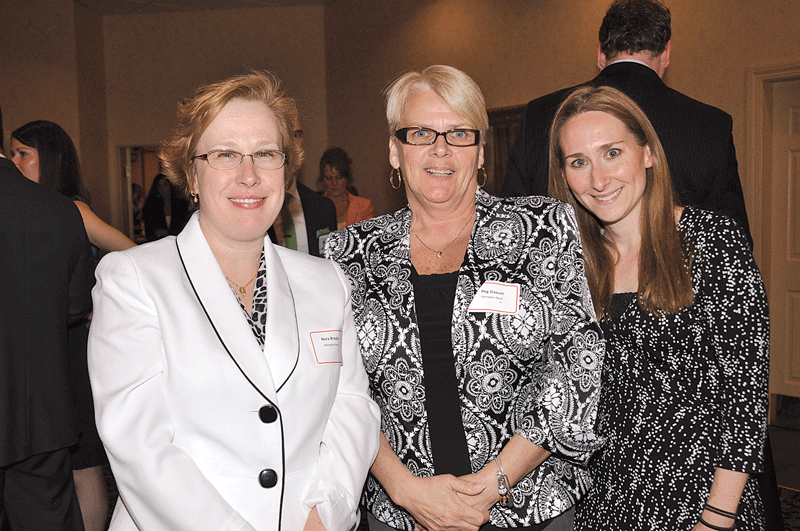
untitled-28Representing one of the evening’s sponsors, Hampden Bank, is Nora Braska, assistant vice president and training officer; Peg Daoust, branch manager; and Amy Scribner, assistant vice president and senior marketing administrator.


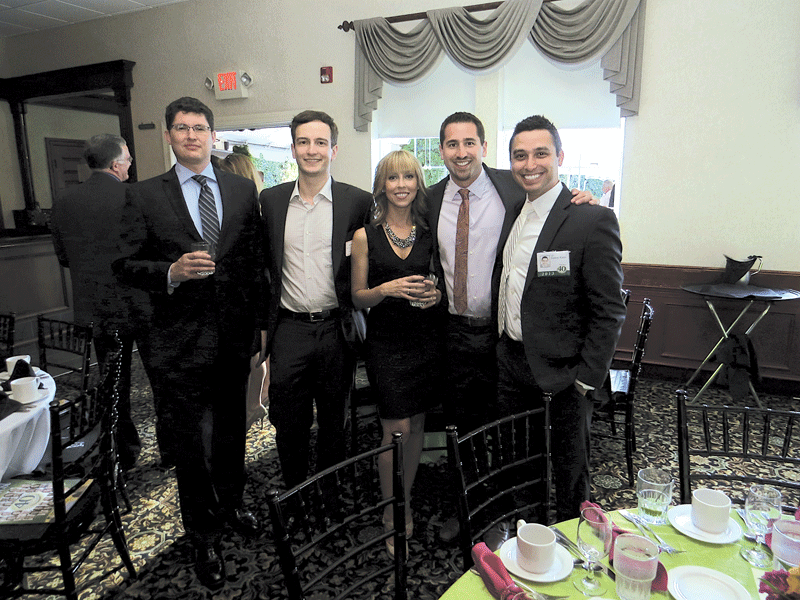
untitled-35From left, Jose Hernandez, machine operator for Rockbestos-Suprenant Cable Corporation; Alejandro Cameron, John Rivas, and Zydalis Zayas, WGBY-TV community engagement associates; Class of 2013 honoree, Vanessa Pabon, director of community engagement for WGBY-TV; Pabon’s daughter, Shayla Burge, and mother, Milta Franco, a case manager for Brightwood Health Center; and Veronica Garcia, WGBY community engagement assistant.

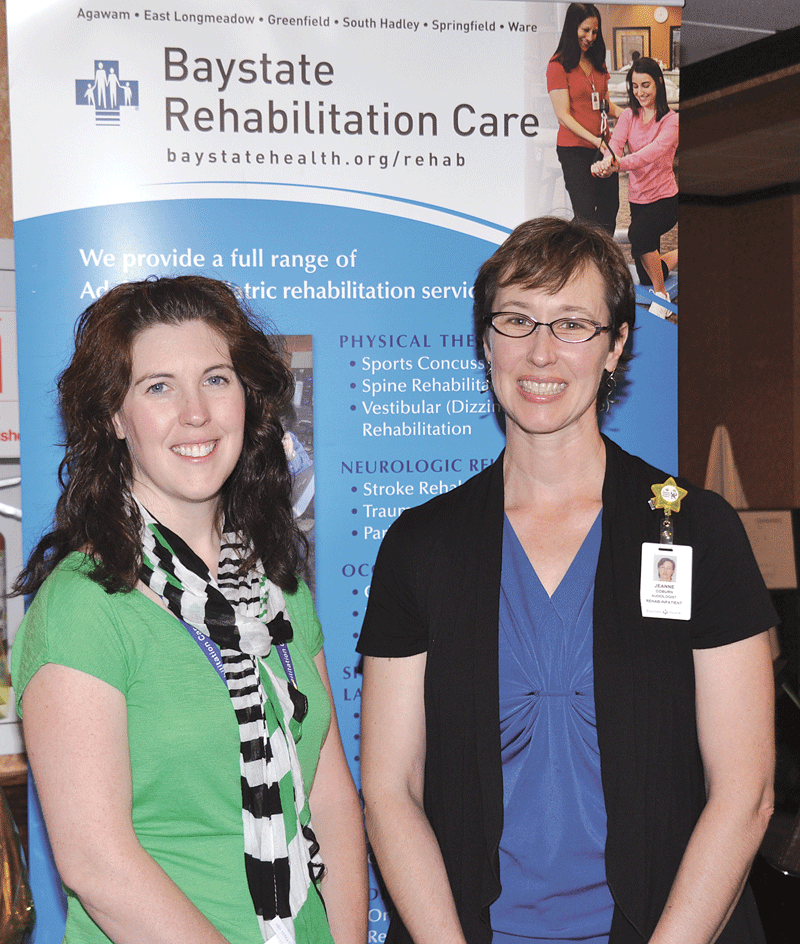
untitled-30Emily McArdle, left, physical therapist and Jeanne Coburn, audiologist, both of Baystate Rehabilitation Care, one of the evening’s sponsors.


untitled-37From left, Danielle Nicklas, an attorney with Cooley Shrair, and Jim Tinker, senior tax accountant, Burgess, Shultz & Robb, network with Amy Scott, president of Wild Apple Design Group, and Jennifer Schimmel Stanley, executive director of Greater Springfield Habitat for Humanity, both members of the 40 Under Forty Class of 2011.

untitled-36From left, Patrick Leary, Class of 2007, shareholder and vice president of Moriarity & Primack, P.C., an event sponsor, networks with Gwen Burke, senior advertising consultant with BusinessWest, her husband Chuck Burke, president of Action Marine and Water Sports, and Damon Cartelli, member of the Class of 2010, and president and general manager of Fathers & Sons, also an event sponsor.

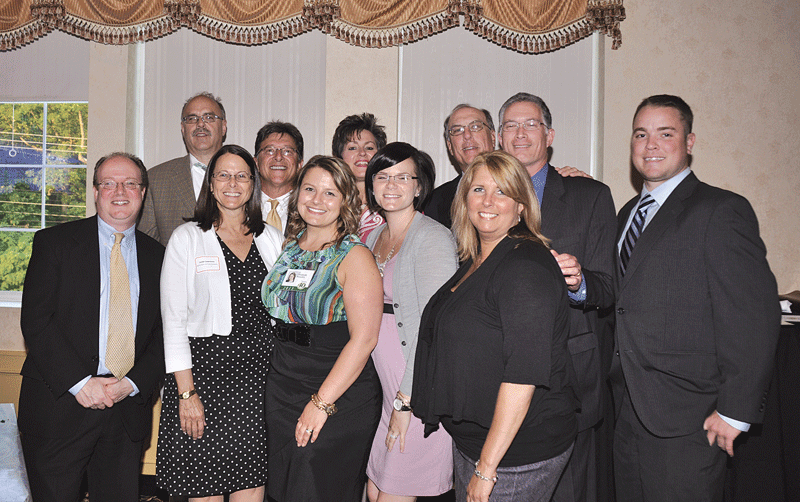
untitled-38The team at UMass Amherst Isenberg School of Management, an event sponsor, gathers before the awards ceremony. From left, Trista Hevey, program information specialist; Michelle Rup, office manager; Jennifer Meunier, director of Business Development; Kyle Bate, academic advisor and program developer; Melissa Garrett-Preston, academic advisor; Allison Furkey, media PR liaison; and Rachel Trafford, director of Organizational Metrix.

untitled-39The NUVO Bank & Trust Company team supported Class of 2013 honoree, Elizabeth Beaudry (fifth from left), senior commercial credit analyst and information technology administrator. Front row, from left, Michael Buckmaster, vice president, commercial lending; Leslie Ross Lawrence, senior vice president/CCO and SOO; Beaudry; Jackalyn Guenette, loan deposit operations agent; Sue Fearn, assistant vice president, client sales and service; back row; Jay Caron, president and CEO, Bee-Line Corp., and NUVO board of director; Jeff Sattler, president and senior loan officer; Denise Perkins, corporate secretary; Dale Janes, CEO; Jay Seyler, vice president, commercial loan division; and Eric Jalbert, credit analyst.

IMG_0139Gary Popovich, left, and Daniel Duncan, accounting associates, chat with Rebecca Connolly, audit manager, all of Moriarty & Primack, one of the event sponsors.


untitled-22Brenna Murphy McGee, Holyoke city councilor and member of the Class of 2013, with her husband, Todd McGee, Class of 2011, director, E&B Planning at Mass Mutual, and fellow Holyoke city councilor.


untitled-45Delcie Bean, Class of 2008 and founder and CEO of event sponsor Paragus IT, spoke to the audience of more than 650 people about the need for a computer technology-mentoring program that will benefit local youths, create jobs, and attract businesses to the Pioneer Valley through the reorganization of Valley Technology Outreach. Here, Bean is assisted by children from the Westfield Boys and Girls Club, who demonstrated the national numbers that underscore the need for more educational support through computer technology.

untitled-7Caitlin Casey, occupational therapist with Hartford Healthcare, and husband Jeremy Casey, assistant vice president and commercial service officer, Westfield Bank, celebrate his standing as a member of the Class of 2013.


IMG_0122From left, Darren Couture, painting contractor; Erin Couture, Class of 2013, vice president and commercial loan officer, Florence Savings Bank; Jeremy Leap, Class of 2013, vice president of commercial lending for Country Bank; and Andy Robb, Class of 2013, president, Burgess, Schultz & Robb, P.C.


untitled-19Timothy Brunelle, employee of L-3 KEO, and wife Erin Fontaine Brunelle, realtor, Century 21 Hometown Associates, founder, co-chair of Buy Holyoke and a member of the Class of 2013.


IMG_0145From left, Evan Alberts, practice manager and financial services professional, MassMutual Charter Oak Insurance and Financial Services; Ian Vukovich, Class of 2010, director of product delivery, MassMutual-USIG; Erin Kates, Baystate Health; Matt Geffin, Class of 2011, vice president of business development, Webber and Grinnell Insurance; and Danny Kates, Class of 2013, managing associate, MassMutual Charter Oak Insurance and Financial Services.

IMG_0154From left, Michael Hayden, owner, Springfield Motors; Ashley Bernard, speech pathologist, Springfield Public Schools, Nick Zajac, loan officer, Top Flight Financial; Carla Cosenzi, Class of 2012, and Tommy Cosenzi, Class of 2013, co-owners of TommyCar Auto Group; Amanda Douglas, esthetician at Puffers Day Spa and Salon; and Trevor Wood, engineer, City of Westfield.

IMG_0146From left, Melissa Mattison, clinical assistant professor, Western New England University (WNEU); Kim Gallo, staff Assistant, WNEU College of Pharmacy; Kam Capoccia, Class of 2013, associate professor of pharmacy practice, WNEU; and Jill Popp, Department of Research, Connecticut Children’s Medical Center, network in the Southampton Room.


IMG_0155Chris Thompson, left, Class of 2009, vice president, business development, Springfield Falcons Hockey, networks with Jill Monson, Class of 2010, CEO, Inspired Marketing; and Alex Morse, mayor of Holyoke.


IMG_0160From left, John Roberson, vice president, Children & Family Services; Ja’net Smith, program director, Juvenile Programs, both with the Center for Human Development; Jennifer Root, Class of 2013, clinical director for the Center for Human Development; and Kate Blachfield, manager, HP Hood.


IMG_0171From left, Joe Bednar, senior writer, and Elizabeth Taras, staff writer at BusinessWest, co-introducers of the Class of 2013, and George O’Brien, the magazine’s editor, await the next winner’s walk to the stage to receive their plaque.


Check below for all photos from the event:

Features
American Pest Solutions Has a History of Being Dead Right

Third- and fourth-generation presidents Jim and Robert Russell

Third- and fourth-generation presidents Jim and Robert Russell pose beside ‘The Good Guy,’ the company’s second-generation mascot.

His name was ‘Terry the Terrible Termite.’
That’s the highly alliterative name given to a not-so-anatomically-correct cartoon character that became the star pitchman — or pitch bug as the case may be — for a venture known as the American Exterminating Company.
“We used him in a number of our advertisements and promotions — Terry was on the radio 17 times a day that first year we used him,” said Jim Russell, the third-generation owner of this enterprise, who helped retire Terry several years ago and replace him with a smiling, white-shirted, flashlight-toting character known simply as ‘The Good Guy,’ who now adorns the company’s vans, signs, and advertisements.
This adjustment in ad artwork is just one of many changes that have taken place at this now fourth-generation company over a century of taking care of unwanted guests in area homes and businesses.
Indeed, there was a name change several years ago, with ‘exterminating’ replaced by the more modern — and accurate — ‘pest solutions,’ said current (and fourth-generation) president Robert Russell, noting that the company doesn’t just kill existing pests. Also, there have been several locations for this venture as it continued to grow, and acquisitions of several area competitors.
‘Terry’ the Terrible Termite

‘Terry’ the Terrible Termite was eventually retired, but not before becoming a fixture in the region.

Meanwhile, the methods for eradicating unwanted pests have evolved as technology has advanced and become more environmentally friendly, and some of the priorities — or chief public enemies — have varied, ranging from the legendary gypsy moth in the late ’80s to deer and dog ticks today. In fact, one variation of the company’s business cards is called a ‘tick identification card,’ with actual-size images of the insects on the front and a series of ‘tick tips’ on the back.
But in many other respects, little has changed since Abraham Russell, the company’s founder and inventor of the first roach powder, decided to go into business for himself — killing bugs — and set up shop in Holyoke.
“In most respects, we’re still doing business the same way we did 100 years ago,” said Robert Russell. “We’ve always put the focus on taking care of the customer, while also taking care of employees. It’s all about hard work, dedication, and a focus on the big picture. None of that has really changed since the beginning.”
This business philosophy has enabled APS to not only survive for a century, but also withstand the onslaught of a number of regional and national pest-control companies, when many smaller, local operations did not and vanished from the landscape.
“There are a few companies that came into this market, and their goal was to put everyone out of business,” he said, listing Orkin, Terminix, and others. “And some companies did fail, they did fall to the competition. But here we are on our 100th anniversary, bigger and more profitable than ever. That’s something that everyone here is very proud of.”
For this issue, BusinessWest takes an in-depth look at what Robert Russell calls a “statistical improbability” — a company that makes it past the third generation of one family’s ownership — and how it has succeeded in getting the bugs out (literally and figuratively) since Woodrow Wilson patrolled the White House.

Crawl Space
As Jim Russell started telling the story of how his grandfather invented roach powder, mixed it on his kitchen table, and later sold it in one-pound cardboard containers, it became evident that he had relayed this company’s history on countless occasions — and was quite proud to do so.
And it’s an attitude that permeates the company. Indeed, APS puts considerable focus on its intriguing heritage. The walls of the office on William Street in Springfield are adorned with large framed testimonials to the company’s four presidents, and the website includes a detailed time line of the venture’s progression.
The story begins, of course, with Abraham Russell, who moved from Brooklyn to Holyoke and eventually decided to hang out his shingle in the relatively new field of professional exterminating, with his roach powder giving him an in-demand product in a still-growing industrial city.
“He sold it from a horse-drawn wagon on the streets of Holyoke,” said Jim, who frequently dove into a thick folder of press clippings, photographs, newspaper advertisements featuring ‘Terry,’ and a host of other materials to help him relay a century of company history and evolution. He noted that his grandfather eventually moved the operation to Springfield, where it would have a number of homes as it continued to expand through the 1920s.
And as he talked about the transition from one generation to the next, he said it was often circumstance that kept this a Russell family business.
“My father (Matthew) was an electrical contractor — he was a master electrician,” Jim recalled. “But when the stock market crashed in 1929, so did his electrical contracting business, so he joined his father in pest control, and in 1931, Abraham passed away and Matthew ran the business.”
And Jim would work alongside him, virtually growing up in the world of pest control and extermination, learning, as each generation has, from the bottom up. In his case, there were some memorable — and also painful — lessons learned.
“I would go out on calls with my father, especially termite calls,” he noted. “I remember vividly going to a house in Longmeadow with him. He handed me his special pick hammer that he used to tap the beams to see if there was termite damage, gave me his flashlight, and said ‘you look around the basement, and if you find any evidence of termites, I’ll give you a dollar.’
“Off I went, and I discovered a two-by-four partition embedded in the basement floor,” he continued. “I picked at it and as I did so it fell apart and I realized there was termite damage. Needless to say, at that young age, a dollar was a lot of money; I looked over to my father, who was talking to the homeowner and yelled ‘dad, come quick, termites, termites.’
“Back in those days, termites were considered like cancer was,” he went on. “You didn’t talk loudly about it. The homeowner was very upset, and he came over and gave me a boot in the fanny; I learned my very first business lesson at a very young age. The next time I saw termites, I quietly said ‘dad, can you come over her for a minute, please.’”
Jim Russell would eventually attend Bryant College and study business, but after his first six months there, his father needed major surgery and Jim returned home to help run the business. He would return to Bryant, but just a few months after resuming his studies he determined his heart wasn’t in it.
“My parents were wasting their money, and I knew it,” he said, adding that he joined the family business in 1956, at age 19, and worked full time for the next 55 years, before eventually reaching what could be considered almost full retirement.
Matthew Russell died in 1977, and Jim worked with and for his mother until she passed away after suffering a stroke nine years later. Soon thereafter, Jim decided to make some major investments in new technology — including the company’s first computer system and a two-way radio system — and also acquire a competitor, and went six figures into debt to finance it all.
He remembers a number of sleepless nights, but more than that, he recalls feeling that those lessons he learned through the decades would help the company survive that challenging time.
“I had the utmost confidence that we could dig ourselves out, and we did,” he said, adding that it was about this time that he called his son Robert, then working for a pest-control company in Florida, and asked him to join the family business.
“The rest, as they say, is history,” he said with a laugh, noting that he turned the reins of the company over to the fourth generation in 2007.

Squashing the Competition

Before talking about his time at the helm, Robert first praised his father, noting that most family businesses don’t survive the third generation.
“In the history of family businesses, most commonly it’s the third generation that either builds it up and sells it,” he noted, “or grows up with the silver spoon and squanders it and loses it all. That didn’t happen here.”
And because it didn’t, the fourth generation is able to continue building on everything that came before, said Robert, noting the company has survived for a century by taking calculated risks, staying on the cutting edge of new technology and processes, and remaining customer- and employee-focused, while taking on new business challenges as well as new four, six, and eight-legged public enemies. The business plan moving forward is to simply continue doing all that.
And the younger Russell brings an intriguing mix of talents to that assignment.
He is a board-certified entomologist, one who is frequently called upon by the media to talk about pests and methods for controlling them, with the subject matter varying with the seasons and the pest in the news. But he’s also an entrepreneur and inventor of sorts. He started a company called EVIL Sports, with that acronym standing for Extreme Vision In Life, best known for its softballs, such as the EVIL 44 HOT Max, which the company says has the ‘hottest core in the country.”
“I’m a marketing guy, I think that’s what I was born to do,” said Russell with a laugh. “I always dreamed of having my own brand, and that’s why I started EVIL, and now, we’re one of the top-selling softballs in the country.’
Russell put his marketing and branding skills to work transitioning from ‘Terry the Terrible Termite’ to the ‘The Good Guy,’ which is both an image and an attitude.
“We are the good guys,” he noted. “We do good things for people every day; we protect their homes, we protect their families and pets, we protect them from contamination from rodents, damage from insects, and structural damage from disease and germs being spread by these things.
“We’re not the skull-and-crossbones contaminating company,” he said, taking the ‘good guy’ argument one step further. “We’re a very prudent user of insecticides, and we use a lot less product today than in the early times; what we do today is very environmentally responsible — we don’t take a unilateral ‘spray everything with pesticides’ approach, but more of an environmentally responsible approach.”
Moving forward, Russell said the company, which has marked its centennial in a number of ways, but especially with a party for employees at the Delaney House, is focused on continuing and expanding its brand-building efforts, and in the many ways that task can be carried out.
These include more and different uses of ‘The Good Guy’ imagery, educational initiatives, such as those ‘tick identification cards,’ segments on the local news, and direct communication with those seeking assistance — through the telephone, e-mail, live chats, texting, and more.
“There is a lot more to this than simply applying pesticides,” he explained, adding that the ability to effectively convey this is one of the reasons why the company is now in its second century of business. “Pests are problems, and we’re essentially problem solvers, and there’s a lot that goes into that.”

A Bite Future
Robert Russell told BusinessWest that his son, Jonathon, now 14, has officially ushered in the fifth generation of service to the company, with work in the broad realm of social media.
He said it’s far too early to say if Jonathon will make this his career and perhaps have his own testimonial on the wall at the company’s headquarters — just as it was unclear if the second, third, and fourth- generation presidents would eventually follow in the footsteps of Abraham Russell.
What is known is that the company will continue to operate in the manner that has enabled it to thrive for a century — an entrepreneurial, problem-solving approach that gave birth to Terry the Terrible Termite, but also led to the demise of so many of his real-life relatives.

George O’Brien can be reached at [email protected]

Opinion
Education Reform at 20; There’s Work to Do

By Tom Birmingham
If you had told me on that hot day in Malden 20 years ago when Gov. Bill Weld signed the Education Reform Act that over 90% of Massachusetts students would pass MCAS, or that the Commonwealth’s SAT scores would rise for 13 consecutive years, or that our students would become the first in every category in every grade on national testing known as “the Nation’s Report Card,” or that Massachusetts would rank at or near the top in international science tests, I would have thought you wildly optimistic.
Massachusetts public schools have achieved all these results and more since 1993, but there is still more to do. I am troubled, for instance, by race- and class-based achievement gaps. Nonetheless, two decades after the passage of education reform, we have much to celebrate.
Hardworking students and committed teachers deserve the lion’s share of credit for our success, but policy makers established a structure that enabled educational progress. The Education Reform Act is a complicated piece of legislation containing many innovative initiatives, including the creation of charter schools.
But for all its complexity, the Education Reform Act can be reduced, in essence, to two propositions: We will make a massive infusion of progressively distributed dollars into our public schools, and in return, we demand high standards and accountability from all education stakeholders. This grand bargain is the cornerstone of education reform.
Our fidelity to these two core principles helps explain our extraordinary achievements. Throughout the 1990s and in the first years of this century, support for public education was the top priority of state government, and our budgets reflected this. From 1993 to 2002, state spending on public schools increased 8% per year, for a total of more than $2 billion. Our success correlated with the adoption and application of the criterion-based MCAS testing, with state leaders (notably including Paul Cellucci) united in support despite repeated requests to retreat.
Today, I fear we may be veering away from the act’s two core values — adequate funding and rigorous standards. If we abandon the bedrock principles that have proven to be historically successful, we imperil the progress we have made. In the last decade, support for public schools lost its primacy on Beacon Hill and state budgets reflect that. Today our inflation-adjusted education appropriation is the same as it was in 2002.
In contrast to the generous expansion of the 1990s, education funding for the last decade has remained flat. As a result, according to the Massachusetts Budget and Policy Center, many (mostly low-income) school districts simply do not have the resources needed to provide the caliber of education envisioned in the reform act’s foundation budget.
I also fear that universal high standards and objective assessments are being jettisoned in favor of a return to vague expectations and fuzzy standards. The Patrick administration’s embrace of so-called “21st-century skills” elevates concepts like “global awareness” and “systems thinking” to new prominence in the public-school curriculum. I’m all for higher-order thinking, but students must accumulate the background knowledge that gives them something to think about.
As education theorist E.D. Hirsch Jr. has demonstrated, achievement gaps are really knowledge gaps. Poor kids tend to have access to less background knowledge outside school than privileged kids. Unless poor kids are exposed to the same academically rich content in school that more affluent kids can get at home, we consign these students to second-class citizenship.
I’m also troubled by the Commonwealth’s willingness to replace our tried-and-true standards and MCAS with totally unproven national standards and testing. This conversion will come at an estimated cost of $360 million for new textbooks, professional development, and technology, according to the Pioneer Institute.
I am not suggesting that we adorn our public schools with “Mission Accomplished” banners. Indeed, we must always strive to improve K-12 public education. But education reform has worked far better than we could have reasonably hoped. Given our incontrovertible educational successes, those seeking changes should bear in mind the admonition of the Hippocratic oath: “First, do no harm.”

Tom Birmingham, former president of the Massachusetts Senate, is senior counsel at Edwards Wildman Palmer LLP. He coauthored the Massachusetts Education Reform Act of 1993.

Entrepreneurship Sections
Clark Paint & Varnish Endures In the Shadow of the Big Boxes

Andy Raker

Andy Raker attributes his family business’s success to a focus on the basics and doing what the big-box stores can’t.

In the 1960s, Andy Raker’s mother took a request to have a specific color of paint mixed for the set of the former StageWest theater (the predecessor to CityStage) to match the famous violet eyes of the star of the next show — actor Robert Goulet.
Raker, now the president of the Clark Paint & Varnish Company — the West Springfield-based family business that his grandmother and mother were running at the time — told BusinessWest that while it was one of the more unique requests over the past 67 years, on any given day it’s not unusual to see customers hauling doors or pieces of dining room furniture into the Union Street store to find a matching stain or paint color.
And while matching paints seems to be all the rage in many home décor outlets, Raker calls color matching an art; a combination of computer-assisted color analysis and ‘eyeballing,” the term he uses to describe use of the naked eye to compare colors in different light settings.
How Raker came to be a practitioner of this art is an intriguing story of entrepreneurship, creativity, and, most importantly, survival of this rather small-box enterprise in a retail world increasingly dominated by big boxes.
Indeed, having just finished high school and starting his first semester at American International College in 1978, Raker found himself, and his family business, in a serious situation.
Backing up a bit, he said that after his grandfather, Milford Raker, who had purchased the business from original owner Fred Clark, passed away unexpectedly in 1963, his grandmother, Ruth, and mother, Marcia, were thrust into the roles of owner and operator, and with no real experience to handle them.
For 15 years, they and the existing staff managed the operation, but when the slow, steady exodus of that staff left the two women alone to run the store, Andy was forced to put school aside and take a leadership position in the family business.
“I had worked at the store in the summers but I never learned how to make paint, and I remember when the last guy (employee) to leave handed me the keys,” recalled Raker.
Once management was thrust upon him, he said it was refreshing on one hand, realizing that he was going to be able take the company in a direction that he thought was going to be positive. “But it was scary; it definitely was with mixed emotions,” he recalled. “It was either sink or swim.”
A loyal customer base of mostly retail and apartment-building owners kept the company alive as the young Raker spent the next two years learning the paint and stain trade and took advantage of new technology as it came, asking for help from paint chemists, and especially raw chemical salesmen.
“All these raw material people will supply you with information to help sell their materials,” explained Raker. “And back then it was pretty competitive and everybody had chemists on staff so when they wanted to sell me their titanium dioxide (white pigment), I’d say, ‘well, I need some help formulating it.’”
And as he continued to learn on the job, the formulas for Clark paint brand continued to improve. Experimenting with different recipes in batches with a blender, he produced small samples, took some chemistry classes, and, through trial and error, learned how to make quality paint, just like his grandfather, who’d never had the chance to teach him.
Raker would create starting formulations with various colors that had better flow and level, would cover better, save money, and have lower VOCs (volatile organic compounds). And as everything in the paint industry went ‘greener,’ so did Clark Paint.
For this and its focus on entrepreneurship, BusinessWest talked at length with a business owner who likes to mix things up — in more ways than one — and has the bases covered in an extremely competitive sector.

Brush Strokes
Clark Paint & Varnish’s success over the past two decades stems from a mixture of Raker’s late-teen ‘take charge’ attitude in the face of multiple adversities and his ability to learn on the job. While friends were experiencing the independence and adventure of college, Raker was experiencing a different type of independence, one that was more survival at first, than anything else.
And when asked how he’s scripted this survival story, he said it’s been through a focus on the basics, and doing things some of the discount giants can’t.
With the arrival of those big boxes, and especially the Home Depot in the nearby Riverdale Shops in the early 1990s, most would have thought that a small, family owned paint business like Clark would have taken a good shellacking, and a few stores in the area did — including West Springfield Hardware — which eventually ceased operations.
Clark’s retail paint business took a sizeable hit — roughly 30% by Raker’s estimate. While this was a large setback, a solid industrial customer base carried the company through the next couple of years as Raker made the decision to adjust his sales focus and target more commercial business, a move that helped redefine the company for good.
Attrition of some of Clark’s competition due to Home Depot’s opening presented the opportunity for Raker to add national brands such as Pratt and Lambert and Benjamin Moore to his own, well-respected Clark label, and with the addition of an outside sales person to help secure new commercial business, Clark Paint now had more clout to compete for all markets, he said.
“That move broadened our line even more,” he said, “and brought more people into the store because those brands have a lot of dedicated customers in this area.”
And new retail customers in turn created more need for that aforementioned expertise in  color matching.
“Everybody has computers to match, but it’s only a starting point; it never matches perfectly,” Raker said, adding that a trained eye is still key. “And we’ll dry the paint, because wet paint is different than dry, and actually take the samples out in the daylight as opposed to just florescent lights because it’s not a true rendering of the color.”
But with stain and varnish matching, there is no computer to do that analysis. “It’s also part of our reputation and it’s all experience and by eye,” added Raker.  “A lot of other stores don’t have the capability, the expertise, or even the pigments to make certain stains.”
Clark has a whole line of dye stains and a line of lacquer, called M. L. Campbell for cabinetmakers, furniture, and display manufacturers. The line, Raker explained, is more for industrial use on harder woods and offers far more depth of color, than the popular Minwax brand found in many stores.
Another key to the company’s success has been its ability to adjust to changes within the industry, and especially a strong focus on ‘green’ — not the color, but the movement toward more environmentally friendly products and processes.
Before the younger Raker took over, the advent of polyurethane, a plastic-based compound in the late 60s and 70s changed the landscape of varnish. Now mildew resistance is a controversial buzzword in the paint industry, and the cheap, readily available, but harmful lead — used as a white pigment and to prevent mildew — has been replaced by titanium dioxide and other environmentally safe additives, a result of federal VOC laws that also eliminated solvents in paint. As Raker has ridden the evolving technology wave, he has seen more genuine customer concern for health and environment.
“Everybody is looking for a more sterile, cleaner environment, and technology is catching up fast, but it wasn’t like that at first,” Raker explained to BusinessWest.  “Originally when the first paints came out that had to be ‘green,’ they weren’t quite as good, but now the technology is there.”
While those same raw chemical vendors were selling the same formulas to his competitors, Raker told BusinessWest that because Clark is a small manufacturer of paint, he could learn to make the greener formulas quickly, and keep his cost per can or container down due to a lack of shipping and distribution costs and third party middle men. “From the raw materials to out the door, we’re able to offer a better product at less money.”

Satin Finish
Raker hasn’t been called upon to create a paint to match a Hollywood star’s eyes in recent decades, but he admits that there have been intriguing challenges with that aspect of his work.
The biggest challenges, though, have been stepping in and then stepping up to take this family business to places that might not have been envisioned in 1978, or later, when the competitive playing field changed dramatically.
This is an inspiring story of entrepreneurship and perseverance. What will happen in the coming chapters isn’t known yet, but one thing is certain — they will be colorful, and in every way imaginable.

Elizabeth Taras can be reached at [email protected]

Entrepreneurship Sections
‘First-to-file System’ Represents a Significant Change in the Rules

RacePatentOfficeOn March 16, the U.S. patent system changed from what’s known as a ‘first-to-invent’ system to a ‘first-to-file’ system. This significant change means that only the first person to file a patent application on an invention can receive a patent, with few exceptions.
In other words, an inventor can race to the U.S. Patent and Trademark Office (the Patent Office) and attempt to beat out a prior inventor who waits to file.
There is however a one-year grace period for an inventor, or company, to file a patent application after initially disclosing an invention or offering it for sale. If the inventor decides to file, he can prevail over someone else who filed a patent application earlier that year.
In addition, someone who derived the invention from you, whether directly or indirectly cannot beat you in a race to the Patent Office. That’s because the Patent Office has a procedure (called “derivation proceedings”) to try to sort out the facts.
There are expenses and uncertainties, though, in trying to prove that you are the first inventor.
To avoid these scenarios, most companies should file provisional patent applications rather than non-provisional patent applications (a.k.a. ‘regular’ or ‘utility’ applications) before initially disclosing their inventions or offering them for sale (at trade shows, for example).
A provisional application is an informal, yet complete, disclosure of an invention filed at the Patent Office.  The provisional application is not prosecuted by the Patent Office and does not, by itself, result in a patent. It buys the inventor (or his assignee) one year to decide whether or not to file a regular patent application. If the regular application is filed within that year, the regular application can claim the benefit of the provisional application’s earlier filing date.
Provisional patent applications are relatively inexpensive. Therefore, most companies should file their provisional applications as soon as possible after creating inventions. Update your provisional applications upon creating major changes (for a production model, for example).
Before you file, conduct a preliminary patent search using Google® Patent. Also search the Internet for your product.
If you do not find it, contact a patent attorney to conduct a more detailed search or to file a provisional patent application.  Your company’s initial marketing efforts or public disclosure may dictate if you file before or after conducting a detailed search.
This change from a ‘first-to-invent’ system to a ‘first-to-file’ system is a significant development when it comes to patents, and inventors and entrepreneurs should fully understand what it means to their efforts to bring new products to the marketplace.

Donald Holland is a principal with the Longmeadow-based law firm Holland & Bonzagni, which specializes in intellectual property, patents, trademarks, copyrights, trade secrets, computer law, cyber law, joint ventures, technology transfers, licensing, and related litigation; (413) 567-2076.

DBA Certificates Departments

The following Business Certificates and Trade Names were issued or renewed during the month of and June 2013.

AGAWAM

AHP Plumbing
533 South West St.
Kenneth Perry

KMJ Videography
49 Morningside Circle
Frank Disco

Valley Painting
77 Autumn St.
Ken Zeltner

Wicked in Pink Run
53 Fairview St.
Robert Alves

AMHERST

Amherst Coffee
28 Amity St.
Mukunda Feldman

Custom Events
330 Pine St.
Karen Berrio

Dunn, Etal
989 South East St.
David Dunn

Homespun Event Design
71 North Pleasant St.
Amanda Robertson

CHICOPEE

BMG Home Services, LLC
149 Beauchamp Ter.
Marek Gusciora

Jerards Home Improvement and Commercial Services
16 Dale St.
Jorge Raul Rivera

Olus Painting
269 Chicopee St.
Elmira Usmonova

Profiles Hair and Nails
12 Sheridan St.
Lisa Ann Lefebvre

Signature Hair
1189 Memorial Dr.
Hang Bui

The Hair Force
358 Britton St.
Pamela Doyle

HADLEY

Horton Tank Graphics
47 East St.
Arthur Larson

Sobasko Cordwood & Logging
28 Lawrence Plain Road
Anthony Sobasko

The Work Horse Group Inc.
43 West St.
Susan R. Woods

Valley Dentists
138 Russell St.
Connecticut River Valley Dentist

HOLYOKE

C-Mart
1500 Northampton St.
Syed R. Mobeen

Hidden Hollow Floral Designs
244 Rock Valley Road
Marcia Cassidy

Kennedy Fried Chicken
333 High St.
Yasser Hussain

La Copa Inc.
447 Main St.
Aida DeJesus

Providence Behavioral Health Hospital
1233 Main St.
Daniel P. Moen

NORTHAMPTON

Beets and Barley Catering
184 North St.
Leslie L. Lucio

CD Laborers
80 Damon Road
Christopher Ducey

Minute Clinic Diagnostic of MA
366 King St.
Kimberly DeSousa

Northampton Country Club
135 Main St.
James Casagrande

Uptown Paws
123 Hawley St.
Robin Mulligan

PALMER

Eddy’s
21 Wilbraham St.
Ed Francis

Fusions Mods
18 Barker St.
Todd Nulph

TLD Assets
1118 Park St.
Darnel Ali

Wedgewood Motel
1430 Park St.
Stanley R. Lamb

SPRINGFIELD

Lindsay Entertainment
45 Crabtree St.
Maurice Lindsay

Mara’s Hands of Light
11 Eton St.
Mara M. Veronesi

Network Technology Academy
1655 Main St.
Ronald L. Cook

New Divas
1153 Main St.
Ramon DeJesus

Nunez Tax Services
196 Dickinson St.
Sonia N. Torres

Panda House
1673 Main St.
Yong H. Chen

Perez Family Restaurant
57 Taylor St.
Jorge Perez Jr.

Recovery Express
119 Wilbraham Ave.
Calvin V. Wilson

Richard Electric
71 Mayfair Ave.
Richard Lantigua

Rico Peru Latin Flava
176 ½ Main St.
Juliano J. Callirgos

Signature Turf Services
75 Woodlawn St.
David C. McAlary

Six Corner Barber Shop
296 Hancock St.
John Miller

South End Package Store
32 Fort Pleasant Ave.
Faiza Atif

Spring Valley Mart
612 Carew St.
Masood Ghani

Sudsy Bubbles Inc.
555 State St.
Kelly M. Healey

The E-Store
98 William Road
Kencin Junior

The Paintball King, LLC
1655 Boston Road
Baldomero Martinez

UR Discount Tobacco
1207 Parker St.
Fazal U. Rehman

VIP Cuts
445 Main St.
Andres Ortiz

William Home Improvement
71 Greene St.
William Aponte

Woman of Confidence Coach
20 Orlando St.
Dawn Leaks

XXX Security & Protection
446 Franklin St.
Damaris Rodriguez

WEST SPRINGFIELD

Delta Affordable Construction
33 Birnie Ave.
Vladimir Gargun

Eci Biotech Recruiters
569 Elm St.
William Beattie

Exportacion/Importacion
33 Allen St.
Armando Ramirez

Healing Temple Outreach
9 Willow Ave.
Barbara A. Washington

Ladder 8
139 South Blvd.
Alanna Burwell

Minute Clinic Diagnostic
928 Riverdale St.
Kimberly DeSousa

Northern Granite, LLC
380 Union St.
Vyacheslav Katko

Toomey-O’Brien Funeral Home
1043 Westfield St.
Francis X. O’Brien

Wedding Inspirations
31 Field St.
Jessica M. Dziewit

West Side Tire & Auto Services
930 Memorial Ave.
Holyoke Tire & Auto

Departments Incorporations

The following business incorporations were recorded in Hampden, Hampshire, and Franklin counties and are the latest available. They are listed by community.

BELCHERTOWN

Quabbin Soccer Academy Inc., 9 Heritage Dr., Belchertown, MA 01007. Matthew Schiffer, same. Provide youth soccer clinics to players of all abilities.

Quality Payroll Services Inc., 24 Pheasant Run, Belchertown, MA 01007. Payroll services.

BRIMFIELD

Webrising Data Services Inc., 291 Sturbridge Road, Brimfield, MA 01010. Kevin Matthew Hebert, same. Providing consulting and technical services.

CHICOPEE

William Sung DMD PC., 2220 Pendleton Ave., Chicopee, MA 01022. William Sung, same. Dentistry.

EAST LONGMEADOW

Wild Olive Inc., 10 Lynwood Road, East Longmeadow, MA 01028. Carmine Manzi, same. Pizzeria restaurant selling food, beer and wine.

EASTHAMPTON

T & Y Enterprises Inc., 25K Franklin St., Easthampton, MA 01027, Tamer Mahdy, same. Retail and real estate operations.

Zato Inc., 20 Reservation Road, Easthampton, MA 01027. John Holbrook, same. Software and consulting.

FEEDING HILLS

Positive Reflections Inc., 22 Oriole Dr., Feeding Hills, MA 01030. Raymond Nadeau, same. Salon and day spa.

HADLEY

Pegasus Investment Corp., 8 Pine Hill Road, Hadley, MA 01035. Savida Justine Sachar, 18 Grand Oak Farm Road, Hadley, MA 01035. Equipment Rental.

Pioneer Valley Realty Group Inc., 2 Bay Road, Hadley, MA 01035. Mark Osborn, same. Real Estate Brokerage Company.

HOLYOKE

Santiago Professional Cleaning Services Corp., 582 South Summer St., Suite #1323, Holyoke, MA 01040. Commercial cleaning services.

LONGMEADOW

River Dogs Baseball Club Inc., 73 Stirling St., Longmeadow, MA 01106. John Valencia, same. Baseball club.

The Greater Springfield Amateur Athletic Organization Inc., 67 Woodside Dr., Longmeadow, MA 01106. Kevin Wright, same.

LEE

Onyx Exports Inc., 40 Willow St., South Lee, MA 01260. Christopher Matthews, same. Export.

NORTHAMPTON

The Massachusetts Recreational Trails Advisory Board Inc., 136 Damon Road, Northampton, MA 01060. Richard O’Brien, 576 Merriam Ave., Leominster, MA 01453. To review and rank applications submitted to Mass. Department of Conservation.

SOUTH DEERFIELD

The Creative Journalism Group Inc., 5A Graves St., South Deerfield, MA 01373. Andrew Adamek, same. Research, report, produce and distribute, factual stories about the impact of deindustrialization.

SOUTHWICK

Osowski and Osowski Dental PC., 821 College Highway, Southwick, MA 01077. Anne Osowski, same. Dental services.

SPRINGFIELD

Paraiba Cleaning Corp., 45 East Bay Path Terrace, Springfield, MA 01109. Everaldo Pontes, same. Cleaning company.

Punta Cana Restaurant & Bar Inc., 137 Chestnut St., Springfield, MA. Dionisio Antonio Moya, 100 Melha Ave., Springfield, MA 01104. Food services.

Shree Sai Petroleum Corp., 419 Allen St., Springfield, MA 01108. Riddhi Vyas, 188 Sumner Ave., Springfield, MA 01108. To operate convenience store and gas station.

Veterans With Vision Inc., 1697 Main St., Springfield, MA 01103. Patrick Gore, 421 North Main St., New Haven, CT 01053. To provide programs and services in effort to combat and end veterans homelessness.

Virtual Tech Inc., 856 Central St., Springfield, MA 01105. Jeremy Branco, same. Provide free and low cast training for computer technology within the commonwealth.

WEST SPRINGFIELD

Perfect Union Inc., 292 Belmont Ave., West Springfield, Ma 01089. Robert Wheten, 902 Florence Road, Florence, MA 01062. Provide education tutoring programs to students who are struggling in grades k-12.

Ranjha Brothers Inc. 24 Myron St., Apt. 18, West Springfield, MA 01089. Hassan Ranjna, same. Retail grocery store.

Turek Mechanical Design Inc., 109 Green Meadow Lane, West Springfield, MA 01089. Paul Turek, same. Contract mechanical design, machine design, tooling, equipment installation, create mechanical design.

Features
$100 Million Expected to Spur Innovation, Economic Development

Ed Leyden

Ed Leyden says the $100 million in grants for life sciences represent an opportunity for his company to diversify, expand, and eventually add jobs.

Ed Leyden called it “science — not science fiction.”
That was his way of describing a product not yet on the market, but one he believes might be there soon. This would be a wristwatch-like device that would collect vital signs such as blood pressure, heart rate, blood sugar, and more, that could be sent to a doctor if needed.
“There’s a push on now for diagnostics, and what’s called ‘self-diagnostics’ — things you can wear, like a watch,” said Leyden, president of Ben Franklin Design and Manufacturing Company in Agawam and co-chair of the state’s Advanced Manufacturing Collaborative. “They can monitor a number of bodily functions and download them right to your phone — it would be an extremely early-warning system.”
Developing such a monitor, prototyping the device, and then eventually manufacturing it — preferably in the Pioneer Valley — are some of the many goals, if not expectations, that accompany $100 million in grants from the state via the Massachusetts Life Sciences Center (MLSC), that were announced at an elaborate ceremony earlier this month in the shadow of UMass Amherst’s gleaming new $157 million Life Sciences Laboratory.
The awards — $95 million to UMass Amherst and $5.5 million to the Pioneer Valley Life Sciences Institute in Springfield — are part of a $1 billion, 10-year investment on the part of the state designed to stimulate growth of its life-sciences supercluster, considered the largest in the country.
When asked what this latest investment would mean for the Western Mass. region and the state as a whole, Susan Windham-Bannister, president and CEO of the MLSC, said simply, “drive economic development and job creation.”
She then elaborated, telling BusinessWest that this investment — which will fit out and equip a substantial portion of the Life Sciences Laboratory, which will house three new research centers (more on them later) — could help this region replicate the development of life-sciences-related businesses and jobs seen in Cambridge and Worcester, the two strongest pockets for that sector in the state.
To describe what’s happened in those cities, she summoned the phrase “innovation-driven economic development,” which she would use early and often.
“In this model, you begin to create some smaller companies, some spin-outs, and some specialized, innovative technologies,” she explained. “And the large companies want to be around that; they want to be near to what’s happening, so they begin to locate in that area.
“You have small companies growing up, and you have large companies putting up a footprint near these centers of activity,” she continued. “This is the new model of innovation-driven economic development, and it’s really upside-down from the traditional model. You’re not looking to use lots of incentives to get a large company to move; instead, you invest in young companies, and you invest in these centers of specialized expertise that large companies want to be around and take advantage of.”
For this issue, BusinessWest takes an in-depth look at the $100 million investment made by the state and what it means for this region and the life-sciences sector now stretching across the Commonwealth.

Down to a Science
Summing up the state’s $100 million investment in the two Western Mass. facilities, Windham-Bannister said these grants are intended to build on the specific strengths of this region. Specifically, these include the university and the research currently taking place there and that will take place at at the Life Sciences Laboratory, as well as a precision manufacturing sector that is expected to work with those researchers to eventually bring new products to the market — and, if all goes according to plan, manufacture them in the Bay State, and, more specifically, the 413 area code.
This strategic direction, if one wants to call it that, stemmed from work funded by a $300,000 training grant designed to identify the highest and best use for grants from the life-sciences center in this market, she explained. “We set out to determine what were the basic strengths within Western Mass. in the life sciences, what were the strengths at the university and PVLSI, how could we accelerate and build on those strengths, and, more importantly, how could they interact with the companies in the community to help them grow and also encourage startups?”
The answer, arrived at eventually, was to essentially fund three new research centers at the Life Sciences Laboratory, with the goal of creating collaborations with biotechnology firms, medical-device manufacturers, pharmaceutical companies, and other players to bring new products to the market and, in the process, create new jobs.
The three centers will each have a specific focus:
• Personalized Health Monitoring will focus on developing nanotechnology and large dataset management to improve healthcare through low-cost, wearable wireless sensors that analyze patient data continuously in real time, said Windham-Bannister. Biomanufacturing firms, medical-device manufacturers, ‘big-data’ analysts, and other healthcare industry partners will produce prototypes, test them, and assess their manufacturing feasibility.
• Bioactive Delivery will focus on discovery and application of new drugs, agricultural, and ‘nutriceutical’ compounds, she told BusinessWest. “These are things that are very product-oriented, they are input to the development of drugs and devices, and they play to the strengths of the expertise not just at the university, but also in the region, where there is a lot of innovation going on with regard to materials.”
• Models to Medicine will be focused on translating basic protein research by UMass Amherst experts into new therapeutic targets. This center will capitalize on an explosion of discoveries over the past 10 years suggesting that a variety of protein dysfunctions play a role in Alzheimer’s, Parkinson’s, cancer, and infectious diseases.
Meanwhile, the $5.5 million targeted for the PVLSI will support the development of a new Center of Innovation in Health Informatics and Technology, which will be focused on advancing public/private-sector partnerships and incubating innovative technology solutions developed by startups and larger, more established vendor firms in areas such as population health management, healthcare quality, big-data analytics, and mobile health.
Assessing these plans for PVLSI and the Life Sciences Laboratory, Leyden said the investments being made by the state could generate opportunities for precision-manufacturing shops like Ben Franklin and eventually bring new jobs to that sector.
He said his firm, which specializes in making parts for the nuclear, aerospace, defense, power-generation, and other sectors, doesn’t do much work in medical-device manufacturing, but could, because it has the personnel, equipment, and ability to meet the high quality standards necessary to succeed in that specific niche. And there are many area firms in that category.
“The infrastructure is here,” he explained. “We have a strong advanced-manufacturing base here, and even the companies that don’t have experience with medical devices could move into that area — the work is very similar to what they’ve doing already.
“And to me, being a strong manufacturer is being diversified,” Leyden continued. “If you have the ability, and you’re doing another sector’s worth of work, you’re further insulated from the ups and downs from the economy and the manufacturing world.”
There are many existing firms in the area that could eventually benefit through the research that will take place at the university at PVLSI and through collaborative efforts with those teams, said Windham-Bannister, adding that the state’s investment could also spur new startups and possibly prompt life-sciences companies in Worcester, Cambridge, and elsewhere to establish a presence in Western Mass. to take full advantage of the research going on here.
All this is part of innovation-driven economic development, she told BusinessWest, noting that there has already been considerable interest in the three planned centers expressed by life-sciences-related firms not only in Western Mass., but across the state.
“I would think that these companies would want to have a presence close to these centers,” she continued, “because that’s what we’ve seen in Worcester and also what we’ve seen in Cambridge.”

Making Things Happen

Windham-Bannister said it’s impossible to place a timeline on this process of innovation-driven economic development. But, drawing on what’s happened in Worcester, Cambridge, and elsewhere, she said she wouldn’t be surprised if progress comes quickly, and that, as a result of these investments, Massachusetts was able to build on what is already considered a substantial lead in a national competition to create jobs within the broad life-sciences sector.
“The goal at the Life Sciences Center is to translate good science into good business across the Commonwealth, and to enhance this state’s position as a global leader in this realm,” she said, adding that these latest developments in Western Mass. will certainly help move the needle further in the right direction.

George O’Brien can be reached at [email protected]

Community Profile Features
Northampton Forges Ahead on Innovative Projects

NorthamptonMayor David Narkewicz says Northampton is a city on the move, leading the way in arenas that range from its energy-efficiency programs to its effort to increase the number of daily Amtrak shuttles when high-speed passenger rail service begins next year, to $67 million of new projects expected to add $3.1 million to the tax base.
“We’re moving in a positive direction, and my administration is committed to continuing to build on success,” he said. “We have a strong local economy with lots of businesses, and we want to support them, reach out to new companies, and maximize the use of our developable land.”
Terrence Masterson, the city’s economic development director, agrees. He said the city’s appeal results from its mix of industry, retail shops, and cultural, educational, and recreational opportunities.
“Northampton has a lot of assets which include the benefits of a living in a rural town as well as a large, livable city,” he told BusinessWest. “It has a culturally rich downtown, is well-positioned off Interstate 91, and hopefully will soon have passenger rail service. We also have a solid educational system, and our parks and open-network system is without peer. You can live in Florence and ride your bike downtown.”

Mayor David Narkewicz

Mayor David Narkewicz shows off a rendering of the new, upgraded passenger platform planned for the former Union Station on Pleasant Street.

The city has been feted with a wide array of awards, which range from being named among the “Top 25 Art Destinations” by American Style magazine to one of the “Top 100 Best Places to Live” by CNN Money magazine and the “Top 10 Family Friendly Towns” by Parenting magazine. Other honors include the Retailers Assoc. of Mass. Award of Excellence for the best downtown shopping district.
“We have a vibrant and diverse economy with lots of locally owned retail shops and restaurants; it’s one of the things that sets us apart, because it has been hard for cities to hang onto that in other parts of the country,” said the mayor. “People often say that Northampton has big-city charm, but maintains its small-town character.”
The city is also a center for healthcare, as Cooley Dickinson Hospital and the Veterans Affairs Medical Center in Leeds, which is planning to expand its specialty care, serve people across the region.
For this issue, BusinessWest continues its Community Profile series with an in-depth look at Paradise City, which certainly isn’t content to rest on its laurels.

Diverse Initiatives
Narkewicz said Northampton’s leadership is evident in its approach to eco-tourism. “We have one of the most well-developed rail trails in Massachusetts and are on the cutting edge of developing new segments,” he said, referring to the 12.5-mile route that runs through the city. “We have also done a lot of work to promote local agriculture.”
In addition to three farmer’s markets, the city has one of the largest community farms in the state. The endeavor known as Grow Food Northampton came to fruition in February 2011 when the organization purchased 121 acres of permanently protected farmland in Florence. The nonprofit is a collaborative effort, and its community garden was so successful in its first year of operation that it is doubling in size this year. The city provides funding to the Farm Education Collaborative, which presents workshops and programs at Crimson and Clover Farm in Florence to benefit schoolchildren and adults.
The mayor also notes the Connecticut River Greenway in Northampton, one of the Commonwealth’s newest state parks, which connects open spaces, scenic vistas, and archaeological and historic sites along the length of the Connecticut River.
“We’re a green community, and were among the first cities awarded green-community status by the state,” Narkewicz said. “We’re way ahead of everyone else, and our green initiatives add to what makes Northampton unique.”
He and other city officials recognize the importance of energy conservation, and to that end, the energy and sustainability initiative called Northampton Leading the Way was launched about two years ago.
“We worked with Columbia Gas and National Grid to create a business concierge program that allowed commercial property owners to make significant energy improvements to their facilities,” said Narkewicz. “It resulted in savings for them and helped add to the city’s overall sustainability.”
The city reduced its own energy costs by 27%, and the nonprofit Center for Eco-Technology conducted the outreach to businesses. The utility companies have continued to fund the program because it has proven to be a real success. “Utility costs are a major part of the bottom line for businesses, and this is also good for the environment,” Narkewicz said.
The city kicked off a second energy-efficiency initiative last month to help residents reduce utility bills and conserve energy through measures such as high-efficiency hot water and heating systems, added insulation, new thermostats, and other weatherization efforts. They can schedule free home energy assessments, and Narkewicz said the program “is another example of how the city of Northampton is helping people and the environment.”

New Projects

Terrence Masterson

Terrence Masterson says the city’s appeal stems from its mix of industry, retail, and cultural, educational, and recreational opportunities.

Economic development is also on the upswing, and the King Street commercial area is undergoing an unprecedented level of new building and renovation.
Northampton Crossing (the former Hill and Dale Mall), which sat vacant for about 20 years, was purchased two years ago and is being redeveloped into medical offices and retail shops. The mayor said the space will become home to offices connected to Baystate Medical Center, and added that several new banks and other projects, which include a new hotel being constructed on Conz Street, are in progress.
In addition, two new buildings will offer much-needed office space in Northampton. They are located at the gateway to the city, which officials designate as the area off exit 18 from I-91 near the Clarion Hotel. An office building with 30,000 square feet of space completed about a year ago was fully leased within three months, and a second building is under construction. Masterson says the additional 80,000 square feet of office space will be a significant development for the city. “It is hugely exciting,” he told BusinessWest.
Other growth is expected as the Clarion Hotel hopes to replace its existing structure with a new building and restaurant. “Eventually the whole site will undergo a major facelift and expansion,” Narkewicz noted.
Tourism will also get a boost, thanks to a new Fairfield Inn under construction. It will add 108 hotel rooms, bringing the city’s total to 457. “It will provide more revenue and also allow more people to stay in Northampton,” Masterson said.
And work continues on Village Hill, built on the grounds of the former Northampton State Hospital, where space has been in high demand. Kollmorgen Electro-Optical (now L-3 KEO) relocated there from King Street, a boutique hotel is being created in a building that once housed male attendants at the state hospital, and 9,000 square feet in a new, 12,000-square-foot office building under construction have already been rented.
The projects promise to enhance the city as well improve its economy. “We are pleased not only because of the growth in economic activity, but because it will allow us to expand our tax base,” Narkewicz said, explaining that taxpayers will vote on June 25 on whether to allow a $2.5 million Proposition 2 1/2 override because Northampton is facing significant cuts in service due to a $1.4 million budget gap.
Still, progress continues. “All of the projects we have going on fuel each other,” Masterson said. “But it’s critically important for us to keep adding to them, and we think Amtrak will be another way to bring large numbers of people here.”
Narkewicz agrees, and believes the anticipated commuter rail service will have a positive impact on the city. The return of Amtrak service, which will transport passengers along the west side of the Connecticut River, is part of a larger, $73 million federal project, and calls for a shift next year in the Amtrak-Vermonter’s route, which will include new stations in Greenfield, Northampton, and Holyoke.
The mayor is part of a passenger-rail advisory committee made up of stakeholders in the community who want to maximize the railway’s potential. The Knowledge Corridor Feasibility Study, which the current construction project is based on, indicates that expanded rail can generate economic benefits to a number of communities, and Narkewicz believes it could increase the number of trips between the state of Vermont and Springfield. He would also like to see service extend into New York City.
“The rail service will benefit people in terms of transportation, but will also increase the potential for business, whether the passengers are students, tourists, or people who come here for our art and culture,” Narkewicz said.
He has been proactive in promoting an increase in the number of shuttles, and sent a letter to the secretary of the state Department of Transportation last month, citing numbers from Amtrak showing that regional rail ridership has boomed nationally and locally over the past 15 years.
“We believe this new rail service will deliver many positive economic benefits for downtown/urban revitalization, tourism, residential quality of life, and business/job development,” Narkewicz wrote, adding that the letter was also signed by Greenfield Mayor William Martin and Holyoke Mayor Alex Morse. “It’s an issue everyone agrees with, and it will be a real thrill for a lot of people to have Amtrak trains here.”
There are also plans to rebuild the old passenger platform at the former Union Station on Pleasant Street. The new, 40-foot platform will include an awning and cover designed to complement the building’s architecture.

Continuing Progress
Narkewicz said collaborations with residents, government agencies, other cities and towns, and a number of organizations, coupled with efforts to attract new business and spur economic growth, have had a positive result.
“We are moving forward,” he concluded. “There is a lot of activity here, and together, we are making a difference.”

Opinion
Turning Good Science into Good Jobs

So, just what does $100 million buy today?
Many business owners and economic development leaders are asking that question, following the announcement earlier this month that the state, through the Massachusetts Life Sciences Center, has funneled $95 million in grants to the Life Sciences Laboratory at UMass Amherst and another $5.5 million to the Pioneer Valley Life Sciences Institute in Springfield, with the broad goal of leveraging that investment to spur economic development and jobs (see story, page 9).
In this case, $100 million would appear to buy opportunity — in many forms, but especially an opportunity to further diversify this region’s economy, something that desperately needs to be done — while bolstering a still-vital precision-manufacturing sector, making this region a much bigger part of this state’s rise to the top when it comes to generating business in the life sciences, and propelling the university to a higher level in terms of research and prestige.
Will $100 million buy all that? Probably not, but it will certainly generate some momentum that might make all those things possible.
That’s what state leaders, including Gov. Patrick, university administrators, and elected officials were saying at an elaborate press event on June 6 to announce the grants, and they may well be right. These investments — that’s the best word to describe what the state is doing — are designed to stimulate what Susan Windham-Bannister and others call “innovation-driven economic development,” which would be something new to this region, but also something actually quite old.
Indeed, in recent years, the main thrust of economic development, not just here but elsewhere, has been to attract large employers to vast expanses in industrial parks. We’ve had some success with that approach in the Pioneer Valley, but other regions have enjoyed much more.
Innovation-driven development is different. It starts with the development of materials, products, processes, and expertise, and uses all of the above to stimulate startup companies, bring opportunities to existing ventures, and draw companies from other areas who want to take advantage of all this.
We saw this happen with the Springfield Armory, which wasn’t exactly a startup operation (although, in some respects, it fits that description), but was the birthplace of a great deal of innovation, which eventually led to a number of businesses started by people who worked at the Armory, and, eventually, to the birth of a thriving precision-manufacturing sector. The same can also be said, in many respects, for the gunmaking industry that developed in Western Mass. and Connecticut, which was truly innovation-driven.
Fast-forward more than 200 years, and this region now has an opportunity for different kinds of innovation, from the development of personalized health-monitoring devices using nanotechnology, to discovery and application of new compounds to fight infection, to translating basic protein research into new therapeutic treatments for Alzheimer’s, cancer, and other infectious diseases.
These are the types of research-and-development opportunities that will be taking place at three research centers to be constructed and equipped through that $95 million grant to the university. Meanwhile, at PVLSI, the $5.5 million grant will support the development of a new Center of Innovation in Health Informatics and Technology, designed to spur progress in such areas as population health management and healthcare quality.
In Cambridge and Worcester, similar investments, both public and private, have led to the formation of dozens of companies and the creation of thousands of jobs in the broad life-sciences sector, and Windham-Bannister believes that model could be replicated in Western Mass.
Time will tell if she’s right and if this region can, indeed, translate good science into good business and good jobs, but this region has been handed what appears to be a golden opportunity.
The challenge now is to take full advantage of it.

Opinion
UMass Needs More Public Dollars

In the coming days, the Massachusetts Legislature will make an important decision about funding for the University of Massachusetts and, in so doing, will play a significant role in determining what kind of university UMass will be as it enters the next phase in its history.
On a literal level, the Legislature will decide whether UMass will receive the $479 million in funding for the upcoming fiscal year proposed by Gov. Patrick and approved by the House or the $455 million advanced by the Senate. The higher level of funding is important because it would arrest a long-term budget slide, make the state-student funding split more equitable, and provide students with an overdue tuition and fee freeze.
But the commitment we are asking the state to make is actually part of a much larger effort we are shaping to dramatically strengthen UMass and make sure it always will be the kind of public university that Massachusetts, with its innovation and intellectual horsepower, needs.
As we ask the Commonwealth to do more, UMass is also gearing up to do significantly more to provide the financial foundation a university needs to be great. And while it isn’t just about the money, dollars matter when it comes to attracting and retaining top professors, providing aid for students who need and deserve it, and ensuring that our facilities match up with our academic and research ambitions.
With that in mind, UMass this fall will launch its first system-wide capital campaign with the goal of dramatically increasing the private funds flowing into the university. These dollars will sustain a community of excellence — a reinforcing circle of top students, professors, and facilities.
Taken in tandem, a major infusion of public and private funds will give UMass the financial muscle it needs as it completes its first 150 years of service and prepares to make an even more profound contribution to the people of the Commonwealth.
UMass is the third university I have had the honor to lead. As I complete my second year as president, I am struck by one thing above all else — how much our five campuses have done with such limited resources.
Over the past 15 years, while state funding has remained flat, UMass has added 13,000 students (most of whom come from and will remain in Massachusetts), has seen student achievement rise to the point where its flagship campus in Amherst is now a top producer of Fulbright scholars, has won a Nobel Prize, has seen research expenditures reach $600 million a year, has become a national leader in income derived from faculty inventions, and consistently places in the upper reaches of the World University Rankings.
All of which prompts two questions: Shouldn’t we protect the great asset we have developed? And how much more could we do with a little more public and a lot more private support?
While we seek to gather the resources we need to make this a truly transformational moment, I realize that we need to keep front and center a value that is so much a part of our New England heritage — and that is frugality. Respect for a dollar is something I learned growing up in a Maine town where people eked out a living in mills and on fishing boats, and where scrimping and saving was an essential way of life.
Over the past five years, UMass has saved $68 million through efficiency steps, including consolidating administrative functions previously performed on each of the campuses. We expect to save another $123 million over the next five years by reducing energy expenditures, improving our purchasing practices, and streamlining information-technology operations.
Our commitment to transparency mirrors our commitment to efficiency, and, to make it easier to gauge our performance in key areas, we will release an annual performance report giving donors, public officials, and the public at large a better sense of how we are doing and what their dollars are helping to build.
UMass marks its 150th anniversary this year, so it’s a time to celebrate the past — and to build for a brighter and loftier future. With that future in mind, we are asking the state to join with us to create a truly historic moment. We have a chance to place UMass on a course that will allow it to soar — and this is an opportunity we have to seize.

Robert L. Caret is the president of the University of Massachusetts.

Sales and Marketing Sections
To Remain Competitive, You Must Adjust Accordingly

Research shows that more than 50% of all cell phones are now smartphones. Add to that the growing number of people who own tablets, and it is estimated that mobile Internet users will exceed the number of desktop internet users by 2014.
The rapid rise in mobile technologies has dramatically changed the way that we communicate at work, at home, and while out and about, and business owners must adjust to this phenomenon.

We Love Our Smartphones
The majority of cell-phone purchases are now smartphones because they quickly become the preferred technology. Smartphones let you make phone calls, but what makes them so smart is that they have an operating system and can run software. This enables them to have features similar to those found on your computer, including web browsing, sending and receiving e-mail, and the abilities to open and read documents, take photos, listen to music, and watch videos.
Smartphones are getting faster at accessing the Internet and letting us view websites, engage in social media, download apps, and access driving directions via GPS. No wonder we love them.
Because mobile devices have become so convenient to use, they are now an integral part of our on-the-go lifestyle. That means many of your customers are trying to access your website on a mobile device. Most mobile devices will display your website correctly, but it will be incredibly tiny, and users will have to enlarge it and scroll from side to side to read the content. If you do not currently have a mobile-friendly website, now is the time to begin putting one in place.

Two Key Options

Options for having a mobile-friendly website include a mobile redirect or responsive web design. A mobile redirect can be accomplished in a variety of ways. Essentially, it redirects mobile users accessing your website to a separate website optimized just for mobile devices. In this case, you have two separate websites that need to be updated and maintained.
Another option is to make your website mobile-friendly by using responsive web design. Responsive web design uses fluid grids, CSS (the coding language for formatting and styling web content), and media queries to control how your website is displayed based on a device’s screen size. Responsive web design provides the advantage of just one website to update and manage versus having a separate mobile site to maintain.
Whatever method you choose, you should minimize the amount of information displayed on your mobile site by tailoring it to the needs of a mobile viewer. Consider what information your website visitors need when accessing your site while on the go. Some basics include business address, directions, an interactive map, hours of operation, and contact information. If you have a retail operation, then sales, special offers, and events should be easily visible to entice mobile web visitors to stop by.

Mobile Search
According to Google, there has been a fivefold increase in mobile search over the last two years. Research also shows that more than half of all consumers use their smartphones to search for products even when they are at home and could use a desktop or laptop computer. This data emphasizes the need for a mobile-friendly website.
If someone searches for your business and finds you, they should be taken to a website designed for a mobile device. If you are investing money in paid search, and those searches are on mobile devices, you are wasting your money if those ads don’t lead to a mobile-friendly website.

Local on Mobile
Your customers are searching while they are out and about, looking for places, products, and special offers. Roughly 70% of searchers are looking for a local product or service, and more than 80% of people searching for local information will take action within a day. Mobile searchers have a need, and most often it is an immediate one.
I encourage you to register your website for local search. This will let you control the quality of your local search results, ensure the accuracy of the information, and help increase your search ranking. Here are several major search engines you can register with; some have a verification process by phone or mail.
www.google.com/places
www.bing.com/businessportal
listings.local.yahoo.com
listings.mapquest.com/apps/listing

Social on Mobile
Social media seems to be made for mobile, as it’s all about what we are doing right now and sharing that with our friends. About half of the people using social media do so on a mobile device. Mobile users log in more often and spend more time on social-media sites. Mobile devices nicely integrate social-media apps that make it easier to post on a mobile device than from your desktop.
For example, you can snap a photo with your phone and post it right to Facebook. Knowing how your customers use their mobile devices is important when developing social-media campaigns. Businesses need to start their planning with a mobile perspective and tailor their ideas accordingly.

Mobile Commerce
Mobile commerce (m-commerce) is defined as consumers shopping and conducting other financial and promotional activities on their wireless, handheld devices. Browsing, shopping, and purchasing are increasingly done on mobile devices, and that trend continues to grow.
As the technology for online mobile shopping is improved and simplified, the shopping experience becomes easier and more convenient. Millions of American smartphone owners use apps for shopping, and even more use a retailer’s mobile website. It is clear that mobile shopping will continue to grow and your customers will be looking for this purchasing option.

Geolocation for
Customer Tracking
Mobile devices also provide GPS and wi-fi technology that can determine where a user is located. This allows you to leverage that information and send real-time mobile offers that can drive people to your business and generate a purchase. As we continue to gather data on our customers, we can move toward using demographic, psychographic, and past-purchasing behavior combined with current event data to deliver highly customized messaging.
Not everyone likes the idea that their smartphone knows where they are, so you will need to communicate the value consumers can expect to receive from your geolocation programs and give them options on participation.

Develop Your Mobile
Marketing Plans
Reviewing the trends and technologies that are making your customers mobile reinforces the need to provide a mobile experience to your customers. The combination of a mobile-friendly website, local search, m-commerce, geolocation, and social media provides you with powerful ways to reach your customers and prospects while they are on the go.

Tina Stevens is principal and creative director at Stevens 470, a full-service, multi-channel marketing firm providing strategic marketing, print communication, and web development; stevens470.com

Insurance Sections
Cyber Liability Is the Hot Trend in Business Insurance

Cyber TheftEven one electronic security breach is a headache for businesses that store their customers’ financial records. Millions of thefts? That’s much worse.
“They’re like mosquitoes,” said William Trudeau, president of the Insurance Center of New England in Agawam. “It’s one of those things where one or two bites isn’t too bad, with five bites, you’ve got an itch, but if you have 5,000 bites, you might die. For a small bank, if someone steals 100 ATM cards, it’s going to be not fun. But if, all of a sudden, they steal the records of 20,000 ATM cards and are withdrawing money all over the world for two days, it could get ugly.”
It’s not just banks that worry about such breaches. Large retailers, which keep the credit-card records of their customers on file, are at risk as well, as the TJ Maxx incident that came to light six years ago.
In that case, hackers gained access to company databases in 2005 and stole the personal information of more than 45 million credit and debit cards — but the company didn’t discover the theft until two years later. TJ Maxx later claimed that 75% of the cards were either expired at the time of the breach, or the personal information on them was masked. But the international ring of thieves did use much of the data to enrich themselves before they were arrested — and the various consequences of the incident eventually cost the clothing chain more than $130 million.
“After the TJ Maxx incident, Massachusetts law mandated self-reporting and potential fines per incident,” Trudeau said, but the costs stemming from such a breach can range widely, from PR work to restore brand reputation to individual and class-action lawsuits.

Bill Trudeau

Bill Trudeau says companies victimized by hackers can run up massive expenses even before customer lawsuits arrive.

“Say a company wants to rectify things, says that it won’t happen again,” he continued. “So they pay for two years of ID theft protection for anyone who wants it. Then you need to do notification by third-party certified mail to all customers. Say I’ve got 30,000 records, so I’ve got to send out 30,000 pieces of mail from a certified facility, costing maybe $90,000. Then, how many will take me up on two years of identity-theft protection? Maybe 10%?
“What you have here are first-party costs,” he went on. “It’s not someone saying, ‘OK, I lost 20 grand, and now I’m suing you.’ You’ve got a lawyer in your office saying you need to do certain things now, even though there’s no lawsuit yet. But who’s going to pay the $90,000 for mailings? Who’s going to pay for the ID-theft protection? There’s a huge potential for loss, even before the lawsuits arrive.”
As a result, cyber liability is one of the hottest terms in the insurance world, one that agents have been busy telling their clients about.
“We’ve been concentrating on this kind of insurance,” said Robert Gilbert, president of the Dowd Insurance Agencies in Holyoke. “I read four trade publications each week, and every single one, every week for the past year, has had an article about what we call cyber-liability insurance. That includes Internet liability, cyber-security … anything that can attack your computer and cause loss of data.”
And businesses make a mistake if they assume that large, national retailers are the only ones at risk. Verizon issued a report on data-breach investigations last year that analyzed data from 855 reported incidents that resulted in 174 million compromised records in 2011. That study revealed that 71% of breaches struck organizations with fewer than 100 employees.
Bob Gilbert

Bob Gilbert says his agency has been busy informing business-insurance clients of the need for cyber-liability coverage.

As a result, Gilbert said his agency has been busy notifying its clients about cyber threats and the insurance products available to protect them, noting that banks, retailers, restaurants, and medical businesses are among those with the most potential threat exposure. “We’re talking about businesses where customers are using credit cards. That data is capturable. Large retailers are constantly taking credit cards because that’s how most people pay for things. So it’s significant.”

Growing Concern
Earlier this spring, Best’s Review cited several recent surveys that shed light on the extent of the cybercrime problem and how it concerns businesses. For instance, a survey by American International Group found that corporate executives are more concerned about cyberthreats than any other major business risk, with 85% of the 258 surveyed saying they are ‘very’ or ‘somewhat’ concerned about it.
Meanwhile, a Deloitte Tech Trends poll of 1,749 business professionals found that 28% of those surveyed reported at least one known cyberattack in the past year; 9% reported more than one breach. And those are just the known cases.
According to the Ponemon Institute, which has been reporting on the cost of cybercrimes for the past three years, the average cost to a company from data theft is $194 per record breached — meaning it takes just 515 such records stolen to reach a six-figure loss, a tough pill to swallow for small to mid-sized companies.
That’s why cyber-liability insurance is so important. Trudeau cited one product his company promotes, Beazley Breach Response, which covers many of the first-wave expenses of cybercrime, including notification and credit-monitoring services for up to 5 million affected individuals, as well as forensic and legal assistance, PR costs, and other benefits, with separate coverage limits for third-party claims.
“Many policies offer first-party coverage — that is, they will pay you for things like business interruption, the cost of notifying customers of a breach, and even the expense of hiring a public-relations firm to repair any damage done to your image as a result of a cyber attack,” business-technology writer Minda Zetlin noted recently in Inc. magazine. “Having this cash available in the event of a crippling hack can keep the lights on until you’re able to resume your normal cash flow. A good policy can even cover any regulatory fines or penalties you might incur because of a data breach.”
Early response, aided by such coverage, can be critical, Trudeau said. “Depending on how good the response is, you don’t always get to the liability point if you self-report that you’ve had a breach.”
Considering the rate at which businesses are attacked and hacked, Gilbert said, it’s tremendously risky for companies that store sensitive data to ignore their need for cyber-liability coverage.
“When private data has been hacked, the expense to go through it is tremendous — you have notify all the people in the database, there are advertising expenses, possibly litigation,” he explained. “As technology has changed so rapidly, so has the expertise of criminals. The insurance marketplace never anticipated the seriousness of these crimes.”
But it’s certainly paying attention now. “When you’re hacked, and someone has access to everything in your computer, they can throw viruses in there or extort your business with the threat of viruses,” Gilbert added. “There are so many different areas of exposure, so it has become a very big issue.”
Customer notification alone can be a major hassle, considering that 46 of the 50 U.S. states have notification laws, the details of which vary by state — and many breaches affect customers in multiple states. “You should talk to your risk manager or agent,” Gilbert tells clients. “Do you have this coverage? What do you need to secure it? If nothing else, we make them aware of the exposures they face.
“It definitely interrupts your business. You have a loss of income, a loss of profits,” he added. “We talk to clients about what their exposures are today and what to do about it.”

Constant Threats

In a world where data theft is pervasive — from restaurant waiters carrying ‘skimmers’ in their pockets to lift debit-card information to international hackers hammering their way into large corporations — companies increasingly realize that it’s up to them to both better secure their data and seek out a realistic level of coverage, Trudeau said.
“When doing an assessment, ask, what’s the exposure risk? What exposures do we have, and how could we get in trouble?” he said, re-emphasizing that those risks run from the debit-card information stored at Big Y to the HIPAA-protected patient data at medical practices.
“It doesn’t matter if you’re a big company or a small company,” Kelly Bissell, who heads Deloitte’s Information Technology Risk Management Team, told Best’s Review. “It matters what data you have that’s valuable to them. The bad guys don’t discriminate.”
It’s also dangerous for businesses to assume they’re protected against data breaches of third-party vendors, experts say, since they provided them that information in the first place. Nor is there any guarantee a cloud provider will cover a company against a data breach in the cloud. It all comes back to speaking with an insurance agent to make sure all contingencies are accounted for.
“Every time you open the paper, another bank has gotten hacked,” Gilbert said. “Criminals today are pretty smart. They’re not using guns and knives anymore; they’re sitting somewhere in Russia or somewhere in Oklahoma — it doesn’t matter where.”
And that changing world has forced changes in the insurance realm, with the advent of products that are becoming an increasingly necessary part of companies’ risk-management strategies.
“This type of coverage has been developed to meet a need,” Gilbert said. “With what’s going on with cybercriminals, it’s very important that, every account we go out on, we’re bringing up things they don’t have. That way, at least we’ve done our job.”

Joseph Bednar can be reached at [email protected]

Banking and Financial Services Sections
Mark Teed Seeks Answers from Trends and Patterns

Mark TeedMark Teed has file folders — lots of them — each dedicated to a trend he’s spotted in the news or through his own observations.
As senior vice president of Investments at Raymond James & Associates in Springfield, he uses those folders in his everyday work, trying to spot market trends in an effort to help clients build wealth.
That’s not unusual. But the sheer breadth of the file topics might be, ranging from straightforward stock news to societal shifts that might not immediately seem to impact financial markets. They serve as individual brushstrokes on the canvas of his financial outlook; each may not seem to portend much, but together they lend clarity to what can be a very confusing landscape.
He focuses on ‘anomalies,’ such as the question of why many retailers are still struggling in the wake of the Great Recession, yet restaurants are packed. His answer is that consumers are still holding back somewhat on purchases, but they’re prioritizing the social element of eating out.
“We think maybe restaurants represent the anti-technology world, where we can spend time with people in real life. It feels like the antidote to the smartphone world, a way to get away from technology.”
And that opens many, many other folders on the societal impact — and, by extension, the market impact — of the social-media age and the burgeoning attitudes and habits (some promising, some disturbing) of its denizens.
“I don’t like numbers. I like symbols, colors, patterns,” Teed said, admitting that he’s a right-brain thinker in the left-brain world of financial analysis. What his folders full of trends, anomalies, and inferences represents is no less than an attempt to understand and connect all the disparate rumblings of a world of rapid change, and what that means for the future.
“In my work, I’m just trying to find some clarity in the numbers, trying to help people get into a good retirement,” he said. “I’m concerned about the average person’s savings rate. I want to help people get to the point where they save and invest and accumulate and believe in America’s future, because, warts and all, it’s still the greatest place in the world.”
And it’s a nation in transition. The folders tell the story.

Calm Down
If you ask Teed for a quick market analysis — and, as a regular commentator on financial matters for CNBC and other media outlets, he’s asked often — he has an easily understood answer that sticks to the financial basics.
“At this point, the markets are calm. Four year ago, they were volatile and chaotic,” he said, crediting the change to Federal Reserve Chairman Ben Bernanke’s commitment to bringing interest rates close to zero in an effort to protect and ease the markets. But Teed says that’s only a short-term, artificial solution.
“There’s a certain amount of calmness, but behind the scenes, a lot of these models are based on constants, and they are becoming more fragile,” he explained. “Today is a sunny day, but we’re concerned about the clouds in the distance. We’re not sure how it will all play out because it’s such a new, uncharted territory. Hopefully [Bernanke] could start to raise rates a little bit, and the markets will respond positively, but we’re not sure.”
The result, he said, is that “we’re on guard like we’ve never been on guard before. Intuitively, the average person here in Springfield feels it in their gut; their head tells them it’s OK, but in their gut, things aren’t right, and we’re seeing signs of fear out there — not as much as four years ago, but just that gnawing fear.”
It’s not eased, he said, by a flood of new regulations pouring into the financial world. In a trend he calls “10,000 commandments,” he noted that the Dodd-Frank legislation designed to prevent the next financial crisis is only 30% complete and already encompasses some 9,000 pages.
“It’s gotten to the point where people don’t know how to behave,” Teed said. “Those in power are pushing through what I call extreme regulations, which are not meant to create a fair playing field; they’re meant to punish. Our response to the crash was that someone did something wrong, and we’ve spent three or four years figuring out who did something wrong and punishing them. And now there’s a hesitancy to do business because no one knows what the rules are.”
Meanwhile, millions of individuals, many approaching retirement, are still reeling from the crash. “Someone who was 55 years old in 2007 is now 61, and six years have gone by, and even though the market has reached new highs, they don’t feel like they’ve made any progress,” he said. “Baby Boomers always thought the future would be wonderful for them, and now reality is setting in; they’re worried they won’t have enough money. They know people are living longer, and they can’t retire yet. The future doesn’t look as bright as it did for their parents.”
Teed repeatedly came back to a problem he calls “psychological deleveraging.”
“We’re such an optimistic country. When I was growing up, the future looked so bright and wonderful,” he noted. “But in the last 10 years of market selloffs and layoffs and outsourcing, people, psychologically, have deleveraged what life is going to get them, and they’re starting to settle for less. There’s a feeling, as a nation or as an individual, that they’re not going to get there.
“It almost leads to anti-consumption,” he went on. “You see it first in the rich; instead of getting a trophy house, they’re getting a trophy rental. They’re not putting capital out there. They’re starting to hoard cash. It’s the first time I’ve ever seen that.”
These discussions — of markets and regulations and retirement fears — are far from uncommon in Teed’s field. But for him, they’re a jumping-off point to explore the broader social anxieties that underpin those financial uncertainties.

Something Real
Take the hyperconnectivity of Americans today. Teed, at 55, says his generation tends to value privacy and are careful about with whom they share information. But the younger generations, who grew up in the computer age — and particularly Millennials, who are very comfortable abandoning their privacy on the web and social media — are a much different breed.
“They have an amazing cooperative instinct; they aren’t afraid to reveal themselves, and in many ways, they create peace through cooperation.”
Coincidentally — or perhaps not — violence levels are down nationwide, Teed noted. The national murder rate is the lowest since 1961, and New York City recorded 414 murders last year after averaging around 2,000 per year as recently as the 1990s. “The Internet and social media are the great equalizer; these kids are different than you and I — they’re cooperating; they just get along very well, and that’s good for the future of the stock market.”
At the same time, though, perhaps paradoxically, Americans are more politically polarized than ever, and the Internet tends to fuel that as well. “It’s modern tribalism. We’re forced to be a member of a tribe and have to define ourselves by that label,” he said. “I think it’s hurting us because everyone is so polarized, and polarization leads to paralysis; nothing gets done. It seems like the airwaves are full of people venting.”
What they’re looking for, Teed said, is authenticity, noting that audiences have responded enthusiastically to a string of films set in the 1920s, including Midnight in Paris, The Great Gatsby, and The Artist, the latter a silent film that won the Academy Award for Best Picture.
“That’s an extreme anomaly,” Teed said. “We’re seeing a tieback not to nostalgia, but to authenticity. People are searching for something authentic and real, and therefore the politicians, business leaders, and religious leaders who BS people are in trouble. People are looking for truth, and that ties into that cooperative instinct. People want people to tell them the truth.”
He said Apple’s stock soared for years under Steve Jobs’ leadership not only because people used and liked its products — which they certainly did — but because users saw Apple as an authentic company; there was a level of connection and trust. When Apple released a map application with serious flaws, that was big news, because it cut against that hard-earned reservoir of trust.
Cutting-edge technology collides with trust in other ways, too, such as the cyberwar that percolates beneath the surface of the business world every day.
“It’s a barbarians-at-the-gate mentality, but it’s a digital gate,” Teed said. “If you’re a Fortune 500 company in America, you’ve been hacked. You might not know you’ve been hacked, but everyone has been hacked by the Chinese.”
He said the U.S. government has been developing a 1 million-square-foot facility in Utah tasked with countering the threat, hoping to employ some 4,000 people with high-level hacking skills to fight back. “It’s total information awareness. We’ll have eyes and ears on every single thing happening in America. I think we’re at war, but it’s a cyberwar, and our cyberwarriors are hackers.”
That sort of unsettling prospect contributes to the perception of an authority void in America — or, at least, the collapse of the illusion that our leaders are in control.
“Hacker groups like Anonymous and LulzSec — they hack into companies, not to hurt them, but just to show them they aren’t the authority, but the power is in the hands of the hackers,” Teed said. “They’ll tap into the Department of Defense website and won’t do anything, just to show them they can do it. That’s an amazing anomaly.”
And it translates, in the consumer arena, with heightened fears of identity theft — just one more anxiety to deal with.

Easing Their Pain
And they’re dealing with their anxieties in new ways, such as the dramatic increase in the use of drugs like Adderall, and other forms of self-medication.
“People are on this cycle where they take sleeping pills to go to sleep at night, then take Red Bull to wake up in the morning, then take Xanax to calm down later on, and start the cycle all over again,” Teed noted. “That’s their response to how difficult daily life has been. That hasn’t gone away, and that worries me about the future, and the future of markets.”
He concedes that those difficulties are authentic, such as a real-estate market that has remained soft for longer than people expected, and graduates leaving college so laden with debt that they can’t afford a new house anyway.
“For the first time in my lifetime, education is being attacked at its core, which is the value proposition,” Teed said of the millions of college graduates emerging into a difficult job market and onerous student-loan burdens. “People are now questioning, ‘is a college degree worth it?’ With almost a trillion dollars in education loans out there, that could be the next subprime problem — defaults on student loans. And if people are not able to find jobs, it’s a problem for universities to try to find their value in this world.”
He cited a college in Florida advertising a $10,000 BA, placing the entire focus of its pitch on the low price. “That really attacks the core value proposition for education.”
Bernanke’s actions, Teed said, have pumped oxygen into the markets, and consumer confidence has been on the upswing. “I think that’s a real positive; that would give people hope. But in their gut, they’re just not feeling that great, so he needs to keep this going.”
Yet, Teed remains undiscouraged.
“Amazingly, most of these pressures are negative, but I’m incredibly optimistic about the future. It’s so bright,” he said. “We have many, many problems, but when 6 billion people are cooperating, great things can happen, and I’m very optimistic for this country in particular to solve our problems. This is still the greatest place to invest, to raise kids, to say, ‘I came from here.’”
That’s why he doesn’t hold with the crowd clinging to investments like gold as they await another crash. “People view gold as a hedge against disaster, and that’s almost unnatural because gold doesn’t pay dividends,” he said. “I understand it, but I don’t think gold is the best investment. People are going to be surprised how quickly we get back to normal in the next 10 years and people feel better.”
That trend, which he hopes is no anomaly, will be led, he believes, by an increasingly connected world that, at its heart, identifies problems and wants to solve them cooperatively, no matter our tribal differences.
“That’s very good for the future and very good for the stock market. The stock market is nothing more than a mirror image of how we feel. It’s a confidence game. When we’re feeling good, things go up, and when we’re feeling lousy and scared, they go down. It’s amazing how quickly they react,” Teed said.
The bottom line? “I think the markets will go on and set new highs,” he said. “We always underestimate how great we are at innovating.”

Joseph Bednar can be reached at [email protected]

Banking and Financial Services Sections
Freedom Credit Union Continues Its Growth Trend

Barry Crosby

Barry Crosby says it’s important for Freedom Credit Union to have a strong presence both on the street corner and online.

In the past decade, Freedom Credit Union has expanded its footprint from just one branch to 10, with another on the way. But Barry Crosby is especially excited about the branch with no street address.
“Online banking is our busiest branch; it gets the most volume,” said Crosby, the institution’s president and CEO. “We firmly believe we need bricks and mortar in strategic locations to have visibility in the community and be involved in the community, but clearly, the online branch network is huge for us as well. We have to recognize — and we do recognize — that technology is so important to the younger generations, and we’ve reached out to meet their needs.”
Indeed, while many financial institutions continue to expand their bricks-and-mortar footprint across the region — and Freedom is no exception — industry leaders increasingly say that computers and smartphones are now the primary banking tools for a generation of younger customers, and many older ones as well.
“They’re buying everything online,” Crosby said. “Many of the younger generation are not inclined to go to bricks and mortar, be it for financial services or purchasing other kinds of products. They’re buying online and having it delivered to them directly. So we’ve had to change as well.”
As a result, more than 7,000 members now utilize the online banking platform Freedom@Home to manage their accounts and pay bills. Meanwhile, Freedom recently launched two new services — mobile banking and online account opening — to assist customers who prefer to bank on the go. The credit union has also developed mobile apps for both iPhone and Android devices so members can view their account activity, transfer funds, and find branch and ATM locations on their phones.
“My kids have smartphones; they’ve grown up with technology,” noted William Russo-Appel, Freedom’s marketing officer. “For me, computers just came on board when I was in high school. But today, more and more smartphones are being utilized. Our members are on their smartphones a lot. We need to be there too, and now we are.”
It’s another sign — and there are many — that Freedom is in a serious growth pattern, as reflected in its branch expansion, its recognition by the U.S. Small Business Administration (SBA) as a top regional lender, and its educational and cultural outreaches into the communities it calls home.
Through it all, Crosby said, “our culture — the credit-union culture — has always been to serve all our members for all of their financial needs, be they small, medium, or large. We’ve never lost sight of those roots.”

Approaching a Century

Those roots originate in 1922, when Freedom Credit Union was chartered as the Western Mass. Telephone Workers Credit Union. From a small office in the telephone company building on Worthington Street in Springfield, the institution grew until it had to find a new, larger home on Main Street.
As a result of telephone-company downsizing and reorganization, the credit union eventually expanded to include select employee groups. But growth was incremental until January 2001, when the institution applied for a community charter, and membership eligibility was expanded to include anyone who lives or works in Hampden, Hampshire, Franklin, or Berkshire county. In January 2004, around the time Crosby took over as president, the membership voted to change the name to Freedom Credit Union.
“At that time, we began a roughly 10-year strategic plan for growth,” he told BusinessWest. “At that time, there was just one office and 38 employees, but the board had a plan to better serve existing members and develop new membership through a branch network, and over the course of the last nine years, we established eight additional branches,” with a ninth coming on this fall at Putnam Academy in Springfield.
The credit union’s Northampton branch came about through a merger with Franklin Hampshire Building Trades Credit Union in May 2004, followed by the opening of a Chicopee branch that November. The following year, a merger with Four Rivers Federal Credit Union brought Freedom offices to South Deerfield and Turners Falls.
Two more branches — in Greenfield and Feeding Hills — opened in 2009, and expansion to Easthampton followed in 2010. A year later, a second Springfield branch opened in Sixteen Acres, and 2012 saw the tenth site open in Ludlow.
These days, Crosby noted, Freedom boasts about 155 employees in Hampden, Hampshire, and Franklin counties, and membership has grown in the past 10 years from roughly 16,000 to around 26,000.
“As we’ve expanded the membership base during that period, we started adding new products and services, including member business loans four years ago,” he explained. “We began the process with the focus on serving existing members who might have small businesses, as well as other small businesses in the Pioneer Valley, and we’ve been very successful.”
Two and a half years ago, the bank brought on Gary Grodzicki as vice president and chief lending officer. “He has overseen the growth of the commercial department from a couple million to approximately $20 million,” Crosby said. “We’ve served a lot of small businesses that have really had a difficult time obtaining financing at some of the larger national banking organizations.”
That success has not gone unnoticed. Last year, Freedom was recognized as the top SBA lender in Western Mass. after approving seven loans worth $2.8 million. “The award was a wonderful accomplishment for us because the award category included all financial institutions in Western Mass.,” he said, noting that more than 40 banks and credit unions were eligible for the award. “The fact that Freedom topped the list is a tremendous achievement for us.
“So we’re definitely seeing growth there,” Crosby added. “In addition, on the lending side, we’ve really expanded our automobile loan portfolio. We’re finding today that a lot of financial institutions don’t offer as competitive a rate or products as we do.”

CUPs Runneth Over

Grodzinski said customer service has always been at the heart of how Freedom operates, and that includes striving to identify additional products or services customers could use. “Members are appreciative of that.”
For instance, Freedom offers a program called CUPs, or Credit Union Partners, through which it provides local businesses and organizations a no-cost benefit package for their employees and retirees, which includes special promotions for checking and savings accounts and several types of loans. To date, more than 175 entities throughout the Pioneer Valley have signed up for the program.
As a growing credit union, Freedom places high value on community involvement, from its donation last year of $45,000 to local nonprofits to its promotion of volunteerism among employees.
But civic responsibility goes beyond donations of money and time, Crosby said, noting that Freedom has increased its focus on educating area youth on the importance of saving money, budgeting, and credit. Fifteen schools from Greenfield to Springfield participate in the institution’s youth-banking and financial-literacy programs.
“We’re looking for the next generation of credit-union members,” he noted, “and it’s important that we assist the schools in any way we can in educating students about real-life finances.”
For each elementary school in the youth-banking program, employees visit schools to accept deposits, review monthly statements, and explain the fundamentals of saving. Meanwhile, high-school students learn about financial-literacy topics such as the importance of maintaining good credit and the process of getting a car loan. Freedom also participates in area Credit for Life financial-literacy fairs — a collaborative effort with other institutions — that teach teens about budgeting and making life decisions with their finances.
“We firmly believe in this,” he said of Freedom’s community involvement and educational programs. “The bottom line is, we enjoy meeting with residents and workers in the Pioneer Valley and hearing what their financial needs are, and we try to accommodate them. We can’t do everything for everyone — nor can anyone else — but we certainly listen.”
Meanwhile, the credit union continues to work on a 10-year strategy that takes into account the shifting demographics of the region. For example, Crosby noted, Springfield is 38% Hispanic, and Holyoke 48% — and the numbers are larger in the school systems. So he’s looking to target the needs of those communities, including preparing Spanish-language financial-literacy articles in regional Latino publications as well as targeted messaging on TV and radio. “As a credit union, we need to serve all of our community.”
To that end, Freedom has employees who speak Spanish, Russian, Lithuanian, Portuguese, Greek, and Polish. “We have members who come to us because of our diversity, and our employees are as diverse as the credit union’s membership.”

Lessons from the Past

And Crosby knows, from first-hand experience, that everyone can reach their financial goals.
“One hundred years ago, my maternal grandparents came to the U.S. and didn’t speak English,” he said. “My mother was born here, and when she went to first grade, she couldn’t speak English, because the Slavic language was spoken at home. Yet, in their lifetime, she ended up being a homeowner and a professional. And the next generation — I’m president of a financial institution, and my sister has a Ph.D.”
The lesson? It’s that Freedom, he said, has to look to the future while taking lessons from centuries past, when people from different cultures and backgrounds came to Massachusetts from Europe to man the mills and managed to build lives and legacies.
“We need to look at the next generation coming to America — how do we serve them, but also their children and their grandchildren, the generations to follow? Let’s not only look forward, but backward as well. That’s how we got where we are today.”

Joseph Bednar can be reached at [email protected]

Sections Technology
Concrete Goals Are Critical to Designing a Successful Website

Jason Mark of Gravity Switch

Jason Mark of Gravity Switch says search engine optimization is important, but there are markets where it is impossible to rank high on a search list.

In 1998, when Jason Mark was teaching a class on Internet strategy, he told students that, before they used any type of technology to create a website, they needed to identify their goals and what they were trying to accomplish.
“Even though there is so much different technology that developers can use today, the exact same process still needs to take place,” said the co-founder of Gravity Switch in Northampton. “People need to know what their goals are, and businesses should not assume that technology will fix all their problems. If it were that easy, their competitors would have already done it.”
Experts agree that, in order to create a successful website, the developer needs to know exactly what a business wants to accomplish because, without that information, it becomes impossible to calculate whether the return on investment will justify the cost.
Dan Green, president of the Green Internet Group in Springfield, says the first step involves a diagnosis of the problem a company is trying to solve. “Otherwise, it’s like a doctor giving the same medicine to every patient.”
Many businesses have not kept up with cutting-edge technology, but there is often no real need to do so. “One of my colleagues did a recent study that showed 48% of restaurants don’t have a website,” Green said, adding that it’s possible to have strong Internet presence without one due to social media and other networking tools.
“But the way people search for a business is a critical aspect of all web marketing; you need to know your customer’s intent and what problem they are trying to solve when they type something in to the search bar,” he said, noting, for example, that if someone wants a plumber, what they require differs greatly from someone looking to purchase an automated time clock for their business, which typically involves research.
Dan Green

Dan Green says well written material is critical to the success of any website.

Peter Ellis, creative director for DIF Design in Springfield, says social media and mobile devices have led to changes in consumer expectations. In the past, many businesses had separate websites for desktop and mobile users, and the mobile versions were often limited to basic contact information. But responsive design has changed the way the industry operates.
“We prepare websites to be intuitive, so they automatically adjust to the size of the device the person is using,” Ellis explained. “The quality and success of a website is based on how it appears to their target audience.”
Lawrence Shea agrees. “There is more and more mobile web traffic every year, and if someone goes on your website and it is not optimized, people may not think you are competitive,” said the owner of Web Wizard in Springfield.
Mark said 10% to 75% of the visitors at many websites are using mobile devices. “If you don’t know how people are accessing your site, you need to find out,” he told BusinessWest, adding that content needs to flow in a way that doesn’t require people to pinch the screen or zoom in frequently.
Ellis concurs, and says social media has shortened people’s attention spans and changed expectations. “People want instant gratification, and if it takes them 10 to 15 seconds to find a phone number or restaurant menu, they may leave the site,” he said.
Google predicts that, by the end of this year, 51% of all Internet traffic will come from mobile devices. However, experts say this does not mean that every business should have a responsive website.
But their site should correspond to their specific goals, and designers say outdated websites often fail to attract new customers because they were not built with a specific purpose in mind.
“In this day and age, just having a website is not enough. The business owner needs to know what they want to communicate, who their customer is, and how they want to present that information,” Ellis said.
In the past, people were willing to hit tabs on a menu to get information. But today, the home page needs to be a mini-version of the entire website. “You need to give the visitor enough information to make a decision without having to navigate to a secondary page,” he continued.
And although social media can play a real role in success and is changing the way businesses interact with their customers, it also doesn’t mean every company needs to be on Twitter or have a Facebook page. “There are hundreds of platforms that should be considered,” Ellis said, adding that experts are knowledgeable about what will work best.

Climate Change
When someone types in words on a search bar, they are apt to call up the first websites listed by the search engine. But getting a top spot is not easy, and Ellis says many variables are involved in search-engine optimization, or SEO. They begin with how a website has been built, since search engines dramatically change the way they operate every three to six months. For example, Google started requiring a certain number of words on a page, and if a site contains only contact information, it may be deemed less important than others.
Still, having pertinent information on a home page is not enough. “It has to be placed strategically, which depends on what customers are seeking from a business,” Ellis said.
In addition, frequent updates are necessary. “We suggest doing an update monthly,” Ellis said, adding that “the shelf life of the average website is two to three years. A website may look good and work and function well, but not comply with current search-engine criteria.”
Shea agrees and advises companies to choose nine keywords their competitors are not using. And although a small business may not be able to compete on the wb with large companies, it can beat competitors by focusing on the local market, he said.
Green calls matching content to customer intent “context mapping,” and says the return on investment for businesses seeking leads that result in a purchase can take more than a year if their product costs thousands of dollars, which makes it critical to recognize the phases involved in decision making, which are very different for a coffeemaker and an automobile. “People really need to think about how complex the sale is, how competitive the marketing is in their industry, who they are selling to, and what they are selling,” he said. “These things must all be considered before you can design a website that is effective. It’s easy to create one that is pretty, but what people are seeking is a desirable outcome.”
So, although design, function, and content are important, small businesses may need to employ a different marketing strategy when competing for customers via the Web.
Ellis has a client who specializes in foreign car repair, and his strategy is to identify specific work he does, such as repairing BMW exhaust systems. “It’s absolutely critical to have a strategically designed website to be competitive. But there is no road map to success. There is just knowledge, best practices, and things to avoid. It is a journey that needs to be developed between a customer and a web designer based on overall goals and strategies,” he said.
Once a website is operational, it’s important to access the data connected to it. But although Green and other experts say statistics are important and many businesses have that information, they often don’t know how to analyze it or what to do with it. “Businesses need someone who can take the data and make recommendations in line with their goals,” he said, adding that companies are often using several marketing tools, so it becomes tricky to determine which one is getting the best results.
But once that has been identified, it can be translated into their website. “Once you have defined your goal or how you want your brand to appear online, you need to execute a plan,” Ellis said.
Mark agrees, and says analytic software is useful in determining how often people visit a page, then leave it. If it’s a high percentage, it means action is warranted. “But it really comes down to math and where to invest for profit. There are definitely cases in which to invest in the Internet, but you need a smart plan, and there are markets you can’t make inroads into by using the Internet,” he said.
In many cases, it is better to refine an existing website and drive more traffic there rather than investing in a new one, Mark added. For example, if a business generating less than $2 million annually is competing against an industry giant, there is an instant return on investment if they update a website that made them look like a mom-and-pop operation. The Internet can also be effective in generating leads, if used properly.
“We can consistently get people leads at almost half the cost of other methods, and those leads are better-qualified,” Mark said. “But it’s all about math, and people should not have their website redesigned until they understand how it will add value. It should never be done just because it is out of date.”

Effective Measures
Many business owners are concerned about the program a developer is going to use for their website. Mark said more than 75% of the top 1 million websites in the world run on WordPress, Drupal, or Joomla. “All three are very powerful, stable, and well-supported. In my mind, there is no reason to use anything but those three.”
Shea added that fads, such as using ribbons on a site, tend to have short lifespans, so it’s important to stick to things proven to improve the user experience. His specialty is e-commerce, and he says people using mobile devices often access a website because they want to make a purchase, so listing prices is useful.
“People will pay for branding and convenience, especially if they can do one-click buying,” he said.
However, security is critical for businesses engaging in e-commerce. “The last thing a company needs is to have their site hacked,” Shea said.
Social media can also play a key role in marketing. But some strategies are more effective than others, so knowledge is key. For example, the number-one reason people don’t open an e-mail is because they don’t recognize the sender, Ellis said.
Shea says a plug-in tool, such as the free Mail Chimp (for people who send fewer than 2,000 e-mails per month) may be needed to maintain a professional appearance and keep responses organized. However, rules must be adhered to even in this realm, because more than six e-mails sent to the same user each month can be dubbed as spam.
Green said blogging is another effective tool that is often left out of the mix. However, posts must be made frequently and must contain fresh content.
“It takes time, but if you put in the effort, it will pay off,” Shea added.
But, again, strategy depends on goals. “What’s right for your flower shop might not be right for the shop across the street from a college,” Green said.
Business owners may also not be aware of praise or criticism regarding their company on Facebook or other sites. “Most people have comments about their business on the Internet they don’t know about,” Green noted.
Ellis agreed. “It’s important to know both the positive and negative and filter them through your goal,” he said.
Green told BusinessWest that knowing whether or not to react to a post is important. “If someone says something bad about a business and has a small Internet presence, it may go away. But if you jump on it, it may escalate,” he said, adding that, if a business is not well-run, social media will amplify the negatives.
He advises business owners to study negative comments because the feedback can be valuable. They also need to know the statistics before launching a social-media marketing plan. “It’s very complicated to figure out the return on investment with social media. You can do well if your audience uses it, but you have to be honest, interesting, and run a reasonably good business.”
Still, only 5% of online business leads result from this medium, so focusing on other issues, such as the strength of one’s sales force and the search engine a website uses, may prove more fruitful.
However, good writing is something that makes a real difference, especially since a business has only three to five seconds to capture someone’s interest. “The most highly viewed content is the headline,” Green said. “But if you don’t have a starting point and a key-performance indicator that you plan to measure, it’s difficult to define success or know what to do in terms of improvement.”
Shea concurs. “Content is key, but presentation is also important,” he said. “It’s the first impression people have of your business.”

Bottom Line
Although some business owners feel pressured to update their website and use social media, Green said, it may not be relevant to their goals. “You need to measure what you are doing to determine if you are making progress.”
Mark agrees. “Think forward three years,” he advised. “Don’t get caught up in what’s new. You may need to talk to experts to determine the best path, but everything you do should be driven by your goals.”

Sections Technology
Holyoke Medical Center Innovates with Shared Patient Information

Carl Cameron

Carl Cameron says the future of healthcare IT is the instant sharing of information among different providers, and HMC is busy developing that connectivity.

It’s an increasingly connected world out there, Carl Cameron says, and healthcare providers can no longer deny it.
As director of Information Technology at Holyoke Medical Center, he understands better than most the trends and government mandates that have begun to collide like tectonic plates in his industry — forever altering the medical landscape.
Fortunately, he said, HMC has been well ahead of the game.
Take, for example, the Healthcare Information and Management Systems Society (HIMSS) and its data-analysis arm, HIMSS Analytics, which tracks the progress of healthcare organizations toward meeting federal mandates for electronic health records (EMR).
“They are the organizational IT group for healthcare,” Cameron explained, “and six or seven years ago, they determined how hospitals are rated with implementation of EMR and how that ties into patient safety and improved outcomes. They start with stage 0 — basically very little automation at all — and go up to stage 7, a complete electronic record throughout the hospital.
“We were recently validated as a stage-6 hospital,” he continued, adding that there are only 15 such institutions in Massachusetts, and only 11% of all U.S. hospitals rate at stage 6 or higher, “so just being in that category kind of puts us ahead of where most hospital systems are.”
That effort has encompassed several fronts, from HMC’s adoption of computerized physician order entry in 2009 — three years before the state required it — to a switch from paper chart entry to doctors using computer tablets when interacting with patients.
Perhaps most ambitious, though, has been the hospital’s partnership with EMR vendor eClinicalWorks and its progress in connecting patient records with community physicians outside the hospital.
“One of the projects that we’re in the process of implementing — one that puts us a little bit ahead of others — is our health-information exchange,” Cameron said, explaining that 40 community doctors were initially recruited into the system.
“We’re also working with Holyoke Health Center [HHC] to bring an additional 30 providers on board connecting to the health-information exchange,” he added, noting that additional plans are in the works to connect 30 providers from River Valley Counseling, where behavioral-health patients are referred from HHC.
“This kind of closes the gap in terms of episodic care,” Cameron said, noting that, traditionally, “if a patient visits a physician or the ED, they document it, and the information stops there; it’s not shared across the continuum to other caregivers involved in that patient’s care.”
By creating a health-information exchange, he explained, the hospital reduces the chance of diagnosis or treatment error by making information about a patient’s last primary-care visit, current medications, recent procedures and test results, and the like immediately available to whomever happens to be treating them.
“So, if I walk into the emergency room today and I was at my primary-care office three weeks ago,” he said, “the ED physicians can see what I was there for, what medications my primary-care doctor prescribed, any new medications, if I have any allergies, those types of things.”

Drawing Interest
Cameron was quick to note that patients are not required to participate in the exchange, but the vast majority do. “We have a whole patient-consent process where patients must opt in, but the opt-in rate is around 93%.”
And the exchange could grow to include more than just written records, he added.
“One thing that’s going to set us apart over the next six to 12 months is the ability to add imaging results through the exchange — not just being able to see the patient information, but diagnostic images that have been taken.”
The exchange will also eventually help the hospital with public-health tracking and reporting, Cameron said. “Because the health exchange is going to become the repository of information, it will enable us to do population health reporting. For example, how many diabetics are there in the community, and are they following up with their patient care? It really allows us to manage chronic diseases better.”
A robust health-information exchange makes sense especially against the backdrop of the nascent accountable-care model of healthcare delivery, by which several providers in the community take joint responsibility for a patient’s long-term care.
“We see the health exchange as a foundation — that’s what we’re doing, setting the foundation for these other initiatives,” he told BusinessWest. “Very quickly we anticipate being up over 100 physicians in the health exchange, and we only went up with this in November, so we’ve made some good traction.”
The end goal, Cameron said, is to share information among various healthcare institutions. “I see that happening in multiple ways. I see us forming partnerships with other hospitals to create connectivity or expand the highway, so to speak, and I see the state as an important partner as well, to create that connectivity beyond the local borders in Western Mass.,” he explained, citing the example of a patient in Springfield with a cancer diagnosis who seeks a second opinion or specialized treatment in Boston.
“I think we’re a ways off from that, but we’ve taken the first steps with the state,” he said, noting that he is also working with a colleague in Illinois on testing the functionality of health-information exchanges across state lines, and researching how state and federal laws would govern such an effort.

Easy Access

Patients will soon benefit from EMR in other ways, too. For example, Holyoke Medical Center will roll out its ‘patient portal’ by the end of August, allowing patients to access their hospital records online.
“That’s new, and that’s coming,” Cameron said. “We’ve actually rolled that out internally to employees as a way to get feedback. We’re helping our vendor to develop it and make changes to the product.”
He recognizes that this brave new world of shared and accessible information is a shock to the system for many — not just patients, but providers, too.
“Physicians are all overwhelmed with this push to electronic health records, so we’re working very hard to create partnerships with physicians, to create ease of use and efficiency. We’re trying to help them transition from the old way of practicing to what the new way is going to be.”
He conceded that many physicians are anxious and feel like EMR is being forced on them. “But it is going to help improve healthcare. It is going to make the system more efficient — but it’s going to take some time.
“The way I try to articulate it is, banking and manufacturing have all had IT systems for 30, 40 years,” Cameron told BusinessWest. “On the clinical side, we’re in healthcare IT 1.0. We’re very early in the process. There are going to be bumps in the road, but we have to work together to fix them as we move forward.”
At the end of the day, he said, “I don’t lose sight of the fact that, yes, we’re doing a lot with technology, but it’s all about patient care, patient safety, and improving outcomes.”

Joseph Bednar can be reached at [email protected]

Sections Technology
The Effect of ‘Bring Your Own Device’ on Today’s Businesses

By CHARLIE TZOUMAS

Charlie Tzoumas

Charlie Tzoumas

Gartner Inc. recently reported that ‘bring your own device’ (BYOD) programs, which allow users to conduct their daily business activities with their smartphones and tablets, are the “most radical shift in enterprise client computing.”
But despite the potential cost savings in not having to purchase and maintain expensive computer equipment, this new shift to BYOD does bring serious concerns about both network performance and security.

In the Beginning
When portable technology first made its foray into the business world, it was typically through the use of company-provided laptops and cell phones, which were intended solely for professional purposes. While these were difficult to maintain and expensive to purchase, they provided each IT department with almost full control over which devices could access a given company’s network.
With the dawning of these devices for personal use, however, employees were reluctant to sacrifice their iPhones, iPads, and Android devices while at the office, which led to the push for BYOD.
As time has gone on, more and more businesses have accepted that their employees will use at least one — and sometimes two, three, or more — personal devices while in the office. It’s easy to imagine that at least one of your colleagues uses a laptop for day-to-day business activities, an iPad to take notes during a meeting, and/or a smartphone while sitting in traffic en route to the office.
On the bright side, this means that IT departments do not need to conduct as much training as they may have once needed to, but this also means that there are increasing security risks and more bandwidth congestion on these networks, which can be far worse of an inconvenience if not handled correctly.

Keeping Tabs on Network Performance
Gartner also stated that 80% of recently installed corporate wireless networks will become obsolete by 2015 due to poor infrastructure planning, and this is largely because of the growth of BYOD and the impact that this influx of devices can have on a network’s performance.
As more and more devices are added to a network, that network logically slows down. If there are enough devices, it can get overwhelmed. An overwhelmed network dramatically affects productivity, causes unnecessary anxiety for everyone involved, and, at the most severe level, can completely shut down an entire company until the situation is resolved.
How can this be fixed? Businesses must ensure that their internal wireless networks can handle these influxes of devices while still delivering the same speed and performance that their employees need to get their jobs done. Cable operators and other service providers carry a majority of the bandwidth responsibility, so choose a communications partner that has a high-capacity backbone that can be easily scaled up or down to mirror whatever needs your business may have. And make sure your provider can do this quickly, as waiting around for weeks to upgrade your bandwidth can have dramatic effects on your bottom line.

Identifying and Eliminating
Security Risks
Since the devices now being brought into today’s office environments are not company-owned, the IT department does not have full control over them, which means that accidental malware downloads or computer viruses are not only commonplace, but can easily spread to an entire company’s network in a matter of seconds.
If these devices do not have the proper security safeguards in place to protect them, they can potentially allow unknown users to access sensitive company data, which puts the entire organization at risk.
How have IT departments been addressing these concerns? They’ve focused on finding ways to limit access to critical data or to verify employee identities when accessing certain devices and applications, data, or other company resources. Software is consistently being introduced to the market — some of it coming from places as unexpected as the cable company, like Comcast’s recently introduced Upware platform — to allow software administrators to set controls so that users cannot access certain programs without prior authorization.
It may seem minor, but these small changes can help to protect your network from a number of security risks, many of which you may not even know you have.

BYOD Is Here to Stay
At the end of the day, the ability for employees to access corporate networks from their personal devices 24/7 does improve productivity and can drive business growth — and when that also translates to less cost, training, and support required on the IT department’s part, it’s unlikely that it will be going away anytime soon.
And that’s good, because Jupiter Research recently predicted that the number of BYOD devices would double by 2014, which means that enterprises really don’t have a choice, since the number of devices already in the hands of their employees makes it relatively impossible for businesses to ignore them. In fact, a large percentage of supporters for BYOD are C-level company executives themselves, who ultimately oversee IT management and push for BYOD programs to be implemented because they, too, want to use their own devices.
This means that IT departments need to invest in a reliable network infrastructure that has the capacity and bandwidth to support this growing trend, and that offers the scalability and security features to accommodate the ever-changing needs of their employees. Doing this will not only make their lives much easier and less anxiety-ridden, but will also help to improve the ultimate longevity of their company.

Charlie Tzoumas is regional vice president of Comcast Business; [email protected]

Company Notebook Departments

Country Bank Donation Upgrades Radiography at Baystate Mary Lane
WARE — Country Bank recently pledged $100,000 to Baystate Mary Lane Hospital (BMLH) to help upgrade the general radiography unit located in the radiology department. The current unit is being replaced with a Phillips Easy Diagnost Elva, which provides vastly superior images, stores them electronically, and allows for easy electronic file sharing. The new technology will also reduce the use of actual film and related disposal costs. “This technology is designed to increase staff interaction with the patient at the point of care and make it easier for the patient during their procedure,” said BMLH President Chuck Gijanto. “It will also ensure easy access of the critical diagnostic images for any consulting provider, at BMLH or elsewhere. In addition to the purchase of the Phillips Easy Diagnost Evela, the current Radiology Department is undergoing other renovations, said Gijanto, adding that they are expected to be completed next month.

Noble Earns ‘A’ Rating in Hospital Safety Score from Leapfrog Group
WESTFIELD — Noble Hospital was recognized with an ‘A’ Hospital Safety Score by the Leapfrog Group, an independent national nonprofit run by employers and other large purchasers of health benefits. The score was compiled under the guidance of the nation’s leading experts on patient safety. The first and only hospital safety rating to be peer-reviewed in the Journal of Patient Safety (April 2013), the Hospital Safety Score is designed to give the public information they can use to protect themselves and their families. “Noble Hospital is very proud of our patient-safety record. It reflects a commitment to care that is shared by everyone,” said Allison Gearing-Kalill, vice president of Marketing. “This represents our dedication to the community and to providing the best patient care possible.”

PET/CT Imaging Services to Begin at Berkshire Medical Center
PITTSFIELD — Berkshire Health Systems has announced that it is partnering with Baystate MRI and Imaging and Shields Health Care Group in launching PET/CT (positron-emission tomography/computed tomography) imaging services at Berkshire Medical Center. This sophisticated, state-of-the-art imaging service will be provided as part of the new BMC Cancer Program. PET/CT Imaging at BMC combines a PET scanner and a CT scanner into one system. The mobile unit will be at BMC once a week, on Fridays, and will initially be located at the main hospital. It will move to the Hillcrest Campus of BMC in 2014 after additional construction work is completed at that location. The PET/CT service at BMC began operations on May 3. PET/CT had been provided for the past several years at Berkshire Hematology/Oncology at its offices on Conte Drive with a mobile unit, which is being replaced by this service at BMC. PET/CT is one of the most advanced medical imaging techniques available today. It combines PET’s ability to detect increases in cell activity with the fine structural detail that CT scans provide. This revolutionary technology enables physicians to detect the presence of disease earlier and pinpoint its location with much greater accuracy than PET or CT scans alone. The PET/CT information will also feed into the treatment planning technology for radiation oncology to aid in the identification of appropriate field sizes. PET/CT scans are used primarily for the diagnosis and staging of cancer. The technology can also be used for differentiating Alzheimer’s disease from other forms of dementia.

Features
For a Half-century, Gary McCarthy Has Been True to the Boys & Girls Club Mission

McCarthyBoysClubGary McCarthy was asked how the City of Homes and the institution known now as the Boys & Girls Club of Greater Springfield have changed since he first started hanging out there almost 60 years ago.
He leaned back in his chair, looked skyward, and gave a slight sigh as if to indicate that this exercise was going to test his memory. As things turned out, it didn’t. The memories, and the perspective, seemed to flow.
And he started with some history/geography lessons, specifically in the form of a fond look back at what was known as the Chestnut Street Club — the precursor to the facility on Carew Street where he’s served as executive director for the past 26 years and in some capacity for more than four decades — and the neighborhood around it.
“The front door would be in the middle of what is now Liberty Street Extension,” he said of the old club, which was one of dozens of buildings leveled in the mid- to late ’60s as part of a sweeping urban-renewal effort that forever changed the city’s North End. “There are a lot of people with some very special memories of that place; I’m one of them.
“That whole area was residential — there were a lot of apartment buildings,” he said of the blocks to the west of Chestnut Street, while flashing back five decades or more. “There were a lot of kids from that area that came to the club.”
As for the city itself, McCarthy, who grew up in Hungry Hill, said Springfield’s neighborhoods were much more “ethnically defined,” as he put it. “When I lived on the Hill, it was still the white, Irish, Catholic neighborhood; the North End had a large African-American population. A lot of the kids came to the club together because they lived on the same street.”

Gary McCarthy

Gary McCarthy has been associated with the Springfield Boys & Girls Club in some capacity for close to 60 years.

And the Boys & Girls Club? Some things have changed there, too, he said, noting, for example, that what is now the computer lab was, for decades, a wood shop. And at one time the organization netted $200,000 annually from bingo, between the game it ran in the gym on Monday nights and the one operated in the club on Sunday nights by a local synagogue, which paid a generous rental fee. Bans on smoking in public places, coupled with the expansive Massachusetts lottery and casinos in Connecticut, closed the bingo gold mine, leaving the club to find new and different ways to fund its budget, from a golf tournament to the hugely successful Festival of Trees, to more aggressive grant-writing efforts.
But after all that talk about what has changed, McCarthy wanted to focus most of his time and energy on what hasn’t — the simple fact that young people in Springfield still need a place to go after school, on Saturdays, and in the summer — a place that’s safe, accessible, affordable, and can help shape their lives in the right ways.
Despite some considerable fiscal challenges, the Springfield club has always been all those things, he said, adding that, as he looks back on his career, this is the achievement to which he attaches the most satisfaction.
“We’re obviously very proud of how we protected that mission of being a drop-in center, an open door,” he explained. “If a kid needed his or her Boys & Girls Club, they came in, they gave us a little information, if they had a dollar, we’d take it, and if they didn’t, we didn’t care. They came in, and they really earned their membership by being a good citizen — a good Boys & Girls Club citizen, and trying to understand what this organization stood for.
“Kids need a safe place to have fun — it’s that simple,” he continued, knocking the organization’s reason for being down to just a handful of words. “Some nonprofits, and even ones like ours, are starting to think this is something you don’t want to say and shouldn’t be saying. But I happen to think that’s still a big part of why we’re here; young people still need a place where they can work with good, responsible, caring adults, and have a place where they can enjoy their lives.”
For this issue, BusinessWest took the opportunity to talk with McCarthy just weeks from his scheduled retirement. It was a learning experience served up by someone for whom the club has generated a lifetime of memories — quite literally.

Mission: Statement
There was a small fire at the Chestnut Street Club in the 1960s, started, according to local legend, when a popcorn maker was left on inadvertently.
McCarthy laughed off some jokes — at least he thinks they’re jokes — from current club staffers (probably preparing material for an elaborate retirement party on June 8) who believe he might have been the one responsible for the calamity. But he admits he was there, on concessions duty, that night.
Of course, he’s been there, handling some manner of duties, almost every day since he was 15 years old — with the notable exception of a six-year run as director of the Westfield club in the early and mid-’80s. He started as a CIT (counselor in training) at the club’s summer camp, but took on a number of jobs through high school and beyond, from handling concessions to working in the game room; from running the projector on ‘movie night’ to running the second-floor gym at the old club.
And as he moved from the old Technical High School, where he was in what amounted to a college-prep program, to American International College, where he majored in sociology, he essentially made the decision that the Boys Club (‘& Girls’ was added officially in the mid-’80s) was going to be more than a place where he earned a paycheck; it was going to be a career.
When asked how and why he came to that conclusion and became what’s known within the organization as a ‘Boys Club guy,’ he said that, through all those years of being a member and then serving members in all those capacities, he had simply become enamored not only with the mission, but the prospect of leading a team that carried it out.
“The club was a very important part of my life; while I had some nice teachers in the public school system and had some fine role models, the club was the place that really shaped my life,” he said, noting that the phrase has many meanings; he met his wife, Eileen, there while she was teaching economics. “And we think we still do that today; people just reached out, they accepted you, they nurtured you, they were friendly to you, although they made you toe the mark — if you screwed up, you paid.
“The club was instrumental in helping me gain discipline and character,” he continued. “I have a family, and I’d like to think that I’m a good husband and a real good dad, and the club had a lot to do with that. You lived it every day; they made you live it every day. And when the job experiences came along, and that demand was there to set the standard for the younger people, that was very rewarding.”
Fast-forwarding through all the lines on McCarthy’s résumé — it’s fairly easy, because he’s never drawn a paycheck from an organization other than the Boys & Girls Club — one sees that he moved up the ranks fairly quickly, eventually serving as program director at the club and its summer camp and then as assistant director under longtime director Mike Pagos.
Having gone as far as he could, other than the corner office, in Springfield, and with Pagos still years from retirement, McCarthy made what he considered a necessary career move by taking the helm of the much smaller Westfield club. There, he gained important administrative experience (while also calling more bingo), and made himself the logical successor to Pagos when he stepped down in 1988.
“In those days, it was very hard for a person to move on to the next step at a club this size without having received some administrative experience elsewhere,” he noted. “I was fortunate to have that great learning experience in Westfield.”
And once he returned to Springfield, he knew he’d be in that position for as long as the board wanted him there. “I never seriously thought about leaving; this was the club that developed me, and it’s always had a great reputation for serving people. I never wanted to be anywhere else.”

Time Passages
The door to the closet in McCarthy’s office was ajar — just enough to bring the Santa suit hanging there into view.
He’s played that part for many years during the Festival of Trees, and it has become just one of many lines, official and unofficial, on his job description. Others have included everything from bingo caller — he did a lot of that when the game was the club’s principal fund-raiser — to acting as a spotter for one of the closest-to-the-pin competitions at the annual golf tournament, which he was preparing for as he talked with BusinessWest, with tee-sponsorship signs scattered about his office.
But mostly, his job has been to set a tone for this organization, and in many respects it hasn’t been difficult, because it was the same one he encountered when he first walked into the Chestnut Street Club in the early ’50s.
It’s all about meeting that mission of what amounts to being a safe haven for young people, he said, a place where they can learn, forge friendships, and build character.

 The old Chestnut Street Club, where Gary McCarthy was first introduced to the Boys Club mission as a member.

The old Chestnut Street Club, where Gary McCarthy was first introduced to the Boys Club mission as a member.

But carrying out that mission is in many ways more challenging than it was two or four decades ago, said McCarthy, who will invariably use the word ‘we’ in such discussions, referring to the team handling this assignment, which includes both staff and board members. He noted that, while need has been constant — and in many ways has escalated — meeting the club’s $1.5 million annual budget has become more daunting.
The Springfield club still charges only $10 a year for membership ($25 for year-round activities) in an effort to remain accessible for families, many of whom live at or below the poverty line, he said, adding that the process of closing the gap between the cost of programs and operations and what memberships generate in revenue has become more difficult.
“You could run a club for a lot less years ago — just look at health insurance,” he said with laugh, citing just one example. “In those days, a lot of your people were young and single, and medical insurance would cost you $300 per person; now, it’s $16,000 for someone with a family.
“Those types of expenses — utilities, insurance, all those things — escalated dramatically,” he went on. “And that’s why we’re proud that we’ve been able to maintain the foundations of our club and be that safe place to go.”
As he mentioned, fund-raising has changed dramatically from the days when a large disbursement from the United Way, supplemented by bingo revenues, pretty much covered expenses. Today, the club relies much more on fund-raisers such as the golf tournament and the Festival of Trees, as well as its endowment and direct solicitations.
But while many fiscal issues have changed over the years, young people, by and large, have not, said McCarthy, noting that, while technology provides more distractions, and there are more things to do than when he was an adolescent, the same basic needs exist, and it is more important than ever to meet them.
“When you’re talking about gangs and other issues like that, any time you can give kids an alternative that’s easy to get to and that can get them engaged quickly, that’s critical,” he said. “And it’s as important, if not more important, than when I was a kid.”
When asked what he’ll miss most when he turns off his office light for the last time, he said it will be the kids — generations of them who were instructed to use ‘Gary’ and never ‘Mr. McCarthy’ when addressing him.
“One of the most fun parts of my job, even though I’m tucked back here most of the day, is when I get antsy and take a walk along the halls while the kids are here,” he explained. “Hearing them say ‘hey, Gary’ or ‘hi, Gary’ and moving on their way … I’m going to miss that a lot.”

Life’s Work
When asked if, and in what ways, he would be involved with the Boys & Girls Club after August, McCarthy, who probably can’t remember a day when he wasn’t associated with this organization in some way, paused for a moment before using humor to say that he really will be moving on.
“When you’ve hung around this long, you start wondering, with all these new fads and ways of doing things, if you’re getting to be a dinosaur,” he said. “And besides, I didn’t have some senior old timer looking over my shoulder, and whoever comes next doesn’t need me doing that, either.”
Maybe not, but whoever the next leader of this organization is, he or she could do a lot worse than getting counsel from someone who has made the club his life’s work — in every way that phrase can be used.

George O’Brien can be reached at [email protected]

Sections Travel and Tourism
Robert E. Barrett Fishway Offers Learning Experiences on a Grand Scale

Paul Ducheney

Paul Ducheney says the fishway was the culmination of years of study involving fish behavior, as well as considerable trial and error.

Paul Ducheney acknowledged that it’s difficult to look upon the elaborate, cutting-edge Frank E. Barrett Fishway and grasp that it was inspired by a net and a bucket.
But it was. Well, sort of.
As legend has it in Holyoke, in 1955, an Atlantic salmon was trying to make its way north on the Connecticut River, back to its birthplace to spawn, when it hit what was then a roadblock — the Holyoke Dam. The story goes that an engineer with what was then the Holyoke Water Power Co. caught the confused fish with said net, but then didn’t know what to do with it.
“So they said, ‘well, lets put it in a bucket of water and bring it up over the dam and dump it in,’” explained Ducheney, superintendent for Electric Production at the Holyoke Gas & Electric Department (HG&E), which acquired the dam in 2001. “And that was pretty much the start.”
Today’s Robert E. Barrett Fishway is the result of that ongoing story of how, through the use of exponentially more sophisticated means of fish attraction and larger buckets, HG&E has created a fishlift that has become a model for hydropower systems in this country and around the world.
The two-bucket system carries hundreds of thousands of anadromous fish — those born in fresh water (salmon, smelt, shad, striped bass, and sturgeon are common examples), and spend most of their life in the sea, but return to fresh water to spawn — over the dam each year so they continue their migratory journey north.
And while doing so, it provides powerful lessons to visitors, many of them schoolchildren on field trips, about these fish, hydropower, and how they can coexist.
This was the dream of Robert E. Barrett, former president of the Holyoke Water Power Co., whose imagination and perseverance made it reality.
The current fishway, opened in 1955, hosts more than 11,000 visitors a year between April and June, when the fish make their annual treks north, said Kate Sullivan, marketing coordinator for the HG&E, who told BusinessWest that the facility is still far too much of a best-kept secret from a tourism perspective, and that the utility is working to see that it loses that distinction.
“People are always amazed; they can’t believe this is in their own backyard,” said Sullivan. “And this was part of Robert Barrett’s mission, to make this an educational experience for kids, too.”
For this issue and its focus on travel and tourism, BusinessWest paid a visit to the fishway for an educational experience on a grand scale — in more ways than one.

Current Events

This illustration shows how the fishway

This illustration shows how the fishway enables migratory shad, Atlantic salmon, and other species to be collected, lifted in buckets over the dam, and released.
Illustration by Robert Oxenhorn

As she gave BusinessWest a tour of the facilities, Sullivan said the creation of such facilities to ferry fish over hydroelectric installations became a federal mandate for those seeking to hold licenses for such facilities decades ago, and there are many such lifts operating today.
But the fishway in Holyoke is somewhat unique because of the breadth and depth of the educational opportunities it provides and the large scale of the operation. Indeed, it is said to be most successful fishlift on the Atlantic coast in terms of the number of fish it ferries.
For visitors, it’s an opportunity to see how nature and modern technology can collaborate and create some powerful images.
Once through the entrance of the power station, visitors are led — on the right, past the giant HG&E turbines that harness the river’s power, and, on the left, past a series of historical pictures of the dam and older fish-assisting devices — out to the large outdoor observation deck. Standing high above the Connecticut River on the deck, they get a southern view of the river and the special canal, which shows the two ways fish enter the gathering area by way of a high-velocity water flow that attracts them to the main collection area just under the deck.
Visitors can then turn their attention to the north and experience the sights and sounds of water coming over a section of the dam, next to the lift structure. On the half-hour, a buzzer rings, signaling the start of the fishlift as its two large buckets begin carrying hundreds of fish and water more than 50 feet up and into an exit flume. This is the point where visitors then move inside to see the fish swim by the public viewing windows, giving them the feeling of being underwater with the fish.
Sullivan told BusinessWest that guided school-group tours take about an hour, which includes time for an activity.
“And this is very unique,” added Ducheney. “If you go to other lifts at other dams, they’re sort of separate from the powerhouse, so it’s pretty neat to see power generation integral with fish passage. It’s Holyoke’s best-kept secret.”
But that secret took some time to materialize.
Kate Sullivan

Kate Sullivan says grassroots efforts have helped increase visitorship at the fishway, which is open only a few months a year.

Dams have been built to harness hydropower for centuries, and attempts to help fish on their migratory journeys have been part and parcel to those efforts, but finding a system that works effectively has often been a frustrating matter of trial and considerable error, said Ducheney, noting that Holyoke’s history serves up some good examples.
Since 1794, several dams have been constructed at South Hadley Falls, where the river drops more than 40 feet, and in October 1849, a large ‘timber crib’ dam was constructed, preventing upstream fish migration.
In 1866, Massachusetts enacted legislation requiring the construction of devices to permit passage of shad and salmon, which resulted in the first wooden fish ladder in 1873 — a system designed to replicate nature — on the South Hadley side of the river. However, the ladder was off the beaten path of the fish’s instinctual travels, said Ducheney, and fish passage didn’t go well; in fact, not one fish used any of the early ladders.
In 1900, the current, much larger dam made from Vermont stone was built, and in 1949, HWP received a license from the Federal Power Commission for the Holyoke Hydroelectric Project. As part of the license, HWP was required to “construct, maintain, and operate fish-protection devices.”
Soon after, the aforementioned lucky Atlantic salmon was saved and lifted over the dam. The stiffer federal mandate had engineers building a different type of fish passage because others hadn’t worked. More research into fish behavior resulted in the reason why: fish needed to sense the sound and current of rushing water on their journey, where a dam now stood. The solution was to create a gathering area by way of a high-velocity water flow that attracts the fish to the main collection area just under the deck, and the first lift, using a bucket in 1955, was built under Robert Barrett’s direction — the first successful fishlift in the country.
“It’s very important for the ecosystem,” Ducheney noted. “From a regulatory basis, today we have a mandate from the Federal Energy Regulatory Commission to operate the dam, and part of the conditions is to provide for safe and effective fish passage.”
Today, fish can continue upstream migration (if they’re not collected for hatcheries), where fishways further upstream at the smaller Turners Falls, Vernon, and Bellows Falls hydroelectric projects also provide a means to enhance passage for migrating species through a simpler elevated step process.

Hook, Line, and Sinker
When HG&E purchased the Holyoke Dam to operate the hydroelectric facilities and the Holyoke Canal System, more improvements were made to the fishlift, Ducheney explained to BusinessWest.
“It’s automated now, so it runs without operator intervention, and it’s tripled in size, so we can accommodate many more fish,” said Ducheney. “In fact, this lift has become a model for others, including the Susquehanna River and in Japan, China, Brazil, and European countries. Holyoke is pretty well-known for fish passage.”
And the fishlift is a first for something else that’s important.
“Literally, every fish is counted,” said Sullivan, noting that the Holyoke Dam is the first that fish encounter as they move north from Long Island Sound, so keeping accurate inventory is critical to tracking what happens to fish before and after they get to the Paper City.
The counters are biology students from Holyoke Community College who click a designated counter for each species of fish in a special viewing room just past the public viewing windows; its another form of educational experience of which Barrett would be proud.
Since the official counts started in 1965, the most prolific years for fish passage were in 1985 and 1992, at more than 1 million fish. In 2012, more than 500,000, mainly shad, were lifted over the dam.
Shad, said Ducheney, is a river herring, and while that may not sound delectable, he noted that shad is actually on the menu at New York’s famous Tavern on the Green restaurant at this time of year.
But restaurants aren’t the only interested parties when it comes to shad. The annual HG&E Shad Derby, one of the region’s largest fishing events, is held on two weekends in May and offers nearly 600 anglers of all ages the opportunity to win cash prizes and write plenty of their own fish stories as they enjoy the recreational benefits of the Connecticut River.
Marketing funds are tight, Sullivan said, so getting the word out about the fishway is a struggle. But thanks to HG&E’s newsletter to 18,000 customers, as well as more comprehensive grassroots efforts over the past couple of years to increase awareness of the facility, visitation has increased.
In just a short window of six weeks, from late April to mid-June, more than 11,000 visitors came through the fishlift last year, 2,000 more than in 2011, said Sullivan, noting that many of them are students from across the region.
The fishlift is open Wednesday through Sunday, 9 a.m. to 5 p.m., until June 16, due to the spawning season each spring. Also open on Memorial Day, the facility offers visitors of all ages a unique combination of science through tourism, and a chance to tell a real fish story about the ones that got away — or at least further upstream.

Elizabeth Taras can be reached at  [email protected]

Green Business Sections
Gold Circuit E-Cycling Carves Out a Unique Niche

Matt Pronovost

Matt Pronovost says the mission at Gold Circuit E-Cycling is controlled growth.

Matt Pronovost calls it his “museum wall.”
It’s little more than a few wooden shelves in the back of the room cluttered with what could only be described as electronic artifacts, especially if you’re under age 40. There are a few 8-track players in the mix, two movie projectors, a ’60s-era console television (a model that sat on the living room floor), a turntable, an old Atari system, several beta camcorders and transistor radios, and maybe a half-dozen rotary telephones of various colors and shapes.
And then, there are the computers, most with brand names and model numbers that achieved fame (or infamy) but disappeared from the landscape decades ago. A Commodore 64 sits between a Digital UT102 and a Radio Shack TRS-80 Model III microcomputer. All three probably came out of the box 30 years ago, and they certainly look their age.
Pronovost said it takes something really unique to make the wall these days — like the old washboard and basin that came in a few weeks ago — partly due to the fact that he’s just about out of display space. But it’s mostly because he’d rather devote his time to the 99.9% of the stuff that comes in his door that he doesn’t even think about keeping.
This is what Gold Circuit E-Cycling is really all about.
This bin of circuit boards

This bin of circuit boards is one of many crowding the floor at Gold Circuit E-Cycling.

It’s a three-year old enterprise devoted to the recycling of computers and electronic equipment, an intriguing and fast-growing venture now occupying roughly half of one of the dozens of buildings comprising the sprawling Ludlow Mills complex. And it would seem to be the right business in the right place at the right time.
Indeed, as technology advances at a rate so rapid that it seems like a 40-inch flatscreen TV or five-year-old PC might soon be candidates for the museum wall (and there are more than a few of both on the floor waiting to be dismantled and recycled), area business owners and residents are increasingly challenged by the question of what to do with yesterday’s electronics as they acquire tomorrow’s products.
And Gold Circuit was created to provide an answer.
“Increasingly, people are realizing that there’s a solution to their problem, and it’s not the garbage can,” said Pronovost, adding that the business of e-cycling, as it’s called, is not exactly new, but it is picking up steam in the Northeast after migrating from the West Coast (as many trends do) a decade or so ago. “We’re here to help people make the responsible choice when it comes to unwanted electronic equipment.”
This venture, which recorded 25% growth in its first full year in business and will likely double its volume this year, collects or ‘demanufactures’ computers, electronics, batteries, home appliances, lawn equipment, metal furniture, copiers, printers, medical equipment, power tools, tires, fluorescent bulbs, styrofoam, pellet-fuel bags, and more, and sells the parts and material for scrap, thus keeping such items out of the waste stream.
There are charges for some products that are dropped off at the facility — anything with glass or refrigerant, for example, and tires as well — but many items can simply be left free of charge. And the company is making it even easier by staging collection events, such as one held recently at East Longmeadow High School.
Several dozen pieces of equipment arrive at the Gold Circuit facility each day, meaning the company is already essentially at full capacity in a 15,000-square-foot location it moved into just last year after outgrowing its original, 6,000-square-foot home in the Ludlow Mills complex.
When, how, and where the company next expands is a critical question, said Pronovost, adding that at present, the goal — and the challenge — is controlled, smart growth.
“I don’t want to grow too fast because expenses can really take off if you’re not careful,” he explained. “Like any business, we have to stay within ourselves and expand in a smart way.”
For this issue and its focus on green business, we look at a company that is certainly larger than the sum of all those parts amassed on the Gold Circuit floor.

Here’s the Breakdown
As he gave BusinessWest a tour of his facility, Pronovost stopped briefly at the museum wall — he tried, unsuccessfully, to find a date on that washboard — but quickly moved on to several large cardboard boxes, each destined for a vendor that would recycle the material in question and/or extricate the more valuable materials from them.
There was one for clean (as in unpainted) aluminum, a material that will fetch 65 cents a pound, he said, and another for ribbon wire, most of it from PCs. Three boxes contained low-grade, medium-grade, and high-grade circuit boards, respectively, designations that indicate that amount of gold in each one. And there were others for everything from transformers (separated by size) to plastic (one for lighter colors and one for black).
Meanwhile, there was a huge box filled with Styrofoam that was used to keep many of these products safe in their boxes. Sold by the bale, this material has a number of potential future uses, said Pronovost, especially as a composite material used in everything from furniture to picture frames.
How he came to be an expert on the future lives of such materials — and to create a business focused on e-cycling — is an intriguing story based on the most basic principles of entrepreneurship: seeing a need and creating a service to meet it.
“To be honest, I pretty much fell into this,” he explained, while retracing a career that started with work supporting those using computers, not breaking them down into component parts.
He started in what he called the “desktop-support field,” working at MassMutual for a few years before moving to a firm in Connecticut where he handled hardware setup and configuration work, as well as equipment auditing. As that company was repeatedly sold to larger corporations, with each transaction accompanied by a change in equipment, Pronovost segued into resale of the old hardware and, eventually, into selling parts and material for scrap, an operation carried out in-house.
“I had the right background to distinguish whether the parts I was looking at had value outside of scrap — whether they could be wholesaled out or brokered out, whether we tear it down or not tear it down,” he noted, adding that he quickly moved up the ranks within this division. “I made the transition from technician into sales, and was doing well with generating revenue.”
However, the Great Recession changed the equation quickly, he went on, adding that he was one of many to be laid off and forced to settle on a new career path. His was entrepreneurship.
“I decided to do it myself,” he said, with the ‘it’ being e-cycling. “I could see that there was a lot of opportunity, especially here in Western Mass.”
Elaborating, he said that there were, and still are, national outfits that would work with large corporations, such as MassMutual and Aetna, to help them scrap electronic equipment, but such operations historically haven’t had much interest in small businesses or residents. Meanwhile, some communities had collection operations (most of them pricey) at their transfer stations, he went on, but there was a definite void in service to large portions of the local market, and this was the need he set out to address with Gold Circuit.
He opened the doors in October 2010 and started small, handling the bulk of the work, including most of the demanufacturing, himself. Growth, he noted, has come through awareness — of both his company’s services and the need to seek out earth-friendly ways of dealing with yesterday’s electronic devices.

Hard-driving Entrepreneur

Employees at Gold Circuit

Employees at Gold Circuit ‘demanufacture’ a wide array of computers and electronics, with parts and materials sold as scrap.

Using an old laptop as an example, Pronovost said there is a good deal of scrap value in such devices, and his company has become adept at squeezing every cent from them.
“The screen, if it’s unbroken, can be torn down and reused,” he told BusinessWest. “The main [circuit] board probably has the most scrap value in that laptop, but the hard drive comes out to be shredded, and there’s a lithium battery — and right now, lithium is one of those commodities that’s sought after. Everything has scrap value.”
On the day BusinessWest visited the operation, there were several dozen old laptops awaiting their fate. A few of them might actually be sold to resellers if they are in very good condition, said Pronovost, as will the various pieces of equipment — computers, printers, VCRs, phones, air conditioners, toaster ovens, and more — crammed into the 20 or so large boxes on the shop floor.
This is a busy time of year — good weather inspires people to clean out their homes and businesses, apparently — and the floor is crowded with “inventory,” he went on, adding that Gold Circuit currently has several days worth of devices to demanufacture, and more comes in every day.
Pronovost has tweaked his original business plan slightly, but for the most part, the document’s projections for volume, or weight (400,000 pounds of material in 2012), revenue, growth, and employment have been on the money.
They were based on a number of factors, but mostly the incredibly fast pace of progress with computers, cell phones, and other electronic equipment, and the market for used items — or the lack thereof, as the case may be.
Indeed, he said that PCs more than seven years old, and some much younger than that, have little value other than as scrap when their owners decide to upgrade. And the same is largely true for today’s televisions.
“The older ones, those 20 or 25 years old, are still working,” said Pronovost with a laugh. “The newer HD models … they don’t work. And when they break, you generally have to replace them.”
This phenomenon is one of the many factors contributing to the company’s impressive growth rate, he continued, adding that others include everything from a lack of competition locally to strong word-of-mouth referrals, to heightened efforts in recent years to market the company.
But much of it comes down to partnerships, or working with a host of constituencies, from individual communities to area colleges and universities, to encourage responsible disposal of unwanted electronic items.
When the town of Longmeadow opened its new high school, Gold Circuit took roughly 12,000 pounds of old computers and other electronic equipment from the old one free of charge, said Pronovost, adding that another example of such partnership-building was the recent collection drive at Holyoke Community College to benefit a scholarship fund at the school. Participants paid a small fee to organizers to have everything from an old cell phone to a garage-cluttering air conditioner hauled away by Gold Circuit.
Such events are win-win-wins, said Pronovost, noting that the scholarship fund grows, the planet benefits because such items don’t wind up in area landfills, and Gold Circuit gains some invaluable exposure.
Looking ahead, he said the company, which now has four full-time employees, and several part-timers, will continue its efforts to chart steady but controlled growth.

Parting Thoughts
Pronovost said his museum wall often generates interest and conversation.
“People will say, ‘holy smokes, a Commodore 64 — I had one of those back in…,’ and they start adding up in the years,” he said, adding quickly that, while nostalgia is fine, it’s not what this business is all about.
Instead, it’s about meeting a growing need among area businesses and communities, and a desire to do the right thing when it comes to disposing of old equipment, styrofoam, and more.
“People are learning … they’re understanding that you can’t just throw things like this away,” he said, sweeping his hand across the shop floor. “And we’ve become an answer to their problem.”

George O’Brien can be reached at [email protected]

Green Business Sections
Recent Developments Spur New Solar-energy Projects In Massachusetts

Nicholas Lata

Nicholas Lata

Massachusetts has experienced rapid growth in its solar-energy sector in recent years.  The total capacity generated by solar energy in Massachusetts has doubled in the last two years, reaching 105 megawatts (enough to power more than 15,000 homes) in 2012, a figure that is forecasted to quadruple by 2020.
Massachusetts’ renewable-energy sector now employs more than 64,000 people statewide (including nearly 10,000 in Western Mass.) and is projected to grow 15% per year. Massachusetts is now considered to be one of the best states in the country for solar development, a phenomenon driven largely by the state’s numerous initiatives to promote clean, renewable energy.
What follows is a rundown of these incentives and other issues involved with the development of solar-energy projects.

Massachusetts Incentives
The Massachusetts solar market is driven by a statutory requirement for utility companies to generate a percentage (7% in 2012) of their electricity from renewable sources. This figure is scheduled to rise 1% per year until 2030, when it will reach 25%.
Utility companies that fail to generate sufficient electricity from renewable sources are required to pay a fine equal to $600 per Megawatt hour (MWh) the utility company falls below the requirement. In lieu of paying this fine, utility companies may purchase solar renewable energy credits (SRECs) from solar developers. Eligible solar developers receive one SREC for every MWh of electricity generated. Solar developers seeking to earn SRECs must apply through the Mass. Department of Energy Resources, and certain restrictions apply.
In 2011, solar developers produced only one-third of the 78,577 SRECs demanded by utility companies. As a result, there was a ready market for SRECs, which traded at approximately $550 per credit. The proliferation of solar development caused the supply of SRECs to exceed demand in 2012. In response, most solar developers have begun entering into futures contracts with utility companies, assigning all SRECs earned in the future for approximately $200 to $250 per SREC.
Finally, for projects that produce more electricity than is consumed on site, Massachusetts provides two options for solar developers to market excess electricity. The first is simply to sell the excess electricity to the local utility at the ‘dump rate’ (about $0.035 cents per kilowatt hour, or kWh). The second is to apply for net metering with the state Department of Public Utilities (DPU). Net metering entitles the solar developer to sell the electricity at a slight discount below the market rate to electricity consumers, typically at a slight discount below the market rate, which is usually $0.12 to $0.15 per kWh for commercial consumers.
A recent DPU order added a few wrinkles to the process for qualifying for net metering, particularly where the property being developed consists of multiple parcels of land.

Federal Incentives
The federal government allows an investment-tax credit equal to 30% of the investment in qualifying solar-energy property. Combined with accelerated cost-recovery rules under the tax code applicable to solar-energy property, this may allow solar developers to operate tax-free for many years.
The issue for many solar developers is that they do not have sufficient income to monetize the full value of the credits and deductions. Many solar developers have sought to bring in outside investors with greater ‘tax appetites,’ which has led to the formation of joint ventures and other arrangements.

Development Issues
On its face, Massachusetts law exempts solar-energy systems from local property taxes. Recently, however, several bills have proposed carving large-scale commercial systems out of the exemption, particularly ground-mounted systems. Although none of the bills passed, the state Department of Revenue has taken the position that systems are exempt only if all of the electricity is used on site.
In response, many developers have either sought properties occupied by businesses with great energy needs (i.e. manufacturers) or negotiated payment-in-lieu-of-taxes (PILOT) agreements with towns in order to fix payments over the lives of projects. In addition, landowners selling or leasing land which is currently taxed as agricultural or forest property to solar developers may be subject to conveyance taxes, rollback taxes, and a town right of first refusal.
Meanwhile, Massachusetts law prevents towns from passing zoning bylaws that preclude the installation of solar-energy systems. Initially, developers interpreted this law to provide as-of-right siting for solar projects, which would allow projects to progress without the issuance of special permits.
Nevertheless, most towns have interpreted the as-of-right siting to apply only to small, roof-mounted systems, and have passed zoning bylaws that restrict the installation of larger, ground-mounted systems (especially systems exceeding 250 kW). Even where a friendly bylaw is in place, the permitting phase for large-scale projects generally takes at least six months.  Robinson Donovan is currently assisting a national solar developer in the development of a proposed 14-MW solar-energy system on 160 acres of land in Monson.

Project Economics
In general, the cost of installing a solar-energy system is based on its energy-generating capacity, ranging from under $3 per watt for large-scale commercial systems to as much as $6 per watt for smaller residential systems. Although the amount of electricity generated by solar-energy systems is relatively low compared to the investment required, projects can be profitable when incentives are taken into consideration.
When SREC values were at peak levels in 2011, solar projects frequently had rates of return in the range of four to six years. Returns have declined to where rates of return in the range of seven to nine years have become more realistic. Returns may be substantially lower for projects which fail to qualify for SRECs and/or net metering, as described above.
Nevertheless, with the Bay State’s commitment to renewable energy, it is likely that solar incentives are here to stay. Furthermore, advancements in solar-energy technology are simultaneously reducing costs and creating new applications.

Nicholas Lata is an associate with the Springfield-based law firm Robinson Donovan. He has been involved with several projects involving solar power; [email protected]; www.robinson-donovan.com

Features
Accountable Care Associates Continues to Expand Its Reach

Dr. Philip Gaziano

Dr. Philip Gaziano

As Dr. Philip Gaziano and his partners were incorporating the company they would call Accountable Care Associates in 2010, the consultants hired to advise them on the venture told them they should be ready for what would likely be rapid and profound growth.
As things turned out, they might actually have been understating the growth potential of this management-services organization, a spin-off of Hampden County Physicians Associates (HCPA) that markets itself as “national pioneers and leaders in managed-care tools and services.”
“We and they [the consultants] were looking at the changes taking place in healthcare delivery and saying, ‘this might be just the right recipe,’” said Gaziano, referring to the company’s suite of products and services, and adding that those words have certainly proven to be prophetic.
Indeed, in late 2010, ACA, as it’s called, counted 120 primary-care physicians (PCPs) as clients, and 17,000 members (patients) being managed by its systems. By January of this year, ACA networks, which are set up for global capitation programs, have grown to include roughly 2,000 PCPs and 20,000 physicians, and about 100,000 members. The company also boasts 20 partner hospitals and medical systems, including Mercy Medical Center, and is now doing business in 10 states, with more territorial expansion planned for this year.
ACA, which moved its main operations center from Birnie Avenue in Springfield to the 10th floor of downtown Monarch Place roughly a month ago, is effectively doubling its size every four to six months, said Gaziano, who told BusinessWest that such growth is certainly no accident.
Instead, it’s a function of having the right mix of products and services — specifically an IT infrastructure and a comprehensive support system behind it — at the right time, when the healthcare system is moving from the traditional fee-for-service delivery and payment model to what’s known as an accountable-care organization model, which Gaziano describes with the broad phrase ‘population management.’
This is not necessarily a new term in healthcare, but until very recently, it was used by, and in reference to, those on the insurance side of this sector. Now, it is increasingly being used by providers, he explained.
“Under these new systems of care delivery and payment delivery, the management functions are shifting to the providers,” he told BusinessWest, adding that these providers generally can’t manage this shift by themselves. “They need a support system, and we became one of the best in the country at providing that support.”
Gaziano described ACA as a “Swiss Army knife” type of service provider, offering everything from management support to technology and data; care management to provider education and training.
On the data side, the company’s products facilitate collection, sharing, and analysis of relevant information, he explained, which enables providers to tailor high-quality care programs more effectively. ACA’s data warehouse, for example, offers a comprehensive view of each patient’s medical history, offering providers real-time access to the details of when, where, and why patients receive care. This information is used to generate regular reports on patient care, allowing those providers to identify areas of improvement.
ACA, which now employs more than 140 people in three offices (the others are in Auburn, Mass. and Connecticut) and is in what Gaziano describes as a “nearly constant” hiring mode, is one of several business success stories unfolding in downtown Springfield. It is also a venture on the cutting edge of change in healthcare, enabling providers to reduce costs, improve quality of care, and help improve the overall health and well-being of communities.
In this issue, BusinessWest takes an indepth look at why those consultants were predicting such profound growth for ACA, how it came about, and also how the company was not only ready for that growth, but is primed for much more.

Off-the-charts Success
The home page on ACA’s website includes imagery showing light coming from the end of a tunnel.
It’s a simple yet powerful way of communicating what the company provides for its many different kinds of clients — help with finding that light, said Gaziano, adding quickly that the changes now taking place within the healthcare sector, while obvious and irreversible, are nonetheless confusing to some and daunting to many.
In the simplest of terms, ACA is a support system created to help providers navigate these changes and, while doing so, implement methods to improve outcomes in the most efficient ways possible, said Gaziano, adding that ACA is essentially taking the success first enjoyed by HCPA to a much larger stage.
Tracing that history, Gaziano started with his own career shift, from work as an internist, geriatrician, and teacher into population management in the mid-’90s.
“At that time, the first Medicare Advantage [managed Medicare] contracts were coming out here from the Boston area,” he explained. “They had started in L.A. in the late ’80s, moved up and down the East Coast and then to Boston by the early ’90s, and then worked their way out to Springfield.
“I applied my geriatric and internal-medicine training to managing 1,000 seniors in the valley,” he went on, adding that HCPA started to record solid outcomes, meaning improved quality and reduced cost to Medicare, and eventually achieved national best-practice ratings. And when the other six physician groups in the county decided to try and follow suit, but couldn’t because they didn’t have the IT infrastructure, they came under HCPA management, growing the network from 1,000 members to 5,000.
For a decade, that network served seniors, but in 2005, the membership base broadened significantly when Blue Cross Blue Shield approached HCPA about entering into a global payment contract.
“Blue Cross came to us and said, ‘we’d like to start this alternative quality contract,’ which is a globally managed commercial plan for young people,” Gaziano explained. “They said, ‘we know you’re among the best in the country with outcomes regarding quality and cost-saving outcomes for Medicare, but can you do it commercially as well?’ And I said, ‘I think we can.’”
Success with that contract eventually led to requests for support systems for groups outside the Pioneer Valley, first in Central Mass. and more of New England, and eventually to other parts of the country. With territorial expansion came a broadening of services, beyond Medicare Advantage and alternative quality contracts, to also include a growing number of accountable-care organizations (ACOs) as done for Medicare.
ACOs are essentially groups of caregivers — doctors, nurses, specialists, therapists, case managers, nutritionists, and assorted others — who collectively take on patients for a set fee. The model aims to curb unnecessary tests and procedures, saving money, but with patient safeguards built in — if they don’t achieve healthy outcomes, no one gets paid.
It’s a challenging new paradigm, and ACA is setting up these organizations in 10 states, with more to follow, and, in the process, is expected to add 1,000 to 3,000 new PCPs by the end of July. It is now managing more than 100,000 members, half of whom are Medicare, and the other half families.
The company’s success can be traced back to that notion of being in the right place at the right time, and with the right mix of products and services, said Gaziano, adding that this means both clinical-support systems and tools — such as case management, disease management, training of the medical director and the hospitalist, among others — as well as data tools, which can assist PCPs even if they’re still using paper charts or simple forms of electronic medical records (EMR) and are not integrated with anyone else.
“Our data tools give them web access to manage an entire population that they couldn’t otherwise,” he explained. “Because we have a combination of clinical and data support, we’ve never had a group, no matter how big or small, not be successful in population management.”
Physician groups don’t have to be large to become part of an ACA network, or have an extensive EMR system in place, or even have any managed-care experience, said Gaziano, adding that the only real prerequisites are an open mind and a willingness to trust a company with a proven track record.
“What we need are physicians — and it could be a sole practitioner or a 1,000-member group — to be willing to take a chance and turn our tools on,” he noted. “If they’re willing to try and let us work together, then we can bring these new groups of providers into this new age of population management, with better outcomes, better satisfaction of the members we serve, and better satisfaction among physicians and their office staff, because the system rewards them and pays them for some of that management function.”

The Bottom Line
Looking ahead, Gaziano said that ACA, because it was prepared for the strong growth curve that has ensued, is well-positioned to continue its current rate of expansion.
The company is currently operating in Massachusetts, Connecticut, New York, New Jersey, Pennsylvania, Illinois, West Virginia, Ohio, Iowa, and California, he said, and is eyeing opportunities in other states. Meanwhile, ACA will physically expand, he said, adding that plans are being developed to open an office on the West Coast.
The only real barrier to growth is a lack of knowledge about what the company does and how it can help a provider, regardless of size, he noted, and building such awareness is one of the priorities moving forward.
“What holds providers back is a lack of knowledge of how it works, and fear that the system may change again,” he explained, adding that ACA has a firm grip on what may change down the road.
And it can also provide a path to that light at the end of the tunnel, which is perhaps the best, and simplest, way to sum up this burgeoning success story.

George O’Brien can be reached at [email protected]

Architecture Sections
Architects Are Seeing the Light — and So Are Their Clients

Kevin Chrobak

Kevin Chrobak feels that the public is increasingly motivated by the industrial design of products from companies like Apple and manufacturers with a high design aesthetic.

Kevin Chrobak, principal architect for Juster Pope Frazier LLC, doesn’t have a single light on in his conference room, or in his spacious office area that seems to ooze creativity. He doesn’t need any on a bright day.
His Northampton-based studio, located in a former brick mill building dating back to the 19th century, has the large full-story windows reminiscent of a time when the workday was governed by the sun.
“A lot of the concepts of this building, and others like it, was that you wanted a lot of daylight and a lot of volume of space, so the notion of ‘day lighting’ was a concept from before 1900,” said Chrobak. “For example, its 8:30 in the morning and there’s not a single light on, and it’s perfectly adequate.”
Day lighting, a new buzz term in the architectural realm but a concept that actually grew out of the Industrial Revolution, is back in vogue. But not just because of the cool aesthetics; rather, designers are drawn to the reduced costs for lighting, heating, and cooling when advanced, energy-efficient windows replace those that are more than 100 years old — which, in Chrobak’s case, they did.
Greg Zorzi, left, and Christopher Novelli

Greg Zorzi, left, and Christopher Novelli see a return to city living in downtown structures, prompted by the younger generation’s demand for intelligent use of existing resources.

In addition to redesigning old or historic structures, Jonathan Salvon, principal at Kuhn Riddle Architects Inc. in Amherst, has seen a trend toward more-modern design styles. His firm is known for designing the new UMass Amherst marching band building, the Amherst Police Department headquarters, and the new broadcast facility for New England Public Radio (NPR) in the Fuller Block on Main Street in downtown Springfield.
“Organic forms, in general, are currently quite popular at the moment with generally modern architecture,” said Salvon. “And I mean modern with a capital ‘M.’
He was speaking of a rebirth of architectural Modernism, which roughly spanned the time between World War I and the early 1970s, and is generally characterized by simplification of form and an absence of applied decoration.
While Chrobak doesn’t see a specific ‘look’ today, he does see imitation, and more client attention to the carefully designed look of popular commercial products.
“There’s a saying that some of the best ideas out there are stolen, but you do see influences start to creep from one project to another,” said Chrobak. “There certainly is influence that runs from magazine to magazine, and I think the public is becoming more cognizant of design as being important in their lives.”
This, he feels, is motivated by the industrial design of products from companies like Apple, and manufacturers that have a very high design aesthetic. “That has helped to bring higher awareness of design in all different disciplines.”
Other advances have taken the act of designing architecturally to a whole new level. The advanced technology of computer-aided design, more affordable green-building products, urban awareness, and understanding new work/life behaviors have all contributed to expanding the choices that today’s architects have to make, both in form and function.
As the construction industry claws its way back from the most severe recession in decades, BusinessWest talked with area architects about the trends, and attitudes, shaping their industry. Overall, they are invigorated to see the public more demanding of creative design and energy-efficient function, which is giving way to a new generation of sustainable and smart structures that will reshape Western Mass. buildings, and even cities, in the years to come.

Trickle-down Effect
Any talk these days of architecture or construction will immediately become a conversation about green building. Leadership in Energy and Environmental Design (LEED) is a voluntary, market-driven program that provides third-party verification of green buildings. It provides building owners and operators with a framework for identifying and implementing practical and measurable green-building design, construction, operations, and maintenance solutions.
Even locally, as with every new program, costs eventually do come down, due to competition and becoming an industry standard.
“There was a time when doing a LEED building was a premium cost, but the industry has ramped up to meet the demand,” said Salvon. “So it’s not the premium that it used to be.”
Greg Zorzi, president of Studio One Inc. in Springfield, agreed.
“We’ve done a couple of LEED projects recently, and I don’t think there was a substantive percentage more that the owner paid to get a LEED building,” he said. “And if they did pay a bit more, they’re going to achieve that back in the energy savings.”
Globally, on the leading edge of the green-building movement is a strategy called biomimicry: using patterns in nature, particularly in biological systems, to inspire innovative and more-efficient designs within architecture and engineering. While global interests are not immediately adopted by those in the Western Mass. area, or even the New England region, the efforts are important.
Christopher Novelli, an architect at Studio One, sees biomimicry at this juncture as more limited to what he called ‘paper architecture’ — student work or architects’ projects that are mostly experimentation with the design of buildings that will never get built.
But design movements have to start somewhere, and there’s a trend, Salvon said, toward more attention to organic design or, rather, more care toward natural materials in either the form of the building or in the materials within. His examples: bamboo flooring, grass or bark-like wall coverings, and unique ceiling products that mimic outdoor scenery.
But to get some of those designs takes experimentation and advancements in technology, specifically computer-aided design and computer-driven routering that didn’t exist a decade ago.
Zorzi told BusinessWest that the future emergence of unique types of biomimicry, or new organic-design products, requires students and architects to write computer code and bypass the traditional design process. Thus, the design is then carved out from large-scale computer-aided machines.
“The computer code has its parameters and sort of creates itself, but that opens the door to experimenting with new forms, which find their way into more traditional building here,” Novelli added.
“Where the more experimental buildings tend to be constructed,” Zorzi added, “is based on where the money is — Dubai, Tokyo, Singapore, for example.”
Salvon agreed. “Some of the newer elements are due to high-end computer-modeling software with deep-pocketed backers, and allow for fabrication that is different than conventional construction.”
While this extremely advanced technology has not yet entered into mainstream architecture and construction, it is an emerging technology that will change the way architects and contractors work in the future, Zorzi added.
“But, yes, computers are influencing everything,” said Chrobak, whose firm is known for its designs of the unique Eric Carle Museum in Amherst and the Elms College Center for Natural and Health Sciences, which is currently under construction in Chicopee.

Staying Power
“A common theme in our market is that a lot of work is renovation work — so how do you take a new design aesthetic and work it into an existing building that may be more than 100 years old?” Salvon asked rhetorically, as many of his clients have as well.
“Not just design, but sustainability has become extremely important, maybe moreso due to the downturn of the economy; folks want their building to be more efficient,” he said.
One of the more obvious energy-efficiency products has been glass.
Its usage has typically been a symbol of energy inefficiency, as heat exchange in large, translucent surfaces is higher than in insulated walling. But new glass systems are changing that.
As an example, Zorzi noted ‘curtain-wall’ systems that are the essence of the high-performance envelope. While not a new concept, what the systems are made of, and what they do now, certainly is.
“Years ago, you wouldn’t be able to achieve having full walls of glass,” he said. “There would be so much heat loss or gain, and as stylish as it is, it wouldn’t be functional.”
A glass wall today would have a ‘double-skin’ system — two layers, filled with a gas that allows the building to passively cool itself. But the quality of the glass, the curvature, and the ability to withstand wind and hold snow loads, said Zorzi, is what makes him marvel at buildings such as Springfield’s new federal courthouse on State Street, which makes heavy use of glass.
In his work, Chrobak also sees a lot of adaptive reuse, and he feels it is motivated by clients’ project costs.
“If you’re building with a shell, it’s often cheaper than building from scratch, so the concept of ‘reuse and recycle’ applies to buildings as well.”
Cities, in general, are seeing an enormous amount of reuse of former manufacturing buildings as well as old apartment buildings.
Both Zorzi and Novelli see a return to city living in those structures, prompted by the younger generation and their awareness of, and demand for, intelligent use of existing resources and the environment.
“Some people think that suburbs are the next ghettos,” said Zorzi.  “When you see that return back to the city and how it relates to architecture in a single building, you have to shift your design focus to create more multi-purpose spaces, mixed-use, and live/work spaces.”
An example is more office and retail on bottom floors and living spaces above. Technology allows people to work from anywhere, and many companies are allowing employees to work from home, which has increased overall demand for office areas in new designs, regardless of the client’s age. “So the designs that we’re doing have to relate to that,” said Novelli.
But city living involves not just the redesign of one building these days, said Zorzi, but entails the entire urban environment around that building, which is a demand of the public.
“I think a good local example of that is the proposed casino,” Zorzi told BusinessWest. “We have MGM Springfield with an outward-facing real urban focus with livened streetscapes and retail shops, and bringing in the local businesses is part of that flavor. Then you had Penn National with an inward-facing focus. You look at the traffic patterns — the traffic comes in, gambles, and leaves.”
“The MGM proposal is very indicative of the trends that we’re seeing, more of a focus on the urban element, rather than the one isolated building,” Novelli pointed out.

Creative Economy
Jonathan SalvonWhat the future holds for architects is a series of new challenges and opportunities.
The American Institute of Architects has put forth the 2030 Challenge, which Novelli described as a step-by-step pledge for architects to design ‘net-zero’ buildings, or those that literally produce their own energy through mini-turbines, solar power, high-performance building products, and, of course, smart design.
“There are always new materials and new approaches,” said Salvon. “And a lot of manufacturers are putting a lot of money into R&D to develop new materials to either meet existing demand or create new demand.”
And as the competition heats up for more sustainable products for both new construction and adaptive reuse, the prices will flatten out and the heyday of those net-zero buildings is nearer than ever.
In the meantime, architects continue to have designs on continued growth in an industry where the future is as clear as a glass wall.

Elizabeth Taras can be reached at [email protected]

40 Under 40 The Class of 2013
Director of Information Technology, CMD Technology Group, age 31

Jardin-MarkAs an IT professional, Mark Jardim has spoken numerous times on the topic of disaster recovery and business continuity. His experiences have provided him with valuable insights into the challenges that businesses and organizations face during a crisis. And he can often be found at the scene of real-life disasters as a volunteer emergency medical technician in his hometown of Windsor, Conn.
Jardim began volunteering in third-world countries in high school, and at age 16 he was selected as a Young Ambassador by Parade magazine and sent to Italy. His passion for missionary and philanthropic work continues today, and he is involved with a variety of groups, including a nonprofit organization he helped found that created a school for young girls in Haiti.
The group built, equipped, and managed the facility, and named it the South Windsor Haiti School. “We wanted to get the local community involved,” he explained, adding that the people in Haiti will need ongoing support to maintain the school.
Jardim has also traveled to Mexico six times to help build an orphanage, and has taken part in many other missionary trips with religious organizations. “I’ve been blessed with a lot of opportunities, so I try to give back as much as possible,” he said.
As an active volunteer in his own community, he served as a volunteer emergency medical technician for more than a decade in Windsor and occasionally still rides the ambulance today. In addition, he was the CEO of Windsor Ambulance from 2007 to 2011. “I did a lot to try to improve the quality of the EMS service and worked with the town and the community to be able to provide advanced paramedic service 24/7, which many small towns don’t have,” said Jardim, who received numerous community awards for his EMS contributions.
He also conducts fund-raising for local Eagle Scout projects, serves on the technology advisory board at Manchester Community College, and mentors recent college graduates. “I bring them in to shadow my work and help them with their careers, which is something people did for me,” he said. “It’s all about giving back.”

— Kathleen Mitchell

Features
Older Unemployed Individuals Find Themselves in the Fight of Their Lives

Cheryl Adamson

Cheryl Adamson says she’s encountered a good deal of bias when it comes to her age, one of the reasons she’s been unable to find a full-time job for nearly two years.

When Cheryl Adamson found herself unemployed after the Hampden House retirement community closed its doors in September, 2011, she never believed that 20 months later she would be crossing her fingers and literally praying for a second part-time job she’s interviewed for, which coupled with an enjoyable gig she has peddling dog food, still won’t pay her anything close to what she was making as a chef manager.
But that is reality for this 55-year old Chicopee resident, and for countless others like her who find themselves trapped in a situation described as unprecedented by those who study labor markets and the trends now shaping them.
In a nutshell, jobs that were lost during the Great Recession and the years that followed are simply not being replaced at anything approaching the same pace. And while all age groups are affected by this development known as long-term unemployment, it is older workers, especially those 55 and over, who often find themselves on the outside looking in and, in some extreme cases, wondering if they will ever work again.
Older workers downsized or impacted by business closures face a number of challenges as they try to re-enter the job market, said Andrew Sum, director of Northeastern University’s Center for Labor Market Studies, who listed everything from a lack of needed skills, especially with information technology, to the simple fact that people have been out of work for months or even years, leaving a resume gap that intimidates employers, who see such individuals as damaged goods.
“The longer one is unemployed, the harder it is to get a job,” he said, “and the more likely it is that individuals will simply give up and leave the labor force.”
Adamson has seen all of this, up close, personal, and repeatedly. She first used the word ‘prejudicial’ to describe what was going on, but then settled on ‘biased.’
“Some people would blatantly ask me how old I was, either in interviews or over the phone,” she told BusinessWest “And I’ve heard a lot of people say I’m ‘overqualified,’ which I interpret to mean ‘you’re too old.’”
Tom Thebodo can certainly relate.
Steve Trueman

Steve Trueman says many older unemployed individuals are, or soon will be, in what he called “survival mode.”

Steve Trueman says many older unemployed individuals are, or soon will be, in what he called “survival mode.”
[/caption]He took what he considered to be a reasonable gamble in January 2011, when Home Depot decided it would take over management of its warehouse operation in Westfield from the company it had hired to handle that assignment, Exel Logistics. Home Depot offered the workers an opportunity to keep their jobs, but at roughly two-thirds the salaries they were earning; Thebodo said ‘thanks, but no thanks.’
Nearly 26 months later, and close to a year after his unemployment benefits ran out, he is still looking for work and having serious doubts about whether he will soon get anything paying close to what he was making before.
“I haven’t had many bites at all — I’ve probably applied for 300 jobs and I think I’ve had two interviews,” he said, adding that one was for a seasonal, part-time position at Six Flags. “I want to work, and I think can outwork these younger guys that are getting the jobs, even though they aren’t very experienced, because they’re cheaper to hire. I’m just not getting any chances.”
Steve Trueman, director of Adult Workforce Programs for the Regional Employment Board of Hampden County, said many older workers like Adamson and Thebodo are, or soon will be, in what he called “survival mode,” which is certainly not how they intended to live in the years leading up to their retirement.
“People have lost their homes, they’ve lost their nest eggs, and they’re adjusting their lifestyles,” he said, adding that some are taking positions they are seriously overqualified for, and at a fraction of their former salary — if they can find anything at all — just to get by. “They’ve gone off the path of where they were headed; their plans have been derailed.”
And perhaps the most unsettling news for this constituency is that there is little, if anything, to indicate that conditions are going to improve any time soon. In fact, things could actually get worse before they get better.
Companies that downsized, or rightsized, during the Great Recession have found new ways to do the same, or more, with fewer people, said Trueman, adding that many employers are showing little desire to ramp back up to pre-downturn staffing levels. Meanwhile, looming sequestration could impact the situation in many ways — from eliminating many jobs, and thus creating even more competition for openings, to cutting off funding for programs to retrain people for new opportunities.
For this issue, BusinessWest turns the spotlight on long-term unemployment, especially as it impacts older workers. Not long ago, they were moving toward retirement with a plan; now those plans have changed, and they have to navigate what most would describe as uncharted waters to get back into the workforce.

Age-old Problem
Elizabeth Veillette’s business card declares that she is a “mature worker specialist” with CareerPoint, the one-stop career center based in Holyoke.
And she says that makes her quite unique in the field of employment services. “I’m not aware of anyone else who does what I do, not only in this state but nationally,” she said, adding that the grant-funded position involves work assisting and counseling older workers as they seek employment.
Many of these individuals are facing long-term unemployment (a technical term that means someone’s been looking for work for more than a year), she went on, adding that she works one-on-one with such clients, and also in workshops, such as one titled ‘Job Search Strategies for Mature Workers,’ and job-club activities.
Veillette was leading a job-club session just prior to talking with BusinessWest. This is a group of roughly 20 people, many of them facing similar challenges — and emotions — as they try to rejoin the workforce.
“A lot of them are only a few years from retirement, so they’re going through a lot of shock and a lot of grief,” she explained. “There’s a fair amount of working through the emotional piece to be able to pull yourself together enough to go and look for another job.”
She said many of those she works with have been with the same company for decades, have specialized skills that might make it difficult to get into another field, especially in the ultra-competitive environment that exists today, and little, if any job-search experience.
And these are just some of the challenges they face, she noted, adding that she’s noticed what she would have to call some bias against older workers.

Andrew Sum

Andrew Sum says that the longer one has been unemployed, the harder it is to find work.

“There is some actual age discrimination that is taking place,” she said. “In a lot of cases, what people (employers) are saying, but without actually saying it, is ‘you’ve been doing this a long time, you’re too expensive, I can’t afford you, so I’m going to call you overqualified.’”
And there are many more people hearing such words than at any time in the past three decades, or since the Bureau of Labor Statistics started keeping such stats, said Sum, co-author of a report issued two years ago titled The Dislocation Experiences and Labor Market Adjustment Problems of America’s Older Workers During the Great Recession of 2007-2009.
While preparing it, he discovered that the numbers of people in this state who had been unemployed for more than a year, and especially older workers, were much higher than he thought. A decade or so ago, the mean duration of unemployment among older workers in the state was 16 weeks, he said, noting that over the past 18 months, that number has risen to 50 weeks for those ages 55 to 64 and 44 for those over 65.
“We’ve never seen unemployment duration this high for older workers,” he told BusinessWest, “or for anyone else, for that matter.”
Those sentiments are backed up by Labor Department statistics showing that the number of people age 45 and older who have been jobless for more than a year has quadrupled since 2007, accounting for more than half of the 3.5 million Americans who have been unemployed long term.
Slicing through such numbers, Sum qualified the situation by saying that while there are more older individuals (over 55) working today, by percentage, than any other age group, it is more difficult for those in that demographic who are unemployed to rejoin the workforce.
“For older workers, when they’re unemployed for long periods of time, their recall rate gets to be pretty low,” he explained, adding that the longer one is out, the more this situation becomes exacerbated.

Idle Thoughts
People like Thebodo and Adamson don’t need statistics from the Labor Department, or Sum’s report, to tell them they’re facing something unusual — and extremely frustrating as they try to re-enter the workforce.
“I’m hanging in there, but it’s getting very depressing,” said Thebodo, adding that he is not yet ready to join the ranks of those who have simply given up in their search and thus technically, and ironically, are no longer classified as unemployed. “I’d just like someone to give me a chance to show what I can do, but no one will do that.”
These sentiments echo those of a woman (who asked to be identified only as ‘Debbie’) who has been out of work for the better part of three years now.
A former clerical worker for a municipality she also chose not to name, Debbie said she’s been hindered in her efforts to find a job by everything from what she considers to be average (at best) computer skills to the fact that she doesn’t speak Spanish.
“Everyone wants you to be bilingual today,” she said, using ‘everyone’ to describe those who have sat across the interview table from her.
Debbie said she’s had several temp jobs, none of which turned into anything permanent, and worked for a few weeks to get the Hobby Lobby store up and running at the Holyoke Mall, but was not among the 40 people ultimately hired by the company.
A member of a job club at FutureWorks, the one-stop career center based in Springfield, she said she tries to remain upbeat — “I always look at the glass at being half full” — and benefits from being around others who are facing the same challenges she is.
“I kind of feel like I’m lost and alone in this — you keep saying to yourself, ‘why can’t I find anything,’” she said. “When there’s other people in the same situation, it makes you feel better  … you have to keep your chin up.”
Conrad Rogowski, manager of Career Services at FutureWorks, said such a positive attitude is critical for all those seeking to re-enter the workforce, but especially mature workers who have some inherent advantages over many younger applicants, he believes, listing everything from experience in a given field to a strong work ethic — and must exploit them.
“Age can certainly be a disadvantage, but it can also be an advantage — it depends on the individual,” said Rogowski, who works with a number of mature workers. “For the 55-plus workers, there are factors that can work for them or work against them. One of the big questions they face concerns whether they’ve kept up with technology, which is critical to their ability to be able to market themselves when they’re out of work.”
“Sometimes, people fall behind on technology, other times, the company they were working for falls behind,” he continued, adding that FutureWorks encourages such people to get caught up, not only with equipment and software, but also with the social media vehicles available to market themselves, such as LinkedIn and Twitter.
Meanwhile, he said, many older workers have to change their mindset somewhat and focus on what employers need, and not what they need as they pursue employment.
“At one time, a number of years ago, the focus was on ‘what’s in this for me?’” he noted. “But in this job market, what people have to focus on is the needs of the employer. And this is where some of the advantages of the mature worker come in.
“In a tough job market, employers are looking for a variety of things,” he went on. “They’re looking for longevity in jobs and depth in a work history; they’re looking for people skills, communication skills, maturity, productivity, and a work ethic, and these are all things that a mature worker can demonstrate on their resume, and can certainly demonstrate once they have an opportunity to get in front of an employer at an interview.”

The Bottom Line
Adamson told BusinessWest that she’s been trying to stress her experience, what she can do for an employer, and how she can be as asset — even if she is overqualified for the job in question — but just hasn’t been given any chances to prove herself.
When asked to describe what that’s been like, she summoned the word ‘humbling,’ while noting that her joblessness has come at a time of other losses in her life, including her fiancée, who died a few years ago, so she keeps things in perspective.
“You have to really stay positive about things,” she said, noting that the aforementioned part-time job she’s seeking isn’t anything approaching management. But it is something she needs on so many levels — from the financial to the standpoint of self-esteem.
Such is life when one is in survival mode — and that is the unfortunate reality for many older individuals who thought the home stretch to retirement would be much different.

George O’Brien can be reached at [email protected]

Sections Women in Businesss
Network of Women Entrepreneurs Educates and Inspires Budding Women Business Owners

Sharon Styffe

Sharon Styffe says the Network for Women Entrepreneurs fills a need in the region for a resource to assist those looking to start or grow a business.

Sharon Styffe, dean of Workforce and Professional Development at Holyoke Community College (HCC), says that coming up with a successful new business concept is a challenge that comes in two parts: having a good idea, and identifying a market to buy that idea.
“It’s one thing to do what you’re good at,” she told BusinessWest, “but its quite another thing to find something you’re good at — and that the market will buy. You can’t just sell something that’s your passion; it has to be someone else’s need — because otherwise it’s just an organized hobby.”
These are just some of the many thoughts she tries to impress upon the growing number of participants in something called the Network of Women Entrepreneurs, which meets every other week at the Kittredge Center on the HCC campus.
As the name suggests, this initiative, which Styffe created last fall, is indeed a network, one in which ideas are exchanged, common issues and problems are discussed, and people leave the room with more to think about than when they arrived. It is intended for those already in business, those who would like to be some day, and those who need to decide if being in business for themselves is the correct career path to take.
Mary Kearney is actually in two of those categories — sort of. She already has one operating enterprise, called CleanScape Inc., a commercial cleaning service she founded 18 years ago, as well as a fledgling enterprise still mostly in the hobby stage — a niche graphic design company for women’s clothing — that she would like to make her primary business pursuit.
“Although I’m an entrepreneur, cleaning has never excited me as much as the arts,” she explained, “especially since that’s where my skills are.”
Kearney’s desire to grow her graphic arts enterprise brought her to the Network of Women Entrepreneurs, but discussions within that group, and her own due diligence, have brought her to the conclusion that her concept might be too cost-prohibitive. However, further introspection — and help from the group — may eventually lead to the acceptable alternative of folding some aspects of that dream into her cleaning venture (more on that later).
Nancy Fields, president of Fields Graphic Design in Leeds, is another participant in the network who said the informative, interactive sessions have given her new perspective on what it means to be in business and serve customers.
“One of the speakers was a former marketing person and she was an eye-opener for me,” she said, “because she made me see that I’m not just a person doing a job for someone else. I’m actually running a business and I really have something to offer here.”
Currently the group consists of business owners involved in writing, Website and graphic design, food production, commercial office cleaning, accounting, hair design, radio talent, healthy food preparation, end-of-life care, publishing, and home organization.
Each venture, and each entrepreneur, is different, but there are common denominators that include everything from clearing the many hurdles involved with taking a concept from the drawing board to the marketplace, to the difficulties women face in finding a balance between life and work.
For this issue and its focus on women in business, BusinessWest took in a session of the network Styffe facilitates to see how it helps members juggle the many balls they have in the air and take their businesses to the next level.

Life in the Middle
Before she came to HCC from a large community college in Ohio last October, Styffe, a single mother and full-time working professional with experience in education, banking, and workforce development, did some extensive research on Western Mass.
And that due diligence led her to conclude that it was a “hot bed” for small-business development.
Looking deeper, and calling on her own background, she recognized a need within the community for a resource for women business owners and those with entrepreneurial urges, one that would provide information, inspiration, and, perhaps most importantly, dialogue between such individuals.
Thus, she launched the network, which is based on a program she created at Montgomery County Community College in Pennyslvania. One of the main reasons to target women, she explained, is their continuing roles as nurturers and caretakers, which makes them “natural multi-taskers.”
“It doesn’t matter how far up the career ladder one goes, that nurturing quality is still something that is ingrained in you from when you were little,” she said, “and that makes you perfect for creating a business, and a program like this captures that spirit.”
Styffe has a number of initiatives she wants to launch at HCC, but the Network of Women Entrepreneurs is the first, and a place where women business owners can form a new community of learning in an accepting environment.
Just a few weeks ago, one of the women attendees presented her company and her products, explaining to the other women how she got to the that point with all her struggles, including FDA approvals, and she brought her newborn baby with her.
“Her husband was working that night,” Styffe said. “And everybody completely understood.”

Information Overload

WomenNetworkMembers

Donna Bliznak, left, recently addressed the network on the broad subject of commercial lending, providing insight for members, including Mary Kearney, center, and Nancy Fields.

At a recent Tuesday evening session, guest speaker Donna Bliznak, vice president of Commercial Lending for PeoplesBank, presented a comprehensive inside look at the lending process, and at what banks want to see and hear from business owners as they consider loans for various purposes — starting up, next-level expansion, or simply weathering economic downturns.
Other speakers have presented on such topics as legal issues involved in getting started, personnel recruitment, branding and marketing, and access to common capital.
The scheduling of the session topics is based loosely on the plan one should follow if they are just starting up their business. In between the expected topics, other presentations are also booked for the rest of the year, based on what the attendees want to learn.
But one of Styffe’s concerns is that attendees not get overwhelmed.  The sheer volume of information packed into some of the recent sessions can burn them out.
“The topics have been really great and the speakers haven’t relaxed it at all,” Styffe said. “Some of these women haven’t had financial training; they’ve been consumers, but with a business, it’s a whole new ball game.  You have to be prepared to talk to someone to sell them on the long-term prospect of what you do.”
Which leads her to the importance of creating an effective business plan.
While Styffe has seen some people get their ventures off the ground without a business plan, one is needed to help the entrepreneur set goals and create effective strategies for reaching them. An up-to-date plan can also help determine possible course changes for businesses experiencing growing pains.
Fields, for example, was doing graphic design work for 20 years when she lost a major client, forcing her to step back and look at where her business was and how to take it where she wanted it to go.
“I have to look at what I’m doing and why I’m doing it,” she said, adding that her business plan is addressing such questions. “I have to look at money, and now start really thinking of my work as a business.”
In Fields’ situation, Styffe talked about the importance of developing a pipeline of customers, a client network of current and future customers to draw from, which enables a business to weather downturns and not be dependant on one or a few clients.
Fields said she started attending network sessions upon realizing not only that she needed to create this pipeline, but that hard work and effective networking would be needed to create such a prospective client list.
“I know I need to network now, especially for online marketing and to refresh my brand,” she said.
Kearney’s CleanScape has fluctuated between 17 and 33 employees during various economic ups and downs, but remained generally stable.
“At times I couldn’t find enough employees to keep up with the work,” she said, “and other times, doctors’ offices would hire their own staff to clean, just to save money during the tough economy.”
But, despite her relative success in a competitive field, something was missing — a passion for the work. And that’s why she desired something in what she would consider her chosen field — art.
An early love of murals eventually turned into a hobby centered on illustration, and then a very small start-up venture called ArtWear Gallery, which offers Kearney’s upscale illustrations on women’s shirts, blouses, and casual- to business-style tops. As a weekend graphic designer and illustrator, Kearney wanted to turn ArtWear Gallery into her primary business focus. This was the mindset she took to her first network sessions, but further examination of the concept changed her outlook.
“I found that in this country, our technology with dyes isn’t as advanced as overseas, and because my company would not be able to buy the volume of garments initially, like plain tee shirts are bought in bulk, it just wasn’t going to be affordable.”
She reluctantly shifted her hopes and dreams away from ArtWear Gallery and back to commercial cleaning, but with more services and the assistance of a local contractor. Now, in addition to routine, detail, and specialty cleaning, she’ll offer space-organizing services, window and carpet cleaning, composite tile floor refinishing, building repairs, remodels and renovations.
But something even more exciting has happened, thanks in part to the HCC group. Kearney is now considering merging her expanded commercial cleaning company to include different forms of her passion for art.
“Now, I’ve added wall painting, including contemporary faux textures and effects, personalized logo and original mural design,” she said, adding that all this allows her to satisfy that artistic passion that she was missing for years in the cleaning business.

Guiding Light
Styffe said she isn’t surprised that people like Kearney and Fields are able to make important career decisions through the help of the network.
She told BusinessWest that this is what happens when people with common dreams and similar challenges come together to learn and, in some cases, teach.
Over time, she believes the initiative can help enable a number of ventures to thrive, add jobs, and perhaps inspire new ideas to meet recognized needs.
After all, that’s what a successful business does.

Elizabeth Taras can be reached at [email protected]

Company Notebook Departments

Urgent Care of Wilbraham Opens Its Doors
WILBRAHAM — Urgent Care of Wilbraham, PC recently opened its doors at 2040 Wilbraham Road. The facility, owned and operated by Richard J. Freniere and Rock Jean-Guillaume, both board-certified emergency medicine physicians, provides professional medical care without an appointment. The clinic is equipped to handle a wide range of health-related issues, including aches and pains, allergies, asthma, bites and burns, bone injuries and fractures, cuts and laceration repairs, earaches, fevers, infections, pediatric illness, sprains and strains, sore throats, upper respiratory illnesses, vomiting and diarrhea, and other urgent illnesses or injuries. The facility is open Monday through Friday, 9 a.m. to 7 p.m., and Saturday and Sunday from 9 a.m. to 5 p.m. For more information, www.UrgentCareofWilbraham.com.

AIM Honors LENOX with Global Trade Award
EAST LONGMEADOW — The Associated Industries of Massachusetts International Business Council (AIM-IBC) announced that LENOX, based in East Longmeadow, is one of three winners of its18th annual Global Trade Awards, which recognize Massachusetts firms, institutions, and public agencies of all sizes that have demonstrated excellence in international trade. The other winners are Millipore, in Billerica, and Kinefac, in Worcester. The three companies will be honored at AIM’s 98th Annual Meeting on May 10 at the Waltham Westin Hotel. The event will include a keynote address by Massachusetts Gov. Deval Patrick. Originally known as the American Saw & Manufacturing Company, LENOX, winner of the Ambassador’s Award, has been a leader in premium-performance tools such as band saw blades and power tool accessories since its founding in 1915. LENOX counts 900 employees worldwide, including over 600 in Massachusetts. Nearly half of production is exported around the world, to China and Asia, Brazil and Latin America, and Europe. LENOX has continued to grow by understanding its customers’ needs and adapting its products and services for new industries in global markets. Over the past 10 years, LENOX has invested $100 million in new capital for its only manufacturing facility worldwide, located in East Longmeadow. The company has hired more than 120 people in Western Mass. in the past two years. LENOX is part of Newell Rubbermaid, the global marketer of consumer and commercial products. “Our Global Trade Award winners are exemplary Massachusetts businesses that don’t think in terms of boundaries or borders, but in terms of opportunity,” said Richard Lord, president and CEO of AIM. “Taking advantage of all that Massachusetts has to offer positions companies like our winners for exceptional global success.”

United Bank Foundation Awards $43,000 to Area Non-profits
WEST SPRINGFIELD — The United Bank Foundation announced recently that it has awarded $43,000 to 11 non-profit organizations in the Springfield region in its most recent round of funding. The grants covered a variety of programs and initiatives throughout the Springfield area:
• The foundation awarded $10,000, to be paid over two years, to Elms College in Chicopee toward the construction of a Center for Natural and Health Sciences;
• The Gateway Education Foundation Inc., based in Huntington, received a grant of $5,000 for its “Funds for Learning Program.” The program supports school projects that fall outside of the budgets of the seven schools in the Gateway school district;
• Human Resources Unlimited Inc. in Springfield received $5,000 for its Changing Habits Transforming Lives job readiness and placement program;
• WestMass Eldercare was awarded $5,000 to fund services for low- income elders in Holyoke, South Hadley, Chicopee, and surrounding areas;
• Junior Achievement (JA) of Western Massachusetts was awarded $4,000 to expand programs in Holyoke, Northampton, and East Longmeadow;
• The Western Mass. Council, Boy Scouts of America received $3,500 for the continuation, enhancement, and expansion of the Scoutreach programs in Springfield;
• In Holyoke, the Public Library received $2,500 from the foundation to support the month-long series “Holyoke Points of View” in April;
• Springfield Partners for Community Action was awarded $2,000 for its Volunteer Income Tax Assistance and Earned Income Tax Credit Program for low income individuals;
• The Westfield Public Schools received $1,000 to fund the purchase of materials needed for the high school science fair and advancement to the regional and state finals.
• The foundation awarded $2,500 to World Is Our Classroom to fund the Westfield Manufacturing Education initiative at Mestek Inc., a collaboration with the Westfield Public Schools to offer fifth-grade students a hands-on application of science and technology in a real life manufacturing plant setting; and
• In West Springfield, the foundation awarded $2,500 to the high school to fund the purchase of the National Archery in Schools curriculum.
The United Bank Foundation has awarded more than $1.7 million in grants since it was established in 2005 as a permanent source of funding to benefit communities in United Bank’s market area. The Foundation board of directors meets quarterly to review requests submitted by 501(c)(3) nonprofit organizations in cities and towns served by United Bank branches. The foundation’s four primary funding areas of interest are education, health and human services, youth development and cultural programs. Foundation guidelines can be found online at bankatunited.com.

40 Under 40 Cover Story The Class of 2013
The Young Business and Community Leaders of Western Massachusetts

In 2007, BusinessWest introduced a new recognition program called 40 Under Forty. It was intended as a vehicle for showcasing young talent in the four counties of Western Mass. and, in turn, inspire others to reach higher and do more in their community.
Six years later, it has accomplished all that and much more. The program has become a brand, the awards gala has become one of the most anticipated events of the year, and the 40 Under Forty plaque that sits on one’s desk has become both a coveted prize and symbol of excellence, recognized by all.
On June 20 at the Log Cabin Banquet & Meeting House in Holyoke, 40 more plaques will be handed out, to members of a class that is both distinguished and diverse. It includes bankers, lawyers, and accountants, but also a Holyoke city councilor, a contractor who specializes in blitz building, and Springfield’s senior project manager. And it represents virtually every business sector, from healthcare to education; from technology to the nonprofit realm.
With that, we introduce the Class of 2013 with words (enough to explain why they’re an honoree) and pictures that tell a big part of each story, whether the winner is captured with his or her children, dog, company mascot, or even a giant corpuscle. The stories are all different, but the common denominator is that these young individuals possess that most important of qualities: leadership.

Sponsored by:
2013 40 Under Forty Winners:

Timothy Allen
Meaghan Arena
Adrian Bailey Dion
Jason Barroso
Elizabeth Beaudry
Melyssa Brown
Kam Capoccia
Jeremy Casey
Tommy Cosenzi
Erin Couture
Geoffrey Croteau
William Davila
Ralph DiVito Jr.
Shaun Dwyer
Erin Fontaine Brunelle
William Gagnon
Allison Garriss
Annamarie Golden
Lina Alexandra Hogan
Samalid Hogan
Xiaolei Hua
Mark Jardim
Danny Kates
Jeremy Leap
Danielle Letourneau-Therrien
Isaac Mass
Kelvin Molina
Brenna Murphy McGee
Vanessa Pabon
John Pantera
Justin Pelis
Shonda Pettiford
Shannon Reichelt
N. Andrew Robb
Stacy Robison
Rachel Romano
Jennifer Root
Jonathan Stolpinski
Walter Tomala Jr.
Mark Zatyrka


Meet the Judges — Click Here

Photography for this special section by Denise Smith Photography

40 Under 40 The Class of 2013
Senior Commercial Credit Analyst and Information Technology Administrator, NUVO Bank & Trust Co., age 30

Beaudry-ElizabethLiz Beaudry has no fear of starting something new, and she’s been on the ground floor of quite a few new endeavors, in both the professional and personal arenas. “I love learning, and I have no fear of failing because there is always something to learn from it.”
In her professional life, Beaudry was on the ground floor for the 2008 launch of the only state-chartered bank in the Commonwealth, NUVO Bank & Trust Co. Originally opening temporary doors in Monarch Place during the completion of the institution’s current location in Tower Square, the initial small team was doing business from day one.
“We’d have people stop by with cash to deposit, and we didn’t even have a cash drawer yet,” she recalled. Starting with an initial $13 million in assets, the bank is now at more than $105 million.
Meanwhile, she earned her MBA from Bay Path College in 2010. After that, not content to sit back and enjoy some free time to plan her summer wedding, she saw her cousin’s activity in the World Adult Kickball Assoc. and thought it might be fun to have that type of adult recreation in the Western Mass. area. With a bit of research, she launched her own Holyoke kickball league under the Massachusetts Sports and Social Club banner.
Initially, Beaudry had no idea if anyone would be interested, but through e-mail invites, almost 100 people of all ages — many of whom hadn’t played since grade school — showed up to play the first night. The huge success of that league gave way to other sports, including dodgeball, indoor volleyball, and Wiffle ball, which keeps her busy many weekday evenings as a field advisor for the various leagues.
When not analyzing credit requests and overseeing the bank’s information technology, she’s offered her time and talent to the Down Syndrome Resource Group of Western Mass., the Buddy Walk, and the Boys and Girls Club of Greater Holyoke.
And chances are good that Beaudry will be starting something new soon. “I never shut the door on opportunity.”

— Elizabeth Taras

40 Under 40 The Class of 2013
Manager, Audit and Accounting Division, Meyers Brothers Kalicka, P.C., age 31

Brown-MelyssaGrowing up, Melyssa Brown spent a portion of many summers attending a camp operated by Girls Inc. in Pittsfield.
There, she said she learned to swim and eventually compete in that sport, participate in a number of athletic and crafts-related activities, and grow personally from simply “hanging out with the girls.”
The many positive experiences from those summers in the Berkshires comprised one of the myriad motivating factors for her current involvement with Girls Inc. of Holyoke. She’s a board member, treasurer, and active fund-raiser, for example, but also one of the prime movers with an ambitious new initiative called Eureka.
As participants in the program, girls ages 12-15 spend four weeks each summer on a college campus to learn about math, science, computers, sports, and both personal and career development.
“We get everyone on board — the girl signs up, and the family signs up,” she explained. “Everyone is committed. We want to see the girls make it through the entire process; we want them to learn about the many career opportunities in science, technology, engineering, and math, and the education they will need to enter those fields.”
Her role with Girls Inc. is just part of Brown’s work within the community; she also donates time and energy to mentorship programs at both Elms College and Westfield State University, as well as Habitat for Humanity, Rebuilding Together, Link to Libraries, and the Springfield Boys and Girls Club.
These efforts are just a few of many factors that have made her a member of the 40 Under Forty Class of 2013. Professionally, she is now the youngest manager in the Audit & Accounting (A&A) Division at Meyers Brothers Kalicka, P.C., where she helps a broad range of clients while also serving as a mentor to many younger members of the A&A team.
In addition to her client-service responsibilities, she has been integral in the firm’s leadership and staff-development intitiative, facilitating firm-wide training based on Steven Covey’s Seven Habits of Highly Effective People and Bruce Tulgen’s It’s Okay to Be the Boss.
Whether it’s as a Girls Inc. alumna or one of the leaders at MBK, Brown has become an effective role model — in every sense of that phrase.

— George O’Brien

40 Under 40 The Class of 2013

First Vice President, PeoplesBank, age 38
Dwyer-ShaunShaun Dwyer has carved out a successful, 17-year career in commercial lending, but he’s never lost sight of the people behind the numbers.
He entered the field as a financial analyst and later assistant vice president at TD Bank, helping to finance real-estate transactions throughout New England and eventually managing a $130 million loan portfolio.
He transitioned to Berkshire Bank, where he was promoted in 2011 to first vice president and regional team leader; in that role, he served as the face of the bank after the June tornado and October snowstorm, reaching out into the community and donating significant volunteer hours in cleanup and rebuilding efforts.
In his newest role at PeoplesBank, he works with borrowers on a wide variety of commercial and real-estate loans in the $500,000 to $10 million range. While the work is busy and satisfying, Dwyer says it’s the one-on-one aspect of the job he values most.
“I appreciate the relationships I’ve been able to cultivate over the past 17 years, watching these individuals grow their companies, and grow in the Springfield region,” he said. “It’s neat to see the dollars we’ve provided benefit them, so that they’re able to do what they need to do and better themselves and their organizations.”
Dwyer also stays active away from work. He serves on the STCC Foundation, where he promotes the college as a workforce and economic-development engine, in the process helping to raise more than $650,000 for scholarships, technology, and program development. He also has a successful relationship with the Make-A-Wish Foundation, personally raising up to $75,000 each year — typically enough to fund three wishes.
In addition, he serves as vice president of the Springfield Riverfront Development Corp., an agency that oversees the development and management of some $10 million in real-estate assets along West Columbus Avenue and has helped persuade several marquee food and entertainment venues to set up shop near the Basketball Hall of Fame.
“That intrigued me because of how important the riverfront is to this region,” he said. “When I join a board, it’s for a purpose.”
That purpose, which runs like a defining thread through Dwyer’s career and community work, is creating opportunity and vitality in the region he loves.

— Joseph Bednar

40 Under 40 The Class of 2013
Program Director, Clinical & Support Options Inc., age 33

Garriss-AllisonAllison Garriss studied political science in college with the goal of becoming a political consultant, but eventually decided her heart wasn’t in that arena. “I always knew I wanted to help people; I just didn’t know how,” she said.
So she changed her major to sociology and discovered the world of human services. Today, she works at Clinical & Support Options in Northampton, where she developed and now directs RECOVERe, a program that utilizes technology to help women stay sober during substance-abuse recovery.
“Basically, we provide support via text messaging and cell phones, web-based support, and videoconferencing support. It’s very innovative,” she said of the federally funded program.
“Part of what we do is working with people where they’re at,” she explained. “If someone can’t get to therapy on a regular basis, if someone can’t get to a group, when you remove those barriers to treatment and use technology to support them, you can have a major impact on people’s lives.
“It’s exciting,” she added. “Helping guide people on their journey is without a doubt the most gratifying thing about what I do.”
Garriss has also devoted free time to a number of organizations, from the Dakin Pioneer Valley Humane Society to the Women’s Fund of Western Mass. to the Northampton Post 28 American Legion baseball team.
“Each of the organizations I volunteer with holds a very special and unique place in my heart. I don’t volunteer out of obligation or just to sit on a bunch of boards or committees because I think it’s the right thing to do. I like getting in there, contributing … even getting my hands dirty when required.”
It’s just one more way to, as she said, help people.
“Working in human services is not just what I do to pay the bills, but it is my passion. Well, really, people are my passion. I’m not at all ignorant to the life challenges that keep people from being the best possible version of themselves,” Garriss said, noting that every person has faced times of struggle — and she is no different — but making mistakes can be an opportunity to grow.
“Everyone,” she said, “deserves to have someone in their corner.”

— Joseph Bednar

Construction Sections
Schools Say Green Construction Benefits Students, Teachers

The new West Springfield High School

The new West Springfield High School is expected to be certified as a LEED Silver building when it’s completed.

‘Green’ is definitely the hot trend when it comes to school construction — and a new, comprehensive report suggests that the benefits are wide-ranging.

While businesses of all kinds are increasingly calling for more environmentally friendly, energy-efficient building designs — with many seeking certification from Leadership in Energy and Environmental Design (LEED), a rigorous program of the U.S. Green Building Council — in many ways the education sector has been leading the way.

And, according to a report recently issued by McGraw-Hill Construction titled “New and Retrofit Green Schools: The Cost Benefits and Influence of a Green School on Its Occupants,” schools of all levels — elementary, middle, and high — as well as universities, report significant benefits from studying and working in green buildings — advantages that extend well beyond economics.

It’s an area ripe for study; McGraw-Hill characterizes the education-construction market to be at the “vanguard” of green building, estimating that 45% of total construction starts in the education sector in 2012 had green components — a sharp increase from 15%
in 2008. “And that estimate,” the authors note, “does not even include the full scope of work being done to green existing buildings through retrofits and green operations and maintenance.”

In Western Mass., the trend is pervasive. Many recent and ongoing high-school projects in the region — including new buildings for Easthampton High School, West Springfield High School, Longmeadow High School, and Minnechaug Regional High School, to name a few — feature significant green aspects, from photovoltaic energy production to extensive natural light to a building materials relatively free of toxins and respiratory irritants.

“What is driving this market?” the report asks. “Like
all other sectors, schools are driven by
the goal of saving money and energy. However, this sector is unique among all those studied by McGraw-Hill construction … because the impact of green buildings on the health and well-being of their students is as important as energy in encouraging new green investments. In fact, the level of green work is so high in this sector because many report seeing the financial, health and well-being, and productivity benefits that they seek.”

The new Longmeadow High School

The new Longmeadow High School offers copious amounts of natural light among its features.

Indeed, two-thirds of the surveyed schools report that they have an enhanced reputation and ability to attract students due to their green investments. Meanwhile, 91% of K-12 schools and 87% of higher-education institutions state that green buildings increase health and well-being, while 74% of K-12 schools and 63% of colleges and universities report improved student productivity.

Additionally, 70% of K-12 schools and 63% of universities report that student tests scores increased in the wake of green construction. Employees are happier, too, as 83% of K-12 schools and 85% of university leaders report increased faculty satisfaction as a result of teaching in a green building.

Whatever the metric, there appears to be growing evidence that green building design is more than a fad in the educational world, but a trend with real long-term benefits.


Cost and Effect

When deciding to go green at their facilities, many businesses look first at the cost, and that’s no different for municipalities or colleges looking to erect school buildings. And a 2006 study conducted by Capital E, a national clean-energy and green-building firm, argues strongly for the fiscal benefits of such construction.

Its cross-country review of 30 green schools demonstrates that green schools cost less than 2% more to build than conventional schools — or about $3 per square
foot — but provide financial benefits that are 20 times as large. In fact, the report argues, that extra $3 pays off in $71 worth of ancillary financial benefits, from energy and water savings to asthma and flu reduction, to decreased absenteeism and greater teacher retention.

“Greening school design,” notes Gregory Kats, managing principal of Capital E, “provides an extraordinarily cost-effective way to enhance student learning, reduce health and operational costs, and, ultimately, increase school quality and competitiveness.”

He concedes that his report — co-sponsored by the American Federation of Teachers, the American Institute of Architects, the American Lung Assoc., the Federation of American Scientists, and the U.S. Green Building Council — doesn’t quantify every possible benefit of green buildings, including reduced teacher sick days, reduced maintenance costs, reduced insured and uninsured risks, increased state competitiveness, and others.

The recent McGraw-Hill study isn’t all-encompassing, either, but it does delve deeply into the question of how significantly a school designed to reduce its environmental impact on the world
can affect the health and learning abilities of its students, in ways ranging from reducing respiratory illnesses
and absenteeism to improving test scores.

“Given the complexity of interactions between people and their environments, establishing cause-and-effect relationships between an attribute of a green school and its occupants has been a challenge,” the report notes. But it does detail several possible benefits of a greener environment, including:

• Indoor air. Plenty of research exists to demonstrate that the health of children and adults can be affected by indoor air quality, and that increased particulate matter, volatile organic compounds (VOCs), toxins, irritants, and allergens from mold can lead to respiratory illnesses and asthma.

On the other hand, good indoor air quality is typically marked by effective ventilation, filter efficiency, temperature and humidity control, and stricter operations, maintenance, and cleaning practices. For instance, in a 2002 study in Finland, researchers identified an average 15% reduction in the incidence of the common cold in schools that had no moisture or
mold problems. And according to researchers at Lawrence Berkely National Laboratories, when ventilation rates drop below minimum standards, student performance test results drop by 5% to 10%.

“Good ventilation is the most impactful way to protect lung health in a green school, but reducing and preventing the source of indoor air pollutants is another key area,” notes Janice Nolen, assistant vice president of National Policy and Advocacy for the American Lung Assoc., in the McGraw-Hill report.

“Indoor air pollution such as particulate matter, volatile organic compounds, and irritants can originate from various sources indoors, such as building equipment, furnishings, flooring, and cleaning equipment,” she continues. “For example, it is important not to use cleaning supplies within schools that are going to cause irritations and breathing problems such asthma or chronic lung diseases.”

• Lighting. As recently as the 1970s and even the 1980s, the report notes, conventional wisdom held that lack of daylight, while irksome to some students, had no discernible impact on test scores. But since then, studies have shown that daylight can affect student health and learning.

Indeed, 48% of K-12 survey respondents and 56% of university leaders said increased access to natural light and outside views from their classrooms increased student engagement. Among other studies, one conducted by the Heschong Mahone Group in 1999 showed that students in classrooms well-lit by natural sunlight had 7% to 26% higher test scores over the course
of a year, compared with students in windowless classrooms.

• Thermal comfort. Recent research, McGraw-Hill notes, has begun questioning the prevailing thinking that keeping indoor temperature within a narrow band — typically the low to mid-70s — year-round is ideal. One recent study showed that student speed on a standardized test increased as a result of lowering the temperature from 77 to 68 degrees. Meanwhile, research conducted from the 1990s and onward suggest that teachers have a strong preference for personal control over temperature and see it as having an impact on student performance.

• Acoustics. Significant research has been undertaken to study how classroom design impacts the ability of students to hear, pay attention, and absorb information. Outdoor noise can be a negative factor as well; a recent study shows that students in a school under the regular flight path of an airport performed up to 20% lower on a reading test than children in a nearby school.

McGraw-Hill also cites research suggesting that a room’s acoustic and sound-insulation properties have a direct effect on speech intelligibility and, consequently, student learning. Of its survey respondents, 44% of K-12 schools and 51% of university leaders who included improved acoustics in their green projects reported better student attentiveness as a result.


Crunching the Numbers

According to the study, 74% of green K-12 schools are attempting to measure the impact of the building design on student health, but only 47% in higher education are doing the same. That might be because K-12 schools can more easily track metrics such as absenteeism, asthma complaints, and visits to the school nurse. Meanwhile, colleges and universities are more likely to glean data from student and staff surveys.

Of the K-12 respondents, 32% of schools said their green-building efforts have reduced absenteeism, while just 2% found an increase; 67% reported no change. However, of the participating schools that achieved the stricter LEED certification, 45% reported decreased absenteeism, and 44% of the buildings that received an Energy Star label reported the same.

The study noted that the connections between green building design and student health and performance are still being developed and aren’t nearly as clear as those that compare physical activity and health. “Studies show that 15% of school-age children are overweight, and this number is three times higher than it was in the late 1970s,” the report notes. “Unfortunately, there is insufficient data to attribute success to any particular solution that relates to school buildings.”

At the same time, McGraw-Hill notes that much more data is necessary to fill in the gaps and presumptions that have arisen around environmentally friendly construction. For example:

• More research is needed into the lack of adequate ventilation in America’s classrooms, even though the codes and practices of the HVAC industry have been around for a long time. More information is needed on how HVAC system designs and maintenance procedures impact air quality. Also, more research is necessary on how materials selection, such as those that include VOCs, affect student health and learning.

• There is a need for more performance-based design guidelines that can reliably produce excellent visual environments in terms of natural light. And, as an emerging technology now making its way into school buildings, light-emitting diodes, otherwise known as LED lights, warrant more intensive research.

• As new technology is developed and low-energy heating and cooling methods become prevalent in high-performance buildings, their potential impacts on student health and well-being need to be researched. At the same time, more information is needed concerning the ideal temperature in a classroom and what level of teacher control is warranted.

• Finally, more information is needed on the factors that go into the acoustic performance of a classroom, and how best to provide for the needs of hearing-impaired children in classrooms.

Still, the education world — and the architecture and construction industries — are taking notice. “Building healthy, high-performance school buildings is now far more fiscally prudent and lower-risk than building conventional, inefficient, and unhealthy school buildings,” Kats argues.

There are educational benefits as well, says Darryl Alexander, health and safety director of the American Federation of Teachers, in the McGraw-Hill report.

“We’ve heard from teachers that green schools have been useful as learning tools and allowed them to incorporate sustainability into the curriculum — teaching them, for example, how to measure and track energy use,” he notes. “Green roofs have allowed them to explain benefits such as reduced energy use, greenhouse gas emissions, and reduced stormwater runoff.”

But perhaps the most significant benefit is healthier — and more focused — children and young adults.

“Teachers, whether they know much about green schools or not, once they enter one of these buildings, they are excited because these schools are quite different from conventional school buildings,” Alexander says. “The natural lighting, the acoustics, the air quality and comfort really allow them to focus on their jobs more easily. It is amazing to watch.”


— Joseph Bednar

Construction Sections
SolaBlock Wants to Drive Solar Power Up a Wall

Patrick Quinlan

Patrick Quinlan shows off a SolaBlock prototype.

Solar energy. It’s not just for rooftops anymore.

At least, not if Patrick Quinlan has anything to say about it. A longtime player on the national stage in the renewable-energy arena, he’s now developing some bright ideas in Springfield, as a tenant in the small-business incubator at the Scibelli Enterprise Center (SEC).

His latest project, SolaBlock, is a simple-enough concept: photovoltaic (PV) cells are built into cinderblocks, which are then used to build vertical walls — or laid over existing walls — where they generate energy from the sun.

“We’re so excited about all the possibilities,” Quinlan said. “I walk through the city and look up and say, ‘oh my goodness, that could all be SolaBlock.’ Or I drive down the road and see all the highway walls and say, ‘that could be SolaBlock.’” And the potential is not limited to the U.S., he noted. “We’re thinking globally.”

This summer, thanks to a $40,000 state grant (more on that later), the technology — for which Quinlan holds four patents — will be put to the test on a small building at the Springfield Technical Community College (STCC) Technical Park, which also houses the Enterprise Center.

But he’s already thinking big. Among the capabilities of SolaBlock units, Quinlan says they are expected to:

• ‘Solarize’ residential or commercial building walls, retaining walls, garden walls, or any wall receiving sun for a good portion of the day, and also harvest renewable energy from highway sound walls, bridges, parking structures, railroad rights of way, property walls, or any other conventionally walled location.

Sound walls on highways, in fact, are a particularly intriguing option, because they’re not obstructed by trees in the summertime, yet aren’t totally covered by snow in the wintertime, noted Marla Michel, SEC director. “Trees get in the way of solar, but they’ve already been cleared on highways.”

• Provide critical solar power to unattended buildings, signs, or off-grid buildings that would otherwise be susceptible to vandalism or theft. “We wanted to make it so you couldn’t steal it, couldn’t break it, and it’ll be there for the life of the building,” Quinlan said.

• Provide secure power to critical buildings or shelters that may lose grid power or conventional PV in hurricane-force winds. Quinlan noted that SolaBlock can withstand winds of above 100 mph.

• Enable substantial solar electric generation for buildings sited in complex urban settings. “We’re really interested in the notion that you could have an off-grid, completely autonomous apartment in the middle of New York City, or out in the woods, freed of needing any electricity from the grid,” he said, noting that cities can lose power on a wide scale, as Manhattan did during Hurricane Sandy. “There are a lot of reasons why people want to be green and energy-secure, even in the city.”

• Provide autonomous, solar-powered electric-vehicle charging stations at remote locations.

But the benefits don’t stop with energy conservation and access; SolaBlock can be an effective educational tool as well. “This would be great for schools, because the solar could be at ground level, and kids could walk to it,” Quinlan said, adding that the connections could be viewed indoors throughout the year.

All told, Quinlan and his partners — Jason Laverty, William Stein, and Danielle Thorburn — have high hopes for SolaBlock. To date, those hopes have been founded on untested hypotheses … but that’s about to change.


Testing, Testing

Enter the Mass. Clean Energy Center (MassCEC) and the Mass. Technology Transfer Center, which recently awarded a total of $200,000 to five Bay State entrepreneurs as part of the MassCEC Catalyst Program, which aims to fund the commercialization of new clean-energy technologies from startup companies or being spun out of established research institutions.

“The clean-energy innovations developed in Massachusetts are driving the clean-energy sector forward,” said Energy and Environmental Affairs Secretary Rick Sullivan, who chairs the MassCEC board of directors. “There are 5,000 clean-energy companies in Massachusetts, and these types of programs help support and grow this bustling industry.”

The $40,000 grants are intended to help early-stage researchers demonstrate the commercial viability of new clean-energy technology.

This will take place at Building 112 of the tech park, a small brick building used as a maintenance shed. The south and west walls, as well as the roof, will be covered with SolaBlock units, and meters will be installed to measure the energy production of the solar cells and compare the performance of the vertical and roof installations. An Internet connection will allow the public to read those meters and check the progress of the demo over the course of a full year. That project should go online by the fall.

“We’re grateful to the Clean Energy Center for having faith in us in Western Mass.,” Quinlan said, noting that the public often thinks of the Commonwealth’s clean-tech hub in terms of MIT and other Boston-area research institutions. “A $40,000 grant is a really big deal for us. And it’ll all be out there on the Internet for everyone to see.”

Quinlan said SolaBlock’s ‘concrete masonry units’ (CMUs) can be integrated into almost any existing wall specification, since the blocks retain their original insulation, compression, smoke, and fire-rating capabilities. And they’re economically attractive because the expensive metal frames used for both mounting traditional PV materials in a framed module and for mounting the modules to a building are eliminated. There is some additional cost of wiring from block to block, but at a fraction of the cost of the aluminum and steel needed for conventional construction.

He noted, however that the vertically placed blocks are expected to produce around two-thirds of the energy produced by a traditional, tilted PV array — hence the placement on both the walls and roof of the test building, to compare performance. However, he said, energy generation may be augmented by the placement of reflective materials (decorative white stone, for example) in front of the blocks.

Still, while vertical blocks may receive less sunlight than roof-mounted panels, SolaBlock walls can be installed over vast surface areas of a building that would not otherwise be providing electric power, therefore increasing the total energy production by the building — a key feature in achieving certification in the ever-popular Leadership in Energy and Environmental Design program administered by the U.S. Green Building Council.

“The kits have to be high-automation,” Quinlan said, noting that one building fitted with SolaBlock cells might require thousands of blocks.

To that end, Quinlan outlined a business plan in which the company assembles the PV ‘kits’ and ships them to regional partners in the form of masonry-supply companies. SolaBlock has already reached out to Chicopee Mason Supplies in this region.

“They will be manufacturing the modified blocks we’ll be using under an agreement that gives them exclusive license in the region,” he explained. “We are developing a regional distribution partnership with them to distribute the finished material.”

That example will be repeated across the country. “We’ll build all the electronics in Western Mass.,” he continued, “then we’ll ship the electrical parts to our regional contract manufacturers to combine them and sell them regionally using the same model.”

That makes sense, Michel noted, because concrete blocks are typically sold only regionally due to their weight.

“It’s uneconomical to distribute them beyond about 200 miles,” Quinlan added. “More to the point, we discovered that most of the businesses that make concrete products are longtime family businesses in their regions, and we’d rather work with them than compete with them.”

That appeals to Quinlan on a personal level.

“I have an affinity for the trades,” he said, noting that his father was a plumber, and he put himself through college working with him. “SolaBlock is a way for people in the trades to work in the clean-tech arena. It’s not just for the elite. This is basically clean tech for regular people. You build it, it’s green, and it provides energy independence.”


The Next Phase

Quinlan, the former associate director of the UMass Wind Energy Center, has plenty of experience in the field of renewable-energy technology development. He worked as a science fellow in the U.S. Congress and as a technology fellow at the White House Office of Science and Technology Policy. He’s also a former employee of the National Renewable Energy Laboratory. “I’ve worked in energy since 1984, in both the technical and policy sides.”

For the current phase of his professional life, “instead of taking a job with someone else, I basically decided to start up new companies,” he said, adding that he wants to be a catalyst to grow the clean-tech industry in the region as a whole, and he sees the Enterprise Center as an ideal home for those efforts.

“I thought, I want to be part of that. I want Scibelli to be my home base for doing this,” he told BusinessWest, noting that, in addition to SolaBlock, he’s launched a second company, Black Island Wind Turbines.

Michel views the startup as an ideal tenant at the SEC. “The state is trying to grow this cluster both in Massachusetts and also regionally, throughout New England. The Enterprise Center has been active in supporting the regional growth of clean tech through support for companies like Pat’s.

“We’re a multi-use facility, but our vision of the tech park is really to have more support for clean tech. It’s a great place to do business,” she added. “And SolaBlock is innovating in an industry that’s hungry for innovation.”

Quinlan said the Enterprise Center has been critical to landing the kind of support — like the MassCEC grant — necessary to take the next step.

“I was drawn to this like a moth to a flame; this is the exact kind of environment I needed to have,” he told BusinessWest. “Without that, it would have been just us trying to do our best, competing with everyone else trying to get the attention of those who could help us. [Michel] has taken half the effort out of that.”

Down the road, if all goes as planned, he expects to begin looking for manufacturing space so SolaBlock can start building the kits. And Quinlan believes a huge market exists for the product — again returning to the appeal of vandal-resistant PV units in urban areas where the risk of theft has hindered consideration of conventional solar systems. Specifically, all electrical equipment of value is located behind the wall, making the systems unattractive for dismantling. Yet, individual concrete blocks can be repaired with a replacement kit.

“We can also use it for brick replacement — replacing bricks on walls,” he said. “It’s pretty weatherproof and vandal-proof. It’s not like regular solar panels where people are afraid to put them up on the chance they could be vandalized or stolen. We have utility customers who are very excited about this.”

So is Quinlan, who believes not just in his idea, but in this region.

“I’m a very strong supporter of Western Mass.,” he said. “I went to school here, and I want to live here. What I want to do is provide a means for myself and my colleagues in clean tech to have a really good quality of life and good occupations right here in the Valley — and that is very possible.”


Joseph Bednar can be reached at [email protected]

Opinion
Career Readiness Critical for Young People

School to Career Connecting Activities, a collaborative effort between public and private partnerships, is led by 16 local workforce-investment boards in Massachusetts, including the Regional Employment Board of Hampden County (REB).  The initiative provides high-school students with paid internship opportunities in a wide array of occupations and industries, from which students gain exposure to real-world work opportunities and learn professionalism, responsibility, and job-readiness skills that help them become attached to the workforce in the future.

Recent national surveys of employers and human-resource managers have found increasing concerns with the employability and skill deficiencies of young workers.

In 2007, connecting activities leveraged more than $45 million in employer wages, putting more than 17,500 students in internships at 6,500 employer sites. In 2012 alone, with funding at only $2.75 million, more than 9,800 students were placed in internships at 3,500 employer sites. With funding in the state budget for fiscal year 2013 at only $750,000, the program is facing extreme challenges.

In Hampden County, we were able to put 658 students into internships with 258 area employers in various industries, including WGBY, Big Y, Baystate Medical Center, Mercy Medical Center, Giggle Gardens, Holyoke Health Center, Polish National Credit Union, and many more.

The need for increased employment for the state’s teens is greater than in many years. According to a recent study by Northeastern University’s Center for Labor Market Studies, “in 2012, only 26% of the state’s teens found themselves able to obtain employment during an average month.” This was the lowest state teen-employment rate recorded over the past 50 years for which such data exists.  Fewer than one of seven low-income teens in high school in 2011 worked in Massachusetts.

The Center for Labor Market Studies has documented that those students who work during their senior year or in multiple summer jobs over their high-school years are more likely to transition into college or the labor market after graduation. The habits learned in the workplace, such as productivity, teamwork, collaboration, problem solving, management, and initiative, are paramount for the Commonwealth’s youth.

In Hampden County, the REB is working with 18 different schools through four lead school-to-career connecting-activities coordinators, who assist students and the school’s career facilitators to secure employment and optimize learning through internship opportunities. With the decreases in funding since 2007, we unfortunately cannot serve all the students who could benefit from an internship.

Student experiences speak for themselves. At Minnechaug Regional High School in Wilbraham, two youths who participated in the School to Career Connecting Activities Program had plenty to say about their experiences.

A senior named Hannah, who placed at the town’s Engineering Department, said, “I loved my experience. It was a great way to learn about your intended college major [Civil Engineering]. I learned what was like to work in an office and how to use office equipment. I gained a lot of skills working on the computers with different programs. I learned how to interact with customers and employees. I learned how to be more observant and make certain connections. I learned that it is OK to take risks and be wrong and how to voice my opinion and not hide my ideas.

Meanwhile, a senior named Matthew, who placed at FloDesign, an innovative business incubator that specializes in contract engineering and technology commercialization, noted that “my goal of learning about the field and solidifying my decision on becoming an engineer has been met. By working on various projects and doing things actual engineers do, I have learned more than enough to be sure that this is the type of career I am looking for. ”

School to Career Connecting Activities staff are dedicated to providing opportunities for youth to develop their career skills while in school. The investment by the state Legislature in expanding these career-building tools and experience for its youth will help strengthen future employment opportunities for the young people of Massachusetts. This is not only an investment in the students themselves, but also in the Commonwealth’s future workforce and its economic growth potential.

For more information, contact Bill Ward, REB president and CEO, at (413) 787-1547.


Joseph Peters is chair of the Regional Employment Board of Hampden County. Andrew Sum is director of the Center for Labor Market Studies at Northeastern University.

Opinion
Some Bright Spots for the Region

EditorialBWlogoThere is quite a bit to like about the story surrounding the startup company SolaBlock, profiled on page 30 of this issue.

For starters, this is a venture involving renewable energy, one of the more potential-laden growth areas for this region,  and one where some of that potential is starting to be realized. Specifically, this initiative involves a new take on solar energy; instead of installing panels on rooftops, this company, founded by Patrick Quinlan, will build them right into cinderblocks, and then, hopefully, into walls of all kinds — for commercial and residential buildings, gardens, and even those built to block noise from highways. (There’s considerable potential there, because such walls are not usually obstructed by trees.)

The concept will be put to the test this summer — thanks to a $40,000 state grant — at a small building in the Technology Park at Springfield Technical Community College, just a stone’s throw (literally) from the Scibelli Enterprise Center, where SolaBlock is now a tenant.

And that’s the other aspect of this story that bodes well for this region.

Opened more than dozen years ago now, the Enterprise Center was launched by then-STCC President Andrew Scibelli with the hope that it would eventually become home to hundreds of startups that would generate commerce and, more importantly, create jobs across the region.

But while the center has played host to some success stories — in realms ranging from website design to a cross-border (Connecticut and Massachusetts) phone book that was eventually acquired by one of the larger players in that now-declining market — it has not lived up to its own vast potential.

However, it is enjoying what could be described as a renaissance under director Marla Michel, an executive STCC shares with UMass Amherst. Helped financially by another new tenant (Square One) that doesn’t exactly fit the startup description but needed accessible space after the June 2011 tornado leveled its headquarters building, the center is slowly building the tenant base in its business incubator.

Indeed, it now hosts ventures involved with everything from development of sporting goods to group sales for a wide range of shows and events.

But the center’s mission is obviously to offer much more than square footage to be leased. It also provides a wide range of support services and counseling designed to help fledging operations get off the ground and to that next level.

The center still has a ways to go to become the force within the local economy that its creators had in mind when the facility opened its doors in 2000. But it is certainly moving in the right direction after years of struggle following the Great Recession.

And this bodes well for Western Mass. because, as we’ve said many times, real growth and prosperity in this region is not going to come from a casino or through efforts to attract large employers. It will happen organically, through the development of new concepts and new companies that will create jobs and, hopefully, stay in this region and grow.

It’s too early to say how the SolaBlock concept will fare long-term — this summer’s testing of the product might yield some indication of its potential within the building industry. But at the moment, it’s an intriguing story in its own right, and part of another, more far-reaching story as well.

And they both involve building blocks that may yet change the landscape in Western Mass.