











SPRINGFIELD — A new report commissioned by the Capitol Region Council of Governments (CRCOG), in consultation with the Pioneer Valley Planning Commission (PVPC), has found a nearly 10-to-1 return on investments in passenger rail between New Haven and Worcester via the Hartford-Springfield metro area.
U.S. Reps. Richard Neal (MA-01) and John Larson (CT-01) joined the heads of the two agencies at Union Station ion Springfield on May 6 to announce these findings and renew calls for a strong interstate commuter program along this inland route.
“I have been a staunch advocate for improved rail in Western and Central Massachusetts for decades,” Neal said. “The findings in the report are welcome news and echo what we already know — improved rail along the inland route from Worcester to Springfield [and] south is good for the entire region. Economic growth, jobs, and unparalleled opportunity. It is simply too costly not to act at this moment. I will continue to work with Congressman Larson on the federal level and both the CRCOG and PVPC locally to ensure that rail service, in every direction, is a priority.”
Added Larson “I am proud to have helped secure federal funding for the successful Hartford Line. Now is the time to build on that success. Improving the Hartford Line and expanding it to Worcester would provide reliable service between Boston and New York City. This would have a profound economic impact for the Greater Hartford region, including our neighbors in New Haven and in Springfield and beyond. I look forward to working with Chairman Neal, the Capitol Region Council of Governments, and the Pioneer Valley Planning Commission to help make this important vision a reality.”
Lyle Wray, executive director of the CRCOG noted that “this new rail-service impact report highlights significant opportunities for the Hartford-Springfield region, which is the 40th-largest in the country. We could gain 20,000 to 40,000 jobs in information technology, finance, and professional services back with improved investment in inter-city rail connectivity. Payback of the investment over 30 years is almost 10 to one.”
PVPC Executive Director Kimberly Robinson added that, “in so many ways, the findings of this study confirm what we have seen with our own eyes for decades here in the Valley — regions connected by rail to the major economic hubs of Boston and New York City are thriving, while underserved communities like ours have lagged behind. We now know what the lack of rail has cost us economically, and this trend cannot continue further into the 21st century. As our nation continues to form into interstate mega-regions, we must ensure Metro Hartford-Springfield’s full access to a new American prosperity. Re-establishing an inland connection between New York and Boston via the Connecticut River Valley is an important step in that direction.”
The improvements, which include finishing the Hartford Line and connecting it to Worcester, would have a transformative effect on regional and state economies, according to the report, which projects that a $6 billion to $9 billion investment in rail now has the potential to result in $47 to $84 billion in new regional GDP over the next 30 years, including $27 billion to $48 billion in wages. An additional $15 to $21 billion of indirect and induced GDP is estimated as well.
This investment would reconstitute a 21st-century version of the prior Inland Route — regular train service from Boston to New York via Worcester, Springfield, Hartford, and New Haven, which the region has now lacked for decades.
The high level of projected benefits would result from the Metro Hartford-Springfield region. Hartford-Springfield lost most of its inter-city rail service in the 1970s, and service all but disappeared around 2004. That was the case until Union Station reopened in Springfield after undergoing a $100 million renovation in 2017, and the Hartford Line launch in 2018.
While rail use is back on the rise, the prolonged period of low use has left its mark on the line and region. Since 1990, annual job growth in Metro Hartford-Springfield has lagged far behind that of the Northeast Corridor as a whole, representing about 130,000 jobs not created in this region. Slow job growth has been accompanied by an aging housing stock, slow population and wage growth, and widening inequalities of opportunity and income. Metro Hartford-Springfield has fallen structurally behind the rest of the Northeast Corridor.
The report finds that some 20,000 to 40,000 jobs in information technology, finance, and professional services are “missing” from Metro Hartford-Springfield because of the lack of regional and inter-city rail connectivity. These jobs, which have fueled growth elsewhere in the Northeast, are particularly attracted to rail-transit availability. With rail connectivity restored, these jobs can be attracted over time.
Inland Route rail improvements between New Haven and Worcester would serve 16 existing and future rail stations. Recent and planned development in these station areas suggests a strong market for interconnected residential communities, employment centers, and public destinations. Analysis reveals an aggregate station-area potential of about 20 million square feet of commercial development and 30,000 housing units.
The full report can be found by clicking here.
CHICOPEE — Florence Bank celebrated its third Hampden County branch Wednesday morning with a ribbon cutting highlighted by the presentation of a $5,000 donation to the Boys & Girls Club of Chicopee.
In attendance at the socially distanced event were Chicopee Mayor John Vieau, Florence Bank President and CEO Kevin Day, Branch Manager Kimberly Downing, community leaders, and bank employees, board members, and corporators.
“We are a local bank that is managed and staffed by people who live in the local communities we serve,” Day said. “We are part of a team of customers and employees who work together for the common goal of improving our local communities.”
The new branch at 705 Memorial Dr. is the third Florence Bank location in Hampden County to open since 2017, and about 1,000 of the bank’s roughly 5,000 current Hampden County customers live in Chicopee. While noting that technology has made online banking easier and more accessible, Day said Florence Bank built a new branch as a resource for those bank customers.
“We believe a physical location demonstrates our commitment to the financial well-being of this community and its people,” he explained. “Our staff is physically here to help our neighbors with their financial needs.”
The Chicopee branch has an open floor plan with two teller pods and innovative technology for quick cash handling. The location will also feature a drive-up ATM with SMART technology for easy depositing.
Along with Downing, other branch employees include Diane Afonso, assistant branch manager; Tracy Keefe, customer service representative and senior teller; Kiara Sonoda, teller operations manager; and Karen Willemain, senior teller.
“We’re thrilled to be here in Chicopee,” Downing said, “and we look forward to becoming part of the fabric of the city.”
GREENFIELD — The MassHire Franklin Hampshire Workforce Board awarded BETE Fog Nozzle its 2021 Workforce Leader Award, honoring the company’s contributions to workforce well-being, workplace, and public safety during the pandemic.
BETE Fog Nozzle is a fourth-generation, family-owned company founded and based in Greenfield that designs and manufactures tens of thousands of spray-process solutions for applications in “deep sea, deep space, and everywhere in between,” according to the company website. BETE now employs more than 180 people at its Greenfield facility, designing, casting, and machining spray nozzles.
This year, the Workforce Board sought to recognize companies that provided support throughout the pandemic with an eye toward the health and safety of employees and the public, companies that were able to continue operations through innovation, companies that are generally known as good places to work, companies with a reputation for investing in their workers, and private-sector companies that are public-spirited, visible, and active in the community. BETE Fog Nozzle demonstrated leadership in all of the award criteria.
The company garnered headlines earlier in the year for developing an innovative machine for quickly disinfecting school buses after each use with a touchless process employing BETE’s trademark fog nozzles. Working with local bus company F.M. Kuzmeskus Inc., BETE engineers designed a button-sized fogger installed in rows along each school-bus ceiling, out of reach of children. The series of spray foggers are linked and connected to a port on the outside of the bus where a mobile compressor machine mixes air and disinfectant that is pumped through a tube to the spray nozzles on the bus interior, sending an aerosol disinfectant mist throughout each bus before rolling to the next one.
When the pandemic lockdown shuttered businesses in March 2020, BETE provided paid furloughs to all its employees, and the company offers regular profit-sharing bonuses. BETE is also a founding supporter of the seven-year-old Manufacturing Skills Initiative (MSI) training partnership between Greenfield Community College, the Workforce Board, Career Center, Franklin County Technical School, and area manufacturers.
BETE has hired more than a dozen graduates from MSI’s 12-week CNC Operator training program, giving them a solid start toward building a rewarding, high-skill career in precision machining. Company President Tom Fitch is chairman of the GCC Future Work Advisory Council, which brings local chambers, business, employment agencies, and the college together to develop curriculum to provide training that brings additional employment and advancement opportunities to area residents. “With a strong workforce, we will bring in more business,” he said. “With more business, we will have a stronger workforce.”
Speaking at the award ceremony on the BETE front lawn last week, Fitch praised the team of engineers and technicians who designed the school-bus fog nozzle in just two weeks, “This is a team award for all BETE employees. If it were not for our COVID protocols, we would have everyone here celebrating. It has been an extraordinarily difficult year, and I am thankful for the BETE work family pulling together and getting it done.”
Workforce Board Executive Director Rebecca Bialiecki added that “we are pleased and proud to be able to shine a spotlight on BETE Fog Nozzle and let the community know what an exemplary company we have in our midst.”
SPRINGFIELD — Springfield Technical Community College (STCC) has opened registration for its STEM Starter Academy’s free Summer Bridge program, which runs July 5 through Aug. 12. To keep students, staff, and faculty safe during the COVID-19 pandemic, the summer program will be held virtually.
Incoming students pursuing STEM (science, technology, engineering, or math) majors and who are accepted into the program can earn free college credits and a $500 stipend upon successful participation and completion.
The deadline to apply is June 11. Applicants must be Massachusetts residents from Massachusetts high-school graduating classes in 2019, 2020 or 2021; be majoring in a STEM field and registered for fall 2021 classes; have a GPA of 2.7 or above; and submit a STEM Starter Academy application with transcript.
“This is a terrific opportunity for incoming fall 2021 students registered in a STEM major to get a jump start to their first semester on campus,” said Reena Randhir, director of the STEM Starter Academy at STCC. “Students in the Bridge program will have a chance to complete their first math and first-year experience class tuition-free and enjoy other benefits that will enrich their STCC experience.”
Other benefits include free supplies, tutoring, peer mentoring, and advising, which will continue until students graduate or transfer.
For additional information and to apply, visit stcc.edu/bridge. Contact Randhir at [email protected] or (413) 755-4576 with questions.
SPRINGFIELD — Springfield Museums will present Sensory Friendly Saturdays on the second Saturday of each month from 9 to 11 a.m., starting May 8. Sensory Friendly Saturdays provide less noise, dimmer light, and cool-down spaces for those who have sensory sensitivity.
The Amazing World of Dr. Seuss Museum and the Springfield Science Museum will open early, with some exhibits modified to provide an opportunity for people with a range of differing abilities to experience what the museums have to offer. Trained staff and volunteers will be on hand to answer questions and, if necessary, direct visitors to a quiet space that provides a chance to cool down and take a break. Sensory-friendly crafts for all ages will be available in the Cat’s Corner.
Parents and caregivers must stay with their children at all times. The modifications are enabled until 11 a.m. Preview guides are available for those who would like to explore what to expect before arriving at the museums.
If visitors find the Museums too overwhelming and need to leave before 10 a.m., the Welcome Center staff will give the family a voucher to try again on another Sensory Friendly Saturday.
The Springfield Museums became universal-participation-designated two years ago as part of a Massachusetts Cultural Council program to help museums, theaters, and other cultural organizations pay particular attention to ensuring their programming is accessible to all people.
“We learned so much during the Mass Cultural Council training and met so many helpful people as they visited our museums to help us assess where we could do better,” said Heather Cahill, director of Development for the Museums. “We wanted to put as many improvements into place as possible right away while we continued to work on our long-range plans.
“One of our user-expert visitors had sensory sensitivity and explained that having space with less movement and less noise was very helpful to her comfort in a new place,” Cahill added. “We knew we could offer this space right away if we opened the museums a little earlier, especially for those who would like to have this experience.”
The staff created preview guides for families to read together before visiting the museums and made decisions about which exhibits they could modify to be more friendly to visitors with sensitivity to noise, lights, and movement. Laura Sutter, the Amazing World of Dr. Seuss education coordinator, oversees the Cat’s Corner, a hands-on creativity space in the Seuss museum. Sutter created age-appropriate crafts and literacy activities especially for sensory-sensitive children. “We know that any change we make for a specific group of people often benefits all of our visitors,” she said. “My goal is to make all of our visitors feel welcome in the Cat’s Corner through the types of activities we offer.”
“We want to make our museums accessible and relevant to all visitors,” said Kay Simpson, president and CEO of Springfield Museums. “Our vision is to have every visitor say, ‘wow, they thought of everything!’”
HOLYOKE — State Rep. Patricia Duffy announced that $50,000 has been earmarked in the House fiscal-year 2022 budget to seed the development and implementation of a new Manufacturing Training Program at Holyoke Community College (HCC).
“Holyoke employers need a trained workforce, and Holyoke constituents need career-track jobs,” Duffy said. “I’m thrilled to see these local assets of our population and our historical manufacturing base come together and build on each other.”
According to labor and workforce data, 9.7% of jobs in Holyoke are in manufacturing, compared to 6.7% statewide. Meanwhile, at 9.9%, the unemployment rate in Holyoke is the second-highest in Western Mass. after Springfield’s 11.2%, compared to a statewide rate of 6.6% for March 2021.
The Manufacturing Training Program will join a robust stable of workforce-development programs at HCC, Duffy said.
“We’re grateful to Rep. Duffy for advocating for this funding on behalf of the college,” HCC President Christina Royal said. “Manufacturing is an important employment sector in Holyoke and one with deep historical roots. Despite the city’s high unemployment rate, a significant number of manufacturing jobs in Holyoke remain vacant. The purpose of this new program is to increase the number of Holyoke residents working in manufacturing, especially those impacted by poverty, unemployment, and limited educational opportunities.”
The program will serve up to 45 individuals in three cohorts by providing approximately 150 hours of remote and in-person, hands-on training combined with workplace experiential learning.
The three-phase program includes skills assessments and pre-training focused on workplace readiness in English and basic math, followed by core training in entry-level manufacturing.
The manufacturing component will include modules in communication, teamwork, customer service, digital literacy, general manufacturing processes and principles, blueprints, dimensions, tolerances, instrumentation and measuring; manufacturing workplace math, lean manufacturing, problem solving, quality control, and workplace safety.
Regional employers will be invited to participate in curriculum design and delivery as guest speakers, as well as in hosting tours of their facilities when possible. Participants will be connected to area employers and receive job-placement assistance through HCC and MassHire Holyoke.
“We believe the program will benefit job seekers, incumbent workers, and businesses of Holyoke and the region alike,” Royal said. “Ultimately, the goal is to help lift individuals out of poverty and meet the needs of the business community.”
SPRINGFIELD — Lenny Underwood, owner of Upscale Socks, is teaming up with the Mental Health Assoc. (MHA) this month with a newly designed line of socks to support mental-health awareness
 “I had noticed photographer Lenny Underwood capturing community events, so I knew who he was,” said Kim Lee, vice president, Resource Development & Branding at MHA. “Then I realized Lenny was involved with community panels that tie in with entrepreneurship. He was speaking regularly to groups of adults and also to students. He impressed me, and when someone impresses me from a distance, I try to make that distance go away. I reached out to see how we could partner.”
Added Underwood, “Kim is an idea person, and I like the out-of-the-box thinking she brings to any discussion. Her approaches to mental-health awareness aren’t typical marketing. She brings a serious subject to light in some really creative ways that I totally embraced. Soon we were talking about how we can be in a relationship for the long term, for Mental Health Awareness Month in May, for MHA’s annual fundraising golf tournament in September, and more. She has large aspirations for mental-health awareness.”
Underwood’s sock enterprise began with a dream.
“One night I had a dream I owned a sock line,” he explained. “It was vivid, and I rarely remember dreams, but that night in 2014, I was clear on it. The next day I told a friend. I’m particular about my socks, so I focused on what I dreamt. I followed the business-building process with Spark Holyoke, and a year later, I launched Upscale Socks as a website. It was quite challenging to find manufacturing and turn designs into actual products. Harry Hill, who created my brand and some designs, helped me put legs on this dream to help make it a reality.”
How did the concept of socks to promote mental-health awareness develop? “Organically,” Underwood recalled. “Initially, Kim and I discussed Mental Health Awareness Month and getting something created for that topic. That morphed into a conversation with MHA funders who wanted to make the socks available for golfers in MHA’s annual golf tournament. We identified people who could wear the socks on social media to promote awareness. I pointed out that fashionable socks are one way to reach out to minority communities. Kim shared with me that a majority of MHA staff members are people of color, and she wanted this effort to reflect people they employ who are so vital to the agency’s work.”
Underwood explained a personal tie-in as well: his family has experienced trauma and grief through the unexpected loss of loved ones due to pneumonia and COVID-19. “Those are traumatic events, and some members of my family may still be dealing with their feelings. Fortunately, I have been able to handle it; I feel healed, in part because I understand the importance of getting help from loved ones. For me, having a relationship with God has been vital. I believe formal counseling also can be a good option.”
Personal experience helped Underwood realize that more people could feel healed if not for a barrier that too often stands in the way: stigma. “I see how stigma relates to getting help — or not getting help — with mental wellness,” he explained. “It has been an issue I have seen and heard in my adulthood. But I’m optimistic when I see people in the public eye tell their story, being honest and vulnerable, because folks look up to others who are open and relatable. It helps to create more of a dialogue. For men of color, I think it provides opportunities for unpacking the ‘man box’ and getting to the root issues because, if those issues go unaddressed, they just grow. If there’s a way for us to make a dent in dispelling myths related to trauma, grief, and counseling, I want to help. Especially in light of how COVID-19 has impacted communities, I want to do something to support mental health.”
Working with Lee’s team at MHA, Underwood channeled his energy and enthusiasm into the design and manufacture of new socks. While May is Mental Health Awareness Month, they will be available throughout the year at www.upscalesocks.com and at www.mhainc.org.
“Things I’m doing with Facebook, grants that I applied for, and now also mental-health awareness, these are opportunities that came by making myself available,” Underwood said. “Those who know me know that I show up and bring my true self. I remain humble no matter what, and I want to remain teachable so I am open to someone younger than I am or someone who has more experience that I have, so I can learn from them. That’s why opportunities like working together with MHA are great. So have opportunities to work with Rays of Hope, Springfield Public Schools, Square One, and Educare Springfield, plus a scholarship to honor my late sister. We created a sock for her with a sun, moon, and stars theme, and over 1,000 pairs of socks have been donated so far.”
Underwood is also working on a children’s book that teaches about entrepreneurship. “The story is related to my dream and written in a way that students in fourth grade through middle school and even high school can relate to. Business words like ‘invest’ and ‘capital’ and ‘entrepreneur’ appear throughout, and there’s a glossary to help students understand the vocabulary. The takeaway is, if you have an idea that’s brewing, it’s something you can achieve if you do the work and are consistent.
“There are resources in the community to help, like SCORE, EforAll, Junior Achievement, and the Small Business Administration,” he went on. “No matter what zip code you live in, there’s money out there, and there’s help. What you need to start is entrepreneurial spirit. When you have that and apply it, then it morphs into other things. That’s where I’m at now, with expanding aspirations for Upscale Socks as I move into year five. A rebranding is in the works, and we want to expand by supplying existing stores at wholesale while continuing to build the website. We’ll see what the future brings. Follow your dream and see where it leads.”
NORTH ADAMS — On Friday, May 7 at noon, Massachusetts College of Liberal Arts’ (MCLA) MBA program will present the last event in its Friday Focus series of free virtual panels on entrepreneurship and small business in the time of COVID-19.
Moderated by MCLA Director of Corporate Engagement and Strategic Partnerships Joshua Mendel, this event will focus on “Business Financials in the Time of COVID” and feature Gregg Levante, vice president, Commercial Banking relationship manager for NBT Bank, NA; Tracy McConnell, vice president of Business Banking at Adams Community Bank; Marie Harpin, Avangrid Renewables’ administrator for its Hoosac and Deerfield wind sites; and MCLA Assistant Professor of Accounting Tara Barboza.
To register, visit mcla.edu/mba. All events will take place virtually and are free and open to the public. This event will also be streamed to the MCLA Facebook page and will be archived on the MCLA YouTube channel for later viewing.
NORTHAMPTON — Karin Jeffers, president and CEO of nonprofit behavioral-health agency Clinical & Support Options (CSO), has become the newest board member of the National Council for Behavioral Health. Jeffers earned the greatest number of votes during a recent special election to replace outgoing board member Tomas Jankowski.
Jeffers will be one of two representatives for the National Council Region 1, which includes Connecticut, Maine, Massachusetts, New Hampshire, Rhode Island, and Vermont. She will serve out the remainder of Jankowski’s term (until June 30, 2023) and be eligible to run for two additional three-year terms thereafter.
The National Council for Behavioral Health is a membership association that advocates for policies ensuring all Americans have access to comprehensive, high-quality behavioral healthcare. It is made up of 3,381 member organizations across the U.S. that deliver mental health and addiction treatment and services.
The National Council board is composed entirely of elected volunteers from the staff and community boards of National Council member organizations. Board members are elected by National Council member organizations in each of 10 regions covering the entire U.S.
“As the president and CEO of a nonprofit, Massachusetts-based agency, I am a knowledgeable supporter of National Council priorities,” Jeffers told her National Council constituents. “These include certified community behavioral-health-clinic expansion to all 50 states; policy to address the addiction crisis in the U.S.; the imperative need for policy supporting our workforce; and improved opportunities for mental-health first aid across our nation.”
Jeffers has served as CSO’s president and CEO since 2005. During her tenure at the helm, the agency has grown from a $4 million organization with fewer than 90 employees across just three Greenfield locations to what is now a $44 million agency with more than 750 employees at 20 locations across Western and Central Mass.
Joining the National Council Board is not Jeffers’ first foray into public policy. In addition to being a longtime National Council member, she also serves on the board of the Assoc. of Behavioral Health (ABH), which is instrumental in lobbying for positive change in statewide and national policies governing healthcare. In fact, she served as ABH’s board chair from 2016 to 2018, and as its children’s CEO policy committee chair from 2012 to 2020. She currently chairs the ABH CEO committee on emergency services.
SPRINGFIELD — Hillary Haft Bucs has been named the recipient of the 2021 Excellence in Teaching Award at Western New England University. Winners of this prestigious award are nominated by students, faculty, and administrators for outstanding contributions as educators and advisors.
Bucs is a professor of Theatre, teaching playwriting, acting, and improvisational comedy. She is also the adviser for the Stageless Players and Improv on the Rocks. She has directed numerous productions at the university, including Mamma Mia!, Beauty and the Beast, Footloose, Curtains, Hello, Dolly!, and Legally Blonde. Her sabbatical research is on Yiddish theatre through Odessa, London, Johannesburg, and New York City through the lens of her great-great-great-grandfather, Jacob Katzman.
With Valerie Clayman Pye, Bucs coedited Objectives, Obstacles, and Tactics in Practice: Perspectives on Activating the Actor, and is currently working on a second book called Embodied Playwriting: How Thinking Like an Improv Actor Can Make You a Better Playwright.
Bucs’ improv training and performance work began in Chicago, where she graduated from the legendary Second City Training Center, trained and performed with I.O. (Improv Olympics) and Annoyance Theatre, and was an improv actor with Michael Gellman’s TheatreWorks.
She was an associate artist for Enchanted Circle Theatre in Holyoke, where she played the role of Nellie in The Skinner Servant’s Tour over a six-year period. As an improviser, she was a company member of TheatreSports in Pittsburgh, as well as a variety of smaller troupes in Pittsburgh, Chicago, and New York City. She was an original performer with Happier Family Comedy in Western Mass. and continues to train there, as well as at the Magnet Theatre in New York City.
She has been a member and office holder of the Assoc. for Theatre in Higher Education since 2007 and is presently the secretary of the Acting Program Focus Group. She received her master of fine arts degree in performance from the University of Pittsburgh and her bachelor’s degree in speech and theatre from Northwestern University.
During the review process, one of Bucs’ nominators noted that “she is, and has always been, one of the hardest-working faculty members at Western New England, putting much of her spare time, thought, and imagination into making her classes and the community better.” Students described her as somebody who “possesses a positivity that always makes students leave the classroom with a smile” and one who “pulls up her sleeves and puts her heart into everything she does.”
Bucs has been nominated for the Teaching Excellence Award at Western New England University four times, and received the College of Arts and Sciences Faculty Service Award in 2017.
HADLEY — During the month of May, the Hadley and Northampton branches of UMassFive College Federal Credit Union are holding a personal-care items drive to benefit the pantries of the Amherst Survival Center and the Northampton Survival Center. Items collected will be provided, for free, to neighbors in need.
“While food is at the core of our food pantry, being able to provide toiletries and personal-care items — menstrual products, a bar of soap, incontinence products for seniors — well, it doesn’t get more basic than that,” said Lev Ben-Ezra, executive director of the Amherst Survival Center. “Many families tell us that, when money is tight, they find themselves facing budgetary choices between affording these basic necessities and the basic need for food. UmassFive’s efforts to collect these items helps make sure our neighbors don’t have to make these impossible choices.”
UMassFive welcomes the community to drop off donations of unopened shampoo and conditioner, shaving supplies, deodorant, toothpaste, toothbrushes, toilet paper, baby diapers, menstrual products, bed and bladder pads, and adult incontinence briefs (sizes M, L, and XL being the most needed) through May 31. Items can be full-, travel-, or complimentary hospitality-sized, and may be dropped off at 200 Westgate Center Dr. in Hadley or 225 King St. in Northampton.
SPRINGFIELD — Springfield Technical Community College’s (STCC) ongoing Heart of a Man series continues Thursday, May 6 at 2 p.m. with a virtual live event focusing on mental health and wellness. Students and the general public can attend the free event by registering at stcc.edu/heartofaman.
“Mental health and wellness is a critical issue throughout our country and on college campuses in particular,” said Cynthia Breunig, violence-prevention coordinator at STCC.
The session will explore the challenges that prevent men from seeking support, addressing trauma, and taking steps to prioritize their own well-being. A panel discussion will focus on the impact of race, class, and gender on men’s overall wellness.
“The series was created to engage men in very important conversations that impact communities of color as well as provide a space to connect students who are men with leaders in our community,” said Vonetta Lightfoot, Multicultural Affairs operation manager. “Shortly after the death of George Floyd, I felt it was necessary to get men in a room to discuss and debrief these societal issues that affect their daily existence and create a vehicle for healing and change.”
Videos of previous Heart of a Man talks can be found on STCC’s YouTube channel, youtube.edu/springfieldtechcc.
SPRINGFIELD — Each week during the month of April, the Springfield Thunderbirds and the Massachusetts State Lottery teamed up for the “Feed the Frontline” campaign, to thank individuals in the healthcare and service industries.
The Thunderbirds worked with several of their food partners to provide lunch to some deserving individuals throughout the Pioneer Valley. Members of the Thunderbirds front office and mascot Boomer visited staff at Mercy Medical Center, Cooley Dickinson Hospital, USA Hauling, the Springfield Police Department, and the Springfield Fire Department. The Thunderbirds and the Mass Lottery will be collaborating on several initiatives throughout the spring and summer to recognize several individuals within the Western Mass. community.
“Let me start by thanking those on the front line that have worked day in and day out throughout this pandemic. We can never do too much to thank our first responders,” said Thunderbirds President Nathan Costa. “A special thank you to the Mass Lottery for their support of this mission, along with many of our great restaurant partners for joining in on this important cause.”
Meals were provided by a number of local food partners, including Nadim’s Mediterranean Grill, Buffalo Wild Wings, 99 Restaurant, Uno Chicago Grill, and Theodores’.
“We applaud our partners at the Springfield Thunderbirds for their ongoing commitment to serving their community, and we are proud to join them in supporting their efforts,” said Michael Sweeney, executive director of the Massachusetts State Lottery.
The Mass Lottery and the Thunderbirds will continue to promote the outstanding work of those in the community throughout the summer when the Hometown Salute campaign launches in May. Individuals who are currently or have served in the military, or those working in the healthcare or public-service industries, may be nominated to be recognized by the Thunderbirds each week.
WEST SPRINGFIELD — Visiting Angels, a private-pay home-care agency based in West Springfield, is among a select group of agencies to earn accreditation from the Home Care Alliance of Massachusetts. The alliance, which represents 180 home-health and eldercare agencies across Massachusetts, has created an accreditation protocol to promote quality services, ethical business standards, and superior employment practices in an industry that lacks meaningful licensure in Massachusetts even as it grows in popularity.
“We are proud to promote these accreditation standards that convey Visiting Angels’ commitment to quality,” said Michele Anstett, director of Visiting Angels West Springfield. “The peace of mind for our clients is paramount, and we are hopeful people will continue to see the advantages of keeping people independent in their homes and communities.”
The Home Care Alliance launched this accreditation program for private-pay agencies (agencies that are not paid by Medicare or Medicaid) in 2010. Agencies seeking accreditation are required to submit documentation to show that they meet standards established by the organization.
The standards were developed over several months in consultation with an advisory task force representing agencies throughout the Commonwealth. Training requirements, administrative protocols, and business practices are among the categories the Home Care Alliance reviews for accreditation.
“We wanted to provide leadership for an area that is becoming more and more important to the healthcare-delivery system in Massachusetts,” said Patricia Kelleher, executive director of the Home Care Alliance of Massachusetts. “These standards highlight our agencies’ best practices and will help guide members of the public as they choose who will take care of their loved ones in their homes.”
SPRINGFIELD — Business confidence was virtually unchanged during April even as the Massachusetts economy surged with business reopenings, federal stimulus money, and widespread distribution of COVID-19 vaccines.
The Associated Industries of Massachusetts (AIM) Business Confidence Index fell 0.2 points to 60.7 last month after surging more than 10 points during the first quarter of 2021. The reading was 22.5 points higher than in April 2020 when pandemic-related business closures spread throughout the Commonwealth. Confidence levels remain comfortably in optimistic territory.
The April BCI came as MassBenchmarks reported that the state economy grew at a torrid 11.3% clip during the first three months of the year. Massachusetts employers created some 13,000 jobs during March, and the state unemployment rate fell to 6.8%.
“Employer confidence remains at a high level, and companies feel good about the underlying fundamentals of the economy,” said Raymond Torto, professor at the Harvard Graduate School of Design and chair of the AIM Board of Economic Advisors (BEA). “Confidence is even higher when employers look six months into the future, as they anticipate continued moderation of the public-health crisis.”
The AIM Index, based on a survey of more than 140 Massachusetts employers, has appeared monthly since July 1991. It is calculated on a 100-point scale, with 50 as neutral; a reading above 50 is positive, while below 50 is negative.
The constituent indicators that make up the Business Confidence Index all moved in a narrow range during April. Employers’ confidence in their own companies fell 0.2 points after posting six consecutive monthly increases. The Company Index was 19.8 points higher than it was a year ago.
The Massachusetts Index assessing business conditions within the Commonwealth was 60.4, down 0.2 points for the month but 25.9 points better than in April 2020. The U.S. Index measuring conditions nationally lost 0.2 points in April and gained 26.4 points for the year.
The Current Index, which assesses overall business conditions at the time of the survey, slid a half-point to 56.6. The Future Index, measuring projections for the economy six months from now, was flat for the month at 64.8.
The Employment Index gained 1.1 points to end the month at 56.9, confirming the comments of many employers about the challenges of hiring and retaining skilled workers. A separate AIM survey last month revealed that 60% of employers currently have job openings, and 53% cannot find qualified workers to fill those vacancies.
Confidence among manufacturing companies remained steady at 59.5, leaving it 22.6 points higher than its year-earlier level.
Large companies (68.4) were more bullish than medium-sized companies (59.8) or small companies (54.6). Companies in Eastern Mass. (63.3) have a brighter outlook than those in Western Mass. (56.6).
Michael Goodman, acting provost and professor of Public Policy at UMass Dartmouth and a BEA member, said the strong growth of the Massachusetts economy during the first quarter is the result of federal fiscal policy that has boosted incomes and business and consumer spending, as well as rising vaccination levels. Both developments bode well for the Commonwealth’s economic outlook.
“The Future Index of the BCI is now almost 10 points higher than the Current Index, which sends a clear signal that Massachusetts employers anticipate a strong economic recovery,” Goodman said. “Absent some unexpected disruption to the vaccine rollout or the emergence of vaccine-resistant viral variants, we can expect our robust recovery to continue.”
AIM President and CEO John Regan, also a BEA member, said employers are also encouraged by the Massachusetts Legislature’s disciplined fiscal approach so far in 2021.
“Senate President Karen Spilka and House Speaker Ronald Mariano have both indicated that they do not expect Beacon Hill to impose new, broad-based business taxes this year, and that sends a strong message that lawmakers are committed to helping companies get back on their feet after the pandemic,” Regan said. “We remain concerned about some of the tax proposals coming out of Washington and about the prospect of an income-tax surcharge here in Massachusetts, but we are working with our partners in government to maintain an economy that encourages growth and jobs.”
SPRINGFIELD — The American Cancer Society’s ResearcHERS class of 2021 will host a free virtual luncheon featuring two resilient and driven leaders: Catherine Monson, president and CEO of FASTSIGNS International Inc., and Stevie Dawn, motivational speaker, coach, entrepreneur, and retired Marine. They will share secrets to powering through, unleashing your true self, and believing in your impossible.
The luncheon is slates for Friday, May 7 from noon to 1 p.m., and everyone is welcome (it is not gender-specific). While the event is free, donations are welcome in support of ResearcHERS of the Knowledge Corridor. The event’s community partner is Adam Quenneville Roofing, Siding, Windows & Decks. Registration is required by clicking here.
CHICOPEE — Center Park, coined a “Swiss army knife of a park” for Chicopee business owners and entrepreneurs, hosted an official ribbon cutting on April 23. The quarter-acre lot, with pea gravel landing and 10-foot picnic tables, is canopied by four golden shade sails and aims to attract food-truck festivities, outdoor gatherings, and exercise classes over the coming summer months.
Born out of the Chicopee Transformative Development Initiative (TDI) Partnership’s revitalization efforts in downtown Chicopee, and spearheaded by the city of Chicopee, the Greater Chicopee Chamber of Commerce, business owners, and residents, the park aims to uplift Chicopee Center by creating alternative space for economic activity, partnership, and community.
The project was made possible with the help of $10,000 from MassDevelopment’s Transformative Development Initiative and $10,000 from MassDevelopment’s Commonwealth Places program. Chicopee TDI fellow Andrea Monson has played an integral part in site development by raising community voices, visioning with key stakeholders, and pinpointing the need for more vibrant, active sites available for business-owner use in the district.
Julie Copoulos, executive director of the Greater Chicopee Chamber, congratulated the involved partners. “Our team is solid. Roca, A. Crane Construction, Interstate Towing Inc., Gasoline Alley Foundation, and the Ondrick Company independently donated time and resources to get this project over the finish line. Center Park would not have been possible without partnerships.”
Celebrating the successful transition of two remediated brownfield sites in just one month, Chicopee Director of Planning and Development Lee Pouliot added that “the proper reuse of this site is a linchpin in the continued efforts to improve quality of life for all residents, businesses, and stakeholders in the neighborhood.”
ENFIELD, Conn. — Asnuntuck Community College’s foundation and Aerospace Components Manufacturers will host a golf tournament fundraiser on Tuesday, June 15. This will be the program’s 13th annual tournament and the first year the fundraiser will be held at Tunxis Country Club in Farmington, Conn.
Proceeds from the event will benefit to the Advanced Manufacturing Technology Center at Asnuntuck, which features leading-edge technology and has educated more than 9,000 students since 1998.
Additional sponsors committed to the tournament include Air Industries Group/Sterling Engineering, Aerospace Alloys Inc., Aeroswiss, Advance Welding, Pilot Precision Products, Kaman Precision Products, Willington Nameplate, Accu-Rite Tool and Manufacturing Co. Inc., and Jarvis Surgical Inc.
Golfers will pay $150 for 18 holes of golf. The entry fee also includes a cart, goody bags, and two drink tickets. The day will also include a barbecue lunch and fountain drink, along with dinner and an ice cream sundae bar. Golfers will have a chance at door prizes, and awards will be presented to top golfers during the dinner portion of the evening.
Registration begins at 11:30 a.m. with tee-off at 1 p.m. Golfers will play with a ‘shamble,’ which is a modified scramble. This format has each golfer hit their tee shot, and the group picks the best one and plays their own ball from there. The best score on the hole is recorded, allowing everyone to feel like they contributed and not putting pressure on any one golfer.
Visit birdease.com/amtgolf to register and learn about sponsorship opportunities. For more information, contact event coordinator Joshua Ware at [email protected] or (203) 228-2768.
HOLYOKE — Holyoke Gas & Electric (HG&E) has been recognized among a handful of utilities nationwide by the Smart Electric Power Alliance (SEPA) for its leadership in transforming to a carbon-free energy system, and is on the 2021 Utility Transformation Leaderboard.
This is a significant recognition, and only 10 utilities, including Southern California Edison, Green Mountain Power, and Consolidated Edison of New York, were cited for their leadership in carbon reduction.
According to SEPA, the transformation requires much more than clean-energy generation. The national organization launched the inaugural Utility Transformation Challenge to make a comprehensive, honest assessment of U.S. electric utilities’ progress toward a modern, carbon-free energy system.
SEPA conducted and analyzed multiple surveys designed to measure meaningful progress across multiple dimensions of utility infrastructure, programs, strategy, and operations. Survey responses were received from 135 individual utilities, representing more than 83 million customer accounts, or approximately 63% of all U.S. electric customer accounts. The report examines the utility industry’s transition to a clean and modern energy system by exploring four dimensions of utility transformation: clean energy resources, corporate leadership, modern grid enablement, and aligned actions and engagement.
“I am grateful for this prestigious recognition from the Smart Electric Power Alliance and appreciate the hard work of HG&E employees,” said James Lavelle, manager of Holyoke Gas & Electric. “As a public power utility, HG&E is committed to providing innovative and sustainable energy solutions to the community we serve through investments in a diverse power-supply portfolio, energy storage, efficiency and conservation programs, as well as development of emerging clean-energy technologies. The atate of Massachusetts has established a road map to net zero by 2050, and HG&E is well positioned to meeting this target, as well as the incremental targets set for 2030 and 2040.”
HG&E earned a number of recognitions for its commitment to advancing clean and renewable energy, including its designation as a Smart Energy Provider by the American Public Power Assoc., being awarded Energy Manager Today Project of the Year for the Mount Tom Solar & Energy Storage System; and being ranked third nationally in energy storage per capita by the Smart Electric Power Alliance.
The municipal utility has a large and growing renewable portfolio, with 94% of electricity coming from carbon-free resources in 2019.
“These leaders stand out due to their comprehensive efforts to transition to a carbon-free energy future and, most importantly, their results,” SEPA President and CEO Julia Hamm said. “We applaud the leaders for their progress and recognize that much work remains. The world does not have the luxury of time on carbon reduction.”
SPRINGFIELD — The Division of Communication and the Arts at American International College (AIC) will present a collection of student work during the Spring Festival of Communication and the Arts. As the end of an unusual academic year concludes, the festival will virtually celebrate student achievements in differing departments under the division’s umbrella. The launch date is May 4, and the site will remain online for viewing through the summer months.
The Criterion features a collection of student poems, essays, and artwork, many of which share insight into issues of the day, including college life during a pandemic, social justice, and the environment, under the guidance of William Steffen, assistant professor of English, and Kat Lombard-Cook, visiting assistant professor of Communication.
Express Yourself is a virtual museum featuring drawing, painting, collage, photography, and graphic-design works created under the tutelage of Kat Lombard-Cook; John Nordell, assistant professor of Communication; and Marty Langford, technology coordinator of Communication.
Each semester, AIC celebrates student artwork with an in-person art show in the West Wing Gallery of the Karen Sprague Cultural Arts Center. This semester, this virtual museum will feature student-created work. Concepts presented in the show include issues of social justice and migration, as well as visions of the world students want to see. In addition, this semester will feature a Grad Gallery, displaying the work of graduating seniors from AIC’s Division of Communication and the Arts. Culled from the students’ internship and capstone experiences, the gallery features photography, video, graphic design, and illustration.
The spring festival will also feature a Collective of Theater Work, said Frank Borrelli, Theater Arts director and chair of the Division of Communication and the Arts. “Even though this academic year has been an extraordinary one with classes focused on remote learning, students are still doing amazing work,” he noted. “This online festival provides an opportunity to utilize technology to share the student experience with a larger audience.”
For more information or to view AIC’s Spring Festival of Communication and the Arts, visit aic.edu/springfest or call (413) 654-1486.
AMHERST — UMass Amherst Chancellor Kumble Subbaswamy has been elected as a new member of the American Academy of Arts & Sciences. He joins a distinguished roster of esteemed figures in the arts and sciences, business, philanthropy, and public affairs honored by the prestigious academy for their leadership and dedication to excellence.
The academy was established in 1780 by the country’s founders, including John Adams and John Hancock, to provide guidance to a young nation that would face challenges and need expertise and excellence to emerge stronger. “We are honoring the excellence of these individuals, celebrating what they have achieved so far, and imagining what they will continue to accomplish,” said David Oxtoby, president of the academy. “The past year has been replete with evidence of how things can get worse; this is an opportunity to illuminate the importance of art, ideas, knowledge, and leadership that can make a better world.”
According to UMass President Marty Meehan, “it is no surprise to any of us at UMass that the American Academy of Arts & Sciences recognizes what we see every day — Chancellor Subbaswamy is a transformational academic leader, and he continues to bring UMass Amherst to great heights.”
Added Subbaswamy, “I am grateful to the American Academy of Arts & Sciences for this honor, particularly in light of those who have come before me, and with me. It inspires me to work harder to advance further the ideals and mission of the academy.”
Subbaswamy was elected into the academy as one of seven leaders in the educational and academic leadership section. Serving as chancellor since 2012, he is the 30th leader of UMass Amherst and has emerged as a popular and well-regarded chancellor for his pursuit of academic excellence, promotion of research and outreach, and initiatives aimed at addressing campus climate, diversity, and culture. He has also made sustainability a campus priority and is focused on strengthening community relationships, supporting area communities, and increasing access to the university’s academic and research resources.
He has overseen the opening of new cutting-edge academic, research, and athletic facilities, including the Commonwealth Honors College, the Integrative Learning Center, the Life Sciences Laboratories, a new physical sciences building, the Isenberg School of Management’s Business Innovation Hub, the Football Performance Center, and a newly renovated Student Union building. Additionally, he has presided over UMass Amherst’s dramatic rise in the U.S. News and World Report Guide to Colleges rankings, where the university currently sits at 26th among the nation’s top public research universities.
HADLEY — Paragus IT has been at forefront of the ever-changing technology field for more than a decade. Part of this is due to CEO Delcie Bean’s passion for talking to a wide range of business leaders about their thoughts and experiences. It’s this curiosity that led to the creation of Podagus, a Paragus podcast about business, technology, and making IT fun. Each episode, Bean sits with the leader of a business to talk about how technology is shaping their business.
Over the first three episodes, Delcie has spoken with a diverse selection of guests. Podagus kicked things off with Michael Tamasi, president and CEO of AccuRounds, a manufacturing business based in Avon. That was followed by conversations with Drew DiGiorgio, president and CEO of Wellfleet Insurance in Springfield, and Eileen McCaffery, executive director of the Community Music School of Springfield. And it’s not all shop talk — each episode ends with a fun and surprising lightning round that lets listeners get to know these leaders on a more personal level.
“One of the best parts of my job is the opportunity to engage with other CEOs and business leaders,” Bean said. “I’ve had so many fascinating conversations and learned so much that I thought it might be interesting for others as well. The Podagus podcast is a chance to reach out and expand the range of these conversations even further. It’s also a lot of fun.”
New episodes of Podagus are released every two weeks. It can be found on YouTube, Spotify, and iTunes.
HOLYOKE — Citing the financial hardships brought on by the COVID-19 pandemic, the Holyoke Community College (HCC) board of trustees voted to freeze student fees for the upcoming academic year. The vote was 8-0.
“This unanimous vote to freeze fees demonstrates our concern for the success of our students,” said Robert Gilbert, board chair. “They depend on us, and freezing costs when they’re facing grave economic uncertainty is the right thing to do. We’re trying to do everything we can to make it easier for students to come here, stay here, and succeed here.”
The vote locks HCC’s educational service fee at $188 per credit and the student service fee at $145 per semester for fiscal year 2022, which begins July 1.
Over the past five years, HCC has raised fees by about 5% annually. Tuition for all community colleges in Massachusetts is set by the state. At HCC, tuition is $24 per credit, a number that has not changed in more than 10 years.
“Holyoke Community College is fortunate to have a board of trustees that recognizes the financial hardships brought on by this pandemic and understands that many of our students have been disproportionately impacted,” HCC President Christina Royal said. “The decision to freeze fees, as well as greater investments in student supports that address food insecurity, mental health, and digital equity, mean that students will have more resources and financial support to attend HCC now and in the future.”
Since the pandemic began, HCC has received more than $3.7 million in higher-education relief funds for direct student financial support. That has enabled HCC to provide $550 block grants to every student enrolled for the fall 2020 and spring 2021 semesters. Those grants, and other incentives, are likely to be available again for the fall 2021 semester. In addition, HCC has received more than $7 million in stimulus money to cover additional expenses incurred during the pandemic.
SPRINGFIELD — Professionals from throughout Western Mass. will gather virtually as Western New England University (WNEU) convenes its 38th annual Social Work Conference on Wednesday, May 19 from 8:30 a.m. to 4:50 p.m. This year’s conference is being presented virtually in accordance with CDC recommendations at the time of planning.
Risa Silverman, director of the UMass School of Public Health and Health Sciences Office for Public Health Practice and Outreach, will be the keynote speaker for this event. Silverman’s presentation, “Bridge the Gap: Look at Race and Health Through an Intergenerational Lens,” will describe the work of the Western Massachusetts Health Equity Network and its latest project, creating a film with community members young and old, on conversations about racism and health in our communities.
“We will discuss what health equity looks like during and post-pandemic for our community members and how to move forward together by learning and identifying action steps,” said Silverman. The presentation will discuss working together to address racism as a public-health crisis and ways in which conversations can be productive in this space. Members of the Western Massachusetts Health Equity Network will join Silverman in the conversation.
Rosa Espinosa will be honored with the annual Jim Quinn Human Service Award at the conference. Espinosa is the director of family-based services at New North Citizens’ Council (NNCC), which provides advocacy, public, and human services to Hampden County residents with an emphasis on the Hispanic/Latino community.
“Human services saved my life,” said Espinosa, who describes her younger self, as a young mother with two children, the literal definition of the population NNCC serves. “After 30 years, I can honestly say that not only is this work fulfilling, but no matter how much I’ve done, I know I can do more because I will always remember what the agency did for me and my family.”
The daylong conference is sponsored by Western New England University’s Bachelor of Social Work program, the Social Work Advisory Council, and the Office of Enrollment Management, as well as more than 30 virtual sponsors.
Registration for this event is now open. If received before May 12, the registration fee is $120 and includes seven credit hours for full (100%) attendance. The conference fee after May 12 will be $135. Lower student rates are also available. Visit wne.edu/prodev to register online, or call (413) 796-2173.
HADLEY — UMassFive College Federal Credit Union announced that Lauren Duffy, executive vice president and chief operating officer, was recently appointed board chair of the Credit Union Service Organization (CUSO) Member Advantage Mortgage LLC (MAM), a company owned and operated by credit unions across the country to provide major-lender options for home financing.
Understanding that home ownership can be a critical component to building wealth for any individual or family, UMassFive has built and sustained a purposeful partnership with MAM after investing in CUSO in 2009 to bring better home loan and refinancing options to its members. In fact, UMassFive is the single largest-volume loan producer of all MAM credit-union investors, making up more than half their volume year over year.
“The credit union is thrilled to have Lauren assume this role and further our relationship with MAM,” UMassFive President and CEO Rich Kump said. “Over her nearly 16-year career here at UMassFive, Lauren’s wealth of knowledge in so many areas of the credit union has granted her a valuable and unique perspective that she continues to use to serve our members. Having her expertise now overseeing MAM allows us greater input on the strategic direction for an organization already serving so many of our members, and it helps ensure accountability to our members’ needs and long-term success.”
The MAM board’s official charge is to set the strategic direction and execute its fiduciary responsibility on behalf of the credit union members’ investment in the company, including oversight of compliance policies and financial audits. As board chair, Duffy will help set the agenda for the board’s focus and work closely on strategy and business development with MAM CEO Jeff Leep.
“Member service is our top priority,” Leep said. “Today’s homebuyers demand easy and convenient access to information at all times, but also want the confidence of a trusted advisor to help them make the best decision. Our relationship with UMassFive has been instrumental in guiding our innovation roadmap and creating an overall lending platform capable of helping credit unions be the go-to source for their members’ home financing needs.”
Duffy was one of BusinessWest’s 40 Under Forty honorees in 2019.
SPRINGFIELD — Springfield Technical Community College (STCC) will celebrate the class of 2021 with a drive-through parade on Thursday, June 3 at 4 p.m.
Because campus access is restricted during the COVID-19 pandemic, graduates must register in advance to join the parade. Visit stcc.edu/commencement to find a link to register.
All graduates and their guests must ride in a car. STCC will provide transportation for students who do not have access to a vehicle. Faculty and staff from STCC will line Mary Killeen Bennett Way, which is the main road on campus, to cheer on graduates.
“We are delighted to host a drive-through parade to honor our graduates,” STCC President John Cook said. “As students, they have faced tough obstacles over the past year. The faculty, staff, and I are proud of them. They deserve to be celebrated.”
Andrea Tarpey, coordinator of Student Activities at STCC, proposed the idea for a parade. “We know how important it is to celebrate graduation, and a parade is a wonderful and safe way to honor the achievement,” she said. “I think our graduates will love the experience, and we can’t wait to cheer them on.”
Graduates can wear their cap and gown and decorate their car. Only one car per graduate is permitted to participate in the parade. The parade will start at the Federal Street entrance to campus. If it rains, the parade will be rescheduled to Friday, June 4.
Separately, STCC is planning a virtual commencement on Friday, June 18 at 6 p.m. Graduates and their friends and family can watch the streaming event on the STCC YouTube channel, youtube.com/springfieldtechcc.
WESTFIELD — The board of trustees at Westfield State University (WSU) selected higher-education and public-policy leader Linda Thompson to serve as the university’s 21st president. Pending Board of Higher Education approval, Thompson is slated to begin her presidency this summer.
“Based on Dr. Thompson’s credentials and wealth of experience in influential leadership and collaboration, paired with her highly engaging campus visit with Westfield State’s varied constituents, the board voted to recommend her as the university’s next leader,” said Kevin Queenin, who chairs the WSU board of trustees.
Thompson has served as dean of the College of Nursing and Health Sciences at UMass Boston since 2017 and previously held a similar position at West Chester University in Pennsylvania. At both institutions, she developed and implemented a comprehensive, five-year strategic plan to increase enrollment, expand partnerships and academic programs, secure funding, and increase diversity among students and faculty.
She has taught nursing and public health throughout her career at 10 different colleges and universities. Her administrative experience includes appointments as provost and vice chancellor at North Carolina A&T State University, dean of Nursing at Oakland University in Michigan, and associate dean at the University of Maryland School of Nursing.
Her extensive experience in public service includes serving as director of Occupational Medicine and Safety in Baltimore, where she developed programs and policies to promote the health of the city’s workforce. At the state level, she served as special secretary for Children, Youth, and Families in Maryland. There, she developed programs and policies to improve the quality of care for vulnerable populations of children. Many of these programs have been duplicated through her advisory and consulting roles in Brazil, China, India, Korea, and the Caribbean. She was the chief policy advisor to the governor of Maryland on all children and youth matters, managing an interagency budget of more than $350 million.
Thompson has published more than 100 articles, books, book chapters, and abstracts. She has received numerous awards, including induction into the American Academy of Nursing, Phi Kappa Alpha, and Sigma Xi, and was an invited participant in the White House Conference on Childcare and as the White House delegate to Brazil.
She earned both bachelor’s and master’s degrees in nursing at Wayne State University in Michigan and master’s and doctoral degrees in public health from Johns Hopkins University in Baltimore.
“In addition to looking forward to welcoming Dr. Thompson as Westfield State’s next leader, I offer sincere thanks to the hardworking and thoughtful members of the presidential search committee for their invaluable role in this important selection process,” said Robert Martin, Westfield State University trustee and chair of the presidential search committee.
Thompson will succeed interim President Roy Saigo, who has led Westfield State through the 2020-21 academic year.
SPRINGFIELD — The Healing Racism Institute of Pioneer Valley (HRIPV) announced it has received a $300,000 grant from the MassMutual Foundation, serving as lead gift for the launch of a $1 million, three-year capital fund drive for the institute.
The Healing Racism Institute of Pioneer Valley was formed in 2012; since then, more than 1,000 people from Western Mass. and throughout Massachusetts have participated in its signature, two-day Healing Racism program. HRIPV was formed as a result of the City2City of Pioneer Valley visit to Grand Rapids, Mich. in 2011, where area leaders discovered a similar model embedded in the Greater Grand Rapids Chamber of Commerce.
With the announcement of the MassMutual Foundation grant, HRIPV has reached $450,000 in commitments over the next three years, with substantial contributions coming from the Beveridge Foundation and the Irene E. & George A. Davis Foundation. The campaign is designed to help the institute become self-sustaining as it works toward its stated goal of “building a racism-free Pioneer Valley.”
“I speak for the board and for the larger Healing Racism community in expressing our thanks to the MassMutual Foundation for their critical support of our work,” said Frank Robinson, board chair of the Healing Racism Institute of Pioneer Valley. “We often speak of the toxic nature of racism; our approach of healing and understanding is making a difference in the communities and organizations where we are engaged.”
Robinson added that “racism is overcome by changing hearts and recognizing our common humanity. We expect that this lead gift from the MassMutual Foundation, and their demonstrated commitment to help build stronger, more vibrant communities, will inspire others to contribute. This lead gift will help HRIPV to build the critical infrastructure necessary to move toward a racism-free region.”
HRIPV recently established itself as a standalone 501(c)(3) nonprofit organization and has also expanded its board, reflecting the diversity of the region. The United Way of Pioneer Valley serves as fiscal agent for the institute.
In addition to HRIPV’s signature two-day training seminars, HRIPV offers half- and full-day board and staff training and cohort development whereby the institute provides tools and training, allowing organizations to continue the internal process of examining racism and its impact on organizations and the larger community. In response to the COVID-19 pandemic, HRIPV has developed a completely online curriculum to sustain and grow its reach and impact.
Funding from the capital campaign will help the institute identify a permanent home, add critical staff, expand facilitator training, and provide scholarships for individuals unable to afford participation in the two-day signature session and related programming. Holyoke Community College has served as a critical partner by hosting most of the two-day trainings over the past eight years of operation.
“The institute’s focus on delivering specialized education as a means to help eradicate racism is truly one of its strengths and why it has been such an effective partner for organizations in our community,” said Dennis Duquette, president of the MassMutual Foundation. “We are proud to support the capital campaign as a means to help scale the great work and positive impact of HRIPV throughout Greater Springfield and the Pioneer Valley.”
HRIPV is led by Vanessa Otero, one of its co-founders and an original member of the board until assuming the position of interim director in 2020.
“We have arrived at a pivotal moment in our nation’s history — a moment in which more people than ever before are willing to acknowledge, confront, and challenge the systematic oppression of people of color,” Otero said. “Race prejudice and racism are corrosive to people and to communities and deny the fullness of opportunity to people of color. We can, however, accelerate systemic change and create a more just society by building successive cohorts of change agents equipped to understand and eliminate the root causes and other elements of racism that characterize so many of our institutions today.”

Gary Mullett
SPRINGFIELD — Springfield Technical Community College (STCC) Professor Gary Mullett was named a senior member of the Institute of Electrical and Electronics Engineers (IEEE), the highest grade for the professional organization for electrical and electronic engineers.
IEEE senior membership is an honor bestowed only to those who have made significant contributions to the profession. The grade reflects professional maturity.
Senior members have been engineers, scientists, educators, technical executives, or originators in IEEE-designated fields for 10 years and have demonstrated five years of significant performance.
Mullett is a professor of Electrical, Energy, Optics, and Mechanical Technology at STCC. He has been with the college since the 1970s.
SPRINGFIELD — Thanks to the generosity of a number of local businesses, Chikmedia is now offering four scholarships as part of its Chiks of the Future annual scholarship initiative. The application deadline is Saturday, May 1.
Chikmedia, a boutique firm offering strategic marketing planning and creative PR, has launched its annual scholarship to support future generations of marketing professionals. Chikmedia will now be offering four $500 scholarships in 2021 as Summerlin Floors, Ryan McCollum of RMC Strategies, and the Springfield Thunderbirds have decided to match this scholarship amount. These scholarships will be awarded to four deserving female high-school seniors or college students of color pursuing a degree in marketing, public relations, communications, or business.
In order to see individuals succeed, the community needs to help them grow from the beginning. Last year, in light of the Black Lives Matter movement, Chikmedia did a little digging into scholarship opportunities and found that Caucasian students received 72% of all scholarships, while minority students received only 28%. Although a $500 scholarship doesn’t close the large gap, the company wanted to do its part in expanding available opportunities. The community involvement from local businesses has been welcomed with open arms. Four recipients will now be awarded a scholarship thanks to these partners.
Completed scholarship applications and all support materials must be submitted to Chikmedia by May 1. Scholarship recipients will be notified by e-mail and then announced publicly during the first week of August. Applicants can find the guidelines and application form by clicking here.
“This is something we as a team are very passionate about,” said Meghan Rothschild, president of Chikmedia. “We started the scholarship to combat the racial injustices we saw in 2020 and plan to honor it every year. We cannot thank our partners enough; their generosity is humbling and overwhelming.”
Nathan Costa, president of the Springfield Thunderbirds, added that “it’s been our mission these past few months to stay connected with our community and to participate in meaningful programs that will have a positive impact. This scholarship fits perfectly into our foundation’s mission, and we couldn’t be happier to help support Chikmedia and Meghan, who has worked tirelessly to give back and help support the next generation of women-led businesses.”
BOSTON — The Baker-Polito administration announced that Massachusetts will reopen some outdoor phase 4, step 2 industries effective May 10 and put plans in place for further reopening on May 29 and Aug. 1, while relaxing the face-coverings order in some settings on April 30.
The administration continues to take steps to reopen the Commonwealth’s economy with public-health metrics continuing to trend in a positive direction. This includes drops in average daily COVID-19 cases and hospitalizations. Massachusetts remains first in the nation for first vaccine doses and total doses administered per capita, among states with more than 5 million people.
Effective Monday, May 10:
• Large venues such as indoor and outdoor stadiums, arenas, and ballparks currently open as part of phase 4, step 1 at 12% will be permitted to increase capacity to 25%.
• The Commonwealth will reopen some outdoor phase 4, step 2 industries, including amusement parks, theme parks, and outdoor water parks, that will be permitted to operate at a 50% capacity after submitting safety plans to the Department of Public Health (DPH).
• Road races and other large, outdoor organized amateur or professional group athletic events will be permitted to take place with staggered starts after submitting safety plans to a local board of health or the DPH.
• Youth and adult amateur sports tournaments will be allowed for moderate- and high-risk sports.
• Singing will also be permitted indoors, with strict distancing requirements at performance venues, restaurants, event venues, and other businesses.
Effective Saturday, May 29:
• Subject to public-health and vaccination data, gathering limits will increase to 200 people indoors and 250 people outdoors for event venues, public settings, and private settings.
• Subject to public-health and vaccination data, additional phase 4, step 2 industries will be permitted to open, including street festivals, parades, and agricultural festivals, at 50% of their previous capacity and after submitting safety plans to the local board of health.
• Bars, beer gardens, breweries, wineries, and distilleries will be subject to restaurant rules with seated service only, a 90-minute limit, and no dance floors.
• Subject to public-health and vaccination data, the restaurant guidance will be updated to eliminate the requirement that food be served with alcohol and to increase the maximum table size to 10.
Effective Sunday, Aug. 1:
• Subject to public-health and vaccination data, remaining industries will be permitted to open, including dance clubs and nightclubs; saunas, hot tubs, and steam rooms at fitness centers, health clubs, and other facilities; indoor water parks; and ball pits.
• All industry restrictions will be lifted at that time, and capacity will increase to 100% for all industries, with businesses encouraged to continue following best practices. The gathering limit will be rescinded.
Depending on vaccine distribution and public-health data, the administration may consider re-evaluating the Aug. 1 date. The DPH will also continue to issue guidance as needed, including guidance to continue requiring masks indoors.
Also, on Friday, April 30, the face-coverings order will be relaxed for some outdoor settings. Face coverings will be required outside in public only when it is not possible to socially distance, and at other times required by sector-specific guidance.
Face coverings will still be required at all times in indoor public places. Face coverings will also continue to be required at all times at events, whether held indoors or outdoors, and whether held in a public space or private home, except for when eating or drinking.
At smaller gatherings in private homes, face coverings are recommended but not required. The $300 fine as an enforcement mechanism will be eliminated.
SPRINGFIELD — Merger and acquisition (M&A) activity is on the rise, fueled by attractive market conditions and economic necessities. Buyers looking to increase their market share may see the pandemic as an opportunity to acquire a competitor and have access to record-low interest rates for bank-financed transactions. For businesses that have been hard hit by the pandemic, selling is a more attractive option than insolvency, bankruptcy, or dissolution, and a properly structured deal can allow the sellers to benefit from any post-pandemic growth.
On Wednesday, May 12, attorneys David Parke and Ryan Barry from Bulkley Richardson’s M&A team will present a virtual seminar, “Buying or Selling a Business During COVID-19: Unique Opportunities and Challenges,” in which they will discuss the unique challenges for M&A transactions during the pandemic, including:
• Achieving an accurate valuation of a business impacted by the pandemic;
• Structuring compensation and earn-outs in a way that fairly allocates the risks of current conditions and the benefits of a post-pandemic recovery;
• Issues posed by unforgiven PPP loans;
• Loss carryback refunds and deferred payroll taxes under the CARES Act;
• Impacts on material customers and supply chains;
• Addressing the risks of pandemic-related changes on the target business prior to closing; and
• Impacts on traditional representations and warranties.
The webinar will be held from noon to 1 p.m., and pre-registration is required at www.bulkley.com/ma-invitation.
ENFIELD, Conn. — Common Grounds, located on property behind the Enfield Senior Center, was created in 2006 by the Enfield Rotary Club, with support from local businesses and the University of Connecticut’s master gardener program. The garden was donated to the town, and a board of directors established in 2007 has been responsible for the maintenance and upkeep of the one-acre plot.
Now, 14 years later, thousands of pounds of food have been harvested and donated to local food-relief agencies. Pat Bleakney is the one remaining board member after one additional board member who led the group passed away in February from COVID-19. A volunteer since the group’s inception, Bleakney says she needs help in order to keep the garden alive. Volunteers have been the lifeblood of this effort.
The group needs donations of plants, along with individuals who are willing to give their time to planting, weeding, maintaining, and harvesting the crop. The group also needs community members willing to pick up the harvest at the garden and deliver to local agencies.
“We historically have picked on Tuesday nights, and the harvest has been delivered on Wednesday,” Bleakney explained. “It takes a couple of hours to pick. Most of the garden is black mat, so weeding is minimal, but it would be nice to have help. The biggest need is help kicking off the year by getting plant donations and gathering volunteers to help get the plants in the ground. We normally plant the first week of June but need to get requests into growers now.”
Those wishing to help or learn more can e-mail Bleakney at [email protected].
SPRINGFIELD — To facilitate this past season of giving food to those in need, Big Y converted its Sack Hunger campaign from a $10 bag of groceries to a streamlined $5 donation to the five food banks within its marketing area. These regional food banks support local soup kitchens, food pantries, senior food programs, children’s programs, and more for the 2,100 member agencies they serve every day.
During November and December, Big Y customers and employees contributed almost $300,000 to help their friends and neighbors in their communities. In order to expand their support, Big Y matched this contribution bringing the total up to $600,000 or 2.4 million meals.
According to Big Y president and CEO Charles D’Amour, “we appreciate the generosity of our customers and employees in helping us to support our friends and neighbors in need. And we are grateful to our partnerships with our five area food banks for their heroic efforts in serving those most vulnerable in our communities. Being able to provide another 2.4 million meals through our Sack Hunger program helps us to fulfill our mission to feed families.”
This past year has seen dramatic increases in food insecurity throughout the region. Big Y’s Sack Hunger donation is part of its ongoing support throughout the year, including almost daily donations of meat, fresh produce, and bakery items, along with grocery, frozen, and dairy items. And based the pandemic challenges of the past year, Big Y had already contributed another $250,000 in support of the food banks for their work with vulnerable populations.
The five regional food banks are the Food Bank of Western Massachusetts, the Worcester County Food Bank, and the Greater Boston Food Bank in Massachusetts, as well as Foodshare and the Connecticut Food Bank in Connecticut. This year’s virtual Sack Hunger bags were purchased from 71 Big Y supermarkets, Fresh Acres Specialty Market, and Table & Vine Fine Wines and Liquors.
 Long before COVID-19 arrived in Western Mass., businesses across many sectors were struggling to find adequate supplies of good help. But now, just as the economy seems ready to surge, the problem, fueled increasingly by unemployment benefits that are conspiring to keep workers on the sidelines, is getting considerably worse, with no real end in sight.
Steve Corrigan has been in the landscaping business for more than 40 years now, and for most of that time, finding good help has been a challenge — to one degree or another.
But he says he’s never seen anything quite like this.
“Between our Chicopee location, a small branch we have in Wilbraham, and the office we have in Manchester, Conn., we probably have 12 to 15 positions we could fill tomorrow if we could find the people,” said Corrigan, president of Mountain View Landscapes and Lawncare, adding that this is a mighty big ‘if’ at the moment. “It’s crazy what’s going on — and it’s across the board.”
Indeed, his company is one of countless businesses across virtually every sector of the economy that are struggling mightily to fill positions, even as unemployment remains somewhat high in the wake of the COVID-19 pandemic. There are many reasons for this imbalance between open positions and adequate supplies of qualified help, but the main culprit comes in the form of federal unemployment benefits, including a $300 weekly bonus that is part of the American Rescue Plan. These benefits, say area employers, are serving as a strong deterrent to putting people back into the workforce.
“When you do the math, if you took a person making $20 an hour … with their normal unemployment, they’d be getting $500 to $600 a week,” said Corrigan. “Throw another 300 bucks on top of it … and why would you go to work for $20 an hour? It doesn’t make sense.”
Employers have been posing similar questions since the first stimulus-related unemployment benefits — complete with a $600 weekly bonus — were approved roughly a year ago. But the situation is even more precarious now, because the economy, after a slow to very slow 2020, depending on the sector of the economy, is starting to rev up again. And just as companies are looking forward to consumers going back out again and spending some of the money they’ve been saving over the past 14 months, businesses are being hit with pervasive hiring issues — and deep concerns about if and when the situation might improve.
As noted, the problem exists across the board — with landscapers, home-improvement companies, and pool installers; restaurants and banquet facilities; golf courses and local farm stands; manufacturers and service businesses.
In response to the problem, employers have tried a number of strategies — from sign-on bonuses to higher wages to rewards for referrals that lead to new hires. Meanwhile, most all forms of marketing for businesses in a variety of sectors now include references to looking for help, being a great place to work, or both.
For the most part, these strategies seem to be generating lukewarm results, with those unemployment benefits being just one of many issues to contend with. Another is the inability, or unwillingness, on the part of most states, including this one, to enforce the basic rules pertaining to unemployment eligibility.
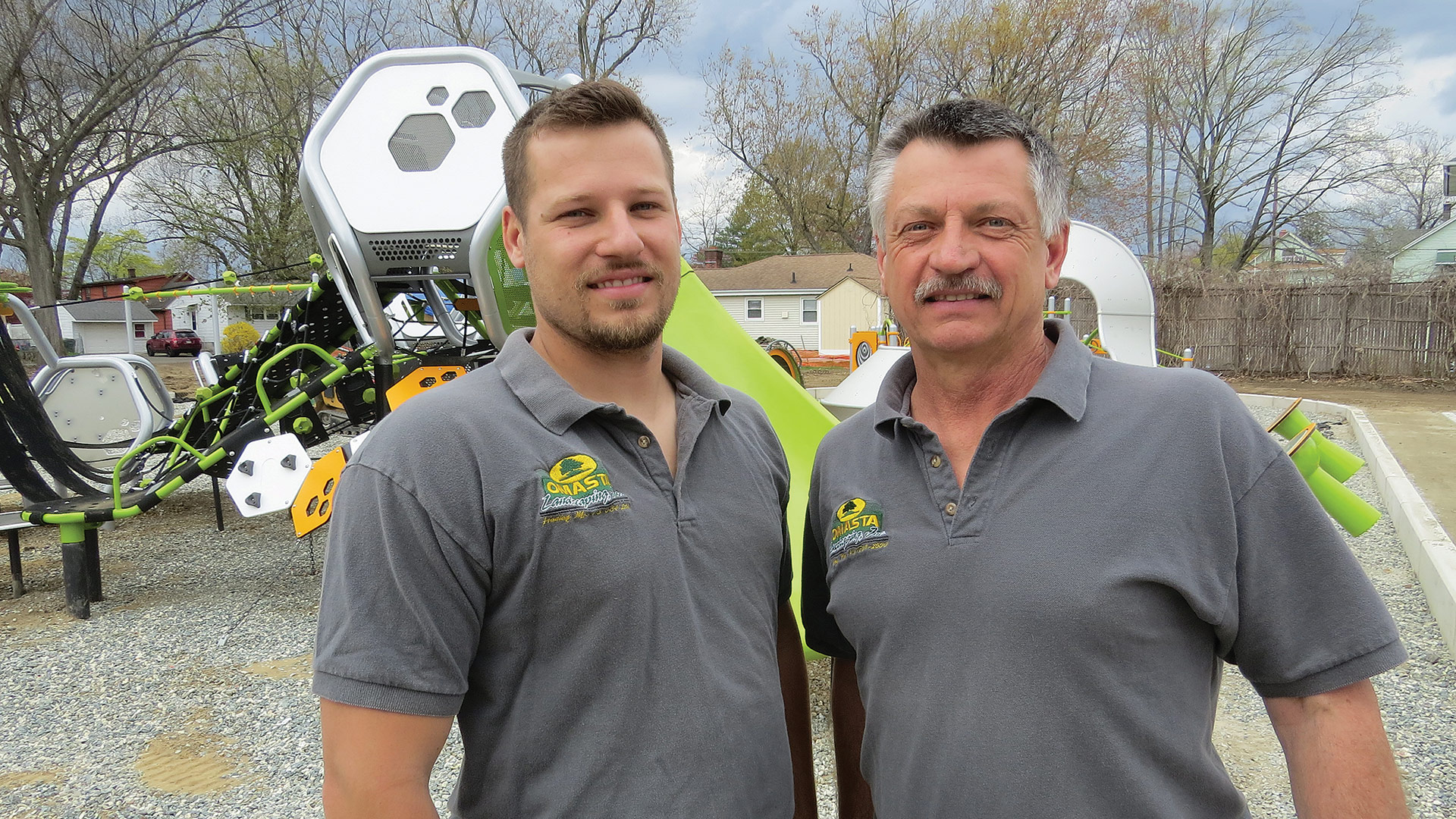
Greg Omasta, right, seen here with his son, Chris, at the new Walsh Park in Springfield, says his company has responded to the ongoing challenge of finding workers by hiking wages above the average for this region.
“Most of the states have done away with the requirement that people on unemployment actively look for work,” said Meredith Wise, president and CEO of the Employers Assoc. of the NorthEast, which has seen its hotline handle a number of calls related to this matter and a host of related issues. “In pre-pandemic times, if people were on unemployment, they had to prove that they were physically out there looking for work — applying for jobs, looking at the help-wanted ads, and actively seeking work. And those with the state would occasionally ask them to prove that they were doing all this. With the pandemic, the employment offices have been overrun, and states took away that requirement that you were looking for work.”
Perhaps the best hopes for area employers are that returning college students and area high-school students soon to be off for the summer might increase the pool of applicants — and that the unemployment benefits are due to expire in September.
But even those hopes are tempered by the realization that September is a ways off, and the benefits may well be extended by elected officials who have already shown a willingness to do that.
“It’s crazy what’s going on — and it’s across the board.”
So companies, some of them with the help of EANE and even area marketing companies, are honing their messages and updating their hiring strategies in the hope they will have enough warm bodies to take advantage of what is expected to be an uptick — if not a surge — in the economy.
For this issue, we look at what they’re up against and what they doing in the face of this growing challenge to their ongoing success.
As they talked with BusinessWest about the hiring challenges they’re now facing, business owners, almost with one voice, said that COVID has simply exacerbated a problem that has existed for some time now.
Indeed, the phrase ‘skills gap’ has been a part of the local lexicon for years now, with many businesses, especially those in manufacturing, but in other sectors as well, struggling to find adequate supplies of help, with the degree of difficulty varying with the relative condition of the economy.
Chad Jzyk, HR business partner for Charter Next Generation (CNG), a Turners Falls-based manufacturer of plastic blown film for the medical industry, said the company has been challenged to find help for several years now. But the problem has reached a new level in recent months.
“There’s not a huge availability of workers — the pipeline of basic-skilled applicants is really non-existent,” he noted, adding that the company has been running with one and a half to two open positions monthly on an almost constant basis for some time now. COVID has made the situation worse, at a time when the opposite might be expected because of the number of people out of work, and for several reasons, he said.
“With the stimulus checks and unemployment extension, the availability of workers has been impacted in a negative way,” he said, referring to both the number of applicants in the pool and their willingness to accept an employment opportunity.
“We’ve tried to engage with a couple of temporary agencies,” he went on. “In the past, it was common that you would have an applicant pool of temporary workers of between 15 and 20 people that were already pre-screened and ready to go — you’d call the employment agency and, pretty much on the spot, get someone in 24 hours. Working with a few local agencies that we’ve traditionally worked with … there’s no applicant pool; they’re seeing the same thing.”
Jzyk said the company’s hiring challenges have yet to directly impact production or limit its ability to take on new orders. However, he said it does limit CNG’s ability to be more “proactive,” as he put it, and do more when it comes to training and flexibility with employees’ responsibilities.
For other employers, the shortage of workers represents a real threat to day-to-day operations and especially the ability to handle the larger volumes of business expected as the region returns to something approaching normal as vaccinations rise and consumers venture back out to restaurants, bars, museums, stores, and more.
Nadim Kashouh, owner of Nadim’s Downtown Mediterranean Grill in downtown Springfield, said he’s looking forward to the return of shows to the MassMutual Center and other forms of vibrancy, but he quickly, as in very quickly, changed to the subject of staffing and his ongoing concerns about whether he can find enough help to handle whatever surge comes.
Meredith Wise says the escalating challenges facing employers looking to hire are prompting wage skirmishes in some sectors.
“I hesitate to get too excited because one of the things we’re dealing with right now is the lack of people who want to work,” he told BusinessWest, gesturing to a lighted message board behind the bar. Among the many messages being delivered is that help is wanted — and that display is just one of many ways that point is being made.
“We have created a commercial that focuses on how our patio will be open soon,” he said. “But it also notes that we’re looking to hire people — we need to keep letting people know that.”
Fran Beaulieu, second-generation president of Phil Beaulieu & Sons Home Improvement in Chicopee, said the hiring crunch, which is certainly nothing new for that sector, has resulted from a number of factors, with COVID-related issues being only the latest additions.
Overall, fewer people have been getting into the trades, he said, and this has left the region with a shortage of carpenters and other specialists.
“You basically have an entire generation that didn’t get into the trade,” he noted, adding that, despite a wide-ranging effort involving social media and other strategies, the company has a workforce that is 30% short of what is needed. And this harsh reality is certainly impacting the firm’s ability to take on jobs — at a time when jobs are plentiful, again, due to COVID and people home so much and often of a mind to improve their surroundings.
“Finding projects has never been the problem; the problem has been managing your labor in accordance with how many projects you have sold,” Beaulieu said. “You almost have to stop selling after a while because you just don’t have the help.”
In the wake of the ongoing struggle to find adequate supplies of help, area businesses are taking a number of steps, with aggressive marketing of their staffing needs being just one of them.
Indeed, companies have initiated hiring bonuses and rewards for those who refer candidates who eventually sign on. Meanwhile, others are hiking wages, said Wise, adding that, in some sectors, wage skirmishes have arisen, the likes of which have not been seen in some time, if ever.
“What we’re seeing happening, and it’s a little scary, is that, for some positions, wage battles have ensued,” she said. “People are saying, ‘I’ll pay you $2 more an hour to come work for me because I need the help,’ and the employee goes back to his employer and says, ‘they’re willing to give me $2 more an hour; will you give me $3 more an hour to stay here?’
“There are some positions where people are willing to pay a premium to get individuals to come to work,” she went on. “And it’s starting to affect different kinds of businesses.”
One of them is the broad landscaping and lawncare sector, she noted, which has historically faced challenges to maintaining adequate staffing and is now seeing its problems escalate due to the many aspects of COVID.
Greg Omasta, owner of Hadley-based Omasta Landscaping Inc., said this has certainly been a trying year.
“Most of the states have done away with the requirement that people on unemployment actively look for work.”
“The government incentives allow people to stay home and get paid more than if they actually went to their job on a daily basis — so some of the problems small businesses are facing in this country are inflicted by our government,” he told BusinessWest, adding that some of those the company had to lay off at the end of last season have opted not to come back when offered the chance, instead choosing to collect unemployment. “But there’s a general lack of people out there in the labor force who want to work hard, like in the trade we’re in, the landscaping business. A lot of people want to sit beyond a computer screen and punch a keyboard all day.”
Historically, the company, like others in this sector, has relied heavily on legal immigrants, many from Mexico and Guatemala, he said, adding that even this pipeline has become less reliable in recent years.
As a result of this ongoing challenge, he said the company has changed the way it compensates employees, with the goal of attracting and retaining better candidates. By and large, it’s a strategy that has worked, although this year, given the many additional COVID-related challenges and responses within the industry, it is certainly being tested.
“We’re probably one of the higher-paying landscape contractors in the area,” said Omasta, whose company handles a number of large commercial accounts and municipal facilities, such as the recently reopened Pynchon Plaza in downtown Springfield, as well as residential customers. “We do that because we try to attract better people and keep those people here. Paying that higher hourly wage makes a difference in the people that we’re able to find, keep, and employ.”
Corrigan, who can certainly relate to all that, said his company hired someone to handle recruiting full-time just before COVID hit. To say her job has become difficult, and frustrating, in the wake of the pandemic and the various stimulus packages would be an understatement.
“She’s at her wit’s end with people right now,” he said, adding that, between a hesitancy to work among many people and drug tests often standing in the way of those do want to work, the talent pool has become increasingly smaller.
Chad Jzyk
“There’s not a huge availability of workers — the pipeline of basic-skilled applicants is really non-existent.”
And this shrinking pool has definitely impacted Mountain View’s ability to expand the commercial side of its business and grow.
“We’ve had discussions — heated discussions — in our budgeting processes,” Corrigan said. “We ask ourselves, ‘how can you grow if you can’t get the help?’ And the obvious answer is, ‘you can’t.’”
It is that obvious answer that is keeping many business owners and managers awake at night.
Indeed, at a time when the challenges seem to be mounting for businesses of all sizes and in most all sectors — Omasta referenced the rising cost of materials such as lumber, still-escalating fuel prices, the specter of inflation, and the very real possibility of higher corporate taxes — finding good help is the one that poses the biggest threat to companies at a time when many are poised to break out from pandemic-induced doldrums.
What will happen between now and September, and even after September, remains to be seen, but it seems clear that these scary times, as Wise and others called them, are certainly far from over.
George O’Brien can be reached at [email protected]


Normalcy.
It’s an attractive concept these days, if an elusive one. Just ask the folks planning for the fall 2021 semester at the region’s colleges and universities.
“This fall, we’ll go back to some normalcy, with classes back in person full-time, students in the residence halls, and athletes on the fields,” said Jonathan Scully, vice president of Enrollment Management and Marketing at Elms College. “That’s the plan right now.”
Scully said Elms has long maintained a COVID-19 task force that meets every week to discuss public-health data, on-campus health metrics, current recommendations of the CDC and the state Department of Public Health, and, importantly, how faculty and staff feel about a full return. “That all played a part in making decisions for the fall.”
He noted that students seem excited about coming back to Springfield Street in Chicopee, even though the college’s ElmsFlex hybrid plan, by which students could learn on campus, remotely, or with a combination of both, has been well-received.
“We’re not fully remote; we had that ElmsFlex option, because some students learn better in person, and some did better virtually, and they had the ability to move between the two freely,” Scully said. “But everyone is looking forward to a return to normalcy.”
Western New England University (WNEU) was among just 27% of U.S. colleges and universities that opened to mainly in-person learning and residential living last fall and remained open through the 2020-21 year, having delivered about 75% of courses on campus and the rest through online and hybrid formats, said Bryan Gross, vice president of Enrollment Management and Marketing.
Jonathan Scully
“Because some students learn better in person, and some did better virtually, and they had the ability to move between the two freely. But everyone is looking forward to a return to normalcy.”
Two factors played into that success, he said: a culture of small class sizes (the average student-teacher ratio is 12:1) and plenty of space that made social distancing much easier to implement, and a commitment — a compact, really, among students, faculty, and staff — to make sure the campus could stay open.
“They adhered to that social distancing, we put up tons of signage, we brought in extra cleaning staff, we had plexiglass throughout … all those things contributed to the plan for the past year,” Gross told BusinessWest.
He noted that colleges and universities don’t have the luxury of making their fall opening plans in July or August; the shift on the fly to remote learning that happened last spring is not the preferred model for campus planning. So, while the course of the pandemic might still alter the plans before September, those plans still need to be made and set in motion.
At WNEU, that will mean all courses normally taught on campus will be, indeed, taught in person, with three-foot distancing in place and masks required, at least according to current guidance. While some hybrid options may be available, Gross said, “we feel Western New England is best with face-to-face classwork, and that’s what we’re moving forward with.”
American International College (AIC) is moving in that direction as well, said Matt Scott, vice president for Student Affairs.
For the current year, he explained, residence halls are open, and students are allowed to live on campus, but most classes are remote, and athletics have continued as normal. Surveillance testing for COVID is widespread, and other safety and sanitization protocols are a regular part of life.
For the fall, Scott said, the current plan is to go back to “whatever the new normal will look like,” but the goal being full residence halls and in-person instruction.
“We’re still waiting to see some state guidance — there’s K-12 guidance that came out in terms of desk distancing in classrooms and things of that nature, but they have not come out with specific guidance for colleges yet,” he added. “But that’s the plan.”
Chet Jordan
“Safety on our campus is paramount; one of the biggest considerations in our return to campus is how to utilize our space safely.”
The plan at most campuses, it turns out, is for normalcy, or, as Gross noted, whatever that term might mean come September. But optimism is high that college life will finally begin to look like it used to.
Community colleges, for the most part, were more fully remote than most schools, and are being more cautious with their return to normalcy. For example, Greenfield Community College (GCC) will offer classes in a face-to-face or hybrid format, meeting at least once a week on campus with some possible online instruction as well.
“Safety on our campus is paramount; one of the biggest considerations in our return to campus is how to utilize our space safely,” said Chet Jordan, dean of Social Sciences and Professional Studies at GCC. “Our faculty and staff have been almost entirely remote for the past year, so their input in how we can phase in a slow reopening of the campus was essential to us.”
GCC brought together a group of faculty, staff, and administrators to talk through the complexities of a reopening, eventually crafting a hybrid model. “We want to make sure our faculty and staff feel safe when they return to campus,” Jordan added. “The situation is constantly changing, but we addressed the key questions as best we could.”
Students in GCC’s health-career programs will meet on campus in hands-on courses to best prepare them for essential jobs in the growing healthcare industry. Those in other professional programs, such as business and education, will also have on-campus options. In most programs, students will complete some of their coursework online and will participate in weekly experiential learning opportunities, including lab activities and field trips.
GCC will follow state guidelines on occupancy rates in classrooms and offices, mask requirements, and health screenings, as well as maintaining scrupulous air-quality practices and a thorough sanitizing schedule.
The class schedule is roughly 55% online and 45% in person, Jordan said, which allows time to space out the classes between sections to avoid a bottleneck of students entering and exiting, while maintaining appropriate distancing.
“It gives students who want to be on campus that in-person experience, but also flexibility the rest of the week to finish online,” he said, adding that the library will be available for students to access a virtual class between in-person sessions on any given day. “So they won’t have to jump between campus and home, we’re giving them space to do a remote class and then go to their next class on campus.”
Bryan Gross
“The long and short of it is, we’re hopeful to have a more normal, on-the-ground campus experience for our students and families.”
UMass Amherst also expects campus life to return to normal operations in fall 2021. That means an emphasis on face-to-face instruction, full residence halls — an expected 13,000 students will live on campus — and a complement of student events and activities.
Planning for summer orientation is well underway, as new students will be invited to participate in a series of synchronous and asynchronous orientation programs over the summer before they arrive for in-person welcome sessions at the end of August.
This past fall, many first-year students who would have experienced on-campus housing for the first time did not get that opportunity. So, in an effort to support these students, freshmen and sophomores will receive priority consideration to select on-campus spaces this fall. Still, based on current interest, UMass expects to be able to meet all housing requests, including all interested juniors and seniors.
Finally, UMass announced that its renovated Student Union is now open, offering space for events, student organizations, student businesses, and a ballroom.
The campus experience is more than academics, WNEU’s Gross said, noting that the university creative in finding ways to bring students together for small-group activities in the campus center. This fall, he expects larger outdoor activities, including intramural sports, to return, as well as indoor events as long as safety protocols are followed.
“The long and short of it is, we’re hopeful to have a more normal, on-the-ground campus experience for our students and families,” he said, including a big homecoming event inviting back the 2020 graduates, who were unable to have a traditional commencement experience.
In his first year working at GCC, Jordan said he has been “incredibly warmed and inspired by the creativity of the faculty, who do anything they can do make sure students have the best experience.”
For example, science classes have included more outdoor, experiential learning. Meanwhile, students in the health sciences have been on campus throughout the pandemic, due to the unique, hands-on needs of their training. “They paved the way,” he said. “They’re the ones who figured out how to open as safely as we possibly can.”
At AIC, students in those fields have been diligent about safety protocols and personal protective equipment, Scott said. “Because they’re health-science students, they tend to take it a little further than some of our other students. If they’re getting up close and personal, they’re wearing face shields and masks and such.”
Particularly during the 2020, he noted, constant pivoting was the order of the day for college faculty and administrators, who had to constantly monitor the development of the pandemic and guide a testing and safety plan for their campuses.
“But I think, overall, our plan stayed the same,” he added. “We thought it was safest this year to keep as many students remote as possible and have some in-person experiences that are kind of controlled for the pandemic-related protocols we had in place. That all stayed the same throughout the year, but the way we approached them adjusted as we needed to.”
Some of the lessons learned led to positive developments, said Kerry Cole, vice president for Admissions at AIC. For example, the college used to deliver its certificate of advanced graduate study (CAGS) programs for teachers at 11 physical sites. Once the program was forced online by COVID, administrators began to hear from the grad students that they loved it.
“So, beginning in the fall, we’re moving to a virtual format throughout the state, where we’re able to deliver licensing programs in a virtual format for all the programs we offer,” Cole said. “That came directly from students. They wanted virtual — not online, but virtual, synchronous, so they can communicate with each other.
“We’re very, very excited about it,” she went on. “Our teachers now need more flexibility than ever. They’re rock stars, and we need to be able to support them.”
Scott agreed, noting that there were many instances where he and others said, “wow, we didn’t realize this would work, that students would enjoy this.” One example is online counseling services, which are now much more accessible to commuter students.
That doesn’t mean students don’t want to return to in-person learning, of course; for the most part, they certainly do. But they’ve handled an unusual year well, he said.
“I am amazed every day how well our students are doing with these protocols. You’ll always have the occasional mask below the nose, and that’s going to happen, usually because they have a mask that doesn’t fit them well. But we have not really had any issues with students giving people a hard time when they’re entering the dining commons to get food. We planned for that; we asked, ‘how are we going to deal with the student who shows up and flat-out refuses to wear a mask?’ But we have not had that happen.”
In fact, the worst incidents have been the occasional group of students who head to the mall and don’t wear masks in the car.
“They’re not supposed to do it, but there are far worse things they could be doing and far worse ways they could be violating our protocols,” Scott said. “We try not to have a heavy hand; we try to take an educational approach and make sure they understand the potential impact, the ripple effect those actions can have on the community. But we’ve been very impressed with the way our students have responded this year.”
Enrollment dipped last year at many colleges due to uncertainty about what the academic experience and college life would entail, but most area institutions see the application and enrollment numbers on the rise in 2021.
“Along with the rest of the community-college sector, we saw a decline over the past year, but that was an anomaly,” Jordan said. “In most recessions, community colleges do really well, but this was the reverse; this sector was the hardest-hit. The reason is that low-income students and students of color have been unprecedentedly hit by this pandemic, and those are our students.”
It’s especially important, then, for community colleges to offer a flexible model during these times, and that’s what GCC is aiming for, he added.
“We want to be sure we’re reaching students at home with kids, so those students can take classes online, and also opening the campus in such a way that students who need to be on campus will get that in-person instruction. Having more flexible classroom options will invite more people back.”
Cole said AIC successfully implemented the plan it thought best for 2020-21, and will now expand upon that.
“We’re very excited about it,” she said, noting that campus tours have begun again, and the campus hosted its first in-person admissions event of the school year in mid-April. “Graduate students love virtual info sessions and open houses. Undergrads are a mixed bag, but graduate students will take it all day. So we’ll likely keep some of that.”
Scully said nothing is set in stone when it comes to pandemic planning; the past 13 months at the Elms have been proof of that.
“We’re monitoring everything very closely, and our first priority is the safety of students and staff,” he said. “We know things could change on a dime.”
Elms, like many colleges, already offered some programs online before the pandemic, and has since bolstered the technology to conduct those, having purchased new cameras, microphones, and other equipment. “But, like everyone else, we’re looking forward to getting back to normal.”
And doing so safely, Gross said.
“I’ve never been so proud to be part of an organization as I’ve been of our students, faculty, and staff over the last year and a half,” he said. “I can’t stress how many extra hours our faculty and staff put into adjusting curriculum, adjusting extracurriculars, and changing everything we do, from open houses to the way we engage with current students, prospective students, and alumni. It was a group effort in flexibility, agility, determination, and energy.
That said, “the community is tired,” he went on. “We’ve been going non-stop; I can’t tell you how many faculty and staff have told me about the extra hours they’ve put in over the weekends. We’ve all been chipping in to do whatever it takes to keep things safe and enjoyable for students.”
But there’s no time to take a break. Not with the fall semester right around the corner.
“Things are constantly changing,” Gross said. “We’re all learning as we go. But we are a learning organization, after all.”
Joseph Bednar can be reached at [email protected]


When COVID-19 forced a shutdown of the economy 13 months ago, Jeff Daley said, the impact on development was immediate.
“Everything came to a grinding halt,” the president and CEO of Westmass Area Development Corp. told BusinessWest. “The first few days, watching the economy tank, people were scared — they didn’t know where this was going to go.”
It became clear over the next several weeks, however, that projects would continue, and Westmass ramped back up fairly quickly, even as the health implications of the pandemic remained daunting (and, of course, still linger, despite the availability of vaccines).
“It changed the way we did business, though,” Daley added. “Zoom calls with state agencies and local agencies increased from zero to 100% in the first few months. We had to adjust quickly to having meetings and approvals and denials with a different form of communication.
Jeff Daley
“We saw some hiccups at the beginning of the pandemic, but when things started ticking up again, it appeared state agencies really had their stuff together, as well as cities and towns.”
“I give credit to towns and cities across the Commonwealth; everyone adapted really quickly,” he went on. “We saw some hiccups at the beginning of the pandemic, but when things started ticking up again, it appeared state agencies really had their stuff together, as well as cities and towns.”
Daley recently took part in a wide-ranging roundtable discussion with BusinessWest about the impact of the pandemic on development and environmental regulation. Also taking part, each bringing a different perspective to the discussion, were David Peter, principal with Site Redevelopment Technologies; Ashley Sullivan, president of O’Reilly, Talbot & Okun Associates (OTO); Mike Gorski, regional director of the Western Regional Office of MassDEP; and environmental attorney Christopher Myhrum.
Peter, whose company cleans up contaminated sites for redevelopment — including, recently, the Games and Lanes brownfields site in Agawam — said the new paradigm of communicating has been a challenge.
“It’s difficult to move forward,” he said. “We rehab sites that have been dormant for many years due to contamination, and it’s very difficult for us right now because a lot of it is interpersonal relationships — meeting with regulators around a table with big maps — and we can’t do that anymore. We’re at a real slowdown for any project still in the planning stages.”
Projects in active development are a different story and, in some cases, have benefited from the pandemic, he added. As one example, last spring, the firm was hauling lightly contaminated soil from Beth Israel Hospital in Boston to a site in Rhode Island, and was able to conduct about twice as many trips as normal due to the lack of traffic on the road during the economic shutdown.
“If you owned, say, a restaurant when this happened, you were severely hit. But many essential businesses benefited, like our trucking situation,” Peter said. “But the biggest impact was not being able to sit down with regulators, politicians, and neighbors. It really slowed us down.”
Sullivan agreed. “In general, we did see a slowdown, and some of the logistics became difficult; there was definitely an adjustment period. But I’ll say we adapted pretty quickly, which was amazing to see,” she said, noting that the company had recently made some investments in technology that eased the transition into a different way of conducting business.
David Peter
“It’s very difficult for us right now because a lot of it is interpersonal relationships — meeting with regulators around a table with big maps — and we can’t do that anymore.”
And that transition was happening whether or not everyone was ready for it.
“If you had asked me two years ago if we could our job remotely, I’d have said, ‘absolutely not,’” Gorski said. “But we’ve been remote since St. Patrick’s Day 2020. It took a few weeks to figure things out, with staff working at home, and we made some long-term improvements in technology for certain staff.”
Since then, he added, the process has been smooth, if not ideal. For example, early on, “we were very, very lenient in terms of inspections,” but the office was able to conduct limited risk-based determinations and emergency-response actions. “Staff still needed to visit spills on the highway and other releases.”
MassDEP complemented any necessary in-person visits with virtual inspections through FaceTime video and submitted photos, Gorski added. And after the initial slowdown, the pace of activity has been relatively stable.
“We’ve been on par with past years with the number of inspections in the Western Region, with enforcement numbers being a little bit down,” he said. “I think we’ve done pretty well keeping a presence out there and, more importantly, keeping our staff safe and meeting COVID protocols.”
Myhrum knew any leniency wouldn’t last. “I think clients recognized the likelihood of reductions in inspections at the start of the shutdown order, but they were cautioned, at least by me, that inspections were likely to come back,” he said.
Myhrum, who also serves on the Westmass board, agreed with the other roundtable participants that various stakeholders in the development process, from developers to inspectors to municipal officials, handled the transition to remote operations remarkably well. And he believes the construction and development sector is on the rise after an unusual year.
“Yes, construction was deemed essential, but behind that are a lot of support organizations, and things necessarily slowed down,” he said. “And that has created a lot of potential energy for when things return to some semblance of normal. Beyond that, it has been something of a brave new world, but the adaptability to remote work has been striking.”
The most distressing pandemic-driven change in Gorski’s job is “the inability to collaborate on certain projects, to sit around a table and push those plans back and forth,” he said, adding that his agency and others have come up with some innovative ways to collaborate remotely. “We’ve become more productive in some ways. And there are some efficiencies with working from home. But we do miss out on the ability to build off collaborative ideas.”
Myhrum agreed. “Screen sharing cannot substitute for a 24-by-36, or larger, exhibit in terms of communicating ideas and demonstrating evidence of what one wants to do. It’s essential to not only understanding what a project is, but also building the trust that’s necessary among the parties to reach a goal together. I believe collaborative efforts within the office are very, very important.”
Some ways business was done in the past won’t completely return, he added, like the idea of people flying to and from California to attend a 15-minute pre-trial conference. “That’s gone; everything is done remotely, through Zoom or Teams or other platforms.”
But to undertake truly effective negotiations and other business, he went on, in-person meetings need to remain an important component.
Ashley Sullivan
“They were backing off enforcement a little bit, but it was unofficial. Some of it wasn’t clearly communicated.”
Everyone figured out the new normal together, Gorski said, and that included the DEP. “We were very lenient during the first couple months, recognizing that companies were under a tremendous burden in terms of staffing. Once they figured out how to do things remotely, we started getting back into a normal program.
“Now, while we’re certainly not normalized, our inspection numbers here in the Western Region are on par with past years,” he added. “Some of the enforcement penalty numbers were down as well — we were careful how we adjusted penalties because of COVID — but that’s getting back to normal, too.”
Daley noted that any slowdown in regulatory activity was matched by a curtailment of development. “Everyone was trying to figure things out in the first month or two; I don’t think anyone was trying to move projects forward at a rapid pace. It all played in concert; environmental programs were moving forward at the same pace developments were with COVID.”
Sullivan said it was natural for the pace of activity to slow down as the logistics became difficult. She noted that her firm performs many environmental site assessments, doing due diligence about what a project’s environmental concerns may be, which requires communication with fire departments, boards of health, and other municipal departments. “A lot of those were closed for a while, the process would get delayed, and that would, in essence, delay the whole project.”
Reviews on the regulatory side slowed down locally as well, she said, but grace periods became the norm. “They were backing off enforcement a little bit, but it was unofficial. Some of it wasn’t clearly communicated, particularly in the first eight to 12 weeks, and we wondered when things would start up again.”
No one was surprised when it did, Myhrum said. “Massachusetts certainly has a reputation for sound and aggressive environmental enforcement, as well as rigorous regulation, which has gone hand in glove with statutory and regulatory requirements.
“I know, during the pandemic, we had two different cases involving air permits, which can be among the most complicated DEP issues,” he went on. “Those two permit applications were turned around faster than any we’ve worked on. I’d like to think we did a good job on the applications, but the turnaround times were most satisfactory to our clients.”
It’s difficult to gauge how the pandemic has affected regulation on the national level, Myhrum said, adding that a change in presidential administration will likely have a greater impact.
Christopher Myhrum
“I think one would be in error to believe the EPA’s priorities and activities are going to continue the way they did under the previous administration.”
“The EPA under Trump was not known for being particularly aggressive, having a former coal lobbyist as its administrator. So I think one would be in error to believe the EPA’s priorities and activities are going to continue the way they did under the previous administration. I think it will be interesting to see how the situation plays out.”
Another issue impacting developers during the pandemic is the shift by so many companies to remote work, Peter said, noting that he does a lot of work in the seaport district of Boston, and commercial real estate there is worth about 50% of its pre-pandemic value, while suburban locations with plenty of fresh air and space have risen in value.
That trend may not last forever, Daley said, for some of the communication-related factors mentioned earlier.
“Once the pandemic subsides a little bit, I think people will go back to the office, if for nothing more than partnership and collaboration efforts,” he noted. “I know we do a lot of work on 24-by-36 paper and laying things out, and it’s hard to do that in a Zoom meeting, to look at plans and assess the true value of what you’re going to do.
“Not everyone will go back to work — I agree with that — but I do think, as time goes on and the pandemic hopefully subsides and we pass through this, people have to go back to the office, at least on a hybrid basis,” he went on. “I’m a firm believer in working together and collaborating, and Zoom doesn’t really produce that.”
Last month, Gov. Charlie Baker signed a new climate-change law that codifies a commitment to achieve net-zero emissions in 2050; authorizes the administration to implement a new, voluntary, energy-efficient building code for municipalities; allows the Commonwealth to procure additional offshore wind energy, and — most notably for urban developers — significantly increases protections for ‘environmental justice communities’ across Massachusetts.
EJ communities, as they’re known, are those which have, historically, been overburdened by poor air quality and disproportionately high levels of pollution; they are often low-income. The new law requires an environmental-impact report for all projects that affect air quality within one mile of an EJ neighborhood, and requires the DEP to conduct a stakeholder process to develop a cumulative-impact analysis as a condition of permitting certain projects.
“That’s needed, I think,” Daley said, noting that he hopes the environmental council the law calls for has adequate representation from EJ communities in Western Mass. “It’s important that we have representation on that council. Far too often, Western Mass. has one token person on a committee, and 17 from the Boston area. This is a great start, but our people need to have a say.”
Gorski said the emphasis on environmental justice is positive because people have a right to a meaningful say in what goes on in their neighborhoods.
“The DEP has had an EJ policy for some time, and we’ve had public involvement in the planning process, but the climate bill now makes that law, and we’re going to be proactively reaching out to various community groups to involve them and educate them, so when we have these public hearings for complicated permits and things of that nature, people understand what we’re talking about, and can come at it from a knowledgable viewpoint, rather than just ‘we don’t want that in our neighborhood.’ It’s important to give people a voice.”
Myhrum agreed. “EJ has evolved from policy to statutory law in Massachusetts,” he said. “People will have the opportunity to participate in an interactive way to discuss the impact and specific ways people are affected.”
It’s important to remember, Sullivan noted, that development projects in urban areas often have a positive impact on the environment, especially those that remediate brownfields and other contamination.
“I’d love to see more mixed-use revitalization and really cleaning up some of these issues,” she said. “At OTO, we love working on these projects, and we’re happy when there’s more funding and regulations pointing that way — if a development can be done in a way that could be responsible, with some thought behind it.”
While he believes there’s significant pent-up energy in the development community, Daley understands plenty of changes are coming related to energy and other aspects of doing business. In the short term, though, the way the pandemic has altered business as usual may have a broader effect.
“Is COVID going to be a transitional time for business, or is it transformational? It’s going to be both,” he said, answering his own question. “It’s going to be transitional in the way we do business, whether it’s the regulatory process or the actual development, lease, and sale of properties and the way they go to market. But it’s also transformational — an opportunity to rethink the way we do business, shifting us more into the digital age.
“I don’t think the office space will ever go away,” he went on, “but [technology] allows people to be more creative with their time and productivity and the way they do business.”
Even though MassDEP is still working largely remotely, Gorski said, “we look forward to getting back to hybrid, or something approaching normal operations. We’re still available for technical assistance, and we still want to collaborate to move projects forward.”
Depending on the project, Sullivan said, OTO works with developers, property owners, other civil engineers, structural engineers, attorneys, regulators … the list goes on, and speaks to the importance of communication, and the ways in which it has been altered by COVID.
“Each of those has been impacted similarly during the past year,” she noted. “We did adjust to not being face to face, but there’s so much that can be accomplished face to face, meeting on site. When that goes away, things slow down, and your meetings aren’t as effective.”
But her firm, like everyone else in the broad, complex, cross-disciplinary business of development managed to adjust, and even learned a few lessons about pivoting and melding traditional and remote ways of doing business.
“This is the new way,” she said. “We’ll take the best of both worlds and hopefully move forward.”
Joseph Bednar can be reached at [email protected]


By Mark Morris
As the world begins to emerge from the pandemic, many businesses that survived are trying to understand what the new landscape will look like.
Right now, many business owners are trying to figure out when and if their employees should return to the office or continue to work from home. Either way, access to technology plays an increasing role in getting the job done.
For example, said Delcie Bean, CEO of Paragus Strategic IT, before the pandemic, many businesses were getting by with outdated communication and collaborative tools and depended on e-mail and phones to support their working environment.
“When the pandemic hit, they had to suddenly adopt new technologies like Zoom, Microsoft Teams, or other virtual platforms to keep doing business. Almost overnight, we had to set up about 4,000 people to work remotely who weren’t previously set up to do so.”
“When the pandemic hit, they had to suddenly adopt new technologies like Zoom, Microsoft Teams, or other virtual platforms to keep doing business,” Bean said, noting that, as employees in many industries were sent home to work remotely, local IT firms saw a huge influx of work. “Almost overnight, we had to set up about 4,000 people to work remotely who weren’t previously set up to do so.”

Delcie Bean
Sean Hogan, president of Hogan Communications, said the last time businesses experienced this much disruption was October 2011, when a surprise snowstorm knocked out power for thousands across the region. This time, the disruption has had a more profound and lasting impact.
“The pandemic woke up a lot of people and forced them to understand they’ve got to change the way they do business,” Hogan said, explaining that, while the pre-Halloween storm a decade ago encouraged investments in backup generators, the pandemic has shown many the importance of storing data in a remote data center, commonly known as the ‘cloud.’
In Bean’s estimation, the idea of a business keeping a server at its facility to host its network is already a legacy model that was on its way to being phased out in the next five years.
“COVID dumped gasoline on that timetable and made converting to the cloud a much higher priority,” he said. With cloud-based technology, employees can more easily access their company’s network from multiple locations and devices.
Resistance to change comes natural to New England business owners as many prefer to keep their data on a server in their office. Hogan often explains to these reluctant clients that cloud-based data centers have spent millions of dollars to make sure there is a disaster recovery set up, as well as backup systems for power, internet and HVAC.
“The average business owner couldn’t afford to make that type of investment to keep their data safe,” Hogan said. “So when people say they don’t trust the cloud we point out how much more reliable it is compared to their office.”
BusinessWest spoke with a number of local IT providers about what several of them called the ‘roller-coaster year’ we’ve just had and what’s on the horizon. As business owners themselves, they, like their clients, have had to figure out how to keep things running during a pandemic and anticipate what that means in the long term.
“I’m looking at the service tickets we’re completing while working remote, and they are right on par with where they were when we were in the office. In fact, we might be a little more efficient.”
As an IT-services vendor, Bean believes firms like his should be a little ahead of the curve so they can test new technologies before they recommend them to clients. For example, Paragus employees have been on the cloud and set up to work from anywhere since June 2019.
“So when the pandemic struck, moving our staff remotely was pretty seamless,” Bean said. “About 80% of our people work remotely, and 15% to 20% come into the office on any given day.”
Jeremiah Beaudry, owner of Bloo Solutions, said his employees are working so well from home, it’s not necessary to come into the office. He noted that productivity has not suffered, and employees have less stress.
Jeremiah Beaudry
“I’m looking at the service tickets we’re completing while working remote, and they are right on par with where they were when we were in the office,” Beaudry said. “In fact, we might be a little more efficient.”
One important thing businesses have learned from the pandemic, according to Charlie Christianson, president of CMD Solutions, is that it’s OK to work from home.
“We can do a lot more than we thought we could outside of the office,” he said. “People are far more open to remote work, and there’s no mystery to it anymore.”
While some of Hogan’s employees have always worked remotely, the percentage has grown, and their efficiency allows them to escape the daily commute. “They don’t need to be behind a windshield for an hour and a half each day just getting to and from work,” he said.
When companies first sent workers home, IT providers spent most of their time helping clients integrate employees into their respective networks. While they suddenly had a huge amount of work, IT professionals did not see much revenue because many clients had contracts to cover this extra work. Increased revenue soon followed, however, as many new clients sought these services.
“We signed more new customers in 2020 than the previous two years combined,” Bean said, adding that much of the new business came from companies that found their dependence on technology had suddenly increased and their IT capabilities couldn’t meet these new demands.
In addition to new clients coming on board, Christianson explained that many of his current clients, who at first only wanted a “down-and-dirty” setup for remote access, were now looking for a more permanent solution for their network.
“We can do a lot more than we thought we could outside of the office. People are far more open to remote work, and there’s no mystery to it anymore.”
“Those of us in the IT industry are very fortunate,” he said. “We have done well during this time and were not hit hard like so many other industries were.”
With the end of COVID in sight, businesses have begun looking at what comes next. Those we spoke with agree on one thing: it will not be business like it was before or even during the pandemic.
“Most of our clients want some hybrid between those two options, where there is more in-person interaction than during the pandemic, but probably not as much as there was before,” Bean said. Once people started learning videoconferencing and Microsoft 365, he noted, they saw how helpful these tools can be even when everyone is in the office.
As IT providers continue to transition their clients from premise-based servers to the data cloud, they also predict other big shifts on the horizon. For example, with so many companies using smartphones and laptop computers to make calls, the company phone system may soon be a thing of the past.
“A few years from now, the idea of having both a computer and a phone on your desk at work is going to be a very strange concept,” Bean said, especially when companies consider the economics of supporting two systems that make phone calls.
While the demise of the office phone seems inevitable, office space itself could be in for a big reduction, Christianson added. “We’ve seen a lot of instances where people are moving from bigger spaces to smaller ones. They are making the calculation that some people are not coming back.”
Charlie Christianson
Even if it’s in a smaller space, Hogan asserted that an office presence is still vital. “I don’t think we’ll go back to the way it was before, but many people still want to return to their offices, even if only for collaboration and camaraderie.”
Because Zoom and other virtual platforms make it easy to meet with people anywhere, companies have begun to look more closely at their business travel budgets, too. CEO clients have told Beaudry they will not eliminate business travel, but will look to reduce it to only what is necessary.
“One CEO who used to travel 40% of the year said he plans to move most of his meetings to virtual platforms,” he said. “He figures to be 10 times more efficient and save his energy from traveling all over the country.”
As much as Bean would like to see some of the fatigue and expense of travel go away, he also admits that important interactions happen in person that just don’t occur in a virtual setting. He gave an example of logging on to hear a keynote speaker versus attending the event in-person.
“Oftentimes, the person sitting at my table is more valuable to me than the keynote speaker,” he said. “That person might lead to a great networking opportunity where they need my services, or maybe they have a service I need.”
While working at home can provide many benefits for employees and their companies, IT providers say it comes with a whole new array of challenges. Looking at a business with 30 employees, Beaudry gave an example of how quickly technology issues change when working remotely.
“If half the employees work from home,” he said, “the company has gone from managing one network to dealing with the struggles of 15 home networks.”
Common issues when working at home include internet signal strength and the different types and capacities of home modems. Topping all those concerns, however, is the increased vulnerability to a company network getting hacked.
All it takes is one employee to click an attachment in a suspicious e-mail, and the whole network can be damaged by a cyberattack. When working from home, Beaudry said, employees are less likely to ask the simple questions when they confront something that looks suspect.
“You don’t have someone turning to their co-worker, saying, ‘hey, did you get this e-mail? It looks weird,’” he said, adding that he encourages his clients to call whenever they see anything suspicious. “If you take 30 seconds to call and ask, it can save you a week of losing your computer.”
Christianson said cybersecurity is a never-ending battle. “Hackers are always looking for ways into your network. They only have to be right once; we have to be right all the time.”
That’s where IT service providers come in. While today’s technology tools are better than ever, Bean said IT pros can set up a company’s system to make it work best for its needs and stay current on all the security threats.
Beaudry compares his work to that of a plumber. “People need computers for business just like they need water in their home and business,” he said.
And, just like plumbing, if security on a computer network isn’t handled properly, you can have a real mess on your hands.