Home Archive by category Sections (Page 56)

Sections

Features

Don’t Overlook R&D Tax Credit

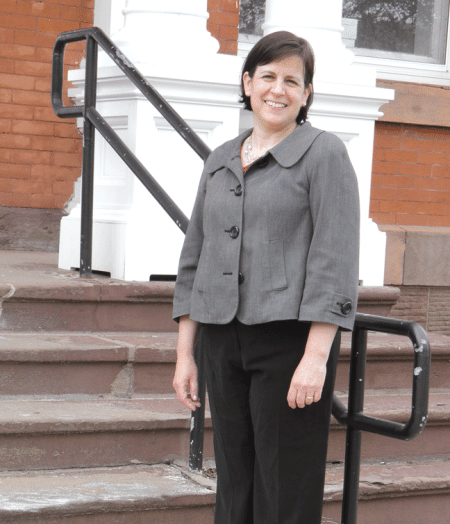
By Carolyn Bourgoin, CPA

Carolyn Bourgoin

Carolyn Bourgoin

If your business employs engineers, architects, chemists, or software developers, it is worth investigating whether the research and development tax credit is available and of benefit to your company. Any business that is working on the design or development of a new or improved product, technique, or formula that will be held for sale or used in its trade or business may have incurred qualifying expenses. Additionally, legislation signed into law in December 2015 (the PATH Act) now allows for eligible small businesses and flow-through entities to take the credit to offset the alternative minimum tax (AMT). This news alone should make taxpayers revisit the potential benefits of conducting an R&D tax-credit study.

Many businesses often overlook the R&D credit, thinking they do not fall into industries typically associated with performing research and development activities.”

Though tax-reform legislation may be passed in the near future with the expectation of eliminating certain tax incentives, the R&D credit has broad bipartisan support and will remain part of the tax code. The credit was specifically listed by the administration and the congressional tax-writing committees in their initial tax-reform framework as an incentive that must be preserved due to its proven effectiveness in “promoting policy goals important to the American economy.” Rest assured, the credit will be retained.

Qualifying Industries

Many businesses often overlook the R&D credit, thinking they do not fall into industries typically associated with performing research and development activities. While manufacturers and software developers are commonly considered, other industries, such as food processing, tool & die, beverage/brewing, and construction, just to name a few, have qualified for the credit.

Qualifying Research Activities

In order to qualify for the R&D credit, a taxpayer’s activities must meet a number of requirements. The taxpayer must perform the research for the purpose of discovering information that is both technological in nature and intended to help in the development of a new or improved business component.

Substantially, all of the research activities must be undertaken as part of a process of experimentation designed to evaluate alternatives that eliminate uncertainty regarding the development of a business component. Eligibility for the credit does not depend on the research being successful.

Qualifying Expenses

The main types of expenditures that qualify for the research credit are employee wages for either performing or supervising the research, as well as supplies used while conducting the research. Amounts paid to another for the right to use computers when conducting research qualify, as well as 65% (which may increase) of contract research expenses paid for qualified research. Expenses related to efficiency surveys, routine data collection, and quality-control testing do not qualify for the credit.

Credit Computation

The regular research credit is equal to 20% of current-year qualified research expenditures that exceed a base amount for that year. Due to credit limitations, no more than half of the current year’s qualified research expenditures can qualify for the research credit if this method is used.

Alternatively, taxpayers can elect to claim the Alternative Simplified Credit, which is equal to 14% of the excess of qualified research expenses for the year over 50% of the average qualified research expenses for the three tax years preceding the tax year for which the credit is being determined. This percentage may be increased under the proposed tax-reform legislation.

The credit can currently be carried back one year and carried forward for 20 years.

Creditable Against Other Taxes

As mentioned earlier, the R&D credit can offset the AMT tax for eligible small businesses (i.e. less than $50 million in average gross receipts for the prior three years) for tax years beginning on or after Jan. 1, 2016. The current tax-reform framework also calls for repealing the individual AMT tax altogether, thereby removing this restriction on the use of the credit by owners of a flow-through entity. The AMT restrictions often deterred eligible businesses from having a research study done in the past.

Certain small businesses (mainly startups) now have the ability to elect, on a quarterly basis, to use their research credit to offset the employer portion of their FICA payroll-tax liability. For tax years beginning after Dec. 31, 2015, businesses that have less than $5 million in gross receipts in the current year and that did not have any gross receipts for any tax year preceding the five-year tax period ending with the tax year, can use the R&D credit as a payroll-tax-credit offset rather than an income-tax offset. This is helpful to startup businesses that may not have a tax liability in their early years due to net operating losses.

Documentation and Substantiation

Taxpayers must be able to substantiate that their expenditures qualify for the credit. If you are considering going back to claim an R&D credit for a prior year or considering claiming the credit for the current year, it is advisable to have a persuasive research credit study done, because this will help connect the company’s expenditure records to the amount being claimed as qualified research. Time surveys and qualified activity narratives of employees with direct knowledge of the activities will result in supporting documentation that can be supplied in case of an audit.

State Considerations

Massachusetts allows for an R&D credit for qualifying research performed within the state. The credit is equal to 10% of the excess, if any, of the qualified research expenses for the taxable year over a base amount plus 15% of basic research payments.

Effective for tax years beginning after Jan. 1, 2015, Massachusetts now allows for an alternative simplified credit similar to the federal credit but using lower credit rates. If your business operates in states other than Massachusetts, consult your tax advisor to determine whether the R&D might apply in those states as well.

Conclusion

Because the research and development credit will be retained even with the potential tax reform, it is worthwhile investigating whether your business might qualify. Revisiting annually any changes that are being made to improve a product or develop a new product should be discussed with your tax advisor.

Carolyn Bourgoin, CPA is a senior manager with Holyoke-based public accounting firm Meyers Brothers Kalicka, P.C.; (413) 322-3483; [email protected]

Education Sections

The Plot Thickens

An architect’s rendering of the new branch library to be built in East Forest Park.

An architect’s rendering of the new branch library to be built in East Forest Park.

As she talked about libraries, and borrowed (that’s an industry term) from Mark Twain when she said their death was greatly exaggerated, Molly Fogarty used some words and phrases that definitely brought her argument home.

That’s because these are not the kinds of things that would have been said about these institutions a century ago, or perhaps even a decade ago.

“Libraries help level the playing field,” said Fogarty, director of the Springfield City Library. “They help people cross the digital divide; they’re technology hubs.”

Elaborating, he said that, in this computer age, access to the Internet isn’t anything approaching a luxury. It’s a necessity, for those who want to learn, apply for a job, or fact-check a work project.

And providing that access is just one of the ways libraries have changed over the years, from when they were mostly, but not entirely, book repositories.

“Books are still a big part of what we do, but there’s so much more,” she said. “Libraries are the one place where you can get help, get questions answered, use a computer, borrow materials, attend a program … and it’s all free. We have 700,000 visitors a year, and if we weren’t here, where else would they go?”

Molly Fogarty

Molly Fogarty stands in Wellman Hall at the main branch of the Springfield City Library. It’s empty at this moment (the library was closed at the time), but within five minutes of opening each day, she said, each computer is occupied.

Which brings us to the planned new East Forest Park branch of the Springfield Library. This is a facility that has been talked about for decades, and it’s been on the proverbial drawing board for a few years now. Funding has been secured from the city and state that will cover a good deal of the $9.5 million price tag, and a capital campaign, titled Promise Realized, has been launched to raise the remaining $2 million.

Matt Blumenfeld, a principal with Amherst-based Financial Development Agency (FDA), which has coordinated fund-raising campaigns for new libraries and additions across the state and beyond, said the Springfield project provides an intriguing tutorial, if you will, on the changing and expanding role of libraries and their continued importance to individual communities.

Library-building projects contribute jobs and additional vitality to downtowns and specific neighborhoods, he told BusinessWest, but the libraries themselves act as community resources vital to residents.

“It’s much more than the children’s room and a lending library,” he said, adding quickly that these components are obviously still part of the equation. “It’s a community information hub, and that’s so important in communities where there is a lot of need.”

For this issue and its focus on education, BusinessWest looks at the East Forest Park branch project and the many ways in which it captures the changing landscape for libraries and shines a bright spotlight on their growing, not waning, importance to those who walk through their doors.

A New Chapter

Blumenfeld calls it his cubicle.

This is the small office cleared for FDA on the fourth floor of Springfield’s Main Library on State Street, one of the city’s enduring landmarks.

Two desks have been shoehorned into the space, which is a command post of sorts for the Promise Kept campaign, which was launched in September and will continue for the next 15 months or so.

Blumenfeld, who has operated out of such spaces at more libraries than he can count, will be in his cubicle at least two days a week by his estimates as he coordinates the campaign and makes the case for individuals, families, and businesses to donate.

It’s a strong case, and, as noted earlier, one he’s made often in this region over the past several years. Indeed, FDA coordinated the campaigns for new libraries or expansions in West Springfield, Chicopee, and Holyoke, among many others.

He said Springfield’s campaign, already off to a solid start, is similar to many others in that many of those being asked to contribute have questions about the future of both books and libraries.

“The challenge we always have in a campaign is to get donors to understand that the library of the future serves many of the same functions as the library they think about,” he explained. “The Holyoke Public Library was founded with the motto ‘the People’s College,’ and that’s really the sense of what a library is. It’s a learning commons for everyone, and all you have to do is walk through the door.”

The case for libraries is best summed up in those phrases used by Fogarty earlier. Indeed, while libraries will always be a place to borrow a book, video, or piece of music, and also a place where people can find quiet and a place to read, study, and conduct research (often with others), these facilities now level that playing field Fogarty mentioned.

And this role takes on new meaning in communities like Springfield, where many families live at or below the poverty level and Internet access is often beyond their budget and, therefore, their reach.

To get her points across, Fogarty talked about what would be a typical day at the main branch, and specifically the computer room.

Matt Blumenfeld

Matt Blumenfeld says that today, libraries are community information hubs, and, therefore, vital resources for cities and towns.

“When we open the central library, within five minutes, all of the computers are being used,” she said, adding that there are 45 of them currently, and they will be used by roughly 100,000 visitors over the course of a year.

“People are waiting to get in,” she went on. “And we have a reservation system; if a computer isn’t available when they arrive, they can make a reservation for later in the day — and they do.”

There’s a reason for this — actually, several of them, she said.

“There is a digital divide in this country; if you have a computer at home and you have sufficient Internet access, your children are able to do their homework at home, you’re able to do research at home, you can apply for a job at home. If you don’t…”

Her voice tailed off as if to say, before she actually said it, that those on the wrong side of this divide are at what would have to be considered a societal disadvantage.

“You can’t apply for a job right now unless you do it online,” she went on. “That’s the way you can do it. So we’re bridging that digital divide for a large number of people.”

And this bridge involves more than a computer and a mouse, she went on, adding that library staffers will assist patrons with setting up an e-mail account, with writing a résumé, and in countless other ways.

They’ve been doing all that in what has passed as the East Forest Park branch for the past 15 years or so. This would be the small storefront, a former video store, actually, on Island Pond Road. There are six computers at that facility, said Fogarty, adding that there will be 56 at the new, 17,000-square-foot, single-story branch to be built on the grounds of the Mary Dryden School on Surrey Road.

The new facility will feature a so-called ‘teen zone,’ a children’s area, and “quiet study rooms,” said Blumenfeld, adding that now, perhaps more than ever, libraries have become gathering spots and resources for all members of a family.

Fogarty agreed, adding that the Springfield City Library has literally thousands of programs for young people and adults alike, and they are focused on everything from workforce training to adult literacy; from poetry to creative writing. And many of them have waiting lists.

The Last Word

The tagline for the Springfield City Library reads “All Yours, Just Ask.”

Those four words speak volumes — in every way, shape, and form — about this institution and all those like it. There is so much there for the visitor, and all he or she has to do is ask.

It’s always been that way, but today, when there is a digital divide that represents an extremely deep crevasse, the importance of libraries, contrary to what may be becoming popular opinion, has never been greater.

And in that respect, ‘Promise Kept’ is more than a slogan attached to a fund-raising campaign — it’s an operating mindset.


George O’Brien can be reached at [email protected]

Insurance Sections

Avoiding the Winter Blues

policysecartWinter weather brings a host of insurance risks to homes and businesses, from ice dams wreaking havoc on a building’s interior to frozen and burst pipes causing serious water damage, to liability issues if someone falls on the ice on the front sidewalk. Insurance policies help protect property owners against exposure to such events, but just as important are common-sense preparations to minimize such risks in the first place.

John Dowd Jr. remembers 2011 well. That’s the year that brought Western Mass. a tornado in June, a tropical storm in August, and the out-of-nowhere snowstorm in late October. It was, in short, a rough year for insurance claims.

But the first rush of claims arrived in February, recalled Dowd, president and CEO of the Dowd Insurance Agencies in Holyoke. That was when a constant barrage of snows and thaws built up ice dams along countless homeowners’ rooflines, many breaking through the walls and dousing the interior with water.

“Ice dams are nothing new; it’s the confluence between snowfall and warming temperatures that create the backup,” he said. “That year, it was especially bad, coming after heavy snowfalls and creating enormous claims. People had situations where water was literally pouring into their living room.”

That’s especially true of older homes, he added, as many newer houses are built in a way that minimizes the flow of warm air into the cracks that fosters the growth of ice dams. However, while the damming phenomenon is nothing new, what has changed is insurance companies’ tolerance for paying for the damages, he went on.

“There’s a national database of claims histories that insurance companies can access. If you’ve had claims, they ask you what steps you’ve taken to keep this from happening again,” Dowd explained, citing options from professionally installed electrical wiring on the roof to plastic panels designed to prevent dams from forming. “And if you haven’t taken those steps, in some cases, insurance companies are not going to insure you.”

While some of those remedies, like the wiring, aren’t cheap, he added, no one wants to go through an ice-dam experience — not the insurance company, and certainly not the homeowner, who must grapple with interior damage and loss, and perhaps mold issues down the line.

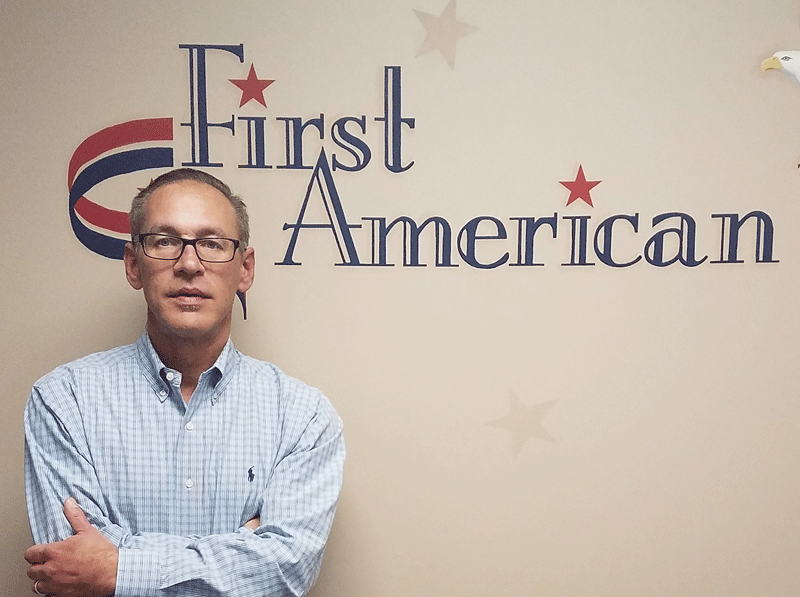
David Matosky, operations director at First American Insurance in Chicopee, noted that standard homeowners’ insurance typically covers damage to a structure as a result of an ice dam, but will not cover the expenses to eliminate or prevent the root cause of the ice dam. It also will not cover water damage to the contents of the structure as a result of the dam, though customers can check with their agent to see if they can add such coverage.

David Matosky

David Matosky says home and business owners can avoid winter-related claims by taking some strategic steps.

And it’s a growing concern at a time when the climate seems to be changing — check out all the leaves still on trees a week into December — and temperatures that fluctuate between freezing and balmy. Those kinds of conditions with snow mixed in are fertile ground for ice dams. “That’s when you get big problems,” Dowd said, “so it’s smart to invest in some kind of protection.”

In fact, ice dams are far from the only winter hazard that concerns homeowners, business owners, and insurance companies alike. And, like the dams, most of those hazards can be anticipated, and steps taken to minimize the risk well in advance.

“Make sure your attic is properly insulated,” Matosky said. “Take the time now to buy a shovel and roof rake, not after you’ve gotten 15 inches of snow. And you have to be consistent and clean snow from the roof on a regular basis, as long as it’s safe — we don’t recommend people going up on a two-story house to clear snow, so maybe bring in a professional who knows how to do it. If you have damaged singles on the roof or the drip guards are in need of repair, take care of that now, before the snow starts falling.”

After all, insurance professionals say, buying coverage is just one element in protecting one’s assets from seasonal damage; the other is simply common sense and preparation.

People Get Ready

Matosky noted that, while it’s good to have insurance, filing a claim is never an enjoyable experience.

“There’s a distinction between a loss and claim. A loss is when something bad happens; a claim is where you’re able to have the loss paid for,” he said. “In some events, you may have a loss but not have a claim, and you’re left holding the bag.”

That’s why the best way to prepare for winter events is to take the necessary steps to minimize the chances of a loss in the first place, he said. That means not only buying a roof rake before the snow season begins, but also maintaining and testing snow-blowing equipment before a blizzard kicks up. “One of the worst things is getting 12 inches of wet, heavy snow, and you go to start your snowblower, and it doesn’t start.”

Dowd’s agency recommends several steps to prepare for winter, advising clients to insulate the pipes in their crawlspaces and attic, as exposed pipes are most susceptible to freezing, and to seal air leaks, not only to improve the home’s heat efficiency, but to protect the pipes. With severe cold, even a tiny opening can let in enough cold air to cause a pipe to freeze; and

Also, before winter hits, homeowners should disconnect garden hoses and use an indoor valve to shut off water to the outside, then drain water from outside faucets to reduce the chance it will freeze in the short span of pipe just inside the house.

Be Aware of
Indoor Risks, Too

With fires and space heaters for warmth, candles and holiday décor for ambiance, and more indoor cooking and entertaining, the risk for fires in homes increases exponentially in the colder months. The Dowd Insurance Agency in Holyoke offers these helpful tips to keep in mind:
• Be sure your chimney is inspected and cleaned regularly based on how much you use it, and ensure the flue is open before you light a fire.
• Candles should not be left to burn unattended, or within easy reach of children, pets and flammable materials like curtains and holiday decorations. The same goes for space heaters.
• Take care not to overload electrical outlets with holiday decorations or small appliances like space heaters.
• Do not leave items on the stove unattended, and keep towels and other flammable materials away from the cooktop.
• Be sure you have a fire extinguisher easily accessible in your home, and that you know how to use it.

Power loss after a storm is another hazard, which is why Dowd recommends people have a backup generator easily accessible, so they can at least run the heat, their refrigerator, and a few lights. He recalled the freak October 2011 snowstorm that felled trees and power lines throughout Western Mass. and knocked out power in some communities for extended periods.

“We had no lights, no heat for a week in my house, and I didn’t have a generator, so we just lived without power,” he told BusinessWest. “We felt like we were pioneers.”

Loss of power can also cause pipes to freeze up, which is especially dangerous for people who head down south for vacations during the winter. Fortunately, Dowd said, technology is available to alert people remotely when temperatures drop in their home. Even so, he added, it’s a good idea to shut off the water main before leaving for an extended time, so if power shuts off and the pipes freeze and break, the water damage in the home will be minimal.

Other holiday risks may not be so obvious, such as the possibility that thieves are scoping out houses that may be stocked with Christmas gifts. Dowd recommends shutting the curtains at dusk to prevent would-be burglars for scoping out what’s in the house, or using a timer for indoor lights while away so the house doesn’t look empty, or installing motion-sensor lights outdoors as a deterrent. Such a device, or, even better, a complete security system, may qualify for a discount on the homeowner’s insurance policy.

Staying Upright

While water and fires can cause tremendous damage in a home, there are other hazards that increase during the colder months as well. One of the most important is the liability risk from slips and falls on driveways and sidewalks that may not be completely cleared of ice and snow, or properly de-iced or sanded, after a weather event.

“That’s an issue for commercial properties as well as landlords and homeowners,” Matosky said. “Most towns have ordinances that you have to remove snow and ice from your sidewalk at the end of a storm.”

And that means keeping it off, both with additional shoveling or plowing as necessary and with ice-melting agents. “And if the commercial property is hiring someone to do the snow removal, they should make sure they have the correct coverage; if they don’t plow or shovel correctly, and someone falls, they need to make sure they have the coverage to respond to such a claim.”

Property owners with steeply pitched roofs often have to worry about snow constantly falling as the weather warms after a storm, and they could be liable if snow or ice falls on a passerby, so they need to take a combination of steps, from clearing snow regularly, if possible, to simply posting signs or barricades to keep people out of danger spots.

Meanwhile, with more homes and businesses installing solar panels on the roof these days, there’s also the danger of sheets of snow sliding off those panels onto the ground below.

A lot to think about? Sure, but planning ahead for the winter weather — and responding quickly after a storm — can go a long way toward avoiding the types of losses and claims that cause headaches for property owners and insurers alike.

“We’re conditioned in our business to think of the worst-case scenario — what could happen? — and then develop a disaster plan,” Dowd said. “These things probably won’t happen, but they may happen, and you want to do all you can to mitigate the damage.”

Joseph Bednar can be reached at [email protected]

Employment Sections

Engagement Is a Word; Being Engaging Is Your Responsibility

By Janice Mazzallo

Too often managers can develop the bad habit of saying what they want versus doing what they want. Nowhere is this more systemic than with employee engagement.

Managers can have ideals, but they also have to practice them. Here are some suggested strategies to create a true culture of employee engagement.

Start at the Top

Company-wide engagement is an important objective, and achieving it starts at the top. It’s critical for senior leadership to communicate and act on employee-engagement values. That means associates at every level need to understand that top management values their input and wants to understand their needs.

Bet on Promise; Double Down in Hard Times

Never hire a person unless you are willing to support them through thick and thin. Being there for an associate during the rough patches is a way of earning trust. Mentoring new associates and helping them overcome obstacles similar to what you faced as a new employee is a way to encourage loyalty and foster the tenacity to stick with a project or task through tough times.

Talk Less, Observe More, Ask Impactful Questions

Effective managers realize that not every assignment will meet with immediate success. And they know that the difference between success and failure might not be making suggestions, but instead asking the right questions. We all want to do the best we can, but we might not have the experience or resources we need to figure out the best solution. A manager who prompts you with the right questions, rather than telling you what to do, is going to help you grow.

Part of an effective employee-engagement commitment is to listen for ideas rather than focus on providing solutions. When you wait to hear from your employees, the idea you didn’t think of can surface. It’s easier to throw out suggestions on a given problem, but assessing a situation and reframing it with impactful questions is going to help your direct reports grow and succeed.

Praise and Forgive

If you’re not making mistakes, you’re not trying hard enough. We were taught that if you focus on blame for mistakes, you’re only encouraging more conservative thinking. There are clear differences between acceptable mistakes and needing to accomplish tasks.

Work will always be challenging, but if your team feels empowered to swing for the fences, yet knows when it’s time to rein it in, you have the best of both worlds.

Give Time

While this could be counterintuitive in some respects, time off is one of the best ways to create employee engagement. When you challenge people to go out and experience the world, they come back refreshed, with new energy and new ideas.

If there is anything that says ‘we value you, not just your contributions,’ it’s a commitment to work-life balance and watching employees grow as people.

Successful employee engagement is not easy. It boils down to commitment — a commitment to people and making sure those at the top are leading the charge. Given that most people seek inspiration, direction, and motivation from their leaders, it is always best to start improving engagement at the top.


Janice Mazzallo is executive vice president and chief Human Resources officer at PeoplesBank.

Commercial Real Estate Sections

Building Collaboration

The O’Connell Companies has a new home in Holyoke

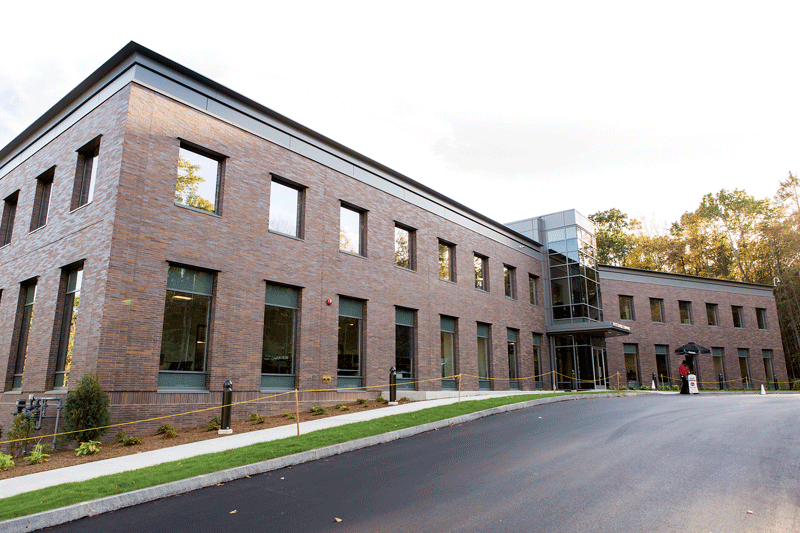
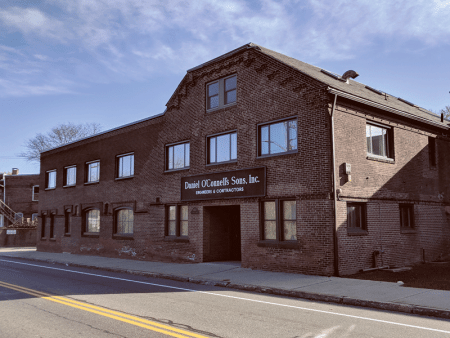
The O’Connell Companies has a new home in Holyoke (above), replacing the previous headquarters (below) of more than a century.

The O’Connell Companies

The O’Connell Companies traces its history in Holyoke back to 1879, when Daniel O’Connell founded the construction company that eventually branched into property design, management, development, and much more. For more than a century, the company was housed in limited quarters on Hampden Street, but a new headquarters on Kelly Way offers more space, amenities, and opportunities for what one of the firm’s executives called “cross-fertilization.”

In the conference room where Andrew Crystal sat down with BusinessWest recently, the only piece of artwork currently hanging up is a stylized, brightly hued BIM (building information modeling) image of the new headquarters of the O’Connell Companies, located on Kelly Way in Holyoke. On the opposite wall hangs a cutting-edge, multi-screen array for both displaying information during meetings and videoconferencing with other parties.

The room’s long, wooden table, however, is one of the only pieces brought over from the former O’Connell HQ on Hampden Street. The restored table represents some of the connective fiber between old and new that the company wanted its new home to represent, said Crystal, vice president of O’Connell Development Group.

“We’ve managed to incorporate some history,” he said, also referencing a set of century-old, meticulously handwritten balance sheets framed on the wall of another wing, where the accountants work. “The company does have a very long, interesting story, so we tried to preserve some of the history and the culture of the company. That was very important in the design of this.”

Otherwise, the new headquarters, situated on a seven-acre parcel in the woods off Bobala Road, is rife with modern touches, starting with the striking central atrium that connects the wings that house various divisions — O’Connell Development Group, Daniel O’Connell’s Sons (construction), Appleton Corp. (property management), and New England Fertilizer Co. (biosolids management).

The atrium is awash in natural light and features tables and chairs toward the back, along with a kitchen and coffee bar. “We wanted to create some space for people to mingle informally, share a meal or coffee break together, with the intent of getting to know each other and, more important, cross-fertilize, because everything we do is related,” Crystal said. “We design, develop, finance, build, and manage buildings, roads, and bridges — it’s all interrelated for me.”

One of the goals of the new building is to bring together all the company’s divisions under one roof; Appleton previously had its own space on Suffolk Street in Holyoke, while the Hampden Street facility that housed the others had long been insufficient.

“It was an old, tired building, and we had looked at renovating it,” Crystal said. “But, to continue to be a great work environment for present employees, but also with an eye toward the future, it made sense to move to a new location and to have everything under one roof. There’s nothing like being in the same building.”

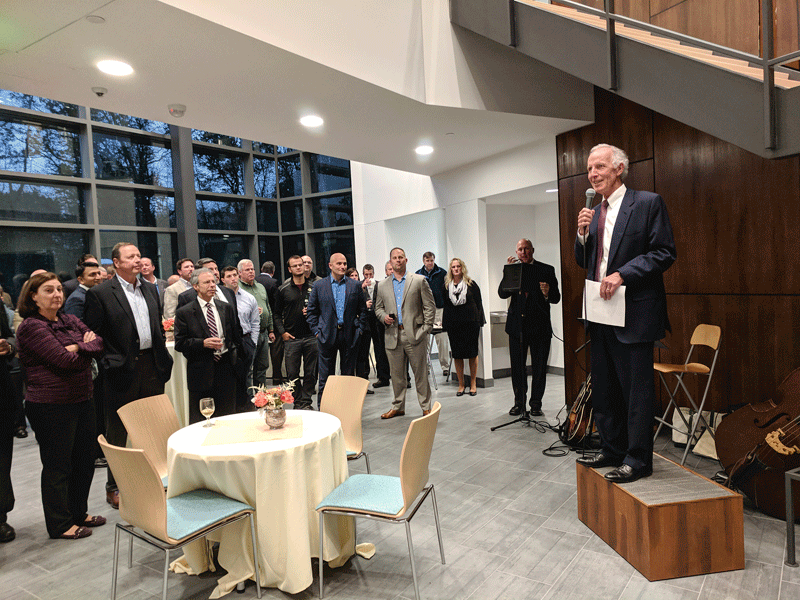
Dennis Fitzpatrick, president and CEO of the O’Connell Companies, said as much when he addressed hundreds of visitors at a recent open house, noting that it’s been more than a century since the firm dedicated a new headquarters.

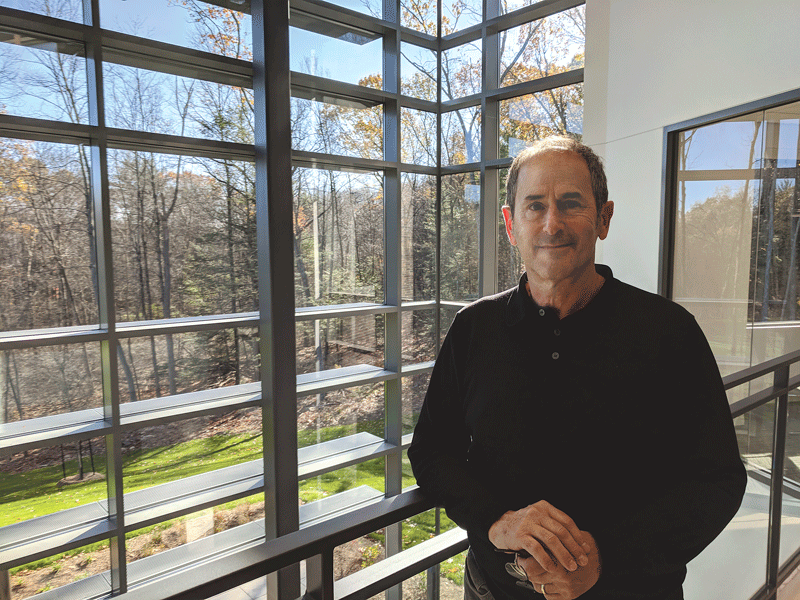
Andrew Crystal

Andrew Crystal stands on the walkway overlooking the sunlit central atrium and the woods behind the property.

“When we started this project, our hope was that we could create a modern, contemporary office building where we could more effectively carry out our daily work,” he said. “We wanted improved functionality, a higher level of comfort, and we wanted a few more amenities. We hope that our new headquarters will cultivate a work environment that supports and further develops the spirit and cuture that has made this organization as successful as it has been for as long as it has been.”

For this month’s focus on commercial real estate, BusinessWest paid a visit to Kelly Way to check out the results of that effort.

Forward Thinking

The intent, Crystal said, was to house the company’s various divisions in a modern, energy-efficient, healthy environment. “We wanted to be conscientious about the environment in terms of energy efficiency and how we treated the land when we sited the building and took the trees down. And we wanted to preserve and enhance the corporate culture that exists here, which is why we created this atrium space in the middle of the building.”

He has heard of multiple incidents recently of long-time O’Connell employees meeting in person for the first time, which means the design is working.

“Part of the design is to create space and an environment that encourages people to collaborate and work together between companies,” he explained. “It was also done with an eye toward creating a great workplace for employees — not just the employees we have, but as an incentive to attract younger employees. Things like the atrium and a shared coffee bar, and a fitness room downstairs with showers — these are things that younger workers want, and it’s a competitive environment to attract talent.”

As for the subdued exterior of the building, Crystal said he had a specific vision for how the dark-bricked façade would interact with the woods around it.

“We wanted a brick building, but we wanted something that was more unique than red brick, that was an elegant blend with the surroundings,” he explained. “We went through quite a few designs, looking at various mixes of bricks. We’re very pleased with the result; whether it’s a bright, sunny day or an overcast, rainy day, the building really fits into the surrounding environment.”

The natural light that pours in from the building’s tall windows brings aesthetic appeal as well, but doubles as an energy-efficient element — one of many, he explained. “We chose not to get LEED-certified, but the criteria in LEED buildings drove a lot of the decisions around energy efficiency, water efficiency, quality of the air people breathe, and the views people have to the exterior.”

Dennis Fitzpatrick, addressing open-house attendees

Dennis Fitzpatrick, addressing open-house attendees, said it was “high time” O’Connell’s own home reflected some of the modern design elements it was using in its clients’ projects.

For instance, he continued, “all the light fixtures are LED, and all are on occupancy sensors. We have a high-efficiency boiler for heating, and we have energy-recovery ventilation, so when air is exhausted from the building, we recover some of the energy from the air and reuse it.”

Crystal added that the environmentally friendly focus extended to the outdoors, where the building was positioned in such a way that preserved the more mature trees around its perimeter. The plan is to develop some walking trails through the wooded surroundings by next summer. For now, a large outdoor patio overlooks the grounds behind the atrium. “So if you’re on your laptop on a beautiful day, why not sit outside with the beautiful woods and do your work?”

A freshly installed bocce court is another way to help employees enjoy the outdoors during the warmer months, he added. “Again, we want to encourage people to stay after work and recreate and get to know each other. One of our goals is to create a sense of community among employees.”

Daily Impact

In short, Crystal and his development team — which included architectural firm Amenta Emma and a host of contractors and subcontractors from Western Mass. — are firm believers that a building’s design and environment affect both productivity and employee behavior.

“One goal was to encourage collaboration, innovation, and cross-fertilization,” he said, referring not only to the shared atrium, but formal conference rooms in each wing and the open layout of each division, with offices ringing a shared bank of workstations. Each wing also features a small, private room with a phone for employees in the shared space to make private calls.

A color palette heavy on light grays and whites, with a bold splash of blue ringing some walls, was designed to promote brightness and productivity, and the rainbows that occasionally appear in the glass and white-ash floors when the sun hits the atrium’s huge rear windows is “one of those unanticipated surprises,” Crystal noted.

“People seem happy,” he said. “I think the employees are happy to be here. Having a fun, modern, efficient environment to work in is an important piece of that.”

As the company’s president, Fitzpatrick certainly understands the importance of keeping everyone happy.

“Part of our culture is our people working together to come up with creative, innovative solutions to the challenges and risks that our company faces in our daily business,” he told the crowd at the open house.

“At the O’Connell Companies, we all care very deeply about the details,” he went on. “We care about what happens when plane X meets plane Y. We care about quality, and we care a lot about the feel, the sense that you have when you’re in a building, and I wanted this building to represent that. I wanted it to reflect the kind of quality that we hold ourselves accountable for when we go out and develop, build, and manage an asset for someone else. It was high time that our home reflected some of the ones that we were building.”

As Crystal walked BusinessWest past what’s called the Founder’s Room — a formal conference space on the second floor with a black walnut table built by Jonah Zuckerman of City Joinery in Holyoke — he reflected again on how the company’s history in the Paper City impacts how it does business today, and how its new headquarters fits into that history going forward.

“The real value this company has is its intellectual capital,” he said. “Yes, we own real estate, and we own equipment, but what makes the company unique is its intellectual capital, and by locating all our employees in the same building and actively promoting interactions and collaboration, I think the company benefits. That’s what we hoped to accomplish by relocating.”

Joseph Bednar can be reached at [email protected]

Entrepreneurship Sections

Venturing Forth

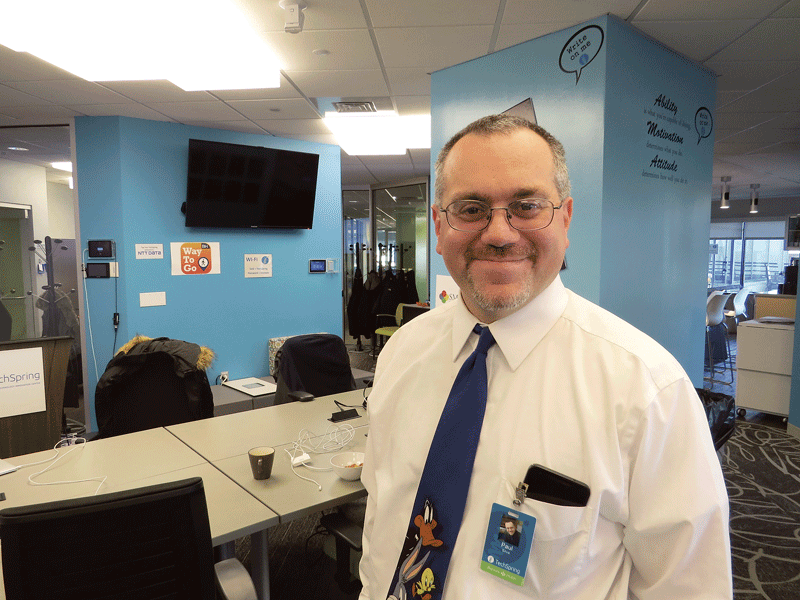
Paul Silva

Paul Silva says Launch413 one of two new startups he has launched himself, will fill a recognized gap in the region’s entrepreneurial ecosystem.

Paul Silva uses the word ‘retired’ when he references his departure (at least as a full-time employee) from Valley Venture Mentors (VVM), the groundbreaking nonprofit he co-founded to assist startups and next-stage companies.

And he acknowledged that he gets some strange looks when he does, not simply because he’s only 40 — and people that age usually aren’t retired from anything other than professional sports — but also because they can’t fathom why he would leave the organization he has helped lead to great success.

As for that word ‘retire,’ he said it sounds better than most all of the alternatives he could use, like ‘moved on,’ or ‘left,’ or even ‘transitioned from,’ all of which, or at least the first two, have largely negative connotations, at least in his opinion.

“Unfortunately, we really don’t have a good word for when you hand your startup off to the next group of people,” he explained. “Maybe someone will come with one; I’m open to suggestions.”

Meanwhile, as to why he retired, that will take a lot longer to explain. There is a short answer — that he considers doing so beneficial for him (ultimately), VVM, and the region as a whole — but one couldn’t possibly leave it at that. One would need to explain why that’s the case, and we’ll do most of that in a bit.

First, though, we’ll get to that ‘better for the region’ part.

In short, Silva said he can now focus his efforts — or a good portion of them, anyway, because his time will now be split in a number of ways — on filling what he called the next “gap” in the region’s entrepreneurial ecosystem.

That would be the one between organizations like VVM and the services they provide, and investing groups like the one Silva leads, River Valley Investors (RVI).

“For the past three years, VVM has been kicking ass at graduating startups, and good ones,” he explained. “And they come to my angel group and…”

His voice tailed off a bit as he noted that some come to angel investors ready, willing, and able to get to the next stage, and thus have relatively little trouble gaining all-important financial backing. Many others are willing, but not exactly ready or able. And this is where Launch413 comes in.

“Most early-stage investors don’t want to pay for the entrepreneur’s education in the many aspects of running a business, like selling and financials,” he explained. “So they don’t know how to operationalize and execute their business model. They graduate from VVM with a great business model, with evidence that it’s the right business, but they’re often missing great chunks of skills on how to get there; Launch413 parachutes in and fills the gap.”

But such skydiving will only fill part of Silva’s calendar. Indeed, as noted earlier, he is splitting his time between a number of different endeavors, including not one, but two new startups.

You have to know what your strengths and weaknesses are professionally. I know what I love to do; I love to teach and work with the entrepreneurs, and I’m really good at that. To be the CEO of an organization that’s scaling up is a very different set of skills.”

“I’m a glutton for punishment,” he said, adding that the second is called the Lean Innovation Institute (LII).

In simple terms, this initiative is an adaptation, and expansion, of VVM’s manufacturing accelerator, initiated last year, but orphaned by that agency (Silva’s word) because it didn’t exactly meld with its mission.

Sensing an opportunity, he essentially took ownership of that initiative with the intention of selling it to a host of sectors. And he’s already making headway with one he didn’t exactly expect — nonprofits, as we’ll see later.

The new adventures of Paul Silva — yes, he’s the one who wears the ties patterned with the likenesses of cartoon characters — are all spelled out on the back of his new business card — if you should happen to get one and have the time to read everything on it.

On the front, it declares he’s a startup advisor, angel-group leader, and innovation accelerator. For this issue and its focus on entrepreneurship, BusinessWest talked with Silva about those various talents and how he’s developed them into his own intriguing startups.

In Good Company

Getting back to why he was phased out of VVM at his request — that’s another way he phrased what’s happened — Silva said it’s beneficial for VVM because the agency is growing, expanding, and moving in new directions, and he is not exactly suited to lead an agency at that stage. By retiring, others more suited to that work can step in, he said, mentioning Liz Roberts, VVM’s CEO, by name.

As to why it’s better for him … well, if he stayed in a role he wasn’t really suited for, he said he wouldn’t enjoy it much, if at all.

“You have to know what your strengths and weaknesses are professionally,” he told BusinessWest. “I know what I love to do; I love to teach and work with the entrepreneurs, and I’m really good at that. To be the CEO of an organization that’s scaling up is a very different set of skills.

“I knew I had reached my limit,” he went on. “And if I wanted VVM to keep growing, either it was going to grow slower while I learned, or it could grow faster with Liz, who had already been there, done that, and been successful. And even if I could learn, I don’t think I would like it.”

So, after some due diligence and explaining to people that he was soon to be a ‘free agent,’ as he put it, Silva moved on to some things he does like.

Such as the broad mission of Launch413.

That name pretty much says it all — it’s focused on helping companies in Western Mass. get well off the ground — but its method of operation needs some explaining.

Working with several venture partners, Silva will parachute in, as he put it, and act as a venture fund in many ways, but the investment is in time and expertise, not dollars. In exchange for those investments, Launch413 gets a piece of the company’s future revenue.

This concept is called royalty financing, and while not exactly new, it has been gaining traction in recent years. That’s because entrepreneurs don’t want to give up a piece of their business, as in equity financing, but are more willing to part with a percentage of future revenues.

But royalty financing has benefits for both sides in this equation, especially in a smaller market like Western Mass., Silva explained.

“If I take equity in a company, the only way I get paid is if the company sells,” he said, adding quickly that there are other ways investors can reap dividends in such cases, but the company in question would have to be doing very well. “With a royalty deal, my incentive is in line with helping the company succeed; if they make money, I’ll get paid faster.”

Launch413 is currently working with one company, and Silva expects to soon be working on a batch of up to four. He will limit the number and start small, he said, to learn about what works and what doesn’t.

“We’ll figure out how much larger we can make the batches over time,” he said, adding that, given the great amount of entrepreneurial energy in the region, he expects Launch413 to flourish.

As for LII, as noted earlier, it is solidly based on VVM’s manufacturing accelerator, which was different from a traditional accelerator in that it focused on established companies rather than those just getting off the ground, which is why it became a business opportunity for Silva.

“VVM wants to focus on startups, which makes sense, because one of the great dangers with nonprofits is mission creep and losing focus,” he explained.

But the manufacturing accelerator was very similar to the traditional model in the way it prompted participants to identify who their customers were, what they wanted and needed, and how this should drive change moving forward.

And the LII (so named because it will hopefully involve companies in all sectors) will do all of the above with established entities, including a constituency Silva wasn’t exactly expecting when he launched: nonprofits.

He’s working with one at present — Pathlight, formerly the Assoc. for Community Living — and running pretty much the same curriculum put to use with the manufacturers at VVM.

Elaborating, Silva said Pathlight, which helps intellectually disabled individuals lead full and productive lives, developed a curriculum to help it meet that mission, one that could be adopted by other nonprofits doing similar work.

“They see this as an opportunity to create revenue from something they built that would help further their mission,” he explained, adding that the accelerator he’s running is focused on developing and maximizing this opportunity — one that amounts to a startup business.

“It looks like we have something that might make a difference here,” he went on, adding that he believes there is potential to add many more nonprofits to the portfolio moving forward because of changing dynamics within that sector, which has a huge presence in this region.

“The competitive pressure to raise grant dollars is intense,” he explained, “especially because Western Mass. has more nonprofits than just about anywhere else. So they need to find new ways of generating revenue; they need to think differently and in more innovative ways. It’s shocking how many of them don’t actually think about their customers and what they really need because they believe they know already.”

Meanwhile, he’s had discussions with Ira Bryck, director of the Family Business Center of Western Mass., about possibly running similar accelerators for groups of that agency’s members.

Overall, he said his business plan, like LII’s website, is very much a work in progress because, at the moment, he’s busy practicing what he preaches — meaning he’s figuring out who his potential customers are and what they want.

“If you asked me a year ago if nonprofits would be excited by this curriculum, I would have said ‘no,’” he explained. “But it turns out, among the sectors I’ve talked to, nonprofits are the most excited about this.”

Transition Game

Summing up the many changes in his life, career-wise at least, over the past several months, Silva acknowledged that he has taken a fairly sizable risk when it comes to leaving the steady employment provided by VVM.

But with the blessing of his wife — “she said, ‘this is the right thing for VVM; I’m proud of you’” — he gladly accepted that risk and moved on to something different and, in his opinion, at least equally rewarding, only in different ways.

This is what entrepreneurs do, and anyone who knows Silva is quick to grasp that he not only mentors and motivates such individuals; he is one himself.


George O’Brien can be reached at [email protected]

Entrepreneurship Sections

Whatever It Takes

Kate Putnam

Kate Putnam says the WIT Fund hopes to raise $3 million over the next three years and focus on women-led companies.

Kate Putnam knew something special was going on — right from the first get-together.

That was back about 18 months or so ago, when a dozen women were invited to a breakfast to discuss ideas for making Western Mass. the place for women entrepreneurs and innovators.

“More than 30 showed up,” said Putnam, one of the organizers and chief spokespeople for a group that came to be known, after considerable discussion, as WIT, initially a joint venture of Valley Venture Mentors and the Economic Development Council of Western Mass.

That’s short for Women Innovators & Trailblazers, and also for What It Takes, or Whatever It Takes, said Putnam, a veteran business leader, entrepreneur, and mentor. She said the former describes both the membership and the constituency it will serve, while latter pretty much sums up what it’s ready and willing to do to carry out its mission.

And that is, officially, to “ignite a women-led innovation economy in Western Mass. and beyond.” Beyond that simple statement on the website (witrocks.org), though, the group is committed to helping women succeed in business through funding, mentoring, and more, as in ‘whatever it takes.’

Especially funding. Indeed, the group is creating what will be known as the WIT Fund, an angel-investing fund that will, as that name suggests, focus on women-led companies. The goal is to amass $3 million over the next three years or so, said Putnam, and write the first check perhaps as early as next spring.

She said there is considerable interest among WIT’s members in contributing to the fund, with the suggested contributions being $10,000 to $20,000.

“You can definitely do more,” said Putnam, adding that the group’s tagline will be something along the lines of ‘by and for women,’ which speaks broadly to a two-pronged mission.

“We want to inspire women to become angel investors,” she said, “and also help women who are starting businesses through mentorship.”

Indeed, WIT’s reason for being is perhaps better summed by its stated vision: “to build a community where women boldly define and fulfill their entrepreneurial ambitions,” said Allison Werder, another of the group’s organizers and leaders.

She noted that the ‘fulfilling’ part of the equation is often more difficult for women than it is for men, especially when it comes to statistics related to funding of entrepreneurial ventures, as we’ll see. And WIT was created to essentially do something about that.

“The overarching premise is women investing in women,” she told BusinessWest, adding that, in this case, ‘investing’ comes in many forms, including mentoring and educating women in how to be angel investors.

But perhaps most importantly, it will come through actual angel investing, she said, adding that the need is real — and growing.

Nationwide, women-led companies (a phrase that includes diverse teams of individuals) comprise roughly 28% of the individuals seeking capital nationally, said Putnam. But they receive just 17% of angel funding and only 2.5% of venture-capital funding.

“Even if you can get to the angel round of funding, the VCs aren’t stepping up,” she explained, adding that, while in Massachusetts, and especially Western Mass., the numbers are somewhat better (anecdotally), there is still considerable room for improvement, a reality that was the real inspiration for WIT’s evolving mission and growing membership.

Indeed, those 30 women who turned out for that initial meeting in 2016, and those who have joined since, understand those numbers and what they mean, said Putnam, adding that the membership represents a number of groups involved with women, entrepreneurship, economic development, or a combination of the above.

These include VVM, the EDC, the Women’s Fund of Western Mass., the Economic Development Council of Western Mass., the Pioneer Valley Planning Commission, Northwestern Mutual, Rainmaker Consulting, the Shops at Marketplace, and Lioness magazine.

As for the membership, it has grown to 80 or 90 individuals, and includes the leaders of the many women’s colleges in the area, other educators, business owners and managers, entrepreneurs, creatives, marketers, and individuals working in various aspects of economic development.

“It’s a broad spectrum of people, both those looking for guidance and those looking to grow the entrepreneurial community,” said Werder, adding that they have come together behind a single unifying assignment, if you will.

“We think there is an opportunity to put a stake in the ground that Western Mass. is very friendly to female-led entrepreneurial businesses,” she explained, adding that a number of forces, from the women’s colleges and universities to VVM, have inspired such optimism.

And now there is another in WIT, a group that has a lofty goals and a name — actually, two of them — that says it all.

—George O’Brien

Modern Office Sections

More Than a Desk

Mark Proshan at a sit-stand desk

Mark Proshan at a sit-stand desk, one of hundreds of display pieces in Lexington Group’s 165,000-square-foot warehouse.

In the 28 years Mark Proshan has been in the furniture-sales and office-design business, he has seen plenty of change, from a greater emphasis on open, collaborative spaces to more challenging timetable demands from clients. Through it all, though, he continues to cultivate a business philosophy built on relationships and trust — even at a time when many clients are more interested in speed and cost.

Mark Proshan says he can count on one hand the number of contracts he’s drawn up over the years. He’d rather do business with a handshake.

“Relationships in this business are important,” he said. “The more you talk about it, the more cliché it sounds, but the notion that somebody can count on you when you promise to deliver something still means something, and our customers value the notion that we don’t promise things we can’t deliver.”

Proshan, owner of Lexington Group, which specializes in sales of new and refurbished office furniture as well as interior-design solutions, said he’s always been willing to lose money if it meant keeping a commitment he made to a customer.

“It’s fundamentally more important for that person to know I did everything conceivably possible to do what it was I said I would do. The lion’s share of new business comes from referrals from other people, and if that’s the way you market yourself, you’re only as good as the last job you did. If you don’t do what you said you’d do, your ability to gain a referral based on past work will dry up very quickly.”

These philosophies are important in many businesses, but they’re especially relevant to someone who launched his company 28 years ago and has seen so many other facets of the business — from the products customers are looking for to the timetables they expect — change so much.

“You need to adjust to what’s happening, to stay current,” Proshan said, and part of that is understanding clients’ shifting demands.

“We used to have people come in here with blueprints for a project six to nine months in advance, and they’d want to talk about their plans for a new space and everything that goes along with that, from carpeting to lighting to furniture and walls,” he told BusinessWest. “Now, we’re seeing younger people who show you a couple of pictures on their phone — ‘this is what I’m looking for’ — and if you can’t give it to them right away, they’re gone in the blink of an eye. It requires a whole different way of trying to figure out how to keep them engaged.”

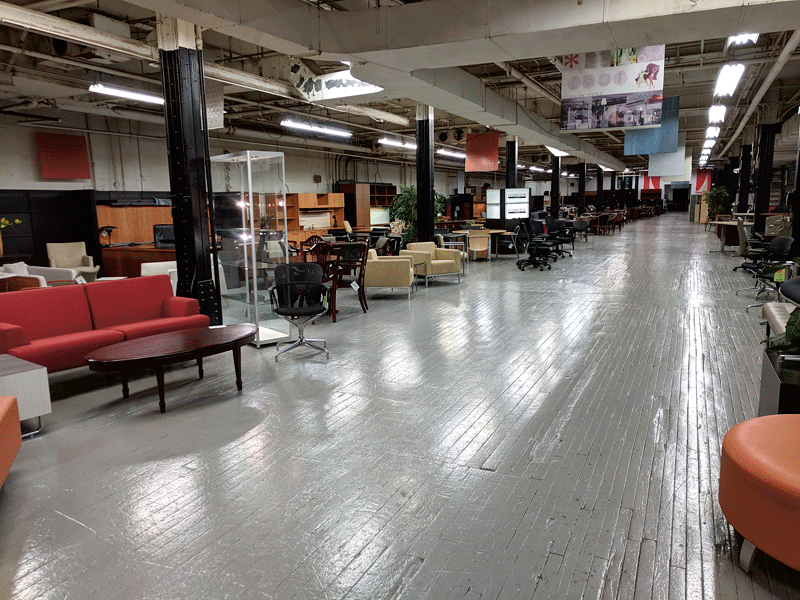
Part of that is maintaining a deep inventory of new and pre-owned items on site in Lexington’s 165,000-square-foot showroom on Union Street in West Springfield. “That way, they can walk around and very quickly take a look and say, ‘yeah, that works; that doesn’t work.’ All the decisions are made very differently than in the past.”

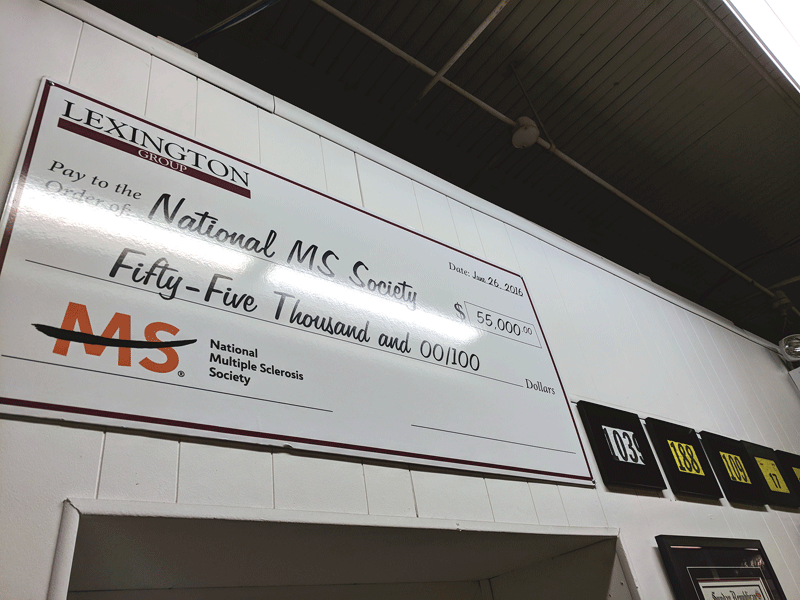
Mark Proshan’s team raised $55,000 this year in the Great Mass Getaway fund-raising bike ride.

A long-time supporter of the National Multiple Sclerosis Society, Mark Proshan’s team raised $55,000 this year in the Bike MS: Cape Cod Getaway fund-raising bike ride.

Proshan also has access to networks across the country, so a quick check of the Internet brings plenty more options for customers looking to change over an office, classroom, or retail space.

Lexington Group provides services from sales, installation, and delivery to space planning, office design, and reconfiguring work, and many of its 25-strong workforce have built up plenty of experience in the field. “We tend to mentor people into the business slowly, and once they’re here, they tend to stick around for the long haul. I’ve got a handful of people who have been here since the late ’80s and early ’90s.”

For this issue’s focus on the modern office, Proshan explains how that idea — and the means by which companies hope to achieve it — have evolved.

Wide Reach

Lexington Group, which counts Herman Miller as its major line of new furniture but deals in many secondary lines as well, has the ability to work across the country, if transportation costs aren’t prohibitive. “But transportation costs have risen significantly,” Proshan said, “and it’s becoming more difficult, so we focus on Chicago to Massachusetts.”

When he started the company, the mix of sales was about 60% pre-owned to 40% new, but it has reversed and is now 80% new and 20% pre-owned.

“There is so much inexpensive furniture available. Everything has become really commoditized and disposable, and people would rather not spend the time and energy doing the research to piece together all the pre-owned pieces when it comes to large projects,” he explained. “They would rather just sit down, point and click, and move on to whatever comes next.”

The secondary-education market has long been an especially fertile niche for Lexington Group. “We typically have at least one or two trucks at one of the major colleges every day, whether it be UMass Amherst, Smith, Mount Holyoke, or somewhere else,” he said, noting that he also works with institutions in Worcester, Fitchburg, and the Boston area. Other clients run the gamut from moderately sized insurance companies in Western Mass. to Fortune 500 firms across the Northeast.

Across all these industries, certain trends have become ubiquitous.

“The big words now are still collaborative space and shared space,” Proshan said. “Walls have come down, and other walls that used to have paint and wall coverings are now erasable, so people can share ideas on them.”

But there are challenges to opening up offices in this way, such as the occasional need for privacy for certain types of work, or when meeting clients.

“People enjoy the togetherness and collaboration possible with all the open space, but they also often wish they had their old cubicles back. So the secret, I think, is to try to find the balance between that open, collaborative space and giving people a place they can go to get some privacy.”

Ergonomics remains a hot topic as well, he added, from chairs designed for better support to desks that raise up with the touch of a button. “Sit-stand desks encourage people to stand for a good part of their day because, well, you should. Healthcare professionals will tell you we sit too much.”

Most changes in office design are being driven by the younger generations and how they prefer to work, he said, but he also understands that the basic elements of his business — quality products and relationship-based service — remain constants.

Lexington Group’s West Springfield warehouse

Lexington Group’s West Springfield warehouse gives a good indication of the range of new and refurbished items it sells.

“A desk is still a desk; a chair is still a chair, even though they’ve been tweaked a little bit over the years,” he said. “And there are only so many things you can do to a cube.”

Other challenges include more remote employees working from home, the rise of online retail and how it has impacted local businesses, and, quite simply, business owners who prioritize the bottom line over all else when shopping for furniture.

“They don’t care as much about design; they don’t care as much about structural integrity; they don’t care as much about relationships,” Proshan said. “When the focus is simply on price, they’re really not looking for what other value we can bring to the table; they’re simply looking for how inexpensively they can get the job done.”

Face to Face

For Proshan, that’s not a satisfying way to do business.

“We have companies that we’ve had long-standing relationships with, that still realize the value of picking up the phone, knowing we understand their needs, and can come in and, without a whole lot of fluff, conceptualize what needs to get done in a timely, cost-effective fashion.”

He said it was more common years ago for companies to have employees specifically focused on furniture and supply purchases and short- and long-term office planning, but that’s no longer the case.

“Nobody plans anymore. We’ve become so used to customers saying, ‘I want this now, and if you can’t get it for me, this guy can.’ That’s the mentality of the marketplace — as soon as you need something, somebody will be there to provide it for you, and if not, you can go to the Internet and shop.”

Still, he went on, “even though attention spans have changed, and people want instant gratification, I find it’s really valuable to be able to look somebody in the eye and shake hands and agree upon what needs to be done, and for them to feel confident that I’m going to do what I promised I would do, and they’re not going to be unpleasantly surprised when the deadline comes.”

That emphasis on relationships informs the company’s civic involvement, particularly Proshan’s 21 years of involvement in the Bike MS: Cape Cod Getaway, an annual, 175-mile bike ride from Boston to Provincetown that raises money for the National Multiple Sclerosis Society. Last year, the team he has captained for 15 years raised $55,000.

Back at work, though, his focus is where it has been for 28 years: helping companies improve their environment through better furniture and interior design.

“At the end of the day, it’s about more than selling furniture,” he said. “Those relationships make the whole experience much more enjoyable in ways that don’t have anything to do with money. When it’s about more than selling something, it’s much more fulfilling.”

Joseph Bednar can be reached at [email protected]

Modern Office Sections

Fraud in the Workplace

By Christine Devin, CPA

Have you ever said these words: “I trust her; she would never steal from the company,” or “he is so honest, he would never do that.”

A small-business owner I recently spoke with said those same words. The owner was busy with the daily operations of her cash-lucrative business. The business had less than 10 employees, including a few service employees and a bookkeeper. The business owner had outstanding relationships with all of the employees. She even referred to them as family. Business was booming. What could possibly go wrong?

The owner confidently handed over her financial information for annual review and preparation of the company’s tax return to a hired professional. She was sure that her hard work looked impressive on paper. After all, she worked countless hours to make it all happen. Little did she know that the words she spoke earlier would haunt her. She could not have been more wrong.

During the annual review of the financial statements, some disbursements were flagged as unusual or suspect. The professional contacted the owner to investigate these payments. After further review, it was discovered that the bookkeeper was writing checks for personal expenses out of the company’s checking account by forging the owner’s signature. This was devastating news.

Fraud in the workplace is a serious topic and should be considered in any size business. What is fraud? Who is likely to commit fraud and what can be done to prevent or detect fraud? These are all great questions that this small-business owner wished she had addressed long before she ever hired her first employee.

What is fraud? Fraud is a broad term often used to describe when someone intentionally cheats another out of money or property for personal gain and then conceals it. In a business environment, fraud can occur by theft, misappropriation of assets, or financial-statement fraud. Some common fraud schemes are check forging (theft of cash), skimming (accounts receivable), dummy vendors (accounts payable), ghost employees (payroll), and falsifying records (financial statement). Whatever the scheme, are you prepared in your business to eliminate the possibility of fraud?

Who is likely to commit fraud? Most employees are honest when hired. However, you may on occasion hire a person that intentionally wants to get the job just to steal from you.

The ‘fraud triangle,’ originated by American sociologist Donald Cressey, created the framework to describe the reasoning by an employee to commit fraud. The fraud triangle describes the three stages an individual goes through when contemplating fraud. These are personal pressure or financial need, opportunity, and their ability to rationalize the crime. Per Cressey, once all these stages are met, even your most honest and trusted employee can commit fraud.

In the example above, the bookkeeper had a need (a drug addiction which was later revealed in court), the means (her direct access to the checks and the ability to reconcile), and rationalization of the crime (she thought she deserved more of the profit). All stages of the fraud triangle are important and should be considered in your risk assessment.

Of the three stages, we are going to focus on the second stage, opportunity. If there is no opportunity, the employee cannot commit fraud regardless of what they think, how they feel, or what they are going through personally.

When seeking to eliminate the opportunity for fraud, one of the best places to start is the transaction cycle. Take the time to walk through each transaction process, from start to finish. During the walkthrough, identify key points in the process where review, approval, or dual controls should be present to eliminate sole control over the function.

Consider this example: an accounts-payable clerk sets up new vendors, vouchers invoices, and processes checks for the company each week. The same clerk also reconciles the activity at the end of the month and posts all necessary reconciling journal entries. She even offers to mail the checks, as it is on her way home.

In this example, there is clear lack of segregation of duties. The clerk has too much control, and ‘opportunity’ exists. If the other two stages of Cressey’s framework — a financial need and rationalization — were present, then it would be possible for fraud to occur. Taking the time to evaluate processes such as these will help greatly in eliminating the risk of fraud.

There are a number of other steps that a business can take to prevent or detect fraud. They include:

• Conducting background checks on new hires;

• Implementing dual controls over assets such as cash and inventory;

• Separating key functions such as check preparer and check signer;

• Reconciling all accounts to the general ledger each month;

• Requiring approval of all time sheets by a supervisor;

• Requiring mandatory vacation for payroll or other key personnel;

• Establishing budgets and projections to benchmark to financial results;

• Rotating duties of accounts payable and accounts receivable (this process can also achieve cross-training needs);

• Verifying new vendor information, including tax ID address and phone number;

• Conducting internal audits;

• Establishing formal policies and procedures, including code of ethics;

• Setting up an employee hotline; and

• Disciplining for violation of established policies.

If a company has fewer employees, like the owner in the first example, then direct review and monitoring will serve as mitigating controls to prevent and detect fraud. Luckily, the owner had a detection control in place (she had someone else look at her records). However, even with the help of a third party, there is no guarantee that fraud will be detected, if it exists. So what else could have been done?

The owner could have had the bank statements mailed directly to her home address for review before handing off to the bookkeeper. Just opening the statement sends a clear message. In our original example, it was later discovered that the bookkeeper forged checks for more than a year. A simple review of the monthly bank statement by the owner would have uncovered the fraud much sooner, just by noticing the signature on the check images were not her own.

The time it would take to perform these steps would be far less than the time the owner spent investigating the records and pursuing the prosecution of the employee.

In the end, it takes time to review processes and procedures, identify key controls, and implement safeguards where needed. I can assure you, it is time well-spent. If you don’t have the time or resources to conduct a review of your business processes, you can call a professional to assist you.

This small-business owner changed the way she conducts business so this never happens again. Will you?

Christine Devin, CPA is a senior associate with the Holyoke-based public accounting firm Meyers Brothers Kalicka, P.C.; (413) 322-3480; [email protected]

Health Care Sections

Rewards Program

Dr. Matthew Richardson

Dr. Matthew Richardson, standing here in new outpatient space being readied at Baystate Medical Center, says working in pediatric oncology brings a broad mix of challenges and rewards.

When asked why he chose to direct his career toward work in pediatric oncology and hematology, Dr. Matthew Richardson flashed back to his time in medical school at the University of Rochester in New York and the rotations he was going through.

His recollections answered the question quickly and efficiently.

“I always thought I’d be an internist taking care of grownups,” Richardson, interim director of the Pediatric Oncology program at Baystate Medical Center, recalled. “But when I went through the internal-medicine rotation, I really didn’t like it. A lot of the time, the patients wouldn’t get better, and their problems derived from some sort of self-inflicted damage like smoking or drinking too much. But I really didn’t know what I was going to do if I didn’t like internal medicine.”

The next rotation happened to be pediatrics, and there, Richardson found an answer to that question — because he also found just about everything he didn’t find in internal medicine.

“You got to be goofy with the kids or play with the kids,” he told BusinessWest. “And they would get better; they would have illnesses that you would treat, and they would get better. Overall, as I used to say, and still do sometimes, a bad day with kids was still better than a good day with grownups.”

And in pediatric oncology, Richardson would find even more in terms of rewards, challenges, and everything else people get into the healthcare profession for. Indeed, the work involves treating the same patients for several years on average, and guiding them and their families through an experience that will test them in ways they probably couldn’t have imagined — and often to a full recovery and long life.

“When I see a child who’s now a young adult going off to college or in college, and they’re healthy, vibrant, and thriving, it’s incredibly rewarding,” he said.

At the same time, he and others with the Baystate program help introduce new treatment modalities through clinical trials, especially through Baystate’s affiliation with the Children’s Oncology Group, and, in the course of doing so, continue and even accelerate a remarkable pattern of progress that has marked the past several decades and Richardson’s entire career.

Meanwhile, the Baystate program, the only facility of its kind west of Worcester, offers an important level of convenience to patients and their families who would otherwise face of the prospect of battling cancer and having to drive halfway (or all the way) across the state repeatedly as they did so (more on that later).

Amid the many types of rewards and all that progress, however, there are still those times, said Richardson, when he must tell parents that there is nothing more than he can do for their child and that cancer will take their life.

Those conversations are, obviously, extremely difficult, he said, adding quickly that, with advancements made in recent years, there have been fewer of them, and as he looks forward, he is buoyed by the near-certainty that this trend will only continue.

For this issue and its focus on pediatrics, BusinessWest talked at length with Richardson about the state of pediatric oncology, the many of forms of progress being made in this realm, and about why, as he said, a bad day with children beats a good day treating adults.

Talking Points

As he talked with BusinessWest and posed for a few photos in the play deck at Baystate Children’s Hospital, Richardson noted, again, that many of the conversations he has with patients and their families in and around that facility are, indeed, difficult ones.

Starting with the first real talk — the one that comes after a cancer diagnosis.

“Someone’s world has just been completely altered — forever,” he said of the process involved with breaking that news, if you will. “It’s never the same conversation twice because each patient, each family, and each situation is different. Each child and each family deals with the news differently, so you have to be able to read the situation and determine how you think they might best respond to hearing news like that.

Richardson said he has become better at this art and science of ‘reading the situation’ over the years. He attributes this to “many years of learning on the job,” and he said breaking news to patients and families is merely one aspect of a much larger learning process that is ongoing — something else he likes about the specialty he’s chosen.

Richardson is one of three pediatric oncologists in Baystate’s program — actually there are two at the moment because a vacancy is being filled. Together, they see about 30 new patients a year, with almost all them living within 50 miles of the hospital, a catchment area that includes Western Mass., Southern Vermont, Northern Conn., and Eastern New York.

These patients have conditions that cover the full spectrum of pediatric oncology, he went on, adding that this phrase refers to everything from leukemias to brain tumors to kidney, liver, and bone tumors.

The ability to treat such cancers in this region is a huge asset for the region and the families that call it home, he went on, adding this convenience can reduce some layers of stress from situations where there are many.

“When you think about the time, the expense, the hassles, such as parking, parents having to take time off from work, children having to miss time from school … receiving care here is a real blessing,” he said. “A simple 20-minute doctor’s visit can turn into a whole-day affair if you have to go out to Boston, but if you can stay here, you might just have to take the child out of school a little bit early instead of them losing all of most of the day, and that’s important, because many patients have multiple visits every month, and sometimes several days in a row, depending on their treatment.”

And this convenience factor will only be enhanced in a few weeks, when the outpatient pediatric-oncology services currently located at the D’Amour Cancer Center are relocated to space at the Baystate campus on Chestnut Street, just a short elevator ride from the children’s hospital itself.

“It’s beautiful space, and it’s going to bring another level of convenience to patients and their families,” said Richardson.

Progress Report

Returning to his thoughts about why he chose pediatrics and pediatric oncology, Richardson said cancers (or most of them, anyway) are among the few conditions that can actually be cured.

“It’s not like you can take six cycles of hypertension medicine and your high blood pressure goes away,” he noted. “Or you take five cycles of insulin and your diabetes goes away. This [cancer] is a disease that we can treat, and treat successfully.”

And that process of curing children with cancer is extremely rewarding work, he went on, adding that his first experience with this came during his residency (also at the University of Rochester), when he cared for several children with cancer.

“These were kids that you would see over and over again throughout the year as they would come in for treatments, or you would see them in the office,” he explained. “And I liked that continuity, knowing the family when they came and knowing their history.”

Beyond this continuity, Richardson, no doubt speaking for all pediatric oncologists, said he also enjoys dealing with cancer on the many different levels it must be dealt with.

“Right down to the molecular, genetic level, and what mutation causes cancer,” he explained. “There’s also the cellular level — how does chemotherapy affect the dividing cell? — and the organ level: is this cancer affecting the kidney or the liver?

“And then, it goes to the personal level, and how the child is coping with the diagnosis and the treatment, as well as the family level and how the family is interacting with the healthcare system and dealing with the child’s illness,” he went on. “And if you really want to go the big picture, there’s the societal level, and how we as society try to do research on these rare diseases and come up with the best treatments and how we work together across the country to understand and treat childhood cancers.”

And, as he noted, in recent years, the ability to treat cancer and treat it successfully has only increased.

“It seems that every few years, there’s a new approach and a new modality available that seems to shift the paradigm of how we look at cancers and treat cancers,” he said while offering a quick chronology.

In the ’60s, ’70s, and ’80s, there was basically chemotherapy, which, as he noted, worked “some of the time, but not a lot of the time, and kids would get very sick with them.”

Improvements in chemotherapy coincided with better supportive care — more effective antibiotics and better nutritional support, and improved anti-nausea medications and other developments changed the landscape in the ’90s, he went on, adding that this was a time of what was known as “dose escalation,” because providers could better support children through the side effects.

Over the past 10 to 15 years, antibody therapies, developed to attack specific types of cancer, have become more prevalent, and with tremendous results, he said, adding that, most recently, specialists are taking the patient’s own immune system and training it to fight certain types of cancers.

Such advances have dramatically improved the survival rates for many childhood cancers, including leukemia, said Richardson.

“For some types of leukemia, the cure rate is 90%,” he told BusinessWest. “And for a disease that was once uniformly fatal, that’s pretty amazing.”

Bottom Line

In fact, the outlook is for continued improvement with those numbers and even greater ability to treat childhood cancers and treat them successfully, he went on, adding that he is looking forward to helping write these new chapters in the story of the fight against cancer.

Doing so will only add to an already long list of rewards that has come with joining a field where the work has more than its fair share of challenges, but also deep levels of progress and satisfaction.


George O’Brien can be reached at [email protected]

Health Care Sections

A Matter of Compliance

The team at River Valley Counseling Center

The team at River Valley Counseling Center and local dignitaries cut the ribbon recently on the facility’s new in-house pharmacy.

It’s an easy concept to understand, Rosemarie Ansel said: medicine is useless if it’s not taken.

And prescription non-compliance is a common problem in the behavioral-health realm, said the executive director of River Valley Counseling Center. That can lead to rehospitalization in many cases, or worse.

“Whether it’s outpatient mental health or day treatment or services in schools, the idea is to provide support for people and help them manage their medical diagnosis so they remain in the community setting and not be hospitalized,” Ansel said. “Behavioral-health patients are a big part of who visits emergency departments. We try to provide services so it doesn’t get escalated to that level.”

That’s why she’s excited about River Valley’s new partnership with Genoa, the largest provider of pharmacy, telepsychiatry, and medication-management services for the behavioral-health and addiction-treatment communities. The company recently opened a pharmacy inside River Valley’s main clinic in Holyoke, Genoa’s fourth such location in Massachusetts and the first in the Greater Springfield region.

Genoa’s 380 pharmacies, all set in behavioral-health clinics across the country, serve than 550,000 individuals annually in 45 states, filling more than 13 million prescriptions annually.

“The focus is on behavioral-health medications, although they provide all medications for any of of our clients, their families, my staff, and my staff’s families,” Ansel said. “River Valley isn’t going to make any money on this; just a little bit of rent for the square footage in the building. It’s a partnership, in that the goal was to have the clients be more medication-compliant.”

A 2016 study published in the Journal of Managed Care and Specialty Pharmacy showed that integrated care models that feature on-site pharmacies produce higher medication adherence rates than community pharmacies, as well as lower rates of hospitalization and emergency-department utilization. In fact, Genoa’s consumers average more than a 90% medication-adherence rate.

And that’s the key, Ansel said. While there’s no guarantee patients will take their prescribed medications, compliance rates rise significantly once they have a prescription filled — which is much easier with a dedicated pharmacy on the clinic site than it is when they must visit a pharmacy off-site.

“One of the things we know in behavioral health is that clients pick up scripts and never fill them, or they don’t adhere to the recommended instructions, and they’re back in the hospital, and the cycle continues,” Ansel said. “We have a pharmacist who really understands the importance of being compliant and following their treatment plans to stay healthy.”

In addition, a pharmacist who specializes in the behavioral-health field, and who can easily communicate with a patient’s doctor if there are questions, makes it much easier to quickly answer questions, reducing confusion and further promoting compliance, she added.

For this issue’s focus on behavioral health, BusinessWest  spoke with Ansel about this new pharmacy partnership and how it’s just one part of a multi-faceted effort to increase access to behavioral healthcare for clients across the region.

Straight Talk

Ansel said River Valley had two ‘asks’ before taking Genoa on as a partner. One was that the pharmacist had to be bilingual in English and Spanish, as are about 75% of the practice’s 165 employees. “That’s a really important feature for us,” she said, considering the demographics of Holyoke. The pharmacist assigned to River Valley, Angel Marrero, fits the bill.

The second was that Marrero would be an active advocate with insurance companies, which often try to block certain medications, forcing practitioners to spend valuable patient time fighting with them.

“It’s time-consuming, it’s cumbersome, you’re on hold for a half-hour before talking to someone,” she explained. “This will free up our prescribers to see more clients. It’s a win-win for them.”

Rosemarie Ansel

Rosemarie Ansel says keeping clients compliant with medication instructions starts with making sure they actually fill the prescriptions.

After agreeing to both caveats, Genoa went to work over the winter in converting former waiting-area space into a pharmacy at the front of the clinic. After a soft opening in June, the pharmacy became the only one of its type in Western Mass.

River Valley’s clients — who receive outpatient care clinics in Holyoke, Chicopee, and Easthampton, as well as school-based sites in those three communities, as well as Granby and Springfield — run the gamut of age, demographics, and medical needs, Ansel explained.

For instance, the practice provides therapy in primary-care doctors’ offices, with licensed therapists assigned to the practice. The reason is that front-line providers are often the first to diagnosis a mental-health concern, and for many clients, their doctor’s office is the most comfortable environment for them to receive services.

In the elder-care realm, River Valley has contracts with both WestMass Elder Care and LifePath (in Franklin County) to provide mental-health services to the elderly, including in their homes.

For the younger set, school-based clinics in Holyoke, Chicopee, and Easthampton, as well as a few in Granby and Springfield, bring therapy services to students during the school day.

“Parents are overwhelmed, and the thought of taking the kid out of school and bringing them to therapy, then bringing the kids back — many times, that’s not going to happen. They’re working; they’ve got their own schedules. And transportation can be a huge issue. Even if the kid wants to go to therapy, he may not be able to get there. We go to the schools, which are considered satellites of our main clinic. Kids get taken out of non-core classes to see a therapist right at the school.”

Besides the therapeutic program, these school-based clinics provide a range of general health services, such as immunizations, physicals, dental screenings, and referral services to primary or specialty care. A similar program is offered at Springfield Technical Community College, again, so students can access therapeutic services without having to travel off campus.

Meanwhile, an employee-assistance program allows companies to access therapy services for their workers. “For example, an employee might be having a hard time at work, in their personal life, with finances, with their kids, and they need someone to reach out to. It could be financial problem, dealing with gambling problem, or it could be something that happened at a job site. If there’s a long-term therapy issue, they can link up with those services.”

The common thread with all these models of care? “We go to the clients in an effort to support them in the environment where they feel the most comfortable,” Ansel said. And comfort level is a bigger deal in the mental-health world than it is in other areas of healthcare.

“There’s a stigma around behavioral health. You need to make yourself as available as possible because, if there’s any kind of barrier, they don’t come. When we get just a little bit of snow, the cancellation rate skyrockets. Therapy is work. You’re not just chatting; you’re working on an issue, and that can be hard to face. If you can have it in an environment that’s more conducive, that causes less stress in your life, it makes it easier.”

Broad Reach

River Valley Counseling Center, which is part of Valley Health Systems and an affiliate of Holyoke Medical Center, has broadened its reach in other ways as well, such as with a day treatment program launched in Chicopee a few years ago.

“That’s for more chronically mentally ill clients, providing services during the work week with the goal of helping them become more independent and less dependent on such a structured program, so maybe they can get a job or start volunteering someplace and move on. People stay there anywhere from a couple months to a couple years, depending on their level of need.”

The practice also offers an HIV/AIDS support and treatment program, headquartered in Springfield, which provides assessment and referral services, case management, support groups, housing services, and other resources.

Considering all the ways River Valley strives to bring services to clients where they are, Ansel said, the partnership with Genoa, aimed at making medication compliance much easier, just makes sense.

“Everything is customer-friendly,” she said, right down to the bubble packaging Genoa uses to sort and clearly label medications by the dose and time.

“They really have a good, positive energy about their work,” she added. “They do things like send thank-you notes to all patients, hand-signed by the technician and pharmacist. Clients very much appreciate that personal touch. I just love this company.”

Joseph Bednar can be reached at [email protected]

Community Spotlight Features

Community Spotlight

Jennifer Tabakin

Jennifer Tabakin says Great Barrington is making important progress in efforts to attract young people and young families to the community.


Jennifer Tabakin acknowledged that, figuratively speaking, at least, City Hall in New York and Town Hall in Great Barrington are much more than 125 or so miles apart.

In most all ways, they’re worlds apart, and she should know, because she’s worked in both settings, and is firmly entrenched in the latter as town manager.

In New York, she worked for former Mayor Michael Bloomberg for several years. To be more specific, she worked under the deputy mayor for Economic Development after a stint in state government with the Metropolitan Transportation Authority working on capital projects.

“I did construction and operation coordination in lower Manhattan, and worked on parks, waterfront parks, and other projects in the Bronx, as well as being a general policy advisor,” she told BusinessWest, adding that, while she greatly enjoyed that work, she decided to leave Manhattan for a different kind of challenge, that of managing a small community — and a much different kind of lifestyle — in the summer of 2013.

“From my perspective, being able to have a career first in city government and then transitioning to local government in a town has been a great opportunity to add another chapter to a very interesting career,” she explained, adding that she chose Great Barrington for this transition, as she called it, for several reasons.

For starters, she was familiar with it — her parents have long lived in nearby Lenox — and she admired its mix of rural beauty and a bustling downtown and vibrant arts scene. But there was more, in the category of professional challenges.

“It had a diversity of really interesting projects and issues, and an engaged and active community,” she noted. “It had enough challenges so that I thought it was a great place to be a town manager.”

And while she acknowledged the many differences between Gotham and the region within the Berkshires known as South County, she said that, overall, the basic principles of economic development are pretty much the same in both settings — primarily, it comes down to making the community in question a better one in which to live, work, play, and start a business, and using public investments to do all that and spur private investment.

Tabakin said she saw that formula work in New York, and she’s seeing it bring progress in Great Barrington, as well. Indeed, a number of public investments, including a huge reconstruction project in the city’s already-thriving downtown as well as road upgrades, two bridge-reconstruction initiatives, and upgrades to the wastewater-treatment plant, have coincided with, and in many ways inspired, a host of private investments.

These have come in many forms, including new restaurants — the town now boasts more than 77 of them — additional housing developments, mixed-use projects, and a host of arts-focused initiatives.

At or certainly near the top of that list is an ambitious undertaking known as St. James Place. Opened in 2017 as a home to small and mid-sized Berkshire County arts groups in need of performance, rehearsal, and office space, it was, as the name suggests, created out of the historic St. James Episcopal Church on Main Street by Sally and Fred Harris, parishioners who wanted to do something to preserve the deteriorating landmark.

Today, billing itself as “a place for art,” this facility is living up to both that tagline and its significant promise as a setting for many forms of artistic expression.

It recently hosted an intriguing seminar called “Close Encounters with Music: The Politics of Opera,” and on Dec. 9 it will host a performance of the Berkshire Children’s Chorus. Later next month, it will be home to the Great Barrington Holiday Arts Market and a performance by the group Crescendo called “Three Wise Kings Follow a Star.”

SEE: Great Barrington at a glance

Year Incorporated: 1761
Population: 7,104 (0000)
Area: 45.8 square miles
County: Berkshire
Residential Tax Rate: $14.60
Commercial Tax Rate: $14.60
Median Household Income: $95,490
Median Family Income: $103,135
Type of Government: Open Town Meeting
Largest Employers: Fairview Dialysis Center; Fairview Hospital; Kutscher’s Sports Academy; Prairie Whale
* Latest information available

Meanwhile, several of the office spaces for lease have been filled by arts-related groups such the Berkshire Playwrights Lab, Flying Cloud, and the Berkshire Opera, and the facility is home to the People’s Pantry.

“The idea is to have a place that supports the community, and we do that in a number of ways,” said Fred Harris, adding that the nonprofit, like most, operates as a business would and is making strides it its efforts to be successful economically.

There are many other inspiring stories like the one that has unfolded at St. James Place, said Tabakin, adding that, while there are many issues to contend with, including an aging population, there is a great deal of momentum and positive energy in this jewel of southern Berkshire County.

Progress Report

Getting back to the circumstances that brought her and her family to Great Barrington, Tabakin said familiarity and quality of life were certainly big factors. But there was also that chance to put the considerable experience she accumulated in New York to work addressing an intriguing set of issues and challenges that sold her on the job she’s now in.

“It’s extremely busy and its very active,” she said of the community. “But there’s an enormous amount of interesting projects and land-use issues and policy issues, and budget issues … there was and is a lot going on.”

Indeed, while there are many priorities, one of the biggest is attracting more young families to the community. Like other towns in rural Berkshire and Franklin counties, Great Barrington has seen the average age of its residents rise in recent years, said Tabakin, noting that the community has always been a popular spot for retirees, and there are a number of New Yorkers with second (usually summer) homes in town.

But unlike many other communities, Great Barrington seems to be making great strides in attracting young people and especially young families, she went on, adding that it has many of the necessary ingredients, including attractive housing, quality schools, a vibrant downtown, a burgeoning cultural community, outdoor activities, and more.

Including perhaps that most important ingredient: jobs. They come in a number of sectors, including education (Simons Rock of Bard College is located within the town); healthcare (Fairview Hospital); technology (perhaps a dozen IT companies call the town home); the arts and tourism, the nonprofit community, and even special effects — there are a few such studios located in Great Barrington.

“Over the past several years, we’ve seen more young people move to certain areas of town,” she explained. “It’s observable, and there are reasons for it; we did a renovation of a new playground, we have cultural events that appeal to different generations, and we have a lot of people moving here who are committed to the school system.”

The opportunity to work with a broad team of officials to build this portfolio of attractive qualities is big part of what brought Tabakin to South County, and she noted that there are some new chapters to the story being written.

They include a project to build a new home for the Berkshire Co-op on Bridge Street, new construction that will also include space for smaller retail outlets, said Tabakin, adding that the co-op’s current location will be razed to make room for a condominium project. Overall, this project will achieve a number of ends.

“What this will do is open up the entirety of Bridge Street to additional development,” she explained. “And it’s adjacent to Berkshire Community College’s South County campus, an area that has already seen a lot of activity, so that’s exciting. And this will help us maintain a mixed downtown, where you have residential, working places, shops, and restaurants.”

Also in the works is an ambitious project in the village of Housatonic, an old mill town within Great Barrington populated by art galleries and people who have stayed there long after the mills closed.

The town had issued an RFP for redevelopment of the century-old elementary school in Housatonic, said Tabakin, and a local group of partners has come forward and is now working on the planning phase for the project. Preliminary plans call for business-incubator space and some commercial space on the first floor and apartments on the second floor.

As for St. James Place, Harris said the facility is, as he noted, making great strides toward meeting its broad mission and breaking even financially.

While doing so, it has become an important component — one of many, actually — in an emerging story of a community now hitting a lot of high notes, both figuratively, but also (especially in the historic church building) quite literally.

“The town has a great deal of depth,” said Harris. “And it has a great audience base, and it has more than enough vitality to attract people. There are a lot of good things happening here.”

Optimistic View

Looking back on what has transpired since she arrived as town manager, Tabakin said that, beyond the new developments, restaurants, and capital projects, maybe her biggest accomplishment has been to inspire others to get involved with the community and be part of the many forms of progress taking place.

Indeed, there has been plenty to get involved with, including everything from ‘green’ initiatives such as a ban on plastic bags and sustainable-energy initiatives to work in the schools, neighborhoods, and amply green spaces the town works diligently to preserve.

“One of the things I’ve done is to share my passion for local government, and I’ve gotten a group of people enthusiastic about being involved,” she told BusinessWest. “And I’m proud of it, because it’s so critically important at this period of time that we all do what we can to make sure we’re actively participating in making our place, our home, our community a wonderful place to live.

“It’s a wonderful learning opportunity and brings people together,” she said of this heightened involvement. “And from that, we’ve been able to accomplish a lot and serve as a model for other places.”

And while a great deal has been accomplished, there is a general sense that, that when it comes to forward progress, this community is just getting started.

George O’Brien can be reached at [email protected]

Entrepreneurship Sections

Planting Seeds

Steve Rosenkrantz

Steve Rosenkrantz

Western Mass. has seen an impressive surge in entrepreneurship over the past decade, but when people think about the successes, they tend to call to mind startups and independent companies. But there is another way to succeed in business ownership, and that’s through franchising. Through a national company called Entrepreneur’s Source, Steve Rosenkrantz has been matching clients with franchises for 17 years — by focusing on what they want not just in a career, but out of life.

Steve Rosenkrantz has a simple way of explaining his job.

“I think of what I do as planting seeds,” he said — and in 17 years as the owner of an Entrepreneur’s Source franchise, he’s planted many of them.

He also fancies himself a matchmaker of sorts, but not the kind who brings two people together. No, he’s making matches between his clients and what will, hopefully, become their ideal lifestyle, in the form of their own franchise business.

“I learned a few things a long time ago, and one is that nobody really wants to buy a business; they just like the benefits of owning one,” he said with a laugh. “I guess I create a safe space for the client to be educated and discover for themselves what types of franchise options match their career goals and expectations.”

In short, he’s helping individuals — usually people with well-established careers who are looking for a change and a measure of autonomy — transition to the realm of entrepreneurship. Rather than launching a startup, however, his clients are investing in a franchise of an established business.

The evidence of how it works began with his own search for a business opportunity in 2001, when his family business — a chain of Serv-U hardware and home-improvement stores — went through a dramatic downsizing. He then commenced a search for what to do next, and turned to the Entrepreneur’s Source for some guidance.

After a lengthy coaching and assessment process, one of the franchise opportunities put in front of him, oddly enough, was the Entrepreneur’s Source itself. Almost two decades later, he remains passionate about his work and the impact it has both regionally and nationally.

I learned a few things a long time ago, and one is that nobody really wants to buy a business; they just like the benefits of owning one.”

Take Antonia Santiago, for instance. She had an idea for a business startup in the senior-care space. When she talked to a local representative at SCORE, the business-mentoring agency, they referred her to Rosenkrantz. Through a series of discussions about what she was looking for in a career and lifestyle, another possibility arose.

“I said, ‘what do you think about working with children?’” he said. “She said, ‘I love children.’ I said, ‘I have a hunch.’”

So he connected her with a company, well-established in New York and New Jersey, called HobbyQuest, an after-school enrichment program that dovetails with local school curriculum to enhance what children are already learning and building on it.

“The match was perfect, and last month, she launched in West Springfield,” Rosenkrantz told BusinessWest. “It shows how, when people have awareness of what I do, like the SCORE counselor did, wonderful things can happen that benefit the community.”

Like his own experience, the process begins with an open mind to think past specific ideas the client may have in mind, and get to the root of their ILWE goals — income, lifestyle, wealth, and equity — to find an opportunity that fulfills them all in the short and long terms.

“I’m always respectful of opportunities people may have in mind when they come to me, but I like to back up the train a bit to get to understand what they really want their ILWE to be,” he explained. “The right franchise should be able to match all those things. My job is to match my clients with the right franchise models that correspond best to their geography, investment level, family dynamics, and the scalability they’re looking for.”

The options are endless, he added. “It could be with employees or without; with a physical storefront or a virtual storefront. I profile clients and, through lots of Q and A, help them determine what path to go on. It’s not a perfect system; there’s no such thing as that. But the program encourages clients to approach the process with an open mind, to determine whether we’re on the right track, or we need to redirect.”

Put Me In, Coach

There is a third term Rosenkrantz uses to describe his role, and that is a coach — in both business and life, with the recognition that the latter has a huge impact on the former.

The discovery process he undertakes with clients covers everything from personal and financial background to the type of business they believe they would be suited for.

He then offers a series of franchise ideas from his database, based on that all-important ILWE, which the client researches to see what might spark an interest.

Some matches have become well-known success stories in Western Mass., such as Jim Brennan and Rick Crews, who wound up starting a Doctor’s Express franchise in West Springfield and now operate more than 20 of them throughout the region. For their success, they were named BusinessWest’s Top Entrepreneurs for 2012, and have significantly expanded their footprint since.

Their field of urgent care is, in fact, a good example of finding a niche with serious growth potential, and Brennan and Crews jumped in at the right time. On the flip side, Rosenkrantz said, anyone looking to open a Dunkin’ Donuts these days is about a decade past peak saturation.

On the other hand, “when the frozen-yogurt craze started not long ago, a lot of major players wanted to connect with us, but we chose to stick with a company called Menchie’s, which had a vision that was a little different. They were focusing on frozen desserts, not just froze yogurt, and they had a vision what they want to look like in five to 10 years.”

New England tends to be conservative about new businesses, he added. “We tend to bring in franchises that are already tested and have a strong track record elsewhere in the world. And that’s good for me.”

Indeed, Massachusetts is fertile ground for some nationally successful franchises that have not exploded here yet, such as Sport Clips, three of which were recently launched by Ian Coogan, a commander at Westover Air Reserve Base who was looking for a business opportunity he could transition into while still spending most of his time at the base. “He doesn’t cut hair, and he doesn’t have to go in on a daily basis,” Rosenkrantz said — again, demonstrating that there’s a franchise to match everyone’s schedule.

Speaking of entrepreneurs with a military background, Rosenkrantz pointed out Patrick Walker, a retired senior chief of the U.S. Coast Guard, who had been responsible for the maintenance and quality assurance of its Aviation Department.

He attended a military-recruiting expo in 2014 with an open mind and a taste for entrepreneurship, but also a recollection of other franchise representatives he had talked with before who were heavy on hard-selling their opportunities, but not as interested in what his own goals and needs were.

But the Entrepreneur’s Source coach he met was different, Walker explained in an interview — one of many with military clients — collected in a booklet to tout Entrepreneur Source’s Veteran2Entrepreneur program. Because he was interested in travel and wanted to relocate to his hometown of Frisco, Texas, he opened an Expedia CruiseShipCenter there in 2016, taking advantage of a career option that let him choose where to live after a lifetime of moving around from post to post.

“Most of my friends are getting comfortable jobs; I decided I wanted something I could call my own,” he said. “I have a sense of pride wearing my uniform and driving to my business. It’s the American dream.”

Rosenkrantz said veterans, as a group, especially understand the potential of franchising. “Why? Because they can follow a system, and they know how to add value to a system. They like organization, they like regimen, and a franchise system is their bread and butter. Franchising and the military is a wonderful combination.”

Walker agreed. “As a retiring veteran, I felt I was too old to start a business from scratch. But in a franchise, all I needed was to read and implement the operations and procedures manual.”

Living Proof

Rosenkrantz works with clients across the U.S. and finds them matches from coast to coast, but he said he’s especially gratified performing that task in Western Mass. and Northern Conn. because of the bonus of boosting the region’s economy and bringing intriguing new businesses to the area.

“I never lose sight of the fact that I am a franchise that helps people find the right franchise. I live franchising every day. I’m a testimonial to our process because I was a client myself.”

The Entrepreneur’s Source is paid by franchises for successful matches, and Rosenkrantz said they consider it money well spent.

“The introduction we make between clients and franchises is a much warmer connection because my clients have already been vetted, and I check the territory availability of the franchise model for the client. So, the franchise gets someone with potential synergies right out of the gate, and that is something that’s valuable to them, so they love compensating my company for those warm introductions. We are advocates to make sure everything is in alignment.”

Because of the wide range of opportunities, clients may have to invest as little as $20,000 for a franchise opportunity or as much as millions, and many, like Coogan, keep their current jobs while ramping up their new business. Rosenkrantz also helps clients navigate funding resources like a unique 401(k) rollover program that doesn’t pile on the penalties, as well as Small Business Administration loans and similar programs.

In addition, “I have helped many people who say, ‘I don’t have the liquidity,’ but you do have family and friends. Sometimes people allow pride to get in the way, but they have people who care about them, and good things can happen if you utilize your circle of influence.”

There is a second facet to Rosenkrantz’s role, however — to help small-business owners with a single location find the resources and support to expand into a franchise of their own. One of those, Extra Innings, was a business based in Middleton that specializes in baseball and softball instruction. After connecting with Entrepreneur’s Source, the business has expanded to 27 franchises across the country.

“I love hearing the ideas of independent businesses looking for the next stage of expansion,” he told BusinessWest.

When he’s not helping clients, Rosenkrantz is always looking for opportunities to speak to all kinds of groups — such as laid-off workers and college students — about the opportunities available through the franchise model.

“My mission is to educate anyone who has entrepreneurial curiosity about franchising,” he said. “Not everyone will or should own that path, but it’s my firm belief that, for anyone who has entrepreneurial curiosity, one of the steps in their educational process should be to learn about franchising.”

Simply put, he added, “franchising is an opportunity to be in business for yourself, but not by yourself.”

And it’s crucial, he went on, for both he and the client to feel strongly they’ve made the right match, because failed matches are bound to be discussed on social media. “I’ve never had a bad comment on social media. I stay in touch with a lot of clients years later, and I’m pretty proud of their successes in their respective franchises and industries.”

In the meantime, he said his mission is to create even more awareness. “I want to get onto more college campuses to spread the word about business ownership. It’s not for everyone, but those who want to learn about and explore entrepreneurship, franchising is an important part of that discovery process.”

Never Alone

It’s all about the support, he concluded — not just from the Entrepreneur’s Source, but from the chosen franchise’s parent company, which has a keen interest in each location’s success.

“Statistics say an independent business, within a two-year period, has a high probability of failure,” Rosenkrantz noted. “People don’t have that extra working capital; they don’t plan things beyond the starting phase. Franchises, though, have an exponentially higher level of success, both short- and long-term.

“People should be educated about this when they’re considering business ownership as a career opportunity,” he concluded. “I want to be a piece of that education. I’m making inroads, but it’s a long battle.”

Joseph Bednar can be reached at [email protected]

Health Care Sections

Screen Pass

socialmediadangerIn a nation where the vast majority of adults have a social-media presence, it’s not surprising that kids are clamoring to get in on the fun. But for teenagers, and especially the middle-school set, social media comes with its own set of additional traps, often magnifying and broadcasting incidents of peer pressure and bullying. There’s no real consensus on when kids should be allowed to use these ubiquitous tools, but experts agree that parents need to be involved in that decision — and well beyond.

Technology moves quickly, Dr. Bruce Waslick said. And young people are much better at keeping up with it than their parents.

“I’ve raised three kids, and the technology changed a lot from the time my first kid became a teenager to the time my third kid became a teenager,” said Waslick, chief of Child Psychiatry at Baystate Medical Center. “Things are moving so fast.”

Perhaps the most significant technological shift over the past decade — a seismic cultural shift, really — is the technology that almost 80% of all Americans are carrying in their pockets and purses: the smartphone.

nd make no mistake — it’s a tool that teens and tweens crave, particularly for access to the very public online realm of social media. But should they have that access? It’s a question doctors, parents, and tech experts have been grappling with for years, and still one without a definitive answer.

“So many kids now have access to smartphones and social media, and part of it can be great,” Waslick told BusinessWest. “People get connected to all kinds of information, and social media can be positive, helping kids communicate with each other and make relationships.

“The hard part is, kids are just so young, and they don’t know a lot about the world at that point, and they’re getting involved in very complex kinds of social-media functions they may not fully understand,” he went on, citing pitfalls from magnified self-image issues to cyberbullying. Online predators are another real concern, he said, because of the ease with which they can insinuate themselves into kids’ lives.

“In the old days, friends introduced you to friends, and vouched for them. Now, with a couple clicks, people get connected to people all over the country, and the world, with little filtering or regard for what they actually know about the people they’re connecting with.”

Melanie Hempe, a registered nurse and founder of Families Managing Media, a site that explores the hazards young people face in the online world, told Psychology Today that teenagers and pre-teens have a way of wearing their parents down with their desire to fit in to the Internet culture.

“Maybe because we’re exhausted from their constant begging for a phone, or because we think that all their friends have one, or because we want to upgrade ours to the latest model … we cave. We act on impulse. Our brain seems to regress like theirs, and we give them our old smartphone,” she explained. “And with that one little decision comes the world of social-media access — something we haven’t thought about and something none of us is prepared for.”

And she believes it’s a bad decision to give in, particularly before the high-school years. “Because the midbrain is reorganizing itself and risk-taking is high and impulse control is low, I can’t imagine a worse time in a child’s life to have access to social media than middle school.”

Specifically, she said, a tween’s underdeveloped frontal cortex can’t manage the distraction and temptations that come with social-media use. For example, “a tween’s ‘more is better’ mentality is a dangerous match for social media. Do they really have 1,456 friends? Do they really need to be on it nine hours a day? Social media allows — and encourages — them to overdo their friend connections like they tend to overdo other things in their lives.”

Dr. Bruce Waslick

Dr. Bruce Waslick

It’s a legitimate concern, said Dr. Yolanda Chassiakos, who serves on the executive committee of the American Academy of Pediatrics’ Council on Communications and Media. She cited a 2016 study showing that three-quarters of teenagers own a smartphone — close to the national average — and 24% of all adolescents report feeling “addicted” to their phone.

“Even parents young enough to be ‘digital natives’ themselves are worried about how to guide their children in this new digital media world and ensure the risks of media use and overuse are avoided,” she wrote, adding that increased sedentary media use usually corresponds to decreased sleep and a greater risk of obesity — as well as the psychological dangers Waslick and others have cited.

“Excessive media use has been associated with challenges such as isolation, victimization, depression, and Internet addiction,” she went on. “Unmonitored media use can leave children and teens vulnerable to online predators or allow them to make unwise decisions such as sharing inappropriate texts, videos, or photos.”

In other words, it’s a minefield. Just like the middle-school years themselves.

Not All Bad News

Waslick was quick to note the ways in which social media can exacerbate the social hazards tweens and teens already face.

“There’s a lot of peer pressure, as well as contacts with people posting inappropriate things online, disclosing personal details, getting into fights, a certain amount of cyberbullying,” he said.

The public nature of social media can take typical embarrassments and more serious incidents like bullying and magnify them, he added. “Sometimes, kids think when they type something, it’s like texting to somebody, but it’s being read by so many people. And one-on-one bullying is horrible enough, but bullying in front of large groups of people at the same time can be worse.”

However, not everyone who studies this issue comes to the same conclusions. Caroline Knorr is the Parenting editor of Common Sense Media, a website that exists to give parents a window into popular media in order to make good decisions for their kids. And she’s not convinced that online networking is the minefield some make it out to be.

“Yes, the risks of social media are real,” she said. “But new research is shedding light on the good things that can happen when kids connect, share, and learn online. As a parent, you can help nurture the positive aspects by accepting how important social media is for kids and helping them find ways for it to add real value to their lives.”

She identified a few ways in which social media can be a positive force, such as strengthening friendships, offering a sense of belonging, providing genuine support, and helping young people express themselves.

“Online acceptance — whether a kid is interested in an unusual subject that isn’t considered ‘cool’ or is grappling with sexual identity — can validate a marginalized kid,” she explained. “Suicidal teens can even get immediate access to quality support online. One example occurred on a Minecraft forum on Reddit when an entire online community used voice-conferencing software to talk a teen out of his decision to commit suicide.”

One other positive is the ability to do good, Knorr said. “Twitter, Facebook, and other large social networks expose kids to important issues and people from all over the world. Kids realize they have a voice they didn’t have before and are doing everything from crowdfunding for people in need to anonymously tweeting positive thoughts.”

One example of positive action using social media is an anti-bullying movement initially launched in Western Mass. that has spread across all 50 states and to more than 50 countries, with celebrities getting into the act. The core of the campaign is using the ubiquitous ‘selfie’ to spread an anti-bullying message on social-media platforms.

“The social-media effort was started by the kids of Unify,” said Edward Zemba, president of Unify Against Bullying, an organization based in East Longmeadow. “It was their way of bringing awareness to the silence of bullying. As parents, we all know that this issue is difficult enough to address when we talk about it. However, when children are left alone to deal with it in silence, things can get far worse.”

In January, the kids of Unify set a goal. By the end of the year, they wanted to have 50 celebrities participate in their selfie challenge. “Bullying is about trying to look cool,” said Zemba’s 14-year-old daughter, Julianna, one of the organization’s founders. “If celebrities send a message that bullying isn’t OK to kids, they’ll listen differently than if it’s from their parents, or even friends.”

With well-known figures such as Chris Evans, Zach Braff, and actors from series such as The Walking Dead, Game of Thrones, and Stranger Things participating, they are well on their way. Even athletes from NASCAR, the WWE, the Boston Bruins, the WNBA, and New England Patriots cheerleaders have posted selfies.

Chassiakos agrees that new media can provide a host of benefits and opportunities to grow in a positive way. “Because these platforms are interactive, children and teens can use them to learn, connect, and communicate with family and friends, and engage in creative activities. The key is moderation and balance; media use should not replace or displace other activities that promote healthy development and wellness.”

Parental Guidance Suggested

Unfortunately, Waslick said, there really is no hard-and-fast age when kids are ready to dive into social media.

“There may be kids who can appropriately use social media at an earlier age, although I don’t recommend that,” he told BusinessWest. “Others may be more fragile and shouldn’t be exposed to social media until they’re older, more mature, and able to handle certain things. I think parents should weigh this on an individual basis and then monitor how it’s going.”

That often includes insisting being a part of the teen’s social-media network — a Facebook friend, for example — even though they may not be crazy about the idea.

“Parents can be valuable ‘media mentors,’ guiding older children and teens on practicing online citizenship and safety, treating others with respect, avoiding cyberbullying and sexting, being wary of online solicitation, and avoiding communications that can compromise personal privacy and safety,” Chassiakos noted. “Parents also should be good role models by balancing their own media use with other activities.”

After all, Waslick said, even the best-intentioned kids end up with bad experiences online — not just bullying, but situations as simple as finding out about a party they weren’t invited to, or seeing a romantic interest cozy up to someone else online.

“These are normal things that happen during the middle-school years, but on social media, it plays out differently — more publicly,” he said. “While it’s an individual, case-by-case thing, parents should have a say in whether their kids are ready for it, and whether they understand what they’re getting involved in.”

He compared parental guidance in social media like learning how to drive. “That’s what a learning permit is for, so parents can supervise them while they learn to drive. I think getting involved in social media is like that; parental supervision is a good idea.”

Hempe insists that social media is an entertainment technology that doesn’t help kids raise their intelligence, develop socially in a healthy way, or prepare them for real life or a future job. She also feels it replaces learning the ‘work’ of dealing face-to-face with their peers, and often frays connections with family and real-world friends.

If they must partake, she suggests a few tips, including delaying access, following their kids’ accounts, allowing computer use only on large screens in the home, setting time limits for use, and planning non-tech family time together — in other words, replacing the screen with something positive and healthy.

“Don’t give that smartphone all the power in your home,” she said. “Help tweens choose healthier forms of entertainment. They have the rest of their life to be entertained by social media, but only a limited time with you.”

That’s advice few parents would argue against — no matter how much they trust their kids.

Joseph Bednar can be reached at [email protected]

Community Spotlight Features

Community Spotlight


Denise Menard

Denise Menard says low taxes, streamlined permitting, and quality of life are all factors in making East Longmeadow an attractive landing spot.

When East Longmeadow switched from a town-meeting style of government to a Town Council and town manager, Denise Menard said the change wasn’t meant to be simply cosmetic.

Rather, noted Menard — who came on board as interim town manager in 2016 before shedding the ‘interim’ title earlier this year — creating her position and replacing the three-member Board of Selectmen with a seven-member, elected Town Council provided the momentum to launch several new municipal departments aimed squarely at improving quality of life.

That included East Longmeadow’s first-ever Human Resources department; a new director of Finance and director of Planning and Community Development; and a three-member Board of Health overseen by a full-time director.

That latter division has launched two successful vaccination clinics — to prevent flu, shingles, tetanus, and other maladies — while the town has also boosted recycling efforts, launched an innovative 911 database that collects resident information to be used by first-responders, and is looking to begin town ambulance service.

“We don’t sell widgets; we only provide services,” Menard told BusinessWest. “So we try to provide the best service we can. That’s really paramount in my eyes. I’ve had people come in and say they’re very happy with the way things are going.”

The health, emergency, and recycling services all target healthier or greener lifestyles for residents, she added, and the town’s new charter has given municipal leaders a strong foundation from which to further expand programs to benefit citizens.

East Longmeadow at a glance:

Year Incorporated: 1894
Population: 15,720 (2010)
Area: 13.0 square miles
County: Hampden
Residential Tax Rate: $20.77
Commercial Tax Rate: $20.77
Median Household Income: $62,680 (2010)
Median Family Income: $70,571 (2010)
Type of Government: Town Council, Town Manager
Largest Employers: Cartamundi; Lenox Tools; Redstone Rehab and Nursing Center

“I think we’ll see more great things in the years moving forward,” she said. “People need to know they’re valued and that their tax dollars are going to good things.”

There’s a strategy to those quality-of-life efforts that do more than make residents happy, however. A town’s amenities and services speak directly to its ability to attract new business, and so does how many barriers a town throws into their path.

“People coming into the community have a much more streamlined process now,” said Don Anderson, one of the Town Council members and a business owner in East Longmeadow for 28 years with the Cruise Store.

“We have a full-time town manager in office as opposed to a part-time board of selectmen with a town administrator who has no real power,” he went on. “Also, in terms of permitting, we now have a Building Department and Planning Department and Zoning Department under one umbrella.”

At the same time, he added, the town was wise to keep certain things intact, like taxing businesses and residents at the same rate. “That policy did not change, so that’s also a welcoming sign to outside businesses wanting to come into East Longmeadow.”

From the Ground Up

As for companies setting up shop and expanding, a few big projects have given a shot of energy to the town’s economic-development landscape.

Last year, L.E. Belcher broke ground on a 6,500-square-foot convenience store on a lot at 227 Shaker Road that was empty for many years. That project stalled when Atlantis Management Group bought out the property, but after a second round of permitting and approvals — the proposed hours will shift from 24/7 to 5 a.m. to 1 a.m. each day — “they seem very anxious to get started,” Menard said.

Also underway is an 18,000-square-foot medical office building at 250 North Main St. being constructed by Associated Builders for Baystate Dental Group, which will have 90 parking spaces. The dental office will occupy the first floor, and the second floor will be rented as medical or office space.

Another, more complex project in the health realm is a joint venture with the town of Longmeadow — a medical complex that will add to East Longmeadow Skilled Nursing Center at 305 Maple St., cross town lines, and provide benefits to both communities.

The project includes four structures on a 20-acre site: a 50,000-square-foot medical office building in Longmeadow that would be occupied by Baystate Health; a two-story, 25,000-square-foot office building in East Longmeadow; and an assisted-living facility and expansion of an existing skilled-nursing facility run by Berkshire Health.

One of the most exciting current projects, to hear Menard tell it, is the Planning Board’s discussion of an overlay zone for the former Package Machinery building at 330 Chestnut St.

“The building is in pretty poor shape, and the planning proposal is to create a mixed-use site which would have commercial, retail, and possibly small offices in the front part of the building, and above will be some residential apartments or condos,” she explained.

We don’t sell widgets; we only provide services. So we try to provide the best service we can. That’s really paramount in my eyes. I’ve had people come in and say they’re very happy with the way things are going.”

With sensitivity to the environment, the proposal includes preserving green space around the property and creating walking trails to encourage outdoor activity, she added. “There will be a real New England feel to it, and it’s going to be be a pretty upscale development. It’s shaping up to be a good project.”

Anderson noted that East Longmeadow has been home to a number of retail and restaurant ‘firsts’ in Greater Springfield, including the region’s first Boston Chicken franchise, its first Homegoods store, and its first 99 Restaurant.

“If they’re picking East Longmeadow, that says East Longmeadow has the economic range to support businesses,” he told BusinessWest. “People like the fact that the tax basis goes beyond just housing, that we can generate taxes through business as well. There’s a good balance there. When they look at a community that gives a clear message of supporting business, then businesses feel welcome. Personally, I haven’t been disappointed.”

Menard hopes others feel the same way. “People are coming to live and work and develop businesses here. We strive to be business-friendly, and I think we’re getting there.”

Spreading the Word

Change has been positive in East Longmeadow, Anderson went on, but it takes more work than just changing the charter and streamlining processes. One challenge has involved the various town departments and the Town Council learning how to work together. “People coming in fresh don’t always realize how matters before the Planning Board affect the council. Something the Board of Health might be doing may impact the Town Council as well, and we have to be aware of that.”

Another challenge has been spreading the word about how the municipal changes and new services benefit people, as local media haven’t always been diligent about covering the town’s day-to-day business.

“There has been a lack of interest in the government by the media,” Anderson said, “I saw that was happening, so I’m chairing a new commission on media relations. We’re working on strategies to find more organized ways of getting messages out to people, such as through social-media methods. We need to find modern ways to get the message out when the media is not covering us the way they used to.”

And East Longmeadow does have news to share, he went on. “Things are happening. You can drive through and see the construction going on, see properties that have been vacant for a number of years come to life, how the old Vanguard Bank on North Main Street is going to be a dentist’s office, or the interest in the old Package Machinery area. Obviously, people are attracted to this community.”

It’s a civic-minded community as well, he noted, evidenced by the 32 people who ran for the first Town Council seats last year.

“We have beautiful housing, some of the best schools around, some beautiful parks, and we have a healthy mix of commercial and residential,” Menard added. “It’s a well-rounded town with a reasonable tax rate, and people just seem to be amenable to coming here.”

Joseph Bednar can be reached at [email protected]

Community Profile Features

‘Something’s Bubbling’

Downtown Greenfield

Downtown Greenfield is becoming a destination, as are other communities in Franklin County.

Franklin County, the state’s most rural county, and also its poorest, faces a host of challenges today — from a declining and aging population to poor broadband service in most of its communities, to statistically lower wages for comparable jobs. But those working to spur economic development and improve quality of life here see progress in many forms and vast opportunities to attract the young people who covet many of things this region can offer them.

John Lunt was looking to make a point about Franklin County in general, and the amount of developable land in and around Greenfield in particular, and to do so effectively, he recalled a recent conversation he had with Jay Ashe, the state’s secretary of Housing and Economic Development.

“We were talking about land that small precision manufacturers could potentially develop on, and he said something like, ‘you’re in Western Mass., Franklin County — you must have a ton of land,’” said Lunt, director of Special Projects and Economic Development in Greenfield, adding quickly that this is not the case at all.

“The land that we have available for those kinds of manufacturing jobs is pretty much gone,” he explained, referring especially to Greenfield. “We have some land that’s zoned ‘planned industrial,’ but there isn’t a business in the world that would build on it because of slope and ledge and things that make it to difficult to prepare.”

John Lunt

John Lunt says collaboration is a necessary quality in rural Franklin County, as is independence and an entrepreneurial approach to progress.

Lunt recalled his conversation with Ashe to make another point — that many of the perceptions about rural Franklin County, like the one about land to develop, are not exactly on the mark.

Others include the widely held belief that families and businesses do not want to locate there, the notion that the region doesn’t have much of what the Millennial generation is looking for, and the perception that manufacturing is all but dead in a region that had been economically dominated by it for centuries.

“Manufacturing is still doing very well here, but it’s changed somewhat; many large companies involved in traditional manufacturing have left,” said Patricia Crosby, executive director of the Franklin Hampshire Regional Employment Board. “Many smaller ones have stayed, and new companies have come here; they’re mostly involved in precision manufacturing or fabricated metals, and they’re doing extremely well, and they’re adding a few employees each year.”

Meanwhile, others we spoke with said Franklin County is, in fact, becoming a landing spot for Millennials — generally older Millennials who are ready to settle down, and especially those who are active and into outdoor sports (much more on that later).

Unfortunately, though, many other perceptions about this region are far more accurate, to the point where they become statistics. These include the fact that this is the poorest county in the state; that wages here are well below the state average for comparable jobs — a real factor in the region’s struggles to attract young people; that broadband service doesn’t exist in many of the communities in the county; that public transportation is sorely lacking; that the age of the population in those communities is rising at almost alarming levels; and that, while unemployment is fairly low at 3%, this is a misleading statistic because many individuals have stopped looking for work, and others are unemployable.

But while rural Franklin County has more than its fair share of challenges, there are a number of signs of progress and abundant hope that there will be many more in the months and years to come.

Start with the Five Eyed Fox, a restaurant and bar in Turners Falls that is making that community just east of Greenfield a destination and what some even called a ‘hot spot,’ a term not used in that community for some time.

“It’s super hip and cool to be in Turners Falls,” said Natalie Blais, executive director of the Franklin County Chamber of Commerce, and also the local tourism board. “It’s the place to be; Turners is sort of leading this whole retro, hip scene.”

It’s super hip and cool to be in Turners Falls. It’s the place to be; Turners is sort of leading this whole retro, hip scene.”

Then there’s the Orange Innovation Center, a co-working space in a community in what’s known as the North Quabbin area, the eastern edge of the county. Created in a factory where General Foods once produced Minute Tapioca pudding for roughly seven decades, the space now hosts an eclectic group of tenants ranging from a music studio and to a fitness club to the Center for Human Development.

And at Greenfield Community College (GCC), the only college in the county, a number of new programs have been created to help provide job seekers with the skills they’ll need to succeed in a changing, information-based economy.

Linda Dunleavy

Linda Dunleavy says Franklin County is becoming an attractive landing spot for what she called ‘older Millennials,’ who are looking for a place to settle down.

Perhaps most importantly, though, an ecosystem is emerging. It’s comprised of a number of nonprofits, the college, government entities, and employers across several sectors, and while it’s still taking shape and finding its bearings, it is addressing the issues and problems facing the region through collaboration and efforts to maximize available resources. And it is also taking a more organized approach to the work of bringing families, businesses, young people, retirees — and opportunity — to the region.

For this issue, BusinessWest talked with several individuals who are part of this ecosystem about the various forms of progress being recorded — and the considerable work that remains.

Buy the Numbers

Collaboration is needed because the challenges facing Franklin County are numerous, and many of them are complex and defy easy answers — or any answers, for that matter.

Indeed, after talking about how wages in Franklin County are statistically lower than those in other areas and roughly 65% of what is paid statewide, Crosby, who noted that it’s been this way since she came to the REB 16 years ago, was asked the obvious question: why?

She paused for a moment and said simply, “because employers can get away with it.” And they can, because the factors that drive wages higher in other areas — a scarcity of workers and heightened competition for qualified talent — are not in evidence here, with some exceptions, as we’ll see.

That statistic regarding wages is only one of many eye-opening numbers that come to the forefront when talking about Franklin County. Many of the others drive home just how rural this area is: there are 72,000 people living in 26 communities across 725 square miles. In several communities, such as Rowe, Hawley, Heath, and others, stating the total population requires only three digits. In Monroe, one barely needs three; the latest census had 121 people living there.

The people living in those 26 towns are the poorest in the state in terms of per-capita income and, as noted, average wage per job, said Linda Dunleavy, executive director of the Franklin Region Council of Governments.

And, by and large, the population of the county is falling, said Alyce Stiles, dean of Workforce Development & Community Education at GCC. She said the enrollment at the county’s public schools is down significantly in recent years — which doesn’t bode well for the college or the region and its business community.

“That has layers of ramifications for us,” she said. “There are fewer people going into the community-college system, and then fewer people going into the workforce.”

And the population is getting older, said Roseann Martoccia, who should know. She’s the executive director of LifePath Inc., a nonprofit that works to help seniors age in place. She noted that 17% of the county’s residents are over age 65 (the state average is 15%), and in some of the smaller, western communities, the number exceeds 20%.

“And those percentages, in some communities, are expected to double by 2030,” she told BusinessWest. “And that’s not that far away.”

Behind all the numbers is a kind of operating mindset, if you will, one defined by a form of independence that is understandable when one considers how far away this county is from Boston or even Springfield — and not just in terms of geography.

“Collaboration comes from necessity,” said Lunt. “We have to be more independent, and we have to be more entrepreneurial, because whether we want it or not, most people realize that help isn’t really coming from farther east.”

The statistics, as well as this mindset, are just some of the things that Cindy Russo has learned she since became president of Baystate Franklin Medical Center in Greenfield, the county’s largest employer, roughly 18 months ago.

“I knew absolutely nothing about Franklin County before I came here, and about the only name I recognized was Yankee Candle,” she said, referring to the iconic Deerfield-based manufacturer and retailer. “Everything else, I had to learn.”

Cindy Russo

Cindy Russo, who became president of Baystate Franklin Medical Center in 2016, says she can sense gathering momentum in the region.

She’s learned, among other things, that the region has a strong sense of community spirit, as well as a great deal of natural beauty and a bounty of outdoor recreation to offer, from fishing to hiking; from skiing to whitewater rafting. She’s also learned that a large number of nonprofits operate in the region — often in collaboration with each other to meet a wide variety of missions.

She’s also come to recognize that it’s somewhat difficult to recruit doctors and other medical professionals to this rural area, despite its various amenities and lower lost of housing and living in general.

“That is certainly a challenge,” she said. “One of the biggest ways we’re able to attract people is if there’s a connection — they have family here or their roots are here — but also the beauty of this region and the hiking and other outdoor activity; those are strong selling points.”

Another challenge, meanwhile, is keeping young professionals, she said, adding that more than 50% of Baystate Franklin’s employees have less than five years of experience.

“Many times, we’ll get a new nurse from GCC, and they’ll start their practice at Baystate Franklin,” she explained. “But then they might be looking out for the sexier markets, like Boston. So we have to think of ways to keep them here.”

But since arriving, she’s observed something else — gathering momentum when it comes to the region being a destination for everything from a fun night out to a place to raise a family, to a spot where one can enjoy retirement. “There’s something bubbling here; even in the short time I’ve been here, I’m feeling it,” she said, adding that the region is becoming something it probably doesn’t want to become — a best-kept secret.

Land of Opportunity

There was some general agreement about that notion of something bubbling among those we spoke with. People talked about momentum and the region making strides toward becoming something it’s never really been, or hasn’t been for some time — a destination, on several levels.

Start with a night out — at the Five-Eyed Fox, or a growing number of alternatives.

“There’s great food and drink; there’s much more of a local arts scene than people than people think,” said Lunt. “We actually toured the Mass. Cultural Council around, and they were kind of blown away by what they saw out here.

“There are a lot of artists studios,” he went on. “There’s a lot of local theater, and Greenfield’s gone from having not that many restaurants to having 13 different kinds of cuisine. It’s not uncommon at all to do something you really couldn’t do here 10 or 15 years ago — families go out, have something to eat, and then go to a local show or theater or listen to some music.”

And then, there’s tourism in general. Blais said the region has built a solid infrastructure of attractions that includes ski resorts, ziplining and whitewater-rafting outfits, fishing, boating, and more, and needs to more aggressively promote what it has and build that important sector of the economy.

But those within this ecosystem also talked about destination in a bigger sense — as in a place for a family to settle or a business to put down roots.

And some younger families are moving into Greenfield and other communities, like Turners Falls, because of what they offer, said Blais.

“There’s lots of culture and live music,” she explained. “And with all the breweries and cideries in the region, we’re really seeing young people being interested in coming here.”

Dunleavy agreed, but narrowed the definition of ‘young’ somewhat. She said the region is more attractive to older young people, those with familes, those who might have roots in the region, or those who might have left in search of something else and now value what they left behind.

“It’s Millennials at a different stage of their life,” she said, adding that, despite recognized progress in this realm, there needs to be a large, concerted, and collaborative (there’s that word again) effort to sell the county as an attractive place to live.

“As a group of organizational leaders, we were talking about how we need to have the same mission — attracting young people and young families to Franklin County,” Dunleavy explained. “We should all identify how our organization will do that and work together to implement a region-wide strategy, because we need to bring more people to Franklin County and younger people to Franklin County.”

As for attracting businesses and jobs, the region faces a number of challenges, ranging from those broadband issues to the lack of developable land that Lunt mentioned.

“We never turn anyone away,” he said. “But we struggle when someone says, ‘we want a 40,000-square-foot building and 22 acres’ — we just don’t have that available.”

What is available are smaller lots, some old mill spaces, and office buildings downtown, he noted, adding that all of the above can be used toward something that Millennials, in general, seem to like: co-working space.

Several projects in this realm are already underway or in the planning stages, said Lunt, adding that they will helped by the town’s creation of a municipal broadband network that includes Internet, phone, and data services.

“The goal is to move people into these spaces by offering them more 21st-century infrastructure,” he explained, “because, as manufacturing-driven as we’ve been, we just can’t be in the future, because we just don’t have the space for it; we have to try to develop higher-tech businesses, and those are also businesses that pay well.”

Another challenge for the region involves the workforce. As noted earlier, unemployment is relatively low, but there are many who lack needed skills, have stopped searching for work, or are unemployable.

Stiles said the broad goal is to help individuals gain needed skills and fill positions in growing fields, such as healthcare and precision manufacturing.

She mentioned specific programs created at GGC for the precision-manufacturing and medical-assisting fields, just two of many where jobs exist and will exist in the years to come, and where companies consistently struggle to find good help.

Moving forward, she and others said the primary goal is to make the workforce larger and stronger, an initiative that is, in all ways, a work in progress.

Moving the Needle

Surveying the situation from many different angles, including that of a long-time resident and also someone working to stimulate economic development in the region, Lunt said the path Franklin County is on is the right one.

Elaborating, he said the many groups working to spur economic development and improve quality of life are moving the needle when it comes to generating progress and addressing the overriding challenge facing the county — creating enough good jobs to support the lifestyle that is the primary draw for this region.

“We could all live somewhere else, but we don’t — we choose not to,” Lunt told BusinessWest. Speaking for all those now part of the county’s emerging ecosystem, he said the broad goal is simply to inspire more people to take that same attitude.

George O’Brien can be reached at [email protected]

Banking and Financial Services Sections

Unlocking Financial Health

KeyBank’s Courtney Jinjika and Jeff Hubbard

KeyBank’s Courtney Jinjika and Jeff Hubbard

KeyBank is fairly new to the Western Mass. financial marketplace, taking over eight Hampden County branches following its acquisition of First Niagara Bank last year. But its leaders are already fluent in speaking the language of the region’s customers, who want their institutions to be customer-friendly and civic-minded. With a host of high-tech products melded with a focus on helping customers effectively use them to manage their financial health, Key seems ready to unlock more business.

It’s called HelloWallet.

“It’s an online platform that KeyBank uses to help customers make smarter, more confident financial decisions. The user first inputs information about their account balances, income, spending, demographics, and more to produce a score of sorts — a picture of where they are financially, where they want to be, and how to get there, by setting budgets, planning for retirement, and more.

“We focus on bringing financial confidence and wellness to all of our customers — individuals and business — across a broad spectrum of needs,” said Courtney Jinjika, the bank’s regional retail executive for Connecticut and Western Mass. “A key differentiator for us is HelloWallet, an online, real-time financial-assessment and planning tool, which, coupled with personalized guidance from their trusted banker, helps our clients achieve financial wellness and accomplish their goals.”

When it acquired HelloWallet last year, KeyBank saw it as one of several strategies for better connecting their clients, both retail and commercial, to helpful financial resources.

“Our focus is on our clients’ overall financial wellness and helping them make solid financial decisions,” Jinjika explained. “With HelloWallet, we integrated a tool into our system that allows clients to assess where they stand within a few components of overall financial wellness; it actually gives recommendations and feeds information back to bankers, who are able to reach out to clients and help them make difficult financial decisions and guide them to better financial wellness.”

As a digitally based tool, it also appeals to the growing set of customers who prefer resources they can access at any time, not just in a branch, said Jeff Hubbard, Key’s market president for Connecticut and Western Mass. “It’s an exciting tool to offer to customers, and a way to better focus on financial literacy.”

The theme of connection is one KeyBank touts in its marketing efforts and its services, Hubbard noted. When the institution, currently the 29th-largest bank in the U.S. by asset size, acquired First Niagara Bank in 2016, it inherited a large footprint in Western Mass. and Connecticut to complement its existing New England presence in Maine, Vermont, and the Boston area.

And if there’s one thing Hubbard understands about Western Mass., where KeyBank now operates eight branches boasting 70 employees, it’s that customers appreciate a community-focused model.

Those eight branches — in East Longmeadow, Feeding Hills, Holyoke, Ludlow, Southwick, Westfield, and two in West Springfield — have been busy introducing resources including commercial lending, residential mortgage lending, investments, wealth management, and insurance.

In doing so, Hubbard said, it’s also touting the value of “meeting customers on whatever playing field they might want to be on.”

High-tech, Personal Touch

Jinjika said bank employees are skilled at helping customers navigate the various high-tech banking options available to them, from online bill pay and remote deposit capture to the HelloWallet tool, and show them how they can use them to monitor their financial wellness. There’s also an online scheduling tool customers can use to make appointments at the branch and outline what issues they want to discuss.

After all, Hubbard said, online banking hasn’t killed branch banking, not by a longshot. It has certainly forced the branch model to evolve in the ways Jinjika described, but a street-level presence remains crucial.

“Lots of people want to visit a branch for lots of reasons,” Hubbard said. “Here, they’ll visit highly trained, experienced people who want to help them. To be successful in the Springfield market, you need to meet people anywhere they want to meet.”

A decade ago, he went on, products like remote deposit capture for businesses seemed strikingly innovative, and now clients have come to expect them as a baseline. Meanwhile, Millennials might have led the way in adopting technology that allows them to control their finances from their computers and smartphones, there’s less of a demographic breakdown today.

“Millennials get on board faster; they’re quicker adopters, but they’re targeted at everyone,” Jinjika said. “Keeping people out of the branch line is a good thing, so adoption rates are pretty strong.”

In addition, Jinjika said, the vast majority of customers seeking to make major life changes, like a home mortgage, want to sit down with a professional.

“When our clients have a concern or are making major financial decisions, they want to do that in person at the branch,” she explained. “What we find is that they’ll do their research online, but when it actually comes down to fully making that decision, they want to sit down with someone and get answers face to face.”

The same goes for commercial customers, Hubbard said, noting that Key likes to tout itself as a “Main Street bank with Wall Street capabilities,” which can leverage its investment-banking team and industry-specific bankers to bring added resources to commercial clients. We believe that these capabilities, along with our state-of-the-art cash-management services and insurance and benefit consulting services, give us a competitive advantage with our business clients.

He understands the fierce competition in a market that many analysts have called overbanked in recent years, but said loan demand is steady.

“We’re certainly getting our fair share,” he told BusinessWest. “Springfield is a wonderful market with lots of opportunities. We’re grateful to have into some very large clients, very good-sized companies in Greater Springfield, in addition to small, mom-and-pop businesses.”

Another business-minded program is Key@Work, which partners with companies and provides free and discounted banking services employees at no cost to the employer. A dedicated Key@Work ‘relationship manager’ delivers a customized program on site to meet the specific needs of workers through financial-education presentations and one-on-one financial assessments.

It’s another way KeyBank aims to broaden its customer base in its existing branches, rather than having to open new branches to grow.

“We’re very happy with the branch locations we have today,” Hubbard said. “The objective is to get our employees out of the branch into the community and grow our business organically.”

Community Ties

The bank also understands that the region’s community-banking culture means community involvement on a charitable level, Hubbard said, noting that Key expects to make $100,000 in community sponsorships and charitable grants to nonprofits serving the Greater Springfield market in 2017. “We think it’s very important to support the market where we live and work. That’s something we take seriously.”

On a national level, KeyBank also released its National Community Benefits plan last year, which includes $16.5 billion in investments across the communities it serves. The commitments are part of a comprehensive blueprint for steps Key will take over the next five years.

As part of a partnership with the National Community Reinvestment Coalition, KeyBank committed to $16.5 billion in mortgage lending, small-business lending, community-development lending, and philanthropy, with the goal of stimulating job and economic growth in those communities. KeyBank has also committed to reducing neighborhood blight as well as maintenance and disposition of foreclosed properties.

Additionally, the KeyBank Foundation is committing $175 million in philanthropic investments for its traditional priorities of education and workforce development. The investments will also focus on the stabilization of urban neighborhoods and rural communities through local capacity building, affordable housing, and building technical assistance to execute locally.

Nationwide, KeyBank employees will support the plan through local service projects and board leadership. Employees will continue to be heavily engaged in their communities, with the expectation of 500,000 of additional volunteer hours over the next five years.

“Key has jumped into this in a big way,” Hubbard said, noting that the effort crosses 15 states, but each market will feel an impact. “This is a broad but very meaningful delivery of strong foundational support.”

The bank has also earned national recognition as one of Points of Light’s top 50 most community-minded companies for the last three consecutive years; a Top 50 Company for Diversity by Diversity Inc. for the last seven years, and eight annual ‘outstanding’ ratings from the Community Reinvestment Act for its levels of lending, investment, and service to low- and moderate-income communities — one of less than 10% of all U.S. banks to achieve that goal.

Those accolades further demonstrate, Jinjika noted, that KeyBank aims to be an effective partner both for customers who walk in the branch and in the communities surrounding those branches.

“We keep clients at the center of all we do,” she told BusinessWest. “We compete where some of the bigger banks won’t, and where the smaller banks can’t. We really think about the individual in front of us when we put together a package that will work for their financial wellness.”

Joseph Bednar can be reached at [email protected]

Community Profile Features

Change Agents

The old Sears Roebuck store on Main Street

The old Sears Roebuck store on Main Street in Greenfield will soon be home to an innovative health partnership.

If you’re looking for symbolism — or some irony — in the fact that that the new development to be known as the Greenfield Center for Wellness will be located at the former site of a Sears Roebuck, well, there’s plenty of both.

Indeed, in 1929, when this one opened, Sears was the place where you could go to find almost anything — from a Lady Kenmore washer to a fly rod; from a new pair of sneakers to a tractor; from a monkey wrench to a new battery for your Packard. It was one-stop shopping personified, and the new wellness center, a partnership between the Center for Human Development (CHD) and the Community Health Center of Franklin County, will have that same quality.

But, and this is a big but, the Sears sign over the front of 102 Main St. has been gone for a long time now — so long that no one who spoke to BusinessWest about the new wellness center could put a date on it. The best anyone could do was a guess: “in the early ’70s — I think.”

It’s long gone because shopping habits have certainly changed — going to Sears (for almost anything) is no longer how it’s done. And in most all respects, the new wellness center is being created because the way people are receiving health and wellness services is also changing, and this location represents the future, not the past — even if those involved have secured a grant to restore the original Sears storefront.

From left: Cameron Carey, Community Health Center development director; Jim Goodwin; Ed Sayer; and Shannon Hicks, CHD clinic director.

From left: Cameron Carey, Community Health Center development director; Jim Goodwin; Ed Sayer; and Shannon Hicks, CHD clinic director.

Like we said, symbolism and irony, and lots of it.

Simply put, the new wellness center, a $6 million project, has, as its foundation, the integrated-care concept, said Jim Goodwin, executive director of CHD, noting that it will bring a host of services, including primary care, dental, and counseling for emotional wellness under one large roof.

“Providers can deliver complementary services that treat the whole person,” said Goodwin, noting that this is an important consideration in a region that has both a host of healthcare issues and a poor public transportation system.

And it also represents a relatively new model in the delivery of health and wellness services, he went on, adding that progressive states such as New York, Oregon, and others have seen the creation of similar integrated-care facilities, and the facility in Greenfield is a reflection of this movement, if it can be called that.

Meanwhile, the center, slated to open its doors early next year, also represents a somewhat unique case of collaboration between nonprofits working to improve the overall health of the communities they serve through that integrated model of care, said Ed Sayer, chief executive officer of the Community Health Center of Franklin County.

“You’ll find a single corporate entity that has primary health, behavioral health, and sometimes dental,” he explained. “But it’s rare to find this degree of partnership where two different corporate entities come together under one roof.

“CHD and the health center have really worked together almost as one organization,” he went on. “This facility is very exciting and quite unique.”

And, in yet another parallel to the Sears store — at least in its heyday — the Greenfield Center for Wellness will be an economic catalyst, a magnet that will draw people to a changing and re-emerging downtown Greenfield.

Indeed, between 80 and 100 people will work at the center, and at least another 100 are expected to visit it on a daily basis, said Sayer, adding that this critical mass of potential consumers will help existing business ventures downtown and probably spur new ones.

“We really want to be part of the redevelopment of downtown Greenfield,” he told BusinessWest, “and spearhead some of the economic recovery of the downtown area.”

For this issue and its focus on Franklin County, BusinessWest takes an in-depth look at the wellness center and how it is expected to help change the landscape in that rural region — in many different ways.

Brand New

When asked how the center came to be, Goodwin told BusinessWest it was the product of a recognized need and a unique, if challenge-laden, opportunity to meet it in a forward-thinking manner.

Talks began roughly three years ago, he noted, adding that they were prompted by changes brought about by healthcare reform, a sharpened focus on population health, and much greater emphasis on recognizing — and addressing — what are known as the social determinants of health.

That list includes everything from housing, or a lack thereof, to transportation, of a lack thereof, to unemployment and poverty and the many ways they impact one’s ability to address their health and well-being.

“Medical costs were rising, and not just because the cost of medical care was going up, but also because people were showing up in emergency rooms, being hospitalized, and becoming in need of services for a variety of reasons that included high levels of anxiety, depression, and disorganized living,” Goodwin explained.

These forces, if you will, coincide with what are known as ‘1115 waivers.’ As Goodwin explained, the Massachusetts 1115 Demonstration provides federal authority for the state to expand eligibility to individuals who are not otherwise eligible for the Children’s Health Insurance Program (CHIP), offer services that are not typically covered by Medicaid, and use innovative service-delivery systems that improve care, increase efficiency, and reduce costs.

An integrated-care facility in Greenfield would accomplish all of the above, he went on, adding that CHD, which provides a number of behavioral-health services in Franklin County through its Children’s Behavioral Health Initiative, sought out a partner to create such a center.

It found one in the Community Health Center of Franklin County, a 20-year-old nonprofit founded with the mission of providing excellent medical care to all residents of Franklin County, regardless of insurance status or income. It currently has three locations, one in Orange providing medical and dental services, another in Turners Falls offering dental services, and a third in Greenfield offering medical services.

Initial talks gathered momentum, said Goodwin, adding that the discussions focused on creating what would be a new model, in many ways, for improving the overall health of the community.

Sayer agreed, noting that the two nonprofits came to the realization that they could more effectively meet their respective missions if they came together at one location.

“We’re all really trying to create the health and wellness center of the future,” he said of the joint venture. “What is healthcare going to look like in five or 10 years? That’s the question that’s driving us, and we’re trying to make the experience as seamless as possible. It’s not just having everything in one place; it’s being taken seriously as a whole person in terms of your healthcare needs. I think that’s a very exciting thing.”

With a collective vision for an integrated health center taking shape, a search was commenced for a suitable location. A number of options were considered, and eventually the parties focused on the old Sears building, which had several benefits, including adequate space and parking and a convenient location in the center of Greenfield, just a block or so down from a famous department store still doing business — Wilson’s.

However, the site, in recent years home to everything from an antiques shop to the Franklin County District Attorney’s office, also needed a lot of work.

“The building was not in great shape — the second floor was; the DA had renovated it, but the rest of it was in general disrepair,” said Goodwin. “The parking lot was a mess, and everything needed to be upgraded; it didn’t have the capacity for the kind of IT needs that the health center would have.”

On top of all that, there was oil that had to pulled out of the ground, remnants from the automotive center that Sears operated at the site.

But the leaders of both nonprofits saw past those problems and kept their focus on the vast potential of an integrated health center at that address and on what it would mean for the region.

“The type of facility we’ll have here is just way ahead of anything that exists in this region,” said Goodwin. “In many ways, it represents the future of how healthcare services will be delivered.”

What’s in Store

Putting the center and its importance to the region — on many different levels — in perspective, Sayer said the facility is “not just a mental-health clinic, and not just a doctor’s office — it’s something that’s truly greater than the sum of its parts.”

That’s saying something, because there are quite a few parts to this venture.

The same could be said of the Sears that operated at 102 Main St. for decades, of course, which brings yet another layer of symbolism and irony to the this project and its historic home.

You could say something remarkable is in store for Greenfield and the surrounding area — in all kinds of ways.

George O’Brien can be reached at [email protected]

Banking and Financial Services Sections

Moving Forward

Jim Curran was asked about the heightened state of competition within the commercial-lending realm in Western Mass. and how People’s United Bank is responding to this changing landscape.

Jim Curran

Jim Curran

He began his answer by noting that, while conditions in this region are perhaps somewhat more competitive than they were when he first started working in this market more than 30 years ago, the reality is that there have always been a lot of strong competitors for People’s United, formerly the Bank of Western Mass.

And he knows that because he worked for some of them.

“It’s been a competitive market for 30 years,” said Curran, the recently named senior vice president and regional manager for Central and Western Mass. “When I sit and talk with people about how competitive the market is today, that’s the same conversation we were having 20 years ago; nothing’s really changed in that regard.”

But many other aspects of banking, and doing business in general, have changed over the past few decades, including everything from the way people work to the technology they use, and that’s why Curran will be managing an office occupying the 10th floor of Monarch Place.

Indeed, the 32 employees at the regional office have moved only a few hundred feet across Main Street in downtown Springfield, but the relocation from the property most still know as Harrison Place (even though it had the People’s United name over the front) to Monarch Place is a considerable step forward, said Patrick Sullivan, the bank’s market president for Massachusetts.

He told BusinessWest that the move has been in the planning stages for more than 18 months, and arose from simple necessity.

When I sit and talk with people about how competitive the market is today, that’s the same conversation we were having 20 years ago; nothing’s really changed in that regard.”

“That’s an old building, and its functionality just doesn’t suit today’s world with the technology and the way people work; when you have an old building, you just can’t do certain things,” he explained. “We were spread out over four floors at one time, and, more recently, we were in two or three floors; now, we’re all on one floor, and that’s much more efficient.

“The new building will allow for greater synergies and collaboration between our cross-functional teams,” Sullivan went on, “including commercial, wealth management, consumer, and insurance services.”

The search for new quarters was an extensive one, he noted, adding that a number of sites were considered — within downtown, outside it, and also outside Springfield itself. Ultimately, the bank, which had been headquartered at Harrison Place for more than 20 years, decided to stay in the central business district.

“Although our customers are spread throughout Western Mass., centrally, downtown Springfield is the best place for our people,” he explained.

Curran agreed, saying that “there’s a lot of really good, positive energy with this move.”

As noted, Curran brings to his new position at People’s United a wealth of experience in banking, commercial lending, and in serving business owners in the Western Mass. market.

Most recently, he served seven years as executive vice president of Berkshire Bank and regional manager of the Western Mass./Central Mass. and Northern Conn. commercial-banking teams. In that role, he established Berkshire Bank’s present Central Mass. location, recruited the commercial-lending and credit team, built market identity and brand awareness, and built a loan portfolio from scratch to $215 million.

Prior to that, he served in a similar role with Santander Bank and its predecessor, Sovereign Bank, managing a team with a portfolio of commercial loans that approached $1 billion prior to the Santander acquisition of Sovereign in 2009. He got his start in banking with Bank of New England (later Fleet Financial) in 1983.

Those stops on his résumé translate into being part of that considerable competition within the commercial lending market that he spoke of earlier, so he obviously speaks from experience when he addressed how to thrive within such an environment.

Specifically, he said it comes down to several factors, including having a large portfolio of products, being local (instead of just saying your institution is local), and understanding customers and their needs.

“That’s the beauty of this bank,” he said. “When you go into a relationship, you have everything in front of you to deliver the financial services and products to that customer — whether it’s the retail side or additional services like treasury management, or whether you’re looking to do an interest-rate derivative on a large commercial real-estate deal or you’re simply looking to do payroll for a manufacturer with 30 people.”

Sullivan agreed. “The competitive advantage we have is to keep all our bankers as local as possible,” he said. “But we have people who know how to take care of a Western New England University or a Springfield College, or a healthcare system, or make a $200,000 loan fast. We stick to our core competency, which is commercial lending, which is important, because it’s competitive out there.

“We respect the fact that the local banks are good competition,” he went on. “We have to out-local them and also out-product them; that’s the world today.”

— George O’Brien

Banking and Financial Services Sections

Business Valuation

By Brandon Mitchell

Brandon Mitchell

Brandon Mitchell

For business owners looking to sell in the near future, there is plenty to be optimistic about.

Buyers have access to capital at low interest rates through banks. Stocks are at all-time highs, driving individual net worth and access to down payments. The Massachusetts economy is vibrant. Most recent reports show GDP growth and unemployment rates outperforming the national average. There is positivity around MGM coming to Springfield, a new GE headquarters moving to Boston, and the potential for business-friendly legislation coming down the pipeline.

These factors will drive buyers to jump into the market and take the keys to a business, but there is a catch. With more than 1,100 businesses listed for sale across Massachusetts right now, buyers have options and are willing to wait for a value that makes sense.

When figuring the value of their business, owners can fall into the trap of including sentimental value in their estimation. Some are relying on what a similar business sold for in a different market or, worse, have a target number they drew up without any real anchor to reality.

Owners should resist the temptation to ‘pull the parachute’ as they get closer to the finish line.”

For business owners who have dedicated their lives to a business, it can be hard to take a step back and objectively consider what their business is worth. Business owners who are willing to take an objective look at the value of their business can be proactive now instead of reactive when they are ready to retire and list their business for the first time.

The value of a business is dynamic. While there is no way to get a buyer to price sentimental value into a purchase price, there is a potential to make changes to the business that will increase the value over time.

There are three approaches to valuing a business — asset, income, and market approaches. For most privately held companies, valuators rely on either the income approach, market approach, or a combination of the two. The basic formulas for these calculations are widely available online, but what owners can do with this information may be less obvious.

First, it’s important to know that the years leading up to the valuation or sale are the most important. A long history of profits can show stability for a small business; however, only the most recent three to five years are going to be considered in a calculation. Small-business owners with eyes on an exit have a tendency to disconnect from the business during this most important period when they should be pushing in the opposite direction.

Flat revenues or increases in expenses during this period have the potential to erase even decades of growth and profitability. Owners should resist the temptation to ‘pull the parachute’ as they get closer to the finish line. Continue to push for revenue growth, and pay close attention to expense control. This is the time to let the numbers showcase the full potential of the business.

Nobody knows the ins and outs of a small business like the owner. Buyers and valuators weigh heavily on the impact the seller’s exit will have on the future of the business. Owners should focus on replacing themselves in the areas in which they are most intertwined in the business to lessen the impact. To identify these high-dependency areas, owners can interview managers and employees, noting issues that cannot be resolved without them.

Key areas of focus generally depend on the industry or business model but usually include sales generation, relationship management, product development, strategic decision making, or day-to-day business management. If continuity can be achieved through process improvement or process documentation, it should be a key focus. Some results can be found through training current employees and empowering them. Consider restructuring tasks and delegating the current owner’s duties to rising managers.

Finally, clean up the financial statements. For various reasons, including tax motivations, small-business owners have a tendency to let their personal and business lives collide on their company financial statements. Documentation is important for any personal expenses being charged to the business. Owners should be ready to prove which expenses were not necessary for the business so that buyers and valuators exclude the expenses to calculate the value — buyers will not report findings to the IRS.

Performing a financial analysis can also help owners understand how their business compares to the rest of the industry, making them ready to articulate strengths and defend or improve weaknesses.

Overall, the current market is friendly to someone looking to sell their business. It’s also a great time to be proactive in managing an exit strategy, whether it lies around the corner or several years out. Getting realistic about the value of their business enables owners to take steps to improve it and make informed decisions.

Brandon Mitchell is a certified valuation analyst and owner of BLM Valuation Services, LLC, which specializes in certified independent business valuations for SBA lenders and small-business owners; (413) 306-1940.

Accounting and Tax Planning Sections

A Time to Plan

taxplanningbw1117a

It’s never a bad time for companies to assess their tax situation and plan ahead, but with the end of 2017 approaching — and plenty of uncertainty over potential tax reform clouding the picture — it’s an especially good moment to start formulating a strategy to save tax dollars down the line. Here’s a checklist of actions based on current tax rules that may help businesses do just that.

By Kris Houghton, CPA

Taxes and the possibility of tax reform have been in the news so frequently, many are just tuned out on the subject. However, with year-end approaching, it is a good time to think of planning moves that will help lower your tax bill for this year and possibly the next.

Kristina Drzal-Houghton

Kristina Drzal-Houghton

For many years, experts have suggested the approach of deferring income until next year and accelerating deductions into this year to minimize taxes. This time-honored approach could turn out to be even more valuable this year if Congress succeeds in enacting tax reform that reduces business tax rates beginning next year in exchange for slimmed-down deductions.

Regardless of whether tax reform is enacted, deferring income also may help you minimize or avoid AGI-based phaseouts of various tax breaks that are applicable for 2017. Except in general terms, I will refrain from comparing the current tax laws to proposed legislation since its enactment in its current form is very speculative.

Regardless of whether tax reform is enacted, deferring income also may help you minimize or avoid AGI-based phaseouts of various tax breaks that are applicable for 2017.”

The following is a checklist of actions based on current tax rules that may help you save tax dollars if you act before year-end.

Year-end Tax-planning Moves for Businesses and Business Owners

• Businesses should consider making expenditures that qualify for the business-property-expensing option.

For tax years beginning in 2017, the expensing limit is $510,000, and the investment-ceiling limit is $2,030,000. Expensing is generally available for most depreciable property (other than buildings), off-the-shelf computer software, air-conditioning and heating units, and qualified real property-qualified leasehold improvement property, qualified restaurant property, and qualified retail improvement property. The generous dollar ceilings that apply this year mean that many small and medium-sized businesses that make timely purchases will be able to currently deduct most if not all their outlays for machinery and equipment.

What’s more, the expensing deduction is not prorated for the time that the asset is in service during the year. The fact that the expensing deduction may be claimed in full (if you are otherwise eligible to take it), regardless of how long the property is held during the year, can be a potent tool for year-end tax planning. Thus, property acquired and placed in service in the last days of 2017, rather than at the beginning of 2018, can result in a full expensing deduction for 2017.

• Businesses should also consider making expenditures that qualify for 50% bonus first-year depreciation if bought and placed in service this year (the bonus percentage declines to 40% next year). The bonus-depreciation deduction is permitted without any proration based on the length of time that an asset is in service during the tax year. As a result, the 50% first-year bonus write-off is available even if qualifying assets are in service for only a few days in 2017.

• Businesses may be able to take advantage of the ‘de minimis safe-harbor election’ (also known as the book-tax conformity election) to expense the costs of lower-cost assets and materials and supplies. To qualify for the election, the cost of an item of property can’t exceed $5,000 if the taxpayer has a certified audited financial statement along with an independent CPA’s report. Otherwise, the cost of an item of property can’t exceed $2,500.

• Businesses contemplating large equipment purchases also should keep a close eye on the tax-reform plan being considered by Congress. The current version contemplates immediate expensing — with no set dollar limit — of all depreciable asset (other than building) investments made after Sept. 27, 2017, for a period of at least five years. This would be a major incentive for some businesses to make large purchases of equipment in late 2017.

• A corporation should consider deferring income until 2018 if it will be in a higher bracket this year than next. This could certainly be the case if Congress succeeds in dramatically reducing the corporate tax rate, beginning next year.

• A corporation should consider deferring income until next year if doing so will preserve the corporation’s qualification for the small-corporation AMT exemption for 2017. Note that there is never a reason to accelerate income for purposes of the small-corporation AMT exemption because, if a corporation doesn’t qualify for the exemption for any given tax year, it will not qualify for the exemption for any later tax year.

• A corporation (other than a ‘large’ corporation) that anticipates a small net operating loss for 2017 (and substantial net income in 2018) may find it worthwhile to accelerate just enough of its 2018 income (or to defer just enough of its 2017 deductions) to create a small amount of net income for 2017. This will permit the corporation to base its 2018 estimated tax installments on the relatively small amount of income shown on its 2017 return, rather than having to pay estimated taxes based on 100% of its much larger 2018 taxable income.

• If your business qualifies for the domestic production activities deduction (DPAD) for its 2017 tax year, consider whether the 50%-of-W-2 wages limitation on that deduction applies. If it does, consider ways to increase 2017 W-2 income, e.g., by bonuses to owner-shareholders whose compensation is allocable to domestic-production gross receipts. Note that the limitation applies to amounts paid with respect to employment in calendar year 2017, even if the business has a fiscal year. Keep in mind that the DPAD would be abolished under the tax-reform plan currently before Congress.

Year-End Tax-planning Moves for Individuals

• Higher-income earners must be wary of the 3.8% surtax on certain unearned income. The surtax is 3.8% of the lesser of: (1) net investment income (NII), or (2) the excess of modified adjusted gross income (MAGI) over a threshold amount ($250,000 for joint filers or surviving spouses, $125,000 for a married individual filing a separate return, and $200,000 in any other case).

As year-end nears, a taxpayer’s approach to minimizing or eliminating the 3.8% surtax will depend on his estimated MAGI and NII for the year. Some taxpayers should consider ways to minimize (e.g., through deferral) additional NII for the balance of the year, others should try to see if they can reduce MAGI other than NII, and other individuals will need to consider ways to minimize both NII and other types of MAGI.

• The 0.9% additional Medicare tax also may require higher-income earners to take year-end actions. It applies to individuals for whom the sum of their wages received with respect to employment and their self-employment income is in excess of an unindexed threshold amount ($250,000 for joint filers, $125,000 for married couples filing separately, and $200,000 in any other case).

Employers must withhold the additional Medicare tax from wages in excess of $200,000 regardless of filing status or other income. Self-employed individuals must take it into account in figuring estimated tax. There could be situations where an employee may need to have more withheld toward the end of the year to cover the tax. For example, if an individual earns $200,000 from one employer during the first half of the year and a like amount from another employer during the balance of the year, he would owe the additional Medicare tax, but there would be no withholding by either employer for the additional Medicare tax since wages from each employer don’t exceed $200,000.

• Realize losses on stock while substantially preserving your investment position. There are several ways this can be done. For example, you can sell the original holding, then buy back the same securities at least 31 days later. It may be advisable to discuss year-end trades with a qualified advisor.

• Postpone income until 2018 and accelerate deductions into 2017 to lower your 2017 tax bill. This strategy could enable you to claim larger deductions, credits, and other tax breaks for 2017 that are phased out over varying levels of adjusted gross income (AGI). These include child tax credits, higher-education tax credits, and deductions for student-loan interest. Postponing income is also desirable for those taxpayers who anticipate being in a lower tax bracket next year due to changed financial circumstances. Note, however, that, in some cases, it may pay to actually accelerate income into 2017.

• If you believe a Roth IRA is better than a traditional IRA, consider converting traditional-IRA money invested in beaten-down stocks (or mutual funds) into a Roth IRA if eligible to do so. Keep in mind, however, that such a conversion will increase your AGI for 2017.

• It may be advantageous to try to arrange with your employer to defer, until early 2018, a bonus that may be coming your way. This could cut as well as defer your tax if Congress reduces tax rates beginning in 2018.

• Consider using a credit card to pay deductible expenses before the end of the year. Doing so will increase your 2017 deductions even if you don’t pay your credit-card bill until after the end of the year.

• If you expect to owe state and local income taxes when you file your return next year, consider asking your employer to increase withholding of state and local taxes (or pay estimated tax payments of state and local taxes) before year-end to pull the deduction of those taxes into 2017 if you won’t be subject to alternative minimum tax (AMT) in 2017. Pulling state and local tax deductions into 2017 would be especially beneficial if Congress eliminates such deductions beginning next year.

• Estimate the effect of any year-end planning moves on the AMT for 2017, keeping in mind that many tax breaks allowed for purposes of calculating regular taxes are disallowed for AMT purposes. These include the deduction for state property taxes on your residence, state income taxes, miscellaneous itemized deductions, and personal-exemption deductions. If you are subject to the AMT for 2017, or suspect you might be, these types of deductions should not be accelerated.

• You may be able to save taxes by applying a bunching strategy to pull ‘miscellaneous’ itemized deductions, medical expenses, and other itemized deductions into this year. This strategy would be especially beneficial if Congress eliminates such deductions beginning in 2018.

• Take required minimum distributions (RMDs) from your IRA or 401(k) plan (or other employer-sponsored retirement plan). RMDs from IRAs must begin by April 1 of the year following the year you reach age 70½. That start date also applies to company plans, but non-5% company owners who continue working may defer RMDs until April 1 following the year they retire. Failure to take a required withdrawal can result in a penalty of 50% of the amount of the RMD not withdrawn.

Although RMDs must begin no later than April 1 following the year in which the IRA owner attains age 70½, the first distribution calendar year is the year in which the IRA owner attains age 70½. Thus, if you turn age 70½ in 2017, you can delay the first required distribution to 2018, but if you do, you will have to take a double distribution in 2018 — the amount required for 2017 plus the amount required for 2018.

Think twice before delaying 2017 distributions to 2018, as bunching income into 2018 might push you into a higher tax bracket or have a detrimental impact on various income-tax deductions that are reduced at higher income levels. However, it could be beneficial to take both distributions in 2018 if you will be in a substantially lower bracket that year.

• Make gifts sheltered by the annual gift-tax exclusion before the end of the year and thereby save gift and estate taxes. The exclusion applies to gifts of up to $14,000 made in 2017 to each of an unlimited number of individuals. You can’t carry over unused exclusions from one year to the next. Such transfers may save family income taxes where income-earning property is given to family members in lower income-tax brackets who are not subject to the kiddie tax.

• If you were affected by Hurricane Harvey, Irma, or Maria, keep in mind that you may be entitled to special tax relief under recently passed legislation, such as relaxed casualty-loss rules and eased access to your retirement funds. In addition, qualifying charitable contributions related to relief efforts in the Hurricane Harvey, Irma, or Maria disaster areas aren’t subject to the usual charitable deduction limitations.

These are just some of the year-end steps that can be taken to save taxes. Consider meeting your tax advisor to discuss your unique tax situation so they can tailor a plan that will work best for you.


Kristina Drzal-Houghton, CPA, MST is the partner in charge of Taxation at Holyoke-based Meyers Brothers Kalicka, P.C.: (413) 536-8510.

Accounting and Tax Planning Sections

Tax Incentives for Business Owners

By Brenden Healy, CPA

Brenden Healy, CPA

Brenden Healy, CPA

Whether we like it or not, taxes are a part of any business strategy. From the federal level on down, tax obligations go side-by-side with running a business. And while the economy is getting better for much of the country, business owners need to continue to improve their bottom line. One good way to strengthen business cash flow is by taking advantage of tax credits or tax incentives. Business owners sometimes do not harvest these opportunities, most often because they don’t know about all the options available to them or because they don’t fully understand the requirements.

Capturing these benefits requires knowing to look for them, which can be an issue in the diverse tax rules of the IRS or state taxing authorities. Here are some tax opportunities that every business owner should know about:

• Research and Development Tax Credit: This credit was introduced as an incentive to encourage new innovation in the U.S., but remains one of the most overlooked tax opportunities out there. There’s a lot of misconception that a research-driven credit must be limited to modern, large tech firms that are putting out new products. However, the purpose of this credit is to fuel innovation and development, which is relevant to a variety of industries, of all sizes. Recent changes in IRS regulations have opened up this tax credit to many industries. Manufacturing, investment-management services, software development, and even construction are major industries that can take advantage of this tax-savings opportunity, but it can be applied to other industries in certain scenarios.

• Export Sales: The IRS allows companies that produce goods in the U.S. and then export them outside the border to take advantage of a reduced tax rate for some of the profits relating to those export sales. This is accomplished by converting the business income related to the exports into long-term capital-gain income, which is usually taxed at about half the normal business tax rate.

• Write-Off of Asset Purchases: This incentive is one of the most beneficial ones for small businesses. The IRS continues to allow generous write-offs for purchasing equipment, machines, computers, etc. through the Section 179 tax-expensing election with a 2017 deduction limit of about $500,000, or the 50% ‘bonus’ depreciation deduction, which could be used after that spending cap is reached.

• New IRS Capitalization-policy Rules: Just by making a special election on the tax return, a small business can adopt a policy of expensing items purchased during the year, up to $2,500 for each item. As an example, if a business buys 10 computers for $1,500 each, it could expense the full $15,000 of computers under this capitalization policy rule.

• Roof Repairs and Other Building Maintenance Costs: The IRS is also allowing real-estate owners to take advantage of writeoffs relating to building maintenance items. Under new IRS rules, certain roof repairs and other building maintenance items can be expensed in the year they are completed, instead of capitalizing those costs and depreciating them over a 39-year period of time, which was the old requirement.

• ‘Segregation’ of Building Costs for Tax Expensing: When a business owner buys a new building or makes significant improvements to a building, there can be ways to expense those costs faster than the normal, 39-year depreciation life that the tax law allows. By identifying certain costs such as non-structural items, wall coverings, or specialty lighting, the IRS allows the building owner to expense these costs at a faster rate. Thus, performing a ‘cost-segregation study’ can create large tax writeoffs up front instead of waiting 39 years to recover the investment.

• Compensation and Retirement Planning: The IRS also allows business owners to put away large amounts towards their retirement as well as the retirement of key employees of the business. By properly designing a compensation strategy and deferred-compensation planning options, business owners can take care of their key employees while saving tax money.

Leveraging tax incentives can greatly help buffer a company’s bottom line, but more often than not, business owners don’t know what’s available to them. It’s crucial that business owners have open conversations with their accountant about the work of the company to see if there are opportunities available. While these programs can be complex and difficult to navigate, they can save a business a significant amount of money.


Brenden Healy, CPA, is a partner at Whittlesey with significant experience in consulting with business owners to identify tax incentives and strategic planning for their future.

Sections Women in Businesss

Market Shift

jane-albert-7-of-8From her early days in marketing, Jane Albert had a goal — to work in the field of healthcare, and specifically for Baystate Health, the region’s largest health system. To achieve that goal, and eventually be part of the organization’s senior leadership, she was willing to take risks, welcome new opportunities as they arose, and continually make connections — all the while never losing sight of who her customers are and how to most effectively meet their needs.

When she was 8 years old, Jane Albert was the only one of her friends allowed to ride her bike from her Springfield neighborhood all the way to City Line Pharmacy in East Longmeadow. She immediately saw the money-making possibilities.

“I would buy candy there and set up a table on my front lawn to sell candy to all the kids in my neighborhood, and I’d mark the candy up,” she said. “I evaluated the demand for certain types of candy; at first, I bought what I liked, but then I saw what they were buying.”

When someone would complain about the prices, she’d note they could easily ride to the pharmacy and buy their own. Except that they couldn’t.

What she didn’t realize at the time, she said, was that she was exercising the four ‘Ps’ of marketing that students of the subject learn in college: product, price, place, and promotion. “The candy was the price, and the price was the markup based on the demand. The place was local — my front yard — and promotion was word of mouth; kids rode their bikes around and said, ‘Jane’s selling candy.’”

While Albert didn’t know at the time that marketing and business development would become her career and driving passion, it’s easy now to look back and recognize an early aptitude for it — and the connecting threads between candy and healthcare as she settles into her latest role at Baystate Health, as senior vice president of Marketing, Communications & External Relations.

“It all goes back to that entrepreneurial spirit — even in healthcare, what do people want, and how do we deliver that and make them happy? And how do you determine what people want, or give them something they can’t get somewhere else?”

Her marketing career started in the 1990s with a moment of ‘bartering’ with Braman Chemical owner Jerry Lazarus, who was in her home on a pest-control call. “I shared ideas with him on how he could improve his marketing outreach. He was so taken with the ideas, he didn’t charge me. I thought, ‘oh, this is really valuable. I have good things to offer that I could package.’”

With a baby at the time, and a part-time teaching gig at what was then known as Western New England College, she launched a solo venture as a marketing consultant — something she could do with her skills and still be home with her family at night.

During that time, Albert developed a footprint across the Northeast and partnered with marketing and research firms and ad agencies to increase the value of what they brought clients. Some were more receptive that others — one client didn’t think she brought as much value working from home than someone with a “fancy office.”

“I said he was getting me 24/7 and wasn’t paying for overhead — just paying for brainpower,” she recalled. He challenged her by calling her at 6:45 one evening, when he figured she’d be cooking dinner. She took the call with one hand while stirring food on the stovetop with the other.

I’m always looking to the future and what’s next — I’m a visionary planner. And I knew my next step was not going to be a college president. So I asked, what’s next for me?”

Meanwhile, she was proving her value in other ways as well. While teaching at WNEC, she developed a plan to create a marketing department. Later, “the president called and said, ‘we like what you did. Will you be our first director of marketing?” She took that job, and when current President Anthony Caprio came on board, he promoted Albert to vice president of Advancement and Marketing.

She liked that job, though she missed the classroom culture, that moment of seeing the lights go on for a student who made a connection between the textbook and real life. “But I was able to promote a good school, and that was gratifying as well.”

But it would not be her final career stop. Far from it.

“I’m always looking to the future and what’s next — I’m a visionary planner,” she told BusinessWest. “And I knew my next step was not going to be a college president. So I asked, what’s next for me?”

The answer, she decided, was in healthcare.

“I was born at Baystate and raised in Springfield, and I wasn’t going to relocate anywhere,” Albert said. “I had heard a lot about Baystate’s leadership under [then-President] Mike Daly, and that’s where I had my sights set. You can have so much impact on people in healthcare, and I saw the impact Baystate had on so many people, so I wanted to work there and get involved in healthcare.”

But no opportunities in her field of marketing were available right away, so, as a stepping stone, she went to work for Veritech, a 25-person multi-media company that specialized in healthcare, heading up its business-development arm — a move that baffled friends and family who wondered why she would shed the prestige of being a college’s vice president for something seemingly much less glamorous.

But she had a plan.

“The core of their business was healthcare education,” she explained. “The founder was really a man ahead of his time. He created digital patient-education programs online, but it was too soon; there was no payment model for it. But I loved his company. My thought was that I’d take over his company when he retired, or use that as a launchpad to get to Baystate.”

Two years later, she got a call from the head of Baystate’s Marketing department — a job opportunity had opened up, with the health system looking to install a manager of Medical Practices Marketing. Again, friends wondered whether it had been worth leaving her vice presidency at WNEC to wind up in a managerial role in a massive health system.

“I did it because, looking at the long term, I wanted to be here at Baystate,” she said. “It was a significantly different job, obviously, compared to Western New England, but I said, ‘I’m in it for the long haul, and I’m going to go for it and do the best I can.’”

Fifteen years later, she’s sure that was the right decision.

Up the Ladder

When preparing to take a photo for this article, Albert joked that BusinessWest should take one of all her Baystate business cards. Indeed, it’s an impressive collection.

For instance, Baystate’s physician practices, the focus of her first stop, is an important part of the network, today boasting more than 80 primary- and specialty-care doctors. “My job was to promote the physicians and the practices to the general community, so they would know what we had to offer.”

During her time in that role, Albert presented the first marketing plan to integrate two legacy medical groups to become one organization, known today as Baystate Medical Practices.

But much of the day-to-day work was about building bridges between the doctors and their patients, and between the practices and their communities, she added. “That’s the most important piece, the relationships. That’s what it’s all about. When doctors have good relationships with patients, the patients share that with others. When the doctors have good relationships with other doctors, they refer to one another.”

She was later appointed manager of Corporate Marketing, overseeing Baystate Health’s marketing efforts, loyalty programs, and events, followed by a stint as director of Public Affairs & Internal Communications. She then returned to Baystate Medical Practices, successfully launching the organization’s first physician-referral office, working under the leadership of Mark Keroack, who later became president of Baystate Health.

“That office was really about developing relationships between Baystate doctors and community physicians, and paving a pathway for better access to each other, and for patients to get appointments,” she explained. “I knew so much about Baystate that moving into this operations role was really exciting. It was a place I could grow and have an impact.”

But not long after, a search committee embarked on a nine-month search for a key dual role in the system: vice president of Philanthropy for Baystate Health and executive director of the Baystate Health Foundation. They failed to identify the ideal candidate, however, and turned inward, to someone with a deep understanding of the system’s needs and some experience in fund-raising. That’s right — it was time for Albert to order a new set of business cards.

Among her accomplishments in that role, she led a transformation of the foundation to align philanthropic support with a new strategic plan, and oversaw the completion of a $5 million capital campaign for the new surgical center at Baystate Franklin Medical Center in Greenfield.

Four years later, though, it was time for another move, this time into the health system’s senior leadership team. As a member of Keroack’s cabinet, she now oversees the functions of marketing and digital strategy, government and public relations, community relations and public health, communications, and philanthropy.

That’s … quite a long list.

And it’s not a job performed in the quiet of her office; with a wry smile, she held up that day’s schedule, an uninterrupted block of meetings with different departments — squeezing in BusinessWest among them — and made it clear most days are like that. But she relishes her raft of new responsibilities.

“There’s been a lot of change over the last few years,” Albert said, referring to both her role and the evolving shape of healthcare as well. “But change brings opportunity. Healthcare is changing every single day, and so is our environment, so we have to be able to change, to meet the needs of our patients, families, donors, and legislators.”

The biggest challenge in healthcare is government changes and reimbursements. You’re dealing with an industry where more than half the revenues are provided by the government. There’s continual change, and that makes it difficult.”

Indeed, that latter group is often the most demanding.

“The biggest challenge in healthcare is government changes and reimbursements. You’re dealing with an industry where more than half the revenues are provided by the government. There’s continual change, and that makes it difficult.”

In addition, Baystate serves a population with high levels of poverty, and Medicaid reimburses only 75% of costs, on average. “We’re losing 25 cents on the dollar for every Medicaid patient. And when you have a charitable mission to take care of everybody — no one gets turned away — it becomes challenging to afford all that we need to do.”

Improving the Prognosis

‘All that’ extends well beyond everyday care, of course, including attracting top talent, investing in innovative technology, providing the teaching resources of an academic medical center, and, now, partnering with UMass Medical School on a Springfield branch.

“That’s why philanthropy is so important,” she added, particularly at a time when hospitals are expected to keep communities healthy, improve the patient experience, and reduce costs — the so-called ‘triple aim.’

“Healthcare used to be based on, the more you did, the more you got paid,” she said. “You’d send a patient for six tests, an X-ray, and three specialists. Now, healthcare is reimbursed based on how healthy you keep patients.”

And preferably not in hospitals. Take asthma, for instance, a particularly pervasive issue in the Pioneer Valley. If a child’s asthma is not controlled and he or she winds up in the hospital, it results in poor school performance, missed work for the parents, and higher costs for the health system — a vicious cycle. The better option? Preventive efforts to keep the child healthy at home.

“Where do you find a business that tries to keep you away from that business, and that’s a success?” Albert asked. “But that’s where we are. Our goal is population health and doing all we can do to keep people healthy. We look at social determinants of health — access to food, incidence of diabetes and obesity, which can lead to heart disease … all those things drive the cost of health way up. It’s a much better picture when people are healthy, and that’s what we want.”

Achieving that goal requires everyone in the health system to align behind a single mission, and that requires a culture change, she explained, from the doctors performing cutting-edge surgery to maintenance staff raking leaves and improving the aesthetic appeal of a building that few customers are really happy about entering.

“There aren’t a lot of businesses where people don’t want to come to your business, so we want to make it as pleasant an experience as possible,” she said. “That is our focus. The world is changing, so we need to understand what the patient wants and how we can best deliver it.”

The bottom line, Albert said, is trying to make a difference and make the world a better place, as cliché as that might sound.

“I’m excited about where I am in this role,” she said, reflecting simultaneously on all the stops along the way. “People can see you can go from a manager up the line. An organization of this size provides those opportunities.”

It’s certainly a long way — figuratively, anyway — from just over the border in East Longmeadow, where an 8-year-old with a knack for marketing first began figuring out what her customers wanted and how to deliver the goods.

Joseph Bednar can be reached at [email protected]

Employment Sections

Hire Degree of Difficulty

groupsilhouetteart

The region’s staffing industry has always been a solid barometer of the overall economy, and that is certainly true in this economy. Firms report that demand for qualified workers is high, and the pool of talent is small and in some respects shrinking. Meeting the demands of various sectors, firm owners and managers say, requires a mix of persistence, imagination, and, well, hard work.

Andrea Hill-Cataldo calls it the ‘Perm Division.’

That’s ‘perm,’ as in permanent-hire, or direct-hire, work. The venture she founded nearly 20 years ago, Johnson & Hill Staffing Services, has always provided such services. But they didn’t comprise a division of the company, and there weren’t staff members dedicated directly to them.

Until recently.

Indeed, the Perm Division is now staffed, and it is quite busy, said Hill-Cataldo, helping companies secure everything from administrative assistants to CFOs and CEOs. And it’s busy for several reasons.

They include the fact that many businesses, bolstered by a prolonged recovery that shows few if any signs of slowing down and challenged by everything from retiring Baby Boomers to on-the-move Millennials, are hiring. And also the fact that many of them need some help with that hiring.

“When businesses aren’t sure what they want to do, they might go temp or temp-to-hire, or they might just wait and see,” Hill-Cataldo explained, noting that the third option involves trying to get by without filling a vacancy. “But when they’re hiring on a permanent basis right off the bat, they’re pretty confident, and they know they need that position filled.”

The creation and consistent growth of Johnson & Hill’s Perm Division — and the reasons for both — are clear examples of how the staffing industry, as it’s called, is an effective economic indicator in its own right, and also how its operations essentially reflect, as a mirror would, what is happening with the local economy.

Andrea Hill-Cataldo

Andrea Hill-Cataldo says her company is meeting client clients and creating effective matches — but it is has never had to work harder to do so.

Discussions with Hill-Cataldo and others in this sector reveal that they are busy virtually across the board, meaning nearly all sectors of the economy; that they are handling increasing volumes of work in temp-to-hire and permanent hiring scenarios; and that they are becoming increasingly challenged when it comes to meeting the needs of their clients for qualified, motivated workers.

“Our work becomes more difficult as the pool of candidates gets smaller,” said Jennifer Brown, a certified staffing professional and vice president of Business Development at Springfield-based United Personnel, noting that, despite these challenges, the firm is meeting growing client needs across two main divisions — manufacturing and ‘professional’ positions.

All these developments reflect what is happening regionally, where companies are reasonably confident, need qualified help, and are having trouble finding it. And also where workers are equally confident, not shy about moving on to different challenges seemingly every few years, and are doing so in huge numbers, leaving their employers with the task of somehow replacing them, a situation that will certainly be exacerbated as MGM Springfield goes about filling roughly 3,000 positions over the next 10 months or so.

They also reflect the unemployment numbers and what’s behind them. This area’s jobless rate is higher than the state’s and the nation’s, which might sound beneficial for staffing agencies. But observers say it’s higher for a reason — most of those out of work lack many of the skills (technical and ‘people’ skills alike) to attain work.

The mirror-like quality of the staffing industry even extends to the broad realm of technology.

Jackie Fallon, president of Springfield-based FIT Staffing, which specializes in finding IT personnel for clients large and small, said a growing number of clients want and often desperately need individuals to collect and mine data, keep their systems safe from hackers, and enable computers (and therefore people) to continue working.

But in addition to now knowing how to find and evaluate good candidates (one big reason FIT is extremely busy these days), they are often surprised by and put off by the sticker price of such qualified individuals. They often want help at lower wages than what the market is often dictating, thereby adding a degree of difficulty to the search process.

“Think about a small manufacturer,” said Fallon while offering an example of what she’s running into. “Someone running a plant doesn’t want to pay an IT guy more than he or she is paying the plant manager. But that’s what the market is like out there; that’s what people are getting, and it’s creating challenges for companies.”

For this issue and its focus on employment, BusinessWest talked at length with several staffing-agency executives about what they’re seeing, hearing, and doing, and how all of that reflects the bigger picture that is the region’s economy.

Getting the Job Done

Hill-Cataldo was asked about how challenging it is to meet the needs of various clients and whether she was, in fact, able to keep up with demand. And with her answer, she probably spoke for not only everyone in her specific sector, but almost every business owner in Western Mass.

“It’s much more challenging to find qualified candidates than it probably ever has been, and I’ve been doing it for 25 years,” she explained. “We’ve never had to work this hard to get the right people; we’re getting them, but we’re just putting tremendous amounts of resources into doing that, and more hours. We have to work very hard.”

Jackie Fallon

Jackie Fallon says the need for data and security specialists continues to soar, making her company extremely busy.

Brown and Fallon used similar language, by and large, and collectively, their words speak volumes about the employment situation and this particular cycle that the region and its staffing agencies find themselves in.

And like all businesses, staffing firms see life change considerably with those cycles.

When times are worse, or much worse, as they were during and just after the Great Recession a decade ago, there are large numbers of skilled people looking for work. The problem is, there isn’t much of it to be had as companies, out of necessity, make do with fewer bodies.

During such cycles, more hiring is done on both a temporary and temp-to-hire basis (providing some work for agencies) because companies generally lack the confidence to bring people on permanently.

When times are better, of course, the situation is reversed. There are more positions to fill as companies staff back up, but fewer qualified individuals to fill them. There are still large amounts of temp-to-hire work because companies generally want to try before they buy (and with good reason), but also considerably more permanent hiring, hence Johnson & Hill’s Perm Division.

If it sounds like there are no easy times for staffing agencies, that’s about how it is, although these would obviously be considered better times, or even, for some, the best of times.

“Technology is always in high demand because everyone needs it,” said Fallon. “We’re really busy; we had our best year ever last year, and this year, we’re continuing that trend.”

Both United and Johnson & Hill are also having a very solid year, continuing a recent run of them, and for a variety of reasons that have to do with the economy and a changing environment when it comes to the process of hiring.

Elaborating, Hill said busy managers often lack the time to recruit and interview candidates. Meanwhile, others aren’t fully up on the methods required to reach younger audiences and assemble a strong pool of candidates. Thus, they’re leaving it to the experts.

“The way companies recruit now has become so complex that, if you don’t need to hire on a large scale, you don’t have the time to invest in social-media campaigns and all the things you need to do to build that pipeline of people coming into your organization,” she explained. “That’s what we do all day; we’re building a pipeline of people for the positions we need to fill. That makes it cost-effective for us, and far less so for small companies that can just offload the whole process.”

Brown agreed, and said this helps explain why United’s Professional Division, as it’s called, is quite busy. But there are other factors, and they include the fact that, in most all respects, the market has shifted in favor of the employees and job seekers, who, like employers, have large amounts of confidence.

“With this economy, there are opportunities,” she explained. “People aren’t fearful about moving from one company to another, whether they want to enhance their skill set to get ready for the next step or relocate, or just earn more money.”

Meanwhile, larger numbers of Baby Boomers are making the decision to retire, leaving companies with the often-challenging task of replacing long-time, valued employees.

Pipeline Projects

In this environment, where agencies have to commit more time, energy, and financial resources to the task of creating solid matches (that’s the operative word in this industry), staffing work requires persistence, resourcefulness, imagination, and often working with partners to help individuals gain the skills needed to enter the workplace and succeed there.

“Before, it might take a few days to find someone; now, it might take a few weeks,” said Hill-Cataldo, as she addressed that persistence part of the equation. “Searches are more difficult and time-consuming.”

Jennifer Brown

Jennifer Brown says the key to making successful matches is to fully understand a company’s culture, and finding individuals who can thrive in that environment.

Brown agreed, but stressed that, while the work is harder and it takes longer, there can be no shortcuts, because a firm can only succeed in this business if client needs are met — that is, if successful matches can be made.

And one key to accomplishing this is understanding not only a firm’s needs, but its culture, and then essentially working in partnership with the client to create what all parties concerned would consider a proverbial good hire.

“We need to make sure that the candidate we’re seeking aligns with what the client is looking to fulfill with the position,” Brown told BusinessWest, adding that this often goes beyond expected technical skill sets and into the realms of teamwork and company culture.

And with both sides of that equation, United is devoting time and resources to many forms of workforce development to help provide candidates with needed skills, she said.

As an example, she said the firm works with Goodwill Industries to present a training program to assist individuals with acquiring the essential skills to succeed in the workplace today.

“We need to make sure that the candidate’s character aligns with what the company is looking for, but also their competency as well,” she explained, adding that this is both an art and a science.

All of these traits are also needed within the broad spectrum of technology, said Fallon, adding that this has proven to be a lucrative, yet still challenging niche for the agency because, as she noted, technology is a critical component in every company’s success quotient, and also because the needs within this realm continue to grow.

This is especially true on the data side of the equation, as evidenced by growing use of the acronym DBA, which still stands for ‘doing business as,’ but increasingly, it also stands for ‘database administrator.’

“These are individuals in high demand,” said Fallon. “Data is a company’s goldmine; they need to protect it, and they need to make sure it’s running smoothly.”

Likewise, system security specialists are in equally high demand, said Fallon, adding that such professionals can and usually do demand a six-figure salary, a number that causes sticker shock in this region, which further complicates that aforementioned process of creating solid matches for both temp-to-hire and, increasingly, permanent-hire scenarios.

Matters are even further complicated by the fact that, increasingly, IT specialists can work remotely, which makes competition for them regional if not national or even international in scope.

“Someone can live here, work for a company in Boston, and maybe go into Boston once a week or maybe even less,” she explained, adding that firms in urban areas not only understand this, but they are generally less intimidated by the salaries such individuals are commanding.

The lesson companies can take from this is to be flexible and, when possible, allow people to work remotely, said Fallon, adding that, for various reasons, including an unwillingness, or inability, to meet those six-figure salaries, FIT has to cast an extremely wide net in its efforts to make matches.

“It’s easier for us to find someone from the Midwest to come here than it is someone from Boston — unless they were originally from this area,” she explained. “There’s more opportunity in Boston and places like it; if something doesn’t work out, they can walk down the street and find something else.”

Body of Work

While there are opportunities for staffing agencies during virtually all economic cycles, it is times like these when firms are particularly busy and when, like FIT, they are likely to record that proverbial ‘best year ever.’

But, as Hill-Cataldo noted, the rewards don’t come easy, and firms like hers must work harder than ever to not only meet the needs of clients, but exceed them.

In this respect, and many others, the staffing industry is reflecting the bigger picture and the economy of this region.

In other words, it’s a work in progress — in all kinds of ways.

George O’Brien can be reached at [email protected]

Law Sections

The Big Picture

businessmansilhouetteartWhile large in scale and scope, the unfolding Harvey Weinstein story nonetheless offers invaluable lessons to employers in every sector about their responsibilities and the steps they must take to protect their employees and themselves. That’s the main takeaway from this matter, according to several employment-law attorneys, who note that the main objective should be zero tolerance.

Kathryn Crouss says that, in many respects, the Harvey Weinsten story — three words that cover a lot of territory, to be sure — is outwardly extraordinary in several respects.

Starting with the individual at the center of it all.

He was (the tense is important here, so please note it) not only the leader of the company in question — Miramax and then the Weinstein Company — but an executive who seemingly had the ability to alternately make or break a career depending on his disposition at a given moment.

Also extraordinary was the extent of the allegations lodged against him by a growing number of women — from random, or not-so-random, as the case may be, acts of sexual harassment all the way up to rape. (Weinstein adamantly denies the latter.)

Other manners in which ‘extraordinary’ fits include everything from the number of alleged victims of harassment (or worse), to the number of people who evidently shirked their responsibilities in this matter (from other officials at the company to board members), to how long it took for this story to break. Indeed, several reporters have come forward to say their efforts to uncover allegations against Weinstein were thwarted for years by everything from alleged victims’ refusal to talk to heavy-handed threats of litigation from Weinstein and his lawyers.

But when you slice through all that, ‘extraordinary’ might not be the most effective adjective after all, said Crouss, an employment-law specialist and associate with the Springfield-based firm Bacon Wilson. She told BusinessWest that, in many respects, what happened at the Weinstein Company still goes on at firms that are exponentially smaller and with individuals who might lack the star power of actresses like Ashley Judd and Gwyneth Paltrow, but who nonetheless have the same basic rights.

Kathryn Crouss

Kathryn Crouss

“I’m glad all this has come out, because we really do have to have this conversation,” she told BusinessWest. “It’s not only in Hollywood, it’s everywhere, and this is a good opportunity to have the discussion.”

Specifically, she was referring to sexual harassment in its two most basic and legally identified forms — the presence of what’s known as a “hostile work environment,” and also the quid pro quo variety, where one individual promises something in exchange for something else.

They both go on at companies and institutions large and small and across all sectors of the economy, said Crouss, basing those remarks simply on how much time she’s spent in court and in clients’ boardrooms handling such matters.

Amelia Holstrom, an associate with Springfield-based Skoler, Abbott & Presser, agreed.

Amelia Holstrom

Amelia Holstrom

“Sexual-harassment cases are on the rise, and, more importantly, retaliation cases have increased from 18,000 in 1997 to 42,000 in 2016,” she said, adding that some of those harassment cases involve individuals who reported sexual harassment and allege that some action was taken against them as a result of their complaint.

Thus, the Weinstein story serves up some important lessons, or a wake-up call, if you will, said Crouss and others we spoke with, about employers’ responsibilities under the law, and what is really necessary to keep them from running afoul of those laws.

In short, while the law requires companies with six or more employees to have a formal sexual-harassment policy on the books — meaning in the handbook — having a policy on paper is only the starting point.

Peter Vickery, an employment-law specialist based in Amherst, said employers should be diligent about making employees aware of the policy, provide training to workers at all levels in recognizing and avoiding sexual harassment, and follow through on everything in the policy.

Peter Vickery

Peter Vickery

“When they receive complaints, they have to investigate them immediately, or as promptly as possible, and follow up,” said Vickery as he listed clear takeaways from the Weinstein saga. “And whatever they do, under no circumstances should they retaliate against the employee who brought the complaint. Also, depending on what their investigation uncovers, take remedial action.

“What the Weinstein case is showing is that a lot of powerful people chose not to protect Weinstein’s victims; they had a choice, they were employers, they knew that this was going on, and they chose to do the wrong thing,” he went on. “They chose not just to turn a blind eye, but to become complicit and to be his enabler. It looks like a lot of powerful people chose to put their employees in harm’s way.”

For this issue’s focus on law, BusinessWest looks at the Weinstein case and, more specifically, what employers should take from it.

Action! Items

Getting back to the Weinstein story and that word ‘extraordinary,’ it would also apply to the price that Weinstein and his company will be paying for all that transpired over the past few decades.

Indeed, Weinstein the man and Weinstein the company name would both appear to be highly radioactive at this point and with very uncertain futures. The same can be said for other officials at the company, including Harvey’s brother, Bob. There will likely be criminal charges filed and enormous penalties to pay.

Again, extraordinary. But the price to be paid by small-business owners and managers who run afoul of sexual-harassment laws are equally significant, at least when adjusted for scale.

“There can be damages for back pay if someone lost their job or quit,” Holstrom explained. “There can be damages for emotional distress, which is common in these cases and can range from $50,000 to one I’ve seen at $500,000. There can also be punitive damages, attorney’s fees, the other side’s attorney’s … the list goes on.”

So how do employers protect themselves and their businesses from paying such penalties? The simple answer, said those we spoke with, is by taking the matter seriously, or very seriously, as the case may be.

Most already do, said Holstrom, but the rising number of sexual-harassment and retaliation claims would seem to indicate they’re not taking it seriously enough.

Or, to put it another way, they’re not taking a ‘zero-tolerance’ stance on the matter, a phrase used by all those we spoke with.

There is much that goes into zero tolerance, as we’ll see, starting with the need to go well beyond placing a sexual-harassment policy in the company handbook. Additional steps could and should include yearly training, said Crouss, noting, for example, that this takes place at her firm.

Beyond training, employers looking to protect their interests must take each complaint, investigate it thoroughly, and, when there is harassment between co-workers, take steps to stop it, said Holstrom, adding that when the matter involves a supervisor harassing a co-worker, the employer is automatically liable. And while she acknowledged that ‘thoroughly’ is a subjective term, she said objectivity is required, and she had her own advice for clients on such matters.

“They have to meet with the accuser and get all the facts from that person,” she explained. “And then, they have to meet with the accused and gather information from that individual. And then, they have to meet with any witnesses that are identified by the accused, the accuser, or anyone else. And then, they have to follow up if necessary.

“And then, the employer, using some common-sense principles and some evidence, decide who they believe,” she went on, adding that this is sometimes, if not often, an inexact science.

Beyond acting ‘thoroughly,’ however it might be defined, companies must also act consistently, said Crouss, meaning that all cases are investigated and handled with equal vigor, regardless of who is accused of harassment.

That includes women; top officials at a company, up to and including those who might have the names over the door and on the stationary; and the proverbial ‘golden boy or girl’ — a top producer, for example, or a popular employee, or even someone who has been around a long time and is generally well-respected.

Creating an environment where employees feel they can lodge warranted complaints against anyone and they will be taken seriously and acted upon is inherently difficult, she went on, but this should be the goal for all employers; otherwise, complaints can and will go unreported, as they were in Weinstein’s case.

“What happens if it’s the golden boy?” she asked rhetorically. “This is someone the rest of the company values and likes, but this is going on behind the scenes. The harassed employee is likely to think, ‘they’re never going to come after so and so.’”

One of the most troubling aspects of the Weinstein case, Crouss said, is the alleged perpetrator himself, the boss and power broker, a situation that, in some respects, goes a long way toward explaining why harassment still takes place.

“Those women didn’t feel supported or safe in reporting it,” she said of the Weinstein allegations. “And I think the reason in this case, and in so many cases, why these types of things are able to go on as long as long as they are is because women either don’t understand what’s happened or don’t define it in their heads as sexual harassment, or don’t feel safe in their own jobs and their own employment reporting it.”

And this is why, she went on, at the grassroots level on up, it’s important for employers to be proactive and very clear about just what sexual harassment is and what employees can and must do if they believe they are victims of it.

Cast of Thousands

Zero tolerance and protecting a company and its leadership also means knowing, fully understanding, and taking steps to prevent (through training and other measures) those two main types of sexual harassment mentioned earlier.

The first is the presence of a hostile work environment, which, said Holstrom by way of offering the legal definition, “is unwanted or unwelcome conduct focused on or because of an individual’s protected class that unreasonably interferes with job performance or creates an intimidating, hostile, or offensive work environment.”

“Typically, someone must prove that she or he was subject to unwelcome/unwanted, verbal/non-verbal communication or action that was severe and pervasive enough to alter the terms and conditions of employment,” she went on, adding that, in sexual-harassment cases, examples of such conduct or actions include sexual advances, touching, and sexual jokes.

‘Hostile’ is another one of those words that seems laden with subjectivity, and in some respects it is, said Holstrom, who takes this approach on the matter:

“What I always tell my clients is that, when they do these investigations, they’re not necessarily making a legal determination about whether it would constitute a hostile-environment claim to a jury or another decision maker,” she explained. “I tell them, ‘you’re looking at whether it violates your policy and whether it belongs in your workplace.’”

Vickery agreed, and noted that employers should be mindful of the fact that hostile-work-environment claims can, and often are, lodged by those not being directly harassed but who are nonetheless working — or trying to work — in the same environment.

“They also have the right to be free from a hostile work environment,” he noted. “So they can file claims as well.”

As for quid pro quo harassment (the term comes from the Latin and means “this for that”), it occurs when submission to or rejection of conduct is used as the basis for an employment decision, said Holstrom.

“Examples include a supervisor promising an employee a raise if she goes on a date with him,” she noted, “and a supervisor giving an employee a negative performance review because he refused to go on a date with her.”

But safeguarding a company from trouble with regard to sexual harassment extends beyond the walls of a company, said Vickery, adding that this is another possible lesson from the Weinstein story.

Indeed, he said employers must be diligent about protecting employees from what’s known as third-party harassment, that committed by vendors, customers, and other parties employees might interact with.

The key in such matters is employers “sending employees into harm’s way,” said Vickery, meaning that a supervisor likely knows harassment is possible or even likely, and sends the employee into that environment anyway.

“A company’s policy should make it clear that employees can and must report sexual harassment by third parties,” he explained, “because that sexual harassment by a third party, if it occurs in the context of an employee’s job, can be a claim of hostile work environment. So employers need to be mindful of that to possibly avoid liability.”

Roll the Credits

As extraordinary as the Weinstein case is, and despite the fact that it will be in the news for quite some time, this story, like so many others that came before it, has the potential to fade from memory, or fade to black, as they say in the film industry.

Employers can’t afford to let that happen, in any sense of that phrase, said the lawyers we spoke with.

They should acknowledge that this case represents extremes in many, if not all, aspects of sexual harassment and the prices to be paid for such transgressions. But they should also understand that it also represents the basics.

And that there are important lessons to learn and remember.


George O’Brien can be reached at [email protected]

Employment Sections

Outside the Silos

Anne Kandilis

Anne Kandilis says collaboration between employers, educators, and economic-development leaders will be the key to the new job portal’s success.

Anne Kandilis spends a lot of time talking with area employers, so she knows there are jobs to be had. How to connect those jobs to people who can perform them — well, that’s an issue that has plagued Western Mass. for a generation.

“One local employer told me, ‘I’m about half the size I could be, but I can’t find enough skilled workers,” said Kandilis, Working Cities Challenge director at the Economic Development Council (EDC) of Western Massachusetts.

Furthermore, she noted, many of these jobs are blue-collar positions that don’t require a college degree, but the disconnect remains due to a perception among job seekers that it’s too difficult to retrain for a new career.

“For Springfield and the whole region, how do we break down those barriers that make it difficult for job seekers to find jobs, and for employers to find quality workers?” she asked. “That’s really the premise of Springfield WORKS.”

Springfield WORKS, a collaboration by city, community, education, and employer leaders to develop strategies to transform the region’s workforce ecosystem, was funded with a three-year grant from the Boston Federal Reserve Bank’s Working Cities Challenge grant. One concrete application of those strategies, an innovative job portal, was launched with fanfare last week during an event at Tower Square.

The event, titled “Innovations in Developing and Delivering a Workforce,” offered the first public presentation of the portal, which aims to connect job seekers and current workers with a roadmap to available positions. Importantly — because this has too often been the missing piece, Kandilis said — the portal will also serve as a resource on where to acquire needed skills with available training.

Statistics bear out why the effort is important. Specifically, the region’s low unemployment rate does not reflect the total number of people not participating in the labor force. Approximately 42 out of 100 Springfield residents aged 16 to 64 are not working, Kandilis said, and the initiative is a response to employers needing more qualified candidates to support operations and growth.

The 14 original partners in Springfield WORKS — the organization boasts more than three times that today — “all came together and said, ‘we have a workforce … not a crisis, but a mismatch between jobs and skilled workforce,” she told BusinessWest.

The problem isn’t isolated to the Pioneer Valley. At a recent meeting of Knowledge Corridor representatives, she noted, a speaker addressed this very skills gap, and CNBC recently called it one of the greatest threats to economic growth.

“The partners are really the key to making this happen,” she said, noting that an employer advisory group meets every month to discuss what’s working, what’s not, and where opportunities might exist to connect employers with job seekers. That’s where the new portal comes in.

Come Together

Springfield WORKS sprang out of a spirit of collaboration, as it explains on its website.

“By bringing together diverse stakeholder groups — including employers, secondary and post-secondary education providers, economic- and workforce-development professionals, workforce-training providers, community-based organizations, municipal government, and residents — the Springfield WORKS initiative holds all of us accountable for making sure the city of Springfield develops a bold and innovative strategy for our residents that have significant barriers towards full participation in the labor force,” the description reads. “This bold goal will be achieved by utilizing technology, collaboration, impact-driven coaching techniques, and data in order to empower residents to understand the opportunities that exist, the skills required to pursue those opportunities, and the training opportunities and support services that will enable them to be successful.”

Jobs are the goal, but check out some of the other words repeated in that mission statement of sorts. Skills. Education. Training. Of all the connections the job portal aims to make, those may be the most important.

When a user logs in, he or she can search for jobs among participating employers (about 20 to date — from major players like MassMutual, Baystate Health, and MGM Springfield to smaller companies — with more expected to join the effort) or by category (there are 17 listed, from sales to food service; from technology to healthcare).

Each job opportunity lists a series of ‘top skills,’ many of them soft skills like effective communication and customer service, and ‘prerequisites,’ including degrees or certifications necessary. Those listings then link to programs at Holyoke Community College, Springfield Technical Community College, and FutureWorks (again, more training partners are expected to sign on in the coming months) where specific programs can help a job seeker achieve those goals. In many cases, Kandilis said, employers are looking for someone with the right soft skills, and can train them for the rest.

“I think this is a game changer. It creates a conversation,” she told BusinessWest. “We don’t always have opportunities like this because of the way we operate in silos. This creates a huge opportunity for connections and strategies that are community-driven, and employers are a huge part of the conversation — because we start with the skills they need.”

Not often, she stressed, have employers, workforce-development agencies, colleges, and job-training entities come together to connect with job seekers at the same time.

“When the partners came together, they had to figure out what the problem was and what to do about it. The goal was to figure out how to collaborate and align our systems so job seekers can find them, and so employers who want quality employees can hire them,” she explained. “We have a skills and education gap, and we have supports, but they have not been aligned.”

The portal, however, is just one prong of a multi-faceted strategy to not only identify needs, but to put a big dent in the region’s unemployment figure, with Springfield WORKS as the backbone organization.

“By driving this through skills that are in demand, we’re able to align training and education in a way that has not been done before,” Kandilis said. “Every job is connected to a skill, and every skill is linked to a training if it’s available. So we’ll see which skills are aligning and matching up with training.”

From there, training programs can be broadened with a specific focus on where the greatest needs are. “We want to expand access to quality training, coaching, and mentoring, and make sure it aligns with the jobs that are in demand,” she went on. “And I’ve asked [employers] about not only the jobs open today, but the ones they hire for all the time.”

In short, she added, “our portal shows what jobs are available, but we also want to be the first step in a career ladder.”

Bridging the Gap

Kandilis did some quick math to show how the availability of quality jobs affects families, noting that a sustainable wage for Western Mass. is around $43,000 for a family of four. An $11-per-hour job comes out to $22,000 a year.

“That’s a big gap,” she said. “But we have a lot of jobs, and we have a lot of jobs that are not just entry-level jobs, but really pay well. Some start at $14 an hour, but you can make $18 within a year. Achieving economic stability, for someone who has been living in poverty, is a life-changing experience for the whole family.”

Springfield WORKS is tackling a number of related issues, from legislation that aims to make it easier to move from public assistance to the workforce to grappling with the need many individuals have for child care and public transportation at odd hours. Again, the partners will seek collaboration, hoping to connect job seekers with not only career opportunities, but the training and education necessary to land them.

“We want to change that number from 42% who aren’t working to 25%, and lower if we can get there,” Kandilis said. “We are excited. Everything is ready. We’ve worked really hard. Employers have been phenomenal in their participation. At the end of the day, we want to be the region that companies want to move to because of our workforce.”

Joseph Bednar can be reached at [email protected]

Cover Story Features

Star Power


Lenny Recor attends to the second floor at the TD Bank building, a position he secured with the help of Sunshine Village.

Lenny Recor attends to the second floor at the TD Bank building, a position he secured with the help of Sunshine Village.

Back in the mid-’60s, a group of parents, advised by friends, family members, and attorneys alike to put their developmentally disabled children into an institution, collectively rejected that idea and, far more importantly, came up with a much better one. The result of their innovative, forward-thinking outlook was Sunshine Village, which, 50 years later, remains an immensely powerful source of light, warmth, hope, and lives fulfilled.


Lenny Recor was in a good mood — or as good a mood as you might expect someone to be in on a Monday morning.

Actually, the day of the week doesn’t seem to matter much to Recor, who appears to wear a smile on an almost permanent basis. And such was the case as he went about his work vacuuming, mopping, dusting, and cleaning bathrooms at 1441 Main St. in Springfield, a.k.a. the TD Bank Building.

“I like to work … it’s meaningful, and I get to meet people and say hello,” said the 39-year-old. “Besides, it’s good to have money in your pocket — really good.”

The ability to work and put money in one’s pocket is something that many people might take for granted, but not Recor.

He has managed to secure several such opportunities thanks to Sunshine Village, the Chicopee-based nonprofit that this year is celebrating a half-century of doing what it does best — creating ‘great days’ for hundreds of individuals with developmental disabilities and help them lead rich, meaningful (there’s that word again) lives.

And these great days come in many forms, said Gina Kos, long-time executive director at Sunshine Village, noting that, for some, it means a day of working and earning. For others, it might mean volunteering at one of a number of area nonprofits. For still others, it might mean using a computer or practicing yoga. And for some, a great day may involve learning to shake hands or hold a spoon.

“A great day is a collection of small, proud moments,” she told BusinessWest, noting that this simple definition covers a significant amount of ground, to be sure. “What goes into ‘great’ depends on the individual.”

Elaborating, she said the agency’s mission, and its mindset, are neatly summed up with a collection of words — a summary, if you will, of what the agency provides for its participants — now filling one wall inside the agency’s administration building:

“Warm welcomes, new skills, shared laughs, many choices, caring staff, friendships, creativity, new experiences, safe travels, big smiles, helping hands, happy people, kind words, unique opportunities, lifelong learning, fun times, teamwork, dedication, shining moments, celebrations, personal accomplishments, sunshine, great days,” it reads … with those last two words in bold red letters.

Over a half-century, Gina Kos says, Sunshine Village has evolved, but has always remained true to its core mission.

Over a half-century, Gina Kos says, Sunshine Village has evolved, but has always remained true to its core mission.

But it’s not what’s on the wall that defines Sunshine Village, but what goes on inside the walls — and, in Recor’s case and many others, well outside them.

At the hangars and administration buildings at nearby Westover Air Reserve Base, for example, where participants at Sunshine Village have been employed for more than 40 years, handling various cleaning duties. Or at a host of nonprofit agencies such as the Cancer House of Hope, Habitat for Humanity, the Holyoke Soldiers’ Home, and many others. Or at area businesses and office buildings ranging from the Trading Post, a large convenience store just down the street from the agency’s headquarters on Litwin Drive in Chicopee, to the TD Bank building.

And while on the subject of great days, Kos said Sunshine Village strives to provide them for both its participants and the team of employees who serve them.

“We work very hard to be a provider of choice and an employer of choice,” she noted, adding that these are the broad organizational goals outlined in a three-year strategic plan for the agency, one due to be updated in the near future. “And in the third year of our plan, we’ve realized outcomes with both of those goals that have really exceeded our initial expectations.”

For this issue, BusinessWest takes an in-depth look at the Village as it marks a key milestone, and at how, as it looks forward to its next half-century of creating great days, it will continue its evolutionary process.

Bright Ideas

When asked about the circumstances that brought her to the corner office at Sunshine Village, Kos quickly flashed back more than 25 years to the agency’s first annual fund-raising golf tournament at Tekoa Country Club in Westfield.

“I was a volunteer — I drove the beer cart,” she recalled, adding that she had such a good time, and was so impressed with the agency’s mission and how it was met, that she volunteered again the next year.

And through those experiences, Kos, who was, at the time, working in the banking sector, decided she wanted to get involved at a much higher level.

Indeed, she joined Sunshine Village in a marketing position, and a few years later rose to director. She told BusinessWest that, early on, her focus was on putting the agency on a stronger financial footing and enabling it to operate more like a business, or a nonprofit business, to be precise.

Kori Cox, a participant in Sunshine Village’s community-based day services, describes herself as an ambassador committed to generating positive thinking.

Kori Cox, a participant in Sunshine Village’s community-based day services, describes herself as an ambassador committed to generating positive thinking.

“When I came here, people in the human-services world didn’t talk about money,” she noted. “But I said, ‘you need to talk about money.’ And today, I think a lot of organizations follow Sunshine Village’s path of talking about money and acting like a business; in order to achieve your mission, you need to have a solid financial base.”

And while that work continues, she said the primary assignment for the team at Sunshine Village has been to continue a 50-year process of evolution and refinement in order to better meet the needs of those the agency serves and create more of those great days.

This is a broad constituency, individuals 22 and over, for the most part, who have one of many types of development disabilities, including, and increasingly, those on the autism spectrum.

To fully understand this evolutionary process, it’s best to start at the beginning, when a small group of parents of children with developmental disabilities set on a course that would change lives for decades to come.

“These parents were told by their physicians, their lawyers, their families, and friends that they needed to put their children into an institution — either Belchertown State School or the Monson Developmental Center,” she said, adding that they had a different, considerably better idea.

“These families were pretty radical at that time — this was the mid-’60s — and they said, ‘no, institutions are not for us; we’re going to keep our children at home with us,’” she went on. “But they also realized that the resources to help them raise their children weren’t there; they couldn’t go through the school system, and just bringing their kids to nursery schools and the local playground didn’t feel right 50 years ago.”

So this group of parents, under the leadership of Joseph Casey, owner of Casey Chevrolet, who had a young daughter with a developmental disability, started a group called Friends of the Retarded Children and set about creating an organization that would become what Sunshine Village is today.

On land donated by the city and local sportsmen’s club, and with money raised through an involved grassroots effort, a playground and the first building (eventually named after Casey) were built and opened in the spring of 1967.

In its early years, the agency served children, said Kos, noting that it had a nursery school and recreational facilities that reflected playgrounds of that era. As those original participants grew older, the roster of programs evolved accordingly, including the addition of employment services as well as a skills center for those who wanted to work, but needed the skills to do so.

It Takes a Village

Today, Sunshine Village, which has a $13 million annual operating budget, serves roughly 450 adults with developmental disabilities across Western Mass. Many stay with the agency for years or decades, and one participant in its programs recently turned 86.

In addition to its facility in Chicopee, there are other locations in Springfield, Three Rivers, and Westfield, added over the years to bring participants closer to the services being offered.

Day programs provided by the agency cover a broad spectrum. They include:

• Community Engagement Services, also known as community-based day services, or CBDS, which offer individuals activities promoting wellness, recreation, community engagement, technology, self-advocacy, and personal development;

• Contemporary Life Engagement Services, a highly structured program specifically designed to support individuals on the autism spectrum. This is a medically based day ‘habilitation’ program with services augmented with clinical supports as necessary, including speech and language, physical, and occupational therapies, and access to a board-certified behavior analyst;

• Traditional Life Engagement Services, a medically based day habilitation program focused on building functional life skills, including social, communication, personal wellness, and independent living; and

• Employment Services, which support participants in obtaining a job or working as a member of a supervised team. It does this through placement services, and also through Village Works, an agency-owned business located just off exit 6 of the Turnpike, as well as Westover Maintenance Systems, a commercial cleaning company operated by Sunshine Village, which, as noted, provides maintenance services for all the buildings and hangars at Westover Air Reserve Base.

Over the years, and on an ongoing basis, the programming at the Village evolves to meet changing needs within society and area school departments and their special-education divisions, said Kos.

“Over the years, we’ve offered different kinds of services — residential services, shared-living services, different kinds of day and employment services — but we’ve always remained true to our mission,” she told BusinessWest. “And that is to serve people with disabilities and to serve them regardless of the level of disability; we’ve served people that other organizations can’t and won’t serve.”

As one example of this evolutionary process, she noted additions and changes undertaken to meet the dramatic rise in the number of individuals on the autism spectrum.

“There are a lot more people graduating from area high schools who are on the autism spectrum,” she explained, adding that the reasons for this are not fully known. “And on the autism spectrum, 40% of the individuals also have an intellectual disability, meaning their IQ is less than 71.

“And one of the things we’re doing at Sunshine Village is redefining and redesigning our services so that we’re able to meet the needs and support people on the autism spectrum who do not have intellectual disabilities,” she went on, “because that is a growing need in the community.”
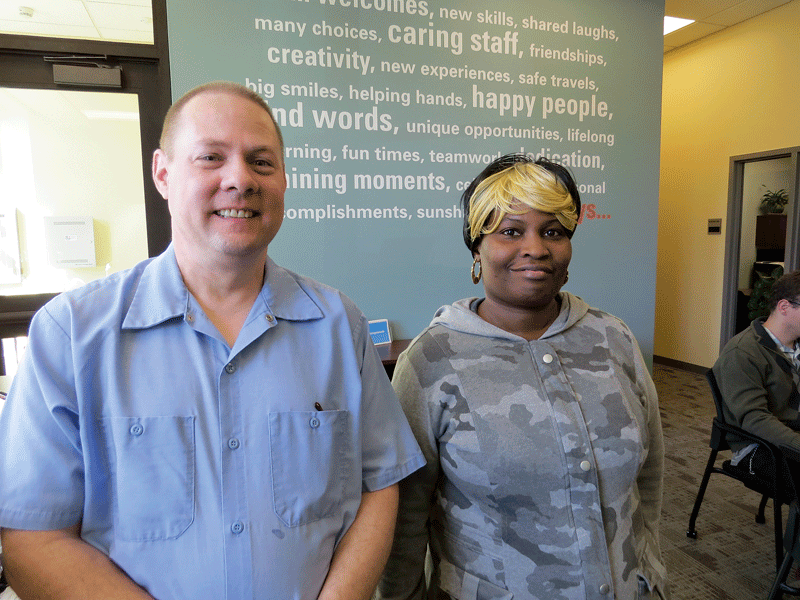
Denise Simpkins and Bill Denard have been working at Westover Air Reserve Base for several years now through Sunshine Village’s employment-services arm.

Denise Simpkins and Bill Denard have been working at Westover Air Reserve Base for several years now through Sunshine Village’s employment-services arm.

It’s also an example of how the agency is constantly listening to the constituencies it serves when they’re asked about needs and concerns — and responding to what it hears.

These traits have certainly benefited the agency as it works toward that goal of being a provider of choice, said Kos, adding that the same is true when it comes to being an employer of choice.

Elaborating, she said the competition for talent in the nonprofit sector is considerable, and Sunshine Village looks to stand out in this regard by working hard to enable employees to shine as well as those they serve.

“We see our employees as our best asset, and we invest a lot of money in training, recognizing, and thanking them,” she said of her team of more than 250.

Shining Examples

Kos said the official 50th anniversary date for the agency was in April of this year, and in many respects it has been a year-long celebration.

There was a dinner for employees last spring, several outreach events, and a community celebration in September, called, appropriately enough, the ‘Great Days Gala,’ that was attended by more than 250 people.

But in most all ways, Sunshine Village has been celebrating 50 years by doing more of what it’s been doing for 50 years — enabling people with developmental disabilities to shine.

And as BusinessWest talked with some of the clients served by the agency, it became clear that there are many ways for that verb to manifest itself.

For Jonathon Scytkowski, a participant in the CBDS programs who came to Sunshine Village in 2015, there are several components to his great days. He works at the Trading Post, cleaning floors, taking out the recyclables, and other duties. Meanwhile, he also volunteers at the Food Bank of Western Massachusetts and other nonprofits, and takes visits to the libraries in Chicopee and South Hadley and area malls.

Add it all up, and he’s busy, active, and, most importantly, involved.

“I like volunteering — at the Food Bank I do a lot of volunteering putting food in boxes for those who need it,” he told BusinessWest, noting, like Recor did, that working is important on many levels, from making money to having a sense of purpose.

Those sentiments were echoed by Denise Simpkins and Bill Debord, who have both worked at Westover, through Sunshine Village, for several years.

In fact, for Debord, it’s been almost 30 years, long enough to see a number of personnel come and go, but also long enough to feel like he’s part of that important operation.

“I really like working there — you feel like you’re part of the family,” he said, adding that he knows people by name, and vice versa.

As for Simpkins, who has been doing it for 12 years, she likes the work, the pay, and especially the perks — like the special occasions where she gets to see the planes close up and take some pictures.

“It’s good to have a job because you get to pay you bills and manage your money,” she told BusinessWest.

Meanwhile, for Kori Cox, another participant in the CBDS program, shining, if you will, takes a different form.

Indeed, as part of initiative called Positive Behavior Supports (PBS), she said she has an important role she described this way. “I do a lot of stuff to try to prevent the Village from being negative.”

Elaborating, she said she made a sign that reads “Positive Attitude, Positive Life,” and she works to encourage others, inside and outside Sunshine Village, to not only read the sign, but live by those words. Specifically, she works diligently to prompt people to stop using the ‘R’ word.

“We remind people that’s not nice to use that word — ever,” she said, adding that her efforts in this regard dovetail nicely with her broader mission.

“I love positivity — it really helps life; there’s no negativity,” said Cox, 24, who described herself as an ambassador, advocate, and peer leader.

As for Recor, well, let’s just say he seems to embody the words on Cox’s sign.

A World of Difference

Sunshine Village still stages a golf tournament every year. In fact, it’s the agency’s most successful fund-raising effort.

Its new, permanent home is Chicopee Country Club — only a drive and a wedge away from the Litwin Drive campus — and Kos no longer drives the beer cart, obviously.

Her role has evolved and grown — as has the agency’s.

But the basic goals are still the same — to create great days and enable those with developmental disabilities to shine, however those words are defined.

Half a century later, Sunshine Village is delivering on those promises.

Just ask Lenny Recor. He’s the guy with a smile on his face — on a Monday morning no less.

George O’Brien can be reached at [email protected]

Sections Technology

Innovation at Hand

10-nintendo-3ds-xlAn on-the-go society demands on-the-go technology, and the array of smartphones, tablets, wristband health sensors, and portable game systems only continues to expand as the major players compete for their share of a growing pie. In its annual look at some of the hottest tech items available, BusinessWest focuses on those mobile devices, which are connecting more Americans than ever, 24/7, to bottomless online resources and, sometimes, to each other.

If it seems like everyone’s on their smartphone these days, well, that’s a bit of an exaggeration.

But not by much.

According to a Pew Research Center survey conducted last November, 77% of Americans (77%) now own a smartphone, with lower-income Americans and those ages 50 and older exhibiting a sharp uptick in ownership over the previous year. Among younger adults, ages 18 to 29, the figure soars to 92%.

The 2017 results won’t be available until later this year, though the percentage is expected to rise even higher, because, well, it’s been on an upward trend since 2011, when Pew first started conducting these surveys. That year, just 35% of Americans reported they owned a smartphone of some kind.

These numbers don’t include plain old cellphones (remember when they seemed like the pinnacle of communications technology?). If those devices are included, 95% of Americans can reach in their pocket to make a call.

But BusinessWest’s annual rundown of the hottest technology — which, this year, focuses on mobile devices — isn’t interested in what was hot a decade ago. Following are some the most buzzworthy new smartphones, tablets, wearable fitness devices, and handheld game consoles, according to tech media.

Smarter — and Bigger

We’ll start, as many lists do this season, with the Samsung Galaxy S8 ($749), which Gareth Beavis at Techradar calls “the best phone in the world for a few reasons, but none more so than the display: it makes every other handset on the market look positively antiquated.

The camera and screen quality are both excellent, he continues, and while the phone is pricey, it’s worth the cost. “With the screen, Samsung has managed to find some impressive innovation at a time when there’s very little to be found in smartphones.”

Eric Walters at Paste added that, while the Galaxy S8 isn’t perfect, it’s the best Samsung has ever made, and an easy frontrunner for phone of the year. “It not only pushes the company’s portfolio forward, but the entire industry with its elegant and futuristic design that prioritizes the display without bloating the size. It’s an impressive achievement of design and engineering, but the quality isn’t surface deep. The entire experience of using the S8 is a rich one.”

One of the hottest trends of the past few years has been a shift to ‘phablets,’ smartphones that boast a much larger screen size than their predecessors. The Google Pixel 2 XL ($849) “improves on the first in lots of ways, but mostly it just looks a whole heap better,” writes Max Parker at Trusted Reviews, praising the device’s modern display and large size in a package that fits the hand well.

“But it’s the software that really wins here,” he adds. “Google’s approach to Android is fantastic, and the Assistant is an AI that’s already better than Apple’s Siri. The camera is stunning, too. It’s a 12-megapixel sensor that takes stunning photos in all conditions, and it’s packed with portrait mode tricks, too.”

Apple continues to be a key player in this realm, too, of course, and while the iPhone 8 Plus ($799) isn’t a big change over last year’s model, it boasts some substantial advantages, notes Mark Spoonauer at Tom’s Guide, and may turn out to be the equal of the iPhone X, to be released in early November.

“The new iPhone supports wireless charging, and its dual rear cameras are dramatically improved,” he adds. “Coupled with Apple’s new crazy-powerful A11 Bionic chipset, those lenses deliver portrait lighting — a new mode that lets you manipulate the light in a scene before and after the fact. The iPhone 8 Plus also delivers excellent battery life, lasting more than 11 hours in our testing.”

For those who prefer full-size tablets, competition continues to be fierce in that realm, with Apple again drawing headlines with the iPad Pro ($599).

“With Apple’s fastest-ever mobile processor, the 10.5-inch iPad Pro is easily the best tablet out there right now,” says Lindsay Leedham in Lifewire, who praised its camera, speakers, 256 GB storage, and True Tone display. “The iPad Pro uses sensors to detect the light in whatever room it’s in to adjust the color temperature of the display to the ambient light. The effect makes the screen look more like paper, and is most noticeable when it’s turned off and the screen switches to a bright bluish light.”

Meanwhile, for those on a budget, the Amazon Fire HD 8 ($79) is the best sub-$100 tablet available, according to Sascha Regan at PC Magazine.

“While you shouldn’t expect to compete against the iPad at this price point, the Fire HD 8 fits the bill for media consumption and light gaming,” she writes, calling its battery life adequare but praising its dual-band wi-fi. “In several tests at different distances from our Netgear router, we often got almost double the speed on the HD 8 than on the Fire 7. That made a real difference when doing things like downloading comics.”

Health and Leisure

Wearable technology, which focuses on tracking health and wellness habits, continues to be popular, although Fitbit, far and away the dominant player in this market, may be reaching saturation in the U.S., while smaller competitors eat away at its global market share, according to International Data Corp.

Still, its new products continue to wow reviewers. “Guess what: Fitbit’s newest tracker is its best one yet,” raves CNET’s Dan Graziano about the Fitbit Alta HR ($149). “For me, it’s all about design. I’ve been wearing the Alta HR for almost a month and plan to continue wearing it even after this review. It’s comfortable to wear and doesn’t sacrifice any features, but what sold me was the seven-day battery life.”

For those looking to spend more, the Fitbit Surge ($249) is a satisfyingly sophisticated piece of machinery,” writes Jill Duffy at PC Magazine. “It not only tracks your steps and sleep, but also alerts you to incoming phone calls and text messages, keeps tabs on your heart rate with a built-in optical heart rate monitor, uses GPS to track outdoor activity, and has much more functionality, especially for runners.”

Looking over the rest of the field, Marko Maslakovic at Gadgets & Wearables finds plenty to like about the Garmin Vivosport ($199), which is waterproof, comes with built-in GPS and all-day stress tracking, and counts reps and sets in the gym.

Though it’s slim and fits snugly on the wrist, “Vivosport has some pretty decent specs under the hood,” he adds. “You’ll get everything you could possibly hope for 24/7 activity tracking, including detailed info on steps, calories, distance, heart rate, activity, floors, and sleep. The GPS makes for more precise distance, time, and pace tracking, along with route mapping for your runs. It will track your swims in the pool, too. This is probably Garmin’s best fitness band yet.”

For technology enthusiasts whose tastes favor gaming on the run over, well, running, the portable-console market continues to thrive, with the longtime market leader making some new waves this year with the Nintendo Switch ($299).

“You can use it as a stationary console with your TV or transform it into a portable gaming device in literally seconds. You will keep all the data and can continue your game on the go,” Slant notes. “Nintendo Switch is light and feels comfortable in hand. It doesn’t cause any wrist strain. It also has a kickstand that folds out from the back of the console, so you can put it on the table.”

The publication also praises its graphics and controllers, but notes that it can be hard to find, lacks long battery life, plays poorly in direct sunlight due to screen glare, and doesn’t boast a wide variety of popular games — yet.

Game variety is no issue for the Nintendo 3DS XL ($199), which boasts two large screens, glasses-free 3D, and some of the best video games available on a mobile console, according to Top Ten Reviews. On the downside, battery life is not ideal.

Still, “thanks to its backwards compatibility with DS games and its huge selection of classic and new games in the Nintendo eShop, the 3DS XL is the best handheld game console available,” the site continues. “The 3DS family has the best games on a mobile category, and the Nintendo 3DS XL is the best handheld console available.”

Joseph Bednar can be reached at [email protected]

Holiday Party Planner Sections

Mixing It Up

Alyssa Blumenthal says many clients make use of Bistro 63’s outdoor deck.

Alyssa Blumenthal says many clients make use of Bistro 63’s outdoor deck.

Located at the edge of the UMass Amherst campus and central to the other Five Colleges institutions, Bistro 63 has done a brisk business in events for those schools, from department holiday gatherings to retirement parties to student events.

It’s an ideal space for the wildly divergent tastes of college students, faculty, and staff, said Event Manager Alyssa Blumenthal, because it easily transforms from a banquet space to a nightclub — often during the same event.

That makes for a memorable experience, she added, which often brings those undergrads back a little later in life.

“Many students come back to us later on,” Blumenthal said. “Five years after graduating, people are getting married, and we see them again when they choose to do a rehearsal dinner with us, when they want a nightclub-style party after dinner. We’re a venue that can provide any atmosphere you can imagine for a private gathering.”

Current owners Rasif and R.J. Rafiq bought Bistro 63 — the restaurant attached to the popular Monkey Bar at 63 North Pleasant St. in Amherst — from its original owner, who opened it in 1999. The brothers both worked there for more than a decade before taking over the business, learning every aspect of the operation. Today, the space hosts parties of all types — holiday events, corporate dinners, cocktail parties, rehearsal dinners, reunions, and more — ranging from small gatherings to large events up to 240 people. A large room can be divided into smaller spaces, including a covered deck outside. A 131-inch projection screen is available as well.

“We also love music,” Blumenthal said, referring to both live bands and DJs that frequently perform. “Atmosphere is important to us, and it really permeates every part of the restaurant.”

She noted that Bistro 63 has become a popular event site not just for UMass and the colleges, but area law offices, financial-services businesses, and a variety of others. Business tends to pick up starting in October, not only with the approaching holidays, but because it tends to be a hot season for convention business — and those events tend to spur further bookings. In fact, two weekends ago, Blumenthal welcomed three separate gatherings all booked by companies who attended a Bistro 63 event during last year’s International Conference on Soils, Sediments, Water and Energy at UMass.

“We’re really lucky to have some great, loyal customers,” she told BusinessWest. “At the end of the day, we love creating memorable experiences for guests with a personalized touch.”

Drinking It In

Nowhere is that personalization more evident than in the facility’s cocktail program.

“This is a Prohibition-style bar, known as a speakeasy, that sort of illicit atmosphere,” she said. “Our translation is using modern techniques on classic cocktails, putting our own personalized spin them. I’m not a cocktail drinker, but I will drink every cocktail on the menu; they’re not too sweet, but perfectly balanced. We make all our syrups in-house, squeeze all the citrus fresh to order.”

With that kind of reputation to uphold, the bartenders have a demanding job, she added. “But it shows in the quality drinks they produce. We have more than 250 craft and specialty spirits we can use, and the owners give the bartenders free rein to use our stock at their delight.”

Bistro 63’s location at the foot of the UMass campus

Bistro 63’s location at the foot of the UMass campus makes it a popular spot for party bookings by students and faculty.

While Rasif Rafiq focuses on food and events, R.J., who studied under master mixologists, specializes on the drink side and trains the bartenders.

“The interviews are intense,” Blumenthal said. “He’s the most stern you’ll ever see him. He’ll laugh and be casual with us because we know him. But during the bartender-training process, there’s no smile. He wants to make sure they’re at the top of their game. And it shows — guests know they’ve had an experience above par, something they’ve never had before. He’s a great mixologist who has trained the bar staff to be the same way.”

In addition to a rotating list of custom cocktails, Bistro 63 has been known to create unique concoctions for specific events. “For one event, probably my favorite bride of all time had this idea: she wanted to describe her fiancé, and wanted him to describe her, and she wanted us to make drinks based on those descriptions. It was like a lab test to see how well they knew each other.”

That sort of customization tends to spur repeat business, she added. Even the UMass soil convention requested a custom cocktail, which included elder flower liquour, fresh-squeezed lemon juice, and vodka. “They’re having another one this year, and they want the same cocktail, but they want an additional cocktail as well. In five years, we’ll be running a fully customized bar for this group.”

It all stems from the philosophy that no two events are the same, and each should spring from a unique vision, she went on. “We try to bring it to life with those extra touches they weren’t expecting. It makes it more memorable in the end.”

As for the food, clients may choose from a number of appetizers, salads, entrees, and desserts, creating a custom package for their event. Those options — which may include anything from wild saku sesame tuna to rack of lamb ‘lollipops’ to truffle mushroom risotto — change throughout the year, not only for variety but to focus on seasonal ingredients.

“We definitely want people come back,” Blumenthal said. “At the end of the day, the customer is boss, and you want them to come every day if they could. We order from a lot of local producers and work with a lot of farms in Hadley. Why wouldn’t you? We have some of the best farms in the world, so we put those local eggs, local potatoes, and local meat on the menu.”

Keep Calm and Party On

Party planning, Blumenthal said frankly, can be difficult, and it’s easy to forget details like that guest who requires gluten-free options. So she aims to create a stress-free experience.

“If we can make a plan without you having to think about it too much, we’re more likely to book you,” she said. “We think ahead all the time; we have gluten-free and dairy-free food on all the menus.

“For every inquiry, we try to go the extra step, make your life easier, and make the planning process more straightforward and streamlined,” she went on. “We get repeat events because people like that personalization and like that we give them a plan straight off the bat. When they come back next year, we say, ‘this is the event order from last year; these are the updated menu items; do you want to keep the menu the same or try some new items?’ We don’t have people asking questions — we’re already anticipating their needs.”

Joseph Bednar can be reached at [email protected]

Health Care Sections

The Best of Both Worlds

Dr. Lindsey Rockwell, left,

Dr. Lindsey Rockwell, left,  says the Mass General Cancer Center at Cooley Dickinson Hospital offers patients and their families the best of both worlds.

Opened almost two years ago, the Mass General Cancer Center at Cooley Dickinson Hospital is a stunning example of collaboration in motion, if you will.  The center brings a host of services together under one roof, but it also brings the vast resources of Mass General to CDH and the people it serves. The collaboration that created and designed the center is rock solid, but it also continues to evolve and add new layers to a unique partnership.

Dr. Lindsey Rockwell calls it “the gift that keeps on giving.”

As she spoke those words, she acknowledged that they form a somewhat old, well-worn cliché used, to one degree of effectiveness or another, in a wide array of forums.

But when it comes to the Mass General Cancer Center at Cooley Dickinson Hospital, it works, said Rockwell, a medical oncologist and hermatologist now affiliated with the center.

She told BusinessWest that when the center was conceptualized several years ago, it was envisioned as a facility where a host of specialists and services would come together under one roof, bringing higher levels of convenience and lower levels of stress to both patients and their families.

It was also blueprinted to become a truly unique asset for the region, one that would essentially make the vast resources of Massachusetts General Hospital and its oncologists available to individuals in this region — often without them having to travel to Boston.

And the center has become all of that and much more, said Rockwell as she talked about the facility nearly two years after it officially opened its doors. This is what she meant by that ‘gift that keeps on giving’ comment, before elaborating and reshaping her thoughts.

“Part of the beauty of this relationship is the idea of creating a new paradigm in oncology care where the patient can have their care in their backyard, with a world-renowned academic and research hospital at their fingertips when and if they need it,” she said. “And as a community oncologist, I believe this allows the patient to have the best of both worlds.

“They can have the intimacy and ease of a community hospital,” she went on. “And they can have access to the experts that are writing the data and doing the research in the field of their disease. They can get that here and not have to drive to Boston every week.”

 Dr. Lindsey Rockwell

Dr. Lindsey Rockwell

As she talked about the $5 million, 16,400-square-foot facility center and its first few years of operation, Rockwell came back repeatedly to that subject of stress — an all-important matters wen it comes to diagnosing and treating cancer — and how those at the center work collaboratively and effectively to reduce it.

“The patient doesn’t have to go see ‘A,’ ‘B,’ and ‘C’ — ‘A,’ ‘B,’ and ‘C’ come to the patient,” she went on. “And I think part of what that allows is for less stress. If the patient has a new cancer diagnosis, which obviously a terribly stressful time for them … by creating a system that works toward them, the intention is to alleviate the stress, their stress, and organize around them.”

For this issue and its focus on cancer care, BusinessWest talked at length with Rockwell about the center, the collaboration that created it and continues to fuel it, and this system designed to work for the patient.

Center of Attention

Rockwell said the seeds for the cancer center were planted perhaps as early as 2009, when a dialogue was generated with specialists at Mass General about what such a facility could and should look like — and how it would operate.

She called these the “courting stages.”

“Our go-to consultations to experts became our colleagues at Mass General,” she explained. “I think they had us on their radar for consideration for a satellite facility, and we had them on our radar for a replacement for Dartmouth Hitchcock (the former parent company for Cooley Dickinson Hospital).

“The oncology program was really the pilot program to establish a rapport with our colleagues in Boston,” she went on. “And it went really well.”

Elaborating, she said those both side of this pilot program developed a very fluid process of discussing patients, getting patients to Boston if they needed to be seen in Boston, and opening up a fast-track discussion of appropriate clinical trials.

“That groundwork was set over several years, and it led to the formal dialogue that created the actual affiliation,” she explained, adding that all this what not what she would call a natural process, but rather a “natural evolution” of a relationship or collaboration.

“It was like … ‘OK, we like you, and you like us, this is working — let’s do it,” she told BusinessWest. “‘And let’s broaden it and deepen it, and make it more specific, and define it — and agree to agree and create a relationship.”

And this process of evolution has continued, meaning it certainly didn’t end when the cancer center opened its doors in the fall of 2015, she said.

As an example, she cited a growing platform of videoconferences staged at the center and involving colleagues at Mass General.  There are now three of them; one is a weekly breast cancer conference, another is focused on multiple myloma and takes place roughly every other month with the goal of eventually becoming monthly, and the third is a broader tumor conference staged monthly.

These conferences provide unique opportunities for both the oncologists based at Cooley Dickinson and their patients, Rockwell explained.

“It’s an informal way of getting a second opinion with more complicated cases, she said, adding that this is just one of many ways of bringing everything that Mass General offers to patients in this region, and just one example of ongoing evolution.

Radiation therapists treat a patient in the Mass General Cancer Center at Cooley Dockinson Hospital.

Radiation therapists treat a patient in the Mass General Cancer Center at Cooley Dockinson Hospital.

As for the center itself, Rockwell said its creation, specific design elements, and roster of services was, in itself, an exercise in collaboration.

“We met regularly — every month as the go-live time got closer — and discussed things as a group,” she explained. “That means everything from operations — where should the exam rooms go? And the infusion suite? Where is the waiting room? What is the flow process, from a patient coming in the door to the exam room to the infusion suite? Needless to say, that was an extraordinary amount of collaboration, and our colleagues were an intimate part of those decisions.

“And what’s interesting is that, while they were an intimate part of those decisions, they want us as a community hospital to have our own voice and have our own autonomy,” she went on. “And this is a big part of why I think this works — knowing that we have them in our back pocket if we want advice or counseling on a certain issue.”

Beyond access to the resources at Mass General, convenience is at the heart of the center’s creation and design, said Rockwell, adding that cancer care is now centralized at the facility.

“They have their labs done in one place, see their oncologist at that same place, and also have their scans done and their chemotherapy at the same place,” she explained, adding that radiation is one flight below the cancer center, and a new, multi-disciplinary breast clinic now in the planning stages will just one hallway away.

And this brings her back again to that broad mission of alleviating stress — for patients, obviously, but also for physicians as well, because of the ‘one roof’ nature of this facility and the manner in which it improves communication between members of a patients’ team.

“All the doctors are talking to each other in real time,” she explained. “That alleviates a lot of stress on the physicians, because having each other right there cuts back on phone calls and not being able to reach people; we get to sit down and have the conversations, and come to an agreement on the patient’s plan as a team.”

Coming Together

As she talked about life before the center was created and contrasted it with operations now, Rockwell said that before, things were ‘separate’ — a word she eventually preferred over ‘fragmented,’ although she used them both —and now they are integrated.

And the change is significant for all parties involved — specialists delivering care, their patients, and the patients’ families — because integrated translates directly into “more patient centered,” she explained, which is the quality that those who orchestrated this collaboration and the cancer center itself had in mind when they did so.

“Because we’re all under one roof, the plan for the patient’s care is driven by the patient, the diagnosis, and the team taking care of them.”

This is what she meant by the center being a gift that keeps on giving — a development will continue, just as the center and the collaboration behind it continue to evolve.

George O’Brien can be reached at [email protected]

Features

Change Agent

Donna Haghighat

Donna Haghighat

Donna Haghighat has seen a number of titles on her business cards over the years — everything from ‘tax attorney’ to ‘grants manager’ to ‘founder and CEO’ — yes, she’s launched a few businesses of her own. A common denominator with most all those career stops has been a desire to work with women and girls to identify goals and opportunities and remove the barriers to realizing them. Call it a passion — one that has brought her to her latest business card, which reads ‘CEO, Women’s Fund of Western Mass.’

“She changed the world for women.”
That was the simple six-word response Donna Haghighat summoned, after a few moments of thought, when asked why she sought to become the next director of the Women’s Fund of Western Mass.

By way of explanation, she said this is a mantra of sorts that she lives by, but also something she would perhaps like people to say about her when her career is over — which won’t be for quite some time now.

She told BusinessWest that she took this position with the hope, and expectation, that she could better live up to that mantra — and, well, also make it more likely that people will be saying that about her.

In many ways, they already are.

Indeed, Haghighat (pronounced Ha-gi-gat) has spent most of her career in positions devoted largely or entirely to that mission of changing the world for women, in some way. Her résumé includes a stint as the chief Engagement & Advocacy officer for the Hartford Region YWCA, and another as founder and CEO of a “social entrepreneurial website,” as she called it, called shoptimize.org, which featured products from emerging women entrepreneurs. Her background also includes work as the grants and programs manager for the Women’s Advancement Initiative at the University of Hartford and as executive director of the Aurora Women & Girls Foundation in Hartford.

She started out as a tax attorney and served for two years earlier this decade as the chief development officer for the Hartford Public Library, but assisting women and girls has been her real passion.

“Even when I wasn’t working professionally in women’s funding, I’ve always done that on an individual level even when I couldn’t do it on an organizational level,” she explained. “So for me, when this opportunity presented itself — one that would allow me to work at an organizational level to really bring about bigger change and mobilize the collective resources of women and their allies — it was really a no-brainer.”

She said she came to the Women’s Fund primarily because two of its main focal points — awarding grants to agencies and programs focused on assisting women and girls and developing programming on women’s issues and leadership — also happen to be her two main focal points.

womens-fund-logo

With the former, she’ll strive to “strengthen the strategy concerning our grant making,” as she put it, meaning a more concerted effort to identify specific issues the grants are intended to address.

And with the latter, she is intrigued by both the prospect of building upon existing initiatives, such as the hugely successful Leadership Institute of Political and Public Impact (LIPPI) program, and new undertakings, such as the Young Women’s Springfield Initiative (YWSI), which features young women leaders working together with adult mentors to create a roadmap for their collective futures.

“I like that we’re able to do both grant making and on-the-ground programming as well,” she explained. “We’re helping women and girls in Massachusetts right now, and also building for the future in terms of shaping future leaders.”

When asked what was on her to-do list for the Women’s Fund, she started by talking about the organization’s mailing address. At the moment — and for the foreseeable future, it is 276 Bridge St. in Springfield, a strategic location chosen by the previous administration to address another item on Haghighat’s list — creating more visibility for the organization.

But that’s the address of the new Innovation Center in Springfield, an ambitious project led by DevelopSpringfield, MassDevelopment, and other partners that is currently in a holding pattern (construction work ground to a halt in May) amid funding problems and a now a lawsuit filed by the general contractor over non-payment for services and materials.

Haghighat, who started on Sept. 1, said the Women’s Fund is a tenant in the Innovation Center and has no control over the fate of the project. So while she watches as those issues play themselves out, she’ll focus on what she can control, specifically the programming and grant awarding she mentioned, efforts that should be boosted by another new addition at the agency.

That’s Christine Monska, who has joined the Women’s Fund as program officer for Leadership Programs, and in that position will play a lead role in administering the Young Women’s Initiative as well as other programs.

Overall, Haghighat said the broad goal for all members of her team is to make the Women’s Fund a greater resource and a stronger vehicle for positive change for girls and women across the region.

For this issue, BusinessWest talked at length with her about what brought her to the Women’s Fund and also about where she wants to take this organization that lives by the same mantra she does.

Seizing an Opportunity

Haghighat said she became aware of the position at the Women’s Fund in a roundabout fashion, but one that speaks to how her skill set matches what the agency was looking for its next leader.

She had recently launched a consulting firm called Collabyrinth Collective, LLC, one that provided guidance to small businesses and nonprofits in realms ranging from marketing and fund-raising to diversity and inclusion.

Fast-forwarding a little, she said she reached out to friend and former Trinity College classmate Patricia Canavan, president of United Personnel, about her new venture, and in turn, Canavan asked her if she would ever consider taking on interim CEO opportunities.

They would eventually go on to discuss one such opportunity at length, one that didn’t pan out due mostly to issues of timing (Haghighat had a lengthy trip to China already on the calendar). But not long thereafter, the discussion would take a much different, rather serendipitous tone, because Canavan would be assigned the task of chairing the search committee charged with choosing a successor to outgoing Women’s Fund CEO Elizabeth Barajas-Román.

“She [Canavan] was reminded that I had considerable women’s funding experience,” Haghighat went on, adding that while she wasn’t exactly looking for a new opportunity and was enjoying her consulting work, the Women’s Fund of Western Mass. intrigued her on a number of levels.

Specifically, the WFWM position offered an opportunity to take experiences from several previous career stops involving women, fund-raising, and both, and apply them at an organization that is clearly in growth mode and developing new ways to carry out its multi-faceted mission.

Such as the YWSI, an initiative that has enormous promise on a number of levels, said Haghighat.

Elaborating, she said the Women’s Fund of Western Mass. is part of a coalition of eight women’s foundations across the country (the others are in Birmingham, Dallas, Los Angeles, Memphis, New York City, Washington, D.C., and the state of Minnesota) taking part in the Young Women’s Initiative.

In Springfield, the program will kick off Oct. 18 at UMass Center at Springfield, an event designed to highlight some of the key issues facing girls and women in the Commonwealth’s third-largest city and what the Women’s Advisory Council (YWAC) plans to do about them.

The program was inspired by an effort in New York City launched by an organization called Girls for Gender Equity, funded by the New York Women’s Foundation, Haghighat explained, adding that the Women’s Funding Network, of which the WFWM is a member, saw great potential in the initiative, which led to the pilot programs launched in those eight areas.

Here’s how it works. Girls and women from Springfield — meaning they are from the City of Homes if not necessarily living there now (they may be away at college, for example) — are eligible to participate in the program, which enlists them to both identify concerns and learn how positive change can come about.

“Through these young women, the program helps identify the concerns and the barriers that these women are seeing in their own lives,” she explained. “And then it will teach them about what public policy is all about and how they can affect public policy by looking at the issues affecting them and pushing for change.”

YWSI will partner the Women’s Fund with the city of Springfield, she went on, adding that funding for the initiative has been secured from MassMutual. It will focus primarily, but not exclusively, on girls and women of color, and will invite a number of stakeholders to be part of the process of initiating change and progress.

“Here’s an opportunity for young people to be at the center of efforts to try to change some of the things that are impeding their own progress and keeping them from reaching their full potential,” she went on, before motioning to the words written on large sheets of paper affixed to the walls outside her office.

Those words were some of the collective thoughts gathered at a host of so-called ‘listening tours’ staged in the run-up to the start of the program.

The girls and women gathered for those tours listed a broad array of interests (a list that including everything from fashion to arts to ‘daydreaming’) as well as concerns, barriers, supporters, and more, she said, adding that the collected thoughts serve as a form of preliminary database as the project gets underway.

“We’re learning a lot about what young women in Springfield see as both their opportunities and challenges,” she said. “And that’s going to help us inform our curriculum.”

The participating girls and women (Haghighat is expecting between 20 and 30 of them) will meet at least monthly between now and the spring.

While launching YWSI, Haghighat and her team will address a host of other issues on her growing to-do list.

Included on that list are bringing on two new staff members (Monska and an intern tasked with working on the YWSI program) and “having the team coalesce under my leadership,” as Haghighat put it, as well as work to finesse a recently drafted strategic plan.

Also on the list are increasing visibility for the Women’s Fund as well as staging more events like the LIPPI alumni gathering recently held in Shelburne Falls.

And for Haghighat personally, after spending the bulk of her career working in and around Hartford, she plans to work hard at becoming more familiar with this region, its institutions, its resources, and potential partners moving forward.

Impact Statement

Asked to look ahead to next spring and, more specifically, toward what she hopes and expects participants in the YWSI program to come away from that effort with, Haghighat offered thoughts that reflected not only on that initiative, but also what has become her life’s work.

“I want to have these young people walk away having a clearer sense of what their own challenges and opportunities are,” she said, “as well as an understanding of how policies work and how they can speak up and either join other groups or create their own groups to effect change that will remove barriers and hopefully amplify the opportunities they have so that not only them but also other young women can benefit.”

The wording varies, but that’s essentially the mission of every agency or business she’s ever worked for, including her own consulting company.

It’s about changing the world for women — for the better. That’s a mantra, but it’s also a career, one that has brought Haghighat to Springfield and the Women’s Fund.

Where she will take the organization remains to be seen, but the goal is clear: to broaden its impact and make it even more of a change agent.

George O’Brien can be reached at [email protected]

Health Care Sections

Progress Report

Questions answered by Dr. Holly Mason

Dr. Holly Mason

Dr. Holly Mason

Q: My mother has been after me to go for a mammogram. When should screenings start if one is to detect breast cancer early?

A: There is no simple answer to that question. The benefits of screening are greatest for those women who are most likely to develop breast cancer and for whom early treatment is more effective in treating the disease.

There is a lack of consensus among the leading healthcare organizations as to when to begin screening for the average risk patient. What is recommended today is that women have an honest discussion with their physician about when their screening should begin. Your physician will make a recommendation for you based on your risk factors, including any family or personal history.

After talking with your doctor about screening, you can make an appointment by filling out a form at baystatehealth.org/getscreened or calling (413) 794-2222.

Q: What is the difference between conventional mammography and the newer 3D mammography now being offered?

A: While 2D mammograms take images only from the front and side, 3D mammograms, which we offer, take multiple images or ‘slices’ of the breast from many different angles to create a three-dimensional picture of the breast. The ‘slices’ can reduce images with overlapping breast tissue and give doctors a clearer image of the breast tissue.

Using 3D mammography can make it easier for doctors to catch breast cancer early and reduce the chances of false positive results. However, not all insurance plans cover 3D mammography.

Q. My mother told me she had a breast MRI. What are the advantages of breast MRI as opposed to mammography?

A: First and foremost, a breast MRI is used to supplement, but never to replace a mammogram for screening of the breast. Breast MRI (magnetic resonance imaging) is another way to look at breast tissue. It requires a dose of a dye called gadolinium. A screening MRI may be indicated, in addition to mammography, if you are at increased risk for breast cancer.

At Baystate Health, we follow the American Cancer Society’s (ACS) recommendations for screening MRI for breast cancer, which include a known gene mutation placing you at greater risk to breast cancer, such as the BRCA mutation, previous history of chest radiation, such as for Hodgkin’s lymphoma, or a family history of breast cancer that places you at a greater than 20-25% lifetime risk for breast cancer. You can learn more at the ACS website www.cancer.org.

Q: How great a risk do women face if they have a family history of breast cancer?

A: It depends on how many family members had breast cancer, their age at diagnosis, and the degree of relation to the women who had cancer. There are many other cancers which may be related to breast cancer within a family, such as gastric cancer, pancreatic cancer, colon cancer and prostate cancer, to name a few. A careful family cancer history is important to determine if there might be a genetic component to your risk of developing breast cancer.

At Baystate, we offer our Family Cancer Risk Program for patients who may be candidates for genetic testing due to a family history of breast and other types of cancer. For more information on this program, call (413) 794-8890.

Q: What choices does a woman with a BRCA gene mutation have?

A: There are two main approaches: heightened surveillance or risk-reducing mastectomy, but this is a personal decision. Women who are planning to start a family or have additional children have the option for increased screening by alternating an MRI and mammography every six months to check for cancer. I do not know how old you are or if you have the BRCA gene, but for younger women still in their 20s, the recommendation is for a baseline annual MRI starting at age 25 and beginning mammography at age 30. This option must also include a clinical breast exam twice a year in combination with monthly breast self-exams.

Q: What are the signs and symptoms of breast cancer?

A: Symptoms which indicate a need for evaluation by a doctor include: A new lump in the breast or underarm, irritation or dimpling of breast skin, redness or flat skin in the nipple area of the breast, pulling in of the nipple, nipple discharge other than breast milk that is spontaneous (not occurring with self-examination), including blood, and any change in the size or the shape of your breast or pain in any area of your breast.

Given the fact that screening mammography often detects a cancer when it is very small, most women do not have any symptoms at the time of their cancer diagnosis.

Q: Can you tell me about any new treatment options for women?

A: Breast cancer treatment has changed quite dramatically since 1990 because of early detection, as well as better treatment and a better understanding of the nature and behavior of breast cancer. Most importantly, treatment should be tailored on an individual basis depending on the tumor and the patient in collaboration with the breast cancer team.

In terms of surgery, mastectomy was once the norm. We are now able to preserve the breast and perform a lumpectomy in most patients who prefer this choice. In women who have a cancer that is too large to allow for a lumpectomy with a reasonably satisfactory cosmetic result, medical therapy with chemotherapy or anti-hormone therapy can be given before surgery to shrink the tumor.

In the late 1990s, a procedure called the sentinel node biopsy was developed, where dyes can be injected into the breast to determine which lymph nodes are the first that the breast drains into. If cancer is going to spread outside the breast, it will go to these lymph nodes first. If the sentinel node(s) is negative for cancer, then there has not been any spread to any of the lymph nodes. By limiting the number of lymph nodes that are removed, the risk of swelling of the arm, referred to as lymphedema, can be minimized.

In women over the age of 70 who have a slow growing type of cancer, a lumpectomy may be able to be performed without post-lumpectomy radiation, as long as the patient is willing to take anti-hormone therapy. In addition, some patients may not need to have any lymph nodes removed. These decisions, however, need to occur in discussion with your surgeon, medical oncologist, and radiation oncologist to ensure that the risk of recurrence is low enough to avoid these treatments.

Medical therapy has also improved with the development of different anti-hormone medications to treat breast cancer, as well as different chemotherapy regimens which are better tolerated and more effective. One of the biggest developments is the use of molecular, or gene profiling, of the tumor, which can help in the decision of whether or not chemotherapy will give a benefit above what benefit is seen with anti-hormone therapy, which can then be weighed against the risks of chemotherapy.

Dr. Holly Mason is section chief for Breast Surgery at Baystate Medical Center.

Features

Returning to Its Routes

Peter Picknelly says his company stands to benefit in many ways from ending its affiliation with Greyhound.

Peter Picknelly says his company stands to benefit in many ways from ending its affiliation with Greyhound.

Back in 1999, Peter Picknelly says, it made perfect sense for Springfield-based Peter Pan to forge a partnership with long-time archrival Greyhound.

The two carriers served most of the same cities in the Northeast, often had terminals right next door to each other, and were waging intense price wars that weren’t benefiting either company.

So a truce was called and an affiliation forged, said Picknelly, president of Peter Pan, adding that the companies’ names and logos soon appeared together at ticket counters, and the carriers shared operations and revenues.

But times, as they inevitably do, change, said Picknelly, and several years ago, it became apparent that ending this partnership made as much as sense as creating it did nearly two decades ago.

It took some time — at least a few years by Picknelly’s count — and legal action amid Peter Pan’s claims it was not being properly compensated by Greyhound, to formally untie the knot. But this desired independence will bring with it a number of benefits, he said, adding that, above all else, it will allow his company to be more responsive to changing needs and tastes among bus travelers.

Elaborating, he said Peter Pan had been hampered by Greyhound’s inability (or unwillingness) to accept paperless tickets, and also by its routes with frequent stops — things today’s time-conscious, technologically savvy bus travelers frown upon.

“The customer will see new Peter Pan ticket counters and new gates in many locations, and they’ll also see much more non-stop service than we had before,” he explained. “Because we were aligned with Greyhound, there were just certain things we couldn’t do, and now we can.”

The partnership between the two companies was due to expire in roughly a decade, he went on, but the long-time and once-again rivals agreed to terminate it much earlier due to those changing times mentioned earlier.

Indeed, the Internet and the declining role of the bus-terminal ticket counter probably played the biggest roles in the mutual decision to turn back the clock — in most, but not all ways — roughly 18 years.

“Back then, whoever controlled the bus terminals controlled the business,” Picknelly explained. “With the advent of the Internet, things have changed, because most people buy their tickets online, not at the bus terminal; people are planning their trips further in advance.”

For this issue, BusinessWest talked at length with Picknelly about his company’s regained independence from Greyhound and what it all means. In this course of doing so, he shed some light on a changing business, but one still laden with opportunities for growth.

Driving Forces

As he talked with BusinessWest in his soon-to-be-vacated office at the almost-empty Peter Pan terminal across from the recently renovated Union Station, to which the company will be moving, Picknelly said that, overall, the bus industry remains quite healthy.

This despite comparatively lower gas prices that have persisted for the better part of two years now. Picknelly explained that higher gas prices fuel surges in business for ventures such as his, and spikes in prices at the pump like the one that followed Hurricane Harvey-related damage to refineries in Texas result in very noticeable increases in bus-ticket purchases.

“When gas prices go above $3 or just get close like they are now, we see it,” he explained, referring to increased ridership. “When they go above $4 … forget it; people don’t want to take the bus.”

But while gas remains relatively inexpensive, bus travel continues to be a solid option because there are other expenses to consider — tolls and parking, especially in major cities, he explained. There’s also the convenience factor; with most all buses now equipped with wi-fi, professionals can work while they travel, and many are choosing to do so.

The popularity of bus travel comes with heightened competition, however, said Picknelly, noting that there a number of carriers in Peter Pan’s operating area — the Northeast, from Washington, D.C. to New England.

Still, the biggest competition comes from the automobile, he told BusinessWest, adding that a large percentage of his customers own one and need to be convinced to leave it in the garage when it’s practical to do so and take the bus instead.

Peter Picknelly says that, by regaining its independence from Greyhound, Peter Pan can give customers more of what they want and need.

Peter Picknelly says that, by regaining its independence from Greyhound, Peter Pan can give customers more of what they want and need.

And this observation leads him back to Peter Pan’s breakup with Greyhound. That split ultimately helps his company, and his buses, better compete with the car, he explained, by ultimately making bus travel less expensive, more convenient, and less time-consuming.

“I wake up every morning, and my job is to get people out of their car to take public transportation,” he said, adding that he can better succeed in this basic mission without some of the restrictions that resulted from the Greyhound affiliation.’

“Our focus is on city-center-to-city-center service; our focus is good, solid service from point A to point B, and that’s where we think our growth is — that’s where it always has been.”

To further explain, Picknelly first talked about the way things were, before quickly moving on to why the picture needed to change.

“Our companies have grown apart; while the industry has changed, so has Peter Pan, and so has Greyhound,” he explained. “Since our alliance was formed, Greyhound has been bought and sold twice, it’s no longer an American company — it’s owned by a British conglomerate — and decisions are made in the U.K. They’re a very different company and very different to deal with.

“And their business model is very different,” he went on. “Their focus is on long-distance travel, and they make many stops en route; they’re interested in carrying people from Boston to Florida, and we don’t do that.”

Looking ahead, Picknelly said that he believes Peter Pan is well-positioned for a return to how things were in 1998, and that’s one of the big reasons why an end to the affiliation with Greyhound came about.

Indeed, he listed everything from what amounts to a lowest-price guarantee to those non-stop routes he mentioned, to the increasingly paperless nature of the company, to the rewards program it recently started called Peter Pan Perks.

“Greyhound, because it’s so big, and because it focuses on long-distance routes, required people to print a ticket,” he explained. “We’ve had technology for two years now where you can buy a ticket on your mobile device, just show the driver your phone, and get on the bus. We were not able to do that with our alliance with Greyhound; now, we’re 100% paperless.”

Looking Down the Road

Summing up the changing picture, Picknelly said the secret to the success of the bus industry was quite simple — frequency of service and low fares.

Those are the keys to prevailing over what remains this sector’s biggest competition — the car.

Splitting from Greyhound will better position the company to prevail in this competition, he said, adding that Peter Pan is returning to its roots, and its routes, and will be the better for it.

George O’Brien can be reached at [email protected]

Community Spotlight Features

Community Spotlight

David Nixon says Hadley’s low tax rate, access to transportation, and mix of agriculture and commerce are among its selling points.

David Nixon says Hadley’s low tax rate, access to transportation, and mix of agriculture and commerce are among its selling points.

What a difference 300 feet makes.

“I often talk about the different views from Route 9 and the bike path,” Hadley Town Administrator David Nixon said, referring to the trail that parallels the heavily trafficked Russell Street a football field’s length away. “One is a very commercial, mercantile view, and one is a very pastoral view. And they’re right next to each other. That really makes Hadley very special — commercial, residential, and agricultural, we have it all here.”

Indeed, many out-of-towners driving along Russell Street during the day might not realize that only 5,000-plus residents call Hadley home. “That number is accurate between 12 a.m. and 5 a.m. Otherwise, it’s between 20,000 and 60,000,” Nixon said, with visitors crowding into five major shopping areas along Route 9, as well as a few facilities on the UMass Amherst campus, including McGuirk Stadium and the Mullins Center, that are actually on Hadley property.

“We have to provide services for all those residents and visitors,” he went on. “But it’s great that we get all that commercial activity. People go to a game and eat at our restaurants, which are selling something like $3 million worth of product every single month.”

The eclectic mix of eateries continues to evolve, from the Texas Roadhouse location that’s still drawing large crowds two years after its opening to its new — and very different — neighbor, Pulse, a vegan restaurant that opened a month ago where Seven Sisters Bistro and a bison farm once stood.

Other developments speak to a healthy economic landscape in Hadley. A long-planned Pride station, featuring a 6,000-square-foot convenience store, will open next spring at the foot of the Calvin Coolidge Bridge that connects the town to Northampton.

Pulse, a vegan restaurant that opened a month ago

Pulse, a vegan restaurant that opened a month ago

“They’re in the process of completing the site work now,” Nixon said, noting that Pride has also applied for a liquor license, which would make it the only gas station in town selling alcohol. “For a long time, that was a derelict set of properties — an old hotel, the old Aqua Vitae restaurant, and some residences there that had fallen into disrepair. The site was overgrown with weeds and trees, vines, and creepers.”

Meanwhile, on the heels of Autobahn Indoor Speedway opening at Hampshire Mall last fall, that complex continues to court further entertainment options. On the distinctly non-entertaining side, MedExpress just opened up an urgent-care center at a former Pizza Hut restaurant that had become a derelict property.

“It serves a need for medical treatment on this side of the river,” Nixon said. “We have Cooley Dickinson on the west side, but you have to go through some congested traffic to get there, so we’re very excited about this opportunity for people to get walk-in treatment without having to deal with as much traffic.”

Hadley at a glance:

Year Incorporated: 1661
Population: 5,250 (2010)
Area: 24.6 square miles
County: Hampshire
Residential Tax Rate: $11.57
Commercial Tax Rate: $11.57
Median Household Income: $51,851
Median Family Income: $61,897
Type of Government: Open Town Meeting, Board of Selectmen
Largest Employers: Super Stop & Shop; Evaluation Systems Group Pearson; Elaine Center at Hadley; Home Depot; Lowe’s Home Improvement
* Latest information available

That traffic has a silver lining, of course — it means Hadley’s business culture, concentrated almost totally along Route 9, continues to drive the town’s economy. But that’s far from the whole picture, as a short walk to the bike path — and beyond — clearly shows.

Home and Away

Residential development continues apace as well, Nixon told BusinessWest. Two significant projects — East Street Commons, which consists of 32 affordable, energy-efficient homes for people 55 and older, and a condominium complex — are nearing the occupancy stage.

Meanwhile, on the hospitality front, the city is working with Pioneer Valley Hospitality Group to develop a 96-suite hotel on the Home Depot site on Route 9.

“It’s going to fill a nice niche here in the Valley in that the rooms are suites with kitchenettes,” he explained. “People who are staying here longer than a typical hotel stay — like visiting professors and people in the consulting world — can have something more comfortable than just a hotel room they can call their home base while here.”


He understands the importance of the Five Colleges — UMass, Smith, Amherst, Hampshire, and Mount Holyoke — and their tens of thousands of students to the Hadley business community, but says the town is central to far more than those. “I often talk about us being part of a 30-campus community,” he explained, based on how many colleges are within an hour’s drive of Hadley.

Despite its draws, however, Hadley does face some development challenges, including the Berkshire Gas moratorium, dating from 2015, on new or expanded service in Hampshire and Franklin counties due to a lack of pipeline capacity.

“The gas moratorium remains a challenge,” Nixon said. “We submitted testimony last summer to the Mass. Department of Public Utilities in order to see if we can get some sort of relief … but, basically, nothing has changed, so we’re still looking for some short-term solutions to bridge us from where we are to when gas is flowing again — just exploring what we can do to help the business community.”

Many businesses have been able to convert to propane in the meantime, he added. “It’s not ideal, but it’ll do.”

On the other hand, Hadley is now able to offer tax-increment financing for development projects. “This is a program I successfully used in Deerfield as town administrator to promote growth in both agricultural and commercial businesses,” Nixon noted. “When I came to Hadley a dozen years ago, I wanted to offer some kind of program, but wasn’t able to because of legislative issues. Those have changed, and this is now an economic-incentive tool we can employ to develop small to medium-sized businesses in the town of Hadley.”

Meanwhile, the city continues to invest in municipal facilities and roadway infrastructure. The former includes new roofs on Town Hall, the Department of Public Works, and the public-safety complex, while the latter includes significant projects like bridge repair on Bay Road and the replacement of a century-old water line on Route 9, a project conducted in tandem with the Massachusetts Department of Transportation — which was already conducting a road-widening project on the well-traveled thoroughfare — to save on costs.

The town has also made strides with new solar and other sustainable-energy projects. “We found out just the other day that Hadley produces more renewable energy than any other town in Hampshire County,” Nixon said. “We do a very good job of producing renewable energy for the Valley.”

Experts in Their Fields

That ‘green’ priority is fitting for a town that is far more dominated by its farmland, at least in terms of sheer area, than it is by Route 9. Two years ago, the town implemented a Farmland Preservation Agreement, and has worked to transfer property-development rights to preserve farmland that is put up for sale.

“I’m very proud of the fact that we have more farmland than any other community in Massachusetts,” Nixon said. “We have six dairy farms, also more than any other community.”

On the quality-of-life front, the town has earmarked $5.3 million for a new senior center, and voters will have the opportunity in November to vote on $1.8 million in additional funding to complete that project. Residents will also vote on $3.8 million toward the construction of a new library, after the town received a $3.9 million grant from the Massachusetts Board of Library Commissioners for that project.

Those projects, if approved, will be just two more amenities in a town that boasts plenty of reasons to live and work there, Nixon said.

“This is a place that’s easy to access by multiple forms of transportation, rail and road and airports. It has a low tax rate — in the lowest 25% in the Commonwealth. We have a highly educated workforce and access to resources produced by the colleges and universities. We have clean air and water, and a well-maintained town with an AA+ bond rating from Standard & Poors. It’s a business-friendly environment with interesting spaces for families to grow together.”

Joseph Bednar can be reached at [email protected]

Features

Food for Thought

expologo2017comcastThe Business & Innovation Expo of Western Mass., produced by BusinessWest and the Healthcare News, will pack plenty of knowledge and insight into one memorable day on Nov. 2, and not just on the show floor at the MassMutual Center in Springfield.

Take, for example, the lunch event, featuring keynote speaker Ron Insana, senior analyst and commentator with CNBC. Titled “Trumponomics,” Insana’s talk will address how Washington will affect the economy in the years ahead. As the U.S. and global economies move toward recovery, Insana will apply his journalistic perspective to how Wall Street, Main Street, and Washington shape what the new normal means for everyone.

A financial journalist with the experience of working for and running his own hedge fund, and now host of a nationally syndicated daily radio show in addition to his roles at CNBC, he has access to the top financial players in Washington and on Wall Street, and aims to translate the market signals and political maneuvers into information everyone understands. He is the author of Traders’ Tales, The Message of the Markets, TrendWatching, and most recently How to Make a Fortune from the Biggest Bailout in U.S. History: A Guide to the 7 Greatest Bargains from Main Street to Wall Street.

The event will runs from 11:30 a.m. to 1 p.m., with check-in starting at 11:30 a.m. The cost is $25. To register, visit www.wmbexpo.com.

That event will follow a fund-raising breakfast for Revitalize CDC’s JoinedForces program, running from 7:30 to 9 a.m. on the Expo show floor. The master of ceremonies will be state Rep. Aaron Vega.

Revitalize CDC has been supporting veterans for more than 25 years. JoinedForces, in partnership with businesses, civic organizations, and other nonprofit agencies, provides veterans and their families with critical repairs and modifications on their homes to help make them safe, healthy, and energy-efficient. This is all done in a surrounding that offers integrity, dignity, and hope.

Registration is free, but day-of donations are strongly encouraged, as this is a fund-raising event. Parking in the Civic Center garage will be validated at the conclusion of the breakfast.

One of this year’s new Expo highlights comes from corporate sponsor MGM Springfield, which will showcase its contracting opportunities at the event. MGM is committed to awarding agreements to regional and certified minority-, woman-, and veteran-owned businesses that provide quality, competitive products and services.

The resort will have contracting opportunities in operating supplies, casino supplies, food and beverage supplies, food and beverages, hotel supplies, promotional print services, and more. To explain these, MGM will present two events during the Expo.

The first, “MGM Procurement Introduction,” runs from 9:45 to 10:45 a.m. This session is an overview of the current needs of the resort, as well as general information about the new entertainment venue coming to the region, followed by questions and answers from the audience.  Speakers will include Alex Dixon, MGM Springfield general manager, and Stacey Taylor, MGM Resorts International senior vice president and chief procurement officer.

During the second seminar, “MGM Matchmaking,” from 1:15 to 3 p.m., various MGM sourcing managers will be on site to meet potential partners. Each session lasts 15 minutes and will feature a sourcing manager at a table with seven seats available to be filled by companies interested in pitching their specific service or product. Each business will have two minutes to share their elevator pitch and a capabilities statement. Open discussion will follow if time permits. To register your company in advance, visit www.wmbexpo.com.

The Business & Innovation Expo of Western Mass. will also feature more than 150 exhibitor booths, educational seminars, and a day-capping Expo Social. Current sponsors include Comcast Business (presenting sponsor), Johnson & Hill Staffing Services, Wild Apple Design Group, and Meyers Brothers Kalicka, P.C. (executive sponsors), Inspired Marketing and Go Graphix (show partners), MGM Springfield (corporate sponsor), Isenberg School of Management at UMass Amherst (education sponsor), Xfinity (social sponsor), Elms College (information booth sponsor), Smith & Wesson (Workforce Support Center sponsor), Savage Arms (JoinedForces parking sponsor), WMAS, WHMP, Rock 102 & Lazer 99.3, and MassLive (media partners), and the Better Business Bureau and Cartamundi (contributing sponsors). Exhibitor spaces are still available; booth prices start at $800. For more information on booth purchase, call (413) 781-8600, ext. 100.

Cover Story Sections Super 60

Saluting Success

super60logoA large technology company that has been a fixture in Western Mass. for decades and a craft-beer startup that has quickly shot from obscurity to a large cult following may boast very different histories, but they have one thing in common: they are the top honorees in this year’s Super 60 awards.

“The success of this year’s winners is a clear indication that our regional economy is strong and reflects the diverse nature of our industries,” said Nancy Creed, president of the Springfield Regional Chamber, which is presenting the Super 60 honors for the 28th year. A celebration event honoring this year’s class will be held Friday, Oct. 27 from 11:30 a.m. to 1:30 p.m. at Chez Josef in Agawam.

Whalley Computer Associates Inc. of Southwick placed atop this year’s Total Revenue listing, followed by Marcotte Ford Sales Inc. of Holyoke and Commercial Distributing Co. Inc. of Westfield. In the Revenue Growth category, which recognizes the fastest-growing firms in the region, Tree House Brewing of Charlton tops the 2017 list, followed by Five Star Transportation Inc. of Southwick and LavishlyHip, LLC, an online outfit based in Feeding Hills.

“In just two short years of operation, Tree House Brewing, Inc., has moved straight to the top of the Revenue Growth category in its first year as a Super 60 winner,” she said.  “And LavishlyHip, an online retailer that garnered the top honors last year has returned in the top three this year.”

To be considered, companies must be based in Hampden or Hampshire counties or be a member of the Springfield Regional Chamber, have revenues of at least $1 million in the last fiscal year, be an independent and privately owned company, and be in business at least three full years. Companies are selected based on their percentage of revenue growth over a full three-year period or total revenues for the latest fiscal year.

Creed noted that this year’s winners hail from 17 communities across the region and represent all sectors of the economy, including nonprofits, transportation, energy, healthcare, technology, manufacturing, retail, and service. One-quarter of the Total Revenue winners exceeded $30 million in revenues. In the Revenue Growth category, one-quarter of the top 30 companies had growth in excess of 100%.

Four companies in the Total Revenue category also qualified for the Revenue Growth category, while 15 companies in the Revenue Growth category also qualified for the Total Revenue category, although each honoree is listed in only one category.

Tickets to the Oct. 27 event cost $60 for chamber members, $75 for general admission. Reservations may be made for tables of eight or 10. The deadline for reservations is Wednesday, Oct. 18. No cancellations will be accepted after that date, and no walk-ins will be allowed. Reservations must be made in writing, either online at www.springfieldregionalchamber.com or by e-mail to [email protected].

Total Revenue

1. Whalley Computer Associates Inc.
One Whalley Way, Southwick
(413) 569-4200
www.wca.com
John Whalley, president
WCA is a locally owned family business that has evolved from a hardware resale and service group in the ’70s and ’80s into a company that now focuses on lowering the total cost of technology and productivity enhancement for its customers. Boasting nearly 150 employees, Whalley carries name-brand computers as well as low-cost compatibles.

2. Marcotte Ford Sales Inc.
1025 Main St., Holyoke
(800) 923-9810
www.marcotteford.com
Bryan Marcotte, president
The dealership sells new Ford vehicles as well as pre-owned cars, trucks, and SUVs, and features a full service department. Marcotte has achieved the President’s Award, one of the most prestigious honors given to dealerships by Ford Motor Co., on multiple occasions over the past decade. It also operates the Marcotte Commercial Truck Center.

3. Commercial         Distributing Co. Inc.
46 South Broad St., Westfield
(413) 562-9691
www.commercialdist.com
Richard Placek, Chairman
Founded in 1935 by Joseph Placek, Commercial Distributing Co. is a family-owned, family-operated business servicing more than 1,000 bars, restaurants, and clubs, as well as more than 400 package and liquor stores. Now in its third generation, the company continues to grow by building brands and offering new products as the market changes.
A.G. Miller Co. Inc.
57 Batavia St., Springfield
(413) 732-9297
www.agmiller.com
Rick Miller, president
Early in its history, A.G. Miller made a name in automobile enameling. More than 100 years after its founding in 1914, the company now offers precision metal fabrication; design and engineering; assembly; forming, rolling, and bending; laser cutting; punching; precision saw cutting; welding; powder coating and liquid painting; and more.

Aegenco Inc.
55 Jackson St., Springfield
(413) 746-3242
www.aegisenergyservices.com
Spiro Vardakas, president
Aegenco, an energy-conservation consulting firm and the manufacturing arm of Aegis Energy Services, has grown steadily since its inception in 2005.

Aegis Energy Services Inc.
55 Jackson St., Holyoke
(800) 373-3411
www.aegischp.com
Lee Vardakas, owner
Founded in 1985, Aegis Energy Services is a turn-key, full-service provider of combined heat and power systems (CHPs) that generate heat and electricity using clean, efficient, natural-gas-powered engines. These modular CHP systems reduce a facility’s dependence on expensive utility power, reduce energy costs, and reduce one’s carbon footprint.

Baltazar Contractors Inc.
83 Carmelinas Circle, Ludlow
(413) 583-6160
www.baltazarcontractors.com
Frank Baltazar, president
Baltazar Contractors has been a family-owned and operated construction firm for more than 20 years, specializing in roadway construction and reconstruction in Massachusetts and Connecticut; all aspects of site-development work; sewer, water, storm, and utilities; and streetscape improvements.

Braman Pest
147 Almgren Dr., Agawam
(413) 732-9009
www.bramanpest.com
Gerald Lazarus, president
Braman has been serving New England since 1890, using state-of-the-art pest-elimination procedures for commercial and residential customers, and offering humane removal of birds, bats, and other nuisances through its wildlife division. The company has offices in Agawam, Worcester, and Lee, as well as Hartford and New Haven, Conn.

City Enterprises Inc.
38 Berkshire Ave., Springfield
(413) 726-9549
www.cityenterpriseinc.com
Wonderlyn Murphy, president
City Enterprises Inc. offers skilled general-contracting services to the New England region. Priding itself on custom design and construction of affordable, quality homes and the infrastructure surrounding them, the firm executes its mission in a way that supports community empowerment through job opportunities and professional development.

filli, lcc d/b/a con-test                                     analytical laboratory
39 Spruce St., East Longmeadow
(413) 525-2332
www.contestlabs.com
THOMAS VERATTI SR., FOUNDER
Established in 1984, Con-Test provides environmental consulting and testing services to clients throughout Western Mass. The laboratory-testing division originally focused on industrial hygiene analysis, but expanded to include techniques in air analysis, classical (wet) chemistry, metals, and organics, analyzing water, air, soil, and solid materials.

EG Partners, LLC d/b/a Oasis Shower Doors
646 Springfield St., Feeding Hills
(413) 786-8420
www.oasisshowerdoors.com
tom daly, President
Oasis Shower Doors, New England’s largest designer, fabricator, and installer of custom frameless glass shower enclosures and specialty glass, has rapidly expanded its operations in recent years, with showrooms located at Feeding Hills, Weymouth, and Peabody, Mass., as well as Avon, Conn.

Fuel Services Inc.
95 Main St., South Hadley
(413) 532-3500
www.fuelservices.biz
Steve Chase, President and CEO
Full-service home-comfort and energy-solutions firm offering heating oil and propane delivery; plumbing, air-conditioning, and natural-gas services; installation of heating, cooling, water, and indoor-air-quality equipment; and more. The company serves more than 30 communities in Western Mass. and provides 24-hour emergency service.

The Futures Health Group, LLC
136 William St., Springfield
(800) 218-9280
www.discoverfutures.com
Brian Edwards, CEO
Futures provides occupational therapy, physical therapy, speech-language therapy, special education, nursing, mental health, and other related services to schools and healthcare facilities across the U.S. Founded in 1998, it continues to be managed by expert practitioners in their fields.

The Gaudreau Group
1984 Boston Road, Wilbraham
(413) 543-3534
www.gaudreaugroup.com
Jules Gaudreau, president
A multi-line insurance and financial-service agency established in 1921, the Gaudreau Group helps clients respond to an ever-changing economic environment. The agency offers a broad range of insurance and financial products from basic life, home, and auto insurance to complex corporate services, employee benefits, and retirement plans.

Haluch Water Contracting Inc.
399 Fuller St, Ludlow
(413) 589-1254
Thomas Haluch, president
For more than 30 years, Haluch Water Contracting has served the region as a water-main construction and excavation contractor specializing in water, sewer, pipeline, communications, and power-line construction.

JET Industries Inc.
307 Silver St., Agawam
(413) 786-2010
www.jet.industries
Michael Turrini, president
Jet Industries Inc. is a leading design build electrical, mechanical, communications and fire sprinkler contractor. What began as a small, family-run oil company founded by Aaron Zeeb in 1977 has grown into one of the nation’s largest companies of its type with over 500 employees servicing projects all across the country.

Kittredge Equipment Co. Inc.
100 Bowles Road, Agawam
(413) 304-4100
www.kittredgeequipment.com
Wendy Webber, president
Founded in 1921, Kittredge Equipment Co.is one of the nation’s leading food-service equipment and supply businesses. It boasts 70,000 square feet of showroom in three locations. The company also handles design services, and has designed everything from small restaurants to country clubs to in-plant cafeterias.

Lancer Transportation & Logistics and Sulco Warehousing & Logistics
311 Industry Ave., Springfield
(413) 739-4880
www.sulco-lancer.com
Todd Goodrich, president
In business since 1979, Sulco Warehousing & Logistics specializes in public, contract, and dedicated warehousing. Lancer Transportation & Logistics is a licensed third-party freight-brokerage company that provides full-service transportation-brokerage services throughout North America.

Louis and Clark Drug Inc.
309 East St., Springfield
(413) 737-7456
www.lcdrug.com
Skip Matthews, president
Since 1965, Louis & Clark has been a recognized name in Western Mass., first as a pharmacy and later as a resource for people who need home medical equipment and supplies. Today, the company provides professional pharmacy and compounding services, medical equipment, independent-living services, and healthcare programs.

Maybury Associates Inc.
90 Denslow Road, East Longmeadow
(413) 525-4216
www.maybury.com
John Maybury, president
Since 1976, Maybury Associates Inc. has been designing, supplying, and servicing all types of material-handling equipment throughout New England. Maybury provides customers in a wide range of industries with solutions to move, lift, and store their parts and products.

Notch Mechanical Constructors
85 Lemay St., Chicopee
(413) 534-3440
www.notch.com
Steven Neveu, president
A family-owned business since 1972, Notch Mechanical Constructors provides piping installation and repair services to facilities throughout southern New England. Its team has the capacity to address process and utility piping challenges at any business within 100 miles of its locations in Chicopee and Hudson, Mass.

O’Connell Care at Home
One Federal St., Bldg. 103-1, Springfield
(413) 533-1030
www.opns.com
Francis O’Connell, president
For more than two decades, O’Connell Care at Home, formerly O’Connell Professional Nurse Service, has grown to deliver a range of home-health and staffing services across the Pioneer Valley. Services range from nursing care and geriatric healthcare management to advocacy and transportation.

PC Enterprises Inc. d/b/a Entre Computer
138 Memorial Ave., West Springfield
(413) 736-2112
www.pc-enterprises.com
Norman Fiedler, CEO
PC Enterprises, d/b/a Entre Computer, assists organizations with procuring, installing, troubleshooting, servicing, and maximizing the value of technology. In business since 1983, it continues to evolve and grow as a lead provider for many businesses, healthcare providers, retailers, and state, local, and education entities.

Rediker Software Inc.
2 Wilbraham Road, Hampden
(800) 213-9860
www.rediker.com
Andrew Anderlonis, president
Rediker software is used by school administrators across the U.S. and in more than 100 countries, and is designed to meet the student-information-management needs of all types of schools and districts. For example, 100,000 teachers use the TeacherPlus web gradebook, and the ParentPlus and StudentPlus web portals boast 2 million users.

Specialty Bolt & Screw Inc.
235 Bowles Road, Agawam
(413) 789-6700
www.specialtybolt.com
Kevin Queenin, president
Founded in 1977, Specialty Bolt & Screw (SBS) is a full-service solutions provider of fasteners, vendor-managed inventory (VMI) programs, and C-class commodities. Based in Agawam, it has locations in Valcourt, Quebec; Juarez, Mexico; Queretaro, Mexico; Rovaniemi, Finland; and Kaohsiung, Taiwan.

Troy Industries Inc.
151 Capital Dr., West Springfield
(413) 788-4288
www.troyind.com
Steve Troy, CEO
Troy Industries was founded on the principle of making reliable, innovative, over-engineered products that function without question when lives are on the line. Troy is a leading U.S. government contractor that designs and manufactures innovative, top-quality small-arms components and accessories and complete weapon upgrades.

United Personnel Services Inc.
1331 Main St., Springfield
(413) 736-0800
www.unitedpersonnel.com
Patricia Canavan, president
United provides a full range of staffing services, including temporary staffing and full-time placement, on-site project management, and strategic recruitment in the Springfield, Hartford, and Northampton areas, specializing in administrative, professional, medical, and light-industrial staff.

W.F. Young Inc.
302 Benton Dr., East Longmeadow
(800) 628-9653
www.absorbine.com
Tyler Young, CEO
This family-run business prides itself on offering a variety of high-quality products that can effectively improve the well-being of both people and horses with its Absorbine brands.

Webber & Grinnell Insurance Agency Inc.
8 North King St., #1, Northampton
(413) 586-0111
www.webberandgrinnell.com
Bill Grinnell, president
Webber and Grinnell’s roots can be traced back to 1849, when A.W. Thayer opened an insurance agency on Pleasant Street in Northampton. The agency, which offers automotive, business, homeowners, employee benefit, and other types of products, serves more than 5,000 households and 900 businesses throughout Western Mass.

WestMass ElderCare Inc.
4 Valley Mill Road, Holyoke
(413) 538-9020
www.wmeldercare.org
Priscilla Chalmers, Executive Director
WestMass ElderCare is a private, nonprofit agency with a mission to preserve the dignity, independence, and quality of life of elders and disabled persons desiring to remain within their own community. Programs include supportive housing, home care, options counseling, adult family care, nutrition programs, and adult foster care.

Revenue Growth

1. Tree House Brewing Company Inc.
129 Sturbridge Road, Charlton
(413) 523-2367
www.treehousebrew.com
Nate Lanier, Damien Goudreau, Dean Rohan, Owners
The opening of a 45,000-square-foot facility in Charlton speaks to the recent growth of this brewery. Tree House was founded in Monson 2011, but in 2015 counted just one employee and 55 barrels of cellar space. The new facility can accommodate 50,000 barrels of cellar space, which will enable the brewery to produce up to 125,000 barrels a year.

2. Five Star Transportation Inc.
809 College Highway, Southwick
(413) 789-4789
www.firestarbus.com
Nathan Lecrenski, president
Five Star provides school-bus transportation services to school districts and charter schools throughout Western Mass. From its launch a half-century ago with a single bus route, the company currently services more than 12 school districts and operates a fleet of more than 175 vehicles.

3. Lavishlyhip, LLC
Feeding Hills
www.lavishlyhip.com
Rika Woyan, owner
This online retailer of jewelry and accessories offers accessory collections from the latest top designers. By meeting with the designers in their showrooms and at industry events, it stays on top of what is trending. Shoppers will find hip and classic jewelry for women and men, cashmere, silk and blend scarves, and hair accessories.

Adam Quenneville Roofing and Siding Inc.
160 Old Lyman Road, South Hadley
(413) 525-0025
www.1800newroof.net
Adam Quenneville, CEO
Adam Quenneville offers a wide range of residential and commercial services, including new roofs, retrofitting, roof repair, roof cleaning, vinyl siding, replacement windows, and the no-clog Gutter Shutter system. The company has earned the BBB Torch Award for trust, performance, and integrity.

Alliance Home Improvement Inc.
375 Chicopee St., Chicopee
(413) 331-4357
www.alliancehomeinc.com
sergiy suprunchuk, president
Alliance is a professional local contractor providing quality and reliable residential services. Its products are Energy Star certified, and most of them have lifetime warranty provided by the manufacturer. Services include siding, windows, doors, roofs, gutters, faux stone siding, and custom-built homes.

Baystate Blasting Inc.
36 Carmelinas Circle, Ludlow
(413) 583-4440
www.baystateblasting.com
Paul Baltazar, president
Baystate Blasting, Inc. is a local family owned and operated drilling and blasting firm located in Ludlow, Massachusetts that began in 2003.   Sitework, heavy highway construction, residential, quarry, portable crushing and recycling, ATF licensed dealer of explosives as well as rental of individual magazines.

Center Square Grill
84 Center Square, East Longmeadow
(413) 525-0055
www.centersquaregrill.com
Michael Sakey, Bill Collins, Proprietors
Center Square Grill serves up eclectic American fare for lunch and dinner, as well as an extensive wine and cocktail selection and a kids’ menu. The facility also has a catering service and hosts events of all kinds.

Charter Oak Insurance &                        Financial Services Co.
330 Whitney Ave., Holyoke
(413) 374-5430
www.charteroakfinancial.com
Peter Novak, General Agent
A member of the MassMutual Financial Group, Charter Oak been servicing clients for more than 125 years. The team of professionals serves individuals, families, and businesses with risk-management products, business planning and protection, retirement planning and investment services, and fee-based financial planning.

Chicopee Industrial Contractors Inc.
107 North Chicopee St., Chicopee
(413) 538-7279
www.chicopeeindustrial.com
Carol Campbell, president
Founded in 1992, Chicopee Industrial Contractors is an industrial contracting firm specializing in all types of rigging, heavy lifting, machinery moving, machine installation, millwrighting, machine repair, heavy hauling, plant relocations, concrete pads, foundations, and structural steel installations.

Community Transportation Services
288 Verge St., Springfield
(413) 732-1500
Houshang Ansari, president
Community transportation is a locally owned medical, elderly, and VIP transportation service founded in 1991. Its goal is to provide the community with safe and affordable transportation services. It is especially committed to meeting the transportation needs of senior citizens and the physically and mentally challenged.

Courier Express Inc.
20 Oakdale St., Springfield
(413) 730-6620
www.courierexp.com
Eric Devine, president
Courier Express is committed to providing custom, same-day delivery solutions for any shipment. Its focal point is New England, but its reach is nationwide. The company strives to utilize the latest technologies, on-time delivery, customer service, and attention to detail to separate itself from its competitors.

Court Square Group Inc.
1350 Main St., Springfield
(413) 731-5294
www.courtsquaregroup.com
Keith Parent, president
Court Square is a technical strategic advisor to the life-science and biotech industries. Consulting services include business analysis and consulting, information security and disaster recovery, SharePoint and document management, long-term archiving, project management, and much more.
FIT Staffing Inc.
25 Bremen St., Springfield
(413) 363-0204
www.fitstaffingsolutions.com
Jackie Fallon, president
FIT Staffing, founded in 2005, provides a personal approach to connecting companies to the right IT professionals. FIT takes the time to meet the hiring manager to determine the exact qualifications, skills, and personality traits for the client’s ideal candidates. Meanwhile, FIT’s extensive listing of local IT openings is continuously updated.

Fletcher Sewer & Drain Inc.
824A Perimeter Road, Ludlow
(413) 547-8180
www.fletcherseweranddrain.com
Teri Marinello, president
Since 1985, Fletcher Sewer & Drain has provided service to homeowners as well as municipalities and construction companies for large pipeline jobs. From unblocking kitchen sinks to replacing sewer lines, Fletcher keeps up to date with all the latest technology, from high-pressure sewer jetters to the newest camera-inspection equipment.

Gleason Johndrow Landscaping Inc.
44 Rose St., Springfield
(413) 727-8820
www.gleasonjohndrowlandscaping.com
Anthony Gleason II, David Johndrow, Owners
Gleason Johndrow Landscape & Snow Management offers a wide range of commercial and residential services, including lawn mowing, snow removal, salting options, fertilization programs, landscape installations, bark-mulch application, creative plantings, seeding options, pruning, irrigation installation, maintenance, and much more.

Kelley & Katzer Real Estate, LLC
632 Westfield St., West Springfield
(413) 209-9933
www.kelleyandkatzerrealestate.com
Joe Kelley, Christine Katzer, Co-owners
Kelley & Katzer combines more than 40 years of real-estate experience with a modern approach. It is involved every step of the way of the real-estate process, guiding clients with a hands-on approach and knowledge of the real-estate market, blended with a genuine understanding of clients’ needs.

Knight Machine & Tool Company Inc.
11 Industrial Dr., South Hadley
(413) 532-2507
Gary O’Brien, owner
Knight Machine & Tool Co. is a metalworking and welding company that offers blacksmithing, metal roofing, and other services from its 11,000-square-foot facility.

Market Mentors, LLC
30 Capital Dr., Suite C, West Springfield
(413) 787-1133
www.marketmentors.com
Michelle Abdow, principal
A full-service marketing firm, Market Mentors handles all forms of marketing, including advertising in all mediums, media buying, graphic design, public relations, and event planning.

Martinelli, Martini & Gallagher Real Estate Inc.
1763 Northampton St., Holyoke
(413) 736-7232
www.buywesternmass.com
Paul Gallagher, president
Gallagher Real Estate boasts four locations in Holyoke, Agawam, South Hadley, and Springfield, offering commercial and residential sales and leasing services, as well as a real estate school and a separate division devoted to handling property-management needs.

North Atlantic Trucking Inc.
100 Progress Ave., Springfield
(413) 455-3981
www.northatlantictrucking.com
James Vieu, Director of Fleet Services & Financials
North Atlantic Trucking began by hauling a variety of products, including paper, plastic, metal, and more. The company is rapidly growing with a current fleet of 15 vehicles providing transportation services for miscellaneous products throughout the U.S.

Northeast IT Systems Inc.
777 Riverdale St., West Springfield
(413) 736-6348
www.northeastit.net
Joel Mollison, president
Northeast is a full-service IT company providing business services, managed IT services, backup and disaster recovery, and cloud services, as well as a full-service repair shop for residential customers, including file recovery, laptop screen replacement, PC setups and tuneups, printer installation, virus protection and removal, and wireless installation.

Paragus Strategic IT
112 Russell St., Hadley
(413) 587-2666
www.paragusit.com
Delcie Bean IV, president
While still in high school, Delcie Bean founded Paragus IT in 1999, first under the name Vertical Horizons and then Valley ComputerWorks. Under the Paragus name, it has grown dramatically as an outsourced IT solution, providing business computer service, computer consulting, information-technology support, and other services to businesses of all sizes.

Rock Valley Tool, LLC
54 O’Neil St., Easthampton
(413) 527-2350
www.rockvalleytool.com
Elizabeth Paquette, president
Rock Valley Tool is a 17,000-square-foot facility housing a variety of both CNC and conventional machining equipment, along with a state-of-the-art inspection lab. With more than 40 years of experience, the company provides manufactured parts to customers in the aerospace, commercial/industrial, and plastic blow-molding industries.

Rodrigues Inc.
782 Center St., Ludlow
(413) 547-6443
Antonio Rodrigues, president
Rodrigues Inc. operates Europa Restaurant in Ludlow, specializing in Mediterranean cuisine with an interactive dining experience, presenting meals cooked on volcanic rocks at tableside. Europa also offers full-service catering and banquet space.

Royal, P.C.
270 Pleasant St., Northampton
(413) 586-2288
www.theroyallawfirm.com
Amy Royal, owner
Royal, P.C. is a woman-owned law firm that exclusively represents and counsels businesses on all aspects of labor and employment law. It represents a wide range of businesses throughout the New England states and nationally, and is an approved panel counsel for insurance companies that provide employment-practices liability insurance to employers.

Safe & Sound Inc.
428 East St., Chicopee
(413) 594-6460
www.safeandsoundhq.com
Michael Laventure, owner
Since 1983, Safe and Sound Inc., a family-owned company, has been providing customers with a wide selection of quality components such as home theater speakers, audio/video receivers, amplifiers, subwoofers, as well as car audio, remote starters, and security.

Taplin Yard, Pump & Power
120 Interstate Dr., West Springfield
(413) 781-4352
www.fctaplin.com
Martin Jagodowski, president
Taplin has been servicing the local area since 1892, and is an authorized dealer for parts, equipment, service, and accessories for a wide range of brands. It boasts a large inventory of zero-turn mowers, commercial lawn equipment, lawnmowers, lawn tractors, trimmers, blowers, generators, pressure washers, pole saws, sprayers, chainsaws, and more.

Valley Home Improvement Inc.
340 Riverside Dr.,
Florence
(413) 517-0158
www.valleyhomeimprovement.com
Steven Silverman, owner
Valley Home Improvement has specialized in home improvement, renovations, and remodeling service since 1991. Home-improvement and remodeling services include kitchen design, bathrooms, additions, sunrooms, screen porches, basement finishing, weatherization/insulation services, garages, and custom cabinetry and countertops.
VertitechIT
4 Open Square Way, #310, Holyoke
(413) 268-1600
www.vertitechit.com
Michael Feld, CEO
Calling itself a group of advisors, confidantes, strategists, and innovators for hire, Vertitech has, in its own words, created a new path to IT transformation, aiming not just to solve technical problems, but to develop the strategic solutions that make an organization or healthcare institution thrive.

Western Mass  Demolition Corp.
50 Summit Lock Road, Westfield
(413) 579-5254
www.wmdemocorp.com
Dale Unsderfer, president
Western Mass Demolition Corp. has a wide range of services to meet clients’ demolition and recycling needs, including complete structure removal, selective works, emergency and fire on call, lowboy and equipment hauling, building separation, abatement and remediation, concrete cutting and breaking, oil-tank removal, recycling, reuse, and salvage.

Education Sections

Degrees of Growth

The AIC campus

The AIC campus has seen considerable change over the past decade, and the picture continues to evolve, with a planned addition and renovations for an existing building to house exercise science classes.

American International College has again earned placement on the list of the fastest-growing colleges in the country. Overall, the institution has nearly doubled its enrollment over the past decade or so, largely out of necessity. But the methods for achieving such growth — specifically in response to trends within the marketplace and a high-touch approach to student needs — offers lessons to schools of all sizes.

Jonathan Scully was searching for a word or phrase to describe the situation when it comes to enrollment on college campuses today.

He eventually settled on “it’s scary out there,” which certainly works, given the current trends. Indeed, according to data from the National Student Clearinghouse Research Center, there were 18,071,000 students taking classes on American campuses in the spring of this year. That number was 19,619,000 million three years earlier, a nearly 8% decline. According to most reports, the numbers have been falling rather steadily, about a percentage point or two the past several years, with no real change on the horizon.

There are a number of reasons for this drop, noted Scully, dean of Undergraduate Admissions at American International College (AIC), who listed everything from smaller high-school graduating classes to a relatively strong economy — when times are worse, people often stay in school after graduating or return to school because they are unemployed; from outmigration to steep competition for a smaller pool of students.

Whatever the reasons, most schools — from community colleges to some prestigious four-year institutions — are struggling to maintain their numbers and, at the same time, their standards for admission.

AIC has managed to not only buck these trends but achieve status as one of the fastest-growing schools in the country, said Scully and Kerry Barnes, dean of Graduate Admissions.

Jonathan Scully

Jonathan Scully says AIC takes a high-touch approach with students, both before and after they arrive on campus.

Indeed, the Chronicle of Higher Education recently named AIC one of its “fastest growing colleges in the United States,” the sixth time the school has made that list in recent years. Among private, nonprofit doctoral institutions, AIC placed fourth among the top 20 colleges and universities in the country, with a 95% growth rate. Overall, AIC nearly doubled its enrollment between 2005 and 2015. (Worcester Polytechnic Institute, ranked ninth, is the only other school in the Commonwealth that placed in the same category.)

Most of this growth has come at the graduate level, where overall enrollment has risen from 415 to more than 2,000 over the past decade, but there has been improvement on the undergraduate side as well, with the overall numbers up 5% over that same period, much better than the national averages.

AIC has achieved such growth in large part out of necessity. A decade ago, the school was struggling mightily and needed to make a number of adjustments, in everything from its physical plant to its enrollment strategies, to attract students to its campus. But the climb up the charts has also resulted from ongoing and heightened attention to the needs of both the business community and students.

Regarding the former, said Barnes, the college has surveyed the marketplace and worked with businesses across a number of sectors to identify in-demand skill sets and areas of need when it comes to trained professionals. This has led to creation of new degree programs in areas ranging from occupational therapy to casino management.

“We’ve been able to identify key trends within the marketplace,” said Barnes, “but also work with local businesses to say, ‘what do you really need?’ and ‘what do you want students to have in order to be successful in their positions?’ or ‘what are your current employees looking for, and what do you need them to know?’”

Such questions, and the answers to them, have led to the creation of new degree programs, specific areas of study, and even new facilities, such as the expansion of a building on State Street, across from the main campus for exercise science programs.

As for the latter, said Scully, AIC is working hard — much harder than it once did — to assist students (many of them first-generation college students) both before and after they actually start attending classes in an effort to make them more comfortable and better able to meet the many challenges confronting them.

“We focus on a high-touch approach, and we take it all the way through — from recruitment to the time students are on campus,” he explained. “We realize that students aren’t always going to be ready for the rigors of college, not ready for application process, not ready to take that step on their own. And rather than say ‘figure it out — or don’t,’ we hold their hand the whole way and give them whatever they need.”

Add it all up, and it becomes easy to see why AIC has now become a regular on the Chronicle of Higher Education’s fastest-growing colleges chart.

For the this issue and its focus on education, BusinessWest talked with Barnes and Scully about how the school intends to continue earning placement on that list, even as the enrollment picture becomes ever more scary.

Class Action

They call it ‘summer melt.’ And they’re not talking about ice cream.

Indeed, college administrators use that term to refer to those students they lose between the time they sign on the proverbial dotted line and when classes begin in the fall. There are many reasons for this meltage, said Scully, including financial matters and other personal issues.

“It’s a big problem for a lot of institutions, especially those like AIC,” he explained, referring to the large percentage of low-income and first-generation students at the school. “A student pays their deposit, they intend to enroll, but they fall off for any number of reasons.”

AIC has devoted a considerable number of resources — all of them in that category of hand-holding — to the matter, and as a result, it has seen its melt rate drop from 18% a few years ago to 11%, just below what would be average for schools with AIC’s size and demographics.

This dramatic improvement in a critical area is just one example of how AIC is bucking national trends with regard to attracting and retaining students — and the manner in which it is achieving such results.

Kerry Barnes

Kerry Barnes says graduate programs at AIC have enjoyed explosive growth as the school responds to changing needs in the business community.

But before getting more in-depth about the present and future, it would be prudent to first take a look back — to where AIC was about a decade or so ago.

Talk about scary … that would be an apt description of the picture on campus. Neither Scully nor Barnes was around back then, but they’re both from this area, and they both know what the conditions were like.

“It was a very different place back then,” said Scully. “The physical plant was in decline, the enrollment numbers were falling, technology was lacking. But sweeping reforms were instituted, and they continue today.”

Indeed, both Barnes and Scully give considerable credit to AIC President Vince Maniaci, who arrived on campus in 2005 and made increasing enrollment his first priority — again, out of necessity and real threats to survival.

“There’s a lot to be said for a leader who’s willing to take educated risks,” Barnes told BusinessWest. “We’ve been very thoughtful in our growth, and Vince has supported that, and so has the board of directors. And that’s very important for a school our size to rebound from where we were 10 years ago.”

AIC’s successful efforts to roughly double its enrollment are attributable to a number of factors, said Scully and Barnes, but mostly, it all comes back to working harder, listening better, being innovative, and being nimble. And they have examples for each category.

With regard to working harder, Scully noted everything from those hand-holding efforts he described to more aggressive recruiting across the school’s main catchment area — Massachusetts and Connecticut.

He said there are eight admissions staffers, a big number for a relatively small undergraduate population (roughly 1,500 students), but it’s indicative of that high-touch approach and a reason why the melt numbers are comparatively low.

And this approach continues after the student arrives on campus.

“We hand things off to the academic side, to the student-life side,” said Scully. “They pick up the baton and run with it, and make sure students are treated the same way we treat them during the recruitment process; they get what they need, they get the attention, and they never become a number.”

As for the listening part, Barnes noted, again, that it involves a number of constituencies, including one she called simply the “marketplace.”

By that, she meant careful watching of trends and developments with regard to jobs — where they are now and where they’ll in be the years and decades to come — but also concerning the skills and requirements needed to take those jobs.

panoramic

As one example, she cited education and, specifically, a requirement in Massachusetts for teachers to become licensed. “We’ve been able to identify programs with growth potential, specifically to meet the needs of the local K-12 districts,” she explained. “We’ve been able to work with those districts to make sure we’re bringing the right licensure programs to their areas; that’s been hugely successful for us.

“We’ve been able to create very structured growth within our own programs to help meet what the market in Springfield needs,” Barnes went on. “In healthcare, we’ve had considerable growth in occupational therapy, physical therapy, and family nurse practitioners, but we’ve also been able to branch off and start key programs like the resort and casino management program, an arm of the MBA program.”

Scully agreed, noting that, with undergraduate programs — and all programs, for that matter — there is an emphasis on creating return on investment for those enrolled in them, something that’s being demanded by both students and the parents often footing the bill.

“We’re focused on programs that the market demands, that are interesting, and that are ROI-driven,” he explained, referencing, as examples, offerings in visual/digital arts, public health, theater, exercise science, and other fields.

“There’s going to be a high demand for exercise science graduates, athletic trainers,” he explained. “So we’re giving the market what it needs.”

As for innovation and nimbleness, they go hand in hand — with each other and also the ‘working hard’ and ‘listening’ parts of the equation. It’s one thing to listen, said Barnes, and it’s another to be able to respond quickly and effectively to what one hears and sees.

AIC has been able to do that, not only with new programs, but also in how programs are delivered, such as online, on weekends in some cases, and in accelerated fashion in other instances.

“We’re being very smart about the programs that we’re offering, and we’re working closely to update everything on the academic side to make sure it’s relevant,” she went on, adding that, in addition to relevancy, the school is also focused on flexibility and enabling students to take classes how and when they want.

“I think it’s cliché to say we’re nimble, but we are,” she told BusinessWest. “We’re able to a do a lot of things that larger institutions can’t, and we’re really in tune with our students and what they need.”

Determined Course

All this explains why AIC is making the best of a scary situation, especially on the undergraduate level.

The school’s presence on — and rise up — the fast-growing colleges list is significant and makes for good press for the institution. More important, though, is how such growth was accomplished.

Words such as ‘relevancy,’ accronyms like ROI, and phrases such as ‘high-touch’ do a good hob of telling this story.

It’s a story of a remarkable rebound in a relatively short time — with more intriguing chapters to come.

George O’Brien can be reached at [email protected]

Education Sections

A New Chapter

Laurie Flynn says her new role with Link to Libraries enables her to make her passions — reading and children’s literature — her profession.

Laurie Flynn says her new role with Link to Libraries enables her to make her passions — reading and children’s literature — her profession.

Laurie Flynn says it’s not often that one gets to make their passion their profession.

And it was the opportunity to do just that which prompted her to put aside a budding marketing business she co-founded a few years ago and become president and CEO of Link to Libraries (LTL), the decade-old nonprofit that, as the name suggests, puts books on the shelves of school libraries and other agencies and promotes childhood literacy on many levels.

“It just seemed like this serendipitous, perfect opportunity to bring together what I’ve learned professionally and my personal passion for children’s literature, and also for reading and writing,” said Flynn, who has made LTL only the latest example of making her passion her work.

Indeed, Flynn, who returned to college (Simmons College in Boston, to be more specific) in 2011 to earn a master’s degree in writing for children, has long been a children’s book reviewer for Kirkus Reviews, handling middle-grade and young-adult books across all genres. And for nearly two years, she was the Western Mass. regional coordinator for Reach Out and Read, a nonprofit that works to incorporate books into pediatric care and encourage families to read aloud together.

Desiring to take her work with literacy and children’s literature to a still-higher level, Flynn assumes many of the responsibilities carried out by Susan Jaye-Kaplan, co-founder of LTL, as it’s called, along with Janet Crimmons, in 2007. Jaye-Kaplan told BusinessWest she will remain quite active with the organization, as a board member, fund-raiser, and volunteer, among other roles, but acknowledged that, as LTL continues to grow, geographically and otherwise, it was time for the nonprofit to hire a paid, full-time president.

LTL’s warehouse at Rediker Software is crammed with books bound for area schools and nonprofits.

LTL’s warehouse at Rediker Software is crammed with books bound for area schools and nonprofits.

“This was a very necessary step to continue growing Link to Libraries and broadening its impact,” she said of the decision to hire a director. “We were at a crossroads, growth-wise, and this was the direction we needed to take.”

Flynn, who moved into LTL’s donated office space at Rediker Software in Hampden in late September, told BusinessWest that her first few months will be spent “learning the territory,” a phrase with multiple meanings.

First, there is the actual physical territory, meaning the dozens of schools and nonprofits across Western Mass. and Northern Conn. that LTL serves; she’s already visited several, and more trips are scheduled. There is also LTL’s operating structure, complete with a network of hundreds of volunteers handing assignments ranging from reading in the classroom to packing books bound for area schools.

And there’s still more to that word ‘territory,’ including everything from the art and science of selecting the books that will be distributed to soliciting new sponsors for LTL’s hugely successful Business Book Link program, which recruits businesses large and small to sponsor individual schools.

Actually, Flynn was already familiar with much of this territory through her work reviewing books, with Reach Out Read, and also work as an LTL volunteer. Indeed, she was, and would like to go on being, a volunteer reader at Homer Street School in Springfield.

But she acknowledges that she has much to learn, and is eager to get on with doing so.

For this issue and its focus on education, BusinessWest talked with Flynn about her new role and her decision to turn her passion for books and childhood literacy into her new business card.

Turning the Page

Flynn brings an intriguing résumé to her role with LTL, one that includes time working in both Parliament and the U.S. Capitol.

The former was a relatively short stint — an internship undertaken while she was enrolled at the London School of Economics in 1993. The latter was much more involved, covering the first half-dozen years of her professional career.

A Washington, D.C. native, Flynn started working as deputy press secretary for U.S. Sen. Judd Gregg (R-New Hampshire) in January 1995, and a year later became his press secretary, serving in that role until 1998, when she became communications manager in the office of the Secretary of the Senate.

In that role, and also as a staff assistant handling special projects and communications in the office of the Clerk of the House, she was heavily involved with press inquiries and other aspects of construction of the $621 million U.S. Capitol Visitor Center (CVC), a large underground addition to the Capitol complex that opened in 2008.

After relocating to Western Mass., she became an independent communications consultant, specializing in event planning and execution, product launches, and writing of documents related to corporate marketing and mission.

And after spending two years with Reach Out and Read, she co-founded Red Mantel Communications (her partner had a red mantel in her home, where the two would often brainstorm), which specialized in media and public relations, event planning, and other communications-related work.

“I was fortunate enough, since it was our own company, to focus on communications work I really wanted to do,” she explained. “Much of it had to do with nonprofits and with helping corporations focus their philanthropic giving as a way to generate good press for not only the business, but also the organization; we really tried to focus on local agencies when we could to help raise their visibility.”

Among her clients was Balise Motor Sales, which had already forged a unique relationship with Homer Street School — the late Mike Balise, a principal with the company, purchased winter coats for students there — and took it to a higher level by adopting the school through LTL’s Business Book Link program.

Flynn, who read to fourth-graders at Homer Street, said she was content in her work with Red Mantel, but when she heard that LTL was going to commence a search for its first full-time paid director, she became intrigued.

But first, she needed convincing that Jaye-Kaplan, the energetic face of the nonprofit, was really going to take at least a small step back in her role as leader of the agency.

ltllogo-bw1017b

“I couldn’t imagine her actually stepping away — I thought she would change her mind, which would have been fine,” Flynn said. “But she was firm — she was going to step back.”

The position attracted a number of applicants, most of them with backgrounds in education, nonprofit management, or both, and Flynn eventually prevailed in a search process that ended in early September.

Looking ahead, Flynn said her informal job description is to build on LTL’s solid foundation and advance its work to not only put books on library shelves and in students’ hands, but to encourage young people to read and impress upon them the importance of doing so to attain jobs and careers.

“I just have a deep love and appreciation for the importance of reading in kids’ lives,” she told BusinessWest, adding that the Business Book Link program is an important part of this mission.

And not simply because the businesses donate money to purchase books for the schools they’re sponsoring. A perhaps even bigger component is how those businesses become involved with the schools — by reading to students, but also funding field trips and other initiatives — and having their employees visit the classrooms and become role models of sorts.

“That community involvement, and getting representatives of the business world to come into the classroom and take the time to sit down with those kids … that’s just so important and so unique,” Flynn explained.

Overall, she said would like to see the organization broaden its work and its mission in some important ways, but without ever straying from its reason for being.

“I’d like to see Link to Libraries grow as a resource — a source of literacy information and a way to connect teachers with books,” she explained. “I’d love to see us expand that way and create a new niche, as a children’s literacy resource.”

Meanwhile, she would like to use books and reading as a way to help young people “find their own voice.”

“By sharing a love of reading and stories,” she told BusinessWest, maybe we can inspire kids to write their own.”

As she contemplates how to do that, Flynn said the region’s many noted children’s authors, including Jane Yolin, Holly Black, Richard Michelson, and others, could play a role in such work.

“These authors could become a resource for teachers and educators in our community, offering them new and interesting ways to approach reading to kids to make it interesting and relevant.”

Book Smart

As LTL celebrates 10 years of carrying out its unique mission, this is an appropriate time to pause and reflect, said Flynn, adding that the milestone, and her arrival as the first paid director, are turning points for the organization.

Together, they symbolize the beginning of a new chapter in the history of the agency. And while the specific plotline of this chapter isn’t known yet, the story is likely to be one of continued growth and deeper impact within the community.

As for Flynn, she is excited to be helping to script this chapter. That’s to be expected when your passion becomes your life’s work.

—George O’Brien