Home Archive by category Sections (Page 57)

Sections

Features

Food for Thought

expologo2017comcastThe Business & Innovation Expo of Western Mass., produced by BusinessWest and the Healthcare News, will pack plenty of knowledge and insight into one memorable day on Nov. 2, and not just on the show floor at the MassMutual Center in Springfield.

Take, for example, the lunch event, featuring keynote speaker Ron Insana, senior analyst and commentator with CNBC. Titled “Trumponomics,” Insana’s talk will address how Washington will affect the economy in the years ahead. As the U.S. and global economies move toward recovery, Insana will apply his journalistic perspective to how Wall Street, Main Street, and Washington shape what the new normal means for everyone.

A financial journalist with the experience of working for and running his own hedge fund, and now host of a nationally syndicated daily radio show in addition to his roles at CNBC, he has access to the top financial players in Washington and on Wall Street, and aims to translate the market signals and political maneuvers into information everyone understands. He is the author of Traders’ Tales, The Message of the Markets, TrendWatching, and most recently How to Make a Fortune from the Biggest Bailout in U.S. History: A Guide to the 7 Greatest Bargains from Main Street to Wall Street.

The event will runs from 11:30 a.m. to 1 p.m., with check-in starting at 11:30 a.m. The cost is $25. To register, visit www.wmbexpo.com.

That event will follow a fund-raising breakfast for Revitalize CDC’s JoinedForces program, running from 7:30 to 9 a.m. on the Expo show floor. The master of ceremonies will be state Rep. Aaron Vega.

Revitalize CDC has been supporting veterans for more than 25 years. JoinedForces, in partnership with businesses, civic organizations, and other nonprofit agencies, provides veterans and their families with critical repairs and modifications on their homes to help make them safe, healthy, and energy-efficient. This is all done in a surrounding that offers integrity, dignity, and hope.

Registration is free, but day-of donations are strongly encouraged, as this is a fund-raising event. Parking in the Civic Center garage will be validated at the conclusion of the breakfast.

One of this year’s new Expo highlights comes from corporate sponsor MGM Springfield, which will showcase its contracting opportunities at the event. MGM is committed to awarding agreements to regional and certified minority-, woman-, and veteran-owned businesses that provide quality, competitive products and services.

The resort will have contracting opportunities in operating supplies, casino supplies, food and beverage supplies, food and beverages, hotel supplies, promotional print services, and more. To explain these, MGM will present two events during the Expo.

The first, “MGM Procurement Introduction,” runs from 9:45 to 10:45 a.m. This session is an overview of the current needs of the resort, as well as general information about the new entertainment venue coming to the region, followed by questions and answers from the audience.  Speakers will include Alex Dixon, MGM Springfield general manager, and Stacey Taylor, MGM Resorts International senior vice president and chief procurement officer.

During the second seminar, “MGM Matchmaking,” from 1:15 to 3 p.m., various MGM sourcing managers will be on site to meet potential partners. Each session lasts 15 minutes and will feature a sourcing manager at a table with seven seats available to be filled by companies interested in pitching their specific service or product. Each business will have two minutes to share their elevator pitch and a capabilities statement. Open discussion will follow if time permits. To register your company in advance, visit www.wmbexpo.com.

The Business & Innovation Expo of Western Mass. will also feature more than 150 exhibitor booths, educational seminars, and a day-capping Expo Social. Current sponsors include Comcast Business (presenting sponsor), Johnson & Hill Staffing Services, Wild Apple Design Group, and Meyers Brothers Kalicka, P.C. (executive sponsors), Inspired Marketing and Go Graphix (show partners), MGM Springfield (corporate sponsor), Isenberg School of Management at UMass Amherst (education sponsor), Xfinity (social sponsor), Elms College (information booth sponsor), Smith & Wesson (Workforce Support Center sponsor), Savage Arms (JoinedForces parking sponsor), WMAS, WHMP, Rock 102 & Lazer 99.3, and MassLive (media partners), and the Better Business Bureau and Cartamundi (contributing sponsors). Exhibitor spaces are still available; booth prices start at $800. For more information on booth purchase, call (413) 781-8600, ext. 100.

Banking and Financial Services Sections

Points of Interest

It’s not easy to get from Adams or Williamstown, communities in the far northwest corner of the state, to Boston.

You can get there using Route 2, but that’s not a particularly fast road, especially in the fall, at the height of foliage/tourist season. Taking the turnpike is another option, but it takes nearly an hour just to get to the exit 2 interchange in Lee. And it’s at least two hours from there.

“Either way, you’re looking at three hours, three and a half, depending on the traffic,” said Charlie O’Brien, who has become an expert on this commute. He’s had a lot of practice over the past several years, or since he’s been on the board of the Mass. Bankers Assoc. (MBA), and especially since he assumed leadership positions with the board.

And the travel has increased even more since he became president of the MBA on July 1.

Charlie O’Brien

Charlie O’Brien

But O’Brien, president and CEO of Adams Community Bank, who works in Adams and lives in Williamstown, isn’t begrudging the treks to Boston — or Washington, D.C. (there are many of those, too), because they are both part and parcel to his role with the MBA.

His stint as president is an honor for him personally and professionally, he said, and it puts a spotlight of sorts on both the Berkshires (he’s the first banking leader from that region to serve as chair of the MBA) and also his institution, which, mostly through a series of mergers, has grown from just over $100 million in assets several years ago to more than a half-billion.

But mostly, O’Brien is excited to be part of efforts on behalf of the MBA and organizations like it to press for needed change with regard to the financial-services industry and, more specifically, the laws that govern it.

And his ascension to chair of the MBA — and his recent talk with BusinessWest about that development — provides an intriguing window into the ongoing work of the association, especially in the category of advocacy for its members.

O’Brien, like dozens of banking leaders who have talked with BusinessWest over the past several years, said that, while these are relatively good times for banks, especially the smaller, community-oriented institutions like Adams Community Bank and many others headquartered in Western Mass., they face a number of stern challenges.

Many come in the form of increased regulatory burdens (and the many financial burdens of compliance with these regulations) that arrived with passage of the Dodd-Frank Wall Street Reform and Consumer Protection Act, better known simply as Dodd-Frank.

“We embrace parts of Dodd-Frank,” said O’Brien as he referenced the legislation passed in the wake of financial crisis of a decade ago, brought about in large part because of the subprime mortgage crisis and bursting real-estate bubble. “But, quite honestly, there are parts of Dodd-Frank that have been quite punitive for small banks.

“We embrace proper legislation, but we also embrace a tiered approach,” he went on. “Banks like us, at $500 million, would like to see regulations that are less burdensome. Some of these laws were passed because of the actions of Wells Fargo and Bank of America … it’s a huge burden for us to comply with certain things, when we’re not the offending banks that created these problems.”

Surveying the landscape, O’Brien, who noted that efforts to reform Dodd-Frank have been ongoing for years now, and for the reasons he stated, said momentum is gathering for change, and this might be the year it happens.

That momentum takes many forms, including the so-called Financial Choice Act, a bill introduced this year that would, if enacted, roll back many of the Dodd-Frank regulations. Passed by the House in June, the massive, 600-page bill has moved on to the Senate for consideration.

“Time will tell how far this gets,” O’Brien told BusinessWest. “But right now, the appetite for regulatory change in Washington is greater than it has been in recent years. We’re working with our lobbyists and elected officials to try to advance those initiatives.”

Meanwhile, there are other matters to contend with, including ongoing efforts that fall in the category of leveling the playing field when it comes to a host of what O’Brien called “non-bank competitors.”

He put credit unions in that category, obviously, but also national mortgage players such as Quicken Loans. O’Brien said he and others in the banking industry don’t necessarily mind competing against such rivals, but they would prefer the field to be more level than it is.

This is an old argument and an ongoing fight, especially when it comes to credit unions, which are still exempt from paying the taxes that banks do, despite the huge size, reach, and portfolio of products that many of them now boast.

“For the very large credit unions out there, and there are some in our backyard … they’re twice our size, but they pay no taxes,” said O’Brien. “All bankers struggle with that concept; some of these credit unions have grown to be billion-dollar institutions, and if you’re that size, you should be paying taxes; that’s our position.”

As for other non-bank competitors, especially those mostly doing business on the Internet, such as Quicken Loans, O’Brien said banks take a similar position.

“We just want to make sure the playing field is as level as possible,” he said, “and that they are complying with the same rules and regulations that we have to comply with.”

O’Brien said he isn’t sure what will happen on those fronts and others over the course of his year in office — and well beyond. What he does know is that there are more trips to Washington and especially Boston in his immediate future. Which is fine, because he certainly has those routes down by now.

George O’Brien can be reached at [email protected]

Banking and Financial Services Sections

A Matter to Watch

By Steven Weiss

Steven Weiss

Steven Weiss

One of the biggest priorities for parents of college-age students is paying tuition. While it is not a legal obligation (at least in Massachusetts) to provide education and support to children over 18, many feel a strong moral obligation to do so.

What happens, however, when parents pay a child’s (often substantial) college tuition, but at a time when they can’t pay their own debts and end up in bankruptcy? Can the bankruptcy trustee recover the tuition payments from the university so the payments can be distributed to the parents’ creditors?

Bankruptcy courts across the country have been wrestling with this issue, with inconsistent results. A recent Massachusetts case involving a trustee’s efforts to recover tuition payments is drawing national attention and may ultimately reach the Supreme Court.

The case pits the well-established rights of trustees in bankruptcy to recover funds for creditors, against colleges and universities, who claim it is fundamentally unfair to be required to repay tuition payments made for debtors’ children.

In DeGiacomo v Sacred Heart University, the parents had paid more than $60,000 in tuition payments for their daughter to attend Sacred Heart University (SHU). However, at the same time they were making these payments, they owed millions of dollars to their creditors; worse yet, those debts were the result of a Ponzi scheme perpetrated by the parents.

When they filed for Chapter 7 bankruptcy relief, the trustee in their case filed suit against SHU, seeking to recover the tuition payments made within four years as fraudulent transfers. Under state and federal fraudulent-transfer statutes, the trustee does not need to prove the payments were actually intended to defraud creditors; the transfers are “constructively fraudulent” if they were made while the debtors were insolvent and for which the debtors did not receive “reasonably equivalent value.”

It was on whether the parents received “reasonably equivalent value” that the case turned. There was no question that the parents were not legally obligated to pay their daughter’s tuition. Thus, the trustee argued that they did not receive any legally recognizable value for the payments, and that satisfying a “moral” obligation to provide for their non-minor daughter’s education was not of any direct or sufficiently quantifiable economic benefit to the parents, and certainly of no benefit to their creditors.

SHU, with the support of the debtors, opposed the trustee’s arguments. They pointed out that, while the parents may not have been legally obligated to pay tuition, their daughter was classified as a ‘dependent’ on both the debtors’ tax returns and on college financial-aid applications. More importantly, SHU asserted that the debtors did in fact receive economic consideration for the payments. By paying for their daughter’s education, the university argued, the parents ensured that she would become more financially independent, less likely to be a drain on her parents’ financial resources, and more likely to care for them as they aged. Finally, SHU pointed out that society as a whole benefited from the payments.

Bankruptcy Judge Melvin Hoffman sided with the university. He wrote as follows: “I find that the [parents] paid [SHU] because they believed that a financially self-sufficient daughter offered them an economic benefit and that a college degree would directly contribute to financial self-sufficiency. I find that motivation to be concrete and quantifiable enough. The operative standard used in [the fraudulent conveyance statutes] is ‘reasonably equivalent value.’ The emphasis should be on ‘reasonably.’”

The trustee has appealed the decision. Recognizing the importance of this issue nationally, Hoffman took the unusual step of recommending that the appeal bypass the U.S. District Court and be heard directly by the First Circuit Court of Appeals. The case has drawn national attention.

In addition to briefs by the parties, amicus briefs have been filed by the National Assoc. of Bankruptcy Trustees and by a group of 20 organizations supporting colleges and universities. Briefing has been completed. Oral arguments are scheduled in October, and a decision is expected early next year.

Steven Weiss is a shareholder with the Springfield-based law firm, Shatz, Schwartz and Fentin, P.C.; (413) 737-1131.

Construction Sections

Happy Returns

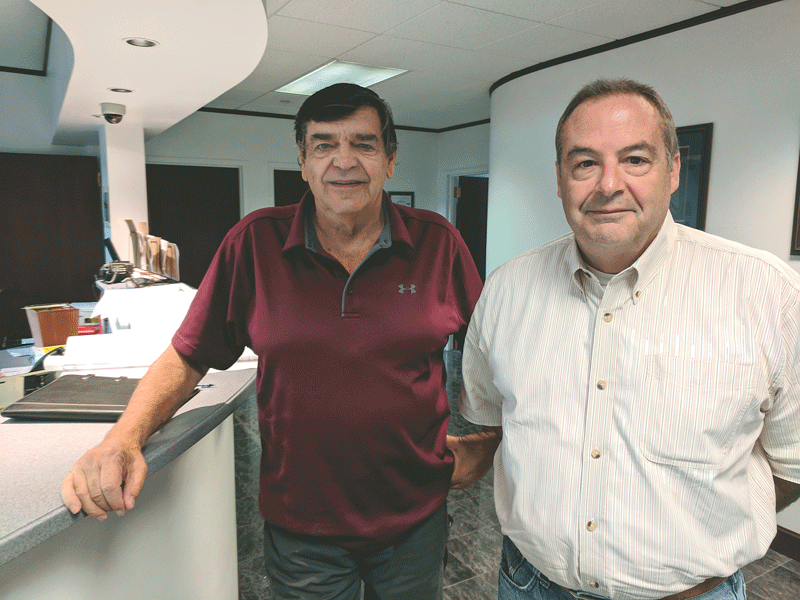
President Joe Marois (left) and Vice President Carl Mercieri

President Joe Marois (left) and Vice President Carl Mercieri

A construction company doesn’t grow and thrive for almost a half-century — through some dramatic economic ups and downs — without the kind of client loyalty that makes it a go-to option for any number of job types. For Marois Construction, those include educational facilities, public buildings, medical offices, bank branches, and more. The firm has certainly left its mark on the Valley — with no signs of slowing down.

There are advantages to being in business for 45 years. One is that it’s plenty of time to build a reputation.

“People are looking for quality work — people they know they can trust,” said Joe Marois, president of Marois Construction in South Hadley, a business he built from the ground up — literally and figuratively — starting in 1972. “We’ve established that trust. We’ve made a lot of friends on our projects.”

A lot of friends means plenty of repeat business, and that has been a key component of the success of one of the region’s iconic names in construction, an entity that quickly grew beyond its roots building cabinets and restoring furniture from a small shed. Five years after that humble beginning, Marois boasted seven employees and five trucks. Today, headquartered in a large building on Old Lyman Road, the company currently employs about 45 people.

The repeat business has long been buoyed by the firm’s close relationships with area colleges and universities and expertise in niches as diverse as bank branches and medical offices. Current projects have the company busy at UMass Amherst, Elms College, a new Polish National Credit Union branch in Chicopee, the new state office building in Springfield, Veterans Memorial Cemetery in Agawam, and Central High School in Springfield, to put up a new press box and scoreboard.

The company also has a standing contract with the city of Springfield to perform needed maintenance and renovation jobs on public schools. “We’re all over the place there,” Marois said. “We never know what the needs will be.”

Carl Mercieri, Marois’ long-time vice president, said those assignments can be for just about anything. “They’re more maintenance-type things, on-call services, everything from changing a window to replacing ceilings in the classrooms over the summer, or repair old plaster. It’s pretty interesting. It’s more service work, but it’s good for the guys; they go to a job for two or three days, then move on to another for some change of scenery.”

Marois Construction workers prepare to install equipment on the roof of John Adams Hall at UMass Amherst.

Marois Construction workers prepare to install equipment on the roof of John Adams Hall at UMass Amherst.

In short, times are better for Marois — and for the industry as a whole, of course — than they were a few years ago, in the shadow of the Great Recession, when all firms were scrambling just to keep their crews reasonably busy.

“We were really coming off a bad time during the recession, where it was all about survival,” Marois said. “A few of our contemporaries did not make it. It was a culling of the industry, I guess you’d say. And it was further complicated by an influx of outside contractors into our area from New York and Boston; they were hungry too. Right now, we’re turning the corner and staying busy.”

Getting Around

A quick rundown of some of the firm’s recent project reflects its diversity. To wit:

• An upgrade of the electrical and fire-pump systems at John Adams Hall at UMass, a residential tower, included installation of twin emergency generators on the roof of the 22-story building, placed on a new structural steel frame.

• Also at UMass, a renovation of the Amherst Student Affairs Suite in the Whitmore Administration Building included the demolition of a 4,000-square-foot space, rebuilding of interior partitions, and finishes including porcelain tile flooring, recessed light fixtures, and a bamboo slat ceiling.

• A project at Veritas Preparatory Charter School included more than 22,000 square feet of demolition and renovated spaces, including new classrooms, a science lab, a music room, a reception area, and office space.

• The Keating Quadrangle at Elms College features the inlaid college logo and a large firepit that’s popular with students and staff. The project consisted of new drainage systems, underground electrical work, and multiple landscaping features including concrete, pavers, stone, and plantings.

• On the medical side, the Raymond Center at Baystate Health – South Hadley Adult Medicine consisted of developing 14,000 square feet of primary-care space within an existing building.

• At the Lee Hutt Gallery at the Yiddish Book Center in Amherst, the existing building was converted into a working sculpture studio, as Marois worked closely with the owner on all aspects of the design-build project.

• The company also built a single-story addition to Plainfield Congregational Church to provide new bathrooms and meeting space. Site improvements included a new well, septic tank, and grading. Repairs and improvements to the existing structure included replacement of piers supporting the existing timber-framed floor, thermal improvements to walls, and more.

• Marois also designed and constructed a facility to house supplies and equipment required to maintain the runways and grounds at Westover Air Reserve Base in Chicopee.

These cupolas are being designed for a project in Amherst.

These cupolas are being designed for a project in Amherst.

The jobs are still coming, but a new obstacle looms, he said. “Now we’re being faced with a labor shortage, which is always a challenge. That’s the nature of construction — it’s never perfect. I don’t know to what extent the casino is affecting that, but basically, the labor pool for tradespeople is very small.”

National data bear that challenge out. According to the Associated General Contractors of America, construction employment increased by 28,000 jobs in August, yet contractors still face a lack of experienced workers. Association officials say construction job growth would have been even higher had a majority of firms not reported having a hard time finding qualified staff.

“Construction firms have stayed busy, adding employees in the past year at nearly twice the rate of employers throughout the economy, but more than two-thirds of contractors report difficulty finding craft workers as the number of unemployed, experienced construction workers hit a 17-year low in August,” said Ken Simonson, the association’s chief economist. “Although construction spending has fluctuated recently, many contractors are still looking for qualified craft workers and project managers.”

More than half of the survey’s respondents said they were having trouble finding carpenters, bricklayers, electricians, concrete workers, or plumbers, while some salaried positions, such as project managers and supervisors, are also hard to fill, Simonson added, noting that federal, state, and local leaders should act on measures aimed at recruiting and preparing more young adults for high-paying construction careers. “Exposing students to construction as a career path will encourage more of them to pursue these high-paying careers,” said Stephen Sandherr, the association’s CEO.

Marois would welcome that development. “I just don’t see a lot of evidence of new tradespeople or young people who are enthusiastic about learning a trade.”

Brave New World

Marois and Mercieri have an old-school ethos when it comes to quality work, but recognize that the way jobs are processed today is different than it used to be.

“It has gotten to be technically advanced as far as the computer systems we are using at the insistence, many times, of our clients,” Marois said. “For a dinosaur like me, that’s a challenge.”

Added Mercieri, “sometimes we run into a situation where a project requires specific software, either scheduling or reporting, and some are good, some are bad. It takes away from the normal, day-to-day business, and it’s something we do more to satisfy others than ourselves.”

Green building, however, is a building trend that has grown well past trendiness in recent years; instead, it’s standard operating procedure for many clients. Marois has worked on multiple LEED-certified structures, but even those that don’t reach for those goals are subject to a new world of sustainability.

“There are always new heating and cooling standards, new insulation values on buildings — seismic standards are another thing that’s a great concern for people — to the detriment of renovating older facilities that are non-correctable, for lack of a better word,” Marois said. “With these 100-year-old mill buildings they want to converting to loft apartments, none comply with the basic structural requirements in place today, and they either get variances on them, or it’s not affordable, with the money it takes to bring it to the standard they expect.”

The business has changed in other ways, too, such as Marois’ increased reliance on outsourcing some of the framing and demolition work than in the past, but he’s still keeping his crews active, after 45 years of loyal clients, technological advances, and economic ups and downs.

“I couldn’t even count how many repeat customers we have,” Mercieri said. “The past 18 months have been busier than we’ve been in a long time.”

Joseph Bednar can be reached at [email protected]

Construction Sections

Green Goals

Thanks in part to the U.N.’s “2030 Agenda for Sustainable Development,” ‘green’ building projects are increasing worldwide. From 2015 to 2018, the percentage of global builders with at least 60% of their projects certified green will double, according to the “World Green Building Trends” report.

One of the main motivations driving green construction is to reduce carbon emissions, reports Interesting Engineering. And successful ways to do that revolve around energy usage — namely, to decrease energy consumption and increase energy efficiency in homes and buildings around the world.

Here’s how those goals break down into the top five global green-building trends this year.

Solar Panels of All Sizes

The worldwide acceptance of solar as the energy of the future is causing solar technology to get better and cheaper — quickly.

In 2016, India set aside $3 billion in state funding to ensure its capacity for solar power reaches 100 gigawatts by 2022. In May, the United Kingdom generated nearly one-quarter of its power needs from solar panels. And China is currently in the middle of creating the largest solar-thermal farm in the world.

Huge, heavy panels with bulky grids are no longer the only options for a solar-roof install. In the U.S., Tesla has already rolled out its new solar shingles, while Forward Labs’ standing seam metal solar roofing is set to be released in 2018.

In Australia, Professor Paul Dastoor of the University of Newcastle is performing the final trials on lightweight solar panels made by printing electronic ink onto plastic sheets. These solar panels are cheap to produce and ship and could potentially be a game changer for the solar-panel industry.

Home Energy Storage

“Batteries capable of storing power at utility scale will be as widespread in 12 years as rooftop solar panels are now,” estimates Bloomberg New Energy Finance. And that makes sense, considering the same type of lithium-ion battery used to power an electric vehicle can also be used to store power in the home. This double demand enables manufacturers to increase battery production, which drives down prices. And lower prices mean home batteries will be within reach of more people.

Some major players have already jumped in on the home-battery-manufacturing opportunity. Mercedes-Benz has produced suitcase-sized at-home energy storage for Germany since 2015, but it plans to expand internationally and has recently made the product available to California residents in the U.S. Meanwhile, Powervault is the number-one at-home battery manufacturer in the UK, and ElectrIQ is one of the newest home-energy-storage manufacturers in the U.S., with a home battery that stores 10 kWh of energy.

Energy-management Systems

To get the most out of solar panels and batteries, energy-management systems (EMSs) are often installed in green homes and businesses. EMSs monitor how much energy a building uses and can automate lighting, power, and HVAC systems to ensure optimal energy savings.

For example, the Edge, a building in Amsterdam that won the BREEAM award for offices in 2016, has 30,000 sensors that connect to a smartphone app. This app collects data from office employees and adjusts temperature and lighting according to how many people are inside the building and even keeps track of individual employee’s air and lighting preferences.

Another example is Honda’s smart home in the U.S., which has an experimental home EMS that communicates with the electrical grid to create optimal energy performance.

Passive Building Design

Passive building designs help minimize energy consumption by reducing the need for electrical lighting and temperature control in the first place. How? By using advanced design techniques that allow for maximum amounts of natural daylight to come in, while restricting heat loss in the winter and reducing heat gain in the summer.

And one element of passive design that has a big impact in temperature control is what goes on the roof.

Green roofs play an important part in helping regulate the temperature inside and outside of many passive buildings and homes. The plants and soil systems put in place help insulate the building in the winter and shade it in the summer.

Sustainable Building Materials

Reclaimed wood and recycled materials are high on the list of sustainable building supplies. But there’s also a lot of innovation happening in the world of eco-friendly concrete.

Why is making concrete green so important? Because it’s the world’s most used construction material, and it’s responsible for producing copious amounts of CO2.

There are several concrete alternatives, such as AshCrete, Ferrock, and HempCrete — but the most recent buzz is self-healing concrete. This concrete is supplemented with bacteria that, when exposed to moisture, will become active and grow limestone that will fill any cracks that happen over time. This is a big deal since no added concrete is needed to maintain it.

Luckily for us, this worldwide trend of creating green building solutions will grow along with the burgeoning demand for better ways to sustain our planet.

Maybe soon, the term ‘green building’ won’t be needed because all building practices will be sustainable.

This article first appeared in Proud Green Building.

Construction Sections

Driving Force

As federal and state lawmakers continue to search for solutions to fund and finance critically needed transportation infrastructure, the latest America THINKS national public opinion survey by infrastructure-solutions firm HNTB Corp. finds Americans with definitive views on how that funding should be generated and who should be responsible for maintaining and building the nation’s transportation network.

According to the survey, “Paying for Infrastructure – 2017,” 70% of respondents expressed their willingness to pay higher taxes and tolls to maintain existing as well as build new infrastructure. That number jumps to 84% if those revenues are guaranteed by law to exclusively fund transportation infrastructure needs.

“Americans value mobility and are willing to pay more to maintain and grow transportation infrastructure, especially if they know how their money will be used,” said Kevin Hoeflich, HNTB Toll Services chairman and senior vice president.

The HNTB survey also found nearly three in four Americans (73%) support public-private partnerships as a way to maintain existing and build new transportation infrastructure. Fifty-two percent believe the responsibility for funding maintenance and building new transportation infrastructure should be shared by the government and private sector.

“P3s are in the news as an increasingly popular option for funding new projects,” said Hoeflich. “However, the deals must be structured properly so the public gets the best return on its investment in infrastructure. We can expect to see more of them as the sources of traditional funding are under pressure.”

The desire to avoid congestion and save time is behind the willingness of almost six in 10 Americans (59%) to pay a toll, even when a free alternative is available, according to the HNTB survey. Of these respondents, 57% are willing to pay an average of $1.70 to use a priced managed lane, also called express lanes, if that would save 15 to 30 minutes of time, avoid congestion, and provide a predictable travel time.

The conversion of general-purpose interstate lanes to priced managed lanes is supported by 77% of survey respondents. Among this group, 50% believe reducing congestion is the most important reason for this conversion, an increase from 43% from the same question asked in a 2016 HNTB survey.

“People are frustrated spending time stuck in traffic, and they want solutions. They are concerned about how congestion contributes to traffic fatalities,” Hoeflich said. “Priced managed lanes offer a promising solution to both congestion and funding by providing a choice to get out of traffic. The public has demonstrated a willingness to pay to use them in many urban areas.”

HNTB’s survey found 80% of respondents support adding tolls to existing highways and interstates. When asked how those toll revenues should be used, reducing congestion was cited by 41% of respondents; improving safety, 40%; adding vehicle capacity, 34%; and adding transit capacity, 21%. Twenty percent of respondents would never support tolls on existing highways or interstates.

The survey also found two-thirds of respondents (66%) support tolls to fund critical infrastructure projects if there are insufficient funds from other sources. Meanwhile, the concept of reduced toll rates for low-income users is supported by more than three in four Americans (76%).

“Most importantly, there is growing recognition of tolls as a source of revenue that can help fund decades of neglect of maintenance and operations, system improvements, and other critical transportation needs,” said Hoeflich.

HNTB’s America THINKS “Paying for Infrastructure – 2017” survey polled a random nationwide sample of 1,027 Americans, ages 18 and older, between July 14 and July 16, 2017.

HNTB Corp. is an employee-owned infrastructure-solutions firm serving public and private owners and contractors. HNTB professionals nationwide deliver a full range of infrastructure-related services, including award-winning planning, design, program management, and construction management; www.hntb.com

Architecture Sections

Blueprint for Success

Jonathan Salvon says Kuhn Riddle continues to make its mark on area colleges.

Jonathan Salvon says Kuhn Riddle continues to make its mark on area colleges.

While national forecasters are predicting a slight slowdown in the construction industry, area architects report a healthy flow of projects in the pipeline, and they see that trend continuing for the foreseeable future.

Even during tougher economic times than these, Jim Hanifan says, communities still have to maintain — and often rebuild — their schools, libraries, police stations, and municipal offices.

“The beauty of public work is they’re always putting money in one sector or another,” said Hanifan, a principal with Caolo & Bieniek Associates. “Right now, public safety may be at the forefront — and that goes back to 9/11 — but now more senior centers are being built for the aging population, and they’re not just places to hang out and play bingo; it’s an active place, a community gathering spot. Senior centers have become important.”

Curtis Edgin, another principal at the Chicopee-based architectural firm agreed. “We’ve been very busy — a lot of public-sector work, a lot of education work, from pre-K to university levels,” he told BusinessWest. “We’ve done a lot of public-safety work. These projects — public safety, police, fire, things of that nature — are important to communities. They recognize the need to provide those services.”

Colleges and universities keep building too, said Jonathan Salvon, a principal with Kuhn Riddle Architects, and his firm has certainly reaped the benefits.

“We’re lucky to be located right here in Amherst, so we’re conveniently located near the Five Colleges. We’ve always had a certain percentage of our work at the colleges; it’s probably one-third now.”

For instance, the firm is in the planning stages on two UMass Amherst projects, and has also performed a variety of work at Smith College, most recently an intriguing conversion of an historic boathouse into studio space for students of dance.

“That’s an interesting site,” Salvon said, and makes creative reuse of an existing space — a hallmark of New England, where there’s plenty of existing building stock but not as much land and opportunity to design and build new structures.

“We do a certain amount of new construction,” he said, “but a good bit of our work is turning one thing into something new.”

The architects BusinessWest spoke with for this issue uniformly reported a healthy pipeline of projects this year, which belies a cloudy national forecast for the construction industry. After projecting 6% growth in construction spending in 2017, the American Institute of Architects (AIA) adjusted that to 4% at midyear, and expects that slower pace to continue into 2018.

“However, a somewhat more optimistic view is coming from architecture firms,” Kermit Baker, the AIA’s chief economist, reported in July. “While this could be viewed as architecture firms merely working down their backlog from a few stronger years, that doesn’t appear to be the case … New project inquiries and new design contracts were stronger on average in the first half of 2017 than in 2015 and 2016, and as a result firm backlogs have been growing, not shrinking.”

That’s certainly true at Architecture EL in East Longmeadow, which is so busy, principal Kevin Rothschild-Shea called the pace of projects a double-edged sword — but one he’s happy to face.

“We’re busy with multi-family housing, a bunch of new commercial work, and we’re seeing some new consrtruction, finally, not just renovations,” he noted. “The commercial market is moving along pretty strong. We’ve got more phone calls coming in than we can get to.”

For this issue’s focus on architecture, these regional players explain why they’re optimistic, not just for this year, but beyond.

Rising Tide

One of Caolo & Bieniek’s projects, the South End Community Center in Springfield, just opened last week, Hanifan said. “It’s a nice project because they were displaced from the tornado and finally have a permanent home again.”

Other projects the firm has recently tackled include Easthampton High School, Dupont Middle School in Chicopee, and, at the university level, academic and residential buildings at UMass Amherst. The company has also worked on the Little River fire station in Westfield, recreational fields in Agawam, the Chicopee public-safety complex, new branches of Polish National Credit Union and Arrha Credit Union, and a new senior center and police station in West Boylston.

Edgin said the more the firm works in one niche — senior centers, for instance — the more its reputation grows in that area, and it becomes easier to kand similar jobs.

“We’re diversified — we don’t focus on one project type,” he added. “The problem is, a lot of these communities recognize the need to replace outdated facilities or build new ones; they recognize the need to bring them in line with the current trends, but the costs are often an obstacle.”

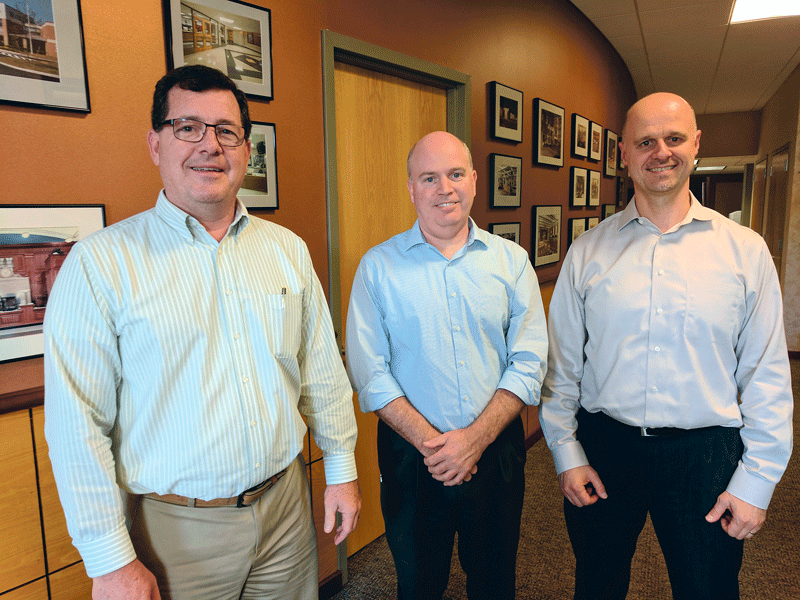
Caolo & Bieniek Principals, from left, Curtis Edgin, Jim Hanifan, and Bertram Gardner.

Caolo & Bieniek Principals, from left, Curtis Edgin, Jim Hanifan, and Bertram Gardner.

Still, he added, municipal work never really dries up. “It goes in cycles, up and down. But we’ve been fortunate, and we hope it continues.”

Beyond its healthy niche in higher education, Kuhn Riddle is currently tackling two early-education facilities — Belchertown Day School is moving and Children’s First Enterprises in Granby is expanding — while taking advantage of a rebounding housing market, moving from multi-family projects into more high-end, single-family homes, a niche that dried up during the Great Recession.

“Before 2009, about third of our work was college, a third was general commercial, and a third was residential,” Salvon said. “That single-family home, we’ve had a little bit of that, not like it used to be.”

Rothschild-Shea agreed. “It really tanked after 2008. Multi-family has been starting to move the past few years — we’ve been doing a lot of rehab on multi-family, affordable housing — but we’re starting to see some new construction coming through, which is nice. We are just literally swamped, in best possible way, and we’re happy to see an uptick; it’s good for the whole industry.”

Salvon is equally gratified by what seems like a healthy outlook ahead.

“We feel better off than we were right after the recession, a lot more stable. I don’t feel like we’re getting close to anything like a bubble; it doesn’t seem like the market is too hot,” he said, before emphasizing the importance of repeat business, especially in the higher-ed sector. “What we try to do with the colleges is do good work and keep them happy with our services. Of course, we try to do that with all our clients. It really is about long-term relationships.”

Lean and Green

Caolo & Bieniek has seen a different sort of growth this year, forming a union with Agawam-based Reinhart Associates, which also has a strong track record in municipal work.

“We’ve both been around long enough — 60-plus years now — that we’ve built a loyal clientele that appreciates the services we provide,” Edgin told BusinessWest. “By drawing those resources together, we can compete with some larger firms from outside the area. There are more opportunities to draw on each other’s strengths.”

That said, he and his partners also keep an eye on industry trends, aiming to ensure they remain on the cutting edge at a time when bank branches, senior centers, medical offices, and police stations are designed a lot differently than they were a 20 years ago.

“We put a lot of effort into watching those trends, not just in Massachusetts, but across the country,” he said. “We’re not just looking at our projects, but all projects, seeing what the best practices are for that particular project type.”

Sustainable design is a good example, he went on, noting that ‘green’ was a buzzword a decade ago, but sustainability is here to stay. “The code revisions that continue to roll out keep setting the bar higher and higher, and complying with and exceeding those goals in Massachusetts touches on energy efficiency, quality of space, natural lighting, storm-water runoff on the exterior, and reuse of water.”

Hanifan agreed. “Clients are much more educated and in tune with green building and energy-efficiency standards, but the codes have caught up, and these things are mandated now. Three or four years ago, it was considered advanced building; today it’s all pretty much energy-efficient.”

Edgin isn’t about to rest on the firm’s laurels, but said its local roots are a plus, especially when it comes to developing long-term relationships and earning repeat business “It all comes down to the level of service you offer.”

“That’s probably our strongest marketing tool,” Hanifan added. “If you do a good job on a project, you’re more likely to get selected for the next one.”

And those projects keep on coming. After all, there will always be a need for the next school, library, or senior center.

Joseph Bednar can be reached at [email protected]

Features

A Different World

expologo2017comcastPlenty of attendees who donned the virtual-reality goggles at the Western Mass. Business Expo last year were wowed by the experience of stepping into a different world. But Ed Zemba, a principal with Link to VR, says he wants to do more than blow people’s minds.

No, he wants those minds to consider the potential of virtual reality — and augmented reality, which layers the physical world with virtual elements — in various business settings.

“Last year, Link to VR introduced virtual reality to the Western Mass. region, and for many businesses and individuals from the community, that was their first chance to see what was possible with virtual reality,” said Zemba, who is also president of Robert Charles Photography. “But virtual and augmented reality also have applications for the medical, education, and business spaces.”

Link to VR will be back on the floor at this year’s event, retitled the Business & Innovation Expo of Western Mass. to reflect its growing status as a showcase for cutting-edge technology in addition to a wide range of traditional businesses.

“A big part of what we’re talking about at the show is answering the question: why are companies the size of Apple, Facebook, Microsoft, and Google investing millions of dollars in virtual and augmented reality, and why are regional organizations like MGM, UMass, Bay Path, and others announcing that they’re investing time, energy, and resources into determining how this could impact their industries?” Zemba told BusinessWest. “It’s one of the most significant technical shifts I’ve seen in my lifetime.”

But Link to VR won’t be the only high-tech attraction on the Expo floor at the MassMutual Center on Nov. 2. Here are a few others:

• Kitchens by Curio will demonstrate virtual-reality demonstrations of their kitchen and bath remodels. Attendees can chose cabinet colors, flooring, countertops, etc. and view a completely remodeled room in augmented reality.

• Smith Vocational and Agricultural High School will be represented by its Collision Repair program, which will bring a Sims virtual paint simulator, a trailer-hitch cover project, and a virtual-welding simulator. The school’s Machine Technology program will demonstrate a 3D printer and bring along a sampling of various machine projects students have worked on.

• The Graphic & Visual Design Program from the Lower Pioneer Valley Education Collective will showcase how they make packaging using 3D modeling, while the collective’s Information Support Systems and Networking Program will demonstrate how they build their clear computer cases.

• Open Pixel, an animation company based in Western Mass., will present a program called “Become a Character!” Participants will choose a character they wish to become from a variety of options and stand on a marker. The camera will watch their motions, and as they speak, so will the character.

The Business & Innovation Expo of Western Mass. will also feature more than 150 exhibitor booths, educational seminars, breakfast and lunch programs, and a day-capping Expo Social. Sponsors include Comcast Business (presenting sponsor), Johnson & Hill Staffing Services and Wild Apple Design Group (executive sponsors), Inspired Marketing (show partner), MGM Springfield (corporate sponsor), Isenberg School of Management at UMass Amherst (education sponsor), Xfinity (social sponsor), Elms College (information booth sponsor), Smith & Wesson (Workforce Support Center sponsor), Savage Arms (JoinedForces parking sponsor), and the Better Business Bureau (contributing sponsor). For more information, call (413) 781-8600, ext. 100.

Community Spotlight Features

Community Spotlight


Mayor Brian Sullivan

Mayor Brian Sullivan says his coffee hours with business owners and managers, a chamber of commerce initiative, have been eye-opening and extremely productive.

By the middle of 2018, Dan Howard says, close to 75% of Westfield residents and businesses will have access to high-speed Internet through Whip City Fiber, a division of Westfield Gas + Electric.

“The Municipal Light Board is fully behind it, as is the City Council,” said Howard, general manager of WG+E, adding that the city began funding the project back in 2014. “It’s a great collaboration that has really benefited the entire city.”

He noted that of the 41 municipal electric utilities in Massachusetts, only four are gas-and-electric entities, and only one of those four, once Westfield’s project goes online, will also provide high-speed Internet. The city will join communities like Wilson, N.C., Chattanooga, Tenn., and Longmont, Colo., as ‘gigacities,’ and will be able to showcase that fact in its marketing efforts to draw more business to town.

“You don’t have to be big manufacturer or a warehouse facility; we’re also providing access to small, upstart entrepreneurs,” he said. “People can work out of their homes and get the Internet access they need. This provides hefty benefits to communities and has proven to be an economic boost.”

Although it’s perhaps the most literal example, Whip City Fiber is just one way Westfield is making connections — between its municipal leadership, business community, residents, and educational facilities.

Take, for example, the Westfield Education to Business Alliance, which connects the city’s schools, where students are beginning to contemplate their career paths, with companies that are eager to mine local talent.

“That has gone over like gangbusters,” said Kate Phelon, executive director of the Greater Westfield Chamber of Commerce, explaining that it began last year with 15 core members and now regularly draws participation from 40 to 45 businesses.

“It’s all about workforce-development issues,” she told BusinessWest. “We’re bringing education to businesses and businesses to education. The response has been fabulous. It’s a great collaboration.”

For example, a career fair at Westfield High School in June attracted some 45 businesses, interacting with 600 students who gained exposure to the types of career opportunities available at local companies — and, more important, what skill sets they will need to take advantage of them.

That’s not all; Westfield businesses have visited elementary schools as well, and in two weeks, the collaborative will present a career fair for some 120 teachers, who will meet with local businesses and hear about their workforce challenges, with an eye toward modifying curriculum to prepare students for jobs in the regional economy.

Meanwhile, Westfield State University’s Pathways to Excellence program allows high-school students to graduate with up to nine college credits, while exposing them to career options they can think about before taking the leap to college.

“We’re working together on the future workforce, whether students choose the college path or the work path,” Phelon said. “It’s been phenomenal.”

Westfield at a glance

YEAR INCORPORATED: 1669
POPULATION: 41,094 (2010)
AREA: 47.4 square miles
COUNTY: Hampden
RESIDENTIAL TAX RATE: $19.42
COMMERCIAL TAX RATE: $37.08
MEDIAN HOUSEHOLD INCOME: $45,240
MEDIAN FAMILY INCOME: $55,327
TYPE OF GOVERNMENT: Mayor, City Council
LARGEST EMPLOYERS: Westfield State University, Baystate Noble Hospital, Savage Arms Inc., Mestek Inc., Advance Manufacturing Co.

* Latest information available

Meanwhile, the Mayor’s Coffee Hour, a chamber initiative launched several years ago, still draws some 30 to 40 attendees each month to a different host business, where Mayor Brian Sullivan takes questions on the state of various economic-development initiatives in the city.

“Some of these businesses have never been visited by local government,” Sullivan said. “We talk about what they need, how can we help — and it has been really productive. They might let us know they have jobs open, but find the talent, and we can hook them into other people we know, and the connections Kate has.”

Taken as a whole, these initiatives and others speak to a growing sense that Westfield aims to grow through open communication and productive connections. And those efforts are certainly bearing fruit.

Higher Gear

Over the past few years, Westfield residents have been able to see some long-percolating developments blossom, most notably the $6.6 million Olver Transit Pavilion, which opened in April as the centerpiece of a planned downtown resurgence. The Westfield Redevelopment Authority also recently demolished a former bowling alley near the transit center, with plans to create a multi-story, mixed-use building with retail, restaurants, office space, and market-rate apartments.

Those projects are just two facets of the Elm Street Urban Renewal Plan approved in 2013, which focuses on revitalizing 4.88 acres in a two-block area in the heart of downtown Westfield running along both sides of Elm Street, the city’s main commercial thoroughfare. The city has also directed funding to revitalize the so-called Gaslight District adjacent to it.

The transit center was designed to both catalyze related economic development and increase the use of public transportation. The state-of-the-art center includes parking space for four buses with bicycle racks, as well as a bicycle-repair station, which speaks to the proximity of the Columbia Greenway Rail Trail only a block away.

The trail, which spans three and a half miles and crosses seven bridges in the city, isn’t yet complete, Phelon said, but will eventually be yet another destination drawing people to the Whip City.

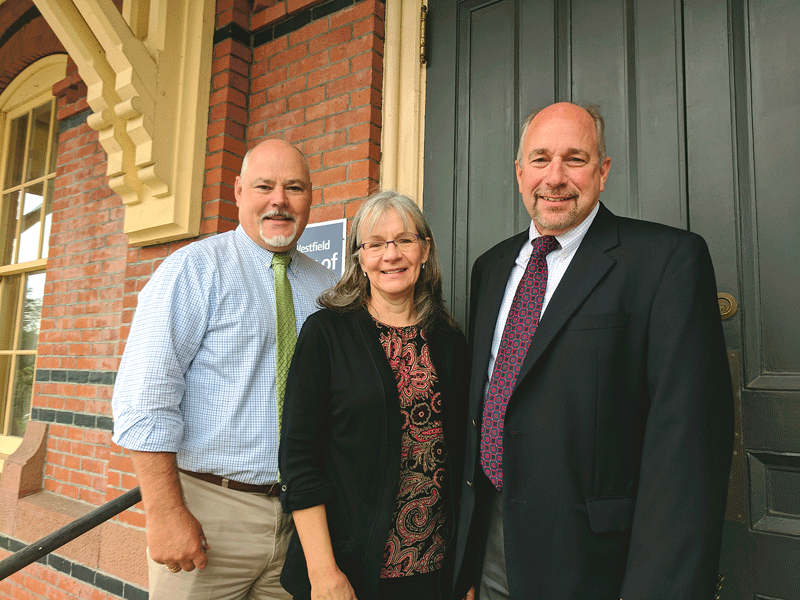
Mayor Brian Sullivan, Kate Phelon, and Dan Howard

Mayor Brian Sullivan, Kate Phelon, and Dan Howard say collaborations between Westfield’s municipal leaders, businesses, and schools have reaped benefits for the city.

“In a few years, it will be an economic engine in the city,” she told BusinessWest. “People from will come to this rail trail because it’s elevated and extends all the way down to New Haven. I’m already getting calls about where people can park overnight and bike down to Connecticut.”

Economic development has taken other forms as well. Westfield opened a $6 million solar farm on Russell Road last year, featuring 8,864 solar panels capable of producing 3 megawatts of power that will be consumed by the community. Meanwhile, the city continues to develop a second industrial park on city-owned land adjacent to Barnes Regional Airport.

Sullivan said Westfield already offers a number of advantages to businesses considering locating there, from plenty of available land to easy access to Interstates 90 and 91, rail service, and Barnes, to a permitting system that gets all players, from planners to the DPW to the WG+E, into the same room to ease the path to approval.

“That has been successful. There’s no sense in having a meeting to set up a meeting to talk about another meeting. Here, it’s a one-stop shop.”

But he also takes a regional approach to economic development, maintaining relationships with area mayors and the Economic Development Council of Western Mass. “We’re on the the same page, because we’re only as good as our neighbors are doing.”

And Westfield is doing well, he added, noting that city-wide high-speed Internet is just one more catalyst to transform the Whip City from a warehousing and manufacturing center to a location that’s amenable to businesses of all kinds, large and small.

“We have a tremendous asset in this municipal utility,” Howard said, “but instead of everyone doing their own thing, the mayor and I and Kate get together to promote the synergies we have.”

Local Impact

Chambers of commerce are, by their nature, about economic development and helping their communities grow, Phelon said. The Greater Westfield Chamber continues to do so by way of programs such as a buy-local initiative that encourages businesses in the city to make purchases from other Westfield businesses instead of looking outside the area, or online, for suppliers.

“We worry about the future of retail; no matter what you buy, online shopping is hitting Main Street, USA hard,” she said. “We’re trying to counteract that; we’re asking, ‘why don’t you consider a chamber member? You might find something you didn’t even know was available here.’ We’re excited about this. Instead of going online, maybe spend an extra dollar or two here, and make an impact locally. We really want to push this hard.”

It comes down to communication, Sullivan said, and the various entities that make a community run smoothly — from City Hall to the schools system to the business ecosystem — understanding each other’s needs and challenges.

Even last spring’s Earth Day cleanup of trash on Servistar Industrial Road qualifies, the mayor said, adding that it was a volunteer effort spurred by people getting together to talk about a problem. “It’s simple,” he said, “but if you don’t know about it, you can’t do anything about it.”

In Westfield, though, word gets around. And, thanks to a certain fiber project, it’s about to get around even faster.

Joseph Bednar can be reached at [email protected]

Features

Complicating Matters

Innovation Center

Outgoing DevelopSpringfield President & CEO Jay Minkarah says he expects work to begin again soon on the Innovation Center taking shape in downtown Springfield.

Jay Minkarah says that the $5.5 million Innovation Center project in downtown Springfield, like just about every other initiative in the DevelopSpringfield portfolio, has been a complicated undertaking.

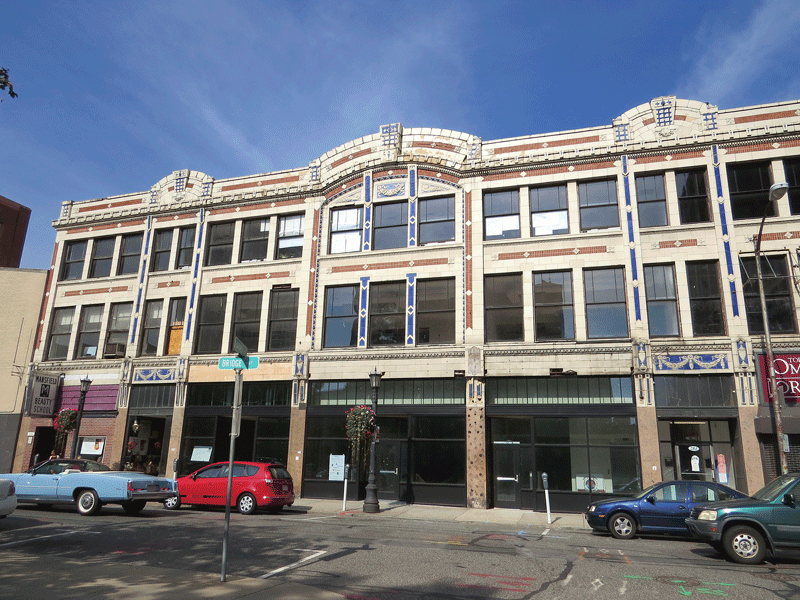
This means there have been, well, complications, quite a few of them, in fact, especially in the form of cost overruns involving everything from HVAC systems to the terra-cotta façade of the buildings being renovated — 270-284 Bridge St.

These complications have manifested themselves in everything from a highly visible shutdown of the project — one that started in May and left the sole occupant of the building, the Women’s Fund of Western Mass., without access to an elevator or air conditioning — to a breach-of-contract suit filed in Hampden Superior Court by the contractor, Ludlow-based NL Construction, seeking $225,000 allegedly owed for services, labor, and materials.

These complications also led to a host of questions about when, if, and under what circumstances the project would continue — questions that weren’t really answered until Minkarah, DevelopSpringfield’s president and CEO, announced he would be leaving the organization later this month to take a position as leader of a regional planning commission in New Hampshire.

Minkarah has told the local press and BusinessWest that, with a $723,000 mortgage secured from Berkshire Bank, work is expected to resume shortly on the project and that, barring any additional unforeseen complications, the center should be ready for occupancy by the end of this year.

As for the Women’s Fund, an extension of its temporary occupancy permit, due to expire at the end of September, was being sought as BusinessWest went to press.

“Ultimately, the cost of the project definitely exceeded our initial expectations significantly,” said Minkarah, putting heavy emphasis on that adverb. “And the increases came in a few critical areas, some that became evident early on, some later on.

“Most significant was the extent of the systems overhaul that was needed — that was far greater than we expected, especially HVAC, but also electrical,” he explained. “That was a contributing factor. But another contributing factor was the cost of the façade restoration.”

Elaborating, he said DevelopSpringfield needed to bring in a specialized consulting assistant to conduct an analysis of the façade and put a restoration plan in place.

“The cost of the façade restoration greatly exceeded our initial estimates,” said Minkarah, adding that fit-out costs for various tenants also far exceeded original estimates.

Matters were further complicated, he went on, by the fact that, due to the timing of a $2.2 million grant from the state’s MassWorks Infrastructure Program, construction and design work needed to begin as soon as possible, and was actually well underway before the final (considerably higher) costs of the project were known, said Minkarah.

“We became aware that we had funding gaps and would need additional funding earlier this year,” he went on, adding quickly that it was always understood that additional, traditional financing for this initiative would be needed to supplement grant funding that was received.

Despite this awareness, Minkarah said, work on the project ground to a halt in late May because of the complicated, time-consuming process of securing that additional financing.

“We were actively working to close on that financing for the project from two different sources,” he went on. “And the financing was very complex because it involved historic tax credits, both state and federal. The process of getting through everything we needed to get through definitely took longer than we anticipated.”

The breach-of-contract suit filed last month alleges that promises of payment to NL Construction were made and not kept and that communication from DevelopSpringfield about the project and its future was lacking.

A centerpiece of downtown revitalization efforts, the Innovation Center was conceived to bring people and energy to the downtown area and specifically the Stearns Square area, which has seen a number of other developments, including the relocation of the Community Foundation of Western Mass. and renovation of the former Skyplex building by MassDevelopment.

Announced tenants in the Innovation Center included the Women’s Fund, Valley Venture Mentors, the Ground Up Café coffee shop, and a cocktail bar, as well as space for startups.

—George O’Brien

Banking and Financial Services Sections

Name of the Game

Drew Andrews, managing partner and CEO

Drew Andrews, managing partner and CEO

The accounting firm formerly known as Whittlesey & Hadley has undertaken a rebranding effort, and is now known simply as Whittlesey. The new name was chosen in an effort to be more modern and less formal, while also maintaining valuable name recognition. But the new name is only part of an effort to better communicate all that the firm can do for its clients.

Drew Andrews said the new name was chosen in an effort to be, among other things, less formal, more modern, and perhaps even more efficient by using one word instead of two.

These are trends, if you will, when it comes to the names over the doors and on the letterhead of professional-services providers such as accounting firms and law firms, said Andrews, so much so that a story he’s retelling often these days seems to speak volumes about the matters at hand.

“I was at meetings with two clients over the past two weeks where they were referring to us as ‘Whittlesey,’” he recalled, noting that this wasn’t the firm’s name at the time — but it is now (it became official Oct. 1, to be exact).

Indeed, the Hartford-based firm known as Whittlesey & Hadley for the better part of five decades has officially dropped the ampersand and ‘Hadley’ (dropping just the ampersand was one of many other options considered) but kept Whittlesey as a nod to history, tradition, and, perhaps most importantly, name recognition.

And the fact that people were calling the firm by its new name while it was still using the old name and hadn’t given any hint that a change was coming, only confirms that this was the right decision, said Andrews, CEO and managing partner of the firm.

“Whittlesey & Hadley was more old school,” he said, referring to the name, not the firm, noting that clients, at least some of them, anyway had already come to this conclusion, and were already referring to their accountants in different ways. “What we found was that a lot of people had already shortened it themselves — they were calling us Whittesey or W&H.”

Yes, much ado about a name. But there is a lot more to what Andrews referred to as a ‘rebrand’ than just this new name and the one on the company’s subsidiary — Whittlesey Technology (formerly the Technology Group). There are new colors (blue and coral), a new, more ‘responsive’ website (wadvising.com), and a new marketing tagline, or slogan: ‘Forward Advising.’

whittleseylogoonly

Those two words say quite a bit, said Andrews, noting that, historically, and to generalize somewhat, accounting firms have dealt mostly with the past tense, especially with regard to financials, taxes, and audits. But increasingly, clients are looking for help when it comes to the present and future tenses as well, he said, and the firm now known simply as Whittlesey has been ahead of this curve and intends to stay there.

“Even though we’re an accounting firm and we do taxes and audits and things of that nature, our business has morphed into being more of strategic advisors,” he explained. “We’ve helped people with profitability analysis, new products, forecasting, budgeting, succession planning, operational reviews, and a significant effort in technology support in recent years.

“That was kind of a natural progression,” he went on. “We’re really become more advisors than accountants. That’s where we think the profession’s going, and that’s a big part of why we did this rebrand.”

For this issue and its focus on banking and financial services, BusinessWest talked at length with Andrews and Cora Hall, director of Marketing and Communications for Whittlesey, about the rebranding efforts, especially as they relate the firm’s efforts to grow its presence in the Western Mass. market.

It Added Up

Andrews told BusinessWest that the rebranding efforts were launched roughly a year ago, and have taken longer than some might have expected because work naturally slowed down during the height of tax season, when many of those involved had more pressing matters to address.

But this project, like most all those of this nature, was undertaken because it was deemed necessary and important to the company’s broad efforts to continue to grow and claim market share in all its markets, including Western Mass.

“We wanted to look at what our communication was to our clients and our potential clients,” Andrews explained, noting that, over the past several years, the company has merged two firms into its fold, if you will — Holyoke-based Lester Halpern and Hamden, Conn.-based Weinstein & Anastasio, P.C. — and needed a common message to go along with the shared name.

“We had what amounted to three firms, and we wanted to have a unified message going out about who we are, what we do, and how we do it,” he told BusinessWest. “We were doing a lot more than accounting and taxes, and were doing advising in many areas — and this didn’t seem to get communicated through our messaging and our website.”

Drew Andrews and Cora Hall say Whittlesey’s rebranding effort is aimed at better communicating to clients and potential clients the firm’s full range of services.

Drew Andrews and Cora Hall say Whittlesey’s rebranding effort is aimed at better communicating to clients and potential clients the firm’s full range of services.

And improved communication is at the heart of this rebrand, he went on, adding that by this, he means what is being communicated and how it’s being communicated.

Elaborating, he said the overall message needed to change and convey the full portfolio of products and services, and the vehicles for delivering the message — and especially the website and a host of social-media platforms — needed to change in order to better communicate to all audiences, particularly the younger ones, and to both customers and potential employees.

“We needed a refresh on our website and how we were going into digital — not only from a client perspective, but from a recruitment perspective and always getting the best of the best talent-wise,” he explained. “We needed to relate better to them in their language.”

What is being related to all audiences is that the firm will still handle a client’s tax and audit needs — but it can also do much more.

“We can help businesses and individuals gain confidence and assurance before they act,” said Andrews. “We work as an extension of an organization’s management team delivering advisory services in the here and now as well as looking forward.

“When we go visit our clients, we talk about what’s going to happen; we’re not just focused on the past, which is what accountants do, because we usually report on historical information,” he went on. “We ask, ‘where are you going in the future? Where are you bringing this business? How can we help you achieve what your financial goals are?’”

All this wasn’t effectively communicated by the old website or old branding messages, said Hall, adding that the new platforms do a much better job at this, as well as conveying the firm’s commitment to the communities it serves.

“We’ve really made a consolidated effort to invest in the region and really become part of the community,” she explained. “And that’s something else we wanted to communicate.”

As for the new name, Andrews said something ‘new school’ or at least ‘newer school’ was needed.

‘W&H’ or ‘WH’ were considered, and might have worked, he told BusinessWest, adding quickly that, as the firm went through the search process, if you will, it came to the conclusion that ‘Whittlesey’ had both a unique sound to it and a great deal of brand equity in all the markets in which it was operating.

“That was true not only in the Hartford market, where we’ve been since 1961, when we were just ‘Whittlesey’ because [Bob] Hadley, Willis Whittlesey’s first partner, didn’t arrive until 1965, but also in Western Mass. and Southern Connecticut with the two mergers,” he said. “We didn’t want to lose that momentum, but we wanted a modern twist on it.”

Sign of the Times

And these days, one name instead of two constitutes a modern twist.

That became clear to Andrews and others when people started calling this firm ‘Whittlesey’ well before Oct. 1, when the official press release announcing the change went out.

But while the new name is significant, that new tag line ‘Forward Advising’ is perhaps even more so, because of the many kinds of messages it delivers.

“The refreshed Whittlesey brand represents where our firm is today and where we want to strategically grow,” Andrews explained, adding that ‘forward’ is where he expects this important exercise to bring the company.

George O’Brien can be reached at [email protected]

Banking and Financial Services Sections

Making a Statement

United Bank’s new branch at Monarch Place

United Bank’s new branch at Monarch Place is expected to yield a boost in commercial business amid a host of other benefits.

On paper — and on a map — it’s only a few blocks, really.

But United Bank’s relocation of its office in downtown Springfield, from the corner of Main and State streets to the front of Monarch Place, constitutes a major move in all other respects.

The new address — formerly home to a Bank of America branch that closed its doors several months ago — is projected to bring everything from much greater visibility to significantly higher foot traffic, to a likely surge in commercial-side market share as business owners based in the center of downtown take advantage of another bank opening on that site.

“There was a void left by Bank of America’s departure,” said Tony Liberopoulos, regional commercial executive for United, adding that the bank will move aggressively to fill that void.

Dena Hall, Western Mass. regional president and chief marketing officer, agreed.

“This is one of the premier locations in the city, particularly with the renovations currently taking place at Monarch and all the exciting things happening in that area,” she said, noting that a Starbucks soon to go into that building is just one of the items on that list. “We’re thrilled to be there.”

Indeed, even though the bank’s current location downtown is almost directly across Main Street from the $950 million MGM Springfield casino now taking shape and due to open in about a year — and would no doubt see a surge in retail traffic from that development — that branch is limited in many ways, said Hall.

Elaborating, she said that location is relatively small and, more to the point, cannot easily be renovated and enlarged to provide everything that the bank wants to provide the customers downtown.

unitedbankcomingsoonsign

“Our new branch will really give them that ‘wow’ factor of high technology, an open landscape, and everything people expect today,” she said, adding that the Monarch Place location offers an intriguing blank canvas, if you will.

That’s why United, based in Glastonbury, Conn. and with a main office locally in West Springfield, moved assertively to seize what she called a tremendous opportunity when BOA announced it was closing that location.

“I’m not sure how many other banks looked at it, but I know we moved quickly and started the conversations,” said Hall, adding that the location presents opportunities in many forms, and from many directions.

For starters, there are the many businesses based within a few blocks of the site, most all of them with owners desiring to bank conveniently.

“That Bank of America branch had a lot of commercial clients that utilized that location,” said Liberopoulos. “The buildings all around it are full of commercial clients, and we look at that as an opportunity to grow our commercial base as well as our deposit base. I think there’s a lot of businesses looking forward to having another bank in Monarch Place; we think it’s a great opportunity for us.”

Also, there is the enhanced foot traffic already in evidence downtown due to a slew of new developments in the central business district and growing convention and meeting business — not to mention the additional traffic downtown expected to be generated by MGM Springfield.

Add it all up, and the Monarch Place location seemed to be the right place at the right time, said Hall. And to take full advantage of all that the location presents in terms of opportunities, the bank is building a branch that will be full-service in every respect.

Hall said the branch will be modern and open, but it will still feature what she called a “neighborhood branch” approach, meaning it will have tellers, but also cash recyclers.

“It will be set up to service the retail and business customer in any way they want or need to bank with us,” she explained. “But it will also have a more modern feel to it than some of the current United branches.

Construction began roughly a month ago, she went on, and the branch is due to be open by the end of the year. United will occupy about 3,000 square feet, which is roughly half the old BOA footprint.

As noted earlier, the move is not significant in terms of geography — the bank is only moving a few hundred yards to the north — but it’s a meaningful move forward, said Hall.

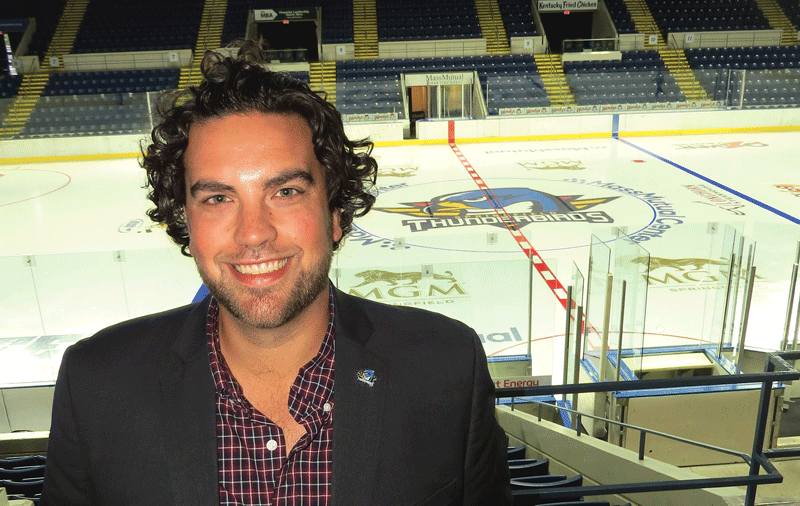
“This positions us very well,” she said. “We’ve made some big commitments to Springfield — we’re very committed to the Thunderbirds and to business development and community support in the area. So we feel that moving to this new location will further highlight some of the commitments we’re making to the city and give us some really nice new space in the best building in Springfield.”

—George O’Brien

Banking and Financial Services Sections

Employee vs. Contractor

By Christopher Marini, MSA, MOS

Christopher Marini

Christopher Marini

One of the most exciting moments for any small-business owner is reaching the point of having sufficient demand and capital to need additional help. Many businesses benefit from hiring employees, whereas others function better utilizing independent contractors. Generally, most businesses have a need for both employees and independent contractors.

The most noticeable difference between these classifications is how they are paid. Employees are part of the payroll, and accordingly the employer is also required to pay certain payroll taxes as well as workers’ compensation insurance. In contrast, independent contractors are not part of the payroll, and are typically paid through accounts payable. Following the end of the year, employees must be given a W-2, and all independent contractors who were paid $600 or more must be sent a 1099-MISC.

Determining whether to pay an individual as an employee or independent contractor requires the business owner to understand the distinguishing differences in classification. Failure to do so could have detrimental financial consequences. Under IRS regulations, classification at the federal level follows ‘common-law rules,’ which consist of three categories: behavioral, financial, and type of relationship. Here are some specifics:

Behavioral

Behavioral control relates to the degree of oversight by the employer. If the worker is subject to employer instructions, this tends to be indicative of an employee. Pursuant to IRS Publication 15-A, examples of “instructions” include:

• When and where to do the work;

• What tools or equipment to use;

• What additional workers to hire or to assist with the work;

• Where to purchase supplies and services;

• What work must be performed by a specified individual; and

• What order or sequence to follow when performing the work.

Other behavioral factors to consider are whether the worker undergoes training or periodic evaluations. Both of these circumstances would point to the need for an employee classification.

Financial

Independent contractors generally have much more complex financial structures. For example, independent contractors often have a significant personal investment in equipment needed to perform their work. Often, their service is for a short-term period of time, and they perform similar services for several other consumers. Because of this, they often have various unreimbursed expenses.

In terms of pay, independent contractors are typically paid a flat fee for their service, whereas employees are usually paid a wage based on hours worked. Because employees are paid a wage, and don’t typically have significant investments in equipment or unreimbursed expenses, employees are guaranteed a profit.

However, independent contractors incur the possibility of having a loss if expenditures exceed the fee they collect for their service.

Type of Relationship

One important relationship factor is permanency. Workers who are hired for an indefinitely continued period of time are typically employees, whereas workers hired for a specified period, or until a particular project is completed, are generally considered independent contractors. Employers should be cautioned that the behavioral or financial rules could cause temporary or seasonal workers to be classified as employees.

Another important factor to consider is whether the service being provided is considered a key activity of the business. Workers performing activities that are major components of a business’ offered services are typically employees. Independent contractors typically perform services that are outside the realm of key activities.

Consider State Rules

Certain states have their own sets of rules, which may differ from the federal laws, so be sure to consider if there are any significant differences. For example, Massachusetts has established the Massachusetts Independent Contractor Law, which is even stricter than the federal laws. Under the Massachusetts regulations, workers, by default, are assumed to be employees unless the employer can pass a ‘three-prong test,’ which, similarly to the federal regulations, examines control and nature of the service being provided.

Although rare, it is possible that a worker could be classified as an independent contractor per federal laws and as an employee per state laws. In Massachusetts, this unique situation would result in the need for an employer to pay state unemployment tax, even though the employer is not paying any federal payroll taxes.

Misclassification Consequences

If an employer has improperly classified an employee as an independent contractor, they may be held liable for the payroll taxes that they have not paid. The IRS has implemented a Voluntary Classification Settlement Program, which offers partial relief in back taxes owed in exchange for prospectively reclassifying employees previously classified as independent contractors. Additionally, misclassifying employees as independent contractors could carry penalties related to other benefit plans as well as workers’ compensation issues.

Still Unsure?

If, after consideration of all of the above information, it is still unclear which classification is appropriate, Form SS-8 can be filed with the IRS.  Using this method, the IRS will consider the facts provided to make the appropriate determination. However, this process typically takes more than six months, according to the IRS website, so seeking advice from an accountant or lawyer may prove to be the most efficient method.

In any event, knowing these rules will prove to be a tremendous asset, both in the present and in the future. Classification of workers is an important procedure for small businesses beginning operations, as well as for more established businesses. Understanding the regulations allows employers to operate more efficiently and effectively and could help them avoid future problems.

Christopher Marini, MSA, MOS is senior Auditing & Accounting associate at Meyers Brothers Kalicka, P.C.; (413) 322-3549; [email protected].

Features

Soaring Expectations

Nate Costa, president

Nate Costa, president

David Ortiz is coming to the MassMutual Center this fall, and that’s only one of many ways in which the AHL’s Thunderbirds continue to build momentum — and their fan base — as they prepare for their second season on the ice in Springfield.

A “significant investment.”

That was Nate Costa’s careful, well-thought-out, and quite predictable answer to the question ‘what did it take to get retired Red Sox slugger/legend David Ortiz to come to Springfield for a Springfield Thunderbirds game in November?’

The response from the Thunderbirds’ recently promoted chief executive (he now has the title ‘president’), while guarded in nature, nonetheless carried significant meaning, both literally and figuratively.

By ‘significant investment,’ he meant, obviously, a large fee commensurate with Ortiz’ status as celebrity and New England sports folk hero. And that word ‘investment’ means, well, just what the dictionary definition says: ‘the use of money for future profit.’

And in this case, the profit is indeed monetary in nature — how much is obviously to be determined, but that is both the goal and the expectation — but it goes well beyond that and predominantly falls into a category that Ortiz himself would be quite familiar with — that infinitely precious commodity known as momentum.

Indeed, the Thunderbirds, the American Hockey League franchise soon to begin its second year of operations in Springfield, remains in what Costa called the “acquisition mode,” or the building stage, or the momentum-building stage. He described this state of development as one where profits are certainly important, but what’s more critical is getting ever-larger numbers of fans into seats at the MassMutual Center, not for one game, but several, and preferably a season’s worth of them.

“We’re focused on continually growing the business and getting more bodies in the building,” he explained. “That’s how we’re going to generate revenue and momentum.”

These sentiments explain why a Coors Light will cost even less on a Friday night than it did at the end of last year — $3 for a cup, to be precise — while hot dogs will be $2 and sodas $1, in addition to live music. “I forgave some popcorn to get another dollar off the beer,” he said of the negotiations with the MassMutual Center. It’s also why ticket prices remained the same as last season, and why the team made that investment in Ortiz.

“The phone starting ringing right after the press conference where we announced this, and we sold out in four hours,” said Costa in reference to a special meet-and-greet offer involving Ortiz that sold for $134, a price chosen as a nod to the number he wore: 34.

And it’s also why Ortiz, while certainly the headline-grabbing promotion for the coming season — everything he does is headline-worthy, it seems — is just one of many coming attractions, if you will.

A Thunderbirds banner

A Thunderbirds banner flaps in the breeze in downtown Springfield, another example of the team’s success in remaining highly visible.

Others include everything from a special salute to Willie O’Ree, who broke hockey’s color barrier in 1958, more than a decade after Jackie Robinson gained much more acclaim for doing the same thing in baseball, to a ‘Blast from the Past’ night that will pay homage to the Springfield Indians, the name that was on the home team’s jerseys for decades.

Collectively, these initiatives and many others speak to how the club, which did well on the ice in its first season (falling just short of the playoffs), but even better off it — especially in the form of retained and new season ticket sales, as well as a number of sales-related awards from the league at its annual marketing meeting — certainly isn’t resting on any laurels.

“Those awards were validation for all the hard work we put in, and it was great to be able to celebrate our success with the entire staff,” Costa said. “I knew if we stuck to hard work, I knew if we put our head down and ignored the noise and did our jobs, we could meet our goals.

“It’s an exciting thing to see the reaction of the local community and to see the change from negativity in some ways to being overly positive,” he went on. “There are a lot of challenges still to overcome, but we have high expectations for this year.”

For this issue, BusinessWest talked at length with Costa about the Ortiz coup, but also, and especially, the ongoing efforts to build additional momentum for the Thunderbirds and pro hockey in Springfield.

Flying High

Costa’s office at the MassMutual Center holds a trove of artifacts from his brief but already significant career in sports management. They include several bobbleheads, a small collection of hockey sticks, and a autographed Tony Parker jersey, a souvenir from his days working in group sales for the AHL’s San Antonio Rampage, which played its home games in the AT&T Center, also home to the NBA’s Spurs.

There’s a new addition to the collection, and it has already drawn a good amount of attention, and rightfully so. It’s a pilot’s helmet signed by every member of the U.S. Air Force’s Air Demonstration Squadron (the Thunderbirds) that appeared at Barnes Municipal Airport in Westfield last month.

It was a return gift, if you will, from the team members, who were presented with customized Thunderbirds jerseys.

“The Thunderbird pilots are numbered 1 through 8, so we had each jersey numbered 1 through 8, and we put their names on the back as well,” Costa explained. “They were really blown away by it; they said it was the first time they’d ever been presented with sports jerseys. It was a natural tie-in for us.”

Actually, those jerseys were just one of the ways the hockey team honored its namesake  — Costa said the name ‘Thunderbirds’ was chosen in part to recognize the strong military presence at both Barnes and Westover Air Reserve base in Chicopee — while also doing what it seemingly does best: making its presence known.

Nate Costa displays his helmet, a gift from the Air Force’s Thunderbirds

Nate Costa displays his helmet, a gift from the Air Force’s Thunderbirds. The hockey team gained significant exposure during the recent air show in Springfield.

Indeed, if you thought the Thunderbirds name, logo, and mascot were everywhere this past spring and summer, you weren’t imagining things.

The logo was on banners in downtown Springfield, on the temporary fencing set up in front of the United Bank branch now under construction at Monarch Place, on large banners gracing ‘Thunderbird Thursday’ events staged by the Springfield Business Improvement District, in the windows of office spaces available for lease downtown, and seemingly everywhere else.

As for the mascot, ‘Boomer,’ well, he set what those at Thunderbirds headquarters believe is a record for appearances in a month — 25 of them by Costa’s count — during August.

“There was one Saturday where he was at three different locations,” he recalled. “And that’s an important part of what we’re doing; we’ve trying to accommodate anyone and everyone who’s asked us to be part of what they’re doing. We don’t charge people for an appearance, and it’s a way to show people that we mean what we say when we say we’re going to be part of the fabric of the community.”

Costa said there are certainly quantitative measures for all this exposure the team is getting, especially when it comes to social media and analytics, but there are more qualitative indicators, such as that line ‘I see your logo everywhere,’ or words to that effect.

“We’ve heard it all summer — people will say, ‘I’m seeing you,’ or ‘it’s noticeable,’ or ‘you’re out there,’ and that’s a validation for us that we’re doing the right things,” he went on. “We’ve tried to be community-focused.”

All of this strategic visibility comes with a single goal — to build the Thunderbirds brand, said Costa, circling back to that reference he made to the team still being in ‘acquisition mode.’

And these efforts, coupled with effective pricing, free parking, and other initiatives and incentives, have enabled the Thunderbirds to lead the league in something other than wins and points, and something in many ways more important — a statistic called ‘recovered revenue.’

As Costa explained, this is a metric that the AHL tracks — essentially a measure of the number of renewed and new season tickets sold. The team stood at 115% at last check, a strong number that speaks volumes about the team behind the team on the ice.

“We were over 100% when the season ended, and that’s a testament to our fans renewing in a timely manner,” he explained, “but also to our staff being ready to start having conversations in February; it’s a great metric for us, and it’s something that hasn’t been done here in quite a while. Our season-ticket business has been strong, and our corporate business has been strong as well.”

Covering All the Bases

When asked if not making the AHL playoffs last spring brought any sort of advantage to the team, especially in the form of more time to plan for this season (there was very little time to prep for the 2016-17 campaign, you might recall), Costa quickly dismissed that notion.

“We’d much rather make the playoffs — that’s what we’re all in this for — to win a Calder Cup,” he said. “I talk a lot about promotions and themes and community involvement, but at the end of the day, winning the Calder Cup helps selling better than all that.”

But while the team didn’t win on the ice as much as the fans and management would have liked, it has taken full advantage of every other opportunity to build its brand and its fan base.

And Ortiz’ visit to the City of Homes is a big part of that.

As he talked about it, Costa said the team, fresh off last season’s hugely successful promotional event featuring wrestling icon Ric Flair, was thinking even bigger for this year — but it wasn’t really thinking about the retired Red Sox slugger.

Indeed, Costa told BusinessWest that he was considering big-name bands for a post-game concert and was making inquiries about the Dropkick Murphys.

“We were really close on that,” he recalled, “but then I really looked at it from the business side, and I thought, ‘we’re in the business of running hockey games,’ so it made me really nervous about getting in that other business of promoting a concert with all those other expenses.

“But in the conversations we had with a couple of different groups about talent and a couple of bands we thought might work, someone had seen our Ric Flair night and said, ‘hey, we also do appearances,’” he went on, adding that one thing led to another, and eventually Big Papi was signed on the dotted line.

The makeup of the Ortiz appearance is still a work in progress, said Costa, adding that several options are being discussed.

The emerging plan is to dedicate one of the two intermissions to him and do some “fun stuff” that he doesn’t do at most appearances, Costa went on, such as taking the Zamboni for a spin while tossing out T-shirts, perhaps, or maybe hitting some signed foam baseballs into the crowd.

“We really want to do something unique,” he said, adding that this adjective describes many of the team’s initiatives off the ice.

Such as the night honoring Willie O’Ree’s breakthrough. It will mark the 60th anniversary of his first appearance with the Boston Bruins, but also commemorate his time spent playing in Springfield in the AHL before being called up.

Other promotional events include bringing back Rene Rancourt, who has sung the national anthems of the U.S. and Canada before Bruins games for 40 years; another Star Wars night, and a Wednesday tilt in November that will become a “school-day game,” as Costa called it, with a 10:30 a.m. puck drop and special emphasis on getting schoolchildren in the stands.

And while being creative with promotions, Costa believes the team is doing the same with its prices — by not raising them.

“We talked about not having any barriers for people — we didn’t want to put any negative thoughts into people’s minds when it came to renewal time or for this season when someone comes out to a game,” he explained. “I didn’t want any conversion to focus on ‘geez, they went up $2 on tickets; maybe we won’t go now.’

“That might come in time,” he went on. “But for now, we want to focus on getting more bodies in the building instead of focusing on the small piece of revenue we might generate by going up on ticket prices.”

Hitting It Out of the Park

When asked if the team was likely to recover that significant investment it has made in Ortiz, Costa smiled and said, “we’re well on our way.”

That phrase covers many other aspects of the Thunderbirds operation and the team’s ambitious plans moving forward.

It works when it comes to goals for selling tickets, gaining brand recognition, creating momentum, and making this team part of the region’s fabric and economy.

There is considerable work still be done, and Costa, as noted, strives for continuous improvement. But for now, this team is doing what its honored guest on Nov. 11 did his whole career — hitting home runs.

 George O’Brien can be reached at [email protected]

Features

Raising the Steaks

The iconic photo of President Eisenhower from the 1953 Big E

The iconic photo of President Eisenhower from the 1953 Big E. He was there to check in on the steer raised on his farm in Pennsylvania.

It is one of the most iconic photos taken during the 101-year history of the Big E.

Captured in 1953, it depicts President Dwight Eisenhower (the only sitting president to ever visit the Big E during the fair) meeting with Fred Scoralick, age 18, from Dutchess County, N.Y., that year’s winner of the 4-H Beef program, and his grand champion steer.

By now, most have seen the image — it was one of several to gain considerable exposure (pun intended) during the Big E’s various centennial happenings a year ago, and it was among a handful that made the cover of a commemorative book marking that occasion. But most don’t know the full story behind the photo, said Donna Woolam, who relates it often.

As Woolam, director of Agriculture and Education for the Big E, tells it, Eisenhower, then nine months into his first term in the White House, didn’t just happen by the Big E that year, and he had much more than casual interest in the 4-H Beef program and the winning black angus steer in question.

Indeed, it was raised on his farm just outside Gettysburg, Pa. — not far from the Civil War battlefield and now a national historic site — and sold to Scoralick’s family with the intention of entering it in the 4-H competition.

“He was the breeder of that steer, and he was here to see the animal being shown,” said Woolam. “That’s why he came.”

The story behind the Eisenhower photo falls into the category of ‘little-known history,’ and that phrase pretty much sums up the 4-H Beef program, or the Baby Beef program, as it was known in its early years. There is considerable history attached to it — 86 years of it, to be exact — but it is known to a relative few, meaning those who participate and those who support agriculture and events like this one.

Woolam and Big E President Gene Cassidy would like to make this a bigger constituency. More importantly, though — and this goal is directly related to that first one — they want to write many more chapters in the history of the beef program.

And that will be a challenging assignment as agriculture continues to decline as a business — and as part of the culture and landscape — in the Northeast.

“In this day and age, especially in urban areas, I wish there were more people better informed about 4-H; it should be part of the curriculum,” Cassidy said. “It’s important for our children, and for all of us, to have food literacy; it’s important for our health, and it’s important for our economy.”

Raising the stakes (or steaks, if you will), Cassidy went so far as to issue a call of support for the many aspects of the 4-H Beef program. They include not only the competition, but the auction of this year’s steers, where the beef is often contributed to area community food pantries, as the Big E itself did last year when it bought one of the steers and donated the meat to the West Springfield Parish Cupboard.

“The Big E challenges you and your business … SUPPORT NEW ENGLAND AGRICULTURE,” read the ad in the Sept. 4 issue of BusinessWest, which featured all those capital letters for emphasis and went on provide details of the auction, set for Sept. 25 at the Big E’s Mallory Agriculture Complex.

Cassidy is hoping the challenge will be answered, and, overall, he’s also hopeful that more business owners and area residents will realize the all-too-real threats to agriculture in this part of the country and be part of efforts to preserve what’s left, cherish those traditions (and businesses), and secure a future for this sector of the economy.

Meat and Greet

Look closely at that photo from 1953, and you’ll notice that President Eisenhower is holding one of Scoralick’s prizes from that year’s competition — the winner’s banner, or ribbon.

You can’t read it, because it’s facing the wrong way, but it has the words ‘Grand Champion 4-H Beef ’ and ‘Eastern States Exposition’ as well as the year on there somewhere. These colorful, bright-purple awards have become part of the history of the competition, said Woolam, who has two of them mounted in frames hanging on the back wall of her office.

They were a gift were a gift from the family of Lee Jenks, from Agawam, and they represent his winning achievements in what was then the Baby Beef competition in both 1928 and 1930.

“The family walked in here one fair and said that these needed to hang here, in the Mallory, where it all happened,” said Woolam, referring to not only ‘grand champion’ banners but also a photo of Lee, who passed away several years ago, with one of his prized steers. “We’re very proud to have them.”

woolam

As are the owners of the other 85-odd champion banners that have been handed out over the years, she said, adding that they have become keepsakes and are often prominently displayed. Winning the beef competition is a proud moment, she went on, so much so that, when a past champion passes away, their accomplishments at the Big E are almost always noted in his or her obituary.

But over time, and especially in recent years, the 4-H Beef program has become much more than a competition among dozens of young people ages 12 to 18. Indeed, it has become everything from a vehicle for helping to feed to those in need to a way for participants to earn needed money for college (and often a degree in agriculture science), to a showcase for a declining agriculture sector, especially in the Northeast.

Overall, the competition hasn’t changed much since it was started in 1921, said Woolam. Young heifers and steers are acquired from breeders (like Eisenhower) and raised for roughly 10 or 11 months prior to the Big E in which they will compete. The heifers are raised as breeding stock, while the steers are destined for the aforementioned auction, with the meat going to the buyers or designated charities.

The animals, which represent a number of different breeds, are judged against industry standards, Woolam explained, adding that this year’s judge hails from Tennessee.

“He’ll be looking for animals with a lot of natural muscling, a lot of structural soundness, visual eye appeal, and more,” she explained, adding that many of the competing livestock are crossbreeds.

This year, 45 steers are expected to be entered, and perhaps 30 of those will be sold, she went on, adding that the winning animal could fetch $5 or more per pound, and last year, the average selling price for the 24 steers that went to auction was $2.70 per pound.

Participants, meaning the young people that raise the animals, are from the six New England states and Dutchess County in the southeastern part of New York. The returning champion (she actually won in both 2015 and 2016) is Olivia Oatley, from Exeter, R.I. She has kept the champion’s banner in the family — her brother won a few times before she did — and has three steers in this year’s competition.

The program, like all 4-H endeavors, is educational in nature, said Woolam, adding that, during the Big E, participants will take part in a host of programs and competitions to test their abilities and knowledge of the cattle industry.

And while participants are furthering their education when it comes to agriculture and agribusiness, Cassidy hopes the public can do the same.

“With our lack of food literacy, there’s such a misunderstanding about food product,” he explained. “And this breeds activism, which harms agriculture.”

As an example, he cited the referendum question on last year’s ballot in Massachusetts that would prohibit sales within the state of eggs from caged hens. It passed, and the measure will take effect in 2021, said Cassidy, who expects that it will put the only remaining poultry farm in the state out of business and significantly raise the price of eggs in the Bay State.

Donna Woolam

Donna Woolam shows off the photo of Lee Jenks, Baby Beef competition winner in 1928 and 1930, that was gifted to the Big E.

“In California, where they passed a similar referendum several years ago, a dozen eggs cost three times what they do in Massachusetts,” he explained. “People here can buy a dozen eggs now for $1.65; that ballot question will take the price to way over $3.”

Cassidy said he sees a direct parallel between programs like 4-H and Future Farmers of America and food literacy. And that’s why he maintains that initiatives like the 4-H Beef program must not only continue, but garner additional support — at the auction, and in other ways as well.

Woolam agreed.

“This is a program with a lot of history,” she told BusinessWest. “And we hope it’s a program that will continue for many more years.”

Gaining Ground

Take one more look at the photo of President Eisenhower, and you’ll notice the large and very well-dressed press contingent (this was 1953, remember) in the background.

It would take a sitting president on the Big E grounds for the 4-H Beef competition and the grand champion steer to get anything approaching that kind of attention, and Gene Cassidy knows that.

That’s not exactly what he’s looking for. He is looking for a little more attention, some additional support, and a better understanding of the business of agriculture and its importance to the region.

In short, he’s looking to secure opportunities to create more — make that much more — little-known history.

George O’Brien can be reached at [email protected]

Community Spotlight Features

Community Spotlight

Mike Vezzola

Mike Vezzola says Enfield has cultivated a diverse economic landscape, with retail, manufacturing, and warehousing and distribution all playing key roles.

Commuters whisking past Enfield, Conn. on I-91 — especially exits 47E and 48, which drain into the heavily trafficked corridors of Routes 220 and 190, peppered with shopping centers and fast-casual restaurants — no doubt see the stretch as a retail mecca, but a closer look casts doubt.

Take the Enfield Square Mall, for instance, which has been heavily buffeted by store departures and doesn’t draw nearly the traffic it used to.

“From a retail perspective, yes, we lost some of the anchor stores of the mall — Macy’s, Sears — but I know there has been some interest from new stores to go into the mall,” said Mike Vezzola, executive director of the North Central Connecticut Chamber of Commerce, noting, as one example, a new Party City on the property, one of the biggest among the chain’s New England stores.

“I spoke to the folks at the mall last week, and we’re starting to see the retail aspect rebound a little bit,” he went on. “But it’s definitely more of a mixed bag. Ten years ago, we were looking at Enfield as the retail hub between Springfield and Hartford. I feel that’s shifted to Manchester. Instead, we’re now an all-inclusive package drawing from all aspects of economic development.”

Take, for instance, a strong uptick in small and sole-proprietor businesses coming online in the past year, reflective of an entrepreneurial wave that has been noticeable in Western Mass. as well. Or a wave of warehousing and distribution companies that have set up shop in Enfield over the past year or two.

Enfield Square Mall

Enfield Square Mall

“It’s a combination of a few things,” Vezzola said, noting that the manufacturing, warehousing, and distribution niches have been bolstered by the likes of Veritiv, Plastipak, and Conval all moving into Enfield in the past year. “We’ve also seen a lot of interest from property managers and developers who have been purchasing open lots here in town, with intentions of perhaps bringing more distribution and manufacturing businesses into the area.”

Recognizing an opportunity to create a pipline of local talent for such companies, Asnuntuck Community College unveiled its new, 27,000-square-foot Advanced Manufacturing Technology Center in the spring, part of an overall $25 million campus expansion plan. The new space will allow Asnuntuck to double its enrollment in its undergraduate manufacturing-technology programs. Meanwhile, the college is extending its tuition rate for Connecticut residents to students from Massachusetts. All these moves are aimed at bolstering what is becoming a key part of Enfield’s — and, perhaps, the region’s — economy.

Enfield, Conn. at a glance

Year Incorporated: 1683 in Massachusetts; annexed to Connecticut in 1749
Population: 44,654 (2010)
Area: 34.2 square miles
County: Hartford
Residential Tax Rate: $31.43 (plus fire district tax)
Commercial Tax Rate: $31.43 (plus fire district tax)
Median Household Income: $67,402
Median Family Income: $77,554
Type of Government: Town Council, Town Manager
Largest Employers: MassMutual, Retail Brand Alliance, Lego Systems
* Latest information available

“Within the past year, the state has given much support to Asnuntuck to focus on advanced manufacturing and programs that are more of a specific niche in terms of a career path,” Vezzola told BusinessWest. “The expansion of that school has been phenomenal, everything from the infrastructure to the subtleties like offering in-state tuition prices to Massachusetts residents.”

Other developments have local officials equally excited about Enfield’s position, from a planned transit center in the Thompsonville section of town to MGM Springfield’s opening in 2018 and, perhaps, a second casino just to the south in East Windsor.

“If anything, I think Enfield is going to be more appealing over the next five years with the institution of a new commercial rail system and the casinos going up,” Vezzola said. “I can see Enfield really being the middle-ground tourist attraction, the alternative place to stay between those two points of interest.”

All Aboard

As for that railroad, service on a New Haven-to-Springfield line should be up and running in the spring of 2018. Enfield — specifically, its Thompsonville neighborhood on the Connecticut River — is one of the proposed stops along that line, although the station won’t be up and running immediately. Nor will it be built in a vacuum, as the town has been planning a transformation of the future station site into an intermodal transit center in a walker-friendly village.

“It’s a rather large and complicated project,” said Peter Bryanton, the town’s director of Community Development, adding that the sticking point has been a former power-plant site that sits on the river. “That site is owned by Eversource, and we started negotiating with Eversource about five years ago to go on the property and do environmental testing, because we need to know what kind of contaminants are there before we can do anything. We’re now at the point where we have an access agreement with them, and we’re in the process of getting a firm to do the work for us.”

Depending on the results of that survey, if the site needs to be remediated or capped, the transit-center could be looking at a three- to five-year timeline. In the meantime, the state will build a basic rail station, with an elevated, double-tracked platform on each side. Later on, the town will build in some parking, bus facilities, and outdoor recreation, such as walking trails and overlook areas so people can enjoy the view of the river.

“Hopefully the commuter-rail system revives some of the walkability in town,” Vezzola added. “The service will start running in 2018 — we’re the only stop on the Connecticut River itself — and the Thompsonville project will be greatly affected by that once it’s instituted. We really want to take the train station and make a livable, walkable atmosphere, with restaurants and retail shops from the train station all the way up to Town Hall, all the way up Main Street. It all kind of works together.”

There isn’t room for a lot of retail at the site, Bryanton said, but one four-story commercial building, acquired by the Enfield Community Development Corp., will feature some ground-level retail and housing on the upper floors.

“We’ve gone through the conceptual phase, and we’re now in the construction planning phase,” he noted. “The rail-station plans are almost completed — the state is working on that — and with our environmental work, we can move on our construction plans for the infrastructure around the rail station.”

Sure Bet

Vezzola noted that the chamber’s role is to foster economic growth and development in the four towns it represents. “We’re here as a supporter of local commerce and want to be a driving force behind keeping our region an appealing, attractive place to grow your business.”

That’s why he’s cheered by some of the initiatives taking shape in and around Enfield, from workforce-development progress to the future transit center to a pair of casinos, although the East Windsor, while approved by the Connecticut Legislature, isn’t quite a done deal.

“I think Springfield is a sure bet, and that is most certainly going to help tourism in this particular area,” he said. “We have plenty of restaurants in Enfield, the Hampton Inn and Holiday Inn hotels in Enfield will be pretty much occupied, and it’s only going to be bigger if the East Windsor casino comes to fruition as well, because we’re right in the middle. We’re not a 45-minute commute, like coming from Northampton or West Hartford; we’re your driveable destination.”

Joseph Bednar can be reached at [email protected]

Features

Learning Opportunities

expologo2017webIt’s often said that business owners and managers are good at what they do, good at their particular business, but not necessarily good at — well, fill in the blank.

And there are many things to fill in that blank with, from information technology (and how to make the most of it) to employee benefits; from social media to ever-changing employment laws. There are dozens more ways to fill in the blank, as anyone doing business in today’s ultra-challenging environment can attest.

That’s why experts in such matters are so valuable. And that’s also why the 2017 Business & Innovation Expo of Western Mass., set for Nov. 2 at the MassMutual Center in downtown Springfield, will feature a host of experts.

They will have ‘a seat at the table,’ to borrow a popular phrase from business, and those attending the Expo can have one as well.

Indeed, there will be a number of  industry-expert panelists, as well as ‘Ask an Expert’ roundtables that present attendees with an opportunity to have a small-group, 45-minute session with regional industry leaders. (Space is limited to 10 at each ‘Ask an Expert’ table, and pre-registration is required at www.wmbexpo.com.

Overall, the show’s many programs are designed to help attendees become more innovative and work ‘on’ their business, not merely in it.

“Innovation comes in many forms,” said BusinessWest Associate Publisher Kate Campiti. “It might mean new-product development, new and improved technology, or new ways of doing business. But it also means looking at the many aspects of running a business in different ways, with an eye toward greater efficiency and continuous improvement.

“The Expo will put a premium on all these forms of innovation,” she continued, “and the expert tables, as we’re calling them, are just part of that equation.”

Other elements of the Expo, once again presented by Comcast Business, include a number of seminars with panels of, yes, more experts; robotics demonstrations; presentations from area technical high schools focused on how they’re readying students for the jobs of today and tomorrow; and much more.

As for the expert roundtables noted above, these will be tables of 10. The presenter will make a brief presentation and then field what will certainly be a host of questions from those filling the other nine seats.

Commitments are still being secured, but at present, experts have signed on to focus on such topics as social media, healthcare reform, employment law, improving public-speaking skills and being more assertive, issues with family businesses, and funding a business venture.

Other elements of the day-long seminar include:

• A fund raising breakfast for Revitalize CDC’s JoinedForces program. The event will take place from 7:30 to 9 a.m. on the Expo show floor. The master of ceremonies will be state Rep. Aaron Vega. Revitalize CDC has been supporting veterans for more than 25 years. JoinedForces, in partnership with businesses, civic organizations, and other nonprofit agencies, provides veterans and their families with critical repairs and modifications on their homes to help make them safe, healthy, and energy-efficient. Parking in the Civic Center garage will be validated at the conclusion of the breakfast. Additional sponsorship opportunities are available. Call (413) 781-8600 for additional information;

• Several educational seminars, including a number of panel discussions. These include a panel addressing common marketing myths, another featuring area media representatives who will discuss how business owners and managers can make better use of the media resources available to them, a seminar titled “How to Build Skills to Help You Succeed,” and other panels addressing cybersecurity and marijuana in the workplace;

• A lunch program, 11:30 a.m. – 1 p.m., featuring keynote speaker Ron Insana, senior analyst and commentator for CNBC, addressing the impact of “Trumponomics.” For ticket information, call (413) 781-8600 or visit www.wmbexpo.com;

• A Retail Marketplace in the atrium of the MassMutual Center. Retail vendors will include LuLaRoe, Springfield Macarons, Springfield Thunderbirds, SKM Jewelers, Sassy Mama’s Delectable Cupcakes, Lipsense, Rodan & Fields, Fork Art, the Shops at Marketplace, and more. In addition, there will be numerous booth demonstrations, giveaways, and specials. For example, Kitchens by Curio will offer virtual-reality demonstrations of their kitchen and bath remodels, Dani Fine Photography will offer a headshot session plus digital images for only $49, and DiGrigoli Salon will return to the Expo with free haircuts and manicures, just to name a few;

• The day-capping Social Expo, sponsored by Xfinity, from 3:30 to 5 p.m. This popular networking event will feature a ‘best in show’ food-sampling competition. Restaurateurs interested in participating should call (413) 781-8600; and

• More than 150 exhibitor booths featuring businesses in virtually every sector of the economy.

In addition to Comcast Business, sponsors include Johnson & Hill Staffing Services and Wild Apple Design Group (executive sponsors), Inspired Marketing (show partner), MGM Springfield (corporate sponsor), Isenberg School of Management at UMass Amherst (education sponsor), Xfinity (social sponsor), Elms College (information booth sponsor), Smith & Wesson (Workforce Development sponsor), Savage Arms (JoinedForces and Workforce Development parking sponsor), and the Better Business Bureau (contributing sponsor). Additional sponsorship opportunities are available.

Exhibitor spaces are also available; booth prices start at $800. For more information on sponsorships or booth purchase, call (413) 781-8600, ext. 100.

Cover Story Manufacturing Sections

A New Spin

Vince Simonds

Vince Simonds stands by the Truvis V machine with one of the products of the same name.

Over the past century or so, golf balls — and golf-ball history — have been made in Chicopee. Indeed, the sprawling plant on Meadow Street that once bore the name ‘Spalding’ and now ‘Callaway’ has been home to a number of innovations and new products. In recent years, though, that tradition — not to mention the number of workers at the plant — has been in decline. However, a new and exciting golf-ball design is changing the landscape, in all kinds of ways.

They’re calling it the Truvis V.

That’s the name given to a large, sophisticated piece of machinery recently installed at the sprawling Callaway plant in Chicopee. It was built to carefully place the 12 pentagons that have become the distinctive design pattern for the Truvis golf ball, as well as the Callaway name and the player number, all in accordance with USGA rules and regulations.

This machine is cutting-edge when it comes to such work, said Vince Simonds, senior director of Global Golf Ball Operations for Callaway, adding that it packs as much symbolism as it does science and technology.

Indeed, the Truvis V is perhaps the most visible evidence — except for perhaps the soccer-ball-like product the company has developed — of a compelling turnaround in the history of golf-ball manufacturing in Chicopee.

It’s a long history, to be sure, one that dates back to the late 1800s, but recent chapters have certainly not been as glorious. Decades ago, the talk about this plant was mostly reserved to the tens of millions of golf balls produced there annually. Lately, though, it’s been about the dwindling numbers of men and women working inside; decades ago, more than 1,000 people were employed at the plant, and only a few years ago that number dipped below the century mark.

It’s now at or near 200 and steadily climbing, and there were essentially two catalysts for that growth. The first was the arrival of Chip Brewer as the company’s president and CEO in 2012, a move that energized Callaway in many ways, Simonds noted. The second was the development of the Chrome Soft golf ball, or the “ball that changed the ball,” as the company says in its marketing materials.

This became the ball that essentially changed the fortunes of the Chicopee plant as well, Simonds went on, adding that the product has helped Callaway become the number-two ballmaker in the world (well behind the leader, Titleist), and it has also spurred those growing employment numbers in Chicopee.

The ‘Made in Chicopee’ banner at the Callaway plant

The ‘Made in Chicopee’ banner at the Callaway plant has new meaning these days.

And the Truvis model of the Chrome Soft is a very big part of this improved and still-changing picture.

It is still relatively new — it’s been on the market for a few years now — and no one on the PGA Tour is using it yet (more on that later), although Tom Watson is using it on the Champions Tour for players over age 50. But it is certainly catching on among amateurs.

As the name implies, the ball’s claim to fame is that is it is easier to see and enables players to focus better. The product has won some supporters among older players, said Dan Gomez, director of Golf Ball Supply Chain at the Chicopee operation, and among the younger clientele as well, who see is as a break from golf’s staid (some would say stuffy) image.

“It’s something new and different, and some would argue that’s just what’s needed in golf right now,” said Simonds.

The response has been so good that Callaway is having a hard time keeping up with demand. In fact, it isn’t keeping up.

“We’re capacity-constrained right now,”Gomez said with a laugh. “We’ve been sold out on this product for two years; everything we make goes right out — we can’t make enough of them.”

This development explains the Truvis V, but also the fact that space has cleared on the production floor for several more of these machines, and the company plans to add 30 to 40 more workers to operate them.

Indeed, Callaway is quite convinced that the strong interest in the Truvis ball does not represent a fad, like colored golf balls were when first introduced 40 years ago, but rather a business it can build on for years to come. And it is investing heavily in new equipment and plant reconfiguration.

It is also taking very necessary steps to ensure that it will have workers to staff those machines in the years to come. Like all manufacturers, Callaway is having a difficult time finding qualified help, and it is forging (that’s an industry term) relationships with area technical schools to help create a better pipeline.

Part of this relationship building involves tours — officials at Springfield Technical Community College recently visited, for example — designed to impress upon schools and the young people they educate that golf-ball making is alive and well in Chicopee.

And that’s something that really couldn’t have been said just a few years ago.

Round Numbers

Speaking of history, there is quite a bit of it on display, literally, in a row of cases in the hallway leading from the executive offices to the main production floor at the Callaway plant.

There’s more than two centuries of golf-ball technology and product developments behind the glass, including a reproduction of a ‘feathery,’ an 18th-century product that, as the name might suggest, was essentially leather-covered feathers. There’s also some gutta percha balls, or ‘gutties,’ as they were called — products used in the 1800s that were made from dried gum resin from guttiferous trees — as well as dozens of balls from the 20th and 21st centuries with the Spalding name on them, as well as those of several subsidiaries acquired over the years.

There’s even a ball that commemorates the historic moon shot, or moon golf shot, taken by Alan Shepard during the Apollo 14 mission in 1971. (Simonds said there is some ambiguity as to just which brand of ball Shepard used for his famous lunar 6-iron, but he signed a promotional deal with Spalding soon after his return from that mission.)

Dan Gomez, left, and Vince Simonds show off some of the Chrome Soft products that have changed the dynamic at the Chicopee plant.

Dan Gomez, left, and Vince Simonds show off some of the Chrome Soft products that have changed the dynamic at the Chicopee plant.

Further down the hall, there is another display case. Its top rows are currently populated with a number of variations on the Truvis theme — meaning a host of color schemes and a few speciality balls, such as one produced for Australian pro Mark Leishman that has the shape of Australia printed inside the pentagons.

There are rows of empty racks waiting to be filled, as well as the confidence that they will be — something that probably didn’t exist just a few years ago.

Indeed, as he talked about Callaway’s acquisition of Spalding’s assets, including the Chicopee plant, in 2003, Simonds said the ensuing years were certainly not what the leaders at that company hoped they would be.

The company’s consistently sluggish performance in the golf-ball business was coupled with the fact that it was overcapitalized — actually, way overcapitalized — especially with regard to the sprawling Chicopee plant, which was much too big for the company’s needs.

Out of necessity, Callaway downsized and rightsized, said Simonds, adding that it sold the Chicopee plant and is currently leasing back roughly 275,000 square feet, maybe one-quarter the footprint of the original facility.

The rightsizing coincided with Brewer’s arrival as president and CEO of the company and the introduction of new products, especially the Chrome Soft, which is essentially technology that enables lower-compression golf balls to perform as well as higher-compression balls years ago.

These developments led to a dramatic increase in market share — from just over 7% in 2013 to more than 14% at present — which has in turn fueled investments in new product development, and especially the Truvis.

Today, the company is making 200,000 to 250,000 balls a day, and the workforce has steadily grown over the past few years to roughly the 200 mark, about a 50% increase, with more hiring planned, primarily in response to the strong early performance of the Truvis.

“It’s been a phenomenal success,” said Simonds, adding quickly that the company has taken steps, patent-wise (from both a manufacturing and design standpoint), in efforts to protect itself from competitors developing something similar, something he believes they’ll try to do.

At present, there are black pentagons on yellow (popular with fans of the Boston Bruins and Pittsburgh Steelers) and red-on-white options in this country, and a blue-on-white model sold in Japan, he went on, adding that there have been a number of custom orders as well, including green on white for Dick’s Sporting Goods, white on pink for the Susan G. Komen Foundation and Mother’s Day, and red maple leaves to commemorate the 150th anniversary of Canada.

The response has been so strong — those balls shipped to Canada sold out quickly — that Callaway has mapped out an ambitious, three-year capital expansion plan to produce the balls.

The Truvis V, as noted, is merely the first of many that will be installed at the Chicopee plant.

And this is very specialized, and expensive, equipment.

“This is an involved process,” Simonds explained. “When you think about stamping such a large design on a spherical object … you have to distort the artwork so that it doesn’t look distorted on the ball. And we’ve developed some techniques to purposefully and mathematically distort the artwork so that, when it’s placed on the ball, it looks normal.”

Another challenge will be finding qualified individuals to operate these machines, he said, adding that this is why the company is reaching out to STCC and the technical high schools in the area, with the goal of establishing relationships and putting Callaway back on the radar screen for young people looking for career opportunities.

In the meantime, Callaway officials look forward to the day — and they predict it will come — when a PGA tour regular starts playing the Truvis, a development that would give the ball a huge boost in terms of both exposure and credibility.

“Most of the tour pros have them, and they use them for chipping and practicing,” Simonds explained. “But most PGA tour pros are too traditionalist to put those in play. But I think it will happen someday.”

Growth Patterns

There’s another item of interest on the shop floor to the administrative offices at the Callaway plant.

It’s a large banner hanging from a utility duct that features images of the Chrome Soft ball, with the Truvis product well-represented. Above those images, in large white letters, are the words ‘Made in Chicopee, MA.’

Such banners and such words have been seen at the plant for decades, obviously, but today, there is more meaning behind them, more optimism, and more promise, if you will.

A plant that has made a good deal of golf balls — and a great deal of golf-ball history — is entering a new era in which it will produce more of both.

George O’Brien can be reached at [email protected]

Manufacturing Sections

Moving Experience

Company President Carol Campbell shows off new CIC’s new 40-60 Hoist.

Company President Carol Campbell shows off new CIC’s new 40-60 Hoist.

When Chicopee Industrial Contractors (CIC) officially marked a quarter-century in business a few months back, it did so with an elaborate open house at its headquarters in Chicopee.

This meant that a good number of those invited — especially a host of the company’s best customers — had to rely on their car’s navigation systems to get them to the ceremonies.

That’s because, for starters, they’d almost certainly never been there before — and also because this business is not exactly easy to find. Indeed, North Chicopee Street is a dead-end road in the northwest corner of the city, not far from Route 391. Meanwhile, the company’s facility is a somewhat non-descript building, with its claim to fame being that it housed Hampden Brewing Co., maker of Hampden Ale, decades ago.

Those customers, most all of them manufacturers — although there are some other sectors in the mix, including area municipalities — don’t come to CIC, because it comes to them, specializing, as it does, in rigging, heavy lifting, machinery moving, machine installation, millwrighting, machine repair, plant relocations, and more.

Once they found the place, open-house attendees could see that the company boasts a large inventory of equipment, space to store machinery for some customers, a training room where employees hone both technical and soft skills (more on that later), and even a large picture of the property with the Hampden Brewery sign on the roof.

Most of the guests probably won’t be back until there’s another round-number anniversary, said Carol Campbell, the company’s energetic president and CEO, who told BusinessWest that she’s marking her anniversary, in part, with steps and strategic planning to ensure that there are such occasions.

“We’ve done some looking back at where we’ve been and what we’ve accomplished,” she said of anniversary celebrations that officially began in February. “But we’re really looking ahead to what we need to do as a company. We want to be here in another 25 years.

“And what we really need to do is build on our strengths, and there any many of those,” she went on, “while also making ourselves more versatile and better-equipped to take on more kinds of jobs.”

There is much that goes into that phrase ‘better-equipped,’ including initiatives such as the company’s most recent acquisition, a 40/60 Hoist, as it’s called. The numbers reflect the fact that can handle loads of 40,000 to 60,000 pounds, and Hoist is both the name of the manufacturer and a description of what it does.

The machinery was acquired to give CIC more flexibility and the ability to work more efficiently, said Campbell, adding that it’s a solid investment in the company’s future.

As are other measures that fall into that category of being ‘better equipped,’ such as the many training programs carried out in a classroom carved out of space on the building’s second floor and other efforts to build and strengthen the CIC team.

“What makes CIC unique is that this is a group of individuals, brought together by skills, that believe in the company,” she told BusinessWest. “And they not only believe in our mission and our vision — they believe in CIC. It’s not ‘Carol Campbell’s company,’ it’s CIC, and that became apparent at our open house.”

The new piece of wall art at Chicopee Industrial Contractors tells a compelling story.

The new piece of wall art at Chicopee Industrial Contractors tells a compelling story.

But while Campbell said the 25th anniversary was a chance for her to thank customers such as Lenox, Smith & Wesson, Olympic Manufacturing, and others, as well as that team she talked about in such glowing terms, that second constituency turned the tables and thanked her with a gift.

This was a sculpture of sorts — a collection of the various tools of this trade (turnbuckles, chains, wrenches, and even a bottle opener as a nod to the building’s past as a brewery) welded into something approximating the number ‘25.’

Now holding down a prominent piece of wall space at CIC headquarters, the artwork is symbolic in that those tools, and employees’ mastery of them, made ‘25’ possible. This is a success formula that Campbell won’t be changing — but she may add some new ingredients to ensure that higher numbers can be reached.

Weighty Matters

As she talks about economic cycles, and especially downturns, both modest and severe, Campbell does so with tremendous recall and attention to detail.

Most people who have a business within the construction sector or who have a customer base dominated by manufacturers have such ability, and for good reason. Those are sectors that are among the most vulnerable to recessions, and, as noted, CIC is tied to both.

So she speaks from experience, and lots of it, when she says her business is what she calls a ‘lagger.’ That’s not a real word, but one nonetheless often used to describe a business that lags behind others when a recession hits. And that’s because there’s work to do soon after the economy turns south.

For CIC, that work translates into handling assignments for companies that are downsizing — or worse, as in closing their doors.

After work of this nature is done, then the recession hits for CIC. Which means that, while the phones stopped ringing at most businesses just a few hours after the planes struck the Twin Towers on 9/11, they didn’t really stop ringing at CIC until several months later. And it was the same later in the decade; while 2008, the height of the Great Recession, was the year of doom for most businesses, it was 2009 for CIC.

But while the declines come later, they are still profound, said Campbell, adding that one of her goals as she looks at what’s ahead for CIC is to reduce the impact of such declines, or, in other words, make the ups and downs (or at the least the downs) less dramatic.

This will be difficult, given the nature of the customer base and the general portfolio of products and services, but initiatives such as the new 40/60 Hoist will certainly help, she said.

In the meantime, the company will look to make itself more of a force when the economy is doing relatively well. And this involves sticking to the playbook first drafted in 1992, the one that enabled that sculpture to take the shape it did, and making the team carrying out those plays even stronger.

Elaborating, Campbell said one of her priorities moving forward is securing leadership for the future — at all levels.

“As we’ve brought new employees on from 10 years ago and 12 years ago, and even some of the more recent additions from the past few years, we’ve trained them to take leadership roles,” she explained. “So as we say ‘goodbye’ and ‘thank you’ to our senior staff, leadership can be transferred to that younger generation.”

And while developing leadership abilities, the company is continually building upon the skills of its team members, one of the keys to its ongoing success, Campbell noted, adding that this was one of the matters she’s stressed to employees as the company has marked 25 years in business.

“I told them that we got here by continuing to sharpen our skills, whether it be our technical skills or our soft skills,” she said, while noting that the latter, which involves team interaction with customers, is just as important as the former. “This has certainly served us well, and we will continue on that path.”

One of the biggest challenges the company faces moving forward is securing enough talented workers to handle the various types of assignments CIC undertakes.

Campbell said she has struggled for many years now to build the workforce when expansion was possible and needed, and like almost every owner of a manufacturing company or contractor, she’s concerned about the prospect of replacing those workers who will retire in the years to come.

“It’s definitely been a challenge — for us, and for everyone,” she told BusinessWest, adding quickly that the generally frustrating search for talent is not exactly stifling the company’s growth efforts, and it’s certainly not keeping CIC from taking on work. But it is a concern moving forward, and one of the many matters to address as the company ponders what the next 25 can and should be like.

Carrying the Load

As she posed for a few pictures around and on the 40/60 Hoist, Campbell looked ready to put it through its paces.

But she’ll leave that to her talented, experienced crews.

Instead, she’ll continue to do what she’s done from the start — manage, do some selling, build relationships, be active within the community and, most important, set a tone for the company she founded.

That would be a tone of continuous improvement and performing well as a team — something her father, Vic Fusia, who coached the UMass Amherst football team in the ’60s, would certainly appreciate.

Those attributes are responsible for the sculpture now gracing the hallway of the old brewery in Chicopee, and they’re the ones that will carry the company to new milestones — and moving experiences of all kinds.

George O’Brien can be reached at [email protected]

Business of Aging Sections

Re-connecting the Dots of Life

By Alta J. Stark

From left, Beth Cardillo, Terry Hodur, and Susan O’Donnell.

From left, Beth Cardillo, Terry Hodur, and Susan O’Donnell.

Helen S. is in her 80s. She’s lived at Armbrook Village Senior Living Residence in the northwest corner of Westfield since June 2016.

A resident of the community’s assisted-living homes, she receives help with many activities of daily living. When Helen moved here, she exhibited many of the cognitive challenges of aging, which can range from basic memory loss to Alzheimer’s disease. She would stay in her room and watch TV. Aides would guide her to and from meals and visit with her, but Helen didn’t socialize or make friends with other residents.

A long-time friend of hers, Terry Hodur, says she was getting discouraged. “There was a care meeting about a year ago when we discussed how quiet and reserved Helen had become. She would never step out, and she would always say ‘that isn’t my business,’ and she would turn away from people. It seemed like there was no way to help her, and we were told we needed to prepare ourselves for a possible move into the memory care unit.”

Then, Beth Cardillo, the residence’s executive director, mentioned a new program that was getting underway at Armbrook called ConnectedLIFE. The program is designed to meet the unique needs of those beginning to show signs of dementia.

“They might not process as quickly as they used to, or maybe they don’t remember things like how to play a card game, or people’s names, so they tend to isolate themselves in their room; they don’t engage in social activities and they tend to become depressed, frustrated and angry,” she explained. “This program helps them maintain connectedness, independence, and confidence.”

A few weeks after Cardillo mentioned the program, Helen started participating, and soon, Hodur saw a transformation she says is nothing short of amazing.

Helen S., Terry Hodur’s formerly shy, reserved friend, enthusiastically took part in a tea party for Queen Elizabeth’s 90th birthday at Armbrook Village.

Helen S., Terry Hodur’s formerly shy, reserved friend, enthusiastically took part in a tea party for Queen Elizabeth’s 90th birthday at Armbrook Village.

“She’s doing well and she’s so happy,” said Hodur. “The ‘aha’ moment for me, came one night after dinner when Helen left her walker by me and walked over to a woman in a wheel chair who could really benefit from someone helping her, and Helen just started to push her into the room where residents gather. When she came back to me, I said ‘Helen, that was phenomenal,’ and she said ‘what do you mean? Of course I was going to do that!’

“To me, that was just a giant step,” Hodur went on. “This very quiet, reserved person is now someone who jumps in to help her friends. She wasn’t going to breakfast, now she is; she was losing weight early on, and now she’s starting to gain it back. ConnectedLIFE is providing a significant service, helping people like my friend Helen.”

Life’s Work

Susan O’Donnell, a certified dementia practitioner, is the director of the ConnectedLIFE program at Armbrook, and she explained how it came to be.

“We noticed that many of our assisted living residents were wandering around the building and not going to their preferred activities. They didn’t really have anything to do, and wouldn’t get up til noon, or one o’clock in the afternoon. So we designed a specific program that not only jumpstarts their days but also meets their therapeutic goals. It’s a set of failure-free activities that provides just the right challenge for them to be successful.” O’Donnell says the program is an intimate peer group of people who have a lot in common.

“We try to foster fun and laughter, because laughter is a good medicine. It’s one of the brain chemicals that get released and when you laugh, it makes you feel good,” she told BusinessWest. “We also talk a lot about relationships and reminisce, because these women (the group is presently all women) have a lot of things in common, and they don’t realize it. But the program helps them start to help each other and they empathize with each other.

“It’s kind of amazing,” she added.  “Take Helen for example. She’s playful now, and everybody knows about Helen at Armbrook.”

The ConnectedLIFE program starts after breakfast each morning. All of the a.m. programming is done in the same place to help people remember where they need to be, an important consideration.

“We had one woman living with dementia who was living independently with her husband. When he died, she moved into assisted living, but kept going back to her old apartment, because she didn’t remember where the new one was,” said Cardillo. “I remembered she and her husband sailed a lot, and I had a nice photo of a sailboat, so I hung it by her new apartment, so that whenever she got off the elevators, she’d follow the sailboat.”

The first activity is really a coffee klatch — a time to look at the daily paper, see what’s going on, what the weather’s going to be, and what happened in history that day. “I want them to realize, ‘yup, it’s August; yup, it’s hot,’ and that it’s normal. That’s what we’re trying to do, normalization,” said O’Donnell.

After coffee hour, there’s usually a cognitive game that gets the women remembering and sharing things like what they fed their kids, or what they did with them in the car on long road trips. “Everything flows from one activity to the next,” said O’Donnell. “The activities are usually about 45 minutes in total, because that’s the attention span we have,” she added. A snack is served midmorning. After the snack, residents take part in a physical game to get them revved up for lunch.

“At this point, their minds are alert,” O’Donnell noted, “and now I want their bodies to be as well. We really focus on whole-brain fitness. It’s the whole package of body, mind and spirit.”

After lunch, there’s another physical game to keep the residents active. When the weather’s good these activities tend to be outside, including games like golf or corn toss.

In the fall, they’ll move inside and into the kitchen for the wonderful aromatherapy of baking. After the physical game, they may move into the den and play bingo or other games.

“We work a lot with reminiscing. We have a lot of books that are … ‘finish the phrase; finish the line; finish the lyrics.’ We do a lot with music. Thanks to YouTube, we can find pretty much anything they want, including Sinatra and Perry Como. They also love cute baby pictures and puppies,” said O’Donnell.

The last half hour before dinner is all about chilling out and cooling down. “These people are tired. They’ve been going since 8 in the morning, so by 4:30, they’re spent, and if they want to take a little snooze before dinner, that’s o.k.,” says O’Donnell.

The final program of the day is after dinner, at 6:15 p.m. While it’s geared to ConnectedLIFE, it’s open to the whole community, which gives residents a chance to see what the program is all about.

Still Growing

Recently, ConnectedLIFE expanded programming to include weekends. “We were hearing from families that when they came to visit loved ones on Saturdays, they didn’t have much to do. We listened to that feedback and added weekend programming,” said Cardillo. “This is way more than a day program.”

Presently, there are 14 people participating in ConnectedLIFE, and Cardillo hopes there will be more.

“We started last September with a small group and have seen about 20 come through the program,” she said. “We don’t know where this is going to take us, maybe a second tract, but for now we know it works.

With ConnectedLIFE, seniors get as many chances as they need to get the bean bag into the hole.

With ConnectedLIFE, seniors get as many chances as they need to get the bean bag into the hole.

Hodur agreed. “When Helen came here, I was hoping she’d have a friend, someone to get coffee with; well now, she’s got a baker’s dozen friends. It’s so fabulous.”

Families are kept up to speed with quarterly assessments and a bi-annual care plan meeting where they go over goals for each resident. Cardillo also e-mails or texts families weekly to keep them updated and aware of what’s going on.

ConnectedLIFE is another example of how Armbrook Village, one of 14 senior living residences owned, operated and managed by Senior Living Residences (SLR), continues to innovate and create new programs to meet residents’ needs.

Twelve of the SLR communities are in the Boston area, with Armbrook Village the only community in Western Mass. The first ConnectedLIFE program started in SLR’s Canton, Mass. community, and once Cardillo heard about it, she said “we have to do this.”

Cardillo praises SLR for being innovative.

“They’re incredibly progressive, and proactive; every month all of the executive directors meet with the company president,” she explained. “At one meeting, I brought up how we were seeing people walking around, and we weren’t serving their needs, and everyone said ‘that’s a problem for us, too.’ ConnectedLIVING is the end result.”

Canton was a start-up community at the time, she went on, and it was decided to pilot the program there as an opening-up venture.

Cardillo is also proud of another first-of-its-kind educational program that started at Armbrook.

“We have the distinction of being the first Dementia Friendly Community on the east coast,” she noted. “It’s part of a drive to make towns friendlier and safer to those experiencing dementia. We wanted to create an environment where, if an individual with memory loss went into a restaurant or other establishment, staff would know the right steps to handle the situation.”

Every EMT in Westfield has been trained in the program, along with Baystate Noble Hospital, Baystate Noble VNA, Councils on Aging, schools, chambers of commerce, family members, and the community at large.

“My job is really to educate people,” she explained. “We feel it’s really important to prepare people for interactions with someone whose memory may be a little topsy-turvy. We started this campaign here, then all Senior Living Residences decided to do that in their community, and now there’s a whole movement called Dementia Friendly Massachusetts.”

Community Resource

Armbrook Village also provides support groups once a month for people in the community. Presently there are about 15-20 people who attend each month, sharing experiences, advice, and sympathy.

“Our role is to make sure everybody gets a chance to talk, and get their questions answered,” said Cardillo. “It’s meaningful for them, and us. We’ve gotten really close with these people.”

Cardillo said she sees Armbrook Village as an educational resource in the community. “We see a need, and we figure out what to do to meet the need,” she says.

Armbrook offers a variety of options along the continuum of aging, its 122 units encompassing independent living, assisted living, and what’s known as Compass Memory Support Neighborhood, a secure setting where residents receive constant treatment and supervision.

Research-based memory support programs, including Reconnections lifelong learning, and specialized art and music classes, contribute to increased social engagement and greater cognition.

“Four or five women are of Italian descent, so we started to learn Italian,” said O’Donnell. Every day she puts up a vocabulary word for the day and the women practice. “It brings them back to their childhood, and their roots.”

A year ago, Armbrook started a Memory Café for people in the community newly diagnosed with Alzheimer’s disease or other dementias. “We offer a place for folks to go monthly with their caregivers to meet other people like them. It’s not a support group; it’s a chance for them to meet people who have the same stuff going on, and share an activity from yoga and painting to art and ice cream sundae socials,” said Cardillo.

Her next venture, which is still in the research phase, involves a new movement of music therapy called the ‘Giving Voice Chorus.’

“All the current research points to the importance of music in people’s lives,” said Cardillo. “And we’re seeing amazing success stories of people living with dementia coming together and forming a chorus.”

Stay tuned.

“We’ve learned to be flexible,” Cardillo said in conclusion. “We want to give our residents the best quality of life possible, and we keep raising the bar. We work until we get it right.”

Business of Aging Sections

Passing Interest

It’s hardly news that America’s Internet and smartphone culture has transformed the way people live.

But not everyone knows they’re also changing the way people die — or, more specifically, how they plan for death and the often-difficult process of transferring key information, end-of-life wishes, and even treasured memories to their loved ones.

cakeTake Cake, for instance. This free online platform helps people determine and share their end-of-life wishes. Similar to the popular dating app Tinder, Cake outlines and organizes these wishes by presenting users with a number of questions on which they can swipe yes or no. Based on the answers, the app creates a profile divided into four categories — legacy, health, legal/financial, and funeral — each of them accompanied by action steps one could take to carry out those wishes.

“Each and every one of us should have a say in how we live our lives, from beginning to end (and even beyond),” the Boston-based Cake creators note. “Gift your loved ones with the information of what you would want, and how you want to be remembered.”

For many people, they note, thinking about the end of life isn’t a morbid activity, but can be a motivating factor to live life to the fullest. “It can put things in perspective and give you and your loved ones more peace of mind. It is a very considerate act to let your loved ones know what you would want. You can go at your own pace, and plan as much as feels right to you.”

Even folks with a will can benefit from such a service, the company notes, because many aspects of end-of-life planning — right down to the food one would want served at one’s funeral — are typically not be covered in that document.

“Additionally, medical preferences can be difficult to think through,” they go on. “Cake helps uncover your values so you can be clearer on your preferences, and so that your loved ones can be clear on them too.”

Plenty of Options

But Cake is far from the only player on this unique scene, which mixes some time-honored concepts with a decidedly 21st-century twist. Here are some of the others.

everplansEverplans, in some ways similar to Cake, is a digital vault for a person’s end-of-life plans, described as “a complete archive of everything your loved ones will need should something happen to you.” The app allows users to securely store wills, passwords, funeral wishes, and more in a shareable vault. Documents may include anything from wills, trusts, and insurance policies to bill-payment schedules, advance directives and do-not-rescuscitate orders, as well as final wishes and funeral preferences.

Users begin by taking a short assessment survey to see how much planning they’ve already done, how much else they need to do. Based on that information, the service, which costs $75 per year, creates a to-do checklist and helps prioritize that list. The user then assigns specific ‘deputies’ for the plan, so loved ones can find everything neatly in one place.

mydirectivesMore of an emergency-care tool than an strictly an end-of-life plan, MyDirectives allows people to speak for themselves — digitally. Users populate their ‘medical ID’ with date such as their health information and end-of-life plans. This allows doctors to have access to this information right from a patient’s iPhone lock screen.

The four basic parts to this free service are ‘My Decisions,’ which outlines care preferences, values, and treatment goals; ‘My Thoughts,’ which uses messages, video posts, music, and photos to help caregivers know more about the patient; ‘My Healthcare Agents,’ which outlines who represents the patient during a health crisis when he or she can’t communicate; and ‘My Circle,’ which keeps key contact information in one place.

principled-heartThe creator of Principled Heart, a certified financial planner, said his goal was to help answer a common question: where do we keep all our planning documents and information — and how will my loved ones know what to do? His site encourages people to keep only what is necessary, including passwords (or instructions on where to find them) for financial accounts, social media, and other accounts. Other features include instructions for pet care, key contacts, and space to upload up to 60 documents.

Three specified people are required to validate the account owner’s death, and then the site, which costs $45 a year for up to one gigabyte of storage, will provide access to all the information stored inside.

afterstepsAfterSteps, created by a Harvard Business School student, also requires the names of three verifiers, who will be notified in the event of the user’s death and will get access to all information stored on the site, which includes wills and other legal forms, passwords and instructions for digital accounts, funeral-arrangement wishes, and other data. It costs $60 a year or $299 for life.

Most services of this sort are recent developments, but a few have a longer history. DocuBank was created in 1993 as a registry to give members 24-hour access to their advance directives. More than 200,000 members have used the service ($55 per year) since then, and DocuBank has added new features, including an online vault called SAFE that provides a place for members to store files. The site’s latest ‘Digital Executor’ feature allows members to designate one person who will be able to access all of their online files once they’ve presented proof of the member’s death or permanent incapacity.

Celebrating Life After Death

Many end-of-life planning apps are about more than financial and funeral arrangements; however, crossing over into the realm of preserving history and sharing memories.

safebeyondFor example, SafeBeyond ($48 to $96 per year) defines itself as a ‘legacy-management service.’ As such, this app allows users to keep record of their life story in the form of meaningful digital content. SafeBeyond’s distribution capabilities then allow for the future delivery of this content in the form of personalized messages accessible by specific loved ones – almost like emotional life insurance through which one can be remembered.

“Everyone’s life story is unique and constantly affected by change,” the creators write. “Our platform provides an innovative online and mobile-app solution for the easy and secure management of your life story and your meaningful digital content, with enhanced distribution capabilities for the future delivery of personalized messages and digital assets. You decide when, where, and with whom your messages and other digital assets will be shared.”

The app allows people to record text, audio, and video messages throughout their life and store them in a heavily encrypted ‘digital vault.’ Then, SafeBeyond will send messages on behalf of its clients for up to 25 years after they die. Many users choose to schedule those messages on birthdays or on the anniversary of their passing. After the user dies, their recipients are e-mailed a notification telling them to download the app so that they can, one day, receive a message from the grave.

eterniamMeanwhile, Eterniam provides a free, secure online locker for one’s personal digital assets, including photos, videos, and other documents, and then releases them after the user’s death to whomever he or she specifies. Rather than focus on death, the app encourages users to ‘celebrate life,’ and to capture moments and upload them to the cloud.

Bcelebrated ($20 yer year, $100 for a lifetime membership) enables members to create a multi-media website that will become their autobiographical memorial site when the time comes. They may share their story in words, images, and audio; write password-protected private messages for loved ones; and essentially leave a permanent site where friends and family can celebrate a life.

Members create password-protected private pages for loved ones, record their last wishes, and assign a charity to receive donations on their behalf. The service also sends automated notification e-mails at the time of a member’s death and provides a list of numbers for those who need to be called.

Finally, on a different, slightly more downbeat note, Life Countdown is a free app that asks users to pick the date they think they’ll live to, then sends notifications at random intervals about how much time they theoretically have left. The app, its creators say, has a philosophical bent: “to cultivate the contemplation of death.”

Some might feel that’s a worthy-enough goal. For those who want to do more than contemplate, but instead do some real planning about what they’ll leave behind, today’s online culture offers plenty of options.

Home Builders Sections

On the House

A sunroom built by Vista Home Improvement.

A sunroom built by Vista Home Improvement.

Brian Rudd parlayed 14 years of experience with his father’s large home-improvement company into his own small firm in 2008 — one he has grown into one of the larger players on the regional landscape. But that growth, he insists, has been measured and smart, because he doesn’t want to lose the emphasis on customer service that continues to drive impressive repeat and referral business.

Brian Rudd graduated from college with a degree in accounting, but spent about six months in that field before deciding he’d rather work for his father’s company, Patriot Home Improvement.

That was in 1994, and he worked his way up to operations manager in that organization before the elder Rudd began contemplating retirement. Brian made an offer to buy the business, but his father didn’t take it — so he struck out on his own.

“I learned a lot about what to do and what not to do” during his years at Patriot, he said, but when he launched Vista Home Improvement in a second-floor apartment in 2008, he didn’t realize he’d soon be staring into the teeth of a global financial crisis and resulting recession.

“We didn’t think about the economic landscape; we thought about what we wanted to accomplish,” Rudd told BusinessWest, adding that the company’s small size — he did $319,000 in business his first year — was actually a benefit during a time when larger companies were struggling to keep their large crews busy. In other words, he earned enough business to survive and grow, one customer at a time.

“Whether times are tough or not, your house — outside of your children — is your number-one investment, and you’re going to need to have it fixed,” he explained. “And at that time, people were more selective about who to spend money with. We were always obsessed with taking care of the customer. And that’s how we grew.”

Starting with a focus on siding, windows, and roofing, Rudd hung up a shingle on Elm Street in West Springfield soon after, then moved to Vista’s current location on Riverdale Street three years ago — a space he’s already outgrowing, with 26 full-time employees and 24 more installers in the field. Last year, the company did $6 million in sales.

To reach that point took a lot of hard work and hustle, particularly while building a name that first year. “I’d be at Home Depot at 6 in the morning picking up lumber, then off to work a bunch of appointments.”

Brian Rudd says smart growth — not taking on more than the company could handle without losing its personal touch — has been a successful philosophy.

Brian Rudd says smart growth — not taking on more than the company could handle without losing its personal touch — has been a successful philosophy.

Weekends saw him at home shows, flea markets, and other events, soliciting for appointments, and then it was back to work early Monday morning for another non-stop week. But by doing so much himself in the early days, he was able to hone a customer-service philosophy he says has always driven his business.

“I really wanted to focus on customer service, because unfortunately, in this business, so many people get burned,” he said. “It’s a great business to be in — even now, I’ll be out checking out job sites for cleanliness, helping finishing up jobs … it’s a blast.”

Rudd knew he wanted to forge a more intimate, person-to-person model of business than his father’s large firm, so he has grown gradually, never taking on more than he could handle without losing that service-oriented touch.

“Our big thing is growing one good person at a time,” he said. “And as we get bigger, I’m still concerned with giving customers the ‘wow’ factor. They can choose anyone, so you have to give a great experience. That’s what we do. We’re not perfect, but when we make a mistake, we hold ourselves accountable for it and take care of it.”

Windows to Success

That philosophy, Rudd said, has helped grow Vista largely through repeat and referral business. “We might do a roof for a customer, and three years later, we’re back there doing the windows because they remembered the good experience we delivered.”

Today, Vista specializes in all types of exterior remodeling — custom doors and entryways, windows, awnings, decks, gutters, and sunrooms in addition to roofing and siding projects — but also installs bath and shower systems.

“We got into bathroom systems because, in the wintertime, when it’s cold, we want to keep working,” he said, adding that Vista has become one of the top dealers for its manufacturer of choice, Luxury Bath Technologies.

It’s a good niche to be in, he noted, because, while many homeowners enjoy tackling DIY projects around the house, they’re often loath to look behind the tiled walls of their bathroom and deal with issues of mold, poor plumbing, and other problems that might arise. Rudd recalled someone he knows who started a bathroom remodel on his own and still isn’t done six months later.

“Eventually you get so much mold and mildew buildup, you can’t avoid the project — it has to get done,” he said. “What’s your time worth to you? We can do it in a single day.”

However, quick turnaround doesn’t mean cheap materials, he noted. “I do not sell the cheapest products — they’re not the least expensive or the lowest-quality. Companies that do that are just putting lipstick on a pig. If you buy the cheapest windows, and five years later, there are problems with that window, and no warranty on it, well, that poor customer is out buying it again. We see this all the time. I partner with good manufacturers that have great warranties and great customer service. That is so key.”

For instance, Vista is one of about 200 Owens Corning platinum preferred contractors. As part of that program, the installers attend annual trainings, and each project is factory-inspected by Owens Corning when done, so the manufacturer knows the roof is installed to the correct specifications.

That program also provides lengthy warranties — “not the kind where you have to read the fine print, but true warranties, so if there’s a system failure 10 years from now, I’m covered by the manufacturer, and so is the customer.”

Vista’s headquarters on Riverdale Street is its third home in a decade, and the company is already threatening to outgrow the space.

Vista’s headquarters on Riverdale Street is its third home in a decade, and the company is already threatening to outgrow the space.

In short, Rudd said, customers shopping for roofing or other home-improvement needs get what they pay for, but Vista does try to work within each customer’s budget and offers no-money-down financing, which makes large, necessary projects slightly more amenable to a household budget. “It’s like when people are looking at a car — they’re not looking at the $50,000 price tag; they’re looking at the monthly payment.”

More customers each year are choosing Vista for those exterior and bathroom needs, he noted, and not only from Western Mass. The company has also opened an office in Northborough to service the central and eastern parts of the state. “We get a lot of referral business there, so having an office out there is so much easier.”

But at the end of the day, Rudd says Vista has grown because of the way customers and employees are treated.

“It’s all about customer service,” he told BusinessWest. “To me, the number-one person in the company isn’t me; it’s my employees. If you treat the employees like they’re number one, they’ll treat the customers like they’re number one, and that’s how it works here.

“We don’t have to be the least expensive guy to be the best,” he went on. “We provide very high-quality products and build off referrals and repeat business.”

High Grades

The accolades speak for themselves — Super Service Awards from Angie’s List the past six years, an ‘A’ rating with the Better Business Bureau, and the aforementioned platinum status with Owens Corning, to name a few.

While always looking to expand on the company’s product lines, Rudd said he won’t take on work he’s not accustomed to doing just to get a contract. But he said the region’s remodeling companies form a tight network, and will refer customers to each other.

“I love what I do; to me, it’s not work. I take care of my customers, and making money is secondary,” he said, adding that he expects to keep growing in the coming years. “It’s a fantastic business. As long as people live in houses, you’re in business. But a lot of companies are top-heavy; they don’t pay their help. And the help is what makes the customer happy.”

In fact, one hindrance to growth is the ever-present challenge of finding quality employees at a time when the trades are struggling to attract young talent.

“It’s hard to find good people, but I’m blessed to have great employees. That’s what makes it happen,” he said. “There’s a ton of opportunities, but you also have to pay people. Typically in this business, a lot of people don’t want to pay for talent.”

Rudd wants to go beyond that, and has a goal of making Vista an employee-owned firm, with profit sharing, within five years — which would help the company become even more of an employer of choice.

“We’re happy with where we are now,” he added. “We could grow more if we had the right people, but we’ll find them.”

Meanwhile, he’ll keep his boots on the ground as much as he can, in between managing the day-to-day affairs of a company that is a far cry from its humble beginnings in a small apartment at the start of the Great Recession.

“I run appointments, go to see customers, I’m moving bundles of shingles, I’m loading trucks. I absolutely love it,” Rudd said. “I’m a people person. I enjoy working with people, and it’s good for my employees to see me out there. Besides, it’s good exercise.”

Sure, but love it?

“I really do,” he said. “The minute I can’t do that, I probably won’t be happy. It’s that important.”

Joseph Bednar can be reached at [email protected]

Features

Growth Opportunities

Aerial Mehler with ‘Snowy,’ her pet goat.

Aerial Mehler with ‘Snowy,’ her pet goat.

When Prospect Meadow Farm was conceived six years ago, the thinking was that working outdoors and with animals could have a significant therapeutic effect on those with autism or developmental disorders. “That’s something I believed in before this started, but I didn’t quite know how powerful it was,” Shawn Robinson noted, adding that he certainly knows now.

Aerial Mehler grew up on the western end of Long Island, just a short train ride from Manhattan. So, in most all respects, she considers herself a city girl.

Thus, when her family relocated to Western Mass. several years ago, her first reaction was that this region was, in all likelihood, too rural for her liking.

And when she was approached about working at Prospect Meadow Farm in Hatfield, a vocational-services program operated by Northampton-based ServiceNet, after becoming frustrated at a few other employment settings, she was more than a little dubious about the notion that she would soon warm to the place, vocationally and otherwise.

“I thought, ‘I’m from the city — I don’t do this stuff,’” she told BusinessWest, adding that today … well, she does do that stuff, or at least some of the many things that fall into the broad realm of agriculture and farm management.

In fact, she is the program assistant to the facility’s director, Shawn Robinson, and carries out a host of administrative duties ranging from sending out bills to the farm’s many customers, especially those who purchase its eggs and log-grown shiitake mushrooms, to drafting reports to the state, to maintaining the farm’s Facebook page.

“I call myself the on-call employee, because if something needs to be done, I do it, and it’s something different every day,” said Mehler, 29, who actually owns one of the goats now living at the farm, a spirited white female appropriately named ‘Snowy.’

“I’d say I’m a regular here, but that’s a setting on a washing machine,” she joked, expressing an opinion held (if not openly expressed) by most all those who work at the farm — men and women of all ages who are on the autism spectrum or have a developmental disability.

Indeed, there are no ‘regulars’ at Prospect Meadow, only individuals with various talents who, it was thought, could certainly benefit from working outdoors, around animals, and as part of a diverse workforce handling various assignments that, like Mehler’s, are different every day — and also make $11 an hour while doing so.

And six years later, that theory has been validated — and then some.
parsley

At top, farmhand Brittany Rawson tends to some of the parsley plants at Prospect Meadow Farm. Below, Shawn Robinson, director of the farm, with one of the resident llamas.

At top, farmhand Brittany Rawson tends to some of the parsley plants at Prospect Meadow Farm. Below, Shawn Robinson, director of the farm, with one of the resident llamas.

“When the facility was created in 2011, it was with the thinking that there would be a significant therapeutic effect to working outdoors and working with animals,” said Robinson. “That’s something I believed in before this started, but I didn’t quite know how powerful it was.

“One thing that we’ve seen is that people who were not successful in other work programs and had explosive behaviors, for example, would come here, and we just wouldn’t see those behaviors,” he went on. “And I have to credit a lot of it to the outdoors and the animals.”

Prospect Meadow is a multi-faceted operation with many moving parts. There are anywhere from 800 to 1,000 chickens on the property at any given time, and egg sales are a huge part of this business. Likewise, a shiitake-mushroom venture that started small and continues to grow provides those products to a host of area restaurants and stores.

There is also a landscaping component — crews will be sent out to handle a wide range of small residential and commercial jobs — as well as a catering operation managed out of the farmhouse. There are also plans in the works for both a feed store and a small café, separate operations that will provide employees with additional opportunities to interact with the public.

And, yes, the farm sells goats as well — to those, like Aerial, who want them as pets; to groups who need them for culinary offerings to be served at dinners and festivals; and to entrepreneurs who ‘employ’ them as “lawnmowers,” as Robinson called them.

But while Prospect Meadow might be gaining an identity from all of the above and especially the mushrooms, it is, at its core, a place of opportunity — employment-wise and personal-development-wise — for those who come here and don shirts with the farm’s logo, a rooster.

“We’re helping to increase these individuals’ skills and improve any sort of vocational deficiencies that may be identified, while also providing them with a real, paying job experience in a supportive environment,” Robinson explained, “with the hope that combining that support with that training could eventually lead to them being very successful in any career they pursue elsewhere.”

For this issue, BusinessWest visited Prospect Meadow to gain a full appreciation for the many aspects of this operation and the many ways it is cultivating growth, in every sense of that term.

An Idea Takes Root

When BusinessWest asked Robinson if he could pick up one of the chickens he was pointing out as he offered a tour of the farm and make it part of a picture, he replied with a confident “sure, no problem.”

The chickens, however, were not going along with the program.

Indeed, try as he might — and he tried several times — Robinson could not get both hands around any of these fast-moving fowl, and both hands are needed. So he suggested that the resident llamas might prove to be more willing subjects for a photo shoot.
Farm director Shawn Robinson (second from left) with, from left, farmhands Ana Tyson, Vicki Taft, and Justin Cabral.

Farm director Shawn Robinson (second from left) with, from left, farmhands Ana Tyson, Vicki Taft, and Justin Cabral.

Only, they weren’t. They were rather shy and kept retreating to their wooden home or the shaded area behind it; only bribery, in the form of a late-morning snack, seemed to help. Their recalcitrance gave Robinson an opportunity to shed some light on their presence at the farm (in some respects, they are where this story begins) and one of their primary assignments — protecting the chickens who live in the same general area on the 11-acre property.

“They use their legs to really fight, and other animals know that, and even their scent keeps some predators away … but they’ll go after other animals, too,” said Robinson, noting that, while llamas are certainly not indigenous to Hatfield, many chicken-loving animals that are, including coyotes, bobcats, and even the occasional bear, seem to know instinctively that messing with a llama is not a good career move.

But these long-legged animals have, as noted, another, far more important role at Prospect Meadow, that of being therapy of sorts for those who come to work there, and this takes Robinson back before the start of this decade and the genesis of Prospect Meadow.

A ServiceNet-operated residential program in Williamsburg for individuals with psychiatric issues was gifted some llamas, he explained, adding that the animals were having a recognizably positive impact on the residents, information that made its way back to ServiceNet director Sue Stubbs.

She was already aware of highly successful farm operations at the former Northampton State Hospital and other similar facilities, he said, and this knowledge, coupled with entreaties from the state for the development of more innovative vocational-services programs, spurred discussions about perhaps establishing such an operation.

However, the original vision was for a residential program for individuals with chronic mental illness, he continued, adding that Prospect Meadow eventually evolved into what it is today, a vocational program with 40 to 45 people working on the property on a any given day.

As for Robinson, he had no experience in the sector known as agribusiness, but that didn’t stop him from seeking out this career opportunity — or from thinking he had what it would really take to succeed in the role of director.

“I live in Hatfield and know lots of farmers, but certainly wasn’t an expert in that area,” he told BusinessWest. “But I was an expert in developing things and building things, so I was pretty confident that I could come up with a vision and develop this into something with the support of the ServiceNet leadership.”

And he was right; he’s built Prospect Meadow into that unique vocational-services program the state desired.

Individuals are referred to the program through the Mass. Department of Developmental Services (DDS) or through a school’s special-education department, and they often arrive after working in other settings.

Most of the farmhands are between the ages of 18 and 35, but there are some who are much older, and one individual recently retired after turning 65. They come from across Western Mass., but most live in Franklin and Hampshire counties.

Revenue to maintain the farm and its various facilities and pay some of the employees is generated in a number of ways, including the sale of eggs, mushrooms, and other products; the catering and landscaping services; and through community-supported agriculture (CSA) shares sold to area residents who, through those contributions, not only support the farm and its work, but fill their table with fresh produce.

Robinson said the farm operation takes on added significance today not only because it provides a different and in many ways better employment opportunity for those with various developmental disabilities, but because such opportunities are becoming increasingly harder to find.

Indeed, he said piecework job opportunities in area factories are fewer in number, and for a variety of reasons. And while some employers actively hire individuals with developmental disabilities, there is a recognized need for more landing spots.

Not a Garden-variety Business

Still, as noted, Prospect Meadow isn’t merely another a place of employment for those who come here. Because it is agribusiness, it provides opportunities daily that fall more in the category of ‘therapy’ than ‘work,’ although they are obviously both.

And this brought Robinson back to the subject of the animals, which are not exactly a profit center (with the exception of the chickens and their eggs), but provide payback of a far different kind.

“We keep the animals, even at a little bit of a loss, because they are able to make the farmhands more impactful in their other work,” he explained. “Having that 20 minutes to feed a goat in the morning or care for a rabbit makes them more focused when they’re dealing with the shiitake mushrooms or working in the garden.”

Indeed, the farmhands, when asked about what they enjoyed most about coming to work every day, typically started with the animals.

But they also spoke of the importance of the bigger picture, meaning being able to earn a better paycheck, learn a number of different skills, do something different every day, and work alongside others.

It was Justin Cabral, an energetic, extremely candid 26-year-old from Deerfield, who probably best summed up the many types of opportunities that the farm provides to individuals like him.

“I really love this job; it’s a real blessing,” he told BusinessWest, before going into some detail about all that he meant by that. And he started with some very practical matters.

“Before I came here, I was doing piecework at a different place,” he noted. “The pay wasn’t very good at all; I decided to leave and come here.”

We’re helping to increase these individuals’ skills … while also providing them with a real, paying job experience in a supportive environment.”

But then, he moved on to the many other elements in this equation — everything from gaining confidence from taking on various job assignments (including work to drill holes in logs with power tools) to learning how to work in teams, to overcoming fears, such as those involving animals.

“I drill holes in the shiitake logs, and I’ve become really good at it,” said Cabral, now in his second year at the farm. “And I used to be afraid of the chickens and the rabbits, and a lot of the animals here, but not anymore.

“I like everything … I like the egg collections, I like working out in the fields, I like feeding the animals, I like hanging out with my friends, and a lot more,” he said in conclusion. “It’s a great job, and there’s something here for everybody.”

Those sentiments were echoed by the many others we spoke with, and through their comments it became clear that Prospect Meadow provides much more than jobs.

Indeed, Robinson said the experience gained at the farm can open the doors for people in a variety of other settings, including other area farms, where individuals would work independent of state support.

Meanwhile, there are career paths at Prospect Meadow itself, he noted, adding that one can move — and some have — from farmhand to senior farmhand to ‘job coach,’ a level where the state is providing no funding for the individual, who has moved into what amounts to, as the name implies, a coaching position.

Scott Kingsley, 36, is a candidate for that job title, which would bring with it a host of new responsibilities, a pay increase, and benefits such as health insurance. He is currently working to help open the feed store and will work closely with those assigned to that operation.

“I like working with the animals, but I also like doing all kinds of different things,” said Kingsley, clutching the walkie-talkie that also comes with senior-farmhand status. “I guess what I like most is working with other people and helping them make money.”

Experts in Their Field

As he wrapped up his interview with BusinessWest, Cabral turned to Robinson, who asked him if he wanted to go back to his duties at the shiitake logs or hang in and listen to others as they offered comments.

“I’m not getting paid to sit here and talk,” he said with a voice that blended sarcasm and seriousness in equal doses. “I’ve got to go back to work.”

And he did just that, as the others would when it was their turn.

Most of them come here for four or five days a week, in all kinds of weather and at all times of year (this is a farm, after all). But none of them would prefer to be called a regular.

That term, as Mehler so eloquently noted, should be reserved for one of the buttons on a washing machine.

Here, there are only individual farmhands who together comprise a hard-working team that makes this farm a well-run business where there are growth opportunities — of every breed and variety.

And a place that can almost prompt Mehler to say she was a city girl.

George O’Brien can be reached at [email protected]

Community Spotlight Features

Community Spotlight

By Alta J. Stark

Colleen Henry says Lee has always had a great location, but as a community, it has also been very innovative.

Colleen Henry says Lee has always had a great location, but as a community, it has also been very innovative.

Ask a Lee business leader or owner what the key to their success is, and you’ll hear one resounding answer: “location, location, location.”

Lee’s prime location at Massachusetts Turnpike exit 2 has afforded the town some of the best economic opportunities in Berkshire County. “It’s ideal in that regard,” said Jonathan Butler, the president and CEO of 1Berkshire.

“Lee has always had a solid amount of traffic through its downtown because of its proximity to the Pike, and having Route 20 run right through its downtown, but the community doesn’t rest on location alone,” he told BusinessWest. “They’ve done a lot of work to make the town a destination, not just a spot people pass through.”

The community has undergone quite an impressive downtown revitalization over the past decade, following a series of economic transitions in the ’80s and ’90s, as large employers, including a series of paper mills, closed. The most recent such closure was Schweitzer-Mauduit International in 2008, which led to the loss of several hundred jobs in the community. Butler says the town got back on its feet by “forging a partnership between its town government and its community development corporation. They did a lot of good work in the 2000s, focusing on redevelopment projects of a few key downtown properties. They also did a big facelift for the downtown, making it look much more inviting for all the traffic that comes through.”

“People have worked really hard to make Lee beautiful and livable,” said Colleen Henry, executive director of the Lee Chamber of Commerce. “We’re very innovative in Lee, and always have been.”

In fact, town founders were so savvy, they redirected the location of the Housatonic River. Lee was founded in the 1700s when the river flowed down the town’s current Main Street. Henry says the area flooded often because it was on a downhill, so the river was redirected to expand to the riverbank and enable downtown to flourish.

Today, there’s a lot of diversity to Lee’s economy, including high-quality manufacturing jobs, farms, quality eateries and resorts, eclectic stores, coffee shops, and iconic retailers.

This mix has created an intriguing business story, one that is continuously adding new chapters. For this, the latest installment of its Community Spotlight series, BusinessWest turns some of those pages.

What’s in Store

The largest employer in Lee is the Lee Premium Outlets, which, during the tourist season, employs about 750 people in its 60 outlet stores. Carolyn Edwards, general manager of the complex, said the facility recognizes the important role it plays in driving the local economy.

“We tend to advertise out of market to draw tourists and shoppers to the region. Our customer base is driven by cultural attractions such as Tanglewood, Jacob’s Pillow, and Shakespeare & Company,” said Edwards. “But once they’re here, they make a day, sometimes a week of it, and we’re always giving recommendations for ‘what’s a great restaurant to eat at?’ or ‘can you recommend a great hotel to stay at tonight?’ If it’s a rainy day, they ask, ‘what can I do with the kids?’

“We try to stay in tune with what’s going on in the community,” she went on. “And I think it’s a good relationship where we offer something for folks who are here, and then we’re driving business elsewhere as well.”

Edwards said the outlets average about 2 million visitors a year, with shoppers coming from local markets, as well as regional and international locations.

Lee Premium Outlets has become a destination within a destination community.

Lee Premium Outlets has become a destination within a destination community.

“I love meeting the customers,” she said. “I’m always amazed at people who show up from far and away. In the summer, we have a lot of foreign camp counselors who come here to ramp up their wardrobes before going back to the UK, France, and Spain. It’s fun to see them buy things that they’re excited to bring back and show their families. We always look forward to their return.”

Edwards said they come for brand names like Michael Kors, Coach, and Calvin Klein, and they return each year to see what’s new. “We always want to deliver a new experience when someone comes. We’re different from maybe your local mall in that respect because we’re kind of a destination. Shoppers look forward to coming, they plan on coming, and when they do, that’s always the first question: ‘what’s new?’”

Down the road a piece is the headquarters and distribution center of another iconic retailer, Country Curtains. Colleen Henry said its annual sale at the Rink is a big draw. “When they have their sales, they put up a sign. People stop their cars and get out. Once they do that, and walk around Lee and see all that we have to offer, then we all benefit.”

Trade, transportation, and utilities lead the list of employment by industry in Lee, followed by leisure and hospitality, and education and health services. Manufacturing is number four on the list, and while many of the paper mills have closed, the sector is still holding strong, making up more than 7% of the workforce in the Berkshires, and representing some of the highest wages in the region. In Lee, in particular, there are three high-tech companies along the Route 102 corridor that are providing some of the highest wages in the region.

Onyx Specialty Papers is the town’s third-largest employer with more than 150 employees. Butler said it’s a remnant of some of the larger mill closings in the 2000s that was bought by local shareholders with a vision. “It’s now locally run and owned, and they’ve innovated their technology to produce very unique, technically exacting papers. Their products are distributed across the globe.”

Down the road there’s Berkshire Sterile Manufacturing, a manufacturer to the pharmaceutical industry, a relatively new employer that found its way to Lee with the help of a strong regional partnership.

“We not only helped them find space, we also worked with our local community college to do some specific training for their workforce needs,” said Butler.

SEE: Lee at a glance

Year Incorporated: 1777
Population: 5,878
Area: 27 square miles
County: Berkshire
Residential Tax Rate: $14.72
Commercial Tax Rate: $14.72
Median Household Income: $58,790
Median Family Income: $71,452
Type of government: Representative Town Meeting
Largest employers: Lee Premium Outlets; Country Curtains; Onyx Specialty Papers; the Village at Laurel Lake; Oak ‘n Spruce Resort; Big Y
* Latest information available

A third high-end employer providing quality jobs is Boyd Technologies, another company that’s been successful in transitioning from one generation of ownership to the next. Butler said he’s encouraged by these companies because “they’re doing a great job of innovating and diversifying what they’re doing. The economy’s evolving, and they’re evolving with it.”

Henry said she’s working to bring in more high-tech companies. “We have the space for it; we have more open land than a few others of the towns in the Berkshires, so we have the room to grow and expand.”

Henry is also excited by a huge project that’s been on the horizon for several years now, the redevelopment of the Eagle Mill. It’s one of those old Schweitzer-Mauduit mills off North Main Street that has been closed for several years.

Renaissance Mill LLC is working to transform the space into a mix of different economic uses that could help expand downtown offerings, adding everything from lodging to additional eateries and attractions.

“Projects like the Eagle Mill give Lee the opportunity to continue to become a bigger and bigger part of the Berkshire visitor economy, and it’s also a space that eventually will be able to attract next-generation families with a variety of different affordable-housing options,” said Butler. “Presently, Lee boasts relatively reasonable real-estate prices from both the rental and buyer’s market perspective. Adding additional affordable housing will position the town to be very competitive.”

Character Building

Of course, the heart and soul of the town is its quintessential New England charm. Lee has maintained its small-town character through decades of growth and change.

“That’s what we’re all about, and what we would like to be known for even more,” said Henry. “We benefit from the location because we’re at the entrance to a great tourist destination, but we also benefit from the location because it’s beautiful on its own.”

Butler agreed, noting that “Lee is one of those Berkshire communities that’s really bounced back in the past 15 years in terms of its downtown being filled up with great coffee shops, cool bars and restaurants, and an interesting mix of quality stores. It really has a destination feel to it for visitors to the Berkshires, but it’s also the type of downtown that’s really prominent for residents who live in the community.”

Joe’s Diner has been serving the community for more than 60 years, literally and figuratively. Customers far and wide know the diner as the backdrop of one of Norman Rockwell’s most well-known works, “The Runaway,” featuring a state trooper and a young boy sitting on stools in the diner.

The Sept. 20, 1958 Saturday Evening Post cover hangs proudly in the diner, next to a photo of the neighbors Rockwell recruited to model for him, state trooper Richard Clemens and Eddie Locke. Longtime staffers are used to the attention, and don’t miss a beat filling coffee cups while they help make memories for visitors.

Lee is also home to “the best courtroom in the county,” where its most famous case was that of Arlo Guthrie, whose day in court is remembered in the lyrics to his famous war-protest song, “Alice’s Restaurant.”

But there are other hidden gems that Henry invites people to discover, like the Animagic Museum on Main Street, where visitors can learn about the many local animators who made movie magic in films such as 2001: A Space Odyssey, The Matrix, and The Lord of the Rings. One of the town’s quirkiest claims to fame is on property that was once the Highfield Farm. “Monument to a Cow” is a marble statue of a cow named Highfield Colantha Mooie, who in her 18 years produced 205,928 pounds of milk.

Henry says it’s the diversity of business and industry that drives Lee’s economy.

“You can get everything you need in Lee. You don’t have to go somewhere else,” she said. “And you can buy from people who you know, people you see in church and in the grocery store and at basketball games. Supporting the community is really important, and people really do that in Lee. Residents understand that supporting the local economy is really important to our survival.”

Edwards said Lee is unique because of its thriving downtown.

“It’s alive, and it’s beautiful. You turn onto Main Street and see flowers everywhere,” she said. “It’s well-kept, and there are locally owned businesses there and restaurants that are very unique and not necessarily chain restaurants, so there is the best of both worlds in Lee.”

On Location

Henry says she’s proud to be part of Lee’s success story and recognizes it’s just part of the bigger Berkshire picture.

“We’re a work in progress, part of a bigger whole that’s more than just individual town thinking,” she told BusinessWest. “We’re tied into this together in a lot of ways.”

Butler agreed, and said the region has a good handle on the future. “We know what the challenges are, and we have a growing understanding of where the opportunities are,” he explained. “Lee is a great microcosm of the Berkshires in that it went through the same economic transitions that the majority of our communities went through in the ’70s into the ’90s and early 2000s, but Lee bounced back.

“It’s found its place in the visitor economy,” he went on. “It’s found its place in having employers that are evolving and doing cutting-edge things, and it’s attracting families. It’s a really great example of the potential for all our Berkshire communities.”

Employment Sections

Hire Power

Wanda Gispert, regional vice president of Talent & Workforce Development for MGM Resorts International.

Wanda Gispert, regional vice president of Talent & Workforce Development for MGM Resorts International.

The final countdown has begun at MGM Springfield; the $950 million casino will be open for business in just over a year. That means roughly 3,000 people must be hired between now and then, a massive task that falls to a team that has already been hard at work for months.

126,000.

That’s the number of applications that Wanda Gispert is expecting for the 3,000 or so positions that MGM Springfield must fill between now and opening night roughly a year from now — actually, well before opening night.

Doing the quick math, Gispert, who takes the title of regional vice president of Talent and Workforce Development for MGM Resorts International, acknowledges that this number equates to just over 40 applicants per job.

That might be the average, but the number of applicants will vary wildly with the position, she told BusinessWest, adding that, for top-level positions, like vice president of table games, there might be hundreds of candidates.

And then, for some positions, 40 applicants for each posting would be a blessing, but certainly not a reality.

“Being a butcher is a lost art — a lot of people don’t have that specific skill,” she said, adding that the casino will need a handful of such individuals. The same is true of pastry chefs and security personnel specifically trained to work with canines.

Filling the hundreds of different kinds of positions needed to operate MGM’s $959 million casino in Springfield’s South End is now Gispert’s responsibility. Actually, she leads a team of people that will handle this assignment, one she is still building.

As she goes about her work, she will draw on years of experience with meeting the considerable workforce challenges of major corporations within the broad hospitality sector.

Her specialty is opening new properties, and her résumé includes considerable work within the hotel industry, specifically with Marriott Hilton, opening more than 200 properties within the U.S., Canada, Mexico, and the Caribbean, while serving on what is known as the ‘new-opening team.’

She later went to work for MGM Resorts International, and took the lead role in assembling the team of roughly 4,000 for the company’s National Harbor casino, which opened earlier this year.

She will also draw on a host of resources, everything from the area’s community colleges and workforce-related agencies to websites that can tell her which companies are downsizing across the country and, therefore, what types of talented individuals might be looking for work.

Overall, she said assembling a workforce for MGM Springfield will pose some challenges, but nothing out of the ordinary for such assignments.

The region boasts a large, qualified workforce, she noted, and it has the resources in place to train those who will need specific training, such as dealers. Meanwhile, MGM’s name and reputation within the gaming industry will bring a number of experienced workers into this market, giving the new casino ample talent to draw from as its fills out its team.

“With every market that we service, we see challenges in certain areas,” she explained, noting that this region would certainly not boast many experienced casino workers because legalized gaming only came to this state a year ago. “What’s encouraging about this area is that there are professions that easily transfer over to what we need; the banking industry is huge here, for example. From a cage-operations standpoint and how you run a casino behind the scenes — meaning accounting, finance, human resources, and other areas — we have a lot of positions there, but we know skills will transfer over.”

For this issue and its focus on employment, BusinessWest talked at length with Gispert about the hiring process for MGM Springfield and how things will unfold over the next year.

Surveying the Situation

As she assessed the challenge of staffing up at MGM Springfield, Gispert made a number of observations.

Among them is the fact this is a good time to be in a culinary-arts program, and for fairly obvious reasons made clear by her reference to pastry chefs and how hard it will be to find them. It’s also a good time to be a math teacher or a retired math teacher, for less-obvious reasons she would explain. And it’s a good time to be a bank teller, especially one who might be downsized in this time when there is need for fewer of those professionals.

As for math teachers and those who have retired from that profession, Gispert said they are the perfect sorts for the behind-the-scenes positions in surveillance.

“Those jobs are very different from security positions,” she explained. “Everyone in surveillance is given a math test; they have to understand all the games — poker, blackjack, craps, everything that we offer — and they need to be able to do math in their head very well, because if I’m watching a play, how do I know if an odd is being paid out properly?

“They catch mistakes; they catch possible cheating,” she went on. “They’re the eyes and ears of the casino. They must be really sharp, and their facial-recognition skills must be really strong.”

Loss-prevention specialists for major retailers would obviously be good candidates for such positions, she continued, but those math teachers and former math teachers are also ideal.

And teachers, in general, are good candidates for jobs through the casino, and for many reasons.

“They’re off every night, they’re off every weekend, they’re off for Christmas,” she said while listing some. “We love school teachers; many of our employers teach school because they have the perfect schedule.”

As noted, Gispert can talk about filling such positions from experience — lots of it.

A graduate of Georgia State’s respected hospitality program (the school is located in Atlanta, a popular site for conventions), she said she started her career on the front desk of a Holiday Inn at age 18 and has worked in a host of different positions within the hotel sector.

“I think that’s what’s given me my edge,” she told BusinessWest. “I’ve worked all of those jobs — I’ve washed dishes, I’ve made beds, I’ve worked in sales. You’re a jack of all trades at that point, and when you’re recruiting for those positions or training for them, you know what to look for, and you know how to train better because you’ve been in that position.”

Jason Randall

Jason Randall says the process of onboarding MGM employees is well underway.

As noted, she’s taken all that experience in hotels and added casino staffing to her résumé, assignments that are similar to hotels but have some additional wrinkles, such as host-community agreements, which stipulate commitments that the casino will make to hiring people from the specific host community and region surrounding it.

With MGM Springfield, that commitment is to have more than one-third (35%) of the workforce be comprised of people living in Springfield or from Springfield.

That last consideration is a very important one, said Gispert, adding that one of the things Springfield officials hoped to do by luring a casino here was to bring back some of those young people (with ‘young’ being a relative term) who decided they needed to go elsewhere to find fulfillment of their career aspirations.

That commitment to designate a third of the jobs to those with Springfield roots, as well as other commitments (to hire veterans, for example) is essentially a starting point for this assignment, said Gispert.

“That’s how I start crafting how I will approach my workforce-development game plan for the area,” she explained, adding that 90% of the workforce must come from this region, which is defined loosely as Greater Springfield.

Counting Down

Running down some of the numbers involved with her assignment (there are always lots of numbers to consider when talking about a casino), Gispert said the largest specific team, or department, will be dealers; roughly 600 of them will be needed for blackjack, poker, and other games. A large security force will also be needed, she went on, noting that roughly 200 individuals will be required for such work.

There will be a number of restaurants and catering operations, so about 150 culinary artists will be required, she said, adding that there are subsets within that broad realm (pastry chef, for example), and there will be about 80 cashier, or ‘cage,’ positions, as they’re called; these are people who will be handling money.

There are also a number of positions for which the casino will need just a few talented individuals, or perhaps even one. Butcher falls in that category, as does locksmith, security people that can work with dogs, and ‘master tailor’ (there will likely be just one of those).

When asked about the schedule moving forward when it comes to the process of putting a team in place, Gispert said the hiring has already begun in many areas, especially within the higher levels of management, meaning those who will lead the teams that will be assembled.

The matter of when specific positions will be filled will be determined by several factors, she went on, but especially how much training is involved and, obviously, when the employees in question will be needed.

As an example, she noted security personnel. This will be a large force, as noted, and one that will need extensive training. Also, in many cases, individuals will be needed long before the doors to the casino actually open.

“January is the month when a lot of positions will come on board,” she explained. “Because security and surveillance come in first; they take the longest to train, and you need them on the premises earlier than anyone else.

“Once equipment starts to be delivered, surveillance has to be there from that point on,” she went on. “Once slot machines and other equipment start to arrive, it cannot be left unsupervised; it’s 24 hours a day once they’re on the premises.”

And bringing someone onboard, if you will, is a lengthy process, said Jason Randall, who just went through it himself while being hired as director of Talent Acquisition & Development.

A veteran of the tourism industry in the human resources realm — he was a member of BusinessWest’s 40 Under 40 Class of 2014 as director of Human Resources for Peter Pan Bus Lines — he joined MGM in May. He said one of his primary responsibilities is taking new hires “from A to Z,” as he put it.

“Soon, we’ll start building out our human-resources team to start managing that on a volume scale,” he explained. “We’ll have a team that will take over halfway through the process to help initiate drug and background checks, complete offer letters, assisting with gaming-license processing, and eventually queueing everyone up for the big orientation dates.”

Those will be coming after some large hiring events late next spring and into the summer, he went on, leaving ample time for training before the casino opens.

As jobs need to be filled, the positions are posted on LinkedIn and job boards, said Gispert, adding that the response has thus far been solid, and it points toward overall numbers similar to what was experienced with National Harbor — thus that projection for 126,000 applications.

People can apply for as many as three jobs, and many do, she explained, which will be a factor in how many applications MGM receives, but overall, she’s expecting a very strong response, and from people of all ages.

“We reach out to AARP,” Gispert explained, “because a lot of people thought they wanted to be retired, then they retired and they decided, ‘no, I really want something back in the workforce.’”

Odds Are

As she talked about the process of creating a workforce for MGM Springfield, Gispert noted one challenge that might not be apparent to all.

“Not everyone will want to work for us,” she said with laugh, “because if you work for us, you can’t gamble here. Some people would rather be a customer than an employee.”

Perhaps, but she’s quite confident that this obstacle can be overcome as she goes about hiring dealers, security personnel, and even butchers and pastry chefs.

A year from now, roughly 3,000 people will be wearing ‘MGM Springfield’ nametags as part of the work attire. Getting to that point will be a challenge, but the casino and its workforce will be ready, she said.

You can bet on it.

George O’Brien can be reached at [email protected]

Employment Sections

The Process Begins with an Important Shift in Focus

By Brian Braudis

Senior leadership at the corporate headquarters of a large retail chain was entertaining succession planning. What started out as an exercise turned into a sweeping new protocol for transitioning managers into leaders.

For the organization, it’s vitally important to get this right. Managers sometimes trip on their way up. Senior leaders can mitigate stumbling with an aggressive strategy.

Managers are typically promoted into leadership roles with the thought that their effectiveness will continue, but rather than assume, senior leaders are wise to put into place a two-pronged approach. The first prong is to place the right candidate. The old cliché applies: “hire for attitude and train for ability.”

The second prong is to cultivate the well-selected candidate. This involves extensive training opportunities and environments that promote growth.

Transitioning managers into leaders should ideally start long before the switch is flipped. Early on, candidates should be ‘groomed’ through extensive training, cross-program experiences, and leadership development. Preferably the training, experience, and development will culminate by equipping the candidate-leader with a view and an understanding of the ‘leadership landscape.’

Placing an incumbent leader in a productive environment is less precise.

The context of leadership can be polarizing, ambiguous, volatile, and complex, so, out of necessity, strong support systems must be in place. A network of colleagues to model the way and offer reassurance along with mentors, coaches, and careful monitoring will serve as the classic challenge/support system to promote a productive transition while cultivating new leaders.

The biggest difference to grasp for new leaders is the change in role that entails a focused shift in five broad areas:

1. Production to Outcomes

The immediate challenge for managers is to shift their thinking and operating from a ‘making widgets’ mindset to an ‘influencing outcomes’ mindset. It is inherent in the leadership process that the leader influences the outcome. As the new leader begins working with department heads and stakeholders, they need to be operating from a new perspective, a long-term view with idea of short-term, stepping-stone implementation. The role of the leader is to influence the long term with organizational strategy in mind.

Rather than making and counting widgets, a new leader must have both eyes toward efficiencies now and necessary adaptations toward the future.

2. Specialist to Visionary

Managers thrive as specialists. They know their department, their people, and their function. That’s not enough for a leader. Leaders must know the language of all departments. They must be able to translate information, patterns, and trends from departments into the language of efficiencies, profit, and direction. The vision of the organization is up to the leadership. No one else will take the reins here. Leaders must harness what is known now with the trends they see in the telescope and provide direction.  Vision can be complex and multi-faceted, but nothing can beat everyone pulling in the same direction. This is one big advantage that is difficult for competitors to duplicate.

3. One to All

Managers have the responsibility to manage the day-to-day on the floor. They are embedded with the staff. Leaders don’t manage things as much as they lead direction. Whereas a manager focuses on employee engagement, a leader has a focus of workforce engagement.

A new leader may have lingering departmental biases that show up as baggage that slows meetings and other processes down. The classic mistake is for new leaders to over-manage and under-lead, especially their previous function. Colleagues need to give the new leader their patience while he or she cultivates an open-minded shift from managing one department to serving all departments in the organization.

4. Solving Problems to Predicting Problems

Strictly speaking, managers and leaders are keen problem solvers. But one of the finer points of leadership — and where leaders earn their keep — is seeing problems before they happen. If a leader can identify slowed growth or a decline in earnings early on and proactively put things in place to avoid the dreaded ‘workforce planning,’ this ‘seeing’ can save everyone.

5. Worker to Learner

Leadership is not about knowing — it’s about learning. New leaders typify the shift from a working manager to a learning leader. As they work to cultivate an open mind and flexibility, they must also demonstrate a commitment to relentless self-improvement — that means applying continuous learning toward competency, excellence, and greatness.

Bottom Line

When new, developing leaders are hand-selected, cultivated, and afforded the organizational backing necessary for success, it’s more than an exercise in succession. It’s a testament to a leadership strategy and the state-of-the-art demonstration of a leadership culture. Over time, the effort builds into the ultimate competitive advantage.

Brian Braudis is a human-potential expert, certified coach, speaker, and author of High Impact Leadership: 10 Action Strategies for Your Ascent. He has also authored several audio programs from executive leadership development to stress management; www.thebraudisgroup.com   

Insurance Sections

Risk and Reward

The Encharter management team

The Encharter management team, from left: Trish Vassallo, personal lines director; Beth Pearson, commercial lines director; Tracey Benison, president; and Sue Henry, vice president of finance and administration.

Tracey Benison, president of Encharter Insurance in Amherst, says she deals in what some people may consider a dry topic, or ‘white noise.’ But to her and her team, it’s actually a vibrant, highly personalized process of helping people recognize the risks in their home and work lives, reduce those exposures, and make sure they’re well-covered when the unthinkable happens.

Trish Vassallo says there’s a certain gratification in matching insurance clients to the right coverage, especially when the worst — anything from a destructive hurricane to a violent car crash — happens.

“The best thing we can tell them is, ‘you’re covered for that,’” said Vassallo, personal lines director at Encharter Insurance in Amherst, and a 25-year veteran with the agency. But getting to that point takes time and communication, because each client is different.

“It’s really important to talk to the customer and understand what risks might be hidden, what they might be unaware of,” she told BusinessWest. “They may say, ‘I don’t drive for work, but I drop the kids off on the way to work, and do the same for my neighbors.’ That opens the door to further questioning, and we make sure they have the right coverage.”

Tracey Benison, who came on board as Encharter’s president two years ago, agreed, noting that the firm’s customers range from individuals with $500 policies to business owners whose premiums reach eight digits. “Basically, everyone who walks through the door has unique exposures we need to address. So we learn what’s unique about them and make sure they’re absolutely covered. A lot of people underestimate what their insurance needs are, and underestimate the need to get guidance from an experienced adviser. A lot of people are focused on prices and don’t purchase the right coverages.”

She said real-life examples are plentiful, including one individual she knows who had $20,000 in liability coverage on his auto insurance, and hit a pedestrian in a crosswalk; the victim racked up $350,000 in medical care.

“People say, ‘give me the best price,’ but they’re being penny wise and pound foolish,” Benison added. “And it’s not just the financial impact, but the stress. We want people to understand what their exposures are and what the best products are for it, and have them make a decision from there.”

The agency, formerly known as Blair, Cutting & Smith, traces its roots in Amherst back to 1879. In 1999, the firm was purchased by Plymouth Rock Assurance Corp. and changed its name to Encharter.

“But we remain independent, and we write as independent agents, but we work under the guise of Plymouth Rock, and we represent multiple carriers,” Vassallo said. “We don’t feed clients specific companies, but we look for the best product at the best price.”

Benison noted that many of Encharter’s 25 employees have been with the agency for many years, but plenty of new blood has come on board, including eight hires in the past year alone.

“It’s a growing office, and we want to keep growing,” she said, noting that 17 team members are licensed insurance agents. “That’s the majority of our staff, and to me, that’s a big part of what we do. When people walk through the door, anyone can help them with their insurance needs.”

What’s the Risk?

Encharter has long been a multi-pronged agency, offering a raft of products in both personal and commercial lines. On the personal side, customers cover everything from home and condo insurance to life insurance; from auto coverage to boats, motorcycles, even golf carts.

“We’re partnered with more than 50 carriers, which allows our customers to have access to a broad range of choices,” said Beth Pearson, commercial lines director.

But insurance isn’t just about making sure risk exposures are covered; the process begins with lessening those exposures to begin with, a process known as risk avoidance. “Insurance should be the last stop in the process,” Benison noted.

“One of the great things we do is educate people on exposures they might not be aware of,” Pearson added, noting, for example, that many commercial clients don’t comprehend the scope of today’s cyberthreats and the possibility of data breaches.

Tracey Benison

Tracey Benison says people who shop online for insurance, focusing only on price, are missing out on the personalized advice that could save them major headaches later.

“That’s a very interesting phenomenon in the marketplace. Cybercrime and ransomware and stealing data are becoming more sophisticated, and our client base does not necessarily know how to protect their business from these cybercriminals and hackers. In the fall, we offer a cyber presentation in conjunction with the chamber of commerce because people don’t always understand what’s involved in cyber risk and ransomware.”

As for insuring personal property, everyone is different, Benison said. “You can put two identical homes side by side, but the risk for each of them is different. It could be because someone is working from home, or it could be a piece of jewelry or an antique. That’s why purchasing insurance online is a problem. There isn’t someone going to the next stage, giving them advice on exposure. Instead, it’s ‘get the minimum possible, get the sale, and move on.’

“Commercial insurance is the same,” she went on. “You could have two electricians side by side, but one does commercial work and one does residential, or one has employees, and one doesn’t. You have to look at what they do, where they do it, and how they do it, and help them find ways to protect themselves and their assets.”

That said, Pearson noted, it’s gratifying to become a trusted adviser to someone taking a risk and starting a business. “We see a lot of new business owners, people starting a contracting business, a day care, a restaurant, and we have the opportunity to help all those folks open doors and help them as their business grows. We become their partner for a long period of time.”

Clearly, matching a client with an insurance product isn’t just a numbers game at Encharter.

“Insurance is a contract — very specialized, hard to read, and a lot to understand, and customers need to have it interpreted for them,” Benison said. “You can buy a policy from X and a policy from Y, and they cover very different things. People sometimes don’t spend the amount of time they need to really know what’s being covered or not.”

With an eye on further growth, Benison has also led a push to forge affinity agreements with area educational institutions, banks, credit unions, and nonprofits.

“Essentially, we find groups of people with a need for insurance and deliver that,” she said. “We’re finding a lot of employers aren’t addressing the insurance needs of their employees. So that’s an easy way for us to grow our business as well as meet a need on their behalf.”

Meanwhile, Encharter has also ramped up its continuing-education efforts for employees. “A lot of agencies won’t pay for that, but we do encourage and support it,” she told BusinessWest. “I want people continuously learning. Ten years ago, cyber wasn’t even an issue. Drones — that’s a new thing. And driverless cars will be the next thing we’re talking about. The exposures are forever changing, and we need to be on top of it.”

Community Ties

It’s not surprising that an agency whose hometown roots go back 138 years makes a priority of community involvement. Encharter does so through support of organizations like the Boys and Girls Clubs of Amherst and Springfield, Hitchcock Center in Amherst, Family Outreach of Amherst, and the Amherst Block Party. It will sponsor an Amherst Survival Center event this fall, and will be the lead sponsor on the 2017 Festival of Trees in Springfield. And a couple of weeks ago, at a new-teacher orientation at a local middle school, agency employees handed out backpacks filled with coffee cups, Dunkin’ Donuts cards, pencils, and other items to welcome the educators.

Some of those efforts are management decisions, but the agency also boasts an employee-run committee that meets once a month and targets organizations to support with fund-raisers like dress-down days; Plymouth Rock matches the donations.

“We’ve sponsored swimming lessons for students, the MSCPA, the Survival Center, and this month, Berkshire Children and Families,” Vassallo said. “They’re empowered to come up with that list for the whole year, not the corporation or management.”

Encharter traces its roots in Amherst back to 1879.

Encharter traces its roots in Amherst back to 1879.

The company also tries to tie its community offerings back into its core business; a good example is Distractology, a week-long program created by Arbella Insurance. “We’re bringing it to Amherst High School — essentially, they will be training high-school seniors on defensive driving for a whole week.”

It’s one way to stress that concept of risk avoidance in an era when 25% of all car accidents involve a smartphone, Benison said. “I drive around, and I see a lot of accidents, and I have to think it’s highly likely that some of them are because someone was looking at their phone — and it’s avoidable.”

Encharter will also be offering educational seminars in the community on risk-exposure topics, she said. “We’ll try to find a way to make it interesting. Most people think of insurance like white noise. We want to provide information in a way that resonates, is meaningful, and prompts people to take action.”

It’s the kind of material the firm already shares on its blog, another way it continually reaches out into the community to help people make the kind of changes that will make insurance claims less likely. “There’s a lot of good information in there, as simple as changing the batteries in the smoke detector, or clearing snow from the gutters and off the roof. Hurricane season can be a scary time as well; we want people to be out in front of it, so they understand what they should be doing now.”

Pearson was quick to add that making connections extends to the Encharter team itself, which enjoys many employee-appreciation programs throughout the year for going above and beyond in their work.

“There are a lot of benefits of working here at Encharter,” she said. “I’ve had the opportunity to work at several other agencies, and Encharter is not only very generous, but thinks more about driving business toward the future, not just resting on its laurels.”

Such efforts will certainly help ensure its continued success in the town it has called home for almost 150 years.

Joseph Bednar can be reached at [email protected]

Features

Off-the-Cuff Remarks

Owner Will Brideau

Owner Will Brideau

‘Safely quirky.’ Those are two words that generally don’t come together in a sentence. But Will Brideau uses the phrase often as he describes the products — and the mindset — at the men’s clothing store Jackson & Connor. This quality, if you will, is one of the reasons why the establishment continues to flourish despite sea changes, and rough water, within this sector.

‘Circumspect.’

That was the term Will Brideau chose — after giving the matter some considerable thought — when asked to describe consumers in this region and especially those in the market for men’s clothing.

Webster lists a number of synonyms for that word — including ‘prudent,’ ‘careful,’ ‘guarded,’ and ‘wary’ — and Brideau used all or most of them as he offered his answer to that question and, while doing so, explained the basic mindset at Jackson & Connor, the men’s clothing store in Northampton he’s owned since 2013.

Actually, what he said is that people in this market are “more circumspect,” with the implication being that all or most men’s clothing buyers are somewhat careful. But there was an important caveat as well.

We are a little more cautious here, but the thing that has delighted and surprised me is that, while being cautious, people are generally veering toward the more exciting and the more lively.”

“We are a little more cautious here,” he noted. “But the thing that has delighted and surprised me is that, while being cautious, people are generally veering toward the more exciting and the more lively.”

With that, Brideau, who became owner after working at the store for several years and studying (his term) under founders Tara Tetreault and Candace Connors, hit upon his primary mission. That would be effectively serving those who are cautious about their clothing investments — and he would stress repeatedly that this is what people are making — but also looking for the exciting and more lively. And this is an inexact science, to be sure.

“We go for ‘safely quirky,’” he explained, summoning a phrase he’s no doubt used frequently to describe what he sells. “It’s outside the normal. It’s not super basic, but something outside the ordinary, but not costumey; something that’s going to get you noticed and is going to be interesting, but doesn’t prompt someone to say, ‘Halloween isn’t until October, buddy.’”

Achieving all of this, and thus mastering how to serve the circumspect customer, has been a key focal point of a learning experience that Brideau says is very much ongoing, and won’t ever end, really. That’s because change, as it is in so many other business sectors, is a constant in this realm.

“I’m still learning — I learn new stuff every single day I’m in the store, which is part of the joy of it for me,” he explained. “It always keeps me on my toes and keeps me active in trying to discover new things.”

Actually, there are a number of forces keeping Brideau on his toes these days. Indeed, this is an intriguing, and quite challenging, time to be in men’s clothing — and retail in general.

A trend toward more casual clothing in the workplace continues, and many would say it is accelerating, with even bankers and lawyers eschewing suits and especially ties for designer jeans and flannel jackets.

Meanwhile, online shopping continues to grow in popularity, especially as Amazon and other outlets make it increasingly simple to return shoes and clothes that don’t fit perfectly and swap them out for items that do.

But Brideau says he believes the pendulum is swinging back on formal attire, and the all-important Millennial generation is a big factor in that equation. Meanwhile, locally, a thinning of the herd when it comes to men’s clothing stores — Williamson’s in Chicopee was the latest of several establishments to close their doors — has created ample opportunities.

Jackson & Connor

Jackson & Connor owner Will Brideau says he believes the pendulum is starting to swing back when it comes to workplace attire, which bodes well for his venture.

For this issue, BusinessWest talked at length with Brideau about how he intends to maximize those opportunities, while continuing to provide clothes in the category of ‘safely quirky.’

Ownership Material

As he offered BusinessWest both a quick tour of the store and some insight into how its shelves and racks are stocked, Brideau stopped at the pool table in the center of the room, a fixture since the establishment opened nearly a decade ago and an effective display area.

There, a sales associate was tying a colorfully patterned tie onto an equally colorful shirt chosen for special showcasing. There is a method to such work, noted Brideau, who’s done it for years, noting that it involves everything from effectively bringing out colors in both the shirt and the tie to spotlighting some of the 70-odd lines of clothing the store features.

“It’s a learned skill,” said Brideau. “Once you get a feel for it, it gets easier.”

The same can be said for just about every aspect of this business, he went on, adding that he can speak from experience on this topic — quite literally.

Indeed, Brideau said he knew almost nothing about the business of men’s clothing when he first walked into Jackson & Connor, the latest in a line of men’s clothing stores in that location on the second floor at Thornes Marketplace, back in 2010. And it wasn’t a long walk, to be sure.

At the time, Brideau was working just a few doors down, at Impish, where he sold strollers, children’s car seats, and related items. He said his first several visits to Jackson & Connor were purely as a customer, or window shopper, only there are no windows at this store.

“I would spend all of my time on break over at Jackson & Connor looking at all the stuff; I would drool over the pocket watches,” he recalled, adding that eventually the nature of the visits changed — or at least they took on an added dimension, one of potential employment.

“I would ask if they needed any part-time help,” he went on, adding that he lost a second job he had when the company in question closed, and he was aggressive and imaginative in his quest to replace it. “I knew absolutely nothing about men’s clothing, not the first thing. But I walked in there and said, “I love this store, I love everything in it, I don’t have any knowledge about this stuff, but if you ever wanted to hire anyone part-time, I’d love to work for you.”

“They said they’d think about it,” he continued, adding that this scenario would repeat itself several times before Tetreault and Connors finally took on Brideau as their first and only employee, thus beginning that ongoing learning experience he described earlier.

It nearly ended a few years later, when the partners pulled Brideau aside and told him they had plans to close the store — not because it wasn’t doing well, but because both of the owners essentially wanted to do something else.

The subject of the conversation eventually shifted to the prospect of Brideau buying the store from them, a proposition he initially shrugged off as unrealistic — although he was soon set straight.

“I told them I had neither the money nor the skill set to do that,” he recalled. “And they said, ‘you have the enthusiasm for menswear, and you can’t teach that; the running of the business is procedural — you learn how to do that job. The rest of it will come — if you’re passionate about it, if you care about it, if you love what you’re doing, that’s what’s most important.’”

Brideau conducted some introspection and concluded that he could check all those boxes, and so began his transformation from employee to owner.

“It was the best of all possible worlds — they wanted to get out, and I wanted to get in,” he explained. “I was just in the right place at the right time with the right opportunity and the right people to help me out and give me a chance.”

And, just as Tetreault and Connors said, the proverbial ‘rest’ as it pertains to managing the business has come. And the learning process continues as he guides the company to continued growth — sales have improved each year since he acquired the company — and new ventures such as a Jackson & Connor private label out on everything from ties to pants.

“The buying is the area where I think the learning curve keeps extending,” Brideau explained. “It’s so interesting to me. The more I buy for the store, the more I feel it becomes more complex and more interesting. That’s where I see a lot of exciting potential for the store — bringing in new lines, phasing out old ones that people are tired of, keeping things fresh, and keeping people interested.”

In other words, effectively serving customers who are, among other things, circumspect, while also dealing with the many seismic forces shaping this industry at the moment.

All this remains a labor of love for Brideau, who wears his passion on his sleeve — and on the vest and gray suit he was wearing the day he spoke with BusinessWest.

Patterns in the Market

As he talked about the art and science of buying for a shop like his these days, Brideau said the task is complicated even further by his clientele mix.

People are looking at these as investments — it’s that kind of thought process. You don’t need a suit until you need a suit, and when you need one, you don’t always have a week to 10 days to special-order one and then another week to 10 days to get it tailored.”

To say it’s broad would be an understatement, with customers ranging in age from roughly 35 to 65 (meaning mostly professionals) with a wide range of tastes and, well, persuasions, if you will. Indeed, some of his customers — in fact, a growing number of them — are not men.

“Increasingly, I’m drawing customers from the LGBTQ community who are looking to dress nicely, don’t feel comfortable wearing women’s stuff, and appreciate the construction and the quality we’re really fortunate to have in menswear,” he explained. “It’s a hallmark of the industry that this stuff is meant to be more of an investment; it’s not fast fashion. And men’s clothing was meant to be tailored — it’s not ‘here’s your medium … good luck.’ Men’s clothing gives people more control over how you present yourself to the world, which is invaluable.”

So one size doesn’t fit all, and one style doesn’t fit all, either, he went on, which makes his buying trips to New York, Las Vegas, and Boston every six months even more challenging — and fun.

As for the trend toward more casual clothes in the workplace, Brideau said that movement is definitely real and ongoing, and anecdotes abound about professionals leaving ties in the closet because they don’t need them with the golf shirts and other types of casual attire they’re wearing to the office.

Brideau had one of his own. “One of my former employees went to work in IT,” he noted. “And one of his first comments when he got that job was, ‘Will, one of these guys doesn’t even wear a belt — forget about a collared shirt or a tie or a jacket.’

“Things have changed a lot when it comes to how people dress for work, and it is what it is,” he went on, channeling his inner Bill Belichick, before offering the opinion, as well as the hope, that the pendulum is in fact swinging back in the other direction, and Millennials are a big part of the reason for that.

“People are starting to invest a little more in suits, particularly having one, two, or maybe three suits that fit you really nicely and that you can break apart and wear as a jacket,” he explained. “You can wear it to a funeral, a wedding, a graduation, a party. Also, people who are getting married now are wearing suits instead of tuxes, because they want to buy something they’re actually going to be able to wear after the fact.

“People are looking at these as investments — it’s that kind of thought process,” he went on. “You don’t need a suit until you need a suit, and when you need one, you don’t always have a week to 10 days to special-order one and then another week to 10 days to get it tailored.”

Beyond these practical sides to the equation, there is some — or more, to be more precise — thinking along the lines of the phrase ‘fashion statement,’ Brideau told BusinessWest, which he has seen anecdotally, and which bodes well for this business.

“That approach to clothing, the ‘what I wear actually does matter, and the way I dress myself really changes the way that other people interact with me in the world’ … we’re seeing a lot more of that lightbulb going off in people’s heads,” he explained. “And that’s fun for us to watch. People will come out of the dressing room, they’re wearing a nicely tailored suit and crisp white shirt that fits them properly, and a tie with a more modern width, and they say, ‘cool, I look great.’

“Witnessing those moments, seeing those faces, is where we get our enjoyment in this job,” he went on. “Seeing that transformation is rewarding, and we’re seeing it a lot more.

Vested Interests

As he wrapped up his tour of the store, Brideau referenced some new lines of ties and how well they were doing from a sales-performance perspective.

This success makes Jackson & Connor somewhat of an outlier within the industry, he explained, because the tie has really taken a hit in the workplace and almost everywhere else these days.

“I think our success stems from the fact that we carry really unusual ties, items you can’t find anywhere else,” he explained. “It’s either fabrics that literally do not exist anymore — they were made 50 or 60 years ago — or patterns you don’t come across at most other shops that have mostly solids and basics. We tend to really focus on things that are weird and outside the normal.”

But still within that category of ‘safely quirky,’ two words that go a long way toward explaining why this establishment is well-suited, in every sense of that phrase, to succeed in an ever-more-challenging marketplace.

George O’Brien can be reached at [email protected]

Daily News Sections

GLASTONBURY, Conn. — After introducing its innovative homeownership and financial education program in the Connecticut and Massachusetts markets 24 months ago, United Bank reported that it enrolled 92 participants in its PATH Plus program over the past two years, graduating several participants who have achieved their dream of owning a home or are currently seeking homeownership.
PATH Plus is structured to provide three keys to homeownership — education, savings and mortgage benefits — to low-to-moderate income individuals and families eligible to participate in this program. Program participants must be recommended through United Bank-certified nonprofit organizations in Massachusetts and Connecticut.
As of this month, 92 individuals from Connecticut and Massachusetts have participated in the program, 36 are currently enrolled in the program, 34 have graduated, and 11 of them are new homeowners. Other program graduates are in the process of identifying homeownership opportunities. And the bank’s Foundations donated at total of $31,500 to nonprofits who have successfully referred and enrolled program participants.
In Massachusetts — specifically the Springfield and Worcester regions — 52 individuals have participated, 28 have graduated from the program and four have closed on a new home. In Connecticut, the program has achieved similar success – 60 individuals participated in the program, 16 have graduated, and seven of them have purchased a new home.
This learn-and-save program provides free financial education on home buying and money management; helps participants open a United Bank savings account and make regular contributions to the account; and rewards participants who complete the comprehensive 12-month program with the opportunity to get a United Bank mortgage, including 100% mortgage financing with no private mortgage insurance (PMI) and a closing cost credit up to a maximum of $1,200. The bank accepts participants on a rolling acceptance with classes held once per month with a maximum class size of 12 families or individuals.
“In just 24 months PATH Plus has turned the dream of owning a home into a reality for individuals and families who might otherwise never have had the chance. It’s made a significant impact in Connecticut and Massachusetts and we want to make sure other nonprofits and qualified candidates can take advantage of the same opportunity,” said William H.W. Crawford, IV, chief executive officer of United Bank and United Financial Bancorp, Inc. “And based on the program’s results so far and the positive endorsement we’ve heard about PATH Plus over the past two years, we are confident it’s changing lives in the communities we serve.”
For more information on the program, visit https://www.bankatunited.com/Landing/PATH-Plus.

Community Spotlight Features

Community Spotlight

Mayor Will Reichelt says West Springfield is seeing a good deal of adaptive reuse of commercial and industrial properties, a necessity in a community that is land-poor.

Mayor Will Reichelt says West Springfield is seeing a good deal of adaptive reuse of commercial and industrial properties, a necessity in a community that is land-poor.

Will Reichelt says he was only 15 when he started working at the Donut Dip on Riverdale Street.

His father arranged an introduction with the owner, a fellow Rotarian, and just a few days later, Will was working behind the counter and occasionally injecting filling into jelly donuts.

“I’m not sure it was all legal, but … I sure do miss that 15-year-old body,” said the mayor, now all of 31 and in his second year at the helm of the city where he grew up. “I could eat all the donuts I wanted and never gain an ounce.”

Reichelt spent two and a half years at that Donut Dip, or roughly until he graduated from high school. He remembers at least two things from his time on Riverdale: one was that the busy thoroughfare was seemingly in a constant state of change, and the other was that the Donut Dip wasn’t.

“And it’s still the same — hasn’t changed at all,” said the mayor, who obviously still visits the establishment on occasion. As for Riverdale Street, it remains in that consistent state of change, and for many reasons.

The two major highways that feed traffic onto it — the Mass. Turnpike and I-91 — are the two biggest, because major retailers — and that includes the slew of auto dealers doing business on that stretch — covet such accessibility and will go to great lengths to take full advantage of it. Another is the fact that West Springfield is, to use a term that municipal leaders hate to use, ‘land-poor,’ meaning most developable real estate has been developed already.

All this leads to a term that those involved in economic development are much more fond of using — ‘adaptive reuse,’ which is happening, in one form or another, in seemingly every corner of this city of roughly 28,000. Some examples:

• Buildings within the former Gilbarco complex on Union Street have been repurposed by U-Haul as home to everything from self-storage units to a facility for servicing trucks within the huge fleet;

• The former St. Ann’s Church on Memorial Avenue, razed more than five years ago, has been transitioned into a retail center and home for Florence Savings Bank’s first branch in Hampden County; city officials are still awaiting word on other tenants for that facility;

• A Chipotle restaurant has opened on the site of what was once home to a Jiffy Lube on Memorial Avenue, adding to the already impressive number of eateries on the street that is also home to the Big E;

• Staying on Memorial Avenue, several buildings were razed there and the real estate consolidated by Fathers & Sons to create new, state-of-the art dealerships for Audi and Volkswagen, which opened early this year;

• A former billiard parlor on Riverdale Street has been razed to make way for a new, 121-room Marriott Courtyard hotel that will again alter the landscape on that street; and

• Further north on that strip, a residential property has been acquired by Balise Motor Sales with the intention of adding a car wash to the extensive portfolio of facilities it has on or near Riverdale.

One of the good things about West Springfield is that we are, literally, at the crossroads of New England. Redevelopment of empty parcels pretty much takes care of itself, because people want to be along Riverdale Street, Memorial Avenue, or in West Springfield, because it’s so easy to get to.”

There are many other examples from the past several years or that are now on the drawing board, said Reichelt and Douglas Mattoon, director of the city’s Department of Planning and Development, as they described two of the key planks within the community’s economic-development strategy — making the very best use of the land that is available, even if that means knocking something else down to make those efforts possible, and taking full advantage of its enviable geographic location, which the mayor summed up effectively.

“One of the good things about West Springfield is that we are, literally, at the crossroads of New England,” he said, borrowing language used by more than a few of the retailers with a presence in his city. “Redevelopment of empty parcels pretty much takes care of itself, because people want to be along Riverdale Street, Memorial Avenue, or in West Springfield, because it’s so easy to get to.”

To fully capitalize on all this, the city has embarked on the first major effort to update its zoning in a half-century.

“We put together a zoning-review committee, and they’ve been working for four or five months now,” said Reichelt. “They’re literally taking our zoning ordinances from page 1 to page 200 and whatever, and reviewing everything with an eye toward the next 50 years and what will enable the town to move forward.”

West Springfield at a glance

Year Incorporated: 1774
Population: 28,391 (2014)
Area: 17.49 square miles
County: Hampden
Residential Tax Rate: $16.99
Commercial Tax Rate: $22.21
Median Household Income: $54,434
Median family Income: $63,940
Type of government: Mayor; Town Council
Largest employers: Eversource Energy; Harris Corp.; Home Depot; Interim Health Care; Mercy Home Care
* Latest information available

Overall, said Mattoon, West Springfield continues to work toward two goals that are at or near the top of every municipality’s to-do list — achieving balance between residential and commercial development, and smart growth.

For this, the latest installment of its Community Spotlight series, BusinessWest takes an in-depth look at a community that has always been an attractive mailing address for businesses, and continues to be a destination.

Roads to Progress

While Riverdale Street and Memorial Avenue, the two real entranceways to West Springfield, if you will, provide the most visible evidence of the growth and constant change that place within the city, there are examples in virtually every corner, said Mattoon.

He used an always-effective barometer — building permits issued for both residential and commercial projects this year — to get this message across.

“More than 1,200 permits have been issued,” he noted. “There is some new-home construction and lot of home-improvement projects, and the commercial side of the ledger has really taken off. Our site-plan reviews and zoning board applications are up 52% from where we were last year.

“We’ve had a lot of activity come before us,” he went on. “Not only on the Riverdale corridor, but also on the Memorial Avenue corridor and even the Route 20 corridor, which is a minor corridor going through the center of town.”

Summing up what he believes those permits show, Mattoon said a number of businesses in the community are doing quite well and are in expansion mode. Meanwhile, others want to also take advantage of being at those aforementioned crossroads.

In that former category are a number of businesses across a host of sectors, including Titan USA, a maker of high-speed steel and cobalt cutting tools, which is again expanding its facilities on Baldwin Street; several retailers, including Food Bag, Cumberland Farms (both on Route 20), and Wendy’s, which built a new facility on the site of a former Arby’s on Riverdale Street; U-Haul; and even Costco, which is looking to add gasoline to the seemingly endless list of products it sells from its location in the Riverdale Shops — a project that has been in the works for years and is now before the Planning Board.

In the latter category, meanwhile, is the new hotel on Riverdale, Balise’s car-wash project, a new Pride Store on Riverdale that will replace a smaller facility the company operated, and some new residential developments, including an ambitious project adjacent to Springfield Country Club called Piper Green.

Doug Mattoon

Doug Mattoon says West Springfield strives for smart growth and a balance between commercial and residential growth.

While all this is going on, city officials are hard at work on several fronts that, collectively, fall into the categories of facilitating more of these types of developments while also enabling the community and specific neighborhoods within it to absorb such growth without negatively impacting traffic and overall quality of life.

And these efforts take a number of forms as well. They include the zoning overhaul, which Reichelt said is needed and long overdue, as well as close examination of the types of businesses the city wants to attract.

“Much of our focus has been on Westfield Street [Route 20], the center of town, how we encourage more business to come there — not that there’s a lack of business there,” he explained. “But is what’s there what we want, and if it’s not, how do we get what we want there?”

Mattoon agreed, and said such efforts, which fit the general description of ‘smart growth’ efforts, intersect with the many initiatives involving adaptive reuse.

As an example, he noted ongoing initiatives to repurpose many of the industrial and distribution facilities in the Merrick and Memorial sections of the community, including the Gilbarco complex, where gasoline pumps were manufactured decades ago.

“Such adaptive reuse requires flexibility and our ability to analyze the proposed alternative uses, and make sure they fit with the general character of the neighborhood, traffic, pedestrian safety, and so forth.”

It also includes infrastructure improvements, such as those slated for Memorial Avenue. These include the long-discussed and long-anticipated replacement of the Morgan/Sullivan Bridge over the Westfield River (the border with neighboring Agawam) and a comprehensive reconstruction of the full length of Memorial Avenue.

That state-funded project will commence when the bridge project is completed, said the mayor, estimating that will be in 2022.

Currently at the 25% design stage, the initiative calls for creating four lanes, with designated left-turn lanes and bike lanes as well, between the Memorial Bridge rotary and Union Street, and then three lanes between Union Street and the Morgan/Sullivan Bridge.

The so-called Complete Streets project, so-named because it factors in cyclists and pedestrians as well as motorists, is designed to bring smoother traffic flow to a street that has seen exponential growth over the past few decades, has struggled to handle the higher volumes of traffic, and is especially challenged during the Big E’s 17-day run every September.

“I think the Route 147 [Morgan/Sullivan] bridge project is really going to help with the traffic situation on Memorial Avenue, especially during the Big E,” said Mattoon. “That’s where we’re really seeing traffic back up — those intersections just on the other side of the bridge in Agawam.”

Meanwhile, returning again to Riverdale Street, Costco’s proposal, which calls for a number of gas pumps and a convenience-store-like facility, will require some changes to that thoroughfare, said Mattoon.

He noted that the intersection of Riverdale and Daggett Drive must be modified to handle traffic concerns raised by the project. Specifically, a southbound exit out of Daggett Drive would be added, explained, noting that this is another example of how the town is working to encourage new business ventures while also taking steps to minimize the impact from such growth on specific streets and neighborhoods.

To-Dough List

Mayor Reichelt worked at the Donut Dip half a lifetime ago. By most accounts, including his, there has been little change at that location since the start of this century.

But there has been change all around it on Riverdale Street — and also on Memorial Avenue, Route 20, Baldwin Street, and every other corner of the city — and it is ongoing.

This is life at the crossroads of New England. Those highways create opportunities, challenges, and a delicate balancing act, one that Reichelt and his team at City Hall continue to master.


George O’Brien can be reached at [email protected]

Daily News Sections

HAMPDEN — The ERC5-East of the River Five Town Chamber of Commerce inaugurated President Edward Zemba of Robert Charles Photography at its recent annual meeting at The Starting Gate at GreatHorse.

Robert Charles Photography has been a member of the ERC5 since 1974, and Ed Zemba has been participating in chamber events for more than 20 years.

The annual meeting also ushered in First Vice Chair Charles Christianson of CMD Technology and celebrated the continued efforts of Treasurer Joe Lawler of The Gaudreau Group. Past President Dennis Lopata of Life Care Center of Wilbraham relinquished his responsibilities to Zemba.

“I am honored to have this opportunity and look forward to working with our spectacular board,” said Zemba. “Together, with other organizations such as the SRC, we can bring needed attention to businesses and communities of Western Massachusetts.”


Daily News Sections

SPRINGFIELD — Former state Rep. Benjamin Swan has been named the recipient of the 26th annual Ubora Award conferred by the African Hall Subcommittee of the Springfield Science Museum.

In Swahili, Ubora means “excellence.”

Swan was nominated by Denise Jordan and Fred Allen Swan.

As a civil rights activist, Ben Swan was the Western Mass. coordinator for the monumental 1963 March for Jobs and Freedom, and he is recognized as the preeminent leader of the 1960s civil rights movement in the City of Springfield, and he served as president of the Greater Springfield branch of the NAACP.

For 24 years, Swan served as state representative for the 11th Hampden District, retiring this past January. As a community leader, Swan helped launch a number of community-based organizations such as Northern Education Service and the former Springfield Action Commission. Swan provided moral, legislative, and financial leadership and support to the Springfield Schools, community-based organizations, minority veterans groups, substance abuse treatment, cultural festivals, the Springfield Arts Council, Springfield Technical Community College, and the UMass Downtown Center.

As an artist and the creator of the long-standing “Black Love Experience” radio program, Swan provides community updates in educational and cultural activities and shares inspirational black classical music.

Swan graduated from the former Springfield Technical High School. He received his bachelor of arts degree from the Fashion Design Institute and his master in education from the University of Massachusetts. Swan completed advanced graduate work at UMass, and received an honorary doctorate from Westfield State University. He has received many awards and recognitions, including the 1990 “Eye on the Prize” Award.

Daily News Sections

SUNDERLAND — The Blue Heron Restaurant announced the celebration of its 20th anniversary by hosting ‘Lowcountry Living: An Evening of Gullah Culture and Cuisine,’ a one-night event designed to take diners on a culinary trip to the South Carolina Lowcountry, the region which originally inspired owners Deborah Snow and Barbara White to open a restaurant focused on local, seasonal ingredients and unpretentious hospitality.

The dinner, which will feature a Gullah-themed menu, as well as music and pieces from critically acclaimed South Carolina artist Sonja Griffin Evans’ “American Gullah Collection,” will be staged on Oct. 27 at 6:30 p.m., with reservations open to the public.

The Blue Heron’s connection to the region goes back over two decades. Prior to first opening the restaurant in Montague in the summer of 1997, Snow and White embarked on a cross-country trip to explore the nation’s diverse culinary traditions. “We wanted to find our voice as a restaurant,” Snow said. “What we fell in love with especially was the South and Midwest. There was a spirit of generosity and they served great cuisine without attitude.”

Inspired by the celebration of the local food and fresh ingredients found in these locations, Snow and White were particularly captivated by the rich culture they discovered in South Carolina’s coastal Lowcountry region, where food, history and the arts are deeply rooted in African-American Gullah traditions.


Twenty years later in spring 2017, Snow and White returned to South Carolina, where they met artist Sonja Griffin Evans at the renowned Red Piano Gallery on St. Helena Island. Upon being introduced to Evans, they “immediately loved her story, her art and the energy she represents,” Snow said and began brainstorming a way to bring Gullah culture to Sunderland.

“One of our original goals in opening a restaurant was to bring a new sensibility and varied cultural experiences to the Valley,” White said. “We wanted — and still strive — to be not just a food establishment, but a place to share culture.”


Menu and pricing for the event will be announced at a later date. Reservations can be made by calling (413) 665-2102 or e-mailing [email protected].

Autos Cover Story Sections

Awaiting the ‘Autohaus’

Michelle and Peter Wirth

Michelle and Peter Wirth

Michelle Wirth started her career with Mercedes-Benz as a mechanical engineer. Early on, after only a few visits to Stuttgart, Germany, where the cars are designed and manufactured, she learned that the company doesn’t build to industry standards — it creates an environment where engineers can design to their own, higher standards. These are lessons she and her husband, Peter, apply to their life and how they do business, especially with their new venture, Mercedes-Benz of Springfield, set to open next month.

Peter Wirth doesn’t know exactly how long it’s been since Mercedes Benz has had a presence in Western Mass. with a dealership.

He does know that it’s been … well, long enough.

As in, long enough that he knows he and his wife, Michelle, and fellow partner Rich Hesse have a lot of work to do in many different realms as they prepare to open Mercedes-Benz of Springfield on the site of the old Plantation Inn across from Mass. Turnpike exit 6 in Chicopee.

For starters, the partners in this nearly $12 million enterprise have to let people know that Mercedes is, indeed, back in the 413 more than a decade after a small dealership on Riverdale Street, this region’s auto mile, if you will, closed its doors, leaving area consumers to travel to Hartford or just east of Worcester to do business.

And they intend to get that job done in a number of ways, from intensive, targeted marketing to a grand-opening celebration (date to be determined), to some work within the community even before the doors open, to show that they are not just here to sell cars (more on that later).

But there is other work to do, and most of it falls in the category of showing just how much Mercedes-Benz — the company, the cars, and the brand — have all changed since the last time someone had the opportunity to buy or lease a new one in Western Mass.

“What I recognized is that we have to — and we love to — reacquaint people in our area of influence with the Mercedes-Benz brand; a lot has changed in 10 years,” said Michelle Wirth, who will oversee marketing efforts and other duties for the company, but started her career with Mercedes as a mechanical engineer. “There are something like 3,000 to 4,000 Mercedes cars in Western Massachusetts currently in operation. I don’t have exact figures, but I’m sure most of them are older, because people haven’t made the trek to Hartford or Shrewsbury or Albany pick up a new car.

“We want to make sure that those folks who are already convinced about the brand know we exist, and then reacquaint them with the new cars,” she went on. “The vehicles themselves have just transformed in the past 10 years.”

An architect’s rendering of the new Mercedes dealership

An architect’s rendering of the new Mercedes dealership, which will emphasize transparency.

By that, she was referring to everything from the number of models to the depth of the price range. For example, she pointed to the CLA, a Mercedes model that retails for under $33,000, a number that would likely surprise many people, including some who know cars — and Mercedes.

Other things that have changed since Mercedes models were last sold in this region include the carmaker’s focus on safety, and not merely luxury and style (although those are still points of emphasis, to be sure), as well as the dealerships in which the cars are sold and, especially, serviced.

Indeed, dealerships today are well-appointed, convenience-focused, customer-friendly facilities that exist not so much to showcase cars, although they still do that, certainly, but pamper those who buy them.

So much so that Michelle Wirth, as she described the process of designing, outfitting, and operating the facility in Chicopee, said the mindset is that she and her husband are not competing with other dealerships, necessarily, but against hotels, restaurants, and even the new $950 million MGM Springfield casino due to open in about a year, in the manner in which they are all focused on hospitality and taking care of the customer.

“When they walk away from a fine hotel establishment, people say ‘man, they did everything right’ — it’s just a feeling they have,” she explained. “When they walk away, they’re going to feel it, they’re going to feel, ‘wow, they care about me, and they took care of me. That’s the feeling we’re going to create.”

For this issue and its focus on auto sales, BusinessWest visited the dealership a few weeks before its doors are due to officially open to gain some insight into what the partners in this venture are anticipating as Mercedes makes its much anticipated return to the area.

A Major Coup

By now, most in the region’s business community are at least somewhat familiar with the story behind Mercedes-Benz of Springfield.

Back in late 2014, Peter Wirth and Hesse, owners of a Mercedes dealership in Nanuet, N.Y., were approached by the carmaker about bringing the brand back to Western Mass. with a dealership after that aforementioned lengthy absence, and after some extensive research, the two concluded that this region was, indeed, underserved, and that a facility here had considerable potential.

Especially at the site they eventually chose, two turnpike exits east of Riverdale Street, at the old Plantation Inn site. This location is literally across the street from where the tollbooth once stood, and at the eastern end of Route 291, giving the location great accessibility.

And it will be needed, because this dealership will have a huge coverage area, one that includes parts of four states: Western Mass., Northern Conn., Southern Vermont, and Southern New Hampshire.

That large swath of territory will bring some challenges, said the Wirths as they talked about their business venture — especially the large number of markets they must advertise in — but also a great deal of opportunity to better serve thousands of Mercedes customers.

“It’s a big area, and it’s a big task,” said Peter. “But it’s a huge opportunity for people in the Springfield metro area, who have to drive 45 minutes to Hartford, or almost an hour to Shrewsbury, the next-closest dealership, or an hour and a half to Albany.”

More than three years after those initial talks between Mercedes, Wirth, and Hesse began, the Western Mass. Mercedes dealership, or ‘autohaus,’ as such facilities are called in Germany, is nearly ready for prime time.

When BusinessWest toured the site in mid-August, the exterior of the dealership had been completed, and work was continuing inside. The projected opening date will be late September.

Like most of the dealerships being built, many of them replacing facilities 30 or 40 years old, this one will be spacious, well-appointed, modern-looking, and heavy on glass and metal.

There is a corporate identity and design standards for these dealerships, and they make them easily recognizable as Mercedes-Benz dealerships. There are certain kinds of columns, tiles, paint colors, and furniture that are pretty standard across the dealer network. But at the same time, we, together with Mercedes-Benz, worked on laying out the dealership in the way we know it’s going to work.”

And while the Mercedes corporation has a desired look and feel in mind that its dealers must create, there is plenty of room to personalize one’s autohaus, said Peter, citing, as just one example, the dealership’s car wash; Mercedes doesn’t require one, but the partners considered it a key part of the “experience.”

“There is a corporate identity and design standards for these dealerships, and they make them easily recognizable as Mercedes-Benz dealerships,” he explained. “There are certain kinds of columns, tiles, paint colors, and furniture that are pretty standard across the dealer network. But at the same time, we, together with Mercedes-Benz, worked on laying out the dealership in the way we know it’s going to work.

“That’s something that has now become specific to this site,” he went on. “Mercedes-Benz has ideas, but they will also take our input, and we’ve been very vocal in that process and made it our own. While we’ve been using their design cues, the feel and flow of the dealership is what we know works and will serve our customers best.”

Asked to elaborate, he said this dealership isn’t just open, it’s incredibly open.

Wirth said his office has four glass walls, and from it, he can see the front desk, the sales office, the lounge, and the service drive. In many ways, that office embodies the intended feeling of openness, ease of transition from one department another, and a word that’s becoming ever more prominent in business and politics today — transparency.

“It’s easy for customers to not just find their way around, but to transition from one department to another — we’re not compartmentalized,” he explained. “We don’t think of a dealership as a sales, service, and parts department; it’s one unit to us.”

Driving Force

As she talked about the new dealership, plans for it, and the level of service she and her partners plan to create, Michelle Wirth thought this was the time to discuss her career with Mercedes-Benz, which began soon after she graduated from Lehigh University with a mechanical engineering degree.

Peter and Michelle Wirth say much has changed in the decade since Mercedes had a presence in the area

Peter and Michelle Wirth say much has changed in the decade since Mercedes had a presence in the area, and they intend to reacquaint the region with the brand.

“I got hired right out of school and worked in environmental and safety engineering,” she told BusinessWest. “I went to Germany a number of times a year, and actually got to go to the design center in Stuttgart, where they design and build these vehicles. I got to learn — I didn’t know this when I walked in the door — that Mercedes doesn’t just build to standards. They rise above those standards, and they have a holistic approach to safety and a holistic approach to design.

“It’s more about ‘what’s the best solution for the customer,’ and that’s impressive,” she went on, “because it creates a space where engineers get to design to the best possible standard, not just the least common denominator. And that translated over to me. As a young person, eyes wide open, I learned a lot from that. It’s like a standard you set for yourself, and it’s the highest one around.”

This attitude, or mindset, permeates everything the couple does in life and in business, Michelle explained, adding that it shapes everything from how they’ll do in business in Chicopee to how they’re already getting involved in the community that will soon be home — to them and their business.

That involvement has taken the form of support for organizations ranging from Square One to Baystate Children’s Hospital, said Peter, adding that these endeavors are part of a culture the company wants to instill. In other words, rather than doing something that might be expected, such as simply meeting auto industry design and performance standards, they’re setting the bar much higher.

“It’s not just checking a box for us,” he explained. “If you can be involved with the children’s hospital, and you have four healthy children; that comes naturally to us. Yes, you’re getting your name out, but it’s also a natural contact point for us; we can help and do good at the same time.”

Meanwhile, back in the realm of car sales, the Wirths believe they have the right brand at the right time to go along with the right location and the right culture.

Indeed, while some luxury brands have struggled with making all-important connections with younger audiences, Mercedes has made inroads, if you will, by creating lower price points and getting younger people into its vehicles.

And once that happens, they often become customers for life, said Michelle, noting that Mercedes not only has one of the highest loyalty rates in the business, but one of the highest conquest rates (winning over the drivers of other brands) as well.

At the same time, the company has adjusted its marketing messages, said Michelle, to appeal not only to the young, but to those who want to think, act, and, yes, drive like the young.

“Now, the marketing focus is more on ‘young at heart,’” she explained. “That’s how we describe people; it’s ‘do you have that Millennial mindset? You may not be that age, but you have that mindset. By doing that, you broaden the audience that you’re speaking to.”

Getting in Gear

Given the huge geographic area it will be serving, Mercedes-Benz of Springfield will already be speaking to a very broad audience.

The initial message will be that Mercedes is back in Western Mass. after a decade’s hiatus. But soon — in fact, almost immediately — there will be much more to communicate: that Mercedes is back, and that this is a brand for both the young and the young at heart.

Also to be communicated, especially through a visit to the new dealership, is that this venture fully embraces that corporate culture of not merely meeting standards, but setting higher ones.

George O’Brien can be reached at [email protected]

Autos Sections

No Slowing Down

Mike Lapointe

Mike Lapointe says effective pricing and “making it easier for customers to do business” have been keys to success at Lia Honda.

Mike Lapointe said he considers himself an “outlier” in most respects when it comes to the automotive market and what’s happening within it.

He used that term in reference to everything from his ability to sell the generally older cars being traded in these days — a development he attributes to the market he serves as general manager of Lia Honda in Northampton (one with thousands of college students on tight budgets) — to the manner in which his dealership is defying what all the ‘experts’ projected as a somewhat down year for the industry.

“Our sales are up 130% as far as new-car business is concerned, so Honda is very, very happy with us,” he explained. “It was the opposite of what we expected; during the winter, we had record months, and in the summer, we ran into vacation season, and things slowed down quite a bit. But we’re maintaining above 100% of our new-car objectives.”

But while Lapointe may well be an outlier when it comes to those older used cars — many are a decade or more older and not retailable in most markets — that term doesn’t seem to apply to overall dealership performance, at least among the owners and managers we spoke with.

Indeed, while analysts were predicting that 2017 would be the year the bubble would burst in the auto industry — when a run of several successful if not record-breaking years would come to an end and the needle would starting moving in the other direction — that really hasn’t happened, at least not locally.

“We actually expected to start to see a downturn, and internally, we were trending for that,” said Carla Cosenzi, a principal with TommyCar Auto Group, which operates Country Nissan in Hadley, Country Hyundai in Northampton, and Northampton Volkswagen. “That was the rhetoric within the industry, but we’re not seeing that; we’re trending upward at all our locations this year.”

Don Pion, president of Bob Pion Buick GMC in Chicopee, the dealership started by his father, Bob, agreed.

“We’re having a very solid year — I can’t complain,” said the 40-year industry veteran. “Both Buick and GMC have good products out there right now, rates are still good, and all those things help us sell cars.”

Carla Cosenzi says TommyCar Auto Group

Carla Cosenzi says TommyCar Auto Group is seeing continued growth across all its lines, despite projections for an industry-wide downturn.

With one voice, the dealers we spoke with said the forces that were supposed to bring an end to the auto industry’s fun ride, or at least pump the brakes — and they include everything from uneasiness over the scene in Washington (and around the globe, for that matter) to the fact that many of those older cars had already been replaced — are there. But they haven’t had the expected impact.

“We read all those reports … have we hit the bubble? Are we starting to trend down? Every possible thing that could affect the business in a negative way — that’s what they’re predicting,” said Pion. “You read all that, and you think, ‘what’s going to happen?’ But we haven’t seen it. People are still coming in, and they’re still buying cars.”

For this issue and its focus on auto sales, BusinessWest talked with area dealers about what they’re seeing — or not seeing, as the case may be.

The Ride Stuff

When asked how his dealership and others in this region have fared so well when the industry was supposed to take a step back — and still might; projections for the summer were especially glum — Pion paused for a moment.

“You would need someone smarter than me to answer that,” he said eventually, adding that he’s only doing what his father said needed to be done when the industry analysts’ predictions weren’t rosy — and also when they were.

“He always said that you read all that stuff, those industry projections, and you put it away for reference,” he told BusinessWest. “But you come to work every day ready to do business.”

Indeed, while Pion and the others we spoke with said they were, and are, well aware of the predictions for a slower year, all they can do is respond to what they see out their windows, in the showrooms, and on their books.

And the numbers do not reveal a slowdown of any kind.

“We sold 150 cars in February, 140 in March, and 160 in April,” said Lapointe, adding that the average for a typical year at his dealership is about 110, and ‘150-car months,’ as he called them, are solid, to say the least.

Meanwhile, Pion said, so far this year, his Buick sales are up 24%, GMC is up 30%, and used-car sales are up 20%.

Cosenzi, meanwhile, used more words than numbers to convey pretty much the same information.

“We’ve continued to see growth. And usually, we don’t see that across all brands at the same time, but we’ve seen that this year,” she explained. “Usually, one will take off a little more than another, or one will have a new-product launch or something else that will create a little more excitement. But we’ve seen growth across all three.”

What’s driving this better-than-projected performance? There are a number of factors, said those we spoke with, ranging from effective pricing (Lapointe cited this as a key to Honda’s continued solid performance) to seemingly ample amounts of confidence on the part of consumers, to quality products — especially SUVs of all sizes and shapes.

At his Honda store, Lapointe said the keys to success are having inventory that appeals to buyers in the Five College market — again, Millennials on tight budgets — and going the extra mile, whatever that may be, to clinch a sale.

“We have to find new ways to do business,” he explained. “Other dealer groups may not take a deposit over the phone; they might force you to come into the store. Other groups might not give you a trade over the phone. Those would be outdated strategies for me. We do whatever makes it easier for the customer to do business, because the next guy won’t do that.”

As for what’s selling, while car sales have been decent, said area dealers, SUV purchases and leases continue to fuel the numbers cited earlier. Each carmaker now has such vehicles in the ‘small,’ ‘mid-size,’ and ‘large’ categories, and they all seem to be selling.

“The car market is still struggling somewhat, but the SUVs, from the smaller models right up to the full-size SUVs, are doing very well,” Pion said, citing solid numbers for models ranging from Buick’s Envision (a new product) to GMC’s Acadia (a larger model).

Cosenzi agreed, noting that the SUVs made by all three carmakers she handles are doing well, as are entry-level cars — those generally under $20,000 now — such as Hyundai’s Elantra and VW’s Jetta.

The Road Ahead

As he talked about the market moving forward, Pion said his plan, in most all respects, is to continue following his father’s advice.

That would be to read and listen to the analysts’ projections, put them away for reference, but show up to work ready to sell cars.

Thus far this year, dealers have been selling more than the forecasts said they would. And they believe the conditions are such that things will continue in this vein.

This won’t make them outliers, necessarily, but it will make them quite happy.

George O’Brien can be reached at [email protected]

Back to School Sections

If at First You Don’t Succeed ….

By Kathleen Mellen

gradgroupcapsThose managing the University Without Walls program at UMass Amherst are big believers in the phrase ‘giving credit where it’s due.’ Indeed, UWW awards college credits for experience garnered in the workplace, enabling non-traditional students to gain the degrees needed to advance their careers.

By his own account, Matthew Malo wasn’t much of a high-school student. But when he graduated in 1992 from Hampshire Regional High School, he set off for college anyway.

Big mistake.

Malo, 43, who is now a sergeant in the police department at UMass Amherst, said he matriculated at the Stockbridge School at UMass back then, thinking he would study landscaping. But, once there, he floundered.

“It wasn’t what I thought it would be. It was a lot of designing and art, and I’m not an artist or a designer,” said the Southampton resident in a recent interview at the UMass police station. “I wanted to be the guy who was out there doing it — not in a classroom.”

He left the program after just one semester.

The next year, at the urging of his parents, he tried college again — this time enrolling at Holyoke Community College. That didn’t go any better.

“It was like high school, one year later,” he said. “A lot of my friends were there, and if I had a class I didn’t like, and a bunch of my friends were hanging out in the cafeteria, guess where I was?”

Strike two. But, as the saying goes, third time’s the charm.

Matthew Malo

Matthew Malo says he’s “kicking butt” in UWW after two unsuccessful attempts at a more traditional college experience.

In 2006, Malo’s father suggested his son look into UMass Amherst’s University Without Walls, a bachelor’s-degree-completion program for non-traditional students, many of whom, like Malo, have abandoned earlier efforts at college. By that time, Malo had been working for some time as a UMass police officer, had gone through the Western Massachusetts Regional Municipal Police Academy, and had even successfully completed a few courses in criminal justice at Greenfield Community College.

“I finally found something I liked,” Malo said.

So, he decided to give it the old college try — one more time. Today, Malo is a student at UWW, where’s he’s studying criminal justice — and, as he puts it, “kicking butt.” He expects to graduate in spring 2019.

UWW, established in 1971, is one of the oldest adult bachelor’s-degree-completion programs in the country. Its specialized services include flexibility in scheduling, options to accelerate the degree process, and the opportunity to receive college credit for work or life experience, including service in the military.

“We believe learning doesn’t have to take place in the classroom, so we take into account the experience they have — the training and learning they’ve had through a variety of experiences,” said UWW’s director, Ingrid Bracey. “We meet students where they are, and the students are amazed at the amount of learning they actually have. The best part of being at UWW is seeing that light go on.”

Degrees of Progress

In winter 2016, Malo met with an advisor at UWW, who explained that the program would allow him to design a major based on his personal interests, and could offer up to 75 transfer credits from previous college courses, no matter how long ago they were taken.

He also discovered that, upon the completion of an in-depth, written portfolio that explored his experiential learning, he would be eligible to receive up to 30 college credits for the work, and living, he’d already done.

Perhaps most important, he said, was that course delivery through UWW is available fully online. (Traditional classes are also available, as are classes that blend online and classroom learning.) That, he said, has been crucial to his success in the program.

“My biggest concern about going back to college was scheduling,” said Malo, who has two school-aged children and works part-time for a small-town police department, in addition to his full-time duties as a UMass cop. “When the adviser said I could do all my classwork online, on my own time, I thought, ‘they really get it. They understand what’s going on with people like me.’”

He’s not alone: online classes are a rising trend across the country. According to a 2014 report from the Babson Survey Research Group, 33% of college students in the U.S. are enrolled in at least one online course, and the rate of online course enrollment continues to far exceed the overall rate of college enrollment.

Judith Odindo’s path to UWW could not have been more different from Malo’s.

A native of Kenya, Odindo, 38, had come to the U.S. in 2001 to study as an international student at Montclair State University in New Jersey. She already had some college under her belt in Kenya, and was looking forward to her year of study abroad.

But then her mother, who was paying her tuition, fell ill back home, and Odindo’s financial support evaporated. So, after a single semester, she was forced to drop out. And because her family was struggling to make ends meet, she knew it would be a burden to them if she returned home.

That left Odindo stranded in a foreign country, on a student’s visa, but with no way to continue her schooling. She was heartbroken.

Nevertheless, she decided to stick it out in the U.S., which required changing her visa status to allow her to work — not an easy process, she said. Through a series of circumstances, and a move from New Jersey to Springfield, Odindo was able to find work with the Mass. Department of Developmental Services, but it was always her intention to return to college — someday, somehow.

Eventually, she began to take classes as a part-time student at Springfield Technical Community College, but, because of her schedule as a supervisor in a residential home in Springfield, it was a slow process, with no discernable end in sight.

Then, one day, she came across a flyer about UWW. She sent an e-mail inquiry to the program and described her predicament. The response was quick, and hopeful.

Judith Odindo

Judith Odindo says UWW fit her life and work responsibilities in a way other programs did not, allowing her to earn an elusive degree.

“They told me I would be a perfect fit for the program,” Odindo said in an interview at the UMass Center in Tower Square in Springfield. She learned she could transfer her credits from Montclair and STCC, and would likely receive additional credits for her work and life experience. “I said, ‘wow. It fits my life and my work schedule. This could be a way for me to finish my degree.’”

So she signed on, and two years later, in May, she received a bachelor’s degree, with a focus in business studies. Fortunately, her mother has since recovered, and now lives in Springfield as well.

“From a tough time, great things happened,” Odindo said.

Courses of Action

UWW is an academic major at UMass, with 12 full-time faculty and nine full-time administrative staff members, all with expertise in teaching and advising adult students. Students take core UWW departmental courses and then build their degree concentrations by taking courses throughout the university.

More than 4,000 adults have received bachelor’s degrees from the program since it’s inception more than 45 years ago, including NBA legend Julius Erving (Dr. J) and Monster.com founder Jeff Taylor. It enrolls about 1,000 to 1,200 students per semester and enjoys a 65% to 75% graduation rate, significantly higher than the rate of 35% to 40% seen in most degree-completion programs, Bracey said. And a significant number go on to receive higher degrees.

“The number-one thing they want is for you to succeed,” Odindo said.

Elizabeth Brinkerhoff knows from experience just how life-altering a degree from UWW can be. Brinkerhoff, 66, who lives in Shutesbury, is a 1981 graduate of the program, and also worked for many years as a faculty member and advisor in the program, retiring two years ago. She credits her time as a student there with providing the boost she needed to build a career.

Brinkerhoff says she followed four years as “half-assed high-school student” with a “lackadaisical stint” at GCC. “I was floundering,” she said. “I really had no idea what I wanted to do.”

So she dropped out, joined the workforce, moved around a bit, and finally landed back in Western Mass., where she found a job working with alternative-education programs for grades K-12. Then, in 1978, a friend encouraged her to look into the UWW.

Brinkerhoff’s employer at the time supported the idea and allowed her to adjust her work schedule to accommodate classes. (Unlike today’s students, who overwhelmingly choose to take online classes, students in Brinkerhoff’s day had to report to brick-and-mortar classrooms.) She enrolled in spring 1978, and went on to receive a master’s degree from Suffolk University in Boston and, later, a doctorate from the UMass School of Education.

She had planned to become a high-school guidance counselor, but once she started classes at UWW, it didn’t take long for her to adjust her career goals.

“I realized there were a whole lot of people, like me, who were coming back to school, so I stayed in higher education, and with adult learners,” she said.

It’s a trend that has continued: with the demand for college-educated employees steadily increasing, the Executive Office of Labor and Workforce Development has projected that 60% of workers in Massachusetts, and 40% nationally, will need to have an associate’s degree or higher to be competitive in the job market. And that’s sending older Americans back to college.

Today, three-quarters of U.S. undergraduate students are now considered ‘non-traditional,’ according to the National Center for Education Statistics, which has estimated that enrollment of 25- to 34-year-olds in undergraduate degree programs will increase 28% by 2019, while enrollment of students over 35 will go up 22%. That means that adult-learning, post-secondary models, like UWW, are likely to play an increasingly important role in preparing students for today’s workforce.

Indeed, thanks to her UWW education, Odindo says, she’s now eligible to apply for certain advancements in her workplace, and also plans to attend law school. And the UWW experience certainly set Brinkerhoff on her way to a long and successful career.

“The faculty and the students at University Without Walls are part of a learning culture — that thing that happens when people’s minds are at work. It taught me how to learn and how to think, and it helped define my career,” she said. “Then, knowing the program as well as I did, I could help students understand just what was possible there.”

Grade Expectations

As for Malo, he says he hopes his bachelor’s degree will make him “a little more marketable” for advancement on the police force, but that’s not why he’s attending UWW.

“It’s always bugged me that I never finished — there’s always been that weight on my shoulders,” he said. Plus, he added, he’s doing it for his children — Jonathan, 14, and Savanna, 10. “I want my kids to see me finish my degree. They’ll know if I can do it, they can do it, too.”

Thanks to UWW, a lot more people have been able to ‘do it.’

Back to School Sections

To a Higher Degree

Carol Leary

Carol Leary says Bay Path University’s first doctorate continues the school’s long history of being innovative.

It’s been well-documented that Bay Path University President Carol Leary would prefer to interview every candidate for every position being filled at the 120-year-old institution.

There’s a reason for that — actually, several of them. For starters, she understands that people are the key to any organization’s success, and she wants to be part of the process of putting this team together.

Beyond that, though, Leary has told BusinessWest on more than a few occasions that she’s looking for certain things when she’s sitting across the desk or table from a job candidate. Beyond the obvious skill sets required of those in specific positions, she’s also looking for those who are energetic, innovative, and entrepreneurial.

Those qualities, usually detectable through certain questions she opted not to share, are largely responsible for the meteoric rise in size and prominence of Bay Path since Leary arrived at the Longmeadow campus in 1994. Indeed, individuals with these traits have driven growth that has manifested itself in everything from continued success and expansion of the Women’s Professional Leadership Conference to a host of new programs of study, such as a degree offering in cybersecurity; from creation of the American Women’s College, which offers a broad range of programs online and in the classroom, to the significant name change at the school, swapping the word ‘college’ for ‘university.’

And now, there is another milestone directly attributable to innovation and entrepreneurship — the university’s first doctoral degree offering, in occupational therapy.

Set to launch this fall — an open house for the program was staged late last week — this fully online offering, like many that have been developed over the course of the school’s history, was created in direct response to need within the community, said Leary.

“Since 1897, Bay Path has been a very innovative institution because it has always educated for the workforce,” she explained. “And that history is part of our DNA.”

Tracing some of that history, specifically the chapter that pertains to this latest milestone, Leary noted that, when she arrived at the school in 1994, it had just opened the box on a two-year program in occupational therapy to meet growing demand for such professionals. Just a few years later, as needs within that realm of healthcare changed, the program moved to the baccalaureate (four-year) level. And less than a decade later, the school added a master’s-level program, again to adjust to changing societal needs. And in a decade, that program has grown from 18 students to 136.

But as the population continues to age and the need for not only OT therapists but the individuals who will train the next generation of specialists grows, Bay Bath administrators knew the school needed to respond accordingly. That response is a doctoral program.

And while the new program is important for area communities and the individuals who have chosen OT as a career, it is also a step forward for the university, or another step forward, to be more precise.

Bay Path

The occupational therapy doctorate is another in a long list of milestones at Bay Path, which became a university earlier this decade.

“When you think about how far we’ve come, from Bay Path Institute (the name on the school in its early years) to becoming a university and now offering a doctorate in 2017, I’m very proud of our faculty,” she said. “This is an important milestone for us.”

And while she wasn’t ready to offer any details on what might come next, Leary made it clear that Bay Path’s first doctoral program certainly won’t be its only one for very long.

When you think about how far we’ve come, from Bay Path Institute (the name on the school in its early years) to becoming a university and now offering a doctorate in 2017, I’m very proud of our faculty. This is an important milestone for us.”

“We believe this is just the beginning,” she said. “And we already have things in the queue for our next doctorate; they’re in our vision.”

School of Thought

With that remark, Leary helped explain that a doctoral program doesn’t come about overnight. They are generally two or three or years in the making, with approval needed from the Board of Higher Education, she noted, and they result from a hard mix of strategic planning, listening to and consulting with the business community, and calculated risk taking.

In other words, they stem from a culture of entrepreneurship, which is one of the things Leary has put in place over her 23 years at the helm.

And one of the tenets of entrepreneurship, she said, is the ability to anticipate need and then meet it, and this is definitely the case with the new doctoral program in occupational therapy.

The need, in this case, is not only for more occupational therapists — a given as the population ages and people live longer — but also better-trained specialists within that field.

“In physical therapy, if you are now to be hired as a new college graduate, you need a doctorate,” Leary explained. “And the field of OT may go there by 2025 — it may become a profession that will go to a doctoral level as a requirement.”

In the meantime, there is greater need for individuals to train the occupational therapists who will provide care in the years and decades to come, she went on, adding that such educators will need a doctorate.

“We did this because it’s a natural progression for us,” said Leary. “But we primarily did it because the need for professors in the field to teach the future occupational therapists is great; this is probably one of the most critical shortages in our country. Having the doctorally prepared, post-professional OT is going to be a very good place for Bay Path to focus.”

But while being entrepreneurial in this endeavor to create its first doctorate, Bay Path is also being innovative, especially with the fully online nature of the program, said Leary, adding that this format was chosen and designed to make the offering accessible to those looking to advance their career, and may be particularly appealing to those in mid-career and raising a family.

And this thought brings her to one of those individuals she insisted on interviewing during the process of hiring someone to lead the program — Julie Watson, Ph.D., MHS, OTR/L, who eventually won the job.

Watson, who maintains ongoing clinical experience at Brooks Rehabilitation and Therapeutic Learning Center in St. Augustine, Fla., said the online format will be a critical component in the success of the program moving forward.

“Having experienced pursuing an advanced degree as a working parent, I understand just how important the online program design is for those living very busy lives, looking to improve their skills, and advance in the field of occupational therapy,” she said.

As for what might come next, Leary was understandably shy when it came to conjecture about what the next doctorate degrees (and master’s degrees, for that matter) might be. But there was certainty in her voice when she said there would be others.

“There are at least two others that I know our provost is looking at,” she explained. “Our provost is very forward-thinking, very creative, and with her faculty, they look two to five years out, and that’s how far out we’re looking, not just with doctorates, but other master’s degrees that we think are going to be absolutely critical.”

An Aggressive Course

There’s a sitting room off the main entrance at Deep Wood Hall, the main administration building at Bay Path. And on the coffee table in that sitting room is a collection of brochures highlighting a host of the school’s programs.

The marketing taglines are aimed at individuals thinking about their careers and what it might take to advance them. “Prepare to Take the Next Step” reads the brochure promoting the master of science degree in higher education administration. “There Is Work to Be Done’ is the headline on the promotional material for a host of graduate programs for business professionals.

While probably intended as such, those marketing lines also speak to the mindset of administrators and educators at the university. They know there’s work to be done, and, because they’re innovative and entrepreneurial, they’re prepared to take the next step — as is the institution they work for.

This explains why there have been so many milestones for this school over the past few decades, and why there is little, if any, doubt that there are many more to come.

George O’Brien can be reached at [email protected]

Construction Sections

In the Pipeline

Company principals Laurie and John Raymaakers

Company principals Laurie and John Raymaakers

John and Laurie Raymaakers had a decision to make after the early-’90s recession torpedoed their property-management business — try to rebuild that enterprise, or go in a different direction. They chose, of all things, asphalt seal-coating, but that was only the beginning. Over the years, their company grew, added equipment and services, and is now a heavy civil-engineering firm and general contractor boasting 26 employees, with an intriguing side business in materials recycling — a true, under-the-radar success story in the local construction world.
John and Laurie Raymaakers knew when to shift gears, even if they didn’t always know how.

As the 1990s dawned, the couple ran a successful property-management operation, with 14 employees and some 900 units in seven apartment complexes.

But, due to the recession that struck the nation’s economy at the turn of the decade, the owners the couple worked for started bleeding properties at a startling rate. “We lost 73% of our business within six months,” Laurie told BusinessWest.

With prospects bleak — Laurie went to work at a local police department and a Boys & Girls Club to help make ends meet — the pair looked for another opportunity to strike out on their own, and they found one in seal-coating asphalt driveways and parking lots.

“When we started the seal-coating business, our kids were young, and we would sit around the table and fold brochures into trifolds, then drive around in the station wagon, putting them in newspaper boxes. That’s why we say the kids have been in this business since they were little — it was cheap labor.”

Today, however, ‘this business’ has moved far away from its roots fixing driveway cracks. J.L. Raymaakers & Sons — the couple’s two boys, John Jr. and Joshua, grew up to become partners in the company — is a general contractor and heavy civil-engineering firm employing 26 people and maintaining a fleet of 17 trucks.

The progression between the two points is a lesson in identifying opportunities and working hard to grab them, with the goal of growing a modest, Westfield-based family business into a multi-faceted operation.

Exhibit A is the seal-coating idea itself, one John came up with while researching what types of businesses he might be suited for, and which of those weren’t suffering from an overcrowded market.

This culvert installation in Blandford

This culvert installation in Blandford is an example of J.L. Raymaakers & Sons’ civil-engineering work.

“I saw a need for it; there weren’t many people at the time doing it,” he explained. “It was mostly crack filling, and it wasn’t too expensive to get into. But it started mushrooming; we were doing asphalt work, but then doing little paving jobs.”
For instance, some parking lots couldn’t be seal-coated until a broken catch basin was fixed. So they learned how to fix catch basins, which became a lucrative part of the business. Then they added small excavating projects to their roster.

‘We can do that’ became the couple’s motto, Laurie said. “If someone needed work done, we’d say, ‘we can do that’; then we’d look it up on the computer or ask somebody.”

From a couple of employees and one dumptruck, J.L. Raymaakers & Sons expanded further, getting into some pipe work, which led to the company’s most significant niche to date, heavy civil engineering.

“We’ve always been a general contractor, even from the property-management days, when we’d do carpentry and electrical,” John said, but the firm would, indeed, find its most profitable growth from the ground — or beneath it, actually — up.

Big Digs

Today, John told BusinessWest, the firm regularly takes on $2 million to $3 million jobs, with work ranging from storm-basin cleaning and repair to storm-drain installation and repair; from water and sewer-line installation to concrete work and retaining walls — a step up, certainly, from seal-coating driveways.

Recently, these jobs include a pump station handling sewage for three Southwick schools, a fuel-containment center at Bradley International Airport that involved moving million-gallon tanks, a new water-distribution line for the Thorndike section of Palmer, and, on the general-contracting side, a new security building at Savage Arms, a company for which Raymaakers has completed several projects.

We’re trying to build in as much diversity as we can. We’re trying to stay well-rounded, so that, if the city and state work slows down, the private sector might pick up, and vice versa. The newest thing for us is buildouts on commercial property, additions and that type of thing.”

“We’re trying to build in as much diversity as we can,” he said. “We’re trying to stay well-rounded, so that, if the city and state work slows down, the private sector might pick up, and vice versa. The newest thing for us is buildouts on commercial property, additions and that type of thing.”

That’s being accomplished partly through a recent foray into a steel-building division that promises to keep crews busy in the colder months, when civil-engineering projects tend to shut down. In many instances, Raymaakers is working at the subcontracting level, with an eye on positioning itself as the lead contractor — controlling projects and hiring subcontractors — on an increasing number of jobs.

“The main focus of our business has been this heavy civil construction, but it’s seasonal,” Laurie said. “We’re trying to find ways to expand our season year-round. We’re not just outdoor people.”

That said, the flow of work on the civil-engineering side is strong, even though the firm is typically competing with 15 others to, say, install a water line.

“What we’re not seeing,” Laurie said, “is qualified or experienced people to hire to grow with us. The need for skilled tradespeople is not going away, and it’s not just us — everyone we talk to within the industry says the same thing. And it’s a field where you can make a very good wage.”

Still, the company has hired at a consistent pace over the years, and expansion has taken several shapes recently, from new equipment purchases to the hiring of a second project manager. Meanwhile, John Jr., whose main role is project manager and estimator, and Joshua, a site supervisor, are slowly transitioning into greater leadership roles with the intention of someday running the company on their own.

“They’ve grown with us and learned with us, and they excel in their areas,” Laurie said. “John Jr. is involved in the steel buildings, and Joshua takes the biggest, hardest jobs and is always encouraging us to look at purchasing some properties and renovating them and putting them up for resale. They have their own ideas within the company.”

General-contracting work, like this warehouse

General-contracting work, like this warehouse, helps the firm stay diverse and busy throughout the year.

But the family didn’t stop there. Through their civil engineering and construction work, J.L. Raymaakers & Sons digs up a lot of dirt. So instead of piling it up and letting it go to waste on their 10-acre property, they began cleaning it and separating usable product to sell. That side company, called ROAR (Raymaakers Onsite Aggregate Recycling), employs four of the Raymaakers’ total team of 26.

“We were seeing a need for people wanting loam or trap rock, so we set up an area where smaller construction companies, landscapers, and homeowners can come and buy it,” John said. “We’ve grown that to where we’re selling bark mulch, colored rock, processed gravel, and all kinds of trap rock.”

ROAR simply makes sense, from both a financial and environmental perspective, Laurie added. “We’d rather utilize the land we have and make money off it, while recycling these products from our own jobs.”

Growing Together

Co-owner of a certified women-owned business enterprise (WBE), Laurie is gratified that perceptions about women in construction have come a long way.

She recalls, early in the seal-coating days, that John burned himself badly when a block filled with crack filler splashed him, and for four months, it was just Laurie and her sister-in-law working the driveways and parking lots. After one job, the property owner wouldn’t even answer the door to pay them, having trouble accepting the fact that women were doing the work.

Today, that’s just a humorous story in the history of a true regional success story. John is the first to admit that maintaining a strong family business is a tough road, but repeatedly praised the company’s dedicated crews and long-time employees for their role in growing the firm.

“We’ve had our ups and downs, but we’ve worked hard to get here,” Laurie added. “It’s a constant in your life. There’s been some sacrifice at times, but I’m really proud of what we’ve done.”

John noted that not only their sons have grown up with the company, but so have many of their teenage friends, who now work there.

“All these friends of our kids, they’ve been here 10, 15 years. We don’t tend to lose people,” he said.

That’s a plus for this family that just keeps digging for more opportunities — literally and figuratively.

Joseph Bednar can be reached at [email protected]

Construction Sections

On the Rise

Andy (left) and A.J. Crane

Andy (left) and A.J. Crane stand before a recent project, Arrha Credit Union’s new West Springfield branch.

When BusinessWest sat down in 2008 with the principals at A. Crane Construction, company founder Andrew Crane noted a motto he adhered to, reflecting the scope of projects his firm was willing to take on: “picnic tables or bridges — it doesn’t matter.”

“Well, we finally did a bridge,” his son, A.J. Crane, happily told BusinessWest recently, showing off some pictures of a small span over a culvert, connecting the former Chap de Laine’s Furniture site in South Hadley — incidentally, one of Crane’s first clients almost three decades ago — to Newton Street.

It’s just one example, said the younger Crane — who runs the company alongside his father — of how A. Crane has expanded its scope over the past decade, assembling a broader book of business in the commercial-building world and branching out into new realms.

“We’ve opened divisions in property management, condominium management, and we’re running more crews over the past four or five years,” he told BusinessWest. “We’ve taken on many more commercial jobs — larger-scale commercial work. We now have the office staff and field crews to handle those types of jobs.”

For example, the company is in the process of completing a remodel of the Sunshine Village offices in Chicopee; other recent projects range from Arrha Credit Union’s new West Springfield branch to a Dairy Queen renovation; from a new office for Ameriprise Financial in South Hadley to a major renovation for Oasis Shower Doors, as well as ongoing work for Ondrick Natural Earth and AM Lithography.

“My dad’s skill set was more residential,” Crane said. “I went to school to do different types of things; I have a degree in civil engineering. We’ve tailored our system and processes in the office to accommodate larger jobs, dealing with architects and engineers — that’s right in our wheelhouse.”

As it approaches its 30th anniversary next year, the firm has come a long way since its humble beginnings in Chicopee in 1988, when it relied mainly on word of mouth, reputation, and loyalty — and that willingness to tackle any type and size of job — to build a healthy clientele.

From the Ground Up

Andrew Crane started in the construction world working for Daniel O’Connell, and from there spent eight years with a family business that built post-and-beam homes before striking out on his own.

For the better part of two decades, he conducted business out of a house in Chicopee, doing jobs only for people he knew personally. A little over a decade ago, he moved to Grattan Street, but has outgrown that space as well and has begun looking for a larger headquarters in the same city.

In a fiercely competitive industry, the father-and-son principals say they have avoided the low-bid trap by cultivating a reputation for attentive service and quality control — and a stable of loyal clients — allowing them to earn realistic profits and grow the business without cutting corners.

A. Crane Construction recently tackled a major renovation form Oasis Shower Doors.

A. Crane Construction recently tackled a major renovation from Oasis Shower Doors.

No contractor was unscathed by the Great Recession, which impacted construction, particularly residential work, as hard as any industry. But A.J. Crane said the firm’s reputation and relationships kept it afloat.

“Residential construction took a huge hit,” he said. “But we were always busy because our crews are talented, and we’ve taken the same personal approach, whether dealing with homeowners or private, family-owned businesses. We’ll never give up residential — we’re building a 3,600-square-foot house in Longmeadow right now — because that’s where our roots are.”

We want to work for people who have privately owned, family-owned businesses and plan on being here for generations, which means they have buildings and facilities that will be here for generations, and would rather not build them more than once.”

While seeking a diverse roster of work to keep crews busy, Crane says the company’s relationship-based style of doing business is especially appreciated by local clients, as opposed to national chains.

“We want to work for people who have privately owned, family-owned businesses and plan on being here for generations,” he said, “which means they have buildings and facilities that will be here for generations, and would rather not build them more than once.”

Design preferences are constantly changing, he added, not only in elements like a home’s floors, cabinetry, and trimwork, but in commercial building as well. For instance, EIFS, short for exterior insulation and finish system — a stucco-like, insulated, water-resistant finished surface, is becoming more popular. “We just put a bunch of it on AM Lithography. It’s a great-looking project, and improves the insulation value.”

Indeed, quality and sustainability are important to the Cranes; Andrew has been heavily involved with the Home Builders & Remodelers Assoc. of Mass., including a stint as president, during which time he advocated at the state level for continuing-education requirements for construction supervisors, as well as more stringent building codes requirements aimed at weeding out small, renegade contractors who use shoddy materials or fail to secure proper insurance.

The rise of ‘green’ construction brings its own set of high standards, and A. Crane has done plenty of that type of work as well.

“The codes are stringent now, not just HVAC and insulation, but occupancy-sensing lighting in office buildings, no more switches, things like that,” A.J. said. “It makes it more complicated to build, more complicated to fix or make repairs, and they drive the cost up.”

New Territory

Through the years, A. Crane has seen a roughly even split between homebuilding and commercial work, but its experience with multi-family residential work — for instance, it recently won a contract from a condominium association to build 60 decks — was one of the factors in the firm’s move into property and condominium management.

“We were asked to work for a local association down the street in Chicopee, then asked by another one in South Hadley,” A.J. Crane said. “We manage the finances, insurance, snowplowing — we don’t necessarily do it in-house, but we execute what the board of trustees decides, and make recommendations. We’re certified to do it, and we manage about 200 units now.”

The service is a valuable one for smaller companies — say, with a footprint of 6,000 to 7,000 square feet — that don’t have their own maintenance department, and don’t do much long-term facilities planning.

“Take a dental office. What does that guy know about buildings? But if you have 10 years left on the roof, and it’ll cost $12,000 to replace, you should start planning for that now. Or maybe there’s a $30,000 siding job coming up five years from now. Or you want to get on a maintenance schedule for HVAC and irrigation. You go to work every day, and you don’t want to think about that.”

A. Crane employs 11 people full-time, but on any given day, there may be 65 in the field, he noted. In addition, the firm supports and sponsors dozens of area organizations, from Sunshine Village to local high schools to the Springfield Thunderbirds. Andrew continues to pursue state-level advocacy with organizations like the Massachusetts Convention Center Authority and the Home Builders & Remodelers Assoc. of Massachusetts, while A.J. serves on the boards of the Western Mass. chapter of the American Red Cross, the Chicopee Chamber of Commerce, the Westmass Area Development Corp., and several other entities.

In that latter role, he has seen interest rise the Chicopee River Business Park, “and that’s great for economic development,” he told BusinessWest. “Everyone knows we need business to drive housing, and housing drives the economy.”

A. Crane Construction plans to be around well past its 30th anniversary, building many of those homes and businesses so crucial to a growing Pioneer Valley.

Joseph Bednar can be reached at [email protected]