Home Archive by category Sections (Page 76)

Sections

Banking and Financial Services Sections
Falling Prices Typically Correspond with an Improving Economy

Tim Suffish

Tim Suffish says gold prices tend to rise when there’s fear in the market — but fear is typically unhealthy for the economy.

The gold rush, at least for the time being, is over.

“Not to put too strong a spin on it, but in our view, gold in most times is seen as an alternative, something you go to almost by default. For example, gold often does well when there’s a lot of fear in the market,” said Tim Suffish, senior vice president of equity markets for St. Germain Investment Management in Springfield.

“In, quote-unquote, ‘normal’ times, you invest in stocks, invest in bonds. You’re looking for growth, and bonds tend to perform well in that environment. When you’re scared of something — inflation, or the Eurozone is going to blow up, or geopolitical saber rattling — any time there’s fear in the market, gold will tend to perk up as an asset.”

With the economy — and especially the stock market — humming along compared to the dark days after the financial collapse of 2008, that squeezes out gold, a reality reflected in its falling value. At its recent peak, late in 2011, gold was selling for almost $1,900 per ounce, but has hovered around $1,200 in recent weeks, as the economy adds jobs and the Federal Reserve expected to begin increasing short-term interest rates, which could soften the demand for non-interest-bearing assets like gold.

That softening was clear through last year, as gold-coin sales by the U.S. Mint declined by 36% from 2013. Simply put, an improviong economy is bad for gold.

“People are always asking me, ‘is gold a good investment?’ My answer is always the same: ‘it had better not be,’” wrote Louis Woodhill, an economist who writes a column for Forbes.

“Periods in which investors could profit by buying and holding gold have been terrible for workers and for the economy as a whole,” he noted, adding that buying gold is less of an investment than a trade, a zero-sum game where whatever one ‘investor’ gains, another loses. “From the point of view of the real economy, gold is not an investment at all. Real investment makes everyone better off. Trades produce winners and losers.”

As a firm that deals in long-term investments, Suffish told BusinessWest, “gold is something we don’t really invest in. For the most part, it’s something we don’t really believe in.”

That’s not to say it’s inherently bad. “It’s seen as alternative currency. When there’s not a lot of trust in the U.S. dollar or mainstream currencies, gold is seen as the ultimate alternative currency. That’s a good thing; you can’t print more gold, just like they’re not making any more Florida real estate.”

But in a strengthening economy, he added, investors should look elsewhere.

Long-term Loser

Economist Brian Lund, in a column for dailyfinance.com, cites research by economics professor Jeremy Siegel that tracks the long-term performance of various asset classes in terms of purchasing power, adjusted for inflation. Basically, he determines what a $1 investment in 1802 would have been worth in 2006.

Stocks far outpaced the other vehicles, returning $755,163. Bonds and T-bills returned $1,803 and $301, respectively, on the initial dollar investment. Gold didn’t even double in value, coming in at $1.95.

True, this doesn’t reflect the recent peak in 2011, but the underlying point is that gold is a poor long-term investment.

“In addition to its miserable historical performance,” Lund added, “gold also has many other failings as an investment, not least of which are the cumbersome and inefficient options available to own it.”

For example, he said, shipping costs of buying gold in bullion form cuts into profits, and so does storing it. “Keeping it at home exposes it to the risk of theft, fire, or natural disaster. Taking it to the bank requires the rental of a safe deposit box, the cost of which will eat into your profit as well. Firms will store your physical gold on site, but they charge for the service, and the idea of having your yellow treasure held by someone somewhere else, commingled with that of others, is not very appealing.”

Suffish agreed. “If you can invest in a nice, blue-chip U.S. company, like Johnson & Johnson or Procter & Gamble, that pays good dividends, they literally pay you as a shareholder,” he said. “When you invest in gold, you have to pay to own it — to insure it, to store it. Similar to real estate, it has costs associated with it.”

Still, he added, “when there’s strong inflation, gold should do well.” Unfortunately for gold investors, that’s not the case right now.

“The good news is that there is no inflation,” economist and journalist Larry Kudlow noted late last year. “That’s largely because those excess reserves at the Fed have not circulated through the economy.”

But mostly, Suffish said, it’s a lack of fear in the economy — which most would consider a good thing — driving the downward momentum of gold.

“When looking for alternatives in the portfolio, gold sometimes gets a small piece of the pie. But gold has not done well for the past couple of years; it’s down a third from its peak in 2011,” he noted. “At the same time, the measures of fear in the market have come way down, the measures of inflation have come way down, and especially in the past six months, the dollar has done very, very well.

“Our economy, even though it’s not hitting on all cylinders, is better than alternative economies out there right now,” Suffish went on. “We have an environment of low fear, low inflation, and a strong dollar — and the combination of those three is very bad for gold historically.”

Finance journalist Marcie Geffner made a similar observation at bankrate.com.

“Gold’s rise in the past has been driven by fear of the unknown and the unthinkable,” she wrote recently. “The unknown was whether the U.S. dollar would weaken. The unthinkable was whether the world’s major economies would suffer another near-catastrophic financial crisis.”

Hedging Their Bets

Still, the meteoric rise of gold prices in the late 2000s made it attractive as a short-term investment, or at least a hedge, she noted, but not much else. “Gold might be a glittering temptation for investors looking to fatten their investment returns with a relatively safe commodity. But it’s far from foolproof.”

Suffish noted that, before its recent rise, “it was dead money for a long time, but that was really true of all commodities; they were dormant from the ’80s through the early 2000s. Then commodities really perked up.”

That had to do with the rise of exchange-traded funds, or ETFs, in the 1990s. “Through ETFs, you could invest in gold, oil, and natural gas, and a lot of commodities had a good run for a period of years during that time,” Suffish said. “In the 2000s, gold went from well under $100 all the way to $1,800. Over that time, it gave you some good returns. But in general, [commodities] have not been great long-term growers in portfolios.”

As for the near future of gold, “there are lots of analysts that are trying to forecast where gold prices will go next,” Woodhill wrote. “This kind of prediction is fundamentally impossible, because future gold-price movements will be caused by events that have not yet happened.”

But if their direction continues to reflect the opposite of the economy in general, falling gold prices might not be such a bad thing.


Joseph Bednar can be reached at [email protected]

Banking and Financial Services Sections
Often, ‘What’ May Be More Important Than ‘for How Long?’

By KRISTINA DRZAL-HOUGHTON, CPA MST

Kristina Drzal-Houghton

Kristina Drzal-Houghton

With the start of a new tax year, taxes become the focus of many businesses. As administrators gather their financial information to provide to their accountants, questions regarding records retention begin to fly. More often than not, administrators ask, “how long do I keep these?” or “when should we destroy our records?”

However, one area of concern that can often be overlooked is determining what records to keep in order to substantiate expenses. In this case, the ‘what’ may be more important than the ‘how long,’ should an IRS audit occur.

Every item of expense taken as a business deduction must be supported by documentary evidence. Documentary evidence consists of receipts, paid bills, or similar evidence sufficient to support an expenditure.  Ordinarily, documentary evidence will be considered adequate to support an expenditure if it includes sufficient information to establish the amount, date, place, and essential character of the expenditure. These documents can be retained electronically and need not be the original bills.

Documentary evidence includes electronic charge expense receipts provided by a credit-card company. In many cases, a credit-card statement or charge record is sufficient documentary evidence of an expense. For example, the nature of an expense paid to a car-rental company is ordinarily clear on its face.

If the nature of the expense isn’t clear on the face of the receipt, a credit-card receipt isn’t sufficient unless it contains an itemized breakdown. The requirement of a detailed breakdown would be required for payments to online or retail stores. The IRS will also detail examine phone and other utility bills to confirm the service location.  Auditors will often request the backup policy information for insurance payments so they can confirm the business purpose. Additionally, payments to service vendors should indicate where the services were rendered.

Reimbursing employees’ business expenses can often be an area where there are documentation challenges, especially where the employee is also a shareholder. It is important to obtain the proper documentations from all employees. I have seen practices assessed taxes when former shareholders are no longer with the practice and will not supply backup documents. When substantiating expenses, the initial documentation obtained is key.

For any payment to be deductible, there must be a business connection. An arrangement meets the business-connection requirement if it provides reimbursements only for business expenses that are allowable as deductions and that are paid or incurred by the employee in connection with the performance of services as an employee. The reimbursement to the employee may include amounts charged directly or indirectly to the practice through credit-card systems or another direct method.  

The documentation requirement is met if the arrangement requires each business expense to be substantiated to the practice within a reasonable period of time. An arrangement that reimburses travel, entertainment, or other deductible business expenses meets this requirement if information sufficient to satisfy the requirement is submitted to the practice.

The IRS will disallow any expense for travel away from home, including meals, lodging, and entertainment, unless the taxpayer substantiates by adequate records for each expenditure.

For example, when substantiating expenses for travel away from home, the IRS requires, in addition to documentary substantiation for each expense, that the time, place. and business purpose of the travel be proven. Furthermore, when substantiating entertainment expenses, you must prove the time, place, and business purpose of the entertainment, and the business relationship of the persons entertained.

Documentary evidence of lodging must show separate amounts for charges such as lodging, meals, and telephone calls. Thus, a hotel receipt will support an expenditure for business travel if it shows the name, location, date, and separate amounts charged for lodging, meals, telephone.

An electronic credit-card receipt meets this documentary evidence requirement if the receipt has an aggregate charge itemizing each expense, such as a final bill from a hotel listing separately the costs for meals, lodging, and telephone calls. But neither an electronic credit-card receipt nor a regular credit-card statement or charge record alone is acceptable evidence of a lodging expense if the statement doesn’t segregate lodging from other expenses that may not be deducted, such as non-deductible meal and entertainment expenses or personal expenses (e.g., spa charges or gift purchases).

Unreimbursed business expenses paid by a shareholder-employee on behalf of a corporation are employee business expenses subject to the 2%-of-AGI floor. However, when a shareholder-employee is a controlling stockholder, the IRS often asserts that the shareholder cannot deduct the expenses at all because they relate to corporate business rather than to duties as an employee. Therefore, practices should consider having a policy requiring the reimbursement of corporate expenses paid by shareholders. The corporation can then deduct the expense when paid, while the shareholder can treat the reimbursement as a repayment of the advanced funds.

Now may be the perfect time to draft or update your accounting policies and procedures document. Many associations can provide model documents, but you should still consult your accountant or tax advisor before finalizing your document.


Kristina Drzal-Houghton, CPA MST is the partner in charge of Taxation at Holyoke-based Meyers Brothers Kalicka, P.C.; (413) 536-8510.

Manufacturing Sections
Chemex, Maker of Iconic Coffeemaker, Is Expanding Its Horizons

Eliza Jane Grassy

Eliza Jane Grassy shows off the famous Chemex coffeemaker.

The conference room in the Chemex manufacturing and distribution facility in Chicopee isn’t really serving the company in that capacity at this time — well, not only in that capacity, to be more precise.

Instead, while renovations continue at the plant on Veterans Drive, which the company moved into last summer, it is also acting as both storage area and museum of sorts, with all manner of material related to the famous Chemex coffeemaker — assembled on that site — and its inventor, Peter Schlumbohm.

“He was kind of a mad scientist — he had lots of inventions and lots of ideas,” Eliza Jane Grassy, vice president of the company, said of Schlumbohm as she pointed out photos of him, news clippings, and even a sketch of one of his concepts that never became reality — the so-called Chemmobile, an early form of SUV.

But most of the room’s artifacts are devoted to the coffeemaker itself, a work of art and a piece of Americana, both figuratively and quite literally — it is included in the collection at the Museum of Modern Art in New York. There is also one on display at the Smithsonian and other museums. Meanwhile, in 1958, designers at the Illinois Institute of Technology deemed it “one of the best-designed products of modern times.”

Its 74-year history, not to mention those various accolades and others, are chronicled in various displays scattered about the conference room, including advertisements, signs, early sketches of the product, and several of the actual items, in an array of sizes.

In most respects, the conference room is now a nod to the past. Indeed, most of the items are now decades old. But in one corner sit a few boxes containing the company’s newest product (actually, reintroduction of an old one), an automatic version of the iconic coffeemaker — called the Ottomatic — that is already becoming a hit. Meanwhile, out in the shipping area, the labels on the boxes provide more evidence that this company, while clinging to its proud traditions, is certainly not stuck in the 19th century.

The addresses are for commercial clients and retailers in England, Malaysia, Germany, Japan, Sweden, and other countries, and they are indicative of a strong push over the past few years to make this product an international phenomenon rather than just a domestic one.

Still more evidence can be found with the stamps on Grassy’s passport, and also those carried by her mother, Liz, the company’s president, and brother, Adams, who also serves as vice president. Indeed, Grassy has been to Australia and England in recent months, attending coffee conventions, while Adams has other territory, including Asia, and her mother travels almost everywhere.

“We’re now distributing all over the world, and it’s something we’ve been tackling over the past four or five years,” said Grassy, who traces the origins of this global expansion to aggressive outreach fueled by heightened interest from coffee roasters in virtually every time zone — simply one manifestation of the explosion in business opportunities generated by coffee.

She told BusinessWest that the sharp upward trajectory of sales and profits in recent years is not so much a case of being in the right place (planet Earth) at the right time — although that’s part of it — but rather having an iconic product, creating international demand for it, and then meeting it.

To do that, the company, which had been located in Pittsfield for more than 30 years, was forced to seek out considerably larger quarters, and eventually settled on the site in Chicopee, just down the street from the main gate to Westover Air Reserve Base.

The new facility provides more space for both the limited manufacturing that takes place there — what amounts to final assembly of the coffee makers as well as cutting and packaging of the filters — and the more extensive distribution efforts.

the Chemex coffeemaker

Renowned for its simplistic design, the Chemex coffeemaker is on display at the Museum of Modern Art in New York and other museums.

Several employees have been added over the past few months, and more additions are likely, said Grassy, noting that new machinery to package the filters has been acquired, and other investments in technology have been made.

Overall, demand keeps growing, and keeping up with it is a considerable challenge, meaning this is an exciting — and critical — time for the company.

For this issue and its focus on manufacturing, BusinessWest takes a look at this iconic product and the current efforts to continue its legacy, but in a contemporary fashion.

Bean Entrepreneurial

Grassy remembers virtually growing up in the Pittsfield plant where her parents took the company after acquiring it and refocusing its efforts solely on making coffeemakers after unsuccessful bids to expand the brand to other household items.

She recalls working a variety of jobs, from tying the strands of rawhide that go around the neck of each carafe to packing boxes in the warehouse. She also remembers the letters that would come with orders for new coffeemakers and especially the filters used in them, an equally potent source of revenue.

“People would write about how they had their coffeemaker for however many years, they love it, and it has become a part of the family,” she told BusinessWest, adding that such longevity isn’t the hindrance it might be if one were selling tires (primarily because the company also sells the filters). Instead, it’s a wonderfully effective selling point and a steady source of sales for the holidays, weddings, and virtually any time of the year.

Soon, the company will likely be getting more of these letters, and perhaps in a few different languages, as it continues its global push.

But before talking about that, Grassy set the stage by going back several decades and using the material in the cluttered conference room to help tell the story.

It begins with Schlumbohm. The German-born chemist-turned-inventor relocated to the U.S. in the 1930s and, within a few years, had filed more than 40 patents, most of them dealing in advances in refrigeration through chemical, mechanical, and engineering processes. But there were others, including one for a filtering device filed in 1939.

It would eventually become, along with the tremendously simple design, the heart and soul of the Chemex coffeemaker, which went into production only a few months after the U.S. entered World War II.

The product’s success is owed to a blend of chemistry and design: the narrow-waist flask, or carafe, uses filters made of chemically bonded paper, perhaps 30% thicker than those used for most drip-method coffeemakers, which removes most of the oils and chemicals, giving the coffee a distinctive taste that has helped Chemex more than withstand the recent onslaught from Keurig and other manufacturers.

“We have an entirely different philosophy, for lack of a better word, when it comes to making coffee,” she explained, adding that nothing has changed in 74 years. “The Chemex was designed as a pour-over method, so that the coffee grounds would be properly extracted. Schlumbohm, as a chemist, knew that pouring water over grounds created a chemical reaction, and his dissatisfaction with coffee at the time led him to develop bonded Chemex filters. When it extracts out all the undesirable oils, sediment, and fats, that just leaves the flavor of the bean and the caffeine.”

Peter Schlumbohm

Peter Schlumbohm, inventor of the Chemex coffeemaker, is seen is this photo, one of the company’s many artifacts, sketching the Chemmobile.

Upon its introduction, the Chemex immediately drew favorable reviews — it appeared on the cover of the Museum of Modern Art’s “Useful Objects in Wartime” bulletin — and solid sales that remained constant through the next several decades and long after Schlumbohm willed the company to an heir who later sold it to the first of a succession of private owners.

Over the years, the product has enjoyed a prominent place in popular culture. James Bond is seen using one in From Russia with Love, the second movie in the 53-year-old series; Mary Tyler Moore had one prominently displayed in her kitchen in her sitcom from the early ’70s; and the product appeared repeatedly in the Dick Tracy comic strip, for example. As part of its efforts to recreate the late ’50s and early ’60s, the makers of Mad Men placed a Chemex in Don Draper’s kitchen.

But the product has certainly stood the test of time, and has been anything but a museum piece, said Grassy, adding that it’s as popular now as it was in the ’50s, when Schlumbohm gave one as a gift to President Harry Truman.

The company was eventually sold to a concern that tried to broaden the Chemex brand to a host of kitchen appliances, said Grassy, adding that a succession of owners essentially failed to replicate the coffeemaker’s success with other products, and the company went into bankruptcy.

Sip Codes

When her parents bought it, they returned it to its roots, and it continued to “plunk along,” as Grassy put it, into the ’90s and the start of this century, when coffee ceased being a drink and instead became a thriving industry, with huge new chains like Starbucks and smaller coffee roasters setting up shop in cities across the country.

The Chemex coffeemaker has been part of the phenomenon, she said, adding that it is used by many specialty coffee chains, including Blue Bottle, Stumptown, George Howell, and others, who want to showcase their coffees in the best way possible.

“The Chemex truly makes a really, really good cup of coffee,” she noted. “And that’s very important for coffee roasters — they want to showcase their coffee beans and the flavors, and with the Chemex process, they’re really able to do that; there’s no bitterness, and you can make it as strong as you want.”

When the company became more aggressive with regard to generating new business, both domestically and overseas, and orders started, well, pouring in, those involved started expanding their horizons, and in many different ways.

It was as that profound change was happening that Grassy and her brother decided to become part of the leadership team at the company. Indeed, while they both grew up at the Pittsfield plant, neither had intentions of making this a career, she said.

“I had just moved to Cambridge from San Francisco — I had attended an art school out there and had gone for fine art — and had planned to go to Leslie for an art-therapy degree, when I got diverted,” she said. “My mother said, ‘things are busy; I’d love it if you could come help, even on weekends or part-time.’

“So I started commuting back to the Berkshires, and that’s when I noticed something interesting was happening,” she went on. “I noticed it in cafés and online, and I said, ‘something’s going on here, and we just need to get involved,’ and the rest is history.’”

What was going on lay at the heart of the basic laws concerning supply and demand. Changing times and iconic products were creating demand, and now the company had to go about creating a supply.

While the company has always sold its product overseas, Grassy said, volume there was a fraction of what it was domestically. That started to change when she and her mother traveled to London five years ago for a coffee event.

“We started making connections there,” she said, adding that these involved both retailers and the growing legions of coffee roasters, and these connections helped introduce the product to new markets and new constituencies, thus generating sales volume.

The pattern has been repeated in other European countries, including Germany and Austria, and also in Asia, South America, Australia, and other spots around the globe, said Grassy, to the point where international sales are now approaching domestic volume.

And while expanding its market reach, the company is also introducing new products, such as the Ottomatic, a machine (manufactured in Ireland) that brings the same brewing chemistry and philosophy, but with the push of button.

“It’s a revolutionary automatic coffee machine,” she explained. “It actually has as shower head, so, as opposed to a regular coffee machine which has one stream straight down, ours showers down and has a pulsing to mimic the Chemex brewing. It’s been a huge success for us.”

Meanwhile, it has rebranded, changing a logo that had been constant since the ’80s, and also created new packaging, updated the website, and made full use of the wide array of social-media outlets to get its message across.

“It’s been quite an evolution,” said Grassy, adding that a thread through its many elements has been sensitivity to the company’s long, proud history, while also modernizing the brand as necessary. This approach can be seen in some of the new advertisements, which have a ’50s look to them.

“We want to take a company with a rich history and continue that legacy in a contemporary way,” she explained. “Our history is very special, and we don’t want to deviate from it. We want to marry the past with the present and future.”

Off-the-cup Remarks

As she wrapped up a tour of the Chicopee facility, Grassy paused in the spacious, still-vacant front area of the building.

Eventually, it will be reshaped into a display area for many of those artifacts now in the conference room — which represent only a fraction of what the company has stored in its archives — and there will also be a small coffee bar for employees and customers.

It’s an exciting development, one of many taking place at this company that is writing new chapters in a story that is rich in character — and flavor.

In other words, this is a venture on very solid ground — or grounds, as the case may be.

George O’Brien can be reached at [email protected]

Manufacturing Sections
Excel Dryer Gains Market Share by Touting Green Benefits

Denis (left) and Bill Gagnon show off XLERATOR

Denis (left) and Bill Gagnon show off XLERATOR models branded with company logos, one of the product’s aesthetic selling points.

If there’s one statistic that drives Excel Dryer, it’s this one: 85%.

That’s the percentage of commercial restrooms in the U.S. that eschew hand dryers for paper towels. That represents significant — and attainable — opportunities, said William Gagnon, vice president of marketing for the East Longmeadow-based company started by his father, Denis, in 1999. After all, when Excel launched its signature product, the XLERATOR, in 2001, that number was 90%. And it continues to shrink.

“Excel Dryer works with all commercial facilities because all businesses have restrooms,” he told BusinessWest, listing some segments that purchase the most hand dryers, including schools; the hospitality industry — including restaurants, hotels, resorts, casinos, and amusement parks — assembly areas like stadiums, convention centers, and concert venues; healthcare; government; retail stores; and transportation facilities like airports, DOTs, and public-transit centers. “We are very successful with all facilities that focus on saving time, money, and the environment.”

The challenge is educating people about the benefits of using high-speed, energy-efficient hand dryers, which improve the user experience compared to older dryers, he said, adding that the XLERATOR dries hands three times faster than conventional hand dryers.

But the education efforts are working, and so is word of mouth.

“Since this new category of hand dryers has become available, hand dryers have gained significant traction versus paper towels,” Gagnon said, citing a report from Dodge Data and Analytics that Excel Dryer products are now listed among the specifications in more than half of new commercial construction projects that include hand dryers. “This means that architects and interior designers working in the commercial-restroom field prefer Excel Dryer models to any others on the market.”

Indeed, the XLERATOR’s initial success — it burst onto the market with a 700% increase in sales between 2001 and 2008 — was no fluke; the company continues to record double-digit growth each year, and 2014 was the best year in Excel’s history.

In fact, Gagnon says Excel has done nothing less than revolutionize the hand-dryer industry, changing the environment in commercial restrooms in more ways than one.

Heating Up

Environmental concerns are, in fact, at the top of Excel’s marketing strategy, but Gagnon said it’s fighting a messaging war with paper-towel manufacturers.

Specifically, he noted that paper-industry giants fund studies claiming that recycled paper towels must be better for the environment than electric hand dryers. “That couldn’t be further from the truth,” he added, claiming that Excel’s high-powered dryers actually represent a 70% reduction in carbon footprint compared to recycled paper towels.

“The paper industry also likes to say that paper towels are more sanitary,” he went on, “but independent, third-party studies from leading academic and research organizations debunk this myth time and time again.”

He cited a study from the Mayo Clinic that found no difference between paper towels and hand dryers in removing bacteria from washed hands. However, another study published in the American Journal of Infection Control found 17 species of bacteria on unused, recycled paper towels, and noted that this may have implications in industrial and clinical settings, like hospitals, which house immunocompromised individuals. “When a leading publication about infection control warns against using paper towels in healthcare settings,” Gagnon said, “that’s a pretty strong statement.”

To further emphasize the company’s dual emphases on cleanliness and ecological impact, Excel Dryer recently launched a new product, the XLERATOReco, which uses what Gagnon calls “no-heat technology” to dry hands quickly using only 500 watts.

“It offers all the same features and benefits of the original XLERATOR hand dryer, except for the heating element,” he explained. “This hand dryer significantly reduces energy consumption and is the best choice for facilities looking to reduce costs and energy usage.” He added that it’s also an attractive choice for facilities in warmer climates where the heating element is not as beneficial.

Even the original XLERATOR, because it dries hands so quickly, uses 80% less energy than conventional hand dryers, Gagnon said, and provide a 95% cost savings versus paper towels, once the initial cost of installation is recouped — typically, within one year. Add it up, and the Excel team believes it has a winning formula for continued growth, and not just domestically.

“Approximately 25% to 30% percent of our sales are exported outside of the United States, and we are experiencing tremendous growth in international markets,” he told BusinessWest. “For example, the European adoption rate of energy-efficient technology is significantly higher than here in the U.S. They have much stricter energy restrictions and less room in landfills for waste, so high-speed, energy-efficient hand-dryer technology is much more prevalent there.”

In fact, he added, the ratio of hand dryers to paper towels in commercial restrooms in Europe is three to one, a stark reversal of the U.S. model. “As awareness for energy conservation increases, environmentally friendly, energy-efficient hand-dryer adoption rates will increase on a global scale. The United States is not as far down the path of adopting sustainable solutions, but the demand in European markets is a good indication that energy-efficient technology is the way of the future.”

At the same time, Gagnon said, Excel has managed to keep its manufacturing base in East Longmeadow, using Kaizen Cell procedures to become more efficient instead of cutting costs by moving operations overseas, like others in its industry have done. In doing so, Excel continues to add manufacturing jobs locally.

Giving a Hand

Despite its continued growth, Excel isn’t resting on its success. It has added adjustable speed and sound control for sound-sensitive areas, and a HEPA filtration system and Microban anti-microbial wall guards to support hygienic standards. Excel also recently unveiled a sixth-generation motor for longer lifespan. Now, the control assembly features error codes to make maintenance easier.

On the aesthetic side, the device’s custom digital image covers can feature corporate colors, logos, images, and taglines. “You can see our custom covers here locally at the Naismith Memorial Basketball Hall of Fame and all across the globe,” Gagnon noted.

“Big brands like Starbucks, Dunkin Donuts, Coca-Cola, and even the New England Patriots have them in Gillette Stadium,” he added. “It’s great to see companies support sustainable solutions and co-brand the XLERATOR hand-dryer models with their unique style. It says a lot when an organization like the Patriots believes in your brand enough to put their logo on your product.”

The covers can also feature sustainable messaging, including statistics from the EPA, explaining why hand dryers are a better choice for the environment than paper towels, Gagnon said, adding that customers have increasingly come to appreciate the green appeal of the product.

In fact, Excel is the first hand-dryer company to become affiliated with the U.S. Green Building Council (USGBC), which hosts the largest green-building trade show, and is the force behind LEED (Leadership in Energy and Environmental Design) certification for environmentally friendly buildings. “We don’t just talk the talk; we walk the walk,” Gagnon added. “Our latest Excel Dryer corporate office expansion was LEED Gold-certified.”

In addition, the company touts its membership in the Green Building Initiative and the Sustainable Buildings Industry Council, and endorsements by the Green Restaurant and Green Hotels Assoc. and a listing on the GreenSpec guide to ecologically conscious building products.

“According to the EPA, one ton of paper towels requires 17 trees, pollutes 7,000 gallons of water, and takes up 3.3 cubic yards of landfill space,” Gagnon noted. “This is just too taxing on our environment. We need to find better, sustainable solutions. Going green is no longer just a movement; it’s becoming the expectation, and we are proud to be a catalyst for positive change.”

In addition, Excel is an original seed sponsor of the Green Apple Day of Service, a program of Green Apple, a cause-marketing initiative of the USGBC Center for Green Schools.

“Three years ago, they launched a national day of service, challenging school officials to improve education facilities and promote a safer, healthier, and more sustainable place to learn,” he explained, adding that Excel has participated each year by donating custom-covered Green Apple XLERATOR hand dryers to schools around the world. The Green Apple dryers are available for any facility to purchase, and a part of the proceeds goes back to support the Green Apple initiative. The next day of service is scheduled for Sept. 25.

“As awareness of green industry has grown, so has our business,” he said, “and we look forward to continue partnering with green-industry thought leaders and organizations to continue building momentum.”

(Rest)room for Growth

To that end, Gagnon anticipates sharing more developments in the coming year, from a hand-dryer model compliant with the Americans with Disabilities Act to a new, integrated sink system that features the latest XLERATOR technology.

“We continue to focus on innovative solutions for the industry,” he told BusinessWest. And with so many commercial spaces still dependent on paper, he knows there are plenty of minds left to change.


Joseph Bednar can be reached at [email protected]

Business of Aging Sections
Innovative Method Helps Caregivers Engage with Clients with Dementia

Christina Vernon

Christina Vernon shows off just a few of the items she may include in ‘engagement boxes.’

As the over-65 generation is set to dramatically expand, so will the number of Americans suffering from Alzheimer’s disease and other forms of dementia. For those struggling with the cognitive and memory loss associated with these conditions, it’s beneficial to keep their minds active as much as possible. But how? Research by an intern at Homewatch Caregivers into a concept called ‘engagement boxes’ is setting a local standard for helping people with dementia hang on to memory, identity, and quality of life.

Christina Vernon calls it the “beach box.”

Inside are dozens of items that evoke the seashore — a jar of sand, a toy shovel and rake, a plastic bucket, a miniature beach ball, collections of seashells and sea glass, even a CD of beach-themed music.

To the average person, this array might evoke memories of a pleasant day soaking in the sun and the surf. But to someone suffering from dementia, the beach box may be nothing less than a catalyst for recovered memories and identity.

And it’s only one of dozens of such ‘engagement boxes’ that Vernon, a social-work student at Elms College, has carefully assembled for Homewatch Caregivers in West Springfield, where she works part-time, with the goal of focusing the minds of dementia patients through sensory stimulation and memory retention.

“These boxes hold items that trigger memories based on the five senses and promote conversation with people with dementia. It keeps them connected to conversation and lets them enjoy moments where they remember the past,” said Vernon.

For example, one brightly colored box might contain an old pair of white gloves, a child’s book of nursery rhymes, a small tea set, a beaded purse, and a jar of cold cream. “We might begin the activity by asking the client, ‘did you ever have a tea set?’ It may surprise you what your loved one comes out with.”

Sensory activities, she explained, involve many parts of the brain, including emotional, motor, and cognitive areas. They can allow someone with dementia to reawaken personal memories and help maintain the person’s quality of life, increase engagement with loved ones, and improve mood, behavior, and cognitive functions.

The key is to make sure the activities and conversations between caregiver and client are meaningful and individualized for each family.

“Nobody else is doing this, exactly,” said Judy Yaffe, co-owner of Homewatch Caregivers. “They’re very specialized for every client we’re working with. What happens is, we do a client history, get to know them a little more. We find out what they like and don’t like.”

Hence, the beach box would be ideal for a client who used to enjoy the beach or water activities. Other themed boxes contain baby-care items, art supplies, and vintage jewelry and toys — and Vernon often mixes and matches items to create individualized boxes to bring to clients. Caregivers engage the client with the items during visits, and, afterward, complete assessment sheets detailing what worked and what didn’t.

“The point of developing activities through the use of these boxes is to promote cognitive stimulation as an intervention for people with dementia,” Vernon said, noting that the roots of the philosophy can be traced back to 1950s research into ‘reality orientation,’ which was developed in response to confusion and disorientation in older patients in hospital settings.

Sensory exercises like the boxes Vernon maintains at Homewatch are coming more to the forefront in elder care as demographics are trending dramatically older. In short, Americans are living longer than ever before, with the massive Baby Boom generation heading into its golden years, and the number of patients with dementia — and, therefore, demand for services to assist them — are on the rise.

“Unfortunately, Alzheimer’s and dementia are going to increase,” Yaffe said. “We’re looking at a Baby Boomer tsunami.”

Engaging the Past

Engagement with dementia clients takes a variety of forms, Vernon said, showing off a pack of picture cards she uses during visits. She also shared a video of a session with a client in the early stages of dementia. Holding up a picture of stacks of coins,” she asks the client, “what is this?”

“It’s money.”

“Do you have money?”

“No.”

“Where is your money?”

“The children took it.”

“The children took it? How many children? A boy or a girl?”

“Girls. The girls took it.”

“The girls took it. Hmm,” Vernon says, while switching to a card with a picture of a game of jacks. “Did your girls ever like to play with these?”

And so on — each image, each conversation pathway leading to another cue to engage the client. The boxes Vernon has assembled take the concept a step farther, by providing something to touch, feel, hear, even smell, in addition to viewing.

“She did this as a project for her school, an internship she developed,” Yaffe told BusinessWest.

“I was responsible to do a full research project for the company I was interning for,” Vernon said, referring to Homewatch. “Basically, I found myself working with dementia clients. So I decided to do my research on sensory stimulation boxes and memory.”

Judy Yaffe

Judy Yaffe, with a few of Homewatch Caregivers’ dozens of engagement boxes, says matching boxes with clients is a matter of learning their history, likes, and dislikes.

She bought several boxes worth of items on her own to test the concept. “I visited clients daily with boxes and researched what worked and what didn’t work. At the end of 16 weeks, [Homewatch] offered me a position 10 hours a week to create this program and run with it. It’s been very exciting.”

Since then, Yaffe has purchased most of the items for subsequent boxes. They include a collection of vintage toys, like a yo-yo and an original Slinky; to a “baby box” ideal for clients who love children; and a box of clip-on earrings from the ’20s, ’30s, and ’40s, which Vernon brings to a client who loves jewelry. “I made it a game; I ask her to put the pairs together, and then ask if she wants to try them on. It just keeps her active.”

In addition to the boxes, Homewatch has a growing collection of books, DVDs, and CDs of various genres and topics, all aimed at helping clients with dementia keep their minds stimulated.

“The items aren’t always cheap,” Vernon said. “When I go out, I make sure the client has at least three options, and if those don’t work, I go back and find something that does work.”

Sometimes that involves a bit of role playing. “When you’re working with a dementia client, if you’re comfortable entering their world, it really works,” she said.

Yaffe agreed, noting that each client is at a different place in their disease progression and how far back their memories lie. “We’re looking at where they are in their dementia. It could be back to their childhood, could be back to their first job, and that’s where we go. Entering the client’s world, to us, is really important.”

For clients at less-advanced stages, the more hands-on the activity, the better. “One was an avid artist in sculpture, so we bring him books about sculpture,” Vernon said. “We’ve bought sketch pads and watercolor pastels, just things to keep his mind as active as possible.”

It’s all about giving caregivers tools they can work with, Yaffe said. “We’ve developed quite a library here.”

Peace of Mind

While researching the effectiveness of engagement boxes at an assisted-living facility, interviewing five people over a period of weeks, Vernon — who will graduate in May and go on to pursue her master’s degree at Springfield College — came to understand the detrimental effects of an inactive mind.

“When you’re bored, when you’re not doing anything, when a client is sitting idle, their memories are fading faster than when they’re engaged with someone,” she said. “It’s better for the client’s overall well-being to be engaged. It’s great to see people light up, to see people talk about things based on the items we take out. It’s rewarding work.”

Yaffe said eliminating isolation and loneliness are two of the goals of her agency, and the engagement boxes are now a major component of that — not to mention a practice that family members can continue after a professional caregiver has ended a shift.

“Activities bring pleasure to people with Alzheimer’s,” Vernon told BusinessWest. “Keeping people involved in prior hobbies and interests that once gave them pleasure is important. Family members should take a flexible approach that is broad-based. Read the newspaper, look at books, cook, watch family videos — and remember to concentrate on the process of an activity and not the results. Perhaps develop your own engagement box for your loved one. It’s the joy of doing and discovery that can make the difference in their quality of life.”

Many clients don’t have dementia, but do suffer from some memory impairment, and the boxes — which can be checked out and brought back to Homewatch by families — can be effective tools for them as well.

“It’s really great for a family when they see mom or dad remembering something; it really gives the family a sense of purpose, as well as direction,” Vernon said. “We constantly exchange items and find out what’s working, find out what activities are good for a client.

“A lot of it is based on the individual person,” she continued. “I talk to the client and caregiver, spend an hour getting to know them, and after the initial meeting, I have a greater idea of what I can do to enhance their experience.”

Yaffe said Homewatch has long embraced other forms of sensory engagement with clients, especially music, which the Alzheimer’s Assoc. calls one of the main catalysts to recovering memory.

“We do a lot of music with our clients. If they remember something, it’s usually music from their teenage years, and they often remember it word for word,” she said. “It’s all about engaging people in the moment — but that moment can last the rest of the day for some people, and that’s important. It’s an easy activity if you can engage them.”

Added Vernon, “you see people light up when they hear their music. I think that’s an essential thing. That’s why most of our boxes have a CD with it. For the beach box, there’s beach-themed music. For the baby box, it’s lullabyes, softer music.”

Of course, she reiterated, the best boxes are the ones that engage all the senses. “It’s so worth the time and effort to make life better,” she said. “It works. We’ve validated it, and we know that it works.”

Joseph Bednar can be reached at [email protected]

Insurance Sections
High-deductible Health Plans Find Fertile Soil

Jody Gross

Jody Gross says the percentage of insurance consumers using high-deductible plans is still small, but growing quickly.

Pay now or pay later?

Employers and consumers shopping for health insurance have to ask themselves a version of this question when considering the option known as high-deductible health plans (HDHPs), which offer lower premiums than traditional plans but much higher deductibles, or the expenses that must be paid out of pocket before the plan begins footing the bills.

HDHPs typically feature deductibles exceeding $1,200 for individuals or $2,400 for families — often by a lot. In fact, according to the 2014 Employer Benefits Survey conducted by the Kaiser Family Foundation Health Research & Educational Trust, the average deductible for individual coverage paired with a health savings account is $2,098, but 18% of workers have a deductible of $3,000 or more. For family coverage, deductibles average $4,059, with almost one-third topping $5,000.

“This makes for a potentially dramatic shift in patient behavior and thinking,” Leah Binder, president and CEO of the Leapfrog Group, wrote in Harvard Business Review. “In traditional plans, even if you have a deductible, you skim to the section of the bill that says ‘patient responsibility.’ It’s usually a nice, round co-pay like $25 or $50 — the same, predictable amount regardless of which services you received. In contrast, with an HDHP, the whole bill is yours to pay.”

Although HDHPs are not a new idea, Binder explained, they’ve received a jolt of life over the past decade, with George W. Bush’s administration pushing for employers to offer the option, and the Democratic-led Affordable Care Act greatly accelerating the adoption of such plans, as the new state insurance exchanges usually feature high-deductible options.

“The IRS has set up some specific qualifications for what constitutes a qualified high-deductible health plan,” said Jody Gross, vice president of Sales at Health New England. “We have a $2,000 high-deductible health plan for an individual, $4,000 for a family, and the premiums are typically much more affordable.

“In order for it to be a qualified plan,” he added, “by definition, all services need to go toward that deductible, whether it’s an inpatient stay, an office visit, prescription drugs … all services need to go toward that deductible. The exception is preventive services — your annual physical, a mammogram, things like that; the government has a list of items that don’t need to go toward that deductible. Even so, a person pays a lot out of pocket before the plan kicks in.”

Accompanying many HDHPs is a product called a health savings account (HSA), by which a plan enrollee — and, in some cases, his or her employer — contributes money tax-free to an account that can be used to pay healthcare expenses. Any unused balance at the end of the year is not lost, but rolls over into the next year.

High-deductible plans and health savings accounts go hand in hand and are often an effective way for consumers to take more control over their care by forcing them to weigh the actual cost of each treatment, visit, or medication, Gross said. “Health insurance — and healthcare in general — is expensive, so the federal government set these plans up, these health savings accounts, in order to drive people down that continuum of healthcare products.”

Meredith Wise, president of the Employers Assoc. of the NorthEast, said many employers are moving toward HSAs and high-deductible health plans.

“A lot of it is because of the rising premiums,” she noted. “As you look at the deductibles and the maximum out-of-pocket expenses of most plans these days, you’re just about at that high-deductible threshold, so going to high-deductible health plans is an easy move for companies to make.”

Seeking Savings

The national numbers bear out that trend. According to the Kaiser survey, one in five workers had an HDHP in 2013, up from nearly zero in 2006. Meanwhile, half of all firms with more than 5,000 workers now offer HDHPs.

“High-deductible plans are attractive to employers because they get to bear less of the insurance cost. Many economists also like the plans, because they’re supposed to make people spend more wisely on their healthcare,” noted Jason Millman in the Washington Post.

“The big question is whether employees are prepared to handle potentially big medical bills before they hit their deductible,” he continued, noting that enrollees in employer insurance typically say they’re happy with the services their health plans cover, “but they’re much less satisfied with what they’re paying out of their own pockets.”

That caution seems to be more prevalent in Massachusetts, Gross said.

“At Health New England, 5% to 6% of our membership is on high-deductible health plans,” he told BusinessWest. “In Western Mass., they haven’t taken off like wildfire. They may shortly, but they haven’t yet, because so many services go toward the deductible, and people aren’t willing to pay a lot less in monthly premiums to have all their prescription drugs and everything else go toward that deductible.”

Wise noted that Massachusetts was initially slow to approve HDHPs. “I think, when high-deductible health plans came out, the Division of Insurance was reluctant to approve a lot of them because of the concern over what the out-of-pocket costs could be for the workforce and people in the state, so they dragged their feet on allowing those to happen.”

But that’s changing, Gross said, noting that two or three years ago, high-deductible plans accounted for only 3% of Health New England’s offerings, about half what they are today. And a year or two from now, he expects the figure to be closer to 10% or 12%. “I do see high-deductible plans gaining more steam.

“I think employers are trying to partner with health-insurance plans to find affordable solutions,” he added. “Healthcare is expensive, and there are a lot of expensive medications out there. We all want the latest technologies, but those are expensive too. One way to think about these costs is to share them with individuals.”

In this way, he explained, HDHPs and HSAs fall under the broad category of consumer-directed health plans, which require patients to become much more actively involved in their own care because they’re always acutely aware of what it costs.

“They’re thinking, ‘do I need this service? Are there alternatives? Take prescription drugs, for example; people get tied into thinking, ‘I need this brand-name medicine.’ But if they engage in a conversation with their doctor about generic alternatives, maybe a generic will work in their situation. Another example would be someone with back problems. Do they go right in for surgery, or are there alternative therapies or physical therapy that might be effective? It’s really the consumer driving their own care.”

Employers might be moving toward high-deductible plans partly out of anxiety over the so-called ‘Cadillac tax,’ set to take effect in 2018, that will impose a 40% excise tax on the value of health-insurance benefits that exceed a certain threshold, starting with $10,200 for individuals and $27,500 for families, Binder noted.

“Employers are determined to avoid that tax, but that means slowing growth now or risk blowing the cap by 2018,” she wrote. “Employers used to hesitate to launch unpopular cost-cutting strategies like HDHPs so that they would remain competitive with plans offered by other employers. But pressure from the looming Cadillac tax is felt by all employers equally, so taking a risk on cost-cutting strategies now has less of a competitive disadvantage.”

Wise said the Affordable Care Act, for the most part, hasn’t scared employers, even small companies, off their current health plans, but the Cadillac tax is absolutely a concern.

“I think employers are concerned about the luxury tax coming up,” she said. “If premiums keep going up the way they are, and they would fall under the luxury tax, many of them are going to move to high-deductible health plans.

By All Accounts

At the same time, employers are finding more acceptance of HDHPs among individual consumers because of the combination of lower premiums and the availability of health savings accounts, which offer a number of tax savings, Gross said.

“As an example, I can deduct money from my paycheck and put it into my health savings account tax-free, and that money in the health savings account earns interest — some work like a regular bank account, and with others, you can invest the money. Those earn interest tax-free, and when you spend money [from the HSA] on qualified medical expenses, your payment is tax-free. That’s three ways, from a tax perspective, to save money.”

For consumers who don’t like being hit in the wallet for every single doctor visit and prescription up to their deductible, Health New England offers a hybrid plan — part of its “essential-products suite,” as Gross called it — that features lower premiums and higher deductibles (anywhere from $500 to $2,000) than traditional plans, but covers regular office visits and prescription drugs from the outset. “Because it’s not a qualified plan, you can’t have a health savings account with it, but people are migrating there; 30-40% of our business is in our essential-products suite.”

Gross uses a qualified HDHP and a health savings account himself and appreciates the flexibility it offers, he said. “I put money into it from my paycheck, and I use it as a way to save some money tax-free. I’ve used the savings account to pay for medical expenses — when I went to the doctor, instead of a co-pay out of pocket, I ran my card and paid the whole bill.”

These accounts are owned solely by the individual, and unfortunately, most employers choose not to contribute to them, he noted. “Some employers, a small percentage, may put money into health savings accounts to help employees get started. But the majority aren’t doing that.”

Companies, in fact, are more likely to opt for health reimbursement accounts, which the employer owns, and are typically a use-it-or-lose-it proposition; “if the person doesn’t use the health reimbursement account, the money goes back to the employer.”

Wise agreed, noting that “companies are moving to replace the HSAs, and many of the employers are not contributing to them.”

In short, employers are no different from individual consumers when it comes to seeking healthcare savings. And with high-deductible plans gaining acceptance against a backdrop of rising premiums for traditional plans, that trend looks likely to continue for the foreseeable future.

And that, for better or worse, puts the onus on patients to make decisions that are healthy for both their bodies and their bank accounts.

Joseph Bednar can be reached at [email protected]

Commercial Real Estate Sections
Former Auto Dealership Is Transformed into a Unique Retail Facility

architect’s rendering

This architect’s rendering shows current initiatives as well as future plans for the former Balise Ford dealership on Route 20 in Westfield.

The Balise Ford dealership on Route 20 in Westfield closed its doors in 2007, and as the years went by, it remained vacant, becoming somewhat of an eyesore in the city, visible to everyone traveling along that busy thoroughfare.

But while most saw a troubled property beset with challenges when it comes to reuse, Nabil Hannoush developed a far different view. The Westfield resident, vice president of the Hannoush Jewelers chain and serial entrepreneur, saw it as an ideal location for a retail plaza and home to many separate but nonetheless synergistic businesses that he and his wife, Julie, had created or were planning.

Today, thanks to that vision and a determination to make it reality, the 11-acre property is being transformed into a center that now houses several retail enterprises, many of them health-related, including a restaurant, a baseball-and-softball training center called Extra Innings, and fitness facilities. And there could be many more added in the years to come as the Hannoushes advance plans to expand the plaza through new construction.

“I drove by the property every day for years and always thought it was a great location,” said Nabil, adding that it is positioned at the gateway to the city near the border with West Springfield and is easily accessible.

Talk about the property turned to action last year when the Hannoushes closed on the former dealership. They soon relocated the Extra Innings franchise they had acquired in Agawam into the facility and commenced buildout for an eatery they would call ShortStop Bar & Grill, which opened late last fall. The couple is also renovating space in the building to house Expert Fitness Health Club, which they acquired three years ago and is currently located further west on Route 20, and has plans to move still another business they own, East Longmeadow-based All Team Apparel, onto the site.

The various enterprises will support one another, and in some cases they already are, said Nabil, noting that sports teams and family members coming to watch them train are supporting the restaurant, and those teams will likely patronize All Team Apparel. And this base of retail establishments should attract other businesses to that location for other phases of its development.

Overall, Hannoush envisions five phases, with two, Shortstop and Extra Innings, already completed. Phase 3 is the new Expert Fitness, while phase 4 will involve erecting a new, 6,000-square-foot retail center on the east side of the property, while phase 5 will see another 18,000-square-foot retail facility on the west side of the site, plans that have been approved by the city.

Hannoush hopes phases 4 and 5 will include health- and wellness-related businesses and possibly a bank branch.

For now, though, the Hannoushes are focused on driving business to the existing enterprises and continuing to find imaginative ways to repurpose the space that once housed a showroom, service bays, a parts department, and other features of an automobile dealership.

Indeed, the existing building held some unusual challenges, including a dozen oversized garage doors, built to allow vehicles to enter and exit the auto dealership and repair bays.

Hannoush’s original plans were to gut the interior, remove the doors, and fill in the space. “But one night, I thought, if kept them, we could have an indoor-outdoor facility that would allow people to walk through the building and enjoy the outdoors,” he said. “Teens and young people playing baseball or softball could enjoy the breeze when the doors were open or go outside and play catch or practice.”

Nabil Hannoush, seen here with his daughter, Monica

Nabil Hannoush, seen here with his daughter, Monica, the executive chef of ShortStop Bar & Grill, says the facility is not a typical sports bar.

So the garage doors remain, and last summer, parents were able to watch their children practice while they waited outside.

“My hope was to build something that Westfield and Western Mass. can be proud of,” said Hannoush. “But I had to keep thinking outside the box because I wanted to create something that is different.”

Driving Force

Barry Wadsworth, director of operations for the complex and general manager of ShortStop Bar and Grill on the property, said the project is an exciting venture that compelled him to get involved.

The founder of the Holyoke Blue Sox met Hannoush after selling 51% of the team, and was captivated by his plans.

“Nabil’s vision is very exciting because he wants to make this a place the entire community can enjoy,” Wadsworth said, adding that it was the ideal location for the Hannoush family to expand its health-related businesses.

“Expert Fitness has more than 2,500 members; they needed a bigger location, and this building is a perfect fit,” he explained. “It allowed them to consolidate the gym, batting cages, and sporting-goods store associated with Extra Innings into one location.”

The new, 10,000-square-foot Expert Fitness has been under construction for some time on the west side of the building and is expected to open March 1. However, the Cage, a facility housing programs that fall into the category of extreme fitness, is already operational in a different area of the building, and a protein-shake bar is being built outside the indoor entrance to the gym, a few steps away from the entrance to the restaurant.

“The Cage holds hardcore classes that include indoor and outdoor boot camps, spinning, and group fitness,” Hannoush said. “It is one of the first of its kind in the country, and from April to November, we have what we are calling ‘Muscle Beach Westfield,’ a weightlifting station outside.

“It’s something different,” he went on, as he alluded again to his efforts to “think outside the box.”

That phrase can certainly be used in conjunction with ShortStop, which opened Dec. 19. It is technically a sports bar, but one with a decidedly different look and feel.

A fireplace burns brightly as diners relax in a cheerful room with rich, mahogany furniture and three walls of enormous windows. And although 36 flatscreen TVs are placed strategically above the tables in the bar and dining area, Nabil said Julie designed it to be welcoming to women.

“Typical sports bars are not doing well throughout the country because they are not female-friendly; they are often too loud,” Nabil explained, adding that the décor was carefully chosen and the atmosphere is suitable for families. The menu, meanwhile, includes everything from filet mignon to burgers to a wide array of healthy choices, including different types of salads, along with gourmet desserts created by executive chef Monica Hannoush, the owners’ daughter.

The sound of bats striking baseballs and softballs can be heard within ShortStop, at least when the doors are open, because it is separated from Extra Innings by a 2,000-square-foot area known informally as Ball Park Seating.

It contains a 10-by-15-foot flatscreen TV with eight speakers, smaller flatscreens on another walls, and tables that overlook the batting-cage tunnels. Some families choose to eat there and watch their children practice, and it is the setting for live entertainment on Friday nights.

“The area was packed on Super Bowl Sunday,” said Wadsworth. “Groups of 10 and 12 came here to watch the game.”

Barry Wadsworth

Barry Wadsworth says Extra Innings offers a wide array of sporting goods for baseball and softball players.

ShortStop opened with little fanfare, and it has not done any advertising, but word has spread quickly, and business is brisk.

“Parents come here while their children are practicing and have lunch or order food to take home,” said Wadsworth, adding that Extra Innings provides a fairly steady stream of customers, and the new Expert Fitness is expected to do the same. “Many are here so frequently, we know their names.”

The sports bar features a bump-out with an 1,300 additional square feet that was added to the building to create the dining room. Garage doors that remain will open onto the patio, which is surrounded by a wrought-iron fence.

A new, 1,800-square-foot banquet room is also under construction to accommodate requests from teams. One side features the oversized doors, which will allow the room to be opened to the outdoors in the summer.

“We plan to use every inch of the 38,000 square feet in the building and have added an additional 2,500 square feet in the restaurant and patio,” Wadsworth said.

All Team Apparel will soon move into the building, creating more synergy, he noted. “Teams who come here to practice will be able to get shirts and uniforms. This will become almost a one-stop shop for youth leagues due to the sporting-goods shop associated with Extra Innings.”

Gearing Up

One of the primary goals the Hannoushes have set is to have the property become a gathering place for the community, a setting for everything from more big games like the Super Bowl to fund-raising events; from youth birthday parties to summer concerts that can take place on a stage being built in the ShortStop’s patio area.

And Wadsworth believes it can and will become just that.

“I want the community to think of this place first when they are trying to raise money for a good cause; we want to use the facility to help people, and the sheer numbers that drive by on Route 20 are huge,” he said. “Everyone who comes here has a really good time. It’s a lot of fun, and people meet each other when they are using the batting cages or eating in the restaurant. It’s becoming a destination.”

Not many people could have imagined such a fate for the old Ford dealership, but the Hannoushes certainly did.

And their vision has become not only reality, but an inspiration.

Commercial Real Estate Sections
Renovation of Former Federal Building Creates Momentum Downtown

Jonathan Weaver, Zach Greene, and Richard Henderson

From left, Jonathan Weaver, Zach Greene, and Richard Henderson say the renovation of 1550 Main St. has spurred investment and economic development downtown.

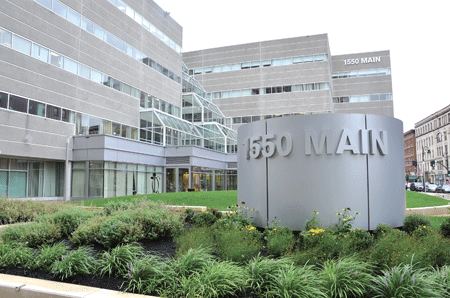
In 2006, prospects for the federal building at 1550 Main St. in Springfield were grim.

A new federal courthouse was under construction on State Street, and many people were afraid that the prominent building in the central business district of the city would become a vacant eyesore after the court and other tenants vacated.

“The market for office space was very weak at the time, and it was feared that the building could become a blank in the downtown fabric,” said Richard Henderson, executive vice president of real estate for MassDevelopment, the state’s finance and development authority, which eventually assumed ownership of the property. “No one in the private sector seemed to have any interest in it, and owners of other buildings thought it should be closed. It was never attractive to begin with and looked worse after jersey barriers were installed in front of the plaza after 9/11. Plus, it was in poor shape, and the bricks on the exterior were falling off.”

Zach Greene agreed, and told BusinessWest the jersey barriers had been painted an unsightly brick orange, and although flower boxes had been stationed on top of them, the effect was far from pleasing.

“The building was not only unattractive, it was uninviting. It had a flimsy canvas awning outside, and when people entered the doors, they were greeted by metal detectors,” said Greene, MassDevelopment’s senior vice president of asset management, adding that, to make matters worse, visitors who parked in the Columbus Center garage behind the building had to walk down Bridge Street in inclement weather to get to the entrance because the back doors were locked for security reasons.

However, at the behest of city leaders, the Urban Land Institute, a national organization that disseminates experts to study challenging real-estate and land issues, sent a panel to Springfield for five days to determine, among other things, the best use of the property.

“They did extensive interviews with city officials, business leaders, and people in the neighborhoods, and concluded the building was key to downtown revitalization and should be made a priority,” said Henderson, noting that it had been built in 1980 and was one of a handful of newer office buildings downtown.

In 2007, MassDevelopment partnered with city administrators and the Finance Control Board, which was running Springfield at the time, and began what would become an $11 million acquisition and renovation of the building’s public spaces, which would take four years to complete.

However, the agency’s first step was to determine how to use it. After homeless and veterans’ groups, who had the first option on the building, failed to express interest, other possibilities were explored.

“We considered moving the police headquarters into it as well as using it as a place for higher education, similar to the new UMass facility that recently opened in Tower Square,” Henderson said.

But after a few years, the city, the Commonwealth, the U.S. General Services Administration (GSA), U.S. Rep. Richard Neal, and Baystate Medical Center put together a plan that included pre-leasing the building to private and public tenants. The Springfield School Department would occupy 56,989 square feet on the first and second floors, Baystate agreed to bring support staff into downtown for the first time and lease the entire fifth floor, and a number of federal agencies would remain in their space on the fourth floor.

“The School Department really needed to move; they didn’t have any air conditioning in their building and were way over capacity,” Henderson said, explaining that the move, which was strongly defended by Mayor Domenic Sarno, incited controversy in the City Council.

1550-main-before

1550 Main St

The property at 1550 Main St. before its makeover, left, and after it, right.

But in the end, the commitment by the School Department and Baystate made the project possible, and thanks to help from Neal and Kevin Kennedy, who was a member of his staff at that time, MassDevelopment purchased the building for $2.5 million in September 2009 from the GSA and renamed it “1550 Main.”

Its redevelopment has become a success story on many levels, and, according to some, an inspiration for more initiatives downtown, such as the UMass project.

“After we made our commitment, the Dennis Group purchased and renovated the Fuller Block across the street, and radio station WFCR has moved in,” Henderson said, as he listed a number of new downtown ventures.

“The Morgan Square Apartment block down the street has been acquired by a group from New York and is undergoing a major renovation and will become the Silver Brick Lofts,” he went on. “UMass has a new facility in Tower Square, and new investment is taking place in the surrounding area, with more to come. One thing builds on another, and what could have been a negative or a poorly redeveloped building has led to a lot of positive consequences.”

Complex Undertaking

Renovating 1550 Main was no simple feat, but the School Department did its own work and moved into the space in June 2010, which allowed MassDevelopment to focus on the plaza and exterior of the building.

“We wanted the tenants to be able to use the outside areas, but a large portion of the plaza was over an underground parking deck, which made removing and redoing it very tricky,” Henderson said.

The jersey barriers were removed in the fall of 2009, and high planter walls that blocked views from the street were taken down in the spring of 2010, making way for new landscaping.

Outdated glazed-brick flooring and planters in the atrium were also removed, along with an extra stairway inside the lobby that connected the first and second floors.

“Taking out the stairway allowed us to create a public walkway that people could use to get to CityStage and the parking garage,” Henderson said, noting that a $3 million Growth Districts Initiative Grant, secured with the help of the city, was used to make improvements to the public plaza, building entrance, and atrium.

All of the elevators were also replaced, and although there was not enough money to gut the bathrooms, the tiling was sanded, and new lighting and plumbing fixtures were installed. “We had to do the work in a way that didn’t disturb the tenants who had remained in the building. The Internal Revenue Service office was on the first floor, and we pulled up the entire floor of the lobby while they were working,” Henderson said.

Cosmetic improvements were also made on every floor, including new lighting and paint. “Many of the walls were painted an antiseptic green that had been offset by fluorescent pink lighting, so it really made a difference,” Greene said.

Since the federal offices were on the fourth floor, officials agreed that the metal detectors could be relocated there, which allowed MassDevelopment to install an attractive security desk in the entrance of the building.

“The back doors no longer had to be locked, so people who parked in the garage were able to come directly into the building without going outside,” Greene said. “We also installed a security system to make sure people who rented the space felt comfortable in the building.”

Baystate moved into the renovated space in May 2011, and since that time, the building’s 128,000 square feet of rentable space has been close to capacity, Henderson said. “Baystate has renewed its lease, and at present, the building is 98% occupied.”

Michael Moran, vice president of Clinical, Facility and Guest Services for Baystate Medical Center, said the healthcare provider has enjoyed being part of the redevelopment.

“Baystate Health is fully invested in carrying out its charitable mission of not only supporting the health and well-being of the community, but its economic viability as well,” he explained. “Our commitment to renting space for information-technology staff on the fifth floor of the former federal courthouse building back in 2009 was designed to help spur the city’s economy and brought a further presence for Baystate Health in downtown Springfield.”

Although some of the federal agencies have moved out since that time, new tenants were found to take their place, and the fourth floor is now home to offices for U.S. Sens. Ed Markey and Elizabeth Warren, as well as a law firm that occupies 4,100 square feet. In addition, private tenants have taken advantage of the first-floor space formerly used as military recruiting stations.

Since the time the building reopened, Greene said, it has been a source of pride. “Visitors have said they can’t believe the transformation, and the building has earned a number of awards,” including Outstanding Building of the Year in 2012 and 2013 by the Building Owners and Managers Assoc., and its Middle Atlantic Award Winner in 2013 in the Government Building category. In addition, in April 2013, the building earned the Environmental Protection Agency’s Energy Star Certification.

New Lease on Life

Today, 1550 Main St. hosts a series of lunchtime concerts held outside on the plaza in the spring and summer, and its lobby is used to showcase public and private art exhibits.

The new entrance has become an inviting gateway to the public atrium, which is open to the public and used for a variety of gatherings, including appreciation events held by Springfield School Department.

Overall, the property’s transformation has become one of many positive developments downtown and a gleaming example of a public-private partnership that has created momentum and additional success stories.

“My mother grew up in Springfield, and it’s been rewarding to help bring life back downtown and renew the vitality that existed there years ago,” said Greene. “We are happy to help it get back on track.”

Employment Sections
TWO Program Is Honored for Closing Workforce Skills Gaps

WorkforceDPart“The economic imperative for aligning the workforce needs of Massachusetts with the needs of students attending community colleges is powerful and growing. Massachusetts is at a crossroads in its capacity to compete — and the ability of its residents to fully participate in the current economy and the rewards that employment brings. For the Commonwealth to flourish going forward, a high priority must be placed on training the workforce that is needed by the industries that are driving the Massachusetts economy. That responsibility falls squarely on the Commonwealth’s public higher-education system, most predominately the 15 community colleges.”

That was one of the more hard-hitting bits of analysis and commentary contained in a blistering 2011 report issued by the Boston Foundation, a document that essentially called out the state’s community colleges for not doing enough to help train a workforce to meet industry needs, while making some controversial suggestions about how to bring about change, such as a centralization effort that would do away with local boards of trustees at the schools.

Bill Messner — now, as then, president of Holyoke Community College — remembers his reaction to that report. His initial response was that its authors didn’t do enough research — at least when it came to the schools west of Worcester — and missed some key evidence that community colleges in the 413 area code were, in fact, being imaginative and somewhat effective in efforts to close so-called skills gaps within the workforce.

Bill Messner

Bill Messner says the Boston Foundation report in 2011 caught the attention of area schools and prompted initiatives like TWO.

Still, Messner and others, like his counterpart at Springfield Technical Community College, Ira Rubenzahl, chose not to shoot the messenger — although they were highly critical of those suggestions to centralize the community-college system and put it under one board — and heed calls from the Boston Foundation, as well as the Commonwealth Corp. (which issued its own report with similar findings at that time) to do more to partner with businesses and workforce-development agencies to properly align their training programs with the specific needs of industry sectors.

So it was with a large dose of pride that HCC and STCC learned that, together, they had won the first Deval Patrick Award for Community Colleges, named after the former governor and funded by the Boston Foundation, for work undertaken through a program called TWO (Training & Workforce Options), an acronym that is now resonating throughout the local business community.

The cash prize, to be split by the schools, is $50,000 — a small amount, especially when budget cuts of nearly 10 times that number were announced by the Baker administration for both schools the same week the award was presented. But the rewards go well beyond the money (which will go into both schools’ general operating funds), said both Messner and Robert LePage, vice president of Foundation and Workforce Training at STCC and the school’s TWO point person.

Indeed, the award will bring recognition to the program, said LePage, adding that with that exposure might come support from other state agencies as well as more participation among area businesses and thus more progress in combatting regional workforce issues.

“Recognition from a group like the Boston Foundation is the kind of endorsement that can get others to invest in you — I hope this is something we’re able to leverage,” he explained. “People want to see a good return on their investment, so I’m hopeful that this will bring some eyes to Western Mass., prompt others to appreciate the work we’re doing here, and cause people to say there are things happening here that they can adopt.”

In many ways, the Boston Foundation report validates TWO’s mission and underscores the success stories authored in its first three years, said LePage, adding that there have been many of them.

For example, TWO has partnered with Baystate Health to create a regional ICD-10 (medical coding) incumbent worker training academy and is working with regional employers to launch an advanced hospital medical coding academy that will prepare workers for the many changes coming to that important realm within healthcare. Meanwhile, it has worked with MassMutual and a host of other employers to develop a new advanced call center and customer service certificate, a program that has succeeded in placing a number of individuals in jobs within that emerging sector.

Meanwhile, TWO has taken the lead in training individuals for the gaming industry that will soon become a force in this state through the creation of the Mass. Casino Careers Training Institute.

For this issue and its focus on employment, BusinessWest looks at how TWO has managed to impress far more than the Deval Patrick Award judges and, in the process, has enabled more individuals to join the workforce and helped area businesses thrive.

Work in Progress

Increasingly, Messner noted, groups such as the Boston Foundation are creating cash awards, like those attached to the Deval Patrick Award, as incentives to prompt groups and individuals to respond to their various initiatives and calls for action.

And in many instances, such tactics are working, he said, adding quickly that, with the Patrick Award, there was little fanfare, and many administrators at the state’s community colleges, himself included, were not even aware of the award until a call for applications was issued last fall.

The much more profound incentive to respond to the 2011 report and others like it, said Messner, was a recognized need for a regional response to a skills gap that goes a long way toward explaining still-high regional unemployment rates at a time when many businesses are struggling mightily to fill key positions — a phenomenon that has in some ways stifled economic growth.

“While we didn’t agree with everything in the report, it certainly got our attention,” said Messner, using ‘we’ to mean both community colleges. “And we responded accordingly with TWO.”

Slicing through the 2011 Boston Foundation report and summing up its main points, the authors’ main contention then was that the state’s community colleges were not working collaboratively (or working enough) with employers, industry groups, and workforce-development-centered agencies to identify needs, close skills gaps, and create opportunities for those challenged in their attempts to enter the state’s knowledge-based workforce.

So TWO, which was already in its formative stages when the report came out, was designed to change that equation, create a host of partnerships, and incorporate a far more proactive approach to workforce issues and challenges than what existed prior to the program’s existence.

TWO’s mission — and its operating philosophy — are summed up nicely in this passage from the joint application submitted by HCC and STCC for the Deval Patrick Award:

“Prior to community college reforms, the two colleges often worked in a reactive form and in competition with one another,” the application authors wrote. “This often led to an inefficient and duplicative approach to workforce development and employer engagement in Hampden and Hampshire counties. With the formation of Training and Workforce Options, the two colleges have formed a cohesive and proactive sales and training approach and have effectively broadened the reach of both colleges. TWO has provided HCC and STCC a stronger and unified voice and further positioned the colleges to provide a deeper and wider leadership role in serving regional workforce needs that serves as a catalyst to support economic-development success.”

It has assumed this leadership role through engagement with the business community and agencies ranging from area Regional Employment Boards to one-stop career centers to economic-development-related agencies to identify needs and develop programs to address them.

Through its so-called ‘business-discovery model,’ LePage said, TWO has met with more than 200 businesses in five key industry sectors — financial services/customer service, healthcare, hospitality and culinary, IT, and manufacturing — to validate employer needs.

Bob LePage

Bob LePage says the Deval Patrick Award will garner recognition for TWO, prompting more participation and attempts to emulate its success.

And program partners run the gamut, from major employers such as MassMutual, Baystate Health, Smith & Wesson, Six Flags, and MGM to smaller operations such as Mustang Seats, the Three Rivers-based company that makes replacement motorcycle seats for Harley Davidson, Honda, BMW, and other brands, and Ludlow-based Chemi-Graphic, which manufactures nameplates, labels, and other products for a wide range of customers.

Input from these businesses has helped spawn several direct responses in the form of new programs and training initiatives.

At Chemi-Graphic, for example, TWO has provided a host of services, from assessing workforce needs to direct training programs to advice on how to secure state workforce-training grants, said LePage, adding that the manufacturer is in many ways representative of the businesses TWO was created to assist.

“They’re the kind of company we’re looking for, because they have 50 to 60 employees, so they’re not large enough to have a training arm, per se,” he explained. “And they have a niche business, one that’s doing well, but is now facing the retirement of all those Baby Boomers, and they need to replace those workers. They’re really what we’re looking for — we want to help as many of those small and mid-size companies as we can because they are the heartbeat of this region.“

Answering the Call

Overall, TWO’s most profound impact has been with closing those aforementioned gaps between the skill sets that the current workforce possesses and the skills that are needed within certain industries and for specific jobs.

Two of the better examples of how TWO has operated are the ICD-10 incumbent worker training academy and the advanced call center and customer service certificate.

ICD-10, as that name would suggest (at least to those in the industry), is the 10th revision of the International Statistical Classification of Diseases and Related Health Problems, or ICD, said Jason Pacheco, a senior workforce-planning consultant for Baystate Health. And it represents a significant change from ICD-9.

“ICD-9 has around 9,000 or 10,000 codes, while ICD-10 has roughly 60,000 codes,” he explained, adding that this nearly exponential increase is projected to generate a decrease in productivity — primarily because it already has in countries where ICD-10 is being used. As a result, said Pacheco, healthcare providers and medical practices will either have to bring on more employees or outsource more work.

To widen the pool of potential job candidates, TWO is partnering with Baystate, the Regional Employment Board of Hampden Country, and other players on worker training initiatives that have, to date, involved more than 50 companies.

“The concept to fill the gap in the labor pool was to come up with a development program,” said Pacheco. “What Training and Workforce Options has been able to do is work with those two community colleges to help align the students and their curriculum toward flexible workforce arrangements that meet employers’ needs.”

And that’s just one example, he said, of how Baystate and others in the healthcare sector have partnered with TWO to identify and close gaps involving several specific positions, including sterile-processing technicians, medical lab technicians, pharmacy technicians, and others.

That list includes call-center employees, he went on, adding that Baystate is one of many area employers, large and small, that have participated in the Advanced Call Center & Customer Service Training program.
To date, three cohorts of students have produced more than 55 graduates, with roughly 80% of those individuals placed in companies like MassMutual, PeoplesBank, Health New England, and many others, thus meeting a growing need for such specialists.

“There are quite a few call centers in the region if you start to add them up, and they’re across many sectors of the economy,” said Nick Fyntrilakis, vice president of Community Involvement for MassMutual, which has hired several of those graduates. “And a growing challenge for everyone with a call center was finding qualified applicants; different companies have different needs, but there are some foundational pieces that run across the whole spectrum.”

TWO, working in conjunction with those employers and the Regional Employment Board, developed a curriculum, identified solid candidates for the program, established a call-center simulation center, and developed a formal employer-engagement process to improve student placement, he went on, adding that these various steps have all helped ensure success and sum up what the program is all about.

“To us, that’s the kind of work that community colleges were designed to do,” said Fyntrilakis. “That’s what they were built to do — to plug into the workforce needs of the community and tailor programs that identify people that have a skills gap or require additional training or education, and then help connect them to those careers.”

And that’s exactly the type of work that the state’s community colleges were not doing, at least according to the Boston Foundation.

Bottom Line

Messner told BusinessWest that, while he had confidence in the joint submission for the Deval Patrick Award, he wasn’t exactly expecting the two Western Mass. schools to prevail in that competition.

“I was more than a little surprised by this, because we assumed that the Boston Foundation, being a Boston foundation, might be inclined, especially for this first award, to stick closer to home,” he said, adding quickly that, beyond geography, he wasn’t surprised by the choice.

That’s because of TWO’s quickly amassed track record and the promise to add to its portfolio of success stories.

The Deval Patrick Award might help with all that, and, as Messner, LePage, and others mentioned, that’s a far bigger prize than a pair of $25,000 checks.

George O’Brien can be reached at [email protected]

Employment Sections
O’Connell Care at Home Tries to Keep Up with Soaring Demand

Danielle Lord

Danielle Lord says home care is in demand, and so are qualified home-care aides and nurses.

Growing up in Holyoke, Fran O’Connell lived with an extended family, including an elderly aunt and grandfather. In those days, the family took care of each other, in sickness or health; no one had heard of home care.

These days, as owner of O’Connell Care at Home in Holyoke, he helps other families take care of their loved ones at home, away from institutional settings, through a broad range of home-care services, in addition to nurse-staffing services for a variety of clients.

Almost three decades after he launched the enterprise in 1987, O’Connell continues to see steady growth in his business, and explosive growth in the home-care industry — growth that’s being held back only by a national shortage in qualified home health aides. That’s because, as people live longer than they used to, and with their caregivers and children (often one and the same) more aware than ever of the care options available to them, demand for home care and other nursing services is only expected to increase.

“Really, there’s such a need in the community for home care,” said Danielle Lord, the company’s vice president of operations, who essentially runs the company’s day-to-day activity. “As the population of Baby Boomers age, more want to stay at home — or where they’re currently at, maybe assisted or independent living — rather than go to a nursing home.”

Lord came on board in 2007 and has seen significant change since then, including a move to larger quarters on Bobala Road in Holyoke; the company plans to move again this year, from Holyoke to Springfield. In addition, it opened a South Deerfield office last year.

“We opened that office to better serve the Franklin County and northern Hampshire County areas. While doing that, we decided to move our Holyoke office to Springfield to better serve Hampden County and southern Hampshire County,” she explained. “Business has tripled in the last five to seven years. We are really growing; there’s such a need in the community. We still could probably grow more, but home health aides and qualified home healthcare workers are so in demand right now.”

That’s the key issue right now for home-care companies — one O’Connell is addressing through an ambitious array of job fairs, recruitment efforts, and in-house training, all with the goal of keeping more Western Mass. seniors living safely and happily at home.

Fertile Ground

Before starting the firm, Lord said, O’Connell was a nurse practitioner who had taken care of his own grandfather at home. After earning his nursing degree from Columbia University in 1984, he returned to Holyoke and discovered that several of his friends had caught the entrepreneurial bug and were opening their own businesses.

While most nurses worked at specific settings, such as hospitals, he simply incorporated himself and started selling himself as a nurse. “If someone needed a nurse for the day, or someone got out of the hospital and needed a private-duty nurse, I did that,” he explained. “Word got out quickly, and I couldn’t do every shift, so I started bringing in friends, and before long I had 10 people subcontracting for me.”

Someone pointed out that O’Connell was essentially running a temp agency, so he took the next step and employed his fellow nurses, and the business was on its way.

“There weren’t home-care services out there in the ’80s, so it started really as a staffing business, then gradually turned to home care,” Lord said — a shift that began when O’Connell started getting calls from the Holyoke Visiting Nurses Assoc. and other organizations that service seniors.

O’Connell found he loved home care, and went on to earn his master’s degree in nursing in 1996 and was later certified as a family nurse practitioner.

Home care encompasses myriad services, Lord said, from basic household help to medication management to transport to appointments. “Primarily, it’s all your activities of daily living, the things you need to do to stay at home. We do homemaking and meal preparation, help people get up, get dressed, take a shower, toileting, all those sort of things.”

Home-care companies typically offer a wide range of time commitments as well, she added. “It’s everything from two hours once a week to help get someone groceries, to around-the-clock care because someone can’t be left alone, for dementia or hospice, or someone who wanders and can’t be left alone. It’s really such a broad spectrum.”

And it’s not just the client who benefits from home care, she added, but their family as well. “We help people figure out how to stay home, where they want to be, but also support other family members. Especially if the husband or wife is declining, we can help the spouse, help the family around the house, make sure they’re not getting overwhelmed.”

The staffing piece of O’Connell Care at Home — such as its contract work with Highland Valley Elder Services and various VNA organizations — is different in some ways, Lord said. “We’re still doing home care in those situations, but they provide the clients and have care plans already written. If an adult day service needs a nurse, we’ll try to staff a nurse. On [student] field trips, we’ll provide a nurse for the day. If a VNA has somebody on vacation and they have higher census and need home health aide, we’ll provide that. So, yes, we do some staffing, but it’s primarily home care.”

Transportation is another facet of the company’s service. “That’s all private pay — we’ll take somebody to the doctor or a family event on the weekend or around the holidays,” she explained. “We’re very busy with that around Christmas; people call us and ask, ‘can you transport my mother to Christmas dinner and then home?’ We have a wheelchair van for that. It’s a popular service around those times.”

Training Days

In fact, all O’Connell’s services are becoming more popular, which keeps the pressure on to continually add more talent. That’s easier said than done, with Forbes and U.S. News & World Report both listing home-care aide as one of the most in-demand jobs in coming years. Simply put, there aren’t enough bodies to meet the need.

“We recruit all the time, and we frequently have job fairs for people interested in the job,” Lord said. “The need for home health aides hinders our growth. Other companies are dealing with the same thing; they’re all looking for qualified workers. I think that’s across the board. We’re fighting now with hospitals, nursing homes, assisted living, independent living, home care, nursing homes. But we’re willing to train our own people. If someone has an interest, we’ll train them. We want to put the best person out there to care for clients — the kind of people I’d want to take care of my own family.”

The reason strikes at the heart of why home care is so important, she went on. “We want to make sure families feel their loved ones are safe at home. We write a care plan for the people we take care of. We learn what this person likes, doesn’t like, and decide who’s the best person we can send. We try to match their interests and send someone they can form a relationship with. Home care aides can take care of people for years, in many cases. They become a really important part of the family and increase their quality of life.

“We’re not perfect at it,” she was quick to add. “We’re honest with people that the first person you get may not be a perfect match, but we’re going to find you someone you end up clicking with — someone they’ll look forward to seeing each day.”

Lord said O’Connell mainly hires people who have been trained as home health aides or CNAs, “but if there is somebody who has other kinds of experience and thinks this is something they want to do, someone who’s caring and compassionate and really wants to take care of older people — because we primarily do elder care — we can offer some training to get them up and running, to become a home health aide.”

Beyond the basics, though, “we’re looking for someone reliable, with good common sense, someone who’s going to get there in a snowstorm,” she went on. “We want someone really caring who considers the needs of their clients and really wants to take care of them and do what’s best for them. They care about the people they’re taking care of.”

O’Connell says he takes pride in seeing people come work for him as CNAs, then go on to get PN or LPN degrees and return as nurses. He stressed that it’s not an easy job, but as a career path, it can be rewarding and — important for job seekers these days — stable.

Lord agreed, and said families appreciate the stability of a reliable home-care nurse or aide.

“We do a lot of training and have a lot of supervision,” she said. “We meet the family, write a care plan, and try to be really thoughtful. We’re trying to make good matches and keep people where they should be — and improve their quality of life.”

Joseph Bednar can be reached at [email protected]

Employment Sections
NLRB’s Joint-employer Campaign Provides Some Food for Thought

By PETER VICKERY

Is a franchisor liable for the labor practices of a franchisee? Are they joint employers? No, not according to the law. The franchisee is the employer, not the franchisor. But you would never guess that from the attitude of the National Labor Relations Board (NLRB) and the Equal Employment Opportunity Commission (EEOC).

Together, these two agencies are trying to foist labor-practices liability onto parties whose business models are predicated on its absence.

Peter Vickery

Peter Vickery

The joint-employer concept is a creature of the common law, which is a flexible thing, evolving on a case-by-case basis to meet society’s changing needs. But some areas of law achieve a certain degree of stability, which makes life in general (and business in particular) more predictable. One such area of settled law is the relationship between franchisees and the people they employ.

For more than three decades, the NLRB and the courts have applied the principle that the franchisee — not the franchisor — is the employer of the individuals who work in the franchisee’s place of business. If a franchisor actually exercised significant control over the terms and conditions of employment — such as hiring and firing decisions, rates of pay, day-to-day supervision, and scheduling — the story would be different. In the absence of that control, franchisees and franchisors are not joint employers.

But now, the NLRB is pursuing charges against franchisors for the alleged labor practices of franchisees, asserting that they are joint employers.

Certainly, a franchisor has to involve itself in aspects of a franchisee’s operations in order to police and protect the brand. Depending on the provisions of the intellectual-property agreement, this can entail monitoring and instructing a franchisee’s employees with regard to quality control. But that kind of involvement, no matter how deep, does not constitute significant control over labor relations. Nevertheless, the NLRB asserts that it does.

The first targets in the board’s crosshairs are McDonald’s and Browning-Ferris Industries. The goal is to make it easier for unions to organize fast-food employees and temporary workers hired by staffing agencies.

Just to be clear, the law has not changed. In 1982 the U.S. Court of Appeals for the Third Circuit articulated the sufficient-control standard, and two recent rulings from California reiterated the point that franchisors and franchisees are not joint employers. The rules governing how the NLRB defines the term ‘joint employer’ are the same as well. What has changed, however, is the identity of the NLRB’s general counsel. In November 2013, President Obama appointed Richard Griffin, formerly general counsel to the International Union of Operating Engineers, which represents not only workers in construction and petrochemicals, but also in service industries. As the NLRB’s legal chief, Griffin made the decision to go after McDonald’s Corp.

Those who agree argue that the NLRB board is doing no more than meeting its “responsibility to adapt the [National Labor Relations] Act to the changing patterns of industrial life,” as Supreme Court Justice Brennan put it in the 1975 case of NLRB v. Weingarten. There is no doubt that Justice Brennan, the champion of the ‘living Constitution,’ wrote those words. What is in serious doubt is whether Congress can delegate to an executive agency the power to ‘adapt’ a statute. The Constitution vests the legislative power exclusively in the legislative branch. If Congress wants to adapt a statute to the changing patterns of industrial life, it — and it alone — is free to do so.

By launching complaints against franchisors on the basis of joint-employer status in the face of settled law, the NLRB is taking a tack similar to the one some commentators have described as the sue-and-settle approach. Rather than go through the cumbersome process of adopting new rules and regulations, some agencies and their allies in the economic areas they regulate (their de facto constituents) prefer a faster route.

The sue-and-settle approach involves agencies collaborating with advocacy groups to achieve a policy objective by leaning on businesses until they agree to the group’s demands, bypassing the rule-making process. Together, the advocacy group and the agency accomplish via a consent decree what they could not have accomplished through the statutorily mandated regulatory route, replete with notice, review, public input, and political accountability.

What the NLRB is engaged in with its joint-employer campaign is a variant on sue-and-settle. While Mr. Griffin embarked on the case against Browning-Ferris, but without pausing, the board invited public comment on its new definition of joint employer. One of the supportive comments came from the EEOC, which seems to welcome the prospect of expanding the range of potential defendants subject to its jurisdiction in discrimination cases. If the NLRB and EEOC succeed, the ramifications will extend well beyond the fast-food and staffing sectors.


Peter Vickery practices law in Amherst; (413) 549-9933; www.petervickery.com

Cover Story Sections Technology
Video Specialist Chris Thibault is Focused on Growth

Teebo-DPartChris Thibault was asked to pinpoint why he believes his work — everything from television commercials to instructional videos on deck screws — stands out in a field crowded with competitors.

He kept coming back to the word ‘edgier,’ as in “some people think my style’s a little edgier than what you would get from a corporate video-production company. When they’re looking for something to connect and be sharable and be cool, for lack of a better word, people come to me.”

When pressed for more specific definitions of what amount to technical terms — ‘edgier’ and ‘cool’ — Thibault, founder and president of Chris Teebo Films (he says that spelling makes his name easier to pronounce and his company easier to find), struggled somewhat, as might be expected, because of the subjective nature of those words.

“Anyone can make a pretty picture,” he told BusinessWest before a lengthy pause as he searched for more words. “I just try to bring my own style into it and not base anything off a template.”

With that, he decided that the best way to get his points across was to play a shorter version of what eventually became a promotional video and television commercial he produced a few years ago for something called the Great Bull Run — a series of events that, as the name suggests, brings the Spanish tradition of running with the bulls to this country.

“I like to take risks — that’s what they teach you in art school starting on day one, to take risks when you can,” he said as he rolled the footage, which showed close, detailed shots of individuals running alongside 1,500-pound bulls, an effect created with several cameras, including one strapped to one of the runners (christeebo.com/portfolio/the-great-bull-run). “You can cover this like a news story, and there’s nothing wrong with news, but we wanted to get right into the mix and capture what this is about. People who run with bulls, or might run with bulls … they want something edgier.”

Teebo’s ability to create that intangible has helped him grow his now-Springfield-based company dramatically in recent years, with a 60% increase in revenues in 2014 alone, and add to his portfolio of work.

For example, it now includes several Big Y commercials featuring New England Patriots nose tackle Vince Wilfork, a promotional video for the Spirit of Springfield’s Bright Nights lighting display (produced for its 20th anniversary), television commercials for political candidates such as recently elected state Sen. Eric Lesser, and much more.

Some of these works are edgier than others — political office seekers, not to mention Big Y, tend to be fairly conservative, while the Bright Nights video was shot from the perspective of a young child and is thus quite compelling — but together, they have helped Thibault meet the ongoing challenges of gaining word-of-mouth referrals and generating business from that marketing tool known as the Internet.

And he hopes an upcoming project — a promotional video of Springfield being financed by its Economic Development Department with the goal of showcasing current initiatives and inspiring more of them — will create more momentum in efforts to build his brand and get involved in Springfield’s comeback.

“I’m really excited about this project,” he said. “I’m going to knock it out of the park with that one.”

Looking ahead, Thibault, as he said, wants to not only help promote Springfield through that video now in the planning stages, but be part of the city’s turnaround. He recently relocated to a office in 1350 Main St., and is conceptualizing plans to develop what he called “shared creative space” in the city.

Such a facility, a large studio, would become workspace for a host of creative professionals, including photographers, videographers, audio engineers, and even musicians, he explained, adding that there are models for such a development in New York and Boston that he hopes to emulate.

In the meantime, his more immediate goals are to expand the portfolio with more ‘edgy’ work, add additional employees, and grow Chris Teebo Films into a regional force within this industry.

For this issue and its emphasis on technology, BusinessWest talked at length with a young business owner focused (there’s another industry term) on creating images that get results, no matter how the client chooses to measure them.

Setting the Stage

Like most individuals in this business, Thibault can trace his interest back to his high-school years. In this case, it was a 10th-grade class in video production at Springfield’s Sci Tech that got him hooked.

“I thought this was the coolest thing ever,” he noted. “It combined all the aspects that I loved. I was always an artistic kid — I would always draw, mess around with music and sound — and I thought video combined all that, so I fell in love with it.”

image from a video

This image from a video produced for the Great Bull Run displays what Chris Thibault calls an “edgier” style that defines much of his work.

Finding ways to express this affection became more difficult when his family moved to West Springfield. The city’s high school didn’t have video production classes, so he created some.

He bought a Sony handycam, began filming the school’s sports teams, and created seasonal highlight videos that garnered both revenue and acclaim.

“They would play them at the year-end banquet, and the video would get a standing ovation,” he recalled. “These weren’t huge events, but everyone would stand up and clap, and that was a great feeling.”

Thibault was accepted at the prestigious School of Visual Arts (SVA) in New York City, starting classes there just a few days before 9/11 — an event, like many others, that produced learning experiences far outside the classroom that have stayed with him to this day.

“New York City is a school unto itself,” he told BusinessWest, adding that, while attending SVA, he lived in Brooklyn Heights, in the shadow of the Brooklyn Bridge, and watched tens of thousands of people stream over than span from lower Manhattan on the morning of the terrorist attacks, most all of them covered in a gray dust.

He didn’t know exactly what was going on, but his artistic tendencies compelled him to buy a small disposable camera and grab a seat on the only operating subway line still bringing people into Manhattan.

“I was probably 15 blocks from the towers,” he recalled, adding that when the American Express building, also known as Three World Trade Center, fell, the ground shook, and he knew something serious was going on. Perhaps the most unforgettable moment, though, involved a news reporter he remembered seeing on television.

“There was a woman coming back with a baby covered in soot, she was walking up the street,” he recalled. “This newswoman started yelling to the cameraman, ‘get her!’ She kicked over a trashcan, the cameraman got on top, filmed her, then jumped off, and the newswoman got the lady on camera to do a story.

“It was just a New York mentality — ‘let’s do it.’ There was no fear,” he went on, adding that this philosophy manifests itself in some of his current work.

But it would be awhile before Thibault could really start expressing himself artistically.

Indeed, he would soon leave SVA, in part for financial reasons — “New York is great, the school was great, but it’s very expensive out there” — but also because he felt a need, and desire, to get working.

That work, however, involved mostly wedding and event videography while he also drove a truck for his father.

“I did cheerleading events, dance competitions, anything like that; anything that had to do with video, I would take the job,” he said, adding that he did so to pay off the camera he purchased and build a name for himself.

“At the end of the day, my heart wasn’t really in it — filming weddings is not my passion,” he went on, adding that, as his skills improved and his reputation grew, he eventually started doing work for commercial clients and never looked back. “It’s tough to break into commercial video when you’re doing events, and at one point, I just said, ‘I’m finished with this,’ and stopped taking down payments for weddings, even though it was tough to do so, because I was trying to build a business.”

Thibault said his big break, if one could call it that, came when he pitched an idea to the owners of the Springfield Armor, the NBA Developmental League team that came to the city in 2009, to do a promotional video and build excitement for the team before it actually arrived in the City of Homes.

“I felt a buzz around Springfield when they were coming in, and I just wanted to do something great for the city as well as the team,” he recalled as he played that video, which showed people of all ages and persuasions playing hoops, a young man dribbling a basketball over the Memorial Bridge, the unveiling of the Armor name and logo, and other scenes designed to build interest in the Armor and the sport. “It was a commercial about the team, but without the team — they weren’t here yet — and it was cool.”

The spot was originally designed for the web, but it was so well-received, it started airing on area TV stations, said Thibault, adding that he was later approached by a marketing firm representing a Developmental League team in Texas to do something similar.

On-the-spot Analysis

With the Armor video and other works now in his portfolio, Thibault had more to show marketing firms and prospective clients, and work started to come his way, as both director and producer of content through Chris Teebo Films and as a freelance director of photography.

Indeed, as the latter, he’s been involved with projects ranging from promotional shoots for office supplies giant Staples and motor oil maker Castrol to part of an episode for TLC network’s Sex Sent Me to the ER, a show that has actors re-enacting real-life accidents that occurred during sex.

“It’s a terrible show … but there was a couple in Connecticut, and they were looking for a studio closer than New York, and the producers out in L.A. hired me for that segment,” said Thibault, adding that it was shot in his studio in the cavernous Cabotville Industrial park in Chicopee.

He rarely does freelance work these days, primarily because Chris Teebo Films has secured enough work to keep him quite busy. And it comes from several sources.

For starters, there’s the commercials he’s shot for Big Y featuring Wilfork, the Springfield-based grocery chain’s main spokesperson. He’s now done five spots spotlighting the 350-pound lineman as pitchman for pizza and sandwiches, including one that aired during the recent Super Bowl.

Chris Thibault

Chris Thibault, seen here on location for a Big Y commercial featuring Vince Wilfork, has gained a number of new clients in recent years.

Thibault has also added a number of other commercial clients in recent years, including political candidates such as Lesser, who captured his seat last fall, and Mike Bissonnette, who served several terms as Chicopee’s mayor, as well as regional companies and nonprofits ranging from Doctor’s Express (a new client) to Spirit of Springfield; from United Way of Pioneer Valley to FastenMaster, a subsidiary of Agawam-based OMG Inc. that specializes in deck and trim screws and other products.

One wouldn’t expect deck screws to be the subject of video productions defined with the word ‘edgier,’ but Thibault said he’s managed to do just that.

To demonstrate, he went back to his computer and called up a video featuring Gary Daley, owner of America’s DeckBuilder, LLC, using FastenMaster products, one of several spots Teebo has produced in a series that has taken him all over the country.

“They’re showcasing pros that use their products, and it’s become a very effective way of promoting the brand,” he said, adding that he also creates “tips and tricks” videos for the company. “I think FastenMaster is brilliant in doing this; they’re creating content for this industry that doesn’t exist, and they’re giving people something to watch and something to aspire to.”

Overall, Thibault said his goal is to produce videos that, like the one for the Great Bull Run, get not only shares and likes on Facebook and YouTube (although those are important), but also results for the client.

In the case of the Great Bull Run, for example, his video was used by organizers of the event when they appeared on Shark Tank, and, Thibault believes, it helped them secure $1.75 million in funding from shark investor Mark Cuban.

“Barbara Corcoran [one of the show’s ‘sharks’] actually said, ‘what a great video’ right on the air, which is cool,” said Thibault, adding that he plans to put that footage and commentary on his revamped website.

To get results, Thibault says he has to trust his instincts, take risks when they’re appropriate (there are many times when they are not), and work with the client without being limited by its imagination.

“I try to create whatever I see in my mind without letting even a client hold me back,” he told BusinessWest. “Because, while I value clients’ opinions — they help me do my job better — sometimes they don’t know exactly what they want, and they’re using some kind of template as a model.”

That’s a Wrap

Looking ahead, Thibault said this industry moves too quickly and unpredictably for five-year plans, so he’s moving in much shorter increments.

His immediate goals are to continue building the portfolio, hiring additional staff (there is currently one full-time employee with others hired on a freelance basis), and advance those aforementioned plans for shared creative space.

“There’s some great creative talent in Western Mass., but people initially think they have to leave and go to New York or Boston to pursue a career,” he said. “My goal is to help keep some of that talent here.”

While doing that, he plans to go on taking risks, producing video with an edge to it, and focusing on the big picture, figuratively and quite literally.

George O’Brien can be reached at [email protected]

Sections Technology
The Best Way to Contain Costs Is to Spend More Money

By GREG PELLERIN

A little boy sits down at the table next to his father and says, “hey, Dad, would you like to save some money?” Dad replies, “sure, what do you have in mind?” The little boy replies, “why not buy me a bike? Then I won’t have to wear my shoes out so fast!”

I told that joke to a CFO recently, and he offered me a rather reluctant smile. With all seriousness, I told him there may be more truth to that story than he might want to admit. I asked him to join me as we walked around the office, going from department to department, watching people toiling away at their computers. All he saw was too many people. All I saw was too much old technology.

Greg Pellerin

Greg Pellerin

There was a time, not too long ago, when you could get away with keeping the same hardware and software for five years or longer. It might take a licking, but as long as it was still ticking, there was no use in replacing it. As it aged, new technology and people were brought in to address cutting-edge applications, but because the old systems were deemed too important to the company’s core operation, they (and the people being paid to operate and maintain them) were left alone.  Things don’t work that way anymore, or at least they shouldn’t.

Today, older technologies are nothing but a drain on the operating budget because, from an OpEx perspective, they are fully depreciated. Headcount can’t be reduced because trained people are needed for operation of those old but critical systems.

The best way to break this endless IT cycle is to establish a regularly scheduled information-technology assessment and refresh process. As tough as it may be for your CFO to accept, spending money on new IT resources at regular intervals (as well as assessing the people needed to run them) eliminates the even more expensive and disruptive result of trying to fix everything at once.

It comes down to three basic areas: IT operations, network design, and equipment. Here’s a look at what a comprehensive IT-assessment process should entail to create an effective technology refresh plan.

• IT operations. Start by looking at the people and procedures you have in place to meet current and future business goals. Identify whether your network is fast enough and efficient enough to accomplish those objectives.  Interviews with key business and IT stakeholders are key elements of the process.
• Network design. Are your current network switching, routing, and security designs stable, safe, and secure? Are connectivity and controls in place to meet current needs, let alone future growth?
• Equipment. Conduct a complete cataloguing of organizational hardware (PC, server, and user-device inventory). Assess condition, expandability, life expectancy, and replacement cost. Identify technology gaps and ask if day-to-day operations are limited by your current infrastructure (for example, a printer that can only print 10 pages a minute and what implications 20-page-per-minute capability would have on productivity).

In the end, the goal is to provide a road map for leveraging IT as a competitive advantage. Establish a technology-refresh schedule, then stick to it.

Donald Trump once said that “sometimes the best investments are the ones you don’t make.” But when it comes to the regular assessment of your IT infrastructure, you might want to tell Donald, “you’re fired!”


Greg Pellerin is a 15-year veteran of the telecommunications and IT industries and a co-founder of VertitechIT, one of the fastest-growing business and healthcare IT networking and consulting firms in the country; (413) 268-1605; [email protected]

Features
WNEU Students Tackle Crowd-funding Project for Russian Robotics Firm

discuss online marketing

From left, John Garvey, Harlan Spotts, Mark Manolakis, Matt O’Connor, and Dan Koval discuss online marketing.

John Garvey is in the business of making connections, which is how a small team of marketing students at Western New England University wound up launching an online fund-raising campaign for a small, Russian robotics firm.

“I work pro bono as a mentor with an organization called MassChallenge,” said Garvey, president of marketing agency Garvey Communication Associates, referring to the Boston-based startup accelerator program. “They contacted me and asked if I’d be interested in working with a variety of Russian startups.”

The one that interested him was a company called xTurion, led by CEO Sergey Kolyubin, which had developed an intriguing, multi-faceted home-security system that roves around the house like a Roomba.

“They were looking for digital marketing help,” Garvey said, and that brought to mind two people: Dan Koval, a Great Barrington-based marketer and inventor, who has some experience with online fund-raising campaigns through the crowd-funding site Kickstarter, and Harlan Spotts, a professor of Marketing in the College of Business at Western New England University, who is always looking for educational, real-world projects for his students.

“Harlan is a long-time friend of mine,” Garvey said, “so I thought it would be a neat project to get him together with the Russian startup to work on a Kickstarter campaign.”

Dan Koval

Dan Koval offered his expertise with marketing and crowd funding to the xTurion/WNEU project.

Spotts and two students in a class called Marketing Seminar — Mark Manolakis and Matt O’Connor — recently met with Koval to pick his brain on developing such a campaign, and the pitch is expected to go live in April.

But back up a moment — what, exactly, is Kickstarter? And why is crowd funding the latest buzzword in digital marketing and fund-raising?

“In the past, entrepreneurs with ideas for businesses relied on venture capital or raised seed funding from friends and family,” writes Amanda Barbara in Forbes. “Crowd funding offers an advantage traditional methods don’t by providing validation as well as money. A successful campaign shows that there’s a market for what you offer. Getting additional funding is easier once an idea is proven viable.”

Crowd-funding sites like Kickstarter, Indiegogo, and other, smaller entities essentially generate funds from the public to complete projects, from books, music, and movies to high-tech gadgets. Kickstarter is especially strong with cutting-edge inventions, Barbara notes. In return for their support, donors are offered rewards depending on their level of giving. The catch? The beneficiary sets a monetary goal and a time deadline; if the goal isn’t reached, no money is collected.

Kickstarter alone boasts that 8 million people have visited the site to back a project, while 284,000 people have backed 10 or more enterprises. In other words, crowd funding has reached the big time in the world of startups.

“In years past, crowd funding as a means of financing a business was a novelty, a rare exception to the traditional methods of bank loans, venture capital, and borrowing money,” writes Nicole Fallon, assistant editor of Business News Daily. “Today, announcing your crowd-funding campaign is just as common as any of these other options, if not more so.”

Spotts and his students, as well as the innovators at xTurion, hope to ride that wave to a successful campaign — and perhaps the next big thing in home security.

Keeping Watch

The xTurion robot features multiple sensors to detect flames and smoke, burglars, water leakages, and environmental factors, like the home’s temperature, humidity, and air quality. Homeowners can access the data ­— and camera images — remotely through their smartphones, which also helps separate genuine threats from false alarms.

“It’s a global home security system, and they chose us to market it,” Manolakism said. “It’s shaped like a dome, moves around the house, and is linked to your cell phone.”

He added that it’s a more effective system than the iCam Pro, another Kickstarter-aided home-security product, because it can move from room to room along a pre-programmed route.

“It’s a little robot that lives around the house; it’s basically a home-security system all in one,” O’Connor added. “It has tons of features — fire monitors, temperature sensors, all the environmental controls. And it runs all on wi-fi; you can have up to five users logged into it at once, with an app that goes with it. If it detects something, it calls you, then keeps calling down the line to whoever is logged in.

“And we’re marketing it,” he added. “Specifically, we have to figure out the best way to do a Kickstarter campaign. We just have to make sure the campaign is up and running by mid-April.”

The team is considering a goal of $150,000, which would allow xTurion to manufacture and start selling the product — hopefully by the end of 2015 — and generating enough profit to become self-sustaining, which is, of course, the goal of any crowd-funding campaign.

Koval was impressed. “The home-security industry is looking for new technology,” he said. Not that he’s a stranger to marketing intriguing products online.

“I always wanted to start a business,” said Koval, who studied marketing at UMass. But an opportunity with General Electric — which eventually saw him stationed in London and other European locales — proved irresistible, and he put his business dreams on hold for awhile. “Finally I quit and went to business school. That’s when you realize how little you really know about business.”

After his first Internet business “bombed,” Koval had an odd product idea around 2002 — a cuckoo clock with a cow replacing the bird. Convinced the MooCoo clock could be a hit, he set about finding someone to manufacture the product and then sold it through online retail channels. “It took off like crazy,” he said, and eventually expanded to other animals. “I didn’t get rich, but I bought a house and made a nice living. I sold maybe a little less than a million of those.”

From the giftware business, he moved on to something more serious. A chance conversation with a hotel-room attendant educated him about the risk of back, neck, and carpal-tunnel injuries associated with that job. “Considering how many occupational injuries there are, and how much it costs hotels to lose these people, and the cost to the workers themselves in quality of life, there was a huge incentive here for companies to reduce these injuries.”

Eventually, he developed the Duop mop, which uses a telescopic handle and a ball-and-socket mechanism to allow users to clean from ceiling to floor without too much bending and straining.

“We found that a lot of room attendants don’t use any mops; they just get down on the floor, on their hands and knees, and clean the floor,” he said, noting that the Duop eliminates the need to put that kind of strain on the body.

“So I’m in the mop business now,” he laughed, although he’s also staying active on Kickstarter by helping a friend launch a campaign for crafty housewares, in particular a candle in the shape of a cat; as the wax melts, it gradually reveals a metallic cat skeleton. “At first, I thought, ‘that’s ridiculous. Who would want something like that?’”

But the designer won him over. “We chose Kickstarter because they do a lot of design projects. I felt like the Kickstarter audience was most aligned to burning cats.”

Catch All

That’s the world of crowd funding — it’s a welcoming environment for a wide variety of products and artistic creations, and it’s hard to tell which ideas will, well, catch fire.

Among his initial advice to Spotts, Koval suggested hiring a professional videographer to shoot video of the device in action, and also to create a fund-raising goal that will get the product off the ground, but not much else. “You don’t want too much slack in there at all; you don’t try to get rich off Kickstarter.”

Rather, he noted, it’s a place to get started — a goal that applies equally to home-security robots, cat candles, or next-generation mops. n

Joseph Bednar can be reached at [email protected]

Insurance Sections
Insurance Companies Enlist Help from Homeowners to Prevent Losses

CoverageIceDamDPart
When recalling the bizarre weather that descended on Western Mass. in 2011 — tornadoes in June, midsummer flooding, the freak pre-Halloween snowstorm — it’s easy to forget that, even absent all of that, the year would have been a challenging one for home insurers.

The reason? A January and February riddled with ice dams and roof collapses, thanks to snow that seemed to fall every other day for weeks on end, gradually building up the weight on houses and damming under the eaves, causing water to pour into homes.

“We paid a lot of claims. That was a big deal,” said Kevin Ross, vice president of Ross Insurance in Holyoke. But while the past few weeks have brought a similar onslaught of snowstorms, he doesn’t expect nearly as many claims this year.

“A lot of people are absolutely more attuned to this; everywhere I go, people are talking about getting a roof rake and cleaning off their roof,” he told BusinessWest. “People are well aware of ice dams and the problems they can cause. I just contacted a roofer to clean off my roof because ice is starting to build up in the gutter. In general, the population understands what can happen, and everyone is cleaning off the roof now.”

It’s a learned behavior being observed across the industry.

“We’ve had a couple of claims come in,” said Corey Murphy, president of First American Insurance in Chicopee. “Fortunately, it’s not as bad as it has been in the past, even with some of these strong storms we’ve had.”

John DiStefano of Preferred Mutual Insurance agreed.

“As I drive around, I see homes where people have used roof rakes to get some snow off around the edges, or they have people going up on the roof shoveling for them. That’s always a proactive approach,” said the personal-lines territory manager for Massachusetts and New Hampshire.

That’s good news for both homeowners and insurers, he said, considering that such events are covered by most basic plans. “Roof collapses and water damage, where water seeps into the home, is covered under most forms. That is a pretty common thing.”

Therefore, it’s good news for insurance companies — which implemented rate increases of 5% to 15% regionally after the 2011’s series of unfortunate events — that customers are increasingly taking matters into their own hands by keeping their roofs and gutters as clear of snow as possible.

But when it comes to winter home hazards, they say, roofs are only part of the picture.

Peak Problems

Typically, Ross said, homeowners facing winter roof damage don’t have to scramble to see if they’re covered.

“The standard policy doesn’t have to change to provide coverage of interior or exterior dmage caused by an ice dam, or even the collapse of a building,” he noted. “However, there are certain exclusions for the collapse of a fence, a patio, a swimming pool — those are not covered. Collapse of foundations or retaining walls, bulkheads, are not covered.”

Kevin Ross

Kevin Ross says homeowners have become more proactive about preventing roof damage during the winter, and insurance companies have become better at educating them.

But once an ice dam is reported, “right away, the insurance company will pay a reasonable amount to remove ice and snow from the roof to prevent further damage,” he explained. “But only once the damage has begun — we’re not going out to clean off everyone’s roof.”

The immediate drama of an ice dam, pouring water into interior spaces, can panic policyholders, Ross added. “They’re wondering, ‘what should I do?’ Call the insurance agent right away; they will only take one deductible until all the snow is gone from roof.”

That could encompass the entire winter, he noted. “Don’t be afraid that a week later you might have more water coming in. It’s considered one event until all the snow is off the roof. So, once it starts, once you notice water inside the house, call your agent right away.”

As for roof-collapse concerns, that’s a tricky area to navigate, because the weight of the snow isn’t always clear from a visual check, forensic meteorologist Steve Wistar noted at accuweather.com.

In the Northeast, he explained, roofs are generally designed to support 30 pounds per square foot, but some are built to support 40, 50, or even 100 pounds per square foot. Further complicating matters, that weight is determined by water content, not merely depth.

Specifically, dry, powdery snow weighs less than wetter snow, and its flaky texture makes it prone to drifting, which is ideal for roofs designed to handle drifting snow. But, over time, snow compacts and settles down, meaning the snow won’t be as deep, but the weight will be the same, Wistar said.

Finally, when temperatures rise and snow becomes rain, the snow already coating rooftops can become saturated with moisture, weighing it down. And even when the snow does begin to melt, it can refreeze around gutters and drains, trapping more melting water on the edges of the roof — which, of course, can cause ice dams.

Columbia Gas of Massachusetts recently issued yet another concern for homeowners regarding rooftop snow accumulation — specifically, a number of incidents involving large icicles and snow accumulation falling from rooftops onto natural-gas meters, causing gas-line ruptures and gas leaks.

The company noted that it’s important that natural-gas meters and exhaust vents for heating equipment and other appliances are free of snow and ice, as gas equipment requires adequate airflow for safe combustion — and proper venting of appliances — to prevent dangerous carbon-monoxide situations.

prevent ice dams

Recent winters in Massachusetts have seen brisk sales of roof rakes as homeowners try to prevent ice dams from forming.

Columbia Gas president Steve Bryant encouraged homeowners to use a broom — not a shovel — to clear ice and snow from gas meters, and to avoid kicking or hitting the gas meter to break away snow and ice.  “Don’t shovel snow up against your meter.  Be careful when using a snow blower or snow plow near your meter. Where possible, have a clear path to your gas meter in the event a technician or emergency responder should require access.”

Cold Snap

When protecting their homes from cold-related damage, Ross said, customers shouldn’t look outside only.

“Losses can occur if you don’t keep adequate heat inside the home,” he noted. “Sometimes, when you leave for a week in Florida, you figure, ‘I’ll just turn my thermostat down and save on energy costs,’ and you come back to find that a pipe froze and burst. That’s something else from a loss-control standpoint. You need to keep adequate heat in home to keep things from freezing. It’s important to maintain the heat at 60, 62 degrees so they don’t have that problem.”

DiStefano agreed. “Do everything you can to maintain temperature,” he told BusinessWest. “Also, if you’re going away, shut off the water. That way, if a pipe breaks, it’s not a major problem. It’s easy to do, but so many people don’t do that.”

Because home insurance covers personal liability in addition to property damage, he also encourages customers to keep sufficient ice melt handy to prevent slips and falls by the mailman, UPS driver, or neighbors.

“The policy does provide personal liability coverage for slip-and-fall types of claims,” Ross added. “The owner of the property has a responsibility to keep their walkways and driveways, safe for pedestrian traffic. That’s definitely another area people really need to be cognizant of right now.”

It’s not like winter necessarily poses more weather-related insurance hazards than the rest of the year; damage from warmer-weather events, like tornadoes and hurricanes, are typically covered, Ross said, although policyholders might want to check on whether they’re in a covered flood zone and, if not, whether they’d like to add that to their plan as well.

But cold-weather threats are typically slower-developing, DiStefano said, giving insurance clients a chance to prevent them with tools as simple as roof rakes and sidewalk salt.

“More and more companies, like Preferred Mutual, have our websites set up with information for the general public to look at,” he said, “and we talk about what to do during the winter months to prevent losses.”

That pleases Ross, who clearly recalls the surge of claims in early 2011, when roof collapses and ice dams caught too many Western Mass. residents off guard.

“It was huge,” he said. “But it’s not going to be quite the same this year from a claim perspective, because people are more proactive; they’ve learned from it. A lot of people are raking the snow off already, getting the snow out of the gutter before the next storm. You have to stay on top of it. It’s a big maintenance issue.”

And one with no end in sight, Bryant added. “With record snowfall over the past month,” he said, “this winter season continues to be a challenge for us all.”

Joseph Bednar can be reached at [email protected]

Community Spotlight Features
In Amherst, Public, Private Investments Bear Fruit

John Musante

John Musante says development projects that include incubator space bode well for the town’s future.

Town Manager John Musante says a plan to position downtown Amherst as a center for innovation is gaining momentum.

“One of the keys is to make it an attractive place where people can live, play, and start and grow a business,” he told BusinessWest, adding that the town is doing all it can to redevelop its downtown and strengthen its relationships with UMass Amherst, Amherst College, and Hampshire College.

A recently released report from the 24-member Town Gown Steering Committee, titled “The UMass/Town of Amherst Housing and Economic Development Plan,” outlines strategies, interventions, and recommendations to enhance the overall desirability and affordability of living and working in Amherst. The report is based on an analysis conducted by consultant U3 Advisors that cites the need for an increase in quality housing for UMass students, faculty, and staff that will lead to a stable balance and strengthen neighborhoods, as well as an expansion of the tax base, which could be achieved by encouraging entrepreneurial and research endeavors and targeting opportunities to support the business sector.

The special committee formed by UMass Amherst and the town of Amherst to address the common housing and economic-development opportunities delivered its final recommendations only two months ago. But a number of significant public and private investments over the past year have already led to change that will help bring the plan to fruition.

“Overall, 2014 was a breakthrough year for Amherst,” Musante said, citing examples of how public funding and private investment have worked together to pave a pathway to success.

Last October, the town was awarded a $1.5 million MassWorks Economic Development Grant to bury the utility lines in the north end of its downtown, which will allow investors maximum use of any available property.

Meanwhile, Archipelago Investments LLC in Amherst has become a major player in that neighborhood and has ambitious plans to build two major, mixed-use, LEED-certified buildings there. The first is a five-story structure called Kendrick Place, which is under construction on a vacant lot on the corner of Triangle and East Pleasant streets across from Kendrick Park.

The ground floor will contain commercial space and a café, while the upper stories will house 36 luxury apartments with floor-to-ceiling glass, white-oak hardwood floors, stainless-steel appliances, and views of UMass and Amherst College. “We are tremendously excited about Kendrick Place,” Musante said.

The project is expected to be complete in August and is the second of its kind in Amherst by developers Kyle Wilson and David Williams, who invested $4 million into Boltwood Place, which opened in 2012 in the back of Judie’s Restaurant, featuring 12 loft apartments in a LEED-certified, award-winning, mixed-use building with 650 square feet of retail space on the ground floor.

Two months ago, Archipelago received approval from the planning board to build a third mixed-use, five-story building called One East Pleasant near Kendrick Place, on the site of the old Carriage Shops, which have been deteriorating for some time.

Plans call for demolition of the 52-year-old structure originally built as a motel before it was converted into shops in the 1970s, along with two additional buildings that house the Loose Goose Cafe and the law offices of Seewald, Jankowski & Spencer.

One East Pleasant will contain commercial and retail space on the ground floor and about 80 apartments on the upper stories. “The permits for the building have been approved. There is one ongoing appeal which will result in a short delay, but the goal is to have it built and occupied by 2017,” Musante said.

Both Kendrick Place and One East Pleasant will contain incubator and maker space on their ground floors.

“It’s an exciting component, and the developer is working with the town, the university, and the Business Improvement District to attract research and development spinoffs,” Musante said, adding that the report generated by the Town Gown Steering Committee shows UMass spent $194 million on research in FY 2013, and although 24 patents and 21 license and option agreements were issued, little of this potential was realized locally. Reasons cited include Amherst’s lack of space for startups, along with a lack of community among those that do exist.

Musante believes having incubator space close to the UMass campus in buildings where people can also live and play has real potential for the town, and free wi-fi and Internet service available downtown will also help to position it as an innovation district.

Sarah la Cour agreed. “Combining business and social space will make it easier for spinoffs coming out of the university,” said the executive director of the BID, as she explained that the business community is doing its part to promote downtown as a walkable, livable center.

Variety of Undertakings

The town adopted an innovative master plan in 2010, and Musante said one of its primary focuses is to concentrate on development downtown and in the village centers of North Amherst, East Amherst, Pomeroy, and Atkins Corner. “The plan contains an anti-sprawl, smart-growth strategy.”

La Cour concurred, saying this is important because the town wants to preserve its farmland.

“We want to balance and protect our natural resources while creating more density downtown and in our village centers, and the types of projects envisioned in the Town Gown report follow the same principles as the master plan,” she noted. “And we are seeing that vision begin to take shape. Things have really moved forward in the last year or two, and since zoning was passed in 2012 to increase density downtown, we’ve seen private investment that will create incredible opportunities for an innovation district on the doorstep of the Commonwealth’s flagship campus.”

Private investment is also occurring in North Amherst, and W.D. Cowls Kamins and Jones Group Realtors have been seeking partners to build what they are calling the ‘Mill District’ in a one-block radius on the commercially zoned 10-acre former sawmill and Trolley Depot site in hopes that it will become a center for arts and entertainment.

Developer Cinda Jones built and opened the Trolley Barn there in December. It contains retail space on the ground floor and four large apartments above.

“The commercial space is completely occupied, and a salon and breakfast place in the Trolley Barn have become part of the village,” Musante said. “Jones Library has a branch in the Mill District, and there is a recreation area within walking distance. As a result, more and more people are becoming excited about its potential as a gathering place for families and young people.”

He added that Atkins Farm Market plans to open a satellite location in the former Cow Barn there this summer after it finishes renovating the formerly vacant structure. “There are also other opportunities available within the footprint.”

But ultimately, Amherst is a college town, he continued. In addition to UMass, it is also home to Amherst College and Hampshire College, and Musante said they are all making investments in the future, which include the two new science buildings UMass has put up over the past five years. “There has been a lot of positive momentum under the leadership of Chancellor Kumble Subbaswamy, and the university has been working collaboratively with the town,” he said. “Amherst College, which sits at the edge of town, has also been active in the BID and is an incredibly ambitious partner. They are planning to build a $200 million state-of-the-art science center and have some residential housing under construction.”

In addition, Hampshire College President Jonathan Lash is an internationally recognized expert on practical solutions to global sustainability, climate change, and development challenges. “He has really been positioning the college as a leader in environmental education and sustainability,” Musante said.

Hampshire’s R.W. Kern Center, which is under construction, is one of only a handful of buildings in the country that meet the rigorous requirements of the Living Building Challenge. “Jonathan is re-imaging the campus, and this will become the portal building,” said Musante, noting that it will house the admissions office.

The 50-year-old Hitchcock Center for the Environment in Amherst is also active in town and is in the middle of a capital campaign to build a new facility on the Hampshire College campus, which will be another Living Building.

Solid Ground

Musante said the development projects that were a dream when the master plan was created five years ago are beginning to be realized.

“Two studies completed in 2013-14 show pent-up demand for housing, and the new projects by Archipelago Investments will meet that demand,” he told BusinessWest. “Kendrick Place will become the gateway to our downtown, and we are expecting a wide range of tenants: college and university faculty and staff members, young retirees, and some students. We are a college town, so having more residential units in the center is key to strengthening the entire BID, as it will increase foot traffic downtown.”

The Town Gown Steering Committee recommended creating a University-Town of Amherst Collaborative to continue their combined efforts, and also suggested the town would benefit from hiring an economic-development director.

Musante said he and Subbaswamy will announce the next steps they will take in the weeks ahead, and he included funds to pay for an economic-development director in his budget recommendation.

“We are working to build relationships and strengthen our partnerships and have all the permitting processes we need to bring great concepts and ideas to reality,” Musante said in conclusion. “Amherst and its downtown are really on the way to becoming an innovation hub. We plan to leverage the research and development spinoffs from UMass, and we have a road map for the town to reach its full potential. The momentum here is palpable; it’s a tremendously exciting time.”

Amherst at a glance

Year Incorporated: 1759
Population: 37,819 (2010)

Area: 27.8 square miles

County: Hampshire

Residential Tax Rate: $20.54
Commercial Tax Rate: $20.54
Median Household Income: $53,191
Family Household Income: $96,733
Type of government: Select Board, Town Meeting
Largest Employers: UMass Amherst; Amherst College; Delivery Express; Hampshire College
* Latest information available

Law Sections
New Parental-leave Law Will Soon Impact Bay State Employers

By ROBERT ZYWNO, Esq.

Robert Zywno

Robert Zywno

The subject of parental leave has received a lot of attention in the media following President Obama’s recent focus on family issues in this year’s State of the Union speech. Indeed, the president has since directed federal agencies to grant their employees six weeks of paid parental leave and is pushing Congress to grant them six more.

Receiving less attention is the Bay State’s new law on parental leave, which goes into effect on April 7. Former Gov. Deval Patrick signed the law, called the Massachusetts Parental Leave Act (MPLA), on Jan. 7, in his final days as governor. The law replaces the Massachusetts Maternity Leave Act (MMLA), which currently only provides leave to expecting and adopting mothers, while the MPLA will extend eight weeks of unpaid leave to both men and women.

The new law makes several other notable changes to the MMLA as well.

Beyond extending leave rights to men, the MPLA also expands the purposes for which employees can take parental leave. Under the MMLA, employees are allowed eight weeks of unpaid leave for childbirth or for adopting a child under the age of 18 (or, alternatively, under the age of 23 if the child is physically or mentally disabled). In addition to these purposes, the MPLA will also allow employees eight weeks of unpaid parental leave if a child under the age of 18 (or, alternatively, under the age of 23 if the child is physically or mentally disabled) is placed with them pursuant to a court order. Accordingly, employers should update their policies to allow employees leave in such circumstances.

In extending parental-leave rights to men, the MPLA does provide an employer-friendly benefit. If an employer has two employees who are together expecting, adopting, or having a child placed with them pursuant to a court order, the MPLA only requires that the employees receive a total of eight weeks of leave between them both. Thus, the employer is not required to provide eight weeks of leave to each of the two employees.

Other changes under the MPLA are more employee-friendly. For instance, employers who require employees to complete an initial probationary period should be aware that, under the MPLA, employees are eligible for parental leave after completing just three months of their initial probationary period. This differs from the MMLA, which requires that employees successfully complete their entire initial probationary period. Otherwise, the MPLA will continue to allow employees with no initial probationary period leave after three months of employment.

The MPLA generally carries forward the same requirements for notice that employees are currently required to give under the MMLA. If an eligible employee intends to take parental leave, the employee must give the employer at least two weeks notice. However, the MPLA will allow employees some leniency in providing notice where the MMLA does not. If an employee cannot provide two weeks notice of parental leave for reasons beyond the employee’s control, the MPLA will allow the employee leave if he or she provides notice as soon as practicable.

The most substantial change in the MPLA requires an employer who grants an employee more than eight weeks of parental leave to return the employee to the same or similar position and benefits if the employee does, in fact, take more than eight weeks of leave. Under the MMLA, employees do not currently receive such job protection beyond eight weeks, even if the employer grants more than eight weeks of leave.

The MPLA, however, does provide a way for employers who wish to grant more than eight weeks of parental leave to do so while still limiting job protection to just eight weeks. To do so, the employer must, prior to the employee taking leave, provide written notice that the employee risks losing his or her position and benefits if the employee takes more than eight weeks of leave.

Notably, like under the MMLA, an employer will still not be required to return an employee back to the same or similar position, regardless of the amount of parental leave taken, if other employees in the business with equal length of service and status have been laid off due to economic or operating conditions. However, like under the MMLA, the employee retains preferential consideration for other positions the employee may have been entitled to as of the date of leave.

The MPLA also continues the MMLA’s requirement that employers post a notice in the workplace about parental-leave rights. However, where the MMLA only requires that employers post a copy of the law, the MPLA requires that the notice be conspicuous and describe the law as well as the employer’s policies on parental leave.

Employers should further take note that any violation of the MPLA will soon be a violation of M.G.L. c. 151B, the Massachusetts law prohibiting employer discrimination, retaliation, and harassment in the workplace. Accordingly, of the claims that employees and former employees may now bring against an employer through the Massachusetts Commission Against Discrimination, among them will soon be claims for failure to restore an employee to the same or similar position after taking protected parental leave, as well as for any other violation of the MPLA.

Like the MMLA, the MPLA generally applies to employers with six or more employees. Accordingly, Massachusetts businesses with six or more employees should consult with an attorney and review their leave policies to ensure compliance with MPLA requirements before they go into effect on April 7.


Robert Zywno is an attorney at Royal LLP, a woman-owned, boutique, management-side labor and employment law firm. Royal LLP is a certified women’s business enterprise with the Massachusetts Supplier Diversity Office, the National Assoc. of Minority and Women Owned Law Firms, and the Women’s Business Enterprise National Council; (413) 586-2288; [email protected]

Law Sections
The NLRB’s ‘Quickie’ Election Rule Is Coming This April

By AMELIA J. HOLSTROM, Esq.

Amelia Holmstrom

Amelia Holmstrom

Any employer that has been through a union-representation election knows the importance of time. The longer the time frame between the filing of the union’s petition and the election, the more time the employer has to educate and communicate with employees about the merits of remaining union-free.

This time period also gives the employer time to train its supervisors how to respond lawfully to the union’s organizing campaign. But beginning in April, that time frame will be drastically reduced. The National Labor Relations Board’s (NLRB) election rules are changing. The NLRB’s new election rule, frequently referred to as the ‘quickie’ election rule, will dramatically shorten the time period between the filing of a petition and the election.

The new rule means significant changes for employers. Under the current rule, the time between the filing of the petition and the election is generally 38 to 42 days, although it may be slightly longer. The new rule, however, will reduce that time period to around 19 or 20 days. Most importantly, this shortened time frame means that unions will now have more control over the timing of what will be ambush elections, purposefully designed to limit an employer’s ability to respond and educate its employees. Additionally, employers will have limited opportunities to raise challenges to the fairness and legality of the election process.

Under the current election rules, a petition filed by a union and hearing notice is faxed to the employer on the day that the petition was filed. The hearing date to determine voter eligibility and the time and place of an election is scheduled within seven to 10 days after the petition is filed. If the parties agree on matters at the hearing, the regional director issues a decision and direction of election, scheduling the election no more than 42 days from the date the petition was filed. The employer then has seven days from the direction of election to provide a list of eligible voters, including their names and addresses only.

Under current procedures, whenever the union and the employer cannot agree on matters at the hearing, the employer has a right to litigate such issues, file a post-hearing brief seven days after the hearing, and ask the regional director to resolve disagreements before an election is scheduled. The NLRB’s regional director then issues a decision, and the employer has 14 days to request board review of the regional director’s decision.

The NLRB also schedules the election for 25 to 30 days after the decision by the regional director, and the employer must provide a list of eligible voters, including names and addresses only, seven days after the regional director’s decision. Requests for review may result in a stay of the election or a delay in opening the ballot box on election day.

Beginning in April, however, the election rules are changing.

Under the ‘quickie’ election rule, pre-election hearings will be limited to a determination of whether an election should be conducted. Those hearings must begin eight days after the NLRB issues a notice of hearing. The new rule now requires the employer to submit a “statement of position,” generally no later than one business day before the hearing. This statement must include the identification of any issues the employer has with the petition plus a list of prospective voters with their job classifications, shifts, and work locations.

Any issues not included in the statement are deemed waived. The new rule also gives the NLRB the ability to limit the presentation of evidence at the hearing to evidence it believes is relevant to the existence of a “question concerning representation.” The rule also grants the hearing officer discretion over the filing of post-hearing briefs.

Additionally, the employer must provide a list of eligible voters, including the names, addresses, e-mail addresses, telephone numbers, work locations, shifts, and classifications within two work days of the decision. The rule eliminates the recommendation that the regional director should ordinarily not schedule an election sooner than 25 days after the direction of election.

In addition to these timing challenges, the new election rule also restricts the parties’ right to file a pre-election request for review of a regional director’s decision and instead puts all such requests off until after the election. Board review of the regional director’s decision will be discretionary, and the circumstances under which a request for review will be granted are substantially narrowed. In other words, employers may be denied the opportunity to challenge pre- and post-election rulings.

Each year Bloomberg BNA releases mid-year NLRB election statistics. According to the statistics for 2013 and 2014, unions have been winning representation elections between 65% and 70% of the time. However, under the ‘quickie’ election rule, we expect that unions may be able to win more frequently in the future.

Employers need to understand the increased risk and be ready to act quickly when they learn that a petition has been filed. Employers concerned that they are at risk of a union-organizing drive should reach out to experienced labor counsel for assistance before it’s too late.

Amelia J. Holstrom joined Skoler, Abbott & Presser in 2012 after serving as a judicial law clerk to the judges of the Connecticut Superior Court, where she assisted with complex matters at all stages of litigation. She is a graduate of Western New England University School of Law, where she was the managing editor of the Western New England Law Review. Her practice is focused in labor law and employment litigation; (413) 737-4753; [email protected]

Law Sections
Law Helps the Disabled Gain Greater Control of Their Financial Lives

By HYMAN G. DARLING, Esq.

Hyman G. Darling

Hyman G. Darling

The House and Senate, together with President Obama, recently passed the ABLE (Achieving a Better Life Experience) Act of 2014.

This new law will allow a disabled individual to establish a tax-free savings account while preserving government benefits. The ABLE savings account is modeled after the so-called 529 College Savings Plan, where funds are contributed on an annual basis, and the income earned is free from tax.

ABLE accounts allow the beneficiary to contribute $14,000 per year, provided the account balance does not exceed $100,000. Based on current tax rates, income-tax savings are minimal. The appeal and protection of the new law is that the individual can have a savings account without jeopardizing Social Security, Medicaid, and other benefits.

Unlike conventional savings accounts, all funds in an ABLE account are subject to payback, meaning that, if the ABLE account’s beneficiary passes away, then the state is entitled to reclaim benefits paid, up to the amount of the account at death. The intention, therefore, is that the funds will be spent on the individual’s needs and expenses, and not saved for a rainy day.

If a disabled person receives a lump sum — for example from an inheritance, divorce settlement, tort injury, retroactive Social Security Benefits, etc. — up to $14,000 may be contributed to an ABLE account without affecting other benefits. In this way, the ABLE account may eliminate the need to set up a special-needs trust or contribute the funds to a pooled trust.

The disabled individuals who will benefit most from the ABLE Act of 2014 are primarily those who do not have significant assets. A number of disabled people may also have ‘third-party’ special-needs trusts, which do not require payback. In this way, trust funds can be preserved for other beneficiaries, while ABLE account funds may be used only for the ongoing needs of the disabled person. ABLE account funds may be used for education, healthcare, transportation, and housing, among other expenses. ABLE accounts will have no impact on Medicaid eligibility.

Many worthy organizations worked for the passage of this bill, including the National Academy of Elder Law Attorneys, the Special Needs Alliance, and the National Down Syndrome Society. The ABLE Act, however, does contain some significant restrictions, including the provision that the disability must have been present before age 26. The act, nevertheless, was passed with overwhelming support from both Democrats and Republicans. The House passed it with a vote of 404-17, and the Senate approved the bill by a vote of 76-16. President Obama signed the bill into law before leaving for the 2014 winter holidays.

Disabled persons can start setting up ABLE accounts in 2015, if they can find a bank, broker, or agency to establish the account. While the ABLE Act changes federal law to allow for the savings accounts, each state must now create its own regulations. At this time, it is anticipated that the same banks or brokerage firms who offer 529 College Savings Plans are likely to offer the new ABLE accounts as well.

Living with a disability can be both time-consuming and expensive. There are approximately 58 million individuals with disabilities in the U.S. Given its restrictions, the ABLE Act of 2014 will affect a relatively small portion of those individuals and their families. The act is, however, an important step toward disabled individuals gaining greater control of their financial lives.


Attorney Hyman G. Darling is chair of Bacon Wilson, P.C.’s Estate Planning and Elder Law departments. His areas of expertise include all areas of estate planning, probate, and elder law. He is a frequent lecturer on various estate-planning and elder-law topics at local and national levels; (413) 781-0560; [email protected]

Law Sections
With These Documents, Understand All the Caps, Wraps, and Traps

By JAMES SHEILS

James Sheils

James Sheils

It is not unusual for two or more lenders to have loan relationships with a borrower. The lenders might both be banks, or the second (junior) lender might be a government agency that is advancing funds for a particular project (examples of the latter would include housing developments, specialized equipment financing, and the like).

Frequently, both loans are secured by the same property (collateral) of the borrower. When that occurs, an intercreditor agreement is often required by the first (senior) lender. That document typically establishes the rights and priorities of the lenders if the borrower’s financial conditions deteriorates and the lenders want to exercise their respective rights regarding the collateral. Absent such an agreement, each lender could theoretically exercise its rights at the same time, perhaps inconsistently, and the process could be confusing, inefficient, or worse.

This article addresses some of the principal issues that arise when an intercreditor agreement is negotiated.

Areas of Negotiation

The senior lender will want to have maximum control over any foreclosure process, and both lenders will want the process to be as efficient as possible. Common areas of negotiation include the following:

• How much of the senior lender’s debt is to be afforded first priority? This issue has at least two components — what type of debt, and any cap on the amount of debt. Principal and interest, of course, are customarily protected, but other components could include late fees, pre-payment, or ‘make-whole’ charges; amounts due under cash-management or hedging/‘swap’ arrangements; indemnity provisions; and similar related costs, fees and expenses. Also, the agreement may cover all debt owed to the senior lender, whenever incurred, or it may be limited to a specific transaction.

Once the components are determined, the junior lender may insist on a cap on the amount entitled to first lien priority — for example, are future advances included? Since the junior lender is relying on any excess collateral value to be available for the repayment of the junior debt, the junior lender will want a cap, and will want it to be progressively reduced by the amount of any permanent reductions in the debt owed to the senior lender.

• Is all of the collateral ‘shared’ by the lenders? A common alternative is a ‘wrap,’ where one lender has a first lien on asset A, and the second lender has a first lien on asset B, with each lender obtaining a junior lien behind the other lender’s first lien.

The application of proceeds received from the sale of the shared collateral is sometimes subject to what’s known as a ‘waterfall’ provision. The senior lender gets proceeds up to a certain amount, then payments go to the junior lender up to a certain amount, then remaining proceeds (if any) go to the senior lender.

• Is the junior lender entitled to any priority if the senior lender has failed to do everything required to make its lien on the shared collateral a first-priority lien absent the intercreditor agreement? Many intercreditor agreements contain such provisions, even though the practical result can be a serious reduction in the amount recovered by the junior lender in a foreclosure proceeding. The junior lender may obtain recovery from the collateral, but be required to turn it over to the senior lender. If there is insufficient collateral, the junior lender may wind up with little or nothing, while the possibly negligent senior lender obtains a full recovery.

• What happens if the borrower wants to sell an asset that is collateral for both loans? The senior lender will want the junior lender to consent in advance to any sale which it approves; it doesn’t want the junior lender to leverage its consent to obtain payments or changes in terms. In return, the junior lender will insist that any such sale be ‘commercially reasonable,’ and may also attempt to require that the sale proceeds be used to permanently reduce the amount of debt secured by the senior lender’s lien.

• How does the senior lender exercise its control? Typically, the junior lender agrees to a ‘standstill,’ meaning a time period during which it agrees it will allow the senior lender sole discretion on if, how, and when to proceed against the collateral. The duration of the standstill is often heavily negotiated; six months is not unusual. Intercreditor agreements typically provide for an automatic extension of the standstill so long as the senior lender has commenced action against the collateral and is diligently pursuing its rights.

The ‘trigger’ which starts the standstill is also a point of discussion. It will be based on a default under the junior lender’s documents, so the nature and materiality of the default is important, as well as whether the standstill clock is reset if the default is ‘cured’ within the standstill period. For example, the senior lender may insist on having the right (but not the obligation) to cure a default under the juunior lender’s documents, with a corresponding re-set of the standstill.

Other Issues

While a detailed discussion of the impact of a insolvency is beyond the scope of this brief review, many issues may arise in a bankruptcy, including voting rights on a plan of reorganization, restrictions on the junior lender exercising rights (which may result in the junior lender having fewer rights than an unsecured creditor), and the value (if any) of any subrogation claims available to the junior lender.

Obviously, each lender and borrower anticipate and expect a profitable, uneventful relationship, in which case the intercreditor agreement is likely to sit on a shelf and never be looked at again after the loan closing. If things go south, as they can and do, an intercreditor agreement can be a critical component to the orderly liquidation of collateral as the repayment source to both lenders.


James B. Sheils, a partner of Shatz, Schwartz and Fentin, P.C., concentrates his practice in the areas of commercial finance law, creditors’ rights, banking law; and telecommunications siting matters; (413) 737-1131; [email protected]

Autos Sections
Area Auto Dealers Expect Sales to Accelerate in 2015

Carla Cosenzi

Carla Cosenzi says people who visit an auto dealership are often surprised at the advanced technology available in today’s models.

Carla Cosenzi doesn’t mince words when she talks about 2015 and her expectation that it will be a great year for auto sales.

“The economy continues to gain strength, interest rates remain low, and there are a lot of exciting new models coming out, so the outlook is really positive; the auto industry is predicting a record year,” said the president of TommyCar Auto Group, adding that sales have been on the rise in the past few years and the company was confident enough to build brand-new Hyundai and Volkswagen dealerships in Northampton over the past few years.

Jeb Balise agrees that sales are moving in a forward direction. “The industry is predicting a phenomenal year, but we had our best year ever last year,” said the chairman and CEO of Balise Auto Sales. “We sold just under 25,000 units, so any growth will be a bonus. But we are pretty excited about the future and continue to add new stores.”

Mike Marcotte said Marcotte Ford saw a 9% increase in new-car sales last year. “Sales were really strong, and we are hoping to be at 10% this year. We’ve hired new employees and ramped up our commercial sales department,” the company president told BusinessWest.

Such optimistic projections are in line with national forecasts. In fact, on Jan. 21, analysts at the American Financial Service Assoc. Vehicle Finance Conference in San Francisco said they expect the numbers to continue to grow in 2015 for the sixth consecutive year.

TrueCar and J.D. Powers are also optimistic and predict that sales of new vehicles should hit 17 million this year for the first time since 2005, a 3% increase over last year.

A number of factors are playing into the equation. Consumer confidence has risen, many vehicles can be purchased at low or 0% interest, gas prices have dropped dramatically, and consumers are impressed by the new features, gas mileage, and technology offered by manufacturers today, who find themselves in a highly competitive market with lean margins.

The reduction in gas prices has fueled the growth of SUVs and trucks, which slowed considerably nationwide when prices at the pump increased a few years ago.

Local dealers also noticed the trend. “People are very reactive to current circumstances, and we are already seeing sales of trucks and SUVs increasing because of low fuel prices; when gas prices went up, customers gravitated to hybrids,” Balise said. “But now, sales of mid- and full-sized SUVs and trucks are growing at a particularly fast rate.”

He believes the trend is exacerbated by the fact that construction jobs are increasing in the area, and with projects accelerating in Springfield, contractors and people in related businesses are buying the trucks they need to run their businesses. “There is a real demand for pickups again,” Balise said.

Marcotte concurred, and said the timing is serendipitous for Ford, due to its new, full-sized F-150 pickup, which has an all-aluminum body; redesigned Explorer and Edge SUVs; and a wide range of other new vehicles.

“We saw people trading in their big trucks for smaller cars three years ago,” he told BusinessWest, “But due to better gas mileage and the price of gas, there has been an upswing in sales of trucks and SUV’s.”

Marcotte Ford bulked up its inventory of 2014 F-150s last year to take advantage of the increase in demand, with the game plan of being able to offer attractive prices when the 2015 model came out. “There are great incentives for the 2014 models,” Marcotte said.

But the biggest factor in any sale is affordability, which has been a common denominator that is motivating people to purchase new vehicles.

“Transportation is less expensive today than it has been just about anytime in the past,” said Balise. “Low interest payments have exacerbated the advantages of new vehicles, and we are often able to offer people a lower payment than they had for their last vehicle.”

Jeb Balise, left, and Ken Maffia

Jeb Balise, left, and Ken Maffia say that providing exceptional service is a key component in repeat business.

Industry analysts say that, although people are borrowing more than they did in the past for a new vehicle, the fact that they are spreading payments over longer terms at low or 0% interest rates makes payments especially alluring. Experian Automotive reports the average new-car buyer financed approximately $27,799 in the third quarter of 2014, and although that was an increase of about 4% over the year before, their average monthly payment was only about 2.6% more.

“When people get a loan at 0% interest, it allows them to get more features and keep their payments the same,” Marcotte said.

Drumming Up Business

Auto dealers say that, although some people still trade in their vehicles every two to three years, most are keeping them for longer periods of time. “The average is 11 years, and the trade-ins we see have about 100,000 miles or more,” Marcotte said.

Balise agreed. “We’re seeing trade-ins with up to 270,000 miles. There are plenty with well over 100,000 miles that range between 175,000 and 205,000 miles, which is something we rarely saw prior to 2008.”

However, dealers say the fear of taking on new debt that existed during the recession has led to pent-up demand. “It’s greater today than it has ever been,” Balise said, adding that many people who put off purchasing new cars for several years are eager to buy again.

And since many haven’t entered a dealership for some time, they are wowed by what is being offered.

“Ford makes major changes every three years,” said Marcotte. “And people who visit a dealership for the first time in years are surprised by the technology and safety features in the vehicles.”

He told BusinessWest that Ford introduced two models that can be run on gas or electricity — the Fusion and the C-Max hybrid — to the market about three years ago. “People can plug into charging stations at dealerships and travel about 1,000 miles before they have to recharge. There are more options than ever before, so vehicles can really be tailored to suit people’s needs.”

Cosenzi agreed and noted that Volkswagen’s E-Gulf was named Motor Trend Car of the Year, and that vehicle, along with Nissan’s Leaf, another electric model, not only qualify for large state and federal rebates, but also ensure that buyers will never have to purchase gas again.

“We have a quick-charging station that fully charges a vehicle in under an hour, and more places are adding fast-charging stations so people can stop along the way when they want to take a long trip,” she continued, adding that customers who visit TommyCar’s dealerships often look for the latest safety features, including the BlueLink by Hyundai and Car Care by Volkswagen, which are similar to the OnStar system, which provides an emergency-response system, navigation, and diagnostics.

“BlueLink allows people to set a mileage parameter that alerts them if the driver goes outside of it or the speed limit, as well as step-by-step navigation. It also alerts them whenever the vehicle needs maintenance,” Cosenzi told BusinessWest. “But these features aren’t driving traffic, and people are not buying because they want the latest technology. They are just impressed by it when they come in.”

Balise agreed. “People are smart shoppers and more frugal than they used to be when it comes to options,” he explained. “They only want them if they see their value and know they will use them. They are more pragmatic and less emotional about purchases than they were in the past.”

Dealers are in agreement that most buyers know what they want when they enter the dealership because they have done research online. But they want to touch and feel the vehicle as well as test drive it, Cosenzi said.

However, due to fierce competition, they also know there is flexibility in pricing, and Balise said what used to be a painful transaction is now something that can be pleasant for the buyer.

“We’ve streamlined the process and discount vehicles in a forthright way with full disclosure so the customer is in control,” he said. “When they arrive, they are well-educated due to the Internet, so it behooves dealers to live up to the knowledge and understanding they have. Our success is based on high volume, so we are able to make transactions at low prices.”

Repeat business is important and is measured by manufacturers, and because the service people receive while they own a vehicle weighs heavily in their choice of where to go when they are ready to purchase a new model, dealerships are doing everything possible to make visits easy and pleasant.

“Manufacturers and dealers go to extremes to provide a great experience,” Balise said, adding that his dealerships’ customer-retention and loyalty rates are very high.

Marcotte explained that the trend of keeping vehicles longer than in the past led his dealership to outgrow its existing number of service bays. “So we are building new bays for commercial vehicles,” he said, adding that he will break ground next month on a new building with 16 bays. It will be positioned next to Quicklane on 933 Main St. in Holyoke, which services any make or model and was built by Marcotte six years ago.

He added that the dealership’s service department is open until midnight, and people who buy from Marcotte Ford can take advantage of its 150 free loaner vehicles. “We want to make things as convenient for customers as possible,” he noted. “We also offer breakfast catered by the Log Cabin Restaurant on Tuesdays and Saturdays so people can have a nice meal; some customers schedule visits at these times just because of the free meal.”

Balise said offering exceptional service is no longer an option, but a necessity. “Being good is not good enough today. Our growth is based on being customer-focused and is driven by that more than anything else. Standards have continued to rise over the last 10 years, and we are maniacal about being the absolute best in class.”

Optimism Prevails

Overall, Cosenzi said, consumers are more confident than they were a few years ago.

“Sales in the second half of 2014 really accelerated for us, and we are coming into our good months. Sales typically start to increase in February, and the outlook is really positive,” she noted, mentioning President’s Day specials and tax season because buyers who get large refunds often use them as a down payment for a new vehicle. “Plus, there are a lot of new models coming out.”

Balise concurs and said the company completed construction on four new dealerships last year and now has 19 in Massachusetts, Connecticut, and Rhode Island. “We are predicting a 2% to 4% increase in sales this year and feel pretty confident we will sell more than 30,000 units,” he told BusinessWest.

If interest rates and gas prices stay low, and the economy continues to improve, the numbers should add up to a good outcome for consumers and dealers alike.

Autos Sections
Cap & Hitch of New England Continues to Broaden Its Scope

Jeff Hanks, left, and Jim Maynard

Jeff Hanks, left, and Jim Maynard turned their lifelong friendship, and mutual interest in cars and trucks, into a successful business partnership.


Friends for life.

That’s as good a description as any for Jim Maynard and Jeff Hanks, co-owners of Cap & Hitch of New England, a West Springfield store that sells those namesake products, plus dozens of other kinds of car and truck accessories.

“We grew up together in Wilbraham, playing hockey together, going to school together,” said Maynard as the pair sat with BusinessWest in the shop on Riverdale Street where 10 employees work. “Our main guys here are also friends we grew up with. We have a lot of history together, and all of us come from similar industries.”

Hanks, a certified mechanic — he prefers the term “auto technician” — and Maynard, who has worked in a number of automotive-related fields, from snowplowing to auto sales, saw an opportunity several years ago when Hanks’ father was planning to get out of the truck-cap and trailer-hitch business, and they took over ownership of the store.

“We decided to go into business together,” Maynard said. “His father had a business here, mainly caps and hitches. We brought a broader scope to it. We also brought in the whole electronic aspect with a website.”

That site, www.capandhitch.com, details what has become an impressive array of products, including bed liners, tonneau covers, snowplows, emergency lighting, step bars and running boards, grills and grill guards, bug shields, roof racks, rain guards, chrome trim accessories, wheels, ladder racks, toolboxes, shelving — and much more.

“We do contractor equipment, commercial van outfitting, we do everything,” Hanks said. “It’s tough to nail down. We have all types of car accessories, interior and exterior, work-related, aesthetic-related.”

Cap & Hitch fills a need in the marketplace, he added, because many of these products aren’t typically carried by car dealers. “We do a lot of work for dealerships because they don’t want to do that. There aren’t a lot of people doing it.”

Caps and hitches remain the store’s lead products, however, Maynard noted. “We have everything from fiberglass truck caps for commercial and personal use up to heavy-duty commercial caps, and trailer hitches of all types, from small cars to commercial, fifth-wheel, and gooseneck hitches.”

Hanks said the customer base is about 75% retail and 25% commercial, and he and Maynard try to give buyers access to as many product lines as possible. “We have all kinds of truck accessories, towing equipent, snowplows, mobile electronics, emergency lighting, strobe lights for vehicles — you name it.”

For the most part, he added, customers are bringing in newer cars and trucks to get decked out with accessories. “We still get people with used cars who want to get stuff done, but a good majority of the work we do is with new vehicles.”

Better Days

When he and Maynard took over the business in 2006, “it wasn’t in the best shape to begin with,” Hanks said. “Then, with the recession, we struggled.”

Those struggles were a direct result of depressed auto sales from 2008 onward, which meant fewer customers visiting Cap & Hitch to accessorize.

caps and trailer hitches.

Jim Maynard and Jeff Hanks have significantly broadened the store’s products and services beyond truck caps and trailer hitches.

“It was tough,” Maynard said, “but we survived by stressing customer service, getting the job done. We pride ourselves on that. Customers will come in here and say, ‘you guys are so highly recommended, I asked a two friends and a car dealership, and they all said the same thing.’ We put ourselves in customers’ shoes and solve any needs they have. We want to give them fair prices, too.”

Part of staying successful in the business of selling and installing vehicle accessories is keeping on top of new products and trends, whether that’s reading industry publications or attending the annual trade show of the Specialty Equipment Marketing Assoc. One of their more recent services is installing breathalyzer equipment for drivers who are ordered by a court to use them.

“We really want to focus on the product knowledge we have here — our knowledge of what customers need and want,” Maynard said.

Hanks agreed. “We’re constantly updating our knowledge base on new products. So much new stuff comes out every year — new products, new toys. Half the stuff we do now, we didn’t do on day one.”

‘Toys’ is an appropriate word, because car and truck enthusiasts get genuine pleasure from customizing their vehicles to their needs and tastes.

For example, Maynard said, “I’m a drummer. I love music, and even though it isn’t a big part of the business, I love putting a sound system in somebody’s car, somebody who’s also a music lover, and watch them sit in their car and turn it up.”

That’s the kind of enthusiasm he wants to generate with every customer, he added.

“Honestly, besides coming to work with friends and the good times we have, I love delivering a vehicle to a customer, then seeing a smile on their face, seeing them happy with the end product, happy to pay for the job, excited about driving their vehicle.”

Net Results

Maynard and Hanks enjoy connecting with people outside of the store, too, especially in the realm of youth sports.

“We both play hockey, and we sponsor a lot of youth activities, a lot of youth sports, like the Springfield Caps and various soccer teams,” Maynard said, adding that the company buys jerseys for youth teams and sponsors a golf tournament, among other efforts.

“We want to give back as much as we possibly can,” he added before thinking back to his days in youth hockey. “Part of our upbringing was sports, and we saw good people and small businesses doing things for us. I grew up playing with a sponsor’s name on my shirt so our parents could afford the most ridiculously expensive sport on the planet.”

In addition, Cap & Hitch of New England offers discounts to military, police, and fire personnel, Maynard noted. “They’re out there risking their lives for us so we can get up every day and play with vehicles.”

Hanks finds similar pleasure working in a field he’s loved from his childhood. “My whole family is in the automotive industry in one way or another. I grew up around it.”

And now these lifelong friends are prepared to take Cap & Hitch to the next level, with a goal of eventually moving beyond the small store that’s already bursting with products.

“We’ve continued to grow,” Maynard said. “And we want to keep growing.”


Joseph Bednar can be reached at [email protected]
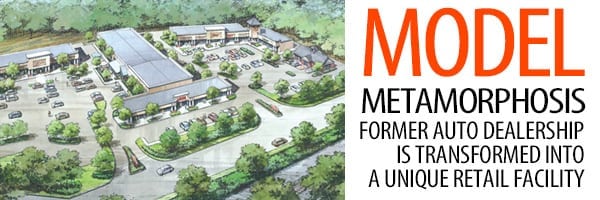
Features
Author, Economist Andrew Zimbalist Says Olympics Are a Bad Deal

OlympicsAuthorAndrew Zimbalist shakes his head at the prospect of the Summer Olympics coming to Boston in 2024. While the U.S. Olympic Committee paints a rosy picture of gleaming new construction, increased tourism, and long-term economic growth, Zimbalist argues that Olympic host cities almost never see these benefits.

As one of the world’s foremost sports economists, he should know. In fact, the Smith College professor of Economics recently published a book, Circus Maximus, on this very topic.

“In theory, the Olympics aren’t bad,” Zimbalist told BusinessWest. “In practice, there’s virtually no evidence that the city benefits. There may be some short-term benefit if everything goes well, in terms of volunteerism, pride, and togetherness. People feel good for a couple of months, then that fades away.”

“But,” he continued, “is it worth $5, $10, $15 billion to have that experience? The city ends up getting saddled with debt, and many times saddled with stadiums that are underutilized. Because of the cost to build and maintain them, we call them white elephants. And the presumed benefits of increased tourism, increased trade, and increased foreign investment are now borne out empirically; these things don’t increase over the trajectory they were already on.”

In short, if your city is chosen to host the Olympics, it probably didn’t need an image boost to begin with. And it certainly doesn’t need the debt. For a return of some $5 billion or $6 billion, the cost of staging the Summer Olympics were an estimated $16 billion in Athens in 2004, $40 billion in Beijing in 2008, and nearly $20 billion in London in 2012 — much of this investment tied up in infrastructure projects that may not be useful going forward.

Zimbalist argues that the Olympics are sold to the public as an economic boon when it’s just the opposite, a catalyst for tourism when evidence suggests it’s not.

“Whether it’s congestion, terrorism, or other fears, not one of these things necessarily makes people want to come to your city and trade with your city,” he said. “Even when the Olympics are pulled off well, are there really people around the world who haven’t heard of Boston and say, ‘hey, let’s travel to Boston’? Probably a few. It’s fair to say there are some feel-good benefits, but they’re very evanescent, very ephemeral. And for the economy, the benefits are illusory.”

Frankly, he continued, the Olympics are an opportunity for special interests to line their pockets at the long-term expense of the host city and the public. In a broad, candid interview with BusinessWest, he explained several reasons why the bidding and organizing structure encourages that outcome, and why the system isn’t likely to change anytime soon.

The Price Isn’t Right

If the bidding process were rational, Zimbalist argues, local organizing committees would understand how much their city stands to gain, and then cap their bids below that level.

The problem is that local committees are dominated by private business interests — contractors, construction unions, architects, investment bankers, and lawyers, to name a few — which individually stand to gain from the massive construction required by the International Olympic Committee (IOC).

“Boston 2024 is a committee of private executives, largely from the construction industry. Some other industries are represented as well, but construction benefits more than any other industry,” he explained, adding that the construction contracts to be handed out are essentially “other people’s money.”

“Some of it comes from the Olympic Games, some from taxpayers, some from corporate sponsors, but it’s not their money. And they’re going to get the contracts; why wouldn’t they love the Olympics? They get to do all this massive construction in a relatively short period of time. Meanwhile, a lot of contracts get rushed and get charged higher costs than normal.”

The model suffers from what economists call a “principal/agent problem,” Zimbalist explained. The city (the principal) is not properly represented by the local organizing committee (the agent). So the more extravagant the bid, the more the committee members personally benefit, and they don’t think about (or care about) the public benefit versus the public cost — hence, the massive overbidding.

In his latest book, Andrew Zimbalist

In his latest book, Andrew Zimbalist makes the case that the Olympics saddles host cities with debt while bringing few long-term benefits.

“The most problematic aspect about the structure is that you have one organizer, the International Olympic Committee, that, in essence, auctions the right to host the Olympic Games. You have multiple cities around the world competing against each other and one monopoly seller,” he said.

“That situation almost always ends up with an overzealous overcommitment for extra funding, extravagance, and frills. Imagine six or seven cities all wanting to get this; five cities think it’s worth $4 billion, but one city thinks it’s worth $5 billion. That city is the outlier, the one that can’t agree with everyone else, and they’re the ones that end up winning.”

Will Boston approach its bid differently? Not if it wants to win, Zimbalist said.

“We keep hearing about how frugal and bare-bones Boston is going to be. They’re going to be building, they say, an Olympic stadium with a 60,000-seat capacity that doesn’t have any luxury boxes, club seats, or catering facilities, among other things. And when the games are over, they’ll take it apart.

“Other than the fact that, in my mind, it makes no sense to spend $500 million on a stadium that exists for 17 days,” he continued, “the problem is, Boston’s going to be competing against cities like Paris, Rome, either Berlin or Hamburg, Melbourne, Doha (capital of Qatar), and Johannesburg, and they’re not all going to put forward bare-bones plans. At the end of the day, the IOC will take the plan that most honors them and their traditions, and that’s going to be the most extravagant plan.”

In short, he said, “meeting the committee’s demands for infrastructure and facilities makes it impossible economically to get a reasonable return. That’s the most difficult thing Boston or any other city has to overcome.”

Tourist Trap

But what about the long-term gains a city might realize in increased tourism? It’s an attractive idea, Zimbalist said, but the publicity generated by the Games themselves is not guaranteed to be positive. Just ask the organizers of Olympics plagued by disorganization (London, Sochi), pollution (Beijing), corruption (Salt Lake City, Nagano), or terrorism (Atlanta).

“The publicity you get is not necessarily good publicity,” he went on. “Mexico didn’t get good publicity when they had to kill 2,000 students demonstrating, or when the African-American athletes raised their fists on the medal stands to protest race relations in the States. Munich didn’t get good publicity when 11 Israeli athletes were killed by terrorists. Montreal didn’t get good publicity when budget overruns were nine times over the initial bid price.”

Even during the Games, evidence suggests that the influx of Olympic tourism is offset by locals moving away for three weeks and tourists who would otherwise visit the city staying away as well. “In the short run, a lot of tourists decide they don’t want to deal with the high prices, congestion, and security issues, and tourism goes down in net terms.”

The best way to promote tourism is word of mouth, and that doesn’t translate to the Olympics, he added.

“Normally, when a tourist goes to Boston, he goes home and talks to friends and relatives: ‘Boston was great! We went to the Boston Garden, we saw the U.S.S. Constitution, we visited the Museum of Fine Arts, we heard the symphony’ … on and on. And people say to themselves, ‘hey, I want to go to Boston, too.’ But an Olympic tourist goes home and says, ‘I saw a terrific 50-meter dash, really exciting hurdles, a great relay.’ That’s not going to promote tourism in Boston. You lose the word-of-mouth effect.”

Zimbalist admits there have been exceptions. Barcelona, which staged the Summer Games in 1992, is often held up as a model for the Olympics bringing long-term benefits to the host city.

However, “Barcelona was a complicated story with many elements to it,” he explained. “Barcelona and Catalonia had been neglected regions for many years. When Franco died in 1975, the people of Barcelona said, ‘we’ve got to rebuild our city.’” That effort involved razing a warehouse district that separated downtown from the sea and a series of other development initiatives, all underway long before the Olympic bid.

“When they won the games, they had been building anyway. They started with a vision and an actual plan to change their city, and they folded the Olympics into that,” Zimbalist said. “They reversed the usual order, where there is no coherent plan, and the IOC tells you it needs 33 venues, and you contort your city to fit their plan.

“Barcelona was a gem of a city, largely undiscovered, with spectacular architecture, interesting culture, good climate, and a great location,” he said. “It was a city waiting to happen, and the Olympics gave it the spark.”

The Case for Reform

Boston, Zimbalist argues, does not need that spark, and neither do most countries bidding for the Games. In fact, the money they will spend over decades for that 17-day extravaganza would be better invested in needed infrastructure improvements, reduced rates from the national airline to boost tourism, multiplied trade missions, and a host of other efforts with tangible, long-term benefits.

Barcelona ran up a $6 billion debt to host the 1992 Summer Games, but the resulting image boost and surge in tourism continues to this day. Still, he said, the city is an outlier among all the other recent hosts still saddled with debt and rusting hulks of unused metal that once housed two weeks of sporting events.

Critics have floated ideas to reform the bid system — for example, choose a handful of rotating sites around the globe with permanent venues, which would dramatically reduce infrastructure costs.

“You could do a continental rotation system,” Zimbalist explained. “Every four years, a different continent would be the host, and the continent could choose one venue. It would ensure you wouldn’t have to rebuild the Olympic stadium. I think that makes a lot of sense. But the cities not chosen would say that’s not fair.”

Meanwhile, the IOC is starting to feel the heat for its debt-generating ways in the form of caution from potential host cities, particularly in the lower-profile Winter Games. Cities such as Oslo, Stockholm, Munich, and Davos all bailed out of 2022 bids, leaving only Beijing and Almaty, Kazakhstan currently in the running.

“Both are autocratic countries, and neither is ideal for hosting,” he said. “The extravagance, the gigantism, the grandiosity has gone so far that cities have started becoming leery about bidding.”

Will the International Olympic Committee change its ways? Zimbalist doesn’t think so.

“The IOC is reportedly making the case for other cities to bid,” he said. “They’re trying to gin up interest in the Olympics again so they can resume their traditional competitive bidding and extravagance.”

In other words, business as usual. Boston has been warned.

Joseph Bednar can be reached at [email protected]

Community Spotlight Features
Greenfield Crafts Detailed Road Map for the Future

Mayor William Martin

Mayor William Martin says a new rail platform will help Greenfield attract residents and allow businesses in Springfield to draw from a larger pool of employees.

‘Independence.’

That’s a word Mayor William Martin uses frequently, and a goal he has set for Greenfield that the city is well on its way to achieving, in his estimation.

“Synonyms are ‘sustainability’ or ‘resiliency,’ and that is where we have focused our economic-development efforts,” he said. “We want Greenfield and its residents to become as independent as possible.”

To that end, an important initiative kicked off last month when Greenfield Light and Power began operating as a municipal aggregation plan to provide electricity. The town gained final approval and certification for the plan from the Department of Public Utilities in October.

Greenfield has a contract with Peregrine Energy Group to develop the innovative initiative, which will not only bring lower-cost electricity to the community, but includes measures to procure it from renewable sources.

“Our price is fixed and is about .0125 per kilowatt hour,” Martin said, adding that the variable rate from Western Mass. Electric was about .014 per kilowatt hour at the time of the interview. “Although it may not seem like much of a difference, it adds up when you factor in millions of kilowatt hours,” he explained.

The mayor said it’s important for the town to be able to offer competitive pricing because reports from the U.S. Small Business Bureau show small businesses account for 60% to 80% of the jobs in the U.S., and the top obstacle they face in New England and Massachusetts is the cost of electricity.

“We want to continue to help existing companies in Greenfield expand as well as facilitate and accommodate the Yankee ingenuity and entrepreneurial spirit of businesses that are an idea in someone’s garage,” said Martin as he outlined steps taken over the past three years to bring the municipal aggregation plan to fruition.

Greenfield Light and Power also plays into Greenfield’s commitment to a green economy and environment, because power purchased will be generated from renewable energy sources.

“We were the first city in the state to be designated as a green community,” Martin said. “We worked hard for this and can only get better. We already have a 2.5-megawatt solar farm and can create new solar and hydroelectric projects. We will eventually produce all of the electricity that we need and move it into our aggregation plan.”

The successful establishment of the municipal aggregation plan, coupled with the Green Communities Act of 2008, which gave municipalities the opportunity to seek independent telephone and Internet service, laid the groundwork for a telecommunications or (fiber-optics) light plant also designed to further Greenfield’s independence.

“I want us to have our own Internet provider and phone company,” Martin told BusinessWest, noting that he conceived the idea three years ago.

Steps to establish what’s known as Greenfield TelNet were enhanced in 2012-13 when the Mass Broadband Institute laid seven miles of fiber-optic line in the town as part of a project to increase broadband access to communities along Interstate 91 (more on that later).

Other projects designed to make Greenfield a more attractive place to live, work, and own a business include the town’s new, handicapped-accessible rail platform located behind the John W. Olver Transit Center. It was completed in December, and in addition to stops by Amtrak on its reconfigured Vermonter line, commuter rail service has been proposed that would run between Springfield and Greenfield four times a day, with stops in Holyoke and Northampton as well as Springfield.

Martin said a state transportation-funding bill passed last year includes $30 million to acquire and retrofit older MBTA commuter-rail locomotives for the line.

He hopes the new rail service will entice people to live in Greenfield and commute to jobs in Springfield, or travel to the town from Vermont, park there, and use the train to get to work. “People hired for the MGM casino could avoid congestion on I-91. Plus, it will give businesses in Springfield options to hire people out of the immediate job pool,” he said.

Net Gains and Concrete Results

Martin’s telecommunications proposal received approval from the Town Council two years in a row, and the town is waiting to get the legislative approval necessary to hold a special election for voters on April 14. Martin hopes the approval will come through and residents will approve Greenfield TelNet at that time.

However, steps have already been taken in an effort to shrink the time frame to implement service while following the process. The town partnered with Holyoke Gas and Electric to ultilize its fiber-optics network to create voice over IP telephone service and also contracted with Crocker Communications to install and maintain it. As a result, the phone service was changed over to VoIP in Town Hall several weeks ago, which Martin said will save about $158,000 a year. After wrinkles are worked out in the system, the town’s schools will also be outfitted with the new phone system.

“The next step will be Internet access, and we hope to develop strong partners to provide and service it for the city and for our residents and businesses at a future date, which could result in a huge cost savings for everyone. We want to guarantee the future use of fiber optics and make sure that bandwidth is not reserved for those who can afford higher rates,” Martin said. “Our plan includes installing wireless Internet access downtown in the future, which would be free to housing authorities. It would also guarantee the existence of Greenfield Community Television, and the possibilities would be unlimited.”

However, he added that the town is in discussions with Comcast to renew its contract, because it wants to leave all its options open.

Meanwhile, Martin said Greenfield has a number of other significant projects underway to spur economic growth. Construction of a new, $66 million Greenfield High School is expected to be complete in August, and the new $60 million Franklin County Courthouse is slated to be finished in two years.

“There is also a lot of private investment taking place,” the mayor told BusinessWest, noting that the owner of the block downtown that houses Wilson’s department store is putting together a proposal for a hotel and banquet hall that would occupy the upper stories of the building over the store and include new construction on the Chapman Street side of the property, which abuts a parking lot.

It would recreate the 19th-century hotel that once existed there, Martin said. “It served the bustling economic activity in the area, and was supported by industry and businesses. We haven’t seen the proposal yet, but a new boutique hotel would be important, as it would give people a place to stay overnight and would be another asset to our downtown.”

Patriot Care, a licensed and experienced medical-marijuana company, is also nearing the permitting phase for rehabilitating a historic building on the western part of Main Street.

“The $1 million project is expected to begin in the spring,” Martin said. “We are focusing on rehabilitating buildings from the early 1900s of Greenfield’s heyday.”

He added that the state has accepted a proposal to conduct a feasibility study for a new library, the school administration office is moving from Davis Street to Main Street, and the public safety commission has selected a site and formed a committee to move forward on a new public-safety complex that would house the fire and police departments.

In addition, “the Ford Toyota dealership on Main Street is building two new showrooms behind its present structure, which will separate the brands and showcase them in larger, more modern facilities. In addition, a new $2.5 million Cumberland Farms on Federal Street will be finished in a few weeks, and there is a proposal for a new Dunkin’ Donuts and Sunoco Convenience Store on Federal Street, which is the second-largest commercial area in the city.”

Baystate Franklin Medical Center is also adding a new, $23 million surgical wing to the hospital, which is expected to be open next year. In addition, Baystate purchased the former Holy Trinity School and convent across the street and has plans to demolish them and erect a medical professional building on the property.

Another project that has ties to the city’s history involves the Wiley and Russell Dam. It was scheduled to be demolished years ago, but the town requested that the Department of Conservation and Recreation Office of Dam Safety conduct a new review last November. As a result, it has been reclassified from a significant-hazard-potential dam to a low-hazard-potential dam, which means a failure would not be likely to result in any loss of life or significant damage to property.

The dam, which has a V-shaped waterfall just upstream of the Meridian Street Bridge, does need some repair. But in addition to making plans for that work, Greenfield officials are exploring the possibility of constructing a fish passage at the site with the U.S. Fish & Wildlife Service and the Massachusetts Division of Marine Fisheries.

Martin said the dam speaks to the town’s history, and in the 1800s, two businesses existed at its base, which include a company whose genesis led to the development of Kennemetal Inc.

Last July, that firm announced plans to expand its Greenfield operation with a $5 million investment in infrastructure, new equipment, and machinery. The expansion will result in 50 new jobs, which will be added over the next five years. Martin said the company’s decision to invest in the town is particularly significant because Greenfield was pitted against a site in South Carolina that Kennemetal considered after it closed its factory in Vermont.

Argotech is another Greenfield business that employs skilled workers and has plans to expand. “The company is based in our industrial park and is investing $20 million over the next 10 years in new equipment,” the mayor said.

He explained that the city is working with Greenfield Community College, Franklin County Technical School, and the Regional Employment Board to make sure both of these companies will have access to a pool of people trained in the specific job skills required in their industries.

“We talked about this and about our utility plan during our pitch to Kennemetal, and told them what we could provide in terms of training and power savings,” Martin said. “It’s the type of accommodation and collaboration we facilitate to help large businesses move to Greenfield or expand here.”

The town has also taken over a 100-year-property on an 11-acre site on Federal Street, and put out a request for proposals to redevelop 75,000 square feet of former factory space in a commercial condominium on the site obtained in December through the Bankruptcy Court. Greenfield also purchased the undeveloped half of the property from the court, which contains three playing fields on 6.62 acres the city had been leasing for $1 a year from Lunt Silversmiths.

“The entire property has been rezoned,” Martin said.

He added that Greenfield’s location and affordable housing also make it an attractive place to live and work. “We are the junction between Routes 2 and I-91 and have been known as The Crossroads since the Village of Deerfield was established,” he said. “Businesses are expanding here and are coming to Greenfield because they see it as a safe investment. We have shown that we can maintain a stable tax base of $1.36 million, and we are very competitive when it comes to the cost of electricity.”

Secure Future

Martin believes the measures that Greenfield is taking to become independent will bear fruit and make the town more resilient.

“Some people are guessing that the future will be different. But we guess we will be prepared for whatever it holds; we’ll have as many options as possible,” he told BusinessWest.

And that’s a solid blueprint for a sustainable economy.

Greenfield at a glance

Year Incorporated: 1753
Population: 17,456 (2010)

Area: 21.89 square miles

County: Franklin

Residential Tax Rate: $22.51
Commercial Tax Rate: $22.51
Median Household Income: $33,110 (2010)
Family Household Income: $46,412 (2010)
Type of government: Mayor; Town Council
Largest Employers: Baystate Franklin Medical Center; Town of Greenfield; Greenfield Community College

* Latest information available

Features
A Simple, Effective Guide to Public Speaking by Business Owners

By DAVE RATNER

Dave Ratner

Dave Ratner

As a longtime business owner in Western Mass., where I run Dave’s Soda and Pet City, I often find myself crisscrossing the country and traveling throughout New England and the Northeast to meet with prospective retailers, distributors, and fellow executives. In those encounters, colleagues may also ask me to perform the one thing almost every person fears and nearly every individual will avoid doing: speak before a live audience.

The anxiety is intense, as you walk on stage and step behind the rostrum, initially blinded by the spotlight and frightened by the silence of hundreds or thousands of invited guests, all of them expecting you to put them at ease, while you speak flawlessly, entertain effortlessly, and inspire listeners with your soaring rhetoric.

And therein lies a serious misconception about the role of a business owner as a public speaker: your job is not to be an orator, summoning the eloquence of John F. Kennedy or Ronald Reagan or Barack Obama; your mission is to be a storyteller, someone who has a conversation with the audience and creates a bond with them.

Put another way, speechifying — the attempt to be a grandiose communicator of presidential caliber, or the effort to emulate the impassioned pleas of a famous coach or general — is a surefire way to fail at public speaking … and a guaranteed means of never delivering another set of prepared remarks.

I write these words from experience; in my role as a member of the Retail Advertising and Marketing Assoc. board of directors, I represent independent retailers alongside vice presidents of marketing for Home Depot, Walgreens, and Target.

All of which means, through a great deal of practice and a desire to make myself feel more comfortable speaking in public, I now know that the best way to connect with an audience is to (surprise!) be yourself by speaking as yourself.

The following tips are a good guide to finding — and honing — your own voice and confidence as a public speaker.

Speak with the Audience, Not to the Ages 

A large part of the fear factor is the result of my earlier comment about the unreasonable demands a speaker imposes upon himself or herself. 

When I encourage people to know themselves — and to know the respective groups they plan to speak with — I want them to do just that: to discover a mutual interest, a shared worldview, or a general sense of identity, which a speaker can use to capture (and maintain) an audience’s attention.

Resist the temptation to pound the dais and punch or chop the air, as if you are the commander in chief; do not try to do the work of a team of White House speechwriters, punctuating your address with a call to posterity, a summons to greatness, or an order to preserve the republic.

Even if you succeed in doing so — rather, if you mistakenly believe you have succeeded in channeling your inner Winston Churchill or Martin Luther King Jr. — your audience will likely consider you pompous and more than a little ridiculous.

To reiterate: be yourself.

Anecdotes Make the Story

I follow this rule with absolute devotion because experience has taught me that it helps tremendously to have an anecdote — one that you can adorn with humor, or adjust according to the mood of your audience — that is part of a larger story.

For example, when I explain how sending a handwritten note to a major executive, in lieu of drafting a conventional e-mail expressing my appreciation for having met that person, culminated in that individual calling me and thanking me, I not only have a good anecdote, I have a lesson about life, business, and communications.

Search for your own anecdotes — you do have them — and make them flexible enough to fit the spirit of your official topic of discussion.

Conversation Is the Art of Speaking

I return to where I began, emphasizing the value of conversation over speechifying. 

A conversation is the true art of speaking.  It is formal while feeling respectfully informal; it is accessible yet invaluable, an intimacy available only to those assembled before you; it is a dialogue billed as a monologue; it is real because its intended response elicits smiles and cheers and laughter and standing ovations.

It is the cure for ending the paralysis and fear of public speaking.


Dave Ratner is the founder of Dave’s Soda and Pet City. He is also a member of the Retail Advertising and Marketing Assoc. Board of Directors, representing independent retailers; daveratner.com.

Law Sections
Each Day Is Different for MGM Springfield General Counsel Seth Stratton

Seth Stratton
Ask Seth Stratton for his job description, and he’s likely to respond, “which day?”

“I don’t know the answer, and that’s the exciting part of this job,” said Stratton, who was recently named vice president and general counsel for MGM Springfield, making him only the company’s second full-time hire, after President Michael Mathis.

“This is a unique development,” Stratton said of the $800 million resort casino expected to open in 2017. “Western Massachusetts has never seen this type of development, and the statute [legalizing casinos] poses legal questions that haven’t been addressed yet in Massachusetts. My job description is to oversee legal affairs and government relations. But what that means day to day is the exciting part.”

Technically, Stratton’s job is overseeing legal affairs and government relations for MGM Springfield — an extension of work he had been performing with the company while working at Fitzgerald Attorneys at Law in East Longmeadow. But as the casino project moves forward, his job will shift often.

“Last week, we were making sure legal notices go out to the tenants of the buildings that comprise the project parcel. They’ll be vacating a lot of those buildings, and we need to make sure we prepare the legal notices they need in a way that’s informative but complies with the law,” he explained.

“We were also in Boston last week, in front of the Gaming Commission, dealing with a few issues that were required under statute — implementing some monitoring of electronic gaming and an affirmative diversity plan for hiring; MGM is committed to that,” he continued.

“That was last week. And I think a good part of the development period will be like that. It’s going to be an ongoing development project, and there are going to be a whole lot of legal issues — in construction, as we start to roll out our hiring, and making sure we’re complying with gaming statutes and regulations. As things start to normalize, we’ll have a better sense of what the average day for the general counsel of MGM Springfield is like.”

Before being hired away from Fitzgerald, Stratton worked with MGM Springfield for almost three years, negotiating agreements with the city of Springfield and surrounding communities as well as advising on permitting and real-estate acquisitions, all the while becoming a familiar face at the Massachusetts Gaming Commission, presenting on legal issues relevant to the casino project.

Now that role has expanded, and Stratton understands the complexity of navigating a project that will eventually employ some 3,000 people in an industry making its debut in the Commonwealth.

“We’re working with outside counsel in Las Vegas, making sure that an enterprise this size is complying with all the laws and regulations,” he told BusinessWest. “A lot of it is working with the Gaming Commission on regulatory and statutory compliance to gaming laws and regulations, as well as local compliance issues. We have an agreement with the city of Springfield, they did a great job in the interests of the city, and they’re very clear they will hold our feet to the fire on all these issues.”

In other words, bring on the myriad challenges.

“That’s the reason I jumped at the opportunity to take this job,” he said. “It’s really a cool opportunity where the job description changes on a weekly basis based on what’s going on at the moment.”

Coming Home

Stratton is, for lack of a better term, a Springfield guy, through and through.

“I was born and raised in East Forest Park,” he said. “My parents were both born and raised in Springfield. My wife and both her parents were born and raised in Springfield. I went to Cathedral.”

proposed $800 million casino

Seth Stratton says the proposed $800 million casino is a “unique development,” one that will certainly keep him busy in his role as general counsel.

However, armed with a bachelor’s degree in political science from Colgate University and a master’s in public affairs from UMass Boston, he couldn’t find a suitable job in Springfield, so he went to work for state Sen. Brian Lees at the State House. After earning his law degree from Suffolk University Law School, he took a job as a litigation associate at Brown Rudnick in Boston.

When his first child was born, however, he and his wife decided they wanted to live near their families in Western Mass., so they moved back to Longmeadow.

“There was nothing really comparable to what I’d been doing in Springfield, so I took a job with a similar firm in Hartford,” he said, referring to his counsel position in the Financial Institutions Litigation Group at Bingham McCutchen in Hartford. “But I felt disconnected form the community I lived in; I didn’t feel connected to the business community here.”

That’s when an opportunity opened up at Fitzgerald, where Stratton took on a diverse litigation and dispute-resolution practice focusing on a wide range of corporate, commercial, and personal disputes. “They were looking for a litigator, and I knew of their reputation, so I went to work there. That way, I worked five minutes from where I live, and I could be involved in the legal community in Western Mass.”

Within a month after taking the job, the casino legislation passed, and MGM eventually came poking around Springfield, and hired Fitzgerald to handle legal and governmental matters.

“We were essentially the local counsel for MGM in connection with local matters,” Stratton said. “About two years ago, I really started getting busier and busier; there was a lot going on, and I really became enmeshed in the project. I worked directly with Mike Mathis. We have similar backgrounds. He’s a lawyer by training, a former litigator, so we worked very well together. And I started getting more involved in these issues.”

One of his first roles involved negotiations of the host-community agreement with Springfield and surrounding-community agreements with neighboring cities and towns.

“That was a lengthy process. Under statute, we had to reach out to the surrounding communities and negotiate with them, and that involved knowing who the players were and knowing what the communities are all about. That’s where my local experience, being local and involved in local politics, helped me to negotiate and handle arbitrations in front of the Gaming Commission.”

He worked extensively on the West Springfield and Longmeadow deals, and though both towns prevailed in arbitration, “we were satisfied with the results, which were consistent with the statute’s intent. We eventually ended up with surrounding-community agreements with all the communities abutting Springfield.”

As he became more involved with MGM through Fitzgerald, he worked on regulatory aspects and compliance issues with the Gaming Commission, and on the host-community agreement with Springfield.

“I worked pretty closely with the city solicitor on a number of items,” Stratton said. “I think it was helpful that folks I was dealing with in the city, and in the surrounding communities, knew I’m from the city, I have local roots, and I think that gave me credibility in these discussions that an outsider with a similar legal background may not have had. And MGM recognized that as a benefit.”

Added Mathis, “from day one as one of our local counsel, Seth has been a steady sounding board for the entire MGM Springfield team. We feel fortunate that he is not only a respected lawyer, but also cares deeply about the future of this area and the city of Springfield. His advice is always informed by his concern for local issues.”

Stratton praised Mathis equally effusively. “He’s a dynamic, young leader in this industry — very bright, very energetic, very demanding. Working with him over the last couple years has been very exciting. I truly have been impressed with the quality of professionalism and work ethic from all the individuals I’ve dealt with at MGM. To become a part of that culture is something I really appreciate.”

Bringing Springfield Back

Stratton also has a vision for his home city’s future, with MGM Springfield at the center of the revival.

“It sounds a little colloquial, but I grew up off Sumner Avenue and Allen Street, and I remember Christmas Eve, my father doing last-minute shopping at Baystate West. I remember hopping on the PVTA bus from Sumner Avenue to downtown and going to Johnson’s Bookstore,” he recalled.

“I love the idea that there could be more of those opportunities for people hoping to go to entertainment venues in downtown Springfield. For people living in these neighborhoods to go to MGM Springfield, not only to the casino but for some of the retail and restaurants, that would be exciting to me.”

While the city’s downtown has generated momentum lately with a growing number of businesses and colleges setting up shop, Stratton didn’t sense much excitement in the area around the time the gaming legislation was passed.

“I didn’t have the impression things were happening,” he said. “But right away, I realized this project had the opportunity to be the spark Springfield needed. Springfield does have its challenges. I’m not under the impression that MGM Springfield will be the hero, but I definitely think it has a catalyst ability, to be the spark that gets people excited about reinvesting in downtown.

“The idea that my wife and I can hop in the car and go to dinner and a show and then be home in five minutes, that’s truly exciting to us as a family,” he continued. “There are so few of those opportunities. When we do have time to go out to dinner, we’ll drive to Northampton, but it’s never been on our radar to go to Springfield. That’s going to change, and that’s really exciting for us.”

For now, though, Stratton continues to press his legal expertise and local knowledge to help bring that vision to reality. He expects his role to continue expanding, encompassing federal issues as well as state-level regulations, as groundbreaking, construction, and hiring and training strategies all move forward.

“It all changes day to day,” he said. “And that just makes the job more interesting.”


Joseph Bednar can be reached at [email protected]

Education Sections
Cultures Connect with a Purpose at International Language Institute

Alexis Johnson

Alexis Johnson says she emphasizes using a new langage immediately and not stressing over every detail.

In 1984, Alexis Johnson was a language teacher without a job. But she didn’t lack for vision or passion.

“Thirty years ago, another teacher, Janice Rogers, and I were working for a school that closed, and we said, ‘what are we going to do now?’” Johnson told BusinessWest.

The answer they settled on was a language school, one that would meet the needs of myriad clientele, from local non-English speakers aiming to improve their workplace communication to student visa holders preparing for college stateside, to Americans skilled in other languages seeking training to become teachers overseas.

“We said, ‘let’s go for it,’” Johnson went on. They expanded a language program Johnson had already begun at Hampshire College and opened the International Language Institute in Northampton in August 1984. “We had both taught for a long time. I’m passionate about teaching — but especially good teaching.”

That drive for excellence has helped her lead the International Language Institute (ILI), now located in Northampton, for three decades. She takes pride in comments like the one she heard after a Spanish class at the South Deerfield offices of Dr. Hauschka Skin Care, which wanted its employees to better communicate with the region’s large Hispanic population.

“I started a Spanish class with Dr. Hauschka,” Johnson said, “and a woman told me, ‘I learned more in the first five minutes than I did in high school.’”

That’s no accident, but a direct result of ILI’s teaching style, which ditches rote memorization for an immersion approach where constantly putting language into practice, student to student, trumps getting every word perfect.

“You’re not memorizing things; you’re not talking about stuff that doesn’t interest you,” she said. “We have wonderfully trained teachers getting people to use the language rather than memorizing it. I want people to have fun; I want to hear laughter coming out of the classes. People are coming here after work, they’re tired, the roads are lousy … at the end of class, we want people saying, ‘what time is it? It’s over?’ We want it to go by quickly because they’re having fun.”

Thirty years have gone by quickly at ILI, but Johnson anticipates no slowdown in the need to communicate across cultures.

Worldly Concerns

Perhaps the most well-known of ILI’s programs is its World Language Program, which teaches a number of languages to students with a variety of goals. Some have a son or daughter marrying someone from another country. Others want to boost their communication skills on the job — or their employees’ skills — in an increasingly multi-cultural world, from the Spanish-language learners at Dr. Hauschka Skin Care to a midwifery practice in Framingham that brought in an ILI instructor to teach Portuguese.

“In our World Language Program, we have taught a lot of Spanish, French, German, Italian, and Portuguese,” Johnson said. “We’ve also taught Swedish, Greek, Japanese, Chinese, Russian, Catalan, and Esperanto. People take classes here, and we can also do these on site.”

Again, she stressed the open, interactive nature of the classes, where students are encouraged to seek connection and broad understanding above nailing the details, which invariably come later.

“We’re passionate about this, and we want people to love it and want them to feel confidence,” she explained. “Are you going to make mistakes? Yes. Is that OK? Of course. We want people to use language, do things with language. We want people to travel if that’s what they want, or get better at their job.”

On the flip side is the Intensive English Program, which offers an immersive education for international students, with 21 hours of instruction weekly.

Chris Elliott

Chris Elliott says many people coming to America to study need a “soft place to land” to acclimate to the language and culture.

“The program has become increasingly academic to meet the needs of aspiring college students — young 20- and 30-somethings who plan to attend American universities, and come here with variying English levels,” said Chris Elliott, the program’s coordinator. “Some are Fulbright scholars with basic English proficiency for college; they just need a soft place to land to acclimate to American culture. Some have English proficiency but don’t know how to write essays. At the other end of the spectrum, some students come in as true beginners. They know this is a long-term plan, and we help them over a year or two to develop their English.”

ILI boasts partnerships with colleges and universities like Bay Path, Elms, Western New England, and Springfield College, added Caroline Gear, the institute’s director. “We help prepare the students so they can transition to life in the university. We are their landing place so they can make a smooth transition and be successful.”

That academic group, with the goal of English proficiency for college, comprises about half the Intensive English Program enrollees, while another 40% or so are career professionals who want to improve their English to advance in their companies, Elliott explained. A third, much smaller group are tourists who want to improve their English for travel.

“What all of these people have in common is, they need to come into a classroom where English is the only language spoken, so they can learn to use it in an effective way.”

Another popular ILI option is the Free Evening English Program, or FEEP, a partially grant-funded initiative that provides free classes for immigrants and refugees. The institute also relies on fund-raising events to support the program (it will be the sole recipient of the silent auction at the Paradise City Arts Festival over Memorial Day weekend), and would like to expand it soon.

ILI also offers a volunteer tutor program that trains English speakers to help students studying English. Other initiatives include private tutorials, workplace training in English and Spanish, and programs in Spanish, French, Italian, and other tongues at area colleges, including Hampshire College and Springfield College. “On other campuses,” Johnson said, “if they don’t have a program, we can help set them up.”

Training the Trainers

The other major component of ILI’s programs is teacher training, specifically the World Learning SIT TESOL Certificate program, which becomes the graduate’s ticket to teaching language, both in the U.S. and internationally.

“The program has people focus on ‘how do I do it, and how can I do it better?’” Johnson said. “It’s a wonderful program. Some people are looking for a new career. Some people got into teaching through the back door and didn’t think they needed training, but realized they did when they came here. It’s an opportunity to reflect and have people observe you, so you can improve.”

Susan Redditt has a doctorate in special education and has been teaching in that field for many years, but began to see a need for more comprehensive language instruction, so she enrolled in the certificate program to broaden her career opportunities.

“As someone who has been teaching a long time, to sit down and think deeply about my teaching … I don’t get that chance often with colleagues,” she told BusinessWest. “I realized, maybe I can do better.”

It helps that Redditt has a passion for helping people communicate across cultures. “Often, language is power. If you don’t have language, then you’re marginalized.”

Johnson, who speaks Spanish, Catalan, and varying degrees of French, Italian, and Esperanto, and has studied Arabic and Chinese — and would like to add other languages to her repertoire — helped initiate several of ILI’s key programs right at the start in 1984, including the Intensive English Program, the World Language Program, and FEEP. Today, the institute boasts 10 full-time employees and between five and 10 part-timers, depending on the month.

“What almost killed us was 9/11,” she said, noting that enrollment in the Intensive English Program, in particular, all but dried up in the months following the terrorist attacks. “People were afraid to come to the United States. A number of language schools closed after that — big ones, too. After that, of course, we were hurting financially. We had debt, and I was using credit cards.”

Thirteen years later, however, “we have no debt. It took a long time. We’re proud of that.”

She also continues to be proud of an interactive, student-to-student approach to language that surprised the Dr. Hauschka employees and continues to impress hundreds of other program enrollees.

“Adults are like kids — we need reinforcement; we need support,” she said. “I’d much rather students learn from each other than from me. When you’re using the language, not seeing it, you train your ear.”

That said, Johnson added, “even though there’s a lot of goofing around here, we take what we do very seriously. We don’t take ourselves seriously, but we take language seriously.”

Joseph Bednar can be reached at [email protected]

Features
Will Falling Gas Prices Be Good for Business?

The downward trend in fuel prices has delighted consumers, but businesses have mixed thoughts when assessing the long-term impact.

The downward trend in fuel prices has delighted consumers, but businesses have mixed thoughts when assessing the long-term impact.

In 2008, as gas prices hit $4 per gallon, the blame game heated up as well, with Congress berating oil-company CEOs for profiteering during an economic slowdown, and the execs sniping at Congress for restricting drilling and refining at home, contributing to a dependence on oil-rich but often-unfriendly foreign governments.

Caught in the middle of that exchange were average Americans, who — already buffeted by an economic crash that bled jobs and drained retirement portfolios — increasingly found themselves diverting money from other household needs in order to fill up the gas tank.

At the same time, businesses of all kinds were forced to make tough decisions, from retail stores pondering whether to pass hefty shipping surcharges to customers, to construction firms seeing profits shrink as the cost of fuel and supplies far outstripped what they had anticipated during the bid process.

Now that gas prices have reversed course and plummeted, even dipping below $2 for regular at many stations in Massachusetts, one would expect those trends to be reversed, giving businesses some reprieve from six years of sky-high rates.

Not so fast.

“What I’ve found funny is that a lot of our paper suppliers — paper companies and different media outlets that make deliveries here — put on a gas surcharge,” said Steve Lang, president of Curry Printing in West Springfield. “But it never seems to come off. When we’re dealing with UPS, they’ll add their little surcharge in there for high gas prices, but it doesn’t come off when the prices come down.”

In fact, some analysts say the plunge in global oil prices will eventually affect small businesses in negative ways. Expected cutbacks and layoffs in the oil industry could be felt in related industries, such as the housing market in areas where petroleum companies operate, as well as restaurants and retailers that rely on oil-industry workers as their customers, Rohit Arora, CEO and co-founder of Biz2Credit, wrote in Inc.

“Lower oil and gasoline prices have many, many benefits for consumers and will likely help vitalize auto-industry sales and the spending of newly found disposable income,” he noted. “This is good news for small-business owners, of course. However, prices that are too low could eventually have serious negative implications longer-term.”

In short, while consumers are pleased with more money in their pockets, the impact on businesses of all kinds remains mixed, and uncertain.

Food for Thought

Retail businesses are anticipating that more disposable income will trickle down as increased sales. But so far, that hasn’t happened at Big Y, said Claire D’Amour, the chain’s vice president for corporate communications.

“Right now, it’s hard to tell, I think,” she told BusinessWest. “Low gas prices means there’s more disposable income, more cash in people’s wallets, but whether that’s translated into opportunities for higher sales, well, we haven’t seen anything specifically pointing to that this year.”

In reality, she noted, “after 2007, people changed their shopping patterns; they became more thrifty. With more money in their wallets now, will we see that change? We did have robust sales for the holiday season, which we’re happy about. But is that a reflection of gas prices? It’s hard to be sure.”

In fact, consumers aren’t seeing lower prices at food stores, for reasons that extend far beyond the retail sector. According to the U.S. Department of Agriculture, recent food-production challenges include a cattle herd that’s been much smaller than normal, which affects beef prices, and poor weather in the West that has hindered certain crops. High wheat production, on the other hand, has kept cereal and bread pricing relatively stable.

Still, the U.S. Department of Labor reports that the Consumer Price Index (CPI) for all items rose just 0.8% over the past 12 months, the second-lowest rise in the past 50 years, exceeded only by 2008, the year financial markets — and the economy in general — spun into crisis. The 2014 CPI has much to do with energy costs, which fell 10.6% over the year, with gasoline falling 21%.

The drop is due mainly to the highest global oil production since 1989, but industry analysts differ when it comes to how long this period might last.

“Most of us in the industry are surprised that it’s fallen as hard and fast as it has,” Ryan Lance, CEO of ConocoPhillips, said at a meeting of the Center for Strategic and International Studies. “I don’t know that I have a real good answer to that question, other than it doesn’t feel like the fundamentals would support that kind of fall.”

Instead, Lance predicts oil prices will rebound faster than anticipated, as they did in 2009, on the heels of the Great Recession. “People were worried about the global economy, and prices went to $30, $40 a barrel, and just a matter of months later, it was back to $100 a barrel,” he said. “And that’s the kind of volatility we’re in.”

After a strong holiday season, Big Y executives are unsure how gas prices will affect consumer behavior heading into 2015.

After a strong holiday season, Big Y executives are unsure how gas prices will affect consumer behavior heading into 2015.

On the other hand, Larry Zimpleman, chairman and CEO of Principal Financial Group, told the Wall Street Journal that he predicts the era of relatively tight supplies controlled by OPEC, and resulting high energy prices, to be coming to an end.

The reasons why are numerous, including continuing sluggish growth in both emerging and developed economies, reducing the demand for oil; new technologies, such as fracking, making previously shuttered oil fields productive once again, increasing the volume of oil coming onto the market; and continued incremental improvement in alternative sources of energy, like wind and solar. “Thus,” he said, “I think pressure is likely to remain on oil prices for an extended period.”

That’s good news for general contractors, said Craig Sweitzer, president of Craig Sweitzer & Co., a construction firm in Monson with seven employees.

“It’s absolutely huge,” said Sweitzer, who has seven gas-powered vehicles in his fleet. “We’re lucky, because we decided to upgrade and give everyone a truck last year, which we’d never done before. Add in insurance and taxes and fuel, and it was a huge windfall to have gas prices go down. We drive big trucks that consume a lot of fuel; it’s a very big part of our expenses.”

He noted that some contruction-related industries — like road pavers, which use oil in their asphalt products — have clauses built into their contracts that protect against sudden increases in fuel prices, “but we’re the little guys, and people don’t typically do that with us. The airlines, for instance, pre-buy on their contracts, but we’re completely prey to the market.”

Moving On Down

The drop in energy prices is equally welcome at other businesses that use a lot of gas, like commercial movers.

“In our case, there are two parts to our company,” said Rod Sitterly, president of Sitterly Moving & Storage in Springfield. “One would be local household and commercial moving. Gas prices have very little effect there because everything is local; the truck sits there for five hours, then goes two miles to its destination. So, for the local household and local commercial jobs, there’s very little effect. Some moving companies were charging a fuel surcharge for those moves, but we never did.

“The long-distance moves, that’s a totally different story,” he continued. “Obviously, fuel is a bigger segment of the cost. The major movers, the major van lines — we’re with Atlas, for example — for the moment, they have an 8% fuel surcharge that has been as high as 14%, so there has been a significant decline in that.”

He noted that this environment stems from the days when industry rates were regulated by the Interstate Commerce Commission, and companies were allowed to tag on fuel surcharges to reflect rising gas prices.

“Since deregulation, you can charge whatever you want, and over time, a lot of charges have gone away — but the fuel surcharge never did,” Sitterly said. “For long-distance moving, obviously it has a big effect. Even people moving themselves to Florida or someplace long-distances often don’t consider how much they’ll pay to get to their new location.”

Big Y, with more than 50 stores across the region, saw its fuel surcharges on produce trucked from California and other distant locales increase by $1 million in just six months in 2008, when oil prices shot up. While those fees are not an issue right now, D’Amour said, the company is not yet benefiting in other ways one might expect now that energy prices have fallen.

“In terms of our utilities, a lot of utility rates get locked in, so they’re not fluctuating,” she said, adding that the chain has also seen little decrease in production costs — say, for canned goods — passed down to retailers. “We’re not seeing reductions, but there’s a huge lag time.”

As for how less-expensive gas might change customer spending habits, she reiterated that Big Y, like other businesses, are still waiting for positive signs.

“There were lots of lessons learned from 2008 in terms of how people buy — ­whether they might splurge here or there [with extra cash] or pay off another credit card. Right now, it’s hard to tell.”

For others, like Sweitzer, the benefits are clear and immediate — and come with a political upside.

“Now that America is one of the largest oil producers, you feel good buying gas; it’s a win-win economically and culturally,” he told BusinessWest. “Everyone feels it. I’m sure a lot of people had a better Christmas because of the extra money in their pockets.”

Joseph Bednar can be reached at [email protected]

Community Spotlight Features
Spirit of Innovation Is Taking Hold in Pittsfield

Mayor Dan Bianchi

Mayor Dan Bianchi says the new Berkshire Innovation Center will be a boon to local businesses and will draw attention to the western part of the state.

The city of Pittsfield has a new project in the planning stages that Mayor Daniel Bianchi calls “amazing.”

It is the Berkshire Innovation Center, which is so innovative that it qualified for funding from a $1 billion investment the Commonwealth is making in projects that further the life sciences.

“We’ve been working with the Massachusetts Life Sciences Center in Boston on this for the last few years,” Bianchi said, adding that when he heard about the state’s plan to invest in the field, he thought about how Pittsfield could become part of it.

His initial idea was to build an incubator that would draw entrepreneurs from the Boston area to Pittsfield, which is home to many small, applied materials and plastics companies that make products such as sutures and suturing equipment.

But when it became clear that this concept was not feasible, a new plan was formulated that led to a $9.7 million capital grant from the Life Sciences Center to build the Innovation Center in the William Stanley Business Park on the grounds of the former General Electric complex that dominated this city’s business community for decades.

The new, non-profit facility will enable shared research between local companies and educational institutions; early-stage production and commercialization of products; and workforce training at the site.

Bianchi said officials toured Rensselaer Poly-technic Institute and Hudson Valley Community College’s new science centers, which have been very successful, to help them formulate the plan.

Local manufacturing companies, including General Dynamics, SABIC and Crane & Co., as well as regional educational institutions such as the State University of New York’s College of Nanoscience, MassMEDIC, the UMass campuses in Amherst and Lowell, Berkshire Community College, McCann Technical School, and Massachusetts College of Liberal Arts have already expressed interest in becoming affiliated with the center. 

“We’ve received more than 20 letters of interest,” said Bianchi, adding that the center will give local companies access to training and advanced technology, including a clean room, 3-D prototype printers, and laboratories with reverse engineering capabilities that will allow them to make new products or improve existing ones. “There are some pretty creative companies in this area, but in order to grow they need this type of facility. A company making complex compounds will be able to work with researchers at UMass Lowell as well as at the Nanotechnology Center in Albany.”

The center will also contain incubator space for entrepreneurs. “It will be unique, and people at the Life Sciences Center are really excited about it,” the mayor said, noting that the facility will be sustainable and generate income through tiered memberships, usage and rental fees on equipment, training, and sponsorships from regional companies.

Ground will be broken this winter, and Bianchi said that if meaningful relationships can be created, it will mean “great things for local companies.”

Meanwhile, other forms of economic development are taking place in this former mill city, everything from new investments in the community’s burgeoning downtown, to more steps to bolster an already thriving creative economy,

For this, the latest chapter in its Community Spotlight series, BusinessWest talked at length with Mayor Bianchi about what’s next for the largest city in Berkshire County.

Downtown Transformation

Among the many new developments in Pittsfield is a boutique hotel taking shape within a building on 273 North St. that dates back to the 19th century. The 68,000-square foot, $14 million project will include 42 unique rooms, three conference areas, an atrium with a skylight, a bar, a revolving door, and a marquee sign with “Hotel” spelled out in lights over the entrance.

“They’re keeping the old windows as well as the 8-by-8 posts in the building, and no two rooms will be the same,” said Bianchi in a voice brimming with anticipation. “It’s very exciting because Berkshire County needs more hotel space, and it will really jazz up this part of North Street. The Crown Plaza and area bed and breakfasts are booked solid all summer, so the owners of the property believe it will be a great destination.”

The popular Spice Dragon Restaurant, which was located in the building, has closed, but a new eatery, which is yet to be determined, will take its place.

“The hotel is only a couple of blocks from the Barrington Stage Company and is right behind City Hall,” Bianchi said, adding that it will be a boon to business travelers as well as tourists.

Other improvements are also being made to North Street via a streetscape plan, and the city was able to procure money from the state much earlier than it planned to complete it.

“The work began about six years ago and we expected it would take two more funding cycles to finish it,” Bianchi said, noting that the first phase of the project ran from the corner of East Housatonic Street to Columbus Avenue and included new lighting, sidewalks, and plantings.

“But we were able to leverage the massive investment made by Berkshire Medical Center and private investors,” he continued, adding that the hospital’s new day-surgery center, parking garage, and wound clinic, combined with the boutique hotel and renovation of the Frank Howard Building (more about that later) played into the equation and convinced state officials to grant the city $4.5 million to complete the streetscape work along an additional three blocks. “We received the money six months ago and we hope the infrastructure improvements will lead to an increase in private investments.”

To that end, work on The First Street Common downtown will also be completed in the spring. “It’s one of our largest urban parks and dates back to the early 19th century,” Bianchi said. “It’s a two-minute walk from City Hall and is very important. It has a new spray park and a performance center, and Shakespeare and Co. will stage events there this year.”

Market-rate housing is being built in the Frank Howard Building as part of an historic redevelopment plan that will convert the underutilized structure into 14 apartments, with 10,000 square feet of storefront retail space on the ground floor.

In addition, the Anota Building will also be converted into 25 units of housing with commercial space on the first floor.

“The work will begin in the spring, which is wonderful, because we can’t seem to keep enough market-rate housing downtown,” Bianchi said. “Eleven new units were completed in the old Notre Dame Elementary School at the end of 2013 and they were immediately rented. Encouraging people to live downtown is part of our master plan, because there are 6,000 jobs in the downtown area. So, our downtown is being completely transformed.”

A complete analysis of every street in Pittsfield was also recently undertaken by the engineering firm Kimley-Horn Associates Inc. “It will help us take a scientific approach on how to expend our limited resources,” Bianchi told BusinessWest as he spoke about how the condition of each roadway, coupled with information on when utility work will be done, will make it possible for officials to prioritize work and avoid resurfacing roads that will be torn up a year later. “The overall condition of our streets is good, but the study is important because streets are something everyone notices, whether they live here or are just driving through the city.”

Planning for the Future

The city is also building a new, comprehensive high school. “It’s in the design stage and will have a huge vocational element,” Bianchi said, adding that when he first became mayor and began talking to small business owners, he was reminded that years ago high school students in the vocational track spent every other week working at local companies, which helped them advance their skills and benefitted local companies.

“The school has had an internship program, but the limited number of hours students spend at local businesses does not give them much exposure to their trade, and provides very little value to companies,” he noted. “So we’re framing a new educational model that will benefit students and our small businesses. There has to be a rigorous academic component to it, but there are waiting lists in the state for vocational schools.”

The goal, he continued, is to create a system that will prepare students who don’t want to pursue higher education to go directly into the workforce after graduation.

Courses of study will range from plastics and applied materials to early childhood education, and since Berkshire Medical Center is a large area employer, Bianchi surmises that students who enroll in the latter field of study may decide to become a nurse or pediatrician.

“Vocational education shouldn’t be a limitation, and the high school has to encompass a lot more than a new building. It has to offer a new model of education,” he said, adding that a program in horticulture could plant seeds of interest in farming, which is a growing venture that is being embraced by young adults in the Pioneer Valley again. “I think we can offer our young people some wonderful opportunities, which will also help small and medium-size companies to grow.”

In addition, Pittsfield is creating a partnership with Berkshire Community College that will allow students to complete courses and earn college credits while they are still in high school.

The mayor told BusinessWest that Pittsfield offers a wonderful quality of life, and the hope is that the Berkshire Innovation Center, new high school, and growth downtown will help attract people to the city and advance economic growth.

“We are too small not to have every move integrated, so every project has to have an economic development connection, whether it is housing, entertainment, educational or a new hotel. But we can offer young people a wonderful middle class life and a nice home can be purchased here for $175,000,” he said.

And with the spirit of innovation and change taking place in the city, Pittsfield’s hopes are likely to become reality.

Pittsfield at a glance

Year Incorporated: 1891
Population: 44,057 (2013)

Area: 42.47 square miles

County: Berkshire

Residential Tax Rate: $17.15
Commercial Tax Rate: $35.17
Median Household Income: $42,114
Family Household Income: $56,896
Type of government: Mayor; City Council
Largest Employers: BHS Management Services Inc.; Berkshire Medical Center; BMC Hillcrest Campus; Sabic Innovative Plastics

* Latest information available

Construction Sections
Recreation of Monticello Was A Project for the Ages

S. Prestley Blake takes a photo of the replica of Monticello he had built in Somers.

S. Prestley Blake takes a photo of the replica of Monticello he had built in Somers.

Bill Laplante remembers the phone call like it was yesterday.

That’s because it seemingly came out of nowhere, and also because it marked the unofficial start of easily the most intriguing — and also one of the more challenging — endeavors in his long career as a home builder, and what he would repeatedly call “the opportunity of a lifetime.”

On the other end of the line was S. Prestley Blake, the then-98-year-old co-founder of Friendly Ice Cream and admirer of both Jefferson and the Laplante company’s work — it built the home his daughter and son in law now reside in, and also the new residence for the president of Springfield College (erected a dozen years ago), for which Blake developed a deep appreciation regarding both its design and workmanship.

“He said ‘Bill … I’m thinking about building a replica of Monticello in Somers,’” said Laplante, president of the East Longmeadow-based firm launched by his father, Ray. “He said he wanted me to come over and assess the property, take a look at things, review the site plans … that’s how it all started.”

It all ended just a few months ago, with a black-tie party that was combination early 100th birthday bash and open house attended by more than 250 people at what would have to be called ‘Blake’s Monticello,’ although it’s highly unlikely that he’ll ever spend a night in it.

This Monticello, slightly smaller than the original, Thomas Jefferson’s home in Charlottesville, Va., is what Blake, reached by BusinessWest in Florida, called, alternately, a “gift to the community,” his “swan song,” and “something I’m doing for posterity, not profit.”

Indeed, he expects to certainly lose money on the home currently on the market with a sticker price of $6.5 million, roughly $1 million less than what it cost to buy the land, raze what was on it, and build the landmark. There have been a few inquiries, and those interested will have to eventually impress Blake, who has the final say on this sale and insists he’ll only sell to someone who has both the requisite financial wherewithal and the same commitment to the community that he does.

As for Laplante, his crews, and lead design consultant Jennifer Champigny (not to mention Prestley Blake and his wife Helen) the endeavor quickly became a labor of love, a project no one really wanted to see end, although everyone involved was firmly committed to getting things done before Blake became a centenarian last November. Overall, the huge undertaking was completed in an impressive 14 months, more than three decades less than it took Jefferson to complete the original.

“The whole project, from start to finish, was a lot of fun … everyone who worked on it, from day one, thoroughly enjoyed it,” said Laplante. “It truly was a once-in-a-lifetime opportunity.”

The building process, began in the spring of 2013, soon after Blake closed on the nine acres of land off Hall Hill Road, just a few hundred yards from the Massachusetts border, and the structures built on it (owned then by the estate of the late Big Y co-founder Gerry D’Amour and his wife Jeanne). It was preceded by a visit to the original Monticello by Laplante and his father.

They took hundreds of photographs, made volumes of notes, and purchased the book Monticello in Measured Drawings, which soon became invaluable.

Bill Laplante

Bill Laplante, standing in the foyer at the
Somers Monticello, called the project the “opportunity
of a lifetime.”

Using these resources, the Laplante company built an almost exact replica of the exterior of Jefferson’s home, and an ultra-modern, luxurious — and ‘green’ —interior. Both elements can certainly turn heads.

“I think this is the most prominent private house in the country,” Blake told BusinessWest in reference to his creation, noting that this assessment is based on aesthetics and the model that inspired it, not sheer size or features. “The White House is the most prominent house in the country, but that’s owned by the government. This is a private house I built on my own.”

For this issue and its focus on contruction, BusinessWest takes an in-depth look at why Blake’s Monticello came to be built and how. In the course of doing so, it became clear why those who view the house use the same word to describe it as those called upon to recount the building process: memorable

Landmark Decisions

They eventually dubbed it ‘Monticello Highway.’

That was the name given to the path that Blake had carved between the site of the Somers Monticello and his own home, just a few hundred yards away (the properties abut).

Blake would take that path on his small, four-wheel-drive motorized vehicle called a ‘Gator,’ said Laplante, adding that he was at the construction site by 7:30 a.m. almost every day he was in this region to observe, take photos, and offer both suggestions and commentary — mostly the latter, because he gave great latitude to the builders.

What the Blakes saw emerge on the gently rolling parcel is one of the few replicas of Monticello in this country — there’s a bank modeled after it in Monticello, Ind., and a chiropractor’s office in Paducah, Ky., for example — and certainly the most extensive and expensive.

The Monticello in Somers has a number of things the one in Charlottesville doesn’t, including:

• A three-car garage;
• A tiled patio atop the three-car garage, which was a very popular gathering spot during the party in October;
• An elevator;
• Laundry rooms on the first and second floors;
• A wine chiller;
• Wolf and Sub-Zero appliances;
• A pantry with floor-to-ceiling cabinets, a so-called library ladder to reach those heights, and leathered granite counter tops;
• Five full baths complete with walk-in showers, towel warmers, and other amenities;
• Coffee stations in most of the rooms and a second-floor kitchenette; and
• Geothermal heating and cooling.

It does, however, have many of the same exterior features, including the white columns, roof ballustrades, and signature dome at the front of the structure (or the back at the original Monticello; the back entrance was the main entrance in Jefferson’s time), and some interior elements as well, including a tea room, a lavish foyer (although the one in Somers has a double staircase), ornate hard-wood floors, and so-called great room.

DownHallRooms

At top, the dining room in the Somers Monticello, and above, the bathroom off the master bedroom.

At top, the dining room in the Somers Monticello, and above, the bathroom off the master bedroom.

Retelling the story of how it all came about, Laplante said Blake was never particularly fond of the large estate built by the D’Amours, and has always been enamored with Monticello, architecturally and otherwise, and conceived a project to replace one with the other and, in the process, build something memorable and lasting.

As Blake was finalizing his purchase of the site, he was also engaging Laplante on the undertaking to come.

The trip to Charlottesville was educational and therefore quite helpful, said Laplante, adding that this was his first visit to the landmark.

“We met with the people giving the tours of Monticello, we toured the entire facility, and took a number of photographs, including many detailed photographs,” he explained. “We were focusing on the exterior of the building, because the original plan called for building a replica of Monticello, especially with regard to the exterior façade, but make it into a modernized single-family home on the inside — something that someone would be interested in purchasing and living in.”

Monticello in Measured Drawings became a valuable resource, he went on, adding that it was assembled by an architectural group that recreated scaled drawings of the original.

“It was very difficult, because there were areas that were 1:32 scale, because of the size of the house and obviously the size of the book,” Laplante explained. “We were dealing with very, very small scale, but it was very helpful having that, as well as the photos we took of the original and the tours we took.”

Glory Details

Beyond the basic mission of reproducing the original Monticello’s exterior, the Blakes’ only real instructions to the builders were simple, said Laplante, adding that he was told not to spare any expense, to build a replica as exacting as possible, and, inside “to make every room spectacular.”

And by all accounts, he and his crews followed those instructions to the letter.

Attention to detail can be seen in many aspects of the recreation work, including the brick used. Bricks in the original were hand-made made on-site in Virginia, said Laplante, adding that those used in Somers were also hand-made and cast to look like what was used in the early 19th century.

The decision was made early on to place the dome at the front of the house, the side facing Hall Hill Road, said Laplante, adding that the ‘front’ façade of the replica is, by his estimation, 98% accurate to scale.

One of the main differences between the two Monticellos is that the one in Virginia has an open porch, complete with arched-brick openings, on the left side, while the one in Somers has an enclosed hearth room, located just off the kitchen, in that location.

Also, Jefferson’s Monticello had a room inside the dome, while the one in Somers does not, and the second-floor windows in the replica are larger than those in the original to meet modern building codes.

“Working around the windows was perhaps the biggest challenge in designing this, because we were designing an interior around an exterior that was built 200 years ago,” he said, adding that both the original and replica (at least from the ‘front’ view) are two-story homes that don’t look like two-story homes.

The kitchen in the Somers Monticello is certainly different than the one in Thomas Jefferson’s original in Charlottesville, Va.

The kitchen in the Somers Monticello is certainly different than the one in Thomas Jefferson’s original in Charlottesville, Va.

And while creating a modern interior within a two-century-old shell came complete with many challenges, that assignment gave the builders and designer plenty of opportunities to stretch their collective imaginations.

“From the beginning, the Blakes said, ‘we want every room we walk into to be spectacular,’” said Laplante. “But they didn’t micro-manage the design and the details; they let us come up with what we thought should be done.”

Some of the details were taken from the original, he went on, citing such things as floor patterns (although slightly different wood species were used), but the interior obviously bears little resemblance to the one in Charlottesville.

The kitchen in Jefferson’s Monticello was a simple facility in the basement. The kitchen in Somers is massive, with the most modern appliances and quartz countertops. The Monticello in Virginia had five outdoor privvys; the one in Somers has nine baths, many of then featuring Carrara marble.

The biggest difference between the two landmarks, however, is the ‘green’ nature of the replica. Jefferson heated with wood. The Somers home features geothermal heating and cooling equipment (which Laplante said is becoming increasingly popular due to attractive tax credits). It also has LED lighting, energy-efficient windows and doors, and icynene spray foam insulation. Meanwhile, raw materials from the site, including oak and cedar trees and red stone harvested from the parcel were used in the construction.

Overall, the buildings are worlds apart in terms of building materials and processes and creature comforts, but they look remarkably similar in large, framed photographs hanging side by side in the wood-paneled garage.

History in the Remaking

In addition to the party in October, the Blakes had a small gathering in the Somers landmark just before the holidays.

For the event, dubbed ‘Christmas at Monticello,’ the Blakes actually borrowed a few pieces of furniture and had some tables placed in the great room, said Laplante, who was among those invited.

The scene was a little strange, he recalled, but understandable because while the Blakes built the home, technically, it’s not theirs.

Soon, if the right buyer and right price come together, it will belong to someone. But it many respects, it will always belong to the community, said Blake, adding that, like the original, it was built to last and built to inspire.

And it is already doing just that.

George O’Brien can be reached at [email protected]

Features Opinion
Free Community College: A Worthy Concept

President Obama proposed plans for providing a free community-college education for many students at his State of the Union address last week. The proposal, “America’s College Promise,” which would benefit an estimated 9 million students annually, is still very much in the formative stages, and there are a number of rather sizeable hurdles to be cleared before this concept can advance, let alone become reality, but we believe the proposal should be given full consideration and at least a chance to succeed.

Why? Because, as we’ve said on many occasions, the key to economic growth and prosperity for this region — and one of the keys to closing the huge income gap between the haves and the have-nots in this state and across the country — is education, and free community college for those who qualify is a possible place to start.

Not everyone who attends community college goes on to graduate — in fact, far more than half don’t — or get a good-paying job, and these facts won’t change if such an education suddenly becomes available free of charge. But such a development could have enormous potential to prompt more people to start college and finish it. And since one needs a high-school diploma, or the equivalent, like a GED, to get into a community college, it makes sense that providing that option free would inspire more people to stay in school.

And that’s important in communities like Springfield and Holyoke, where high school drop-out rates are sky high and a major contributor to poverty and a growing skills gap within the workforce.

But let’s back up a minute. Free community college as a national policy is certainly a long shot. The principal problem is funding it. Under the plan the president is proposing, estimated to cost $60 billion over a decade, states would have to pay roughly 25% of the cost.

Well, this state, according to Gov. Charlie Baker, is facing a budget gap of roughly $765 million, and none of the options for closing that gap are particularly attractive. And there are many states in that same boat.

Beyond the fiscal challenges, though, there are some stern logistical challenges as well. Can community colleges like the four in this region handle a surge in their student populations? Perhaps, but not easily and not without expansion of current infrastructure and the hiring of more teachers and administrators, which would greatly increase the program’s price tag.

Also, whenever something is provided free, it tends to lose some of its value. This can’t be allowed to happen in this case, and to ensure that it doesn’t, strict eligibility guidelines must be attached to a free community-college education. In the case of the president’s plan, there are such rules — students must attend at least half-time, maintain a grade point average of at least 2.5, and make “steady progress” toward graduating.

And there are philosophical and political challenges to overcome as well. Indeed, some lawmakers simply don’t believe it is the government’s — and, ultimately the taxpayers’ — responsibility to be providing a free college education. Garnering necessary political support will be difficult.

But as we said earlier, Obama and his administration should fully explore this concept. Many governments around the world subsidize or partially subsidize higher education, and they do so because they view such expenditures as a sound investment in their future.

We should have the same attitude here. It should be clear to everyone by now that, while one could become a member of the middle class decades ago without a college education, or even a high-school education, the odds of doing so now are much slimmer.

And while there are many reasons why individuals don’t enter or finish college, financial wherewithal is easily the biggest.

Providing a free community-college education is a bold, challenge-filled proposition, but it’s a concept that holds great promise and should be pursued.