Home Posts tagged Events (Page 32)
Health Care Sections
Traumatic Stress Recovery Center Helps People Live with the Past

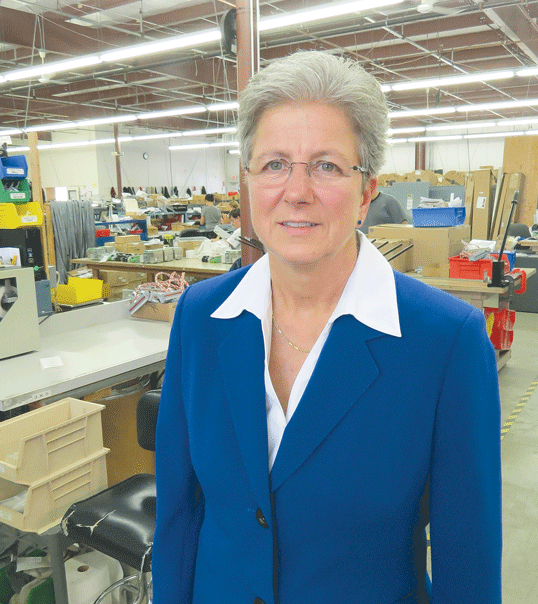
Dr. Frank Gallo

Dr. Frank Gallo says trauma can paralyze people by causing them to constantly re-experience those negative thoughts and images, as if the event is happening again.

The pain of a traumatic experience, says Dr. Frank Gallo, often extends far beyond the event itself.
“People re-experience those events as if they’re happening again, with intrusive thoughts or images,” he told BusinessWest. “So they engage in avoidance behaviors — avoiding conversations about events or places that remind them of the traumatic event.
“After traumas, people can experience emotional numbness, anger outbursts, irritability, and frustration,” he added. “Usually these types of behaviors start to cause impairment across major areas of life; they can start to leak into the areas of family, friends, Internet relationships, recreation, health. People start to engage in behaviors just to lower the volume of that painful stuff. They stop living life in all these areas that are so important to them because they’re so busy just managing and coping and getting away from the pain.”
Those experiences are personal for Gallo, a former police officer who saw how workplace stress and trauma can affect people in high-risk jobs. To that end, he led a uniformed-services program at Brattleboro Retreat, a behavioral-health facility in Vermont. “It was a program dedicated exclusively to providing trauma and addiction recovery services for uniformed professionals — police, fire, corrections, military, paramedics, EMTs.”
Partly because he tired of the long commute — at the time, he was also teaching at Western New England University — Gallo decided to develop a similar program in the Pioneer Valley, so he established the Traumatic Stress Recovery Center in Springfield, a program of the Center for Human Development.
But this time, he’s not working only with emergency workers, but with anyone who has experienced some kind of trauma in their life, from physical or sexual abuse to a violent accident or loss of a loved one.
“In my years working at the Retreat, one thing we realized was that traumatic events don’t just affect uniformed service professionals, but the entire adult population. Most people, in their lifetime, will experience one or more traumatic events. So we’re working with the general adult population as well as the uniformed population, and then creating comprehensive after-care plans for people to step down and continue their recovery from traumas.”
Part of that process involved training therapists who specialize in trauma recovery. “Finding a good therapist match for the treatment we’re providing was difficult, so developing a center focused only on doing trauma work was needed,” Gallo said. “So I came here to CHD with the idea of developing a traumatic stress recovery center. The administrators here really liked the idea and wanted to offer this specialty service.”

Living with the Pain
The center opened its doors on Birnie Avenue on Sept. 30 with a number of programs available to both emergency personnel and the public, with more being developed down the road, Gallo said.
The intensive outpatient treatment program, for example, is available weekdays, four hours a day, and features group-focused treatment to help patients recover from trauma, as well as one-on-one work with a therapist to craft a specialized treatment plan.
“People can get stuck in their traumas. People may feel numb inside, or they no longer feel safe,” he said, saying people are familiar with the concept of being swept off one’s feet in love, but an emotional trauma can make them feel knocked off their feet. “We get people reconnected with their bodies. We get them grounded, so they feel like they’re not easily knocked off their feet by trauma-related thoughts and feelings.”
A concept called ACT, or acceptance and commitment therapy, is at the heart of all the center’s programs. It helps individuals learn to be present with their trauma and open up to their experience, but choose to focus on what’s important to them.
One 10-week therapy group focuses on the idea of mindfulness, or what Gallo calls “healthy living through being present.” Mindfulness, he said, is essentially paying attention to each experience and thought without judgment, being aware of thoughts and feelings without getting swept up in them, and being awake to the positive things life has to offer each moment.
“We get people engaging in life, with what matters to them, while they carry their traumas with them,” he explained. “These are stories they hold, and it’s part of their experience, but it’s not the whole of who they are. We get people living life beyond the trauma.”
After all, he said, the goal isn’t to deny the trauma, but simply to assimilate the memory and its impact into a life of healthy, mindful choices.
“What people see is that the volume of that stuff goes down all by itself,” he added. “We help people develop new relationships with those trauma-related thoughts, memories, and emotions, and that frees them up to engage in ways that matter to them, even as they carry their trauma with them.”
As a continuation of his work in Brattleboro, Gallo has also instituted a specialized treatment program for first responders, including police officers, firefighters, correctional officers, military personnel and veterans, EMTs and paramedics, and trauma nurses and doctors.
Beyond trauma recovery, though, the center has begun working with emergency personnel on preventing programs to develop resiliency skills so they quickly recover from traumatic events in their work environments.
“They’re at much higher risk, so we’re trying to do some skill building and prevention work,” he explained. “We want to give them a skill set they can take throughout their career. My goal, in terms of community outreach, is to create a continuity of healthcare, and to give them the essential skill sets to do their jobs well and be able to bounce back more easily from exposure to trauma.”
The Traumatic Stress Recovery Center is also working to institute a series of services promoting ‘whole-person care,’ including yoga, aikido, acupuncture, and biofeedback, to give clients additional tools to boost their emotional health.
“We recognize that there are other types of programs we can offer to help in the recovery process,” Gallo said. “These are adjunctive groups people can participate in so that, once they finish treatment, they can continue in that recovery process.”

Giving Back
Gallo was quick to note that the center shouldn’t be the only entity in the region providing trauma-related services. He’s working with other organizations to develop their own trauma-resiliency training programs, and has also launched a teaching program for Ph.D.-level psychology students.
“Pychology interns have an opportunity to do practicum experiences here — professional development in becoming psychologists,” he explained. “We also have a research-based program where, in all our programs, we collect data on treatment progress — how well people are doing, and how well they’re doing once they leave here.”
This information, he said, will help the center understand what some of the trends are and where patients are struggling the most — data that could be used to expand or change the center’s services in the future.
Gallo’s career experiences, both as a police officer and a psychologist, have lent him a keen understanding of how emotional trauma affects lives, and he said his latest chapter is a way to give back to the community.
“I know what it’s like. You know the saying — ‘been there, done that, got the T-shirt.’ I know what it’s like to be in those situations,” he told BusinessWest. “These experiences can be so overwhelming for people; traumatic events can have such an impact on people’s lives. After retiring from the police department, I wanted to have an opportunity to give back — not just for uniformed services and first responders, but for the general population, people struggling wherever they are. I asked, ‘how can I do something meaningful for them?’ That’s why I’m doing this.
“We want people to see us as a resource,” Gallo continued. “Nobody does what we’re doing; we’re really unique in this way. I’m really excited about that. I’m excited to have an opportunity to lead a program and have a great staff of clinicians who really understand what people are struggling with and are excited about the opportunity to give back.”

Joseph Bednar can be reached at [email protected]

Insurance Sections
Severe Storms Are Creating a Trickle-down Effect on Policy Holders

Jim Phaneuf

With past and future storm damage in mind, Jim Phaneuf says, the state attorney general and insurance commissioner are making sure that carrier premiums and rate increases are justified.

When Jim Phaneuf references the weather, he’s certainly not making small talk.
Rather, he’s discussing big business — the insurance business, which he’s been in for more than 36 years, enough time to see everything, or just about everything, in this industry.
Indeed, over the past several years — and one year in particular, 2011 — Phaneuf, president of Bell & Hudson Insurance Agency in Belchertown, and others in this sector have seen things they’ve never seen before in terms of weather calamities and the resulting impact on the companies that write the policies and the consumers who purchase them.
‘Historic’ is the word he and others have used to describe it all — meaning everything from 2011’s ice dams, tornadoes, hurricane, and freak October snowstorm to subsequent weather events such as Superstorm Sandy in the fall of 2012, and the general consensus that this part of the country will see more of the same in the years to come.
But instead of words, Phaneuf and others like to use numbers to get their points across.
“Between 1980 and 2012, there were 123 U.S. weather-related events that resulted in claims of over $1 billion,” he told BusinessWest. “In 2011 alone, there were 12 U.S. weather-related disasters with over $1 billion in claims, and that caused insurance companies to raise rates to attempt to recover their losses. Our experience has been that most home-insurance customers have experienced rate increases in the past two years, largely as a result of the storms of 2011 and 2012.”
Corey Murphy, president of First American Insurance Agency in Chicopee, agreed, noting that 2011 was a banner year for weather-related claims in this region and others, and the impact from those losses will be felt for some time.
“I knew the insurance companies were going to have to respond — it was a catastrophic year; we had pretty much every natural disaster you could have,” he said, noting that rates have escalated for business and residential policy holders alike, between 3% and 6% on average.
The numbers vary, he said, because in many instances, an agency can sometimes shop for and get a better price, even at a time when many carriers are still struggling to recover losses. Meanwhile, agents can work with clients to lower their insurance bills by making sure they’re buying only what they need, passing on what they don’t need, and employing strategies such as bundling policies, taking higher deductibles, and avoiding marginal claims that will nonetheless trigger premium hikes.
Corey Murphy

Corey Murphy and his staff have kept their commercial and residential rate increases from storm damage as low as possible by shopping their policy needs with a variety of carriers.

Overall, he said, this is a time for consumers to renew — and tighten — their relationship with their insurance agency, because if predicting the weather is difficult, if not impossible, so too is gauging and minimizing the impact of all that weather on one’s insurance bills.
For this issue and its focus on insurance, BusinessWest takes an in-depth look at what has become a perfect storm — in every aspect of that phrase — for insurance carriers, and a time of challenge for those looking to protect their assets and manage the cost of doing so.

Climate Change
Recapping recent events, meaning those of the past few decades and especially the past few years, those we spoke with said things have become more unsettled.
They used that word to refer to both the weather — which, in the opinion of many, is being increasingly impacted by global warming — and the fiscal health and well-being of insurance carriers.
Indeed, due to the recent spate of weather calamities, most insurance companies will not write polices for hurricane-prone coastal properties in the Carolinas, Georgia, Florida, and Texas, said Bill Grinnell, president of Webber & Grinnell Insurance Agency in Northampton. So the states have created their own insurance mechanisms and set up rules, collecting premiums from property owners and assessing surcharges to those insurance companies that do business in other regions of those states.
“There is a wide belief that these storms are caused by global warming, which makes the weather less predictable and insurance outcomes less predictable,” Grinnell explained. “As a result, more revenues are needed to create reserves to cover the potential for more disasters, so there’s definitely been an uptick in the cost of insurance.”
According to a 2013 report, “Inaction on Climate Change: the Cost to Taxpayers,” by Ceres, a nonprofit organization advocating for sustainability leadership, the total loss exposure of these state-run insurance plans in the past 20 years has risen by 1,550%, from about $40 billion in 1990 to more than $600 billion in 2010.  Additionally, the report says only 50% of the damages in the U.S. caused by extreme weather events are privately insured, which leaves the federal and state governments (the taxpayers) to pick up the remaining tab.
Insurance companies, said Grinnell, earn revenue in two ways: premiums, of course, and conservative, low-risk investments, primarily in the bond markets.
With the historically low rates of return on bonds, insurance companies are not earning as much as they have in the past, and at the same time, they’re seeing higher bills from their reinsurance companies after paying out billions for just the past two years’ worth of catastrophic storms.
“So the reinsurance companies that provide the insurance for your insurance carrier for big disasters have increased their rates to the carriers, and those rates have been passed right down to the policyholders,” Grinnell explained, adding that the regional carriers in New England that do business in Massachusetts weren’t directly affected by Hurricane Katrina or, to a great degree, Superstorm Sandy. “So the majority of the storm-related increases are due to more localized events.”
Locally, Phaneuf added, state Attorney General Martha Coakley and Commissioner of Insurance Joseph Murphy are making sure carrier premiums and rates are justified.
“The attorney general seems to have served as a watchdog with the insurance issue,” he said, “to keep insurance companies’ rising rates in check.”

Policy Statement

Bill Grinnell

Bill Grinnell says insurance carriers are getting hit with higher rates from their reinsurance companies and passing these increases down to policyholders.

In this changing climate — for both weather and insurance to cover the damage it causes — Grinnell said agencies need to work even more closely with clients to reduce the impact on premiums while making sure customers’ bases are covered, literally and figuratively.
For instance, when his staff sees a client’s premiums spike significantly, they will attempt to shop that business around to get similar coverage, but at a better rate.
“We try to find a better home for their insurance if we’re able to, which we can some of the time, but not all of the time,” he said. “It’s definitely worth the effort if the insurance is going up more than 7% or 8%.”
Murphy agreed, but noted that there is seemingly less room for negotiating between agency and carrier in this environment, adding that this is another sign of the times and a product of the more adverse conditions within the industry, even though the weather has been much calmer this year.
“There’s a lot less back-and-forth over the last year or two. Now, there’s a lot less room; they’re pretty firm on what their prices are,” he said. “This year, it was a pretty mild year, but there were predictions that storms would increase, so there were a lot of adjustments by carriers based upon that.”
Those adjustments, Murphy went on, have appeared as higher premiums and a much harder look at what policies companies will underwrite. He called it “getting tighter.”
When Murphy and his agents present a potential policyholder to an underwriter — the person at the carrier who will decide how much to charge on the commercial lines, or even if they’ll write it or not — they want a much clearer picture of what they are writing.
“So, as an agent, we’re trying to present the best possible picture of that potential client,” he added. “The more you can make an underwriter feel comfortable about what they are writing, the better they feel about doing it.”
Meanwhile, agents can work with clients in a number of ways to help control their insurance bills without reducing coverage, said Phaneuf, listing several possible ones, including a willingness to accept a higher deductible.
“They generally mean lower annual premiums, but more out of your pocket when you have a loss,” he explained. “Your agent will also make you aware that you can control premiums by bundling discounts for your home and auto and installation of alarm systems, renewing your policies with the same insurer, and maintaining a loss-free status.”
Elaborating, he said that going years without filing a claim can lead to attractive discounts, savings that could more than offset the long-term costs from filing a claim in an instance where the damage only marginally exceeds the deductible.
In addition, Murphy told BusinessWest, he and his agents make sure their business clients are updating their product inventory and specific elements that they need for doing business.
“Business owners have to understand what their business is rated on,” he noted, adding that some standard ratings are based on square footage, which doesn’t change unless there is an expansion or a move, but other things do change, like real-estate values, replacement costs, inventory levels (up or down), or an increase in sales, all of which accurately reflect the business’s exposure.
The First American staff helps educate their commercial clients about keeping up with the current state of their property and business.
“If you don’t respond to your carrier with any updates, then they assume that all remains the same, and you could be paying more when you shouldn’t have to,” said Murphy. “But you don’t want them to be caught underinsured.”

Batten Down the Hatches
Grinnell and others we spoke with said their background is in business and insurance, not climatology or meteorology.
Predicting the weather is more difficult than ever, he noted, adding that even those with degrees in those subjects can’t say what will happen next year or over the next decade. The best thing to do is be prepared as much as possible, and that philosophy extends to the realm of insurance.
Phaneuf agreed, adding that, when it comes to weather patterns that are predicted to cause havoc in the future, protection of one’s home or business is, now more than ever, a complex business transaction.
“It cannot be effectively and appropriately done in 15 minutes,” he said. “In spite of what some national insurance carriers would like to have you believe, it is not a simple transaction like buying laundry detergent or breakfast cereal. If you treat it too lightly, you may not have the protection that you need when you need it … at a time of great loss.”

Elizabeth Taras can be reached at [email protected]

Columns Sections
Here’s a Helpful Estate-planning Year-end Checklist

Lisa L. Halbert

Lisa L. Halbert

As the end of the year approaches, this is a good time to take stock and review where you have been and where you want to head. Financial planners encourage annual reviews, employers start to consider year-end evaluations, and life coaches ask clients to reflect on steps taken and plans for professional growth. And estate planners encourage clients to periodically review elder and estate plans in order to confirm (or re-confirm) that all is in place.
Estate planning is not a static project to be finalized and then put on a shelf, never to be reviewed again. In truth, it is a never-ending process, one which requires periodic review in order to remain pertinent. At least every five years and upon major life events, pull out the documents and make sure they continue to be relevant. Further, periodic statutory changes dictate that your intentions will be best attained if documents are reviewed.
Among the action steps or paperwork to consider are the following:

List Your Assets
At the core of any good estate plan is a list of all of your assets, with estimated values. Generally this will include bank accounts, securities, real estate, retirement funds, insurances (life or disability), annuities, business valuations, and tangible personal property, just to name a few. Identify whether each asset is owned in your name alone (and with or without a beneficiary designation) or jointly with another, and whether it carries a beneficiary designation or is held in trust. This information informs an estate-planning attorney as a beginning point. After your estate plan is fully developed, do not be surprised if assets are re-titled or change columns.

Last Will and Testament
A last will and testament controls assets that are held in your name alone and without a designated beneficiary at your time of death. These are the only assets that go through the probate process. Your will provides a road map as to who you would like to receive your probate assets. It can also provide for forgiveness of debt or allow someone temporary use of an asset (such as living in a home until a certain age, or a certain event occurs).
Generally, a will allows you to control and determine who inherits your estate at your death. (Exceptions to this statement are that a surviving spouse and minor children have certain statutory rights that take priority over the terms of the will, even if you intended to disinherit the spouse and/or child.)
Under the Massachusetts Uniform Probate Code (MUPC), which went into effect March 31, 2012, the probate process has now been expedited and no longer requires as much court intervention or oversight, although court supervision is available where appropriate.
If you pass away without a will (referred to as dying ‘intestate’), state law dictates how your assets get distributed. Historically, if you die intestate, survived by a spouse and children, your assets are allocated among them. Under the MUPC, if you die intestate and are survived by your spouse and children of both you and your spouse (whether biological or adopted), then your spouse will receive your entire net estate, without any portion specifically allocated to the children of both you and your spouse.
The MUPC also changes the title of the person appointed to oversee the administration of an estate to a personal representative (PR). Further, the MUPC provides a list of individuals who have priority to serve as your PR. At the top of the list is your spouse, and then a child (over the age of 18), etc. However, if you die intestate and the spouse does not want to serve as the PR, the MUPC allows the spouse to designate someone else to act as the PR, even if an adult child wants to serve. And while the statute is a bit more complex, the point is that you should consider whether it is more thoughtful and prudent to effectuate your intentions by dying with or without a will.
If you want to know that all of those you love will receive certain assets, then have a will or other estate-planning document prepared. Particularly for those who might not have a spouse, but do have good friends or charitable inclinations, a will is likely a solid start to accomplish those same distributions.
A will might also have some significance prior to your death. During your lifetime, if you become incapacitated and another is put in charge of your assets and financial management, there may be occasions where gifts are appropriate and the fiduciary could look to your will in order to figure out who or what entities are most dear to you. The will, therefore, may offer some direction even during your lifetime.

Trust-based Planning
Depending upon your assets, intended beneficiaries, and other information, a trust might be a better option to accomplish your preferred distributions than a will. A trust is a document with three major players: the person who creates it (you, also known as the grantor), the trustee (who could be you and/or others and is the one who actually administers or manages the assets), and the beneficiaries (who could be you and/or others who receive a benefit under the trust). It provides an instruction manual or road map as to how you want your assets (and debt) managed and invested, as well as distributed. It is especially useful if there are minor beneficiaries and you want to know that instructions are followed long-term, or where another needs some long-term financial assistance or management (such as a special or supplementary-needs trust).

Beneficiary Designations
Confirm that beneficiary designations on your various accounts remain current and in line with your overall estate plan. Types of assets that frequently carry opportunities for beneficiary designations include insurance, annuity, retirement accounts, and/or some brokerage accounts (accounts that hold securities and other investments). Beneficiary designations (other than to your estate) completely avoid the asset going through probate, and there may be some income-tax advantages to naming a beneficiary directly, rather than your estate or trust.
Keep in mind that the individuals or entities named on the beneficiary designation are the recipients to whom the assets will be paid. If your estate plan is premised on having assets go through your probate estate, and therefore directed to be distributed through your will, but the beneficiary designation is not changed to be consistent with that approach, your plan will be defeated.
An estate plan, once completed, may use a blend of assets that are directed to specific beneficiaries via designation, as well as assets that go through probate or a trust. Retirement assets may have a better income-tax benefit if directed to specific individuals or charities (especially if you are looking to save an income-tax bite to the estate), while life insurances might be more appropriate to go through probate. Each client situation is different.
If you are divorced and intend for your ex-spouse to receive assets via a beneficiary designation that has not been changed since the divorce, revisit the designation. Under the MUPC, divorce effectively revokes certain beneficiary designations to a prior spouse. You may need to take affirmative steps to insure that the designation will be upheld by renewing it post-divorce.

Same-sex Spouses
On June 26, 2013 the Supreme Court of the United States issued a decision that addressed the legality of the Defense of Marriage Act (DOMA). The court determined that, although each state may regulate marriage for its citizens, once married, all spouses are to be treated equally under federal law. For planning purposes, this impacts not only your federal income taxes, but Social Security benefits, FMLA, and health-insurance coverage.
Retirement benefits from a qualified retirement plan will be required to allow the surviving spouse of a married couple, whether same-sex or heterosexual, to withdraw the funds over the surviving spouse’s lifetime. IRAs that allow a spouse to roll over inherited assets into his or her own IRA are now allowed. There are more than 1,000 federal benefits that may be impacted by this ruling. Check beneficiary designations as well as federal tax withholding (IRS Form W-4).
Same-sex married residents no longer need to file separate federal tax returns for each spouse. Married filing jointly or married filing separately is the same for all married couples. In fact, you might want to consider amending your returns for 2011 and 2012. While an amended return is not guaranteed to benefit you, if you do not look into it, you will never know.
For estate planners, another significant change is that same-sex couples now are able to take advantage of the unlimited marital exemption to transfer assets between spouses during life, as well as at death. For high-wealth couples, portability of the estate-tax exemption at the death of the first spouse to a surviving spouse is now allowed. With an estate-tax exemption currently at $5.25 million per spouse, this allows a same-sex married couple to have a combined $10.5 million estate-tax exemption. While you might not think it impacts you, if the surviving spouse wins a large lottery ticket or comes into money for any other reason, even after the first spouse’s death, having elected portability may result in a significant estate-tax savings.

Healthcare Proxy (HCP)
Review your HCP to confirm that it identifies current designations of those whom you want making healthcare decisions for you if and when you can no longer make or communicate them on your own. It can only benefit you to list appointees to serve in consecutive order. Ask your attorney whether additional provisions to your document would be prudent.
For example, do you have a religious belief that needs to be articulated? Would you allow certain drugs to be administered that might otherwise require court approval? Do you want your healthcare agent to choose a nursing home for you if it becomes necessary? Once signed, provide your HCP to your healthcare providers and other physicians and hospitals. Some peoplekeep a copy on the refrigerator, in the car, or with other important papers. And, of course, provide a copy of your HCP to those you have appointed as decision makers.
Even though you may have already signed a HCP at your attorney’s office, did you more recently have a medical procedure where you signed a “new” HCP in the physician’s office or hospital? Understand that by signing the new form you revoked the prior one. Though it might not have been your intention, reconvene with your attorney to discuss whether to re-sign the old document. It was likely more comprehensive and the product of greater deliberation.
Without an HCP, if healthcare decisions need to be made for you, a court will appoint a guardian to make sure they are made. Your spouse does not automatically have that right. The benefit of an HCP is that you get to choose those individuals who you trust to make decisions for you, as opposed to having a court choose.

Do-not-resuscitate Order
The DNR is not prepared by your attorney. It is available to be signed in your physician’s office, and it states that, if your heart stops, you do not want extraordinary measures taken to restart it. A DNR is not interpreted to mean that you want to be taken off of medical machinery (and be allowed to die) if you are being kept alive only by such mechanical devices.

Durable Power of Attorney
The DPA allows you to appoint people to assist with financial management of assets in your name (and not in trust) while you are alive. It terminates at the moment of death. A DPA can be very broad or narrow in the actions which the appointee (the attorney-in-fact) is authorized to take. The benefit of a DPA is that you, not a court, choose who can have access to your financial information. A DPA can allow the attorney-in-fact to have access to your assets even though you are fully capable of thinking and acting for yourself (for example, while away on vacation), or it can be written to allow access only if and when you start to fail mentally.
A DPA does not change the underlying ownership of the asset. It merely allows another to act as your fiduciary, step into your shoes, and make decisions as your agent. If an asset is owned by you and you alone, then at your death, the authority of the attorney-in-fact terminates, and the asset then goes through your will, unless there is a beneficiary designation attached to it.
Provide the DPA to your appointee(s), or advise the appointee of your attorney’s name so that the document can be located if needed. Remember, if no one knows about it, or you fall ill and cannot communicate where the document is located, court action might still result.

Passwords
While not directly related to estate planning, a more controversial issue arises regarding passwords. While any IT person will advise against making a comprehensive list of your accounts and associated passwords, those same individuals might not regularly work with a segment of the population that may become ill or lose their memory.
There is no perfect solution in this electronic world. Perhaps you prefer to prepare the list of passwords and save it on paper, publish it to your attorney-in-fact under a DPA, or provide a copy to your legal counsel.
Others recommend putting the passwords into a paper file and filing it at the back of your filing cabinet, backwards. The list should be comprehensive and cover whatever assets you access (such as an ATM card) and electronic accounts, whether for bank, brokerage, credit card, loan, and even health-related information. It also helps to print out the most recent security questions and answers, too.

Important Papers
Organize a filing system for important papers. If an alphabetical system is not your style, consider putting all important papers in one place. Documents to be retained include Social Security card, copy of birth certificate, and legal documents (will, trust, HCP, DPA, marriage license or divorce decree, and funeral-related paperwork). Include on this list your children or next of kin and their addresses. If you should die, and a non-family member is involved, it makes locating family much easier.

Health Insurance and the Affordable Care Act (ACA)
This checklist would be incomplete if you are not reminded about open enrollment for many health-insurance plans in general, and the ACA in particular (open enrollment has been extended through March 2014). Even if you currently have health insurance, there may be financial advantages to reviewing the costs associated with the ACA. This is particularly true for blended families, those where an ex-spouse continues to be covered, or where you are straddling being on Medicare yourself, but have children to cover.

Conclusion
This checklist provides a starting point. For more information, contact an estate-planning professional for a comprehensive review of your plans. n

Lisa L. Halbert, Esq. is an associate in the Northampton office of Bacon & Wilson, P.C. A member of the estate planning, elder, and real estate departments, she is especially focused on legal matters relating to elder and estate planning, and asset protection; (413) 584-1287; baconwilson.com/attorneys/halbert

Chamber Corners Departments

AFFILIATED CHAMBERS OF COMMERCE OF GREATER SPRINGFIELD
www.myonlinechamber.com
(413) 787-1555

• Dec. 18: ERC5 Holiday Party, 5-8 p.m., at Spoleto, 84 Center Square, East Longmeadow. For more information, contact Cecile Larose at (413) 755-1310 or [email protected].
• Jan. 8: ACCGS Business@Breakfast, 7:15-9 a.m., at Ludlow Country Club, 1 Tony Lema Drive, Ludlow. The program will be “Success of Small Business,” a moderated panel discussion. For more information, contact Cecile Larose at (413) 755-1310 or [email protected].
• Jan. 15: ACCGS After 5, 5-7 p.m., at the Melha Shrine Center, 133 Longhill St., Springfield. Come clown around with us! Cost: $5. For more information, contact Cecile Larose at (413) 755-1310 or [email protected].

CHICOPEE CHAMBER OF COMMERCE
www.chicopeechamber.org
(413) 594-2101

• Dec. 18: December Salute Breakfast, 7:15-9 a.m., at the Log Cabin Banquet & Meeting House, 500 Easthampton Road, Holyoke. Cost: $20 for members, $26 for non-members.

GREATER EASTHAMPTON CHAMBER OF COMMERCE
www.easthamptonchamber.org
(413) 527-9414

• Dec. 17: Holiday Dinner Dance, 6 p.m., at the Delaney House, Holyoke. Menu: maple glazed turkey, roast loin of pork, tenderloin of beef carving station, sesame seared tuna, Asian vegetable medley, and more; seafood station; chef-attended pasta station; lavish greens, vegetables, and fruit-salad station; butler-style hors d’oeuvres; Viennese dessert table; cash martini and full-service bars. Dance the night away with D.J. Fred from B & B Entertainment. Cost: $50 per person inclusive. Purchase a table of eight for the price of seven. To order tickets, e-mail [email protected], or call (413) 527-9414.
• Dec. 17: GRIST (Get Real Individual Support Today) Meeting, 9 a.m., at the chamber office, 33 Union St., Easthampton. Are you a business of one? Are you a small-business owner without your own marketing department? Do you ever wish you had someone to toss around some ideas with about growing your business? The GRIST group can help. It’s a new  hamber member benefit, an ongoing small group for folks who want to meet regularly to share ideas and get advice on the daily challenges of running a successful business. Like the saying ‘all is grist for the mill,’ we feel that any idea or word of advice that one business person can share with another is of potential value in helping each other’s business grow. This small group of 10 to 15 people is limited to chamber members and those interested in joining the chamber. We welcome interested guests to attend one meeting to see what the group is all about. GRIST meets the first and third Tuesday of each month from 9 to 10 a.m. at the chamber office. RSVP by the Monday preceding each meeting to Fran Fahey at [email protected] or Derek Allard at [email protected]. Call Fahey at (413) 529-1189 or Allard at (413) 282-9957 to find out more.
• Jan. 23: Big Raffle Drawing, 6 p.m. Only 300 tickets are for sale each year. Grand prize: $5,000; second prize: $500;
third prize, $200; fourth prize: $100, fifth prize: $50. The drawing takes place at the annual dinner meeting, Jan. 23, and you do not need to be present to win. For more information or to enter, visit www.easthamptonchamber.org.

GREATER HOLYOKE CHAMBER OF COMMERCE
www.holycham.com
(413) 534-3376

• Dec. 18: Chamber After Hours, 5-7 p.m., at the Delaney House, One Country Club Road, Holyoke. Cost: $10 for members, $15 cash for non-members.

GREATER NORTHAMPTON CHAMBER OF COMMERCE
www.explorenorthampton.com
(413) 584-1900

• Dec. 17: 2013 December Incite Breakfast, 7:30-9 a.m. Incite Information presenting speaker: Kathleen McCarthy, Smith College President. Series sponsor: United Personnel. Admission: $20 for members, $30 for non-members.
• Jan. 28: Nonprofit Marketing Roundtable 2014 Workshop, 8-9:30 a.m., at the Greater Northampton Chamber of Commerce, 99 Pleasant St., Northampton. Presented by the Creative Marketing Group. Struggling to gain visibility with your target audience? Are your marketing materials producing tangible results? Are your best messaging ideas living only in your head? The  chamber has help on the way. Three women business owners — Janice Beetle, Ruth Griggs, and Maureen Scanlon of the Creative, a marketing and communications collaboration in Northampton — will lead a nonprofit Flash marketing workshop. They will meet with business owners, listen to your marketing and communications concerns, and help you brainstorm practical, professional solutions on the spot. Learn more about how to strategize, advertise, brand, and promote your business; reach the media; and maximize your message in person, in print, and online. The workshop is free, but pre-registration is required, and space is limited. To register, contact Jasmin Tomic at (413) 584-1900 or [email protected].

PROFESSIONAL WOMEN’S CHAMBER
www.professionalwomenschamber.com
(413) 755-1310

• Jan. 15: PWC Tabletop Business Expo/Luncheon, 11:30 a.m. to 1:30 p.m., at the Carriage House, Storrowton Tavern, West Springfield. Showcase your product or service. For more information about the Professional Women’s Chamber, contact Cecile Larose at (413) 755-1310 or [email protected].

GREATER WESTFIELD CHAMBER OF COMMERCE
www.westfieldbiz.org
(413) 568-1618

• Jan. 8: January After 5 Connection, 5-7 p.m., at the Westwood Restaurant & Pub, 94 North Elm St., Westfield. Sponsored by Northpoint Mortgage. Cost: $10 for members, $15 for non-members, cash at the door. Haven’t been to an After 5? Your first one is free. For more information or to register, contact Pam at (413) 568-1618.
• Jan. 13: Health Care Symposium (time to be announced), at the Dever Stage, Parenzo Hall, Westfield State University. Presenter: Lynn Nichols, president of the Mass. Hospital Assoc. Sponsored by Noble Hospital. For more information or to register, contact Pam at (413) 568-1618.

WEST OF THE RIVER CHAMBER OF COMMERCE
www.ourwrc.com
413-426-3880

• TBA: January Coffee with Mayor Cohen. Date and location to be announced. Keep checking website for updates, or e-mail [email protected].
• Feb. 5: Wicked Wednesday, 5-7 p.m., at Crestview Country Club, Agawam. Wicked Wednesdays are monthly social events hosted by various businesses and restaurants. These events bring members and non-members together to network in a laid-back atmosphere. Cost: free for chamber members, $10 for non-members. (Event is open to the public; attendees must pay at the door if they’re non-members.) For more information, contact the chamber office at (413) 426-3880, or e-mail [email protected].
• Feb. 26: West of the River Chamber of Commerce Legislative Breakfast, 7-9 a.m., at the Storrowton Tavern Carriage House, West Springfield. Cost: $25 for members, $30 for non-members. For more information, contact the chamber office at (413) 426-3880, or e-mail [email protected].

YOUNG PROFESSIONAL SOCIETY OF GREATER SPRINGFIELD
www.springfieldyps.com

• Dec. 19: Third Thursday, 5-7 p.m., at the Springfield Museum of Science, 21 Edwards St., Springfield. Join us as we take our monthly Third Thursday Holiday Party to the Springfield Museum of Science and its Magic of Gingerbread Exhibit. You will enter a realm of fanciful gingerbread houses created by local bakeries, schools, youth groups, individuals, and families as part of an annual competition. Contestants were inspired by favorite holiday stories, historic places, and their own imaginations to create these marvelous gingerbread displays. Come take a stroll through this magical world filled with gingerbread houses, decorated holiday trees, and scenes inspired by the classic holiday tale A Christmas Carol. Light hors d’oeuvres and cash bar will be provided by Elegant Affairs. Cost: free for YPS members, $10 for non-members.
• Jan. 16: January Third Thursday YPS Open House, 5-7 p.m., at the Colony Club, 1500 Main St., Springfield. Don’t miss this upcoming Third Thursday and the unique opportunity to become more involved with the YPS. Complementary parking in the Tower Square garage with elevator access directly to the venue. YPS is a guest of the Colony Club for this event. We ask that you please respect and follow their business-casual dress code; jeans will not be permitted. There will be a cash bar and hors d’oeuvres. Invite your friends and bring plenty of business cards. Cost: free for YPS members, $10 for non-members, including food and a cash bar.

Departments People on the Move

A. Hazel Mugo

A. Hazel Mugo

The law firm Bulkley Richardson announced that A. Hazel Mugo has joined the firm as Counsel. A member of the Business and Finance Department, she focuses her practice on general corporate, business, and financial law and commercial transactions. Mugo works principally in Bulkley Richardson’s Springfield office, and is also a member of the New York Bar. She has advised borrowers and lenders on all aspects of financing, including secured and unsecured debt financing, and venture-capital and acquisition financing. She has also advised financial institutions on private placements and securities-law matters. Mugo teaches mutual-fund and hedge-fund law at the University of Connecticut School of Law on an adjunct basis, and serves as a fellow at the school’s Insurance Law Center. She earned her doctorate and LL.M. from Harvard Law School, and LL.B., magna cum laude, from the University of Nairobi in Kenya, and practiced as a corporate associate at major international firms.
•••••
Caron LaCour

Caron LaCour

West Springfield-based Burkhart, Pizzanelli, P.C. announced that Caron LaCour has joined the certified public accounting firm. LaCour’s prior experience includes six years with J.M. O’Brien & Co., P.C. as a Senior Tax Specialist and 11 years as a Staff Accountant for Kostin, Ruffkess & Co., LLC. LaCour received her BS in Accounting from Western New England University.
•••••
David Chase

David Chase

The Gray House recently inducted David Chase, Vice President/Commercial Lender at Hampden Bank in Springfield, to its board of directors for a three-year term. The nonprofit organization is a small neighborhood human-services agency that assists neighbors facing hardships in meeting their immediate and transitional needs by providing food, clothing, and educational services in a safe, positive environment in the North End of Springfield. Chase, who has more than 20 years of banking experience, also serves on the Agawam Planning Board, is a member of the Board of Directors of the West of the River Chamber, and is a member of the Rotary Club of Springfield.
•••••
Hampden Bank recently announced the following:
Amy Scribner

Amy Scribner

Amy Scribner has been promoted to Vice President and Director of Marketing. She joined Hampden Bank in 1990 and has worked in the Marketing Department since 2002. She is now responsible for the support of the bank’s strategic marketing initiatives as well as all marketing and advertising; and
Tara Corthell

Tara Corthell

Tara Corthell has been promoted to Senior Vice President and Director of Finance. She joined Hampden Bank in 2005 as the Financial Manager; she previously worked at Investors Bank & Trust in Boston as a Reporting and Compliance manager. Corthell will oversee all of the organization’s financial functions.
•••••
The Greater Holyoke Chamber of Commerce announced its first-ever Chamber Ambassador of the Year Award, honoring Darlene Morse, Business Account Representative at CareerPoint. Morse received the award after volunteering the most hours of any ambassador this past year. Since becoming an ambassador in 2006, Morse has attended and assisted in over 100 events. Morse and her manager, CareerPoint Executive Director David Gadaire, will be honored at the chamber’s Holiday Business Breakfast on Dec. 11 at the Delaney House in Holyoke.
•••••
Ralph Abbott Jr.

Ralph Abbott Jr.

Skoler, Abbott & Presser, P.C., a Springfield-based labor and employment law firm serving the Greater Springfield area, announced that Ralph Abbott Jr. was named to the Best Lawyers 2014 Springfield, Mass., as Labor Law-Management Lawyer of the Year. A partner in the firm since 1975, Abbott represents management in labor relations and employment-related matters, providing employment-related advice to employers, assisting clients in remaining union-free, and representing employers before the National Labor Relations Board. Those honored as Lawyers of the Year have received particularly high ratings in surveys by earning a superior level of respect among their peers for their abilities, professionalism, and integrity. This is Abbott’s second win in three years.
•••••
Allison Chen has been named Manager of Great Ideas at Springfield Technical Community College (STCC). Formerly with Fidelity Investments in Smithfield, R.I., Chen brings her experience in business analysis, customer experience, satisfaction planning, and service delivery with her to STCC, where she will serve as Manager of Great Ideas, a ‘Voice of the Associate’ program implemented at the college in 2011 to better serve the campus community. The Great Ideas program has implemented more than 1,500 employee ideas with a projected cost savings to the college of more than $700,000. Chen earned her BS in 1997 from the UMass Amherst and her MBA from Boston College in 2011.
•••••
Elvira Loncto

Elvira Loncto

Elvira Loncto, a Service Line Manager of Geriatrics and Extended Care at VA Central Western Massachusetts Healthcare System, was recently honored at the 11th annual Excellence in Government Awards luncheon, hosted by the Federal Executive Assoc. of Western Massachusetts (FEAWM) at the Log Cabin Banquet & Meeting House.  The FEAWM recognizes the best and the brightest employees in federal service in the region in 15 categories. Loncto supervises staff in seven community-care programs, is the local administrator of the Community Living Center, and oversees a substantial budget, which impacts older enrolled veterans from Berkshire County to Fitchburg.
•••••
The Springfield Group of Northwestern Mutual recently appointed Cathy Hunter, Nico Santaniello, and Timothy Barnes as Financial Representatives. They will join a network of specialists offering a wide array of products including business-continuation planning, business risk management, financial planning, retirement planning, and more. Before joining Northwestern Mutual, Hunter was a Real Estate Broker at Goggins Real Estate in Northampton, and received a bachelor’s degree from West Chester University of Pennsylvania. Previous to joining Northwestern Mutual, Santaniello was a Teller at TD Bank in Longmeadow, and received a bachelor’s degree in Finance from Western New England University. Prior to his new position, Barnes was Life Enhancement Director at Loomis Communities, and received an associate’s degree from Holyoke Community College and a Community Health certificate from Springfield Technical Community College.

Chamber Corners Departments

ACCGS
www.myonlinechamber.com
(413) 787-1555

• Dec. 4: ACCGS Business @ Breakfast, 7:15-9 a.m. Hosted by the Colony Club, Springfield. Community Foundation of Western Mass. President Katie Allan Zobel will explore the value of philanthropy, report on the success of the inaugural Valley Gives, and provide a sneak peek at this year’s 12-12-13 event. Sponsored by Masiello Employment Services. Reservations are $20 for members, $30 for general admission, including complimentary beverages and hors d’oeuvres.  Reservations may be made online at www.myonlinechamber.com.
• Dec. 11: ACCGS Lunch ‘n’ Learn, 11:30 a.m. to 1 p.m. Hosted by La Quinta Inns & Suites, 100 Congress St., Springfield. The program, “The Power of E-mail Marketing,” is a comprehensive look at best practices and winning strategies for getting an audience to open, read, and act on an email. Presented by Liz Provo, authorized local representative for Constant Contact. Reservations are $20 for members, $30 for generation admission, including networking time and a boxed lunch. Reservations may be made online at www.myonlinechamber.com or by calling Cecile Larose at (413) 755-1313.

AMHERST AREA CHAMBER OF COMMERCE
www.amherstarea.com
(413) 253-0700

• Dec. 11: Chamber After 5/Holiday Party, 5-7 p.m. Hosted by the Lord Jeffery Inn, 30 Boltwood Ave., Amherst. Sponsored by Amherst Laser & Skin Care. Make new contacts, see old friends, eat, drink, and network. Cost: $10 for members, $15 for non-members.

CHICOPEE CHAMBER OF COMMERCE
www.chicopeechamber.org
(413) 594-2101

• Dec. 5: Holiday Party, 4:30-6:30 p.m. Hosted by the Chicopee Chamber of Commerce, 264 Exchange St., Chicopee. Free for all members.
• Dec. 7: New York Bus Trip. Bus leaves the chamber parking lot at 7 a.m. and returns at 9:30 p.m. Enjoy a day on your own in New York City. Cost: $48 per person. For more information, contact the chamber at (413) 594-2101.
• Dec. 9: Gail’s Retirement Party, 5:30 p.m. Hosted by Castle of Knights, 1599 Memorial Dr., Chicopee. After years of hard work and dedication, it’s time for Gail Sherman, president of the Greater Chicopee Chamber of Commerce, to take a permanent vacation. Join us as we offer her best wishes in her retirement. Cost: $25 per person.
• Dec. 18: December Salute Breakfast, 7:15-9 a.m. Hosted by the Log Cabin, 500 Easthampton Road, Holyoke. Cost: $20 for members, $26 for non-members.

GREATER NORTHAMPTON CHAMBER OF COMMERCE
www.explorenorthampton.com
(413) 584-1900

• Dec. 2: New Member Info Session, 12-1 p.m. This is a chance to tell us more about your business and how the chamber can best serve you, meet other new members, and learn how to make to the most of your chamber membership. A light lunch will be served. RSVP to (413) 584-1900 or [email protected].
• Dec. 4: Northampton Chamber Monthly Arrive@5, 5-7 p.m. Hosted by Thornes Marketplace. Sponsored by Keiter Builders, Johnson & Hill Staffing, and United Bank. Arrive when you can, stay as long as you can for this casual mix and mingle with colleagues and friends. Cost: $10 for members, $15 for non-members.
• Dec. 17: 2013 December Incite Breakfast, 7:30-9 a.m. Presenting speaker: Kathleen McCarthy, Smith College president. Series sponsor: United Personnel. Cost: $20 for members, $30 for non-members.

GREATER WESTFIELD CHAMBER OF COMMERCE
www.westfieldbiz.org
(413) 568-1618

• Dec. 2:
Mayor’s Coffee Hour, 8-9 a.m. Hosted by Dunkin’ Donuts, 625 East Main St., in the Little River Plaza Center. Mayor Daniel Knapik would like your participation in the upcoming coffee hour by submitting any questions, concerns, or ideas for discussion. He will also provide updates and news about the city. To submit questions and to register, call Pam Bussell at the chamber office at (413) 568-1618, or e-mail [email protected]. The public is welcome to attend.
• Dec. 13: Holiday Breakfast 2013, 7:15-9 a.m. Hosted by Tekoa Country Club, 459 Russell Road, Westfield. Platinum Sponsor: Westfield State University. Silver Sponsor: Easthampton Savings Bank. More information to come on this annual event.

PROFESSIONAL WOMEN’S CHAMBER
www.professionalwomenschamber.com
(413) 755-1310

• Jan. 15:
Table Top Expo. For more information, contact Cecile Larose at (413) 755-1310 or [email protected].

Departments Picture This

Send photos with a caption and contact information to:  ‘Picture This’ c/o BusinessWest Magazine, 1441 Main Street, Springfield, MA 01103 or to [email protected]

Gala of Lights
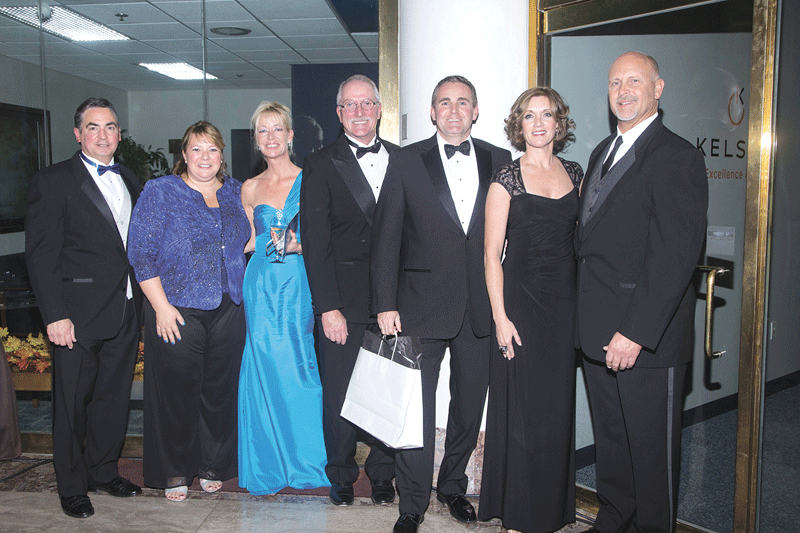
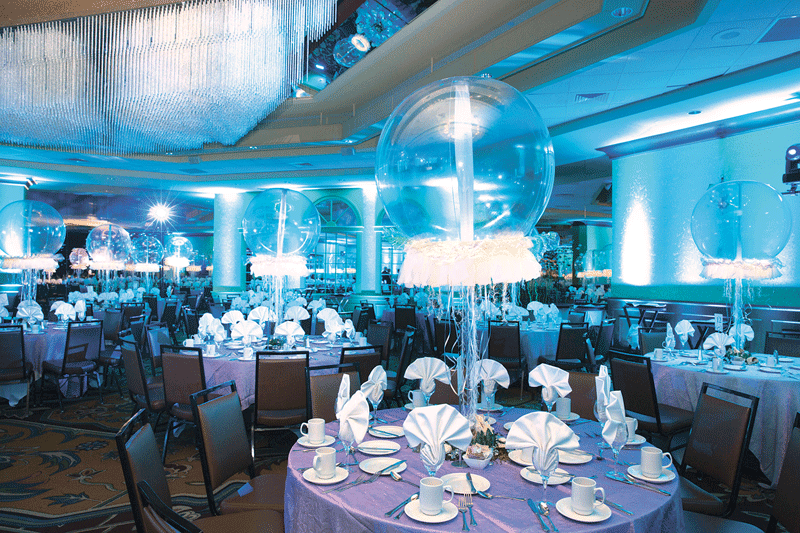
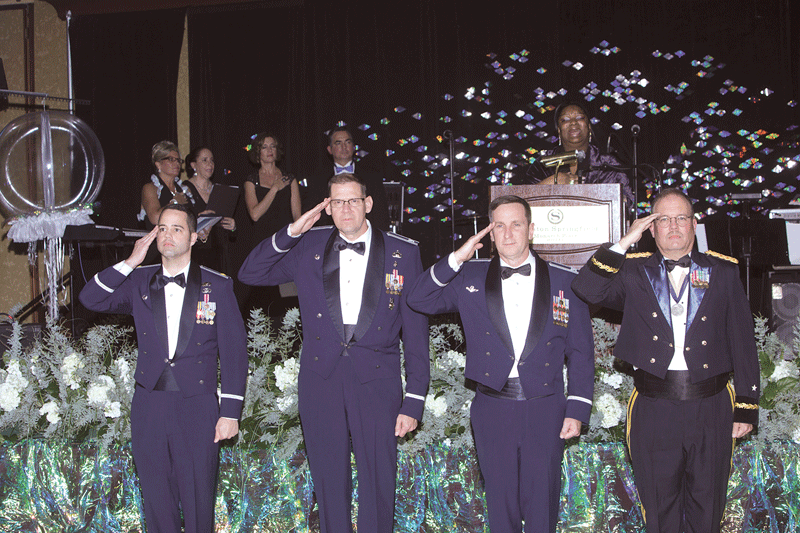
GroupToskyTablesCadetsThe Spirit of Springfield held its 18th annual City of Bright Nights Ball Nov. 16 in the Grand Ballroom of the Springfield Sheraton in downtown Springfield. The black-tie event, with the theme ‘Under th Sea,’ raised money to support the award-winning Bright Nights in Forest Park, taking place through Jan. 5, and the many events presented by the nonprofit organization.
 From top, left to right: from left, Springfield Mayor Domenic Sarno and wife Carla, Patti and Daniel Moen, president and CEO of Sisters of Providence Health System, Patrick Leary, shareholder and vice president of Moriarty and Primack, P.C., Kelley Tucky, Bright Nights Ball chair and vice president of Community and Public Affairs for MGM Springfield, and Richard Ross; Noreen and Mark Tolosky, president and CEO of Baystate Health; the Grand Ballroom is ready for guests; from left, Maj. Matthew Mutti, Col. Kenneth Lute, Col. James Keefe, and Brigadier Gen. Paul Smith salute the military after the singing of the National Anthem. (PHOTOS BY PAUL SCHNAITTACHER)

Lunch Money

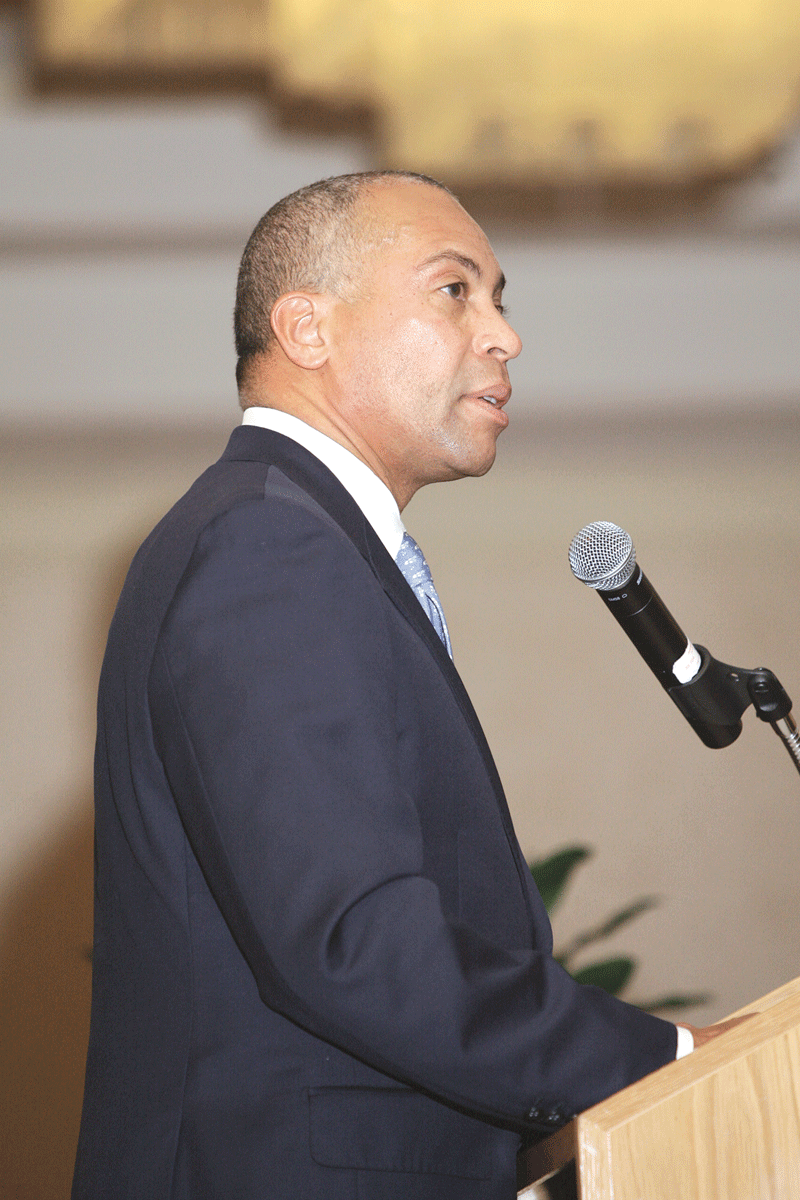
DuvalIMG_9476The Affiliated Chambers of Commerce of Greater Springfield (ACCGS) recently hosted a Lunch with Gov. Deval Patrick, left, at the sold-out Springfield Marriott Grand Ballroom, right. The special event was an occasion for the governor to announce a $200 million investment in Phase 1 of the I-91 Springfield Viaduct project and $1.2 million to create a permanent home for Camp STAR Angelina at Forest Park. The investments are expected to be a catalyst for additional economic and community-development opportunities in the region.(PHOTOS BY DRISCOLL PHOTOGRAPHY)

Legislative Voices
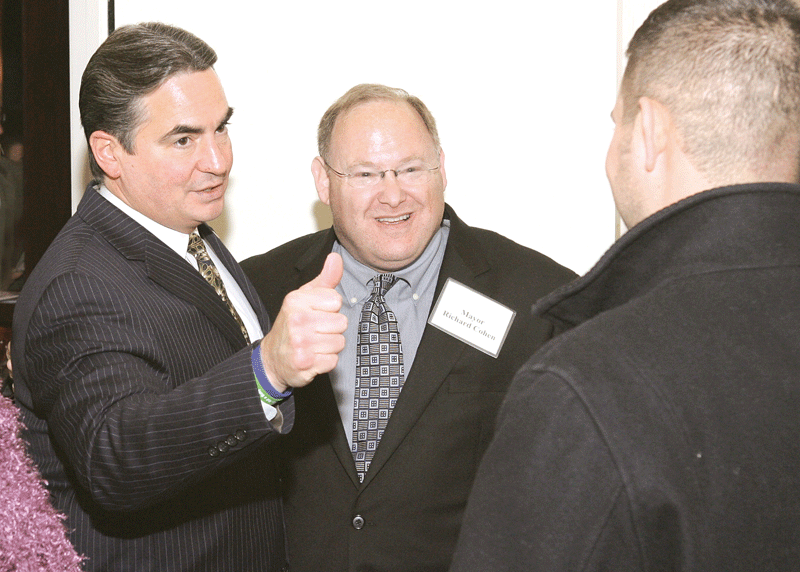
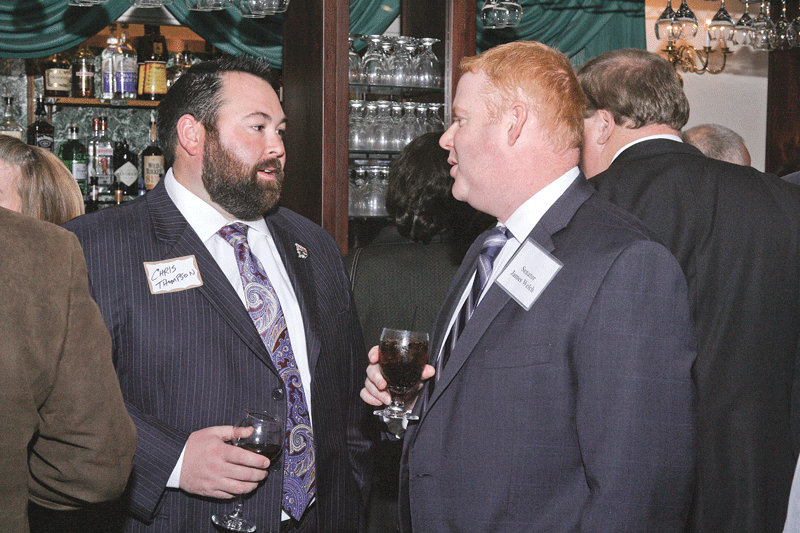
SarnoCohenBreyerSullivanGovReceptionReplaceOn Nov. 21, the Affiliated Chambers of Commerce of Greater Springfield (ACCGS) held its annual Government Reception at the Carriage House, Storrowton Tavern in West Springfield. The event provides a forum each year for attendees to meet with area legislators to make their voices heard. Left to right from top: Springfield Mayor Domenic Sarno, left, and Agawam Mayor Richard Cohen speak with an attendee; Carl Breyer Jr., left, managing partner of Park Place Realty, and Ed Sullivan, mayor-elect of West Springfield; Chris Thompson, left, vice president of Business Development for the Springfield Falcons, converses with state Rep. James Welch.(PHOTOS BY DRISCOLL PHOTOGRAPHY)

They Honor Us Whom We Honor
AM7J3389AM7J3591The Advertising Club of Western Massachusetts recently celebrated the latest class of the Order of William Pynchon, the 98th annual awards event which honors distinguished civic service in the name of Springfield’s founder. Pictured, left, at the banquet held at Chez Josef, are 2013 Pynchon medalists, from left, Joan Kagan, president and CEO of Square One; Jean Caldwell, writer for the Boston Globe and American Baby magazine; Jean Gailun, advocate for reading education and the children of Springfield’s Kensington Avenue Magnet School; and Sirdeaner Walker, mother of 11-year-old bullying and suicide victim Carl Walker Hoover and now an advocate for bullying awareness, who was instrumental in the drafting and passage into law of the state’s 2011 anti-bullying bill. Right: from left, Susan Kline, chair of the Jewish Geriatric Services (JGS) board of directors; Sally Fuller from Cherish Every Child; Alta Stark, Pynchon trustee and event chair and director of marketing and public relations for JGS; Richard Halpern, JGS board member; Martin Baicker, president and CEO of JGS; and Susan Halpern, vice president of philanthropy for JGS. (PHOTOS BY ED COHEN)

Spa Night

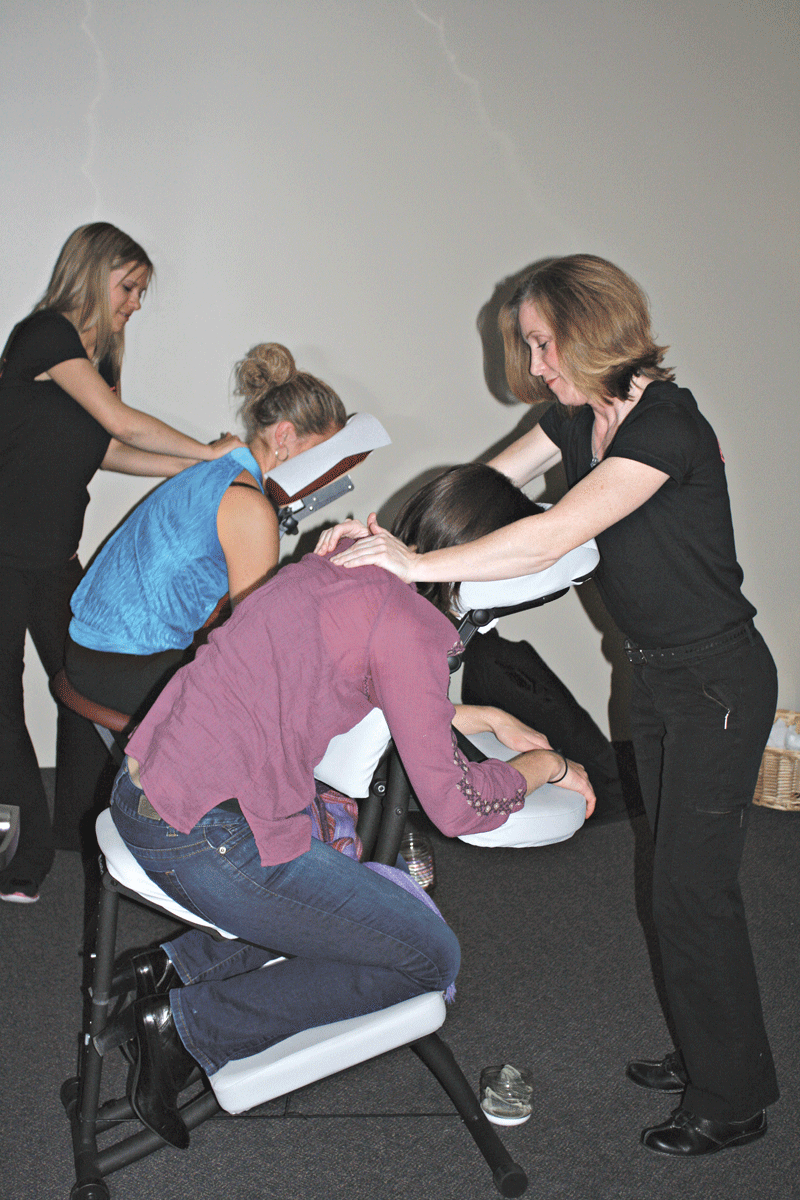
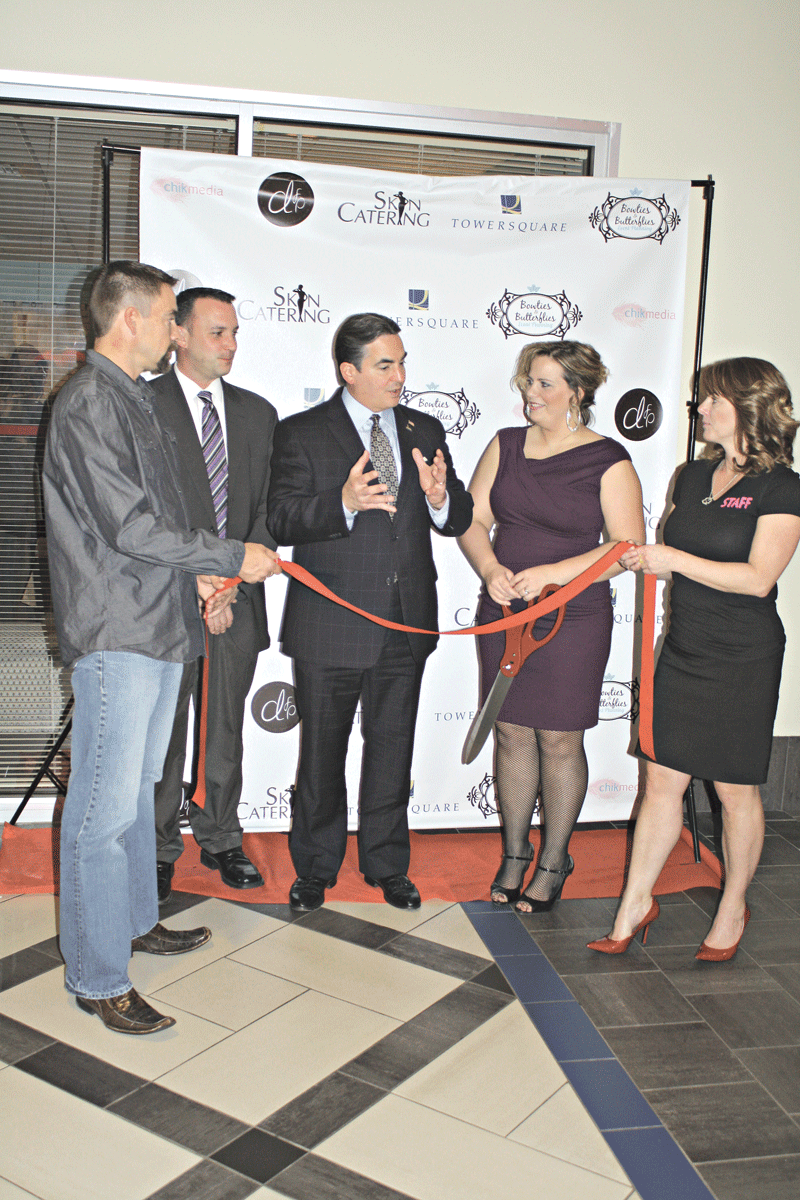
chairmassagemayorleanne1SkinCatering, a massage and skin-care spa for men and women, recently celebrated its grand opening on the second floor of Tower Square in downtown Springfield. The spa, whose team is Skin-Safe Certified by the Melanoma Foundation of New England, offers body and facial services as well as yoga and numerous specials. An open house welcomed the public to indulge in a few of the most popular services, including chair massages, at left, with massage therapists Ariel Gignac, left, and Amy Pearson. Right, Springfield Mayor Domenic Sarno, center, congratulates Leanne Sedlak, owner and massage therapist, to his right, at the ribbon cutting. Holding the ribbon, from left, are Sedlak’s husband Scott, roofing specialist for Adam Quenneville Roofing and Siding; Don Courtemanche, executive director of the Springfield Business Improvement District; Sarno; Sedlak; and Kim Brunton Auger, lead esthetician.

Restaurants Sections
Despite Challenges, Local Restaurateurs Have a Positive Outlook for the Holidays

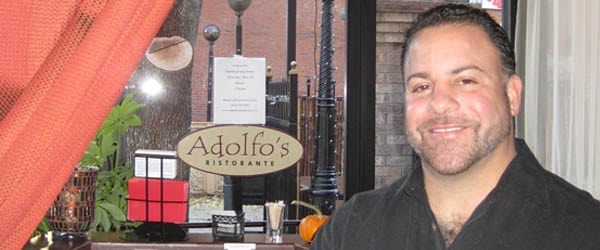
Victor Bruno

Victor Bruno has successfully paired meet-and-greet and food-sampling efforts to bolster his restaurant’s promotional card program.

Victor Bruno has never run from hard work.
As a young boy, he sold cans of soda at the Italian Festival in Springfield’s South End, making a nice profit for pocket change. Fast-forward 30 or so years to 2011, when he used the most basic form of grass-roots marketing — the meet and greet, and food sampling — to brand his barely year-old Worthington Street restaurant, Adolfo’s Ristorante, an homage to his late father.
Bruno and two of his employees spent four weekends in the West Springfield and Enfield Costco locations offering samples of his stuffed mushrooms to promote his new venture through the Costco discount gift-card program.
“I was there from when the store opened until I ran out of mushroom caps each time, and I met thousands, and I mean thousands, of people, and we would talk about the restaurant and downtown Springfield,” Bruno recalled.
He heard it all, and the most pervasive issue was the perception that Springfield isn’t safe anymore. “But I told them, it’s the entertainment district, and we have valet parking and good lighting; you’ll have a great meal — and I’ve seen thousands of those cards come back.”
Bruno knows the restaurant business is one barometer of how willing the public is to indulge in discretionary spending. With the all-important holiday shopping season just beginning, there is some cautious optimism among the restaurateurs that BusinessWest spoke with, although it was tempered with concern about what will be a short holiday shopping season.
“Sadly, this was the latest Thanksgiving possible; we’ve lost a week of shopping time, and that hurts all restaurants,” said Robert Luz, president and CEO of the Mass. Restaurant Association (MRA). “But we continue to extricate ourselves from the Great Recession, and generally speaking, we’re starting to come out of this, and consumers are a little bit more confident about spending dollars.”
Bob Luz

In spite of a shortened selling season due to a late Thanksgiving, Bob Luz says, consumers are more confident to spend.

Luz expects holiday sales to be flat or in the negative, mostly due to that lost week. His organization offers business assistance to restaurant-industry members — most importantly legislative advocacy. According to Luz, as restaurateurs get through this shorter holiday season, they have a potentially disparaging issue looming with a recent bill that just passed the Senate and is headed toward the House that could raise not only the minimum wage for all industries, but also the base of tipped wages for waiters and waitresses in the restaurant industry, increasing their minimum wages by 71% (more on this later).
For the restaurateur, food-price increases are only the beginning; city taxes, property insurance, workers’ comp, and liquor-liability costs are also increasing. “There’s only so much you can get from a stone,” said Bruno. “And all businesses have some of these costs, too. But in the restaurant business, we’re working with a profit margin of nickels and dimes.”
For this issue’s focus on restaurants, BusinessWest talked with some industry veterans about the holiday season ahead, as well as the much bigger picture — the challenging environment in which they’re operating and the prospects for improvement.

Main Menu

As if the Great Recession and recent food-price increases weren’t enough for local restaurateurs, a week before Thanksgiving, Senate President Therese Murray advanced a plan to raise the minimum wage from $8 to $11 per hour over the next three years. The Senate voted for that wage increase, and Luz of the MRA was prepared for that hike, which would certainly affect any business owner.
But in the same session, the Senate also voted to increase the minimum wage for tipped employees to half the minimum wage. With the tipped wage currently at $2.63 per hour, it would now force restaurateurs to pay them $4.50 per hour this year, a 71% increase, which will continue to increase over the next two years.
“It’s been frozen since 1999, because it works,” Luz said. “Over that time period, waiters’ and waitresses’ wages naturally increased because of menu inflation and because we educated our members’ employees to declare all of their tips.”
Technically, Luz said, employers have to meet the current minimum wage for those waiters and waitresses whose declared tips don’t equal current minimum wage, but that is rare because they usually do make solid tips. Waiters and waitresses in Massachusetts, he went on, are already paid the most in the country, as the U.S. Bureau of Labor Statistics reports that they earned an average hourly wage of $13.13 in 2012, when tips are factored in. Should this new increase for tipped employees pass, employers will be footing yet another increase for something that Luz said doesn’t need a separate increase.
The MRA offers its members information sharing, education and training, forums for networking, cost-cutting group-discount opportunities, and, most importantly, legislative advocacy.
“The restaurant business is highly labor-intensive, and when you affect wages like that, it’s dramatic,” Luz said. “We’re the entry-level point for a lot of jobs, but the business has a razor-thin bottom line.”
Luz added that the MRA is working to finalize a formal strategy to fight this matter in the Legislature.  But heading into the holiday season, there are significant issues that already exist for the network of Western Mass. restaurateurs.
For the past 14 years, Chris Brunelle has been the owner of Pinocchio’s Ristorante (formerly in Amherst, now in Three Rivers), and is also general manager of the new Bistro 21 at the Cold Spring Country Club in Belchertown. Through those two businesses, he’s come to the formal conclusion that there may be no bounce back to where things used to be pre-Great Recession.
“This is the new norm; the cost of doing business in the last year to two years for food alone has gone up 6% to 22%, and everybody is paying for the October snowstorm from two years ago because our insurance prices have gone up another 20%,” added Brunelle.  “That’s just the cost of doing business, and you can’t pass that cost down to your customer.”
Judie Teraspulsky, owner for the past 36 years of Judie’s restaurant in the center of the vibrant college town of Amherst, said her professional life revolves around when students are in town; she’s survived the Great Recession by streamlining every area that she can, and running the restaurant, from purchases to staffing shifts, with extreme efficiency.
“We are tight, tight, tight,” said Teraspulsky. “We don’t lay off employees, because they are the most important factor in our business.”
As hard as things get for Brunelle, his philosophy, year-round, is the same as Teraspulsky’s: he’s staying strong due to his allegiance to his employees, many of whom have families, and four specifically who have been with him for the full 14 years.

Gifting Limit
Rudi Scherff, manager of the Student Prince, a landmark eatery in downtown Springfield that just celebrated 78 years in business, is used to the ups and downs of the hospitality business. Scherff, who undoubtedly has one of the strongest and most affluent regular clienteles in the Pioneer Valley, said he’s getting the sense that, while there is apprehension and concern, people are a bit happier with at least the regional economic situation than they were a year ago.
Scherff told BusinessWest that the holidays are “huge” for his restaurant, which does a solid 20% of the year’s business from Thanksgiving to Christmas Eve, and half of the gift certificates sold are during that same time span.

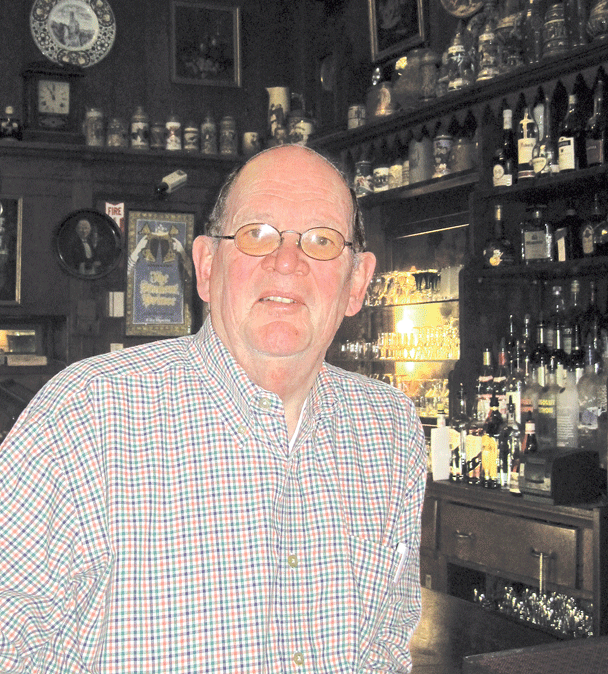
Rudi Scherff

Rudi Scherff says the holidays are a very busy time, when half of the year’s gift certificates are sold for the Student Prince.

“We’re going to be busy this season, and the eight days before Christmas are as much as we can handle,” Scherff noted, adding that banquets and events, entertaining up to 90, are a big part of that equation.
While Teraspulsky may not be as straight out as Scherff this time of year, she still sees the holiday season as very important to her business.
“Where I shine during the holidays is that you can come in and do just a dessert or a popover, or one of our great cocktails,” she said, adding that her menu, from the beginning, has afforded her customers the ability to have whatever they want, when they want it.
Teraspulsky and her staff of 90 push the gift certificates hard to get that return that will pick up the cash flow once the 50/50 percentage of college students and traditional customers returns.
Bruno is also looking forward to this season, not only to see those Costco cards come back, but to sell more gift certificates in the restaurant, and he’s already booked early corporate parties in his private room upstairs, seating up to 45 people.
“There’s still that caution with spending,” said Bruno, recalling the days in his former restaurant, Caffeine’s, in the same location, where customers used to spend $100 on a bottle of wine.
“Now they’re only spending $25 to $30 on a bottle of wine, but at least they’re spending it here.”

The Garnish

The potential of a downtown Springfield casino complex in the years ahead provides holiday conversation and a giant question mark for many restaurateurs; while they are not sure if it will help or hurt them personally, ultimately, they hope that the pledge of far more people will materialize.
“We’re always optimistic come January, and for the [prospective] casino, during the construction phase — it’s going to be great for downtown,” said Scherff.  “And once it opens, it’s going to help some, hurt others, but hopefully it puts more feet on the street and gets more people down here.”
Bruno agreed, adding, “the perception of downtown is far, far worse than it actually is, but with a casino, there will be people, and people bring safety; my position has always been that we’ll be the safest downtown around.”
Until a decision is made, Bruno is doing everything in his power to overcome the challenges that all restaurateurs are facing this holiday season. His greatest compliments thus far have been from those who tell him that Boston’s North End, renowned for authentic Italian restaurants, has nothing on Adolfo’s.
“They tell me I should consider opening up another restaurant,” Bruno said, laughing as he explained, “because if you can make it in Springfield, you can make it anywhere.”

Elizabeth Taras can be reached at [email protected]

Features
Valley Gives Looks to Build on a Successful First Year

By MICHAEL REARDON

Valley Gives

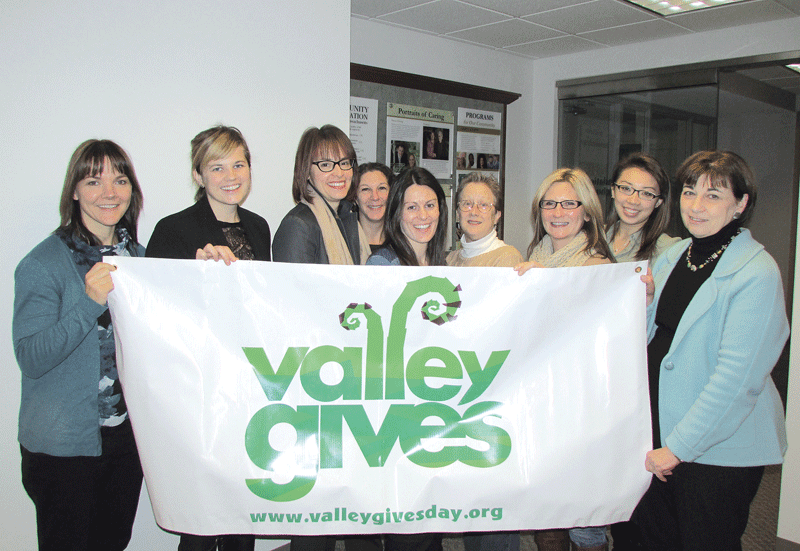
Valley Gives, which raised $1 million for area nonprofits and schools its first year, has set the ambitious goal of $2 million for the 2013 edition.

When organizers of Valley Gives, a one-day online fund-raising event for area nonprofits and schools, launched their venture nearly a year ago, they did so with ambitious expectations — for participation among those nonprofits, the number of donors, and the money raised.
And they surpassed all of them.
More than 6,000 donors from across the Pioneer Valley pledged more than $1 million to 250 participating nonprofits, said Kristin Leutz, vice president of Philanthropic Services for the Community Foundation of Western Massachusetts, which helped orchestrate the program. This performance enabled the initiative to live up both halves of its name — it is, indeed, a region-wide effort, and people certainly did give — and prompt organizers to set the bar much higher for year two, slated for Dec. 12.
Indeed, the goal for 2013 is $2 million, said Leutz, adding that there are now more than 350 nonprofits and schools registered for the program, and newcomers and returning participants alike are looking forward to what promises to be an exciting day.
“When we raised $1 million in the first year of Valley Gives, it stunned everyone,” Leutz said, noting that the local effort surpassed the performance of a similar initiative in Boston. “The online-giving growth rate is growing twice as fast as traditional giving. This is an efficient and effective way to raise a large amount of money in a small amount of time.”
But Valley Gives is about much more than raising money, said Al Griggs, former chairman of the Community Foundation and, along with Springfield attorney Paul Doherty, an architect of the initiative.
“The idea is to allow people who are philanthropic to do what they naturally do, and that is to support organizations up and down the Valley,” said Griggs, adding that there is another component to the event. “Thousands of people across the Valley work for nonprofits, and we wanted to celebrate that.”
And the first Valley Gives was very much a celebration — in many respects, said Leutz.
A number of organizations created a party-like atmosphere around Valley Gives last year, she noted. One organization, Country Dance and Song Society, busted out a flash mob at Thornes Marketplace in Northampton. The Jewish Federation of Western Massachusetts brought a dunk tank.
Leutz said a Valley Gives wrap party will be held on Dec. 12 at the Galaxy restaurant in Easthampton.
“We’ll watch the total come in,” she said. “Valley Gives is a festival of generosity, and that’s what I love about it. This is truly a community event.”
For this issue, which also features the annual BusinessWest Giving Guide, we take an in-depth look at this community event and how it has enormous potential to become a powerful Western Mass. tradition.

The Power of Giving

Griggs said it was reports of the generosity of billionaires Warren Buffett and Bill Gates that prompted he and Doherty to start thinking of ways to increase philanthropic giving in the Pioneer Valley.
So two years ago, they sought the advice of the Community Foundation of Western Mass. to find ways to create opportunities for fund-raising in the area. The foundation took what Griggs calls their “germ of an idea” and did some research and came across an effort created in Minnesota called Give to the Max Day, a one-day online fund-raising event for nonprofits and schools that has spread to other parts of the country, including Boston and Miami.
The concept sounded like it could be successfully adapted to the Pioneer Valley, so the foundation decided to create a local event based on the Minnesota model and call it Valley Gives. The idea was to unite residents of Franklin, Hampshire, and Hampden counties in one massive online fund-raising effort for nonprofits up and down the Pioneer Valley.
To bolster the effort, the foundation recruited the Beveridge Family Foundation, the Irene E. and George A. Davis Foundation, the Jewish Endowment Foundation, the Jewish Federation of Western Mass., United Way of Franklin County, United Way of Hampshire County, United Way of Pioneer Valley, and the Women’s Fund of Western Massachusetts as partners.
Donations during Valley Gives are pledged entirely online. The event goes on for 24 hours, beginning at midnight and ending at 11:59 p.m. Donors can log onto valleygivesday.org to find the nonprofit they want to give to and make a donation.
Valley Gives donors don’t have to be a Gates or a Buffett to make a pledge. On the contrary, the minimum donation is $10, and there is no maximum.
Nonprofits registered to participate in Valley Gives in August and September, and went through training in October and November. Much of the training was focused on effective methods of marketing, with a major emphasis on social media and other online strategies like Facebook, Twitter, YouTube, blogging, and e-mail newsletters.
“A large percentage of nonprofits were not on social media, and there were others that were on social media, but didn’t do much with it,” Leutz said. “We convinced them to take social media to a new level. We’re creating the environment for nonprofits to market themselves successfully. For many of the nonprofits, they saw capacity in places that they did not see before. New opportunities were created for them. A lot of donors were new.”
Besides the pledges rolling in during Valley Gives, nonprofits will be eligible to win leaderboard prizes of up to $10,000 for being a top fund-raiser, as well as a Golden Ticket or Power Hour, which are prizes of up to $1,200 throughout the day.
Lisa Oram, marketing and communications director at Snow Farm: the New England Craft Program in Williamsburg, remembers the organization’s staff huddled around computers watching the money come in during the 2012 Valley Gives event, and posting on Facebook and Twitter throughout the day to keep momentum going.
“People were very engaged and enthusiastic,” Oram said. “I felt humbled by the amount of generosity of people across the Valley toward all of the organizations that participated. The day became all about Valley Gives.”
The team members at Snow Farm were floored when they won a prize worth $10,000 last year, especially since they first thought it was for $1,000. Last year, the organization raised $22,000 which paid for new computers for the organization’s digital photo lab and scholarships for its high-school program.
Other nonprofits that participated in last year’s event are looking forward to being involved again this year.
Safe Passage, the Northampton-based organization that addresses issues of domestic violence, was among the nonprofits that participated in Valley Gives in 2012. Marianne Winters, executive director of the organization, said money raised was used for programs to support children who are exposed to domestic violence, and to help fund its legal program in probate court.
This year, money will go toward a prevention initiative called Say Something, which offers training, education, and other skills for dealing with a potentially abusive situation.
“We have startup costs and need to generate publicity and other ways to get people involved,” Winters said.
Nonprofits that are first-time participants in Valley Gives are also eagerly awaiting the stroke of midnight on Dec. 12.
Team Jessica Inc. was formed in 2009 in honor of Jessica Martins of Belchertown, who died at 19 as a result of complications from Rett Syndrome, a neurodevelopmental disorder.
Although Martins was confined to a wheelchair, she was as active as possible, going to school dances, playgrounds, and riding horses. Team Jessica is striving to raise money to build a playground to be named after Jessica on 13,367 square feet of land at the Belchertown school complex.
“We want to build a new playground that’s 100% handicapped-accessible, with a poured rubber surface,” said Deanna Roux, the organization’s spokesperson. “The playground will cost $400,000, and we’ve raised $207,500 so far over the last three years through different events.”
Team Jessica wanted to be involved with Valley Gives last year, but had not achieved 501(c)3 charitable nonprofit status in time to do so.
Team Jessica is hoping to raise $10,000 through the Valley Gives event. Besides raising money to build the playground, Vicky Martins Auffrey, Jessica’s mother, hopes to continue developing handicapped-accessible projects.
On the day of Valley Gives, Team Jessica street teams will visit two Belchertown restaurants and will have postcards printed with a QR code that can be scanned by a smartphone to make a donation, as well as a computer to make a pledge.
“We’re hoping to expand our reach,” Roux said. “We heard all of the success stories from last year’s Valley Gives and felt we really needed to be involved. We signed up the minute it opened up.”

The Bottom Line
After signing on to participate in Valley Gives, Roux and Patti Thornton, Team Jessica Inc.’s grant writer, attended the training sessions and participated in a webinar to prepare them for the event. Roux said they learned a lot of valuable information about how to market themselves to get the word out to potential donors of their involvement with Valley Gives.
Team Jessica learned the importance of developing an e-mail newsletter, as well as posting on Twitter and other social media, and being more active online in general.
“I’m looking forward to 12/12/13,” Roux said. “All of the stuff you do beforehand matters. I’m excited, but nervous. We’ll see right away how dollars are moving.”
And with that, she spoke for everyone looking ahead to the second edition of Valley Gives.

Community Profile Features
Lenox Boasts More Than Just Seasonal Charms

Tanglewood

Tanglewood, which hosts the Boston Symphony Orchestra and other musical events, is one of the top tourism draws to Lenox.

John Bortolotto understands that, from an economic perspective, Lenox is a seasonal destination.
“Predominantly, Lenox revolves around Tanglewood and Shakespeare & Co. and the multiple art venues in town, and as a result, we have a very productive summer. There can be a shortage of rooms in hospitality,” said Bortolotto, who serves on the Lenox Chamber of Commerce board of directors.
“If you talk to many of the local folks, you’ll find out that many have this  preconceived idea that Lenox is busy from June through October, and then the town gets really quiet,” he added. “To an extent, that’s true.”
But he’s trying to get people to think about this small community — population just over 5,000 — in different ways, talking up its energy and recent commercial growth, and not just its many downtown inns and its high-profile performance spaces.
“From a chamber perspective, it used to be that, if you weren’t downtown, you kind of didn’t partake in all things Lenox,” he said. “What’s happening right now — what’s been happening for the last five years or so — is that Route 7, which is just outside downtown, connecting Pittsfield to Lee, has experienced growth of a different type. We now have three banks on that little stretch, where before there were only two downtown. We have multiple attorney’s offices, a fitness facility, a printing company, some retail.”
One notable success story has emerged in the Lenox Shops, a cluster of once-underutilized retail space along Route 7.
“It had a few stores, until a gentleman named David Ward bought the place and started revamping,” Bortolotto told BusinessWest. “He added condos out back and brought some non-retail businesses and restaurants to it. It’s going to be huge.”
In addition, Berkshire Health Systems, the largest employer in Berkshire County, will occupy a large portion of the complex, and healthcare services, from primary care to ob/gyn to yoga, will have a strong presence — and a flow of employees to support other businesses in the shops.
“So Route 7 has really come along, with more professional businesses and not just retail,” he added. “And, of course, we have Cranwell Resort, Spa and Golf Club nearby — a beautiful place to be.”

Growth Pattern
The character of fast-growing Route 7, with its chain hotels and motels, is different than downtown’s Main Street, Church Street, and surrounding roads, which play host to a number of inns, bed and breakfasts, and locally owned shops.
“Downtown is largely retail,” said Bortolotto, who is also branch manager of NBT Bank in town. “You have two banks, some attorney’s offices, a lot of realtors — that’s part of the makeup, some of the more profitable businesses — but the retail, they tend to close for a good part of the year. Church Street gets very quiet. Some restaurants choose to close for the whole winter season because they figure they lose less money by not adding staff and other expenses.”
Laura Shack has bucked that trend for two decades. She opened Roseborough Grill in downtown Lenox in 1993, then transformed it into Firefly, which she calls a “new American bistro,” 10 years later.
“Roseborough Grill had a great run, but that was because there were only 25 restaurants in Berkshire County, and now there are probably 125,” she said. “It got to the point where it was more of a struggle to maintain the antique, country feel, and I didn’t have a big bar. But I love what I do, so I reinvested and gutted the place, changed the name, and started over.”
Firefly features the huge bar she craved, and a décor that’s contemporary and rustic at the same time. “We changed the menu a little bit, did some tapas and light plates — just changing with the times — and it’s been a great run. There were times when the economy was struggling, but this is one of the few restaurants in Lenox that stays open year-round. We’ve created an extremely loyal clientele due to the fact that I cater to the locals tremendously. We went from having 10 people in the winter to 100. People come in, spend money, have drinks — and they come back.”
Shack partly credits a well-received series of daily specials, from a $5 burger to 50-cent chicken wings, a $16 prime rib, and $10 lobster rolls, which locals look forward to. She’s used a similar strategy at her new breakfast-and-lunch eatery, Kitchen on the Commons, located at the transformed Lenox Shops, and is a testimony, Bortolotto says, to the fact that local businesses can succeed year-round in town.
Our challenge as a chamber is to say, ‘look, if you build it, they will come,’” he said. “If you stay open, it won’t happen overnight, but people will come and spend. As they go ski in Great Barrington or Hancock, they may feel inclined to come to Lenox.
“The challenge is to get more people to downtown, yes, but Lenox is sort of changing that,” he added, noting that the chamber is actively trying to lure non-tourism-related business into its fold.
“Some of the professional service people say, ‘look, I’m not going to join the chamber because I really don’t see the benefit; the chamber revolves around the arts. But I work in a professional business, working with attorneys, electricians, and car businesses, and when I joined the chamber, one of my goals was to add value to those businesses. We’re trying to do some of that.”

Taste of Home
A New York City native, Shack said she came to Lenox for the summer 23 years ago and never left. “What I’ve learned is, you have to cater to the locals, and you have to be super warm and friendly and welcoming. I have staff who have been with me for 20 years; I’m known as Mama Shack, and I’ve raised a lot of kids out of there. They started at the age of 13 or 14, and some are still here. They started out busing tables, and I taught them how to cook or bartend.”
One of those, Zee Vassos, left Roseborough for college but decided the food industry was what he loved, Shack said, “so he came back and helped me open Firefly. Then, after being out in Boston for a few years, he came back again, and we just opened Kitchen on the Commons in May. We had a great summer. David Ward, who owns the complex, really turned it around.”
Bortolotto said the chamber has become more open to cooperating with local towns on events and marketing. “It’s one county, not ‘we’re Lenox, and you’re everyone else.’ We’re mixing more, and we’re more open-minded these days than we were 10 or 15 years ago, definitely.”
There’s more to Lenox than its downtown and Route 7, of course, including Lenox Dale, a blue-collar village straddling Lenox and Lee that used to be home to a cluster of paper mills and today still features some manufacturing.
But, overall, Lenox is mainly known as the home to arts destinations like Tanglewood — where the Boston Symphony Orchestra plays — and a knot of rustic inns, while Bortolotto and the chamber continue to raise the profile of the town’s other charms.
Shack certainly finds the town charming, and hated the early days when she closed for part of the time during the off-season. “I find continuity is really important, being open seven days a week, so people don’t ever question, ‘are they open?’
“I love the people. The town is great,” she continued. “Obviously, having Tanglewood around the corner is wonderful. But I’ve really gotten to know the local people, and the clientele makes it really nice. People are grateful I’m here for them, and I’m grateful to have them.”

Joseph Bednar can be reached at [email protected]

Restaurants Sections
Max’s Restaurants Have Always Put the Accent on Giving Back

By MICHAEL REARDON

Max’s Tavern

Rich Rosenthal, center, owner of Max’s Tavern, with John Thomas, managing partner of the restaurant, and AnnMarie Harding, public relations director.

A casually dressed Richard Rosenthal, owner of the Max Restaurant Group, sat in a dining room of Max’s Tavern, his restaurant at the Naismith Memorial Basketball Hall of Fame in Springfield, talking about his company’s philanthropic efforts.
As the lunchtime crowd filled the restaurant on this recent crisp, sunny afternoon, Rosenthal was hesitant to take credit for the millions of dollars the Max Restaurant Group has raised in the Hartford and Springfield areas over the years for charitable organizations and other worthy causes.
“I don’t think about it too much,” said Rosenthal when asked about the legacy he was leaving through his organization’s philanthropic efforts. “We do it because it’s the right thing to do. We don’t pat ourselves on the back. We just feel like we always want to raise more money for these worthy causes.”
Rosenthal believes that successful businesses like his should feel obligated to be involved in charitable giving. His restaurants have been successful, he said, so giving back is the natural thing to do. To Rosenthal, philanthropy is just part of being a responsible member of a community.
“We became involved in charitable giving because people asked,” he explained. “You want to help because the customer really believes in what they’re doing, and you respect that.”
If Rosenthal is reluctant to take credit for his charitable work, other people are happy to shower him with accolades. As he was talking, Jane Albert, vice president of Development fo Baystate Health and executive director of the Baystate Health Foundation, joined Rosenthal and immediately thanked him for his fund-raising efforts.
“We have a wonderful partner in Max’s, and they make a significant contribution to our fund-raising effort,” Albert said. “It says so much about your organization.”
Since Max’s Tavern opened 10 years ago, Rosenthal has been enthusiastically involved in raising money in the Greater Springfield area, especially with Baystate Children’s Hospital, and most recently with the new Baystate Children’s Specialty Center. The annual Max Classic International Golf Tournament, held every fourth Monday in July, the first few years at Crestview Country Club in Agawam and now at Twin Hills Country Club in Longmeadow, has raised $1.2 million for Baystate since it was launched in 2004.
“The Max Classic is our biggest event,” Rosenthal said. “We usually have approximately 175 or so golfers; we sell sponsorships and hold an auction. We try to guide our funds to Baystate’s Children’s Hospital and its neonatal intensive-care unit.”
The Max Restaurant Group sponsors a similar golf tournament in Connecticut to benefit charities in the Hartford area.
Since 2004, money raised from the tournament in Western Mass. has bought beds and equipment for the neonatal intensive-care unit, as well as funding the Baystate Children’s Hospital asthma program, equipment for the pediatric intensive-care unit, and the pediatric care unit’s family waiting room and sleep room.
Albert said the money raised through the golf tournament has made the work of doctors and nurses at the children’s hospital more effective.
“The money raised by Max’s has saved the lives of babies who would not otherwise survive,” she said. “The money has gone toward resources we would otherwise not be able to afford. We have 720 babies in our neonatal ICU every year. With this funding, doctors and nurses can do a lot more to help these babies. These things would not be possible without Max’s corporate support.”
Max’s raised $150,000 during this year’s tournament, which will be donated to the newly opened Baystate Children’s Specialty Center at 50 Wason Ave. The money will go toward paying for the 34,000-square-foot building’s reception area.
The center will house the hospital’s 15 pediatric outpatient specialty areas, including cardiology, gastroenterology, neurology, endocrinology, weight management, and more.
For this issue and its focus on restaurants, BusinessWest takes an indepth look at how Rosenthal and his restaurants have put the accent on giving back to the community.

Philanthropy on the Menu
Rosenthal’s philanthropic efforts began in the Hartford area. He was an original member of Hartford’s chapter of Share Our Strength, the nationwide culinary organization dedicated to fighting poverty and childhood hunger, an effort he is still involved in.
“The restaurant industry overall should be applauded,” Rosenthal said. “I’d say chefs and restaurant owners give more time and money to charitable causes than any other industry.”
Among the other organizations in the Hartford area that Rosenthal has raised funds for is the Connecticut Children’s Medical Center (CCMC). Working with that facility inspired him to become involved with Baystate Children’s Hospital when he opened Max’s Tavern.
“We found in working with CCMC that they were a terrific organization,” Rosenthal said. “You always felt good about working with them, and it was somewhat personal for me. I had small children at the time. When we opened in Springfield, our goal was to do something local, and Baystate Children’s Hospital was a natural fit. They’ve been equally great to work with as CCMC.”
Besides its major philanthropic endeavors, the Max Restaurant Group has a component called Max Cares, which hosts charitable events, like wine dinners, and gives away gift cards. The Max Cares link from the Max Restaurant Group website features a form to request a donation and the reason for the donation.
“Max Cares was started early in our operations,” Rosenthal said. “It was really a name we gave our donation arm because of the Internet. We get about 100 requests for donations a month company-wide.”
Rosenthal started working in restaurants when he was 16. He grew up in West Hartford and graduated from Hall High School, before attending Bentley University, graduating in 1981. He continued his education at New York Restaurant School in Manhattan, where he trained as a chef before graduating in 1983.
“I knew I wanted to be a restaurant owner, but I also realized I wanted to learn to cook,” he explained. “I worked as a chef for four years after I graduated, three in New York City and one as a chef and manager in Newport.”
Although not the owner, Rosenthal was involved with the opening of a restaurant called the Main Brace in Newport, R.I. He called the endeavor “extremely unsuccessful” because of a number of factors, including the location, lack of funding, and the timing of the opening. “Although the restaurant failed, I learned a lot,” he said.
While out of work in Newport, he decided to move back to Hartford to open a restaurant on familiar turf. “The Hartford area was booming at the time,” he said. “It was a town on the upswing. There was a lot of enthusiasm for the city. I had a base and contacts there.”
On Nov. 14, 1986, Rosenthal opened the first restaurant in what would become the Max Restaurant Group, called Max on Main, later to be renamed Max Downtown after it moved to Hartford’s business district in 1996. He now owns nine restaurants and will open his 10th in Palm Beach Gardens, Fla. in March.
When Rosenthal heard that the Basketball Hall of Fame was being built in Springfield, he decided to become involved in the project and opened Max’s Tavern in 2002.
Since expanding into the Springfield area, Rosenthal has become immersed in charitable giving beyond his organization’s efforts on behalf of Baystate Children’s Hospital. Besides sponsoring the Max Classic Golf Tournament, the Max Restaurant Group has raised $63,000 for Ronald McDonald House of Springfield, 14,000 for the Boys and Girls Clubs of Springfield, $11,000 for the Longmeadow Educational Excellence Foundation, and $3,100 for Massachusetts Special Olympics.
Springfield’s Ronald McDonald House has been supported by the Max Restaurant Group for nine years. Enix Zavala, house manager and associate director of planned giving for Ronald McDonald House, said Max’s contributed $15,000 for a room in the 22-room house.
Meanwhile, Max’s Tavern has been involved with fund-raising for Ronald McDonald House of Springfield in a couple of other ways for several years. The restaurant has sponsored fund-raising events like Martini Magic, a martini-tasting event that, up until two years ago, had gone on for seven consecutive years. AnnMarie Harding, Max’s Tavern’s public relations director, is a member of the Ronald McDonald House board of directors.
The current major event sponsored by Max’s Tavern to raise money for Ronald McDonald House is the Teddy Bear Brunch, an event that’s been held for the past four years. The popular event will take place this year on Dec. 8 and has long been sold out.
“All the children who attend the Teddy Bear Brunch bring an unwrapped toy, which is donated to Ronald McDonald House,” Zavala said. “We had 250 toys donated last year, and we expect to exceed that this year.”
The Teddy Bear Brunch is a family event that features a brunch buffet, candy buffet, face painting, crafts, and other activities, and children who attend go home with an 11-inch stuffed Max Teddy Bear. During the brunch, Max’s Tavern also sells 100 loaves of multi-colored Rainbow Bread for $5 each.
“We’re doing what we can to create revenue for this event in new and exciting ways that people can respond to,” Harding said. “All the money from selling the Rainbow Bread goes to Ronald McDonald House.”

Recipe for Success
According to Zavala, children sometimes stay at Ronald McDonald House for up to two years, and often miss celebrating big events like holidays and birthdays at home. She added that many families come from different parts of the U.S. or other countries and are unfamiliar with the area and sometimes have a language barrier. Having a partner like Max’s Tavern to help create a comfortable and welcoming place to stay while children get much-needed medical treatment is invaluable.
“Without the support of Max’s Tavern and other types of community support, we couldn’t be able to continue our efforts to support these families,” Zavala said.
Similar words have been spoken by the directors of several other area nonprofits. Their specific goals and needs vary, but the common denominator is that they’ve benefited in significant ways from a restaurant owner who has made philanthropy a house specialty.

Cover Story
Honors College is Changing the Landscape at UMass Amherst

UMass senior and honors student Renee Barouxis

UMass senior and honors student Renee Barouxis

Dan Gordon says UMass Amherst has had an honors program since the early ’60s, and an honors college since 1999. What it didn’t have — at least to the degree that he and others would like — is what he called “an honors community.”
But now, it may have one of the best in the country.
The Commonwealth Honors College Residential Community (CHCRC), a $192 million, 517,637-square-foot complex across Commonwealth Avenue from the Mullins Center, opened its doors in August, and it’s already turning heads with a number of constituencies.
Indeed, the gleaming, seven-building campus within a campus is gaining the attention of other students at the university, high-school juniors and seniors weighing their options about where to pursue their undergraduate degrees, and other institutions looking to build an honors community of their own.
“I feel like a professional tour guide — that’s what I do,” said Gordon, interim dean of the Common Honors College, or the CHC, as it’s called, and a history professor, who told BusinessWest that he’s probably leading four or five visits a week.
There is plenty to show those who take the excursion — from the air-conditioned dorms to state-of-the-art classrooms; from the Roots Café, complete with a brick pizza oven, which is open 24/7, to the 200-seat, multi-function event hall. There’s even an art gallery, currently displaying photos from throughout the school’s 150-year history.
What’s much harder to show people, but is really the essence of the CHC, said Gordon, is that concept of community he mentioned. Tours don’t capture the honors students discussing leaders and intellectual innovators in a course called “Ideas that Changed the World.” Nor do they show the interaction between students and the two professors in residence at the CHCRC, or underclassmen pushing each other to reach higher.
Dan Gordon

Dan Gordon says the CHCRC is a “game changer” for the reputation of the honors college and UMass Amherst as a whole.

“We used to be an honors college with a list of academic requirements, but we really aspired to be an honors community, a living-and-learning community,” he explained. “We wanted a place where we can integrate what goes on in the student’s residence hall with their academic experience, where students could stay up late at night debating big ideas based on their readings in classes.
“It’s a dream come true,” he continued, “and a game changer for the reputation of the honors college and UMass Amherst as a whole.”
Indeed, it is this sense of community — as well as the amenities — that are making the Amherst campus more a “part of the mix,” or “part of the discussion,” when it comes to where top students will choose to pursue their degrees, said Wilmore Webley, an associate professor of Microbiology.
He said the CHCRC, as well as a number of other additions in recent years — from new sciences buildings to an integrated arts complex to a new academic facility taking shape in the center of the campus — have taken UMass from being a ‘safe’ or ‘fall-back’ school for students with other aspirations (something it was considered years ago) to being a school of choice.
Rebecca Spencer, an associate professor of Psychology in the school’s Neuroscience & Behavior Program, agreed, and said that at the same time, the new residential component is creating what she called “positive peer pressure among honors students.”
“You can already see it — people getting engaged in research early, getting engaged in the additional opportunities they have … and it becomes much more a lifestyle to be that high-achieving student here.”
The CHCRC, or at least its residential component, came a few years too late for Renee Barouxis, a political science major from Westfield who will graduate in May. But she said she can sense the feeling of community in this new campus, and believes it will be a tremendous asset for the university moving forward.
For this issue and its focus on education, BusinessWest joined the list of those taking a tour of the CHCRC. Those we talked with spoke enthusiastically about what’s been created on what used to be a parking lot and several tennis courts, and what it means for the school.

Grade Expectations
UMass Amherst Chancellor Kumble Subbaswamy said creation of the CHCRC is a reflection of an ongoing trend at large public universities to create honors residential communities.
There are facilities at the University of Michigan, the University of North Carolina at Chapel Hill, and especially Arizona State University that helped inspire the campus at UMass and serve as models for what would eventually take shape here.
And by getting into the game comparatively late, he went on, the university benefited from observing what other schools had done and learning from mistakes they had made, and, in the end, created a facility worthy of the phrase ‘state of the art.’
The Amherst campus had what was becoming an urgent need for more residential facilities, said Subbaswamy, noting that overall enrollment is up 22% from a decade ago, but also a desire to create that campus within a campus.
Students mulling top private schools with $60,000 price tags now have another big reason to consider the state university’s flagship campus, which, for in-state students, costs just over $23,000 annually, he said, adding that many top private schools are currently challenged by endowments diminished significantly the Great Recession and the fact that more students need help paying for a college education today.

Rebecca Spencer and Wilmore Webley, associate professors at UMass

Rebecca Spencer and Wilmore Webley, associate professors at UMass, say the CHCRC will make the school more competitive in its quest for top students.

“This gives an option to high achievers who have traditionally looked at the private colleges, and it provides an alternative that is much more affordable,” he said. “Many of those private colleges cannot support as many students as they used to.”
Tracing the history of the honors college at UMass Amherst, Gordon said it began in 1960 as a program that made honors courses available not only in the arts and sciences, but professional schools as well. By the late ’70s, there were 400 students enrolled in the program, a number that continued to swell through the ’80s and ’90s.
In 1996, the Mass. Board of Higher Education proposed the concept of an honors college for the Commonwealth, and accepted a model proposed by UMass Amherst. Commonwealth College, as it was called then, welcomed its first class in 1999. The college had requirements to be met for entry, including a minimum grade point average and class rank, he explained, and students were required to take a specifed number of classes and complete a senior honors thesis. The college staged a number of special programs and lectures annually.
While the college’s enrollment continued to grow, Gordon continued, its facilities didn’t, at least not proportionately. He described its offices as a series of cubicles in Goodell Hall, which served as the school’s library before the current 27-story tower opened in the early ’70s.
“There wasn’t even a sign in front of the building that said ‘Commonwealth Honors College’ — it was very cramped, and we were sharing space with many other programs,” he told BusinessWest, adding that, while honors students were encouraged to attend lectures at Goodell, many found the long trek from dorms located in remote corners of the campus inconvenient.
The limitations posed by the honors college’s location and facilities drove home the need for what could truly be called an honors community that would include residence halls, said Gordon, adding that long-time Honors College Dean Priscilla Clarkson, who died just weeks before the CHCRC opened its doors, led the drive to make it reality.
There are now roughly 3,000 honors students at the university, and about half of them live at the CHCRC, which consists of an administration building and six residence halls, all named after trees: Birch, Elm, Linden, Maple, Oak, and Sycamore.
The honors college, strategically located only a few minutes from most classroom buildings, also features nine seminar-style classrooms, two faculty members in residence, the events hall, an art gallery, a café, and the Bloom Honors Advising Center, which helps students maximize the opportunities available to them and plan their academic paths, especially that year-long senior honors thesis that remains a prerequisite for graduation.
And while the CHCRC is somewhat separated from the rest of the campus, it is very much an inclusive, rather than exclusive, community, said Gordon, who repeatedly summoned the word “permeable” to describe it.
He noted that more than 20% of the classes held in its classrooms are for courses open to all students, the Roots Café is open to all members of the campus community, and a roadway through the honors complex connects it to other areas on campus, especially a residential community called Southwest.
Still, the honors college and its new residential community have become something to aspire to, he said, adding that this phrase applies to students already on campus who can transfer into the honors program, and high-school students as well.

Course of Action
Gordon said there is already some evidence that CHCRC is making a difference and that the Amherst campus is become more of a viable option for top students. And it comes in the form of an informal statistic of sorts called “the melt.”
That’s not an acronym, but rather a term used to describe the sum of those students who get accepted at a school, say they’re attending, but then ultimately go elsewhere.
“The residential community has ratcheted up our competitiveness,” said Gordon, adding that there was recognizably less melt this past spring and summer (he didn’t have exact numbers), and he believes the CHCRC has something to do with that.
“We haven’t seen a big difference, but we will soon,” he said, noting, as others did, that the residential honors community is just one of many factors putting UMass increasingly into that aforementioned mix, or discussion.
“UMass is no longer the ‘safe’ school that some people used to consider it,” said Webley. “Every year, we see the average SAT scores moving up and the number of incoming students increasing, and with a community like this one, it will only continue to increase, because we’ll be able to attract the kinds of students with high academic standing that we’ve always said we wanted to attract.
“With the university putting this kind of investment into an academic facility, it’s saying, ‘we’re serious about this; we’re not just talking about this,’” he went on. “And that gets me excited as a professor.”
Beyond making the school more competitive when it comes to attracting top students, however, the new residential campus has created an intriguing learning environment, said Spencer, returning to that notion of positive peer pressure among those living and learning at the CHCRC.
“It takes those good students and puts them together, and they seem to have very quickly caught on to challenging each other,” she explained. “They hear in the hallway that one student’s already started their research as a freshman, so then they all feel they need to get their research started early, which is great for us.
“That’s one thing that Harvard probably has always had,” she went on, “and now we have it as well.”
Barouxis told BusinessWest that the honors college created this sense of community at something called ‘honors RAPs’ (residential/academic programs) on designated floors in some of the dorms spread across campus, but the new honors complex takes it to a much higher level.
“There was a sense of positive competition on my floor,” she said, noting that it was occupied by fellow political science majors. “I think the honors college saw how effective that program was, and that gave them even more inspiration to go about a project like this.”
Barouxis, who interned with U.S. Rep. Richard Neal’s office last spring and later worked on Elizabeth Warren’s successful campaign for the Senate, said she believes the honors complex and its many programs will not only inspire competition within the walls of its residence halls, but also inspire other students not currently in the program to reach higher and be a part of that community.
Webley agreed. “I take both honors and non-honors students,” he noted, “and my non-honors students are being challenged by the honors students, and they’re working very hard to improve their GPAs, because they hear the honors students talking about their experiences there. It’s a very positive thing.”
Added Spencer, “I’ve always incentivized students about what honors can do for them — there are opportunities that the honors college gives students that the general population doesn’t get, such as smaller class sizes and the opportunity to apply for small research grants.
“There are a lot of incentives beyond just the buildings,” she went on. “But what the buildings do is give a face to it — it gives that real distinct character to the honors college that it didn’t have before.”

Class Act
As he talked with BusinessWest about the CHCRC, Gordon repeatedly pointed out the windows of his office to the surrounding dorms, dominated by glass, brick, and attractive landscaping.
He did so to reference everything from the two faculty apartments to the complex’s proximity to academic facilities, to the view to the Holyoke Range to the south and west.
But he reiterated many times that it isn’t the air conditioning, the view, or the pizza oven (or, at least, not only those things) that make this facility special.
Instead, it’s that sense of community that has historically been missing from the equation, but is now there in abundance at a facility that may be setting a new standard when it comes to honors colleges. n

George O’Brien can be reached at [email protected]

Education Sections
Square One Returns to Its Roots in the South End

Joan Kagan

After more than two years of turmoil, Joan Kagan says Square One is happy to be back home in Springfield’s South End.

Joan Kagan says she never really settled in to her office at what is now known as the Business Growth Center in the Springfield Technology Park across from STCC.
She made it comfortable, finding some non-matching office furniture from various sources — including a table to replace the cardboard box that her printer sat on for months — and securing a print depicting landmarks at her alma matter, Columbia University, that was intended to somehow fill in for the diplomas that were lost when a tornado tore down Main Street in Springfield on June 1, 2011 and essentially leveled Square One’s facilities there.
But the suites in the growth center that housed several administrators with Square One, an early-education provider with facilities in Springfield and Holyoke, were always intended to be temporary, said Kagan, adding quickly that she knew going in that this is, indeed, a relative term.
And as it turned out, the stay was less temporary than she hoped, a development forced by another calamity roughly a year ago — the natural-gas explosion that took out another of Square One’s facilities, this one on Chestnut Street — and difficulty securing a place to rebuild in the city’s South End, the institution’s long-time home, because of speculation and relative uncertainty regarding MGM’s bid to locate a resort casino there.
But in what would have to be considered one of the company’s rare instances of good fortune lately, space unexpectedly became available for lease at 1095 Main St. (the former Grape Vine liquor store), just a block or so from Square One’s former location. A few months ago, elaborate ceremonies were staged to mark the opening of the company’s Family Square center, a family resource facility, on the first floor of that three-story property, and by March, Kagan expects other programs and personnel to be moved into the renovated second floor.
The 14,000-square-foot facilities are not exactly what Square One leaders had in mind as they conceptualized plans for the next chapter in the institution’s history following the tornado, Kagan noted, adding that the preference was certainly for new construction and ownership of the eventual new home. But they represent a chance to return to the South End, which has been home since the late 19th century, and an opportunity to bring back together programs and employees that had been scattered after the twin calamities.
“It’s exciting to be back in the South End — that’s our home,” said Kagan, adding that relatively long-term leases (five years for the first floor and seven for the second) have been inked, giving Square One time and opportunity to determine what ‘home’ will be in the years and decades to come.
Much will be determined by if, where, and how the MGM facility — now the only casino proposal for the Western Mass. region still on the table — takes shape.
For now, though, Square One is focused on the immediate future and proving John Updike wrong when he wrote “you can’t go home again.”
Back in September, there was a different kind of literary look and feel to the grand opening at 1095 Main St. Indeed, students, in a nod to that classic line from The Wizard of  Oz, wore T-shirts that read “there’s no place like our new home.”
The ceremonies came a tumultuous 27 months after the June 2011 tornado changed the landscape on Main Street. The Square One facilities there were so extensively damaged that they had to be torn down.
Programs and personnel were then relocated to a number of sites, said Kagan, listing facilities on Wilbraham Road, the MCDI building on Wilbraham Avenue, and, eventually, the Technology Park at STCC, among others. “We put people anywhere we could find a desk and an office.”
After a short period devoted to stabilizing operations, preliminary planning for building a new, larger facility in the South End commenced.
This was complicated by delays in obtaining an insurance settlement, but moreso by MGM’s announced plans to build an $800 million casino in the South End, mostly on underutilized, vacant, or tornado-damaged property directly across Main Street from Square One’s former home.
“We had owned one piece of property, and we were looking to expand that piece of property,” Kagan explained. “But people were talking to MGM, and MGM was optioning some land; people were hoping that MGM would come to them and make them an offer. There were simply too many moving parts for us to do anything.”
Plans then shifted, with a new goal of finding property to lease, she went on, adding that it was serendipitous that the property at 1095 Main St. became available when a tenant slated to move in backed out of the deal.
In August, Square One opened its Family Square center, as well as one 20-student preschool classroom. The center houses a number of what Kagan called “parent education support services,” and also hosts a number of programs and services, such as a group for mothers of 5-year-old children.
There are also computers at the facilities, on which parents can search for jobs, she said, adding that the new location on Main Street enables Square One to expand services offered at the center and bring under one roof a number of programs and initiatives that were scattered across the city.
And with a new home secured, Square One officials can continue efforts to realize the growth that was anticipated in early 2011, but then essentially shelved due to the loss of facilities from the tornado and gas blast.
Elaborating, Kagan said the company had planned to bring an additional 200 children into its expanded facilities on King Street in Springfield, but that additional capacity was absorbed by the displacement of students following the tornado and gas explosion.
“Those events essentially blew my business plan out of the water,” she said, adding that process of rewriting that document is ongoing.
Growth opportunities will likely accompany an MGM casino in the South End, she said, adding that provisions for day care for the children of employees are part of the agreement between the city and the corporation, which has already had preliminary discussions with Square One about where and how to provide those services.
Meanwhile, possible expansion into Union Station, which is currently undergoing extensive renovations, remains a possibility, she said, adding that a child-care facility has long been one of the potential reuses of the station — because of its location and the public transportation that will be based there — and it remains an option for that landmark.
Looking down the road, Kagan said she’s not sure what Square One will do long term, again, because of the uncertainty regarding the MGM proposal, how it will take shape, and what additional property the casino giant may acquire.
But she says the company is committed to the South End, and to being part of that community. And as it goes about writing that next chapter, Square One will adhere to a philosophy that was actually in place long before the tornado roared down Main Street, but has been reinforced by the events of the past few years.
“We never gave up … we simply said, ‘this is what we’ve got, now how do we move forward given that this is the reality?” she explained. “One of our mantras has always been to be solution-oriented; there’s always a solution, and you just have to get creative and figure it out. But it’s there.” n

— George O’Brien

Banking and Financial Services Sections
PeoplesBank Honored for Efforts in Sustainability

Doug Bowen

Doug Bowen says environmental-sustainability efforts are part of PeoplesBank’s commitment to the community.

When PeoplesBank built its third environmentally friendly branch office earlier this year, it strove to give customers and employees a new look and feel, as well as make a strong statement about the company’s values.
The bank looked to high-tech giant Apple for inspiration in developing its open and relaxed interior design. The property features free electric-vehicle charging stations in the parking lot; energy-efficient lighting, plumbing, heating, and cooling systems; and more outdoor green space, as well as a water-runoff system to conserve water and hydrate plants.
All of this innovation came at a cost. Constructing a sustainable building like the new branch office at 300 King St. in Northampton costs between 10% and 15% more than it would to build a conventional structure without all those environmentally friendly features.
Doug Bowen, PeoplesBank president and CEO, admits that the bank may not see a return on the added investment through energy savings for “seven to eight years from now” at the earliest, but that timetable certainly isn‘t deterring him from such endeavors.
Indeed, what interests him most is that PeoplesBank continues to be an industry leader in developing sustainable branch offices, fostering an environmentally friendly corporate culture, and investing in projects that will be energy-efficient. This is a mission that PeoplesBank staked out a couple of years after Bowen took over the leadership of the bank in 2006, and it continues to find new ways to manifest itself.
“It’s a continuation of our commitment to the community,” he explained. “We don’t have shareholders, so our one goal is to make this a great place to live, work, and raise a family. We’re taking a leadership position in sustainability. It’s the right thing to do. That’s what guides us.”
On Oct. 21, PeoplesBank was recognized by the American Bankers Assoc. for its efforts in sustainability by being given the organization’s Community Commitment Award and its first-ever Sustainable Banking Award. The ACA honored PeoplesBank for building three Leadership in Energy & Environmental Design (LEED) registered branch offices, and for financing more than $60 million in green-energy projects such as wind, hydroelectric, and solar power.
Bowen and PeoplesBank Senior Vice President Sheila King-Goodwin were on hand at the ACA’s annual convention in New Orleans to accept the award. More than 7,000 banks around the country were eligible for the honor.
“It was validating, primarily,” Bowen said of winning the award. “We know that we’re taking a position on environmental sustainability that’s unique to banks, but we’re still thrilled to be recognized nationally.”
King-Goodwin added that she was “humbled and honored that a local, mutually owned community bank” received the ABA award.
“The recognition amongst our peers was astonishing,”she said. “Sustainability fits with our core values. Many banks are divesting branches. We’re growing, so we wanted to do it in an environmentally responsible way.”

Sustaining Interest

LEED-certified branch

PeoplesBank has built three LEED-certified branch buildings as part of its green efforts.

Bowen, who started working at Holyoke-based PeoplesBank 38 years ago as a teller, came up with the idea to put an emphasis on sustainability about five years ago. An environmental committee formed within the company, and eventually it was decided that, as part of its strategic plan, the bank would build energy-efficient branches as it expanded its reach across the Pioneer Valley.
“It’s a crowded marketplace,” Bowen said. “You’re trying to differentiate yourself and provide value for your customers. This is one way to stand out.”
Bank officials were starting from scratch and sought advice and counsel from the Green Roundtable, a Boston-based nonprofit that offers education, policy, and technical assistance to companies and organizations looking to construct sustainable buildings.
“The Green Roundtable helped us when we built our first sustainable branch in Springfield,” said King-Goodwin. “We worked with them for about a year. Some aspects we were already putting into our buildings, such as energy-efficient heating and cooling systems. They helped us with things like reducing paved surfaces, how to better filtrate water, and how to dispose of and recycle building materials.”
The bank’s first sustainable office opened at 1051 St. James Ave. in Springfield in 2010. The office is LEED Silver-certified and was the first green building constructed in the city, which earned PeoplesBank Springfield’s GreenSeal. The following year, the bank opened a Gold-certified LEED office at 547 Memorial Ave. in West Springfield, also the first of its kind in the community.
Several environmentally friendly features were incorporated into the construction of the Northampton branch office, which was designed by EDM, an architectural firm based in Pittsfield.
The 3,425-square-foot branch was engineered by New England Engineering Corp. of Southborough and built by Marois Construction of South Hadley, and was constructed on a former Exxon gas station site using 12% recycled materials. More than 12% of construction materials were from the region, cutting down on transportation and other costs. Roughly 95% of demolition materials from the construction site were recycled.
On a recent Monday morning, light poured through the high glass ceilings into the bank’s interior. The building uses natural light for a good portion of the day, cutting down on energy costs. The main lobby has a large-screen high-definition television, a kiosk equipped with two iPads, a coffee bar, and comfortable chairs and couches.
Bowen said the bank’s customers have made the Northampton branch an immediate success.
“After being open four weeks, we were almost at $5 million in deposits,” he said. “Our goal is to have $5 million in deposits in the first year. We feel we’ve really been welcomed by the community and that we provide a valuable service.”
Environmentally friendly policies are now ingrained in the culture at PeoplesBank, said Bowen. The nine-member environmental committee plans and coordinates events such as an annual environmental fair. The committee also started working with Community Involved in Sustaining Agriculture (CISA) in 2012, and as a result stages a farmers’ market that sells local food and products at its Holyoke headquarters.
The environmental committee is also devising a plan for the bank to give each employee $1,000 toward the purchase of a hybrid vehicle.
Janice Mazzallo, senior vice president for Human Resources and head of the committee, believes this commitment on behalf of the environment makes PeoplesBank an attractive place to work.
“As we’ve brought in new employees, I’ve found that they want to work for an organization that cares about the environment,” she said. “We attract like-minded people, and it makes it easy to recruit new employees.”
Banking methods are also changing at PeoplesBank, and Bowen said the bank is implementing a plan to eventually become completely paper-free.
“We’ve reduced our use of paper dramatically,” he said. “All of our board meetings are done with iPads.”
According to Bowen, customers are also attracted to the bank’s commitment to the environment. He believes being located in Western Mass., where many residents share a concern for the environment, is a plus.
“We’ve received a lot of positive feedback from customers,” he said. “Clearly there’s an appreciation of our efforts in this area.”
Over the years, PeoplesBank has helped fund environmentally friendly projects to the tune of $60 million. In 2009, the bank provided $2.5 million to Holyoke Gas & Electric to replace hydroelectric generators. In all, the institution has provided HG&E with $8.5 million in funding for hydroelectric projects.
John Majercak, director of the Center for EcoTechnology, has been working with PeoplesBank on environmental initiatives since 2009. The bank provided $25,000 to help convert the organization’s EcoBuilding Bargains into a high-efficiency building.
The store for recycled building materials and other products, located at 83 Warwick St. in Springfield, is 100 years old and needed a major overhaul. Majercak said the money helped with the installation of exterior insulated panels, an energy-efficient heating system, a new insulated roof, and solar panels.
“We’re using a lot less energy in a building that size,” he said. “We’ve seen an 88% reduction of electric and gas use in the building. It’s really energy-efficient.”
The Center for EcoTechnology and PeoplesBank have collaborated on a number of projects, including the organization’s Go Green program. PeoplesBank has been funding the program, which encourages households to help the environment through recycling, reducing waste, composting, saving energy, and using renewable energy, since it began in 2011.

Bottom Line
“If you look around the country and the world, you see larger companies doing a lot around sustainability,” Majercak told BusinessWest. “It’s much less common among smaller companies. PeoplesBank’s commitment to the environment is at a scale that puts them in a league of their own compared to other medium-sized companies.”
The bank has been in that league for some time now, and the recent honor from the American Bankers Assoc. provides more evidence that, while being ‘green’ isn’t an inexpensive proposition, as Bowen noted, it can bring a number of rewards.

Chamber Corners Departments

ACCGS
www.myonlinechamber.com
(413) 787-1555

• Nov. 19: ACCGS Lunch with Governor Deval Patrick, 11:45 a.m. to 1:30 p.m. Hosted by Springfield Marriott. Join us for lunch with the governor as he talks about his administration’s efforts to promote growth and opportunity in the Greater Springfield region. Cost: $50 for members, $60 for general admission. Package pricing is available; purchase a reservation to this event and the Nov. 21 Government Reception for just $80 for members, $120 for general admission. Reservations may be made online at  www.myonlinechamber.com or by calling Cecile Larose at (413) 755-1313.
• Nov. 21: ACCGS Government Reception, 5-7 p.m. Hosted by Carriage House, Storrowton Tavern, West Springfield. A great opportunity to meet socially with your local, state, and federal officials. Sponsored by Columbia Gas of Massachusetts, Baystate Health, Comcast, Western Mass. Electric Co., and United Personnel. Cost: $50 for members, $70 for general admission, including complimentary beverages and hors d’oeuvres. Package pricing is available; purchase a reservation to this event and the Nov. 19 ACCGS Lunch for just $80 for members, $120 for general admission. Reservations may be made online at  www.myonlinechamber.com or by calling Cecile Larose at (413) 755-1313.
• Dec. 4: ACCGS Business @ Breakfast, 7:15-9 a.m. Hosted by the Colony Club, Springfield. Community Foundation of Western Mass. President Katie Allan Zobel will explore the value of philanthropy, report on the success of the inaugural Valley Gives, and provide a sneak peek at this year’s 12-12-13 event. Sponsored by Masiello Employment Services. Reservations are $20 for members, $30 for general admission, including complimentary beverages and hors d’oeuvres.  Reservations may be made online at www.myonlinechamber.com.
• Dec. 11: ACCGS Lunch ‘n’ Learn, 11:30 a.m. to 1 p.m. Hosted by La Quinta Inns & Suites, 100 Congress St., Springfield. The program, “The Power of E-mail Marketing,” is a comprehensive look at best practices and winning strategies for getting an audience to open, read, and act on an email. Presented by Liz Provo, authorized local representative for Constant Contact. Reservations are $20 for members, $30 for generation admission, including networking time and a boxed lunch. Reservations may be made online at www.myonlinechamber.com or by calling Cecile Larose at (413) 755-1313.

AMHERST AREA CHAMBER OF COMMERCE
www.amherstarea.com
(413) 253-0700

• Nov. 20:
Chamber After 5, 5-7 p.m. Hosted by Amherst Survival Center, 138 Sunderland Road, Amherst. Sponsored by SciDose LLC. Come explore the new Amherst Survival Center. Make new contacts, see old friends, eat, drink, and network. Cost: $10 for members, $15 for non-members.
• Dec. 11: Chamber After 5/Holiday Party, 5-7 p.m. Hosted by the Lord Jeffery Inn, 30 Boltwood Ave., Amherst. Sponsored by Amherst Laser & Skin Care. Make new contacts, see old friends, eat, drink, and network. Cost: $10 for members, $15 for non-members.

CHICOPEE CHAMBER OF COMMERCE
www.chicopeechamber.org
(413) 594-2101

• Nov. 22: CheckPoint 2013 Legislative Luncheon, 11:30 a.m. to 1:30 p.m. Hosted by Wyckoff Country Club, Holyoke. Economic development and emerging technologies are the focus of this three-chamber legislative luncheon, with keynote speakers Sen. Gale Candaras and Rep. Joseph Wagner. Both serve in leadership positions on the Economic Development and Emerging Technologies Committee that committee considers matters of commerce, casino gambling and gaming, the racing industry, industrial development, retention of science- and technology-intensive industries, innovation systems from research to development, networking, the Internet, data storage and access, communication, biotechnology, stem-cell research, medical technology, medical devices, and more. The mayors of Chicopee, Holyoke, and Westfield are invited guests. Cost: $35 for members, $45 for non-members. Sponsored by PeoplesBank, Holyoke Gas & Electric, Holyoke Medical Center, Westfield Bank, Chicopee Savings Bank, United Personnel, FieldEddy Insurance, Whalley Computer, and Dave’s Truck Repair.
• Dec. 5: Holiday Party, 4:30-6:30 p.m. Hosted by the Chicopee Chamber of Commerce, 264 Exchange St., Chicopee. Free for all members.
• Dec. 7: New York Bus Trip. Bus leaves the chamber parking lot at 7 a.m. and returns at 9:30 p.m. Enjoy a day on your own in New York City. Cost: $48 per person. For more information, contact the chamber at (413) 594-2101.
• Dec. 9: Gail’s Retirement Party, 5:30 p.m. Hosted by Castle of Knights, 1599 Memorial Dr., Chicopee. After years of hard work and dedication, it’s time for Gail Sherman, president of the Greater Chicopee Chamber of Commerce, to take a permanent vacation. Join us as we offer her best wishes in her retirement. Cost: $25 per person.
• Dec. 18: December Salute Breakfast, 7:15-9 a.m. Hosted by the Log Cabin, 500 Easthampton Road, Holyoke. Cost: $20 for members, $26 for non-members.

GREATER HOLYOKE CHAMBER OF COMMERCE
www.holycham.com
(413) 534-3376

• Nov. 20: Chamber After Hours, 5-7 p.m. Hosted and sponsored by Marcotte Ford, 1025 Main St., Holyoke. Join us at the showroom for an evening of fun and networking, including a 50/50 raffle and door prizes. Cost: $10 for members, $15 for the public.
• Nov. 22: CheckPoint 2013 Legislative Luncheon, 11:30 a.m. to 1:30 p.m. Hosted by Wyckoff Country Club, Holyoke. Economic development and emerging technologies are the focus of this three-chamber legislative luncheon, with keynote speakers Sen. Gale Candaras and Rep. Joseph Wagner. Both serve in leadership positions on the Economic Development and Emerging Technologies Committee that committee considers matters of commerce, casino gambling and gaming, the racing industry, industrial development, retention of science- and technology-intensive industries, innovation systems from research to development, networking, the Internet, data storage and access, communication, biotechnology, stem-cell research, medical technology, medical devices, and more. The mayors of Chicopee, Holyoke, and Westfield are invited guests. Cost: $35 for members, $45 for non-members. Sponsored by PeoplesBank, Holyoke Gas & Electric, Holyoke Medical Center, Westfield Bank, Chicopee Savings Bank, United Personnel, FieldEddy Insurance, Whalley Computer, and Dave’s Truck Repair. To reserve tickets or for more information, contact the chamber at (413) 534-3376.

GREATER NORTHAMPTON CHAMBER OF COMMERCE
www.explorenorthampton.com
(413) 584-1900

• Nov. 19: Art of Consulting Workshop, 8:30-10 a.m. Hosted by the Greater Northampton Chamber of Commerce, 99 Pleasant St., Northampton. Presenter Don Lesser has been a consultant and run a business that uses consultants for more than 30 years. He will share the guiding principles of consulting that sum up the lessons he has learned over the past three decades. For more information, contact the chamber at (413) 584-1900.
• Dec. 2: New Member Info Session, 12-1 p.m. This is a chance to tell us more about your business and how the chamber can best serve you, meet other new members, and learn how to make to the most of your chamber membership. A light lunch will be served. RSVP to (413) 584-1900 or [email protected].
• Dec. 4: Northampton Chamber Monthly Arrive@5, 5-7 p.m. Hosted by Thornes Marketplace. Sponsored by Keiter Builders, Johnson & Hill Staffing, and United Bank. Arrive when you can, stay as long as you can for this casual mix and mingle with colleagues and friends. Cost: $10 for members, $15 for non-members.
• Dec. 17: 2013 December Incite Breakfast, 7:30-9 a.m. Presenting speaker: Kathleen McCarthy, Smith College president. Series sponsor: United Personnel. Cost: $20 for members, $30 for non-members.

GREATER WESTFIELD CHAMBER OF COMMERCE
www.westfieldbiz.org
(413) 568-1618

• Nov. 22: CheckPoint 2013 Legislative Luncheon, 11:30 a.m. to 1:30 p.m., Wyckoff Country Club, Holyoke. Economic development and emerging technologies are the focus of this three-chamber legislative luncheon, with keynote speakers Sen. Gale Candaras and Rep. Joseph Wagner. Both serve in leadership positions on the Economic Development and Emerging Technologies Committee that committee considers matters of commerce, casino gambling and gaming, the racing industry, industrial development, retention of science- and technology-intensive industries, innovation systems from research to development, networking, the Internet, data storage and access, communication, biotechnology, stem-cell research, medical technology, medical devices, and more. The mayors of Chicopee, Holyoke, and Westfield are invited guests. Cost: $35 for members, $45 for non-members. Sponsored by PeoplesBank, Holyoke Gas & Electric, Holyoke Medical Center, Westfield Bank, Chicopee Savings Bank, United Personnel, FieldEddy Insurance, Whalley Computer, Health New England, Milone & MacBroom, and Dave’s Truck Repair. RSVP by Nov. 20. For more information or to register for this luncheon, contact Pam Bussell at the chamber office at (413) 568-1618 or [email protected].
• Dec. 2: Mayor’s Coffee Hour, 8-9 a.m. Hosted by Dunkin’ Donuts, 625 East Main St., in the Little River Plaza Center. Mayor Daniel Knapik would like your participation in the upcoming coffee hour by submitting any questions, concerns, or ideas for discussion. He will also provide updates and news about the city. To submit questions and to register, call Pam Bussell at the chamber office at (413) 568-1618, or e-mail [email protected]. The public is welcome to attend.
• Dec. 13: Holiday Breakfast 2013, 7:15-9 a.m. Hosted by Tekoa Country Club, 459 Russell Road, Westfield. Platinum Sponsor: Westfield State University. Silver Sponsor: Easthampton Savings Bank. More information to come on this annual event.

PROFESSIONAL WOMEN’S CHAMBER
www.professionalwomenschamber.com
(413) 755-1310

• Jan. 15: Table Top Expo. For more information, contact Cecile Larose at (413) 755-1310 or [email protected].

Features
Chambers Respond to a Challenging New Environment

Jeff Ciuffreda

Jeff Ciuffreda says the ACCGS and Springfield Chamber have “retooled” when it comes to the services offered to members.

Roy Nascimento told BusinessWest that there’s a saying of sorts used within his industry, one that goes something like this: “when you’ve seen one chamber of commerce … you’ve seen one chamber of commerce.”
The president and CEO of the New Bedford Area Chamber and the incoming president of the Mass. Assoc. of Chamber of Commerce Executives (MACE) summoned that phrase to express the sentiment that, while many have a tendency to paint these institutions with one broad brush, they are in many ways very different from one another.
This is true with regard to everything from size to geography to the specific focus of programs and energy within each organization, he said, noting that his chamber, for example, leads a number of initiatives aimed at supporting and growing the New Bedford area’s $1 billion fishing industry.
But despite these apparent differences, chambers across this state — and around the country, for that matter — are facing some common, and formidable, challenges.
Chief among them is membership. It is down for almost all chambers, and by 25% or more at many of them from 10 or even five years ago, said Jeffrey Ciuffreda, president of the Affiliated Chambers of Commerce of Greater Springfield and executive director of the Springfield Chamber. That latter organization had perhaps 750 members five years ago, he said, and now counts roughly 520, a nearly 30% decrease that he described as “typical,” at least in his estimation.
There are several reasons for such drops, said Ciuffreda and others we spoke with. He and Nascimento both mentioned lingering effects from the Great Recession and a related, ongoing trend toward consolidation in many industries — from banking to insurance; from healthcare to the media — that has simply left fewer players to pay dues to a chamber.
But there are other factors, said Ciuffreda, listing everything from competition from other chambers and groups such as young professional organizations to some changing attitudes about chambers on the part of the mostly smaller businesses that now dominate membership rosters.
“Before, the larger, more established corporations joined the chamber because it was the right thing to do, and the chamber was looked upon as the chief cheerleader for that community,” he said. “Now, when you’re out there getting new members, you’re getting mostly smaller businesses that are looking to the chamber for more assistance, guidance, and some advocacy.”
Summing it all up, Ciuffreda described the current environment as “the changing face of chambers,” and said some organizations are reacting to it more quickly and more effectively than others. Overall, chambers are doing things they haven’t done recently, or much at all, he told BusinessWest, mentioning such initiatives as strategic planning, marketing studies, and deep introspection about mission, programming, and ways to bring more value to members and prospective members.
According to Kate Phelon, a relative newcomer to chamber administration — she took the reins of the Greater Westfield organization three years ago — while providing value has always been a key element in any chamber’s success, in this changed environment it is more imperative than ever to provide what amounts to ROI to members.
And this means all members, she said, adding that the Westfield Chamber has been working to identify the needs of specific sectors, or groups, and develop programs to meet them.
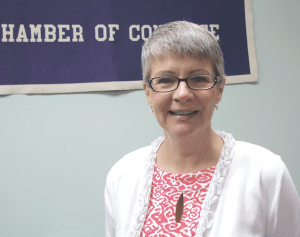
Kate Phelon

Kate Phelon says the Westfield Chamber is focused on finding ways to serve members across all business sectors, from manufacturers to nonprofits.

“Not all members have the same needs, nor do they all see the same value in their chamber,” she explained. “If you look at manufacturers, nonprofits, and very small businesses, those with three employees or fewer, they all see a different value. My manufacturing members will not get business coming to an after-5 event, but my nonprofits and small businesses love those events; it’s their bread and butter. Providing value to each one of these groups is a real challenge, but you have to meet it.”
Kathy Anderson, who segued from Holyoke City Hall, specifically the office of Planning and Economic Development, to the directorship of that city’s chamber 18 months ago, agreed.
She said the Holyoke Chamber has been aggressive in development of new programs, ranging from an ‘Ask a Chamber Expert’ initiative to an endeavor to spotlight the work of manufacturers based in the city, to something called SPARK (Stimulating Potential, Accessing Resource Knowledge), a venture aimed at “fanning the flame of entrepreneurship” (more on these efforts later).
They were all blueprinted, she said, to provide value-added services to different business groups, while also enabling the chamber to “keep changing and evolving, and providing something fresh and different.”
For this issue, BusinessWest takes an in-depth look at this changing face of chambers of commerce, and at what area organizations are doing to adjust to — and thrive in — this new environment.

Matters of Relevance
As he talked about the current climate for chambers and their leaders, Nascimento said there are both challenges and opportunities, and that the common denominator involving elements of each category is the term ‘relevance.’
He used it to describe what chambers must have at a time when they are smaller — at least in terms of membership — than they were years ago, but more is being asked from them, both in the community and from those members.
“Relevance is not a new term, but it is re-emerging within our industry,” he explained. “Is the programming relevant to our members? Is it adding value to our members? Is it providing value to our communities?”
Elaborating, he said that the chambers that are most effectively responding to the changing times are becoming involved in the many facets of economic development — from education to tourism to advocacy — and are becoming more focused on the communities they’re serving.
As examples, he noted his chamber’s work to support the fishing industry — it has helped create what’s known as a ‘seafood buyers mission,’ an event that last year recorded $12 million in sales — and also its work with other groups to revive the region’s convention and visitors bureau, thus bolstering another strong sector of its economy.
There are similar examples from across the state, he said, adding that proactive chambers are changing and getting more involved, again, out of necessity, to gain and retain members.
Indeed, the biggest challenge facing what Nascimento called the “chamber industry” is the same one confronting most all business sectors — ongoing consolidation.
“Our members are merging, they’re being bought out, they’re retiring, and all because of a number of factors — globalization, competition, and others,” he explained, noting that his chamber has seen membership drop from 1,200 to roughly 950 over the past decade or so. “The market out there for traditional members of a chamber are the stakeholders in the business community — your banks, your credit unions, insurance companies, printers, local media, hospitals — and all those industries are consolidating themselves.
“Since I’ve been here over the past seven years, we’ve seen several of our local community banks merge with other community banks that are members,” he went on. “And we’ve seen media merge; at one point, we had a daily newspaper in New Bedford, another daily in a neighboring community, a business publication, and a weekly newspaper in each of the towns. Now, there’s one company that owns them all.”
Similar developments have taken place within the insurance sector, where a number of smaller, family owned agencies have been merged into larger operations; the printing sector; and even office supplies, he said. “We used to have three or four office-supply companies in New Bedford, but they’re all gone — there’s one company, and it’s a regional company.”
This “shrinkage” within the marketplace, as he called it, has left chambers with little choice but to sharpen their focus on services to members and find new — or sometimes old — ways to be relevant.
Ciuffreda agreed, and said the ACCGS and the Springfield Chamber are responding to this challenge in many ways, but mostly a sharper focus on identifying needs and concerns among members — and in the community — and then addressing them.
“We’ve retooled a little bit,” he told BusinessWest, using a word he would come back to often. “When we look at the reasons why people join chambers, it’s clear that we’ve moved on from those days when it was the right thing to do. People are much more focused on services and what they can get out of being a member.”
And this goes beyond benefits such as programs that aggregate small businesses to provide savings on health insurance or discount pharmacy cards, he went on, adding that members are looking for more technical assistance, advocacy, and involvement in key issues.
He said the ACCGS, which has been “in and out” with regard to providing technical assistance to small businesses, will look to get back in if funding can be secured from the state and the private sector. Meanwhile, he said the organization is already more involved in such matters as education and closing the so-called skills gap that is impacting many sectors.
“We’re getting much more involved in education because we are hearing from businesses that want to expand that there is clearly a skills gap,” he noted. “We’re more involved with the school systems, the vocational schools, and the community colleges to try and close that gap.”

Getting Down to Business
The need to effectively identify member needs and tailor a roster of services to meet them is one of many motivating factors behind the ACCGS’s continued involvement in programs with marketing and business students at Western New England University, specifically those taught by marketing professor Janelle Goodnight.
She told BusinessWest that, on several occasions, her students have gathered research on the ACCGS, competing chambers in this region, and chambers in general, and then developed comprehensive marketing plans for consideration.
The latest of these plans will be ready by the end of the fall, she said, adding that, because the ACCGS is a client, she could not get into specifics about what will likely be in the document. But she did say that research conducted last spring revealed that many ACCGS members and prospective members did not fully understand the full range of services the chamber provides, and thus need an education through effective marketing.
Meanwhile, that research also revealed that the chamber’s membership is getting older — “members are aging out” was the phrase Goodnight used — and it is not as diverse, from a demographic standpoint, as the region it serves. Thus, moving forward, two obvious goals are to attract both younger business owners and minority business owners.
The need to more effectively serve members represents one of the many ways in which chambers are very much like the small businesses that dominate their membership roles, said Phelon. They are still coping with the lingering effects of the Great Recession, she noted, but also myriad other issues, ranging from the challenge of understanding and making effective use of technology to mastering the many nuances of social media, to simply finding ways to grow in an environment where it is difficult to do so.
“I have IT issues every day,” she said. “Things are changing constantly … should I get this piece of equipment? How am I going to swipe my credit cards? It’s very hard to keep up, and that’s just one challenge we’re facing.”
Some of the others give credence to Nascimento’s comments about each chamber being different. The Westfield Chamber, for example, serves 10 communities. Westfield and Southwick are home to most members, but the organization’s reach also extends to the small hilltowns (many with populations of 1,000 people or fewer) to the west.
Reaching out to the business owners in these communities, and then convincing them to take part in events and programs several miles down Route 20, can be difficult, she went on, but succeeding in those efforts not only helps the chamber, but it builds a stronger regional business community.
Phelon’s philosophy is summed up in the slogan she puts on the front of her membership packets: ‘The Power of Connectivity.’
She said it refers to the many ways in which the chamber can provide connections — from face-to-face networking events, which she still considers far more effective than social-media outlets, to simply providing information that can help a business owner solve a problem or seize an opportunity.
Phelon said the Westfield Chamber probably had between 400 and 450 members in the late ’80s, but is now roughly half that size, with about 215 at present. While it is not realistic to think the organization can again reach its high-water mark, she said there is certainly room for improvement, and it’s happening, thanks in large part to the hiring of a business development manager.
“Now, we’re actually growing,” she said, noting that, in recent years, new memberships have barely kept pace with the inevitable attrition chambers see each year. “And our ability to keep growing is related directly to our success with providing value to all our members.”

Value Proposition
As she talked about the many new initiatives at the Greater Holyoke Chamber, Anderson said they’ve been developed with several goals in mind. Providing more value to members is obviously one of them, she noted, but beyond that is a desire to help businesses with the challenges that are common to all of them — marketing, gaining new business, and saving money.
One of these concepts, called ‘Ask a Chamber Expert,’ has all these goals in mind.
Started last year, this series of workshops, as the title suggests, enables participants to ask a designated chamber member about some specific subject matter, which to date has included ‘How to Use Facebook to Promote Your Business,’ ‘How to Use LinkedIn as a Connecting Point,’ ‘How to Write a Business Plan,’ and even ‘How to Read a Blueprint,’ a requested program that was comparatively well-attended.
“I certainly learned a lot that day,” said Anderson, adding that the program brings benefits to both those asking the questions and those answering them.
“If I use my own members for these workshops and they become the expert in the room, this gets the people to network and know the businesses within our chamber organization,” she explained. “But it also gives low-cost [$10] advice to members, and if they want more help beyond that and want to hire that person to help them, they can do that.”
Meanwhile, another new initiative is aimed specifically at manufacturers, a constituency that, as Phelon noted, doesn’t directly benefit from many traditional chamber programs, such as after-5 events and breakfasts, where service-related businesses can more easily secure new customers.
The multi-faceted initiative is instead designed to build awareness of manufacturing facilities, said Anderson, noting that such exposure could help generate new business while also introducing young people to potential career opportunities.
“October was Manufacturing Month,” she said, pointing to a full slate of events and programs designed to celebrate and draw attention to that sector. “We had three different tours of manufacturing facilities, and they were open to the public because manufacturers want people to know what they do and what’s being made in the community.”
Another endeavor, in which the chamber will partner with the city’s Boys & Girls Club and, more specifically, with those involved in videography, will place three-to five-minute vignettes about Holyoke-area manufacturers on the chamber’s website.
“This is a value added for them, because they want people to know what they’re doing,” she explained, adding that businesses with specific needs may learn that a Holyoke business can make that part or product. “And down the road, we’re going to have a number of Baby Boomers retiring, and there are questions about who’s going to fill those positions. This program will allow these companies to show what kinds of great jobs there are in our manufacturing businesses.”
And then, there’s SPARK, which is designed to help people bring ideas to reality, said Anderson, by connecting individuals with resources and getting them the support they need. The program will offer mentoring, training, advising, tutoring, teaching opportunities, micro loans and below-market real-estate services, she noted, adding that the name was chosen in part to recognize those who have the ‘spark,’ or desire, to take their dreams to the next level, but need various forms of help to make them happen.
Like Phelon, Ciuffreda, and Nascimento, Anderson also mentioned efforts to partner with other chambers and various economic-development-related organizations to bring still more value to members and bolster the business community or specific sectors within it.
These efforts and the others chronicled above represent a response to the new landscape facing chambers, said Nascimento, adding quickly that the scene didn’t change overnight, and the necessary adjustments won’t come that quickly either.
“There are a lot of challenges for chambers,” he said in conclusion, “but there are also a lot of opportunities. This is an exciting time for chambers and our industry; we’re helping our members, and our communities, with many difficult challenges taking place out there.”

Joining the Fight
While Nascimento contends that if you’ve seen one chamber, you’ve seen just one chamber, these organizations are facing a number of common challenges in a climate seemingly far removed from the one that existed decades ago, when joining the chamber was simply the responsible thing to do.
Words like ‘value’ and ‘relevance’ were not recently added to the chamber industry’s lexicon, but they have certainly taken on new meaning — and importance.
And they will continue to be watchwords in the months and years to come.

George O’Brien can be reached at [email protected]

Community Profile Features
Culture, Education Boost Business in Williamstown

Carl and Marilyn Faulkner

Carl and Marilyn Faulkner have survived myriad setbacks in the tourism industry to remain a regional draw.

Carl Faulkner has never played professional baseball.
His name, however, is engraved inside a New York Yankees World Series ring on display in an antique curio cabinet in the great room of the Williams Inn, on the green in the heart of Williamstown.
Faulkner and his wife, Marilyn, have been the inn’s proprietors since 1979, and the ring is just one of many mementos that validate just how respected the the couple is by thousands of tourists who have visited the area, famous thespians who have performed in the Williamstown Theater Festival, and students and alumni of Williams College, located mere yards away.
“I’ve never been to a Yankee game, but for 30 years I knew George Steinbrenner because he used to come for his college reunion. He said he was fed up with Cooperstown and wanted the fans here to be able to see and touch a real ring,” Faulkner said, adding with a sly smile that he believes Steinbrenner added Faulkner’s name to the ring to deter him from selling it.
All who know Carl Faulkner know he would never do such a thing, but the dry humor and easy demeanor are among the many reasons he and Marilyn have attracted so many return guests, both celebs and regular folks, to this small town on Route 2, the famous Mohawk Trail.
Whether for a Williams College reunion or commencement, a play at the famous Williamstown Theater, a visit to the Sterling and Francine Clark Art Institute — known affectionately as ‘the Clark’ — or an exhibit at the Massachusetts Museum of Contemporary Art (MASS MoCA) in nearby North Adams, Williamstown isn’t easy to get to, but legions of alumni, and fans of culture and natural beauty, think the town and its unique attributes are well worth the trip.
In fact, those making the trek from the Mohawk Trail, or the Mass Pike and Route 7 from the south, can currently see economic development in progress on the Williams campus and at the Clark.
James Kolesar, vice president for public affairs at Williams College for the past 29 years, told BusinessWest that a new, three-story Sawyer Library, now under construction, will replace the original, soon-to-be-demolished library, located about 50 yards away, making way for a formal quadrangle. Throw in the massive, three-year, $50 million renovation and expansion project at the Clark, which should be complete by the end of 2014, and there is a firm foundation for economic growth in Williamstown.
“Our academic reputation is a draw, certainly, no question about it,” said Kolesar, noting that Williams stacks up well in stature with Harvard, Yale, Dartmouth, Brown, and archrival Amherst College. “With our 1,000 employees and operating expenditures of more than $190 million, that’s $82 million in capital improvements from us, plus the Clark improvements.”
Williamstown is not without its issues, however. The Great Recession affected businesses here much the same as in other Western Mass. communities, and when Hurricane Irene struck in 2011, a popular mobile-home park was essentially wiped out, further shrinking an already-low inventory of affordable housing.
Meanwhile, the aforementioned new economic development and ongoing roadwork — courtesy of the federal stimulus program — will be positive for the town in the long run, but Faulkner calls the disruptions they cause in the meantime “medicine that has to be swallowed” (more on this later).
But the biggest challenge this town of 7,870 residents (2,000 of whom are Williams College students) faces, according to Town Manager Peter Fohlin, isn’t what one would expect — it’s a lack of land. Specifically, “we don’t have enough developable land for me to respond to inquires I get.”
The issue, he said, isn’t due to infrastructure or the mountainous terrain surrounding the town, but the fact that a collection of successful farms, producing mostly cattle for beef and not available for sale, comprises much of the usable land.
For this month’s Community Profile, BusinessWest ventured to the most northwestern point of the Commonwealth to learn more about the business life of Williamstown and how the community, even with the logistical challenges of its far-flung location and lack of buildable land, is making the most of its educational, cultural, and natural advantages.

Cultural Values
Like Carl Faulkner, Fohlin has his own sense of humor. He proudly states that Williamstown isn’t that remote, but, rather, “centrally located four hours from everywhere.”
Fohlin’s ability to make fun of himself in his municipal position — in which, he says, he’s often dodging verbal bullets — is on display each year for the Fourth of July parade.
“Instead of Peter being in front waving, he’s at the back behind the horses with a shovel and a broom,” said Marilyn Faulkner, laughing. “That’s the kind of guy he is.”
That upbeat attitude will help as Fohlin, the five-member select board, and other departments in town seek to replace its outdated high school and police and fire stations, among other issues. While citizens are “engaged in lively debate over priorities and affordability” when it comes to municipal needs, he said, Williamstown has a lot on its plate for a small community.

James Kolesar

James Kolesar says Williams Colleges provides an excellent educational and cultural anchor for business in Williamstown.

Also on that plate is the fate of those who used to live in the Spruces, a 100-acre planned mobile-home community. Fohlin said the park was a “showcase” when it was built in the 1950s. “It had a ferris wheel, a fountain, and a groundbreaking government structure in which the people in the park voted their own officials and managed their own rules,” a predecessor of the now-common ownership associations in many residential communities.
But the swift floodwaters from Irene severely damaged 160 of its 225 mobile homes; almost 5% of Williamstown’s non-student population was made homeless in a day. Fohlin said the remaining homes will ultimately be moved because they are in a flood plain, and the housing authority is working on a 40- to 60-unit project for those living temporarily with family or friends.
Kolesar said the loss of the park damaged the town’s socioeconomic diversity, which is already lacking for a combination of reasons, among them fewer jobs for young people, which keeps them from returning after high school or college graduation, as well as increasing real-estate costs.
The town does boast a significant percentage of second homeowners, and some, Faulkner said, are faces that might not be familiar, but as CEOs of major corporations or notable alumni, their names certainly are. “It’s such a desirable place to live, and that drives the property values up,” added Kolesar.

Road Well Traveled
The guest ledger at the Williams Inn, especially from Clark visitors, has been truncated for the past three years due to the massive expansion project. The final phase includes construction of a new visitor, exhibition, and conference center, as well as a comprehensive landscape plan for the 140-acre property. During this period, the Stone Hill Center on campus is housing some of the more famous works, but several others have been loaned out to other galleries across the nation for the duration of construction.
“It makes me cry,” Carl said, feigning the wipe of a tear from his cheek. “We are usually busy for lunch, but it’s been much less so over the past couple years, and with this most recent two-week closure, we had almost no one.”
But the Faulkners are no strangers to setbacks; it’s just part of the tourism industry. Hoteliers all their lives in New England, they suffered through the 1970s gas shortage, and 9-11 slowed all tourism in the U.S., but the tightening of the American and Canadian borders by Homeland Security has caused problems with bus tours, he said. Canadian bus-tour companies now encourage Americans to fly to Canada, skipping American border-security checks and, as a result, bypassing the Berkshires region, Williamstown businesses, and the Williams Inn.
Amid the recent Great Recession, visitorship was also down, and then the federal stimulus to create jobs offered many towns funds to improve roadways, which tore up Main Street and the green in front of the inn for almost two years. When Irene’s rains took out the Spruces, the Mohawk Trail — the most scenic route into town — was also massively damaged.
But the innkeepers remain upbeat, replacing those missing customers with tourists from Europe and Australia, and are focusing on the region’s residents with seasonal events like the German Oktoberfest they recently staged for hundreds of attendees over a two-week period. Next up is a month and a half of holiday programming, which has always proven popular.

Good Company
Fohlin and Kolesar both say Williamstown’s selling points reflect the American Dream — a town that is safe, has an excellent educational system (the Mt. Greylock Regional School District), and little traffic in the real sense of the word.
Certainly, Williams College remains one of the main draws in town, and Kolesar sees the institution as the main anchor of business in the Williamstown area — economically, culturally, and socially.
Yes, prospective students who appreciate city life might see four years in this remote area of the Northern Berkshires as a deal breaker. “But, for some students, it’s a plus,” said Kolesar. “By and large, students who end up coming here end up falling in love with the area, not just the college.”
Faulkner agrees. “The college is like having a good uncle in town,” he added. “And we do have a strong feeling that better days are ahead.”

Elizabeth Taras can be reached at [email protected]

Opinion
Life in a Changed Casino Landscape

What a difference a year makes.
At just about this time last year, there were five proposals for a Western Mass. resort casino on the drawing board — or close to being there — in Springfield, West Springfield, and Palmer, and there was potential for another taking shape in Holyoke.
And all this attention to the western portion of the state was resulting from the perception that the stars — politically and otherwise — were aligned for a casino at Suffolk Downs in East Boston and that it seemingly made little sense to enter that fray.
Today, there is one Western Mass. casino plan still on the table after the voters in West Springfield and Palmer said no to the proposals for their communities, and the Springfield competition was whittled from three to one. Meanwhile, the voters of East Boston turned thumbs down to the Suffolk Downs plan, leaving those developers faced with a long-shot (that’s an industry term) bid to shift the site of the planned construction to 51 acres they own in neighboring Revere, where voters actually said ‘yes.’
Quite the turn of events.
So, what are we to make of all this? For starters, it’s quite evident that while the Legislature finally came around to the idea of commencing the casino era in Massachusetts, the voters, except those in a few isolated communities, including Springfield, have said, in essence, ‘fine, but not in my town.’
This sentiment was not surprising in West Springfield, where the casino planned for the Big E seemed a stretch, and the concerns about traffic were considerable. But the Palmer vote was a shocker, because this was a community that seemingly wanted a casino and, much like Springfield, lacked anything approaching a plan B when it comes to job creation and economic development.
All this means that the competition the Mass. Gaming Commission and its chairman, Stephen Crosby, were so desperate to create 18 months ago has all but dissolved, especially here, in the four counties of Western Mass.
And this has us somewhat worried, because while MGM, the lone casino developer still standing in Western Mass. and the owner of an apparently free ride to the coveted license for this region, is a responsible company that has done just about everything right so far in this contest, this region would certainly benefit from having that competition.
That’s because competition always makes a company better. That’s the case in every other business sector, and it is certainly so with gaming. Had the voters of Palmer said ‘yes,’ the commission would have had an intriguing matchup to decide, a classic urban-versus-surburban contest that would have given the decision makers quite a bit to think about.
It is now incumbent upon the Gaming Commission to create this competition artificially, for lack of a better term.
There may be only one casino proposal for Western Mass., but it must still be a first-class operation that works for Springfield and, to the greatest extent possible, for the many impacted communities as well.
We have endorsed the MGM proposal as the best of the options for Springfield, and we still have confidence that this operator can and will build a facility that will help — that’s help — revitalize the city and especially its South End, but without negatively impacting existing cultural attractions and businesses in the hospitality sector.
In this now radically changed casino landscape where competition here no longer exists, it’s up to the Gaming Commission to make sure that’s what happens.

Opinion
Can Springfield Learn from Cleveland?

By NANCY URBCHAT

Four years ago, I attended my first Initiative for a Competitive Inner City (ICIC) Conference in Washington, D.C. It was thrilling to spend two days in the company of some very smart people who have dedicated their professional lives to reinvigorating cities. I came away so moved and armed with verifiable facts that I felt compelled to advocate for a more vibrant small-business environment in my own city — Springfield.
This year’s conference, held in Cleveland, Ohio, held a special attraction for me. Having grown up in Northeastern Ohio, I was particularly interested in reconnecting with a city that had, by most accounts, befallen a fate typical of Rust Belt cities. I knew I had to make the investment and attend.
I was not disappointed. Day one featured panelists from Cleveland. One discussion focused around the integral role the Cleveland Foundation has played in Cleveland’s recovery. The foundation’s top priority is strengthening the urban core, and, to that end, it has made economic-development grants totaling $85 million since 2006.
The Cleveland Foundation is also a power broker, bringing Case Western Reserve and competitors University Hospital and the Cleveland Clinic to the table. Today, these powerhouse players are transforming public transportation, the economic vibrancy of the region’s small businesses, and the health and well-being of several distressed neighborhoods.
Collectively, they have made significant investment in the city’s rapid transit, known as the HealthLine. Its tagline, “It’s not a bus. It’s not a train. It’s the future” provides a sense of the project’s magnitude. Travel down Euclid Avenue — a once-distressed, 9.8-mile thoroughfare — and see urban transformation at its best. Billions of dollars in economic investment have happened thanks to the combined efforts of this public/private partnership, a visionary transit authority, a willing city government, and federal and state public transportation dollars.
Another topic was the importance of buying local and developing a standard definition of exactly what that means. Consider University Hospital. The organization has completely redefined and restructured its purchasing policies. Any project with a value of $20,000 or more must include bids from local companies. Many of the revised policies now make it feasible for small businesses to successfully compete on, and win, business.
Cleveland Clinic has launched ‘Meet the Neighbor’ events in some of the most distressed adjacent neighborhoods. A homeowner is recruited who serves as host for a neighborhood gathering. The clinic provides refreshments and a facilitator. Neighbors are often meeting one another for the first time. The facilitator engages neighbors in an exploration of neighborhood problems.
Together, they identify a pressing problem and roll up their sleeves to solve it. Sometimes it takes more than sweat to solve urban problems. Cleveland Clinic provides grants of up to $5,000 to assist these local problem solvers.
Upon my return to the City of Homes, I asked myself, “why not in Springfield?” My opinion is that economic-development initiatives have largely taken a back seat to the casino proposal. Certainly, an $800 million project is sure to get people’s attention, but my guess is the casino was never intended as a panacea and the be-all, end-all of economic development. Yet, that is what it appears to have become. For the record, Cleveland’s new casino was never mentioned once during the conference.
Vision and leadership were also in evidence in Cleveland. Mayor Frank Jackson and members of his economic-development team also appeared on the conference roster. Smart, capable, and committed people are working in concert with the partners I listed earlier. People working in silos don’t transform cities.
Finally, there’s an intangible at work. Let’s call it the love factor. People who participate in the ICIC love cities. In particular, they have a passion for their work and the well-being of their respective cities. They also happen to have positions of power and authority. Somehow they have come to the realization that transforming cities requires one’s self-interest to take a back seat to the greater good.
That may sound a bit ‘pie in the sky,’ but that seems to be what’s at work in Cleveland and Detroit. And I, for one, would love to see that happen in Springfield.

Nancy Urbchat is a principal with Springfield-based TSM Design.

Features
Bruce Stebbins Relishes His Role with the State’s Gaming Commission

StebbinsBruce Stebbins doesn’t remember the exact wording of the letter from the search firm that came roughly 20 months ago and would eventually prompt an abrupt career course change and thrust him into the middle of the casino era in Massachusetts.
But he remembers the gist, and the key sentence or two that certainly caught his eye.
“It talked about how the firm was trying to find an individual or individuals to serve on the Massachusetts Gaming Commission,” he said. “I don’t recall whether it said ‘from Western Massachusetts,’ but it did say, ‘if you know of anyone, or if you yourself might have any interest, feel free to give us a call.’
“So I called them back,” continued Stebbins, who, at the time, was serving as business development administrator in Springfield. “And while I was really happy doing what I was doing for the city, I inquired a little more about the position and what it involved. I didn’t have any friend or colleague or someone I knew who I was going to recommend, but I just wanted to find out more about it. By the end of the phone call with the recruiter I’d made up my mind to send him my resume.”
Fast-forward just a few weeks (things were moving quickly because deadlines for filling the panel were looming) and he was being interviewed by the governor, attorney general, and treasurer — the three officials who would collectively decide who won this slot on the board — and eventually prevailed. Jump ahead another 18 months, and he and the other four members are closing in on some of the most anticipated decisions in recent state history, choices that will change the landscape of cities and regions, both literally and figuratively, and alter the fortunes of countless individuals and businesses.
At present, the commission is neck deep in the process of deciding the winner of the contest for the one slots parlor that was made part of the gaming legislation passed nearly two years ago. Three proposals are being reviewed, and a decision is due early next year, said Stebbins.
Concurrently, the board is also advancing the process of determining who will win up to three licenses for resort casinos; there are competitions being played out in the three designated regions for such licenses — the Boston area, Western Mass., and Southeastern Mass.
And while a decision is not due on those licenses until early next spring, the commission is already having a huge impact on the proceedings.
Indeed, when a suitability assessment by commission investigators raised questions about Caesars Entertainment, a partner in the bid to put a casino at Suffolk Downs in East Boston, the industry giant abruptly withdrew — at the behest of its partner — throwing the Boston area competition into something approaching chaos as a Nov. 5 referendum vote on the proposal looms and the Suffolk Downs team scrambles to find a new partner.
The startling turn of events prompted the Boston Globe to praise the commission for setting the bar high when it comes to the standards that casino companies will have to meet in the Bay State. And it also inspired Caesar’s President Gary Loveman to opine that the bar has been set too high.
“It’s going to be very difficult for sophisticated multi-jurisdictional operators to tolerate the environment this commission has created,” he told the press.
MGM

Mass. casino

Deciding the winner of the contest for the Western Mass. casino license — likely to be between MGM Springfield, left, and Mohegan Sun Massachusetts — will be one of many challenging assignments facing Stebbins and the other gaming commission members.

Deciding the winner of the contest for the Western Mass. casino license — likely to be between MGM Springfield, top, and Mohegan Sun Massachusetts — will be one of many challenging assignments facing Stebbins and the other gaming commission members.
[/caption]When queried about the Suffolk Downs development and, in general, the height of that aforementioned bar, Stebbins, obviously choosing words carefully and sounding a lot like Bill Belichick at one of his press conferences, said, “this is what the statute was intended to do; we need to be as thorough as possible, and our investigators have to be diligent and follow up every lead. We want to impress upon people that we want operators who have great business practices to be the ones operating casinos in Massachusetts.”
And when asked if he and his fellow commission members are feeling the pressure that will certainly accompany the decisions to come, Stebbins smiled broadly, implied that ‘pressure’ was probably too strong a word, but nonetheless verified the enormity of the moment.
“All five of us acknowledge that because there’s a limited number of licenses, we understand that we have one shot to get this done right,” he said. “We’re also buffeted by the fact that over half the states in the U.S. have done this before and there is a great working relationship with other jurisdictions.”
For this issue, BusinessWest talked at length with Stebbins about everything from his experiences on the commission to date to the factors he believes will ultimately decide how the casino licenses are awarded, including the one for the Western Mass. region.

Playing His Cards Right

Stebbins isn’t the official Western Mass. representative on the gaming commission, but that’s how he’s generally regarded.
He’s the only member from this part of the state, and he acknowledges that a desire on the part of those assembling the panel to create geographic diversity probably aided his cause. As did a quest for political diversity — Stebbins is a Republican, and one of the stipulations for this commission, he said, was that there not be more than two members for any one political party. (He assumes there are two Democrats and two Republicans, but isn’t sure of the affiliation of the fifth member; “we don’t wear our politics on our sleeves.”)
And he believes his work history, which includes a number of roles in business and economic development, might have turned some heads.
Indeed, Stebbins’ resume includes everything from a stint in the White House — as associate director of Political Affairs while George Bush the elder was in office — to two terms as a Springfield city councilor; from a short run as director of the Mass. Office of Business Development to a decade-long tenure as senior regional manager of the National Association of Manufacturers.
He said the experience gained at these various stops has certainly helped him with his current workload, but that his time with the gaming commission has also helped him grow professionally and sharpen existing skills sets.
“I think there are certainly skills and experiences I’m having that will help round me out as a professional and as an executive,” said Stebbins, who repeatedly compared his work on the commission — and its role in bringing the gaming industry to Massachusetts — to getting a startup business off the ground.
“I was intrigued by two things,” he said, when recalling what prompted this latest line on his resume. “Part of it was setting something up from the ground floor, albeit a government, regulatory agency. Taking something and building it from a piece of legislation — I thought that was a unique opportunity considering my years in public service. I’d never really had the opportunity to do that before; it was enticing.
“It’s not completely akin to a small business, because we came with an operating budget already in hand from the Legislature,” he continued, “but similar to a small company, we were building a way to do business, recruiting and building a team, and coming up with a mission statement, just like any business does, while at the same time learning about a business that was completely new to Massachusetts.
“The other intriguing part of this was the economic aspect,” he went on. “We’re introducing a whole new industry to Massachusetts and really focusing on the priorities of the statute, which are the job creation piece in difficult economic times, and the impact on tourism and small business — this was right up my alley when it came to my background and experiences.”
He said he took on the assignment expecting that there would be large amounts of travel and reading, and there have been both; he commutes to Boston four days a week, spending Friday in Western Mass., and the three slot parlor applications alone account for roughly 20,000 pages of material, although he acknowledged quickly that he doesn’t have to consume all of that.
Beyond that, he anticipated that it would be a learning experience on a number of levels, and it has been that as well.
When asked to elaborate on what he has learned, Stebbins listed everything from insight into just how competitive the gaming industry is, to lessons learned from the experiences of other jurisdictions, such as Atlantic City.
“New Jersey felt that by introducing casino gaming in an effort to revive Atlantic City there would instantly be jobs and opportunities for all the people living in that city,” he noted. “But the casinos came in, the people living in Atlantic City didn’t have the skills and the basic training assistance, and they missed out on the job opportunities that were created, and that’s why Atlantic City languished and some would say it continues to languish. It missed out on some opportunities.”

Odds and Ends

When asked if the decisions regarding the casino licenses were matters of objective or subjective analysis, Stebbins said there is certainly far more of the former, but there is certainly some of the latter.
Elaborating, he noted that proposals will be weighed in five categories — financial, building and site design, mitigation, economic development, and something he called ‘general overview of the project,’ and then described as the “wow factor.”
It is in that last category where there is some subjectivity, he told BusinessWest, adding that with the other four, analysis generally comes down to hard numbers, and lots of them.
“A good percentage of the information is very objective — ‘tell us the number of people you’re hiring,’ ‘show us the plans you intend to work with,’ ‘what’s your debt-to-equity ratio?,’ ‘what are your plans for implementing LEED gold design into your building?, ‘what are your plans for mitigating the impact on the lottery?,’” he explained, noting that for each of the five categories he mentioned applicants are given one of four ratings.
These are ‘insufficient,’ ‘sufficient,’ ‘exceeds expectations,’ and ‘outstanding,’ he went on, adding these ratings, as well as the answers to the 230 questions applicants must answer will be discussed in a public meeting before votes are taken on the specific licenses, including the one for what’s known as Region 2, Western Massachusetts.
When asked what may decide that competition, which will likely be an urban versus suburban matchup featuring MGM Springfield and Mohegan Sun Massachusetts in Palmer (a vote on the host-community agreement in that latter community is set for Nov. 5), Stebbins said it, like the others, will be determined by the tenets of the legislation — and perhaps by that ‘wow factor.’
“The purpose of the statute was to generate revenue for the Commonwealth and create jobs,” he explained. “A lot of the evaluation questions address the other requirements that were put in the statute.
“The general overview portion of this, the ‘wow factor,’ might well be more of a subjective answer,” he continued. “But backing all this up is that we want to know what these players’ track records are in other jurisdictions; have they met their promises? Have they done what they said they were going to do? How have those other facilities operated?”
Meanwhile, the commission will attempt to emulate the best practices of other jurisdictions and learn from what has gone right — and wrong — in other states, he went on.
“We’re all happy to share information and regulations,” he said of those other states. “They’ve been great to talk to; they’re candid and honest — they’ll say ‘we tried to do it this way and didn’t really work out that well. There are great opportunities to build on the best practices of other jurisdictions.”
While the pending decisions on the licenses are certainly the most pressing item facing the commission, its work certainly won’t end there, he told BusinessWest, adding there will be considerable regulatory work to finish, issues with the licensing process, and monitoring the progress of those companies who win the regional competitions.
“It shifts into a regulatory and oversight function,”he said, “but there will be a lot of important work to do.”

The Bottom Line
Stebbins said he’s just over half-way through a term that will last three years. It is possible that he will be awarded another, longer term and perhaps even two (commissioners can serve up to 10 years), but he acknowledged that there will be different people serving as governor and attorney general by then, and they may have some other ideas.
At the moment though, he isn’t focused on the future, but rather the present, and his large role in something that could only be described as historic.
Looking back on that letter from the recruiter that started him down this road, he said that what appealed to him initially — a chance to bring a new industry into Massachusetts and be part of a huge economic development initiative — continues to fuel his imagination today.
If his career gambit was a roll of the dice, he believes he’s thrown a 7.

George O’Brien can be reached at [email protected]

Chamber Corners Departments

AFFILIATED CHAMBERS OF COMMERCE OF GREATER SPRINGFIELD
www.myonlinechamber.com
(413) 787-1555
• Nov. 6: Business@Breakfast, 7:30- 9 a.m., at the Western Mass Business Expo, MassMutual Center, Springfield. Keynote speaker: Jim Koch, founder of the Boston Beer Co. and maker of the Samuel Adams family of beers. Hear the story of how Koch took his generations-old family recipe and changed the beverage landscape forever. Sponsored by the Regional Employment Board of Hampden County, MassMutual Center, United Personnel, and Frigo’s Foods. Reservations are $25 and may be made online at www.myonlinechamber.com or by contacting Cecile Larose at (413) 755-1313.
• Nov. 13: ACCGS After 5, 5-7 p.m., the TD Bank Building. Sponsored by TD Bank. Tickets are $5 for members, $10 for general admission. Reservations may be made online at www.myonlinechamber.com or by contacting Cecile Larose at (413) 755-1313.
• Nov. 21: ACCGS Government Reception, 5-7 p.m. at the Carriage House, Storrowton Tavern, West Springfield. A great opportunity to meet socially with your local, state, and federal officials. Sponsored by Baystate Health, Columbia Gas of Massachusetts, and United Personnel. Tickets are $50 for members, $70 for general admission, which includes complimentary beverages and hors d’oeuvres. Reservations may be made online at www.myonlinechamber.com.
• Nov. 26: ACCGS Pastries, Politics, and Policy, 7:30-9 a.m. Reservations are $15 for members, $20 for general admission, and includes complimentary beverages and hors d’oeuvres. Call (413) 755-1313 for more information. Reservations may be made online at www.myonlinechamber.com.
• Dec. 4: ACCGS Business @ Breakfast, 7:15-9 a.m., at the Colony Club, Springfield. Topic: “The Value of Volunteerism.” Sponsored By Masiello Employment Services. Tickets are $20 for members, $30 for general admission, which includes complimentary beverages and hors d’oeuvres. Reservations may be made online at www.myonlinechamber.com.

AMHERST AREA CHAMBER OF COMMERCE
www.amherstarea.com
(413) 253-0700
• Nov. 20: Chamber After 5, 5-7 p.m., at the Amherst Survival Center. Sponsored by SciDose LLC. Admission: $10 for members, $15 for non-members.

GREATER NORTHAMPTON CHAMBER OF COMMERCE
www.explorenorthampton.com
(413) 584-1900
• Nov. 6: Arrive@5 Chamber Networking Event, 5-7 p.m., at the World War II Club. Sponsors: Homeward Vets. Catered by Big Kats Catering. We’ll be collecting donations for Homeward Vets. A list of needed donations will be posted on the website. Tickets are $10 for members, $15 for non-members. RSVP to Esther at [email protected].
• Nov: 19: “The Art of Consulting,” 8:30-10 a.m. at the chamber office. This special program is a collection of the guiding principles of consulting that sum up the lessons presenter Don Lesser he has learned over the past 30 years. Each topic is summarized in a short, often humorous saying, which is followed by a longer explanation. In this session, Lesser, who has been a consultant and run a business that uses consultants for more than 30 years, will cover some of the basics of being a consultant, including “The Three Laws of Consulting,” “What Have You Done for Me Lately?” “Rules for Good Client Management,” and “Discount Sushi, or How Much Should You Charge?” The workshop is free, but pre-registration is required, and space is limited. To register, call (413) 584-1900, or e-mail www.explorenorthampton.com.

GREATER WESTFIELD CHAMBER OF COMMERCE
www.westfieldbiz.org
(413) 568-1618
• Nov. 4: Mayor’s Coffee Hour, 8-9 a.m., at the Genesis Spiritual Life and Conference Center, 53 Mill St., Westfield. Have coffee with Mayor Daniel Knapik, who will share information about what’s happening in the city. For more information or to register, contact Pam Bussell at the chamber office at (413) 568-1618.
• Nov. 6: 2013 Annual Meeting & Awards Dinner at the Westwood Restaurant, 94 North Elm St., Westfield. More information to come as this event date approaches.
• Nov. 13: WestNet, 5-7 p.m., the Cove, 90 Point Grove Road, Southwick. Come and meet chamber members and bring your business cards for a great networking opportunity. Cost: $10 cash for chamber members, $15 cash for non-members. Payment can be made in advance or at the door.  Walk-ins are welcome. Call the chamber at (413) 568-1618, or e-mail Pam Bussell at [email protected] for more information. Your first WestNet is always free.

MASSACHUSETTS CHAMBER OF COMMERCE
(413) 525-2506
• Nov. 12: Massachusetts Chamber of Commerce Annual Meeting & Awards Luncheon, 9 a.m. registration, at the Double Tree, Westborough. For more information on ticket sales and sponsorship opportunities, call the chamber office at (413) 525-2506 or e-mail [email protected].

NORTHAMPTON AREA YOUNG PROFESSIONAL SOCIETY
www.thenayp.com
(413) 584-1900
• Nov. 14: November Networking Social, 5 p.m., at the Northampton Brewery. Community involvement, networking, business and professional development. NAYP is excited to host its first event at the famed Northampton Brewery. Enjoy delicious beer and savory hors d’oeuvres. Cost: free for members, $10 for non-members. RSVP on Facebook.

PROFESSIONAL WOMEN’S CHAMBER

www.professionalwomenschamber.com
(413) 755-1310
• Nov. 6: November Luncheon at the Western Mass. Business Expo, at the MassMutual Center, 11:30 a.m.-1 p.m. Keynote Speaker: Kathrine Switzer, first female Boston Marathoner in 1967. More than 40 years later, Switzer’s story continues to capture the public’s imagination. Reservations cost $35 members, $40 for non-members, and may be made at www.myonlinechamber.com or by contacting Cecile Larose at (413) 755-1313.

Agenda Departments

Western Mass. Business Expo 2013
Nov. 6: Get ready for the Western Mass. Business Expo 2013, a day-long business-to-business event to take place at the MassMutual Center in downtown Springfield. This fall’s show, the third edition of the Expo, which is again being produced by BusinessWest, will feature more than 100 exhibitors, seminars on timely issues of the day, special Show Floor Theater presentations, breakfast and lunch programs, and the wrap-up Expo social, which has become a not-to-be-missed networking event. The breakfast speaker will be Jim Koch, founder of Samuel Adams, while the lunch speaker will be author, activist, and marathon runner Kathrine Switzer. This issue of BusinessWest contains all you need to know about event details, which can also be found online at www.wmbexpo.com or www.businesswest.com. For more information on the event, call (413) 781-8600, ext. 100.

Civil War Lecture

Nov. 9: Civil War historian Walter Powell will deliver a free talk titled “So Clear of Victory: Emily Dickinson’s Gettysburg Address” at the Amherst History Museum at 3 p.m. The talk, co-sponsored by the Emily Dickinson Museum and the Amherst History Museum, will highlight contributions made by Amherst and the region to the Battle of Gettysburg and President Lincoln’s delivery of the Gettysburg Address during the dedication of the Soldiers’ National Cemetery on Nov. 19, 1863. A special focus will be on Emily Dickinson’s circle of friends and acquaintances involved in the battle, including Samuel Fiske and Springfield Republican publisher and editor Samuel Bowles. Powell has lectured widely on battlefield preservation and the Battle of Gettysburg, and is the editor (with the late Charles Hamblen) of Connecticut Yankees at Gettysburg. Powell was recently named executive director of the General Society of Mayflower Descendants, and previously served as executive director of the Conococheague Institute of Cultural Heritage in Mercersburg, Pa. For 17 years, he was director of Planning and Historic Preservation for the Borough of Gettysburg. There, he directed the restoration of the Gettysburg Railroad Station (built in 1858), and served as the project historian and borough liaison to the National Park Service Project Team that planned the restoration and exhibit plan for the David Wills House, where Lincoln completed the Gettysburg Address. He is also a past board member of the Emily Dickinson International Society.  The Amherst History Museum is located at 67 Amity St. in Amherst. For more information about the talk, visit www.emilydickinsonmuseum.org/events.

Pynchon Awards
Nov. 21: The Trustees of the Order of William Pynchon and the Advertising Club of Western Mass. will honor the recipients of the 2013 William Pynchon Award — Jean Caldwell, Jean Gailun, Joan Kagan, and Sirdeaner Walker — at Chez Josef in Agawam. The Order of William Pynchon was established in 1915 for the purpose of giving public recognition to citizens of the region who have rendered distinguished civic service, a noble legacy and honor the Ad Club is proud to bestow. Cocktails will be served from 6 p.m., with dinner and the awards program beginning at 7 p.m. The cost is $70 per person, and tables of 10 are available. RSVP by Nov. 14 by calling (413) 736-2582 or e-mailing [email protected], including any special dietary considerations and a listing of table guests who wish to be seated together (for parties of 10).b

Departments Incorporations

The following business incorporations were recorded in Hampden, Hampshire, and Franklin counties and are the latest available. They are listed by community.

AGAWAM

Local Yo Inc., 103 Lealand Ave., Agawam, MA 01001. Anthony Surrette, same. Sales of frozen yogurt, desserts, and beverages.

AMHERST

Vision Hope USA Inc., 177 Henry St., Amherst, MA 01002. Andrea Crenshaw, 17152 SW Villa Road, Sherwood, OR 97140. Provide international relief and development aid and support to people in need in developing countries.

CHICOPEE

Ministerio Adoradora En Espiritu Y En Verda, 60 Alvord Ave., Chicopee, MA 01020. Norma Rodriguez, same. To get involved with different churches to expand my ministry.

EASTHAMPTON

Muttersohn Enterprises Corp., 103 Oliver St., Easthampton, MA 01027. Laura Singleton, same. Provide services as a non-profit entity for future endeavors.

FEEDING HILLS

B4 Race & Event Management Inc., 193 Coyote Circle, Feeding Hills, MA 01030. Wayne Robert Ball, same. Organize and host local events and road races.

HOLYOKE

J. Savage Inc., 4 Open Square Way, Suite 215, Holyoke, MA 01040. Jay Savage, 589 Pleasant St., Holyoke, MA 01040. Women’s apparel and accessories.

NORTHAMPTON

Hygeniks Inc., 74 Bridge St., Northampton, MA 01060. Todd Marchefka, same. Supply and distribute equipment, services, and systems for the biotech and pharmaceutical industries.

Integral Builders Inc., 225 Nonotuck St., Northampton, MA 01062. James Harrity, same. Real estate.

PITTSFIELD

Grant Technology Corporation, 2 South St., Suite 340, Pittsfield, MA 01201. Michael McCool, 266 Allengate Ave., Pittsfield, MA 01201. Consulting, patents, technology innovation.

King City Forwarding USA Inc., 216 Fort Hill Ave., Pittsfield, MA 01201. Michael Hilburn, same. Freight forwarding.

Lambda Prime Corp., 777 West St., 4th Floor, Pittsfield, MA 01201. Matthew Stack, same. Software and hardware development.

SOUTH HADLEY

Akamnonu Associates Inc., 11 Pittroff Ave., South Hadley, MA 01075. Oliver Akamnonu, same. Produce and market unique literature.

SPRINGFIELD

Harmonia Celestial Corp., 156 Florence St., Springfield, MA 01103. Julio Edwards, same. Church

M.L. Schmitt Leasing Inc., 371 Taylor St., Springfield, MA 01105. Thomas Schmitt, same. Equipment leasing company.

MLS Management Inc., 371 Taylor St., Springfield, MA 01105. Thomas Schmitt, same. Management company.

Pet Care Assist Inc., 23 Spruceland Ave., Springfield, MA 01108. Henry Lingley, same. Financial assistance to pet owners to provide urgent medical attention for their pets.

Springfield Pulse Inc., 11 Pearl St., Suite 234, Springfield, MA 01118. Phoebe Stewart, 64 East St., Chesterfield, MA 01096. Free resource providing accessible space for artistic expression.

WEST SPRINGFIELD

No Casino West Springfield Inc., 1127 Amostown Road, West Springfield, MA 01089. Nathan Bech, 84 Summit St., West Springfield, MA 01089. Educate and increase public awareness of the adverse health and social costs of gambling and associated detriments to the greater West Springfield community of any such casino.

WESTFIELD

Dhanlaxmiji Corp., 358 Southwick Road, Westfield, MA 01085. Dhruval Amin, 419 Southwick Road, L53, Westfield, MA 01085. Grocery and variety store.

WILBRAHAM

Baystate Holistic Health Inc., 16 Iroguois Lane, Wilbraham, MA 01095. Manuel Esteves, same. Holistic health services.

Sections Women in Businesss
How Anne Paradis Put a Charge into MicroTek

Anne Paradis

Anne Paradis

When Anne Paradis took the helm at MicroTek in 1987 — thus making an abrupt and significant career change, moving from human-services work to running a nonprofit manufacturing outfit — she ventured back to some of the exercises from her MBA program at UMass Amherst for help with the transition.
What she found is that what’s written in a book doesn’t usually — or easily — translate into what one will find on the shop floor.
“I had taken manufacturing courses as part of my MBA program, but it was nothing like what I encountered here,” she explained. “You learn how to schedule machine hours and go through all the production planning, and I can remember thinking at the time, ‘I can do this.’ But quite honestly, when I got in here and tried to apply those principles, it was very, very different, because you couldn’t plan productivity at a set level, and machine hours weren’t constant, and…”
Her voice trailed off as if there was much more, which there was. And she learned just about all of it, she said, by doing.
“I learned how to do every job in the place except soldering, which to this day I can’t do,” she said, adding that there are many roles at this company that produces cables and wire harnessing and touts its team members as ‘interconnect specialists.’ “I learned on the job. All the product knowledge and assembly knowledge I got, I learned from people who were working for the company.
“I sat and assembled cables with people,” she went on. “I asked questions; I made mistakes. In those days, it was all hands on deck, and if something had to go out the door and we needed another pair of hands, I would sit at the workbench and help to finish the job. The employees got a kick out of watching me join the production lines — and they still do.”
Such occurrences are rare, though, because Paradis spends most of her time now on the broad subject of growing revenue, an assignment that has many subplots, including everything from withstanding ever-increasing competition, foreign and domestic, to weathering three recessions, to building a new plant in Chicopee’s Westover Airpark West more than a dozen years ago.
She’s obviously fared well in her career transition, taking the company from roughly $750,000 in sales when she started to nearly $8 million, and from maybe 20 employees to more than 120, and placement on such lists as the Boston Business Journal’s ‘Top 100 Women-led Companies,’ Mass High Tech’s ‘New England’s 30 Largest Women-owned Tech Companies,’ and, most recently, BusinessWest’s compilation of the region’s largest manufacturers.
Meanwhile, she has continued and greatly enhanced the company’s standing as a leader in the hiring of individuals with developmental disabilities — with roughly 15% of its workforce falling into that category. This was the original mission of the company when it was created 30 years ago, she said, adding that, while MicroTek has evolved from a service program into a strategic business, its focus on providing employment opportunities for the developmentally disabled is one, but not the only, example of why the phrase ‘making connections’ refers to much more than the company’s product lines.
And her success with the many aspects of that phrase makes Paradis an intriguing subject for a new series in BusinessWest that will focus on women in business.
In the coming months, the magazine will profile individuals in a number of sectors to gain an appreciation for how far women have come in business and the specific fields that comprise it, but also for the work that remains to be done.
We start with a woman who still can’t solder — she said there are enough skilled craftspeople at the company to keep from even wanting to try — but has mastered many of the aspects of operating a business in today’s ultra-challenging climate, especially the most important: people.

Wired for Growth
As she gave BusinessWest a tour of the 24,000-square-foot MicroTek plant on Justin Drive, Paradis stopped at a number of the workstations where she learned this business and its specific products more than 25 years ago.
She explained the processes involved with specific parts, offered high praise for the workforce, and ended with some pointed commentary.
“This is a good example of how manufacturing is still a big part of our economy in Western Mass.,” she said. “People say this sector is in decline, and maybe it’s not what it once was, but what we’re doing here shows that manufacturing is very much alive and well.”
How Paradis came to be in a position to give such a tour, speak as one of the prominent voices in the region’s manufacturing realm, and lead her company to placement on those aforementioned business-magazine lists of the largest women-owned businesses is an intriguing story, one with elements of timing and circumstance, but also perseverance and entrepreneurial spirit.
It begins with Paradis’ decision to major in psychology and gravitate toward work in human services, specifically with the state Department of Mental Retardation, now known as the state Department of Developmental Disabilities.
She eventually took a job working in the development of community residential programs for adults with developmental disabilities in the wake of the closing of Northampton State Hospital, Belchertown State School, and other facilities. Specifically, she said she was involved with a pioneering concept that would enable individuals to remain in their residences on a permanent basis, rather than transition into different facilities as they gained more independence and their need for services and support diminished, which was the accepted model at the time.
“This was 30 to 35 years ago, and in those days, the community movement for people with disabilities was still in its infancy,” she explained. “And one of my first jobs was to help push the agenda of these more progressive program types.
However, he would soon become frustrated with the lack of progress with this movement, and especially with the funding restraints that soon emerged, and decided to make what would be her first career course change, pursue her MBA at UMass, and move into what she called the “business arena.”
Her first stop was at New England Business Associates in Holyoke, a management-consulting firm that assisted small businesses with the hiring of those with disabilities. One of her eventual clients was Microtek, which was created in the early 80s by human-services advocates working in conjunction with the University of Oregon, which was at the time researching models for employing people with disabilities. One of those models was to start a company where one controls the environment, provides the training, and brings in the work. In this case, the work — developed through a connection between one of the researchers at the University of Oregon and Hewlett Packard — was assembly of cables and wire harnesses.
When Paradis first started working for MicroTek, it was one of four operations — there was another in Orange, Mass. and two more in Virginia — for which she helped develop a marketing cooperative designed to generate new business and enable the participating companies to grow and eventually add more employees to the payroll.
While the other three ventures enjoyed success in this endeavor, MicroTek suffered from what Paradis called “poor management.” The company’s board eventually asked her to step in and run the company for a short time while a search for a new CEO was carried out.
That ‘short time’ has turned out to be 26 years — and counting.
“I came in to find problems a bit more complicated than the board realized,” she told BusinessWest. “I took a year’s leave of absence to run the company, and at the end of that year they made me an offer to stay.”
She accepted that challenge knowing that she had overcame what she described as a “lack of skills in certain areas.” Elaborating, she said her biggest challenges were learning manufacturing in general, and MicroTek’s line of products (custom wire harnesses and cable assemblies) in particular.
“I did not have an engineering background, and that made it challenging,” she noted. “But I was fortunate, because at the time, MicroTek was a very small company, and that afforded me the opportunity to learn on the job.
“I had a lot of strengths — managing staff, putting systems in place, and organizational development, because my undergraduate degree was in psychology — but I needed to learn this business,” she went on, adding that she completed much of this learning while serving as interim CEO, progress that gave her the confidence to accept the board’s offer and stay on.

People Power

Over the past 26 years, Paradis has coped not only with the everyday challenges facing all business and managers —  everything from cash flow to inventory control to finding qualified workers — but also more global matters, such as mounting competitors, especially from overseas operations, new-product development, and the worst economic downturn since the 1930s.
She described it all as a continuation that learning experience that began when she became interim CEO, one that is clearly still ongoing.
Indeed, while the plaques on the wall containing those business-magazine lists show that the company has clearly come a long way, there are some new challenges to face — and some old ones as well.
At or near the top of that list is mounting competition. While there have historically been some barriers to taking this kind of manufacturing overseas — including the high quality of work demanded and transportation costs — they have been coming down in recent years, said Paradis, noting that the company is facing intense competition from China, Mexico, and other countries.
It has responded by working to automate more processes in what is still a labor-intensive business, while also diversifying into some new product lines, specifically control panels built for customers in the security and medical fields.
The company, which suffered, as all manufacturers did, during the Great Recession, has rebounded, and growth has been steady over the past several years, said Paradis, adding that she has set an aggressive, but realistic, goal of reaching $12 million in sales over the next few years.
But the term ‘success’ has many meanings at MicroTek, she went on, adding that, while the bottom line is perhaps the most important, the company’s original mission is still an important barometer when it comes to that word.
And in this realm, more goes into this equation than simply hiring the developmentally disabled, she went on, adding that the company’s broader goal is to integrate such individuals, treat them as they would any employee, and make them part of highly successful and efficient teams.
One of the reasons for the company’s success has been its ability to do this by effectively giving these employees both the support and the tools they need to succeed, she told BusinessWest, adding that this is a philosophy that permeates the company and all aspects of its workforce.
“Everyone has the same benefits and the same access to company services, and people work on some part of all of the work that goes out of here,” she explained. “We have integrated teams, and the idea of partnering people with co-workers and providing them with the support they need extends well beyond the employees with disabilities, because we also employ a number of people who speak English as a second language and may have difficulty reading English.
“The transformation for the company over the years has been in this area,” she went on. “There were special supports and training that we started out using for the individuals with disabilities, and over the years, we’ve just adopted those as standard operating procedure for the company.”

Current Events
Paradis says that, while she’s quite proud of the plaques in the front lobby and what they represent in terms of both the company’s success and her standing as a woman in business, she’s more proud of the many ways in which MicroTek has become a role model.
Its success in the current, highly competitive environment provides evidence that manufacturing is still very much alive in the Bay State and this region. Meanwhile, its success with hiring, training, and integrating individuals with a wide range of challenges shows that ‘diversity’ can be much more than a buzzword.
These are among the many accomplishments for Paradis, who still can’t solder, but has developed a rare talent for making connections — and in a number of very important ways.

George O’Brien can be reached at [email protected]

Community Profile Features
Tourism, Nostalgia Help Stockbridge Thrive

Michele Kotek, right, and Stephanie Gravalese-Wood

Michele Kotek, right, and Stephanie Gravalese-Wood say Stockbridge brings tradition and nostalgia to life, but looks to the future as well.

It’s been called the most famous Main Street in America.
And there is little disputing that Stockbridge’s main thoroughfare has earned that distinction. It was cinched in the years and decades after the town’s most famous resident, Norman Rockwell, made it famous in his “Stockbridge Main Street at Christmas” painting, created in 1967.
“If people want to experience that classic New England Christmas, then Stockbridge is the place to do it,” said Stephanie Gravalese-Wood, marketing and communications manager for both the Red Lion Inn and the Porches Inn at MassMoCA in North Adams.
Indeed, that classic experience comes to life annually in a weekend event that takes the same name as the Rockwell painting and celebrates both the artist and the holidays through various family-friendly activities. This year’s 24th edition of the event, slated for Dec. 6-8, will include holiday readings, festive home tours, caroling, a luminaria walk, and the sold-out holiday concert at the First Congregational Church. All events lead to the weekend highlight: the closing of Main Street to recreate Rockwell’s scene, complete with 50 antique cars.
Michele Kotek, innkeeper for the Red Lion Inn, has also been involved with the Stockbridge Chamber of Commerce for the past several years; currently she is president of the board. She told BusinessWest that the annual event was launched to help invigorate the holiday season in Stockbridge, and the success is evident, especially for the Red Lion, which is sold out for that weekend a year in advance.
“We [the chamber] have obviously perfected the event, and if you are at all ‘bah, humbug,’ come to Stockbridge and see,” said Kotek, adding that, while the community isn’t shy about celebrating its past, this is definitely not a town where time stands still.
Indeed, the community — as well as those charged with promoting it — are in some ways changing with the times, said Barbara Zanetti, long-time director of the Stockbridge Chamber of Commerce, noting that everything from a recently updated chamber website to mobile apps are being used by the chamber and specific venues to make a number of audiences, and especially the younger generations, aware of all that Stockbridge offers.
Jeremy Clowe

Jeremy Clowe says myriad creative initiatives have helped put the Norman Rockwell Museum — and the town — on the map.

However, ever-advancing technology brings challenges along with opportunities. And one of those challenges is cell-phone coverage and GPS identity, said Town Administrator Jorja-Ann Marsden, noting that dead zones are common and GPS searches for many Stockbridge addresses lead to the wrong locations (more on this later).
But despite these difficulties, people are finding Stockbridge, in both a literal and figurative sense, said Jeremy Clowe, manager of Media Services for the Norman Rockwell Museum, where that famous painting of Main Street hangs, along with hundreds of others.
“People want to experience American history and values, and even the name ‘Norman Rockwell’ has become an adjective, as in ‘a Norman Rockwell moment,’” he said, noting that the artist’s work — and the town in general — resonates with younger audiences, and with people from across the country and around the world. “That’s what a lot of people are looking for when they come here.”
For this latest installment of its Community Profile series, BusinessWest turns the spotlight on Stockbridge, where tourism is the main economic driver, and nostalgia has long been the main ingredient in a recipe for success.

Culture Club
Zanetti said that, while most everyone knows that the official address for Tanglewood, the summer home of the Boston Symphony Orchestra since 1937, carries a Lenox zip code, far fewer know that perhaps 90% of the property is in Stockbridge.
And she and others in the community are not shy about reminding people of that.
“In some of the advertisements for Tanglewood, they’re now saying ‘between Stockbridge and Lenox,’ but we do like to get our name in there for sure,” said Marsden, who has worked for the town since 1985. She noted that Tanglewood — in whatever town people believe it’s in — is one of many venues in the Berkshires that make the area a truly regional attraction, with Stockbridge being a key part of that equation.
And the regional approach is certainly one of the strategic approaches being used by those charged with promoting the community and stimulating tourist activity, said Zanetti, adding that Stockbridge, like Lenox, Great Barrington, Lee, and other communities, certainly benefits from its proximity to other popular locations and the large number of true destinations within an hour of each other.
But Stockbridge itself has long been a major draw, said Zanetti, noting that the museum, Main Street, the Red Lion Inn, and, yes, Tanglewood are some of the many attractions that help bring up to 25,000 people to the town (population: 2,000) in the summer and fall.
And these visitors have helped keep Main Street and its small commercial district — just a few blocks in size — thriving, said Marsden. “Tourism continues to thrive in our small business area, and the few times a storefront has gone empty, it hasn’t stayed empty for long.”
Rockwell and the values ever present in his work play a huge role in the town’s vibrancy, said Clowe, noting that the license plates in the museum parking lot are from all over the country, not just Massachusetts, New York, and Connecticut, and there are bus tours bringing people from China, Japan, France, and other countries as well.
But while Rockwell still seems to resonate with all generations, it doesn’t hurt to have much more to offer the younger audiences, said those we spoke with, and the regional aspect of Berkshires tourism has been part of this equation.
Tanglewood has added popular talent that is drawing a much younger audience over the past several years, said Clowe, adding that the Solid Sound music series at MassMoCA (the Massachusetts Museum of Contemporary Art) in North Adams, featuring such bands as Wilco, has also brought more young people to the Berkshires — and to Stockbridge.
“I think it’s been some of these initiatives that have been really creative that are helping to get our name on the map,” he said. “People don’t always know where this [the Rockwell museum] is, but we’ve found new ways to market ourselves online and with mobile apps, and maybe it’s a combination of all these things making the younger generations aware.”
Overall, the younger generations are “a different type of person and traveler,” said Zanetti, adding that that individual destinations must adapt and create programming that will appeal to such audiences.
Clowe concurred, and cited, as one example, a recent exhibit at the Rockwell museum — “Snow White and the Seven Dwarfs: The Creation of a Classic,” which celebrated the 75th anniversary of the famous film. On display from early June until the end of October, the successful exhibit evolved from the personal friendship between Rockwell and Walt Disney and has drawn Disney fans of all ages from across the country.
“Everyone has to work harder and keep things fresh,” said Clowe, adding that, by doing so, Stockbridge and its individual attractions can make nostalgia just one of many selling points.

History Channel
Marsden told BusinessWest that Stockbridge’s problems with cell-phone dead zones (including some stretches of that famous Main Street) and GPS identity are real and somewhat frustrating, although carriers are looking to perhaps add another tower.
“I think it’s just a matter of time,” she said. “We’re continuing to talk to Verizon and AT&T and pushing for that cell service. While we may have a small year-round population, we’re a tourism destination, and our population swells, and for the people that travel here, we really need that cell service.”
But while it waits for that service to improve, Stockbridge will continue to focus on what enabled visitors of all ages to find — and eventually cherish — this community long before anyone knew what the acronym GPS stood for.
“A visit to Stockbridge and the Red Lion Inn is the classic New England experience,” said Gravalese-Wood. “And sometimes innovation is just keeping things the way they are.”
Stockbridge has continued to prove that point for more than a half-century now.

Elizabeth Taras can be reached at [email protected]
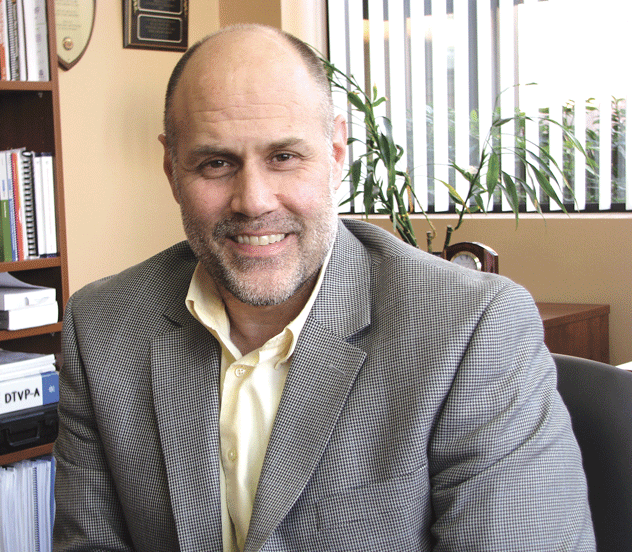
Opinion
A Good First Step at Westfield State

The Westfield State University board of trustees voted to place embattled President Evan Dobelle on paid administrative leave last week, a decisive move that we hope will be the first step in ending a tenure that has become a serious distraction for the college and, more importantly, a burden for the state’s public higher-education system at a time when it doesn’t need one.
Recapping the recent events in what has been an ongoing saga, the board’s action came several hours after the faculty and librarians (at least those who participated) voted by a wide margin to issue a vote of no confidence in Dobelle, who has come under unrelenting fire from the media and Board of Higher Education Commissioner Richard Freeland for his lavish spending and misuse of university credit cards.
The board, which has also come under fire from Freeland for a lack of leadership on this matter and essentially doing too little far too late, put Dobelle on ice until at least late November, when the law firm it hired to investigate Dobelle’s spending habits is expected to issue its findings.
In doing so, the board essentially disregarded repeated threats from Dobelle’s lawyer and hired public-relations specialist that disciplining the school’s president would result in a federal lawsuit claiming, among other things, that Dobelle’s constitutional rights were violated because an investigation launched into his spending earlier this year was done illegally.
While we understand why Dobelle’s team would focus on the procedural aspects of that investigation — there are questions about whether rules, such as open-meeting law provisions, were violated — we prefer to side with Freeland and his ongoing contention that it is what’s in the report that is at the heart of this controversy.
Slicing through it all, the accounting firm that conducted the inquiry found that there were violations regarding school policies involving use of credit cards, but also, in the interpretation of Freeland and others who have seen the results, blatant irresponsibility when it comes to spending taxpayer and Westfield State Foundation funds.
The headlines and the controversy that has ensued — including allegations from Dobelle that there is essentially a statewide conspiracy against him and that Freeland is out for his job — prompted the commissioner to write the trustees recently and say “it seems to me highly questionable whether President Dobelle can or should continue to provide leadership to Westfield State University.”
We concur, but must note that Freeland has much more on his mind than the Westfield campus when he makes such statements. Indeed, Freeland is quite concerned about the impact of the Dobelle controversy on perception of the state’s public higher-education system and possible future funding. And he should be concerned.
As we’ve said many times over the years, this is a state that has historically underfunded public higher ed, consistently ranking well below the national average in this category. There are several possible reasons for this, including the widely held theory that, historically, the Legislature hasn’t made public higher education a priority in a state rich with esteemed private institutions.
Whatever the reason or reasons for this poor track record, the last thing this state needs is another one. That’s because now, perhaps more than ever, the Commonwealth’s public colleges and universities are critically important to the task of making this state competitive in the high-stakes contest for what is now arguably the world’s most precious commodity: jobs.
Dobelle’s recklessness with other people’s money — not to mention his absurd allegations against anyone who questions him — present a serious threat to the public higher-education system.
And that’s why the university board’s vote last week must be just the first step in the process of ridding the state of what has become an annoying problem.

Columns Sections
Set a Thorough, Realistic Budget for Your Business

By DEBRA KAYLOR, CPA

Kaylor-DebYou may have heard a lot about the budget for the Commonwealth of Massachusetts this summer and how we, the taxpayers, were going to help balance that budget through new taxes. But what about your budget?
Budgets are a necessary tool to help you monitor where you are and what changes you may need to make to address any unforeseen situations on a timely basis. Many are still recovering from the recession, and while the thought of having to prepare a budget seems frightening to many, it’s a useful and necessary tool to help you and your business make it through any economy — good or bad.
Budgeting helps measure your performance by being able to review what you expected to happen as opposed to what actually happened, and analyze why those differences occurred. Depending on the size of your business, budgeting might be done semi-annually, quarterly, monthly, or even weekly. It relies on assumptions and expectations for the future. As such, you need the right data to build these assumptions and expectations.
There are many questions to ask yourself and others — where do we think revenues will be, what new customers do we think we will gain (or conversely lose), what is the expected cost of our supplies, what new projects do we need or want to do, how many employees do we need, and what will happen with our insurance rates? While no one has a crystal ball, working with other departments in your organization as well as colleagues in your industry will allow you to build a realistic vision of what is expected to happen.
Here are a few things to consider:
• Know what you can control and what you can’t control. Some industries are fairly straightforward, and revenues (and related expenses) can be easily predicted. However, most are not and are subject to variables that are market- or economy-driven and cannot be controlled. Start with what you know, and then step back to review the variable factors and how your business will (or can) react to significant changes in those factors.
• Be realistic. If you expect revenues to decrease, set your budget that way. Do not set yourself up for failure. Budgets are there to help you, not hurt you. Don’t make your budget a target of where you’d like to be, but rather a tool to monitor your progress toward your strategic goals.
• Be careful not to get too specific. This may divert your efforts too much to gathering the data instead of effectively using it.
• Consider seasonal changes in your business when preparing quarterly or monthly budgets. Is most of your revenue generated in the summer? Prepare your budget that way so you can better analyze your budget versus actual results and why actual results may or may not meet the budget.
• Allow plenty of time before the year begins to prepare the budget. Typically, the process isn’t easy, and a lot of information must be gathered prior to pulling it all together. This will also give you an opportunity to consider other actions that may be necessary to meet certain goals — i.e. do you need additional financing, or do you need to reconsider your insurance package? The budget should also be approved by management or a board of directors and discussed with those responsible for monitoring their areas.
• See if your accounting software can help develop and monitor your budget. Many software packages do allow you to enter your budget on an annual and/or monthly basis and may be able to help pull the historical data you may want. This will eliminate the time and potential errors of manually entering information into an Excel spreadsheet.
• Monitor the budget in a timely and consistent manner. This allows you not only to measure your performance, but also to hold people accountable for their areas and reward those who do well. Yes, there are always unknowns, and sometimes things happen that are not in the budget. But that’s OK. One common mistake of monitoring is expecting actual results to mirror the budgeted amounts. While some line items are typically easy to predict (like rent expense, which usually does not change month to month if there is a signed lease agreement in place), most are not, and variances are expected. Monitoring on a timely basis will allow you to identify the factor that kept you from meeting your budget. Successful monitoring will also enable you to adjust other areas as necessary for the larger variances in a timely fashion.
• Learn from your mistakes, especially if you haven’t used budgeting as a tool in the past. In addition to helping you monitor how your business performed monetarily, budgeting should teach you something about your customers and your vendors. What is happening with them will affect you both in the short and long term.
While budgeting is often thought of a tool for businesses, it is also effective for your personal finances. Do you want to take a vacation this year? Do you need a new car? How much money will you need? The same principles apply and will allow you to do the things you would like to do and be prepared to react to unexpected events.
Now that you have your budget, keep up the good work. Budgeting is not a one-time event. To be successful, it must be monitored on a consistent basis to help you succeed with all of your goals. If you monitor and review your budget on a timely basis, you will be better prepared for the unexpected as well as preparing for the future.

Debra Kaylor, CPA is an audit and accounting senior manager at the Holyoke-based public accounting firm Meyers Brothers Kalicka, P.C.; (413) 322-3515; [email protected]

Departments People on the Move

Christine McCormick

Christine McCormick

Christine McCormick, Dean of the College of Education at UMass Amherst, was elected a fellow in Division 15 Educational Psychology of the American Psychological Assoc. (APA), the premier scientific and professional organization representing psychology in the U.S. The APA is the world’s largest association of psychologists, with more than 134,000 researchers, educators, clinicians, consultants, and students as its members. Fellow status is an honor bestowed upon APA members who have shown evidence of unusual and outstanding contributions or performance in the field of psychology. With UMass Amherst since 2005, McCormick is the author or co-author of publications on a variety of topics in child development and education. In 2012, she was elected to serve a three-year term on the executive board of the Council of Academic Deans from Research Education Institutions, an assembly of deans of education from research and land-grant institutions throughout North America. She was also elected to the executive committee of the American Educational Research Association’s Organization of Institutional Affiliates, which provides a forum for academic institutions, non-university-based research institutions, and professional associations to share information about federal education research issues, people, and events, as well as to be engaged in shaping policy with regard to significant research issues. She was appointed by Gov. Deval Patrick to the Mass. Special Commission on Civic Engagement and Learning, which completed its work last January, and also served on the editorial boards of two major journals in her field: the Journal of Educational Psychology and Educational Psychology Review. She received her Ph.D. in educational psychology, with a minor in measurement and statistics, from the University of Wisconsin-Madison.
•••••
The Springfield-based regional law firm Bacon Wilson, P.C. announced that Francis Mirkin, Esq. has been named 2013 Top Rated Lawyer in Real Estate by lawyer-ranking service Martindale-Hubbell. This distinction will appear in the December issue of American Lawyer & Corporate Counsel magazine. Mirkin is a shareholder and a member of the firm’s real-estate and banking and finance departments. He is also member of the Mass. Real Estate Conveyancer’s Assoc. and a frequent speaker on commercial real-estate and foreclosure-related matters. He is a multi-year recipient of the SuperLawyer distinction and is rated AV by Martindale-Hubbell, which is the highest ranking achievable. Mirkin earned his BA from the University of Massachusetts and his JD from Suffolk University School of Law.
•••••
Teresa Parker

Teresa Parker

Mortgage Originator Teresa Parker is now located at United Bank’s Ludlow branch. Parker had served as the personal banker at United’s Longmeadow branch for nine years before transitioning to her new position as mortgage originator in the bank’s Springfield region. She joins Ludlow personal banker Yvonne Santos and her staff at the 528 Center St. location.
•••••


Angela Lussier

Angela Lussier

The BrunoFox Group recently named Angela Lussier its Chief Strategy Officer. Lussier is an award-winning speaker, TEDx alumna, author, and business consultant whose advice has been featured on Yahoo!, NBC, ABC, Virgin.com, the Ladders, About.com, CBS Money Watch, and other outlets. Within this role, Lussier will serve as lead developer for the organization’s Innovation Unit, which is producing Consulting 2.0 services for entrepreneurs and young professionals. Lussier has worked with individuals, as well as Fortune 100 companies, who have used her successful strategies to achieve unprecedented results.
•••••


Erin Catharine

Erin Catharine

Erin Catharine, copywriter with the Lenox-based creative agency Winstanley Partners, has been named Young Careerist of the Year by Western Mass. Women magazine. The award is part of the magazine’s annual Women to Watch competition, which recognizes local women working in a variety of careers. Winners were decided by nominations and votes from the public. The honor is celebrated with a special issue of Western Mass. Women and an awards banquet. The Young Careerist award was added this year to recognize a professional woman in the region between the ages of 20 and 26 who has a college degree, has been working for less than three years in her profession, and has excelled in her position through contributions to the organization, continued professional development, volunteerism, and more. A graduate of Virginia Commonwealth University, Catharine joined the Winstanley creative team in 2012 following stints with Howell Creative Group in Williamsburg, Va. and Taradel LLC in Richmond, Va. She is a past recipient of the Advertising Women of New York scholarship, a Student Silver Addy award, a Richmond, Va. Ad Club Bronze Student Cannonball Award, and the Judge’s Choice Award at the Dallas Society of Visual Communications National Advertising Student Show and Conference.
•••••
Daniel Sullivan

Daniel Sullivan

The Martin J. Clayton Insurance Agency, based in Holyoke, recently named Daniel Sullivan President. Sullivan has worked at the agency since 1990 and holds the Charter Property Casualty Underwriter (CPCU) and Certified Insurance Counselor (CIC) designations. Sullivan works extensively in the commercial property and casualty arena, serving the needs of local businesses. The full-service agency provides personal and commercial insurance and financial services to clients throughout Massachusetts and Connecticut.
•••••
The Loomis Communities recently announced the appointment of Dr. Charles Hines as Medical Director at the Loomis House Nursing Center in Holyoke. Hines has been a geriatric medical practitioner for 20 years and is board-certified in gerontology and internal medicine. Hines, who graduated from St. George’s University School of Medicine, is a certified medical director through the American Medical Assoc.
•••••
Beth Raffeld was named Vice President for Development at Smith College. Raffeld, a Senior Executive at Massachusetts Institute of Technology, has a 30-year career in educational fund-raising and, as the new chief development officer, will over seen an organization that raised $39 million last year and direct a staff of more than 60.
•••••
The Young Professional Society of Greater Springfield (YPS) recently welcomed the following new members to its Executive Board:
Jeremy Casey

Jeremy Casey

Peter Ellis

Peter Ellis

Elizabeth Ginter

Elizabeth Ginter

Edward Nuñez

Edward Nuñez

Jeremy Casey, Assistant Vice President and Commercial Services Officer at Westfield Bank, takes the reins as President. Casey is also on the board of the Springfield Rotary Club and a member of BusinessWest’s 40 Under Forty class of 2013;
Peter Ellis, Creative Director at DIF Designs, is the new Vice President. Ellis is a member of BusinessWest’s 40 Under Forty class of 2011;
Elizabeth Ginter, Attorney with Ellis Title Co., returns to the board as Clerk. Ginter is a member of BusinessWest’s 40 Under Forty class of 2012 and Western Mass. Women magazine’s Women To Watch for 2013-14;
Edward Nuñez, Assistant Vice President of Business Development at Freedom Credit Union, joins the board as Treasurer. Nuñez is a member of BusinessWest’s 40 Under Forty class of 2012 and is the 2012 recipient of the Bankers & Tradesman Credit Union Hero Award.
Ashley Clark, Commercial Service Officer at Westfield Bank, also serves on the YPS Marketing Committee. Clark is a board member of the Greater Springfield Habitat for Humanity.
Juli Thibault

Juli Thibault

Juli Thibault, Talent Acquisition Marketing & Operations Manager at Baystate Health, is Co-Chair of the YPS Marketing Committee and Strategic Plan Task Force.

Agenda Departments

The Secret Village
Oct. 25-28: Berkshire Museum’s Little Cinema will host the world premiere of a suspenseful new thriller, The Secret Village, directed by Swamy Kandan and shot on location in Berkshire County. The film opens on Friday, Oct. 25 with a 7 p.m. screening, followed by a discussion with the director. It will also be shown Saturday and Sunday, Oct. 26 and 27, at 7 p.m., and on Monday, Oct. 28 at 2 p.m. and 7 p.m. The Secret Village follows Greg (Jonathan Bennett), an unsuccessful screenwriter, and Rachel (Ali Faulkner), a spunky journalist, as they research an outbreak of mass hysteria and ergot poisoning in a small village. They rent a house together and start to uncover a secret that has affected the village for years. But the cult activity has been kept a secret by locals Joe (Stelio Savante) and Paul (Richard Riehle), and when Greg disappears, Rachel is left alone to unravel the mystery and save their lives. The Secret Village was shot in late spring 2012 at a variety of locations in the Berkshires, including Olivia’s Overlook, Naumkeag, Stockbridge Cemetery and other parts of Stockbridge, Hancock Shaker Village, and other places in Lee, Lenox, and Monterey. Little Cinema admission is $7.50, $5 for museum members. For advance tickets, call (413) 443-7171, ext. 10.

Art in the Orchard
Through October: Park Hill Orchard, at 82 Park Hill Road, Easthampton, will play host to 22 sculptures by 22 artists through Oct. 31. Art in the Orchard 2013 is a multifaceted sculpture exhibition and festival taking place on the grounds of a working apple orchard. The core project is a sculpture trail showcasing three-dimensional outdoor works and installations created by local and regional artists. Additional events (such as music, moonlight walks, dances, and school field trips) will be programmed on most weekends. See parkhillorchard.com/art for more information on the artists, their works, and an event schedule. Art in the Orchard is building on the success of the first exhibition in 2011, which came to existence thanks to the desire of Park Hill Orchard owners Alane Hartley and Russell Braen to have their farm play an active part in the local cultural economy, and a dream of Easthampton gallery owner Jean-Pierre Pasche to recreate an outdoor sculpture exhibit like the one set in meadows near his hometown in Switzerland. The success of the 2011 event exceeded expectations, with thousands of visitors discovering the sculpture trail and Park Hill over the 10-week period, many returning more than once. This achievement was recognized by the Mass. Cultural Council, which awarded Art in the Orchard one of its three annual Gold Star Awards, out of more than 5,000 projects funded annually by local cultural councils statewide.

Western Mass. Business Expo 2013
Nov. 6: Get ready for the Western Mass. Business Expo 2013, a day-long business-to-business event to take place at the MassMutual Center in downtown Springfield. This fall’s show, the third edition of the Expo, which is again being produced by BusinessWest, will feature more than 100 exhibitors, seminars on timely issues of the day, special Show Floor Theater presentations, breakfast and lunch programs, and the wrap-up Expo social, which has become a not-to-be-missed networking event. The breakfast speaker will be Jim Koch, founder of Samuel Adams, while the lunch speaker will be author, activist, and marathon runner Kathrine Switzer. This issue of BusinessWest contains all you need to know about event details, which can also be found online at www.wmbexpo.com or www.businesswest.com. For more information on the event, call (413) 781-8600, ext. 100.

Bright Nights Ball
Nov. 16: Spirit of Springfield will hold its 18th annual City of Bright Nights Ball at the Sheraton Springfield. MGM Springfield will sponsor the black-tie event, which raises money to support the many events presented by Spirit of Springfield. Kelley Tucky, vice president of Community and Public Affairs for MGM Resorts, will serve as the gala’s chair. Visit spiritofspringfield.org for more information.

Government Reception
Nov. 21: The Affiliated Chambers of Commerce of Greater Springfield will present its Government Reception from 5 to 7 p.m. at the Carriage House, Storrowton Tavern, West Springfield. This is a great opportunity to meet socially with local, state, and federal government officials. Sponsors include Baystate Health, Columbia Gas of Massachusetts, and United Personnel. Tickets cost $50 for members, $70 for general admission, which includes complimentary beverages and hors d’oeuvres. Reservations may be made online at www.myonlinechamber.com.

Chamber Corners Departments

AFFILIATED CHAMBERS OF COMMERCE OF GREATER SPRINGFIELD
www.myonlinechamber.com
(413) 787-1555
• Oct. 25: Super 60 Luncheon, 11:30 a.m.-1:30 p.m., at Chez Josef, Agawam. Celebrate the region’s top-performing companies. Now in its 24th year, this awards program celebrates the success of the fastest-growing privately owned businesses in the region that continue to make significant contributions to the strength of the regional economy. Presented by Health New England with support from Hampden Bank, Sullivan Hayes & Quinn, the Republican, and WWLP-TV 22. Reservations are $50 for members, $70 for general admission. Reservations may be made online at www.myonlinechamber.com or by contacting Cecile Larose at (413) 755-1313.
• Nov. 6: Business@Breakfast, 7:30- 9 a.m., at the Western Mass Business Expo, MassMutual Center, Springfield. Keynote speaker: Jim Koch, founder of the Boston Beer Co. and maker of the Samuel Adams family of beers. Hear the story of how Koch took his generations-old family recipe and changed the beverage landscape forever. Sponsored by the Regional Employment Board of Hampden County, MassMutual Center, United Personnel, and Frigo’s Foods. Reservations are $25 and may be made online at www.myonlinechamber.com or by contacting Cecile Larose at (413) 755-1313.
• Nov. 13: ACCGS After 5, 5-7 p.m., the TD Bank Building. Sponsored by TD Bank. Tickets are $5 for members, $10 for general admission. Reservations may be made online at www.myonlinechamber.com or by contacting Cecile Larose at (413) 755-1313.
• Nov. 21: ACCGS Government Reception, 5-7 p.m. at the Carriage House, Storrowton Tavern, West Springfield. A great opportunity to meet socially with your local, state, and federal officials. Sponsored by Baystate Health, Columbia Gas of Massachusetts, and United Personnel. Tickets are $50 for members, $70 for general admission, which includes complimentary beverages and hors d’oeuvres. Reservations may be made online at www.myonlinechamber.com.
• Nov. 26: ACCGS Pastries, Politics, and Policy, 7:30-9 a.m. Reservations are $15 for members, $20 for general admission, and includes complimentary beverages and hors d’oeuvres. Call (413) 755-1313 for more information. Reservations may be made online at www.myonlinechamber.com.
• Dec. 4: ACCGS Business @ Breakfast, 7:15-9 a.m., at the Colony Club, Springfield. Topic: “The Value of Volunteerism.” Sponsored By Masiello Employment Services. Tickets are $20 for members, $30 for general admission, which includes complimentary beverages and hors d’oeuvres. Reservations may be made online at www.myonlinechamber.com.

AMHERST AREA CHAMBER OF COMMERCE
www.amherstarea.com
(413) 253-0700
• Oct. 18: Legislative Breakfast, 7:15 – 9 a.m., at the Lord Jeffery Inn. Sponsored by Western Massachusetts Electric Co. Admission: $15 for members, $20 for non-members.
• Nov. 20: Chamber After 5, 5-7 p.m., at the Amherst Survival Center. Sponsored by SciDose LLC. Admission: $10 for members, $15 for non-members.

CHICOPEE CHAMBER OF COMMERCE
www.chicopeechamber.org
(413) 594-2101
• Nov. 3: November Salute Breakfast, 7:15-9 a.m., at the Castle of Knights, 1599 Memorial Dr. in Chicopee. Admission: $20 for members, $26 for non-members.

GREATER EASTHAMPTON CHAMBER OF COMMERCE
www.easthamptonchamber.org
(413) 527-9414
• Oct. 21: Celebrity Bartenders Night, 6-9 p.m. at Opa-Opa Steakhouse & Brewery, 169 College Highway, Southampton. Join us for a night of fun with local celebrities mixing your drinks! Your tips benefit the chamber’s holiday lighting fund. Raffles and fun. Admission is free.

GREATER HOLYOKE CHAMBER OF COMMERCE
www.holycham.com
(413) 534-3376
• Oct. 22: Social Media with Constant Contact Workshop, 8:30-10:30 a.m., at the Greater Holyoke Chamber of Commerce, Executive Conference Room, 177 High St., Holyoke. Sponsored by PeoplesBank and the Republican. This information-packed seminar offers a basic review of the essential strategies and best practices a business or organization should understand to successfully get started with social-media marketing. Admission is free. Presented by Constant Contact. For reservations, call the chamber office at (413) 534-3376.
• Oct. 30: Manufacturing Breakfast, 7:30-9:30 a.m., at the Wherehouse, 109 Lyman St., Holyoke. For reservations, call the chamber office at (413) 534-3376.

GREATER NORTHAMPTON CHAMBER OF COMMERCE
www.explorenorthampton.com
(413) 584-1900
• Oct. 22: Business to Business Marketing Workshop, 3:30-5 p.m., at the Greater Northampton Chamber of Commerce. “In a Flash: On-the-spot Marketing Tips for Growing Your Visibility.” Struggling to gain visibility with your target audience? Are your marketing materials producing tangible results? Are your best messaging ideas living only in your head? The chamber has help on the way. Three women business owners — Janice Beetle, Ruth Griggs, and Maureen Scanlon of the Creative, a marketing and communications collaboration in Northampton — will lead a B-to-B flash-marketing workshop. They will meet with fellow business owners at our conference room table, listen to your marketing and communications concerns, and help you brainstorm practical, professional solutions on the spot. Learn more about how to strategize, advertise, brand, and promote your business, reach the media, and maximize your message in person, in print, and online. The workshop is free, but pre-registration is required, and space is limited. To register for this workshop, contact Jasmin Tomic at (413) 584-1900 or [email protected].
• Nov. 6: Arrive@5 Chamber Networking Event, 5-7 p.m., at the World War II Club. Sponsors: Homeward Vets. Catered by Big Kats Catering. We’ll be collecting donations for Homeward Vets. A list of needed donations will be posted on the website. Tickets are $10 for members, $15 for non-members. RSVP to Esther at [email protected].
• Nov: 19: “The Art of Consulting,” 8:30-10 a.m. at the chamber office. This special program is a collection of the guiding principles of consulting that sum up the lessons presenter Don Lesser he has learned over the past 30 years. Each topic is summarized in a short, often humorous saying, which is followed by a longer explanation. In this session, Lesser, who has been a consultant and run a business that uses consultants for more than 30 years, will cover some of the basics of being a consultant, including “The Three Laws of Consulting,” “What Have You Done for Me Lately?” “Rules for Good Client Management,” and “Discount Sushi, or How Much Should You Charge?” The workshop is free, but pre-registration is required, and space is limited. To register, call (413) 584-1900, or e-mail www.explorenorthampton.com.

GREATER WESTFIELD CHAMBER OF COMMERCE
www.westfieldbiz.org
(413) 568-1618
• Nov. 4: Mayor’s Coffee Hour, 8-9 a.m., at the Genesis Spiritual Life and Conference Center, 53 Mill St., Westfield. Have coffee with Mayor Daniel Knapik, who will share information about what’s happening in the city. For more information or to register, contact Pam Bussell at the chamber office at (413) 568-1618.
• Nov. 6: 2013 Annual Meeting & Awards Dinner at the Westwood Restaurant, 94 North Elm St., Westfield. More information to come as this event date approaches.
• Nov. 13: WestNet, 5-7 p.m., the Cove, 90 Point Grove Road, Southwick. Come and meet chamber members and bring your business cards for a great networking opportunity. Cost: $10 cash for chamber members, $15 cash for non-members. Payment can be made in advance or at the door.  Walk-ins are welcome. Call the chamber at (413) 568-1618, or e-mail Pam Bussell at [email protected] for more information. Your first WestNet is always free.

MASSACHUSETTS CHAMBER OF COMMERCE
(413) 525-2506
• Nov. 12: Massachusetts Chamber of Commerce Annual Meeting & Awards Luncheon, 9 a.m. registration, at the Double Tree, Westborough. For more information on ticket sales and sponsorship opportunities, call the chamber office at (413) 525-2506 or e-mail [email protected].

NORTHAMPTON AREA YOUNG PROFESSIONAL SOCIETY
www.thenayp.com
(413) 584-1900
• Nov. 14: November Networking Social, 5 p.m., at the Northampton Brewery. Community involvement, networking, business and professional development. NAYP is excited to host its first event at the famed Northampton Brewery. Enjoy delicious beer and savory hors d’oeuvres. Cost: free for members, $10 for non-members. RSVP on Facebook.

PROFESSIONAL WOMEN’S CHAMBER
www.professionalwomenschamber.com
(413) 755-1310
• Oct. 24: A Chocolate Affair, 6-9 p.m., at Chez Josef, Agawam. Indulge yourself in chocolate, shopping, and networking. Presented by the Professional Women’s Chamber, an affiliate of the ACCGS. Exhibitor space is $70. Reservations to attend are $40. Reservations may be made online at www.myonlinechamber.com or by contacting Cecile Larose at (413) 755-1313.
• Nov. 6: November Luncheon at the Western Mass. Business Expo, at the MassMutual Center, 11:30 a.m.-1 p.m. Keynote Speaker: Kathrine Switzer, first female Boston Marathoner in 1967. More than 40 years later, Switzer’s story continues to capture the public’s imagination. Reservations cost $35 members, $40 for non-members, and may be made at www.myonlinechamber.com or by contacting Cecile Larose at (413) 755-1313.

WEST OF THE RIVER CHAMBER OF COMMERCE
www.ourwrc.com
413-426-3880
• Oct. 23: West of the River Chamber of Commerce Business to Business Expo, hosted by WRC, North Central CT Chamber, Bradley Regional Chamber, and East Windsor Chamber, 4:30-7:30 p.m. at the Holiday Inn, Enfield. For more information, contact the chamber office at (413) 426-3880 or e-mail [email protected].

YOUNG PROFESSIONAL SOCIETY OF GREATER SPRINGFIELD
www.springfieldyps.com
• Oct. 31: The Young Professional Society of Greater Springfield and Northampton Area Young Professionals are co-producing a special October CEO Panel Luncheon, 11:30 a.m.-2 p.m., at Sláinte restaurant, 80 Jarvis Ave., Holyoke. Led by moderator George O’Brien, editor of BusinessWest magazine, the panel will explore the question, what steps can the Pioneer Valley take to foster entrepreneurship and cultivate talent? Lunch and networking, 11:30 a.m. to 12:15 p.m; panel, 12:15 to 2 p.m. Sponsored by Adam Quenneville Roofing and Siding and BusinessWest.

Features
Western Mass. Business Expo Highlights Innovative Ideas

1_WMBEstevensSilverSponsor24x18.inddJon Lester and Koji Uehara aren’t the only ones getting their best pitches ready this fall.
Plenty of burgeoning entrepreneurs will wind up at the Western Mass. Business Expo on Nov. 6, which will feature the First Annual Pitch Contest and Demo Day, hosted by Valley Venture Mentors (VVM) and BusinessWest.
VVM alumni and members of the current class have applied for a spot in the competition. Participating startups will make two-minute pitches to a panel of judges, who will give them immediate feedback. At the end of the contest, the judges will award cash prizes of $1,500, $750, and $500 to the top three teams. An additional special prize of $500 will be awarded to an audience favorite.
Each participant is also invited to showcase their venture at a Demo Day reception immediately following the pitch contest.
“It is the startup’s secret sauce that gets all the attention. People focus on what they make and how they make it,” said John Garvey, a board member with VVM and a MassChallenge judge and mentor. “It is the pitch, however, that makes it all real. The sauce won’t sell to anybody without a great pitch. That’s why this pitch contest is so important. For participating startups, it may make the difference between success, and connecting with investors and consumers, or failure, meaning it’s just another idea that no one could understand.”
The pitch contest is just one of a growing roster of impressive programs scheduled for the Expo, which is once again being produced by BusinessWest, managed by Rider Productions, and presented by Comcast Business at the MassMutual Center in Springfield.
For example, Jim Koch, founder of the Boston Beer Co., brewer of Samuel Adams, will be the keynote speaker at the Expo breakfast, hosted by the Affiliated Chambers of Commerce of Greater Springfield. And Kathrine Switzer, who stood up to Boston Marathon race officials in 1967 to become the first woman to run in that event, will highlight a luncheon hosted by the Professional Women’s Chamber.
The day will also feature dozens of educational seminars and Show Floor Theater presentations. For example, the Expo recently added Hector Bauzá to its schedule of speakers. President and CEO of Bauzá & Associates Hispanic Marketing in Hartford, he will talk about the challenges and opportunities involved in marketing a business to the Hispanic population.
Later in the day, entrepreneurs that participated in the pitch contest will have their ideas on display at the event-capping Expo Social, which is one the region’s premier networking events.
The Expo will also reveal the winner of the Greater Springfield Extreme Website Makeover, a program sponsored by BusinessWest and DIF Design, which invited small businesses and nonprofits to apply for $25,000 worth of services from DIF and four co-sponsors: the Creative Strategy Agency, Christine Parizo Communications, Hadley Printing, and viz-bang!
The goal is to help a deserving enterprise raise its online presence and help usher it to the next level, and the companies involved in the project will provide services ranging from copywriting and printing to videography and social-media strategy — not just web design. This month, a panel of judges will consider about 25 nominations; several finalists will be announced at the Expo, and the winner will be unveiled late in the day.
“A lot of people are just stuck in place,” said Peter Ellis, president of DIF Design, when asked about the benefit of winning the contest. “They know they should have better marketing, better websites, but for whatever reason they’re spending their money hiring an extra person or on operations, and they don’t have the ability to make that jump. Hopefully, the winner selected by the judges will be able to jump-start or continue to promote their business.”
For more information about the Expo, including a full schedule of events, log onto www.wmbexpo.com or call (413) 781-8600.

Cover Story
Mary-Beth Cooper Takes the Helm at Springfield College

COVER-BW1013aMary-Beth Cooper says her dog, Dakota, feels right at home on the picturesque Springfield College campus.
The 8-year-old yellow lab — now sporting a tag, a gift from some friends, that identifies him as ‘First Dog’ — has become somewhat of a fixture at the school only a month or so after moving into the President’s House, she said, adding that he’s making friends quickly, especially with students and faculty who appear willing to share their lunch or afternoon snack with him. “He loves it here; he’s very comfortable with the new surroundings.”
And the same can be said for his owner, the 13th president of the 128-year-old school and the first woman to hold that title.
She told BusinessWest she was comfortable with the institution long before she actually toured it, and even well before her first two interviews for the position, the first via Skype and the second at a hotel at Bradley International Airport — although those sessions and her subsequent visit certainly reinforced her opinion.
She liked the feel and the fit so much that she quickly terminated a quest for another college president’s position to focus all her energies on this one.
The primary reason why is the culture that pervades the school, one summed up by its motto (“Spirit Mind Body”), she said, noting that she was aware of it from work she had done, first as a volunteer and later as chair of the board, with the YMCA in the city of Rochester, N.Y., where she served as an administrator at both the University of Rochester and, later, the Rochester Institute of Technology.
Springfield College and the Y organization share a unique history, she said, noting that the college was once known as the International YMCA Training School, and there is still a strong relationship today. From that connection, she became familiar with the college’s humanics philosophy to educate the whole person.
But there were other factors that made her comfortable with the school located on the shore of Lake Massasoit, she said, listing, for starters, many similarities between Springfield and Rochester, and also between the work done within the community at both Springfield College and the Rochester schools she served.
Both cities are former manufacturing centers still trying to reinvent themselves, she said, noting that, while Rochester once boasted such industry giants as Kodak, IBM, and Xerox, its major employers today are those aforementioned colleges and a supermarket chain.

college and the community

Mary-Beth Cooper says she understands the relationship between a college and the community.

As for work within the community, she said the schools in Rochester and Springfield College have strong track records of caring that are part of the institutions’ fabric.
At SC, this tradition is perhaps best exemplified by the recent Humanics in Action Day, during which students, faculty, and staff (including Cooper) performed a day of concentrated community service throughout Springfield involving roughly 100 specific projects.
“Some people do service because they believe it’s an obligation,” she noted. “Students here are drawn to service because it’s part of who they are. And they go on from their experience here and become involved members of the community where they live.”
As she talked with BusinessWest just a few weeks after taking the reins at the school, Cooper noted that her predecessor, Richard Flynn, had registered some notable accomplishments in recent years — everything from increasing enrollment to significant building and renovation projects on campus, to several new academic initiatives, including an MBA program unwrapped in 2011. Meanwhile, he established and strengthened relationships with a number of constituencies, including the YMCA and Springfield City Hall.
“He did a lot of the hard work and left me in a good position,” she said with a laugh, noting quickly that there is still plenty to do in the months and years to come.
At the top of that list is raising the school’s profile, she said, adding that, while it is well-known regionally, the college is far more of an unknown commodity in other parts of the country. Also, while enrollment has risen, there is still room for improvement, and also a need to broaden the applicant pool for this school known for everything from its affiliation with the Y to its diverse degree offerings in health and fitness, to its strong graduate programs.
For this issue and its focus on education, BusinessWest talked at length with Cooper about her latest career challenge and how she intends to build on the progress recorded at this venerable Springfield institution.

Degree of Difficulty
Roughly five years ago, Cooper told BusinessWest, she decided that, from a personal- and professional-development standpoint, her next job in higher education should be as a college president.
However, her son, Calvin, was a sophomore in high school at that time, and she had basically already made another very personal decision — not to disrupt that important time of his life with a move to another part of the country, and to wait until he was at least a freshman in college to make such a career move.
Last fall, with Calvin firmly entrenched at the University of Delaware, she started looking at opportunities to lead a college campus, and was actually fairly deep into the process of applying for a job when friends and colleagues, including the director of the Greater Rochester Y, urged her to train her sights on the position at Springfield College she had seen posted in the Chronicle of Higher Education.
At the time, she was senior vice president of Student Affairs at RIT, a role she described as “responsibility for anything outside the classroom that doesn’t involve a transaction.”
That definition fits everything from sports — and she’s been involved with them for most of her career, and continues that pattern today — to what would be considered ‘town-gown’ activities and relationships.
Prior to that, she served as dean of students at the University of Rochester and vice president for Student Affairs at St. John Fisher College, also in Rochester.
This is not a traditional path to the president’s office, she noted, adding that many campus leaders today still come from the academic or development (fund-raising) realms. But she said her background has provided tremendous insight into how a campus functions and how a school can, and should, become involved in the community.
And she does have some background in academics, having taught as an adjunct professor at the University of Rochester’s Warner School of Education for many years.
Meanwhile, she has a strong track record of work within the Rochester community, working with both the YMCA and the United Way in that city, among other endeavors. In 2005, she was named one of the city’s “most influential women” by the Rochester Business Journal.
She said her work with the YMCA was particularly eye-opening, providing her with insight into the needs of a community and how an educational institution can help address them.
“As a member of the administration at the University of Rochester, I began to learn what that community needed,” she explained. “And for me, it was an opportunity to think about youth, families, affordable daycare, and the plight of a population much different than the students at the college. It was an interesting time for me, and it helped me understand the relationship between a school and a community.
“The core values at Springfield College could not have been a better match for me — it was a perfect fit,” she continued. “When I applied, I was hopeful that they would see it the same way.”
Obviously, they did, as she prevailed in what she called a “robust” search at Springfield College that involved more than 100 candidates, including some sitting college presidents.
She said she’s proud of being the first woman president at the school, and believes the choice represents another bit of progress when it comes to putting more women in the corner office on college campuses. But she contends that gender remains an issue in too many hiring scenarios.
“There are women in positions who are ready to take leadership roles,” she said. “Our workforce in higher education is like every other workforce; there are many people who are retirement-eligible, and when positions become available, you’ll see more and more female presidents. I don’t know how long it will take for real change to happen, but it will come.”
Since arriving on campus, she’s been very busy meeting with students, faculty, administrators, and other on-campus constituencies, and has met with Springfield Mayor Domenic Sarno to discuss the community and the school’s role within it.
She’s also taken in a number of Springfield College sporting events, including the recent gridiron triumph over Western New England University, attended the Basketball Hall of Fame induction ceremonies last month (the game was invented at Springfield College, and the first hall of fame was located on the campus), and has commenced a search for a running club to join.
“I’m not very fast, but I can run long distances,” she said, adding that she’s looking forward to getting out into the community in the months ahead and gaining a full appreciation of the challenges facing the region and the ways the college can help address them.
“People want my ear,” she went on. “So I’m trying to listen to our faculty, students, and staff and get their thoughts on what the college should focus on. And I’m trying to get out there.”

School of Thought
Since she first interviewed for the job — and especially since arriving on campus — Cooper said she’s been somewhat overwhelmed by the positive sentiments and equally positive energy that exists on campus, within the alumni ranks, and what could be called the Springfield College community.
“I’ve never been to a campus — and I’ve worked at several, big schools, small schools — where people speak so favorably about the institution,” she told BusinessWest. “Whether it’s alumni, parents, current students, staff, faculty … it’s almost unbelievable. And so something right must happen here in terms of what the experience is like.
“My hope is that I don’t become blasé about all this,” she went on. “My hope is that I continue to be amazed by the good will that goes on here.”
While it’s not her official job description, maintaining this steady flow of positivity is Cooper’s broad mission at the college. She said the philosophy she will take to this assignment is to resist resting on the accomplishments of the past several years and instead build on what’s been accomplished.
Efforts to continue growing enrollment are certainly part of this equation, she said, adding that, while she has no specific goals in mind, she believes there are opportunities to increase the numbers of both undergraduate and graduate students.
This can be accomplished through a combination of more aggressive marketing and awareness-building efforts, she said, adding that one of her priorities is to tell the school’s story through every vehicle available to do so, and especially ongoing efforts to anticipate the needs of both students and employers and then meet them through effective academic programming.
Elaborating, she said the school must maintain and sharpen its focus on properly preparing graduates for the rigors of the workforce and the specific challenges of their chosen fields.
And with that, she summoned the phrase “cross discipline,” which she used to describe the path higher education must take in the future.
Elaborating, she said that what students want — and need — today is the ability to couple study paths, such as a major and a minor, two majors, or a four-year degree with an additional one-year MBA, to enhance their odds of succeeding in a profession.
“The question is, what offerings do we provide for students that give them the most robust portfolio, a skill set to go out and be an entrepreneur, and understand the business side of a program as well as the content?” she said. “Cross discipline will be the key, and in fact, I’ve been blunt enough to stand in front of the faculty on my second day here and say, ‘the future of Springfield College really lies in your hands,’ because what we deliver for students is significant, and the experience we offer is stellar, and we must to continue to do that.”
And while focusing on what happens in the classroom, Cooper will also work to find new avenues to express that commitment to service that was one of the many factors that drew her to the school months ago.
“I’m going to examine our relationship with the community, and look at both what we’ve done in the past and what we might do in the future,” she said. “The community has incredible challenges, but so do so many other cities, in the Northeast in particular. We have to ask ourselves, ‘what is the role of this college, or any college, in dealing with these challenges?’”
Overall, she said, the challenge moving forward is to continually enhance what the the school can offer to students in terms of the “total experience,” but without eroding the traditions and programs the school is noted for.
“We have some terrific traditions,” she said, “and students embrace those, and they come here because of them.”

Tail End
Summing up her first month or so on campus, Cooper said it’s been a whirlwind of meetings, large and small, with a wide range of constituencies that, as she said, want her ear.
Through all that talking and especially listening, she’s become even more convinced that she, the school, and its culture constitute a perfect match.
“I’m really glad to be here,” she told BusinessWest. “I think this is going to be a great time for me and the school.”
Like the First Dog, she’s very comfortable in her new surroundings.

George O’Brien can be reached at [email protected]

Holiday Party Planner Sections
Holiday Business Looking Up for Restaurants, Banquet Halls

The wine-cellar room

The wine-cellar room is just one of several intriguing and festive settings at Chandler’s.

December is a cheerful time at Storrowton Tavern.
“The entire tavern is pretty much decorated from the day after Thanksgiving,” said Vinny Calvanese, executive chef of the restaurant on the grounds of the Eastern States Exposition in West Springfield. “And we have carolers — the same people we’ve had every year since we’ve been here. They go through the entire tavern and sing, room to room, which seems to be a big hit.
But, more importantly, the holiday season is an important time — not just at Storrowton, but across the dining and banquet industry, as companies of all sizes take a breather from the stresses of the year and set aside a night to celebrate with their employees.
“When the recession was in full swing back in December 2008, companies across the board were scaling back on holiday events in light of economic constraints, or cancelling them altogether, deeming the celebrations either needlessly extravagant or highly inappropriate in the wake of layoffs,” notes Lauren Matthews, a writer for event-planning website BizBash. “But last year, it seemed that the corporate holiday party scene was returning to normal.”
She cites a study conducted by executive search firm Battalia Winston, which reported that 91% of companies polled had a Christmas party last year, the highest percentage in the past six years, while a poll by the Society for Human Resource Management found that 72% of respondents attended a company celebration last year, up from 68% in 2011 and 61% in 2010 and 2009.
“For us, it’s always a busy time,” Calvanese said. “We have five function rooms, including one, the Carriage House, which can hold two functions at one time. The holiday season is basically always busy. We still have room, but it seems like a lot of people are booking more ahead than usual this year.”
Ralph Santaniello, general manager and proprietor of the Federal in Agawam, reports the same robust outlook. “We’re working on our 12th year here, so we have a lot of repeat business,” he said. “A lot of parties were booked the minute after last year’s party ended. We’re right on par with where we were last year.”
For this issue and it’s focus on holiday party planning, BusinessWest checked in with several area restaurants and banquet halls to get a feel for how holiday bookings are coming along. For the most part — at least compared to the peak recession years — companies are looking to celebrate the season, and in a wide variety of ways.

Ups and Downs
Not every facility is reporting the same level of sales. For example, “two years ago, we were fine, and everyone else was struggling,” said Sandra LaFleche, sales manager at the Castle of Knights in Chicopee. “Well, I’ve been here 21 years, and this year is the quietest year we’ve seen.”
Bookings remains solid for December weekends, however. “Right now, we have most of our Saturdays and Sundays booked around the holidays,” she noted, adding that weekday bookings have been somewhat more discouraging.
Amy Bombard, sales manager for Max’s Catering, which handles events at the Basketball Hall of Fame, paints a similar picture. “I think [business] is going to be a little less than it has been,” she said. “Last year was a good year, previous years were not so great, and this year it’s looking like a little less as well.”
Other facilities thrive off the holidays every year. “It’s a high-volume time for us,” said Kristin Henry, assistant general manager at Chandler’s Restaurant at Yankee Candle — a retail destination well-known for celebrating the Christmas season. “People are looking to book parties from November into January.”
January has, in fact, become an increasingly popular time for holiday parties, particularly for companies that are very busy around the holidays — the restaurant industry, for instance. “We have our own holiday party in February; it makes sense,” Santaniello said. “So we do see some of that, but the most important dates are always the weekends in December. The Fridays and Saturdays for the first three weeks of December are always the first to fill up.”
He noted that years when Christmas falls midweek (it’s a Wednesday this year) add an additional weekend to those much-desired dates, since companies tend to avoid throwing parties too close to the holiday itself.
As for the type of party customers are asking for, the sky’s the limit.
“We offer banquet-style dinners with plated entrees, and then we do dinner stations or a buffet, for lack of a better word,” Santaniello said. “We’re also doing a lot more cocktail-type parties; people want circulating hors d’oeuvres or stationary hors d’oeuvres. They want to have people moving around and mingling — that’s always fun. People want a less formal atmosphere, and a cocktail party gives you that.”
Calvanese said Storrowton offers a similar variety. “We have sit-downs, we have buffets … a lot of people, for the holidays, actually prefer to go the sit-down route, rather than the buffets. But we also do a cocktail menu, and hors d’oeuvres parties as well. Plus we do a lot of lunches for older groups, like church groups, people who like to come in during the day.”
Whether it’s large banquets or smaller dinners, “we’re pretty busy during December,” he noted, adding that repeat customers are a big part of the facility’s success. “One business, they actually booked with us the first year, and they rebooked 10 years ahead. They’re a rather large group, and they like a specific date, so they get the same Saturday every year.”

Festive Fun
Bombard is among those seeing a gravitation toward more casual events. “I think people are moving more toward cocktail receptions. We’re trying to make it a more social event as opposed to formal dinners.”
LaFleche said customers’ preferences at the Castle of Knights have been running about 50-50 between plated meals and buffets. “It’s a good mix across the board.”
Henry noted that Chandler’s boasts a number of different rooms to accommodate different sizes and styles of parties. “We have private rooms Thursday through Sunday, and we do section off parties in the main dining room, or sell out the entire dining room, for larger parties. And we have three smaller rooms in back of the restaurant: the wine-cellar room and two smaller rooms, the vineyard rooms, for people looking for private spaces.”
She said the restaurant has revamped all of its banquet menus and is offering new menus for the holidays as well. “We do cocktail parties, and we have stationary setups for food. Some [companies] do formal sit-down dinners, but have an open or cash bar for an hour or two prior so people can mingle.”
One of Chandler’s most prominent draws is the Christmas theming that Yankee Candle sets up year-round, but especially highlights during the actual holiday season. That includes Christmas trees in the main dining room and some of the smaller party spaces, as well as ribbons on the wall sconces and a host of other decorations.
“When you’re coming through the door, everything is candlelit, which really does set the stage,” Henry said. “At Yankee Candle, once October ends, everything is lit up at night. Santa is a huge presence here, and they expand the store hours so it’s open later.”
As for Chandler’s, “we also do a dinner with Santa here, where kids can come and eat with Santa. That has always been fun.” Meanwhile, “we’d like to showcase our patio this year in the evening, too, which we really haven’t been doing in the past,” she said, noting that the area is also decorated with holiday lights, while a chiminea provides some heat.
Calvanese said the holiday décor at Storrowton is something customers enjoy, and this year, it seems they’re getting in the mood early. “Normally people will wait, but this year, people want to make sure they get their space, so we’ve been getting calls for Christmas parties, even in the summer. It’s first come, first served with us — you book the date, you’ve got it — and some people who are waiting might not have an ideal night left.”

Scaling Back

A holiday party survey conducted last December by BizBash and food delivery website Seamless indicated that, as the economy slowly recovers, companies increasingly see year-end festivities as an important part of employee productivity and morale.
Of the 1,500 event-planning professionals who took the survey, 67% reported improved team dynamics as a direct result of office holiday parties, and 75% said such events help improve office friendships. “Still,” writes Matthews, “while many companies are hosting holiday gatherings again, the recession has effected a lasting change in what those events now look like, with hosts valuing smart spending over freewheeling excess and designing more thoughtful affairs.”
Santaniello can vouch for that. “I wouldn’t say people are going crazy with their budgets,” he said. “We took a huge hit in 2008 and 2009, but we’re seeing it come back a little bit now. Companies are coming back.”
Sounds like yet another reason to celebrate.

Joseph Bednar can be reached at [email protected]

Agenda Departments

Wicked in Pink Motorcycle Ride
Oct. 13: The Wicked In Pink Run, a motorcycle event created by Bob Kaine Alves, a local motorcycle magazine and shop owner who recently fought his own battle with cancer, will raise much-needed funds for the Sr. Caritas Cancer Center Patient Services Fund at Mercy Medical Center. The event will also show support for all those battling cancer, cancer survivors, their caregivers, family, and friends. Registration for the run will begin at 9:30 a.m. at Harley-Davidson of Southampton. Participants will leave at noon from the dealership and end at the outdoor pavilion at Summit View Banquet & Meeting House in Holyoke, where there will be food and entertainment. Tickets cost $20 per person. Kaine Alves, owner of Throttle Rocker magazine, recently battled cancer of the head and neck and made it his mission to pay forward the compassionate treatment he received from the staff of the Sr. Caritas Cancer Center. All riders are encouraged to wear pink, whether it be hats, wigs, shirts, or shoes — creativity is appreciated. Sponsors include Throttle Rocker magazine, Haymond Law, American Medical Response, Harley-Davidson of Southampton, Allen Media Inc., 94.7 WMAS, FSC Insurance Agency, and Bertera Fiat West Springfield. For more information, visit www.wickedinpinkrun.com or www.facebook.com/wickedinpinkrun.

Rays of Hope Walk
Oct. 20: When this year’s 20th annual Rays of Hope – A Walk Toward the Cure of Breast Cancer steps off, it will be a celebration of two decades of women, men, and children walking together to fight breast cancer. Since its inception in Springfield in 1994 by Lucy Giuggio Carvalho, Rays of Hope, the most successful fund-raising walk and run in Western Mass. for breast cancer, has grown from 500 participants raising $50,000 to some 22,000 walkers and runners in an expanded event that includes a second walk in Greenfield, as well as this year’s 4th annual Run Toward the Cure 8K in Springfield. As in past years, the Springfield walk with some 600 teams — who may choose either a two- or five-mile route — and run begin at Temple Beth El on Dickinson Street, where registration is set for 9 a.m. The Springfield walk steps off at 10:30 a.m., preceded at 10:15 a.m. by the 8K run. The walk in Greenfield — either a two- or three-mile route — begins at Energy Park on Miles Street at noon, with registration at 10 a.m. All monies raised through Rays of Hope — more than $11 million since 1994 — remain local and are administered by the Baystate Health Foundation. Those who want to support the Rays of Hope but are unable to walk due to other commitments can participate in the 10,000 Steps Toward a Cure program. Participants receive a pedometer to keep track of their steps throughout the month of October, while raising donations similar to other walkers. This year’s Rays of Hope major sponsors are Health New England, Gale Toyota, Balise, Baystate Breast & Wellness Center, Baystate Breast Specialists, Chicopee Savings Charitable Foundation, Doctors Express, Kinsley Power Systems, Lia Auto Group, Radiology & Imaging, and Zasco Productions. A listing of all sponsors can be found on the Rays of Hope website. For more information on the event, call (413) 794-8001 or visit www.baystatehealth.org/raysofhope, where walk or run participants may also register online.

Art in the Orchard
Through October: Park Hill Orchard, at 82 Park Hill Road, Easthampton, will play host to 22 sculptures by 22 artists through Oct. 31. Art in the Orchard 2013 is a multifaceted sculpture exhibition and festival taking place on the grounds of a working apple orchard. The core project is a sculpture trail showcasing three-dimensional outdoor works and installations created by local and regional artists. Additional events (such as music, moonlight walks, dances, and school field trips) will be programmed on most weekends. See parkhillorchard.com/art for more information on the artists, their works, and an event schedule. Art in the Orchard is building on the success of the first exhibition in 2011, which came to existence thanks to the desire of Park Hill Orchard owners Alane Hartley and Russell Braen to have their farm play an active part in the local cultural economy, and a dream of Easthampton gallery owner Jean-Pierre Pasche to recreate an outdoor sculpture exhibit like the one set in meadows near his hometown in Switzerland. The success of the 2011 event exceeded expectations, with thousands of visitors discovering the sculpture trail and Park Hill over the 10-week period, many returning more than once. This achievement was recognized by the Mass. Cultural Council, which awarded Art in the Orchard one of its three annual Gold Star Awards, out of more than 5,000 projects funded annually by local cultural councils statewide.

Western Mass. Business Expo 2013
Nov. 6: Planning is underway for the Western Mass. Business Expo 2013, a day-long business-to-business event to take place at the MassMutual Center in downtown Springfield. This fall’s show, the third edition of the Expo, which is again being produced by BusinessWest, will feature more than 100 exhibitors, seminars on timely issues of the day, special Show Floor Theater presentations, breakfast and lunch programs, and the wrap-up Expo social, which has become a not-to-be-missed networking event. The breakfast speakers will be Jim Koch, founder of Samuel Adams, the lunch speaker will be author, activist, and marathon runner Kathrine Switzer. Other details about specific programming will be printed in upcoming editions of BusinessWest and can also be seen online at www.wmbexpo.com or www.businesswest.com. For more information on the event or to reserve booth space, call (413) 781-8600, ext. 100.

Holiday Party Planner Sections
Explosive Growth Fuels a Building Boom at Lattitude

Jeff Daigneau

Jeff Daigneau says creativity and hard work have helped Lattitude grow, to the point where the restaurant thrives even during the challenging Big E weeks.

Jeff Daigneau doesn’t know how many times he’s told the story. But he does know that it never gets old.
He was referring to what has become local culinary legend of sorts, the saga of how the most unlikely, but now the most popular, item on the menu at his restaurant, Lattitude, came to be.
“I messed up during the Big E in 2008 and dropped a bunch of brussels sprouts in the frialator,” said Daigneau, owner and chef at the establishment on Memorial Avenue in West Springfield, directly across from the fairgrounds. He put what came out of the frialator on the bar for consumption — and they didn’t last long.
“Now, they’re the hottest thing going — everybody’s serving them,” he told BusinessWest, adding that the vegetable that so many people love to hate has become his eatery’s signature appetizer — and an unofficial logo of sorts.
Indeed, the vegetable now adorns the back of his business card and the company’s letterhead, and it will soon be on T-shirts to be worn by the staff.
No one calls Lattitude the ‘house that Brussels sprouts built,’ but they might as well — it’s not much of an exaggeration. But the house was actually built by creativity, patience, and perseverance, and because all three have been exhibited in abundance, the house is getting bigger.
Much bigger.
The restaurant, which sits in the middle of what was a large, multi-tenant building that Daigneau now owns, is expanding in several directions within that complex. An outdoor patio bar featuring live music was added this summer on the west side of the property. Meanwhile, an 80-seat banquet facility will open in formerly vacant space on the east side of building in mid-November, and a new, much larger bar area, to be created in space formerly occupied by Memo’s restaurant on the west side of the building, is in the design phase. In the original restaurant, space is being reconfigured, and private meeting rooms are being expanded.
The ambitious series of undertakings, highlighted by the recent installation of a new ‘Lattitude’ sign made of brushed copper, could be called a testimony to the power of fried brussels sprouts. But it’s more of an indication of how the restaurant has become a fixture only a few years after barely surviving its first fall in the shadow of the Big E (more on that later).
“It’s really flattering that people think that much of us,” he said, noting that his experiences to date have been a giant learning curve. “I’ve been doing this since I was 13 years old; I’m 36 now, and every single day I learn something new.”
For this issue and its focus on holiday party planning, BusinessWest looks at what Daigneau’s learned, and how he’s applied those lessons effectively enough to make Lattitude one of the region’s more intriguing business success stories.

Keep the Party Going

Lattitude added an outdoor patio bar this year

Lattitude added an outdoor patio bar this year, where patrons can enjoy live music.

Retelling another story he’s related often, Daigneau said that, during his first fall on Memorial Avenue, he decided to stay open during the 17-day Big E when most all other restaurants in that area shut things down.
They close because the exposition has a tendency to drain traffic from such establishments rather than create it. Many long-time patrons of those eateries also decide they’re not going to fight Big E traffic and dine elsewhere instead.
Daigneau’s decision nearly put him out of business, by his calculation, but the experience provided an important lesson. Today, instead of trying to compete with, or simply survive, the Big E, he is effectively partnering with it. At least that’s the term he uses.
Elaborating, he said he’s learned how to cater his menu and his entertainment to the two primary constituencies at the Big E — visitors to the show and the vendors who often arrive days before it opens and are still packing up long after it ends.
The key to mastering the Big E, said Daigneau, has been a combination of offering a more relaxed atmosphere during fair weeks, especially for vendors, and offering a variety of live bands, food and drink specials, and promo nights, as an extension of what’s already going on over at the Big E.
“I’m not going to get everybody, so I put posters in the windows for events we’re going to have,” he explained. “I try to do things that would bring people in the door.
“I’m not stepping on anybody’s toes,” he went on. “The vendors just want a place to get out and get something to eat, because otherwise, they’re cooking in their campers.”
This imaginative approach to navigating through late September is just one element in Daigneau’s success quotient. And it’s part of a larger operating philosophy of listening to customers and potential customers and giving them want they want — even if, in the case of those Brussels sprouts, they didn’t know they wanted it.
And in recent years, what he consistently heard from patrons is that they want more — as in more space, more options, and more venues for different types of events.
The elaborate renovations and new building initiatives are designed to meet all those needs.
As a lessee, Daigneau had to look at the unattractive yellow stucco plaster on the outside of the building, but now the contemporary-style improvements have made the choppy architecture look like a cohesive city block, he said, which matches the elegance and creative quality of what’s happening inside.
The entire east side of the building is being renovated for banquets; the bathrooms are moving to the west side, the dining room will be expanded to accommodate 120 people, and two new rooms, for up to 12 and 30 patrons, respectively, are ready, or will be, for the holidays. The small, cramped kitchen was expanded recently, and a new catering kitchen is under construction.
“Our off-site catering is going to explode with that new kitchen,” said Daigneau, noting that what started as a few scattered requests for Lattitude menu items has morphed into a solid business opportunity with enormous potential.
The same could be said for banquet, or large-party, business, said Jamie Cardoza, Daigneau’s event specialist. “People were asking for larger venues, and we had to essentially turn business away,” she said.
Daigneau said there were enough of these requests to inspire the new banquet facility. “We had guest requests for parties of 50, 80, or 100,” he noted. “And it just grew into, ‘well, I own the building now; what do we want to do?’”
Plans for the rest of the building, specifically the old Memo’s area, are in the process of being designed. Daigneau said the second floor of the building will remain his office area and won’t be leased out.
While Daigneau’s original plan was to do all the work at once, he ultimately opted to phase it in, a decision that, in retrospect, has worked out well because disruption has been controlled and the impact on the overall business has been minimized.
And in a way, the new look and feel of Lattitude is consistent with Daigneau’s philosophy of continuously changing and reinventing to keep things fresh.
Indeed, while other restaurant owners and managers are loath to remove an item from the menu, Daigneau is fearful of letting his menu get stale.
He said the typical response from his staff when he changes up the menu is, ‘are you out of your mind?’
“But if you’re not moving and shaking and you’re not changing things up, people are going to get bored, and things are going to get stale,” he explained. “The menu has to change, and the staff has to stay fresh, or there are a million opportunities for our customers to go somewhere else.”
One dish that has to make a seasonal appearance every year is his pumpkin ravioli with seared scallops and walnut sage cream sauce.
“It’s the most popular dish we’ve ever done, and it’s one of those things I just can’t take off, and if I do, I get threatened,” he said with a sardonic smile.
It’s the same look he gives his staff when he tells them what he has in mind for his popular dinner series on the third Monday of every month, an event that offers a five-course dinner, with a different cocktail paired with each course.

Room For Dessert
Late last month, Daigneau served as the ‘celebrity professional judge’ for a Big E bread and dessert contest featuring creations fashioned from Fleischmann’s yeast.
That assignment speaks not only to his new outlook on the Big E as partner, not competitor, but also to just how far he has come in five years — from a chef with a dream to an entrepreneur with a dining destination in the midst of exploding growth.
The brussels sprouts on his business card have become a symbol of that success, and so has the new sign over his door.
“It’s finally gotten to the point where I can look up to that sign and say, ‘you know what? I did OK.’”
Actually, much better than OK.

Elizabeth Taras can be reached at [email protected].

Chamber Corners Departments

ACCGS
www.myonlinechamber.com
(413) 787-1555

Oct. 9: Lunch ‘n’ Learn, 11:30 a.m.-1 p.m., at One Financial Plaza Community Room, 1350 Main St., Springfield. The program, “Birds Tweet, but Should You? Is Social Media Right for Your Business?” will discuss strategies behind using social media, determining your return on investment and tips on how to best deploy social media to your advantage. Reservations are $20 for members, $30 for general admission, and includes networking time and a boxed lunch. Reservations may be made online at www.myonlinechamber.com or by calling Cecile Larose at (413) 755-1313.

Oct. 24: A Chocolate Affair, 6-9 p.m., at Chez Josef in Agawam. Indulge yourself in chocolate, shopping, and networking. Presented by the Professional Women’s Chamber, an affiliate of the ACCGS. Exhibitor space is $70. Reservations to attend are $40. Reservations may be made online at www.myonlinechamber.com or by calling Cecile Larose at (413) 755-1313.

Oct. 25: Super 60, 11:30 a.m.-1:30 p.m., at Chez Josef in Agawam. Celebrate the region’s top-performing companies. Now, in its 24th year, this awards program celebrates the success of the fastest-growing privately owned businesses in the region that continue to make significant contributions to the strength of the regional economy. Presented by Health New England with support from Hampden Bank, Sullivan Hayes & Quinn, the Republican, and WWLP-TV 22. Reservations are $50 for members, $70 for general admission. Reservations may be made online at www.myonlinechamber.com or by contacting Cecile Larose at (413) 755-1313.

AMHERST AREA CHAMBER OF COMMERCE
www.amherstarea.com
(413) 253-0700

Oct. 18: Legislative Breakfast, 7:15-9 a.m., at the Lord Jeffery Inn. Sponsored by Western Massachusetts Electric Co. Admission: $15 for members, $20 for non-members.

GREATER EASTHAMPTON CHAMBER OF COMMERCE
www.easthamptonchamber.org
(413) 527-9414

Oct. 8: Mayoral Forum, 6 p.m., Eastworks Meeting Space, Suite 160, 116 Pleasant St., Easthampton. Learn about the Easthampton mayoral candidates’ views on business and their plans for the future of Easthampton. Free and open to the public.

Oct. 10: Networking by Night Business Card Exchange, 5-7 p.m. Hosted and sponsored by Cernak Buick, 102 Northampton St., Easthampton. Hors d’ouevres, beer, and wine available. Door prizes. Tickets: $5 for members, $15 for future members.

Oct. 15: GRIST — Get Real Individual Support Today, 9-10 a.m. at the Greater Easthampton Chamber of Commerce, 33 Union St., Easthampton. The GRIST group is a free member benefit, an ongoing small group of folks who meet regularly to share ideas and get advice on the daily challenges of running a successful business. RSVP to group leaders Derek Allard at [email protected] or (413) 282-9957, or Fran Fahey at [email protected] or (413) 529-1189. Free to chamber members and future members.

Oct. 21: Celebrity Bartenders Night, 6-9 p.m., at Opa-Opa Steakhouse & Brewery, 169 College Highway, Southampton. Join us for a night of fun with local celebrities mixing drinks. Tips benefit the chamber’s holiday lighting fund. Raffles and more fun. Admission: free.

HOLYOKE CHAMBER OF COMMERCE
www.holycham.com
(413) 534-3376

Oct. 9: Autumn Business Breakfast, 7:30-9 a.m., at the Log Cabin. Sponsored by the Republican and Holyoke Medical Center. Recognizing new members, business milestones, and networking breakfast meeting. Cost: members, $22 in advance, $28 at the door. Call the chamber at (413) 534-3376 to sign up.
Oct. 16: Chamber After Hours, 5-7 p.m., at the Center for Health Education, 404 Jarvis Ave., Holyoke (former Grynn & Barrett Studios). Business networking event to take place at HCC’s newest education facility. Networking, 50/50 raffle, and door prizes. Cost: $10 for members, $15 for the public. Call the chamber at (413) 534-3376 to sign up.

Oct. 22: Social Media with Constant Contact Workshop, 8:30-10:30 a.m., at the Greater Holyoke Chamber of Commerce, Executive Conference Room, 177 High St., Holyoke. Sponsored by PeoplesBank and the Republican. This information-packed seminar offers a basic review of the essential strategies and best practices a business or organization should understand to successfully get started with social-media marketing. Admission is free. Brought to you by Constant Contact. For reservations, call the chamber office at (413) 534-3376.

Oct. 30: Manufacturing Breakfast, 7:30-9:30 a.m., at the Wherehouse, 109 Lyman St., Holyoke. For reservations, call the chamber office at (413) 534-3376.

MASSACHUSETTS CHAMBER OF COMMERCE
www.massachusettschambersofcommerce.com
(413) 525-2506

Nov. 12: Massachusetts Chamber of Commerce Annual Meeting & Awards Luncheon, 9 a.m. registration, at the DoubleTree, Westborough. For more information on ticket sales and sponsorship opportunities, call the chamber office at (413) 525-2506 or e-mail [email protected].

GREATER NORTHAMPTON CHAMBER OF COMMERCE
www.explorenorthampton.com
(413) 584-1900

Oct. 8: Business to Customer Marketing Workshop: “On-the-spot Marketing Tips for Increasing Foot Traffic,” 1-3 p.m. Hosted and sponsored by the Greater Northampton Chamber of Commerce. Presented by the Creative Marketing Group. The Creative Marketing Group will meet with you and your fellow retail business owners and managers at our conference-room table, listen to your marketing and communications concerns, and help you brainstorm practical, professional solutions on the spot. Learn more about how to strategize, advertise, brand, and promote your business, reach the media, and maximize your message in person, in print, and online. Cost: free, but pre-registration is required, and space is limited. To register, contact Esther at [email protected]

Oct. 22: Business to Business Marketing Workshop, 3:30-5 p.m., at the Greater Northampton Chamber of Commerce. Cost: free, but pre-registration is required, and space is limited. To register, contact Esther at [email protected].

Nov. 6: Arrive@5 Chamber Networking Event, 5-7 p.m. Hosted by the World War II Club. Sponsors: Homeward Vets. Catered by Big Kats Catering. The chamber will be collecting donations for Homeward Vets. A list of needed donations will be posted on its website. Cost: $10 for members, $15 for non-members. RSVP to Esther at [email protected].

WEST OF THE RIVER CHAMBER OF COMMERCE
www.ourwrc.com
(413) 426-3880

Oct. 10: West Springfield Mayoral Debate, 6-8 p.m., at West Springfield City Hall. Event is open to the public and free for both members and non-members. For more information, contact the chamber office at (413) 426-3880 or e-mail [email protected].

Oct. 17: Business with Bacon, 7-9 a.m., at Crestview Country Club. Speaker: Gaming Commissioner Bruce Stebbins. Cost: $25 for chamber members, $30 for non-members. For more information, contact the chamber office at (413) 426-3880, or e-mail [email protected].

Oct. 23: Business to Business Expo, hosted by the West of the River Chamber, the North Central CT Chamber, the Bradley Regional Chamber, and the East Windsor Chamber, 4:30-7:30 p.m. Hosted by Holiday Inn, Enfield. Cost: $100 for a six-foot table if you are a member of any chamber and pay in full by Sept. 27, or $150 for a six-foot table if you are not a member of any chamber or do not pay in full by Sept. 27. For more information, contact the chamber office at (413) 426-3880, or email [email protected].

GREATER WESTFIELD CHAMBER OF COMMERCE
www.westfieldbiz.org
(413) 568-1618

Oct. 9: October WestNet Connection, 5-7 p.m., at East Mountain Country Club, 1458 East Mountain Road, Westfield. An evening of networking; don’t forget your business cards. Complimentary hors d’oeuvres and cocktails. Walk-ins are welcome. Tickets: $10 for members, $15 cash for non-members. To register, call Pam Bussell at the chamber office at (413) 568-1618, or e-mail [email protected].

Holiday Party Planner Sections
Sláinte Draws Restaurant Patrons — and Parties — to Holyoke

Debra Flynn, right, and Jake Perkins

Debra Flynn, right, and Jake Perkins say Sláinte’s party business has taken off beyond their initial expectations.

Debra Flynn owns two successful restaurants and knows her way around a wide variety of food. So what does she like to order when she eats out?
“My favorite food on the entire planet, when I go out, is Caesar salad and nachos. That defines a fun restaurant, and if they don’t have it, we’re not going back,” said Flynn, the owner of Eastside Grill in Northampton and part-owner, with Jake Perkins, of Sláinte in Holyoke.
“When we started,” she said of opening Sláinte earlier this year, “I told Jake we have to have the best nachos in the world — and they are.”
If those nachos —  loaded with toppings and also available ‘cowboy style’ with barbecued brisket — don’t sound like something Eastside would serve, that’s intentional.
“We’re not trying to be something we’re not,” Flynn said. “We’re not a high-end restaurant, and even though we’re attached to Eastside, we didn’t want Eastside food here. To have two restaurants within 10 minutes of each other serving the same food serves no purpose. I wanted this place to have its own identity, but people realize we believe in concepts like quality and service at both places.”
Sláinte (pronounced ‘slahn-cha,’ an Irish greeting meaning ‘your good health’) opened on the site of the former Eighty Jarvis restaurant, which used to be O’Meara’s, which used to be Broadview — which is where our story begins.
Flynn was in her early 20s when she first discovered Broadview on her first date with her future husband, Kevin. Perhaps because of that emotional connection, she had long had her eyes on the property, and when Eighty Jarvis closed, she felt the time was right to make a move.
“I was approached because someone knew how much I really wanted this property,” she said, but she wasn’t prepared to go it alone, so she turned to Perkins, her executive chef at Eastside Grill. “I knew how much Jake wanted to go on to the next level. And I felt comfortable with him; he has the same values I do when it comes to work.”
“We do work well together,” Perkins added. “We have slightly different styles, but they mesh well.
“We wanted a fun, comfortable place,” he continued, “and I really liked the idea of having a banquet room upstairs for parties. We don’t have the space for it at Eastside, but here we have a huge room up there.”
Downstairs, he added, “we keep it comfortable for everybody. It’s a lot of fun, and we want the food to be approachable and the atmosphere to be comfortable. It’s a good spot.”
Despite the name, Sláinte is not an Irish restaurant, he noted. Rather, “it’s an homage to the Irish heritage of Holyoke.”
Flynn laughed when the pronunciation issue arises. “Some of my friends call it Slanty — ‘hey, we’re going to Slanty tonight,’” she said. “But I don’t care, as long as people come.”

American Style
So, what is the menu like? Favorites range from appetizers like fried pickles and cod fritters to entrees like fried chicken, lamb shank, filet mignon, with a selection of burgers, sandwiches, and salads thrown in for good measure.
“Everything is made from scratch here,” Perkins said, from appetizers to desserts, salad dressings to pastrami.
“We use pork belly for bacon — everything is cured from scratch. There are no processed foods here,” Flynn added. “You’re not going to get processed pastrami or turkey here.”
Besides the fresh food, Flynn and Perkins are aiming for a certain casual vibe, not unlike that of the old Broadview. “It was fun — great wings, great sandwiches … it was a great place to go, a place where everyone went in Holyoke, where everyone knew everyone,” Flynn said.
With that in mind, “we were going for a warm, inviting feeling. We added more TVs so people can watch sports, any type of sports. And we have a 60-inch TV outside so they can be outside and watch TV, too.”
Flynn said the outdoor patio and bar is “to die for,” and bands play there on Wednesday and Sunday evenings during the warmer months.
But she and Perkins are equally proud of the upstairs banquet facility, which holds up to 100 people for cocktail parties and sit-down dinners. Sláinte has hosted baby showers, rehearsal dinners, and a host of other parties, including one wedding reception. The space is also ideal for breakfast meetings, and is equipped with audio-visual equipment for business functions.
“We’ve had surprisingly brisk business upstairs,” Perkins said. Flynn added that her connections in Northampton and Springfield — where she was general manager of Café Manhattan and the Colony Club earlier in her career — certainly haven’t hurt.
“It has been overwhelmingly successful. I was not expecting it to be as successful as it is this soon — it’s only been six months,” she said. “People remember me from the Colony Club and Café Manhattan.”
A location that effectively straddles Hampden and Hampshire Counties, just two minutes from I-91, doesn’t hurt, she added. “And the Northampton business community has been extremely positive in this new venture. A lot of people were like, ‘are you sure you want to do this? Why take on so much more work?’ But they come out and support me by coming here — I’ve had a few events from Northampton here.”

City on the Rise
Perkins said the goal has been to create an inclusive environment that draws customers back again and again. Flynn said she’s happy with business so far.
“I want to say it’s because of our quality and the service we provide and the friendly atmosphere,” she told BusinessWest. “That’s my philosophy. That’s the way you keep them coming back.
“This business is not about us; it’s about the customer,” she added. “You can never think it’s about yourself; you have to listen. It might pain you, but you have to listen and do whatever you can to make people happy, because if they’re not, they won’t be back.”
She and Perkins both live within a half-mile of Sláinte, and they believe they’ve opened a restaurant and banquet hall in a city that’s clearly on the rise.
“I’m proud to be in Holyoke. I believe Holyoke can come back,” she said. “It has a lot of the same qualities as Northampton, and the architecture is gorgeous.”
Added Perkins, “as businesses move into town, that’ll bring even more businesses in, and it kind of builds on itself.”
“We want to help set the tone,” Flynn continued, “so people say, ‘if they can do it, we can,’ and people will start to say, ‘wow, Holyoke has a lot to offer.’ Look at Northampton in the late ’70s and early ’80s, and look at it today. It can happen. You’ve got to believe it — and work hard.”
She said Eastside benefits from the walkability of its downtown Northampton location, where the streets teem with pedestrians. But Sláinte has its own advantages. “We’re right off the highway, and the people of Holyoke have been very supportive of us,” Perkins said. “It’s been fantastic.”
Flynn agreed. “We’re part of two really great towns. How lucky are we?”

Joseph Bednar can be reached at [email protected]
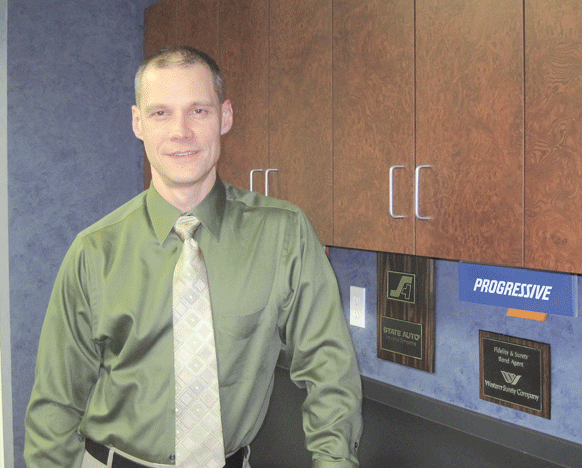
Sections Technology
Innovative Business Systems and TechCavalry Simplify Clients’ Access to Information

Dave DelVecchio

TechCavalry, acquired in 2012 by Innovative Business Systems, allows Dave DelVecchio and his staff to assist small businesses and individuals with their IT issues.

Late one night at the University of Central Florida, young college student Dave DelVecchio was discussing the movie Ferris Bueller’s Day Off with his roommate, but the two couldn’t recall the first name of Ferris’ best friend.
Racking their brains at 2 a.m., the students did the only thing they knew how to do back in 1989: they called local radio DJs, and after a few attempts, they found one who knew the character’s name (it was Cameron).
Fast-forward 25 years. Just last month DelVecchio was at Fenway Park, and a friend asked where a particular player hailed from. Within 20 seconds, DelVecchio picked up his smartphone and found the answer on Google.
Google — a word that would have drawn blank stares in 1998 — is not only the name of the world’s most ubiquitous search engine, but also a verb; people spend major portions of every week ‘Googling’ answers to questions of various levels of importance.
DelVecchio’s college example of how much more information people have at their fingertips today is reflected in his favorite saying: “that’s why you have a data plan.”
As president of Easthampton-based Innovative Business Systems (IBS), a 23-year-old IT-solutions company — and the parent company of newly acquired TechCavalry — DelVecchio and his four partners are tasked with finding solutions for businesses and individuals to access data, at home or at work.
Through IBS specifically, DelVecchio and his team can provide expertise and resources to meet a client’s information-technology needs, or operate as the IT department’s best resource.

Offering examples, DelVecchio cited a local bank that IBS helped cut server recovery time from eight hours to 45 minutes, and a local nonprofit for which the firm helped move an underperforming peer-to-peer network to a server-based environment complete with mobility solutions.
Additionally, since acquiring Northampton-based TechCavalry in 2012, IBS has grown from 13 to 27 employees and, through that new entity, can provide individuals and smaller businesses (50 employees or fewer) with project-based IT solutions to retrieve their data and protect it cost-effectively.
“It was an opportunity for us to position TechCavalry to serve an underserved segment of the market,” said DelVecchio. “All these technology advances have provided new and sometimes far-more efficient ways to get access to information. It’s not about turning the screwdriver and fixing the problem; it’s about providing consultative analysis and weeding through all the options to make the smart choices for a business.”
For this issue’s focus on technology, BusinessWest talked with DelVecchio to learn more about how he and his team have grown IBS, and now TechCavalry, and how both firms help business owners and individuals cut through the advertising clutter to find the best data solutions.

Next Generation
DelVecchio was a marketing graduate fresh out of college when he landed his first marketing job in 1994 with Bill Tremblay, the former owner of IBS, and on the first day of work had to be shown how to use a mouse.
DelVecchio, who jokingly said he’s now mastered the mouse, often uses a quote from Tremblay, from whom DelVecchio and his four partners later purchased the company in 2003: “computer hardware is the necessary evil to run the software that runs your business.”
As he talked with BusinessWest, DelVecchio explained that Tremblay, an IT project manager at Kollmorgen, started a small software-development company in 1987 and incorporated in 1990. His philosophy was that the company was supporting not just technology, but the user experience.
After working under Tremblay for almost a decade, that user-experience vision is the same for DelVecchio and his partners, who include Vice President and Treasurer Brian Scanlon, as well as Scott Seifel, Ben Scoble, and Sean Benoit.
DelVecchio, who advanced from marketing assistant to president and owner, is not alone in his non-technical background. Most of the staff at both IBS and TechCavalry came from myriad backgrounds, which allows them to effectively relate to a wide variety of client businesses.
Having three of the five partners literally rubbing shoulders with customers and clients is one of the benefits of working with IBS and TechCavalry, said DelVecchio, which also quells one of the biggest complaints in the IT service industry — consultant turnover — due in large part to the fact that Seifel, Scoble, and Benoit are active members of the technical service team, and add a sense of stability to both companies.
“It also helps us to recruit and retain non-partners, because those that come in realize that we’re all in this together. If you want to say the inmates now run the asylum, we were once the inmates,” DelVecchio said with a smile.
As they grew IBS, they found that Western Mass. is home to many smaller companies that didn’t necessarily need smarter technology, but they needed things quickly. DelVecchio said businesses have fewer options for those emergency calls because most growing IT firms won’t handle the ‘little guys.’
Enter Jef Sharp and Jeff Hausthor — serial entrepreneurs who had created nine businesses in a little over a decade — who had launched TechCavalry in 2002 out of a small garage in Florence. With their other businesses growing simultaneously, both owners felt that they needed experienced assistance to manage their small firm, and DelVecchio was approached to consider management duties.
Like the cavalry whose presence is announced with brass fanfare, TechCalvary boasts a trumpet logo and the tagline, “PC troubles? Help is on the way!” That focus appealed to the five partners at IBS, who felt that TechCavalry had a solid niche in the personal-consumer market with excellent growth potential, but that both parties would be better served if IBS owned the business.
“One of the biggest values in TechCavalry was their name in marketing,” said DelVecchio.  “Who are you going to call when you need an emergency fixed? You’re going to call in the cavalry.”
In August 2012, IBS acquired TechCavalry and combined the two firms in its Easthampton location. Now, in one expanded headquarters, the company hosts IT user group meetings, lunch-and-learn events, and technology-showcase events, with potential for future expansion on site.

Customer Centric

It was just three years ago that the IBS team decided to segue away from Tremblay’s software-development focus and center on providing IT services and consulting through PC sales, data analysis, networking, hardware and software support, repair, and maintenance.
With the new Windows 8, iPhone OS5, and a thousand other bells and whistles that keep business owners wondering if and how they should invest in technology, IBS and TechCavalry help customers figure out the best fit for their business needs.
“A lot of companies put out a lot of technology because they’re trying to make a buck,” DelVecchio said. “What we do is determine which technologies might be relevant for our clients.”
Cost isn’t always the main factor, he added, noting that his firm has talked clients out of overly complex and expensive solutions as often as it has guided them away from inadequate ones.
The clients that understand the role of technology in business, he said, are the ones that yield the most positive outcome. As a real-world example, he cited a potential new client whose major grievance was the collective 90 minutes of productivity he was losing each day being interrupted by employee complaints regarding their own loss of time due to slow or inefficient technology.
“For him, it wasn’t about technology, and it wasn’t about shaving pennies; it was specifically about how we as a company could add value to their business by helping the owner regain that five to eight hours a week worrying about technology and focus on running the business,” DelVecchio said.  “Having a business owner who is an actively engaged participant — and wants the right technology and dollars to be spent in the right places — makes the engagement much easier, and they get real value out of their investment.”

Emerging Field
Where technology is going to lead the business world in the next 10 years isn’t fully defined, said DelVecchio. The challenge for business owners is to not get distracted.
“There is never a panacea that is your solution to every problem,” he added. “Ultimately, it’s about using the right technology for the right reasons.”
DelVecchio’s goal for both firms is to grow in organic fashion — slow and steady — to be able to maintain the deep time commitment clients require.
“All the advances of technology have provided new and sometimes far more efficient ways to get access to information,” he said, “and all we’ve been asked to do as a company, from day one, is to help provide that conduit.”

Elizabeth Taras can be reached at [email protected]

Features
Western Mass. Business Expo Features a Full Slate of Programs

1_WMBEstevensSilverSponsor24x18.inddWhen she registered to run in the 1967 Boston marathon, she signed her name ‘K.V. Switzer,’ as she always did. Thus, it wasn’t until the race began that fellow runners, spectators, the press, and race officials realized that the individual wearing bib number 261 was, in fact, a woman.
And when they did so, some of those race officials tried to stop her and rip that number off of her, because no woman had ever run in the Boston Marathon, and none were invited to run in this one.
Kathrine Switzer refused to step off the course, and by persevering and finishing the race, she ran her way into history.
Switzer, known as the ‘Marathon Woman,’ will tell her story — and also convey her inspiring message about creating success in a difficult environment, turning negatives into opportunities, and implementing social and cultural change — during a luncheon hosted by the Professional Women’s Chamber at the Western Mass. Business Expo, slated for Nov. 6 at the MassMutual Center.
And this won’t be the only long-running success story to be highlighted that day. Indeed, Jim Koch, founder of Boston Beer Co. — maker of Samuel Adams — will be the keynote speaker at the Expo breakfast, hosted by the Affiliated Chambers of Commerce of Greater Springfield.
When Koch (pronounced ‘cook’) started his venture, he had a dream, a generations-old family recipe, and a large supply of determination — which he would need, because he didn’t have any bank financing or distributors to carry his product.
He overcame those obstacles to create one of most intriguing success stories in American business history. Today, while continuing to add to the portfolio of flavors his brewery produces, Koch is a motivational speaker and ardent supporter of small-business owners.
The breakfast and lunch programs are just part of an impressive slate of programs now coming togther for the Expo, which will again be produced by BusinessWest, managed by Rider Productions, and presented by Comcast Business.
Also on the schedule is a pitch contest and ‘demo day,’ being presented by Valley Venture Mentors (VVM) and BusinessWest.
Formed more than two years ago, VVM, as the name suggests, matches entrepreneurs with mentors to help businesses get off the ground or to that proverbial next level. VVM leaders will field applications for the pitch contest, selecting as many as 10 to make their cases in front of a panel of experts.
There will be cash prizes for the top three finishers, and also the ‘audience’s choice’ among the contestants.
“One of the keys to the future vitality of this region is its ability to cultivate new businesses, and Valley Venture Mentors is doing inspiring work in this regard,” said Kate Campiti, associate publisher of BusinessWest. “The pitch contest to take place at the Expo will feature some of the promising new ventures taking shape in our region in what will be spirited competition for both the approval of the judges — and prize money.”
After the competition, those businesses that made pitches will have their ideas on display at the event-capping Expo Social, which is one the region’s premier networking events, said Campiti.
In addition to these programs, the Expo will also feature a number of educational seminars, she noted, adding that subjects will range from the future of sales and marketing to the best and worst uses of social media.
The full slate of seminars has been assembled, and detailed information is available for viewing at www.wmbexpo.com. Here’s what’s on tap:

Sales and Marketing
• “The Art and Science of Cold Calling,” presented by Jim Mumm, CEO of Sandler Training;
• “The Future of Sales: How to Achieve Extraordinary Sales Results in Today’s Crowded Markets,” presented by Duane Cashin, president of Cashin & Co.;
• “Make an Impact with Multi-channel Marketing,” presented by Tina Stevens, principal and creative director of Stevens 470; and
• “Building Smart Websites,” presented by Peter Ellis, president of DIF Design.

Social Media

• “How TV and Social Media Have Affected Media Consumption,” presented by Jay Frogameni, senior director of sales for New England Local, Comcast Spotlight;
• “YouTube SEO,” presented by Alphonso Santaniello, president and CEO of the Creative Strategy Agency;
• “Am I Wasting Money and Time Doing Social Media?” presented by Paul Stallman, the ‘web guru’ at Alias Solutions; and
• “The Emdees: The Best and Worst in Social Media,” presented by Carie Schelfhaudt, director of digital marketing at McDougall & Duval Advertising.

Business Management
• “Leading Change,” presented by Ravi Kulkarni and Lynn Whitney Turner, business growth strategists and executive leadership coaches with Clear Vision Alliance, LLC;
• “The Emerging Workforce,” presented by Sandy Mazur, division president for Spherion Staffing Services;
• “Understanding Immigration Law: Immigration and International Employment Issues,” presented by Joseph Curran, Esq., Curran & Berger LLP; and
• “The New Business of a Nonprofit,” presented by Kirk Smith, president and CEO of the YMCA of Greater Springfield.

And That’s Not All

Other programming for the Expo is being finalized, said Campiti, who urged those interested to visit the website regularly and check for updates.
To register for the seminars, visit www.wmbexpo.com. To register for the breakfast, call the ACCGS at (413) 787-1310 or visit www.myonlinechamber.com. To register for the luncheon, call (413) 787-1310 or visit www.professionalwomenschamber.com.
In addition to Comcast Business, the Expo is also being sponsored by ABC 40/Fox 6 (gold sponsor), and silver sponsors DIF Design, Health New England, Johnson & Hill Staffing Services, and MGM Springfield.

Expo Fast Facts

What: The Western Mass. Business Expo
When: Nov. 6
Breakfast: 7:30 a.m.
Show Floor: 9 a.m. to 4 p.m.
Luncheon: 11:30 a.m.
Expo Social: 4 to 6:30 p.m.
Where: The MassMutual Center, Springfield
Highlights: Breakfast and luncheon programs; pitch contest; educational seminars; Show Floor Theater presentations; free educational seminars; Expo Social; more than 150 exhibitors
For More Information: Visit www.wmbexpo.com or call (413) 781-8600

Community Profile Features
Deerfield Touts Tourism, Agriculture, Business

Deerfield, MassBela Breslau opened Bela’s Bed and Breakfast in June, and the Deerfield entrepreneur has already had guests from as far away as Korea.
“I’ve met the nicest people. They have come here from New York City for a wedding and for events such as school graduations,” she said, adding that her business has done well and she has received support from area residents. “The town officials here are positive to work with, and everyone has been very thoughtful because they want you to succeed.
“Deerfield is a really good place to do business,” she added, explaining that she and her husband, Stephen Bliss, also own and operate a martial-arts school on their property, where they teach the Japanese body movement known as shin tai do.
The couple moved to Deerfield from San Rafael, Calif. in 2004, and they love the town. “It’s a beautiful place with a lot to do and see,” Breslau said.
Carolynn Shores Ness, who was on the town’s Planning Board for 21 years, has had a seat on the Board of Selectman for 11 years, and is chair of the Board of Health, says the Breslaus’ story has been repeated many times in this community, and location is one of many reasons why.
“A lot of traffic comes through town, and we have a lot of tourist attractions,” she said, noting that Deerfield is a crossroads for Interstate 91, Routes 5 and 10, and Route 116.
Max Hartshorne agrees. “We really do promote Deerfield as a tourist destination,” said the former owner of GoNomad Café, who now owns a travel publishing business he operates from his Deerfield home. “Tourism here is strong. Yankee Candle is the number-two destination in the state, Historic Deerfield is legendary, and Deerfield Academy is really pretty.”

Gideon Porth

Gideon Porth says Deerfield’s access to highways and land availability are two factors that make it an attractive location for agricultural businesses.

Shores Ness said that, while the town has but 5,100 residents, 2 million people visit Yankee Candle each year. She also cites Historic Deerfield, which includes the Memorial Hall Museum and Flynt Center of Early New England Life, which feature constantly changing exhibits and workshops; Magic Wings Butterfly Conservatory and Gallery; and Mount Sugarloaf Park in South Deerfield, “which has absolutely wonderful views and allows people to walk the length of Pocumtuck Ridge,” as other popular tourist attractions.
In addition, there are the annual Old Deerfield Craft Fairs, which take place every spring and fall and draw between 30,000 and 50,000 visitors, along with the town’s Music in Deerfield chamber series and its gun clubs.
“The Franklin County League of Sportsman’s Club is here, and the South Deerfield Rod and Gun Club are also important to the community,” said Shores Ness, adding that the latter holds fishing events and turkey shoots. “There are also a lot of cultural activities that happen here year-round. And we have three boarding schools with a lot of activity, as well as many nonprofits.”

Room for Growth
Many of the town’s businesses have expanded over the past few years, and an expedited permitting process for a town-owned, 16-acre tract of land with sewer and water hookups has been approved for commercial or industrial use.
Opportunity also exists in a variety of other areas. “There are empty buildings downtown, and plenty of space is available,” Hartshorne said. “Although it’s a very sleepy downtown, a lot of traffic passes through it.”
He added that Mosaic Café is set to open this month at the site of the former, well-known Elm Farm Bakery, while Hillside Creamery, which sells ice cream and food, also opened on Elm Street. In addition, there is a new empty building across the street, which would make a great store, he said. “It has post-and-beam construction and a large parking lot.
“Plus, the Bank of America branch on Sugarloaf Street also closed recently, which has a vault and drive-through and would make a great location for another bank,” Hartshorne continued. “Permitting here is really easy, and people are friendly and helpful. It’s a crossroads town, taxes are really low, and the town officials are interested in helping new businesses grow.”
Shores Ness said space and buildings are also available in the town’s industrial park.
And although the tourist business makes up a large part of the town’s economy, the East Railroad Yard has undergone tremendous growth.
The town’s agricultural base has always has been strong, and Hartshorne said town officials are looking to the future. “Some farmers have approached them about growing marijuana, and their response has been positive.”
Shores Ness added that UMass has active agricultural and turf programs in town. “They have really ramped up, and there are a lot of experimental fields and classroom research being done in Deerfield,” she told BusinessWest.
Gideon Porth agrees. In 2004, he purchased three acres of farmland in Deerfield and began an enterprise known as Atlas Farm. It has doubled in size every year, and Porth recently purchased an additional 45 acres and opened a year-round farm stand that sells the organic produce grown on his 95-acre property, along with other local products.
“Business has been good, and we have definitely exceeded our sales estimate,” he said, adding that the town’s access to highways and resulting proximity to metropolitan markets such as Boston, where he does a lot of wholesale business, makes it an even more attractive place to establish a farm.
“The town is very supportive of agriculture, and this is one of the few spots in New England with prime land and soil for growing vegetables,” said Porth, who came to the area from Boston when he was a graduate student at UMass Amherst.
In addition, the town takes a proactive stance on capital improvements. Current projects include the replacement and relining of sewer lines as well as streetscape planning being done for the village of South Deerfield.

Keeping Pace
Shores Ness noted that Deerfield is a green community and has signed up with the Hampshire Power Municipal Aggregation group, which will eventually allow the town to buy power at a discounted rate. In addition, a stretch energy code was approved during a recent town meeting; it requires the use of energy-efficient measures in renovations and new construction. “We also encourage conservation throughout the town,” she said.
Measures have also been taken to mitigate the effects of weather emergencies, such as Tropical Storm Irene in 2011 and the freak Halloween snowstorm the same year, which had an adverse effect on land and property in Deerfield.
Town officials have applied for grants to do restoration work along the Deerfield River. “And we’re working with FEMA and MEMA to become a more resilient community so we won’t be as affected by weather events. We also offer a free, drive-through flu clinic on Oct. 6 at Yankee Candle,” Shores Ness said, adding that several hundred volunteers work with the town’s medical disaster-response team.
Laurie Nivison, director of marketing for Historic Deerfield, said Champney’s Restaurant inside the Deerfield Inn reopened in April after being closed for 18 months as a result of flooding from Tropical Storm Irene.
“The restaurant and inn underwent extensive renovations and restorations. We expanded the tavern area from 10 to 20 seats, have a new menu, and are farm to table. We have partnerships with local farms and get our pork and beef from Yazwinski Farm in Deerfield,” she said, adding that they also serve beverages made at Berkshire Brewing in Deerfield as well as other local breweries.
“Even though Deerfield may seem like it’s off the beaten path, people come here year-round,” she continued. “Historic Deerfield gets about 15,000 tourists each year, and it’s a really vibrant community; people don’t realize how much there is to see and do in town. It’s a great place to come and spend the day.”
Hartshorne said the fall is a busy season in town, but winter is also fruitful because people drive through Deerfield or pass by on their way to ski areas in Vermont.
“There are also events such as a bike ride known as D2R2, which attracts about 1,000 cyclists every year,” he said, adding that cyclists have their choice of an 80- or 100-mile route.
In fact, there is so much to see and do that, in 2008, Hartshorne worked with the tourist attractions in town and created the website deerfieldattractions.com to allow people to find out about the fairs, shopping, dining, recreation, museums, and other activities that take place in Deerfield throughout the year. He also coordinated an annual Tag Sale Day that takes place the first Saturday in October.
“We try to get everyone in town who is holding a tag sale to do it on that day,” he explained. “We create a Google map on the website every year so people can find where the sales are.”

Vibrant Economy
Shores Ness says many businesses in Deerfield have formed strong partnerships with the town, and it’s a reciprocal arrangement, as officials do all they can to help them.
“People here communicate well with each other, which is something we have encouraged,” she said. “There is a constant stream of really interesting and exciting things that are always happening in Deerfield. It’s just a wonderful place to live and work, and we welcome new neighbors and want to keep and encourage the businesses that have made a long-term commitment here.”