Home Posts tagged Events (Page 31)
Cover Story
Holyoke Blue Sox Reach for the (Future) Stars
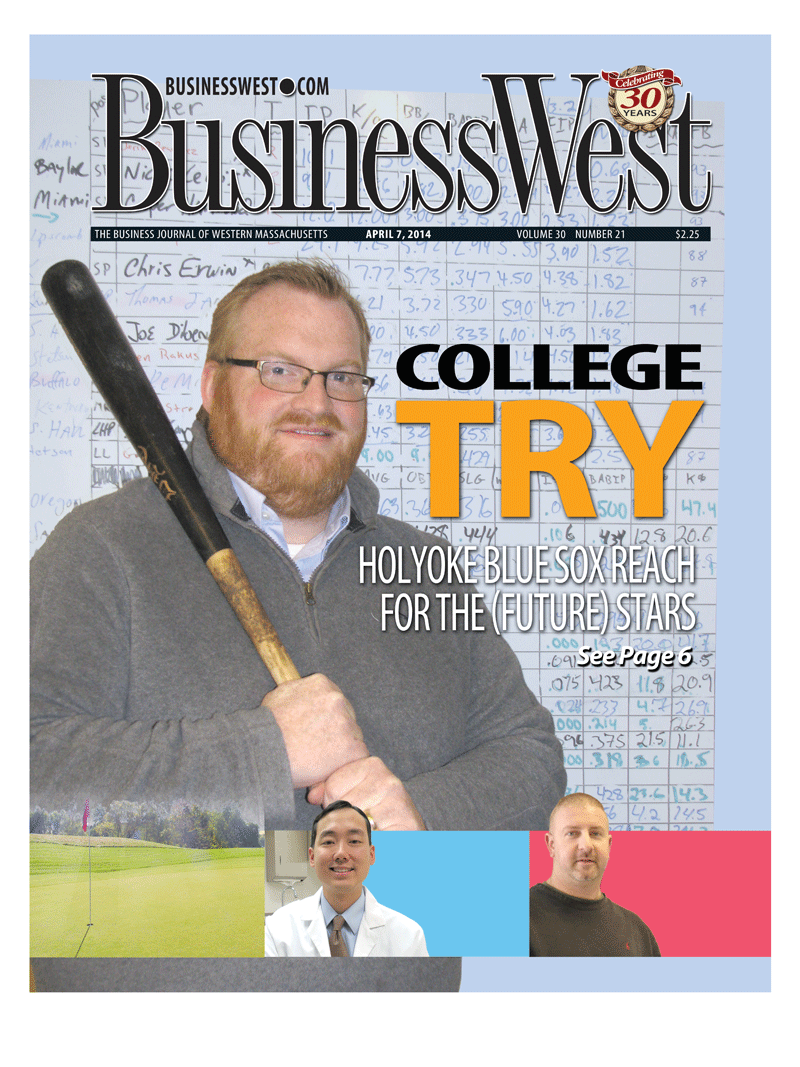
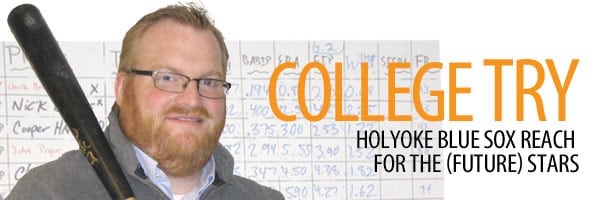
COVER0414aHunter Golden is living the baseball dream. A dream that seemed unattainable when he actually, you know, played the game.

“I was a terrible baseball player. I was a pretty good athlete, but a terrible baseball player,” he said of his days in youth sports. “I wasn’t bad — I was brutal. I felt bad for my parents having to watch.”

Which is why his new role — as general manager of the Holyoke Blue Sox, hired last year by the team’s new owner, Clark Eckhoff — is more than a little surprising.

“Baseball has always been this mistress of mine since I was young,” Golden said. “It’s weird — baseball was always a source of conflict in my life. My dad was a diehard Yankee fan and owned season tickets; I was a Red Sox fan. My dad was great at baseball, and I stunk. I mean, I was indescribably bad, but I was always chasing it, trying to beat it.”

is ascension from sports blogger to upper management of a team in the New England Collegiate Baseball League (more on that later) is just one of many brainstorms wrought by Eckhoff, who previously owned the Wausau (Wisconsin) Woodchucks of the Northwoods League for 13 years, and was looking for a change when he bought the Blue Sox last summer.

“I saw this as a huge opportunity, based on the market and the great baseball culture here,” Eckhoff told BusinessWest. “My wife likes the New York area and the East Coast, and all our kids are in college but one, so we saw it as a different challenge, a new adventure. We’re going to grow this thing, and it’s something that’ll be really special for fans throughout the Pioneer Valley.”

To do that will require a significant boost in the team’s profile. “The biggest thing is, you have to promote the product. A lot of people in the Valley don’t even know we’re here,” he said.
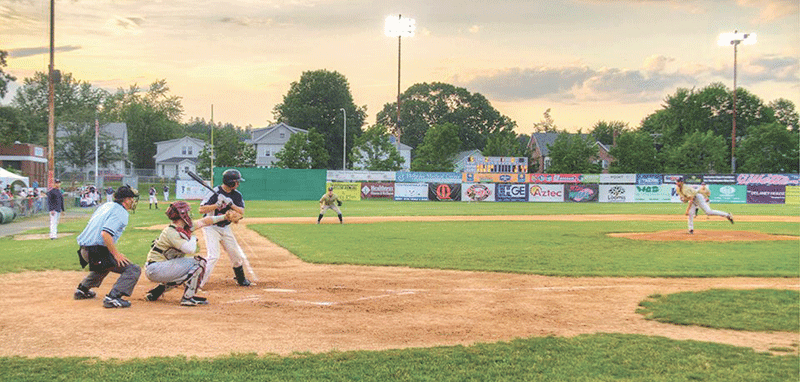
MacKenzie Stadium

MacKenzie Stadium, adjacent to Holyoke High School, has been the Blue Sox’ home since 2007, and will host the NECBL All-Star Game in July.

“We’ve got to get people exposed to the product and see how affordable it is,” he continued. “Not only that, but our players are accessible; you can get autographs. Hey, your son might be getting the autograph of a future major-league baseball player. The product is very good, but we’ve got to bring it all together.”

The summer league — which attracts elite collegiate players from across the U.S. to play a 44-game schedule from June into August — has plenty to recommend it, Eckhoff said. “We’re getting the best kids in the country, but we also make it about entertainment, with giveaways and on-field promotions. In minor-league baseball, 80% of the fan base is coming out for an affordable family night.”

He and Golden believe that fan base is largely untapped — after all, Springfield remains the largest metro area in the country without a professional baseball team — and have some ambitious plans to make the Blue Sox more of a household name.

Cream of the Crop

Peruse the 30-man Blue Sox roster, Golden said, and you’ll see schools like Cal State-Fullerton, Miami, Vanderbilt, and other top baseball universities represented.

BlueSoxAllStarLogo“They’re the cream of the crop, the best guys out there,” he said, noting that two of the last five number-one major-league draft picks — Stephen Strasburg in 2009 and Mark Appel in 2013 — played in the New England Collegiate Baseball League (NECBL), as did notable lights like Andre Ethier, Andrew Bailey, Joe Nathan, Craig Breslow, Chris Ianetta, and scores of others.

“It’s a tremendous opportunity for these guys to really showcase their talent in a professional setting. Major League Baseball is a big believer in our product and the caliber of players we bring,” he said. “Watch the College World Series, and chances are you’ll see half our roster.”

This year, the team is heavily promoting catcher Max Pentecost, a Kennesaw State University junior who’s projected as an eventual first-round, top-20 major-league draft pick. “That’s how good these guys are. They’re no joke. We see 19-year-olds throwing in the mid-90s, hitting the ball 400-plus feet. They’re prodigies, and this is where they come to showcase themselves.”

Pentecost played for the Blue Sox in 2012 before spending last summer in the Cape Cod Baseball League, one of Holyoke’s main competitors for talent. But Golden noted that, while the CCBL may be a higher-profile league, the NECBL, with its longer road trips, offers an experience more reflective of the minor-league life. “We sell that to the players — it’s more of an opportunity to come and develop themselves professionally.”

And the professional baseball life is, despite its perceived glamor factor, a real job, he explained. “These guys get to the clubhouse at 9 in the morning, and they’re reading scouting reports, data reports, understanding the math, learning the pitching staff, how fast they throw, each pitcher’s arm slot — they’ve got to memorize all that stuff. They deal with injuries, they deal with the media … there’s a lot in a baseball player’s day.”

Other collegiate summer leagues across the country offer bigger stadiums and more fans, which can be seductive, but the NECBL has a reputation for taking seriously the job of preparing young men for professional ball — and the risk that career path entails.

“A lot of these kids turned down a lot of money to stay in college and get their degree. They’re coming to a collegiate league to advance their career and work toward a college degree,” Eckhoff said — a smart move for most, he added, since only 3% of all players who enter professional ball ever reach the majors. “It’s smart to at least graduate before entering the minor leagues; it’s a tough road.”

If the Blue Sox do their job with scouting, he added, fans will see more than one future major leaguer in action. As for recruiting, he said he enjoys the networking side of that important task.

“With me being older, it’s easier for me to pick up the phone,” he said. “I know the coaches at Fullerton, Stanford, Oregon, and the coaches trust me; we have a good relationship. They know the kids will have good host families and will be taken care of well.”

Those families, who volunteer to share their homes with the collegiates, are a key component in the success of a team, Eckhoff added. “I knew a lady in Wisconsin who hosted three or four players a year, over 18 or 19 years. She had a wall with [photos of] 70-something players who stayed with her. She stayed in touch with them, even flew to a wedding in Texas. That was incredible. It almost becomes like an extended family.”

Blogger Rhythm

Meanwhile, Golden’s path to professional baseball came through a relationship not with coaches and players, but with numbers.

After his washout as a player, he found some measure of satisfaction in sabermetrics, an innovative way to analyze a baseball player’s potential by crunching his in-game performance into, essentially, hard math. While Michael Lewis’s bestseller Moneyball brought the concept into the mainstream, a core of number crunchers led by the original sabermetrician, Bill James — whose newsletters Golden read meticulously — had long been touting new ways to measure performance.
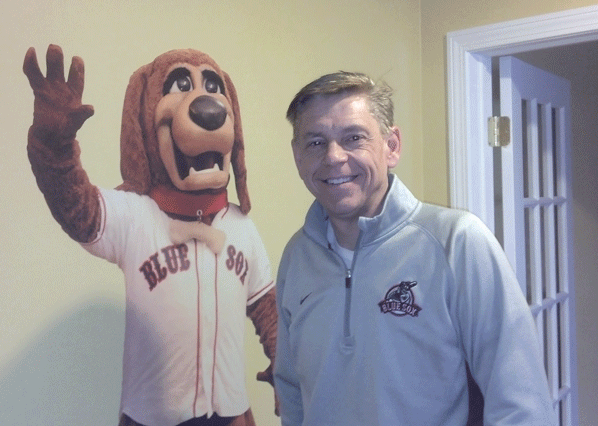
Clark Eckhoff

Clark Eckhoff says his goal is to spread the word about the high quality of play and affordability of a Blue Sox game — and he’s confident that people will come.

That was a little odd, Golden conceded, since, as a child, he was a straight-A student — except in math, where he earned Ds. “Essentially, I got involved in two things I wasn’t good at — baseball and math — but they coalesced because of Bill James.”

In terms of impact, Moneyball was a “nuclear bomb” on the baseball-management scene, he said, although Athletics GM Billy Beane, the focus of that book, was hardly the first to put sabermetrics into practice. “But he was one of the first to be vocal about it and be successful with it.”

After graduating from Springfield College, Golden launched his own copywriting business, which morphed into a marketing consultancy, working with several national clients. But because he was passionate about baseball and sabermetrics, he started a blog on those topics in 2007.

“My friends really liked it,” he said. “Then Twitter came around, and Twitter turned into a gigantic barroom for baseball dorks. One thing led to another, and my work got noticed by ESPN, which had me come on board with their SweetSpot blog.” Appearances on outlets like the Sports Hub radio station in Boston raised his profile further, which attracted the attention of Eckhoff, who asked Golden to serve on a community-advisory board after he purchased the Blue Sox.

“He heard about me through the grapevine of local baseball dorks and brought me to the table,” Golden said. “We hit it off, and after three or four conversations, we got together for lunch, and he offered me the job.”

It was a big deal, he added, because the world of baseball management, a classic old-boys network, is a notoriously tough nut to crack for job seekers. “I always thought of the MLB employment site as a place they just stash résumés.

“It’s weird, though; once you’re in, you’re in,” he added, recalling sitting down in Dallas and chatting with former Yankees bullpen coach Dom Scala — who told stories about Billy Martin, Reggie Jackson, fights in the locker room, and humorous run-ins with George Steinbrenner — like the two were old pals.

And he loved this world, dealing for the first time with flesh-and-blood players and not just numbers — and in a much different way than, say, the management of the Springfield Falcons, the American Hockey League affiliate of the Columbus Blue Jackets.

“I think where we’re different — and, from a greedy standpoint, where it’s fun for me — is that we have a significant baseball-operations component to what we do,” Golden said. “With the Falcons, the Blue Jackets say, ‘here are your players; don’t break ’em.’ Ultimately, at the end of the day, the parent club dictates who the players are going to be. Here, we identify and recruit players we like for next year’s team, and our roster turns over year after year. We’re constantly in player-acquisition and analysis mode based on objective data, sabermetrics, and scouting.

“The challenge in this league is to win now; we have to get players who are good now,” he added. “It’s very easy to get seduced by prospects with a little more talent, who may be better off down the line.”

Even some very good players, unfortunately, reach their end in college, never even making it to single-A ball. “A lot of kids come here batting .340 in college and can’t hit with wood bats, and their career goes up in smoke,” Eckhoff said. “It happens. One kid came in and lost 140 points in one year.”

Race to the Top

The key to the team’s success, Golden said, is to take player development seriously, but also understand that families that show up at MacKenzie Stadium, near Holyoke High School, want to have a good — even silly — time.

“Our core product is baseball, but really, at the end of the day, we’re family entertainment,” he told BusinessWest. “We have the goofy promotions — the dizzy bat races, the sausage races — but also serious stuff, like recognizing community heroes and a Rays of Hope night. Just like a minor-league franchise, that’s ultimately what fans come back to see.”

Families with children are a key demographic, he said. “It’s expensive to see the Boston Red Sox. Between tickets and parking, before you even get in the park, you’re out $150 for a family of four. Then it’s $50, $75, maybe $100 more to feed everybody, then you drive all the way home.”

With Blue Sox tickets priced at $4 and $6, it’s a more manageable financial proposition. “You can bring $35 bucks to the park and have a really great time with your family,” Golden said. “We’re even cheaper than the movies, and you can be outside talking to each other. It’s an outstanding value for families.”

Meanwhile, the team is making an effort to be more visible in, and involved with, the community. “We’re working closely with area nonprofit organizations. We want to bring as many to the park as possible this year, and have ballplayers and the mascot at events. We’re going to have a nonprofit or two at the stadium every game this season. The community impact that has is substantial.”

The team is planning to get kids involved more as well, bringing them on the field for the national anthem, making players accessible for autographs, and conducting a summer baseball clinic.

In another move that makes sense in Holyoke, Golden said, “we’re aggressively courting the Hispanic and Latino market, which, from a sports standpoint, has gone mostly untapped here. That’s a baseball-crazy culture, and we’ve got a great opportunity to market to them.”

Whoever comes to the games, the idea is to show them a good time, Eckhoff said. “Every home game, we’ll have a different promotion, whether it’s a T-shirt giveaway or a bobblehead or something else. And our concession prices are more affordable. We’ll have dollar-hot-dog nights.”

He recalled one promotion in Wausau called the ‘chicken chuck,’ where fans tried to toss a rubber chicken back and forth and catch it in a frying pan. “You have 90 seconds between half-innings to show them something enjoyable; it could be a T-shirt toss or a chicken chuck. And they remember that.”

Added Golden, “if you wait two weeks after a game and ask a fan who attended the game what he remembers, it won’t be the players or the score, but they will remember the chicken chuck.”

Eckhoff was doing something right in Wisconsin. When he bought the Woodchucks in 1999, the team was drawing some 600 fans per night. By his 10th year, attendance averaged 2,000. He attributes that to the team getting the word out about the quality of play — about 15 of his players eventually made the majors, including Ben Zobrist — but the fun factor as well.

Stars Aligned

The New England Collegiate Baseball League has experienced similar growth since its founding in 1993 by former MLB Commissioner Fay Vincent. It began with four teams and eventually expanded to 12.

“That’s slow, sustainable growth,” Golden said. “That’s playing for the long game, and the caliber of baseball has continually gotten better over the years. More than 150 major-league players have come through the league, the lion’s share in the last 10 years.”

The Blue Sox, who began in 2001 as the Concord (N.H.) Quarry Dogs before relocating to Holyoke in 2007, have seen ups and downs of their own, but the new ownership believes a largely untapped base of potential fans is waiting to support quality summer baseball in the Valley — and that attendance, currently averaging about 1,000 per game, will follow. Hosting the league’s All-Star Game on July 20 is just one more draw.

“Our goal this year is to establish a real, genuine presence in the region and let people know we’re here,” Golden said. “We’re committed to the region, and we’re going to make this thing work.”

In the end, the numbers won’t lie. They never do. Just ask any sabermetrics dork.

Joseph Bednar can be reached at [email protected]

Sections Sports & Leisure
Indoor Rock Climbing Is Gaining a Foothold in the Region

By KEVIN FLANDERS

massive rock walls

Interest is growing locally in climbing massive rock walls like these, which, depending on the facility, can stretch up 40 feet or higher.

Hana Skirkey cites a number of reasons why a growing number of people are trying out — and usually staying with — the emerging sport of indoor rock climbing.

“For some it’s a way to conquer their fear of heights,” said Skirkey, an instructor and manager at Central Rock Gym (CRG) in Hadley. “Others just like the freedom. Personally, I think it’s a really fun form of exercise — every step is like a puzzle you’re trying to figure out with your own body. It’s all about finding ways to get to that next hold.”

Whatever the reason or reasons, this activity is certainly gaining traction — literally and figuratively — across the nation and in Western Mass.

Indeed, the region now boasts two indoor rock-climbing facilities — CRG-Hadley, one of four locations operated by Central Rock Gym across the state, and the Northampton Athletic Club (NAC).

The former features the region’s highest rock wall, at 45 feet, and 17,000 square feet of space, while the latter boasts a 40-foot wall, use of which is included in a club membership.

And many people, of all ages and with a host of motivations, are finding and challenging these walls.

“Interest in indoor climbing has definitely grown over the past few years,” said Andy Goddeau, the general manager of the NAC. “It offers something different that a lot of people have never tried before. Many kids start off when they’re really young, and they keep coming back as they get older to learn different techniques and training styles.”

Rigged with hundreds of colored grips and footholds, the wall provides several climbing routes that correspond to different ability levels to ensure everyone from beginners to experts have a fun experience at the appropriate degree of difficulty. Each route features arrows that guide climbers in specific directions, the most challenging of which require the use of advanced techniques. But before anyone can test their skills on the wall, they must first pass an introductory safety course.

“The course teaches people all about the harnesses, carabiners, and other equipment they’ll be using on the wall,” added Goddeau. “We want to make sure people are proficient with belaying and how to climb safely before they go off on their own.”

The NAC and CRG-Hadley now host everything from competitions for people of all skill levels to team-building exercises for area companies; from birthday parties to gatherings for area Boy Scouts and Girl Scouts. And it appears that all this is not a fad, but rather a recreational activity — and business opportunity — with staying power.

“Business has really exploded over the past year, with college students and families always coming in and looking to try it out,” said Skirkey. “Weekends are usually the busiest for us, but we get new people here every day.”

For this issue and its focus on sports and leisure, BusinessWest turns the spotlight on an activity that’s growing on a grand scale, in every sense of that phrase.

Warmer Climbs

As the only gym in Western Mass. dedicated specifically to indoor climbing, CRG-Hadley hosts many specialized training classes and programs, one of which is designed for advanced climbers who have mastered an array of difficult skills.

Skirkey described the “extreme” 45-foot roof as one of the most challenging obstacles in the facility, keeping high-level climbers on top of their game. But for those who are just starting out and want to stick to the lower walls, the gym holds belaying classes every weeknight to show beginners the ropes.

“There’s something for everyone here, from people new to climbing to experts,” she explained. “The roof definitely gives us an opportunity to create challenging routes for advanced climbers.”

It is this ability to provide challenges for people of all ages and skill levels that has enabled the indoor rock-climbing facilities to enjoy steady growth and attract an array of different audiences, said those we spoke with.

This diversity comes in many forms, including the ability to present plenty of fun options that don’t even require a rope, such as bouldering. This is the act of scaling a wall without a rope, and it allows climbers to envision themselves navigating treacherous terrain without worrying about getting injured, as safety mats dutifully await any missteps. Both Northampton Athletic Club and CRG-Hadley are equipped with bouldering walls for individuals who prefer to climb with nothing to guide them but their arms and legs.

Increasingly, it is young — and even very young — people who are trying out these activities, and then coming back for more.

“Kids really love getting on the wall. I think the youngest person we’ve ever had up there was 3 years old,” said John Maradik, one of three climbing instructors at the NAC, which uses specialized full-body harnesses for children, enabling youngsters to experience the thrill of the climb along with their parents or one of the instructors.

For Goddeau, who’s worked at the club since 2002, it’s rewarding to see children develop a love for climbing. One of the club’s current instructors, he recalled, first climbed the wall as a 12-year-old and never looked back, eventually becoming a skilled climber and returning to the club to share his passion with beginners.

Teaching and reinforcing the proper techniques is an important goal at the club, whose instructors strive to maximize their students’ enjoyment of the activity and also reduce their risk of injury. The facility offers instructional classes for those who want to learn more about belaying and footwork, as well as the Try-a-Climb program, during which instructors provide individual feedback to novice climbers.

Safety and education are also major focal points at CRG, which frequently runs instructional classes to introduce the activity to the new climbers who step through its doors each day.

Sometimes the perception of risk is the most exciting part of the climb, instructors at both businesses agree, even though the safety mats are always there to cushion falls.

And while indoor rock climbing provides year-round business, the colder months are typically the busiest, when snow-covered mountains and frigid temperatures force hikers indoors to find a rock to conquer. It’s also a great activity for athletes in other sports who are looking to keep their muscles and reflexes toned during the off-season.

Regardless of the season, indoor climbing courses provide sustainable business due to their popularity as a choice for birthday parties, family outings, and team-building events. The NAC and CRG-Hadley both offer group specials, discount nights, and promotional events.

“Every few weeks, we do a college night or a guys and girls night. We host a lot of birthday parties and events for the Boy and Girl Scouts,” said Goddeau. “We also had a competition this year with about 25 participants. One thing people really like is that they can come and use the gym, then climb the wall. There is no additional charge to go climbing.”

Skirkey noted that CRG-Hadley also hosts a wide range of events and outings.

“Birthday parties, youth camps, classes — we do it all here,” she said. “We even have a climbing team for kids. One of them was invited to a team that competes at the national level.”

CRG-Hadley also hosts several competitions and tournaments throughout the year. On April 12, the gym will serve as the site of the second event in CRG’s Ring of Fire Competition, a series of three climbing tournaments at CRG locations. The first event took place in Glastonbury, Conn., while the final leg of the series will bring competitors to the chain’s Watertown branch. With major sponsors such as Adidas and cash prizes, the annual competition attracts amateur and professional athletes from across the country, one of many competitions Skirkey describes as integral to CRG’s success.

“The Ring of Fire Competition is really big in terms of sponsorship and exposure,” she said. “We also have speed-climbing competitions, bouldering competitions, and fund-raising competitions throughout the year.”

Social Climbers

Skirkey told BusinessWest that one of the biggest advantages indoor climbing has over most other sports and activities is its ability to combine recreation with adventure, providing climbers with an exhilarating experience without sacrificing safety.

This quality has enabled climbing to gain a strong foothold in the region, one that should enable it to continue to see consistent growth in popularity and a place in the area’s deep portfolio of recreational activities.

You might say the pattern of progress has been rock steady.

Health Care Sections
Noted Eye Surgeon Andrew Lam Shows He Has the Write Stuff

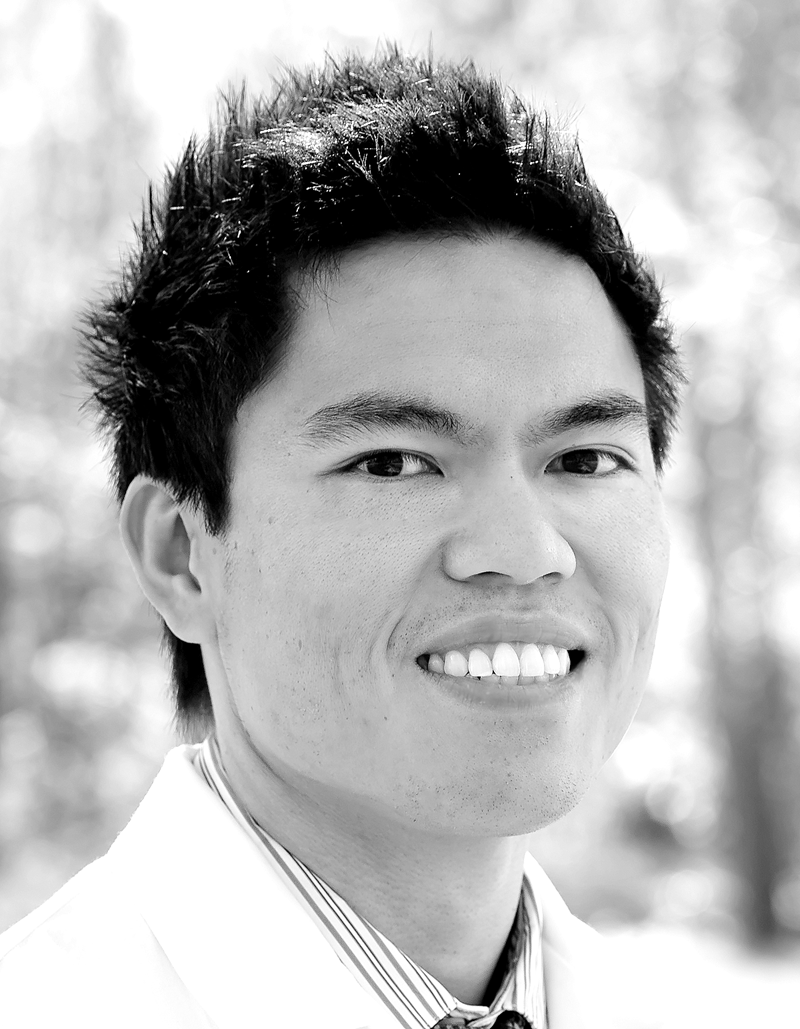
Dr. Andrew Lam

Dr. Andrew Lam’s twin passions for eye care and history have helped him carve out a unique niche in both fields.

China 1944: American lieutenant David Parker and Communist guerilla Lin Yuen have nothing in common except a common enemy — the Japanese. When fate brings them together for a dangerous assignment behind enemy lines, their clashing convictions threaten to derail the mission. But the battles they fight, the horrors they witness, and the brotherhood they forge ultimately transform them both.

That’s a passage off the book jacket of Two Sons of China, a novel penned by noted retinal surgeon Dr. Andrew Lam. The language is typical of that used by publishers to compel readers to turn some pages and buy the book, and it explains what this historical novel is all about.

But that excerpt doesn’t begin to convey the passion that Lam has for history, military history, World War II, and especially the usually forgotten theater of that global conflict — the war in China.

“I wrote this because I wanted more people to know what happened in China during World War II,” said Lam, who studied history as an undergraduate at Yale but was ultimately swayed to enter the medical field by the seemingly countless stories of the life-saving exploits of his father, a cardiologist (more on those later). “A lot of people don’t know that thousands of Americans served in China during the war and that millions of Chinese died; China actually served a very important role in the Allied victory, yet few seem to know the story.”

Telling it, or at least part of it, through this saga based on true events has become the latest chapter in an intriguing and newsmaking career, one that has put Lam’s name together in the same sentence with the phrases ‘distinguished ophthalmologist’ and ‘bestselling and award-winning author.’

cover_savingsight

Dr. Andrew Lam’s first published book blends the history of eye-care innovations with his own personal experiences, while his latest work explores the often-forgotten Chinese theater of World War II.

Dr. Andrew Lam’s first published book blends the history of eye-care innovations with his own personal experiences, while his latest work explores the often-forgotten Chinese theater of World War II.

Those latter honors were earned with his first published work, Saving Sight, subtitled  An eye surgeon’s look at life behind the mask and the heroes who changed the way we see. It’s mostly about science and developments such as refractive surgery and treatment of wet macular degeneration, but there is also a lot of history, such as in the stories about Louis Braille and his language for the blind and Harold Ridley’s invention of the intraocular lens and how it took nearly 30 years to come into use.

And they’re told with heavy use of the first person, which gives such weighty subjects and 15-letter words a needed personal touch.

“I told my agent I wanted to write a book about the heroes of ophthalmology,” he recalled. “And she said, ‘that’s fine, but nobody’s ever going to buy that book, because only nerdy ophthalmologists would buy a book about medical non-fiction like this.’ So I decided I had to do something to make it more marketable, to make it more interesting, to make people want to pick up a book about medical history.”

That something turned out to be his decision to blend his own experiences training in surgery, a tactic that helped the book, which came out nearly a year ago, greatly exceed his publisher’s expectations, become a bestseller on Amazon, and earn awards from the London Book Festival and the New England Book Festival, with more competitions to come.

Two Sons of China was actually finished before Saving Sight, but it took Lam’s agent more time to find a publisher for that work. The novel was released in December, and early sales have been promising.

Meanwhile, Lam is hard at work on his next project, a detailed look at the famous 442nd Regimental Combat Team — the unit of Japanese-American soldiers that fought in Europe during World War II while many of their families were held in internment camps in the U.S.

For this issue, BusinessWest talked at length with Lam about his twin passions, and how they both might be considered volume businesses.

Novel Ideas

The lobby at New England Retina Consultants looks like most other medical waiting rooms, with rows of seats, assorted magazines on a table near the front, and staff members taking information and calling out patients’ names.

What sets it apart are all the framed newspaper clippings about Lam and his books and signs alerting visitors that signed copies of these works are available for purchase.

The juxtaposition of these items speaks to how effectively Lam has been able to blend his passions for medicine and history rather than choose one over the other.

How he’s managed to do that is an intriguing story, one that begins in Springfield, Ill., where Lam grew up and received almost daily reminders about how respected, and revered, his father was in that community, famous as the birthplace of Abraham Lincoln.

“I’d go to the mall or just walk around the city, and people would stop me and say, ‘your dad’s a great doctor; he saved my life or the life of a loved one — are you going to be a great doctor like your dad?’” he recalled. “These kinds of experiences left an indelible mark on me; they showed me that being a physician could be a very gratifying thing. He had a very gratifying career, and you can’t help but be influenced by that when you’re growing up.”

So strong was that influence that Lam put aside any thought of doing graduate work in history and instead went to the University of Pennsylvania Medical School, where he quickly focused on surgery, which fit his personality — “I like to fix things; I like to do things and see if I can make things better” — and the eye.

“I felt that sight is so important to everybody, so ophthalmology was the perfect fit,” he said, adding that, 10 years after graduating from Yale, he completed a fellowship at the prestigious Wills Eye Hospital in Philadelphia and then joined New England Retina Consultants in Springfield, where he saves patients’ sight on a daily basis.

He treats a number of conditions, including retinal detachment, macular degeneration, and diabetic retinopathy, and told BusinessWest that the work is extremely rewarding because of the seriousness of those problems and the ability to greatly improve quality of life by providing solutions.

“The people I treat have serious eye problems — if other eye doctors have a complication, they will often call on us to help them,” he said. “But the flip side to this is that it’s very gratifying to try to help people, because we’re talking about their vision.”

But while Lam was certainly excelling in his chosen field, his passion for military history — and, more specifically, U.S. involvement in Asia during various 20th-century conflicts — never left him, and he began looking for ways to express it. He found one in his desire to relate a little-known chapter from the forgotten Chinese theater of World War II — an operation known as the Dixie Mission.

This was the first effort on the part of the U.S. to establish official relations with the Communist party of China and the People’s Liberation Army, led by Mao Zedong, which was then headquartered in the mountainous city of Yenan.

“During the war, Americans supported Chiang Kai-Shek’s nationalist government in Chungking,” he explained while turning to a map in his book. “But he wasn’t the best ally because his government was very corrupt and inept, and they weren’t really interested in fighting the Japanese — they wanted to hoard American weapons so they could use them in the future civil war with the Communists.

“So the Americans were very frustrated because they wanted to fight the Japanese,” he went on. “They later learned about another group of Chinese in the north in Yenan. It turned out that these were Mao’s Communists, and at this point we had no idea they would be the future leaders of China; these were just agrarian reformers who were also fighting the Japanese even though they hated the Nationalists, and there was basically a separation.”

The name Dixie Mission stemmed from how Americans viewed the Communists as rebels, not unlike Southerners during America’s Civil War, said Lam, adding that U.S. forces joined the Communist guerrillas on a mission behind Japanese lines. Accounts of this mission provided inspiration for the book, but Lam chose fiction to make the subject more entertaining for the reader.

“My goal is help people learn about the war in China,” he explained, “but I thought personally that it would be fun to write an exciting, action-packed, emotional war novel that would entertain people.”

The Latest Word

While his agent was shopping Two Sons of China, Lam shifted his focus — both literally and figuratively — to a different kind of hero: pioneers in eye care.

He said Saving Sight was inspired by the groundbreaking developments in ophthalmology and a desire to retrace some of the steps that laid the groundwork for these advances.

“We can take out cataracts in minutes, we can do Lasik surgery, which yields instant, glasses-free 20/20 vision, and we’re even starting to implant retinal microchips that can return some sight to the blind — it’s FDA-approved, but we haven’t started doing it yet,” he explained. “These are amazing things that we do, and I started thinking, ‘how did all this come about — who invented them?’

“What I learned were these stories of the heroes of my field,” he continued. “And these are incredible stories — they have the components of a Hollywood movie; there’s perseverance, serendipity … a lot of these people were ridiculed for their ideas for decades before they came into acceptance. I knew I wanted to write a book that shared all that.”

And Saving Sight is something quite unique in literature, he went on, adding that no one in the profession had written a memoir on what it’s like to be an eye surgeon, and it’s clear from the first year’s sales volume that the market was ready for one.

But as he tapped on the cover of Two Sons of China, Lam noted that fiction in general, and even historical fiction, is something much different.

“There’s a lot of competition in fiction,” he said, adding that, to stand out, a work of historical fiction must both inform and entertain. He believes Two Sons of China achieves that mission, and that his latest project involving the 442nd, called Repentance, will follow suit.

“Asian Americans know about the 442nd; it’s famous for us,” he told BusinessWest. “But not enough Americans know about it. This is the most decorated unit in U.S. military history — they won more than 20 Medals of Honor.”

As he continued to talk about the 442nd, the war, and the contributions of countries such as China and Russia, Lam’s passion for the subject came through loud and clear. And it is that passion that drives him to write — and find the time to do it.

“My goal is basically to inspire people,” he said. “I hope Saving Sight inspires young people, and I hope Two Sons of China helps people understand the history of World War II more, and you only do it because you’re passionate about it — it’s too much work otherwise.”

He said people are always asking where he finds the time for his writing, and admits that he has no profound answer for them other than to say that, if one is passionate about something — and he is when it comes to both science and history — then he or she finds the time.

“I have a great wife who supports me,” he noted. “I write whenever I can, like if I’m driving my kids and waiting for them after gymnastics, or if I’m waiting poolside at my son’s swim meets. There was a time when I’d watch a movie every night, but that was a major time suck, and I stopped doing that; now I use that time to write.”

Epilogue

Speaking of films, Lam said his agent is already having discussions with at least two parties interested in the movie rights to Two Sons of China.

Those talks are still in the preliminary stages, and he considers it unlikely that the story will be coming to the big screen anytime soon, although he’s staying optimistic.

“It’s a long shot, always, but there is interest,” he told BusinessWest, adding that he’s not sure how that story will end.

He is sure that he will have more stories to share. That’s because his passion for history is deep, and while it’s not his career, it’s a big part of his life, and it always will be.

George O’Brien can be reached at [email protected]

Modern Office Sections
Understand That Your Staff Is Your Best Publicity Asset

By RUSSELL TRAHAN

Throughout the business landscape, countless days and hours are spent on the hiring process — rifling through résumés, conducting phone and in-person interviews, and vetting potential hires — and for good reason. Company payroll budgets only contain so much flexibility for new employees, and selecting the correct individual to fill an open position involves much more than just ensuring their competence in the role; your new employee is also joining the best weapon in your company-wide publicity arsenal: your staff.

Your selection of staff should go beyond just the tangible skills they bring to the office and their ability to complete projects and achieve goals during the workday — it should also include their talent for recruiting and driving business when the day is done as well. Your salaried or commission-based employees — present and future — should recognize the value of out-of-office networking skills and practices, as even simple interactions after hours or on the weekends could potentially engage new customers or clients.

It is for that reason that you, as a manager or business owner, should consider the people you employ an essential component to any of your publicity efforts, because they are often your establishment’s first impression and top recruiting asset once the lights go out for the evening.

There are multiple best practices for instilling a sense of off-the-clock commitment in your present and future employees, and utilizing them to foster a sense of organizational pride will work wonders in your efforts to bolster your company image. Online, in person, and over the phone, your staff should recognize their value away from the office.

The Social Ovation

Incalculable business relationships are now created and nurtured in the social-media stratosphere, and acuity in this area can be an accurate barometer for real-world success. Along with your business’ online presence and activity, your employees can boost your impact in the social-media arena by broadcasting company-wide or individual accomplishments from their personal profiles. This can be as simple as a sharing a blog post that a staff member is particularly proud of or that garnered an extensive degree of attention, or actively promoting any sponsored events or appearances.

Client or customer bases can be developed through your employees’ relationships, especially if they are sufficiently pleased with their individual contributions and the level of work coming out of your office to show it off. Regularly recognize and applaud their performance in the office, and they may be compelled to share it outside the office — chiefly on their social-media platforms. A fulfilled employee is an employee that enthusiastically wants to share your achievements.

Word of mouth is often the most powerful form of promotion or advertising, and your staff can be the premier vehicle for this type of reputation enhancement.

The Business Card Is Timeless

There is no action in the business world more common than the time-honored tradition of exchanging business cards. Even with a shift toward Internet centricity and networking, every executive should always have a business card on hand, which should contain their array of online links and contact information.

Employers should encourage their staff to keep a few cards at the ready. Any chance interaction outside the workplace can quickly shift into a professional conversation, and a casual swap of business cards Saturday night may result in a new product order or contract Monday morning. Many things will change in the business environment, but the business card is a timeless object that will remain a fundamental networking component.

Maintaining a Convention Game Face

Regardless of your primary field or industry, chances are you will send out staff representatives to attend a conference or convention on your company’s behalf at some point. Effectively working a booth is an imperative skill that your employees need to possess to ensure that you receive a tangible return on your sponsorship investment.

Part of making an appearance at a corporate convention a fruitful one is the overall demeanor from inside the booth. Your employees should understand the value of simple, conversational engagement with those who stop by. Not everyone will want to secure your services, but they should all be treated as such. A smile and a simple greeting to passersby can be the easiest route to increased booth traffic and solid sales leads at the event’s conclusion.

E-mail Etiquette Has No Day Off

With the culture of connectedness that was ushered in by the widespread adoption of laptops, tablets, and smartphones, your salaried employees are now within reach at all hours of the day, every day of the week.

When receiving work-related e-mails or text correspondence while away from the office, your staff should remain acutely aware that in-house etiquette still applies, and not allow themselves to slip into casual text-speak or a tone they may utilize on their day off. Improper e-mail decorum is an immediate strike against company credibility, so make sure you instill in your workforce the importance of proper electronic communication.

Bottom Line

Your product or service is only as good as the people you have onboard. When your employees and associates realize and appreciate their value to your operation and the role they play in actively promoting your business, the more cognizant they become of their actions when they leave the workplace. When you impress upon your staff their importance to the company and their influence on overall accomplishments, you create a workplace culture of collective input and shared success.

When your employees realize their fundamental position in your business, they ardently become an extension of your publicity undertakings, and make a point to contribute even when they are away from the workplace. n


Russell Trahan is president of PR/PR, a boutique public-relations agency specializing in positioning clients in front of their target audience in print and online. PR/PR represents experts of all kinds who are seeking national exposure for their business or organization.

Chamber Corners Departments

AFFILIATED CHAMBERS OF COMMERCE OF GREATER SPRINGFIELD
www.myonlinechamber.com
(413) 787-1555

• April 9: ACCGS Lunch N Learn, 11:30 a.m. to 1 p.m., at Lattitude Restaurant, 1388 Memorial Ave., West Springfield. Featuring “The Art of the Brand,” presented by Mary McCarthy of Andrew Associates. Attendees will learn the core elements of successful branding and the necessary building blocks that should be put in place in order to ensure that your brand successfully conveys meaningful messages that resonate with your customers or audience. Reservations are $20 for members, $30 for general admission, and may be made online at www.myonlinechamber.com or by contacting Cecile Larose at [email protected].
• April 30: Beacon Hill Summit, 7 a.m. to 7 p.m. Hosted by state Sen. Gale Candaras. Spend a day at the State House and hear from key legislators, members of the Patrick administration in its final months in office, and our local delegation. Reservations are $180 and include transportation, lunch at the Union Club, and a wrap-up reception at the 21st Amendment. Reservations may be made online at www.myonlinechamber.com or by contacting Cecile Larose at [email protected].

AMHERST AREA CHAMBER OF COMMERCE
www.amherstarea.com
(413) 253-0700

• April 9: Chamber Breakfast, “The Power of Video,” 7:15-9 a.m. at the Courtyard by Marriott, 423 Russell St., Hadley. Learn about using videos to promote your business. Sponsored by Epic Filmmakers. Cost is $15 for members, $20 for non-members.
• April 23: Chamber After 5, 5-7 p.m., at Western MA Family Golf Center, 294 Russell St., Hadley. Cost is $10 for members, $15 for non-members.

CHICOPEE CHAMBER OF COMMERCE
www.chicopeechamber.org
(413) 594-2101

• April 16: April Salute Breakfast, 7:15-9 a.m., at the Kittredge Center at Holyoke Community College. Tickets: $20 for members, $26 for non-members.
• April 16: April Business After Hours, 5-7 p.m., at the Residence Inn by Marriott. Tickets: $5 for members, $15 for non-members.

GREATER EASTHAMPTON CHAMBER OF COMMERCE
www.easthamptonchamber.org
(413) 527-9414

• April 10: Networking by Night, 5:30 p.m. More details to follow. RSVP appreciated. Contact us at (413) 527-9414 or [email protected]. Tickets are $5 for members, $15 for future members.
• May 02: Wine & Microbrew Tasting, 6 p.m., at Wyckoff Country Club. Unfamiliar with wines? Looking for the perfect wine for dinner? You’ve had the Wente Merlot and Chardonnay, but want to try the St. Michelle Riesling? Well, then, step up to the tasting bar. All of our guests (21 years of age and older) are welcome and encouraged to enjoy samples of more than 42 unique grape and fruit wines. Not interested in wine? That’s OK, because we have a microbrew tasting going on for you, too. One location, one price. Every year the event has grown. Tickets are $35 in advance or $40 at the door.

GREATER NORTHAMPTON CHAMBER OF COMMERCE
www.explorenorthampton.com
(413) 584-1900

• April 10: Seminar, “Art of Small Business,” first in a three-part series, 9-10:30 a.m., at the Greater Northampton Chamber of Commerce, 99 Pleasant St., Northampton. Presented by Don Lesser of Pioneer Training. Tickets: $20 for members, $25 for guests. Registration is required due to limited space.
• April 21: Seminar, “Art of Small Business,” second in a three-part series, 8:30- 9:30 a.m., at the Greater Northampton Chamber of Commerce, 99 Pleasant St., Northampton. Presented by Tina Stevens of Stevens 470. The program is free, but registration is required due to limited space.
• May 2: Spring Swizzle: Chamber Auction with a Twist! Hosted by Eastside Grill, 18 Strong Ave., Northampton, from 6:30 to 10 p.m. Presenting sponsor: Cooley Dickinson Hospital. The 21st auction has a whole new look. This private party is the chamber’s first and best social of the spring, an auction that showcases chamber members, and a night to dress up and step out for dinner to die for and music to swizzle to. Proceeds from the auction help the chamber keep membership affordable and offer a rich program of benefits for members and the community. Cost: $75, or $100 at the door. To order tickets, contact Esther at (413) 584-1900 or [email protected].
• May 7: Arrive@ 5, 5-7 p.m., at King & Cushman Inc.; 176 King St., Northampton. Sponsored by Applied Mortgage Services Corp., King Autobody, and Goggins Real Estate. Cost: $10 for members, $15 for non-members. Register at [email protected].
• June 4: Arrive@ 5, 5-7 p.m., at Black Birch Vineyard. Sponsored by Johnson & Hill Staffing Services, the Creative, and viz-bang! Cost is $10 for members, $15 for non-members. Register at [email protected].

GREATER WESTFIELD CHAMBER OF COMMERCE
www.westfieldbiz.org
(413) 568-1618

• April 7: Mayor’s Coffee Hour, 8-9 a.m., at Renaissance Manor, 37 Feeding Hills Road, Westfield. The GWCC invites you to have coffee with Mayor Daniel Knapik in a very informal setting. Hear first-hand from the mayor about key issues and get an update on construction projects. The mayor also welcomes any questions or concerns you may have. Free, informative, and open to the pubic. To register, call Pam at the chamber office at (413) 568-1618, or e-mail [email protected].
• April 9: After 5 Connection, 5-7 p.m., at Czar Energy, 53 North Elm St., Westfield. Don’t forget your business cards. Great connection opportunities. Bring a prospective new member for free. Members: advertise your business with a table top for $50. Hors d’oeuvres served. Walk-ins welcome. Haven’t been to an After 5? Your first one is free. Cost: $10 for members, $15 for non-members (cash at the door). To register, call Pam at the chamber office at (413) 568-1618, or e-mail [email protected].
• April 30: Beacon Hill Summit, 7 a.m. to 7 p.m. Beacon Hill Summit, 7 a.m. to 7 p.m. Hosted by state Sen. Gale Candaras. Spend a day at the State House and hear from key legislators and members of the Patrick administration in its final months in office. Cost: $180, which includes bus, lunch, and reception. For more information, call the chamber office at (413) 568-1618.

WEST OF THE RIVER CHAMBER OF COMMERCE
www.ourwrc.com
413-426-3880

• April 16: Networking Lunch, hosted by Cal’s, 12-1:30 p.m. Must be a member or guest of a member to attend. Enjoy a sit-down lunch while networking with fellow chamber members. Each attendee will get a chance to offer a brief sales pitch. The only cost is lunch; attendees will order off the menu and pay separately that day. We cannot invoice you. For more information, contact the chamber at (413) 426-3880 or [email protected].

Agenda Departments

UMass Dine and Dash
April 12: Dining Services at UMass Amherst will host the fifth annual UMass 5K Dash and Dine on campus. The run/walk is held annually to raise funds for the Amherst Survival Center and to promote health and fitness at the university. The race fee, $5 for UMass Amherst community members and $15 for the public, includes registration and a complimentary meal at the newly renovated Hampshire Dining Commons following the award ceremony at the university’s dining facilities. The first 500 registrants will receive a T-shirt. Last year’s event raised a total of $5,000 for the center, but the goal this year is double that. “We’re looking forward to yet another successful Dash and Dine 5K this year to help to benefit the Amherst Survival Center,” said Ken Toong, executive director of UMass Auxiliary Enterprises. “This event is a great way to help neighbors in need and to involve both the students and the public in raising funds for an incredible cause, while working toward being fit and healthy.” Check-in begins at 9 a.m. at Berkshire Dining Commons, and the race begins at 11 a.m. At noon, prizes will be awarded to the top three runners in different age and gender groups, as well as the top male and female finishers in the event’s costume contest. To register or make a donation, visit www.runumass.com.

Breast Cancer Survivors’ Day
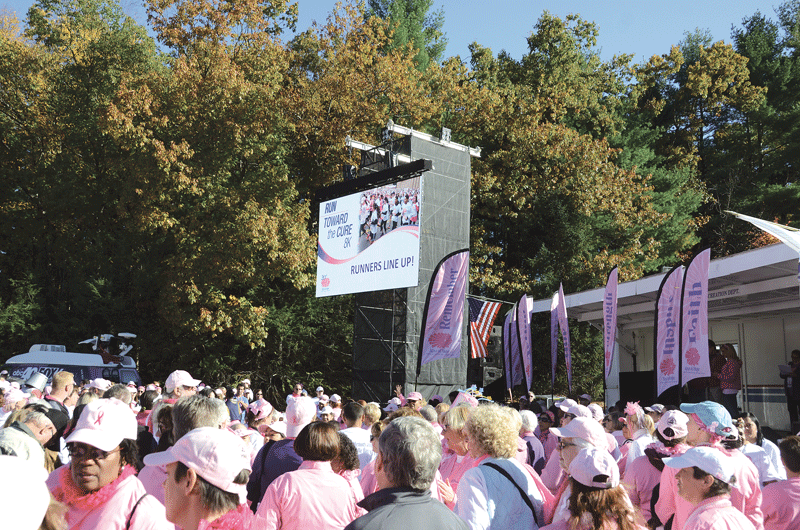
April 26: Breast-cancer survivors, their families, and friends are invited to celebrate life together at the 17th annual Rays of Hope Breast Cancer Survivors’ Day on Saturday, April 26, from 8:30 a.m. to 2 p.m. at the MassMutual Center. Former WNBA player and breast-cancer survivor Edna Campbell will deliver the keynote address, titled “Bouncing Back,” at the popular event sponsored by Rays of Hope. The WNBA veteran — best-known for her time as a point guard with the Sacramento Monarchs — was diagnosed with breast cancer during her second season. After retiring from the WNBA four years later, Campbell became a nurse and now travels across the country sharing her story of survival while encouraging women to have regular breast exams and inspiring those who’ve been diagnosed. In addition to the keynote address, participants will be able to select two workshops from a number of topics, including “Breast Reconstruction,” “Coping Strategies for Caregivers,” “Personal Safety Tips,” “Let Your Yoga Dance,” “Advances in the Treatment of Metastatic Breast Cancer,” “Mindful Eating,” “Unclutter Your Life and Start Living,” and “The Joy of Card Making.” Two sessions will be offered in Spanish only: “Recomendaciones Sobre Seguridad Personal” and “Promoviendo la Caminata de Rays of Hope.” As part of this year’s Survivors’ Day, there will be a special art exhibit made up of artwork completed by participants in the Rays of Hope-sponsored “Art from the Heart” program facilitated by art therapist and silk artist Pat Hayes. The program — a series of art-therapy workshops offered twice a year — provides a creative outlet for women to work in watercolor, precious metal, clay, and other media. The day will also offer networking opportunities and the chance to visit with several exhibitors selling a variety of breast-related products. A continental breakfast and buffet luncheon will be served. The cost is $35 per person, with the remaining cost underwritten by Rays of Hope. Parking will be validated for the Civic Center Parking Garage only. For those unable to afford the event fee, a limited number of scholarships are available by calling Sandra Hubbard at the Rays of Hope Outreach Office at (413) 794-9556. For more information on the 17th Annual Breast Cancer Survivors’ Day, or to request a registration form, call (413) 794-9556. For more information about Rays of Hope, visit www.baystatehealth.org/raysofhope.

Journey Around the World for Literacy
April 30: Link to Libraries invites you to travel to India, Asia, Latin America, France, Ireland, and Italy — all within the Delaney House and D. Hotel and Suites. A selection of ballrooms and suites will be transformed into different global destinations, complete with costumes, cuisine, décor, and local flavor. The event, which runs from 5:30 to 8 p.m. at the Delaney House on Route 5 in Holyoke, costs $25 per person, which includes multiple food stations.
An optional $10 buys unlimited sampling at specialty drink stations.
There will also be a cash bar. Funds will benefit literacy programs through Link to Libraries. To register, send a check,
payable to Link to Libraries Inc., to the following address: Link to Libraries, Attn. Karen Blinderman, Registrar, P.O. Box 958,
West Springfield, MA 01090. Your check is your reservation.

Not Just Business as Usual
May 1: The Springfield Technical Community College (STCC) Foundation’s Not Just Business as Usual event is a key networking event for business leaders in Western Mass. This annual celebration, in its fifth year, is a celebration of innovative thinking which gives participants the opportunity to learn from business experts while raising significant funding for the STCC WORKS scholarship program. It will be held at the Naismith Memorial Basketball Hall of Fame. A cocktail and networking reception will be run from 5:30 to 7 p.m., with dinner and keynote speaker to follow from 7 to 9 p.m. This year’s keynote speaker is Dr. Alan Robinson, award-winning author and associate dean of the Isenberg School of Management at UMass Amherst. Robinson will discuss his latest book, The Idea-Driven Organization: Unlocking the Power in Bottom-Up Ideas. Drawing on his work with companies worldwide, Robinson will review the strategies needed to develop a management team open to grassroots innovation and the policies and practices that encourage — and those that discourage — employees’ ideas.
Robinson has advised more than 200 companies in 15 countries. Both tickets and sponsorship opportunities are available. Tickets are $175 each or $1,500 for a table of 10. For additional information or to become a sponsor, contact Christina Tuohey, STCC’s director of Annual Giving and Alumni Relations, at (413) 755-4475 or [email protected]. To purchase tickets online, visit www.stcc.edu/njbau.

40 Under Forty
June 19: The eighth annual 40 Under Forty award program, staged by BusinessWest, will be held at the Log Cabin Banquet & Meeting House, honoring 40 of the region’s rising stars under 40 years old. The 40 Under Forty program, launched in 2007, has become one of the region’s most-anticipated annual events, and the recognition has become a prestigious badge of honor for its recipients. Judges recently chose this year’s class from more than 150 nominations, a record. They will be announced, and their stories told, in the April 21 issue. More details on the gala will be revealed in upcoming issues, but tickets cost $65, and they typically sell out quickly. For more information or to order tickets, call (413) 781-8600.

Commercial Real Estate Sections
The Experiments Continue in John Aubin’s Evolving Open Square

OpenSquareDPartAs John Aubin talked about Open Square, the massive former mill complex along the canals in downtown Holyoke that has been his passion for the past dozen years or more, he continually referred to it as an “urban laboratory” — for architecture, planning, sustainability, and economic development.

By that, he meant this was a place to experiment and drive innovation in response to an ongoing movement that has more people apparently willing and able to work, live, and locate businesses in urban settings, although many cities are struggling to take full advantage of that phenomenon.

To succeed in this environment and move the needle in Holyoke when it comes to attracting businesses there, Aubin said he doesn’t focus on filling square footage in an old mill. Rather, he’s committed to creating workspaces in which business owners can thrive.

“My business is really about creating an environment for people to live in, work in, socialize in, and play in,” he explained. “The real-estate development is almost secondary; as an architect, designer, and planner, that’s what I’m really doing — creating that environment.”

Aubin believes this philosophy is working and creating great progress in his laboratory. Over the past decade, he told BusinessWest, he’s been adding five new businesses a year, and all of these ventures are new to downtown Holyoke.

The tenant list now includes more than 50 companies employing more than 200 people in sectors ranging from healthcare to technology; from insurance to marketing; from finance to hospitality.

John Aubin, owner of Open Square

John Aubin, owner of Open Square

And the latest addition to that list could be one of the most significant.

VertitechIT, a networking and IT engineering company that provides a wide range of services to clients, many of the them in the healthcare sector, is planning to move into 3,500 square feet of custom-designed space on the mostly undeveloped third floor of what’s known as Mill 4. And it could expand into more than 9,000 square feet across the hall if the firm successfully consolidates currently outsourced services on that site, as planned, said the company’s president, Michael Feld.

“We’ll need that space for a 24/7/365 support center with probably 25 to 30 people in it,” Feld said, adding that, even if those plans do not come to fruition, the company will likely continue its pattern of doubling in size each year and will certainly need additional space.

VertitechIT’s new offices, which should be ready for occupancy next month, are an example of Aubin’s efforts to create an attractive, efficient, custom (that’s a word you’ll read again) work environment that makes Open Square — and Holyoke — an attractive destination for businesses across many sectors.

“We wanted a space that is quite presentable to clients, but the real value is to the engineers,” Feld explained. “For example, everybody loves whiteboards, so all the walls are curved, with large expanses of painted whiteboard so you can write on it. And our conference-room table is glass that you can write on as well.

“There are a lot of large screens in various places, and the desks are designed so that people can collaborate on projects,” he went on. “The whole site is a visual interpretation of the way we work.”

Looking forward, Aubin said he plans to continue his pattern of steady growth. What direction it will take is still to be determined as Holyoke continues its comeback from the extreme hard times of the ’70s and ’80s, fueled by the loss of thousands of manufacturing jobs and demographic shifts that saw the nation’s first planned industrial city become one of the poorer communities in the Commonwealth.

Recent developments such as the Massachusetts Green High Performance Computing Center, the emergence of a creative economy, and a more positive outlook about the community could attract many different kinds of businesses to the city — and Open Square, said Aubin. Meanwhile, plans to bring rail service to Holyoke could open other kinds of doors, he said, adding that there is preliminary talk about the prospects for developing a hotel at one of the mills on the Open Square complex (more on that later).

For this issue and its focus on commercial real estate, BusinessWest toured Open Square, gaining a perspective on both the many new developments there in recent years and possible future development on this historic site.

History Lessons

As he elaborated on that notion of Open Square as a laboratory, Aubin referenced that trend toward urban living and working. He said Holyoke is squarely in the middle of this phenomenon, and perhaps better positioned than others to take full advantage of it.

“We all know that, over the past 10 years, the world has become more urban. Demand is growing for urban space,” he explained. “Holyoke, and many small cities in this country, have enormous potential — they represent a tremendous, untapped market. And what I do is take a design-based approach to taking advantage of that, to leveraging what is really a very strong market.

“There are a number of cities that are well-poised to take advantage of this market,” he went on, “but no one seems to be able to figure out how to do that — we’re seeing cities struggle with it. I actually consider Open Square to be a prime example of how to leverage that market.”

Setting the tone in this new and emerging urban landscape has been Aubin’s unofficial job description since he started filling in the canvas that is the historic mill complex his father purchased in the mid-’60s but then struggled to fill as Holyoke went into its long and pronounced tailspin.

The Great Recession that officially began in late 2007 and continued into late 2009 slowed his progress somewhat, but Aubin has been able to successfully fill nearly 100,000 square feet of space with everything from a successful events facility called Mill 1 (that’s where it’s located) to arts groups such as the Massachusetts Academy of Ballet, to energy and environmental companies such as Sovereign Consulting.

As he’s filled in floors on Mill 1 and Mill 4, he’s done so with the approach that, while he’s willing to experiment in his laboratory, there are limits on what he’ll try.

“As a private business, I don’t have the luxury of experimenting on things that are not going to work or where the costs are too high — I’ve been to able to identify markets and capture them, and ideas that don’t work were discarded quickly,” he said, adding that this reasoning explains why there is only one residential unit in the complex — one that Aubin lived in himself for a time and then Holyoke Mayor Alex Morse called home for a while before buying a house in the city — and also why there is a comparatively small number of artisans, specifically those who do what they do for a living, not a hobby.

“Housing is a good idea, a core idea, but you can’t do it in a vacuum,” he said, adding that conditions are not right for market-rate housing in Holyoke at the moment, primarily because two low-income projects in progress or on the drawing board — Lyman Terrace and the former Holyoke Catholic High School — will weaken demand for a higher-end product. “Market-rate housing is a long-term investment, and we hope to revisit it soon, but for now, it’s been tabled.”

So Aubin continues to focus his experiments on what he believes — or knows — will work, and this brings him back to that notion of creating attractive but also affordable environments in which to do business, but also in which to stage weddings and other types of events. And Open Square, with its great critical mass, provides seemingly endless opportunities for doing so.

“Because we have this great foundation, this wonderful building to work with, we’re able to do beautiful, custom-designed space at a very affordable rate that’s difficult to match,” he said while making a clear distinction between affordable and ‘cheap,’ something Open Square is not.

These ingredients allowed Aubin to successfully fill Mill 4’s second floor with what he called “studio space,” generally one large, open room with build-out costs much lower than what was created two floors up.

There, Aubin has created larger, custom spaces, up to 3,000 square feet, for an eclectic mix of clients, ranging from Common Capital to Cover Technologies, an environmental company, to Emergent Billing, which focuses on the healthcare industry.

Plans to create still-larger custom spaces on the third floor, which started with buildout for Sovereign Consulting, were sidetracked by the recession, said Aubin, but with the economy improving, those plans are now moving forward, starting with VertitechIT.

VertitechIT

This artist’s rendering shows the unique features in the space created for VertitechIT, including curved walls and a centrally located conference room.

Technically Speaking

In many ways, that company’s arrival provides an effective example of how Open Square is deepening its tenant list by creating custom work spaces that put Holyoke — and the mill complex — on radar screens they would not have been on years ago.

Launched in 2001, the company was located in Northampton for many years, where the fit wasn’t perfect, for several reasons, said Feld.

“It’s hard for companies like us to exist there — they want retail, and we’re not that type of organization; we don’t match what the town is looking for and is prepared to work with,” he said, adding that this mismatch was compounded by the fact that the company quickly outgrew its quarters.

“We were just hanging on by packing people into every corner. We loved Northampton, but we simply ran out of space and couldn’t put it off any longer,” he said, adding quickly that Holyoke wasn’t on his short, or even long, list of possibilities for relocation.

“My understanding of Holyoke was limited and quite negative,” he told BusinessWest. “But our operations person really runs our show, and she lives in Holyoke, and she was really pressuring me to come down here. When I finally met John [Aubin] and looked at the space, I was very surprised and very much interested.”

Then came meetings with the mayor, school department leaders, and business executives, and Feld came away with the opinion that Holyoke should be his new business address.

As he talked about the space he will occupy, Feld made early and frequent use of the word ‘custom,’ and even put the adjective ‘quite’ before it. The space will include:

• Three private offices for secure communications within the main work area;

• Flowing, open areas featuring three main work ‘pods,’ or islands creatively configured to enhance collaboration;

• Uniquely curved inner walls, a signature of Aubin’s accessible modern design, that are mounted with whiteboards, providing ample work surfaces within the pods; and

• A curved conference room whose central position emphasizes VertitechIT’s collective brainpower and focus on creating solutions for clients.

“We gave John our ideas, not expecting to see much in return,” said Feld. “But he understood exactly what we were trying to do and, more importantly, understood the reasons for it. It wasn’t just like he could simply translate his customers’ desires into designs — he actually understood the reasons for it and agrees with it, and it follows the way he thinks in general. It’s a match made in heaven.”

Looking forward, Aubin said the obvious goal is to create more of these matches as controlled experimentation continues in his urban laboratory. What shape it will take remains to be seen, he noted, adding that, in many ways, Open Square will evolve as Holyoke does.

Elaborating, he said the planned return of rail service could drive economic development in many ways, because it will make the city more accessible — to workers, business owners, and even tourists.

“We’re looking at what the future is for this region, how soon it will get here, and how quickly we can move on it,” he explained. “The train will certainly open up opportunities — it will make commuting easier and open up markets as far south as New York City.

“We’re already looking to market our events space further south because of the train,” he went on, “and we’re looking at the possibility of a hotel. Like with the event space, there are other options within this market, but I think we can create a unique option for a hotel. It’s something we’re going to take a close look at.”

Finish Work

Aubin’s business card reads ‘Architect/Principal.’

The juxtaposition of those words speaks volumes about how he views his broad-ranging responsibilities with the company. In short, he’s an architect first, and he believes his focus on design and creating attractive, efficient working environments is helping Holyoke and Open Square reach that vast potential he mentioned, taking full advantage of the shift to urban living and working.

At the moment, he has designs on continued growth and leveraging the tremendous asset his family has owned for close to a half-century now.

And he’s confident that the pieces are in place for that to happen.

George O’Brien can be reached at [email protected]

Chamber Corners Departments

AFFILIATED CHAMBERS OF COMMERCE OF GREATER SPRINGFIELD
www.myonlinechamber.com
(413) 787-1555

• March 25: ACCGS Pastries, Politics and Policy, 8-9 a.m., at the TD Bank Conference Center, 1441 Main St., Springfield. The event will feature David Bassett, TSA federal security director at Bradley International Airport. Reservations are $15 for members, $25 for general admission. Reservations may be made online at www.myonlinechamber.com or by contacting Cecile Larose at [email protected].
• April 2: ACCGS Business@Breakfast, 7:15-9 a.m., at the Delaney House, 3 Country Club Road, Holyoke. Mayor’s Forum, featuring first-term Mayor Edward Sullivan of West Springfield, second-term Mayor Alex Morse of Holyoke, and third-term Mayor Domenic Sarno of Springfield, moderated by abc40’s Dave Madsen. Reservations are $20 for members, $30 for general admission. Reservations may be made online at www.myonlinechamber.com or by contacting Cecile Larose at [email protected].
• April 9: ACCGS Lunch N Learn, 11:30 a.m. to 1 p.m., at Lattitude Restaurant, 1388 Memorial Ave., West Springfield. Featuring “The Art of the Brand,” presented by Mary McCarthy of Andrew Associates. Attendees will learn the core elements of successful branding and the necessary building blocks that should be put in place in order to ensure that your brand successfully conveys meaningful messages that resonate with your customers or audience. Reservations are $20 for members, $30 for general admission, and may be made online at www.myonlinechamber.com or by contacting Cecile Larose at [email protected].
• April 30: Beacon Hill Summit, 7 a.m. to 7 p.m. Hosted by state Sen. Gale Candaras. Spend a day at the State House and hear from key legislators, members of the Patrick administration in its final months in office, and our local delegation. Reservations are $180 and include transportation, lunch at the Union Club, and a wrap-up reception at the 21st Amendment. Reservations may be made online at www.myonlinechamber.com or by contacting Cecile Larose at [email protected].

AMHERST AREA CHAMBER OF COMMERCE
www.amherstarea.com
(413) 253-0700

• March 27: Taste a variety of margaritas and vote for your favorites, 5:30-7:30 p.m., at the Eric Carle Museum of Picture Book Art, 125 West Bay Road, Amherst. Step into the tropics and pretend you’re on a Caribbean island. This is a Division One competition between restaurant and business margaritas. Your votes will determine who will take home the coveted AACC trophies. Restaurant margaritas presented by Hadley Farms MeetingHouse and Bridgeside Grille. Business margaritas presented by Amherst Laser and Skin Care, New England Promotional Marketing, Scandihoovians, and Applewood at Amherst. Admission is $20 pre-paid, $25 at the door.
• April 3: Chamber Brown Bag Event (first of a three-part series), 12:30-2:30 p.m., at the Jones Library. Learn about the importance of understanding Google searches for business visibility and learn about online business presence. More than 90% of consumers start their buying process online, and your business may be falling through the cracks when it comes to search engines. The talk includes prospect preferences in online search, your business presence on Google platforms (interactive), local search and your business (interactive), content marketing strategy, and converting shoppers into buyers. The event includes a raffle of a free Google presence analysis and a $100 voucher. Bring your mobile devices. Admission is free.
• April 9: Chamber Breakfast, “The Power of Video,” 7:15-9 a.m. at the Courtyard by Marriott, 423 Russell St., Hadley. Learn about using videos to promote your business. Sponsored by Epic Filmmakers. Cost is $15 for members, $20 for non-members.
• April 23: Chamber After 5, 5-7 p.m., at Western MA Family Golf Center, 294 Russell St., Hadley. Cost is $10 for members, $15 for non-members.

CHICOPEE CHAMBER OF COMMERCE
www.chicopeechamber.org
(413) 594-2101

• March 25: 20th Annual Table Top Expo and Business Networking Event, 4:30-7 p.m., at the Log Cabin Banquet and Meeting House, 500 Easthampton Road, Holyoke. Exhibitor cost: $125 for a table. Admission: $10 in advance or $15 at the door. To register, contact the chamber at (413) 594-2101.
• April 16: April Salute Breakfast, 7:15-9 a.m., at the Kittredge Center at Holyoke Community College. Tickets: $20 for members, $26 for non-members.
• April 16: April Business After Hours, 5-7 p.m., at the Residence Inn by Marriott. Tickets: $5 for members, $15 for non-members.

GREATER EASTHAMPTON CHAMBER OF COMMERCE
www.easthamptonchamber.org
(413) 527-9414

• April 10: Networking by Night, 5:30 p.m. More details to follow. RSVP appreciated. Contact us at (413) 527-9414 or [email protected]. Tickets are $5 for members, $15 for future members.
• May 02: Wine & Microbrew Tasting, 6 p.m., at Wyckoff Country Club. Unfamiliar with wines? Looking for the perfect wine for dinner? You’ve had the Wente Merlot and Chardonnay, but want to try the St. Michelle Riesling? Well, then, step up to the tasting bar. All of our guests (21 years of age and older) are welcome and encouraged to enjoy samples of more than 42 unique grape and fruit wines. Not interested in wine? That’s OK, because we have a microbrew tasting going on for you, too. One location, one price. Every year the event has grown. Tickets are $35 in advance or $40 at the door.

GREATER NORTHAMPTON CHAMBER OF COMMERCE
www.explorenorthampton.com
(413) 584-1900

• March 25: 20th Annual Table Top Expo and Business Networking Event, 4:30-7 p.m., at the Log Cabin Banquet and Meeting House, 500 Easthampton Road, Holyoke. Exhibitor cost: $125 for a table. Admission: $10 in advance or $15 at the door. To register, call (413) 584-1900 or e-mail [email protected].
• April 2: Arrive@ 5, 5-7 p.m., at PeoplesBank, 300 King St., Northampton. Sponsored by PeoplesBank. Cost: $10 for members, $15 for non-members. Register at [email protected].
• April 10: Seminar, “Art of Small Business,” first in a three-part series, 9-10:30 a.m., at the Greater Northampton Chamber of Commerce, 99 Pleasant St., Northampton. Presented by Don Lesser of Pioneer Training. Tickets: $20 for members, $25 for guests. Registration is required due to limited space.
• April 21: Seminar, “Art of Small Business,” second in a three-part series, 8:30- 9:30 a.m., at the Greater Northampton Chamber of Commerce, 99 Pleasant St., Northampton. Presented by Tina Stevens of Stevens 470. The program is free, but registration is required due to limited space.
• May 7: Arrive@ 5, 5-7 p.m., at King & Cushman Inc.; 176 King St., Northampton. Sponsored by Applied Mortgage Services Corp., King Autobody, and Goggins Real Estate. Cost: $10 for members, $15 for non-members. Register at [email protected].
• June 4: Arrive@ 5, 5-7 p.m., at Black Birch Vineyard. Sponsored by Johnson & Hill Staffing Services, the Creative, and viz-bang! Cost is $10 for members, $15 for non-members. Register at [email protected].

GREATER WESTFIELD CHAMBER OF COMMERCE
www.westfieldbiz.org
(413) 568-1618

• April 3: Social Media Workshop, 8:30-10:30 a.m., at the Holiday Inn Express, 39 Southampton Road, Westfield. Presented by Alfonso Santaniello, the Creative Strategy Agency. Topic: engaging across platforms — how to create engaging content, what types of content should you be creating, how to distribute content through various platforms, and the importance of tracking along the way. Cost: free to Westfield Chamber members, $25 for non-members paid in advance. Seating is limited; register early. To register, call Pam at the chamber office at (413) 568-1618.
• April 7: Mayor’s Coffee Hour, 8-9 a.m., at Renaissance Manor, 37 Feeding Hills Road, Westfield. The GWCC invites you to have coffee with Mayor Daniel Knapik in a very informal setting. Hear first-hand from the mayor about key issues and get an update on construction projects. The mayor also welcomes any questions or concerns you may have. Free, informative, and open to the pubic. To register, call Pam at the chamber office at (413) 568-1618, or e-mail [email protected].
• April 9: After 5 Connection, 5-7 p.m., at Czar Energy, 53 North Elm St., Westfield. Don’t forget your business cards. Great connection opportunities. Bring a prospective new member for free. Members: advertise your business with a table top for $50. Hors d’oeuvres served. Walk-ins welcome. Haven’t been to an After 5? Your first one is free. Cost: $10 for members, $15 for non-members (cash at the door). To register, call Pam at the chamber office at (413) 568-1618, or e-mail [email protected].
• April 30: Beacon Hill Summit, 7 a.m. to 7 p.m. Beacon Hill Summit, 7 a.m. to 7 p.m. Hosted by state Sen. Gale Candaras. Spend a day at the State House and hear from key legislators and members of the Patrick administration in its final months in office. Cost: $180, which includes bus, lunch, and reception. For more information, call the chamber office at (413) 568-1618.

PROFESSIONAL WOMEN’S CHAMBER
www.professionalwomenschamber.com
(413) 755-1310

• April 8: PWC Ladies Night, 5-7 p.m., at Baystate Health, 325 King St., Northampton. An opportunity to network socially with other female professionals in a casual and unique setting. Reservations are complimentary but required by contacting Dawn Creighton at [email protected]. The Professional Women’s Chamber is an affiliate of the Affiliated Chambers of Commerce of Greater Springfield.

WEST OF THE RIVER CHAMBER OF COMMERCE
www.ourwrc.com
413-426-3880

• April 2: Wicked Wednesday, 5-7 p.m., at Insurance Center of New England, Agawam. Free for chamber members, $10 for non-members. Event is open to the public; non-members must pay at the door. Wicked Wednesdays are monthly social events hosted by various businesses and restaurants, bringing members and non-members together to network in a laid-back atmosphere. For more information, contact the chamber at (413) 426-3880 or [email protected].
• April 16: Networking Lunch, hosted by Cal’s, 12-1:30 p.m. Must be a member or guest of a member to attend. Enjoy a sit-down lunch while networking with fellow chamber members. Each attendee will get a chance to offer a brief sales pitch. The only cost is lunch; attendees will order off the menu and pay separately that day. We cannot invoice you. For more information, contact the chamber at (413) 426-3880 or [email protected].

YOUNG PROFESSIONAL SOCIETY OF GREATER SPRINGFIELD
www.springfieldyps.com

• March 27: CEO Luncheon, 11:45 a.m to 1:15 p.m., at Health New England, Monarch Place, Suite 1500, Springfield. Guest Speaker: Peter Straley, president and CEO of Health New England. Sponsored by Adam Quenneville Roofing, Siding, and Windows and BusinessWest. Members-only event; space is limited. CEO Luncheons are first-come, first served; seats up to 20 maximum.

Company Notebook Departments

Bay Path Launches Online MS in Accounting
LONGMEADOW — Taking into consideration many of the specific challenges facing accountants and other professionals in that industry, Bay Path College recently announced the launch of a master of science in Accounting (MSA) degree designed to respond to their needs. Now registering classes for May 2014, the exclusively online MS, with one- and two-year tracks, holds no classes during the busy season for accountants, January through April. Three concentrations are offered, public accounting (tax and audit), private accounting, and forensic accounting. The curriculum of Bay Path’s MSA is also designed to satisfy the educational requirements for licensure as a CPA in over 40 states, including Massachusetts and Connecticut. In January 2014, Time magazine reported that accountants were one of the top five jobs in demand by employers, and the Department of Labor recently cited the occupation as one of the leading areas of job growth in the next decade. The American Assoc. of CPAs has shown that accountants with a master’s degree are likely to earn upward of 20% more than those with a lesser degree. Kara Stevens, who chairs the program, has years of professional experience in accounting. “At Bay Path, we understand how to teach technical accounting and what it’s like to work in the accounting industry,” she said. “Our accounting faculty have worked in the professions where students are either coming from or hope to be a part of, and that’s an important differentiator with our MSA. This makes the degree more relevant to the students’ professional goals.” For more information about the program and other graduate degrees, visit graduate.baypath.edu.

STCC Launches STEM Starter Academy
SPRINGFIELD — Springfield Technical Community College (STCC) has announced a new summer program that will allow incoming students a chance to get an early start on their college credits while also exploring the possibility of a career in the science, technology, engineering, and math (STEM) disciplines. The STEM Starter Academy will allow participants to earn a $1,000 stipend; take free college courses, including the College Success Seminar “Essentials of Engineering and Math”; participate in field trips; and learn from guest speakers and STEM experts currently working in the field. To apply to the STEM Starter Academy, a student must be a Massachusetts high-school graduate from the classes of 2012, 2013, or 2014, submit an STCC admissions application for the fall 2014 semester and a STEM Starter Academy application, possess a grade-point average of 2.0 or above, and have parental consent (for those under 18 years of age). The application deadline is May 9. According to Dr. Robert Dickerman, STCC dean of the School of Math, Sciences, and Engineering Transfer, STEM graduates are in high demand. The STEM Starter Academy is an opportunity for students to gain a better understanding of the STEM field, learn about career possibilities, as well as earn college credit toward a future degree. “The goal of the STEM Starter Academy is to get students interested in STEM careers,” said Dickerman. “Students may not always think a STEM degree is for them, but we want to show them there are a lot of places that degree can take them. Being a part of the STEM Starter Academy is a phenomenal opportunity for local students.”

Monson Savings Awards Grant to Link to Libraries
MONSON — Steven Lowell, president of Monson Savings Bank, presented a community-service recognition grant to Link to Libraries. The nonprofit was awarded the foundation’s grant award for being in the top of the community-service organizations in the bank’s areas of giving. “ Support from the Monson Savings Bank Foundation not only supports our programs, but enriches the lives of the children in Ware, Palmer, Wilbraham, Hampden, and Monson,” said Janet Crimmins, president of Link to Libraries. “These are sites in which this organization distributes thousands of books each year. We are honored by the support of this bank and its staff who donate countless hours engaging with the children in their community.”

OMG Introduces RedLine AFR Roof Drain
AGAWAM — OMG Roofing Products of Agawam has introduced the RedLine AFR Roof Drain, a tool-free system that provides for maximum allowable flow for gravity-based, open-channel roof-drainage systems. The RedLine AFR mechanical seal can be activated by hand, eliminating the need for tools and significantly reducing installation time. In extreme rain events, a head of water can develop and create a pressurized flow in some roof-drain fixtures, leading to failures in the building’s plumbing system. RedLine AFR’s design, featuring the RedLine AFR Vortex Breaker, has been tested for maximum allowable flow and to minimize the danger of creating pressurized flow. The patent-pending RedLine AFR Backflow Mechanical Seal can be installed by hand, creating a perfectly symmetrical, watertight connection and preventing over-tightening or under-tightening during installation. “The RedLine AFR Roof Drain is revolutionary in that it lets contractors install watertight, maximum allowable flow drains in half the time it would take to insert new drains and a fraction of the time it would take to rework or replace the drains,” said Dan Genovese, product manager with OMG Roofing Products. “Installation is tool-free and can be done in a single turn with two fingers, increasing productivity and accuracy. More important, the RedLine AFR Roof Drain is engineered to get water off the roof at a flow rate consistent with the building’s internal plumbing system.” RedLine AFR is installed from the rooftop so as not to disrupt building occupants, and has a one-piece seamless body for strength and durability as well as a heavy-duty, cast-aluminum strainer dome and clamping ring. The 10-inch-long drain stem can accommodate most existing field conditions and can be field-cut or obtained in longer lengths if needed. An extra-large flange allows positive attachment of roof-flashing membrane, and flanges are available with TPO or PVC coatings for hot-air welding. Headquartered in Agawam, OMG Roofing Products is North America’s largest manufacturer of commercial roofing products, featuring specialty fasteners, insulation adhesives, drains, pipe supports, emergency-repair tape, edge-metal systems, and productivity tools.

Fairview Hospital Lauded for Patient Experience
GREAT BARRINGTON — Fairview Hospital has been recognized with a 2013 Outstanding Patient Experience Award by Healthgrades, a leading online provider of comprehensive information about physicians and hospitals. Fairview Hospital was one of nine hospitals in Massachusetts to receive this distinction, and the only hospital so recognized in Western Mass., ranking among the top 15% of all hospitals that were evaluated. The Outstanding Patient Experience Award recognizes the high performance of hospitals that have been evaluated by their patients in surveys collected after their discharge from the hospital by the Centers for Medicare and Medicaid Services (CMS). “Berkshire Health Systems is proud of the exceptional care that is being provided to our patients in South Berkshire by Fairview Hospital,” said David Phelps, president and CEO of BHS. “The consistent level of high-quality care that Fairview’s physicians, nurses, and staff give to their patients is clearly reflected in the survey results for which this award is based. Fairview patients repeatedly relay their positive experiences, and BHS and Fairview are committed to maintaining that level of excellence.”

Entrepreneurship Sections
Serial Entrepreneurs Scale New Heights with Qnect

From left, Jef Sharp, Jeff Hausthor, and Henry Lederman

From left, Jef Sharp, Jeff Hausthor, and Henry Lederman created QuickQnect, software the connects the joints in a steel structure via an automatic process.

Jef Sharpe and Jeff Hausthor are on the edge again. The cutting edge, that is.

The entrepreneurs, who have been partners in five business ventures, joined Henry Lederman last October to start a new company called Qnect, and are launching a new software product called QuickQnect at the three-day NASCC Steel Conference in Toronto.

They say the product will revolutionize the way the joints in a steel structure are connected. “The idea of turning this manual process into a software solution is brand-new, and QuickQnect is up to 100 times faster than the conventional way of connecting the joints in a building,” said Sharp, adding that the service is available in the cloud.

Lederman, who has spent 42 years in the steel-detailing industry, developed an early version of the software that has already been used in 11 buildings, including structures at UMass and Harvard. And when BusinessWest spoke to the three entrepreneurs, they were looking forward to introducing their breakthrough product at the Toronto conference, which is expected to attract more than 3,500 structural engineers, steel fabricators, erectors, detailers, and educators involved in the design and construction of fabricated steel buildings and bridges.

Lederman said QuickQnect combines two critical components of the steel-connection process into one, eliminating weeks or months of manual labor required to connect each joint in a multi-story steel structure.

He created the new software to stay competitive in an industry that has cut costs by outsourcing work overseas. Developing it was a process, but the first step was recognizing there was room for improvement in the three-dimensional system used by steel-detailing companies.

Lederman’s history includes high-profile projects, including the World Trade Center Memorial Museum in New York City and Tata Hall at Harvard University. He has been a speaker at industry events and is a leader in detailing innovation.

“It’s fun starting something from scratch that has never been done before. And what this new product [QuickQnect] does is pretty extraordinary. But developing it was tempered by my desire to see it in its fullest commercial form,” he said.

That pursuit brought Lederman together with Sharp and Hausthor last fall. They were introduced through a friend, and his original plan was simply to get ideas from the successful entrepreneurs.

But the meeting proved to be serendipitous. Sharp and Hausthor were looking to start a new business, and Lederman was impressed by their background and knowledge. “They had amazing expertise, as they had grown other companies and also had IT experience. They had what I needed to take the company beyond what I had envisioned,” he said. “They viewed things I might have had doubts about as minor obstacles.”

Sharp and Hausthor said working with Lederman met the criteria they have established for a new venture (more about that later) as they know what it takes to transform a novel idea into a product, then market it successfully. But it’s work they truly enjoy.

“It’s exhilarating to start a new company, and even though there is risk, stress, and tension, there is also a feeling of accomplishment you can’t get with most 9-to-5 jobs,” Sharp said. “And this is an amazing company.”

Each of the entrepreneurs has different skills, and their titles at Qnect reflect their honed talents. Sharp is CEO, Hausthor is COO, and Lederman is CFO. They all agree that education is critical and learning must be an ongoing process. “It’s an interesting path, and the importance of entrepreneurs can’t be fully stated,” Sharp said.

However, he was quick to add that it takes a team effort to be successful. “Identifying great people is the most important job of a CEO.”

Lederman concurred. “There are many amazing business people doing wonderful things, but it’s very hard to find the right resources,” he said.

Still, they are confident they will reach their goals because their product will save time and money. But it took sophisticated engineering skills to create the software that automates a manual process. “Two hundred calculations are necessary for every joint, and there can be upwards of 2,000 joints in a building,” Hausthor said as he spoke about a building, constructed with the pre-commercial version of the software, that had 11,000 joints.

Sharp said they have also put together an exceptionally talented development team.

“I’m confident they will be unstoppable in building and expanding our software breakthrough. The design of the joints in a building is really important, and reducing months of work to a few hours drives everything else, including the cost of using steel, which is the most environmentally friendly solution for large buildings and is 97% recyclable,” he noted, adding they hope to identify powerful local investors.

Storied Past

The three men have impressive backgrounds. Lederman has built three successful companies, Sharp has founded six, and Hausthor has directed IT and software-development efforts and operations logistics for six firms.

“I like all new technology and enjoy investigating new things,” Hausthor said.

Sharp and Hausthor have been partners in five ventures and love being on the cutting edge of development. They also share a passion for helping the planet.

“It’s exciting to do things that have never been done before,” said Sharp. “You can start a business by buying a franchise in which everything is set up for you. But it’s not as creative or interesting as starting something from nothing and building something of great value that will last.”

His first business was a mobile food service he named the Clam Scam, which he launched when he was in college.

His next venture was started in 1999 after he moved to Western Mass. from New York, where he had been running a manufacturing company called Gravity Graphics. “I had a burning idea for a dot.com company that would sell excess manufacturing capacity online,” he said.

The idea didn’t require resources or capital, since he simply wanted to make more efficient use of what already existed on the planet. “Having a company that has an impact on the world has always been important to me, and in the past, green has always been a theme,” Sharp told BusinessWest.

Hausthor, who joined Sharp in the business known as XSCapacity, was a self-described “Fortune 500 guy” before they met. He had been a programmer analyst for Deloitte, an associate at Morgan Stanley, a technical specialist for Sony Electronics, and a project manager for Sony Corp. of America.

A friend introduced the two men, they had lunch together, and a short time later, Sharp asked Hausthor to help him start XSCapacity.

The idea appealed to Hausthor. “I had moved to Western Mass. and was working from home. I was in charge of 40 people in New Jersey, but I felt isolated,” he said. “So I made the jump.”

The idea took flight as other firms adopted the novel idea of using real estate, autos, and more to maximum capacity. “XSCapacity was a concept,” Sharp explained. And although they were reasonably successful in building their product and raising money, the company became part of the dot.com collapse.

Their next venture was TechCavalry in Northampton, which provided computer service for small businesses and homes. “We needed to do something quickly which we could fund ourselves that would provide us with relatively instant revenue,” Sharp said, adding they sold the firm in 2012 after 11 years, and it is still in business today.

Although TechCavalry was successful, “we felt compelled to do something good for the world that would have a positive impact,” Hausthor said. So in 2006 they founded Qteros Inc. with two other partners.

“The company was created to start green companies,” Sharp said. “We worked nights and weekends, and it took us nine months to find our first project.” They combined talents with Susan Leschine, a professor at UMass Amherst, who had discovered a microbe that made ethanol from cellulose.

“But we had to scale up the technology, as it was still at the test-tube level at UMass,” Hausthor said. “We had to make it into a product that needed to go into a $200 million facility. We were still running Tech Cavalry, and suddenly we were microbiologists at a facility in Marlborough.”

Sharp describes the time as “a whirlwind. We hired two scientists a month and grew quickly.” They secured a government grant, and their backers included the petroleum giant BP. The firm had 50 employees when the pair left in 2008, although Sharp continued to serve on the board of directors until 2012.

They were discussing what to do next when Sharp met Steve Frank from Florence, who had started a supercomputer business and was looking to expand. “He convinced us it should be our next company,” Sharp said, adding that Paneve, which has grown into a large data firm today, made a new type of computer chips.

But when the operation moved to Colorado at the behest of its engineers, and its Amherst office closed, Sharp and Hausthor decided to remain here and began a new search for another startup, which occurred when they met Lederman.

By that time, the duo had developed criteria to determine whether a business opportunity fit their needs. “It has to have good people,” Sharp said, adding that it’s important to him to have control of who is hired. “The product also has to be reasonably close to being ready to sell, as we have already owned two companies that spent a long time in the development stage. When we joined Henry, he was already using a pre-commercial version of the product, but wanted help scaling up and driving the business. The chemistry was good, and it was an excellent combination of our skills.”

Hausthor agreed. “The product also has to be protectable in terms of patent and other intellectual properties and has to be a technology that helps the world,” he added.

The fact that Lederman’s business was local made it especially appealing, he added. “We had met people in Boston who wanted our help, but we didn’t want to drive long distances or have to fly to do business.”

Conscious Choice

Sharp says starting new companies has become a way of life. “It’s pretty cool knowing that you can start something from an idea. But no entrepreneur does it alone. It’s very much a team effort, and it’s critical that the team gets credit, because without them you could never be successful.”

Sharp admits it’s not for everyone. “Starting your own company can be very exciting, but it can be just as exciting to join a young company,” he said, reiterating the importance of a strong team.

But people like Sharp, Hausthor, and Lederman will always thrive on work that is on the cutting edge.

“I was an entrepreneur before the word was coined,” Sharp said, “and what is really exciting is that we are always doing things that haven’t been done before.”

Banking and Financial Services Sections
Banking Leaders Say Retailers Should Bear Burden of Data Breaches

SecurityWhen it comes to data breaches and identity theft, Target isn’t the only target.

The retail chain made news of the worst sort in December when it reported a security breach that compromised the financial information of tens of millions of customers.

The fallout affected the banks that issued the credit and debit cards that were compromised, and since that event, banking-industry leaders have been speaking out about the impact of such breaches on their operations.

“When a retailer like Target speaks of its customers having ‘zero liability’ from fraudulent transactions, it is because our nation’s banks are making customers whole, not the retailer that suffered the breach,” said James Reuter, executive vice president of Colorado-based FirstBank, representing the American Bankers Assoc. (ABA) in testimony before the Senate Banking Subcommittee on National Security and International Trade and Finance.

“Banks swiftly research and reimburse customers for unauthorized transactions,” he continued, “and normally exceed legal requirements by making customers whole within days of the customer alerting them.”

High-profile breaches like the one that befell Target have reignited a long-running debate over consumer data-security policy. The issues being discussed include what security and breach notification standards should apply to businesses, and who should be responsible for covering the costs of fraud resulting from breaches.

For its part, the ABA believes Congress should pass data-security legislation that holds retailers and others to high, uniform, nationwide standards for safeguarding sensitive customer information, just as banks have long had a similar obligation to protect their customers’ sensitive financial information. The ABA is also advocating that those responsible for data breaches should be responsible for their costs.

For its part, Target admitted it didn’t read the signs of a potential problem in December.

Just a few days before Christmas, Target disclosed that a data breach compromised 40 million credit and debit card accounts between Nov. 27 and Dec. 15. A few weeks later, the retailer said hackers also stole personal information — including names, phone numbers, and e-mail and mailing addresses — from as many as 70 million customers.

“Like any large company, each week at Target there are a vast number of technical events that take place and are logged,” said company spokeswoman Molly Snyder in a statement soon after the incident. “Through our investigation, we learned, after these criminals entered our network, a small amount of their activity was logged and surfaced to our team. That activity was evaluated and acted upon. Based on their interpretation and evaluation of that activity, the team determined that it did not warrant immediate follow-up. With the benefit of hindsight, we are investigating whether, if different judgments had been made, the outcome may have been different.”

According to Target, hackers broke into its network by infiltrating a vendor’s computers. Then the criminals installed malicious software in the checkout system for some 1,800 Target stores across the U.S. The sheer scope of the crime could eventually surpass the 90 million customer records compromised in 2007 when thieves stole data from T.J. Maxx, Marshalls, and HomeGoods stores.

Target’s chief information officer, Beth Jacob, resigned recently, and the store said it is overhauling some of its divisions that handle security and technology. It is also accelerating a $100 million plan to roll out chip-based credit-card technology, which it claims is more secure than traditional magnetic-stripe cards.

Far-reaching Problem

The data-breach issue extends far beyond a major retailer or two, and is an irksome one for banks. The Identity Theft Resource Center reported more than 600 consumer data breaches in 2013 — a 30% increase over 2012.

Reuter testified that banks receive pennies for each dollar of fraud losses and other costs they incur in protecting their customers from fraud, and that, while banks bear more than 60% of reported fraud losses, they have accounted for less than 8% of reported breaches since 2005.

Data breaches can fall into two categories: unintentional and intentional. An unintentional breach — often due to the negligence of an employee who mishandles or inadvertently exposes data — does not always lead to fraud.

Intentional breaches occur when data is accessed, viewed, stolen, or used by someone who is not authorized to do so — in many cases, criminals who target the company in an attempt to steal consumers’ personal and financial information, either to use it to commit fraud or to sell it to others. This often leads to new financial accounts in the victims’ names, counterfeit cards, and phishing scams.

Debit-card fraud accounted for 54% of industry loss, followed by check fraud at 37%, and online banking and electronic transactions at 9%, according to the ABA. Typically, Reuter said, when fraud occurs or is likely to, banks will close the account, eat the loss, and reissue the card. Meanwhile, banks stopped $9 out of every $10 of attempted deposit-account fraud in 2012, according to the ABA’s 2013 Deposit Account Fraud Survey Report.

“Financial fraud, including identity fraud, is a very real risk that must be taken seriously,” writes Frank Keating, ABA president and CEO. “The best way to contend with financial fraud is to prevent it from ever happening in the first place. Banks use sophisticated technology and monitoring techniques, intricate firewalls, and other methods of securing customer data, but there are steps consumers must take as well.”

The ABA offers a number of tips to help consumers protect themselves from becoming victims of financial fraud:

• Don’t provide your Social Security number or account information to anyone who contacts you online or over the phone. Protect your PINs and passwords and do not share them with anyone. Use a combination of letters and numbers for your passwords and change them periodically. Do not reveal sensitive or personal information on social-networking sites.

• Shred sensitive papers, including receipts, bank statements, and unused credit-card offers before throwing them away, and keep an eye out for missing mail from creditors.

• Consider enrolling in online banking to reduce the likelihood of paper statements being stolen. Monitor your online accounts regularly for fraudulent transactions. Sign up for text or e-mail alerts from your bank for certain types of transactions, such as online purchases or transactions of more than $500.

• Order a free copy of your credit report every four months from one of the three credit reporting agencies.

• Make sure the virus-protection software on your computer is active and up to date. When conducting business online, make sure your browser’s padlock or key icon is active. Also look for an ‘s’ after the ‘http’ to be sure the website is secure.
For mobile devices, use the passcode lock, which will make it more difficult for thieves to access your information if your device is lost or stolen.

Everyone’s Business

Stronger vigilance by all parties — retailers, banks, and consumers — will make a dent in the incidence of data theft, Reuter said, although it won’t stop all of it, which is why the ABA continues to press Congress on the issue.

“Banks, retailers, processors, and all other participants in the payment system must share the responsibility of keeping the system secure, reliable, and functioning in order to preserve customer trust,” Reuter testified.

“That responsibility should not fall predominantly on the financial-services sector,” he added. “Banks are committed to doing their share, but cannot be the sole bearer of that responsibility. Policymakers, card networks, and all industry participants have a vital role to play in addressing the regulatory gaps that exist in our payment system, and we stand ready to assist in that effort.” n

Joseph Bednar can be reached at [email protected]
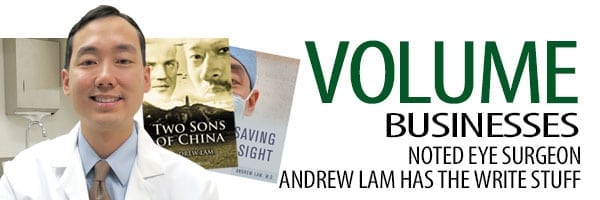
Banking and Financial Services Sections
Understand What Such a Commitment Would Require

Carolyn Bourgoin

Carolyn Bourgoin

As a business professional in Western Mass., there is a high likelihood that you have been approached (or will be approached) to serve on a board.

This region has a significant concentration of nonprofit and charitable organizations, and, therefore, there is often a need for capable and willing board members. When receiving such a request, the first step to take before accepting is determining what roles and responsibilities such a commitment would require.

All too often, however, the review of the organization’s tax filings, including the Form 990, is missing among those responsibilities. This is a significant task and should not be taken lightly.

As a board member of a charitable organization, you have a responsibility to periodically confirm with management that these items are accurate and current. But your responsibility with respect to the Form 990 does not end there, as the IRS expects management to provide the full board with a copy of the Form 990 prior to it being filed. The board may designate a committee to review the Form 990, but must disclose this on the 990.

This filing is open to public inspection on Guidestar and the Massachusetts attorney general’s website. The board should make sure the Form 990 properly represents the organization to potential donors and other interested parties.

Unfortunately, reviewing the Form 990 can seem like a time-consuming task, especially if you are unfamiliar with such tax documents. This article will provide suggestions on what to look for and highlight some of the more critical sections of the form.

• Start by scanning the first two pages of the return to make sure the summary comparison of financial information between the current and prior years makes sense, and that the mission statement is properly disclosed. The organization’s top three programs should be listed along with the related expenses and program revenues. Board members are responsible for ensuring that the organization’s charitable role is being effectively carried out in furtherance of its mission, so it is important to ensure that its programs are in line with its mission.

• Proper governance policies should be your next focus. The IRS encourages charities to adopt a written conflict-of-interest policy that requires directors and staff to act solely in the interest of the charity. The Form 990 questions whether such a policy was adopted and, if so, how the policy was monitored during the year. Also questioned are the policies used for setting executive and top-management compensation.

Both the IRS and the state attorney general’s office expect the board to be involved in approving the compensation and benefits of the CEO, including comparing the salary to other executives in similar fields. A board that is actively involved in setting executive compensation should be at lower risk for complaints being filed regarding excess compensation or private benefits inuring to top officials.

As more and more exempt organizations become involved in joint ventures or similar arrangements, the Form 990 questions whether a charity has adopted a written policy concerning its involvement in these investments. The IRS expects a tax-exempt organization to safeguard its assets and exempt status from a risky investment arrangement.

• A list of board members at year end must be disclosed. This helps determine whether the board is the appropriate size to carry out its duties for the organization. Very large boards may have a difficult time making decisions. In this situation, an executive committee with delegated responsibilities might be effective. Yet, small boards may lack the broad knowledge and skills to properly govern the organization. Regardless of the size of the board, the IRS expects that it not be dominated by employees and others who may not be independent because of family or business relationships. There are several questions on the Form 990 pertaining to this issue.

• Revenue sources disclosed on the Form 990 should be evaluated to determine whether the organization has unrelated trade or business income that may require a Form 990T (required to calculate any potential income tax). Certain partnership investments and activities that do not further the organization’s purpose may generate such income.

• Public charities that solicit funds, which are typically evidenced by the presence of contribution revenue on the Form 990, should make sure that they track and disclose fund-raising costs on the Form 990. Those that hire professional fund-raisers or grant writers must make additional disclosures on Schedule G. Fund-raising events should also be disclosed on this schedule.

• Board members of public charities should look over Schedule A, as the testing on this form determines whether the organization remains a public charity or is converted to a private foundation. While there are different tests to calculate public support, each excludes gifts from certain donors. If the public support percentage is nearing 33.3%, the organization is in danger of becoming a private foundation, and steps must be taken to broaden the overall public support of the organization.

• Transactions between the organization and disqualified or interested persons may require disclosure on Schedule L. This includes business transactions, depending on the amount, as well as grants or loans. One of the main goals of the new Form 990 is to enhance transparency, so it is essential that the organization properly disclose related party transactions.

These are some of the more significant areas of the Form 990. The form, easily obtainable on the Internet, is a reflection on the organization and the board. In order to fulfill your fiduciary duties as a board member, it is important that you have an understanding of this filing and take part in its review.

If you have questions regarding your organization’s tax filings, including the Form 990, be sure to contact your organization’s accounting professional.

Carolyn Bourgoin is a senior tax manager for the Holyoke-based public accounting firm Meyers Brothers Kalicka, P.C.;  (413) 322-3483; [email protected]

Briefcase Departments

ESE Bid to Black Out Casino Events Rejected
BOSTON — The state Gaming Commission has rejected the Eastern States Exposition’s (ESE) bid for recognition as a venue that would suffer financial damage from the $800 million casino that MGM Resorts International plans to build in Springfield. The commission voted 3-2 to deny the request on the condition that MGM impose a blackout on potentially competing events during the 17 days of the Big E, the fair that generates about 85% of the Eastern States Exposition’s revenue. If the 17-day blackout fails to protect the Big E, the exposition can reapply for status as an ‘impacted live entertainment venue, the commissioners said. Eugene Cassidy, president and CEO of the West Springfield-based ESE, said the nonprofit will consider filing a lawsuit against the commission to overturn the ruling. The had called for a longer blackout period, including 45 days before the fair and 30 days after, to offset MGM’s competitive advantage. West Springfield is still negotiating a surrounding-community agreement with MGM to mitigate the casino’s impact, as is Longmeadow. MGM has successfully negotiated surrounding-community mitigation agreements with Ludlow, Agawam, Wilbraham, East Longmeadow, Chicopee, and Holyoke. The agreements with Agawam and Chicopee call for each community to receive $125,000 up front with annual payments of $150,000. Ludlow, East Longmeadow, and Wilbraham are set to receive $50,000 up front with annual payments of $100,000. The Holyoke agreement calls for $50,000 up front and $1.28 million over 15 years.

State Issues Innovation Challenge Grants
BOSTON — Glen Shor, state Secretary of Administration and Finance, recently announced 37 projects slated to receive funding from the $4 million Community Innovation Challenge (CIC) grant program. Now in its third year, the program incentivizes and supports regionalization and other cost-saving initiatives that will change the way local governments do business to maintain service delivery and stretch every taxpayer dollar as far as possible. “The CIC program is a major component of the Patrick administration’s commitment to provide cities and towns with the tools to effectively manage resources and provide services to their residents,” said Secretary Shor. “This program provides an opportunity for neighboring communities to build partnerships, share services, and use their resources wisely.” Added state Sen. Steven Brewer, “investing in the relationships between local governments, school districts, and regional organizations is fundamental for growth and innovation in our state. The Community Innovation Challenge grant program has provided millions of dollars to unique projects around the Commonwealth, and I look forward to seeing the positive effects that it will have on the towns and organizations in my district.” As the most rural county in Massachusetts, the member towns of the Franklin Regional Council of Governments have long recognized the value of sharing services and expenses. “CIC grants have been a great and invaluable resource for the expansion of regionalization efforts in Franklin County,” said Linda Dunlavy, executive director of the Franklin Regional Council of Governments. “CIC funds have enabled us to open a regional dog shelter that serves 14 towns and has housed more than 200 dogs and adopted out 40% since its opening in late 2012. CIC funds have also created a regional health district that brings efficiency, accessibility, and professionalism to 10 small, rural towns. Including the 37 projects receiving funding this year, the Patrick administration has invested $10.25 million in 95 projects over a three-year period.

Diocese Announces Plan to Rebuild Cathedral High
SPRINGFIELD — The Diocese of Springfield confirmed last week that it will rebuild the tornado-damaged Cathedral High School, aided by approximately $29 million in federal disaster aid. Bishop Timothy McDonnell said in a press conference that the diocese will obtain demolition permits and move forward with design of the new school at that site in East Forest Park. A $38.5 million agreement was announced between the Federal Emergency Management Agency and the diocese for damage to the school caused by a tornado on June 1, 2011. FEMA will cover about $29 million for tornado damages and related costs, and the diocese will cover the balance. The FEMA funds are earmarked for Cathedral and St. Michael’s Academy middle school and preschool, also damaged and relocated after the tornado. The diocese also recently reached a settlement of nearly $50 million with its insurance company, Catholic Mutual, for the Cathedral damage. Nearly $10 million more in insurance funds were issued for other diocesan buildings and costs. Cathedral has been located at a leased school in Wilbraham since the tornado, and St. Michael’s is currently housed in what used to be Holy Cross Elementary School in West Springfield.

State Awards $11 Million to Housing Authorities
BOSTON — Continuing the effort to preserve the state’s public housing authority portfolio and increase the number of affordable public housing units available, the Patrick administration announced nearly $11 million in funding to improve, preserve, and reoccupy the Commonwealth’s state-funded public housing units. The capital funding will be used for a number of initiatives, including supporting repairs required to get current vacant units back online, creating more accessible units for people with disabilities, and preserving the current housing stock by making the units more sustainable. “Affordable public housing is in high demand across the state,” said Undersecretary of Housing and Community Development Aaron Gornstein. “These additional dedicated funds will provide local housing authorities with new tools and funding to extend the life of our current housing stock and also more quickly house seniors and families looking for affordable housing.” The four types of funding being awarded to 170 housing authorities are: $3,598,970 in sustainability funds to upgrade building components in order to save energy and water; $4,125,365 in health and safety funds to reduce site and common-area hazards that could pose a danger to residents; $721,053 in vacant unit funds to renovate and reoccupy units needing costly rehabilitation that have been vacant for more than 60 days; and $2,517,778 in accessible unit funds to help housing authorities make progress toward having 5% of their units fully accessible. 

Penn National Snags Slot Parlor License
PLAINVILLE — The state Gaming Commission awarded the state’s lone slots parlor license to Penn National Gaming for its proposed development at the Plainridge Racecourse in Plainville. The decision came down to Penn National or the proposed Massachusetts Live! slots parlor in Leominster. A third proposal in Raynham, known as Parx Casino at Raynham Park, was out of the running early. The planned slots parlor in Plainville will include 1,250 slot machines as well as a sports bar, a high-end restaurant, and a food court. Harness racing will continue at the track. Penn National had originally pursued a resort casino in Springfield’s North End, but Mayor Domenic Sarno close to back a larger, competing proposal by MGM Resorts International. The new Plainville parlor could open as soon as spring 2015, according to Penn National, but a temporary slots parlor may be constructed within the next six months at the track if the commission approves. The price of the license is $25 million and must be paid within 30 days.


Palmer Site Owner Seeks to Block Mohegan Sun Bid
PALMER — The owner of the Palmer property where Mohegan Sun had proposed a casino are seeking a court judgment to prevent the company from pursuing another gambling project at Suffolk Downs in Revere. Northeast Realty Associates, which controls 152 acres in Palmer, argues that the casino company violated contracts with the landholder by allegedly engaging in secret talks with racetrack representatives, then intentionally ran a lukewarm referendum campaign for the Palmer project, contributing to its defeat at the polls in November. The lawsuit came less than a week before Revere residents went to the polls to approve a citywide referendum on Mohegan Sun’s plans to build a $1.3 billion gambling resort on land belonging to Suffolk Downs. In a statement, Mohegan Sun said the Connecticut-based company “devoted over five years and more than $25 million to create a world-class resort casino proposal in Palmer. But on Nov. 5, 2013, the community made a decision, which we have respected.”

Employment on Rise for Manufacturing in U.S.
WASHINGTON, D.C. — Manufacturing jobs accounted for 18.6% of all employment growth in January, a sign of strength for the U.S. manufacturing sector, said Scott Paul, president of the Alliance for American Manufacturing (AAM). “It’s still far from a resurgence, but the jobs picture in manufacturing is certainly better than it was last decade. And the latest jobs report offers fresh evidence that it is possible to create manufacturing jobs in America again.” However, he added, “we believe better public policies would bring about a real resurgence. That would mean balancing our trade in goods, investing in infrastructure and training, combating currency manipulation overseas, and boosting innovation. And even though manufacturing may be one of the brighter spots in this jobs report, we’re still well below the pace needed to achieve the president’s goal of adding 1 million such jobs in his second term.”

Hiring Outlook Brightens in Landscape Architecture
WASHINGTON, D.C. — Business conditions remained stalled for the landscape-architecture profession in the fourth quarter of 2013, but may be entering a turnaround, according a survey by the American Society of Landscape Architects (ASLA). Although billable hours and inquiries for new work dipped during the fourth quarter, about half of all firms indicated plans to hire in early 2014 — a sign they are expecting more work. Some 75.7% of respondents reported stable to improved billable hours, a decline from the third quarter of 2013 (80.6%). Another 74.9% reported stable to higher inquiries from potential clients for new work, similar to what had been reported in the previous quarter (78%). Year to year, 81.5% of respondents indicated that fourth-quarter billable hours remained about the same or were higher. Additionally, 81.5% claimed steady or increased inquiries for new work compared to the fourth quarter of 2012. Of all firms with two or more employees, nearly half (48.5%) indicated they plan to hire in the first quarter of 2014. Half of all firms with 50 to 99 employees plan to hire an experienced landscape architect in the first quarter of 2014.

Departments People on the Move

Thomas Newton

Thomas Newton

Thomas Newton recently joined the South Hadley-based advertising and marketing firm Allen Media Inc., as a Relationship Manager. Newton has customer-service skills and a background as a marketing and sales executive, and will work directly with clients to optimize their presence in the market by applying his expertise in marketing, branding, advertising, and communications. Previously, Newton was Vice President of Marketing and Operations at Point Software Inc. in East Longmeadow; Regional Marketing and Promotions Manager at Comcast Spotlight in Bloomfield, Conn.; Director of Marketing & Promotions at Saga Communications in East Longmeadow; and other senior management positions at Charter Communications, Starz/Encore Networks, and Continental Cablevision.
•••••
Kevin O’Donnell

Kevin O’Donnell

BerkshireBanc Investment Services, an affiliate of Berkshire Bank, announced the promotion of Kevin O’Donnell, CFP to Vice President. O’Donnell is a Financial Advisor with Commonwealth Financial Network, and started with Berkshire Bank’s trust department in April 2006 as an Investment Representative. In 2011, he was promoted to Financial Consultant/Associate Vice President at BerkshireBanc Investment Services. O’Donnell has logged more than 15 years of experience advising clients as a financial advisor at Bank of America Investments, UBS Financial Services, and Merrill Lynch. O’Donnell, who was recently named a “Top Next Gen Independent Broker/Dealer Advisor” for 2014 by REP magazine, graduated from Fairfield University’s School of Business with a BS in management, holds the FINRA Series 7, 31, 63, and 65 securities registrations, and has earned the Certified Financial Planner certification. He holds life, accident, and health insurance licenses.
•••••
Dakin Humane Society recently welcomed two new members to its Board of Directors:
Jean Deliso is President and Owner of Deliso Financial & Insurance Services, which specializes in comprehensive financial planning. A member of New York Life’s Chairman’s Council and a consistent qualifying member of the Million Dollar Round Table, Deliso is a 2013 Court of the Table Member and a member of the Chairman’s Council. She is a graduate of Bentley College; and
Michael Simolo is an Estate Planning and Business Attorney at Robinson Donovan, P.C. Simolo, a graduate of Cornell Law School, has worked as an estate-planning, estate-administration, probate-litigation, and business attorney since 2003. With Robinson Donovan, P.C. since 2009, Simolo is a frequent speaker on estate-planning issues and is the president of the Pioneer Valley Estate Planning Council.
•••••
Inspired Marketing recently announced the following changes at the Agawam-based marketing and events-planning firm.
Jill Monson-Bishop, CIO-Chief Inspiration Officer, was recently chosen to serve on one of Springfield City Council President Michael Fenton’s new ad-hoc committees, the Workforce Development Committee;
• Stephanie Killian has been promoted to Senior Event Planner and Project Manager. She began with Inspired Marketing as an intern and has four years experience planning corporate events. Her specialties include nonprofit and corporate event management, creative marketing solutions, media planning/buying, and organization. She holds a bachelor’s degree in communications with a concentration in event planning from Bridgewater State University;
Lauren Mendoza has been hired as Executive Administrator and Event Assistant. Mendoza was previously with United Personnel and joined the Inspired Marketing team at the beginning of 2014. A graduate of UMass Amherst, she has a degree in business and management. She specializes in general project support, editing and proofing, media relations, and event assistance; and
• The 2014 Advisory Board structured to advance growth of the company includes the following board members: Michael Fenton, Shatz, Schwartz and Fentin, P.C.; David Ference, TD Bank; Nick Gelfand, NRF Real Estate; Bill Horowitz, AdviCoach Business Advisers; Regina Jasak, Jasak Independent Insurance; Scott Monson, Rock 102/Lazer 99.3; Marybeth O’Meara, Comcast; David Smith, H.L. Dempsey; Pamela Thornton, United Personnel; and Michael Weber, Minuteman Press.
•••••
Jordan Diaz was recently named Information Technology Coordinator at Meyers Brothers Kalicka, P.C. Diaz will be responsible for tech support, computer inventory maintenance, and software/operating system upgrades. He works with Paragus Strategic IT to keep MBK on the cutting edge of the industry’s cloud-computing management system. Previously, Diaz worked as an IT Support Technician at ServiceNet Inc. in Northampton, and has a background in customer service. Diaz attended Springfield Technical Community College and is a CompTIA-certified Network and Security Technician.
•••••
Steve Lowell

Steve Lowell

Monson Savings Bank recently announced that Steve Lowell, President and CEO, was elected to the Steering Committee of the Mass. Financial Education Collaborative (MFEC) and presented at the first annual State House Financial Capability Day on Feb. 27. MFEC is a group of nonprofits, private institutions, government agencies, and other entities from across Massachusetts that was established by former commissioners of the legislatively mandated Mass.Asset Development Commission. This statewide network of innovative organizations works together to increase economic stability in Massachusetts through financial education, personal savings, and access to wealth-building assets such as homes, cars, college educations, and small businesses. Lowell was appointed to the Steering Committee due to his leadership in developing Monson Savings Bank’s robust financial-literacy programs, which include teaching financial literacy in area schools; providing workshops on important financial topics; developing a portfolio of products and services for children, teens, and college students; and the bank’s soon-to-be formally announced partnership with MassSaves.
•••••
Timothy Steffen

Timothy Steffen

Tia Allen

Tia Allen

Northwestern Mutual recently promoted Timothy Steffen to Director of Recruitment and Tia Allen to Campus Recruiter. Steffen has been with Northwestern Mutual since 2010 and was previously the Director of Campus Recruitment. As Director of Recruitment, he is responsible for coordinating and managing all district network office recruiting efforts, and oversees the campus recruiter. He is a UMass graduate. Allen, who joined Northwestern Mutual in May 2012, will lead the internship and recruiting effort as Campus Recruiter. She is a graduate of Worcester State University with a degree in business administration.
•••••
Elizabeth Beaudry

Elizabeth Beaudry

Denise Perkins

Denise Perkins

NUVO Bank & Trust Co., a locally owned, independent, small-business bank in Springfield, recently announced the promotions of Elizabeth Beaudry and Denise Perkins, both with the bank since its opening in 2008. Beaudry, formerly the Senior Commercial Credit Analyst and Information Technology Administrator, now serves as NUVO’s Commercial Credit Officer and Information Technology Officer. She will supervise and review the credit-approval process, evaluate the financial condition of commercial-loan applicants, conduct cash-flow analysis, and assist with administration and maintenance of the bank’s commercial-lending portfolio. Additionally, Beaudry will maintain administrative duties for the bank’s main network and manage day-to-day technology tasks, including all hardware, software, network, and computer-related issues. Beaudry has worked for several local banks, including Woronoco Savings Bank, Westbank, Florence Savings Bank, and Berkshire Bank. She is an alumnus of Bay Path College, where she graduated magna cum laude with a BA in business executive management. Perkins, formerly NUVO Bank’s Corporate Secretary, now serves as the Corporate Administrative Officer. She is in charge of human resources, payroll, shareholder relations, as well as the administration of the board and other corporate-related functions at the bank. With 30 years of banking experience, Perkins’ career began at the Farm Credit Banks of Springfield, and in 1987, she joined the Springfield Institution for Savings (SIS), where she developed and administered a community-relations dropout-prevention program for at-risk youth, which received national attention, as well as leading other educational collaborative partnerships for the bank. In 1994, Perkins joined the Westbank corporate offices as the Executive Assistant to the President. Perkins is an alumnus of Cambridge College, where she completed a graduate studies preparation program.
•••••
The Old Sturbridge Village Board of Trustees recently voted unanimously to extend the contract of the museum’s President and CEO, James Donahue, through June 2017. Donahue’s leadership of the nonprofit organization has been lauded since he began in 2007, due to his ability to prompt significant performance improvements, including stabilizing attendance, increasing education field trips, and fund-raising, positioning the museum for a brighter future. Donahue led the reopening of the historic 10-room Old Sturbridge Inn and 29-room Reeder Family Lodges at the village in 2013, expanding the village’s operations to include museum, dining, retail, and lodging. Donahue was formally recognized for leadership and achievements at the 26th annual Massachusetts Governor’s Conference on Travel and Tourism this past October when he was awarded the Larry D. Meehan Award, presented by Gov. Deval Patrick.
•••••
The Ware-based Positive Path Counseling Center announced that Gary Blanchard has been awarded the Counselor of the Year Award from the Mass. Assoc. of Alcohol and Drug Addiction Counselors. The award is presented annually to an addiction counselor who demonstrates excellence.

Chamber Corners Departments

AFFILIATED CHAMBERS OF COMMERCE OF GREATER SPRINGFIELD
www.myonlinechamber.com
(413) 787-1555
• March 12: ACCGS After 5, 5-7 p.m., at Crestview Country Club, 281 Shoemaker Lane, Agawam. “Get in the Swing of Things!” is the event’s theme. Reservations are $5 for members, $10 for general admission. Reservations may be made online at www.myonlinechamber.com or by contacting Cecile Larose at [email protected].

• March 25: ACCGS Pastries, Politics and Policy, 8-9 a.m., at the TD Bank Conference Center, 1441 Main St., Springfield. This event is designed for the political and policy junkie, featuring a policy expert and member of the Patrick administration. Reservations are $15 for members, $25 for general admission. Reservations may be made online at www.myonlinechamber.com or by contacting Cecile Larose at [email protected].

AMHERST AREA CHAMBER OF COMMERCE
www.amherstarea.com
(413) 253-0700

• March 19: Amherst Area Chamber of Commerce Brown Bag Lunch, noon to 1:30 p.m. at the Jones Library (Woodbury Room). Nationally renowned green architect Mary Kraus will give a presentation called “Net Zero: At Home with No Energy Bills.” Learn how to reduce your home’s energy usage so that all of the building’s energy needs — heat, hot water, ventilation, lighting, and appliances — can be served by a solar array on the roof. Outlining a practical, step-by-step approach to reaching net zero — a building which produces as much energy as it consumes over the course of the year — she will also show how this is a compelling opportunity with a strong return on investment. She will share many images illustrating examples from her practice, including both renovations and new homes. This lively presentation will be followed by a question-and-answer session. Admission is free and open to the public.

• March 27: Taste a variety of margaritas and vote for your favorites, 5:30-7:30 p.m., at the Eric Carle Museum of Picture Book Art, 125 West Bay Road Amherst. Step into the tropics and pretend you’re on a Caribbean island. This is a Division One competition between restaurant and business margaritas. Your votes will determine who will take home the coveted AACC trophies. Restaurant margaritas presented by  Hadley Farms Meeting House and Bridgeside Grille. Business Margaritas presented by Amherst Laser and Skin Care, New England Promotional Marketing, Scandihoovians, and Applewood at Amherst. Admission is $20 pre-paid, $25 at the door.

CHICOPEE CHAMBER OF COMMERCE
www.chicopeechamber.org
(413) 594-2101

• March 19: March Salute Breakfast, 7:15-9 a.m., at La Quinta Inns & Suites. Tickets are $20 for members, $26 for non-members.

• March 25: 20th Annual Table Top Expo and Business Networking Event, 4:30-7 p.m., at the Log Cabin Banquet and Meeting House, 500 Easthampton Road, Holyoke. Exhibitor cost: $125 for a table. Admission: $10 in advance, $15 at the door. To register, contact the chamber at (413) 594-2101.

GREATER EASTHAMPTON CHAMBER OF COMMERCE
www.easthamptonchamber.org
(413) 527-9414

• March 13: March 2014 Networking by Night, 5 p.m. Stay tuned for more details on the March Networking by Night. If you are interested in sponsoring or hosting a networking event, call (413) 527-9414 or e-mail [email protected]. Admission is $5 for members, $15 for non-members.

• March 14: St. Patrick’s Day Annual Luncheon, noon at Southampton Country Club. Guest speaker: Easthampton Mayor Karen Cadieux. Honored guest: the 2014 Distinguished Young Woman of Greater Easthampton. Call (413) 527-9414 for more information. Additional details to follow.

GREATER HOLYOKE CHAMBER OF COMMERCE
www.holycham.com
(413) 534-3376

• March 12: St. Patrick’s Day breakfast,
7:30-9 a.m. at the Log Cabin Banquet & Meeting House. Event sponsors: PeoplesBank and the Holyoke Mall at Ingleside.

GREATER NORTHAMPTON CHAMBER OF COMMERCE
www.explorenorthampton.com
(413) 584-1900

• March 18: 2014 Workshop: “Your Multi-channel Marketing Plan,” 8:30-9:30 a.m. Presented by Tina Stevens, principal of Stevens 470. Business growth requires an intelligent marketing plan that you can successfully execute. We will start this series by discussing marketing plans and how to best use them to reach your business goals. Utilizing a comprehensive plan will provide your business with the best return on your marketing investments. Your marketing plan should incorporate offline and online channels and include a detailed calendar of events and activities. We will go over the steps to create your plan and discuss how to build out your working calendar. The workshop is free, but pre-registration is required, and space is limited. To register, visit [email protected].

• March 21: 2014 HIBU Marketing Seminar, 8-10:30 a.m., at the Clarion Hotel & Conference Center, One Atwood Drive, Northampton. Presented by HIBU in partnership with the Greater Northampton Chamber of Commerce. Full breakfast will be served. Seating is limited, and registration is required. Topics include local online visibility, websites, search-engine optimization, social-media marketing and reputation management, local listings and maps, pay-per-click advertising, and mobile search. The workshop is free, but pre-registration is required, and space is limited. To register, call (413) 584-1900 or e-mail [email protected].

• March 25: 20th Annual Table Top Expo and Business Networking Event, 4:30 -7 p.m., at the Log Cabin Banquet and Meeting House, 500 Easthampton Road, Holyoke. Exhibitor cost: $125 for a table. Admission: $10 in advance, $15 at the door. To register, call (413) 584-1900 or e-mail [email protected].

GREATER WESTFIELD CHAMBER OF COMMERCE
www.westfieldbiz.org
(413) 568-1618

• March 12: After 5 Connection, 5-7 p.m., at Nora’s Restaurant, 106 Point Grove Road, Southwick. Tickets are $10 for members, $15 for non-members; cash at the door. Your first After 5 is free. For more information, contact the chamber at (413) 568-1618, or e-mail [email protected].

• March 14: St. Patrick’s Day Breakfast, 7:15-9 a.m., at Scanlon Hall at Westfield State University. Platinum sponsor: Noble Hospital; gold sponsor, Westfield Gas & Electric; silver sponsor, FieldEddy; coffee bar, Sunshine Village. Tickets are $25 for members, $30 for non-members in advance. To register, contact Pam at the chamber office at (413) 568-1618, or e-mail [email protected]. More information to follow as event draws nearer.

PROFESSIONAL WOMEN’S CHAMBER
www.professionalwomenschamber.com
(413) 755-1310

• March 19: Professional Women’s Chamber Headline Luncheon, 11:30 a.m. to 1 p.m., at the Carriage House, Storrowton Tavern, 1305 Memorial Ave., West Springfield. The program will be “Three Professional Women: Three Lessons Learned,” featuring Maura McCaffrey of Health New England; Andrea Luppi of Columbia Gas of Massachusetts; and Anne Bruce of Smith & Wesson. Reservations are $25 for PWC members, $35 general admission. Reservations may be made online at www.myonlinechamber.com or by contacting Cecile Larose at [email protected]

YOUNG PROFESSIONAL SOCIETY OF GREATER SPRINGFIELD
www.springfieldyps.com
• March 15: 2014 Young Professionals Cup Dodgeball Tournament, 10 a.m. to 5 p.m., at Springfield College, Dana Gymnasium, 263 Alden St., Springfield. For more information, visit springfieldyps.com/2014-young-professionals-cup-dodgeball-tournament.

Departments Picture This

Send photos with a caption and contact information to:  ‘Picture This’ c/o BusinessWest Magazine, 1441 Main Street, Springfield, MA 01103 or to [email protected]

Celebrating 100 Years

AM7J1979AM7J2257AM7J2291AM7J2091AM7J2363The Dunbar Centennial Extravaganza to celebrate Dunbar Y Family & Community Center’s 100 years of service in Springfield was held recently at Chez Josef in Agawam. Top left: Dr. Mary Anne Herron, director, Education Initiatives, Harold Grinspoon Charitable Foundation; Dora Robinson, executive director, United Way of Pioneer Valley; and Lucille Kennedy, owner, Solid Gold Beauty Palace. Top right: Dunbar Y Family & Community Center and Springfield YMCA staff: Lavar Click, Sports & Rec coordinator; Andrea Lee, executive director, Downtown Family Center; Nick Haenchen, associate vice president, human resources; Pam Mikaelian, senior vice president and chief financial officer; Janice Watson, Dunbar Y Family & Community Center; Nikki Durham, Springfield YMCA director, development & communication; David Farrell, program director. Center left: left to right, Rev. Talbert Swan II, Spring of Hope Church and Dunbar Y board chair; Sarah Williams, Springfield Y; Marisha Clinton and Lisa Clinton, who accepted recognition for Peggy Clinton; Janice Watson, executive director, Dunbar Y Family & Community Center; and Kristine Allard, chief operating officer, YMCA of Greater Springfield. Center right: back row, Dr. Scott Barnett; Dr. Michelle Barnett; Tamira Powe; Terry Powe, Brookings School principal, and her husband, attorney Maurice Powe; front row, Maya Powe, Maurice Powe Jr., Noah Barnett, and Nina Barnett. Bottom left: back row, Ellen Freyman, attorney, Shatz, Schwartz and Fentin; Madelyn Christiansen, physical therapist assistant; Steven Bradley, vice president, Government & Community Relations and Public Affairs, Baystate Health; John Koomson, director, Community Health Centers, Baystate Health; Dr. Andrew Balder; Gloria Williams, Teen Parent program director, YMCA of Greater Springfield; Cynthia Summer; Dora Robinson; and Mable Sharif, community liaison and outreach specialist, Baystate Mason Square Neighborhood Health Center; front row, Annamarie Golden, Community Relations and Community Benefits, Baystate Health; Rosemond Koomson; and Barbara Gresham, Springfield School Committee.
(Photos by Ed Cohen)

Looking Forward

IMG_4784IMG_4753IMG_4774Ed Henry, top left, chief White House correspondent for Fox News, served as the keynote speaker for this year’s Affiliated Chambers of Commerce of Greater Springfield Outlook 2014 luncheon program, joined by Suzanne Bump, left, Massachusetts state auditor, who spoke about events at the state level and her own take on the state outlook. The program, held on Feb. 24 at the MassMutual Center, allowed Henry to provide insights into the political scene in Washington, D.C. Throughout his tenure at Fox, Henry has covered all major news stories involving President Obama and his administration. He represents Fox News in the White House press corps and also served as president of the White House Correspondents’ Assoc. from 2012 to 2013.
(Photos by Lenny Underwood)

Company Notebook Departments

ESB Hits $1B in Assets
EASTHAMPTON — Easthampton Savings Bank (ESB) staged its quarterly director’s meeting recently, at which Matthew Sosik, president and CEO of ESB, reported that the bank’s total assets surpassed $1 billion at the end of 2013. “This past year was just the latest in a long string of years with terrific financial performance for the bank, and reaching the mark of $1 billion in assets was truly historic for us,” said Sosik. Bozena Dabek, senior vice president and CFO, reported that the bank’s assets were up $34.8 million from a year ago, an increase of 3.6%. “Easthampton Savings Bank continues to be one of the most highly capitalized banks in the area, with a capital ratio of 12.6%,” she added. Dabek noted that total loans increased $45.2 million over the last quarter. Total loans now stand at $726.1 million. She also noted that the bank’s deposits grew 4%, or $32.3 million, for the year and were up $15.4 million for the quarter. Total deposits are now $828.3 million.

Homewatch Caregivers Opens New Office in Franklin County
GREENFIELD — Homewatch CareGivers of West Springfield has opened a new office in Greenfield at 278 Main St. The owners, Peter and Judy Yaffe, have been in business for 11 years. The need for expanded home-care options in the Upper Pioneer Valley and Franklin County fit their plan of moving up the I-91 corridor from their Northampton office. “We can provide high-quality home-care options and special programs for people who want to remain in their own homes in the Greater Greenfield area,” said Judy Yaffe. “We have been working to continue the growth of our business, and in 2014, the need for our services has been affirmed. It’s time to make our vision a reality.” Homewatch CareGivers’ mission and goals encompass the philosophy of improving the quality of life for elders and their families by supporting a warm and supportive environment in the client’s home.

AIC Adds New iPad Lab, Tutoring Room
SPRINGFIELD — Flatscreen televisions and iPads may be common entertainment devices, but at American International College, students will now be using them as learning tools. Thanks in part to a Title III Strengthening Institutions Grant, the AIC Center for Academic Success has a new iPad lab and state-of-the-art tutoring room. The college celebrated the completion of the new tutoring room and iPad lab at a ceremony on Feb. 12 in Shea Library. “The newly completed tutoring room morphed from an old storage/work room up in the library into a permanent, state-of-the-art tutoring room, equipped with a 60-inch TV screen/computer and upgraded wi-fi,” said Lesley LaMarche, director of the Tutoring Program at AIC. “This allows tutors/tutees to interactively access blackboard assignments and PowerPoints during a tutoring session.” LaMarche said the room also has GoToMeeting software installed so that non-traditional and commuter students can now attend a live tutoring session from their home or elsewhere off campus and still receive access to the same information as traditional on-campus students. Susan Petrucelli, director of Developmental Education for AIC’s Center for Academic Success, said the new technology can potentially reach every student in need of academic help, regardless of their location. The new lab, funded by the Title III Strengthening Institutions Grant, is officially called the iPad Learning Lab. The Center for Academic Success through Developmental Education is the first department on campus to incorporate iPads into learning. “In addition to using this facility to engage students in developmental education, we want the iPad Learning Lab to be a resource to support learning and provide opportunities to enhance instruction,” said Petrucelli. The lab has 18 iPads that are secured to workstations. In addition, there is an Apple TV with a flatscreen monitor in front of the workstation area. There are two mobile iPads available for instructors or staff members to lead their discussions, workshops, or other scheduled events. “Although the iPad is traditionally a mobile device, for our purposes through the Title III grant, we are using this facility to demonstrate to students and faculty that technology is an important tool to transform education,” Petrucelli said. “Apple is one of the principal leaders in educational technology. The majority of the educational software used by the Developmental Education Department and other content areas at American International College will be mainstreaming toward the Apple iPad format by fall 2014.” Through the variety of applications and courses available through the Apple Store, students can receive additional support in their courses. For example, an application called Popplet helps developmental writers brainstorm ideas and organize writing through movable charts and graphs. Another application called Animated Anatomy and Physiology has the ability to provide 3-D, narrated information sessions for the different systems in the body for health science majors. “The iPads are learning tools to motivate students,” said Petrucelli. “Most students use some form of technology every day. The iPad Learning Lab has the potential to improve skill building in reading, math, and writing. It also can increase a students’ academic self-efficacy and help support their metacognitive skill development. Whether students work individually in the learning lab to increase their understanding or use the iPads as part of their course instruction, we want the students to feel excited about learning. Having access to the iPad through the Center for Academic Success, AIC students have the opportunity to work with a resource that can support their learning and be successful in college.”

Berkshire Health Systems Recognized for Breast Care
PITTSFIELD — Berkshire Health Systems’ Comprehensive Breast Center has recently been recognized as a Certified Quality Breast Center in the National Quality Measures for Breast Centers Program. This honor represents a commitment to provide the highest level of quality breast healthcare to patients.
Measuring and comparing quality performance is essential in assessing patient care and allocating resources where improvement is desired. In today’s dynamic healthcare industry, breast centers are faced with providing quality care while simultaneously keeping costs under control. A center’s staff must not only be familiar with existing standards of care, but also be aware of new advances in technology. Berkshire Health System’s Comprehensive Breast Center combines imaging and diagnostic services with a full range of breast-health services provided by a team of expert specialists. With a focus on education and support, services include state-of-the-art technology for mammography, ultrasound, and bone-density tests, with results available to referring physicians within 24 hours.
At the time of a breast-cancer diagnosis, patients are linked to the Patient Navigation Program, which continues through all phases of care and follow-up. Education, support, and extensive resources are provided so that individuals are armed with the latest information to help make informed healthcare choices. Individual needs are assessed so that care is coordinated in a timely fashion, and barriers to care are addressed. This level of commitment and support can be an invaluable resource during a frightening time in a patient’s life. A weekly ‘breast conference’ brings together a multidisciplinary team of radiologists; pathologists; medical, surgical, and radiation oncologists; plastic surgeons; and other healthcare providers. At the conference, each case is thoroughly reviewed, and a plan of care is determined with input from physicians. The center has been designated as a Breast Imaging Center of Excellence by American College of Radiology’s (ACR) Commission on Quality and Safety.

Chamber Corners Departments

AFFILIATED CHAMBERS OF COMMERCE OF GREATER SPRINGFIELD
www.myonlinechamber.com
(413) 787-1555
• Feb. 24: ACCGS Outlook 2014, 11:30 a.m. to 1:30 p.m., at the MassMutual Center, 1277 Main St., Springfield. The annual event will feature Ed Henry, chief White House correspondent for Fox News. Reservations are $50 for members, $70 for general admission. Deadline for reservations is Feb. 17. Presented by Health New England and sponsored by Eastern States Exposition, MassMutual Financial Group, PeoplesBank, United Personnel, and Western Massachusetts Electric Co. Reservations may be made online at www.myonlinechamber.com or by contacting Cecile Larose at [email protected].
• March 5: ACCGS Business@Breakfast, 7:15-9 a.m., at La Quinta Inns and Suites, 100 Congress St., Springfield. The breakfast will feature the program The Economic Engine Called Tourism — a panel discussion with some of our region’s top contributors: Gene Cassidy, Eastern States Exposition, and Judy Matt, Spirit of Springfield. Reservations are $20 for members, $30 for general admission.  Reservations may be made online at www.myonlinechamber.com or by contacting Cecile Larose at [email protected].
• March 12: ACCGS After 5, 5-7 p.m., at Crestview Country Club, 281 Shoemaker Lane, Agawam. “Get in the Swing of Things!” is the event’s theme. Reservations are $5 for members, $10 for general admission. Reservations may be made online at www.myonlinechamber.com or by contacting Cecile Larose at [email protected].
• March 25: ACCGS Pastries, Politics and Policy, 8-9 a.m., at the TD Bank Conference Center, 1441 Main St., Springfield. This event is designed for the political and policy junkie, featuring a policy expert and member of the Patrick administration. Reservations are $15 for members, $25 for general admission. Reservations may be made online at www.myonlinechamber.com or by contacting Cecile Larose at [email protected].

AMHERST AREA CHAMBER OF COMMERCE
www.amherstarea.com
(413) 253-0700

• Feb. 26: Chamber After 5, 5-7 p.m., at Cowls Building Supply, 125 Sunderland Road, Amherst. Tickets are $10 for members, $15 for non-members.
• March 19: Amherst Area Chamber of Commerce Brown Bag Lunch, noon to 1:30 p.m. at the Jones Library (Woodbury Room). Nationally renowned green architect Mary Kraus will give a presentation called “Net Zero: At Home with No Energy Bills.” Learn how to reduce your home’s energy usage so that all of the building’s energy needs — heat, hot water, ventilation, lighting, and appliances — can be served by a solar array on the roof. Outlining a practical, step-by-step approach to reaching net zero — a building which produces as much energy as it consumes over the course of the year — she will also show how this is a compelling opportunity with a strong return on investment. She will share many images illustrating examples from her practice, including both renovations and new homes. This lively presentation will be followed by a question-and-answer session. Admission is free and open to the public
• March 27: Taste a variety of margaritas and vote for your favorites, 5:30-7:30 p.m., at the Eric Carle Museum of Picture Book Art, 125 West Bay Road Amherst. Step into the tropics and pretend you’re on a Caribbean island. This is a Division One competition between restaurant and business margaritas. Your votes will determine who will take home the coveted AACC trophies. Restaurant margaritas presented by  Hadley Farms Meeting House and Bridgeside Grille. Business Margaritas presented by Amherst Laser and Skin Care, New England Promotional Marketing, Scandihoovians, and Applewood at Amherst. Admission is $20 pre-paid, $25 at the door.

CHICOPEE CHAMBER OF COMMERCE
www.chicopeechamber.org
(413) 594-2101

• Feb. 26: February Business After Hours, 5-7 p.m., at Elms College, 291 Springfield St. Chicopee. Tickets are $5 for members, $15 for non-members. Reservations may be made online at www.chicopeechamber.org.
• March 7: Shining Stars Banquet 2014, 6 p.m., at the Castle of Knights, 1599 Memorial Dr., Chicopee. Honoring the Business of the Year, PeoplesBank; Citizen of the Year, Gail A. Sherman; and Chamber Volunteer of the Year, Corey Briere of Complete IT Solutions. Tickets are $60. Reservations may be made online at www.chicopeechamber.org.
• March 19: March Salute Breakfast, 7:15-9 a.m., at La Quinta Inns & Suites. Tickets are $20 for members, $26 for non-members.
• March 25: 20th Annual Table Top Expo and Business Networking Event, 4:30-7 p.m., at the Log Cabin Banquet and Meeting House, 500 Easthampton Road, Holyoke. Exhibitor cost: $125 for a table. Admission: $10 in advance, $15 at the door. To register, contact the chamber at (413) 594-2101.

GREATER EASTHAMPTON CHAMBER OF COMMERCE
www.easthamptonchamber.org
(413) 527-9414

• March 13: March 2014 Networking by Night, 5 p.m. Stay tuned for more details on the March Networking by Night. If you are interested in sponsoring or hosting a networking event, call (413) 527-9414 or e-mail [email protected]. Admission is $5 for members, $15 for non-members.
• March 14: St. Patrick’s Day Annual Luncheon, noon at Southampton Country Club. Guest speaker: Easthampton Mayor Karen Cadieux. Honored guest: the 2014 Distinguished Young Woman of Greater Easthampton. Call (413) 527-9414 for more information. Additional details to follow.

GREATER HOLYOKE CHAMBER OF COMMERCE
www.holycham.com
(413) 534-3376

• Feb. 26: Holyoke Chamber Economic Development Breakfast, 8-10 a.m. Location to be determined. Cost is $26 for members, $35 for non-members. A buffet breakfast is included in the price. Call the chamber at (413) 543-3376 to register or visit holychamber.com to sign up. Hear about local projects and how they will affect local businesses.
• March 6: Chamber Table Top Workshop (postponed from Feb. 13), 8:30-10 a.m, at the chamber office, 177 High St. A no-nonsense informational session on how to set up your booth, how to add visual interest, and what to do to keep potential customers engaged. Admission: $10 for members, $20 for non-members.
• March 12: St. Patrick’s Day breakfast, 7:30-10 a.m. Event sponsors: PeoplesBank and the Holyoke Mall at Ingleside.

GREATER NORTHAMPTON CHAMBER OF COMMERCE
www.explorenorthampton.com
(413) 584-1900

• March 5: Arrive@5, 5-7 p.m., at Riverside Industries, One Cottage St., Easthampton. Arrive when you can, stay as long as you can. A casual mix and mingle with colleagues and friends. Cost: $10 for members, $15 for non-members.
• March 7: 2014 Annual Meeting and Luncheon, noon to 2 p.m., at the Hotel Northampton. A fun wrap-up of 2013 and preview of 2014. Tickets: $25 for members, $30 for guests/non-members. RSVP to the chamber at (413) 584-1900 or e-mail [email protected].
• March 18: 2014 Workshop: “Your Multi-channel Marketing Plan,” 8:30-9:30 a.m. Presented by Tina Stevens, principal of Stevens 470. Business growth requires an intelligent marketing plan that you can successfully execute. We will start this series by discussing marketing plans and how to best use them to reach your business goals. Utilizing a comprehensive plan will provide your business with the best return on your marketing investments. Your marketing plan should incorporate offline and online channels and include a detailed calendar of events and activities. We will go over the steps to create your plan and discuss how to build out your working calendar. The workshop is free, but pre-registration is required, and space is limited. To register, visit [email protected].
• March 21: 2014 HIBU Marketing Seminar, 8-10:30 a.m., at the Clarion Hotel & Conference Center, One Atwood Drive, Northampton. Presented by HIBU in partnership with the Greater Northampton Chamber of Commerce. Full breakfast will be served. Seating is limited, and registration is required. Topics include local online visibility, websites, search-engine optimization, social-media marketing and reputation management, local listings and maps, pay-per-click advertising, and mobile search. The workshop is free, but pre-registration is required, and space is limited. To register, call (413) 584-1900 or e-mail [email protected].
• March 25: 20th Annual Table Top Expo and Business Networking Event, 4:30 -7 p.m., at the Log Cabin Banquet and Meeting House, 500 Easthampton Road, Holyoke. Exhibitor cost: $125 for a table. Admission: $10 in advance, $15 at the door. To register, call (413) 584-1900 or e-mail [email protected].

GREATER WESTFIELD CHAMBER OF COMMERCE
www.westfieldbiz.org
(413) 568-1618

• March 3: Mayor’s Coffee Hour, 8-9 a.m., at Genesis Health Center, 60 East Silver St., Westfield. For more information, contact the chamber at (413) 568-1618, or e-mail [email protected].
• March 12: After 5 Connection, 5-7 p.m., at Nora’s Restaurant, 106 Point Grove Road, Southwick. Tickets are $10 for members, $15 for non-members; cash at the door. Your first After 5 is free. For more information, contact the chamber at (413) 568-1618, or e-mail [email protected].
• March 14: St. Patrick’s Day Breakfast, 7:15-9 a.m., at Scanlon Hall at Westfield State University. Platinum sponsor: Noble Hospital; gold sponsor, Westfield Gas & Electric; silver sponsor, FieldEddy; coffee bar, Sunshine Village. Tickets are $25 for members, $30 for non-members in advance. To register, contact Pam at the chamber office at (413) 568-1618, or e-mail [email protected]. More information to follow as event draws nearer.

NORTHAMPTON AREA YOUNG PROFESSIONAL SOCIETY
www.thenayp.com
(413) 584-1900
• March 1: Springfield Symphony Orchestra “Bond and Beyond” Concert, 7:30 p.m., at Springfield Symphony Hall. Enjoy classic Bond music that spans generations. The SSO is offering NAYP members a deep discount on ticket prices. Visit the SSO website for more information. To redeem this discount, purchase through the SSO Box Office (in person or over the phone) and mention the discount code, BOND-NAYP.

PROFESSIONAL WOMEN’S CHAMBER
www.professionalwomenschamber.com
(413) 755-1310

• March 19: Professional Women’s Chamber Headline Luncheon, 11:30 a.m. to 1 p.m., at the Carriage House, Storrowton Tavern, 1305 Memorial Ave., West Springfield. The program will be “Three Professional Women: Three Lessons Learned,” featuring Maura McCaffrey of Health New England; Andrea Luppi of Columbia Gas of Massachusetts; and Anne Bruce of Smith & Wesson. Reservations are $25 for PWC members, $35 general admission. Reservations may be made online at www.myonlinechamber.com or by contacting Cecile Larose at [email protected]

WEST OF THE RIVER CHAMBER OF COMMERCE
www.ourwrc.com
(413) 426-3880

• Feb. 26: West of the River Chamber of Commerce Legislative Breakfast, 7-9 a.m., at Storrowton Tavern’s Carriage House, West Springfield. Cost: $25 for chamber members, $30 for non-members. For more information, contact the chamber office at (413) 426-3880 or e-mail [email protected].

YOUNG PROFESSIONAL SOCIETY OF GREATER SPRINGFIELD
www.springfieldyps.com
• March 15: 2014 Young Professionals Cup Dodgeball Tournament, 10 a.m. to 5 p.m., at Springfield College, Dana Gymnasium, 263 Alden St., Springfield. For more information, visit springfieldyps.com/2014-young-professionals-cup-dodgeball-tournament.

Departments Picture This

Send photos with a caption and contact information to:  ‘Picture This’ c/o BusinessWest Magazine, 1441 Main Street, Springfield, MA 01103 or to [email protected]

Camping for Chicken
ChicFilA-GuyChickFilA-TruckThe day before Chick-fil-A opened its doors at 501 Memorial Dr. in Chicopee, hardy Chick-fil-A followers from as far away as Philadelphia were pitching tents in a wet, snow-filled parking lot with hopes that they’d be one of the first 100 in line for the Feb. 20 grand opening at 6 a.m. The quick-food restaurant is known for giving away free Chick-fil-A for a year to the first 100 adults on site when the doors open to each new store. The new restaurant, which recently filled 90 new jobs, provided security, entertainment, games, and, of course, plenty of fresh Chick-fil-A for those in line. At left, owner/operator Robert Hewes stands in the parking lot-turned-campground. Right, the tents start to take over parking spaces, awaiting opening day.

Crowd Catering
Skin-Catering-210Skin-Catering-53-2A crowdsourcing event to support SkinCatering, a spa in downtown Springfield and South Hadley, owned by Leanne Sedlak, was staged recently at 180Fit Gym at One Financial Plaza in Springfield.  The event, Cater to Your Entrepreneurial Spirit, was organized to help Sedlak raise $3,500 for materials and setup costs for relaunching her all-natural skin-care line nationally and continue building her customer base. Left, supporters pose for a group shot. At right, from left, are Pam Thornton, Business Development manager, United Personnel; Sedlak; Michelle Crosby, Business Banking branch manager at PeoplesBank; and Elizabeth Ginter, president of Ellis Title Company.
Photos by Dani.Fine Photography

Shop and Talk
Photo-Feb-11,-5-53-30-PMPhoto-Feb-11,-6-09-36-PMNetworking and shopping, not necessarily in that order, were the missions of the night as the Professional Women’s Chamber of Western Massachusetts celebrated Ladies Night at Kate Gray Boutique in Longmeadow.  New and existing members packed the elegant boutique, above, and, at left, stopped long enough to pose for a group picture.

Wine and History
WistariahurstWine2More than 100 people attended the annual I Love Wine event on Feb. 15 at Holyoke’s Wistariahurst Museum, the historic 26-room mansion and former home of two generations of the prominent Skinner Family, manufacturers of nationally renowned silks and satins. A focal point on the Holyoke landscape since 1874, the museum offers a permanent collection of decorative arts, paintings and prints, and textiles, in addition to a wide variety of educational and musical programs and events. The event proceeds will support the museum’s ongoing endeavors. Here, Christine Johnson, a representative from Carolina Wine Co., pours Dave Griffin Jr. and his wife, Corinne, a sample of fine wine.
Photos courtesy of Joseph Aberdale

Opinion
Cost Report Creates False Impressions

By LYNN NICHOLAS

The state’s Health Policy Commission (HPC) just released its latest Cost Trends Report, in which it claims Massachusetts healthcare providers — primarily hospitals — waste somewhere on the order of $14.7 billion to $26.9 billion by providing ‘unnecessary’ medical care.

Some of the report’s concerns regarding unnecessary medical care are valid, but the report glosses over some of the non-hospital systemic problems that help drive unnecessary care, and many of the very real improvements that hospitals in Massachusetts have already achieved. Some of the report’s claims also foster misunderstanding about cost variations among different kinds of hospitals, which makes for provocative sound bites but ultimately fails to highlight the real issues.

Despite critics’ claims to the contrary, there are some valid and necessary reasons for higher costs at academic medical centers, though it’s also true that some of the cost disparities warrant much closer scrutiny and should require justification if they are to continue. That is all part of the reform that is underway in Massachusetts. Ultimately, what should guide the decision-making process is a commitment that each patient should receive the right care in the right setting.

It’s hard to keep a scorecard on the progress of healthcare reform in Massachusetts. This is partly because there is so much happening and because a lot of it is not yet visible to the public. Meanwhile, current data to measure progress is not available. Data from 2009, extensively relied upon in the HPC report, doesn’t fully reveal the hard work being done to improve the way care is delivered and paid for.

Most important is that, even as we at the Mass. Hospital Assoc. (MHA) study the report, hospitals are working collaboratively with each other, non-hospital providers, government, and other stakeholders to improve care while becoming even more cost-efficient, including in the areas identified in the HPC report as examples of wasteful spending.

For example, 10 Massachusetts hospitals have hosted an MHA educational program on ‘lean’ continuous-improvement techniques since 2010. As a result, more than 240 healthcare leaders have joined other lean experts in deploying these techniques in hospitals.

The Massachusetts hospital community has also been making quality and patient safety improvements on many fronts. The MHA’s board of trustees and all our member hospitals’ boards unanimously endorsed an association-wide initiative to make measurable, concrete improvements in hospitals’ performance, focusing on reducing readmissions and hospital-acquired infections. In addition, most Massachusetts hospitals are enrolled in a national quality-improvement collaborative aimed at improvements in 10 patient-safety areas. And the 29 Massachusetts hospitals that are enrolled in the MHA-coordinated Hospital Engagement Network have collectively experienced a 30% reduction in five adverse healthcare events: catheter-associated urinary-tract infections, central-line-associated bloodstream infections, pressure ulcers, ventilator-associated events, and early elective deliveries.

It is true that hospitals can become more efficient and improve the delivery of care — but that’s only one piece of the overall healthcare costs scenario, as hospitals comprise less than 40% of overall healthcare expenditures. There is ample evidence that underinvestment in behavioral-health issues adds to the cost of the overall healthcare system, with preventable readmissions being just one example.

The HPC report is correct in its conclusion that prime areas of opportunity for improvement moving forward include fostering a value-based market; promoting an efficient, high-quality healthcare delivery system; advancing alternative payment methods; and enhancing transparency and data availability.

But there are market practices that impede progress, like the broken behavioral-health system that takes such a toll on our families and communities. Its impact on cost can be seen in the number of patients readmitted to hospitals with behavioral-health diagnoses.

It’s important to realize that hospitals are already pursuing many of the strategies cited in the HPC report as opportunities to reduce costs and improve efficiency, although more certainly can and will be done. But cost isn’t solely a problem of providers, and not all cost differences among providers are wasteful.

Lynn Nicholas is president and CEO of the Mass. Hospital Assoc. This article first appeared on the MHA blog.

Sections Technology
New York Sound and Motion Invests in the Big Picture

Ed Brown

Ed Brown recently invested in the Sony F55 digital camera, and has targeted Hollywood film productions in Massachusetts as future clients.


When Ed Brown interned for a neighbor’s lighting and gaffing business during one of his college summers home on Long Island, it proved to be a turning point in his life.

He spent the summer of 1989 on the set of the movie Quick Change, starring Bill Murray, Geena Davis, and Randy Quaid. “I worked as a production assistant, and I caught the bug,” recalled Brown, who is now owner of New York Sound and Motion (NYSM), a West Springfield-based, high-end video, TV, and radio production studio.

With almost 25 years of experience under his belt in lighting, filming, and editing, Brown handles production for local clients such as Marcotte Ford, the Eastfield Mall, Rocky’s Ace Hardware, Gary Rome Auto Group, and UTC Aerospace (maker of spacesuits for NASA), as well as educational and healthcare systems, political campaigns, and specialty productions for events like the Naismith Memorial Basketball Hall of Fame’s enshrinement ceremony. He recently invested thousands of dollars in a state-of-the-art digital camera and the necessary support equipment in what he calls a “calculated move” that will bring him full circle, back to the movie-production process that started it all.

Indeed, NYSM is poised, and equipped, to position Brown as a cinematographer, in addition to offering elite production services to some of the largest companies in the world. As his NYSM promotional demo on YouTube states to prospective clients, “you can make it here in Western Massachusetts!”

“I’m going after all the big guns here, and I want them to realize that there is a lot of talent with the right equipment in their backyard; they don’t need to run to Boston or New York for ultra-high-end production,” said Brown, adding that his work is also his hobby, which means he’s always reading and researching the newest products, even on his limited days off.

“I’m able to talk the talk and walk the walk with the big boys,” he told BusinessWest, “but I’m just in a little pond.”

Coming from perhaps the biggest pond — New York City — Brown, like many entrepreneurs, started his production company in the basement of his home in 2002. After spending more than a decade on the road as a videographer shooting and editing for ESPN programs such as NFL Countdown, College Gameday, and Outside the Lines, which had him working mostly weekends, he said he was missing his children’s early years.

By 2006, he’d moved to an office with a large studio in Springfield, and his client base grew, just as technology in both cameras and editing software was advancing.

After a short-lived move to West Springfield, Brown is moving NYSM back to Springfield this spring to take advantage of more energy-efficient space as he embarks on a new chapter in his company’s history.

For this issue’s focus on technology, BusinessWest visited NYSM to gain some insight and perspective concerning the many breakthroughs in lighting, cameras, and editing software that will enable Brown get back to movies and attract the kind of corporate clients he covets.

Light Year

Superior lighting is one of the most important aspects of Brown’s business, and he admits that the biggest challenge in his industry is just keeping up with technology, which has advanced in just the last two years at the speed of, well, light.

He gets most of his education about the newest video-production technology at the National Assoc. of Broadcasters (NAB) convention, the world’s largest electronic media show covering filmed entertainment, video, and sound production, held each spring in Las Vegas.

“It’s the go-to place for technology; I keep up with what constitutes the latest and greatest, and this year, my main reason for attending is to convert all my studio lighting to LED lighting,” he said, noting that LED (light-emitting diode) systems require less power (from 20 amps to 2.5 amps) and produce near-zero heat, which helps with air-conditioning usage and, ultimately, his shop’s electricity expenses. “It’s the right move, and I want to see what’s out there.”

However, Brown explained to BusinessWest that LED lighting technology is still in its infancy; some inexact color-temperature differences, he explained, can seriously affect the cool or warm tinted outcome of a commercial shoot, both indoors and outdoors.

“Color temperature has to be so exact for television shoots, and I don’t care what fandangle camera you have; if the color temperature is off, you’re going to see it,” Brown explained.

New York City

Correct lighting, indoors as well as outdoors, is vital for a quality commercial production, as seen at one of Ed Brown’s recent commercial shoots on the streets of New York City.

The higher the color temperature, the bluer, or cooler, the light will appear, he explained, while the lower the temperature, the warmer the light will appear. When filming commercials indoors and outdoors, Brown’s cameras are extremely sensitive to light, which requires him to set his lights at the same temperature to keep the subject matter and background setting the same tone from edited frame to edited frame. It’s the reason for his concern about the advancements in precise LED lighting.

Brown’s meticulous attention to detail, talent, and accrued equipment add up to production costs that can run 20 times more that they would be for a small local TV-commercial producer, but the result is what he calls “New York-quality commercials.”

A recent shoot for a Connecticut-based bank ran $10,000 for a two-day shoot that involved more than $250,000 worth of equipment on set, and that’s before he hit his editing suite to cut the commercial, at $225 per hour.

However, he said those rates are far less expensive than what high-end production would cost in a large city, and he’s raising the bar even further with his recent purchases.

“I’ve been trying get that Madison Avenue thinking here in Western Mass.,” Brown noted in reference to a strategic initiative that he believes will put NYSM on par with any large-city production house.

Resolution Revolution

Brown’s new production-equipment package, which includes a single digital camera, a powerful new computer, upgraded editing software, and other accessories, cost him just under $80,000.

The main item is the Sony F55 digital camera, which boasts the ability to shoot in ultra-high definition, or what’s known as 4K, which is what ultra-high-definition televisions (UHDTV) require for excellent picture quality. The 4K resolution, he explained, is a generic term for display devices or content having horizontal resolution (DPI, or dots per square inch, which are distinct pixels in the smallest addressable visual element) on the order of 4,000 pixels. While many movies are still shot with 35mm cameras, more and more cinematographers are switching to digital cameras, like the Sony F55 and Red Epic (a competing brand).

But most television stations where Brown’s commercials air are currently high-definition (HD) only, as many home televisions are still only HDTVs.

So, does a 4K camera make sense? His answer is a quick and emphatic ‘yes,’ stressing that it’s all about quality compression — and the future of his industry.

Television broadcasts operate only in HD, or 1080×1920 pixels, but commercials shot in 4K, or four times larger, are compressed and reduced, and the picture quality is still extremely precise, meaning every pore and every hair of the person in the commercial is extremely obvious — “which produces a really big problem,” he said. “I now really need a great makeup artist.” But with makeup professionals experienced in film production working for him, Brown has that base covered.

However, he explained, commercials shot in HD lose their DPI quality every time they are saved in an edited format before being sent to TV stations. One hour of filming in 4K can result in 500 gigabytes of raw footage, which he then edits through a process called color grading. This process maintains the UHDTV integrity until the spot is completed and image size is finally reduced on a file (600 MB or less when sent to TV stations) for airplay.

“It’s why national commercial spots, which are the same quality as what I do, look so much more rich than what is typically regionally produced,” Brown explained.

Editing software has also advanced considerably. Three software programs are currently being used: Apple’s Final Cut Pro; Avid (with which 80% to 90% of all motion pictures are edited); and Adobe Premier Pro Creative Cloud, which Brown prefers. Deciding to spend more time developing smartphones, Apple recently suspended production of Final Cut, but the software and hardware giant isn’t out of the film-editing business, as it’s producing quality computers with power that is “screaming,” he said — “a ton of horsepower in a tiny little box.”

Brown’s newest purchase, the MacBook Pro with Retina Display, is more than a  “glorified iPad,” he noted. With almost no produced heat and 16 GB of RAM, an Intel i7 quad core (four central processing units), and terabyte solid-state storage, the slim machine has plenty of power, allowing Brown to process huge amounts of 4K raw video data in conjunction with the Pegasus R6 Raid System connected via Thunderbolt.

All these powerful pieces have Brown excited, but, at times, just a bit overwhelmed.

“It’s such new technology that is so new and so different … that I’m actually a little afraid of it,” he said, adding quickly that, since the holidays, he’s been working with it all daily, and his comfort level is about 100%.

Lights, Camera, Action!

Brown’s next purchase is what he calls the $9,500 trashcan, because it literally looks like a small black trashcan. The new 2013 Mac Pro, a sleek, cylindrical computer as tall as a typical coffee thermos and just a bit wider, offers 12 cores of processing ability (the typical MacBook Pro has only two cores), and even more RAM and processing power, assuring that no future project will be too massive.

He believes these investments will allow NYSM to secure more Fortune 500 clients and take on the brighter lights of Hollywood.

To that end, Brown has been rubbing shoulders with members of the Berkshire Film and Media Commission, which is closely tied to the Mass. Film Office. More than a dozen films were shot in Massachusetts last year, creating revenue of more than $359 million, and Brown, as a cinematographer, wants a piece of that action.

As his investments in expensive technology keep him ahead of the curve, he’ll also target one of the most interesting new prospective businesses in Western Mass. — MGM Springfield, which could become a constant source of high-tech 4K video productions.

“4K technology will be here sooner than you think,” Brown said as he pointed to his large UHDTV screen. “As fast as HD has taken over the market, that’s how fast 4K is going to take over the market … and I’m going after the big fish.” n

Elizabeth Taras can be reached at [email protected]

Departments Incorporations

The following business incorporations were recorded in Hampden, Hampshire, and Franklin counties and are the latest available. They are listed by community.

BELCHERTOWN

Krunali Inc., 134 South St., Belchertown, MA 01007. Hemant Kumar Patel, same. Recycling services.

EAST LONGMEADOW

Lingualinks International Online Inc., 117 Millbrook Dr., East Longmeadow, MA 01028. Katherine Delaney Chung, same. Internet-based program designed to teach world cultures and languages to children around the world.

GRANVILLE

Little Birch Inc., 33 South Lane, Granville, MA 01034. Susan L. Brzoska, same. Acquire, buy, own, maintain, lease, rent and sell real property.

MONSON

Metamorphosis Place Inc., 23 Munn Road, Monson, MA 01057. Judy A. Van De Geer, same. Non-profit organization designed to assist people to grow in mind, body and spirit.

NORTH ADAMS

Northern Berkshire Interfaith Action Initiative Inc., 43 Eagle St., North Adams, MA 01247. Food pantry.

NORTHAMPTON

Infusion Institute Inc., 40 Fort St., Apt. 1, Northampton, MA 01060. Dennis George Lomax, same. Non-profit organization designed exclusively for educational purposes.

Inner Imager Productions Inc., 45 Olander Dr., Northampton, MA 01060. Peter Halperin, same. Multi-media entertainment business consultants.

Lange Chiropractic Inc., 300 Pleasant St., Suite 2, Northampton, MA 01060. Kimberly A. Lange, 7 Pheasant Lane, South Hadley, MA 01075. Chiropractic office.

Laurie E. Herzog, PH.D., P.C., 155 Main St., Northampton, MA 01060. Laurie E. Herzog, 367 Prospect St., Northampton, MA 01060. Clinical social work services.

PITTSFIELD

M & T Auto Sales Inc., 376 Tyler St., Pittsfield, MA 01201. Taylor Barlett,
56 Barlett Ave., Pittsfield, MA 01201. Auto sales.

Mickle Electric Inc., 489 Dalton Ave., Pittsfield, MA 01201. Patrick W.
Mickle, 6 Park Dr., Lanesboro, MA 01237. Master electrician.

WEST SPRINGFIELD

It’s West Springfield Inc., 10 Central St., Ste 20, West Springfield, MA 01089. Roberta Page, 117 Upper Beverly Hills, West Springfield, MA 01090-0423. Non-profit organization designed to plan, encourage, support, establish and promote community activities and events.

J Shea Enterprises Inc., 95 Poplar Ave, West Springfield, MA 01089. James Shea, same. Barber shop.

JX2 Productions Inc., 80 Windsor St., Suite C, West Springfield, MA 01089. Event production services. Andrew P. Jensen, same.

Raising Hope Together Inc., 61 Upper Church St., West Springfield, MA 01089. Emil Farjo, 323 Rogers Ave., West Springfield, MA 01089. Established to provide for the needs of West Springfield residents who are affected by natural or man-made disasters.

WESTFIELD

Ray of Hope International Church, 15 Summer St., first Floor, Westfield, MA 01085-3104. Parlad Gurung, same. Church.

SPRINGFIELD

La Minita De Kelsey Inc., 84 Woodside Terrace, Springfield, MA 01108.
Eugenio Valdez, same. Grocery market.

Minot Peak Management Inc., 14 Larkspur St., Springfield, MA 01108.
Jennifer P. Metsch, same. Real estate acquisition, ownership, leasing and management.

Money Squared Inc., 97 Florence St, Apt. 2, Springfield, MA 01105. Daniel C. Becker, same. Manufacturing of digital currency.

Ramani Inc., 1534 State St., Springfield, MA 01109. Kiesha R. Edmondson, 206 Miller Way, Windsor, CT 06095. Restaurant and bar.

Rexco Inc., 1082 Page Boulevard, Springfield, MA 01104. Holly E. Ferris, same. Ownership and operation of a property.

Chamber Corners Departments

ACCGS
www.myonlinechamber.com
(413) 787-1555
• Feb. 12: ACCGS Lunch ’n’ Learn, 11:30 a.m. to 1 p.m., at Lattitude, 1338 Memorial Ave., West Springfield. “Yabba Dabba Doo: the Art of the Brand.” The creative team at the full-service marketing and advertising agency of Andrews Associates will take attendees through a comprehensive look at branding, best practices to create an effective and compelling brand, and how to win customer loyalty through branding. Reservations are $20 for members, $30 for general admission, and may be made online at www.myonlinechamber.com or by contacting Cecile Larose at [email protected].

• Feb. 24: ACCGS Outlook 2014, 11:30 a.m. to 1:30 p.m., at the MassMutual Center, 1277 Main St., Springfield. Featuring Ed Henry, Fox News Channel’s chief White House correspondent. Reservations are $50 for members, $70 for general admission. Deadline for reservations is Feb. 17.  Presented by Health New England and sponsored by Eastern States Exposition, MassMutual Financial Group, PeoplesBank, United Personnel, and Western Massachusetts Electric Company. Reservations may be made online at www.myonlinechamber.com or by contacting Cecile Larose at [email protected].

AMHERST AREA CHAMBER OF COMMERCE
www.amherstarea.com
(413) 253-0700

• Feb. 12: Chamber Breakfast, 7:15-9 a.m., at the Hadley Farms Meeting House, 41 Russell St., Route 9, (in the Hampton Village Barn Shops). Sponsored by the Franklin Hampshire Career Center. Cost is $15 for members, $20 for non-members. To register, e-mail [email protected], or call (413) 253-0700.
• Feb. 26: Chamber After 5, 5-7 p.m., at Cowls Building Supply, 125 Sunderland Road, Amherst. Tickets are $10 for members, $15 for non-members.

CHICOPEE CHAMBER OF COMMERCE
www.chicopeechamber.org
(413) 594-2101

• Feb: 19: February Salute Breakfast & Annual Meeting, 7:15-9 a.m., at the MassMutual Learning & Conference Center. Cost is $20 for members, $26 for non-members. Reservations may be made online at www.chicopeechamber.org.
• Feb. 26: February Business After Hours, 5-7 p.m., at  Elms College, 291 Springfield St., Chicopee. Cost is $5 for members, $15 for non-members. Reservations may be made online at www.chicopeechamber.org.

GREATER HOLYOKE CHAMBER OF COMMERCE
www.holycham.com
(413) 534-3376

• Feb. 13: Chamber Table Top Workshop: “How to Get People’s Attention and Attract Them to Your Table,” 8:30-10:30 a.m., in the chamber conference room. A no-nonsense informational session on how to set up your booth, how to add visual interest, and what to do to keep potential customers engaged. Cost is $10 for members.
• Feb. 19: Chamber After Hours, 5-7 p.m., at Wistariahurst Museum, 238 Cabot St., Holyoke. Admission is $10 for members, $15 cash for non-members.
• Feb. 26: Holyoke Chamber Economic Development Breakfast, 8-10 a.m. (Save the date. Location to be determined.) Hear about local projects and how they will affect local businesses. Cost is $26 for members, $35 for non-members, which includes a buffet breakfast. Call the chamber at (413) 543-3376 to register, or visit holychamber.com to sign up.

GREATER WESTFIELD CHAMBER OF COMMERCE
www.westfieldbiz.org
(413) 568-1618

• Feb. 12: After 5 Connection, 5-7 p.m., at Armbrook Village, 551 North Road, Westfield. For tickets and more information, call the chamber at (413) 568-1618.
• Feb. 13: Men Are from Mars, Women Are from Venus, 6:30 p.m. Spend Valentine’s Eve at CityStage with your date — the chamber. Enjoy complimentary food and a cash bar in the CityStage Member’s Lounge, get great seats to the performance, and parking is free in the Columbus Center Parking Garage, all for the discounted price of $30 per ticket. Chamber reception, catered by Nora’s Restaurant of Southwick, begins at 6:30 in the CityStage Member’s Lounge. Show begins at 7:30. You can also take part in a drawing for a necklace, valued at $120, donated by Andrew Grant Diamond Center. Sponsored by Comcast Business and Andrew Grant Diamond Center. Thanks to our sponsors, 100% of the $30 ticket cost goes back to the Greater Westfield Chamber of Commerce. For tickets, contact Pam at the chamber office at (413) 568-1618, or e-mail [email protected].

NORTHAMPTON AREA YOUNG PROFESSIONAL SOCIETY
www.thenayp.com
(413) 584-1900

• Feb. 13: February Networking Social, 5 p.m., at the UMass Amherst Fine Arts Center.

PROFESSIONAL WOMEN’S CHAMBER
www.professionalwomenschamber.com
(413) 755-1310

• Feb. 11: Professional Women’s Chamber Ladies Night, 5-7 p.m., at
Kate Gray Boutique, 749 Maple Road, Longmeadow. Seize an opportunity to network socially with other female professionals in a casual and unique setting. Reservations are required; contact Dawn Creighton at [email protected]. The Professional Women’s Chamber is an affiliate of the Affiliated Chambers of Commerce of Greater Springfield.
WEST OF THE RIVER CHAMBER OF COMMERCE
www.ourwrc.com
(413) 426-3880

• Feb. 26: West of the River Chamber of Commerce Legislative Breakfast, 7-9 a.m., at Storrowton Tavern’s Carriage House, West Springfield. Cost: $25 for chamber members, $30 for non-members. For more information, contact the chamber office at (413) 426-3880 or e-mail [email protected].

YOUNG PROFESSIONAL SOCIETY OF GREATER SPRINGFIELD
www.springfieldyps.com

• Feb. 20: Third Thursday, 5-7 p.m., at Samuel’s at the Hall of Fame. This is one of our most well-attended Third Thursdays. Check out the restaurant’s recently revamped menu, which now offers 51 tapas dishes to choose from, at samuelssportsbar.com. Community spotlight: Voices from Inside. For 15 years, Voices from Inside (www.voicesfrominside.org) has been helping women who are or were incarcerated to find their voice, connect with the community, and become leaders. This event is open to everyone. Feel free to invite your friends by clicking ‘Select Guests to Invite’ in the top left corner of the event page. This event, as always, is free for YPS members and $10 for non-members, which includes food and a cash bar.

Class of 2014 Difference Makers

Executive Director of the Springfield Chapter of Rebuilding Together

This Administrator Is Certainly a Momentum Builder
Collen Lovelace

Colleen Loveless

The large whiteboards in the conference room/kitchen of the Springfield office of Rebuilding Together are mostly clear at the moment.

The period from the holidays through the first few weeks of the new year are comparatively quiet at this agency — which touts itself as the “nation’s leading nonprofit working to preserve affordable homeownership and revitalize communities” — so there are only a handful of jobs, or projects, listed on the boards.

But that will change soon, said Colleen Loveless, executive director of the Springfield office, which is ramping up for what she expects will be another huge year. And as the calendar inches closer to the last Saturday in April, or National Rebuilding Day, as it’s called, those boards will be filled from top to bottom with projects, sponsoring groups, volunteer units, and other pertinent information.

It was that way last year, when the agency marked the occasion with a tightly coordinated campaign, aided by an army of 1,000 volunteers and 70 sponsors and donors, that changed the face of Tyler Street in Springfield’s Old Hill neighborhood. This ‘cluster rebuild’ — also called a Green-N-Fit project because of its focus on ‘green’-related initiatives such as converting heating systems from oil to natural gas — featured efforts to renovate, repair, and refurbish 25 homes on that street, most all of which were close to a century old, tired, and energy-inefficient.

The rebuild brought a new look to Tyler Street, but also new enthusiasm, new hope, and some unexpected consequences.

“One positive outcome from last year that we hadn’t anticipated was that neighbors who didn’t really know each other — everyone kind of sticks to themselves — did get to know each other,” she said. “And they’re now looking out for each other; there’s much more of a sense of community.”

The crowded whiteboards in the conference room have become one indicator of what Loveless has accomplished since she became the first executive director of this office more than four years ago and promptly began taking it to another, much higher level. But there are many others.

The Rebuilding Together brand

The Rebuilding Together brand, not to mention its reach, have been taken to a new level under the leadership of Colleen Loveless.

Most are to be found in the office’s front lobby. There hang collections of photographs chronicling last April’s cluster rebuild, as well as a recent project to rehab a transitional facility for 12 homeless veterans on Maple Court, and another to repair and refurbish 25 homes damaged by the June 2011 tornado that tore a path of destruction through the city. There’s also a shot of Loveless being presented with the Booze Allen Hamilton Management Excellence Award in 2012 as the top affiliate among the more than 200 chapters nationwide.

Beyond the photos, though, there are numbers, and many of them, to quantify what Loveless has accomplished in her tenure. She has grown the affiliate from being the 149th largest of the agency’s chapters to the 18th largest, and from nine home projects and a $130,000 budget to a high of 71 rebuilds (in 2012) and a $612,000 budget. Using a formula of leveraging an additional $4 in monetary and in-kind donations for every dollar spent, that adds up to an annual investment of more than $3 million in Springfield’s housing stock, which has made the City of Homes more deserving of that historic moniker.

But if current events and those of the recent past have prompted generous amounts of optimism, enthusiasm, and energy, one could make a strong case that the future looks even brighter.

Indeed, Loveless and her staff are putting the finishing touches on an ambitious strategic plan for the organization. It has a long name — ‘Rebuilding Together: Green-N-Fit 10 in 10; Maximizing Cluster Builds to Benefit the Old Hill Neighborhood, the State Street Corridor, and the City of Springfield’ — but a broad, yet simple, objective.

This endeavor will continue the work started last April for the next nine years, revitalizing contiguous blocks from Tyler Street to Hickory Street (see map, page A12) thus changing the look — and, in many ways, the fate — of what is statistically one of the poorest neighborhoods in the country.

Green-N-Fit 10 in 10

This map shows the battle plan for Green-N-Fit 10 in 10, which will change the face of several blocks within the Old Hill neighborhood.

While building on the impressive set of numbers compiled in her first four years at the helm of the agency, Loveless has some other work to do in the months and weeks to come, especially in the realm of awareness and telling the nonprofit’s story.

Indeed, there are many who are not aware of what Rebuilding Together does, how, or why, she noted, and there is also considerable confusion with regard to other agencies with like-sounding names — DevelopSpringfield and Rebuilding Springfield are just a few — and other nonprofits with housing-related missions, such as HAPHousing and Habitat for Humanity.

“Our brand is resonating, but we have to work harder to get the word out. We don’t build new houses, and we don’t do extreme makeovers,” she said, referencing the missions of other nonprofits (or TV networks). “Our goal is to preserve existing home ownership and help people stay in their homes.”

And because of the effective manner in which she has articulated, communicated, broadened, and carried out that mission, Loveless is clearly worthy of the designation Difference Maker.

Board Meetings
Photographs of the massive National Rebuilding Day effort last April certainly help tell the story of how this agency has evolved and grown over the past several years, and changed the landscape in Springfield — figuratively and quite literally — in the process.

One aerial shot (see below) conveys the scope of the effort, the high level of coordination, and the large amounts of energy, camaraderie, and good will that were generated by convening so many volunteers and supporting businesses to bring new life to one small but significant corner of the city.

“It was truly a community effort — many different groups and individuals were involved with making it all happen,” said Loveless, who spent much of the day choreographing the production, which was compared by many to a movie set because of the sheer volume of people, not to mention the drama that was unfolding, on site.

It was a world — or several worlds, to be more accurate — apart from what the local affiliate of Rebuilding Together was doing back in the early ’90s, when the national agency was called Christmas in April.

That’s because it only did projects on that one day each April, said Loveless, adding that the organization was launched locally by three banks — SIS (now TD Bank), Hampden Bank, and BayBank Valley — and had no paid staff, just a volunteer board that would work on perhaps a half-dozen houses a year, focusing on painting, landscaping, and other small projects.

As the nonprofit expanded into a year-round initiative, a name change was obviously necessary, she went on, and Rebuilding Together, which accurately and succinctly sums things up, was chosen.

It was in 2009, she said, that the board decided that the Springfield affiliate needed to respond to consistently growing need within the community and expand its mission and scope. Demographics played a big part in that decision, she told BusinessWest, adding that the population of Springfield, as in all cities, was aging, and individuals were finding it more difficult to remain in their homes and keep them properly maintained.

“Many of these people had lived in their homes for dozens of years, decades and decades,” she said. “Now, they’re on Social Security, and they want to stay in their home. So we would build them a handicap ramp or fix their leaking roof.

“The board saw this growing demand and decided it was time to open an office, hire staff, and make it a year-round program to serve more people in need,” she went on, adding that the opportunity to manage that office appealed to her, professionally and otherwise.

At the time, Loveless was operating her own category-management company, called Popmax (short for point-of-purchase maximization) International, which she launched 15 years earlier, while also venturing into commercial real estate with a small portfolio of rental properties. She also built her own home.

“I really enjoyed what I was doing, and it was a successful business, but I was looking for something different,” she said. “And this was a good match for me, because I could use my marketing, sales, and business skills; after all, a nonprofit is a business as well. I love doing this more than running my own business, and not many people can say that.”

Loveless first set up shop in the Scibelli Enterprise Center (now the Business Growth Center) in the Technology Park at Springfield Technical Community College, but quickly outgrew that space and moved into the Colonial Block on Main Street in Springfield, just a block or so from where the tornado tore through the South End on that fateful June day.

Bringing It Home
Over the past few years, Loveless has expanded the agency in a number of ways, from the number of projects to the types of endeavors to the work done on the houses chosen as projects.

“When it was an all-volunteer organization, it was just painting and landscaping,” she explained. “Now, we’ll do anything to a house — mold issues, pest control, lead abatement, roofs, energy-efficiency … anything that focuses on safety, health, and the well-being of the owner.”

She related the story of one individual who pressed the agency for a fence, something that would ordinarily fall outside its purview because it doesn’t meet those criteria listed above.

“He said, ‘those crackheads are cutting through my backyard, and I really don’t feel safe; I really want a fence so I can lock up the gate and they can’t cut through,’” she recalled. “It was a safety issue, and our mission statement says ‘a safe and healthy home for everyone,’ so we did it.”

Funding from the agency comes from a number of sources, said Loveless, listing national retailers such as Sears and Home Depot, which target funds for specific constituencies, as well as regional and national foundations, corporations such as MassMutual and Columbia Gas, and a number of area banks.

Meanwhile, volunteers come from all corners of the community, she said, adding that individuals and groups have found the work rewarding because they can not only see where their money, time, and energy is going, but they meet the people they’re assisting and see how they’re making a difference.

“You’re transforming someone’s life,” she said. “And that’s the best feeling at the end of the day.”

The budget for the local affiliate has swelled in recent years simply because the need has grown, and for reasons ranging from weather calamities to a still-lingering recession that has kept many out of work, to the simple graying of America, she said, adding quickly that, while the agency has broadened its reach, it can serve only a fraction of those who qualify and request assistance.

“That’s the hardest part of this job,” she said of the decisions about which projects to undertake, a process that involves matching requests with funding, available volunteers, and other tangibles. “There has been such a huge need, and the economy has made it worse for families with children and people who have been out of work.”

Therefore, the agency works diligently to allocate its resources in ways that will maximize their impact and improve quality of life for those who are served.

Tyler Street

Many have compared the scene at last April’s cluster rebuild on Tyler Street to a movie set.

Tornado victims comprise a constituency that clearly falls into that category, she said, adding that the agency responded to obvious need with a project that repaired and rehabbed 25 homes across the damaged sections of the city in five days.

But there are other, usually smaller examples of how Rebuilding Together is putting resources to work in different and far-reaching ways, everything from work to renovate a playground at a Square One facility to that aforementioned project at the facility for homeless veterans.

“We did extensive work inside and out — we invested $150,000 in that one house,” she explained, adding that the project was funded in part by a grant from Sears and its Heroes at Home program, which assists veterans. “We had volunteers from Westover and Barnes … there wasn’t a part of that house that we didn’t touch. We put in new floors, paint, a new roof, a new kitchen and baths, carpeting, curtains. At the end of the day, Bob’s Discount Furniture brought in all new furniture.

“It was incredibly rewarding to see the veterans come in at the end of the day and see that transformation,” she went on. “Moments like that make this the best job in the world.”

And it is with the goal of maximizing resources that the agency focused all of its National Rebuilding Day efforts on one street last April, and also why the plan for the next decade is to continue focusing on the Old Hill neighborhood, even while there are many areas of the city that need assistance.

“To really, truly revitalize a city, you have to take it block by block,” she told BusinessWest. “Yes, it’s house by house, but to have a large, profound, sustainable impact, it has to be block by block.”

“We’re going to go block by block for the next 10 years,” she continued. “And we believe it will have a profound impact on the Old Hill neighborhood.”

The next block will be Pendleton Street, she said, adding that she expects that the agency will be able to duplicate the intensity — and the results — recorded last year, in large part because of the momentum generated that day and the positive energy created by a collaborative effort that involved church groups, several businesses, the roughly 100 people involved with the Western New England College football team, and especially the people who live on Tyler Street.

Finishing Touches
After Pendleton Street, moving southwest, Green-N-Fit 10 in 10 will focus its resources and energy on Pickett Place, King Street, Lebanon Place, Nelson Avenue, Prince Street, Merrick Avenue, Lebanon Street, Monson Avenue, Green Place, Greene Street, Alden Street, Manhattan Street, Searle Place, Marshall Street, Crosby Street, Walnut Street, Melrose Street, Hickory Street, and Eastern Avenue, said Loveless, conceding that, to those not from Springfield, those are merely words on a map.

But to the families who live on those streets, it’s home, and it’s been their home for more than 20 years, on average. And they want it to be home for many years to come.
Helping them accomplish that goal has been Rebuilding Together’s ongoing mission. It’s a broader, more impactful mission now, and because of that, this agency, and especially its first executive director, are truly Difference Makers.

George O’Brien can be reached at [email protected]

Class of 2014 Difference Makers
Their Investments in the Lives of Children Are Paying Huge Dividends

Al Zippin, left, past potentate, and current Potentate William Faust.

Al Zippin, left, past potentate, and current Potentate William Faust.
Photo by Denise Smith

Howard Newman was relating the story of how he and his wife, Cindy, ultimately decided to adopt a 2-year-old Russian boy suffering from what’s known as ‘limb deficiency’ — the child was born missing part of his thigh bone and fibula, and had a foot where his short leg ended.

He started by recalling what he could of a conversation the couple had with an orthopedic specialist practicing not far from where they lived in the Albany, N.Y. area. Essentially, the Newmans were looking for insight into what this boy was up against, what care he would need, and what kind of life he could expect.

And the doctor answering their questions wasn’t exactly filling them with hope and optimism.

“He tried to discourage us from doing this,” Howard recalled. “He said that a boy like this may never walk. He was giving us all the negatives, saying things like ‘think about having to carry a 20-year-old up and down steps.’”

But the Newmans were not to be easily deterred. They had the same discussion with more specialists, and eventually gained enough confidence to buy two plane tickets to Russia — and three for the ride home.

When they picked up the child, they had a talk with the Russian doctor administering the physical that was required to complete paperwork for the American embassy. He had what amounted to a question wrapped in the form of a plea.

“He said, ‘you are taking him to Shriners, aren’t you?’” said Howard.

To make a long story somewhat shorter, they did. Specifically, they took him to the Shriners Hospital for Children on Carew Street in Springfield, and they’ve been bringing him back periodically for more than 16 years.

His care there started with the amputation of his foot, leaving young Isaac in a body cast for six weeks. He was then fitted for a prosthetic leg, the first of several he’s needed over the years.

“As I grow, I need new legs,” said Isaac, adding that there were years when he went through two.

As he talked with BusinessWest on a cold Friday morning in late January, he was at the hospital to be fitted for the latest of these prosthetic limbs, all provided free of charge.

“I’ve pretty much stopped growing now — they’re replacing this one because it’s faded,” said Isaac, who walks with a slight limp and can run with his fellow classmates during gym class.

He leads what Dr. David Drvaric, who performed the amputation surgery and has cared for Isaac since he first arrived at the hospital, called a normal life. “He just has to put his leg on every day.”

Howard Newman said Isaac’s experiences with Shriners went a long way toward convincing he and Cindy to adopt another Russian child with similar problems, a girl named Chloe. She is also a regular visitor at the hospital, and, like her brother, has gone through a number of prosthetic limbs.

Isaac Newman, seen here with his father, Howard

Isaac Newman, seen here with his father, Howard, has been coming to the Shriners Hospital for Children in Springfield for more than 16 years.

It isn’t written down anywhere, but it is the unofficial mission of the Melha Shrine Temple, based on Longhill Street in Springfield, to help script more success stories like those involving Isaac and Chloe.

The Melha Shriners, like other temples across the U.S. and around the world, raise money to fund the 22 Shriners Childrens Hospitals in this country and now also Canada and Mexico. But equally important, they work tirelessly to raise awareness of these facilities and the critical, compassionate work that goes on at each one, while also dispelling the misperceptions that exist concerning them.

And there are many, said Chuck Walczak, administrator for both the Springfield hospital and another facility in Erie, Pa., starting with the commonly held belief that the hospitals care only for the children of Shriners, or that there are other limitations on who receives services. There’s also the notion that, because the care provided is free — although the hospitals will now ask patients’ families to use their insurance, if they have it — it is not of the highest quality. Even physicians practicing behind the former Iron Curtain know that’s not the case.

“Unfortunately, we’re a best-kept secret, and that’s not what we want to be,” said Walzcak, who credited the Melha temple with excellent, and ongoing, work to help rid the facility of that distinction.

And as the Shriners carry out that important work, they do it with a distinctive style and attitude, if you will — one focused on fun. The most visible manifestations of this are the annual Shrine Circus at the Big E and the ever-present clown unit, but those qualities permeate each of the 14 units, from bands to the many motorized vehicles, and each parade they appear at.

Al Zippin, long-time member of the Melha Temple, past potentate, and unofficial historian, summed it all up nicely.

“As Shriners, we’re investing in the future, and the reason I say that is our investment is in children — if we improve the quality of their lives, the future gets brighter for everyone,” he said, striking at the heart of the reason why the Melha group has been chosen as a Difference Maker for 2014.

Fun — with a Purpose
As he talked with BusinessWest at the Shriners facility, one of the many mansions on Longhill Street that have been retrofitted for other purposes, Zippin said the Melha Temple is now 115 years old.

It boasts members from across Western Mass., from the New York border to Worcester, and also from Northern Conn. There are roughly 1,400 members now, down from about 3,500 three decades ago, and perhaps 5,000 in the ’60s, he noted, adding that, like many fraternal organizations and service clubs, the Shriners are challenged with the task of convincing members of the younger generations to make the requisite commitments of time and energy to the organization.

But while smaller in size, the Melha Temple remains very active and quite impactful, said Zippin, who used that term to describe everything from the many forms of support given to all Shriners hospitals, and especially the Springfield facility, to participation in events and the staging of the circus, to the way in which this organization inspires its members to continually find ways to give back to the community.

“Once you get a taste of this,” he said, deploying that word to describe all of the above, “you don’t restrict yourself to the Shriners.

“That’s what happened to me,” he went on, adding that he became involved with groups and causes ranging from the Children’s Study Home to the Greater Springfield Convention & Visitors Bureau. “Masonry’s lessons lead you down that path — being aware of the needs of other people, being tolerant of others, and maintaining values and standards.”
There are 14 units within the Melha Temple, including the clowns (some of whom will make more than 100 appearances a year); a number of bands, including the popular Highlanders (bagpipers), a military band, a drum corps, an oriental band, and others; a host of motorized teams; and other units assigned specific projects. One orchestrates the circus, for example, while another, the so-called Directors Staff, offers tours of the Springfield hospital each weekend.

The performing units take part in a number of parades, including the Holyoke St. Patrick’s Day Parade, the July 4 event in East Longmeadow, and many others, said current Potentate William Faust, adding that the latest addition to the calendar is one in Winchendon.

There are also a number of events, such as the Chowder Bowl Football Classic involving local high-school stars, the annual Springfield Carnival, the temple’s annual game dinner, and others, all of which are designed for family involvement.

And that’s especially true of the annual Shrine Circus at the Big E.

The four-day spectacle, which debuted in the ’30s and has now continued for 60 consecutive years, draws thousands of attendees annually, said Zippin, and boasts a number of ongoing traditions.

Chief among them is the so-called Community Services Show, the Friday-afternoon performance, for which the Shriners donate all 4,700 tickets to area human-services agencies that work with children.

The Shriner clowns

The Shriner clowns have historically been one of the most visible manifestations of the Melha Temple’s huge presence in the community.

Zippin noted that he’s now seen three generations of the same family grow up with the event — and often come back together each May.

“People ask me what I do at the circus,” he said. “I tell them by the time it starts, my work is essentially over, so what I do is walk around and just look at the generations, the families, just having a great time; it’s incredibly rewarding.”

But while the circus and the parades bring revenue to the Melha Temple and, in turn, its units entertain and inspire people of all ages, such community outreach is undertaken for one reason — to bring important exposure to the Shriners’ philanthropy, its children’s hospitals.

“I’m a nut about exposure and PR, and I look at the circus and the parades as ways to simply remind people we’re here and that we have a great purpose,” said Zippin. “People will say, ‘boy, you have a lot of fun,’ and we can have fun because we look at the hospital up on Carew Street, and we know why we’re here.”

This mindset applies to the circus as well, even though the proceeds from those shows go toward operating the temple and the Longhill Street facility, not the hospital.

“The more visible we can be, the more we can bring the hospital story out to everybody,” he told BusinessWest. “And we need to keep doing that, and the circus really puts us in the public eye.”

Faust agreed. “Each year, the potentate has to come up with a slogan for the year,” he said. “My slogan is ‘Melha Shriners: having fun and helping kids,’ and that really says it all. We go out there and have fun at all our events, but it’s fun with a purpose.”

Care Package
When asked to put the Shriners — meaning the organization and its mission — into perspective, Zippin relayed a sentiment he’s probably expressed hundreds of times and in front of all kinds of audiences.

“When we have people who are thinking of becoming Shriners or who just recently joined, I always say to them, ‘how many organizations do you know where you can go in, and simply by being a member and paying your dues, you can have an impact on a child’s life — indirectly, but an impact?’” he said, while shifting the conversation about the organization back to where he thought it belonged: the hospitals.

There are 22 of them, 19 in the U.S. The operation in Springfield, one of two in Massachusetts, was originally opened in 1925. That hospital was replaced by the current facility on Carew Street in 1990. There are three major components to the Springfield facility:

• The Orthotics and Prosthetics Department, which custom-designs prosthetic adoption devices;
• The Motion Analysis Laboratory, which is involved in the study and application of biomechanics and gait analysis, including the use of a 3-D body scanner to measure body shape; and
• The Cleft Lip and Palate Clinic, which follows 360 patients through treatment options for cleft lip and palate repair.

Overall, the Springfield hospital, one of several that focus on muscular-skeletal disorders, has 12,000 active patients, who can receive care there until they are 21. They are treated for everything from chest-wall deformities to hip disorders; knock knees to limb deficiency; scoliosis and other spine deformities to spina bifida. As with both Isaac and Chloe Newman, patients are offered care over a number of years, said Walczak.

One ongoing challenge for the hospital, as he mentioned, is creating awareness of its presence, specialties, track record, and policies for admitting anyone whose condition meets its scope of services, free of charge.

“We’re narrowly scoped, but steeped in our expertise — we’re a specialty hospital,” he explained. “We don’t have the same resources and market identity as larger facilities.”
There is a new national marketing slogan — “Love to the Rescue” — that has been created to help brand and promote the hospitals as a group, he went on, “but within each of our markets, it’s very difficult to get the word out in a way that reaches everyone the way we would like.

“We don’t put a lot of money in our marketing budgets — we try to put every dollar toward patient care,” he continued, adding that this is why the multi-faceted support of the many Shrine temples, and especially Melha, is so critical to the hospital’s success moving forward.

The statue outside the Shriners Hospital

The statue outside the Shriners Hospital in Springfield pays homage to the Shriners and their work with children.

Shriners serve the facility in a number of ways, Walczak said — everything from those aforementioned tours to serving as volunteer drivers to pick up and drop off patients, to serving on the hospital’s board of governors.

“It’s a very collaborative relationship,” he said of the temple and the hospital, adding that tours are just one example of this phenomenon, but an important one because they usually bring out the passion the organization has for the hospital.

“We have a contingent of gentlemen who know this place inside and out, and they love to come here on weekends, nights, whenever, and show off this facility,” he said. “The gentlemen of Melha and the other shrines are so proud of these places; I’ve seen them come into this place crying because they’re just so proud of it. The passion, the loyalty, and the intensity is like something I’ve never seen in any place I’ve been in.”

Life and Limb

Isaac Newman will be graduating from high school next year.

That orthopedic specialist in Albany with whom his parents-to-be consulted all those years ago could not have been more wrong about his fate and the quality of life he would enjoy. And the same is true for his sister.

As Dr. Drvaric noted, Issac’s is a normal existence, apart from having to put his leg on every day. He and his family owe that to the Shriners around the world, and especially those at the Melha Temple, who have made the children’s hospitals their philanthropy — and their reason for being.

And for that, all those who have served the organization are worthy to be called Difference Makers.

George O’Brien can be reached at [email protected]

Features
Western Mass. Is Fertile Ground for Dog Businesses

Joanne Nunes, a therapist at Fitter Critters

Joanne Nunes, a therapist at Fitter Critters, helps Crash, an English springer spaniel who injured a leg last year, regain strength in the pool.

Twenty years ago, Beth Ostrowski-Parks’ career went to the dogs.

“I was in property management, and I hated it,” she said. “I hated everything about it.”

Around the same time, she and her husband, Wayne, had become involved in rescuing greyhounds. “That was my entry into the dog world. I had heard a lot of sad stories and did a lot of rescues. We went up to Hinsdale and took dogs out of the track who were ready to go.”

Her first greyhound was an obedient, extremely easygoing dog, but the second was the polar opposite. “She was in tough shape and full of traumas. We had to do some searching to figure out how to solve some of those problems. I knew nothing about dogs; I wasn’t one of those people who had been involved with dogs their whole life.”

The experience of training that dog, paired with her dissatisfaction with her job, led Ostrowski-Parks to start thinking about starting her own dog-training business. So she became certified at a training school in Connecticut, and she and Wayne started their enterprise in a 1,000-square-foot storefront in Easthampton, all the while looking for something more permanent.
“We looked for a property where we could build a small — a small — building to have a few classes a week,” she said, jokingly emphasizing that word because her current site, which features 5,000 square feet of training floor and additional space for grooming and day camp, is anything but. Today, the business — known as It’s PAWSible! — sits on a formerly undeveloped five-acre plot in Westhampton; they also built a home next door, where they board clients’ dogs overnight.

A few years before Ostrowski-Parks got the itch to change careers, Debbie Guntly and a friend were looking for an indoor area to train their own dogs. They came across a much bigger space than they needed, in a large industrial building in Chicopee, and decided to forge a business venture.

Beth Ostrowski-Parks

Beth Ostrowski-Parks has seen steady growth in her training, grooming, boarding, and especially day-camp services.

“We figured we could offer classes to pay the rent, and have a nice indoor facility to train,” she said. “What started as a place to train our own dogs ended up as a training center. In the beginning, it was beginner obedience and confirmation.”

Later, the business she called Exercise Finished was the first in the area to offer classes in puppy training, followed by forays into breed handling, agility, and, most recently, the scent-and-search activity known colloquially as nose work.

“It hasn’t grown as much as I would have liked,” Guntly said of the business, “but when we started, we were the only game in town. So many training centers have opened up since then — but we’ve held our share of the market.”

In fact, she said, demand for training services has grown in near-direct proportion to the number of enterprises cropping up across the region. “We wouldn’t be able to serve such a demand ourselves.”

Monica Percival has also seen interest surge in dog training — in her case, training for the sport known as agility, in which dogs navigate a timed obstacle course. During a sabbatical from her job in 1988, she signed her puppy up for a class in the then-obscure activity. Soon, she was competing in weekend trials and training other dogs on the side.

In 1995, that turned into a business called Clean Run Productions. At first, the business had a single revenue stream: a weekly newsletter — Xeroxed and hand-stapled — for agility enthusiasts. The initial subscription base totaled 30. “But we slowly built it into a magazine,” she said, serving well over 10,000 subscribers.

Soon after launching Clean Run magazine, Percival started producing books and DVDs, as well as a small-scale operation selling dog toys and other products at competitions. “We used to fit it all in a car, in little boxes. Then we got a little trailer. And when it didn’t fit anymore, we got a bigger trailer.”

In effect, she said, “we went from a wagon to a 20,000-square-foot warehouse” on Industrial Drive in South Hadley.

Percival is far from the only dog enthusiast to trod new business ground in Western Mass., however. In 1999, Jody Chiquoine launched the first canine rehabilitation facility in Massachusetts, and one of only a handful across the U.S.

Then a family nurse practitioner who had built a varied, 13-year career in various rehab settings in Greater Springfield, she, like Ostrowski-Parks, was actively looking for a career change.
“I wanted to step away from the healthcare system and see if there was something else I could do with the second half of my life,” Chiquoine said. “And I started spending more and more time with my dogs. I’ve had dogs all my life, and I’ve always been interested in the health aspects of dogs … I guess I really wanted to do something with dogs.”

One day, she had a brainstorm — “I told my husband, ‘I want to put an addition on our house, and put in a swimming pool and gym, and do rehab for dogs.’ It was a completely original idea for me.”

The growth of that endeavor, called Fitter Critters and based in Lee — and the success of the other business owners who spoke with BusinessWest — speak to a growing canine culture in the region over the past two decades, one that has brought with it some real opportunities for dog lovers willing to take a chance and turn their passion into a career.

Course of Action
Much of that culture centers around the sport of agility, which was born in England in the 1970s and gained a small foothold in America about 30 years ago, leading to the development of several governing bodies and an explosion in competitive events in all skill levels.

In agility, a handler guides a dog through a series of jumps, tunnels, tire jumps, weave poles, and ‘contact’ obstacles like a seesaw, dog walk, and A-frame. The sport’s rise certainly vindicated Percival’s decision to launch Clean Run magazine.

Still, “what caused the biggest leap in growth of this company was when we started to publish outside the magazine — DVDs and books that supported dog agility,” said Pam Green, the company’s accountant, noting that the late ’90s represented the sport’s most significant surge of interest. “People were reading any information they could get their hands on about the sport, then the magazine began to advertise products we were carrying in the store.”

Percival said agility clubs were popping up, but few people knew how to lead classes, and many clubs started relying on the magazine for lesson plans. “We started getting people in different parts of the country communicating with each other.”

That initial growth continues today. “We used to go to trials once a month. Now you can go to multiple trials on the same weekend in the same area,” she said, adding that the availability of open land in Western Mass. — as well as many rentable horse barns and indoor soccer facilities — has made the region especially fertile ground for the sport.

Aided by a robust Internet arm, Clean Run’s retail business has grown consistently each year — not surprisingly, as the average competitive agility handler enters between 12 and 18 events per year and spends more than $4,000 annually on their hobby. “Initially the magazine drove the business, and then we started to identify products that people couldn’t get easily elsewhere,” Percival said, “So now, really, the retail business drives everything.”

Green added that “most people come to this warehouse based on word of mouth, and of course, we have a great support system with all the pet-related companies in the area. In that respect, this has been a good location, because there are a lot of us around here.”
It’s PAWSible! is certainly one of those, and Ostrowski-Parks calls Clean Run her “idol,” noting that the two companies’ websites are hosted by the same company.

Before building the Westhampton facility, she and her husband traveled across the Northeast looking at different dog-training centers, adopting ideas such as her rubber flooring laid over tamped gravel. “I knew I wanted to have agility, but I didn’t know anything about it,” she said, so she eventually hired trainers.

“The agility, actually, is such a small part of this business. If I didn’t do agility with my dogs, I probably wouldn’t even have it anymore because it’s not a money maker — at least not here,” she said, noting that she teaches the classes herself these days. “Our main focus is the pet owner bringing their dogs for the day for our day camp; that’s well over 50% of our business. It feeds everything — the grooming, the boarding at our house, it feeds so many things.”

She said that business model has bred success beyond her expectations. “Every year, we’ve increased our income. Part of it is because I take it and put it right back into the business. We just did a computer upgrade for $2,000, and made an $85,000 purchase of a grooming van for our mobile grooming service. You have to keep spending money.”

She also credits a reputation for customer service and how she treats the staff — “I’ve got several people who have been here for five years or more” — as well as strict rules about which dogs are allowed at the day camp.

“For me, it’s safety first — we have packs of dogs playing, but we’ve never had a bad incident in 14 years. I think it’s pretty amazing. It’s all selection — no aggression, no problem behaviors.”

Human Touch
As a rehab professional, Chiquoine deals with different kinds of dog problems. She said the seed for Fitter Critters was actually planted five years before she decided to go into business.

“I had a Newfoundland who fractured her humerus. I remember the vet saying, after it was pinned, ‘take her home and give her good, supportive care.’ I said, ‘what supportive care?’” she recalled. “If you’re a rehab client, they tell you what to do. I thought, there should be therapists for dogs.”

Dogs train at Exercise Finished

Dogs train at Exercise Finished in sports like agility (pictured) and nose work, but also in basic manners, puppy obedience, and much more.

Intent on providing some kind of post-surgical therapy, she took her dog swimming and worked out some exercises based on her experience with people. The dog had a good outcome, and the idea was born.

Chiquoine visited a number of human rehabilitation facilities and envisioned through a dog’s eyes what her gym would need. Later, she found a canine rehab class in Concord, N.H. “I thought, ‘oh my God — there’s someone else on the planet who has thought about this.’ So I went to the class.” Later, she was certified, through programs based in Tennessee and Florida, as a certified canine rehabilitation therapist.

Fitter Critters helps dogs with medical conditions of all types, from hip, knee, and other joint issues to surgery recovery and early muscle development. In addition to the indoor therapeutic pool, which uses different levels of current for resistance, she installed a water treadmill three years ago, which is especially effective for dogs that fear being completely immersed. Clients are also given home exercises, like stretching and massage, to continue their dogs’ progress during the week.

“Our claim to fame — why people come here — is that we use water a lot differently than most places,” she said. “We use all the physical properties of water to affect the therapy of dogs. The dogs are not just swimming around the pool. We use the pool like other people use the gym. If we think doing circles will improve a limb, we’ll work on circles. We work on neurologically impaired dogs that can’t stand; we’ll do standing exercises in the pool, because they can do things easier in the pool than they can on land, which speeds recovery. It’s not like we get dogs in the water and just let them swim for awhile.”

Like the other company owners who spoke with BusinessWest, Chiquoine said people in Western Mass. do seem to be more dog-focused than they used to be, but she also credited a regional openness, at least in the Berkshires, to complementary therapies.

“As more and more people see the benefit of physical therapy for themselves, especially people who have had water therapy, they figure, ‘why wouldn’t you do this for your dog?’

“When we started, it was a very, very novel concept. Veterinarians would say, ‘why do they need rehab? We’ve done surgery like this for years.’ Well, it’s not like dogs won’t heal, but with therapy, there are fewer complications, less risk of injury,” she continued, noting that, when she began, data was largely anecdotal, but since then, plenty of research has backed up the value of canine rehabilitation. “Today, we have at least as many vets telling people to call us as people who find us by word of mouth.”

Building a Bond
Guntly said she also enjoys seeing dogs improve — in her case, improve their manners and sporting acumen. “I like seeing their relationships with their owners, especially when someone might be having a hard time, struggling, and then seeing them turn around and have a positive relationship with their dog.”

She cited one student — among many similar stories — who came to Exercise Finished to teach her Labrador retriever basic manners, then started playing around with agility just for fun. “The dog started doing well, and now she’s competing in agility and having a blast doing it.

“Dog sports, especially agility, are growing by leaps and bounds; you see it on TV and hear about it more,” she continued, adding that it’s not just agility growing in popularity, but also training of all types. “It seems like more people are getting involved just for the basic beginning obedience. Years ago, they didn’t think about going to places for training.”

Ostrowski-Parks agreed. “The world has changed; this region has changed,” she said. “It’s very dog-friendly.”

For a business owner, that breeds competition, but she’s survived so far. “I’ve seen three or four places in this area come and go. When at first somebody opens, you feel that gnawing in your stomach. But our reputation is stellar.

“Honestly,” she added, “it’s because Wayne and I are workaholics. We’re driven. We’re very proud when we look around here and think about how this place was just grass before. It’s pretty cool.”

Joseph Bednar can be reached at [email protected]
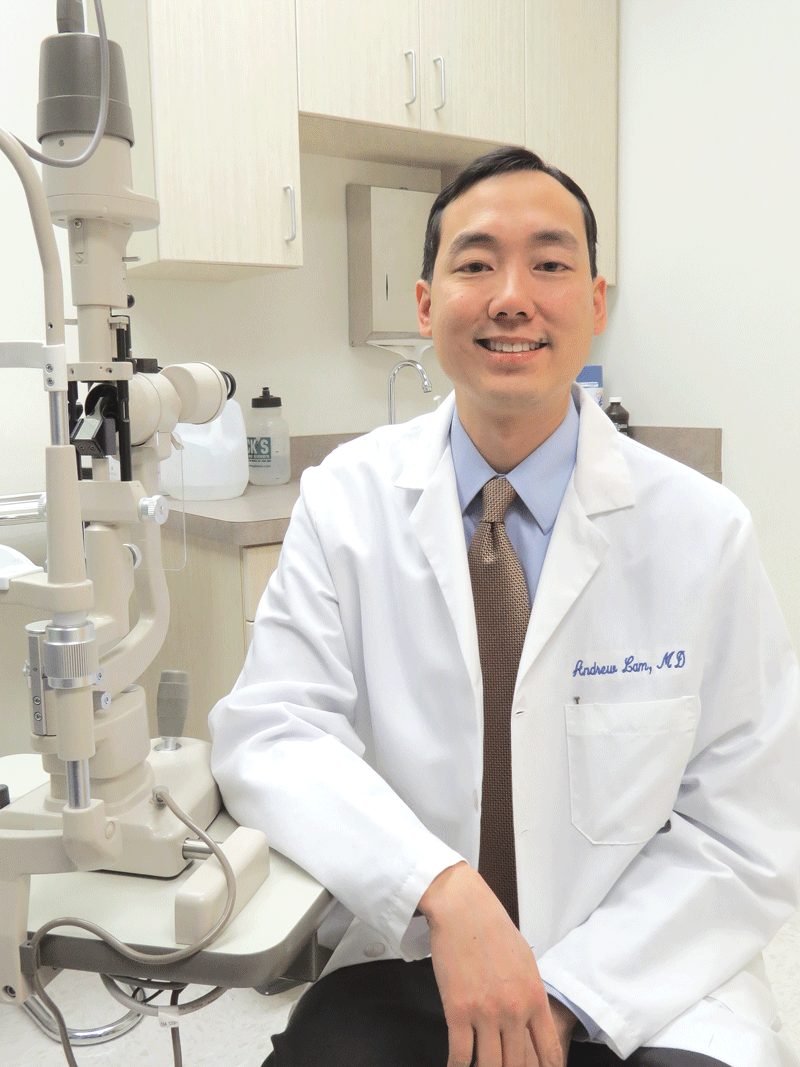
Community Profile Features
Greenfield’s Location, Technology Aid Reinvention

Bob Pyers

Bob Pyers says developments ranging from expanded Amtrak service to new broadband infrastructure will help Greenfield grow and prosper.

As a former economic-development director for 13 years with the Economic Development Council (EDC) of Western Mass., Robert Pyers was consulted several times by various Greenfield municipal employees about growing the town at the intersection of Interstate 91 and Route 2. The answer was always the same.
“We told them you’re not going to get any traction on anything until you change your system of government,” said Pyers, now Greenfield’s economic development director, a position he’s held since Mayor William Martin unseated Greenfield’s first mayor, Christine Forgey, in a write-in campaign in 2009.
Forgey served two terms after the town applied for, and was granted, a city form of government in 2003; under her leadership and, now, with four full years under Martin’s guidance, the city’s unemployment rate has fallen from 8.3% to 6.7% — lower than both the Commonwealth and the nation, Pyers said.
“We’ve been very successful since converting from the selectman style of government to mayoral; it changed things because you have greater impact in terms of designing your business plan,” he said, noting that a mayor’s decision comes much faster than the colliding opinions of select board members and their executive council. “In the old system, it was very difficult for decisions to be made because there was always a naysayer.”
The critics are far fewer these days, Pyers continued, because the city is seeing traction in many areas, like a visible solar farm on a capped landfill and the invisible addition of underground broadband for high-speed Internet, VoIP, (voice over Internet protocol, which facilitates multi-media sessions over online networks), and future wireless Internet for businesses and residences.
“Reinventing itself” is how Martin characterizes Greenfield’s current efforts to become self-sustaining, just as it used to be just after the Civil War through its own gas and electric companies, which were sold to larger corporations in the 1930s. The mission is to now return to that efficient and environmentally sound existence.
Mayor William Martin

Mayor William Martin says Greenfield’s efforts to become more self-sustaining are nothing short of a reinvention.

“We’ve always had this opportunity, surrounded by rivers, roads, and land,” he said, “and we’ve got quite a population that is interested in sustainability and active in cooperatives — in fact, we’re the city with the most number of cooperatives in Massachusetts — so everyone contributes to the economy, the culture, and the governance. It’s wide-open; every opinion is valued.”
The reinvention of Greenfield, which is central to almost a half-million residents within a 25-mile radius, is possible, both told BusinessWest, because of the city’s best natural attribute: its location.
Greenfield has historically prospered in its Upper Pioneer Valley setting as a nexus for walking the famous Mohawk Trail — which became the well-traveled Route 2 that crosses over I-91 — and connecting with roads that lead to Boston, Springfield, Albany, and even Montreal, Martin said.
Revitalized Amtrak passenger service coming online along the Connecticut River in the next year, Pyers added, will help the city — the administrative center of Franklin County — continue to act as a net importer of diverse forms of labor, including manufacturing, retail, tourism, and public-services jobs.
“In the old-fashioned sense, Greenfield is the county seat,” Pyers explained. “We’re the center of the population and the center of all public services, as well as employment.”
For this issue’s Community Spotlight, Martin and Pyers explained how those in Greenfield are using this central location, and the transportation and new technology it supports, to spur future growth in a number of different ways.

Investing in the Future

Of Greenfield’s 9,500-strong workforce, 8,500 of those live in town, Pyers said. But a couple of years ago, the town lost a growing IT firm called HitPoint that moved to Amherst because the infrastructure it needed just wasn’t available in Greenfield. Once in Amherst, HitPoint grew from 10 employees to 35. Pyers said that isn’t going to happen in Greenfield again.
To that end, Greenfield, in partnership with the Department of Public Utilities, is in the last stages of approval to create what’s called a Municipal Aggregate Plan, providing the town with affordable high-speed Internet, broadband, and VoIP, preparing a level, high-tech playing field on which new and existing businesses can grow.
The project is being tackled in conjunction with the Massachusetts Broadband Institute (MBI), a division of the Massachusetts Technology Collaborative. Martin said the MBI has the authority to invest up to $40 million in state capital funding for broadband-related infrastructure and improvement projects. The MBI works closely with municipalities like Greenfield, broadband service providers, and other key stakeholders to create new, statewide digital opportunities. To that end, the MBI has ‘ringed’ Greenfield with seven miles of broadband, with access to about 25 large buildings, said Martin.
The three-phase effort will begin with updating the town’s current IT infrastructure; phase two will expand that hard-wired infrastructure to 25 more major businesses, and the third will benefit the public in the form of free wi-fi — downtown first, and then further outside the town center. Part of that effort involves a promising study by the Franklin County Council of Governments regarding the feasibility of a proposed Internet interconnect facility for a city-owned, 100-acre brownfield-turned-industrial park abutting I-91 — essentially a server farm and switching station for other providers.
As the city solicits private developers, Pyers said, there are two benefits: spinoff businesses that need to be located near high-speed connectivity, and the fact that the extremely expensive mechanics on the property would be privately owned — and the largest taxpayer in Greenfield.
Additionally, when Martin was elected in 2009, he immediately took advantage of the Green Communities Act of 2008, legislation that encourages investment in renewable energy. During the recession, Greenfield was able to build a revenue-generating, 17-acre solar farm on a capped landfill, and is instituting new energy upgrades for residential properties through a Community Development Block Grant (CDBG) program by working with the Department of Energy Resources. By mid-spring, the plan will allow Greenfield to purchase all the electricity for the town’s businesses and residences.
“It won’t cost the town anything, just our investment in looking for the best deal, which should be lower than any other entity, and our distributor, Western Massachusetts Electric Co., will handle house calls and billing,” Martin explained.
While a small community like Greenfield can’t influence the economy, it can prepare its infrastructure and sustainability efforts for when the national and state forecast picks up, said Pyers. “So we’re concentrating on making our investments in things that will make the cost of production in Greenfield, and for service industries, much more competitive.”

Smart Crossroads

Regardless of the industry, businesses take seriously both cost of production and availability of high-tech services, and both Martin and Pyers said several Greenfield firms will immediately benefit from the city’s investments.
They include New England Natural Bakers, producer of granola and tofu; Real Pickles, producer of naturally fermented pickles; PV2, an installer of solar farms and solar applications for business and residential use; Argotec, producer of plastic film for other manufacturers’ applications; Bete Fog Nozzle Inc., a high-precision maker of spray guns and devices used in industrial applications; and the Sandri Company, which provides a diverse combination of energy products (its leader, Tim Van Epps, was named BusinessWest’s Top Entrepreneur for 2013).
While Country Hyundai recently moved to brand-new headquarters in Northampton (see story on page 31), Dillon Chevrolet and Toyota of Greenfield have recently expanded in the west end of the city. More retail business development includes more than 200,000 square feet on the Mohawk Trail; a possible 100-acre parcel on French King Highway, targeted for manufacturing in the power-services industry; and a 40,000-square-foot expansion of an existing food-service business in town.
The renovation and expansion of the Franklin County Courthouse from 60,000 to 96,000 square feet is another bright spot, but one challenge will be to fill the 48,000-square-foot vacancy on Main Street left by the Juvenile Court when it moves to the larger courthouse, Martin added.
Wilson’s

A new hotel above Wilson’s is an example of how Greenfield is growing in myriad ways.

But it’s the renovation of a still-to-be-named, 52-unit boutique hotel on the upper floors of the former Greenfield Hotel, above Wilson’s department store on Main Street — one of the last remaining privately owned general-merchandise department stores — that has many excited about more rooms for business travelers and tourists, and the smart reuse of 30,000 previously empty square feet.
Scheduled to open within the next two years, the hotel will help support a new cultural-district initiative centered around the stately, but vacant, First National Bank building right off the Town Common, and the many events that the Greenfield Business Assoc., a division of the Franklin County Chamber of Commerce, produces each year, including the three-decade-old Green River Festival on the grounds of Greenfield Community College, which attracts thousands each July.
Residents take much pride in Greenfield Community College, Martin noted, adding that, while the city is surrounded by public and private schools, the newest addition to that list is the Massachusetts Virtual Academy, or ‘MAVA @ Greenfield,’ the first of only two distance-learning schools of its kind in the state.
As part of the Commonwealth of Massachusetts Virtual School, the MAVA is a K-12 public school, similar to a charter-school model, that operates independently under a board of trustees. Its 28 certified teachers primarily teach from a remote location using the Internet, Martin explained. Now serving 500 students, MAVA has the ability to serve up to 2,500. The state has indicated that there are approximately 19,000 resident students that would want to participate who are international musicians or athletes, have health issues, or are home-schooled students requiring hybrid classes.
Meanwhile, the MAVA is joined by the new $66 million (80% reimbursed by the state) Greenfield High School, which replaces the original 1950s structure. Classrooms will open this September to 500 students, allowing for growth up to 685, he explained. The entire new school will be fully complete by September 2015, and the original structure demolished.
“We’ll now have a combination of a 1,000-seat auditorium in our new high school and a Cultural Arts District in the downtown,” Martin added. “It’s going to be another catalyst for creating and maintaining momentum in Greenfield.”

Spreading the Word

After the high-school completion, a possible consolidation of public-safety departments, the need for a new senior center, and refurbishment of other 75- to 110-year-old structures are all up for discussion. As those plans develop, the return of improved Amtrak passenger service — for trains topping 75 mph, running between New York’s Grand Central Station and Montreal — will allow more people to discover a reinvented Greenfield.
“When people come into Greenfield, they have that ‘wow, this is quite an interesting place’ type of response,” said Martin. “We’re hearing that more and more, and that spreads the word.”
While the physical changes in Greenfield include new building facades on Main Street that replaced older ones, the city’s biggest changes in the works can’t be seen because they’re either underground, in the form of broadband, or soon to be in the air, as wireless Internet.
“There’s a new vitality, and we’re moving at a different speed now,” Martin said. But while he’s always striving to create a more efficient city, Greenfield — true to its heritage as a county seat — also continues to benefit in every way from its advantageous natural setting.
“Obviously, the Mohawks, the Iroquois, the settlers, and the colonists all noticed the location,” the mayor said. “It’s location, location, location — so let’s use it.”

Greenfield at a Glance

Year Incorporated: 1753
Population: 17,456 (2010); 18,168 (2000)
Area: 21.9 square miles
County: Franklin
Residential Tax Rate: 20.72
Commercial Tax Rate: 20.72
Median Household Income: $38,219
Family Household Income: $46,412
Type of government: Mayor, City Council
Largest employers: Baystate Franklin Medical Center, Greenfield Community College, Argotec, Bete Fog Nozzle Inc.
* Latest information available

Elizabeth Taras can be reached at [email protected]

Opinion
An Opportunity for the EDC

Allan Blair, the long-time director of the Economic Development Council (EDC) of Western Mass., announced at a recent council board meeting that he will be retiring at the end of this year. Almost within minutes after that announcement, the board announced the appointment of a search committee to anoint Blair’s successor.
The juxtaposition of those events clearly indicates that Blair’s decision to step down wasn’t news to anyone, and it also makes it evident that the board had already made up its mind up to carry on in the same fashion that it has for the past 17 years.
We suggest that the board slow things down a bit, or more than a bit, take full advantage of the one year’s notice Blair gave (under different circumstances, this would be a little excessive), and decide first if this model is really working before simply starting to pore over résumés.
A thorough examination might well conclude that the current system — which has the EDC serving as an umbrella organization for a host of agencies, ranging from the Affiliated Chambers to Westmass; from the Regional Employment Board to the Convention and Visitors Bureau — is a model that works. But then again, it may also decide, as many have suggested, that the current system adds bureaucracy to the process of economic development, not real value.
And while examining its model, the EDC’s board should also address the agency’s purpose, and determine whether its mission has been properly, and specifically, defined — and communicated.
We say this because many business owners and managers — including some who sit on the EDC’s board — are not at all sure what this agency and its leaders do and how it is to be held accountable for what’s done, or not done, as the case may be.
And as the board uses the year Blair gave it to consider all these things, we would suggest they use the occasion of his departure to infuse some new blood, and some new energy, into the organization.
Blair has notched some notable accomplishments in his lengthy tenure — mostly in the realm of industrial-park development and creating what is known as the Hartford-Springfield Economic Partnership — but this agency needs a shakeup and a fresh commitment to the many tenets of economic development.
For this reason, we suggest the search committee look outside the block of offices in the TD Bank Building to find a successor. While hiring from within — and, in this case, that’s a broad term — is often a prudent tack, in this instance we believe the EDC needs some new perspective and new sense of purpose, and it won’t get either unless it brings in dynamic new leadership.
Two names come immediately to mind. First is Richard Sullivan, the former mayor of Westfield and current secretary of the state’s Executive Office of Energy and Environmental Affairs. He knows this region, has a proven track record for getting things done, and knows how to work with people to set and meet or exceed goals.
Another is Greg Bialecki, currently state Secretary of Housing and Economic Development. While not from Western Mass., he has worked closely with Gov. Deval Patrick to help Springfield recover from the fiscal woes of a decade ago and recent weather calamities, especially the tornado of 2011. He understands the plight of the state’s Gateway Cities, and would bring some energy — not to mention state connections — to the process of revitalizing those in this region — Springfield, Holyoke, Westfield, and others.
It may be difficult to recruit either one because they will likely have a number of job opportunities when (and if) their tenure with the state ends soon. But they are examples of how this region needs to think big — and hire big — when it comes to filling this important position.
As we said, this is an opportunity for this area, and it should take full advantage of it.

Features
Riverfront Club’s Mission Blends Fitness, Teamwork, Access to a ‘Jewel’

Jonathon Moss (left) and Jim Sotiropoulos

Jonathon Moss (left) and Jim Sotiropoulos, founder and director, respectively, of the Pioneer Valley Riverfront Club.

Jonathon Moss says he found the item on eBay.
It’s a framed copy of an engraving and short story in Frank Leslie’s Illustrated Newspaper that chronicles the International Regatta, which took place on a stretch of the Connecticut River in Springfield on Sept. 11, 1867 — and, more specifically, the marquee event that day, a race between a crew from Newburg, N.Y. and another from St. John, New Brunswick, Canada.

Moss, the president and co-founder of the Pioneer Valley Riverfront Club (PVRC), says he can’t tell from this artwork where, exactly, on the river the action is taking place — although he suspects it was at or near the site of the current Riverfront Park near the Memorial Bridge. But he can easily discern that this was, in fact, an event.
“There were 10,000 people on hand for this,” he said, citing the account of the regatta as his source for that number. “At the time, the population of Springfield was 15,000 to 20,000 — so the equivalent of half the city showed up on the riverbanks to watch the event. You can see the sundresses and the pomp and the circumstance surrounding this gathering; this was immediately after the Civil War, and folks were looking for a competitive outlet. This was something to celebrate as the country healed.”

‘International Regatta’ in 1867.

An engraving chronicling the ‘International Regatta’ in 1867.

Moss, a rower who competed at Wesleyan University, has no delusions about recreating what is depicted in that engraving in 2014, or even 2034. But making history repeat itself isn’t exactly what the PVRC is all about.
Instead, it’s about recapturing some of the river’s great history in rowing — and there is, as that engraving shows, much more of it than most would think — while also reconnecting area residents with a waterway that most know only from driving over it. And it’s also about introducing people of all ages to the sport of rowing and promoting fitness and well-being.
That’s a rather broad mission, he acknowledged, adding quickly that the club is growing into it, and fairly quickly. And it is doing so by focusing on five words that sum up what this organization is all about: activity, diversity, access, health, and team.
These have been the focal points since the PVRC was created in 2007 and operated programs and competitions at the Pioneer Valley Yacht Club (often taking participants from Springfield by taxi to competitions there). And things have only gained speed since 2012, when the club took up residence in what’s known as North Riverfront Park in Springfield, in the shadow of the North End Bridge, and, more specifically, in the 113-year-old facility (long owned by the city of Springfield) known originally as the Rockrimmon Boathouse that was most recently home to Bassett Boat’s showroom.
That framed engraving now hangs in the PVRC’s conference room in the boathouse, one of many rooms in an ongoing state of transformation that will give a nod to the past, but with some 21st-century amenities (more on that later).
And while the restoration and reconstruction work continues, so too does the club’s efforts to introduce people to the river while also stressing the importance of everything from fitness to teamwork.
It does so through a variety of programs and competitions staged throughout the year, including rowing classes for people of all ages, indoor community fitness, youth fall and spring racing teams, the annual Rockrimmon Regatta staged each fall, dragon-boat racing (20-person teams), running and bicycling programs that make use of the bike trail along the river, kayak rentals, and, perhaps most notably, group team building.
Elaborating on that last bullet point, both Moss and Jim Sotiropoulos, PRVC’s executive director, said that perhaps the club’s greatest success comes in putting young people from different communities — and different backgrounds — together in the same boat, where they can row, compete, and grow together.
A big part of the PVRC’s broad mission

A big part of the PVRC’s broad mission is to introduce — or reintroduce — area residents to the Connecticut River.
(Photo by Jonathan Moss)

“It builds a sense of community, and you can see it in our high-school program,” said Sotiropoulos, referencing an initiative involving a number of area schools. “We have kids coming from the inner city of Springfield, as well as the suburbs — Longmeadow, West Springfield, and Somers. These kids get in a boat together, and while the economic divide between them is enormous, they become best friends; they just get in the boat together and want to go fast.”
For this issue, BusinessWest takes an indepth look at the PVRC and what could be called current events. This is an ongoing story with no finish line — at least in a figurative sense — because the hope is that this work will continue with the next several generations of area residents.

Past Is Prologue
It’s called the ‘great room.’
When asked why, Sotiropoulos, with tongue firmly planted in cheek, said “because everyone who goes in it says, ‘this is great.’”
Actually, no one really knows why it’s called that, said Moss, adding quickly that this large room with a vaulted ceiling on the second floor of the boathouse was once very likely the focal point of fellowship at the facility.
At the moment, it is in the midst of the slow-moving process of deconstruction and then restoration, led in large part by students at Springfield’s Putnam High School. It is currently a museum of sorts for rowing machines. Indeed, there’s a collection of them, representing perhaps each of the past five or six decades of products, as well as a few (donated by Smith College) that are more than a century old.
What will become of the room for the long term is not yet known, said Moss, adding that a more pressing matter is renovating the first-floor space to accommodate showers and lockers, a repeated request (if not demand) from the growing numbers of people enjoying frequent workouts at the facility. And then, there’s that ongoing mission and those five words that define it.
But before telling that story, Moss wanted to first go back in time — to when Springfield could truly be called a mecca for rowing — because relating that history goes a long way toward explaining the PVRC’s reason for being.
“Springfield, at the crossroads of New England and with a beautiful riverfront, featured prominently in rowing from very early on,” he said, noting that there are accounts of regattas going back to the 1850s. Crews from Ivy League powerhouses Harvard and Yale raced on the Connecticut River in Springfield because they considered it an attractive neutral site, he went on, even though the work to transport boats and people here from Cambridge and New Haven was rather involved back then.
Rowing was, by most accounts, the first intercollegiate sport, said Moss, and a number of colleges and universities competed on the Connecticut River and in Springfield. By the end of the 1800s, many area public high schools were involved as well.
“And that was extraordinarily unusual,” he told BusinessWest, “because it was only 50 years earlier that it was introduced at all, and it was completely an Ivy League, gentleman’s sport. For there to be public high-school rowing was very unusual, and it was during those Industrial Revolution years that it became very prominent.”
The 20th century would be marked by a number of highs and lows when it came to rowing on the river, said Moss. One of the highs was a huge regatta that accompanied the opening of what was known then as the Hampden County Memorial Bridge in 1922, he noted, adding that the lows were precipitated by world wars, economic downturns (rowing programs are capital-intensive propositions), and, most recently, the dramatic decline in the river’s cleanliness in the ’60s and ’70s.
“People referred to it as America’s most beautifully landscaped sewage system, or something like that,” said Sotiropoulos, who relayed an anecdote about a traveling team beating a unit from Technical High School in the early ’70s, but foregoing the long-standing tradition of throwing the coxswain into the river after a race amid fears for his health.
“They waited until they got back home and then threw him in a nearby lake; they didn’t dare throw him in the Connecticut River,” he went on, adding that, by the mid-’70s, competitive rowing was all but dead on the river, even as work funded by the Clean Water Act began the process of reversing the river’s fortunes.
Fast-forwarding a few decades, Moss said the Greater Springfield YMCA, at the urging of some area businesspeople, introduced a rowing program, which he eventually joined as a volunteer at the start of this century.
“They were teaching middle-aged adults how to paddle and recreate on the river,” he recalled. “I said, ‘this is great, but there’s more to this.’”

The so-called ‘great room’ at the boathouse at North Riverfront Park

The so-called ‘great room’ at the boathouse at North Riverfront Park is currently a museum of sorts for rowing machines, but PVRC officials envision a grander future.

Elaborating, he said there were team aspects of rowing that were missing from the equation that he wanted to add. Shortly thereafter, though, the Y experienced both funding challenges and a leadership change, and the rowing program was cast adrift.
It was then that Moss and several supporters launched the PVPC, a nonprofit agency that eventually bought some larger boats and incorporated a youth program, as well as an initiative for teen mothers working to get their GEDs, and staged programs and competitions in Longmeadow.

The Current Is Strong
Soon, it was decided that, instead of bringing program participants to the yacht club, the more prudent course would be to bring the program to Springfield, said Moss, adding that the PVRC’s fortunes changed considerably when Springfield officials issued a request for proposals for the old boathouse property.
“Their thinking at the time was, ‘we don’t have great access to the river, and we don’t have great recreational activities on the river in Springfield — let’s do something more than allow someone to have a retail establishment here,’” he went on. “The program that we were running — and planned to run — met their needs.”
The club moved into its new home in 2012, said Moss, and soon became one of many organizations, with the Pioneer Valley Planning Commission taking the lead, to collaborate on an application for a two-year, $2 million Community Transformation Grant (CTG) from the Centers for Disease Control and Prevention.
With its share of that award — roughly $350,000 — as well as donations from several area businesses and foundations and revenue in the form of membership fees, the PVRC has been able to take large strides to renovate and repurpose the boathouse and move aggressively to meet its core mission.
“We want to help people make positive lifestyle choices,” said Moss. “This includes exercise, the bike path, experiencing and exploring the river, training indoors in the winter, things like that.”
Going back to those five mission-defining words — activity, diversity, access, health, and team — Moss and Sotiropoulos said a number of programs have been created to address one or, as is usually the case, several of them.
For example, the Healthy Prescription Program is described as a community outreach undertaken in conjunction with the nearby Brightwood Health Clinic, part of Baystate Health System. When a physician prescribes exercise for a patient, that prescription can be filled at the club, and without co-pays, said Sotiropoulos.
“It’s a very unique endeavor that we fund ourselves, and it’s one of the programs I’m most hopeful for, he said, adding that this is an effort born from the CTG grant.
Another initiative with great promise is the Ready, Set, Row program, which takes some of the club’s many rowing machines and deploys them to area middle schools for use in curricula that promote team building and mindfulness.
“What we’ve seen from some of the surveys that we do before and after the program is that it has a positive impact on kids, and teachers can see it,” he noted. “The kids are getting along better amongst themselves, and the teacher-student dynamic is also improved. But we would like to see this expanded to where it’s not done in a vacuum, and we’re able to do this throughout the year and not in a school for a short period of time.”
Moss agreed, and noted that rowing is a sport with benefits not readily apparent to many people. It is a non-contact activity, he said, and one that people can start when they’re young and continue with for a lifetime. Meanwhile, it’s an activity where people are responsible for their own success.
And in the larger boats, as Moss and Sotiropoulos mentioned, rowing has great potential to build responsibility, camaraderie, and teamwork, while also bridging cultural divides.
“They all started out not knowing anything about rowing,” said Moss, “so it’s a very level playing field in there.”

Wave of the Future
Moving forward, there are a number of challenges facing the PVRC, said Sotiropoulos, starting with the still-lingering perception of the Connecticut as a polluted river not fit for water sports such as rowing. That’s if people have opinions on the river at all.
“That’s one of our barriers to reaching people — there’s the belief that the river still is dirty. Because of the Clean Water Act and people changing their lifestyles, the river has become significantly cleaner, and I don’t believe people fully realize that yet,” he said. “And people don’t have the same association with the river they did years ago; if you look at the way Springfield is built, it’s all turned from the river, and I-91 cut off everyone from the river. So part of our mission is to not only promote healthy lifestyles, but also to reintroduce people to the river and let them know it’s a viable resource and that they should be enjoying it — it’s a jewel.
“We’re in the North End in Springfield; we’re in the middle of a city,” he went on. “And I will guarantee you a bald eagle sighting if you spend more than a couple of days on the river in the spring, summer, or fall. If you run north of here [the boathouse], you won’t know you’re in the North End of Springfield, and people are taken aback by that; it gives you a different perspective on the city. But you need to get people out there.”
The boathouse is another challenge, said Sotiropoulos, adding that the facility is old and has undergone a significant amount of work over the years. The deconstruction process has revealed a lot about the structure’s past — including the last vestiges of a wrap-around porch on the second floor — but also some tests that lie ahead. The first-floor renovations top on the priority list, with the great-room renovations to follow.
And funding will certainly be an issue moving forward, he went on, adding that the grant funding will run out next year, and the club will become more reliant on revenues from memberships and gifts from area businesses and foundations.
Thus, one of the club’s ongoing priorities is to tell its story, said Moss, adding that awareness of the club’s multi-faceted mission will help generate support from both public and private sources.
Meanwhile, the organization must be focused on smart, controlled growth, said Sotiropoulos, adding that the Community Transformation Grant certainly accelerated the club’s pace of growth, and the challenge is to manage this opportunity effectively.
“We want to make sure our business is growing at a reasonable rate,” he explained. “Sure, we want the river flooded with canoers, kayakers, rowers, and stand-up paddleboaders, but if 1,000 people show up at the door, we want to be prepared for that. We don’t want to be that organization that grew too fast, with people saying, ‘that could have been a great idea.”

Paddle to the Metal
Moss told BusinessWest that he can’t recall exactly what he paid for the engraving that captured the International Regatta, but believes it wasn’t more than $50.
The item needs a little work and maybe a better frame, and it will likely get both, he went on, adding quickly that, while he and all those associated with the PVRC want to recognize — and honor — this city’s glorious past when it comes to rowing, it is far more focused on the present and future.
In time, he said, the historic boathouse will feature photos from three centuries, and probably more from the 21st, because, while this organization has a number of missions, at the top of that list is a commitment to see that there is a lot more history written at — and on — the Connecticut River.

George O’Brien can be reached at [email protected]

Chamber Corners Departments

ACCGS
www.myonlinechamber.com
(413) 787-1555
• Jan. 28: ACCGS Pastries, Politics, and Policy, 8-9 a.m., at the Roger L. Putnam Vocational Technical Academy, 1300 State St., Springfield. Join us for a roundtable discussion with Springfield Schools Superintendent Daniel Warwick. Reservations are $15 for members, $25 for general admission, which includes continental breakfast. Reservations may be made online at www.myonlinechamber.com or by contacting Cecile Larose at [email protected].
• Feb. 5: ACCGS Business@Breakfast, 7:15-9 a.m., at the Carriage House, Storrowton Tavern, 1305 Memorial Ave., West Springfield. Speed networking is a high-octane way to work the room. Attendees get 60 seconds to make their best elevator pitch in a round-robin format. This is a members-only event. No breakfast served after 7:45 a.m., and no admittance after 7:55 a.m. Reservations are $20 and may be made online at www.myonlinechamber.com or by contacting Cecile Larose at [email protected].
• Feb. 12: ACCGS Lunch ’n’ Learn, 11:30 a.m. to 1 p.m., at Lattitude, 1338 Memorial Ave., West Springfield. “Yabba Dabba Doo: the Art of the Brand.” The creative team at the full-service marketing and advertising agency of Andrews Associates will take attendees through a comprehensive look at branding, best practices to create an effective and compelling brand, and how to win customer loyalty through branding. Reservations are $20 for members, $30 for general admission, and may be made online at www.myonlinechamber.com or by contacting Cecile Larose at [email protected].
• Feb. 24: ACCGS Outlook 2014, 11:30 a.m. to 1:30 p.m., at the MassMutual Center, 1277 Main St., Springfield. Featuring Ed Henry, Fox News Channel’s chief White House correspondent. Reservations are $50 for members, $70 for general admission. Deadline for reservations is Feb. 17.  Presented by Health New England and sponsored by Eastern States Exposition, MassMutual Financial Group, PeoplesBank, United Personnel, and Western Massachusetts Electric Company. Reservations may be made online at www.myonlinechamber.com or by contacting Cecile Larose at [email protected].

AMHERST AREA CHAMBER OF COMMERCE
www.amherstarea.com
(413) 253-0700

• Feb. 12: Chamber Breakfast, 7:15-9 a.m., at the Hadley Farms Meeting House, 41 Russell St., Route 9, (in the Hampton Village Barn Shops). Sponsored by the Franklin Hampshire Career Center. Cost is $15 for members, $20 for non-members. To register, e-mail [email protected], or call (413) 253-0700.
• Feb. 26: Chamber After 5, 5-7 p.m., at Cowls Building Supply, 125 Sunderland Road, Amherst. Tickets are $10 for members, $15 for non-members.

CHICOPEE CHAMBER OF COMMERCE
www.chicopeechamber.org
(413) 594-2101

• Feb: 19: February Salute Breakfast & Annual Meeting, 7:15-9 a.m., at the MassMutual Learning & Conference Center. Cost is $20 for members, $26 for non-members. Reservations may be made online at www.chicopeechamber.org.
• Feb. 26: February Business After Hours, 5-7 p.m., at  Elms College, 291 Springfield St., Chicopee. Cost is $5 for members, $15 for non-members. Reservations may be made online at www.chicopeechamber.org.

GREATER EASTHAMPTON CHAMBER OF COMMERCE
www.easthamptonchamber.org
(413) 527-9414

• Feb. 4: GRIST (Get Real Individual Support Today) meeting, at 9 a.m. Are you a business of one? Are you a small-business owner without your own marketing department? Do you ever wish you had someone to toss around some ideas with about growing your business? GRIST is a new chamber member benefit, an ongoing small group for folks who want to meet regularly to share ideas and get advice on the daily challenges of running a successful business. Like the proverb ‘all is grist for the mill,’ we feel that any idea or word of advice that one business person can share with another is of potential value in helping each other’s business grow. Hosted by the Greater Easthampton Chamber of Commerce, 33 Union St., Easthampton. RSVP to Fran Fahey at [email protected] or Derek Allard at [email protected] to join the group. Call Fahey at (413) 529-1189 or Allard at (413) 282-9957 to find out more.

GREATER HOLYOKE CHAMBER OF COMMERCE
www.holycham.com
(413) 534-3376

• Jan. 30: Marketing Roundtable Workshop, 8:30-10 a.m., at the chamber office. This unique roundtable event is designed to foster informative discussions among business owners and marketing professionals as well as brainstorm new ideas to help with revenue-producing initiatives. Cost is $10 for members, $20 for non-members. A continental breakfast is included in the price. Call the chamber at (413) 534-3376 to register or visit holyokechamber.com to sign up.
• Feb. 13: Chamber Table Top Workshop: “How to Get People’s Attention and Attract Them to Your Table,” 8:30-10:30 a.m., in the chamber conference room. A no-nonsense informational session on how to set up your booth, how to add visual interest, and what to do to keep potential customers engaged. Cost is $10 for members.
• Feb. 19: Chamber After Hours, 5-7 p.m., at Wistariahurst Museum, 238 Cabot St., Holyoke. Admission is $10 for members, $15 cash for non-members.
• Feb. 26: Holyoke Chamber Economic Development Breakfast, 8-10 a.m. (Save the date. Location to be determined.) Hear about local projects and how they will affect local businesses. Cost is $26 for members, $35 for non-members, which includes a buffet breakfast. Call the chamber at (413) 543-3376 to register, or visit holychamber.com to sign up.

GREATER NORTHAMPTON CHAMBER OF COMMERCE
www.explorenorthampton.com
(413) 584-1900

• Jan. 28: Nonprofit Marketing Roundtable 2014 Workshop, 8-9:30 a.m. at the Greater Northampton Chamber of Commerce, 99 Pleasant St., Northampton. Presented by the Creative Marketing Group. Struggling to gain visibility with your target audience? Are your marketing materials producing tangible results? Are your best messaging ideas living only in your head? The chamber has help on the way. Three women business owners — Janice Beetle, Ruth Griggs, and Maureen Scanlon of the Creative, a marketing and communications collaboration in Northampton — will lead a nonprofit flash marketing workshop. They will meet with business owners, listen to your marketing and communications concerns, and help you brainstorm practical, professional solutions on the spot. Learn more about how to strategize, advertise, brand, and promote your business; reach the media; and maximize your message in person, in print, and online. The workshop is free, but pre-registration is required, and space is limited. To register, contact Jasmin Tomic at (413) 584-1900 or [email protected].
• Feb. 18: Incite Information Lunch, 11:30 a.m. to 1 p.m., at the Delaney House, Grand Ballroom, 3 Country Club Road, Holyoke. Hosted by the Greater Northampton Chamber of Commerce and sponsored by United Personnel.
Guest Speaker: Richard Davey, secretary and CEO of the Mass. Department of Transportation. Introduction by state Rep. Joseph Wagner, and moderated by Tony Cignoli. Cost is  $20 for members, $30 for non-members. RSVP to the chamber at (413) 584-1900 or [email protected].

GREATER WESTFIELD CHAMBER OF COMMERCE
www.westfieldbiz.org
(413) 568-1618

• Feb. 3: Mayor’s Coffee Hour, 8-9 a.m., at Mestek, 260 North Elm St., Westfield. For more information, contact the chamber at (413) 568-1618.
• Feb. 12: After 5 Connection, 5-7 p.m., at Armbrook Village, 551 North Road, Westfield. For tickets and more information, call the chamber at (413) 568-1618.
• Feb. 13: Men Are from Mars, Women Are from Venus, 6:30 p.m. Spend Valentine’s Eve at CityStage with your date — the chamber. Enjoy complimentary food and a cash bar in the CityStage Member’s Lounge, get great seats to the performance, and parking is free in the Columbus Center Parking Garage, all for the discounted price of $30 per ticket. Chamber reception, catered by Nora’s Restaurant of Southwick, begins at 6:30 in the CityStage Member’s Lounge. Show begins at 7:30. You can also take part in a drawing for a necklace, valued at $120, donated by Andrew Grant Diamond Center. Sponsored by Comcast Business and Andrew Grant Diamond Center. Thanks to our sponsors, 100% of the $30 ticket cost goes back to the Greater Westfield Chamber of Commerce. For tickets, contact Pam at the chamber office at (413) 568-1618, or e-mail [email protected].

NORTHAMPTON AREA YOUNG PROFESSIONAL SOCIETY
www.thenayp.com
(413) 584-1900

• Feb. 13: February Networking Social, 5 p.m., at the UMass Amherst Fine Arts Center.

PROFESSIONAL WOMEN’S CHAMBER
www.professionalwomenschamber.com
(413) 755-1310

• Feb. 11: Professional Women’s Chamber Ladies Night, 5-7 p.m., at
Kate Gray Boutique, 749 Maple Road, Longmeadow. Seize an opportunity to network socially with other female professionals in a casual and unique setting. Reservations are required; contact Dawn Creighton at [email protected]. The Professional Women’s Chamber is an affiliate of the Affiliated Chambers of Commerce of Greater Springfield.

WEST OF THE RIVER CHAMBER OF COMMERCE
www.ourwrc.com
(413) 426-3880

• Jan. 28: West of the River Chamber of Commerce tour of West Springfield High School and coffee with Mayor Edward Sullivan. The tour starts at 7 a.m., and coffee with the mayor starts at 8 in the school’s cafeteria. Please join us to hear first-hand from Sullivan about key issues and to get an update on important projects. The mayor also welcomes any questions you may have.  Coffee with the mayor is free, informative, and open to the public.
• Feb. 5: Wicked Wednesday, 5-7 p.m. at Crestview Country Club. Wicked Wednesdays are monthly social events, hosted by various businesses and restaurants. These events bring members and non-members together to network socially in a laid-back atmosphere. Cost: free for chamber members, $10 for non-members. Event is open to the public, but non-members must pay at the door. For more information, contact the chamber office at (413) 426-3880 or e-mail [email protected].
• Feb. 26: West of the River Chamber of Commerce Legislative Breakfast, 7-9 a.m., at Storrowton Tavern’s Carriage House, West Springfield. Cost: $25 for chamber members, $30 for non-members. For more information, contact the chamber office at (413) 426-3880 or e-mail [email protected].

YOUNG PROFESSIONAL SOCIETY OF GREATER SPRINGFIELD
www.springfieldyps.com

• Feb. 20: Third Thursday, 5-7 p.m., at Samuel’s at the Hall of Fame. This is one of our most well-attended Third Thursdays. Check out the restaurant’s recently revamped menu, which now offers 51 tapas dishes to choose from, at samuelssportsbar.com. Community spotlight: Voices from Inside. For 15 years, Voices from Inside (www.voicesfrominside.org) has been helping women who are or were incarcerated to find their voice, connect with the community, and become leaders. This event is open to everyone. Feel free to invite your friends by clicking ‘Select Guests to Invite’ in the top left corner of the event page. This event, as always, is free for YPS members and $10 for non-members, which includes food and a cash bar.

Departments People on the Move

Dianne Fabrocini

Dianne Fabrocini

The Affiliated Chambers of Commerce of Greater Springfield (ACCGS) announced that Dianne Fabrocini has joined the organization as Executive Director of the ACGCS affiliate, the East of the River Five Town Chamber of Commerce (ERC5).
Fabrocini will serve as the liaison between the ERC5 and the ACCGS and will be responsible for carrying out the direction set by the board of directors. She will also work with ACCGS staff in developing membership programs, benefits, and services; producing events; and enhancing municipal relations in the five communities served by the ERC5: East Longmeadow, Hampden, Longmeadow, Ludlow, and Wilbraham. Fabrocini brings to the organization nearly 20 years of experience in marketing, public relations, and management. Most recently, she served as office manager for Vulcan Products Co. in Enfield, Conn. Prior to that, she owned Fabro & Associates, a professional sports-management company providing event planning, promotions, player representation, and contract negotiations to various clients throughout Western Mass., where she founded the Legends Celebrity Golf Classic and brought the first United Soccer League professional men’s soccer team to the region. Fabrocini also served as general manager and owner of the Springfield Sirens women’s soccer team, now known as the New England Mutiny, and held the position of regional director for the National Kidney Foundation. Fabrocini is a graduate of the University of Akron in Ohio.
•••••
The Board of Directors of the Amherst Area Chamber of Commerce recently announced new officers for 2014, led by second one-year-term president Larry Archey, Director of Facilities and Grounds at Hampshire College. Archey will be joined by Nancy Buffone, UMass Executive Director of External Affairs and University Events, as First Vice President, and Julie Marcus, Director of Marketing at New England Environmental, as Second Vice President. Other new board members include:
Mark Ellsworth, Center for Extended Care, treasurer;
Jerry Guidera, Spanish Studies Abroad, secretary; and
Jim Brassord, Amherst College, at large.
Kathryn Grandonico, Lincoln Real Estate, remains immediate past president. Returning board members include Aaron Jolly, the Pub; Meredith Schmidt, UMass Campus Center; Meghan Gregoire, PeoplesBank; Felicity Hardee, attorney; Niels la Cour, UMass Planning; Reza Rahmani, Lit and Moti; Barry Roberts, EV Realty Trust; G. Christopher Blauvelt, Innovara; John Kokoski, Mapleline Farm; and Youssef Fadel, New England Promotional Marketing. The appointments were effective Jan. 1 and formally ratified at the chamber’s annual meeting at the Lord Jeffery Inn on Jan. 15. The mission of the Amherst Area Chamber of Commerce is to create, maintain, and promote a vital, thriving business climate throughout the Amherst area and to initiate and support the civic, educational, recreational, and economic well-being of the Amherst area.
•••••
AJBmediab&w
Benjamin Coyle

Benjamin Coyle

The Springfield-based regional law firm Bacon Wilson, P.C. recently announced that Adam Basch and Benjamin Coyle have been named shareholders of the firm. Basch, a member of the litigation department, practices in the areas of construction litigation, personal injury, general litigation, and commercial litigation. He is a former secretary of the Hampden County Bar Assoc., a six-time recipient of the SuperLawyers Rising Stars distinction, and serves as a member of the Wilbraham Planning Board and the United Way Allocation Committee. He teaches litigation and business law at Bay Path College and is the author of numerous construction and general litigation articles. Basch earned his JD from Western New England University School of Law and his B.A. from Union College. He is a member of the firm’s business and corporate, estate planning and elder, litigation, and municipal departments. He is a five-time recipient of the SuperLawyers Rising Stars distinction and a board member of the Western Mass. Council of the Boy Scouts of America. He earned his JD from Western New England University School of Law and his BSBA from Western New England University.
•••••
William Fontes

William Fontes

Easthampton Savings Bank announced that William Fontes has joined the bank as Vice President Commercial Lending. Fontes has more than 30 years of banking experience in commercial lending and most recently was senior vice president, commercial banking team leader at United Bank and, prior to that, a commercial banking team leader at People’s United Bank. Fontes earned his bachelor’s degree in business management from the University of Massachusetts and his MBA, majoring in finance, from Bryant University.
•••••


David Pinsky

David Pinsky

The Food Bank of Western Massachusetts recently elected President and CEO David Pinsky to its board of directors. His three-year term, serving the nonprofit organization that has been fighting hunger in Western Mass. for more than 30 years, began this month. Pinsky, who serves as Tighe & Bond’s President and CEO, has worked at the engineering firm since 1988.  He also serves on the board of directors for the American Council of Engineering Companies of Massachusetts and the Community Foundation of Western Massachusetts. A professional engineer for more than 25 years, Pinsky holds an MS in environmental engineering from the University of North Carolina at Chapel Hill, and a BS in civil engineering from the University of New Hampshire. He is also an active member of numerous professional societies and organizations in the engineering profession, such as the American Water Works Assoc., the Massachusetts Water Works Assoc., and the New England Water Works Assoc.
•••••
Thomas Dowling

Thomas Dowling

Thomas Dowling, CPA, MST, was recently hired by Meyers Brothers Kalicka, P.C. for the position of Senior Associate, where he will be responsible for guiding staff-level accountants in their duties and helping to manage the day-to-day operations of engagements. Dowling has worked in various capacities at small to mid-sized CPA firms for four years. He graduated magna cum laude with a bachelor in accountancy degree from Bentley University and continued at Bentley to earn his master’s in taxation, graduating with high distinction. He is a member of AICPA, MSCPA, and the Beta Gamma Sigma International Business Honor Society.
•••••


Lydia Martinez

Lydia Martinez

Sarah Williams

Sarah Williams

The YMCA of Greater Springfield recently announced the addition of Lydia Martinez, Assistant Superintendent of Springfield Public Schools, to its corporate board of directors, and named Sarah Williams the new chairperson. Williams, the Vice President of Enterprise Risk Management at the Hartford Insurance, joined the YMCA of Greater Springfield board in 2011.
•••••


Dr. Junie Baldonado

Dr. Junie Baldonado

Dr. Junie Baldonado recently joined Ludlow Family Dentistry and doctors R. Carl Szarlan, Joseph Wegiel, Frank Mitera, and Michelle Roberts in providing general dentistry to the families of Ludlow and the surrounding towns. Baldonado is a graduate of Loma Linda University School of Dentistry in Riverside, Calif. He attended NYU for his undergraduate work and majored in fine arts, while completing the pre-med requirements for entrance into dental school. Baldonado had been practicing in the Sacramento, Calif. area prior to joining the Ludlow dental practice and is now accepting new patients and in all phases of dentistry.
•••••


M. Dale Janes

M. Dale Janes

Springfield-based NUVO Bank & Trust Co. recently announced that Chief Executive Officer M. Dale Janes was awarded the Sally Barnhart Leadership Award from the Assoc. for Community Living in appreciation for his voluntary leadership as president of the board of directors. Janes is the immediate past president and has been a member of the board of directors since 2006. He has also served on the finance and audit, investment, executive, and ad hoc committees, providing guidance throughout the purchase of a new headquarters, major renovations at the Inclusive Community Center located in Hadley, expansion of services for the medically challenged in Hampshire County, and developing a two-year strategic plan.
•••••
Christopher Boino

Christopher Boino

Christopher Boino was recently appointed President of Western Builders, a construction management and general contracting firm, a subsidiary company of the O’Connell Companies, headquartered in Granby. Joining Western Builders as a project manager in 2013, Boino brings more than 14 years of experience in the construction industry and is now responsible for the successful day-to-day operation of the company. Boino earned his MBA from Bentley University and a bachelor of science in Construction Management from Arizona State University’s Del Webb School of Construction. Boino is a LEED-accredited professional and is a certified project-management professional. He was previously employed in the Boston area with Shawmut Design & Construction and Cafco Construction. Western Builders was established in 1975 and has successfully completed new construction and renovation projects throughout New England in the areas of academics, healthcare, and housing.

Community Spotlight Features
Amherst Is Redefining the Phrase ‘College Town’

John Musante

John Musante says Amherst’s market-rate housing issue is being addressed with two new private developments, targeting two different demographics.

Through most of its history, Tony Maroulis says, Amherst has been a college town, or, to be more precise, the quintessential college town.
He used that phrase to describe a community that not only hosts institutions of higher learning — in this case, UMass Amherst, Hampshire College, and Amherst College — but has a business community centered mostly on serving those who learn, teach, or are otherwise employed by those colleges and the university.
And while Amherst has certainly thrived in that role through the decades, said Maroulis, the long-time executive director of the Amherst Chamber of Commerce, it has, in relatively recent times, become much than that.
Indeed, it has become a center of arts, culture, and fine dining, with several museums, arts-related programs and events, and eateries that draw people from across the region, not merely across town.
Meanwhile, it has also become — at least partly, because of all those amenities — a popular retirement spot, ranking high on many recent lists of places for people to live out their golden years.
And while it desires to remain all of the above, Amherst is aggressively seeking to add more lines to its résumé by becoming home to start-up companies and research and development (R&D) facilities, said Maroulis, noting that, instead of just hosting service businesses for area students and faculty, the community is taking steps toward becoming an incubator for businesses in several sectors, but especially the life sciences.
Optimism for such a development stems in large part from the emergence of new programs and tens of millions of dollars in research projects at the university, said Maroulis, who pointed specifically to the new, $157 million Life Science Laboratories, part of the Mass. Life Sciences Center (MLSC), and one of many potential catalysts for economic development in the town.
Through the MLSC, the Commonwealth is investing $1 billion over 10 years in the growth of the state’s life-sciences supercluster. At UMass Amherst, the MLSC includes such facilities as the Biosensors and Big Data Center, the Healthcare Informatics and Technology Information Center, and the Models to Medicine Center.
Research at each of those facilities, and others representing many other fields, could translate into startup companies and jobs, said Maroulis, adding that one of the challenges for the community is to build an infrastructure that can support these new enterprises.
Sarah La Cour (left) and Tony Maroulis

With the Amherst BID now up and running, Sarah La Cour (left) and Tony Maroulis are able to focus economic-development efforts on specific projects in each of the organizations they manage.

Elaborating, he said this means everything from building facilities for people to start and grow businesses to creating new places for people to live, to enhancing prospects of doing business through technology.
And already there is progress on these various fronts.
It comes in the form of initiatives like Kendrick Place, a 44,000-square-foot, five-floor, LEED-certified, mixed-use residential, retail, and incubator space on a parcel on East Pleasant Street, not far from downtown. And also in the form of a business-improvement district (BID) that is adding members and broadening its reach, as well as what is being touted as the fastest and largest outdoor wi-fi network in the state (more on those later).
“It’s going to be a really exciting next 10 to 15 years here,” said Maroulis, summing up both what’s happening and what he and others expect to happen over that time span. “It’s important for Amherst to establish this area as an R&D center, not just for this community, but for the rest of the region.”
For this, the initial installment of its Community Spotlight series, BusinessWest focuses on a community that is looking to redefine the phrase ‘college town.’

Work in Progress
John Musante, Amherst’s town manager, noted that the community has four distinct villages.
The first is the downtown center, or central business district, and common area, which Maroulis reports has a vacancy rate of only 3%. Another is called North Amherst Village Center, which includes the Cowls Land Co. and Cowls Building Supply, one of the town’s major employers. Meanwhile, Pomeroy Village Center is on Route 116, and Atkins Corner consists of the new double-rotary intersection of Bay Road and Route 116.
Together, these villages give Amherst a diverse mix of businesses and residential experiences, he told BusinessWest, adding that, with each village, the town is looking for smart growth that facilitates those stated goals of bringing new businesses, more tourism dollars, and more opportunities on many different levels to the town.
One of the most exciting new developments for the town is Kendrick Place, said Musante, noting that it will hopefully build on the success of Boltwood Place, a 12-unit, market-rate housing initiative built in the heart of downtown that also features retail and restaurant space.
Like the Boltwood project, Maroulis said, Kendrick Place, which is being developed by Archipelago Investments, LLC, was conceived with the notion that professionals want to live in the central business district to take advantage of all it offers, but require attractive, market-rate facilities.
“Archipelago is doing with science what other developers in the area have done with their gut,” added Maroulis.  “People know that this is how others want to live … within walking distance from the café or to their jobs. An interesting factoid is that only 30% of UMass professors and staff live in town, so we can do better.”
Meanwhile, Archipelago is moving forward with another intriguing development, Olympia Place, a 100,000-square-foot LEED-certified, 262-bed private dormitory on taxable land next to the UMass campus.
Slated to open in the fall of 2015, the project will feature suite-style dormitory apartments and bring what Archipelago calls “condo-level quality to a prime Amherst location.” With the Kendrick Place endeavor, it will bring more people — and vibrancy — to the downtown area.
“Both are the first of multiple efforts to bring sorely needed residential units and retail space to the northern end of the downtown,” said Musante. “And there’s an active effort to reach out to the university in particular to fill the Kendrick incubator space for some of this off-campus research and development.”
Housing and economic development will be the twin focal points of a survey that will be conducted as a joint initiative between the town and the university, said Maroulis, adding that a request for proposals will be issued shortly. The results of that survey will provide some direction about what kinds of development are needed and where, he said, adding that there is vast potential for new business growth, given the town’s high quality of life and the research taking place at the surrounding colleges.
“I don’t think we have even touched the tip of the iceberg,” he told BusinessWest.
The community has already seen a number of ventures open in Amherst or move there over the past several months, he said. This list includes B. Home, where eco-friendly meets beautiful home furnishings; All Things Local Cooperative Market, a new food and crafts marketplace; and HitPoint, a video-game company that employs 35, which recently relocated from Hatfield.
The HitPoint owners, Maroulis noted, intentionally chose the artsy Amherst lifestyle and the constant source of nearby R&D advancements and tech-savvy talent that the local schools produce, and he expects others to follow that lead.

Right Time, Right Place
While developers explore opportunities in downtown and other areas of the city, the town is broadening its economic-development infrastructure in an effort to make this a better community in which to live and work — and also visit.
Indeed, the BID, still one of only a handful in this region, was created in 2012, and the Regional Tourism Council of Hampshire County (RTC) was launched last May.
The Amherst chamber, which was instrumental in the creation of both agencies, can now shift some of its responsibilities to them, said Maroulis, and focus more time and resources on getting new businesses off the ground and to the next level.
“This is allowing us to focus over the next 12 months on business development and, specifically, small businesses to make sure they’re sustainable,” said Maroulis, noting that the ability to step aside a bit while still supporting the municipality in strengthening town-gown relationships is enabling every organization to put energy into their own projects.
The BID is a legislatively approved nonprofit that collects a nominal tax, currently totaling $275,000, from property owners in a designated area to cover marketing, property cleaning, and beautification, and transportation services to the downtown.
“Creation of the BID has given the local individual businesses the opportunity to join forces and do things they might like to do but, on their own, didn’t have the resources or personnel to do,” said Sarah La Cour, who became executive director last fall after serving as interim head.
Like other BIDs across the state, Amherst’s benefited from a recent change in the rules included in the original legislation that enabled formation of these entities, said La Cour, adding that the controversial opt-out clause has been removed, resulting in a spike in membership from 67 to more than 100.
“The BID’s biggest challenge now is to show those new BID members that had to become members the value in what we do with their money,” she added, noting that the staff consists of herself and a part-time bookkeeper, but assistance and talent also come from the 13-member board.
One of the major initiatives in the BID’s first year was the downtown trolley, a bus that looks like an old-fashioned trolley car. It is underwritten by the BID and is seeing great ridership, not only from students, but also among residents and tourists.
The trolley sees heightened use during special events and the monthly Art Walk, which has been continuous since 2007, said Maroulis. Coordinated by Michelle Raboin, owner of the Hope and Feathers Gallery on Main Street, the event showcases local talent at a variety of galleries, businesses, and restaurants from 5 to 8 p.m. on the first Thursday of each month.
Assistance with tourism-related initiatives is coming from the RTC, the tourism partnership that includes Amherst, Northampton, and Easthampton, which launched in May 2013, located online at www.visithampshirecounty.com, La Cour added. Museums like the Eric Carle Museum of Picture Book Art, the Yiddish Book Center, and the Emily Dickinson Museum are being marketed with other cultural and tourism nonprofits and businesses.
“With more than eight museums that bring in a combined 120,000 people each year, noted Maroulis, “this is an amazingly rich place.”

Open for Business
That sentiment applies to much more than culture, he noted, adding that it also touches on everything from the scenery to the vast number of talented college students who currently call Amherst home and may want to make that arrangement permanent.
As he said, the quintessential college town is expanding the definition of that term, whih should make the next 10 to 15 years, and probably many more, a very exciting time.

Amherst at a Glance

Year Incorporated: 1759
Population: 37,819 (2010); 34,874 (2000)
Area: 27.8 square miles
County: Hampshire
Residential Tax Rate: 20.39
Commercial Tax Rate: 20.39
Median Household Income: $40,017
Type of government: Select Board, Town Manager, Town Meeting
Largest employers: UMass Amherst, Hampshire College, Amherst College, Atkins Farm Market, Cowls Building Supply
(Latest information available)

Elizabeth Taras can be reached at [email protected]

Chamber Corners Departments

ACCGS
www.myonlinechamber.com
(413) 787-1555

• Jan. 15: ACCGS After 5, 5-7 p.m., at the Melha Shrine Temple, 133 Longhill St., Springfield. Come clown around with us at this after-hours networking event, presented by Shriners Hospital for Children and sponsored by Naismith Memorial Basketball Hall of Fame with support from Berkshire Bank and the Springfield Falcons. Reservations are $5 for members, $10 for general admission. Reservations may be made online at www.myonlinechamber.com or by contacting Cecile Larose at [email protected].

• Jan. 28: ACCGS Pastries, Politics and Policy, 8-9 a.m., at the Roger L. Putnam Vocational Technical Academy, 1300 State St., Springfield. Join us for a roundtable discussion with Springfield Schools Superintendent Daniel Warwick. Cost is $15 for members, $25 for general admission, and includes continental breakfast. Reservations may be made online at www.myonlinechamber.com or by contacting Cecile Larose at [email protected].

AMHERST AREA CHAMBER OF COMMERCE
www.amherstarea.com
(413) 253-0700

• Jan. 15: Chamber Annual Meeting and Lunch, noon to 1:30 p.m. at the Lord Jeffery Inn. The chamber has a fantastic array of networking events lined up, but we need your ideas. The meeting will also feature the formal election of the 2014 chamber board of directors, including the installation of Lawrence Archey as board president for a second year. Sponsored by Amherst College, Hampshire College, and UMass Amherst. Tickets are $25 for members, $30 for guests.

CHICOPEE CHAMBER OF COMMERCE
www.chicopeechamber.org
(413) 594-2101

• Jan. 15: January Salute Breakfast, 7:15-9 a.m. at Willits-Hallowell at Mt. Holyoke College. Tickets are $20 for members, $26 for non-members. Reservations may be made online at www.chicopeechamber.org.
• Jan. 22: January Business After Hours, 5-7 p.m., at the Collegian Court, 89 Park St., Chicopee. Tickets are $5 for members, $15 for non-members. Reservations may be made online at www.chicopeechamber.org.
• Feb. 19: February Salute Breakfast & Annual Meeting, 7:15-9 a.m., at the MassMutual Learning & Conference Center. Tickets are  $20 for members, $26 for non-members. Reservations may be made online at www.chicopeechamber.org.
• Feb. 26: February Business After Hours, 5-7 p.m., at Elms College, 291 Springfield St., Chicopee. Tickets are $5 for members, $15 for non-members. Reservations may be made online at www.chicopeechamber.org.

FRANKLIN COUNTY CHAMBER OF COMMERCE
www.franklincc.org
(413) 773-5463

• Jan. 24: FCCC Breakfast Series, 7:30-9 a.m., at Greenfield Corporate Center,101 Munson St., Greenfield. Sponsored by Franklin County Home Care Corp. and Gilmore & Farrell Insurance. The speaker will be U.S. Rep. Jim McGovern, who represents the 2nd Congressional District in Massachusetts, covering many Franklin County towns. Since his election in 1996, McGovern has been widely recognized as a tenacious advocate for his district, a tireless crusader for change, and an unrivaled supporter for social justice and fundamental human rights. Over the past 17 years, he has consistently delivered millions of dollars for jobs, vital local and regional projects, small businesses, public safety, regional and mass transportation projects, and affordable housing around Massachusetts. He has authored important legislation to increase Pell Grant funding to allow more students access to higher education, to provide funds to preserve open space in urban and suburban communities, and to give tax credits to employers who pay the salaries of their employees when they are called up to active duty in the Guard and Reserves. A strong proponent of healthcare reform, his legislative efforts included reducing the cost of home healthcare and giving patients the dignity to be cared for in their own homes with the help of medical professionals. Currently serving his ninth term, McGovern serves as the second-ranking Democrat on the House Rules Committee, which sets the terms for debate and amendments on most legislation, and is a member of the House Agriculture Committee. Cost: chamber members, $13 (prepaid or pay at door) or $14 (billed); non-members, $16. Reservations can be made online at www.franklincc.org or by calling (413) 773-5463.

GREATER EASTHAMPTON CHAMBER OF COMMERCE
www.easthamptonchamber.org
(413) 527-9414

• Jan. 23: Big Raffle Drawing, 6 p.m. Only 300 tickets are for sale each year. Grand prize, $5,000; second prize, $500;
third prize, $200; fourth prize, $100; fifth prize, $50. The drawing takes place at the annual dinner meeting on Jan. 23, and you do not need to be present to win. For more information or to enter, visit www.easthamptonchamber.org.

GREATER HOLYOKE CHAMBER OF COMMERCE
www.holycham.com
(413) 534-3376

• Jan. 15: Chamber After Hours, 5-7 p.m., at Homewood Suites, 375 Whitney Ave., Holyoke. Cost: $10 for members, $15 cash for non-members.
• Jan. 24: Legislative Coffee Hour, 7:45-9:15 a.m., at the Summit View Banquet and Meeting House, 500 Northampton St., Holyoke. The event will feature local legislators discussing the challenges and opportunities facing the Commonwealth, Holyoke, and local businesses in the months ahead. Cost: $26 for members, $35 for non-members, which includes a buffet breakfast.
• Jan. 30: Marketing Roundtable Workshop, 8:30-10 a.m. This unique roundtable event is designed to foster informative discussions among business owners and marketing professionals as well as brainstorm new ideas to help with revenue-producing initiatives. Cost: $10 for members, $20 for non-members. A continental breakfast is included in the price. Call (413) 534-3376 or visit holyokecham.com to register.
• Feb. 13: Chamber Table Top Workshop: “How to Get People’s Attention and Attract Them to Your Table,” 8:30-10:30 a.m., at the Chamber Conference Room. A no-nonsense informational session on how to set up your booth, how to add visual interest, and what to do to keep potential customers engaged. Cost: $10 for members.
• Feb. 19: Chamber After Hours, 5-7 p.m. at Wistariahurst Museum, 238 Cabot St., Holyoke. Cost: $10 for members, $15 cash for non-members.
• Feb. 26: Holyoke Chamber Economic Development Breakfast, 8-10 a.m., location to be announced. Hear about local projects and how they will affect businesses. Cost: $26 for members, $35 for non-members, which includes a buffet breakfast. Call (413) 543-3376 or visit holycham.com to register.

GREATER NORTHAMPTON CHAMBER OF COMMERCE
www.explorenorthampton.com
(413) 584-1900

• Jan. 28: Nonprofit Marketing Roundtable 2014 Workshop, 8-9:30 a.m., at the Greater Northampton Chamber of Commerce, 99 Pleasant St., Northampton. Presented by the Creative Marketing Group. Struggling to gain visibility with your target audience? Are your marketing materials producing tangible results? Are your best messaging ideas living only in your head? The  chamber has help on the way. Three women business owners — Janice Beetle, Ruth Griggs, and Maureen Scanlon of the Creative, a marketing and communications collaboration in Northampton — will lead a nonprofit Flash marketing workshop. They will meet with business owners, listen to your marketing and communications concerns, and help you brainstorm practical, professional solutions on the spot. Learn more about how to strategize, advertise, brand, and promote your business; reach the media; and maximize your message in person, in print, and online. The workshop is free, but pre-registration is required, and space is limited. To register, contact Jasmin Tomic at (413) 584-1900 or [email protected].

GREATER WESTFIELD CHAMBER OF COMMERCE
www.westfieldbiz.org
(413) 568-1618

• Jan. 13: Health Care Symposium, time to be announced, at the Dever Stage, Parenzo Hall, Westfield State University. Presenter: Lynn Nichols, president of the Mass. Hospital Assoc. Sponsored by Noble Hospital. For more information or to register, contact Pam at (413) 568-1618.

NORTHAMPTON AREA YOUNG PROFESSIONAL SOCIETY
www.thenayp.com
(413) 584-1900

• Feb. 13: February Networking Social, 5 p.m., at the UMass Amherst Fine Arts Center.

PROFESSIONAL WOMEN’S CHAMBER
www.professionalwomenschamber.com
(413) 755-1310

• Jan. 15: PWC Tabletop Business Expo/Luncheon, 11:30 a.m. to 1:30 p.m., at the Carriage House, Storrowton Tavern, West Springfield. Showcase your product or service. For more information about the Professional Women’s Chamber, contact Cecile Larose at (413) 755-1310 or [email protected].

THREE RIVERS CHAMBER OF COMMERCE
www.threeriverschamber.org
(413) 283-6425

• Feb. 3: Three Rivers Chamber of Commerce Monthly Meeting, 7-8 p.m., at the Three Rivers Chamber of Commerce, 2376 Main St., Three Rivers.

WEST OF THE RIVER CHAMBER OF COMMERCE
www.ourwrc.com
413-426-3880

• January: Coffee with Mayor Cohen, date, time, and location to be announced. Keep checking the website for updates, or email [email protected].
• Feb. 5: Wicked Wednesday, 5-7 p.m., at Crestview Country Club, Agawam. Wicked Wednesdays are monthly social events hosted by various businesses and restaurants. These events bring members and non-members together to network in a laid-back atmosphere. Cost: free for chamber members, $10 for non-members. Event is open to the public; attendees must pay at the door if they’re non-members. For more information, contact the chamber office at (413) 426-3880, or e-mail [email protected].
• Feb. 26: West of the River Chamber of Commerce Legislative Breakfast, 7-9 a.m., at the Storrowton Tavern Carriage House, West Springfield. Cost: $25 for members, $30 for non-members. For more information, contact the chamber office at (413) 426-3880, or e-mail [email protected].

YOUNG PROFESSIONAL SOCIETY OF GREATER SPRINGFIELD
www.springfieldyps.com

• Jan. 16: January Third Thursday YPS Open House, 5-7 p.m., at the Colony Club, 1500 Main St., Springfield. Don’t miss this unique opportunity to become more involved with the YPS. Complementary parking in the Tower Square garage with elevator access directly to the venue. YPS is a guest of the Colony Club for this event. We ask that you respect and follow their business-casual dress code; jeans will not be permitted. There will be a cash bar and hors d’oeuvres. Invite your friends and bring plenty of business cards. Cost: free for YPS members, $10 for non-members, which includes food and a cash bar.

Departments People on the Move

Gomes, Dacruz & Tracy, a Ludlow-based certified public accounting firm, recently hired James Crabtree as a Tax Accountant. Crabtree has 10 years of accounting experience and is a graduate of the Isenberg School of Management at UMass Amherst.
•••••
The Greater Springfield Convention & Visitors Bureau recently hired two associates:

Leah MacPherson

Leah MacPherson

Luke Trahan

Luke Trahan

Leah MacPherson will serve as Hospitality and Sales Coordinator. She will fulfill hospitality requests for incoming convention and group tours to the Pioneer Valley, manage a 25-member volunteer group that provides assistance to GSCVB member events, and recruit teams of volunteers for incoming sports tournaments and events. MacPherson is a 2013 graduate of Saint Leo University and was previously employed by Embassy Suites Tampa Airport; and
Luke Trahan will serve as Sports Sales Manager for the newly developed Western Mass. Sports Commission. He will pursue and handle bookings for sports tournaments and events, in addition to conducting bid presentations and site inspections for sports-related business. Trahan is a graduate of the University of Hartford and was previously employed by Poyant, Brasseler USA Dental, and Expeditor Systems.
•••••

Jody Gross

Jody Gross

Health New England recently announced that Jody Gross will take the helm as Vice President of Sales and lead the regional health insurer in developing and executing its sales and retention strategy for its commercial, Medicare, and Medicaid lines of business. In addition, Gross will be Health New England’s key contact for government regulators from the Centers of Medicare and Medicaid Services and the Executive Office of Health and Human Services. Since 2004, Gross has served Health New England in various positions in finance and healthcare reform, first as Finance Manager and then as Director of Finance, where he provided strategic guidance for new products while ensuring profitability and marketability. As Director of Business Development, he led the design, implementation, and evaluation of products, benefits, new business lines, and value-added programs. Prior to his promotion, Gross served as Director of Government Programs, overseeing the implementation and operations of HNE’s fledgling Medicare and Medicaid lines of business, now entering their fifth and third years of service, respectively. Gross holds a BS in Finance from Bryant College, an MBA from the University of Connecticut, and Health Insurance Producers licenses in both Massachusetts and Connecticut. Prior to joining Health New England, he worked for United Health Group and Oxford Health Plans.
•••••
Maj. Darren Mudge has been named the new officer in charge of the Salvation Army Adult Rehabilitation Center in Springfield. Mudge will oversee the center, which provides spiritual, social, and emotional assistance for men and women in a organization that is supervised by trained, commissioned officers who have undergone extensive two-year courses in residence at Salvation Army colleges throughout the U.S.
•••••
TD Bank has promoted Adam Lahti to Assistant Vice President and Manager of the Newton Street, South Hadley branch. Lahti is responsible for new business development, consumer and business lending, managing personnel, and overseeing day-to-day operations.

Company Notebook Departments

FamilyFirst Merging with North Brookfield Savings
NORTH BROOKFIELD — North Brookfield Savings Bank (NBSB) in North Brookfield and FamilyFirst Bank (FFB) in Ware have entered into a definitive agreement to combine into a single mutual savings bank. The combined bank will operate under the name and charter of North Brookfield Savings Bank. The transaction is subject to the approval of the corporators of NBSB and the shareholders of FFB as well as the approval of the banks’ regulators. FamilyFirst Bank operates three banking centers in Ware, Three Rivers, and East Brookfield. “These branch locations complement the North Brookfield branch system very well,” said NBSB President and CEO Donna Boulanger. NBSB operates four banking centers in North Brookfield, West Brookfield, Palmer, and Belchertown. All existing FamilyFirst branches will continue to operate, as will all North Brookfield Savings Bank branches. “FamilyFirst has created a customer-first culture with a strong focus on community, making this a natural fit for North Brookfield Savings Bank,” said Boulanger. “We look forward to introducing NBSB’s products and services to FamilyFirst’s customers and to supporting the local communities.” NBSB, founded in 1854, is a mutual savings bank with more than $200 million in assets. NBSB has received the highest Five Star Superior Bank rating from Bauer Financial for 74 consecutive quarters. The combined bank will have in excess of $260 million in assets. “I look forward to working with NBSB to complete this transaction for the benefit of FamilyFirst customers and employees. NBSB has a history of being committed to providing superior products and services delivered with a true personal touch,” said FamilyFirst President and CEO Michael Audette. Both banks use the same core technology providers, so the integration of the banks should be an easy transition for FamilyFirst customers. The transaction is anticipated to close in the late first quarter or early second quarter of 2014.

HMC Welcomes Donation from Holyoke HealthCare
HOLYOKE — Holyoke Medical Center announced a recent donation from Holyoke HealthCare Center in the amount of $4,810. The donation was made possible by the generosity of the center, a member of National HealthCare (NHC) and its philanthropic arm, the Foundation for Geriatric Education (TFGE). The donation will help participants in a five-day ‘boot camp’ for people recently diagnosed with congestive heart failure (CHF) that will be offered through the multi-agency Cross Continuum Team consisting of Holyoke Medical Center, Holyoke HealthCare Center, the Care Center, the Holyoke Visiting Nurse Assoc., and Renaissance Manor. The funding will provide boot-camp participants with large-number bathroom scales to weigh themselves every day. “Monitoring weight is a very important part of the self-management process for patients with CHF,” said Cherelyn Roberts, Holyoke Medical Center manager for the State Action on Avoidable Rehospitalizations Program. “Any change in weight could signal the need for medical attention, so these scales are crucial and will help patients be a stronger partner in their care. The goal is to help people avoid unnecessary hospitalizations and stay at home, where they want to be.” Holyoke HealthCare Center Administrator Thomas Accomando explained that the funding provided by TFGE was raised locally through events such as car washes, bake sales, and tag sales held at Holyoke HealthCare Center, along with personal donations. “The teams here at Holyoke HealthCare Center and NHC are proud to assist in education-related projects for our community involving the care of our elders, thus continuing the philosophy of our founder, Dr. Carl Adams,” said Accomando. Funding was also provided to Holyoke Medical Center for the purchase of a Resusci Anne QCPR torso mannequin with wireless skill recorder and carrier, a special training IV arm for intravenous insertions into elderly patients with thinner skin, and video equipment for recording educational sessions provided to Cross Continuum Team partners.

Big Y Nets 126,000 Pounds of Food for Area Needy
SPRINGFIELD — In a chain-wide effort to help the hungry within their local communities, Big Y’s fourth annual Sack Hunger/Care to Share Program brought 15,741 bags of food to local charities. Sack Hunger bags are large, brown, reusable grocery bags filled with staple non-perishable food items for local food banks. Customers purchase a Sack Hunger bag of groceries for $10, and Big Y distributes the food to that region’s local food bank. In turn, the food banks distribute the filled sacks to area soup kitchens, food pantries, senior food programs, day-care centers, as well as many other member agencies. All of the donated sacks are distributed within the supermarket’s marketing area, so every donation stays within the local community. Since its inception four years ago, more than 55,000 bags have been donated to the area’s needy via the Sack Hunger Program. This year’s endeavor ran from Oct. 31 through Dec. 31. All five food banks within Big Y’s marketing area are participating in Sack Hunger. These food banks represent more than 2,100 member agencies throughout the region. They include the Food Bank of Western Massachusetts, the Greater Boston Food Bank, the Worcester County Food Bank, Foodshare of Greater Hartford, and the Connecticut Food Bank.

Departments Incorporations

The following business incorporations were recorded in Hampden, Hampshire, and Franklin counties and are the latest available. They are listed by community.

SOUTHWICK

Western MA Horizon Properties LTD., 49 Sam West Road Unit 1, Southwick, MA 01077. Jared Hamre, 68 Redwood Dr., Agawam, MA 01001. Property rental/management of owned properties.

SPRINGFIELD

Aaron’s Sushi Inc., 1941 Wilbraham Road, Springfield, MA 01129. Kyung Am Choi, 395 Porter Lake Dr. #210, Longmeadow, MA 01106. Sushi stand.

Best 2 Impress Car Club Inc., 17 Grover St., Springfield, MA 01104. Jose Luis Gonzalez, same. Work with the community. Show up on special events to show cars. Involve more youth on how to be safe out in the streets.

Formal Elements Inc., 26 Clayton St. Unit 1, Springfield, MA 01107. Reinaldo Graceski, 14 Eldert St., Springfield, MA 01109. Men’s clothing and suits.

I&GN Co. Inc., 29 Waldorf St., Springfield, MA 01109. India Anderson, same. Non-profit assisting youth participation in sports and art.

Labrador Recycling Inc., 115 Stevens St., Springfield, MA 01104. John D. Freedman, same. Recycling.

LOA Marketing Inc., 14 Gatewood Road, Springfield, MA 01119. Mary Buffum, same. Online internet store.

Paola Grocery & Restaurant Corporation, 74 Eastern Ave., Springfield, MA 01109. Rafael Almengo, same. Retail and food service.

Perez Cleaning Services Inc., 855 Liberty St., Apartment 1, Springfield, MA 01104. Petronila Perez, same. Cleaning services.

Shree Umiya Convenience Inc., 156-158 Island Pond Road, Springfield, MA 01118. Jaydeep B. Patel, 128 Main St., Building 3 Apt. 2, Groton, MA 01450. Convenience store with lottery.

Universal Real Estate Services Inc., 181 Chestnut St., Springfield, MA 01103 Daniel D. Kelly, 115 State St., Springfield, MA 01103. Real estate services.

Western Massachusetts Primary Care, PC, 405 Armory St., Springfield, MA 01104. Frank J. Stirlacci MD, same. The practice of medicine.

WEST SPRINGFIELD

Allstate Fire Equipment Fuel Island Fire Suppression Division Inc., 64 Bosworth St., West Springfield, MA 01089. William M. Fournier, same. Installing, inspecting and servicing fire-suppression systems

WESTFIELD

Armada Transport Corp., 9 State St., Westfield, MA 01085. Eduard Klyuchits, same. Transportation.

New England Chimney Sweeps and Masonry Inc., 19 Spring St., Westfield, MA 01085. Bruce Faria, same. Chimney cleaning, maintenance and repair.

DBA Certificates Departments

The following Business Certificates and Trade Names were issued or renewed during the month of and December 2013.

AGAWAM

Brady Mechanical Services
147 Maple St.
Nicole Brady

Country Flowers & Gifts
501 Springfield St.
Linda King

Coverting Solutions
77 James St.
Jonathan Long

Crown Gutters, LLC
600 Cooper St.
Sergey Bratnichenko

Drewnowski Pools & Spas
1815 Main St.
Brian Juliano

Feeding Hills Pawn
762 Springfield St.
Luis Lopez

Simple Reef
1 Michael St.
Michael Kent

CHICOPEE

Bourdeau & Son Flooring
20 Patrick St.
Christopher Bourdeau

Denicki Cleaning
94 Walter St.
Diane Gallier

KLM Auto Repair
600 Front St.
Maria Christy

Polished a Salon
1263 Granby Road
Marisol Figueroa

EAST LONGMEADOW

Capital Butane
782 Parker St.
Kenneth J. Lucas

CMJ Advocates
75 Hanward Hill
Christine McNary

Countryside Store
334 Somers Road
Ramesh Patel

Gifted Tones
60 Shaker Road
Alberto Navarro

JL Communications
67 Nottingharri Dr.
Janet Lupacchino

Joseph Remodeling
58 Bond Ave.
Robert Tariff

Kenia Permanent Cosmetics
280 North Main St.
Kenia M. Caputo

Pioneer Valley Painting
149 Braeburn Road
Vincent Settembre

Springfield Valley Hypnosis Center
280 North Main St.
Sandra Newmann

Subway
24 Shaker Road
John L. Moylan

The Cashmere Sale
41 Maple St.
Janice Lattell

Veritech Corporation
80 Denslow Road
Steven Graziano

HOLYOKE

Cleanin
1073 Dwight St.
Emmanine Guiteau

Holyoke Market
648 High St.
Priya D. Parker

K & D Auto Sales
18 Kay Ave.
Alexander Oquendo

Ulta Beauty
15 Holyoke St.
Jodi Snedigar

LUDLOW

KJA Associates
20 Longfellow Dr.
Jose Castro

Sweet Seconds
61 East St.
Amanda Farace

Walgreens
54 East St.
Walgreens Eastern Company

NORTHAMPTON

All About You
2 Conz St.
Maria Tranghese

Auto Plus
125 Carlon Dr.
Frederick Pitzer

Filos Greek Tavern
279 Main St.
Konstantine Sierros

Pete’s Property Maintenance
304 Damon St.
Peter Lucia

Unbounded Growth
90 Conz St.
Jane Katz

Valley Green Events
15 Park Ave.
Elizabeth Wabham

PALMER

Blushed
9 Springfield St.
Amy Felicetty

Essentials
1022 Central St.
Erica Enos

Junction Variety Store
4279 Church St.
Bharat Patel

Saporito’s Pizza
2022 Main St.
Michael Sabourin

SOUTHWICK

Gatalyst
183 Feeding Hills
Constance Ocrutt

Totally You Hair Studio
208 College Highway
Malin Cannon

SPRINGFIELD

Jimmy’s Auto Services
199 Laconia St.
Jimmy C. Pantoja

Los Bravos Restaurant
1003 St. James Ave.
Miguel A. Santiago

Michael Vumbaco Construction
92 Pidgeon Dr.
Michael Vumbaco

Michael’s Auto Body
1207 Worcester St.
Michael J. Partynski

New England Fit
340 Main St.
Milton L. White

Ogirri Corporation
324 Wilbraham Road
Henry B. Ogirri

Ronald R. DeSellier Elect
97 Goodwin St.
Ronald R. DeSellier

Rosegar Inc.
590 Boston Road
Tahmina Kausar

Sunrise Painting
118 Cardinal St.
Liliya Dudrova

The Picky Diva Catering
92 Kenyon St.
Mari L. Graves

Traveling Mall, LLC
914 State St.
Nikki D. Johnson

United Personnel Services
1331 Main St.
Patricia Canavan

Washington Inventory Services
603 Sumner Ave.
Tom Compogiannis

WESTFIELD

Ed’s TSP Company
45 Parker Ave.
Eduard Doroshenko

IM Promoting Services
123 Prospect St.
Ion Mata

Journey Massage
33 Phillip Ave.
Jean Fisher

Promoting Home Improvement
43 Mechanic St.
Ivan Mokan

WEST SPRINGFIELD

A2 Business Services
5 Sunnyside St.
Jeanette M. Brennan

Camp Collectibles
23 Bonnie Brae Dr.
David S. Camp

Donut Dip Inc.
1305 Riverdale St.
Paul C. Shields

Fred Astaire Dance Studio
54 Wayside Ave.
R.K.R. Dance Studio

Joe’s Landscaping
62 Worthen St.
Joseph Schmidt

Kelly Bouchard
103 Van Deene Ave.
Kelly Bouchard

Lincare Inc.
181 Park Ave.
Theresa Perry

Liz’s Hair Care
242 Westfield St.
Elizabeth Porter

Mercy Companions
2112 Riverdale St.
Kevin Jourdain

Music Sound
105 Hampden St.
Svetlana Paliy

R and D Marine, LLC
1654 Riverdale St.
Harold H. Demarco Jr.

Riverdale Imports
1497 Riverdale St.
Joseph Spano

TJ Maxx
239 Memorial Ave.
Kristin Adams

Health Care Sections
Traumatic Stress Recovery Center Helps People Live with the Past

Dr. Frank Gallo

Dr. Frank Gallo says trauma can paralyze people by causing them to constantly re-experience those negative thoughts and images, as if the event is happening again.

The pain of a traumatic experience, says Dr. Frank Gallo, often extends far beyond the event itself.
“People re-experience those events as if they’re happening again, with intrusive thoughts or images,” he told BusinessWest. “So they engage in avoidance behaviors — avoiding conversations about events or places that remind them of the traumatic event.
“After traumas, people can experience emotional numbness, anger outbursts, irritability, and frustration,” he added. “Usually these types of behaviors start to cause impairment across major areas of life; they can start to leak into the areas of family, friends, Internet relationships, recreation, health. People start to engage in behaviors just to lower the volume of that painful stuff. They stop living life in all these areas that are so important to them because they’re so busy just managing and coping and getting away from the pain.”
Those experiences are personal for Gallo, a former police officer who saw how workplace stress and trauma can affect people in high-risk jobs. To that end, he led a uniformed-services program at Brattleboro Retreat, a behavioral-health facility in Vermont. “It was a program dedicated exclusively to providing trauma and addiction recovery services for uniformed professionals — police, fire, corrections, military, paramedics, EMTs.”
Partly because he tired of the long commute — at the time, he was also teaching at Western New England University — Gallo decided to develop a similar program in the Pioneer Valley, so he established the Traumatic Stress Recovery Center in Springfield, a program of the Center for Human Development.
But this time, he’s not working only with emergency workers, but with anyone who has experienced some kind of trauma in their life, from physical or sexual abuse to a violent accident or loss of a loved one.
“In my years working at the Retreat, one thing we realized was that traumatic events don’t just affect uniformed service professionals, but the entire adult population. Most people, in their lifetime, will experience one or more traumatic events. So we’re working with the general adult population as well as the uniformed population, and then creating comprehensive after-care plans for people to step down and continue their recovery from traumas.”
Part of that process involved training therapists who specialize in trauma recovery. “Finding a good therapist match for the treatment we’re providing was difficult, so developing a center focused only on doing trauma work was needed,” Gallo said. “So I came here to CHD with the idea of developing a traumatic stress recovery center. The administrators here really liked the idea and wanted to offer this specialty service.”

Living with the Pain
The center opened its doors on Birnie Avenue on Sept. 30 with a number of programs available to both emergency personnel and the public, with more being developed down the road, Gallo said.
The intensive outpatient treatment program, for example, is available weekdays, four hours a day, and features group-focused treatment to help patients recover from trauma, as well as one-on-one work with a therapist to craft a specialized treatment plan.
“People can get stuck in their traumas. People may feel numb inside, or they no longer feel safe,” he said, saying people are familiar with the concept of being swept off one’s feet in love, but an emotional trauma can make them feel knocked off their feet. “We get people reconnected with their bodies. We get them grounded, so they feel like they’re not easily knocked off their feet by trauma-related thoughts and feelings.”
A concept called ACT, or acceptance and commitment therapy, is at the heart of all the center’s programs. It helps individuals learn to be present with their trauma and open up to their experience, but choose to focus on what’s important to them.
One 10-week therapy group focuses on the idea of mindfulness, or what Gallo calls “healthy living through being present.” Mindfulness, he said, is essentially paying attention to each experience and thought without judgment, being aware of thoughts and feelings without getting swept up in them, and being awake to the positive things life has to offer each moment.
“We get people engaging in life, with what matters to them, while they carry their traumas with them,” he explained. “These are stories they hold, and it’s part of their experience, but it’s not the whole of who they are. We get people living life beyond the trauma.”
After all, he said, the goal isn’t to deny the trauma, but simply to assimilate the memory and its impact into a life of healthy, mindful choices.
“What people see is that the volume of that stuff goes down all by itself,” he added. “We help people develop new relationships with those trauma-related thoughts, memories, and emotions, and that frees them up to engage in ways that matter to them, even as they carry their trauma with them.”
As a continuation of his work in Brattleboro, Gallo has also instituted a specialized treatment program for first responders, including police officers, firefighters, correctional officers, military personnel and veterans, EMTs and paramedics, and trauma nurses and doctors.
Beyond trauma recovery, though, the center has begun working with emergency personnel on preventing programs to develop resiliency skills so they quickly recover from traumatic events in their work environments.
“They’re at much higher risk, so we’re trying to do some skill building and prevention work,” he explained. “We want to give them a skill set they can take throughout their career. My goal, in terms of community outreach, is to create a continuity of healthcare, and to give them the essential skill sets to do their jobs well and be able to bounce back more easily from exposure to trauma.”
The Traumatic Stress Recovery Center is also working to institute a series of services promoting ‘whole-person care,’ including yoga, aikido, acupuncture, and biofeedback, to give clients additional tools to boost their emotional health.
“We recognize that there are other types of programs we can offer to help in the recovery process,” Gallo said. “These are adjunctive groups people can participate in so that, once they finish treatment, they can continue in that recovery process.”

Giving Back
Gallo was quick to note that the center shouldn’t be the only entity in the region providing trauma-related services. He’s working with other organizations to develop their own trauma-resiliency training programs, and has also launched a teaching program for Ph.D.-level psychology students.
“Pychology interns have an opportunity to do practicum experiences here — professional development in becoming psychologists,” he explained. “We also have a research-based program where, in all our programs, we collect data on treatment progress — how well people are doing, and how well they’re doing once they leave here.”
This information, he said, will help the center understand what some of the trends are and where patients are struggling the most — data that could be used to expand or change the center’s services in the future.
Gallo’s career experiences, both as a police officer and a psychologist, have lent him a keen understanding of how emotional trauma affects lives, and he said his latest chapter is a way to give back to the community.
“I know what it’s like. You know the saying — ‘been there, done that, got the T-shirt.’ I know what it’s like to be in those situations,” he told BusinessWest. “These experiences can be so overwhelming for people; traumatic events can have such an impact on people’s lives. After retiring from the police department, I wanted to have an opportunity to give back — not just for uniformed services and first responders, but for the general population, people struggling wherever they are. I asked, ‘how can I do something meaningful for them?’ That’s why I’m doing this.
“We want people to see us as a resource,” Gallo continued. “Nobody does what we’re doing; we’re really unique in this way. I’m really excited about that. I’m excited to have an opportunity to lead a program and have a great staff of clinicians who really understand what people are struggling with and are excited about the opportunity to give back.”

Joseph Bednar can be reached at [email protected]

Chamber Corners Departments

AFFILIATED CHAMBERS OF COMMERCE OF GREATER SPRINGFIELD
www.myonlinechamber.com
(413) 787-1555

• Jan. 8: ACCGS Business@Breakfast, 7:15-9 a.m., at Ludlow Country Club, 1 Tony Lema Drive, Ludlow. The program will be “Success of Small Business,” a moderated panel discussion. For more information, contact Cecile Larose at (413) 755-1310 or [email protected].
• Jan. 15: ACCGS After 5, 5-7 p.m., at the Melha Shrine Center, 133 Longhill St., Springfield. Come clown around with us! Cost: $5. For more information, contact Cecile Larose at (413) 755-1310 or [email protected].

GREATER EASTHAMPTON CHAMBER OF COMMERCE
www.easthamptonchamber.org
(413) 527-9414

• Jan. 23: Big Raffle Drawing, 6 p.m. Only 300 tickets are for sale each year. Grand prize: $5,000; second prize: $500;
third prize, $200; fourth prize: $100, fifth prize: $50. The drawing takes place at the annual dinner meeting, Jan. 23, and you do not need to be present to win. For more information or to enter, visit www.easthamptonchamber.org.

GREATER NORTHAMPTON CHAMBER OF COMMERCE
www.explorenorthampton.com
(413) 584-1900

• Jan. 28: Nonprofit Marketing Roundtable 2014 Workshop, 8-9:30 a.m., at the Greater Northampton Chamber of Commerce, 99 Pleasant St., Northampton. Presented by the Creative Marketing Group. Struggling to gain visibility with your target audience? Are your marketing materials producing tangible results? Are your best messaging ideas living only in your head? The  chamber has help on the way. Three women business owners — Janice Beetle, Ruth Griggs, and Maureen Scanlon of the Creative, a marketing and communications collaboration in Northampton — will lead a nonprofit Flash marketing workshop. They will meet with business owners, listen to your marketing and communications concerns, and help you brainstorm practical, professional solutions on the spot. Learn more about how to strategize, advertise, brand, and promote your business; reach the media; and maximize your message in person, in print, and online. The workshop is free, but pre-registration is required, and space is limited. To register, contact Jasmin Tomic at (413) 584-1900 or [email protected].

PROFESSIONAL WOMEN’S CHAMBER
www.professionalwomenschamber.com
(413) 755-1310

• Jan. 15: PWC Tabletop Business Expo/Luncheon, 11:30 a.m. to 1:30 p.m., at the Carriage House, Storrowton Tavern, West Springfield. Showcase your product or service. For more information about the Professional Women’s Chamber, contact Cecile Larose at (413) 755-1310 or [email protected].

GREATER WESTFIELD CHAMBER OF COMMERCE
www.westfieldbiz.org
(413) 568-1618

• Jan. 8: January After 5 Connection, 5-7 p.m., at the Westwood Restaurant & Pub, 94 North Elm St., Westfield. Sponsored by Northpoint Mortgage. Cost: $10 for members, $15 for non-members, cash at the door. Haven’t been to an After 5? Your first one is free. For more information or to register, contact Pam at (413) 568-1618.
• Jan. 13: Health Care Symposium (time to be announced), at the Dever Stage, Parenzo Hall, Westfield State University. Presenter: Lynn Nichols, president of the Mass. Hospital Assoc. Sponsored by Noble Hospital. For more information or to register, contact Pam at (413) 568-1618.

WEST OF THE RIVER CHAMBER OF COMMERCE
www.ourwrc.com
413-426-3880

• TBA: January Coffee with Mayor Cohen. Date and location to be announced. Keep checking website for updates, or e-mail [email protected].
• Feb. 5: Wicked Wednesday, 5-7 p.m., at Crestview Country Club, Agawam. Wicked Wednesdays are monthly social events hosted by various businesses and restaurants. These events bring members and non-members together to network in a laid-back atmosphere. Cost: free for chamber members, $10 for non-members. (Event is open to the public; attendees must pay at the door if they’re non-members.) For more information, contact the chamber office at (413) 426-3880, or e-mail [email protected].
• Feb. 26: West of the River Chamber of Commerce Legislative Breakfast, 7-9 a.m., at the Storrowton Tavern Carriage House, West Springfield. Cost: $25 for members, $30 for non-members. For more information, contact the chamber office at (413) 426-3880, or e-mail [email protected].

YOUNG PROFESSIONAL SOCIETY OF GREATER SPRINGFIELD
www.springfieldyps.com

• Jan. 16: January Third Thursday YPS Open House, 5-7 p.m., at the Colony Club, 1500 Main St., Springfield. Don’t miss this upcoming Third Thursday and the unique opportunity to become more involved with the YPS. Complementary parking in the Tower Square garage with elevator access directly to the venue. YPS is a guest of the Colony Club for this event. We ask that you please respect and follow their business-casual dress code; jeans will not be permitted. There will be a cash bar and hors d’oeuvres. Invite your friends and bring plenty of business cards. Cost: free for YPS members, $10 for non-members, including food and a cash bar.

Cover Story
LED Technology Could Be a Game Changer for Zasco Productions

COVER1213cMike Zaskey says LED (light-emitting diode) technology has been on his radar screen for more than a decade now.
He understood its vast potential to open new doors for the company he founded, Chicopee-based Zasco Productions, by enabling it to contend for projects — and there are many of them — that could benefit from the technology’s ability to produce a sharp, bright, high-quality video display image, even in direct sunlight, a considerable improvement over projection technology.
But he also understood its high price tag and how difficult — especially years ago, when this technology was considerably more expensive — it would likely be to recover it. “Virtually unattainable” was the phrase he used to describe the product for most of that decade.
Indeed, he and Barry Gadbois, manager of Operations and Business Development and also video director for the company, would spend countless hours at a whiteboard in Gadbois’ office crunching numbers and trying to get them to work.
Finally, last spring, they were confident that they could.
So Zasco proceeded with the purchase of Oracle LED Systems’ Black Widow HD9 indoor/outdoor display modules — 80 2-by-2-foot tiles, to be exact, which can be joined to create two 10-by-16-foot screens or a host of other configurations. The company’s marketing piece to prospective customers calls it “New England’s premier visual display system,” and then goes into much more detail, with bullet points such as these:
• “True 9mm resolution, 3-in-1 SMD LEDs for superb clarity”;
• “7,000 nits of brightness so that every image leaps off the screen, even in direct sunlight”;
• “Weather-resistant to shine through the toughest conditions!”;
• “Ability to create curved surfaces, plus an innovative frameless flex kit, and other features, make virtually any scenic application possible”; and
• “A network of nationwide cross-rental partners means that we can build nearly any size or number of displays!”

Rays of Hope event

Barry Gadbois says the LED display used at the Rays of Hope event last fall is a good example of how the technology allows groups to make “eye contact” with large audiences.

Slicing through all those numbers, letters, exclamation points, and technical terms (a nit, by the way, is a unit of visible light intensity, and ‘9mm resolution’ means the dots, or pixels, are just 9 millimeters apart, creating very high resolution), Zaskey said this roughly $300,000 acquisition has the vast potential to be a “game changer” for Zasco,  which started nearly 25 years ago as a wedding-video operation and has morphed into a multi-faceted event-production company that has handled everything from college commencement ceremonies to annual meetings for major corporations, to BusinessWest’s 40 Under Forty gala.
“This technology puts us on a different playing field,” he said, noting that the technology was used for concerts at this year’s Big E, the 20th annual Rays of Hope walk in October, and other events. “It’s a door opener for us.”
Gadbois agreed.
“There’s a certain level of client that requires service on a large scale that was inaccessible to us because we couldn’t meet the largest part of their needs, which was display technology like this,” he explained. “Now, we can go to clients who were inaccessible before and tell them, ‘not only can we cover your display needs, we can do it with the best stuff on the market, and we’re also a turn-key provider for all the other services you need.
“It’s a game changer for us,” he went on, “because it gives us a chance to introduce ourselves, and our core services, to customers who may have passed us over before because we didn’t have these displays.”
Zasco said the Black Widow system also gives Zasco an opportunity to fill out its calendar and provide a more level revenue stream, an important consideration for any business. He noted that the company is most busy in the late spring and early summer, with college commencements, corporate meetings, and other events, “but in July, we’re often sitting here waiting for the phone to ring. This will hopefully make it ring more often.”
For this issue, BusinessWest takes an indepth look at the Zasco company, its latest investment in technology, and how it has taken Zaskey and Gadbois from their work at that whiteboard to a new assignment — aggressively rewriting the business plan to reflect new opportunities.

Nit Withstanding
As he talked about the Black Widow, and LED technology in general, Zaskey drew a number of comparisons to HD televisions.
They’ve been around for years, he noted, and the technology has greatly improved while the price has come down considerably. In other words, the first person on the block to get one paid considerably more than someone who waited a few years. Meanwhile, that first one in has a set that today isn’t exactly obsolete, but it’s not as good as the newer editions.
“Like everything else that’s technology-driven, the quality increases and the price comes way down,” he explained, referring to LED systems. “And that gives us a competitive advantage, especially over some companies in the eastern part of the state that invested in this technology in the late ’90s and are possibly still trying to recoup those very large investments. It’s older technology, and they have to charge a premium for it.”
This phenomenon essentially explains what all the work with that whiteboard was all about, said Zaskey, adding that, while an investment in this kind of technology is always somewhat of a gamble, especially for a company of this small size, he and Gadbois were researching and waiting for something that they could consider a relatively safe bet.
And they believe they’ve made one, with the purchase of a system that is versatile, affordable (or at least much more so than what was on the market years ago), and won’t be obsolete before the end of next year, or this decade.
“We bought a product that’s very mature — this is as high a resolution value as we’ve seen in an outdoor display, and it’s probably as high a resolution value as anyone is going to bother to make,” said Gadbois. “The expense of developing something better than we have is probably prohibitive.”
The LED technology ushers in a new chapter in the life of an intriguing local company, one that got its start when Zaskey was in middle school learning how to handle a video camera.
What started as a hobby — videotaping weddings for family and friends of the family — eventually became a business, thanks to startup financing from his father. By the time he graduated from high school, Zaskey was starting to diversify into corporate work, such as training videos.
Eventually, companies that hired him started asking about how to display those videos at events. He saw an opportunity and invested in projection, lighting, and audio equipment, and essentially changed the course of what by then had become Zasco Productions.
Over the past 20 years, growth has been consistent, averaging about 10% annually, he said, and while most of the company’s work is in this region, it has been involved in projects in Las Vegas and other major cities, mostly east of the Mississippi.
Fast-forwarding to when LED technology came onto his radar screen, Zaskey said that, business-wise, the need for such an investment was growing because large-screen displays were now commonplace at corporate events and gatherings such as commencements, and projection technology has its limitations.
“The challenge has always been displaying video outside, in direct sunlight, or where ambient lighting conditions cannot be controlled. LED technology makes that possible. Projection outside is simply not an option — there’s just no projection that can compete with sunlight.”

Barry Gadbois

Barry Gadbois says consumers are becoming more demanding when it comes to video presentations, and LED technology is now an expectation.

Meanwhile, a discerning public, now quite used to HD television and 150-foot-wide LED scoreboards in sports stadiums, has come to increasingly expect — and, more importantly, demand — such high-quality visual displays.
“People have become accustomed to a very high level of technology, especially when it comes to video and audio,” Gadbois explained. “No one would now consider it acceptable to go to a major-league baseball game and see a scoreboard with little white lights. We’ve come to expect a very immersive, very technically advanced experience, and the natural extension of this is that it’s trickling down; it’s not just major-league ballparks or the biggest concerts or the biggest events. People have high expectations for their experience.”
As an example, he pointed to the Big E, which had essentially gotten by with projection technology at its concerts for years, but had, with its vendor, KMJ Video (a Zasco client), reached the conclusion that the target audience wanted, and deserved, something better.
“They [KMJ] were ready to make a move and enhance the experience for their customer,” said Zaskey, “and the timing was perfect, because we had just acquired this new technology.”

That aforementioned trickle-down effect has now reached college commencements — “parents want to see their son or daughter on a big screen in a sharp, high-definition image,” said Gadbois — as well as corporate gatherings and many other kinds of events, and this phenomenon was one of the factors that led the company to invest in LED technology, and to believe it will prove to be a very fruitful investment.

Shedding Light on the Subject

Now that Zasco has made this leap forward, said Zaskey and Gadbois, the obvious challenge becames making the most of the opportunity it presents.
“Equipment like this has to be in use,” said Zaskey, underscoring the assignment that faces any business that makes a large capital investment aimed at driving new business.
Elaborating, he said the work now facing the company involves everything from aggressive marketing to educating potential customers about how LED technology can add value, as well as quality, to their events, to expanding their horizons geographically.
And when it comes to the marketing and educational components of this assignment, there are inherent challenges, said Gadbois, adding that people need to see and experience the technology to understand what it can do.
“This isn’t a product you can put in your briefcase, bring to a client, and show it to them on their conference table,” he explained. “You can’t always build a 16-foot-wide wall for people. But if they can see it … there hasn’t been anyone, including us, who hasn’t looked at this for the first time and said, ‘wow, this really looks incredible.’
“Once we realized that we had a product that showed itself so well,” he went on, “we quickly understood that we had to get this in front of people.”
Zasco had a huge display of the LED technology at the Western Mass. Business Expo in November, and has marketed the technology in many other ways as well, said Zaskey, adding that perhaps the most effective promotional vehicles have been the recent events that have put the Black Widow system to the test.
Most of the 20,000-plus participants in this year’s Rays of Hope event were able to see for themselves, said Gadbois, adding that the LED technology (one 10-by-16 screen positioned near the starting line) gave organizers an opportunity to connect with the walkers and runners more effectively than in years past, when they had only a microphone with which to communicate.
“We changed their audience experience,” he explained. “Previously, they had a stage and sound. They have a crowd of thousands of people stretched over a large area. This technology enabled people to see and also hear, which is important.
“If you’re attending this event and not visually engaged — maybe you hear parts of what’s going on, but you’re talking to people around you because you’re distracted — that’s a completely different audience experience than if you can literally make eye contact and create a little bit of a relationship with a speaking subject typically talking about something that’s powerful and designed to motivate the audience,” Gadbois went on. “When you can make eye contact with 20,000 people, that’s a pretty neat experience, and we try to help our clients understand and leverage the value of that kind of power.”
And value can come in ways beyond this eye contact, said Zaskey, adding that nonprofits can use an LED display to provide creative and highly visible exposure to sponsors, a reality that could enable the technology to essentially pay for itself in such instances.
Looking ahead, he said the company’s investment should provide opportunities on a number of levels. As he said earlier, it will open doors that had previously been closed, and, once those doors are open, enable Zasco to present its full roster of services to those clients.
It could also make the company a bigger player in the Boston area and other large municipal markets where competitors may have older LED technology and, very possibly, a higher price tag for their services.
Meanwhile, because of the growing demand for high-quality video displays, Zasco could become a vendor, or partner, with competitors who don’t have LED technology but need it to satisfy increasingly demanding clients. Zaskey called such opportunities “good consolation prizes,” meaning Zasco didn’t get the contract but did get a chance to rent out its equipment, and said these could become a new and possibly lucrative revenue source.
“If you’re not going to win the whole pie, it’s always nice to have a piece of the pie,” he explained. “And this technology will give us many more opportunities to do that.”

A Bright Future
Zaskey told BusinessWest that the term LED has gone well beyond buzzword status in recent years. It has become, in many respects, a standard and an expectation for an increasingly demanding public.
“Anything LED sparks an emotion in people,” he said. “You have LED uplighting, LED lighting in your home that’s more energy-efficient. So when people say they have LED visual displays at their event, that elicits a response from their audience and gets people excited.”
The hope at Zasco is that this emotion grows stronger in the years to come. If it does, then this investment will certainly bring a return for a company that is now, more than ever, focused on the big picture.

George O’Brien can be reached at [email protected]