Home Posts tagged Features (Page 9)
Autos Sections
Information Technology Changes the Way Vehicles Are Sold

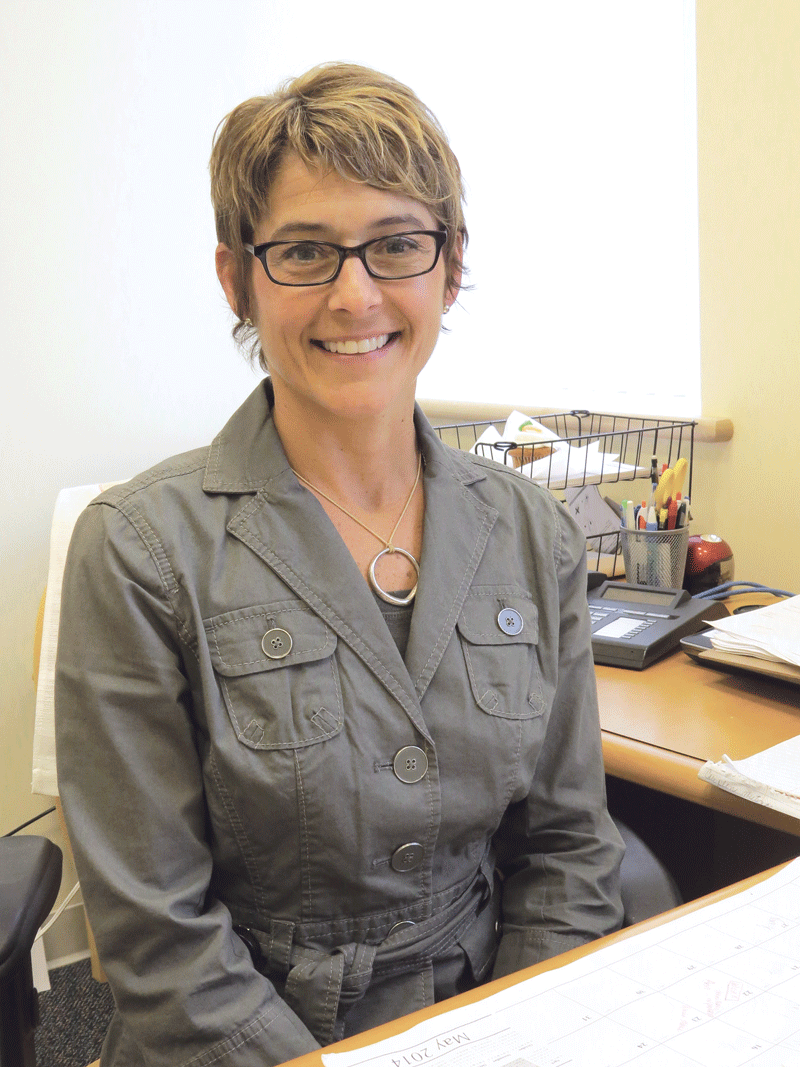
Sara Holmes

Sara Holmes says leasing vehicles comprises half the new-car business at Lia Toyota Scion of Wilbraham.

Sara Holmes says the way new cars are sold has changed dramatically in the last decade, largely due to the Internet, which allows people to compare and contrast the price of vehicles.

“Ten years ago, when people came into a showroom, the starting place for negotiations was the window sticker, and the whole process could take several hours. Today, an entire negotiation can be completed in about 20 minutes because people know what they want and how they want to pay for it,” said Holmes, general manager of Lia Toyota Scion of Wilbraham, adding that 80% of sales there are Internet-driven.

Howard Sackaroff agrees. “Years ago, most new-car sales were almost impulse buys. But today, people plan for a purchase and do a lot of research before they even visit a dealer,” said the general manager of Curry Honda and Curry Nissan in Chicopee. “They check safety, fuel economy, and reliability, and sites such as Edmunds or Kelley Blue Book not only provide them with invoices and suggest the amount they should expect to pay, they also give them the value of their trade-in. So by the time consumers show up, they have already made a decision, which makes the process much smoother.”

The trend is reflected at other local dealerships, including Bertera Subaru in West Springfield, where General Sales Manager Mark Noel said the majority of people who visit are ready to make a purchase. “They come to the showroom prepared to buy, as opposed to beginning a search,” he said.

Although customers who have never driven a Subaru may return more than once, he added, “they have already shopped at home, decided what best suits their needs, and gotten the pricing out of the way so the process is a lot shorter and less contentious than it used to be.”

Since price ultimately attracts business, aggressive online marketing programs have become a necessity for dealers. There are many different approaches, such as one used by Curry, where people can choose a specific car, then hit a button on a website to reserve it.

“When that happens, they receive a return e-mail with the lowest possible price,” Sackaroff said. “It lists the features and benefits of the vehicle they have chosen, but they also receive five alternative choices that are similar to the vehicle with their lowest price. It takes negotiation out of the equation.”

He noted that he sets prices weekly or bimonthly based on supply and demand, but admits a small bit of “wiggle room” can remain, and on occasion the price is reduced in the showroom by $50 or $100 — “but that’s it.”

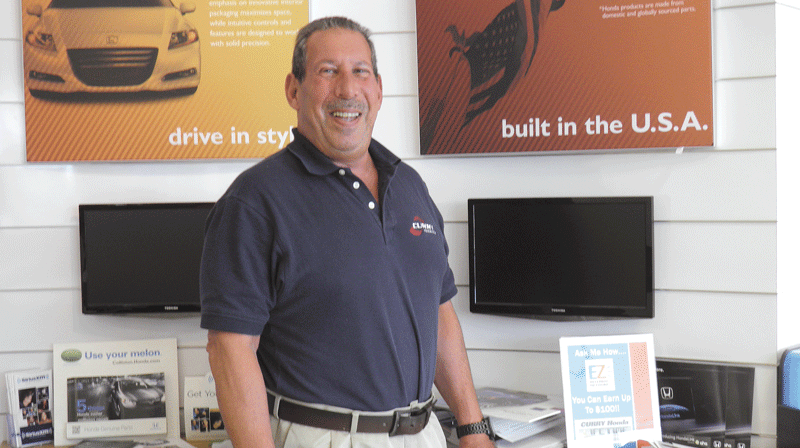
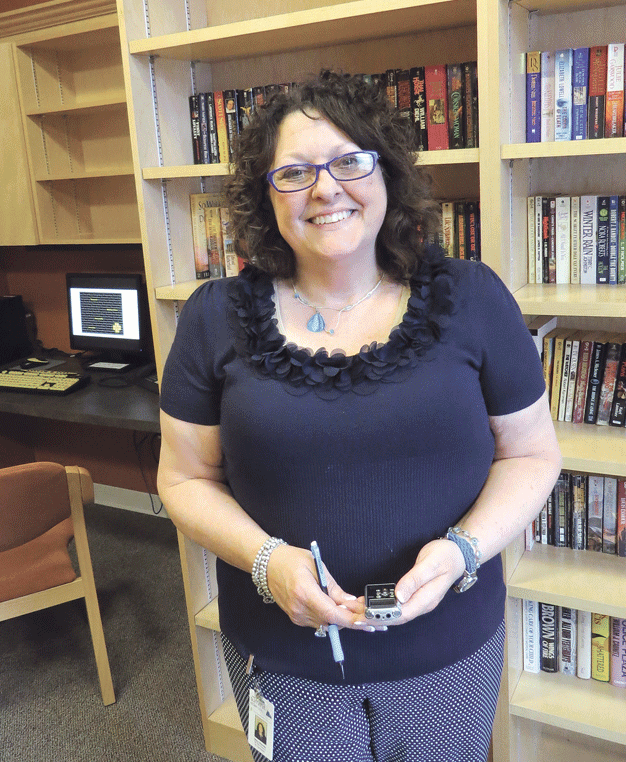
Howard Sackaroff

Howard Sackaroff says style changes in new cars typically take place every four to six years.

Noel agrees. “Dealers have always had to be competitive, but competition has increased due to the Internet,” he said. “So, once a person locates the lowest price online, it is really the best price out there. All that is left is negotiating the cost of service plans and the person’s trade-in.”

In fact, Joe Soucy calls the Internet “the equalizer.”

“Manufacturers have bridged the pricing gap between brands, and the days of negotiating a price that is thousands of dollars less than the starting point are gone,” said Soucy, general sales manager for Bob Pion Buick GMC in Chicopee. “Today, people search to find who has the vehicle with the equipment they want at the price they want to pay, and any negotiations that do take place are usually in hundreds of dollars.”

But price isn’t the only consideration. Service also plays into the equation, so local dealers do everything possible to cater to their clients.

“Several weeks ago, a customer was dissatisfied with a new car that developed a transmission problem two weeks after he bought it. In the old days, it would have been repaired under the warranty, but I gave him a new car,” Sackaroff said, adding, “we maintain an advantage based on our reputation and on referrals, so we always try to do the right thing.”

Sales managers concur that excellent customer service is more important than ever before, especially since people who have a bad experience can document it on sites such as Angie’s List and Google, where it can be read by millions of viewers.

“For us,” Holmes said, “it’s about keeping people happy at the end of the day.”

Unrealistic Expectations

Although dealers typically make less than $1,000 on a new car, people still enter showrooms who haven’t done any research, don’t believe how small the profit margin is, and become skeptical when they are told there is no room to negotiate.

“We showed a customer a factory invoice yesterday, but he thought it was phony,” Sackaroff said. “So the salesman had to go online and show him the price of cars on Edmunds.”

Noel has had similar experiences. “People don’t always believe the dealer. But showing them a trusted third-party source makes it so much easier,” he agreed.

According to Soucy, one of the things some customers fail to take into account is that destination prices and preparation work are not included in the invoice. “For example, truck steps are installed upon arrival, and the price of a vehicle can differ according to trim levels. But in some instances, people need to shop at other dealers to find they have reached the end of the negotiating road. “

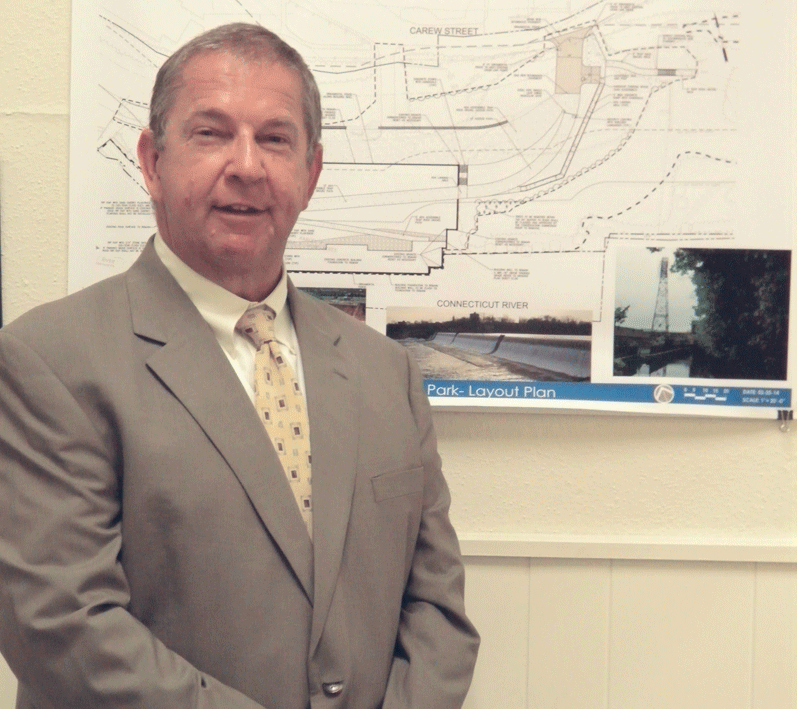
Joe Soucy

Joe Soucy said customers have a tendency to overstate the value of their trade-in vehicles.

There is room for negotiation, however, when it comes the buyer’s trade-in. Still, dealers say many people are unrealistic. “Some look up what the vehicle would sell for in the retail market as opposed to its trade-in price. And people tend to believe the information they have gathered themselves as opposed to what a dealer tells them,” Noel said.

Holmes agrees. “There are tools online that allow people to play appraiser, and when they get here, they have decided what their car is worth,” she said, adding that emotional attachments can play into the equation. “I have had customers who have named their car. They think, because they love it, it has to be worth more than we tell them.”

Soucy said people also often overestimate their vehicle’s condition. “Everyone thinks their car is in great condition, and that’s what they check off when they visit an Internet pricing site.”

Value also depends on the amount of work a car, SUV, or truck will need before it can be resold. In order for a vehicle to be certified, it must meet stringent requirements, which can include new tires and brakes, in addition to things such as an oil change. “We spend $1,500 on average to certify a car, even if it is very clean when we get it,” Sackaroff said.

Soucy said every discount possible is included in an online price, and the margin of profit is lower on entry-level vehicles than on high-end models. He explained that discounts are what the dealer is allowed to chop off of the manufacturer’s suggested retail price — a figure that is generally lower on cars than on trucks — while rebates are determined by the manufacturer.

“If a model is being closed out, the rebates are usually higher,” he explained. “However, many factors play into discounts and manufacturers’ rebates. And although deals in auto sales are a preconceived notion, people have the belief that a holiday or the end of the year is when they will get the best deal. But that may or may not be true.”

Sackaroff agrees, noting that there is often only $50 to $100 difference in the price, and there may not be much difference in the vehicle other than the model year. “When I was a kid, new cars were always styled differently. But today, styling changes only take place every four to six years.”

In other words, Noel said, “no one has any idea what a manufacturer will offer in six months, so now is always the best time to buy a car.”


Special Conditions

People can save several thousand dollars by purchasing dealer demos, which typically have been driven only 5,000 to 6,000 miles and are registered as new cars with full warranties. “They are generally good buys, as we depreciate their price. Plus, we see many people with Hondas and Nissans that have more than 150,000 miles on them, so an extra 6,000 miles doesn’t make much of a difference when they turn them in,” Sackaroff explained.

Holmes agrees. “Demos are discounted below invoice by $500 to $2,000, depending on how popular the car is,” she said, adding that special pricing is also often available to new college graduates and people serving in the military. “Manufacturers are helping young people get started, so college graduates don’t usually need a co-signer.”

Leasing is another option — one that’s becoming more popular, said Holmes, noting that about half of Lia Toyota Scion’s new cars are leased. “Today, most people are budget-conscious, and leasing helps keep payments low,” she added, explaining that new cars offer the latest safety features along with free maintenance, which typically includes oil changes and tire rotations. In addition, a variety of mileage plans can be factored into the price. “But if you drive 30,000 miles a year, a lease may not be the best option.”

However, Soucy thinks leasing is the best way for most people to acquire a new vehicle. “You are only accountable for payments during the lease period, and the bank takes all of the risk,” he said, recalling that, when gas prices skyrocketed, people who leased could walk away from vehicles that got low mileage. “And if the manufacturer stops making the model, the person who leases it is not responsible for the fact that it is worth less when the lease ends. We sign zero-down leases every day.”

All that said, the Internet remains the most significant reason why the car-buying experience has changed, and local dealers told BusinessWest it has been been a boon to business. “It has expanded our market and allowed us to see more people. We have sold cars to people in Florida, Washington, and California,” Noel said, explaining that most people who travel great distances do so because they want a specific used vehicle, as opposed to a new one.

But showroom managers agree that a dealer’s customer-service reputation can be the deciding factor in where people purchase a vehicle. “People want to buy from salespeople who are knowledgeable and who they feel they can trust,” Holmes said. “It’s all about trust, and when the process is easy, buyers are happier, and we are happier too.”

Sackaroff concurs. “The changes in negotiation have made life easier for me and for my salespeople,” he said. “But you still have to earn your business, and we have earned the trust of the community and the families in it.”

Company Notebook Departments

Holyoke Mall Announces ‘Magical Night of Giving’
HOLYOKE — Holyoke Mall at Ingleside will be hosting its ninth annual “Magical Night of Giving” event to help local nonprofit groups and schools raise funds for their organizations. The event will be held on Sunday, Nov. 23 from 6 to 9:30 p.m., with the orientation and ticket-distribution session held on Wednesday, Sept. 24 at 5:30 p.m. The orientation will be held at Holyoke Mall’s Guest Services Center, located on the lower level in Sears Court. The “Magical Night of Giving” is a simple and effective way for nonprofit groups and schools to raise funds for their organization. Holyoke Mall at Ingleside covers all overhead expenses, and the charity keeps 100% of each $5 admission ticket sold. The event works as follows:
• Holyoke Mall at Ingleside will print admission tickets. These tickets will be available for nonprofit groups to pick up and sell beginning Sept. 24.
• Prior to November’s event, organizations will sell these admission tickets for $5 each and keep all money earned from the sale of these tickets.
• For anyone not purchasing tickets in advance, admission tickets will also be sold the evening of the event at all mall entrances by some of the participating organizations.
• Participating Holyoke Mall at Ingleside retailers will offer special discounts that are exclusive to the “Magical Night of Giving.” The ticket is the only means to receive these special discounts between 6 and 9:30 p.m. on Nov. 23.
• Admission tickets sold also act as a raffle ticket. Prizes will be awarded, including a $1,000 Holyoke Mall gift card. The raffle drawing will begin at 8:30 p.m. the evening of the event.
Said Holyoke Mall General Manager Bill Rogalski, “this event helps to raise approximately $50,000 each year between the various organizations involved. Holyoke Mall is providing the tools for the groups to hold their own fund-raiser. It’s a simple way for nonprofit groups and area schools to raise much-needed funding for their organizations.” To reserve tickets for pickup on Sept. 24, contact Simone Enright at (413) 536-1441 or [email protected] by Friday, Sept. 19. Anyone unable to pick up tickets on Sept. 24 may make arrangements with Enright to pick them up at a later date. Call Holyoke Mall’s Marketing department at (413) 536-1441 with any questions.

Webber & Grinnell Named to Circle of Excellence
NORTHAMPTON — Webber and Grinnell Insurance Agency has been inducted into the Plymouth Rock Assurance and Bunker Hill Insurance 2014 Circle of Excellence, recognizing outstanding professionalism, financial performance, and commitment to customer service by independent insurance agents during 2013. Selected from a pool of more than 400 independent agents across Massachusetts, Webber & Grinnell was one of 25 agents to receive this honor. “The Circle of Excellence is our premiere recognition and rewards program reserved for our top independent agents,” said Chris Olie, president of Plymouth Rock Assurance and chairman of Bunker Hill Insurance.“These agents are key parts of Plymouth Rock and Bunker Hill’s success. They have each worked hard to build their businesses while also providing excellent service and trusting advice to their customers.” Webber & Grinnell is one of the largest insurance agencies in Western Mass. The agency currently serves more than 5,000 automobile and homeowner policyholders, and insures nearly 900 businesses throughout the region. “As an independent agent, our goal is to provide expert service tailored to the specific needs of each client we serve,” said Bill Grinnell, president of Webber & Grinnell. “It’s always rewarding to be recognized for our hard work and dedication, and we’re grateful to receive this honor from Plymouth Rock and Bunker Hill.” Plymouth Rock and Bunker Hill are leading automobile- and home-insurance carriers serving Massachusetts. As a member of the Circle of Excellence, Webber & Grinnell will receive marketing support funds, education and training, and other initiatives designed to promote sustained success. The agency will be honored at a fall retreat.

Freedom Credit Union Touts New Logo, Website
SPRINGFIELD — Freedom Credit Union recently unveiled its updated look with a new logo and a redesigned website. At the same time, the credit union launched its presence on social media with new Facebook and LinkedIn pages. “This rebrand is an effort for us to freshen up our image and present a more contemporary look and design across all parts of the credit union, from our website and in-branch messaging to our advertising and promotional materials,” said Barry Crosby, president and CEO. The new logo incorporates the outline of a bell, which represents the credit union’s founding as the Western Massachusetts Telephone Workers Credit Union in 1922. The new website features a more modern design with enhanced navigation and organization. Most of the information is organized within four areas — personal banking, business banking, member tools, and ‘about us’ — and the new rates page is arranged in tabs so that all credit-union rates can be accessed on one page. “Our new website also makes it very convenient for our members to apply for a mortgage or consumer loan online,” said Jeffrey Smith, Freedom’s vice president and chief lending officer. “Members can even get pre-qualified for a mortgage on our website in just a few minutes.” Members can apply for any type of consumer loan online — mortgages, home-equity loans, auto loans, personal loans, home-improvement loans, education loans, and more. On social media, Freedom has attracted hundreds of ‘likes’ on its Facebook page and numerous followers on its LinkedIn page. To access Freedom’s social-media sites, go to www.freedom.coop and click on the logos at the top of the page. Membership at Freedom is available to include anyone who lives, works, or attends a college or university in Hampden, Hampshire, Franklin, or Berkshire county. The organization boasts nine branches throughout the Pioneer Valley in Ludlow, Chicopee, Feeding Hills, Sixteen Acres, Springfield, Easthampton, Northampton, Greenfield, and Turners Falls. A tenth branch is slated to open in September at the Roger L. Putnam Technical Academy in Springfield.

Bauzá & Associates Joins Worldwide Partners
ENFIELD, Conn. — Worldwide Partners Inc. (WPI) has added another partner to the world’s 8th-largest full-service ad-agency network and the world’s largest network of independent ad agencies, according to Al Moffatt, president and CEO of Worldwide Partners, headquartered in Denver. Bauzá & Associates, headquartered in Enfield, Conn., specializes in multicultural marketing and is headed by principal and CEO Héctor Bauzá. Founded in 2003, the agency became an LLC in Massachusetts in 2005 and has a roster of clients including the Connecticut Housing Finance Authority, Harvard Street Neighborhood Health Center of Dorchester, and the Connecticut Lottery. “What makes us attractive to clients worldwide is that we’re comprised of innovative, progressive agencies across a full range of disciplines and industries,” Moffatt said. “We’re a collaborative, bottom-up network whereby the partner agencies own us rather than us owning them. We provide the resources and the global outreach to help our partners achieve greater profits and revenue while the partner agencies work together to build each other’s business and service clients locally, regionally, and internationally. We’re an efficient, international network that is built to succeed in today’s highly competitive and fragmented marketing environment. Each partner is hand-selected for its progressive and innovative approach. In short, we have the critical mass and skills of the agency conglomerates coupled with the flexibility of the independents. We’re very happy to have Bauzá & Associates join us.” Added Bauzá, “we are honored to be a part of WPI’s tremendously successful network of independent agencies. As a smaller agency, the added muscle from WPI will help to increase the size of the projects Bauzá & Associates will compete for and expand this agency’s reach to regional, national, and global markets.” Worldwide Partners Inc., which celebrated its 75th anniversary in 2013, has more than 20 network-wide regional and international clients, including Wal-Mart Centroamerica, Caterpillar, Saudi Arabian Airlines, Group Santander, MINI, Western Digital, California Tourism, and Novartis.

Dadanco Opens New Facility in Westfield
WESTFIELD — Dadanco, a manufacturer of commercial hydronic-based heating and cooling products, including active chilled beams, induction units, and induction diffusers, announced the grand opening of its Luxton-Reed Center, with an open house to be held on Sept. 12, from 8:30 a.m. to 1 p.m. The Luxton-Reed Center is aptly named after two industry pioneers for heating and cooling technologies: professor Russell Luxton of Australia, the co-founder of Dadanco, and John Reed of Westfield, the founder of several hydronic heating companies, including Sterling Residential & Commercial Hydronics, which are divisions of Mestek Inc., the largest manufacturer of finned-tube baseboard radiation in North America. The Luxton-Reed Center (LRC) is a unique facility focused on research and development and specific high-efficiency equipment testing utilizing a thermal-scenario test chamber which accurately measures air and water flow, temperature, and capacities. The test chamber is highly configurable and can simulate actual real-life application conditions. Alongside the LRC corporate offices are several live-fire training and showcase spaces. Each space meticulously represents an actual real-world installation, including a hotel suite, hospital room, and laboratory. The hotel suite is one of the most technically complex demonstration spaces in the LRC facility, as the room features a thermal wall with glass façade which simulates outside conditions and three different types of hydronic cooling solutions, so guests get to compare and contrast without leaving the room. LRC’s main mechanical room is host to multiple high-efficiency products produced by other Westfield-based Mestek companies, including condensing cast-iron boilers from Advanced Thermal Hydronics, flexible small-duct air distribution, and reverse-cycle chiller systems by SpacePak, direct outside air systems by Applied Air, hydronic fan coils by Airtherm, and integrated control systems by HeatNet. The facility is a fully operational showroom and research center for high-efficiency indoor comfort equipment and integrated control platforms. Every room, including the offices, the classroom/training room, the videoconferencing room, and the kitchen/break room, houses various mediums of high-efficiency air-distribution equipment.

Agenda Departments

Craft Brewer Lecture
Sept. 25: Dan Kenary, co-founder and president of Harpoon Brewery, will speak about the history and success of New England’s largest craft brewery at Old Sturbridge Village (OSV). His appearance is part of the village’s continuing OSV Overseers’ Distinguished Speaker Series. Kenary, a Worcester native, will host a fun-filled evening of beer tasting paired with food samples and will share the story of Harpoon’s success. Doors open at 6 p.m., a cash bar is available, and Kenary’s program will begin at 7 p.m. In his talk, “How Passion, Continuous Improvement, and Grassroots Marketing Have Made Harpoon Brewery the Largest Craft Brewer in New England,” Kenary will recount how Harpoon introduced fresh, local craft beer to Boston in 1986, becoming the first brewery to commercially brew and bottle beer in Boston in more than 25 years. “The big beer companies are like factories. What craft beer has done is to bring some local flavors,” he noted. “I’m bullish on better beer. We don’t believe in making beer we don’t like.” Tickets are $45 per person, $40 for Old Sturbridge Village members. Attendees must be at least 21 years old. Seating is limited, and pre-registration is required. The event is sponsored by Spencer Bank. For more information, visit www.osv.org or call (800) 733-1830. Old Sturbridge Village celebrates New England life in the 1830s and is one of the largest living-history museums in the country. The museum is open daily from 9:30 a.m. to 5 p.m. OSV offers free parking and a free return visit within 10 days. Admission is $24, or $22 for seniors; $8 for children ages 3-17, and free to children 2 and under.

Great River Challenge
Sept. 28: The only town in Massachusetts located on both sides of the fourth-largest river in the U.S., Northfield will be the scene of the first annual Great River Challenge Triathlon. The event will begin at Northfield Mountain Recreation and Environmental Center’s riverfront park and extensive trail system located on Route 63. Classified as a ‘non-traditional’ triathlon because it involves paddling rather than swimming, the Great River Challenge will be the first event of its kind in the Upper Pioneer Valley to use the broad Connecticut River. The Northfield Mountain recreational facility offers a number of advantages for racers and spectators, including a comfortable lodge, convenient parking, and a food-vendor area, amenities that most other race locations lack. The race features a canoe/kayak/SUP leg, a trail run, and an off-road mountain-bike leg on scenic Northfield Mountain. The paddle leg will be a mass start from the center’s riverfront park, paddling out and back and around Captain Kidd’s Island over 5.2 miles. The running leg is a challenging 3.5 miles of single-track trails and groomed trails, followed by a 6.5-mile mountain-bike ride on mixed single-track and open trails. Individuals and two-, three-, and four-person teams are welcome, and there is a junior division. Registrations start at $65 for individuals, with discounts for teams and half price for junior competitors (age 20 and under), plus a small sign-up fee at runsignup.com. Detailed information about the race, pre-registration and on-site registration, and pre-race activities can be found at www.greatriverchallenge.com. Organizer David Thomas — an athlete, coach, and owner of Stellar Kayaks in Northfield — expects 150 racers and 500 spectators at the first of what he hopes will be an annual event. “We are excited to launch this event in Northfield, showcasing the unusual beauty and abundant natural features we have here, from the river to the surrounding mountains,” he said. Proceeds from the event will support Northfield Kiwanis programs for children and needy families and visitor programs produced by the Northfield Area Tourism Assoc.

ACCGS Breakfast
Oct. 1:
Menck Windows Chairman Bodo Liesenfeld will be the keynote speaker at the Affiliated Chambers of Commerce of Greater Springfield’s October Business@Breakfast at 7:15 a.m. at Twin Hills Country Club, 700 Wolf Swamp Road, Longmeadow. The event will be hosted by WGBY Director of Public Affairs Jim Madigan and sponsored by United Personnel. Liesenfeld will present “Looking from the Outside In,” and discuss the benefits and strengths the region has to offer businesses interested in locating and relocating to Western Mass. Menck Windows, a joint venture of Menck USA Inc. and Menck Fenster GmbH, of Hamburg, Germany, a 130-year-old, fourth-generation business that provides custom windows and doors in Europe, the Far East, and the U.S., recently opened the doors to its first U.S. manufacturing operation here in Western Mass. Liesenfeld is managing partner of Liesenfeld International GmbH, a private investment enterprise. For nearly 30 years, he was CEO and chairman of German-based Rohde & Liesenfeld, an international air and sea freight-forwarding group with global presence. He is the honorary representative of the city of Hamburg to the Northeast region of the U.S. and serves as chairman of the German Latin America Business Assoc. Since making his home in Boston in mid-2009, he became a fellow at Harvard’s Weatherhead Center for International Affairs and chairman of the advisory board of the Berklee Global Jazz Institute. He is chairman of the board of the Latin America Business Assoc. and a board member of the Hamburg Chamber of Commerce, among other board positions in the U.S., Germany, and Latin America. Reservations are $20 in advance for ACCGS members ($25 for member walk-in registration) and $30 for general admission. Reservations are suggested and can be made online at www.myonlinechamber.com.

Amherst Area Chamber Annual Awards Dinner
Oct. 2: The Amherst Area Chamber of Commerce announced the upcoming Farm to Table Annual Awards Dinner, to be held Oct. 2 at Hadley Farms Meeting House in Hadley. The dinner, a yearly celebration that is a highlight of area businesses’ community social calendar, is expected to sell out. This year’s award winners reflect a celebration and acknowledgement of a number of community partners and leaders. The “A+” Award Winners include the Rotary Club of Amherst, which will receive the chamber’s Community Service Award, recognizing the many contributions that this group of volunteers has made to the Amherst area, in addition to its work dedicated to the global eradication of polio; Stephanie O’Keeffe, who will receive the chamber’s Legacy Award, a celebration of what this individual has accomplished, specifically in her role on the Amherst Select Board; and Tony Maroulis, former executive director of the organization, who will receive the chamber’s Most Valuable Player award for all of his hard work elevating the chamber’s stature and involvement in the community. “It was a daunting task to sift through the nominations for this year’s batch of award winners, because as there are so many individuals and organizations in this community worthy of recognition,” said Don Courtemanche, Amherst Area Chamber of Commerce executive director. “We feel that the recipients that we have selected represent the best, the brightest, and the most outstanding of the terrific partners that the chamber is fortunate to be associated with.” Tickets for the dinner will be available Sept. 2. Reservations for the dinner or for the program book may be made by contacting the chamber at (413) 253-0700.

Stroke Lecture at CDH
Oct. 2:
Stroke is a major cause of death and disability in the U.S. Stroke occurs when a blood vessel that brings blood and oxygen to the brain gets blocked or ruptures. When this happens, brain cells don’t get the blood they need, and deprived of oxygen, nerve cells can stop working and die within minutes. In “Stroke Prevention and Treatment,” a Cooley Dickinson/Massachusetts General Hospital lecture, stroke neurologist Dr. Scott Silverman will discuss ways to reduce the risk of stroke and how to recognize stroke warning signs. He will also discuss treatments for stroke. Community members are invited to attend the lecture, from 6 to 7 p.m. in the Dakin Conference Room at Cooley Dickinson Hospital. Silverman is an instructor of neurology at Harvard Medical School and an assistant in neurology at Massachusetts General Hospital, where he works on the stroke service. He received his undergraduate degree in neuroscience from Bowdoin College, and received his medical degree and completed his neurology residency at UMass Medical School. He then completed a fellowship in vascular and critical-care neurology at Massachusetts General Hospital and Brigham and Women’s Hospital. Silverman is board-certified in neurology, vascular neurology, and neurocritical care, and is director of Outpatient Stroke Services at Mass General. He has a strong interest in medical education and is currently the director of the Partners Vascular Neurology Fellowship. Silverman’s research and clinical interests are in ischemic stroke, specifically intracranial atherosclerotic disease and stroke in the young. Also participating in the lecture will be Dr. Tor Krogius, an emergency department physician at Cooley Dickinson and medical director of the Cooley Dickinson Hospital Stroke Program, as well as the telemedicine programs for stroke, neurology, and burn. He earned his medical degree at McGill University Faculty of Medicine and completed his internship and residency training at Baystate Medical Center.

BMLH Tag Sale and Electronics Recycling Day
Oct. 17: Recent building renovations and office upgrades at Baystate Mary Lane Hospital have resulted in a quantity of usedchairs, tables, desks, file cabinets, and other office equipment. As a result, a tag sale will be held from 9 a.m. to 2 p.m. in the parking lot near the back of the Medical Office Building, off Marjorie Street. Combined with the tag sale, the hospital will also sponsor a community-wide recycling event. Old and/or non-working electrical devices such as radios, air-conditioning units, toasters, phones, light fixtures, etc. will be collected at no cost,with the exception of TVs and CRTs, for which there will be an $8 fee. The community recycling event will also take place in the parking lot near the back of the Medical Office Building. All items collected will be trucked away to a recycling center shortly after the event. All proceeds will benefit community-benefit programs sponsored by the hospital. For more information, contact Ryan Moore at (413) 967-2140.

Western Mass. Business Expo
Oct. 29: The fourth annual Western Mass. Business Expo will be presented by BusinessWest at the MassMutual Center in Springfield. The event is a business-to-business show featuring more than 150 booths, seminars, breakfast and lunch events, Show Floor Theater presentations, and a day-capping Expo Social. Details about events, programs, and featured speakers will be printed in future issues of BusinessWest. Comcast Business will again be Presenting Sponsor, while the social will be sponsored by Northwestern Mutual and MGM Springfield. Silver Sponsors are Health New England, DIF Design, Johnson & Hill Staffing, and MassMutual Financial Group. Education sponsor is the Isenberg School of Management at UMass Amherst. Additional sponsorship opportunities are available. In 2013, more than 2,200 business professionals attended the expo, and between 2,500 and 3,000 are expected in 2014. For more information on sponsorships or booth purchase, call (413) 781-8600 or visit www.wmbexpo.com.

Daily News

SPRINGFIELD — Freedom Credit Union recently unveiled its updated look with a new logo and a redesigned website. At the same time, the credit union launched its presence on social media with new Facebook and LinkedIn pages.

FreedomLogo_alt6“This rebrand is an effort for us to freshen up our image and present a more contemporary look and design across all parts of the credit union, from our website and in-branch messaging to our advertising and promotional materials,” said Barry Crosby, president and CEO.

The new logo incorporates the outline of a bell, which represents the credit union’s founding as the Western Massachusetts Telephone Workers Credit Union in 1922. The new website features a more modern design with enhanced navigation and organization. Most of the information is organized within four areas — personal banking, business banking, member tools, and ‘about us’ — and the new rates page is arranged in tabs so that all credit-union rates can be accessed on one page.

“Our new website also makes it very convenient for our members to apply for a mortgage or consumer loan online,” said Jeffrey Smith, Freedom’s vice president and chief lending officer. “Members can even get pre-qualified for a mortgage on our website in just a few minutes.” Members can apply for any type of consumer loan online — mortgages, home-equity loans, auto loans, personal loans, home-improvement loans, education loans, and more.

On social media, Freedom has attracted hundreds of ‘likes’ on its Facebook page and numerous followers on its LinkedIn page. To access Freedom’s social-media sites, go to www.freedom.coop and click on the logos at the top of the page.

Membership at Freedom is available to include anyone who lives, works, or attends a college or university in Hampden, Hampshire, Franklin, or Berkshire county. The organization boasts nine branches throughout the Pioneer Valley in Ludlow, Chicopee, Feeding Hills, Sixteen Acres, Springfield, Easthampton, Northampton, Greenfield, and Turners Falls. A tenth branch is slated to open in September at the Roger L. Putnam Technical Academy in Springfield. Freedom offers a complete range of services, including online banking, savings and checking accounts, personal loans, mortgages, business accounts, business loans, and financial services.

Daily News

NORTHFIELD — The only town in Massachusetts located on both sides of the fourth-largest river in the U.S., Northfield will be the scene of the first annual Great River Challenge Triathlon. The event will begin on Sunday, Sept. 28 at Northfield Mountain Recreation and Environmental Center’s riverfront park and extensive trail system located on Route 63.

Classified as a ‘non-traditional’ triathlon because it involves paddling rather than swimming, the Great River Challenge will be the first event of its kind in the Upper Pioneer Valley to use the broad Connecticut River. The Northfield Mountain recreational facility offers a number of advantages for racers and spectators, including a comfortable lodge, convenient parking, and a food-vendor area, amenities that most other race locations lack.

The race features a canoe/kayak/SUP leg, a trail run, and an off-road mountain-bike leg on scenic Northfield Mountain. The paddle leg will be a mass start from the center’s riverfront park, paddling out and back and around Captain Kidd’s Island over 5.2 miles. The running leg is a challenging 3.5 miles of single-track trails and groomed trails, followed by a 6.5-mile mountain-bike ride on mixed single-track and open trails.

Individuals and two-, three-, and four-person teams are welcome, and there is a junior division. Registrations start at $65 for individuals, with discounts for teams and half price for junior competitors (age 20 and under), plus a small sign-up fee at runsignup.com. Detailed information about the race, pre-registration and on-site registration, and pre-race activities can be found at www.greatriverchallenge.com.

Organizer David Thomas — an athlete, coach, and owner of Stellar Kayaks in Northfield — expects 150 racers and 500 spectators at the first of what he hopes will be an annual event. “We are excited to launch this event in Northfield, showcasing the unusual beauty and abundant natural features we have here, from the river to the surrounding mountains,” he said. Proceeds from the event will support Northfield Kiwanis programs for children and needy families and visitor programs produced by the Northfield Area Tourism Assoc.

Daily News

AGAWAM — Cumberland Farms announced the opening event of its store at 837 Suffield St. in Agawam. Featuring a modernized design and architectural features, the newly remodeled store will now offer a range of hot food items, from pizza to grilled hot dogs to fried favorites.

A grand-opening event on Sept. 9 will be held to celebrate the store’s opening and will also kick off a month-long fund-raiser for Agawam Parks & Recreation, an organization dedicated to providing quality recreation facilities, programs, and services to enhance quality of life for the residents of Agawam and Feeding Hills. Throughout the fund-raiser, 10 cents from every dispensed beverage purchased will be donated directly to the organization.

The Agawam store will celebrate its grand opening with a ribbon-cutting ceremony from 12:30-1:30 p.m., which will be open to the public. Attendees will be offered complimentary food from Cumberland Farms’ new menu, including pizza, chicken tenders, mozzarella sticks, and beverages like Farmhouse Blend Coffee and fountain and frozen flavors from the Chill Zone. Chris Sparks, director of Agawam Parks & Recreation, will also be on hand for the ceremony as Cumberland Farms kicks off its four-week fund-raising initiative for the organization.

Daily News

WESTFIELD — Dadanco, a manufacturer of commercial hydronic-based heating and cooling products, including active chilled beams, induction units, and induction diffusers, announced the grand opening of its Luxton-Reed Center, with an open house to be held on Sept. 12, from 8:30 a.m. to 1 p.m.

The Luxton-Reed Center is aptly named after two industry pioneers for heating and cooling technologies: professor Russell Luxton of Australia, the co-founder of Dadanco, and John Reed of Westfield, the founder of several hydronic heating companies, including Sterling Residential & Commercial Hydronics, which are divisions of Mestek Inc., the largest manufacturer of finned-tube baseboard radiation in North America.

The Luxton-Reed Center (LRC) is a unique facility focused on research and development and specific high-efficiency equipment testing utilizing a thermal-scenario test chamber which accurately measures air and water flow, temperature, and capacities. The test chamber is highly configurable and can simulate actual real-life application conditions. Alongside the LRC corporate offices are several live-fire training and showcase spaces. Each space meticulously represents an actual real-world installation, including a hotel suite, hospital room, and laboratory. The hotel suite is one of the most technically complex demonstration spaces in the LRC facility, as the room features a thermal wall with glass façade which simulates outside conditions and three different types of hydronic cooling solutions, so guests get to compare and contrast without leaving the room.

LRC’s main mechanical room is host to multiple high-efficiency products produced by other Westfield-based Mestek companies, including condensing cast-iron boilers from Advanced Thermal Hydronics, flexible small-duct air distribution, and reverse-cycle chiller systems by SpacePak, direct outside air systems by Applied Air, hydronic fan coils by Airtherm, and integrated control systems by HeatNet. The facility is a fully operational showroom and research center for high-efficiency indoor comfort equipment and integrated control platforms.

Every room, including the offices, the classroom/training room, the videoconferencing room, and the kitchen/break room, houses various mediums of high-efficiency air-distribution equipment. LRC is green throughout, protecting the environment with high-efficiency, low-emission equipment in operation while producing power through the use of 408 solar panels installed on the roof, generating approximately 100,000 kWhr annually. Each panel generates up to 245 watts of renewable energy annually, resulting in more than 120 days of facility operation at net zero.

Daily News

PITTSFIELD — Berkshire Bank has received two Communicator Awards from the Academy of Interactive and Visual Arts (AIVA). The bank received 2014 Silver Awards of Distinction in two categories, Commercials – Banks and Annual Report – Corporation. Each year, AIVA receives more than 6,000 entries from across the U.S. and around the world, making the Communicator Awards the largest and most competitive awards program honoring creative excellence for communications professionals.

Berkshire’s television commercial for banks recognized by the Communicator Awards was its “Life Is Exciting. Let Us Help” spot developed by Berkshire Bank’s marketing department. The animated spot features Berkshire Bank’s spokesperson, banking-services endorser, and nine-time national champion and Hall of Fame basketball coach Geno Auriemma, as the voiceover. The spot was broadcast throughout New England and New York in support of Berkshire Bank’s “Life Is Exciting” campaign in which the institution targeted consumers to help them find and fund their exciting moments. Berkshire Bank’s second Silver Award of Distinction from the Communicator Award was for its 2013 annual report.

Founded in 1994, the Communicator Awards are judged and overseen by the Academy of Interactive and Visual Arts, an organization of more than 600 leading professionals from various disciplines of the visual arts dedicated to embracing progress and the evolving nature of traditional and interactive media.

Cover Story

Schools See Value in Swapping ‘School’ for ‘University’

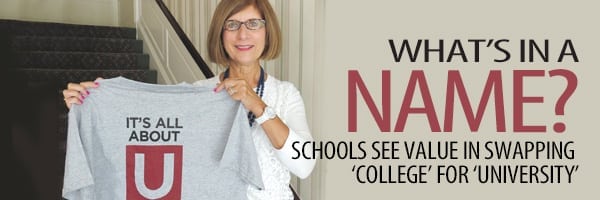
Bay Path President Carol Leary

Bay Path President Carol Leary

Carol Leary was asked about her institution’s decision to call itself a university, rather than a college, and the reasons behind that move. But before going there, she took a few minutes — actually, more than a few — to chronicle and explain the many times over the past 117 years that the name over the school’s front door has changed.

It began as Bay Path Institute, when it was located in downtown Springfield and focused on training men and women for roles in business and accounting, she noted, adding that it became Bay Path Secretarial School in 1945 after it relocated to Longmeadow and focused on training women to become executive secretaries; most of the region’s prominent CEOs had a “Bay Path secretary,” said Leary. In the ’60s, the institution became Bay Path Junior College as it expanded into other areas of study with a liberal-arts base, and then Bay Path College in 1988, when it became a four-year institution.

Those changes were not about semantics, said Leary, the school’s president since 1995, but, rather, reflections about what the school had evolved into.

And that is the case with this latest change in the signage as well.

“A quarter-century later, we’re in a whole different way of educating,” she explained. “We educate on the ground, we educate online, we are educating 12 months of the year, and we’re educating 24/7. That word ‘university’ reflects the complexity of what we have evolved into, what we have become.”

Indeed, the school not only meets the state’s revised requirements for what constitutes a university — graduate programs in four or more distinct fields of study (more on this later) — but, more importantly, it has the look and feel of a university, not merely the accepted definition of one, said Leary.

It has five campuses — the main location in Longmeadow, as well as sites in Springfield, East Longmeadow, Burlington, and Sturbridge-Charlton — and several colleges within the institution itself, including the American Women’s College, featuring online undergraduate degrees, the One-Day-a-Week College, and 19 graduate programs. And it has ambitious plans to soon establish its first doctorate program.

“We are a university,” said Leary. “This represents who we are and how we have evolved and grown; I can’t verify it with numbers, but I believe Bay Path is the fastest-growing women’s college in the country, and the change to ‘university’ reflects all of that.”

It also reflects what could be considered a minor yet intriguing trend in higher education over the past several years. A number of schools across the country and several in the Bay State, including Bentley, Leslie, Western New England College, Massachusetts College of Pharmacy and Health Sciences, and six of the nine state schools, have made a similar change. Others, like Springfield College, have thought about it and decided not to do so, mostly because it considers that word ‘college’ part of its brand and culture. Meanwhile, other schools are still thinking about it.

There are several reasons why schools might make such an adjustment, with perception being at or near the top of the list. In many foreign countries, for example, the word ‘college’ denotes an institution similar to or just above a high school, said Richard Wagner, who researched the matter for Western New England, which he serves as director of Institutional Research & Planning, as part of a strategic planning initiative undertaken in 2008.

He noted that, since WNEC became WNEU in 2011, the number of international students on campus has risen considerably, from 33 in the fall of 2011, the first semester as a university, to 81 just two years later, with more expected next month. There are several factors that may have contributed to this increase, he said, but he has little doubt that the name change has been one of them.

Meanwhile, the word ‘university’ may also help with recruiting in this country, he went on, adding that, with some schools, having ‘college’ in the name can be a competitive disadvantage.

“The word ‘university’ is meant to convey a certain breadth and depth of programs,” he explained. “Legally speaking, it has different meanings in different places; for us, it was a question largely of the fact that we were already structured to be how a university would expect to be structured, and ‘university’ was a better moniker for us and more representative of what we are. The administration here would be firmly convinced that this was a positive move for us to make.”

For this issue and its focus on education, BusinessWest takes an in-depth look at why there are now several universities in Western Mass., and why the change in terminology represents more than a new name and logo on T-shirts for those who have taken this step.

New-school Thinking

Tracing the steps that took Bay Path from a college to a university, Leary said that, while the matter had been discussed rather informally for several years, things started heating up in late 2011 when a graduate of the original Bay Path Institute, then-92-year-old trustee Bernard Mussman, spoke up at one of the panel’s sessions not long before he passed away.

“He raised his hand near the end of the meeting and said, ‘I’ve been on this board for 12 years; we’re now very complex, and we should become a university,’” she recalled. “And everyone sort of just stopped. No one immediately responded to Bernie, but here was a 92-year-old Bay Path Institute alum suggesting that we were a university and no longer a college.”

Nothing really happened with Mussman’s suggestion until roughly a year later, she went on, noting that, as part of something called Planning Vision 2016, the latest in a series of three-year strategic plans undertaken by the school, one of five cross-functional teams comprised of faculty and staff came forward with the recommendation that the school consider becoming a university.

Such a transition was made possible a few years earlier, and not long after the state Legislature voted to change the names of six state colleges, including Westfield State, to universities in a move that reflected what was becoming a nationwide trend. (Three of the schools, Massachusetts College of Liberal Arts in North Adams, Massachusetts Maritime Academy in Buzzards Bay, and Massachusetts College of Art and Design in Boston, chose to maintain the status quo.)

In making the change, the state also lowered the bar when it came to the prerequisites for university status. The old standard was two distinct doctoral programs, while the new measure was four distinct graduate programs, a threshold the state schools easily met.

Fearing that this change might give the state’s many private schools a competitive disadvantage, some of them lobbied — through the Assoc.of Independent Colleges and Universities in Massachusetts (AICUM), which represents 60 private schools in the Commonwealth — for essentially the same privilege.

“Our argument with the Board of Higher Education was that, from a consumer-clarity perspective, the state shouldn’t have a public institution just renamed a ‘university’ by the Legislature, and have a private college that may in fact have many more master’s-degree or graduate-degree offerings be hamstrung by the previous regulations, and they agreed with that,” AICUM President Richard Doherty told BusinessWest. “The argument we made was that, whatever policy the state decided on, it should apply equally to public and private schools.”

Doherty noted, as Wagner did, that there is little, if any, technical difference, definition-wise, between a college and a university, and that many institutions with ‘college’ in their names are, in fact, universities. But he noted that the latter word could easily be perceived as a school with a larger breadth and depth of programs.

Defining Moments

In the wake of the recommendation to at least study the feasibility of becoming a university — one of many action steps in that strategic plan, eventually named “Evolution to Revolution” — Bay Path began an extensive period of research, said Leary, noting that school leaders looked at a number of institutions, especially women’s colleges, that had made the change from ‘college’ to ‘university.’ That list included Chatham University in Pittsburgh and Trinity Washington University in the nation’s capital.

“We looked at why they became a university,” she noted, “and at what they had to do to become a university, because each state is different.”

That research revealed that the change hasn’t negatively impacted the schools, and has probably yielded some benefits, said Leary.

“They said it was very positive,” she noted, “and that it gave them more to talk about internationally because of the word ‘university.’”

Meanwhile, Bay Path officials also listened to their own students, one of whom suggested at an open forum that ‘university’ would carry more weight with potential employers looking at the lines on a résumé.
“I had never thought of that,” Leary went on. “She was defining ‘university’ by the worth of the name, which was interesting, because we were looking at it mostly from the standpoint that we were already operating as a university, and a change would only verify that.”

Despite those positive sentiments, Bay Path alumni and some of those working at the school had some concerns that needed to be addressed, said Leary.

“They didn’t want to lose the personal touch, and we said that would always be a hallmark of Bay Path,” she explained. “They were worried that on the main campus, class sizes would get bigger for traditional students; we said, ‘that can’t happen because we don’t have large classrooms — the largest one seats 60.’ They were worried that we were going to charge so much more, and we told them tuition would remain the same.

“And they were really worried that we were going to go co-ed,” she went on. “But we assured them that we would stay all women.”

The matter eventually went to the board of trustees, which voted to seek approval for the transition to university status from the Mass. Department of Higher Education. The change became official, and Bay Path became the first women’s university in the Commonwealth, on July 1.

When asked how, in five years, the school might be able to quantify the results of the transition, Leary noted that this was a good, if difficult-to-answer, question, adding that it will likely be easier to qualify the benefits.

“I think that, if we have more students from around the country and around the world, we’ll certainly be able to quantify that,” she said. “But will those students be coming just because we’re a university? That might be hard to determine.

“The bottom line is that ‘university’ makes it clearer to us and our prospective students who we are — it just makes more sense,” she went on. “And we’re very proud of who we are.”

Marsha Marotta, interim vice president of Academic Affairs at Westfield State University, echoed those sentiments. She said the term ‘university’ more accurately portrays what the school has become, and it has also helped improve perceptions of the institution, both externally and internally.

“The tangible impacts of the name change were obvious; it reflected our reality in terms of what we already were doing,” she said, listing everything from comprehensive undergraduate programs to graduate and online programs; from high expectations for faculty to research agendas supported by federal and other grants, such as a National Science Foundation grant for innovative approaches to teaching math as part of the liberal arts. “The name ‘university’ also more accurately reflects who we are in a global context, since the international understanding of college equates with a high-school level of education.

“The name change is also about aspirations and identity,” she went on. “The name ‘university’ makes us more mindful of what we do and more accurately captures the way we are — which in turn changes how we think about ourselves. This was an unexpected consequence, and allows us to think more expansively about the institution. Saying it out loud changes how we think about the institution, which becomes a catalyst for new things.”

Name of the Game

Richard Wagner says the word 'college' can become a competitive disadvantage.

Richard Wagner says the word ‘college’ can become a competitive disadvantage.

Three years after Western New England transitioned to university status, Wagner believes the change has benefited the school, as it has others that may not have the international reputations that have enabled some colleges to go on with that word in their name.

“For us, I think ‘college’ was primarily a disadvantage because it didn’t really convey what the campus represented,” he said. “‘University’ allows us to better represent who we are an as an institution.
“For some schools that have very well-known reputations, like Dartmouth or Boston College, it’s not much of an issue,” he went on. “But for schools that don’t have international name recognition, ‘college’ can be disadvantageous.”

Overall, he considers the change one of many factors that has enabled Western New England to ride out what has been a challenging post-recession period.

“The university status, in association with some of the other things we’ve done over the past few years, such as starting the School of Pharmacy, have allowed us to weather the prolonged recession in a relatively good way,” he explained. “Although we’ve been stressed, like a lot of other tuition-driven institutions, we’ve been able to continue building, adding programs, and so on. I think of it as being one element in our ability to get through some rather difficult times.”

Perhaps the most visible impact has come in the number of foreign students now enrolled at the school. There were only nine international students at WNEC in 2009, he noted, adding that the nearly ten-fold increase still represents a very small portion of the overall student body of roughly 3,800. Still, the surge is significant, and for many reasons.

The first is the cultural diversity gained through having students from around the globe, he told BusinessWest, adding that another is a greater ability to withstand domestic economic downturns, and a third is the fact that foreign students are much more likely to pay full tuition rather than relying on financial aid.

“One of the things about internationalization is that, when things might not necessarily be good economically in the United States, they may be better overseas, and vice versa,” he noted.

Over the past few years, Wagner said, there’s been what he called a “follow-the-leader mentality” when it comes to changing ‘college’ to ‘university,’ with more schools making the change perhaps out of a feeling of necessity.

“I think there’s a certain amount of pressure on some institutions to do it,” he explained, “because it’s been done in so many other places.” But some schools, including Springfield College, apparently aren’t feeling that pressure.

“The leadership at Springfield College has, in the past, considered a name change to a university,” said Steve Roulier, a spokesperson for the school. “But given the reputation of our mission and current academic strengths, we have decided to remain Springfield College. The college consistently ranks in the top tier of the U.S. News “Best Colleges” list as a leader in providing a broad and balanced educational experience. We are proud to be known as Springfield College.”

Sign of the Times

Bay Path has a rather intriguing tradition for the start of the new school year, and its students have to get up pretty early in the morning to take part.

It’s called the Awakening, and it gets underway at 5:30 a.m. Participants light candles and celebrate the school’s history and tradition. They walk together down Longmeadow Street to the school’s circle, where there are a few speeches, followed by breakfast. This year, there will be an additional twist — unveiling new signage that features that word ‘university.’

One could say it’s the start of a new era, said Leary, adding that there is a great deal of excitement accompanying the name change. But in reality, that new era started some time ago.

The word ‘university,’ as she said, only puts an exclamation point on it.

George O’Brien can be reached at [email protected]

Daily News

NORTHAMPTON — The Sierra Grille will defend its title against challengers Galaxy and Viva Fresh Pasta to determine which restaurant can impress a panel of blue-ribbon judges and build the best 12 Mile Meal: an appetizer, entree, and dessert made with ingredients sourced from farms within a 12-mile radius of the Chef Tent at the Northampton Jazz Festival.

The event, hosted by Rick Gifford, will take place behind Thornes Marketplace in downtown Northampton on Saturday, Sept. 6, from 11 a.m. to 3 p.m. as part of the Northampton Jazz Festival. Thirty-six VIP Diner Donor seats are available for those who give a suggested donation of $100. Those interested in joining the fun should contact each restaurant directly for tickets to enjoy the cuisine; taste wines from local vintners Black Birch Vineyard, Mineral Hills, and Amherst Farms Winery; and listen to world-class jazz.

The Sierra Grille is a full-service American-fare restaurant in Northampton whose chefs, Jackson Smith and O’Brian Tomalin, won the 2013 12 Mile Meal Cup. It is a destination for those who want to build their own plates from a menu that allows diners to select proteins, sauces, and sides. It features wine and beer selections and hosts live music.

Galaxy is a new restaurant and lounge in Easthampton owned by chef Casey Douglass, who also owns Apollo Grill. Galaxy is a full-service American-fare restaurant and lounge that reflects day and night with a bright white and colorful dining room and a darker but cozy lounge where patrons can enjoy cocktails and the tapas-inspired small plates or full entrees.

Viva Fresh Pasta is a well-known, art-driven, full-service restaurant in Northampton. Chef Xavier Jones has teamed up with co-owners Christine Buchholz and Paul Milani to bring Southern European-style cuisine and a varied wine list to diners sitting under beautiful paintings and prints.

The 2014 Northampton Jazz Festival begins Tuesday, Sept. 2 with various events held throughout the week, leading up to the Saturday, Sept. 6 main festival event from 11 a.m. to 10 p.m. in downtown Northampton on Hampton Street. At Saturday’s signature Northampton Jazz Festival event, which is free and open to the public, featured performers will include Etienne Charles & Creole Soul, the Seamus Blake Band, the Champian Fulton Quartet, the Steve Davis Quintet, Hendrik Meurkens and Scott Mullet with the Green Street Trio, Miro Sprague Quintet, and FlavaEvolution. More information on the festival is available at www.northamptonjazzfestival.org.

Company Notebook Departments

Whittlesey & Hadley Announces Expansion
HARTFORD, Conn. – Whittlesey & Hadley, P.C., one of the area’s largest regional CPA firms, announced its plan to diversify geographically and grow in size, services, and staff, beginning with a merger with Lester Halpern & Co., P.C. of Holyoke, a leading regional CPA firm providing a broad range of accounting, audit, tax, and management-consulting services to closely held business, nonprofit, and governmental sectors of Western Mass. and throughout New England. The merger became effective Aug. 1. Whittlesey & Hadley provides accounting, audit, tax, technology, and business-consulting services to clients primarily throughout the Northeast, with access to a worldwide network of resources through PKF North America. For more than 50 years, the firm has served closely held businesses, including manufacturing, construction and distribution, real estate, financial institutions, healthcare, government, and technology industries, as well as the nonprofit sector, the firm’s largest niche focus. The firm has 100 professional and administrative staff located in downtown Hartford. “We moved to a larger office space in downtown Hartford, providing us with the resources to begin our future growth,” said Drew Andrews, managing partner of Whittlesey & Hadley, P.C. “It is a common vision, philosophy, and dedication to provide a superior client experience that we are seeking when merging with CPA firms. Lester Halpern & Co. brought that to the table. This merger represents our first step in an aggressive plan to grow our services and staff throughout the Northeast, while retaining our valued reputation as having the expertise of a national firm but the responsiveness of a local firm that clients expect and deserve from its professional services partner.” Established in 1959, Lester Halpern & Co.’s 25 employees will continue to serve their client base out of the Holyoke office, while acquiring the Whittlesey & Hadley brand.

United Financial Bancorp Announces Q2 Results
GLASTONBURY, Conn. — United Financial Bancorp Inc., the holding company for United Bank, announced results for the quarter ended June 30. These results include one month of the pre-merger Rockville Financial Inc. net income, and net income of the combined entity beginning on May 1. Rockville was the legal acquirer in the merger of equals with legacy United Financial Bancorp Inc., in a transaction that closed on April 30, and Rockville changed its name to United Financial Bancorp Inc. at that time. The company had a net loss of $5.6 million, or $(0.13) per diluted share, for the quarter ended June 30, 2014, compared to Rockville’s net income of $3.3 million, or $0.12 per diluted share, for the quarter ended June 30, 2013. Operating net income for the second quarter of 2014 was $5.8 million (non-GAAP), or $0.13 per diluted share, adjusted for $21.3 million (pre-tax) of expenses related to the merger, $4.9 million (pre-tax) net impact of the amortization and accretion of the purchase-accounting adjustments (or fair-value adjustments) as a result of the merger, and $589,000 (pre-tax) net gains on sales of securities. Operating net income for the quarter ending March 31 was $2.2 million (non-GAAP), or $0.08 per diluted share, adjusted for $1.8 million (pre-tax) of expenses related to the merger of equals between Rockville Financial Inc. and United Financial Bancorp Inc., as well as income of $268,000 (pre-tax) from net gains on sales of securities. Operating net income for the second quarter of 2013 was $4.0 million (non-GAAP), or $0.15 per diluted share, adjusted for $809,000 (pre-tax) for the impact of a branch lease-termination agreement and $561,000 (pre-tax) for termination expense related to position eliminations, as well as income of $329,000 (pre-tax) from net gains on sales of securities. “During the second quarter, Rockville Financial Inc. and United Financial Bancorp Inc. successfully completed their merger of equals. Organic earning asset growth and operating earnings results for the quarter were strong, despite including only two months as a combined organization,” said William Crawford IV, CEO of United Financial Bancorp Inc. and United Bank. “The team is intensely focused on integrating the two companies and is on target to complete the data conversion in the fourth quarter of 2014.” Earnings in both 2014 and 2013 were affected by non-operating income and expense.

HCC Gateway to College Program Tops in U.S.
HOLYOKE — The HCC Gateway to College program, which takes high-school dropouts and puts them in college classes, leads the nation in both retention and graduation rates. The spring 2014 report from the National Network of Gateway to College lists the program at Holyoke Community College number one in both fall-to-fall persistence rate (87%) and graduation rate (80%) out of all 43 Gateway to College programs for the 2011-12 academic year. The network average was 53% for persistence (otherwise known as retention) and 27% for graduation. The Gateway to College program gives second chances to high-school students who have either dropped out of school or are at risk for dropping out by enrolling them in college classes. Students earn both their high-school diplomas and college credit. HCC’s largest Gateway class ever graduated on June 9, with 26 students from Amherst, Palmer, Holyoke, and Springfield receiving their high-school diplomas. Along the way, the class of 2014 also amassed a total of 387 college credits. Since 2010, 142 students have earned their high-school diplomas through the HCC Gateway to College program.

Easthampton Savings Bank Posts Solid Quarter
EASTHAMPTON — Easthampton Savings Bank staged its quarterly directors meeting on July 16. President and CEO Matthew Sosik reported the completion of another successful quarter for the bank. “This past year represents yet another in a long string of excellent financial performances at Easthampton Savings,” he said. “Total assets were up $41.6 million from a year ago, an increase of 4.3%, while total loans increased 9% or $63.5 million.” Total loans now stand at $747.8 million. The bank’s deposit growth was $38.3 million or 5% from this time last year, with total deposits now at $840.2 million. “These continue to be challenging economic times for our region, and interest rates remain very low as a result,” said Sosik. “In spite of those conditions, the bank continues to outperform the industry.  At the same time, we have continued to invest heavily in the communities that we serve through direct charitable donations and many, many hours of community service by our staff and our directors.”

North Brookfield Savings, FamilyFirst Finish Merger
NORTH BROOKFIELD — North Brookfield Savings Bank announced that the bank’s merger with FamilyFirst Bank is now complete, effective June 1. The deal, first announced in January 2014, recently became official thanks to approval of the corporators of North Brookfield Savings Bank, the shareholders of FamilyFirst Bank, and the banks’ regulators. With the addition of former FamilyFirst Bank branches in Ware, the Three Rivers Village of Palmer, and East Brookfield, North Brookfield Savings Bank now includes seven branches in addition to the Business Center at NBSB and online-banking components. North Brookfield Savings Bank, founded in 1854, is a mutual savings bank with over $200 million in assets. The bank has received the highest Five Star Superior Bank rating from Bauer Financial for 74 consecutive quarters. The combined bank will have in excess of $260 million in assets.

Berkshire Bank Renames Mortgage Division
PITTSFIELD — Berkshire Bank announced the renaming of its mortgage-lending division to Berkshire Bank Home Lending. The line of business includes a home-lending call center, operations, servicing, and a team of mortgage-loan originators. This business line will transition Berkshire’s current mortgage-lending affiliate, Greenpark Mortgage, into the Berkshire Bank Home Lending brand. Along with its new home-lending call center and loan-servicing operations, Berkshire Bank Home Lending includes more than 90 mortgage-loan originators located in offices throughout New England and New York. Included in the business-unit rollout was the launch of a new consumer-lending website, berkshirebankhomelending.com. The new site features areas to get pre-approved for a mortgage, apply for a mortgage, and log in to check on an application’s status. It also includes helpful information on topics including mortgage-application checklists, calculators, glossary of terms, and homeowners’ insurance. “Berkshire Bank Home Lending’s goal is to provide individualized home-mortgage solutions because we know no two customers are alike,” said Kevin Inkley, senior vice president, Retail Lending. “With our network of local loan originators, competitive pricing, home-lending call center, and website, we partner with our customers to keep them informed, ensuring the highest-quality service and long-term satisfaction.”

Tighe & Bond Named a “Best Firm to Work For”
WESTFIELD — Based on the survey results of its 2014 “Best Firms To Work For” competition, ZweigWhite recognized Tighe & Bond as one of the best civil-engineering firms in the U.S. to work for. This annual awards competition is based on business-practice data collected from numerous participating firms across the country, including feedback solicited through an employee survey. ZweigWhite, a provider of management information and expertise to architecture, engineering, planning, and environmental-consulting firms worldwide, sponsors the program that recognizes the top firms leading the way in creating a workplace that inspires, motivates, and rewards employees. The competitive ranking that results is based on comprehensive evaluations of factors such as firm culture and workplace practices, employee benefits, career development and growth opportunities, compensation, performance and recognition, as well as recruiting and retention rates.  All firms that apply for this prestigious ranking and recognition are evaluated against each other, not a set standard. “ZweigWhite has recognized Tighe & Bond several times as one of the best engineering firms to work for in the nation, and it is always a significant honor,” said David Pinsky, president and CEO of Tighe & Bond. “It also exemplifies our ongoing commitment to create a working environment where all of our employees feel valued and where they can see their contribution to the overall mission and success of the firm and our clients. Our ability to recruit, develop, and retain the most talented staff is crucial to providing the high-quality, responsive services that our clients have come to expect and deserve.”

Cover Story
UMass Facility in Springfield Set to Open Its Doors

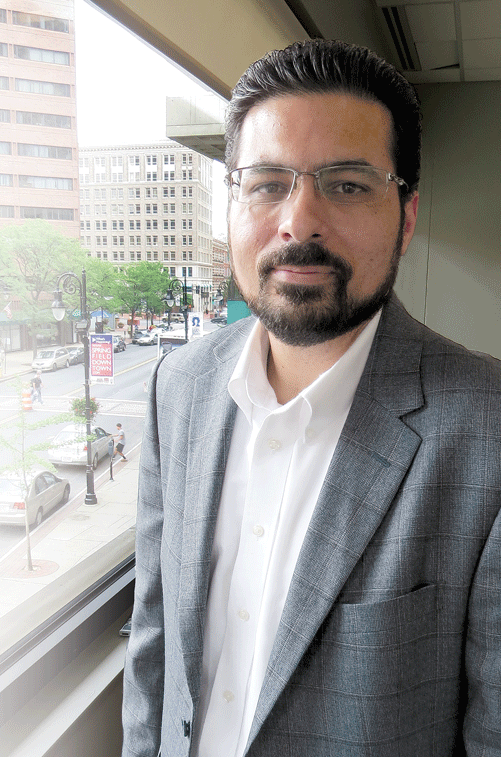
Director of Operations William Dávila

Director of Operations William Dávila

William Dávila wasn’t looking to leave Springfield’s Gandara Center. In fact, he was quite happy in his role as director of Outpatient Services for the facility, which provides mental-health, substance-abuse, and preventive services for children, adults, and families across Western Mass.

But when he was informed that UMass Amherst was looking for someone to manage the center it was building within Tower Square in downtown Springfield, he saw an opportunity he couldn’t resist.

“I’m a UMass graduate and a Springfield kid,” he said with a voice that expressed pride in both those pieces of information. “When this came to my attention, I couldn’t pass it up. I’m a big fan of UMass, and the idea of bringing the quality education that UMass offers to Springfield, where I know it’s needed and where I know folks in my community are looking for opportunities, really intrigued me.”

Dávila, a member of BusinessWest’s 40 Under Forty class of 2013, eventually prevailed in an extensive search for the center’s director of Operations, and is now in a highly visible position with a clearly stated but multi-faceted job description — to make the broad vision for the UMass Center at Springfield become reality.

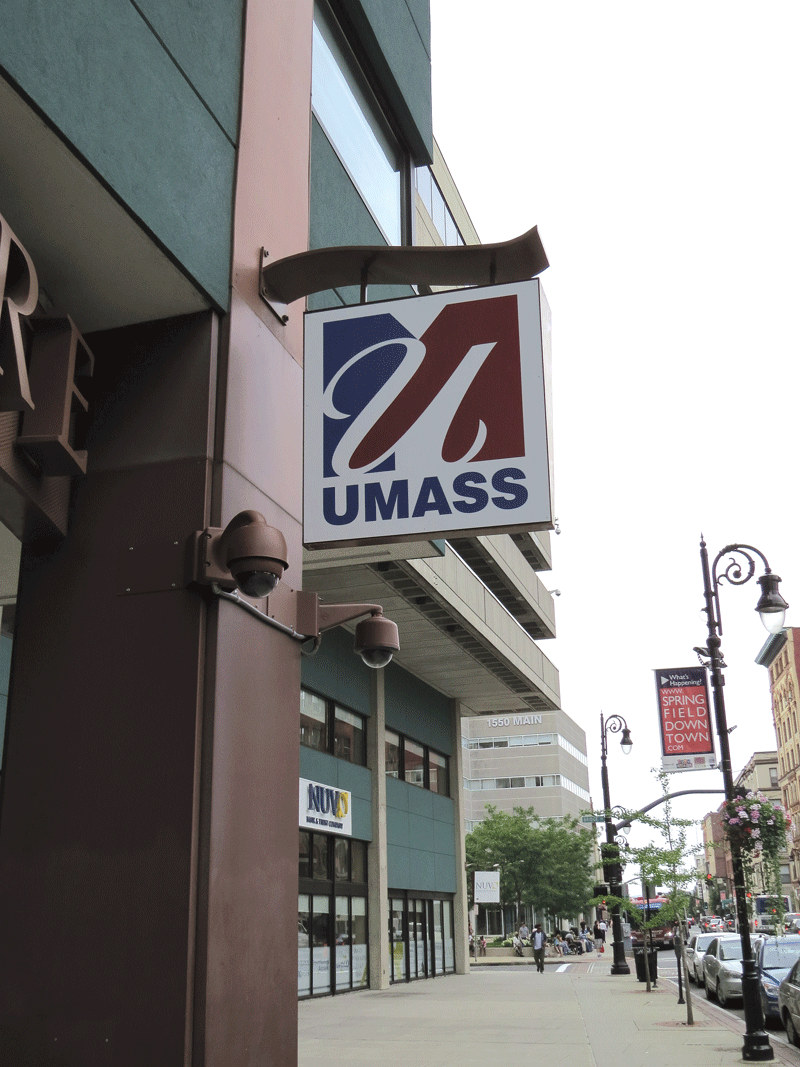
And that vision goes well beyond the actual 26,000-square-foot facility, which makes extensive use of glass and prompted Dávila to wear out the phrase ‘state of the art’ as he described it. Indeed, there are expectations that the center will be a catalyst for change and help bring a renewed sense of vibrancy downtown. In short, this is being viewed as an economic-development initiative as much as it is an educational facility.

And it will likely be both, said Dávila, adding quickly that, for now, the task at hand is to get the doors opened as scheduled on Sept. 2. All appears to be on track, he said while offering a tour of the facility — something he’s done quite often over the past several weeks — adding that UMass has moved quickly and purposefully in building the center, which will open less than 10 months after it was announced at an elaborate press conference at Tower Square.

More than 30 traditional and online courses will be offered through the center this fall, with titles ranging from “Gambling, the Hidden Addiction,” part of the curriculum for the Addiction Counselor Education program at UMass Boston, to “Introduction to Urban Education,” one of the offerings for Education students at UMass Amherst, to “Advanced Pathophysiology,” part of the Nursing program at UMass Amherst.

Dávila expects between 200 and 300 students, faculty, and staff to take part in programs at the center. In time, he believes, those numbers will escalate as people come to understand all that the facility has to offer and realize what an attractive learning environment has been created.

“This space is just very conducive to a good academic experience,” he explained. “We think that if people give us a chance, if they look at what we’re offering, they’ll be interested in being a part of it.”

For this issue, BusinessWest goes behind the scenes at the emerging UMass Center at Springfield to gain some perspective on the operation as well as the hopes and expectations of the individual chosen to manage it.

Course of Action

When asked when he started in his new position, Dávila had to think for a few minutes, and eventually had to summon his phone to pinpoint the date.

“It’s been a really hectic start,” he said with a laugh while discovering that his first day was July 7. “There’s been a lot happening here.”

By that, he meant everything from the work to build out the space, some of which looks out on Main Street, to meetings with a host of constituencies, including UMass Amherst Chancellor Kumble Subbaswamy, Springfield officials, and members of the business community, to giving those aforementioned tours, which are more detailed now than they were a few weeks ago because there is much more to see.

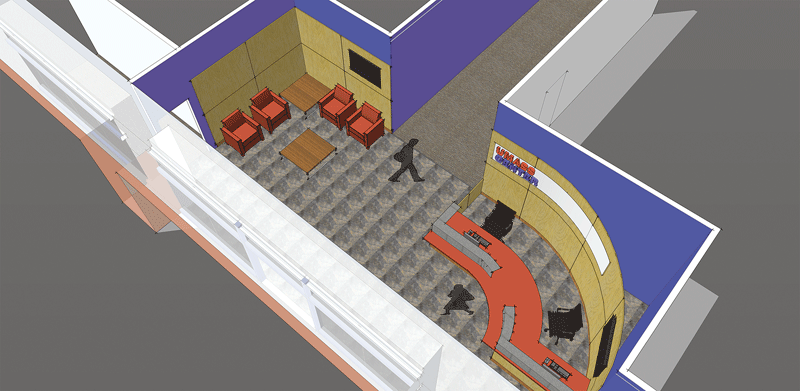
An architect’s rendering of the main entrance to the UMass Center at Springfield.

An architect’s rendering of the main entrance to the UMass Center at Springfield.

Several large classrooms, which can accommodate more than 30 students, are taking shape, as are two patient-simulation areas that will be used for nursing courses and other healthcare offerings and are expected to be among the main draws at the center. Meanwhile, two large student lounges, each making extensive use of natural light through huge windows, are receiving their final touches, as is the welcome center.

“It’s fascinating to see it all come together,” said Dávila, who brings a diverse background to his latest assignment, with a résumé that features work in higher education, social services, and nonprofits.

One of his first professional stops was with Project Hope of Merrimack Valley Catholic Charities, which he served as program director. That was followed by two assignments in higher education — first as assistant director of Graduate Admissions at Lesley University in Boston and then as coordinator of Personal & Academic Support Programs at Boston University.

He then switched gears and became Metro Boston regional manager for the Devereux Foundation, a national behavioral healthcare provider. That was followed by a stint as West Roxbury program manager for the MENTOR Network and then a five-year stop as deputy director of the Children’s Study Home in Springfield, before coming to the Gandara Center in 2011.

Dávila will put experiences at those various stops to good use while meeting what he said is an intriguing job description for the UMass Center’s director of operations.

“It’s kind of interesting — the job description is a combination of a community-relations person, an operations person, and some admissions as well,” he explained. “It’s a combination of all those things. I’ll be functioning as a recruiter, but I’ll definitely be looking for opportunities to connect prospective students with some of our different departments and making sure that I’m creating some opportunities for us to reach out to students.

“This is like coming back home for me,” he continued, referencing his work in higher education. “And one of the reasons why I thought it was a good match for me personally is because what they were looking for was not just someone to come in and say, ‘we’re opening our doors, and we’re offering these courses,’ because that’s a two-dimensional approach. What got me excited about this is that we’re trying to make sure that we demonstrate that we’re committed to the region.”

In the short term, as he said, the primary assignment is to coordinate a smooth launch for the center, which will be a closely watched initiative given the lofty expectations and the considerable hype that accompanied the university’s long-discussed plans to heighten its presence in Springfield exponentially.

Long-term, though, he said he will be tasked with gauging and then meeting community needs.

“We’ll need to make sure that we understand what the community is looking for in terms of educational programs,” he explained, “and that we are, to the greatest extent possible, offering those here locally.”

Class Action

A new sign on the east side of Tower Square announces the arrival of UMass.

A new sign on the east side of Tower Square announces the arrival of UMass.

The lineup of graduate and undergraduate courses for this fall was assembled in response to stated community needs, Dávila went on, adding that the offerings cover a number of degree programs, from nursing and addiction treatment to education and business. There are also a few classes offered through the school’s University Without Walls program for non-traditional students, many of whom are already in the workforce, as well as some non-credit training programs.

There will be a number of offerings in education, including “The Work of the Middle and High School Teacher” and “Adolescent Growth and Development,” he noted, as well as several classes offered through the Isenberg School of Management’s MBA program, including “Financial and Managerial Accounting” and “Leadership and Organizational Behavior.”

The biggest block of classes, however, is in nursing. Overall, there will be eight offerings, including “Pathophysiology” and “Advanced Pathophysiology,” “Community Focus in Nursing,” and “Cultural Diversity in Health and Illness,” he said, adding that the state-of-the-art simulation areas make the Springfield center a unique learning facility.

And its location should be an asset, not a hindrance, he went on, noting that, while downtown Springfield presents some challenges, the center offers 24/7 security, plenty of attached parking, the latest educational technology, a unique space, and scheduling that is conducive to working professionals as well as traditional students.

Making prospective students aware of all this is one of the more critical aspects of that aforementioned job description, said Dávila, adding that he and others are getting the word out through traditional advertising, social media, and networking. These efforts have yielded enrollment figures that are solid and consistent with unofficial goals.

But numbers, while important, are not the primary objective at this early stage, he went on, noting that more critical is the work to lay a solid foundation and then build on it through efforts to collaborate with other schools and the community at large to ensure that the center becomes what it was a designed to be — a multi-faceted resource.

He acknowledged that there are those at Greater Springfield-based colleges and universities who might consider the UMass center to be competition for them, but added that, thus far, other schools are indicating a desire to partner with the facility, not reject or fear it.

“I’ve been approached by other institutions about working together,” he told BusinessWest. “I’m sure there are some folks who are looking at us as competition, but others see that there are opportunities here; we can do degree programs, we can do transfer programs … there are opportunities here to do different things, and I know the faculty that’s already associated with us has expressed interest in that.

“I’m very excited about what’s happening here,” he went on. “We’ve got a great team coming together; we’ve got a lot of opportunities coming ahead. I think something like this gets people’s creativity going. People are thinking about doing new things, and they’re interested in doing some collaborations that maybe they haven’t thought about in the past. And we’re open to it.”

Grade Expectations

When asked how success would be measured at UMass Center Springfield, Dávila said the answer to that query will change over time.

“The first measure of success is going to be about satisfaction with the facility — that’s number one,” he said. “How do people feel coming in here? Do they feel they’re getting what they need? Are students satisfied with the facilities and resources?”

After that, success will be a function of connecting students to the courses, he went on, emphasizing that, while enrollment numbers are not critical at this stage, they will become paramount in the years to come as the center seeks to continually grow its operations.

But, overall, success will be measured by how well the center can connect with the community and become a vital resource, he said, noting that this first year will be an important one for not just establishing a presence, but making sure that presence is felt.

George O’Brien can be reached at [email protected]

Business of Aging Sections
Armbrook Village Helps Seniors Navigate Stages of Life

By JAMES PALEOLOGOPOULOS

Executive Director Beth Cardillo

Executive Director Beth Cardillo

In the sleepy northwest corner of Westfield lies a winding path marked by a sign that reads “Armbrook Village: A Senior Living Residence.” But that description only tells part of the story.

This modern, 109,000-square-foot structure, which looks like a recently finished condominium complex with its siding, flowerbeds, and bleach-white balconies, is part of a growing wave of senior-living communities that offers older citizens a variety of options along the continuum of aging, its 122 units encompassing independent living, assisted living, and what’s known as Compass Memory Support Neighborhood, which allows residents with memory loss to receive constant treatment and supervision in a secure setting.

The result is an interactive community in the best sense of the word, said Beth Cardillo, executive director.

“We’re not going to get any bigger; we were built to operate at a very manageable size,” she told BusinessWest, adding that the facility, which serves seniors from age 60 to 100, is nearly three-quarters full. “We know everyone in the building. We know everybody’s daughter and son, we know everybody’s grandkids, and we work hard to provide a community atmosphere.”

Armbrook Village was built by East Longmeadow developer Michael McCarthy, along with other investors, in 2012 after he saw the benefits his late mother, Jean, experienced at a senior-living residence in Springfield. However, without any background in elder care or independent-living arrangements, he hired Senior Living Residences (SLR) — a Boston-based company specializing in senior housing operations with a special emphasis on dementia and Alzheimer’s disease — to manage the facility.

Managing 12 communities from Boston to Milford, SLR is affiliated with Boston University’s Alzheimer’s Disease Center, and seven of the chain’s communities feature Compass Memory Support Neighborhoods. With most of the residences located in Eastern Mass., Armbrook Village is the only SLR community on the Bay State’s western region, but it operates with the same goal as all the company’s properties — providing cost-effective care to all residents, whether they’re living independently and going to work each day or need assistance getting up in the morning.

Modern Living

For those living in the studio, one-bedroom, or two-bedroom apartments, Armbrook provides perks that allow residents to be totally on their own, “but not completely,” Cardillo said. Those perks include services ranging from emergency pull cords in each unit to transportation to doctor’s appointments.

The facility also makes it a point of encouraging its residents to get out into the community by providing transportation to restaurants, symphonies, and museums, among other destinations throughout the year. Independent-living residents also have access to three meals a day, prepared with an emphasis on ‘brain-healthy’ foods, as part of Armbrook’s affiliation with BU’s Alzheimer’s Disease Center.

According to Cardillo, SLR emphasizes such a diet throughout its communities, with a number of menu items built around a Mediterranean diet of fish, whole grains, and other foods that are both nutrient-rich and contain omega-3 fatty acids, a fat believed to help reduce the risks of dementia.

“Our statistics show it’s good for the brain,” she said. “A lot of olive oil, a lot of vegetables, a lot of fish, a lot of chicken — all studies point to certain herbs and foods not curing dementia, but adding to the mix of prevention.”

Independent-living residents enjoy other amenities as well, with apartments equipped with kitchens, washers and dryers, and walk-in showers. The apartments are designed to be “desirable,” said Cardillo, breaking away from the past industry standard of small, converted rooms.

Armbrook-Village “Years ago, I think, when assisted living became popular, they were taking the place of older buildings, maybe a converted school, a converted monastery. So the rooms were a lot smaller,” she told BusinessWest. “But now, when families are starting to look for apartments for their elders, they’re thinking, ‘just because Mom is 90 doesn’t mean she has to live in a small apartment.’”

Meanwhile, assisted-living residents receive help with many activities of daily living. Among those services are assistance with getting up in the morning, showering, getting dressed, as well as help with taking medication. Three meals a day are provided.

“Our assisted living is almost the same, only a little bit smaller, because they don’t need a full kitchen because we’re supplying the meals,” she explained.

Then there’s the Compass Memory Support Neighborhood, which features everything found in assisted living, plus some additional services. A smaller neighborhood with 25 units, it’s “the world in a smaller place” for residents with certain memory-related disorders, Cardillo said. “It’s a world that’s easier to negotiate, and it’s filled with activities all day long.”

The rooms were designed to be compact, she continued, since a number of residents there have a hard time finding their way around in bigger spaces. At the same time, the neighborhood’s activity rooms were designed to be larger, allowing residents to conduct activities and ensure that they are not isolating themselves in their own rooms, but staying involved in the community.

“We know that, with dementia, structure and socialization are key,” Cardillo said. Part of that socialization includes bringing out residents for art, photography, and adult learning activities, said Brenda Lopes, director of the Compass Memory Support Neighborhood.

“Here at Armbrook, we do a lot of adult learning, including a program called Reconnections,” Lopes said. “In it, we bring the memory-support residents back into the past with, say, imagery of Frank Sinatra and the Rat Pack or from World War II, and it works to help them connect the past with the future.”

That, along with a number of individualized programs and daily exercise, are among the routines that not only keep the residents active but also work against the effects of dementia and Alzheimer’s.

To enhance their care of residents, SLR involves staff in joint training operations through Boston University and, in Armbrook’s case, participation in a graduate study program with American International College’s occupational-therapy students. Part of a research project conducted by the students, the goal is to have residents in the Memory Care wing increase their daily activities through interacting with music as the AIC students observe its effectiveness and results.

Making Westfield Dementia-friendly

As part of its efforts to improve life for people with memory issues, Armbrook has launched a campaign to make Westfield one of the first ‘dementia-friendly’ communities on the East Coast.

Specifically, inspired by the story of Watertown, Wis. and its own drive to make the town friendlier and safer to those who are experiencing dementia, Cardillo set out earlier this year to coordinate with businesses and departments across Westfield to create an environment where, if an individual with memory loss were to wander into a restaurant or other establishment, staff would know the right steps to handle the situation.

“We’re trying to have more people learn more about dementia, so that, say, if an 85-year-old woman walks into the bank and is very confused, the tellers will be able to know what to do, properly identifying any confusion or memory issues,” Cardillo said. “I would like to do trainings throughout the community and here at Armbrook to teach people a little more about dementia, so that they can embrace it and not be scared by it and have the resources to know what to do.”

In addition to local banks, grocery stores, and other places of business, Cardillo wants to include the city’s police and fire officials, who sometimes find themselves dealing with people, either on the phone or at a scene, with some form of memory loss.

Already, a “virtual dementia tour” has begun involving the Fire Department, said Cardillo, a short (10-15 minutes) explanation of the symptoms of dementia. Hoping to include Noble Hospital and the local senior center, among other organizations, she plans to produce a PowerPoint in the near future as she continues to meet with officials such as the mayor and Chamber of Commerce.

“It’s about giving people the tools they need in order to know what to do when they come across somebody with dementia,” she said — tools her team at Armbrook Village provide to residents every day.

Daily News

SPRINGFIELD — Motorcycle and sports-bike enthusiasts from around the region are gearing up for this year’s Ride Like an Animal (RLAA) Poker Run and Party on Aug. 23, from 9 a.m. to 3 p.m. The event raises funds to benefit homeless animals sheltered at Thomas J. O’Connor Animal Control and Adoption Center (TJO).

“This will be the sixth year for Ride Like an Animal, and the event just keeps growing,” said Thomas J. O’Connor Foundation Development Director Melinda Thomas, adding that last year’s event drew 300 participants and raised $15,000. “What makes this event different from other runs is the presence of animals, on bikes and off. Last year, there were lots of dogs participating in the ride — pomeranians, poodles, terriers, and all kinds of mixes. Some ride in sidecars, some in customized handlebar seats, others in snuggle sacks — many with goggles. It is really something to see.” In addition, since the ride begins at TJO Adoption Center, participants can meet shelter animals up for adoption and TJO alumni, many decked out in riding gear.

Registration begins at 9 a.m. at the TJO Adoption Center, 627 Cottage St., Springfield. Riders will leave with a police escort from the shelter and travel to the first stop, Atkins Farm in Amherst. The second stop will be Southampton Harley Davidson, and the ride ends at American Legion Post #338, 46 Powder Mill Road in Southwick, with a party that features live music by Rock 201, a barbecue, and raffles.

Thomas emphasized that it’s not necessary to travel the route or even have a motorcycle to participate in the event. “Lots of people come just for the after-party to socialize and support the shelter through raffles.” Tickets to the after-party cost $15 and can be purchased online or at the door. All registration and raffle funds directly support animals being sheltered.

“About 90% of what we raise from RLAA pays for medical treatments for sick and injured animals that our animal control officers bring in. The other 10% pays for supplies like cat and dog toys and treats,” said Thomas. “Lately, we have been taking in a lot of locally abandoned dogs and cats with major problems like broken bones, severe matting, and eye and mouth infections, so RLAA comes at a time that will truly make a difference to these needy animals.”

Tickets for Ride Like an Animal cost $25 for adult drivers, $20 for adult passengers, and $15 for passengers ages 12-17. Those who register online at www.tjofoundation.org before Aug. 15 will get a free RLAA T-shirt and gift. There is no rain date. Major sponsors for this year’s event include Southampton Harley Davidson, Hampden Bank, Teddy Bear Pools & Spas, and VCA Shaker Road Animal Hospital. Contact Thomas at (413) 533-4817 or [email protected] for more information about Ride Like an Animal. Questions about ride route and conditions can be directed to Jason Moyer at (413) 679-1196.

Daily News

CHICOPEE — Buffalo Wild Wings will soon be opening a restaurant at 490 Memorial Dr. Franchisees Martti Matheson and Aaron Miller (a 15-year NHL veteran and Olympian) will open the doors to their restaurant at 11 a.m. on August 18. The eatery will host a charity fundraising event to support Chicopee youth sports Saturday night prior to opening to the public. “We are passionate about youth sports and we make it a priority to get involved when we enter a new community” said Matheson. The new Buffalo Wild Wings features more than 60 flat screen TVs and three projection units for the ultimate sports viewing experience. The restaurant will carry all major sports packages, as well as PPV UFC fights. Its menu includes boneless wings, specialty burgers and sandwiches, finger foods, wraps, salads; and Naked Tenders, non-breaded, all white meat chicken tenders lightly seasoned and served with a choice of one of 21 Buffalo Wild Wings sauces and seasonings. However, the main attraction is Buffalo-style chicken wings. The menu also offers 30 beers on tap and other bar beverages.
“We want to become the neighborhood gathering place,” said Matheson. “Buffalo Wild Wings is a restaurant where guests can pull their tables together, watch sports on TV and share good food and good times.” Buffalo Wild Wings Inc., founded in 1982 and headquartered in Minneapolis, Minnesota, is an established and growing owner, operator, and franchisor of restaurants. The company now has more than 1,000 restaurants in the United States and Canada.

Features
Annual Show Will Put the Spotlight on Entrepreneurship

WMBExpoComcastDateOrganizers of the Western Mass. Business Expo, slated for Oct. 29 at the MassMutual Center, are finalizing elements of the show, which will certainly have an entrepreneurial flair to it.

Indeed, the highly successful pitch contest, which made its debut at the 2013 Expo, will be staged again this year. Organized by Valley Venture Mentors (VVM), the contest, as the name suggests, features entrepreneurs with developing ventures pitching their ideas to a panel of judges — with $3,000 in prize money on the line.

This year’s contest will likely feature fewer presenting ventures — perhaps five as opposed to the 10 last year — which should allow for more give and take between those presenting the pitches and those who will judge them, said VVM President Scott Foster, adding that this will likely produce what he called a “Shark Tank effect — only nicer.”

Meanwhile, this year’s slate of educational seminars will include a track on entrepreneurship. The roster is still being finalized, but it will feature some of the region’s rising stars offering insight into what it takes to succeed in business today.

Delcie Bean, founder and president of Paragus Strategic IT, one of the fastest-growing technology companies in the country, will be among those presenting interactive programs designed to inform and inspire those in attendance.

“Through initiatives like VVM, this region is putting a great deal of emphasis on entrepreneurship and growing organically by spurring the creation and growth of new small businesses,” said BusinessWest Associate Publisher Kate Campiti. “For the 2014 show, Expo organizers wanted to add momentum to these efforts by showcasing new business ventures through the pitch contest and relaying success stories written by some of the region’s noted entrepreneurs.

“These are people who have taken risks, beaten the long odds on making it in today’s highly competitive global economy, and have much to share with Expo attendees,” she went on. “These will be compelling stories that will hopefully inspire others to reach high.”

As the entrepreneurship track comes together, so do other elements of the show, which is expected to draw more than 150 exhibitors and 2,500 attendees, said Campiti. The other seminar tracks are professional development and sales and marketing, and those programs are being finalized as well, she said, as are the Show Floor Theater presentations.

The Women’s Professional Chamber of Commerce has announced that Patricia Diaz Dennis, retired senior vice president and assistant general counsel for AT&T and commissioner of the Federal Communications Commission during the Reagan administration, has been confirmed as the luncheon speaker.

Dennis, a member of the board of directors at MassMutual, is a highly sought-after speaker, whose broad résumé also includes service on the National Labor Relations Board, a stint as assistant secretary of State for human rights and humanitarian affairs, a three-year term as chair of the Girl Scouts of America, and a lengthy stint on the Texas State University System Board of Regents.

At AT&T, from which she retired in 2008, she was responsible for corporate litigation, procurement, corporate real estate, environmental corporate compliance, IT, and trademark and copyright legal matters. Before joining AT&T in 1995, Dennis was special counsel to Sullivan & Cromwell for communications matters in the international law firm’s Washington, D.C. office. From 1989 to 1991, she was a partner and head of the communications section of the Jones, Day, Reavis & Pogue law firm.

One of the highlights of previous shows has been the day-ending Expo Social, said Campiti, adding that it has become one of the best networking opportunities of the year. This year’s social, to be sponsored by MGM Springfield and Northwestern Mutual, will be no exception.

Other sponsors include Presenting Sponsor Comcast Business; Silver Sponsors DIF Design, Health New England, and Johnson & Hill Staffing Services; and Education Sponsor the Isenberg School of Management at UMass Amherst.

For more information on the event, visit www.businesswest.com or www.wmbexpo.com. n

Cover Story
When It Comes to Business, Dave Ratner Has Some Pet Peeves

COVERart0714bWhen Dave Ratner speaks to small-business owners — something he does often — he will inevitably touch on some of the highlights from his intriguing, 40-year career selling soda and pet food, during which he has made his first name and face into a nationally known brand.

And there are many such highlights, from his success in retail (he now has seven Dave’s Soda & Pet City stores in Western Mass. and Northern Conn.) to his triumphs in wholesaling, specifically the introduction and then rapid expansion of his lines of dog and cat food, to his highly regarded marketing initiatives.

But Ratner says he spends much more of his time at the podium talking about what hasn’t gone right with his various business endeavors. Like the store he opened on Allen and Cooley streets in Springfield, which closed roughly a year after it opened in 1995 because of what he called “miscalculations” and bad timing. Then there was an ill-fated e-commerce venture, a four-year experiment that failed because, in essence, he entered a game without fully understanding how it’s played.

“This was the first all-natural pet-food e-commerce site in the country,” he explained, referring to an acquisition he made in 2010. “I said to myself, ‘how hard can this be?’ Well, the e-commerce business is much different than the retail business, and I’m not an expert in e-commerce. I didn’t have anyone on my team who knew the e-commerce business, and we got killed.”

It is by relating these failures and others and the reasons behind them that Ratner believes he can most effectively get across his points about how to succeed in business, something he’s becoming noted for as much as his stores, products, and TV spots.

Indeed, he speaks to various trade groups — he recently addressed the Billiard Hall Owners Assoc., for example — and business organizations on a fairly regular basis. The audience and subject matter varies, but he’s often addressing retailers, and a common theme is advising little guys on how to beat the big guys.

Meanwhile, some of his more recent blog posts — such as “Good Boss or Good Leader? Business Owners Should Learn the Difference Between the Two and How to Be Both,” “Your Attitude Goes a Long Way in Business: Changing Your Mindset Can Mean a Positive Impact for Your Store,” “Not So Fast: Before Pulling a Product off the Shelf, Think About the Total Picture,” and “The Learning Never Stops: Going to Trade Shows and Conventions Can Help Retailers Move Their Business Forward” — are clearly aimed at that constituency.

Overall, Ratner told BusinessWest that there are many mistakes that entrepreneurs will make — everything from not having enough money when they launch a venture to letting their ego get in the way of smart decisions, to not having what he called a “damage-control policy” in place.

“People go into business with their hearts, not their heads,” he noted. “The reason that big companies have boards of directors is so they can question what management is doing and be a devil’s advocate. So if a successful company needs one, and you’re an entrepreneur, you certainly need one.”

Elaborating, he said business owners and managers generally tend to forget about “Mr. Murphy,” the individual whose name is attached to a law — the one about how everything that can go wrong will. And this will invariably lead to trouble, especially when it comes to money and cash flow.

“I don’t care what you’re doing — if you don’t have enough money, don’t do it, and whatever money you think you need, multiply it by at least two,” he explained, “because the minute you start your business, Mr. Murphy is going to move in next door to you.”

For this issue and its focus on entrepreneurship, BusinessWest talked at length with Ratner about his career in business, but also about how he’s devoting a good deal of his time and energy to advising others on how to use their head and not their heart and thus avoid making the critical mistakes that often mean the difference between success and failure.

Poignant Paws

Dave Ratner takes a moment to meet and photograph a regular

Dave Ratner takes a moment to meet and photograph a regular and her dogs, one of the many ways he tries to make an emotional connection to customers.

It’s probably safe to say that few people living and doing business in this region don’t know Ratner’s story.

It’s pretty much common knowledge that he flunked out of Babson College between his sophomore and junior years, only to later return and get his degree, and, not long after graduating, borrowed $5,000 from his father to open a Soda City store on Route 9 in Hadley. That’s the name his father, Harold, gave to a venture he started in 1972 after his career as a distributor for Clicquot Club soda came to an abrupt end when the company decided to sell direct to retailers. Ratner made it clear that, while his father provided some seed money, this was a separate enterprise he could call his own.

“He said to me, ‘if you want to do this, I’ll loan you $5,000, and you can go and find a location and open up your business,’” Ratner recalled. “He said, ‘yours is yours, mine is mine; I’m here for guidance, but this way, you’ll learn how to run a business really quickly.’ And he was definitely right about that.”

It’s also well-known that, roughly a year or so after starting that venture, he bought a puppy, an acquisition that took him to the pet-food aisle at the supermarket, where he learned there was much more to sell there than in the carbonated-beverages aisle, a realization that started him down the road to selling two totally different product categories out of the same building.

The past 37 years or so have been spent expanding the enterprise in several directions, making Dave’s a household name — in this market, but also others — and, for the most part, anyway, practicing what he preaches when it comes to running a successful business and beating those aforementioned big guys.

“And unless you’re Wal-Mart, you’re the little guy,” he said with a laugh, adding that the most important thing for any business owner who falls in that latter category is to “connect with the customer emotionally.”

“When I talk with entrepreneurs and business people, I explain to them that we’re not here to have a transactional relationship with customers, but an emotional relationship with them so we can try to bond with them,” he explained. “Business is business — you have to offer what the customer wants or needs at the correct price, you have to be easy to do business with, and you have to build a relationship with them. And you have to build trust; people don’t want to hang out with or do business with someone they don’t trust.”

Ratner’s been doing all that throughout his career, with his stores, his marketing (it’s his voice you hear in the radio ads), and a weekly television show called simply Dave’s Pet Show, which has been running on Fox for more than two decades, as well as a hands-on attitude in his stores.

For example, on the day he spoke with BusinessWest at his flagship store in Agawam, Ratner could be seen helping customers unload their huge bags of dog food into their cars and taking photos of the canines that his regulars bring into the store with them when doing their shopping.

And he’s taken this emotional relationship to an even higher level with his lines of pet food, which he started introducing nearly 20 years ago and wholesaling five years ago. It’s the entrepreneurial gambit that appears to have the most potential — it’s generating close to the same amount of revenue as his retail operation, and he believes it will soon surpass it — and the one he’s easily most proud of.

His products are now being sold in 40 states and by more than 3,000 independent retailers, he said, adding that beyond those numbers is the great sense of satisfaction that comes with knowing what they mean.

“Dave’s Pet Food is just the coolest thing in the world,” he told BusinessWest. “People who have never met me and have no clue who I am trust me with the health of the creature they love more than anything in the world. How does it get any better than that?”

Talking the Talk

While perhaps not as satisfying as his pet food, Ratner’s seminars, lectures, blogs, and other vehicles for sharing knowledge and lessons with small-business owners remain a big part of who he is.

He told BusinessWest that he’s learned a great deal from his own experiences and also from mentors ranging from his father to Al White, founder of A.O. White, who hired him for a few summers when he was in high school, to Ken Abrams, president of the FoodMart chain of supermarkets that once operated in the region. And he enjoys sharing these lessons, as well as myriad others he’s learned through relationships forged from his membership in the Young Presidents Organization as well as his work with the National Retailers Federation.

There are many such lessons he said, starting with making sure you have enough money when you launch a business and understanding that Murphy’s Law will apply to your venture. Entrepreneurs must also create a reason for people to do business with them “unless they’re inventing something revolutionary,” he went on.

And they need to have that devil’s advocate there, not only to ask the hard questions, but to make sure that they’re answered sufficiently.

Ratner said he’s had to learn some of these lessons himself the hard way.

Indeed, he said he didn’t have enough money to keep the Allen and Cooley location open during a year when he said everything went wrong for retailers, and especially those selling pet food.

“That was the year of Nintendo, America Online, and snowstorms,” he noted, adding that the poor weather kept people from making non-essential trips, and they would get their pet supplies at the supermarket instead. “Everyone started going online, and the pet business declined; kids weren’t into fish and birds anymore.”

Dave’s new pet food

Dave’s new pet food label also features his German shepherd, Trudie.

Using hindsight, he said that, if he had more money at his disposal, he probably could have weathered the storms, literally and figuratively, and outlasted Mr. Murphy. He acknowledged that a devil’s advocate couldn’t have helped him when it came to meteorology or calculating the impact of Nintendo on hamster sales, but in general, they can help entrepreneurs anticipate and navigate various forms of whitewater.

And they can help them understand their limitations and avoid costly missteps, such as Ratner’s foray into e-commerce.

“On the Internet, it’s all about ‘who’s got the best price; who’s got the best deal?’” he explained, adding that distribution is also a huge factor and one that ultimately kept him from effectively competing with Amazon and other huge sites.

Knowing one’s limitations is an important quality for business owners, he stressed, as is the related ability to keep one’s ego in check.

“The smartest, best business people in the world are those who hire the best people, those who can do the things they can’t,” he explained. “I have the best controller in the world — he’s phenomenal; I flunked accounting.

“Another thing that gets entrepreneurs in trouble is ego — there’s no place for ego in business,” he went on. “People have to listen, watch, learn, and never believe they know everything, because they don’t.

“You have to be a sponge,” he continued. “You need to go look and see what your competitors are doing right and copy that, see what they’re doing wrong and make sure you don’t do that.”

But perhaps the most important trait a successful business must possess, he said, is the ability to take a vision and make it permeate a company. To get that point across, he relayed a conversation he had with Mindy Grossman, CEO of Home Shopping Network, that took place as HSN mulled adding Dave’s pet-food products to the list of items it sold.

“I asked her how she competed with QVC, because QVC is twice as big as she is, and she said, ‘QVC is very transactional, and we try to develop an emotional relationship with our customers,’” he explained, noting that, not coincidentally, she used the same language he has employed for decades.

“She said, ‘this was the vision that I brought to the company — that’s it’s all about the customer, storytelling, and developing a relationship with that customer,’” he went on. “CEOs say a lot of stuff, so the next morning, I asked everyone I met, the buyers and everyone else, what it was like working at Home Shopping Network, and they, to a T, repeated exactly what Mindy said. So if you run a business, you have to let everyone know that ‘this is my vision’ and everyone in that company has to buy into it, and if you have people who don’t buy in, you have to get rid of them.”

Tale End

When asked if had — or still has — any plans to perhaps take his chain of stores to a regional or even national stage, Ratner offered a hearty laugh and then some deep introspection.

“You know, I’m just a classic small-town businessman — there’s guys like me in every town,” he said. “I don’t have the brains to go and become a national company; I don’t have the skill set.

“The coolest thing in the world now, though, is that I get to hang out with people who are doing that,” he went on, referring to both YPO and the National Retail Federation. “I like to tell my friends that these guys see stuff that I don’t know exists.”

Perhaps, but there’s no debating that Ratner has scripted an intriguing entrepreneurial success story, and is still writing new chapters. In the meantime, he’s also making a name for himself helping others become successful small-town businessmen and women.


George O’Brien can be reached at [email protected]

Health Care Sections
Sophisticated Technology Changes the Way Hearing Aids Work

James Caldarola, left, and Jeffrey Halls

James Caldarola, left, and Jeffrey Halls say qualified professionals customize hearing aids to fit a person’s preferences as well as their home and work environments.

About a year ago, a man made an appointment to see Jeffrey Halls after he returned from a hunting trip.

“He told me he sat on a perch in a tree for days without any luck,” Halls, co-owner of Baystate Hearing Aids in West Springfield, recalled. “Then, he looked down and saw two deer right beneath him. He hadn’t heard them moving through the woods, and that prompted him to seek help for his hearing loss.”

This story is typical of what he hears from customers, he went on, adding that the man knew his hearing had declined, but like many people, failed to address the problem until it affected an activity he loved.

Statistics from the Hearing Loss Assoc. of America show that 48 million adults in the U.S. suffer from hearing loss. It is the third-most-common physical condition after arthritis and heart disease, and although most people associate the condition with aging, 65% of Americans with hearing loss are under age 65, and the majority are in the workforce.

But most people wait five to seven years to seek help. Experts say some think their hearing loss is not advanced enough to do anything about it, while others, working with outdated information, don’t want to be seen wearing a hearing aid.

Indeed, today’s hearing aids have kept up with advances in technology, and some are so small they are almost invisible to the eye. There are a wide variety of styles to choose from and a vast array of programs that are coupled with the computer chips inside them. In fact, many automatically adapt to different physical settings and have Bluetooth connectivity.

“People often avoid seeing a specialist about their hearing loss because they think a hearing aid will make them look old. But a hearing loss is more obvious than today’s hearing aids,” said audiologist Susan Bankoski Chunyk, who owns Hampden Hearing Center in East Longmeadow.

James Caldarola agrees. “People are surprised at the size and clarity of the hearing aids available today, and with Bluetooth, they work better with phones and TVs than they did in the past,” said the co-owner of Baystate Hearing Aids. “Hearing aids can’t restore a person’s hearing, but they can make it a lot better. And since most hearing loss is gradual, many people aren’t aware of what they could be missing.”

Chunyk explained that a person who is gradually losing their hearing may not notice they have stopped hearing environmental sounds, such as crickets chirping or the click of a directional signal in a car. “But family members, friends, and co-workers may notice the person is having trouble understanding them.”

People often compensate for the problem by talking more loudly to the person with the hearing loss or repeating themselves.

But it’s not a good solution, and ignoring the problem can lead to other health issues, including dementia.

“Mild untreated hearing loss doubles your risk for dementia, moderate untreated hearing loss triples it, and severe untreated loss makes dementia five times more likely,” said Chunyk. “In addition, research shows links between untreated hearing loss and depression, anxiety, poor self-esteem, fatigue, isolation, and loneliness.

“It is important to act sooner rather than later because better hearing improves every aspect of a person’s life,” she went on. “But, unfortunately, only 15% to 20% of people with hearing loss ever seek help.”

However, the problem is growing and is now linked to a variety of health conditions. “New research shows hearing loss is twice as common in adults with diabetes, smokers, and people with heart disease,” she told BusinessWest. “It is also common in people with kidney disease.”

Hearing loss can be hereditary or related to aging, occupational noise, or frequent use of earbuds with the volume turned on high. “In many of these cases, it is preventable,” Chunyk said, adding that using earbuds for extended periods of time with the volume turned up can be dangerous.

Caldarola said there is a need for increased awareness about hearing loss along with the technological advances that make today’s hearing aids comfortable to wear and smarter than they were in the past. “Some people don’t think they have a loss because they can hear things far away or can hear some sounds very well. But we recommend that people over the age of 40 get tested every two or three years,” he said.

Technological Advances

Most hearing aids sold in the U.S. are digital, and are a vast improvement over older analog models, which were difficult to adjust and amplified background noise as well as speech. Today’s models respond to noise in the environment, so people don’t have to experience problems associated with feedback and echoes.

“Today’s hearing aids are all digital, which allows us to customize them to make sounds clear and natural,” Caldarola said, explaining that people hear over a range of sound, which involves tone and pitch.

Chunyk concurred. “Thirty years ago, we used to adjust hearing-aid settings with a tiny screwdriver; this limited the range of possible adjustments,” she said. “But today’s digital instruments are programmed via the computer, which makes the adjustments more precise and personalized to an individual’s needs. The newest hearing aids are sleek and discreet, so they are less visible and more comfortable to wear. In fact, some people who get them are so excited about how small they are that they take them out and show them to their friends.”

The new devices are also adaptable. “In the past, if someone got a hearing aid and their hearing changed, they were forced to get a new one. But today, we can reprogram a hearing aid in minutes,” Halls said.

A hearing test will determine whether a person will benefit from a hearing aid, and if it can make a difference, they will be shown models that meet their cosmetic preferences and lifestyle needs.

“Not all hearing aids are the same,” Chunyk said. “We pick a category that is appropriate for mild to moderate hearing loss or a severe degree of loss. There are also super-power or ultra-power aids for people with profound hearing loss.”

Halls said people hear over a spectrum, which includes high to low pitch. “The ability to hear high pitches makes speech clear,” he explained, adding that the newest hearing aids will allow people to hear sounds such as a bird chirping outside their window, although the pitch may sound a bit different than it does to people without a hearing loss.

Hearing aids are classified by the U.S. Food and Drug Administration as medical devices, but many people confuse them with over-the-counter models that can be purchased at retail stores or via the Internet.

“The over-the counter models are simply sound-amplifying devices,” Chunyk noted, adding that she has patients who have told her they purchased them, then threw them away because they didn’t help.

“Hearing loss is not just about volume; more often, it is about clarity, which can only be addressed with professional help,” she continued, adding that, although most hearing loss cannot be treated medically, hearing aids can do a lot to restore hearing.

Susan Bankoski Chunyk

Susan Bankoski Chunyk shows off a device that can stream sound from a cell phone to a hearing aid with the touch of a button.

“Technology has gotten smarter and smarter,” she went on. “Since 1996, there have been big breakthroughs every few years, and although hearing-aid technology doesn’t change as frequently as it does for iPhones, there have been big changes in computer chips, which allow them to process sound better and more automatically and allow the hearing aids to be programmed to respond differently in different acoustical conditions.”

For example, some have a feature that allows them to automatically adjust to a quiet place or noisy setting.

“If the person is in a quiet room, the hearing aid will go into surround-sound mode,” said Chunyk. “But if they walk into a noisy restaurant with competing noise, the instrument will activate directional microphones which automatically focus forward and reduce sound from the side and back so the wearer can hear the person in front of them.

“At the same time, there is noise-reduction circuitry inside that will recognize a voice and focus on it, while reducing everything else,” she continued. “Older hearing aids often required people to push a button to make changes, but today’s models do it automatically with more precision.”

Another major improvement is the reduction of feedback. “Older styles used to give off a high-pitched squeal if a person hugged someone or did anything that blocked the aid,” Chunyk told BusinessWest. “But today’s technology controls feedback much more effectively.”

These high-tech hearing aids come in many styles, but many factors go into choosing the one that is right for each individual. “Part of the selection process is knowing what the person’s preferences are for sound and what type of environment they are in every day,” she explained. “The needs of a very active person are different than someone who is home all the time just watching TV.”


New Features

Today’s hearing aids work well with other electronic devices. “There is connectivity between hearing instruments and mobile phones, land lines, and televisions,” Chunyk said. “For example, one manufacturer makes a model that allows a person to wear a small device around their neck that is paired with their cell phone. When the phone rings, they push a button on the device, and it streams the sound to their hearing aid through a microphone. If there is too much background noise, they can hold the streamer close to their face to eliminate it.”

Caldarola noted that Bluetooth technology has resulted in hearing aids which automatically cue into a phone. “In the past, people had to push a button to hear on the phone, but now many models are automatic and have features that reduce background noise without manual intervention, so speech is more intelligible,” he explained.

Other accessories include lapel microphone clips that can be put on another person’s collar in a place like a noisy restaurant. “It sends the person’s voice to the hearing aid,” said Chunyk, adding that several manufacturers have hearing aids that are made to be compatible with iPhones and work through free apps.

However, there is a lot to know about purchasing a hearing aid, and Caldarola and Halls offer the following advice:

• Ask people who wear hearing aids where they got them and if they were happy with the service;

• Ask about the seller’s return policy and if they can repair hearing aids on the premises;

• If you have been fitted with a hearing aid and experience a problem, ask for help in resolving it. Most people need several visits before the settings reflect their preferences;

• Ask if additional features can be added later on, like Bluetooth or a remote control; and

• Ask about any additional costs that will be charged after you purchase the hearing aid.

Halls said fitting a hearing aid is a process. He and Caldarola advise clients to wear a new device for a week, then return so adjustments can be made. “Sometimes it takes several visits to achieve a goal.”

In some instances, they have had to go to the person’s home to solve the problem. For example, one woman who complained her refrigerator sounded too loud discovered it was too loud and she needed a new one.

But in many cases, hearing aids can be fine-tuned. “We can add a program for golfers that will eliminate wind noise,” Halls said, citing one example.

Ringing in the ears can also be masked. But people need to be realistic, because hearing aids have limitations, and some situations may continue to be problematic, such as hearing a person who talks rapidly, mumbles, or speaks very softly. “In these instances, even with a hearing aid, it can be difficult for the person to understand 100% of what is being said,” Caldarola said. “It’s unrealistic to expect to restore hearing to the way it was when a person was 16 years old.”

But hearing aids have internal memories, and experts can tell how often it switches from one mode to another, which helps the fitter to make adjustments.

Moving Forward

Caldarola has two patents for hearing aids, and his latest model is called the Micro-Air. It is suspended in the ear canal, and what sets it apart from other instruments is that it allows natural sounds to pass through the ear canal while amplifying the frequencies that the person who wears it is missing. The result is the elimination of background noise and echoing which plagued many people in the past.

Such advances will continue, and technology has come so far, there is no reason why people should shy away from the thought of visiting a hearing specialist.

“More than 75% of people with hearing loss could benefit from a hearing aid,” Caldarola said. “If the loss starts affecting your life, it’s time to get checked.”

Chunyk concurred. “People shouldn’t wait,” she told BusinessWest. “It’s a whole new world.”

Commercial Real Estate Sections
Cooper’s Commons Complex Is Shaping Itself into a Destination

Kate Gourde

Kate Gourde

Kate Gourde laughed as she talked about how she’s spent the past several weeks rolling up her sleeves and “diving back into things” at Cooper’s, the curtain and specialty gift shop she’s been managing for the past several years.

“I felt like I had been neglecting my own business and was anxious to really sink my teeth back into it,” she told BusinessWest, using some intriguing language to sum up what she and her husband, Robert, have been doing for the past three years.

This would be a comprehensive conversion of the former Country Squire Furniture Shop on Main Street in Agawam into a home for a host of small, and complementary, businesses — a project that is far from complete, but has advanced to the point where Gourde feels comfortable spending much more time at Cooper’s, which is located directly behind the landmark named after Ensign Thomas Cooper, the Civil War naval hero who once lived there.

Only a few small spaces in the 14,000-square-foot building on Main Street in Agawam are not occupied, and plans are emerging for those rooms as well. And as the business names on the large sign on the front lawn reveal, the repositioning of this property has gone pretty much according to the vision that Gourde related when BusinessWest first talked with her in February 2012.

Indeed, as she led a tour of the property back then, Gourde pointed to a large space at the front she thought would be ideal for a small restaurant. It is now home to the Squire’s Bistro, operated by Fred Withee, former owner of Storrowton Village. Likewise, she said another two-room space toward the front would be ideal for a hair salon — it is now occupied by Shear Techniques, which moved roughly a mile down Main Street — and that a large space toward the back of the property would be perfect for a dance studio; LHQ Danceforce & Wellness has set up shop there.

These ventures have been joined by a consulting business, a skin salon, a massage therapist, the Individual and Family Counseling Center, Dupre Hypnosis, and even state Rep. Nicholas Boldyga, who set up his regional office there last fall.

Not everything has gone according to the script, certainly, said Gourde, who noted that some early tenants had short stays, promoting more due diligence before leasing out space. Overall, she described the conversion as both a “journey” and a “learning experience on many levels,” as she and her husband have added ‘landlord’ to their professional résumés. But the blank canvas that existed in the winter of 2012 has been filled in pretty much as they envisioned it would be.

What remains is more hard work to make Cooper’s Commons the destination that the Gourdes intend it to be. This includes effective marketing of the complex, she said, adding there has been use of a website, social media, and some television spots to promote the location as a place to “spend an hour or spend a day.”

“We’ve done our best to continue to work on the branding of the location and the promotion of the location to help all of our tenants move forward,” she explained. “That’s all we want — to see everyone take care of their own business and do well.”

For this issue and its focus on commercial real estate, BusinessWest talked at length with Gourde and some of her tenants about how Cooper’s Commons has come together, and what the future holds for what all those involved hope will become a retail destination.

New Lease on Life

Dianne Palazzi had been doing business about a mile to the south on Main Street, in one of Agawam’s myriad strip malls, for more than a quarter-century, and had no real desire to leave that location.

But one day, while she was shopping at Cooper’s, Gourde asked her to take a look at a two-room space within the old Country Squire building.

It wasn’t love at first sight, but something approaching it, said Palazzi, who admitted that the ornate fireplace in one of the rooms helped stir the imagination and eventually prompt her to sign a lease.

Fred Withee

Fred Withee says the unique space in the old Country Squire furniture building was a perfect fit for his new venture.

I saw the fireplace, and that’s all it took,” said Palazzi, who became the first tenant in July 2012, with a laugh. “It took a while for people to find out we were here, but now things are picking up  — we’re getting more walk-ins. This is a great location for us.”

This same story, or something closely approximating it, played out several times over the next several months as the Gourdes worked to fill in that aforementioned blank canvas, with spaces tranging in size from 200 to 2,700 square feet.

Indeed, Withee said he was semi-retired after selling Storrowton, but was looking at a possible new venture, a coffee roaster, when he started talking to Gourde about the old furniture store he’d frequented years earlier.

Today, his establishment features some furniture he bought there, as well as a collection of antique tools amassed by Gourde’s father, Arthur Leary.

“I have a grandfather clock, a painting, and some lamps — I brought them back home,” he said. “I knew the building well, I was a good customer, and when I looked at this space I knew that this is where I wanted to be.”

He said business has been good, though challenging, as it has been for many in this sector. Overall, he sees a good deal of promise, not only for his eatery, but for the complex as a whole.

“As people find out we’re here and visit, the ambiance gets their attention,” he said. “We couple it with good food and a friendly atmosphere, and they come back, and the same is true for the whole complex.”

When she talked with BusinessWest in 2012, Gourde said the space wouldn’t exactly sell itself, but she believed that once people saw it, they would want to make it home.

And that’s what has happened.

Gourde said the property has been developed in two phases, with the ground floor coming first, with a focus on retail, and then the second floor, which has been shaped mostly into offices for professionals, ranging from Boldyga to a business consultant to a home-care business operator.

The first floor was filled by the end of 2012, said Gourde, adding that there was a short lull, followed by a somewhat frantic push last fall and early this year to fit out the second floor for interested parties.

The process of tenanting the structure — a home that was expanded several times after being converted into a furniture store — has gone very much according to the original vision, with the size, shape, and amenities in each space often dictating its new use.

“We let the building speak to us about where the spaces would fall,” said Gourde. “And it’s an interesting building, because there were so many additions over the years. We had to figure out how to connect that addition to this addition and connect the front to the back. And with everything having to be up to code, for fire and handicap accessibility, it had its challenges, but it all worked out fine.

“Each space is definitely unique,” she went on, “and it’s been fun to watch how each tenant’s personality has come out in their space. We kept the common areas kind of subdued and calm, with classic colors and such, but the tenants took the ball and ran with it when it came to their own space. Overall, it’s classic and charming, with a contemporary twist.”

She said converting the Country Squire has been both a “monumental undertaking” and a labor of love, one that has included taking on the often-challenging role of landlord.
“We’ve learned a lot of lessons,” she said with a laugh, adding that the learning curve is ongoing. “It’s been an interesting project; about a year into it, my husband looked at me and said, ‘how do you like being a landlord now?’ I kept hoping it would get easier, but it hasn’t.”

Moving forward, while contemplating whether to convert the remaining second-floor space into apartments, as originally planned, and deciding when to start the elaborate (and expensive) process of repainting the complex, the Gourdes will focus much of their energy on marketing, making people aware of the of all that’s happening in the old furniture store, and helping their tenants succeed.

“It’s amazing how many people know the building because it’s a landmark,” said Gourde, “but because we didn’t change the front of the building drastically, many people are still unaware of all the changes that have happened within, so we’re trying to get the word out.”

The sign outside Cooper’s Commons

The sign outside Cooper’s Commons tells the story of how the complex has become populated with an eclectic mix of businesses.

To make them aware, the Cooper’s Commons website has been revamped, with links to the websites of the tenants. Meanwhile, there has been some marketing across several media, said Gourde, adding that the message is that the complex isn’t an office building — it’s a retail destination.

“I think that we can make this into more of a draw to bring people in,” she went on, “and let people know that there are so many things here to do and see. You can spend an hour or spend the day, depending on how much time you want to give it.”

Building Momentum

While Gourde is neglecting her own business far less than she was months ago, there is still much to do at the Commons, from finalizing plans for the remaining space to that aforementioned painting project, to marketing the complex.

This was all part of the vision Gourde laid out nearly three years ago.

As she said, it hasn’t all gone according to the plan. But for the most part, the complex has come together as the couple had hoped, and when people see the huge red building now, they don’t think of furniture — they think about an intriguing mix of small businesses.


George O’Brien can be reached at [email protected]

Daily News

PITTSFIELD — Berkshire Bank announced the renaming of its mortgage- lending division to Berkshire Bank Home Lending. The line of business includes a home lending call center, operations, servicing, and a team of mortgage loan originators. This business line will transition Berkshire’s current mortgage lending affiliate, Greenpark Mortgage, into the Berkshire Bank Home Lending brand. Along with its new home-lending call center and loan-servicing operations, Berkshire Bank Home Lending includes more than 90 mortgage loan originators located in offices throughout New England and New York. These offices and teams enable Berkshire Bank Home Lending to have a significant market presence while providing portfolio lending with competitive rates and fees to consumers with hands-on service and fast decision-making. Included in the business unit roll-out was the launch of a new consumer lending web site, BerkshireBankHomeLending.com. The new web site features areas to get pre-approved for a mortgage, apply for a mortgage, and login to check on an application’s status. It also includes helpful information on topics including: mortgage application checklists; calculators; glossary of terms; and homeowners insurance. “Berkshire Bank Home Lending’s goal is to provide individualized home mortgage solutions because we know no two customers are alike,” said Kevin Inkley, senior vice president, Retail Lending. “With our network of local loan originators, competitive pricing, home lending call center and web site, we partner with our customers to keep them informed ensuring the highest-quality service and long-term satisfaction.”

Daily News

SPRINGFIELD — Baystate Medical Center’s Mini-Medical School, which begins its fall session on Sept. 18, is now accepting registrations for the eight-week health-education series.

Offered in a relaxed atmosphere in the hospital’s Chestnut Conference Center, the special program is designed to help the public make more informed decisions about their healthcare while receiving insight on what it is like to be a medical student — minus the tests, late-night study sessions, interviews, and admission formalities.

Mini-Medical School, designed for an adult audience, features a different aspect of medicine each week. Classes this fall will include sessions on various medical topics including surgery, pathology, psychiatry, emergency medicine, anesthesiology, thoracic surgery, and osteoarthritis of the knee and hip. Each class is taught by Baystate Medical Center faculty who explain the science of medicine without resorting to complex terms.

All classes are held Thursday nights starting at 6 p.m. No basic science knowledge is needed to participate. Each participant is required to attend a minimum of six out of eight classes in order to receive a certificate of completion. Among the topics and speakers slated for the fall semester are:

Sept. 18: “Hey, I Finally Got into Medical School!” with Dr. Michael Rosenblum, director, Internal Medicine Residency Program, Baystate Medical Center (includes a general tour of the hospital).

Sept. 25: “Anesthesiology” with Dr. Michael Bailin, chair, Department of Anesthesiology, Baystate Medical Center.

Oct. 2: “Surgery” with Dr. Richard Wait, chair, Department of Surgery, Baystate Medical Center (includes a tour of the Simulation Center and Goldberg Surgical Skills Lab).

Oct. 9: “Psychiatry” with Dr. Benjamin Liptzin, chair, Department of Psychiatry, Baystate Medical Center.

Oct. 16: “The Lungs, Smoking, Cancer, Anatomy, and Surgery” with Dr. Rose Ganim, thoracic surgeon, Baystate Medical Center.

Oct. 23: “Emergency Medicine” with Dr. Joseph Schmidt, vice chair, Emergency Medicine, Baystate Medical Center.

Oct. 30: “Pathology” with Dr. Richard Friedberg, chair, Department of Pathology, Baystate Medical Center (includes a tour of the lab).

Nov. 6: “Osteoarthritis of the Knee and Hip” with Dr. Jordan Greenbaum, attending surgeon, New England Orthopedic Surgeons (includes a graduation ceremony).

Tuition is $95 per person and $80 for Senior Class and Spirit of Women members. Register for the fall session by calling Baystate Health Link at (800) 377-4325 or (413) 794-2255 or by visiting baystatehealth.org/minimed.

Company Notebook Departments

Bay Path Is Now Officially a University
LONGMEADOW — Bay Path faculty, staff and students marked July 1 as the official first day as a university — in fact, the first women’s university in the Commonwealth. Before a crowd of more than 250 members from the Bay Path community, President Carol Leary said, “we are enthusiastic about becoming Bay Path University as it more appropriately reflects the complexity, drive, and bold dreams of this institution. Our three campuses have been expanded by a location in downtown Springfield, bringing us back to our roots, that boasts the first online college in the country exclusively for women. Soon, we will have a new location in East Longmeadow with a 57,000-square-foot building to house our programs in health science.” She noted that 19 graduate degrees, online learning communities, and athletic fields round out the picture of “today’s Bay Path.” This spring, the college secured approvals for the transition to university status from the Mass. Department of Higher Education and the New England Assoc. of Schools and Colleges (NEASC). With this approval, the board of trustees also reaffirmed the university’s mission to the education of women at the undergraduate level. Bay Path is a four-year, private university with an enrollment of more than 2,400 students at its Longmeadow campus and satellite campuses in Sturbridge and Burlington. The university offers undergraduate degrees for women, graduate degrees for men and women on campus and online, and the American Women’s College, offering accelerated degrees programs for adult women online or on campus through its One-Day-a-Week program.

Jewish Lifecare Announces Campaign
LONGMEADOW — Dr. Robert Baevsky, chair of the Jewish Lifecare board of directors, announced that Susan Kline and Stephen Krevalin, longtime volunteers for the organization formerly known as Jewish Geriatric Services, are chairing Project Transformation: A New World of Care, a $9 million capital campaign in support of several projects that will transform elder-care services at Jewish Lifecare. “Jewish Lifecare has always prided itself on being a progressive, forward-looking organization that continuously engages the ever-changing needs of the elderly,” said Baevsky. “Project Transformation: A New World of Care continues our journey of culture change and person-centered care, as we enhance, build, and expand services and facilities to improve health outcomes and enhance resident dignity, independence, and quality of life.” Both Kline and Krevalin are former chairs of the Jewish Lifecare board of directors. Kline served as chair from 2012 to 2014, during which time she led the strategic-planning process leading to Project Transformation. Krevalin served as chair from 1996 to 2000, and has served on or chaired numerous committees, including the 2012 Centennial Celebration. Both Kline and Krevalin also served on the rebranding committee, leading to the organization’s rebranding as Jewish Lifecare. “For the past two years, it has been my privilege to chair the board of directors and help shape this transformational journey,” said Kline. “As we move away from traditional models of care and embrace the small-house model of care, we will not only improve the care provided, but also enhance the dignity of those living here.” In addition to her Jewish Lifecare volunteerism, Kline has also long been associated with the Harold Grinspoon Foundation, currently overseeing all HGF programs and grants in Western Mass. Krevalin, a managing partner at Bacon Wilson, P.C., and his family have given back to the Jewish Lifecare community for generations. The Project Transformation: A New World of Care campaign will support the construction of a state-of-the-art, 24-bed rehabilitation facility; renovations to the Leavitt Family Jewish Home in the small-house model of care; and other significant upgrades to the entire campus. Other funding sources will include an owner’s equity contribution and bank financing. Jewish Lifecare has engaged the architectural firm of Perkins Eastman, as well as Jude Rabig, two of the foremost experts on culture change and small-house design in the U.S., to assist in the design of the upgrades and new facility. Groundbreaking for the new rehabilitation center is expected later this fall, with construction to be completed by the fall of 2015.

Plastics Manufacturer Pioneers New Technology
LUDLOW — Meredith-Springfield Associates Inc., a plastics manufacturer specializing in extrusion blow molding and injection stretch blow molding, is pioneering the use of new technology to manufacture sustainable plastic packaging for major brands like Mrs. Dash, owned by B&G Foods. “An analysis of the Mrs. Dash packaging process revealed the need to create a more sustainable bottle,” said Mel O’Leary Jr., president and CEO of Meredith-Springfield. “While sustainable packaging has become a point of interest for manufacturers with regard to environmental benefits, significant cost savings can also be realized. Sustainable package innovation offered by advanced plastic molding technology minimizes packaging costs, which in turn reduces warehousing and transportation costs as well.” Meredith-Springfield constructed pilot molds and conducted design experiments with the objective of reducing the amount of PET (polyethylene terephthalate) used in the creation of Mrs. Dash packaging. “Manufacturers seeking more sustainable plastic packaging should look for innovative ways to reduce PET,” said O’Leary. “For Mrs. Dash, we are using the most advanced plastic molding technology to alter the amount of plastic and place PET only where it most impacts package performance.” By adjusting the weight-bearing performance of the packaging, Meredith-Springfield was able to reduce the weight of a Mrs. Dash bottle by more than 25%. The more sustainable packaging saves B&G Foods an excess of 200,000 pounds of PET resin per year and reduces related costs of optimizing other aspects of the molding and delivery process. “In reducing the weight, we carefully engineered the placement of remaining mass of plastic to go into the areas of the bottle which would maximize top-loading ability,” said O’Leary. The entire redesign resulted in a significant cost savings for B&G Foods, but required in-depth research and development. The new extrusion blow molding machine produces more than 100,000 Mrs. Dash bottles in each 24-hour production period and is capable of delivering more than 35 million units per year. “This process is a major volume addition to our evolving PET business,” said O’Leary. “It provides economies of scale with resin, packaging, and transportation purchases, so it helps lower all costs and adds to our critical mass on both extrusion blow molding and stretch blow molding capabilities.” The machine is a one-step process for making specialty PET bottles versus a two-step process used to make carbonated beverage bottles. Beverage bottles require multiple steps; first, a ‘preform’ is molded in an injection molding machine and then transferred to a reheat-stretch machine. “Our technology is the most energy-efficient method available,” said O’Leary. “It goes from plastic pellets to finished bottles on one machine.”

Holiday Inn Express Ludlow Receives Recognition for Service
LUDLOW — Pioneer Valley Hotel Group announced that its Holiday Inn Express Ludlow received recognition from InterContinental Hotels Group (IHG) for service excellence among the 47 Holiday Inns and Holiday Inn Expresses in the Greater Boston region. The three-story, 71-room hotel at 321 Center St. ranked first in overall service, first in lowest percentage of guest problems, and second for overall guest satisfaction. General Manager Melissa Labonte said that “it is an honor to be recognized for the hard work my staff puts in each day. We really do believe our guests are like family. When they are here, they are home.” The hotel is located just south of the Mass Pike. Guests enjoy complimentary high-speed wireless Internet throughout the hotel, as well as Express Start breakfast in the lobby each morning. The hotel also features a fitness center, indoor heated pool, and 24-hour business center. Holiday Inn Express Ludlow is owned and operated by Pioneer Valley Hotel Group, LLC. Reservations can be made by calling (413) 589-9300 or visiting hiexpress.com/ludlowma. Group and meeting inquiries can be directed to Connie Foster, the hotel’s director of sales, at (413) 750-3106 or [email protected].

Leavitt Family Jewish Home Accredited by Joint Commission
LONGMEADOW — The Leavitt Family Jewish Home at Jewish Lifecare has earned the Joint Commission’s Gold Seal of Approval for accreditation by demonstrating compliance with the Joint Commission’s national standards for healthcare qualityand patient and resident safety in nursing homes. The accreditation award recognizes the nursing home’s dedication to continuous compliance with the Joint Commission’s state-of-the-art standards. The Jewish Home underwent a rigorous, on-site survey on June 18. A Joint Commission surveyor evaluated the nursing home for compliance with standards of care specific to the needs of patients and residents, including infection prevention and control, leadership, and medication management. “In achieving Joint Commission accreditation, the Leavitt Family Jewish Home has demonstrated its commitment to the highest level of care for its patients and residents that goes above and beyond federal and state requirements,” said Gina Zimmermann, executive director, Nursing Care Center Accreditation for the Joint Commission. “Accreditation is a voluntary process, and I commend the Jewish Home for successfully undertaking this challenge to elevate its standard of care and instill confidence in the community it serves.” The Joint Commission’s Nursing Care Center accreditation program, formerly the Long Term Care accreditation program, was established in 1966 and accredits nearly 1,000 organizations offering nursing home services. The Joint Commission’s standards address important functions relating to the care of patients and residents and the management of nursing-care centers. The standards are developed in consultation with industry experts, providers, measurement experts, and consumers. “With Joint Commission accreditation, we are making a significant investment in quality on a day-to-day basis from the top down. Joint Commission accreditation provides us a framework to take our organization to the next level and helps create a culture of excellence,” said Stephen Roizen, administrator of the Leavitt Family Jewish Home. “Achieving Joint Commission accreditation, for our organization, is a major step toward maintaining excellence and continually improving the care we provide.”

Sales and Marketing Sections
Six-Point Creative Works Is Doggedly Determined to Help Clients Grow

Meghan Lynch

Meghan Lynch, president and CEO of Six-Point Creative Works, and her colleague, Dexter

If there was ever a time when effective marketing meant a snazzy brochure and not much else, Meghan Lynch said, that time is long past.

“You can create a brochure, but if it’s created in a vacuum, it’ll be used in a vacuum,” said Lynch, president and CEO of Six-Point Creative Works, a seven-year-old advertising, branding, and marketing firm in Springfield that goes well beyond that simple description. “You want to make sure you’re giving people the tools that will serve them well in the field.”

Elaborating, she noted that “lots of companies tend to think of marketing in terms of the physical item that is produced, or a website. But the jobs that really excite us, and I think the jobs where we bring the most value, are open-ended questions like, ‘we are trying to enter a market we’ve never been in before; how do we tap into that?’ or ‘how do we make sure this product launch is successful?’ or ‘we’re going through a merger; how do we make sure we don’t lose the value of our brand while getting new value from this new business?’

“Very rarely is the answer to those questions a brochure,” Lynch went on. “It’s usually a complex strategy and a lot of different messages hitting at different times and in various ways.”

And that means becoming a true partner with its client businesses.

“I think we work really well with clients who either don’t have their own marketing department, or might have one or two people in marketing, but don’t have a full, large department, and feel like they need some creative support,” she explained. “For companies with no real marketer or just a small, limited marketing department, we can almost serve as their marketing department.”

Moreover, she added, “we like to think of ourselves as part of the company, which means we can get into aspects of their business that aren’t usually our business. We’ve helped industrial companies spec and source products; we will help companies design products, get into their product development, how does something feel in your hand, how is it packaged on the shelf? Companies trust us to collaborate with us on all aspects of the organization.”

That’s pretty serious business for a firm whose mascot is a cute, exuberant cartoon dog, and an office where every day is take your dog to work day; while she spoke with BusinessWest, Lynch occasionally petted her brown mixed breed, Dexter, who had curled up on a chair next to her. Nearby, another employee’s dog, a black Swiss mountain mix named Quincy, wandered about, occasionally sniffing at the visitor.

“We found that having dogs as part of the work environment is really a positive thing,” Lynch said. “If somebody’s having a stressful day or dealing with some stuff at home, they might just need to hug a dog or need somebody to show them some attention; it’s definitely a good balancer.

“And if you start to get too caught in your own head, a dog will do something funny and pull you out of it,” she added. “It reminds you that life is short. Marketing, while certainly important, is not the Baystate ER. It helps you keep things in perspective, keep that work-life balance I also think is so important in having a happy, productive team.”

For this issue’s focus on sales and marketing, we visit an agency that has gone to the dogs in all the right ways while helping its clients reach the audience they need to succeed and grow.

Shedding Expectations

Speaking of going to the dogs, the economy was about to do just that when Lynch joined co-founders David Wicks, chief creative officer, and Marsha Montori, chief creative strategist, in launching Six-Point in 2007.

“We felt like, if we can make it when things are bad and companies aren’t spending money, then when things turn around, we should be OK,” Lynch said. “Even though it was a risk to start a business, it was something we felt so strongly about, and something we were so excited about, that it didn’t seem like a risk to us; it felt natural.”

All three founders came from both strategic and creative marketing backgrounds, “and we wanted to have an agency that was a perfect balance between strategy and creative, instead of prioritizing one over the other, because they really go hand in hand,” she explained. “We had a few loyal clients in the beginning — most of whom are still with us — and we really grew from there.”

Six-Point’s cartoon canine mascot

Meghan Lynch says Six-Point’s cartoon canine mascot reflects the loyalty, exuberance, and energy the company wants to bring to its clients.

In fact, Six-Point soon outgrew its original space on Bridge Street in downtown Springfield and relocated to larger quarters nearby, with a Hampden Street storefront. Lynch said it has always been important to have a Springfield address and identify with a city the partners believe is on the rise. “We’ve had a really good experience down here, and I we have a good neighborhood that provides a good working environment for our employees, even though much of our business comes from outside the area.”

The six points in the company name are based on six basic stages of creating a strategy for clients: rapid ramp-up and coming to basic decisions about goals and strategy; creation of a detailed communications action plan; creative development and turning goals into effective concepts; execution of the plan; tracking return on investment; and future evolution of brand strategy.

Most of Six-Point’s clients are nonprofits, consumer brands, and industrial or business-to-business companies.

“Once in a while, the discussion comes up, ‘do you specialize in a certain market?’ I think sometimes there’s a certain power in that, but with the team we have in place, our clients really benefit from the fact that we work in a number of markets,” Lynch said.

“If you only do nonprofit work, or only do industrial work, or only do consumer work, you can get tunnel vision and don’t become an asset to clients,” she went on. “They’re already in that industry; they already have that expertise. They’re counting on us to bring that outside perspective … we get people to think outside of their day-to-day environments. We’re not caught up in their jargon or other things unique to their market.”

For example, “consumer marketing tends to be on the cutting edge, pushing the envelope, and we bring some of that mentality to industrial companies, bring some of that emotional branding, which can be really powerful and not usually seen in those industries,” she explained.

“A lot of those clients want to talk about features and benefits, and sometimes forget that, at the end of the day, the decision to do business with a company is an emotional one. It’s about trust, and not always a logical argument, but a gut feeling — ‘I like that company; they look like they have their act together. I want to do business with them.’ We work hard to create those emotional connections, regardless of industry.”

Paws and Effect

When it all clicks, Lynch said, it’s a gratifying feeling.

“Whether it’s renaming a company or creating a new logo or doing a product launch,” she went on, “when you see the client start to feel that energy, we know we’re hitting it right, and we don’t have to convince them of it.”

Six-Point’s recent work with Hot Table, a small but growing chain of panini restaurants, is a good example. The firm designed the eatery’s new logo — a simple, stylized sandwich with the signature grill marks of a panini press — in addition to other branding and marketing services.

“That was really fun because [owner John DeVoie] came in with a big vision,” she told BusinessWest. “He has the bones of greatness in his company, and a very clear vision about what he wants Hot Table to mean; he wants to make it synonymous with panini.

“It’s really fun to work with somebody who comes in with energy and a big vision and just trusts you to execute it with him,” she added. “I showed him a lot of logos, and when he saw the grill marks we created, he said, ‘that’s it.’ He sees the potential that has as a brand mark. He got excited, we took his vision seriously, and we also see his potential.”

But marketing isn’t only an outreach to potential customers, Lynch stressed; it’s also a process of buy-in from employees of the client company.

“One thing a lot of companies are realizing is that they have an internal audience as well, and in order to create a successful brand, you need your employees to be on board as well,” she said. “Brand launches and product launches that aren’t internally launched properly do not do as well as those where everyone internally is on the same page, speaking the same message, excited about what’s happening.”

Take Bay Path College, another long-time Six-Point client, which recently became Bay Path University.

“They’re an example of a well-kept secret that’s starting to get out,” Lynch said, adding that university President Carol Leary has long had a clear vision for what becoming a university would bring to the table. “There’s a lot going on there, and not everyone grasps the good work they’re doing.”

So Six-Point created an internal video shown at a recent convocation of professors.

“We interviewed students on what they felt like as freshmen and what they feel like as seniors and the changes these women have undergone; some started out as shy and unsure and are now successful, confident women,” Lynch said. “I left the interviews thinking, ‘I need to keep track of these women; I might want to hire them.’ They were changed, and the stories they told were amazing.”

The video was powerful, and an effective marketing piece in its own right, even though it would never be seen outside the campus community, because it inspires people to be ambassadors for their own organization, and empowers them to better articulate the importance of what they do.

“It hones the power of the brand and storytelling to make people feel good about the work they do every day. They get a strong sense of why they show up for work every day,” Lynch said. “Sometimes it takes somebody from outside to remind you, ‘holy cow, we’re amazing.’ When you get into the day-to-day, you can lose that excitement.”

Telling Tails

Lynch enjoys the “rush” of hitting the sweet spot in a marketing campaign or branding effort, and credited her staff with those successes.

“We have a group of very like-minded, curious, creative, and really brilliant people,” she said, noting that only about half the agency comes from an advertising-agency background; everyone else comes from other industries. “Even though we all have marketing in common, we’re not lifetime agency people. And the whole team shares that sense of excitement when we hit it right. I don’t feel like I have to rally the team; we do that for each other. It’s just a really, really nice environment to work in.”

A literature major in college, Lynch said she considers herself more analytical than creative, but added that Six-Point has several people in each category. “What we have in common are a love of good work and a love of problem solving. We bring our different skills, and there’s room for both here, which I really appreciate. There’s not a sense that the creative types, the artists, get special recognition. All are important for who they are and what they bring to the client.”

The idea, she said, is to come up with concepts that fit the client’s needs, not the personal taste of the team. “There’s no ego here, which makes me happy. I feel like we truly foster collaboration and appreciation of the good idea and the right solution over my point of view or my creative preference.”

It makes for an energetic, upbeat environment that any dog — real or cartoon ­— would appreciate.

“Our mascot reminds us not to take ourselves too seriously,” Lynch said. “We try to embody that loyalty and exuberance a dog brings to everything; he’s always excited to see you, always brings energy to whatever he’s doing. Every time he sees a tennis ball, it’s like the first time. We want to bring that to the client, that sense of refreshment and enthusiasm. That’s often what people count on us for.”

Joseph Bednar can be reached at [email protected]

Daily News

GREENFIELD — Registration is now open for Baystate Franklin Medical Center’s seventh annual Wheeling for Healing bike ride benefit on Sunday, Aug. 24, starting and ending at the White Eagle Polish Picnic Ground, 249 Plain Road, in Greenfield. Proceeds will raise funds for BFMC’s cancer programs and services.

The $40 registration fee ($20 for children 12 and under) includes the ride, exhibits, a barbeque lunch, and live music by the Renegades following the ride. Individuals who don’t wish to ride but would like to join the fun can attend the barbeque only ($25). Health New England is the presenting sponsor for the event.

Last year, proceeds from Wheeling for Healing were used to purchase new infusion chairs for patients undergoing chemotherapy at Baystate Franklin. “Patients often spend a whole day with us — sometimes several days in a row — and many are coping with significant discomfort. Making sure that they have comfortable seating is critical,” said Naomi Bolognani, manager of BFMC’s Oncology Department. “Our patients know, first-hand, what would help increase their comfort while in our unit, so we invited them to share their opinions on the chairs’ features, including the color of the upholstery.”

Bolognani further explained that the department was able to offer financial assistance to patients, covering some expenses — such as wigs and some medications — that were not covered by the patients’ health insurance. The department also used Wheeling for Healing funds to purchase a new waiting-room TV with a special CARE channel, so patients can enjoy calming views of scenes from nature, accompanied by soft, soothing music.

Chairing this year’s Wheeling for Healing steering committee for the second year is Susan Eckstrom, who joined the committee in 2012. “I am honored to be serving as the chair of a very devoted and hard-working steering committee. We all need a team helping us cope with a diagnosis of cancer,” she said.

Added Kelli Barry, philanthropy officer at Baystate Franklin and a member of the Wheeling for Healing committee, “we are encouraging participants to collect pledges to help raise additional funds for cancer programs and services at Baystate Franklin. Virtually no one today is untouched by cancer. We all know family members, friends, or colleagues who have battled this disease, and this is a chance to raise funds to honor or remember someone special to you. Better yet, consider putting a team together to raise more donations for someone who is special to all of you.”

Participants can go online, design their own web pages, complete with photographs, and send out e-mails to solicit additional pledges. Anyone who raises $100 or more in pledges will receive a commemorative sports (wicking) T-shirt. “It can be fun and very rewarding, knowing that every pledge you receive supports Baystate Franklin’s Oncology Department,” Eckstrom said.

The event features four different courses for participants — a family-friendly, three-mile flat ride; a 10-mile route featuring the Greenfield bike trail; a moderate, 25-mile ride through Bernardston, Gill, and the Turners Falls and Greenfield bike trails; and a challenging, 50-mile route that goes up into the hills of Warwick and Wendell. This event is not a race, and participants are encouraged to sign up for a course that matches their level of ability.

For more information or to register for or sponsor Wheeling for Healing, visit baystatehealth.org/wheelingforhealing, or call the Baystate Health Foundation at (413) 794-4288.

Daily News

HOLYOKE — The Log Cabin has long been one of the region’s most popular outdoor wedding venues, due in large part to the panoramic mountain views from its Mt. Tom location. Last year, the facility made plans to expand its outdoor facilities on the uppermost clearing above their outdoor patio. This week, it officially broke ground on what’s being branded as Upper Vista.

“We are offering couples something very unique,” said Peter Rosskothen, co-owner of the Log Cabin. “Upper Vista is on the highest point of the property. The view is breathtaking.” Upper Vista features a deluxe tent and a VIP tent for the wedding party. The venue can handle weddings of up to 150 people, with customized menus provided by Log Rolling, the Log Cabin’s catering division.

“For some couples, there is a trend toward less traditional venues for weddings,” Rosskothen continued. “With Upper Vista, our customers get the experience of the funky outdoor wedding without the logistical headaches of planning it all themselves. They know they can count on our expert wedding staff and excellent chefs to get all the details right.”

Upper Vista is scheduled to open in the spring of 2015. Reservations are being accepted.

Autos Sections
Balise Unveils $9 Million Plan to Reshape Its South End Complex

Balise Hyundai dealership

An architect’s rendering of the planned new Balise Hyundai dealership on East Columbus Avenue in Springfield.


“Serviceable.”

That’s the term Mike Balise, vice president of Balise Motor Sales, used early and often to describe the auto group’s Hyundai dealership on East Columbus Avenue in Springfield’s South End, a nearly century-old building that underwent roughly $1 million in renovations in 2007.

“It’s older, but serviceable,” he told BusinessWest, adding that the term, as well as the adjective ‘cramped,’ applies to the showroom, which can accommodate only two vehicles, the service area, the service waiting area, and the bathrooms. Even the small parcel of land features very little space between the road and the front door. “It’s definitely an old-timer building.”

rendering shows the planned Balise complex in the South End

This architect’s rendering shows the planned Balise complex in the South End, with, from left, a car wash, a new Ready Credit facility, and the new Hyundai dealership.

And in this day and age, ‘serviceable’ and ‘cramped’ don’t meet the needs and expectations of either carmakers or their customers, said Balise, adding quickly that what does register is anything worthy of the term ‘state of the art.’

And that phrase can definitely be attached to not only a new Hyundai dealership, but the other components of a $9 million project, due to commence later this summer, that will dramatically change the landscape on that portion of East Columbus Avenue.

Plans call for demolishing Balise’s Ready Credit used-car operation, located a few hundred feet south of the current Hyundai store, and building a new home for the Korean automaker’s products there, and then demolishing what will then be the old Hyundai store to make room for both a new Ready Credit facility and a car wash  — a relatively new line of business for Balise — that will likely be intended for internal use but may eventually open to the public.

The East Columbus Avenue project is the latest — and probably the last, “at least for now” — for the company in Western Mass., said Balise, noting that every dealership in the regional portfolio has been replaced or substantially renovated over the past eight years, with investments totaling more than $30 million.

The project list includes new facilities for Balise Toyota, Balise Lexus, and Balise Honda, all on Riverdale Street in West Springfield; Balise Chevy Buick GMC on West Columbus Avenue in Springfield; and Balise Ford on Boston Road in Wilbraham. Meanwhile, the Balise Mazda facility, also on Riverdale Street, has been renovated.

And that’s just in this market. There have also been a number of renovation and new-construction projects on Cape Cod and in Rhode Island, where Balise has greatly expanded its footprint over the past several years.

The investments have been necessary, said Balise, because car buying is changing, and both consumers and automakers are expecting, if not demanding, more from the dealers.

Such is the case with Hyundai, he noted, adding that the brand has gone from being mostly ridiculed when it made its debut roughly 30 years ago, to being one of the most respected in the business, with popular mid-priced models such as the Accent, Elantra, and Sonata, and a successful foray into the luxury market with the Genesis and Equis.

“That brand has become a juggernaut, and it deserves more,” said Balise, adding that ‘more,’ in this case, comes in the form of a dealership that will be substantially larger (30,000 square feet as opposed to the current 18,000) and more customer-friendly in many ways.

There will be room to display up to eight cars in the new showroom, said Balise, adding that the service area will be expanded from 10 bays to 16, and the service waiting area will be larger and have the many amenities that customers now expect, including comfortable chairs and high-definition television.

“There will be a definite ‘wow’ factor with this new facility,” he told BusinessWest, adding that, with this sizable investment, Balise may — that’s may — be in a position to acquire more inventory, something that has become an ongoing challenge for many Hyundai dealers as the company struggles to match production volume with demand for its products.

Mike Balise

Mike Balise says the new Hyundai dealership will enable the company to retire the term ‘serviceable,’ and replace it with ‘state of the art.’

There is a similar challenge in the used-car market, said Balise, adding that inventory remains elusive at a time when many consumers are hanging onto their vehicles for a decade or more, on average. Still, the Ready Credit component of the Balise portfolio, which gives special credit considerations to those with no credit or credit problems, has been a valuable asset, not only in Western Mass. but also on the Cape, he noted, and the South End development project will provide a better showcase for that venture.

As for the car wash, Balise said the company now has such facilities on the Cape and in Rhode Island, and they have proven an effective way to add value for those getting their cars serviced at a dealership, but also a cost-effective way to help better present cars for sale on the lot.

“It speeds up the process of reconditioning cars,” he explained, adding that the phrase ‘state of the art’ now also applies to car washes, meaning that these facilities can do a lot of the work that once had to be done by hand to make cars look presentable. “This car wash we have on the Cape gets the cars so much cleaner than you would think a machine could.”

Work is slated to begin on the demolition of the current Ready Credit facility in late July, said Balise, adding that the business will be relocated to another site on the property until its replacement is constructed. The project should be completed by the end of 2015. n

— George O’Brien

Daily News

HADLEY — Pioneer Valley Hotel Group announced that Britney Archambault-Jackson has been appointed general manager of the Comfort Inn Hadley hotel. As general manager, Archambault-Jackson will direct all areas of the hotel’s operations, including guest services, sales and marketing efforts, and hotel administration. “Based on Britney’s outstanding record in hotel management, we are confident that she will be instrumental in ensuring the success of our Comfort Inn,” said Shardool Parmar, president of Pioneer Valley Hotel Group. Archambault-Jackson has been in the hospitality industry since she was 18 years old. Prior to joining the Comfort Inn Hadley team, she worked at the Econo Lodge and the Marriott, both in Hadley, and completed a program in dental assisting. In 2010, she was a Howdy Award finalist. “I love taking care of people, and this is such a great way to do it,” she said. “We don’t just give our guests a place to sleep; we provide them with an experience, and I take great pride in ensuring that each guest’s individual experience is the best it can be.” Owned and operated by Parmar & Sons of Hadley, the Comfort Inn features 84 guest rooms and suites and one meeting room that can accommodate up to 40 people.

Daily News

CHICOPEE — For the first time, AARP members in Massachusetts can save on auto and home insurance through the AARP Massachusetts Auto and Home Insurance Program from Plymouth Rock Assurance and Bunker Hill Insurance. First American Insurance Agency of Chicopee has been selected as an ‘authorized-to-offer’ agent in Massachusetts. First American was chosen after satisfying a number of eligibility requirements, which include being in general good standing as an agency, having experience with both auto and home insurance, and completing a training program designed to address the needs of the 50+ population. The requirements help ensure the best possible experience for AARP members. “AARP members in Massachusetts can now enjoy a program that includes a combination of savings and coverages uniquely tailored to their needs,” said Chris Olie, president of Plymouth Rock. “This program offers innovative product features and a commitment to truly understanding and supporting our customers. We are thrilled to provide these benefits through our friendly and knowledgeable independent agents like first American Insurance Agency.” Plymouth Rock and Bunker Hill are offering the AARP-branded auto- and home-insurance program through select, authorized independent agents. Through the program, AARP members in Massachusetts will be eligible for special savings. Other hallmarks of the program include savings up to 19% on auto and up to 26% on home insurance when buying auto insurance from Plymouth Rock and home insurance from Bunker Hill, guaranteed lifetime coverage, and immediate enrollment into Plymouth Rock’s Rewards Plus program, which includes cell phone and laptop replacement coverage, as well as pet-injury coverage.

Daily News

LUDLOW — Pioneer Valley Hotel Group announced that its Holiday Inn Express Ludlow received recognition from InterContinental Hotels Group (IHG) for service excellence among the 47 Holiday Inns and Holiday Inn Expresses in the Greater Boston region. The three-story, 71-room hotel at 321 Center St. ranked first in overall service, first in lowest percentage of guest problems, and second for overall guest satisfaction. General Manager Melissa Labonte said that “it is an honor to be recognized for the hard work my staff puts in each day. We really do believe our guests are like family. When they are here, they are home.” The hotel is located just south of the Mass Pike. Guests enjoy complimentary high-speed wireless Internet throughout the hotel, as well as Express Start breakfast in the lobby each morning. The hotel also features a fitness center, indoor heated pool, and 24-hour business center. Holiday Inn Express Ludlow is owned and operated by Pioneer Valley Hotel Group, LLC. Reservations can be made by calling (413) 589-9300 or visiting hiexpress.com/ludlowma. Group and meeting inquiries can be directed to Connie Foster, the hotel’s director of sales, at (413) 750-3106 or [email protected].

Daily News

SPRINGFIELD — The Telly Awards has named the Melanoma Foundation of New England (MFNE) a two-time Bronze winner in the 35th annual Telly Awards for its piece titled “The Annoying Mole.” The MFNE launched the public-awareness campaign in May 2014, Melanoma Awareness Month. Produced locally, it features an unsightly and “annoying” mole that is trying to get someone’s attention. The campaign’s simple message: “don’t ignore your moles; get them checked.” The project was a collaboration involving numerous parties. Meghan Rothschild — a melanoma survivor and staff member with the MFNE, and owner of the Northampton-based marketing firm chikmedia — crafted the concept, developed the script and storyboard, and oversaw the project. David Long, owner of Epic Filmmakers of Amherst and West Hartford, Conn., produced, filmed, and edited the spot. Alfonso Santaniello, president of the Creative Strategy Agency in Springfield, had his acting debut as the Annoying Mole in all three formats: radio, print, and TV. MFNE is the largest nonprofit in the region dedicated to melanoma awareness and prevention, offering many free education programs through the year targeted to the prevention of skin cancer in children, teens, and adults. The “Annoying Mole” campaign hopes to reach all segments of the population with the message that melanoma is the deadliest form of skin cancer but is nearly 100% curable if caught early. “This is a great honor, and we’re very excited,” said Deb Girard, MFNE’s executive director. “We’re happy our work in this field is being recognized.” The Telly Awards were founded in 1979 and honor outstanding local, regional, and cable TV commercials and programs, the finest video and film productions, and online commercials, video, and films. A judging panel of more than 500 industry professionals judged the competition. Fewer than 10% of entries are chosen as winners of the Silver Telly, the program’s highest honor. Approximately 25% are chosen as winners of the Bronze Telly. Nearly 12,000 entries were considered this year.

Daily News

WESTFIELD — Westfield State University will be offering its annual College for Kids summer program again this year, with classes running from July 7 until Aug. 1. Originating more than 30 years ago, College for Kids is a summer program for children ages 5-16. It provides children and teenagers with innovative educational programs that foster a unique learning environment. Each of the four weeks features morning classes running from 8:30 a.m. to noon and afternoon classes running from 1 to 4:30 p.m. Children enrolled in both morning and afternoon classes are able to stay with College for Kids instructors and volunteers for lunch. There are also options for both early dropoff and late pickup times for those in need of extra transportation time. Classes include subjects such as science, history, digital media, culinary, and the arts. Summer classes this year include “Prints, Prints, and More Prints!” where students will learn about the art of printmaking while looking at architecture, spaceships, designs, sea life, and more for inspiration in creating signs, cards, and postcards; “Forensic Fun,” where students will search for fingerprints, extracting and analyzing DNA, hunting around campus for clues, and conducting more experiments to find out who committed a crime; and “Sensational Summer Desserts,” where students will learn to make seasonal desserts with natural, healthy ingredients that are in season and provide necessary nutrition for all who enjoy desserts. Each class runs for a week. Class placement is generally limited to 12 students. Classes often fill quickly. For more information or to request a catalog, contact the College for Kids office at (413) 572-8557 or [email protected].

Sections Travel and Tourism
Mark Your Calendar with These 20 Happenings

SummerInTheValleyCover

In the mood for some music or theater? Enjoy art or antiques? Feel like trying out some different kinds of food?
The Pioneer Valley offers myriad opportunities to enjoy the summer, so if you’re feeling stir-crazy — or the kids say they’re bored — check out these 20 summer destinations, which only scratch the surface of what’s available in Western Mass. Whether you’re into baseball or fireworks, concerts or dogs, you’re sure to find plenty to do.

Taste of Amherst
Town Common, Amherst
www.facebook.com/tasteofamherst
Admission: Free
June 19-22: Kick off the summer by eating your fill during the four days of the 2014 Taste of Amherst. In addition to food offerings from about 20 town restaurants — most for $5 or under — the event will feature live entertainment by the River, 93.9 FM, as well as fun family events. The Taste runs from 5 to 9 p.m. Thursday, 5 to 10 p.m. Friday, noon to 10 p.m. Saturday, and noon to 4 p.m. Sunday, and is presented by Atkins Farms Country Market, with sponsorship by the Amherst Business Improvement District, Amherst College, Hampshire College, and UMass Amherst.

Stearns Square Concert Series
Worthington and Bridge streets, Springfield
(413) 781-1591; www.facebook.com/stearnssquare
Admission: Free
Starting June 26: Thursday evenings heat up in downtown Springfield for another season of concerts in Stearns Square, starting with a visit from Black 47 on June 26, this summer’s kickoff concert. And the bands — from notable local lights to internationally acclaimed acts — just keep coming, including FAT (July 3), the Spin Doctors (July 10), Roomful of Blues (July 17), Diamondback (July 24), Truckstop Troubadors (July 31), Maggie Rose (Aug. 7), John Eddie (Aug. 14), Doug Demings and the Jewel Tones (Aug. 21), and the Smithereens (Aug. 28). All concerts begin at 8 p.m., and there are no opening acts this year. What began 14 years ago as a way to liven up downtown Springfield — it was originally held in the Court Square area — has become a weekly destination for music lovers, people watchers, and scores of motorcyclists. The series is sponsored by the Springfield Business Improvement District.
Stearns-Concert-Series

Williamstown Theatre Festival
1000 Main St., Williamstown
(413) 597-3400; www.wtfestival.org
Admission: $15 and up
July 2 to Aug. 17: Sixty years ago, the leaders of the Williams College drama department and news office conceived of an idea: using the school’s theater for a summer performance program with a resident company. Since then, the festival has attracted such performers as E.G. Marshall, Blythe Danner, Colleen Dewhurst, and Christopher Reeve. This summer, the program will present a range of both classical and original productions, plus other programs like the interactive workshops, post-show Tuesday Talkbacks with company members, and ‘A Festival 4th,’ when actors will celebrate the Fourth of July by gathering at the Williams College Museum of Art to read the Declaration of Independence and the British reply before viewing the college’s noted Founding Documents collection. Williamstown’s classic small-town parade then kicks off on Spring Street at 11 a.m. and ends at the Clark Art Institute for the grand opening of its newly expanded campus.

Clark-ArtClark Art Institute
225 South St., Williamstown
(413) 458-2303; www.clarkart.edu
Admission: Free on July 4; otherwise $20 for adults, free for under 18 and students
Starting July 4: Immediately following the Williamstown parade, enjoy hot dogs, live music, balloons, and other family fun on the museum’s East Lawn before the Clark — which has been closed for an extensive renovation — officially reopens at 1 p.m. Admission is free on grand-opening day. Galleries will be open until 9 p.m., and the Eagles Band will perform at 7 p.m., followed by fireworks at 9. Founded in 1936, the Eagles Band is the oldest continuing performance ensemble in the Berkshires, performing music from the late ’30s through the early ’50s, in styles ranging from traditional brass to contemporary and pop arrangements. Guests are welcome to return throughout the summer (admission $20, students and under 18 free), with new exhibitions including “Make It New: Abstract Paintings from the National Gallery of Art,” which will include Jackson Pollock’s “Lavender Mist,” opening Aug. 2. Perhaps the most impressive work of all is the Clark’s new, 42,650-square-foot Visitor Center — designed by the Pritzker Prize-winning architect Ando, who is known for incorporating landscape into his design. The center boasts new dining facilities, a museum shop, outdoor terraces, and 11,070 square feet of additional special exhibition space. And if you can’t make it to Williamstown on July 4, there’s always…


Monson Summerfest

Main Street, Monson
(413) 267-3649; www.monsonsummerfestinc.com
Admission: Free
July 4: In 1979, a group of parishioners from the town’s Methodist church wanted to start an Independence Day celebration focused on family and community, The first Summerfest was held at the church, featuring food, games, and fun activities. With the overwhelming interest of nonprofit organizations in town, the event immediately grew, and relocated onto Main Street the following year. With the addition of a parade, along with booths, bands, rides, and activities, the event has evolved into an attraction drawing more than 10,000 people every year. The festivities will be preceded this year by a town fireworks display on June 28.

Star-Spangled-SpfldStar Spangled Springfield
Downtown Springfield
(413) 733-3800
Admission: Free
July 4: Speaking of fireworks, what’s a better end to an Independence Day filled with food, family, and outdoor fun than taking in a spectacle of the skies? Springfield’s annual show, starting at 9:30 p.m., is a welcome tradition, but it’s hardly the only one. For example, South Hadley and East Longmeadow have slated their displays for July 3, Old Sturbridge Village will light up the night on July 4, and Westfield and Greenfield have events scheduled for July 5. Many other cities and towns are planning fireworks as well; check with municipal offices for times.

Berkshires Arts Festival
Ski Butternut, 380 State Road, Great Barrington
(845) 355-2400; www.berkshiresartsfestival.com
Admission: $5-$13
July 4-6: Now in its 13th year, the Berkshires Arts Festival has become a regional tradition. Thousands of art lovers and collectors are expected to descend on the Ski Butternut grounds to check out and purchase the creations of more than 175 artists and designers, as well as experiencing theater, music, and dance from local, national, and international acts. Founded by Richard and Joanna Rothbard, owners of An American Craftsman Galleries, the festival attracts top artists from across the U.S. and Canada. Visitors can also participate in interactive events like puppetry and storytelling, all the time enjoying a respite from the sun under tents and in the ski resort’s air-conditioned lodge.

Tanglewood
297 West St., Lenox
(617) 266-1200; www.bso.org
Admission: $21 and up
Starting July 5: Tanglewood has been the summer home of the Boston Symphony Orchestra since 1937, and like previous years, it has a well-stocked slate of concerts in store for the 2014 season, including an All-American Opening Night Gala Concert on July 5 and a special gala concert on July 12, a dance-inspired program featuring both the Boston Symphony and fellows of the Tanglewood Music Center, the BSO’s prestigious summer music academy. This season, Tanglewood will offer a special focus on American music with orchestral, opera, and film presentations in the Koussevitzky Music Shed, and opera, chamber music, and recital programs in Ozawa Hall, which marks its 20th anniversary season in 2014. Check out the website for the extensive roster of shows and events, including a number of non-classical shows, such as Tanglewood regular James Taylor, who perform in the Koussevitzky Music Shed on July 3 and 4, with both performances followed by fireworks displays.

BrimfieldBrimfield Antique Show
Route 20, Brimfield, MA
(413) 283-6149; www.quaboaghills.com
Admission: Free
July 8-13: What began humbly — when a local auctioneer decided to hold open-air auctions on his property, and grew into a successful flea market — eventually began including neighboring properties as it grew. It expanded in the ’80s and ’90s to a one-mile stretch of Route 20 on both sides, and these days, the Brimfield Antique Show is a six-mile stretch of heaven for people to value antiques, collectibles, and flea-market finds. Some 6,000 dealers and close to 1 million total visitors show up at the three annual, week-long events; the first was in May, and the third runs Sept. 2-7. The Brimfield Antique Show labels itself the “Antiques and Collectibles Capital of the United States,” and — judging by its scope and number of visitors — it’s hard to disagree.


Green River Festival

Greenfield Community College, One College Dr., Greenfield
(413) 773-5463; www.greenriverfestival.com
Admission: Weekend, $75; Saturday, $49.99; Sunday, $34.99
July 12-13: For one weekend every July, Greenfield Community College hosts a high-energy celebration of music; local food, beer, and wine; handmade crafts; and family games and activities — all topped off with four hot-air-balloon launches (rides are available) and a spectacular Saturday-night ‘balloon glow.’ The music is continuous on three stages, and this year features Trombone Shorty & Orleans Avenue, Josh Ritter and the Royal City Band, Lucius, the Dirty Dozen Brass Band, Trampled by Turtles, Grant Lee Phillips, and more than two dozen other artists. Children under 10 can get in for free, as the family-friendly festival features children’s music performers, a kid’s activity tent, games, circus acts, a Mardi Gras parade, and other surprises. New for 2014 is the Maker’s Market, a collective of fine artisans from across Western Mass., offering an impressive array of handmade crafts and jewelry. The festival began in 1986 as purely a hot-air-balloon affair, but quickly integrated musical entertainment into the event. Now, its one of the most eclectic events in the Valley.

Yidstock
Hampshire College, 893 West St., Amherst
(413) 256-4900; www.yiddishbookcenter.org/yidstock
Admission: Festival pass, $145 for members or $185 general admission; tickets may be purchased for individual events
July 17-20: Boasting an array of films, concerts, lectures, and workshops, Yidstock 2014: The Festival of New Yiddish Music lands in Amherst in mid-July. The third annual Yidstock festival will bring the best in klezmer and new Yiddish music to the stage at the Yiddish Book Center. The festival pass includes admission to all concerts, lectures, and workshops.
The weekend will offer an intriguing glimpse into Jewish roots and jazzy soul music through popular Yiddish bands like the Klezmer Conservatory Band, Klezmatics, Frank London’s Klezmer Brass All-Stars, and more. Friday and Saturday feature dance workshops as well.

New England Collegiate Baseball League All-Star Game
MacKenzie Stadium, 500 Beech St., Holyoke
(413) 533-1100; www.valleybluesox.com
Admission: $5-$8
July 20: The Valley Blue Sox (formerly the Holyoke Blue Sox) continue to bring plenty of baseball excitement to Holyoke and its surroundings, playing in a league that attracts some of the top collegiate talent each summer. “It’s a tremendous opportunity for these guys to really showcase their talent in a professional setting,” General Manager Hunter Golden said. “Major League Baseball is a big believer in our product and the caliber of players we bring. Watch the College World Series, and chances are you’ll see half our roster.” This year MacKenzie will host the league All-Star Game, starting at 12 noon on July 20, but the club will play plenty of other home games into early August — usually featuring giveaways and other promotions — to provide families with a fun, affordable evening out.
Blue-Sox-All-Star-Game

Bang on a Can Plays Art
1040 MASS MoCA Way, North Adams
(413) 662-2111; www.massmoca.org
Admission: Festival pass, $75; individual concerts, $15-$24
July 26 to Aug 2: The Bang on a Can Summer Music Festival, a residency program for composers and performers, will take place from July 15 through Aug. 4 at MASS MoCA. The heart of this three-week workshop is a week-long series of 14 concerts running from July 26 to Aug. 2, highlighted by two major Saturday events in the museum’s Hunter Auditorium. The first is David Lang’s “death speaks” on July 26 at 8 p.m., featuring the Bang on a Can All-Stars with special guest Shara Worden. Lang combed through every song by Franz Schubert and pulled out just the moments when Death is a character, speaking directly to us, and then set those texts to new music. On Aug. 2 at 4 p.m., the museum will present the six-hour Bang on a Can Marathon with special guests Steve Reich and Glenn Kotche of Wilco. The festival finale will include more than 50 musicians and composers from around the world, and will feature Steve Reich’s newest composition “Radio Rewrite,” a remix of two songs by Radiohead. Another highlight will be a rare performance of Edgar Varese’s riotous masterpiece “Ionisation,” the first piece ever written for percussion ensemble.

Springfield Jazz & Roots Festival
Court Square, Springfield
(413) 303-0101
Admission: Free
Aug 9: Following in the footsteps of the Hoop City Jazz and Arts Festival, which drew more than 20,000 people to downtown Springfield, is the inaugural Springfield Jazz & Roots Festival, intended to celebrate the emergence of Springfield’s Cultural District and promote an arts-driven, community-oriented, and sustainable revitalization of the city. The event will offer a festive atmosphere featuring locally and internationally acclaimed musical artists, a variety of ethnic cuisines and local food producers, and more. This inclusive event aims to bring people from Springfield and the surrounding region together to foster connection, stimulate the local economy, and highlight positive initiatives contributing to the betterment of Springfield’s residents, and uniting the city with the rest of the Pioneer Valley. The festival is being produced by Blues to Green, a nonprofit organization led by Kristin Neville, wife of legendary jazz musician Charles Neville. The organization’s mission is to use music and art to celebrate community and culture, build shared purpose, and catalyze social and environmental change.

Dog Shows at the Eastern States Exposition
1305 Memorial Ave., West Springfield
(413) 737-2443; www.thebige.com
Admission: Free
Aug. 20-24: The Big E fairgrounds certainly haven’t gone to the dogs, but it will seem that way for five days in August, when dog shows take over the Better Living Center. The Elm City Kennel Club Dog Show will be in town on Aug. 20 and 24, the Newtown Kennel Club Dog Show will take over on Aug. 21 and 23, while the Northwestern Connecticut Kennel Club Dog Show will make an appearance on Aug. 22. Come see dogs in all breeds compete for best in class and best in show.

Jacob’s Pillow Dance Festival
358 George Carter Road, Becket
(413) 243-0745; www.jacobspillow.org
Admission: $50-$150
Aug. 23: In its 82nd season, Jacob’s Pillow has become one of the premier venues for dance in the U.S. Dance enthusiasts will surely marvel at the dozens of free and ticketed recitals performed by celebrated companies from around the world, not to mention Jacob’s Pillow’s other offerings of photography and art exhibits, seminars, discussions, and film screenings. The season concludes on Aug. 23 with the Festival Finale, featuring a performance by the Aspen Santa Fe Ballet or LeeSaar. The ticket also includes entry to a festive after-party, with drinks, desserts, photo-booth fun, and DJ BFG spinning live at the ultimate dance celebration. Proceeds benefit the community programs of Jacob’s Pillow.Jacobs-Pillow2

Three County Fair
41 Fair St., Northampton
(413) 584-2237; www.threecountyfair.com
Admission: $8-$10
Aug. 29 to Sept. 1: In 1818, the Hampshire, Franklin & Hampden Agricultural Society was formed, with the purpose of promoting agriculture, agricultural education, and agricultural science in the Commonwealth. The society relied on exhibitions, displays, competitions, and demonstrations to fulfill its purposes, awarding prizes in agricultural and domestic categories. Almost 200 years later, the society’s original purpose still provides the umbrella under which the Three County Fair is presented to the public. Over time, however, various entertainment events became part of the annual fair, from carnival rides and games to thoroughbred horse racing, horse demonstrations, crafts, and, of course, plenty of food. “Taste the past, enjoy the present,” fair organizers say, and visitors will certainly experience a good deal of both.

Blandford Fair
10 North St., Blandford
(413) 848-0995; www.theblandfordfair.com
Admission: $5-$10
Aug. 29 to Sept. 1: Not much has changed in the 145 years of the Blandford Fair, but that’s what makes it so charming. This Labor Day weekend, at the 147th edition of the event, fairgoers can witness the classic rituals of the giant pumpkin display, the pony draw, and the horseshoe tournament, plus more modern additions, like the fantastically loud chainsaw-carving demonstration and the windshield-smashing demolition derby. With many more exhibits and attractions to offer, a weekend at the Blandford Fair is an ideal way for families to close out the summer.

SturbridgeOld Sturbridge Village Family Fun Days
1 Old Sturbridge Village Road, Sturbridge, MA
(800) 733-1830; www.osv.org
Admission: Adults, $24; children, free
Aug. 31 to Sept. 2: Bring the whole family to Old Sturbridge Village on Labor Day weekend, when the largest outdoor history museum in the Northeast opens its doors to children for free (normally, youth admission is $8). Guests are invited to play baseball the way early New Englanders did, make a craft, join a game of French & English (tug of war), meet the oxen in training, try their hand at marbling paper, see a puppet show, watch a toy fire-balloon flight, visit the Freeman Farm, stop and see craftsmen at work, and much more. In addition, the weekend will feature appearances by Bob Olson, performing 19th-century magic, as well as the Old Sturbridge Village Singers and the Old Sturbridge Village Dancers. Let your kids step back into the 1830s and enjoy the last summer weekend before school.

Glendi
St. George Cathedral, 22 St. George Road, Springfield
(413) 737-1496; stgeorgecath.org
Admission: Free
Sept. 5-7: Every year, St. George Cathedral offers thousands of visitors the best in traditional Greek foods, pastries, music, dancing, and old-fashioned Greek hospitality. In addition, the festival offers activities for children, tours of the historic St. George Cathedral and Byzantine Chapel, various vendors from across the East Coast, icon workshops, movies in the Glendi Theatre, cooking demonstrations, and a joyful atmosphere that the whole family will enjoy.

Agenda Departments

40 Under Forty
June 19: The eighth annual 40 Under Forty award program, staged by BusinessWest, will be held at the Log Cabin Banquet & Meeting House, honoring 40 of the region’s rising stars under 40 years old. An independent panel of judges chose this year’s class from more than 150 nominations, a record. Their stories were presented in the April 21 issue, and may also be read here. Tickets cost $65. For more information or to order tickets, call (413) 781-8600.

Mutton & Mead Medieval Festival
June 21-22: Experience old England in New England with the fourth annual Mutton & Mead Medieval Festival, which returns to 210 Turners Falls Road in Montague on Saturday and Sunday from 10 a.m. to 6 p.m., rain or shine. A benefit for the Food Bank of Western Massachusetts and the Montague Common Hall, the festival transports fairgoers to the adventurous days of Robin Hood with two full days of fun for all ages, featuring 65 artisans and 40 hours of entertainment including knights jousting on horseback, whimsical stage shows, dancers, jesters, fairies, and unique musical acts not seen anywhere else. The festival also features a children’s area with activities for kids throughout the day as well as puppeteers and medieval characters. The event brings the medieval world to life with re-enactors demonstrating skills such as cooking, textile arts, blacksmithing, and swordplay. Attendees will also have a chance to feast on delicacies including turkey legs, roasted lamb, mead, beer, and ale. Cost is  $15 for adults, $10 children and seniors. Children under 6 are free. Parking is $5.

Western Massachusetts Developers Conference
June 26: The Western Massachusetts Developers Conference — a regional event aimed at connecting regional leaders and economic-development specialists with brokers, site selectors, investors, and others interested in learning about the exciting development opportunities of the region — will begin at 8 a.m. at the Basketball Hall of Fame in Springfield. The conference will highlight Western Mass. as an exceptional place to invest, start, and grow businesses and will feature Roger Crandall, chairman, president, and CEO of Massachusetts Mutual Life Insurance Co., as the keynote luncheon speaker. Crandall will share why this Springfield-based company calls Western Mass. home. In addition, the day will include information on shove-ready development opportunities, a review of the Western Mass. Value Proposition, a CEO panel sharing how the region supports business growth, and a review of recent major infrastructure investments and exciting projects on the horizon, such as the proposed MGM resort casino in Springfield. The day-long event includes a light breakfast, lunch, tours, and reception. This event is being coordinated by organizations including the Economic Development Council (EDC) of Western Mass., Economic Development Partners, MassDevelopment, and MassEcon. Gold sponsors for the conference include Baystate Health, Health New England, and Mass Mutual. The silver sponsor is Hampden Bank, and supporting sponsors include Hampden Bank, TRC Solutions, and United Bank. The event is free, but space is limited, and registration is required. For more information and to register, visit www.westernmassedc.com.

ACCGS Annual Meeting
June 27: ‘Social entrepreneurism’ will be the focus of the Affiliated Chambers of Commerce of Greater Springfield’s (ACCGS) annual meeting, presented by MGM Springfield, on June 27, from 11:30 a.m. to 1 p.m. at the Sheraton Springfield. The event will feature Sam Intrator, professor and chair of the Education and Child Study Program, a member of the Urban Studies Program, founding director of the Smith College Urban Educational Initiative, and the co-founder of Project Coach, a program that uses sports as a means to engage, connect, and empower adolescents and youth. The annual meeting will also include the annual election of officers and directors, a recap of the ACCGS successes in the past fiscal year, and the presentation of the 2014 Richard J. Moriarty Citizen of the Year Award, presented annually to honor the memory of Richard Moriarty, a long-time participant in the ACCGS. Reservations are $40 for members, $60 for general admission, and may be made at www.myonlinechamber.com or by contacting Cecile Larose at [email protected].

Leadership Skills for Supervisors, Managers
July 24: Ensure the future of your organization by providing leadership skills for your supervisors and managers. The Principles of Leadership II series, sponsored by the Employers Assoc. of the NorthEast, emphasizes team-building skills. Participants will learn how to develop high-performance teams, lead change, and take their time-management and interpersonal skills to the next level. The series follows on the heels of Principles of Leadership I, which focused on the one-to-one relationship between the supervisor or manager and each of his or her direct reports. Participants in Principles of Leadership II, which begins on July 24, must complete five core programs — on topics ranging from team dysfunction to problem-solving skills; from time management to emotional intelligence — to receive the certificate of completion. To register, contact Sue Miller, director of Learning and Development at the Employers Assoc., at [email protected] or (877) 662-6444, ext. 3013.

Western Mass. Business Expo
Oct. 29: BusinessWest will present its fourth annual Western Mass. Business Expo at the MassMutual Center in downtown Springfield. The business-to-business show, which last year drew more than 2,000 visitors, will feature more than 100 booths, seminars, and Show Floor Theater presentations; breakfast and lunch programs; and a day-capping Expo Social. Comcast Business will again be Presenting Sponsor, while the social will be sponsored by Northwestern Mutual. Current Silver Sponsors are Health New England and DIF Design, and additional sponsorship opportunities are available. For more information on sponsorships or booth purchase, call (413) 781-8600.

Daily News

SPRINGFIELD — The Center for Human Development (CHD), NAI Plotkin, and One Financial Plaza will present the second annual Healing Arts Festival on Wednesday, June 11. The Healing Arts Festival — which features live music, artwork, food, and crafts — was designed to promote the use of visual and performing arts as an avenue of expression, incorporating the arts in the struggle to overcome addiction, mental-health issues, developmental disabilities, or other challenges that many face. This year the festival will also include other healing modalities, such as yoga, reiki, and massage. “Art and music offer an avenue for expression that’s invaluable to our clients,” said Jim Goodwin, president and CEO of the Center for Human Development. “It is often difficult for them to put their experiences into words. Art and music offer them another way to explore their experiences. We are excited to share their work with the public.” The Healing Arts Festival will be held from 11:30 a.m. to 1:30 p.m. at One Financial Plaza in Springfield. The event is co-sponsored by Evan Plotkin, president of NAI Plotkin and CDH board chair. “This event will help highlight the vitally important work CHD provides to the local community, while also celebrating the arts in Springfield,” he said. “NAI Plotkin is proud to be able to provide the space for this event and showcase the varied ways art can help people heal.” This event is free and open to the public. For more information, visit www.cdh.org.

Health Care Sections
New HealthSouth Facility Opens Its Doors in Ludlow Mills Complex

Victoria Healy

Victoria Healy stands in the front lobby of the new HealthSouth facility, complete with a mural depicting the signature clock tower in the Ludlow Mills complex.

Looking back, Victoria Healy recalled that providing tours of what is now the former HealthSouth Rehabilitation Hospital in Ludlow was not exactly a plum assignment.

“It was difficult giving tours there — that facility was not an easy sell,” said Healy, who gave more than a few over the years in her role as controller.

There were five floors to negotiate, she told BusinessWest as she talked about the former Ludlow Hospital, an acute-care facility built in 1907, adding that the elevators were old and slow, the rooms had multiple patients and shared bathrooms, and the rehab areas were quite small.

All this made for competitive disadvantages at a time when patients and their families were becoming far more discerning about where and how they receive care, and doing their homework before choosing a provider.

“What we’re finding now is that people are really educated, and if they’re going to have surgery they believe will require rehab after the fact, like having both knees replaced, they’re doing the legwork up front,” she explained. “They’re figuring out where they’re going to go before they need it.”

These days, giving such tours is a very welcome assignment for Healy, now the facility’s CEO, and anyone else who gets to do the honors.

That’s because the new, $28 million HealthSouth, built at the Ludlow Mills complex and opened last December, is state-of-the-art in every sense of that phrase — from its pending LEED (Leadership in Energy and Environmental Design) certification to the private rooms and accompanying spacious bathrooms; from the large inpatient gym, where occupational, physical, and speech therapists work with patients, to the courtyard, which doubles as what Healy called a “functional therapy gym” (more on that later).

“Tours are a lot more fun here — this building sells itself,” she told BusinessWest, adding that there have been dozens of visits in recent weeks from prospective patients and their families, town officials, the press, and other constituencies.

But while the new, 53-bed, 74,000-square-foot HealthSouth is a model of the present and, in many respects, future of rehabilitation services, there is also a nod — actually, several of them — to the past. In this case, it’s the hospital’s new home, the massive former jute-manufacturing complex that is now the site of an ambitious redevelopment project being undertaken by Westmass Area Development Corp.

Indeed, the HealthSouth facility is one of the first undertakings within this initiative, which includes both new construction and repurposing old mills, and those constructing and then decorating the hospital acknowledged the rich history of the site.

For starters, 100,000 bricks salvaged from some of the dozens of historic stock houses that populate the property were used in the construction of the new hospital. They can be seen in the front lobby, which also features several planed wooden beams from those stockhouses, several photos of the mills, and a large mural featuring the signature clock tower that dominates the property and has become the town’s most recognized landmark.

Meanwhile, a mix of artwork adorns corridors throughout the facility — a colorful collection of photographs of area landmarks (everything from Mount Greylock to Westfield’s Tekoa Country Club), as well as a number of vintage photos, many a century or more old, including many of the old mill complex and the nearby Putts Bridge that links Ludlow with Indian Orchard, as well as other town landmarks.

Healy said an early favorite among patients and staff alike is an image from the maternity unit at the former Springfield Hospital, circa 1905, showing nine infants on one large cart.

“We originally thought those were loaves of bread, but they’re babies,” she said. ‘Times have definitely changed.”

For this issue, BusinessWest took one of the many tours being offered these days by Healy and her staff to gain some perspective on what this new facility means for the organization in terms of serving patients and achieving desired growth.


It’s Not Run of the Mill

Healy, who joined HealthSouth’s Ludlow operation in 1999 — a few years after the corporation acquired it from Advantage Rehabilitation, which set up shop soon after Ludlow Hospital closed its doors in the early ’90s — said administrators have known for some time that larger, more efficient, and far more modern facilities were needed.

Indeed, while the company has a reputation for good outcomes for its patients and has long enjoyed a high occupancy rate (roughly 90%), the multi-level, 60,000-square-foot facility presented some real challenges.

The 53 beds were placed in far fewer rooms than the current facility, she explained, noting that there were often three or four patients to a room. This created issues with privacy and infection control, but also presented some logistical problems.

For example, as the patient population shifted, gender-wise, patients would have to be moved, often several times during a typical two-week stay, said Healy, adding that this was an inconvenience for both patients and their families.

“We had such a high occupancy rate, in order to accommodate more patients, we had to do a lot of room moves,” she noted. “In an average length of stay of 13 days, a patient might move three or four times.”

And then, there were the multiple beds and common bathrooms, which, suffice it to say, were not the highlights of those aforementioned tours.

“When the younger generations toured and saw the three- and four-bed rooms and the shared bathroom, they were not interested in coming to our hospital,” Healy noted, “especially when they came from either Baystate or Wing and the new units at those facilities, which featured all private rooms.

“And the bathrooms we had at the old hospital were more like toilets,” she went on. “The sinks were outside the bathroom, and the showers were toward the nursing unit. It was more like a gym shower.”

These and other problems and challenges are now talked about nostalgically, if that’s the right term, by HealthSouth’s staff of 225.

HealthSouth Rehabilitation Hospital

The inpatient gymnasium can host dozens of patients and therapists, and represents a marked improvement over facilities in the former HealthSouth Rehabilitation Hospital.

That’s because the new facility boasts large, private rooms and attached baths, spacious gyms, generous amounts of glass everywhere, solar panels on the roof, and much more.

“It’s a huge change — like night and day,” said Healy with a laugh, adding that the new facility allows for the same patient outcomes, a better patient experience, and a far more appealing environment in which the staff can work.

All of the above became evident as Healy offered BusinessWest a tour, starting outside her office in the administrative area. Nearly 20 people now work in one designated area — where before they were spread throughout the old hospital — allowing for better communication and improved productivity.

But the hospital really exists for its patients, she said, before moving quickly through the lobby to an outpatient-treatment area that represents a vast improvement over the same facility at the old Ludlow Hospital, enabling HealthSouth to better compete in a crowded field of outpatient-service providers, which is a small but still-important component of the business.

The main thrust is inpatient care, she said while moving on to the two wings with patient rooms for those recovering from everything from stroke and other neurological disorders to spinal-cord injury; from amputations to cardiac and pulmonary conditions.

While these rooms have become a strong selling point for those doing that aforementioned legwork that Healy described, there are many other amenities.

These include a spacious day room where patients and their families can relax and spend time together. Activities range from bingo to church services, said Healy, adding that there is another gathering space unofficially named the ‘night room,’ she noted, because it doesn’t have the huge windows that define the ‘day room.’

Around the corner is the large inpatient gym, which can accommodate several dozen patients and therapists at one time. And then, there’s the large courtyard, which, as she said, doubles as a functional therapy gym. There are stairs, handrails, and several slight changes in elevation, Healy noted, adding that navigating all this can certainly assist many patients in their recovery efforts.


“One of the challenges that many patients have as they’re learning, especially after a stroke or a car accident, is that it’s very difficult for them to learn to walk on different surfaces,” she explained. “So here, there are stairs, ramps, brick, concrete, stone, and sand. After a life-changing event, it’s very difficult to learn how to reambulate on surfaces like this, so we’re excited about what we can do here.

“Also, I think it’s good therapy for the soul to have the fresh air and the sunshine,” she went on. “Our goal is to get people back to their lives, and this [courtyard] is closer to life than anything a hospital can simulate.”

The facility has been closed through the long, harsh winter, said Healy, but now that spring has finally sprung, patients and their therapists are taking full advantage of the opportunities afforded them.

The new hospital comes complete with a large amount of shell space, said Healy, adding that the ultimate goal is to expand into that space with more patient rooms.

To do so, HealthSouth will have to convince state health officials there is sufficient need, she said. At the moment, this would be difficult to do because most competing facilities have lower occupancy rates.

“There is space for an additional 17 beds, and it’s our goal to eventually expand into it,” she said, noting that, as the population ages and need for rehab services rises, this space will eventually be put to use.

Making More History

That shell space is currently not on the agenda for most of the tours being given at the new HealthSouth, but there are plenty of other things to see and experience, said Healy, reiterating, again, how much more enjoyable it is to introduce people to this facility than the old hospital just a few blocks away.

“It’s the best part of my day,” she told BusinessWest, adding that the new facility provides the room to grow and an environment in which patients and staff can thrive.

Which means it’s a place where more history can be made.


George O’Brien can be reached at [email protected]

Agenda Departments

Communication Strategies in Higher Education
June 13: Whether for college marketing, recruiting, advising, retention, or even alumni engagement, having strong and well-designed communication plans are the key to reaching your target market. How do colleges and universities integrate the new and old methods of marketing, getting results that lead to success? What role does key messaging and institutional brand play in effective marketing efforts? As part of Bay Path College’s Hot Topics in Higher Education series, Sarah Coen, vice president of Noel-Levitz, will present “Hit Your Target Market: Develop Communication Strategies that Really Work,” navigating the often-chaotic world of communications and marketing by sharing strategies and plans that yield positive results. The 8 a.m. event at the college’s Blake Commons is preceded by a 7:30 breakfast. A recognized leader in higher-education consulting, Noel-Levitz is committed to helping institutions meet their goals for enrollment and student success. During its 40-year history, more than 2,800 campus clients throughout North America and beyond have invited Noel-Levitz to collaborate with them. Coen offers nearly two decades of experience in new-student recruitment, financial aid, orientation, and staff development. She is especially adept at developing and implementing comprehensive communication plans for managing new-student enrollment and at applying predictive modeling toward enrollment management. She has served more than 30 institutions in the U.S. and Canada during her consulting career with Noel-Levitz, focusing primarily on inquiry-pool development, relationship management, communication-flow development, database management, campus-visit programming, staff development, and financial-aid strategy. The event is free and open to the public, although registration is strongly advised. To join the conversation via Twitter, use #bpctopics. For those unable to attend in person, there is an option at registration for virtual participation. For more information, visit graduate.baypath.edu.

BusinessWest 40 Under Forty
June 19: The eighth annual 40 Under Forty award program, staged by BusinessWest, will be held at the Log Cabin Banquet & Meeting House, honoring 40 of the region’s rising stars under 40 years old. The program has become a prestigious honor in the Western Mass. business community, and the gala has become one of the region’s most anticipated spring events. An independent panel of judges chose this year’s class from more than 150 nominations, a record. Their stories were presented in the April 21 issue, and may also be read online at BusinessWest.com. More details on the gala will be revealed in upcoming issues, but tickets cost $65, and they typically sell out quickly. For more information or to order tickets, call (413) 781-8600.

Mutton & Mead Medieval Festival
June 21-22: Experience old England in New England with the fourth annual Mutton & Mead Medieval Festival, which returns to 210 Turners Falls Road in Montague on Saturday and Sunday from 10 a.m. to 6 p.m., rain or shine. A benefit for the Food Bank of Western Massachusetts and the Montague Common Hall, the festival transports fairgoers to the adventurous days of Robin Hood with two full days of fun for all ages, featuring 65 artisans and 40 hours of entertainment including knights jousting on horseback, whimsical stage shows, dancers, jesters, fairies, and unique musical acts not seen anywhere else. The festival also features a children’s area which hosts activities for kids throughout the day as well as puppeteers and medieval characters. The event brings the medieval world to life with re-enactors demonstrating skills such as cooking, textile arts, blacksmithing, and swordplay. Attendees will also have a chance to feast on delicacies including turkey legs, roasted lamb, mead, beer, and ale. Cost is  $15 for adults, $10 children and seniors. Children under 6 are free. Parking is $5 per car.

Leadership Skills for Supervisors, Managers
July 24: Ensure the future of your organization by providing leadership skills for your supervisors and managers. The Principles of Leadership II series, sponsored by the Employers Assoc. of the NorthEast, emphasizes team-building skills. Participants will learn how to develop high-performance teams, lead change, and take their time-management and interpersonal skills to the next level. The series follows on the heels of Principles of Leadership I, which focused on the one-to-one relationship between the supervisor or manager and each of his or her direct reports. Participants in Principles of Leadership II, which begins on July 24, must complete five core programs — on topics ranging from team dysfunction to problem-solving skills; from time management to emotional intelligence — to receive the certificate of completion. To register, contact Sue Miller, director of Learning and Development at the Employers Assoc., at [email protected] or (877) 662-6444, ext. 3013.

Western Mass. Business Expo
Oct. 29: BusinessWest will present its fourth annual Western Mass. Business Expo at the MassMutual Center in downtown Springfield. The business-to-business show, which last year drew more than 2,000 visitors, will feature more than 100 booths, seminars, and Show Floor Theater presentations; breakfast and lunch programs; and a day-capping Expo Social. Details about specific events, programs, and featured speakers will be printed in future issues of BusinessWest. Comcast Business will again be Presenting Sponsor, while the social will be sponsored by Northwestern Mutual. Current Silver Sponsors are Health New England and DIF Design, and additional sponsorship opportunities are available. For more information on sponsorships or booth purchase, call (413) 781-8600.

Cover Story
UMass Dining Makes Degrees of Progress

COVER0514b“Come for the food; stay for the education.”

That was perhaps the most memorable, and repeated, remark offered by UMass Amherst Chancellor Kumble Subbaswamy at ribbon-cutting ceremonies last fall for the renovated Hampshire Dining Commons in the campus’s Southwest residential area.

And the comment speaks loudly to what would have to be called the meteoric rise of UMass Dining, an $80 million, self-sustaining operation that is one of the largest of its kind in the country, if not the world, and now also one of the most heralded.

It’s unlikely that any of the 28,000-odd students attending the university this past year came just for the food, but it’s fair to say it was a factor for many of them, which is something that could not have been said until … well, after Ken Toong arrived on the scene nearly 16 years ago.

Now a certified rock star in the dining-services universe, Toong, executive director of Auxiliary Enterprises for the university, which oversees a number of operations, including UMass Dining, changed the way the school thought about food and food service. He is credited with orchestrating a stunning turnaround for an operation that for decades was an afterthought — if it was thought about at all.

This resurgence is about much more than better-tasting food and more choices, although those are big parts of the recipe for success. It’s also about promoting healthy eating habits, buying local, sustainability — and fun, such as setting Guinness Book of World Records marks for the largest stir fry (4,010 pounds), seafood stew (6,656 pounds), and fruit salad (15,291 pounds) over the past three years.

There are myriad ways to measure the success achieved by Toong and his staff.

For starters, there’s a host of numbers and statistics concerning trends and programs within the operation. These include:

• A 15% increase in student consumption of fruits and vegetables over the past year;
• A 30% reduction in sodium in recipes;
• An 18% decline in the consumption of sugary drinks;
• Steadily climbing consumption of seafood; UMass students now eat 21 pounds of it a year, on average. Nationwide, the number is 14 pounds;
• A rise in the number of students on the meal plan from roughly 8,400 when Toong arrived to more than 17,000 in 2013;
• A sharp increase in the amount of produce the university buys locally — from roughly 8% a decade ago to nearly 40% today; and
• A so-called ‘missed-meal’ mark of 10%; 15 years ago, it was nearly 40%.

There are also awards — the dining service was rated the third-best in the nation by the Princeton Review in 2013, and first in University Primetime’s ranking of the 50 Best Colleges for Food in the U.S., for example — as well as comments such as the one offered by Subbaswamy and a number of visitors from other colleges who come to UMass Amherst to learn about the dining operation; Harvard, Yale, Buffalo, and UCLA have all been in recently.

And soon, there will be even more for such delegations to see. Indeed, work is proceeding on an extensive, $19 million renovation of the former Blue Wall cafe and adjacent space in the Campus Center into a 33,000-square-foot eatery that will sit more than 800 people (more on it later).

The emergence of UMass Dining is an important development for the university on a number of levels, said Toong, citing everything from the national exposure it brings to the revenue generated for the school; from help in bringing top students to Amherst to improved quality of life for all those on campus.

“We firmly believe that a strong dining program can do a lot of things for a school,” he explained. “It can certainly help a great university like UMass attract top students, and we also contribute to the financial well-being of the university.”

For this issue, BusinessWest goes behind the scenes at UMass Dining to get a taste — literally and figuratively — of how this turnaround has been accomplished and what it means for the university and its students.

Food for Thought

They’re known as ‘Baby Berk 1’ and ‘Baby Berk 2.’

These are the two colorfully painted food trucks operated by UMass Dining and now seen at various locations around the campus. They were given those names, said Garett DiStefano, director of Residential Dining at the university, because they’re essentially scaled-down, mobile versions of the Berkshire Dining Commons, also in Southwest, where they are parked when not in use, which means only for a few hours a day.

Garett DiStefano

Garett DiStefano, seen in the renovated Hampshire Dining Commons, says UMass Dining places a strong emphasis on the “customization of food.”

These are said to be among the first food trucks put into use on a college campus, he told BusinessWest, adding that they serve everything from salads and soups to pulled-pork sandwiches to mac and cheese — or, more specifically, the university’s own brand of that classic known as ‘UMac and Cheese’ — and have become fixtures at the university.

“The food trucks allow us to have the ability to go around campus any time of day, any location, no matter what the event is, and serve students,” he said, adding that the vehicles got a workout over commencement weekend earlier this month, serving more than 5,000 customers.

They’re also just one of the many imaginative innovations and programs that have marked what would have to be called the ‘Ken Toong era’ for UMass Dining.

It began in the summer of 1998 when Toong, then working for Marriott International in Canada, saw a want ad that caught his attention. UMass Amherst was looking for an executive director of Dining Services.

The position appealed to him on a number of levels, but especially because it offered him an opportunity to put the many lessons in effective customer service he’d learned from Marriott in an intriguing and challenging setting — higher education, and, specifically, a UMass campus that was somewhat behind the times when it came to food services, as evidenced by the fact that perhaps a third of the student body was enrolled in a meal plan.

“I would say that they were not very customer-focused,” said Toong of the operation he joined, adding, in diplomatic terms, that the staff was in many ways talented, but not particularly well-trained or current with best practices of the day.

So he set about changing that equation.

His business plan, if one were to label it that, called for sweeping changes in what foods were served and how, with a much greater emphasis on both the customer and his or her experience.

The food trucks at UMass Amherst

The food trucks at UMass Amherst, Baby Berks I and 2, enable UMass Dining to take its service to another level.

One of his first, and more intriguing, initiatives was the introduction of sushi onto the menu at the various dining commons. At the time, 2001, it was a fairly radical concept — only a few other schools, mostly on the West Coast, were serving it on a regular basis — and Toong wasn’t sure quite what to expect.

He certainly didn’t envision that, a decade later, the school would be serving more than 3,000 pieces a day.

“We serve more sushi than anyone else in the country, and this is New England, not Southern Calif.,” he said. “At first, I wasn’t sure we could serve sushi here; now, if we took it off the menu, I think there would protests across campus.”

But there is much more to this story than raw fish and rice.

Indeed, Toong and his staff have taken UMass Dining in a number of new and intriguing directions — from new eateries on campus, such as a facility in the main library affectionately named Procrastination Station, to those aforementioned food trucks; from a host of educational initiatives on healthy eating to the UMass Permaculture Initiative, a cutting-edge sustainability program that has received accolades from the White House.

As they talked about all that, Toong and DiStefano referenced what they called the ‘Millennial diner,’ their term for today’s college student — a very demanding customer indeed.

“They want everything — they want food that tastes good and is good for them,” Toong said of this constituency, which also demands sustainability and the support of local farmers and manufacturers. “We serve the same customers several times a day, so the food has to be good, and it has to be a good experience; otherwise they get bored. That’s why we change the menu all the time; we’re like casino dining, but without the games.”

Power Lunch

Meeting the many wants, needs, and demands of the Millennial diner is the unofficial mission of UMass Dining, the largest campus food service, by revenue, in the country.

This is a multi-faceted operation that includes four dining commons — Hampshire, Worcester, Franklin, and Berkshire (they’re named after Western and Central Mass. counties), as well as 20 retail locations, including the Baby Berks, a bake shop operating in the Hampden Dining Commons, and other facilities.

Together, these eateries serve roughly 45,000 meals a day, or 5.5 million a year, said DiStefano, adding that what is served, when, and how are all functions of the operation’s hard focus on customer service and making necessary adjustments to reflect the calendar and specific needs.

The food trucks, for example, operate from 7 a.m. to 4 p.m., and will park at various locations across campus. Meanwhile, dining commons, which years ago closed by early evening are now staying open much later.

“Between 9 p.m. and midnight, we’ll feed 3,000 students a day in the dining commons,” said DiStefano, adding that many customers are averaging what amounts to four square meals a day, not three. “What we try to do is keep pace with what’s going on in the campus community and adjust accordingly.”

During final exams and the reading period that preceded them earlier this month, hours of operation in the dining commons were extended to 2 a.m., while other operations, such as Procrastination Station, were open 24 hours a day.

Meanwhile, UMass Dining employees will generally eat in the campus facilities every day, he went on, adding that this is the best way to see what’s going on and gauge student opinion.

“We have to see things from a student point of view,” he told BusinessWest. “If you’re not looking at what the customer sees every day, you’re going to miss some things.”

Overall, UMass Dining owes its success to successful relationship-building efforts, said Toong, adding that there are many constituencies involved.

This architect’s rendering

This architect’s rendering shows what’s planned for the former Blue Wall café, a 33,000-square-foot eatery that will seat more than 800 people.

These include students at the university, obviously — there are regular meetings to gain input and create adjustments — but also other colleges and universities and their dining programs, area youth groups that come to the Amherst campus to learn about healthy eating and sustainability, and even students’ parents.

In fact, parents can eat for free whenever they visit the university, said Toong, and they can contribute recipes to a cookbook called Taste of Home, now in its fifth edition.

The current volume includes bacon brussels sprouts from the Berson/Krohngold family in Cleveland, mix bean curry from the Bhatt family in Lexington, apple puffed pancakes from the Brady family in Ludlow, and fiddlehead ferns with Hollandaise sauce via the Carlton/Bates family in Turners Falls.

“Some dining operations around the country don’t want to get the parents involved,” said Toong. “We’re just the opposite; we know they’re the ones paying the bills, and we want their input.”

Meanwhile, the university is sharing recipes, best practices, and thoughts about where this industry is headed next with representatives of a number of colleges and universities, said DiStefano, adding that college dining is a very collaborative business sector.

“We’re not competing against Stanford or UC Berkeley or UCLA,” he explained. “So we get to pool information and say, ‘what is UCLA doing that we should be doing?’ and ‘what is UMass doing that UCLA should be doing?’”

On a Grand Scale

They’re called ‘trash fish.’

That’s an affectionate industry term for a range of underutilized species, including hake, blue fish, Acadian red fish, pollack, and dogfish, said DiStefano, adding that the name originates from the fact that fishermen once simply threw these fish away because no one wanted them.

But as traditional staples such as cod and salmon have become overfished, attitudes about these trash fish have changed, and the university is now at the forefront of a movement to create a market for these species by including them in a number of recipes, such as the one for fish tacos. And by doing so, the school is supporting struggling fishermen, diversifying students’ palates, taking the pressure off over-fished species, and further promoting healthy eating.

“This allows us to support fishermen who might otherwise be out of business because there are limits on salmon and Atlantic cod,” DiStefano explained, adding that use of these trash fish is just one example of how the university’s dining service goes about meeting the many facets of its mission statement, everything from sustainability to healthy eating to supporting the local economy.

And that word ‘local’ has a broad definition, said both DiStefano and Toong, noting that the university buys from asparagus growers in Hadley, Angy’s in Westfield (pizza dough), Performance Food Group in Springfield (a $15 million annual contract), a bakery operation in Boston, and the Hadley Sugar Shack, among many others.

“It’s part of our mission to support people who support the economy around us — as we grow, they grow,” said DiStefano. “And when we survey our students, more than 75% of them say buying local is important to them. The word ‘local’ to them means they’re tied to the community, and community is very important to them.”

In addition to buying local, UMass Dining also puts a heavy focus on healthy eating, said Toong, adding that this is both a national trend and a reflection of changing habits — and attitudes — among today’s college students.

In response to this change, UMass Dining has initiated what it calls its ‘stealth health program.’ It covers all the bases, said Toong, from reducing sodium in recipes to serving more fruits and vegetables to providing portion control through a philosophy summed up with the phrase ‘small plates with big flavor.’

“Five years ago, we spent about $1.5 million on produce,” said Toong, using more numbers to get his points across. “This year, we spent close to $3 million.”

All these characteristics of the dining program — from the smaller portions to the diversity of the cuisine to the emphasis on sustainability — are clearly in evidence at Berkshire Dining Commons, which underwent extensive renovations six years ago, and the new Hampshire Dining Commons. Together, they serve the 6,000 people living in Southwest, one of the most densely populated areas in the country.

As he offered BusinessWest a tour of the former, DiStefano started at the so-called Noodle Bowl. “Noodles are hot right now,” he said, adding that this station enables students to pick not only their noodle — there are several options — but also the broth and toppings they want with it.

“This allows the customization of food,” he said, using that term for the first of many times, while noting that almost all the cooking is now done in front of the student, and meals are made to order.

This is true at the nearby vegetarian station, the salad station, an area where students can design their own flatbread pizza, the wok station, the Pasta Pronto station, and an area marked ‘street food.’

“This is the worldwide concept of food — anything that’s small and eaten by hand, like tapas and sliders,” he explained. “It’s all made to order — we’re continuously making small batches of it all day long.”

This is a trayless environment, DiStefano explained, adding that students will take what they need and go back for more if they need to, rather than piling things onto a tray. This concept, another idea that came from students, has enabled the school to reduce food waste by roughly 30%.

The open, oval layout at Berkshire, designed to eliminate lines and bottlenecks, was taken even further in Hampshire, said DiStefano, noting that best practices from dining commons around the country were incorporated into its design and operations.

“The oval design allows students to see everything around them, they can find a seat quickly, and they can engage with chefs behind the line in terms of what they’re cooking,” he explained. “And they can hear, smell, and see what’s being prepared in front of them.

“The oval design also diminishes queues, because you can pick a little bit at each station,” he went, “as opposed to going to one station and lining up and going to another station and lining up.”

Many of these same concepts will be put to use at a facility being built on the site of the Blue Wall, said David Eichstaedt, director of Retail Dining for the university.

He told BusinessWest that a new classroom building now under construction near the Campus Center will bring several thousand students each day to that part of the campus, and larger, more modern, more customer-friendly facilities are needed to serve that population.

The new eatery will include many of the features found in the renovated dining commons, including a bake shop, a host of food stations, and made-to-order foods. The yet-to-be-named facility — students will ultimately make that decision through social media — is scheduled to open this fall.

Lobster Tales

Last Halloween night, UMass Dining served surf and turf for the masses.

The program was called “Just Treats, No Tricks,” said DiStefano, and featured steaks and lobsters — 12,000 of them.

That grand meal is just one of many ways to measure just how far this program has come in a few decades, and how important food service has become for a school that may soon have a rival for its marching band when it comes to national acclaim.

As the chancellor said, “come for the food; stay for the education.”


George O’Brien can be reached at [email protected]

Banking and Financial Services Sections
Monson Savings Bank Invests in Financial Literacy

Monson Savings Bank President Steven Lowell

Monson Savings Bank President Steven Lowell

Steven Lowell fashions himself more than a banker. He’s also a teacher of sorts.

“One of the things that has become clear to us over the past three or four years is that, when it comes to financial literacy, not everyone has a good understanding of how to manage their finances,” said Lowell, president of Monson Savings Bank.

“I get a chance to see it on a day-to-day basis, and you’d be surprised,” he added, citing the Financial Literacy Survey conducted last year by the National Foundation for Credit Counseling,  showing that 40% of the public would grade themselves a C or worse when it comes to their financial literacy.

“It shows up when they’re looking to approve a loan, when you look at people’s personal balance sheets, their debt levels — they just have not been smart about how they borrow money, the way they try to save money,” he continued. “We thought, rather than just complain about it, we’d try to do something about it.”

When Lowell took the reins at MSB three years ago, the bank already had accounts targeted at young people, such as its NextGen Checking for teenagers and college students, but realized he needed to do more.

“Those products were very successful; they started to get young people thinking about their finances. But we quickly realized that wasn’t enough, that we need to start even earlier,” he explaned. “So we started going to classrooms in our communities, targeting the fifth and sixth grades, teaching a course called Dollars & Sense.”

That course features an online game called MoneyIsland, which teaches children about financial literacy — what’s the difference between a need and a want, why it’s important to pay off one’s credit-card balance every month, the difference between earned income and passive income, and other topics. “They’re learning some pretty complex subjects through the game and through classroom instruction.”

After six one-hour sessions, he said, “kids come away with amazing understanding, and hopefully we help them get on the right path. We’ve had great feedback, not only from school administrators and teachers, but from parents, who tell us, ‘I’m learning from my kids.’ That’s good to hear.”

The learning doesn’t stop there, though. Monson Savings Bank has cultivated a reputation for educating the community, whether it’s through public seminars on topics like first-time homebuyer programs, special-needs trust, and long-term-care insurance, or through the bank’s relationship with the Massachusetts Financial Education Collaborative and its online financial-education program, masssaves.org (more on that later).

“The bank was doing some of this already, but I’ve always had an interest in the education part of the job — not only outside the bank, but teaching the folks inside, too,” Lowell told BusinessWest. “I had a great mentor, and I’ve tried to take on that role for a number of individuals who work for me.

“I encourage other bank officers to do that, too, to encourage this education culture,” he went on. “I’m thrilled because people here have gotten excited about it. The branch managers have so much fun going into classrooms, seeing these children learning about finance. They’re energized by it. It’s really taken on a life of its own.”

MSB as a whole has experienced new life under Lowell, who has continued the impressive growth pattern of his predecessor, Roland Desrochers, who saw the bank increase its assets from around $80 million to $236 million in 15 years. Three years after Lowell took over, that number is $272 million. “We’ve had about 6% to 7% growth every year,” he said.

For this issue’s focus on banking and finance, BusinessWest sits down with Lowell to talk about the specific ways in which Monson Savings Bank is growing its financial clout while maintaining its tradition of community engagement — and its ongoing efforts to create a more financially savvy customer base.

Loan Stars

Monson Savings Bank’s most notable recent success may be its commercial-lending operations, which earned recognition from the Small Business Assoc. as the Western Massachusetts 7a Lender of the Year. The SBA noted that the bank loaned to a wide variety of retail, professional, and consumer-service businesses in more than 10 different industries, from transportation and construction to healthcare and childcare.

“We’re a little different than most community banks in that we place a heavy emphasis on commercial lending and offering commercial products in the marketplace,” Lowell said. “I’ve been happy with the way we’ve been able to grow that business over the last few years; we have been in the top 20 commercial lenders in the state for the past two and a half years. For a bank our size, that’s a pretty remarkable achievement.”

original Monson location

MSB has expanded over the past two decades from its original Monson location to branches in Wilbraham, Hampden, and Ware.

He credits much of that success with emphasizing a personal touch with would-be borrowers. “We treat each customer as an individual; we try to understand what their issues are and find solutions for them. We try not to say ‘no,’ but there are times, as a banker, when you have to say no, when it’s in the customer’s best interest to say no. But usually, it’s no with a qualifier — ‘maybe if you talk to the folks at SCORE and come back with a better business plan,’ or ‘go to the Quaboag Valley CDC to get started, then maybe come back to us, and maybe we can meet your needs going forward.’ We always try to give people solutions, even when we have to say no.”

It helps, Lowell said, that more companies are beginning to reinvest and borrow after several years of hesitancy. “They’re growing, expanding, going after new territories. I wouldn’t say it’s as strong as it was 10 years ago, but we’re starting to see some positives in this economy, from a banking standpoint.”

Historically low interest rates drove a healthy refinance business at MSB and most other banks, he added, but with rates ticking back up, refis have ground to a halt, and new-mortgage volume still isn’t strong. “So with the commercial area doing so well, making up for that, it’s pretty significant.”

The SBA award is an exciting milestone, he added, “because it goes to the heart of our brand promise to help small businesses prosper. These are the businesses that drive our local and regional economies, and it feels great to play a role in this economic activity.”

On both the commercial and retail sides, Monson Savings Bank has embraced new technology, Lowell said, entering the mobile-banking arena two years ago — customers can even transfer money between MSB and another bank on their smartphones — and introducing remote check deposit last year.

He said when he arrived in 2011 from the much larger Cape Cod Cooperative Bank, he assumed he’d need to be patient with respect to introducing high-tech products at Monson. “But I was surprised how aggressive they were with respect to technology. We’re always looking for the next new product. This business is all about convenience for customers. We have to make it as easy as possible.”

Meanwhile, the bank continues to grow its investment arm, offering products through Infinex Financial Services and regularly ranking in the top 20% of all Infinex banks, typically first or second among banks in its asset range. At the same time, MSB expanded its geographic footprint last year, opening a branch in Ware to go along with offices in Monson, Wilbraham, and Hampden.

“We’ve had a lot of traffic,” Lowell said of the new branch on Route 32 in Ware. “We opened in late June last year, and the branch is already up to $12 million in deposits. We’re really happy about that.”

Even with the temporary drag on profits involved with opening a new branch, he added, “we’ve been really pleased with our profitability over the past few years; we’ve been in the top 20% of banks in the state in terms of profitability.”

With that growth, however, has come increased challenges — for all banks, really — from regulatory bodies, much of it stemming from the financial crash of 2008, leading to Monson’s hiring of a full-time compliance officer.

“I understand why these regulations have come into being,” he noted. “Having said that, they really weren’t aimed at the smaller community banks. We’re not the ones who caused the problems that affected the economy, but we’ve certainly been impacted to the point where it’s necessary to add a full-time compliance officer. You can’t afford not to. It doesn’t matter what size you are; they expect you to follow the rules.”

Community Ties

While bank executives are educating themselves on these new compliance issues, Lowell continues to stress community outreach and financial literacy.

Through a connection forged while serving on the board of the United Way, he became involved in the Hampden County Financial Stability Network, which introduced him to the Massachusetts Financial Education Collaborative (MFEC), a group of nonprofits, private institutions, government agencies, and other bodies that work together to increase economic stability in Massachusetts through financial education, personal savings, and access to wealth-building assets such as homes, cars, college educations, and small business.

“These folks have got a great program, which they offer online — financial coaching for people in need,” he said of the MFEC project known as MassSaves and its online resource, masssaves.org, which offers financial information and a portal to one-on-one financial coaching via phone, e-mail, and Skype.

“We thought it was a great way to supplement what we’re trying to do in the community,” he added. “They heard about what we’re doing, we entered into a relationship with the collaborative, and now I’m on their steering committee. We’re invested, as they say.”

Monson Savings Bank has invested in its communities in other ways as well, most notably through annual donations of more than $100,000 to various nonprofits.

“The year that I arrived was the first year we actually asked the community to help us select some of the agencies or benefactors that would receive some of the funds,” he told BusinessWest, adding that the bank solicits nominations on Facebook, and the top 10 vote getters receive donations.

“We make sure our customers are included,” he said. “It’s another way they can stay connected to us.”


Joseph Bednar can be reached at [email protected]

Business of Aging Sections
Fallon’s Summit ElderCare Sets a New Standard

Pam White and her mother, Helese

Pam White and her mother, Helese, in the library at Summit ElderCare in Springfield.

Pam White is an only child, and is still many years from being in a position to retire.

Which means that she faces some significant challenges in her role as caregiver for her mother, Helese, who has several health issues, but is neither ready nor willing to move into a nursing home.

Pam told BusinessWest that, as she launched a search for a solution to her dilemma, she did so with a specific mindset. She was looking for a facility that was a step above adult day care and two or three steps above a community senior center — a place where medical care was available in the form of an on-site geriatrician, but where there was also a strong social component with a host of activities for a diverse group of seniors.

She has found all this and a lot more at Summit ElderCare, a PACE (Program of All-inclusive Care for the Elderly) facility operated by Fallon Community Health Plan in Springfield’s North Medical District.

The facility, which opened its doors roughly a year ago, now serves 53 individuals with roughly the same needs as Helese. They are called ‘participants,’ rather than ‘clients,’ ‘patients,’ or ‘customers,’ because that term best describes what they are, said Kristine Bostek, vice president and executive director of Summit ElderCare.

Elaborating, she said they are participating in a program, based on a national model of coverage recognized by both Medicare and Medicaid, that provides medical care, geriatric case management, care coordination, adult day health services, full insurance coverage (including Medicare Part D prescription coverage), and in-home support in a personalized setting that features interaction with other seniors and a host of activities.

All of this resonated with Pam White.

“My mother is a very social person, and what appealed to me is that there would be other seniors involved in this program,” said White. “I wanted to engage my mother in a program where they have activities, and where it’s obviously a safe environment.

“It’s like one-stop shopping,” she went on, referring to the range of services offered at the facility. “They have a primary-care physician that specializes in geriatrics, and if my mother needs lab work, that can be done. And if I were trying to do that as caregiver, I’d be running here and running there, and that’s difficult with my work schedule.”

Kristine Bostek


Kristine Bostek says Summit ElderCare calls those it serves ‘participants’ — rather than clients, patients, or customers — because that word best reflects what they are.

The Springfield location is one of five now operated by Summit ElderCare in Central and Western Mass., said Bostek, adding that the company started with a location in Worcester in 1995 and eventually added a second facility in that city before eventually expanding into Charlton and Leominster. Further expansion into the Merrimack Valley is now under consideration.

An assessment of the Western Mass. market several years ago revealed a need for a PACE facility there, said Bostek, noting that, after consideration of several possible landing spots, the company eventually chose a location in Springfield in a new medical building on Wason Avenue built to Fallon’s specifications.

One year after opening that site, the company is on target with regard to growth, said Mary Woodis, RN and site director, adding that this location will likely hit its goal of 250 participants within three years.

For this issue and its focus on the business of aging, BusinessWest takes an in-depth look at Summit ElderCare’s Springfield facility and how it is improving the quality of life for both participants and their caregivers.

Senior Moments

Bostek told BusinessWest that the PACE concept is gaining considerable traction across the country, with more than 100 sites currently operating nationwide.

Fallon is now the fifth-largest PACE provider in the nation, with 900 total participants, and the largest in New England, she said, adding that the company is a firm believer in this model of healthcare because it provides a viable option to more expensive nursing-home care, and will only become more popular as the population ages because of the many benefits it provides for people like Helese — and the peace of mind it offers to those like her daughter Pam.

The concept was described by both Bostek and Woodis as a “community-based alternative to nursing-home care,” and one with two critical elements: a healthcare component and a social component, which are both considered critical in the delivery of complete care to a participant.

Elaborating, Woodis said Summit ElderCare provides geriatric case management, care coordination, and a host of additional services that include:

• On-site medical care;
• 24/7 emergency access to a staff member;
• Physical and occupational therapy;
• Adult day services;
• Medically necessary supplies and equipment;
• In-home assistance;
• Medically necessary transportation;
• Nutritional counseling;
• Caregiver education and support; and
• Full medical and prescription drug coverage.

The model has met with a good deal of success in Central Mass., as evidenced by the steady base of expansion, said Bostek, adding that, by the start of this decade, the company was actively pursuing opportunities to bring the concept to other parts of the state.

“Based on experiences in Central Mass., we felt there was a huge opportunity to take this model into this part of the state,” she said of the Greater Springfield area. “So we embarked upon a plan to expand in Western Mass.”

The 14,500-square-foot Springfield facility is licensed to serve residents of Hampden County and a few communities in Hampshire County, said Woodis, adding that, while many of the current participants are from Springfield, several other communities are represented. To be eligible for the program, individuals must by 55 or older and meet clinical criteria that Bostek summed up with the phrase “nursing-home-eligible.”

Mary Woodis

Mary Woodis says people come to the program for their medical care, but also for the social aspects.

The current mix of participants includes individuals across a broad age spectrum, said Woodis, adding that many are in their 60s, while a few are in their 90s, and there’s one centenarian. Some have cognitive issues, such as dementia or Alzheimer’s, while others do not, and there is a growing number of what would be considered younger seniors with neuromuscular disorders such as MS and ALS.

“A PACE participant, in general, is a frail, older adult,” said Dr. Alison Grover, the on-site gerontologist at the facility. “They probably average in their low 80s with multiple medical problems and usually some difficulty with mobility and self-care.

“It’s not at all unusual to have some level of memory impairment as well,” she went on, “and it’s our mission to keep such individuals in their home as opposed to in a nursing home.”

Summit Eldercare makes this possible by providing that one-stop shopping Pam White described.


Care Package

Elaborating on this concept, those we spoke with all used the phrase ‘integrated model of care’ to describe what’s offered, meaning both medical care and the many social aspects of the PACE program available at the Wason Avenue facility.

“People come here for their medical care,” said Bostek, referring to everything from visits with Grover to occupational and physical therapy. “But they’re also here for the social aspects of this program, doing things with other participants.”

It is this “complete package,” as Grover called it, that separates Summit ElderCare from a typical senior center and adult day care facilities, and also enables older adults to stay out of nursing homes.

Woodis said activities run the gamut from arts and crafts to computer classes; from reading in the facility’s small library to healthy-cooking classes. On the day BusinessWest toured the facility, a Mother’s Day tea was in progress. Participants helped create tissue-paper flowers and also baked pies for the attendees.

The key to effectively providing this integrated model of care is teamwork, said Grover, and there are many members on the team, including nurses, physical and occupational therapists, a nutritionist, social workers, a transportation coordinator — who oversee work to get participants to and from appointments — and others.

Each day starts with a team meeting, she went on, one that essentially assesses the immediate needs of the participant population and creates an action plan.

“We talk about our participants — we talk about who may be having problems, who may be in or out of the hospital, who has a caregiver that’s been in the hospital for the past month,” she explained. “We talk about what we can do to help support the family and what the patient needs to be safe at home. We talk about whether we need to go out and see the patient at home that day. And then we go out and do our various jobs.”

This is an effective model, but one that many in this region don’t know about, said Bostek, adding that, to meet established goals for growth, the company must build awareness about the PACE concept. Meanwhile, it must also be diligent and imaginative when it comes to outreach and building relationships with individuals and agencies that might refer potential participants.

Those constituencies include senior centers and ASAPs (aging service access points), agencies that serve the elderly, as well as hospitals, primary-care physicians and specialists, elder-law attorneys, senior housing complexes, food pantries, and others.

“We really work hard to be very visible in locations where there would be a large older adult population, as well as a low-income older adult population,” said Bostek. “We do some marketing, but it’s really a grassroots approach that we take.

“You sit across the kitchen table from a caregiver and/or an older adult to talk about the program,” she went on. “We have that personalized touch, but we need to make sure that we’re out in the community and that we’re building relationships with community partners and resources, because we want to them to readily identify that this program may be a viable option for someone and refer them to us.”

Caregivers are a very important piece of this outreach process, Bostek continued, citing statistics showing that one in three Americans serve as caregiver to a spouse, older relative, or friend, and many, like White, face considerable challenges as they take on that assignment.

Grover agreed, and cited the caregiver of that aforementioned centenarian as a good example.

“That patient has medical problems and mild dementia, and is cared for by her son at home,” she explained. “In order to keep her there, he needs oversight on medical management, assistance in the home with personal care, and help to simply balance his caregiver role with other roles in his life. She needs help with personal care and mobility, and for someone like that, there aren’t many other alternatives.”


Coming of Age

There were not many alternatives for Pam White as she searched for a program that would allow her to keep working and also enable her mother to remain in her home and out of a skilled-nursing facility.

The program offered by Summit ElderCare has proven to be the solution sought by both mother and daughter, and this story is now being repeated on a regular basis at the Wason Avenue site.

These developments clearly show that the company has become a PACE setter, both literally and figuratively.


George O’Brien can be reached at [email protected]

Company Notebook Departments

Hampden Bancorp Reports Solid First Quarter
SPRINGFIELD — Hampden Bancorp Inc., the holding company for Hampden Bank, recently announced the results of operations for the three and nine months ended March 31. Core net income increased by $1.1 million, or 49%, to $3.5 million for the nine months ended March 31, or fully diluted core earnings per share (EPS) of $0.65 as compared to $2.4 million, or fully diluted core EPS of $0.42, for the same period in 2013. For the nine months ended March 31, net income increased to $3.2 million, or fully diluted EPS of $0.60, as compared to $2.4 million, or fully diluted EPS of $0.42, for the same period in 2013. Core income excludes net non-core (non-recurring) charges in the nine months ended March 31, related to a proxy contest, and does not constitute a financial measure under U.S. generally accepted accounting principles (GAAP). This core net income, net income, and EPS represents the largest nine-month core net income, net income, and EPS performance by Hampden Bancorp since its inception. At the company’s 2013 annual shareholders’ meeting that took place on Nov. 5, Hampden Bancorp’s stockholders elected the company’s director nominees and voted against a stockholder’s proposal. The expenses associated with this proxy contest totaled $410,000 for the nine months ended March 31, 2014 and are included in non-interest expense under U.S. GAAP. There were no non-core charges during the nine months ended March 31, 2013. Net income increased $196,000, or 23.8%, to $1.0 million for the three months ended March 31, 2014, or $0.19 per fully diluted share as compared to $825,000, or $0.15 per fully diluted share, for the same period in 2013. “We are pleased to deliver record basic earnings per share with an increase of 27% over the comparable quarter last year,” said Glenn Welch, president and CEO. “Year-to-date earnings per share have increased 42% over the same nine-month period in our 2013 fiscal year. Core earnings per share increased 53% for the same nine-month period. The company’s emphasis on commercial lending continues to pay dividends by providing strong loan and deposit growth. Despite the cost of our proxy contest, we have controlled expenses well, as demonstrated by the 3.7% decrease in non-interest expense quarter over quarter and 5.6% year to date. The company has and is negotiating with all major vendors to control costs. We continue to hold the line on increasing staff in an effort to remain efficient.” The company had an increase in net interest income of $1.0 million, or 7.4%, for the nine months ended March 31, 2014 compared to the nine months ended March 31, 2013. Interest and dividend income increased $757,000, or 4.2%, for the nine months ended March 31 compared to the same period last year, mainly due to an $812,000 increase in loan interest income due to an increase in average balances. For the nine months ended March 31, 2014, interest expense decreased by $284,000, or 6.8%, compared to the nine months ended March 31, 2013. This included a decrease in deposit interest expense of $526,000 due to a decrease in rates offset by an increase in the average balance of deposits. This decrease in deposit expense was partially offset by an increase in borrowing interest expense of $242,000 due to an increase in average balances offset by a decrease in rates. The net interest margin declined to 3.10% for the nine months ended March 31, compared to 3.15% for the nine months ended March 31, 2013. The provision for loan losses increased $75,000 for the nine months ended March 31, 2014 compared to the same period in 2013, primarily due to increased loan growth.

Florence Savings Bank Begins Construction on New Hadley Branch
FLORENCE  — Florence Savings Bank, a mutually-owned savings bank serving the Pioneer Valley through nine branch locations, announced that construction has begun for a new branch location at 377 Russell St. in Hadley. When completed, this new, 3,150-square-foot branch will replace the bank’s current Hadley location at 335 Russell St. Present plans call for a fall 2014 completion date and opening. Officials from the bank, the town of Hadley, and the architectural/construction teams celebrated the official start of the construction at a May 5 groundbreaking ceremony. Wright Builders Inc. and HAI Architecture are the firms working on the design and construction of the new branch. Amenities and features of the new branch will include direct access from Route 9; a full-service teller line with state-of-the-art technology for quick cash handling; walk-up and drive-up ATMs with smart technology for easy depositing; three drive-up lanes, including a drive-up ATM; expanded private offices and a private conference room; an energy-efficient building to minimize the carbon footprint; and a comfortable waiting area with a coffee bar and free wi-fi. Toby Daniels, vice president and current branch manager of the Hadley branch, will continue in that role in the new location. Hadley customers will be able to use the existing branch until the new construction and relocation are completed later this year. “We are all very excited about this new location and upgrade,” said John Heaps, Jr., president and CEO of Florence Savings Bank. “Hadley is a very important part of our market, and we look forward to bringing this new, dynamic, state-of-the-art facility to the town.” People interested in following the progress of the construction can do so by visiting the bank’s Facebook page at www.facebook.com/florencesavingsbank.

Holyoke Team Changes Name to Valley Blue Sox
HOLYOKE — Holyoke Blue Sox team officials announced recently that they have changed the name of the baseball team from Holyoke Blue Sox to Valley Blue Sox to more accurately reflect the market the team serves. “We want fans to know that we’re the Valley’s team,” said Blue Sox President Clark Eckhoff. “We’ve got dozens of great communities in our region, and by changing the name, we’re sending a more inclusive message: we want to be the Valley’s summer destination for fun, affordable, family entertainment. Added General Manager Hunter Golden, “I think one of the things that works to our advantage is that we play our games in Holyoke, so it allows us to reach a big audience, both north and south of the city.” Eckhoff bought the team last year and brought Golden on board soon after. The Blue Sox — which play their home games at Mackenzie Stadium, adjacent to Holyoke High School — will host this year’s New England Collegiate Baseball League All-Star Game on July 20.