Home Posts tagged Features (Page 10)
Community Spotlight Features
Ware Looks to Spark Economic Growth

By KEVIN FLANDERS

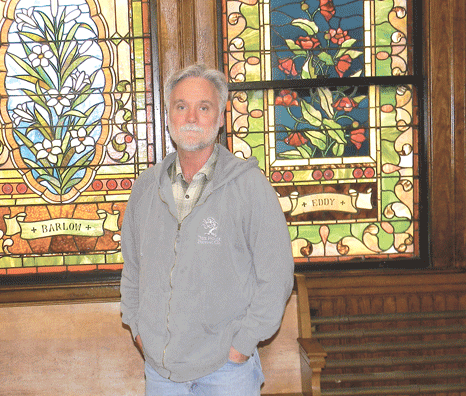
Roc Goudreau

Roc Goudreau, one of the developers of Workshop13, believes the renovated church will become a cultural hub for Ware.

For eight years, the building at 13 Church St. stood vacant and dilapidated, an eyesore that most residents and town leaders assumed would be torn down.

But two town residents, Roc Goudreau and his friend, Chris DiMarzio, looked past the blight and the daunting challenge of rehabbing the 117-year-old former Methodist Church and saw something others didn’t: opportunity.

What they’ve created at that address is called Workshop13, a bustling cultural-arts and community center that has become not only a major resource, but also a source of inspiration for a town looking for a spark — or several sparks — in its downtown, and is starting to find them.

Indeed, the renovation of the Workshop13 building is just one example of a minor wave of development that has swept through town in recent years, said Town Manager Stuart Beckley.

“Ware can be a hub of activity and services for regional residents,” he told BusinessWest. “The more activity and the better the quality of activity and service, the more growth that will follow. Ware is working to be ready for that increase.”

Hoping to open up a new art school, Goudreau and DiMarzio purchased the 11,000-square-foot former church building in December 2012. After several months of renovations, including the installation of a new roof and chimney, as well as the additions of new doors, flooring, shelves, and lighting, Workshop13 opened in October 2013.

“I’m really glad we were able to save the building,” said Goudreau, who plans to renovate the exterior of the building next year. “It was a real mess when we first bought it, but we always said the place has good bones and structure.”

That phrase could be applied to the community’s downtown as a whole, and officials are looking to create momentum for more development there.

The Ware Business and Civic Assoc. (WBCA) has partnered with town officials to conduct a series of workshops to help gain insight into best practices for a planned revitalization of Ware’s downtown section. Funded by town grant monies, the workshops will be led by four people from throughout Massachusetts with experience in various revitalization strategies. Bill Braman, chairman of the WBCA, is excited about the ideas these individuals will bring to the table.

“They all have different backgrounds and approaches and experiences when it comes to revitalization, and we want to look into employing some of their strategies in Ware,” he said. “There have been a lot of great recent developments downtown, with a new restaurant being constructed a few years ago and Workshop13 opening. Now we’re looking to come together as a community in a coordinated effort to continue revitalizing that area.”

For this, the latest installment of its Community Spotlight series, BusinessWest puts the focus on Ware and the many signs of progress — and hope — in this Quaboag-region community.

Major Steps Forward

The progress at Workshop13 just scratches the surface of recent developments in Ware. A new Cumberland Farms convenience store will soon be constructed on Route 32, a project that has received site-plan approval from the Planning Board. The proposal will now be reviewed by the Zoning Board of Appeals, and representatives from Cumberland Farms hope to be open for business as early as the fall, said Karen Cullen, Ware’s director of Planning and Community Development.

Meanwhile, Seaboard Solar, of Danbury, Conn., received approval last year from the Planning Board to install a solar array on Gilbertville Road, which will be adjacent to a larger array the company is building in West Brookfield. Cullen said Seaboard Solar has submitted a building permit and is planning to get construction underway soon.

From a recreational perspective, Ware is taking major steps with the planned construction of a new section of its Rail Trail within the next 18 months. Selectman John Carroll said recently awarded grant monies from the Recreational Trails Program, as well as volunteer contributions, will allow for the construction of two new bridges and other work.

“Once this new section is finished, people will be able to go from Wal-Mart all the way down to Robbins Road,” covering a significant stretch of Route 32 in town, he said.

The new trail section and others expected to follow it will ultimately connect Ware to several other towns through larger regional trails — both existing and proposed — which would attract more people to the town and thereby generate increased revenue for businesses. “It is important to be connected to the larger region,” Beckley said.

But the transformation of 13 Church St. has been the visible and potentially impactful development in recent months.

“The total rehabilitation they did of the building was wonderful, a very exciting project in our town,” Carroll said. “They took a building that would have been demolished and completely renovated it. Whenever something like that happens, it’s big for the town.”

Cullen agreed. “They put a lot of money and work into it, preserving most of the original features of the building, and now it is a thriving arts center,” she said.

Workshop13 hosts several youth art programs and camps each week, including a spring vacation camp that introduced several youngsters to painting during their break from school. With an accomplished staff of artists, Goudreau is hoping to expand membership in the coming months.

“We have really great instructors here; all of them are professional artists, and right now we’re just looking to get the word out about this place so residents know about what we have to offer,” he said. “Some people who come in didn’t even know we were here.”

Another goal for Goudreau and his staff is to maximize the use of the property, which was built in 1897 and also served for a short time as a senior center. The building boasts stained-glass windows and expansive rooms, and Goudreau is contemplating adding a performance or dance component to his business. The upper rooms, he said, are also perfect for an exercise studio, and renting sections of the building is another viable option. Currently, one of the second-floor rooms serves as a makeshift art museum displaying creations of Workshop13 instructors.

“I really hope that one day this building will be a cultural hub for the town,” he said.

Winds of Change

Karen Cullen

Karen Cullen says there are a number of development projects underway or on the drawing board in Ware.

Several other businesses and organizations in town have been active over the last year with expansion or development plans. Officials at Baystate Health, which operates Baystate Mary Lane Hospital on South Street, has announced its intention to explore the acquisition of Wing Memorial Hospital in nearby Palmer from UMass Memorial Healthcare, and is nearing a decision on whether to proceed.

“Right now we’re in a process of due diligence to move toward a definitive decision,” said Ben Craft, Baystate Health’s director of Public Affairs. “We’re anticipating a decision by the summer, but Baystate Mary Lane Hospital will continue to operate normally and remain a key part of our strategy moving forward. It’s important that we maintain a strong presence in Ware.”

If the agreement is approved, Beckley said it could lead to opportunities for growth in town. Baystate Health operates several medical facilities in the region, including Baystate Medical Center in Springfield and Baystate Franklin Medical Center in Greenfield.

The Quaboag Valley Business Assistance Corp., based in Ware, has also reported major developments of late. Officials with the QVBAC recently learned the corporation has been certified as a ‘community development finance institution’ by the U.S. Department of the Treasury’s Community Development Financial Institutions Fund.

“This certification will increase our access to financial and technical assistance from the CDFI fund and enhance our ability to raise funds from other donors,” said Sheila Cuddy, executive director of the QVBAC. “These funds support our work to increase economic opportunity for the 15 communities in our region.”

The QVBAC, a nonprofit organization, provides loans to small businesses that are not eligible for traditional bank financing.

Meanwhile, officials expressed hope that the planned workshops downtown will spark more development opportunities there.

In addition to exposing residents, town officials, and business owners to specific strategies, the workshops will also serve as a promotional mechanism for the revitalization plans, which will tie into the town’s ongoing formation of a master plan.

“This will create a vehicle to bring various businesses, large and small, together to focus on our priorities,” Braman added. “We’re hoping to get participation from throughout the community as we move forward to determine the best approaches for revitalization.”

At the conclusion of the workshops, Beckley said the town will assist Ware Business and Civic Assoc. members with deciding how they wish to move forward.

Ware It’s At

Overall, town officials are encouraged by the growth that has taken place in recent years, in addition to developments that still may occur.

Even in a tepid economy that has caused many communities to stagnate in terms of development, Ware residents and business owners have found a way to effect positive change and gain momentum.

“All of these activities show the commitment of town and business leaders to growth,” Beckley said, “both residential and commercial.”

Ware at a glance

Year Incorporated: 1775
Population: 9,872 (2010); 9,707 (2000)
Area: 40.0 square miles
County: Hampshire
Residential Tax Rate: 18.31
Commercial Tax Rate: 18.31
Median Household Income: $36,875
Family Household Income: $45,505
Type of Government: Open town meeting
Largest Employers: Baystate Mary Lane Hospital, Wal-Mart, Big Y, Country Bank, Kanzaki Specialty Papers, Town of Ware

* Latest information available

Education Sections
Bay Path’s New Accounting Degree Makes Sense on Many Levels

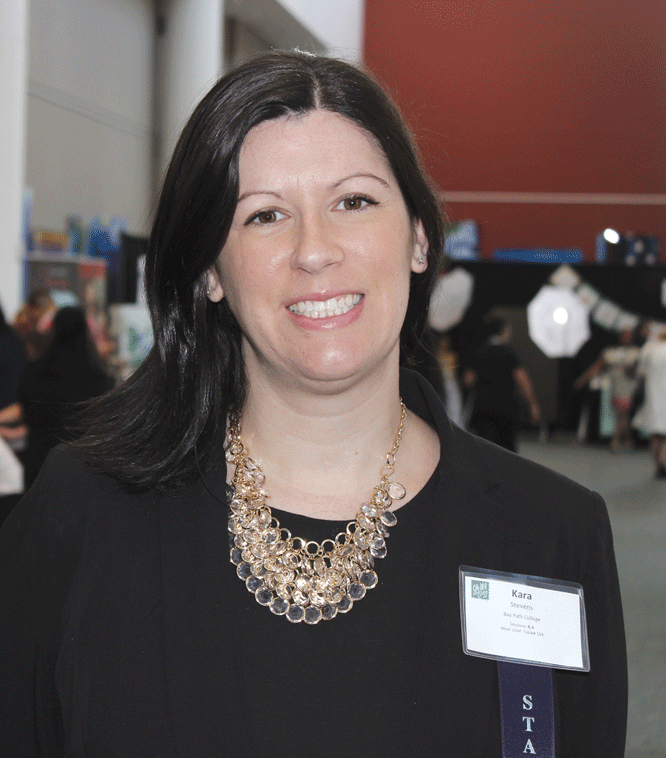
Kara Stevens

Kara Stevens says the unique scheduling — no classes during tax season — is one of many attractive features that come with Bay Path’s new graduate degree in accounting.

Kara Stevens says that, when she went about designing the new master’s degree in Accounting program at Bay Path College, she had some of her own experiences in this profession — and with attaining this degree — in mind.

“I was in public accounting and working toward my master’s, and can remember having to run out at 5 o’clock to go to class during the prime time, when I needed to be there longer hours,” she said, referring to her time at Wolf & Co. soon after graduating from UMass Amherst and, more specifically, her recollections of having to balance school with her various responsibilities during the height of tax season, between the start of the new year and April 15.

The new program at Bay Path, scheduled to start at the end of this month, was blueprinted with that awkward conflict in mind, and the desire to essentially eliminate it.

Indeed, this totally online program effectively shifts the traditional summer break to what everyone in the industry refers to simply as ‘the busy season.’ Classes run from May to the holidays in December, break for tax season, and then resume for five weeks, ending in late May.

“With no classes held between January and April, you can adjust your life, work, and professional goals,” said Stevens, director of Bay Path’s Accounting program and assistant accounting professor. “Once April has passed, the program picks up again, and you can continue in sequence.”

This is a fairly unique twist to the traditional MS in Accounting, a degree program designed to give bachelor’s-degree holders the fifth year, or 150 credits, they now need for licensure as a certified public accountant in more than 40 states, including Massachusetts.

Stevens said she is not aware of another program with such scheduling, so it should help the college create an effective niche. And while there are already a number of MS in accounting programs in this region, she believes there was need for another, especially an offering with some unique qualities beyond that schedule.

Among these is the all-women, or almost-all-women, nature of the program, she told BusinessWest, noting that, while men can enroll, and she expects some will, they will be in the minority, which she sees as a positive for the female enrollees.

“Our master’s-degree programs are still seeing a large percentage of women in their ranks; we of course allow men, but at this point it’s roughly 86% women on average, and more in some programs,” she said. “I like the idea that this is helping to create a culture of women in accounting.”

Elaborating, she said that, while most undergraduate accounting programs are roughly 50% women, there is still a glass ceiling in this industry when it comes to women progressing into the partnership ranks at firms and then senior management. An MS program featuring all or mostly women can create an environment where such issues can be more effectively discussed — and confronted.

Another benefit is the small size of the classes, she said, adding that most sessions will have a dozen or fewer students, while the online nature of the program — with “on-ground support,” as she called it, is another popular feature.

The master’s offering is Bay Path’s first graduate program in Accounting, said Stevens, adding that the school introduced an undergraduate offering eight years ago, and now has several variations on that program, including a one-day offering and an online curriculum. Eventually, she would like to introduce what’s known as a 3+1 program, which will enable students to enter an accelerated program, whereby they can get their undergraduate degree in three years then move on to their master’s, thus saving roughly a full year’s tuition in the process.

The MS is built on a common core of classes — everything from Advanced Financial Reporting to Fraud Examination to Government and Nonprofit Accounting — and students can focus on one of three concentrations: public accounting, private accounting, and forensic accounting.

There are five sessions, two that run for six weeks and three that run for eight.

Early interest in the program is fairly strong, said Stevens, adding there have been a number of inquiries, and several women have already signed on. She anticipates an initial enrollment of 12 and expects that number to rise as awareness of the program and its unique features become known.

Overall, Stevens sees the MS program as a step forward for Bay Path, an initiative that will enhance the undergraduate Accounting program, because it will provide a smooth transition to the fifth year for Bay Path students, and one that should benefit the college on the whole as the accounting industry goes about the task of filling vacancies that will be created when those in the Baby Boom generation retire.

“Based on where my students are being placed for internships and then jobs after graduating, there is definitely a need for accountants in this area,” she said. “And that need will only grow in the years to come.”


— George O’Brien

Restaurants Sections
Hofbrauhaus Continues Traditions, Creates Some New Ones

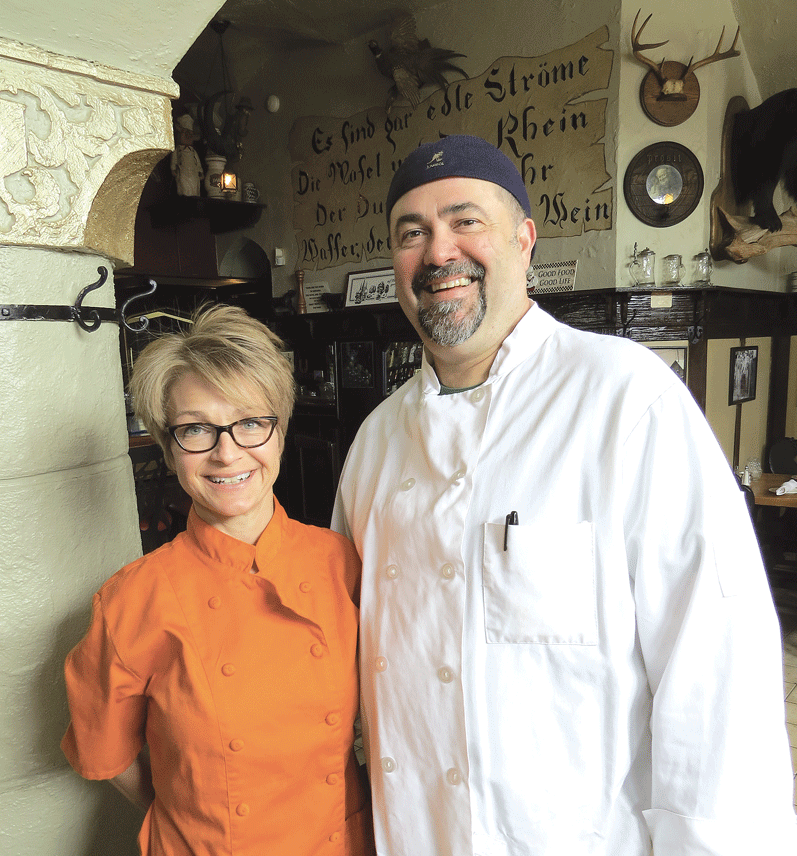
Joe and Liz Stevens

Joe and Liz Stevens are now in their 20th year as owners of the Hofbrauhaus, which opened its doors eight decades ago.

It’s called “Sapelli lobster.”

It was given that name because Gene Sapelli, a regular customer at the Hofbrauhaus, liked his crustacean prepared a certain way, said Joe Stevens, the establishment’s long-time owner and chef.

“This is a two-and-a-half-pounder … we take all the meat out and then put it back in the shell, so all you need is a knife and fork,” he said. “We’ve been doing it this way since the ’70s.”

You won’t find Sapelli lobster on the printed dinner menu at this West Springfield landmark, but it’s always there, and the regulars know to ask for it. It’s more than a specialty, it’s a traditiom — and there are many of them here.

And there should be, considering that this is the establishment’s 80th year in business, and Stevens and his wife, Liz, are in their 20th year as owners.

There are also the many holiday buffets at the Hofbrauhaus. The place was packed for Easter, and Stevens is expecting the same for Mother’s Day, although he’s anticipating some late reservations because Mother’s Day (May 11) is coming hard after Easter, which was late this year, and “it might sneak up on people.” Meanwhile, Thanksgiving is a different kind of tradition. Indeed, while many eat at the restaurant, a number of regulars will give Stevens and his staff their order for a full dinner, and they’ll pick it up at a pre-arranged time at the back door (more on that later).

There’s also the annual game dinner each winter, the German outfits on the staff, the dozens of steins on the walls, and other culinary mainstays, such as a huge veal shank, which, like the lobster, isn’t on the menu, but regulars with a healthy appetite know all about it.

But this is a different and far more challenging time for restaurant owners than the landscape that existed in 1935, when the Hofbrauhaus opened, or when Joe and Liz Stevens took over in 1995. By his estimation, Joe said, 85 or 90 restaurants have opened in West Springfield alone since he assumed ownership — but who’s counting? And the list keeps growing; yet another burger restaurant is opening on Route 20 in a former Friendly’s location.

Meanwhile, the economy, while improved, remains sluggish, and discretionary spending is still undertaken with caution. And then, there was the tornado of 2011, which passed right over the restaurant and deposited new furniture acquired for the outdoor dining area, the so-called beer garden, into the Connecticut river.

The juxtaposition of all these challenges has necessitated the creation of some new concepts and programs, some of which are on their way to becoming traditions, said the couple. These include the ‘beer-of-the-month dinner,’ at which attendees can get a large stein of beer and dinner for $15. The featured libation at the May 7 event is something called Workers Comp Saison from Rhode Island-based Two Roads Brewery, and slow-roasted beef brisket and pan-blackened cod are on the menu for the buffet dinner.

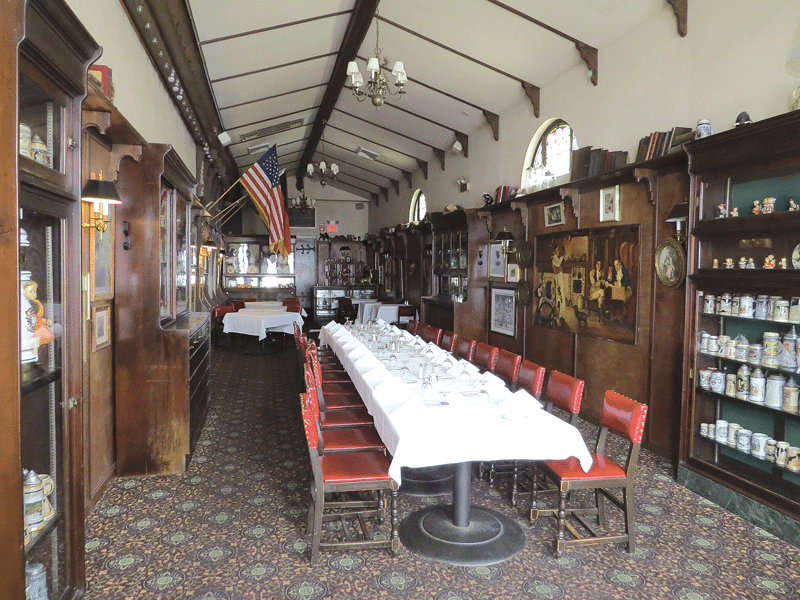
The Stein Zimmer

The Stein Zimmer, used for small groups and special functions, is one of the many unique aspects of the Hofbrauhaus.

There’s also Fraulein Fun Night, which, as the name suggests, is a regular gathering of women (the first or second Thursday of every month) for food, beverages, networking, and a chance to become informed. Liz Stevens, who created this series, schedules a speaker for each get-together; the May 8 event features an intriguing program tiled “Where Chocolates and Vitamins Meet.”

“I try to feature someone fun, interesting, and who doesn’t cost them anything,” she said of the lineup of speakers. “We’ve had massage therapists, nutritionists, a life coach … it runs the gamut. It’s a fun night out, and the women look forward to it.”

The couple has even gone so far as to change, or amend, the name of the establishment, to make it clear that it serves much more than traditional German food. While ‘Hofbrahaus’ remains over the door, ‘Hofbrau Joe’s German Steakhouse’ has been added to the menu and most marketing materials.

This mix of and new and old, traditional, and different is enabling this landmark to add some new chapters to its rich history, said Joe Stevens, adding quickly that creating such blends is the challenge facing all restaurants today, and especially those that have been part of the landscape for decades and need to attract the younger generations.

High-steaks Venture

Stevens said there’s a beer cooler in the basement with walls that are a foot and a half thick.

That’s where he ordered everyone to go late in the afternoon on June 1, 2011, when it became clear that there was a tornado moving southeast through West Springfield, and the Hofbrauhaus was apparently in harm’s way.

“We had everyone wait in that refrigerator,” he recalled, adding that the twister apparently “bounced” across the property, touching down in the parking lot, damaging the beer garden, roof, and other parts of the building, while also taking down a house behind the landmark.

“It did not discriminate,” he said while reciting the damage and putting an estimate at $400,000. “It picked up some of the tables and chairs from the beer garden, deposited them in the river, and then went over the [Memorial] Bridge. We saw them floating there for a couple of days before they got carried away in the current.”

Using some humor to help get across his frustration, he said the insurance company “could not get me that money fast enough.” In reality, the last check came just a few weeks ago, after the matter went to court.

Looking back, Stevens said the tornado has been one of many challenges the institution has had to weather the past several years, including a recession that seemed without end, especially for a sector that feels downturns perhaps more than any other, and a crush of new competition along the I-91 corridor he serves.

“We’ve taken a few lefts and rights recently, but we’ve bounced back,” he told BusinessWest. “We’ve recarpeted, redecorated, and taken some steps to bring more people to our door. And business has been good.”

Taking lefts and rights is certainly part of being in the ultra-competitive restaurant business, said Stevens, who should know — he’s been doing this for more than 30 years now as chef and owner.

His first foray was the Glass Lily, located in the Longmeadow Shops, which he owned and operated for eight years — a time he called a great learning experience.

When the Krach family, which assumed ownership of the Hofbrauhaus in the early ’70s, decided to put the landmark on the market a quarter-century later, Stevens took what he considered to be a calculated entrepreneurial risk.

The main dining room

The main dining room reflects the many traditions and rich history at the Hofbrauhaus.

Over the past two decades, the couple has continued those aforementioned long-standing traditions while also employing a number of strategies — from heavy use of social media for branding and event promotion to introduction of new programs that introduce, or re-introduce, people to the restaurant.

The name alteration is part of all that, said Stevens, noting that, with the addition of the words ‘German Steakhouse,’ the institution is generating new business by making the breadth and depth of the menu more apparent to all.

Indeed, while the restaurant serves German favorites such as weiner schnitzel, bratwurst, and beer-battered shrimp, it also offers a variety of steaks (some cooked tableside), Scottish salmon, rack of lamb, and, yes, lobster.

The popular holiday buffets continue to draw several generations of area families, he told BusinessWest, while the Thanksgiving tradition of cooking whole dinners for pick-up, which goes back to his days at the Glass Lily, represents a higher level of customer service.

“People order a whole turkey with me, I cook it, they get stuffing, vegetables, potatoes, whatever they want for sides, and off they go,” he said, adding that the nearby Dante Club makes its ovens available so Stevens can meet 60 or more orders a year. “People know the drill — they come in the back door, their times are set every year. We work through the night, but have a great time doing it.”

Meanwhile, some of the new initiatives are expanding the customer base, he went on.

The beer-of-the-month dinner is helping to make a traditionally slower night, Wednesday, less so, he told BusinessWest, while the Fraulein Fun Nights are attracting crowds averaging about 40 women.

Many of them are business professionals, said Liz Stevens, adding that she has regular groups from Baystate Health and MassMutual, but also new faces every month.

But beyond the new initiatives, new carpeting, and a larger, lighted parking lot, the basic ingredients in the recipe for success haven’t changed, Joe said. “It’s still all about offering good, consistent service and good food. It’s as simple as that.”

Art of the Matter

Joe Stevens said there’s a lot of history at the Hofbrauhaus, from the old, art-deco neon clock in the kitchen, which dates back to when this was a dinner and dancing hall in the ’30s, to the stained-glass windows in the dining room (used for small groups) called the Stein Zimmer, to the mural depicting scenes from Germany that wraps around the main dining room.

The Krach family uncovered it while cleaning one day — it was buried under decades of accumulated grease, dirt, and tobacco smoke — and spent months restoring it, said Stevens, adding that it is one of many topics of discussion for long-time customers who know the history and can point to the small patch that was left uncleaned to show how dark and deep the filth was.

“We have so many customers that come in and tell us stories about this place from when they were growing up,” he said, “ because it’s been here their whole lives. They talk about how their fathers and grandfathers and great-grandfathers have been there, and all the weddings this place has done.”

The challenging assignment moving forward — one that Joe and Liz Stevens have undertaken with determination and imagination — is simply to write more history.

And they’re doing just that.

George O’Brien can be reached at [email protected]

Meetings & Conventions Sections
Sheraton Springfield Excels at Helping Groups Get Down to Business
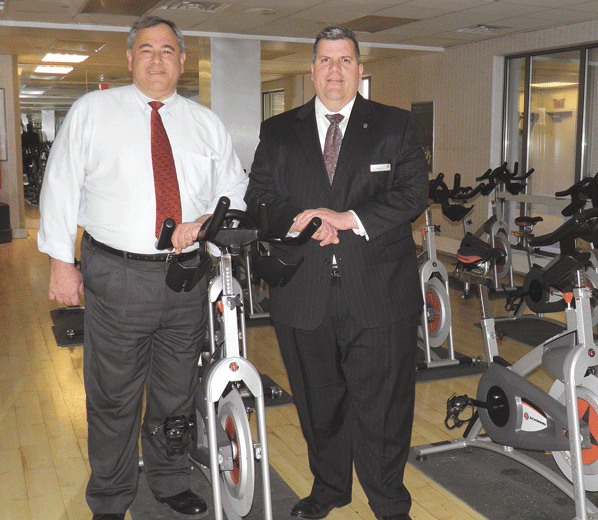
Ernie Taddei, left, and Paul Marcelina

Ernie Taddei, left, and Paul Marcelina say business travelers appreciate the 18,000-square-foot 4 Fitness Health Club at the Sheraton Springfield.

The Sheraton Springfield Monarch Place Hotel is the largest hotel in the area, with 325 rooms. It has recently undergone more than $7 million in renovations and features unusual architecture and amenities, which include a 12-story atrium, two restaurants, and 24 areas where meetings or conventions can be held.

But general manager Paul Marcelina says that what sets its apart from its competitors is the fact that every hotel associate is steeped in the “five human truths,” which allow them to meet the basic emotional needs that all human beings share.

“Our goal is to create an emotional connection with our guests. We all want to belong, feel special, be understood, reach our fullest potential, and be in control,” said Marcelina, citing the results of a study conducted by Starwood Hotels and Resorts Worldwide in 2009 that changed the hotel’s culture.

“We consider ourselves to be friends of our guests, which is reflected back to us every day in our guest-comment cards. Every guest and every trip is different, and we are aware of the needs and time constraints of weekday business travelers as well as the needs of social travelers here on weekends,” he added.

Although the hotel has its share of tourists, about 60% of its annual revenue comes from business groups, whose members travel from throughout New England and beyond. “We’re the largest hotel west of Boston, north of New Haven, and south of Montreal,” said Peter Picknelly, president of Monarch Enterprises and owner of the Sheraton Springfield.

The hotel is part of the Monarch Place complex, which includes a 25-story tower that contains 400,000 square feet of office space as well as a parking garage for 200 vehicles. “It adds to our appeal,” said Ernie Taddei, regional director of sales and marketing for the hotel, explaining that many business travelers who stay at the Sheraton have meetings scheduled in Monarch Place.

But there are other features that make the hotel a sought-after location for business gatherings. “We have 30,000 square feet of meeting space, and everything a business needs is under one roof, which is difficult to find outside of Boston or New York City,” Marcelina said. “We know we are competing with hotels in Hartford, Boston, and Philadelphia, so we spend time figuring out how to attract businesses to Springfield and this hotel.”

He told BusinessWest that meetings can be held concurrently in spaces that can accommodate from two to 1,000 people, or 100 8×10 pipe-and-drape booths. In addition, the Grand Ballroom can serve dinner to 1,000 people at one time, while cocktail hours for up to 2,100 people can be held on the first three floors of the atrium.

Other perks include state-of-the-art audio-visual equipment, as well as LCD projectors and specialty AV items available from hotel vendors. “Our vendors stay on the property during the entire convention, to make sure everything is done correctly,” Taddei said, adding that the hotel’s recently upgraded sound system “allows people to hear perfectly from one end of a convention space to the other.”

The Sheraton has also developed close relationships with many local attractions, which allows guests to purchase discounted tickets to basketball games or other events, and Taddei said these tickets are often made available to people staying there for several nights.

“It’s not just about the rate and meeting room, it’s about what we can do to make a stay more enjoyable,” he said. “We don’t want our guests to be bored.”

In addition, the hotel’s full banquet kitchen allows event planners to customize menus and match the décor of the dining room to a chosen theme. Food offerings are also frequently expanded, and hotel salespeople sample dishes on the menu and provide input. For example, after a recent sampling of hors d’oeuvres created for a wedding party, officials decided to offer them to business groups.

The Sheraton, which averages about 200,000 guests per year, has also made major upgrades to its Internet technology, which allows guests to operate several devices at the same time in their rooms. There is also ‘the Link,’ an area found in all Sheraton hotels that offers guests computer use and a copier and printer at no cost in a comfortable setting.

Staying Power

Bartender Carmine Capuano

Bartender Carmine Capuano says cocktail hours for up to 2,100 guests can be held on the first three floors of the Sheraton Springfield’s atrium.

Marcelina said there have been a number of renovations completed at the Sheraton over the past few years. Upgrades include new furniture, wall coverings, artwork, carpeting, drapery, bathrooms, lighting, and sound systems.

But due to its architectural design, changing the environment was no easy feat.

“Our atrium is visible from all floors, and it was very challenging to complete the renovations without bothering our guests,” Marcelina said, explaining that scaffolding had to be built from the second to 12th floors.

But today, people delight in looking up to the top of the glass ceiling or down to the lower floors, depending on where their room is located. The view is enhanced by special lighting along the outer wall of every floor, which is programmed to change colors every few seconds.

“It’s a special visual effect, and large conventions or parties can select colors that match the theme of their convention,” Taddei said. “Lighting is important, and we can also splash colors on the ballroom floor to match a business’ taste, which is nice for a company meeting and also nice for social functions such as a wedding.”

Another bonus is the hotel’s 18,000-square-foot 4 Fitness health center. “It’s the largest hotel health center in Massachusetts and has state-of-the-art equipment, a sauna, racquetball courts, and spinning classes,” Taddei said.

A large swimming pool beneath a domed glass ceiling and adjacent outdoor sunbathing area add to the appeal, and as a result, the hotel also caters to annual meetings and events held by religious groups, sports groups, youth groups, and other groups that often take part in competitions at the nearby MassMutual Center.

But despite outstanding physical amenities and a good location, hotel officials say what separates them from their competition, and results in repeat business, goes back to their focus on “human truths” and the behavior of hotel associates.

“We can say that we have nicer artwork or a warmer pool, but that is not going to make the difference between a good or exceptional experience,” Picknelly said. “What we do starts from the time a person arrives at the front desk and continues until they leave. But getting to that point is not an easy task. It takes a collaborative effort by all of our associates.”

To that end, great attention is paid to detail. Each employee’s name tag includes a hobby or interest, which often sparks conversations with guests. And associates are schooled to notice things such as a guest wearing a Red Sox cap and ask questions related to such items.

“We don’t consider the check-in process part of a transaction; it’s a welcome service that is all about engagement and interaction and is part of the warmth connected to our core values,” said Marcelina, adding that, when guests leave, they are asked about their stay and invited to return. “The connection we make is what separates us from our competition.”

Employees are also trained to take notice of details in guest rooms. For example, Marcelina said, if someone from the cleaning staff notices a guest has an empty Diet Coke in their trash can or an empty Hershey’s candy wrapper, he or she can replace the items with a note that tells the guest to enjoy them and their stay.

Taddei has been with the hotel since 2009 and said many guests come to Springfield to enjoy local attractions, which range from the Basketball Hall of Fame to Six Flags New England and the Big E.

“We are lucky to have them in our backyard,” Picknelly agreed.

But the atmosphere in the hotel changes in response to the day of the week and who is staying there. In fact, Picknelly likens it to a transformer.

“Monday through Friday, we cater to a business clientele,” he explained. “But on Friday afternoon, we transform into a leisure hotel, which means we adopt a different culture.”

That includes offering breakfast later in the morning for guests who want to sleep in, longer pool hours with more attendants on duty, and other measures designed to make hotel stays memorable and relaxing for guests of all ages.

Picknelly said small things are important and uses the example of newspapers to make his point. “My son gets all of his news from the Internet, while I prefer a real newspaper,” he said. So, newspapers are delivered to each guest’s room early each morning.

The hotel’s theme is the fall season in New England. “The artwork was commissioned, and every guest room has a piece twice the size that you would normally find in a hotel room,” Picknelly said. There is also a large mural over the main entrance to the grand ballroom depicting three scenes that reflect Springfield’s history and attractions.

But hotel executives stress that the reason people choose the Sheraton and return there is because of the service, and all new associates participate in the Sheraton Service Culture Training.

“It allows our associates to understand the diverse needs of our guests and also allows them to exceed their expectations,” said Marcelina. “We listen to the people who stay here because we want them to feel they belong, which goes back to the human truths.”

For example, when the hotel stopped serving dinner in the sports lounge, it was quickly reinstated due to demand, as was popcorn in the bar when another snack was substituted.

Meaningful Interactions

Marcelina said people have many choices when it comes to choosing a hotel. “But when you know the person behind the desk cares about you and looks forward to seeing you again, it makes a difference. And we feel this way about everyone who stays here.”

Indeed, the culture, combined with recent upgrades, have proven to be a recipe for success. “A lot of our conventions are repeat business, and we are already holding space as far out as 2017,” Taddei said. “We are selected over other places even when our location isn’t as convenient. People choose us because of our consistency and because our staff is trained to make sure they have a memorable experience.”

Marcelina said the formula is simple. “It goes back to the human truths,” meaning every guest leaves feeling special and cared about.
Briefcase Departments

Report Details State’s Healthcare Costs, Access
BOSTON — The Massachusetts healthcare reform law of 2006 set in motion a number of important changes to the healthcare system, which have affected Massachusetts residents, businesses, healthcare providers, and others. Since 2006, the Massachusetts Health Reform Survey (MHRS) has been an important means of monitoring and understanding these impacts. The most recent report, conducted in the fall of 2012, just after passage of the state’s healthcare cost-containment law, brings both good news and signs that warrant concern. As with previous versions of the MHRS, the just-released results of the 2012 survey provide promising evidence that the insurance provisions of the Affordable Care Act, which were modeled after the 2006 Massachusetts law, will improve coverage and access across the nation. However, the 2012 survey also shows that healthcare costs continue to be a burden for many. Massachusetts continues to have the highest rate of insurance coverage for non-elderly adults of any state, 94.6%. This is a significant improvement over 2006, when 85.9% of non-elderly adults had insurance, and much higher than the current national level of 79.7%. In addition, gaps in coverage have lessened: 88% of adults in Massachusetts reported being covered for the entire year, much higher than the national level of just under 75%. The proportion of people in Massachusetts who are “persistently uninsured” has been cut by nearly three-quarters, falling from 9.3% in 2006 to 2.7% in 2012. The survey indicates that respondents are generally satisfied with their healthcare coverage, with about two-thirds rating their coverage as very good or excellent on the range of services, choice of providers, and quality of care, up more than 10% from pre-reform. Access to care is also is very good; nearly nine in 10 respondents reported having a place, other than the emergency room, to go to when they are sick or need advice about their health. This is higher than national estimates for this measure, which top off at around 80%. Use of physician services is also higher in Massachusetts than it is nationally. Eight in 10 non-elderly adults reported having visited a doctor in the past 12 months, compared with 63% nationally. On the issue of affordability, more than 40% of non-elderly adults reported that healthcare costs had been a problem for them and their families over the previous year, including 37.1% who experienced problems with healthcare spending and 16.4% who reported going without needed care because of cost. Having health-insurance coverage did not eliminate cost concerns, as 38.7% of those who were insured for the full year reported that they had problems with healthcare spending. One reason the burden of healthcare costs has not diminished with rising levels of coverage is the continuing trend among employers to shift costs onto workers and their families, such as through high-deductible plans.

Massachusetts Ranks High in Spending Transparency
BOSTON — Massachusetts received an A– grade in government spending transparency according to “Following the Money 2014: How the 50 States Rate in Providing Online Access to Government Spending Data,” the fifth annual report of its kind by the Massachusetts Public Interest Research Group (MASSPIRG). “We have worked hard to make state government more transparent for taxpayers, and this superb grade from MASSPIRG reflects that,” said Secretary of Administration and Finance Glen Shor. Massachusetts came in at the top of the nation with a grade of 91.5, maintaining it’s A– rating for the third year in a row despite the increasing difficulty of the annual survey as technology improves and consumer expectations rise. The MASSPIRG report designates Massachusetts as a ‘leading state’ in progress toward improved online spending transparency, allowing ordinary citizens to find information through easy-to-use features. The report applauds Massachusetts for increasing transparency by awarding more than $300,000 in grants to six cities to post their spending information online, and planning to help 20 cities post their spending information online by January 2015; posting information on state contracts and bidding opportunities through the state’s checkbook-level procurement website, saving the state $3 million by eliminating paper, postage, and printing costs associated with information requests by state agencies and paperwork from vendors; and improving the state’s transparency website by publishing a report on the Economic Development Incentive Program, which provides recipient-specific details on jobs retained and created. “Given that our grading standards rise annually, earning an A– each year means Massachusetts has demonstrated a significant commitment toward transparency and is continually investing in improvements,” said Andrew Fish, program associate with the MASSPIRG Education Fund. “Gov. Patrick’s commitment to increasing disclosure of the state’s finances allows the public to see how their tax dollars are being invested, promoting both efficiency and accountability.” Patrick’s FY 2015 budget, which was published in a program-based manner and added performance data to the state budget for the first time, aimed to make more spending and performance data available to the public. To read the full report, visit www.masspirg.org.

DevelopSpringfield Issues 1095 Main Street Grant
SPRINGFIELD — DevelopSpringfield announced that it has awarded a $20,000 grant for façade improvements to 1095 Main St., property owned by 1095 Main Street Irrevocable Trust. Building tenants include Square One Family Center and Santos Family Chiropractic. The grant is made possible under DevelopSpringfield’s Corridor Storefront Improvement Program, which provides grants of up to $10,000 per storefront for exterior improvements to first-floor businesses located on State and Main streets in Springfield. The funds were used to revitalize and repair the existing façade and included new windows, doors, and signage. The grant is supporting a substantial investment for improvements to the building by the property owner. “This project represents well over $100,000 in capital improvements to the façade of this building,” said Ralph Capua of 1095 Main Street Irrevocable Trust. “It’s an example of our commitment to bringing business back to the South End, and allows for additional leasing opportunities for prospective business owners.” The project shows a strong commitment to revitalization Springfield’s South End, an area devastated by the June 2011 tornado. Improvements to this structure made it possible for Square One, which lost its site after the tornado and was further displaced by the downtown natural-gas explosion in November 2012, to find a new home. The Square One Family Center celebrated the opening of its 1095 Main St. facility last September.

Company Notebook Departments

FieldEddy Acquires John Pires Agency
EAST LONGMEADOW — FieldEddy Insurance, one of the largest independent insurance agencies in Western Mass., continues to expand its footprint after recently acquiring the Ludlow-based John Pires Agency. The FieldEddy network is made up of agencies throughout Western Mass., with locations in South Hadley, Monson, and Ludlow, with headquarters located in East Longmeadow. “We feel that this is a great opportunity for the customers of John Pires as well as our agency,” said FieldEddy President Timm Marini. “We look forward to delivering our top-notch service and value to these customers, which is what FieldEddy has become known for.” The transition is expected to be seamless and is already underway, he added.

Balise Collision Repair Receives Prestigious Certification
WEST SPRINGFIELD — Balise Collision Repair on Riverdale Street in West Springfield has been officially certified as a Lexus-approved repair facility. There are fewer than 25 Lexus-certified repair facilities in the U.S., and Balise Collision Repair is the only one in New England. To achieve certification status, a facility’s technicians, supervisors, managers, and office staff must complete a rigorous training program, including online classes and on-site practicums. Employees are then tested in various areas depending on their job classification. Dave Thomas, Lexus Eastern Area customer service operations manager, made the presentation to Jeb Balise, president and CEO of Balise Motor Sales. Balise cited the dedication of the staff at the collision facility.  “This is a tremendous honor for us, and all the credit needs to go to the people who work at this facility for making it happen.”

Hazen Paper Dominates AIMCAL Awards with Record-setting Seven Wins
HOLYOKE — Hazen Paper Co. was honored an unprecedented seven times with awards at the annual management meeting of the Assoc. of International Metallizers, Coaters and Laminators (AIMCAL) in Phoenix, Ariz. on March 16. The seven distinct Hazen products that merited the judges’ votes included packaging for sports equipment, drugstore and luxury healthcare, cosmetics and toiletries, a digital promotional poster for a pop/rock band, and DVD packaging. “We’re very pleased to have impressed the judges,” said President John Hazen. “Each award is validating alone. A combination of custom work we produce from the concept forward in our holographic lab and popular materials we stock to convert, as a whole they demonstrate Hazen’s versatility and exceptional ability to develop materials that ignite interest and turbo-charge sales in a wide variety of applications and markets.” Hazen received a technical award in the Nonfood category for Titleist Pro V1 and Pro V1x premium golf-ball sleeves and folding cartons featuring a rich, glowing finish created by transfer-metallizing film and laminating it to board, which Hazen completes in house. In addition to delivering a result that is twice as bright and reflective as foil, the surface achieves source reduction (95% less aluminum) and enhances recyclability, while improving folding, gluing, and filling operations. Hazen also received a technical award in Healthcare, Cosmetics and Toiletries for metallizing and converting setup boxes for Procter & Gamble’s Gucci Pour Homme and Made to Measure gift sets. Hazen metallized and laminated polyester with an Ultracure coating to litho paper for a luxurious package that resists fingerprints. AIMCAL judges awarded marketing honors to Hazen in multiple categories. In Retail Label, Hazen was recognized for a custom holographic label for Warner Home Video’s 75th-anniversary limited edition of The Wizard of Oz. The litho label features precisely registered custom holography as well as embossed lettering. In Healthcare, Cosmetics and Toiletries Packaging, folding cartons for Ultradent Opalescence Go Tooth Whitening System gleaned top honors for an eye-catching double-rainbow hologram and die-cut ‘bubbles’; Hazen metallized Double Rainbow holographic film and laminated it to solid bleached sulfate (SBS) to deliver a compelling package that simulates motion on the shelf. Custom holography earned Hazen the marketing award in Nonfood Packaging as well, for Pure Fishing’s Spiderwire Stealth Glow-Vis Braid, in a package for a unique fishing line. Hazen collaborated with Olympak Packaging and Printing to design a hologram, applied an embossable coating to polyester film, embossed and metallized the holograph, then laminated it onto recycled paperboard and sheeted it for printing in register. In Decorative/Display, Hazen Paper provided the digital substrate for a poster designed by Dwight Maddox for Don Miggs’ pop/rock band, miggs, to be printed on an HP 7500 Indigo digital press. Finally, in the Other category, Hazen custom holography won over the judges with an album cover for Gap Dream’s Shine Your Light, on Burger Records). Hazen created copyrighted holograms for front and back, and transfer-metallized the film to SBS, precisely registered for printing.

Mercy Home Care Receives Top Rating from DPH
WEST SPRINGFIELD — Mercy Home Care has earned a perfect, deficiency-free survey from the Massachusetts Department of Public Health (DPH). To receive such a survey, home-care agencies must successfully complete a rigorous, unannounced evaluation that includes a review of medical records, clinical procedures, staffing levels, and quality data.  Surveyors also accompany staff members on home visits and interview patients about their experience with the agency. “The very nature of such a DPH survey leaves no room for preparation prior to the arrival of reviewers. Consequently, this deficiency-free survey underscores Mercy Home Care’s daily success in providing outstanding in-home nursing and rehabilitation services to patients who are recovering from illness or injury,” said Christopher McLaughlin, chief operating officer of the Mercy Continuing Care Network within the Sisters of Providence Health System. In Massachusetts, home-care agencies are reviewed by DPH surveyors every three years. Mercy Home Care’s most recent survey took four days to complete and involved 10 home visits with different clinicians as well as intensive reviews of 20 records. “Mercy Home Care patients are at the center of a multi-disciplinary approach to care that is designed to help them maintain or regain their independence. This approach requires staff members to work as a cohesive group, and the deficiency-free survey is a reflection of the outstanding teamwork at Mercy Home Care,” said Sue Pickett, executive director of Mercy Home Care.

More Than $800,000 Given to Schools Through Big Y Education Express
SPRINGFIELD — Big Y Foods Inc. announced recently that more than $800,000 in free educational materials was awarded to more than 2,000 schools in Massachusetts and Connecticut through the grocery chain’s Education Express program. The company provided a partial list of those supplies, which included 2,236 playground balls, 975 books, 372 calculators, 97 digital cameras, 59 computer tablets, 579 musical instruments, 1,313 packs of crayons, 2,523 reams of copier paper, and 27,128 pencils. Since its inception in 1993, the Big Y Education Express Program has awarded close to $14 million in free supplies and equipment to local schools. “At Big Y, we believe it is important to support our communities and the education of our children,” said Donald D’Amour, Big Y Chairman and CEO. “The Education Express Program helps our local schools supplement their tight budgets and get items for the arts, technology, and even necessities like paper and pencils. It’s just one way we are able to give back and help our future generation receive the essential tools they need for the best education possible.” Community support was the key ingredient to the success of Education Express, and the program was a win-win for customers, he added. Customers purchased money-saving products designated throughout the stores by specially designed school-bus logo shelf tags to earn valuable merchandise points for the school of their choice.  Schools then redeemed those points for free educational supplies such as computers, art supplies, musical instruments, and sports equipment. The program was free to Big Y customers, and shoppers could track their donated point totals on their register receipt and through a Facebook app. In addition to the Education Express Program, Big Y operates the Big Y Scholarship Program, which awards 300 scholarships worth $250,000 annually to academically outstanding students in its market area. Big Y also donates food valued at more than $4.5 million to local nonprofit organizations, schools, churches, and educational programs each year.

Fallon Health Marks Milestone
WORCESTER — Fallon Health, a not-for-profit healthcare-services organization, recently celebrated a historic milestone in the growth of community-based care for seniors. With its opening of four new programs last month, the number of Programs of All-inclusive Care for the Elderly (PACE) now exceeds 100 across the U.S. PACE, which was developed in San Francisco in the 1970s, helps to keep nursing-home-eligible elders living in the community. “The story of PACE is a rarity in today’s healthcare policy environment,” said Shawn Bloom, president and CEO of the National PACE Assoc. “PACE is a common-sense approach to providing care to older people that was rigorously studied and tested and then able to become a permanent part of our healthcare system. We don’t often see successful innovations allowed to thrive and grow like PACE.” The various PACE programs bring together a coordinated team of doctors, nurses, social workers, and therapists to provide seniors with an individualized care plan that addresses each person’s unique medical care and social needs. The result is higher-quality care and more favorable outcomes compared to traditional care options. More than 90% of PACE enrollees reside outside of nursing homes. “In Massachusetts, Fallon Health is proud to have led the way in senior-care services with our PACE program, Summit ElderCare, which we’ve offered for the last 19 years,” said Richard Burke, president of Senior Care Services and Government Affairs. “Today, Summit ElderCare is the largest PACE organization in New England and the fifth-largest in the nation.” There are now 103 PACE organizations operating in 31 states. As the only health plan in Massachusetts that is both an insurer and a provider of care, Fallon Health operates its PACE program in six locations in the Commonwealth: Worcester (two sites), Charlton (two locations), Leominster, and Springfield.

Sections Sports & Leisure
Indoor Rock Climbing Is Gaining a Foothold in the Region

By KEVIN FLANDERS

massive rock walls

Interest is growing locally in climbing massive rock walls like these, which, depending on the facility, can stretch up 40 feet or higher.

Hana Skirkey cites a number of reasons why a growing number of people are trying out — and usually staying with — the emerging sport of indoor rock climbing.

“For some it’s a way to conquer their fear of heights,” said Skirkey, an instructor and manager at Central Rock Gym (CRG) in Hadley. “Others just like the freedom. Personally, I think it’s a really fun form of exercise — every step is like a puzzle you’re trying to figure out with your own body. It’s all about finding ways to get to that next hold.”

Whatever the reason or reasons, this activity is certainly gaining traction — literally and figuratively — across the nation and in Western Mass.

Indeed, the region now boasts two indoor rock-climbing facilities — CRG-Hadley, one of four locations operated by Central Rock Gym across the state, and the Northampton Athletic Club (NAC).

The former features the region’s highest rock wall, at 45 feet, and 17,000 square feet of space, while the latter boasts a 40-foot wall, use of which is included in a club membership.

And many people, of all ages and with a host of motivations, are finding and challenging these walls.

“Interest in indoor climbing has definitely grown over the past few years,” said Andy Goddeau, the general manager of the NAC. “It offers something different that a lot of people have never tried before. Many kids start off when they’re really young, and they keep coming back as they get older to learn different techniques and training styles.”

Rigged with hundreds of colored grips and footholds, the wall provides several climbing routes that correspond to different ability levels to ensure everyone from beginners to experts have a fun experience at the appropriate degree of difficulty. Each route features arrows that guide climbers in specific directions, the most challenging of which require the use of advanced techniques. But before anyone can test their skills on the wall, they must first pass an introductory safety course.

“The course teaches people all about the harnesses, carabiners, and other equipment they’ll be using on the wall,” added Goddeau. “We want to make sure people are proficient with belaying and how to climb safely before they go off on their own.”

The NAC and CRG-Hadley now host everything from competitions for people of all skill levels to team-building exercises for area companies; from birthday parties to gatherings for area Boy Scouts and Girl Scouts. And it appears that all this is not a fad, but rather a recreational activity — and business opportunity — with staying power.

“Business has really exploded over the past year, with college students and families always coming in and looking to try it out,” said Skirkey. “Weekends are usually the busiest for us, but we get new people here every day.”

For this issue and its focus on sports and leisure, BusinessWest turns the spotlight on an activity that’s growing on a grand scale, in every sense of that phrase.

Warmer Climbs

As the only gym in Western Mass. dedicated specifically to indoor climbing, CRG-Hadley hosts many specialized training classes and programs, one of which is designed for advanced climbers who have mastered an array of difficult skills.

Skirkey described the “extreme” 45-foot roof as one of the most challenging obstacles in the facility, keeping high-level climbers on top of their game. But for those who are just starting out and want to stick to the lower walls, the gym holds belaying classes every weeknight to show beginners the ropes.

“There’s something for everyone here, from people new to climbing to experts,” she explained. “The roof definitely gives us an opportunity to create challenging routes for advanced climbers.”

It is this ability to provide challenges for people of all ages and skill levels that has enabled the indoor rock-climbing facilities to enjoy steady growth and attract an array of different audiences, said those we spoke with.

This diversity comes in many forms, including the ability to present plenty of fun options that don’t even require a rope, such as bouldering. This is the act of scaling a wall without a rope, and it allows climbers to envision themselves navigating treacherous terrain without worrying about getting injured, as safety mats dutifully await any missteps. Both Northampton Athletic Club and CRG-Hadley are equipped with bouldering walls for individuals who prefer to climb with nothing to guide them but their arms and legs.

Increasingly, it is young — and even very young — people who are trying out these activities, and then coming back for more.

“Kids really love getting on the wall. I think the youngest person we’ve ever had up there was 3 years old,” said John Maradik, one of three climbing instructors at the NAC, which uses specialized full-body harnesses for children, enabling youngsters to experience the thrill of the climb along with their parents or one of the instructors.

For Goddeau, who’s worked at the club since 2002, it’s rewarding to see children develop a love for climbing. One of the club’s current instructors, he recalled, first climbed the wall as a 12-year-old and never looked back, eventually becoming a skilled climber and returning to the club to share his passion with beginners.

Teaching and reinforcing the proper techniques is an important goal at the club, whose instructors strive to maximize their students’ enjoyment of the activity and also reduce their risk of injury. The facility offers instructional classes for those who want to learn more about belaying and footwork, as well as the Try-a-Climb program, during which instructors provide individual feedback to novice climbers.

Safety and education are also major focal points at CRG, which frequently runs instructional classes to introduce the activity to the new climbers who step through its doors each day.

Sometimes the perception of risk is the most exciting part of the climb, instructors at both businesses agree, even though the safety mats are always there to cushion falls.

And while indoor rock climbing provides year-round business, the colder months are typically the busiest, when snow-covered mountains and frigid temperatures force hikers indoors to find a rock to conquer. It’s also a great activity for athletes in other sports who are looking to keep their muscles and reflexes toned during the off-season.

Regardless of the season, indoor climbing courses provide sustainable business due to their popularity as a choice for birthday parties, family outings, and team-building events. The NAC and CRG-Hadley both offer group specials, discount nights, and promotional events.

“Every few weeks, we do a college night or a guys and girls night. We host a lot of birthday parties and events for the Boy and Girl Scouts,” said Goddeau. “We also had a competition this year with about 25 participants. One thing people really like is that they can come and use the gym, then climb the wall. There is no additional charge to go climbing.”

Skirkey noted that CRG-Hadley also hosts a wide range of events and outings.

“Birthday parties, youth camps, classes — we do it all here,” she said. “We even have a climbing team for kids. One of them was invited to a team that competes at the national level.”

CRG-Hadley also hosts several competitions and tournaments throughout the year. On April 12, the gym will serve as the site of the second event in CRG’s Ring of Fire Competition, a series of three climbing tournaments at CRG locations. The first event took place in Glastonbury, Conn., while the final leg of the series will bring competitors to the chain’s Watertown branch. With major sponsors such as Adidas and cash prizes, the annual competition attracts amateur and professional athletes from across the country, one of many competitions Skirkey describes as integral to CRG’s success.

“The Ring of Fire Competition is really big in terms of sponsorship and exposure,” she said. “We also have speed-climbing competitions, bouldering competitions, and fund-raising competitions throughout the year.”

Social Climbers

Skirkey told BusinessWest that one of the biggest advantages indoor climbing has over most other sports and activities is its ability to combine recreation with adventure, providing climbers with an exhilarating experience without sacrificing safety.

This quality has enabled climbing to gain a strong foothold in the region, one that should enable it to continue to see consistent growth in popularity and a place in the area’s deep portfolio of recreational activities.

You might say the pattern of progress has been rock steady.

Landscape Design Sections
Ladies Landscaping Enjoys Steady Regional Growth

Ladies Landscaping

Women run the show and do most of the labor at Ladies Landscaping.

Candice Demers worked in real estate, but craved a change. And she loved being outside.

As it turned out, she was already helping two friends — Tiffany Brunelle and James Brink, who both worked for Mountain View Landscapes and Lawncare in Chicopee — do landscaping jobs for family members and friends on the side. They liked working together and decided to launch their own business.

“I realized that I really enjoyed doing that more than selling real estate,” she said, adding that the skills necessary for each career aren’t mutually exclusive. “I’ve always been a visual person — everything for me is very visual. When I sold real estate, I could walk into a house and picture it all redone and figure out what it would cost somebody to redo it. I took that with me — but now I can design very intricate patios, things like that.”

The three partners — Demers and Brunelle are currently co-owners of the South Hadley-based firm, while Brink still works for the company — named their venture Ladies Landscaping. And for good reason.

“It’s primarily women, and a couple of men; women are doing the actual labor,” Demers said. “Tiffany runs all the equipment — bobcats, excavators. And we hit the ground running.”

Perhaps surprisingly so. In their first year, 2007, the partners picked up numerous clients right away, and they’ve tripled their annual revenue since then.

“When we started, we didn’t have any money; we borrowed money from a friend to buy our first pickup truck, and we paid him back in one month,” Demers said. “From there, we just grew. We have five trucks, two bobcats, four trailers. It’s crazy.”

At its seasonal peak, the company employs about seven people, most of whom have been around from the beginning, or close to it.

“We do patios, fireplaces, retaining walls, sprinkler systems, plantings, fence installs, lawns — we’re capable of doing just about anything,” she said, adding that Amherst College is the company’s most consistent client, accounting for about one-third of its work. It also recently renovated the outdoor space at the Log Cabin Banquet and Meeting House in Holyoke. To stay busy in the winter, the crew typically flips a house. “They can do everything except plumbing and electrical. We also plow in the winter.”

Learning Curve

Demers took her new career seriously when she joined her partners in more than a side hobby. “They were both good at it — they were phenomenal — but when I became interested, I learned, I went to classes, just to get the structural things down, make sure I was doing everything correctly. I always had the visual part of it.”

So she has a particular satisfaction in seeing a job completed.

“For me, the best thing is the end result we get to see on a daily basis. Something as simple as going and pruning somebody’s shrubs, mulching beds — the difference from when we get there to when we leave eight hours later is substantial. Every day, we get to accomplish something we can actually see.”

Ladies Landscaping has one crew that does only construction and another that does only maintenance.

“The construction crew is always very busy, patio after patio after patio,” Demers said, adding that features like firepits and water structures have been, and remain, popular. And that scratches her creative itch. “I get excited when someone wants a waterfall — not for monetary reasons, but because building a waterfall comes completely from my mind. I can’t draw it; I can’t say this rock’s going to be here, and this rock’s going to be here. And every single one is different.”

Demers doesn’t do as much as labor as she used to, but she visits the company’s job sites constantly to make sure everything is proceeding smoothly. “I approach the job like I’m the homeowner — I check in the morning, then the afternoon, so I know what questions the homeowner may ask when they come home, and I can say, ‘yes, this will happen tomorrow, and everything is going to be fine.’

“I think that’s the difference with us,” she added. “Not just that we’re primarily women, but that I really will come onto every job. I might see something that could look even better than it was originally designed, and I’ll make a change for no other reason than the customer gets the best function and the best aesthetics in that space. That’s really the most important thing for me.”

Like other lansdscape-design firm owners, Demers has noticed a trend over the past decade toward people investing in their houses and yards, trying to create a getaway feel without having to leave home.

“People have lived in these houses 15 or 20 years, and they want to spruce things up, do a whole makeover,” she noted. “That’s probably my favorite thing to do — come in and do the whole thing, and a week and a half later, there’s a new lawn, a sprinkler system, new plantings, a new patio in back, and the whole house is kind of brought to life.”

That kind of transformation is worth it for a homeowner who might need several weekends to accomplish what professionals can do in a few days.

“A patio that may take someone a week takes us a day and a half,” she told BusinessWest. “The same crew has been working together for many years; they’re all paid exceptionally well, and they’re worth it. They work hard, and they’re all very skilled. Honestly, I feel like they could work anywhere. They’re fast, efficient, and then, at the same time, very detail-oriented.”

Lawn Order

Demers said she and Brunelle feel fortunate about how far Ladies Landscaping has come, noting that hardly felt the effects of the recent recession.

“At the same time, we work very hard to accomplish it, and we work for great clients. I can pick who we work for at this point; that’s how lucky we are.”

In addition to a commercial workload that’s dotted with repeat customers, like Amherst College, “we still do patios and residences constantly. We have a bunch lined up for the year.

“I feel like, if we keep doing good, quality work, we’re going to always be busy,” she added. “There have been so many points where I feel like, if I had four times the people working for me now, I could keep them all busy. But I’ll never do that. I feel like I’ll lose control of the quality. I see everything we do; I’m there every day, stopping by to check on everything.”

And she couldn’t be happier doing so.

“I couldn’t ever imaging myself sitting in an office job every day,” Demers said. “I want to be here, there, and everywhere.”


Joseph Bednar can be reached at  [email protected]

Commercial Real Estate Sections
The Experiments Continue in John Aubin’s Evolving Open Square

OpenSquareDPartAs John Aubin talked about Open Square, the massive former mill complex along the canals in downtown Holyoke that has been his passion for the past dozen years or more, he continually referred to it as an “urban laboratory” — for architecture, planning, sustainability, and economic development.

By that, he meant this was a place to experiment and drive innovation in response to an ongoing movement that has more people apparently willing and able to work, live, and locate businesses in urban settings, although many cities are struggling to take full advantage of that phenomenon.

To succeed in this environment and move the needle in Holyoke when it comes to attracting businesses there, Aubin said he doesn’t focus on filling square footage in an old mill. Rather, he’s committed to creating workspaces in which business owners can thrive.

“My business is really about creating an environment for people to live in, work in, socialize in, and play in,” he explained. “The real-estate development is almost secondary; as an architect, designer, and planner, that’s what I’m really doing — creating that environment.”

Aubin believes this philosophy is working and creating great progress in his laboratory. Over the past decade, he told BusinessWest, he’s been adding five new businesses a year, and all of these ventures are new to downtown Holyoke.

The tenant list now includes more than 50 companies employing more than 200 people in sectors ranging from healthcare to technology; from insurance to marketing; from finance to hospitality.

John Aubin, owner of Open Square

John Aubin, owner of Open Square

And the latest addition to that list could be one of the most significant.

VertitechIT, a networking and IT engineering company that provides a wide range of services to clients, many of the them in the healthcare sector, is planning to move into 3,500 square feet of custom-designed space on the mostly undeveloped third floor of what’s known as Mill 4. And it could expand into more than 9,000 square feet across the hall if the firm successfully consolidates currently outsourced services on that site, as planned, said the company’s president, Michael Feld.

“We’ll need that space for a 24/7/365 support center with probably 25 to 30 people in it,” Feld said, adding that, even if those plans do not come to fruition, the company will likely continue its pattern of doubling in size each year and will certainly need additional space.

VertitechIT’s new offices, which should be ready for occupancy next month, are an example of Aubin’s efforts to create an attractive, efficient, custom (that’s a word you’ll read again) work environment that makes Open Square — and Holyoke — an attractive destination for businesses across many sectors.

“We wanted a space that is quite presentable to clients, but the real value is to the engineers,” Feld explained. “For example, everybody loves whiteboards, so all the walls are curved, with large expanses of painted whiteboard so you can write on it. And our conference-room table is glass that you can write on as well.

“There are a lot of large screens in various places, and the desks are designed so that people can collaborate on projects,” he went on. “The whole site is a visual interpretation of the way we work.”

Looking forward, Aubin said he plans to continue his pattern of steady growth. What direction it will take is still to be determined as Holyoke continues its comeback from the extreme hard times of the ’70s and ’80s, fueled by the loss of thousands of manufacturing jobs and demographic shifts that saw the nation’s first planned industrial city become one of the poorer communities in the Commonwealth.

Recent developments such as the Massachusetts Green High Performance Computing Center, the emergence of a creative economy, and a more positive outlook about the community could attract many different kinds of businesses to the city — and Open Square, said Aubin. Meanwhile, plans to bring rail service to Holyoke could open other kinds of doors, he said, adding that there is preliminary talk about the prospects for developing a hotel at one of the mills on the Open Square complex (more on that later).

For this issue and its focus on commercial real estate, BusinessWest toured Open Square, gaining a perspective on both the many new developments there in recent years and possible future development on this historic site.

History Lessons

As he elaborated on that notion of Open Square as a laboratory, Aubin referenced that trend toward urban living and working. He said Holyoke is squarely in the middle of this phenomenon, and perhaps better positioned than others to take full advantage of it.

“We all know that, over the past 10 years, the world has become more urban. Demand is growing for urban space,” he explained. “Holyoke, and many small cities in this country, have enormous potential — they represent a tremendous, untapped market. And what I do is take a design-based approach to taking advantage of that, to leveraging what is really a very strong market.

“There are a number of cities that are well-poised to take advantage of this market,” he went on, “but no one seems to be able to figure out how to do that — we’re seeing cities struggle with it. I actually consider Open Square to be a prime example of how to leverage that market.”

Setting the tone in this new and emerging urban landscape has been Aubin’s unofficial job description since he started filling in the canvas that is the historic mill complex his father purchased in the mid-’60s but then struggled to fill as Holyoke went into its long and pronounced tailspin.

The Great Recession that officially began in late 2007 and continued into late 2009 slowed his progress somewhat, but Aubin has been able to successfully fill nearly 100,000 square feet of space with everything from a successful events facility called Mill 1 (that’s where it’s located) to arts groups such as the Massachusetts Academy of Ballet, to energy and environmental companies such as Sovereign Consulting.

As he’s filled in floors on Mill 1 and Mill 4, he’s done so with the approach that, while he’s willing to experiment in his laboratory, there are limits on what he’ll try.

“As a private business, I don’t have the luxury of experimenting on things that are not going to work or where the costs are too high — I’ve been to able to identify markets and capture them, and ideas that don’t work were discarded quickly,” he said, adding that this reasoning explains why there is only one residential unit in the complex — one that Aubin lived in himself for a time and then Holyoke Mayor Alex Morse called home for a while before buying a house in the city — and also why there is a comparatively small number of artisans, specifically those who do what they do for a living, not a hobby.

“Housing is a good idea, a core idea, but you can’t do it in a vacuum,” he said, adding that conditions are not right for market-rate housing in Holyoke at the moment, primarily because two low-income projects in progress or on the drawing board — Lyman Terrace and the former Holyoke Catholic High School — will weaken demand for a higher-end product. “Market-rate housing is a long-term investment, and we hope to revisit it soon, but for now, it’s been tabled.”

So Aubin continues to focus his experiments on what he believes — or knows — will work, and this brings him back to that notion of creating attractive but also affordable environments in which to do business, but also in which to stage weddings and other types of events. And Open Square, with its great critical mass, provides seemingly endless opportunities for doing so.

“Because we have this great foundation, this wonderful building to work with, we’re able to do beautiful, custom-designed space at a very affordable rate that’s difficult to match,” he said while making a clear distinction between affordable and ‘cheap,’ something Open Square is not.

These ingredients allowed Aubin to successfully fill Mill 4’s second floor with what he called “studio space,” generally one large, open room with build-out costs much lower than what was created two floors up.

There, Aubin has created larger, custom spaces, up to 3,000 square feet, for an eclectic mix of clients, ranging from Common Capital to Cover Technologies, an environmental company, to Emergent Billing, which focuses on the healthcare industry.

Plans to create still-larger custom spaces on the third floor, which started with buildout for Sovereign Consulting, were sidetracked by the recession, said Aubin, but with the economy improving, those plans are now moving forward, starting with VertitechIT.

VertitechIT

This artist’s rendering shows the unique features in the space created for VertitechIT, including curved walls and a centrally located conference room.

Technically Speaking

In many ways, that company’s arrival provides an effective example of how Open Square is deepening its tenant list by creating custom work spaces that put Holyoke — and the mill complex — on radar screens they would not have been on years ago.

Launched in 2001, the company was located in Northampton for many years, where the fit wasn’t perfect, for several reasons, said Feld.

“It’s hard for companies like us to exist there — they want retail, and we’re not that type of organization; we don’t match what the town is looking for and is prepared to work with,” he said, adding that this mismatch was compounded by the fact that the company quickly outgrew its quarters.

“We were just hanging on by packing people into every corner. We loved Northampton, but we simply ran out of space and couldn’t put it off any longer,” he said, adding quickly that Holyoke wasn’t on his short, or even long, list of possibilities for relocation.

“My understanding of Holyoke was limited and quite negative,” he told BusinessWest. “But our operations person really runs our show, and she lives in Holyoke, and she was really pressuring me to come down here. When I finally met John [Aubin] and looked at the space, I was very surprised and very much interested.”

Then came meetings with the mayor, school department leaders, and business executives, and Feld came away with the opinion that Holyoke should be his new business address.

As he talked about the space he will occupy, Feld made early and frequent use of the word ‘custom,’ and even put the adjective ‘quite’ before it. The space will include:

• Three private offices for secure communications within the main work area;

• Flowing, open areas featuring three main work ‘pods,’ or islands creatively configured to enhance collaboration;

• Uniquely curved inner walls, a signature of Aubin’s accessible modern design, that are mounted with whiteboards, providing ample work surfaces within the pods; and

• A curved conference room whose central position emphasizes VertitechIT’s collective brainpower and focus on creating solutions for clients.

“We gave John our ideas, not expecting to see much in return,” said Feld. “But he understood exactly what we were trying to do and, more importantly, understood the reasons for it. It wasn’t just like he could simply translate his customers’ desires into designs — he actually understood the reasons for it and agrees with it, and it follows the way he thinks in general. It’s a match made in heaven.”

Looking forward, Aubin said the obvious goal is to create more of these matches as controlled experimentation continues in his urban laboratory. What shape it will take remains to be seen, he noted, adding that, in many ways, Open Square will evolve as Holyoke does.

Elaborating, he said the planned return of rail service could drive economic development in many ways, because it will make the city more accessible — to workers, business owners, and even tourists.

“We’re looking at what the future is for this region, how soon it will get here, and how quickly we can move on it,” he explained. “The train will certainly open up opportunities — it will make commuting easier and open up markets as far south as New York City.

“We’re already looking to market our events space further south because of the train,” he went on, “and we’re looking at the possibility of a hotel. Like with the event space, there are other options within this market, but I think we can create a unique option for a hotel. It’s something we’re going to take a close look at.”

Finish Work

Aubin’s business card reads ‘Architect/Principal.’

The juxtaposition of those words speaks volumes about how he views his broad-ranging responsibilities with the company. In short, he’s an architect first, and he believes his focus on design and creating attractive, efficient working environments is helping Holyoke and Open Square reach that vast potential he mentioned, taking full advantage of the shift to urban living and working.

At the moment, he has designs on continued growth and leveraging the tremendous asset his family has owned for close to a half-century now.

And he’s confident that the pieces are in place for that to happen.

George O’Brien can be reached at [email protected]

Construction Sections
Northern Construction Builds Bridges to Success

Shawn Clark

Shawn Clark, project manager and operations coordinator at Northern Construction Service

Pressure is replacing two well-traveled highway bridges in one weekend — or losing $1 million for missing the deadline.

But that’s exactly what Northern Construction Service, based in Palmer, is taking on this summer in Southington, Conn., when it lifts the existing bridges off their supports this July and replaces them with new bridges it has been fabricating at the scene for the better part of a year — all within a 56-hour weekend window aimed at minimizing impact on commuters.

“We’ve had this job since last June, and after almost a year of prep, we’re only going to disrupt the public for a weekend,” said Shawn Clark, Northern’s project manager and operations coordinator. “And if it’s not done by Monday, there’s a million-dollar penalty.”

The bridges, which carry eastbound and westbound traffic on Interstate 84 over Marion Avenue in Southington, are 51 years old and in need of replacement, Clark said. Northern won the contract for the $6 million project last spring, and excavation, tree-clearing, and utility work began in November.

The technique being utilized is new to the Conn. Department of Transportation. The new spans are being fabricated on site in staging areas adjacent to the bridges. Interstate 84 and Marion Avenue traffic will remain open during the entire fabrication period, with occasional, temporary lane closures for other work associated with the project.

On the big weekend in July, the pre-fabricated structures will be moved from the staging areas using massive machines called self-propelled modular transporters. The existing bridges will be removed, and the new spans set into place on the existing abutments, which are in good condition.

Easthampton’s Manhan Bridge

Northern replaced Easthampton’s Manhan Bridge five weeks ahead of schedule.

In addition to the $1 million penalty if the project extends into Monday’s morning commute, ConnDOT has included a $250,000 incentive if the new bridges are open before 10 a.m. Sunday. Don’t put it past Northern to make that goal.

“We like to push,” Clark told BusinessWest. “Our company is not afraid to work overtime, generally at our own expense.”

Take the Davitt Memorial Bridge in Chicopee. Northern replaced that span, which connects Route 116 with Springfield Street — an $8.2 million project — 14 months ahead of schedule. The bridge was closed for just over a year and reopened last July.

“In Chicopee, the DOT offered incentives to work through the winter, to work overtime to meet the deadline,” he said, noting that overtime is already common at Northern during good weather.

“It took us seven or eight months to get going on the Davitt Bridge, and we still finished more than a year early,” Clark said, telling a similar story about the $3.7 million project to replace Easthampton’s Manhan Bridge, which closed last June and reopened in October, five weeks ahead of schedule.

“We had that job for probably eight or nine months before we closed the road, making sure everything was in order, utilities relocated,” he noted. “Then we worked overtime, Saturdays, Sundays — and, again, it went well.”

Clearly, Northern Construction specializes in bridges — as well as road and highway construction; concrete construction, including dams, seawalls, and foundations; excavating and grading; water, sewer, and drainage systems; building construction and relocation; and a host of other projects.

The company — owned by John Rahkonen and John Divito, who work out of offices in Palmer and Weymouth, respectively — has grown significantly in its 19 years of existence, employing up to 150 personnel at peak times and boasting about $45 million in projects annually.

“We’ve been growing or at least maintaining, luckily,” Clark said. “The recession was tough on us, but we’ve had work.”

Getting Around

Chicopee-(2)

Success stories like the Davitt Memorial Bridge in Chicopee — which was closed just over a year and reopened more than a year ahead of schedule — are due to the exhaustive work Northern does long before a bridge closes to traffic.

Success stories like the Davitt Memorial Bridge in Chicopee — which was closed just over a year and reopened more than a year ahead of schedule — are due to the exhaustive work Northern does long before a bridge closes to traffic.

As he noted, that work begins long before a road or bridge closes. “From the time you’re the low bidder, you have to sign contracts, which takes a couple of months,” Clark said. That’s followed by research, dealing with utilities, and a host of other administrative tasks before work can even begin.

Northern works for public and private entities in the six New England states and New York, and that diversity is key to its continued success, he added. “Private work has been slow, with the recession, so public work is all we have right now. But Massachusetts is having budget problems, and work has been sporadic. So, last year, we did five jobs in Connecticut; before that, we’d had only one in the company’s history.”

Bridge work is a big issue across New England, with thousands of aging spans in need of repair or replacement. In Massachusetts, the Accelerated Bridge Program, a $3 billion commitment to repair or replace 259 bridges, was launched in 2008.

“There’s plenty of disrepair. That’s why we have the Accelerated Bridge Program,” Clark said. “This is one of the worst states in terms of infrastructure, and you have to do something.”

He added that the state has moved toward more rapid bridge replacements, pre-fabricated structures, and financial incentives for contractors, all aimed at reducing inconvenience to the public.

“It’s a tough field. Bridges are demanding, and you need skilled personnel to do the work,” he noted, adding that companies need significant administrative expertise as well. “Compared to 30 or 40 years ago, there are more rules, regulations, liability — every ‘i’ has to be dotted. I’m not saying that’s a bad thing; it definitely discourages competition to a certain degree. But it also makes it more challenging.”

To perform such work on accelerated schedules, Clark noted, requires a high level of teamwork with each state’s DOT. “We get in people’s good graces by getting it done quickly. Not only does that require the cooperation of everyone involved, the DOT has to be on board with it. We can’t do it without them, and they can’t do it without us; it’s a team effort.”

Northern recently won a 2013 Design Award from the Precast/Prestressed Concrete Institute for Best Rehabilitated Bridge, a $9.4 million project in Smithfield, R.I. that the company completed — of course — six weeks early.

The Stillwater Viaduct over the Woonasquatucket River is a landmark of sorts, eligible for listing on the National Register of Historic Places, both for its association with a massive bridge-building campaign in the 1920s and 1930s and for serving as an example of an open spandrel arch bridge.

When it was rehabilitated in 2012, designers had to be careful to maintain the original design aesthetics. The use of pre-cast concrete not only allowed workers to replicate the original features of the bridge with modern performance, but it was critical to completing the project within a seven-month window. The existing arch rings and pier columns were also restored during construction.

“Maintaining the look of the old bridge was very important to the owner,” said Bharat Patel of Vanasse Hangen Brustlin, engineer of record for the project. “We were able to stay way ahead of schedule without compromising quality, and everyone in the community was pleased with the results.”

And, of course, much of that success came from the work completed long before the bridge closed. “We took six months before we closed that road,” Clark said, noting, however, that accelerated schedules aren’t always possible, especially when a bridge remains open during the entire project. “Some projects have to be done in phases. You do part of the bridge, part of the bridge, part of the bridge, to keep traffic flowing.”

From the Ground Up

Northern Construction keeps people moving in quite a different way when it comes to its long-standing relationship with Six Flags New England.

No, it doesn’t actually build new rides, but it has handled concrete, earth, site, and utility work for a number of new attractions, including this year’s major addition, the Sky Screamer, a swing ride that will tower 400 feet above the park — twice as high as the current tallest ride.

Meanwhile, Northern is versatile enough to have been called upon for emergency road work along the Mohawk Trail in 2011 after Hurricane Irene washed out stretches of the roadway. Following the immediate repair, it won bids for a $6.7 million repair of Route 2 in Florida and a $3.3 million job in North Adams.

“As soon as it hit, we were summoned to go up there,” Clark said. “We have the resources and organization to do it. We know what equipment is needed, and what work can be done without sacrificing other projects.”

It also takes a company that knows how to juggle the bureaucratic demands of both the state and the Federal Emergency Management Agency, which was involved in funding the road repairs. “That’s when you get into submitting invoices; every load of gravel has to be documented,” he explained, adding that the end result was a 700-page document. “You’ve got to coordinate it, do the paperwork, and administer it to get paid in an effortless manner. This was a big event.”

After all, who doesn’t want to be paid?

“Our owners have always insisted that our workers get paid every week for what they do,” Clark said. “And as a contractor, we need to get paid to be able to do that — to recover our money, keep the cash flowing, make sure everyone is getting paid. It allows us to take care of our personnel.

“You hear stories of contractors who don’t pay their wages,” he continued. “There are plenty of great contractors out there, but also companies that have issues. Our employees are our most valuable resource, and we want them to get paid.”

It’s all about strong relationships — between project owners and contractors and employees. After all, Northern Construction knows how to build bridges.


Joseph Bednar can be reached at [email protected]

Commercial Real Estate Sections
Chinese Rail Manufacturer Eyes Former Westinghouse Site in Springfield

Changchun Railway Vehicles Co., the world’s largest manufacturer of rail cars, is strongly considering establishing its first North American operation in Springfield, on the 40-acre former Westinghouse site on Page Boulevard.

The Chinese company has been talking to city officials about building a 125,000-square-foot rail-car assembly plant and 33,750-square-foot office building at the site. Ameristar most recently purchased the property for $16 million in 2012, one of three casino companies that initially proposed gaming developments in the City of Homes, but later pulled out of the competition.

“We are very excited to be in discussion with the city of Springfield as we identify and address the necessary steps to advance our goal of building a rail-car manufacturing facility in Springfield,” Changchun President Lu Xiwei said in a prepared statement. “The interest and support displayed by Springfield officials at this early stage encourages our partnership and demonstrates a mutual interest in this effort.”

Changchun executives met Tuesday with Mayor Domenic Sarno and with U.S. Rep. Richard Neal, among other officials.

Interest in the site was spurred by the Massachusetts Bay Transportation Authority’s $1.3 billion program, announced last year, to replace and increase the capacity of its Red Line and Orange Line trains. According to the authority, the project will bring reliable, long-term relief to commuters who travel the Massachusetts Turnpike and rely on the Red and Orange lines to get to work and school.

Last October, the MBTA issued a request for proposals for the procurement to replace the 44-year old Red Line cars and 32-year old Orange Line cars. The project will deliver at least 226 vehicles — 152 Orange Line cars, replacing the entire fleet of 120, and 74 Red Line cars, with an option to increase the fleet to 132.

According to the MBTA, the new cars will provide improved reliability, accessibility, and energy efficiency. New features will include increased capacity and additional seating, wider electrically operated doors, four accessible areas per car, LED lighting, modern HVAC systems, and advanced passenger information and announcement systems.

The MBTA expects to award a contract for the cars by next winter, with the condition that the final assembly of the cars will take place in Massachusetts. Following extensive (and required) pilot train testing, Orange Line car delivery is scheduled to begin by winter 2018-19, and Red Line car delivery by the fall of 2019.

“Prompted by their participation in the request for proposals for the Orange/Red Line car procurement, [Changchun] representatives announced initial proceedings, including their selection of Springfield for its rich manufacturing heritage,” Changchun said in a press release, citing “ongoing conversations of support with state, city, local, and community officials.”

If the company, one of as many as nine vying for the work, gets the MBTA contract, it could employ 150 to 300 workers for at least 10 years. Using Springfield as a base, Changchun could conceivably expand further into the North American market.

The 60-year-old manufacturer has built more than 30,000 railway vehicles, exporting them to countries including North Korea, Iran, Iraq, Pakistan, and Sri Lanka.

In recent years, it has moved into higher-profile markets such as Hong Kong, Thailand, New Zealand, Australia, Saudi Arabia, and Brazil. Since 1995, Changchun has obtained more than $3 billion in export orders.

— Joseph Bednar

Features
Sarah Pompea Wants the Falcons to Be a Force in the Community

DesignPage6pageARTSarah Pompea was a senior at the University of New Haven in December 2010 when her father, Charlie, acquired the Springfield Falcons, the American Hockey League affiliate that traces its roots back to the late ’30s.

She remembers being excited by that development and thinking that it would provide another outlet for a life-long passion for sports, one that included attending a good number of games involving the New Haven Nighthawks, another AHL franchise, in her youth.

What she wasn’t thinking at that time was that this could become a career, or at least an intriguing and highly rewarding start to one.

But then, Sarah, a frequent spectator at Falcons games before and after the acquisition became official, started interacting with team President Bruce Landon, who has spent more than 40 years with the franchise, about various aspects of the sport — and the business — of hockey.

Eventually, Landon approached Charlie Pompea about the possibility of Sarah bringing her talents in marketing and corporate communications to the Falcons organization. When that question was put to her, she jumped at the opportunity and became the team’s first official marketing coordinator.

In that role, she’s worn many hats and taken on a number of initiatives. These include the expanded use of social media to promote the team and interact with fans, as well as initiatives within the community that have players, front-office personnel, and even the team’s mascot, Screech, involved in programs in area schools to promote literacy, encourage healthy eating, and combat bullying.

There’s also the Springfield Falcons Charitable Foundation, which the Pompea family launched in 2013, with a specific focus on families and children.

Last month, when Landon announced that he was retiring from his position as president and accepting a new role as director of hockey operations, Pompea saw her title change to acting president, and her list of responsibilities grow to include most all of the business and sales operations.

Increasingly, she is becoming the face of the franchise, although she acknowledged that Landon, who last year was honored by BusinessWest as a Difference Maker for his efforts to keep hockey alive and well in Springfield, will continue to have that designation.

Sarah Pompea and the Falcons have involved team personnel

Among many other community initiatives, Sarah Pompea and the Falcons have involved team personnel, including players and the mascot, Screech, in literacy programs.

But increasingly, she is becoming the liaison between the team and the community, and it’s a role she relishes.

“I find Springfield to be a very special place to work,” she noted. “It’s a small community, and people work together. Ultimately, I think everyone wants the Falcons organization to succeed, and I think that people do understand that, hockey aside, the players are positive influences and role models within the community, not only for students, but for professionals as well. We certainly hope to be here for a long time.”

For this issue, BusinessWest turns the spotlight on a young rising star in the local business community, an individual who, like her father, is committed to keeping hockey in Springfield, but also making this franchise a more visible, more impactful force within the community.

Net Results

Parked against one wall in Pompea’s small, windowless office within the team’s complex at the MassMutual Center is a cluster of hockey sticks once wielded by team players.

For one reason or another they’ve been retired from game action, and are set for a new and much different life — as collectibles. They’ve all been signed by the players who used them, and are now destined for area nonprofits to be auctioned off at various fund-raising activities.

Matching area agencies with used sticks is just one small, quite unofficial line on Pompea’s job description, but it’s symbolic in many ways of how she has become that link between the team and the community.

Another example sits in a large frame above her desk. It’s a game jersey she bought following a now-annual event called Pink in the Rink, which, as the name suggests, puts players in pink uniforms for a night to raise awareness of programs to battle breast cancer, and raise money for those efforts by selling those jerseys on eBay.

“We’ve been doing this for about six years now, and it’s something that’s gained a lot of traction in that time,” she noted. “And it’s just one of many ways we can give back to the community.”

How Pompea came to lead such initiatives and become involved in all things Falcons is an intriguing story, and one that can’t be summed up by saying she’s the daughter of the team’s owner.

Indeed, Pompea said a number of other career opportunities presented themselves as she was wrapping up her work at New Haven University, where she majored in marketing and minored in corporate communications.

She had various summer jobs and internships working for marketing firms in Boston and New York, and also had a stint with Micato Safaris, a high-end safari operator based in New York. She interned there, but was brought on full-time for the balance of the summer when the marketing director left her job abruptly.

She worked extensively on the company’s involvement in the huge Travel Mart conference in Las Vegas, and company officials liked her work so much they tried to talk her into skipping or delaying her senior of college to stay with the company — a move she wasn’t ready to make.

“I learned a lot there and took on a lot of responsibilities,” she said, adding that Micato kept trying to lure her to New York during her senior year, but then her father, owner of a steel-distribution company, bought the Falcons, and a career path she couldn’t have imagined a few years or even a few months earlier started to emerge.

She pointed to a game the two attended together before the sale became official as one of the pivotal moments in this ongoing story.

“We just sat in the stands and talked to people, and really learned right away how important this team was to the city,” she recalled. “We could sense the passion and the pride the fan base had for the team, and he knew at that moment that it was something he wanted to be part of.”

And something she would soon want to get involved with as well.

“Once he purchased the team, I attended games solely as a fan for the rest of the season,” she told BusinessWest. “It got to the point where I was pretty much coming to every home game. Bruce and my dad had spoken about an opportunity here, and it’s something I jumped on right away because I was always looking for a corporate job, but not something that had me sitting at my desk from 9 to 5 for 40 hours a week.”

Tweet Success

As marketing coordinator, Pompea has had a broad range of responsibilities, from media buying, which she revamped recently to include television and a reworked radio message, to work with social media to increase fan interaction, to creation of promotion nights and theme nights, with a broad focus on enhancing the family experience at Falcons games.

And there have been a number of successes in all those realms, which often come together with various initiatives.

For example, there’s the ‘tweet your seat’ program, something borrowed from the Red Sox, and a name that pretty much says it all: fans tweet out their seat number for an opportunity to win prizes. There’s also something called ‘Facebook fan of the game,’ which encourages fans to take a picture of themselves enjoying the game and post the photo on the Falcons’ Facebook wall.

“We’ve found that this has really generated a lot of interest among our fans,” she said of the Facebook initiative. “Each game, I see more and more pictures being submitted. We pick one lucky winner and feature their photo on our video board during the game. So the fans feel special, and it’s something they look forward to; they’re always hoping they’ll be the winner that night.”

Overall, Pompea views social media as an effective means for connecting with the fan base and the community between games and, in many respects, all season.

“Fans are on their phones and on the Internet non-stop,” she explained. “It’s important for them to feel part of the team, even in the offseason, and know what’s going on.”

With the promotions and themes, the team has introduced or continued everything from restaurant giveaways to celebrity appearances — Jarod Mayo from the Patriots and Gregory Campbell from the Bruins have been on hand for games this year — to so-called ‘seat upgrades.’ Sponsored by A to Z Movers, that program allows two fans, usually sitting high up in the cheap seats, to move to a seat on the glass.

When asked to quantify and qualify the results from such initiatives, Pompea said there has yet to be a strong impact on attendance, although she expects that will happen. In the meantime, though, such programs are keeping those who are in attendance more engaged — and entertained — and broadening the fan base at the same time.

“We can’t control what happens on the ice,” she explained. “But we can control the fan experience. Our goal is to make sure that, whether the Falcons win or lose, fans go home smiling because they had a great time.”

But while Pompea and other members of the Falcons’ staff have made great strides when it comes to the game experience, some of their best work has come outside the arena — in school classrooms, at Habitat for Humanity building projects, and a host of other settings where the team has become not only more visible, but more of a force with a number of the challenges facing this region.

During her tenure, Pompea has played a lead role in introducing several new programs that place Falcons players and staff into the community.

One is called Stick to Reading. Sponsored by Columbia Gas, it puts players in classrooms, where they read to students and then engage in often-lively Q&A sessions.

Another, called Play It Forward, focuses on health, nutrition, and exercise, and also places players in the classroom, where they talk about healthy eating and how it contributed to their success, and also lead a game of ball hockey.

And then, there’s Teamwork, an anti-bullying program that features players talking with small groups about teamwork, what it means to be a leader, and how they work together.

To further emphasize the team’s commitment to the community, the Pompeas launched the Springfield Falcons Charitable Foundation, which puts its focus on families and children.

“It’s important for us to invest in the future of Western Mass., so our foundation focuses on creating long-lasting partnerships with a handful of organizations,” she said.

The first of these relationships was established with Link to Libraries, which works to fill library shelves in schools and youth agencies while also promoting literacy. As part of that partnership, the Falcons sponsor Tatham Elementary School in West Springfield, and players and front-office personnel read there regularly.

Meanwhile, another partnership has been forged with the YMCA of Greater Springfield to sponsor that organization’s so-called Saturday Sports Sampler, which introduces young people to a variety of different games and sports.

The Puck Stops Here

Since joining the Falcons in the spring of 2011, Pompea said her hockey IQ has increased measurably through far greater exposure to the game and its many nuances.

But, as she said, she is focused far more on the business side of the game and the fan experience than she is on penalty killing, power-play opportunities, and line changes.

And thus, she treats each road game (she goes to some, but not all) as a learning experience.

“I like to be a spectator, see other arenas, and pick up some ideas that we can implement here, whether it’s concessions or in-game entertainment,” she said. “I’ve learned a lot from watching how other teams do things.”

A few weeks ago, she was in attendance for the AHL all-star game, played in St. John’s, Newfoundland. The franchise there, the Ice Caps, have sold out 103 consecutive games, said Pompea, speculating that the long, cold winters there probably have something to do with that — fans are looking for an escape — but that streak is more attributable to the team’s success in “creating an NHL atmosphere in an AHL city.”

That’s something she’ll be trying to replicate as the Falcons’ acting president, a role she says she’s growing into.

She now has control of all day-to-day operations, including business-side functions such as marketing and community relations, but also sales. Her new title also means she’s picked up what had become Landon’s top priority in recent years — improving the numbers at the gate.

Pompea said there has been some improvement in attendance since her father bought the team, but not as much as was expected, especially with the team’s recent success — a playoff berth last year, the first in some time, and its steady position at the top of the Eastern Conference’s Northeast Division this year.

“We’re certainly looking to build off our playoff run last year,” she said, “and I hope we’re playing hockey into June.”

She’s not sure if and for how long the word ‘acting’ will remain part of her title, but for now, she’s focused on eventually becoming the face of the franchise, while also working continuously to improve the fan experience and make the Falcons more of a force in the community.

“In the 20 years that he was here, Bruce did some wonderful things for this franchise,” she said. “I just see this as a new chapter for the organization.”

A chapter that is still being written.

George O’Brien can be reached at [email protected]

Sections The Casino Era
Region’s Tradespeople Anticipate Casino Construction Opportunities

Jason Garand

Jason Garand says MGM has a track record of using local labor for its projects, and he expects Springfield to be no exception.

With a membership of 950 carpenters who work in Western Mass., the New England Regional Council of Carpenters Local 108, has, in many ways, its finger on the pulse of the region, said Jason Garand, business manager.

“We do almost all the big work — I would say 99% of the biggest work,” he told BusinessWest. “And this one is going to be the biggest of all.”

He refers, of course, to a plan by MGM Resorts International to develop an $800 million casino in Springfield’s South End, which is awaiting final approval by the Mass. Gaming Commission — and which, if it moves forward, promises to put thousands of the area’s construction tradespeople to work.

“MGM has been, from the beginning, very forthright and open about how they plan to build this,” Garand said. “They have a track record of construction in other states, and in Las Vegas and Atlantic City, where they are committed to all the right things. And not only are they committed, but they’ve done so in writing, with the host-community agreement.”

That agreement, hammered out with Springfield municipal leaders last year, calls for the construction phase of the casino project to incorporate mostly local labor, potentially to the tune of 2,000 construction jobs, followed by 3,000 permanent jobs in the casino once it opens.

“Springfield —  and Holyoke, too —  have higher unemployment than other cities in the state,” Garand said, “so we want to create those jobs right here.”

Jeffrey Ciuffreda, president of the Affiliated Chambers of Commerce of Greater Springfield, praised the way MGM has reached out to the area’s unions, and suggested the project might incorporate a handful of large contractors from the eastern part of the state, but will source most of the subcontracted work locally.

The end result will be an uncommon style of casino, one that will face outward onto the streets of the South End, allowing tourists to enjoy its shops and restaurants without having to navigate through the gaming area or hotel. This design will encourage local business growth (see story, page 19), and link visitors to other Springfield attractions, including the MassMutual Center, Springfield Museums, and Symphony Hall.

“Their model is really unique,” Garand said. “And, if this model works, Springfield will be the first of many projects in the country with this new casino style. For example, they’re not building a convention center of their own; they’re tying it into the MassMutual Center.”

From the start, he said, local labor leaders, contractors, and tradespeople hope that community outreach begins with the construction phase. So far, they like what they’re hearing.

From the Ground Up

The level of expectation varies, however, between individual businesses and niches. For instance, landscape-architecture opportunities might be limited in an urban casino, said Stephen Roberts, president of Stephen A. Roberts Landscape Architecture & Construction in Springfield.

“There might be some exterior construction in regard to pavers and maybe water features, but I don’t see there being a lot of green space available to create pocket parks,” he said. “From the plans I’ve seen, there’s not a whole lot of landscaping — it’s mostly a kind of urban cityscape.”

He said landscape architects, perhaps more than any construction trade, are hurt by the Springfield project’s status as the last proposal standing for the Western Mass. license.

“If there were a casino like the one proposed in Palmer, on a large, open area of land, you’d see better opportunities for landscape architects, for planning, different plantings, and landscape features,” he added. “In Springfield, space is tight; the buildings will take up 90% of the site. I don’t see there being some huge, open landscaping there. I don’t see this as a huge opportunity, but I might be wrong.”

Still, opportunities abound across the construction trades when one considers the sheer scope of the MGM development.

“From the perspective of local contractors, it’s a little problematic,” Garand said. “Even large companies like O’Connell and Fontaine could never do a single project at $400 million, never mind $800 million. This is a monster.”

He said what Baystate Medical Center did recently, with its $250 million ‘Hospital of the Future’ expansion, is a good example for MGM to follow. Even though the main contractor for the 640,000-square-foot project was from the Boston area, Baystate crafted a project labor agreement with local unions to ensure that much of the work would be performed by local talent.

As a result, of some 300 workers on site daily at the project, which wrapped up two years ago, about 70% of them were based in Springfield or the Pioneer Valley. “We’ve been able to keep these jobs,” Stanley Hunter, Baystate’s project executive at the time, told BusinessWest back then. “Especially in these times, we know there’s an interest in keeping work local in such an important project for the area.”

That certainly hasn’t changed with the MGM development.

“There is a fear out there, because contractors here are smaller, that they would come in with basically big contractors from Boston or Eastern Mass., set up, then leave, without much in value locally,” Garand said. “MGM has said, ‘absolutely not; we are going to make sure we get as many contractors from the 413 area code as possible. We are maybe going to chop up some of the contracts, break them up so it’s feasible.’”

That means that, while no company is going to take on an entire $800 million project, a $5 million hotel wing or $50 million in electrical or plumbing work are big prizes in themselves, and there should be plenty of such opportunity to go around.

Holding Pattern

Not only is MGM committing to some 2,000 construction jobs, it will strive to ensure that 35% of those go to Springfield residents, and that no more than 10% of the workforce is made up of people who live outside the Greater Springfield area. In addition, it has set goals of hiring 15.3% minorities, 6.9% women, and 8% veterans on the construction phase.

These goals have produced anticipation in the local construction industry, but the project has also hindered companies in a significant way — by putting many Springfield landlords in a holding pattern.

“So far it’s hurt us,” said Peter Allum, president of McCormick-Allum Co., a Springfield-based HVAC firm. “There are projects that haven’t happened because of what might happen.”

That’s because many downtown Springfield property owners are in a kind of holding pattern, waiting for the casino to become official before making any moves involving their buildings.

“In several cases, landlords have not renovated their buildings because they’re taking a wait-and-see attitude,” said Allum, who recently saw two potential projects downtown pushed to the back burner. “One is a four-story building that needs a new heating system. Depending on the casino outcome, [the owner] might move out. Whether he renovates the space or moves out depends on what happens.”
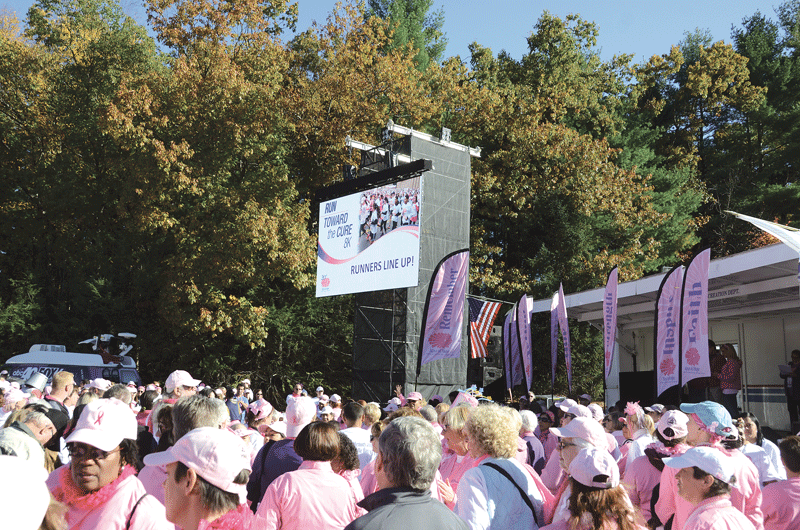
Still, Garand believes the project is an overall benefit to the region, and his union has already begun to partner with MGM on job fairs and is promoting its apprenticeship program for teens at area vocational schools, so they can find work opportunities right after graduation.

“When Baystate did its $250 million expansion, they had a firm commitment to use a certain percentage of local labor, and they exceeded that number by almost 50%,” Ciuffreda said. “It’s clear from the finished project that the quality of local workmanship is high. I think MGM knows that was the last big building project done in the area, and my sense is, they’re committed to local labor.”

Joseph Bednar can be reached at [email protected]

Agenda Departments

Soul Food & Jazz Luncheon
Feb. 27: Springfield Technical Community College will present its annual Soul Food & Jazz Luncheon from 11:30 a.m. to 2 p.m. on the seventh floor of Scibelli Hall. The event will feature the smooth sounds of Rohn Lawrence. Tickets are $5 per plate at the door. All proceeds will benefit the STCC Warms Hearts Fund. The event is sponsored by the Diversity Council at STCC.

Dark Dining Room House Concert Series
March 1, April 5, May 3: This winter and spring, Dark Dining Room brings the warmth and coziness of your living room to the grandeur of Wistariahurst. Concert curators Matthew Larsen and Greg Saulmon will serve up several courses of local and national musicians over the first Saturdays of March through May. While no dinner will be served, there will be light refreshments provided by Tony Jones Catering, as well as a cash bar. Doors open at 7 p.m. for all shows. Reservations are suggested. Tickets cost $18 ($15 for members) and can be purchased online at wistariahurst.org or by calling the museum at (413) 322-5660. The March 1 concert features Heather Maloney, who boasts influences and roots in adventurous folk. Rosary Beard, whose intricately intertwined acoustic guitars skate a thin line between melancholy reflection and uplifting release, will open the show. On April 5, Dark Dining Room introduces Colorway, a power trio fronted by Western Mass. native F. Alex Johnson. Introspective songsmith and acoustic guitarist Mark Schwaber opens the show. The final concert on May 3 features acoustic guitarist David Berkeley, a Santa Fe-based troubadour who brings his version of Americana to the stage. Matthew Larsen and the Documents open the show with introspective piano pop layered with careful instrumentation and thoughtful harmonies. For more information about the Dark Dining Room House Concert Series, go to darkdiningroom.com. This program is supported in part by a grant from the Holyoke Cultural Council, a local agency which is supported by the Massachusetts Cultural Council.

Celebrate Springfield Dinner Event
March 12: DevelopSpringfield will host its third annual dinner event in celebration of Springfield and the many accomplishments the community has achieved over the past year, along with the exciting new initiatives underway. The event will take place from 6 to 9 p.m. at the MassMutual Center in Springfield. Festivities will include a reception with live music by the Eric Bascom Trio and a silent auction, followed by dinner, a brief program, and presentations. Specifically, DevelopSpringfield will present its Partner in Progress Award to recognize the outstanding contributions of three individuals toward revitalization in Springfield: Colleen Loveless, executive director of Rebuilding Together; Terry Powe, principal of Elias Brookings Elementary School; and Mark Tolosky, president and CEO of Baystate Health. Platinum sponsors of the event are MassMutual Financial Group, Baystate Health, and Health New England. All proceeds will support DevelopSpringfield’s redevelopment initiatives, projects, and programs. About 400 attendees — including federal, state, and city officials; leaders from the business and nonprofit communities; and local residents — are expected to come together in support of ongoing efforts to advance development and redevelopment projects, stimulate and support economic growth, and expedite the revitalization process in Springfield. Registration information is available at www.developspringfield.com or by contacting Paige Thayer at (413) 209-8808 or [email protected].

Difference Makers 2014
March 20: The sixth annual Difference Makers award program, staged by BusinessWest, will be held at the Log Cabin Banquet & Meeting House, honoring these five individuals and organizations: the Gray House; Colleen Loveless, executive director of the Springfield chapter of Rebuilding Together; the Melha Shriners, Paula Moore, teacher at Roger L. Putnam Vocational Academy and founder of YSET Academy; and Michael Moriarty, attorney and director of Olde Holyoke Development Corp. Their stories are told in the Feb. 10 issue of BusinessWest and online at www.businesswest.com. More details on the gala event will be published in upcoming issues of the magazine, but tickets cost $60, and tables of 10 are available. Difference Makers is a program, launched in 2009, that recognizes groups and individuals that are, as the name suggests, making a difference in this region. Event sponsors include Baystate Medical Center, Health New England, First American Insurance, Meyers Brothers Kalicka, Northwestern Mutual, Royal LLP, Sarat Ford, and Six-Point Creative. For more information, call (413) 781-8600.

Employers Assoc. Management Conference
April 2: Accountability is a hot issue in today’s business world. At the Holiday Inn in Enfield, Conn., the Employers Assoc. of the NorthEast (EANE) will hold its 10th annual management conference, called “It’s All About Accountability.” The conference will address personal accountability and responsibility in achieving organizational results, based on Linda Galindo’s bestselling book, The 85% Solution. EANE is bringing to the area Kathleen Kelly, a master certified facilitator in ‘the Accountability Experience.’ She will teach supervisors and managers how to develop accountability and learn to accept no less than 85% responsibility for the outcomes of their actions. Conference breakout sessions will include: “The Five Dysfunctions of a Team,” “Taking the ‘Difficult’ out of Difficult Conversations,” “Tom’s Fired: Where Did Things Go Wrong?” “Taking Ownership for Your Own Professional Development,” “Digging Deep: Performance Improvement Through Real Coaching,” and “Ethical and Legal Obligations of Managers in Solving Workplace Issues.” For more information about the conference, contact Karen Cronenberger at (877) 662-6444 or [email protected]. To register, call (877) 662-6444 or visit www.eane.org.

Sections Technology
As Speech-recognition Technology Improves, More Applications Emerge

SpeechRecogSpeech-recognition technology, which instantly translates human speech into a digital document or command, has been around in some form for about two decades. But constant improvements in performance — as well as a broading of its applications — have users excited about the future.

That performance is typically measured in accuracy and speed, but various factors have complicated the former, from the vocabulary size of the software to the rate of speech; from accented or disjointed speech to background noise.

Dragon NaturallySpeaking, produced by software developer Nuance, has long been considered the gold standard in minimizing such issues.

“At first, speech-recognition packages were more like frustrating toys with maddening limitations, but they have steadily improved over time,” writes Lamont Wood in Computer World, in a discussion about NaturallySpeaking 12, the newest Dragon product. He said the utility of speech recognition didn’t outweigh its limitations until about a decade ago, but even then, speech recognition was more reliable with long words than with short ones, misinterpreted words were often rendered as commands, and the software occasionally got confused to the point that it stopped listening.

With version 12, he notes, “these factors have faded into the background (although they they haven’t entirely disappeared). For example, you can dictate effectively at about half the speed of an auctioneer — should you prove able to do so. Assuming that you stay focused while dictating, the error rate is now trivial.”

That’s important for people who use speech recognition in a variety of fields, including:

Healthcare. The technology speeds up the transcription process by allowing a medical professional to dictate into a speech-recognition engine and cleaned up by an editor on the back end.
Military. Speech recognition has been tested successfully in fighter aircraft, with applications including setting radio frequencies, commanding an autopilot system, setting steer-point coordinates and weapons-release parameters, and controlling flight display.
Air-traffic control. Many air-traffic-control training systems require a person to act as a pilot and dialogue with the trainee. Speech recognition could potentially eliminate the need for that pseudo-pilot, thus reducing training and support personnel.
Aerospace. NASA’s Mars Polar Lander used speech recognition in some applications.

Other uses are common as well, including court reporting; assistive devices for automobiles, such as OnStar and Ford Sync; hands-free computing; robotics; video captioning for television; and interactive video games — just to name a few.

Taming the Dragon?

Dragon isn’t the only player in the field, however. “Simpler or less expensive (if not quite as powerful) options are carving out little fiefdoms,” writes Mark O’Neill in PC World. “The more choices, the better, too, given that using voice commands can stave off or reduce repetitive strain injuries. The spoken word also suits some projects better than typing.”

Among the lesser-known options are:

Windows Speech Recognition, which arrives preinstalled with newer versions of Windows. “Performance could stand some improvement,” O’Neill notes. “I found the accuracy level dipped when I dictated long texts into a MS Office doc. Nor did it respond well to my German accent, so other accents may stymie it as well.”
Google Voice Search, which works on a Google Chrome browser, which is “fairly good at recognizing what you said.”
TalkTyper, an online app with far fewer features than Dragon. “Even when I spoke clearly, it tripped up on some of the words, and I wasn’t exactly dictating rocket science. TalkTyper should be used only for simpler stuff, shorter spoken content — maybe an email or a tweet here and there.”
Tazti, an app that goes beyond simple transcription. “Rather than taking dictation, Tazti takes orders. It helps you control games, open apps, and even use the command line,” O’Neill notes. “However, Tazti’s one big drawback is it won’t let you dictate text to a document. It’s not that kind of voice recognition.”

Using voice recognition for commands is increasingly common in automobiles. Although these systems are largely user-friendly, drivers still have to rely on set commands when summoning a phone number or searching through music. But Nuance says systems that recognize true natural language with 95% accuracy are probably no more than three years away.

“I believe the biggest gains to be made are going to be in conversational speech and understanding the intent of what the user is trying to accomplish,” Brian Radloff, the company’s director of Automotive Solution Architecture, told Satellite Radio Playground. “We’re starting to see that in telephony in the mobile space.”

He said strides will come when car makers treat their infotainment systems more holistically, with screen graphics properly tying into speech control. “The bulk of the focus over the next five years in the automotive space, and in voice in general, is going to be, how do we take this experience that is very good for a certain group, and make it very good for a large swath of the car-buying public?”

Meanwhile, Wells Fargo recently began testing voice-recognition technology that banking customers can use to check their spending habits and account level. In addition, U.S. Bank has been testing the technology among its employees, and some insurance companies, including Geico and USAA, have incorporated voice recognition in their applications, according to the Charlotte Observer.

Shirley Inscoe, a senior analyst with Aite Group, a national research and advisory firm, said such advances are closely tied to the rise in mobile devices and consumers demanding to do more with them. “There’s a big desire to improve customer service. They know we as consumers don’t go anywhere without our mobile phones. It really is a way to tie a customer more closely to the financial institution.”

Other advances in voice recognition go well beyond finance and leisure activities. For instance, two MIT students recently spent their winter break in New Jersey developing a device that could give paralyzed people the ability to call for help with the sound of their voice or change the settings on their wheelchair when no one is around. They were inspired by retired physics professor Michael Ogg, who has multiple sclerosis.

“My real limitation now is because of MS. I’m completely quadriplegic. I’m just not able to move my arms and legs at all,” Ogg told the Asbury Park Press.

He relies on home health aides for daily assistance, but when he is alone, he cannot reach an alarm by his bed to summon aid. “In the case of … being able to call for help,” he said, “this is potentially life-saving technology.”

Speak Clearly

Whichever voice-recognition software one uses, Wood offers a few tips to make the technology easier and more effective, including enunciating carefully and speaking slowly enough so that each word gets its due; watching the results on the screen as you go along, which can enhance accuracy; and taking heed of background sounds.

“Background silence is best, but droning ventilators hurt recognition more than office chatter,” he writes. “Meanwhile, if you don’t mind being overheard on the phone, then you won’t mind being overheard while dictating. You can use about the same volume for the phone and for speech recognition.”

Put that way, the ever-improving realm of speech recognition can be thought of as just another office function, as it’s increasingly assimilated into many corners of the world, from gaming to aviation to healthcare — a life enhancer for some, but for others, potentially a life-saving development.


— Joseph Bednar

Features
Western Mass. Is Fertile Ground for Dog Businesses

Joanne Nunes, a therapist at Fitter Critters

Joanne Nunes, a therapist at Fitter Critters, helps Crash, an English springer spaniel who injured a leg last year, regain strength in the pool.

Twenty years ago, Beth Ostrowski-Parks’ career went to the dogs.

“I was in property management, and I hated it,” she said. “I hated everything about it.”

Around the same time, she and her husband, Wayne, had become involved in rescuing greyhounds. “That was my entry into the dog world. I had heard a lot of sad stories and did a lot of rescues. We went up to Hinsdale and took dogs out of the track who were ready to go.”

Her first greyhound was an obedient, extremely easygoing dog, but the second was the polar opposite. “She was in tough shape and full of traumas. We had to do some searching to figure out how to solve some of those problems. I knew nothing about dogs; I wasn’t one of those people who had been involved with dogs their whole life.”

The experience of training that dog, paired with her dissatisfaction with her job, led Ostrowski-Parks to start thinking about starting her own dog-training business. So she became certified at a training school in Connecticut, and she and Wayne started their enterprise in a 1,000-square-foot storefront in Easthampton, all the while looking for something more permanent.
“We looked for a property where we could build a small — a small — building to have a few classes a week,” she said, jokingly emphasizing that word because her current site, which features 5,000 square feet of training floor and additional space for grooming and day camp, is anything but. Today, the business — known as It’s PAWSible! — sits on a formerly undeveloped five-acre plot in Westhampton; they also built a home next door, where they board clients’ dogs overnight.
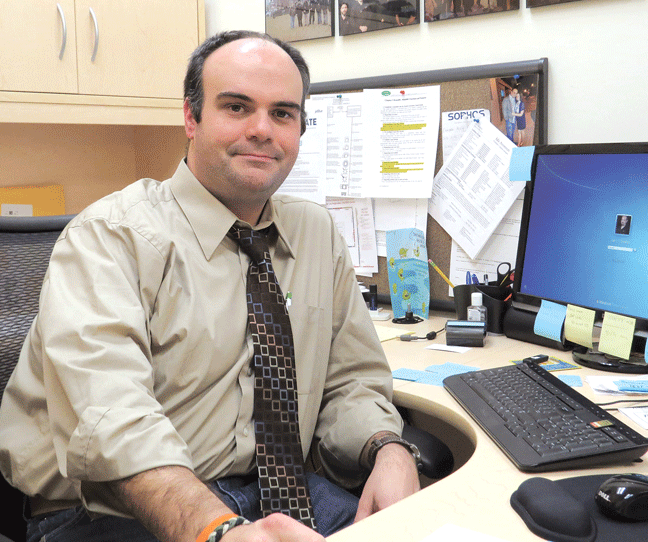
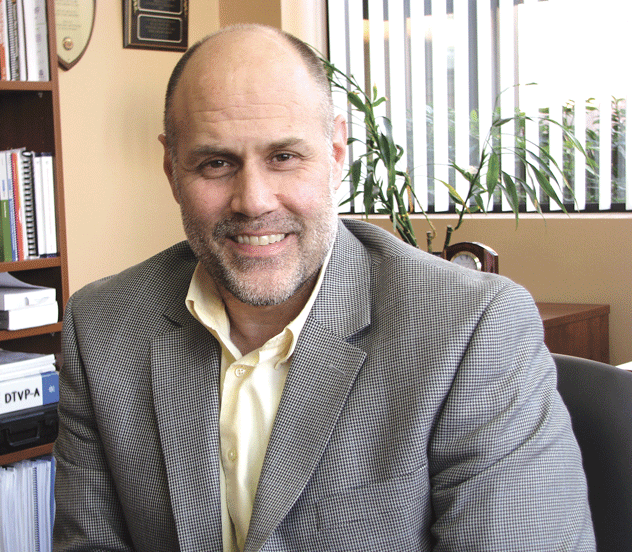
A few years before Ostrowski-Parks got the itch to change careers, Debbie Guntly and a friend were looking for an indoor area to train their own dogs. They came across a much bigger space than they needed, in a large industrial building in Chicopee, and decided to forge a business venture.

Beth Ostrowski-Parks

Beth Ostrowski-Parks has seen steady growth in her training, grooming, boarding, and especially day-camp services.

“We figured we could offer classes to pay the rent, and have a nice indoor facility to train,” she said. “What started as a place to train our own dogs ended up as a training center. In the beginning, it was beginner obedience and confirmation.”

Later, the business she called Exercise Finished was the first in the area to offer classes in puppy training, followed by forays into breed handling, agility, and, most recently, the scent-and-search activity known colloquially as nose work.

“It hasn’t grown as much as I would have liked,” Guntly said of the business, “but when we started, we were the only game in town. So many training centers have opened up since then — but we’ve held our share of the market.”

In fact, she said, demand for training services has grown in near-direct proportion to the number of enterprises cropping up across the region. “We wouldn’t be able to serve such a demand ourselves.”

Monica Percival has also seen interest surge in dog training — in her case, training for the sport known as agility, in which dogs navigate a timed obstacle course. During a sabbatical from her job in 1988, she signed her puppy up for a class in the then-obscure activity. Soon, she was competing in weekend trials and training other dogs on the side.

In 1995, that turned into a business called Clean Run Productions. At first, the business had a single revenue stream: a weekly newsletter — Xeroxed and hand-stapled — for agility enthusiasts. The initial subscription base totaled 30. “But we slowly built it into a magazine,” she said, serving well over 10,000 subscribers.

Soon after launching Clean Run magazine, Percival started producing books and DVDs, as well as a small-scale operation selling dog toys and other products at competitions. “We used to fit it all in a car, in little boxes. Then we got a little trailer. And when it didn’t fit anymore, we got a bigger trailer.”

In effect, she said, “we went from a wagon to a 20,000-square-foot warehouse” on Industrial Drive in South Hadley.

Percival is far from the only dog enthusiast to trod new business ground in Western Mass., however. In 1999, Jody Chiquoine launched the first canine rehabilitation facility in Massachusetts, and one of only a handful across the U.S.

Then a family nurse practitioner who had built a varied, 13-year career in various rehab settings in Greater Springfield, she, like Ostrowski-Parks, was actively looking for a career change.
“I wanted to step away from the healthcare system and see if there was something else I could do with the second half of my life,” Chiquoine said. “And I started spending more and more time with my dogs. I’ve had dogs all my life, and I’ve always been interested in the health aspects of dogs … I guess I really wanted to do something with dogs.”

One day, she had a brainstorm — “I told my husband, ‘I want to put an addition on our house, and put in a swimming pool and gym, and do rehab for dogs.’ It was a completely original idea for me.”

The growth of that endeavor, called Fitter Critters and based in Lee — and the success of the other business owners who spoke with BusinessWest — speak to a growing canine culture in the region over the past two decades, one that has brought with it some real opportunities for dog lovers willing to take a chance and turn their passion into a career.

Course of Action
Much of that culture centers around the sport of agility, which was born in England in the 1970s and gained a small foothold in America about 30 years ago, leading to the development of several governing bodies and an explosion in competitive events in all skill levels.

In agility, a handler guides a dog through a series of jumps, tunnels, tire jumps, weave poles, and ‘contact’ obstacles like a seesaw, dog walk, and A-frame. The sport’s rise certainly vindicated Percival’s decision to launch Clean Run magazine.

Still, “what caused the biggest leap in growth of this company was when we started to publish outside the magazine — DVDs and books that supported dog agility,” said Pam Green, the company’s accountant, noting that the late ’90s represented the sport’s most significant surge of interest. “People were reading any information they could get their hands on about the sport, then the magazine began to advertise products we were carrying in the store.”

Percival said agility clubs were popping up, but few people knew how to lead classes, and many clubs started relying on the magazine for lesson plans. “We started getting people in different parts of the country communicating with each other.”

That initial growth continues today. “We used to go to trials once a month. Now you can go to multiple trials on the same weekend in the same area,” she said, adding that the availability of open land in Western Mass. — as well as many rentable horse barns and indoor soccer facilities — has made the region especially fertile ground for the sport.

Aided by a robust Internet arm, Clean Run’s retail business has grown consistently each year — not surprisingly, as the average competitive agility handler enters between 12 and 18 events per year and spends more than $4,000 annually on their hobby. “Initially the magazine drove the business, and then we started to identify products that people couldn’t get easily elsewhere,” Percival said, “So now, really, the retail business drives everything.”

Green added that “most people come to this warehouse based on word of mouth, and of course, we have a great support system with all the pet-related companies in the area. In that respect, this has been a good location, because there are a lot of us around here.”
It’s PAWSible! is certainly one of those, and Ostrowski-Parks calls Clean Run her “idol,” noting that the two companies’ websites are hosted by the same company.

Before building the Westhampton facility, she and her husband traveled across the Northeast looking at different dog-training centers, adopting ideas such as her rubber flooring laid over tamped gravel. “I knew I wanted to have agility, but I didn’t know anything about it,” she said, so she eventually hired trainers.

“The agility, actually, is such a small part of this business. If I didn’t do agility with my dogs, I probably wouldn’t even have it anymore because it’s not a money maker — at least not here,” she said, noting that she teaches the classes herself these days. “Our main focus is the pet owner bringing their dogs for the day for our day camp; that’s well over 50% of our business. It feeds everything — the grooming, the boarding at our house, it feeds so many things.”

She said that business model has bred success beyond her expectations. “Every year, we’ve increased our income. Part of it is because I take it and put it right back into the business. We just did a computer upgrade for $2,000, and made an $85,000 purchase of a grooming van for our mobile grooming service. You have to keep spending money.”

She also credits a reputation for customer service and how she treats the staff — “I’ve got several people who have been here for five years or more” — as well as strict rules about which dogs are allowed at the day camp.

“For me, it’s safety first — we have packs of dogs playing, but we’ve never had a bad incident in 14 years. I think it’s pretty amazing. It’s all selection — no aggression, no problem behaviors.”

Human Touch
As a rehab professional, Chiquoine deals with different kinds of dog problems. She said the seed for Fitter Critters was actually planted five years before she decided to go into business.

“I had a Newfoundland who fractured her humerus. I remember the vet saying, after it was pinned, ‘take her home and give her good, supportive care.’ I said, ‘what supportive care?’” she recalled. “If you’re a rehab client, they tell you what to do. I thought, there should be therapists for dogs.”

Dogs train at Exercise Finished

Dogs train at Exercise Finished in sports like agility (pictured) and nose work, but also in basic manners, puppy obedience, and much more.

Intent on providing some kind of post-surgical therapy, she took her dog swimming and worked out some exercises based on her experience with people. The dog had a good outcome, and the idea was born.

Chiquoine visited a number of human rehabilitation facilities and envisioned through a dog’s eyes what her gym would need. Later, she found a canine rehab class in Concord, N.H. “I thought, ‘oh my God — there’s someone else on the planet who has thought about this.’ So I went to the class.” Later, she was certified, through programs based in Tennessee and Florida, as a certified canine rehabilitation therapist.

Fitter Critters helps dogs with medical conditions of all types, from hip, knee, and other joint issues to surgery recovery and early muscle development. In addition to the indoor therapeutic pool, which uses different levels of current for resistance, she installed a water treadmill three years ago, which is especially effective for dogs that fear being completely immersed. Clients are also given home exercises, like stretching and massage, to continue their dogs’ progress during the week.

“Our claim to fame — why people come here — is that we use water a lot differently than most places,” she said. “We use all the physical properties of water to affect the therapy of dogs. The dogs are not just swimming around the pool. We use the pool like other people use the gym. If we think doing circles will improve a limb, we’ll work on circles. We work on neurologically impaired dogs that can’t stand; we’ll do standing exercises in the pool, because they can do things easier in the pool than they can on land, which speeds recovery. It’s not like we get dogs in the water and just let them swim for awhile.”

Like the other company owners who spoke with BusinessWest, Chiquoine said people in Western Mass. do seem to be more dog-focused than they used to be, but she also credited a regional openness, at least in the Berkshires, to complementary therapies.

“As more and more people see the benefit of physical therapy for themselves, especially people who have had water therapy, they figure, ‘why wouldn’t you do this for your dog?’

“When we started, it was a very, very novel concept. Veterinarians would say, ‘why do they need rehab? We’ve done surgery like this for years.’ Well, it’s not like dogs won’t heal, but with therapy, there are fewer complications, less risk of injury,” she continued, noting that, when she began, data was largely anecdotal, but since then, plenty of research has backed up the value of canine rehabilitation. “Today, we have at least as many vets telling people to call us as people who find us by word of mouth.”

Building a Bond
Guntly said she also enjoys seeing dogs improve — in her case, improve their manners and sporting acumen. “I like seeing their relationships with their owners, especially when someone might be having a hard time, struggling, and then seeing them turn around and have a positive relationship with their dog.”

She cited one student — among many similar stories — who came to Exercise Finished to teach her Labrador retriever basic manners, then started playing around with agility just for fun. “The dog started doing well, and now she’s competing in agility and having a blast doing it.

“Dog sports, especially agility, are growing by leaps and bounds; you see it on TV and hear about it more,” she continued, adding that it’s not just agility growing in popularity, but also training of all types. “It seems like more people are getting involved just for the basic beginning obedience. Years ago, they didn’t think about going to places for training.”

Ostrowski-Parks agreed. “The world has changed; this region has changed,” she said. “It’s very dog-friendly.”

For a business owner, that breeds competition, but she’s survived so far. “I’ve seen three or four places in this area come and go. When at first somebody opens, you feel that gnawing in your stomach. But our reputation is stellar.

“Honestly,” she added, “it’s because Wayne and I are workaholics. We’re driven. We’re very proud when we look around here and think about how this place was just grass before. It’s pretty cool.”

Joseph Bednar can be reached at [email protected]

Autos Sections
Auto Dealers Expect Sales to Accelerate in 2014

By MICHAEL REARDON
CarSalesDPartWith the recession in the rear-view mirror, the automobile industry is poised for another successful year fueled by a stronger economy and high demand.
While sales and leasing were strong last year, 2014 is predicted to be even more robust, according to local auto dealers and industry analysts. The good news for buyers is that they are still clearly in the driver’s seat.
“This will be a great year to be a consumer,” Mike Balise, vice president of Balise Auto Group, told BusinessWest. “There’s a real battle for market share. The price of cars will go down this year. The interest rate is the only area that will make things more expensive, but probably not this year.”
According to Don Pion, owner of Bob Pion Buick GMC in Chicopee, January is traditionally a slow month at his dealership because of the wintry weather, holiday credit-card bills arriving in the mail, and people curtailing their shopping. This year was different, though.
“Our numbers in January of this year were substantially ahead of January 2013,” Pion said. “From everything I see, 2014 will be a very good year for the auto industry. Last year was the first real strong year we had in a number of years; it was a good year for the auto industry in general, and 2014 will be better.”
Indeed, industry analysts J.D. Power’s Power Information Network and LMC Automotive teamed up on a study which predicted that new-vehicle sales would rise 3% in January 2014. The joint study stated that consumers purchased 847,000 new vehicles last month, the most January sales since 2004. According to the J.D. Power and LMC Automotive forecast, consumers are spending an average of $29,500 on new cars and trucks, approximately $300 more per vehicle compared with the same time period last year.
Based on January sales, analysts believe the coming year will be strong. LMC Automotive is predicting 16.2 million light-vehicle units will be sold in the U.S. in 2014, an increase of 600,000 vehicles over 2013, and the most overall since 2007. More than 85 million vehicles were sold worldwide last year, with Toyota taking the lead.

Chip Gengras (right, with shop foreman Alan Riccardone)

Chip Gengras (right, with shop foreman Alan Riccardone) says the recession hit every car dealer, but he expects sales at BMW of West Springfield to surge this year.

The average age of cars on the road is 13 years, as consumers largely stopped buying new cars when the recession hit. Local auto dealers believe 2014 will be the year when buyers open their wallets and replace their older models.
“There’s a little bit of a pent-up demand,” said Rob Pion, Don’s son and the dealership’s service manager. “For awhile, people were not buying vehicles. They were waiting for the economy to turn around. Sales this year will be somewhat based on need.”
Chip Gengras, president of Gengras Motor Cars, is so confident in the strength of the auto industry that he is setting a sales-increase goal at his BMW of West Springfield dealership higher than the one set by BMW of North America.
“BMW sold 309,000 units in the United States last year,” Gengras said. “The U.S sales increase goal for this year is 10%. Our goal is a 15% increase in sales.”
This is quite a contrast to where Gengras started when he bought BMW of West Springfield in August 2008, two weeks before the banking collapse ushered in the economy-crushing Great Recession.
“The recession impacted every car buyer and dealer,” he said. “People who bought BMWs stopped. People held onto their cars longer.”
Analysts predict new-car sales will rise 5% in 2014, but Balise believes sales in the Northeast will go up about 1% or 2%.
“North America is still the world’s biggest new-car market,” he said. “You will see growth this year.”
On Jan. 12, Jim Lentz, CEO of Toyota North America, told the Society of Automotive Analysts Automotive Outlook Conference in Detroit that the industry will begin a  “leveling off” period in sales, but an increasingly stronger economy will make 2014 another great year for the auto industry.

Buy the Buy
Balise, Don Pion, and Gengras are all owners of long-established area car dealerships and have weathered many ups and downs. Balise’s grandfather, Paul, started the family’s first dealership in 1919 in Hatfield. The business then moved to Front Street in Chicopee, where it was called Balise Motor Sales. Balise Chevrolet opened in Springfield, across the street from its current location, in the 1930s.
Today, Balise Auto Group sells a variety of domestic and foreign vehicles at more than 20 locations in Massachusetts and Rhode Island, and employs 1,050 people.

Mike Balise

Mike Balise says a heated battle for market share makes this a good year to be a car buyer.

Don’s father, Bob, started Bob Pion Buick GMC in June 1977 on Front Street in Chicopee in what was formerly Charapek Pontiac. The business added GMC to its line in 1990 and Buick in 1995. Bob Pion Buick GMC moved to its present location at 333 Memorial Dr. in Chicopee in 1991.
Today, Gengras Motor Cars is operated by Chip and his brother Jonathan. The company was launched in Hartford as a Lincoln dealership in 1937 by their grandfather, E. Clayton Gengras. E. Clayton (Skip) Gengras Jr. took over the business in the early 1970s.
The company currently boasts seven dealerships that sell a variety of domestic and foreign vehicles, and has 350 employees.
All three of the local auto dealers are confident that used-car sales are also slated to remain strong this year, although it is harder to find quality pre-owned vehicles. Don Pion said he has seen significant growth in the sales of certified used cars. Certified used-car features such as maintenance packages and extended warranties offer the customer a level of comfort that the vehicle is of good quality and will be well taken care of.
“It’s a nice product to offer customers with a lot of protection for them,” Pion said. The challenge with used cars is availability. Nice used cars are at a premium now.”
Gengras agreed, saying that reconditioned, certified vehicles that meet the manufacturers’ standards will be attractive to buyers looking for quality at lower prices.
However, while “leasing will stay hot and is a great value,” Balise said, finding an inexpensive used car “is almost impossible.”
Leasing became popular during the recession when people who would normally buy a new car instead opted to lease for a lower price. This trend is also expected to remain popular this year, as leasing options continue to remain affordable.
These days, customers can get a one-price lease package that not only includes the vehicle, but also features like OnStar and maintenance and service. Because leasing is affordable and is for a finite period of time, it is a good way for dealers to showcase an automobile and for consumers to drive something out of the ordinary.
“Leasing entices people to try the product,” said Pion, noting that Bob Pion Buick GMC averages about 50 units of sales and leases per month, and roughly half of those are leased.
Gengras said the numbers are about the same at his dealership.
“It gives you the opportunity to take advantage of cars that maintain their value,” he said. “You’re getting more vehicle for less money.”
Several trends have emerged in the auto industry over the past few years, and many will continue in 2014. Among them is a movement toward more and more people going online, not just to research different cars they might be interested in purchasing, but to visit a dealership website and select a vehicle, figure out payments, choose accessories, and more. “Customers have more power than ever to make these choices,” Balise said.
The car-buying experience is going mobile in another way, as customers are increasingly using their smartphones to do their shopping.
“It used to be people used their desktop computers; now it’s more mobile,” Gengras said. “Texting is starting to become prevalent; it’s the easiest way to get in touch with customers. But I can’t imagine a day when people won’t come into the showroom. Buying a car is such an emotional and significant purchase. People want to come in and feel the acceleration, feel the leather, hear the stereo.”
Another trend Pion has witnessed is customers who are willing to move to a smaller vehicle than in the past, but are not willing to sacrifice luxury. Manufacturers have responded.
“Over the past two or three years, things have been trending that way,” he explained. “You see a high level of content and luxury in smaller packages today.”
Rob Pion (right, with Evan Stoddard, business manager, and Joe Soucy, sales manager)

Rob Pion (right, with Evan Stoddard, business manager, and Joe Soucy, sales manager) says Bob Pion Buick GMC is seeing some pent-up demand.

Fuel economy is an ongoing priority that has become deeply rooted in the car-buying experience. While hybrid vehicles have become very popular, electric cars have not caught on.
“Electric cars are less popular because there are certain limitations to those vehicles that technology has not solved yet,” Balise said. “Performance is great, but length of travel and how long it takes to charge electric vehicles are an issue.”
Active safety features are constantly improving, as manufacturers are now including items that stop the vehicle when it is in danger of crashing into the car in front of it, or side-hazard-monitoring systems that lets the driver know when a vehicle is in his blind spot.
And customer service has become a major selling point for car dealers over the past few years. Customers have myriad ways of finding information about vehicles, so auto dealers must offer them a great experience when they come through the door, from attractive showrooms that offer amenities like wi-fi to extended hours for sales and service departments, to servicing cars quickly.
An example is BMW Genius, a program that includes highly informed client advisors that provide information about the products in a no-pressure way, especially high-tech features, Gengras said.
“We want to be friendly, efficient, and informative. We’re respectful of people’s time. We’re customizing the experience around what the customers want more today than ever before.”
Since vehicles are much more sophisticated these days, Balise noted, it is incumbent on dealers to make sure their employees in all departments are highly trained and up to date on the latest technology.

Drive Time
In the end, it all comes down to the quality of the cars in the showroom or on the lot, said those we spoke with. In this highly competitive environment, dealers cannot lure customers onto their lots and close a deal unless their manufacturers produce highly desirable vehicles.
“The most important thing is the product; the second-most important thing is customer service,” Pion said.
With those two elements of the equation standard, dealers are expecting 2014 to be another banner year.

Agenda Departments

YMCA Annual Dinner
Feb. 12: Community members will gather at Mill 1 at Open Square for the Greater Holyoke YMCA’s 2014 Annual Dinner. The dinner celebrates and honors those who give unselfish gifts of time and energy to the community. This year’s Louis F. Oldershaw Community Service Award recipient is Attorney Mark Beauregard. The Oldershaw Award is given to an individual who has made significant volunteer contributions to the community and emulates a high standard of excellence in his or her life, professional achievements, and community service. The Y will also recognize the generous volunteer contributions of Joanne and Scott Harper of South Hadley, recipients of the Y’s 2014 Distinguished Service Award. The Harpers have volunteered with the Y’s Viking Swim Team for many years and have been instrumental in the team’s success. The Annual Dinner is $40 per person. Those interested in attending may either call the Y to register at (413) 534-5631, ext. 126, or visit the Y’s website at www.holyokeymca.org to register and pay in advance.

ACCGS Outlook Luncheon
Feb. 24: Join the Affiliated Chambers of Commerce of Greater Springfield for the region’s largest legislative event, discussing the most pressing local, regional, and federal issues of the day. The luncheon is slated for 11:30 a.m. to 1:30 p.m. at the MassMutual Center. The keynote speaker is Ed Henry, White House correspondent for Fox News. Presented by Health New England and sponsored by Eastern States Exposition, MassMutual Financial Group, PeoplesBank, United Personnel, Western Massachusetts Electric Co., Chicopee Savings Bank, and Verizon, as well as reception sponsors Comcast, the Sisters of Providence Health System, and the Republican, Outlook typically attracts more than 700 guests. Area elected officials will also be in attendance to participate in this discussion of front-burner issues. Tickets are $50 for ACCGS members and $70 for general admission. Reserved tables of 10 are available. Reservations must be made in writing and in advance by Feb. 14. Reservations may be made online at www.myonlinechamber.com, by e-mailing Cecile Larose at [email protected], or by faxing a reservation request to (413) 755-1322.

Dark Dining Room House Concert Series
March 1, April 5, May 3: This winter and spring, Dark Dining Room brings the warmth and coziness of your living room to the grandeur of Wistariahurst. Concert curators Matthew Larsen and Greg Saulmon will serve up several courses of local and national musicians over the first Saturdays of March through May. While no dinner will be served, there will be light refreshments provided by Tony Jones Catering, as well as a cash bar. Doors open at 7 p.m. for all shows. Reservations are suggested. Tickets cost $18 ($15 for members) and can be purchased online at wistariahurst.org or by calling the museum at (413) 322-5660. The March 1 concert features Heather Maloney, who boasts influences and roots in adventurous folk. Rosary Beard, whose intricately intertwined acoustic guitars skate a thin line between melancholy reflection and uplifting release, will open the show. On April 5, Dark Dining Room introduces Colorway, a power trio fronted by Western Mass. native F. Alex Johnson. Introspective songsmith and acoustic guitarist Mark Schwaber opens the show. The final concert on May 3 features acoustic guitarist David Berkeley, a Santa Fe-based troubadour who brings his version of Americana to the stage. Matthew Larsen and the Documents open the show with introspective piano pop layered with careful instrumentation and thoughtful harmonies. For more information about the Dark Dining Room House Concert Series, go to darkdiningroom.com. This program is supported in part by a grant from the Holyoke Cultural Council, a local agency which is supported by the Massachusetts Cultural Council.

Difference Makers 2014
March 20: The sixth annual Difference Makers award program, staged by BusinessWest, will be held at the Log Cabin Banquet & Meeting House, honoring the five individuals and organizations featured in the special section of this issue. More details on the event will be published in upcoming issues of the magazine, but tickets cost $60, and tables of 10 are available. Difference Makers is a program, launched in 2009, that recognizes groups and individuals that are, as the name suggests, making a difference in this region. Event sponsors include Baystate Medical Center, Health New England, First American Insurance, Meyers Brothers Kalicka, Northwestern Mutual, Royal LLP, Sarat Ford, and Six-Point Creative. For more information, call (413) 781-8600.

Construction Sections
Expert in Eco-friendly Construction Offers 10 Trends to Watch in 2014

GreenConstructionWhat are the major trends likely to affect the green-building industry and markets in the U.S. in 2014? Jerry Yudelson thinks he knows the answers.
Yudelson, a LEED fellow, is the founder of Yudelson Associates
and is recognized as one of the nation’s leading green-building and sustainability consultants and speakers, as well as the author of 13 green-building books. In 2011, Wired magazine dubbed him the ‘Godfather of Green,” and he annually releases a top-10 list of green-building megatrends. Here are this year’s trends to watch:
1. Green building in North America will continue its strong growth in 2014. Yudelson predicts ongoing expansion of green commercial real-estate construction together with government, university, nonprofit, and school construction. “Green building is the tsunami of the future that will inundate the entire real-estate industry,” he notes.
Other studies back up this perception, including one last summer from from McGraw-Hill Construction reporting that the percentage of retail and hospitality developers building green for more than half of their projects rose from 18% in 2011 to 38% in 2013 — and is expected to jump to 52% by 2015.
In addition, 65% of retail owners and 73% of hotel owners say they use green operations and maintenance practices, citing a number of business benefits. In fact, according to McGraw-Hill, building green reduces operating costs by 8% to 9% on average, increases building value by 7.5%, improves return on investment by 6.6%, and increases occupancy ratios by 3.5% and rent ratios by 3%.
“Green building has taken such hold in the industry that even sectors with unique challenges, such as retail and hospitality, are making stronger investments,” said Harvey Bernstein, vice president at McGraw-Hill. “Clearly, the benefits that owners are reporting are key reasons for their green-building investments, and as they find better ways to measure those impacts and quantify the value to their sales velocity and to the well-being of their staff, customers, and guests, we expect even more rapid engagement in green.”
2. We’ll see a growing focus on energy efficiency in all kinds of buildings, including the increasing role of building automation for energy efficiency using cloud-based systems. “The convergence of corporate and commercial real estate, information technology that is based in the cloud, and energy efficiency leads my list of new green-building megatrends for 2014,” Yudelson says.
3. Design and operation of zero-net-energy buildings will expand. According to Yudelson, “we know that green building has hit the mainstream. To distinguish themselves, many building owners and developers are taking the logical next step: getting to zero net energy on an annual basis. Why? The most widespread reason is that more people than ever believe it’s the right thing to do.”
4. LEED will attract competitors as never before. “It’s likely that LEED’s cost and complexity will open up the market to other competitors such as the Green Globes rating system offered by the Green Building Initiative,” Yudelson notes. One reason is that recent Obama administration actions have now put this system on a par with LEED for federal projects.
5. The focus of the green-building industry will continue its switch from new building design and construction to greening existing buildings. This trend has been in place since 2010, and Yudelson predicts that more than 500 existing federal buildings will seek green-building ratings in 2014.
6. Green buildings will increasingly be designed and managed by innovative information technologies that are based in the cloud. In fact, Yudelson calls 2014 “the year of the cloud” based on how quickly he believes this trend will become fully established.
7. Green-building performance disclosure will continue as a major trend, highlighted by disclosure requirements enacted in 2013 by more than 30 major cities around the country, laws that require commercial building owners to disclose actual green-building performance. Yudelson says he expects this trend to spread rapidly as the easiest way to monitor reductions in carbon emissions from commercial and governmental buildings.
“It should come as no surprise that cities and states are rethinking their approach to green building,” notes a recent report by the Initiative for Global Environmental Leadership, a project of Wharton College at the University of Pennsylvania. “Not only do buildings consume more than 40% of the energy in this country and more than two-thirds of the generated electric power, but in cities where effective transit systems take cars off the road, building energy use also accounts for the vast majority of greenhouse-gas emissions.”
8. Healthy-building product disclosure declarations, along with various ‘red lists’ of chemicals of concern, will become increasingly contentious. “Building product manufacturers will increasingly try to gain or maintain market share based on open disclosure of chemicals of concerns,” he said. “We also foresee that industry-developed disclosure systems will compete with systems offered by dozens of third-party rating agencies.”
9. Solar-power use in buildings will continue to grow. Yudelson expects that third-party financing offerings will continue to grow and provide capital for larger rooftop systems on low-rise commercial buildings, parking garages, warehouses, and retail stores, as well as on homes.
10. Awareness of the coming crisis in freshwater supply, both globally and in the U.S., will increase, as global climate change affects rainfall and water-supply systems worldwide. In his 2010 book about water conservation, Dry Run: Preventing the Next Urban Water Crisis, Yudelson discusses how this is being done in green buildings all over the developed world.
“Even without new laws,” the Wharton report notes, “forward-looking companies find options, such as the use of energy-services companies, green leasing, and affordable approaches to solar and other renewables. They’re motivated by more than ‘eco-correctness’; adding sustainable features reduces operating costs and often increases a building’s value and the rent levels it can command, though payback periods can be long.”
In fact, the report says, some in the industry are increasingly looking beyond modest green standards to the ‘net-zero’ strategy of constructing buildings that generate as much energy as they use.
“Cities are developing their own audit and energy management procedures, often using software unavailable 10 years ago,” the authors note. “Clearly, green building has gone from a feel-good exercise to an impending baseline for all construction.”

— Compiled from various sources

Agenda Departments

Ad Club Luncheon
Jan. 29: In the toughest of times, smart marketing is a must. Join John Chandler, chief marketing officer of MassMutual Financial Group, for the Advertising Club of Western Mass. Luncheon, starting at 11:45 a.m. at the Springfield Sheraton, 1 Monarch Place. Learn how this Fortune 100 financial-services company has used a straightforward, results-driven marketing strategy to help create six straight years of record sales results and expand into new markets, all during the worst economic downturn in more than a half-century. Chandler will share the company’s marketing principles and examples of its work that are driving marketplace success.
Registration begins at 11:45 a.m., and the program runs from noon to 1:30 p.m. Cost: $25 for members, $35 for non-members, and $15 for students. Parking is free in the Springfield Sheraton garage (bring your ticket or coin for validation). To reserve a seat, call (413) 736-2582 or e-mail [email protected] by Jan. 24.

DreamBuilder Workshop
Jan. 29: Would you like to discover your true dream or purpose in life; minimize fear, doubt, and worry; and move toward your goals with confidence and joy? Do you have a desire to increase your prosperity while staying in harmony with the core values, beliefs, and higher purpose to which you aspire? Are you working harder and spending longer hours, but would like to achieve greater results with more ease? Are you ready to let your creative self lead the way? Then join the Amherst Area Chamber of Commerce’s upcoming Brown Bag Lunch with teacher, speaker, and certified DreamBuilder Transformational Coach Michele Cunningham. The event takes place from noon to 1:30 p.m. in the Woodbury Room of the Jones Library in Amherst. Cunningham has been studying and applying the principles and strategies discussed in this workshop for more than 15 years. She helps individuals conquer their fears, build their dreams, create more fulfilling lives, and follow a proven path as they navigate the gap between the life they are living and the life they would love to live. During this interactive workshop, participants will have an opportunity to think about and envision their personal and business life through a fresh, creative lens, and entertain new levels of thinking and being. RSVP to [email protected].

Dark Dining Room House Concert Series
Feb. 1, March 1, April 5, May 3: This winter and spring, Dark Dining Room brings the warmth and coziness of your living room to the grandeur of Wistariahurst. Concert curators Matthew Larsen and Greg Saulmon will serve up several courses of local and national musicians over the first Saturdays of February through May. While no dinner will be served, there will be light refreshments provided by Tony Jones Catering, as well as a cash bar. Doors open at 7 p.m. for all shows. Reservations are suggested. Tickets cost $18 ($15 for members) and can be purchased online at wistariahurst.org or by calling the museum at (413) 322-5660. The first concert on Feb. 1 features Northampton-based Winterpills, who bring their melancholic male-female harmonies to the museum for a night of folk and chamber pop. Opening the show is Washington, D.C.-based Luray, creating banjo-inspired indie folk with warm vocals and lush instrumentation. The second concert on March 1 features Heather Maloney, who boasts influences and roots in adventurous folk. Rosary Beard, whose intricately intertwined acoustic guitars skate a thin line between melancholy reflection and uplifting release, will open the show. On April 5, Dark Dining Room introduces Colorway, a power trio fronted by Western Mass. native F. Alex Johnson. Introspective songsmith and acoustic guitarist Mark Schwaber opens the show. The final concert on May 3 features acoustic guitarist David Berkeley, a Santa Fe-based troubadour who brings his version of Americana to the stage. Matthew Larsen and the Documents open the show with introspective piano pop layered with careful instrumentation and thoughtful harmonies. For more information about the Dark Dining Room House Concert Series, go to darkdiningroom.com. This program is supported in part by a grant from the Holyoke Cultural Council, a local agency which is supported by the Massachusetts Cultural Council.

Difference Makers 2014
March 20: The sixth annual Difference Makers award program, staged by BusinessWest, will be held at the Log Cabin Banquet & Meeting House. $60 per ticket, tables of 10 are available. Details on the event will be published in upcoming issues of the magazine. Difference Makers is a program, launched in 2009, that recognizes groups and individuals that are, as the name suggests, making a difference in this region. The class of 2014 has been chosen, and the winners will be announced in the Feb. 10 issue of BusinessWest. For more information, call (413) 781-8600.

Community Spotlight Features
Amherst Is Redefining the Phrase ‘College Town’

John Musante

John Musante says Amherst’s market-rate housing issue is being addressed with two new private developments, targeting two different demographics.

Through most of its history, Tony Maroulis says, Amherst has been a college town, or, to be more precise, the quintessential college town.
He used that phrase to describe a community that not only hosts institutions of higher learning — in this case, UMass Amherst, Hampshire College, and Amherst College — but has a business community centered mostly on serving those who learn, teach, or are otherwise employed by those colleges and the university.
And while Amherst has certainly thrived in that role through the decades, said Maroulis, the long-time executive director of the Amherst Chamber of Commerce, it has, in relatively recent times, become much than that.
Indeed, it has become a center of arts, culture, and fine dining, with several museums, arts-related programs and events, and eateries that draw people from across the region, not merely across town.
Meanwhile, it has also become — at least partly, because of all those amenities — a popular retirement spot, ranking high on many recent lists of places for people to live out their golden years.
And while it desires to remain all of the above, Amherst is aggressively seeking to add more lines to its résumé by becoming home to start-up companies and research and development (R&D) facilities, said Maroulis, noting that, instead of just hosting service businesses for area students and faculty, the community is taking steps toward becoming an incubator for businesses in several sectors, but especially the life sciences.
Optimism for such a development stems in large part from the emergence of new programs and tens of millions of dollars in research projects at the university, said Maroulis, who pointed specifically to the new, $157 million Life Science Laboratories, part of the Mass. Life Sciences Center (MLSC), and one of many potential catalysts for economic development in the town.
Through the MLSC, the Commonwealth is investing $1 billion over 10 years in the growth of the state’s life-sciences supercluster. At UMass Amherst, the MLSC includes such facilities as the Biosensors and Big Data Center, the Healthcare Informatics and Technology Information Center, and the Models to Medicine Center.
Research at each of those facilities, and others representing many other fields, could translate into startup companies and jobs, said Maroulis, adding that one of the challenges for the community is to build an infrastructure that can support these new enterprises.
Sarah La Cour (left) and Tony Maroulis

With the Amherst BID now up and running, Sarah La Cour (left) and Tony Maroulis are able to focus economic-development efforts on specific projects in each of the organizations they manage.

Elaborating, he said this means everything from building facilities for people to start and grow businesses to creating new places for people to live, to enhancing prospects of doing business through technology.
And already there is progress on these various fronts.
It comes in the form of initiatives like Kendrick Place, a 44,000-square-foot, five-floor, LEED-certified, mixed-use residential, retail, and incubator space on a parcel on East Pleasant Street, not far from downtown. And also in the form of a business-improvement district (BID) that is adding members and broadening its reach, as well as what is being touted as the fastest and largest outdoor wi-fi network in the state (more on those later).
“It’s going to be a really exciting next 10 to 15 years here,” said Maroulis, summing up both what’s happening and what he and others expect to happen over that time span. “It’s important for Amherst to establish this area as an R&D center, not just for this community, but for the rest of the region.”
For this, the initial installment of its Community Spotlight series, BusinessWest focuses on a community that is looking to redefine the phrase ‘college town.’

Work in Progress
John Musante, Amherst’s town manager, noted that the community has four distinct villages.
The first is the downtown center, or central business district, and common area, which Maroulis reports has a vacancy rate of only 3%. Another is called North Amherst Village Center, which includes the Cowls Land Co. and Cowls Building Supply, one of the town’s major employers. Meanwhile, Pomeroy Village Center is on Route 116, and Atkins Corner consists of the new double-rotary intersection of Bay Road and Route 116.
Together, these villages give Amherst a diverse mix of businesses and residential experiences, he told BusinessWest, adding that, with each village, the town is looking for smart growth that facilitates those stated goals of bringing new businesses, more tourism dollars, and more opportunities on many different levels to the town.
One of the most exciting new developments for the town is Kendrick Place, said Musante, noting that it will hopefully build on the success of Boltwood Place, a 12-unit, market-rate housing initiative built in the heart of downtown that also features retail and restaurant space.
Like the Boltwood project, Maroulis said, Kendrick Place, which is being developed by Archipelago Investments, LLC, was conceived with the notion that professionals want to live in the central business district to take advantage of all it offers, but require attractive, market-rate facilities.
“Archipelago is doing with science what other developers in the area have done with their gut,” added Maroulis.  “People know that this is how others want to live … within walking distance from the café or to their jobs. An interesting factoid is that only 30% of UMass professors and staff live in town, so we can do better.”
Meanwhile, Archipelago is moving forward with another intriguing development, Olympia Place, a 100,000-square-foot LEED-certified, 262-bed private dormitory on taxable land next to the UMass campus.
Slated to open in the fall of 2015, the project will feature suite-style dormitory apartments and bring what Archipelago calls “condo-level quality to a prime Amherst location.” With the Kendrick Place endeavor, it will bring more people — and vibrancy — to the downtown area.
“Both are the first of multiple efforts to bring sorely needed residential units and retail space to the northern end of the downtown,” said Musante. “And there’s an active effort to reach out to the university in particular to fill the Kendrick incubator space for some of this off-campus research and development.”
Housing and economic development will be the twin focal points of a survey that will be conducted as a joint initiative between the town and the university, said Maroulis, adding that a request for proposals will be issued shortly. The results of that survey will provide some direction about what kinds of development are needed and where, he said, adding that there is vast potential for new business growth, given the town’s high quality of life and the research taking place at the surrounding colleges.
“I don’t think we have even touched the tip of the iceberg,” he told BusinessWest.
The community has already seen a number of ventures open in Amherst or move there over the past several months, he said. This list includes B. Home, where eco-friendly meets beautiful home furnishings; All Things Local Cooperative Market, a new food and crafts marketplace; and HitPoint, a video-game company that employs 35, which recently relocated from Hatfield.
The HitPoint owners, Maroulis noted, intentionally chose the artsy Amherst lifestyle and the constant source of nearby R&D advancements and tech-savvy talent that the local schools produce, and he expects others to follow that lead.

Right Time, Right Place
While developers explore opportunities in downtown and other areas of the city, the town is broadening its economic-development infrastructure in an effort to make this a better community in which to live and work — and also visit.
Indeed, the BID, still one of only a handful in this region, was created in 2012, and the Regional Tourism Council of Hampshire County (RTC) was launched last May.
The Amherst chamber, which was instrumental in the creation of both agencies, can now shift some of its responsibilities to them, said Maroulis, and focus more time and resources on getting new businesses off the ground and to the next level.
“This is allowing us to focus over the next 12 months on business development and, specifically, small businesses to make sure they’re sustainable,” said Maroulis, noting that the ability to step aside a bit while still supporting the municipality in strengthening town-gown relationships is enabling every organization to put energy into their own projects.
The BID is a legislatively approved nonprofit that collects a nominal tax, currently totaling $275,000, from property owners in a designated area to cover marketing, property cleaning, and beautification, and transportation services to the downtown.
“Creation of the BID has given the local individual businesses the opportunity to join forces and do things they might like to do but, on their own, didn’t have the resources or personnel to do,” said Sarah La Cour, who became executive director last fall after serving as interim head.
Like other BIDs across the state, Amherst’s benefited from a recent change in the rules included in the original legislation that enabled formation of these entities, said La Cour, adding that the controversial opt-out clause has been removed, resulting in a spike in membership from 67 to more than 100.
“The BID’s biggest challenge now is to show those new BID members that had to become members the value in what we do with their money,” she added, noting that the staff consists of herself and a part-time bookkeeper, but assistance and talent also come from the 13-member board.
One of the major initiatives in the BID’s first year was the downtown trolley, a bus that looks like an old-fashioned trolley car. It is underwritten by the BID and is seeing great ridership, not only from students, but also among residents and tourists.
The trolley sees heightened use during special events and the monthly Art Walk, which has been continuous since 2007, said Maroulis. Coordinated by Michelle Raboin, owner of the Hope and Feathers Gallery on Main Street, the event showcases local talent at a variety of galleries, businesses, and restaurants from 5 to 8 p.m. on the first Thursday of each month.
Assistance with tourism-related initiatives is coming from the RTC, the tourism partnership that includes Amherst, Northampton, and Easthampton, which launched in May 2013, located online at www.visithampshirecounty.com, La Cour added. Museums like the Eric Carle Museum of Picture Book Art, the Yiddish Book Center, and the Emily Dickinson Museum are being marketed with other cultural and tourism nonprofits and businesses.
“With more than eight museums that bring in a combined 120,000 people each year, noted Maroulis, “this is an amazingly rich place.”

Open for Business
That sentiment applies to much more than culture, he noted, adding that it also touches on everything from the scenery to the vast number of talented college students who currently call Amherst home and may want to make that arrangement permanent.
As he said, the quintessential college town is expanding the definition of that term, whih should make the next 10 to 15 years, and probably many more, a very exciting time.

Amherst at a Glance

Year Incorporated: 1759
Population: 37,819 (2010); 34,874 (2000)
Area: 27.8 square miles
County: Hampshire
Residential Tax Rate: 20.39
Commercial Tax Rate: 20.39
Median Household Income: $40,017
Type of government: Select Board, Town Manager, Town Meeting
Largest employers: UMass Amherst, Hampshire College, Amherst College, Atkins Farm Market, Cowls Building Supply
(Latest information available)

Elizabeth Taras can be reached at [email protected]

Company Notebook Departments

Big Y Opens First Fuel and Convenience Location
SPRINGFIELD — Big Y Express Fuel and Convenience opened earlier this month at 320 Housatonic St. in Lee on Route 20, off exit 2 of the Massachusetts Turnpike. Big Y Express represents a new venture and a partnership between two long-established Western Mass. family-owned businesses, Big Y Foods Inc. and F.L. Roberts & Co. Big Y Express is open 24 hours a day, seven days a week. It is also just several hundred feet away from Big Y’s World Class Market in Lee. The inaugural 2,000-square-foot Lee location is the result of an alliance that incorporates what Big Y officials are calling “new and unique retail design and merchandising trends.” It features the traditional F.L. Roberts product mix along with many Big Y proprietary private-brand products including grocery, snacks, and freshly made, ready-to-eat offerings such as sandwiches, hot dogs, fountain soda, freshly brewed coffee, pastries, and fresh fruit. In addition, F.L. Roberts Rewards Plus loyalty cards along with Big Y Silver Savings Club cards can be used for more discounts at the pump and on items inside the store. And Big Y’s Express Rewards silver and gold coins can be redeemed for cents off per gallon at the pump. There are eight pump positions, with regular, unleaded, premium, and diesel fuels supplied by F.L. Roberts, which is the operating partner and responsible for the 10 Big Y Express employees. Many supermarket chains throughout the country own and operate gas and convenience stores in addition to supermarket formats. Coborns in Minnesota, Giant Eagle in Pittsburgh, and KVAT in Kentucky, Virginia, and Tennessee all operate both formats, as does Stop & Shop locally. With its alliance with F.L. Roberts, Big Y combines the expertise of the largest independent petroleum marketer in Western Mass. with the largest independently owned and operated supermarket chain in New England. According to Big Y President and COO Charles D’Amour, “we get the best of both worlds with our Big Y Express partnership. On the one hand, we are learning about gas stations and convenience stores. On the other, we are providing our expertise in food coupled with our strong private brand to enhance the experience for our customers.” Steve Roberts, F.L. Roberts’s president, expressed the same enthusiasm for this partnership. “Two well-established companies have combined their expertise to help each other grow to better service our customers and communities.” Headquartered in Springfield, Big Y boasts 61 locations throughout Connecticut and Massachusetts and more than 10,000 employees. The fourth-generation, family-owned F.L. Roberts was founded in 1920 by Frank Roberts as an automotive-parts and tire business in the South End of Springfield. Today, the company has expanded to include other automotive specialties at nearly 60 sites with 500 employees in Massachusetts and Connecticut. The company’s network of automotive-service companies includes 26 convenience stores, 20 car washes, nine Jiffy Lubes, two truck-fueling centers, and the Whately Diner.

AIC Ranks High in Teacher Education
SPRINGFIELD — American International College has been ranked sixth among colleges in Massachusetts for providing teacher education. The rankings were published recently by the College Database, a not-for-profit organization that provides free information about education options both nationally and locally to students, parents, and other interested parties. According to the College Database list, with nearly 500 education graduates last year, AIC ranked higher in teacher education than any other Western Mass. college. “The ranking acknowledges our hard work and commitment to preparing highly effective classroom teachers, reading specialists, and school leaders,” said Esta Sobey, associate dean of Education at the college. AIC offers education programs in several areas, including early childhood, elementary, moderate disabilities, and 10 subjects on the middle/secondary level, leading to initial teacher licensure in those areas. There is also a new five-year program leading to a bachelor’s degree in an arts and science area with a minor in education after four years, and a master of Education degree with licensure after the fifth year. Sobey said the college’s education programs have expanded in recent years, not only on the AIC campus, but across the state. “We have grown to 12 sites across the Commonwealth, and in 2012-13, AIC prepared and endorsed 498 candidates for various initial and professional licenses,” she said. AIC Provost Dr. Todd Fritch said the ranking is further proof of the college’s commitment to education. “Our education programs strengthen the mission of the college by expanding opportunities for students to transform their lives and achieve personal and professional fulfillment through rewarding careers as education professionals,” he noted. “The programs offer students a mix of scholarship and practicality, as most of our professors are employed in the field, allowing them to offer a balance between theory and real-world application.” AIC external campus program sites include Buzzards Bay, East Bridgewater, Fall River/New Bedford, Greenfield, Lawrence, Marlborough, Medford, Pittsfield, Wakefield, Weymouth, and Worcester.

Senior Housing Project at Ludlow Mills Wins $300,000 Tax Credit
LUDLOW — The Westmass Area Development Corp. (Westmass) announced recently that the senior independent living project at Ludlow Mills has received an important state historic tax credit award of $300,000 from Massachusetts Secretary of State William Galvin. The award was critical to the project, allowing developer WinnDevelopment to move forward with financing its senior-living project at the mills. The senior-housing project will preserve historic mill building 10, in which 80 units of senior housing will be developed. The estimated total project cost is $24.5 million. Pending complete financing, Westmass is expected to convey Mill10 and the surrounding three acres to WinnDevelopment during the fourth quarter of 2014. Occupancy is expected to start about a year from now.

Cover Story
LED Technology Could Be a Game Changer for Zasco Productions

COVER1213cMike Zaskey says LED (light-emitting diode) technology has been on his radar screen for more than a decade now.
He understood its vast potential to open new doors for the company he founded, Chicopee-based Zasco Productions, by enabling it to contend for projects — and there are many of them — that could benefit from the technology’s ability to produce a sharp, bright, high-quality video display image, even in direct sunlight, a considerable improvement over projection technology.
But he also understood its high price tag and how difficult — especially years ago, when this technology was considerably more expensive — it would likely be to recover it. “Virtually unattainable” was the phrase he used to describe the product for most of that decade.
Indeed, he and Barry Gadbois, manager of Operations and Business Development and also video director for the company, would spend countless hours at a whiteboard in Gadbois’ office crunching numbers and trying to get them to work.
Finally, last spring, they were confident that they could.
So Zasco proceeded with the purchase of Oracle LED Systems’ Black Widow HD9 indoor/outdoor display modules — 80 2-by-2-foot tiles, to be exact, which can be joined to create two 10-by-16-foot screens or a host of other configurations. The company’s marketing piece to prospective customers calls it “New England’s premier visual display system,” and then goes into much more detail, with bullet points such as these:
• “True 9mm resolution, 3-in-1 SMD LEDs for superb clarity”;
• “7,000 nits of brightness so that every image leaps off the screen, even in direct sunlight”;
• “Weather-resistant to shine through the toughest conditions!”;
• “Ability to create curved surfaces, plus an innovative frameless flex kit, and other features, make virtually any scenic application possible”; and
• “A network of nationwide cross-rental partners means that we can build nearly any size or number of displays!”

Rays of Hope event

Barry Gadbois says the LED display used at the Rays of Hope event last fall is a good example of how the technology allows groups to make “eye contact” with large audiences.

Slicing through all those numbers, letters, exclamation points, and technical terms (a nit, by the way, is a unit of visible light intensity, and ‘9mm resolution’ means the dots, or pixels, are just 9 millimeters apart, creating very high resolution), Zaskey said this roughly $300,000 acquisition has the vast potential to be a “game changer” for Zasco,  which started nearly 25 years ago as a wedding-video operation and has morphed into a multi-faceted event-production company that has handled everything from college commencement ceremonies to annual meetings for major corporations, to BusinessWest’s 40 Under Forty gala.
“This technology puts us on a different playing field,” he said, noting that the technology was used for concerts at this year’s Big E, the 20th annual Rays of Hope walk in October, and other events. “It’s a door opener for us.”
Gadbois agreed.
“There’s a certain level of client that requires service on a large scale that was inaccessible to us because we couldn’t meet the largest part of their needs, which was display technology like this,” he explained. “Now, we can go to clients who were inaccessible before and tell them, ‘not only can we cover your display needs, we can do it with the best stuff on the market, and we’re also a turn-key provider for all the other services you need.
“It’s a game changer for us,” he went on, “because it gives us a chance to introduce ourselves, and our core services, to customers who may have passed us over before because we didn’t have these displays.”
Zasco said the Black Widow system also gives Zasco an opportunity to fill out its calendar and provide a more level revenue stream, an important consideration for any business. He noted that the company is most busy in the late spring and early summer, with college commencements, corporate meetings, and other events, “but in July, we’re often sitting here waiting for the phone to ring. This will hopefully make it ring more often.”
For this issue, BusinessWest takes an indepth look at the Zasco company, its latest investment in technology, and how it has taken Zaskey and Gadbois from their work at that whiteboard to a new assignment — aggressively rewriting the business plan to reflect new opportunities.

Nit Withstanding
As he talked about the Black Widow, and LED technology in general, Zaskey drew a number of comparisons to HD televisions.
They’ve been around for years, he noted, and the technology has greatly improved while the price has come down considerably. In other words, the first person on the block to get one paid considerably more than someone who waited a few years. Meanwhile, that first one in has a set that today isn’t exactly obsolete, but it’s not as good as the newer editions.
“Like everything else that’s technology-driven, the quality increases and the price comes way down,” he explained, referring to LED systems. “And that gives us a competitive advantage, especially over some companies in the eastern part of the state that invested in this technology in the late ’90s and are possibly still trying to recoup those very large investments. It’s older technology, and they have to charge a premium for it.”
This phenomenon essentially explains what all the work with that whiteboard was all about, said Zaskey, adding that, while an investment in this kind of technology is always somewhat of a gamble, especially for a company of this small size, he and Gadbois were researching and waiting for something that they could consider a relatively safe bet.
And they believe they’ve made one, with the purchase of a system that is versatile, affordable (or at least much more so than what was on the market years ago), and won’t be obsolete before the end of next year, or this decade.
“We bought a product that’s very mature — this is as high a resolution value as we’ve seen in an outdoor display, and it’s probably as high a resolution value as anyone is going to bother to make,” said Gadbois. “The expense of developing something better than we have is probably prohibitive.”
The LED technology ushers in a new chapter in the life of an intriguing local company, one that got its start when Zaskey was in middle school learning how to handle a video camera.
What started as a hobby — videotaping weddings for family and friends of the family — eventually became a business, thanks to startup financing from his father. By the time he graduated from high school, Zaskey was starting to diversify into corporate work, such as training videos.
Eventually, companies that hired him started asking about how to display those videos at events. He saw an opportunity and invested in projection, lighting, and audio equipment, and essentially changed the course of what by then had become Zasco Productions.
Over the past 20 years, growth has been consistent, averaging about 10% annually, he said, and while most of the company’s work is in this region, it has been involved in projects in Las Vegas and other major cities, mostly east of the Mississippi.
Fast-forwarding to when LED technology came onto his radar screen, Zaskey said that, business-wise, the need for such an investment was growing because large-screen displays were now commonplace at corporate events and gatherings such as commencements, and projection technology has its limitations.
“The challenge has always been displaying video outside, in direct sunlight, or where ambient lighting conditions cannot be controlled. LED technology makes that possible. Projection outside is simply not an option — there’s just no projection that can compete with sunlight.”

Barry Gadbois

Barry Gadbois says consumers are becoming more demanding when it comes to video presentations, and LED technology is now an expectation.

Meanwhile, a discerning public, now quite used to HD television and 150-foot-wide LED scoreboards in sports stadiums, has come to increasingly expect — and, more importantly, demand — such high-quality visual displays.
“People have become accustomed to a very high level of technology, especially when it comes to video and audio,” Gadbois explained. “No one would now consider it acceptable to go to a major-league baseball game and see a scoreboard with little white lights. We’ve come to expect a very immersive, very technically advanced experience, and the natural extension of this is that it’s trickling down; it’s not just major-league ballparks or the biggest concerts or the biggest events. People have high expectations for their experience.”
As an example, he pointed to the Big E, which had essentially gotten by with projection technology at its concerts for years, but had, with its vendor, KMJ Video (a Zasco client), reached the conclusion that the target audience wanted, and deserved, something better.
“They [KMJ] were ready to make a move and enhance the experience for their customer,” said Zaskey, “and the timing was perfect, because we had just acquired this new technology.”
That aforementioned trickle-down effect has now reached college commencements — “parents want to see their son or daughter on a big screen in a sharp, high-definition image,” said Gadbois — as well as corporate gatherings and many other kinds of events, and this phenomenon was one of the factors that led the company to invest in LED technology, and to believe it will prove to be a very fruitful investment.

Shedding Light on the Subject

Now that Zasco has made this leap forward, said Zaskey and Gadbois, the obvious challenge becames making the most of the opportunity it presents.
“Equipment like this has to be in use,” said Zaskey, underscoring the assignment that faces any business that makes a large capital investment aimed at driving new business.
Elaborating, he said the work now facing the company involves everything from aggressive marketing to educating potential customers about how LED technology can add value, as well as quality, to their events, to expanding their horizons geographically.
And when it comes to the marketing and educational components of this assignment, there are inherent challenges, said Gadbois, adding that people need to see and experience the technology to understand what it can do.
“This isn’t a product you can put in your briefcase, bring to a client, and show it to them on their conference table,” he explained. “You can’t always build a 16-foot-wide wall for people. But if they can see it … there hasn’t been anyone, including us, who hasn’t looked at this for the first time and said, ‘wow, this really looks incredible.’
“Once we realized that we had a product that showed itself so well,” he went on, “we quickly understood that we had to get this in front of people.”
Zasco had a huge display of the LED technology at the Western Mass. Business Expo in November, and has marketed the technology in many other ways as well, said Zaskey, adding that perhaps the most effective promotional vehicles have been the recent events that have put the Black Widow system to the test.
Most of the 20,000-plus participants in this year’s Rays of Hope event were able to see for themselves, said Gadbois, adding that the LED technology (one 10-by-16 screen positioned near the starting line) gave organizers an opportunity to connect with the walkers and runners more effectively than in years past, when they had only a microphone with which to communicate.
“We changed their audience experience,” he explained. “Previously, they had a stage and sound. They have a crowd of thousands of people stretched over a large area. This technology enabled people to see and also hear, which is important.
“If you’re attending this event and not visually engaged — maybe you hear parts of what’s going on, but you’re talking to people around you because you’re distracted — that’s a completely different audience experience than if you can literally make eye contact and create a little bit of a relationship with a speaking subject typically talking about something that’s powerful and designed to motivate the audience,” Gadbois went on. “When you can make eye contact with 20,000 people, that’s a pretty neat experience, and we try to help our clients understand and leverage the value of that kind of power.”
And value can come in ways beyond this eye contact, said Zaskey, adding that nonprofits can use an LED display to provide creative and highly visible exposure to sponsors, a reality that could enable the technology to essentially pay for itself in such instances.
Looking ahead, he said the company’s investment should provide opportunities on a number of levels. As he said earlier, it will open doors that had previously been closed, and, once those doors are open, enable Zasco to present its full roster of services to those clients.
It could also make the company a bigger player in the Boston area and other large municipal markets where competitors may have older LED technology and, very possibly, a higher price tag for their services.
Meanwhile, because of the growing demand for high-quality video displays, Zasco could become a vendor, or partner, with competitors who don’t have LED technology but need it to satisfy increasingly demanding clients. Zaskey called such opportunities “good consolation prizes,” meaning Zasco didn’t get the contract but did get a chance to rent out its equipment, and said these could become a new and possibly lucrative revenue source.
“If you’re not going to win the whole pie, it’s always nice to have a piece of the pie,” he explained. “And this technology will give us many more opportunities to do that.”

A Bright Future
Zaskey told BusinessWest that the term LED has gone well beyond buzzword status in recent years. It has become, in many respects, a standard and an expectation for an increasingly demanding public.
“Anything LED sparks an emotion in people,” he said. “You have LED uplighting, LED lighting in your home that’s more energy-efficient. So when people say they have LED visual displays at their event, that elicits a response from their audience and gets people excited.”
The hope at Zasco is that this emotion grows stronger in the years to come. If it does, then this investment will certainly bring a return for a company that is now, more than ever, focused on the big picture.

George O’Brien can be reached at [email protected]

Health Care Sections
Traumatic Stress Recovery Center Helps People Live with the Past

Dr. Frank Gallo

Dr. Frank Gallo says trauma can paralyze people by causing them to constantly re-experience those negative thoughts and images, as if the event is happening again.

The pain of a traumatic experience, says Dr. Frank Gallo, often extends far beyond the event itself.
“People re-experience those events as if they’re happening again, with intrusive thoughts or images,” he told BusinessWest. “So they engage in avoidance behaviors — avoiding conversations about events or places that remind them of the traumatic event.
“After traumas, people can experience emotional numbness, anger outbursts, irritability, and frustration,” he added. “Usually these types of behaviors start to cause impairment across major areas of life; they can start to leak into the areas of family, friends, Internet relationships, recreation, health. People start to engage in behaviors just to lower the volume of that painful stuff. They stop living life in all these areas that are so important to them because they’re so busy just managing and coping and getting away from the pain.”
Those experiences are personal for Gallo, a former police officer who saw how workplace stress and trauma can affect people in high-risk jobs. To that end, he led a uniformed-services program at Brattleboro Retreat, a behavioral-health facility in Vermont. “It was a program dedicated exclusively to providing trauma and addiction recovery services for uniformed professionals — police, fire, corrections, military, paramedics, EMTs.”
Partly because he tired of the long commute — at the time, he was also teaching at Western New England University — Gallo decided to develop a similar program in the Pioneer Valley, so he established the Traumatic Stress Recovery Center in Springfield, a program of the Center for Human Development.
But this time, he’s not working only with emergency workers, but with anyone who has experienced some kind of trauma in their life, from physical or sexual abuse to a violent accident or loss of a loved one.
“In my years working at the Retreat, one thing we realized was that traumatic events don’t just affect uniformed service professionals, but the entire adult population. Most people, in their lifetime, will experience one or more traumatic events. So we’re working with the general adult population as well as the uniformed population, and then creating comprehensive after-care plans for people to step down and continue their recovery from traumas.”
Part of that process involved training therapists who specialize in trauma recovery. “Finding a good therapist match for the treatment we’re providing was difficult, so developing a center focused only on doing trauma work was needed,” Gallo said. “So I came here to CHD with the idea of developing a traumatic stress recovery center. The administrators here really liked the idea and wanted to offer this specialty service.”

Living with the Pain
The center opened its doors on Birnie Avenue on Sept. 30 with a number of programs available to both emergency personnel and the public, with more being developed down the road, Gallo said.
The intensive outpatient treatment program, for example, is available weekdays, four hours a day, and features group-focused treatment to help patients recover from trauma, as well as one-on-one work with a therapist to craft a specialized treatment plan.
“People can get stuck in their traumas. People may feel numb inside, or they no longer feel safe,” he said, saying people are familiar with the concept of being swept off one’s feet in love, but an emotional trauma can make them feel knocked off their feet. “We get people reconnected with their bodies. We get them grounded, so they feel like they’re not easily knocked off their feet by trauma-related thoughts and feelings.”
A concept called ACT, or acceptance and commitment therapy, is at the heart of all the center’s programs. It helps individuals learn to be present with their trauma and open up to their experience, but choose to focus on what’s important to them.
One 10-week therapy group focuses on the idea of mindfulness, or what Gallo calls “healthy living through being present.” Mindfulness, he said, is essentially paying attention to each experience and thought without judgment, being aware of thoughts and feelings without getting swept up in them, and being awake to the positive things life has to offer each moment.
“We get people engaging in life, with what matters to them, while they carry their traumas with them,” he explained. “These are stories they hold, and it’s part of their experience, but it’s not the whole of who they are. We get people living life beyond the trauma.”
After all, he said, the goal isn’t to deny the trauma, but simply to assimilate the memory and its impact into a life of healthy, mindful choices.
“What people see is that the volume of that stuff goes down all by itself,” he added. “We help people develop new relationships with those trauma-related thoughts, memories, and emotions, and that frees them up to engage in ways that matter to them, even as they carry their trauma with them.”
As a continuation of his work in Brattleboro, Gallo has also instituted a specialized treatment program for first responders, including police officers, firefighters, correctional officers, military personnel and veterans, EMTs and paramedics, and trauma nurses and doctors.
Beyond trauma recovery, though, the center has begun working with emergency personnel on preventing programs to develop resiliency skills so they quickly recover from traumatic events in their work environments.
“They’re at much higher risk, so we’re trying to do some skill building and prevention work,” he explained. “We want to give them a skill set they can take throughout their career. My goal, in terms of community outreach, is to create a continuity of healthcare, and to give them the essential skill sets to do their jobs well and be able to bounce back more easily from exposure to trauma.”
The Traumatic Stress Recovery Center is also working to institute a series of services promoting ‘whole-person care,’ including yoga, aikido, acupuncture, and biofeedback, to give clients additional tools to boost their emotional health.
“We recognize that there are other types of programs we can offer to help in the recovery process,” Gallo said. “These are adjunctive groups people can participate in so that, once they finish treatment, they can continue in that recovery process.”

Giving Back
Gallo was quick to note that the center shouldn’t be the only entity in the region providing trauma-related services. He’s working with other organizations to develop their own trauma-resiliency training programs, and has also launched a teaching program for Ph.D.-level psychology students.
“Pychology interns have an opportunity to do practicum experiences here — professional development in becoming psychologists,” he explained. “We also have a research-based program where, in all our programs, we collect data on treatment progress — how well people are doing, and how well they’re doing once they leave here.”
This information, he said, will help the center understand what some of the trends are and where patients are struggling the most — data that could be used to expand or change the center’s services in the future.
Gallo’s career experiences, both as a police officer and a psychologist, have lent him a keen understanding of how emotional trauma affects lives, and he said his latest chapter is a way to give back to the community.
“I know what it’s like. You know the saying — ‘been there, done that, got the T-shirt.’ I know what it’s like to be in those situations,” he told BusinessWest. “These experiences can be so overwhelming for people; traumatic events can have such an impact on people’s lives. After retiring from the police department, I wanted to have an opportunity to give back — not just for uniformed services and first responders, but for the general population, people struggling wherever they are. I asked, ‘how can I do something meaningful for them?’ That’s why I’m doing this.
“We want people to see us as a resource,” Gallo continued. “Nobody does what we’re doing; we’re really unique in this way. I’m really excited about that. I’m excited to have an opportunity to lead a program and have a great staff of clinicians who really understand what people are struggling with and are excited about the opportunity to give back.”

Joseph Bednar can be reached at [email protected]

Autos Sections
Today’s Vehicles Are Loaded with Safety Features

Michael Oleksak

Michael Oleksak says drivers, especially those with children, respond enthusiastically to features like backup cameras, enhanced airbags, and child locks.

Motorists are supposed to keep their eyes on the road. That goes without saying, right?
Yet, think of all the distractions that could cause a momentary lapse in concentration, from bickering kids in the back seat to a sip of coffee to a quick glance at the radio dial. If traffic suddenly slows during one of those moments, an accident can occur.
That’s the idea behind adaptive cruise control.
“It’s a built-in collision-prevention system that maintains a set distance from the car in front of you. It lights up on the dashboard when you’re approaching a solid object faster than you should be,” said Brian Farnsworth, a sales consultant with Marcotte Ford in Holyoke, adding that the system is typically paired with brake support “In addition to giving you visual and audio cues, it fully charges the brakes for you, so when you hit the brakes, they’re ready to respond as fast as possible.”
But that’s certainly not the only high-tech vehicle-safety advance of recent years. Equipment that alerts drivers to hazards while backing up are standard on many models, said Michael Oleksak, general manager at Burke GMC in Northampton.
“The rear-vision camera is a tremendous safety feature for the driveway, if someone has small children,” he said. “It gives you a complete panoramic view of the back, and there’s a backup alarm system, so if you’re backing up, and you get within 30 inches or three feet, it starts to beep, and you also see a light flash. Then, as you’re getting closer and closer, the beeps come more often and also louder.”
Michael Filomeno, Marcotte’s general manager, said many Ford models already feature the backup camera, and the device will be standard on more models next year. Meanwhile, pending regulation from the National Highway Traffic Safety Administration could soon make this technology standard on all vehicles — just one indication of how safety concerns are driving innovation among manufacturers.
“Airbags, anti-lock brakes, things that were big safety features in the ’80s, are pretty standard things now, but they’ve evolved,” Filomeno said. “We have better technology, things like adaptive cruise control, a new generation of airbags — it’s a whole different vehicle than it used to be.”
For this issue and its focus on auto sales, BusinessWest examines what’s new in vehicle safety, and why it matters to dealers and drivers alike.

Something Old, Something New

Michael Filomeno (left, with Brian Farnsworth)

Michael Filomeno (left, with Brian Farnsworth) says even safety features that first appeared decades ago have advanced in recent years.

Of course, safety concerns are nothing new for carmakers.
“While new technologies are greatly advancing safety features, auto manufacturers have had the consumer’s welfare in mind since the automobile’s inception,” notes Greg Fowler in Auto Trends magazine. “Many aspects of today’s vehicles taken for granted were initially included to improve the automobile’s marketability by making it seem less of a daredevil’s toy and more useful to the mainstream public.”
Until recently, vehicle safety features advanced slowly at best. According to Auto Trends, safety glass was first used for automobile windshields in the 1920s, and Buick was the first manufacturer to install a flashing turn signal in 1938. Meanwhile, cars had been on American roads for more than a half-century before seatbelts were introduced in 1949.
The ’70s and ’80s saw airbags and anti-lock braking systems become commonplace, but even those features have come a long way.
“Years ago, a car had two airbags,” Oleksak said. “Now, depending on the vehicle, you might have eight or 10. There’s side curtain and head curtain and side impact.”
Farnsworth added that Ford vehicles recently introduced front knee airbags on both the driver and passenger side, as well as inflatable seatbelts for children in the rear seats of SUVs.
Across the auto industry, in fact, airbags are anything but old hat. Because airbags have been deemed responsible for blunt-force injuries and even deaths, especially to children, over the years, all passenger vehicles since 2006 have been designed with advanced frontal airbag systems, the industry term for a deployment technology that automatically detects the size and position of the passenger and the severity of the crash, then uses that information to vary the force with which the bags inflate.
Oleksak was quick to note that many safety advances of modern times are decidedly low-tech, while others rely on more complex equipment.
“It’s a small thing, but we have child locks you can program though the locking system,” he said. “Another small feature, but very helpful, that you see in a lot of the Chevy trucks is the flasher in the side mirror — when you put the directional signal on, the mirror arrow flashes. Someone up close to you might not see the brake light, but they’ll see your mirror flashing.”
More advanced features do the opposite, alerting drivers to fellow motorists they might not see in their blind spots. That’s the purpose of the lane- departure feature, which alerts drivers when they’re drifting from their lane without a turn signal on, and also warns them when not to change lanes. “Let’s say someone is passing you on the right and is very close to you,” he said. “You see something flash, so you know not to pull over to the right.”
Even the simple act of parallel parking is being boosted by technology. An increasing number of carmakers are offering a feature that detects the size of the parking space, guides the driver into the starting position, and then parks the car automatically, hands-free — which, as it becomes more commonplace, could theoretically prevent many minor scrapes and fender benders.

Saving Lives
Of greater concern, of course, are serious accidents that cause injuries and deaths, and automakers understand those stakes. For example, the Insurance Institute for Highway Safety estimates that up to 1.2 million crashes could be prevented or mitigated each year if all vehicles boasted some kind of forward collision avoidance system — preferably paired with autonomous braking systems or adaptive headlights, which rotate to better light the car’s path on curves and reduce glare for oncoming traffic.
The institute also credits electronic stability control — a recent innovation that helps drivers correct a swerving vehicle by applying brakes on individual wheels — with reducing the risk of a single-vehicle fatal crash by 50%, which is why it’s now standard equipment across the industry.
Oleksak said car buyers are increasingly aware of newer safety features, and are coming to expect them. “Even on the entry-level Chevy Cruze, you’re getting most of these features. Some are standard, some optional, depending on the model.”
Also popular with GM drivers is OnStar, a satellite service that provides navigation assistance but also features automatic crash response, alerting emergency services of an accident and its location. Drivers can also trigger that response manually in case of, say, a heart attack or a carjacking. Ford has a similar service called Operator Assist.
“That’s one of the features you hope you never have to use, and others, you use all the time,” he said of vehicle-safety devices in general. “Cars have really leaped ahead with safety. Just look at the way they’re designed, with crumple zones, the way the hoods fold. Years ago, in an accident, the hood came back through the windshield. Nowadays, with crumple zones, the hood folds a certain way, so as not to injure a person.”
Safety glass has improved as well, Oleksak noted. “Years ago, the glass was jagged, but now, the windshield breaks into a million pieces, almost like ash.”
Meanwhile, Farnsworth pointed to the roll-stability feature now standard on many Ford SUVs as just another example of safety advances drivers often take for granted. “People don’t always know about it. Our job is to let them know what’s available. And there are so many features now.”
Fowler notes in Auto Trends that safety advances have not only led to fewer accidents, but fewer insurance claims, which can lower insurance rates for everyone. “Cars do not drive themselves,” he notes, “but technological advances are getting us close.”
“Ford’s got a lot of cool stuff people don’t even know about,” Filomeno added. “When they come in, they’re not coming in looking for adaptive cruise, necessarily, but when you show them the car and tell them what it has, they’re really awed by it.”

Joseph Bednar can be reached at [email protected]

Sections Technology
The Latest High-tech Devices Keep Users Connected

It wasn’t too long ago that Americans used their cell phones essentially to, well, make phone calls, and maybe send text messages and take the odd photo or two.
How times have changed. We live in an era of constant communication, where the phone is now a device for staying connected to social media, making financial transactions, playing games, and engaging in 100 other activities guaranteed to keep people staring downward.
They’re called smartphones, and they have evolved over the past five years from a useful tool to a ubiquitous part of the way people interact. According to the Pew Research Center, 56% of all Americans own one (91% own a cell phone of some kind), and that percentage is constantly on the rise.
And that’s why BusinessWest begins its annual feature showcasing the newest and best-reviewed high-tech tools with a few of the leading choices in smartphones.
iPhone-5SFor starters, Apple’s iPhone continues to lead the pack. Business Insider calls the latest iteration, the iPhone 5S ($199+), the top choice among 2013 models. “Yes, it looks nearly identical to last year’s iPhone 5. Yes, there are plenty of other smartphones out there that are just as good and can do a lot more things. Yes, the screen is relatively tiny compared to a bunch of the giant Android phones out there. But that doesn’t matter,” the magazine notes, because the phone boasts an ideal balance of power, useful features, and design.
The new model adds a fingerprint sensor called Touch ID that unlocks the phone without a passcode, as well as an improved camera with a dual LED flash that helps the phone take better photos in low-light settings, and a new slow-motion video feature. And the phone’s new 64-bit processor is about twice as fast as the processor in the old iPhone 5.
“For now, the biggest drawback for iPhone owners is going to be big-screen envy,” the magazine notes. “Unless you absolutely must have a giant screen, the iPhone 5S is nearly perfect.”
Samsung-Galaxy-S4For Android enthusiasts, Business Insider heartily recommends the Samsung Galaxy S4 ($649) and HTC One ($599). “This summer, Google partnered with HTC and Samsung to make new ‘Google Play editions’ of those two flagship phones,” it notes.
Why the hefty up-front costs? Instead of selling them through a wireless carrier, Google is selling the One and Galaxy S4 at full price, unsubsidized. With other phones, carriers typically subsidize the up-front savings through wireless-plan fees over a two-year contract.
In addition, the phones will receive software updates shortly after Google releases a new version of Android. “Historically, both HTC and Samsung have been pretty bad at getting new software updates out to customers because it takes a lot of time for them to modify Android,” the magazine notes. “And overall, Google’s clean version of Android is a lot better than the modifications you normally get from HTC and Samsung. There aren’t any preinstalled apps from HTC, Samsung, or your carrier.”
Business Insider gives a slighty edge to the One, calling it more attractive and fun to use than Samsung’s model. “These two phones are designed for people who don’t want to be locked down by carrier contracts and care about having the best Android experience you can get, all wrapped in excellent hardware.”

Consuming and Computing
iPad-AirSmartphones are only one aspect of this on-the-go culture of constant communication and media consumption. Tablets are another.
According to CNET, Apple’s iPad Air ($499-$539) delivers the best blend of performance and battery life in an attractive, thin, light package, with improvements in the front-facing camera and Retina Display. However, it lacks the Touch ID scanner available on the iPhone 5.
“Functionally, the iPad Air is nearly identical to last year’s model, offering only faster performance and better video chatting,” the site notes. “But factor in design and aesthetics, and the iPad Air is on another planet. It’s the best full-size consumer tablet on the market.”
iPad-Mini2Meanwhile, those looking for something smaller and cheaper might try the iPad Mini ($399), also with Retina Display, a speedy A7 processor, and improved wi-fi and LTE connectivity, with battery life that’s as good or better than last year’s Mini. It also lacks Touch ID. Still, CNET notes, “the new iPad Mini somehow shrinks down the iPad Air into an even more compact package, sacrificing nearly nothing.”
Kindle-Fire-HDX-8.9For media consumption alone, CNET calls Amazon’s Kindle Fire HDX 8.9 ($379) “a performance monster that speeds through websites and UI navigation at a frantic pace. Its screen is impressively sharp and its body amazingly light for a larger tablet.”
Despite the lack (for now) of a remote video viewing feature, no built-in storage expansion beyond the included 16 GB, and lack of Google Play access, meaning many apps still aren’t available, the device “isn’t just a great value, it sets the standard for a media consumption tablet.”
MacBook-Pro-13-inchLaptop computers continue to advance in speed and performance as well, and the best of the current crop, according to laptopmag.com, is the MacBook Pro 13-inch ($1,299), featuring an impressive 2560-by-1600-pixel Retina Display. “A fourth-generation Intel Core i5 processor and blazing-fast Flash storage drive make the MacBook Pro with Retina display a speed demon, while a lightweight, 3.46-pound chassis and 9.5 hours of battery life let you carry it all day.”
Pavilion-TouchSmart-11zFor consumers on a budget, the site’s top pick for 2013 is Hewlett Packard’s Pavilion TouchSmart 11z ($399), which combines a crisp, responsive 11.6-inch touchscreen with good battery life. While it’s not designed for heavy multitasking, offers narrow viewing angles, and is somewhat heavy for an 11-inch notebook, the speedy A4 processor, 320-GB hard drive, and 4 GB of RAM more than make up for those shortcomings, at least for the price.

Image Is Everything
Samsung-CLP-775NDPrinters come in a wide variety of price points, depending on the user’s needs for features and performance. Toward the higher side, Samsung’s CLP-775ND Laser Printer ($750) is the current favorite of PC World, which notes that “it breaks no new ground in output quality — photos are a challenge for it, as they are for most color lasers — but it’s fast and well-equipped, and its toner is economical.”
Standard features include automatic duplexing, a 500-sheet main input tray, a 100-sheet multi-purpose tray for envelopes and other thicker media, and a 350-sheet output tray, with room to add up to two more bottom-mounted, 500-sheet feeder trays. On the minus side, the transfer belt — a page-wide plastic band that helps convey toner from the cartridge to the paper — is fully exposed when the printer’s front panel is open, “just asking you to drop something on it.”
Still, with a 600 MHz dual-core processor and 384 MB of memory (expandable to 896 MB), the CLP-775ND posts a fast time of 18.1 pages per minute printing plain text, while color photos come out quicker than average, even though the quality of those pictures is pedestrian.
On the budget end of the printer scale, “the $300 range offers an interesting either/or choice: high-end color inkjets with full feature sets, for small-office or high-end home use, and very low-end lasers for small or home offices,” PC World notes. “But note that, while you can get a pretty nice monochrome laser for $300, a like-priced color model will be slow, lacking in features, and expensive to replenish.”
Officejet-Pro-8600-PlusThat said, the magazine’s top pick in this range is HP’s Officejet Pro 8600 Plus ($300), which boasts speed, at 13.2 pages per minute of plain text, and quick performance with printing photos, copying, and scanning. Meanwhile, features include universal automatic duplexing for copying, scanning, and printing, and full support of legal-size paper.
However, it can’t print on a CD or DVD, and its touch controls can be slow to react. Still, it does print from a smartphone or tablet, or from a remote location, through HP’s free ePrint service.
Fujifilm-X100SSpeaking of photos, digital cameras continue to evolve at a wide variety of price points. For those willing to foot the bill, PC Magazine highly recommends the Fujifilm X100S ($1,299), the follow-up to Fuji’s groundbreaking X100 digital camera.
The camera, like its predecessor, boasts a retro design, as well as a hybrid viewfinder system that can toggle between a big, bright optical view and an electronic viewfinder, as well as a fast lens with a 35-mm (full-frame equivalent) field of view. “The sensor has been upgraded to a 16-megapixel X-Trans CMOS design that is capable of producing some incredible results at extremely high ISO settings, and a notoriously sluggish autofocus system is now a reasonably quick one.”
Olympus-Tough-TG-2-iHSFor significantly less money, PC Magazine called the Olympus Tough TG-2 iHS a solid option at $379. Like its predecessor, the Tough TG-1 iHS — which the magazine described as “a compact shooter with a fast lens that could shoot deep underwater and survive drops, pressure, and extreme temperatures,” while taking great photos in all types of light — the new model makes a few modest upgrades at a lower price. “We haven’t seen another rugged camera that could challenge the TG-1,” it noted, making the TG-2 the logical choice for 2013.

Joseph Bednar can be reached at [email protected]

Holiday Gift Guide Sections
Some Suggestions for the People on Your Holiday Gift List

The holiday shopping season is well underway, but many still have a lot of work to do to as they endeavor to draw lines through the names of those of their holiday gift lists.
In the spirit of the season, BusinessWest is offering some ideas. But these aren’t just any ideas. They’re suggestions involving local businesses, many of which you’ve read about on the pages of this magazine in recent months.
We start by listing the business venture and then move on to the item or items you may want to consider there.
We hope you’ll consider these options and, when possible, buy local.

Amherst Farm Winery
Route 9, Amherst, MA 01002
(413) 253-1400
www.amherstfarmwinery.com

AmherstWineUse• Tasting and bottle of Pumpkin Frost dessert wine: $25
Enjoy a winter afternoon wine tasting at the Amherst Farm Winery. The rustic barn that houses the granite-top tasting counter, winemaking kitchen, and gift shop also features a fireplace sipping room. A tasting includes a choice of five of the 15 vintages, a bonus sample of Winemakers limited Chocolate/Raspberry DIVA or Pumpkin Frost dessert wine, and a logo wine glass.

A.O. White
78 Center Square
East Longmeadow, MA 01028
(413) 525-1800
www.aowhite.com

AOWhiteCashmere• Kinross Cashmere Sweater in plum: $325
• Maker & Co. pinstripe fitted shirt in plum, gray, and lime: $125
Lewis White of A.O. White says every man’s wardrobe needs a fine cashmere sweater. Paired with a quality pima cotton shirt and favorite trousers, the casual outfit is perfect for holiday get-togethers and relaxing weekends. Dads, sons, brothers, boyfriends, and husbands will all appreciate an exquisite new cashmere sweater, especially to mix and match with different tailored shirts.

Bay Path College
588 Longmeadow St., Longmeadow, MA 01106
(413) 565-1066
www.baypath.edu; [email protected]

• 2014 Women’s Leadership Conference Early Bird gift certificate: alumni, $250; general public, $275
April is not far off, actually, and the much-anticipated annual Women’s Leadership Conference staged each spring by Bay Path College, an event of inspiration, education, and community, makes a great gift. This year’s speakers for the April 25 event have not been made public yet, but with past keynotes by award-winning thespians, businesswomen, and government leaders, including Jane Fonda, Queen Latifah, and former Secretary of State Madeleine Albright, the schedule for the 2014 ‘Own Your Story’ conference is sure to be as exciting and motivating as ever.

CityStage/Symphony Hall
One Columbus Center, Springfield, MA 01103
34 Court St, Springfield, MA 01103
Box Office: (413) 788-7033
[email protected]
www.citystage.symphonyhall.com

• Bud Light Comedy Series 6-Pack:  $149
Provide laughter this holiday season! Give one of CityStage & Symphony Hall’s Comedy Gift Packs, which will provide a great night out for friends and family. Consider the Bud Light Comedy Series 6-Pack, which includes a Bud Light Cooler and two tickets to see Paul D’Angelo, the Irish Comedy Tour, and Etta May at CityStage.

Cooper’s Gifts & Curtains
161 Main St., Agawam, MA 01001
(413) 786-7760
www.coopersgifts.com

CoopersBangles• Bangle bracelet: $98 – $216
• Collectible clasps:  $50 – $75
A gift that has the ability to look different with add-on pieces is in vogue, and the made-in-Massachusetts LeStage Convertible Collection of sized sterling silver bangles, some with 14-carat gold accents, is the perfect idea, because the removable and collectible clasps are the eye candy.  There are so many clasp choices, and all are gift-wrapped, compliments of Cooper’s Gifts & Curtains.

Dave DiRico’s Golf & Racquet
1050 Riverdale St., West Springfield, MA 01089
(413) 734-4444
www.davediricogolf.com

GolfDriver• TaylorMade SLDR driver: $399
The avid golfer will probably already know that the latest TaylorMade SLDR driver is out, and it can be found at Dave DiRico’s Golf & Racquet. The club’s low, forward center of gravity promotes high-launch, fast ball speed, and low spin for phenomenal distance, and the loft can be increased or reduced up to 1.5 degrees with a 12-position loft sleeve for optimal trajectory. Made of titanium with a flexible graphite shaft, it’s perfect for men, women, and senior golfers.

Denise Smith Photography
(413) 224-1636
www.denisesmithphotography.com
Call for appointment

• Family portrait package gift certificate: $425
Create memories and keep them forever with a personalized family portrait session taken by regional portrait specialist Denise Smith. Using her expertise for a clothing and design consultation, your gift of timeless photography will become a family treasure. Gift certificate includes consultation, on-site photography session, and 16 x 20 classic mounted print.

It’s All About Me
2 Somers Road, Hampden, MA 01036
(413) 566-2285
www.allaboutmeshoppe.com

AllAboutMe_Dress• Shimmer party dress: $53
A boutique and gift shop where you can find fashionable, fun, unique, and affordable apparel and gifts is always a sure bet. Consider a party dress in her size from It’s All About Me in Hampden for New Year’s Eve. Beautiful soft shimmer fabric is absolutely adorable, with colors of charcoal, gold, and silver by YA Los Angeles. Available in small, medium, and large, this dress is glamorous enough for any special event.

Kaleidoscope Pottery
1 Cottage St, # 11
Easthampton, MA 01027
(413) 527-6390
(Call for appointment or for gallery locations where pottery is sold)
www.kscopepottery.com

• 5” diameter soap dish: $28
Artist Evelyn Snyder collects different leaves to create designs and patterns on stoneware slabs that she then forms into various shapes of platters, bowls, and vessels. Kaleidoscope Pottery appeals to gardeners, nature enthusiasts, and those who appreciate beautiful and functional pottery. A great gift item for everyday use is her handmade stoneware soap dishes — the soap happens to be from Sage Meadow Farm in Easthampton — and all pieces are dishwasher- and microwave-safe.

Kate Gray Boutique
749 Maple Road, Longmeadow, MA 01106
(413) 567-7500
www.kate-gray.com

KateGreyJacket• Wellensteyn jacket: $399
The holidays are a perfect time to update the wardrobe of a special woman in your life, but need help choosing? Consider a boutique like Kate Gray in Longmeadow for that personal attention and help in finding unique clothing made with fitted cuts and fine quality fabrics. She’ll always have something one-of-a-kind … like a burgundy metallic winter sports jacket by Wellensteyn.


Kiddly Winks
801 Williams St.
Longmeadow, MA 01106
(413) 567-0688
www.kiddlywinks.com

Squigz• Squigz Fun Little Suckers! $50
Joy Leavitt at Kiddly Winks says one of the hottest toys this season is Squigz Fun Little Suckers!, a collection of colorful silicone-rubber shapes that flex, stick, and suck people into creativity they may not have been aware of. The shapes connect to each other and any solid, non-porous surface, leaving no residue or marks on surfaces. All ages can connect a masterpiece, providing hours of individual or family fun.

The Delaney House
3 Country Club Road, Holyoke, MA 01040
(413) 532-1800
www.logcabin-delaney.com
www.stayatthed.com

• ‘Have A Bite. Stay The Night’: $179
The eclectic menu at the Delaney House blends American, Asian, and European tastes — certain to please even the pickiest partner — but consider merging that experience with a night in the new D. Hotel & Suites for a romantic couples package. Gift package includes $75 toward dinner at Delaney’s Grill or the Mick, in-room champagne and chocolate-covered strawberries, and full breakfast.

Lorilil Jewelers
1500 Main St., Springfield, MA 01103
(413) 731-5400
www.lorililjewelers.com

Rolex• Rolex watches: 26 mm, $10,650; 31 mm, $11,650; 36 mm, $12,850
Known for the elegant Rolex and David Yurman brands, Lorilil Jewelers in downtown Springfield offers a showroom of sparkle and shine all year long. But if tastes run on the high side, consider one of three sizes of Rolex Datejust watches. It’s been proven, time and time again, that one of these ‘timeless’ trinkets is sure to please.

Pioneer Valley Indoor Karting
10 West St., West Hatfield, MA 01088
(413) 446-7845
www.pioneervalleykarting.com

• Annual PVIK $50 membership and one race: $70
A 23,000-square-foot track offers an area where karts can reach speeds up to 40 mph. The 1,000-foot road course challenges the most experienced drivers through seven left turns and four rights. Every race is timed down to .001 of a second, and each driver will receive a time sheet after their race to compare. Kids 8 and older, over 48 inches, and weighing under 180 pounds can ride as well as adults.

Pioneer Valley Riverfront Club
121 West St. (formerly Bassett Boat Co.)
Springfield, MA 01104
(413) 736-1322
www.pvriverfront.org

• Annual Membership and access to all programs, indoor and outdoor: $500
(BusinessWest readers receive 25% off)
Looking for something unique for an active family member or friend? Consider a rowing class, indoor in cold weather, or on the Connecticut River the rest of the year. Offering programs for youth and adults, ages 12 to 99, the Pioneer Valley Riverfront Club is a rowing facility in the North End of Springfield with a mission to promote river-based sporting activities, develop river access, and encourage recreation in the Greater Springfield metropolitan area.

SkinCatering Massage & Skincare
Tower Square, 1500 Main St., Suite 220
Springfield, MA 01115
(413) 282-8-SPA
www.skincatering.com

• Massage and facial combo: $125
• Couples massage: 60 min., $115; 90 min., $165;
2 hours, $215
Pamper someone special with a two-hour massage and facial combo, or, better yet, book a one-hour couples massage and enjoy a true spa experience together. SkinCatering offers a release from the hectic holidays, and after all the stress and strain, an extra-special, very personal gift is just what the doctor ordered.

Springfield Falcons Hockey
45 Falcons Way, Springfield, MA 01103
(413) 739-GOAL
www.falconsahl.com

• Holiday Hat Trick: $45 (for a limited time only)
Have a hockey fan in the family? Help them take in a hockey game and support Falcons Hockey in downtown Springfield with a special package from the Falcons. The Holiday Hat Trick offers two Falcons ticket vouchers, a $10 Dunkin’ Donuts gift card, and a special Falcons holiday puck.

Springfield Symphony Orchestra
Springfield Symphony Hall
34 Court St., Springfield, MA 01103
Box Office: 1350 Main St., Springfield, MA 01103
(413) 733-2291
www.springfieldsymphony.org

• BOGO Choose 3: various prices
Give the gift of classical and pops music from the Springfield Symphony Orchestra (SSO). Buy one, get one (BOGO) offers a ‘Choose 3’ SSO subscription that allows you to select any three Springfield Symphony Orchestra performances during the 2013-14 season and save up to 20% versus the cost of single tickets. BusinessWest readers get a second comparable Choose 3 subscription free with the purchase of one Choose 3 at the regular price, for a 50% savings. (Reference code BWBOGO for 50% off second package.)

— Elizabeth Taras

Features
Valley Gives Looks to Build on a Successful First Year

By MICHAEL REARDON

Valley Gives

Valley Gives, which raised $1 million for area nonprofits and schools its first year, has set the ambitious goal of $2 million for the 2013 edition.

When organizers of Valley Gives, a one-day online fund-raising event for area nonprofits and schools, launched their venture nearly a year ago, they did so with ambitious expectations — for participation among those nonprofits, the number of donors, and the money raised.
And they surpassed all of them.
More than 6,000 donors from across the Pioneer Valley pledged more than $1 million to 250 participating nonprofits, said Kristin Leutz, vice president of Philanthropic Services for the Community Foundation of Western Massachusetts, which helped orchestrate the program. This performance enabled the initiative to live up both halves of its name — it is, indeed, a region-wide effort, and people certainly did give — and prompt organizers to set the bar much higher for year two, slated for Dec. 12.
Indeed, the goal for 2013 is $2 million, said Leutz, adding that there are now more than 350 nonprofits and schools registered for the program, and newcomers and returning participants alike are looking forward to what promises to be an exciting day.
“When we raised $1 million in the first year of Valley Gives, it stunned everyone,” Leutz said, noting that the local effort surpassed the performance of a similar initiative in Boston. “The online-giving growth rate is growing twice as fast as traditional giving. This is an efficient and effective way to raise a large amount of money in a small amount of time.”
But Valley Gives is about much more than raising money, said Al Griggs, former chairman of the Community Foundation and, along with Springfield attorney Paul Doherty, an architect of the initiative.
“The idea is to allow people who are philanthropic to do what they naturally do, and that is to support organizations up and down the Valley,” said Griggs, adding that there is another component to the event. “Thousands of people across the Valley work for nonprofits, and we wanted to celebrate that.”
And the first Valley Gives was very much a celebration — in many respects, said Leutz.
A number of organizations created a party-like atmosphere around Valley Gives last year, she noted. One organization, Country Dance and Song Society, busted out a flash mob at Thornes Marketplace in Northampton. The Jewish Federation of Western Massachusetts brought a dunk tank.
Leutz said a Valley Gives wrap party will be held on Dec. 12 at the Galaxy restaurant in Easthampton.
“We’ll watch the total come in,” she said. “Valley Gives is a festival of generosity, and that’s what I love about it. This is truly a community event.”
For this issue, which also features the annual BusinessWest Giving Guide, we take an in-depth look at this community event and how it has enormous potential to become a powerful Western Mass. tradition.

The Power of Giving

Griggs said it was reports of the generosity of billionaires Warren Buffett and Bill Gates that prompted he and Doherty to start thinking of ways to increase philanthropic giving in the Pioneer Valley.
So two years ago, they sought the advice of the Community Foundation of Western Mass. to find ways to create opportunities for fund-raising in the area. The foundation took what Griggs calls their “germ of an idea” and did some research and came across an effort created in Minnesota called Give to the Max Day, a one-day online fund-raising event for nonprofits and schools that has spread to other parts of the country, including Boston and Miami.
The concept sounded like it could be successfully adapted to the Pioneer Valley, so the foundation decided to create a local event based on the Minnesota model and call it Valley Gives. The idea was to unite residents of Franklin, Hampshire, and Hampden counties in one massive online fund-raising effort for nonprofits up and down the Pioneer Valley.
To bolster the effort, the foundation recruited the Beveridge Family Foundation, the Irene E. and George A. Davis Foundation, the Jewish Endowment Foundation, the Jewish Federation of Western Mass., United Way of Franklin County, United Way of Hampshire County, United Way of Pioneer Valley, and the Women’s Fund of Western Massachusetts as partners.
Donations during Valley Gives are pledged entirely online. The event goes on for 24 hours, beginning at midnight and ending at 11:59 p.m. Donors can log onto valleygivesday.org to find the nonprofit they want to give to and make a donation.
Valley Gives donors don’t have to be a Gates or a Buffett to make a pledge. On the contrary, the minimum donation is $10, and there is no maximum.
Nonprofits registered to participate in Valley Gives in August and September, and went through training in October and November. Much of the training was focused on effective methods of marketing, with a major emphasis on social media and other online strategies like Facebook, Twitter, YouTube, blogging, and e-mail newsletters.
“A large percentage of nonprofits were not on social media, and there were others that were on social media, but didn’t do much with it,” Leutz said. “We convinced them to take social media to a new level. We’re creating the environment for nonprofits to market themselves successfully. For many of the nonprofits, they saw capacity in places that they did not see before. New opportunities were created for them. A lot of donors were new.”
Besides the pledges rolling in during Valley Gives, nonprofits will be eligible to win leaderboard prizes of up to $10,000 for being a top fund-raiser, as well as a Golden Ticket or Power Hour, which are prizes of up to $1,200 throughout the day.
Lisa Oram, marketing and communications director at Snow Farm: the New England Craft Program in Williamsburg, remembers the organization’s staff huddled around computers watching the money come in during the 2012 Valley Gives event, and posting on Facebook and Twitter throughout the day to keep momentum going.
“People were very engaged and enthusiastic,” Oram said. “I felt humbled by the amount of generosity of people across the Valley toward all of the organizations that participated. The day became all about Valley Gives.”
The team members at Snow Farm were floored when they won a prize worth $10,000 last year, especially since they first thought it was for $1,000. Last year, the organization raised $22,000 which paid for new computers for the organization’s digital photo lab and scholarships for its high-school program.
Other nonprofits that participated in last year’s event are looking forward to being involved again this year.
Safe Passage, the Northampton-based organization that addresses issues of domestic violence, was among the nonprofits that participated in Valley Gives in 2012. Marianne Winters, executive director of the organization, said money raised was used for programs to support children who are exposed to domestic violence, and to help fund its legal program in probate court.
This year, money will go toward a prevention initiative called Say Something, which offers training, education, and other skills for dealing with a potentially abusive situation.
“We have startup costs and need to generate publicity and other ways to get people involved,” Winters said.
Nonprofits that are first-time participants in Valley Gives are also eagerly awaiting the stroke of midnight on Dec. 12.
Team Jessica Inc. was formed in 2009 in honor of Jessica Martins of Belchertown, who died at 19 as a result of complications from Rett Syndrome, a neurodevelopmental disorder.
Although Martins was confined to a wheelchair, she was as active as possible, going to school dances, playgrounds, and riding horses. Team Jessica is striving to raise money to build a playground to be named after Jessica on 13,367 square feet of land at the Belchertown school complex.
“We want to build a new playground that’s 100% handicapped-accessible, with a poured rubber surface,” said Deanna Roux, the organization’s spokesperson. “The playground will cost $400,000, and we’ve raised $207,500 so far over the last three years through different events.”
Team Jessica wanted to be involved with Valley Gives last year, but had not achieved 501(c)3 charitable nonprofit status in time to do so.
Team Jessica is hoping to raise $10,000 through the Valley Gives event. Besides raising money to build the playground, Vicky Martins Auffrey, Jessica’s mother, hopes to continue developing handicapped-accessible projects.
On the day of Valley Gives, Team Jessica street teams will visit two Belchertown restaurants and will have postcards printed with a QR code that can be scanned by a smartphone to make a donation, as well as a computer to make a pledge.
“We’re hoping to expand our reach,” Roux said. “We heard all of the success stories from last year’s Valley Gives and felt we really needed to be involved. We signed up the minute it opened up.”

The Bottom Line
After signing on to participate in Valley Gives, Roux and Patti Thornton, Team Jessica Inc.’s grant writer, attended the training sessions and participated in a webinar to prepare them for the event. Roux said they learned a lot of valuable information about how to market themselves to get the word out to potential donors of their involvement with Valley Gives.
Team Jessica learned the importance of developing an e-mail newsletter, as well as posting on Twitter and other social media, and being more active online in general.
“I’m looking forward to 12/12/13,” Roux said. “All of the stuff you do beforehand matters. I’m excited, but nervous. We’ll see right away how dollars are moving.”
And with that, she spoke for everyone looking ahead to the second edition of Valley Gives.

Community Profile Features
Lenox Boasts More Than Just Seasonal Charms

Tanglewood

Tanglewood, which hosts the Boston Symphony Orchestra and other musical events, is one of the top tourism draws to Lenox.

John Bortolotto understands that, from an economic perspective, Lenox is a seasonal destination.
“Predominantly, Lenox revolves around Tanglewood and Shakespeare & Co. and the multiple art venues in town, and as a result, we have a very productive summer. There can be a shortage of rooms in hospitality,” said Bortolotto, who serves on the Lenox Chamber of Commerce board of directors.
“If you talk to many of the local folks, you’ll find out that many have this  preconceived idea that Lenox is busy from June through October, and then the town gets really quiet,” he added. “To an extent, that’s true.”
But he’s trying to get people to think about this small community — population just over 5,000 — in different ways, talking up its energy and recent commercial growth, and not just its many downtown inns and its high-profile performance spaces.
“From a chamber perspective, it used to be that, if you weren’t downtown, you kind of didn’t partake in all things Lenox,” he said. “What’s happening right now — what’s been happening for the last five years or so — is that Route 7, which is just outside downtown, connecting Pittsfield to Lee, has experienced growth of a different type. We now have three banks on that little stretch, where before there were only two downtown. We have multiple attorney’s offices, a fitness facility, a printing company, some retail.”
One notable success story has emerged in the Lenox Shops, a cluster of once-underutilized retail space along Route 7.
“It had a few stores, until a gentleman named David Ward bought the place and started revamping,” Bortolotto told BusinessWest. “He added condos out back and brought some non-retail businesses and restaurants to it. It’s going to be huge.”
In addition, Berkshire Health Systems, the largest employer in Berkshire County, will occupy a large portion of the complex, and healthcare services, from primary care to ob/gyn to yoga, will have a strong presence — and a flow of employees to support other businesses in the shops.
“So Route 7 has really come along, with more professional businesses and not just retail,” he added. “And, of course, we have Cranwell Resort, Spa and Golf Club nearby — a beautiful place to be.”

Growth Pattern
The character of fast-growing Route 7, with its chain hotels and motels, is different than downtown’s Main Street, Church Street, and surrounding roads, which play host to a number of inns, bed and breakfasts, and locally owned shops.
“Downtown is largely retail,” said Bortolotto, who is also branch manager of NBT Bank in town. “You have two banks, some attorney’s offices, a lot of realtors — that’s part of the makeup, some of the more profitable businesses — but the retail, they tend to close for a good part of the year. Church Street gets very quiet. Some restaurants choose to close for the whole winter season because they figure they lose less money by not adding staff and other expenses.”
Laura Shack has bucked that trend for two decades. She opened Roseborough Grill in downtown Lenox in 1993, then transformed it into Firefly, which she calls a “new American bistro,” 10 years later.
“Roseborough Grill had a great run, but that was because there were only 25 restaurants in Berkshire County, and now there are probably 125,” she said. “It got to the point where it was more of a struggle to maintain the antique, country feel, and I didn’t have a big bar. But I love what I do, so I reinvested and gutted the place, changed the name, and started over.”
Firefly features the huge bar she craved, and a décor that’s contemporary and rustic at the same time. “We changed the menu a little bit, did some tapas and light plates — just changing with the times — and it’s been a great run. There were times when the economy was struggling, but this is one of the few restaurants in Lenox that stays open year-round. We’ve created an extremely loyal clientele due to the fact that I cater to the locals tremendously. We went from having 10 people in the winter to 100. People come in, spend money, have drinks — and they come back.”
Shack partly credits a well-received series of daily specials, from a $5 burger to 50-cent chicken wings, a $16 prime rib, and $10 lobster rolls, which locals look forward to. She’s used a similar strategy at her new breakfast-and-lunch eatery, Kitchen on the Commons, located at the transformed Lenox Shops, and is a testimony, Bortolotto says, to the fact that local businesses can succeed year-round in town.
Our challenge as a chamber is to say, ‘look, if you build it, they will come,’” he said. “If you stay open, it won’t happen overnight, but people will come and spend. As they go ski in Great Barrington or Hancock, they may feel inclined to come to Lenox.
“The challenge is to get more people to downtown, yes, but Lenox is sort of changing that,” he added, noting that the chamber is actively trying to lure non-tourism-related business into its fold.
“Some of the professional service people say, ‘look, I’m not going to join the chamber because I really don’t see the benefit; the chamber revolves around the arts. But I work in a professional business, working with attorneys, electricians, and car businesses, and when I joined the chamber, one of my goals was to add value to those businesses. We’re trying to do some of that.”

Taste of Home
A New York City native, Shack said she came to Lenox for the summer 23 years ago and never left. “What I’ve learned is, you have to cater to the locals, and you have to be super warm and friendly and welcoming. I have staff who have been with me for 20 years; I’m known as Mama Shack, and I’ve raised a lot of kids out of there. They started at the age of 13 or 14, and some are still here. They started out busing tables, and I taught them how to cook or bartend.”
One of those, Zee Vassos, left Roseborough for college but decided the food industry was what he loved, Shack said, “so he came back and helped me open Firefly. Then, after being out in Boston for a few years, he came back again, and we just opened Kitchen on the Commons in May. We had a great summer. David Ward, who owns the complex, really turned it around.”
Bortolotto said the chamber has become more open to cooperating with local towns on events and marketing. “It’s one county, not ‘we’re Lenox, and you’re everyone else.’ We’re mixing more, and we’re more open-minded these days than we were 10 or 15 years ago, definitely.”
There’s more to Lenox than its downtown and Route 7, of course, including Lenox Dale, a blue-collar village straddling Lenox and Lee that used to be home to a cluster of paper mills and today still features some manufacturing.
But, overall, Lenox is mainly known as the home to arts destinations like Tanglewood — where the Boston Symphony Orchestra plays — and a knot of rustic inns, while Bortolotto and the chamber continue to raise the profile of the town’s other charms.
Shack certainly finds the town charming, and hated the early days when she closed for part of the time during the off-season. “I find continuity is really important, being open seven days a week, so people don’t ever question, ‘are they open?’
“I love the people. The town is great,” she continued. “Obviously, having Tanglewood around the corner is wonderful. But I’ve really gotten to know the local people, and the clientele makes it really nice. People are grateful I’m here for them, and I’m grateful to have them.”

Joseph Bednar can be reached at [email protected]

Restaurants Sections
Max’s Restaurants Have Always Put the Accent on Giving Back

By MICHAEL REARDON

Max’s Tavern

Rich Rosenthal, center, owner of Max’s Tavern, with John Thomas, managing partner of the restaurant, and AnnMarie Harding, public relations director.

A casually dressed Richard Rosenthal, owner of the Max Restaurant Group, sat in a dining room of Max’s Tavern, his restaurant at the Naismith Memorial Basketball Hall of Fame in Springfield, talking about his company’s philanthropic efforts.
As the lunchtime crowd filled the restaurant on this recent crisp, sunny afternoon, Rosenthal was hesitant to take credit for the millions of dollars the Max Restaurant Group has raised in the Hartford and Springfield areas over the years for charitable organizations and other worthy causes.
“I don’t think about it too much,” said Rosenthal when asked about the legacy he was leaving through his organization’s philanthropic efforts. “We do it because it’s the right thing to do. We don’t pat ourselves on the back. We just feel like we always want to raise more money for these worthy causes.”
Rosenthal believes that successful businesses like his should feel obligated to be involved in charitable giving. His restaurants have been successful, he said, so giving back is the natural thing to do. To Rosenthal, philanthropy is just part of being a responsible member of a community.
“We became involved in charitable giving because people asked,” he explained. “You want to help because the customer really believes in what they’re doing, and you respect that.”
If Rosenthal is reluctant to take credit for his charitable work, other people are happy to shower him with accolades. As he was talking, Jane Albert, vice president of Development fo Baystate Health and executive director of the Baystate Health Foundation, joined Rosenthal and immediately thanked him for his fund-raising efforts.
“We have a wonderful partner in Max’s, and they make a significant contribution to our fund-raising effort,” Albert said. “It says so much about your organization.”
Since Max’s Tavern opened 10 years ago, Rosenthal has been enthusiastically involved in raising money in the Greater Springfield area, especially with Baystate Children’s Hospital, and most recently with the new Baystate Children’s Specialty Center. The annual Max Classic International Golf Tournament, held every fourth Monday in July, the first few years at Crestview Country Club in Agawam and now at Twin Hills Country Club in Longmeadow, has raised $1.2 million for Baystate since it was launched in 2004.
“The Max Classic is our biggest event,” Rosenthal said. “We usually have approximately 175 or so golfers; we sell sponsorships and hold an auction. We try to guide our funds to Baystate’s Children’s Hospital and its neonatal intensive-care unit.”
The Max Restaurant Group sponsors a similar golf tournament in Connecticut to benefit charities in the Hartford area.
Since 2004, money raised from the tournament in Western Mass. has bought beds and equipment for the neonatal intensive-care unit, as well as funding the Baystate Children’s Hospital asthma program, equipment for the pediatric intensive-care unit, and the pediatric care unit’s family waiting room and sleep room.
Albert said the money raised through the golf tournament has made the work of doctors and nurses at the children’s hospital more effective.
“The money raised by Max’s has saved the lives of babies who would not otherwise survive,” she said. “The money has gone toward resources we would otherwise not be able to afford. We have 720 babies in our neonatal ICU every year. With this funding, doctors and nurses can do a lot more to help these babies. These things would not be possible without Max’s corporate support.”
Max’s raised $150,000 during this year’s tournament, which will be donated to the newly opened Baystate Children’s Specialty Center at 50 Wason Ave. The money will go toward paying for the 34,000-square-foot building’s reception area.
The center will house the hospital’s 15 pediatric outpatient specialty areas, including cardiology, gastroenterology, neurology, endocrinology, weight management, and more.
For this issue and its focus on restaurants, BusinessWest takes an indepth look at how Rosenthal and his restaurants have put the accent on giving back to the community.

Philanthropy on the Menu
Rosenthal’s philanthropic efforts began in the Hartford area. He was an original member of Hartford’s chapter of Share Our Strength, the nationwide culinary organization dedicated to fighting poverty and childhood hunger, an effort he is still involved in.
“The restaurant industry overall should be applauded,” Rosenthal said. “I’d say chefs and restaurant owners give more time and money to charitable causes than any other industry.”
Among the other organizations in the Hartford area that Rosenthal has raised funds for is the Connecticut Children’s Medical Center (CCMC). Working with that facility inspired him to become involved with Baystate Children’s Hospital when he opened Max’s Tavern.
“We found in working with CCMC that they were a terrific organization,” Rosenthal said. “You always felt good about working with them, and it was somewhat personal for me. I had small children at the time. When we opened in Springfield, our goal was to do something local, and Baystate Children’s Hospital was a natural fit. They’ve been equally great to work with as CCMC.”
Besides its major philanthropic endeavors, the Max Restaurant Group has a component called Max Cares, which hosts charitable events, like wine dinners, and gives away gift cards. The Max Cares link from the Max Restaurant Group website features a form to request a donation and the reason for the donation.
“Max Cares was started early in our operations,” Rosenthal said. “It was really a name we gave our donation arm because of the Internet. We get about 100 requests for donations a month company-wide.”
Rosenthal started working in restaurants when he was 16. He grew up in West Hartford and graduated from Hall High School, before attending Bentley University, graduating in 1981. He continued his education at New York Restaurant School in Manhattan, where he trained as a chef before graduating in 1983.
“I knew I wanted to be a restaurant owner, but I also realized I wanted to learn to cook,” he explained. “I worked as a chef for four years after I graduated, three in New York City and one as a chef and manager in Newport.”
Although not the owner, Rosenthal was involved with the opening of a restaurant called the Main Brace in Newport, R.I. He called the endeavor “extremely unsuccessful” because of a number of factors, including the location, lack of funding, and the timing of the opening. “Although the restaurant failed, I learned a lot,” he said.
While out of work in Newport, he decided to move back to Hartford to open a restaurant on familiar turf. “The Hartford area was booming at the time,” he said. “It was a town on the upswing. There was a lot of enthusiasm for the city. I had a base and contacts there.”
On Nov. 14, 1986, Rosenthal opened the first restaurant in what would become the Max Restaurant Group, called Max on Main, later to be renamed Max Downtown after it moved to Hartford’s business district in 1996. He now owns nine restaurants and will open his 10th in Palm Beach Gardens, Fla. in March.
When Rosenthal heard that the Basketball Hall of Fame was being built in Springfield, he decided to become involved in the project and opened Max’s Tavern in 2002.
Since expanding into the Springfield area, Rosenthal has become immersed in charitable giving beyond his organization’s efforts on behalf of Baystate Children’s Hospital. Besides sponsoring the Max Classic Golf Tournament, the Max Restaurant Group has raised $63,000 for Ronald McDonald House of Springfield, 14,000 for the Boys and Girls Clubs of Springfield, $11,000 for the Longmeadow Educational Excellence Foundation, and $3,100 for Massachusetts Special Olympics.
Springfield’s Ronald McDonald House has been supported by the Max Restaurant Group for nine years. Enix Zavala, house manager and associate director of planned giving for Ronald McDonald House, said Max’s contributed $15,000 for a room in the 22-room house.
Meanwhile, Max’s Tavern has been involved with fund-raising for Ronald McDonald House of Springfield in a couple of other ways for several years. The restaurant has sponsored fund-raising events like Martini Magic, a martini-tasting event that, up until two years ago, had gone on for seven consecutive years. AnnMarie Harding, Max’s Tavern’s public relations director, is a member of the Ronald McDonald House board of directors.
The current major event sponsored by Max’s Tavern to raise money for Ronald McDonald House is the Teddy Bear Brunch, an event that’s been held for the past four years. The popular event will take place this year on Dec. 8 and has long been sold out.
“All the children who attend the Teddy Bear Brunch bring an unwrapped toy, which is donated to Ronald McDonald House,” Zavala said. “We had 250 toys donated last year, and we expect to exceed that this year.”
The Teddy Bear Brunch is a family event that features a brunch buffet, candy buffet, face painting, crafts, and other activities, and children who attend go home with an 11-inch stuffed Max Teddy Bear. During the brunch, Max’s Tavern also sells 100 loaves of multi-colored Rainbow Bread for $5 each.
“We’re doing what we can to create revenue for this event in new and exciting ways that people can respond to,” Harding said. “All the money from selling the Rainbow Bread goes to Ronald McDonald House.”

Recipe for Success
According to Zavala, children sometimes stay at Ronald McDonald House for up to two years, and often miss celebrating big events like holidays and birthdays at home. She added that many families come from different parts of the U.S. or other countries and are unfamiliar with the area and sometimes have a language barrier. Having a partner like Max’s Tavern to help create a comfortable and welcoming place to stay while children get much-needed medical treatment is invaluable.
“Without the support of Max’s Tavern and other types of community support, we couldn’t be able to continue our efforts to support these families,” Zavala said.
Similar words have been spoken by the directors of several other area nonprofits. Their specific goals and needs vary, but the common denominator is that they’ve benefited in significant ways from a restaurant owner who has made philanthropy a house specialty.

Cover Story
Honors College is Changing the Landscape at UMass Amherst

UMass senior and honors student Renee Barouxis

UMass senior and honors student Renee Barouxis

Dan Gordon says UMass Amherst has had an honors program since the early ’60s, and an honors college since 1999. What it didn’t have — at least to the degree that he and others would like — is what he called “an honors community.”
But now, it may have one of the best in the country.
The Commonwealth Honors College Residential Community (CHCRC), a $192 million, 517,637-square-foot complex across Commonwealth Avenue from the Mullins Center, opened its doors in August, and it’s already turning heads with a number of constituencies.
Indeed, the gleaming, seven-building campus within a campus is gaining the attention of other students at the university, high-school juniors and seniors weighing their options about where to pursue their undergraduate degrees, and other institutions looking to build an honors community of their own.
“I feel like a professional tour guide — that’s what I do,” said Gordon, interim dean of the Common Honors College, or the CHC, as it’s called, and a history professor, who told BusinessWest that he’s probably leading four or five visits a week.
There is plenty to show those who take the excursion — from the air-conditioned dorms to state-of-the-art classrooms; from the Roots Café, complete with a brick pizza oven, which is open 24/7, to the 200-seat, multi-function event hall. There’s even an art gallery, currently displaying photos from throughout the school’s 150-year history.
What’s much harder to show people, but is really the essence of the CHC, said Gordon, is that concept of community he mentioned. Tours don’t capture the honors students discussing leaders and intellectual innovators in a course called “Ideas that Changed the World.” Nor do they show the interaction between students and the two professors in residence at the CHCRC, or underclassmen pushing each other to reach higher.
Dan Gordon

Dan Gordon says the CHCRC is a “game changer” for the reputation of the honors college and UMass Amherst as a whole.

“We used to be an honors college with a list of academic requirements, but we really aspired to be an honors community, a living-and-learning community,” he explained. “We wanted a place where we can integrate what goes on in the student’s residence hall with their academic experience, where students could stay up late at night debating big ideas based on their readings in classes.
“It’s a dream come true,” he continued, “and a game changer for the reputation of the honors college and UMass Amherst as a whole.”
Indeed, it is this sense of community — as well as the amenities — that are making the Amherst campus more a “part of the mix,” or “part of the discussion,” when it comes to where top students will choose to pursue their degrees, said Wilmore Webley, an associate professor of Microbiology.
He said the CHCRC, as well as a number of other additions in recent years — from new sciences buildings to an integrated arts complex to a new academic facility taking shape in the center of the campus — have taken UMass from being a ‘safe’ or ‘fall-back’ school for students with other aspirations (something it was considered years ago) to being a school of choice.
Rebecca Spencer, an associate professor of Psychology in the school’s Neuroscience & Behavior Program, agreed, and said that at the same time, the new residential component is creating what she called “positive peer pressure among honors students.”
“You can already see it — people getting engaged in research early, getting engaged in the additional opportunities they have … and it becomes much more a lifestyle to be that high-achieving student here.”
The CHCRC, or at least its residential component, came a few years too late for Renee Barouxis, a political science major from Westfield who will graduate in May. But she said she can sense the feeling of community in this new campus, and believes it will be a tremendous asset for the university moving forward.
For this issue and its focus on education, BusinessWest joined the list of those taking a tour of the CHCRC. Those we talked with spoke enthusiastically about what’s been created on what used to be a parking lot and several tennis courts, and what it means for the school.

Grade Expectations
UMass Amherst Chancellor Kumble Subbaswamy said creation of the CHCRC is a reflection of an ongoing trend at large public universities to create honors residential communities.
There are facilities at the University of Michigan, the University of North Carolina at Chapel Hill, and especially Arizona State University that helped inspire the campus at UMass and serve as models for what would eventually take shape here.
And by getting into the game comparatively late, he went on, the university benefited from observing what other schools had done and learning from mistakes they had made, and, in the end, created a facility worthy of the phrase ‘state of the art.’
The Amherst campus had what was becoming an urgent need for more residential facilities, said Subbaswamy, noting that overall enrollment is up 22% from a decade ago, but also a desire to create that campus within a campus.
Students mulling top private schools with $60,000 price tags now have another big reason to consider the state university’s flagship campus, which, for in-state students, costs just over $23,000 annually, he said, adding that many top private schools are currently challenged by endowments diminished significantly the Great Recession and the fact that more students need help paying for a college education today.

Rebecca Spencer and Wilmore Webley, associate professors at UMass

Rebecca Spencer and Wilmore Webley, associate professors at UMass, say the CHCRC will make the school more competitive in its quest for top students.

“This gives an option to high achievers who have traditionally looked at the private colleges, and it provides an alternative that is much more affordable,” he said. “Many of those private colleges cannot support as many students as they used to.”
Tracing the history of the honors college at UMass Amherst, Gordon said it began in 1960 as a program that made honors courses available not only in the arts and sciences, but professional schools as well. By the late ’70s, there were 400 students enrolled in the program, a number that continued to swell through the ’80s and ’90s.
In 1996, the Mass. Board of Higher Education proposed the concept of an honors college for the Commonwealth, and accepted a model proposed by UMass Amherst. Commonwealth College, as it was called then, welcomed its first class in 1999. The college had requirements to be met for entry, including a minimum grade point average and class rank, he explained, and students were required to take a specifed number of classes and complete a senior honors thesis. The college staged a number of special programs and lectures annually.
While the college’s enrollment continued to grow, Gordon continued, its facilities didn’t, at least not proportionately. He described its offices as a series of cubicles in Goodell Hall, which served as the school’s library before the current 27-story tower opened in the early ’70s.
“There wasn’t even a sign in front of the building that said ‘Commonwealth Honors College’ — it was very cramped, and we were sharing space with many other programs,” he told BusinessWest, adding that, while honors students were encouraged to attend lectures at Goodell, many found the long trek from dorms located in remote corners of the campus inconvenient.
The limitations posed by the honors college’s location and facilities drove home the need for what could truly be called an honors community that would include residence halls, said Gordon, adding that long-time Honors College Dean Priscilla Clarkson, who died just weeks before the CHCRC opened its doors, led the drive to make it reality.
There are now roughly 3,000 honors students at the university, and about half of them live at the CHCRC, which consists of an administration building and six residence halls, all named after trees: Birch, Elm, Linden, Maple, Oak, and Sycamore.
The honors college, strategically located only a few minutes from most classroom buildings, also features nine seminar-style classrooms, two faculty members in residence, the events hall, an art gallery, a café, and the Bloom Honors Advising Center, which helps students maximize the opportunities available to them and plan their academic paths, especially that year-long senior honors thesis that remains a prerequisite for graduation.
And while the CHCRC is somewhat separated from the rest of the campus, it is very much an inclusive, rather than exclusive, community, said Gordon, who repeatedly summoned the word “permeable” to describe it.
He noted that more than 20% of the classes held in its classrooms are for courses open to all students, the Roots Café is open to all members of the campus community, and a roadway through the honors complex connects it to other areas on campus, especially a residential community called Southwest.
Still, the honors college and its new residential community have become something to aspire to, he said, adding that this phrase applies to students already on campus who can transfer into the honors program, and high-school students as well.

Course of Action
Gordon said there is already some evidence that CHCRC is making a difference and that the Amherst campus is become more of a viable option for top students. And it comes in the form of an informal statistic of sorts called “the melt.”
That’s not an acronym, but rather a term used to describe the sum of those students who get accepted at a school, say they’re attending, but then ultimately go elsewhere.
“The residential community has ratcheted up our competitiveness,” said Gordon, adding that there was recognizably less melt this past spring and summer (he didn’t have exact numbers), and he believes the CHCRC has something to do with that.
“We haven’t seen a big difference, but we will soon,” he said, noting, as others did, that the residential honors community is just one of many factors putting UMass increasingly into that aforementioned mix, or discussion.
“UMass is no longer the ‘safe’ school that some people used to consider it,” said Webley. “Every year, we see the average SAT scores moving up and the number of incoming students increasing, and with a community like this one, it will only continue to increase, because we’ll be able to attract the kinds of students with high academic standing that we’ve always said we wanted to attract.
“With the university putting this kind of investment into an academic facility, it’s saying, ‘we’re serious about this; we’re not just talking about this,’” he went on. “And that gets me excited as a professor.”
Beyond making the school more competitive when it comes to attracting top students, however, the new residential campus has created an intriguing learning environment, said Spencer, returning to that notion of positive peer pressure among those living and learning at the CHCRC.
“It takes those good students and puts them together, and they seem to have very quickly caught on to challenging each other,” she explained. “They hear in the hallway that one student’s already started their research as a freshman, so then they all feel they need to get their research started early, which is great for us.
“That’s one thing that Harvard probably has always had,” she went on, “and now we have it as well.”
Barouxis told BusinessWest that the honors college created this sense of community at something called ‘honors RAPs’ (residential/academic programs) on designated floors in some of the dorms spread across campus, but the new honors complex takes it to a much higher level.
“There was a sense of positive competition on my floor,” she said, noting that it was occupied by fellow political science majors. “I think the honors college saw how effective that program was, and that gave them even more inspiration to go about a project like this.”
Barouxis, who interned with U.S. Rep. Richard Neal’s office last spring and later worked on Elizabeth Warren’s successful campaign for the Senate, said she believes the honors complex and its many programs will not only inspire competition within the walls of its residence halls, but also inspire other students not currently in the program to reach higher and be a part of that community.
Webley agreed. “I take both honors and non-honors students,” he noted, “and my non-honors students are being challenged by the honors students, and they’re working very hard to improve their GPAs, because they hear the honors students talking about their experiences there. It’s a very positive thing.”
Added Spencer, “I’ve always incentivized students about what honors can do for them — there are opportunities that the honors college gives students that the general population doesn’t get, such as smaller class sizes and the opportunity to apply for small research grants.
“There are a lot of incentives beyond just the buildings,” she went on. “But what the buildings do is give a face to it — it gives that real distinct character to the honors college that it didn’t have before.”

Class Act
As he talked with BusinessWest about the CHCRC, Gordon repeatedly pointed out the windows of his office to the surrounding dorms, dominated by glass, brick, and attractive landscaping.
He did so to reference everything from the two faculty apartments to the complex’s proximity to academic facilities, to the view to the Holyoke Range to the south and west.
But he reiterated many times that it isn’t the air conditioning, the view, or the pizza oven (or, at least, not only those things) that make this facility special.
Instead, it’s that sense of community that has historically been missing from the equation, but is now there in abundance at a facility that may be setting a new standard when it comes to honors colleges. n

George O’Brien can be reached at [email protected]

Banking and Financial Services Sections
PeoplesBank Honored for Efforts in Sustainability

Doug Bowen

Doug Bowen says environmental-sustainability efforts are part of PeoplesBank’s commitment to the community.

When PeoplesBank built its third environmentally friendly branch office earlier this year, it strove to give customers and employees a new look and feel, as well as make a strong statement about the company’s values.
The bank looked to high-tech giant Apple for inspiration in developing its open and relaxed interior design. The property features free electric-vehicle charging stations in the parking lot; energy-efficient lighting, plumbing, heating, and cooling systems; and more outdoor green space, as well as a water-runoff system to conserve water and hydrate plants.
All of this innovation came at a cost. Constructing a sustainable building like the new branch office at 300 King St. in Northampton costs between 10% and 15% more than it would to build a conventional structure without all those environmentally friendly features.
Doug Bowen, PeoplesBank president and CEO, admits that the bank may not see a return on the added investment through energy savings for “seven to eight years from now” at the earliest, but that timetable certainly isn‘t deterring him from such endeavors.
Indeed, what interests him most is that PeoplesBank continues to be an industry leader in developing sustainable branch offices, fostering an environmentally friendly corporate culture, and investing in projects that will be energy-efficient. This is a mission that PeoplesBank staked out a couple of years after Bowen took over the leadership of the bank in 2006, and it continues to find new ways to manifest itself.
“It’s a continuation of our commitment to the community,” he explained. “We don’t have shareholders, so our one goal is to make this a great place to live, work, and raise a family. We’re taking a leadership position in sustainability. It’s the right thing to do. That’s what guides us.”
On Oct. 21, PeoplesBank was recognized by the American Bankers Assoc. for its efforts in sustainability by being given the organization’s Community Commitment Award and its first-ever Sustainable Banking Award. The ACA honored PeoplesBank for building three Leadership in Energy & Environmental Design (LEED) registered branch offices, and for financing more than $60 million in green-energy projects such as wind, hydroelectric, and solar power.
Bowen and PeoplesBank Senior Vice President Sheila King-Goodwin were on hand at the ACA’s annual convention in New Orleans to accept the award. More than 7,000 banks around the country were eligible for the honor.
“It was validating, primarily,” Bowen said of winning the award. “We know that we’re taking a position on environmental sustainability that’s unique to banks, but we’re still thrilled to be recognized nationally.”
King-Goodwin added that she was “humbled and honored that a local, mutually owned community bank” received the ABA award.
“The recognition amongst our peers was astonishing,”she said. “Sustainability fits with our core values. Many banks are divesting branches. We’re growing, so we wanted to do it in an environmentally responsible way.”

Sustaining Interest

LEED-certified branch

PeoplesBank has built three LEED-certified branch buildings as part of its green efforts.

Bowen, who started working at Holyoke-based PeoplesBank 38 years ago as a teller, came up with the idea to put an emphasis on sustainability about five years ago. An environmental committee formed within the company, and eventually it was decided that, as part of its strategic plan, the bank would build energy-efficient branches as it expanded its reach across the Pioneer Valley.
“It’s a crowded marketplace,” Bowen said. “You’re trying to differentiate yourself and provide value for your customers. This is one way to stand out.”
Bank officials were starting from scratch and sought advice and counsel from the Green Roundtable, a Boston-based nonprofit that offers education, policy, and technical assistance to companies and organizations looking to construct sustainable buildings.
“The Green Roundtable helped us when we built our first sustainable branch in Springfield,” said King-Goodwin. “We worked with them for about a year. Some aspects we were already putting into our buildings, such as energy-efficient heating and cooling systems. They helped us with things like reducing paved surfaces, how to better filtrate water, and how to dispose of and recycle building materials.”
The bank’s first sustainable office opened at 1051 St. James Ave. in Springfield in 2010. The office is LEED Silver-certified and was the first green building constructed in the city, which earned PeoplesBank Springfield’s GreenSeal. The following year, the bank opened a Gold-certified LEED office at 547 Memorial Ave. in West Springfield, also the first of its kind in the community.
Several environmentally friendly features were incorporated into the construction of the Northampton branch office, which was designed by EDM, an architectural firm based in Pittsfield.
The 3,425-square-foot branch was engineered by New England Engineering Corp. of Southborough and built by Marois Construction of South Hadley, and was constructed on a former Exxon gas station site using 12% recycled materials. More than 12% of construction materials were from the region, cutting down on transportation and other costs. Roughly 95% of demolition materials from the construction site were recycled.
On a recent Monday morning, light poured through the high glass ceilings into the bank’s interior. The building uses natural light for a good portion of the day, cutting down on energy costs. The main lobby has a large-screen high-definition television, a kiosk equipped with two iPads, a coffee bar, and comfortable chairs and couches.
Bowen said the bank’s customers have made the Northampton branch an immediate success.
“After being open four weeks, we were almost at $5 million in deposits,” he said. “Our goal is to have $5 million in deposits in the first year. We feel we’ve really been welcomed by the community and that we provide a valuable service.”
Environmentally friendly policies are now ingrained in the culture at PeoplesBank, said Bowen. The nine-member environmental committee plans and coordinates events such as an annual environmental fair. The committee also started working with Community Involved in Sustaining Agriculture (CISA) in 2012, and as a result stages a farmers’ market that sells local food and products at its Holyoke headquarters.
The environmental committee is also devising a plan for the bank to give each employee $1,000 toward the purchase of a hybrid vehicle.
Janice Mazzallo, senior vice president for Human Resources and head of the committee, believes this commitment on behalf of the environment makes PeoplesBank an attractive place to work.
“As we’ve brought in new employees, I’ve found that they want to work for an organization that cares about the environment,” she said. “We attract like-minded people, and it makes it easy to recruit new employees.”
Banking methods are also changing at PeoplesBank, and Bowen said the bank is implementing a plan to eventually become completely paper-free.
“We’ve reduced our use of paper dramatically,” he said. “All of our board meetings are done with iPads.”
According to Bowen, customers are also attracted to the bank’s commitment to the environment. He believes being located in Western Mass., where many residents share a concern for the environment, is a plus.
“We’ve received a lot of positive feedback from customers,” he said. “Clearly there’s an appreciation of our efforts in this area.”
Over the years, PeoplesBank has helped fund environmentally friendly projects to the tune of $60 million. In 2009, the bank provided $2.5 million to Holyoke Gas & Electric to replace hydroelectric generators. In all, the institution has provided HG&E with $8.5 million in funding for hydroelectric projects.
John Majercak, director of the Center for EcoTechnology, has been working with PeoplesBank on environmental initiatives since 2009. The bank provided $25,000 to help convert the organization’s EcoBuilding Bargains into a high-efficiency building.
The store for recycled building materials and other products, located at 83 Warwick St. in Springfield, is 100 years old and needed a major overhaul. Majercak said the money helped with the installation of exterior insulated panels, an energy-efficient heating system, a new insulated roof, and solar panels.
“We’re using a lot less energy in a building that size,” he said. “We’ve seen an 88% reduction of electric and gas use in the building. It’s really energy-efficient.”
The Center for EcoTechnology and PeoplesBank have collaborated on a number of projects, including the organization’s Go Green program. PeoplesBank has been funding the program, which encourages households to help the environment through recycling, reducing waste, composting, saving energy, and using renewable energy, since it began in 2011.

Bottom Line
“If you look around the country and the world, you see larger companies doing a lot around sustainability,” Majercak told BusinessWest. “It’s much less common among smaller companies. PeoplesBank’s commitment to the environment is at a scale that puts them in a league of their own compared to other medium-sized companies.”
The bank has been in that league for some time now, and the recent honor from the American Bankers Assoc. provides more evidence that, while being ‘green’ isn’t an inexpensive proposition, as Bowen noted, it can bring a number of rewards.

Columns Sections
Creating Promotional Pieces that Attract Clients

By DAWN JOSEPHSON
Whether you’re creating a sales letter, brochure, newsletter, or any other business promotional piece, you need to write in a way that not only explains your product or service, but also compels your prospects to contact you.
Unfortunately, many promotional pieces miss the mark. Outrageous claims, weak calls to action, and boring text are common mistakes that plague most people’s writing. Such errors accomplish only one thing: they destine your promotional piece for the infamous round file. They also show prospects that you’re lazy, uncreative, and possibly incapable of delivering quality work.
In order to entice prospects to contact you based on your promotional mailings, you need to keep your writing both lively and factual. The following guidelines will help you write promotional pieces that even your toughest prospects can’t resist.

1. Write a headline that gets to the point. You have less than five seconds to impress your prospects to read on. And the first thing any prospect reads is the piece’s headline. So craft a compelling headline that immediately conveys why this information is important to your prospects. The four main headline formulas that work are:
How-to — the formula is ‘how to’ + verb + product/service/noun + benefit. Example: “How to create a store promotion that increases revenue.”
New — the formula is ‘new’ + product/service + benefit. Example: “New tax law saves you money.”
Power verb — the formula is power verb + product/service + benefit. Example: “Prepare a business plan that boosts company profits.”
Free — the formula is ‘free’ + product/service + benefit. Example: “Free booklet reveals the secret to lowering your interest rate.”
Since your headline determines if the prospect keeps reading, craft yours wisely.

2. Keep the hype to a minimum. Many people think that, in order to get people to read their promotional piece, they must write something outrageous. To some degree, this is true. Saying something outrageous is a great way to generate interest, as people naturally love controversy. Plus, if you can stir things up, you’ll get lots of exposure. The thing to remember, however, is that you must be prepared to answer questions and/or prove everything you write. So if you want to write something just for sensationalism but can’t back it up, don’t. You must be able to support everything you print.

3. Go easy on the posturing. While you may produce the best products or offer the most unique services in the world, that is for your prospects to decide. Every superlative you use in your promotional piece will reduce the prospect’s trust in what you say. So instead of telling prospects that your product is “the most extraordinary thing to ever hit the market” or that your service is “capable of revolutionizing the industry,” show your prospects how these claims are possible. Give the benefits of using the product or service as they pertain to your prospects’ lives so they can determine just how extraordinary or revolutionary the product or service really is.

4. Evoke images. As you write, evoke more than one of the five senses. Paint a picture with your words so prospects see, hear, smell, taste, and feel what you’re describing. Contrary to popular belief, the best promotional writers think in pictures, not words. They see the image they want to convey to their prospects, and that’s what they write. So if you’re a candy manufacturer or a florist, for example, write so that your readers smell the candy or the flowers, not just see what they look like. If you’re in the restaurant business, help your readers taste the food. If you’re writing about business productivity, help your prospects hear the hustle of productivity and feel the rush of a sales call. Do more than just tell prospects what’s going on.

5. Always make a compelling call to action. What do you want the person reading your sales letter, brochure, or other promotional piece to do? Buy your product? Call you for more information? Visit your website? Whatever action you want your prospects to take, state it clearly. Too many promotional pieces ramble on about all the features and benefits of the product, but they never tell the prospects to actually do anything. For example, in a sales letter, you could write: “Please call our office immediately for more information on how we can help.” A brochure could say: “Order the widget at our special introductory price today.” In a newsletter you could write: “Visit our website for more information about our new product line.” Tell prospects precisely what you want them to do.

Bottom Line
When your promotional pieces present your information in the most compelling and factual manner, your prospects will find them and your company irresistible. So as you write future sales letters, brochures, or other promotional pieces, keep these guidelines in mind. When you do, you’ll create a promotional piece that delights prospects and makes them eager to do business with you.

Dawn Josephson is a ghostwriter, editor, and writing coach who helps business leaders and professional speakers create engaging and informative books, articles, and marketing pieces; www.masterwritingcoach.com

Departments Picture This

Send photos with a caption and contact information to:  ‘Picture This’ c/o BusinessWest Magazine, 1441 Main Street, Springfield, MA 01103 or to [email protected]

Tea for Many
20131003_sq_0006LadyPodiumPlenty of creative hats graced the seventh annual Square One Tea, held at the Log Cabin Banquet and Meeting House. More than 300 men and women from the private and public sectors came together to support Square One, as proceeds will help to fund early-education programming, as well as family services and support. Left: from left, Kathryn Kirby, Youth Employment Manager at the Regional Employment Board of Hampden County; Kimberley Lee, vice president of advancement for Square One; Kathy Cardinale, principal of Cardinale Design; Francie Richardson, account manager at NEPM; and Pamela Kirby. Right: Joan Kagan, president and CEO of Square One, addresses the sellout crowd.


School’s In
Ribbon-CuttingBaystate Academy Charter Public School, a college preparatory school founded by Baystate Health in Springfield, opened its doors recently with a formal ribbon-cutting ceremony and community day. Students participated in dancing and other activities at the school’s newly renovated campus on Franklin Street. The academy has a curricular focus on health sciences and a longer school day, encouraging students to engage in extracurricular activities and community service. Pictured, from left: students Nathan Santiago, Aidan Kesler, Mulan Foggs, Jayden Orr, Aaliyah Lopez, and Taryn Cheeks; Dean of Students and trustee Marjorie Hurst; and Tim Sneed, the school’s executive director, take part in the ribbon cutting.


Center for Recovery
Frank_Gallo2Michael_StraiteThe Center for Human Development recently announced the opening of the Traumatic Stress Recovery Center, a new outpatient clinic, located at 342 Birnie Ave. in Springfield. An open house introduced Clinic Director Frank Gallo, left, a retired Rhode Island police officer and former associate professor of Criminal Justice at Western New England University. At right is Michael Straite, director of the state Department of Veterans’ Services.

Virtual Concerns
CYBERCyberspace has been called a “bad neighborhood with bad people lurking in virtual places.” Bay Path College, in collaboration with the Economic Development Council of Western Mass., recently hosted a Cybersecurity Summit focusing on anti-terrorism and information security, to launch its new master’s degree program in Cybersecurity Management. Pictured, from left, are keynote speaker Robert Milton, retired commander of the London Metropolitan Police Service, New Scotland Yard, and Managing Director, Milton Tezelin Ltd. providing international
antiterrorism security training; David Martin, Risk Management Expert; and Dr. Larry Snyder, Director of Bay Path’s MS in Cybersecurity Management.


Celebrity Weekend
YcelebrityJeffSattlerTravisBestReneeMcDonald_KirkSmithThe YMCA of Greater Springfield’s Celebrity Classic Weekend recently brought together celebrities for a weekend of socializing, golf, and bowling. The fund-raiser will enable the Y to continue to improve the lives of area teens. Pictured at the Cold Spring Golf Club in Belchertown is YMCA Board Chair Jeff Sattler, retired NBA player and Springfield native Travis Best, Renee MacDonald, and YMCA of Greater Springfield President and CEO Kirk Smith.


Tribute to Jimmy
3-with-statueStatueFamily and friends of Jim Vinick, long-time Dana-Farber Cancer Institute supporter and BusinessWest 2013 Difference Maker, joined him on Oct. 12 to unveil a statue he commissioned to celebrate Dana-Farber’s rich history. The bronze sculpture features Dr. Sidney Farber, a pioneer in childhood cancer, and his 12-year-old patient, Einar “Jimmy” Gustafson, whose bedside broadcast on the radio program Truth or Consequences in 1948 moved New Englanders to champion the fight against cancer. Above left, from left, are Vinick; Suzanne Fountain, director of the Jimmy Fund; and Brian Hanlon, the sculptor who created the statue.

Features
Western Mass. Business Expo Features a Full Slate of Programs

1_WMBEstevensSilverSponsor24x18.inddWhen she registered to run in the 1967 Boston marathon, she signed her name ‘K.V. Switzer,’ as she always did. Thus, it wasn’t until the race began that fellow runners, spectators, the press, and race officials realized that the individual wearing bib number 261 was, in fact, a woman.
And when they did so, some of those race officials tried to stop her and rip that number off of her, because no woman had ever run in the Boston Marathon, and none were invited to run in this one.
Kathrine Switzer refused to step off the course, and by persevering and finishing the race, she ran her way into history.
Switzer, known as the ‘Marathon Woman,’ will tell her story — and also convey her inspiring message about creating success in a difficult environment, turning negatives into opportunities, and implementing social and cultural change — during a luncheon hosted by the Professional Women’s Chamber at the Western Mass. Business Expo, slated for Nov. 6 at the MassMutual Center.
And this won’t be the only long-running success story to be highlighted that day. Indeed, Jim Koch, founder of Boston Beer Co. — maker of Samuel Adams — will be the keynote speaker at the Expo breakfast, hosted by the Affiliated Chambers of Commerce of Greater Springfield.
When Koch (pronounced ‘cook’) started his venture, he had a dream, a generations-old family recipe, and a large supply of determination — which he would need, because he didn’t have any bank financing or distributors to carry his product.
He overcame those obstacles to create one of most intriguing success stories in American business history. Today, while continuing to add to the portfolio of flavors his brewery produces, Koch is a motivational speaker and ardent supporter of small-business owners.
The breakfast and lunch programs are just part of an impressive slate of programs now coming togther for the Expo, which will again be produced by BusinessWest, managed by Rider Productions, and presented by Comcast Business.
Also on the schedule is a pitch contest and ‘demo day,’ being presented by Valley Venture Mentors (VVM) and BusinessWest.
Formed more than two years ago, VVM, as the name suggests, matches entrepreneurs with mentors to help businesses get off the ground or to that proverbial next level. VVM leaders will field applications for the pitch contest, selecting as many as 10 to make their cases in front of a panel of experts.
There will be cash prizes for the top three finishers, and also the ‘audience’s choice’ among the contestants.
“One of the keys to the future vitality of this region is its ability to cultivate new businesses, and Valley Venture Mentors is doing inspiring work in this regard,” said Kate Campiti, associate publisher of BusinessWest. “The pitch contest to take place at the Expo will feature some of the promising new ventures taking shape in our region in what will be spirited competition for both the approval of the judges — and prize money.”
After the competition, those businesses that made pitches will have their ideas on display at the event-capping Expo Social, which is one the region’s premier networking events, said Campiti.
In addition to these programs, the Expo will also feature a number of educational seminars, she noted, adding that subjects will range from the future of sales and marketing to the best and worst uses of social media.
The full slate of seminars has been assembled, and detailed information is available for viewing at www.wmbexpo.com. Here’s what’s on tap:

Sales and Marketing
• “The Art and Science of Cold Calling,” presented by Jim Mumm, CEO of Sandler Training;
• “The Future of Sales: How to Achieve Extraordinary Sales Results in Today’s Crowded Markets,” presented by Duane Cashin, president of Cashin & Co.;
• “Make an Impact with Multi-channel Marketing,” presented by Tina Stevens, principal and creative director of Stevens 470; and
• “Building Smart Websites,” presented by Peter Ellis, president of DIF Design.

Social Media

• “How TV and Social Media Have Affected Media Consumption,” presented by Jay Frogameni, senior director of sales for New England Local, Comcast Spotlight;
• “YouTube SEO,” presented by Alphonso Santaniello, president and CEO of the Creative Strategy Agency;
• “Am I Wasting Money and Time Doing Social Media?” presented by Paul Stallman, the ‘web guru’ at Alias Solutions; and
• “The Emdees: The Best and Worst in Social Media,” presented by Carie Schelfhaudt, director of digital marketing at McDougall & Duval Advertising.

Business Management
• “Leading Change,” presented by Ravi Kulkarni and Lynn Whitney Turner, business growth strategists and executive leadership coaches with Clear Vision Alliance, LLC;
• “The Emerging Workforce,” presented by Sandy Mazur, division president for Spherion Staffing Services;
• “Understanding Immigration Law: Immigration and International Employment Issues,” presented by Joseph Curran, Esq., Curran & Berger LLP; and
• “The New Business of a Nonprofit,” presented by Kirk Smith, president and CEO of the YMCA of Greater Springfield.

And That’s Not All

Other programming for the Expo is being finalized, said Campiti, who urged those interested to visit the website regularly and check for updates.
To register for the seminars, visit www.wmbexpo.com. To register for the breakfast, call the ACCGS at (413) 787-1310 or visit www.myonlinechamber.com. To register for the luncheon, call (413) 787-1310 or visit www.professionalwomenschamber.com.
In addition to Comcast Business, the Expo is also being sponsored by ABC 40/Fox 6 (gold sponsor), and silver sponsors DIF Design, Health New England, Johnson & Hill Staffing Services, and MGM Springfield.

Expo Fast Facts

What: The Western Mass. Business Expo
When: Nov. 6
Breakfast: 7:30 a.m.
Show Floor: 9 a.m. to 4 p.m.
Luncheon: 11:30 a.m.
Expo Social: 4 to 6:30 p.m.
Where: The MassMutual Center, Springfield
Highlights: Breakfast and luncheon programs; pitch contest; educational seminars; Show Floor Theater presentations; free educational seminars; Expo Social; more than 150 exhibitors
For More Information: Visit www.wmbexpo.com or call (413) 781-8600

Creative Economy Sections
Indian Orchard Mills Creates a Community for Artists

Sarah Concannon

Sarah Concannon is a very recent addition to the tenant population at Indian Orchard Mills, but she is already enamored with the sense of community she says exists there.

Sarah Concannon is an artist with a mission.
She calls it “The People in Your Neighborhood,” and it involves painting a portrait of a resident (of her choosing) from each of Springfield’s 17 recognized neighborhoods.
At this point, she’s still in what would be considered the planning and fund-raising stages of this endeavor. While contemplating a process for selecting her subjects, she’s also going about the task of amassing the nearly $7,000 she estimates she’ll need to complete the project; she recently ventured onto Kickstarter, a website that provides a vehicle for crowd-funding creative initiatives via the Internet.
“This is probably the only way I’d be able to fund a project like this,” she told BusinessWest, adding that she recently took one big step forward with this initiative — and what amounts to a fledgling business venture. That would be her move, just a few weeks ago, into a 100-square-foot studio at the Indian Orchard Mills in Springfield.
This step up, from a studio (of sorts) in a small spare bedroom in her home in Springfield, provides her with the physical space with which to flex her creative muscles while she continues her day job as an inventory-control analyst for Baystate Health. But it also gives her much more.
Indeed, she’s now part of what can only be called a community of artists at the sprawling mill complex, one that is fueling the economy in many respects, and also providing a strong support network for artisans trying to make dreams come true and, in many instances, turn passions into successful businesses.
There are now more than 50 artists in the 300,000-square-foot, 12-building mill complex, said Charles Brush, who used that term to describe individuals creating everything from jewelry to furniture to exhibits for the Basketball Hall of Fame.
Brush bought the landmark in 1998 and has committed himself to continuing — and expanding — the work started by the mill’s previous owner, Muriel Dane.
Her name is on the 2,000-square-foot gallery in the mill, which is one focal point of twice-yearly open studio events, said Brush, noting that what Dane created, and he took to a higher level, is much more than physical space in which to paint or sculpt.
“You’ll never see an environment like this anywhere else,” he noted, “because I work with the tenants, and we all work with, and for, each other, with one goal in mind, and that is just to get it done and make it right, whatever ‘it’ happens to be.
Todd Harris

Todd Harris’ company merges engineering and art to create unique museum exhibits like this larger-than-life eagle’s nest bound for a Connecticut learning center.

“This doesn’t happen by accident or because you’re giving the place away — art is business, but consistency is the key to any business, doing the same thing all the time,” he went on, adding that the mill’s mission is to provide a mailing address, but also an atmosphere, where artists can create, collaborate, and thrive.
The story being written in each of the studios is different in some respects, although there are common denominators — a passion for art and a desire to be part of this community of artisans.
For some, like Peter Barnett, a fine landscape and portrait artist and retired systems analyst at MassMutual, his work is still mostly a hobby, albeit a full-time pursuit.
“I paint things that turn me on, clouds and rocks,” he joked, adding, “I don’t personally need to sell work to keep food on the table, but I do love to sell work, and I really like the community, the interaction, I find here.”
For others, like Todd Harris, the mill has become home to a new business venture. He left a lucrative career as an engineering consultant to start 42 design fab, which creates exhibits for museums and nature centers across the country.
“We’re trying to make this work as a business and support the whole creative-economy thing because you should be able to make a living for a team of people that come to work every day and have fun doing creative things,” he said. “Our growth plan is about pushing our boundaries artistically and making it work as a business.”
For this issue and its focus on the region’s burgeoning creative economy, BusinessWest takes an in-depth look at one of the most recognizable — and successful — manifestations of that phenomenon, the Indian Orchard Mills, a landmark that speaks to the region’s past, but is now a symbol of its future.

Brush Strokes
Crystal Popko says people will invariably have two questions when they first encounter her jewelry made from butterfly wings.
“‘Are they real?’ and ‘what happened to the butterfly?’ — that’s what everyone wants to know,” she said, adding that the answer to the first query is ‘yes,’ and the response to the second is that the insect died naturally. (She acquires the wings from a nearby butterfly conservancy.)
Popko, who also works with fused glass as well as feathers, leaves, and other products from nature, is typical of the dozens of artists who now call the mill complex home.
Like many artists aspiring to turn their talent into a business, she started working out of her house. She would spend summers working, seven days a week, as a waitress on the Cape, trying to earn enough to spend her winters making and selling jewelry.
Three years ago, she decided to make her art a career, knowing that she would need, among other things, a studio where she could create and clients could see her work. She said she was drawn to the mill by its location, attractive lease rates, and, most importantly, that aforementioned community of artists already doing business there.
Carol Russell, a creator of stained-glass art, moved in for the same reason.
“I came here for the sense of community,” she told BusinessWest, “and being around other people and their energy.”
‘Community’ and ‘energy’ are words one hears often while walking the hallways of the mill complex, said Brush, who has a background in finance and manufacturing, but admits to being initially overwhelmed by the mill, its size, and all that goes into its upkeep.
But he was too intrigued by its vast potential to walk away when he started thinking about acquiring the mill in 1997. And he has no regrets about what most would consider a risky undertaking.
“It looked like it would be fun, and it’s really been a blast,” he said. While a number of industry groups (from asbestos abatement to precision manufacturing) are represented on a tenant list that now numbers more than 130, he noted, the growing number of artists — and the wide diversity of that constituency — is what has given the mill much of its identity.
“Everybody has a different definition of art,” he noted, adding quickly that his is quite broad, largely because of what he sees happening on each of the mill’s five floors. “Some people think artists stand at easels or over a lump of clay — and we have those in droves — but in my mind, arts is the creative, like the guy [Harris] that makes the museum exhibits. Yes, it’s manufacturing, but there is a lot of art that goes into what they do.
“What our woodworkers do with raw materials, what leaves here — the cabinetry, the furniture — is all art,” he went on. “We are a creative-industry complex, and as far as I’m concerned, the industry is just as artistic as traditional art.”
In his role as landlord, Brush says it’s his job to give all of his tenants an environment in which they can thrive. And when it comes to the artists — of all kinds — this means providing the space and the opportunity to create, collaborate, and feed off that aforementioned energy.

Peter Barnett

Peter Barnett has enjoyed the creative interaction of the artists at Indian Orchard Mills for two decades.

And nowhere is this more evident than at the Dane Gallery and the two open-studio events, he said.
The gallery is open Saturdays from noon to 4 p.m., and it features works created by many of the mill’s tenants. Open year-round, the gallery allows each artist the opportunity to produce their own show for a month; Concannon’s “The People in Your Neighborhood” is expected to be ready for display in the gallery next year.
As for the open studios, they are, as the name suggests, events where tenants open up their studios to the public, with works on display and for sale.
Now in their 21st year, these events have drawn thousands of visitors to the mill (necessitating their expansion from one-day affairs to two) and, in so doing, have inspired a number of artists to join the community at the mill.
Such was the case with Concannon, who took in one of the open studios several years ago and began formulating plans to one day be one of the artists greeting guests. That day became reality a few months ago, when she and her husband, Greg Matthews, determined that they had the financial wherewithal for her to make her painting more than a part-time pursuit.
“It’s so inspiring to be a part of a community where people speak the same language and can offer critiques of your work if you want it,” said Concannon. “I can’t wait to get started because I know how good it will feel to be painting again and what a sense of accomplishment awaits if I’m able to make this project successful.”

His Nest Eggs
As he talked with BusinessWest, Harris showed off a larger-than-life eagle’s nest, complete with three oversized eggs, that is in the final stages and bound for the Harry C. Barnes Memorial Nature Center in Bristol, Conn.
It’s an example of how his company has merged engineering and art to create unique learning experiences, and also one of the hundreds of unique and diverse forms that the creative economy takes in the region — and especially Indian Orchard Mills.
There, tenants haven’t just created works of art. They’ve created a community — and real momentum in the efforts to make this sector an economic driver.

Elizabeth Taras can be reached at [email protected]

Banking and Financial Services Sections
Help Employees Help Themselves to a Successful Retirement

Charlie Epstein

Charlie Epstein

It has been my experience that, if you ask the average employee if they would like to retire with enough money to be financially independent with reduced financial anxiety, they will say yes. If you than ask them what are the chances that this will actually happen to them, the response is a scary, “not in my lifetime!”
Does it have to be this way? Not necessarily. One thing is for certain: for the average employee, saving for retirement is a difficult thing to do. Left to their own devices, they will always find other things to do with their money than save for some future date they cannot even imagine.
As an employer who sponsors a 401(k) retirement plan for your employees, let me acknowledge you for offering this valuable benefit to your employees. There is no requirement that you do, and yet … you do.
And as long as you are offering such a valuable benefit, then why not also offer all the automatic features possible that study after study have proven increase the likelihood of your employees saving enough money to achieve that comfortable, and even wonderful, retirement they are dreaming of?
I have written about these features before, but they merit repeating, especially as the year comes to a close. Now is the time to sit down and review your plan document and assess the value of adding these features, for your employee’s benefit and even for yours.

• Automatic enrollment at a 6% level. Make it easy and automatic when your employees enroll in your 401(k) plan. Automatic enrollment does just that. Rather than opting in, your employees have to opt out of the plan. Studies show that 70% or more of the employees that are automatically enrolled into contributing to their 401(k) plan do just that; they contribute and keep on doing so. And while you’re at it, instead of starting them with a measly 3% contribution (which is the ERISA minimum), bump it to 6%.
• Automatic escalation. This feature says that each year you send out a 30-day notice, notifying all your employees that you will be increasing their contribution to the 401(k) plan by 1%, unless they notify you they don’t want to increase. This feature is critical to improving the chances of an employee saving enough money over their lifetime for retirement. As a rule of thumb, the average employee needs to save 10% of their pay each year to accumulate enough money by the time they are age 65. For most employees, saving 10% immediately is very difficult, but if they start at 6% and you increase their savings automatically by 1% a year, they will achieve this 10% savings rate in just four years. Best of all, most won’t miss the 1% each year.
• Automatic enrollment into a target-date, lifestyle, or balanced investment. These are known as qualified deferred investment accounts (QDIA). When auto-enrolling or re-enrolling your employees into the 401(k) plan, it may also make sense to do so into one of these QDIA options. The vast majority of employees participating in a 401(k) plan have little or no investment knowledge or experience. These fund choices manage an employees’ investments based on the level of risk they are willing to assume or actually avoid. A solid target date fund will also reduce the level of equity exposure gradually over time as the employee gets closer to their retirement date. By re-enrolling your employees once a year into a target-date fund, you, as the plan sponsor, receive fiduciary protection. This protection is provided by ERISA, provided you document you have a prudent process for evaluating the QDIA investments in your 401(k) plan.
• The ‘Stretch Match’: I believe a savings goal for employees should be a minimum of 10% of their pay. Unfortunately, employers on average offer a matching contribution of either 50% of employees’ pay up to 5% or 6%, or use a ‘safe-harbor’ matching contribution of dollar for dollar on the first 4%.
The result is that employees are conditioned only to save up to their employers’ match level of 4%, 5%, or 6%. If, however, an employer offered a matching contribution of 50% on the first 5% and 25% on the next 5%, their out-of-pocket cost may be close to their original match, and they will have incentivized their employees to stretch their savings to the full 10% to get the company’s full matching contribution.
Adding these four simple features — automatic enrollment, automatic escalation, automatic enrollment and/or re-enrollment into a QDIA, and the stretch match — to your 401(k) plan in 2014 will go a long way toward impacting your employees’ saving behavior and potential success in achieving an adequate savings rate to create financial independence with reduced financial anxiety.

Charles Epstein is the author of “Paychecks for Life: How to Turn Your 401(k) Into a Paycheck Manufacturing Company.” He consults on company-sponsored retirement plans and has been nominated one of the “Top 100 Most Influential Individuals in the 401(k) Industry” by 401kWire; [email protected]

Briefcase Departments

Yankee Candle Sold for $1.75 Billion
DEERFIELD — Last week, Yankee Candle announced its $1.75 billion sale to Jarden Corp., a consumer products company based in Rye, N.Y., boasting a diverse portfolio of more than 120 brands, including Coleman, Rawlings, Ball, Bicycle, Diamond, Mr. Coffee, First Alert, Oster, and Sunbeam. The move comes six years after Chicago-based Madison Dearborn Partners bought the iconic scented-candle brand for $1.6 billion. Dearborn put the company up for sale earlier this year with an asking price of $2 billion. Michael Kittredge II founded Yankee Candle in his parents’ garage in South Hadley in 1969 and grew it into a multi-million-dollar retailer and tourist destination in Deerfield, employing more than 6,500 workers year-round. Kittredge sold 90% of his shares in the company in 1998 for about $400 million, and the new management took the company public in 1999.

Westfield State Trustees Cheer Dobelle’s Spending
WESTFIELD — Westfield State University President Evan Dobelle received a strong vote of support from the school’s board of trustees following an accountant’s report detailing exorbitant travel and spending habits by university officials.
“When you are a visionary and want to do something great, you’re going to have detractors,” said board member Terrell Hall during the trustees’ recent meeting, which included an hour-long presentation by accountant David Diiulis of the O’Connor & Drew auditing firm, outlining repeated violations of travel and credit-card policies involving Dobelle and other employees that emerged during a five-month review commissioned by the trustees. Among the findings was that Dobelle reimbursed the school $68,000 for personal use of a university credit card between June 2008 and February 2013, in violation of school policy barring the use of WSU credit cards for personal use. In defending the findings, Dobelle acknowledged some bookkeeping errors but insisted that all expenses were for the benefit for the university. “In no small measure due to the travel and fund-raising you and I have undertaken with various other university representatives, faculty, and students in the few years since I began this job, we have accomplished game-changing successes,” he said, citing an overhaul of WSU’s international exchange program, the implementation of new academic programs, and capital improvements on campus. “Meaningful change does not occur without substantial investment of time and financial resources, and cultivation of support. I am deeply proud of what our university has accomplished in these past few years, and am eager to continue this trajectory toward even more significant successes in the years to come.” O’Connor & Drew found that Dobelle and other officials violated the school’s travel and credit-card policies while visiting San Francisco, New Orleans, Fort Lauderdale, Orlando, New York City, Washington D.C., and other cities. Despite lacking receipts and other documentation, university officials also charged expenses from Spain, Vietnam, Thailand, and China to the Westfield State Foundation, the school’s nonprofit fund-raising arm. In particular, the report criticized university officials for using school credit cards for personal expenses, regardless of whether the money was reimbursed; booking trips with little advance notice; changing or canceling flights; and running up excessive costs for meals and hotel rooms.

Palmer, Mohegan Sun Unveil Host-community Agreement for Casino
PALMER — The town of Palmer and Mohegan Sun announced a host-community agreement last month, revealing millions of dollars in mitigation payments and setting the stage for a referendum date so residents can vote on the casino proposal. The agreement features an annual mitigation payment of $15.2 million to the town, plus shares of gaming revenues, as well as an additional, one-time $2.94 million fee for public safety and streetscape improvements in the business and commercial districts. The agreement was signed by Mitchell Etess, CEO of the Mohegan Tribal Gaming Authority, and Palmer Town Manager Charles Blanchard. “This is way more than just a walk-in casino. It will have all the components of a resort destination that will bring people from miles and miles around,” Etess said. In the first year of the casino’s operation, the mitigation payment to the town would be $18 million based on gaming revenue. Mohegan officials asked for a referendum date of Nov. 5, which the Town Council approved last week. Mohegan Sun has proposed a nearly $1 billion resort casino on 152 acres owned by Northeast Realty across from the Massachusetts Turnpike exit 8. The plan faces competition for the sole Western Mass. casino license from MGM Resorts International in Springfield and Hard Rock New England in West Springfield. The state Gaming Commission is expected to award the license in April. In addition to the mitigation payments, the Mohegan Sun project is expected to generate an estimated $900,000 to $1.4 million in annual hotel-occupancy taxes and an additional $225,000 in annual meals taxes to the town. The agreement calls for more than $40 million in improvements to the town’s infrastructure system. The casino would feature 3,000 slot machines and 80 table games in an approximately 320,000-square-foot facility. Also included in the plan is a 250-room hotel and conference center, a casual-dining restaurant, and a fine-dining restaurant, as well as a 230,000-square-foot retail development featuring more dining options and other entertainment, and a second, 300-room hotel with a water park. More than 3,000 jobs are expected to be created between the casino, water park, and retail complex.

Mass. Medical Society Issues Guide to ACOs Targeted to Physicians
WALTHAM — The Mass. Medical Society has released a new publication for physicians and their practice managers, “MMS Guide to Accountable Care Organizations: What Physicians Need to Know.” The 49-page publication provides detailed guidance on the issues that physicians should consider whether they are currently participating in an accountable-care organization, forming or joining an ACO, or entering into an integration agreement with another healthcare organization. These issues include assessing the readiness of a practice to join an ACO, choosing the right ACO, how to approach an ACO, technology considerations, legal and governance issues, financial impacts, and achieving clinical integration. “It’s becoming more and more difficult for independent practices to compete effectively in today’s healthcare system,” said Dr. Ronald Dunlap, president of the Mass. Medical Society. “Many physicians are reassessing their role in this rapidly evolving system. For some, this means becoming an employee of a larger healthcare organization. Others may want to retain some of their professional autonomy, while integrating some aspects of their practice with an ACO. These are complex issues, and there is a great need for objective, third-party information. It’s our hope that this guide will help them in the decision-making process. The book was written for the MMS and its physicians by Chris Collins, a principal at ECG Management Consultants of Boston, and J. Mark Waxman, a senior partner in the Boston office of the law firm Foley & Lardner. It is available to MMS members at www.massmed.org/acoguide.

Sections Travel and Tourism
The Carle Celebrates a Decade of Connecting Generations

Eric Carle

Eric Carle spends time with a mother and child at one of the museum’s many book signings.

Eric Carle may be legendary for his picture books for children, but kids aren’t the only ones welcome at the museum he founded in 2002.

“It’s a very unique concept in that it’s not a children’s museum,” said Alexandra Kennedy, executive director of the Eric Carle Museum of Picture Book Art in Amherst. “It’s an art museum that celebrates picture books and really welcomes children. There are a lot of things to do here.”

What’s most gratifying, she told BusinessWest, is the way the museum cuts across generations.

“One of our favorite things is when families come in — grandparents, parents, and children — and each have a different reaction to what they’re seeing,” Kennedy said, noting that older visitors wax nostalgic for the books of their youth, while children experience the “immediacy” of having a world of literature opened up to them.

“Children’s literature has a unique place in everyone’s heart,” she continued. “And educationally, it’s a perfect thing; it embodies both storytelling and art making. It’s about children’s first experiences — being read to, reading, looking at art, making all those observations. There’s almost nothing like it in terms of an educational or emotional experience; there’s nothing like sitting on the lap of someone you love, being read a story. Every parent has experienced that.”

The goal of the Carle, then, is to reflect that sense of wonder and connection, and to inspire a love of art through high-quality picture books.

“The idea for creating the museum came directly from Eric and Barbara Carle; they had traveled extensively in Europe and Japan and had seen many picture-book art museums — especially in Japan,” Kennedy said, noting that the island nation boasts at least 20 such museums of different sizes. “They came back from one of those trips and started thinking, ‘why don’t we have a museum here in the U.S. to celebrate picture-book art? Maybe that’s something we can do.’ So they thought about it long and hard and started working on developing a museum.”

The Carle opened in November 2002 alongside the Hampshire College campus, and has been marking its 10th anniversary with a yearlong celebration that began last fall.

The Carle

The Carle was an immediate success when it opened in 2002, far surpassing first-year attendance expectations.

“They really thought it through,” Kennedy said of the Carles. “They were very careful; they wanted to make sure people got to experience picture books in a lot of different ways — the idea being, they’d go to galleries to see a lot of original art, go to studios and use the same materials and techniques the artists use to make the books, come into the library to find their favorite books or listen to story time, and visit the auditorium for lectures about picture books and artists.”


Delicate Subjects

The museum has no permanent exhibitions; the displays are typically works on paper, which are sensitive to light in the long term, so they’re switched out regularly and replaced by other items from the museum’s vast collection.

The facility is divided into three galleries. The east gallery hosts rotating exhibits of major artists or major themes, while the central gallery is a place to celebrate one specific book at a time. “It’s a wonderful way for people to understand what the process is like for making books,” Kennedy explained, noting that a Charlotte’s Web exhibit earlier this year featured drawings from E.B. White’s original publication. The gallery is currently celebrating Robert Zakanitch’s A Garden of Ordinary Miracles, and later this year it will spotlight drawings from Louise Fitzhugh’s classic Harriet the Spy.

Meanwhile, the west gallery features rotating exhibitions of Carle’s work — a must, since many guests travel to the museum, often from long distances, specifically to enjoy the work of its founder. He has given a great deal of art to the facility, and there’s more coming — at 84, Carle has a book release scheduled for this fall, and he continues to produce abstract art as well, as evidenced by the four massive, colorful murals gracing the museum lobby.

But it’s the participation of other authors and artists — and, in the case of deceased illustrators, their families — that has taken the Carle to its current level of prestige, Kennedy said.

“When Eric and Barbara were working on the concept of the museum, they probably didn’t anticipate what the response would be from artists and their families to the collection. Now we have more than 10,000 pieces in the collection, including large bodies of work from William Steig, Leo Lionni, Arnold Lobel — all major artists.”

Many current writers and artists, she explained, appreciate the idea of a place where their work can be both safely preserved and also occasionally displayed. One of those is Mo Willems, the Northampton resident and Caldecott Award-winning author and illustrator of Don’t Let the Pigeon Drive the Bus!, Knuffle Bunny: a Cautionary Tale, and the Elephant and Piggie books. He was the subject of an extensive exhibition at the Carle this year, and donated a bright red Elephant sculpture to the outdoor patio.

“We had a really big response to our Mo Willems exhibition. He’s definitely one of the most popular young picture-book authors here now, especially judging by kids’ reactions,” Kennedy said, noting that Willems visited and hid pigeons throughout the gallery, which young visitors were encouraged to find and exchange for temporary pigeon tattoos. “Mo is so playful, and his characters are so universal in their appeal. It has been the summer of the pigeon here.”

In addition, “he has been incredibly supportive bringing attention to the museum,” she noted. “When the Today show profiled him this summer, he said, ‘why don’t we shoot the segment at the Eric Carle museum? Suddenly, we were on the Today show. We’re fortunate that artists are very generous in sharing their own success with us; we’ve really appreciated that.”


Two-way Street

In return, the Carle has shared its own success with the community, notably through two National Endowment for the Arts grants funding year-long art-education projects in the Maurice A. Donahue School in Holyoke, featuring guest visits from nationally noted illustrators. The first such project took place in 2011, and the second will begin this fall. “The grants really allow us to bring our work to other schools that may not be able to have it,” said Sandy Soderberg, the museum’s marketing manager.

One visiting artist, Jerry Pinkney — whose works include the Caldecott-winning The Lion & the Mouse, among others — spent two days in a classroom in 2011, exposing children to the art of illustration through hands-on, interactive activities.

“The best way for a museum to get involved in the classroom is to be there,” Kennedy said. “That’s what is most exciting for the schools and kids.”

She told of one boy in Holyoke who had kept a sketchbook at home. “It was something few people knew about; it wasn’t part of his public life. And suddenly, he’s in a class where that’s being celebrated. Maybe one day he’ll want to be an illustrator.

“The goal of the program,” she continued, “is to make kids feel comfortable with books and how they’re made, to be able to look at them and think about the artist, think about the writer. In our world, where everything is happening so fast, that’s a pretty thoughtful experience to have in the second grade.”

In addition, the Carle has made an effort to increase the participation of artists and writers at the museum itself, from book signings to activities for children. “One of the things I love is having an artist or writer come and do story time in the library,” Kennedy said. “Some of them make it really special; they bring in an easel and do something interactive with the kids.”

With just seven gallery exhibitions per year, those events, as well as auditorium lectures, are another way to include more artists and writers, she explained. “Of course, guests love it; they have an intimate experience here, getting to know a professional children’s-book artist.”

Meanwhile, “we’re traveling our work more, going into more places,” she noted, noting that the Carle has shown parts of its collection as far away as Korea and will bring an exhibition to Japan soon. “It’s important, not just because it raises the visibility of what we do here at the Carle, but it’s also germane to our mission. We think the museum should be displaying this work. We want to draw in young families and create that next generation of young museum-goers.”


Immediate Hit

Since its opening, the Carle has drawn more than a half-million visitors from around the world, including about 30,000 children on school-sponsored visits. The museum benefited from an opening-year buzz in 2002 and 2003 that surprised even the facility’s main proponents.

“They had unprecedented visitation the first year, far beyond what they expected,” Kennedy said. “We’ve now settled in around 40,000 to 45,000 per year, which is what they thought it would be.”

This past year, however, has seen a jump in visitation, which may have something to do with publicity from 10th-anniversary events, or other factors may be in play. “It’s always hard to guess why we’re seeing an increase, or even a decrease. I’m guessing it has something to do with the recovering economy.”

Meanwhile, a Boston-based group called the Highland Street Foundation, which sponsors Free Fun Fridays at museums across the Commonwealth, hosted a free event at the Carle recently that drew 1,470 people; typically, Kennedy said, if 800 people come through the door, that’s a big day. “So many people who had never come to the museum before said, ‘I always wanted to come here.’”

Hopefully, she said, many of them will return.

“I think so many people feel that art museums are intimidating in some way, that they have to have some special knowledge about art to appreciate it. We want to take away that concern,” she said, noting that the Carle emphasizes the experience of interacting with the art, rather than just the work itself.

“To see all these families connecting over books, unplugging for storytimes,” Soderberg said, “I don’t think we could be more proud of the museum right now.”

That’s a happy ending indeed to the Carle’s first decade — with much more of the story yet to be written.


Joseph Bednar can be reached at  [email protected]

Sections Technology
VizConnect Takes Mobile Marketing to New Heights

Ed Carroll, co-founder of VizConnect

Ed Carroll,
co-founder of VizConnect

Ed Carroll says businesses, salespeople, or entrepreneurs who are not advertising on mobile devices are losing customers, and his claim is backed up by many studies, including a survey showing that more than 86 million people sought business information last year via their smartphones.
The co-founder of VizConnect in Springfield first became aware of the trend in 2004 when he was working as a television newscaster and Facebook began to gain in popularity. “I saw a paradigm shift taking place away from mainstream media, and one night I began thinking about how businesses could use it because they are completely underserved in that area,” said Carroll, who eventually came up with the idea for the high-tech company he started in 2011 with sales and marketing guru Brian Dee.
The company’s product, a video-based mobile marketing platform, is designed to help small companies or businesspeople keep pace with changes in the way products and services are marketed today.
“Large companies have staffs and people who keep track of trends, but 80% of the economy is small businesses, and they don’t have the budget to do what they need to do to compete in the mobile scene,” Carroll told BusinessWest. “There has been a huge shift to mobile marketing, and everyone in business needs to think about how to get their message onto a mobile device.”
VizConnect has grown quickly, and today is operated by a team of partners who oversee more than 400 distributors. The product they sell has been test-marketed and improved since it was introduced to the marketplace, and most of the distributors came on board in the last six months when the company took steps to grow its sales force, due to enthusiasm about the software.
When people scan a VizConnect QR code or text message a keyword with a code, they come face to face with options that allow them to watch a video, download a coupon, view items on sale or a customer testimonial, learn more about a product or service, communicate directly with the seller, or buy the product. They can access these with a simple click, and after they watch a video, their screen changes, giving them the option of clicking again to share it on Facebook, Twitter, or LinkedIn; calling the company; making a purchase; or anything else the business elects.
“Right now most QR codes go to a static website; we have made them more dynamic,” Carroll said. “Our platform was designed to be a call to action.”
He explained that what comes up on the screen after someone texts to a keyword or scans a QR code can make or break a sale. “Research shows it takes the human mind about six seconds to decide whether to stay or go. It’s a yes or no,” Carroll said.
He added that businesses that fail to use simple techniques to engage customers on mobile devices will soon be left behind. “This is the 21st century, and it’s all about mobile.”
Dee agrees. “Studies show that people never get more than three or four feet away from their mobile devices, and where they get their information drives their decisions,” he said.
VizConnect’s platform costs $60 a month and allows clients to market their products or services in different ways to different audiences, which can include messages in more than one language.
The common denominator is that a customer is immediately given choices. They can click on a window that says ‘see more inventory,’ one that says ‘call,’ or another that prompts them to take a different action.
These options are customized and linked to up to 10 QR codes that can show different videos or display different information. “We have simultaneous multi-messaging so people can target a mailer to a Spanish- or English-speaking demographic. It’s a very versatile platform,” Carroll said, adding that it allows companies to capture the cell-phone numbers of people who visit their site.
“They can legally market to them until they text the word ‘stop,’” he explained, as he used his smartphone to demonstrate the sequence of events.

Menu of Options

Brian Dee

Brian Dee says the company is adding distributors across the U.S. and is eyeing global expansion.

When the VizConnect video platform was first created, the text-messaging option did not exist. “The first year, we only had QR and video,” Dee explained.
But as text messaging grew in popularity, they integrated it into the software. “It allows consumers to have a choice,” Carroll said, adding that the majority of people choose the text-messaging option.
Dee agreed, noting that “QR codes have a place, but the jury is still out on them.”
However, they do serve a purpose. Since they can be created in color, many companies are using them as part of their brand. “We suggest that our customers use a QR code with their logo and the words ‘scan or text to’ a designated code next to it,” Dee said.
The text message prompt and/or QR code can be put on a business card, billboard, refrigerator magnet, T-shirt, or the menu a pizza shop staples onto a box. “The menu could sit in someone’s house for a year, and they could scan it every night to get the dinner special,” Carroll said. Codes can also be saved on a smartphone.
And if a QR code is scanned by just one person, then relayed to any form of social media, it can lead to a great deal of exposure. “If a code gets scanned once, it could be viewed more than 1,000 times by someone who has more than 1,000 Facebook friends,” Carroll said.
However, the texting option is far more popular. “It’s absolutely a key concept of our business and the one the majority of people are using,” Dee said, adding that each customer gets 10 QR codes that are married to a keyword and a short code that goes along with each of them.
Whether the customer sends a text message or scans the QR code, it takes them to the same interface. “Texting is an everyday part of American life, so it’s the perfect bridge for a small business to reach their customers on their smartphones,” Carroll continued, reiterating that it can drive them to a coupon, video, or whatever message or video the company or salesperson wants to project.
In addition, these messages can be changed on a daily basis as VizConnect gives clients the tools to deliver, manage, and store an unlimited amount of video.
“Video engages. It creates a response. It works,” Carroll said. “It’s the most engaging medium that has ever been created because it hits all the senses and invokes an emotion whether someone is visual, auditory, or kinesthetic. Everyone who watches will be stirred to do something. It’s easy to create and doesn’t have to be long to be effective.”
Videos can be created at no cost with the client’s smartphone, and even a six-second video is effective.
“The longer it is, the more boring it becomes. And if you don’t like it, it’s easy to redo,” Carroll said as he picked up his smartphone to make a short video of himself talking. “If you have a restaurant and sell cheeseburgers, you can grab your phone and shoot a high-definition video and tell people it’s a great buy. Or you can serve one to someone and have them say, ‘this is delicious. You have to try it.’ Testimonials are the best way of getting new business, as they give you credibility.”

Spreading the Word
Carroll and Dee sold their product door to door for more than a year, all the while ironing out kinks and improving its efficacy. They also chose a select number of people to help them.
But after incorporating texting into the software, they made the decision to go public last November and offered people a way to join the company by becoming distributors.
They hold informational seminars every Tuesday at 7 p.m. in their offices on the 14th floor of the Sovereign Bank building on Main Street in Springfield for potential customers and salespeople, along with team-building conferences and training seminars.
“We have a direct selling platform, and in this economy, people thinking about starting their own business or developing a way to generate extra income can join us,” Carroll said, adding that they have plumbers, firefighters, and law-enforcement officers working for them.
The company also has six partners — four who are local and two in San Francisco. Carroll, an Associated Press and Emmy-award-winning on-air personality, has appeared on local television newscasts throughout New England as well as CBS Evening News, and spent many years producing and appearing in weathercasts, news features, and special programs.
Dee, the company’s secretary and chief sales officer, spent 20 years in sales, with a focus in sports marketing. His career includes managing credit-card marketing programs for MBNA America and Bank of America in conjunction with the Red Sox, Celtics, Bruins, and Patriots, along with many major college sports teams.
President Paul Coleen was a former bond trader on Wall Street, while attorney James Henderson is treasurer and provides the company with legal counsel.
And they say news about VizConnect is spreading fast. Accolades include the fact that the company was named one of the top five technology start-ups to watch by Mass. High Tech and the Boston Business Journal last year.

Moving Forward
As the smartphone industry explodes, Carroll and Dee expect their business to continue growing. “It’s comes down to this: smartphones are where people go to get information to make a decision,” Carroll said.
Dee concurred. “We’re excited about the future as we continue to add distributors across the U.S. and eventually look forward to international expansion.”
Which makes perfect sense, with multilingual options and a product designed to keep pace with the times.