Home Posts tagged Law (Page 26)
Sections Women in Businesss
Arguments Rage Over Its Size, Causes, and Potential Solutions

EqualPayWhile pushing for the proposed Paycheck Fairness Act, President Obama trotted out an oft-repeated statistic — that working women in the U.S. make, on average, 77 cents for every dollar that men earn.

It’s a startling figure, but one in serious dispute, because it uses raw median wages from census data, and doesn’t take into account a number of differences between men and women, including the fact that women work fewer hours on average — with parental obligations being a large factor — and the fact that the careers they choose are, on average, lower-paying than male-dominated fields.

Obama’s own Department of Labor reported as much in 2010, noting that “there are observable differences in the attributes of men and women that account for most of the wage gap. Statistical analysis that includes those variables has produced results that collectively account for between 65.1% and 76.4% of the raw gender wage gap … and thereby leave an adjusted gender wage gap that is between 4.8% and 7.1%.

Even that single-digit gap, however — which economists have not been able to explain — is too much, say proponents of the federal Paycheck Fairness Act, several iterations of which have been proposed over the past decade, the most recent having passed the House but stalled in the Senate in April.

According to U.S. News & World Report, the act seeks to make wages more transparent, requiring employers to prove that wage discrepancies are tied to legitimate business qualifications and not gender, and prohibiting companies from taking retaliatory action against employees who raise concerns about gender-based wage discrimination.

“The Paycheck Fairness Act … still requires employees to meet an exceptionally high burden before an employer need even offer an affirmative defense,” argues the National Women’s Law Center, which supports the bill.

The center notes that, under the Equal Pay Act of 1963, a plaintiff must identify a comparable male employee who makes more money for performing equal work, requiring equal skill, effort, and responsibility under similar working conditions. “Employers may still pay different wages to male and female employees performing equal work if the pay decision is based on merit, seniority, or quantity or quality of production.”

Still, some supporters say the bill, even if eventually passed, is just a start, and that what the employment landscape needs is nothing short of culture change when it comes to accommodating the needs of women and paying them accordingly.

Mother of All Problems

For example, UMass professors Joya Misra, Michelle Budig, and Irene Boeckmann studied gender disparities across the globe and determined that, in most countries, the variation in employment and pay between mothers and childless women is greater than that between childless men and childless women, suggesting that these differences are driven not so much by gender as by parenthood.

Claudia Goldin, a Harvard economist who has written considerably about wages and gender, points out how a refusal by employers to accommodate mothers’ work-life obligations accounts for a significant portion of wage disparity over time.

“The gender gap in pay would be considerably reduced and might even vanish if firms did not have an incentive to disproportionately reward individuals who worked long hours and who worked particular hours,” she writes, adding that, ideally, companies should offer workers more options for how much to work and when to work, and not penalize them because of an unconventional schedule.

“Goldin’s emphasis on the relationship between more flexible working hours and lower wage gaps can fix the gap at the hourly level. It would allow women who put in the same hours as men — no matter when they put them in — to earn the same rate,” writes Bryce Covert in New Republic.

“Of course,” he adds, “flexibility probably wouldn’t have a big impact on the annual wage gap, which reflects the fact that women are much more likely than men to have to interrupt or completely pause their careers to care for children. But that doesn’t mean the government is powerless to reduce the annual wage gap. Initiatives like affordable child care and paid family leave can make it easier for caregivers — who, even now, are predominantly women — to pick up the kids from school or take time off for a new baby. It might also encourage more men to do the same things.”

Meanwhile, opponents of the Paycheck Fairness Act point out a striking pay disparity in the careers men and women choose, arguing that individual choices account for a large portion of that purported 77% gap.

Christina Hoff Sommers, the iconoclastic writer on women’s issues, notes in the Daily Beast that, despite efforts to promote STEM careers to young women, most engineering, math, and computer-science fields — among the highest-paying careers — are dominated by men, while nine of the 10 least remunerative college majors — including careers in education, social services, and the arts — are dominated by women.

“All evidence suggests that, though young women have the talent for engineering and computer science, their interest tends to lie elsewhere,” she writes. “To say that these women remain helplessly in thrall to sexist stereotypes, and manipulated into life choices by forces beyond their control, is divorced from reality — and demeaning to boot. If a woman wants to be a teacher rather than a miner, or a veterinarian rather than a petroleum engineer, more power to her.”

Stemming the Tide

Frank Bruni, an op-ed columnist for the New York Times, says those trends in career choice are not irreversible, but may, in fact, result from deep-rooted, long-standing pressures young women feel to follow certain career paths.

“If we’re concerned about them, if we’re concerned about all working women, we have to talk about child care, flexible hours, paid leave,” he writes. “We have to talk about gender stereotypes and whether they steer women into professions with lower compensation. We have to talk about the choices that women make and which of those they feel muscled into.”

He’s not the first to argue that women are raised to prefer ‘nurturing’ fields and that men are encouraged to prioritize pay over job satisfaction. Kay Hymowitz, a writer with the conservative Manhattan Institute, says that discussion often breaks down along political lines.

“According to liberals, if women are becoming pediatricians instead of neurosurgeons, public-interest rather than corporate lawyers, child-care workers rather than coal miners, and are working 35 rather than 40 hours a week, as they are, it’s because of what Frank Bruni described as a culture that ‘places a different set of expectations and burdens on women and that still nudges or even shames them into certain roles,’” she writes.

“In the conservative view,” she goes on, “it’s the natural differences between men and women which lead them to make many of the life choices they do, differences that could probably not be resolved by anything less than mandatory universal hormone injections. The two sides are not likely to reach agreement on this nature/nurture debate anytime soon.”

Joseph Bednar can be reached at [email protected]

Columns Sections
An Employer’s Obligations to Sick and Disabled Employees

By KATHRYN S. CROUSS, Esq.

Kathryn S. Crouss, Esq.

Kathryn S. Crouss, Esq.

Even the most well-intentioned employers can potentially expose themselves to liability if they are not well-versed in the benefits afforded to their sick or disabled employees under state and federal law.

The following summary of the relevant law will assist you in understanding what employment practices are lawful or unlawful, and what steps you must take with regard to your sick or disabled employees.

The language in the federal statute, the ADAA, and the Mass. statute, General Laws c. 151B, are substantially similar. According to state and federal law, employees with a qualified handicap are protected from discrimination on the basis of that handicap, as long as the employee is capable of performing the essential functions of the position with reasonable accommodation.

Unwary employers could fall into certain traps regarding their treatment of sick or disabled employees. Following are some questions to ask to navigate those potential pitfalls.

Is the Employee Handicapped?

Employees are generally considered ‘handicapped’ if their condition limits or restricts a major life activity, even temporarily. The legal definition of major life activities is very broad, including walking, seeing, hearing, speaking, caring for oneself, performing manual tasks, working, thinking, and sleeping, among others. A qualified handicapped person is one who is capable of performing the essential functions of a particular job with reasonable accommodation to his or her handicap. If an employee can be considered a qualified handicapped person, an employer has certain obligations to that employee.

Can the Employee Perform the Essential Functions of the Job?

Employers are often faced with balancing the needs of running a business against their obligations to their sick or disabled employees. If employees are not capable of performing the primary tasks associated with their position, then employers are not obligated to the employee under disability law.

However, if an employee’s handicap or illness limits only incidental functions of the position, or tasks that are not performed regularly as part of the position, the employer may owe the employee a duty to offer a reasonable accommodation.

What Is a Reasonable Accommodation?

A reasonable accommodation is any adjustment or modification to the way a job is done, an employment practice, or a work environment that makes it possible for an employee to perform the essential functions or his or her position. Even if a handicapped employee is actually performing the job, the employer is obligated to reasonably accommodate the employee if he is performing the job with difficulty.

It is important to note that the employer does not have to provide the best accommodation available, or even the accommodation specifically requested by the employee, but instead is obligated to provide only an accommodation that is effective for its purpose. Further, an accommodation that is not likely to enable the employee to perform the essential functions of the position is not considered a reasonable one, and therefore not required.

What Are Some Types of Reasonable Accommodations?

Most employers recognize that wider doorways or lowered desk spaces are reasonable accommodations to assist disabled employees in performing the essential functions of their positions. However, accommodations that have been found to be reasonable by the courts may surprise some employers.

In certain circumstances, employers may be required to reassign non-essential job functions to other employees, permit performance of job functions at alternate locations (such as working from home), or even modify methods of supervision or evaluation. Employers are often surprised to learn that time off from work, even extended periods of time, can be considered a reasonable accommodation.

While employers are not required to grant sick or disabled employees open-ended or indefinite leaves of absence, courts have required employers to provide leaves of absence as long as 52 weeks to a disabled employee.

What Are the Employer’s Obligations?

Logically, an employer is not required to provide an accommodation when it is not aware of, or has no reason to know of, the employee’s illness or disability. Employees are responsible for informing their employer that an accommodation is needed, unless the handicap and the need for an accommodation are known or should be known to the employer.

However, if an employee is unable to suggest a reasonable accommodation, the employer is obligated to engage in a dialog with the employee to identify one.

The duty to engage in an interactive dialogue is ongoing. Both employers and employees must engage in a good-faith, interactive discussion to determine whether a reasonable accommodation exists that would permit the employee to perform the essential functions of his job. In some cases, employers may even be required to initiate the discussion if the employee has not done so.

It is important to note that employers are obligated to engage in the interactive process even when it believes the requested accommodation is futile. Employers must take note that refusal to engage in the interactive process is in and of itself a violation of discrimination laws.

What About Undue Hardship?

Of course, the duty to provide sick and disabled employees with reasonable accommodations is not without limit. Employers that can successfully show that providing the employee with a reasonable accommodation would pose an undue hardship to the business are not obligated to do so.

For example, if an employer can successfully demonstrate that holding an employee’s position open during an extended leave of absence would pose an undue burden to the company, it is not obligated to hold the position open. Considerations specific to each employer, such as the size of the business in proportion to the number of employees, the composition and structure of the employer’s workforce, and the nature and costs of the necessary accommodation, will be important in determining an employer’s obligation.

In summary, employers must be aware of their obligations when making employment decisions regarding employees or potential employees with known illnesses or disabilities. Employers are advised to consult an employment-law attorney to avoid potential exposure to liability.


Kathryn S. Crouss, Esq. is a member of Bacon Wilson’s litigation department and handles all aspects of civil litigation, including employee and management-side employment-law litigation, personal injury, and domestic-relations litigation; (413) 781-0560; baconwilson.com/attorneys/crouss

40 Under 40

40reunionSponsors

Scenes from the 2014 40 Under Forty Reunion

IMG_1728More than 100 people gathered at the Log Cabin Banquet and Meeting House on April 24 for the second annual 40 Under Forty reunion party, which drew alumni from among the past seven classes of honorees. Pictured are Nico Santaniello, financial representative at Northwestern Mutual, a sponsor of the event; Kate Campiti, associate publisher at BusinessWest; and Paul Kozub (class of 2007 and 2009 judge), owner of Valley Vodka.


IMG_1717From left, Sharon Marshall, financial representative at Northwestern Mutual, an event sponsor; Kathleen Plante, advertising consultant at BusinessWest; Sarah Tsitso (class of 2007), executive director at the Springfield Boys & Girls Club; Michelle Theroux (class of 2007), executive director of Berkshire Hills Music Academy; and Pam Thornton, business development manager at United Personnel and past president of the Young Professional Society of Greater Springfield.

IMG_1730Danielle Lord (class of 2012), administrator at O’Connell Care at Home & Staffing Services, and Dan Bessette (class of 2009), owner of Get Set Marketing.


IMG_1731From left, Dan Finn (class of 2010), independent associate at Viridian; Jason Tsitso (class of 2012), project manager at MR&D LLC; and Adam Quenneville (class of 2009), president of Adam Quenneville Roofing & Siding.

IMG_1732From left, Kristi Reale (class of 2009), senior manager at Meyers Brother Kalicka, P.C.; Sean Wandrei (class of 2010), lecturer in taxation at the Isenberg School of Management at UMass Amherst; and Melyssa Brown (class of 2013), manager of audit and accounting at Meyers Brothers Kalicka, P.C.


IMG_1748Members of event sponsor Northwestern Mutual, from left, Shekha Patel, financial representative; Tia Allen, campus recruiter; and Anand Thakkar.

IMG_1739From left, Bernie McCoy; Kate Kane, managing director of Northwestern Mutual’s Springfield office, an event sponsor; and Susan Mielnikowski (class of 2010), elder-law and estate-planning attorney at Cooley Shrair, P.C.

IMG_1737From left, Ed Zemba (class of 2007), owner of Robert Charles Photography; Gwen Burke, senior advertising consultant at BusinessWest; and Craig Swimm (class of 2007), general manager of 94.7 WMAS and 1450 WHLL.

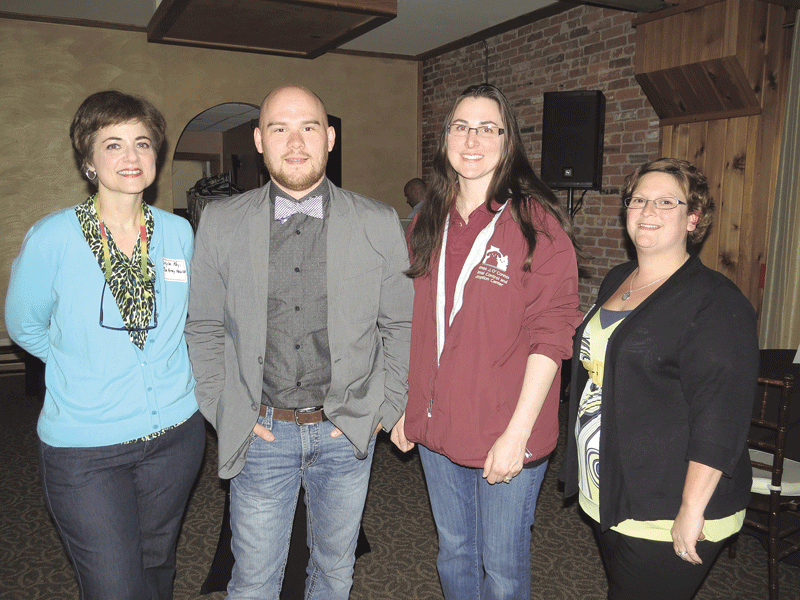
IMG_1745From left, Leyla Kayi, director of donor relations at the Gray House; Peter Ellis (class of 2011), creative director at DIF Design; Jessecah Gower of the Thomas J. O’Connor Animal Control & Adoption Center; and Jennifer Schimmel (class of 2011) of Habitat for Humanity. The Gray House, Habitat, and the O’Connor Center were all spotlighted at the reunion by the Young Professional Society of Greater Springfield, which unveiled its YPS Cares program, an effort to foster volunteerism in the community.
 
IMG_1755From left, Jason Barroso (class of 2013), project environmental scientist at Tighe & Bond; Jeremy Leap (class of 2013), vice president of commercial lending at Country Bank for Savings; Kristen Hua (class of 2011), assistant vice president at PeoplesBank; and Xiaolei Hua (class of 2013), assistant vice president and credit officer at PeoplesBank.

IMG_1773Dianne Doherty (2011 judge), left, regional director of the Mass. Small Business Development Center’s Western Mass. office, and Samalid Hogan (class of 2013), project manager for the city of Springfield.


IMG_1752From left, Erin Couture (class of 2013), vice president of commercial lending at Florence Savings Bank; Jeff Fialky (class of 2008 and 2013 judge), attorney at Bacon Wilson, P.C.; and Susan Mielnikowski (class of 2010), elder-law and estate-planning attorney at Cooley Shrair, P.C.


IMG_1777Members of the Young Professional Society of Greater Springfield, which partnered with BusinessWest in the production of the reunion event, gather for a group photo. Many of the group’s members are 40 Under Forty honorees.

DBA Certificates Departments

The following Business Certificates and Trade Names were issued or renewed during the month of and April 2014.

AMHERST

Amherst Copy & Design Works
37 East Pleasant St.
Sean Cleary

Fire & Water
39 Boltwood Way
Teacup Musket & Guild

Kidsafrik
245 West St.
Christopher Monteiro

Scidose Pharma
196 North Pleasant St.
Joseph F. Bohan III

CHICOPEE

Double J’s Landscaping
37 Rivest Ct.
Justin Poulist

Floral Illusion
527 Grattan St.
David Rosinski

Rejuvenations
246 Montcalm St.
Marci Ryder

Rivers Variety & Wireless
730 Chicopee St.
Kisean Donaldson

LUDLOW

Deponte Nursery
336 Poole St.
Joseph Deponte

Heartwood Landscaping
54 Higher St.
James Ekmalian III

Ludlow Chiropractic Office
77 Winsor St.
Paul Blomcrith

O’Keefe’s Farm & Nursery
1084 Center St.
Ryan O’Keefe

Turnpike Acres Stove Shop
185 Miller St.
George Dupuis

NORTHAMPTON

Dapper Kitty
29 Butler Place
Anthony Fonseca

Euphoria Skincare
49 Gothic St.
Lori A. Schott

Grace Paint a Tile
303 Riverside Dr.
Jeffrey Vaughan

Krist Design & Build
89 Main St.
Kristen Branch

Kris Thompson Carpentry
362 Kennedy Road
Kris Thompson

New England Medical Consultants
124 Maple Ridge Road
Matthew Kane

Pisano Printing
23 Pine Brook Corner
Raylin Pisano

Sally Staub Design
74 Audobon Road
Sally P. Staub

Valley Therapy Billing
50 Center St.
Kimberly Girard

SOUTHWICK

Aco Masonry Heating & Air Conditioning
12 Hillside Road
Adam Ouimette

Cool Bike Rides
7 Fenton Dr.
Ian Creswell

Hair of the Dog
610 College Highway
Jennie Tierney

Jacquier Realty Group
68 Will Palmer Road
Tiffany Jacquier

Once Upon a Time
648 College Highway
Maureen Piermarini

Pro Tour & Cruises Inc.
194 South Longyard Road
Kasie Provencal

SPRINGFIELD

A2Z Towing
110 Old Lane Road
Maureen Hittman

ADC Prevention Services
22 Bacon Road
Arnold D. Cox

Addisyn Furniture Inc.
1566 State St.
Mukesh Tandon

Amarilis Market
14 Orange St.
Reda M. Shabaneh

Anthony Maia
91 Maebeth St.
Anthony Maia

Baku
1830 Wilbraham Road
Aymira Gaffarova

Before and After Beauty
686 Belmont Ave.
Jose A. Calderon

Borrowed Talents
93 Grochmal Ave.
Karen J. Van Wagner

Botanica Ozain
15 Dorset St.
Miguel M. Soto

City Cleaners
1179 State St.
Kenny H. Nguyen

Civilized Animals
45 Kimberly Ave.
Kamisha Bryant

CT Tattoo Supply Ink, LLC
94 Island Pond Road
Cynthia L. Cote

Dona Carmen Restaurant
344 Bay St.
Carmen Y. Rodriguez

Dynasty Restaurant
5 Locust St.
Xiu G. Zheng

Felicity Hardee Law
1500 Main St.
Felicity Hardee

Happy Family Media
40 White Oak Road
Matthew A. Herring

Hernandez Pavers
131 Larkspur St.
Ermie J. Hernandez

HLW Consulting
4 Niagara St.
Haven L. Williams

Holy City Christian Books
109 Mill St.
Jose L. Pomales

Ivette’s Images
8 Johnson St.
Petra I. Cappas

J.D. Auto Repair
131 Laconia St.
Jimmy Deleon

James Cleaning Service
24 Green Acre Square
Watson E. James

JHS Cabinetry, LLC
32 Wellfleet Dr.
Howard A. Gabaree

Juliano’s Latin Flava
176 Main St.
Juliano J. Calligros

WESTFIELD

Alive Health Solutions
304 Sackett Road
Ellen Michaliszyn

Bryan M. Kasperowski
29 Broad St.
Bryan Kasperowski

Dream Meadow Farm
631 West Road
Joseph P. Boisseau

R & C Countertops
9 Bartlett St.
Randy Arkoette

Rescue Me Cleaning
198 Lockhouse Road
Susan Churchill

SE Landscaping
25 Hagan Ave.
Scott Egleston

WEST SPRINGFIELD

Baystate Hearing Aids
425 Union St.
James Caldarola

Beauty Secrets Salon
553 Union St.
Tatyana Gitsman

Brain Balance Center
1472 Riverdale St.
Core Tickle, LLC

Caring Solutions, LLC
131 Elm St.
Patricia L. Baskin

Classic Burgers Inc.
1261 Westfield St.
Barry Parker

Health Products Group
440 Main St.
Svetlana Gorbovets

K & R Computer Solutions
75 Adrian Ave.
Kevin A. Richter

Majestic Theater
131 Elm St.
Todd Kadis

Mattress Depot
120 Memorial Ave.
Dream Décor Inc.

Oak Hollow Farms
711 Amostown Road
Joseph P. Dumont

On the Level Floor Coverings
142 Nelson St.
Mike Blanchard

Briefcase Departments

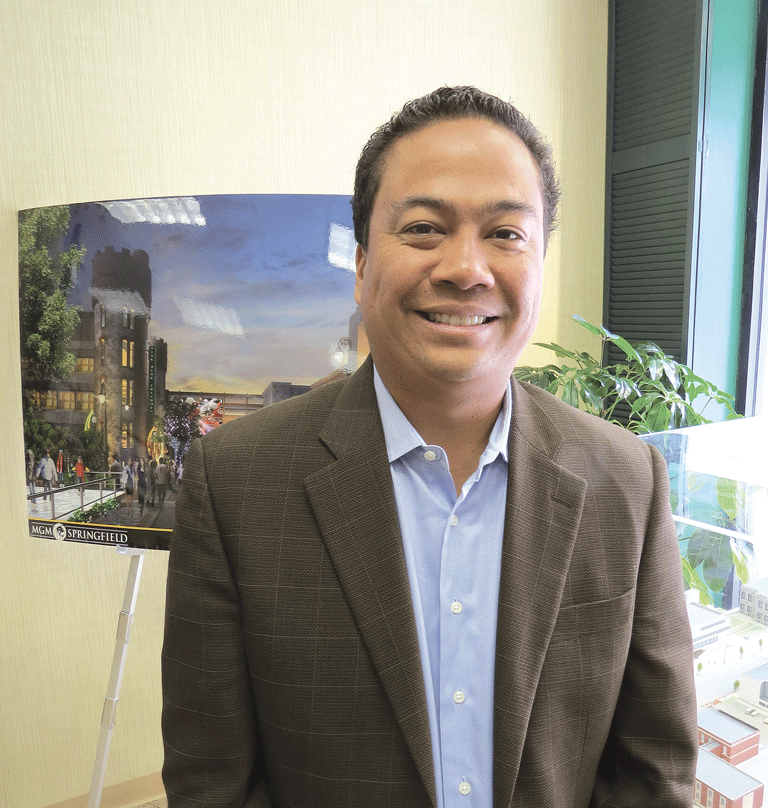
MGM Asks Commission to Delay Awarding License
SPRINGFIELD — MGM Springfield President Michael Mathis asked the Massachusetts Gaming Commission to declare MGM the winner of a casino license for its $800 million project in Springfield’s South End by its planned decision date of May 30, but to delay the formal award until a ballot question seeking repeal of the casino bill is decided. Without that flexibility, he noted, MGM could be at risk for some $200 million in costs while the ballot issue is resolved. “No corporation should subject itself to that risk — including MGM Springfield,” he wrote to commission Chairman Stephen Crosby. “MGM is offering, under such a bifurcated process, to waive our statutory right to 30 days to make payment of our various licensing fees … and instead to make such payment within five business days of a formal award. We recognize the economic and budgetary benefit to the Commonwealth from an award [of the license] for Western Massachusetts and the receipt of the $85 million licensing fee by the end of this year.” Casino opponents are seeking to repeal the casino gaming law passed by the state Legislature in 2001. The state Supreme Judicial Court will begin hearing their arguments this month, and is expected to make a decision by July on whether the issue will appear on the November ballot. Once the license is issued, MGM argues, it will be required to pay not only the $85 million application fee, but also roughly $115 million in land options, construction, demolition, and other costs.

Berkshire Medical Center Purchases NARH Property
NORTH ADAMS — Berkshire Medical Center (BMC) has agreed to purchase the building and grounds of the recently shuttered North Adams Regional Hospital (NARH) as part of a deal reached in U.S. Bankruptcy Court to reopen the facility’s emergency room this month. The deal with Pittsfield-based BMC sets out a timetable to create a satellite emergency department the week of May 19 under an initial 90-day occupancy and use pact. Details on how many doctors and nurses would be hired and what services would be provided remain to be worked out. NARH executives shut down the financially troubled, 109-bed hospital on March 28, leaving nine rural communities in Northwestern Mass. without access to a nearby hospital. Over the past month, local, state, and court officials have been negotiating with BMC and labor unions representing nurses and others about reopening the emergency department. Beyond the purchase price, which will be revealed in the coming days, BMC officials said they would have to invest $10 million in repairs and improvements to the North Adams Regional Hospital building, but it is not expected to have to assume the closed hospital’s debt.

Life Sciences Center Awards $500,000 Grant to WNEU
SPRINGFIELD — The Massachusetts Life Sciences Center has awarded a $500,000 grant to Western New England University to fund equipment related to cancer drug research and development. Susan Windham-Bannister, the center’s president and CEO, called the program a great example of promoting academic and private-sector collaboration in the life sciences, adding that equipment will be purchased for the development of live cancer-cell drug filtration and testing platforms. The university will collaborate with Cellular Engineering Technologies and FioDesign Sonics on product marketing and research. The Massachusetts Live Sciences Center is an investment agency that supports innovation, research, development, and commercialization in the life sciences. The agency is charged with implementing a 10-year, $1 billion, state-funded investment initiative passed by the Legislature and Gov. Deval Patrick in 2008.

Massachusetts Adds 8,100 Jobs in March
BOSTON — Preliminary estimates from the Bureau of Labor Statistics (BLS) show that Massachusetts added 8,100 jobs in March and that the total unemployment rate dropped another 0.2% to 6.3% from the February rate. Over the month, jobs are up 8,100, with private-sector jobs up 7,800. Since March 2013, Massachusetts added a net of 50,400 jobs, with 53,900 jobs added in the private sector and 3,500 lost in the public sector. The total unemployment rate was down 0.6% from the March 2013 rate of 6.9%. The recent estimates show that 3,285,800 Massachusetts residents were employed in March and 220,900 were unemployed, for a total labor force of 3,506,800. The March labor force increased by 12,100 from 3,494,700 in February, as 19,200 more residents were employed and 7,200 fewer residents were unemployed over the month. The labor force was an estimated 24,500 above the March 2013 estimate. The unemployment rate is based on a monthly sample of households. The job estimates are derived from a monthly sample survey of employers. As a result, the two statistics may exhibit different monthly trends.

Company Notebook Departments

Friendly’s Restaurants Honored for Commitment to Easter Seals Programs
WINDSOR, Conn. — Easter Seals Capital Region & Eastern Connecticut recently honored Friendly’s Restaurants with the Corporate Leadership Award. The presentation was made at a Friendly’s restaurant in Springfield on April 15. Enfield and Manchester, Conn. stores were also recognized for their fund-raising success to benefit Easter Seals programs and services. Friendly’s has been raising money for Easter Seals since 1981 through coupon promotions featuring Valentine- and Halloween-themed offers and special events. Cumulatively, the Cones for Kids campaign has raised more than $28 million for Easter Seals, supporting recreational and social programs that give children with disabilities a sense of independence and accomplishment. The staying power of the program is testament to the commitment of both Friendly’s employees and customers, the company said. This year’s campaign featured two new elements. For a $2 donation to Easter Seals, children could receive a kid’s meal served on a Friendly’s Frisbee, and for a $1 donation, guests could get a discount card good for 10% off all purchases through May 18. Friendly’s restaurants also funded the update and redesign of Easter Seals’ award-winning disability-awareness curriculum, Friends Who Care. The program gives students the opportunity to learn what is involved when someone has a disability and how they adapt to live life, go to school, or work as independently as possible. “We’re proud to partner with Easter Seals and engage our employees, restaurant guests, and local communities in our cause,” said John Maguire, CEO and president of Friendly’s Ice Cream, LLC. “We know that contributions to Easter Seals create life-changing solutions so that children with disabilities can live, learn, work and play.” Added Allen Gouse, president and CEO of Easter Seals Capital Region and Eastern Connecticut, “Easter Seals recognizes Friendly’s Restaurants’ generosity, caring, and commitment, and that is why they are so deserving of this year’s Corporate Leadership Award.”

Big Y Donates $30,000 to Wounded Warrior Project
SPRINGFIELD — Big Y Foods Inc. announced that it has donated $30,000 to the national Wounded Warrior Project 2013 Believe in Heroes campaign. Wounded Warriors of Jacksonville, Fla. is a national, non-partisan, non-profit organization founded in 2003 to honor and empower wounded soldiers. Its Believe in Heroes campaign provides financial and emotional support and tools to the more than 44,000 servicemen and women who have been wounded in recent military conflicts. Its ultimate goal is to provide assistance so that these soldiers can thrive and achieve personal and professional success. This is the third year that Big Y has been part of Wounded Warriors. To date, it has donated a total of $100,000. Through a partnership with the Acosta Food brokerage company, Big Y promoted the Believe in Heroes campaign through weekly specials in its ads and stores last fall. This initiative helped to raise the public’s awareness of Wounded Warriors’ unique and direct programs and services that meet the needs of those injured in service to their country. “Being an American-owned company, it is important for us to support our military in their fight to preserve our freedoms,” said Michael D’Amour, the supermarket chain’s executive vice president. We’re grateful to Big Y’s employee and customer families for their support of this important campaign.”

1550 Main Named Building of the Year
SPRINGFIELD — The Building Owners and Managers Assoc. (BOMA) has presented 1550 Main in Springfield with its Outstanding Building of the Year award in the Government category of the Middle Atlantic Conference. This is the second consecutive year the redevelopment of the former federal building has won the award. MassDevelopment purchased and undertook the renovation of the former federal office building in 2009 as part of a strategy to revitalize downtown Springfield. The redevelopment of 1550 Main, completed in 2010, included the creation of 130,000 square feet of office space; renovation of the central plaza with new plantings and seating; new entrances, lighting, and signs; lobby and atrium renovations; elevator modernization and replacement; restroom upgrades; and exterior envelope repairs. The building is more than 90% leased. “We are grateful and honored that BOMA has recognized our efforts to transform 1550 Main into a vibrant part of downtown Springfield,” said MassDevelopment President and CEO Marty Jones. “The building has played a key role in the city’s business and arts communities and will continue to increase economic activities in Springfield.”

STCC Introduces Interpreter Program
SPRINGFIELD — The need for medical and community interpreters is rapidly increasing, and so is the demand for trained professionals in the field. The Center for Business and Technology at Springfield Technical Community College will offer a nine-week certificate program designed to prepare individuals for an entry-level career as a medical and community interpreter. The program, developed and offered in collaboration with TransFluenci, a regional leader in translation and interpretation services, will prepare new and experienced interpreters to work in hospitals, health clinics, law offices, governmental agencies, and more, following the standards and ethics of the profession. The program meets the requirements of the International Medical Interpreters Assoc. for national certification. The program is open to all languages, but students must be able to fully comprehend and communicate in both English and at least one other language. Because a selective interview is required before acceptance, students must register well in advance. The college will issue the Medical and Community Interpreting Certificate upon satisfactory completion of this program, and participants receiving the certificate will be given the opportunity to interview with Global Link Translations & Interpreting Services for potential employment as interpreters. Classes will be held on Mondays and Wednesdays from 6 to 9 p.m., starting May 28. Space is limited, and applications are now being accepted. Interested individuals should visit www.stcc.edu/wd or call (413) 755-4502 for details and registration information.

Chamber Corners Departments

ACCGS
www.myonlinechamber.com
(413) 787-1555

• May 7: ACCGS Business@Breakfast, 7:15-9 a.m., at Chez Josef, 176 Shoemaker Lane, Agawam. “Handicapping the Gubernatorial Elections with Political Consultant Anthony Cignoli.” Saluting Skoler Abbott & Presser, P.C. on its 50th anniversary and A.G. Miller Co. Inc. on its 100th anniversary. Reservations are $20 for members, $30 for general admission. Reservations may be made online at www.myonlinechamber.com or by contacting Cecile Larose at [email protected].
• May 14: ERC Feast in the East, 5:30-7:30 p.m., at Twin Hills Country Club, 700 Wolf Swamp Road, Longmeadow. Local restaurants showcase their signature dishes. Cost: $25. Reservations may be made online at www.myonlinechamber.com or by contacting Cecile Larose at [email protected].
• May 21: Capital Matchmaking/Business Coaching, 1-4 p.m., at La Quinta Inn and Suites, 100 Congress St., Springfield. Business borrower and lender matchmaking event, ideal for small businesses. Presented by the U.S. Small Business Administration and Common Capital, in cooperation with the Affiliated Chambers of Commerce of Greater Springfield. Reservations are complimentary, but required. Contact Oreste Varela at [email protected] or (413) 785-0484 for details.
• May 27: ACCGS Pastries, Politics & Policy, 8-9 a.m., at TD Bank Conference Center, 1441 Main St., Springfield. Designed for political and policy junkies, featuring a policy expert and member of the Patrick administration. Reservations are $15 for members, $25 for general admission, and may be made online at www.myonlinechamber.com or by contacting Cecile Larose at [email protected].

AMHERST AREA CHAMBER OF COMMERCE
www.amherstarea.com
(413) 253-0700
 
• May 14: Chamber After 5, 5-7 p.m., at Western MA Family Golf Center, 294 Russell St., Hadley. Try the golf simulator and mini-golf, or just enjoy watching and networking. Cost: $10 for members, $15 for guests.
• May 28: Chamber After 5, 5-7 p.m. at Amherst Laser and Skin Care Center, 264 North Pleasant St., Amherst. Cost: $10 for members, $15 for guests.
 
CHICOPEE CHAMBER OF COMMERCE
www.chicopeechamber.org
(413) 594-2101
 
• May 21: 48th annual George Ryan & Stanley Kokoszka Golf Tournament, 10 a.m. start, at Chicopee Country Club. Cost: $125 per golfer.
• May 22: Business After Hours, 5-7 p.m., at WWLP-22News, One Broadcast Center, Chicopee. Tickets: $10 for pre-registered members, $15 for non-members.
• May 28: Salute Breakfast, 7:15-9 a.m. at Elms College. Tickets: $20 for members, $26 for non-members. Sign up online at www.chicopeechamber.org.

GREATER EASTHAMPTON CHAMBER OF COMMERCE

www.easthamptonchamber.org
(413) 527-9414
 
• May 8: Networking by Night. Call 527-9414 or e-mail [email protected] for more information. Cost: $5 for members, $15 for non-members.

GREATER HOLYOKE CHAMBER OF COMMERCE
www.holycham.com
(413) 534-3376
 
• May 14: Economic Development Breakfast/Valley Venture Mentors, at Dean Technical High School, 1045 Main St., Holyoke. Sponsored by Ferriter Law and Dowd Insurance. Valley Venture Mentors provides key support to entrepreneurs and startups, connecting them to the mentors they need to grow their business. Breakfast will be followed by a tour of Dean Tech. Cost: $20 for chamber members, $ 30 for the public. Call the chamber at (413) 534-3376 for more information, or sign up online at holyokechamber.com.
• May 19: 46th annual Chamber Cup 2014 Golf Tournament, at Wyckoff Country Club, 233 Easthampton Road, Holyoke. Registration and lunch at 10:30 a.m., tee off at noon (scramble format), dinner afterward with elaborate food stations catered by the Log Cabin. Cost: $125 per player includes lunch, 18 holes of golf, cart, and dinner. Dinner only: $25. Winner awards, raffles, and cash prizes follow dinner. Tournament sponsors: Log Cabin and PeoplesBank. Corporate Sponsors: Dowd Insurance, Goss & McLain Insurance Agency, Holyoke Gas & Electric, Mountain View Landscapes, Holyoke Medical Center, People’s United Bank, and Resnic, Beauregard, Waite & Driscoll. Call the chamber office at (413) 534-3376 or register online at holyokechamber.com.
• May 28: Greater Holyoke Chamber of Commerce Annual Meeting, 5 p.m., at the Delaney House. Sponsored by the Greater Holyoke of Chamber Corporate Leaders. The program is followed by the presentation of the Fifield Award celebrating the volunteer of the year; join elected officials as they award various proclamations to the esteemed recipient. Networking and cocktails at 5, business meeting and elections at 5:30, dinner at 6. The program will include the chamber’s plan for 2014-15, an overview of how the chamber is working for members, and a salute to new members. Admission: $30 in advance, $40 at the door. The public is invited to attend.
• May 21: Chamber After Hours, 5-7 p.m., at Hotel D., 1 Country Club Way, Holyoke. Sponsored by Easthampton Saving Bank and hosted by chamber members. Cost: $10 for members, $15 for non-members.
 
GREATER NORTHAMPTON CHAMBER OF COMMERCE
www.explorenorthampton.com  
(413) 584-1900
 
• May 7: Arrive@ 5, 5-7 p.m., at King & Cushman, 176 King St., Northampton. Sponsored by Applied Mortgage Services Corp., King Auto Body, and Goggins Real Estate. Cost: $10 for members, $15 for non-members. Register at [email protected].
• May 15: “Art of Small Business” series, “Managing Consultants,” 9-10:30 a.m., at the Greater Northampton Chamber of Commerce, 99 Pleasant St. Guest speaker: Don Lesser of Pioneer Training. Cost: $20 for members, $25 for non-members.
• May 19: Bitcoin Informational Seminar, 3-4 p.m. at Forbes Library, 20 West St., Northampton. Sponsored by the Greater Northampton Chamber of Commerce. Guest speaker: Jesse Vanek. This seminar examines basic Bitcoin concepts, including arguments for and against this powerful, often-misunderstood, and potentially disruptive new technology. Cost: free, but pre-registration is required. To register, call (413) 584-1900 or e-mail [email protected].

GREATER WESTFIELD CHAMBER OF COMMERCE
www.westfieldbiz.org
(413) 568-1618
 
• May 14: After 5 Connection, 5-7 p.m., at the Noble & Cooley Center for Historical Preservation, 42 Water St., Granville. Bring a prospective member for free. Cost: $10 for members $15 cash at the door for non-members. Your first After 5 is free. To register, call Pam at the chamber office at (413) 568-1618.
• May 19: 53rd annual Golf Tournament, featuring prime rib and poker, at Shaker Farms Country Club. Registration is at 10 a.m., with a shotgun start at 11. Sponsorship opportunities are still available. Call Pam at the chamber office for more information at (413) 568-1618, or visit the chamber website.

Court Dockets Departments

The following is a compilation of recent lawsuits involving area businesses and organizations. These are strictly allegations that have yet to be proven in a court of law. Readers are advised to contact the parties listed, or the court, for more information concerning the individual claims.

CHICOPEE DISTRICT COURT
Cory Bartson v. 2 Guys Auto Sales Inc. and Efrain Santana
Allegation: Defendant breached a contract by failing to reimburse the plaintiff for the purchase of a vehicle and one-half of the profits of the resale value of the vehicle: $9,950
Filed: 3/25/14

HAMPDEN SUPERIOR COURT
Action Air Inc. v. Reed McNaughton d/b/a Dr. Energy Saver, Karen M. Brown, and William J. Bates
Allegation: Failure to pay under the terms of a construction agreement: $10,000
Filed: 3/21/14

Liberty Mutual Fire Insurance Co. v. Christopher R. Porter Builders Inc.
Allegation: Unpaid workers’ compensation policy: $34,719.20
Filed: 3/19/14

Matthew Brackman v. Reliant Medical Group Inc.
Allegation: Breach of contract: $100,000
Filed: 3/14/14

Robin Murphy v. Hu Ke Lau Inc. and Edison L. Lee
Allegation: Failure to pay wages: $75,000
Filed: 3/17/14

Teddy Bear Pools Inc. and Theodore Hebert v. Eastern States Exposition and Eugene Cassidy, as president of Eastern States
Allegation: Injunctive relief for civil-rights violation and breach of contract: $300,000
Filed: 3/31/14

HAMPSHIRE SUPERIOR COURT
Easthampton Savings Bank v. Sun Technical Services Inc. and Robert W. Humphreys
Allegation: Breach of contract: $91,104.75
Filed: 3/10/14

Roger J. Belanger v. Stiebel Properties
Allegation: Plaintiff struck and injured by snow falling from a roof: $82,569.22
Filed: 2/4/14

HOLYOKE DISTRICT COURT
Open & Shut d/b/a Raynor Door Sales v. Runnals & Sons Construction Services Inc.
Allegation: Non-payment of construction supplies and services rendered: $22,014.28
Filed: 3/4/14

NORTHAMPTON DISTRICT COURT
John W. Bresnahan v. General Mills Inc.
Allegation: Negligence in manufacturing of Wheaties Fuel causing injury when plaintiff tried to ingest: $24,000
Filed: 2/27/14

Judith Dickson v. Hampshire Village Condo Assoc.
Allegation: Negligent maintenance of property causing slip and fall: $24,599.99
Filed: 2/14/14

Pave, Tile, and Stone Inc. v. Nonotuck Mills, LLC
Allegation: Breach of contract and failure to repair or remediate contamination: $25,000
Filed: 2/26/14

PALMER DISTRICT COURT
Tracy Gousy and Lori Hull v. O.C. White Co.
Allegation: Non-payment of vacation pay upon separation from company: $3,600
Filed: 4/10/14

HIBU Inc. f/k/a Yellowbook Inc. v. James B. Lynch d/b/a J&B Landscape Construction
Allegation: Monies due for breach of contract, monies loaned, advertising, and services rendered: $11,394.96
Filed: 3/24/14

SPRINGFIELD DISTRICT COURT
Jacqueline H. Glasco v. F.P.S. Inc. and Burger King Corp.
Allegation: Negligent maintenance of property causing slip and fall: $4,166.55
Filed: 2/27/14

Joan Wollmershauser v. Mercy Hospital
Allegation: Automated door struck plaintiff in the face causing injury: $14,651.37
Filed: 2/4/14

WESTFIELD DISTRICT COURT
Logic Business Loans Inc. v. Smart Restaurant Inc. d/b/a Fresco Ristorante and Thomas Smart
Allegation: Breach of contract: $14,592.16
Filed: 3/18/14

Features
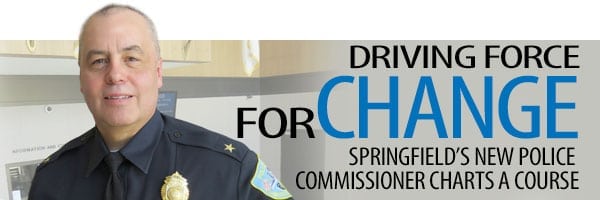
Springfield’s New Police Commissioner Charts a Course

Page6CommishARTJohn Barbieri acknowledged that his analogy wasn’t perfect, but believed it worked on a number of levels, so he went with it.

He was talking about law-enforcement personnel and why many people don’t understand why they can’t prevent crime, or criticize them for not doing so. And he drew a comparison to getting a bad diagnosis from one’s doctor.

“For a community to expect the police to resolve crime in a city is like going to your doctor and being mad at him because you have cancer,” said Barbieri, a deputy chief who will become Springfield’s police commissioner next month. “If the doctor could go back 20 years and take the cigarette out of your hand or stop you from working at the asbestos factory, that would be one thing. Don’t be upset with him because you have cancer; be upset with him if he doesn’t treat it properly.

“I can’t go back 20 years and give the person who broke into your car an educational opportunity or parental discipline,” he went on. “The best I can possibly do is look at the trends and patterns from when such break-ins occur, be responsive and try to have police in that area, make an arrest whenever possible, and work with area residents and educate them about what’s going on in their neighborhood.”

If a community wants to make a serious dent in crime, there must be what he called a “holistic response” to the matter, and a police department will certainly play a key role in that, he said, adding that police must work in collaboration with neighborhood residents, other social agencies, the school department, and other players.

Indeed, collaboration has been the word heard most often in the many media interviews, neighborhood meetings, and other gatherings at which Barbieri has spoken or taken questions since he was named commissioner on March 19.

And it will continue to be heard in the weeks, months, and years to come, because it is the one-word thrust of Barbieri’s philosophy regarding public-safety initiatives and how to make them more effective.

Collaboration between police, the public, and neighborhood groups lies at the heart of the C3 (Counter Criminal Continuum) Policing program in the city’s North End, a multi-faceted initiative aimed at stemming gang-related crime, which Barbieri has co-led, and for which he and other organizers were named Difference Makers by BusinessWest in 2013.

Barbieri wants to expand that specific program to Mason Square, the South End, and Forest Park, but he wants the key ingredients in its success formula — cooperation and information from neighborhood residents — to become a city-wide phenomenon.

“The goal is to go into those neighborhoods and work with the residents to teach them that the department does care, legitimize our services to them, and show them we can be responsive,” he continued. “And then educate them with regard to their responsibilities with preventing crime in their neighborhoods and being our eyes and ears.”

And while working to inspire residents to take a more active role in public-safety efforts, Barbieri has a number of other goals and objectives — everything from making more effective use of available resources to improvements in crime analysis, to making sure the department is ready if and when a casino opens in the South End.

In a broad-ranging interview with BusinessWest, he addressed those issues and many others, and in the course of doing so, put that term ‘collaboration’ to early and repeated use.

Chief Concerns

The office at police headquarters that Barbieri will soon be vacating in favor of the commissioner’s space has an eclectic array of photos on the walls, everything from assorted views of his prized 1966 Chevy Impala — “driving it keeps me sane” — to an image of the World Trade Center the moment the second plane struck the south tower. He said he hung it there so he could point to it whenever someone says a major act of terrorism can’t happen in a city like Springfield.

There’s also a shot of him in a cruiser taken a few months after he joined the force in 1988, one of several times the city was beset with fiscal problems and the police budget was stretched thin — as the photo made clear.

“We didn’t have enough money to paint the cruisers black and white,” he said in noting why the car he was sitting in was all white (it came that way), and also why it looked beat up. “The car was in such disrepair that you had to leave it running at all times. It had a bad battery, so you ran it all night; if you shut it off, it wouldn’t restart, and you’d have to call a tow truck and get a jump.”

Several years later, during the Clinton presidency and a period of heightened federal assistance for law-enforcement efforts, things were much different. Springfield’s force numbered roughly 700 officers, nearly double the current number, community policing was in vogue, and the police could effectively “smother” crime in many ways and many places, said Barbieri, by effectively deploying all that manpower.

John Barbieri

John Barbieri has a number of goals and objectives for his department, including an expansion of the C3 Policing program into three additional neighborhoods.

Those days are gone, and they are, in all likelihood, not coming back, he went on, adding that this reality is why he places such a heavy emphasis on collaboration and involving city residents and a host of other partners in the process of combating crime and making the streets safer.

Talk of inspiring more collaborative efforts has dominated what Barbieri called the “whirlwind tour” he’s been on since he prevailed over two other deputy chiefs in the search for the successor to the retiring William Fitchet.

That tour has included interviews with many local media outlets, community meetings, and the release of his five “priority objectives” for the department and his administration:

• Initiate a movement toward a proactive, patrol-centered department ideology;
• Deliver improved response times;
• Create increased levels of service through clearer lines of delegation of authority and responsibility for line supervisors;
• Build relationships with stakeholders for collaborative problem-solving, enhanced communications, and unified effort; and
• Develop and implement measurement and feedback processes to modify and enhance operations as required regarding calls for service.

Barbieri borrowed the term ‘listening tour’ to describe the six weeks or so since he’s been named the new commissioner, and said it will continue for the next several months, and involve meetings and briefings with the Chamber of Commerce, the City Council and its various subcommittees, the press, concerned-citizens groups, and many other constituencies.

“Hopefully during the listening tour there will be educational opportunities for both of us,” he said. “I want and need to know what some of the concerns of the community are, although I’d like to think I’m fairly well plugged in. And the other part is educating people about this department; there are people out there who still think we have 700 officers and community policing and that we’re going to be able to focus on every small aspect of their concerns. We’ll work with them with regard to prioritization, and I have to work on attaining maximum efficiency here.”

It’s been a relatively quick ride to the top for Barbieri, who joined the force in 1988 after serving as a special police officer for Baystate Medical Center and later as a supervisor there.

Seemingly from the start, his work on the force has involved gangs and gang-related violence. Indeed, one of his first assignments was with the City Uniform Anti-gang Patrol, and after working on a patrol that focused on the city’s schools, whereby he became familiar with many at-risk youths, he was one of the city’s first two gang-intelligence officers.

He was named sergeant in 1995, lieutenant in 2001, captain in 2005, and deputy chief in 2009. In that latest assignment, he had a number of responsibilities, including supervision of the uniform division, the Police Academy, the Street Crimes unit, and anti-gang deployments, including the C3 initiative.

That work in the North End, which he remains involved with, has garnered local and national press, including a segment on 60 Minutes, with Barbieri sharing the spotlight with State Police Officers Michael Cutone and Tom Sarrouf, who drew inspiration for their counter-insurgency tactics from their experiences serving with the Special Forces in Iraq and Afghanistan.

That press has inspired a number of cities to explore creating similar initiatives, said Barbieri, adding that he was recently in Michigan, consulting with state police there on plans to create programs in Detroit, Lansing, Flint, and other cities.

“They’re running into a lot of the same problems in those cities that we ran into here — gang activity and economically impacted cities,” he explained. “And they have several cities that don’t have the financial wherewithal to increase their police departments. So they reached out to us because we have a plan and it’s working.”

Arresting Developments

Overall, the C3 program has been hailed as a major success — crime is down in a number of categories — and the initiative has shown what can happen when the residents of a neighborhood take an active role in making it safer by reporting crimes and providing police with information that could prevent more of them.

As an example, he pointed to a recent shooting on Osgood Street that remains under investigation. Thanks to shot-spotter technology, police were on the scene within a minute, and have received a number of leads from witnesses.

“The level of cooperation we get now down there is just unprecedented,” he said. “We got a number of tips and calls, and we continue to get tips and calls since the shooting occurred. That just didn’t happen before C3 Policing.”

It’s happening now, he said, because those involved in the program have been able to convince residents of the North End that there is a direct connection between this higher level of cooperation and improved quality of life. And this is something that has to happen in other neighborhoods, he said, adding that an obvious key is the simple act of reporting crimes.

“Statistics just tell you about reported crime,” he noted. “And if you look at the worst neighborhoods, where we have the shootings, the drug dealing, and other crimes that makes the newspapers and television, it’s all the little things, the lawlessness in that neighborhood — it’s permissive for all this to occur. And in those neighborhoods, they don’t report crime because they’re afraid, they’re inured, and they’re apathetic.”

The risk to doing all this is that there will be reported crime, something that might create apprehension among those who watch crime statistics or drive Springfield higher on those infamous lists of the most dangerous places to live, he went on, but when crimes are reported, police departments have a better chance of preventing more of them down the road.

Looking forward and acting on the assumption that there won’t be significant, if any, additions to the force in terms of personnel, Barbieri said one of his priorities is to review departmental procedures and initiatives with the goal of ensuring that people and resources are being used in the most efficient manner possible.

“The goal is to take a baseline snapshot of what we do, look at where we want to be, and analytically look at a transition method to get us there,” he said. “We need a projected plan and timeline — and I have the basis of that on paper and in my head — and get a management team in here, because as smart as I’d like to think I am, it’s much smarter to take the experience and intelligence of eight or nine people and put them together to come up with a well-balanced plan.

“The objective is to make us the most efficient department possible with the number of officers we have,” he went on. “There may be a time when I’ll go to the mayor for more police officers, but I’m not there yet.”

And those aforementioned partners that Barbieri listed, especially city residents, can play a role in making the department more efficient through the information they provide.

“In this modern era, what we need is for people to report crime; we need neighborhood residents to get involved and be the eyes and ears of the police,” he told BusinessWest. “And we need to look at that reported crime and put officers where it’s occurring. It’s less about free travel time for police officers for discretionary response, and more about directed patrol time, because there are so many things going on above and beyond what the sector officers may know from their own experience. Neighborhood residents and our computer experts here can predict trends and patterns, and we need to put officers where the dots are.”

Elaborating, Barbieri said another of his goals is to improve crime-analysis efforts, something Boston has been doing, in an effort to both stem crime and more efficiently utilize available resources.

“Instead of catching on to a series of breaks into homes after there have been 30 breaks, and have eight detectives follow up in hopes of catching somebody,” he said, “my hope is to catch on to a series of breaks after three or four them, have uniformed patrol officers patrol more heavily in those neighborhoods in an effort to apprehend that person, but, more importantly, to deter them.”

Looking further ahead, and toward the elephant in the room, the $800 million MGM Springfield gaming and entertainment complex planned for the South End, Barbieri said it will present new and different kinds of challenge for his department.

There are still some hurdles to clear before it becomes reality — especially a referendum question that will soon be in the hands of the Supreme Judicial Court — and it will be at least three years before a casino opens its doors, but Barbieri said the city, and his force, must aggressively move forward with the assignment of being ready.

“We have to plan, plan, plan, plan — that’s the biggest thing,” he said, adding that there will be visits to a number of cities that have casinos to observe, ask questions, and learn. “And once the details start to emerge as to just what we’re looking at, we have to start planning immediately. And then you have to plan to adjust your plan once it starts.”

Off-the-cuff Remarks

Thinking back on those days when Springfield had 700 police offers and could easily afford to paint its cruisers black and white, Barbieri said everyone knew that those conditions wouldn’t last forever — and they didn’t.

“We made the most of it while we had it, though,” he said, adding that the force has adjusted to the new reality, and it will continue to do so in the years to come. Part of that adjustment is stressing that holistic approach to improving public safety and then making it happen.

And this comes back to that notion of collaboration — a word you’ll keep hearing from the new police commissioner long after his listening tour is over.

George O’Brien can be reached at [email protected]

Restaurants Sections
Tavern on the Hill Owners Are Providing Much More Than Scenery

By KEVIN FLANDERS

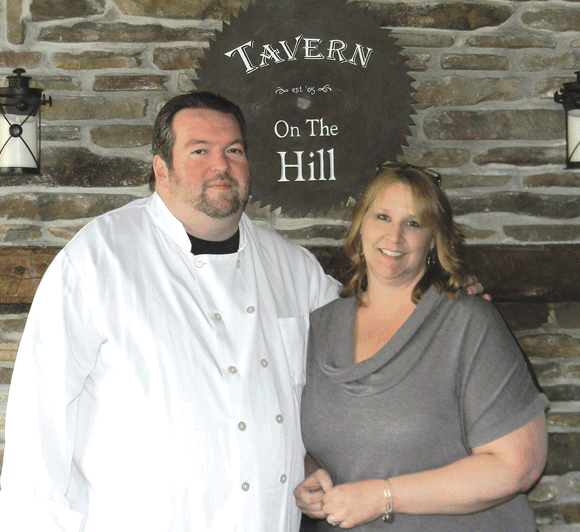
Lawrence and Amy Guyette

Lawrence and Amy Guyette say they take pride in making not just good food, but strong community connections.

“The view is just gravy.”

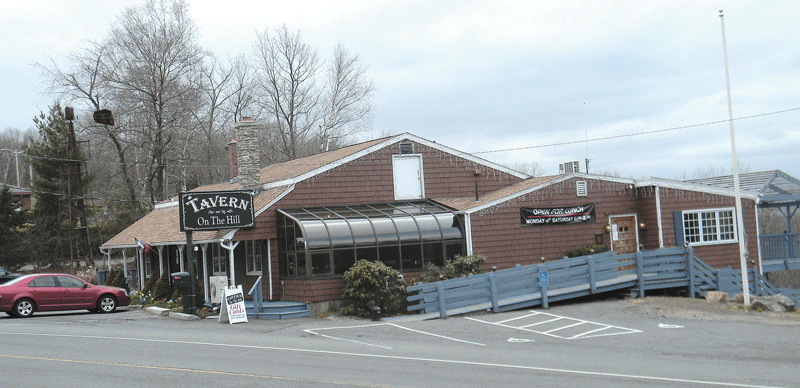
That was a line from a Republican review of the Tavern on the Hill restaurant from several years ago. Many other things were written, of course, about this establishment located in the shadow of Mount Tom near the Easthampton-Holyoke line — regarding the food, the service, and the experience.

But that single line has lived on at this landmark, and over the years it has become equal parts unofficial slogan, rallying cry, and mission statement.

That’s because the view is, well, spectacular. It’s a draw, and it’s probably what people will remember most from a visit to this eatery on Route 141. But, while powerful, the scenery is generally not enough to bring people back, said Lawrence Guyette, a long-time restaurateur who bought the property — operating then as a sandwich and ice-cream shop — with his father-in-law, Jim Cooper, in 2005.

“Growing up in Easthampton, I knew this location was different than anything else in the area, a really cool place for a restaurant. When we found out it was available, we were really excited to purchase it,” said Guyette, who serves as owner-chef. From the beginning, he added, he understood that quality food and service, not the view out the windows or from the parking lot, would generate repeat business.

And because he’s been able to provide those tangibles, the tavern has enjoyed solid success over the past decade, despite a mostly sluggish economy and a host of other challenges.

Cooper died in 2013, but his legacy is carried on each day by his son-in-law and his daughter, Amy Guyette, the restaurant’s general manager. Running the business as a family gives them a great deal of pride, but most rewarding to the Guyettes are the community connections the restaurant has enabled them to make, a reflection of Cooper’s mentality.

“He was always really active with the restaurant,” Amy said of her father. “He loved helping the guests with anything they needed, even parking their cars in the lot. He always wore Hawaiian shirts, so our staff will have a special day coming up where we all wear Hawaiian shirts to work.”

Like most local restaurant owners, the Guyettes have faced challenges over the last few years in competing for customers. With new establishments recently opening in the area and national chain restaurants continuing to benefit from massive marketing campaigns, the competition is exceedingly stiff in the restaurant industry.

“Two years ago was a peak for us, the best we’ve done so far; everything was firing on all cylinders, and business was fantastic,” Lawrence said. “Since then, we’ve seen a dip in the last year. A few new restaurants have opened lately, which makes it a little tougher for everyone in the business. Overall, things seem to be starting to improve again lately, especially for dinner.”

A restaurant-business veteran for nearly 30 years, he understands the importance of constantly adapting and improving to provide guests with a quality experience year after year. Oftentimes, those improvements appear on the menu, especially when special requests are made. Guyette has been experimenting with smoked ribs in recent months, much to the delight of those who’ve tried them, and he also added burgers to the dinner menu a few weeks ago.

“We had so many requests for burgers that we decided to put them on the dinner menu,” he said. “It’s a new addition that has worked out really well for us.”

The Guyettes are also contemplating a weekly steak night, with various selections available to guests. They are still in the process of working out the details, but it’s likely the concept will become reality.

For this issue and BusinessWest’s annual Restaurant Guide, we ventured up Route 141 for the view, but, more importantly, for an in-depth look at an evolving entrepreneurial success story.

Peaking Their Interest

Depending on when they grew up in town, Easthampton residents have differing childhood memories of the property where Tavern on the Hill stands.

Way back in the Roaring Twenties, a small establishment called the Green Candle Inn served as a popular stop for travelers navigating up the mountain. Two decades later, in 1944, The Old Mill became a local favorite for its sandwiches, its pinball machine, and, of course, the panoramic view.

the view from their restaurant

The Guyettes know the view from their restaurant is an initial draw for some, but food and service keep patrons coming back.

Amy has fond memories of the place from her younger days. During her high-school years. she worked at the sandwich and ice-cream shop that operated atop the hill at the time, and now she’s come full circle by returning to the property as the manager of her husband’s restaurant.

“We used to always talk about what it would be like to own the place and have our own restaurant up here,” she said. “Anyone in this area knows about the place and the view, so that’s definitely a big plus.”

Operating on a minimal budget, Cooper and the Guyettes spent two months renovating the building before opening the restaurant to guests.

Over the years, the menu has evolved somewhat, but has focused on what’s known in the business as ‘creative American.’ Dinner options include everything from grilled salmon to pasta jambalaya; blackened beef tips to several burger options, including one named after the mountain next door. Prices range from $11 to $27.

In addition to its lunch and dinner service, the restaurant also regularly hosts private functions, with about 50 such events augmenting business each year. Lawrence said he’s seen a rise in the number of private events booked in recent years, particularly after-funeral functions.

“It’s always helpful when individuals or business owners recommend us to their family and friends. That really helps us secure additional events,” he said.

The view certainly helps with the task of filling the dining room with people and the calendar with events, but the Guyettes stressed repeatedly that much more is needed to succeed in an ultra-competitive marketplace where an ever-more-demanding dining public has myriad options.

Thus, they put the accent on building relationships and earning the trust of customers — as well as repeat business — through consistently reliable service.

“The relationships are definitely the best part of the business,” Amy said. “I love having relationships with our customers and getting to see their kids grow up. Maintaining great relationships with the staff is huge as well; we’re all a family here.”

Indeed, one tenet of this industry is that no establishment can survive for very long without a solid staff. The Guyettes recognize the importance of not only hiring experienced staff members, but keeping them in the Tavern on the Hill family.

One server and almost the entire kitchen staff have remained with the restaurant since 2005, a difficult feat to accomplish in an industry known for frequent turnover. Amy described hiring qualified, dependable staff members as one of the lesser-known challenges in the business, a challenge she prefers to avoid by aiming to keep the staff intact.

“It definitely isn’t easy to find people you can really count on. You want to hang on to those people when you get them,” she said.

Tavern on the Hill boasts a staff of up to 50 people during its busiest summer months, including bartenders to work the indoor bar and the outdoor setup on the deck.

In addition to relationships with customers and staff, the Guyettes also believe in establishing them with the community as well. They believe restaurant owners have a responsibility to be active in civic life, a belief evidenced by their continued commitment to community service.

Tavern on the Hill has served as a sponsor for several area sports teams in the past decade, in addition to donating raffle prizes to the Southampton Athletic Assoc. and Boys and Girls Clubs in Chicopee and Holyoke.

Moreover, as the president of Easthampton Friends of Football — an organization that has been striving to build a new football field for high-school and youth teams — Amy has been committed to working with city leaders to help secure Community Preservation Act funding for the project.

“I feel like it’s an obligation for us to support the community that supports us every day,” she said. “If people come out and spend their money here, then we have an obligation to put money back into their communities.”

As both the owner of the restaurant and a chef who prepares meals there, Lawrence Guyette has been thrilled by the support Tavern on the Hill has received from the community. He sees it every day, from the lunch regulars to a sometimes surprising dinner guest.

“You never know who’s going to come through those doors,” he said. “You always meet different people — firefighters, police officers, the mayor, people who have dinner here with their families or a quick lunch meeting — and it’s pretty special to have a chance to get to know so many members of the community. We really appreciate all of the support we get.”

View to the Future

One can certainly see a long way from the tavern, out over Easthampton and other towns to the west.

One thing you can’t see, obviously, is the future; no one in any business can do that.

What the Guyettes are trying to do is anticipate it, and be ready for the likelihood that it will include an increasingly challenging environment in which to operate and even more choices for the dining public.

Which means they have to work even harder on that unofficial mission statement and make sure the line from that aforementioned restaurant review remains as true as the day it was written.

Simply put, the view must always be just gravy.

Meetings & Conventions Sections
Convention & Visitors Bureau Sees Regional Potential in Casino

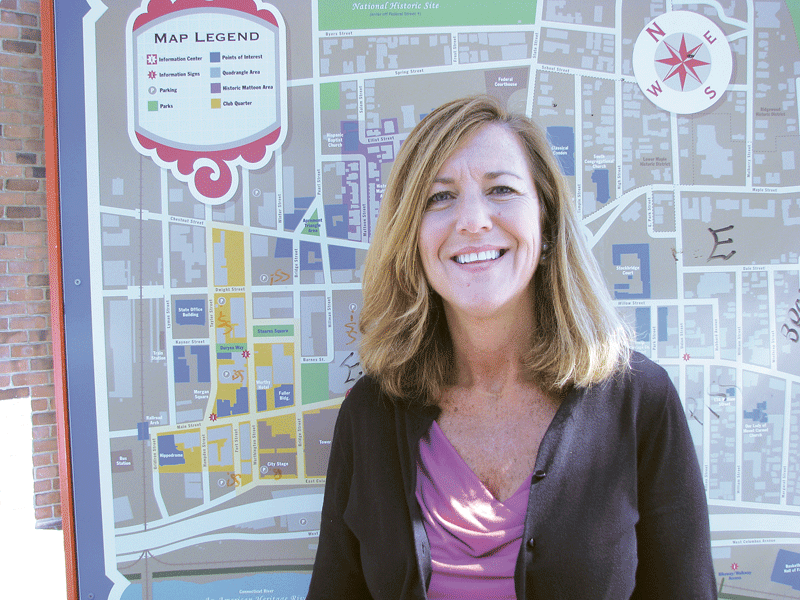
Mary Kay Wydra

Mary Kay Wydra says a casino will draw people to downtown Springfield, but will also boost tourism across the entire region.

Mary Kay Wydra says she understands how some tourism-based businesses might not like the idea of a major casino company setting up shop in downtown Springfield.

“We have 260 members, and not all of them are for it,” said Wydra, president of the Greater Springfield Convention & Visitors Bureau (GSCVB). “Big brands like Six Flags and Yankee Candle are very much for it, but among the smaller businesses, many of them remain concerned about what a casino will do to business.”

However, well before MGM Resorts International staked its claim with the only viable, community-supported casino proposal remaining in Western Mass., Wydra and her bureau were enthusiastically on board, choosing to focus on what MGM could do for the region’s tourism, convention, and entertainment industry, not to it.

“The Convention & Visitors Bureau has been looking at the whole gaming issue for years, watching it and seeing how things would unfold, and we were really proactive in making sure that any of the applicants being considered for Western Mass. were willing to work collaboratively with the bureau,” she told BusinessWest. “We’re thrilled that MGM is the last man standing, if you will, because we see the value of their brand coming into our region.”

The two parties recently formalized this sense of optimism by entering into a marketing partnership. Essentially, both the GSCVB and MGM Springfield have hammered out a written agreement aimed at bolstering tourism-related businesses across the Pioneer Valley.

“This is an incredibly exciting time for tourism in the Pioneer Valley,” Wydra said. “A partner with the brand recognition and resources of MGM can really help change the landscape when it comes to tourism promotion in our region. We’re delighted to have them as partners; the MGM team has been extremely professional and clearly dedicated to establishing a working relationship that is mutually beneficial. It’s going to be a powerful, productive partnership, and we’re eager to get started.”

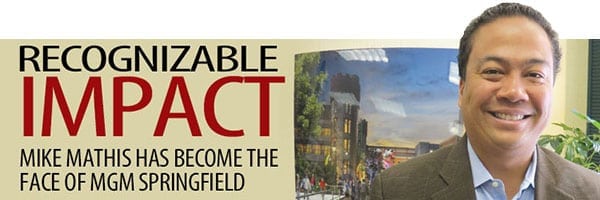
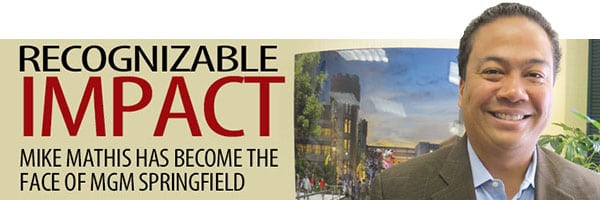
Mike Mathis, president of MGM Springfield, was equally enthusiastic. “This is an organic partnership between entities that understand each other,” he noted. “The GSCVB drives tourism throughout the Pioneer Valley, and MGM Springfield is primed to be an anchor attraction in the region’s urban core.”

While it’s not a done deal — the state Gaming Commission is expected to approve MGM’s license this month, but casino opponents are waging a fight to overturn the state’s casino law in a November referendum — the probability of a Springfield casino has Wydra and her team excited, and MGM’s willingness to establish a partnership with the bureau is just another positive development.

Inside Out

Early in the game, the GSCVB reached out to all four casino developers that proposed detailed projects in Western Mass. However, a proposal by Penn National Gaming for Springfield’s North End died when Mayor Domenic Sarno backed MGM’s South End development, and Hard Rock International’s West Springfield proposal and Mohegan Sun’s plan for a Palmer casino were both killed in voter referendums last fall.

Wydra said she was delighted that MGM was the sole remaining player, due partly to its basic concept, which has been referred to as an ‘inside-out’ or ‘outward-facing’ casino.

Mike Mathis

Mike Mathis says MGM’s marketing partnership with the GSCVB makes sense because they share a goal of drawing visitors to the region.

As Mathis has described it countless times, a traditional casino has a couple of points of entry, and the operation is heavily driven by gaming, with other amenities, like entertainment, dining, and retail, typically buried within the facility, forcing the traffic through the casinos to get to those amenities.

The Springfield model — a smaller version of MGM’s successful City Center flagship property in Las Vegas, which is especially popular with families — puts the amenities around the gaming floor, with multiple points of entry, and will tie in neighboring venues like Symphony Hall and the MassMutual Center, so that casino visitors can enjoy the restaurants and entertainment without having to enter the actual gaming hall.

“What we like about the MGM product is that inside-out casino, and we like their brand,” Wydra said, even though she needed to learn about it first. “When I first heard MGM was coming into the market, I didn’t know they were a casino company. I thought they were an entertainment company.”

The more she learned, the more intrigued she was, and she preferred a Springfield location to a casino in Palmer. “The fact that it’s right in the heart of our service area is very appealing,” she said. “Palmer is a bit more removed and more of a trek to get there.”

But a Springfield-based casino, even one that actively tries to connect with its downtown community, isn’t an end in itself, she told BusinessWest, which is why the bureau forged a marketing agreement with MGM, in an effort to raise all boats in the local tourism industry. Included in that agreement are:

• Cross-promotion. MGM has committed to marketing efforts coordinated through the GSCVB that will identify and promote other Pioneer Valley tourism entities via on-site signage, exposure on social media, newsletter mentions, reciprocal home-page web links, and more.

“Honestly, we see a casino coming here as a way to extend people’s stay,” Wydra said. “If they’re coming for two or three days, maybe they can stay three or four, and see other things the area has to offer.”

• Additional circulation of a visitor guide. MGM will undertake the costs of printing thousands of additional copies of the bureau-produced Guide to the Pioneer Valley for placement in its hotel rooms, concierge desks, and other key locations.

“It’s a 110-page publication that lists other attractions, hotels, restaurants, and a calendar of events,” she said. “So we’ll be working with them to let their visitors know what else there is to do.”

• Enhanced marketing efforts. MGM has agreed to provide resources dedicated to promoting Springfield and the overall region through active participation on ‘TEAM Springfield,’ a cooperative convention-sales effort with the MassMutual Center.

“We meet every two to three weeks, trying to get meetings and conventions to come into the region,” Wydra explained. “I really see a tremendous benefit to bringing MGM into that equation. They dominate the convention market in Vegas; they’re attracting national conventions there based on the infrastructure they have.” Ideally, she added, TEAM Springfield could tap into that database and connect with the New England or northeast affiliates of those organizations.

Just the Start

In short, Wydra said, “we see great opportunity to co-promote and leverage their brand and marketing assets to benefit the Pioneer Valley’s entire hospitality industry, especially our many small businesses.”

Handled correctly, she added, the region should see an influx of new visitors, who will come here to do more than just gamble. And all four of the bureau’s areas of emphasis — leisure, conventions, tour operators, and sports — could share that benefit.

Take tour groups, for example. “Casinos are ideal for the group tour market, so we’re very confident we can sell MGM to that market.” As for sports, casinos often host billiards and darts tournaments, boxing matches, and other competitions.

The partnership agreement — which was hatched out in a series of meetings between MGM Springfield officials and the GSCVB’s gaming subcommittee — will take effect one year prior to the casino’s formal opening, and lays out only the bare bones of marketing possibilities, said Wydra, who said the parties will also consider some kind of regional shuttle service between attractions if they see potential in such an effort.

“Really, the agreement we put in place is the minimum,” she told BusinessWest. “As we start working together and determine the demand and demographics coming in, new opportunities will unfold.”

Some of those opportunities may be difficult to predict now; dropping an $800 million development onto 14.5 acres in downtown Springfield will certainly open some unexpected doors. And Wydra is confident that the entire Pioneer Valley will benefit from opening them.

“From the meetings I’ve had with them, I know they’re savvy professionals and dedicated people, and we’re looking forward to having the opportunity to work closely with them,” she said.

While it’s natural for some tourism businesses to be anxious about the project, she said, the bureau has long looked at it simply as a new attraction — albeit a significant one. She sees MGM as much more than that now, thanks to its cross-promotion potential and national convention clout.

“A lot of people, when this thing didn’t move through the Statehouse quickly, got negative about it,” she added. “But I think the legislators did a great job creating the legislation, and this will work for all businesses in the region, encouraging the casinos to have deals with other entertainment venues.”

Those connections are critical, Wydra said, if a region wants a casino to be a regional tourism engine, and not just a gaming island to itself.

“I presented at a Mass. Gaming Commission meeting when there were still three applicants in the Western Mass. area,” she said. “While all that was getting figured out — the host community agreements, the referendum questions — we were also talking to the Gaming Commission make sure tourism was a priority when they were evaluating all the proposals.”

Even then, she liked what she was hearing from MGM. “We know tourism is important to this developer. And we really do believe they’re going to reach into the community and the whole region.”

Joseph Bednar may be reached at [email protected]

Briefcase Departments

Report Details State’s Healthcare Costs, Access
BOSTON — The Massachusetts healthcare reform law of 2006 set in motion a number of important changes to the healthcare system, which have affected Massachusetts residents, businesses, healthcare providers, and others. Since 2006, the Massachusetts Health Reform Survey (MHRS) has been an important means of monitoring and understanding these impacts. The most recent report, conducted in the fall of 2012, just after passage of the state’s healthcare cost-containment law, brings both good news and signs that warrant concern. As with previous versions of the MHRS, the just-released results of the 2012 survey provide promising evidence that the insurance provisions of the Affordable Care Act, which were modeled after the 2006 Massachusetts law, will improve coverage and access across the nation. However, the 2012 survey also shows that healthcare costs continue to be a burden for many. Massachusetts continues to have the highest rate of insurance coverage for non-elderly adults of any state, 94.6%. This is a significant improvement over 2006, when 85.9% of non-elderly adults had insurance, and much higher than the current national level of 79.7%. In addition, gaps in coverage have lessened: 88% of adults in Massachusetts reported being covered for the entire year, much higher than the national level of just under 75%. The proportion of people in Massachusetts who are “persistently uninsured” has been cut by nearly three-quarters, falling from 9.3% in 2006 to 2.7% in 2012. The survey indicates that respondents are generally satisfied with their healthcare coverage, with about two-thirds rating their coverage as very good or excellent on the range of services, choice of providers, and quality of care, up more than 10% from pre-reform. Access to care is also is very good; nearly nine in 10 respondents reported having a place, other than the emergency room, to go to when they are sick or need advice about their health. This is higher than national estimates for this measure, which top off at around 80%. Use of physician services is also higher in Massachusetts than it is nationally. Eight in 10 non-elderly adults reported having visited a doctor in the past 12 months, compared with 63% nationally. On the issue of affordability, more than 40% of non-elderly adults reported that healthcare costs had been a problem for them and their families over the previous year, including 37.1% who experienced problems with healthcare spending and 16.4% who reported going without needed care because of cost. Having health-insurance coverage did not eliminate cost concerns, as 38.7% of those who were insured for the full year reported that they had problems with healthcare spending. One reason the burden of healthcare costs has not diminished with rising levels of coverage is the continuing trend among employers to shift costs onto workers and their families, such as through high-deductible plans.

Massachusetts Ranks High in Spending Transparency
BOSTON — Massachusetts received an A– grade in government spending transparency according to “Following the Money 2014: How the 50 States Rate in Providing Online Access to Government Spending Data,” the fifth annual report of its kind by the Massachusetts Public Interest Research Group (MASSPIRG). “We have worked hard to make state government more transparent for taxpayers, and this superb grade from MASSPIRG reflects that,” said Secretary of Administration and Finance Glen Shor. Massachusetts came in at the top of the nation with a grade of 91.5, maintaining it’s A– rating for the third year in a row despite the increasing difficulty of the annual survey as technology improves and consumer expectations rise. The MASSPIRG report designates Massachusetts as a ‘leading state’ in progress toward improved online spending transparency, allowing ordinary citizens to find information through easy-to-use features. The report applauds Massachusetts for increasing transparency by awarding more than $300,000 in grants to six cities to post their spending information online, and planning to help 20 cities post their spending information online by January 2015; posting information on state contracts and bidding opportunities through the state’s checkbook-level procurement website, saving the state $3 million by eliminating paper, postage, and printing costs associated with information requests by state agencies and paperwork from vendors; and improving the state’s transparency website by publishing a report on the Economic Development Incentive Program, which provides recipient-specific details on jobs retained and created. “Given that our grading standards rise annually, earning an A– each year means Massachusetts has demonstrated a significant commitment toward transparency and is continually investing in improvements,” said Andrew Fish, program associate with the MASSPIRG Education Fund. “Gov. Patrick’s commitment to increasing disclosure of the state’s finances allows the public to see how their tax dollars are being invested, promoting both efficiency and accountability.” Patrick’s FY 2015 budget, which was published in a program-based manner and added performance data to the state budget for the first time, aimed to make more spending and performance data available to the public. To read the full report, visit www.masspirg.org.

DevelopSpringfield Issues 1095 Main Street Grant
SPRINGFIELD — DevelopSpringfield announced that it has awarded a $20,000 grant for façade improvements to 1095 Main St., property owned by 1095 Main Street Irrevocable Trust. Building tenants include Square One Family Center and Santos Family Chiropractic. The grant is made possible under DevelopSpringfield’s Corridor Storefront Improvement Program, which provides grants of up to $10,000 per storefront for exterior improvements to first-floor businesses located on State and Main streets in Springfield. The funds were used to revitalize and repair the existing façade and included new windows, doors, and signage. The grant is supporting a substantial investment for improvements to the building by the property owner. “This project represents well over $100,000 in capital improvements to the façade of this building,” said Ralph Capua of 1095 Main Street Irrevocable Trust. “It’s an example of our commitment to bringing business back to the South End, and allows for additional leasing opportunities for prospective business owners.” The project shows a strong commitment to revitalization Springfield’s South End, an area devastated by the June 2011 tornado. Improvements to this structure made it possible for Square One, which lost its site after the tornado and was further displaced by the downtown natural-gas explosion in November 2012, to find a new home. The Square One Family Center celebrated the opening of its 1095 Main St. facility last September.

Chamber Corners Departments

ACCGS
www.myonlinechamber.com
(413) 787-1555

• April 30: ACCGS Beacon Hill Summit, 7 a.m. to 7 p.m. Hosted by Sen. Gale Candaras. Hear from key legislators, members of the Patrick administration, and our local delegation. Cost: $180, including transportation, lunch at the Union Club, and a wrap-up reception at the 21st Amendment. Reservations may be made online at www.myonlinechamber.com or by contacting Cecile Larose at [email protected].
• May 7: ACCGS Business@Breakfast, 7:15-9 a.m., at Chez Josef, 176 Shoemaker Lane, Agawam. “Handicapping the Gubernatorial Elections with Political Consultant Anthony Cignoli.” Saluting Skoler Abbott & Presser, P.C. on its 50th anniversary and A.G. Miller Co. Inc. on its 100th anniversary. Reservations are $20 for members, $30 for general admission. Reservations may be made online at www.myonlinechamber.com or by contacting Cecile Larose at [email protected].
• May 14: ERC Feast in the East, 5:30-7:30 p.m., at Twin Hills Country Club, 700 Wolf Swamp Road, Longmeadow. Local restaurants showcase their signature dishes. Cost: $25. Reservations may be made online at www.myonlinechamber.com or by contacting Cecile Larose at [email protected].
• May 21: Capital Matchmaking/Business Coaching, 1-4 p.m., at La Quinta Inn and Suites, 100 Congress St., Springfield. Business borrower and lender matchmaking event, ideal for small businesses. Presented by the U.S. Small Business Administration and Common Capital, in cooperation with the Affiliated Chambers of Commerce of Greater Springfield. Reservations are complimentary, but required. Contact Oreste Varela at [email protected] or (413) 785-0484 for details.
• May 27: ACCGS Pastries, Politics & Policy, 8-9 a.m., at TD Bank Conference Center, 1441 Main St., Springfield. Designed for political and policy junkies, featuring a policy expert and member of the Patrick administration. Reservations are $15 for members, $25 for general admission, and may be made online at www.myonlinechamber.com or by contacting Cecile Larose at [email protected].

AMHERST AREA CHAMBER OF COMMERCE
www.amherstarea.com
(413) 253-0700

• April 23: Chamber After 5, 5-7 p.m., at Western MA Family Golf Center, 294 Russell St., Hadley. Cost: $10 for members, $15 for guests.
• May 14: Chamber After 5, 5-7 p.m., at Western MA Family Golf Center, 294 Russell St., Hadley. Try the golf simulator and mini-golf, or just enjoy watching and networking. Cost: $10 for members, $15 for guests.
• May 28: Chamber After 5, 5-7 p.m. at Amherst Laser and Skin Care Center, 264 North Pleasant St., Amherst. Cost: $10 for members, $15 for guests.

CHICOPEE CHAMBER OF COMMERCE
www.chicopeechamber.org
(413) 594-2101

• May 21: 48th annual George Ryan & Stanley Kokoszka Golf Tournament, 10 a.m. start, at Chicopee Country Club. Cost: $125 per golfer.
• May 22: Business After Hours, 5-7 p.m., at WWLP-22News, One Broadcast Center, Chicopee. Tickets: $10 for pre-registered members, $15 for non-members.
• May 28: Salute Breakfast, 7:15-9 a.m. at Elms College. Tickets: $20 for members, $26 for non-members. Sign up online at www.chicopeechamber.org.

GREATER EASTHAMPTON CHAMBER OF COMMERCE
www.easthamptonchamber.org
(413) 527-9414

• May 2: Wine & Microbrew Tasting, 6 p.m., at Wyckoff Country Club. All guests (age 21 and older) are welcome to enjoy samples of more than 42 delicious and unique grape and fruit wines. Not interested in wine? There’s also a microbrew tasting. Cost: $35 in advance or $40 at the door.
• May 3: Easthampton Downtown Clean Up Day, 8 a.m. Join us for a few hours of community spirit and support at the Greater Easthampton Chamber of Commerce Office, 33 Union St. Volunteers are encouraged to bring rakes, shovels, brush cutters, and gloves. No experience necessary. General cleanup of downtown, the rail trail, Cottage Street Municipal Parking Lot, the banks of the Nashawannuck Pond, and more. Sponsored by the Easthampton Development & Industrial Commission and the Greater Easthampton Chamber of Commerce. For more information, contact the chamber Office at (413) 527-9414 or e-mail [email protected].
• May 8: Networking by Night. Call 527-9414 or e-mail [email protected] for more information. Cost: $5 for members, $15 for non-members.

GREATER HOLYOKE CHAMBER OF COMMERCE
www.holycham.com
(413) 534-3376

• April 25: Ask a Chamber Expert Workshop, 8:30-10 a.m. “How to Use MassLive to Work for Your Business,” at the Holyoke Chamber of Commerce Conference Room, 177 High St. Sponsored by MassLive/the Republican and Holyoke Community College. Cost: $10 for chamber members, $20 for the public. Call the chamber at (413) 534-3376 or sign up online at holyokechamber.com.
• April 29: Business Person of the Year Award Dinner, 6 p.m. at the Log Cabin Banquet & Meeting House, 500 Easthampton Road, Holyoke. The Greater Holyoke Business Community honors Barbara Baran as business person of the year. Cost: $65. Register at the chamber office, call (413) 534-3376, or sign up online at www.holycham.com.
• May 14: Economic Development Breakfast/Valley Venture Mentors, at Dean Technical High School, 1045 Main St., Holyoke. Sponsored by Ferriter Law and Dowd Insurance. Valley Venture Mentors provides key support to entrepreneurs and startups, connecting them to the mentors they need to grow their business. Breakfast will be followed by a tour of Dean Tech. Cost: $20 for chamber members, $ 30 for the public. Call the chamber at (413) 534-3376 for more information, or sign up online at www.holycham.com.
• May 19: 46th annual Chamber Cup 2014 Golf Tournament, at Wyckoff Country Club, 233 Easthampton Road, Holyoke. Registration and lunch at 10:30 a.m., tee off at noon (scramble format), dinner afterward with elaborate food stations catered by the Log Cabin. Cost: $125 per player includes lunch, 18 holes of golf, cart, and dinner. Dinner only: $25. Winner awards, raffles, and cash prizes follow dinner. Tournament sponsors: Log Cabin and PeoplesBank. Corporate Sponsors: Dowd Insurance, Goss & McLain Insurance Agency, Holyoke Gas & Electric, Mountain View Landscapes, Holyoke Medical Center, People’s United Bank, and Resnic, Beauregard, Waite & Driscoll. Call the chamber office at (413) 534-3376 or register online at www.holycham.com.
• May 28: Greater Holyoke Chamber of Commerce Annual Meeting, 5 p.m., at the Delaney House. Sponsored by the Greater Holyoke of Chamber Corporate Leaders. The program is followed by the presentation of the Fifield Award celebrating the volunteer of the year; join elected officials as they award various proclamations to the esteemed recipient. Networking and cocktails at 5, business meeting and elections at 5:30, dinner at 6. The program will include the chamber’s plan for 2014-15, an overview of how the chamber is working for members, and a salute to new members. Admission: $30 in advance, $40 at the door. The public is invited to attend.
• May 21: Chamber After Hours, 5-7 p.m., at Hotel D., 1 Country Club Way, Holyoke. Sponsored by Easthampton Saving Bank and hosted by chamber members. Cost: $10 for members, $15 for non-members.

GREATER NORTHAMPTON CHAMBER OF COMMERCE
www.explorenorthampton.com
(413) 584-1900

• April 22: “Art of Small Business” series, “Clients,” 8:30- 9:30 a.m. at the Greater Northampton Chamber of Commerce, 99 Pleasant St. Guests speaker: Tina Stevens of Stevens 470. Admission is free, but registration is required.
• May 7: Arrive@ 5, 5-7 p.m., at King & Cushman, 176 King St., Northampton. Sponsored by Applied Mortgage Services Corp., King Auto Body, and Goggins Real Estate. Cost: $10 for members, $15 for non-members. Register at [email protected].
• May 15: “Art of Small Business” series, “Managing Consultants,” 9-10:30 a.m., at the Greater Northampton Chamber of Commerce, 99 Pleasant St. Guest speaker: Don Lesser of Pioneer Training. Cost: $20 for members, $25 for non-members.
• May 19: Bitcoin Informational Seminar, 3-4 p.m. at Forbes Library, 20 West St., Northampton. Sponsored by the Greater Northampton Chamber of Commerce. Guest speaker: Jesse Vanek. This seminar examines basic Bitcoin concepts, including arguments for and against this powerful, often-misunderstood, and potentially disruptive new technology. Cost: free, but pre-registration is required. To register, call (413) 584-1900 or e-mail [email protected].

GREATER WESTFIELD CHAMBER OF COMMERCE
www.westfieldbiz.org
(413) 568-1618

• April 30: Beacon Hill Summit, 7 a.m. to 7 p.m. Hosted by Sen. Gale Candaras. Hear from key legislators and members of the Patrick Administration. Includes bus, lunch, and reception. Cost: $180 per person. For more information, call the chamber office at (413) 568-1618.
• May 5: Mayor’s Coffee Hour, 8-9 a.m., at the Westfield Gas & Electric Operations Center, 40 Turnpike Industrial Road, Westfield. This event is free and open to the public. Mayor Daniel Knapik will field questions and give information about upcoming city events and construction information. To register, call Pam at the chamber office at (413) 568-1618.
• May 14: After 5 Connection, 5-7 p.m., at the Noble & Cooley Center for Historical Preservation, 42 Water St., Granville. Bring a prospective member for free. Cost: $10 for members $15 cash at the door for non-members. Your first After 5 is free. To register, call Pam at the chamber office at (413) 568-1618.
• May 19: 53rd annual Golf Tournament, featuring prime rib and poker, at Shaker Farms Country Club. Registration is at 10 a.m., with a shotgun start at 11. Sponsorship opportunities are still available. Call Pam at the chamber office for more information at (413) 568-1618, or visit the chamber website.

Court Dockets Departments

The following is a compilation of recent lawsuits involving area businesses and organizations. These are strictly allegations that have yet to be proven in a court of law. Readers are advised to contact the parties listed, or the court, for more information concerning the individual claims.

CHICOPEE DISTRICT COURT
Brixmor GA Chicopee Marketplace, LLC v. Family Wireless Inc. and John J. Sullivan
Allegation: Breach of commercial lease for space at the Chicopee Marketplace: $30,968.45
Filed: 3/25/14

GSD Coating, LLC v. Diecast Connections Company Inc.
Allegation: Non-payment of services provided: $7,609.50
Filed: 3/10/14

HAMPDEN SUPERIOR COURT
Chicopee Savings Bank v. Innovative Designs & Displays Inc., Sugar Hill Holdings, LLC, Michael Hogan, and Patricia Hogan
Allegation: Breach and default on a revolving demand note and three term notes: $3,488,114.90
Filed: 3/7/14

John L. Doleva, as representative of the estate of Martha M. Doleva v. Healthsouth Rehabilitation Hospital of Western Mass.
Allegation: Wrongful death caused by Methotrexate overdose: $1,510,912.28
Filed: 3/14/14

Par Church Builders, LLC v. Saint John’s Congregational Church
Allegation: Breach of contract for construction of a church: $39,000
Filed: 3/20/14

Shawn Lawskow v. Steer-Rite Inc.
Allegation: Discrimination, workers’ compensation, and related claims: $150,000
Filed: 3/13/14

Sovereign Bank, N.N. v. PC Doctor General Partnership, Andrew F. Jay Jr., and Carol Jay
Allegation: Default on promissory note: $38,866.13
Filed: 3/28/14

Utica National Insurance Group a/s/o Pro Automotive Repair Inc. v. BMW of North America
Allegation: Negligence, breach of warranty, defective Mini Cooper causing fire and resulting in damage to real and personal property: $1.3 million
Filed: 3/3/14

HAMPSHIRE SUPERIOR COURT
Rodney J. Savery Jr. v. Max Cap Properties, LLC and West Street Bar & Grill Inc.
Allegation: Wrongful death: $100,099.21
Filed: 2/7/14

Easthampton Savings Bank v. N.A.R. Realty, LLC and Joel J. Marchand
Allegation: Breach of contract: $158,012.56
Filed: 3/6/14

HOLYOKE DISTRICT COURT
David Cole v. Astro Realty Trust
Allegation: Negligent maintenance of property causing injury: $5,000
Filed: 2/12/14

Mary Hodgins v. The Hershey Co.
Allegation: Negligence and product defect causing injury: $1,018.76
Filed: 2/20/14

NORTHAMPTON DISTRICT COURT
American Express Bank FSB v. Stephen M. Chaput and Real Estate Management Inc.
Allegation: Breach of credit cardholder agreement: $5,961
Filed: 2/24/14

Gary Swanson v. Camp Greylock for Boys Inc.
Allegation: Non-payment for engineering services rendered: $14,699
Filed: 3/3/14

John B. Dunphy v. Peerless Indemnity Insurance Co.
Allegation: Breach of contract for refusal to pay plaintiff’s claim: $25,000
Filed: 3/19/14

PALMER DISTRICT COURT
Wine Art of Ohio Inc. d/b/a Carlson Co. v. Michael Bernier d/b/a DIY Brewing Supply
Allegation: Breach of contract and complaint to enforce foreign judgment: $2,159.29+
Filed: 3/6/14

SPRINGFIELD DISTRICT COURT
Melody Joy v. Pamela Stacey Gerber-Gressier d/b/a National Remedy Center
Allegation: Defendant failed to refund money that was paid for legal service defendant was not licensed to provide: $3,495
Filed: 3/3/14

Features
J. Polep Distribution Services Evolves with the Times

Jeff Polep, president of J. Polep Distribution Services

Jeff Polep, president of J. Polep Distribution Services

Stop by the Chicopee headquarters of J. Polep Distribution Services, and the first thing you’re greeted with is an old-fashioned cigar-store Indian standing beside the front door.

The adjoining office of Jeff Polep, fourth-generation president of this 116-year-old family business, is also strewn with kitschy memorabilia from the past century, but it’s that wooden Indian who tells the most significant story — one that starts with Polep’s great-grandfather launching a small-time enterprise, Polep Tobacco Co., in Salem, Mass.

“He started with candy and tobacco, but we diversified into groceries to survive,” Polep said. “Since then, we’ve kept diversifying.”

Today, J. Polep ranks among the top 12 convenience-store distributors in the country, servicing about 4,500 chain and independent retailers in New England, New York, and — most recently — Pennsylvania and New Jersey.

Much of that expansion has come in just the past several years, with the addition of alcohol products and an ice-cream and frozen-food division in 2007, and the purchase of Springfield Smoked Fish in 2011 and two Connecticut meat-processing plants, Mucke’s and Grote and Weigel, in 2012. Meanwhile, “we recently went into produce, both fruits and vegetables, and we’re carrying about 200 items,” Polep said.

All of this reflects the fourth generation’s constant focus on diversification.

“That’s where most of the growth has come,” Polep said, adding that some product additions have worked out better than others. “We’ve had exceptional growth in the ice-cream business; we sell a lot of ice cream.” Meanwhile, he added, alcohol products haven’t been as lucrative, although they do turn a profit.

In the past decade, J. Polep also launched Rachael’s Food Corp., named after Polep’s daughter. The Rachael’s line includes candy and other snack foods, but also a number of refrigerated products — from sandwiches and salads to meat products — that comprise the only foods that the Polep company produces on its own.

J. Polep also tries to find synergies among the Rachael’s products, such as putting smoked salmon from Rachael’s Springfield Smoked Fish on the sandwiches it makes in its commissary — which, like its meat-processing plants, is a USDA-inspected facility. “Anything we can cross-merchandise is pretty good for us.”

Meanwhile, the company’s salespeople, armed with iPads and other modern devices, are constantly restocking stores and tracking how each product is selling. “Our main function was always convenience stores,” Polep said, “but over the past few years, we’ve gone into fresh foods, healthy foods, natural foods. That’s been really good for us.”

Back from the Dead

Polep likes to show visitors a photograph hanging in the lobby, probably from around 1910. It shows his grandfather, Charles, standing on the running board of a truck driven by his great-grandfather, Sam. He says that photograph — and the hard work and legacy it represents — has inspired him to keep growing the company, even during dark days like the mid-1980s.

“In 1984, my father and uncle sold the business,” he said, adding that they believed the sale, to Trade Development Corp. (TDC), would bring security as well as access to the larger corporation’s expertise and buying power. They were wrong. “Within two years, the company that bought us went bankrupt.”

Polep, who managed the Chicopee operation for TDC, was determined to keep the business alive, but he had a non-compete agreement in his contract that barred him from restarting the company after TDC filed Chapter 11. After a week hashing out the issue in a Texas bankruptcy court, however, a judge released him from the contract. But that was only the beginning.

“We had to start all over again,” he said, adding that this included a name change from Polep Candy & Tobacco Co. to J. Polep Distribution Services. Many of the first employees he brought back worked for free for the first couple months, enabling him to hire about 50 more. And keep growing, steadily, for almost 30 years.

“We went from zero business to almost $1 billion; we’re over $900 million now,” he said, adding that J. Polep currently employs about 630 people, with distribution centers in Chicopee and Woburn, as well as Providence, R.I. and West Haven, Conn. “I’m glad it worked out the way it worked out. It was a lesson learned. We have a good, successful business, and we know that’s because of our employees. They’re loyal. We can’t do it without them.”

Speaking of hardships, much of the company’s recent growth coincided with the Great Recession. Asked whether those years, which impacted so many industries in the Northeast, affected his company, Polep offered a simple “yes … and no” — and for a perhaps surprising reason.

“We didn’t really get hurt too badly by the recession because tobacco items sell better when there are economic issues out there,” he explained.

While it has been a core product for J. Polep since the beginning, tobacco sales have been shaped by a number of different trends.

“There have been a lot of changes in the tobacco business alone. It’s gone way beyond cigarettes, pipe tobacco, and other tobacco products,” Polep said. “The biggest diversification lately has been e-cigarettes. Right now, we sell a lot of e-cigs. A lot.”

At a time when government taxes tobacco heavily and society increasingly frowns on its use — bans in restaurants, workplaces, and a host of other public spaces are simply making it more inconvenient to smoke — e-cigarettes, a smokeless product that uses nicotine vapor, have been widely embraced, particularly by the younger generation.

“Some people are trying to quit smoking, no doubt, and this is a vehicle that helps them achieve that result,” Polep said. “But many people are smoking e-cigs who never smoked cigarettes because it’s an enjoyment for them.”

Healthy Sales

While cigarettes — which are still J. Polep’s top product — may not be in vogue, healthy and organic food is, and the company is starting to take advantage of that trend.

“We’ve now gotten into about 450 colleges with good, healthy alternatives, all the different food groups,” Polep said. “That’s a very, very successful business — although our slow season for colleges is coming up within the month.”

That’s OK, he added, because convenience-store sales rocket up during the summer, more than making up for summer break on campuses. When the weather turns warmer, he explained, people are out driving more, and more apt to make a quick stop for a soda or a snack. “In the winter, they go to the supermarket, load up, and stick it in the fridge or freezer.”

The college crowd may be a solid market for healthier foods, but stores are following suit, he said. “A lot of convenience stores have taken on the organic and natural products we have for the colleges, and they’ve set up healthy sections. And they’re selling.”

While J. Polep has thrived by staying atop trends and making savvy acquisitions of other companies — about two dozen in the last 30 years — it’s ramping up geographic expansion as well. The most recent moves, into Pennsylvania and New Jersey, represent a significant step for the company, but a necessary one if it expects to grow in ways other than diversification.

“If you think about it, in New England, we’re on a peninsula, so we can’t really go much further — we’ll eventually run into the ocean,” he said with a laugh. “The only way we can grow geographically now is by going south to pick up new business.”

He sees the potential of J. Polep to expand beyond its current territory to become an even bigger presence in the eastern half of the U.S., but any growth will have to be gradual and sustainable. “I think it will take us a little while to be satisfied with Pennsylvania and New Jersey. But we’ve grown tremendously through acquisition over the years, so territory growth makes sense.”

The company will continue to take a multi-pronged approach to growth, especially as the recession fades into the past and competition heats up. “We did have an advantage selling certain types of products during the recession,” Polep said. “But things have gotten better, and our industry is looking for more business, so the competition is fierce.”

J. Polep doesn’t seem primed to make the mistakes of the mid-’80s anytime soon, though — not with the fifth generation so firmly entrenched. Polep’s son, Eric, who was a district manager in Boston, returned to Chicopee to learn more of the business. Meanwhile, daughter Rachael works in human resources, and his son-in-law, Adam Kramer, works in food service. They’re all interested in preserving the 116-year legacy and moving it forward, he told BusinessWest.

“And they can have it, at this point. I’m just doing it for them,” he said, expressing pride that his family has continuously grown what has become one of the nation’s most prominent distribution companies — “except for that hiccup of two years, of course.”

Distributing the Wealth

For now, he says, being president gives him something interesting to do every day until the next generation takes over, and he’s fine with that.

“It’s really simple,” he said when asked what he enjoys most about his role. “It’s something new and different every day. We have 600-plus employees, 80 drivers, 100 sales-type people — they all make business interesting and fun. I never walk into the same situation two days in a row.”

That’s easy to see, with hundreds of different products rolling off the conveyer belts every day and being shipped to thousands of destinations. J. Polep has come a long way indeed from that old, black-and-white photo in the lobby, and that 116-year-old dream of making a living selling candy and cigarettes. n

Joseph Bednar can be reached at [email protected]

Law Sections
MassMutual Steps Up Its Pro Bono Work in the Community

Mark Roellig

Mark Roellig says one of the responsibilities any business has is to give back to the community, and MassMutual’s pro bono work is one example of doing just that.

Mark Roellig was adding up in his head the number of lawyers MassMutual has working for it in Western Mass., Northern Conn., and elsewhere.

He didn’t have an exact figure, but by doing some quick math, Roellig, the Fortune 100 company’s executive vice president and general counsel, could say without hesitation that the number for this region alone would far exceed that of any law firm in the Greater Springfield area.

And if this roster of attorneys comprised an actual firm, it would have a responsibility, he said, to give back to the community in a number of ways, but especially with pro bono work for residents who cannot afford to hire legal help. It is this thought process that helps explain why, during Roellig’s eight-year tenure as general counsel, MassMutual has certainly stepped up its participation in a number of pro bono initiatives and other efforts involving its legal team.

For starters, there’s something called Just the Beginning, a week-long program during which nearly two dozen area high-school students meet with lawyers from MassMutual, as well as area judges and other volunteers, to explore the different professional opportunities within the legal profession. The week includes a networking reception at the firm’s headquarters on State Street, a mock trial, oral appellate arguments, a courthouse tour, and visits to law firms. There is also something called the Pro Bono Partnership, a clearinghouse of sorts that works to connect in-house lawyers with area nonprofits for transactional work.

But perhaps the most significant undertaking by the company has been its multi-faceted commitment to the Hampden County Legal Clinic, a legal-aid program that assists individuals at no charge who have limited financial resources and who meet specific eligibility guidelines.

Support comes in many forms — from helping those facing eviction in Housing Court to assisting individuals appealing denial of unemployment benefits in District Court — and together, these avenues provide a natural, and highly effective, way for the company’s legal team to escalate its pro bono work in the community, said Roellig.

“If you are operating as a business in a community, whether it be a major corporation like MassMutual or a law firm, frankly, you want your community to be one that’s vibrant and strong and one that attracts and retains high-quality talent,” he explained. “In many ways, Springfield has been challenged over the years, so one of the things we want to do through our law department, and in keeping with our obligations as lawyers, is to ensure that we’re adding value to the community.

“When I arrived here, we didn’t have much of a program, or any program at all, really,” he went on. “And this is something I believe in; if you’re going to do business in a community, you need to give back to that community, and our legal team has been consistently ramping up its commitment.”

The company’s support for the legal clinic, for example, takes several forms, including financial assistance after the previous sponsor opted not to continue its commitment in 2011. Indeed, a $20,000 contribution for this year will help defray the cost of a support staffer at the Hampden County Bar Assoc. (HCBA) tasked with recruiting, scheduling, and assisting lawyers taking part in the various volunteer programs, and also directing consumers to these initiatives.

But the most visible form of support has been the steadily growing number of legal staff from the company — lawyers, paralegals, and other professionals — who have volunteered for the initiatives in Housing Court, District Court, and Probate Court.

More than 20 attorneys have volunteered for the various lawyer-for-a-day (LFD) programs involving those aforementioned courts, said Dorothy Varon, an in-house attorney who is part of that group, and the total number of hours donated by staff members increased from just over 100 in 2012 to more than 400 in 2013, a trend that is projected to continue in the year ahead.

For this issue and its focus on law, BusinessWest takes an in-depth look at how MassMutual and its large legal team are working with various partners, such as the bar association, to assist the rising number of people who need free legal assistance.

Strong Testimony

It’s called ‘eviction day.’

As that name suggests, this is the one day each week (Thursday) at Hampden County Housing Court that is devoted to eviction cases. It’s a long, often emotional day for tenants and landlords alike, one where many of those present aren’t sure if they will have a roof over their head when they leave.

Roellig has volunteered his services for a few eviction days, and can provide compelling testimony regarding the gravity of what’s taking place.

“It’s an intense day,” he said, “because people are coming in with serious problems on either side, whether it’s someone who’s being evicted or someone who feels that he needs to evict someone, and they need some help.”

Assistance in Housing Court has become one of the many ways in which MassMutual has stepped up its pro bono work within the community, said Varon, one of the company’s in-house attorneys, who credited Roellig with getting the ball rolling and keeping it rolling.

“He gave us the green light to propose to him how we could go about creating a pro bono program that would be effective,” she explained, noting that a pro bono committee was formed and a mission statement drafted. “And one of the things that we concluded early on was that connecting with our local bar association would be the most logical way of creating a pro bono program without reinventing the wheel; this was a very logical connection.”

And support from the corporate giant is needed, said Varon, because, while Springfield has a large and diverse legal community, the landscape lacks the very large firms found in Boston and Hartford that provide the critical mass of attorneys needed to effectively staff the many types of pro bono programs that have been created.

“If you think about Boston or New York or Chicago, there are a gazillion lawyers at these megafirms, and there’s all this support coming from these firms — associates can do pro bono work as part of their workload,” she noted. “In a market like Springfield, where you have a lot of solos and a lot of small firms, it’s not so easy to be out there doing a lot of pro bono work. It’s a very difficult market to generate income.”

Meanwhile, need within the community for volunteer legal assistance is growing, said Charles Cassartello, an attorney with Springfield-based Pellegrini, Seeley, Ryan & Blakesley, former HCBA president, and active participant in the legal clinic.

Indeed, while the economy has improved somewhat in the past few years, he said, there has been no decline in the number of people seeking help through various pro bono programs.

And while such initiatives help provide access to justice for people of low or no income, they also play a pivotal role in keeping the wheels of justice turning, said Cassartello, noting that, when individuals decide to represent themselves in legal matters — usually because they have no choice in the matter — the pace of business slows.

“The Springfield District Court is perhaps the second-busiest district court in the Commonwealth — lots of business is conducted there, criminal and civil, and many of the people who come there are unrepresented; they’re pro se litigants,” he explained. “We wanted to develop a program in the District Court to not only assist self-represented people, but take some burden from the court.

“It’s very difficult to deal with self-represented people,” he continued, emphasizing the word very.  “It slows things down, and it can really clog the court’s docket.”

To help unclog matters, the District Court lawyer-for-a-day program assists such pro se litigants outside the court, during regularly scheduled office hours, providing help with forms, general problem-solving, and legal advice in civil matters, said Cassartello.

“They walk away with a basic notion about how to approach their case, how to put together a defense, how to make a claim, and more,” he went on, adding that those seeking assistance may also get referrals to lawyers participating in programs featuring sliding fee scales and other vehicles for providing assistance to the poor.

MassMutual’s assistance, in terms of both volunteers and funding to support an administrative infrastructure, has enabled the LFD programs to continue and ultimately assist more individuals, said Cassartello, who used the term “force multiplier” to describe the firm’s impact on HCBA initiatives.

Varon agreed.

“MassMutual can contribute in a lot of ways,” she noted. “One of the ways is with volunteers, but the other way is with resources. To support the clinic means that there’s someone in the community trying to rally all the lawyers — not just the MassMutual lawyers, but also the broader community.

“If we can support the legal clinic and the bar association, we have a much bigger impact on how pro bono services are delivered than if we we’re just sending volunteers, and that’s our basic strategy,” she went on. “It’s important to volunteer, but we also want to support this on a community level.”

Bottom Line

The goal moving forward is for the firm and the bar association to continually look for ways to add new programs and assist more people, said Varon, who described the current roster of initiatives as a “work in progress.”

“We keep trying to grow what we’re doing and improve what we’re doing,” she told BusinessWest, adding that one priority is to improve data-collection efforts, one of the keys to tracking progress and gaining additional support.

In many ways, MassMutual has helped lay the foundation for a comprehensive system of legal assistance, she said, and now the mission is to build atop that foundation.

The financial-services giant is not a law firm, Varon said in conclusion, but its legal department is determined to act like one — and work within the community is certainly a big part of that assignment.

George O’Brien can be reached at [email protected]

Law Sections
Here Are 10 Important Points to Ponder — and Remember

By MICHELE J. FEINSTEIN and ANN I. WEBER

When you decide to get married for the first time, estate planning is probably the last thing on your mind. But if your marriage does not endure because of death or divorce and you later want to remarry, marriage, life, and death may be a little more complicated.

Here are some pointers to keep in mind if you or someone you love are contemplating remarriage.

• Do you have a will? If not, the Commonwealth has written one for you.

If a spouse in a second marriage dies without a will and has children from a prior marriage, under Massachusetts law, the survivor will receive the first $100,000 and one-half of the balance of the estate.

If this is not your plan of choice, you should have a will and perhaps a revocable trust which clearly sets out your wishes.

• If you want to leave your estate entirely to your children, your spouse may have the right to challenge your will and receive the share prescribed by statute.

Under Massachusetts law, a spouse can waive the provisions in the decedent’s will and elect to take the share prescribed by statute. For example, if you die leaving children from a prior marriage, your spouse can force a distribution equal to the income interest in one-third of your probate estate (and potentially the assets of your revocable trust if you have one) plus $25,000 distributed outright from that share.

Your spouse cannot benefit from any provisions in the will in his or her favor, but can continue to receive the benefit of property passing outside of the probate process, i.e., proceeds of life insurance or retirement plans and jointly held assets, etc.

• If you have a will which was signed prior to your marriage and you die before signing a new one, your spouse may receive a share of your estate even though he or she is not mentioned in the will.

In such a case, your spouse will receive the share he or she would have received if there had been no will from the portion of the estate not left to your children or grandchildren, unless your will was made in contemplation of the marriage or you provided for your spouse outside the will with life insurance, retirement benefits, jointly held assets, etc.

• Do you have minor or disabled children?

While your former spouse will probably be guardian of your children, your may not want him or her to control assets passing to or for the benefit of your children. You can name a conservator or a trustee of a children’s or special-needs trust to control these assets for the benefit of your children.

• Do you have a prenuptial agreement?

If so, you and your spouse may have relinquished rights to each other’s estates. You can, however, include your new spouse in your will, as any provisions in favor of your spouse will trump the prenup.

• Do you have a divorce decree or separation agreement?

If so, you may have obligations under these agreements. Your attorney should review these documents in order to be sure that your new plan does not contravene these obligations.

• Do the combined assets of you and your spouse exceed $1 million? Do they exceed $5.34 million?

If so, you may need a revocable trust or perhaps some additional planning to minimize your state and federal estate taxes, respectively.

• Are you receiving Social Security retirement benefits based on a former spouse’s earning records?

If so, your remarriage may affect your benefits. If you are receiving benefits based on your divorced spouse’s earnings record, your benefits will end upon your remarriage and be recalculated based on you or your new spouse’s earnings, whichever is higher. If your benefits are based on a deceased spouse’s record and you are 60 or older at your remarriage, you will receive the higher of the three worker’s benefits. However, if you are under 60 when you remarry, you will forfeit your widow’s benefits permanently.

• Are you concerned about the costs of long-term care? Your marital status may affect your eligibility for benefits.

MassHealth has different eligibility criteria for single and married persons applying for nursing-home coverage, with some very favorable options applying to married couples.  In particular, assets can be transferred to the well spouse without a transfer disqualification, special types of annuities can be purchased to accelerate eligibility, and the well spouse will be entitled to keep $117,240 of countable assets.

While this works well when the children likely to inherit belong to both spouses, traditional planning can cause problems down the line for blended families if the ill spouse’s children are excluded as beneficiaries of the well spouse’s estate.

• Do you want your children or other individuals to be beneficiaries of your qualified retirement plan(s)?

If so, your new spouse will need to sign a notarized waiver of these benefits in order for these beneficiaries to take. Qualified plans include defined benefit or contribution plans, profit-sharing plans, and 401(b) and 401(k) plans.

Attorneys Ann I. Weber and Michele J. Feinstein are partners with the Springfield-based law firm Shatz, Schwartz and Fentin, P.C. Weber concentrates her practice in the areas of estate-tax planning, estate administration, probate, and elder law; (413) 737-1131; www.ssfpc.com. Feinstein concentrates her practice in the areas of estate planning and administration, elder law, probate litigation, health law, and corporate and business planning; (413) 737-1131; www.ssfpc.com

Law Sections
There Are Discrimination Issues That Can, and Do, Sneak Up on You

By ANNIE L. LAJOIE, Esq.

Annie E. Lajoie, Esq

Annie E. Lajoie, Esq

Not all discrimination is open or obvious.

Sometimes it can sneak up on you in ways you have not imagined. In fact, you may face a viable discrimination claim even when you did not intend to discriminate against someone. 

Under a disparate-impact theory of discrimination, intent is irrelevant. Instead, liability is based upon the effects or impact of a policy or practice, rather than the employer’s motivation behind it. In other words, a disparate-impact claim arises when an employer’s policies and practices, seemingly neutral and non-discriminatory on their face, result in a negative impact on a protected class of employees, based on factors such as race or age.

Disparate-impact claims often arise in the context of employee-selection criteria, pre-hire assessments, employee testing, organizational restructuring, and reductions in force. 

In 1971, the U.S. Supreme Court noted for the first time that Congress directed the thrust of Title VII to the consequences of employment practices, not simply the motivation. At the end of the day, Title VII was enacted to protect a vulnerable group from overt or unintentional discrimination when practices that are fair in form have a discriminatory impact.

In this seminal case of disparate-impact discrimination, an employer required employees doing manual labor to have high-school diplomas. The court found that this requirement was discriminatory because this requirement was substantially limiting the amount of black applicants who could be hired. Why was this an issue? Because a high-school diploma did not correlate to how well someone would perform this manual-labor job. Therefore, a good practice for employers is to make sure that any requirements or policies are related to and necessary for the job.

Necessary Measures

When an employer’s policy is challenged as having a disparate impact on a specific group of people, the employer may defend itself by claiming that the policy is job-related and necessary. The types of policies that are necessary, even if they impact certain groups differently, are those that are related to safety or ensure that an applicant is qualified to perform the job. However, employers should be careful not to make such tests or policies more difficult than the actual job.

In one case, a company was experiencing a high rate of employee injury, so it implemented a strength test for applicants. After implementing these strength tests, the employment rate for women at that company decreased from 46% to 15%. While this appeared to be the result of a job-related and necessary strength test, the tests were substantially more difficult than the actual work.

Because a less difficult strength test would have determined if someone was able to do the job without disqualifying as many women, the court deemed the company liable for disparate-impact discrimination. To reduce the risk of a similar fate, employers should make sure their tests are commensurate with the difficulty of the job.

Even if a test is appropriately related to the job, it is still important to reassess whether it will cause the least amount of disparate impact of all the options. In another case, an employer implemented a test that measured verbal, numerical, and spatial reasoning skills to evaluate applicants’ mechanical aptitude. Before implementing this test, the employer undertook significant research and analysis to ensure that it was appropriately related to the job.

However, this test was found to exclude black applicants at a disproportionately high rate. Additionally, the court determined there was a less discriminatory method the employer could have used, but the employer never considered newer methods after implementing the original test. Since the employer was using a test that affected a protected group more than other groups, and there were other methods the employer could have used that would affect protected groups less, the employer was liable for disparate-impact discrimination.

With this example in mind, it would be wise for employers to re-evaluate their policies and procedures annually so that superior methods may be discovered and incorporated.

Finally, employers should also be careful when attempting to rectify situations where a protected class has been disparately impacted by a test or policy that is job-related and consistent with business necessity. In a U.S. Supreme Court case, a group of white and Hispanic firefighters sued their employer for disregarding test results where black firefighters failed the test at a significantly higher rate.

The employer feared that using the test results as the basis for promotions, as was originally planned, would bring a claim of discrimination. However, the court stated that, because the employer was careful to ensure that the test was job-related and consistent with business necessity, it was unlawful discrimination to disregard the results only because a protected class performed badly on it at a higher rate.

Steps to Take

As you can see, disparate-impact discrimination claims truly can sneak up on you. These claims are some of the most difficult to prepare for and deal with because they are often based on policies and tests that appear neutral. Further, as you can see from the case discussed above, trying to avoid a claim of discrimination can open you up to a different one.

To reduce their risk of disparate-impact discrimination claims, employers should:

• Make sure job requirements are job-related and necessary;

• Make sure physical tests are commensurate with job requirements;

• Review policies and procedures annually to make sure there is not an available practice with a less disparate impact;

• Train supervisors often; and

• Review any new policies or practices with employment counsel prior to implementation, then annually.

The bottom line is that you should keep track of your numbers. Statistics play a key role in disparate-impact analyses and disparate-impact claims. Employers would also be wise to review with their employment counsel any new policies or practices before implementation and conduct annual reviews of the same.

Annie E. Lajoie, Esq. specializes exclusively in management-side labor and employment law at Royal LLP, a woman-owned, SOMWBA-certified, boutique, management-side labor and employment law firm; (413) 586-2288; [email protected]

40 Under 40 The Class of 2014
Attorney, Fitzgerald Attorneys at Law, P.C., age 37

Seth-Stratton-01Seth Stratton’s values are so important to him that he gave up a position with an international law firm that employed 1,100 attorneys and joined a firm in East Longmeadow with four lawyers.

“The work I do now is a lot more interesting and rewarding than working for Fortune 200 or 100 companies where I dealt with in-house lawyers for other firms,” he said. “Big firms are very lucrative, but you work all the time, and I came to realize that life is more than just working hard.”

Stratton grew up in East Forest Park in Springfield and earned a bachelor’s degree at Colgate University in New York, where he broadened his perspective by meeting people from many cultures, then received a master’s degree from UMass Boston and graduated magna cum laude from Suffolk University Law School.

After passing the bar exam, Stratton was hired by Brown Rudnick LLP in Boston, where he did business and commercial litigation. But seven years ago, Stratton and his wife, Jennifer, decided to move back to Western Mass. because they had an 8-month-old son and wanted to live closer to their families. He transferred to Bingham McCutchen LLP’s Hartford office, but found that the long hours and long commute prevented him from becoming part of the professional community in Greater Springfield.

So Stratton left Bingham McCutchen to work at Fitzgerald Attorneys at Law, P.C. He said there were challenges in moving from a big-city firm, because he no longer had hundreds of colleagues to collaborate with, but today he takes pride in representing local business owners — balancing work and family time (with his wife, Jennifer, and their children, Nolan and Caitlin) — and being involved in the community.

That’s an understatement, actually; he’s a board member of the World Affairs Council of Western Mass., on the board of trustees for First Church of Christ in Longmeadow, and a member of the leadership committee for Community Legal Aid’s Access to Justice Campaign 2013. He has also done work for Lawyers for Children America in Hartford.

Among its clients, Stratton’s firm represents MGM Resorts International’s Springfield casino project, and he is working again with attorneys from Brown Rudnick in Boston. “I’ve come full circle,” he said.

— Kathleen Mitchell

40 Under 40 The Class of 2014
Attorney, Robinson Donovan, P.C., age 37

Michael-Simolo-01Mike Simolo admits he’s not the handiest person in the world, and has developed a decent sense of humor about that subject, especially regarding his work with Habitat for Humanity.

“You don’t want me on the build site,” he said. “If I do show up there, they say, ‘go paint in the corner over there, and we’ll paint over it after you leave.’”

Such remarks, real or imagined, don’t bother him, because there are many ways to contribute to Habitat without wielding a paintbrush, and he’s found them — everything from fund-raising to serving on the committee that hired the current director; from strategic planning to rewriting policies and procedures.

“It’s a great board and incredibly rewarding work,” he said of Habitat. “It’s an incredible difference you’re making in someone’s life; you’re taking some of these families from very poor living conditions and providing them with a home that they can afford. It’s a step up, not a handout, and that’s very appealing to me.”

Comments like those make it clear that Simolo, an attorney with Springfield-based law firm Robinson Donovan, chooses his work within the community carefully. “It has to be something I’m passionate about,” he said, adding that this description certainly applies to his latest assignment serving on the board of Dakin Pioneer Valley Humane Society; he has two miniature schnauzers, Obi and Hobbes, and is a serious dog lover.

Finding time for community work is somewhat challenging, but Simolo makes the time, while spending the most of what’s left building a law practice that specializes in estate planning, administration, and business. A graduate of Hobart College and Cornell Law School, he started with a small firm in Amherst called Brown, Hart & Kaplan, and eventually became a partner there. His move to Robinson Donovan has him doing more complex work and positions him to grow his client list. Overall, he believes he’s in the right place at the right time, and in the right specialty — estate planning.

“It’s an interesting time to be in estate planning,” he said. “If you look at the statistics about how much money is going to be passed from one generation to the next, it’s a staggering number, and it all has to be done right.”

— George O’Brien

40 Under 40 The Class of 2014
Associate Attorney, Doherty, Wallace, Pillsbury & Murphy, P.C., age 39

Michael-Schneider-01bMichael Schneider studied theology and political philosophy as an undergraduate, and considered heading to divinity school for his master’s studies.

Eventually, though, “I didn’t think some of the work was for me,” he said. “I was happy with the education, and I really enjoyed learning about that field, but I didn’t enjoy the prospect of writing those books. I decided I wanted to work with people a little more.”

So he switched gears in favor of law school, and is now an associate attorney with Doherty, Wallace, Pillsbury & Murphy, with a general business practice that encompasses everything from zoning and permitting in commercial real estate to mergers and acquisitions, especially in the precision-manufacturing field.

“We did two fairly large deals in 2012 that involved European buyers,” he recalled. “That was a lot of fun; it gives you an opportunity to punch above your weight class. In a Chicago or D.C. law firm, there might be 10 or 12 people on a team for that project; here, there’s one or two of us.”

In addition, Schneider was the lead attorney for the permitting and financial work for the Sisters of St. Joseph senior residences at Mont Marie in Holyoke.

“I enjoy getting people over the goal line on things that are difficult or complex, but ultimately very rewarding for them,” he said. “It’s a pretty intimate relationship, and we help them do some major things in their life. And it’s satisfying to help facilitate that with someone.”

Schneider enjoys helping people outside of work as well, including serving on the Longmeadow Conservation Commission and as vice president of the Children’s Chorus of Springfield. “This great group is in its seventh year,” he said, noting that it fills — or at least begins to fill — a serious need in Springfield, where fewer than half of grade-school students have access to music education in their curriculum.

“The kids in this chorus come from about 25 different schools,” he continued. “Countless studies show that kids with access to music education do better in school. My mother is a teacher, and my brother is an opera singer, so I have a lot of respect for it. Music education was something I took for granted, and to help fill that gap now is important.”

— Joseph Bednar

40 Under 40 The Class of 2014
Attorney, Bacon Wilson, P.C., age 39

Kevin-Maltby-01Kevin Maltby remembers being in a courtroom watching a judge trying to give some advice to a pro-se litigant in a debt-collection matter — someone representing herself because she couldn’t afford to hire an attorney — and deciding that there was something definitely wrong with that picture.

“The judge isn’t supposed to give advice,” said Maltby, a litigator and employment-law specialist with Springfield-based Bacon Wilson, P.C. “And I knew she would wind up in the clerk’s office. The clerks aren’t supposed to give advice either, but they do, and that’s nice, but I sat there and said, ‘there should be somewhere for this person to go to get the answers they need in a relatively short period of time, for free, to get them on course.’”

That’s essentially how the District Court Lawyer for a Day Program was launched. It took some doing, and there are many parties and volunteers involved, but it was Maltby who got the ball rolling and kept it rolling. At last count, more than 250 individuals had received assistance from the initiative, which, as the name suggests, places volunteer lawyers in the District Court to assist pro-se litigants in non-criminal matters.

The program has been so successful that, in 2012, the Hampden County Bar Assoc. presented Maltby with its Access to Justice Pro Bono Publico Award for its efforts. That’s just one of many accomplishments inside and outside the courtroom for Maltby, an accomplished litigator who is a five-time recipient of the Super Lawyers Rising Star award from Boston magazine, and has also been honored by the Mass. Bar Assoc. as the 2013 recipient of its Community Service Award.

He earned that designation through a long list of contributions within the community. At the top of that list is work he and his wife, Eliza, undertook to create the Children’s Hemiplegia and Stroke Support Group of Western Mass. and take part in other initiatives to raise awareness of pediatric strokes.

“They happen right when children are born or right after, and they often go undiagnosed,” Maltby said. “Work in these areas has opened my eyes to a lot of things, and made me realize that we can make a difference if we just try.”

Suffice it to say that he does more than try.

— George O’Brien

40 Under 40 The Class of 2014
Owner, Hurst & Crane Investments, LLC; Springfield City Councilor, age 35

Justin-Hurst-01Justin Hurst hasn’t exactly traveled a straight line to his current career.

First, he spent about 10 years in education, teaching English at Bridge Academy Alternative High School before moving to the Springfield High School of Science & Technology. Later, he earned his CAGS from UMass Amherst and went into administrative work, becoming the coordinator and later the director of Springfield’s Striving Readers Adolescent Literacy Initiative.

All the while, he was attending Western New England College School of Law at night, passing the bar in 2006. “But I was doing what I was passionate about,” he said. “The students were the driving force behind why I continued to teach for so long. It was a different challenge every day.”

But eventually, he found a different passion that would consume his time. He and a partner invested in a couple of houses, and that eventually became the enterprise known as Hurst & Crane Investments.

“What I love most is I that get to get dirty and use my hands,” he said. “I’m not one of those people who buys a property and hires someone to rehab it; I’m a hands-on guy, and I like to do a lot of the work myself.”

Having established deep roots in the city, Hurst eventually became interested in local politics and ran for Springfield City Council. He fell short on his first attempt, but in his second try, last fall, he was the top vote getter. “I love it,” he said. “In a classroom, you might impact 100 kids. But every single day as a city councilor, you have 150,000 residents to think about.”

Family is important to Hurst, who posed for his 40 Under Forty photo alongside his father, Frederick Hurst Sr. — publisher of the Point of View community newspaper — and his son, Justin Jr., to symbolize Springfield’s bright past, present, and future. Indeed, he and his wife, Denise, the first married couple to be named to the 40 Under Forty in the same year, are both vocal believers in their city’s future.

“I want to attract young professionals back to this city,” he said. “A lot of kids my age didn’t make it, or they made it out, but never came back. I think it’s imperative to do whatever we can to bring people back to the city.”

— Joseph Bednar

40 Under 40 The Class of 2014
Attorney; Chair of Legal Studies, Bay Path College, age 39

Justin-Dion-01Justin Dion was on what’s known as the ‘partnership track’ at the Springfield-based law firm Bacon Wilson, P.C. He had established himself as one of the leading bankruptcy lawyers in the region, and it was only a matter of time before he was to be named shareholder.

But then, he took a position as an adjunct faculty member at Bay Path College, and his career path took a turn he couldn’t have foreseen years earlier.

“The more I did it, the more I really enjoyed teaching,” he told BusinessWest. “I found it to be a very empowering experience. And the fact that Bay Path is a women’s college, I found that I was really having a strong impact on these women’s lives, giving them a chance to improve themselves and the lives of their families.”

And now that he’s at Bay Path full-time, as chair of the Legal Studies department, he’s found that he actually has the best of both worlds, or three worlds, to be more precise. Indeed, through his work to create and now direct the Bay Path College Bankruptcy Clinic, Dion can blend teaching with legal work — in an advisory role to students — and also do volunteer, or pro-bono, work, something he found he really enjoyed while at Bacon Wilson.

Working in conjunction with an agency called the Mass. Justice Project, the clinic takes on bankruptcy cases, providing services free of charge to those who cannot afford them.

“This program allows my students to get some real, first-hand experience on what it’s like to deal with clients, and there’s a lot to be said for that,” Dion explained. “You can read about law in a textbook, but until you’re sitting across the table, holding someone’s hand who’s crying, and explaining to them that it’s OK and helping them through the process, you’re not getting the whole experience.”

While Dion enjoys life in those three worlds, the one that matters most is his family — his wife Kathleen, son William, and daughters Bethany, Madison, Sophia, and Charlotte.

“I spend most of my free time as a dad,” he explained, “and that’s the job I enjoy most.”

— George O’Brien

Health Care Sections
Genetically Modified Foods Are Ubiquitous — but Are They Safe?

Dr. Richard Wood

Dr. Richard Wood says American consumers are essentially guinea pigs for GMO foods, since no one really knows what their long-term health impact will be.

There’s a question Dr. Richard Wood likes to pose to students.

“I will say, ‘how many of you know somebody with a food allergy?’ I’ve done this for years, and every time, every single hand goes up,” said Wood, assistant professor of Exercise Science at Springfield College. “Then I say, ‘when you go home tonight, call or text your parents and ask them the same question about when they were in school. What do you think the answer will be?”

It’s a question worth pondering; doctors have indeed grappled with a surge of food allergies in the past 20 to 30 years. Some cite the ‘hygiene hypothesis,’ the idea that kids today stay too clean, too sanitized, and aren’t exposed to enough germs to keep their immune system busy, causing that system to turn on itself in the form of allergies.

But others are taking a critical look at what we eat today, from heavily processed, chemical-laden junk food to the proliferation of foods containing genetically modified organisms, or GMOs. Introduced to the commercial market about two decades ago, GMO foods are estimated to be present in some 80% of the items in the average grocery store.

“These have been around for 20 years, and no overt medical problems have been caused by them. But some people are concerned there are more subtle issues going on,” Wood said — like that startling rise in food allergies. But no one, it seems, knows for sure.

“It’s incredibly difficult to trace [an allergy] back to the GMO because we haven’t tracked it,” he went on. “People don’t necessarily know how much GMO product they’ve eaten and when they’ve eaten it, so if someone develops a food allergy, it’s really tough to say it’s caused by that.”

Genetically modified foods are produced from organisms that have had changes introduced into their DNA through genetic engineering — techniques that have allowed for the introduction of new crop traits as well as greater control over a food’s genetic structure.

The commercial sale of GMO food began in 1994, when Calgene introduced its Flavr Savr delayed-ripening tomato, which was genetically modified to slow the ripening process after picking. Since then, genetic modification has focused primarily on cash crops in high demand by farmers. As of last year, roughly 85% of corn, 91% of soybeans, and 88% of cotton produced in the U.S. are genetically modified.

Considering how many products contain corn and soybeans alone, it’s not difficult to comprehend the reach of GMO food.

“The only way to get food that does not have GMOs is to buy certified organic food,” said Eric Decker, who chairs the Department of Food Science at UMass Amherst. “Almost all soybean and corn is GMO, and a lot of byproducts come from those; it’s really hard to find non-GMO food. Also, all livestock is fed GMO, too.”

Another early GMO food is known as the Roundup Ready Soybean, which was designed to be resistant to herbicides (like the commonly used Roundup brand). “Roundup kills everything, so they genetically altered the soybean so it would not be susceptible to Roundup,” Decker said. “Farmers could use Roundup to kill everything on the field, then plant soybeans with no danger.”

Eric Decker

Eric Decker says GMO foods have repeatedly proven to be safe, but he understands the qualms many people have over their potential health, environmental, and economic impact.

The general scientific consensus is that food derived from GMO crops poses no greater risk to human health than conventional food. Still, a cottage industry of anti-GMO activism has sprung up, with objections ranging from safety issues to environmental qualms to economic concerns — specifically the fact that genetically modified seeds are subject to intellectual property rights owned by multi-national corporations, most notably Monsanto.

Margaret Smith, a plant breeder at Cornell University, acknowledged in an interview with grist.org that many concerns exist, but she remains confident in the potential benefits of GMO technology.

“I think we need to be thoughtful, and as we learn more, we need to continue to think about this carefully,” she said. “My message on this is that we shouldn’t just stop because there are unknowns. Every technology has unknowns. We just have to be as thoughtful as we can.”

Gut Check

Wood recently became director of Springfield College’s Center for Wellness Education and Research, and he’s long had a keen interest in the broad topic of what people eat and where their food comes from.

When discussing the potential effect of genetically modified food, he begins by discussing what’s known as the human microbiome.

“We have trillions of bacteria that live in our intestinal tract, and they all have their own genome — what makes up their genetic code — and we as people have the same thing,” he explained. “You take all these types of genomes interacting with each other, and there’s an ideal level at which they interact. What we’re starting to see, possibly, is that some of these GMO products are causing different interactions than what existed before. That’s where it’s getting interesting.”

Decker stressed that genetically modified organisms have never proven to be unsafe, although the potential is always there. “The DNA is different, but we don’t absorb the DNA; it’s all broken down in our gut. We don’t absorb it. So the risk to a human is pretty minimal.”

He puts more stock on risk to the environment, because as the modified genes spread, the agricultural world could end up with less diversity. Also, “there’s a lot of criticism in the farming model; even if the farmer next door doesn’t want to grow GMO, eventually he’ll see GMO genes in his crop as well.” Wood added that many anti-GMO advocates are concerned about the long-term impact of GMO agriculture on soil quality, cross-contamination, wildlife, and water sources.

The economic model has come in for criticism as well. Decker said Monsanto makes farmers sign a contract committing to buying new seed every year, where, in the past, farmers would hold over some of their crop every year to reseed from it. “That’s how Monsanto makes money — it sells them something every year. Even with all that, it’s still economically favorable for farmers to buy these seeds.”

Proponents say GMO crops offer the potential for greater yields, which could be a significant benefit for a planet whose population is constantly rising.

“The debate over genetically modified crops and food has been contaminated by political and aesthetic prejudices: hostility to U.S. corporations, fear of big science, and romanticism about local, organic production,” argues Paul Collier, professor of Economics at Oxford University, in the New York Times. “Refusing genetic modification makes a difficult problem more daunting. Food supply is too important to be the plaything of these prejudices. If there is not enough food, we know who will go hungry.”

As director of the Center for the Study of African Economies, he knows something about this issue.

“As Africa’s climate deteriorates, it will need to accelerate crop adaptation,” Collier notes. “As population grows, it will need to raise yields. Genetic modification offers both faster crop adaptation and a biological, rather than chemical, approach to yield increases.

Opponents talk darkly of risks, but provide no scientific basis for their amorphous expressions of concern. Meanwhile, the true risks are mounting.”

In the same article, however, Vandana Shiva — founder of Navdanya, a movement of 500,000 seed keepers and organic farmers in India — rejects the idea that GMO crops are the best solution to overpopulation and drought.

“We need biodiversity intensification that works with nature’s nutrient and water cycles, not against them. Genetic engineering has not increased yields,” she notes, citing research by the Union of Concerned Scientists. “The study did not find significantly increased yields from crops engineered for herbicide tolerance or crops engineered to be insect-resistant.

“The International Assessment of Agricultural Science and Technology for Development carried out by 400 scientists over four years has also concluded that genetic engineering does not hold much promise,” she adds. “Instead, small farms based on principles of agri-ecology and sustainability produce more food.”

Meanwhile, the Non-GMO Project, which argues against genetically modified foods, emphasizes that most developed nations do not consider GMOs to be safe, and that, in more than 60 countries around the world — including Australia, Japan, and the entire European Union — there are significant restrictions or outright bans on the production and sale of GMOs.

“There’s a lot of hysteria out there, but in Europe it’s even worse,” Decker told BusinessWest, noting that GMO seed producers such as Monsanto and DuPont have been rebuffed by the European Union so often that they’ve stopped submitting products for approval there.

“But I think GMOs are here to stay,” he added. “Next-generation GMOs may offer greater yields and drought resistance, so you can plant in areas where you can’t plant crops now. And there are some good statistics saying pesticides are being taken out of the environment with GMOs.”

Pros and Cons

Wood acknowledged that many of the scientists behind GMO technology are acting with the world’s good in mind.

“We’ve been eating GMO products for 20 years, and I don’t think anyone ever intended negative consequences,” he said. “I think what we have are innovative folks trying to solve some real problems, and along with the solutions come some consequences. But the issue is, we don’t really know about some of those consequences yet. As I say in class, we’re kind of all human guinea pigs in this experiment.”

For example, “if climate change is a real thing, and let’s say more droughts are in front of us, what if a scientist can create a seed for crops that can resist drought? If climate change is a real problem that needs facing, that scientist has done a lot to help us. On the other hand, when you manipulate what that seed would normally do, you are manipulating the chemical composition of what’s going into the body, and that has a direct interaction with the human microbiome.”

One major issue for people concerned about GMO foods is clearer labeling of products in supermarkets. They are encouraged on that front by recent legislative developments, such as the decision of U.S. lawmakers last September not to renew a provision of agricultural law known colloquially as the ‘Monsanto protection act,’ which protected seed producers from liability if their products are found to be harmful.

“Labeling of this has become the new big issue,” Wood said, before asking rhetorically why Monsanto and others are spending so much money to prevent people from knowing what’s in their food. “They’d probably say they’re protecting their intellectual property, but I don’t know.”

Nathaniel Johnson, the grist.org writer who interviewed the Cornell plant breeder, takes a balanced approach to the GMO controversy.

“Those of us who are suspicious of genetically engineered foods need to be thoughtful, too,” he writes. “I still think that we have an important role to play in making sure the technology isn’t used inappropriately. But it’s not useful to flail blindly against something we don’t understand.”

Wood takes the same thoughtful approach. “It’s more about us being aware of what’s going on,” he told BusinessWest. “The way I look at it, these aren’t intended consequences. And if they exist, scientists aren’t looking to cause problems; they’re trying to solve them.”

But those good intentions do nothing to minimize the concerns he has with what Americans are — unknowingly, in many cases — sending into their collective gut.

“If you eat like crap now, it’s not like eating like crap 20 or 30 years ago,” he said. “People say, ‘I ate junk as a kid; it’s no different.’ But it’s not the same crap. The stuff it’s made up of is not the same.”

Joseph Bednar can be reached at [email protected]

Briefcase Departments

North Adams Regional Hospital Closes
NORTH ADAMS — The board of trustees of Northern Berkshire Healthcare (NBH) approved a resolution late last month to close North Adams Regional Hospital (NARH), the Visiting Nurse Assoc. & Hospice of Northern Berkshire, and three medical practices owned by NBH. The decision was made in response to NBH’s worsening financial status. The organizations closed on March 28, but a court order kept the hospital Emergency Department open for the time being. “In the six years that I have been on the board, we have investigated every possible avenue and exhausted all options as we searched for a way to continue operating the hospital and its affiliates,” said Julia Bolton, board chair. “Board members, management, physicians, and employees have worked together with dedication and commitment to prevent this outcome. But now, given our finances and the daunting challenges that small rural community hospitals are facing in this healthcare environment, we can no longer continue.” More than 500 affected employees received layoff notices and assistance in filing for unemployment benefits. Northern Berkshire Healthcare Physicians Group includes Northern Berkshire Family Medicine, Northern Berkshire Ob/Gyn, and Northern Berkshire General Surgery, all in North Adams. “The implications of this decision are far-reaching, but our primary concern is for our patients,” said Timothy Jones, president and CEO of NBH. “We are working tirelessly to ensure a smooth transition to other care providers including other hospitals in the region.” Patients of Northern Berkshire Family Medicine and the VNA & Hospice of Northern Berkshire are being transitioned to other practices and agencies. “North Adams Regional Hospital opened 129 years ago in 1885, and as an institution we have served the people of this area with dedication and pride,” Jones said. “Many of those who work here have served our patients for decades, and today’s news is a shock. We wish it could be different.” Meanwhile, lawyers working for the state are seeking to keep emergency services operating for at least 90 days during any ownership transition or closure. Lawmakers are also discussing the possibility of merging NBS with a larger, more stable partner, most likely Berkshire Health Systems in Pittsfield.

Springfield Armor to Bolt for Michigan
SPRINGFIELD — The Springfield Armor, the NBA Developmental League affiliate of the Brooklyn Nets, have signed a deal with the Detroit Pistons to become that team’s minor-league affiliate and moves to Grand Rapids for the 2014-15 season. Owner Michael Savit’s decision to sell, first reported by Michigan-based mlive.com, came as a surprise to Springfield officials. The team has played at the MassMutual Center for the past five years. The new Grand Rapids franchise has an undisclosed multi-year affiliation agreement with the Pistons in place, and the sale has met league approval, according to mlive.com. It will play home games at The DeltaPlex Arena in Walker, a Grand Rapids suburb. The franchise will be locally owned, and the Pistons will establish a single-franchise affiliation with it. Currently, 14 of the 17 D-League teams have single-franchise affiliations with NBA parents. Detroit currently is one of six NBA teams sharing the Fort Wayne (Ind.) Mad Ants. D-League teams follow one of two ownership models — exclusive ownership by the parent NBA club, or a hybrid affiliation in which local ownership controls day-to-day and business operations while the parent club controls basketball operations. The Grand Rapids franchise will follow the hybrid model, whereby the Pistons will pay players’ and coaches’ salaries and run basketball operations, but local owners operate autonomously in other business areas, including marketing and merchandising.

UMass Football to Leave Mid-American Conference
AMHERST — The University of Massachusetts has announced that it will end its football affiliation with the Mid-American Conference (MAC) following the 2015 season. Athletic Director John McCutcheon said the decision was made after the MAC President’s Council elected to exercise a contract clause that offered UMass a choice of becoming a full member for all sports in the MAC or opting to remain a football-only member for just two more years. The university has been conducting a study of its current and potential conference alignments with the assistance of Carr Sports Consulting. “While the report is not complete,” McCutcheon said, “we believe full membership for all sports in the MAC is not a good fit for us. Because most of the MAC schools are in the Midwest, the additional travel would strain our athletic budget and pose considerable time-management challenges for our student athletes. We are confident that, within the next two years, we will find a more suitable conference for our FBS football program.” Currently, UMass Amherst has 21 varsity athletic teams (10 for men, 11 for women). Football plays in the MAC, and the other 20 teams compete in the Atlantic 10 Conference, Hockey East (men’s ice hockey), and the Colonial Athletic Assoc. (men’s lacrosse). UMass began playing as a football-only member of the MAC in 2012. McCutcheon added that “we remain committed to FBS football. Many institutions have successfully navigated this challenging period of conference realignment, and we will do the same.” Football coach Mark Whipple expressed confidence in the future of the university’s football program. “I was aware of this possibility when I accepted the position of head coach, and I believe this move is in the university’s best interest,” he said. “My focus is on building a program that we all can be proud of and that provides a great experience for our student athletes.” Whipple, the coach with the most wins in UMass football history, returned to the helm of the program this year. The Minutemen’s 2014 home schedule includes three games at refurbished McGuirk Alumni Stadium in Amherst and three games at Gillette Stadium in Foxboro.

Leadership Pioneer Valley Seeks Applications for Fall
SPRINGFIELD — Leadership Pioneer Valley (LVP) is now accepting applications for its 2015 class, which begins in late September. LVP is a regional leadership-development program for 40 existing and emerging leaders from the private, public, and nonprofit sectors. It helps businesses retain employees; enhances leadership skills, including collaboration, team building, confidence, and cultural competency; builds wider and more diverse networks; and increases community and regional understanding. The 10-month program immerses participants in an inspiring and results-driven curriculum that teaches hands-on leadership skills while examining critical issues that impact the region. LVP combines seminars and experiential learning at different locations throughout the Valley to foster the skills, collaboration, networks, and commitment needed to build the next generation of area leaders. The competitive application process prioritizes diversity by employment sector, geography, race, gender, and sexual orientation. “I have had the opportunity to work with some of the Baystate graduates of LPV,” said Steven Bradley, vice president of Government and Community Relations and Public Affairs at Baystate Health. “They are taking their learning seriously and upped their leadership within their departments and in the organization as a whole. It was a great experience for them and Baystate.” To find information about tuition, upcoming open houses, the 2014-15 program schedule, and how to apply, visit www.leadershippv.org. The application deadline is July 1.

Ted Hebert to Sue Big E Over Casino Fallout
WEST SPRINGFIELD — West Springfield resident Ted Hebert, owner of Teddy Bear Pools, who was opposed to the Hard Rock Casino proposed for the Big E fairgrounds and defeated in September by West Springfield voters, recently filed a lawsuit on behalf of himself and Teddy Bear Pools against the Eastern States Exposition, claiming his West Springfield casino opposition has led to Big E management to exclude Teddy Bear Pools from the 2014 Fair after 28 consecutive years as an exhibitor. “We filed suit today [March 31] in Hampden County Superior Court seeking injunctive relief that would allow Teddy Bear Pools, an exhibitor at the Eastern States Exposition for the past 28 years, to have a continued presence,” said Hebert’s attorney, Paul Rothschild of the Springfield law firm Bacon Wilson, P.C. “Prior to the referendum and after Ted Hebert expressed his personal opposition to a proposed West Springfield casino, documents we are prepared to submit in a hearing before the court will show that Big E management suggested Hebert ‘be a team player’ and withdraw his opposition to the casino. Since the referendum this past September, Ted Hebert has repeatedly reached out to fair management and members of the exposition’s board of trustees to maintain the long-standing relationship between Teddy Bear Pools and the Big E, and to continue a presence on the fairgrounds for this year’s fair. Hebert learned his company would not be welcomed at the 2014 Big E, and Teddy Bear Pools was omitted from the standard exposition communication about leasing space for the fall fair.” Big E President Gene Cassidy told the Republican that he was not aware of the lawsuit until he was asked about it by the newspaper. Rothschild said he planned to seeking a hearing in Superior Court based on the Massachusetts Civil Rights Statute, claiming that Hebert’s civil rights were interfered with by “threats, intimidation, or coercion” and exclusion from the upcoming Big E by fair management. The lawsuit will seek reinstatement as an exhibitor and an award of damages.

Business Confidence Up Slightly in March
BOSTON — The Associated Industries of Massachusetts (AIM) Business Confidence Index, continuing to hold close to a neutral 50 on its 100-point scale, rose slightly to 51.1 in March. “Business confidence in Massachusetts has been in neutral range for a year, dipping below neutral when there was a threat of federal default and when the  government shut down in October, but otherwise with not much upside,” said Raymond Torto, global chairman of research at CBRE and chair of AIM’s Board of Economic Advisors. Torto pointed to several factors that are holding the confidence index down. “One is a generally negative view of national conditions, attributable in part to deadlocked politics. The confidence numbers are persistently low in relation to the actual performance of the economy. Another, as we noted last month, is particularly weak confidence among small employers, who face severe competitive pressures and feel the weight of regulatory burdens. Finally, hiring trends are built into our index, and among employers participating in our survey, the ability to contribute to job creation has been less hearty than might be expected during a recovery period.” AIM’s Business Confidence Index has been issued monthly since July 1991 under the oversight of the Board of Economic Advisors. Presented on a scale on which 50 is neutral, its historical high was 68.5, attained in 1997 and 1998; its all-time low was 33.3 in February 2009.

Court Dockets Departments

The following is a compilation of recent lawsuits involving area businesses and organizations. These are strictly allegations that have yet to be proven in a court of law. Readers are advised to contact the parties listed, or the court, for more information concerning the individual claims.

FRANKLIN SUPERIOR COURT
Carol Kestyn v. Green Acres, LLC and PCE Management Co. Inc.
Allegation: Negligent maintenance of carpet in the common area causing trip and fall: $250,000
Filed: 2/18/14

Marcia Vincent v. Mackin Construction Co., and ABC Corp.
Allegation: Failure to properly remove and treat accumulated snow causing injury: $487,500
Filed: 2/25/14

HAMPDEN SUPERIOR COURT
Cheyda Rodriguez v. Premier Education Group, LP, William Anjos, and Paul Ferrise
Allegation: FMLA interference and retaliation: $36,630
Filed: 2/28/14

Commerce and Industry Insurance Co. v. C.D.A. Roofing and Siding Contractors Inc.
Allegation: Non-payment on services rendered: $41,780
Filed: 2/21/14

Preferred Mutual Insurance Co. a/s/o Jose Santos v. Alves Fuels Inc.
Allegation: Defendant negligently overfilled fuel oil tank and pumped fuel into the plaintiff’s home: $59,021.71
Filed: 2/19/14

Ryder Truck Rental Inc. v. Souse Seafood Inc.
Allegation: Breach of vehicle lease agreement: $27,403.44
Filed: 2/24/14

Western Mass Electric Co. v. Videll Healthcare Springside, LLC
Allegation: Non-payment of goods sold and delivered: $118,409.33
Filed: 2/20/14

SPRINGFIELD DISTRICT COURT
Adam Farnum v. Windalier Springdale Mall, LLC
Allegation: Slip and fall causing injury: $14,440
Filed: 2/4/14

Bernardo A. Sanchez Jr. v. Town Fair Tire
Allegation: Plaintiff sustained injuries when hit by a scissor lift, which was operated by an employee of the defendant: $13,077.10
Filed: 2/19/14

Juan Wollmershauser v. The Mercy Hospital Inc.
Allegation: Plaintiff was struck in the face by an automated door: $14,651.37
Filed: 2/14/14

Court Dockets Departments

The following is a compilation of recent lawsuits involving area businesses and organizations. These are strictly allegations that have yet to be proven in a court of law. Readers are advised to contact the parties listed, or the court, for more information concerning the individual claims.

FRANKLIN SUPERIOR COURT
David and Deborah Walker v. Rice Oil Co. Inc.
Allegation: Defendant failed to repair and maintain a propane heater in a good and workmanlike manner, causing the heater to fail: $400,000
Filed: 1/7/14

Sandy Moya v. Frontier Regional School District
Allegation: Racial discrimination and retaliation: $25,000+
Filed: 2/10/14

HAMPDEN SUPERIOR COURT
380 Union, LLC v. Aspen Square Management Inc.
Allegation: Breach of lease agreement by failing to pay rent for three years: $500,000+
Filed: 2/18/14

Northeast Realty Associates, LLC v. Mohegan Resorts Mass, LLC, Mohegan Sun Mass, LLC and Michael Vito & Associates Inc.
Allegation: Breach of contract and related claims arising from the defendant’s pursuit of casino license in Revere, Mass. in breach of exclusivity agreement: $71,985,283
Filed: 2/21/14

People’s United Bank v. Berger Painting Inc.
Allegation: Default on promissory note: $196,000
Filed: 2/7/14

TD Bank, N.A. v. TCI Enterprises, LLC, Transcend Carriers Inc., James F. Jordan, and Susan W. Jordan
Allegation: Default on promissory note: $1,241,813.12
Filed: 2/6/14

Temis Inc. v. HCPro Inc.
Allegation: Breach of contract for services rendered: $108,712.87
Filed: 2/12/14

SPRINGFIELD DISTRICT COURT
Christy Webster v. Ear, Nose, & Throat Surgeons of Western New England, LLC
Allegation: Dissemination of confidential information: $24,999
Filed: 2/19/14

Gordon L. Goldsmith, Jr. v. Axiom Capital, LLC
Allegation: Breach of contract and failure to pay on stock purchase agreement: $3,774.24
Filed: 2/21/14

Truss Engineering Corp. v. Hanley & Williams Lumber Co. Inc.
Allegation: Non-payment of goods sold and delivered: $5,538.72
Filed: 2/20/14

Western Mass Electric Co. v. Taylor Davis Landscape Inc.
Allegation: Negligent operation of equipment, causing damage to defendant’s property: $10,499.20
Filed: 2/11/14

Briefcase Departments

Bradley Passenger Traffic Up Five Straight Months
WINDSOR LOCKS, Conn. — With January passenger statistics tallied, the Connecticut Airport Authority (CAA) has announced that Bradley International Airport (BDL) has continued an upward trend which began in September 2013. January’s 9% rise marks five straight months of positive year-over-year increases. This follows September (1%), October (4%), November (3%), and December (20%), as Bradley showed an overall 1% total growth in 2013 (5,421,975 passengers) compared to 2012 figures (5,381,860 passengers). Improvements to Bradley’s route offerings, which were implemented throughout 2013, have helped drive this upswing. These advances include American Airlines’ daily non-stop flight to Los Angeles, JetBlue Airways’ Fort Myers and Tampa daily non-stop service, and Southwest Airlines’ three daily non-stop flights to Atlanta through its wholly-owned subsidiary, AirTran Airways. Numerous customer-service enhancements have been instituted as well, such as the establishment of a frequent-parker program, expanded concession offerings, and improvements to passenger-processing wait times. “The Connecticut Airport Authority takes great pride in achieving this milestone of revitalization. One of our greatest selling points to our customers, in addition to our convenient terminal and on-airport parking facilities, is Bradley’s tremendous accessibility from anywhere in the Northeast,” said Kevin Dillon, executive director of the CAA. “We believe that the best is yet to come. We are excited about working with all of our stakeholders as we continue to aggressively seek additional daily non-stop destinations for our customers from one of the region’s most convenient gateways.” Bradley is the second-largest airport in New England, serving an extensive geographic area with a customer base that covers the entire Northeast. According to the most recent economic-impact analysis, Bradley contributes $4 billion in economic activity to the state of Connecticut and the surrounding region, representing $1.2 billion in wages and 18,000 full-time jobs.

State to Issue $30 Million in Residential Solar Loans
BOSTON — Massachusetts Energy and Environmental Affairs Secretary Rick Sullivan recently announced $30 million for a loan program aimed at encouraging residential solar projects, complementing the Commonwealth’s new solar program to be launched this spring. “When we support our solar industry, we are choosing to shape our future rather than leave it to chance,” Gov. Deval Patrick said. “These programs will allow the solar industry in Massachusetts to continue to flourish and will make solar energy more accessible for residents across the Commonwealth.” Added Sullivan, “the solar industry in Massachusetts has seen tremendous success since Gov. Patrick took office in 2007. The solar financing piece will make it easier for residents to participate in, and benefit from, the Commonwealth’s clean-energy revolution.” The Massachusetts Department of Energy Resources (DOER) is currently working with partners and stakeholders to develop the program, expected to launch this spring when the final solar regulations are promulgated. “We continue to work with all stakeholders at the table to develop successful programs to maintain the steady growth of the solar industry,” said DOER Commissioner Mark Sylvia. “I’m proud of the open and inclusive process that led to these regulations and will inform the loan program.” The flow of loans to the residential market is expected to commence in the summer or fall of 2014. The new solar regulations, part two of the Solar Renewable Energy Certificate program (SREC-II), are designed to meet Patrick’s goal to install 1,600 megawatts of solar energy by 2020. SREC-II aims to ensure steady annual growth, control ratepayer costs, and encourage ground-mounted solar projects on landfill and brownfield sites, as well as solar units on residential rooftops. “Investing in solar is a win for both our economy and our environment. This investment, in particular, will help spur the residential solar market,” said state Sen. Benjamin Downing, co-chair of the Joint Committee on Telecommunications, Utilities, and Energy. “Instead of drilling or mining for our power, we’ll be using our rooftops to fuel future growth. Gov. Patrick and his entire team deserve great credit for their leadership in making this investment.”

Teenagers Find Difficulty Accessing Job Market
WASHINGTON, D.C. — Teenagers are getting squeezed out of the labor force in record numbers as unemployment among the youngest workers continues to soar, according to a study from the Brookings Institution, a Washington think tank. The study found that the percentage of teenagers with jobs has plunged by nearly half over a decade, from 44% in 2000 to 24% in 2011. “If this were any other group, you would call it a Great Depression,” said Andrew Sum, the Northeastern University economist who co-authored the study. Competition from older, more experienced workers pushed into lower-skilled jobs because of the weak economy has crowded out teenagers from traditional jobs in retail, restaurants, and other lower-paying service industries, Sum said. This lack of opportunity could have long-term effects on teens, the labor force, and the broader economy as young people fail to gain the experience that might help them advance careers and become more productive workers, resulting in lower earnings over a working life. The Brookings study examined teen employment in 100 metropolitan areas. In New England, Portland, Maine fared best, with about 37% of teens employed. Providence, Hartford, and Boston all posted percentages around 34%. Teens who had paid employment in one year were more likely to work the following year, the study found. Conversely, said Sum, “if you don’t work at all, you are the least likely to work the following year.”

Partnership to Benefit Creative Businesses
WESTERN MASS. — The state recently designated the Pioneer Valley as part of Massachusetts’ Creative Economy Network and formally partnered with the Western Mass. Economic Development Council (EDC) on an initiative to help creative businesses increase their visibility, recruit talent, find appropriate space, borrow capital, and continue to grow. The designation doesn’t come with state money, but several organizations are planning to apply for state grants. Ann Burke, vice president of the EDC, told the Republican that more than 15,000 people in Hampden, Hampshire, and Franklin counties work in the creative economy, an umbrella term that encompasses writers, fashion designers, graphic artists, and advertising professionals, among others. DevelopSpringfield, the Fostering Arts and Culture Project in Franklin County, and the Hampshire County Regional Tourism Council are among the other groups participating. Burke said the EDC has already hosted networking get-togethers for these creative workers.

Union Station Project Gets Another $16.5M
SPRINGFIELD — The state Department of Transportation (DOT) has designated another $16.5 million toward the renovation of Springfield’s Union Station. The decision completes the $65.7 million funding package necessary to fully finance the first phase of the redevelopment effort. The total project cost is expected to be $83 million. Phase one of the project involves the construction of a 26-bay bus terminal for regional and intercity bus service; construction of a four-level parking garage; a 37,000-square-foot renovation of the train terminal’s first floor and grand concourse waiting area, including new ticketing and waiting space; and concessions and retail space, according to the DOT’s news release. Work at Union Station began in August 2010 and is expected to be completed in 2016. “Springfield is located at a strategic crossroads for both north-south and east-west interstate highway and railroad corridors in a key region of the Commonwealth,” said Richard Davey, MassDOT secretary and CEO, in a prepared statement. “With these additional resources, the city of Springfield is guaranteed that its potential as a major regional mobility hub will be realized.” As part of the second phase, the Redevelopment Authority would renovate the upper two floors of the terminal building and create an additional 64,000 square feet of commercial or retail space, as well as expanding the parking garage by 120 spaces.

Health Policy Commission Issues $10M to Hospitals
BOSTON — At its first board meeting of 2014, the Health Policy Commission (HPC) awarded approximately $10 million to 28 community hospitals, including seven in Western Mass., to enhance the delivery of efficient, effective healthcare across the Commonwealth. The funds, which range from $65,000 to $500,000 per organization, come from Phase 1 of the HPC’s Community Hospital Acceleration, Revitalization, and Transformation (CHART) Investment Program, which was established by the state’s landmark healthcare cost-containment law. The Western Mass. awards include: $476,400 to Baystate Franklin Medical Center to support expansion of telemedicine capacities to select inpatient and outpatient specialties, with the goal of reducing unnecessary transfers and costs, and connecting local providers to health information exchanges; $499,600 to Baystate Mary Lane Hospital to support expansion of telemedicine capacities to identified inpatient and outpatient specialties, in order to reduce unnecessary transfers and costs, connect local providers to health information exchanges, and support an evaluation of post-acute services and capabilities in the region; $500,000 to Holyoke Medical Center to support implementation of an electronic health record system in the Emergency Department; $233,134 to Mercy Medical Center to support the development of organizational capabilities, capacities, and culture change, in order to accelerate and sustain continuous quality and safety improvements; $344,665 to Noble Hospital to support the development of a centralized scheduling hub to coordinate appointments across multiple hospital units, and to support planning related to health information exchange connectivity; $395,311 to North Adams Regional Hospital to support co-location of behavioral-health services at primary-care practices in Northern Berkshire County; and $357,000 to Wing Memorial Hospital to support achievement of meaningful use stage 1 compliance. “These awards show that the HPC is committed to partnering with community hospitals to achieve the Commonwealth’s cost-containment and quality-improvement goals,” said David Seltz, executive director of the HPC. “We look forward to continuing this work until we build a more coordinated and affordable healthcare system in all corners of Massachusetts.”

Bankruptcies Departments

The following bankruptcy petitions were recently filed in U.S. Bankruptcy Court. Readers should confirm all information with the court.

Ames, Alfred G.
Sanders-Ames, Margaret R.
93 Redlands St.
Springfield, MA 01104
Chapter: 7
Filing Date: 02/21/14

Aponte, Andres
a/k/a Sanabria, Andres Aponte
20 Jardine St.
Springfield, MA 01107
Chapter: 7
Filing Date: 02/28/14

Arkon Games LLC
Stock’s Eye
Stock, Robert Andrew
148 West St.
Granby, MA 01033
Chapter: 7
Filing Date: 02/28/14

Athas, Kenneth J.
62 Willwood St.
Chicopee, MA 01013
Chapter: 7
Filing Date: 02/18/14

Baranowski, Linda M.
170 East St.
Chesterfield, MA 01012
Chapter: 7
Filing Date: 02/14/14

Bartolucci, Jennifer L.
30 Burleigh Road
Hampden, MA 01036
Chapter: 7
Filing Date: 02/14/14

Blais, Scott Anthony
Richter-Blais, Karen Marie
48 Pineywood Road
Southwick, MA 01077
Chapter: 13
Filing Date: 02/14/14

Boateng, Kwabena K.
a/k/a Boateng, Edmund
Amoakoh, Akua A.
289 Arcadia Blvd.
Springfield, MA 01118
Chapter: 7
Filing Date: 02/27/14

Bolling, Deanna N.
37 Bossidy Dr.
Pittsfield, MA 01201
Chapter: 13
Filing Date: 02/14/14

Brennan, Patricia E.
1593 Mohawk Trail
Shelburne Falls, MA 01370
Chapter: 13
Filing Date: 02/28/14

Brosseau, Sandra Jean
65 Craig Dr., Unit U-4
West Springfield, MA 01089
Chapter: 7
Filing Date: 02/20/14

Camerlin, Timothy J.
15 Brainard Road
Wilbraham, MA 01095
Chapter: 7
Filing Date: 02/28/14

Carter, Bruce M.
308 Montcalm St.
Chicopee, MA 01020
Chapter: 7
Filing Date: 02/14/14

Chantre, David A.
8 Ingram St.
South Hadley, MA 01075
Chapter: 7
Filing Date: 02/24/14

Chantre, Shelly K.
42 High St.
South Hadley, MA 01075
Chapter: 7
Filing Date: 02/24/14

Courtney, Lana D.
222 Federal St., Apt. B
Greenfield, MA 01301
Chapter: 7
Filing Date: 02/18/14

Cruz, Ermelinda
58 Los Angeles St.
Springfield, MA 01107
Chapter: 7
Filing Date: 02/28/14

Daniels, Bruce
15 Linden St., Apt. 1
Pittsfield, MA 01201
Chapter: 7
Filing Date: 02/14/14

Duffney, Lisa R.
147 Arnold Ave.
Springfield, MA 01119
Chapter: 7
Filing Date: 02/27/14

Gonzalez, Edwin
24 Home St.
Springfield, MA 01104
Chapter: 7
Filing Date: 02/27/14

Greenhouse, Enid Sally
108 Everett St., #202
Easthampton, MA 01027
Chapter: 7
Filing Date: 02/27/14

Guhl, Jay C.
Guhl, Teresa R.
30 Brookfield St.
Ludlow, MA 01056
Chapter: 7
Filing Date: 02/28/14

Hall, Joanna F.
209 Connecticut Ave.
Pittsfield, MA 01201
Chapter: 7
Filing Date: 02/25/14

Harrison, Jennifer L.
c/o Ostrander Law Office
P.O. Box 1237
Northampton, MA 01060
Chapter: 7
Filing Date: 02/26/14

Holmes, Kevin Robert
Holmes, Elizabeth M.
266 Plainfield Road
Ashfield, MA 01330
Chapter: 7
Filing Date: 02/28/14

Holmes, Sonja N.
208 Meetinghouse Road
Chicopee, MA 01013
Chapter: 7
Filing Date: 02/27/14

Honeywell, Virginia May
107 Jabish St.
Belchertown, MA 01007
Chapter: 7
Filing Date: 02/28/14

June, Michael J.
98 Lathrop St.
South Hadley, MA 01075
Chapter: 13
Filing Date: 02/19/14

Koski, Matthew Stephen
Koski, Carolyn Camerota
307 Stafford Road
Monson, MA 01057
Chapter: 7
Filing Date: 02/26/14

Lafountain, Thomas H.
13 Roger St.
Chicopee, MA 01013
Chapter: 7
Filing Date: 02/18/14

Lally, Michael T.
438 Spring St.
Athol, MA 01331
Chapter: 7
Filing Date: 02/25/14

Leveille, Michael R.
Leveille, Theresa
57 Pequot Point Road
Westfield, MA 01085
Chapter: 7
Filing Date: 02/28/14

Massery, John A.
40 Vista St.
Pittsfield, MA 01201
Chapter: 7
Filing Date: 02/19/14

McGregor, Joseph Conrad
a/k/a Bethel-McGregor, Joseph C.
211 Francis Ave., Apt. A
Pittsfield, MA 01201
Chapter: 7
Filing Date: 02/26/14

Merrick, Shad W.
Merrick, Michelle N.
106 Ridge Road
East Longmeadow, MA 01028
Chapter: 7
Filing Date: 02/14/14

Mettig, John Robert
Mettig, Gwendolyn Joan
29 Hampshire St.
Chicopee, MA 01020
Chapter: 7
Filing Date: 02/26/14

Morales, Lori L.
a/k/a Garcia, Lori
95 Methuen St.
Springfield, MA 01119
Chapter: 7
Filing Date: 02/26/14

Palmer, Lily
145 Center St.
Lee, MA 01238
Chapter: 7
Filing Date: 02/25/14

Perales, Jose A.
a/k/a Perales-Romero, Jose
126 Hastings St.
Springfield, MA 01104
Chapter: 7
Filing Date: 02/14/14

Perrault, Leonard M.
Perrault, Ruth P.
112 Strong Road
Southampton, MA 01073
Chapter: 7
Filing Date: 02/26/14

Polidoro, Rebecca Lynn
a/k/a Frazier, Rebecca Lynn
30 Melba St.
Springfield, MA 01119
Chapter: 7
Filing Date: 02/28/14

Ricciardi, Adrienne E.
41 Marci St.
East Longmeadow, MA 01028
Chapter: 7
Filing Date: 02/19/14

Robbins, Michelle J.
42 Quarry Hill
East Longmeadow, MA 01028
Chapter: 7
Filing Date: 02/27/14

Seguin, Craig
Correa, Sonhja
12 Chase Ave.
North Adams, MA 01247
Chapter: 7
Filing Date: 02/17/14

Serrano, Victor M.
49 Cass St.
Springfield, MA 01104
Chapter: 7
Filing Date: 02/25/14

Shaw, Elizabeth E.
102 Blisswood Dr.
Ludlow, MA 01056
Chapter: 7
Filing Date: 02/27/14

Sinopoli, David J.
154 McIntosh Dr.
Pittsfield, MA 01201
Chapter: 7
Filing Date: 02/25/14

Smith, Mary Alice
17 Caldwell Place
Springfield, MA 01104
Chapter: 7
Filing Date: 02/28/14

Smith, Ralph A.
Smith, Selinda M.
156 Lukasik St.
Chicopee, MA 01020
Chapter: 7
Filing Date: 02/26/14

Surbaugh, Dailene
52 Summer St., Apt. 2R
Adams, MA 01220
Chapter: 7
Filing Date: 02/26/14

Tirrell, Pamela J.
31 Cleveland St.
Greenfield, MA 01301
Chapter: 7
Filing Date: 02/21/14

Torres, Theresa M.
61 Russell St.
Springfield, MA 01104
Chapter: 7
Filing Date: 02/19/14

Velazquez, Alfredo
133 Springfield St.
Springfield, MA 01107
Chapter: 7
Filing Date: 02/27/14

Vizcarrando, Herminio A.
60 Virginia St.
Springfield, MA 01108
Chapter: 13
Filing Date: 02/21/14

Welles, Michael J.
8 Summit Ave.
Greenfield, MA 01301
Chapter: 7
Filing Date: 02/21/14

Welles, Michelle Lynn
42 Vladish Ave.
Turners Falls, MA 01376
Chapter: 7
Filing Date: 02/21/14

Departments People on the Move

Thomas Newton

Thomas Newton

Thomas Newton recently joined the South Hadley-based advertising and marketing firm Allen Media Inc., as a Relationship Manager. Newton has customer-service skills and a background as a marketing and sales executive, and will work directly with clients to optimize their presence in the market by applying his expertise in marketing, branding, advertising, and communications. Previously, Newton was Vice President of Marketing and Operations at Point Software Inc. in East Longmeadow; Regional Marketing and Promotions Manager at Comcast Spotlight in Bloomfield, Conn.; Director of Marketing & Promotions at Saga Communications in East Longmeadow; and other senior management positions at Charter Communications, Starz/Encore Networks, and Continental Cablevision.
•••••
Kevin O’Donnell

Kevin O’Donnell

BerkshireBanc Investment Services, an affiliate of Berkshire Bank, announced the promotion of Kevin O’Donnell, CFP to Vice President. O’Donnell is a Financial Advisor with Commonwealth Financial Network, and started with Berkshire Bank’s trust department in April 2006 as an Investment Representative. In 2011, he was promoted to Financial Consultant/Associate Vice President at BerkshireBanc Investment Services. O’Donnell has logged more than 15 years of experience advising clients as a financial advisor at Bank of America Investments, UBS Financial Services, and Merrill Lynch. O’Donnell, who was recently named a “Top Next Gen Independent Broker/Dealer Advisor” for 2014 by REP magazine, graduated from Fairfield University’s School of Business with a BS in management, holds the FINRA Series 7, 31, 63, and 65 securities registrations, and has earned the Certified Financial Planner certification. He holds life, accident, and health insurance licenses.
•••••
Dakin Humane Society recently welcomed two new members to its Board of Directors:
Jean Deliso is President and Owner of Deliso Financial & Insurance Services, which specializes in comprehensive financial planning. A member of New York Life’s Chairman’s Council and a consistent qualifying member of the Million Dollar Round Table, Deliso is a 2013 Court of the Table Member and a member of the Chairman’s Council. She is a graduate of Bentley College; and
Michael Simolo is an Estate Planning and Business Attorney at Robinson Donovan, P.C. Simolo, a graduate of Cornell Law School, has worked as an estate-planning, estate-administration, probate-litigation, and business attorney since 2003. With Robinson Donovan, P.C. since 2009, Simolo is a frequent speaker on estate-planning issues and is the president of the Pioneer Valley Estate Planning Council.
•••••
Inspired Marketing recently announced the following changes at the Agawam-based marketing and events-planning firm.
Jill Monson-Bishop, CIO-Chief Inspiration Officer, was recently chosen to serve on one of Springfield City Council President Michael Fenton’s new ad-hoc committees, the Workforce Development Committee;
• Stephanie Killian has been promoted to Senior Event Planner and Project Manager. She began with Inspired Marketing as an intern and has four years experience planning corporate events. Her specialties include nonprofit and corporate event management, creative marketing solutions, media planning/buying, and organization. She holds a bachelor’s degree in communications with a concentration in event planning from Bridgewater State University;
Lauren Mendoza has been hired as Executive Administrator and Event Assistant. Mendoza was previously with United Personnel and joined the Inspired Marketing team at the beginning of 2014. A graduate of UMass Amherst, she has a degree in business and management. She specializes in general project support, editing and proofing, media relations, and event assistance; and
• The 2014 Advisory Board structured to advance growth of the company includes the following board members: Michael Fenton, Shatz, Schwartz and Fentin, P.C.; David Ference, TD Bank; Nick Gelfand, NRF Real Estate; Bill Horowitz, AdviCoach Business Advisers; Regina Jasak, Jasak Independent Insurance; Scott Monson, Rock 102/Lazer 99.3; Marybeth O’Meara, Comcast; David Smith, H.L. Dempsey; Pamela Thornton, United Personnel; and Michael Weber, Minuteman Press.
•••••
Jordan Diaz was recently named Information Technology Coordinator at Meyers Brothers Kalicka, P.C. Diaz will be responsible for tech support, computer inventory maintenance, and software/operating system upgrades. He works with Paragus Strategic IT to keep MBK on the cutting edge of the industry’s cloud-computing management system. Previously, Diaz worked as an IT Support Technician at ServiceNet Inc. in Northampton, and has a background in customer service. Diaz attended Springfield Technical Community College and is a CompTIA-certified Network and Security Technician.
•••••
Steve Lowell

Steve Lowell

Monson Savings Bank recently announced that Steve Lowell, President and CEO, was elected to the Steering Committee of the Mass. Financial Education Collaborative (MFEC) and presented at the first annual State House Financial Capability Day on Feb. 27. MFEC is a group of nonprofits, private institutions, government agencies, and other entities from across Massachusetts that was established by former commissioners of the legislatively mandated Mass.Asset Development Commission. This statewide network of innovative organizations works together to increase economic stability in Massachusetts through financial education, personal savings, and access to wealth-building assets such as homes, cars, college educations, and small businesses. Lowell was appointed to the Steering Committee due to his leadership in developing Monson Savings Bank’s robust financial-literacy programs, which include teaching financial literacy in area schools; providing workshops on important financial topics; developing a portfolio of products and services for children, teens, and college students; and the bank’s soon-to-be formally announced partnership with MassSaves.
•••••
Timothy Steffen

Timothy Steffen

Tia Allen

Tia Allen

Northwestern Mutual recently promoted Timothy Steffen to Director of Recruitment and Tia Allen to Campus Recruiter. Steffen has been with Northwestern Mutual since 2010 and was previously the Director of Campus Recruitment. As Director of Recruitment, he is responsible for coordinating and managing all district network office recruiting efforts, and oversees the campus recruiter. He is a UMass graduate. Allen, who joined Northwestern Mutual in May 2012, will lead the internship and recruiting effort as Campus Recruiter. She is a graduate of Worcester State University with a degree in business administration.
•••••
Elizabeth Beaudry

Elizabeth Beaudry

Denise Perkins

Denise Perkins

NUVO Bank & Trust Co., a locally owned, independent, small-business bank in Springfield, recently announced the promotions of Elizabeth Beaudry and Denise Perkins, both with the bank since its opening in 2008. Beaudry, formerly the Senior Commercial Credit Analyst and Information Technology Administrator, now serves as NUVO’s Commercial Credit Officer and Information Technology Officer. She will supervise and review the credit-approval process, evaluate the financial condition of commercial-loan applicants, conduct cash-flow analysis, and assist with administration and maintenance of the bank’s commercial-lending portfolio. Additionally, Beaudry will maintain administrative duties for the bank’s main network and manage day-to-day technology tasks, including all hardware, software, network, and computer-related issues. Beaudry has worked for several local banks, including Woronoco Savings Bank, Westbank, Florence Savings Bank, and Berkshire Bank. She is an alumnus of Bay Path College, where she graduated magna cum laude with a BA in business executive management. Perkins, formerly NUVO Bank’s Corporate Secretary, now serves as the Corporate Administrative Officer. She is in charge of human resources, payroll, shareholder relations, as well as the administration of the board and other corporate-related functions at the bank. With 30 years of banking experience, Perkins’ career began at the Farm Credit Banks of Springfield, and in 1987, she joined the Springfield Institution for Savings (SIS), where she developed and administered a community-relations dropout-prevention program for at-risk youth, which received national attention, as well as leading other educational collaborative partnerships for the bank. In 1994, Perkins joined the Westbank corporate offices as the Executive Assistant to the President. Perkins is an alumnus of Cambridge College, where she completed a graduate studies preparation program.
•••••
The Old Sturbridge Village Board of Trustees recently voted unanimously to extend the contract of the museum’s President and CEO, James Donahue, through June 2017. Donahue’s leadership of the nonprofit organization has been lauded since he began in 2007, due to his ability to prompt significant performance improvements, including stabilizing attendance, increasing education field trips, and fund-raising, positioning the museum for a brighter future. Donahue led the reopening of the historic 10-room Old Sturbridge Inn and 29-room Reeder Family Lodges at the village in 2013, expanding the village’s operations to include museum, dining, retail, and lodging. Donahue was formally recognized for leadership and achievements at the 26th annual Massachusetts Governor’s Conference on Travel and Tourism this past October when he was awarded the Larry D. Meehan Award, presented by Gov. Deval Patrick.
•••••
The Ware-based Positive Path Counseling Center announced that Gary Blanchard has been awarded the Counselor of the Year Award from the Mass. Assoc. of Alcohol and Drug Addiction Counselors. The award is presented annually to an addiction counselor who demonstrates excellence.

Court Dockets Departments

The following is a compilation of recent lawsuits involving area businesses and organizations. These are strictly allegations that have yet to be proven in a court of law. Readers are advised to contact the parties listed, or the court, for more information concerning the individual claims.

CHICOPEE DISTRICT COURT
Shantel Leitl v. Subway of Chicopee
Allegation: Negligent maintenance of property causing slip and fall: $2,374.19
Filed: 1/30/14

HAMPDEN SUPERIOR COURT
462 Main Street Properties, LLC v. O’Keefe Architects
Allegation: Breach of express warranties that assisted-living facility was built in accordance with approved plans and state building codes: $2,800,000
Filed: 1/24/14

Jeffrey A. Templer v. Rig Rest, LLC f/k/a Airedock Systems, LLC and Paul R. Gelinas
Allegation: Defendant owes plaintiff monies pursuant to an executed settlement agreement and release: $112,085.02
Filed: 1/22/14

United Rentals v. Roger A. Tremblay Contractors Inc.
Allegation: Non-payment for materials and services: $50,231.11
Filed: 1/22/14

HAMPSHIRE SUPERIOR COURT
Brett Oberman v. Benedict Kohl and Rachel E. Merrell, as co-executors of the estate of Douglas A. Kohl, and Tofino Associates Inc.
Allegation: Breach of contract, breach of promissory note, and misrepresentation: $250,000
Filed: 12/30/13

Theresa B. Quartulli v. Holyoke Mall Co., L.P.
Allegation: Negligent maintenance of property causing trip and fall: $305,000
Filed: 12/18/13

HOLYOKE DISTRICT COURT
Nadezhda Dimoglo v. Fazzi Associates
Allegation: Breach of contract and non-payment of wages: $1,904.10
Filed: 12/31/13

NORTHAMPTON DISTRICT COURT
Marmon/Keystone Corp. v. Ipsumm Inc.
Allegation: Non-payment of goods sold and delivered: $6,236.09
Filed: 1/16/14

Ming Jung Coler and Andrew Coler v. Lia Toyota of Northampton
Allegation: Negligence in motor-vehicle repair: $40,368.50
Filed: 1/28/14

PALMER DISTRICT COURT
Pride Plazas Inc. v. Dance Connection and Carla Tranghese Danos
Allegation: Monies due for breach of contract, services rendered, and goods provided: $25,000
Filed: 1/27/14

Cover Story
Mike Mathis Has Become the Face of MGM Springfield
MikeMathis600x200A year or so ago, Mike Mathis could walk the streets of downtown Springfield in relative anonymity.

These days … well, not so much.
He said he was buttonholed recently by a business owner on Worthington Street who gave him a tutorial on the wide range of musical talent that resides in this region and advised him to exploit it. And a few days ago, he was recognized by the person working behind the counter at a car-rental agency, who asked about job opportunities — not for himself, but for family members who had left the area and were interested in coming back.

There have been many similar episodes over the past several months, and there will certainly be exponentially more for what everyone expects will be years to come.

That’s because Mathis is the face of the $800 million casino project proposed for Springfield’s South End, and, increasingly, that face is being recognized, a development he doesn’t mind at all.

Indeed, Mathis, whose business card now reads ‘president, MGM Springfield,’ likes talking with people about what could be called his project, although there is already a sizable team working on it. And more than that, he loves hearing from individuals about how this initiative could dramatically change things for the city and the region — and in positive ways.

‘Transformative’ was the word he said one state official used to describe the MGM Springfield project, and he’s not at all shy about borrowing that term.

Actually, he’s not shy about much of anything, a character trait he says is one of many necessitated by, and also honed by, life as the son of an Army officer who moved his family a number of times during his career.

“It was a wonderful childhood,” Mathis told BusinessWest, listing stops in Atlanta, Monterey, Calif., Frankfurt, Germany, and Huntsville, Ala., among many others. “The nature of moving around that often, and the whole culture of military kids and schools, is that you make friends really quickly. It forces you to be outgoing, and you need to be open to a lot of different cultures, because you’re going to experience them. So I give a lot of credit to my dad and my mom for helping me to get there in terms of my personality.”

Those qualities he listed have served him well in a career that started with a New Jersey law firm just after he earned his juris doctor at Georgetown University, but soon saw the dateline shift to Las Vegas, where he would become involved in one of the biggest projects in the industry’s history — that is, until the recession stopped it in its tracks (more on that later).

He would eventually be recruited by MGM Resorts International, where he would rise to the title of vice president of the Global Gaming Department, a position that would take him from Vegas to Macau, Japan, countless other stops, and eventually to Springfield, which, by the fall of 2012 had become ground zero in the fight for the coveted Western Mass. casino license.

MGM’s proposed casino

Mike Mathis made frequent use of the word ‘transformative’ to describe the impact MGM’s proposed casino will have on Springfield and the surrounding region.

By last fall — Nov. 4, to be exact, the day Palmer voters said ‘no’ to Mohegan Sun’s plans to build a resort casino just off turnpike exit 8 — the MGM proposal was the proverbial last plan standing.

That phrase has been used quite extensively in the press, and Mathis doesn’t like it at all. He told BusinessWest that it conveys the sense that MGM will win this license — if that’s what happens — seemingly by default.

Instead, he said, MGM will have triumphed because it had the best plan, one that prevailed over Penn National’s bid to build a gaming complex in Springfield’s North End in what became the first stage of the license competition, and one he believes is a potentially groundbreaking concept for an urban gaming facility — what the company calls the ‘inside-out casino.’

“I think this project is going to set the bar for any other opportunities that a gaming company has to develop in a downtown urban environment,” he said, making reference to this plan’s focus on melding with its surroundings and putting the emphasis on family entertainment, not gaming. “If all goes well, people will look back at what we did in Springfield as the standard.”

For this issue and its focus on the casino era, BusinessWest talked at length with Mathis about everything from his career in this industry to the state of MGM’s proposal to the nagging presence of a referendum initiative that could undo everything that’s transpired since the gaming legislation was passed in the fall of 2011.

And in keeping with his character, he wasn’t shy about speaking his mind.

In the Background

Mathis remembers that it was a dark February day, one when the mercury barely touched 20 degrees. Those were the conditions when he and his wife, Lisa, whom he met while both were pursuing law degrees at Georgetown, boarded a plane at New York’s JFK airport to take up a fellow classmate’s advice to explore job opportunities in Las Vegas.

“It was 75 and perfect when we landed,” he said with a broad smile, adding that the weather was just one of many factors that would entice the couple to pack up and move roughly 2,500 miles west.

The bigger factor was that Las Vegas was at what would later be identified as the early stages of a massive building boom, one that this entrepreneurial couple wanted to be a part of.

MGM’s planned ‘inside-out’ casino

Mike Mathis says MGM’s planned ‘inside-out’ casino could set the standard when it comes to urban gaming facilities.

Backing up a bit, Mathis said his childhood spent moving from base to base, and the character traits it generated, definitely had an impact on his eventual career track and made it much easier to pick up and move across the country.

“My upbringing in a military family helps define my in a lot of ways,” he explained. “It’s not surprising to me that I’ve been attracted to hospitality and international development, because I’m very comfortable traveling, and I like experiencing new environments.”

He saw many environments in his youth, starting with the desert in Arizona, where he was born. Over the next decade and a half, his father’s work would take the family to the Southeast — Atlanta and Huntsville — and then to the West Coast and Monterey, a somewhat lengthier stint that was perhaps his favorite.

“We were there for four years,” he recalled. “I didn’t know how great that assignment was until we moved to New Jersey for middle school and high school.”

There was also a lengthy stay at a base near Frankfurt, one that afforded the family opportunities to travel throughout Europe, experiences that made a lasting impression on the young Mathis.

“My parents have always been great about exploring our environments and surroundings,” he said. “This was a working-class family, but my parents always put a priority on traveling. And my wife and I really go out of our way to make sure our kids see the world.”

Mathis probably couldn’t have imagined just how much of the world he would eventually see when he was wrapping up his law degree at Georgetown. He did a clerkship with a firm in New Jersey and a summer internship with a large Wall Street firm, experiences that exposed him to trial work and sophisticated corporate practice, respectively.

He eventually opted to return to New Jersey and spend more time in the courts.

Meanwhile, Lisa, who was in the same class with him at Georgetown, took a job with a Wall Street firm. Their schedules didn’t allow them to spend much time together, he said, and soon there was discussion about whether she would seek opportunities in New Jersey or he would do likewise in Manhattan.

Instead, they would both go to Las Vegas.

“We both got jobs with two of the top law firms in Las Vegas, who were happy to recruit some professionals from the East Coast because they were looking to broaden their practices,” Mathis recalled, adding that, within that first year, they both represented clients in the gaming industry; he worked with Las Vegas Sands, and Lisa with Caesars. Those stints eventually led to offers for in-house positions, which they both accepted.

Mathis spent the six years working with Las Vegas Sands, which he called a great learning experience, one in which he worked on not only the Venetian and Palazzo resort casinos, but also an expansion into Macau and the process of taking the company public.

“It was a really intense period with a lot going on, and I was right in the middle of all of it as a junior lawyer,” he explained. “It was just an incredible experience.”

He later accepted an offer to join Boyd Gaming and be general counsel for its flagship development on the Las Vegas strip — Echelon Place, at the site of the historic Stardust casino. The $4 billion venture would have included four hotels, a 140,000-square-foot casino, and the 650,000-square-foot Las Vegas ExpoCenter, but construction was halted in August 2008, roughly a year after it started, just as the effects of the Great Recession, which would devastate the Las Vegas economy, were starting to be felt.

While work at the site never resumed, Mathis considered his time at Boyd another key learning experience.

“Bill Boyd, who’s a legend in this industry, was an attorney who transitioned into an operator, so he was a great role model for me,” he said. “He was a very hands-on individual, very successful, very wealthy, but famous for working every day and knowing everyone’s names at each of the properties. I really respected that, and wanted to model my career after that type of engagement with the business, and with the people. He had a big impact on my outlook.”

Mathis described the demise of Echelon Place as the low point in his career — “I had only experienced the boom” — but he stayed with the Boyd group until 2011, when he accepted a position with MGM as vice president of Global Gaming Development for MGM Hospitality.

In that capacity, he has been one of the key players in advancing MGM’s latest developments — resort casinos in Macau, Delaware, and Springfield. And late last year, that focus was narrowed when he was made president of MGM Springfield.

Solid Bet

As he talked with BusinessWest in MGM’s offices in the TD Bank building — facilities crammed with architectural renderings and an elaborate model of the Springfield proposal — Mathis made it clear that he wasn’t taking anything for granted as the race for the Western Mass. license heads for the finish line. Nor was the company doing any coasting — another word he hears often — because there is no competition left.

“We’ve continued to work as if this were a five-operator race,” he said, referring to the number of companies that were bidding for the Western Mass. license in the final days of 2012 before the attrition started. “That’s what has helped make it such a detailed project; we felt a need to nail down a lot of specifics so that we could distinguish ourselves from our competitors. And that’s pretty unique to have as complete a design and as complete a program as we had early on.

“And we’ve continued to follow the Gaming Commission process, which is a very specific process,” he continued. “It requires engagement with surrounding communities, which has been ongoing, and it requires engagement with different entertainment venues. We’ve had a series of hearings in front of the Gaming Commission, and we passed suitability earlier in the year. We continue to keep our heads down and work and not take anything for granted.

“We’re at the point now where, from a development-operations standpoint, we can’t be arrogant about it, but we have to assume that we’re going to win the license,” he went on. “And we need to be ready to implement the project on day one.”

Overall, there are many aspects to the work being undertaken by the company at this juncture, roughly three months before the five-member Mass. Gaming Commission (MGC) is expected to decide the fate of the Western Mass. license.

There are some design elements to be finalized, he explained, as well as work to line up vendors (see story, page 19), secure tenants for the large retail component of the gaming complex, and ensure that a trained workforce will be in place when the doors open — sometime in 2017, if all goes according to plan.

But there are other, perhaps less obvious matters to contend with, he went on, using the broad term ‘education’ to categorize them.

Elaborating, he said that the gaming industry has been entrenched in Las Vegas and Macau for decades. Elected officials and the public at large are familiar with the concept and understand the business and what it brings to a community.

But in Massachusetts, it’s all foreign territory.

“And because of that, we need a lot of engagement at the local level,” he explained. “I feel the need to continually educate people not only in Springfield but across Western Mass., and make sure that everyone understands that this is a project that we think benefits not only the host community, but the region as well.

“This is unique for me personally,” he went on. “Prior to MGM, I just developed projects in Las Vegas, and it’s an entirely different process there.”

Locally, the process has a new and quite intriguing wildccard — an effort to repeal the state’s gaming legislation via a statewide referendum that would appear on this November’s election ballot. State Attorney General Martha Coakley ruled that the petition to put the matter on the ballot was unconstitutional because it would “impair the implied contracts between the [gaming] commission and gaming license applicants” and illegally “take” those rights without compensation.

Backers of the referendum then took their case to the state Supreme Judicial Court, which is expected to rule on the matter this summer, a few months after the Gaming Commission is likely to have awarded licenses for Western Mass. and the Boston area.

MGM has joined a coalition, which also includes other gaming companies, host communities, and backers of casino gambling, that was created to fight the repeal effort, which Mathis said could have a “chilling effect” on his company’s plans for a few months until the matter is decided.

“If we’re fortunate enough to win the license in May, to have the potential repeal hanging over our heads as an industry makes it difficult to do certain things,” he said, listing as examples some of the early financial commitments related to construction and other capital-intensive expenditures. “And that’s unfortunate; there will be a two-month window where we’re going to have to watch and see what the court does. It’s certainly not the way you want to kick off the project.”

For the immediate future, the company will be an interested spectator as Penn National Gaming, the recently announced winner of the contest for the state’s lone slots parlor license, decides how it will proceed with the repeal matter looming.

“The Commonwealth has invited our industry into this jurisdiction, and we’ve made a substantial investment in terms of time and money,” Mathis said. “We have other lines of business, and MGM will survive if this is repealed, but I think about the host community and all the potential that we promised them with this project, all the employment. These host communities will be impacted as much as anyone if this whole process is overturned.”

Odds Are

While monitoring the repeal effort and awaiting what everyone expects will be the green light from the Gaming Commission, the MGM team, and Mathis in particular, continue a dialogue with Springfield officials about the project, while also talking with and listening to area residents about this huge endeavor.

“What’s really great about this opportunity, and fairly unique because of the statute, is how much of a partner the city is through the host-community agreement,” he explained. “We always want to stay on the same page about all the things that we’re working on, and with other things that are happening in the city as well.”

And there are many initiatives on the drawing board or already underway, he went on, which makes the casino project even more intriguing.

“Even before we arrived in Springfield, [Chief Development Officer] Kevin Kennedy and the Economic Development office had been doing some really great things to make sure that Springfield continues to grow and improve its economic foundation,” he told BusinessWest. “There were a lot of great things happening in Springfield before we came on board, and we’re catalysts for future growth.

“Whether it’s Union Station or the UMass satellite campus moving in, I think Springfield is on the verge of a renaissance,” he went on. “And we’re excited to anchor that.”

And while there are a number of people involved with the MGM Springfield project, including several working in the downtown Springfield office, Mathis is the point person.

That’s why he’s far less anonymous than he was a year ago, and also why he’s hearing, and answering, a wide variety of questions — in the press, on the street, in the line at the breakfast buffet at the Sheraton, and, yes, at the counter at the car-rental agency.

And as might be expected (or not, as the case may be), a good deal of these queries have to do with employment opportunities — this project is expected to create 2,000 construction jobs and nearly 3,000 permanent jobs — and that makes Mathis feel even better about it.

“It’s really about jobs, and I wasn’t prepared for that,” he explained. “I’m sort of humbled by the idea that I walk around and people see the opportunity for a career in me; that’s a tremendous responsibility.

“People are really focused on when we’re going to open, when we’re going to start hiring, and what’s required for hiring,” he went on. “There’s not a day that goes by where I’m not approached in a very respectful way by citizens wanting to know about those opportunities. I’ll have an encounter with someone where it’s not about them getting a job, but about their brother, who’s an ironworker, or it’s about their daughter, who’s graduating next year, and they want to keep her home and interested in a career here.”

This return-to-Springfield aspect to this project is one of the more surprising, and also inspirational, story notes to date, said Mathis, and one of the many reasons why he makes use of that term ‘transformative,’ which he attributes to Jim Rooney, head of the Mass. Convention Center Authority, while noting that others have used it as well.

“I find it ironic that Springfield and Western Mass. are in the middle of the Knowledge Corridor, and it’s very difficult to keep that talent in state,” he went on.

“I think we have the ability to give some of the local talented young people a career opportunity and give them a reason to stay, and that will have a spin-off impact on other industries that will be able to tap into that growing labor pool.”

A Winning Hand?

When he and Lisa moved to Vegas, Mathis said, it was with the expectation that it would be a relatively short stay, like many of those stops from his youth.

But it lasted more than a dozen years, and thus provided ample evidence of how it’s difficult to forecast how one’s career path, or life in general, will unfold. So he’s not making any predictions about how long this assignment in Springfield might last.

What he does know, though, is that, if this project proceeds as planned, anonymity will become increasingly elusive.

That’s what happens when you’re the face of something transformative.


George O’Brien can be reached at [email protected]

Departments People on the Move

Michaelene Cronin

Michaelene Cronin

Michaelene Cronin has been named Executive Director of the Curtis Blake Center at American International College. Cronin will play a pivotal role in developing, solidifying, and expanding center services; serve as the liaison between the center and the college; and oversee the Curtis Blake Day School, Tutorial Services, AIC Supportive Learning Services, Diagnostic Services, and a summer instructional clinic. She will be responsible for designing and implementing new initiatives in order to broaden the center’s reach and enhance and strengthen its current programming. Cronin comes to AIC from Goddard College in Plainfield, Vt., where she served as the Associate Academic Dean for Undergraduate Studies. She earned her B.A. in English from the University of Michigan and her J.D. from the University of Detroit School of Law. Cronin has been a member of the National Academic Advising Assoc., the Autism Society of America, and the Aspergers Assoc. of New England.
•••••
Easthampton Savings Bank announced the following promotions and additions:
Emily Drapeau

Emily Drapeau

Emily Drapeau has been promoted to Deposit Operations Officer. Drapeau joined the bank as a Teller in 1995 and was promoted to Customer Service Representative in 1997, Senior Teller in 2000, Deposit Operations Specialist in 2001, and Deposit Operations Supervisor in 2004 before being promoted to Deposit Operations Manager in 2011. She graduated from the New England School for Financial Studies in June 2012;


Stacey Laliberte

Stacey Laliberte

Stacey Laliberte has been promoted to Project Management Officer. Laliberte joined the bank as a Teller in 2001 and held the positions of Customer Service Assistant, Deposit Operations Assistant, Teller CSR, and Project Coordinator before being promoted to Project Manager in April 2011. She graduated with an associate’s degree from Holyoke Community College and with honors from the New England School for Financial Studies in June 2012;


Michael Fitzgerald

Michael Fitzgerald

Michael Fitzgerald has been promoted to IT Officer. Fitzgerald started with the bank in 2004 as a Systems Administrator and was promoted to IT Manager in November 2011. He graduated from the Graduate School of Banking’s Bank Technology Management School in April 2013; and


Jeffrey Hutchins

Jeffrey Hutchins

Jeffrey Hutchins, who boasts more than 25 years of local banking and real-estate experience, has been hired as a mortgage originator. Hutchins opened Hutchins Realty in 1991, which later merged with Jones Town & Country to form Jones Group Realtors. Hutchins graduated from Babson College with a degree in Business Marketing. He also completed a Center for Financial Training Mortgage Training class. Hutchins is a member of the Realtor Assoc. of Pioneer Valley and Nationwide Mortgage Licensing System.
•••••


MassMutual’s Retirement Services Division recently announced the following additions to its sales and client management organization:
Jason Bouldin, based in Atlanta, joined MassMutual as Managing Director covering Alabama and Georgia. Bouldin brings more than 15 years of industry experience to the company and previously served with Great-West Financial and the Hartford;
John Cunningham

John Cunningham

John Cunningham, an 18-year veteran of MassMutual, has been appointed Regional Sales Director covering Western Mass., Vermont, and Eastern Upstate New York. Cunningham previously served the past nine years as Regional Sales Director focused on strengthening career agency sales across the Northeast;


Lauren Drapeau

Lauren Drapeau

Lauren Drapeau rejoined MassMutual as Regional Sales Director covering Connecticut (excluding Fairfield County). Drapeau has more than 13 years of industry experience and previously served as an Annuity Wholesaler with MassMutual before her most recent role with MetLife;


Jon Ogren

Jon Ogren

Jon Ogren has been named Regional Sales Director covering Kansas, Nebraska, and Western Missouri. Based in Overland Park, Kan., Ogren has more than 15 years of experience in the retirement-services industry, previously serveing with the Standard and Northwestern Mutual; and


Mary Kay Zoulek

Mary Kay Zoulek

Mary Kay Zoulek joined MassMutual as Regional Sales Director for Western Michigan. Based in Grand Rapids, Mich., Zoulek brings more than 12 years of industry experience to her new role, all of which was built serving advisors across Western Michigan. Before joining MassMutual, Zoulek served with John Hancock and Principal Financial Group.
•••••


Janice Mazzallo

Janice Mazzallo

PeoplesBank has announced the promotion of Janice Mazzallo to Executive Vice President and Chief Human Resources Officer. Mazzallo previously served the bank as Senior Vice President of Human Resources, and has more than 30 years of human-capital-management experience, including serving as Second Vice President, Human Resources, at the Phoenix Companies in Hartford. Since joining PeoplesBank in 2005, she has partnered with management to drive change and develop strategies that achieve strong business results. She planned and directed the bank’s three-year strategic-planning process, developed human-resource programs that support a high-performance culture, and implemented a best-in-class Leadership Development Program that benchmarked Ritz Carlton Business Practices, as well as a Management Development Program. During Mazzallo’s tenure, PeoplesBank has been named a Top Place to Work by the Boston Globe on two occasions and was selected as an Employer of Choice by the Massachusetts Chamber of Commerce.
•••••
Dmitriy Mayboroda

Dmitriy Mayboroda

Dmitriy Mayboroda recently joined the Pioneer Valley Planning Commission as a Transportation Planner. Mayboroda holds a bachelor’s degree in Civil and Environmental Engineering from UMass Amherst. Previously, he was a transportation intern at PVPC, working on traffic-data collection and various projects for the Pioneer Valley Transit Authority. Mayboroda will focus on assisting transportation staff with a variety of transportation-related congestion and safety-improvement projects.
•••••


Marc Richards

Marc Richards

Marc Richards has rejoined Tighe & Bond Inc. as the engineering firm’s newly appointed Vice President of Environmental Services. A Licensed Site Professional (LSP), Richards has more than 20 years of brownfields redevelopment, environmental assessment and cleanup, hazardous-building materials abatement and demolition design, and construction management experience. He offers both public- and private-sector clients tailored expertise and solutions for complex environmental challenges. Besides LSP and Massachusetts Contingency Plan (MCP) services, Richards’ expertise includes oversight of environmental permitting, as well as above- and below-ground site cleanup, throughout the Northeast. His portfolio includes a wide variety of land-development projects where he has worked with stakeholders to advance improvements while protecting the environment and its natural resources. Richards earned his MS in environmental engineering from Tufts University and his BS in civil engineering from UMass Amherst. Richards is a licensed professional engineer in Massachusetts and New Hampshire and is active in the American Society of Civil Engineers, the Licensed Site Professional Assoc., the Environmental Business Council, the National Assoc. for Industrial and Office Parks, and the National Demolition Assoc. Richards will work primarily out of Tighe & Bond’s Worcester office, but his involvement will be region-wide.

Court Dockets Departments

The following is a compilation of recent lawsuits involving area businesses and organizations. These are strictly allegations that have yet to be proven in a court of law. Readers are advised to contact the parties listed, or the court, for more information concerning the individual claims.

CHICOPEE DISTRICT COURT
Gabriel Davila v. FDAS Corp., d/b/a Car Credit 1st, and Frank DeCaro
Allegation: Breach of warranty pertaining to the sale of a used vehicle and violation of the Mass. Consumer Protection Act: $15,000
Filed: 2/3/14

HAMPDEN SUPERIOR COURT
Mark A. Larace, et al v. Wells Fargo Bank, N.A., as trustee for ABFC 2005-OPT1 Trust, et al
Allegation: Wrongful foreclosure:
$7.7 million
Filed: 1/6/14

Paul J. Dellatorre v. Springfield Florists Supply Inc., Arthur Dellatorre, David Dellatorre, and Risa Teall
Allegation: Conversion of property: $306,520
Filed: 1/17/14

Scott Dunbar v. Accutech Insulation and Contracting Inc.
Allegation: Failure to pay wages, breach of contract, and retaliation: $150,000
Filed: 1/14/14

HAMPSHIRE SUPERIOR COURT
Granby Heights Assoc. Inc. v. SVE Inc. d/b/a SVE Associates
Allegation: Plaintiff retained defendant to design wastewater-treatment system which repeatedly failed state environmental-permitting requirements: $250,000
Filed: 12/30/13

Safety Insurance Co. as subrogee of Marion Kennedy v. S.E. Sulenski Roofing & Siding Co. Inc.
Allegation: Subrogation action against contractor for negligence and breach of contract for building collapse: $89,000+
Filed: 1/29/14

HOLYOKE DISTRICT COURT
Sandra Nomakeo v. Fazzi Associates
Allegation: Breach of contract and unpaid wages: $614+
Filed: 12/31/13

NORTHAMPTON DISTRICT COURT
Jessica Morris v. Dunkin Donuts
Allegation: Unpaid wages and overtime: $6,600
Filed: 1/27/14

Teagno Construction Inc. v. McCarthy Properties Inc.
Allegation: Breach of construction contract: $3,493
Filed: 1/16/14

PALMER DISTRICT COURT
Linda Johnson v. Phil’s Transportation Inc., Konstantin Tikhonov, and Svetlana Tikhonov
Allegation: Failure to pay wages and overtime, misclassification as independent contractor, and unjust enrichment: $20,000+
Filed: 1/8/14

SPRINGFIELD DISTRICT COURT
Atlantic Charter Insurance v. J. Hatchett Masonry, LLC
Allegation: Non-payment of insurance premiums: $29,269
Filed: 1/30/14

Opinion
Cloud of Uncertainty Hangs Over Casinos

This should be a time of great anticipation and, yes, celebration for some players in the casino industry — and, likewise, in communities like Springfield, where there seems to be little that can prevent MGM Resorts International from winning a license to build and operate an $800 million resort facility in the city’s South End.

But it isn’t — at least to the extent that it could be.

That’s because there’s a very dark cloud of uncertainty hanging over gaming in Massachusetts, and it comes in the form of a lawsuit pending before the state Supreme Judicial Court. That suit was filed by the backers of efforts to repeal the state casino law passed in 2011. They gained enough signatures to place a referendum question on this November’s ballot, but then saw Attorney General Martha Coakley rule that the petition was unconstitutional because it would “impair the implied contracts between the [gaming] commission and gaming license applicants” and illegally “take” those contract rights without compensation.

Repeal backers then took their case — quite literally — to the SJC, which is slated to take up the matter in the late spring and render a decision by June or July. That should be a few months after the commission chooses the winning applicant for the lone slot-parlor license, and several weeks after it issues licenses for resort casinos in Boston (where there are two contenders) and Western Mass., where MGM is the only player standing.

Suffice it to say that, if all goes as expected and MGM wins this region’s license, most of the celebrating will be muted, if not postponed entirely, until the SJC settles what will be one of the most closely watched cases to come before it in years, and one where some experts are saying it’s hard to predict the outcome.

To say that there is a lot of stake would be a huge understatement. If the repeal backers win in court, and a majority of voters support their effort at the polls, then there will likely be no casino era in Massachusetts and, thus, no $800 stimulus to the Greater Springfield economy. And the millions, if not tens of millions, spent by the casino companies to bring their proposals to this stage would be wasted.

That explains why there is deep concern in the casino camps, and also why a coalition involving these players (including MGM) and the backers of casino gambling in this state has been formed to fight the repeal effort.

It is the coalition’s basic contention that the repeal initiative is, as Coakley ruled, unconstitutional, and amounts to the illegal taking of contract rights. In addition, they contend that the casino law passed in November 2011 is essentially working the way legislators intended it to, meaning that communities that don’t want a casino within their borders can vote such a proposal down (and many have), while residents who do support them can also control their fate at the ballot box, as voters in Springfield did.

Michael Mathis, head of the MGM’s so-called ‘Springfield initiative,’ summed things up nicely in recent comments to the press. “Our plan was endorsed by an overwhelming majority of voters,” he remarked. “It would be devastating to roll back all that has been accomplished and take away the promise of what it is to come.”

Citing a recent poll conducted by the Western New England University Polling Institute showing that 61% of Massachusetts adults support the establishment of casinos in the state (roughly the same number as in 2009 and 2010), some casino backers and gaming executives are confidently downplaying the likelihood that a repeal effort would succeed should it reach the ballot.

These individuals shouldn’t ever underestimate the ability of voters in this state to surprise them, or to attempt to rule by referendum. It happened with nuclear power plants, which were banned in 1988, and with dog tracks 20 years later.

It could happen with casino gambling, but we don’t believe the measure should come before the voters at all. It is our hope that the SJC concurs with Coakley and declares this bid unconstitional.

Unless or until it does, that dark cloud of uncertainty will continue to hover over the casino era in the Bay State.

Insurance Sections
If the Answer Is ‘No,’ the Consequences Could Be Costly


By MICHAEL LEVIN

When it comes to cyber security and data breaches, no system is infallible. Some of the largest companies in the world have been victims of data breaches.  Recently, the Swansea, Mass. Police Department contracted the CrytoLocker computer virus, and paid ransom to gain access to their files.

While large breaches like those at Target, Neiman Marcus, and Yahoo! receive great media attention, smaller breaches occur daily without much fanfare. A common misconception is that malicious hackers target only large companies. However, small and mid-sized companies are often perceived — for good reasons — as easier targets due to their limited IT resources.

What is the incentive for criminals to steal data? There is a large black market for stolen identities. Some estimates put the value of stolen personal identifiable information (PII) and personal health information (PHI) at $5-$10 per record, depending on the information. Malicious hackers who gain access to computer systems have the potential to modify accounts-payable data and change bank routing numbers.

Human Error

Another common misconception is that most breaches result from a hacker sitting behind a computer in some foreign country. Malicious hacker activity has and will continue to occur; however, some studies estimate that approximately 50% to 60% of breaches result from simple human and system errors.

For example, unencrypted laptops and smartphones that are lost or stolen pose a large threat, as do data backups brought home by an employee for off-site storage. Lost or weak passwords continue to be an issue as well. It’s fairly common to see a sticky note on an employee’s computer monitor with their username and password to access the enterprise software system (hopefully not the controller).

In addition, people often mistakenly send e-mails to someone other than the intended recipient. How many times have you replied to an e-mail that started with, “I think you meant to send this to another person?” If the e-mail contains PII or PHI, this may be a breach.

Not understanding the technology in your office can also result in a breach. Affinity Health Plan Inc. settled with the U.S. Department of Health and Human Services (HHS) for $1.2 million when it returned leased photocopiers with 344,579 personal health-information records on the copier’s hard drives (yes, modern copiers have hard drives that store data).

Human error breaches are not limited to digital data. Improper disposal of documents that contained PII or PHI has led to breaches. The list of exposures on the human-error side alone is limited only by one’s imagination.

Cyber Risk Management

Implementing preventative measures, best practices, and a strong backup solution help reduce, but not eliminate, the risk. An incidence-response plan that details responsibilities and vendors is crucial to quickly address a breach and to avoid panic buying. Many state laws have time deadlines for certain actions.  The clock is ticking once a breach has been identified. A written policy and plan detailing security measures will be of assistance should you be interviewed by the Office of Civil Rights, HHS, or the state attorney general.

Potential Cost of a Cyber Incident

Expenses from a data breach or a cyber incident vary and can be quite high. Beyond the intangible cost associated with the loss of consumer confidence, organizations may face lawsuits, regulatory expenses, regulatory-defense costs, notification costs, and business-interruption losses.

In order to limit the damage, organizations often hire public-relations firms, outsource call centers, provide credit monitoring for at least a year (required by law in some states), and provide identity-fraud insurance.

Forensic specialists may be required to identify and remediate the source of a breach that results from an organization’s computer systems. Again, the clock is ticking. Not finding and resolving all the issues with a system creates further exposure down the road.

As discussed earlier, part of a comprehensive cyber risk-management program is to have a good backup solution and to monitor it regularly to ensure that data is consistently backed up. Without a solid backup strategy, organizations may incur data-restoration and computer-program-restoration expenses — assuming the data and programs can be restored.


Cyber-liability Insurance

It is important to understand that a general-liability insurance policy typically does not respond to cyber exposures. Available cyber-liability insurance coverages include network and information-security liability, security-breach remediation and notification, hacker damage, crisis-management expenses, business interruption, cyber extortion, media, data restoration, and computer fraud.

Today’s cyber-insurance policies are flexible so that you can choose coverages based on your unique needs, exposures, and risk tolerance. Developing a meaningful cyber-insurance program requires an understanding of an organization’s IT systems, data-security best practices, and level of employee education.

In Summary

Whether or not they realize it, most organizations, no matter the size, have some sort of cyber-security or data-breach exposure. If you store personal identifiable information or personal health information, your risks increase exponentially. And these risks are here to stay.

There are far too many cyber-security exposures to be covered in a single article. It is important to work with an insurance agent who is capable of understanding your exposures and who can match insurance coverages and carriers to meet your unique needs. A properly structured cyber-liability insurance policy can be an important element to an organization’s overall cyber-risk-management program and long-term sustainability. n


Michael Levin is an account executive at the Dowd Insurance Agency, a full-service agency providing personal, commercial, and financial-planning needs, with six offices in Western Mass.; (413) 538-7444; [email protected]

Departments People on the Move

Christopher Marini

Christopher Marini

Theresa Glod

Theresa Glod

Teresa Perkins

Teresa Perkins

Meyers Brothers Kalicka, P.C. recently hired two new Associates, Christopher Marini and Theresa Glod, and announced the promotion of Teresa Perkins. Marini and Glod will work closely with clients in the firm’s Accounting and Auditing department.  Before coming to MBK, Marini interned for two years at Pignatare and Sagan, LLC, Certified Public Accountants, and earned a BBA from UMass Isenberg School and Commonwealth Honors College. He is currently pursuing his MSA at UConn, and is a member of the Mass. Society of CPAs. Glod worked previously at PricewaterhouseCoopers in New York City, and holds a BBA in Accounting and an MS in Accounting from Western New England University. She is currently sitting for her CPA exam.  Perkins was promoted to Senior Associate in the Audit and Accounting division; she was previously a Staff Audit Associate and, before coming to MBK, was a staff accountant at Big Y Foods. Perkins is a graduate of Western New England University, earning a bachelor’s degree in 2006 and an MS in Accounting in 2009. She is currently studying for the CPA exams.
•••••
Lori Gazzillo

Lori Gazzillo

Berkshire Bank recently announced that Lori Gazzillo has been promoted to Vice President and Director of the Berkshire Bank Foundation. Gazzillo will oversee the bank’s two foundations, one of which provides grants to nonprofit organizations in the communities served by Berkshire Bank, and the other in which the foundation administers the bank’s extensive employee volunteer program and scholarship program. Gazzillo has served for the past year as the foundation’s Assistant Director and assumed the key leadership role with the retirement of Peter Lafayette as former director after eight years of service on Dec. 31, 2013. Lafayette will continue in an advisory capacity. Gazzillo joined Berkshire Bank in July 2011 from Legacy Banks after Berkshire Bank and Legacy merged. While at Legacy, she served as Vice President of Community Relations. Prior to her banking career, Gazzillo worked for nine years at Massachusetts College of Liberal Arts (MCLA), overseeing the institution’s public relations. Currently she serves on the Berkshire Chamber of Commerce Board of Directors, Multicultural BRIDGE, and Berkshire Business and Professional Women. She holds a BA in Journalism from Keene State College and a M.Ed. from MCLA.
•••••
The Westfield-based engineering firm Tighe & Bond recently promoted five employees who have demonstrated exceptional performance, client service, and leadership. Three of the five have been promoted to Associate within the firm’s stock ownership program; they are:
Briony Angus

Briony Angus

• Briony Angus, AICP, a project manager who joined Tighe & Bond’s Westfield office in 2008. Angus is an environmental and land-use planner with 15 years of experience managing development projects that require approvals from local, state, and federal regulatory agencies. A certified land-use planner, Angus is a member of the American Planning Assoc., and Chair of the Amherst Conservation Commission. Angus has a BA from McGill University and a MA in Urban and Environmental Policy and Planning from Tufts University;


Susan Guswa

Susan Guswa

Susan Guswa, P.E, a senior engineer who joined Tighe & Bond’s Westfield office in 2003. She has more than 18 years of experience, serves as a project manager and design engineer for major wastewater upgrades throughout New England, and is Tighe & Bond’s Wastewater Technical Practice Group Leader. Guswa holds a BS in Civil and Environmental Engineering from Duke University and a MS in Civil and Environmental Engineering from Stanford University. She is a member of the Water Environment Federation and the New England Water Environment Assoc., and


David Popielarczyk

David Popielarczyk

David Popielarczyk, P.E., a senior engineer who joined Tighe & Bond’s Westfield office in 1986, and has more than 27 years of experience in the planning, evaluation, design, and construction management of water resources and wastewater projects. Popielarczyk received his BS in Civil Engineering from the University of Hartford, and a MS in Environmental Engineering from UMass Amherst.  He is a member of the American Society of Civil Engineers, the New England Water Works Assoc., the New England Water Environment Assoc., and the Water Environment Federation.
Also promoted into the stock ownership program were:
• Gary Roberts, an environmental scientist in the firm’s Westfield office; and
• Joseph Persechino, P.E., LEEP AP, a project manager in the firm’s Portsmouth, N.H. office.
•••••
The Springfield-based regional law firm of Bacon Wilson, P.C. announced the following:
Benjamin Coyle

Benjamin Coyle

Benjamin Coyle has been named a shareholder. He is a member of the firm’s business and corporate, estate planning and elder, litigation, municipal departments, and is a five-time recipient of the SuperLawyers Rising Stars distinction and a board member of the Western Mass. Council of the Boy Scouts of America. Coyle earned his J.D. from Western New England University School of Law and his B.S.B.A. from Western New England University.


Adam Basch

Adam Basch

Adam Basch has been named a shareholder of the firm. He is a member of the litigation department, practices in the areas of construction litigation, personal injury, general litigation, and commercial litigation. He is the former secretary of the Hampden County Bar Association, a six-time recipient of the SuperLawyers Rising Stars distinction, and serves as a member of the Wilbraham Planning Board and the United Way Allocation Committee. He teaches litigation and business law at Bay Path College and is the author of numerous construction and general litigation articles. Basch earned his J.D. from Western New England University School of Law and his B.A. from Union College.

Court Dockets Departments

The following is a compilation of recent lawsuits involving area businesses and organizations. These are strictly allegations that have yet to be proven in a court of law. Readers are advised to contact the parties listed, or the court, for more information concerning the individual claims.

CHICOPEE DISTRICT COURT
Harold J. King Jr. v. Community Healthcare Inc. and Cynthia Wiere
Allegation: Violation of confidentiality and discrimination: $5,000
Filed: 12/30/13

GREENFIELD DISTRICT COURT
Stephanie Dudos v. Riteway, LLC
Allegation: Negligence in operation of a transit bus, causing damage to the plaintiff’s parked vehicle and personal injury: $24,999
Filed: 11/25/13

Thomas Drilling & Blasting v. Colrain Sand & Gravel Inc. and Orrin W. Isles
Allegation: Breach of contract for blasting and drilling services rendered: $22,605
Filed: 12/30/13

HAMPDEN SUPERIOR COURT
Deborah Conners v. Pride Convenience Inc. and Robert Bolduc
Allegation: Employment discrimination: $30,000
Filed: 12/2/13

F & C, LLC v. Praise & Glory Church of God in Christ Inc.
Allegation: Defendant converted plaintiff’s personal property to its own use and breached covenant of good faith and fair dealing: $150,000
Filed: 10/1/13

John E. Smith v. Edwin Skowyra, Cumberland Farms Inc., and V.S.H. Realty Inc.
Allegation: Breach of duty of care to eliminate dangerous conditions when plaintiff was struck by a vehicle that hit the Cumberland Farms store: $170,000
Filed: 11/29/13

TD Bank v. Mobile Uniforms, LLC, Douglas H. Genaske, and Kathleen M. Genaske
Allegation: Breach of promissory notes: $35,104.54
Filed: 12/2/13

HAMPSHIRE SUPERIOR COURT
Sheila Lagrenade v. Lincoln Financial Group
Allegation: Denial of benefits and unfair and deceptive trade practices: $30,000
Filed: 11/13/13

PALMER DISTRICT COURT
The Endorphin Group Inc. v. Edward L. Walulak d/b/a Ski Haus
Allegation: Non-payment of goods sold and delivered: $3,411.11
Filed: 1/2/14

SPRINGFIELD DISTRICT COURT
Affordable Shoes, LTD v. Express Kitchens Holdings, LLC
Allegation: Violation of lease agreement: $56,925.45
Filed: 12/20/13

Beacon Sales Co. v. Steven Dimeo d/b/a Classical Details
Allegation: Non-payment of goods sold and delivered: $11,926.53
Filed: 12/17/13

Reindeer Logistics Inc. v. Vitaliy’s Auto Sales Inc. d/b/a Vitaliy’s Auto Transportation
Allegation: Defendant breached contract to transport vehicle: $2,719.36
Filed: 12/18/13