Home Posts tagged Manufacturing (Page 10)
Environment and Engineering Sections
FloDesign Continues to Ride a Wave of Innovation
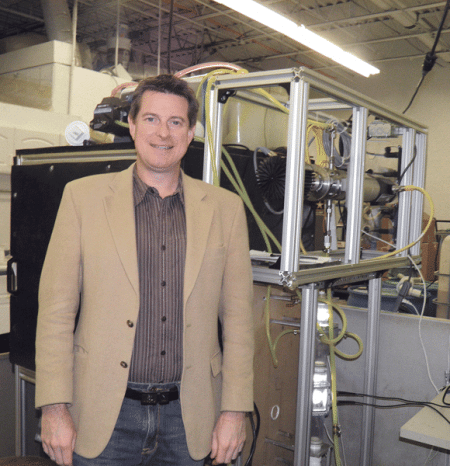
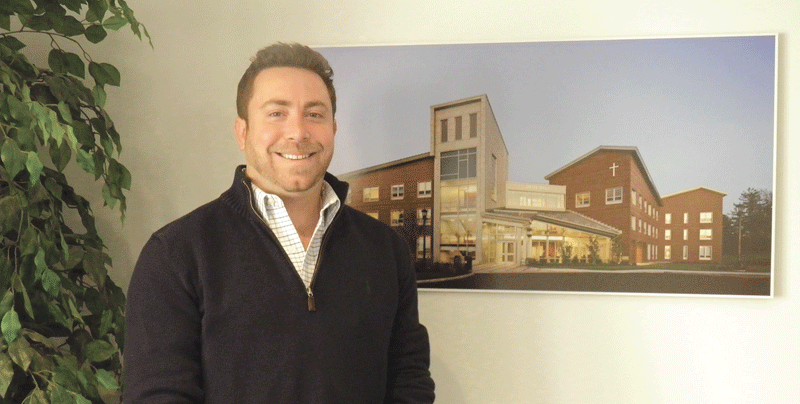
Stanley Kowalski says FloDesign

Stanley Kowalski says FloDesign and its spinoffs are continuing a pattern of turning ideas into breakthroughs — and new companies.

Stanley Kowalski III says filters will soon become obsolete.

“They will never be needed in anything again — during manufacturing, in automobiles, airplanes, furnaces, faucets — anything you can possibly think of,” Kowalski, chairman of the board at Wilbraham-based FloDesign Inc., told BusinessWest, adding that he and his team at FloDesign Sonics, a spinoff venture, are developing technology that will use sound waves for that work.

That technology is based on a scientific discovery made two years ago by a team of engineers at FloDesign Sonics, co-founded by Kowalski, Bart Lipkens, Louis Masi, and Walter Presz, after Lipkens received a grant from the U.S. Department of Homeland Security to figure out how to rid reservoirs of anthrax.

“During a process of trial and error, we discovered that acoustics could play a vital role in detection,” said Kowalski. “It led to the discovery of a three- dimensional wave that we did not predict, and since literature didn’t capture what we saw and the theory for it was not fully developed, we went on a quest to find out why and how it worked.”

The principle they discovered is complex, but Kowalski provided a simplified way to explain it. “First, think of sound waves as an invisible force field that can be used to manipulate and hold things in space,” he said. “Next, imagine a chamber filled with fluid; if you generate a consistent flow of sound waves through it, then introduce living cells or debris into the wave, it will be held there by the invisible force field, and the cells will be gently pushed together and form clumps. When they get big enough, they either fall out of the solution due to gravity or rise to the top due to buoyancy.

“The 3-D wave is like an invisible catcher’s mitt,” he continued. “It retains the contaminant, and, because the diameter of the debris is increased due to acoustic forces, the gravity or buoyancy becomes dominant, and the clumps rise or fall out.”

This invisible catcher’s mitt has a seemingly unlimited number of practical applications, including drug manufacturing and filtering blood during surgery, said Kowalski, adding that the sound-wave technology is one of many interesting developments at FloDesign and its many spinoffs.

These include work on a firearms noise suppressor for the military, a development that will reduce high incidences of hearing damage, as well as new prototype development for a diverse set of clients.

Wayne Thresher, who took the helm at FloDesign three years ago, said engineers who work for the company and its spinoffs pride themselves in thinking outside of the box, executing a design efficiently, and manufacturing a prototype.

“We recently finished a product for a company related to fluid flow; they had needed it for three years, but couldn’t figure out how to make it. But Dr. Presz and I went to their location, and within 20 minutes, we came up with two concepts,” he said. “We like a good challenge, and a lot of things relate to fluid flow and air flow. This is our 25th year in business, and we have some really good success stories.”

For this issue and its focus on environment and engineering, BusinessWest looks at some of those success stories and others that are still being written.

Down to a Science

Kowalski said FloDesign Sonics’ sound-wave technology was patented and has earned the company several prestigious grants in a highly competitive market.

The first was from the National Science Foundation, which issued a challenge to find a way to separate oil and gas contaminants from water. This is critical work because a number of states have had their water supplies polluted due to a process called hydraulic fracturing, or fracking. It involves pumping hundreds of thousands of gallons of water, sand, and chemicals into the ground to break apart rock and free the gas inside, which is problematic because some of the water that returns to ground level is contaminated.

From left, Bart Lipkens, Stanley Kowalski, Brian McCarthy, and Matthew Wilander

From left, Bart Lipkens, Stanley Kowalski, Brian McCarthy, and Matthew Wilander show off new technology used to manufacture pharmaceuticals.

FloDesign Sonics received a grant in 2012 for the initial phase of the project, and another in 2013 to build a prototype, said Kowalski, adding that, later that year, it also tested a prototype for a life-sciences application that involves harvesting and filtering cells derived from the ovaries of Chinese hamsters that are used to make injectable monoclonal antibody drugs, which are being used to fight cancer, diabetes, and other illnesses.

“Most drug manufacturers use a process called ‘harvesting’ in which the Chinese hamster cell is separated via filtration or centrifuge and then killed. Genetic engineering has enabled cells to reproduce readily and create higher concentrations per batch, but the higher concentrations put a burden on the current filtration and centrifugation methods that results in fouling of filters and loss of product,” Kowalski explained. “But FloDesign Sonics’ new method does not touch the cell. We can handle higher cell concentrations for batch processes and enable continuous manufacturing where the cell is kept alive; it is continuously fed with nutrients and continues to express the protein.

“This is the holy grail of drug manufacturing. All future drugs will be made this way, and FloDesign Sonics believes they have unlocked this potential,” he told BusinessWest, adding that the company used venture-capital money to perform more than 100 trials with leading biopharmaceutical companies, which resulted in six prototypes and a machine it is now selling.

In March 2014, the company hired 14 new employees, and in September of that year, it received another prestigious grant from the National Institute for Health, which came with a new challenge: devising a better way of filtering blood during bypass surgery.

“Although it’s the most popular surgery in the world, it is so invasive that incisions to the body cause fat and debris to be released into the bloodstream; the particles can get caught in the brain and cause strokes, which is referred to as ‘pump head,’” said Kowalski, explaining that this phenomenon occurs because the particles are not captured when they go through the centrifuges and filters used in the bypass process.

FloDesign Sonics used the $100,000 grant to put its acoustic-separation technology to work in a new machine that captures the particles, which it is testing on pigs. “We hope to have human trials with it shortly,” Kowalski said.

So, although the company has yet to create its own website or launch a marketing campaign, it has undergone remarkable growth over the past 18 months, including the securing of $10 million in investments, $3 million in grants, and frequent offers to buy the firm out.

“The discovery we made has limitless possibilities, which range from cleaning the planet’s water supply to use in the life-science field and manufacturing adaptations,” Kowalski said. “When we first started, we were really just replicating what others had done, but when we began getting into theories of acoustics, we found missing holes that we probed. We had already developed a system that worked through trial and error, but it was kind of a 3M moment when we understood the depths of what we had discovered.

“Recall that 3M discovered a glue ideal for the Post-it Note and didn’t realize how important the invention was,” he went on. “We had also discovered an amazing tool, but had to identify needs for it in industry. It blows us away that we’re now helping get life-saving drugs to people faster and cheaper.”

Lipkens, who secured the prestigious grants, said it’s exciting to take new technology and put it to use in successful commercial applications.

“It was always my dream to take a discovery in the lab and transform it into a startup company and see everyone involved, including students, become part of a successful endeavor,” he said, adding that he taught a course with his wife, Kirsten, in how acoustics work in musical instruments before the discovery was made at FloDesign Sonics.

Designs on Growth

Taking discoveries and turning them into products and companies, while also involving students in those developments, has been the pattern at FloDesign from the start.

The aerospace firm has designed, prototyped, and developed products ranging from noise suppressors for jet engines to something called a RAP nozzle, which transmits a fluid force, gas, or fine particles over a distance with minimal loss. The company recently purchased a new CNC mill and lathe, which will allow it to manufacture more prototypes in its Wilbraham location.

This ability to take a concept from the design stage to production is important to Thresher, whose former employers included United Technologies. “They outsourced all of their machine work, eliminating local mom-and-pop operations, and I thought it was the wrong way to do business,” he said.

Although FloDesign is not set up to do mass production, it has the capability of manufacturing up to 2,000 parts for a company, which sets it apart from other contract-engineering firms in the area.

“Engineering companies don’t usually have their own machine shops or the ability to manufacture what they design,” Thresher said, adding that, as a result, many engineers don’t consider factors such as cost when they create a design. “But we do, as we specialize in prototype development.”

Presz created the company in 1990 while he was an engineering professor at Western New England College so he could give his students an opportunity to put theory into practice, and, as a result, FloDesign has a history of using student interns. The experience has proved invaluable for many, including Amanda Kalish, who was unable to find a job after graduating from Worcester Polytechnic Institute.

“Employers want you to have work experience, so this allowed me to bridge the gap while giving me the flexibility to finish my master’s degree in mechanical engineering,” she said.

It has also given her the opportunity to take an idea from concept to prototype and, in some cases, a finished product. “What they do here is unique,” she told BusinessWest. “In a larger company, you are only assigned one aspect of a project and don’t get to see the whole cycle.”

Kowalski said FloDesign Sonics is just one of several spinoff companies that have come out of FloDesign. They include FloDesign Wind Turbine, which was founded in 2008, and FloDesign Water Turbine, which was established in 2009. “They all have something to do with fluid dynamics and acoustic solutions. We have the best people in the world working on this.”

A new product may soon spawn another company. It’s a firearm suppressor that FloDesign developed for the U.S. Marine Corps, and Kowalski said there is enormous potential for it.

He explained that almost every soldier in combat returns with hearing loss, which costs the government more than $2 billion each year. “If they can put a suppressor on every firearm, it could result in a paradigm shift,” he noted.

Although suppressors have existed for some time, they are prohibitively expensive and last only one-tenth as long as the barrel of a gun. “But the prototypes we have developed last longer than the barrel,” Kowalski said.

Expanding Horizons

Mike Harsh, who has recently been appointed to FloDesign Sonic’s board of directors, spent almost 36 years in medical instrumentation and imaging at GE Healthcare, he told BusinessWest, and he has never seen anything like the technology FloDesign Sonics has developed.

“It has the potential to fundamentally change entire industries and the way they think about filtration,” he said. “The entrepreneurial spirit in this company is contagious, and the convergence of this unique and innovative application of acoustics to filtration will unleash a new tool in healthcare that can also be leveraged into other industries.”

Kowalski is also enthusiastic and describes FloDesign’s Wilbraham location as a “think tank.”

“We have created more than 300 jobs, and, although this is our hub, we also have offices in Charlton and Waltham. But it all started here,” he said, as he watched fluid circulate in and out of the machine created by FloDesign Sonics to solve filtration problems related to the manufacture of new pharmaceutical drugs.

“We plan to save people’s lives and eventually clean the planet with our invention,” he said, describing what has become a very fluid path to success.
Manufacturing Sections
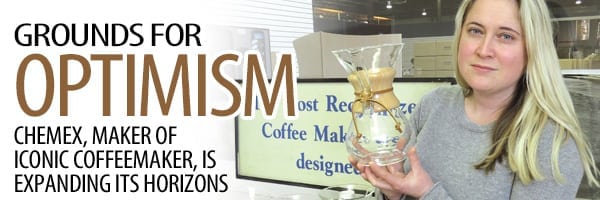
Chemex, Maker of Iconic Coffeemaker, Is Expanding Its Horizons

Eliza Jane Grassy

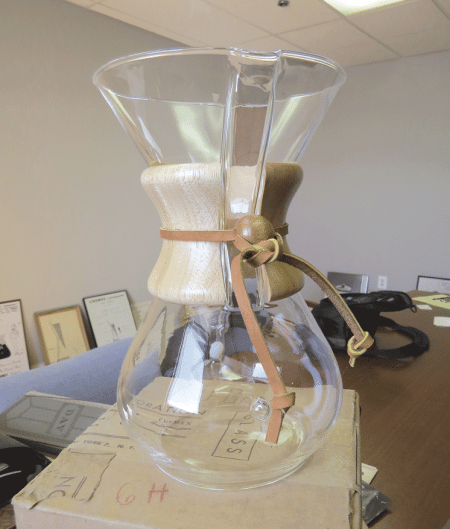
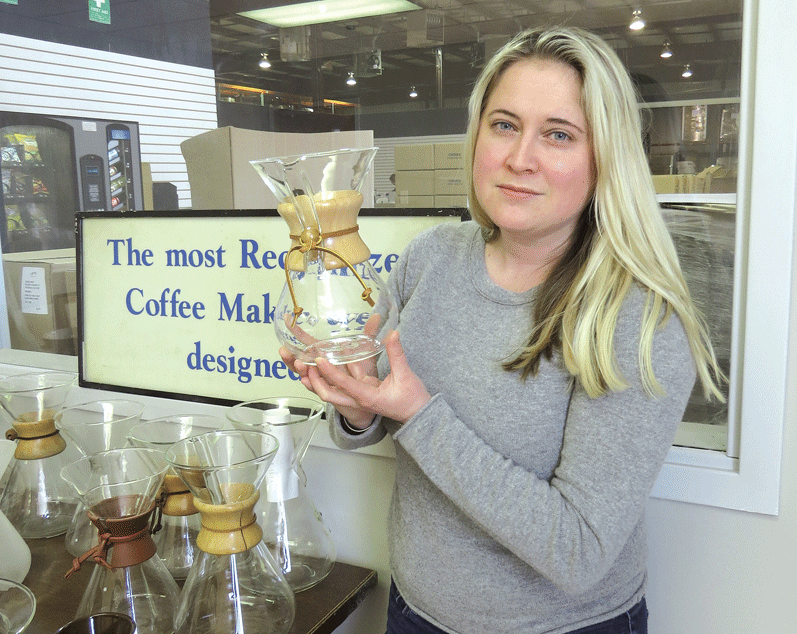
Eliza Jane Grassy shows off the famous Chemex coffeemaker.

The conference room in the Chemex manufacturing and distribution facility in Chicopee isn’t really serving the company in that capacity at this time — well, not only in that capacity, to be more precise.

Instead, while renovations continue at the plant on Veterans Drive, which the company moved into last summer, it is also acting as both storage area and museum of sorts, with all manner of material related to the famous Chemex coffeemaker — assembled on that site — and its inventor, Peter Schlumbohm.

“He was kind of a mad scientist — he had lots of inventions and lots of ideas,” Eliza Jane Grassy, vice president of the company, said of Schlumbohm as she pointed out photos of him, news clippings, and even a sketch of one of his concepts that never became reality — the so-called Chemmobile, an early form of SUV.

But most of the room’s artifacts are devoted to the coffeemaker itself, a work of art and a piece of Americana, both figuratively and quite literally — it is included in the collection at the Museum of Modern Art in New York. There is also one on display at the Smithsonian and other museums. Meanwhile, in 1958, designers at the Illinois Institute of Technology deemed it “one of the best-designed products of modern times.”

Its 74-year history, not to mention those various accolades and others, are chronicled in various displays scattered about the conference room, including advertisements, signs, early sketches of the product, and several of the actual items, in an array of sizes.

In most respects, the conference room is now a nod to the past. Indeed, most of the items are now decades old. But in one corner sit a few boxes containing the company’s newest product (actually, reintroduction of an old one), an automatic version of the iconic coffeemaker — called the Ottomatic — that is already becoming a hit. Meanwhile, out in the shipping area, the labels on the boxes provide more evidence that this company, while clinging to its proud traditions, is certainly not stuck in the 19th century.

The addresses are for commercial clients and retailers in England, Malaysia, Germany, Japan, Sweden, and other countries, and they are indicative of a strong push over the past few years to make this product an international phenomenon rather than just a domestic one.

Still more evidence can be found with the stamps on Grassy’s passport, and also those carried by her mother, Liz, the company’s president, and brother, Adams, who also serves as vice president. Indeed, Grassy has been to Australia and England in recent months, attending coffee conventions, while Adams has other territory, including Asia, and her mother travels almost everywhere.

“We’re now distributing all over the world, and it’s something we’ve been tackling over the past four or five years,” said Grassy, who traces the origins of this global expansion to aggressive outreach fueled by heightened interest from coffee roasters in virtually every time zone — simply one manifestation of the explosion in business opportunities generated by coffee.

She told BusinessWest that the sharp upward trajectory of sales and profits in recent years is not so much a case of being in the right place (planet Earth) at the right time — although that’s part of it — but rather having an iconic product, creating international demand for it, and then meeting it.

To do that, the company, which had been located in Pittsfield for more than 30 years, was forced to seek out considerably larger quarters, and eventually settled on the site in Chicopee, just down the street from the main gate to Westover Air Reserve Base.

The new facility provides more space for both the limited manufacturing that takes place there — what amounts to final assembly of the coffee makers as well as cutting and packaging of the filters — and the more extensive distribution efforts.

the Chemex coffeemaker

Renowned for its simplistic design, the Chemex coffeemaker is on display at the Museum of Modern Art in New York and other museums.

Several employees have been added over the past few months, and more additions are likely, said Grassy, noting that new machinery to package the filters has been acquired, and other investments in technology have been made.

Overall, demand keeps growing, and keeping up with it is a considerable challenge, meaning this is an exciting — and critical — time for the company.

For this issue and its focus on manufacturing, BusinessWest takes a look at this iconic product and the current efforts to continue its legacy, but in a contemporary fashion.

Bean Entrepreneurial

Grassy remembers virtually growing up in the Pittsfield plant where her parents took the company after acquiring it and refocusing its efforts solely on making coffeemakers after unsuccessful bids to expand the brand to other household items.

She recalls working a variety of jobs, from tying the strands of rawhide that go around the neck of each carafe to packing boxes in the warehouse. She also remembers the letters that would come with orders for new coffeemakers and especially the filters used in them, an equally potent source of revenue.

“People would write about how they had their coffeemaker for however many years, they love it, and it has become a part of the family,” she told BusinessWest, adding that such longevity isn’t the hindrance it might be if one were selling tires (primarily because the company also sells the filters). Instead, it’s a wonderfully effective selling point and a steady source of sales for the holidays, weddings, and virtually any time of the year.

Soon, the company will likely be getting more of these letters, and perhaps in a few different languages, as it continues its global push.

But before talking about that, Grassy set the stage by going back several decades and using the material in the cluttered conference room to help tell the story.

It begins with Schlumbohm. The German-born chemist-turned-inventor relocated to the U.S. in the 1930s and, within a few years, had filed more than 40 patents, most of them dealing in advances in refrigeration through chemical, mechanical, and engineering processes. But there were others, including one for a filtering device filed in 1939.

It would eventually become, along with the tremendously simple design, the heart and soul of the Chemex coffeemaker, which went into production only a few months after the U.S. entered World War II.

The product’s success is owed to a blend of chemistry and design: the narrow-waist flask, or carafe, uses filters made of chemically bonded paper, perhaps 30% thicker than those used for most drip-method coffeemakers, which removes most of the oils and chemicals, giving the coffee a distinctive taste that has helped Chemex more than withstand the recent onslaught from Keurig and other manufacturers.

“We have an entirely different philosophy, for lack of a better word, when it comes to making coffee,” she explained, adding that nothing has changed in 74 years. “The Chemex was designed as a pour-over method, so that the coffee grounds would be properly extracted. Schlumbohm, as a chemist, knew that pouring water over grounds created a chemical reaction, and his dissatisfaction with coffee at the time led him to develop bonded Chemex filters. When it extracts out all the undesirable oils, sediment, and fats, that just leaves the flavor of the bean and the caffeine.”

Peter Schlumbohm

Peter Schlumbohm, inventor of the Chemex coffeemaker, is seen is this photo, one of the company’s many artifacts, sketching the Chemmobile.

Upon its introduction, the Chemex immediately drew favorable reviews — it appeared on the cover of the Museum of Modern Art’s “Useful Objects in Wartime” bulletin — and solid sales that remained constant through the next several decades and long after Schlumbohm willed the company to an heir who later sold it to the first of a succession of private owners.

Over the years, the product has enjoyed a prominent place in popular culture. James Bond is seen using one in From Russia with Love, the second movie in the 53-year-old series; Mary Tyler Moore had one prominently displayed in her kitchen in her sitcom from the early ’70s; and the product appeared repeatedly in the Dick Tracy comic strip, for example. As part of its efforts to recreate the late ’50s and early ’60s, the makers of Mad Men placed a Chemex in Don Draper’s kitchen.

But the product has certainly stood the test of time, and has been anything but a museum piece, said Grassy, adding that it’s as popular now as it was in the ’50s, when Schlumbohm gave one as a gift to President Harry Truman.

The company was eventually sold to a concern that tried to broaden the Chemex brand to a host of kitchen appliances, said Grassy, adding that a succession of owners essentially failed to replicate the coffeemaker’s success with other products, and the company went into bankruptcy.

Sip Codes

When her parents bought it, they returned it to its roots, and it continued to “plunk along,” as Grassy put it, into the ’90s and the start of this century, when coffee ceased being a drink and instead became a thriving industry, with huge new chains like Starbucks and smaller coffee roasters setting up shop in cities across the country.

The Chemex coffeemaker has been part of the phenomenon, she said, adding that it is used by many specialty coffee chains, including Blue Bottle, Stumptown, George Howell, and others, who want to showcase their coffees in the best way possible.

“The Chemex truly makes a really, really good cup of coffee,” she noted. “And that’s very important for coffee roasters — they want to showcase their coffee beans and the flavors, and with the Chemex process, they’re really able to do that; there’s no bitterness, and you can make it as strong as you want.”

When the company became more aggressive with regard to generating new business, both domestically and overseas, and orders started, well, pouring in, those involved started expanding their horizons, and in many different ways.

It was as that profound change was happening that Grassy and her brother decided to become part of the leadership team at the company. Indeed, while they both grew up at the Pittsfield plant, neither had intentions of making this a career, she said.

“I had just moved to Cambridge from San Francisco — I had attended an art school out there and had gone for fine art — and had planned to go to Leslie for an art-therapy degree, when I got diverted,” she said. “My mother said, ‘things are busy; I’d love it if you could come help, even on weekends or part-time.’

“So I started commuting back to the Berkshires, and that’s when I noticed something interesting was happening,” she went on. “I noticed it in cafés and online, and I said, ‘something’s going on here, and we just need to get involved,’ and the rest is history.’”

What was going on lay at the heart of the basic laws concerning supply and demand. Changing times and iconic products were creating demand, and now the company had to go about creating a supply.

While the company has always sold its product overseas, Grassy said, volume there was a fraction of what it was domestically. That started to change when she and her mother traveled to London five years ago for a coffee event.

“We started making connections there,” she said, adding that these involved both retailers and the growing legions of coffee roasters, and these connections helped introduce the product to new markets and new constituencies, thus generating sales volume.

The pattern has been repeated in other European countries, including Germany and Austria, and also in Asia, South America, Australia, and other spots around the globe, said Grassy, to the point where international sales are now approaching domestic volume.

And while expanding its market reach, the company is also introducing new products, such as the Ottomatic, a machine (manufactured in Ireland) that brings the same brewing chemistry and philosophy, but with the push of button.

“It’s a revolutionary automatic coffee machine,” she explained. “It actually has as shower head, so, as opposed to a regular coffee machine which has one stream straight down, ours showers down and has a pulsing to mimic the Chemex brewing. It’s been a huge success for us.”

Meanwhile, it has rebranded, changing a logo that had been constant since the ’80s, and also created new packaging, updated the website, and made full use of the wide array of social-media outlets to get its message across.

“It’s been quite an evolution,” said Grassy, adding that a thread through its many elements has been sensitivity to the company’s long, proud history, while also modernizing the brand as necessary. This approach can be seen in some of the new advertisements, which have a ’50s look to them.

“We want to take a company with a rich history and continue that legacy in a contemporary way,” she explained. “Our history is very special, and we don’t want to deviate from it. We want to marry the past with the present and future.”

Off-the-cup Remarks

As she wrapped up a tour of the Chicopee facility, Grassy paused in the spacious, still-vacant front area of the building.

Eventually, it will be reshaped into a display area for many of those artifacts now in the conference room — which represent only a fraction of what the company has stored in its archives — and there will also be a small coffee bar for employees and customers.

It’s an exciting development, one of many taking place at this company that is writing new chapters in a story that is rich in character — and flavor.

In other words, this is a venture on very solid ground — or grounds, as the case may be.

George O’Brien can be reached at [email protected]

Manufacturing Sections
Excel Dryer Gains Market Share by Touting Green Benefits

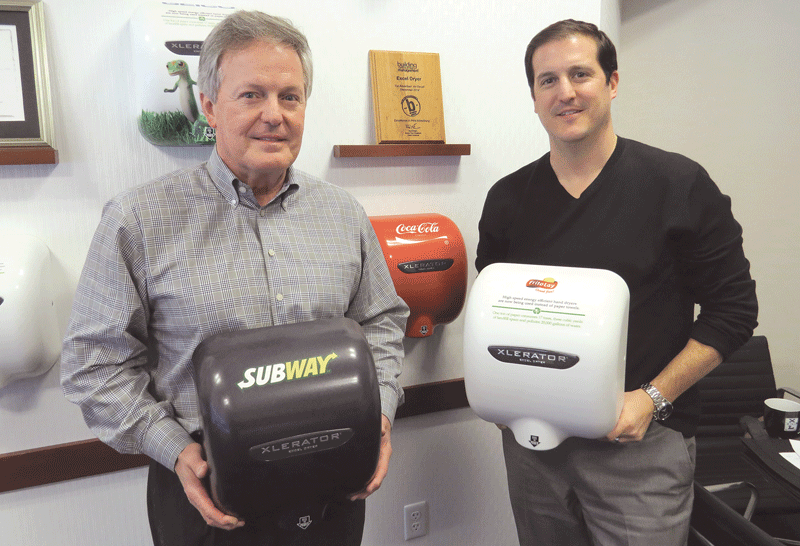
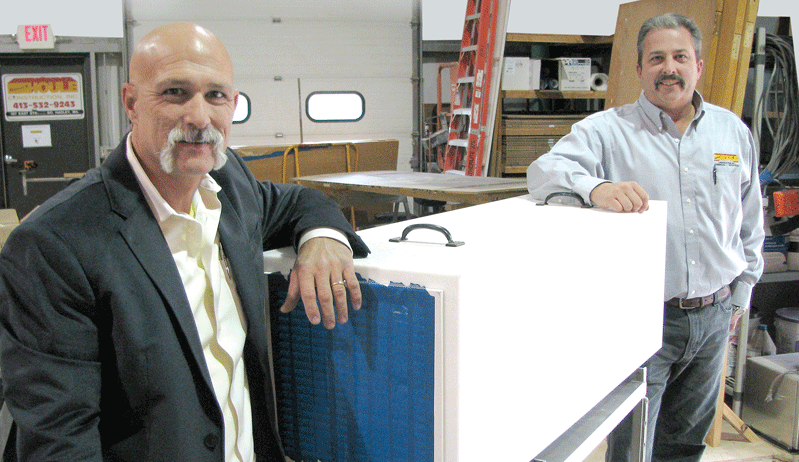
Denis (left) and Bill Gagnon show off XLERATOR

Denis (left) and Bill Gagnon show off XLERATOR models branded with company logos, one of the product’s aesthetic selling points.

If there’s one statistic that drives Excel Dryer, it’s this one: 85%.

That’s the percentage of commercial restrooms in the U.S. that eschew hand dryers for paper towels. That represents significant — and attainable — opportunities, said William Gagnon, vice president of marketing for the East Longmeadow-based company started by his father, Denis, in 1999. After all, when Excel launched its signature product, the XLERATOR, in 2001, that number was 90%. And it continues to shrink.

“Excel Dryer works with all commercial facilities because all businesses have restrooms,” he told BusinessWest, listing some segments that purchase the most hand dryers, including schools; the hospitality industry — including restaurants, hotels, resorts, casinos, and amusement parks — assembly areas like stadiums, convention centers, and concert venues; healthcare; government; retail stores; and transportation facilities like airports, DOTs, and public-transit centers. “We are very successful with all facilities that focus on saving time, money, and the environment.”

The challenge is educating people about the benefits of using high-speed, energy-efficient hand dryers, which improve the user experience compared to older dryers, he said, adding that the XLERATOR dries hands three times faster than conventional hand dryers.

But the education efforts are working, and so is word of mouth.

“Since this new category of hand dryers has become available, hand dryers have gained significant traction versus paper towels,” Gagnon said, citing a report from Dodge Data and Analytics that Excel Dryer products are now listed among the specifications in more than half of new commercial construction projects that include hand dryers. “This means that architects and interior designers working in the commercial-restroom field prefer Excel Dryer models to any others on the market.”

Indeed, the XLERATOR’s initial success — it burst onto the market with a 700% increase in sales between 2001 and 2008 — was no fluke; the company continues to record double-digit growth each year, and 2014 was the best year in Excel’s history.

In fact, Gagnon says Excel has done nothing less than revolutionize the hand-dryer industry, changing the environment in commercial restrooms in more ways than one.

Heating Up

Environmental concerns are, in fact, at the top of Excel’s marketing strategy, but Gagnon said it’s fighting a messaging war with paper-towel manufacturers.

Specifically, he noted that paper-industry giants fund studies claiming that recycled paper towels must be better for the environment than electric hand dryers. “That couldn’t be further from the truth,” he added, claiming that Excel’s high-powered dryers actually represent a 70% reduction in carbon footprint compared to recycled paper towels.

“The paper industry also likes to say that paper towels are more sanitary,” he went on, “but independent, third-party studies from leading academic and research organizations debunk this myth time and time again.”

He cited a study from the Mayo Clinic that found no difference between paper towels and hand dryers in removing bacteria from washed hands. However, another study published in the American Journal of Infection Control found 17 species of bacteria on unused, recycled paper towels, and noted that this may have implications in industrial and clinical settings, like hospitals, which house immunocompromised individuals. “When a leading publication about infection control warns against using paper towels in healthcare settings,” Gagnon said, “that’s a pretty strong statement.”

To further emphasize the company’s dual emphases on cleanliness and ecological impact, Excel Dryer recently launched a new product, the XLERATOReco, which uses what Gagnon calls “no-heat technology” to dry hands quickly using only 500 watts.

“It offers all the same features and benefits of the original XLERATOR hand dryer, except for the heating element,” he explained. “This hand dryer significantly reduces energy consumption and is the best choice for facilities looking to reduce costs and energy usage.” He added that it’s also an attractive choice for facilities in warmer climates where the heating element is not as beneficial.

Even the original XLERATOR, because it dries hands so quickly, uses 80% less energy than conventional hand dryers, Gagnon said, and provide a 95% cost savings versus paper towels, once the initial cost of installation is recouped — typically, within one year. Add it up, and the Excel team believes it has a winning formula for continued growth, and not just domestically.

“Approximately 25% to 30% percent of our sales are exported outside of the United States, and we are experiencing tremendous growth in international markets,” he told BusinessWest. “For example, the European adoption rate of energy-efficient technology is significantly higher than here in the U.S. They have much stricter energy restrictions and less room in landfills for waste, so high-speed, energy-efficient hand-dryer technology is much more prevalent there.”

In fact, he added, the ratio of hand dryers to paper towels in commercial restrooms in Europe is three to one, a stark reversal of the U.S. model. “As awareness for energy conservation increases, environmentally friendly, energy-efficient hand-dryer adoption rates will increase on a global scale. The United States is not as far down the path of adopting sustainable solutions, but the demand in European markets is a good indication that energy-efficient technology is the way of the future.”

At the same time, Gagnon said, Excel has managed to keep its manufacturing base in East Longmeadow, using Kaizen Cell procedures to become more efficient instead of cutting costs by moving operations overseas, like others in its industry have done. In doing so, Excel continues to add manufacturing jobs locally.

Giving a Hand

Despite its continued growth, Excel isn’t resting on its success. It has added adjustable speed and sound control for sound-sensitive areas, and a HEPA filtration system and Microban anti-microbial wall guards to support hygienic standards. Excel also recently unveiled a sixth-generation motor for longer lifespan. Now, the control assembly features error codes to make maintenance easier.

On the aesthetic side, the device’s custom digital image covers can feature corporate colors, logos, images, and taglines. “You can see our custom covers here locally at the Naismith Memorial Basketball Hall of Fame and all across the globe,” Gagnon noted.

“Big brands like Starbucks, Dunkin Donuts, Coca-Cola, and even the New England Patriots have them in Gillette Stadium,” he added. “It’s great to see companies support sustainable solutions and co-brand the XLERATOR hand-dryer models with their unique style. It says a lot when an organization like the Patriots believes in your brand enough to put their logo on your product.”

The covers can also feature sustainable messaging, including statistics from the EPA, explaining why hand dryers are a better choice for the environment than paper towels, Gagnon said, adding that customers have increasingly come to appreciate the green appeal of the product.

In fact, Excel is the first hand-dryer company to become affiliated with the U.S. Green Building Council (USGBC), which hosts the largest green-building trade show, and is the force behind LEED (Leadership in Energy and Environmental Design) certification for environmentally friendly buildings. “We don’t just talk the talk; we walk the walk,” Gagnon added. “Our latest Excel Dryer corporate office expansion was LEED Gold-certified.”

In addition, the company touts its membership in the Green Building Initiative and the Sustainable Buildings Industry Council, and endorsements by the Green Restaurant and Green Hotels Assoc. and a listing on the GreenSpec guide to ecologically conscious building products.

“According to the EPA, one ton of paper towels requires 17 trees, pollutes 7,000 gallons of water, and takes up 3.3 cubic yards of landfill space,” Gagnon noted. “This is just too taxing on our environment. We need to find better, sustainable solutions. Going green is no longer just a movement; it’s becoming the expectation, and we are proud to be a catalyst for positive change.”

In addition, Excel is an original seed sponsor of the Green Apple Day of Service, a program of Green Apple, a cause-marketing initiative of the USGBC Center for Green Schools.

“Three years ago, they launched a national day of service, challenging school officials to improve education facilities and promote a safer, healthier, and more sustainable place to learn,” he explained, adding that Excel has participated each year by donating custom-covered Green Apple XLERATOR hand dryers to schools around the world. The Green Apple dryers are available for any facility to purchase, and a part of the proceeds goes back to support the Green Apple initiative. The next day of service is scheduled for Sept. 25.

“As awareness of green industry has grown, so has our business,” he said, “and we look forward to continue partnering with green-industry thought leaders and organizations to continue building momentum.”

(Rest)room for Growth

To that end, Gagnon anticipates sharing more developments in the coming year, from a hand-dryer model compliant with the Americans with Disabilities Act to a new, integrated sink system that features the latest XLERATOR technology.

“We continue to focus on innovative solutions for the industry,” he told BusinessWest. And with so many commercial spaces still dependent on paper, he knows there are plenty of minds left to change.


Joseph Bednar can be reached at [email protected]

Departments People on the Move

Meyers Brothers Kalicka, P.C. announced the following:
• Kayla Helitzer, MSA, has been hired as an Associate. Helitzer began her career at MBK as an intern before acquiring her current position. She holds a master’s degree in accounting from the Isenberg School of Management at UMass Amherst. In her free time, she participates in the Young Professional Society of Greater Springfield, volunteers at the Knesset Israel synagogue, and enjoys skiing and snowboarding;
• Joseph Vreedenburgh, MSA, has been hired as an Associate. Vreedenburgh comes to MBK with a background as a corporate accountant and experience with small to medium-sized businesses, as well as government entities. This experience provides him with a unique perspective as an auditor at the firm. He holds a bachelor’s degree in business administration from the University of Washington and a master’s degree in accounting from UMass Amherst. He is a member of Northampton Area Young Professionals and enjoys hiking and mountain biking; and
• Brandon Mitchell, MSA, CPA, has been hired as an Associate. Mitchell specializes in audits of commercial and not-for-profit entities, reviews and compilations of financial statements for small businesses and individuals, and tax-return preparations. Before joining the firm, he worked as a business manager for a locally owned business. He holds a bachelor’s degree in business management and a master’s degree in accountancy from Westfield State University and devotes much of his spare time to his alma mater’s Mentoring Program.
•••••

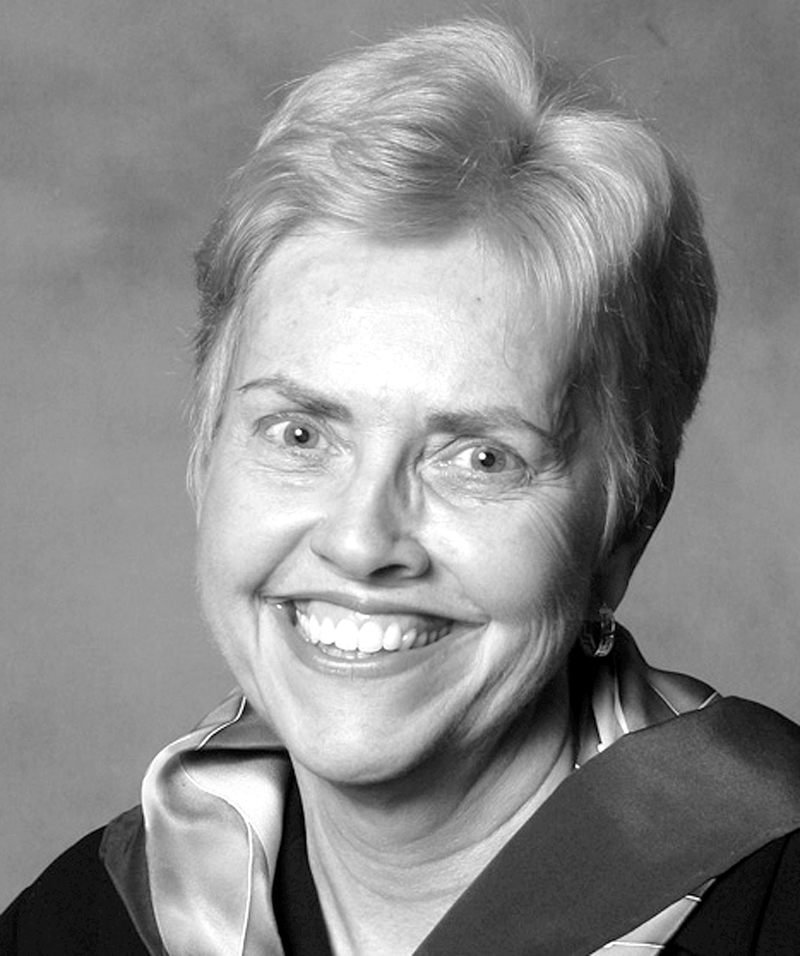
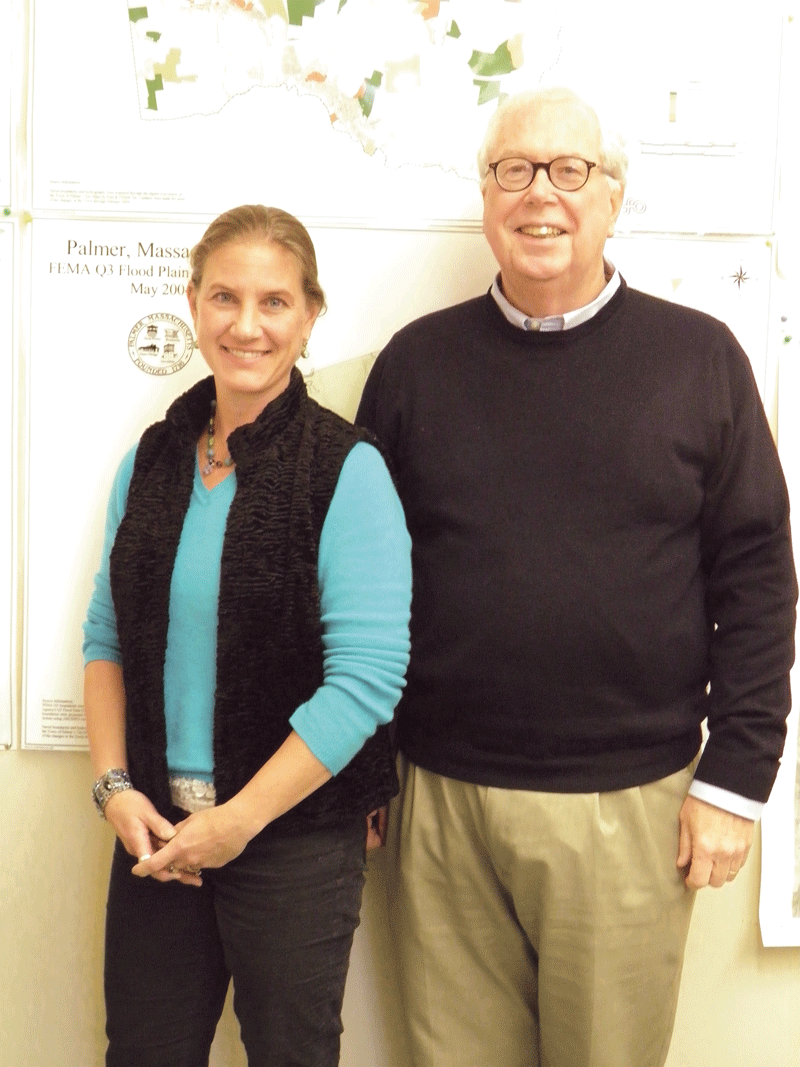
Christine Phillips

Christine Phillips

PeoplesBank announced the appointment of Christine Phillips as vice president, Human Resources. In her new position, Phillips will monitor and administer the bank’s human-resources policies and recruitment plan, oversee employee relations, administer employee benefits, and serve as the bank’s EEO/AAP officer. Phillips brings more than 15 years of human-resources experience including recruiting, performance analysis, and compliance. She not only helped a variety of organizations recruit top talent, she also helped operate a successful human-resources company. A member of the AIM Human Resources Group, Phillips holds a bachelor’s degree from UMass Amherst. She is a member of the South Hadley School Committee, the PTA president of Plains School, and a board member of St. Patrick’s CYO Basketball.
•••••
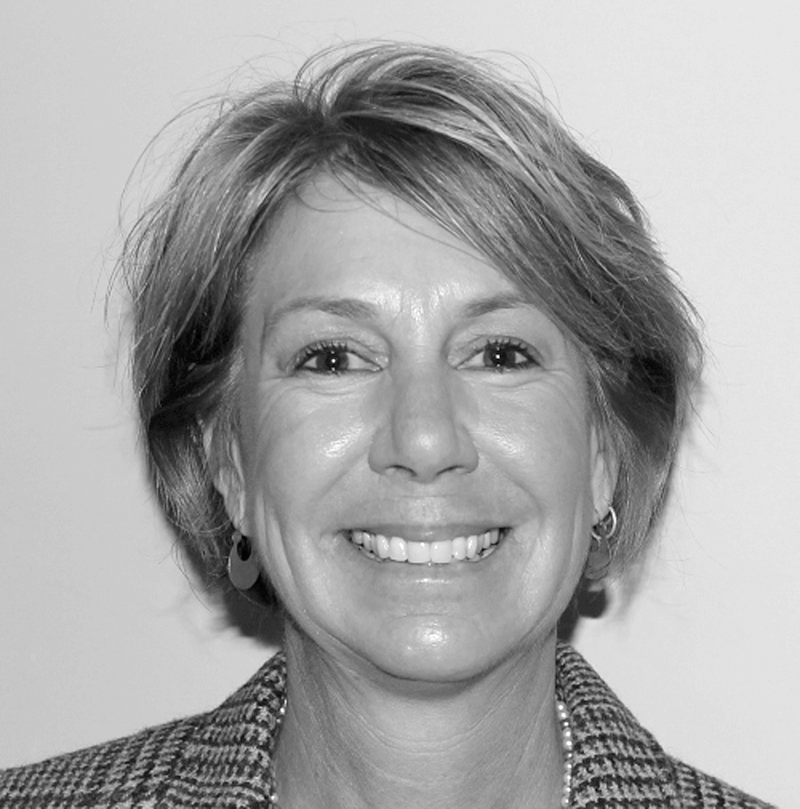
Elizabeth Hukowicz

Elizabeth Hukowicz

Elms College has appointed Elizabeth Hukowicz dean of the newly established School of Graduate and Professional Studies. Hukowicz has been the associate academic dean of the Division of Graduate Studies and Continuing Education since 2005. Under her leadership, the number, scope, and complexity of programs in her department has increased tremendously. In recognition of this growth, the division has been restructured into a school, with Hukowicz appointed as the first dean. “The new school will serve our non-traditional and adult learners, and also highlight the importance of these programs to the strength and vitality of the institution,” said Walter Breau, vice president of academic affairs. Added Hukowicz, “this restructuring will allow the school to offer a broader array of degree options and services for adult learners on and off campus. The adult learner is at the core of what we do, and we will provide increased opportunities to better serve the adult learner in and out of the classroom, wherever and however that may be. We will continue to find new and better ways to make students successful.” Elms College offers graduate-degree programs in accounting, applied theology, autism-spectrum disorders, education, healthcare leadership, management, and nursing. The college also offers certificates of advanced graduate study in autism-spectrum disorders, communication sciences and disorders, and education.
•••••
Mike Harsh

Mike Harsh

FloDesign Sonics Inc. announced it has added Mike Harsh to its board of directors. Harsh served as vice president and chief technology officer for GE Healthcare until December 2014 and led its Global Science and Technology Organization. “The addition of Mike to our board will have a profound impact on our company,” said founder and CEO Stanley Kowalski III. “Mike has personally been involved with the research and development of acoustic-based products in life sciences. He has the ability to get into the details while envisioning our global strategy. We are delighted to have him join our team.” Added Harsh, “I am really excited to be part of FloDesign Sonics. Their entrepreneurial sprit is contagious, and the convergence of this unique and innovative application of acoustics to filtration will unleash a new tool in healthcare that can also be leveraged into other industries.” Harsh led the global Science and Technology Organization for GE Healthcare, a $18 billion business unit of General Electric focusing its research on the development of innovative diagnostics, healthcare IT, medical imaging and information technologies, medical diagnostics, patient-monitoring systems, biopharmaceutical-manufacturing technologies, and technologies that facilitate new drug discovery. Harsh began his career at GE in 1979 as an electrical design engineer in nuclear imaging, and subsequently held numerous design and engineering management positions with X-ray, ultrasound, MRI, patient monitoring, and information technologies. He was also the global technology leader of the Imaging Technologies Lab at the GE Global Research Center, where he led the research for imaging technologies across the company, as well as the research associated with computer visualization/image analysis and superconducting systems. He was named an officer of General Electric Co. in November 2006. Harsh earned a bachelor’s degree in electrical engineering from Marquette University, and he holds numerous U.S. patents in the field of medical imaging and instrumentation.
•••••
Luis Santamaria

Luis Santamaria

Luis Santamaria has been chosen as Greenfield Community College’s new director of Campus Public Safety. He will oversee GCC’s Campus Public Safety department and serve as GCC’s chief of police. Santamaria leaves his position as associate director of Public Safety for Curry College in Milton. Prior to his work at Curry College, he served as a sergeant for Tufts University for nine years and as a campus police officer at Simmons College and officer in charge at Western New England University. Santamaria graduated summa cum laude with a bachelor’s degree in criminal justice and a master’s degree in criminal justice administration from Western New England University. He served as vice president of his class at the Special State Police Academy. He holds EMT certification and has certification as a MCJTC sexual assault investigator, defensive tactics instructor, and rape aggression defense instructor. He is bilingual in English and Spanish.
•••••
Kate Bechtold

Kate Bechtold

Anthony Scibelli

Anthony Scibelli

Following nationwide searches, Cooley Dickinson Hospital President and CEO Joanne Marqusee announced that two healthcare executives, Katherine Bechtold and Anthony Scibelli, have joined the organization’s senior leadership team. Bechtold has been selected as Cooley Dickinson Health Care’s vice president of patient care services and chief nursing officer. “I am very excited to have someone with Kate’s depth of experience, clear commitment to quality care and service excellence, collaborative style, and ability to inspire staff at all levels join the senior leadership team,” Marqusee said. Added Bechtold, “I am excited about this wonderful opportunity to lead nursing and patient-care services at Cooley Dickinson. I was impressed with the commitment to patient care that I heard from staff and medical staff alike and look forward to being part of the new leadership team that Joanne Marqusee is building.” Most recently, Bechtold served as the senior vice president and chief nurse executive for MultiCare Health System in Tacoma, Wash., where she oversaw system-wide nursing and clinical policies, case management, social work, and quality care for the five-hospital system and its primary-care, urgent-care, and specialty clinics. She also served for eight years as chief nursing officer and vice president of patient care at Centura Health Systems in Englewood, Colo., and Saint Anthony Hospital System. She counts among her accomplishments leading Saint Anthony Central Hospital to one of the highest scores in the nation for nursing quality indicators and significantly reducing nursing-management turnover rates. Scibelli has joined Cooley Dickinson Health Care as vice president, operations and chief administrative officer. He will supervise a number of departments, including Facilities, Housekeeping, Transport, Security, Nutrition, Lab, Imaging, and Human Resources. “I am very excited that a leader with Tony’s range of experience, dedication to service excellence, and ability to lead teams and promote teamwork has accepted this important position. He will add much to the new senior leader team we are building,” Marqusee said. Scibelli has most recently served as senior vice president, Human Resources, Support Services, and Post Acute Operations at Mohawk Valley Health System in Utica, N.Y., which resulted from the affiliation of Faxton-St. Luke’s Healthcare and St. Elizabeth Medical Center. He oversaw a range of functions, including Human Resources, Facilities Management, Support Services, Home Care, and Long-term Care. Scibelli joined Faxton-St. Luke’s Healthcare in 2004 as vice president, Human Resources and was promoted several times there. Scibelli earned a bachelor’s degree at Worcester State College and master’s degrees from Lesley College in Cambridge and SUNY Albany.
•••••
Patrick McCarthy, Sodexo Dining Services general manager for the Loomis Communities, has been selected for the Sodexo National Emerging Leaders program, joining 29 of his peers who have been identified as leaders in their field. The Sodexo Emerging Leaders program consists of an intensive, nine-month leadership-development course focusing on leadership at a strategic level. The course study includes trainings at the Sodexo North American headquarters in Gaithersburg, Md., as well as peer project assignments and online interactive trainings. Prior to working for Sodexo and the Loomis Communities, McCarthy attended classes at the Culinary Institute of America and owned restaurants in the Pioneer Valley.

Daily News

WEST SPRINGFIELD — With manufacturing a driving force of economic growth in the Northeast, as well as across the U.S., more than 12,000 business owners, engineers, designers, production managers, and purchasing executives will gather on May 12-14 at EASTEC, the East Coast’s premier manufacturing event.

Produced by SME, the biennial event takes place at the Eastern States Exposition in West Springfield and features more than 650 exhibitors and three days of complimentary educational sessions. In its 34th year, the event showcases the latest manufacturing technologies from additive manufacturing/3D printing to waterjet cutting, and provides access to industry experts sharing insights on how to foster innovation, increase productivity, and improve profits. This year, attendees will also get to see more than 300 new products being highlighted at the show.

“Since 1790, when the first cotton mill was founded in Rhode Island, New England has been a leader in our country’s quest to capitalize on American innovation and passion for making things,” said Kimberly Farrugia, senior event manager for SME. “EASTEC is committed to keeping New England manufacturers competitive by bringing the human ingenuity needed and manufacturing brilliance demanded together in a face-to-face environment.”

At EASTEC, attendees will have the opportunity to connect with resources, research and purchase the latest technologies, and discover ways to improve productivity and increase profits. Meanwhile, the complimentary educational sessions will address trending topics such as automation innovations and Lean creativity, along with other major advancements in manufacturing.

New features in 2015 will include keynote presentations from Carl Palme, applications product manager, Rethink Robotics; and Jason Prater, vice president of Development, Plex Systems, that will help with solving complex issues that U.S. manufacturers face today. EASTEC also will highlight the Bright Minds Program, designed to educate the next-generation workforce on the advancements in manufacturing that make it an exciting and rewarding career path. Winners of the Bright Minds Dream It! Do It! Student Challenge will be recognized at a special program during the three-day event.

EASTEC is recommended for professionals in industries such as aerospace, defense, medical, automotive, commercial machinery, electronics, fabricating, and plastics. The event is nearly sold out, so SME encourages companies to reserve exhibit space before it’s too late. To learn more about EASTEC, view full conference and exhibit details, or register, visit easteconline.com.

Daily News

WILBRAHAM — FloDesign Sonics Inc. announced it has added Mike Harsh to its board of directors. Harsh served as vice president and chief technology officer for GE Healthcare until December 2014 and led its Global Science and Technology Organization.

“The addition of Mike to our board will have a profound impact on our company,” said founder and CEO Stanley Kowalski III. “Mike has personally been involved with the research and development of acoustic-based products in life sciences. He has the ability to get into the details while envisioning our global strategy. We are delighted to have him join our team.”

Added Harsh, “I am really excited to be part of FloDesign Sonics. Their entrepreneurial sprit is contagious, and the convergence of this unique and innovative application of acoustics to filtration will unleash a new tool in healthcare that can also be leveraged into other industries.”

FloDesign Sonics is currently commercializing its first products — a system to separate and clarify cell culture used in the manufacturing of protein-therapeutic drugs. FloDesign Sonics closed a $10 million Series A round in March 2014. It has also been awarded multiple grants from both the National Science Foundation and National Institute of Health totaling more than $2 million. It has used the proceeds to perform more than 100 trials with leading biopharmaceutical companies while building six prototypes.

Harsh led the global Science and Technology Organization for GE Healthcare, a $18 billion business unit of General Electric focusing its research on the development of innovative diagnostics, healthcare IT, medical imaging and information technologies, medical diagnostics, patient-monitoring systems, biopharmaceutical-manufacturing technologies, and technologies that facilitate new drug discovery.

Harsh began his career at GE in 1979 as an electrical design engineer in nuclear imaging, and subsequently held numerous design and engineering management positions with X-ray, ultrasound, MRI, patient monitoring, and information technologies. He was also the global technology leader of the Imaging Technologies Lab at the GE Global Research Center, where he led the research for imaging technologies across the company, as well as the research associated with computer visualization/image analysis and superconducting systems. He was named an officer of General Electric Co. in November 2006.

Harsh earned a bachelor’s degree in electrical engineering from Marquette University, and he holds numerous U.S. patents in the field of medical imaging and instrumentation.

Employment Sections
TWO Program Is Honored for Closing Workforce Skills Gaps

WorkforceDPart“The economic imperative for aligning the workforce needs of Massachusetts with the needs of students attending community colleges is powerful and growing. Massachusetts is at a crossroads in its capacity to compete — and the ability of its residents to fully participate in the current economy and the rewards that employment brings. For the Commonwealth to flourish going forward, a high priority must be placed on training the workforce that is needed by the industries that are driving the Massachusetts economy. That responsibility falls squarely on the Commonwealth’s public higher-education system, most predominately the 15 community colleges.”

That was one of the more hard-hitting bits of analysis and commentary contained in a blistering 2011 report issued by the Boston Foundation, a document that essentially called out the state’s community colleges for not doing enough to help train a workforce to meet industry needs, while making some controversial suggestions about how to bring about change, such as a centralization effort that would do away with local boards of trustees at the schools.

Bill Messner — now, as then, president of Holyoke Community College — remembers his reaction to that report. His initial response was that its authors didn’t do enough research — at least when it came to the schools west of Worcester — and missed some key evidence that community colleges in the 413 area code were, in fact, being imaginative and somewhat effective in efforts to close so-called skills gaps within the workforce.

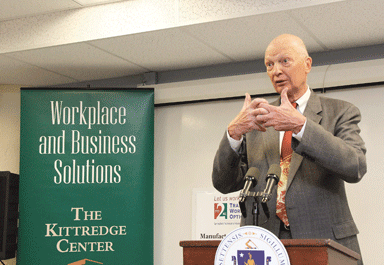
Bill Messner

Bill Messner says the Boston Foundation report in 2011 caught the attention of area schools and prompted initiatives like TWO.

Still, Messner and others, like his counterpart at Springfield Technical Community College, Ira Rubenzahl, chose not to shoot the messenger — although they were highly critical of those suggestions to centralize the community-college system and put it under one board — and heed calls from the Boston Foundation, as well as the Commonwealth Corp. (which issued its own report with similar findings at that time) to do more to partner with businesses and workforce-development agencies to properly align their training programs with the specific needs of industry sectors.

So it was with a large dose of pride that HCC and STCC learned that, together, they had won the first Deval Patrick Award for Community Colleges, named after the former governor and funded by the Boston Foundation, for work undertaken through a program called TWO (Training & Workforce Options), an acronym that is now resonating throughout the local business community.

The cash prize, to be split by the schools, is $50,000 — a small amount, especially when budget cuts of nearly 10 times that number were announced by the Baker administration for both schools the same week the award was presented. But the rewards go well beyond the money (which will go into both schools’ general operating funds), said both Messner and Robert LePage, vice president of Foundation and Workforce Training at STCC and the school’s TWO point person.

Indeed, the award will bring recognition to the program, said LePage, adding that with that exposure might come support from other state agencies as well as more participation among area businesses and thus more progress in combatting regional workforce issues.

“Recognition from a group like the Boston Foundation is the kind of endorsement that can get others to invest in you — I hope this is something we’re able to leverage,” he explained. “People want to see a good return on their investment, so I’m hopeful that this will bring some eyes to Western Mass., prompt others to appreciate the work we’re doing here, and cause people to say there are things happening here that they can adopt.”

In many ways, the Boston Foundation report validates TWO’s mission and underscores the success stories authored in its first three years, said LePage, adding that there have been many of them.

For example, TWO has partnered with Baystate Health to create a regional ICD-10 (medical coding) incumbent worker training academy and is working with regional employers to launch an advanced hospital medical coding academy that will prepare workers for the many changes coming to that important realm within healthcare. Meanwhile, it has worked with MassMutual and a host of other employers to develop a new advanced call center and customer service certificate, a program that has succeeded in placing a number of individuals in jobs within that emerging sector.

Meanwhile, TWO has taken the lead in training individuals for the gaming industry that will soon become a force in this state through the creation of the Mass. Casino Careers Training Institute.

For this issue and its focus on employment, BusinessWest looks at how TWO has managed to impress far more than the Deval Patrick Award judges and, in the process, has enabled more individuals to join the workforce and helped area businesses thrive.

Work in Progress

Increasingly, Messner noted, groups such as the Boston Foundation are creating cash awards, like those attached to the Deval Patrick Award, as incentives to prompt groups and individuals to respond to their various initiatives and calls for action.

And in many instances, such tactics are working, he said, adding quickly that, with the Patrick Award, there was little fanfare, and many administrators at the state’s community colleges, himself included, were not even aware of the award until a call for applications was issued last fall.

The much more profound incentive to respond to the 2011 report and others like it, said Messner, was a recognized need for a regional response to a skills gap that goes a long way toward explaining still-high regional unemployment rates at a time when many businesses are struggling mightily to fill key positions — a phenomenon that has in some ways stifled economic growth.

“While we didn’t agree with everything in the report, it certainly got our attention,” said Messner, using ‘we’ to mean both community colleges. “And we responded accordingly with TWO.”

Slicing through the 2011 Boston Foundation report and summing up its main points, the authors’ main contention then was that the state’s community colleges were not working collaboratively (or working enough) with employers, industry groups, and workforce-development-centered agencies to identify needs, close skills gaps, and create opportunities for those challenged in their attempts to enter the state’s knowledge-based workforce.

So TWO, which was already in its formative stages when the report came out, was designed to change that equation, create a host of partnerships, and incorporate a far more proactive approach to workforce issues and challenges than what existed prior to the program’s existence.

TWO’s mission — and its operating philosophy — are summed up nicely in this passage from the joint application submitted by HCC and STCC for the Deval Patrick Award:

“Prior to community college reforms, the two colleges often worked in a reactive form and in competition with one another,” the application authors wrote. “This often led to an inefficient and duplicative approach to workforce development and employer engagement in Hampden and Hampshire counties. With the formation of Training and Workforce Options, the two colleges have formed a cohesive and proactive sales and training approach and have effectively broadened the reach of both colleges. TWO has provided HCC and STCC a stronger and unified voice and further positioned the colleges to provide a deeper and wider leadership role in serving regional workforce needs that serves as a catalyst to support economic-development success.”

It has assumed this leadership role through engagement with the business community and agencies ranging from area Regional Employment Boards to one-stop career centers to economic-development-related agencies to identify needs and develop programs to address them.

Through its so-called ‘business-discovery model,’ LePage said, TWO has met with more than 200 businesses in five key industry sectors — financial services/customer service, healthcare, hospitality and culinary, IT, and manufacturing — to validate employer needs.

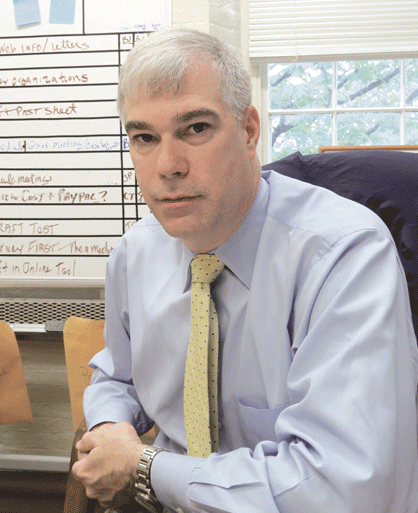
Bob LePage

Bob LePage says the Deval Patrick Award will garner recognition for TWO, prompting more participation and attempts to emulate its success.

And program partners run the gamut, from major employers such as MassMutual, Baystate Health, Smith & Wesson, Six Flags, and MGM to smaller operations such as Mustang Seats, the Three Rivers-based company that makes replacement motorcycle seats for Harley Davidson, Honda, BMW, and other brands, and Ludlow-based Chemi-Graphic, which manufactures nameplates, labels, and other products for a wide range of customers.

Input from these businesses has helped spawn several direct responses in the form of new programs and training initiatives.

At Chemi-Graphic, for example, TWO has provided a host of services, from assessing workforce needs to direct training programs to advice on how to secure state workforce-training grants, said LePage, adding that the manufacturer is in many ways representative of the businesses TWO was created to assist.

“They’re the kind of company we’re looking for, because they have 50 to 60 employees, so they’re not large enough to have a training arm, per se,” he explained. “And they have a niche business, one that’s doing well, but is now facing the retirement of all those Baby Boomers, and they need to replace those workers. They’re really what we’re looking for — we want to help as many of those small and mid-size companies as we can because they are the heartbeat of this region.“

Answering the Call

Overall, TWO’s most profound impact has been with closing those aforementioned gaps between the skill sets that the current workforce possesses and the skills that are needed within certain industries and for specific jobs.

Two of the better examples of how TWO has operated are the ICD-10 incumbent worker training academy and the advanced call center and customer service certificate.

ICD-10, as that name would suggest (at least to those in the industry), is the 10th revision of the International Statistical Classification of Diseases and Related Health Problems, or ICD, said Jason Pacheco, a senior workforce-planning consultant for Baystate Health. And it represents a significant change from ICD-9.

“ICD-9 has around 9,000 or 10,000 codes, while ICD-10 has roughly 60,000 codes,” he explained, adding that this nearly exponential increase is projected to generate a decrease in productivity — primarily because it already has in countries where ICD-10 is being used. As a result, said Pacheco, healthcare providers and medical practices will either have to bring on more employees or outsource more work.

To widen the pool of potential job candidates, TWO is partnering with Baystate, the Regional Employment Board of Hampden Country, and other players on worker training initiatives that have, to date, involved more than 50 companies.

“The concept to fill the gap in the labor pool was to come up with a development program,” said Pacheco. “What Training and Workforce Options has been able to do is work with those two community colleges to help align the students and their curriculum toward flexible workforce arrangements that meet employers’ needs.”

And that’s just one example, he said, of how Baystate and others in the healthcare sector have partnered with TWO to identify and close gaps involving several specific positions, including sterile-processing technicians, medical lab technicians, pharmacy technicians, and others.

That list includes call-center employees, he went on, adding that Baystate is one of many area employers, large and small, that have participated in the Advanced Call Center & Customer Service Training program.
To date, three cohorts of students have produced more than 55 graduates, with roughly 80% of those individuals placed in companies like MassMutual, PeoplesBank, Health New England, and many others, thus meeting a growing need for such specialists.

“There are quite a few call centers in the region if you start to add them up, and they’re across many sectors of the economy,” said Nick Fyntrilakis, vice president of Community Involvement for MassMutual, which has hired several of those graduates. “And a growing challenge for everyone with a call center was finding qualified applicants; different companies have different needs, but there are some foundational pieces that run across the whole spectrum.”

TWO, working in conjunction with those employers and the Regional Employment Board, developed a curriculum, identified solid candidates for the program, established a call-center simulation center, and developed a formal employer-engagement process to improve student placement, he went on, adding that these various steps have all helped ensure success and sum up what the program is all about.

“To us, that’s the kind of work that community colleges were designed to do,” said Fyntrilakis. “That’s what they were built to do — to plug into the workforce needs of the community and tailor programs that identify people that have a skills gap or require additional training or education, and then help connect them to those careers.”

And that’s exactly the type of work that the state’s community colleges were not doing, at least according to the Boston Foundation.

Bottom Line

Messner told BusinessWest that, while he had confidence in the joint submission for the Deval Patrick Award, he wasn’t exactly expecting the two Western Mass. schools to prevail in that competition.

“I was more than a little surprised by this, because we assumed that the Boston Foundation, being a Boston foundation, might be inclined, especially for this first award, to stick closer to home,” he said, adding quickly that, beyond geography, he wasn’t surprised by the choice.

That’s because of TWO’s quickly amassed track record and the promise to add to its portfolio of success stories.

The Deval Patrick Award might help with all that, and, as Messner, LePage, and others mentioned, that’s a far bigger prize than a pair of $25,000 checks.

George O’Brien can be reached at [email protected]

Daily News

HOLYOKE — Holyoke Community College, in collaboration with Springfield Technical Community College, is offering a free manufacturing production technician training program beginning Monday, March 16.

The 10-week, accelerated manufacturing training program is being offered through Training and Workforce Options (TWO), a joint effort between HCC and STCC, with support from Massachusetts Community Colleges and the Workforce Development Transformation Agenda, which is funded through a $20 million grant from the U.S. Department of Labor’s Employment and Training Administration.

The program runs Monday through Thursday, 3:30 to 8:30 p.m., through May 28. All classes will be held at Dean Vocational High School, 1045 Main St., Holyoke. Students must arrange their own transportation.

To find out more and to see if you qualify, attend one of the following information sessions:
• Monday, Feb. 23, 2 p.m., CareerPoint, Paper City Room, 850 High St., Holyoke; or
• Tuesday, Feb. 24, 9:30 a.m., noon, or 3 p.m., Kittredge Center, Room 226, HCC, 303 Homestead Ave., Holyoke.

To register, contact Ana Sanchez at (413) 755-4789 or [email protected]. If selected, students must attend a mandatory orientation day on Thursday, March 12. Students will spend 150 hours in the classroom learning subjects such as machining, workplace math, measuring, instrumentation, communication, and production. Those who successfully complete the program will receive a certificate as a manufacturing production technician.

Community Spotlight Features
Spirit of Innovation Is Taking Hold in Pittsfield

Mayor Dan Bianchi

Mayor Dan Bianchi says the new Berkshire Innovation Center will be a boon to local businesses and will draw attention to the western part of the state.

The city of Pittsfield has a new project in the planning stages that Mayor Daniel Bianchi calls “amazing.”

It is the Berkshire Innovation Center, which is so innovative that it qualified for funding from a $1 billion investment the Commonwealth is making in projects that further the life sciences.

“We’ve been working with the Massachusetts Life Sciences Center in Boston on this for the last few years,” Bianchi said, adding that when he heard about the state’s plan to invest in the field, he thought about how Pittsfield could become part of it.

His initial idea was to build an incubator that would draw entrepreneurs from the Boston area to Pittsfield, which is home to many small, applied materials and plastics companies that make products such as sutures and suturing equipment.

But when it became clear that this concept was not feasible, a new plan was formulated that led to a $9.7 million capital grant from the Life Sciences Center to build the Innovation Center in the William Stanley Business Park on the grounds of the former General Electric complex that dominated this city’s business community for decades.

The new, non-profit facility will enable shared research between local companies and educational institutions; early-stage production and commercialization of products; and workforce training at the site.

Bianchi said officials toured Rensselaer Poly-technic Institute and Hudson Valley Community College’s new science centers, which have been very successful, to help them formulate the plan.

Local manufacturing companies, including General Dynamics, SABIC and Crane & Co., as well as regional educational institutions such as the State University of New York’s College of Nanoscience, MassMEDIC, the UMass campuses in Amherst and Lowell, Berkshire Community College, McCann Technical School, and Massachusetts College of Liberal Arts have already expressed interest in becoming affiliated with the center. 

“We’ve received more than 20 letters of interest,” said Bianchi, adding that the center will give local companies access to training and advanced technology, including a clean room, 3-D prototype printers, and laboratories with reverse engineering capabilities that will allow them to make new products or improve existing ones. “There are some pretty creative companies in this area, but in order to grow they need this type of facility. A company making complex compounds will be able to work with researchers at UMass Lowell as well as at the Nanotechnology Center in Albany.”

The center will also contain incubator space for entrepreneurs. “It will be unique, and people at the Life Sciences Center are really excited about it,” the mayor said, noting that the facility will be sustainable and generate income through tiered memberships, usage and rental fees on equipment, training, and sponsorships from regional companies.

Ground will be broken this winter, and Bianchi said that if meaningful relationships can be created, it will mean “great things for local companies.”

Meanwhile, other forms of economic development are taking place in this former mill city, everything from new investments in the community’s burgeoning downtown, to more steps to bolster an already thriving creative economy,

For this, the latest chapter in its Community Spotlight series, BusinessWest talked at length with Mayor Bianchi about what’s next for the largest city in Berkshire County.

Downtown Transformation

Among the many new developments in Pittsfield is a boutique hotel taking shape within a building on 273 North St. that dates back to the 19th century. The 68,000-square foot, $14 million project will include 42 unique rooms, three conference areas, an atrium with a skylight, a bar, a revolving door, and a marquee sign with “Hotel” spelled out in lights over the entrance.

“They’re keeping the old windows as well as the 8-by-8 posts in the building, and no two rooms will be the same,” said Bianchi in a voice brimming with anticipation. “It’s very exciting because Berkshire County needs more hotel space, and it will really jazz up this part of North Street. The Crown Plaza and area bed and breakfasts are booked solid all summer, so the owners of the property believe it will be a great destination.”

The popular Spice Dragon Restaurant, which was located in the building, has closed, but a new eatery, which is yet to be determined, will take its place.

“The hotel is only a couple of blocks from the Barrington Stage Company and is right behind City Hall,” Bianchi said, adding that it will be a boon to business travelers as well as tourists.

Other improvements are also being made to North Street via a streetscape plan, and the city was able to procure money from the state much earlier than it planned to complete it.

“The work began about six years ago and we expected it would take two more funding cycles to finish it,” Bianchi said, noting that the first phase of the project ran from the corner of East Housatonic Street to Columbus Avenue and included new lighting, sidewalks, and plantings.

“But we were able to leverage the massive investment made by Berkshire Medical Center and private investors,” he continued, adding that the hospital’s new day-surgery center, parking garage, and wound clinic, combined with the boutique hotel and renovation of the Frank Howard Building (more about that later) played into the equation and convinced state officials to grant the city $4.5 million to complete the streetscape work along an additional three blocks. “We received the money six months ago and we hope the infrastructure improvements will lead to an increase in private investments.”

To that end, work on The First Street Common downtown will also be completed in the spring. “It’s one of our largest urban parks and dates back to the early 19th century,” Bianchi said. “It’s a two-minute walk from City Hall and is very important. It has a new spray park and a performance center, and Shakespeare and Co. will stage events there this year.”

Market-rate housing is being built in the Frank Howard Building as part of an historic redevelopment plan that will convert the underutilized structure into 14 apartments, with 10,000 square feet of storefront retail space on the ground floor.

In addition, the Anota Building will also be converted into 25 units of housing with commercial space on the first floor.

“The work will begin in the spring, which is wonderful, because we can’t seem to keep enough market-rate housing downtown,” Bianchi said. “Eleven new units were completed in the old Notre Dame Elementary School at the end of 2013 and they were immediately rented. Encouraging people to live downtown is part of our master plan, because there are 6,000 jobs in the downtown area. So, our downtown is being completely transformed.”

A complete analysis of every street in Pittsfield was also recently undertaken by the engineering firm Kimley-Horn Associates Inc. “It will help us take a scientific approach on how to expend our limited resources,” Bianchi told BusinessWest as he spoke about how the condition of each roadway, coupled with information on when utility work will be done, will make it possible for officials to prioritize work and avoid resurfacing roads that will be torn up a year later. “The overall condition of our streets is good, but the study is important because streets are something everyone notices, whether they live here or are just driving through the city.”

Planning for the Future

The city is also building a new, comprehensive high school. “It’s in the design stage and will have a huge vocational element,” Bianchi said, adding that when he first became mayor and began talking to small business owners, he was reminded that years ago high school students in the vocational track spent every other week working at local companies, which helped them advance their skills and benefitted local companies.

“The school has had an internship program, but the limited number of hours students spend at local businesses does not give them much exposure to their trade, and provides very little value to companies,” he noted. “So we’re framing a new educational model that will benefit students and our small businesses. There has to be a rigorous academic component to it, but there are waiting lists in the state for vocational schools.”

The goal, he continued, is to create a system that will prepare students who don’t want to pursue higher education to go directly into the workforce after graduation.

Courses of study will range from plastics and applied materials to early childhood education, and since Berkshire Medical Center is a large area employer, Bianchi surmises that students who enroll in the latter field of study may decide to become a nurse or pediatrician.

“Vocational education shouldn’t be a limitation, and the high school has to encompass a lot more than a new building. It has to offer a new model of education,” he said, adding that a program in horticulture could plant seeds of interest in farming, which is a growing venture that is being embraced by young adults in the Pioneer Valley again. “I think we can offer our young people some wonderful opportunities, which will also help small and medium-size companies to grow.”

In addition, Pittsfield is creating a partnership with Berkshire Community College that will allow students to complete courses and earn college credits while they are still in high school.

The mayor told BusinessWest that Pittsfield offers a wonderful quality of life, and the hope is that the Berkshire Innovation Center, new high school, and growth downtown will help attract people to the city and advance economic growth.

“We are too small not to have every move integrated, so every project has to have an economic development connection, whether it is housing, entertainment, educational or a new hotel. But we can offer young people a wonderful middle class life and a nice home can be purchased here for $175,000,” he said.

And with the spirit of innovation and change taking place in the city, Pittsfield’s hopes are likely to become reality.

Pittsfield at a glance

Year Incorporated: 1891
Population: 44,057 (2013)

Area: 42.47 square miles

County: Berkshire

Residential Tax Rate: $17.15
Commercial Tax Rate: $35.17
Median Household Income: $42,114
Family Household Income: $56,896
Type of government: Mayor; City Council
Largest Employers: BHS Management Services Inc.; Berkshire Medical Center; BMC Hillcrest Campus; Sabic Innovative Plastics

* Latest information available

Construction Sections
Outlook Improves for Commercial Builders, Despite Stiff Competition

Fred Snyder, left, and Eric Forish

Fred Snyder, left, and Eric Forish spend a moment outside the new Westfield Senior Center, one of many projects keeping Westfield-based Forish Construction busy.

It’s only January, but Keiter Builders Inc. in Florence already has challenging projects on its roster for spring and summer.

“We’re seeing signs that 2015 will be busy, and the year is shaping up to be a good one,” said company President Scott Keiter, as he went through a list of contracts the firm was recently awarded. “We don’t have all the work we need yet, but we’re looking forward to getting more in the spring. This time of year is always slow for us, but the jobs we have are multi-dimensional and we’re excited about what we have lined up.”

Dave Fontaine Jr. said Fontaine Brothers, Inc. in Springfield is also doing quite well and has enough to work to last through the end of the year.

In fact, he expects 2015 to be better than 2014, which was solid.

“Public projects slowed down last year compared to what we saw immediately following the recession. It wasn’t dramatic, but there was a little less work,” said the company’s vice president. “We do a lot for the Massachusetts School Building Authority, and they didn’t have as many jobs. But things seem to be normalizing and we have a lot of good opportunities for 2016; a decent amount of large-scale public work and private clients who want projects done; things seem to finally be settling into a relatively normal economic climate.”

Eric Forish agrees. “The recession has passed,” said the president of Forish Construction in Westfield as he explained that private projects diminished significantly for a few years during the downturn in the economy, but are on the rise again. “Last year was our best year ever and I believe that 2015 will be a very good one.”

Renaissance Builders in Turners Falls has also had plenty of work. “We were extremely busy last year. We hired four new field personnel and one new office worker,” said President Stephen Greenwald, adding that most of the company’s commercial projects were privately funded. “While they haven’t been large in volume, they were extremely steady throughout the year.”

Still, commercial builders agree that competition is stiff, particularly for public jobs, which requires meticulous attention to detail and an ability to bid low, but not too low.

“The economy has stabilized, but it’s a new reality; we’re still adjusting to it and don’t know whether we can trust it,” said Greenwald. “The margins are better, but they will never go back to what they were before the recession. If you want to stay competitive, and busy, you have to be extremely accurate in your bidding. There is no room for mistakes.”

Keiter concurred, and said his company works very hard to estimate projects appropriately, and more importantly, execute them. “Margins are lean, but we are bidding to be successful. We win some and lose some, but we believe our systems are efficient, which helps us stay more cost effective than some of our competitors,” he explained. “We put a lot of energy into developing systems across the board from sales and estimating to production.”

Local companies say that downsizing their expectations helped some of them weather the recession. “Things got tight for a few years and a lot of companies dove after work and lost money. But we knew what we needed to do; we were cautious and realistic and did not try to maintain the same volume,” Fontaine said.

Forish Builders took a similar approach. “One of the keys to our success is that we have always been a very lean and aggressive company,” said its president. “This was not the first recession our company has gone through, and because we have learned from our experience, we made adjustments quickly.”

Competitive Arena

Although the economy is improving, the landscape has changed for commercial builders, as national companies are now competing for local projects.

“Firms are setting up offices in Springfield,” Fontaine said, adding that there are two ways that commercial builders get public jobs. The first is by prequalifying as a general contractor and bidding competitively; and the second is to be selected as a construction manager at risk. In this scenario, the property owner or agency chooses a contractor based on its experience and fees, and they join the project team during the design phase.

Dave Fontaine Jr.

Dave Fontaine Jr. says the volume of both public and private construction projects has increased in recent months, and the trend should continue into 2015.

“It’s a fee-based system and that’s the market where a lot of larger companies are competing with us,” said Fontaine, adding that very large firms typically have sophisticated sales and marketing departments. “But we have been relatively successful. We have hard bid cost-efficiency experience as well as the expertise it takes to be a construction manager, which sometimes works to our advantage, especially with clients we’ve worked for in the past.”

Greenwald also noted an influx of competition.

“We showed up to walk through a simple job priced at $50,000, and there were 16 builders there, so we didn’t bother to bid on it,” he said. “In the last two years, we have seen more and more builders from out of the area bidding on public-works jobs that range from $50,000 to $2 million, so if we think we will be outbid, we don’t follow through.”

Renaissance Vice President Tricia Perham added that it takes time and money to put together a bid, and in the current market, the investment is not always worthwhile. “As a result, we’re focusing our energy on referrals and past clients. But ironically, sometimes a municipality wants to hire us but has to hire someone else, because they are mandated to take the lowest bid,” she said, adding that this happened recently in the town of Montague.

Forish recalled a recent public job that he believes might have drawn four to six bids prior to the recession. “There were 12 companies bidding for it,” he told BusinessWest. “There is less opportunity right now in the public sector than in the private sector. But I don’t worry about what other companies are selling. We are selling ourselves and our product is very strong.”

Some local contractors speculate that the national companies opening offices in the area are doing so because of the $800 million MGM Resorts International Casino that will be built in Springfield’s South End.

However, area commercial builders don’t expect to be hired to build the casino and although it is far too early to tell who will get the job, they believe it will go to a massive national or international company.

“But there may be other opportunities as companies relocate or find they need to expand when they begin providing services to the casino, so, it may indirectly help area contractors,” Forish said, adding that suppliers and subcontractors are likely to benefit from the casino complex.

Plentitude of Work

The firms BusinessWest interviewed say they are doing well, however, despite fierce competition and other factors.

Fontaine Brothers recently finished a new $85 million high school in West Springfield and is close to finishing work on the new, $33 million Auburn High School, which was done under construction management at risk.

In addition, the firm recently completed a new junior/senior high school in East Bridgewater as well as Monomoy Regional High School in Chatham.

“Worcester has also been a very strong market for us for the past 15 years, and we have a presence in Eastern Mass.,” said Fontaine. “But Western Mass is our home market.”

His company will continue to be busy throughout the winter as it begins work on a new elementary school in Athol and ground is broken for a library renovation in Shrewsbury. “We are also finishing up the renovation of the old Chicopee High School,” Fontaine said, adding that the entire interior was gutted.

Other projects include demolishing the Plains Elementary School in South Hadley and building a new one, as well as additions to Pioneer Valley Chinese Charter Immersion School in Hadley and Southwick High School.

“Our work through 2015 is solid, so we are focusing on picking up projects late in the year that will carry us through 2016-17,” Fontaine said.

Keiter Builders does some residential work and has contracts to build a few new homes this year. But it has also landed a significant number of commercial jobs, and recently finished the Convino Restaurant in the basement of Thornes Market in Northampton, which opened several weeks ago.

“The work was very involved, because the space had never been used for a restaurant before,” Keiter explained.

The builder also completed demolition and reconstruction of the entryway to the Smith College Conference Center last summer, and is wrapping up work on the Carroll Room in the Campus Center at the college, where it installed maple paneling.

Other projects include shoring up a number of large granite stairways for a private client on an historic, commercial building in Northampton and a residential housing upgrades project at Smith College.

“It’s multifaceted, involves multiple buildings, and will include roofing, new windows, paint, and upgrades to their heating, ventilation, and air conditioning systems,” Keiter said of the work at Smith. “The work will be done during an eight-week period over the summer when students are on break.”

In addition, Smith hired the firm to handle the McConnell Hall Observatory project, which includes removing a flat roof and putting a domed ceiling on the structure.

“We’re also working for Western Builders on a commercial project in Holyoke,” Keiter said, noting that it’s not uncommon for his company to subcontract with other area builders on large projects.

Forish said his firm is also busy. “We’re finishing a fire-protection system at the UMass Dubois Library as well as a wastewater treatment plant for Kanzaki Specialty Papers in Ware. And last summer we completed a highway department complex in Deerfield and a large addition to Holyoke Charter School,” he said, adding that work on the new Westfield Senior Center and a new facility for Sarat Ford Lincoln in Agawam is underway, as are large additions to Pioneer Valley Christian School and Astro Chemicals Inc.

Renaissance Builders also has its share of contracts. It is upgrading a manufacturing facility, renovating a multi-family apartment building for a commercial landlord in Northampton, and will replace a condominium complex in the spring in Gill that burned to the ground.

Paradigm Shift

Greenwald said the margins on private work have improved compared to what they were a few years ago. But improvement is relative, he added, because five to seven years ago, the numbers were a lot better. “We bid on projects if we think we have a good chance of getting the work, especially if it is a unique job with difficult logistics or circumstances and we have a good idea of how to solve the problem,” he told BusinessWest.

Indeed, the ability to do specialized work helps local commercial contractors. Fontaine said 90% of its work involves green building, and last year the firm was named as one of the “Top 100 Green Building Contractors” by the Engineering News Record.

Renaissance Builders also does its share of green building, and Perham said that has given the company an edge over other commercial builders. “We’ve put a lot of energy into training our employees in green-building techniques and energy efficiency. We have also done work for chemically sensitive clients,” she said.

Since the economy has improved, contractors agree that the forecast appears bright for the coming year. “Things in our network are slowly progressing in the right direction, and the year ahead in the Pioneer Valley looks good,” Keiter said.

Fontaine agreed. “The landscape has changed as larger firms have entered our market. But we are also competing with local firms that have been in the valley for decades,” he said. “Overall, we’re excited to see what 2015 will bring, and we certainly hope other local contractors do well, as it helps the local economy to have work stay here.”

Forish concurred. “Everyone had at least one tough year during the recession,” he said. “But we adjusted quickly, and things look better, at least for the short term. We hope it continues in the long term.”

Daily News

HADLEY — Westmass Area Development Corp. announced that American River Nutrition, founded by former UMass Amherst Professor of Food Science and Nutrition Barrie Tan, has begun construction of a 25,000-square-foot office and manufacturing building at the Hadley University Business Park. With the coordinated permitting efforts of the Hadley Planning Board and Conservation Commission, construction is able to commence.

American River Nutrition manufactures vitamin E, a dietary supplement, from plant material through a proprietary distillation process that produces no toxic or harmful byproducts. Its vitamin E product is known as DeltaGold. The company is also involved in research that may lead to the introduction of pharmaceutical versions of its products. The company was launched in 1998 in Hadley in response to the market need for innovative products that are natural, have little to no known side effects, and positively affect conditions associated with age-related and/or degenerative disease states.

Many people take vitamin E in the rapidly-growing vitamin and supplement industry in hopes that the vitamin’s antioxidant properties will help to prevent diseases and build a strong immune system. American River Nutrition has also recently qualified its vitamin E product as a food supplement, opening new avenues for this growing company. American River Nutrition currently employs nine people, and, according to Tan, up to 20 people will be employed when the company opens its new manufacturing operation later this year on its 16-acre site at Hadley University Business Park.

“We are happy to be able to bring our manufacturing operations to Hadley, where our home office has been located since we began the company,” said Tan. “And we look forward to a continuing role as a strong member of the local business community.”

According to Westmass President Kenn Delude, “Westmass is pleased to make this announcement today. We believe that American River Nutrition is on an exceptional growth track and is exactly the type of innovative company that our region needs to support and retain. It is the combination of the quality job growth that the company offers coupled with the extraordinary focus and purpose of their efforts to promote good health that makes Westmass proud they chose the Hadley University Business Park for their new facility.”

Delude said one site remains available for new development in the Hadley Park. The remaining site can accommodate a 20,000- to 25,000-square-foot building on a 3.5-acre, developable parcel. Westmass is seeking interested businesses for that parcel. In addition to Hadley University Business Park, Westmass is developing available business sites at Chicopee River Business Park, Deer Park Industrial Center in East Longmeadow, and its latest development at the Ludlow Mills.

Daily News

SPRINGFIELD — Garvey Communication Associates Inc. (GCAi) announced the appointment of Darcy Fortune as SEO PR analyst and David Bohl and Peter Spotts as digital marketing assistants. GCAi is increasing its digital marketing staff after landing a leading medical specialty practice in Connecticut and a global precision-manufacturing client in Kansas in 2014.

Fortune comes to GCAi with experience as an assignment desk editor, production assistant, video reporter, and producer, having worked previously at WGGB and MPACT-TV. In her new position, she will supervise the production of SEO PR projects and related social-media dissemination. Fortune is a cum laude graduate of Westfield State University, where she earned a bachelor’s degree in communication.

Bohl already had a start in communications before arriving at GCAi. He previously worked at Baystate Health in Health Information Management and served as a social-media marketing intern at Western New England University. At GCAi, Bohl will serve as a digital marketing assistant – platforms, and will distill and analyze web and social-media data as well as coordinate e-mail marketing campaigns for GCAi and clients. He will also assist in social-media marketing campaigns. Bohl will graduate in May from Western New England University with a bachelor’s degree in public relations. He is a member of the Lambda Pi Eta Honors Society and the Alpha Lambda Delta Honors Society.

Spotts is an experienced freelance reporter and has covered stories for some of the area’s largest publications, including the Republican, MassLive, and Reminder Publications. He has also written for his hometown newspaper, the Belchertown Sentinel, a Turley publication, and served as a marketing journalist intern at Western New England University and WAMC Northeast Public Radio. At GCAi, Spotts will serve as a digital marketing assistant – content, conducting PR research, creating organic content, and assisting with the planning and implementation of content-marketing campaigns. He will graduate from Western New England University in May with a bachelor’s degree in communications. Spotts has also started work in the MBA program, which he expects to complete in 2016.

Sections Security
Serv-U Locksmiths Knows the Nuts and Deadbolts of This Business

Steve Horowitz

Steve Horowitz says he deals with both clients making long-term security plans and those facing an immediate crisis.

The phone rings at all hours of the day and night, 365 days a year.

Many callers have an immediate crisis, which might range from a business owner who just terminated an employee and needs to have the locks on their building changed, to a supervisor who misplaced the master key to an apartment block that opens hundreds of units, and fears it could get into the wrong hands.

There are also new store managers who want to change the combination to a company safe, and others who discover their door won’t close properly due to damage or wear and tear, and thus cannot be locked.

“About 80% of our business is commercial, and our customers call us whenever they have a security issue and need help resolving it — we’re on the road every day,” said Steve Horowitz, owner of Serv-U Locksmiths in Springfield, adding that the company’s fleet of six mobile vehicles allows it to respond quickly.

But selling and servicing security products is not all Serv-U does. Educating clients is critical to its success because the security industry has changed significantly over the years and continues to evolve. So, in addition to selling locks, keys, and devices, and replacing, rekeying, or repairing them, the company’s employees spend time talking to clients to determine what products will best meet their needs.

Solutions can range from something as simple as a deadbolt doorknob with a key lock to a highly sophisticated security system, to a fire-resistant or burglar-proof safe.

Horowitz told BusinessWest that specific types of security devices, locks, or systems are used in certain industries.

“For example, retail storeowners often have shoplifters leave through their back doors with merchandise,” he explained. “They need a lock with an alarm built in that will go off if someone opens the door, but still allow them to maintain the door as a fire exit. We have products to solve every security issue and fit every situation.”

Hospitals also require special security in areas such as rooms or closets where medications are stored. “If a hospital gave an employee a generic key, it could be copied at any hardware store,” Horowitz said. “So, we have several high-security lock systems that are exclusive to our store.”

He added that, whenever a key to these systems is issued, the person who gets it must sign a registration form. The forms are kept in the store, and a key can be duplicated only by a Serv-U employee after the person requesting it shows their driver’s license and re-signs the registration form, to ensure the signatures match.

“It makes it impossible for them to go to any other locksmith to get another key. It’s a very high level of security used to prevent stealing or ensure safety,” Horowitz went on, noting that special keys are also used in areas that contain hazardous materials within a factory or hospital.

Seven of Serv-U’s 12 employees have worked for the company for more than 20 years and continually take classes to stay current with changes within the industry.

“There is a lot more to security than buying a lock or having a key made, and a lot of customers come to us after they purchase a product and find that it doesn’t resolve their problem,” he added.

Business Evolves

The first Serv-U store was opened in 1954. “My father, Sam Horowitz, and two of my uncles, Ben Horowitz and Jordan Rosenkrantz, opened Serv-U Hardware in Springfield. The original store was part of the True Value Home Center chain, and in addition to other products, they duplicated house and car keys and sold locks to homeowners,” Horowitz said, as he recounted the history of the business.
In the ’70s, the trio recognized the growing demand for security and hired a locksmith, which allowed them to expand their line of products.

During the next decade, Horowitz, his brother Lenny, and four of their cousins took over from their fathers and expanded the operation. “We opened hardware home centers in Northampton, Westfield, and Enfield, which all included full-service lock shops,” Horowitz said. They also added a number of specialty sections, including a home-decorating department that carried everything from paint and wallpaper to unfinished furniture; an automotive supply department; and a Baby Castle that sold infant furniture and accessories.

However, by 2001, big-box stores made it difficult to compete, and the family closed everything except the Springfield store. “My brother Lenny and I owned it, and we kept the lock shop and the decorating center open,” Horowitz said.

Things changed again three months ago, when Lenny moved to Florida and Horowitz became the sole owner. He closed the home-decorating department in October and made the decision to dedicate the business entirely to locksmithing.

Today, Serv-U Locksmiths has a fleet of six fully equipped service vehicles and a long list of commercial customers who have been with the business for decades. “They include banks, hospitals, colleges, manufacturing facilities, property-management companies, federal and state agencies, and housing authorities,” Horowitz said, adding that the company also provides products and services to homeowners.

Its mobile team serves clients within a 30-mile radius of the store, which extends into the Berkshires, Northern Conn., and even south of Hartford. “People call us with a variety of problems, and if someone needs us, we are there, which is how we have built our business and our reputation.”

One thing that sets Serv-U apart from other area locksmiths is its large showroom. “It makes us unique and gives customers the opportunity to talk to a locksmith, see how different products work, and get advice,” said Horowitz. “It also allows them to bring their locks here to be repaired, which can save them money.”

The number of security systems Serv-U carries is extensive, he added. “Originally, locks were only used with keys. Today, keys are still very prevalent, but there are also locks that use combinations or key fobs.”

He explained that the key-fob system is used frequently by businesses due to its sophistication.

“A fob can be programmed to only allow a person to enter a building or area at a certain time or certain day of the week,” Horowitz said. “The idea is to give a company more control over which employees have access to certain parts of their building. For example, someone with a fob who works third shift may not be able to enter the building at other times of the day. Plus, the person managing the fobs can delete them at any time and can also print out an audit trail, which shows not only who entered the building, but what door they used and the time they entered.”

He added that, when a company purchases this type of system, a Serv-U employee goes to their office and trains designated staff members in how to use the software.

“The fobs can be reprogrammed from a computer, which gives a manager control over security even when he or she is not there,” Horowitz went on, adding that many hospitals, banks, and colleges use this type of system.

Educated Choices

Safes are another important security product, and Serv-U sells, services, delivers, and installs models that range from $100 to $3,500. Some are made to secure guns, while others are fire-resistant, burglar-resistant, or both.

But they are not all created equal, and Horowitz said people frequently purchase models that are inadequate for their needs.

“People think ‘safe’ means secure. But it depends on the type of security they are seeking,” he told BusinessWest, noting that, although most safes have undergone testing by Underwriters Laboratory, the length of time they can withstand fire, water, or other elements can differ greatly.

In fact, the materials used to make the safe, as well as the way it is constructed, play an enormous role in whether or not it is likely to protect against theft.

“Although they have locks, fire safes are not constructed to keep burglars out, and safes that protect against burglary have a hole drilled into the floor of the unit that allows the safe to be bolted to the floor of the building, so once the door is closed, it can’t be removed; the materials need to be strong enough to resist drills and other power tools,” Horowitz said. “We see a lot of commercial customers using safes that are not appropriate for their needs. It all goes back to education. There are answers to things people don’t know to ask about and solutions to every security problem.”

In addition, Serv-U also installs and repairs commercial doors. “We carry far more than locks. We also sell door closers, hinges, doors, door viewers, and weather stripping,” Horowitz said, adding that these products are also necessary to ensure security.

The business also serves the public, and the demand for car keys with embedded computer chips is on the rise. “In most cases, we can cut them for less than the car dealers,” Horowitz said. “But since these keys contain anti-theft devices, they typically cost between $25 and $200. And although some people say they don’t want to spend that much, we inform them that, if they lose all of their car keys, we can make new ones, but it will be much more expensive if we have to generate a key from nothing.”

Keys to the Future

Times have changed since Serv-U Hardware first opened its doors. “But our locksmith business has survived for 60 years and will continue to do so; it’s satisfying because we solve problems every day,” Horowitz said, adding that his employees take a proactive stance in continuing their own education as well as educating the public about changes in the industry.

“Our business keeps growing,” he added, “and although I am not sure where the locksmith trade will be in the next 15 years, I can assure you that Serv-U Locksmiths will be there too.”

40 Under 40
Introducing the 2015 40 Under Forty Judges

Again this year, five individuals have been chosen to score the nominations submitted for the 40 Under Forty Class of 2015. In keeping with past practice, BusinessWest has chosen two former winners to be part of this panel — in this case, members of the class of 2014. This year’s judges are:

ElmsCollegeKimKenneyRockwalKim Kenney-Rockwal, director of MBA programs at Elms College, provides strategic direction into programming, learning outcomes, and student success within the MBA tracks of Accounting, Management, and Healthcare Leadership. She recently developed a graduate certificate program in Forensic Accounting. Prior to joining the college, she held executive human resource and coaching roles within the healthcare, electronic manufacturing, and pharmacy retail industries. Kenney-Rockwal is certified as a senior professional in human resources, a Myers-Briggs type indicator master practitioner, and an executive coach. Additionally, she is a business advisory member of the Mass. Rehabilitation Commission and a member and past president of the Human Resource Management Assoc. of Western New England.
LAM-AndrewDrAndrew Lam, M.D. is a retinal surgeon and bestselling author. A graduate of Yale University and member of the 40 Under Forty class of 2014, he is a partner with New England Retina Consultants, P.C., an attending surgeon at Baystate Medical Center, and an assistant professor of Ophthalmology at Tufts University School of Medicine. He is the author of two books: Two Sons of China and Saving Sight, the latter of which won awards from the New England and London Book Festivals and was a finalist in the 2014 Next Generation Indie Book Awards. In Longmeadow, Lam serves on the Finance Committee and has also served on the Historical Commission, Historical District Commission, and Center School Council.


B24B9321Kate Putnam is president and CEO of Package Machinery Co. Inc., a technology leader in wrapping machinery for consumer products. Under Putnam’s leadership, the company has developed a new generation of all-servo wrapping machinery for consumer products. She brought her career in multi-national banking, corporate treasury, and consulting to her role as change leader at Package Machinery. She serves on the board of Associated Industries of Mass., the Regional Employment Board of Hampden County, and the state board of The Nature Conservancy. Putnam has served on the board of the Packaging Machinery Manufacturers Institute (2005-08), Parkinson Technologies (2007-09), the Food Bank of Western Mass. (2000-10), and Baystate Health. She holds a BA in history from Mount Holyoke College and an MBA in Finance from New York University.

JeffSattlerJeff Sattler is president and senior loan officer at NUVO Bank & Trust Co. For 33 years, he has been working in the Western Mass. banking industry. He began his career in 1981 with the Bank of New England West, formerly known as Third National Bank, where he became vice president of the Corporate Banking Division. Sattler filled a number of roles as he forged a career in commercial lending, including managing large corporate relationships for Shawmut Bank, N.A., Baybank, N.A., and TD Banknorth. In 2006, he became one of the original organizers that formed NUVO Bank & Trust Co., now in its sixth year of operation as the only independently owned, local commercial bank in Western Mass.

SchneiderMichael Schneider, a member of BusinessWest’s Forty Under 40 class of 2014, is a business attorney with Doherty, Wallace, Pillsbury & Murphy, P.C. He works in all areas of commercial and industrial real estate, including the disposition, acquisition, financing, and leasing of commercial properties. As a land-use attorney, he has worked extensively in the zoning and permitting of industrial and commercial real-estate projects. His business practice focuses on representing lenders and borrowers in complex secured financing transactions and on the acquisition and sale of area precision-manufacturing companies. Aside from his real-estate and corporate practice, Schneider works extensively with the law governing physician-compensation arrangements and railroad operations. His pro bono activities include membership on the Longmeadow Conservation Commission and board membership in Springfield educational charities.

Departments People on the Move

David Greenblatt

David Greenblatt

Whittlesey & Hadley, P.C., one of the area’s largest independent accounting firms, announced that David Greenblatt, CPA, has been appointed manager, joining the firm’s healthcare practice. Greenblatt has 15 years of experience in public accounting with a specialty in healthcare, which will augment the firm’s current healthcare team that provides assurance, compliance, tax, and advisory services to Connecticut- and Massachusetts-based physicians, specialists, dentists, and related entities. Most recently, he was a manager at a regional accounting firm in Boston. Greenblatt received a bachelor’s degree in accounting from Bryant University. He is a member of the Medical Group Management Assoc. and the Healthcare Financial Management Assoc.
•••••
United Personnel announced that Dave Malloy has been named client services manager. Malloy will plan, direct, and implement business development, account retention, community relations, and marketing activities for United Personnel’s Hampden County and Northern Conn. territory. He will also assist with recruiting and placement activities within the organization. Malloy has built his operations experience in production of electronic components serving customers such as American Power Conversion. He also has coordinated retail manufacturing and distribution for various clients, including Walmart. Most recently, Malloy leveraged these operational experiences to provide business development in healthcare services. He holds master’s degrees in communication and business administration from Bay Path University. 
•••••
The Williams Inn has announced several appointments to its leadership team:
Greta Kipp, the inn’s new general manager, arrives from Topnotch Resort in Stowe, Vt., where she held several positions, including director of rooms, director of revenue management, and director of owner relations. She is a veteran of the U.S. Army and completed a five-year enlistment as an Arabic translator. She earned undergraduate and graduate degrees from Old Dominion University;
Pam Knisley, the inn’s new sales manager, comes from the Wheatleigh Hotel in Lenox. Prior to her position at Wheatleigh, she was general manager/innkeeper at the Inn at Richmond and owner of I’ll Do It! Concierge Service in Pittsfield. She graduated from State University of New York at Fredonia;
Tim Hajduk, the new food and beverage manager, joins the Williams Inn from the Embassy Suites in Waltham, where he spent five years as food and beverage manager. He began his hospitality career at Blantyre in Lenox, after which he spent 11 years in food and beverage management positions. He graduated from the University of New Hampshire.
• Other staffing changes within the inn include the appointments of Roger Gavin to maintenance manager and Adam Brassard to executive chef, and the promotions of Janine Velluci to catering sales manager and Jane Schnopps to guest services manager.
•••••
James Leahy

James Leahy

Nancy Coley

Nancy Coley

The International Volleyball Hall of Fame in Holyoke announced it has appointed James Leahy as its new president and Nancy Coley as a new member. A lifelong resident of Holyoke, Leahy has been on the board of the International Volleyball Hall of Fame for two years and brings extensive expertise in fund-raising and operations to his role as board president. While his professional career is in the pharmaceutical industry, he is also co-director of marketing and sponsorship for the St. Patrick’s Committee of Holyoke Inc., a nonprofit that operates one of the largest St. Patrick Day parades in the country. He has also served on numerous other nonprofit boards, including the Holyoke Merry-go-round, the Boys and Girls Club of America, Holyoke Youth Soccer, the Westfield State University Foundation and the Greater Holyoke YMCA and Children’s Museum boards. Coley is currently the director of Admissions at St. Michael’s Academy in Springfield and was previously a member of the communications team at Holyoke Medical Center for 29 years, serving as its public relations manager. Coley’s marketing and public-relations background will be invaluable as the Hall of Fame continues to unveil its new brand and strategic direction over the next two years.
•••••
Lou Curto

Lou Curto

PV Financial Group announced that Lou Curto, one of its top retirement-plan advisors, has earned the specialized designation of professional plan consultant (PPC). Recent regulatory changes to the qualified-retirement-plan industry have made navigating through the process more difficult for business owners. These regulations have sparked an urgency to ensure that retirement-plan service professionals have specialized training and the resources to help sponsors meet their fiduciary and prudent-practice obligations. The PPC designation was developed by Financial Service Standards to help professionals who specialize in this increasingly regulated niche. Curto sat for a two-day training class, passed a comprehensive final exam, signed off on the FSS Code of Ethics, and committed to ongoing training in retirement-plan management. Curto specializes in working with business owners to help develop retirement-savings-plan options that help ensure maximum benefit to employees.

Community Spotlight Features
Efforts to Revitalize Deerfield Gain Momentum

From left, Kayce Warren, Carolyn Shores Ness, and Paul Olszewski

From left, Kayce Warren, Carolyn Shores Ness, and Paul Olszewski are working to revitalize Deerfield’s Center Village District.

The Yankee Candle Flagship Store is one of the most popular attractions in New England and draws tens of thousands of people to Deerfield each year. But although the complex is only about a quarter-mile from the village center, most visitors fail to go the distance and discover what the downtown area has to offer.

“In the past, our downtown businesses have missed out on the opportunity to benefit from the potential associated with Yankee Candle,” said Deerfield interim Town Administrator Kayce Warren. “So we’re working to make the center into a place that people will want to visit — a place where they can shop, eat in our restaurants, buy produce from local farm stands, and just enjoy.”

The idea is not new, and town officials and community-based groups began focusing on sustaining the economic viability of the town decades ago.

But last March, a study called the South Deerfield Complete Streets and Livability Plan was completed, outlining a revitalization plan for the future. The 116-page document is part of the Franklin Council Regional Government’s Plan for Sustainable Development and contains measures that will bring South Deerfield into the 21st century and transform its downtown into a thriving, walkable destination. It encompasses economic development, land use, and transportation, and details topics ranging from driving routes and parking to bike paths, new sidewalks, and an enhanced streetscape design.

However, the plan is married to two other initiatives. The first involves a joint effort between the Planning Board and the Deerfield Economic Development Industrial Corp. (DEDIC), which owns and manages Deerfield Industrial Park. The board requested help from DEDIC several months ago to change the zoning within the park to allow for commercial development, because it is currently zoned strictly for industrial use. It’s considered a critical component in helping Deerfield move forward, since manufacturing has declined and DEDIC has had to turn away interested commercial developers and businesses in recent years.

“The industrial park is only about a mile from downtown, and if more businesses move here and the streetscape plan is implemented, it would not only generate an increase in tax dollars, but would also bring more employees to town who could shop, eat, and do business in the village,” Warren said. “An influx of new businesses would support both our public and private sectors.”

The third initiative is focused on sustaining the agricultural history of the town by enacting measures to help local farms prosper, as well as preserving the farmland that plays a major role in Deerfield’s bucolic landscape and economy. Efforts have been spearheaded by the nonprofit organization Community Involved with Sustaining Agriculture, or CISA.

“We recognized in the ’70s that agriculture was an important economic generator. Our soil is in the top 5% in the world, especially along the Connecticut River, so the potential for production is huge,” said Carolyn Ness Shores, a member of the Board of Selectmen and Board of Health. “We have struggled to maintain a balance for many years, but there has been a resurgence of interest in our downtown, and the goal of the streetscape plan is to revitalize this center and connect it to Yankee Candle and our industrial park, which will make it more attractive to businesses and residents.”

Need for Change

Today, the village center contains two banks, an antique store, an art gallery, several restaurants and farm stands, a few retail shops, a gas station, some small businesses, and the offices for CISA and state Rep. Stephen Kulik.

But it has been apparent for quite some time that the formerly thriving downtown has not been headed in a sustainable direction.

“When we applied for a grant for the streetscape plan, we knew we had to figure out how to attract people and give them a reason to be downtown. I was on the Planning Board for more than 20 years, and it has been a long-term vision,” Shores Ness said, adding that it’s important to consider Deerfield’s economic history to realize the value of the three-pronged plan.

Paul Olszewski agrees. “Things started to slide in the ’70s when large companies closed or were sold,” said DEDIC’s chairman of the board, citing Deerfield Plastics and Oxford Pickle Co. as examples.

Things came to a head in that arena in 1977, when Millers Falls Tools, which is owned by Ingersoll Rand, threatened to move out of the area and take 700 to 800 jobs with it. When that occurred, a group of business people and residents in Deerfield took action, and, led by John Ciesla, DEDIC was formed as an emergency response.

“A group of folks worked night and day to build Deerfield Industrial Park along with a new building on the property, and tax incentives and other measures were used as a carrot on a stick to get Millers Falls Tools to relocate from Greenfield to the building,” Olszewski said. The plan worked, and the tool company became the anchor business in the new park, which was zoned for manufacturing and industrial development.

A few years later, the nonprofit Deerfield Land Trust was formed by a small group of concerned citizens with the goal of preserving agricultural land. It was a grassroots effort, and Shores Ness said meetings were held at her kitchen table.

“At the time, the balance between agriculture, industry, and residential was about 30/30/30. But since then, the town has struggled to maintain that balance,” she told BusinessWest. “However, we’ve managed to keep a uniform tax rate that is conservative and stable, which helps to make Deerfield attractive.”

Years ago, long before it became a household name, CISA took a proactive stance on the agricultural front and began encouraging people to “buy local” and “grow local.”

“We have fought hard to get equity in the farm bill,” Shores Ness said, adding that $32 million in federal funds is distributed in Massachusetts each year, and Deerfield gets a large proportion of the money. “But it’s a constant struggle for farmers to sustain their businesses. It would be very easy for them turn their land into building lots, but if that happens, the top 5% of the best soil in the world will be lost forever.”

Hope for the Future

Olszewski said the town’s geographic location is ideal for businesses, because it sits directly off Interstate 91, is close to the Five Colleges system and a half-hour from the Mass Turnpike, and is expected to benefit from the planned resumption of rail service via Amtrak’s Vermonter passenger train. But, despite all that, other efforts have been needed and initiated to promote economic development.

In 2009, the town purchased the former Oxford Pickle Co. property and leveled the 15-acre site. It was zoned for all types of business, and currently the town is negotiating with New England Natural Bakers, which wants to build on a portion of the property.

Warren said the hope is that other businesses will follow, because the site is adjacent to the downtown area.

Olszewski said DEDIC is also working with the Planning Board to change the zoning in the industrial park to include commercial development, and will present the plan to residents at the April 2015 town meeting.

He said two pivotal events occurred that led DEDIC to become active again, as the board hadn’t done much for years.

“Last year, Disston Tools closed their plant in the industrial park; they were the anchor tenant and were leasing the building that Millers Falls Tools had been in before them,” said Olszewski. “Then John Ciesla died. He was DEDIC’s original chairman and spearheaded the effort to purchase land in 1977 to create the industrial park.”

The terms of the board members had expired, and the selectmen made new appointments during the summer. And since Olszewski took over as chairman, he has spent a lot of time in Boston working with the Department of Housing and Urban Development, and has requested funding to pay for technical assistance to update the new zoning plan that will be presented to residents in April.

If this occurs, he said, it will open doors in the industrial park.

For example, there is a building set on five acres that could be used as an incubator for small businesses or offices. “People could be very creative with the space. But time is of the essence, as the building has been empty for several years, and we want to see something done with it while it is still in good shape and we can still market it,” Olszewski went on, adding that, if the zoning plan is approved, DEDIC could also help market the remainder of the Oxford Pickle site.

However, implementation of the streetscape plan will be required to keep the three sectors of the community balanced and interconnected, which includes filling empty storefronts as well as attracting entrepreneurs to purchase or lease land preserved for farming, which can be found within a half-mile of downtown.

“The new streetscape plan will provide connectivity, and if agriculture and economic development keep pace, it will keep the downtown viable,” Warren told BusinessWest, adding that local produce is used by the restaurants in town and sold in its farm stands.

Olszewski added that niche farming is becoming fruitful, as evidenced by the success of Berkshire Brewing Co. in South Deerfield, which has negotiated with MGM to carry its ales and lagers in the casino slated for downtown Springfield.

But in order for everything to gel, funding is needed to implement the streetscape plan. It was a complex endeavor to create it, and included incorporating suggestions from residents culled from numerous focus groups and meetings.

However, the final version contains many bullet points, which include improving the street markings and adding parking areas; making the center look more like a village through the establishment of green spaces, trees, and other beautification measures; designing bicycle lanes; establishing pedestrian plazas; introducing a farmer’s market with high-end foods and a bakery; exploring the use of the pickle factory as an incubator for UMass Amherst; and creating a new intersection and a more unified identify.

“But we need money to do all of these things, and it’s very competitive to get federal funding for streetscape projects,” Shores Ness said.

However, the selectmen voted to make obtaining federal funding for the streetscape a priority earlier this month, and the town is working with the Franklin Regional Council of Governments on that goal.

Optimistic Outlook

The potential of the combined initiatives has amped up town officials’ enthusiasm about the future.

“What’s exciting is that everyone is working together to make our center village vital again,” Shores Ness said. “It’s been a long process and a slog for a lot of people in town, but we think we have all of the pieces in place, and we are getting to the point where we can overcome the last hurdle and move into the 21st century.

“We have a vision for Deerfield, and we plan to make our downtown a walkable, sociable place where people feel safe and where businesses want to settle, due to our unique, viable mix of sectors,” she went on. “There will be connectivity between the synergy of Yankee Candle, the industrial park, and our center village district.”

And when that happens, the balance the town once knew will finally be restored.

Deerfield at a glance

Year Incorporated: 1677
Population: 5,125 (2010)
Area: square miles: 33.44 square miles
County: Franklin
Residential Tax Rate: $13.71
Commercial Tax Rate: $13.71
Median Household Income: $66,970 (2012)
Family Household Income: $86,165 (2012)
Type of government: Town Meeting; Board of Selectmen
Largest Employers: Yankee Candle Co.; Pelican Products; Deerfield Academy

* Latest information available

Daily News

AMHERST — Building on the Patrick administration’s historic commitment to strengthening the advanced-manufacturing industry in Massachusetts, Housing and Economic Development Secretary Greg Bialecki on Monday joined Labor and Workforce Development Secretary Rachel Kaprielian and State Senate Majority Leader Stan Rosenberg to announce nearly $2 million in funding to support manufacturing workforce training across the Commonwealth. The announcement was made at the Advanced Manufacturing Collaborative (AMC) Pioneer Valley Summit, held at UMass Amherst.

“I am proud of the work the AMC has accomplished over the years, creating opportunities for workers with a range of skill levels that will strengthen our economy for years to come,” said Bialecki. “Collaborative efforts like this are a critical reason why Massachusetts is leading the nation in growing a 21st-century advanced-manufacturing sector.”

Nearly $1.5 million of the total funding was awarded through the Advanced Manufacturing Pipeline Training Grants Program to support five regional workforce-investment boards throughout Massachusetts. This funding will help recruit and train approximately 280 unemployed or underemployed participants for careers in advanced manufacturing. The grants program is a cross-secretariat initiative between the Executive Office of Housing and Economic Development and the Executive Office of Labor and Workforce Development. Two Western Mass. organizations are among those receiving funding:

• The Hampden Regional Employment Board received $219,960 to conduct the Advanced Manufacturing Training Program, in partnership with the Western Mass. Chapter of the National Tooling and Machining Assoc. The Hampden Regional Employment Board will contract with local community colleges, part-time instructors from two vocational technical high schools, and an advanced-manufacturing company to train unemployed or underemployed adults of Hampden County.

• The Franklin/Hampshire Regional Employment Board received $276,705 to continue collaboration with employers from across the region, as well as community partners such as Greenfield Community College (GCC), the two area vocational-technical schools, and two adult-education sites, to enable the Regional Employment Board and GCC to offer three additional cycles of entry-level precision-machine training over the next two years in Franklin County. This will expand it from 220 hours to 300 hours and add skill building in the areas of blueprint reading, metrology, grinding, and lean manufacturing.

“The quick turnaround in awarding these grants reflects the urgency the Patrick Administration has adopted in scaling up these pipelines to help fill current job openings in advanced manufacturing all over the state,” said Kaprielian. “These awards will allow the grantees to build upon their proven successes and their capacity to work collaboratively through industry partnerships to increase the number of seats in their existing pipelines.”

Through a separate grant program, the Industry Training Capital Equipment grant program, also aimed at supporting the manufacturing industry in Massachusetts, Smith Vocational and Agricultural High School in Northampton was awarded $400,000 to rebuild its precision-manufacturing training program. With the support of more than 25 regional manufacturing and workforce leaders in Hampshire County, the rebuilt training program will be a site for daytime students and evening adult learners, in partnership with the Franklin-Hampshire Regional Employment Board.

Daily News

SPRINGFIELD — United Personnel announced that Dave Malloy has been named client services manager. Malloy will plan, direct, and implement business development, account retention, community relations, and marketing activities for United Personnel’s Hampden County and Northern Conn. territory. He will also assist with recruiting and placement activities within the organization.

“We are very excited to have Dave on our team at United Personnel,” said Tricia Canavan, president of United Personnel. “We feel Dave’s background in business operations and development will help us continue to bring the highest level of support to both our clients and candidates.”

Malloy has built his operations experience in production of electronic components serving customers such as American Power Conversion. He also has coordinated retail manufacturing and distribution for various clients, including Walmart. Most recently, Malloy leveraged these operational experiences to provide business development in healthcare services. He holds master’s degrees in communication and business administration from Bay Path University.

Daily News

WASHINGTON, D.C. — Associated Builders and Contractors (ABC) forecasts a steady and ongoing economic recovery for the U.S. commercial and industrial construction industries in 2015. The reasonably brisk industry recovery in 2014 should continue in 2015, with momentum especially growing in segments closely related to the current American energy and industrial production resurgence.

“ABC forecasts non-residential construction spending will expand by roughly 7.5% next year,” said ABC Chief Economist Anirban Basu. “The segments that will experience the largest growth in construction spending in 2015 include power (e.g. natural-gas-related construction), lodging (leisure and business spending), office space (professional-services employment creation), and manufacturing (rebounding industrial production). The public sector will see far more sluggish growth in construction spending; however, this fits a multi-year pattern with private non-residential spending exceeding public non-residential spending by 28% in 2014, up from 15.6% in 2013.”

Daily News

WASHINGTON, D.C. — Construction spending increased in October amid growing public-sector demand for construction and continued modest growth in residential work, according to an analysis by Associated General Contractors of America. Association officials said the new spending figures underscore the need for measures to increase the supply of qualified construction workers as firms worry about growing labor shortages.

“Today’s data shows that construction growth remains volatile,” said Ken Simonson, the association’s chief economist. “While overall construction spending jumped by more than 1% in October, the gain followed two months of stagnation. Public construction was the fastest-growing segment for the month but the slowest-growing over the past year and for the first 10 months of 2014 combined. Conversely, private, non-residential construction inched down from September to October but has risen at double-digit rates — 11% — for the combined January-through-October period. And private residential construction continues to grow very modestly, with multi-family construction taking the lead on an annual basis.”

Construction spending in October totaled $971 billion at a seasonally adjusted annual rate, up 1.1% from the September total and 3.3% higher than in October 2013, Simonson noted. Private residential spending edged up 1.3% from September and 1.9% from a year earlier, while private non-residential spending dropped 1.0% for the month but rose 6.4% year-over-year. The third component of the total — public construction spending — increased 1.5% from September and 2.3% from a year ago.

Single-family home construction gained 1.8% for the month and 13.2% over 12 months, and multi-family work increased 1.0% from the September level and jumped 27.2% from a year earlier. The largest private non-residential type, power construction — which includes oil and gas fields and pipelines as well as electric power — slumped 1.9% in October but rose 0.3% from the prior year.

Commercial construction — comprising retail, warehouse, and farm projects — decreased 2.6% for the month but increased 9.3% for the year. Manufacturing construction increased 3.4% for the month and 23% year-over-year. Among the largest public segments, highway and street construction inched up 1.1% for the month and declined 0.1% from October 2013. Public-education construction inched up 2.2% and 6.1%, respectively.

“For 2014 as a whole and 2015, private non-residential spending and multi-family spending should be the strongest segments, followed by single-family construction, with very limited prospects for public construction,” Simonson said.

Association officials said the spending increases come as many firms report growing labor shortages. They urged elected and appointed officials to act on a series of measures the association has identified that will help expand the supply of qualified construction workers. “We need to make sure there are enough workers available to meet growing demand for construction,” said Stephen Sandherr, the association’s CEO.

Community Spotlight Features
In Palmer, Life Goes On After Failed Casino Bid

Linda Leduc and Charles Blanchard

Linda Leduc and Charles Blanchard say it’s important to implement strategies to raise Palmer’s profile and reputation as a business-friendly town.

Charles Blanchard says many residents and people who drive through Palmer think, because the majority of its mills have closed, that industrial jobs no longer exist in town.

“We hear it all the time,” the town manager said, adding that this is an erroneous conclusion, and a new video, titled Industry Alive in Palmer: An Inside Look at Local Businesses, has been created to dispel that notion.

It was shown for the first time on Oct. 14 during a Town Council meeting and showcases eight of the town’s successful manufacturing companies. They range in size from large to very small, but many have been operating for generations inside former mills and locations such as the Maple Tree Industrial Center, a 48-acre site on Route 20 with access to rail that abuts the Massachusetts Turnpike.

“There are people doing things behind walls here better than anywhere else in the world; it’s just interesting that it’s happening in Palmer,” said Mark Borsari, president of Sanderson MacLeod Inc., a company featured in the video that makes twisted wire brushes.

Darcy Fortune agrees. “I’m a fifth-generation Palmer resident, and before I did the interviews for this video, I did not realize how many factories, foundries, commercial distribution facilities, and industrial parks we have here in town,” said the co-creator of the production. “Although Palmer is known as the Town of Seven Railroads, it should actually be called the Hub for Industrial Activity.

“People work hard here every day behind the scenes to produce products that are distributed all over the world,” she went on. “These establishments are participating in the American dream, and they deserve recognition, along with the smaller mom-and-pop businesses that prosper here. Palmer is an ideal place to live, work, and operate a business.”

Getting that message across was the unofficial motivation behind the video, which shows that there is definitely life in this community after a high-stakes attempt to bring a casino to a site off Turnpike exit 8 — an endeavor that went on for several years — came to an abrupt end 13 months ago when town voters voted against the plan.

And while the casino dominated talk in the town, officials there didn’t wait for the matter to be decided before moving forward with a number of economic-development-related initiatives. These include everything from a tax-increment-financing (TIF) zone to establishment of so-called priority-development sites, a status that requires officials to issue permits for new businesses in those sites within 180 days, to the creation of the new position of economic development director. Linda Leduc, who had been serving as the town’s planner, now has that new title as well, and she’s moving ahead with a number of strategic initiatives ro raise Palmer’s profile and bring more businesses to the community.

“We have a variety of strategies and resources that can help businesses that want to move here,” she noted. “They include our priority-development- zoned properties, which have an expedited permitting process, as well as our single tax rate. We just want people to know that Palmer is a business-friendly town.”

Making Strides

Leduc said she plans to use the video as a marketing tool at economic-development conferences and other appropriate settings. She told BusinessWest that she and Blanchard came up with the idea for the production after she became economic-development director last year, and they began to tour local businesses with Lenny Weake, president of the Quaboag Hills Chamber of Commerce.

“We wanted to see what types of businesses were in town, make sure the town was meeting their needs, and find out what they needed to help them grow and prosper,” Leduc said, adding that the visits generated a wealth of information and insight.

Blanchard said they visited 16 companies. “Along the way, we met a lot of owners, learned about their businesses, and became excited about what was going on in Palmer. Many had developed a strong niche in the marketplace, and their prosperity has been a well-kept secret,” he told BusinessWest, citing examples that included a foundry, a precision metal company, a construction firm, and a major tree service.

After the trio completed their visits, Blanchard approached M-Pact TV General Manager Bruce Henriques with the idea of creating a video that would focus on companies involved with manufacturing and distribution. M-Pact is the town’s public-access station and airs in Palmer and Monson on channels 7 and 12.

Henriques said he would be happy to do the work at no charge. “I had been self-employed most of my life when I took this job 15 years ago, and I wanted to give the station a more commercial feel and do more for the business community, so it was an ideal fit,” he explained. “I know some of the business owners who are profiled in the video, and they have gone through some tough times over the years. I felt they deserved a break; they supply jobs and are doing some great things people aren’t even aware of.”

Leduc concurred. “We wanted people to understand the types of businesses we have here and why they are successful, and the video speaks loudly about why a business would want to be located in Palmer.”

Since its completion, the video has been shown frequently on the public-access channels and has also been posted on the town’s website, YouTube, and Facebook. Companies featured in the production include Palmer Foundry, Mustang Motorcycle Seats, Rathbone Precision Metals Inc., Sanderson MacLeod, Maple Leaf Distribution Services Inc., Palmer Paving Corp., Northern Tree Service, Northern Construction Service LLC, Architectural Millwork Specialists, and BL Tees Inc.

Beyond simply telling Palmer’s story, though, town officials are also taking steps to incentivize businesses to move there.

Within the TIF zone, for example, a new business that opens there can negotiate an agreement with the town to pay taxes on a graduated rate for a period of no less than five and no more than 20 years. The state also offers incentives connected with the agreement, and Leduc said Palmer Corp. and, more recently, Detector Technology Inc. have taken advantage of the program.

“Palmer Corp. moved into warehouse space and made $1 million in improvements,” she noted, “while Detector Technology acquired a second building and changed warehouse space into manufacturing space.”

Right Place, Right Time

Blanchard believes there is plenty of opportunity to build a business in Palmer’s four villages, including space in a mill in Thorndike that is only partially occupied. He also believes the town is an ideal location for businesses due to its location.

“Palmer has access to a number of major highways,” he said, adding that, in addition to the turnpike, Routes 20, 32, 181, and 67 run through town. “Plus, there are a number of freight lines that go into Palmer Industrial Park, and there is an off-loading rail-line facility at Maple Street Industrial Park on Route 20.”

Blanchard cited Sherwood Industries, which is not showcased in the video, as a prime example of how Palmer’s access to rail is beneficial to businesses.

“They bring lumber products here by rail from the Northwest, then distribute them all over the Northeast and into the Carolinas,” he said. “And last year, they received an industrial rail access grant to extend rail service onto their property to allow more products to be brought in and distributed.

“There was also another grant issued to expand rail service in our industrial park,” he went on, adding that many local businesses not featured in the video are doing well, such as American Dry Ice, which distributes carbon dioxide and dry ice to various firms, including hospitals and restaurants.

Leduc agrees there is plenty of room for new businesses. “Palmer Technology Center and Maple Tree Industrial Park have unfilled space, and there are some empty storefronts available in Depot Village,” she said.

The town also has five priority-development sites, and in 2009, the community received a $15,000 grant to conduct a study to determine what was needed in terms of water and traffic control to put the sites to “their highest and best use,” said Leduc. These sites include:

• Olson Farm, 30 acres of open land zoned for mixed business along Route 20;
• The Holbrook site, a downtown parcel of less than a half-acre on the corner of Route 20 and Bridge Street;
• Chamber Road Industrial Park, a site containing two parcels of shovel-ready land totaling 10.7 acres;
• Thorndike Energy, an old mill complex located off Church Street on five acres with the potential for 90,000 square feet of renovated building space; and
• The area formerly slated for the casino, 152 acres across from the turnpike exit controlled by Northeast Realty.

Moving Pictures

Leduc, Blanchard, Fortune, Henriques, and other people who helped create the video hope it will inspire new businesses to consider moving to these sites or other available properties in Palmer. However, Blanchard said the production has already had an impact within the town.

“It opened new lines of communication between town officials and existing businesses, which we hope will continue whenever an issue comes up and they need support,” he told BusinessWest.

Meanwhile, the screening before the Town Council probably inspired a vote to make the town more business-friendly, or at least not less so.

“They were scheduled to vote on the tax-classification rate that night,” said Blanchard. “Although we have historically maintained a single tax rate, the council was considering changing it because of rising costs. But the video made them recognize the value of maintaining the single tax rate, and they voted to continue it to help the businesses in Palmer.”

It is the hope of those involved that the video, not to mention the many other initiatives undertaken by town officials, will yield more success stories to relate in the years and decades to come.

Palmer at a glance

Year Incorporated: 1775
Population: 12,140 (2010)
Area: 32 square miles
County: Hampden
Residential Tax Rate: Palmer, $19.36; Three Rivers, $20.06; Bondsville, $19.97; Thorndike, $20.25
Commercial Tax Rate: Palmer, $19.36; Three Rivers, $20.06; Bondsville, $19.97; Thorndike, $20.25
Median Household Income: $50,050
Family Household Income: $58,110
Type of government: Town Council
Largest Employers: Baystate Wing Hospital; Sanderson MacLeod Inc.; Camp Ramah; Big Y

* Latest information available

Opinion
New EDC Leader Faces Stern Challenges

In a way, Richard Sullivan is assuming leadership of the Economic Development Council (EDC) of Western Mass. at an ideal time.

Indeed, there are many signs of progress in this region, and the outlook is generally quite positive.

A Chinese company is making Springfield its North American headquarters, and it will soon begin producing subway cars at the old Westinghouse site. Meanwhile, in the city’s downtown, there is a burgeoning undercurrent of entrepreneurship and innovation that could eventually lead to hundreds, if not thousands, of new jobs and put this region on the map as a place to start or build a company. And then, there’s that $800 million casino that will soon start to take shape in Springfield’s South End.

Beyond the city’s borders, a host of promising developments are taking place. Holyoke is building its own innovation district, and the Paper City is increasingly seen as a destination for entrepreneurs because of its abundance of affordable real estate and improving quality of life. Meanwhile, Westfield’s long-moribund downtown is coming back to life, East Longmeadow is booming and becoming a preferred residential and commercial mailing address, and the Northampton-Hadley-Amherst corridor continues to thrive.

There are other success stories unfolding, and together they would seem to put Sullivan, former mayor of Westfield and currently Gov. Deval Patrick’s chief of staff, in the right job at the right time.

But there are some obvious challenges ahead, and many fall outside of what many see as the standard definition of economic development — filling industrial parks with new employers.

Let’s start with workforce issues. If this region is to thrive and attract new businesess, it will need a strong workforce in place, and there are emerging trends that will make this a difficult assignment. As the story on page 24 explains, analysts project a large and potentially harmful shortfall in the number college-educated people in the years to come, and Western Mass. could be one of the harder-hit areas.

Meanwhile, the demographics of this region are changing in a profound way. The minority population will soon comprise the majority, and for many in this constituency, there are roadblocks in the way of becoming part of a highly trained workforce.

One of the challenges for not only area colleges and universities, but also economic-development leaders, is to find ways to get more area young people through high school, into college, and then through college with a degree. If this doesn’t happen, the region’s economic growth will be stunted.

As for the casino, yes, it will bring jobs, change the landscape in downtown Springfield, and make this region a much more attractive site for meetings and conventions. But it will also pose challenges — to individual businesses in the hospitality industry, and to communities such as Northampton, which are popular destinations for tourists. It is incumbent upon the EDC and other business-related groups to develop ways to integrate the casino into the business community and not have it dominate the picture.

Other challenges include the ongoing consolidation of many sectors, especially financial services, which could cost this region jobs and career opportunities, as well as the need to develop new jobs in such fields as the biosciences and clean energy, because manufacturing and a casino will not be enough.

While doing all that, the EDC must also do a much better job of making this region’s business community aware of its mission, how it fulfills it, and why area business leaders must continue to support this agency.

Back in the spring, we encouraged Sullivan to pursue this position because we thought he had the various qualities — everything from intelligence to imagination to strong leadership — needed to get the job done.

He now has the job, and we believe he’ll do well with it. That’s because he won’t shrink from those challenges, but instead address them head-on.

He’ll have to do that, because the continued vitality of the region is at stake.

Construction Sections
Houle Builds on Its Expertise in Healthcare Contracting

By KEVIN FLANDERS

Houle Construction President Tim Pelletier, left, and Vice President Bob Langevin

Houle Construction President Tim Pelletier, left, and Vice President Bob Langevin, with a ‘baffle box’ used to keep air free of dangerous particulates.

As a contractor specializing in projects at medical facilities, Raymond R. Houle Construction has seen the industry evolve dramatically since opening in 1977. Practices have changed. Regulations have tightened. Competition has increased.

But Ludlow-based Houle hasn’t been daunted by change, instead employing innovation and reinvention to succeed in a challenging business where plenty of other enterprises have failed.

Leading the way have been President Timothy Pelletier and Vice President Robert Langevin Jr., with more than 40 years combined at the company.

“We are healthcare-contractor-certified and have a tremendous amount of experience working in hospitals,” Pelletier said. “Our staff is up to date on all of the latest infection-control procedures.”

That’s critical in an age when construction at medical facilities has been far more closely scrutinized and regulated than in past decades. With the emergence, over the past 15 years, of new policies and protocols governing every project — from emergency departments to patient rooms — contractors must be certified before they can even consider working inside a hospital. Houle, boasting a staff of around 30 employees, is one of a few commercial builders in the area with experience in all aspects of healthcare construction.

Simply put, Pelletier said, his staff knows how to get the job done in situations where planning and execution are crucial. Hospitals are among the most challenging construction venues, partly because they can’t be shut down for weeks or months at a time to facilitate site work. As such, every member of the construction team must be adept at working seamlessly in an active medical environment, with minimal disruption to patients and staff.

For instance, “when you’re renovating an emergency department, you have to create a construction environment within the existing environment. The ER isn’t going to close so you can work,” he explained. And with hospital patients often resting in close proximity to where the work is being completed, he added, every procedure must be completed with an emphasis on safety and efficiency.

History in Healthcare

Operating in the beginning out of founder Raymond Houle’s garage in South Hadley, Houle Construction has evolved and grown to become one of the region’s noted contractors, particularly in the realm of medical facilities. The company’s clients have included Cooley Dickinson Hospital, Baystate Medical Center, Baystate Wing Hospital, Holyoke Medical Center, Mercy Medical Center, the Sisters of Providence Health System, and Genesis Health Ventures, among others.

Tim Pelletier

Tim Pelletier says working on medical facilities means completing projects efficiently while keeping patients safe.

But becoming a leading area name in healthcare construction has been far from easy. For example, each time a new infection-control procedure is introduced, the company must adapt accordingly, and each time a new healthcare mandate is instituted, the staff must align its practices to the fresh industry standard. In some instances, uncertainty over new regulations required the Houle team to rely on innovation.

“We were told to figure it out and come up with a solution,” Pelletier said, recounting a situation about eight years ago when hospital infection-control departments began to implement new asbestos-abatement regulations in windowless areas of facilities.

In response to the changes, the staff invented what is now known in the industry as a ‘baffle box’ — a device used to diffuse torrents of air generated by negative air machines during asbestos-removal projects. Now made of plexiglass, the first such devices made by Houle were constructed of plywood and helped to safely exhaust dust and particles.

Not long after the creation of baffle boxes, Pelletier and Langevin recalled, hospitals were requiring the use of similar devices, and the competition was mimicking Houle’s design. Today the staff continues to search for new strategies to maximize safety and efficiency on the job site, well aware that they can’t afford to be complacent in a rapidly changing, increasingly policed industry.

The reasons for tighter controls are numerous. First, patient privacy laws have been tightened under the Health Insurance Portability and Accountability Act (HIPAA). As for the renewed emphasis on infection control, there’s good reason for that. In 1999, the Institute of Medicine dropped a bombshell of a report called “To Err Is Human — to Delay Is Deadly,” claiming that up to 98,000 people were dying needlessly each year because of preventable medical harm, including hospital-acquired infections.

Since that time, hospitals have aggressively ramped up their infection-control protocols, and contractors that want a piece of the lucrative medical-facility construction niche have done the same. In fact, the New England Regional Council of Carpenters has created a training program for members who perform work in a clinical environment. The curriculum covers everything from controlling airborne contaminants to mold remediation to routing materials and personnel around patients and staff.

Bob Langevin

Bob Langevin says Ray Houle, the company’s founder, was a believer in figuring things out for himself, a trait he passed on to the current leadership.

“Hospital construction is a whole different animal,” Pelletier said. “It really isn’t like any other kind of construction. We are always looking for new ways to improve infection-control equipment. As we continue to do more projects, we learn better and faster ways to achieve results. You have to continually research the latest products so you can stay ahead of the curve and provide the best possible service to customers.”

Demonstrating the breadth of the firm’s work, he cited renovations to the fourth and fifth floors at Mercy Medical Center as one of the company’s largest recent projects, as well as a $10 million project for Specialized Technology Resources in Enfield, Conn., that converted a mushroom plant to a solar manufacturing facility. Houle also led a recent laboratory renovation at the John W. Lederle Graduate Research Center on the campus of UMass Amherst.

Drawing on Experience

Pelletier and Langevin ascribe their company’s sustained success to not only the staff’s commitment and hard work, but also the experience of each member. From the management team to those leading work in the field, Langevin said, everyone is on the same page and works collaboratively during each project.

“The core of the staff has been here for a minimum of 10 years. We all work really well together,” he noted.

Neither Pelletier nor Langevin went to college, instead receiving education in construction from hundreds of projects over the years. Starting off as carpenters, they slowly progressed through the ranks — every jobsite their classroom, every supervisor a de facto professor in a different subject.

“There is no replacement for being out in the trenches and doing it yourself,” Pelletier said. “We have a tight group here — it’s like a family environment.”

Both men learned much of what they know from Raymond Houle himself, who has now been retired for 15 years after handing the reigns to Pelletier.

“He worked his way up through the trade just like us and eventually started his own business,” said Langevin, who works closely with owners, project managers, and architects on a daily basis — all skills he learned from Houle and others. “He really wanted you to get out there and figure things out for yourself, but he was always there if you had a problem.”

He and Pelletier agree that taking time to appreciate all aspects of the job is integral, especially the lighter moments. In a business that often abounds with stress — particularly when deadlines near — the staff does its best to keep the atmosphere loose and upbeat. “I think it’s important to keep a good sense of humor,” Langevin said.

It’s far more important, of course, to ensure that each project stays on time and within its budget, which is often made even more difficult by tight parameters. For hospital leaders, the goal is to get work done as quickly as possible to reduce disruptions to staff and patients, although speed and attention to detail can be a tricky blend unless a company has many years of experience balancing those needs.

Sometimes, Pelletier told BusinessWest, meeting a condensed deadline can feel like achieving the impossible, even for veterans who have been in the industry for decades. But those who dedicate their careers to the industry learn to embrace the innate challenges of deadlines.

“It’s rewarding,” Pelletier said of finishing ahead of a difficult deadline, especially for jobs in medical settings. “Everyone has to work together, from the hospital staff to all of the contractors involved. It’s always a team effort, and we try to keep everything coordinated so it gels like it’s supposed to.”

Pelletier said business has taken a slight dip this year for Houle, with an array of smaller projects dominating the 2014 schedule. The staff has high hopes for a solid 2015, though. Overall, the local industry has been trending in a positive direction, and with such recent announcements as Holyoke Medical Center renovating its Emergency Department to include a behavioral-health component, contractors working in the medical niche hope construction opportunities will be available at area hospitals in 2015.

Then it’s up to Pelletier and his staff to decide which projects they will pursue.

“Things have been really busy over the last five years,” he noted. “It’s tailed off a little, but the drop hasn’t been significant, just a little downturn this year. I am optimistic that things will pick up. It all depends on what our customers are doing.”

Briefcase Departments

EDC Names Sullivan New President, CEO
SPRINGFIELD — Richard Sullivan, former mayor of Westfield and currently chief of staff for Gov. Deval Patrick, has been chosen to become president and CEO of the Economic Development Council of Western Mass., succeeding Alan Blair, who will retire Dec. 31. Sullivan prevailed in a lengthy search for Blair’s successor that began when Blair announced his intention to retire almost a year ago. Sullivan, an attorney, brings to the job a résumé that includes a lengthy stint as Westfield’s mayor as well as work with the Patrick administration, first as commissioner of the Department of Conservation and Recreation, then as secretary of the Mass. Executive Office of Energy and Environmental Affairs, and then as chief of staff, a position he assumed in June.

Massachusetts Adds 1,200 Jobs in October
BOSTON — The Executive Office of Labor and Workforce Development (EOLWD) reported that preliminary estimates from the Bureau of Labor Statistics (BLS) show Massachusetts added 1,200 jobs in October for a total preliminary estimate of 3,424,600. The October total unemployment rate remained unchanged at 6.0%. Since October 2013, Massachusetts has added a net of 52,600 jobs, with 50,400 jobs added in the private sector. The total unemployment rate for the year is down 1.2% from the October 2013 rate of 7.2%. BLS also revised its September job estimates to a 7,800-job gain from the 9,400-gain previously reported for the month. Here’s an October 2014 employment overview:
• Information added 1,900 jobs (+2.0%) over the month. Over the year, the sector added 7,900 jobs (+9.1%);
• Construction gained 1,300 jobs (+1.1%) over the month. Over the year, the sector has added 2,400 jobs (+2.0%);
• Education and Health Services added 800 jobs (+0.1%) over the month. Over the year, the sector gained 16,000 jobs (+2.2%); 
• Professional, Scientific and Business Services gained 200 jobs (0.1%) over the month. Over the year, the sector added 14,500 jobs (+2.9%);
• Other Services had no change in its jobs level over the month. Over the year, Other Services are up 1,100 jobs (+0.9%);
• Trade, Transportation, and Utilities lost 1,800 jobs (-0.3%) over the month.  Over the year, the sector gained 7,200 jobs (+1.3%);
• Leisure and Hospitality lost 1,500 jobs (-0.4%) over the month. Over the year, the sector added 100 jobs (0.1%);
• Financial Activities lost 500 jobs (-0.2%) over the month. Over the year, the sector added 1,900 jobs (+0.9%);
• Manufacturing lost 400 jobs (-0.2%) jobs over the month. Over the year, Manufacturing lost 700 jobs (-0.3%); and
• Government added 1,200 jobs (+0.3%) over the month. Over the year, the sector gained 2,200 jobs (+0.5%).
The October 2014 estimates show 3,334,800 Massachusetts residents were employed and 211,000 were unemployed, for a total labor force of 3,545,800. The October labor force increased by 14,100 from 3,531,700 in September, as 16,400 more residents were employed and 2,300 fewer residents were unemployed over the month. The labor force was an estimated 61,800 above the 3,484,000 October 2013 estimate, with 100,600 more residents employed and 38,800 fewer residents unemployed. The unemployment rate is based on a monthly sample of households. The job estimates are derived from a monthly sample survey of employers.  As a result, the two statistics may exhibit different monthly trends.

Baystate Health Opens TechSpring Center
SPRINGFIELD — Representatives from companies that are developing new products to improve healthcare joined leaders from Baystate Health, the Massachusetts Life Sciences Center, and a host of elected officials on Nov. 14 to celebrate the opening of TechSpring, Baystate Health’s technology innovation center based in Springfield’s emerging innovation district. The facility will match private enterprises with partners and expertise from Baystate to take on some of healthcare’s most difficult challenges.
TechSpring owes its existence in large part to a $5.5 million grant from the Massachusetts Life Sciences Center, an investment agency charged with implementing Gov. Deval Patrick’s 10-year, $1 billion Life Sciences Initiative that supports life-sciences innovation, research, development, and commercialization. “Being part of the innovation ecosystem that’s developing in downtown Springfield was a major incentive for us in locating here,” said Joel Vengco, Baystate Health’s vice president of Information & Technology and chief information officer. “There is very real potential and a strong foundation in our community for real progress in creating employment and economic opportunities in the areas of healthcare technology and informatics. The fact that these innovators and companies have come here to invest time and resources is a testament to the potential here, and we’re thrilled to be part of it.” TechSpring, which is housed at 1350 Main St. in downtown Springfield, is already hosting work between Baystate and private-industry partners to create new technology solutions and products that could be used to improve health outcomes. TechSpring’s founding sponsors and innovation partners are IBM, Premier Inc., Cerner Corp., Dell, Medecision, and Mainline Information Systems. All are engaging in collaborative work and product development in the new space. “In this space, my colleagues and their industry partners are putting information technology to work in service of better health outcomes for people here in our community and across the nation,” said Dr. Mark Keroack, president and CEO of Baystate Health. “They’re also working toward bringing opportunity — a real potential for better economic health — for our city and our community. We’re very proud to be here downtown, and we’re proud of the partnerships on display, with industry, with academia. and with government.”

Patrick Announces $1.5 Million for Water-technology Innovation
AMHERST – Gov. Deval Patrick announced $1.5 million in funding to build on his administration’s efforts to make Massachusetts a hub for the emerging water-innovation sector. Patrick was joined by UMass Amherst and Environmental Protection Agency (EPA) officials as they announced $4.1 million in federal funding for a national center for drinking-water innovation at the university. “All over the world and right here at home in the Commonwealth, water challenges are threatening the environment and the economy,” said Patrick. “Investing in the development of water-innovation technologies not only protects precious natural resources and public health, but creates high-quality local jobs.” The Water Infrastructure Bill, signed by Patrick in August, calls for $1.5 million in investments from the Mass. Department of Environmental Protection for water innovation. The federally funded center will be one of two national research centers focused on testing and demonstrating cutting-edge technologies for small drinking-water systems. The Patrick administration, through MassCEC, matched the federal investment with a $100,000 grant. “Under Gov. Patrick’s leadership, Massachusetts has pursued cost-effective innovations to address environmental concerns,” said Curt Spalding, the U.S. Environmental Protection Agency’s regional administrator for New England. “We are very pleased to join the governor as both the EPA and the Commonwealth announce investments in further research and technology development at UMass Amherst that will help continue to provide clean and safe drinking water to people.” Providing safe, clean drinking water is critical for maintaining the health and security of the Commonwealth, said UMass Amherst Chancellor Kumble Subbaswamy. “Researchers here at UMass Amherst are on the front lines of efforts to make sure that clean water is a reality for all our communities and citizens. This new funding will help the Commonwealth’s flagship campus make an important contribution to this key public need.” During the Massachusetts-Israel Innovation Partnership (MIIP) mission in May, Patrick announced the winners of the first MIIP water-innovation challenge. The governor made this announcement with Israeli Chief Scientist Avi Hasson during the U.S.-Israel Connected Summit “Going Global with Water Tech” forum. The MIIP was launched in 2011 as a direct result of Patrick’s first innovation-partnership mission to Israel. During that 10-day trade mission in March 2011, a coalition of the state’s leading business executives and senior government officials explored growth opportunities of common interest to Massachusetts’ and Israel’s innovation industries. During that mission, Patrick and Shalom Simhon, Israeli minister of Economy, signed a memorandum of understanding in Jerusalem resulting in this partnership. “Safe, reliable drinking water has always been a critical need. In the 21st century, we will need to develop new technologies to meet growing demand,” said U.S. Rep. Jim McGovern. “I’m pleased that the federal government is joining with the Commonwealth and UMass Amherst in this promising effort.”

Women’s Fund to Issue $240,000 in Grant Funding
EASTHAMPTON — The Women’s Fund of Western Massachusetts (WFWM) announced the availability of $240,000 in grant funding for organizations that serve women and girls in Berkshire, Franklin, Hampden, and Hampshire counties. Grant recipients will each receive $60,000 over three years to deploy innovative programs that help shift the landscape for women and girls within the agency’s focus areas of educational access and success, economic justice, and safety and freedom from violence. Grant applications will be available on the WFWM website on Jan. 10 and will be due on March 23. “Due to renewed and expanded investments from community members in the Women’s Fund mission, we are thrilled to be able to offer another round of multi-year grants in 2015,” said Elizabeth Barajas-Román, chief executive officer of the WFWM. “Multi-year grants allow us to partner with organizations in a sustained way that helps make a significant impact in communities. This funding will increase our ability to scale up and positively affect the lives of women and girls.” Successful applications will demonstrate meaningful partnerships among two or more organizations, agencies, or projects. “We know that effective solutions require creative collaboration,” said Barajas-Román. In addition to the financial award, the Women’s Fund will invest an additional $20,000 into each grantee by giving each project the opportunity to select two staff, constituents, or board members as participants of the Women’s Fund’s Leadership Institute for Political and Public Impact (LIPPI). LIPPI, a Women’s Fund program, has equipped 200 women from across Western Mass. to become civic leaders in their communities; to impact policy on the local, state, and national levels; and to seek and retain elected positions. Since 1997, the WFWM has awarded more than $2 million to more than 150 nonprofit organizations, impacting more than 80,000 women and girls.

Departments People on the Move

Carol Campbell

Carol Campbell

Dr. Howard Trietsch

Dr. Howard Trietsch

Maura McCaffrey, Health New England president and CEO, and Dr. Mark Keroack, Baystate Health president and CEO, announced that Carol Campbell and Dr. Howard Trietsch have been named to the HNE board of directors. Campbell is the president of Chicopee Industrial Contractors Inc., a company she founded in 1992. She is a member of the Board of Associated Industries of Massachusetts, the Chicopee Chamber of Commerce, the Westmass Area Development Corp., and the Women’s Fund of Western Mass. She has a distinguished record of community service and leadership, and was recognized as the 2014 Woman of the Year by the Professional Women’s Chamber. She has previously been recognized among the Top 100 Women-led Businesses in Massachusetts, as Business of the Year by the Chicopee Chamber of Commerce, as a Super 60 Business Growth recipient, and as a Paul Harris Rotary International honoree. Campbell holds several industry licenses and certifications and is a graduate of UMass. Trietsch is a full-time attending physician at Baystate Ob/Gyn Group Inc., where he has served as managing partner since 1990. He recently completed his term on the Baystate Health board of trustees. He also serves on the BHIC board and the Baycare board of directors. Trietsch is a member of many medical societies and serves on community boards including the Springfield Jewish Community Center, Jewish Geriatric Services, and the Jewish Federation of Western Mass. “Ms. Campbell and Dr. Trietsch are both accomplished professionals and exemplary stewards of our community. HNE’s mission is to improve the health status and overall quality of health of our regions,” said McCaffrey. “We are pleased to welcome them to our board and look forward to their contributions to help us fulfill our mission.”
•••••
Gary Rivers

Gary Rivers

Northeast IT Systems Inc
. announced that Gary Rivers has joined its team as a Senior Systems Engineer. Rivers received an associate’s degree in computer systems engineering from Springfield Technical Community College, and has been a business specialist throughout the Northeast. He has more than 10 years of experience in the IT field with numerous industries, including manufacturing, medical, emergency services, architecture, and engineering.
•••••


Beth McGinnis-Cavanaugh

Beth McGinnis-Cavanaugh

The Carnegie Foundation for the Advancement of Teaching and the Council for Advancement and Support of Education (CASE) have named Springfield Technical Community College Professor Beth McGinnis-Cavanaugh its 2014 Massachusetts Professor of the Year. McGinnis-Cavanaugh was selected from 400 nominated professors in the U.S. Last month, she and the other 30 state winners were honored at the National Press Club in Washington, D.C. McGinnis-Cavanaugh, who teaches physics and engineering mechanics at STCC, is one of the principal creators of the “Through My Window” project, a multi-media engineering-education website that provides children and young teens, especially girls, with innovative learning experiences in engineering. The program, which began in 2012, is the result of a partnership between STCC and Smith College and is funded by a $3 million grant from the National Science Foundation. She has been on sabbatical this academic year to focus solely on the grant project. A printed young-adult novel, Talk to Me, will be published next month by the grant collaborative. “The goal of the Through My Window program is to expose young girls to engineering so they see engineering like they do traditionally female fields,” said McGinnis-Cavanaugh. “We hope that they see that engineering is a way to help people, impact society, and solve the really important challenges the world faces.” McGinnis-Cavanaugh is an STCC alumna who began her academic career in the 1990s. After receiving her associate degree in engineering transfer, she went on to continue her education and received her bachelor’s and master’s degrees in civil engineering from UMass Amherst. “This award is really a validation of very hard work,” said McGinnis-Cavanaugh. “I had somewhat humble beginnings here at STCC as a non-traditional student and as a woman in engineering. I challenged myself academically and continue to do so professionally. In addition to teaching, I’m invested in my research grants and am constantly improving my knowledge of teaching and learning.”
•••••
Westfield State University alumna Jessica Kennedy, Assistant Principal at South Middle School in Westfield, was one of eight educators to receive the Massachusetts State Universities Alumni Recognition Award for 2014. The state universities of Massachusetts honored eight of the Commonwealth’s outstanding K-12 educators who graduated from the system’s teacher-preparation programs in a ceremony held in Boston last month. Kennedy was selected by WSU for her accomplishments as a teacher and as a role model for students in service to the community. She received her bachelor’s and master’s degrees at Westfield State in 2008 and 2010. Her first teaching job was as an English teacher at Powder Mill Middle School in Southwick, where she also served as mentor teacher, team leader, and pre-advanced placement lead teacher. In 2013, she was hired as assistant principal at South Middle School.
•••••
Springfield Mayor Domenic Sarno traveled to Cambridge late last month to speak to about 100 students interested in urban renewal and economic development. The students are all graduate students at Harvard’s Kennedy School of Government with experience in economic development and urban planning. They have been reviewing case studies in economic development and renewal projects that have worked and failed. Sarno spoke about economic development and Springfield’s revitalization, and provided a perspective on how to grow and sustain a city in today’s urban America. Topics included an overview of Springfield and its history, demographics, income, as well as issues relating to affordable housing, access to transportation, poverty reduction, economic development, and access to quality education.
•••••
Karen DeMaio has been named IRA Services and Special Projects officer at Easthampton Savings Bank. DeMaio joined the bank in 2006 as a part-time IRA/Special Projects assistant. Her previous employment was with Friendly Ice Cream Corp. In her seven years at Friendly’s, she was an auditor and then became a senior marketing analyst. Prior to Friendly’s, she worked for KPMG Peat Marwick as a senior accountant. She earned her bachelor’s degree in business administration from Western New England University. DeMaio manages the bank’s IRA activities and coordinates its vendor-management program, business-continuity planning, insurance review, and unclaimed-property reporting.

Daily News

SPRINGFIELD — The Basketball Hall of Fame and the Rotary Club of Springfield have announced their honorees for the fifth annual Basketball Hall of Fame/Springfield Rotary “Service Above Self” Luncheon on Dec. 5 at noon on the Hall of Fame’s Center Court. This year’s honorees — who live out the Rotary motto “service above self” — are local residents York Mayo and Bob Perry, and national honoree Bob Delaney.

Mayo is a long-time community volunteer and has served as chairperson of a $1 million capital campaign for ReStore Home Improvement. He is CEO and president of the Roger L. Putnam Technical Fund. He has served on the advisory board of ROCA and is co-founder of the Millbrook Scholars Program. He is the co-founder of the Springfield Unity Festival, which was held the week of Oct. 12. He currently mentors five people. In addition, he serves on several boards and committees regionally and nationally.

Mayo has been the recipient of several prestigious service awards, including an honorary degree from Springfield Technical Community College, the 2010 William Pynchon Award, the 2010 United Way Spirit of Caring Award, the Western New England University Presidential Medallion, and the National Conference for Community and Justice Human Relations Award. He is active in the Christ the King Lutheran Church congregation in Wilbraham.

Mayo graduated from Hobart College in Geneva, N.Y. in 1963 with a bachelor’s degree in economics. After six years with Mobil Oil and Carborundum Abrasives, he joined American Saw and Manufacturing Co. as a Lenox sales representative in Baltimore, Md. Over the course of his 30-year career with American Saw, he served in many capacities, including sales representative, sales manager, vice president of International Sales, and senior vice president of Sales and Marketing.

Perry has always been involved in the community. A few of the organizations he has been involved with include the Exchange Club, the Greater Springfield YMCA, the Western Mass. Lacrosse Officials Assoc., the Roger L. Putnam Technical Fund, the Children’s Chorus of Springfield, and Ronald McDonald House, as well as being a platelet donor at the American Red Cross.

His greatest passion has been Greater Springfield Habitat for Humanity. Recruited by Mayo in 2000, Perry became committed to the organization. He is currently the board president, a position he has held for 10 of the 14 years he has been involved. He and his wife celebrated their 35th anniversary with a groundbreaking of the local Habitat’s 35th house, for which they were the major sponsors.

In 2011, he co-founded, with Mayo and Dr. Mark Jackson, the Millbrook Scholars program, which provides housing, tutoring, and life-skills mentoring to graduating seniors from Springfield area high schools. Perry was named a 2011 Hometown Hero by Reminder Publications and a 2011 Difference Maker by BusinessWest magazine, and earned the William Pynchon Medal from the Ad Club of Western Mass. in 2012.

Perry is a 1973 graduate of Northeastern University with a bachelor’s degree in business administration. He started his career in public accounting with Grant Thornton in Boston, where he became a CPA in 1976. He later worked for Greenberg, Rosenblatt, Kull and Bitsoli, where he became partner of the Springfield office in 1987 after five years with the company. He had his own consulting practice from 1991 to 1995, providing business-planning services to closely held companies. In 1995, Perry joined Meyers Brothers and became partner in 1998. He retired as an active partner of the firm in 2008, but continues to provide technical and consulting services to the firm on a part-time basis.

National honoree Delaney is a dedicated and hard-working NBA referee and crew chief, consultant, public speaker, and founder of two basketball-officiating academies. He has a background in law enforcement and worked with the New Jersey State Police. In a joint operation between the New Jersey State Police and FBI, his years of undercover work and testimony led directly to the conviction of more than 30 Mafia criminals.

Tickets to the luncheon are $50. For more information on sponsorships or to purchase tickets to the luncheon, contact Jason Fiddler, director of Museum Sales, at (413) 231-5540 or [email protected].

Daily News

BOSTON — The Executive Office of Labor and Workforce Development (EOLWD) reported this week that preliminary estimates from the Bureau of Labor Statistics (BLS) show Massachusetts added 1,200 jobs in October for a total preliminary estimate of 3,424,600. The October total unemployment rate remained unchanged at 6.0%. Since October 2013, Massachusetts has added a net of 52,600 jobs, with 50,400 jobs added in the private sector. The total unemployment rate for the year is down 1.2% from the October 2013 rate of 7.2%. BLS also revised its September job estimates to a 7,800-job gain from the 9,400-gain previously reported for the month. Here’s an October 2014 employment overview:
• Information added 1,900 jobs (+2.0%) over the month. Over the year, the sector added 7,900 jobs (+9.1%);
• Construction gained 1,300 jobs (+1.1%) over the month. Over the year, the sector has added 2,400 jobs (+2.0%);
• Education and Health Services added 800 jobs (+0.1%) over the month. Over the year, the sector Education gained 16,000 jobs (+2.2%);
• Professional, Scientific and Business Services gained 200 jobs (0.0%) over the month. Over the year, the sector added 14,500 jobs (+2.9%);
• Other Services had no change in its jobs level over the month. Over the year, Other Services jobs are up 1,100 jobs (+0.9%);
• Trade, Transportation and Utilities lost 1,800 jobs (-0.3%) over the month. Over the year, the sector gained 7,200 (+1.3%) jobs;
• Leisure and Hospitality lost 1,500 jobs (-0.4%) jobs over the month. Over the year, the sector added 100 (0.0%) jobs;
• Financial Activities lost 500 jobs (-0.2%) over the month. Over the year, the sector added 1,900 jobs (+0.9%);
• Manufacturing lost 400 jobs (-0.2%) jobs over the month. Over the year, Manufacturing lost 700 jobs (-0.3%); and
• Government added 1,200 jobs (+0.3%) over the month. Over the year, the sector gained 2,200 jobs (+0.5%).

The October 2014 estimates show 3,334,800 Massachusetts residents were employed and 211,000 were unemployed, for a total labor force of 3,545,800. The October labor force increased by 14,100 from 3,531,700 in September, as 16,400 more residents were employed and 2,300 fewer residents were unemployed over the month. The labor force was an estimated 61,800 above the 3,484,000 October 2013 estimate, with 100,600 more residents employed and 38,800 fewer residents unemployed. The unemployment rate is based on a monthly sample of households. The job estimates are derived from a monthly sample survey of employers. As a result, the two statistics may exhibit different monthly trends.

Daily News

WEST SPRINGFIELD — Northeast IT Systems Inc. announced that Gary Rivers has joined its team as a senior systems engineer. Rivers received an associate’s degree in Computer Systems Engineering from Springfield Technical Community College, and has been a business specialist throughout the Northeast. He has more than 10 years of experience in the IT field with numerous industries including manufacturing, medical, emergency services, architecture, and engineering. When he is not working, you can often find Rivers playing instruments such as the saxophone, violin and piano or playing all different types of sports. Even with these various hobbies, his job is where his is his true passion. Rivers enjoys the challenges his job brings, as well as the satisfaction of helping each customer. Rivers states, “When a potential problem is recognized, and the system can be adjusted or it notifies me of an issue before the client even knows about it is very satisfying. It’s like a big toy train set.”

Daily News

SPRINGFIELD — The Basketball Hall of Fame and the Rotary Club of Springfield have announced their honorees for the fifth annual Basketball Hall of Fame/Springfield Rotary “Service Above Self” Luncheon on Dec. 5 at noon on the Hall of Fame’s Center Court. This year’s honorees — who live out the Rotary motto “service above self” — are local residents York Mayo and Bob Perry, and national honoree Bob Delaney.

Mayo is a long-time community volunteer and has served as chairperson of a $1 million capital campaign for ReStore Home Improvement. He is CEO and president of the Roger L. Putnam Technical Fund. He has served on the advisory board of ROCA and is co-founder of the Millbrook Scholars Program. He is the co-founder of the Springfield Unity Festival, which was held the week of Oct. 12. He currently mentors five people. In addition, he serves on several boards and committees regionally and nationally.

Mayo has been the recipient of several prestigious service awards, including an honorary degree from Springfield Technical Community College, the 2010 William Pynchon Award, the 2010 United Way Spirit of Caring Award, the Western New England University Presidential Medallion, and the National Conference for Community and Justice Human Relations Award. He is active in the Christ the King Lutheran Church congregation in Wilbraham.


Mayo graduated from Hobart College in Geneva, N.Y. in 1963 with a bachelor’s degree in economics. After six years with Mobil Oil and Carborundum Abrasives, he joined American Saw and Manufacturing Co. as a Lenox sales representative in Baltimore, Md. Over the course of his 30-year career with American Saw, he served in many capacities, including sales representative, sales manager, vice president of International Sales, and senior vice president of Sales and Marketing.

Perry has always been involved in the community. A few of the organizations he has been involved with include the Exchange Club, the Greater Springfield YMCA, the Western Mass. Lacrosse Officials Assoc., the Roger L. Putnam Technical Fund, the Children’s Chorus of Springfield, and Ronald McDonald House, as well as being a platelet donor at the American Red Cross. His greatest passion has been Greater Springfield Habitat for Humanity. Recruited by Mayo in 2000, Perry became committed to the organization. He is currently the board president, a position he has held for 10 of the 14 years he has been involved. He and his wife celebrated their 35th anniversary with a groundbreaking of the local Habitat’s 35th house, for which they were the major sponsors.

In 2011, he co-founded, with Mayo and Dr. Mark Jackson, the Millbrook Scholars program, which provides housing, tutoring, and life-skills mentoring to graduating seniors from Springfield area high schools.
 Perry was named a 2011 Hometown Hero by Reminder Publications and a 2011 Difference Maker by BusinessWest magazine, and earned the William Pynchon Medal from the Ad Club of Western Mass. in 2012.


Perry is a 1973 graduate of Northeastern University with a bachelor’s degree in business administration. He started his career in public accounting with Grant Thornton in Boston, where he became a CPA in 1976. He later worked for Greenberg, Rosenblatt, Kull and Bitsoli, where he became partner of the Springfield office in 1987 after five years with the company. He had his own consulting practice from 1991 to 1995, providing business-planning services to closely held companies. In 1995, Perry joined Meyers Brothers and became partner in 1998. He retired as an active partner of the firm in 2008, but continues to provide technical and consulting services to the firm on a part-time basis.

National honoree Delaney is a dedicated and hard-working NBA referee and crew chief, consultant, public speaker, and founder of two basketball-officiating academies. He has a background in law enforcement and worked with the New Jersey State Police. In a joint operation between the New Jersey State Police and FBI, his years of undercover work and testimony led directly to the conviction of more than 30 Mafia criminals.

Tickets to the luncheon are $50. For more information on sponsorships or to purchase tickets to the luncheon, contact Jason Fiddler, director of Museum Sales, at (413) 231-5540 or [email protected].

Opinion
Another Triumph for Springfield

When it was first announced that CNR Changchun Railway Vehicles Co., a manufacturer of urban mass-transit vehicles based in China, was interested in building replacement subway cars for the MBTA’s Red and Orange lines in Springfield, the news was greeted with a large dose of skepticism.

And why not? Things like that just haven’t happened in Springfield in recent years— or decades, for that matter. They’re talked about, but the talk rarely translates into anything substantive. The $565 million contract to build nearly 300 subway cars was the kind of development that simply went somewhere else.

The fact that it didn’t, and that the subway cars will be built in the former Westinghouse complex in East Springfield, is perhaps the best aspect to this encouraging story, although there are many positives to take from it.

First and foremost are the jobs — a projected 100-plus new construction jobs from the building of a 150,000-square-foot plant, and more than 200 new manufacturing positions — as well as the quality of those jobs. Indeed, at a time when many of the jobs coming to the region are in service, distribution, or call centers, these are manufacturing positions, the type that every region covets.

There’s also the prospect for more manufacturing coming to Springfield and this region in general if all goes as well as expected with these subway cars in terms of providing this company with a qualified workforce. This state and this region cannot sell themselves as being low-cost (at least when compared to southern states and foreign countries like Mexico), and they can’t market themselves as being business-friendly, because, by and large, they are not. But a quality, well-trained workforce is a strong selling point.

And then, there’s the needed boost the city gains with regard to its image. Newspapers in Boston and elsewhere were placing ‘Springfield’ in stories that had nothing to do with poverty, crime, or high dropout rate. And it had probably been some time since they’d done that.

But, as we said, maybe the best thing to come from this may well be a needed jolt of confidence — or another jolt, as the case may be. There is a growing sense that things can be done in this city, because they are being done.

This list includes the three colleges that now call downtown Springfield home — UMass Amherst, Bay Path University, and Cambridge College — as well as Union Station, a project that many thought they’d never see come to fruition; an emerging innovation district; and even the successful effort to keep the Student Prince restaurant (the Fort) from becoming merely a part of the city’s past.

And if voters do the right thing and vote ‘no’ on Question 3 on Election Day, there will be yet another boost in confidence, in the form of an $800 million resort casino that will rise in the city’s beleaguered South End.

Springfield still has a number of challenges to confront, including its high poverty rate and equally high dropout rate, but there is some real momentum in the city now, a sense that things are possible, that good things can happen here.

And with that momentum will hopefully come a change in attitude, so the next time a company announces its intention to bring jobs to the city, the news won’t be greeted with that same level of skepticism.

Features
Professional Service Providers Must Hone Networking Skills

Networking is a key business-development tool and is often the best method of building new connections and expanding your influence in the business community.

Kristi Reale, CPA, CVA

Kristi Reale

But as professional service providers, our education and training is often focused on technical skills, leaving little or no room for soft-skills training on subjects like networking or business development. Further, networking can put many of us outside of our natural comfort zone. In the end, however, the gain is worth the pain, and by building a plan and following the tips below, your next networking experience might just be a little more enjoyable and productive.

In reality, networking should be exciting, fun, and a path toward advancement. Remember that people, not companies, make decisions; therefore, it is imperative that, as professionals, we expand our referral sources. People do business with and refer business to people they know, like, and trust. Networking allows us to expand our circle of influence and develop and cultivate new relationships. Our professional network can open doors for us that would have otherwise remained closed.

If you are new to the networking process or looking to improve your networking capabilities, the following tips may help you achieve your goals.

Plan ahead. Time is very valuable, so you want to make sure the events you attend are of good quality, with the type of people you want to do business with. You want to meet and establish relationships with other referral sources and decision makers. There are various organizations that specialize in business networking as well as industry-specific organizations. The more relevant your target audience is, the more relevant your meetings and referrals will be.

Set goals. Before you attend a networking event, do your best to set concise and attainable goals. For example, ‘I am going to speak with three people in the manufacturing industry.’ Having clear goals allows you to focus your efforts and determine success based on a measurable outcome.

Observe. If you are just getting started with business development, try to watch others closely. See how the experts are working the room. Determine if there is an experienced team member in your organization whom you can ask to take you under their wing and show you how they make connections. Not only can this be helpful in the learning process, it will also help you build a reputation within your own organization as someone focused on and committed to networking.

Be prepared. Networking opportunities can happen anywhere, often when you least expect it. You should always have your business cards readily available and be prepared to make an effective introduction of yourself and your company. Sometimes this is referred to as an elevator pitch. In less than two minutes, you should be able to introduce yourself and your company and provide a very brief explanation of what sets you apart from the competition. Get to the point quickly; you can always delve into detail later at a follow-up meeting.

Listen. When you are meeting a referral source, let them speak. People are passionate about their businesses and are usually willing to tell you about them. They will also appreciate when you take a genuine interest in what they are saying. Do not hesitate to ask open-ended questions, such as, ‘what separates you from your competition?’ This expands the conversation, shows you are engaged and sincere about learning more about their business.

Be a giver. As you are listening, you should be asking yourself, ‘how can I help this person?’ and ‘What can I do for them?’ Listen for their pains and see what relief you can offer. If their concern is outside of your expertise, whom can you recommend? By having a giving mentality and not expecting anything in return, you establish trust, while at the same time strengthening the relationship with the connection you have now recommended. This can turn into a win-win for everyone involved.

Take notes. Before leaving a networking event, take notes on the back of the business cards you received. List your topics of conversation with those individuals and any notable facts or other interesting items. This will help tremendously with follow-up. Additionally, when you take the time to remember small details about people, they appreciate it. Just as when you were in school, retention comes from taking good notes.

Be patient. When networking, you need to think long-term; networking is much more than an exchange of business cards or connecting on social media. Just as with a personal relationship, it takes time to establish trust. The point is to make long-lasting valuable relationships that are mutually beneficial to both parties. Having connections can open doors, but relationships can close deals.

Follow up. Hold yourself accountable; having a pile of business cards is not going to make relationships. Follow up with either a personalized e-mail or telephone call, and make sure you mention something you discussed at the event. Invite this person to lunch or for coffee. If you are reading a publication and see an article that would interest them, forward it. This shows you are sincerely interested in their business and in building a relationship.

Be prepared for rejection. Not every connection made when networking will turn into a relationship. You will have e-mails and telephone calls ignored, meetings cancelled and, inevitably, people who forgot they even met you. Keep this in mind: it is better to strike out then never get up to bat, and if you keep trying, you will eventually knock it out of the park.

By preparing for a networking event, having a plan, executing the plan, and following up, you will inevitably find more success in your professional networking efforts. Remember that people, not companies, make decisions, and people do business with and refer business to people they know, like, and trust.

Kristi Reale, CPA, CVA is a senior manager with Meyers Brothers Kalicka, P.C. in Holyoke. In addition to the tax, accounting, and consulting services she provides clients, she is also a certified valuation analyst; (413) 536-8510.

Departments Incorporations

The following business incorporations were recorded in Hampden, Hampshire, and Franklin counties and are the latest available. They are listed by community.

CHICOPEE

Cruz & Gallagher Insurance Agency Inc., 1643 Memorial Dr., Chicopee, MA 01020. Jeff Cruz, 124 Mulberry St., Springfield, MA 01105. Insurance Agency.

Elek-Holz Inc., 165 Front St., Suite 3407, Chicopee, MA 01013. Jennifer Yanyuk, 148 Telegraph Ave., Chicopee, MA 01020. Woodworking and electronics manufacturing.

EASTHAMPTON

Bethlehem House Inc., 33 Knipfer Ave., Easthampton, MA 01027. Pamela Hibbard, same. Provides a wide range of services and resources to parents facing pregnancy.

Easthampton Precision Manufacturing Inc., 16 Arthur St., Easthampton, MA 01027. Jeremy Segal, same. Manufacturing machine/fabrication shop.

FLORENCE

Brick and Feather Brewery Inc., 221 Pine St., Suite 140, Florence, MA 01062. Lawrence George, same. Beer brewery.

HADLEY

Body Spa Inc., 367 Russell St., Hadley, MA 01035. Yu Pei, 4170 Main St. B3357, Flushing NY 11355. Body Spa.

NORTHAMPTON

Dr. Kate Klemer Inc., 86 Moser St., Northampton, MA 01060. Katherine Pastrich-Klemer, same. Chiropractic and nutritional services.

PITTSFIELD

Berkshire Innovation Center Inc., 81 Kellogg St., Pittsfield, MA 01201. B. Stephen Boyd, 24 Glendale Road, West Stockbridge, MA 01266. Provides facilities and educational programs that enable and accelerate innovation and growth of existing businesses in Berkshire County.

Cat Construction Inc., 70 Downing Parkway, Pittsfield, MA 01201. Michael Walsh, same. Construction services.

SOUTH HADLEY

Curran-Jones & O’Brien Inc., 33 Lamb St., South Hadley, MA 01075. Timothy O’Brien, 27 Hilltop St., West Springfield, MA 01089. Funeral Home.

SPRINGFIELD

EB Homes, 1670 Parker St., Springfield, MA 01128. Evan Willard, same. Real estate redevelopment, investing.

WESTFIELD

ABA Transport, 121 A Otis St., Westfield, MA 01085. Aleksandr Bunin, same. Operating specialty and dedicated services of transporting foods, commercial goods, vehicles, and other commodities via flatbed, container, and heavy hauling trailers on a for-hire basis.

Alessio’s Pizza Inc., 16 Kelly Dr., Westfield, MA 01085. Alessio Calabrese, same. Pizza restaurant.

Daily News

SPRINGFIELD — In July 2014, the city of Springfield issued an RFP soliciting proposals from providers for job training and workforce development. As a result of this solicitation, the city is awarding a total of $250,000 in HUD Community Development Block Grant Disaster Recovery (CDBG-DR) funds to three separate agencies to provide job-training and workforce-development programs to residents of disaster-impacted neighborhoods.

There will be a special focus on recruiting residents of the Six Corners and South End neighborhoods, as the residents of these neighborhoods face multiple barriers to employment, and both areas were heavily impacted by both the long- and short-term effects of the natural disasters that occurred in 2011. Training Resources of America will receive $85,100; Springfield Technical Community College will receive $94,449; and Window Preservation, LLC, in partnership with the Hampden County Sheriff’s Department, will receive $70,451.

“Providing education and job training to our residents is vital in our efforts in knocking down poverty and crime,” said Mayor Domenic Sarno. “Whenever we can step up and provide opportunity, it is a win-win for us all.”

The city anticipates that the contracted organizations will provide training to a minimum of 100 Springfield residents. The programs will involve a variety of educational instruction subjects, including high-school-equivalency preparation, English language, math, computers, customer service training, and more. The varied programs will prepare and enable trainees to obtain permanent positions in fields such as educational and health services, food service, leisure and hospitality, social assistance, wholesale and retail trade, financial and business services, insurance and real estate, office and administrative support, accounting, bookkeeping, payroll services, legal services, advertising, manufacturing, asbestos/lead abatement, and construction.

Daily News

PITTSFIELD — Berkshire Community College (BCC) has received the 2014 Trendsetter Award for Growing and Advancing the Berkshire Economy by 1Berkshire, an independent not-for-profit corporation charged with strengthening and growing the economy in Berkshire County.

The award, which was presented last month at 1Berkshire’s Celebrate the Berkshires event, is presented annually to an individual or organization with “a project that attracts new residents or new jobs or enhances the current workforce attributes for a single employer, targeted employee segment, or the region as a whole.”

BCC was recognized for its unique collaborative partnership with the vocational schools in the Berkshires, in particular Taconic High School. The partnership between BCC and Taconic to produce the new advanced-manufacturing employee program was launched in October 2013 with the unveiling of a new, state-of-the-art lab. The lab is housed at Taconic and provides both BCC and Taconic students with the advanced technical skills that are needed in the new high-tech manufacturing workplace.

BCC’s investment, along with matching funds from the state’s 2013 Vocational Equipment Grant Program, yield a $250,000 capital infusion into the new manufacturing lab. The lab includes a learning system consisting of two programmable computer numerical control (CNC) machines with a material-handling robot, hardware, simulation software, and other cutting-edge CNC equipment. This learning system was provided by funds from the Massachusetts Community Colleges & Workforce Development Transformation Agenda (MCCWDTA), a statewide Department of Labor grant.

The kickoff event celebrated new manufacturing and BCC’s participation in MassDevelopment’s AMP (Advanced Manufacturing Program) it up! initiative. In addition to the investment into the manufacturing lab, BCC utilized funding from MCCWDTA and AMP it up! to promote manufacturing as a livelihood through the use of billboards and other advertising displayed throughout the county celebrating October as ‘manufacturing month.’ Presentations were also made to targeted audiences to promote advanced manufacturing as a career.

BCC then offered its new advanced-manufacturing training certification program in partnership with Taconic High School to a pilot group of unemployed and incumbent workers at no cost. This 10-week, 66-hour, Level 1 program launched a statewide certified curriculum and employer-led training initiative developed by the Mass. Extension Partnership (MASSMEP) called MACWIC, (Mass. Advancement Center, Workforce Innovation Collaborative.) Following the Level 1 program, a 16-week, 115-hour, Level 2 program was established to build upon the Level 1 programming and meet the needs of the paper and plastic manufacturing companies in the Berkshires. The overall mission of the program is to preserve manufacturing knowledge and to execute the transfer of knowledge, all while meeting the needs of local employers.

In addition to the programming at Taconic High School, BCC also assisted with a special manufacturing program offered at McCann Vocational Technical High School in North Adams.

Daily News

SPRINGFIELD — Gov. Deval Patrick announced on Tuesday that the MBTA will present to the board of the Mass. Department of Transportation (MassDOT) the recommended company to manufacture and deliver 284 new subway cars for the Red and Orange Lines, replacing decades-old vehicles.

Joined by MassDOT Secretary and CEO Richard Davey and MBTA General Manager Dr. Beverly Scott, as well as state and local officials, Patrick announced that the recommended company, CNR MA, will build a 150,000-square-foot facility in Springfield to assemble the vehicles, creating more than 250 new manufacturing and construction jobs in the region. The contract is pending approval by the MassDOT board, which is schedule to meet today to vote on the recommendation.

The contract with CNR MA will include the purchase of 152 new Orange Line vehicles and 132 new Red Line vehicles to replace the 44-year old Red Line cars and 32-year old Orange Line cars. The contract also includes the option to purchase an additional 58 Red Line cars. The new cars will provide improved reliability, accessibility, and energy efficiency. New car features include increased capacity and additional seating, wider and electrically operated doors, four accessible areas per car, LED lighting, modern HVAC systems, and advanced passenger-information and announcement systems.

“This is a critical investment in the future of public transportation in Greater Boston and in the economic well-being of Western Mass.,” said Patrick. “It will open up opportunities for the residents of the Pioneer Valley by creating quality construction and manufacturing jobs that will propel growth in the region for years to come.”

The design process will take approximately three years for the Orange Line cars and an additional 15 months for the Red Line. Pilot cars for the Orange Line are to be delivered in early 2018, and the Red Line pilot cars will be delivered about a year later. Delivery of production cars will occur at a rate of approximately four cars per month between winter 2018 and winter 2021 for the Orange Line and between fall 2019 and spring 2021 for the Red Line.

CNR MA intends to build a new manufacturing facility for final assembly of the Red and Orange Line vehicles at 655 Page Blvd. in Springfield. This facility will serve as CNR MA’s U.S. Headquarters. CNR MA plans to build a facility that includes more than 150,000 square feet of manufacturing and office space. The facility will also include a dynamic test track, which will enable testing prior to shipment of the vehicles to the MBTA. CNR MA plans to invest $60 million of its own resources into the facility. CNR MA estimates the new facility will create more than 150 new manufacturing jobs and 100 new construction jobs. Construction of the new plant is expected to begin in the fall of 2015.

“The awarding of this contract is the culmination of years of work and development by teams at MassDOT and the MBTA,” said Davey. “By making this important investment, and ensuring that it provides for new jobs and increases economic opportunity in Massachusetts, we are making a commitment to the future of sustainable, accessible public transit that is more reliable, more frequent, and better serves the needs of our Commonwealth.”

The new Orange Line cars will replace the entire current fleet that has an average of 1.5 million miles on them. On a typical weekday, the Orange Line fleet carries more than 200,000 people. The order will also increase the fleet size, allowing for increased passenger capacity and decreased passenger wait times by reducing headways from six minutes to four during rush hour. The Red Line order will replace the current fleet of ‘No. 1’ cars, and the additional contract option would allow for replacement of the 27-year old ‘No. 2’ cars. The ‘No. 1’ cars have an average of 2.3 million miles, and the ‘No. 2’ cars an average of 1.4 million miles; these cars currently run on the Red Line, which serves an average of 272,000 customers on a typical weekday.

“Today marks an important step in improving the daily commutes of hundreds of thousands of our MBTA customers,” said Scott. “By replacing the aging fleets of Red and Orange Line cars, we will be able to reduce travel and wait times, increase capacity, and improve accessibility, security, and the overall experience for our customers.”

The total project budget is approximately $1.3 billion, and includes the funds necessary to expand and improve the MBTA’s rail-car maintenance and storage facilities in Medford and Boston. Made possible by the passage of the Transportation Finance Law last year, the Orange and Red Line car-procurement project is funded entirely by state transportation bond funds. The request for proposals was released a year ago, and six companies submitted proposals. Of the six proposals, four of them met the minimum requirements and were rated on criteria including technical and manufacturing experience, past performance, quality assurance, and price. CNR MA submitted the lowest bid at $556.6 million.

Daily News

SPRINGFIELD — The Initiative for a Competitive Inner City (ICIC) and Fortune announced that Paragus Strategic IT was selected for the 2014 Inner City 100, a list of the fastest-growing inner-city businesses in the U.S.

This year, for the first time in the list’s 16-year history, the Inner City 100 consists of 10 fast-growing businesses from 10 industry categories: construction, manufacturing, professional services, food and beverage, retail, media and communications, software and information technology, transportation and logistics, healthcare and biotechnology, and arts, entertainment, and recreation. Applicants ranked according to revenue growth against their industry peers, as well as overall. Paragus Strategic IT ranked sixth in the software and information-technology category, and 35th overall on the list of 100.

The Inner City 100 program recognizes successful inner-city businesses and their CEOs as role models for entrepreneurship, innovative business practices, and job creation in America’s urban communities. Paragus Strategic IT, an outsourced IT-solutions business and a nonprofit that trains high-school students in IT, reported 2013 revenues of $3.54 million and a gross growth rate of 328% from 2009 to 2013. The full list of winners can be viewed at fortune.com.

The rankings for each company were announced at the Inner City 100 Awards on Oct. 16 in Boston. Preceding the awards celebration, winners attended a two-day small-business symposium designed exclusively for urban firms featuring business-management case studies presented by Harvard Business School professors, and peer-to-peer learning sessions led by CEOs of fast-growing firms.

The 2014 Inner City 100 winners represent a wide span of geography, hailing from 53 cities and 23 states. The winners grew at an average compound annual growth rate of 39% and an average gross growth rate of 336% between 2009 and 2013. Collectively, the top 100 inner-city businesses employ 8,276 people and created 5,119 new jobs between 2009 and 2013. Not only are the winners powerful job creators in their communities, they also help develop their employees — 73% provide business-skills training, and 69% provide professional-development training to all full-time employees.

“It’s important to recognize businesses like Paragus Strategic IT that are truly driving economic growth and job creation in America’s urban cores,” said Matt Camp, president of ICIC. “We believe that inner cities hold unique competitive advantages for business, and the success of these firms underscores that market opportunity.”

Daily News

SPRINGFIELD — Hyundai Rotem is competing for the Massachusetts Bay Transportation Authority’s procurement to build more than 200 new subway cars. Should it win, the company has committed to locate its manufacturing facility on Progress Avenue in Springfield. Company officials estimate the facility will employ 170 to 200 full-time workers.

On Thursday, Oct. 16, Hyundai Rotem USA will meet with prospective local suppliers to provide an overview of its planned operations in Springfield and to further outline potential opportunities for local goods and services suppliers. The forum will take place in the Business Growth Center in the Springfield Technology Park, starting at 10:30 a.m. Hyundai Rotem will also provide an overview of a regional training collaborative that will provide local citizens with pathways to careers.

The event, held in collaboration with Springfield Technical Community College, Holyoke Community College, and the Affiliated Chambers of Commerce of Greater Springfield, will provide a forum for area businesses to learn about specific potential opportunities. After a presentation by Hyundai Rotem, vendors will be able to have a direct dialogue with Hyundai Rotem officials during a question-and-answer period. Springfield Mayor Domenic Sarno is scheduled to kick off the forum with opening remarks.

Daily News

SPRINGFIELD — State officials joined U.S. Labor Secretary Tom Perez and U.S. Education Secretary Arne Duncan this week at Springfield Technical Community College to recognize the Commonwealth’s leadership in developing a robust workforce pipeline to meet the needs of employers across Massachusetts.

Perez and Duncan highlighted two rounds of grants, totaling $40 million, awarded to Massachusetts community colleges by the U.S. Department of Labor to further the efforts of Gov. Deval Patrick’s administration to align educational programs at community colleges with the needs of local employers.

“Working together, we have strengthened the connections between our campuses, our employers, and our workforce so that each and every one of our students has the opportunity to thrive,” Patrick said. “Community colleges are a critical asset in our strategy to develop a middle-skills workforce for jobs in demand. I’m proud Secretary Perez and Secretary Duncan have recognized our successful model.”

The consortium of Massachusetts community colleges awarded in these two grant rounds has drawn national attention for building systems between community colleges, adult-basic-education programs, and workforce-development partners and industry leaders to offer students more training and education programs that better reflect the needs of local industry. To date, 151 degree and certificate programs have been developed or redesigned for accelerated learning, and credentials for 40 programs have been made stackable for more comprehensive certification of skills. Among students who have gone through these programs, 70% attained employment, while 85% completed online credit hours.

The latest round of federal funding received by the Massachusetts consortium will focus on reducing the time it takes students to complete certificate and degree programs that lead to careers in high-growth STEM (science, technology, engineering, and math) sectors, as well as advanced manufacturing and healthcare.

“This type of collaborative effort between our community colleges and our local businesses bridges career and education, allowing the Commonwealth to lead the nation in career development,” said Secretary of Education Matthew Malone. “This vital combination of skills will give our students the competitive edge they will need to succeed in the global workforce.”

Community Spotlight Features
Williamstown Officials Look to Drive Development

From left, Select Board Chair Ron Turbin and Selectmen Hugh Daley

From left, Select Board Chair Ron Turbin and Selectmen Hugh Daley and Andy Hogeland enjoy the weekly Williamstown Farmer’s Market.

Hugh Daley doesn’t mince words or spare any hyperbole when he talks about all that Williamstown has to offer visitors and residents alike.

“It is so beautiful that, once people move here, they never want to leave,” said Daley, one of three selectmen serving this picturesque community in the northwest corner of the Bay State. “You can hike in the morning, spend the afternoon in a world-class art museum, and have a nice dinner without ever having to get in your car.”

Andy Hogeland, another selectman, was equally descriptive. “People can go to the farmer’s market for fresh produce and community conversation, then walk to see the Magna Carta exhibit at the Clark Art Institute, or attend the Bluegrass Festival in North Adams,” he said during an interview late last month.

And board Chair Ron Turbin isn’t shy about extolling the town’s virtues either, noting that its elementary school is a state-of-the-art green building, and the Massachusetts School Building Authority recently approved a feasibility study to renovate or rebuild Mount Greylock Regional High School, which serves Williamstown and Lanesborough.

But all three elected leaders are quick to note that this community is lacking something — an economic-development plan.  “About 10 years ago, an ad hoc committee was formed to focus on economic development, but nothing much happened,” Turbin said.

That is about to change, though, because Daley and Hogeland have spent the past four months working on a plan to foster growth. They were elected to the board in May after two longstanding members retired, and are adamant about pursuing options that will revitalize the town by encouraging business expansion and increasing the number of young families who live there.

“We want to encourage new investments and get more businesses to move here,” Daley said. “The area offers great appeal, and we are formulating a plan to identify the type of businesses we hope to attract; we need to figure out who our audience is so we can pitch Williamstown to them.”

Such action is particularly important now because the town’s population is shrinking, and many residents are growing older, which is occurring in many neighboring communities in the Berkshires as well.

However, it became more evident earlier this year when the Berkshire Regional Commission released demographic data showing that, although Williamstown is a college town (it is home to prestigious Williams College), its overall population is graying, and with some potential economic consequences.

“If we don’t start working on economic development and regenerate our population, we will become even smaller, and 20 years from now the town may not offer the same opportunities we have today,” Daley said, adding that jobs are needed so young people will feel confident they can move to the area and thrive.

Hogeland recently met with the economic-development director from North Adams, where a “Vision 2030” master plan has been adopted, and says he plans to stage additional meetings with other town economic directors to share and compare ideas.

“We can learn from each other,” he said. “The towns in Berkshire County need to be less competitive between themselves and more complementary so they can team up and market themselves to the broader community, which includes promoting tourism on a regional basis.”

He pointed to examples where it is already happening, such as a partnership between the Clark Art Institute and the Massachusetts Museum of Contemporary Art in North Adams. Bus service was instituted between the museums a few months ago, Hogeland said.

He told BusinessWest that Williamstown’s new plan will have several themes, and efforts to increase tourism will be high on the list. “Town officials will strive to promote the town’s attractions so guests will stay in the area longer,” he noted, adding that a group of volunteers has already developed a new website, www.destinationwilliamstown.org, which lists myriad cultural events in Berkshire County.

Hogeland and Daley also want to pursue greater access to broadband connectivity so families and individuals who want to live in Williamstown and work remotely will have the power they need. “It will give them the best of all worlds,” Hogeland said.

New Initiatives

The selectmen noted that several new housing projects are underway, which will increase options available to prospective residents and those who already live there.

The first is Cable Mills on Water Street, which will be a community of 82 new and renovated mixed-income homes. Units will range from lofts and flats to townhouses and single-family-style duplexes created through an adaptive reuse of three historic mill buildings and a number of carefully designed new homes, all set on a nine-acre site.

“It’s a very interesting project and a great regenerative use of an old industrial site that is within walking distance to downtown,” Daley said.

When the project is complete, Hogeland added, it will benefit existing businesses on Spring Street, and may also promote additional development on Water Street, which is already home to three restaurants, two art galleries, and a new retail store.

Earlier this year, he went on, the downtown area, which includes the dramatically expanded Clark Art Institute, was designated as a Massachusetts Cultural District. It includes Spring Street and the upper part of Water Street, and town officials hope it will help their efforts to draw more people downtown and promote events in Williamstown.

“We would also like to create an attractive walkway between Water Street and Spring Street, which are connected now by Latham Street,” Turbin said, adding that the Mass. Dept. of Highways is also scheduled to repave Water Street and some  sidewalks.

Hogeland believes the relatively inexpensive cost of living in Williamstown helps make it an ideal setting for businesses whose clients are elsewhere, such as Integrated Eco Strategy on Water Street, which does LEED-certified work.

Turbin agreed. “The only thing we don’t have here is traffic,” he said.

The second initiative, which is a new housing complex for seniors, will replace affordable housing that was lost when Tropical Storm Irene flooded Spruces Mobile Home Park.

“The park had about 300 residents, many of whom were elderly,” said Turbin. “There are still about 40 mobile homes there, but most of the residents were displaced. We are committed to providing replacement housing for them, which is important, as the park is in the flood plain and will be closed in another year.”

A grassroots organization called Higher Ground, which began in the churches to collect money for displaced residents of the park, came up with the concept for the new complex, called Highland Woods, and construction has begun on land donated by Williams College.

“Highland Woods will contain 40 units,” Turbin told BusinessWest. “It has come about as a result of a true partnership between three nonprofit organizations, which include Higher Ground, Berkshire Housing Development Corp., and Boston’s Women’s Institute for Housing and Economic Development, who are working on it with support from the town.”

Daley agreed. “It’s a reuse and redevelopment of existing space, which we want to focus on in order to protect and preserve the natural beauty of our town,” he said.

In addition, Berkshire Housing Development Corp. and Boston Women’s Institute for Housing and Economic Development are also studying the best way to convert the former PhoTech mill property on Cole Avenue into housing. The property has been a vacant eyesore for at least 15 years.

“They are the lead developers and will figure out how many units could fit here and how much it would cost to bring the project to market,” Daley said. “There were proposals for the site in the past, but they never came to fruition.”

Preservation efforts were also furthered two years ago when the town created a new agricultural commission. “We want to preserve opportunities for farmers to prosper and promote the sustainable agriculture that already exists in Williamstown,” Turbin said.

Work in Progress

The new economic-development plan will include proposals to promote business growth as well as welcome new companies to town, and officials say there is space for start-ups along with larger firms.

Williams College owns much of the property on Spring Street and leases second-story office space to commercial enterprises. There are also three sites available on Route 2, which include a plot of land and two empty buildings.

One of those properties is the former Williamstown Financial Center, a 16,000-square-foot, state-of-the-art building in an attractive location, with parking, that has been vacant for about a year and is for sale, Daley said.

The second site is a 3,500-square-foot office condo, and Daley said space is also available in a building on Spring Street whose landlord rents to small businesses that share amenities, such as a conference room. “We feel we can help companies grow from home-based businesses into firms with offices,” he noted.

An additional 1.2-acre site at 59 Water St., which housed a town garage in the past, is also available and is zoned commercial.

Hogeland said town officials will refine the economic-development plan they are developing with feedback from the public, which they hope to receive at several community forums that are in the planning stages. “We need to find out what people here want and need, and we hope the new plan will encourage residents to get involved in the community,” he said.

However, the first draft will be presented to the selectmen this month.

“We want to protect the current economy, enhance and entice new investments from existing businesses, and augment what we have by getting new people and businesses to move here,” Hogeland told BusinessWest.

The selectmen said Williamstown benefits from a very active chamber of commerce and generous support provided by Williams College. In addition to donating land for Highland Woods, the college donated $1.5 million to help pay for the elementary school, helped fund a new youth center, and held a business-plan competition last winter for its students that gave winners seed money to start new businesses in Williamstown.

“The town and the college work together whenever our interests align, and it supports our community projects at all levels,” Hogeland said. “We have a lot of professors on our boards, and the college has work-study programs in our schools,” including one called Reading Buddies.

Bright Future

Hogeland owns a manufacturing company in North Adams and believes other business owners may want to settle in Williamstown and enjoy its many offerings, even if their business is located elsewhere in Berkshire County.

“We have everything — good quality of life, access to a high-quality educational system, culture, and hiking trails,” he reiterated. “The pursuit of an economic-development plan is a great step forward for the town.”

Williamstown at a glance

Year Incorporated: 1765
Population: 7,754 (2010)

Area: 46.87 square miles

County: Berkshire

Residential Tax Rate: $15.28

Commercial Tax Rate: $15.28
Median Household Income: $40,223 (2010)

Family Household Income: $70,000 (2010)

Type of government: Town Manager, Board of Selectmen
Largest Employers: Williams College, Steinerfilm, Town of Williamstown

* Latest information available

Education Sections
The World Is Our Classroom Makes Learning Meaningful

Sue Towers, left, and Nora Patton

Sue Towers, left, and Nora Patton say The World Is Our Classroom helps expose students to a wide variety of careers.

Sarah Topey never used to think twice about the water that came from the faucets in her home.

But after spending a recent day touring West Parish Water Filtration Plant and Cobble Mountain Reservoir in Westfield with her class, the 12-year-old not only had fun and learned important lessons about water filtration, she returned home with a dream.

“I hope I can do an internship there when I’m in college,” said the seventh-grader from STEM Middle School in Springfield. “I like science, and think I might like to work in a water plant. This helped me see how things happen in real life, and it’s good for the environment.”

The field trip was part of a program called The World Is Our Classroom Inc. (WIOC), and Executive Director Nora Burke Patton says it was founded on the principle that students learn best when they see classroom lessons reinforced in the real world.

“It runs from fifth grade through high school, and by partnering with urban school systems, institutions of higher education, and businesses, WIOC not only reinforces classroom lessons, but also opens young minds to employment opportunities,” she said, adding that the program was launched in 2002 through a collaboration of area businesses and school systems, and has exposed more than 20,000 schoolchildren from Springfield, Holyoke, and Westfield to memorable experiences that can lead to careers.

In fact, Katherine Pederson, executive director of the Springfield Water and Sewer Commission, says Topey’s dream of a college internship is realistic, and she hopes to interview and hire a job candidate in the future who took part in the program and was intrigued enough to pursue a career in the field.

“We hope some of the students who come here will choose to study water or wastewater management and become stewards of our natural resources,” said Pederson, explaining that jobs range from business managers to accountants; from laborers to engineers, with entry-level salaries for candidates without a college education starting between $30,000 and $34,000 and topping out at about $120,000 for engineers.

Jobs in water- and wastewater-treatment plants are going unfilled due to a lack of qualified applicants, and demand is only expected to rise. “The Baby Boomers working in these professions are nearing retirement, and young people are not choosing these careers,” said Pederson. “So it’s becoming more and more difficult to find operators.

“Every town and city in the country has a water and sewer department or a combined department, and these jobs will be there forever,” she went on. “So we feel very fortunate to have a program that starts the dialogue about them, and about water, in fifth grade. We hope that, by the time the students are in seventh grade, they will start thinking about careers.”

Pederson added that the tours are educational. “It’s important for students to learn that, when they turn on a faucet and water comes out, it’s not just magic, and it’s also good for them to understand what we do here to make sure the community has safe drinking water and enough water for fire protection,” she said. “We also think of the students as future ratepayers. They will become the decision makers in the community, so it’s good for them to know why wastewater costs more than water.

“This program is a first step,” she continued, “but it’s an important one, and we are happy to have this partnership. It’s been a positive experience for everyone involved.”

Learning Curves

The idea for the WIOC was born more than a decade ago after United Water signed a 20-year contract with the Springfield Water and Sewer Department to operate and maintain its wastewater-treatment plant and flood-control system.

“We wanted to make a long-term commitment to the community, and because we’re an environmental company, the idea of doing something involving stewardship and education resonated strongly with us,” said Don Goodroe, area manager for United Water.

So the company teamed up with Patton, Springfield Water and Sewer, and Springfield Public Schools. It also hired Springfield College Professor Robert Barkman to create a curriculum for fifth-grade students based on the state science framework that would teach them about the importance of water, the complexity of managing it, and the critical role wastewater-treatment plants play in keeping it clean.

A group of seventh-grade Springfield students

A group of seventh-grade Springfield students recently toured the West Parish Water Filtration Plant and Cobble Mountain Reservoir in Westfield.

The pilot project, which kicked off 12 years ago, was called “A Day at Bondi’s Island Springfield Regional Wastewater Treatment Facility,” and included a tour of the facility, where students learned physical, earth, and life sciences as well as technology and design engineering.

“The program was a perfect nexus of all our needs,” said Goodroe. “We were providing education focused on environmental stewardship, and although fifth-graders are not usually thinking about jobs, the program exposed them to people working in occupations they might not have known about.”

The outcome was so successful that the WIOC was incorporated as a nonprofit organization, which allowed it to grow and expand.

As a result, today all Springfield fifth-graders visit Bondi’s Island, while all seventh-graders spend a day at Cobble Mountain in Westfield. There are preparatory and follow-up lessons in the classroom, and teachers whose students visit the site early in the year refer to their experiences throughout the course of study, while those who visit near the time of the MCAS exam say it makes the material students need to know easier to remember and understand.

“Everything the students are taught during the field trips reinforces what they learn in the classroom,” said Patton, as she spoke about the program while STEM Middle School students ate lunch on picnic tables at Cobble Mountain Reservoir. “This morning, they learned about where drinking water comes from and also learned about ecosystems, microorganisms, plant habitats, and animal life when they went into streams in the watershed and used nets to catch crayfish, salamanders, frogs, and toads.”

Ron St. Amand says the program is a great way to help students understand the relationship between book learning and the outside world.

“It blends inquiry, problem solving, and collaboration,” said the director of science for Springfield Public Schools, adding that his staff worked closely with the program directors to design the curriculum for The World Is Our Classroom.

St. Amand pointed to an engineering design challenge that gives students the opportunity to attempt to clean mock wastewater at Bondi’s Island as an example of an activity that provides a hands-on, memorable learning experience. “There is also a water-cycle game in which kids pretend to be water molecules and move between rivers, glaciers, the atmosphere, and groundwater to simulate what the water cycle is like, before pollution is introduced into the game,” he said.

“Another activity called Molecules in Motion gives kids the opportunity to look under a microscope, see microbes in wastewater, and learn they are food for microorganisms, which addresses many areas of science,” he went on.

St. Amand believes the program is stimulating and inspirational. “It supports the curriculum and also opens students’ eyes to potential job opportunities, which will help motivate them to study,” he said, noting that the majority of students in Springfield are minorities who are often underrepresented in STEM careers.

Down to a Science

The program expanded into the Holyoke Public School system in 2004, and through a partnership that includes Holyoke Community College, fifth-grade students began spending a day at Hazen Paper Co.

“The trip there exposes students to earth and space science, life science, and physical science, in addition to technology and engineering, and also introduces them to the paper-making process and related manufacturing careers,” Patton said.

The morning session consists of a tour of the facility, including the opportunity to observe a large gravure printer in operation, interactive lessons called “Molecules in Motion” and “The Water Cycle and Life Cycle of the Oak Tree,” and a reflection period during which students are asked to write or draw something that showcases their experience. After lunch, they take part in a challenging design activity and are given the opportunity to make their own paper.

CEO and President John Hazen said that, when Patton asked him to get involved, he was happy to do so.

“The idea of engaging with kids in Holyoke intrigued me, and I thought it sounded like an interesting way to connect with the community; I also thought my employees would be energized by it,” he said, noting that, earlier that year, a group of retirees had toured the company, and his staff found it satisfying to have them see what they do at work.

Hazen has been involved with the WIOC for 10 years and believes it is important because many of the students would not get another opportunity to see how a Holyoke manufacturing firm operates.

“When we teach them how to make paper, it opens up their world. Our employees talk with them about their jobs because we want to create a fantastic experience and plant seeds at a young age about career opportunities,” he told BusinessWest.  “It has gone very well, and we have never had a bad experience. The kids are so stimulated that they become very engaged in the activities.”

His only challenge was to find a space large enough to house the students, but Hazen refurbished an attic area for the purpose and has since used it for other meetings. “The program is very energizing, and my employees love to see the school bus arrive. It brings meaning to the workplace and ultimately is about providing jobs for families and the community,” he said.

In another fifth-grade program, Mestek Inc. partners with Westfield Public Schools, STCC, and the Westfield Manufacturing Education Initiative to increase interest in heating and cooling systems, water cycles, weather, and the environment.

Mestek Marketing Manager Matt Kleszczynski says the company enjoys supporting the program.

“Kids don’t learn a lot about manufacturing in the classroom, so we open our facility to them and give them tours through the plant, as well as insight into what we do, how we do it, and how their houses get heat and hot water, which is something kids don’t usually think about,” he noted.

The students walk through the entire assembly line, which allows them to see how components to baseboard heating are manufactured. “The tours are conducted by volunteers who provide them with tutelage on each of the specific jobs,” Kleszczynski said. “We like to give back to the community, and this exposes students to alternative professional avenues in the field of manufacturing, which is valuable, as a lot of kids like to work with their hands.”

He added that Mestek has had a long-standing relationship with the WIOC program. “We are busy, but we make sure we schedule time for this.”

Class Act

Patton said The World Is Our Classroom continues to grow, and next October, students from Chicopee Public Schools will visit the Chicopee Water Pollution Control Facility.

In addition, a One Day Medical Encounter program for high-school students that took place in the past is expected to resume next fall. It is focused on the 10th-grade biology curriculum and exposes students to alternative careers in medicine by bringing them into patient-simulation labs at local community colleges.

“These mini-hospital settings provide a real-world environment in which students work directly with healthcare educators while learning about anatomy and physiology, laboratory diagnosis, cell structure, and function and genetics,” Patton said.

Goodroe is proud that the program evolved from United Water’s desire to be a good corporate citizen. “I look forward to the day when I can hire a student who came through the program,” he said, adding that the company operates throughout New England and created a similar program in Killingly, Conn. that allows students to visit a wastewater-treatment plant there.

Patton noted that The World Is Our Classroom is funded by grants, with cooperation from area businesses.

“Our goal is for each program to be self-sustaining,” she said. “But the experiences students have can be life-changing, and it helps businesses to start recruiting tomorrow’s workforce by exposing kids to careers that have great promise.”