Home 2013 (Page 16)
DBA Certificates Departments

The following Business Certificates and Trade Names were issued or renewed during the month of and March 2013.


AGAWAM


Alwayz Growing

1399 Suffield St.

Jezaida Lisella


Deb Hunter

339 Walnut St.

Deborah Hunter


EJW Associates

59 Reed St.

Edward Warzecka


Throttle Rocker Magazine

53 Fairview St.

Robert Alves


CHICOPEE


Beauty Rehab

559 East St.

Donna Bigos


IGM

30 Nye St.

Paul Poreda


Scentsational Marketing

59 Greenwood Terrace

David Girard


Somas Global Investment

221 Poplar St.

Amos Vmezuruike


GREENFIELD


Franklin Optical Shoppe

489 Bernardston Road

John P. Frangie


Lianna’s Pet Care Services

246 Wells St.

Joan James


Moose’s Gold, LLC

21 Mohawk Trail

Derrick Brooks


SS Floor Sanding

34 Franklin St.

Donald Schietroma


The Potter’s Touch

28 Chapman St.

Christine Hervieux


HOLYOKE


Fire Code & Education

540 County Road

Thomas G. Paquin


Pottery Barn

50 Holyoke St.

David R. King


Slainte Inc.

80 Jarvis Ave.

Debra Flynn


Swarovski

50 Holyoke St.

Emily Foster


LUDLOW


Hair On

733 Chapin St.

Maria Carvalho


Sosa Barber Shop

85 East St.

Antonio Sosa


T. Fiorentino Roofing

201 Cady St.

Thomas Fiorentino


PALMER


Rock Solid Landscape

128 River St.

Jacob Obrzut


S & S Food Mart

2019 Main St.

Syed Hashmi


Tebus at Crossroads

1701 Park St.

Paula Fitts


You Found Media

15 Cedar Hill St.

Paul Henry


SPRINGFIELD


Latina & Co. Hair Designer

876 Sumner Ave.

Yanitza Nogue


Leary Consulting

84 Tulsa St.

Sharon Michelle


Lewis Brothers International

667 Dickinson St.

Lisa M. Lewis


M & R General Automotive

419 Taylor St.

Miguel Gonzalez


Mass Techies Group

269 Greenaway Dr.

Moses K. Moses


Men’s Wearhouse & Tux

1267 Boston Road

The Men’s Wearhouse


Neighborhood Foods

1500 Main St.

Peter S. Choi


Noel Cleaning Services

1655 Main St.

Shirma N. Ferguson


Northway Services

1601 Page Boulevard

Carl A. Jasmin


Picks Computer Consulting

35 Gresham St.

David J. Pickrell


Precision Contracting

117 Shady Brook Lane

Mark Patterson


Proud 2 Persevere

75 Albemarle St.

Andre Yarns Jr.


Quality Home Care

123 Fort Pleasant Ave.

Christine Whyte


Quang’s Forest Park Barber

529 Belmont Ave.

Tuyen Q. Nguyen


Santos Home Improvement

70 Mattoon St.

Juan C. Santos


Springfield United Sports

19 Wentworth St.

Richard T. Moultrie


Superior Fashion

301 Belmont Ave.

Jerry L. Mattey Jr.


T.U.C.

261 Jasper St.

Juan Santiago


Tru By Mi

324 Arcadia Blvd.

Migyon Forbes


V II Cleaning Industries

164 Belmont Ave.

Aida J. Santiago


Vietnam Travel

465 Belmont Ave.

Benjamin Nguyen


WESTFIELD


Chintos 2 Go

78 Franklin St.

Jacinto Blanco-Munoz


Hobgoblin Entertainment

16 Princeton St.

David Kennedy


Father & Sons Hardscaping & Landscaping

32 Rosedell Dr.

Taras Mikhalinchik


Mike Barna Building and Carpentry

360 Prospect St.

Michael Barna


Roman Empire Truck Detailing & Services

140 Union St.

Orlando J. Roman-Rodriguez


Stay & Play Deluxe Laundromat Inc.

65 Franklin St.

Eric Meyers


TC Enterprizes

32 Woodcliff Dr.

Danielle M. Todt


The Begoodkids

12 Fowler St.

Joseph Bushior


WEST SPRINGFIELD


Kitchen Resources

64 Sean Louis Circle

Susan Hoey


L.T.D. Investigating

181 Park Ave.

Luke Gelinas


Lawn Pro

161 Great Plains Road

William J. Paquette


Mark Pagios Construction

302 Rogers Ave.

Mark S. Pagios


Massage Envy Spa

935 Riverdale St.

Mark S. Sarrazin


Maxim Seamless Gutters

920 Memorial Ave.

Maksim Barabolkin


Men’s Wearhouse & Tux

1321 Riverdale St.

Claudia Pruitt


Mike’s Welding

55 Church St.

Miguel A. Cordero


Mind, Body, Skin

117 River St.

Kristen S. Strojvus


Mr. Rooter Plumbing

309 Woodmont St.

David Tourville


On the Border

33 Border Way

OTB Acquisition, LLC


Pension & Benefits Association

131 Wayside Ave.

Mark F. Shea


Quick Stop

20 River St.

Earlene Oberlander


Re-Energize Massage

36 Therese Marie Lane

Regina M. Amato


Red Carpet Inn

560 Riverdale St.

Rajendra Patel


Rental Remarketing Inc.

74 Baldwin St.

Michael M. Gentile


Sanditz Travel

1053 Riverdale St.

Henry Richard


Sorcinelli Real Estate

29 Sikes Ave.

Antonio Sorcinelli


Soulful Kreations Designs

20 Hummingbird Lane

Karen M. Palanjian


Spartak Home Remodeling

1153 Elm St.

Serghei Chitu


Spherion Staffing

68 Westfield St.

Corp. Stix Inc.


Suburban Janitorial

1900 Westfield St.

Ralph E. Figueroa


Sunny’s Convenience

2260 Westfield St.

Sunil R. Patel


Team Rehab & Wellness

753 Union St.

Adnan Dhadul


The Guardians

104 Kings Highway

George Colon


The Kid’s Place Inc.

915 Memorial Ave.

Scott L. Petersen


The Q Bar & Grill

885 Riverdale St.

Hannahneena Inc.


Tip Top Nails

239 Memorial Ave.

Hoa C. Thach


Twins II Hairstyling Salon

1421 Westfield St.

Elaine Stanek


Usi Insurance Solutions

123 Interstate Dr.

Dana Scribner


Westfield Bank

206 Park St.

Gerald P. Ciejka


Westside Auto Sales

194 Baldwin St.

Anthony Lafromboise

Building Permits Departments

The following building permits were issued during the month of March 2013.


CHICOPEE


City of Chicopee

650 Front St.

$15,000 — Telecommunications maintenance


General Burring Inc.

480 Chicopee St.

$25,000 — Strip and re-roof


RLF Irrevocable Trust

1517 Memorial Dr.

$27,500 — New roof over Verizon office and beauty shop


Wrecker LLC

1660 Westover Road

$392,000 — Office addition and renovation of existing space


GREENFIELD


33 Riddell Street LLC

33 Riddell St.

$30,000 — Interior renovations


Baystate Franklin Medical Center

164 High St.

$3,000 — Miscellaneous safety improvements


Mark Zaccheo

30 Olive St.

$4,000 — Build cashiers counter and computer desk


YMCA

451 Main St.

$5,000 — Convert existing space to bathroom


HOLYOKE


Suffolk Realty Associates LLC

56-58 Suffolk St.

$40,000 — Install six wireless antennas


Wyckoff Associates LLC

233 Easthampton Road

$50,000 — Repair foundation and floor joists


SOUTH HADLEY


Co-Op Power

4 Ludlow Road

$3,000 — Insulation


SPRINGFIELD


City of Springfield

200 Trafton Road

$150,000 — New windows and doors


Cityview I, LLC

931 Worthington St.

$9,600 — Renovations for fire damage


Mass Development Finance Agency

1550 Main St.

$13,000 — Renovation to create office on first floor


Mercy Hospital

299 Carew St.

$140,000 — Reconfigure suite 301 to accommodate a new office layout


The MRI Center of New England

3640 Main St.

$48,000 — Interior remodel of suite 101


WESTFIELD


McDonald’s

299 East Main St.

$600,000 — Rebuilding existing restaurant


WEST SPRINGFIELD


John Nekitopoulos

91 Union St.

$7,000 — Install handicap bathroom


Makol Realty

928 Riverdale St.

$75,000 — Partition off two exam rooms


Mercy Life Center

2112 Riverdale St.

$2,585,000 — Renovate 24,830 square feet of adult day care

Accounting and Tax Planning Sections
There Are Financial Milestones That Come Along with Many Birthdays

Jim Kenney

Jim Kenney

As Baby Boomers age, I’ve found a great many of them to be unaware of some of the financial milestones that came with each birthday.

Having always been a numbers guy, I thought it might be a good time to share some important financial-planning thoughts for some of these important digits.


50

The 401(k) annual contribution provision allows for a catch-up contribution of $5,500, increasing the allowable contribution to $23,000 in 2013. IRAs have a $1,000 catch-up provision, and the SEP-IRA maximum contribution goes to $51,000.


55

If you are 55 or older and you lose your job, then you are allowed to take a distribution from your 401(k) plan without incurring the 10% penalty.  Keep in mind that you will still have to pay taxes on the amount distributed.


59 1/2

This is the age when you can begin taking withdrawals from whatever type of retirement account that you have without having to pay that dreaded penalty. If the original contributions weren’t taxed, then the withdrawals will be. However, Roth IRAs are tax- and penalty-free if the account is at least five years old.


62

You can begin collecting Social Security benefits (this can occur earlier if you are disabled) if you are willing to take a haircut on your benefit of about 25%. Also, if you continue to work and make above a certain amount, the benefits may be further reduced. This decision takes some planning and needs some thoughtful consideration.


65

You can now apply for Medicare. (You will be automatically enrolled if you already started collecting on your Social Security benefits.) Most financial planners recommend you take this step three months in advance of your birthday.


66-67

At the IRS designated full retirement age, you can begin collecting your full retirement benefits regardless of whether or not you are still working. If you delay collecting until age 70, your benefit will increase by 8% per year.


70

That 8% increase benefit stops at age 70, so I can’t think of a good reason not to take advantage of the Social Security system that you contributed to.


70 1/2

You are now required to take withdrawals from your tax-advantage retirement accounts unless you are still working or it is in a Roth IRA that you either started or inherited from your spouse. The required distributions are computed based on a life-expectancy formula and must be withdrawn by Dec. 31 (first-year distributions can be delayed until April 1 of the next year, but that will double year two’s income). You should consider consolidating your IRAs to make the calculation easier.

That’s a quick look at your decisions by the numbers. Now it’s time to crunch the numbers and make some decisions.


James P. Kenney, CPA, MBA is a member of the firm with Wolf & Co., P.C., which has several offices in the Northeast, including Springfield; (413) 747-9042.

Bankruptcies Departments

The following bankruptcy petitions were recently filed in U.S. Bankruptcy Court. Readers should confirm all information with the court.


Baig, Izzat

Baig, Shehla

47 Broad St.

Westfield, MA 01085

Chapter: 7

Filing Date: 03/05/13


Balland, Edward J.

Balland, Louise A.

80 Brushill Ave.

West Springfield, MA 01089

Chapter: 7

Filing Date: 03/08/13


Barnes, Richard P.

65 Broadway, #3

Chicopee, MA 01020

Chapter: 7

Filing Date: 03/05/13


Barr, Brian D.

Barr, Julie M.

253 Harkness Ave.

Springfield, MA 01118

Chapter: 7

Filing Date: 03/13/13


Bilodeau, Joseph L.

15 Meadow St.

Agawam, MA 01001

Chapter: 7

Filing Date: 03/11/13


Bodley, Michael J.

Bodley, Sally A.

100 East Brimfield Holland

Brimfield, MA 01010

Chapter: 7

Filing Date: 03/13/13


Bonavita, James Patrick

126 Royal St.

Chicopee, MA 01020

Chapter: 7

Filing Date: 03/04/13


Brady, Christopher J.

Brady, Julie A.

PO Box 746

Sheffield, MA 01257

Chapter: 7

Filing Date: 03/15/13


Brady, Jody Marie

a/k/a Wright, Jody Marie

24 Harding St.

Agawam, MA 01001

Chapter: 7

Filing Date: 03/07/13


Bristol, Arnaldo

20 Gerard Way, Apt. H

Holyoke, MA 01040

Chapter: 7

Filing Date: 03/12/13


Cabral, Kevin T.

25 Lakeview Ave.

Ludlow, MA 01056

Chapter: 7

Filing Date: 03/14/13


Canizares, Julio E.

Ramos, Noelia

38 Seneca St.

Indian Orchard, MA 01151

Chapter: 7

Filing Date: 03/01/13


Clark, Michael P.

133 Lake Shore Dr.

Cheshire, MA 01225

Chapter: 7

Filing Date: 03/13/13


Cook, Kristine M.

30 Kane Brothers Circle

Westfield, MA 01085

Chapter: 7

Filing Date: 03/11/13


Cote, Elizabeth A.

42 Stephanie Circle

Springfield, MA 01129

Chapter: 7

Filing Date: 03/08/13


Crosby, John B.

Crosby, Kimberly E.

307 Pomeroy Ave.

Pittsfield, MA 01201

Chapter: 7

Filing Date: 03/11/13


Doppman, James P.

30 Middle St.

Florence, MA 01062

Chapter: 7

Filing Date: 03/14/13


Fernandes, Roberto

21 Jackson St., Unit 2

Holyoke, MA 01040

Chapter: 13

Filing Date: 03/06/13


Fiddler-Stennett, Valerie J.

303 Morton St.

Springfield, MA 01119

Chapter: 13

Filing Date: 02/28/13


Friend, Carrie A.

8 Morris Ave

Westfield, MA 01085

Chapter: 7

Filing Date: 03/15/13


Garcia, Nector

40 Silver St.

Springfield, MA 01107

Chapter: 7

Filing Date: 03/05/13


Garrigan, Duane C.

Garrigan, Amy F.

a/k/a Noonan, Amy F.

10 Pleasant Green West

Easthampton, MA 01027

Chapter: 7

Filing Date: 03/06/13


Gifford, Craig Douglas

78 Brickyard Court

North Adams, MA 01247

Chapter: 13

Filing Date: 03/03/13


Graves, Judith

157 Old State Road, Apt. #3

Berkshire, MA 01224

Chapter: 7

Filing Date: 03/08/13


Hall, Janis

174 Chapin Terrace

Springfield, MA 01104

Chapter: 7

Filing Date: 03/15/13


Hartford, Shelley

15 Cranston St.

Westfield, MA 01085

Chapter: 7

Filing Date: 02/28/13


Holland, Cara Julia

a/k/a Grubert, Cara Julia

16 Lombard St.

Warren, MA 01083

Chapter: 7

Filing Date: 03/13/13


Jerold, Donald J.

59 Gilmore St.

Chicopee, MA 01013

Chapter: 7

Filing Date: 03/06/13


Jerold, Jeanne M.

218 Robbins Ave.

Pittsfield, MA 01201

Chapter: 7

Filing Date: 03/06/13


Jusino, Miguel A.

Jusino, Minerva

67 Falmouth Road

Chicopee, MA 01020

Chapter: 7

Filing Date: 03/12/13


Kaminski, Joseph A.

183 School St.

Agawam, MA 01001

Chapter: 7

Filing Date: 03/11/13


Keefner, Richard J.

138 Christian Hill Road

Great Barrington, MA 01230

Chapter: 13

Filing Date: 03/13/13


Kiraly, Lois

8 Sampson Road

Huntington, MA 01050

Chapter: 7

Filing Date: 03/01/13


Kiraly, Roger Michael

8 Sampson Road

Huntington, MA 01050

Chapter: 7

Filing Date: 03/01/13


Lacroix, Christine

107B Brayton Hill Terrace

North Adams, MA 01247

Chapter: 7

Filing Date: 03/15/13


Laughlin, Kenneth A.

769 Sandmill Road

Cheshire, MA 01225

Chapter: 7

Filing Date: 03/07/13


Leger, Henri Armond

Leger, Sharon Ann

771 Conant Road

Athol, MA 01331

Chapter: 7

Filing Date: 03/12/13


Leone, Rebecca

28 Riverboat Village Road

South Hadley, MA 01075

Chapter: 7

Filing Date: 03/06/13


Lisak, Peter M.

PO Box 355

Three Rivers, MA 01080

Chapter: 7

Filing Date: 03/04/13


Lopez, Arcadio

Lopez, Nancy M.

72 Barber St.

Springfield, MA 01109

Chapter: 7

Filing Date: 03/14/13


McMahon, Colleen T.

32 Tannery Road

Southwick, MA 01077

Chapter: 7

Filing Date: 03/14/13


MRK Landscaping & Stump Grinding

Karpeichick, Matthew R.

15 Narrow Lane

Phillipston, MA 01331

Chapter: 7

Filing Date: 02/28/13


Mylonakis, Mary Ann

34 Thayer Road

Monson, MA 01057

Chapter: 7

Filing Date: 03/05/13


Noyes, Melissa M.

1129 North Main St.

Brockton, MA 02301

Chapter: 7

Filing Date: 03/15/13


O’Neil, Suzan F.

a/k/a O’Neil-Hogue, Suzane F.

a/k/a Dushanek, Suzane F.

32 Beaumont Dr.

Pittsfield, MA 01201

Chapter: 7

Filing Date: 03/07/13


Palmer, Robert R.

Palmer, Dyanne E.

PO Box 213

Chesterfield, MA 01012

Chapter: 7

Filing Date: 03/14/13


Petersen, Barbara A.

30 Mountain View Circle

Southampton, MA 01073

Chapter: 7

Filing Date: 03/05/13


Porcello, Diane K.

a/k/a Balderston, Diane K.

120 Colonial Circle, Unit C

Chicopee, MA 01020

Chapter: 7

Filing Date: 03/14/13


Racine, Katherine Y.

156 Gresham St.

Springfield, MA 01119

Chapter: 7

Filing Date: 03/15/13


Rivera, Louis A.

209 Tyler St.

Springfield, MA 01109

Chapter: 7

Filing Date: 03/12/13


Rodriguez, Maria Y.

a/k/a Rodriguez Jimenez, Maria Yolanda

596 Main St.

West Springfield, MA 01089

Chapter: 7

Filing Date: 03/12/13


Rumbolt, Robert J.

1 Stonehedge Road

Cheshire, MA 01225

Chapter: 7

Filing Date: 03/12/13


Scott, Dorothy Joan

P.O. Box 651

Easthampton, MA 01027

Chapter: 7

Filing Date: 03/11/13


Sorge, Jana

22 Lessey St., Apt. 220

Amherst, MA 01002

Chapter: 7

Filing Date: 03/15/13


Stanbury, Doreen C.

72 Hilltop St.

Springfield, MA 01128

Chapter: 13

Filing Date: 02/28/13


Talmont, Joseph F.

Talmont, Rose M.

416 Goodwin St.

Indian Orchard, MA 01151

Chapter: 7

Filing Date: 03/04/13


Teague, Debra L.

30 Summer St.

Orange, MA 01364

Chapter: 7

Filing Date: 03/12/13


Tougas, Robert D.

21 Clinton Ave.

Holyoke, MA 01040

Chapter: 7

Filing Date: 03/06/13


Toulouse, Patricia Eileen

27 Lawler Dr.

Easthampton, MA 01027

Chapter: 7

Filing Date: 03/14/13


Tucker, Susan E

105 Laurel St., #12A

Lee, MA 01238

Chapter: 7

Filing Date: 03/15/13


Vazquez, Ada

774 State St., #405

Springfield, MA 01109

Chapter: 7

Filing Date: 03/05/13


White, Ryan Charles

White, Christina Anne

a/k/a Mazzie, Christina Anne

194 Walnut St.

Agawam, MA 01001

Chapter: 7

Filing Date: 03/06/13


Windoloski, Frederick Julian

36 A Phins Hill Manor

Granby, MA 01033

Chapter: 7

Filing Date: 03/01/13


Wyman, Gudrun I.

61 Bradford Dr.

Feeding Hills, MA 01030

Chapter: 7

Filing Date: 03/15/13

Accounting and Tax Planning Sections
It’s Not Too Early to Start Thinking About Next Year

Cheryl Fitzgerald

Cheryl Fitzgerald

It’s never too early to start thinking about tax-planning ideas for 2013 for businesses and individuals.
With some of the new Obamacare taxes kicking in for 2013, as well as tax increases from the American Tax Relief Act of 2012, the sooner you start planning, the more you’ll be able to minimize your taxes.
Here are some things to think about.

Businesses
• General depreciation: New assets generally acquired and placed in service before Jan. 1, 2014 continue to be eligible for 50% bonus first-year depreciation.
Start planning for your acquisitions now so that assets that need to be ordered will be received and installed before the expiration of this provision. Buying a used asset does not qualify for the additional bonus depreciation; it must be a new asset, and not just new to you. Section 179 is still available for used assets.
• Qualified leasehold improvement depreciation: Qualified leasehold improvement property placed in service before Jan. 1, 2014 is depreciated over a reduced 15-year period. There are related party limitations, but if improvements qualify, this is a significant benefit over the 39-year life which is scheduled to return on January 1, 2014.
• Business tax extenders: The Tax Relief Act also extended many business-tax credits and other provisions. Notably, it extended through 2013 the research and development credit. Other business provisions extended through 2013 are the work opportunity tax credit, the employer wage credit for employees who are active-duty members of the uniformed services, and numerous other business credits.

Individuals
• Tax rates: 2013 brings us a new rate bracket that begins with the 39.6% rate. The threshold amounts are keyed to taxable income and are: $450,000 for married individuals filing joint returns and surviving spouses, $425,000 for heads of household, $400,000 for single individuals, and $225,000 for married individuals filing separate returns.
Therefore, for those within the new 39.6% range, above-the-line deductions and exclusions — and strategies to maximize them — now become ever-more valuable. At these same thresholds, the top capital-gains rate increases from 15% to 20%.
The Medicare portion of the FICA tax on wages increases from 1.45% (2.9% for self-employed) to 2.35% (3.8% for self-employed) for wages over $200,000. Individuals or couples with multiple W-2s may not have this tax withheld by their employer, but will be subject to the additional tax upon filing their 2013 income-tax return. To avoid a surprise liability on April 15, 2014, individuals with multiple sources of wages may want to consider increasing their federal withholding.
• 3.8% net investment income surtax: For years beginning in 2013, under the Patient Protection and Affordable Care Act of 2010, a new-investment income (NII) surtax applies. The NII surtax on individuals generally equals 3.8% of the lesser of:
• NII for the tax year, or
• The excess, if any, of modified adjusted gross income ($250,000 for filing status of married filing jointly or surviving spouse, $125,000 for filing status of married filing separately, and $200,000 for any other filing status).
NII includes not only interest, dividends, and capital gains, but also income from passive activities such as partnerships and rental real-estate income. One category of income notably excluded is flow through income from an S corporation in which the shareholder actively participates.
This gives a significant advantage to flow through K-1 income over W-2 wages taken by the shareholder, since that is subject to the 2.9% employee/employer combined Medicare tax and the added 0.9% when wages exceed $200,000. Although it appears simple that a shareholder would want to minimize their wages, rules related to reasonable compensation as well as state-tax consideration make this a complex planning area involving the business and individual.
Given that the thresholds are lower for the 3.8% tax than the 20% maximum tax on net capital gains, capital gains subject to the 20% tax invariably will also be subject to the additional 3.8% surtax, while net capital gain subject to the 3.8% surtax will not necessarily be subject to the maximum 20% rate.
Individuals who planned large capital-gain transactions prior to Dec. 31, 2012 most likely benefited from an 8.8% savings. If the sale qualified for installment-sale reporting, this additional tax might be an incentive to elect out-of-installment sale treatment.
• Roth conversions: This lifts most restrictions and now allows participants in 401(k) plans with in-plan Roth conversion features to make transfers to a Roth account at any time.
Those making such conversions may be recognizing a large amount of income that may push them into a higher income or capital-gain threshold bracket and result in the NII surtax applying. Timing conversions, doing them over a period of years, and/or reducing capital-gain recognition events during those years are strategies now worth considering.
• IRA distribution: The Tax Relief Act extends, through Dec. 31, 2013, the provision allowing tax-free distributions from individual retirement accounts to public charities by individuals age 70 1/2 or older, up to a maximum of $100,000 per taxpayer each year. Taking advantage of this provision for charitable giving may also help reduce exposure to one or more of the threshold amounts discussed earlier.
• Phaseout of itemized deductions and personal exemptions: The phaseout of these items are reinstated, but at modified adjusted gross income thresholds of $250,000 for single taxpayers, $275,000 for heads of household, and $300,000 for married taxpayers filing jointly.

Bottom Line
So, as you can see, 2013 tax planning needs to incorporate the interplay that one idea may have on another.
Additionally, it is important to monitor your tax planning as the year goes on instead of waiting until the end of the year. It is never too early to think about these things in order to help minimize some potential taxable transactions that occur throughout the year.

Cheryl Fitzgerald is a senior tax manager with the certified public accounting firm Meyers Brothers Kalicka, P.C. in Holyoke; (413) 536-8510.

Landscape Design Sections
Landscape Architects Say People Are Investing in Their Backyards>

Brian Campedelli

Brian Campedelli says landscaping is a way for people to extend their home into their yard.

Last summer, Brian Campedelli sat in a client’s backyard, enjoying a lobster dinner, while soft music played and low-voltage lighting lit up the plantings, firepit, and other improvements made to the property.
“You could hear the waterfall in the background and the sound of the grasses rustling, and my client told me she felt like she was in Hawaii,” said the president of Pioneer Landscapes Inc. in Easthampton.
His comments mirrored those of other local landscape architects who say that, although the economy has not fully recovered, business on the home front is improving, and many people are investing in their own backyards and turning them into private oases.
“People want to be able to utilize their property every day, and by creating an outdoor room, they are extending their home into their yard,” Campedelli told BusinessWest. “Last year was a stellar year, and we couldn’t even get everything done, so we are carrying over quite a bit of work and are already running in many directions. I have three full-time estimators for residential work.”
Drew DeMay, owner of Fountain Bleu Landscape and Outdoor Design in West Springfield, agreed, and noted that people’s interest in transforming their backyards is growing. “People want a private area where they can enjoy themselves, relax, have some food, and sit by water, because they are staying home and not going out as much.”
In fact, his company “switched lanes” a few years ago when construction died down and businesses stopped spending money. He invented the Water-Vac professional-grade vacuum to clean ponds that hit the market about a year ago, and said the company is doing more residential work, with homeowners requesting improvements that include patios and shrubs.
“Last year was a really good year. People got tired of holding onto their money and started to spend it,” he said. “But last year at this time the weather was 70 degrees, and people already had their yards cleaned up, so we are at the beginning of what will happen over the summer. But people want to be able to come home and have a place to relax,” he told BusinessWest.
And the trend is so strong that William St. Clair said his company, St. Clair Landscaping and Nursery Inc. in Hampden, is developing a program called Beautiful Backyards, which will allow people to incorporate plantings, patios, walls, perennial gardens, water gardens, sitting gardens, privacy hedges, firepits, and more into their personal landscape.
He said the company has done some extravagant projects during the past decade, including waterfalls that cascade into pools, firepits, sitting gardens, and more. And although this is not the norm and many people have downsized their dream of what a backyard retreat will entail, they still want to create a place that is tranquil.
“We’ve done a lot of work for college professors who like to sit on a bench in their backyard and read,” St. Clair said. The benches can be put next to a water garden or pondless waterfall, or “an area that has been created where people can sit and relax.”
Firepits are extremely popular, and last year St. Clair installed 18 of them. “One was elaborate and had a patio around it that can sit two to six people,” he said. Other homeowners want walls to surround their firepits, which creates additional seating.
“There are a lot of really neat things that can be done,” he said. “People tell us, when they come home at the end of the day, they want their yard to look pristine and be something really special.”
Steve Prothers, owner of Amherst Landscape and Design Associates, validated the trend. As the economy regains strength, he said, people are willing and ready to spend money on their homes again.
“We’ve seen a resurgence in spending over the past two years,” he noted, “and people are doing things they have wanted to do for a long time; their goal is to be able to enjoy their outdoor space without having to leave town.”
Commercial business is also on the upswing. “We’ve seen some vibrancy in the last few years in terms of the amount of work and competitiveness,” Prothers told BusinessWest. “I have a small company, but there is a feeling across the board in our industry that things are looking brighter, which is a good sign.”

Changing Climate
St. Clair said this past year was a “very, very good one.”
“Our forte is high-end residential projects, and last year we did several of them,” he reported. In fact, his business increased by about 32%.
But it has still not returned to what it was before the recession, and several years ago the company added maintenance to the services it offers, in part to fill the void, but also because people who spend a significant amount of money want their property professionally maintained.
“We used to have 18 people working for us, and last year we had between 10 and 13,” he said. “This year, we’re starting off with the same number. But we’re doing things to become more efficient — buying smarter and asking our employees to become more cognizant of waste.”
In addition, for the third year in a row, St. Clair’s employees are working four 10-hour days, which allows them to get more done and also gives them Friday and Saturday as makeup days in case of inclement weather, which can help them meet deadlines. Still, last year they weren’t able to finish up one of their biggest projects because the ground froze.
“And right now, we have enough work to take us through July 1, which is not bad for any business,” he said.
He attributes part of his success to the personal relationships he builds with clients. But the tornado of 2011 also resulted in work, such as a property in Longmeadow that suffered extensive tree damage. In addition to ripping out an entire row of pines damaged by the storm and replacing them with emerald-green arborvitae, the homeowners had their entire front and backyard landscaped.

Bill St. Clair

Bill St. Clair says homeowners want to build spaces that promote relaxation, whether it’s a firepit, water feature, or a pergola like this one — a structure that’s becoming more popular.

“And right now, we have four jobs on the books to replace privacy hedges that were damaged by the tornado,” St. Clair added.
Walter Cudnohufsky, owner of Walter Cudnohufsky Associates Inc. in Ashfield, is also doing more residential work. In some cases, people are buying property and fixing problems that were never resolved, such as drainage issues, but in others they are upgrading their landscapes. “But the first words we hear from everyone are ‘low maintenance,’” he said.
Cudnohufsky also handles a lot of commercial work and has been busy for the past two years. He said towns, like homeowners, want to make improvements that the community can enjoy. But he believes there is a real misunderstanding about the importance of design.
“People have grown up in houses and yards, so they don’t think they need assistance. But even if they get a short consultation, it’s an insurance policy against making a major error and spending money frivolously and needlessly,” he explained. “You want to be able to do as much as you can with your budget.”
For example, a granite countertop for a barbecue could equal the cost of renovating the entire landscape, when there are other choices, such as outdoor concrete, which are attractive and durable, Cudnohufsky said.

Popular Features
Although people are spending money, DeMay said, many have “downsized their imagination,” especially when it comes to water features. “Bigger used to be better, and we used to build a lot of large ponds and courtyards.”
But today, people are spending less and want to avoid the maintenance that ponds with fish and vegetation require. “Many prefer to have a small pond with a waterfall for the simple fact that it costs a lot less money,” he said. “They can still get the sound and the effect of tranquility, but want be able to come home and just relax outside.”
St. Clair agrees that people don’t want to have to work to keep their landscape attractive. “There is no such thing as no maintenance, but everyone wants to minimize it. They don’t want to be married to a water feature or their yard,” he said.
So many are opting for waterfalls. “The sound of tranquility that comes from water flowing is mesmerizing, and people can sit by it, relax, and contemplate,” DeMay said.
Campedelli said pondless waterfalls free people from liability, and can be enhanced by ornamental grasses that complement the soothing sound of the water. “They grow seven to nine feet high, and when they are planted around seating areas and waterfalls, they are beautiful to look at, and the sound is soothing whenever a slight breeze blows through them.”

Drew DeMay

Drew DeMay says a slowdown in commercial work in recent years has coincided with increasingly strong residential demand.

Firepits are also enormously popular. “Everyone wants one. Their kids can sit and roast marshmallows, or they can have their neighbors over and put their feet up and relax,” Campedelli said. “Our clients want to keep their fires going during the summer, even when it’s really hot, because of the atmosphere it creates.”
St. Clair concurred. “We are also putting in a lot of firepits. They have really become a big trend, and we have clients who are using them throughout the winter.”
Some people choose gas burners, while others opt for the traditional wood-burning style, built with drains inside so the fire can be extinguished without having to leave coals smoldering.
“More and more companies are creating gas inserts, and some units are built to look like fireplaces,” DeMay said, adding that firepits and outdoor cooking have become so popular that some people are having outdoor kitchens built, a trend he expects to continue. “They are incorporating them into small courtyards.”
Another growing market is patios and walkways, which local landscape architects say are becoming more popular than wood decks. “Even the composite materials weather and need pressure washing or replacement,” Campedelli told BusinessWest, adding that the materials available today “are gorgeous and come in many different patterns.”
St. Clair said pergolas are also seeing interest. The structures are similar to a large arbor, and plants such as wisteria climb the sides and form a leafy roof as they grow to cover the rafters.
Lighting is another factor that plays a significant role in the ambience of outdoor spaces after the sun sets.  Low-voltage lighting is being built into walls, hung on trees, or arranged to illuminate walkways or the entire perimeter of a landscaped area. It is also being installed around firepits, in sitting gardens, or on fireplaces.
“I’m also a big fan of torches,” Campedelli said. “They’re a key element in lighting. There is nothing like flickering light with shadows, so we create an atmosphere using a combination of torches and low-voltage lighting.”

Worthwhile Investment
Campedelli said some people are having outdoor areas wired for a TV, with speakers built into the sitting area. “It’s a theme-park type of feel with background music. Think of the worst day at work you ever had, then imagine coming home and opening your back door and feeling like you are on vacation or at the beach. We build that feeling.”
And once the work is done, families can stay home and relax in their surroundings. “People don’t want to have to drive anywhere once they get home from work,” DeMay said.
In short, the future looks bright indeed for landscape architects as homeowners take steps to create their own private refuges and places of relaxation.

Departments People on the Move

Anthony Montemagni

Anthony Montemagni

UBS Wealth Management Americas (WMA) announced that Anthony Montemagni, CFP®, Vice President of Investments, has been named to its exclusive ‘Top 35 Under 35’ program. “The Financial Advisors recognized for this program have shown an outstanding level of dedication to their clients, our firm and the industry, “said Bob McCann, CEO, UBS Wealth Management Americas. “Their commitment to partnering with clients to provide the best advice and services sets us apart from our competitors.” Montemagni has more than 16 years of experience in the financial services industry, all with UBS. He has earned extensive professional recognition for his achievements over the years. He attributes much of his success by offering his clients a combination of trust, expertise and a comprehensive understanding of their needs. In addition to being one of a select group of UBS Wealth Advisors, he has completed intensive training and testing to be recognized as a certified financial planner™ professional. He is one of an exclusive group of approved advisors in the UBS Defined Contribution Plan Consulting Program, and he is a portfolio manager within the firm’s Portfolio Management Program. He is also a member of the UBS Director’s Council.

Features
Mohegan Sun Believes It’s Still Holding a Winning Hand

An architect’s rendering of Mohegan Sun Massachusetts.

An architect’s rendering of Mohegan Sun Massachusetts.

Mitchell Etess says that, even when its plan for a casino in Palmer was essentially the only one on the table, Mohegan Sun knew there would be competition for a license in this part of the state, and probably lots of it.

But now that this competition has materialized — three other proposals: two for downtown Springfield and the other at the Big E in West Springfield — the company is approaching its work in much the same way that it did in 2009, 2010, and 2011, when it had the only colorful architects’ renderings in the local newspapers, and the subjects of conversation were if and when casino legislation would ever be passed.

That approach is to focus primarily on the one word — or three words, depending on how one looks at it — that shape most discussions involving commercial real estate: location, location, location.


“We’ve been in this marketplace [New England] for some time, and we looked all over the Western Mass. region — we always wanted to be in the west,” said Etess, CEO of the Mohegan Tribal Gaming Authority, referring to the company’s prolonged search for a casino location. “We looked at every single site, including some in Springfield. But we ultimately chose our site because it is, without question, the best location in the west, in our opinion.”

Elaborating, he said the parcel directly off exit 8 of the Turnpike represents a true, and desirable, destination, something he believes cannot be said for the other Western Mass. proposals, and especially those in Springfield.

Mitchell Etess

Mitchell Etess says the Palmer location brings a number of benefits for the Commonwealth as a true destination.

“Our location is someplace where people would want to go spend a few days,” he said. “I don’t say that to disparage Springfield, but the fact is, this is what people think about when they consider getting away for a few days — a place on a mountain, in the country — and not in the middle of a city.”

Meanwhile, this particular location may well have a huge advantage over the other three with regard to an emerging issue in this contest — the looming overhaul of an elevated section of I-91 that runs through downtown Springfield. If and when it happens, that project, estimated to cost $300 million to $400 million, would likely impact access to all three rival casino sites, said Etess.

“There’s a tremendous amount of congestion involved with an urban casino,” he said, “and we just don’t have that; we have people getting right off the turnpike and right onto our property.”

But while he did discuss the plight of his competitors to some degree, Etess chose to focus mostly on Mohegan’s project — now known as Mohegan Sun Massachusetts (more on that later) — and its strategic plan moving forward.

In essence, he said, this comes down to getting across the company’s main message: that a true destination resort casino is what the public wants, it’s what will best serve the state in terms of revenue, and it’s what Mohegan does.

“The reason there’s going to be gaming in Massachusetts is because of the success of Mohegan Sun and Foxwoods,” he explained. “What people in New England are used to is this rural gaming experience; we don’t believe people want to go downtown to go to the casino in New England, and we think people are very comfortable with what is known and successful.

“And, quite frankly, we know how to it,” he continued. “At the end of the day, we have the model that people are used to, we have the rural setting, we have access off the Turnpike, and we have 152 acres — we’re not pigeonholed into a few city blocks.”

For this issue, BusinessWest continues its series of stories on the players in the ongoing casino competition with another look at the Palmer project, which is now part of a crowded field, but a venture that those at Mohegan believe still stands alone.


Placing Its Chips

Much has happened since BusinessWest last talked at length with Etess and others involved with the Palmer casino proposal in the fall of 2011, just after gaming legislation was passed by the Legislature.

In short, Western Mass., and especially Springfield, became by far the most intense casino battleground in the Commonwealth. Over the span of a few months in the second half of 2012, three proposals were announced for Springfield, with one — Ameristar’s plan for a parcel off Route 291 — eventually shelved. In December, plans were announced for a project that would be built in a corner of the sprawling Big E complex on Memorial Drive in West Springfield. And in Holyoke, Mayor Alex Morse first announced he would consider a casino proposal for his community (after he campaigned against the concept when seeking the office in 2011), and then reversed course again and said such a facility wasn’t the answer for his city.

Through all that, the Palmer casino plan lost large amounts of attention in the press it once dominated, and, in the minds of some, lost some momentum as well.

But Etess doesn’t see it that way.

He acknowledged that his plan did lose some visibility as the press trained its cameras and microphones on the CEOs of rival casino developers as they stood in front of elaborate visual displays of their concepts. However, he said the Mohegan Sun plan never lost what he believes it has always had — a few important legs up on the competition, even before it materialized.

And this brings him back to that notion of location, but also Mohegan’s longstanding presence in the New England market, its track record with the resort-destination model, and the database of area customers it has at its disposal.

“If you ask people in this business to identify the biggest asset a casino has today, and they say anything other than their database, then they’re not being completely honest,” he explained. “Our casino will begin with a database of customers, and the ability to market directly to customers who are familiar with our brand, and that we know everything about, is something that no other competitor in the west can offer, and that’s a huge advantage.”

While watching MGM, Penn National, and Hard Rock International roll out their plans in 2012, Mohegan Sun officials were tweaking and, in their opinion, improving their proposal and making it more battle-ready.

New renderings of the project, including those on pages 6, 8, and 9, were released, and the name change — from Mohegan Sun Palmer to Mohegan Sun Massachusetts — was made official.

Mitchell Etess says the Palmer site offers many advantages

Mitchell Etess says the Palmer site offers many advantages, starting with its location off Turnpike exit 8.

Meanwhile, the company struck a partnership with the New York investment group Brigade Capital Management to bankroll the development, an accord that Etess believes will give the project another edge.

“We believe our project is on the soundest financial platform of anyone in the west,” he said, adding that this footing, coupled with a solid brand that is well-known in the region and the Palmer location, puts the project in a position to effectively compete for the license.

Overall, the Mohegan proposal is currently projected to cost $735 million and include a casino, hotel, and retail, said Etess, adding that the company is looking for a third-party developer to create other amenities to ensure the property has what he called “complete synergy.”

“We’re very comfortable that our casino and the additional third-party retail development is a very sound business model,” he continued, adding that be believes the proposal is right-sized for this location and that the market it is intended to serve is certainly strong enough to support it.

Groups supporting the casino, especially Citizens for Jobs & Growth in Palmer, have been anxious for details on the project and its latest developments, said Jennifer Baruffaldi, spokesperson for the organization, noting that a referendum on the plan could come as early as June, but is more likely to happen in September.

Etess said the existence of competition will impact the amount and nature of the information released on the project, but specifics will certainly be known before the referendum vote.


Odds Are

Etess told BusinessWest that he takes comfort in the fact that the competition that will unfold over the next 10 to 12 months and end with the Gaming Commission’s decisions on which operators will be awarded licenses for the three regions will not be a popularity contest decided by the public or the press.

It will come down to a simple, mostly objective contest to see which party can best convince the Gaming Commission that its project is the best bet for the Commonwealth, he said, adding that there are obviously many factors that will go into that decision beyond the urban-versus-rural casino debate — although that will be part of the discussion.

“This is about five people deciding what they believe is best for the state,” he explained, adding that he has been through similar competitions in other states and understands their vagaries and complexities. “They have to decide what will provide the most revenue for the Commonwealth and what brings the most to the table for the Commonwealth, because that’s what this is.

“It’s jobs, it’s community, it’s revenues you can drive, it’s creating out-of-state revenue … and we have a compelling case,” he went on, adding that it is summed up in the new name and logo for the Palmer project.

Etess told BusinessWest that the name was chosen carefully, to convey that this is a project that will have benefits for the entire state, not a city, such as Springfield, or the area surrounding it.

“This project benefits the Commonwealth,” he said. “This isn’t something that’s just going to benefit an urban area in downtown Springfield; it will bring jobs to Springfield, it will bring jobs to Worcester, it will bring jobs to the four-county area, and we believe that makes for a compelling case.

“Our goals and those of the [casino players] in Springfield are very different,” he went on. “They’re going to beat themselves up trying to argue what’s best for Springfield; our goal now is only to make a case about what’s best for the Commonwealth.”

Etess brushed aside comments from some observers of the casino contest that Mohegan Sun chose Palmer, and not a location further west, to minimize the impact on its operation in Connecticut. That theory holds that residents of some regions of Connecticut would be more likely to drive to Mohegan’s operation in that state (or to Springfield) than to Palmer.

Etess said that any operation in Western Mass. would draw patrons away from the Connecticut casinos, including one in Palmer, but the more relevant point is that a Palmer casino would more easily draw residents from across the Bay State and also Vermont, New Hampshire, and beyond than an operation in Springfield would.

“We don’t believe that people in New York, Vermont, or Albany who think about a vacation that includes gaming would go to downtown Springfield for that vacation,” he explained. “We believe that our location is much more realistic for that kind of vacation and presents a much bigger opportunity to benefit the Commonwealth.”

When asked about the company’s plans moving forward into the next stage of the competition, Etess said Mohegan will be doing mostly what it’s been doing since it set up a storefront on Main Street in Palmer in 2009.

“We’ve been planning, we’ve been part of the community, and we’ve continued to build relationships and have conversations within the community while watching the landscape unfold in front of us as we anticipated it would,” he said. “And we’re going to continue doing those things.”


Bottom Line

Etess told BusinessWest that he’s not sure if the Palmer proposal will benefit in any way from being the first proposal introduced to the Western Mass. region. And he acknowledges that many believe there are no advantages from such standing.

Such talk is mostly irrelevant now, he said, because the goal never really was to be the first one in, but to be the last project standing when it comes to the Western Mass. region.

He believes Mohegan Sun Massachusetts has some trump cards at its disposal — from location to brand to experience serving this region — that can enable it to win the jackpot.


George O’Brien can be reached at [email protected]

Opinion
Some Bright Spots for the Region

EditorialBWlogoThere is quite a bit to like about the story surrounding the startup company SolaBlock, profiled on page 30 of this issue.

For starters, this is a venture involving renewable energy, one of the more potential-laden growth areas for this region,  and one where some of that potential is starting to be realized. Specifically, this initiative involves a new take on solar energy; instead of installing panels on rooftops, this company, founded by Patrick Quinlan, will build them right into cinderblocks, and then, hopefully, into walls of all kinds — for commercial and residential buildings, gardens, and even those built to block noise from highways. (There’s considerable potential there, because such walls are not usually obstructed by trees.)

The concept will be put to the test this summer — thanks to a $40,000 state grant — at a small building in the Technology Park at Springfield Technical Community College, just a stone’s throw (literally) from the Scibelli Enterprise Center, where SolaBlock is now a tenant.

And that’s the other aspect of this story that bodes well for this region.

Opened more than dozen years ago now, the Enterprise Center was launched by then-STCC President Andrew Scibelli with the hope that it would eventually become home to hundreds of startups that would generate commerce and, more importantly, create jobs across the region.

But while the center has played host to some success stories — in realms ranging from website design to a cross-border (Connecticut and Massachusetts) phone book that was eventually acquired by one of the larger players in that now-declining market — it has not lived up to its own vast potential.

However, it is enjoying what could be described as a renaissance under director Marla Michel, an executive STCC shares with UMass Amherst. Helped financially by another new tenant (Square One) that doesn’t exactly fit the startup description but needed accessible space after the June 2011 tornado leveled its headquarters building, the center is slowly building the tenant base in its business incubator.

Indeed, it now hosts ventures involved with everything from development of sporting goods to group sales for a wide range of shows and events.

But the center’s mission is obviously to offer much more than square footage to be leased. It also provides a wide range of support services and counseling designed to help fledging operations get off the ground and to that next level.

The center still has a ways to go to become the force within the local economy that its creators had in mind when the facility opened its doors in 2000. But it is certainly moving in the right direction after years of struggle following the Great Recession.

And this bodes well for Western Mass. because, as we’ve said many times, real growth and prosperity in this region is not going to come from a casino or through efforts to attract large employers. It will happen organically, through the development of new concepts and new companies that will create jobs and, hopefully, stay in this region and grow.

It’s too early to say how the SolaBlock concept will fare long-term — this summer’s testing of the product might yield some indication of its potential within the building industry. But at the moment, it’s an intriguing story in its own right, and part of another, more far-reaching story as well.

And they both involve building blocks that may yet change the landscape in Western Mass.

Opinion
Career Readiness Critical for Young People

School to Career Connecting Activities, a collaborative effort between public and private partnerships, is led by 16 local workforce-investment boards in Massachusetts, including the Regional Employment Board of Hampden County (REB).  The initiative provides high-school students with paid internship opportunities in a wide array of occupations and industries, from which students gain exposure to real-world work opportunities and learn professionalism, responsibility, and job-readiness skills that help them become attached to the workforce in the future.

Recent national surveys of employers and human-resource managers have found increasing concerns with the employability and skill deficiencies of young workers.

In 2007, connecting activities leveraged more than $45 million in employer wages, putting more than 17,500 students in internships at 6,500 employer sites. In 2012 alone, with funding at only $2.75 million, more than 9,800 students were placed in internships at 3,500 employer sites. With funding in the state budget for fiscal year 2013 at only $750,000, the program is facing extreme challenges.

In Hampden County, we were able to put 658 students into internships with 258 area employers in various industries, including WGBY, Big Y, Baystate Medical Center, Mercy Medical Center, Giggle Gardens, Holyoke Health Center, Polish National Credit Union, and many more.

The need for increased employment for the state’s teens is greater than in many years. According to a recent study by Northeastern University’s Center for Labor Market Studies, “in 2012, only 26% of the state’s teens found themselves able to obtain employment during an average month.” This was the lowest state teen-employment rate recorded over the past 50 years for which such data exists.  Fewer than one of seven low-income teens in high school in 2011 worked in Massachusetts.

The Center for Labor Market Studies has documented that those students who work during their senior year or in multiple summer jobs over their high-school years are more likely to transition into college or the labor market after graduation. The habits learned in the workplace, such as productivity, teamwork, collaboration, problem solving, management, and initiative, are paramount for the Commonwealth’s youth.

In Hampden County, the REB is working with 18 different schools through four lead school-to-career connecting-activities coordinators, who assist students and the school’s career facilitators to secure employment and optimize learning through internship opportunities. With the decreases in funding since 2007, we unfortunately cannot serve all the students who could benefit from an internship.

Student experiences speak for themselves. At Minnechaug Regional High School in Wilbraham, two youths who participated in the School to Career Connecting Activities Program had plenty to say about their experiences.

A senior named Hannah, who placed at the town’s Engineering Department, said, “I loved my experience. It was a great way to learn about your intended college major [Civil Engineering]. I learned what was like to work in an office and how to use office equipment. I gained a lot of skills working on the computers with different programs. I learned how to interact with customers and employees. I learned how to be more observant and make certain connections. I learned that it is OK to take risks and be wrong and how to voice my opinion and not hide my ideas.

Meanwhile, a senior named Matthew, who placed at FloDesign, an innovative business incubator that specializes in contract engineering and technology commercialization, noted that “my goal of learning about the field and solidifying my decision on becoming an engineer has been met. By working on various projects and doing things actual engineers do, I have learned more than enough to be sure that this is the type of career I am looking for. ”

School to Career Connecting Activities staff are dedicated to providing opportunities for youth to develop their career skills while in school. The investment by the state Legislature in expanding these career-building tools and experience for its youth will help strengthen future employment opportunities for the young people of Massachusetts. This is not only an investment in the students themselves, but also in the Commonwealth’s future workforce and its economic growth potential.

For more information, contact Bill Ward, REB president and CEO, at (413) 787-1547.


Joseph Peters is chair of the Regional Employment Board of Hampden County. Andrew Sum is director of the Center for Labor Market Studies at Northeastern University.

Class of 2013 Difference Makers
Highlights from this year’s event

BizDiffMakrsLOGO2011More than 350 people turned out at the Log Cabin Banquet & Meeting House in Holyoke for a celebration of BusinessWest’s Difference Makers for 2013. The photos on the next several pages capture the essence of a special night, which featured entertainment from the Children’s Chorus of Springfield and the Taylor Street Jazz Band, fine food, and memorable comments from this year’s winners, who all conveyed the passion that has made them true Difference Makers. This year’s class, chosen by the editor and publishers of the magazine from dozens of nominations, reflects the many ways in which individuals and groups can make a difference in the community. State Troopers Michael Cutone and Thomas Sarrouf, along with John Barbieri, deputy chief of the Springfield Police Department, were chosen for their work to orchestrate the C3 Policing program in Springfield’s North End. John Downing, president of Soldier On, was selected for the many ways that organization improves quality of life for veterans. Bruce Landon, president and general manager of Springfield Falcons, was chosen for his efforts to keep professional hockey in Springfield over the past 35 years. The Sisters of Providence were chosen for their 140 years of service to the community, especially in the broad realms of healthcare, education, and social service. And Jim Vinick, senior vice president of Investments for Moors & Cabot Inc., was chosen for his work with many area nonprofits, especially the Naismith Memorial Basketball Hall of Fame and the Jimmy Fund.

Sponsored By:
Baystate Medical PracticesFirst American Insurance • Health New England • Meyers Brothers Kalicka, P.C.Northwestern Mutual • Royal LLP • Sarat Ford Lincoln • 6 Pt. Creative WorksDiffernceMakers0213sponsors

For reprints contact: Denise Smith Photography / www.denisesmithphotography.com / [email protected]

Photos From the 2013 Difference Makers Gala
Cover Story
Crumpin-Fox Club Focuses on Providing an Experience

Mike Zaranek

Mike Zaranek says Crumpin-Fox is a thought-provoking golf course, meaning that one needs a game plan to attack it.

Mike Zaranek describes the Crumpin-Fox Club as a “thought-provoking golf course.”

And by that, he meant that one can’t — or shouldn’t — plan on muscling their way around this picturesque track in Bernardston, just outside Greenfield. Rather, they have to think their way around.

“There’s a lot of shot-making that’s involved here,” said Zaranek, the head golf professional, gesturing with his hand to the 18th hole as he looked out on the course from a seat at Zeke’s Smokehouse Grill, the club’s 19th hole. “It’s not a bomber’s golf course where you hit your driver on every hole and try to get it as close as you can to the green. This course makes you think off each tee, and on every second shot as well.”

And just as the player needs a strategic plan for taking on this Robert Trent Jones Sr. creation, Zaranek and the rest of the management team needs one of their own to enable the club to continue growing at a time of stern challenges and mounting competition in the golf industry.

The essence of that plan is to let the course become not merely a destination, but an experience, said Zaranek, adding that it does this naturally, through its views and challenges, both of which create lasting memories.

“Each tee you stand on, and each green you look back to the tee on, is like a postcard,” he explained, adding that this effect is heightened by many changes in elevation and is especially dramatic at fall-foliage time. “There is a uniqueness to it, and that’s what brings people back.”

Repeat business is obviously one of the keys to success for any golf operation, but it’s especially critical for one that charges just under $100 a round for public play — which accounts for roughly 60% of the business at this semi-private course — and is tucked away in one of the most remote areas of the state, just a few miles from the Vermont border.

The Crump’s eighth hole

The Crump’s eighth hole forces the player to make a number of decisions.

Thus, the staff puts the accent on the total experience — from the golf to the meal afterward — and also on both driving first visits (which often prompt return trips) and convincing players that Crumpin-Fox should be a more than a once-a-year course.

“That sentiment is summed up in one of our marketing slogans — ‘minutes away, worlds apart,’” said Zaranek. “We’re a destination, but we don’t want to be just a destination; we’d love to have people visit us two, three, or four times a year. Overall, we want to make this an experience, one that you’ll enjoy and want to mark on your calendar every year.”

For this issue and BusinessWest’s annual Golf Preview, we take an indepth look at what is still a hidden gem, and Zarenek’s efforts to make it less so.


On the Hole

The eighth hole at ‘the Crump,’ as it’s called, is certainly one of the more thought-provoking holes on this 7,023-yard layout.

There is water along almost the entire left side of this lengthy par 5 (nearly 600 yards from the tips). And the decision making really begins after the drive, even if it’s a very good one.

The player is faced with the option of hitting a safer mid-iron to a still-relatively wide section of fairway for a third shot of roughly the same length over the lake to a narrow, undulating green, or bringing out more artillery and hitting down to a narrower strip of fairway, leaving just a wedge onto the putting surface.

There are many such decisions to be made on this course, which offers what Zarenek described as a Pine Valley-like feel, if not look, although it has some of that, too.

This is a reference to the George Arthur Crump-designed track in Southern New Jersey that is generally regarded as the world’s most difficult course, and one of its very best. The comparison doesn’t involve degree of difficulty — although Crumpin-Fox is certainly challenging — but rather the notion that every hole is an entity unto its own, with other holes rarely visible from tees, greens, or fairways.

“Each hole is set in its own scenery here — you play that hole, and then you move on to another piece of scenery, and that’s what we mean by a Pine Valley-like course,” Zaranek explained. “You barely see the group in front of you or the group behind you all day.”

The overall tightness of the layout also contributes to that description.

“At one time, especially on the back nine, it was basically the tee, the fairway, about five feet of rough, and then there was brush, the jungle,” he noted, adding that the course has been opened up somewhat over the years, but still demands accuracy. “What you see is what you get in front of you.”

This was the general idea when, in 1969, area businessman David Berelson engaged the services of Roger Rulewich, a noted golf-course architect then with Robert Trent Jones Inc., to locate a parcel for a destination golf course.

The current site in Bernardston was chosen, but the project stalled and didn’t begin to take shape until 1977, when Andy St. Hillaire, owner of Mohawk Plastics, bought the land and project, completed what are now the back nine holes, and built the present clubhouse.

The name Crumpin-Fox, said Zaranek, was derived from some of the old soda bottles found on the property as construction of the course commenced. The Bernardston-based Crump Soda Co. was eventually sold in 1853 to one Eli Fox, he noted, and then renamed the Crump & Fox Soda Co.

In 1987, St. Hillaire sold the club to William Sandri, president of the Sandri Co., which owned a number of gas stations in Western Mass., Vermont, and New York, and would eventually diversify into a number of business sectors, including real estate, clean-energy products, and golf.

The company now has three courses that operate under the name Fox Golf. The others are the Fox Hollow Club in Trinity, Fla., which opened in 1994 — its 18th hole was at one time rated the number-one par 4 in Florida by Florida Golf Central magazine — and Fox Hopyard in East Haddam, Conn., which opened in 2001.


Round Numbers

All three clubs operate under the same model — that of a semi-private course that has members but is also open to the public at most times during the week. Zaranek said this model is perhaps the most successful in golf today because it offers both the stability provided by a core of members (that number is roughly 235 at Crumpin-Fox, one Zaranek said he’s comfortable with) and the flexibility and additional revenue opportunities that come with making the course open to the public.

Membership at Crumpin-Fox has been steady, with relatively little fluctuation in the number in recent years despite turbulence in the economy, said Zaranek, adding that the public-play component of the equation has been more impacted by the downturn, as well as a number of other contributing factors.

These include everything from the weather — which has both helped and hurt; the 2012 season began on March 23 (a record for the Crump) after a nearly snowless winter, but the hurricane of 2011 took a heavy toll — to new competition in the destination-course market.

Indeed, while the pace of new-course construction has slowed in recent years, some additions in the eastern part of the state, especially a new cluster of tracks in the Plymouth area, as well as the Ranch in Southwick and some new venues in Connecticut, have had an impact on play in Bernardston, said Zaranek.

“From Route 3 down to the Bourne Bridge, they built 15 or 16 golf courses since 1997, and that took some of the traffic we used to get from the Boston area,” he noted. “We still get some, though, and we’re seeing those numbers climb because people are expanding their visions, and they’ve played all those new courses. People say, ‘have you ever played Crump?’ and once people come out here once, I think they like putting us back on their docket.”

Last year, even with that early start, the club recorded roughly 19,000 rounds between members and guests, he told BusinessWest, adding that, in banner years (such as the late ’90s), volume has exceeded 25,000, and the present goal is to get closer to 22,000.

To get there, the general strategic plan for the course, which hasn’t really changed since it opened, is to convince players from maybe a 75- to 100-mile radius that Bernardston is not that far away, and certainly worth the time and trouble for a course that is unique and challenging.

And this is the message being sent to a host of constituencies, from smaller groups (a foursome or two) to larger entities, such as leagues or clubs, to charitable organizations planning fund-raisers. The club already hosts a number of events, said Zaranek, including a large gathering for Big Brothers Big Sisters and another for the It Takes a Community foundation.

While the Crump name certainly resonates within the Western Mass. market, it is still somewhat of an unknown commodity in other areas, especially with younger golfers, he continued, adding that one of the club’s stated goals is to build brand recognition across the region it serves.

With each of those aforementioned constituencies, the key is providing value — and an experience — that will drive repeat business, Zaranek explained, adding that this goal, or mission, has prompted improvements ranging from extensive renovations to Zeke’s Grill, including the addition of a smoker, to an ongoing facelift in the locker rooms.

“There are a lot of elements that go into making a club successful,” he explained. “And you have to make each guest that comes through feel like a member that day, and make them feel like they had a great experience. And that all has to gel together. We keep trying to improve everything we do every day.”

Long-term, the club is exploring a possible expansion of the clubhouse and perhaps the addition of a large pavilion for outings, he said, adding that many events are currently staged under tents erected on the driving range.

Course of Action

Zaranek said the club has historically strived to be open by Masters weekend, the unofficial start of the golf season for those in the Northeast.

Looking out on a course that still had a number of areas covered by more than a few inches of snow, he said that goal is likely within reach (the Masters is set for April 11-14), but some assistance from Mother Nature will probably be needed.

She has already contributed a dramatic setting that has contributed to those postcards Zaranek described, and given the Crump a strong selling point to draw players for what will likely be the first of several visits.

“It’s one of the most unique, pretty, and, yes, demanding golf courses that you’re ever going to play,” he said in summation. “You don’t go away forgetting many of these golf holes as you play them.”


George O’Brien can be reached at [email protected]

Golf Preview Sections
Elmcrest’s Manager Puts Some Imaginative Spins on Golf Operations

Jim Haberern

Jim Haberern says Elmcrest has had to evolve from a somewhat closed society into one that’s much more open.

Jim Haberern called it his “temporary office.”

This would be the small, cluttered desk, chair, credenza, copier, and other pieces of equipment positioned in the center of what he termed the small-events room at the grille, or 19th hole, at Elmcrest Country Club in East Longmeadow, which he serves as manager.

Like the small room that is his permanent office, this space is getting a much-needed facelift. Indeed, as Haberern explained, while the club has undertaken many improvements over the years, some of the features would represent original equipment from when it was built almost 50 years ago.

“We’ve been doing a lot of painting and giving the place a new look,” he explained. “With the changes we’ve made, the room is much more versatile — and it’s also a lot cleaner, because just about everything in here had been here since day one. This was long overdue, and it was the right moment to do it.”

And just as the dance floor, some of the walls, ceilings, and woodwork from the club’s early days have required some change and modernization, so too have some of Elmcrest’s operating philosophies.

As Haberern explained, for decades the club operated as what he called a “closed society.” And by that, he meant the original core of members (only a few of whom remain) and the new members brought in on a steady basis until about 15 years ago, when those individuals started hitting 70 — and not on the scorecard.

As that group of original members dwindled in number, Elmcrest essentially had no choice but to become an open society, or at least one that was far more open than it and most other private clubs in this area have been historically.

And by open, he meant open to both new members of all ages and new ideas for attaining them. These have included many forms of marketing — something most private clubs had never done and some still refrain from — including print ads and sponsorship of a popular Saturday-morning golf show on radio station WEEI. But it also includes hosting more tournaments to introduce more people to the course and its amenities, and then giving participants a gift card good for another round, a practice that has paid off.

“Membership is moving in the right direction,” said Haberern, adding that there have been fairly steady increases over the past several years. “And a big reason for that is that people know who we are now. We were a closed society, and I had to open it up quite a bit.”

His efforts to continually cast a wider net continue with another new initiative aimed specifically at women. Noting that there are many professional women who may want to join a club but are reluctant because of their lack of golf skills, Haberern is putting together a package that would begin with lessons from a professional and eventually ease the individual into a golf membership.

Long-term, said Haberern, the unofficial goal for Elmcrest is to become more of a closed society again, meaning membership numbers closer to the 500 the club once enjoyed than the current 300. That day is still at least a few years away, he noted, adding that the economy is still far from fully recovered from not only the Great Recession, but the years just prior, when the golf industry started a decline that in many ways continues today.

So, for the immediate future, Haberern and his staff will continue to look for ways to be creative and keep this half-century-old club vibrant and on the cutting edge of new ideas on how to attract members and then provide them with value.


A Cut Above

Before talking about golf and the business that it is, Haberern wanted to discuss … carpentry.

Not the projects going on around his temporary office, necessarily, but the work of his uncle, Joe Pagos, who started Elmcrest with some business partners in the early ’60s.

Haberern said he started working at the club, and for his uncle, in the mid-’70s, when he was 10, and was soon handling odd jobs ranging from cleaning toilets to washing dishes to mowing greens. While performing such tasks, he did something that would pay dividends years down the road — watch, and, more importantly, listen to Pagos talk about business and serving people.

“Working with my uncle wasn’t easy, especially for a 10-year-old, because he was a very hardworking person and pretty demanding,” Haberern recalled. “But you learned his work ethic, his morals, and how things go. I’d have to say that it was probably the best education I ever had, sitting back or standing behind him and watching his business sense.

“He said, ‘I’m going to teach you everything; just keep your mouth shut and listen,’” he went on. “He taught me everything I needed to know, and mostly what he taught me was to be good to people, because if you are, they’ll be good to you.”

Such lessons served Haberern well when he assumed a leadership role in the family business in 2000. Learning the ropes from the ground up — not to mention all that insight from Pagos — gave Haberern a solid background in all aspects of a golf operation, and likely helped him interpret the warning signs about a decline in the industry that he started seeing as early as 1999.

“I could see then the golf business was heading for trouble,” he said, “and that you were going to have to do something more than open up the doors and expect new members to come in.”

In response to these trends, Haberern started taking the initiative, with some tactics that would have to be considered cutting-edge, if not well ahead of their time, when it comes to private clubs.

This included advertising, and, eventually, his strong presence on the radio, with a golf show that has the Elmcrest name attached to it. Haberern has also given the club a presence at the region’s annual golf expo, a stage usually preferred by public and resort courses open for general play.

“Almost everyone is doing things like that now,” he said of private clubs and marketing in general. “I was doing it five, six, or seven years ago; I’ve also liked to think outside the box.”

Other initiatives include being imaginative when it comes to tailoring membership packages to suit the needs of a specific demographic group, or even an individual.

To emphasize this point, Haberern showed BusinessWest a breakdown of current packages, many with deferred initiation, designed for families, individuals, younger individuals (there are two age groups, 30-35 and 19-29), seniors, juniors (ages 14-19), those on active duty in the military, and even those who live outside the area but have family here and visit frequently.

“I started hitting every demographic group I possibly could — kids under 30, people between 30 and 35 … before, clubs had individual and family memberships; now, I have a long list of them,” he noted. “Most people will fit into one of them, and if not, I can make one up for them.”

A willingness to take on more tournaments (but without negatively impacting members) has also benefited the club, said Haberern, noting that he is now staggering tournaments, starting earlier and ending later (Nov. 10 this year, with the seventh annual Marine Corps Breakfast & Golf Tournament) to achieve that result.

“I took a lot of dead time and filled it in with tournaments,” he said, adding that such outings bring in additional revenue — memberships certainly don’t cover all the costs at a private club — but, perhaps more importantly, also introduce players to the course, its clubhouse, and other amenities.

“Tournaments get people in the door,” he noted, “and that’s when you can give them information about the course and perhaps spark some interest. And with the free round you give them, we get a second opportunity to talk with them about membership or about bringing their own groups down for tournaments.”

The new initiative involving women members is something Haberern has been contemplating for some time, and he’s now ready to pull the trigger and implement it for this season.

“Everyone I’ve talked to about this likes the idea, and they think it will be well-received,” he told BusinessWest. “It’s a transition, from taking lessons to actually playing on a golf course. It should help people in business ease their way into the game and be less intimidated about playing.”


Course Correction

Haberern said he’s noted some improvement in the overall climate when it comes to the golf business.

“The economy has recovered somewhat, and people seem more willing to spend money on things like a club membership,” he noted, adding that it will likely be several more years before Elmcrest can be anything approaching that closed society he says it was years ago.

Which means he will continue to push the envelope when it comes to new and different strategic initiatives to brand Elmcrest and bring people to its front door and first tee.


George O’Brien can be reached at [email protected]

Construction Sections
SolaBlock Wants to Drive Solar Power Up a Wall

Patrick Quinlan

Patrick Quinlan shows off a SolaBlock prototype.

Solar energy. It’s not just for rooftops anymore.

At least, not if Patrick Quinlan has anything to say about it. A longtime player on the national stage in the renewable-energy arena, he’s now developing some bright ideas in Springfield, as a tenant in the small-business incubator at the Scibelli Enterprise Center (SEC).

His latest project, SolaBlock, is a simple-enough concept: photovoltaic (PV) cells are built into cinderblocks, which are then used to build vertical walls — or laid over existing walls — where they generate energy from the sun.

“We’re so excited about all the possibilities,” Quinlan said. “I walk through the city and look up and say, ‘oh my goodness, that could all be SolaBlock.’ Or I drive down the road and see all the highway walls and say, ‘that could be SolaBlock.’” And the potential is not limited to the U.S., he noted. “We’re thinking globally.”

This summer, thanks to a $40,000 state grant (more on that later), the technology — for which Quinlan holds four patents — will be put to the test on a small building at the Springfield Technical Community College (STCC) Technical Park, which also houses the Enterprise Center.

But he’s already thinking big. Among the capabilities of SolaBlock units, Quinlan says they are expected to:

• ‘Solarize’ residential or commercial building walls, retaining walls, garden walls, or any wall receiving sun for a good portion of the day, and also harvest renewable energy from highway sound walls, bridges, parking structures, railroad rights of way, property walls, or any other conventionally walled location.

Sound walls on highways, in fact, are a particularly intriguing option, because they’re not obstructed by trees in the summertime, yet aren’t totally covered by snow in the wintertime, noted Marla Michel, SEC director. “Trees get in the way of solar, but they’ve already been cleared on highways.”

• Provide critical solar power to unattended buildings, signs, or off-grid buildings that would otherwise be susceptible to vandalism or theft. “We wanted to make it so you couldn’t steal it, couldn’t break it, and it’ll be there for the life of the building,” Quinlan said.

• Provide secure power to critical buildings or shelters that may lose grid power or conventional PV in hurricane-force winds. Quinlan noted that SolaBlock can withstand winds of above 100 mph.

• Enable substantial solar electric generation for buildings sited in complex urban settings. “We’re really interested in the notion that you could have an off-grid, completely autonomous apartment in the middle of New York City, or out in the woods, freed of needing any electricity from the grid,” he said, noting that cities can lose power on a wide scale, as Manhattan did during Hurricane Sandy. “There are a lot of reasons why people want to be green and energy-secure, even in the city.”

• Provide autonomous, solar-powered electric-vehicle charging stations at remote locations.

But the benefits don’t stop with energy conservation and access; SolaBlock can be an effective educational tool as well. “This would be great for schools, because the solar could be at ground level, and kids could walk to it,” Quinlan said, adding that the connections could be viewed indoors throughout the year.

All told, Quinlan and his partners — Jason Laverty, William Stein, and Danielle Thorburn — have high hopes for SolaBlock. To date, those hopes have been founded on untested hypotheses … but that’s about to change.


Testing, Testing

Enter the Mass. Clean Energy Center (MassCEC) and the Mass. Technology Transfer Center, which recently awarded a total of $200,000 to five Bay State entrepreneurs as part of the MassCEC Catalyst Program, which aims to fund the commercialization of new clean-energy technologies from startup companies or being spun out of established research institutions.

“The clean-energy innovations developed in Massachusetts are driving the clean-energy sector forward,” said Energy and Environmental Affairs Secretary Rick Sullivan, who chairs the MassCEC board of directors. “There are 5,000 clean-energy companies in Massachusetts, and these types of programs help support and grow this bustling industry.”

The $40,000 grants are intended to help early-stage researchers demonstrate the commercial viability of new clean-energy technology.

This will take place at Building 112 of the tech park, a small brick building used as a maintenance shed. The south and west walls, as well as the roof, will be covered with SolaBlock units, and meters will be installed to measure the energy production of the solar cells and compare the performance of the vertical and roof installations. An Internet connection will allow the public to read those meters and check the progress of the demo over the course of a full year. That project should go online by the fall.

“We’re grateful to the Clean Energy Center for having faith in us in Western Mass.,” Quinlan said, noting that the public often thinks of the Commonwealth’s clean-tech hub in terms of MIT and other Boston-area research institutions. “A $40,000 grant is a really big deal for us. And it’ll all be out there on the Internet for everyone to see.”

Quinlan said SolaBlock’s ‘concrete masonry units’ (CMUs) can be integrated into almost any existing wall specification, since the blocks retain their original insulation, compression, smoke, and fire-rating capabilities. And they’re economically attractive because the expensive metal frames used for both mounting traditional PV materials in a framed module and for mounting the modules to a building are eliminated. There is some additional cost of wiring from block to block, but at a fraction of the cost of the aluminum and steel needed for conventional construction.

He noted, however that the vertically placed blocks are expected to produce around two-thirds of the energy produced by a traditional, tilted PV array — hence the placement on both the walls and roof of the test building, to compare performance. However, he said, energy generation may be augmented by the placement of reflective materials (decorative white stone, for example) in front of the blocks.

Still, while vertical blocks may receive less sunlight than roof-mounted panels, SolaBlock walls can be installed over vast surface areas of a building that would not otherwise be providing electric power, therefore increasing the total energy production by the building — a key feature in achieving certification in the ever-popular Leadership in Energy and Environmental Design program administered by the U.S. Green Building Council.

“The kits have to be high-automation,” Quinlan said, noting that one building fitted with SolaBlock cells might require thousands of blocks.

To that end, Quinlan outlined a business plan in which the company assembles the PV ‘kits’ and ships them to regional partners in the form of masonry-supply companies. SolaBlock has already reached out to Chicopee Mason Supplies in this region.

“They will be manufacturing the modified blocks we’ll be using under an agreement that gives them exclusive license in the region,” he explained. “We are developing a regional distribution partnership with them to distribute the finished material.”

That example will be repeated across the country. “We’ll build all the electronics in Western Mass.,” he continued, “then we’ll ship the electrical parts to our regional contract manufacturers to combine them and sell them regionally using the same model.”

That makes sense, Michel noted, because concrete blocks are typically sold only regionally due to their weight.

“It’s uneconomical to distribute them beyond about 200 miles,” Quinlan added. “More to the point, we discovered that most of the businesses that make concrete products are longtime family businesses in their regions, and we’d rather work with them than compete with them.”

That appeals to Quinlan on a personal level.

“I have an affinity for the trades,” he said, noting that his father was a plumber, and he put himself through college working with him. “SolaBlock is a way for people in the trades to work in the clean-tech arena. It’s not just for the elite. This is basically clean tech for regular people. You build it, it’s green, and it provides energy independence.”


The Next Phase

Quinlan, the former associate director of the UMass Wind Energy Center, has plenty of experience in the field of renewable-energy technology development. He worked as a science fellow in the U.S. Congress and as a technology fellow at the White House Office of Science and Technology Policy. He’s also a former employee of the National Renewable Energy Laboratory. “I’ve worked in energy since 1984, in both the technical and policy sides.”

For the current phase of his professional life, “instead of taking a job with someone else, I basically decided to start up new companies,” he said, adding that he wants to be a catalyst to grow the clean-tech industry in the region as a whole, and he sees the Enterprise Center as an ideal home for those efforts.

“I thought, I want to be part of that. I want Scibelli to be my home base for doing this,” he told BusinessWest, noting that, in addition to SolaBlock, he’s launched a second company, Black Island Wind Turbines.

Michel views the startup as an ideal tenant at the SEC. “The state is trying to grow this cluster both in Massachusetts and also regionally, throughout New England. The Enterprise Center has been active in supporting the regional growth of clean tech through support for companies like Pat’s.

“We’re a multi-use facility, but our vision of the tech park is really to have more support for clean tech. It’s a great place to do business,” she added. “And SolaBlock is innovating in an industry that’s hungry for innovation.”

Quinlan said the Enterprise Center has been critical to landing the kind of support — like the MassCEC grant — necessary to take the next step.

“I was drawn to this like a moth to a flame; this is the exact kind of environment I needed to have,” he told BusinessWest. “Without that, it would have been just us trying to do our best, competing with everyone else trying to get the attention of those who could help us. [Michel] has taken half the effort out of that.”

Down the road, if all goes as planned, he expects to begin looking for manufacturing space so SolaBlock can start building the kits. And Quinlan believes a huge market exists for the product — again returning to the appeal of vandal-resistant PV units in urban areas where the risk of theft has hindered consideration of conventional solar systems. Specifically, all electrical equipment of value is located behind the wall, making the systems unattractive for dismantling. Yet, individual concrete blocks can be repaired with a replacement kit.

“We can also use it for brick replacement — replacing bricks on walls,” he said. “It’s pretty weatherproof and vandal-proof. It’s not like regular solar panels where people are afraid to put them up on the chance they could be vandalized or stolen. We have utility customers who are very excited about this.”

So is Quinlan, who believes not just in his idea, but in this region.

“I’m a very strong supporter of Western Mass.,” he said. “I went to school here, and I want to live here. What I want to do is provide a means for myself and my colleagues in clean tech to have a really good quality of life and good occupations right here in the Valley — and that is very possible.”


Joseph Bednar can be reached at [email protected]

Construction Sections
Schools Say Green Construction Benefits Students, Teachers

The new West Springfield High School

The new West Springfield High School is expected to be certified as a LEED Silver building when it’s completed.

‘Green’ is definitely the hot trend when it comes to school construction — and a new, comprehensive report suggests that the benefits are wide-ranging.

While businesses of all kinds are increasingly calling for more environmentally friendly, energy-efficient building designs — with many seeking certification from Leadership in Energy and Environmental Design (LEED), a rigorous program of the U.S. Green Building Council — in many ways the education sector has been leading the way.

And, according to a report recently issued by McGraw-Hill Construction titled “New and Retrofit Green Schools: The Cost Benefits and Influence of a Green School on Its Occupants,” schools of all levels — elementary, middle, and high — as well as universities, report significant benefits from studying and working in green buildings — advantages that extend well beyond economics.

It’s an area ripe for study; McGraw-Hill characterizes the education-construction market to be at the “vanguard” of green building, estimating that 45% of total construction starts in the education sector in 2012 had green components — a sharp increase from 15%
in 2008. “And that estimate,” the authors note, “does not even include the full scope of work being done to green existing buildings through retrofits and green operations and maintenance.”

In Western Mass., the trend is pervasive. Many recent and ongoing high-school projects in the region — including new buildings for Easthampton High School, West Springfield High School, Longmeadow High School, and Minnechaug Regional High School, to name a few — feature significant green aspects, from photovoltaic energy production to extensive natural light to a building materials relatively free of toxins and respiratory irritants.

“What is driving this market?” the report asks. “Like
all other sectors, schools are driven by
the goal of saving money and energy. However, this sector is unique among all those studied by McGraw-Hill construction … because the impact of green buildings on the health and well-being of their students is as important as energy in encouraging new green investments. In fact, the level of green work is so high in this sector because many report seeing the financial, health and well-being, and productivity benefits that they seek.”

The new Longmeadow High School

The new Longmeadow High School offers copious amounts of natural light among its features.

Indeed, two-thirds of the surveyed schools report that they have an enhanced reputation and ability to attract students due to their green investments. Meanwhile, 91% of K-12 schools and 87% of higher-education institutions state that green buildings increase health and well-being, while 74% of K-12 schools and 63% of colleges and universities report improved student productivity.

Additionally, 70% of K-12 schools and 63% of universities report that student tests scores increased in the wake of green construction. Employees are happier, too, as 83% of K-12 schools and 85% of university leaders report increased faculty satisfaction as a result of teaching in a green building.

Whatever the metric, there appears to be growing evidence that green building design is more than a fad in the educational world, but a trend with real long-term benefits.


Cost and Effect

When deciding to go green at their facilities, many businesses look first at the cost, and that’s no different for municipalities or colleges looking to erect school buildings. And a 2006 study conducted by Capital E, a national clean-energy and green-building firm, argues strongly for the fiscal benefits of such construction.

Its cross-country review of 30 green schools demonstrates that green schools cost less than 2% more to build than conventional schools — or about $3 per square
foot — but provide financial benefits that are 20 times as large. In fact, the report argues, that extra $3 pays off in $71 worth of ancillary financial benefits, from energy and water savings to asthma and flu reduction, to decreased absenteeism and greater teacher retention.

“Greening school design,” notes Gregory Kats, managing principal of Capital E, “provides an extraordinarily cost-effective way to enhance student learning, reduce health and operational costs, and, ultimately, increase school quality and competitiveness.”

He concedes that his report — co-sponsored by the American Federation of Teachers, the American Institute of Architects, the American Lung Assoc., the Federation of American Scientists, and the U.S. Green Building Council — doesn’t quantify every possible benefit of green buildings, including reduced teacher sick days, reduced maintenance costs, reduced insured and uninsured risks, increased state competitiveness, and others.

The recent McGraw-Hill study isn’t all-encompassing, either, but it does delve deeply into the question of how significantly a school designed to reduce its environmental impact on the world
can affect the health and learning abilities of its students, in ways ranging from reducing respiratory illnesses
and absenteeism to improving test scores.

“Given the complexity of interactions between people and their environments, establishing cause-and-effect relationships between an attribute of a green school and its occupants has been a challenge,” the report notes. But it does detail several possible benefits of a greener environment, including:

• Indoor air. Plenty of research exists to demonstrate that the health of children and adults can be affected by indoor air quality, and that increased particulate matter, volatile organic compounds (VOCs), toxins, irritants, and allergens from mold can lead to respiratory illnesses and asthma.

On the other hand, good indoor air quality is typically marked by effective ventilation, filter efficiency, temperature and humidity control, and stricter operations, maintenance, and cleaning practices. For instance, in a 2002 study in Finland, researchers identified an average 15% reduction in the incidence of the common cold in schools that had no moisture or
mold problems. And according to researchers at Lawrence Berkely National Laboratories, when ventilation rates drop below minimum standards, student performance test results drop by 5% to 10%.

“Good ventilation is the most impactful way to protect lung health in a green school, but reducing and preventing the source of indoor air pollutants is another key area,” notes Janice Nolen, assistant vice president of National Policy and Advocacy for the American Lung Assoc., in the McGraw-Hill report.

“Indoor air pollution such as particulate matter, volatile organic compounds, and irritants can originate from various sources indoors, such as building equipment, furnishings, flooring, and cleaning equipment,” she continues. “For example, it is important not to use cleaning supplies within schools that are going to cause irritations and breathing problems such asthma or chronic lung diseases.”

• Lighting. As recently as the 1970s and even the 1980s, the report notes, conventional wisdom held that lack of daylight, while irksome to some students, had no discernible impact on test scores. But since then, studies have shown that daylight can affect student health and learning.

Indeed, 48% of K-12 survey respondents and 56% of university leaders said increased access to natural light and outside views from their classrooms increased student engagement. Among other studies, one conducted by the Heschong Mahone Group in 1999 showed that students in classrooms well-lit by natural sunlight had 7% to 26% higher test scores over the course
of a year, compared with students in windowless classrooms.

• Thermal comfort. Recent research, McGraw-Hill notes, has begun questioning the prevailing thinking that keeping indoor temperature within a narrow band — typically the low to mid-70s — year-round is ideal. One recent study showed that student speed on a standardized test increased as a result of lowering the temperature from 77 to 68 degrees. Meanwhile, research conducted from the 1990s and onward suggest that teachers have a strong preference for personal control over temperature and see it as having an impact on student performance.

• Acoustics. Significant research has been undertaken to study how classroom design impacts the ability of students to hear, pay attention, and absorb information. Outdoor noise can be a negative factor as well; a recent study shows that students in a school under the regular flight path of an airport performed up to 20% lower on a reading test than children in a nearby school.

McGraw-Hill also cites research suggesting that a room’s acoustic and sound-insulation properties have a direct effect on speech intelligibility and, consequently, student learning. Of its survey respondents, 44% of K-12 schools and 51% of university leaders who included improved acoustics in their green projects reported better student attentiveness as a result.


Crunching the Numbers

According to the study, 74% of green K-12 schools are attempting to measure the impact of the building design on student health, but only 47% in higher education are doing the same. That might be because K-12 schools can more easily track metrics such as absenteeism, asthma complaints, and visits to the school nurse. Meanwhile, colleges and universities are more likely to glean data from student and staff surveys.

Of the K-12 respondents, 32% of schools said their green-building efforts have reduced absenteeism, while just 2% found an increase; 67% reported no change. However, of the participating schools that achieved the stricter LEED certification, 45% reported decreased absenteeism, and 44% of the buildings that received an Energy Star label reported the same.

The study noted that the connections between green building design and student health and performance are still being developed and aren’t nearly as clear as those that compare physical activity and health. “Studies show that 15% of school-age children are overweight, and this number is three times higher than it was in the late 1970s,” the report notes. “Unfortunately, there is insufficient data to attribute success to any particular solution that relates to school buildings.”

At the same time, McGraw-Hill notes that much more data is necessary to fill in the gaps and presumptions that have arisen around environmentally friendly construction. For example:

• More research is needed into the lack of adequate ventilation in America’s classrooms, even though the codes and practices of the HVAC industry have been around for a long time. More information is needed on how HVAC system designs and maintenance procedures impact air quality. Also, more research is necessary on how materials selection, such as those that include VOCs, affect student health and learning.

• There is a need for more performance-based design guidelines that can reliably produce excellent visual environments in terms of natural light. And, as an emerging technology now making its way into school buildings, light-emitting diodes, otherwise known as LED lights, warrant more intensive research.

• As new technology is developed and low-energy heating and cooling methods become prevalent in high-performance buildings, their potential impacts on student health and well-being need to be researched. At the same time, more information is needed concerning the ideal temperature in a classroom and what level of teacher control is warranted.

• Finally, more information is needed on the factors that go into the acoustic performance of a classroom, and how best to provide for the needs of hearing-impaired children in classrooms.

Still, the education world — and the architecture and construction industries — are taking notice. “Building healthy, high-performance school buildings is now far more fiscally prudent and lower-risk than building conventional, inefficient, and unhealthy school buildings,” Kats argues.

There are educational benefits as well, says Darryl Alexander, health and safety director of the American Federation of Teachers, in the McGraw-Hill report.

“We’ve heard from teachers that green schools have been useful as learning tools and allowed them to incorporate sustainability into the curriculum — teaching them, for example, how to measure and track energy use,” he notes. “Green roofs have allowed them to explain benefits such as reduced energy use, greenhouse gas emissions, and reduced stormwater runoff.”

But perhaps the most significant benefit is healthier — and more focused — children and young adults.

“Teachers, whether they know much about green schools or not, once they enter one of these buildings, they are excited because these schools are quite different from conventional school buildings,” Alexander says. “The natural lighting, the acoustics, the air quality and comfort really allow them to focus on their jobs more easily. It is amazing to watch.”


— Joseph Bednar

Court Dockets Departments

The following is a compilation of recent lawsuits involving area businesses and organizations. These are strictly allegations that have yet to be proven in a court of law. Readers are advised to contact the parties listed, or the court, for more information concerning the individual claims.


CHICOPEE DISTRICT COURT

Slack Chemical Co. Inc. v. Mountainview Products Inc. d/b/a Village Grain and Hardware

Allegation: Breach of contract and non-payment for chemical products sold and delivered: $12,199.91

Filed: 2/14/13


FRANKLIN SUPERIOR COURT

Craig and Cathy Barrows v. Rodney Hunt Co. Inc.

Allegation: Negligent failure to maintain a safe work environment resulting in severe and permanent injuries: $25,000+

Filed: 1/31/13


Orange and Realty Trust, as assignee of Quabbin Inc. v. Certain Underwriters of Lloyd’s of London

Allegation: Breach of commercial property and general liability insurance policy: $25,000+

Filed: 1/17/13


HAMPDEN SUPERIOR COURT

Lutvija Katica v. Webster Bank, N.A.

Allegation: Employee discrimination: $25,000+

Filed: 2/19/13


Paige B. Scyocurka v. CFA Financial Corp. d/b/a CAN Insurance Cos. a/k/a Continental Co.

Allegation: Failure to settle a claim when liability and damages were reasonably clear: $5 million+

Filed: 1/31/13


TBF Financial, LLC v. Alternative Health Inc.

Allegation: Breach of promissory note: $80,632.96

Filed: 2/5/13


PALMER DISTRICT COURT

Carl Diluzio v. Commerce Insurance Co.

Allegation: Failure to pay property claim: $3,607

Filed: 3/1/13


SPRINGFIELD DISTRICT COURT

Celeste Asikainen v. P.F. Chang’s China Bistro Inc.

Allegation: Plaintiff suffered injury to her mouth when she bit into a mushroom containing a rock: $9,806

Filed: 2/25/13


Comcast Spotlight Inc. v. Fred Forgione d/b/a Revere Waterproofing and Restoration

Allegation: Non-payment of advertising services: $19,808.12

Filed: 2/14/13


R&B Services Inc. d/b/a/ Coverall of Southern New England v. Stockbridge Court, L.P.

Allegation: Non-payment of cleaning services: $2,777.82

Filed: 1/31/13


Trina Davis v. The Ratner Cos. d/b/a The Hair Cuttery

Allegation: Negligence causing hair loss: $25,000

Filed: 2/13/13

Departments Picture This

Send photos with a caption and contact information to:  ‘Picture This’ c/o BusinessWest Magazine, 1441 Main Street, Springfield, MA 01103 or to [email protected]

Grand Winners

IMG_5160IMG_5151IMG_5161IMG_5273F.L. Roberts and Co. staged its inaugural Managers Meeting and Awards Dinner on March 15 at the Premier Ballroom of the MGM Grand at Foxwoods. The fourth-generation, Springfield-based company operates gas station/convenience stores (including truck-refueling facilities and the Whately Diner), Golden Nozzle Car Washes, and Jiffy Lubes. Managers of these facilities were honored in sales and service categories. From top: the hosts for the evening, Georgianne Roberts and Steve Roberts. Attendees gather outside the Premier Ballroom. Front row (from left): Ann Cooper; Debra Smith; Richard Smith, vice president of Operations for F.L. Roberts; and Rachel Templen, Loyalty Services product manager; back row (from left): Bob Cooper, director of sales at Pine State Trading Co.; Susan Curren, account manager, the Ostler Group; Benji Burton, partner, Account Services, the Ostler Group; and Kalina Friendt, Retail Rewards product-support supervisor at Fidelity National Information Services. Roberts spins a wheel for an attendee prize with help from Nancy Goldstein of Amazing Celebrations LLC.


Redefining Possible

DSC_1966Boardshot1Carla-Gloria-et-alDSC_1916The Women’s Fund of Western Mass. (WFWM) recently staged its 15th anniversary celebration at the MassMutual Center in Springfield, an event that celebrated the organization’s many investments in women and girls across the region. Titled “Redefining What’s Possible,” the gala featured the  Standing on Her Shoulders awards and a presentation by Luma Mufleh, the inspirational founder and coach of the Fugees Family, a soccer team that includes players from 28 war-torn countries (Fugees is short for refugees). The team’s story is currently being made into a motion picture by Universal Studios. From top: the Accidentals (the Longmeadow Girls Choir) perform with honorees on stage. Women’s Fund board members (from left) Michelle Depelteau, business manager for United Personnel; Kathy Cardinale, president of Cardinale Design; and Shonda Pettiford, assistant director of Communications for the Commonwealth Honors College at UMass. Carla Oleska, CEO of the Women’s Fund; Dr. Joanna Kelly; and honoree Dr. Gloria Lomax, Holyoke Community College. Mufleh delivers her keynote address.

Commercial Real Estate Sections

BID Strives to Improve, Promote Downtown Attractions


By KATHLEEN MITCHELL


Don Courtemanche lives in downtown Springfield. He walks to work and takes advantage of the cultural events, eateries, and other offerings readily available to him in the area.

“I think of downtown as a neighborhood. It’s a place where I want to live, stay, and raise my family,” said the executive director of the Springfield Business Improvement District, or BID, adding that he can walk to 40 restaurants from his home on Maple Street, which is not technically within the boundaries of the BID, but certainly impacted by the organization’s efforts.

BID board member Evan Plotkin says the ultimate goal of the organization is to make the downtown vibrant and culturally important to the region so it will attract new residents and businesses. “We want to see a return of the middle class and others who have left or abandoned the city,” said the president of NAI Plotkin on Taylor Street in Springfield, in the heart of the BID. “If you create a vibe that improves the perception of what downtown is, you will start to attract new retail businesses, restaurants, and a segment of the population that could move into apartments there.”

The boundaries of the 26-block BID stretch from the Connecticut River to Chestnut Street, and from Bliss Street to the railroad tracks. Union Station, which is undergoing renovation, is the northern bookend of the district. And although some people shy away from downtown because they think it’s unsafe, Cortemanche says that’s a false perception.

“People who are not familiar with the area tend to be skeptical in terms of its public safety,” he told BusinessWest.  “But if you look at the statistics, the BID is the safest neighborhood in the entire city in terms of crime.”

The problem, he went on, is that, “since downtown is the face of the city, whenever anything bad happens, people associate it with Main Street.” For example, when the tornado hit, people watched it cross the southern part of the downtown area on their TV screens because that is where the weather cameras are situated. “As a result, business in the BID plummeted, not because the buildings there were destroyed, but because people assumed the streets were impassable since the media reported the news from the downtown area. The general consumer doesn’t know where the BID begins and ends.”

Plotkin agrees. “A lot happens downtown that is blown out of proportion,” he said.

Still, in spite of economic woes that have hurt urban centers across the country, the BID has held its own in recent years. Its focus now is to continue to collaborate with groups that stage cultural events, bring more people downtown, and, most importantly, take measures to make people feel safe when they visit the district.

This is going to become easier thanks to a recent change in the state’s BID statute, which was passed in July by the Legislature as part of a jobs bill. It no longer allows commercial properties to opt out of membership or paying a fee to an established BID, which they were able to do in the past, even though they benefited from services.

Those services range from keeping the area clean to upgrading streetscapes; from undertaking capital improvements to assigning representatives to act as ambassadors during conventions to help direct tourists and serve as extra security on the street, along with helping to beautify the area and promoting attractions and events.


Ongoing Maintenance

Courtemanche said Springfield’s BID, like others across the state, suffered when property owners opted out of the organization. “It became incumbent on us to do more and more with less and less,” he explained.

But, thanks to the new law, there will be more revenue with which to work. “The statute allowed property owners to reaffirm their faith in the BID,” Courtemanche said, adding that it has a 98% approval rating from its members. “We have had meetings with our members who had opted out to see what they want, and their number-one priority is clean and safe streets.”

To that end, the BID has purchased new cleaning equipment, which includes an additional street sweeper, and has also established two new lighting initiatives. One is the installation of LED lights in existing fixtures owned by Western Mass Electric Co., which will double the amount of illumination and reduce energy use by 25%.

The second is a pilot program that began in January on Worthington Street that allows property owners to install new light fixtures on their buildings, with the BID picking up 75% of the cost. “It contributes to the perception of public safety and will have a huge effect because it will light up the beautiful architecture we have downtown after dark,” Courtemanche said.

Keith Weppler, who co-owns Theodore’s Booze Blues & BBQ on Worthington Street with Keith Makarowski, said they chose to have the energy-efficient lights installed. “They really light up the whole building,” said Weppler, who is another BID board member.

He cited other benefits the organization provides. “I see how dirty the streets are early in the morning after a weekend and what a difference it makes after the BID’s cleaning crew comes by. I really appreciate it, and although belonging to the BID doesn’t directly affect my business, it helps the city. Their communication with the police department as well as their work with other businesses is part of the synergy that creates a positive downtown.”

He has also taken advantage of the BID’s affiliation with city officials. “They know who to call if you have a problem,” he said, citing an instance when he had an issue with outdated parking signage outside his establishment and the BID helped get the matter resolved.

The BID has 30 security cameras linked with the Police Department and Department of Public Works, which can spot someone illegally dumping trash or relay the news that a traffic light is out and creating a backup at an intersection, Courtemanche said. It also stages events, including the Stearns Square Concert Series, which brings 5,000 to 8,000 people downtown every week in the summer.

“It started with 10 concerts and has grown to 12, and the spinoff is huge for the parking facilities, businesses, and restaurants in the district,” Courtemanche added. In addition, the organization supports a multitude of events, ranging from those held at the Springfield Museums on the Quadrangle to the World’s Largest Pancake Breakfast, the annual Spirit of Springfield’s Big Balloon Parade, productions at CityStage, and basketball games at the MassMutual Center.


New Promotions

Recently, the BID launched a number of new promotions designed to bring people downtown.

These include giving away tickets to Falcons and Armor games via a weekly drawing for people who register on the BID Facebook page.

“While that might not seem like a huge move, these people park, go out to eat, may visit a bar after the game, have a great time, and become comfortable downtown,” said Courtemanche.

The BID also employs social media to keep people abreast of ongoing news, such as whether restaurants were open after a gas explosion in November that destroyed a downtown bar and sent glass and bricks flying down Worthington Street.

It also recently finished a promotion that began in December in which people who took photos of themselves in front of restaurants such as Nadim’s and Subway on Main Street, where sidewalk construction is underway, were entered into a drawing for restaurant gift certificates.

“It was hugely popular,” Courtemanche said. “And right now, we are gearing up for spring, which is arguably our busiest or second-busiest season.”

In addition to power-washing the sidewalks, BID employees also fill about 300 planters and 300 hanging baskets scattered throughout the zone with flowers. “We also want to generate a buzz about real -state property here,” he said.

The agency’s plan is to hold open houses in approximately a dozen empty storefronts over the next few months. The first will be in a 3,000-square-foot space beneath the Chestnut Park apartment complex that has sat empty for years. “We will have food and entertainment, and hopefully it will result in a new tenant,” Courtemanche told BusinessWest.

Although real-estate brokers are welcome, the hope is that people who live and/or work downtown will attend the events and convey information about these sites to people they know who may want to open or expand a business. “The downtown consumers have a built-in bias as to what type of retailer they would like to see,” he said.

However, BID officials admit that a lot needs to be done before the area becomes a thriving neighborhood. But they are steadily working toward that goal.

“We still have a lot of vacant space, but we are on the road to the day when we become an urban theme park, which is what successful cities do to attract entrepreneurs,” Plotkin said.

Courtemanche agrees, and says small things add up. “A rising tide floats all ships, and casino or not, the fact that the BID continues to make huge leaps during one of the worst economic climates in decades is telling,” he said. “Businesses are continuing to open, and the area continues to grow.”


Future Outlook

Courtemanche said the BID is doing well. “There is certainly room for improvement, but we are holding our own and seeing growth in terms of more employees and more foot traffic. The biggest elephant in the room is where the casino will go, but once it lands, there is a lot of pent-up development that will take place,” he said. “The BID really is a special place.”

Plotkin agrees. “Every downtown has problems from time to time,” he said, “but if we can populate our area with an eclectic mix of diverse people and promote the restaurants and businesses, we will be able to bring about a renaissance here.”

Agenda Departments

Understanding Financial Reports

March 29: The Massachusetts Small Business Development Center Network’s Western Regional Office will present “Understanding Financial Reports” from 9 a.m. to 12 noon at PeoplesBank, second-floor conference center, 330 Whitney Ave., Holyoke. The workshop will be presented by Robb Morton of Boisselle, Morton & Associates, LLP. If you are in business, financial statements are an essential tool. Knowing how to read your financial statements can help you understand what happened last year in your business and what is likely to happen this year. The cost is $40. To register, call (413) 737-6712 or visit www.msbdc.org/wmass/training.html.


Not Just Business as Usual

April 4: The Springfield Technical Community College (STCC) Foundation will host its fourth annual Not Just Business as Usual event at the Naismith Memorial Basketball Hall of Fame. A cocktail and networking reception will be held from 5:30 to 7 p.m., followed by the dinner program and keynote speaker from 7 to 9 p.m.
This year, in celebration of 40 years of excellence in nursing at STCC, speakers include ‘The Three Doctors’ — Drs. George Jenkins, Rameck Hunt, and Sampson Davis — who are well-known for their work delivering messages of hope and inspiration. As teenagers growing up on the inner-city streets of Newark, N.J., the three friends made a pact to stick together, go to college, graduate, and achieve their dreams of becoming medical doctors. They have been lauded by Oprah Winfrey as being “bigger than rock stars” and have been featured as medical experts on the Tom Joyner Morning Radio Show and CNN. The Three Doctors received the Essence Award in 2000 for their accomplishments and leadership, and a BET Honors Award in 2009. Over the past two years alone, the Not Just Business as Usual event has provided the STCC Foundation with more than $100,000 to support college and student needs. Funds help to provide STCC students with access to opportunities — through scholarships, technology, and career direction — to be successful future employees and citizens. A variety of sponsorship opportunities are available. Individual tickets cost $175 each. If your business is interested in purchasing a table, contact Robert LePage at (413) 755-4477 or [email protected].


Live Comedy Night

April 6: Smith & Wesson will host a live comedy night to benefit to support two local children’s charities, the Shriners Hospitals for Children and the Ronald McDonald House. The event will begin at 6 p.m. at the Cedars Banquet Hall, 419 Island Pond Road, Springfield, and includes a cash bar, raffles, games, music, and hot and cold hors d’oeuvres prior to the show. The laughs begin at 7:15 p.m. with Teddie Barrett of Teddie B Comedy emceeing the show and introducing comedians Mark Scalia, Chance Langton, and Mike Whitman. Scalia began his stand-up career in Boston in the early 1990s and is now an international headliner. Langton is a nationally known comedian, musician, actor, writer, and basketball player who has been entertaining in comedy clubs for more than 20 years. Whitman was voted Boston’s Best New Comedian in 2008. Tickets cost $30 and may be purchased in advance by contacting Elaine Stellato at Smith & Wesson, (413) 747-3371; Karen Motyka at Shriners Hospital, (413) 787-2032; or Jennifer Putnam at Ronald McDonald House, (413) 794-5683.


HRU Fund-raising Event

April 11: Human Resources Unlimited (HRU) will stage its annual recognition and fund-raiser event at Springfield Country Club in West Springfield from 7:30 to 9 a.m. This breakfast event is by invitation only and is limited to the first 200 registrants. HRU will recognize local employers that have distinguished themselves this past year through their commitment to hire individuals with a disability. In addition, the organization annually honors a special volunteer who has given of their time and talent to help advance HRU in achieving its mission. Two employers will be honored: the Holiday Inn Express & Suites in Westfield is receiving the agency’s Employer of the Year Award, and the Sturbridge Host Hotel is being recognized with the Rookie Employer Award. Jeff Lander of Appilistic will receive the Armand Tourangeau Volunteer of the Year Award for his efforts on behalf of HRU’s Westfield Service Forum House. Gold Sponsors for the event include FieldEddy Insurance and Meredith Management. The media sponsor is BusinessWest. Sponsorships for this event are still available and welcome. Annually, Human Resources Unlimited assists more than 1,200 individuals living with developmental disabilities, mental illness, or other disadvantages to increase their skills, return to work or school, and become productive, contributing members of the community. Sponsorships and donations assist HRU in advancing its mission. For further information or to make a reservation, contact Lynda at (413) 781-5359 or [email protected]. The suggested minimum donation is $100.


DevelopSpringfield Gala

April 12: DevelopSpringfield will be hosting its 2nd annual gala in celebration of Springfield, the many accomplishments the community has achieved over the past year, and the exciting new initiatives underway. The gala will take place at the MassMutual Center in Springfield. Festivities will include a cocktail reception, silent auction, dinner, dancing, and more. All proceeds will support DevelopSpringfield’s redevelopment initiatives, projects, and programs. An anticipated 400 attendees — including federal, state, and city officials; leaders from the business and nonprofit communities; and local residents — will come together in support of ongoing efforts to advance development and redevelopment projects, stimulate and support economic growth, and expedite the revitalization process in the city. Sponsorship packages as well as individual ticket opportunities are available. For more information, visit www.developspringfield.com, or contact Diane Swanson at (413) 209-8808 or [email protected].


Bankruptcy Seminar

April 16: As part of its series of free information sessions on business-law basics, the Center for Innovation & Entrepreneurship at Western New England University will present a session on bankruptcy, featuring attorneys George Roumeliotis of Roumeliotis Law Group, Justin Dion of Bacon Wilson, and Kara Rescia of Eaton & Rescia. The event will take place from 5 to 7 p.m. at the WNEU School of Law, in the Blake Law Center. It is free and open to the public, and light refreshments will be provided. To learn more about upcoming events hosted by the Center for Innovation & Entrepreneurship, visit www.wne.edu/cie.


EANE Management Conference

April 25: The Employers Association of the NorthEast will hold its ninth annual management conference, “Leadership and Mentorship in Action,” at the Holiday Inn in Enfield, Conn. The conference will address the direct impact of mentoring and leadership development on the growth and success of organizations. Keynote speaker Doug Dvorak, a contributing author to the bestselling book The Masters of Success, will present his popular program “The Magic of Mentoring.” Additional presenters include Ravi Kulkarni and Lynn Turner of ClearVision Alliance. A panel of representatives from area companies will discuss next-generation mentoring. Conference breakout sessions include “Leadership Behavior and Employee Engagement,” “Building Effective Teams,” and “DiSC Work of Leaders.” For more information about the conference, contact Karen Cronenberger at (877) 662-6444 or [email protected]. To register, call (877) 662-6444 or visit www.eane.org.


EASTEC 2013

May 14-16: EASTEC, the premier manufacturing exposition in the Northeast will be held at the Eastern States Exposition in West Springfield on May 14 and 15 from 9 a.m. to 5 p.m. and on May 16 from 9 a.m. to 3 p.m. The event will offer a variety of exhibitors, educational offerings, tours of nearby facilities, and much more. For more information and to register to attend, visit www.easteconline.com.


40 Under Forty

June 20: BusinessWest will present its seventh class of regional rising stars at the annual 40 Under Forty gala at the Log Cabin Banquet & Meeting House in Holyoke. The event will feature music, lavish food stations, and introductions of the winners. Look for event details in upcoming issues of BusinessWest — including the must-read April 22 issue in which the class of 2013 will be profiled — or call (413) 781-8600, ext. 100 for more information.

Departments People on the Move

American International College announced the following:

Heather Cahill

Heather Cahill

• Heather Cahill has been promoted to Associate Vice President for Institutional Advancement. Serving as the Executive Director for Institutional Advancement for the past three years, Cahill brought much-needed organization to the fund-raising and alumni operations of the department. Cahill’s accomplishments during her tenure with AIC include the Inaugural AIC Run for Education; a $2.38 million HRSA grant, the largest grant in the college’s history; a grant from the Alden Foundation in support of a trading-room-style classroom; multiple federal grants in support of scholarships and equipment; an increase in professional training for current staff and phone-a-thon student employees, resulting in a strengthened commitment to the professional development of the staff; and the inaugural Cornerstone Society Brunch. Cahill also expanded the college’s communication to alumni through larger social-media presence and an increase in both circulation and production of Lucent magazine. Cahill received her BA and MBA from Boston University; and

Ellen Noonan

Ellen Noonan

• Ellen Noonan has been named Vice President for Graduate and Adult Education at American International College. Noonan had been serving as Associate Vice President for Educational Enterprise for Extended Campus Programs at AIC. In addition to her current supervision of Extended Campus Programs and Continuing Education, Noonan will oversee all master’s-degree programs in Education, Psychology, and Business. She will also be responsible for the doctoral programs in Education and Psychology, as well as the master’s program in Cairo, Egypt. Noonan received her bachelor’s and master’s degrees from AIC.

•••••

The Center for Human Development (CHD) announced that Kirk Woodring, LICSW, has been named Vice President of Clinical Services. With 29 years of experience in human services and mental-health programs, Woodring will oversee CHD’s outpatient behavioral-health clinics, the Institute of Dynamic Living, early intervention, in-home therapy, and other program clinical services. Woodring most recently served as the Senior Director of Access, Evaluation, and Ambulatory Services for the Brattleboro Retreat in Vermont. Additionally, he served as the Director of the CHD Training Institute for three years and the Senior Program Manager of Behavioral Health Network for six years. Recognized as a member of the American College of Healthcare Executives and the National Registry of Certified Group Psychotherapists, Woodring holds an MSW from the Smith College School for Social Work and a BS in Public Administration from Western Michigan University. He teaches courses in group theory and advanced group practice at Smith College as an adjunct associate professor. In 2011, he co-authored and published the book Assessing the Risk: Suicidal Behavior in the Hospital Environment of Care.

•••••

R. Kirk Mackey

R. Kirk Mackey

The Dowd Agencies announced the appointment of R. Kirk Mackey as President of Dowd Financial Services LLC (DFS) and its Employee Benefits Division. DFS is a full-service financial division of the Dowd Agencies. Mackey, who has been in the financial-services industry since 1979 and with Dowd since 2005, was formerly a representative of New England Financial Group, LLC. He now specializes in corporate employee-benefit planning, including group health, life, and disability-insurance plans in addition to qualified retirement plans and selective executive-compensation arrangements. He received a BA in Business Administration from UMass in 1978, and a MBA with a concentration in Accounting from Western New England College in1987.

•••••

David Fedor, President of the West Springfield-based Fedor Financial Group, LLC, and an independent financial advisor affiliated with Commonwealth Financial Network, was named to Commonwealth’s Winners Circle. The distinction recognizes only 10% of Commonwealth’s more than 1,400 financial advisors nationwide. Fedor will join his peers at the Winners Circle conference in April at the El Conquistador Resort in Fajardo, Puerto Rico.

•••••

Jean Deliso was recently named Agent of the Year in the Connecticut Valley General office of New York Life Insurance Co. Deliso received the award in recognition of outstanding sales achievement and exemplary client service and professionalism. A New York Life agent for 18 years, Deliso is a member of New York Life’s Chairman’s Council and is a consistent qualifying member of the Million Dollar Round Table, recognized throughout the industry as the standard of excellence in life-insurance sales performance, and is currently a 2013 Court of the Table member. Members of the elite Chairman’s Council rank in the top 3% of New York Life’s elite sales force of more than 12,000 licensed agents.

•••••

Jack Hibbard

Jack Hibbard

Monson Savings Bank announced the promotion of Jack Hibbard to Assistant Vice President and Controller and the election of four new corporators. Hibbard began his career in banking in operations and then as a branch manager more than 25 years ago. He joined the financial department of Monson Savings Bank in 2004 and was promoted to Controller in 2011. Hibbard left banking while he earned his BBA in Accounting from UMass and then worked for a Big Six accounting firm before returning to community banking. New Corporators are Lisa Fallon of Lisa Fallon CPA, PC; Art Ferrara, Co-owner of Landmark Realty; Kara Rescia, Attorney with Eaton & Rescia, LLP; and Elaine Korhonen, Certified Public Accountant.

•••••

Amherst-based New England Environmental Inc. (NEE) of Amherst recently promoted Jack Jemsek, to Vice President of NEE’s Hydrogeology and Remediation Group. Jemsek is a Massachusetts Licensed Site Professional (LSP), a Connecticut Licensed Environmental Professional (LEP), a Professional Geologist in New Hampshire, and a Certified Geologist in Maine. He has B.S. in Earth Science from the University of Notre Dame, and a Ph.D. in Marine Geology and Geophysics from the Massachusetts Institute of Technology (MIT) and Woods Hole Oceanographic Institution Joint Program in Oceanography.

Chamber Corners Departments

ACCGS

www.myonlinechamber.com

(413) 787-1555


• March 28: Lunch ‘n’ Learn, 11:45 a.m to 1 p.m., at the TD Bank Conference Center, 1441 Main St., Springfield. The topic will be “Implementation of the Healthcare Cost Containment Law: What Does It All Mean?” The guest speaker will be David Seltz, executive director of the Health Policy Commission. He will discuss the role of the Health Policy Commission and how the commission will develop policies to reduce overall cost growth while improving access to quality, ensuring accountable healthcare, and reforming the way healthcare is delivered and paid for in the Commonwealth. Tickets are $20, which includes a boxed lunch. For more information and to purchase tickets, contact [email protected].


• April 10: April After 5, 5-7 p.m., at Twin Hills Country Club, 700 Wolf Swamp Road, Longmeadow. The event will feature the ERC5 Feast in the East. Join us for a culinary event sure to please your palate as dozens of local restaurants present their signature dishes. Proceeds benefit the ERC5 Scholarship Fund. Sponsorship opportunities are available. For more information and to purchase tickets, contact [email protected].


• April 3: ACCGS Business@Breakfast, 7:15-9 a.m., at the Springfield Marriott, 2 Boland Way, Springfield. Guest Speakers will be Carol Leary, president of Bay Path College, and Ira Rubenzahl, president of Springfield Technical Community College. They will speak on the subject “The Importance of Public and Private Higher Educational Institutions in Workforce Development.” Chief greeter: Sarah Tsitso, executive director of the Boys and Girls Club Family Center. Salute: the Horace Smith Fund, for its 115th anniversary. For more information and to purchase tickets, contact [email protected].


AMHERST AREA

CHAMBER OF COMMERCE

www.amherstarea.com

(413) 253-0700


• April 10: Amherst Area Chamber Breakfast, 7:15-9 a.m., at Applewood at Amherst, 1 Spencer Dr., Amherst. Tickets: $17 for members, $20 for non-members. RSVP to [email protected] or register online at www.amherstarea.com.


CHICOPEE CHAMBER OF COMMERCE

www.chicopeechamber.org

(413) 594-2101


• April 17: April Salute Breakfast, 7:15-9 a.m., at the Kittredge Center, Holyoke Community College. Tickets are $20 for members, $26 for non-members. Sign up online at www.chicopeechamber.org.

• April 8: Meet Your Legislators, 5-8 p.m., at the Castle of Knights, 1599 Memorial Dr. in Chicopee. Meet the legislators who represent you and your business, and start a relationship and a partnership with the Commonwealth’s leadership. Your chamber membership affords you a valuable voice on issues that impact your bottom line. Sponsored by Mohegan Sun. Sign up online at www.chicopeechamber.org.


FRANKLIN COUNTY

CHAMBER OF COMMERCE

www.franklincc.org

(413) 773-5463


• April 1: Medicare & Social Security Workshop, 4:30-6 p.m., at the Franklin County Chamber of Commerce. Learn how to prepare for healthcare expenses. If you are concerned about healthcare expenses in retirement, now is the time to start planning. This begins with an overview of Medicare to help you understand the way healthcare works in retirement and what decisions you need to make now. Next, learn how to maximize your Social Security retirement income. Find out what you need to make the most of your benefits. You will learn important rules and strategies for collecting your retirement benefits, maximizing your spousal benefits, and coordinating Social Security with other sources of retirement income. To register, call the chamber office at (413) 773-5463 or e-mail [email protected].


• April 19: Chamber Breakfast, 7:30-9 a.m., at the Franklin County Fairgrounds. Program to be announced. Sponsorship opportunities are available. For more information, contact the chamber at (413) 773-5463.


GREATER EASTHAMPTON CHAMBER OF COMMERCE

www.easthamptonchamber.org

(413) 527-9414


• April 13: REACH Fest Day, starting at 10 a.m. REACH invites local and national artists to show in a multi-city exhibition of contemporary practitioners working in a variety of non-traditional formats. REACH promotes visibility, aims to bridge the arts and spaces in neighboring cities, encourages collaborative experimentation, and invites community members to participate in experiencing an array of contemporary art practices that are exhibited in a variety of traditional, non-traditional, and underutilized spaces throughout participating cities and towns. With more than 25 artist installations and exhibitions, a series of events are scheduled for REACH Fest Day. There will be performances in Easthampton and Holyoke by contemporary movement and sound artists and the One-Minute Vidfest, a film festival at Popcorn Noir in Easthampton featuring one-minute short films submitted by more than 80 artists from Easthampton to Serbia. All exhibitions will be open for visitation in Holyoke from 10 a.m. to 4 p.m. and in Easthampton from 4 to 9 p.m., in conjunction with the monthly Art Walk Easthampton. For more information visit www.reachfest.com


GREATER NORTHAMPTON CHAMBER OF COMMERCE

www.explorenorthampton.com

(413) 584-1900


• April 3: Arrive@5, from 5 to 7 p.m. at Smith Vocational and Agricultural High School, 80 Locust St., Northampton. Sponsored by King And Cushman Inc. and ACME Auto Body & Collision Center. Arrive when you can, stay as long as you can for a casual mix and mingle with your colleagues and friends. Tickets are $10 for members, $15 for non-members. To register, call the chamber office at (413) 584-1900 or visit www.explorenorthampton.com.


GREATER WESTFIELD

CHAMBER OF COMMERCE

www.westfieldbiz.org

(413) 568-1618


• April 10: WestNet, 5-7 p.m., at Betts Plumbing, 14 Coleman St., Westfield. Come an enjoy a night of networking. Meet chamber members and bring your business cards for a great networking opportunity. Tickets are $10 for members, $15 non-members. Payment can be made in advance or at the door with cash or check. Walk-ins are welcomed. Call the chamber at (413) 568-1618 or e-mail Pam Bussell at [email protected]. Your first WestNet is always free.


YOUNG PROFESSIONAL SOCIETY OF GREATER SPRINGFIELD

www.springfieldyps.com


• April 18: Third Thursday, 5-7 p.m., at Adolfo’s Restaurant, 254 Worthington St., Springfield. Join YPS at Adolfo’s, an Italian restaurant and bar situated across from historic Stearns Square in the heart of Springfield’s Entertainment District. The menu features a selection of traditional Italian dishes along with creative house specialties and a wide choice of wines to match.

Company Notebook Departments

UMass Innovation Institute Forges Links Between Research, Industry

AMHERST — The UMass Innovation Institute (UMII) is accelerating connections between private business and advanced science and technology available in campus laboratories at UMass Amherst. Its most recent initiative is a five-year strategic partnership with BASF, the world’s leading chemical company, to develop new advanced materials for the automotive, building, construction, and energy industries. The new agreement was announced this week in Cambridge. The agreement between BASF and the UMII, along with Harvard University and the Massachusetts Institute of Technology, is called the North American Center for Research on Advanced Materials, and is expected to create 20 new postdoctoral positions at the three universities. In addition to the new agreement with BASF, the Innovation Institute, in its first year, hit an all-time high in generating $14.3 million in industry-research awards. The UMII, established in June 2011, expects to grow industrial supported research to about $30 million annually in five years and to become financially self-sustaining during this period. Additional income is anticipated from licensing and startups through the Office of Commercial Ventures and Intellectual Property. James Capistran, executive director at UMII, says his organization is well on its way to meeting the initial goals. “Our key task is to quickly and efficiently move the new technologies and scientific capabilities developed in our laboratories at UMass Amherst into the real-world economy,” he said. “We have streamlined the process so that all parties to our agreements can realize the maximum benefit in a time frame that is responsive to the markets and business cycles.” Capistran also noted that, in addition to linking the top-notch researchers and scientists at UMass Amherst to the many high-technology businesses in Massachusetts and the New England region, UMII also plays a key role in boosting the overall reputation of UMass Amherst. “A lot of people in business know we do good work, but now they know we can move rapidly when developing new ideas and products.”


Arbors Kids to Open

New Childcare Center

EAST LONGMEADOW — The Arbors Kids will open an additional location at 126 Industrial Dr. in East Longmeadow, across from the Post Office. This will be the company’s largest childcare center, with a host of indoor and outdoor facilities. The new complex provides a full range of programs and activities, all under one roof. The center will house classrooms with interactive smart boards, indoor basketball courts, a turf field, an arcade, a music room, a dance studio, a cafeteria, a lounge, and more. The expansive space outdoors includes an inground pool and waterslides, a basketball court, soccer fields, a baseball field, and play areas. The new childcare center and summer camp will be opening this fall, and enrollment dates will be announced soon. The Arbors Kids provides childcare services for infants, toddlers, and preschoolers in a safe and nurturing environment, with a caring and professional staff. In addition, it offers summer camps and before- and after-school programs at locations throughout Greater Springfield. For more information, visit www.arborskids.com.


Asnuntuck, Bay Path Sign

Joint-admissions Pact

Asnuntuck Community College and Bay Path College announced that a joint-admissions agreement has been approved by the two institutions. The agreement is designed to provide barrier-free movement from the associate’s degree to the baccalaureate and graduate degrees for students enrolled at ACC. The presidents of the two schools signed the agreement at the Asnuntuck campus on March 5. Multiple opportunities will be afforded to ACC students choosing to take advantage of the agreement. Students participating in the process will receive consideration for various merit-based scholarships, they will be able to obtain jointly supported advisement, and students will be afforded early and conditional acceptance into graduate-school programs.

Bankruptcies Departments

The following bankruptcy petitions were recently filed in U.S. Bankruptcy Court. Readers should confirm all information with the court.


Allen, Scott P.

10 Cheney St.

Three Rivers, MA 01080

Chapter: 13

Filing Date: 02/25/13


Allen-LaRhette, Michael D.

Allen-LaRhette, LeahJean

42 Cottage St.

Orange, MA 01364

Chapter: 7

Filing Date: 02/28/13


Arroyo, Braulio P.

Fernandez, Candida R.

57 Bevier St.

Springfield, MA 01107

Chapter: 7

Filing Date: 02/22/13


Avant, Marise G.

161 South St., # 3

Athol, MA 01331

Chapter: 7

Filing Date: 02/27/13


Ayala, Denise

199 El Paso St.

Springfield, MA 01104

Chapter: 7

Filing Date: 02/21/13


Bell, Deborah A.

137 Mill Valley Road

Belchertown, MA 01007

Chapter: 7

Filing Date: 02/15/13


Blair-Kinnas, Charlene N.

39 Stratford Ave.

Pittsfield, MA 01201

Chapter: 7

Filing Date: 02/25/13


Boucher, Michael R.

Boucher, Leni-Sarah

794 Homestead Ave.

Holyoke, MA 01040

Chapter: 7

Filing Date: 02/26/13


Boucher, Terrance

20 Kateley Lane

North Adams, MA 01247

Chapter: 7

Filing Date: 02/22/13


Brantley, Catherine Y.

119 Groton St.

Springfield, MA 01129

Chapter: 7

Filing Date: 02/21/13


Burris, Beryl M.

107 Valier Ave.

Chicopee, MA 01020

Chapter: 7

Filing Date: 02/28/13


Burt, Margo M.

177 Flint St.

Springfield, MA 01129

Chapter: 7

Filing Date: 02/26/13


Byrd, Judson

Byrd, Lisa

991 Granville Road

Westfield, MA 01085

Chapter: 7

Filing Date: 02/28/13


Byrne, Joanne Patricia

a/k/a Flannery, Joanne P.

P.O. Box 150

East Longmeadow, MA 01028

Chapter: 7

Filing Date: 02/26/13


Clark, Douglas K.

Clark, Linda J.

519 East River St.

Orange, MA 01364

Chapter: 7

Filing Date: 02/28/13


Cook, Tammy J.

a/k/a Lyles, Tammy J.

a/k/a Dean, Tammy J.

1067 Worcester St.

Indian Orchard, MA 01151

Chapter: 7

Filing Date: 02/27/13


Corigliano, Sarah M.

103 Clough St.

Springfield, MA 01118

Chapter: 7

Filing Date: 02/20/13


De La Cruz, Walter

91 Crossbrook Road

Amherst, MA 01002

Chapter: 7

Filing Date: 02/26/13


Diaz, Elizabeth

199 El Paso St.

Springfield, MA 01104

Chapter: 7

Filing Date: 02/26/13


Faulha, Maria G.

280 Munsing St.

Ludlow, MA 01056

Chapter: 7

Filing Date: 02/26/13


Fisher, Touraine L.

106 Lionel Benoit Road

Springfield, MA 01109

Chapter: 7

Filing Date: 02/14/13


Forfa, Brian K.

76 Bay State Road

Pittsfield, MA 01201

Chapter: 7

Filing Date: 02/25/13


Fryer, Matthew A.

Davidson-Fryer, Treasure R.

627 North Westfield St.

Feeding Hills, MA 01030

Chapter: 7

Filing Date: 02/20/13


Gaouette, Diana F.

27 Saybrook Circle

South Hadley, MA 01075

Chapter: 7

Filing Date: 02/26/13


Goodreau, Tricia J.

5 Lozier Ave.

Westfield, MA 01085

Chapter: 13

Filing Date: 02/28/13


Goodrich, Quentin T.

51 Monson Turnpike Road

Lot 1010

Ware, MA 01082

Chapter: 7

Filing Date: 02/28/13


Hardy, Michael D.

Hardy, Maria A.

20 Brien St.

Agawam, MA 01001

Chapter: 7

Filing Date: 02/14/13


Hernandez, Sylvia C.

847 Main Road

Granville, MA 01034

Chapter: 7

Filing Date: 02/25/13


Jamros, Katrina R.

65 Highview Dr., Apt. A

Pittsfield, MA 01201

Chapter: 7

Filing Date: 02/27/13


Kennedy, Michael P.

Rooney-Kennedy, Roxanne G.

13 Adams St., 1st Fl.

Orange, MA 01364

Chapter: 7

Filing Date: 02/27/13


Kenney, Richard F.

Kenney, Julie A.

65 Strong St.

Springfield, MA 01104

Chapter: 7

Filing Date: 02/16/13


Macey, Joseph

131 Podunk Road

Sturbridge, MA 01566

Chapter: 7

Filing Date: 02/24/13


Mackinnon, Jennifer M.

174 Birnie Ave.

West Springfield, MA 01089

Chapter: 7

Filing Date: 02/25/13


Marr, Matthew J.

Marr, Alicia A.

a/k/a Laterreur, Alicia A.

100 Valier Ave.

Chicopee, MA 01020

Chapter: 7

Filing Date: 02/28/13


Monczka, Robert W.

Monczka, Faye L.

1545 East Mountain Road

Westfield, MA 01085

Chapter: 13

Filing Date: 02/20/13


North Hadley Motor Garage

Lesko, John Leon

24 Golden Court

Hadley, MA 01035

Chapter: 7

Filing Date: 02/27/13


Pelletier, Karen R.

93 Grochmal Ave., Lot 7

Indian Orchard, MA 01151

Chapter: 7

Filing Date: 02/14/13


Pollack, Jay

10 Greenfield Road

Turners Falls, MA 01376

Chapter: 7

Filing Date: 02/15/13


Raffa, Lorenzo R.

Raffa, Eyross J.

10 Miller St.

Pittsfield, MA 01201

Chapter: 7

Filing Date: 02/21/13


Rafferty, David B.

139 New Ludlow Road

Granby, MA 01033

Chapter: 7

Filing Date: 02/15/13


Rivera, Jose A.

29 Wentworth St.

Springfield, MA 01104

Chapter: 7

Filing Date: 02/28/13


Robertson, Andrew K.

Robertson, Lauren N.

a/k/a Dodge, Lauren N.

4 North Plain Road

Sunderland, MA 01375

Chapter: 7

Filing Date: 02/20/13


Rodick, Carol A.

75 Commercial St.

Adams, MA 01220

Chapter: 7

Filing Date: 02/22/13


Rodriguez, Briseida

397 Page Blvd., 2nd Fl.

Springfield, MA 01104

Chapter: 7

Filing Date: 02/15/13


Salamon, Michael Gerard

Salamon, Christine Marie

112 Clairmont Ave.

Chicopee, MA 01013

Chapter: 7

Filing Date: 02/27/13


Santa, Maria

428 Berkshire Ave.

Springfield, MA 01109

Chapter: 7

Filing Date: 02/14/13


Schmidt, Carl R.

365 Main St., Unit 12

Sturbridge, MA 01566

Chapter: 7

Filing Date: 02/28/13


Scully, Sean

Scully, Cynthia

55 Pleasant St.

Granby, MA 01033

Chapter: 7

Filing Date: 02/15/13


Severns, Angie P.

160 Dennison Lane

Southbridge, MA 01550

Chapter: 7

Filing Date: 02/28/13


Sfakios, Amy V.

a/k/a Leventry-Sfakios, Amy V.

236 Vininghill Road

Southwick, MA 01077

Chapter: 13

Filing Date: 02/28/13


Starcun, Jeffrey

242 College Highway

Southampton, MA 01073

Chapter: 13

Filing Date: 02/26/13


Sumner, Rodney

60 Riverview Homes, Apt. 12

Pittsfield, MA 01201

Chapter: 7

Filing Date: 02/21/13


Taylor, Gayle L.

a/k/a Crochiere, Gayle L.

20 Lamb St., 2nd Floor

South Hadley, MA 01075

Chapter: 7

Filing Date: 02/27/13


Thomas, Tarnesha L.

26 Hamburg St.

Springfield, MA 01107

Chapter: 7

Filing Date: 02/26/13


Ware-Charles, Angelica B.

31 Bonnyview St.

Springfield, MA 01109

Chapter: 7

Filing Date: 02/14/13


Whitman, Derek L.

80 Damon Road, #6102

Northampton, MA 01060

Chapter: 7

Filing Date: 02/20/13


Ziemba, David L.

16 Hartford St.

South Hadley, MA 01075

Chapter: 13

Filing Date: 02/26/13

Building Permits Departments

The following building permits were issued during the month of March 2013.


AGAWAM


Tom Jendrysik

367 North Westfield St.

$58,500 — Build partition walls on first floor


CHICOPEE


Chicopee Housing Authority

100 Debra Dr.

$630,000 — Replace section of roof and gutters


G&D Property Management

518 Chicopee St.

$75,000 — Renovations


Roman Catholic Bishop

566 Front St.

$29,000 – 4,400-square-foot roof replacement


Shawinigan Drive LLC

645 Shawinigan Dr.

$15,000 — Replace antennas


GREENFIELD


Country Club of Greenfield

244 Country Club Road

$20,000 — Install windows and doors


Franklin Medical Center

48 Sanderson St.

$383,000 — Renovate existing building, converting storage spaces to new would care center


Town of Greenfield

Glenbrook Dr.

$10,000 — Exterior renovations


Roman Catholic Bishop of Springfield

133 Main St.

$190,000 — Basement renovations


HOLYOKE


Holyoke Hospital Inc.

6 Isabella St.

$9,000 — Interior renovations


Mass Housing Finance

346-350 Maple St.

$9,500 — Replace 15 windows


SOUTH HADLEY


Jan Woodworks

92 Alvord St.

$6,600 — Renovation


SPRINGFIELD


3640 Main Street, LLP

3640 Main St.

$189,000 — 1600-square-foot medical office build-out


DCR Properties LLC

545 St. James Ave.

$84,000 — New roof system


JB Auto Sales

48 Winter St.

$43,000 — Repairs due to gas explosion


Reeds Landing

807 Wilbraham Road

$357,500 — New dining food service area


The Republican

1860 Main St.

$130,000 — Install press-pad footing


WESTFIELD


Baystate Dental

29 Broad St.

$180,000 — Interior renovation for dental office


WEST SPRINGFIELD


Ashok Patel

55 Main St.

$20,000 — Exterior renovations


Costco Wholesale

119 Daggett Dr.

$35,000 — Renovate optical department


Willie J. Thomas

37 Oxford Place

$200,000 — Window replacement in buildings 1 and 4

Banking and Financial Services Sections
Taking Steps Now Can Help Ensure a More Comfortable Retirement

Charlie Epstein

Charlie Epstein

This past month I had the occasion to speak at the American Society of Pension Actuaries  401(k) Summit in Las Vegas. As I wandered around the slot machines and blackjack and craps tables, I thought, what an interesting location for a conference on creating a secure retirement for America’s workers.

For the majority of people, saving in their 401(k) over the last few years may have felt like putting their chips down on red number 7 at the roulette table and praying for the ball to fall on that number.

If you had invested in the S&P 500 index for 10 years ending Dec. 31 2008, your average annualized return would have been -1.38% At that time, financial magazines were hyping the “new normal” and the “death of equities.” Fast-forward four years, and the 10-year return was +7.10%. Investing, in any asset class, is a long-term proposition. Just ask Warren Buffett.

So what’s the real message, for both 401(k) participants and their employers who create plans? That we need to begin to focus more on the most important part of the retirement equation. This is ascertaining the income placement for retirement, or what I like to call ‘paychecks for life.’ By receiving education through the advisory firm on their 401(k) plan, participants can use this benefit prudently and not haphazardly from trending financial propaganda.

Here are some steps that should be taken right now:

• Education sessions: Make sure your current advisor and 401(k) carrier provide regular education meetings that not just focus on investment performance, but teach your employees how to calculate exactly what they need to save every month, at a reasonable rate of return, to accumulate enough money at retirement to pay for all the things they  desire to do. I call this ‘desirement’ planning.Why? Because Webster’s definition of retirement is to “put out of use.” I don’t know anyone working today who wants to be out out of use when they retire.

Working today should allow you to retire successfully and do all the things you desire to do tomorrow.

• Annual gap statement: Your current 401(k) record keeper can now provide each employee a gap report to show them, based on their current savings rate and a reasonable interest assumption, how much money they will have at retirement.  Many of the providers will convert this lump-sum number into a monthly benefit — or paycheck for life. Your employees can see how much money they would actually have every month coming to them from their future 401(k) value. For many employees, this benefit is an eye-opening number and something they can easily relate to their current paycheck. It will indicate to them if they are on track or how far they are from replacing their present-day income.

• Plan level employee success: Ask your current record keeper if he or she can provide you with an overall plan-level participant report. This will allow you to analyze plan level demographics and how efficient your employees’ savings behaviors are. The data will allow you and your advisor to customize education meetings for employees who potentially have a major shortfall in obtaining a successful retirement. These outcomes are very effective in getting employees to increase their savings rate or adjust their investment allocations, and even with getting non-participants to start taking advantage of the benefit.

• Bold plan design: National 401(k) studies have proven that employers that implement automatic features encouraging their employees to save and progressively save more will improve the plan’s performance, resulting in healthier 401(k) balances for participants.

Here are the best automated features you should consider adding to your 401(k) plan:

—  Automatic enrollment: All employees, once eligible, are automatically enrolled in the plan. They always have the option to opt out. The more successful plans automatically enroll their employees, not at the minimum 3% savings rate, but at the employer matching rate, which could be 6%. To be eligible to participate in the Exxon Mobil 401(k) plan, an employee must save a minimum of 10%. That’s bold plan design, but it works. The truth is, employees must be saving at least 10% of their pay to achieve a paycheck for life. For older employees, the rate may be higher.

— Automatic increase: One way to get employees to the magic 10% savings rate is to automatically increase their contributions by 1% per year. This is incremental success, and it works. If your employees are at 6% today, you will do them a great service by automatically increasing their contribution by 1% a year until they get to 10%. Again, employees always have the option to opt out of this feature.

These simple steps — customized education, income-gap statements for all your employees, along with two automatic plan-design features — will go a long way toward helping your employees view their 401(k) as a personal paycheck-manufacturing company. Leave the gambling to the casinos.

The Department of Labor greatly encourages you to use these automatic features, to such a degree that, if you follow the proper steps in communicating these automatic features to your employees, they will be granted fiduciary protection.


Charlie Epstein is the author of Paychecks for Life. His book teaches nine principles to help employees turn their 401(k) plans into paycheck-manufacturing companies; [email protected]. His book is available at www.paychecksforlife.org and at amazon.com.

Banking and Financial Services Sections
Understanding Changes from the American Taxpayer Relief Act of 2012

Dan Eger

Dan Eger

As you may know, one of the fastest-changing tax laws deals with deductions for the depreciation of assets acquired during the year.

Congress is continually adjusting, changing, and, quite frankly, confusing us with continual depreciation-rule amendments. Lawmakers say this is all intended to stimulate the spending habits of companies. However, at the end of the day, it causes confusion to the business owners, internal accountants, public accountants, salesmen, and anyone else who tries to remember the actual deprecation rules from year to year.

To help you transition from prior rules to the current rules under the new American Taxpayer Relief Act of 2012, a comparative summary has been provided below. Understand that the new rules listed are as of the date of this publication and, as always, are subject to change.

• Section 179. The deduction limit was increased with the Small Business Act of 2010 and extended thereafter with the addition of the American Taxpayer Relief Act of 2012. This deduction applied to both new and used capital equipment and ‘off-the-shelf’ software. You generally need taxable income in order to take this deduction, unlike bonus depreciation, which can be taken regardless of taxable income (i.e., you can generate a taxable loss with bonus deprecation).
DepreciatingAssets-BW0313b
Be aware that Section 179 limitation rules state that, for every dollar spent over the capital purchase limit, there is a dollar-for-dollar reduction in the deduction. That means, in 2012 and 2013, if you spend more than $2.5 million on qualified items, your Section 179 deductions have been completely phased out.

• Bonus depreciation. The 2012 American Taxpayer Relief Act has extended the 50% first-year depreciation under Code Sec. 168K. The qualified assets need to be acquired and placed into service before Jan. 1, 2014. It is available only on new equipment — meaning its first use by anyone (qualified leasehold rules are discussed later). In addition, there is no capital purchase limit on spending like in Section 179 rules. In 2012 you can deduct the first 50% of the asset cost as bonus depreciation; the remaining basis is then depreciated under normal rules. In 2011, the bonus depreciation was 100% of the asset cost, effectively allowing a full and immediate deduction.

One drawback is that most states do not recognize bonus depreciation, and you cannot take the additional expenditure. You may need to weigh this against the fact that, for state purposes, most states allow Section 179 deductions to the extent of the federal limit.

In 2011, qualified leasehold improvements, qualified restaurant property, and retail improvements were allowed to use a reduced depreciable life of 15 years. With the new 2012 relief bill, this is extended to anything placed into service after Jan. 1, 2012 and prior to Jan. 1, 2014; the extension allows for the 50% bonus depreciation and 15-year depreciable life.

• Auto and truck depreciation. Various rules dictate what you can deduct:

• Passenger autos: the maximum deduction 2012 is $11,060.

• Trucks and vans: the maximum deduction in 2012 is $11,160.

• Heavy SUVs used 100% for business: uses are eligible for 50% bonus. A SUV is considered heavy if it has a gross vehicle weight rating of more than 6,000 pounds but less than 14,000 pounds.

Additionally, a heavy SUV qualifies for Section 179 expensing of up to $25,000. (As a planning tool, you would be able to take bonus of 50% of the cost first, and then take the Section 179 of $25,000).

• Many vehicles, which by their nature are not likely to be used for personal purposes, qualify for a full Section 179 reduction in cost. They include the following:

— Heavy non-SUV vehicles with an open cargo area of at least six feet in interior length (like a full-size pickup truck);

— Vehicles that seat nine-plus behind the driver’s seat (like shuttle vans); and

— Vehicles with a fully enclosed driver’s compartment/cargo area, with no seating available behind the driver (basically a classic cargo van).

As stated previously, these favorable bonus depreciation provisions are scheduled to expire on Dec. 31, 2013. If you wish to take advantage of these provisions, you should plan to have the qualifying items acquired and placed in service by then. After that date (unless the laws are changed), there will be no more bonus depreciation. In addition, after 2013 the Section 179 deduction rules are scheduled to revert to the 2003 limit of $25,000 total deduction on $200,000 of qualified additions.

If you have any questions regarding depreciating assets, be sure to consult your tax advisor.


Dan Eger is a tax associate for the Holyoke-based public accounting firm Meyers Brothers Kalicka, P.C.; (413) 322-3555; [email protected]

Banking and Financial Services Sections
Commercial Loans to Female Business Owners on the Rise

Mary Meehan

Mary Meehan says women are becoming more prominent in many fields, from medicine to management to law, and her loan portfolio reflects that.

Robert Polito would like to take credit for Webster Bank’s success in reaching certain elements of the commercial-loan market, including women business owners.

But he can’t. As the bank’s senior vice president and director of government-guaranteed lending, he more accurately characterizes his role as embracing already-existing trends, from the ever-increasing number of female business owners to the evolving priorities of the U.S. Small Business Administration.

The SBA — which guarantees loans by commercial banks and other lenders and provides capital to small businesses that are often unable to qualify for conventional credit — has, in fact, recognized Webster as Connecticut’s top lender to women-owned and minority-owned businesses.

“I would love to say it was my strategy to focus on minority- and women-owned businesses, but, honestly, it has been a policy of the SBA to really focus on four main areas: minorities, women, veterans, and rural businesses. We’ve done tremendously well with the first three,” Polito said, noting that Webster’s geographic footprint, in largely urban areas, doesn’t facilitate very much lending in rural markets.

“We have a lot of women, veterans, and minority businesses. And it’s something I really do want to focus on,” he continued. “One-third of my portfolio at Webster Bank is women owners — and that includes women only, not husband-and-wife teams. When I speak to my branch managers — who are mostly women — I’m really proud of that. I think it’s putting your money where your mouth is — not just saying it, but doing it.”

United Bank is doing it as well, having been named Massachusetts’ top lender to women-owned businesses for the past two years. Barbara-Jean Deloria, the bank’s senior vice president of commercial and retail lending credits two factors for that success.

“First, having commercial lenders who are women has been an influence on our ability to market to other women,” she told BusinessWest. “Obviously, in the past, the commercial-lending world has been dominated by male lenders, and by having more women in the marketplace attracts that business niche. Also, there are definitely more women-owned businesses that have surfaced in the past 10 years.”

Lenders both regional and national have noticed. In 1995, Wells Fargo made a commitment to lend $1 billion to women who owned businesses. Earlier this month, the financial-services giant said it would lend $55 billion to such companies by 2020.

Lisa Stevens, Wells Fargo’s lead executive for small business, issued a statement that “women-owned businesses are among America’s fastest growing segments, and we are honored to support their role in shaping the future of small business.” In fact, some 30% of U.S. businesses are owned by women — a number that continues to grow.

For this issue’s focus on banking and finance, BusinessWest sits down with several of the region’s commercial-lending players to talk about that trend, and what it means for lenders, borrowers, and the economy as a whole.


Growing Clout

Mary Meehan, first vice president of Commercial Loans at PeoplesBank, has experienced similar success lending to women.

“Roughly 40% of my portfolio is women business owners,” Meehan said, a number that includes manufacturing companies, commercial enterprises, and a range of other types of businesses. “We also have women who own investment and real-estate properties, and female doctors in medical offices; that whole area continues to grow as more women go to medical school. In fact, lending to women has also grown as more women get their MBAs or go to law school.”

Clearly, she said, this trend in commercial lending is being driven by larger economic and demographic shifts, from more women entrepreneurs to more daughters stepping into the CEO role in family enterprises, when sons used to dominate succession. “That’s a natural progression in terms of family-run businesses in general.”

The role of women in the region’s business landscape is even more impressive, Meehan said, considering that the 40% figure she cited doesn’t include nonprofits — which form a considerable niche in Western Mass. and at PeoplesBank; many such organizations are run by women.

The increasing profile of women’s business, in fact, is one reason why the SBA and other agencies have chosen to recognize entities that lend to women, said Dena Hall, senior vice president of Marketing and Community Relations at United Bank. “That they’ve designated an award for lending to women is significant.”

Richard Collins, United Bank’s president and CEO, welcomes the opportunity. “We are always eager to help women in business achieve their goals,” he said. “Their success is always significant to the growth of the economy, and their contributions are more vital than ever in today’s economic environment.”

Statistics from the federal government’s National Women’s Business Council (NWBC) back up that perception with hard numbers. Women-owned firms make up 28.7% of all non-farm businesses across the country and generate $1.2 trillion in total receipts. A full 88.3% of these firms are non-employer firms, while the remaining 11.7% have paid employees, employing a total of 7.6 million people.

In addition, women-owned businesses make up 52% of all businesses in health care and social assistance while other top industries for women include educational services (46% are women-owned), waste management and remediation services (37%), retail trade (34%), and arts, entertainment, and recreation (30%).

However, bank and government lending remains a largely untapped resource, according to the NWBC, as 56% of women-owned businesses used personal or family savings to start or acquire their business, compared to fewer than 1% who used a business loan from the federal, state, or local government or a government-guaranteed business loan from a bank.

However, for those who pursue SBA and other types of loans, Deloria said women are more educated than ever about the resources available to them. “I think women-owned businesses are very proactive on doing the research; even before they come in to see me, they recognize that the SBA is a really good resource for them. Most of the time, they’ve already researched that aspect of it.”

Polito agreed, and added that women tend to carefully consider the perspective the prospective lender brings to the table. “I don’t want to generalize, but it has been my experience, when I do meet with women-owned businesses, I find they’re more willing [than men] to listen to recommendations and guidance about what I’ve seen with other businesses of a similar size or a similar business model. They’re more willing to listen and take guidance from the bank.”


Forging Ties

That sort of openness and teamwork lends itself to a successful loan, Meehan said, especially when it comes to solo or small businesses. “We have a focus especially on the small-business side, a focus on our branches and lending to someone who comes into the branch. The manager is focused on developing that small-business relationship.

“We go through the same due diligence process, male or female, of getting to know the customer’s business and everything that entails.”

And there’s no shortage of resources available to educate borrowers on what the process entails. Deloria said she’s been active with the Women’s Chamber and other business-networking groups and found them to be effective ways to meet business owners and share information.

“We’re trying to offer more education, identify women’s organizations in the communities we serve to do more outreach,” Polito added. “Frankly, its intimidating for pretty much everyone, and often very intimidating for women- and minority-owned businesses, to walk into a bank and apply for a loan. But I don’t want people to feel that way.”

He said loan officers at Webster “put their noses to the grindstone” for every application that comes in, rather than turning down a potentially promising loan after a cursory look at a credit score. “Two people have to decline a loan. What we’ve instituted for many years is a second-look process. When a deal is declined, we have a second reviewer look at it to make sure we can’t do it.

“Even an SBA guarantee can never make a good loan out of a bad loan,” he added. “But if we can get the loan over the hump for approval, we’ll do it; we’ll take that chance.”

That’s because a successful loan benefits everyone: the bank, the borrower, and, in theory, the customers and employees of the company — which is increasingly likely to be run by a woman.

“The business works or it doesn’t — male or female, and no matter what the color of their skin is,” Polito concluded. “So, the more outreach we can do, the better. Everyone wins when you get capital into the market.”


Joseph Bednar can be reached at [email protected]

Cover Story
UMass Chancellor Will Make Proper Planning a Priority
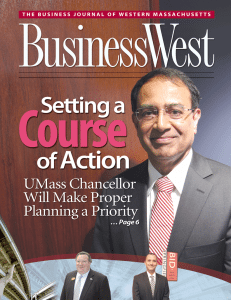
COVERart0313bAs he talked about UMass Amherst and the course he projects for the school he now serves as chancellor, Kumble Subbaswamy summoned a well-worn quote from Dwight Eisenhower: “plans are nothing; planning is everything.”

Those words were uttered in reference to preparations for D-Day, the largest amphibious invasion in history, but they’ve been borrowed by leaders in virtually every field, including academia, to describe the difference between having a plan on paper and engaging in effective, thorough, sensible planning.

There is a new strategic planning initiative underway at the Amherst campus, said Subbaswamy (known to colleagues as ‘Swamy’), one that will provide a detailed outline of where this soon-to-be-150-year-old institution needs to be with regard to everything from the life sciences to economic-development initiatives within the Commonwealth; from increasing the volume of research initiatives on the campus to improving graduation rates.


The faculty-led initiative, which should be ready by the summer, will shape the school’s trajectory for the next several years, said Subbaswamy, who came to the Amherst campus last July.

“Eisenhower was correct — planning is a forcing mechanism for us to think seriously about where we want to go,” he told BusinessWest. “Without planning, anything goes.

“This is a time when economic development is on a lot of people’s minds,” he continued, while juxtaposing the school’s current mission against the one it started with as one of the institutions created through the Land Grant Act of 1862. “Globalization has had an impact on what it means to be a 21st-century economic power; we still have a lot of assets that the state has invested in that can produce direct benefits to the Commonwealth and beyond, and we will be articulating that as part of our strategic plan.”

But planning has become a far more challenging assignment in the current fiscal climate, one in which state contributions to the state university have been declining, said Subbaswamy, adding that the funding situation leaves many question marks about everything from further progress in what has become known as the ‘Springfield Initiative’ to efforts at the university to help the state’s businesses become more globally competitive.

“If the expectation is that planning means that new resources will suddenly and magically appear, that’s unrealistic; that’s not what happens,” he said. “But if the goal is to say, ‘whether new resources come in or not, we want to prioritize where we spend our money,’ then the planning exercise is a very important one and a necessity.”

Moving forward, he said the school, its administrators, and faculty will be addressing what he called some of the “new challenges” facing those in higher education today. He put on that list such matters as the emergence of online education and what it means to residential institutions to continuously hone the model for a successful research university.

Meanwhile, one additional challenge for the UMass Amherst campus, and it’s not a recent phenomenon, is making its various programs and reputation for excellence as well-known within the state as it is outside.

“Sometimes, it feels like UMass Amherst is the best-kept secret inside the Commonwealth of Massachusetts — it has a far better reputation outside the state,” he explained, adding that this is likely due in large part to the Bay State’s many prestigious and well-known private institutions — Harvard and MIT top that lengthy list — which often overshadow the state university’s flagship campus.

“But I think people are beginning to recognize the difference between the publics and the privates,” he went on, “and, in particular, the important role that public institutions play within the Commonwealth. When you get into deeper conversations, you see that there is high and growing regard for UMass Amherst; people recognize, for example, that admission standards have gotten pretty high, and they recognize that the Commonwealth Honors College is a destination place for the best and the brightest inside the state and outside it as well.”

The Commonwealth’s stock of private schools may also play a role in what many have described as a less-than-passionate alumni base when it comes to the university, said Subbaswamy, who didn’t exactly disagree with that characterization. He said the school suffers from geographic challenges — many of its graduates live and work across the state, which is not a huge distance comparatively, but certainly psychologically — and also from a lack of what he called “connecting points.”

And he placed in that category everything from buildings and features on the campus itself — perhaps the most historic and best-known building, the chapel, has been closed for more than a decade — to a big-time sports program.

For this issue, BusinessWest conducted a wide-ranging interview with Subbaswamy, one that touched on everything from rising in the ranks nationally among research institutions to possible expansion into downtown Springfield — and how it all comes back to planning.


Class Action

After arriving last summer after a stints at two other major public schools — the University of Kentucky’s Lexington campus and the University of Indiana’s flagship campus in Bloomington — Subbaswamy said he commenced a lengthy, and in some ways ongoing, series of “meets and greets” with individuals and groups at both ends of the state.

The constituencies involved were both internal — faculty, staff, and students, among others — and external, ranging from alumni groups to state legislators to the Cranberry Growers Assoc., which, while based in Wareham on Cape Cod, boasts many members from the UMass School of Agriculture, and certainly isn’t among those lacking an appreciation for the state university.

“Among the cranberry growers, there is true adulation and respect for the institution,” said the chancellor, “because they readily admit that their business would not be what it is today without the continued work on the campus.”

In some respects, these meetings involved varying degrees of what Subbaswamy called “repairing relations” — his predecessor, Robert Holub, was essentially forced out after three years at the helm, and there has been considerable turnover in the chancellor’s office in recent years — but he told BusinessWest that this work is essentially done.

“Part of this work was reassuring our support base that everything is continuing on campus, that the positive momentum generated by my predecessors has not been slowed down, and that we’re on track to dealing with the new challenges in public higher education,” he explained. “The other was securing their continued support as we commence our 151st year.”

Those aforementioned constituencies have moved on, he explained, to the broader topic of what to expect from the school’s new leader.

And the answer to that question is clouded by a number of issues, but mostly the challenging fiscal situation, said the chancellor, adding that those who have expectations should manage them appropriately given the financial landscape.

And this mindset applies to both aspects of how a flagship university impacts economic development, he said, referring to both the narrow focus — the jobs at the campus and the spending it generates, for example — and the broader role stemming from transferring research into business opportunities, assisting existing businesses with becoming more competitive and moving in new and profitable directions, and drawing new businesses to the region.

“This is a role than can only be played by major research universities, public or private, and in this region, we’re it,” he explained. “And in a climate where the state has been reducing our appropriation over the past five or six years, we don’t have the resources that we can come up with to play that additional role in economic development.

“We have the knowhow, we have the expertise, and we have the desire,” he continued. “But we have a very limited ability to get engaged unless we find resources, whether it’s through the state, the local region, or federal assistance, to do it on the scale that’s needed to be a true catalyst.

“And we’re only one element in bringing about systemic change,” the chancellor went on. “The local government, local businesses, the state government, and the private sector — they all have a role to play in this. We’re ready, and we have a track record of getting involved with social change and economic development, but we can’t do it without resources.”

Quantifying matters, Subbaswamy said the university has been coping with a 26% reduction in state appropriations over the past several years. A current proposal from the governor to reverse the course of state assistance would certainly help, he went on, but it wouldn’t put the university even back to where it was five or six years ago.

Meanwhile, the campus infrastructure continues to age and deteriorate, he told BusinessWest, adding that the vast majority of the buildings are now more than 50 years old or fast approaching that number — there was a huge building boom in the ’60s and early ’70s, but then virtually nothing for the next 30 years — and there is currently $1.6 billion in deferred maintenance that needs to be undertaken.

The school has responded with efforts to become more efficient and cut fat where possible, but higher tuition and fees have also become reality, bringing the school dangerously close to limiting one of its historical assets in the Commonwealth — access to all economic classes of students.


Progress — by Degrees

The ongoing fiscal challenges are also going to play a role in the university’s involvement in the region’s largest community, said Subbaswamy, adding, again, that there are expectations about what the institution can and should do with regard to the City of Homes.

The Springfield Initiative has a number of moving parts, involving everything from the arts to biosciences (the Pioneer Valley Life Sciences Institute); from creating an active presence in the downtown — the university’s Design Center was relocated to Court Square — to work with Davis Foundation on issues involving education in urban settings.

The most recent talk, or speculation, has centered on broadening that downtown presence with a satellite facility, said Subbaswamy, adding that terminology, not to mention expectations, must be put in proper perspective.

“Somehow, the expectation that a large campus can be created suddenly, and without a comprehensive needs analysis, is unrealistic,” he explained, opting to use the phrase ‘satellite center’ to describe what, if anything, could develop. “Different people have different views on what they expect from UMass, and, in general, these expectations need to be managed properly.”

Elaborating, he said that many area officials have an ‘if-you-build-it-they-will-come’ thought process when it comes to a UMass facility in downtown Springfield, while he considers smaller, phased-in growth to be more practical, especially in these times.

“If you want to grow organically, and start with what we consider to be the highest priorities — how can we make a difference,” he said, “and then, based on that success and additional resources, grow more, I think that’s a much more realistic approach for today’s financial climate.”

And this brings him back to the subject of planning and the ongoing initiative at the university to chart a course for the years and decades to come.

UMass already has a number of stated priorities and strategic initiatives — some more clearly articulated than others, he said, adding that putting such matters within a plan, with clearly stated goals and methods for measuring results, makes it easier to achieve progress with those goals.

He cited work within the broad realm of life sciences as one example.

“We understand that the life sciences are of major importance to the state at this time, so we will have a focus on life-sciences research and development in this plan,” he explained. “We’re already doing [work in that field], but we haven’t explicitly stated it. By stating it, that allows different colleges and departments to align their resources in this general direction.”

Moreover, the strategic plan in progress will not only prioritize matters and provide a road map for reaching certain goals, it will ultimately leave the university better prepared for when the financial skies clear, said the chancellor.

“When you make an argument for new resources, having a cogent plan allows you to make an argument for those resources better than if you simply said, ‘give us money, and we’ll do good things,’” he told BusinessWest. “I’m sure we’ll do good things, but what is the benefit to society; what is the benefit to the Commonwealth?”

While undertaking this strategic planning, the new chancellor will look to address some of the other priorities that were reinforced during those meet and greets. These include making the school less of a well-kept secret within the Commonwealth and getting graduates more engaged with their alma mater.

The school’s almost-year-long sesquicentennial celebration may provide one of those key connecting points for the alumni base that Subbaswamy described.

The chancellor said the planned events, including a Founder’s Day that will be expanded into a Founder’s Week, will offer a springboard for fund-raising efforts that have been delayed by the change in the chancellor’s office, with the so-called ‘public phase’ of that initiative set to begin April 27. Meanwhile, it will also dovetail in many respects with the strategic-planning initiative and offer opportunities to show how, while the school may have changed in countless ways since 1863, its overall mission really hasn’t.

“When the Land Grant Act was passed 150 years ago and our campus was created, there were specific expectations about educating the general populace and conducting relevant research and making sure that this research translated into benefiting society,” Subbaswamy said. “As times have changed, the role of research universities has also evolved, but land-grant universities have maintained that original mission — teaching, research, and outreach.

“This will be a time for reflection on where you’ve come from,” he continued, “and also an opportunity to rethink how you want to focus for the future.”


School of Thought

As he talked about where the Amherst campus has been, where it is, and where it’s going, the chancellor didn’t borrow another famous Eisenhower quote — “unless we progress, we regress” — but that was the essence of the message he left with BusinessWest.

The school does, indeed, have the same mission it had when it was launched at the height of the Civil War, but education, technology, and the global economy have all changed in myriad ways.

Subbaswamy has many items on his to-do list, but proactive response to those changes are at the top of the chart — along with the constant planning that is, as Ike said, everything.


George O’Brien can be reached at [email protected]

Opinion
UMass Is Merely One Part of the Answer

EditorialBWlogoYou don’t have to read between the lines to get the gist of the message that UMass Amherst Chancellor Kumble Subbaswamy left during a lengthy interview with BusinessWest (see story, page 6).

What’s on those lines makes his sentiments clear enough.

Indeed, when you slice through his comments on everything from the university’s involvement in economic-development efforts to the ongoing project that has become known as the ‘Springfield Initiative,’ it’s clear that he believes people in this region have to manage their expectations when it comes to what the flagship campus can accomplish — especially given the current fiscal challenges the school is facing.

“We’re only one element in bringing about systemic change,” the chancellor told this magazine. “The local government, local business, the state government, and the private sector — they all have a role to play in this. We’re ready, and we have a track record of getting involved with social change and economic development, but we can’t do it without resources.”

There are two messages there, obviously. The first is that UMass can’t be expected to be the solution to this region’s still-sluggish economy, one that continually lags behind the rest of the Commonwealth when it comes to jobs and overall vibrancy. And the second is … well, give the university more resources.

And the chancellor is right in both respects.

First, the funding part. Public higher education in this state, and that includes the many campuses of the state university, have been woefully underfunded throughout most of their history. Maybe it’s the bevy of elite private institutions that we have in the Commonwealth that has created this attitude, and maybe there are other factors, but public colleges and universities have simply not been a priority in this state. But they must become one, because, while those private schools cater to students from around the globe, the community colleges, state colleges (they now like to be called universities), and UMass focus on people from around the corner, and these are individuals who will ultimately turn our economy around.

As for UMass Amherst and the matter of expectations, the chancellor is correct. In many ways, expectations for what the university can do and should do are not realistic, or in keeping with the current fiscal realities. There is a tendency in this region — and this magazine has been as guilty as anyone — to look at the Amherst campus not as a partner, but more as a cure-all when it comes to what’s ailing Western Mass. and its economy.

Nowhere is this more true than in Springfield, where talk of a UMass campus in the central business district has been described a potential catalyst for a revitalization in that area. This talk comes without any real verification of need — although it likely exists — and no real thought about the competitive balance in higher education in the city; there are already seven colleges within 10 miles of downtown Springfield (some only a mile or two away) that offer many of the same programs as UMass. And there is little thought about the school’s ability to fund something like this when it can’t even properly maintain the aging buildings on the Amherst campus.

But the thinking is typical of what we see in this region: ‘downtown Springfield needs a spark? Have UMass put a satellite campus there.’

Moving forward, it would seem that the region doesn’t need a huge attitude adjustment when it comes to the state university. Just a small one. The school has been and always will be a tremendous resource, an educational pillar for the entire state, and an economic engine that is not only one of the region’s largest employers, but a force in many areas of economic development, from research that can translate into jobs to assistance provided to area manufacturers that will help them be more competitive globally.

But it is not the answer. It is simply a big part of the answer.

Opinion
Another Tax Hike Is the Wrong Course

T here they go again, the hordes of tax-hike advocates, spreading out across the Commonwealth to urge support for Gov. Deval Patrick’s $1.9 billion tax package.

I’ve met these kinds of advocates on the tax trail before, beginning in 1980 with their opposition to property tax limits in Proposition 2½. Now, though, I offer institutional memory on just the income tax.

In 1989, Gov. Michael Dukakis returned from the presidential campaign trail and demanded tax hikes to fund a billion-dollar budget increase; supporters rallied at the State House, some of them dressed as giant crayons, to protest potential cuts to the arts. The legislative leadership was able to get the votes for the tax package only after promising that the new income tax rate, increased from 5% to 5.75%, would be temporary. The Legislature raised the rate again the next year, ‘temporarily,’ to 6.25%.

In 1990, a coalition calling itself the Tax Equity Alliance for Massachusetts defeated a ballot question to repeal the Dukakis tax hikes. However, Bill Weld, who supported it, was elected governor and oversaw a reduction in the rate to 5.95% in 1992.

In 1998, despite opposition from a group now called the Campaign for Massachusetts’ Future, voters approved a reduction of the investment-income rate to the same rate as wage income, and in 2000 they approved a rollback of the income tax rate to 5% over three years. Two years later, the Legislature ‘temporarily’ froze rollback and investment rates at 5.3% after heavy lobbying by pro-tax groups. Then the Campaign for Our Communities was formed, calling for a return to the 5.95% income-tax rate.

Instead, in 2011 a formula created in 2002 dropped the rate to 5.25%, where it remains — 24 years after the first ‘temporary’ increase, and 12 years after the voters demanded a rollback to 5%.

Now Gov. Patrick is proposing to increase the income tax rate to 6.25% again, as part of a $1.9 billion tax package. The Campaign for Our Communities has been fanning out across the state in support, and held a huge rally this week at the State House.

Who are these teams and campaigns for equity, our future, and communities? The list is long, made up of the many public-employee unions, both national and statewide with their local affiliates; various human service providers; individual Democratic town committees; and city councils. For them, it seems, taxes will never be high enough.

Patrick’s offset offer of a reduction in the sales-tax rate is hard to credit from the governor who raised that rate from 5% to 6.25% just two years ago. Come the next fiscal crisis, the sales tax will likely be hiked again.

Personal exemptions have been increased in the past to sell a rate increase, only to disappear at the next fiscal crisis. Deductions come and go, depending on what special-interest lobbyists are doing on Beacon Hill.

The Massachusetts tax burden is the fourth-highest in the nation per capita, and the eighth-highest relative to personal income. The state is not suffering from a lack of taxes; it is suffering from a lack of accountability for the taxes already paid. The ongoing scandal over electronic-benefits cards is a maddening example of this.

With cuts coming from our dysfunctional federal government, there will be many pleas for revenue increases to address not only transportation but the operating budget and local aid. Eventually the easy ‘new revenue solution’ will be exhausted, and a better-managed state will be essential. Why not do the better management now?

Tax advocates carry signs saying ‘invest’ to hearings on new taxes. First we need to invest in respect for voters and taxpayers, who have been awaiting the return of the 5% income tax rate they were promised in 1989 and voted for in 2000. If they ever find reason to respect their government again, we as a Commonwealth will benefit.


Barbara Anderson is executive director of Citizens for Limited Taxation.

Environment and Engineering Sections
Five Large-scale Hydropower Facilities Are Up for Relicensing

Andrew Fisk

Andrew Fisk

For thousands of years, the Connecticut River has supported human communities throughout New England as a food source, transportation corridor, and, most recently, power provider. Today, electricity generated from hydropower facilities on the Connecticut River and its tributaries is a major part of the New England power grid.

In a unique process, five of these facilities, which generate almost 30% of our region’s electricity and span more than 175 miles of the Connecticut River, are being jointly relicensed for operation by the federal and state governments for another 30 to 50 years. The current licenses for these facilities were last issued between the late 1960s and 1980s, and all expire in 2018.

The five hydro projects included in the relicensing are Wilder, Bellows Falls, and Vernon Dams in Vermont, all owned by Transcanada, which also owns hydropower facilities in northern Vermont and on the Deerfield River, and the Turners Falls Dam and the Northfield Mountain Pump Storage Project in Massachusetts, owned by FirstLight Power, a subsidiary of GDF Suez.  Both companies have extensive holdings throughout North America and beyond. What were once locally owned utilities are now holdings in large, globally diversified energy portfolios.

This relicensing process began in October 2012 and will continue according to a strict timetable for the next five years. This process will entail a great deal of study, dialogue, and negotiation between the public and the facilities’ two owners, Transcanada and GDF Suez. In early March, the first major deadline was reached, with dozens of individuals and organizations submitting their thoughts on what questions need to be answered about these facilities’ operations. The federal and state laws that guide this process require a balancing of public and private interests, where, in exchange for the right to dam the public’s river, a private company must provide the public with direct benefits, such as recreational facilities, and ease the problems that dams cause to migrating fish and riverine habitats.

What happens to the river when you use it for electricity generation? These facilities are all designed to store water and then release it through turbines, according to business strategies governed by how the New England energy market is regulated. One of the principal strategies for these facilities is to generate electricity at times of the day when it can be sold at the highest price, known as peaking mode. This has the effect of fluctuating the river’s height behind the dams many times a day; in some locations, this fluctuation is up to nine feet.

At the Northfield Mountain Pumped Storage facility, water is pumped from the river at night when electricity is cheap to an upper reservoir at the top of Northfield Mountain, and power is generated by spilling water back into the Connecticut River during peak demand periods.

For those fish that move up and down the river — such as American shad, eels, alewives, or herring — to do their jobs in the ecosystem, they must do more than just get around the dams themselves or avoid the turbines that do the actual generating. The ecology of the river is also affected by the flow changes created by the dams. How much water is released at what times and at what rates has a tremendous impact on whether fish such as the endangered short-nosed sturgeon can breed successfully or if riverbanks erode and lose their trees and vegetation.

But it’s not just about the fishes. Dams can have a positive or negative impact on river recreation, and much of the dialogue over the next several years will be about improving access to the river through boating facilities, enhancing cultural and historic resources at dam sites, and improving portages around dams for paddlers making short trips — or the epic, 400-mile, source-to-sea paddle that has captivated generations of adventurers.

The relicensing process is complicated and has many moving parts given the number of facilities and the amount of river they impact. But it’s a process designed for the public — because it’s your river and your wildlife — to engage in dialogue about what we want our watershed to do for us over the next two generations.

For more information, visit www.ferc.gov or ctriver.org.


Andrew Fisk, Ph.D., is executive director of the Connecticut River Watershed Council.

Environment and Engineering Sections
FloDesign’s New CEO Eyes Aggressive Growth Patterns

Walter Thresher

Walter Thresher says he would like to position FloDesign to be a ‘skunkworks’ operation for defense and aerospace corporations.

Walter Thresher certainly wasn’t thinking about retiring after a nearly 34-year career at Hamilton Sunstrand, now United Technologies Aerospace Systems, but he was looking to perhaps throttle down a bit, to borrow an industry term, after work on everything from the B2 bomber to the Comanche helicopter to Boeing’s 787 Dreamliner.

“I was looking for a different challenge — something approaching part-time,” he told BusinessWest, adding that he’s found the former, but not exactly the latter, in his new capacity as CEO of Wilbraham-based FloDesign.

This is the company, founded by Western New England University Engineering professor Walter Perez and led by WNEU Engineering graduate and serial entrepreneur Stanley Kowalski, that is most associated with a radical new design for wind turbines. But while that concept was, indeed, designed by FloDesign engineers, Kowalski and Perez now maintain only a minority ownership in the company they spun off to take the concept to the marketplace — FloDesign Wind Turbine — and the company is now headquartered in Waltham.

Meanwhile, another spinoff, FloDesign Sonics, still based in Wilbraham, is engaged in developing technology using sound waves for a variety of uses, including water purification.

The parent corporation, FloDesign, is essentially an aerospace company that has designed, prototyped, and developed products ranging from noise suppressors for jet engines to something called a RAP nozzle, a device that transmits a fluid force, gas, or fine particles over a distance with minimal loses. Thresher takes the helm at an intriguing time for the enterprise, as it looks to create new business opportunities and avenues for growth.

Thresher, who came to the company in February, is considering a number of options for the company, but especially evolution into what he called a ‘skunkworks operation’ for major defense and aerospace companies, like Hamilton Sundstrand.

Skunk Works is the official alias for Lockheed Martin’s Advanced Development Programs operation, formerly known as Lockheed Advanced Development Projects, which was created in the 1940s and developed aircraft ranging from the U-2 to the SR-71 Blackbird to the F-22 Raptor. But over the ensuing decades, the term has been applied (using the lower case) to a group within an organization, or an outside venture, given a high degree of autonomy to conceive and prototype new products and technologies.

“The team we have here has very good capability in design, rapid prototyping, and then getting parts on test fast,” he explained. “And that’s something that larger companies have a hard time doing; they tend to go slow and follow very fixed processes. What I’d like to do is operate as a skunkworks operation for a larger company.”

Thresher brings vast experience in aerospace product development and engineering to his new position at FloDesign.

After starting his career with Pratt and Whitney as a development engineer in turbine cooling and dirt-separator development, the WNEU graduate moved to Hamilton Sundstrand a year later, where he developed high-pressure water separators, air mixers, sub-freezing heat exchangers, and air-bearing turbomachinery. He led the engineering efforts to improve heat-exchanger-manufacturing processes and defined the build process for air-bearing air-cycle machines used in a number of current military fixed-wing applications.

He has also been responsible for systems on the B2 bomber, and was chief project engineer for the Environmental Control System (ECS) for the F/A-18 E/F aircraft. Later, he was the design manager for the thermal-management systems for the Boeing 787 Dreamliner program, and also performed the function of weight manager to control and reduce the weight of the design. As part of that effort, his team received a special challenge award from Boeing for creative use of design tools to achieve weight reduction.

He was previously chief engineer for the Comanche helicopter ECS, and was most recently the chief engineer for the CH53K HLR helicopter secondary power system. During the design phase, he led efforts to reduce system weight, resulting in a simplified system with little functional compromise, and a 10%-under-contract weight system.

Summing up what’s on that extensive résumé, Thresher said his work centered on parts and systems such as water collectors, air mixers, and heat exchangers, devices similar to those with which FloDesign has made its reputation.

What’s more, the company had been working on some specific projects that intrigued him, such as initiatives involving UAVs, or unmanned air vehicles, for both military and civilian use.

Thresher was eventually approached by Kowalski about taking the helm at the aerospace division of the company. “I was thinking that this was a bit more than a part-time job,” he said, “but it was an exciting opportunity to do some of the things that were on my list at Hamilton.”

He told BusinessWest that his primary job description is to determine the next direction for the aerospace unit. One of his immediate goals is to use proprietary mixer/ejector technology that the company has developed to move two products from the drawing board to the market.

One is a noise-suppressing device that has been in development and funded through a grant from the Small Business Innovation Research program, while the other is the RAP nozzle, which Thresher believes has potential for use in a number of markets, from fire suppression to personal protection.

“We’re trying to figure out just where to go with it at this point,” he explained. “But it has a number of potential applications.”

And his long-range goal for FloDesign is to become an independent skunkworks operation that would take advantage of its experience with everything from scale-model testing to work in design of “less-than-lethal” weapons to design and develop products and technologies for what could become a variety of clients.

“We’re able to do things faster and less expensively than larger operations can,” he explained. “That’s a major area of opportunity that I plan to expand.”

Thresher said FloDesign could thrive in such a role because, while there are many smaller shops that specialize in one phase of product development — design, fabrication, or testing, for example — there are few that can, like FloDesign, handle them all.

“We also have the technical capability to think through what the issues are with the first round of what was designed and tested, and even design modifications,” he said. “And that’s what would make us unique compared to other companies.

“Normally, at a test house, you take parts there, you run a test, they give you the data, and you go home,” he went on. “At a design house, you tell them what you want designed, they do the design, and they give it back to you. We can do all those things.”


— George O’Brien

Conventions & Meetings Sections
Hoop Tournament Brings Net Results for the Conference and the City

Matt Hollander

Matt Hollander says the MAAC tournament not only provides a boost for downtown business, it gives the city a chance to display its ability to handle large events.

The UMass Amherst McCormack Center for Sport Research & Education has been gathering some much-anticipated data this month.

The center has been commissioned to quantify the overall economic benefit to Springfield and the region from the Metro Atlantic Athletic Conference (MAAC) Division I college basketball tournament, which recently wrapped up its second visit to Springfield, one during which the conference’s acronym became a discernable part of the local lexicon.

Nick Polimeni is naturally interested in what the study will show, but he told BusinessWest that he doesn’t have to wait for the numbers to declare that the tournament has been a success for Springfield and businesses in its downtown.

“I noticed a lot of different faces, a lot of team colors and team jerseys,” said Polimeni, manager of McCaffrey’s Public House on Main Street, just over a three-point shot’s distance from the MassMutual Center, where the tournament played out. “It was absolutely great for the downtown.”

Nadim Kashouh, owner of Nadim’s Mediterranean Restaurant and Grill, roughly a block from the arena, concurred. He wasn’t able to say if the 2013 tournament topped the first gathering in Springfield, but he could state with confidence that it provided a needed boost for businesses in the area.

“No doubt about it … it’s great for the city, and we need to see more of this type of event,” he told BusinessWest.

If Paul Lambert and Matt Hollander have their way, the city will see at least more of the MAAC tournament, and perhaps additional sporting events as well.

Lambert is vice president of Guest Experience and Programming for the Basketball Hall of Fame, and Hollander is general manager of the MassMutual Center. Both were part of the group that in 2009 convinced the MAAC to bring its tournament here from 2012 to 2014, and they will be among those trying to gain another three-year contract from the conference.

Hollander said the tournament has not only provided a boost for downtown businesses, including his own, but, perhaps more importantly, it has enabled the city to show that it can put on events of this magnitude, and that its mix of amenities and attractions provides a package that can be effectively sold.

“There are so many assets that we can brag about,” said Hollander. “I think, as locals, we sometimes forget, when you put it all together, how truly rich a fabric we have here.”

Lambert, meanwhile, said the first two tournaments staged in Springfield have shown how mutually beneficial the event has become for the Hall, the city, and the conference. The hoop shrine gains visibility and some additional visitorship from the three-day event, he noted, while the MAAC gains invaluable exposure from both the games and an elaborate exhibit on the conference that will be a feature in the Hall for at least the next four years. “The MAAC is the only conference to have a relationship like that with the Hall of Fame.”

Richard Ensor, now in his 25th year as commissioner of the MAAC, was part of the site-selection team that eventually chose Springfield. He said the city’s local organizing committee (LOC) has succeeded not only in effectively selling Springfield as a host for such events, but also in delivering a solid product.

“The LOC has been well-coordinated from the start of the bidding three years ago, their implementation, and the rollout of this year’s event,” he said just before tip-off for the men’s final. “They know how to put events on; they have a history of it.”

For this issue and its focus on meetings and conventions, BusinessWest takes an in-depth look at the how the MAAC tournament came to Springfield, and why, in addition to the men’s and women’s champions — Iona and Marist, respectively — there are many other winners to be counted.


Full-court Press

Lambert remembers the MAAC tournament site-selection committee’s first major visit to Springfield in 2009 — part of an 18-month-long bidding process — and how it didn’t get off to a fast start.

“We had the feeling when they first got here that they were on their way to ‘somewhere else,’” he recalled.  “They were tired; it had been a long day on the road for them. But once we got to talking about Springfield, the MassMutual Center, the Hall of Fame … by the time they left, it felt like they had gone from modest interest to some very strong interest.”

Backing up a few more years, Lambert said that, through much of its history, the MAAC’s tournament has been played on the home courts of conference members — Canisius College, Fairfield University, Iona College, Loyola University Maryland, Manhattan College, Marist College, Niagara University, Rider University, Saint Peter’s College, and Siena College. But in late 2008, coaches and administrators had expressed to the MAAC Council of Presidents and league office that these home-court sites had become too much of a playing and recruiting advantage for the host school. The council then decided to take the tournament to a neutral site (Webster Bank Arena in Bridgeport, Conn. was the first), and in late 2009, Springfield’s MassMutual Center won the bid for 2012 through 2014.

Looking back, both Lambert and Hollander said the city’s mix of strong points, from the Hall of Fame to its abundance of hotel rooms near the MassMutual Center, to its previous history of hosting college basketball games and tournaments, enabled it to prevail.

“That part, I think, is the easiest part of the sale, because we do have such a good infrastructure for these types of events,” said Hollander, noting that Springfield had a lengthy run hosting the Division II national championship tournament, and had demonstrated the ability to create a championship environment of restaurant dine-arounds, welcome signage, marketing efforts, educational programming, and ancillary events leading up to the games.

Ensor said the city’s history with basketball tournaments helped sell the site-selection committee, but so did the MassMutual Center’s track record for staging a variety of sporting events, and the Hall’s ability to stage gatherings such as its annual induction ceremony.

Ken Taylor, associate commissioner of the MAAC, noted that getting downtown business owners to support the event is what has made Springfield so successful attracting more than 6,000 fans of the 10 schools and 20 teams in each of the first two years.

“Our member schools stress two things that they enjoy about Springfield: first, the hospitality provided by the hotels, and the arena is first-class; second, the MassMutual Center is a neutral site — meaning no team has a home-court advantage,” Taylor went on. “Those two factors create a first-rate atmosphere for our student athletes, coaches, and fans.”

And the presence of those constituencies, especially the fans, creates opportunities for a host of businesses.

Polimeni cited a party he hosted for a group of Loyola alumni on the Saturday of tournament week as just one example. “It was huge … there were probably 60 of them, and they had a great time.”


The Big Dance

Assessing the first two years of the MAAC tournament’s presence in Springfield, conference administrators and LOC members alike say that, while the event remains a work in progress and all involved would like to see greater attendance at the games, the conference, the city, the Hall, and area businesses are all benefiting in some ways.

The MAAC exhibit at the Hall of the Fame is a good example, said Ensor, adding that, from the conference’s perspective, it provides an uncommon opportunity for visibility.

“This association with the Basketball Hall of Fame offers the MAAC the opportunity to be directly associated with the history of the sport,” he told BusinessWest. “And it provides the MAAC and its institutions with unique branding within the college-basketball community.”

But the MAAC is not alone in reaping rewards from the exhibit. Indeed, the conference invested more than $100,000 in the display, which was created by the Indian Orchard-based firm 42 design fab, which has handled a number of projects for the shrine. Meanwhile, businesses within the Hall complex, including Max’s Tavern, which hosted two events during tournament week, have also seen a boost.

“People can see how the investment on the part of the LOC brings returns,” said Ensor. “Not only that the fans and teams are spending, but we as a conference are spending.”

For the city, the Greater Springfield Convention & Visitors Bureau, and MassMutual Center, there are many benefits as well, said Hollander and Lambert, noting the obvious boost given to hotels, restaurants, and clubs. But there is the added vibrancy from events such as this year’s FanFest, sponsored by MGM Springfield. It featured a series of basketball-related events for children and adults of all ages, including relay races and dribbling and shooting contests. In addition, for Xfinity’s Bounce to the Arena, a mile-long parade of kids and adults (and some MAAC team cheerleaders) assembled at the Hall of Fame Center Court to shoot baskets, then proceed to dribble their way up Columbus Avenue, across to Main Street, and into the MassMutual Center.

“They were led by police cars, and folks were honking, cheering them on, and once they got to the center, they got to play at all the interactive FanFest games,” said Hollander.

But perhaps the greatest benefit to the city and those working to book meetings and conventions is the opportunity the MAAC conference provides to show what that team can do, said Hollander, and how this area can become host to other sporting events.

“It’s a great opportunity to showcase Springfield and the entire region,” he explained, “and also provide ample evidence that we stage events like this successfully.”


Final Buzzer

While ecstatic players from Iona and Marist were cutting down the nets following their wins in early March, and thus creating their own fond memories of Springfield, Lambert, Hollander, and others were already preparing themselves for the next bidding process for the MAAC tournament.

A request for proposals will be issued in April, and the selection will likely be made by the end of the year, said Ensor.

Whether Springfield prevails in that contest remains to be seen, but at present it seems to have a winning formula, one that is yielding net results, literally and figuratively, for all the parties involved.


Elizabeth Taras can be reached at [email protected]

Conventions & Meetings Sections
Hotel Group Gives New Look, Feel, and Name to a Springfield Landmark

Shardool Parmar

Shardool Parmar says the large Mount Tom ballroom on the 12th floor showcases the downtown Springfield skyline and Connecticut River.

Shardool and Kishore Parmar, president and vice president respectively of the Pioneer Valley Hotel Group (PVHG), understand that they have two sizeable challenges when it comes to the property at 711 Dwight St. in Springfield.

The first is to get people to stop talking about it in the past tense — a still-common practice, especially when it comes to the rotating restaurant on the top floor that was once a major destination in the region — and using one of the names that used to be on the building, especially Holiday Inn.

The second is to convince several constituencies, from families to business travelers to event planners, to embrace the new name over the door — LaQuinta Inn & Suites — as one that represents both quality and an attractive option to the deep roster of other players in the local hospitality sector.

And the brothers Parmar believe that a recent $4.5 million renovation project, one that accompanied the new brand name on the landmark — will go a long way toward tackling both.

Indeed, the Parmars say they’re already noticing that while some people still talk nostalgically about the revolving restaurant, named Top o’ the Round, and how they had they had their high school prom there, many more are now talking about the new Mount Tom Ballroom, carved out of the space once occupied by the restaurant, and its stunning views of the Connecticut River and the Springfield skyline.

Meanwhile, they say the facility is catching the eye of event planners, some of whom are still getting quizzical looks, and more, when they reveal their choice for the company’s next function.

“Just recently, we’ve had meeting planners go back to their superiors after booking here and the superiors say, ‘there’s no way we’re going to book over there; are you crazy?’” he said with the laugh. “But they haven’t seen the space.”

Those who have generally report a facility that’s much brighter than the old Holiday Inn or, later, the Inn Place or CityPlace Inn and Suites, and also more customer friendly.

“This is probably one of the nicest looking LaQuinta hotels you’ll see in the whole country,” said Shardool. Indeed, PVGH recently won the Best Conversion award for all LaQuinta Inns & Suites in the U.S.

The Parmars realize that while they’ve made some progress with those aforementioned challenges, real success will take time and energy. It’s an assignment they embrace as one of the more visible components of a growing hospitality chain that also includes facilities in Ludlow and Hadley.

For this issue and its focus on meetings and conventions, BusinessWest toured what had been the forgotten hotel in Springfield, and gained a sense for what could happen next for this intriguing slice of the city’s skyline.


Suite Success

Wanting a better life for his two young sons, Laxman Parmar, PVHG’s CEO, brought the family to America in 1987, and eventually purchased the Seven Gables Motel (now Howard Johnson’s) on Boston Road in Springfield.

His two young sons essentially learned the hospitality business from the ground up at the motel, handling a number of odd jobs, from changing beds to cleaning bathrooms to tackling landscaping duties. And their learning opportunities multiplied as their father eventually came to preside over a hotel group that now also includes two facilities in Hadley, the Hampton Inn and Comfort Inn; and the Comfort Inn in Ludlow, which will soon change over to the Holiday Inn Express name in April.

Shardool and Kishore both enjoyed hospitality, but pursued degrees in engineering, and took jobs in related fields. A chemical engineer, Shardool worked in the biotech industry, while Kishore, an electrical engineer, worked at a Boston-area provider of information technology services.

They returned to the family business, however, when their father suffered a second stroke in 2005. And they took what they learned in the engineering field with them, skills and knowledge that have helped them shape decisions that have enabled the hotel chain to continue growing.

“If you look at the greatest CEOs in business history, most of them were engineers,” Shardool explained. He referenced Jack Welch, the former chairman of General Electric, who was a chemical engineer, and former Coca-Cola chairman Roberto Goizueta, a Cuban immigrant and also a chemical engineer.

“Engineers are good in business because we can quickly identify problems, and we have a great understanding of the mechanics of a business, not in the sense of equipment, but in the sense of what steps and what procedures need to take place to achieve the right outcome,” Shardool explained. “So when it comes down to making sure that rooms are clean, we don’t just take somebody’s word for it, we verify it.”

Kishore agreed.

Kishore Parmar

Kishore Parmar says customers are impressed by the contemporary new lobby of LaQuinta Inn & Suites.

“The worst thing you can do is let a problem linger,” he said. “And engineers hate problems that linger, we want solutions, very quickly.”

These attributes and attitudes certainly came into play as the Parmar brothers first assessed the risks and opportunities involved with the former Holiday Inn, and also with moving forward after they eventually triumphed in the competition to acquire the property from the company that was operating it in receivership.

While all those who looked at the facility saw a property in a advanced state of decline, the Parmars saw something else — what Shardool described as ‘great bones.’

“We saw what happened to the hotel more as neglect, and lack of good management than anything else,” said Shardool. “We essentially had an idea of what we wanted here, but it takes time.”

One of the first priorities for the new owners was to rebrand a facility they had already been renamed the CityPlace Inn and Suites. What ensued was in-depth research into national franchise options, and analysis about what might work within the Greater Springfield market.

This research eventually focused on LaQuinta, a name and a chain that is far better known in other regions of the country. What the brand offered was a reputation for quality (at least in those markets where it’s a known commodity), and an opportunity to succeed within a specific niche — a lower-priced product that appeals to those who don’t want or need all the amenities of a full-service hotel.

But what it lacked was name recognition in the 413 area code.

“The greatest thing and the worst thing about LaQuinta is that nobody knows what LaQuinta is,” Shardool explained to BusinessWest. “The greatest thing is that nobody has a preconceived idea of what it is, but of course the downside is that it’s not as well-known.”


Room for Improvement

Once they had zeroed in on the LaQuinta brand, the PVHG began formalizing what became a $4.5 million renovation, funded in part by a $2.5 million loan from the U.S. Department of Housing and Urban Development (HUD) and a secondary loan from NUVO Bank & Trust Company, along with PVHG’s own funds.

The motivation for the massive undertaking was to change the look, feel, and attitudes concerning the property, said Kishore, and the LaQuinta chain facilitated these efforts by providing a great amount of flexibility, or individuality when it came to design elements and overall layout of the facility.

“Our goal from the beginning was to have as few walls as possible,” added Shardool, adding the desired effect was a much brighter, far more modern, more customer-friendly facility, from the front lobby to the 12th-floor facilities, and the two brothers believe all that has been accomplished.

The hotel now offers 182 rooms, down from the original 207, and 28 suites, said Kishore, adding that the work was phased in to enable the facility to remain open during the rehab process. The Parmars would close down two to three floors to gut and renovate, while the other floors remained open for business.

The bright, contemporary, open design that allows people to move more freely through the hotel has generated strong word-of-mouth referrals, said the brothers.  Moving the complimentary breakfast down from the dark and cramped top floor to the main lobby area has allowed the staff to meet the customers during breakfast or at the comfortable bar with it’s lime green pendant lamps and stylish, geometric design bar-height chairs.

On the 12th floor what had been three rooms has been transformed into one large function area, renamed the Mt. Tom Ballroom, which comfortably accommodates 260 people for sit-down functions, and 400 for cocktail events. The Summit Room, also on the top floor, can be split into two separate rooms and can hold up to 80 seated guests and 200 for cocktail functions.

Starting from essentially scratch, sales staff at the hotel report considerable interest in the 12th floor’s facilities, with a number of events already booked.


Mint on the Pillow

Recent increased national advertising by LaQuinta has helped famililiarize people in this region with the brand, but the Parmars acknowledge that many still don’t know about their facility or its extensive renovations.

They hope to change all that through strong word-of-mouth marketing, and by creating positive experiences for those who choose what amounts to Springfield’s newest hotel.

“LaQuinta has a good leisure following, nationally, and Springfield is predominately a leisure and sports type of customer,” said Shardool. “The business market is not as strong in Springfield, but the hotel market is changing, and we know, it just takes time.”

And in time, they believe far fewer people will be talking about this landmark with the past tense.


Elizabeth Taras can be reached at [email protected]

Banking and Financial Services Sections
Country Bank Maintains Its Community Focus

Paul Scully

Paul Scully says Country Bank’s community involvement extends beyond philanthropy to financial-education programs for young and old.

To describe how Country Bank is getting stronger, Robert Kolb used an apt analogy.

Specifically, Kolb — the bank’s senior vice president and chief commercial banking officer, who came on board six months ago — said he wants to take a “barbell approach” to growing its loan portfolio. Picture Country’s reach geographically, he said, with Springfield and Worcester representing the weights and all the smaller towns in between, where Country has a branch presence, as the bar.

“If we want to continue to grow the portfolio, we have to put our toe in the waters of other areas,” Kolb said, noting that the bank does not have physical branches in those two larger cities, but sees opportunities there. “We’re looking to do more in the Worcester market and the Springfield market … we want to expand our presence in those markets.”

As a mutual savings bank with $1.4 billion in assets, and boasting 14 branches and 245 employees — Country has the reach to grow, said its president, Paul Scully, but continues to maintain an emphasis on small communities.

“We’re still focused on providing a full range of consumer and business products and services within our marketplace, and we view our marketplace as the geography between the Worcester and Springfield areas,” he noted. “Our branching strategy is the same: smaller towns.”

However, he noted, “branch locations don’t matter as much anymore; between mobile banking, remote capture, and other services, customers have really caught on to the fact that they can do all their banking and really never go into a branch. Technology has allowed us to expand our product offerings within more urban marketplaces without having a physical presence there.”

And growth is what Scully has in mind.

“Last year we originated about $105 million in commercial loans — pretty respectable, considering what the market was and what the competition is,” he said, noting that the bank boasts a loan portfolio of $838 million. “A lot of banks are looking for the same opportunities as we are, but there aren’t as many opportunities to go around. What every bank tries to do is differentiate themselves from the crowd.”

One of the ways Country has always tried to do so is through an emphasis on service.

“We look at ourselves as a small business,” Scully said. “We’re a good-sized bank, but we’re still a small business able to offer personalized service. We don’t have a high level of turnover; people who come into the branches see the same people who have been working with them for a long time. Customers are recognized and feel comfortable with the people they’re doing business with. They’re not calling an 800 number where someone across the country is answering. The service element is really a key factor in our success and has set us apart since 1850.”

Added Kolb, “on the commercial side, as an organization, we provide a nice match for what the market demands. We’re not too big and not too small.” But he also echoed Scully’s sentiments about service.

“The money’s still green at the bank across the street. It’s a pretty homogenous product. We all make mortgages and commercial loans; we all do deposits,” he said. “But what really differentiates us is service. It’s not just a tagline; it’s something that’s ingrained and apparent.

“When you walk around the teller line, the average tenure there is 20 years. In the business lines, it’s 10 to 15 years. They don’t stay here because it’s a local, sleepy bank in Massachusetts; they take a lot of pride in the relationships they’ve forged. It is the difference between us and the bank across the street.”


Wiring of the Green

Bob Kolb says Internet and mobile banking are key to a bank’s success today

Bob Kolb says Internet and mobile banking are key to a bank’s success today, but so is the personal service available at a branch.

But how important is that physical bank on the street, in the era of Internet and mobile banking? Kolb said it will always have its place.

“There are still customers out there that like to see the branch bank on the corner,” he explained. “Having that visibility is important, and it’s never going away; it’s the doorstep to us being active in the community. And giving back to the community is really part of the culture at Country Bank.”

But technology has certainly changed the way customers interact with banks, Scully told BusinessWest.

“We’re pretty much able to have a full range of products to meet everyone’s expectations, from savings accounts straight through to mobile banking and e-bill payment,” he said. “Last year, we converted our ATMs to digital ATMs, so there are no more envelopes; you put the check right into it. That’s the convenience factor; it expedites the transaction for a person sitting in their car with a couple kids or a dog who wants to be somewhere else.”

Those high-tech advances extend to remote capture for businesses that can conduct transactions without going to a branch, and retail online banking has come into its own as well, but there’s no longer as dramatic a split in the ages of people who use it.

“We used to think of it as a generational thing, with the older client base wanting to come into the branch,” Scully said. “People still want to know the branch is on the corner, but we’ve learned that age doesn’t matter. Almost everyone uses a computer, and we have a lot more seniors using e-billing and other technology, and we have people feeling more and more comfortable with security.”

For that reason, the bank’s educational outreach spans generations as well. Country conducts a banking program in area elementary schools, building early financial literacy by teaching students about savings and investment and providing them with passbooks to open their own in-school accounts. It has since expanded that to a ‘credit for life’ program for high-school seniors, teaching them about credit scores and smart handling of paychecks and expenses.

“But the other thing we’re focused on is the senior piece,” Scully noted. “We do a lot with senior centers, talking about banking technology and security, so they don’t feel intimidated using a computer for their banking.”

When Social Security switched over to electronic payments, “we did a lot with senior centers about what that change means and why e-banking is very secure,” he added. “Once seniors feel more comfortable with the technology and understand that their money is not at risk, they want to use e-banking; they want to use mobile banking.”

“The key,” added Kolb, “is to make those channels available, whether through the computer, at a branch, or on the phone, whether someone is 18 or 88 years old.”

In fact, Scully said, there’s no reason why remote banking shouldn’t be embraced by seniors. “Once people realize, ‘OK, I don’t have to go out in the snow and possibly fall down,’ suddenly they feel really good about it.”

For younger customers, he added, “it’s all about smartphones. They’re not looking to have a passbook; they don’t want to bring in some clunky old thing.”


Hometown Appeals

The Country Bank name is only 32 years old, but the institution has been around since 1850, when it was known as Ware Savings Bank. It took on its current name after a 1981 merger with Palmer Savings Bank; another merger with Leicester Savings Bank 17 years ago further increased the bank’s holdings.

From the time of the name change, Scully said, it has been important to communicate a sense of community ties. That’s why the name of each branch reflects its hometown: Country Bank of Ludlow, Country Bank of Palmer, etc. “We like to think of ourselves as that town’s small-town bank, their community bank,” he said — despite the occasional confusion of a customer who goes into a branch in a different town and wonders whether he can bank there because of the different name.

The small-town focus is a positive when it comes to lending, Kolb said.

“Small business is really the backbone of America, and it’s certainly the backbone of the small areas we operate in,” he told BusinessWest. “In Central and Western Mass., it’s about small business; it’s about Main Street. With our branch network and experienced lenders on the commercial side and on the mortgage-origination side, that puts us in a great spot to serve the community with the resources of a big bank, yet we’re small enough to be able to jump in the car and see someone at 7 at night, or be reminded when walking down the aisle of the grocery store that you need to see somebody.”

The hometown emphasis is also at the heart of Country’s philanthropic efforts. In 2012, Scully noted, the bank donated more than $600,000 to community organizations.

“They’re causes that people don’t think about because they don’t necessarily apply to their life, but there are so many people whose lives are affected,” he said, citing the bank’s support of domestic-violence task forces, food pantries, and other organizations. “Unless you need that service, you might not pay attention to the fact that their funding sources have been reduced, or that their needs have grown.”

But the bank offers more than money, he was quick to add, noting that management staff alone volunteered more than 1,400 hours last year at community events — “that’s personal time, nights and weekends” — and the bank has been expanding volunteer opportunities for all employees as well. “Now we have more than 100 volunteers giving back to the community.”

All the bank’s efforts — from its lending business to its charitable work — boil down to an effort to improve people’s quality of life,” Scully said. “Maybe we lend to a business that puts up a building and hires more people. Or we could be giving a scholarship to a kid who then graduates from college. Or we could be supporting social services. It’s all full circle, quality of life.”

Kolb was quick to note that “philanthropy is not something that drives revenue; it’s not a profit center. What it is, really, is part of the culture; it’s consistent with the mutuality of the company. What we’re trying to do for the communities we serve is not a revenue driver; it’s really part of who we are.”

Specifically, Scully added, “the profit is in the long-term impact in the community. Everyone benefits from it. And we didn’t start those things; it’s the legacy of the bank as it relates to every aspect of community life.”


Bottom Line

In many ways, despite its asset growth, some things have remained the same at Country Bank, Scully said. “Community banking is consistent banking. We’re taking what we believe we’ve done well and expanding it.”

And that requires constant reconsideration of business strategies. For example, “the [loan] portfolio is very heavy in real estate, so one of my objectives in coming here is to diversify the portfolio,” Kolb said, a process that will take some time considering an economy that is improving, but still far from thriving. “The idea is to start with small businesses and identify opportunities in that space where we can exploit our leverage with our infrastructure and the experience of our lenders and our service.”

Scully called today’s banking environment “an exciting time, but a challenging one,” but he noted that, particularly since the financial collapse in 2008 that was brought on partly by the misdeeds of the largest banks, there’s something appealing to many customers about a community bank’s consistency.

“That’s not to disparage super-regionals, but those organizations use their customer base as a means to produce revenue and income, which increase shareholder value,” Kolb noted. “What sets us apart, as a mutual bank, is that our depositors are in essence the drivers, and our mission is to service those individuals.”

“We have sort of a split personality,” Scully added. “Are we a big little bank or a little big bank? We’re sort of both; we can do almost any type of transaction a big bank can do, and by any standard we’re considered large, but by having a focus on the customer, the community perceives it as a little bank.”

But one that, barbells or not, is growing stronger.


Joseph Bednar can be reached at [email protected]